This World Cup coverage is made possible through the generous support of Marty and Kathy Hall and A Hall Mark of Excellence Award. To learn more about A Hall Mark of Excellence Award, or to learn how you can support FasterSkier’s coverage, please contact info@fasterskier.com.
The FIS World Cup calendar refers to this village as “Toblach,” but there’s more than one name for this wonderful, mountainous place. Located in the Sud Tirol of Northern Italy—a region suspended between Italy and Austria—this is a place where more than one language is spoken, more than one cuisine is served, and each town is known by more than one name (one German, one Italian). FIS may call it Toblach (the German-language version), but Italians, themselves, would likely call it “Dobbiaco.”
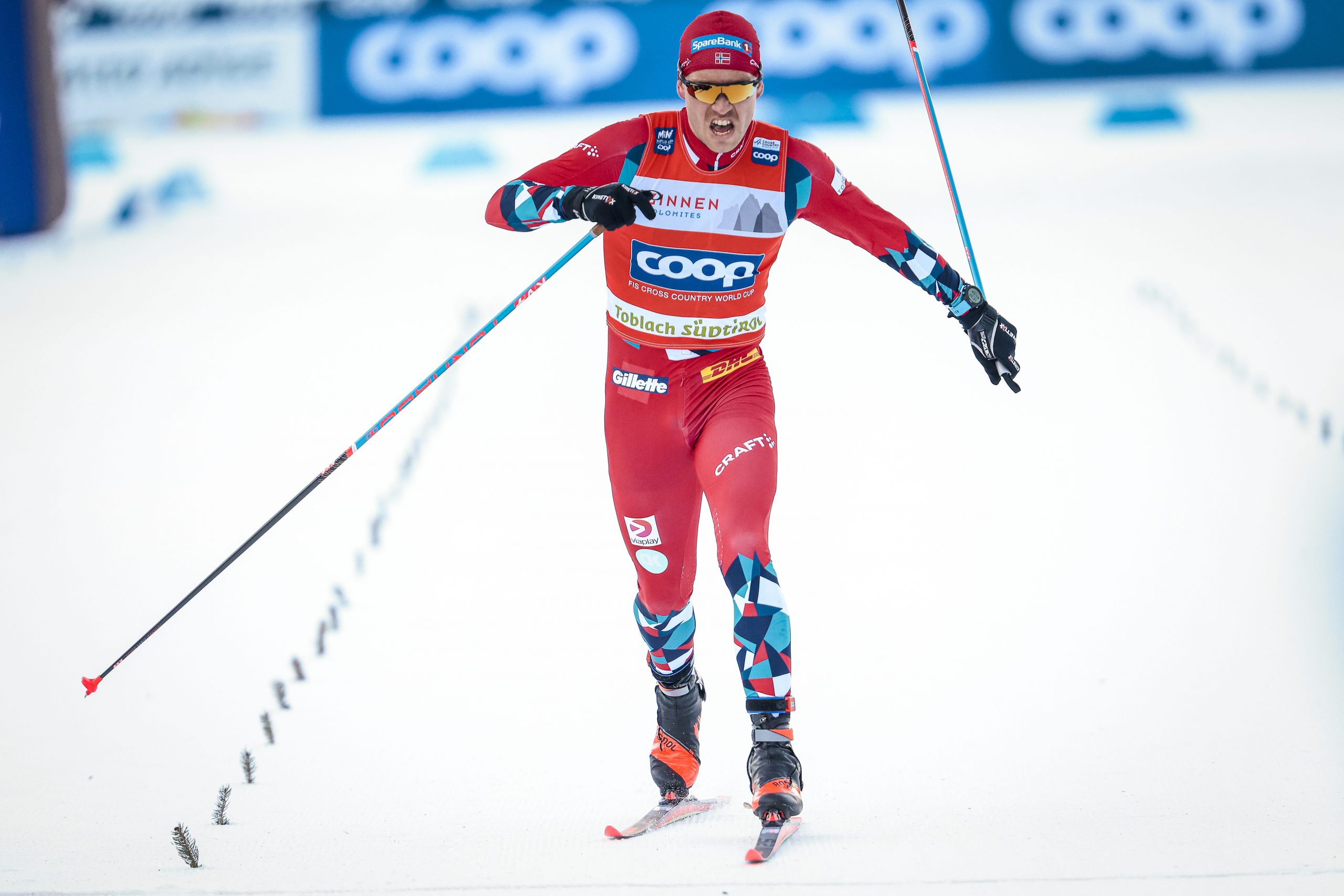
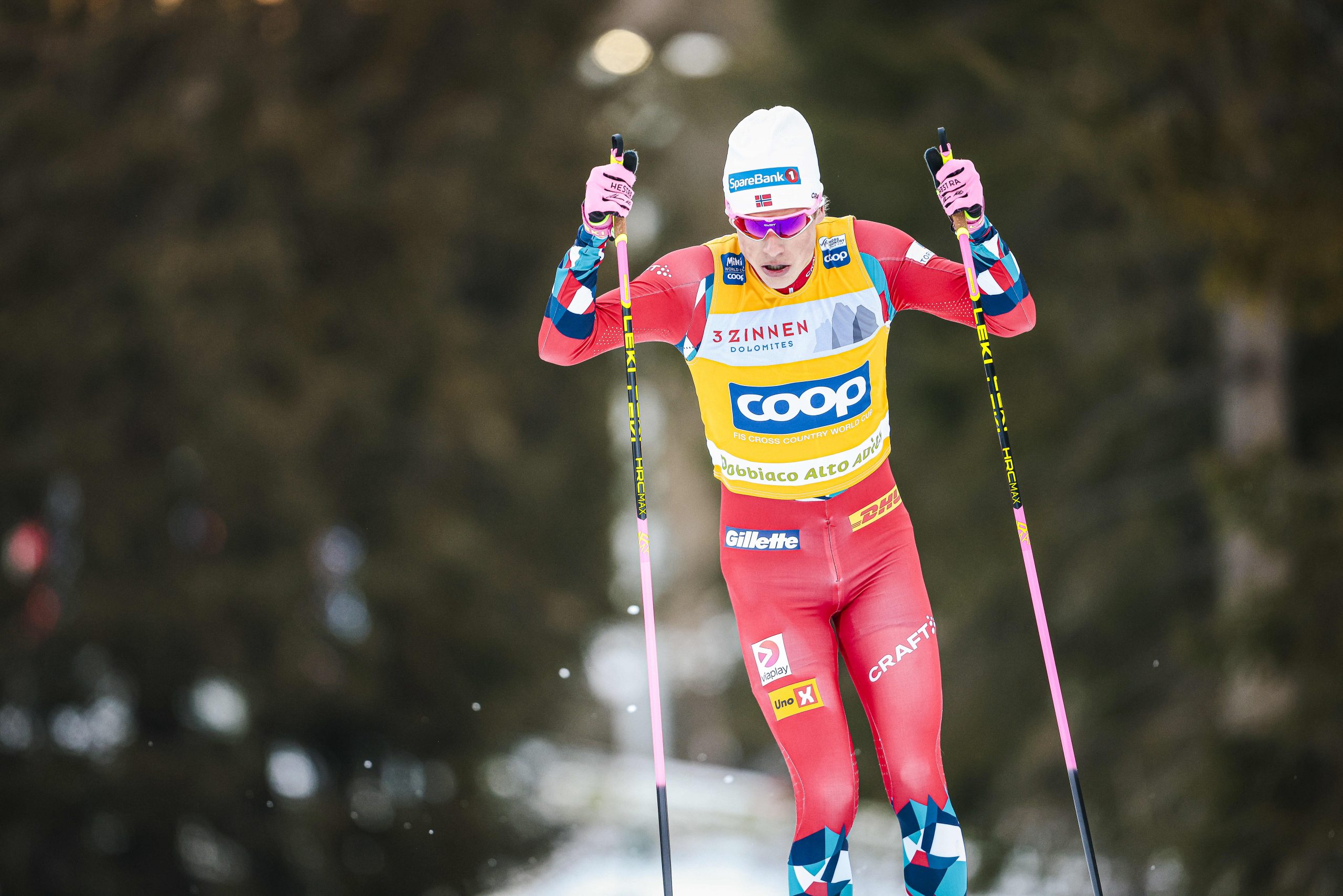
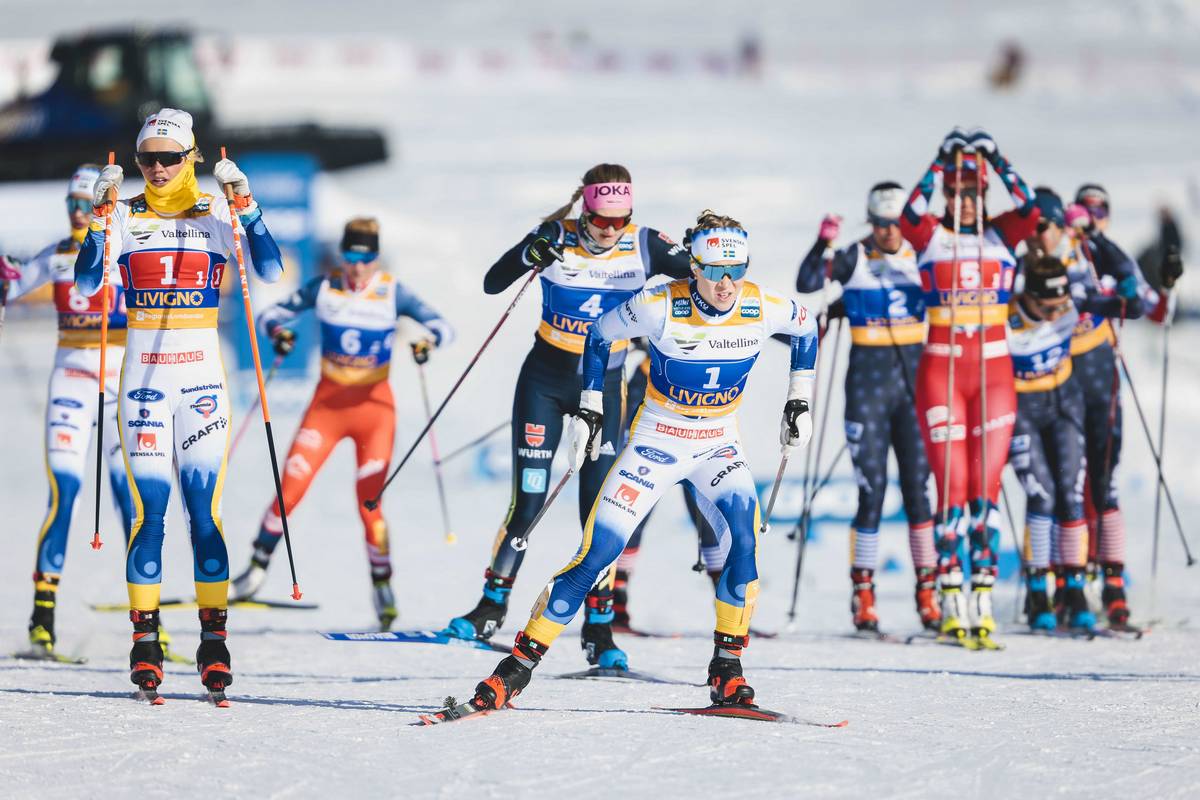
Today, the Italians earned the right to call it whatever they want, as the Italy I relay team of Dietmar Noeckler, Francesco de Fabiani, Simone Dapra, and Federico Pellegrino was victorious in the World Cup 4 x 7.5 k Relay (the first World Cup relay victory for Italy since 2006). They were followed across the finish line by second place Sweden (Eric Rosjoe, Calle Halfvarsson, Johan Haeggstroem, Edvin Anger) and third place Norway I (Sjur Roethe, Didrik Toenseth, Simen Hegstad Krueger, Harald Oestberg Amundsen).
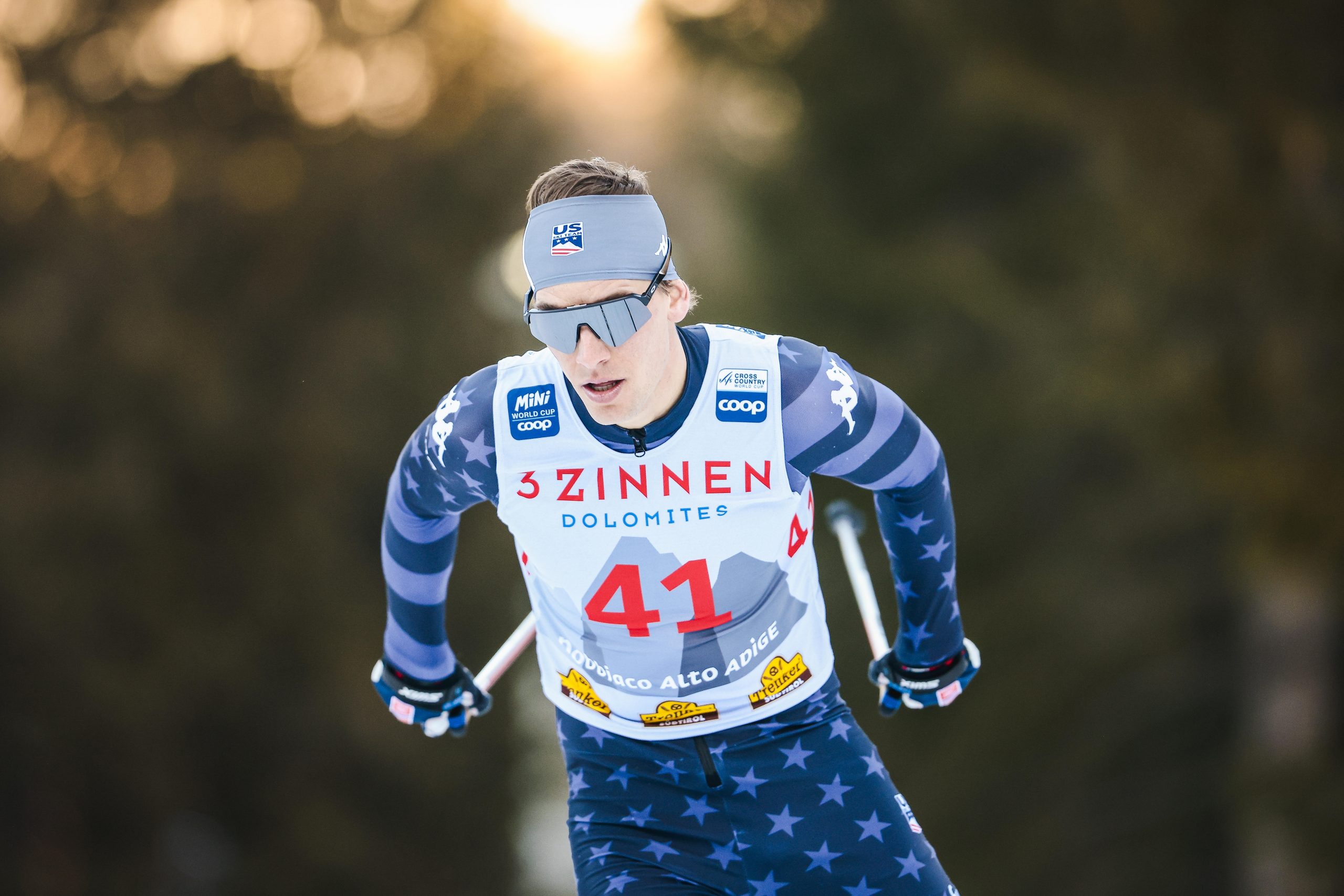
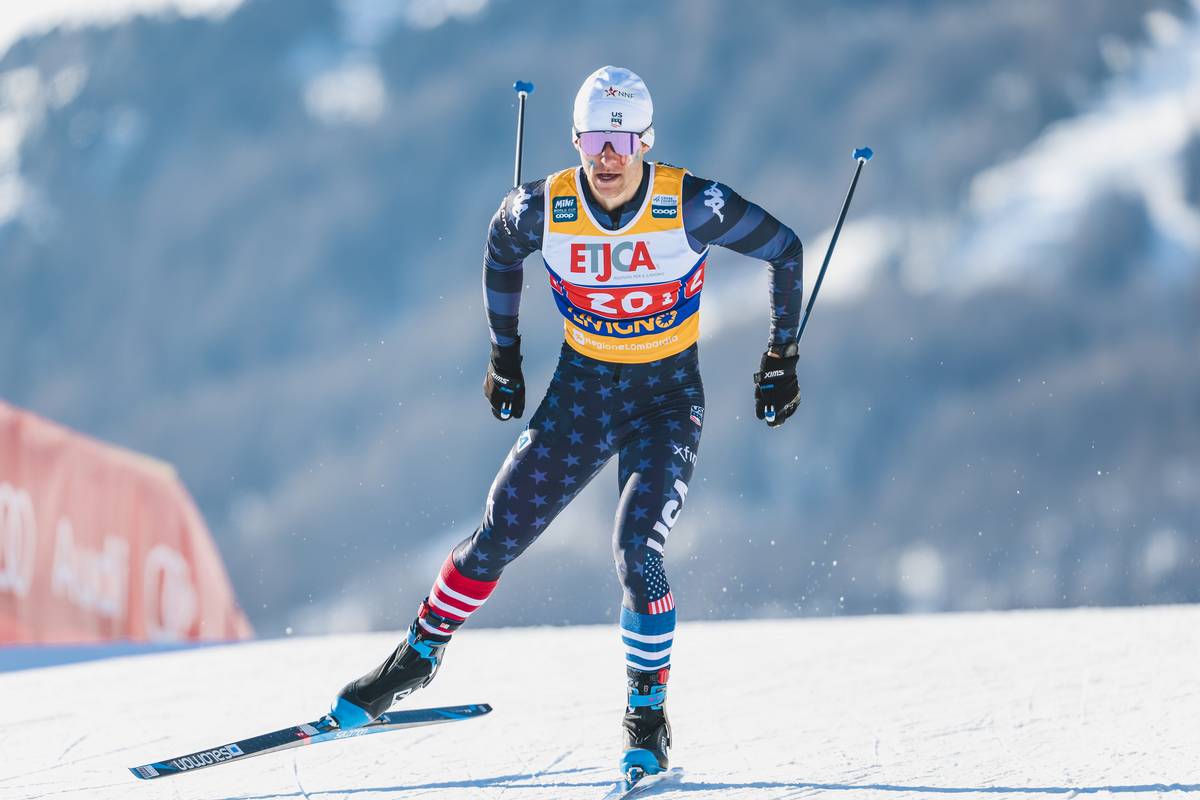
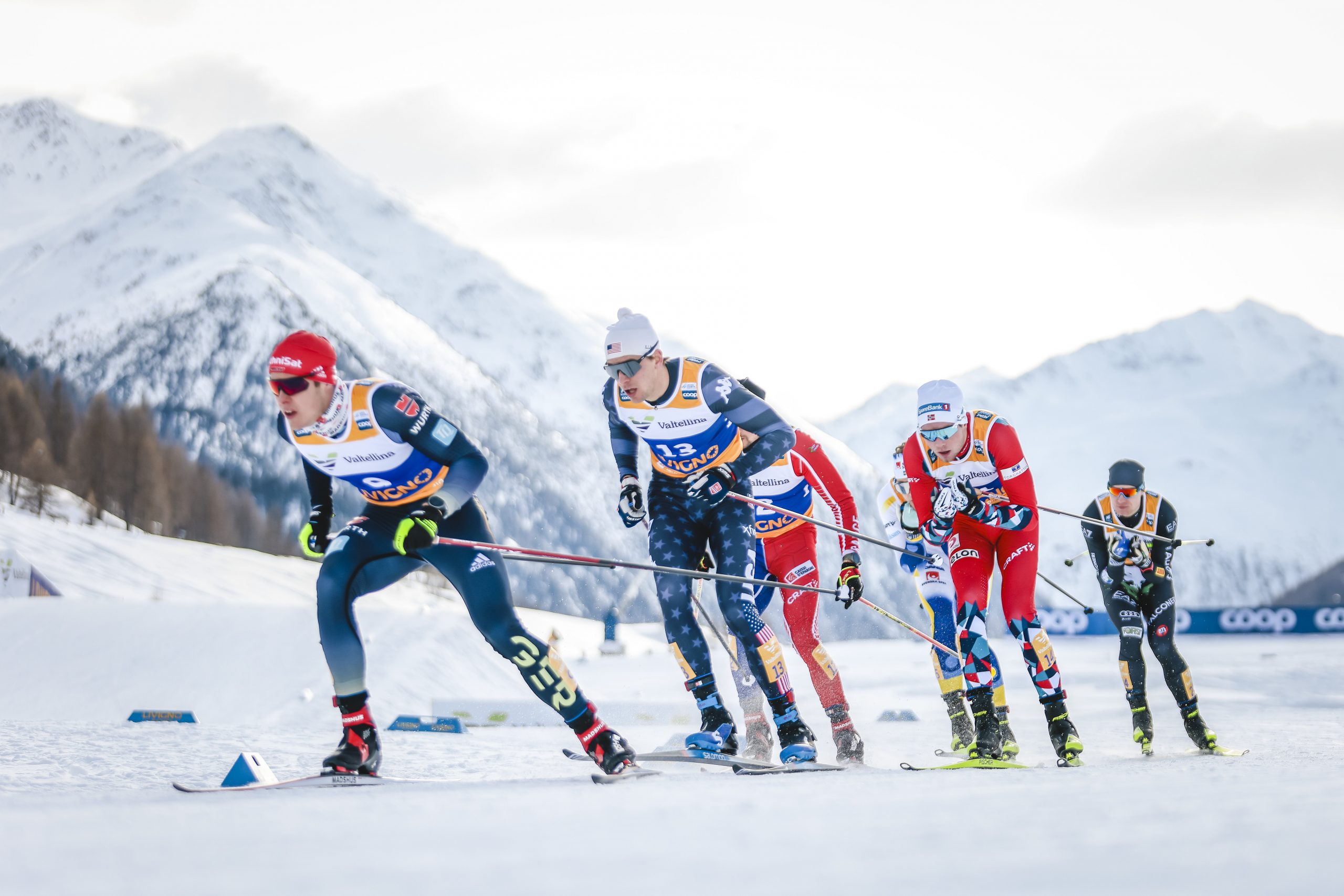
Nordiq Canada did not enter a men’s relay team in Toblach, but the team from the United states (Hunter Wonders, Scott Patterson, Finn O’Connell, and Kevin Bolger) benefitted from a late race resurgence that saw them press forward to finish ninth.
Men’s 4 x 7.5 k Relay
Norwegian skiers may appear to have all the advantages, but each Norwegian competitor does suffer one distinct disadvantage . . . it’s the need to constantly beat the other Norwegian skiers. With the possible exception of current World Cup leaders Johan Hoesflot Klaebo and Paal Golberg, Norwegian skiers always seem to be auditioning for World Championship spots. With two Norwegian teams entered in today’s relay, that seemed like a situation likely to keep the pace high. That sort of aggressive pace-making allows a team like Italy to remain patient, to play defense, to mark the moves of more aggressive skiers, and to put their nation’s premier sprinter into the anchor leg so that he can unleash a sprint. The challenge for Italy, then, would be figuring out how to stay close while two teams of ambitious Norwegians slugged away at each other.
First Leg
Erik Valnes (Norway II) pushed the pace in the first classic leg, gapping the main field and establishing an 11 second lead at the exchange. Wonders had fallen off the pace halfway through the first leg, and was already 20 seconds behind by the 6.4 k checkpoint. By the time Wonders tagged Patterson to begin the second leg, USA was 33 seconds back in 11th place.
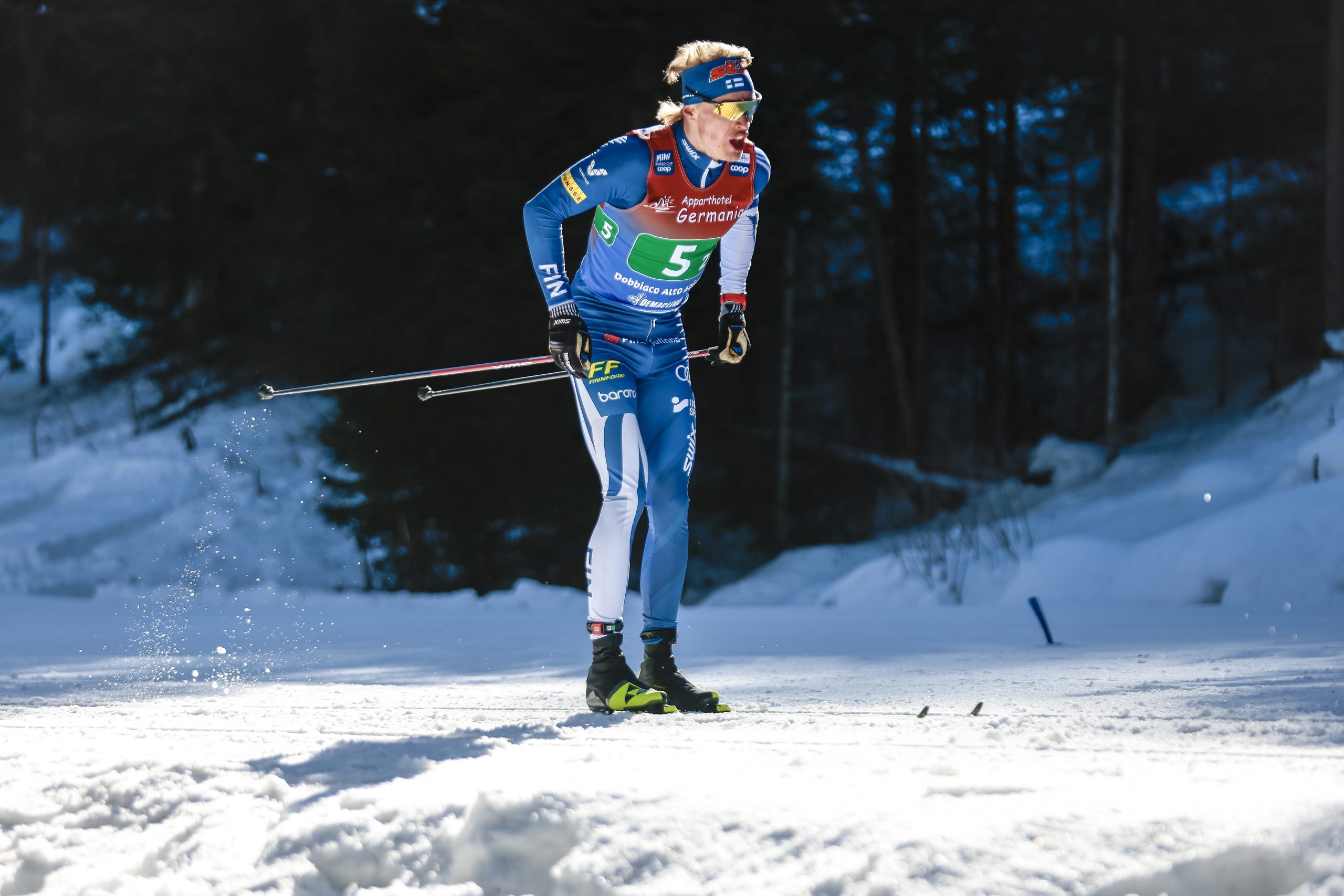
Iivo Niskanen (FIN) animated the second classic leg, pulling the chase group up to Hans Christer Holund (Norway II) and bringing the field back together at the halfway point. But the Norwegian teams weren’t done slugging it out just yet. (Photo: Modica/NordicFocus)
Second Leg
Inheriting Valnes’ lead from the first leg, Hans Christer Holund (NORWAY I) continued increasing the gap ahead of the chase group. Most skiers in the second leg would’ve looked to classic specialist, Iivo Niskanen (FIN) to instigate a chase of the leader, though Niskanen seemed content to linger at the rear of the chase group. The first half of Niskanen’s leg seemed to be more of a training ski for him, but at the end of his first lap he unleashed an attack, setting off in pursuit of Holund. Calle Halfvarsson (SWE) followed Niskanen, and the field began to string out. In only a few minutes, Niskanen was able to close the gap to Holund (leading De Fabiani, and Halfvarsson). Midway through the second lap, all the leaders had come back together.
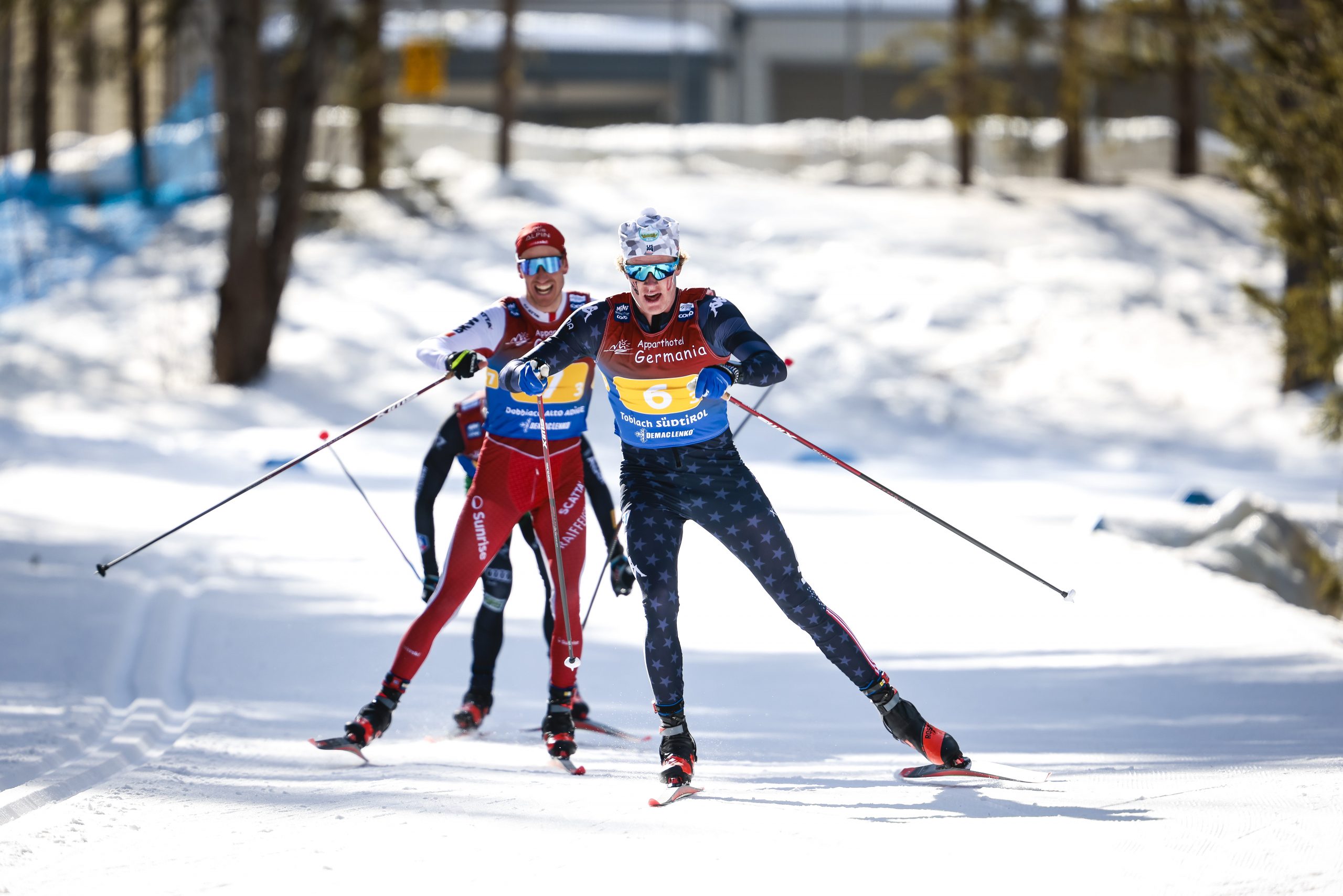
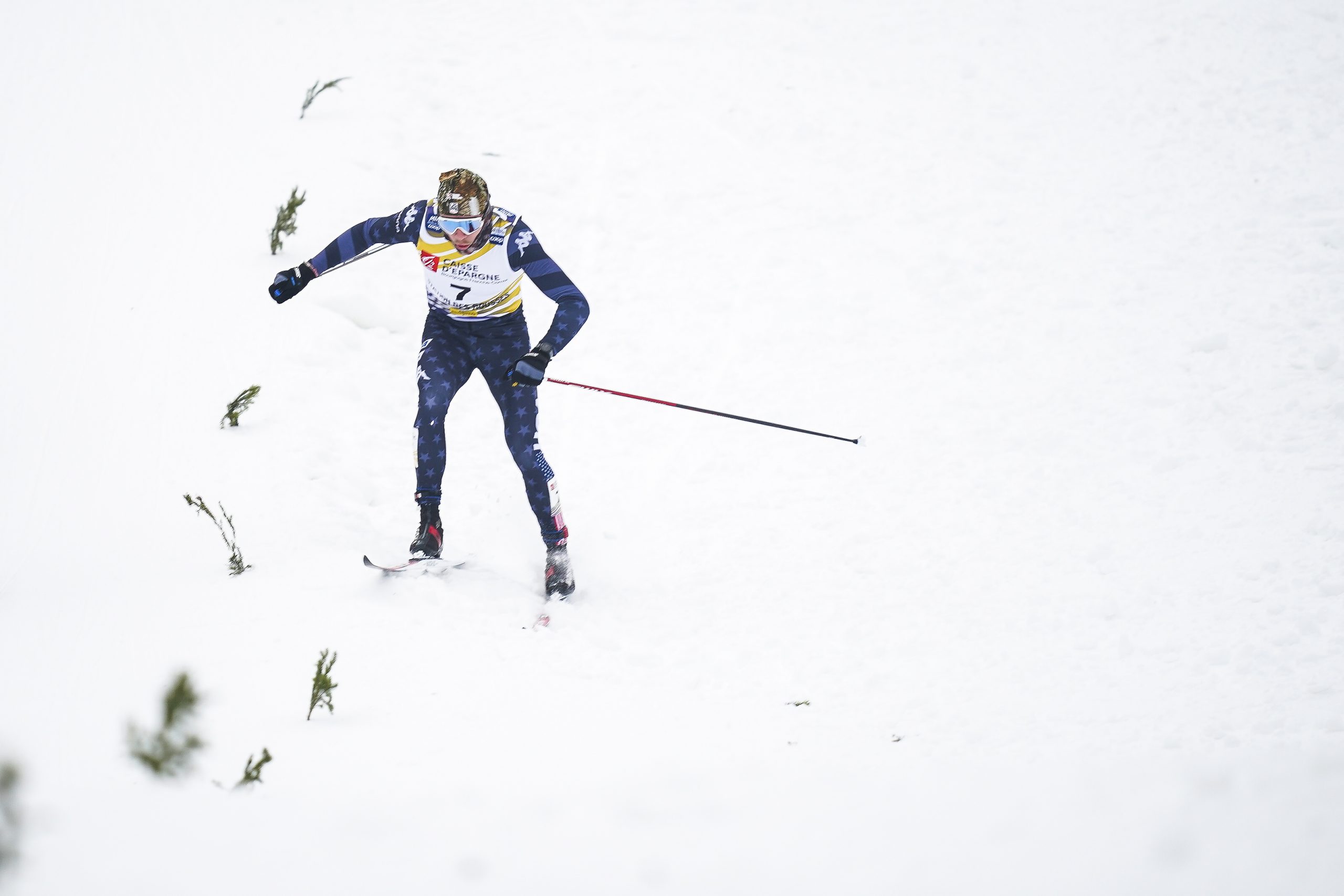
Finn O Connell (USA) took advantage of a lull at the front of the race to re-establish contact with the chase group. His strong skiing in the third leg brought Team USA up to ninth place. (Photo: Modica/NordicFocus)
Third Leg
Norway returned to the front at the beginning of the third leg, led by Krueger who clogged the front and slowed the pace on narrower skate tracks that included the classic tracks of the earlier legs. World Cup skiers are certainly capable of skating right through the classic tracks, but at this point in the race all seemed content to follow a more moderate pace. Norway certainly had skiers fast enough to push the pace, but somehow a decision was made to slow things down. As it turned out, this was exactly the break in the action that the Italian team needed.
Ultimately, Krueger did markedly increase the pace up the main hill, surprising his Norway II rival, Iver Tildheim Andersson, who struggled to hang on to the rear of the lead group. Despite being a World Cup winner this season, Andersson is most likely being left out of Norway’s World Championship team. That may have inspired him to drive back into contention on the consequential downhill . . . he rocketed into second as the third leg neared its end. Italy fell off the pace, and the lead group had shrunk to six as the racers entered the stadium for the final exchange.
Anchor Leg
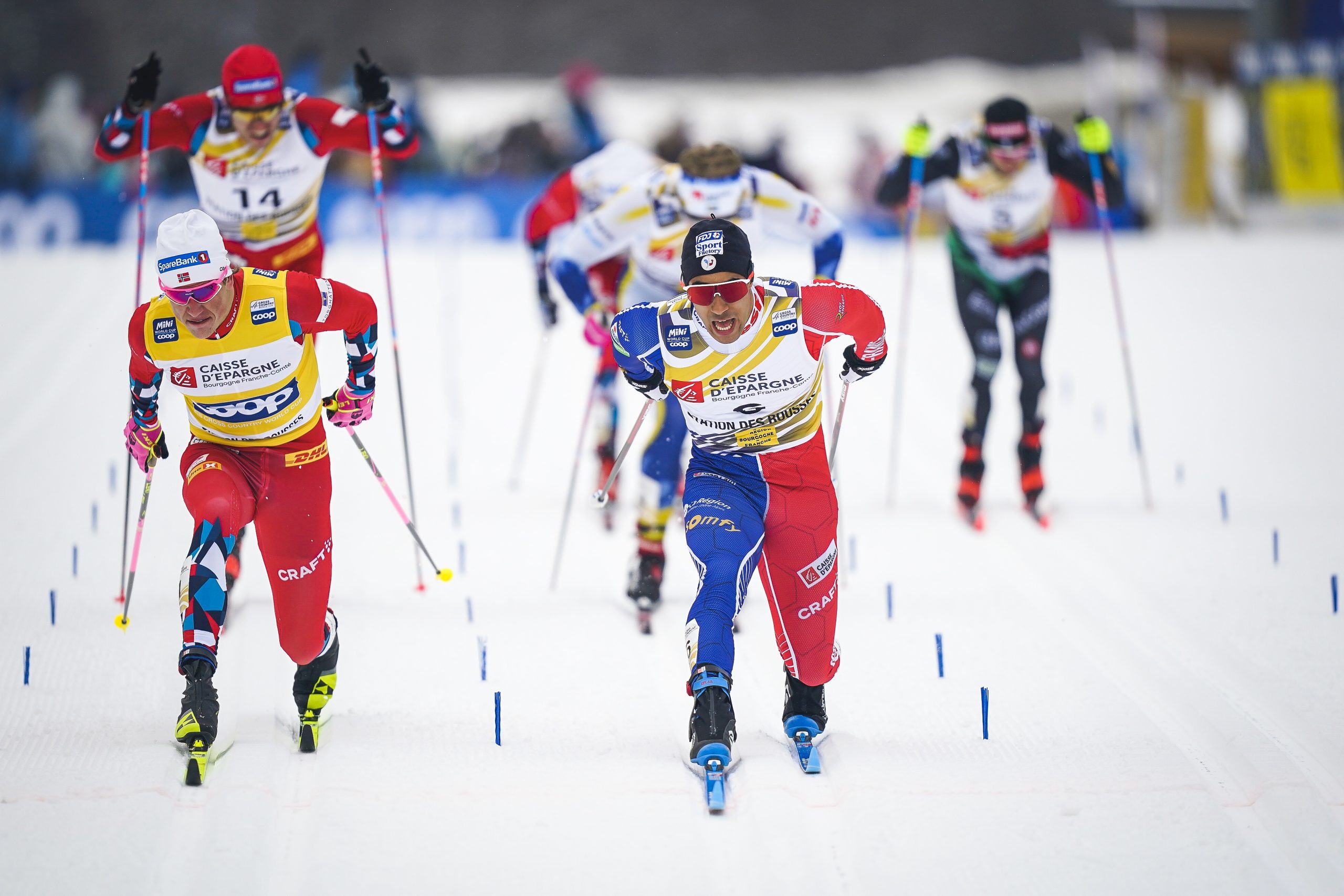
Norway I handed off a lead of a few seconds to the final skier, Amundsen. Norway II blew the exchange and exited the stadium at the back of the lead group. The cagey veteran, Pellegrino, was able to overcome the gap with which Italy had entered the final exchange; he maneuvered back into contention and settled into the lead group. With two 3.75 k laps remaining, Amundsen found himself in a not-unexpected predicament: a distance specialist surrounded by rival anchor leg skiers who are primarily sprinters: Edvin Anger (SWE), John Maki (FIN), Richard Jouve (FRA), and the always-dangerous Pellegrino.
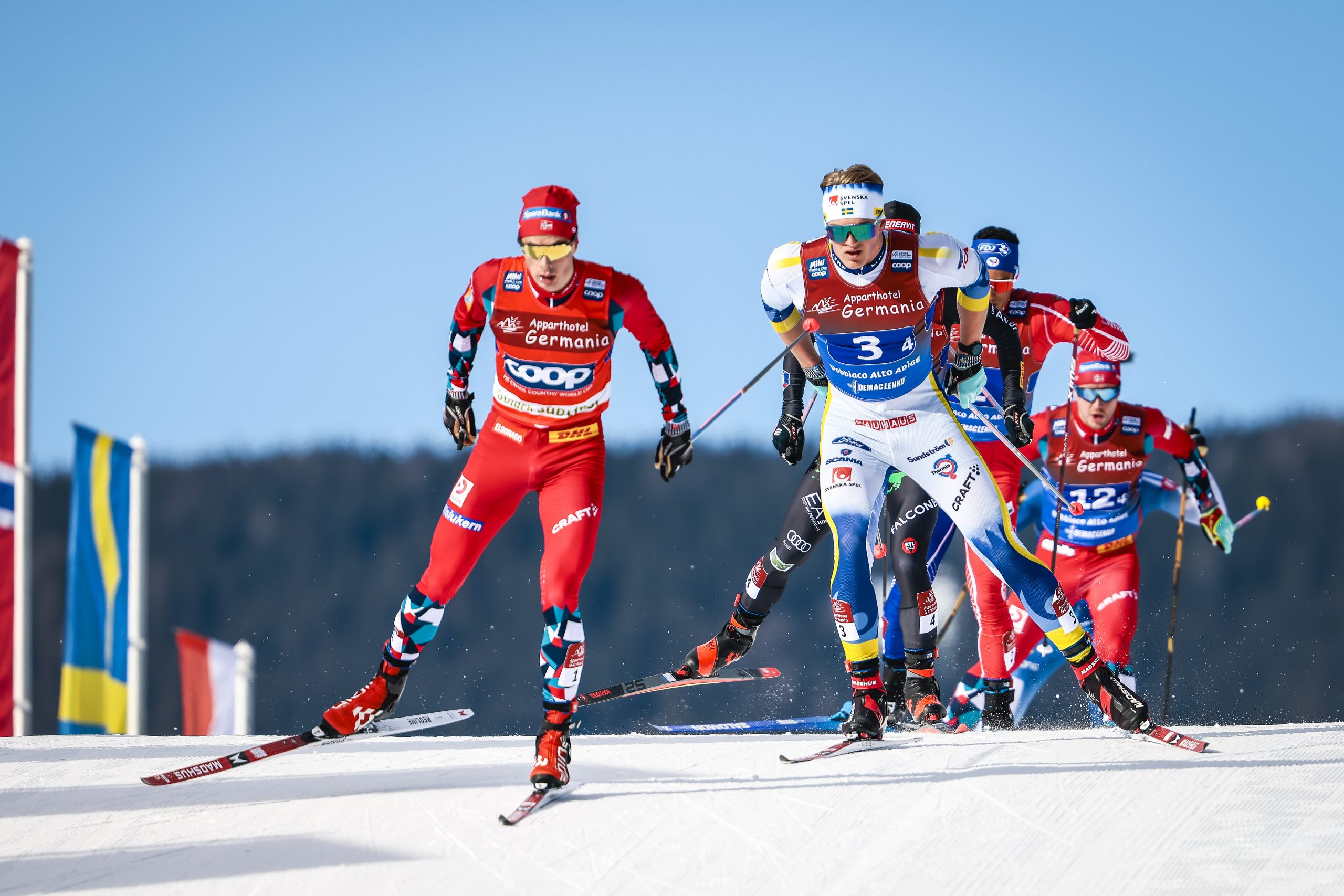
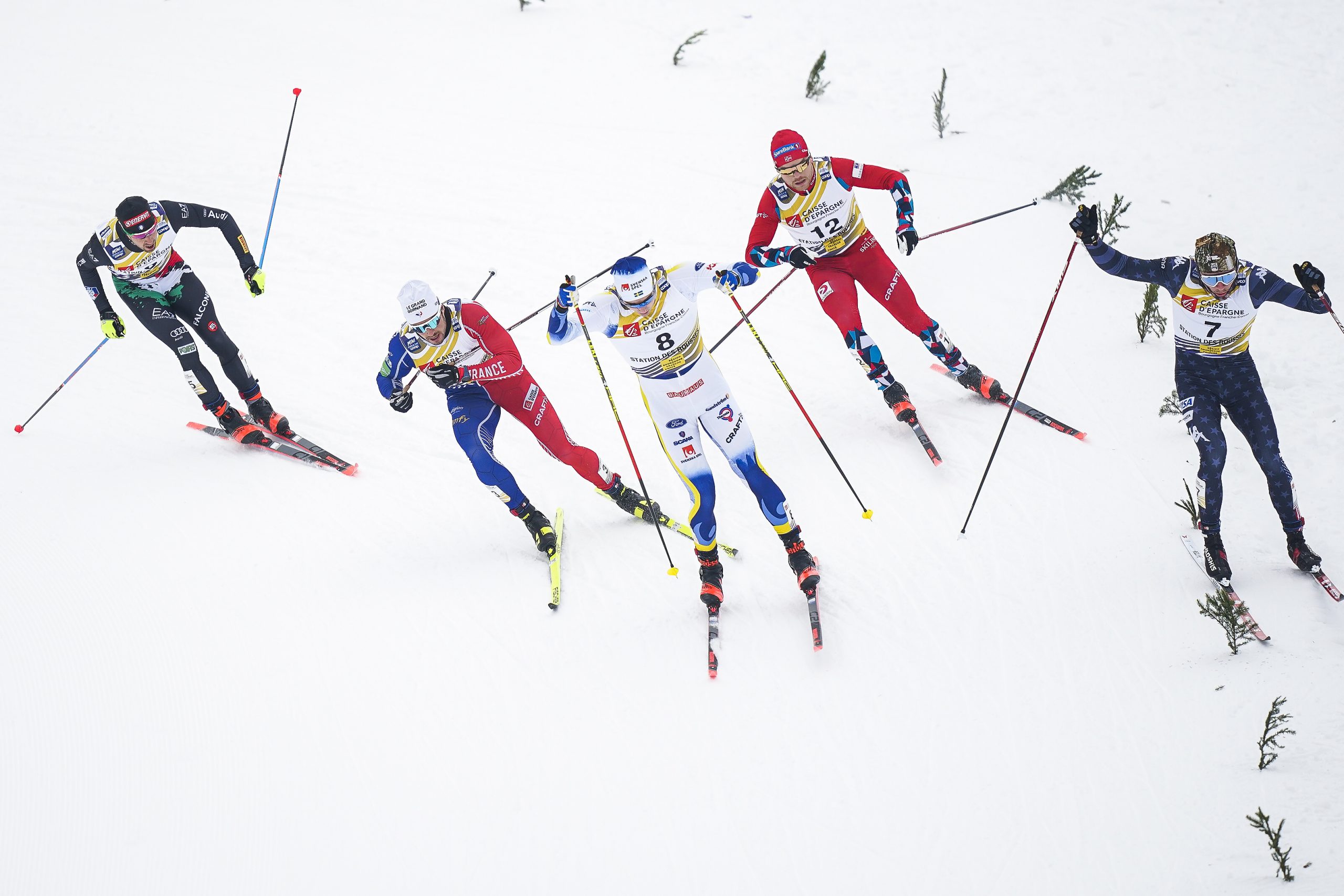
Harald Oestberg Amundsen (NOR) led most of the anchor leg, hoping to tire the sprint specialists surrounding him. He’s followed by Edvin Anger (SWE), Federico Pellegrino (ITA) Richard Jouve (FRA) and Sindre Bjoernestad Skar (NOR), and Joni Maki (FIN). (Photo: Modica/NordicFocus)
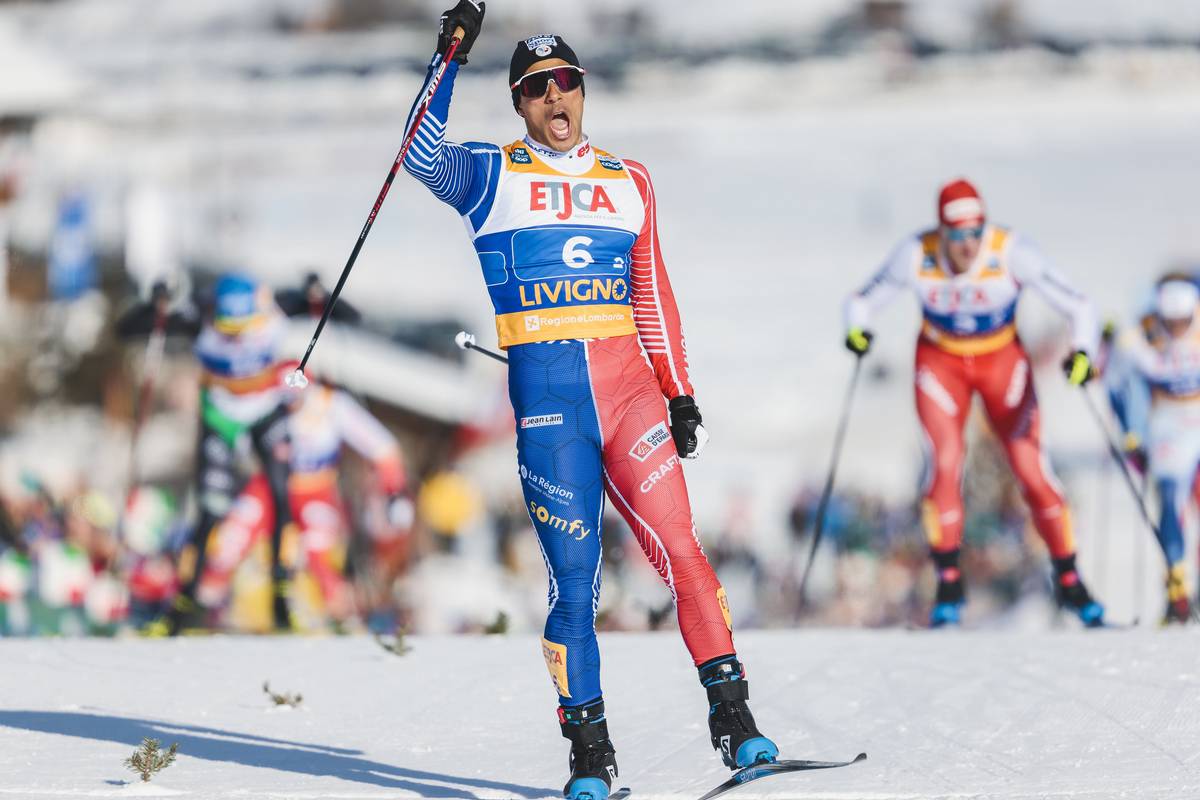
Amundsen established a significant gap at the beginning of the anchor leg, making it appear as though the finish could be a foregone conclusion. Spectators have seen Norway pull away so many times in the final leg of a relay, why would this day be any different? But Jouve recognized the chance to ski France onto the podium if he, himself, were the only sprinter brave enough to drive forward. Jouve set off in lone pursuit of Amundsen, leaving other strong sprinters in the chase (Maki, Pellegrino, Anger, Skar) to consider their options, to evaluate their strength, and to decide whether or not sprinting for third would be satisfactory.
Jouve made contact with Norway (Amundsen), putting himself in position to contend in a final sprint (in which he would certainly be the favorite). Responding to Jouve’s presence, Amundsen seemed to sit up a bit, allowing the lead group to come back together with one lap remaining. Amundsen may have hoped to wear out the sprinters, but he had to know that one attack would not be enough. There would need to be more action in the final lap. The only real distance skier among the sprinters, Amundsen would need to go back to the lead: he’d have no choice. Amundsen went to work, gradually ratcheting up the pace, hoping to take the final sting out of the sprinters. Knowing how the final kilometers would certainly play out, Pellegrino marked Amundsen as Jouve came apart (his earlier efforts proving to have been too taxing to keep up with Amundsen’s late-race pace). Likewise, Maki and Florian Notz (GER) also lost contact with the leaders, and the final group had shrunk to four: Amundsen, Skar, Anger, and Pellegrino.
Who knows why he would have chosen to do so, but Anger—a sprinter whose best strategy would’ve been to let others lead, and sprint at the last moment—led out the sprint with nearly a kilometer left to race. Way too early, way too far . . . and Pellegrino was only too happy to let Anger do the work. The finish of the relay is the same as the sprint course, and Pellegrino knew perfectly well how to construct his finishing sprint. Accelerating up the final hill, Pellegrino surged around Anger, squeezing the Swede into a position that pinched the line available to both Norwegian teams, delaying them just long enough for Pellegrino to get away. It was; of course it only succeeded because of Pellegrino’s unique prowess as both a sprinter and a distance skier. It’s supremely difficult to be in that position, to have that energy left, to know how to do what Pellegrino did, and then to pull it off in front of his Italian fans.
The relay win in Dobbiaco represented the first Italian victory in a World Cup relay since 2006. It’s unlikely that Italy will be able to pull off a similar win at the World Championships in three weeks when Norway puts all its strongest skiers onto one team, but for the day in Toblach, the sun definitely shined on the Italians.
Pellegrino revealed how much thinking and calculating goes into racing at this level. He commented that the team needed to ski intelligently and defensively to remain in contention: “And they did,” he beamed. He commented that he hoped his skis would be fast enough: “And they were,” he grinned. “I only needed to stay with the strongest team in the world, and then be the strongest.” He was . . .
“Victory for us, victory for the whole Italian team,” De Fabiani was heard to say. Let the Italian celebrations commence . . .
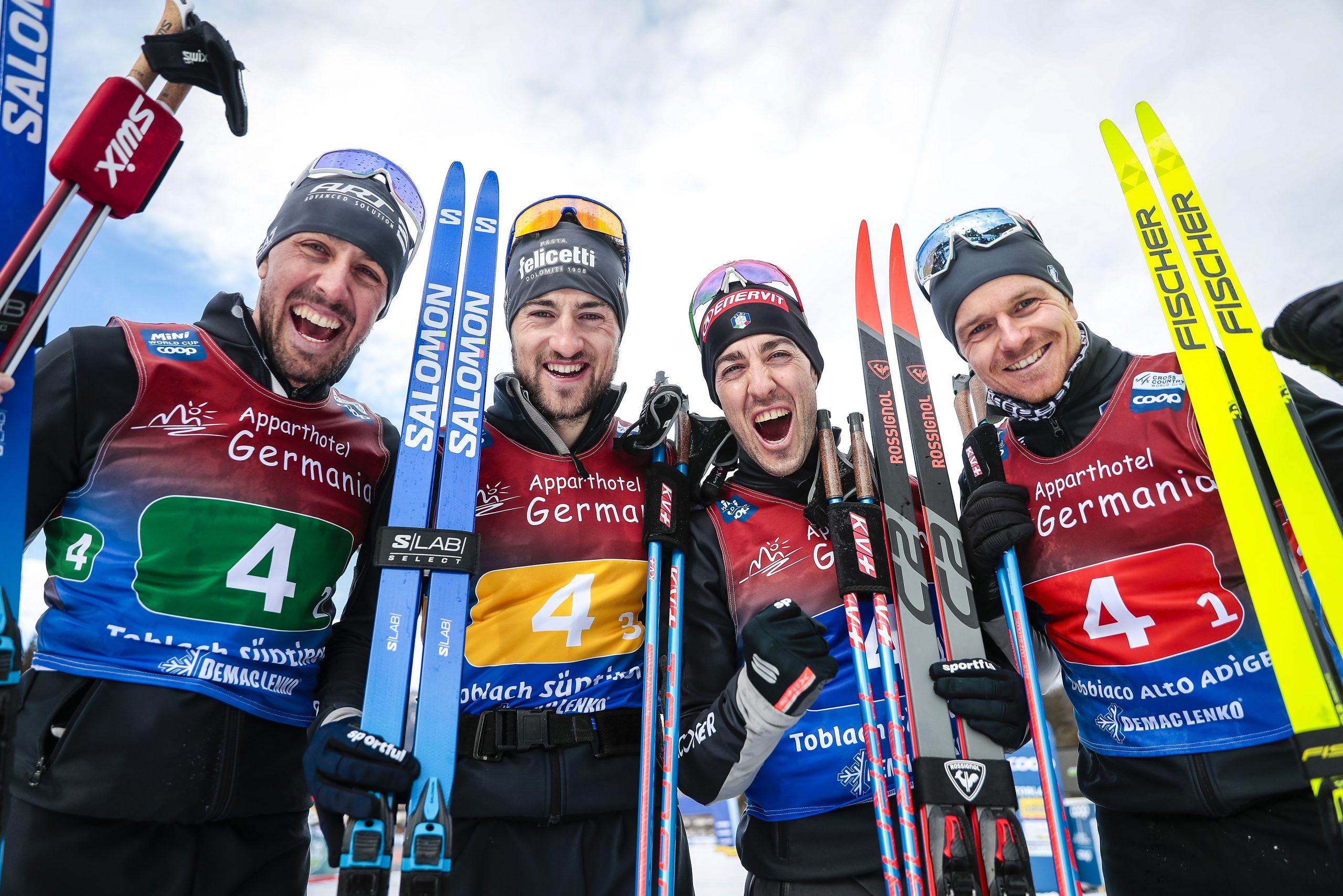
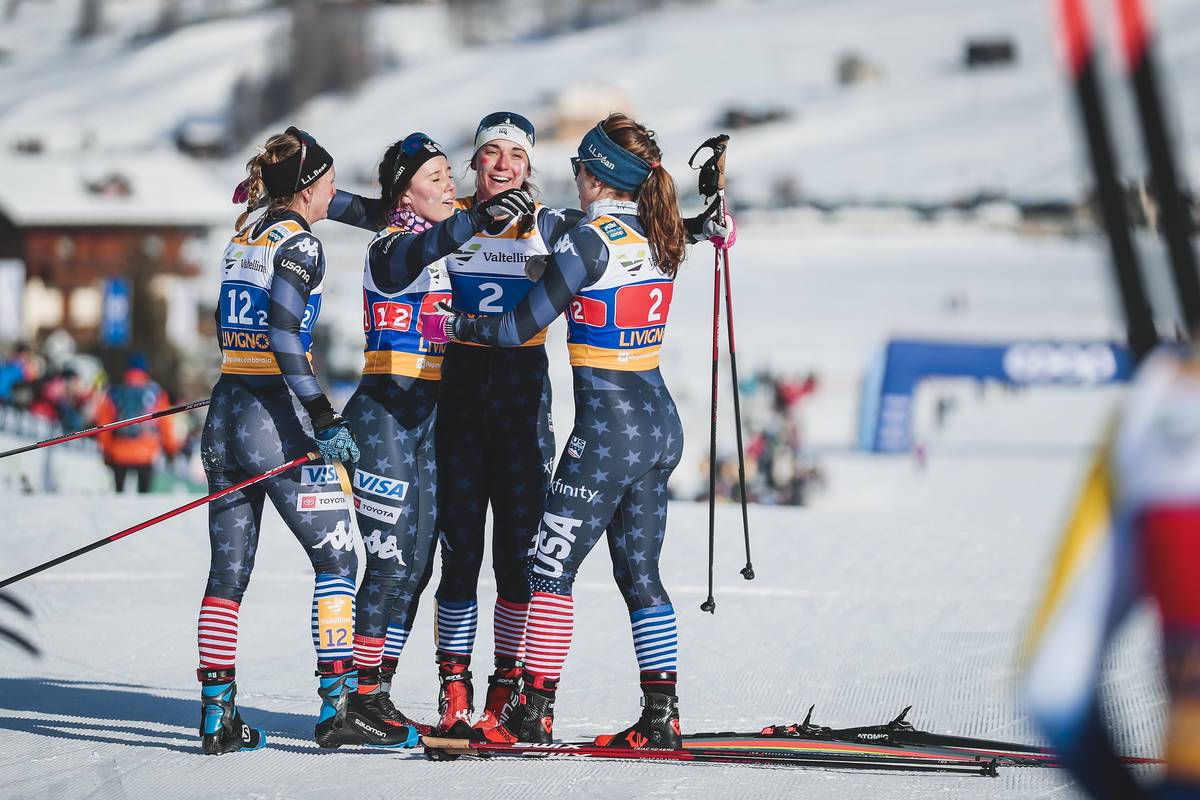
Toblach, Italy: Francesco De Fabiani (ITA), Simone Dapra (ITA), Federico Pellegrino (ITA), and Dietmar Noeckler (ITA) celebrate Italy’s first World Cup relay win since 2006. (Photo: Modica/NordicFocus)
This World Cup coverage is made possible through the generous support of Marty and Kathy Hall and A Hall Mark of Excellence Award. To learn more about A Hall Mark of Excellence Award, or to learn how you can support FasterSkier’s coverage, please contact info@fasterskier.com.
A lot can happen out on a World Cup race course: sometimes, the on-screen coverage makes results seem straightforward, but 10 kilometers is a long way to race, and fortunes are known to change between the start line and the finish line. Athletes must contend with racing conditions, with their own level of fitness, with the relative speed of the skis delivered to them by wax technicians, and with the determination of other athletes who may be sharper, more rested, or more resurgent. Things don’t always go as planned.
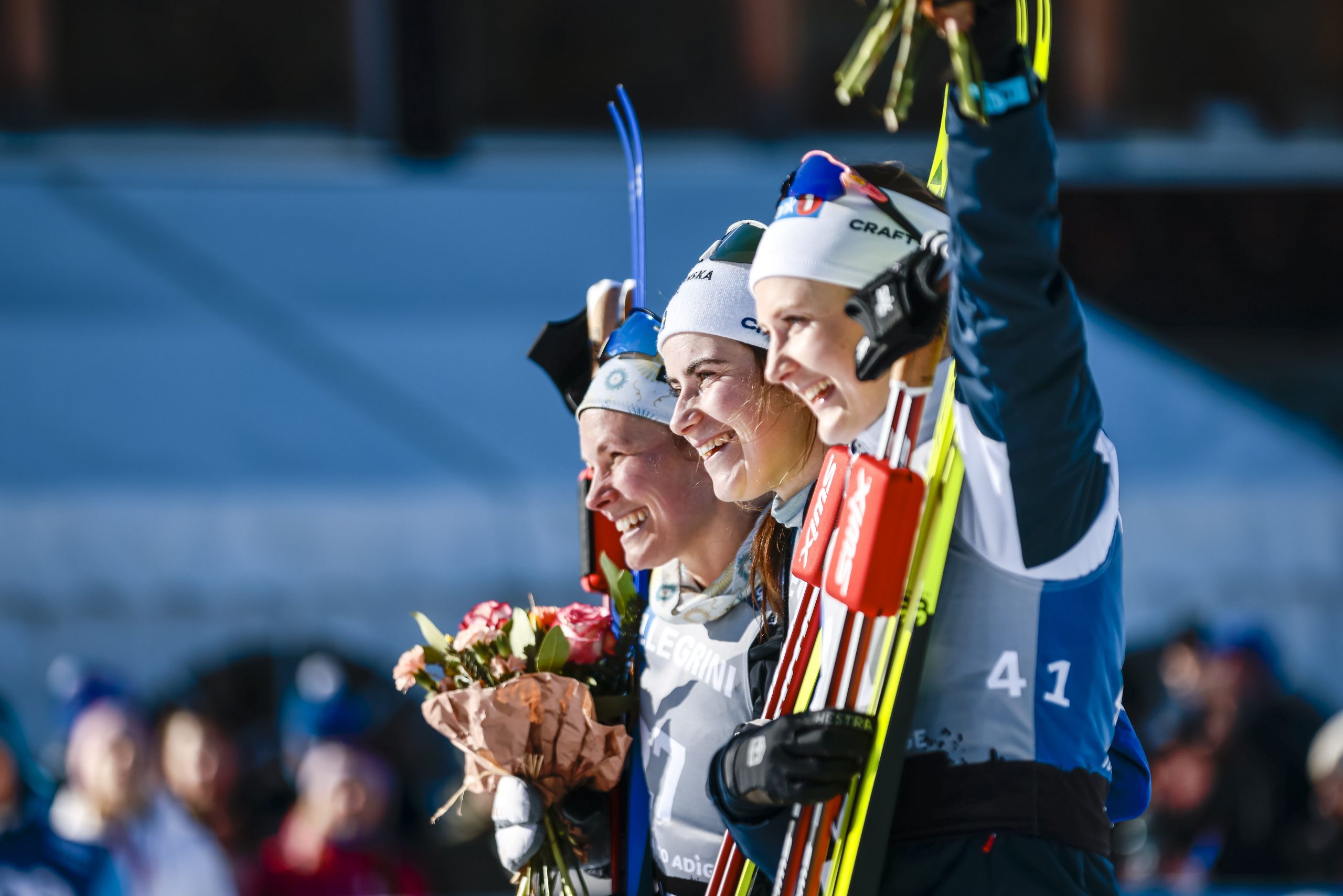
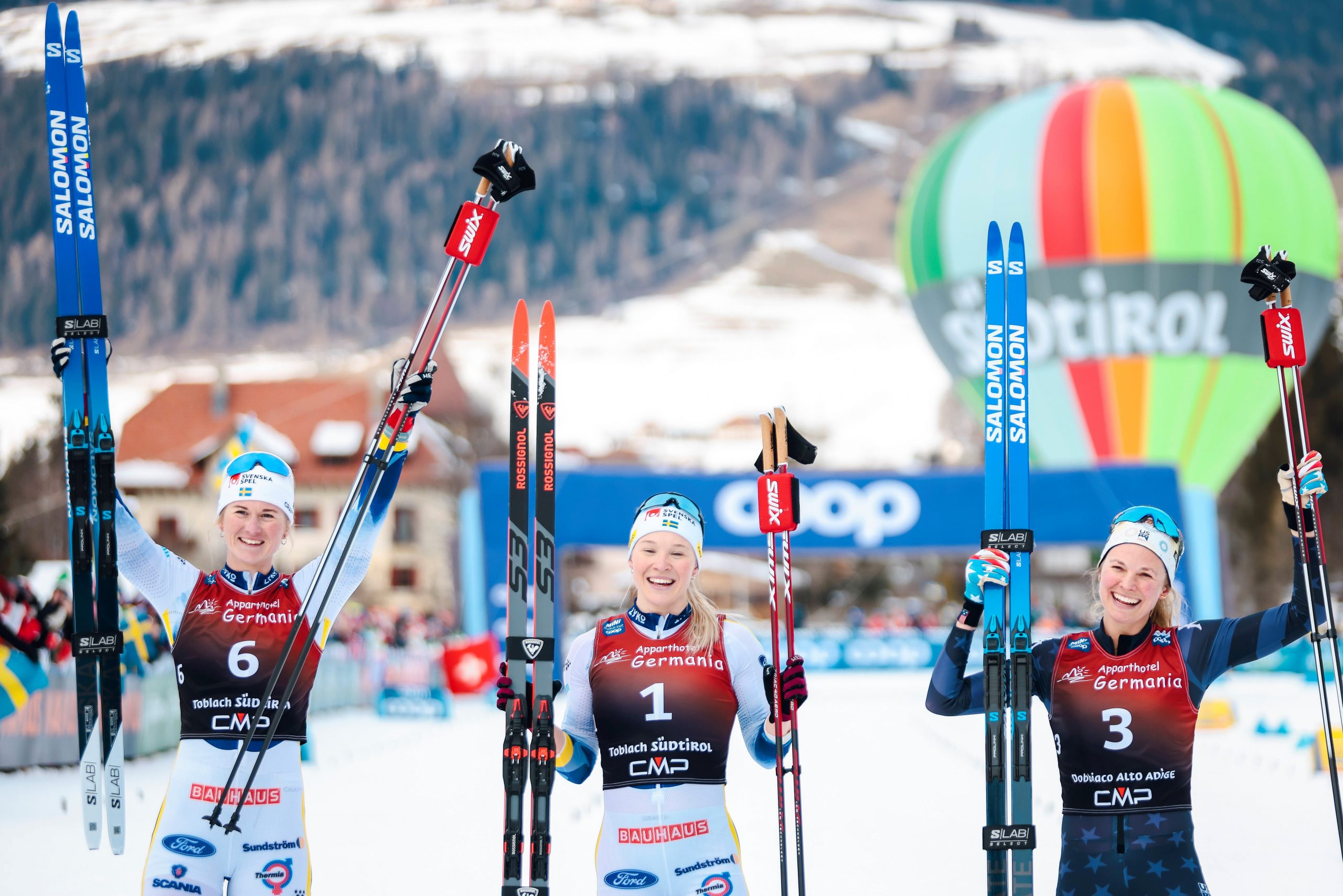
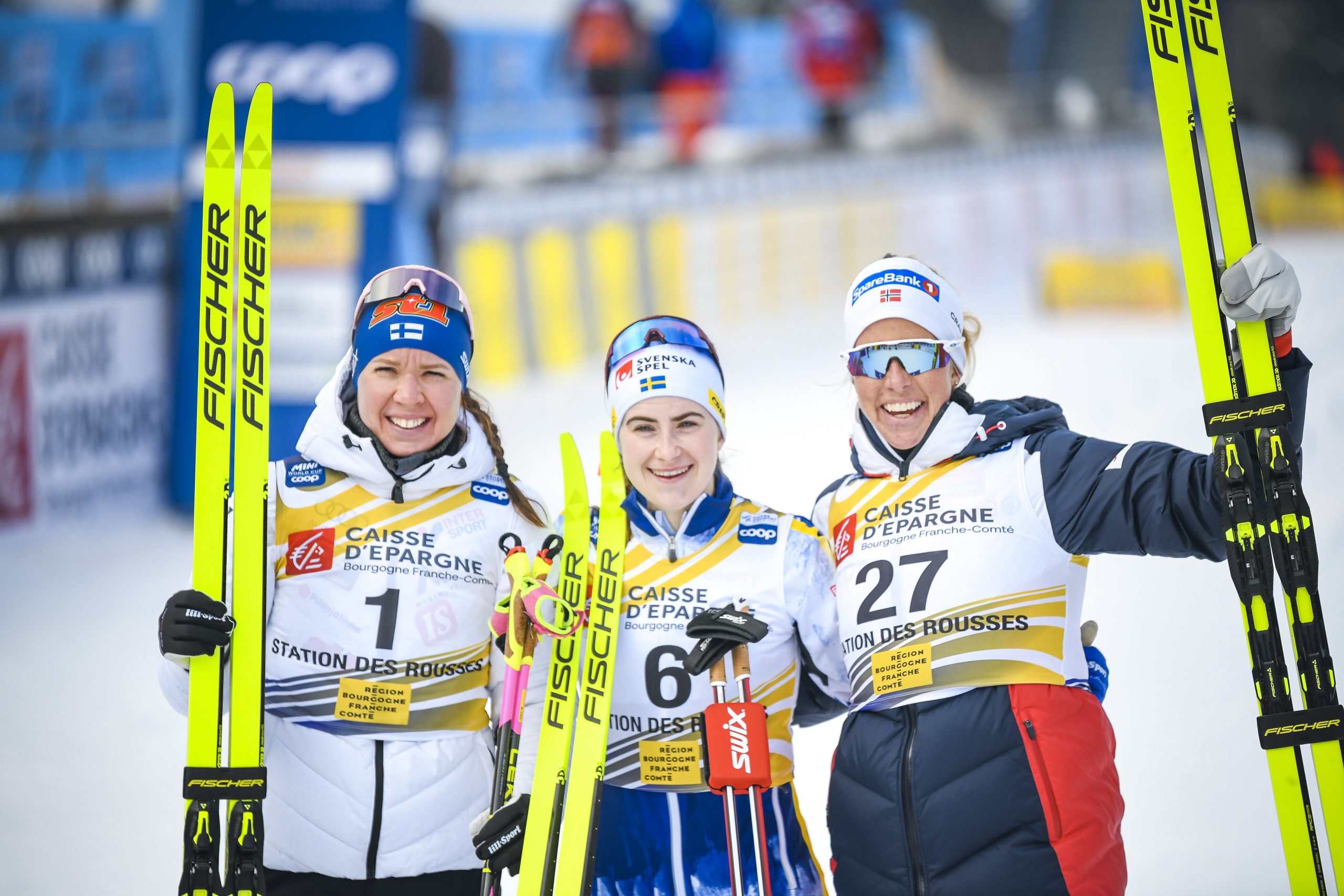
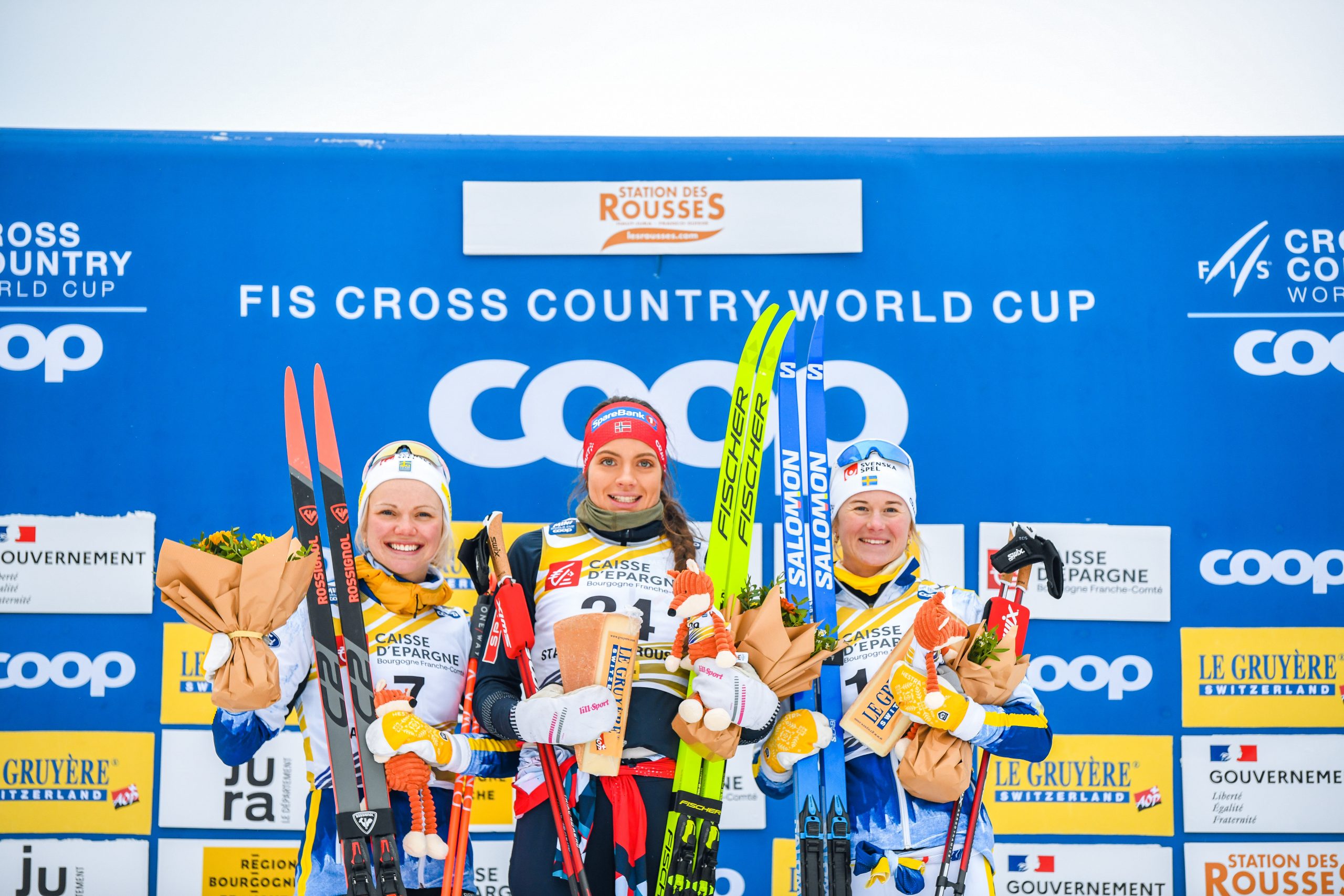
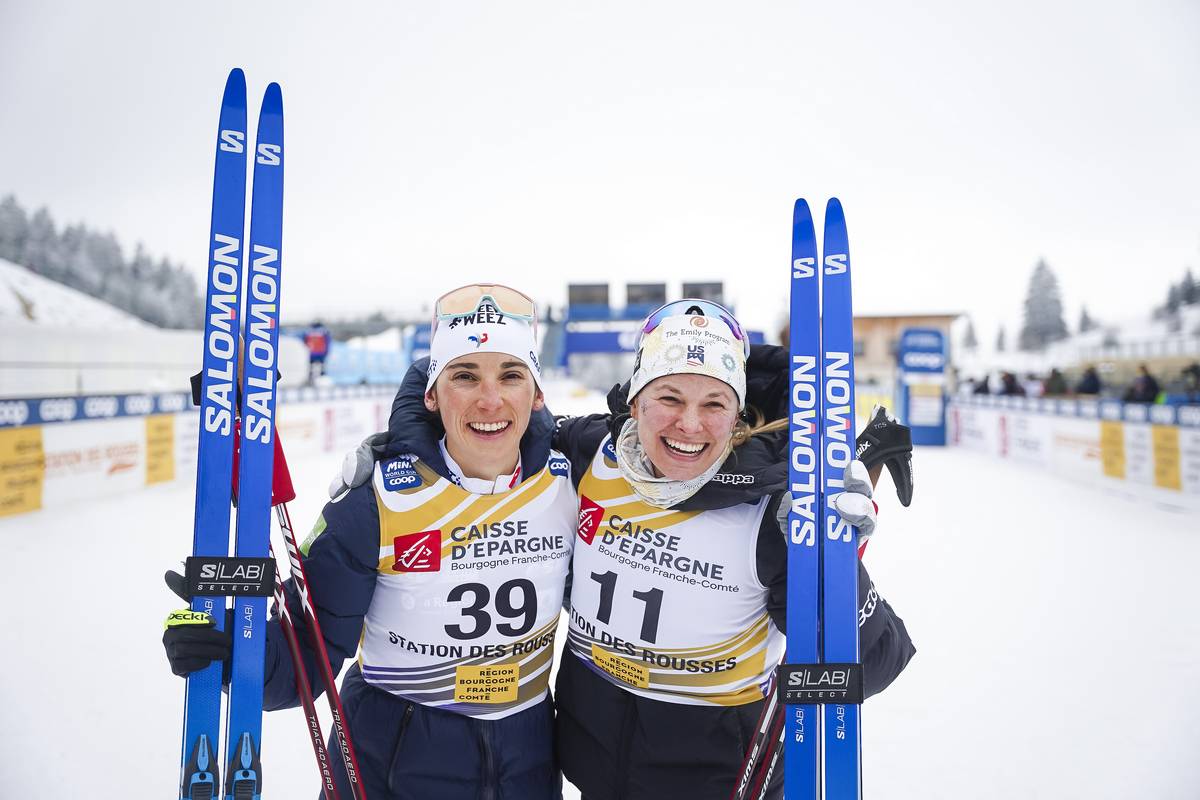
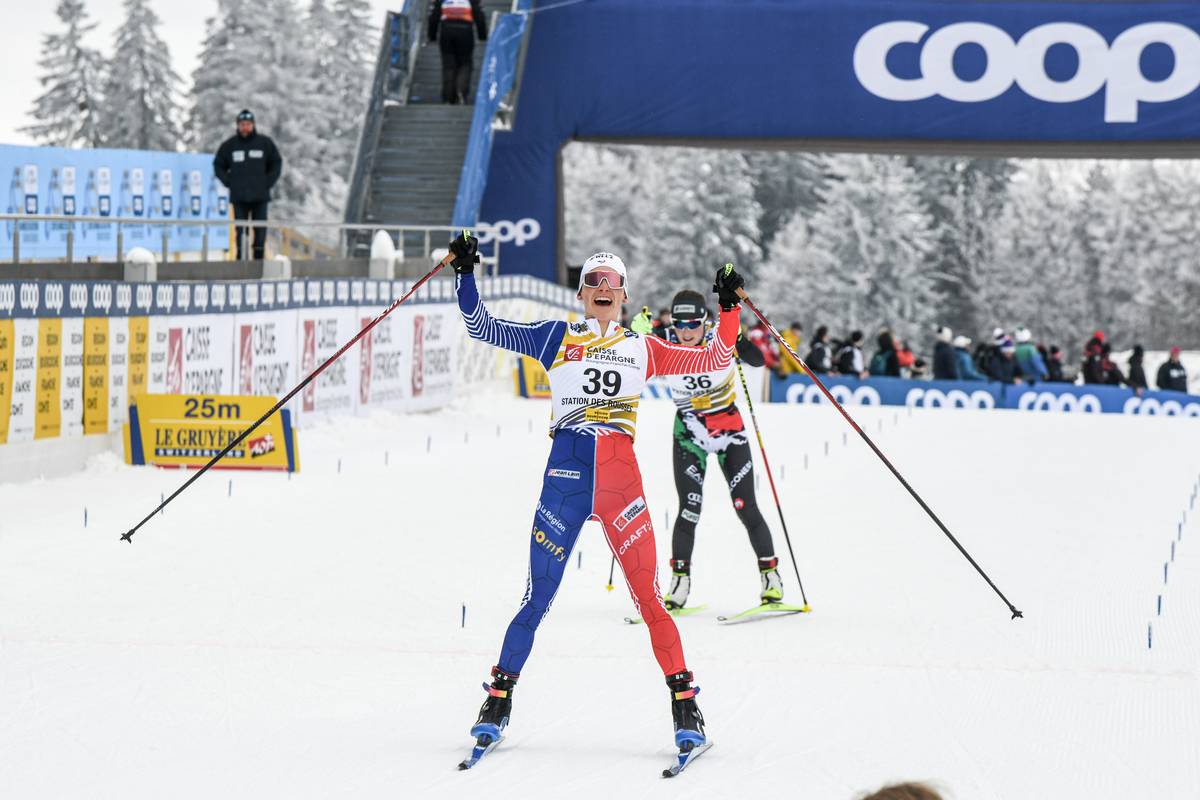
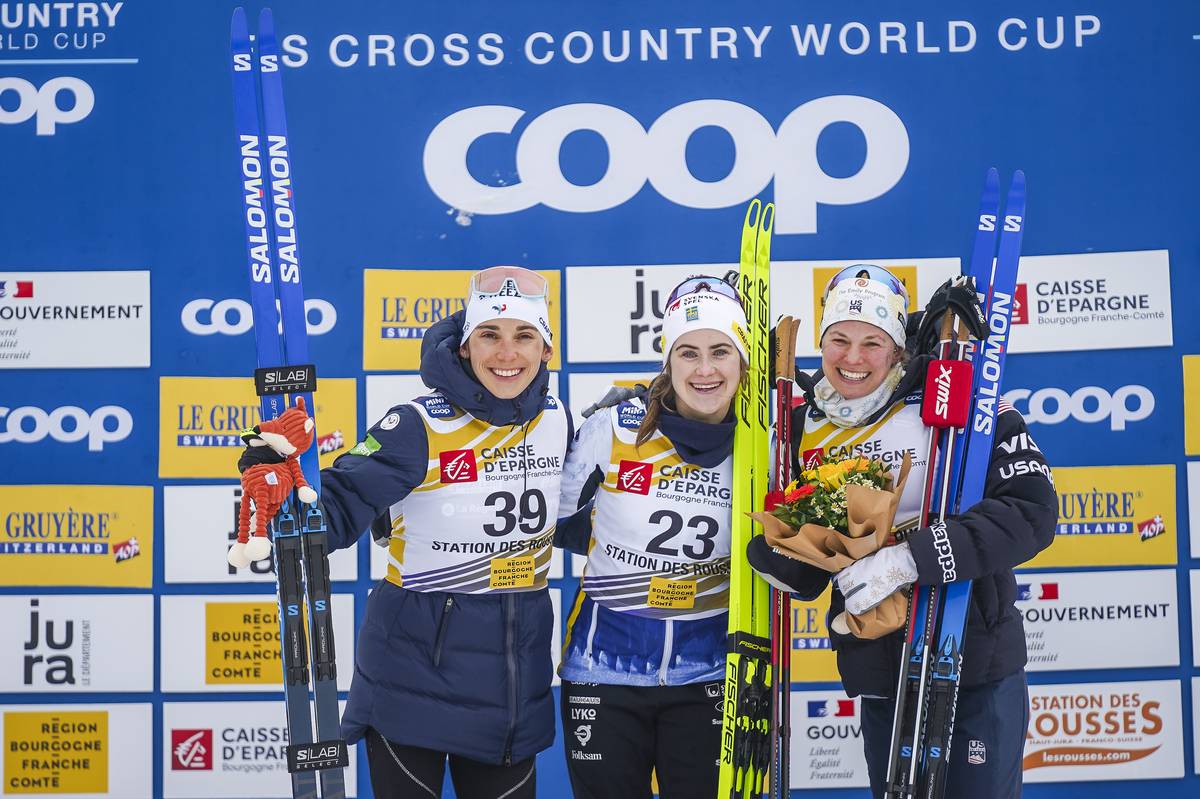
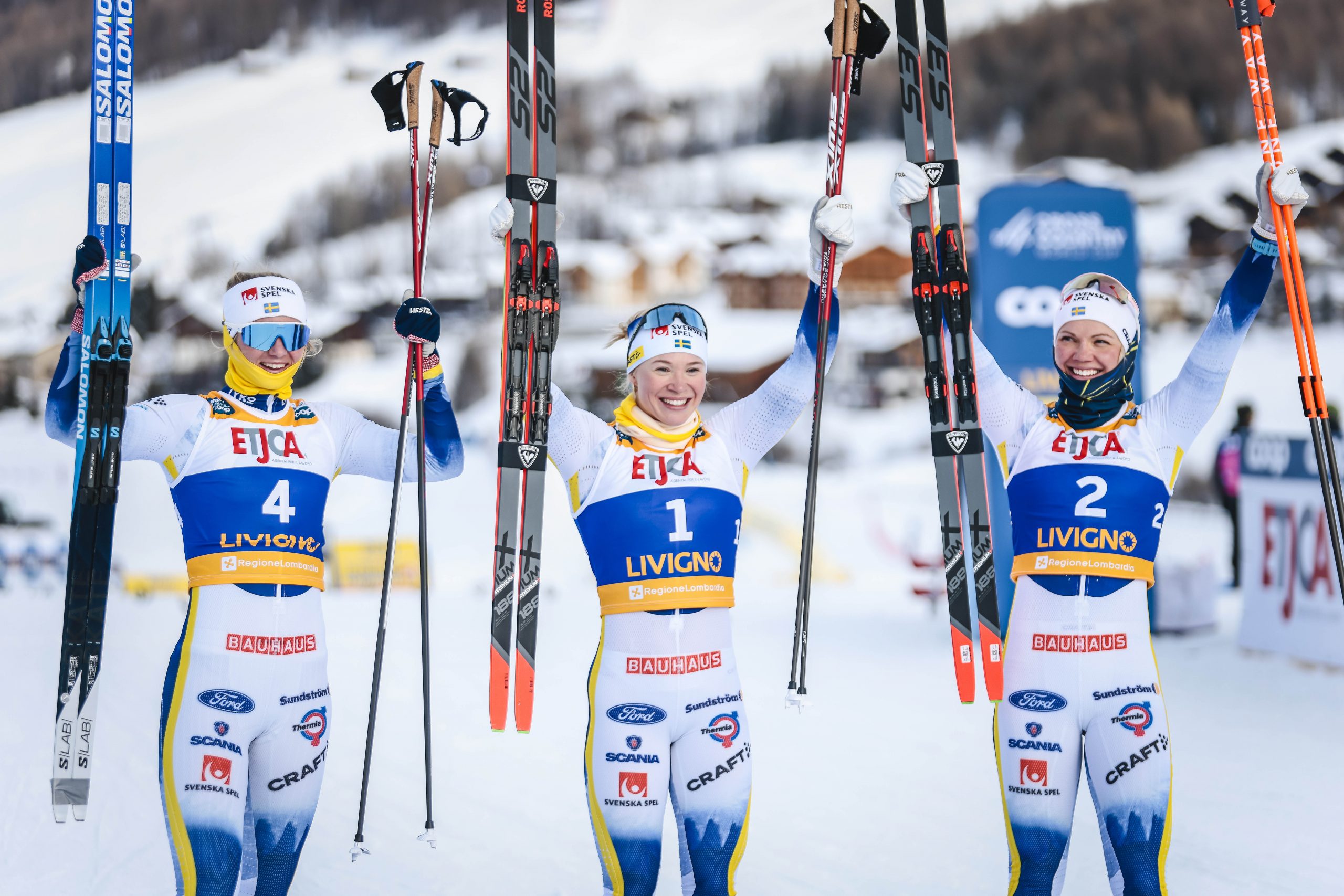
The podium in Toblach revealed who made the most of the cards they’d been dealt. Ebba Andersson (SWE) first, Jessie Diggins (USA) second, Ingvild Flugstad Oestberg (NOR) third.
Americans had even more to celebrate as Diggins was joined in the top 10 by Rosie Brennan in fifth, and Julia Kern in 10th. Continuing to show fine form in her World Cup campaign, Hailey Swirbul raced to a laudable 26th. Other American finishers included Alexandra Lawson 40th, Alayna Sonnesyn 48th, Sarah Goble49th. There were no entrants from Nordiq Canada.
But much would happen on the way to that podium . . .
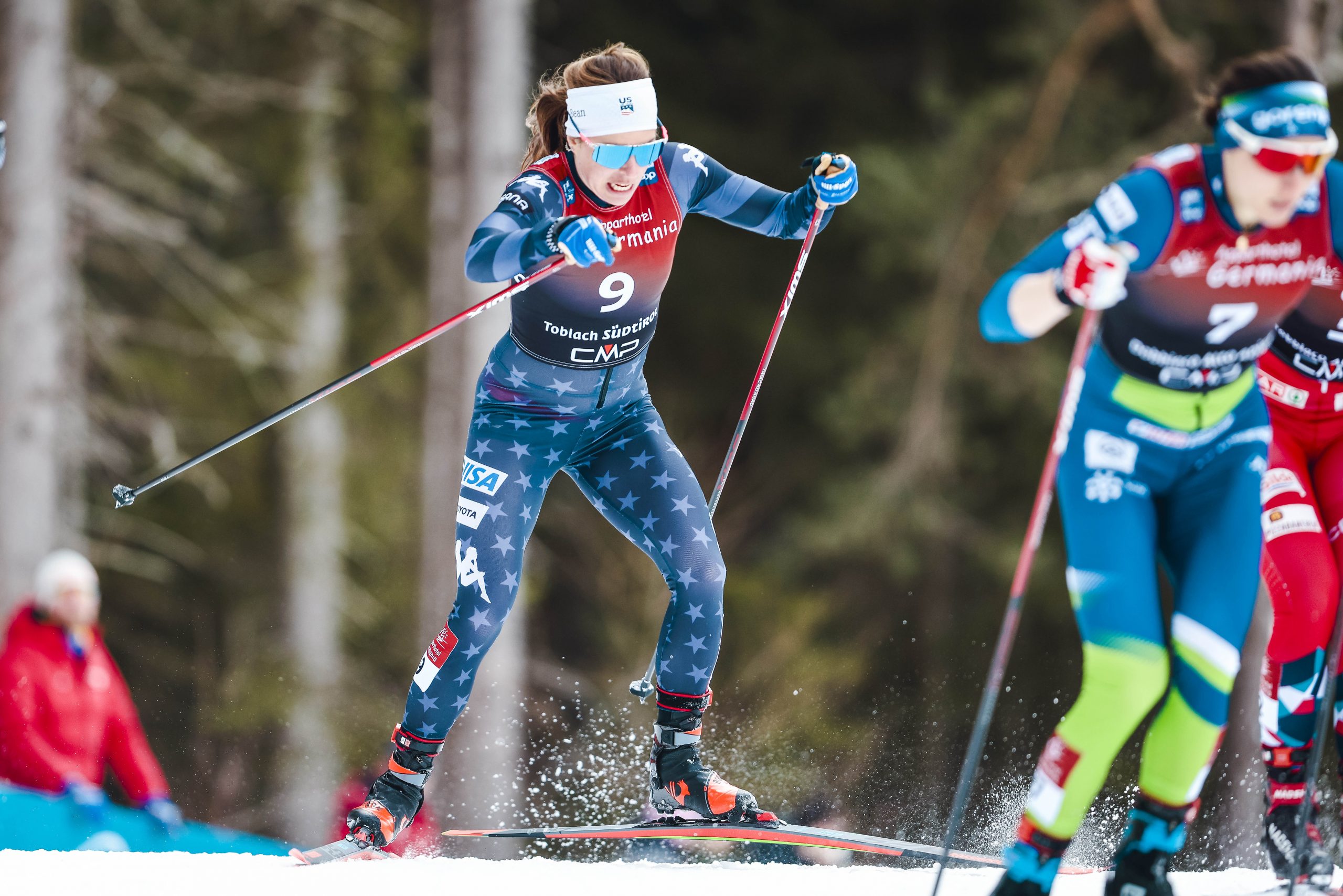
Always an aggressive descender, Diggins would suffer a high speed crash in the middle of the race, whacking her knee hard enough to seek attention from her trainer after the race. She would scramble back to her feet in time to finish the day in second. Diggins described the incident:
“It was difficult pacing because the sun had baked a couple of the uphills, making them really slushy. Certain sections were really icy, other sections were pretty slushy. My exciting part was that I had a little crash just after the 5 k when I was headed out on my second lap. I was skiing on the very edge of the course where it was iciest and fastest, and the very tip of my ski got stuck in the snow. I hit my left knee (honestly) really hard. I spun around and got back up and kept going as hard as I could. I lost … some seconds for sure, but what I think was really challenging was that my whole knee was numb (but) I was able to keep racing and put it behind me.”
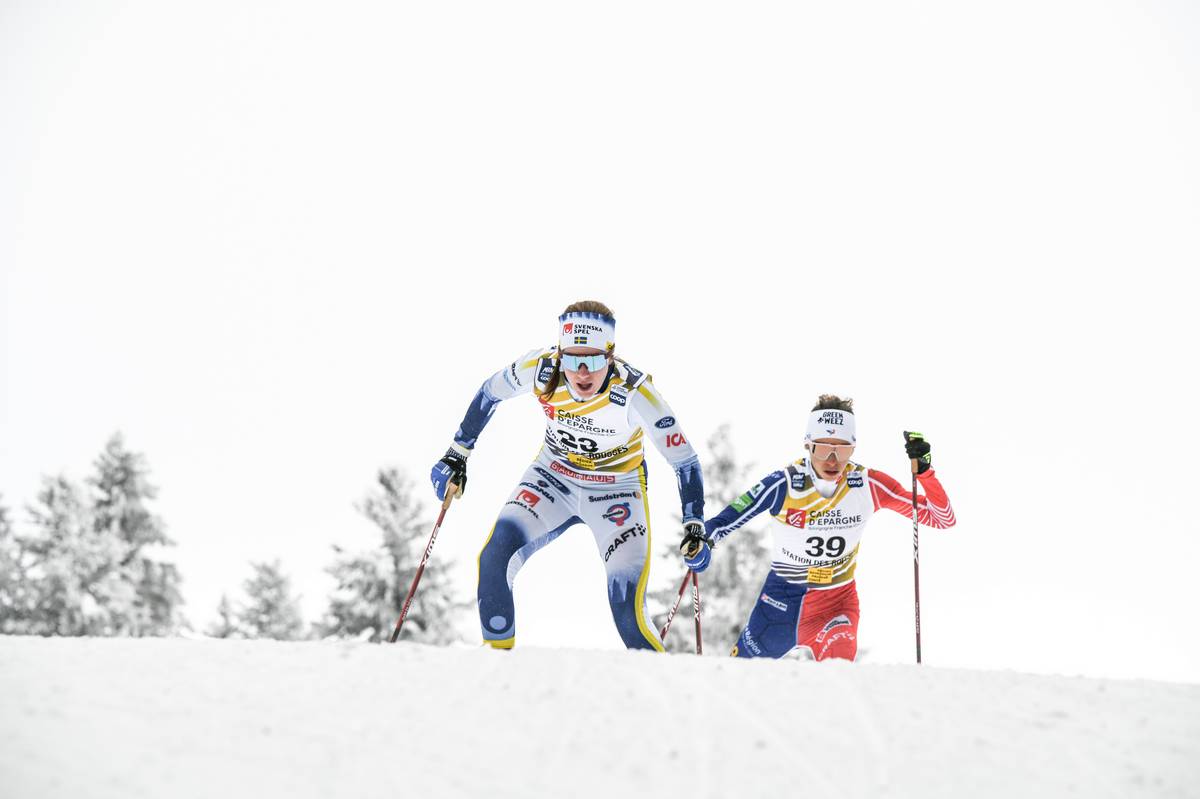
Tour de Ski champion and overall World Cup contender, Frida Karlsson (SWE), began the day in contention (close behind Diggins at the first check point): she would fade in the final kilometers, finishing 11th (perhaps there’s more to the story that broadcast cameras failed to capture).
Sprinters pushed forward to swipe a number of coveted top 10 finishing places: Nadine Faendrich (SUI) 4th, Victora Carl (GER) 7th, Jonna Sundling (SWE) 8th, Julia Kern 10th.
And—whatever the reason—Norwegian skiers had an off day (finishing 14th, 17th, 19th, 28th, and 29th) . . . except, that is, for Ingvild Flugstad Oestberg who would finish the day on the third step of the podium. Winner of Olympic and World Championship medals—and the 2019 Overall World Cup—Oestberg had experienced a number of interrupted seasons. Her return to the World Cup podium in Toblach was definitely a cause for celebration.
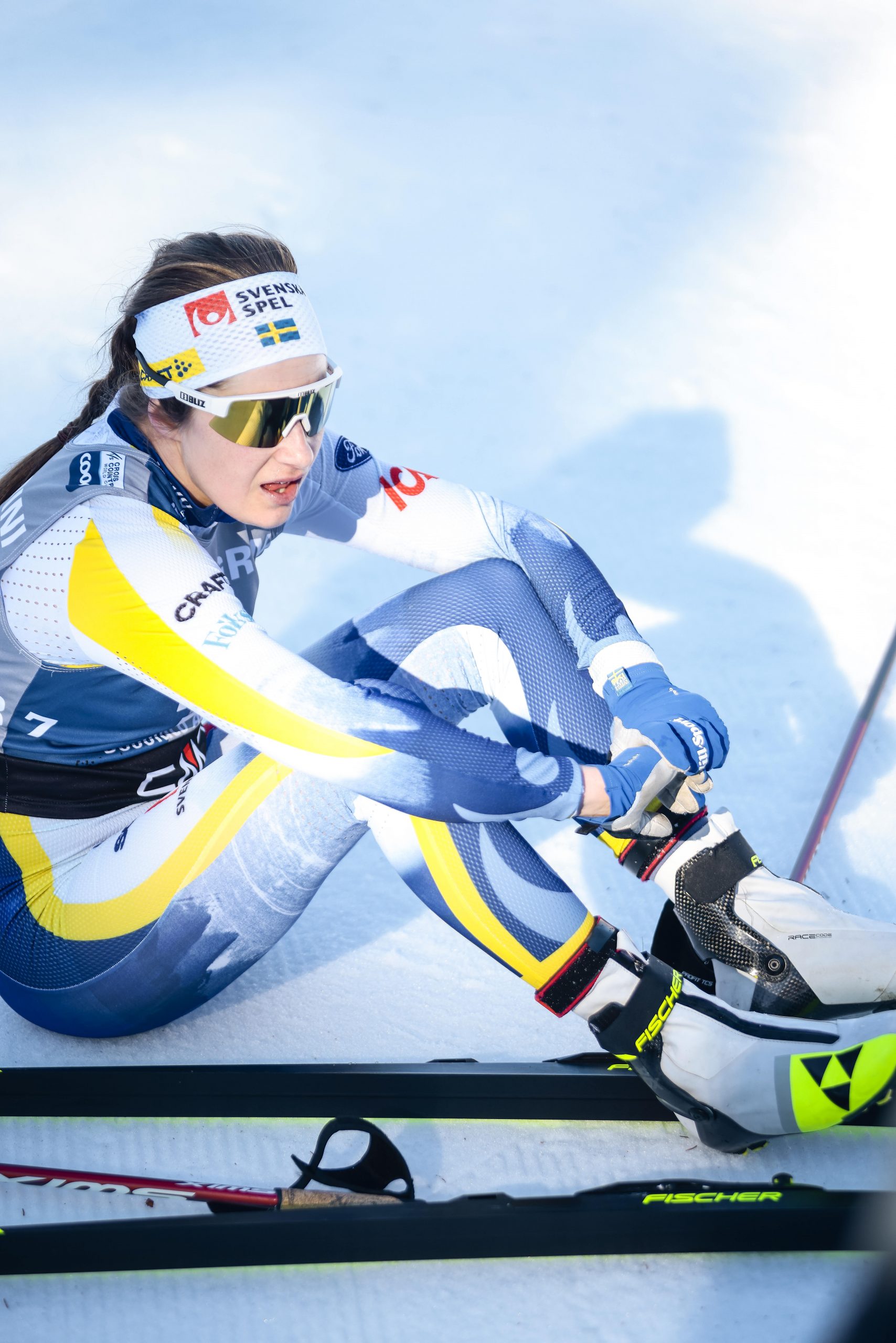
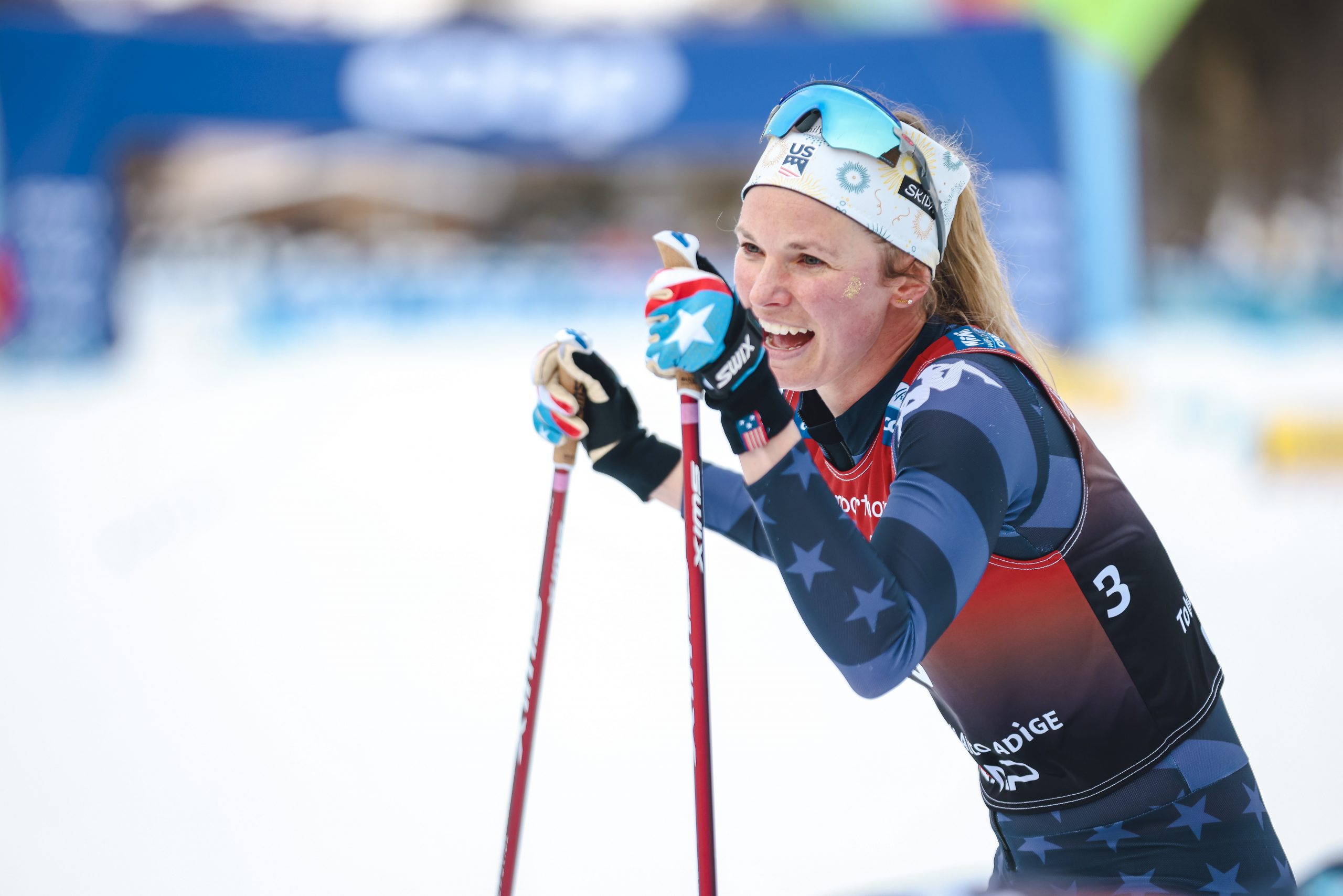
Ebba Andersson (SWE) reflects after her victory in the Women’s 10 k Freestyle Individual Start in Toblach, Italy. This was her third straight World Cup distance race victory. (Photo: Modica/NordicFocus)
Women’s 10 k Freestyle
Bright sun and relatively warm temperatures greeted racers in Toblach. On trails described as firm and fast, the 10 k Freestyle looked to be a straightforward test of prolonged speed. In this distance, there is little time for pacing or patience. Winners will be those who start fast, and hold that speed through the finish. It’s a high-risk race strategy, but a less bold plan is unlikely to succeed.
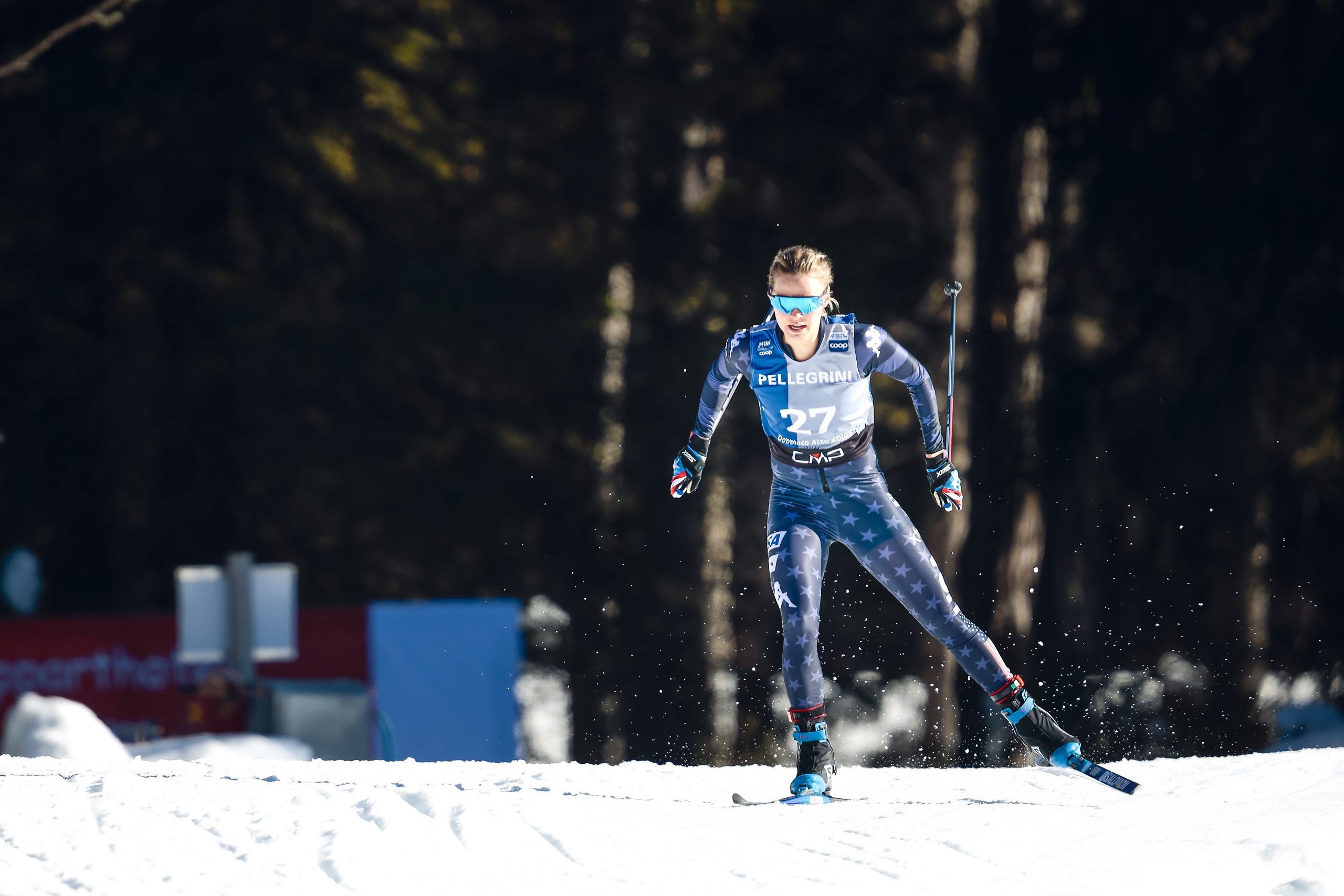
Racing bare headed, her pony tail tucked up for tracing in the warm sunshine, Diggins started 27th (among the earliest of the day’s contenders). With so many of her rivals starting after her, Diggins would not receive much information during her first lap, but would need to rely on the aggressive racing strategy that she so often employs. Early in her career, Diggins was often a contender during the rare staging of five kilometer races. At this point in her career, however, she is certainly a contender for the win at every distance. She raced with that goal in mind today (as she so often does).
Diggins was fastest of the early starters at the 2.1 k checkpoint, 6.3 seconds ahead of Jonna Sundling (SWE). Later contenders crossing the 2.1 k mark confirmed Diggins fast start, with Karlsson three seconds behind. Starting 37th, Andersson later arrived to supplant Diggins by 3.1 seconds. The chase was on . . .
Diggins crossed the 6.7 k checkpoint 4.7 seconds ahead of sprinter Nadine Faendrich (SUI). Faehndrich would not normally have been a significant marker among the leaders in a 10 k skate race, but she was in the middle of a remarkable day that would earn her a rare fourth place finish in a distance race. Diggins would rebuild her advantage over Faendrich to eight seconds by the 8.1 k checkpoint. It was later revealed that Diggins crashed hard mid-race, explaining her loss of time during that section of the course.
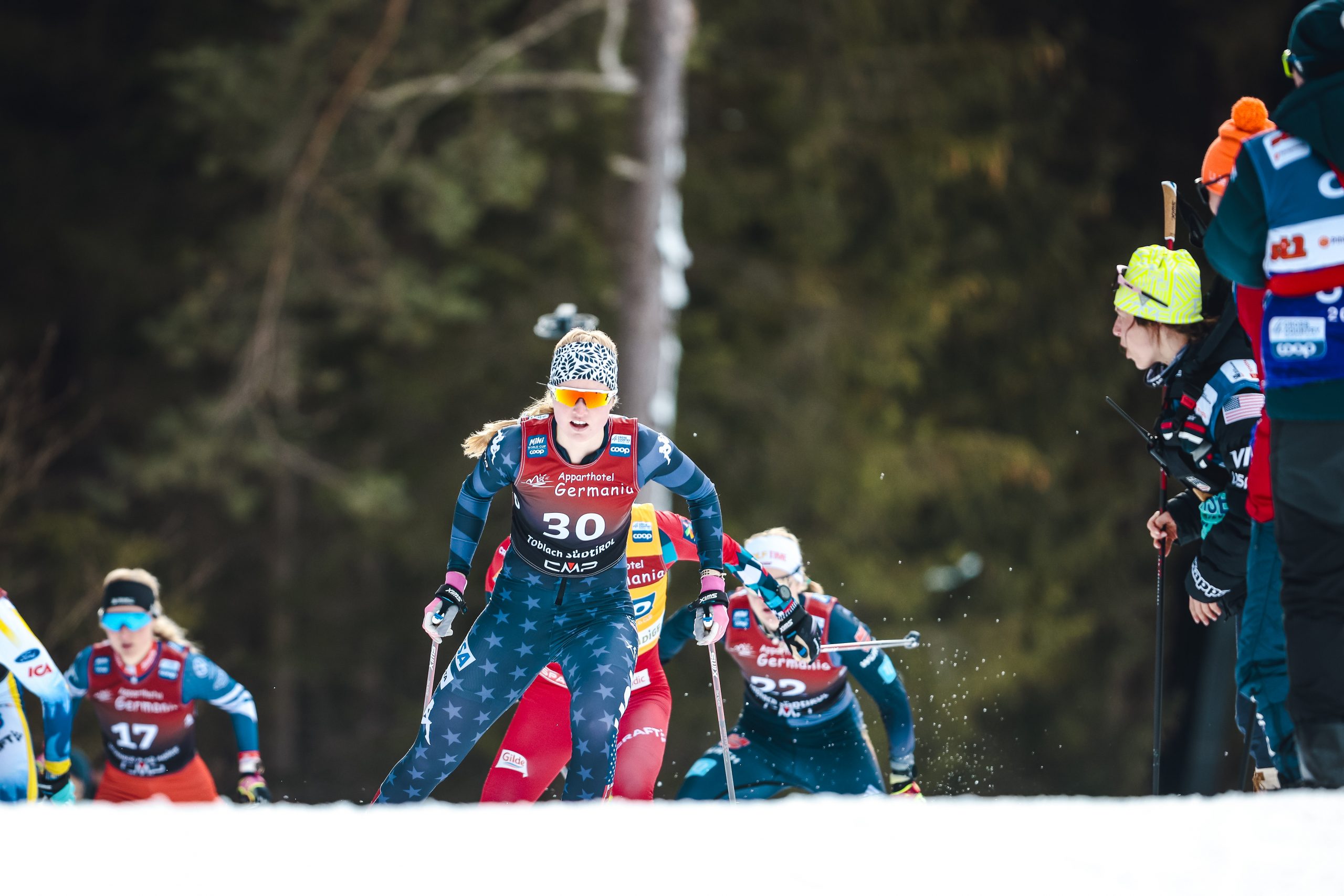
Rosie Brennan (USA) spent the Toblach World Cup 10 k freestyle battling for a podium spot. She would finish the day in fifth, only 5.9 seconds from third. (Photo: Modica/NordicFocus)
Other American skiers were significant players throughout the race. Brennan was in fourth at the 2.1 k checkpoint, and fourth again at 8.1 k. She would race with her typical grit and flare, holding her pace to finish the day in fifth.
“We had a very spring-like day in Toblach today,” Brennan said. “The skiing was mostly very fast with a few wet sections. I wanted to do my best to hold an even pace and push a bit on every section. I did this to the best of my ability, but ended up on the wrong side of a tight battle for third.”
“I am happy with my focus today,” Brennan continued. “[I] felt that I was able to push hard the whole time so with that I am satisfied with the result. I hope we see some cooler temps now and can get back to winter. But most importantly, it’s relay day tomorrow!!!!”
Kern led the race after 21 finishers, only to be supplanted by Faendrich two finishers later. She was one of the notable sprinters to claim a spot in the top 10.
While Norwegian headliners were floundering, former star Oestberg was returning to the form that saw her claim numerous World Cup, World Championship, and Olympic victories a few years ago. She skied steadily throughout the day, crossing the line to finish 10 seconds behind Diggins.
Race leader at every checkpoint, Sweden’s Andersson confirmed the form that has led to three straight World Cup distance race victories. She’ll hope to carry that momentum into the FIS Cross Country World Championships beginning in three weeks in Planica, Slovenia.
This World Cup coverage is made possible through the generous support of Marty and Kathy Hall and A Hall Mark of Excellence Award. To learn more about A Hall Mark of Excellence Award, or to learn how you can support FasterSkier’s coverage, please contact info@fasterskier.com.
Racing in Toblach, Italy continued today with the Men’s 10-kilometer freestyle. Coming into the race Johannes Hosflot Klaebo (NOR) had won 13 men’s events and was only one victory away from tying countryman Martin Sundby for the most individual victories in a World Cup season. If Klaebo’s winning ways continued, he could threaten Therese Johaug’s record of 20 wins in a season; a record which many thought was unbreakable. It’s been all Norway in men’s distance racing this year; they have won every individual distance event. The last time a non-Norwegian man won a distance race was in February, 2022, when Iivo Niskanen (FIN) won the 15-kilometer classic in Lahti, Finland.
Klaebo leads the overall World Cup points standings over Paal Golberg (NOR) by 181 points. If Golberg wished to stay in the overall championship hunt, he would have to have a good performance today. Golberg is the overall distance points leader so he was definitely a threat to win or keep pace with Klaebo. Hans Christer Holund (NOR) sits second in the distance rankings; he would also be a threat to be at the top.
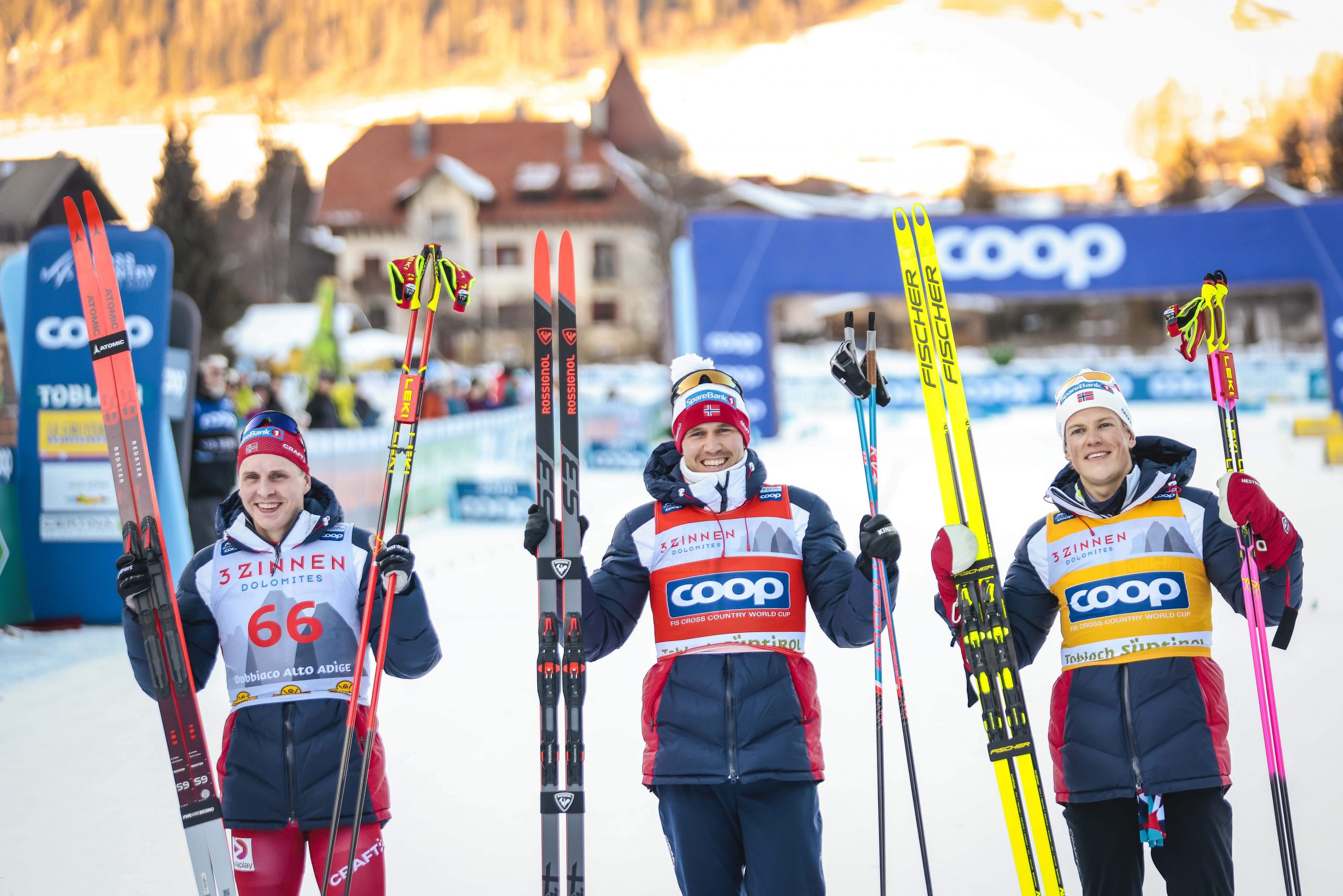
It was warm for the start of the race, about 40 Fahrenheit. The warm temperatures didn’t negatively affect the racing, and at the end of the day Golberg was able to finish first, 0.3 seconds ahead of countryman Simen Krueger (NOR). Klaebo ended up third, 2.8 seconds back. Norway took the first seven positions.
At the end of the day it was all Norway on the podium: Simen Hegstad Krueger (NOR), Paal Golberg (NOR), Johannes Hoesflot Klaebo. (NOR) (Photo: NordicFocus)
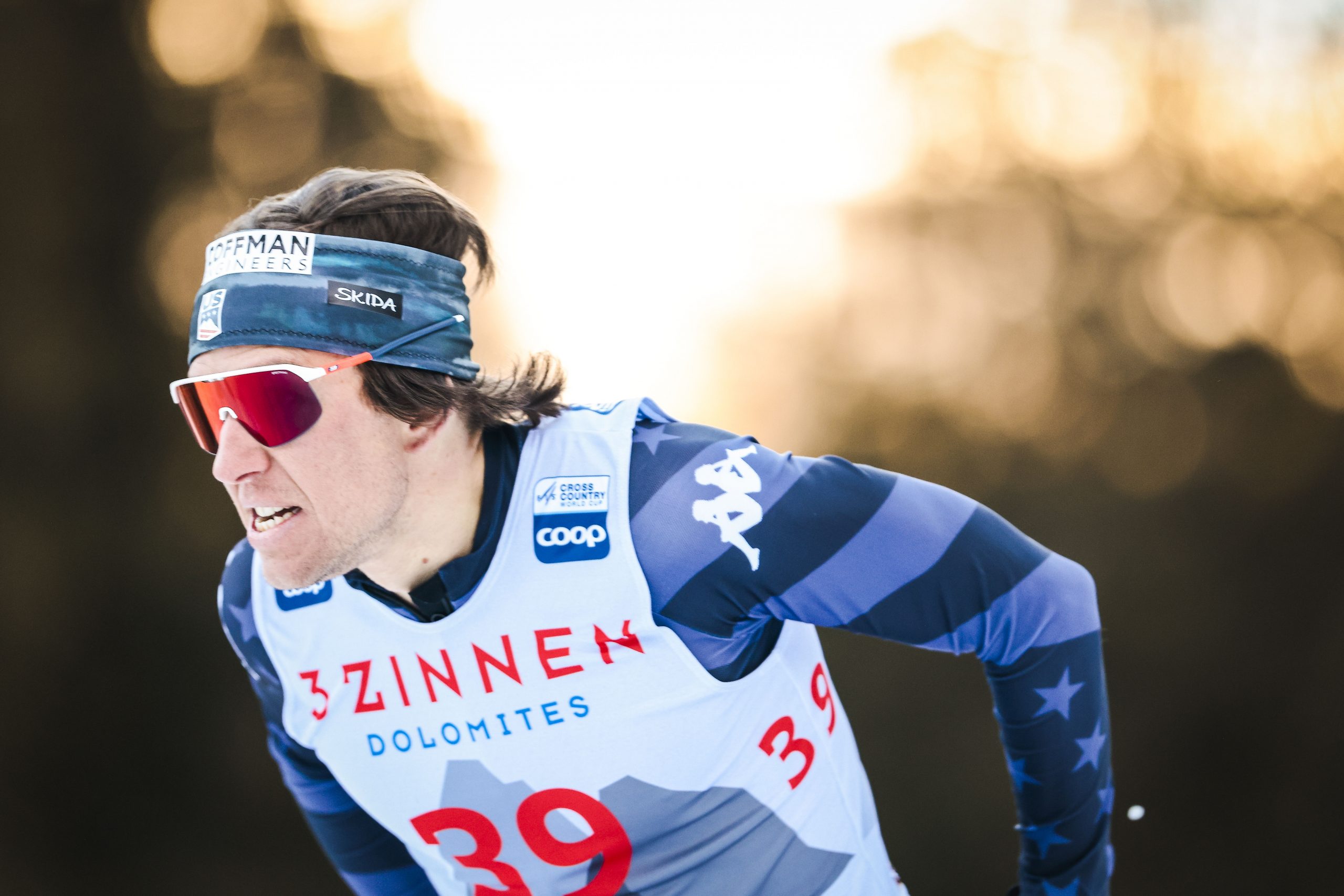
American Scott Patterson had an excellent day, finishing 14th, only 34.5 seconds off the lead. Other American finishers were Finn O’Connell 41st, Kevin Bolger 54th, Hunter Wonders 55th, and Logan Diekmann 71st. No Canadians raced today.
Scott Patterson masterfully navigated ski choice and pacing to place 14th. (Photo: NordicFocus)
The Race
Today’s warm weather meant that ski choice would play a large factor. Clear bases were definitely in the mix. Toward the start of the race, the sun had moved off the course and the snow firmed providing fast and challenging conditions, especially for the later starters. This made for a tough ski choice. Scott Patterson told FasterSkier that, “Ski choice was definitely about thinking ahead for the refreeze. We tested skis in the stadium initially and recognized that the really warm skis that performed well in the stadium would probably be a risky choice by race time.” Patterson continued that, “Overnight we got a bit of rain and relatively high winds. This combined to deposit an ice layer on the ski track and some pine needles and sticks from the trees. As we were starting at 3 pm, part of the course had baked in the sun during the day and gotten quite slushy. However, by the start of the men’s race the whole course was refreezing and the sun was gone. This resulted in some fast firm sections that hadn’t seen sun as well as glazed rutted parts that were quite funky to ski in.”
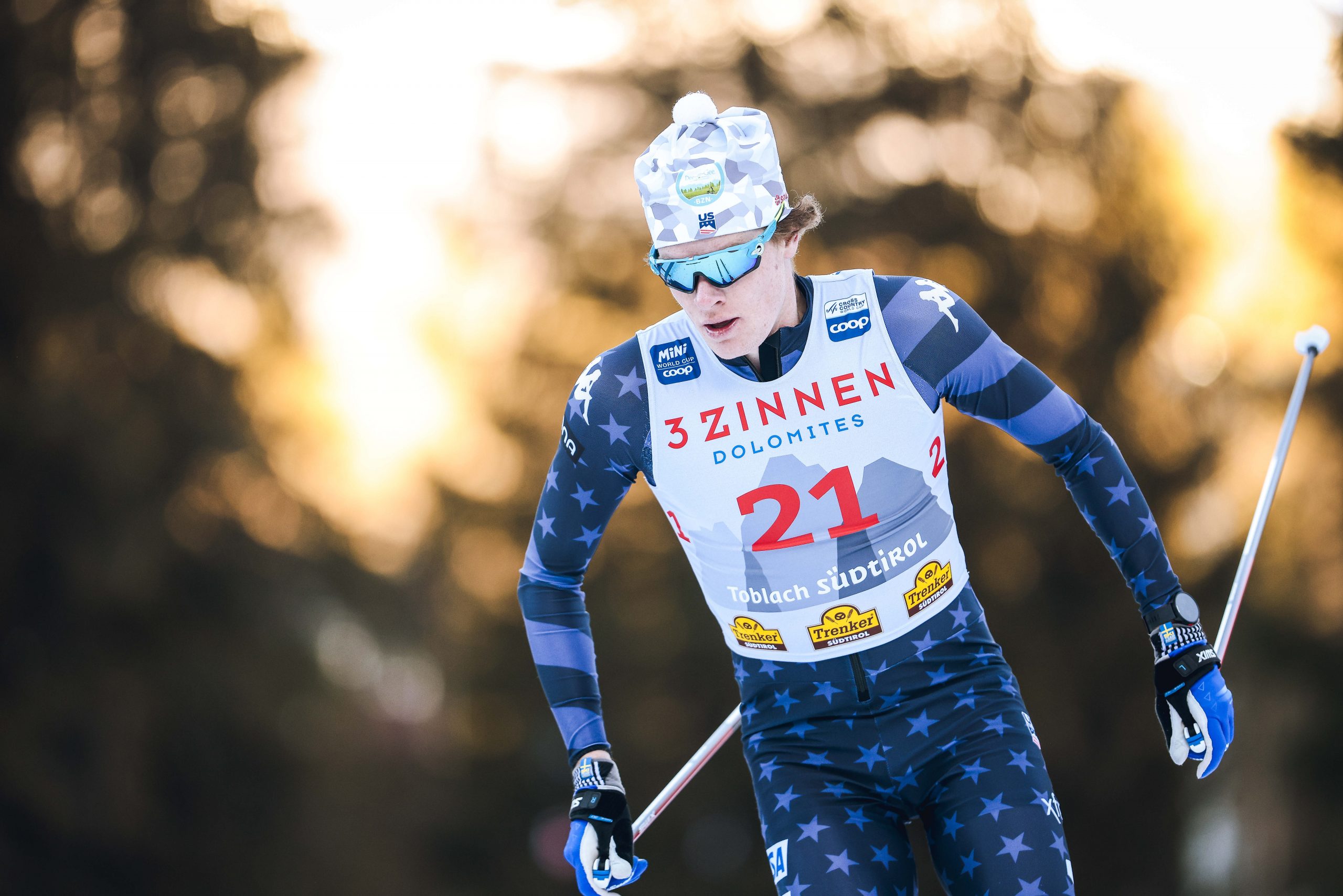
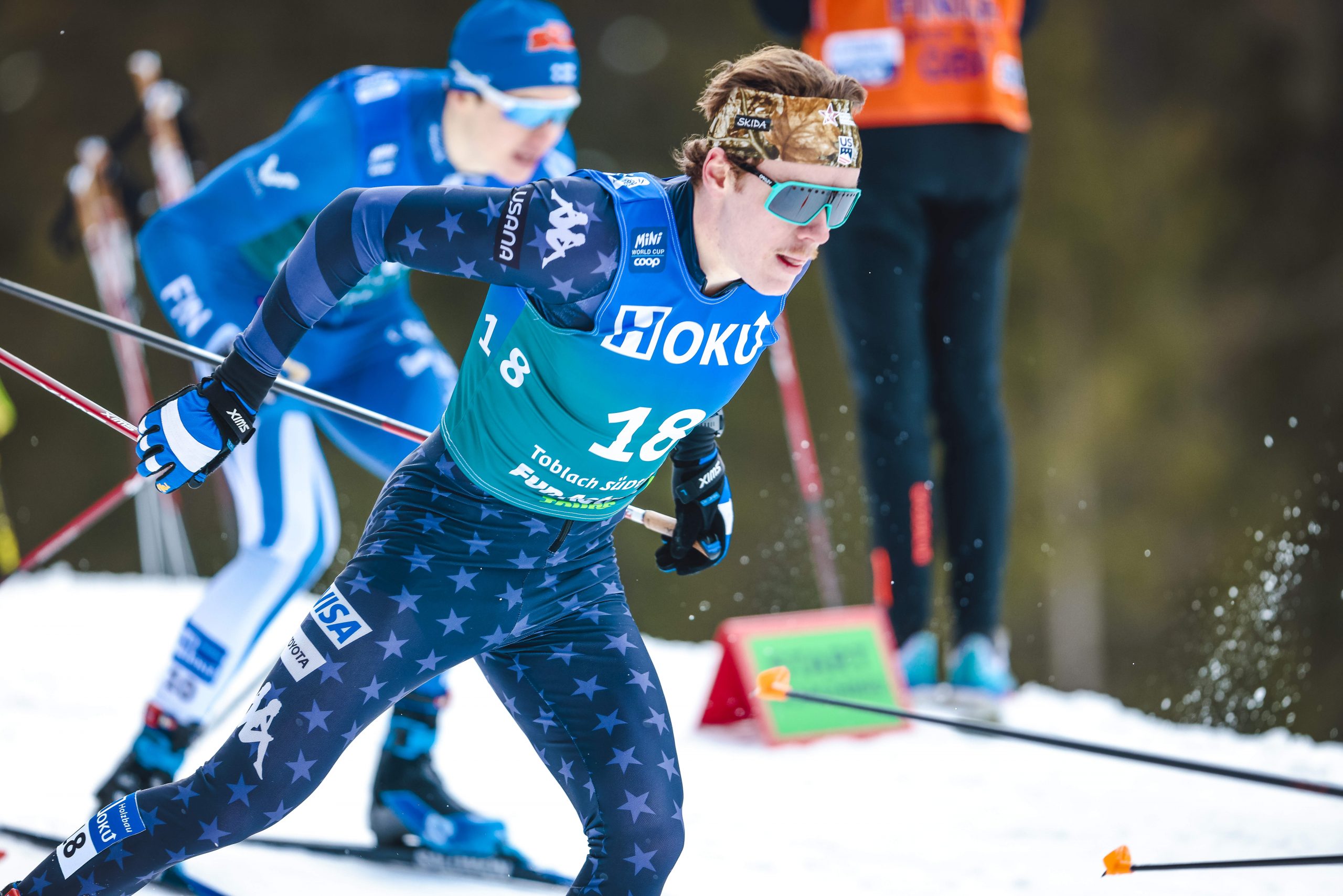
Finn O’Connell (USA) had a personal best World Cup day, finishing 41st. (Photo: NordicFocus)
U.S. coach Kristen Bourne confirmed the tricky conditions. “The track was pretty ripping fast for the women and sort of the same for the men. All of the divots and ruts from the women’s race [froze] and started to become bumpy and firm for the men. It was a weird fluctuation but was super-fast.”
As has been the pattern most of the season, today’s race would be a back-and-forth affair between the top Norwegians with Klaebo, Golberg and Simen Hegstad Krueger (NOR) trading punches and fighting for the lead all day.
Klaebo was one of the earlier starters among the pre-race favorites. Golberg and Krueger started several spots behind Klaebo, so they would have the advantage of marking their teammate. At the 1.7-kilometer mark Klaebo had taken the lead and established the early time to beat. When Golberg and Krueger reached the 1.7-kilometer mark, they were already a couple of seconds behind Klaebo.
Paal Golberg’s (NOR) finishing lunge put him on top of the podium. (Photo: NordicFocus)
At 2.1 kilometers, Hugo Lapalus (FRA) decided he would take a shot at the lead and moved into first over all the skiers who had already reached this mark. His pace would only be eclipsed later by Krueger who had a later start than Lapalus. But, Lapalus’ glory was short lived, at 3.0-kilometers he had dropped back to fourth. Klaebo and Krueger were virtually tied and had retaken the lead. Golberg was now 3.2 seconds back.
Between three and five kilometers, Klaebo put in a strong burst of speed to regain his lead outright at the five kilometer time checkpoint. Golberg and Krueger trailed Klaebo by about two seconds.
As the raced played out and skiers hit the 7.1- kilometer mark, Krueger had surged into the lead with Golberg now 1.9 seconds back. Klaebo had dropped off the pace considerably and was now 9.8 seconds off the lead. This trend held up over the next kilometer as Krueger increased his lead to 5.4 seconds over Golberg. Klaebo was now a whopping 11.4 seconds off the lead.
Johannes Hoesflot Klaebo (NOR) was in the hunt for the victory all day, but couldn’t overcome a mid-race deficit. (Photo: NordicFocus)
Pacing on the course was difficult, and not just for Klaebo. Patterson told FasterSkier that, “I had a few short opportunities to ski with people but mostly it was about finding my own pace and enduring through the muscular burn while keeping the tempo high.” He continued that, “It’s crucial to V2 almost all [of] the more gradual hills. Thus, I was focused on skiing smooth through the first 2km to build into the race a bit, then really turn it on and work the rest of the course as hard as I could.”
The U.S. team received advice on pacing the five kilometer loop course from veteran Jessie Diggins (USA) at their team meeting the night before the race. Bourne said that Diggins advised her teammates to “Go out as hard as you can, because once you get to 3 k, it’s pretty much all downhill from there.”
Kevin Bolger (USA) representing team USA in the Toblach 10 k. Bolger would finish 54th. (Photo: NordicFocus)
Klaebo also made adjustments and was able to turn up the speed in the last two kilometers, and coming into the finish, he put in one of his patented sprints, crossing the finish first among the racers who had finished. At this point Klaebo was in the leader’s chair, 2.4 seconds over Harald Amundsen (NOR).
But Golberg and Krueger were still lurking on the course, taking advantage of their later start. As he finished, Golberg was able to meet Klaebo’s finishing speed and went into first ahead of Klaebo by 2.8 seconds.
The only question now was whether Krueger would be able to match his teammates speed over the last two-kilometers. As Krueger came into the finish he was moving very smoothly and put in a ferocious finishing sprint but fell short of Golberg by 0.3 seconds. As it turned out, Golberg’s lunge at the finish was the difference between first and second.
Klaebo had put in an amazing final two-kilometers skiing it nine seconds faster than Krueger and three seconds faster than Golberg. But Klaebo’s slower speed in the middle of the race had given Golberg and Krueger the opening they needed to pull past him.
At the end of the day, Norwegian domination in men’s distance racing continued, Sundby’s record was intact, for the time being, and a young American continued to show great promise.
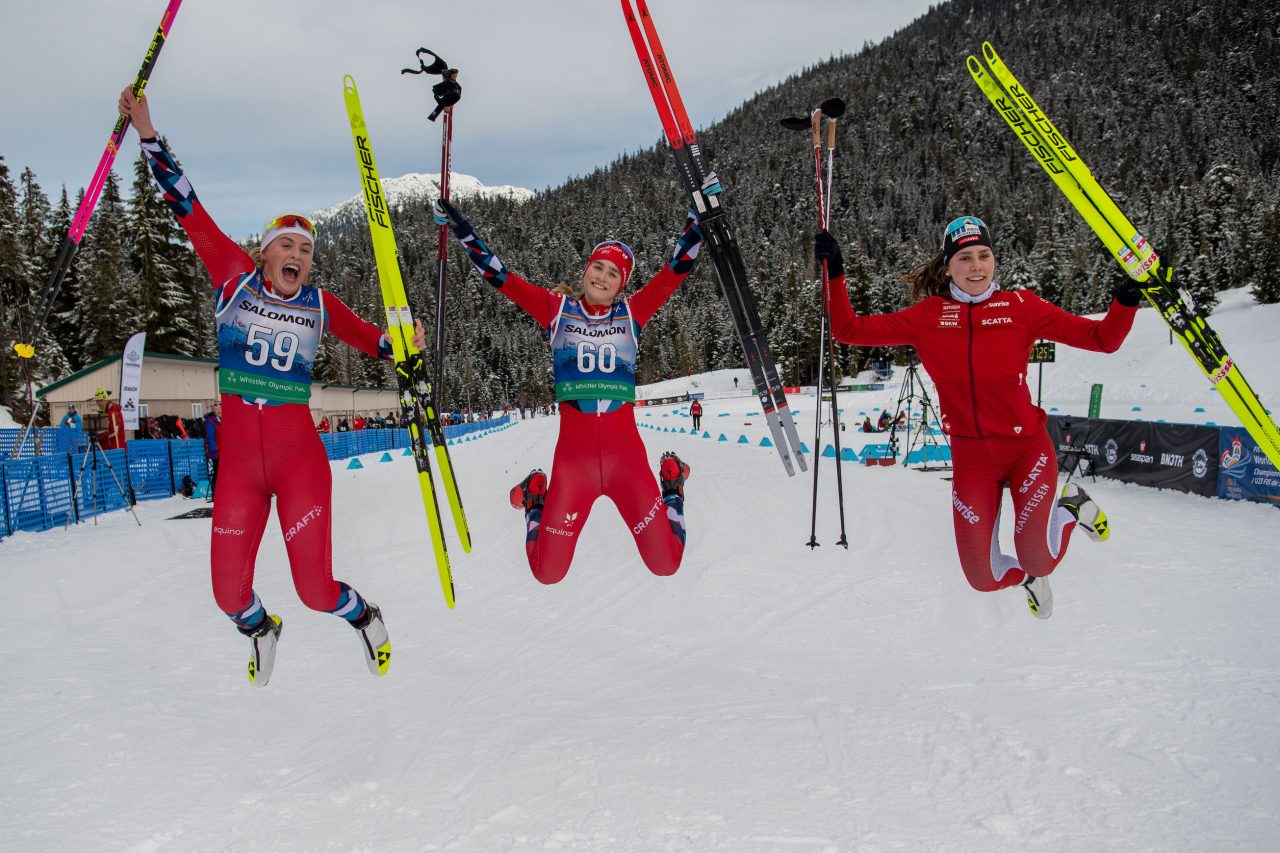
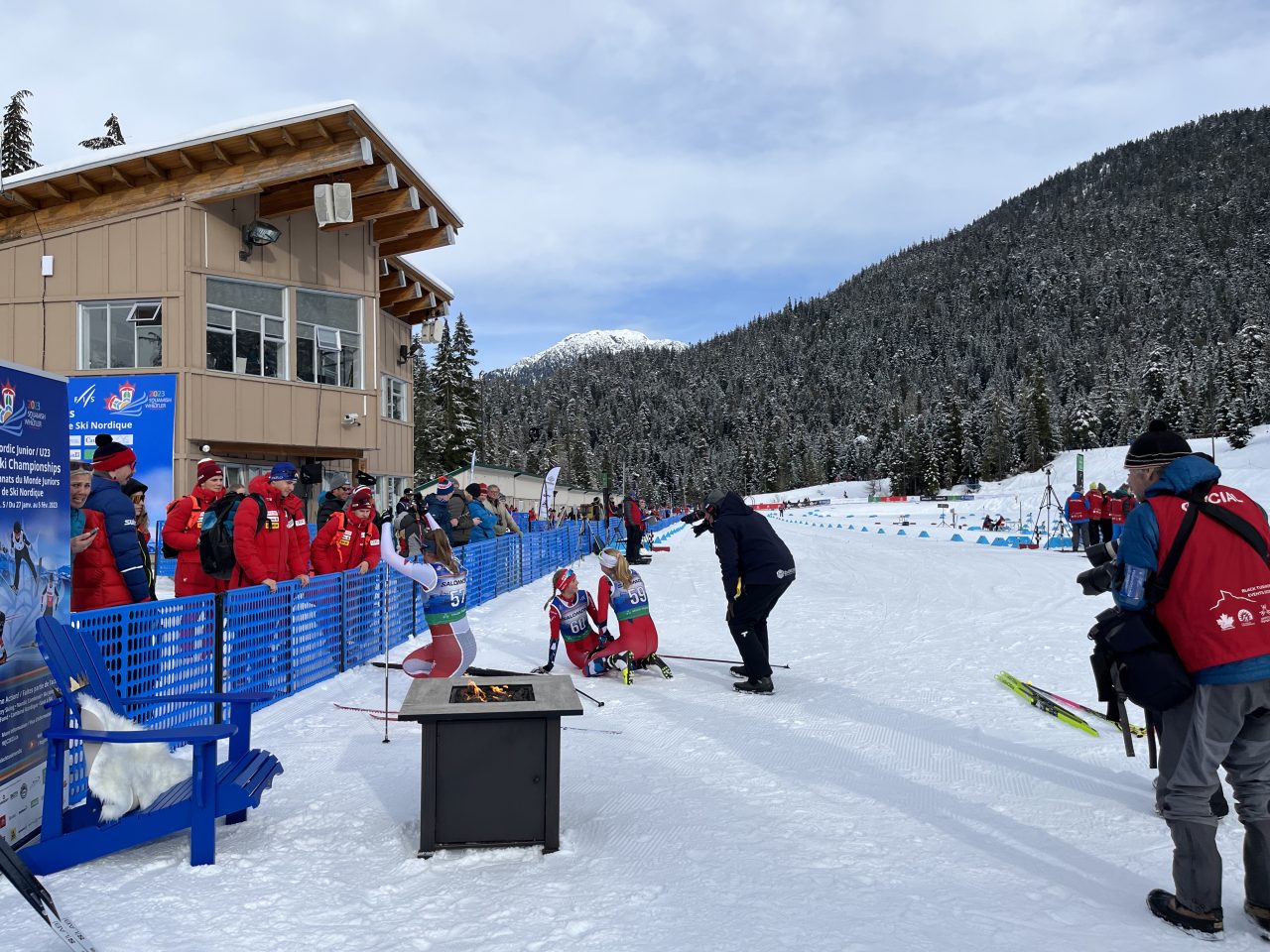
The U20 Women’s Podium finds joy after a great day on snow. (Photo: Doug Stephen @vr45photography)
Day five of racing at Whistler Olympic Park delivered with an interval start 10km free technique race in great conditions and intermittent sunshine. The tracks were fast and almost silky, the corners held up all day, the glide was exceptional, and (if anyone cared to classic on a great skating day) VR45 was magic.
Early on, North American skiers spent quality time in the leader’s chair before the top ranked skiers took over. Norway put four skiers on the podium today, somewhat to the surprise of their head coach.
“Beyond all expectations,” Kristian Dahl said. “We didn’t think about all these medals.”
Like many countries here, Norway sees this Junior Worlds as a development opportunity first. Reflecting this, our coverage will quickly go through the podiums and then get into the North American experience.
The top two unpack their day after crossing the line 11 seconds apart.
Norway’s Milla Grosberghaugen Andreasson collected her third medal and second gold today, winning in 26:55. Her US-based teammate Tuva Anine Brusveen-Jensen was six second back in second while Switzerland’s Marina Kaelin got her country’s first medal of the week at 15 seconds back.
For the US, it was Samantha Smith in sixth at 41 seconds back, Haley Brewster in 10th at 1:16, Hattie Barker in 14th at 1:38, and Nina Schamberger in 36th at 2:40.
For Canada, Alison Mackie was 15th at 1:34, Alexandra Luxmoore was 29th at 2:30, Marlie Molinaro was 39th at 3:19, and Maeve Macleod was 44th at 3:48.
There were 60 finishers and one DNF. There isn’t much an author can add about individual start races; here are the athletes words instead.
Grosberghaugen Andreasson
The day: “It was really good, but it was a tough race. I had to fight the whole race, I felt a little tired in the legs but the head was on fire today.”
The course: “It’s a very hard course, but I like a hard course so it was good for me.”
Visiting Canada: “Gold, gold, silver, so that’s good.”
Brusveen-Jensen
The day: “It was tough, but first of all it was good. I felt I pushed everything and did what I could, so it was good.”
The course: “For me, it was to start tough. It’s a long uphill in the start, everybody gets tired. You just have to have the motivation and stay positive. And keep the speed high.”
Visiting Canada: “Canada is amazing. The nature and everything around the stadium. It’s always sunny here. The course is so nice. We live in Whistler, and it’s very nice there too.”
Kaelin
The day: “I was really surprised with the good weather and the nice conditions, because yesterday the slopes were pretty slow and well it was a little harder to ski. It was surprisingly good and I thought it might be a good day.”
Visiting Canada: “I’m really proud to win a medal for Switzerland and it’s so cool to be here on the Olympic tracks. It’s also my first time in America and Canada, and it’s really, really cool.”
Smith
The day: “Very challenging. I’m hoping my time holds up, but we’re waiting for the fastest skiers to come in.”
The course: “I felt pretty good, I think I started out a little too hard. Second lap I was hurting a lot. It was a ton of fun, and certainly difficult.”
Lesson learned this week: “Just try your hardest out there, you can’t control what the other racers are doing. As long as you put your best foot forward, that’s all you can do.”
Brewster
The chair: “It was awesome [sitting in the leader’s chair], and really nice tagging off with Heidi Barker. Definitely a little awkward with that camera pointing in your face.”
The day: “It was good. I’m happy with it. Really fun to have all your teammates cheering who are done racing for the week. And my dad came out which is really special to have him here.”
Lesson learned this week: “There’s a lot of stuff to work on. Strength and speed, a lot of strength, a lot of these girls are really strong out here.”
Barker
The day: “It was amazing. I’m so thankful to have this opportunity. The course was really hard but really fun and it’s a beautiful day of skiing.”
Lesson learned this week: “It’s a really good team to be part of, and you ski your best when you are surrounded by friends and family, and a really good community.”
Mackie
The day: “It was really rough. It was a really, really hard course. A really hard race, but I did a good job of focussing on my technique and my race plan and I think I executed it quite well.”
Lesson learned this week: “This is my third international start and I really surprised myself with how I can compete with the best juniors in the world.”
Luxmoore
The day: “It was super fun, nice warm weather, the course was awesome, the skis were fast. I think I had a good race, I felt pretty strong.”
Lesson learned this week: “I had a great experience racing with people from other countries. I had fun skiing with people who are the fastest in the world.”
Molinaro
The day: “It was okay. The course is super hard, there’s a huge climb out the stadium, obviously that’s hard. Lots of pushing, trying to make up time on the flats, that was my goal out there today. I think I did a good job on that.”
Racing at home: “I grew up in Whistler, so these are the home trails and it’s super cool to be racing World Juniors here. The weather all week has been gorgeous, because lots of the time it’s pouring rain in Whistler, so I’m super stoked that everyone gets to experience nice weather.”
Lesson learned this week: “It’s been super cool to see all the other skiers from all the other countries and how fast and strong they are. Also, my own teammates, we’ve have some really good results.”
McLeod
The day: “It was super good. It’s a tough course out there, you’ve got to work hard all the time, but the skis were super killer, so thank you waxers, the skis were amazingly fast.”
Lesson learned this week: “It’s so inspiring seeing all these super strong skiers. There’s just so much of a journey from here, you can always go harder. It’s pretty inspiring.”
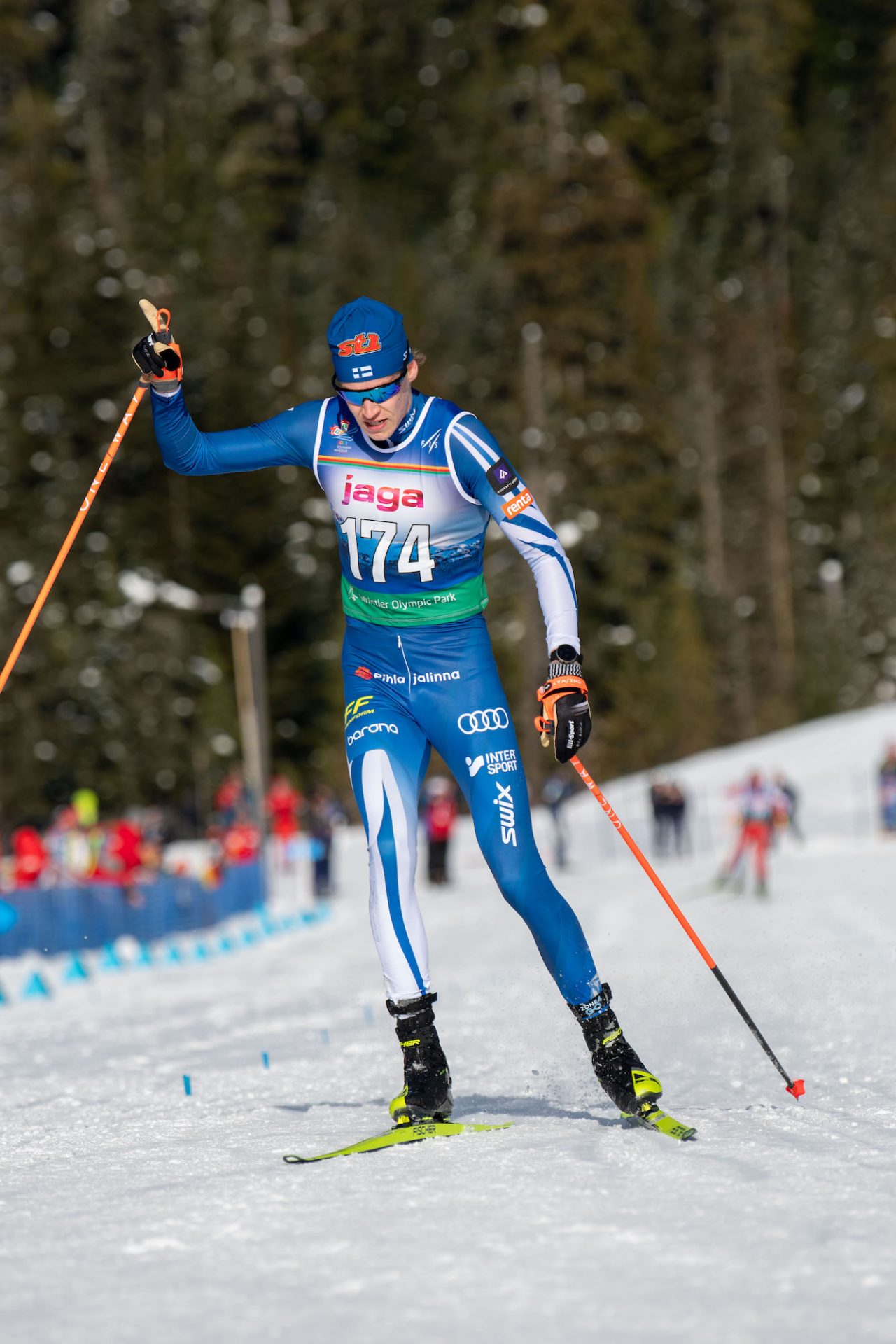
For the men, it was another two Norwegians on the podium but Finland’s Nico Anttola took the win in 23:35. Lars Heggen was second at 6 seconds back, followed by Thomas Linnebo Mollestad at 7 seconds.
For the US, Jack Lange was 11th at 47 seconds, Adrik Kraftson was 30th at 1:48, Anders Weiss was 33rd at 2:00, and Jack Conde was 51st at 2:46.
For Canada, Xav McKeever was 28th at 1:43, Luke Allen was 31st at 1:56, Garrett Siever was 54th at 2:59, and Noah Weir Chaba was 57th at 3:16.
Finland’s Nico Anttola celebrates his gold medal in the Whistler sunshine. (Photo: Doug Stephen @vr45 photography)
Anttola
The day: “It was very good. I had very good skis. The staff has been working really, really hard and I’m glad the skis was good, and the day was awesome.”
The course: “The course was very tough, but I think it’s good for me.”
Comparing this course to European ones: “I think this is one of the toughest ones, it’s very hard.”
Heggen
The day: “It was good, really nice conditions in the slope, really good.”
The course: “I like the course very much. It’s pretty good, but fun and very nice course. I’m from Lillehammer, and it’s pretty much the same as Lillehammer, really tough.”
Visiting Canada again: “Yeah probably. But when I come back, I ski downhill.”
Linnebo Mollestad
The day: “It was great. The form was good, I had really good skis, and I think I had a very good opening speed and managed to keep it for 10km so I’m really happy.”
The course: “I think it’s a great course. It has some long uphills, which I like, and also the stadium here is really, really beautiful. In this weather, it’s just great.”
Visiting Canada again: “I hope so. It’s really beautiful here, so I hope they will host some big ski competitions in the future, that would be great.”
Lange
This event is more casual than a World Cup. A journalist can walk up to the leader’s chair and grab an interview before the athlete catches his breath. Raw and unedited.
McKeever
The day: “Yeah, pretty rough today. Just the body was not firing on all cylinders. One of those days you want to forget about.”
The course: “The course was definitely a hard one. A lot of climbing right off the start, for the first 1.5, 2 km, and then some gradual rolling sections where you have to push hard.”
Lesson learned this week: “I’ve learned the extent of how a big championship at home feels. I’ve learned how I react to things, and handle different stresses and self-pressure. I’ve learned some stuff in general in training. Some deeper things for sure, from early in the season and training year that correlate to today’s poor performance. Just a lot to unpack and definitely a lot to learn.”
Kraftson
The day: “It was tough out there. I tried to race a smart race but ended up going out a bit too hard and paid the price towards the end.”
The course: “It was a lot of fun. It’s a lot of climb in the first 2km and rolling downhill for the next, for the most part.”
Lesson learned this week: “Just how fast the world is. That’s my biggest takeaway from the week. We’re trying to put in a bigger summer next year and try to compete with these Europeans.”
Allen
The day: “It was good. Skis were really fast and definitely went out hard on the first lap and lost a bit of energy on the second lap. Super fun course and what a nice day for it.”
Lesson learned this week: “Guys are fast from Europe. Competition is pretty stiff out here. Definitely eye opening to see all these fast guys from international countries coming together.”
Weiss
Direct from the leader’s chair:
Siever
The day: “Honestly, it didn’t go very well. I’ve been dealing with some lower back pain, and I generally didn’t feel good out there.”
Lesson learned this week: “There’s lots of work to do to compete on the world circuit.”
Weir Chaba
Second to the finish line, first into the leader’s chair.
Lesson learned this week: “Gotta be patient. Gotta know what your plan is.”
This World Cup coverage is made possible through the generous support of Marty and Kathy Hall and A Hall Mark of Excellence Award. To learn more about A Hall Mark of Excellence Award, or to learn how you can support FasterSkier’s coverage, please contact info@fasterskier.com.
This weekend, the World Cup travels to Toblach, Italy for three days of racing. First up are the freestyle sprints. This is the last full weekend of racing before the tour takes a two-week break leading into the World Championships. This timing resulted in full fields for both the women and men. The women had 57 entries on the start list—more than they’ve had in weeks—with all the heavy hitters in the women’s sprint world participating. Likewise, the men’s field had a large group of 69 starters, though many of the top American men were still in Canada for the U-23 World Championships.
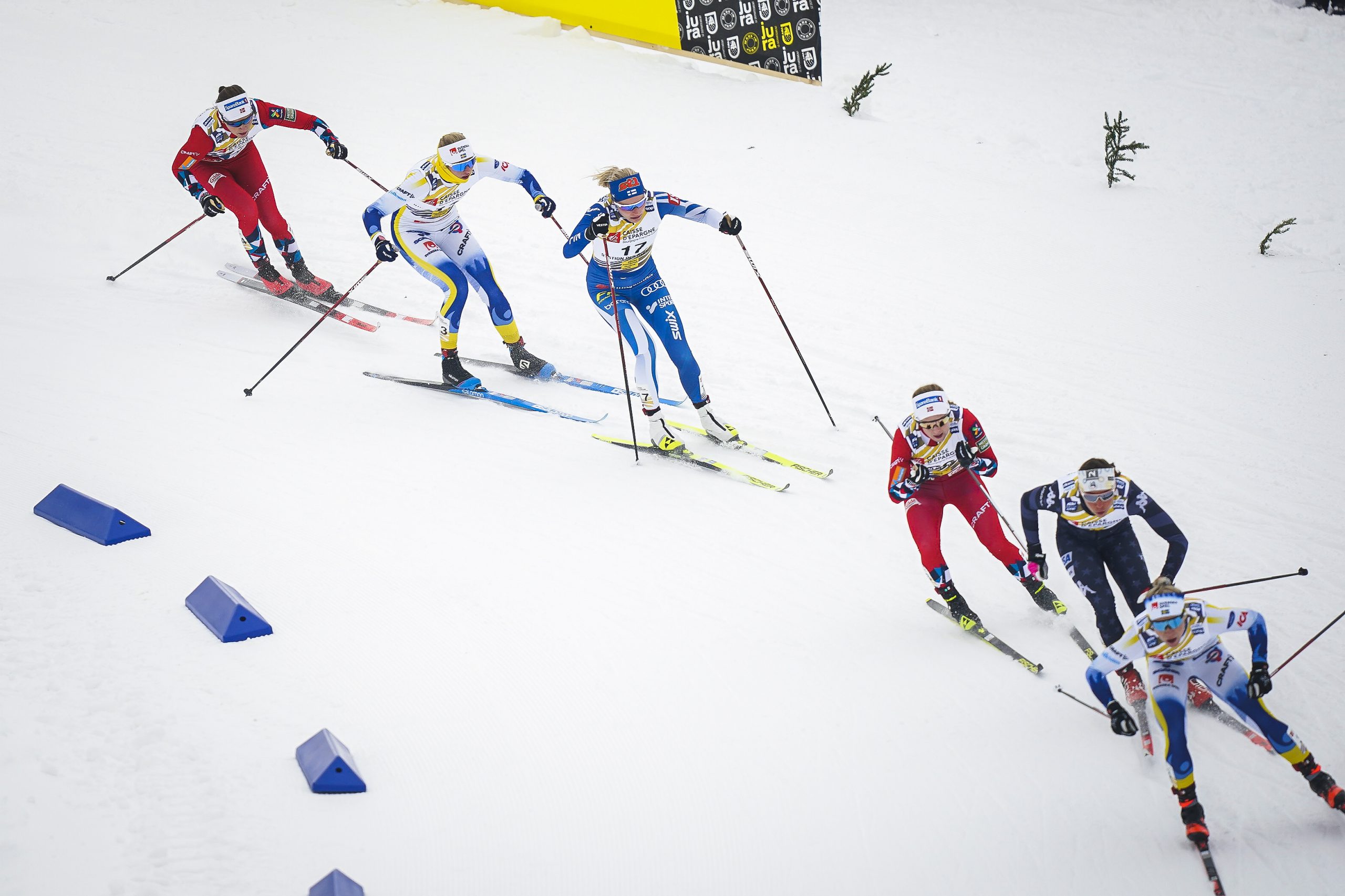
Jessie Diggins (USA) fought her way to third place on the tricky Toblach course. (l-r,) Maja Dahlqvist (SWE), Jonna Sundling (SWE), Jessie Diggins (USA). (Photo: NordicFocus)
Toblach is a tight course with few opportunities for passing. The course has short, steep climbs that would provide most of the limited passing opportunities. Otherwise, smart tactics would rule the day.
In the women’s race Jonna Sundling (SWE) finished first followed by Maja Dahlqvist (SWE). Jessie Diggins (USA) finished third. Other American finishers were Rosie Brennan, 26th, Julia Kern, 28th, Hailey Swirbul 30th, Lauren Jortberg, 32nd, Sarah Goble, 39th, and Alayna Sonnesyn, 42nd. No Canadian women participated in today’s races.
In the men’s race Johannes Klaebo (NOR) took first place, followed by Haavard Taugboel (NOR), and Federico Pellegrino (ITA).
No Canadian men participated today. The top American finisher was Ben Ogden, who finished 17th. He was followed by Logan Diekmann, 27th, Kevin Bolger, 38th, Will Koch, 45th, and Finn O’Connell, 52nd. For Diekmann, it was his first time reaching a World Cup sprint quarterfinal.
Jessie Diggins in the semifinal heat on her way to another Toblach podium. (Photo: NordicFocus)
The Women’s Race
The deep field took its toll on qualifying, but the U.S. team still managed a strong showing for the heats. For the American women, Jessie Diggins, Rosie Brennan, Julia Kern, and Hailey Swirbul qualified. Diggins posted the third fastest qualifying time and was looking to avenge last week’s sprint performance where she missed a turn and skied off the course. Diggins has a great history in Toblach. Three of Diggins World Cup victories have been in Toblach, including her first World Cup victory. In her post race comments Diggins acknowledged the special place that Toblach holds for her. The field was so deep that each quarter final had names who could be considered favorites to win it all. All of the American qualifiers were in separate quarter finals.
Rosie Brennan (USA) reached the heats, but got tangled up on the Toblach sprint course. (Photo: NordicFocus)
Rosie Brennan began her quarterfinal in the middle of the field, but was not able to hold the pace and faded toward the finish. She ended up sixth and did not advance. After the race, Brennan commented on the difficult Toblach course: “The course was fast and had many turns making it very tricky to find space and navigate safely. I struggled to find places to move up after getting tangled in the beginning… I’m glad Jessie could provide a light for us all on a tough day.”
In Diggins’ quarter final she went out fast and slotted in second place at the start. She passed Johanna Hagstroem (SWE) on the first hill and moved into the lead. She continued to push her advantage which was fortunate as there was a crash behind her. It didn’t matter, as Diggins powerfully gapped the field by a large amount. The gap narrowed by the finish, but Diggins won her heat comfortably. She later said that, ” The qualifier didn’t feel good, but it went well, which is sometimes a nice reminder that how you feel doesn’t always indicate how you will race.”
The sprint day began with great promise for Julia Kern (USA), who failed to advance out of her quarterfinal after tangling a ski and crashing. (Photo: NordicFocus)
In Kern’s quarterfinal she was pushed to the outside early and forced toward the back of the pack. She meticulously picked her way through the group and worked herself toward the front on the course’s steep hill moving into second. She aggressively stepped through the corners to maintain her second place standing, and looked very strong. Kern was vying for the lead when coming into the final turn she tangled skis and crashed. It was way too late in the race for a recovery. It was especially disappointing given how well she had worked through the crowd and how strong she looked.
Hailey Swirbul (USA) went all in for her quarterfinal, setting the early pace. (Photo: NordicFocus)
In Swirbul’s quarterfinal she faced the unenviable task of going against Linn Svahn (SWE), Nadine Faehndrich (SUI) and Tiril Udnes Weng (NOR). Given the daunting task, Swirbul threw caution to the wind, and shot to the lead from the start trying to avoid the traffic which had claimed her teammates. It was a high risk, high reward strategy. She led throughout the first half of the race, but as she came over the steepest hill, she was dropped to the back of the pack and was gapped with no chance of catching the group. She ended up sixth in her heat. U.S. Coach Kristen Bourne had praise for Swirbul’s willingness to lead, “She got out front and was trying to execute her plan, she skied super confidently…having the confidence to lead definitely stood out today.”
That left Diggins as the only American woman to make it to the semifinals. Diggins drew an outside lane and was pushed wide and back at the start. A minute into the race, she was in fifth place. Diggins acknowledged that, “My starting speed has never been that impressive…so I needed to chill and look for my window to move up.” She pushed up the steepest hill on the course and propelled herself into the top four. But the tight Toblach course proved to be a nemesis as she didn’t have enough room to work and was again forced to the back of the pack. As the field sprinted toward the finish, she was able to somehow pick her way into third place and would have to wait and see whether her time would hold up for a lucky loser spot. The second semifinal was slower, and she was ultimately able to move on to the finals as a lucky loser.
Jessie Diggins celebrates after a third place sprint finish. (Photo: NordicFocus)
In the finals, Diggins faced an intimidating field of four Swedish sprint standouts and Laura Gimmler (GER). At the start, Diggins went to the rear of the pack with a wall of Swedish skiers in front of her. Sundling took the pace very hot from the beginning. At the top of the first big hill Diggins had moved into fifth, and Sundling had not budged from the lead. Over the top of the second steep hill Diggins had moved into fourth with three Swedes ahead of her. Going into the sprint finish she put the hammer down and was able to gain a podium spot by out-sprinting Swedish sprint star Emma Ribom and finishing third. It was an impressive feat to be able to break up a Swedish quartet in such a talented field. It was an equally impressive piece of tactical skiing on a very challenging course, and showing supreme maneuverability as she worked her way through the field. As Coach Bourne noted, “It’s a pretty challenging [course] and turning left most of the time, it’s difficult to pass. It makes sense to be in the front.” Diggins was able to go against the grain and grab a podium position despite not being in the best spot toward the end of the race. Bourne continued that “She skied that so well, to tactically figure that out and get onto the podium is pretty awesome. It was one of her coolest races for me to watch…seeing her maneuver so well and confidently ”
Ben Ogden (USA) led the American men finishing 17th. (Photo: NordicFocus)
The Men’s Race
In the Men’s Sprint quarterfinals, Johannes Klaebo showed why he is the best sprinter in the world as he was able to pick his way through the field at will, starting in the back and working his way to the lead. Something no one else had been able to do all day.
Richard Jouve, last week’s hero on home soil in Les Rousses, France could not advance out of his quarterfinal.
In Ogden’s quarterfinal he advanced to the front third of the race early. At the first hill he worked to maintain contact with the top three skiers. The lead group coalesced at the finish with Ogden unable to outsprint the field and finished fourth. The time was not fast enough for a lucky loser spot and his day ended in the quarterfinal. Ogden told FasterSkier that, “Everyone in my quarter final qualifier was within a second and a half of each other so it was really tight the entire time. It ended up coming down largely to the last downhill, final corner and finishing stretch. I was just out of the semi’s in 4th but it was a decent effort given that I have been a little tired lately. Now my plan is to rest up and put all eyes on champs in Planica!”
Logan Diekmann (USA) had a career first sprint quarterfinal appearance. (Photo: NordicFocus)
For the Americans, Logan Diekmann finished sixth in his quarterfinal and did not advance. Nonetheless, it was a good day for Diekmann as it was the first time he had reached a sprint quarterfinal.
In the semifinals, Klaebo employed a similar strategy as he had in the quarters, electing not to lead from the start. He was fourth two-thirds of the way through the race and was able to find space to get by his opponents to win the heat. It was a magical sleight of hand that seemed improbable at the moment, and a tactic that, once again, only Klaebo could pull off.
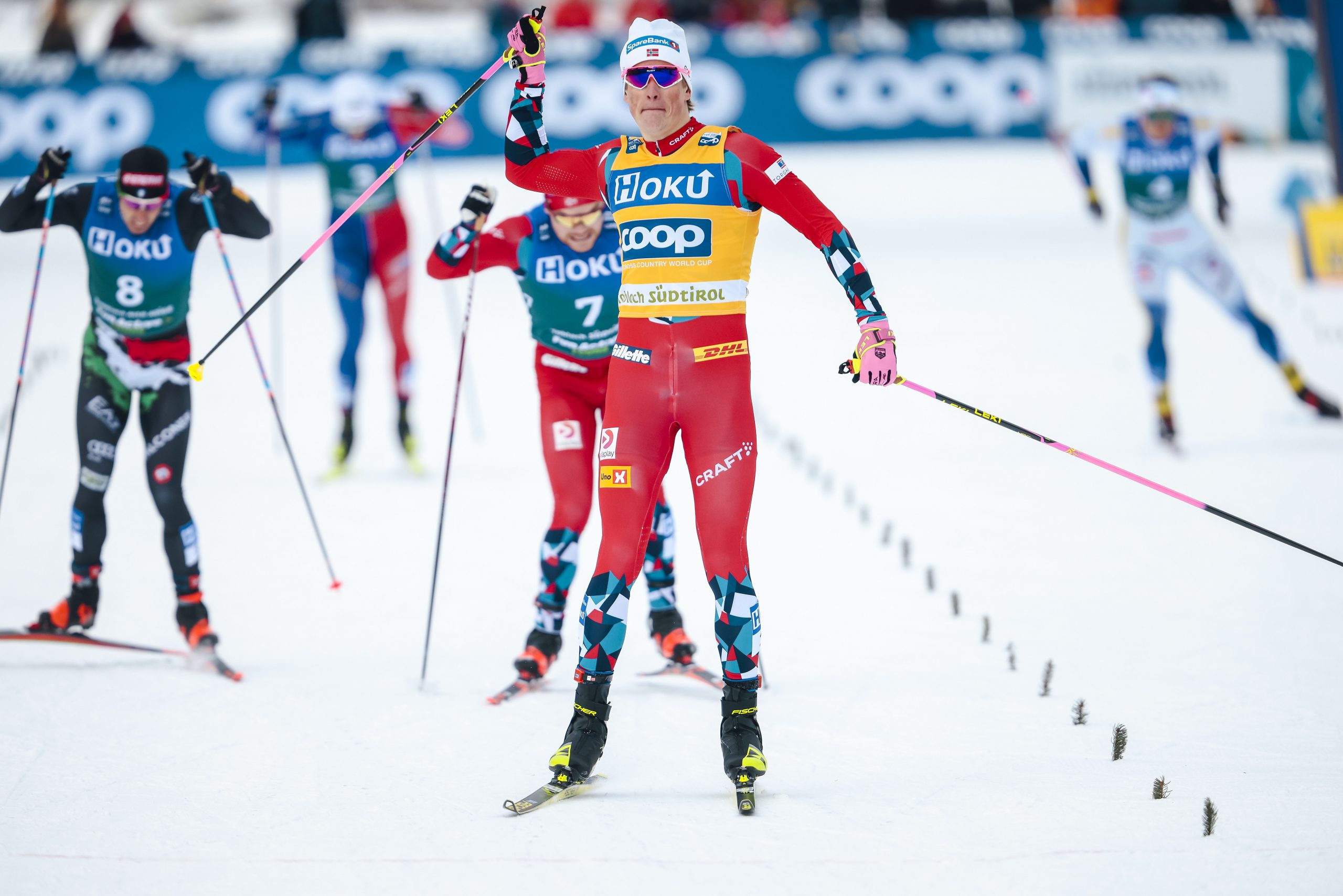
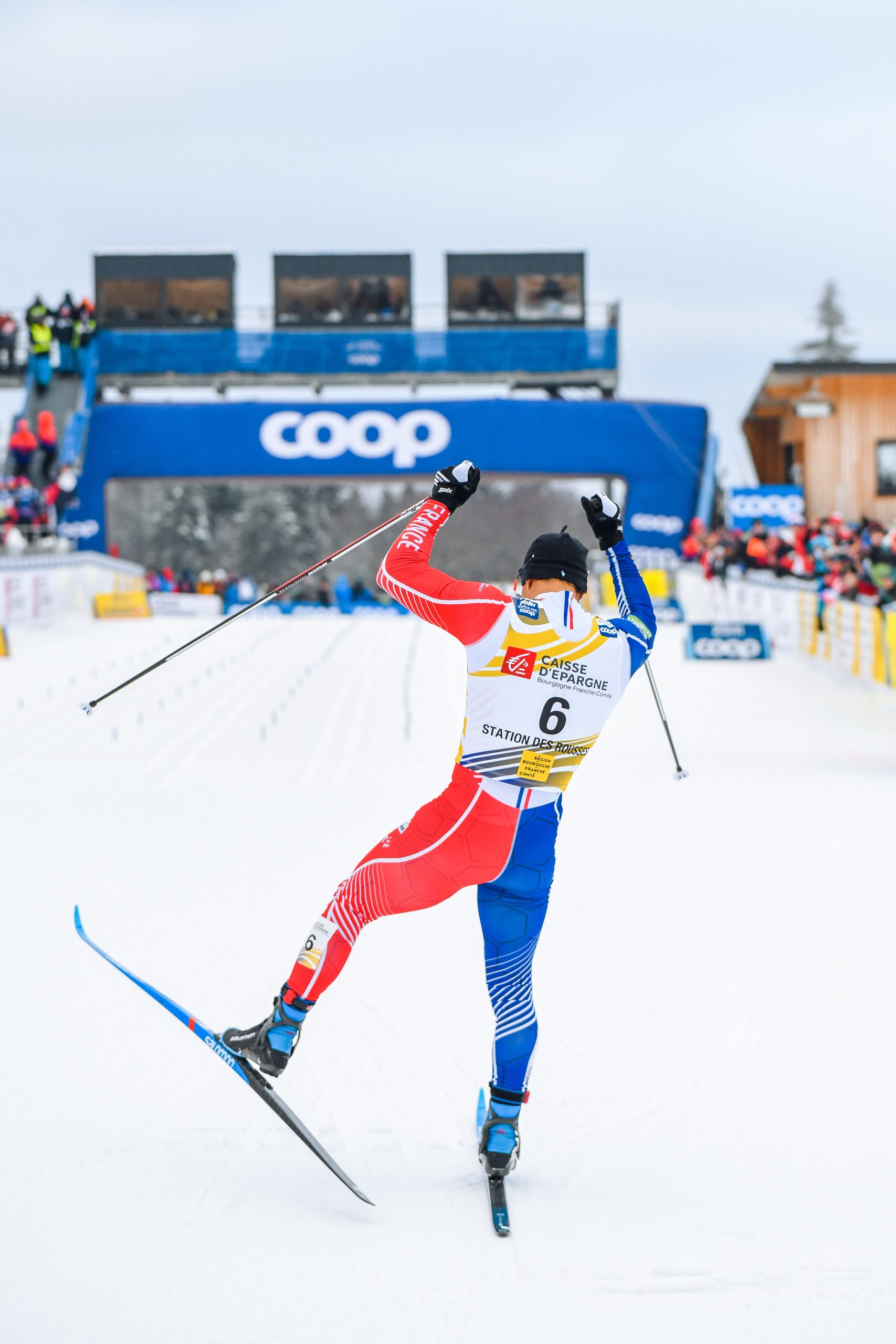
In the finals, Lucas Chanavat (ITA) and Federico Pellegrino(ITA) hoped they could duplicate Jouve’s feat from last week of using the home soil advantage to defeat Klaebo. Klaebo employed a different strategy in the final than he had in the previous heats, moving relatively early toward the front of the field, but not taking the lead immediately. At the first steep hill he moved into second place and it looked like a script ski fans have seen before. Once again, two or three powerful hops on the last climb and he surged to the lead. At the finish he had a large enough margin to raise his hands in triumph well before reaching the finish line.
Johannes Hoesflot Klaebo (NOR) dominating on his way to victory in the Toblach sprints. He had a big enough lead to celebrate before the finish line. (Photo: NordicFocus)
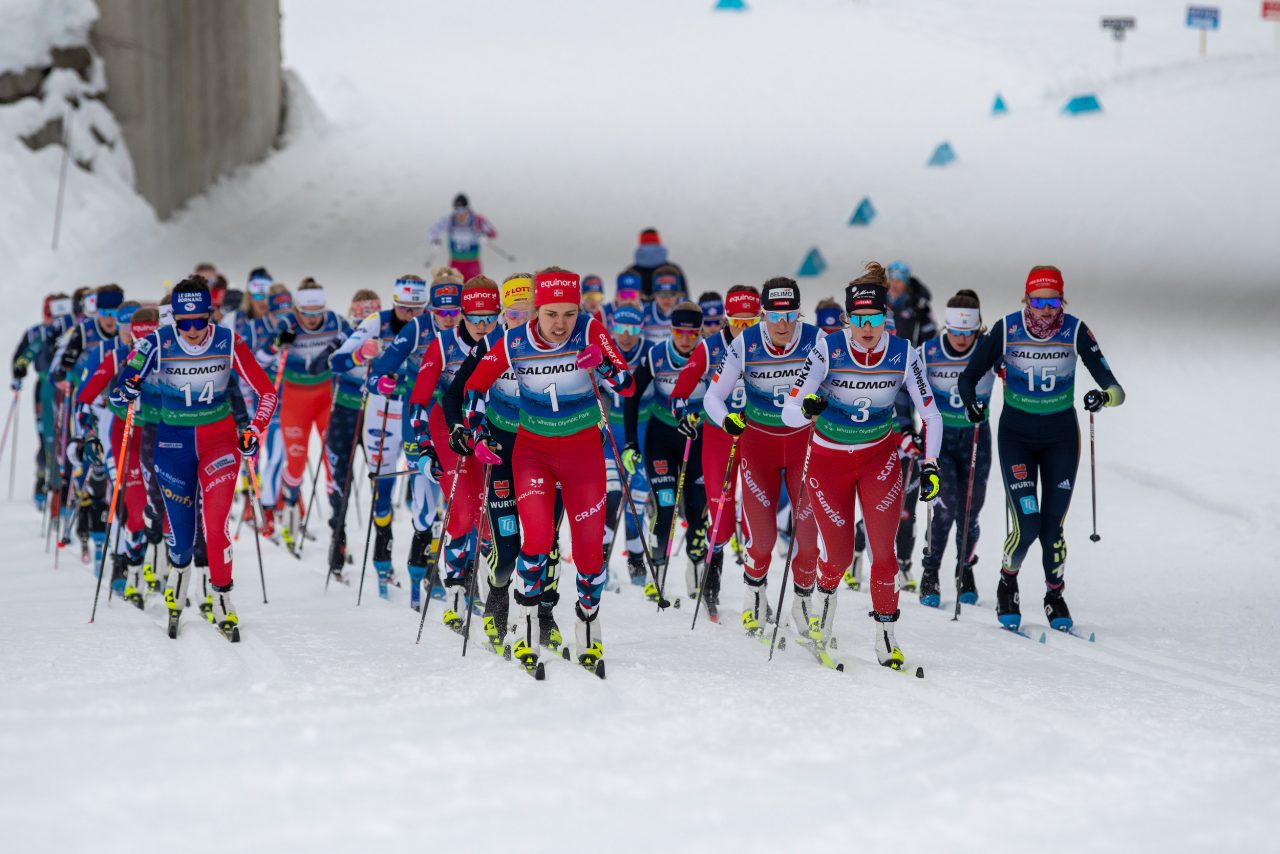
Norway’s Margrethe Bergane (#1) pushing the pace early on first lap. (Photo: Doug Stephen @vr45photography)
Day four of the Junior Worlds at Whistler Olympic Park brought new weather and more excitement in mass start racing.
The day dawned with a light snowfall at -8C. The wax techs were as secretive as ever, but it was clear at the finish that most athletes were on hard wax. While Norway, Germany, and France owned the podiums, it was also a good day for North American skiers.
Women’s 20 k Classic
The women’s race started fast, with Norway’s Margrethe Bergane animating the race. After the first of four laps, 15 women were skiing together, including USA’s Sydney Palmer-Leger and Canada’s Liliane Gagnon. At the halfway point, Palmer-Leger and Italy’s Martina Di Centa were working together behind a lead group of eight, while Gagnon had been joined in pursuit by teammate Jasmine Lyons and USA’s Novie McCabe.
Bergane continued to push the pace, reducing the lead pack to three in the final lap. Norway’s Kristen Austgulen Fosnæs attacked on the final hill, opening a gap she held to win in 1:01:40.0, 2.3 seconds ahead of Germany’s Lisa Lohmann. Bergane was very happy with third, 7.2 seconds back.
Fosnæs was unable to stop smiling half an hour after adding a gold medal to her sprint silver on Sunday.
“It’s unbelievable,” she exclaimed. “This is getting better and better. I feel like I’m dreaming.”
“I felt like it was really hard from the start, Margrethe she put up some really fast speeds. I tried to lay back and save some power to the end.”
Fosnæs liked everything today, laughing with joy: “I love [the course], I love being in Canada.”
Lohmann was also smiling. “My day was simply perfect, because I won a silver medal.”
“My tactic was to follow the Norwegian guys, it was a good plan to not be in the front.”
Bergane was on a different plan: “I tried to go fast from the start and I’m happy with the bronze.”
“The two other girls, they were very strong in the finish.”
Bergane was happy, but picked the Alpe Cermis stage of the Tour de Ski as her favourite race this year. Because it was fun? “Yeah, it was hard.”
The battle for top North American wasn’t really a fight, as US and Canadian skiers worked together to pick off skiers who had pushed too hard following Bergane.
“I had an incredible day,” Palmer-Leger said. “I was right in the lead pack, top ten from the start, stayed relaxed and up there the full time.”
After Bergane put in a concerted effort that reduced the lead group to eight, Palmer-Leger and Di Centa worked together to chase. Palmer-Leger led the flats with her better glide and Di Centa led the climbs with better kick before Palmer-Leger won the double pole sprint for 8th at 1:25.9 behind.
“I’m a first year U23, I’m only 20 years old, I didn’t have any expectations,” Palmer-Leger told FasterSkier during her cooldown ski. “I just wanted to go out there, go hard, enjoy the race. That’s what I did, and it was a pretty incredible day.”
The next North Americans were Canadians Gagnon in 12th at 1:40.7 and Lyons in 13th at 1:48.2.
Jasmine Lyon leads Liliane Gagnon into a downhill. (Photo: Doug Stephen @vr45photography)
“It was a slower start, got caught up in there, but then made my way up, slowing catching up to those other groups,” Gagnon said. “I definitely tried to be more chill in the beginning, keep the technique good, try to catch my breath in the downhills, and it really paid off the the last lap, I was able to push to 12th place.”
“I’m definitely pleased,” Lyons said of her 13th place. “We had super-great skis from our wax techs, they’ve been working so insanely hard all week. I got to work with my teammate Liliane.”
“The grinding double pole sections are pretty hard. We skied with so many North Americans, we tried to match each other’s rhythms and work as a team to catch some people ahead.”
Asked about skiing with Gagnon for much of the race, Lyons said “Definitely working together, exchanging the lead. We’re great friends, definitely working together.”
Lyons and Gagnon will continue to work together as they are both headed to Planica for senior World Championships.
McCabe finished 14th at 2:01.6, and was visibly disappointed with her day. She was working with the group, but was short of grip later in the race, causing her to yoyo off the back.
Canada’s Emilia Wells was 27th in her first international race, 4:20.9 back.
“It’s being an amazing experience, being part of Team Canada,” Wells said. “All the coaches and staff are amazing, and the races have been so much fun.”
Teammate Anna Parent was 30th, a little ahead of USA’s Anabel Needham in 33rd.
“It was kind of hard, my first mass start at a big event,” Needham said. “There was a point where I just wanted to finish the race. I’m happy I stuck with it, and I really liked my coke feed.”
Like so many athletes here, Wells, Parent, and Needham were here to gain experience. Judging by the enthusiasm of their coaches, they are getting it.
Sophia Laukli, who started with bib 2 to match her ranking, was one of five who did not finish the demanding course.
The lead pack stretched and regrouped. Andreas Fjorden Ree leads Jonas VIka, Edvard Sandvik, and Gus Schumacher near the top of the long climb. (Photo: Doug Stephen @vr45photography)
Men’s 20 k Classic
The men’s race was also animated by racers who didn’t want to sprint at the finish. Early in the second 5km lap, Gus Schumacher and Zanden McMullen were leading side by side into the long climb. On the final lap, it was a group of 11, with Switzerland’s Nicola Wigger and Cla-Ursin Nufer pushing the pace with help from Schumacher.
In the final kilometre, it was Norway’s Jonas Vika who attacked up Hermodt’s hill and entered the stadium with a gap. Norway’s Edvard Sandvik closed the gap to 1.3 seconds with Julien Arnaud collecting the first medal for France at 3.6 behind. Two packs of four sprinted for the minor places.
In an interview that is completely inaudible due to wildly celebrating Norwegians, Vika was very happy, described a Norwegian plan to keep the pace fast but save energy for the final hill, and admitted to practising the right hand turn into the stadium where he spectacularly saved a bad line choice in Sunday’s sprint.
“I had a nice day today, sadly second behind this guy,” Sandvik said, pointing to Vika beside him. “but I’m happy.”
“We figured that there was no breakaway [coming], so the last two laps were save energy and move cheap around the pack,” Sandvik explained. “I missed a bit of the start of the last sprint uphill and Vika got a good lead and it was all about the second place.”
The European athletes are much more experienced with working in larger packs in deeper fields, and it showed today.
“To take the third place was just fantastic,” Arnaud said, “and I am very happy to share that with my teammates and coaches who make incredible wax on my skis.”
His tactics were simple: “I just follow the first place … I want to put all I have in the last kilometres.”
Schumacher was in the next group of four, finishing seventh at 6.3 seconds.
“I got to start in bib 3, which is nice compared to 30 on the World Cup,” he told FasterSkier at the finish. “The start was pretty chill, the hills were solidly hard every time, but [the group] stayed together.”
“My skis were really fast, so I knew I could give up a little time on the top and just ski back through. The Swiss guys put a big push towards the top, strung it out a bit, but again it came back together. Positioning down those last hills was pretty big and I thought I did a good job of finding a spot, but I didn’t have enough kick in the end.”
“I’m happy with it, it was really fun to ski at the front and not just, like World Cup, where I stay on the line the whole time. That’s what I remember loving about racing, the tactics, and being able to keep your head out there.”
The top Canadian was Whistler’s own Joe Davies at 46.5 seconds back in 15th. Unfortunately, he was representing Great Britain. More on him Friday when he skis his favourite format on the trails he grew up on.
Rémi Drolet was dropped on the third lap, hanging on for 17th at 1:18.5, just ahead of McMullen.
“I made a couple of mistakes in the first few laps that cost me energy,” Drolet said. “You had to be a little bit lucky to be in the right position, or position yourself, and I wasn’t quite able to do that. It was a good learning experience.”
“I was definitely starting to slip a little bit,” Drolet said of the last two laps. “I’m not sure if it was the skis or I was just getting tired and having trouble skiing them properly.”
“I definitely blew up there, trying to chase the lead pack. Overall, I had pretty good skis today. If the body was there, they were good enough have a result.”
Drolet raced his first Tour de Ski this season. “A good experience overall. I did get pretty sick once I got there. I think it’s on the mend now, and this race felt better than previous ones this year, and I’m optimistic that there will be more good races to come.”
“It was rough,” McMullen said. “I had higher hopes, shooting for the top ten, but I just didn’t have it when the pack made that move.”
From there, it was John Steel Hagenbuch in 23rd at 1:38.2 back, then Max Hollman in 25th, Luke Jager in 33rd and Erikson Moore in 40th out of 58 finishers.
Canada’s Sasha Masson had a good ski despite a crash: “First lap felt really good and then coming out of the feed zone, got caught up with some skiers and went head over heels. Did a little front flip and got back on skis, tried to reconnect.”
Masson did not get a good result as he was disqualified later, possibly for skiing outside the v boards just after the start. The coaches from Canada, USA, Norway, and Chile have all been emphasizing that this a development event, with learning the priority, and here is just one example of an extra lesson.
The event page has more links, including the full results for the eight days. Update: The livestream videos are not disappearing after a day, they simply move to the very bottom of the page under ‘rewatch the action’.
Finland’s Eevi-Inkeri Tossavainen wins the sprint for bronze. (Photo: Doug Stephen @vr45photography)
The World Juniors rolled on in Whistler with sunshine, easy classic waxing, and a new distance.
Most skiers had done a 20km event before today, some had done two, but it was a new pacing experience for many. Add in a 5km loop that an athlete from Holmenkollen described as ‘hilly’ and you have a recipe for good racing and a pretty good day for North American skiers.
Team USA’s Samantha Smith led the way for the continent, tying for 8th place, while both Alison Mackie and Xavier McKeever earned 13th place finishes for Canada.
In the women’s 20km, it was the same names as the sprint on Saturday, but with different medal colours. Sweden’s Lisa Eriksson and Norway’s Milla Grosberghaugen Andreasson pushed the pace from the start, splitting the 52 starters into small groups. By the halfway point, those two were alone in front, maintaining a 30 second lead over the first chase group. Andreasson went hard on the long climb on the final lap, breaking Eriksson to win alone in 1:01:17.6, 21.2 seconds ahead.
“I think Lisa was a little bit tired today, and I was very strong,” Andreasson explained. “I felt good on the second last round, so I tried to go a bit faster.”
“Hard today,” Eriksson said. “From the beginning, I was a little bit tired. I do the best I can do today, but Milla was super strong.”
A group of four was chasing hard, with sprint winner Eevi-Inkeri Tossavainen confident in her ability to take bronze.
“It was quite tough,” she said. “I didn’t have a chance, it was Milla and Lisa, they was too strong today, I was only fighting for the bronze.”
“I knew I would be the best one at the end, with the double poling, that was my only plan.”
That plan worked, and the podium was set. Smith had skied in what was the third group for much of the race, and tied for second of the four survivors, joint 8th place with Sweden’s Tove Ericsson, at 1:39.8 back.
“I was happy with the result,” Smith told FasterSkier. “Another top ten, so I’m really excited about that.”
“It was a pretty fast start, like I had anticipated. Luckily I did the 15km skate in Lygna [last year at U20’s] so I knew what to expect.”
“That was my second 20km, so I don’t have a ton of experience with pacing a race like that,” she expanded. “I was with skiers, [thinking] just stick with them, they probably know how to pace.”
Mackie skied in an ever changing fourth pack competing for 12th and held on through the final hill disintegration to get 13th, 2:09.8 behind.
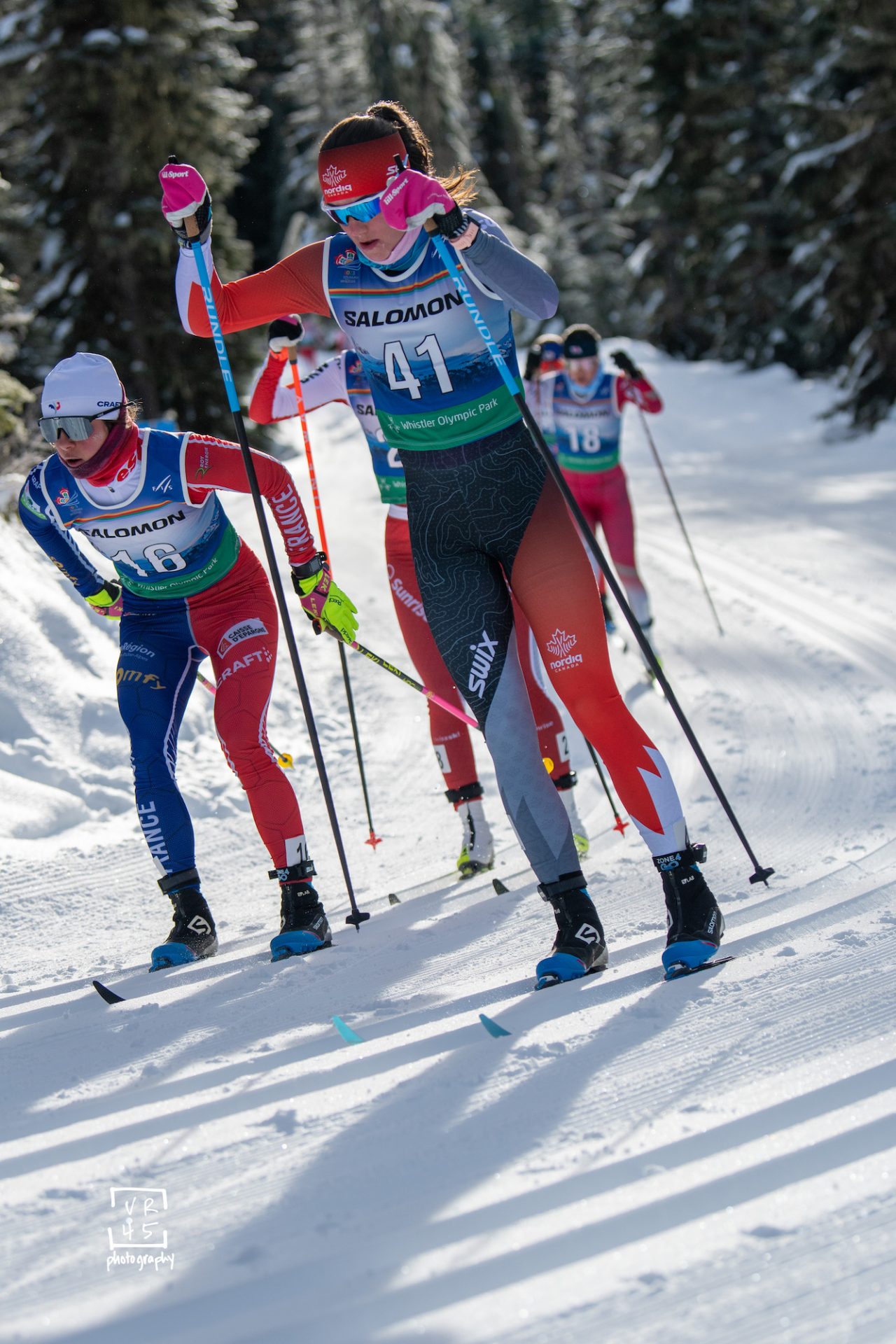
Alison Mackie (#41) double poling her way to 13th place. (Photo: Doug Stephen @vr45photography)
“It was amazing, this was my best race of the season so far,” Mackie told FasterSkier. “It was so much fun to work with a group of girls in such a big mass start. I’ve never done anything like this, this is my second international start.”
“I love the atmosphere,” she said. “I’m really lucky my first world juniors is here, I’ve race here a couple of times before.”
Mackie may only be 17, but she has been listening to her coaches: “I want to thank my techs, I had great grip and great glide.”
Constance Lapointe was the next Canadian in 21st, in her first world juniors days after her 18th birthday. “Definitely one of my best races ever,” she said.
Lapointe came in without any expectation except gaining experience, but she has already learned what to say in interviews:”My wax techs just nailed the wax.”
Ava Thurston was the second US finisher in 28th, 4:52.4 back: “It was pretty solid, it was definitely a very hilly course, but the four laps went by surprisingly faster than I thought they would.”
“Skis were great, had plenty of kick, just really nice classic skiing. The corners were pretty good today, no treacherous downhills for me anyway.”
Canada’s Anna Stewart and Alexandra Luxmoore were 34th and 40th in what was expected to be a learning week.
USA’s Rose Horning was 42nd while Nina Schamberger did not finish after skiing the second lap in obvious discomfort.
For the men, it was the same countries on the podium but new names.
Early on, it was Finland’s Niko Anttola driving the pace with all four Norwegians staying in the top five. Canada’s McKeever skied close to the front for the first lap and a half, but looked like he had good skis on a day when the Germans and Norwegians had great skis.
Mathias Holbæk takes the U20 World Champion title. (Photo: Doug Stephen @vr45photography)
Anttola and Norway’s Mathias Holbæk pulled clear on the third lap, leaving three Norwegians to be caught by a chase pack of five. Anttola looked like he was driving the pace, but it was Holbæk who skied away on the final Hermodt’s hill into the stadium for victory in 53:05.7. Anttola was 7.7 seconds behind, with Norway’s Kristian Kollerud winning the sprint for bronze at 28.1 seconds.
“It was a great day, I feel strong. My tactic was to be behind and take it in the last sprint uphill,” Holbæk said. “We go very fast [on the third lap] and got a little split. It was fun.”
“It was good day, good weather, and tracks were very nice,” Anttola said. “I tried to go hard in the uphills, but Mathias a little bit too strong today.”
“It was a great day, a tough race. I’m really glad that I came third,” Kollerud told FasterSkier. “The two guys in front of me were too good, so I need to focus on third place.”
If it was a hard race for the podium finishers, it was harder for the rest of the field. For most of the North American skiers, the coaches were talking about learning and developing, not results.
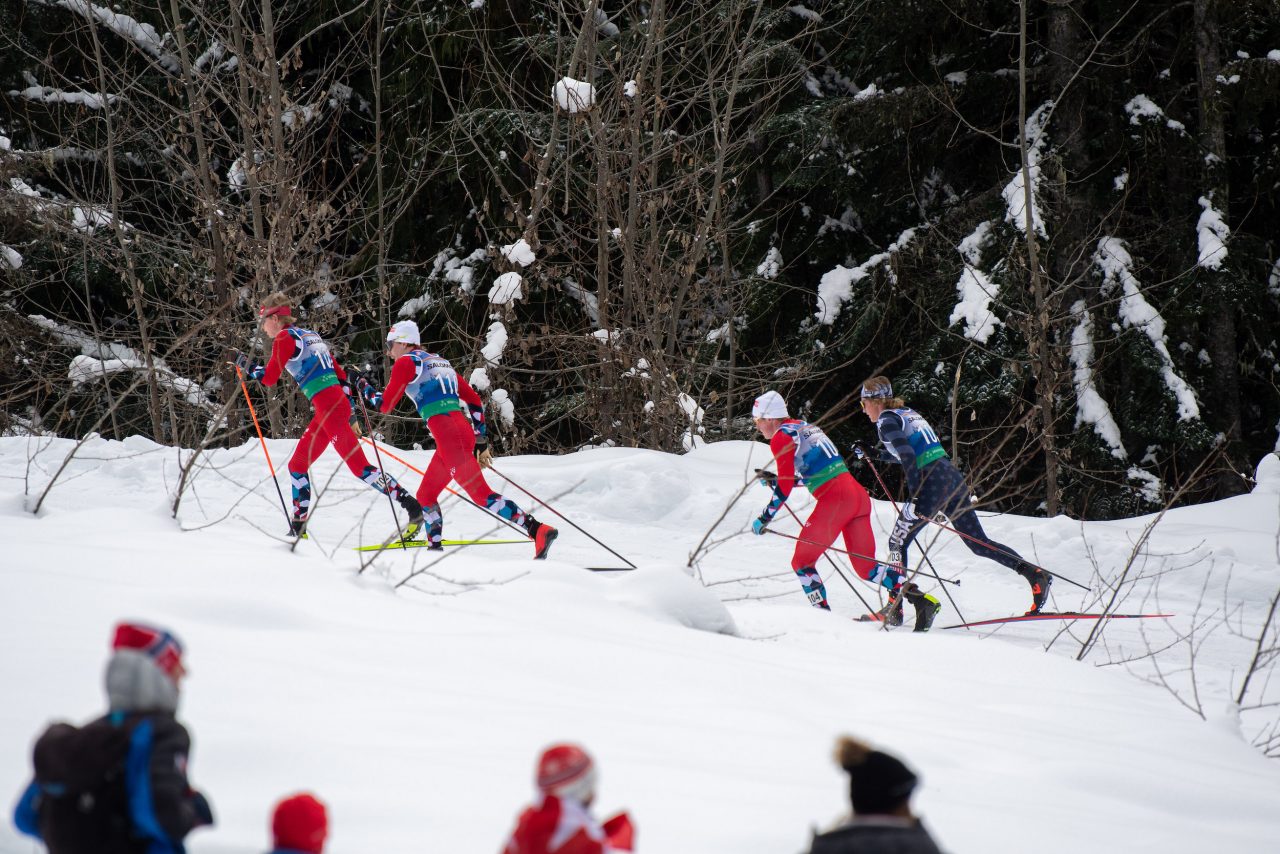
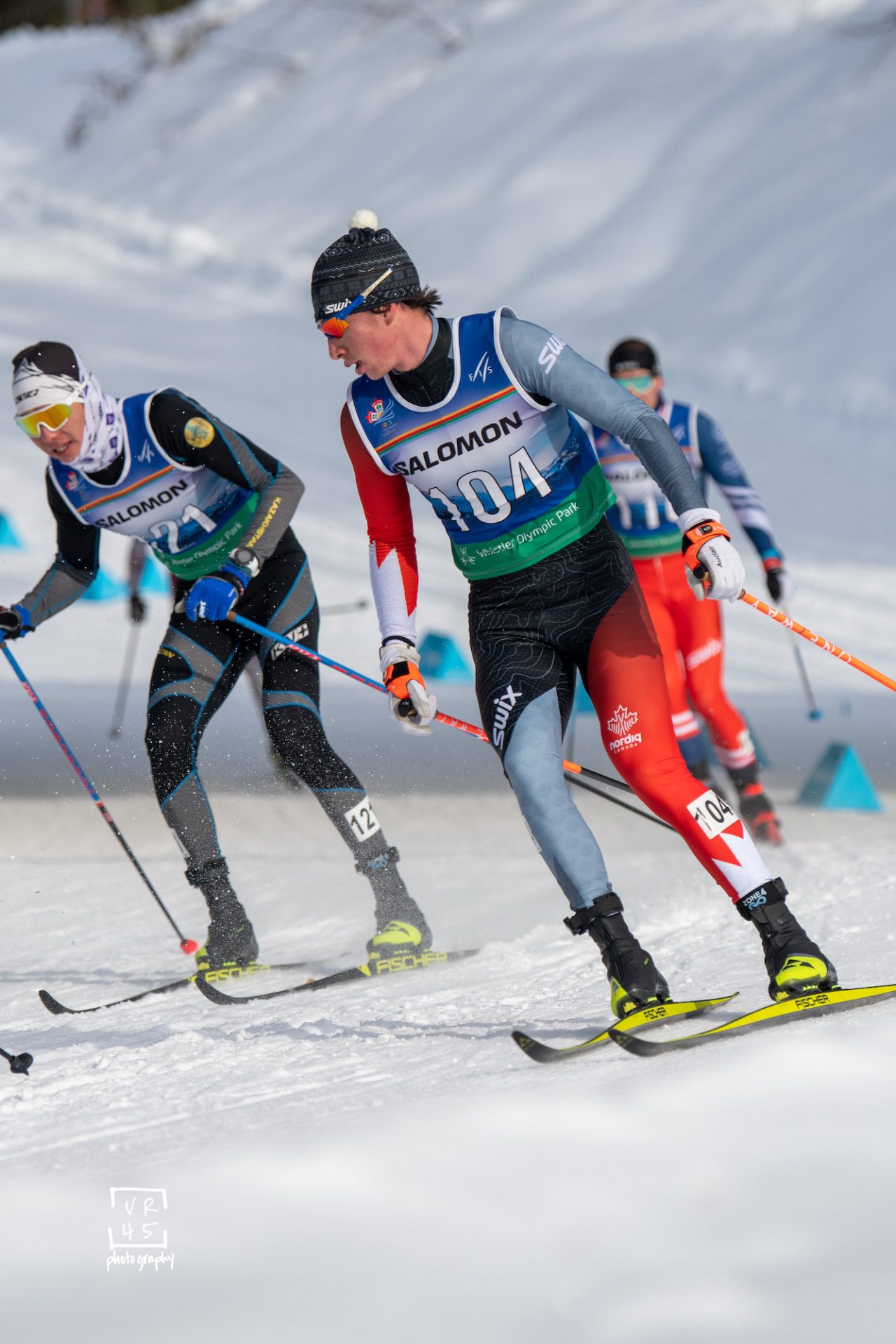
Xav McKeever (#104) looking relaxed on the fast downhill under the bridge. (Photo: Doug Stephen @vr45photography)
“A bit of a tough one, the pace was really hot off the start,” McKeever said. “I redlined a bit in the second lap, but came alive for the end.”
“I was still happy I was able to come back … and fight for 13th. Obviously, not quite what I wanted, but there are takeaways from being able to recover.”
McKeever had come in with expectations from outside and inside, allowing him to be disappointed with a top 15 in his favoured race at a home country event. While this is his fifth World Juniors, he is still a U20 and working on the mental aspects that lead to success. A big part of his thoughts ten minutes after finishing: “How I react to having this big event in Canada, and how I react to some added self-pressure from a championships at home.”
Luka Riley was the top US skier, 34th at 4:24.6, just ahead of Canada’s Luke Allen in 36th.
“It was really fun other there,” Allen said. “Super hard race, super deep field out there.”
“Tracks were remaining pretty hard, the kick was solid throughout, the corners were fast but not sketchy. Honestly, just a beautiful day in Whistler. Sun was out, can’t really ask for much more here.”
The US trio of Adrik Kraftson, Jack Lange, and Max Kluck were 39th, 41st, and 57th. We could quote them, but it’s more fun to watch the video that shows the team.
Canada’s Raleigh Tarte finished 47th while Garrett Siever did not finish after a start that looked strong.
Full results for the week and live timing are here. Livestream video for upcoming races is on the same link.
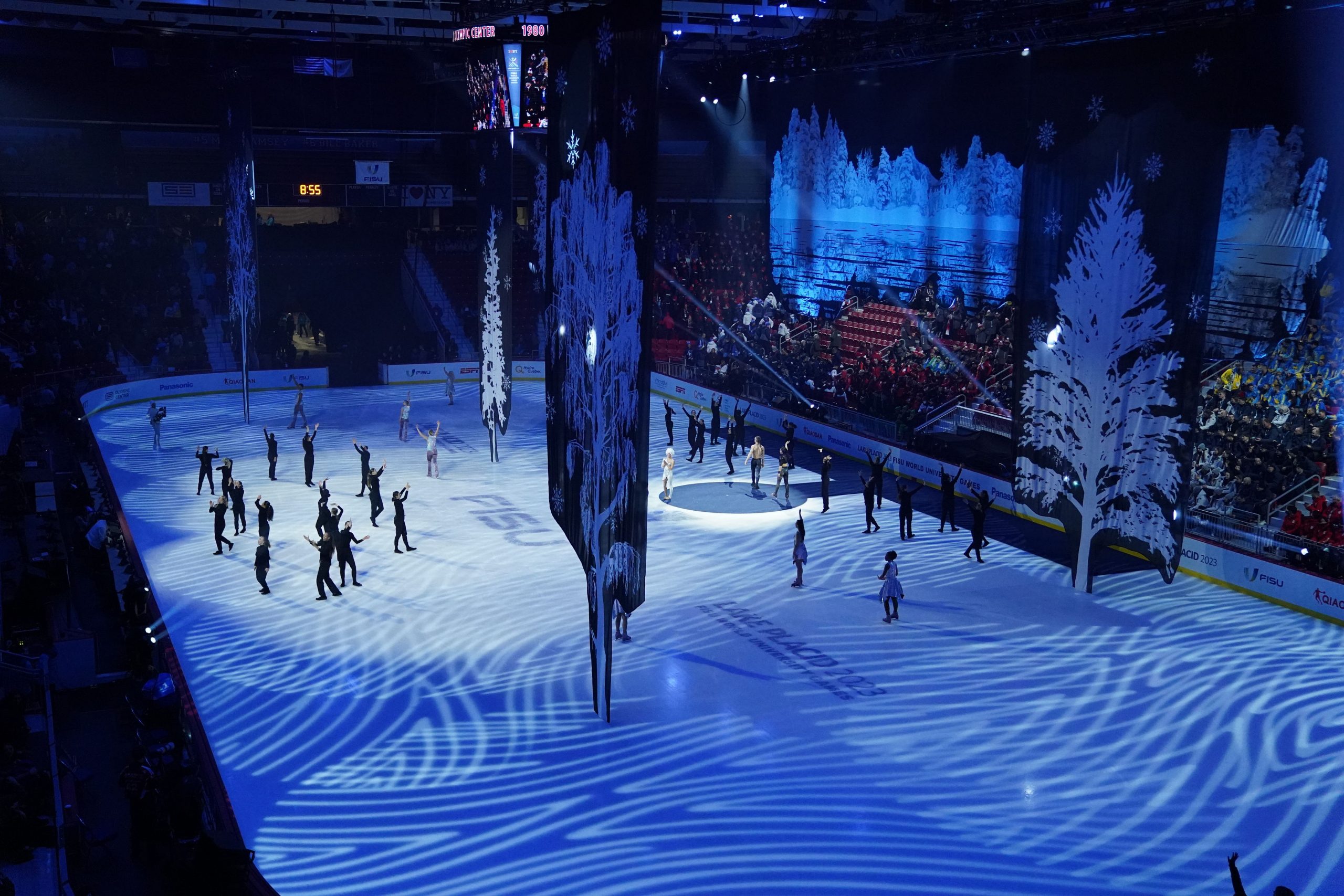
With the State of New York having spent $500 million (through the Olympic Regional Development Authority) to dramatically overhaul facilities originally constructed for the Olympic Winter Games of 1980, Lake Placid was dolled up and ready to host the 31st World University Games, the first time these competitions had been held in North America since 1972. And so, not even the light drizzle outside on opening night could dampen the prospect of a week that promised competition, fellowship, and a glimpse at athletes likely to shape the future of winter sports.
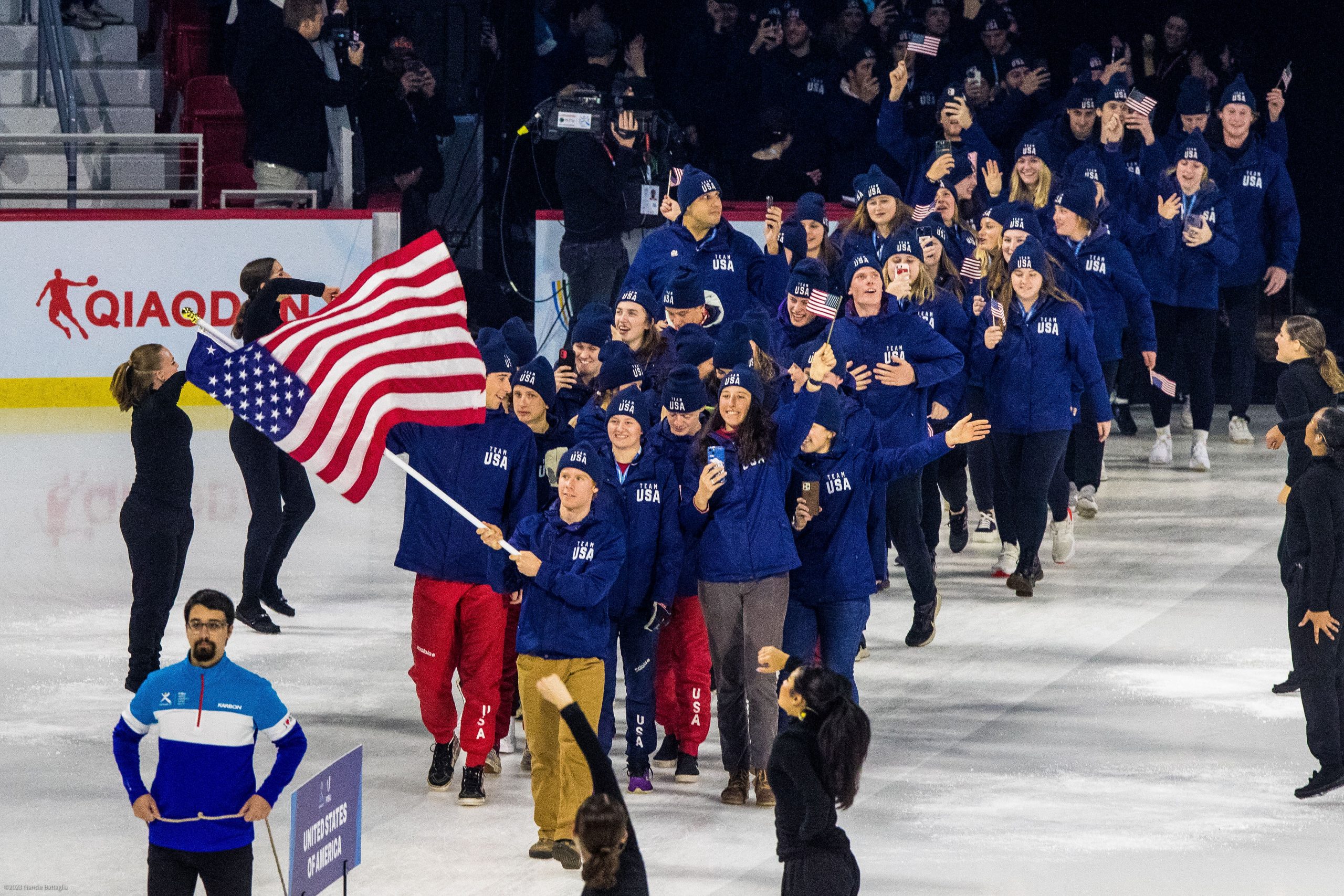
Lake Placid, NY—Biathlete Van Ledger waves the American flag as he leads Team USA into the Opening Ceremony of the 2023 FISU World University Games (Photo: Nancie Battaglia/FISU Games)
The World University Games highlight collegiate athletes, and the gathering of American cross country athletes underscored just how central the collegiate circuit is to athlete development in the United States. With several members of Team USA using the World University Games as a pitstop on the way to their first World Cup starts—and plenty of the international athletes in the field representing American university teams—signs pointed towards the American collegiate circuit acting as a robust and competitive field for athlete development in the United States, and beyond.
By the close of cross country competitions in Lake Placid, Team USA had won five medals (three individual, two team) in events as diverse as the Mixed Team Sprint and the 30 Kilometer Skate Mass Start. The young Americans built a case for the the ever-deepening pool of US Skiing, and the dynamic athletes who are contained in that community.
Erin Bianco (1) of the USA during the Cross Country women’s sprint free during the World University Games on January 15, 2023 in Lake Placid, New York. (Photo by Porter Binks/FISU Games)
Team USA at the 2023 World University Games in Lake Placid, New York:
Men
Gregory Burt (University of Vermont)
Garrett Butts (Alaska Pacific University)
John Steel Hagenbuch (Dartmouth College), Gold and Bronze Medalist
Will Koch (University of Colorado)
Alexander Maurer (University of Colorado)
Finn Sweet (University of Vermont), Silver Medalist
Adam Witkowski (Michigan Tech.)
Cameron Wolfe (Dartmouth College)
Women
Lucinda Anderson (University of New Hampshire)
Renae Anderson (Bowdoin College), Silver Medalist
Erin Bianco (Colby College), Bronze Medalist
Kendall Kramer (University of Alaska-Fairbanks), Silver Medalist
Annie McColgan (University of Vermont)
Sophia Mazzoni (Montana State University)
Anabel Needham (Michigan Tech.)
Nina Seemann (Dartmouth College)
Mixed Team Sprint—Classic
Skiers, including Team USA’s Renae Anderson (Bowdoin College), brave rough snow conditions during the Classic Team Sprint at the World University Games. (Photo: FISU Games)
First on the program was the Mixed Team Sprint: two partners each completing three legs of a 1.35 km course. The event followed a semifinal/final format somewhat similar to individual sprints, with the top two teams from each semifinal automatically advancing, but with a total of six, time-based, lucky loser spots filling out the final field of 10 teams.
The United States entered two teams: University of Colorado’s Will Koch and University of Alaska-Fairbanks’ Kendall Kramer forming USA I came fourth in a tightly contested second semifinal, from which only Italy I and Finland II advanced. Team II was comprised of University of Vermont’s Finn Sweet and Bowdoin College’s Renae Anderson who advanced to the final as lucky losers.
As Sweet-Anderson made their way to the starting line of the sprint final, it began to snow . . . hard. With temperatures hovering near freezing, a snow squall blew in to cover Lake Placid’s warm, granular, man-made snow. That suited the two New England Carnival circuit veterans who made up USA II, with Sweet saying in post-race comments that he and Anderson were “confident [choosing] zeroes, which were definitely the right call.”
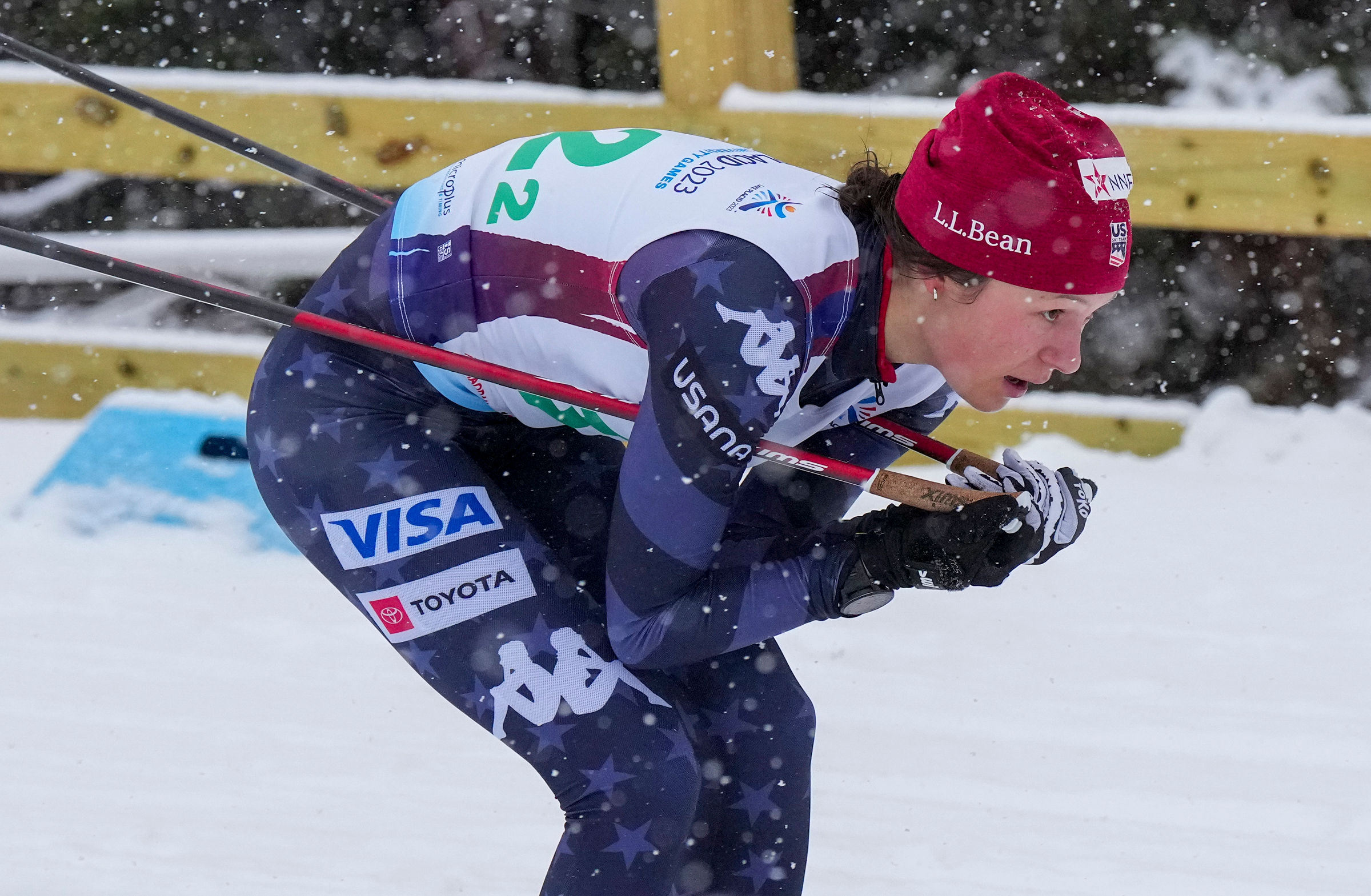
Renae Anderson (USA) during finals of the Mixed Team Sprint Classic at the 2023 FISU World University Games on January 13, 2023 in Lake Placid, New York. The USA team placed 2nd behind the winning team from Japan. (Photo: Porter Binks/FISU Games)
Despite being part of the Olympic program since Torino 2006, Team Sprint formats are still a rare event. Sweet echoed that novelty for himself and Anderson: “[The format] was different for sure,” he said. “[In the semi-final] I took it pretty conservatively and looked at it more like a distance race, whereas Renae said she skied it more like a sprint and ended up bonking a bit at the end. Going into the Final I think we were both on the same page with how to pace it which helped out a lot.”
The Final was a tightly contested affair raced on glazed-over tracks: man-made, re-frozen ice covered by new snow. After an initial push from University of Denver student Andreas Kirkeng (skiing as part of the Norway I team alongside University of Utah’s Karianne Olvisk Denegrud) the pack tended towards parity. Eventually, the Japanese tandem of Ryo Hirose and Rin Sobue—both from Tokyo’s Waseda University ski team—pulled away for the win. Into the final exchange, Kirkeng and Sweet had created a clear race for second and third, and Renae Anderson closed with an impressive push that brought USA II to Team USA’s first medal of the week—a silver for the Bowdoin College-University of Vermont duo.
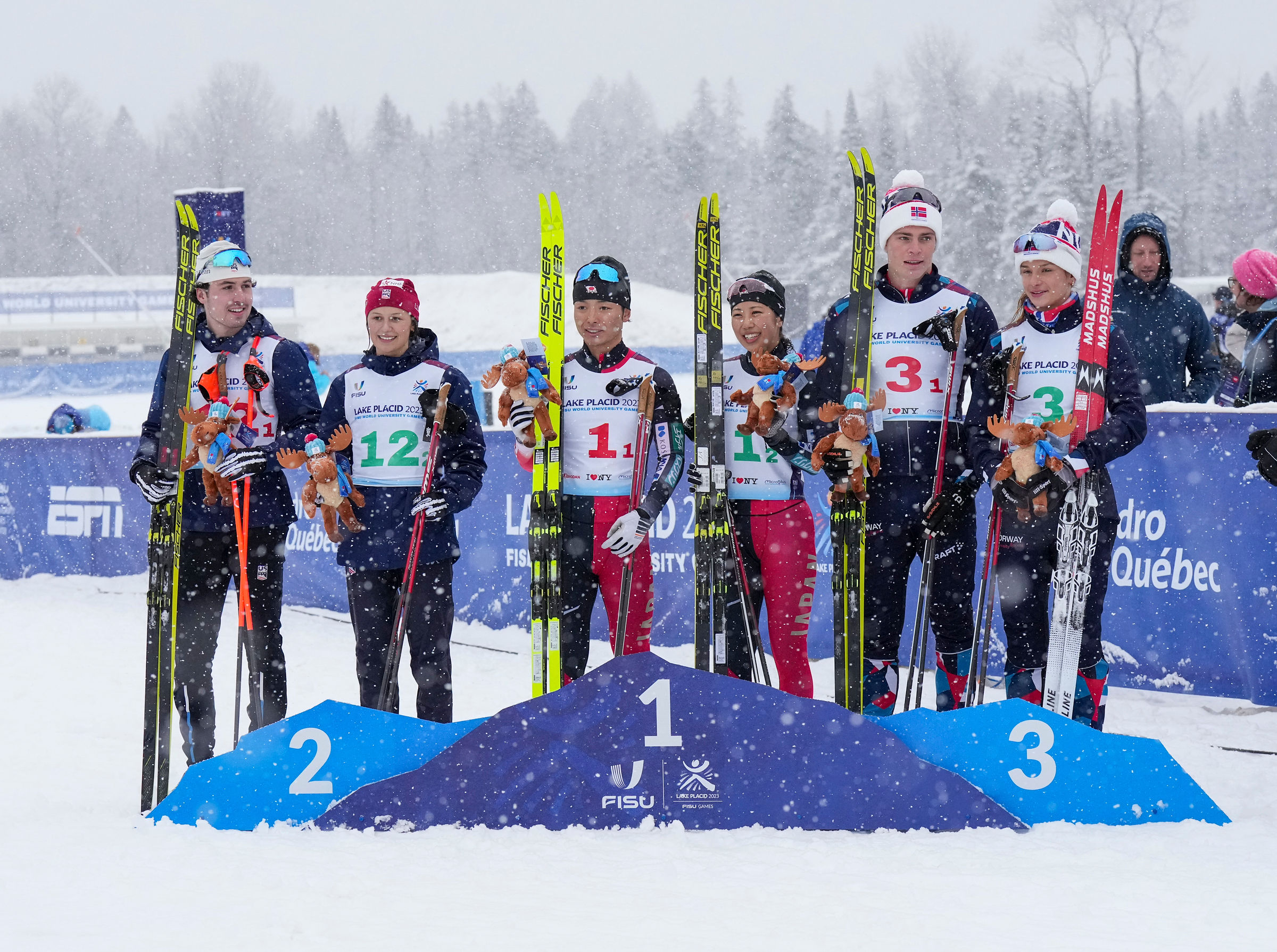
The podium of the Mixed Team Sprint Classic at the 2023 FISU World University Games. L to R: Finn Sweet and Renae Anderson (USA) 2nd place; Ryo Hirose and Rin Sobue (JPN) 1st place; Andreas Kirkeng and Karianne Olsvik Dengerud, (NOR) 3rd place. (Photo: Porter Binks/FISU Games)
Sweet said that he was “super happy with the result. I wasn’t sure what the level of competition would be [in Lake Placid] but after a few days of racing were behind me, I grew more and more proud of what Renae and I accomplished.” Sweet also said that the “Games were a great way to mix up the EISA [Carnival] circuit, especially in a year where the American U23 Team was going to be so strong and a bit out of reach.”
Individual Skate Sprint
The athletes quickly pivoted from Team Sprint to Individual Sprint, a discipline that has highlighted US Skiing’s depth from the World Cup team on down. American performances at the World University Games would prove no different. When qualifying had concluded, Erin Bianco (Colby College) was at the top of the field. In the men’s race, Adam Witkowski (Michigan Tech) and Will Koch (University of Colorado) ranked second and third behind Spain’s Jaume Pueyo. In a further show of American strength, every one of Team USA’s skiers had finished in a position to qualify for heats.
Erin Bianco (USA) races the Women’s Freestyle Sprint during the World University Games in Lake Placid, New York. (Photo: Porter Binks/FISU Games)
In post-race comments on winning the qualifier, Bianco said, “I was extremely excited to qualify first. I have been loving the amount of sprint races there are on the pro circuit and would consider it one of my strengths so to start World University Games by crossing the line in first place might be one of the highlights of my ski career!”
Bianco also provided a comprehensive overview of the course that the Americans would race in the heats: “The sprint course was twisty and hilly,” she said. “The course begins with a quick little up and a sweeping downhill into a significant climb. It then turns left down a more straight downhill into a gradual flat section, quick gradual down into the long uphill. This hill is a steady grind that ends with a steep downhill back under the bridge into the stadium. The final kicker is a tight right hand turn into the finishing stretch. I had never raced here before and was a bit intimidated on the warm up but sprinting happens so quickly that you don’t have time to think about how hard it is!”
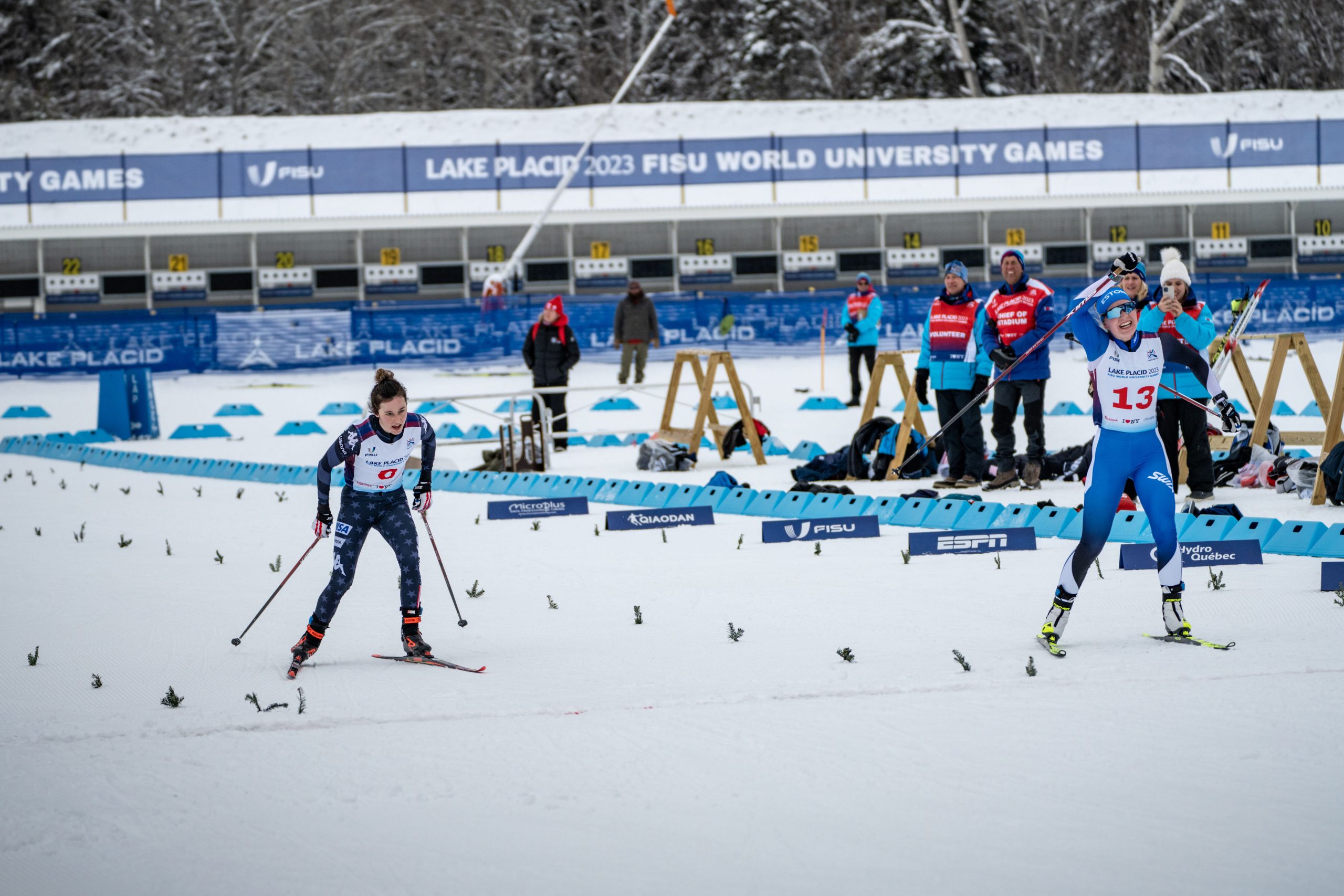
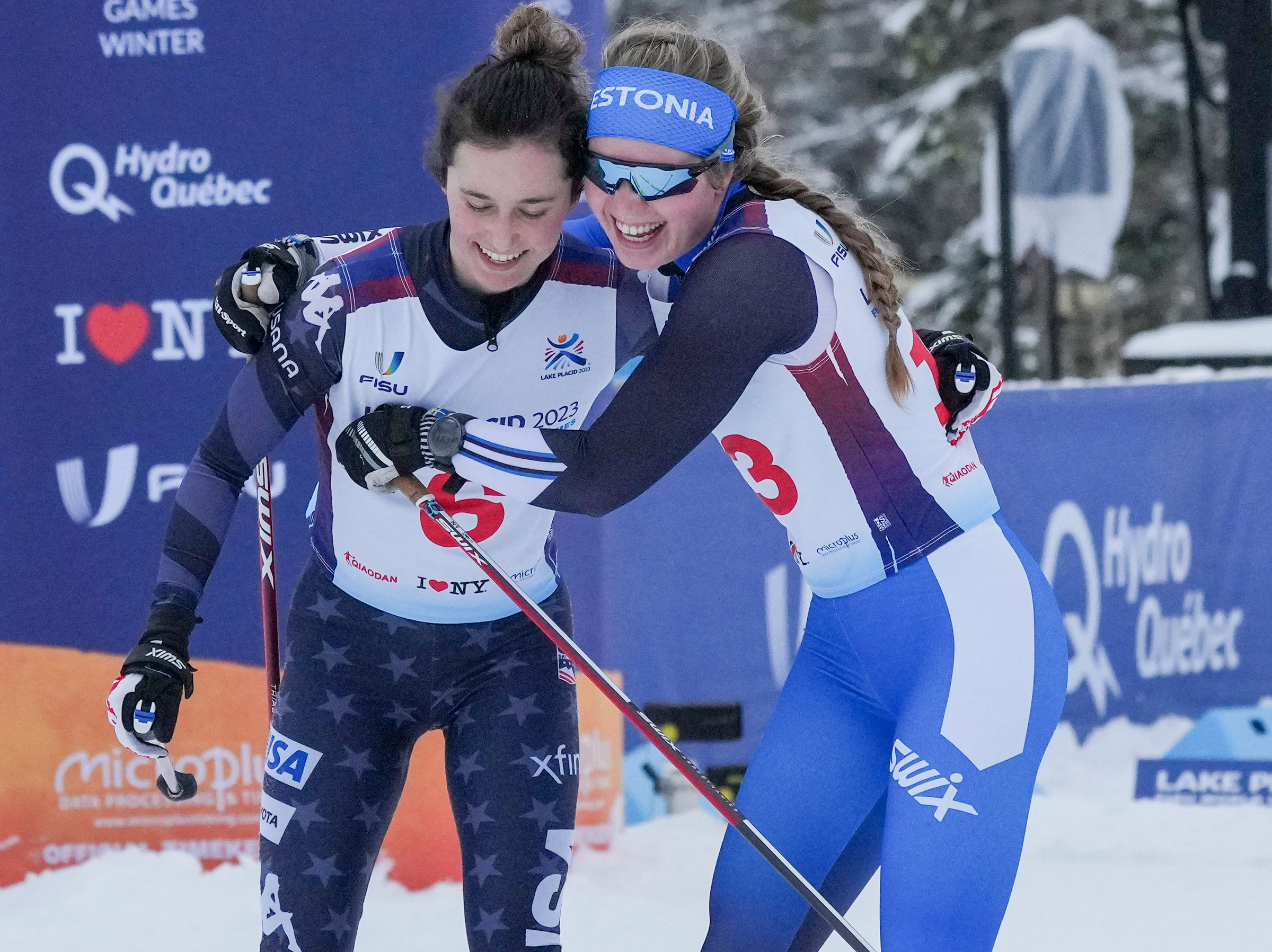
In the Women’s heats, Bianco made quick work of advancing to the Final where she matched up against a Finnish contingent of Tiia Olkkonen, Siiri Kaijansinkko, and Niemela, along with American university students Mariel Merlii Pulles, skiing for Estonia and University of Alaska-Fairbanks, and Anna-Maria Dietze, skiing for Germany and University of Colorado.
“[In the Final] I did not want to be in the lead for the first part of the course as the moves were made on the big uphill,” Bianco said. “My skis were extremely fast, so I sat behind for the first half k and then started to push the pace on the uphill. I crested the hill in third which was where I wanted to be so I could catch a draft on the downhill. This plan worked until I hit some ice or slush or maybe just even lost my balance on the final swooping corner into the finish and lost my balance. Luckily I stayed on my feet but this gave [Anna-Maria Dietze] just enough time to edge me out of the podium.” Ahead of the sprint for third with Bianco and Dietze, Mariel Merlii Pulles was able to hold off Finn Tiia Olkkonen to take the gold medal. “Although I was a bit sad to walk away without a medal, I am very proud of how I skied all day” said Bianco on her 4th place finish for Team USA.
In the men’s quarterfinal, New York state native Adam Witkowski found himself doing some unexpected sightseeing of his old stomping grounds. “There was a large crash in my quarterfinal that led to me having to take avoiding action and ski off the trail and through one of the coach zones.” Witkowski stayed calm; in an impressive show of resiliency, he was able to ski himself into a semifinal. On the day’s fast-moving snow, crashes were more the norm than the exception. In the semifinal, Witkowski found himself again swerving to avoid a crash into the first set of downhills. This time, he tumbled in such a way that individual resiliency could do little to overcome.
Having qualified second, Adam Witkowski (USA) found himself hampered by unfortunate crashes that ultimately took him out of contention in the Sprint Free event at the 2023 FISU World University Games. (Photo: Bond Demetri Photos/FISU Games)
Will Koch managed to stay head of the fray in that semifinal. “It was strange to go so ‘quick’ again . . . compared to the other sprints I’ve done this year, this one felt most like a true ‘sprint’ since it was low altitude and had restful downhills.” Koch felt confident that he could push the entirety of the race, “I wasn’t concerned about leading into the final downhill since Perry Thomas, Team USA’s main wax tech, had made the skis so fast.” Koch eased into the Final alongside Northern Michigan University and Norwegian skier Kristoffer Karsrud.
Will Koch (University of Colorado) leading Kristoffer Karsrud (Norway, Northern Michigan University) down the last hill of the Freestyle Sprint event at the 2023 FISU World University Games. Karsrud would ultimately place 5th, with Koch placing 6th. (Photo: Bond Demetri Photos/FISU Games)
Koch and Karsrud joined a Finals field filled out by Finland’s Verneri Poikonen, Spain’s Jaume Pueyo, German Marius Bauer, and Frenchmen and University of Utah skier Tom Mancini. Koch had been through blistering paces in both his quarterfinal and semi-final, and in the Final, he said, it took a toll, “I was very tired from the heats and did not have the energy to ski as fast as the prior heats.” Koch still held strong in a tight pack, and finished 6th, as Poikonen took gold, Pueyo took silver, and Utah Ute Tom Mancini took the bronze. “At the end of the day, there were some very talented sprinters I was up against in the final who would have been hard to beat even with more rest” said Koch on his finish.
Pursuit: Men’s 10 km Pursuit and Women’s 5 km Pursuit
Bronze medalist John Steel Hagenbuch (7) of the USA, left, with gold medalist Ryo Hiose after the Cross Country mens pursuit free at the World University Games on January 17, 2023 in Lake Placid, New York. (Photo: Porter Binks/FISU Games)
From the opening sprint weekend, the World University Games turned to a two day pursuit on Wednesday and Thursday of last week. The event entailed a classic individual start Wednesday, followed by a pursuit start on Thursday.
Top performers in the first stage individual start classic race were University of Alaska-Fairbanks’ (UAF) Kendall Kramer, who finished 12th place on the day, and a sixth place for University of Vermont’s Finn Sweet. Dartmouth College’s John Steel Hagenbuch, meanwhile, was just .02 seconds off Sweet in seventh place, with both 37 seconds back going into day two. Finland’s Hilla Niemela finished first in the women’s race, with UAF and Estonia’s Mariel Merlii Pulles in second place. Japan’s Ryo Hirose won the men’s race ahead of University of Colorado and Norway’s Magnus Boee.
From seventh place the next day, John Steel Hagenbuch would work and wind his way through the field. The Sun Valley native had a race rivaled by only winner Ryo Hirose, who held his gap from day one for gold, as he pushed through the dense pack that formed the top 10, passed, and passed, until he was right up to Andreas Kirkeng. Kirkeng, who had finished third on day one, eventually used the energy savings earned from day one to open a gap on Hagenbuch for second place, but Hagenbuch had made his case for bronze crystal clear. He stepped onto a podium, and earned Team USA’s second medal of Games, and first in an individual event.
In the women’s race, Kendall Kramer pushed to move up a place on day two, and ended the pursuit race in 11th place. Mariel Merlii Pulles fought to join Hilla Niemela at the front of the a race from 18 seconds back, but Niemela was able to leverage her advantage to take gold for Finland in the pursuit. Pulles earned her second medal of the Games, a silver, while Maria Eugenia Boccardi finished third for Italy.
Team Relay: Men’s 4 x 7.5 km and Women’s 3 x 5 km
Krystof Zatloukal of Czech Republic leads the pack to start the Men’s 4 x 7.5km Relay at the 2023 FISU World University Games on January 20, 2023 in Lake Placid, New York. (Photo: Isaiah Vazquez/FISU Games)
Friday moved to a classic Olympic event, the Team relay. The Men would race a 4 x 7.5 km race alternating classic and skate legs, while the women would do a 3 x 5 km in the same format. Team USA for the Women’s relay included lead leg Sophia Mazzoni (Montana State), Anabel Needham (Michigan Tech), and anchor Kendall Kramer (UAF). Team USA for the Men’s relay included lead leg Garrett Butts (APU), Finn Sweet (UVM), Gregory Burt (UVM), and anchor Alexander Maurer (University of Colorado).
The Women’s race saw Finland and Norway establish a lead early and hold it until the very end. A Final sprint from pursuit champion Hilla Niemela saw Finland clip Norway for gold, Kazakhstan held onto the Nordic duo’s push until the very end to take a bronze medal. Team USA finished in 10th place.
France was the dominant force in the Men’s race, holding a lead nearly unencumbered from the first exchange on out. It was University of Utah’s Tom Mancini who anchored the gold medal performance, as Norway and Japan finished 2nd and 3rd. Team USA finished fifth place.
Mixed Nordic Team Event: Nordic Combined/Jumping/Cross-Country: Erin Bianco
Erin Bianco, of the USA, bursts from the transition zone at the skiing portion of the Mixed Team Nordic at the 2023 FISU World University Games in Lake Placid, NY. (Photo: Logan Swney)
In keeping with the theme of innovative events at the World University Games, the Relay portion of the week also included a Nordic Combined/Jumping/Cross-Country cross-over event. The event was, at its core, a Nordic Combined race, a jumping portion followed by a pursuit start 2×2.5 km cross-country skate race. At the World University Games though, National team’s competed in trios of one pure jumping athlete, one nordic combined athlete, and one pure cross-country athlete. The jumper and nordic combined athlete combined for the jump portion. The nordic combined athlete and the cross-country athlete then combined for a pursuit start team relay in which both skiers did a 2.5 k leg. A format that may sound like the work of a mad nordic scientist, but one that provided loads of excitement for Team USA.
The cross-country athletes for Team USA included Erin Bianco (Colby College) for USA I, and Cameron Wolfe (Dartmouth College) for USA II. Erin Bianco combined with Jumper Cara Larson and Nordic Combined athlete Niklas Malcinski for USA I, Cameron Wolfe combined with Jumper Logan Gundry and Nordic Combined athlete Tess Arnone on USA II (Gundry is also a Nordic Combined athlete, but just jumped in this competition).
After the jumping competition, USA I was in 3rd place going into the cross-country portion. Behind strong legs from both Malcinski and Bianco, they held their position, and in the old-school, new-wave or Nordic Combined competitions, the USA took home a bronze medal. Japan, long a powerhouse in the ski jumping world, took gold, with fellow jump-strong nation Poland taking silver.
Team USA crosses the line for a bronze during the Mixed Team Nordic Combined Sprint at the 2023 FISU World University Games on January 19, 2023 in Lake Placid, New York. (Photo by Hailey Trejo/FISU Games)
Skate Mass Start: Men’s 30 km and Women’s 15km
John Steel Hagenbuch on the finishing straight during his Gold Medal performance in the 30km Mass Start World University Games in Lake Placid, NY. (Photo: Logan Swney)
As it entered the second Sunday of competition, the World University Games program wound down by turning the intensity up. As in the Olympics, the Universiade would finish on a—note the quotes— “marathon.” The Men’s race would be 30 kilometers: 10 kilometers longer than the longest race on the NCAA circuit. The Women’s race, however, would be 15 kilometers, which matches the longest distance on the NCAA circuit. While both still definitely distance races, there was already a kind of archaic overtone as the races arrived in the new age of equal distance racing.
On a difficult, winding, hilly five kilometer loop, the Men’s field didn’t contain anyone who wanted to take chances too early. Among the lead pack that formed in the early part of the race were two Americans, John Steel Hagenbuch (Dartmouth College) and Garrett Butts (Alaska Pacific University). Both showed the poise and patience indicative of confidence in a large mass start field. Hagenbuch, fresh off his pursuit push to bronze on Thursday, was set to ski with anyone. While Gunnison, Colorado native Garrett Butts had come into the Games fresh off of a career-best SuperTour 3rd place in the Seeley Hills Classic 30 k two weeks prior. His mother, Two-time Olympian and American Birkebeiner Champion Ingrid Butts, was set up in the stadium as Butts and Hagenbuch swung through the low-spot between the testing hills on the Lake Placid course.
As the final lap began, the lead pack had taken full shape. Hagenbuch and Butts were in, alongside Japanese skier Ryo Hirose, France’s Simon Chappaz, Italy’s Compagnoni, and Norway and University of Colorado’s Magnus Boee. Hagenbuch then went to work, grinding out an upturn in the pace that stretched, but did not break, the pack. Boee stayed on him, Compagnoni and Chappaz came too.
By the final kilometer though, it was all but clear who the strongest skier on the day was. The margins would be tight, but John Steel Hagenbuch came into the storied Lake Placid stadium and claimed a gold medal for Team USA. Boee followed to earn a silver, and Compagnoni finished in third for the bronze. Garrett Butts crossed the line in sixth place, the last member of the lead pack to hold on.
John Steel Hagenbuch of the USA leads the pack up the climb and into the depths of Mt Vanhoevenberg during the 30km Mass Start World University Games in Lake Placid, NY. (Photo: Logan Swney)
The Women’s 15 kilometer would also see a pair of Americans establish themselves in the lead pack early. Kendall Kramer (University of Alaska – Fairbanks) and Erin Bianco (Colby College) skied their way to the front of the race as the lead pack coalesced into four skiers strong. The Americans were joined by Kramer’s UAF teammate Estonian Mariel Merlii Pulles, and Kazakhstani Xeniya Shalygina.
University of Alaska -Fairbanks Teammates Mariel Merlii Pulles of Estonia, and Kendall Kramer of the USA sprint to the finish of the Women’s 15 k Skate Mass Start at the FISU World University Games in Lake Placid, NY. (Photo: Logan Swney)
The UAF Nanooks, Kramer and Pulles, soon made the World University Games a kind of team time trial, pulling away from Bianco and Shalygina on the final turn around the 5 k course. When they pulled into the stadium at Mt. Van Hoevenberg, they were dead even. For the crowd waiting in the stadium – and it was a crowd – it would be either the perfect introduction to cross country skiing, or the perfect conclusion to a week of racing. They sprinted for the line, and Pulles, the champion on the week, ended up pulling out a gold medal by .4 seconds over Kramer, who claimed a silver medal and a first individual medal for Team USA’s Women. Erin Bianco held strong through the final five kilometers, and finished fourth place behind Xeniya Shalygina.
Kendall Kramer (6) of the USA, left, and her teammate at the University of Alaska-Fairbanks Mariel Merlii Pulles (13) of Estonia embrace at the finish line of the women’s Cross Country 15 k mass start at the World University Games on January 19, 2023 in Lake Placid, New York. Pulles won gold and Kramer took silver. (Photo: Porter Binks/FISU Games)
From World University to World Cup, and more, for Team USA
John Steel Hagenbuch came away from the World University Games in Lake Placid with a Gold and Silver Medal for Team USA. (Photo: Hailey Trejo/FISU Games)
For Adam Witkowski, the Men’s sprint he qualified for in third place came with some well-deserved extra nerves. “With [the World University Games] being my first international race of my career I had quite a few nerves at the beginning of the [sprint] day.” His first international race was followed quickly by his second: a World Cup sprint the following weekend in Livigno, Italy. Witkowski wasn’t alone in the making the jump from Lake Placid to Livigno, either. Will Koch rushed on from his start in the Lake Placid 10 km Classic to “catch a redeye flight from Montreal to Italy for my first World Cup Starts!” The duo both made starts, with Koch highlighting making the Team Sprint Final in Italy alongside teammate Kevin Bolger.
For other members of Team USA, this World University Games in Lake Placid offered a perfect coda for their time spent on the collegiate circuit. Erin Bianco, who graduated in 2022, this was a “big highlight to represent the US for the first time, and Colby College one last time.”
Closing Ceremonies of the 31st World University Games took place in the arena where the sporting world’s most famous question and answer, “Do you believe in miracles? . . . Yes!” was immortalized. For every fan who remembers those words echoing from our television sets in 1980, there is a constant reminder of miracles that occur in Lake Placid. Team USA saw four medals in cross country skiing at these World University Games. Hard work and collective belief are indeed acts of will, bu—for a national ski program aspiring to become the best in the world—there’s a hint of something mystical at play, too. So we leave with the familiar refrain: “Do you believe in miracles?” . . . Yes.
Norway’s Ansgar Evensen leads the men’s final into the stadium. (Photo: Joern Rohde/www.joernrohde.com)
Day two at Whistler Olympic Park was similar to the first: sunny, fast, and exciting.
The excitement started early, with pre-race favourite JC Schoonmaker crashing spectacularly on the sweeping right-hand drop into the stadium during the qualifier. Seeded second, he was quick to be back up and skiing, but 150m of double poling with one pole cost him more time on top of the loss of time and speed from the fall. Schoonmaker would fail to qualify for the heats.
That corner is pretty easy when cruising on a long slow training day, but it has also ended many dreams over the years. FasterSkier asked Schoonmaker to explain what is different at sprint pace.
“You’re just going in with that extra little bit of speed, it makes it a little more tricky, and you have tired legs going into it,” he explained. “And that’s why you have to have your head in the game, and mine wasn’t there today.”
The two downhill corners would generate a lot of excitement in the heats. The left hairpin after the longer opening climb changed during the day. The “defensive” line, starting inside and finishing outside, got scraped smooth in the quarters. The “fast” line, entering very wide and exiting inside with much higher speed held out much better, despite many more skiers using it today after Xav McKeever’s well-executed demonstration of the gains was featured on the livestream video from Saturday.
In the women’s heats, the only two North Americans who qualified exited in the quarterfinals. Sydney Palmer-Leger qualified 30th and wasn’t able to match pace in a stacked first heat that produced both lucky losers. She finished sixth in the heat and 30th overall. Novie McCabe qualified 24th and finished fifth in heat 2 for a 23rd place.
Finland’s Jasmin Kahara was on a mission to upgrade her 13th place in last year’s U23 sprint, winning the qualifier and leading out all three heats on her way to the U23 title. Norway’s Kristin Austgulen Fosnæs moved up in the final 200 m to take second with teammate Sigrid Lesotho Føyen in third.
“Amazing, I have been waiting for this for many years and it was a perfect day,” Kahara told the livestream interviewer Tom Stephen at the finish. “I wanted to be in the front and do my best and ski as fast as possible.”
The simplest way to stay out of trouble is to go to the front and stay there. Kahara was the only skier on the day who could make that strategy work.
“It was amazing, I really didn’t expect to be that good today. The waxers did an amazing job,” Fosnæs said with a smile. “I tried to follow the Finnish girl’s track and try to keep her as close as possible, and then try to hold on to the finish line.”
“I got the bronze medal, and I’m really happy with that,” Føyen told FasterSkier. “I was really afraid they were going to slide me in from the top, but they didn’t.” Føyen entered the stadium in third, drafting Fosnæs, with just enough of a gap on Sweden’s Moa Hansson and Italy’s Nicole Monsorno to prevent a slingshot.
For the men, Norway’s Lars Agnar Hjelmeset won the qualification and his first quarterfinal in style before getting boxed in the semifinal. In the final, it would be fellow Norwegian Ansgar Evensen surprising the field with an attack on the second climb. Sweden’s George Ersson won a photo finish for second, 0.02 ahead of teammate Emil Danielsson, and 0.80 behind Evensen.
“In the heats, I tried to save as much energy as possible on the hill, and go really hard when I got into the stadium,” Evensen said. “I just decided on the [second] hill… but when I got the free track and felt good, I just went for it.”
Evenssen exploded the field, with only the two Swedish skiers staying together but not close enough to draft.
“It was amazing,” Ersson said.” I had amazing skis, body felt good, couldn’t be any better. I’m really satisfied with my second place.”
“I didn’t want to be first before the downhill to the stadium. It worked in the quarterfinals, but in the finals, Ansgar had a gap.”
“Amazing,” Danielssen said afterward. “Nice weather, good shape, good skis, on the podium with my friend, it couldn’t be better.”
There is a theme to the Swedish interviews on the first two days, seemingly channeling the great Marit Bjørgen who collected five medals on these tracks in 2010. “The shape is good, the skis are good.”
The fourth place finisher, Norway’s Jonas Vika, completed the corner drama for the day with a spectacular maneuver after his aggressive line choice backfired.
“There was about this much space outside the v-board,” Vika explained, holding his fingers about 8 cm apart. “I don’t know how I stayed on the skis, but I’m really glad I did.”
Three North Americans made the heats. Gus Schumacher and Luke Jager came in with high expectations. Canada’s Sasha Masson did not.
“It was quite a big surprise that I qualified this morning, knowing there’s so many fast athletes out there,” Masson explained. “The techs did a really good job for the kick and the glide, and I just made it happen this morning.”
After qualifying 26th, Masson found his attempts to move up in the quarterfinal blocked, leaving him happy in 23rd for the day.
“For the heats, it was a good experience. A little more international experience would be fun.”
Schumacher qualified 24th and was happy with his heat.
“It was good, my plan was to make the time as fast as possible,” he said after getting eliminated. “I slotted in behind the fastest bib in our heat, led over the top, kind of lost an edge a little bit in that icy corner.” “I got spit wide, came around the corner here in third, and maybe not close enough to slingshot.”
“I was pretty proud of it, my classic sprinting has never really been my best. It was a good way to start the week and really fun to be in a heat again.”
Jager, like Schoonmaker, was expected to compete and even feature in the final.
“It was kind of a mixed bag. My qualifier, I finished and thought it was pretty good, but the results told a different story,” Jager said, after qualifying 20th and reaching the semifinals as a lucky loser.
“My quarterfinal was really tight, really fast, and thankfully Lars was pinning it from the front the whole time. I had to sit anxiously for four more heats.”
“I was hoping to try the same thing in the semi, just stay back and avoid trouble, but I managed to find trouble anyway.”
On the first short steep turn up out of the stadium, the tight packed group got out of the tracks and Jager found himself with a broken pole at the start of the diagonal stride technique zone.
“That’s a good reminder, not matter how hot you think you are, stuff happens.”
Jager, like Schoonmaker, was philosophical and still upbeat. “Anyone can do it, once you’re in the heats, but definitely some people can do it with less energy than others.”
The last word goes to Ersson.
“If you were to wish for one condition to compete in, this would be it. Sunny, hard tracks, it couldn’t be any better.”
Full results for the week are on the FIS website, including video replays of the first two days and live video for the remaining events.
Whistler 2023 Podium Gifts are local art. This wolf was earned, not given.
This World Cup coverage is made possible through the generous support of Marty and Kathy Hall and A Hall Mark of Excellence Award. To learn more about A Hall Mark of Excellence Award, or to learn how you can support FasterSkier’s coverage, please contact info@fasterskier.com.
Scott Patterson (USA) powers to a 12th place finish in the World Cup 20 k Mass Start in Les Rousses, France. (Photo:NordicFocus)
Ski racers know steep hills: the stomp up the first climb in the Swedish Vasaloppet, Wave 8 of the American Birkebeiner on “B**** Hill,” the race-changing “Russian Hill” on Lake Placid’s 1980 Olympic trails. The Les Rousses World Cup course has one of those hills, steep enough to reduce the world’s best skiers to a waddling, stuttering herringbone. Coming within the first 500 meters of the course, this hill was the defining feature of a 3.3 km loop that the World Cup field completed six times today en route to finishing a 20 km classic mass start. A hill like this becomes strategic: hit it hard and the hill could break up the field, string out the pack, perhaps even break Johannes Hoesflot Klaebo (NOR) who has looked surprisingly mortal this weekend in Les Rousses. Don’t let it come down to a final sprint. Beat him on the hill.
Easier said than done . . . Les Rousses’ hill indeed took its toll. By the final lap, only six skiers remained in contention. And among them was Klaebo, initiating a push into the check-point that marked the summit of the hill, then slowly returning to the pack like he’d just completed an interval. Iivo Niskanen’s (FIN) attempt to break away on the next hill came far too late. Klaebo had survived the climbs, had forced the race to finish on his terms, and so launched his race-winning sprint in time to have it all wrapped up as he entered the stadium. He waved and bowed to the Les Rousses crowd, extending his win streak in classic distance races to four, matching similar streaks by Alexander Bolshunov (RUS), Vladimir Smirnov (KAZ), and Bjorn Daehlie (NOR). Niskanen climbed onto the podium in 2nd place, while William Poromaa (SWE) finished third, earning his second podium of the weekend.
North American racers also excelled: The sole Canadian starter, Antoine Cyr, finished eighth, continuing his string of top ten finishes, while Scott Patterson (USA) finished 12th. Other American finishers included Ben Ogden 37th, Zak Ketterson 47th, Peter Wolter 54th, and Finn O’Connell 57th.
Johannes Hoesflot Klaebo (NOR) waves to the crowd on his way to winning Sunday’s 20 k classic mass start in Les Rousses. Klaebo ended a weekend where he struggled back to the top, outsprinting a six-man lead group. (Photo: NordicFocus)
The tactics played by Klaebo did not change the reality for the rest of the field in Les Rousses. There was still a grinding, grueling fight for places up and down the field, which kept attention on the finish-line long after the lead pack finished. The first of these pitched battles was between Cyr and Martin Loewstroem Nyenget (NOR) who traded turns in 7th and 8th place through the bulk of Sunday’s action. Loewstroem would take the edge in the end, but Cyr’s 8th place finish marked his third top-10 result in a month on the World Cup (after two top tens during the Tour de Ski), an auspicious sign of form from the young Quebecois skier.
Antoine Cyr (CAN) trades places with Martin Loewstroem Nyenget (NOR) during the 20 k classic mass start. Loewstroem outsprinted Cyr for 7th place, but Cyr’s 8th place marked his third World Cup top ten in the last month. (Photo: NordicFocus)
Then there was the main chase group behind Cyr which included another pack of skiers vying for top 10 spots. Among them was Patterson, who had held strong as the pack strung out to give himself a chance at a top ten. “I recognized that this course was pretty hard and expected the pack to spread out relatively early,” Patterson said. “Right from the start, my tactic was to hold position pretty high and fight to stay with the leaders. My group lost the leaders on the fourth lap, at which point I was able to shift into a more stable race pace and pick off stragglers from the lead pack.”
On the last climb of the big hill, Patterson made his move to the front of the pack, but was unable to break away any further. The back half of the course mitigated his strong showing on the uphill sections of the course, and he found himself in a sprint to gain every place he could. Friday’s World Cup winner, Harald Oestberg Amundsen (NOR) and Beda Klee (SUI) established a gap on the American, but Patterson came up the better against Frenchmen Clement Parisse to earn a 12th place finish on the day. Of his finish Patterson said, “I’m pretty psyched with the 12th today. I feel that I’m building momentum as this season progresses, but classic always seems to come a little slower for me. Today’s result is one of my best classic races outside of World Championship and Olympic races so I am pleased with that. My goals for the season are focused on the longer events around World Championships and Holmenkollen, but it is nice to see that I have decent form and pace in 20km races as well and feel that I’m still moving up.”
Scott Patterson (USA) leads the chase pack during the 20 K classic mass start Sunday. Patterson finished in 12th place, the top American on the day. (Photo: NordicFocus)
Ogden began his racing day clad in the Green Bib of the best young (U23) skier on the World Cup. Ogden would finish 37th, relinquishing the Green Bib to William Poromaa (SWE) after the Swede’s double podium weekend in Les Rousses. The U23 standings —1) Poromaa, 840 points, 2) Ogden, 744 points, 3) Friedrich Moch (GER), 720 points—set up what is likely to be a season-long battle in the young skier competition. That is notable in that it helps explain Ogden’s choice to skip the U23 World Championships currently happening in Whistler. Ogden would be the first American to win the young skier competition (which became an independent classification in 2014-15). Gus Schumacher (USA) took 2nd place in the young skier competition during the 2020-21 season.
Ben Ogden—wearing the Green Bib of U23 World Cup Overall leader—on his way to a 37th place finish. Ogden is locked in a tight battle for the best young skier competition with William Poromaa (SWE), who finished third and claimed the right to wear the Green Jersey next week. (Photo: NordicFocus)
In post-race interviews, Johannes Hoesflot Klaebo indicated that it was a “lot of hard work coming into this weekend, so it feels good to end it with a win.” There may have been a hint on where Klaebo is headed as the calendar turns from January to February this coming week. A month out from World Championships, it’s notable that Les Rousses happened in the middle of the last chance for athletes to put in a bigger block of training before tapering into Planica. While the best skier was off his game for the first part of the weekend in Les Rousses, he came away from the weekend with a win. A win is a win, of course, but with a deliberate eye towards Planica, it might just mean something more for the Norwegian. Even on a course capable of reducing the dynamic beauty of skiing to a plodding waddle, the world’s best skier could push through towards grander, bigger things to come.
Men’s podium (and a French fox) at Sunday’s 20 k Mass Start Classic in Les Rousse. 1st) Johannes Hoesflot Klaebo (NOR), 2nd) Iivo Niskanen (FIN), 3rd) William Poromaa (SWE). (Photo: NordicFocus)
Today, the women competed in the final day of World Cup racing in Les Rousses, France with the 20 kilometer mass start. The course consisted of six laps on a 3.3-kilometer loop. The course featured an extremely difficult early climb up the side of the venue’s ski jump which Jessie Diggins (USA) had said was about as steep as Alpe di Cermis in the Tour de Ski. The repeated ascents would test skiers’ ability both aerobically and technically, as they would have to navigate a tricky descent after each uphill effort.
Jessie Diggins (USA) working her way to a ninth place finish in the World Cup 20 k Classic. (Photo: NordicFocus)
Finishing first was Ebba Andersson (SWE), followed by Kerttu Niskanen (FIN) and Astrid Oyre Slind (NOR). Jessie Diggins was the top American finishing ninth, 2:20 behind the leaders. Rosie Brennan was 12th, about 12 seconds behind Diggins. Other American finishers were Hailey Swirbul in 19th (3:30 out of first), Alayna Sonnesyn in 35th, Alexandra Lawson 39th, and Michigan native Sarah Goble in 40th. No Nordiq Canada team members were entered in today’s race.
After having reached yesterday’s sprint finals, Julia Kern (USA) did not start today’s race. According to U.S. coach, Kristen Bourne, it was a planned rest day for Kern; she was not suffering any ill effects from her injured thumb which had recently required stitches as documented in FasterSkier’s story yesterday.
Rosie Brennan (USA) giving it everything in Les Rousses, France. She would finish the 20 k Mass Start Classic in 12th place. (Photo: Thibaut/NordicFocus)
Le Rousses Women’s 20 k Mass Start
The undulating course broke up the field early on. The early lead was taken by Teresa Stadlober (AUT) who was seeking to become the first Austrian to win a World Cup cross country event. Those hopes were quickly dashed.
As the women navigated the steep climb, they were forced to slow to a painful herringbone simply to ascend the hill. The steep climb was followed by a quick descent with a sharp turn which the skiers had to navigate after having their legs blown up by the climb. Brennan described the climb to FasterSkier as “Incredibly steep.” Swirbul commented, “That hill was strange. On the first lap, I saw the skiers in front of me basically walking up it.”
At the start of the second lap, Niskanen—who excels at classic racing—jumped to the lead. She was followed closely by Andersson, Ingvild Flugstad Oestberg (NOR), and Slind. Stadlober had been gapped by the lead group.
Ebba Andersson (SWE) and Kerttu Niskanen (FIN) battled for the lead most of the day. (Photo: NordicFocus)
Americans Diggins and Brennan had established a chase group ten seconds back with Brennan forcing the pace. But Brennan was unable to close the gap on the leaders. “I struggled with my skis today,” she said, “and didn’t have the glide I needed to be as competitive as I had hoped.” But, she was happy with the way she felt, “My body was in for the fight, and that’s encouraging as well.” The big hill and the weather proved challenging for wax technicians. As Bourne told FasterSkier, “It certainly was not a straight forward kick kind of day for us. There were sunny spots, and a mix of man-made snow and natural snow, so there’s variability throughout the course as well, so it’s not a super straight-forward place to figure out wax.”
As the third lap began, Niskanen continued to push the pace in a lead group which had been reduced to four skiers. Brennan and Diggins were in the middle of a chase group 15 seconds behind. By the time the skiers began the steep climb for the third time, the struggle navigating the ascent was clearly visible. Swirbul told FasterSkier that “It was comforting to know that everyone felt similarly about that hill, and many people seemed to treat it as a place to relax and save energy rather than push really hard.” Bourne added that “[The hill] was an added challenge trying to figure out how to pace the course. Quite a few of our athletes felt like you just had to make it through that section, then there are plenty of opportunities to push the rest of the course.”
After the third ascent, Andersson pushed ahead with Niskanen, reducing the lead pack to just the two skiers. Oestberg and Slind teamed up in a chase group of their own to try and regain the connection to the leaders. By the eight kilometer mark, the leaders had established a 13 second gap, with the Brennan/Diggins chase group 43 seconds back.
Hailey Swirbul (USA) battling Victoria Carl (GER) and Katherine Sauerbrey (GER). Swirbul continues to excel on the World Cup circuit, where she raced to 19th place today in Les Rousses. (Photo: NordicFocus)
As the leaders reached the half-way point, they had extended their lead to 30 seconds over Slind and Oestberg, who maintained a 40 second lead over the Brennan/Diggins chase group. The race pattern had become clear: Andersson would use her double poling strength to her advantage, Niskanen would then regain ground using her textbook diagonal stride technique.
At the start of the fourth lap Andersson made a break on Niskanen, when Andersson ignored hydration at an aid station and established a 10 second gap. Once again, Niskanen was able to use her beautiful classic technique to close the gap. It was now a game of cat and mouse between Andersson’s double poling strength and Niskanen’s diagonal stride.
Ebba Andersson (SWE), Kerttu Niskanen (FIN), Teresa Stadlober (AUT), Jessie Diggins (USA), Silje Theodorsen (NOR), (l-r) early on in the 20-Kilometer Classic. Ultimately, Niskanen and Andersson would break away. (Photo: NordicFocus)
At 11 kilometers, the race story was boiling down to the two leaders fighting for first, and Slind and Oestberg fighting for third. The second chase group would be unlikely to reach the podium. Lead changes continued to epitomize the Andersson and Niskanen battle as the pair climbed the ski jump hill where Andersson again established an 11 second lead By the start of the final lap, the only remaining question was would Andersson be able to maintain her lead over Niskanen, and would the two Norwegians in the chase group establish a gap between each other?
Jessie Diggins (USA), like every racer, had to resort to herringbone to navigate the steep Les Rousses hills. (Photo: NordicFocus)
As the racers ascended the monster hill for the final time, it was clear that Andersson had established a big enough lead to hold off Niskanen and would be able to comfortably ski into the finish ahead of her rival. Meanwhile, Slind and Oestberg were caught in an intractable struggle to the finish, neither of them giving an inch. Slind and Oestberg fought right to the finish, sprinting into the final stretch. Slind went into a double pole frenzy which her country woman was unable to match. She nipped Oestberg by four seconds.
As the second chase group came to the finish, Brennan and Diggins had fallen off the pace and it was the sprint standout Emma Ribom (SWE) who used her sprint power to charge across the finish line in fifth.
Rosie Brennan (USA) pushing her chase group forward. Brennan would finish 12th. (Photo: NordicFocus)
Diggins would finish ninth, 13 seconds behind Ribom, with Brennan in 12th. Hailey Swirbul was the third American to cross the finish having an excellent day finishing in 19th place. Swirbul appears to have acclimated well to the transition to Europe once her initial illness was behind her. She commented “That was as good of an outcome as I could have hoped for with a hill that crazy!”
It was an exciting race and a beautiful day to finish racing in France.
This World Cup coverage is made possible through the generous support of Marty and Kathy Hall and A Hall Mark of Excellence Award. To learn more about A Hall Mark of Excellence Award, or to learn how you can support FasterSkier’s coverage, please contact info@fasterskier.com.
The women’s classic sprint was contested today in Les Rousses, France. It was an anniversary of sorts as it marked the 100th time a sprint classic race has been held on the World Cup. Women’s classic sprinting does not have the predictability of the men’s: there is no Klaebo-equivalent who dominates the women’s field. As proof of that point, the last eight women’s classic sprints have been won by eight different individuals.
Jessie Diggins (USA) just before tangling her skis and veering off course in the Les Rousses World Cup Sprint qualifier. (Photo: NordicFocus)
The day for American contender, Jessie Diggins, certainly took a wrong turn, as she veered off course in qualifying and failed to advance to the quarterfinals. After yesterday’s podium, it appeared that Diggins’ struggles were behind her, but today’s performance was surely not what had been hoped for. In the qualifier Diggins said that while navigating a curve she stumbled, caught an edge and actually went off the course. She continued that, “Flying off into the field and doing a little ski-cross powder racing definitely wasn’t part of the sprint plan today.” She emphasized that she was not injured. She managed to keep her balance and finished the qualifier.
American Julia Kern finished fifth, despite recently needing stitches on her thumb from an accident while cutting cheese. Tape across her gloved hand could be seen throughout the day. She told FasterSkier that she was cutting podium cheese from last weekend when her Swiss Army knife slipped and “Took a chunk out of my thumb. It resulted in having to do a bit of a jury-rigging with my pole strap.” It was a gutsy performance by Kern who even needed help tying her laces. American coach Kristen Bourne shared with FasterSkier that there had been concern about Kern’s thumb in advance of the race, but that everyone was satisfied that she could ski without injuring herself. “She worked with our team doctor and had it taped,” Bourne said. “She wasn’t having any pain…we felt confident that she’d be able to handle it.”
Rosie Brennan (USA) failed to advance out of her heat (finishing the day in 17th). After the race, Brennan commented that “I have such a love/hate relationship with sprinting, and today was a bit of the latter.” She continued that her heat “ended up being a little more than I had today, and I am frustrated by that as I feel I am a better skier than I was able to show today.”
Recently returned from her triple-championship performance at US Nationals, Hailey Swirbul (USA) had an especially strong day, qualifying 18th and advancing to the semifinal. She would finish the day in 12th.
Other American finishers included Sonnesyn 33rd, Lawson 36th, and Jortberg 39th. Nordiq Canada entered no skiers in the Les Rousses sprints.
Julia Kern working her way to the finals with her bandaged thumb clearly visible (Photo: NordicFocus)
Women’s Classic Sprint
Coming into the race, there were several themes that emerged:
Would the Swedish women’s sprint team, now mostly healthy, be able to continue to reassert its dominance? Sweden swept the podium last week, in a freestyle sprint, with familiar names re-establishing themselves.
How would the Norwegians fare with Tiril Weng on the sidelines still recovering from illness? At the last classic sprint race, held in Val Di Fiemme, Italy, Norway swept the podium. Tiril Udnes Weng, currently first in the overall World Cup standings, could afford to sit things out since the woman in second place overall, Frida Karlsson (SWE), also was not racing. Joining those on the sidelines was Nadine Faehndrich (SUI) the current World Cup sprint leader.
Then there were the questions surrounding the Americans: could a fully stocked U.S. team find its way onto the podium? With Jessie Diggins finding the podium yesterday and Rosie Brennan fifth, the Americans were poised to pounce. Joining the Diggins-Brennan one-two punch was Julia Kern, who has had an outstanding sprint season, currently fifth in sprint points. Rounding out the American team were Hailey Swirbul, who is recovered from illness and coming off winning every race at the U.S. National Championships, Lauren Jortberg, and Alexandra Lawson.
Norway proved it didn’t need its full team to win. Kristine Stavaas Skistad (NOR), who had qualified first, ended up taking the victory, followed by Emma Ribom (SWE) and Maja Dahlqvist (SWE).
Hailey Swirbul (USA) on her way to her first semifinal appearance. (Photo: NordicFocus)
Swirbul advanced out of her quarterfinal as a lucky looser; the first time she had advanced to a World Cup sprint semifinal. In that semifinal, Swirbul faced the daunting task of going against three of the top Swedes: Ribom, Johanna Hagstroem, and Linn Svahn. Skistad, was also in the same semi. Ultimately, Skistad dominated the heat with Ribom coming in second. Swirbul was unable to advance, ultimately finishing the day in 12th. Swirbul told FasterSkier that the time she spent racing domestically had paid off. “I got to practice sprint heats every weekend on the Super Tour and I think that helped me stay calm and ski true to myself.” She was clearly excited about her performance and the venue. “It was a wild scene to have a combination of trumpets, cowbells, loudspeakers, music, and screaming up the big climb. Crazy!”
Kern won her quarterfinal, having benefited from a crash that took place behind her midway through her heat. She was in front of the tangle-up that took out much of the field, and she was able to coast to victory. Kern told FasterSkier that she felt great today. “The atmosphere in France was unbelievable,” she said. “So many loud fans, so much cheering…” Kern reported that she had unbelievably fast skis which had been prepared by Eli Brown. Bourne added that the crash helped Kern who would have made it through the quarterfinal regardless, but that, “The crash gave her a little bit of extra breathing space, it definitely played in her favor.”
Kern’s semifinal included an equally talented field. Jonna Sundling (SWE) (qualifying third) took the early lead and Kern gamely hung with her for the first half of the race. Kern skied a tactically brilliant race, drafting where it worked to her advantage and negotiating the tight corners extremely well. She jumped into the lead at the finishing straight and was able to out double-pole the rest of the field to the finish line.
Prior to the heat, Kern had strategized with Bourne that it would best to try to be in the top three and stay on the left side of the course. Bourne said that, “The snow was a little better for the wax we had there, and we didn’t feel that this course made much sense to try and position yourself in the back.” The course narrowed very quickly which also added to the incentive to go out fast. Bourne noted that, “If you didn’t have a hot start, you were going to get cut off right away.”
Julia Kern (USA) (second position) battled through the heats to make the sprint finals (Photo: NordicFocus)
In the final, Kern faced the full force of the Swedish team: Ribom, Dahlqvist, Svahn and Hagstroem. Norway’s Skistad rounded out the field. Skistad shot out to the lead from the start. Half-way through Kern was at the back of a tightly bunched pack which had slowed considerably and was now racing strategically. Kern didn’t have quite the start she wanted and said that “The start really mattered, no position changes really happened after the high-point. I was a little stuck in the back.” She said her energy was good but “I was battling for position more than I had hoped for.” After the slowdown, the group a tightened, and Skistad was then able to put in a quick acceleration and separate herself from the pack. Kern was unable to propel herself past the Swedes and ended up fifth. Still, a very satisfying performance by the American whose sprint prowess continues to grow each week.
This World Cup coverage is made possible through the generous support of Marty and Kathy Hall and A Hall Mark of Excellence Award. To learn more about A Hall Mark of Excellence Award, or to learn how you can support FasterSkier’s coverage, please contact info@fasterskier.com.
Long and doggedly has Richard Jouve (FRA) pursued legendary sprint king, Johannes Hoesflot Klaebo (NOR). In Les Rousses—in front of cheering French fans—Jouve finally overtook him. (Photo: Thibault/NordicFocus)
“Incroyable!” . . . Most Americans know, understand, or recognize at least a little bit of French. All those partly-understood French phrases and terms were on display today on the World Cup Sprint course in Les Rousses, France. Élan, panache, incroyable . . . accompanied by the sweet strains of la Marseillaise (the French national anthem) sung by a partisan crowd: these were the elements of of the long-awaited victory of Richard Jouve (FRA) over the sprint king, Johannes Hoesflot Klaebo (NOR).
North Americans had heroes to cheer as well, but those heroes had other forces to contend with. Antoine Cyr (the sole Canadian entry) qualified 21st, but tangles in his quarterfinal would see him finish the day in 22nd. Ben Ogden (USA) continued his pursuit of a World Cup sprint final, but saw his aspirations veer wildly off course in the semifinal. Having qualified seventh, he would finish the day in 11th (though with stories to tell). Other American finishers included Kevin Bolger 39th, Zak Ketterson 42nd, Will Koch 53rd.
Men’s Classic Sprint
Les Rousses, France is the World Cup site that has been forced to wait. An assigned stop on the FIS calendar through the last two years, Les Rousses has fallen victim to event cancellations during the Covid pandemic. The French crowd has waited a long time to cheer their skiing heroes in their homeland. Finally, the opportunity to do so had arrived . . . and the French athletes (both men and women) rose to the occasion. After Delphine Claudel’s (FRA) podium performance in Friday’s Women’s 10 k Skate, the eyes of France turned to the sprinters, and especially to Richard Jouve who claimed the World Cup Sprint title—in Klaebo’s absence—in 2022. Home turf, home crowd: time for Jouve to show what he can do.
The sprint course at Les Rousses is new to World Cup racers, so tactics would emerge as the heats played out. A quick uphill challenges the racers just as they exit the stadium; the women’s racers were forced into a full herringbone stride just twenty seconds into the race, though most of the men’s field could half-stride. Thereafter, the course rises and falls, but with no significant on which Klaebo would typically unleash his high-tempo striding. This classic sprint would be a test of tactics as well as speed.
The field in the second semifinal negotiates the consequential downhill turn: Ogden (USA) heads for the hinterlands . . . (Photo: Thibaut/NordicFocus)
Semifinals
While Klaebo and Jouve showed tactical brilliance in advancing through the first semifinal, it was the second semifinal that would provide the drama (for American ski fans, at least). The second semifinal was quite a bit more loaded than the first: Ogden would need to deal with perennial contenders Golberg, Haavard Solaas Taugboel (NOR), Federico Pellegrino (ITA), and Lucas Chanavat (FRA). The top sprinters are consistently the top sprinters: obviously, there’s something different about the way they do things, about the speed they possess, about their tactical acumen. Even so, each sprint final always seems to involve a couple of other racers who somehow managed to get in there. Ogden is hoping to become one of the top sprinters, but first he needs to find that little bit of luck that allows him to be one of the “other racers” who work their way into a final.
Ogden is a native of tiny, idyllic, Landgrove Vermont just down the road from the Wild Wings Ski Touring Center where owners—Chuck, Tracy, and Ian Black—have always patiently allowed the building of jumps in the parking lot. On those jumps, kids growing up in West River Nordic ski club—including Katharine Ogden, Will Koch, Sophie Caldwell, and Ben Ogden—have developed into some of the most notable skiers in modern American skiing. They all grew up hitting those jumps, awaiting the day when those skills of deft and daring would come into play. For Ben Ogden, today was that day. He had won his quarterfinal ahead of Haavard Solaas Taugboel (NOR), but Ogden’s semifinal would prove to be the harder test.
Still on his feet—and still at top racing speed—Ben Ogden (USA) steers back onto the race course in the semifinal of the Men’s Sprint at Les Rousses, France. (Photo: Thibaut/NordicFocus)
Ogden shot to the lead in his semifinal, looking as though he might be attempting the same tactic that got so much attention earlier in the season when he forced the pace from the gun in a Sprint at the Tour de Ski (causing trouble for—and inspiring humorous quotes from—Klaebo and Sweden’s Calle Halfvarsson); but, so soon after recent transatlantic travel and a stack of collegiate races, Ogden seemed to tire a bit mid-race. Ogden still led as the field powered through a downhill right-hand curve, where Marcus Grate (SWE) moved inside of Ogden’s line just before the apex. It appeared that Ogden drifted wide to avoid tangling with Grate when the soft snow began to give way beneath his feet. At top speed, Ogden’s momentum carried him through the course-lining pine bows and well down an off-camber slope of deep, soft snow. That he managed to stay on his feet was a miracle of sorts. That he managed to veer back onto the race course was a testament to those hours parking-lot-jumping back at Wild Wings. But the damage had been done, and Ogden would only make up one spot before the finish line which he crossed in fifth (11th on the day).
As Ogden was exiting the course, Golberg was weaving his way invisibly through the pack. Golberg sneaked through to take the semifinal win ahead of Pellegrino who skipped nimbly through the final turn to steal the inside line from Chanavat and double-poled speedily across the line for the second automatic entry into the final.
Richard Jouve (FRA) lunges across the line ahead of Johannes Hoesflot Klaebo (NOR). All of France cheered Jouve’s career-defining victory on the trails at Les Rousses. (Photo: Thibaut/NordicFocus)
Men’s Sprint Final
Pellegrino is always fast, always dangerous, always tactically adept. Jouve is always fast, always a problem, always able to take up space. Golberg remains something of an unknown in sprint finals (though he typically qualifies for those finals, and generally does well at the finish). In Les Rousses, Golberg had remained virtually invisible throughout the quarterfinal and semifinal rounds, only appearing at the finish line to take wins in his quarterfinal and semifinal heats. Klaebo had little to gain, little to lose: with the FIS points structure creating only minimal gaps between finishers, the race for the overall standings was unlikely to be greatly affected by the results of the sprint final.
From the gun, Edvin Anger (SWE) sprinted to the lead followed by Jouve and Klaebo. Pellegrino—as he so often does—stepped in behind Klaebo. Predictably, Golberg stayed in the back, though his presence was not forgotten as Klaebo bothered to check his rearview mirror (purportedly for Golberg) before gliding forward to challenge Jouve at the curve leading into the final downhill. If Klaebo had overtaken Jouve at the curve, the final result may have been different. As it was, Jouve held the inside line on the turn, and his skis proved fast enough to maintain the lead. Klaebo was forced to undertake numerous lane changes approaching the finish as Jouve dominated the center track. In the end, Jouve’s double pole proved too strong for Klaebo to overtake, and Jouve earned a glorious victory on the course in his home country, and in front of wildly cheering French fans.
Invisible as ever, Golberg sneaked through to pip Grate at the line for third.
The day belonged to Richard Jouve who claimed his fourth career World Cup victory. Finally, he had met Klaebo face to face, and had vanquished him. And in front of a cheering partisan crowd, no less. It was an understandably emotional win for Jouve who pointedly conducted his post-race stadium-interview in his native French so that the gathered fans would understand his loyalty, and witness his pride. The crowd sang la Marseillaise, as Jouve shed tears of joy. “Incroyable . . .”
To the sweet strains of Les Marseillais, Richard Jouve (FRA) celebrates his victory in the Classic Sprint at Les Rousses. (Photo: Authamayou/NordicFocus)
This World Cup coverage is made possible through the generous support of Marty and Kathy Hall and A Hall Mark of Excellence Award. To learn more about A Hall Mark of Excellence Award, or to learn how you can support FasterSkier’s coverage, please contact info@fasterskier.com.
Delphine Claudel (FRA) and Jessie Diggins (USA) embrace after placing second and third in the 10 k Skate in Les Rousses. (Photo: NordicFocus).
If there is a common theme to the cross country skiing World Cup, it is change. Tweaks, adjustments, selections, illness, and injury all factor into who even makes it to the starting line; certainty is just too much to ask for. For many seasons, Jessie Diggins has been an outstanding performer on the Women’s circuit, though in past weeks she has looked anything but her best. Today in Les Rousses, Diggins returned from time off; she was ready to start anew. And the 10 k skate—an event that relies on speed, confidence, and guts—seemed the perfect event for her to do so. Diggins’ efforts paid off with a return to the World Cup podium, finishing third behind first-place Ebba Anderson (SWE), and runner-up Delphine Claudel (FRA).
“That was an awesome day,” Diggins said. “I want to make sure I never take a great day for granted. It was just so fun to be back on the podium.”
Rosie Brennan (5th) and Julia Kern (11th) both skied exceptional races in Les Rousses. Other American finishers included Hailey Swirbul 23rd, Alayna Sonnesyn 32nd, Sarah Goble 34th, Alexandra Lawson 35th. Nordiq Canada did not enter racers in today’s World Cup events.
When Diggins started today’s 10 k Individual Start Skate, it marked new steps taken toward the World Championships in Plainça, less than a month away. Diggins has preached patience this year, both for herself and for the ever-expanding ensemble of American women on the Team she leads. That US Ski Team ensemble today included Swirbul who returned to the World Cup after an early season spent patiently pursuing goals on the domestic circuit, and becoming a triple National Champion in the process. It also included World Cup debuts for Goble, the Michigan native and Bridger Ski Foundation Pro Team skier, and Lawson, the through-and-through Vermonter from Craftsbury Green Racing Project.
“[I’m] honestly just so happy for the whole team,” commented Diggins. “It’s been so cool this week, seeing Alex, Will, and Peter all start their first World Cups. I’ve been thinking a lot about that . . . when you do something for a while, you kind of forget how cool it is; you kind of lose the magic a little. I kind of made a promise to myself that I was going to ski it like it was my first World Cup.”
Diggins wore bib 11 on the day, the first of the main contenders to race the three laps of Les Rousses’ 3.3 k loop. Diggins had the job of setting the bar; from check-point to check-point, she did so. When she crossed the finish-line, she was in first place with over a 20 second gap to second place. No matter what happened in the field that followed, it was clear that Diggins had raced as Jessie Diggins could.
Sarah Goble (USA) during her World Cup debut on Friday in Les Rousses. (Photo: NordicFocus).
For Americans, extra excitement abounded on the day as Rosie Brennan sped around the course, trading close margins with Diggins at the time-checks. Brennan continued her steady, season-long march toward the top of the World Cup field, finishing her race in fifth place only 20 seconds from the podium. Julia Kern also put in a strong performance on the day, finishing in 11th place.
Behind Brennan, Ebba Andersson was leaving no doubt about who was the strongest skier in the field. In a testament to the depth and strength of the Swedish Women’s Team, it was almost easy to forget that Andersson herself was also returning to the World Cup for the first time since Lillehammer’s races in December (after an extended period of illness). She remained at the top of the field at each time check, and crossed the line 20.5 seconds ahead of Diggins to win her second World Cup of the season, and third of her career.
Winner Ebba Andersson (SWE) ahead of 2nd place Delphine Claudel (FRA) on course Friday. (Photo: NordicFocus).
Andersson and Diggins were both across the finish line, and the World Cup podium for the day looked reasonable enough for a World Cup podium. But one skier wearing the red and blue of the home country began drawing attention as she hovered around Diggins’ time in the check points. It was Claudel, bib 39, who a few weeks ago summited the Alpe di Cermis to win her first World Cup. Claudel had been on the World Cup podium before that win, but they had all been on the Alpe di Cermis Hill Climb. She was always considered a climbing specialist. Was, that is, until she finished today. As she closed in on the last three kilometers of the race, her split times showed a back and forth battle with Diggins. As Claudel entered the stadium in Les Rousses, the French crowd rose in unison for their countrywoman. Les Rousess has been on the World Cup for three years running, but has been denied its day in the sun by pandemic cancellations. Now, after three years of waiting, the French were watching one of their own sprint toward an implausible result. Claudel closed in on the line, lifted two poles towards the sky, and found herself on a World Cup podium in second place, 13 seconds behind Andersson and just ahead of Diggins. Andersson, rose from the leader’s chair, ran to Claudel in the finishing area. “That crowd was incredible,” she said to Claudel, still elated. The energy of the day had lifted both women, and Claudel’s performance affirmed for Les Rousses that the wait had been well worth it.
Delphine Claudel crosses the line to finish 2nd place at the first World Cup held in France since 2016 (Photo: NordicFocus).
Ebba Andersson added another win for a dominant Swedish National Team. Jessie Diggins returned to the World Cup, and returned to the podium. The skier who came between them on the podium, though, had showed that arriving at those conclusions is not simply an accident. Defying expectations, Delphine Claudel skied herself onto a World Cup distance podium. It was a reminder that for Claudel—and for the skiers surrounding her on the podium—the uncertainty of ski racing was one that could be met with will, patience, drive, and belief in one’s self. It was all there in the return of the World Cup to Les Rousses.
This World Cup coverage is made possible through the generous support of Marty and Kathy Hall and A Hall Mark of Excellence Award. To learn more about A Hall Mark of Excellence Award, or to learn how you can support FasterSkier’s coverage, please contact info@fasterskier.com.
Harald Oestberg Amundsen (NOR) earned his first FIS world cup cross-country victory at Les Rousses, France. (Photo: Thibaut/NordicFocus)
Fans have become accustomed to Norwegian men occupying the World Cup podium, but it’s getting pretty crowded there on the top step. Team Norway has delivered World Cup wins this season from Iver Tildheim Andersen, Paal Golberg, Simen Hegstad Krueger, Johan Hoesflot Klaebo (who has already won 12 times this season), and now Harald Oestberg Amundsen. It seems that any Norwegian can win on any given day . . . and no skier from any other country seems to have a chance.
Norwegian skiers have claimed so many of the podium spots in early-season World Cups, but at Les Rousses their usual dominance was somewhat less than total: Amundsen (NOR) claimed his first World Cup victory, Roethe (NOR) second, and William Poromaa (SWE) third. Frenchman, Jules LaPierre, had a spectacular day racing in his home country, further interrupting the usual Norwegian strangle-hold on the top placings and finishing a very impressive fifth, just 25 seconds behind race winner, Amundsen.
Scott Patterson (USA) led the American contingent at the World Cup Skate 10km, Les Rousses, France. (Photo: Authamayou/NordicFocus)
Scott Patterson (USA) continued a season of distance race performances in the top thirty with a 24th place finish.
“It’s been a solid break after the Tour de Ski from World Cup racing,” said Patterson. “[I finished] 24th today: not everything I wanted, but I think it was a solid result. I was in the fight . . . I raced a distance double pole marathon last weekend and was still feeling some effects from it. I think the form’s coming along and I’m excited as we keep having ore races coming up and build toward [World Championships].”
Other American finishers included Finn O’Connell 50th, Peter Wolter 56th, Will Koch 63rd, and Zak Kettterson 65th. Nordiq Canada chose not to enter skiers in the races at Les Rousses.
Will Koch (USA) got his first taste of World Cup racing on the 10 k course in Les Rousses, France. (Photo: Thibaut/NordicFocus)
The day’s results demonstrate how difficult it is to prepare for the upcoming World Championships while also defending individual places in the World Cup standings. Early in the season, Klaebo had stated that his chances at winning the overall World Cup championship were over. It appeared, then, as though he would pick and choose his World Cup starts in order to secure the Sprint crown, while prioritizing his preparation for the World Championships (which most competitors hold in higher regard than the World Cup). It would’ve been easier for Klaebo if he’d stayed that course. As it is, he now seems determined to pursue every win, and to chase points in any event in which Paal Golberg—his Norwegian teammate and closest rival in the race for the overall World Cup—is entered.
Men’s 10 k Skate
Fresh snow and overcast skies greeted competitors in Les Rousses, a resort community in the Jura Alps north of Geneva. At an elevation of nearly 4000 feet (1219 meters), Les Rousses offers challenges that other, lower, venues do not. Additionally, 10 k is not a typical men’s distance, raced this season in a nod to distance-equity that has been instituted between men’s and women’s fields. For skiers at the World Cup level, the 10 k distance is a bit of a sprint . . . and a distance in which much can go wrong. Sprinters have a chance to excel (though they could also blow up). Distance skiers are forced to press the pace, and hope that their speed will emerge.
The Les Rousses World Cup 10 k was raced around three laps of a 3.3 k loop. In any such lapping course, there’s potential for results to be affected by the ways in which skiers pair up (or group up) over the course of three high-speed laps. Strategically, the greatest advantages are available to skiers who pair up with later starters (the faster/fresher skier “giving a ride” to the skier who has been on course longer). Veterans are always looking for this (entirely legal) advantage. Toenseth and Andersen grouped up on the course, working well together through the middle lap, but neither seemed to gain enough advantage to affect the final standings. Most other contenders seemed to race mostly on their own. Pre-race favorite, Krueger, found himself alone . . . no beneficial pairings for Krueger. Klaebo who was the day’s final starter, and was therefore unlikely to benefit from the speed of other racers; however, he would hear split times of all skiers who started before him. Game on . . .
Amundsen, was an early leader, but he was also skiing alone. Krueger started conservatively, some 11 seconds behind Amundsen at the first check point. Klaebo started equally conservatively—only 21st fastest at the first check point—but would gain time through the first lap (5th at 3.3 k, only five seconds out of the lead). He lingered 13 seconds behind Amundsen at the halfway point. Klaebo has already earned 12 World Cup victories this season (only two behind the season-record of 14 wins set by Martin Jonsrud sudby), but his performance in Les Rousses appeared a bit flat. He may be conserving energy (lord knows he spends enough of it), or he may be in a pre-Worlds training cycle that hinders top-speed efforts. Either way, he skied consistently if not brilliantly—never really excelling, never really losing too much time—finishing the day in 8th.
Klaebo’s countryman, Amundsen, continued to lead his teammates through the later check points. Early leader, Andersen (who won the 10 k skate earlier this season in Lillehammer), faded over the closing kilometers to finish 9th. Poromaa (SWE) started fast, though struggled a bit to maintain his form late in the later stages of the race. He moved into second at the finish (still behind Amundsen, and snatching crucial World Cup points from Golberg) where he remained until the later arrival of Roethe.
Jules Lapierre (FRA) raced with bravery and panache in front of loyal French fans at Les Rousses, finishing a remarkable fifth. (Photo: Authamayou/NordicFocus)
France’s Jules LaPierre led at 8.1 k, and sat in second in the results at the finish until Golberg eclipsed him (though still behind Amundsen). Ultimately, Amundsen finished in 21:26.5 for his first career World Cup win. Roethe finished second (11.9 seconds behind), with Poromaa another six seconds behind to earn his second career World Cup podium
With so many Norwegian skiers fighting for spots in the upcoming World Championships, Amundsen acknowledged the magnitude of his performance in securing his first World Cup victory. “It was a really important race for me,” he said.
Sjur Roethe (NOR), Harald Oestberg Amundsen (NOR), William Poromaa (SWE), (l-r)—FIS World Cup cross-country, 10km, Les Rousses, France. (Photo: Authamayou/NordicFocus)
Wherever cross country skiers come from, whatever our heritage, whatever our native culture, most of us seem to identify as Vikings in the end. Lifetime souvenir: finisher’s belt buckle from American Birkebeiner, 1981. (Photo: FasterSkier)
The message from the event organizer was devastating . . . we’d been waiting years to cheer on World Cup skiers in person. Jessie Diggins had worked her magic to get the Sprint Finals onto American soil—and here in Minneapolis no less! But COVID was spreading misery across the globe and our race was cancelled: the Sprint World Cup Finals would not occur. $300 in tickets gone in an email. No swag or alternative compensation ever did arrive. Devastating . . .
As the world recoiled from COVID—as World Cup teams and FIS were making ever-evolving decisions on how best to handle the pandemic—event organizers and citizen racers across the Midwestern US were also scrambling to figure out how to salvage what they could from the 2020-21 winter. Having already registered for multiple loppet events, we were now faced with having to choose between bailing on the events to avoid the COVID risk, or race them in some weird new format. Beyond the normal array of choices regarding classic or freestyle, clothing, food, hydration, and myriad wax options, we now had to decide what “virtual format” to use.
The Covid Pandemic meant the end of mass start citizen racing. In its absence, numerous events turned to Virtual Racing formats. (Photo: Fischer/Nordic Focus)
Virtual Racing
The 2021 Vasaloppet in Mora, MN allowed racers to all ski on the same day but used staggered starts with individual timing to avoid congregating in a large crowd. The City of Lakes Loppet in Minneapolis allowed virtual racers to ski on the official course, but scheduled individual start times over multiple days. The American Birkebeiner in Wisconsin was the most liberal with its definition of “virtual racing” and offered wide-ranging options that included skiing at official partner venues around the country, skiing at local non-partnered trails, and even doing other non-ski activities (run, bike, swim, etc.). These all counted as participating in the 2021 virtual Birkie. We signed up for all three of these races and did the Vasaloppet and City of Lakes Loppet in person on the official courses, but completed the virtual Birkie by skiing on our local trails. It was interesting.
While virtual racing seemed like a stop-gap measure to salvage the 2021 season, it got us thinking. The recent explosion in popularity of virtual online racing and the steady rise of e-sports demonstrates how the modern definition of sport and fair competition is changing. The temporary virtual ski solution to the pandemic may become more permanent in light of climate change that is making winters shorter and warmer. In 2015, Vasaloppet USA required competitors to do laps on a frozen lake because there was not enough snow on the trail. In 2017, the American Birkebeiner couldn’t be held due to a lack of snow. As climate change grows worse, FIS has managed to maintain the World Cup season at venues throughout Europe by creating ribbons of artificial snow on fields of brown and green. Premier races in Minnesota and Wisconsin have started making snow too; however, temperature trends suggest that even making artificial snow may be a challenge in the coming years. Will virtual events become standard alternatives to cancellations if we can’t even ski on artificial snow?
Surveys, Questions, and Culture
As cross-country skiers who happen to be anthropologists, we decided to conduct some research. The leadership at the American Birkebeiner Ski Foundation recognized the significance of the questions we were asking and agreed to partner with us on the project. They graciously promoted the survey and shared the link with cross-country skiers across North America in order to find out what they thought about virtual racing and a whole lot more. We were also fortunately supported by the Loppet Foundation.
1300 amazing skiers took the time to complete our survey and informed us about:
1) How cross-country skiers define their culture and community, and what this indicates about diversity within our sport;
2) Whether or not people actually like virtual events and if they consider them legitimate forms of racing;
3) How virtual races might impact our sense of culture and community; and,
4) What event organizers can do to maintain and grow our community in light of the negative impacts of climate change on winter. This article is the first in a four-part series that will share the results of what we learned. So what did we learn?
XC Ski Community?
Nearly 100 percent of the people who took the survey feel like they are part of some kind of ski community, but who are these people and who do they include in their group? Do they act like me? Would they buy me a beer at the pub? Almost all of us (97%) include friends and family in our definition of cross-country ski community, and about two-thirds of us also include people who ski at the same places and events that we do. We think of these folks as an “event community.” Just over half of the respondents expanded their community network to include their ski clubs and other organizations, and a full 50% join us by including all free-heel skiers in our broad understanding of Nordic ski community. As academics and master skiers (who would like to become faster skiers!), we were curious to know how we compared to the survey demographics. About two-thirds of the survey participants are between 40 and 69 years old, and surprisingly only 7% are under 29 years old. While the majority self-identify as male or masculine, a third are female or feminine. A fraction of one percent identify as non-binary gender, which is underrepresented in Nordic skiing compared to the US average. More than 9 out of 10 have a college education and over half hold graduate degrees. Almost 40% earn a six-figure salary while only about 14% earn less than $50k, which highlights the perception that cross-country skiing is an expensive sport. As anthropologists, we also wanted to know how cross-country skiers defined their race and ethnicity and 986 respondents typed in a wide range of answers. Fewer than 2% reported a racial description that did not include some form of “white” or “Caucasian.” A total of 7 skiers identified as Hispanic/Latino, 6 as Asian, 3 as African-American, and only 2 as American Indian. These numbers are not representative of the US population percentages and highlight the lack of diversity in our sport, suggesting the need to make our sport more open and accessible to underrepresented groups.
Figure 1. Approximate geographic distribution of survey participants in the contiguous US and Canada.
With a basic understanding of who took the survey—and who is included in their ski communities—we then asked how they draw the geographic boundary around their self-perceived community. Based on cell tower locations used by 1188 people to access our online survey, they represent 47 US states, five Canadian provinces, and regions of Norway and England. As Figure 1 shows, the Upper Midwest appears to be the center of the North American cross-country universe! While this is likely a result of the ABSF distributing the survey to their virtual skiers who often look towards Hayward, WI when they draw their maps, as Minnesotans we’re happily biased in seeing the Midwest as skiing Valhalla. Thus, there’s probably a correlation between the need to travel from large urban Midwestern cities to ski the Birkie and the 43% of respondents that defined their community as “regional.” What we didn’t expect was the low proportion of people (8%) who thought of their community on a national scale, compared with those who think internationally (20%). There might be a couple of reasons for this. International coverage of World Cup and Olympic races creates a large-scale perspective for many skiers that naturally subsumes a more restricted national-scale perspective. Additionally, lack of easily accessible video coverage and live commentary of national ski events (e.g., NCAA, US Super Tour) hinders a fan’s ability to engage at a national level.
Community, Culture, and Engagement
With geographic boundaries drawn and scales of community in mind, we then wanted to know if people who call themselves “cross-country skiers” actually ski. It may seem like a funny question, but one never knows. When there’s snow on the ground, the overwhelming majority (82%) of cross-country skiers engage in the sport at least twice a week. While everyone considers themselves a cross-country skier during the winter, 62% of the respondents think this way year round. Do these “year-rounders”, actually practice what they preach? By and large they do. A little over a third ski more than three times per week, and this is what we might expect. What we didn’t expect to find out is that almost 4% of “year-rounders” actually skied less than once per week. Do as they say, not as they do! This is interesting because on the surface it highlights an apparent contradiction between self-identity and behavior. One might expect that those who identify as year-round skiers would ski more than average, not less. But digging a little deeper into our data we see that most of the year-rounders who don’t ski that often are probably training in the off season for those one or two big races during the winter. In terms of engaging in the culture, these folks are as much cross-country skiers as those who log hundreds of kilometers on the snow every winter. How can this be possible?
Figure 2. Patterns in how people engage with cross-country ski culture.
Survey respondents chose between seven different ways in which they engage in cross-country ski culture, and also wrote their own answers. The pattern of responses between the year-rounders who ski all the time and those who hardly ski at all are statistically indistinguishable (Figure 2). And this pattern even holds across the entire sample of 1300. Essentially everyone told us they ski in the winter. Somewhat surprisingly, 89% replied that they also wax their own skis. Think of all those burned finger tips and ruined carpets! What was not a surprise is that participating in organized ski events came in third. Project Runway fans will be happy to know that a full three-quarters of the respondents style out in their favorite ski-brand clothing to signal their cultural membership. Tied for fifth, 66% follow professional races and skiers, and read ski news through online or print media. Almost 200 people typed in other ways they engage in the culture that were not on our list. The most frequent response was coaching/teaching, but socializing with friends and family, grooming/trail maintenance, and training were also common responses (Figure 3). Physical behaviors, material culture, economic investment, active information seeking, and coaching/teaching are all common pathways to engage in cross-country ski culture.
Figure 3. Range of write-in responses for how people engage with cross-country ski culture.
So when does cross-country skiing become part of something larger? To answer this question we go back to the final category of engagement in Figure 2: “As part of Scandinavian culture.” We recognize that the term “Nordic” traditionally includes Finland, in addition to the Scandinavian countries of Norway, Sweden, Denmark, Iceland, and the Faroe Islands (that share an Old Norse language stock). We asked the question about engagement using the term “Scandinavian culture” instead of “Nordic culture” so that survey respondents could think about cross-country skiing as a standalone sport, rather than an embedded cultural act. We hoped to avoid persuading respondents that “Nordic skiing” meant they were automatically participating in “Nordic culture.” A total of 280 respondents (21.5%) told us that they engage in cross-country ski culture as part of a larger engagement with Scandinavian culture.
When people cross-country ski as a way to engage with Scandinavian culture (and more broadly Nordic culture), skiing becomes the journey rather than the destination. The cultural concept of friluftsliv is the perfect example of a life well-lived through regular engagement with nature and using cross-country skiing as a means to that end. The FIS Cross-Country Homologation Manual (FIS 2021) demonstrates how cultural practices and perspectives that historically originated in the Nordic nations are at the heart of our sport. The manual establishes standards and guidelines for ensuring race courses adhere to principles of safe and fair competition, but just as importantly, “to maintain the original ‘soul of the sport’.” In the sections titled “Preserving Cross Country Heritage” and “Environmental Aspects,” the manual references the early history of skiing and societal expectations for the relationship between cross-country skiers and nature. Nordic cultural heritage is thoroughly embedded in the ideals, iconography, and language used to describe our sport.
Figure 4. A Viking re-enactor blows the horn to start the annual Barneloppet kids race, sponsored by the Sons of Norway and the Minnesota Youth Ski League, St. Cloud, MN.
Many North American skiers attend iconic events with cultural and symbolic associations focused on the Viking image (e.g., American Birkebeiner, Vasaloppet USA, SISU Ski Fest, City of Lakes Loppet), and this is especially evident in Minnesota (Figure 4). For those whose immigrant family histories include Nordic ancestors, cross-country skiing may indeed be part of their cultural heritage. But for many others, it is not. Regarding ethnicity, only 46 of the survey respondents (3.5%) clearly identified as Scandinavian. Many respondents described their ethnicity as “European” or “northern European” that might include Scandinavian countries so this result is considered a minimum. Of these 46 respondents, 74% indicated they cross-country ski “as part of Scandinavian culture.” This strong correlation is expected given the important role of skiing in Nordic countries and reinforces the direct association captured in the very name of the sport. Just as importantly, a quarter of these respondents didn’t see a necessary connection between Scandinavian ethnicity and the act of cross-country skiing. Of particular interest, some folks identified their ethnicity as not Scandinavian (e.g., Taiwanese, Asian-Pacific Islander, Czechoslovakian, Lithuanian, German, Dutch, Polish, Swiss, Scottish), while also indicating that they ski as a way to engage with Scandinavian culture. This demonstrates how people can use sport to intentionally cross cultural boundaries.
12,500 racers participated in the 90-kilometer classic race at the Vasaloppet in Mora, Sweden in 2019. (Photo: vasaloppet.se)
The relationship between race, ethnicity, and cross-country skiing is complex. While ethnic Scandinavians strongly associate cross-country skiing with their culture, so too will other folks who are not Scandinavian. Notably, more than three-quarters of the respondents (regardless of racial identity) didn’t emphasize a connection with Scandinavian culture at all. In North America, we may want to give some careful consideration to the ways in which we promote the sport to new members. Modern Viking iconography and associated cultural ideals may appeal to some cross-country skiers and event organizers because of a shared cultural background. Events that have built part of their public image on Scandinavian heritage do not necessarily need to change; however, promoting other positive aspects such as a healthy lifestyle, getting outside in winter, and building a bond with nature may appeal to a wider audience and could be important factors for promoting diversity and growth of the sport for everyone. The fun and excitement of competitive endurance racing is another big attractor for many people, and we will address the impacts of changing climate and virtual formats on this in subsequent articles.
We have learned that there are definite cross-country ski communities, and that skiers engage in the culture in very recognizable ways. In general, we mostly like to ski a couple of times a week with friends and family, and regularly attend organized ski events at a regional scale. We’re gearheads who enjoy geeking out on wax and ski technology, and we communicate our love for the culture through the clothes we wear. We’re also apparently older, well-educated, cis-gendered white people, but these demographics may be biased towards folks who skied the American Birkebeiner. Even if biased, this sample of skiers is very relevant to this research because they have an important contribution to make when examining the potential impacts of virtual ski events. Cultures evolve and adapt. Climate change is forcing the Nordic ski community to deal with warmer and shorter winters. What happens to our culture and community if virtual racing becomes part of our adaptation to the near-term future? We explore this question next by looking at the pros and cons of virtual racing through the eyes of those who lived through it.
Mark P. Muñiz, PhD is a Minnesota transplant who grew up in Florida, but enjoys a cold snowy winter over a hot humid summer any time. His cross-country ski adventures have included loppet races and volunteer coaching for the Minnesota Youth Ski League. In the warm season he loves cycling and is still a little wary of jumping on rollerskis. He currently teaches as a Professor in the Dept. of Anthropology at St. Cloud State University, MN.
Matthew A. Tornow, PhD is a Professor of Anthropology at St. Cloud State University in Minnesota. His research interests focus on primate adaptation and behavior, including that of humans. As a native of central Illinois, he spent much of his youth and early adulthood driving north to seek out the snow. Now he spends his winters skiing the local trails and doing a little racing. When there’s no snow on the ground, you can find Matt running through the woods somewhere.
People often lament the demise of small artisanal crafted goods. The dominance of huge retailers and manufacturers is often viewed as something between a sign of the approaching apocalypse, and proof of various conspiracy theories. In many industries, when you think of the absolute pinnacle of quality and performance, smaller companies often come to mind: Ferrari for cars, Shinola for personal goods, and, (showing my personal bias) Jenny’s for ice cream. As a reaction to huge retailers, there’s been a growing movement to support small businesses, especially family-run businesses.
Part of the author’s collection of ski waxes produced by family owned companies (Photo: FasterSkier)
The ski wax market may appear to be dominated by the big two—Toko and Swix—who are owned by a multinational conglomerate. Unequivocally, both of these companies make great waxes, and many skiers are perfectly happy with Swix and Toko; that’s totally fine. But there are great alternatives to the big two, other companies offering a different view of the waxing world and producing products on a different scale. This broader—perhaps more nuanced—wax world is epitomized by small family companies.
The ski wax industry may seem like a David versus Goliath competition, but the owners of family-run wax companies don’t see it that way, feeling that they stack up to—and are as good as, or better than—anyone in the industry.
Ski wax is a product used anywhere that snow falls, so FasterSkier interviewed representatives of family-run ski wax companies from around the world. The three companies interviewed represent diverse geography, but they have two things in common: a passion to make really fast ski wax, and they are run by families. We interviewed representatives from Rode, Rex, and Fast Wax.
Rode headquarters in all its splendid Italian design. (Photo: Rode Wax)
Rode is based in Asiago, Italy. Asiago is the home of the eponymous cheese, but for the ski crowd, the more meaningful association is with Rode ski wax. From Rode, FasterSkier interviewed Simone Carli, grandson of founder Rizzieri Rodeghiro. Rode is run by Rodeghiro’s daughter, Roberta, and the founders’ grandchildren. Rode’s founder won 7 Italian titles and competed in the 1948 Olympics along with being the national team coach. He began making wax in the 1930s, and the name of the company is the founder’s nickname: “Rode.”
Asiago’s second best product. (Photo: Wikimedia Commons)
Across the European continent in Hartola, Finland, resides another family run wax business: Rex ski wax. Rex ski wax CEO, Antti Peltonon was kind enough to chat about wax issues. Antii is the grandson of Toivo Peltonen who started Peltonen ski company in 1945. Toivo Peltonen started making skis after he returned home from World War II. Necessity was the mother of invention for making skis for Peltonen. He had started out making ski wax, but due to post war shortages he couldn’t get the raw material, and switched to making skis. But things came full circle when the Peltonen family purchased Rex wax outright in 2002 and they were back in the wax business. Rex has been run by a member of the Peltonen family since they purchased the company. Rex is owned by Antti and his siblings Leena and Heikki. Antti set the record straight that Rex and Peltonen skis do not share ownership, which is a common misunderstanding in the ski world.
Moving across the ocean to Bozeman, Montana you’ll find Fast Wax. From Fast Wax, we submitted questions to Casey Kirt who manages the day to day company operations. Fast Wax was founded in 1996 by Dan and Rosie Meyer who are retired. The company is now run by Casey Kirt, along with Kirt’s wife and daughter.
Bozeman, home to Montanan State University and Fast Wax, routinely polls as one of the best places to live in North America. Both entities have an interesting intersection. (Photo: Wikimedia Commons)
All three companies are family-run operations. All three were extremely generous to spend time with FasterSkier to discuss their operations, and what it’s like to run a family-owned wax business. Running any family business is a struggle, but running a family run ski wax company presents many unique challenges and interesting stories.
The Peltonen family and Rex staff members. (l-r: Juuso Liukkonen, R&D, Leena Virkki, CFO, Antti Peltonen, CEO, Matti Harjula, Logistics, Juha Vigman, Warehouse) (Photo: Rex Ski Wax)
None of the three companies give even a hint of being an underdog. From their viewpoint, smaller is better. For them, it’s not the size of the dog in the fight; it’s the size of the fight in the dog!
These interviews have been edited for brevity and clarity:
FasterSkier: Do you see yourselves as underdogs battling the big two?
Rex: We don’t really think of the size of the companies we compete against; the products are more important. Like us, most of the well-known ski wax companies have been around for decades and have found their position on the market and have their following. The Finnish market is one of the biggest ski wax markets, and it is dominated by three local ski wax brands Rex, Vauhti, and Start. In the Finnish market, the multinational conglomerate is the underdog, so it depends on where you are looking at. I think many people want to support smaller family businesses though, which is nice. In the end, it boils down to which products perform well and which do not, regardless of the brand. So the key to successfully competing in the market against all companies regardless of their size is to make better products.
Rode: If we look at the global market share, we can see ourselves as a small company fighting against the big ones, but if we look at competitions [racing] only, which is where we put our efforts, we are sure that we are not inferior to big companies. Those who prepare the skis of top athletes can confirm this.
Rizzieri Rodeghiro back in the day, inspecting some of his product. The name Rode wax is the founder’s nickname. (Photo: Rode Wax)
Fast Wax:There is no point going head-to-head; we are blazing a new trail. With the focus moving to an earth friendly perspective. We kill the European brands in carbon footprint. If people truly want to be eco-friendly, then they need to take the entire supply chain into account.
Fast Wax, a member of the family-run ski wax club. (Photo: Fast Wax)
Just like in the classical allusion of David and Goliath, being smaller presents certain advantages. Once again, each company was certain in their ability to deliver things which the larger companies can’t.
FasterSkier: Are you able to use you smaller size to your advantage?
Rode: Certainly, our small size allows us to have a more direct relationship with our customer, whether it is a high-level athlete, a retailer, or others. This allows us to look closely at their needs and understand the issues right away and act quickly to find the best solution, both regarding the products and the services we offer. This process, in multinational companies, is much slower.
Original Rode wax from the founder’s era, circa 1972 (Photo: Rode Wax Archives)
Rex: As a small company, we can bring new products onto the market quickly, and our “Racing Service” collection has been a good example of that. On the racing side of the business, it’s an advantage when the main chemist is also doing testing and talking and having a couple of beers with the team servicemen. But in general, our hierarchy is low, and we work as a team with our engineer, sales guys, and production, and can plan and sort out things easily and quickly.
Rex’s factory in Hartola, Finland. (Photo: Rex Ski Wax)
Fast Wax: Yes we can create, package, and distribute new products in months.
The idea of chemist and service technician discussing wax performance over beers is the kind of low-key idyllic image that many people think of when they imagine small high-quality manufacturers. It is also a completely different type of corporate culture than one would expect to find in larger competitors. But do these appealing aspects present restrictions when it comes to developing new products?
Each company has unique methods to develop new products. They go beyond their own company’s walls and consult with outside resources to develop new compounds. Each does it a little differently, but they are resourceful in finding ways to get results.
FasterSkier: What does your Research and Development (R & D) look like?
REX: I think of our R&D department as a network that consists of our employees, our key suppliers, and our R&D partners, which are mostly national, XC, and Biathlon teams we work with. It’s an international network where each one is an expert in their area. It’s not like we are bookish chemists that work in our hermetic chamber and then come out with something. There is lots of cumulated knowledge and a vast catalog of raw materials in our company after making ski waxes continuously for 70 years, but we are always actively looking for new compounds and implementing them into our products. Testing on snow in all kinds of conditions is really important.
Waxing has changed just a bit since Rex’s founding. (Photo: Rex Ski Wax Archives)
Rode: Part of the products that are developed are designed by us according to our own studies, while others come from the collaboration with our chemical suppliers, who help us in finding the right solutions. From the tests in laboratory, we are able to study certain characteristics of the products, but then we always have to do practical tests on snow, which do not always confirm what we see in laboratory. For this you need experience, it is also thanks to this that we manage to keep up with bigger companies.
The Rode family, into its third generation of wax production. (l-r: Carlo, Roberta, Rizzieri’s daughter, Simone, and Stefania) (Photo: Rode Wax)
Fast Wax: I utilize chemical engineering students from Montana State University looking for real world experience. We work on a few topics then their research notes get handed down to the next guy. We take known products and alter them to generate a test wax. We then use bench tools to evaluate the result; melt-point, hardness, side contact angle, then move on to usage testing. Does it go onto the ski well, does the product dry out or become unusable due to mishandling? Simultaneously we are going into the back country and using this on skis while documenting the snow and metrological conditions.
FasterSkier: Do you look to other industries to see what new compounds are available?
Fast Wax: The friction challenges that skiers face is not exclusive to them. There are many industries that we follow to see what the hot new additive is.
Rode: We try to keep up to date with what is being studied and used in other industries to see if there is something that can be useful to us. The chemical industry does not produce anything specifically for waxes because the volume of raw material that is used in our field is small. All the compounds used in ski waxes are mainly made and used in other fields. The first fluorocarbons used in waxes were actually made to improve the smoothness of boats on water.
Would klister lovers still be fans if this was the way it was still delivered? (Photo: Rode Wax Archives)
Rex: Compared to other industries, the ski wax industry is small, and many of the raw materials are “borrowed” from somewhere else. But we also have some ingredients that have been designed specifically for us. Fluoros were developed for other industries long before they were used in ski waxes, and the ski wax industry has always been a minor user of those compounds.
Rex’s CEO takes a hand’s-on approach to testing wax. (Photo: Rex Ski Wax).
Innovation is difficult. Innovation imposed from the outside is even more difficult. In the last several years wax companies have faced the additional challenge of complying with government and federation imposed changes to their products. Regardless of whether these changes are viewed as important environmental protections or overreaching window dressing, they have created real challenges for the way wax companies do business.
FasterSkier: From the point of view of the wax industry, is the move away from fluoros a good thing?
Rex: In general, moving away from fluoros and all possible non-sustainable compounds is a good thing. It is also good for the wax industry. The governing bodies in our sport don’t make it easy though! It would be way easier to just deal with the EU’s REACH and USA’s EPA regulations. The politics around the fluoro ban are hurting the sport more than they are helping the environment and safety. Fluorinated substances will eventually be banned by the EU and EPA anyway, and we are OK with that. Why make it more difficult especially when there is no reliable, easy, and economical way to make sure everyone is obeying the rules.
Fast Wax: If you had $450,000 of raw fluoros sitting in your warehouse I would say that would hurt. What do you do with that now? Now you [also] have to pay to dispose [of them]?
Rode: It’s still a question mark since there’s not an effective control system to prevent the use of fluorine. Without controls, you cannot ban the use of something that gives performance benefits. Of course, in certain markets it is banned from sale, but in most of the world the new generation fluorinated waxes can be sold without problems. We must always consider that most of the production of fluorinated compounds is done for other industries, and the wax industry represents a low percentage.
No concerns about Fluoros with these vintage Rode products. (Photo: Rode Wax Archives)
FasterSkier: Has it been harder for small companies to adapt to this change and how did you go about making the change?
Rode: We believe that the uncertainty related to the use of fluorine has brought us advantages. Our company was not well known for glide waxes even if we’ve had good products for a few years now. We have always been known for kick waxes. The fact that everyone is now looking for the best fluor-free products has meant that our glide products have also been tried, and many people have seen that they are worth it. Moreover, in the past few years we kept trying and working on fluorine when other companies eliminated it or stopped researching. We’re happy we did it because we had very good results, especially in world cup races, where our products are being used more and more.We are still putting most of our efforts into finding alternatives to fluorinated products, either by trying completely different solutions from what we’ve seen so far, or by modifying non-fluorinated products we were already working with.
Rex: Fluorinated waxes used to rely only on fluoros to make them fast, but the latest generation of waxes also
Part of the Rode klister line, including the founder’s grandson’s favorite. (Photo: Rode Wax).
feature other compounds that enhance their performance. For example, the R&D of our latest generation of HF waxes was mostly done without any fluorinated compounds in them, because that way we could notice other improvements better. That’s when we also discovered our first-generation N-Kinetic additives. The name N-Kinetic is a broader word for all the alternative technologies we use to substitute fluorinated compounds. So going fluoro-free did not mean we had to go back to the early 80s technology-wise, but more like just leaving one ingredient off from a mix of several other compounds. It’s a big change for the industry but also a possibility for companies regardless of their size, to come up with products that stand out from the competition and gain market share.
Good glide wax must do only one thing well, go fast for a long time. Whereas the properties of good kick wax are simultaneously different. It has to be sticky enough to provide good kick but be smooth enough to not ice and to allow for glide. This internal contradiction seems like some type of logic puzzle. Is it really that hard to figure out how to make a wax which simultaneously kicks and glides? Those little tins of kick wax turn out to be trickier to make than you might think.
FasterSkier: What’s harder to develop, a really good kick wax or a really good glide wax?
Rode: I think it is more difficult to develop kick waxes as you have to do many tests in the field, whereas with glide waxes you can perform laboratory tests more easily.
Rode’s old line of klister. Today’s waxes may be faster, but you can’t beat old school graphics. (Photo: Rode Wax Archives).
Rex: I would say developing a good kick wax is more complicated. Kick properties can’t be tested like glide waxes can be tested in glide-out tests. In addition to grip, the glide properties of grip waxes are important, especially in racing.
Oldies, but goodies, back in the day from Rex. (Photo: Rex Ski Wax Archives).
Fast Wax: We are in the second year of development of a kick wax. If we can find a market for it and it is as good or better than what is on the market, we would release it.
FasterSkier: Wax products seem to come and go. Sometimes there’s an impression that changes are made just for change’s sake. But there appears to be a trend that the smaller companies stick with proven products longer than larger manufacturers. Is that perception accurate?
Rex: We like to keep our line-up stable and not invent new product lines if they don’t offer anything significant. That way the line-up stays easier for people to understand because there is not a new series coming every year. But another thing is silent upgrades we make to products for one reason or another. For example, in 2019 we updated the standard glide wax series with our Power Polymers wax recipe that we launched first with our HF series. Innovations trickle down in the product line-up like that. Ski bases have changed in the last couple of decades, so waxes will have to change too, to continue delivering good performance. With that update, our beloved classic wax series was updated to meet the requirements set by modern ski base materials. Durability and speed were enhanced also. But what stays is that you can always trust our Rex blue glide wax!
Rode: If a wax is good and athletes still use it and win with it in world cup races, then we don’t see why it has to be changed. Of course, we always try to improve, but if a product has been on the market for many years this suggests it’s safe and successful. Our most famous products, such as Blue Super and Viola multigrade kick wax, or Rossa and Multigrade klister, have had constant developments in the past even if the names of the products were not changed. Every 2 to 5 years small steps were made in formulations, but they were gradual. They have remained unchanged in the past few years, but we always try to make some improvements. Keeping the product name has made customers loyal.
FasterSkier: Are we close to the point where people can throw away their wax irons for glide wax? Do you think we’ll see a day soon when ski bases evolve to the point of never needing to be treated with glide wax?
Rex: Another big change is the rise of liquid gliders. The change from “quick waxes” that were looked upon by enthusiasts[recreational skiers], to products whose properties break the boundaries and performance limits of previous hot waxes. As for throwing away the waxing iron, it depends. You always need hot waxing to lift up the hand structure, and those are used in racing a lot. And in racing use, it’s way faster to hot wax a ski than use a liquid glider and wait for it to dry for 20 minutes minimum. But for the average skier, waxing has never been easier. Aside from liquid gliders, I think the whole waxing culture has changed. People have moved away from hot waxing a couple of times every season, to using Rex Glide Cleaner after every ski to ensure their skis stay clean and fast, and then easily add the wax of the day on top of it. Wax more often, wax easier and keep the bases clean and fast all the time with minimal effort.
No one could have imagined how relatively easy waxing could be when this wax chart was developed. (Photo: Rex Ski Wax Archives)
Fast Wax: That fad [moving to waxless skis] comes around about every 8-10 years… the question of fighting friction is not a one size fits all. To maximize the reduction of friction you have to address all of the friction sources not just one.
Rode:Liquid waxes have become popular lately, mainly because almost every ski wax company put great effort in studying and developing them, and they are very good now. However, you cannot treat skis only with liquid waxes, the ski base will suffer over time. The use of iron is still necessary now if you want to maintain the ski base in a good shape. [Regarding waxless skis] I don’t know, it could be, but base treatments still cost a lot and don’t justify the benefits. You also have to consider that bases are subject to wear and tear.
Rex:I’m not seeing that [waxless skis] happening soon. If that were to happen, I think a good analogy would be skin skis. People got rid of grip waxes, but skis still require cleaning agents and conditioners to keep them working well. Skin ski products are a lot bigger product segment for us than grip waxes, and it suits us well.
FasterSkier: What’s the favorite product your company makes:
Rode: I say Klister Rossa because it is one of the first products that was developed. It’s always had good results and we still sell a lot of it today. It is perhaps the flagship of the company. There have been minimal updates of the formula over the years, but it’s very simple and easy to make, much more than all the other products. And it’s amazing how many have tried to imitate it without success.
Rex: Glide Cleaner and Blue spray gliders. With grip waxes, my favorites are Tar Universal and Gold Klister. Nothing beats classic skiing in klister conditions when the tracks are ultra-fast and you can trust the grip 100%. Also worth a mention is our upcoming hot wax for bicycle chains!
Fast Wax: Probably HSX as it has the has the greenest of the green additives in its formula. This is what 1000’s of recreational skiers use each season. All of these people leave no trace when they are done skiing.
FasterSkier:What’s the wildest idea your R&D department ever came up with that never got the go ahead?
Rode: A few crazy ideas over the years have been there. We believe it’s not always easy to test whether an idea is good or bad, but you’ll never know until you try! You should always do some testing, even if you are almost sure there will be a bad result. Even so, it’s important for experience and the development of other ideas.
Fast Wax:We shaved wax on to the ski base then sprinkled it with gunpowder. We wanted to make a flash wax, sprinkle it on light it, and have the heat generated melt the wax and save you from ironing it in. There was way too much junk left over from the gunpowder that pushed this into the trash pile pretty quick. (Editorial note: Do not try adding gunpowder to your wax, but that is some crazy out of the box thinking!)
How different would the ski world look if exploding glide wax had become a thing! (Photo: Wiki Commons)
Rex: If the wild idea is a good one, it most likely ends up in production. If it does not end up in production, it was a actually bad idea, to begin with, not a wild one.
FasterSkier: Are there any other products, other than wax which you make which would surprise people?
Fast Wax: A lot of ski brushes “Think oval with a strap” are horse brushes first, rebranded for skiers.
Rex: Over the years, we have made: Wax for dance floors, wax for diving suit zippers, wax for tire installation, wax for revolvers. Mustache wax would be nice, but we found out there is already Rex Mustache Wax on the market. Bummer!
Among the many non-ski products Rex has made is this fuel cell for the 1952 Helsinki Olympic torch. (Photo: Rex Ski Wax Archives).
Rode: We’re working on something, you’ll see!
FasterSkier: Thank you to all of the representatives for taking so much time out of their busy days to talk about their great companies.
Julia Kern (USA) and Rosie Brennan (USA) celebrate after a third place finish in Sunday’s Team Sprint. (Photo: Nordic Focus)
The high alpine valley containing Livigno, Italy is as beautiful and sublime as any place on Earth, seemingly heaven-sent to feature the high drama of the FIS Cross Country World Cup; for the first time, Livigno was hosting World Cup races this weekend.
That idyllic scene made Sunday’s Team Sprint all the stranger, since so many of the usual players and storylines were absent from the World Cup. As FasterSkier reported on yesterday’s Sprint, many factors affected the participation in Livigno: the staging of Norwegian National Championships, athletes taking planned breaks in their racing schedules, untimely illnesses, Livigno’s daunting elevation (Livigno sits at an elevation of 6000ft), and upcoming World Championships in Planica, Slovenia. Johannes Hoesflot Klaebo (NOR) had packed his bags and returned to Norway after his victory in Saturday’s individual Sprints. Jessie Diggins (USA) was taking a break from racing to refine her training. The field of U23 athletes had largely abandoned the World Cup in preparation for U23 World Championships in Whistler starting next week.
What was left in Livigno then? Well, the mountains towered, the sun shone down without a cloud in the sky, the snow was good, and the Italian fans were ready. It was, in other words, still a perfect scene for a ski race, and so those who had stayed on the World Cup—along with a few who were making their first appearances in it—gathered for a Skate Team Sprint in which partners skied three legs apiece on a 1.2 k loop around the valley floor.
The Alpine valley of Livigno, Italy hosted its first World Cup this weekend. (Photo: NordicFocus)
Women’s Race
In a weekend marked by a lull in the World Cup, there was one glaring irony: the front of the women’s field was marked by top skiers trying to re-establish themselves in the World Cup standings. For all their dominance, it has been a difficult year for the Swedish women’s team. A shoulder injury has kept Linn Svahn out for much of the season, and persistent illnesses have struck Jonna Sundling andEmma Ribom early in the World Cup season. In Livigno, the Swedes were looking for an opportunity to return to high-level competition. In selecting their teams, the Swedes split the Beijing Olympic Team Sprint Silver Medal duo of Maja Dahlqvist and Jonna Sundling, and paired both with new partners. Dahlqvist joined up with Linn Svahn to form Sweden II, and Sundling joined with Emma Ribom to form Sweden I.
Jonna Sundling (SWE) heads out from the exchange after the tag from Emma Ribom (SWE). (Photo: NordicFocus)
There was little to separate the field on the relatively flat Livigno course; through most of the race, the field remained largely intact. Out of the third exchange (entering the fourth lap) the Swedish pair of Dahlqvist and Sundling started to up the tempo on their persistent V2. Only two teams followed: Germany and the United States. The United States I team was represented in the move by Julia Kern, who paired up with Rosie Brennan to form a strong unit for the US. The USA II team of Lauren Jortberg and Alayna Sonnesyn were also in the final today, but had not quite bridged the gap to the front pack. Germany was represented by the pairing of Sofie Krehl and Laura Gimmler.
The pack of four teams—Sweden I, Sweden II, Germany I, and United States I—held through the fifth lap. The move to win was made by Maja Dahlqvist on the only true feature of the course—a short, steep, pitch where she unleashed a powerful V1 that led her to the win over Sundling who sprinted to second place for Sweden I. Behind the pair of Swedish sprinters, Kern had affected the same high-tempo attack for third, and beat out the German anchor skier, Gimmler.
American women celebrate after United States I—Rosie Brennan and Julia Kern—finished third in Sunday’s Team Sprint. (Photo: NordicFocus)
Men’s Race
The unusual scenes of this World Cup brought some welcome novelty, especially for American ski fans, in the Men’s race. A pair of American men even younger than the skiers who are now becoming the familiar faces on the US Ski Team made their World Cup debut in the Individual Sprint yesterday, and paired with more experienced teammates in comprising the Team Sprint duos today. That included Adam Witkowski—a native of upstate New York now skiing for Michigan Tech—who paired with Logan Diekmann to form the United States II team. The team rosters also included Will Koch—the Vermonter and University of Colorado Buffalo—skiing with veteran Kevin Bolger on United States I. United States I advanced to the Final.
Adam Witkowski (USA) made his first World Cup starts in Livigno this weekend. Witkowski and Logan Diekmann (USA) combined to form USA II in the Team Sprint. (Photo: NordicFocus)
Focus on who might win the Men’s race was firmly turned towards those teams hailing from the surrounding Alps. The Italians, on home soil, fielded the strong team of Francesco De Fabiani and anchor Federico Pellegrino. The French, too, fielded reigning Sprint champion Richard Jouve in the anchor leg, paired with Renaud Jay.
The men’s field remained tightly woven and tense throughout the course of the six lap race. Skiers looked for a track to gain a place, or test out a high-tempo attack. It wasn’t really until the last leg—the anchor’s anchor leg—that Richard Jouve and Federico Pellegrino moved on the only sharp incline on course and made it a sprint. Jouve gained a slight advantage in doing so, and it was enough to seal the win for France, as Pellegrino brought Italy to a second place finish on the day. Behind the battle for first and second, it was Valerio Grond (SUI) who escaped the pack to earn the bronze with his partner, Janik Riebli (Saturday’s Individual Sprint bronze medallist).
Richard Jouve (FRA) brings home the win with teammate Renaud Jay (FRA). The French head towards a race on home soil in Les Rousses next weekend. (Photo: NordicFocus)
The pairing of Koch and Bolger for the United States finished in 12th place on the day, but just 20 seconds off the leaders. The combination of the experienced Bolger alongside the younger Koch underscored the range and depth that the American program has fostered over the past decade. Koch’s first start on the World Cup extends the scope of that accomplishment across time too, as he joins Novie McCabe in being the second generation of his family to have skied on the World Cup for the United States.
Will Koch (USA) teamed with Kevin Bolger (USA) in Sunday’s Team Sprint. (Photo: NordicFocus)
On to Les Rousses
With familiar pieces of the World Cup scattered to the winds during this weekend in Livigno, perhaps the biggest story going forward is just who might be on the start line next weekend when the World Cup travels from Italy to France. The French will finally be able to host a World Cup in Les Rousses after Covid restrictions and insufficient snow coverage forced cancellation two years ago. It’s a reminder that the World Cup is subject to the whims of life, weather, sickness, and all else. There’s never absolute certainty, which only heightens the experience when the sun is shining, the snow is plentiful, and the best athletes in the world converge to ski race for ski racing’s sake.
The Italians celebrate a successful World Cup weekend in Livigno, Italy. (Photo: NordicFocus).
This World Cup coverage is made possible through the generous support of Marty and Kathy Hall and A Hall Mark of Excellence Award. To learn more about A Hall Mark of Excellence Award, or to learn how you can support FasterSkier’s coverage, please contact info@fasterskier.com.
After taking a weekend off to recover from the grueling Tour de Ski, the World Cup returned to its traditional format this weekend. Today, in Livigno, Italy, the freestyle sprints were contested. It’s the first time Livigno has hosted a World Cup event. Livigno sits just below 6,000 feet, which would press the FIS (International Ski Federation) rules on altitude.
The pleasant sight of natural snow welcomed racers in Livigno, Italy. (Photo: NordicFocus)
The storyline on the men’s side should have been straight forward: Would Johannes Klaebo (NOR) continue his season, and career long, sprint domination? Over half of Klaebo’s individual World Cup victories have been in sprints, and he is riding a very hot hand having won nine out of ten of the last sprints he’s competed in. The primary threat to Klaebo was likely to come from Lucas Chanavat (FRA) who is currently second in the sprint rankings. Also hoping to topple Klaebo were Richard Jouve (FRA), and Federico Pellegrino (ITA). Pellegrino would have the benefit of being able to draw support from his home country’s fans. Pellegrino beat Klaebo in a shocking outcome in Davos, back in the middle of December. While a strong sprinter, Jouve’s strength is in the classic technique sprint.
Johannes Klaebo (NOR) on the way to another sprint victory. (Photo: NordicFocus)
Klaebo is in a pitched battle with countryman Paal Golberg (NOR) for the overall cup standings. While Golberg doesn’t usually have Klaebo’s sprint prowess, (he is fifth overall in the sprints), he would need a strong performance to keep him in the overall cup hunt.
However, the narrative became scrambled due to a schedule conflict with the Norwegian national championships. This led to Paal Golberg racing Thursday in Gjovik, Norway and then heading over to Italy for the weekend. Other men pulled double duty racing both the Norwegian championships and the World cup, including Erik Valnes and Even Northug. Valnes ended up winning his country’s sprint championship. It remained to be seen what effect the extra racing would have on Golberg and the others. Klaebo did not race in the Norwegian Championships.
The U.S. side of the men’s sprint story was also dominated by who was absent. Going into the race, Ben Ogden was in seventh place in the sprint standings (ninth overall). However, Ogden did not race today. U.S. coach Matt Whitcomb told FasterSkier that the time off was planned for Ogden. Also not racing today to prepare for the world U-23 championships were J.C. Schoonmaker (University of Alasaka-Anchorage), and Gus Schumacher (Alaska Winter Stars)
On the Women’s side, the biggest story again was who wasn’t racing. There were only 38 women who competed in the qualifying round. A morning of racing for the qualifiers was spent eliminating only 8 skiers. This should be a point of concern for FIS. Whitcomb shared the concern about depth of competition. “There’s a lot of stress coming up to altitude, and racing a sprint without being acclimated, and there’s a lot of pressure to race at [Norwegian] nationals. You really have to choose your battles.” The scheduling is far from ideal. Whitcomb noted that he is concerned with the depth, particularly of the women’s field. “One of the big issues is that it doesn’t make a lot of physiological sense when preparing for World Championships to go up to altitude for four days…and then come down.” He noted that it’s a problem that needs fixing.
Many of the top Norwegian women also chose to race the Norwegian championships or skipped Livigno. Tiril Udnes Weng, Heidi Weng, Lotta Udnes Weng, Ragnhild Haga, Helene Fossesholm, and Ingvild Flugstad Oestberg all chose to skip Italy. Frida Karlsson (SWE) also did not race today.
Emma Ribom (SWE) had dominated the sprints early in the season, but a bout with Covid may have prevented her from achieving similar successes lately. It remained to be seen whether she could regain her early season form. Today would also be a return to World Cup racing for Linn Svahn (SWE) who has had an extended absence from the World Cup due to injury.
The start list shuffling left the door wide open for American Julia Kern, who has been having an impressive sprint season. She is currently sixth in the sprint standings. Going into the race, third through sixth overall were only separated by 56 points. Given the sparse starting field, Kern had the opportunity to gain significant ground.
Julia Kern (USA) raced her way into a World Cup sprint final for the first time this season. (Photo: NordicFocus)
Jessie Diggins is fourth in the overall cup standings, only 15 points behind Kerttu Niskanen (FIN) who sits in third. But Diggins joined the long list of women not racing today. It was a strategic decision for Diggins who chose to prioritize rest prior to the World Championships over chasing World Cup points. U.S. coach Matt Whitcomb told FasterSkier that “Jessie’s doing great. She had a great training camp in Seefeld and stayed there with a bunch of athletes…because we knew she needed a break it was going to be either this weekend or Les Rousses, France [next weekend’s World Cup race]. Whitcomb continued that “The focus is now on World Championships, much more than points.”
Also not racing was U.S. National’s champion Hailey Swirbul. Swirbul won every race two weekends ago in Houghton, MI and had expected to race this weekend. However, Whitcomb informed FasterSkier that Swirbul had gotten sick almost immediately after arriving in Europe. “She’ll head straight to Les Rousses as soon as she is feeling good.”
Going into the race, Rosie Brennan was sixth in the overall standings, and she would be trying to help her cause by gaining points in the sprint. Brennan has had her ups and downs in sprints this year. She’s made the finals in Davos but has also had her difficulties. She seems to have put her early season illness behind her, so hopes would be riding high for the Alaskan.
An all Sweden podium in Livigno (l-r : Maja Dahlqvist, Jonna Sundling, Emma Ribom) (Photo: NordicFocus).
The Results
It ended up being team Sweden dominating the Livigno podium. Finishing first was Jonna Sundling (SWE), followed by Maja Dahlqvist (SWE), and Emma Ribom (SWE). The top American women were Julia Kern, who finished sixth, and Rosie Brennan in 11th.
Other American finishers were Alayna Sonnesyn, 24th, and Lauren Jortberg, 29th.
On the Men’s side the Klaebo train continued to chug along as he beat out Richard Jouve in a close finals race. In third place was a surprising Janik Riebli (SUI).
Janik Riebli (SUI) on the way to a podium performance (Photo: NordicFocus)
The top American male was Kevin Bolger, 12th. He was followed by Logan Diekmann, 38th, Will Koch, 41st, and Adam Witkowski 42nd.
The Race
In the women’s heats Brennan went in having qualified in 12th spot. She skied her quarterfinal heat strategically, sitting in fourth most of the way. She ultimately finished third in her heat and would have to wait for a lucky loser spot. She was rewarded for her work and ultimately advanced via the lucky loser route.
Kern skied very controlled in her quarterfinal and pushed herself to the front of the pack taking the lead with about 30 seconds to go and cruised comfortably to finish first.
Julia Kern navigating through the field on the way to the finals in Livigno. (Photo: NordicFocus)
Alayna Sonnesyn was not able to advance out of her heat.
Brennan and Kern both raced in the second semi-final. Brennan pushed immediately from the start setting a fast early pace. However, she was unable to hold the quick tempo and was passed about halfway through the race. Kern took an alternative strategy holding back early and then pushing to the front in the final half. Kern ended up second to advance to the finals. Brennan’s strategy of going out hard did not work for her as she continued to fade through the race and ended up last in her heat.
“I took a chance in my semi to ski a bit more aggressively and unfortunately, I completely ran out of power on the long uphill finish.” Rosie Brennan.
Rosie Brennan (USA) (number 12) gave it everything she had in the heats, but ultimately ran out of steam. (Photo: NordicFocus)
The difference in approach was based upon what the racers experienced in the quarterfinals. Whitcomb said that “Julia felt like she was knocked around a little out of the start…there’s always a risk when you’re playing your cards from fifth or sixth. We wanted her in the semifinal to be in a [higher position], so she had less traffic to deal with.” Regarding Brennan, Whitcomb said that “People drafted by her, and she kind of ran out of energy.”
On the men’s side, Klaebo—who qualified with the fastest time—comfortably won his quarterfinal. Jouve, Chanavat, and Pellegrino also advanced comfortably.
The only American man to qualify for the heats was Kevin Bolger. He skied a very efficient quarterfinal and ended up winning his heat.
In the men’s first semifinal it was Klaebo and Jouve taking first and second. In Bolger’s semifinal he went to the front from the start. With most of the pre-race favorites going in the first heat, it was a good strategy. But just like with Brennan, he faded toward the finish and ended up finishing last in his semifinal.
Kevin Bolger (USA) (number 13) would have an outstanding day in Livigno, finishing 12th. (Photo: NordicFocus)
In the finals, the only American left was Julia Kern. She held back toward the rear of the pack at the start with four Swedes out front. Faehndrich tried to meticulously worked her way through the crowd of Swedes, but was unable to join the front grouping. Kern was never able to find the speed to challenge and ended up sixth. It was still her best sprint result of the year. At the end of the day, It was all Sweden with Sundling, Dahlqvist, and Ribom going 1-2-3.
In the men’s final Klaebo held back at the start sitting in fifth place, and then easily moved himself to the front about a minute into the race. He then asserted himself at the front, content to let others try to find a way around him. At the finish Klaebo turned on the afterburners and was able to just beat out Jouve at the finish line. It was a close finish, but at the end of the day no one had solved the puzzle of how to beat Klaebo in a sprint race. Not bad for a guy who pulled into the venue the night before the race.
An interesting byproduct of the scheduling was the U.S. and Norwegian teams shared wax facilities this weekend. Whitcomb said that, “Because Norway kept so much of its infrastructure in Norway because of the nationals, they needed some help. It was a great opportunity to partner up…we had the Norwegians in our truck today.” It turned out that Klaebo’s skis were waxed in the American truck by Norwegian technicians. Whitcomb emphasized the value of sharing ideas and was excited about the partnership. The teams have a history of helping each other when one needs help. In addition to sharing physical space, the teams shared testing data as well. “We have a great relationship with the Norwegian team…I’m very proud of our small staff’s ability to plug in with the Norwegians and figure out a seamless working machine. It was a great team accomplishment.”
Francesco de Fabiano (14) edges Tony Cyr (12) in stage 6’s 15km classic at Val di Femme. (Photo: Modica/NordicFocus)
Canada is in the rebuilding part of the success rollercoaster, with many changes to the High Performance team and the development programs.
Since May 1st, Chris Jeffries has joined Nordiq Canada (NC) full time as the High Performance Director, Robin McKeever has transitioned from the extremely successful Para program to become the Olympic Stream Head Coach. NextGen coach Eric de Nys and Dev coach Matt Smider are in their first full year in those roles and have shifted modes from planning to delivering.
This season, Canada returned to the Tour de Ski with three top ten finishes and is hosting the World Junior/U23 Championships.
The Tour de Ski was an obvious highlight, with all of the nine athletes and six of eight support staff experiencing the Tour for the first time.
“Yves Bilodeau has obviously has done a few Tour de Ski’s and Simon Boisvert was on the trip with us as a wax tech,” McKeever told FasterSkier, “but yeah, everybody else was pretty much rookies there, I think just the tech, so we were following the tech’s lead to learn from them as much as anything.” For non-Canadians, Bilodeau represented Canada at two Olympics before becoming a wax tech and VW bus driver for the Beckie Scott generation.
Asked to pick just one highlight, McKeever chose one result and one process goal: “My personal highlight from the Tour has to be Tony’s fourth place and coming ever so close,” he said, referencing Antoine Cyr losing a photo finish for a podium spot in Val di Femme the day after finishing 6th in the sprint. “That’s I think beyond some of our expectations through this year, but at the same time, it is belief in the system and belief for the younger up and coming athletes and others around him that it is possible. We need to get that back in the system. We’ve lost it since you know that Beckie, Chandra [Crawford], Sarah [Renner] years of Olympic medals, and with Alex Harvey’s retirement, things were kind of frayed. So it’s time to rebuild that and get positive focus forward and making sure that we’re looking at growth mindset and looking for positive solutions, rather than always complaining about the issues.”
Katherine Stewart-Jones (CAN) racing up the Alpe di Cermis in the final stage of the 2023 Tour de Ski. (Photo: Barbieri/NordicFocus)
Katherine Stewart-Jones, who has this season scored her first top 10 plus six top 20’s, and joined the red group as the 15th ranked distance skier, is another obvious highlight for Canada.
Canada will select athletes for U20/U23 Championships in Whistler and World Championships in Planica at the Trials event at Caledonia Nordic this week, with many younger skiers expecting to qualify. There is also a good field of older skiers planning to hand out some learning experiences on their way to Planica, which should result in exciting racing. Live timing and full results will be here.
For Planica, three athletes were pre-selected: Katherine Stewart-Jones and Tony Cyr met the standard of two top 20s on the World Cup this season, and Graham Ritchie earned a discretion pick with a 17th, a 21st, and two top 20 sprint qualifiers. Everyone else is at Caledonia.
When FasterSkier was interviewing NC staff this season during race weekends, the phrases “that’s Julie” and “Julie does” got used a lot. Julie Beaulieu is in her second year at NC as Development Director. What does that role entail? It appears that it is mostly enabling the more visible staff members to succeed. The most visible of those is McKeever.
Robin McKeever stopped in at the Reino Keski Salmi Loppet on the way to Prince George for Trials, providing wax support to his family and answering questions for FasterSkier. (Photo: FasterSkier)
If asked about McKeever, most ski fans will remember his time guiding his younger brother to Para glory, or his leadership that brought Canada to the elite of the Para-nordic world. This has eclipsed his own history of podiums, multiple national titles, and Olympic experience since he joined the Junior National team in 1990. McKeever has been part of the National team system every year since then: the good, the bad, and the Nagano ugly.
From the outside view, McKeever never produces inspirational speeches that would make Hollywood proud. If he shouts, it is encouragement to a racer on course, and he is most often seen having a quiet one-on-one conversation. Every conversation loops back to “moving forward” and what can be learned to be better in the future.
So what makes McKeever a leader? He is surrounded by inspired people. Athletes produce year over year improvement. Retired athletes look back with a smile at their team memories. And there are a lot of “team” moments, among both the athletes and the staff.
Para athletes often talked about lessons learned from teammates and the support they felt. Asked how to bring the Para success to the rest of the team, McKeever focussed on culture.
“Para … it’s it’s a small community overall. Tiny,” he said. “So it’s a lot easier to create that team environment and attitude around our culture.”
“So the funny thing is, we think Nordic or cross country skiing is such a big community overall but compared to the world, it’s actually a fairly small community. I still remember a lot of people [on the World Cup circuit] from when I raced back in the late 90s, early 2000s. So this is a small community overall.”
And the next step is change.
“So changing the culture within Canada is about being open to others’ ideas. And we have gone to a decentralized program where athletes are training within their home environments. And then we’re camp-based. So we create our team environment in camps and on the World Cup in the winter. Bit more similar, probably, to what the US system is right now under Matt Whitcomb.”
While McKeever listens to others, he has a solid core of philosophy.
“And that culture is about being a positive influence on the program, always forward. No, we’re not always going to have successful days,” he explained. “But to come in and improve on the tough days and look at the positives, but also look at where we can improve every single day. And I think that just that philosophy and the culture that is behind that creates a safe environment where athletes are free to express themselves as they will. And they’re not scared to speak openly. And so when they do that, we can create a space where they can be happy to operate in, so that creates the smiles. Cohesion as a group and a team becomes the number one key focus that I try to look at.“
With the decentralized structure, athletes work primarily with their club/personal coaches with support from the national system. This adds continuity as skiers enter and exit the World Cup and the National Team; it also helps knowledge trickle down into the clubs.
This fits in with an overall goal of integrating the National Team system more tightly with the clubs.
Next up in the Canadian series is the NextGen and Development changes, along with an explanation of why the USST’s Bryan Fish and Greta Anderson were using the same phrases as Jeffries and de Nys at the combined Nordiq Cup/SuperTour at Sovereign Lake in December.

 This World Cup coverage is made possible through the generous support of Marty and Kathy Hall and A Hall Mark of Excellence Award. To learn more about A Hall Mark of Excellence Award, or to learn how you can support FasterSkier’s coverage, please contact info@fasterskier.com.