Category: Feature

  • Diggins First, Brennan Third in Davos 20 K Freestyle

    Diggins First, Brennan Third in Davos 20 K Freestyle

    A_Hall_Mark_of_Excellence_Award-logo-300.png (300×244)

    This World Cup coverage is made possible through the generous support of Marty and Kathy Hall and A Hall Mark of Excellence Award.  To learn more about A Hall Mark of Excellence Award, or to learn how you can support FasterSkier’s coverage, please contact info@fasterskier.com.
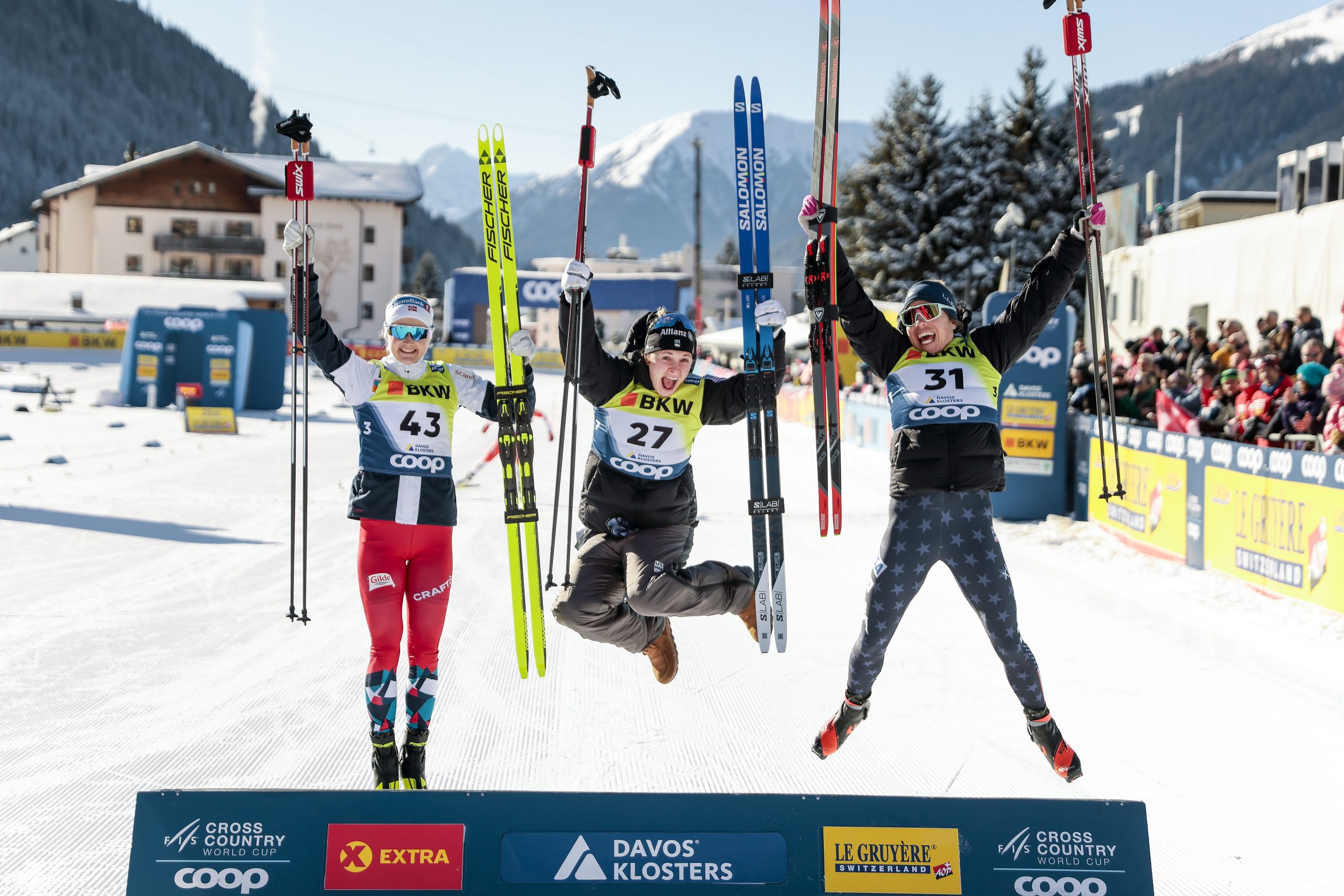
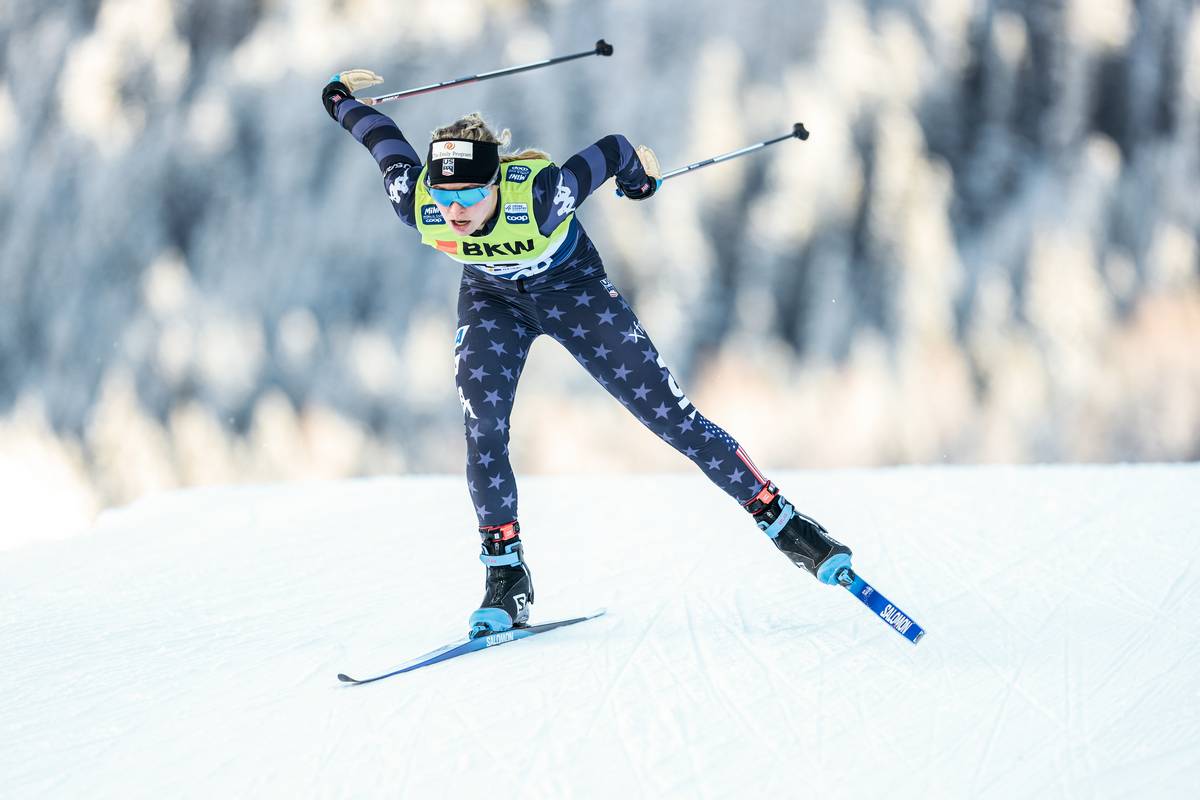
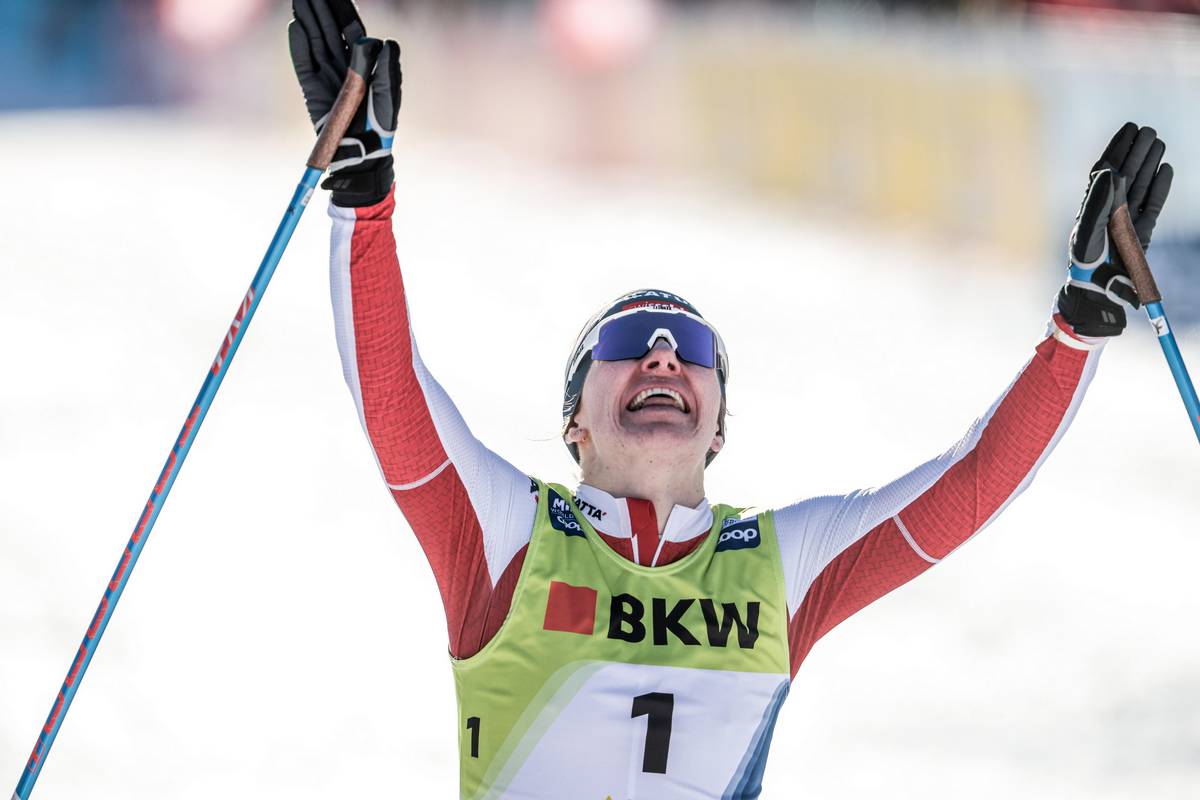
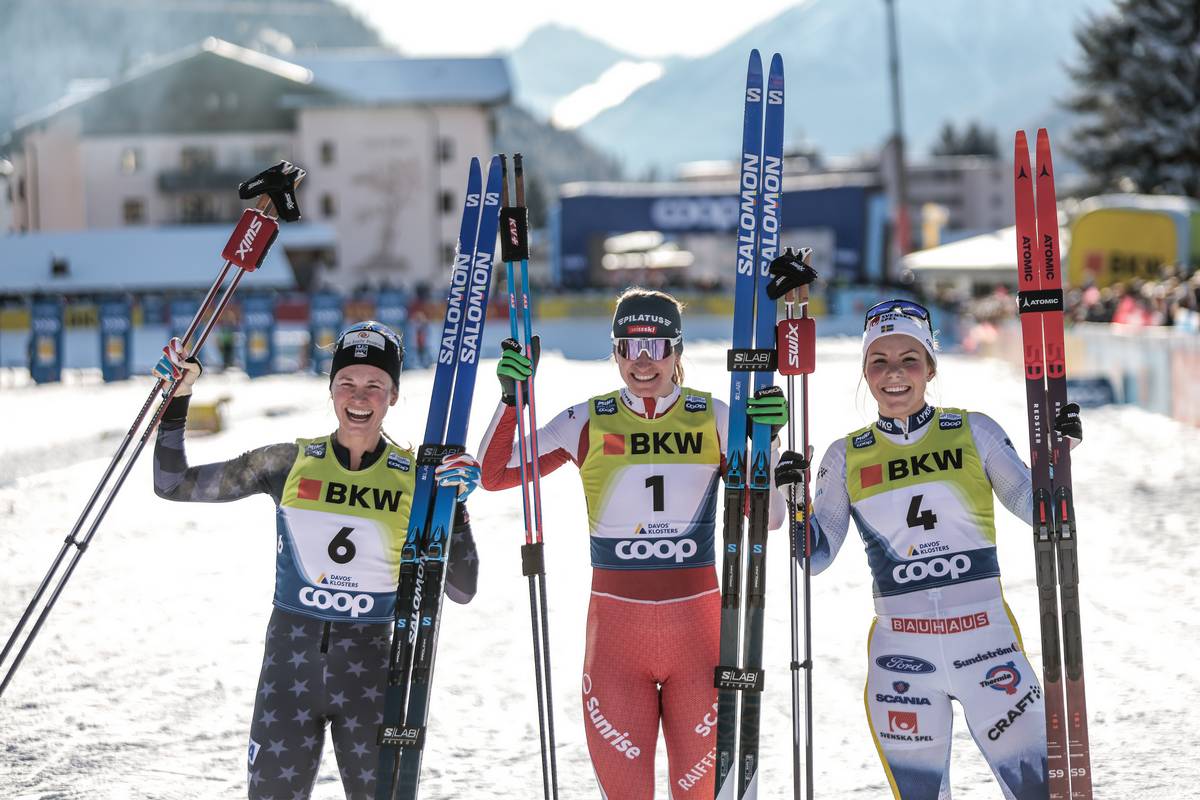
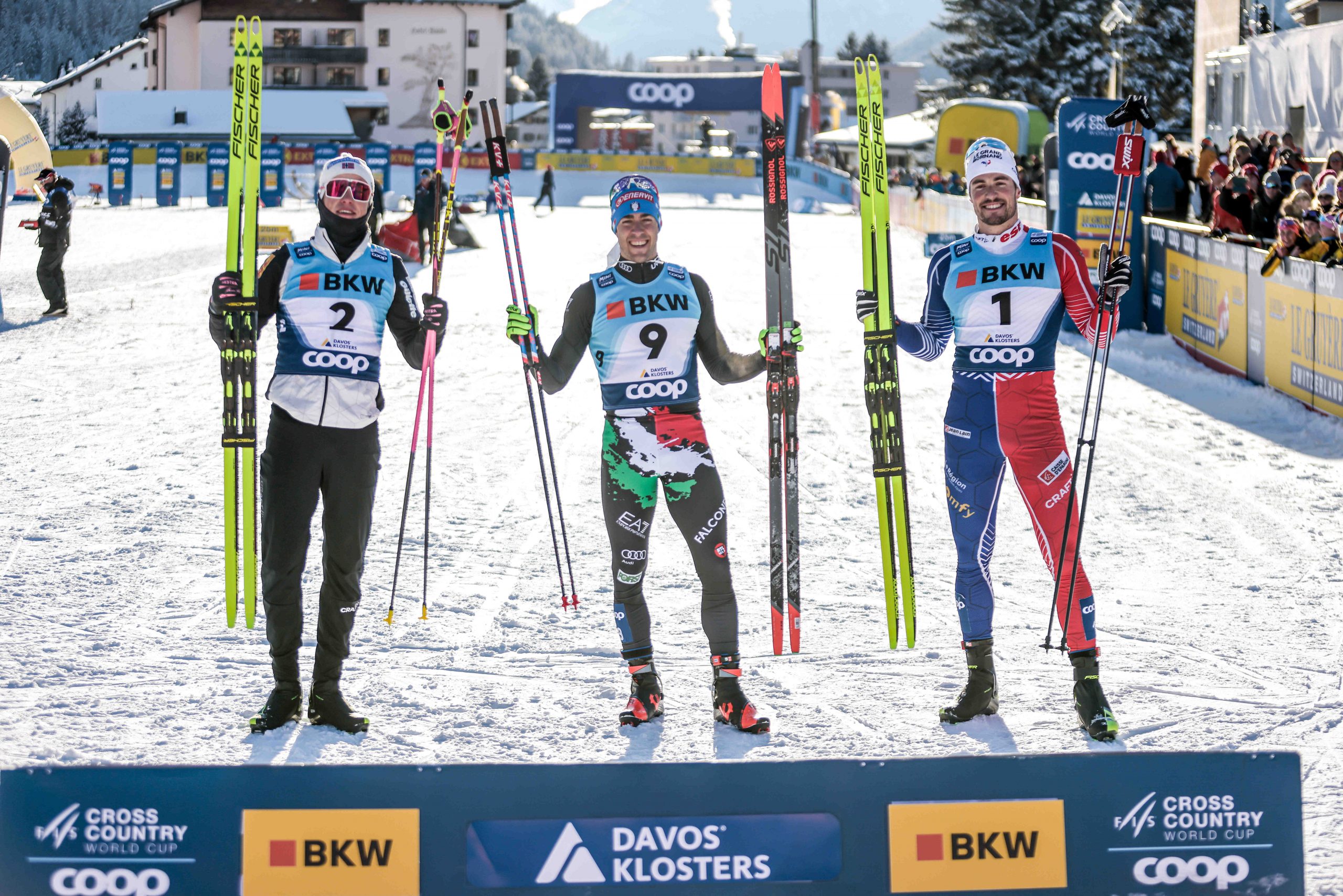
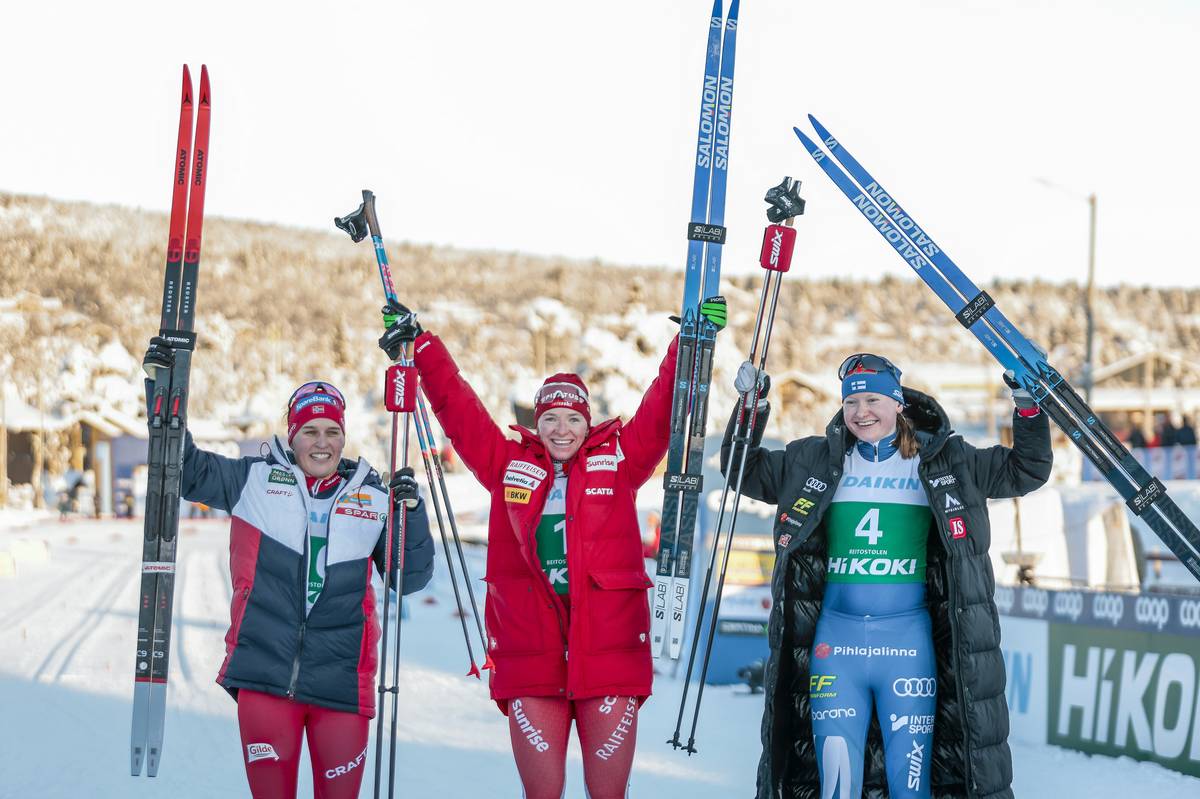
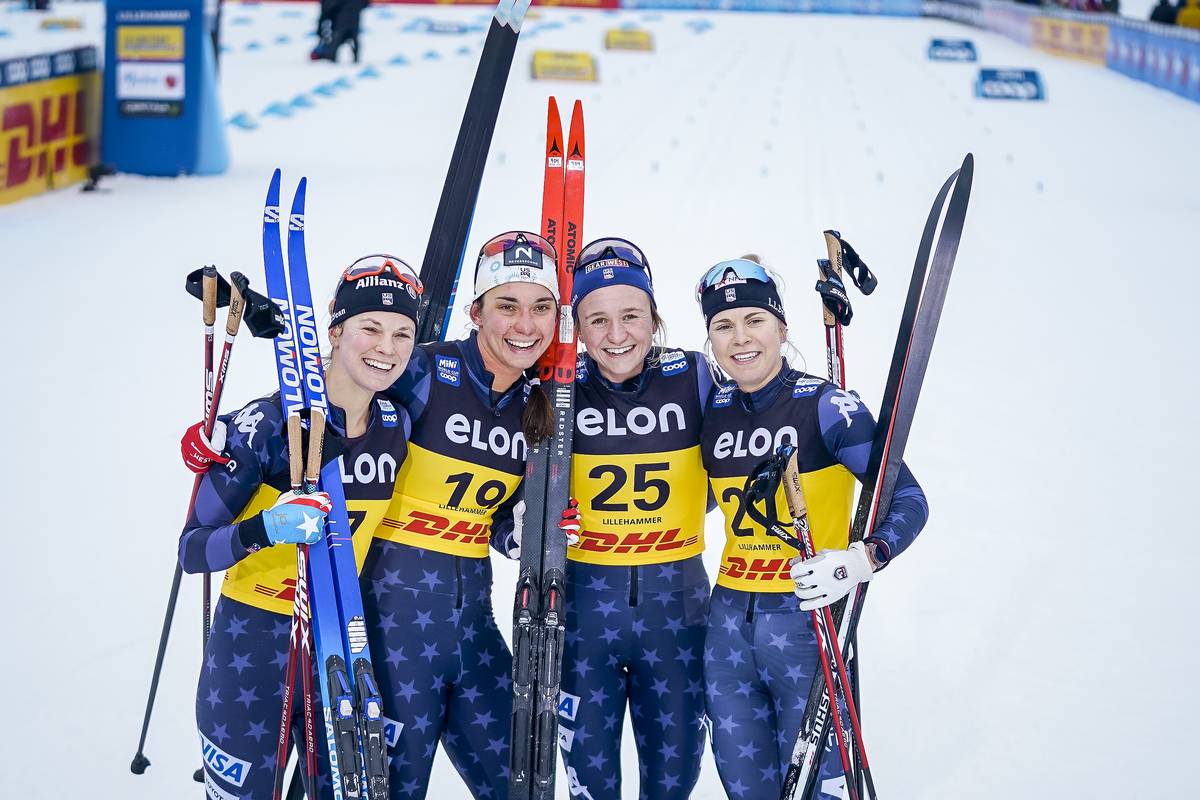
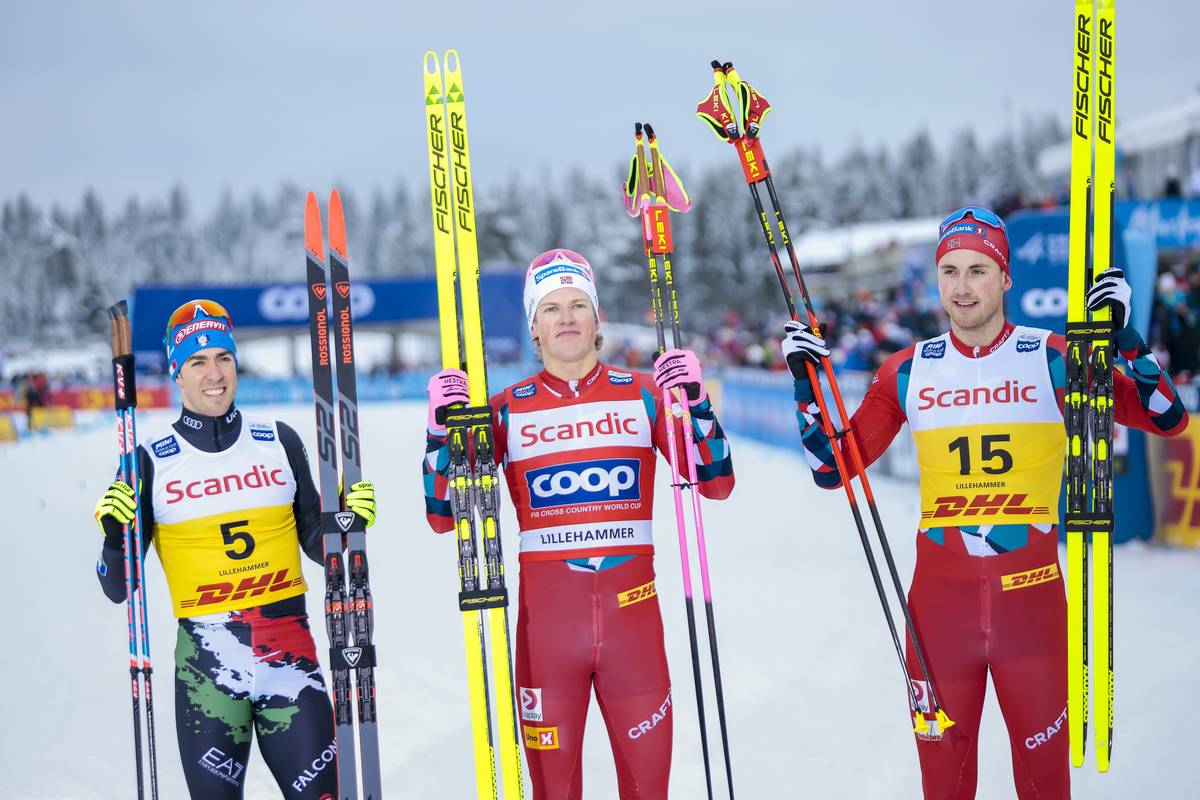
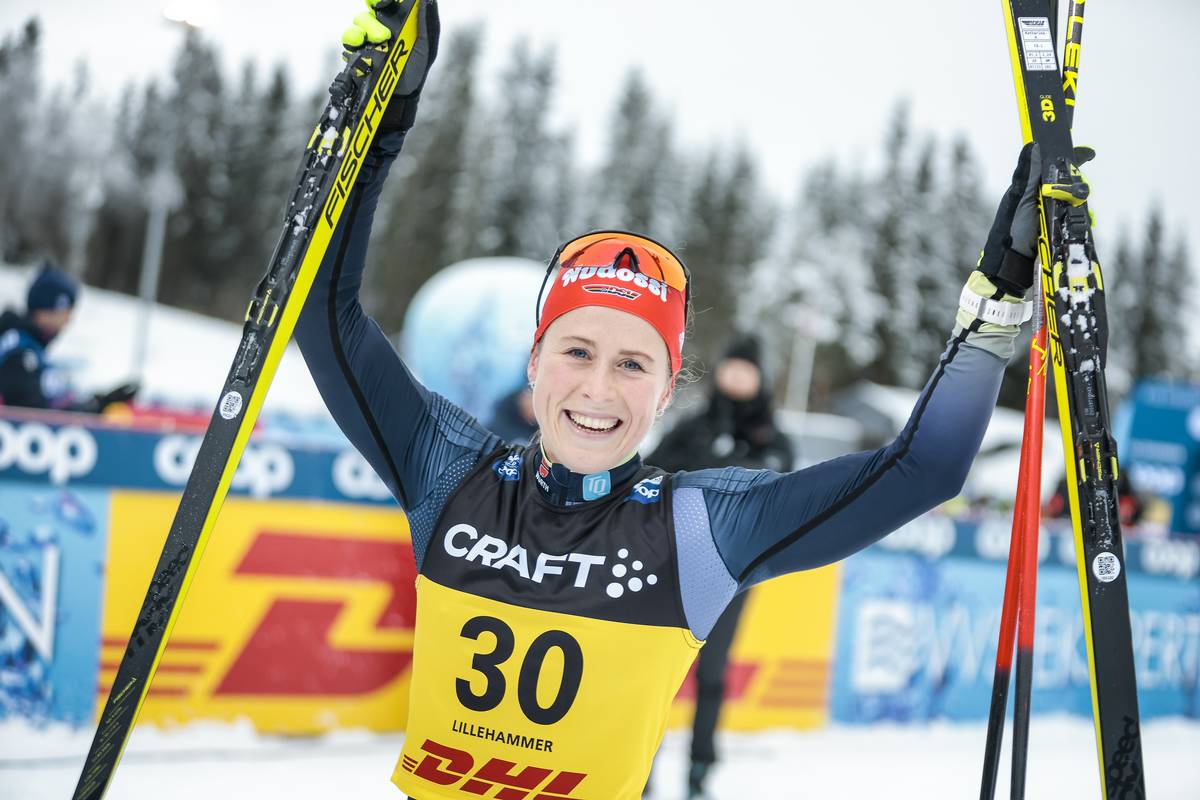
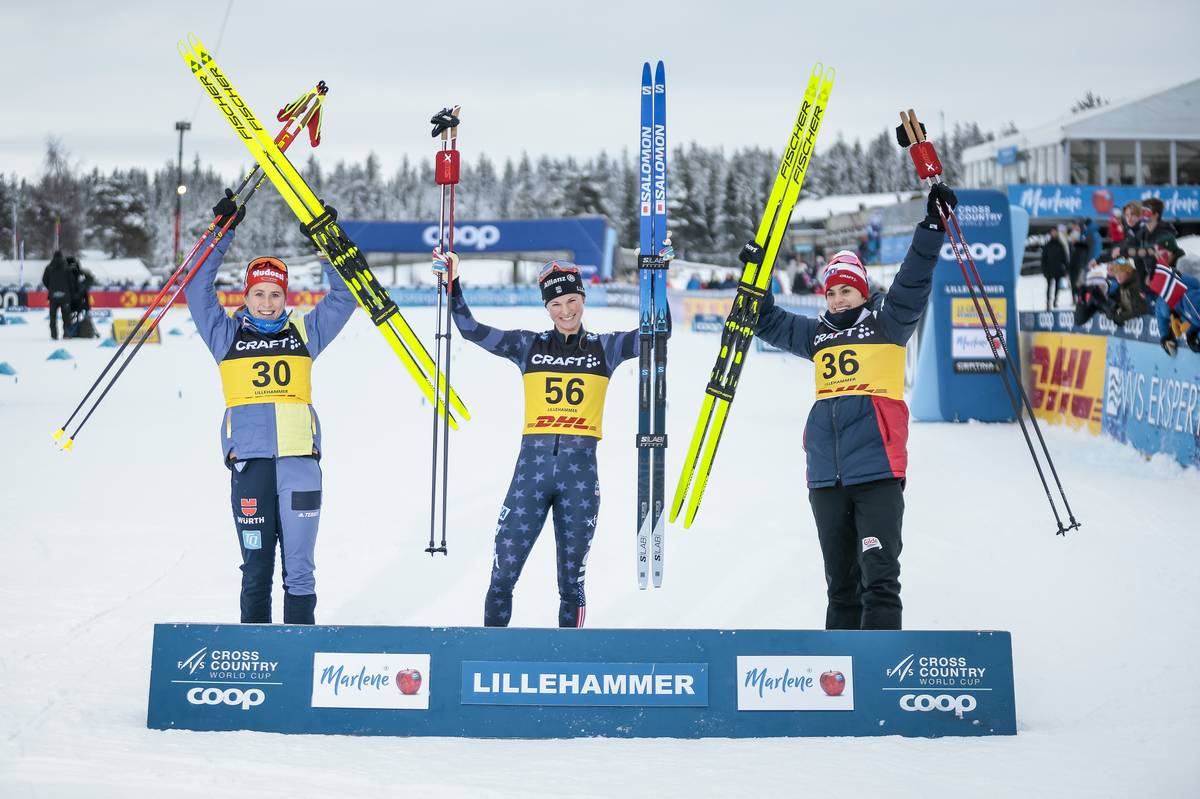
    An American celebration in Davos as Jessie Diggins and Rosie Brennan take first and third: l-r Ingvild Oestberg (NOR), Jessie Diggins (USA), Rosie Brennan (USA) (Photo NordicFocus)

    Today the World Cup returned to Davos, Switzerland where the women competed in the 20 k Individual Start Freestyle.  As has been the case for the last several weeks, much of the critical pre-race story was about who wouldn’t be present.  Absent from the field was Swedish long-distance heavy hitter Frida Karlsson and teammate Ebba Andersson.  Missing from the Norwegian squad was Heidi Weng.

    The U.S. hoped that Jessie Diggins could find her way back to the podium after yesterday’s second place sprint finish.  Diggins has the most wins of any active woman athlete in individual distance freestyle, having won 10.  She is also the most recent woman to have won consecutive individual World Cup distance events in the freestyle when she did so in January, 2021.  After yesterday’s sprint performance, Diggins moved into second place in the overall World Cup standings, behind Tiril Udnes Weng (NOR).

    Taking first place was Jessie Diggins (USA), in second was Ingvild Flugstad Oestberg (NOR), and in third Rosie Brennan (USA). Other American finishers were Sophia Laukli (17th), Alayna Sonnesyn (26th), and Lauren Jortberg (39th). Novie McCabe was scheduled to race but did not start due to illness.

    It was another standout day for the Canadians with Katherine Stewart-Jones finishing 11th, Olivia Bouffard-Nesbitt 30th,  Dahria Beatty 32nd, and Liliane Gagnon 40th.

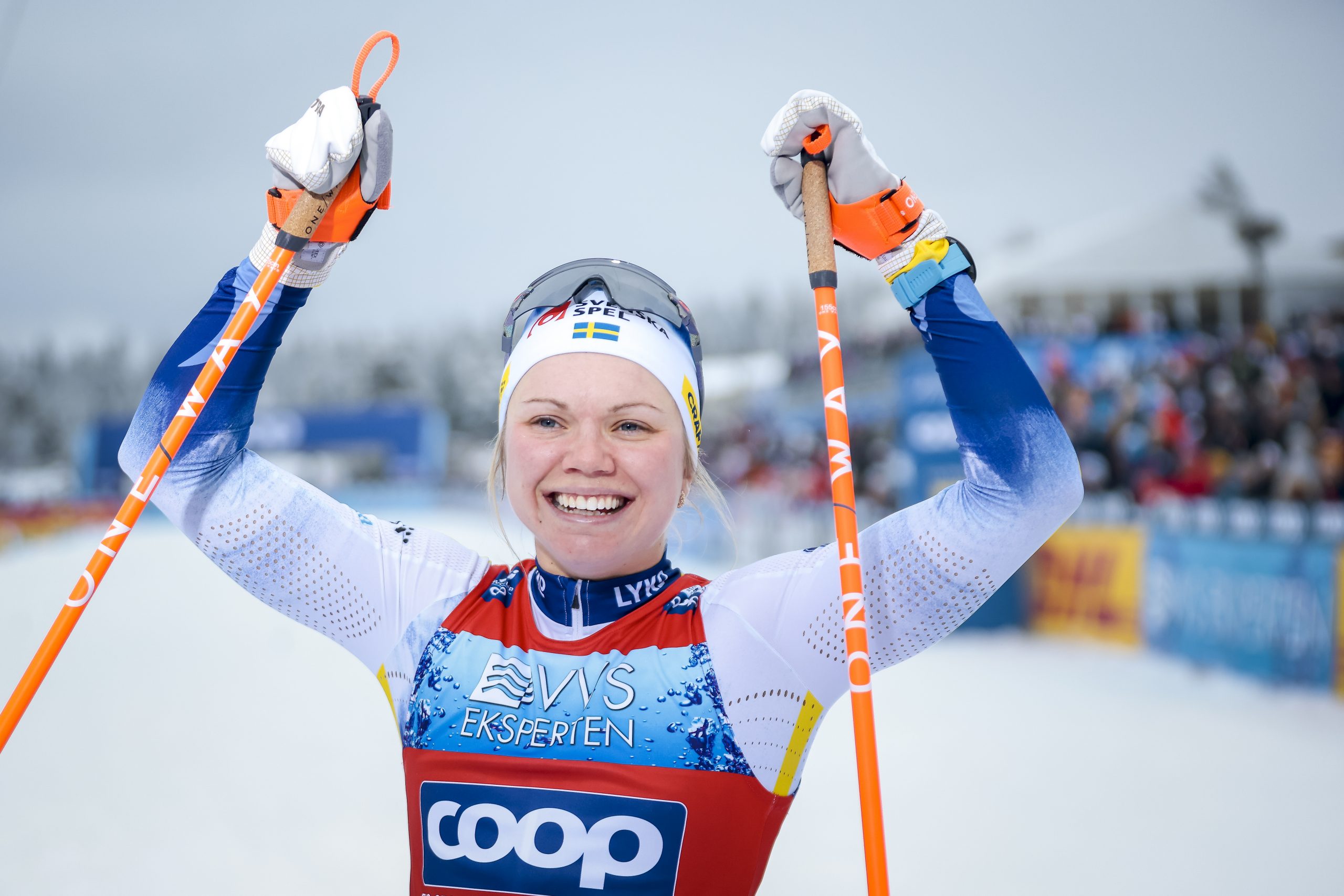
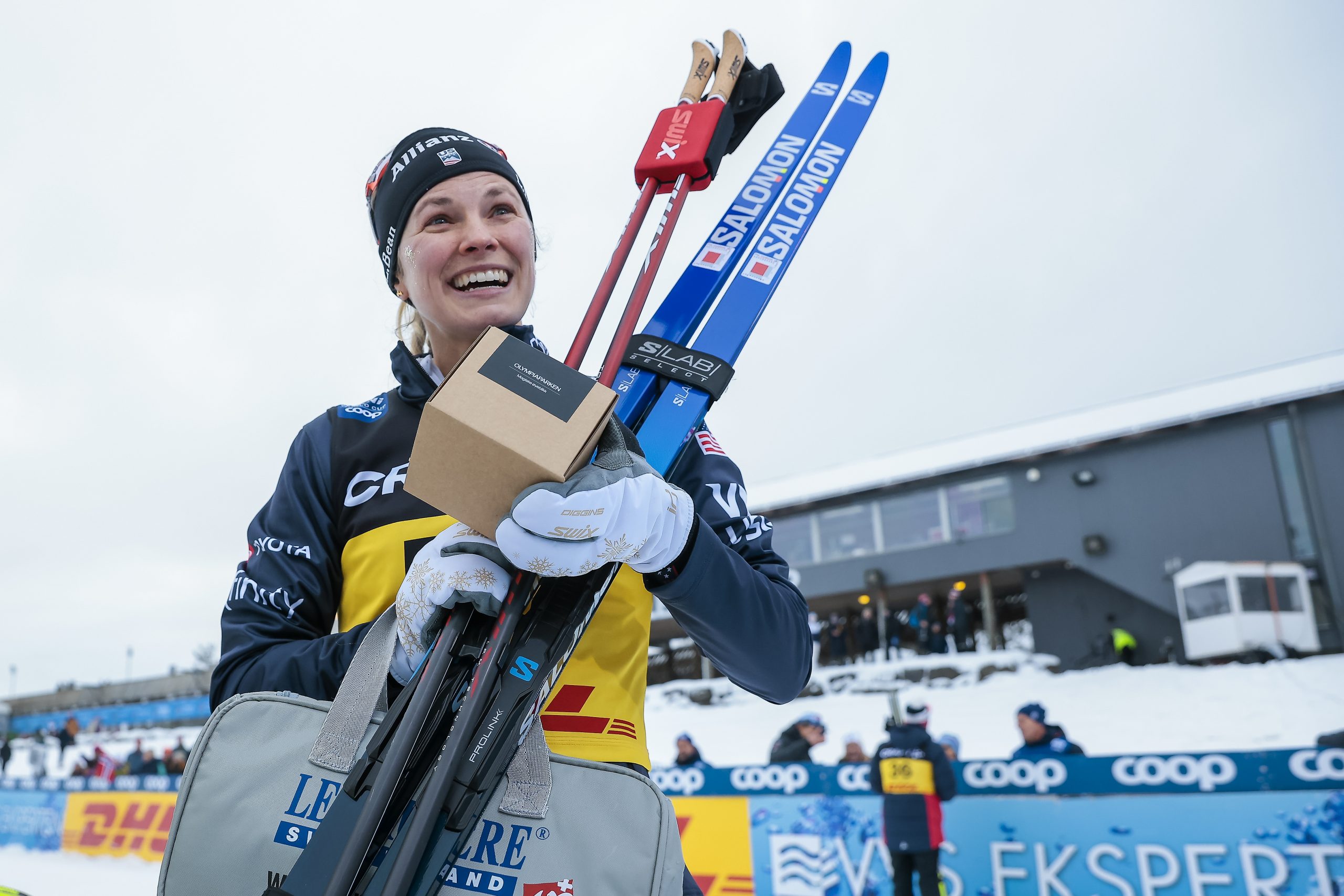
    Jessie Diggins (USA) showing the hardware that comes with first place. (Photo: NordicFocus)

    In a pre-race interview Diggins said that she thought Davos was a fun course and really challenging. “It’s sneaky hard,” she said, reiterating her love for individual start skate races.  “Just give me a trail in woods by myself and my skis and my brain . . . and I’m just excited to see how hard I can go.”

    The skiers had another beautiful Davos day with full bright sun.

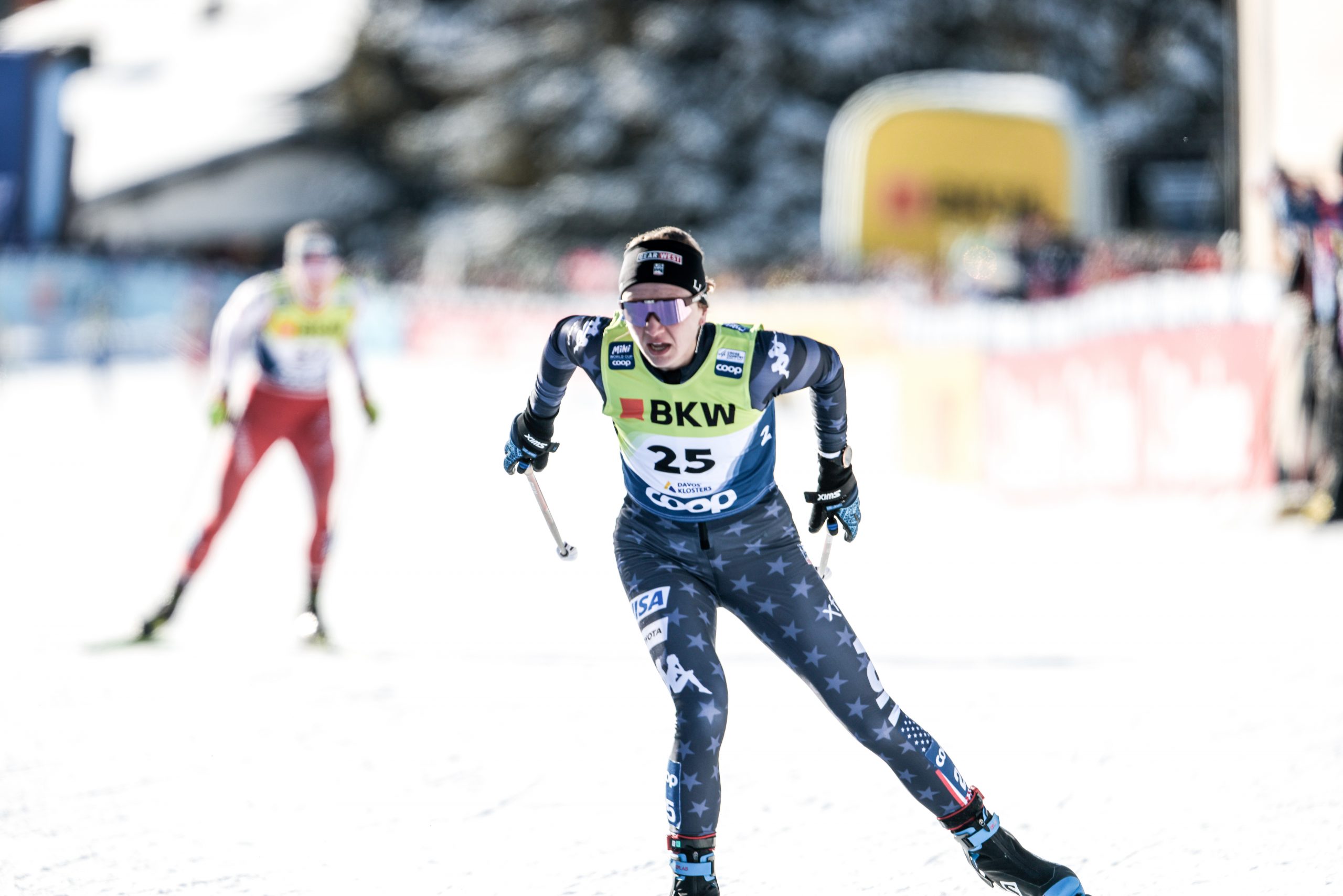
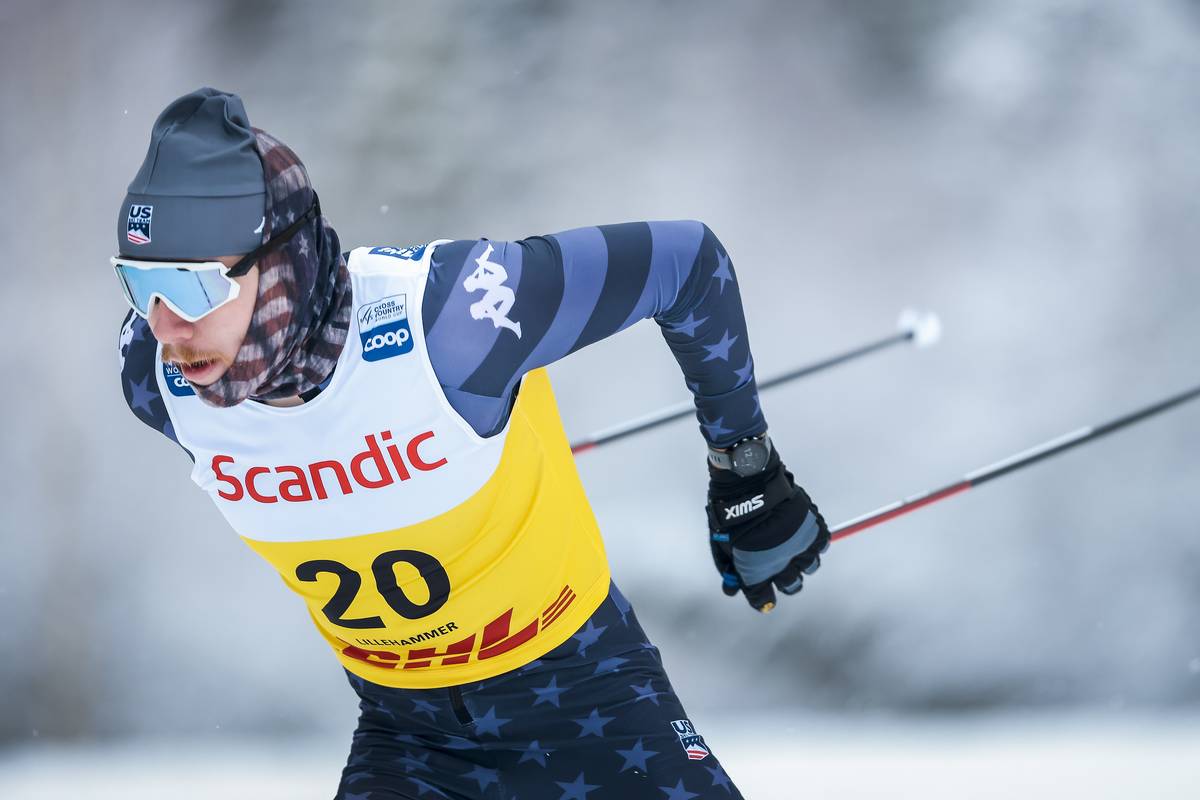
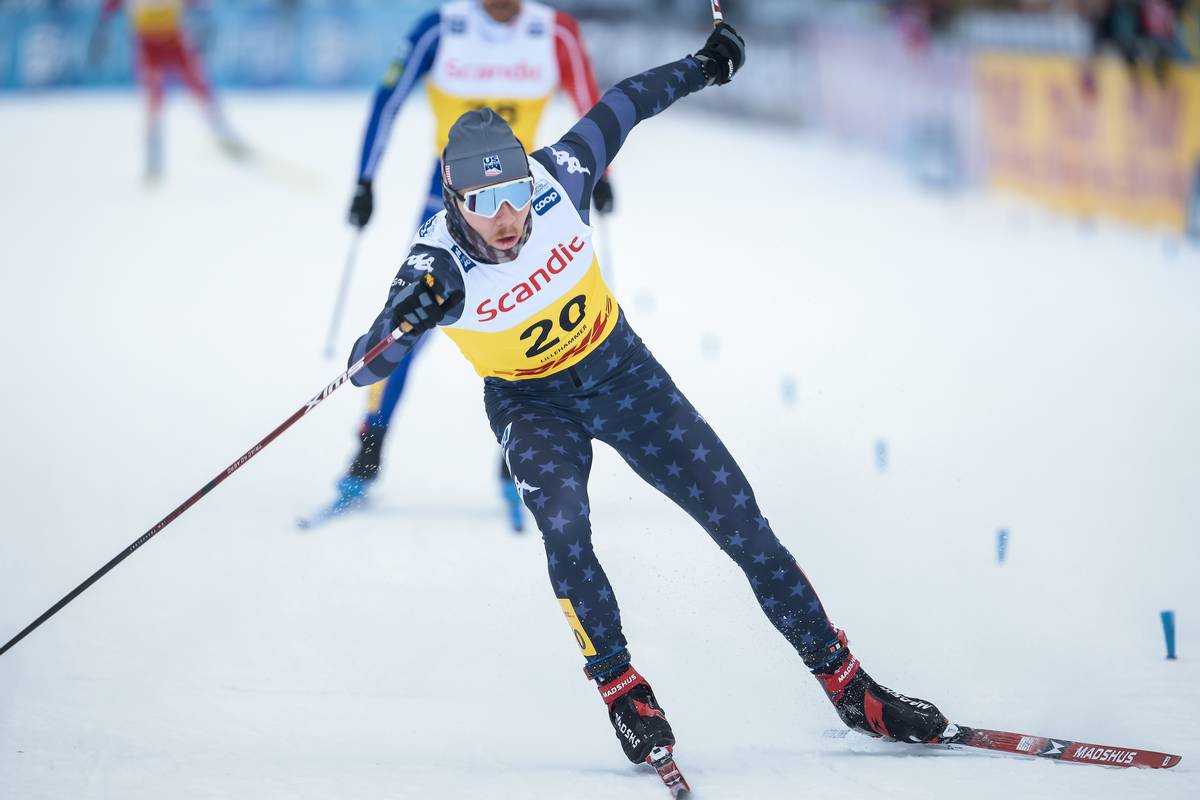
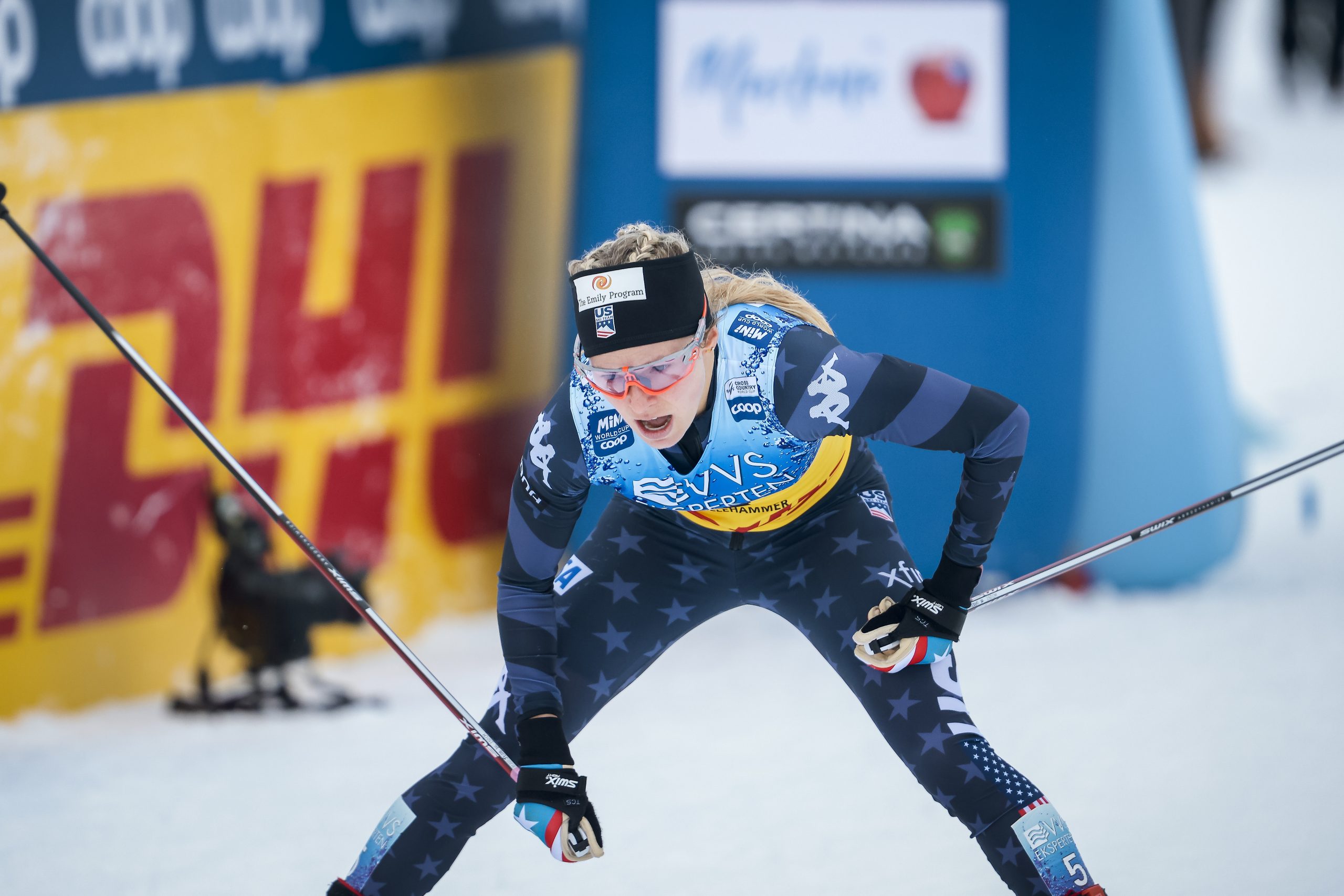
    Rosie Brennan with the decisive lunge at the finish.  It was enough to get her third place by half a second. (Photo: NordicFocus)
    20 K Individual Freestyle

    Diggins went out hard at the start. At the 2.2-kilometer time-check she had the fastest time by a slim margin over Claudel Delphine (FRA).  Brennan started at a controlled tempo and was fifth after the first time check.

    Diggins kept the hammer down for the first  seven kilometers, leading at every time check. But her lead was very small, ahead of Oestberg by only seven seconds. By the time the 7.2-kilometer mark was reached, Oestberg—who had a later start position than Diggins—had clawed her way into first, leading Diggins by just over a second. The see-saw between the two would continue for the rest of the day with Oestberg hanging onto a small lead for much of the race.

    Tactically, it appeared that Oestberg might have an advantage being the last of the top three skiers to start, so she would be fed the others’ times along the way. But Diggins has told Fasterskier in the past that she’s not always interested in hearing split times; she just skis as hard as she can. She also values having warmups conclude close to her starting time.

    U.S. coach Chris Grover confirmed with Fasterskier that, “[Diggins] likes to take an earlier draw in start position because she likes to not have the track closed for so long for warmup. She really doesn’t even think of splits out there. Jessie knew exactly how she wanted to ski that course and that was to not go quite as hard on all of the ups . . . you have to work all the transitions, all the corners, all of the downs.  The last 1.8 K are down . . . she had that strategy in mind for how she was going to ski it and she went out and skied it exactly the way she wanted to.”
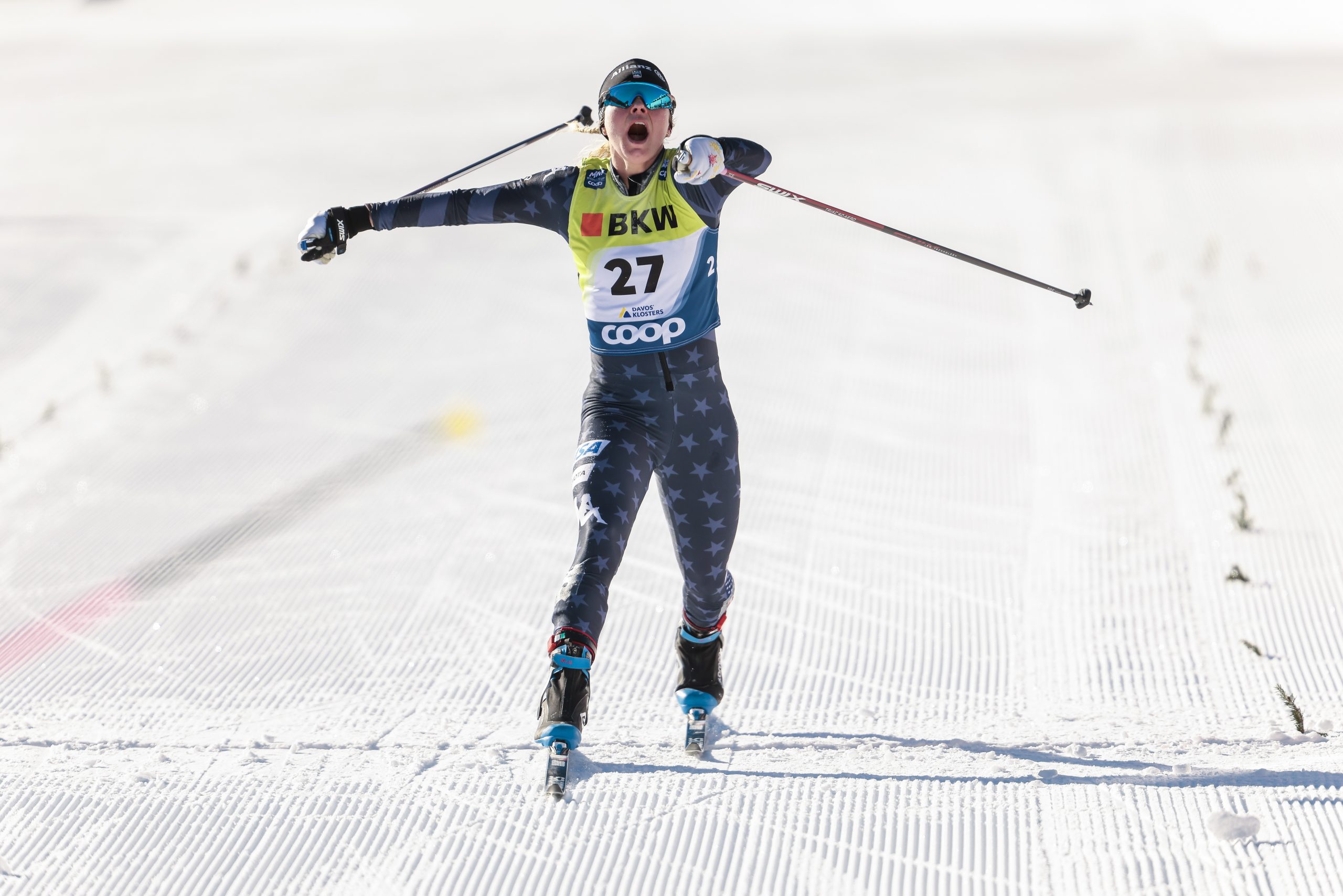
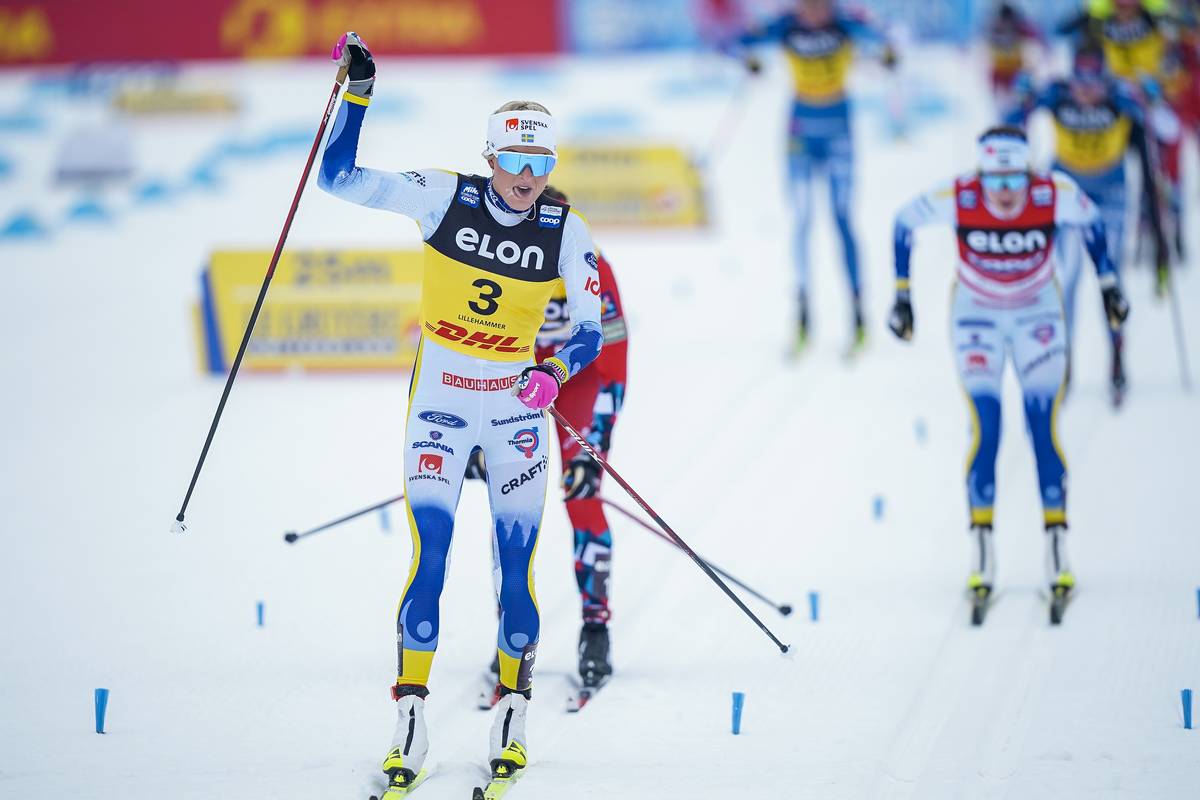
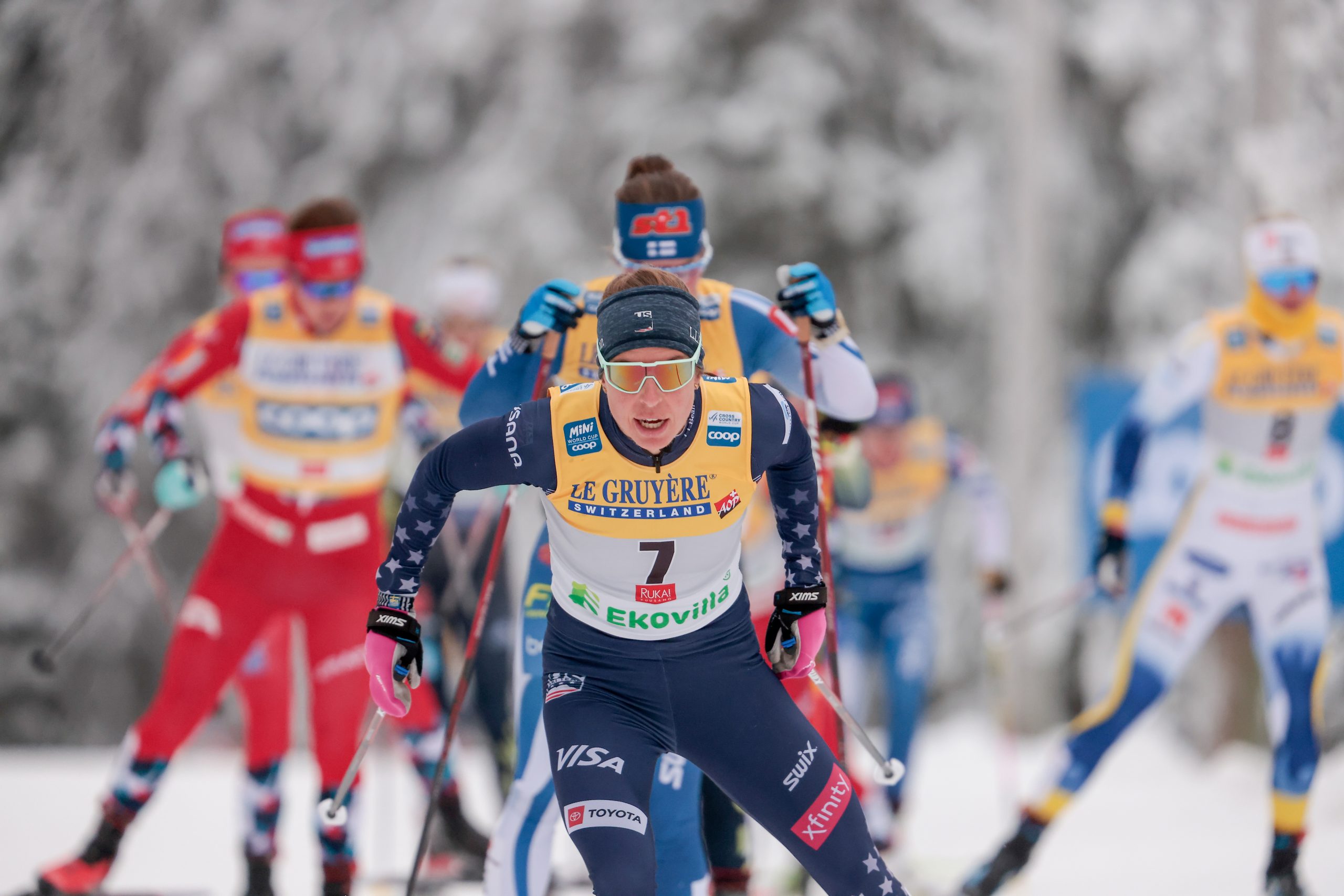
    Jessie Diggins (USA) found another gear in the final 1.8 k to finish first. (Photo: NordicFocus)

    Grover continued that it was a different approach for Brennan. He said, “She’s prioritizing climbing on the uphills. Two opposite strategies and they both worked out pretty well for them.”

    Twenty kilometers is still a relatively new distance for the women, so proper pacing would be critical.  Grover indicated that the change to 20 k hasn’t been much of an issue. “It seems like it hasn’t been that hard of a transition,” Grover said. “They looked like they were at a high pace the whole time, the same kind of strategies they employed on this course in 10-K. We did a little bit of feeding, which we wouldn’t have done in a 10-kilometer event. Otherwise, it wasn’t so different.”

    “I really wanted to pace it like red-line pacing…go as hard as I could right before I felt like I was going to blow up, and then hold it there.”                                                  Jessie Diggins

    Diggins continued: “My strengths are the second half of the lap with all of these working sections, trying to find the extra seconds here and there,” she said. “We had some really awesome skis, and awesome energy from the fans.”

    Regarding pacing for today’s race, Brennan told Fasterskier that: “I have never done a 20k interval start which was probably true for the whole field today. That made it really tricky to know the pace or really what to expect. I love the course here and love skiing at altitude so I had some confidence that I could find a steady pace and hold it.”  
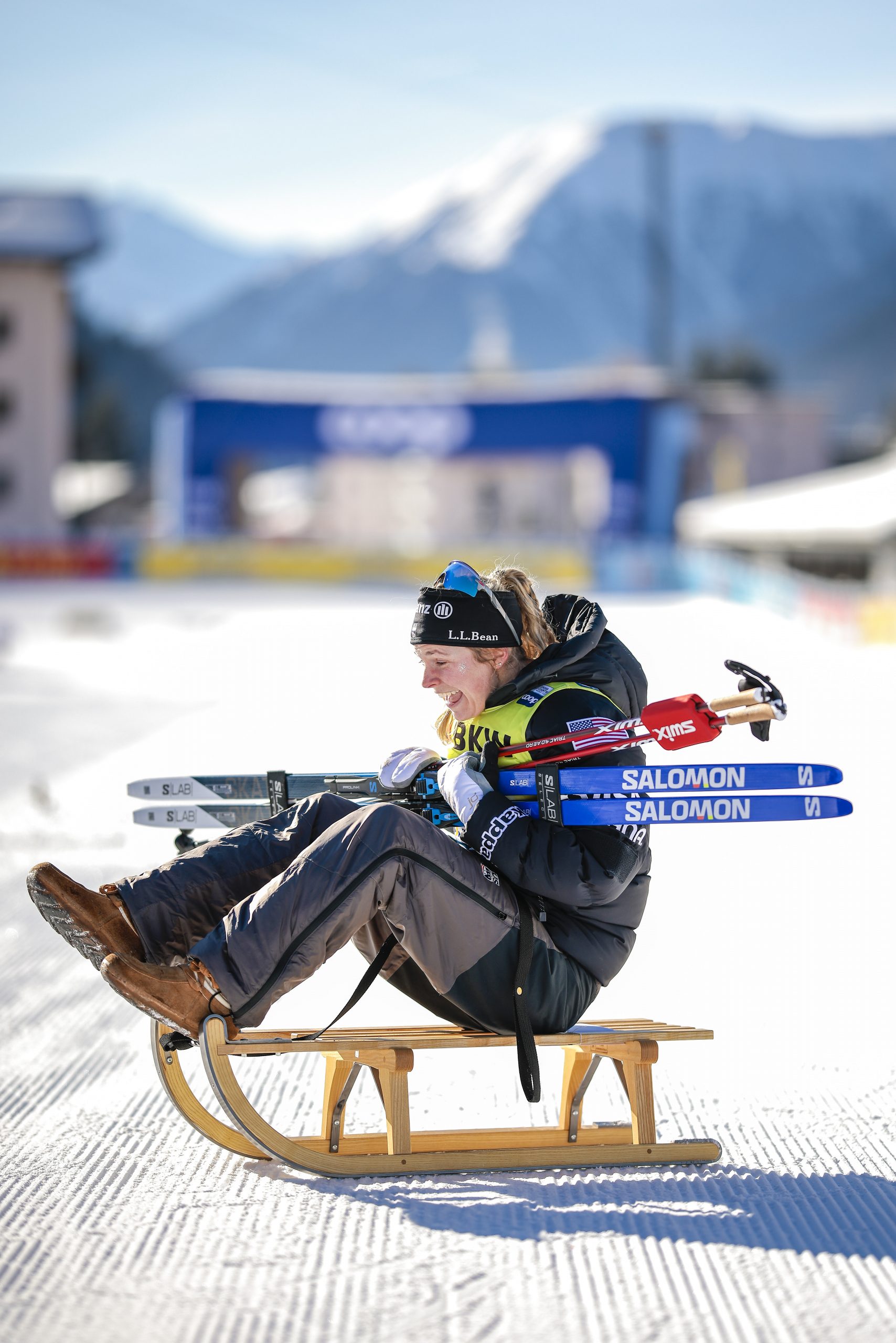
    Jessie Diggins (USA) enjoying her first place hardware in Davos.  The full-sized sled goes to the winner.  (Photo: NordicFocus).

    With only five kilometers to go, the race for first was almost a dead heat.  Oestberg had a scant three second lead over Diggins. Meanwhile, the fight for third was boiling down to Brennan and Tiril Udnes Weng (NOR). At the 15 kilometer mark, Weng held a one second lead over Brennan. Both those racers were over 13 seconds off first place.

    As the race wound down, the momentum for first place seemed to favor Oestberg as she continuously displaced Diggins from the lead with each time check she passed. But her lead was small enough that Diggins remained in the hunt for first place.

    With two kilometers to go the competition had boiled down to two distinct races: Oestberg and Diggins battling for first, and Brennan and T. Weng battling for second. The tension continued to mount as Oestberg approached the final time-check at 18.2-kilometers. Oestberg had moved past Diggins at every time split since the 7.2-kilometer mark, and that trend continued at the last time check with Oestberg going into first place, but by only 2.9 seconds. Brennan and T. Weng were even closer with less than two seconds separating them with Brennan holding the lead.

    With the race close—but momentum still in Oestberg’s favor—one couldn’t help but have the feeling that things would go Oestberg’s way.
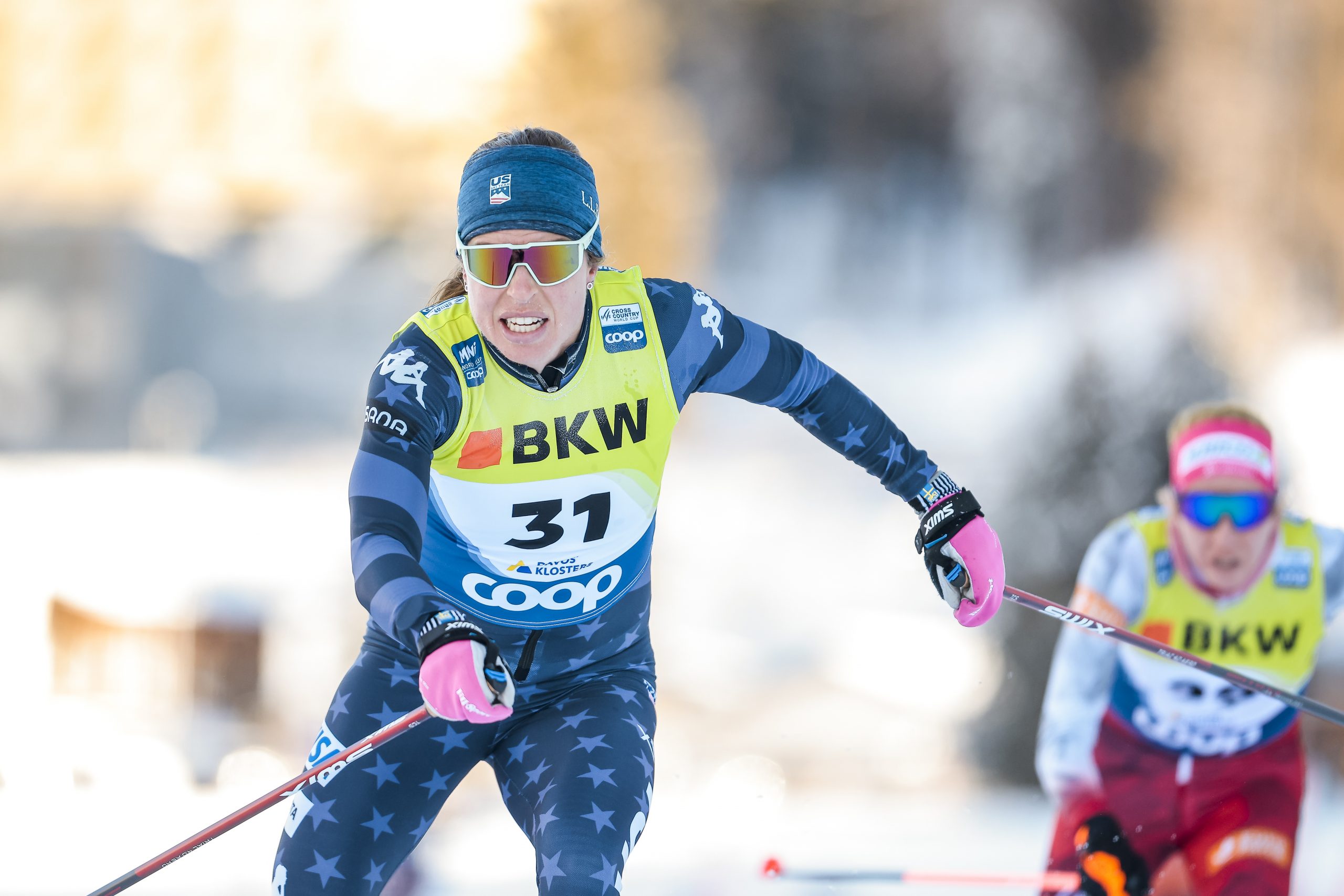
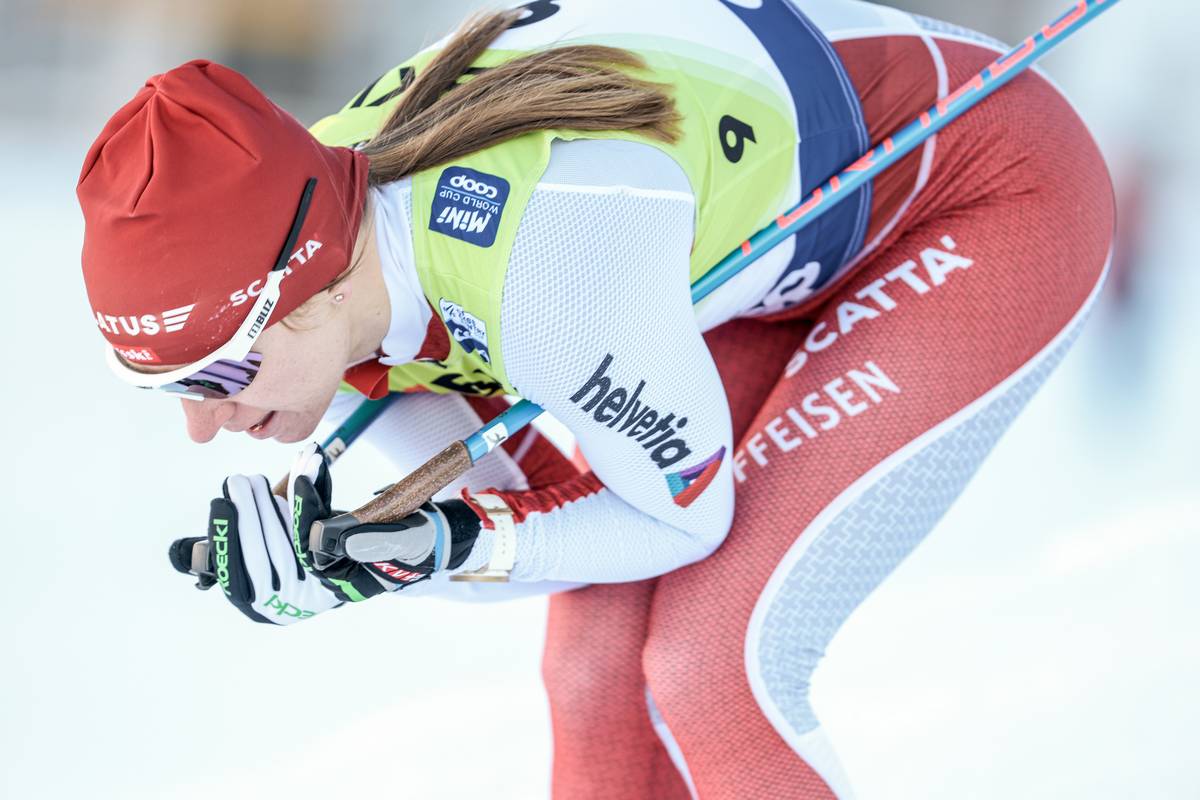
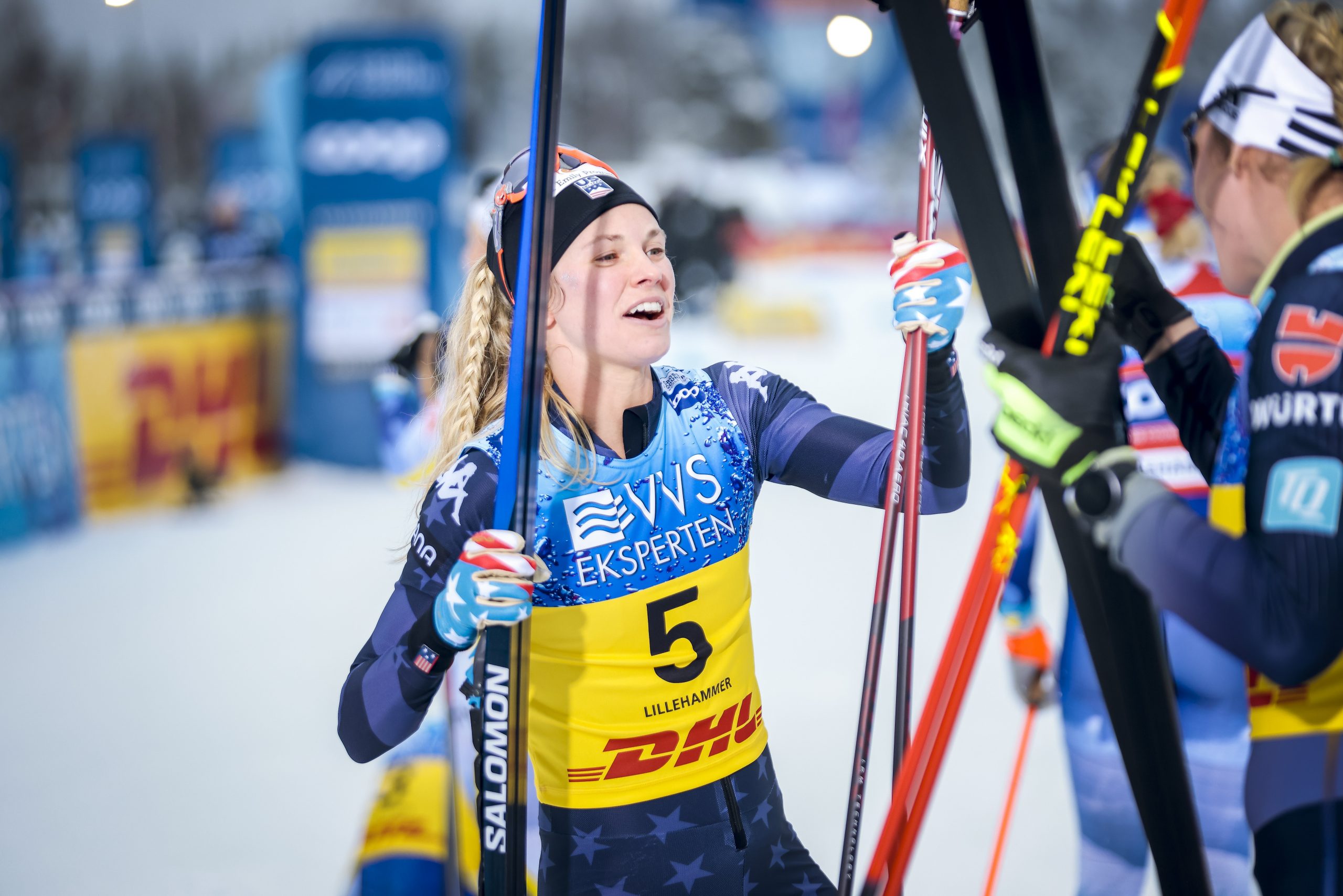
    Rosie Brennan (USA) showing the grit needed to earn a spot on the podium. (Photo: NordicFocus)

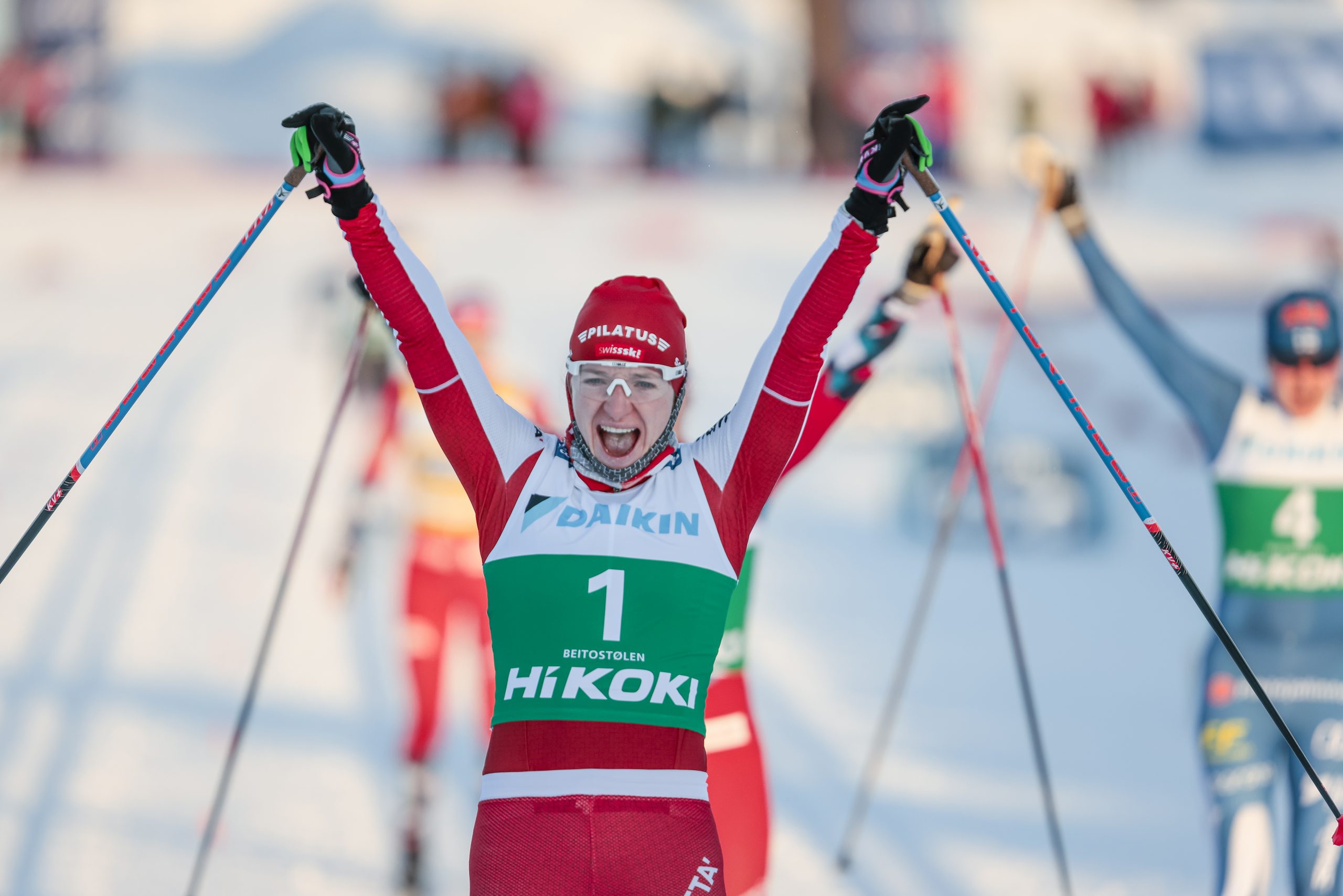
    But as ski fans have seen so many times over the years, Diggins always has that little extra bit to put forth at the finish. Over the last 1.8-kilometers, Diggins reached for her well-known extra gear and ended up skiing the final stretch in 3:33.7. Oestberg skied the same stretch in 3:42.1. The 7.4 second advantage over the final 1.8-kilometers was enough to give Diggins the win by 5.5 seconds, dropping Oestberg to second.

    “I knew it was tight, I knew it was exciting. I was just trying to ski my own race and ski as smart, as powerful, and as smooth as I could.  My mental mantra was find the glide. Individual starts are my favorite way to race, it’s just you and your head out there.”                                                     Jessie Diggins

    Diggins commented that she was so focused over the final downhill that she didn’t blink and her contact lens froze which added to the normal post finish line stress. “My eyes were ok, they just needed some time to warm up . . . no lasting damage; it was just quite painful and a little bit scary.”

    T. Weng was nibbling away at Brennan’s lead by tenths of a second. Weng skied the final 2.8-kilometers faster than Brennan, but Brennan had established a three second lead at the 17.2 mark. It would be just enough to hold off T. Weng who finished half a second behind Brennan. Brennan told Fasterskier that, ” I had really good skis today and did all I could to push the downhill on the last lap which just barely snuck me on the podium.” Brennan said of the day’s events that, “Today was a great day for USA!!! I was pleased to turn around a disappointing day yesterday into a podium today. It was a tight race the whole way and I am thrilled to have just nipped the podium spot. It was great to share the podium with Diggs and is a great way to close out period 1 racing. Now it’s all eyes on the Tour!”

    A 20 kilometer race had turned into a game of inches with Diggins and Brennan skiing perfectly to claim the podium.  It was a glorious day in what turned out to be a fantastic weekend for team U.S.A. After the dust had settled from the day’s racing, Diggins would find herself firmly in second place in the overall World Cup points standings. Tiril Udnes Weng holds first place with 872 points. Diggins is in second with 738, and Krista Parmakoski (FIN) is in third with 625.

    The World Cup takes a weekend off and picks up December 31st in Val Mustair, Switzerland for the start of the Tour de Ski with the freestyle sprints leading off.
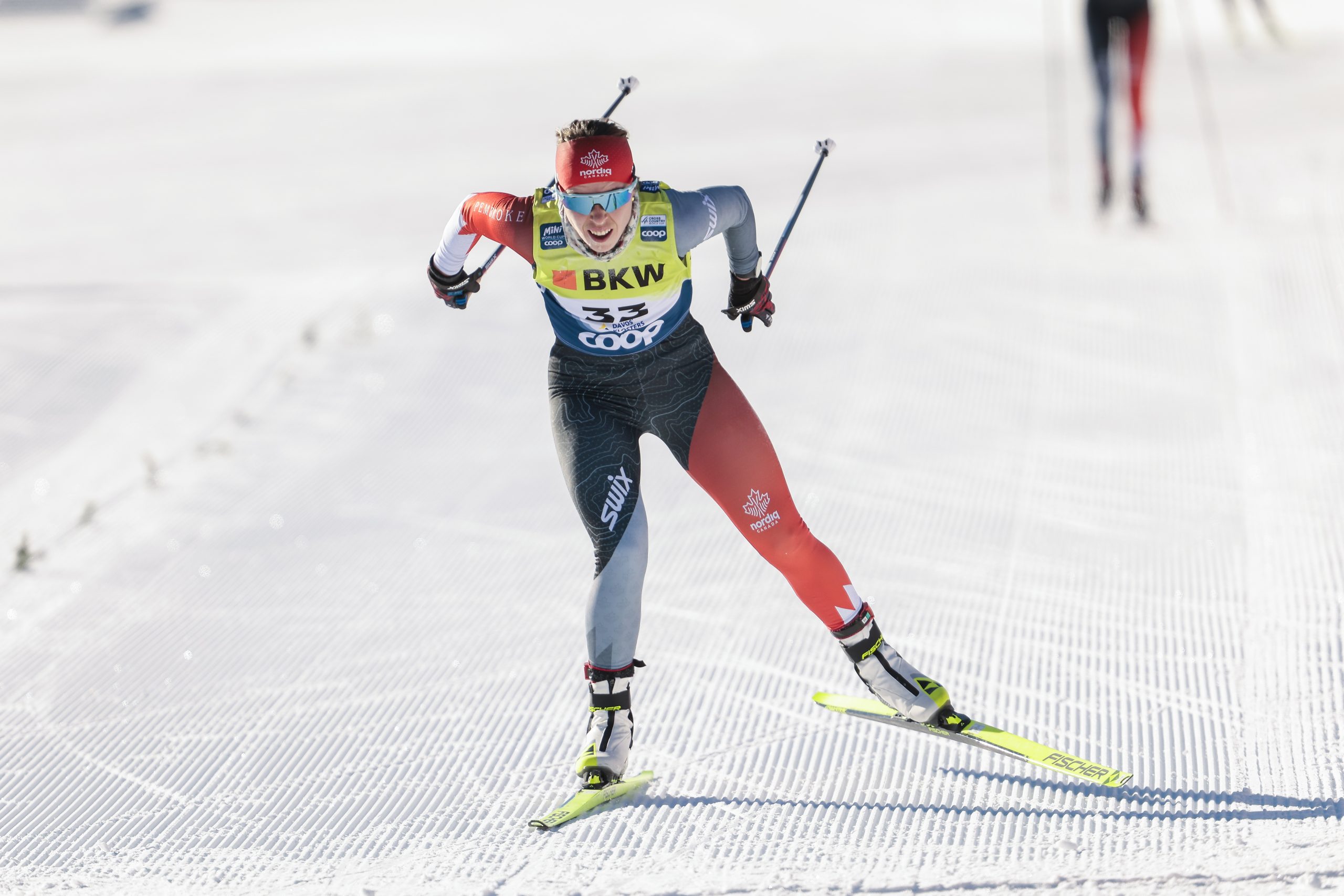
    Complete Results

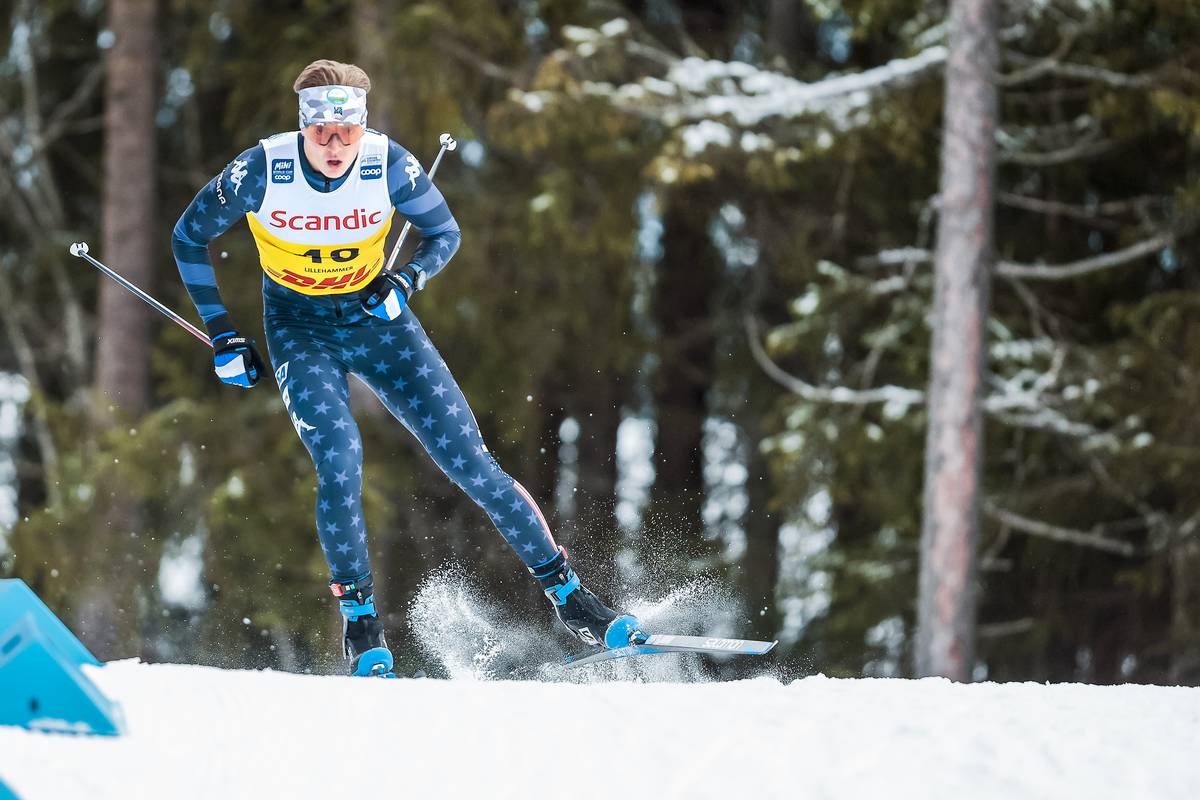
    Katherine Stewart-Jones (CAN) charging to 11th place for Canada (Photo: NordicFocus)


  • Diggins Takes Second in Davos Sprint Thriller

    Diggins Takes Second in Davos Sprint Thriller

    A_Hall_Mark_of_Excellence_Award-logo-300.png (300×244)This World Cup coverage is made possible through the generous support of Marty and Kathy Hall and A Hall Mark of Excellence Award.  To learn more about A Hall Mark of Excellence Award, or to learn how you can support Fasterskier’s coverage, please contact info@fasterskier.com.

    Today marked the return of the World Cup to the alpine valley of Davos, Switzerland. Davos, normally a luxury festooned playground for rock stars, politicians, royalty, and assorted billionaires would have a decidedly more blue-collar feel today as hard working skiers would grind around the freestyle rolling sprint course of 1.5-kilometers. At 5,120 feet above sea level, Davos is about 800 feet below the maximum elevation allowed by the International Ski Federation (FIS). So altitude would have to be accounted for. This morning was the women’s opportunity to test their mettle in the high-altitude luxe setting.

    Jessie Diggins (USA) with another sparkling day—and another podium finish—in Davos. Diggins would finish the day in second place(Photo: Nordic Focus)

    It’s not too early to start looking at the overall World cup standings, and coming into today’s sprints, Tiril Udnes Weng (NOR) was in first with 690 points. Frida Karlsson (SWE) was second with 588 points, and American Jessie Diggins was in third, totaling 538 points.  Karlsson would be sidelined this weekend, so it would be a golden opportunity for Diggins to challenge for second place overall.

    Health issues would once again be a major theme for today’s sprint. The Swedes dominated the sprints early in the season, but as Period 1 comes to a close, the Swedish squad has been decimated by illness. Swedish standout Maja Dahlqvist—a pre-race favorite and sprint winner at Davos last year—would sit out the weekend due to a cold. The Swedish sprint squad would also be depleted due the continued absence of Emma Ribom, who had won the first two sprints of the year and has now tested positive for Covid. Joining her on the Covid list of Swedish stars would be regular contenders Anna Dyvik and Ebba Andersson. So dire was Team Sweden’s situation that they advanced only two skiers into the qualifying round, one of whom, Jenny Solin, was in only her fifth World Cup race. But the Swedes still had an ace going into the start of the day with Johanna Hagstroem carrying the team’s hopes.

    Regarding illness concerns, U.S. coach Chris Grover told Fasterskier that, “It is literally a constant battle now.” He emphasized the logistical challenge with skiers feeling ill or being exposed and needing to isolate from teammates. “We’re basically talking about it at every team meeting.”

    Nadine Faendrich (SUI) remained consistent and dominant throughout the day, displaying unmatched speed and strength every time up the significant hill on Davos’ Sprint course. (Photo: Nordic Focus)

    The hometown crowd would pin its hopes on Nadine Faehndrich, the Swiss skier who posted the fastest qualifying time and has been sprinting well of late. Going into the race, she was ranked fourth in sprint points and won the World Cup classic sprint last week in Beitostolen, Norway.

    Racers had a beautiful day with bright sun and temperatures in the upper twenties. It was the best that Davos has to offer and a much needed respite from last week’s brutal cold in Beitostolen. Even so, the qualifying field was small, due to a mix of illness and fatigue, consisting of only 39 skiers. With the Americans’ entering five racers, the odds going into the race appeared favorable. Ultimately, four Americans advanced to the quarterfinals: Rosie Brennan qualified fifth, Jessie Diggins sixth, Julia Kern ninth, and Alayna Sonnesyn 25th. Lauren Jortberg narrowly missed qualifying, finishing 34th.

    Among Canadians, Dahria Beatty qualified 24th, Olivia Bouffard-Nesbitt 30th , and Liliane Gagnon 32nd.  It was the first time in the heats this year for Yukon native Beatty, and the first time ever for Quebec native Bouffard-Nesbitt.

    Davos Women’s Sprint

    In a tight race it was Faehndrich first, Diggins second, and Hagstroem third.  For the Americans who qualified for the heats, Julia Kern finished 10th, Rosie Brennan was 13th, and Alayna Sonnesyn was 24th. For Canadians in the heats, it was Beatty 23rd and Bouffard-Nesbitt 25th.

    Nadine Faehndrich (SUI) celebrates her second World Cup sprint win in as many weeks. (Photo: Nordic Focus)

    Diggins and Brennan ended up in the same quarterfinal heat.  It wasn’t necessarily a premeditated strategy.  According to Grover, “When Diggins chose the first heat no one else was in it. When Rosie chose, she went in it next which was a smart strategy.” But this meant that the Americans would have to finish 1-2, or have a fast race for both to qualify. It turned out to be an unlucky turn.

    Diggins easily qualified coming in second. Brennan finished third and would have to wait to see if she qualified as a lucky loser. She would not make the cut and finished 13th on the day, no doubt a disappointing outing after her excellent qualifying time. Brennan was squeezed out of advancing by Slovenian sprint specialist Eva Urevc, who performed exceptionally well. Grover commented that it was kind of surprising that Urevc was in the heat as well. “She skied great all day and was surprisingly strong.” In her comments after the race, Brennan said, “I did not have the day I was hoping for today. I am really struggling to find my power and speed in sprinting, which has been frustrating for me.” Addressing any lingering health concerns she continued that, “My fall and early season has been marred by illness, and I think that has made it difficult for me to find all my gears. I am doing my best to find patience as there are still many races left in the season, but patience is not my strength so it’s providing me with quite the challenge . . . I am healthy now, and my base fitness still feels good, so I am looking forward to tomorrow.” 

    Rosie Brennan (USA) giving it her all in Davos. (Photo: NordicFocus)

    Julia Kern qualified into the second quarterfinal and finished third in her heat as well.  She, too, would wait for a lucky loser spot, and ultimately did move forward as a lucky loser.

    Alayna Sonnnesyn was in the third quarterfinal. She finished fifth and her racing ended there, but it was a triumphant day for Sonnesyn since it was her first time qualifying into the heats.

    Alayna Sonnesyn (USA) reaching the sprint heats for the first time. (Photo: NordicFocus)

    In semifinals Kern found herself skiing in the first semifinal along with her teammate, Diggins.  Diggins and Kern started in the back of the pack, but Diggins quickly moved toward the front. Kern stayed in the back and did not seem to have the speed to make a move on the leaders. It was a very tactical race and heading toward the final stretch it was Diggins in third and Kern holding on in fifth. Kern barely missed out on advancing, while Diggins would proceed to the final.

    After the race Kern acknowledged her fatigue: “My body felt a bit tired today with the combination of altitude and all of the racing at the end of a long block.”  She added, “I was hoping to have a little more pep, but I fought super hard. It was scrappy out there, I was throwing elbows and pushing some arms in the quarterfinals to keep my position.  We were all screaming for Jessie in the finals.” 

    It is a sign of the growth and maturity of the U.S. program that there could be a note of disappointment with “only” one skier in the finals.

    The hometown hopes were kept intact when Faehndrich demolished the field in her semifinal, winning by a large margin.

    The Finals

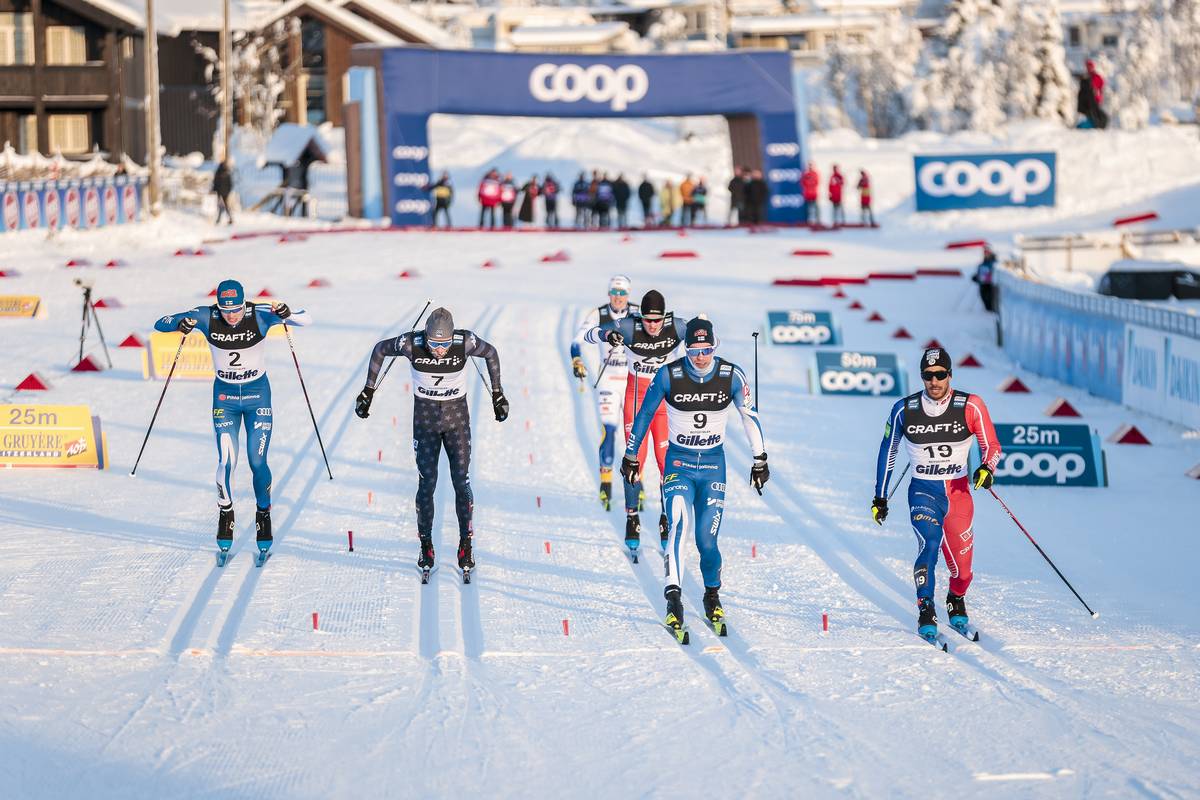
    In the finals, Diggins slotted into the middle of the pack and then pushed herself into second. At the top of the first hill, T. Weng  made an early push to the front while Diggins remained third. Faehndrich powered herself into contention in the middle of the race. Diggins continued to push but could not keep the pace with Faehndrich. It was a four-way fight at the finish with Faehndrich having a slight lead. Ultimately, it was Faehndrich who would come out on top.

    Coming into the finish line, it looked like Diggins would have to settle for fourth, but she made a perfect final lunge to finish second. The depleted Swedish team was still able to find its way onto the podium with Hagstroem finishing third.

    After the race, Diggins commented that she was channeling the energy from the fans who were extremely enthusiastic. “This course can really take a lot out of you, so I was trying to be smart and conserve where I could,” she said.

    “In the finals my strategy was to tuck in behind either Tiril or Nadine, and I just sort of ended up skiing the inside line. I was like, well, I can’t stay behind all these girls . . . that won’t put me into a good place, so I kind of went for the Hail Mary . . . this is either going to work, or I’m probably going to go down . . . it ended up working. I just took a really sharp inside line and it got me my own lane. All that practicing we did down under in Australia really paid off with the lunge.”    Jessie Diggins

    Said Grover of the finish, Jessie had a fantastic last corner. “From my vantage point, with five meters to go I would have guessed she was going to finish fourth. Jessie spends a lot of time on finish speed and lunging, and it really paid off today.”

    T. Weng, who had led for much of the race, ended up on fourth by 1/100th of a second.

    Davos Women’s World Cup Sprint RESULTS

    The World Cup Sprint podium in Davos, Switzerland:  l-r: Jessie Diggins (USA), Nadine Faehndrich (SUI), and Johanna Hagstroem (SWE) (Photo: Nordic Focus)
  • Pellegrino Triumphant in Davos Men’s Sprint

    Pellegrino Triumphant in Davos Men’s Sprint

    A_Hall_Mark_of_Excellence_Award-logo-300.png (300×244)This World Cup coverage is made possible through the generous support of Marty and Kathy Hall and A Hall Mark of Excellence Award.  To learn more about A Hall Mark of Excellence Award, or to learn how you can support FasterSkier’s coverage, please contact info@fasterskier.com.

    With the arrival of a new baby anticipated at any moment, this was an emotional victory for Federico Pellegrino (ITA) in Davos (SUI). (Photo: Nordic Focus)

    At an elevation of 5,118 feet above sea level, Davos Switzerland is the highest stop on the FIS cross Country World Cup tour—high enough that its elevation has definite effects on racers’ performances. The air is thin and dry, and a long sprint day in Davos (for those who make it all the way to the final) is a test of endurance almost as much as it is a test of speed.

    This third sprint event on the World Cup tour also marked the much-anticipated return of FIS World Cup Sprint Leader, Johannes Hosfloet Klaebo, who skipped last week’s endurance finale in Beitostolen on account of illness. Klaebo has often been quoted this year about his intentions for the season, and his feeling that the World Cup Overall crown has already slipped away due to new FIS point systems favoring skiers who compete in all events. Klaebo has already missed numerous starts this season, and he would’ve been much more accustomed to the sort of points-lead that the old system would have provided him (a system that rewarded race wins more than race consistency).

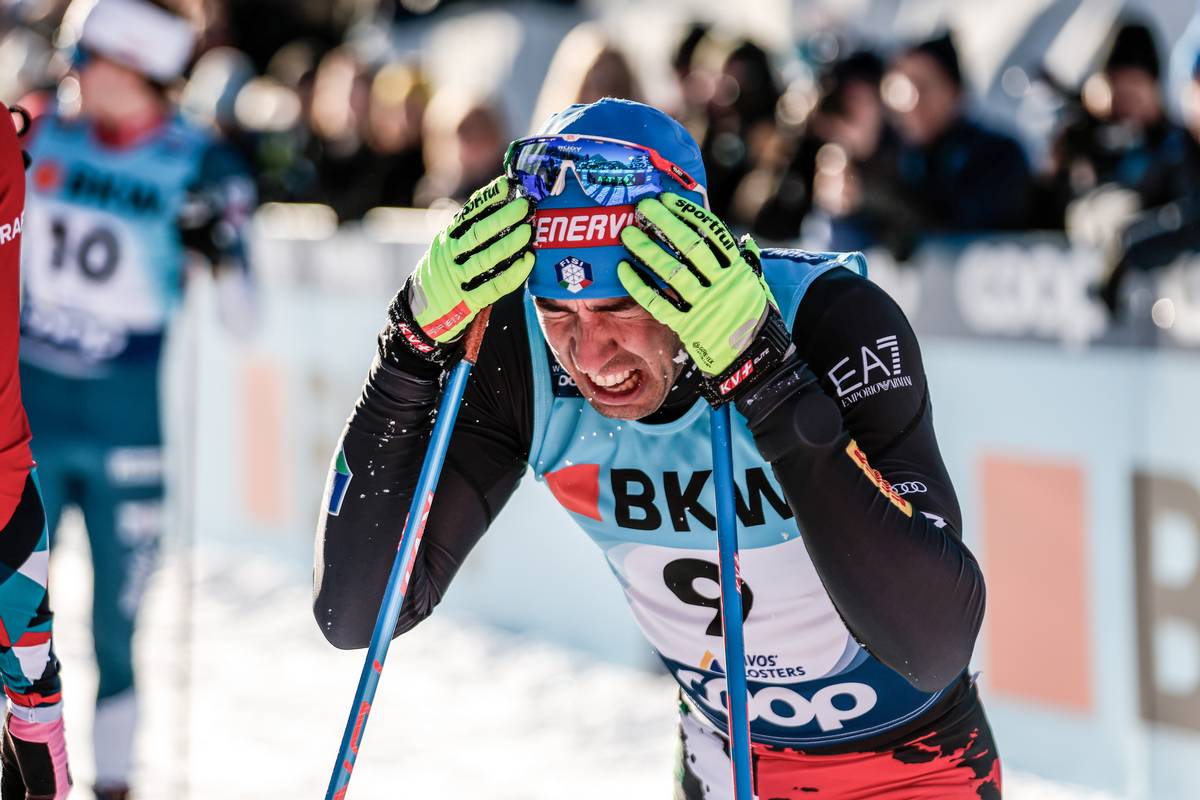
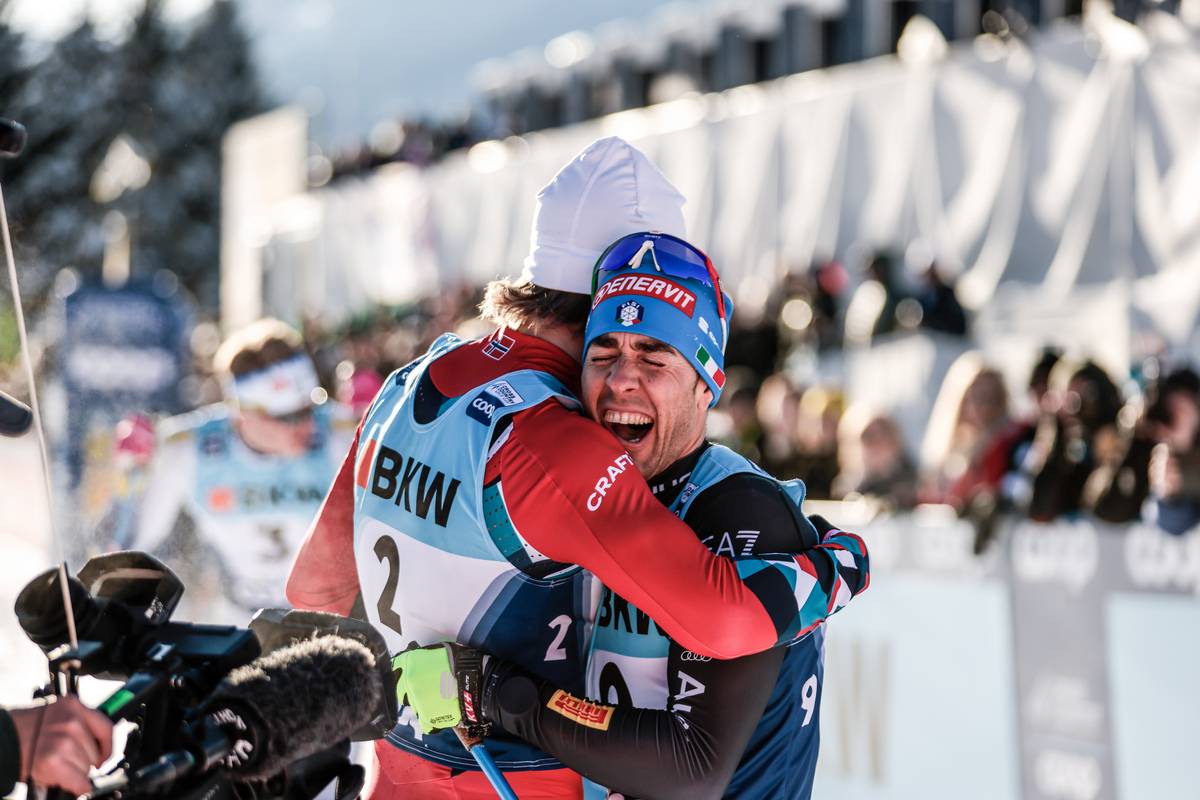
    Ultimately, this day would not be about points but about passion, as  veteran sprint star, Federico Pellegrino (ITA), stormed forward to win the day, followed by Klaebo in second, and Lucas Chanavat (FRA) third. In Davos today, the Italians were exultant (as they so often are when their athletes achieve such great results); let the national celebrating begin.

    Men’s Sprint

    The Davos sprint venue consists of two laps making a 2.7 kilometer course. Early on, it appeared that the prologue could prove to be the big story of the day when—for the first time this season—Klaebo was not present atop the leader board. He  finished second, .26 behind prologue winner Chanavat. North Americans also qualified well, as has begun to seem like the norm: Ben Ogden (USA) 6th and Graham Ritchie (CAN) 8th.

    Ben Ogden (USA) moves into a controlling position during his quarterfinal, though moments later his efforts were undone by a tangle on the significant uphill. (Photo: Nordic Focus)

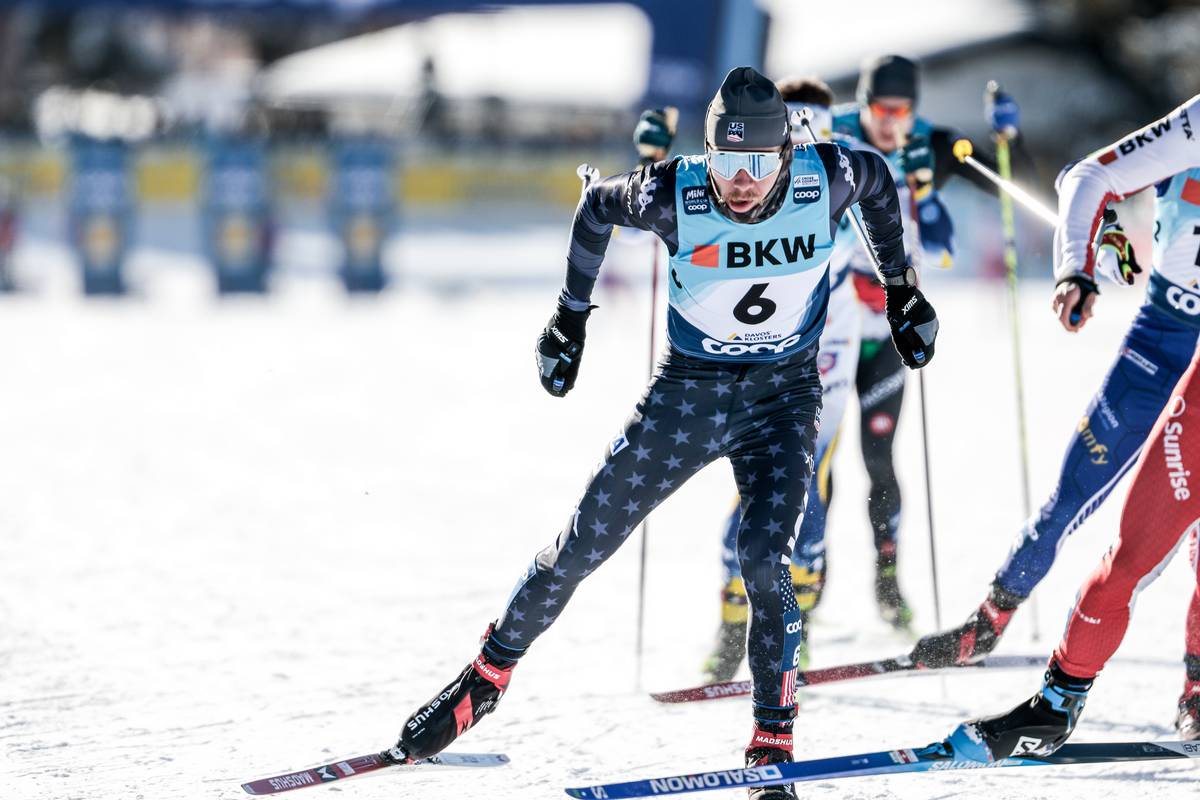
    More North Americans qualified for the quarterfinals—JC Schoonmaker (USA), 21st, Kevin Bolger (USA), 26th, and Antoine Cyr (CAN), 28th—but no North Americans advanced beyond the quarterfinals. Ben Ogden appeared to be in position to advance out of his quarterfinal heat, but an errant pole plant resulted in a tangle on the final uphill that took him out of contention. Ogden would finish the day in 21st, while Canadian Graham Ritchie would finish 17th.

    Matt Grover was one of the Team USA staff members who was impressed with Ogden’s performance, despite Ogden’s disappointment at not advancing. “I’m really stoked for [Ben],” Grover commented.  “The way he was skiing in the first three quarters of that quarterfinal, it was clear he was going to be one of the people controlling it.”

    Grover continued his comments, referring to the potential Ogden is showing in the season to come. “He’s a guy who’s still racing himself into race fitness this year,” said Grover. “It’s really impressive.

    The quarterfinal heats also claimed one of the significant contenders, as Richard Jouve (FRA)—the winner of last week’s World Cup Sprint in Beitostolen—crashed mid-race after tangling with his countryman, Renaud Jay.

    Semifinals

    Five Norwegians qualified for the semifinals, though one of those heats was decidedly more stacked than the other. Semifinal 1 featured Klaebo, Even Northug (NOR), Pellegrino, and the day’s top qualifier, Chanavat. Chanavat set the early pace, followed by Klaebo and Pellegrino. The racing was should to shoulder as Pellegrino executed a daring move to enter the final turn on the inside. His speed pushed him to the outside on the finishing straight, leaving the inside lane open for Klaebo. Pellegrino won the semifinal with Klaebo standing up to glide in ahead of Chanavat (who would qualify into the finals as a lucky loser, along with Northug who finished the semifinal in fourth).

    Finals

    The final looked to be super-competitive with top-qualifier Chanavat joined by Klaebo, Pellegrino, Northug, Edvin Anger (SWE), and breakthrough performer, James Clugnet (GBR). At the start of the final, Chanavat powered to the front followed closely by Northug. Klaebo drifted to mid-pack, though managed to move up into contention on the straightaway at the beginning of the second lap. Having maneuvered past Northug and Anger, Klaebo transitioned to V1 much more quickly than Chanavat, leaving the Frenchman flat footed. The climb looked to be unfolding as expected with Klaebo speeding to the front. Pellegrino was able to match Klaebo’s pace, and began the final descent in second. Keeping pace, Pellegrino marked Klaebo around the final righthand bend and into the finishing straight. Then the truly unlikely took place, as Pellegrino overtook Klaebo from behind, and out-sprinted him to the finish line.

    Johannes Hoesflot Klaebo (NOR) and Federico Pellegrino (ITA) after the finish of the finals.  (Photo: Nordic Focus)

    Pellegrino’s victory ties him with Klaebo for the most sprint wins (4) in Davos. “Always incredible in Davos,” Pellegrino said in a post-race interview. “Here I feel like home.” Perhaps Pellegrino’s performance is made even more impressive when we consider that he drove to Davos (from his home in Italy) early this morning, after being satisfied that his wife would be fine without him for the day. The couple are expecting a child any day . . . even more reason for all of Italy to celebrate.

    Davos World Cup Sprint Men’s RESULTS

    Johannes Hoesflot Klaebo (NOR), Federico Pellegrino (ITA) and Lucas Chanavat (FRA), (l-r) share the men’s sprint podium in Davos (SUI). (Photo: Nordic Focus)
  • What’s Up with World Cup Points this Season?

    What’s Up with World Cup Points this Season?

    The FIS instituted an overhaul of the points system used to determine the best individual skier in the World. We’re already seeing the consequences.

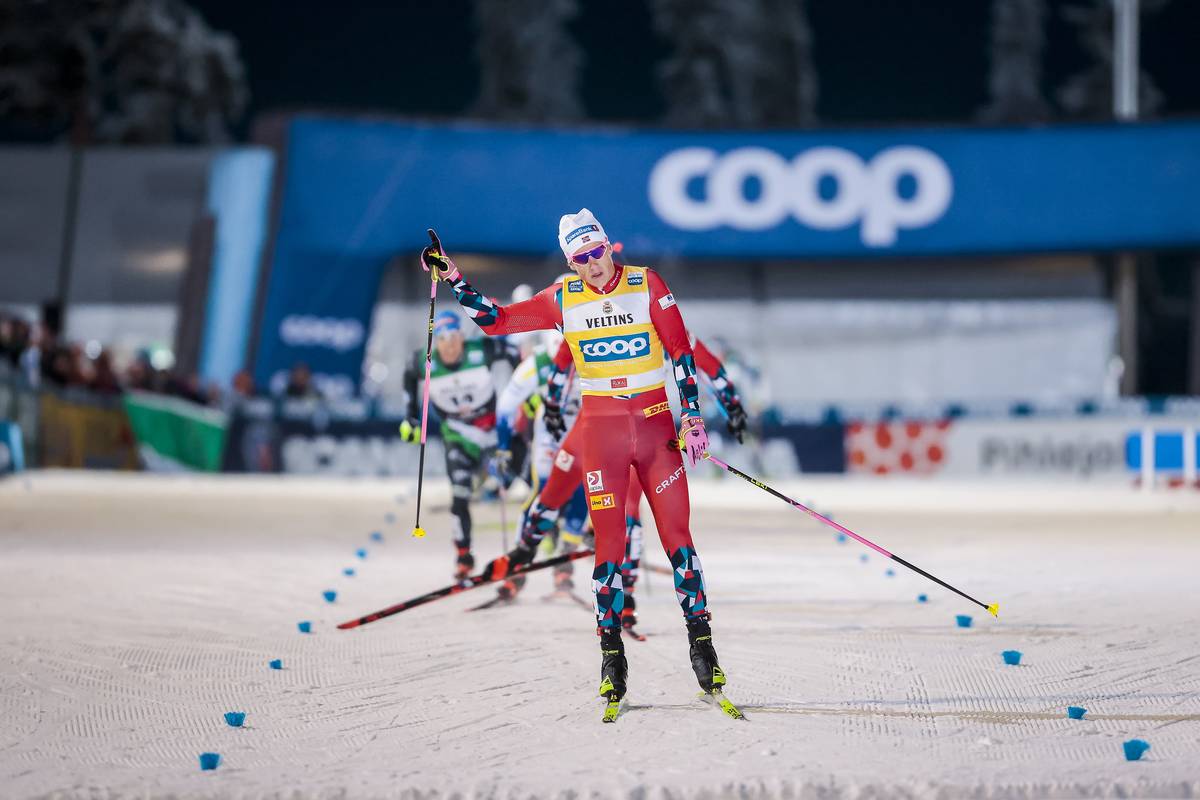
    Johannes Hoesflot Klaebo (NOR) crosses the finish line in Ruka, Finland while wearing the yellow Overall World Cup leaders bib. (Photo: NordicFocus).

    Johannes Hoesflot Klaebo had won all three races of the World Cup’s opening weekend races in Ruka. Any offseason doubts spurred by reports of his injuries or independent training practices went away. He was still the best skier in the world. Then, the following Friday in Lillehammer, illness forced Klaebo to sit out a 10 k skate race. His teammate Paal Golberg took over the World Cup overall lead with a 6th place finish. Klaebo returned the next day to handily win the sprint race:  usually, that would mean he would return to the top of the World Cup standings, and that he would start Sunday’s 20 k classic in the yellow overall leader’s bib (which he would likely continue wearing for weeks to come. Instead, Klaebo declared the season over. “I gave up the opportunity to win the World Cup overall when I did not start yesterday,” he remarked to Langrenn, in a statement that rightfully made headlines. When the next day’s race did come, Klaebo was nowhere to be found. Instead, the yellow leader’s bib went back to Golberg, where it remains.

    That Klaebo is the best male skier in the World is an easy conclusion to reach by watching any World Cup race in which he participates. Whether or not the World Cup points system is designed to objectively confirm that observation is a more complicated question, especially so since the International Ski Federation (FIS) instituted changes to its long-standing individual points system this season. Now three weeks into implementation, those systemic changes are resulting in more skiers earning more World Cup points. As a result, coaches and athletes are adjusting race plans, commentators are struggling to shake old habits, and the best skier in the world is apparently giving up on the whole thing. The rules of the game have changed, and it looks to be having an effect.

    Top 50 is the New Top 30: The Changes

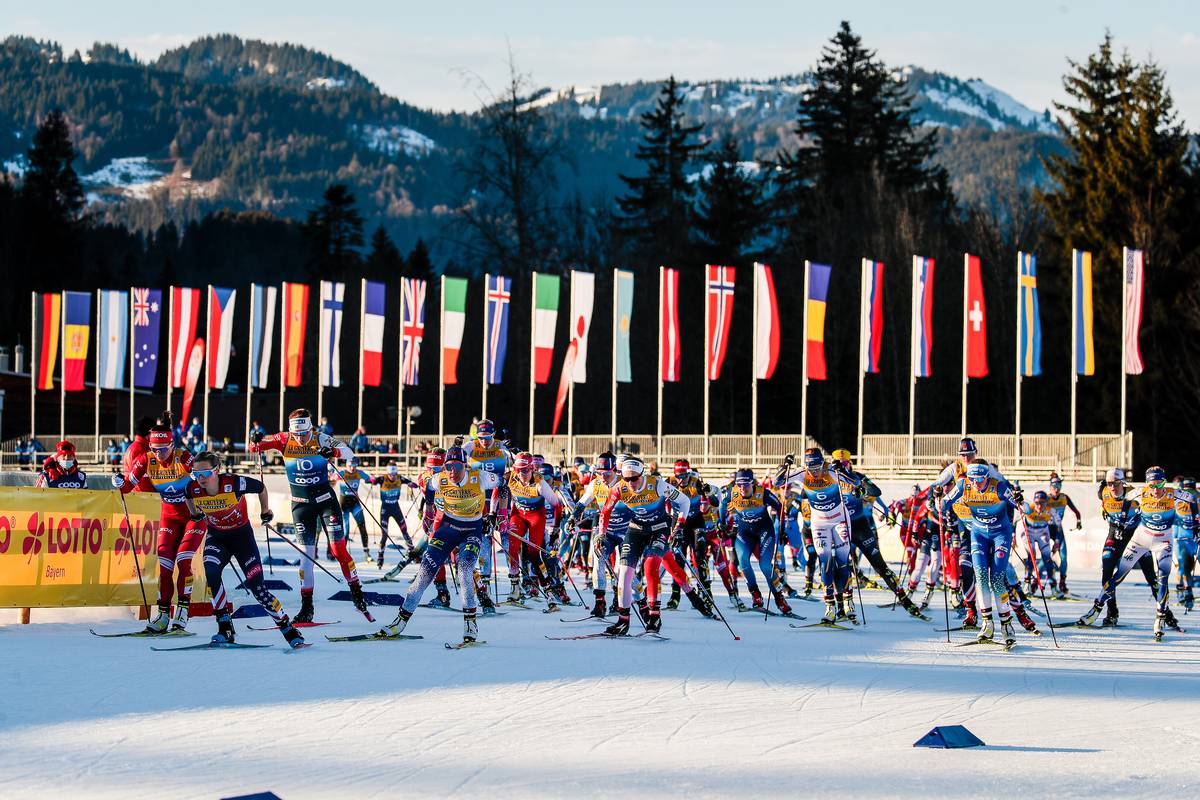
    The start of the women’s 10 k Freestyle Mass Start during Stage 3 of the 2021/22 Tour de Ski in Oberstdorf, Germany. (Photo: NordicFocus)

    In remarks following the 10 k classic in Beitostolen—where Jessie Diggins finished 6th and Rosie Brennan finished 8th—US Ski Team Head Coach Matt Whitcomb’s reflections focused on one number: “It’s easy to forget that just 15 years ago it was often that we would have zero people in the top 30 in distance, so this is a natural progression and an important thing to remember.”

    For years, “top 30” meant earning World Cup points. That level of finishing result became a signifier for a specific kind of success—gaining a foothold on the World Cup stage—and that expanded to serve as that same signifier at every stage of international skiing progress. In the United States, every collegiate circuit uses a version of the World Cup points system to 30th place for NCAA Championship qualification. Some regions use a version of the “top 30” system to determine selection for US Junior Nationals. The “top 30” system etched itself into the sport’s evolution too. When the sprint became an integral part of skiing in the early 2000s, there was no set number of competitors who would move on from qualifiers to heats . . . until, that is, the FIS decided on the top 30.

    “Top 30 is good.” That’s what skiing has told us for a long time. So what happens when that single World Cup point gets pushed out to the skier in 50th place? 

    Well, it looks something like this:

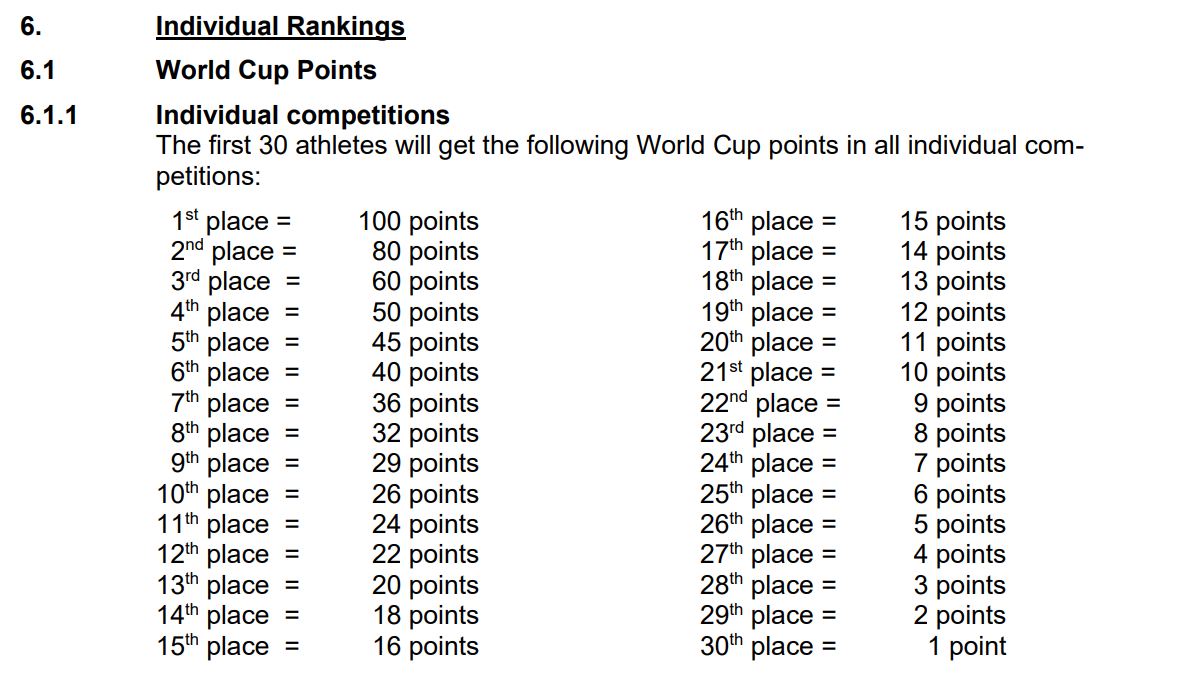
    The NEW FIS World Cup points system:
    (Photo: “Rules for the FIS Cross-Country World Cup 2022-23.” 2022. “International Ski Federation.”)
    The OLD FIS World Cup points system:
    (Photo: “Rules for the FIS Cross-Country World Cup 2021-22.” 2021. “International Ski Federation.”)

    In the NEW system, the points stretch further down the results, and the steps down are much, much, smaller.

    Points stretching further down the results will primarily have consequences for skiers seeking selection to the World Cup, rather than  the World Cup Overall competition itself. With the points stretching to 50th place (just short of the size of a usual World Cup field) there is now a more quantifiable way to compare developing skiers and assign discretionary starts for national ski federations. Whereas under the top 30 system, skiers outside of the points were at the whims of the sometimes wonky FIS points system, there is now a better chance to judge a skier’s potential on the World Cup based on their performance on the World Cup. 
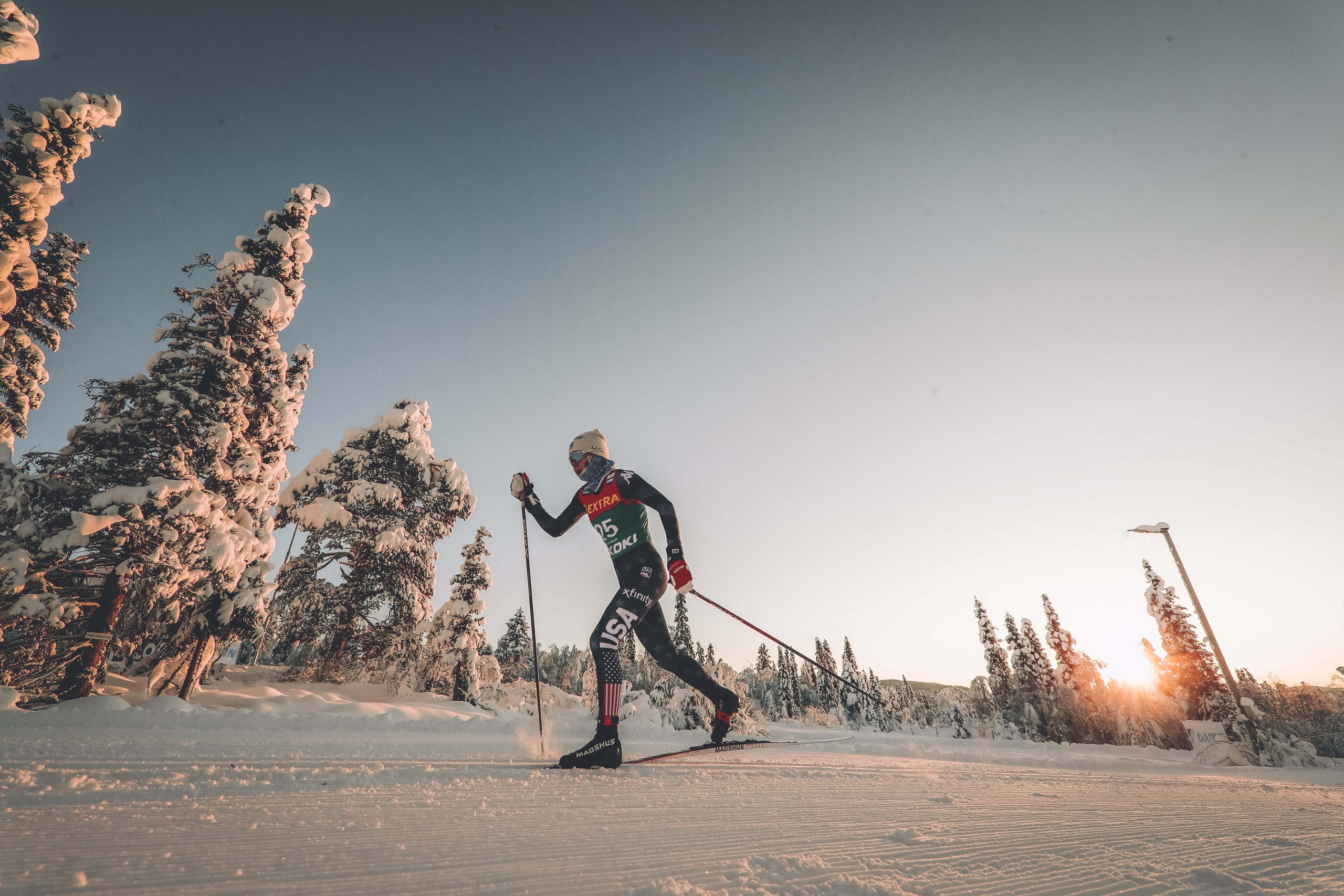
    Smaller steps in points from 1st place (100 points) down is where the World Cup Overall competition really changes. See Table 1. below with the points awarded for 1st-5th place in the NEW system, and Table 2. with the points awarded for 1st-5th place in the OLD system, and the equivalent place-points total under the NEW system.

    Table 1. Place-points total for 1st-5th place, NEW system

    NEW System Place NEW System Points
    1st 100
    2nd 95
    3rd 90
    4th 85
    5th 80

    Table 2. Place-points total for 1st-5th place, and equivalent place-points total in NEW system

    OLD System Place OLD System World Cup Points NEW System place-points equivalent.
    1st 100 1st
    2nd 80 5th
    3rd 60 11th
    4th 50 16th

    5th

    45

    19th


    When it comes to points earned, getting 1st place just doesn’t matter as much as it used to. That key change is amplified when considering that FIS has made very slight changes to the system surrounding the individual points matrix awarded for each race.

    Bonus Points System Remains the Same

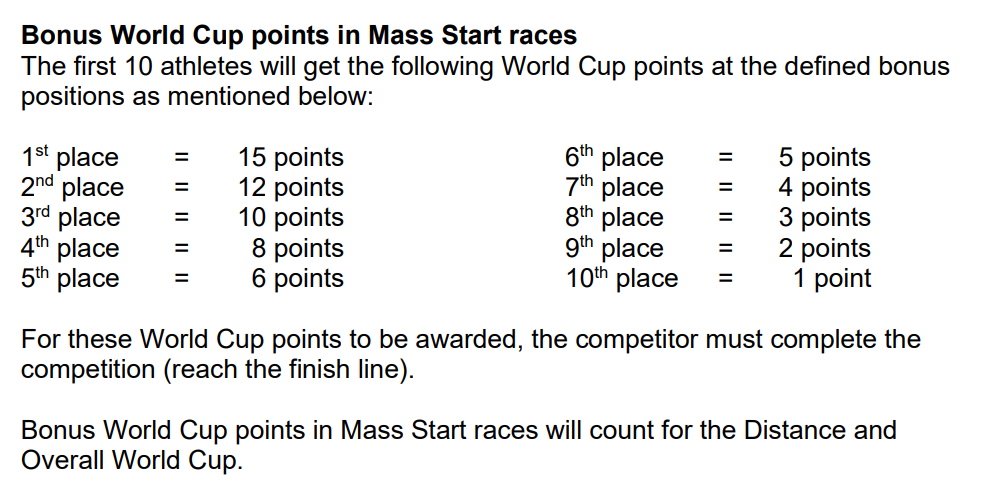
    In a bid to introduce more dynamic racing a few years ago, FIS introduced a bonus point system in which checkpoint bonuses became incentives for World Cup points. That system remains unchanged and is found here:

    (Photo: “Rules for the FIS Cross-Country World Cup 2022-23.” 2022. “International Ski Federation.”)

    Based on the points classifications found in cycling’s Grand Tours (the “Green Jersey,” for Tour de France fans), the bonus system was intended to introduce a series of points that skiers would tactically approach as intermediate sprints. The dynamics of ski races are very different from the dynamics of a cycling race, however, and in practice, the sight of skiers shuffling for a sprint in the middle of a distance race has been rare.

    Why? Unlike cycling, ski racers exhibit less obvious discrepancies between who is a great sprinter and who is a great distance competitor. In mass start ski races, it’s rare to see a breakaway that is not comprised of skiers who would also excel at distance racing. The bonus points, in reality, have almost always gone to top contenders for the race itself.

    The NEW points system seems to retroactively fit the existing bonus points system into this skiing reality. The consequences: in the OLD system, the 15 points for being 1st place through an intermediate checkpoint could almost never displace the points total for finishing 1st versus 2nd, or 2nd versus 3rd. In the NEW system though, with five points separating each of the first five places, winning the intermediate sprints could theoretically displace the 1st place finisher for the most points won on the day for a skier in 3rd or 4th place.
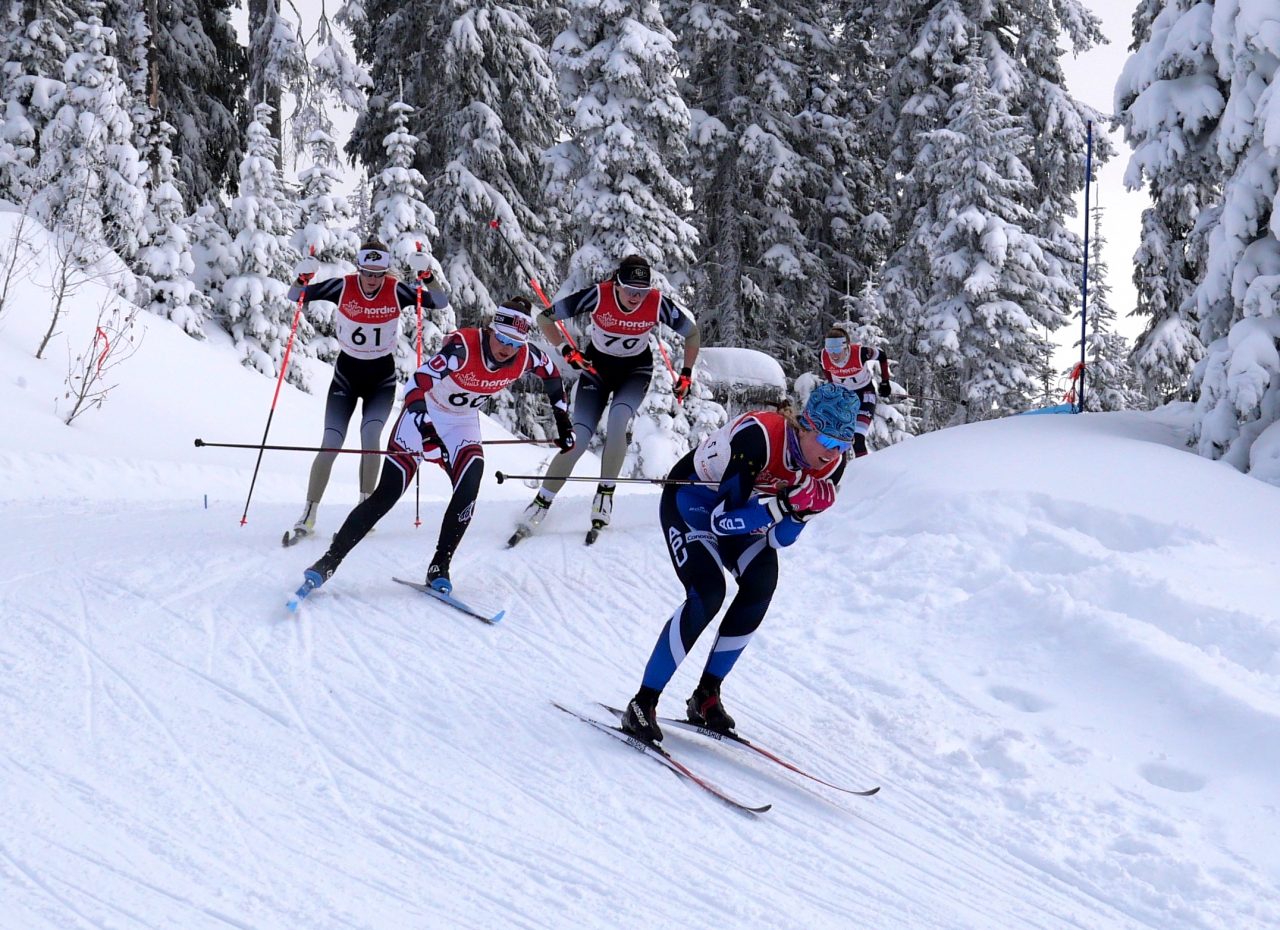
    Example: In a 20 k mass start, the skier who will eventually finish 3rd place controls the front of the race for the first 10 k, earning 30 bonus points for winning two bonus point checkpoints (15 points each). The skier who will eventually finish 1st place is further down the pack through the early part of the race, but still in the top 10 through the checkpoints. They are 10th through each bonus point checkpoint, earning 2 total bonus points, before making a push to win the race. The 1st place skier’s total points for the race: 100 (1st place) + 2 (bonus points) = 102 total points. The 3rd place skier’s: 90 (3rd place) + 30 (bonus points) = 120 points total.

    That may be unlikely, but it is at least now in the realm of possibility. Again, a whole lot more points for a whole lot more skiers.

    Other Tweaks: Relays and Tour de Ski Bonus

    There are two other notable tweaks in the new FIS system that pertain to specific events:

    The first is that team events no longer are scored for individual points. That has already proven consequential in the way that the only team event so far this season has been raced. For instance, Matt Whitcomb identified the fact that no points were up for grabs as having directly influenced his decision that Jessie Diggins sat out the 4 x 5 km Team Relay in Beitostolen. Similarly, neither current World Cup overall leaders—Paal Golberg (NOR) for the men, nor Tiril Udnes Weng (NOR) for the women—raced the relay. 

    The second change is less drastic, but will be significant when the World Cup turns to the Tour de Ski (TDS) in a few weeks. FIS reduced the points bonus for winning the overall classification at the TDS from 400 points to 300 points, and adjusted the points bonuses for lower placings accordingly. The reduced emphasis in points—and subsequent reductions in prize money per placing—could result in the Tour de Ski becoming a less significant part of the World Cup calendar than it has been in recent years.

    What It All Means

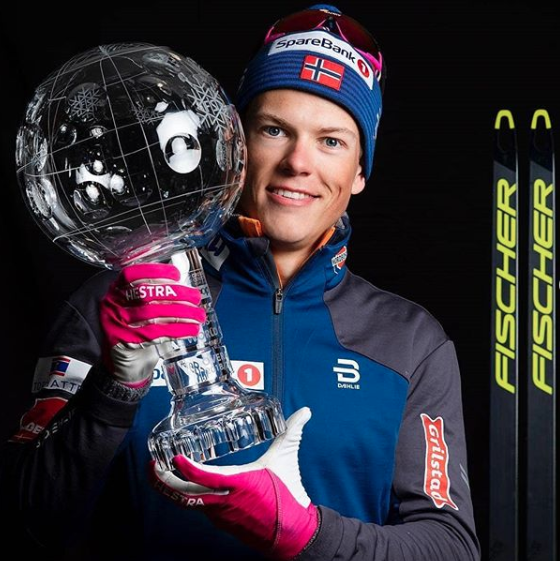
    Johannes Høsflot Klæbo poses with his crystal globe after winning the 2019 Overall World Cup title. (Photo: Nordic Focus)

    So, is Johannes Hoesflot Klaebo justified in his World Cup fatalism? The answer just might be that the FIS wants him to be. By pushing more points onto competitors who so often come 2nd, 3rd, or 4th place to the young Norwegian, they have created a new dynamic in this year’s bid for the Overall Crystal Globe. Consider the top two skiers in the current classification:

    Top Two Places of Men’s Overall World Cup Points after Three weeks of racing, OLD system vs. NEW system:

    1. Paal Golberg (NOR) – NEW system 756 points, OLD system 575 points, Net Change: +181 points.
    2. Johannes Hoesflot Klaebo – NEW system 430 points, OLD system 430 points, Net Change: 0 points.

    Klaebo’s points have not changed because the benchmark for the FIS points system has not changed. He has won every race he has entered, and 1st place is still worth 100 points (with 15 points for winning sprint qualifiers). Golberg, though, has benefitted from starting more races, and getting more points for being top 10, not top 1. It is a simple comparison, but it is also the only one that really, really matters for evaluating the change that the FIS wanted to make to the World Cup adopting the NEW system. The eventual winner of the Crystal Globe will now be determined by an incentive to do well in the races you start, and to start more races. Those are just the rules of the game; once the rules are understood, then it’s possible to understand what the new rules are incentivizing. FIS has followed that all the way through with its NEW point system, assuring that the season-long champion will be the skier who is most consistent and who competes most often. 

    As for us—the fans—is this the system by which we want our skiers rewarded? Should the best skier also have to be the most consistent? Should the strongest skier in a mass start go off the front early, or show their strategic aptitude by controlling a pack? Should skiers specialize in sprinting or distance? Should they continue to have to do well in both? And, of course, is the “top 50” the new “top 30?”

    New points systems instituted by FIS has ski fans, ski coaches, and skiers talking;  that new system also has the game being played differently on the World Cup tour this season.


    Resources:

    2021-22 FIS Rulebook containing the OLD system.

    2022-23 FIS Rulebook containing the NEW system.

  • US Squad Uses Team Relay to Re-Charge as Norway Takes Top 2 Spots

    US Squad Uses Team Relay to Re-Charge as Norway Takes Top 2 Spots

    A_Hall_Mark_of_Excellence_Award-logo-300.png (300×244)This World Cup coverage is made possible through the generous support of Marty and Kathy Hall and A Hall Mark of Excellence Award.  To learn more about A Hall Mark of Excellence Award, or to learn how you can support FasterSkier’s coverage, please contact info@fasterskier.com.

    USA I Relay Team before the start Sunday. (L-R) Ben Ogden, Sophia Laukli, Julia Kern, and Hunter Wonders. (Photo: Nordic Focus)

    In the third week of World Cup racing, the defining question seemed to be not who would be first to the finish line, but who was missing from the starting line.

    In the Friday’s sprints, Johannes Hoesflot Klaebo’s (illness) and Federico Pellegrino (fatigue) were both absent. That change to the startlist saw a chaotic and tense affair translate to new, and newfound, highs for Italy’s Simone Mocellini and Sweden’s Calle Halfvarsson. On Saturday, Iivo Niskanen’s absence from the 10 k classic field created an opening (after five long years) for Andrew Musgrave’s (GBR) return to the podium. 

    In Sunday’s Team Relay, though the notable absences were in the American lineup…

    US Team Makes Tough Decision on Relay Lineup

    US Ski Team Head Coach, Matt Whitcomb delivered the news to FasterSkier that Jessie Diggins and Rosie Brennan would not start in Sunday’s relays, undoing the female half of last season’s 4 x 5 k – winning US relay team that won at World Cup Finals. Both Diggins and Brennan have been vocal about team events like the relay being their favorite part of racing on the World Cup, and the event has been a point of emphasis in previous World Cup seasons. 

    “It feels weird to say I support this as a coach,” said Whitcomb on the decision to take Diggins and Brennan out of a team event. “But we’ve now been doing this long enough to know that an athlete just cannot sustain the full schedule of [the World Cup]. There are traps that are set for them along the way, and this relay just is one of them. It falls at a time when they really need to rest.” 

    For Brennan, the absence was primarily a matter of health, with Whitcomb adding, “We were lucky to get two good days of racing after she was sick in Lillehammer. We feel like we might be getting ahead of ourselves if we try to put a third together.”

    For Diggins, the stress of having started all eight World Cup races so far this season—combined with the new World Cup scoring system—preceded the decision not to race today. “One of the interesting dynamics of the new World Cup scoring this year is that there are no individual points scored for relays, like there has been in the past,” said Whitcomb. “When it comes to chasing the Overall [World Cup Title] (something Diggins identified as a goal in preseason talks with the media) the relay doesn’t add to the pile.” 

    In place of Diggins and Brennan, the announced teams for the US turned towards the young generation of skiers who have accompanied the veteran stars of US skiing the past few seasons. The US announced two relay teams Sunday morning:

    USA I: Classic Leg 1 – Julia Kern, Classic Leg 2 – Hunter Wonders, Skate Leg 1 – Sophia Laukli, Skate Leg 2 – Ben Ogden.

    USA II: Classic Leg 1 – Alayna Sonnesyn, Classic Leg 2 – Zak Ketterson, Skate Leg 1 – Novie McCabe, Skate Leg 2 – Gus Schumacher.

    Once teams were announced, however, the theme of rest came back into play. At the end of a third consecutive three-day weekend of racing in Period I, the unique demands on the US Ski Team—traveling continents to compete against nation’s with plenty of skiers to reinforce their World Cup squads close at hand—precipitated the decision to scratch USA II, and see the US start only its USA I team.

    The USA I team that did race looked forward to a 4 x 5 k format that has been pioneered at Junior World Championships the past few seasons. US anchor Ben Ogden said to FasterSkier that the 5 k “makes for an interesting race because it’s short enough where if you’re feeling good you can hang with skiers much better than you. I think for the US team this new format is really exciting because on the right day we can be right there with the top dogs even if we are not all fighting for the podium every other day.”

    Still, there was some trepidation in the US camp about choosing to strategically re-charge on the day. “[Emotionally] this is tough, because we’ve built our program around [team events like today],” said Whitcomb. “[Team events] are an important metric that speak beyond just who is getting on the podium or in the top 30. It’s a sign of a healthy [national] program when you do well in a [team] event” said Whitcomb.

    The Race

    By the metric of team success, all signs still point toward cross country skiing being alive and well in Norway, but the finishing order that Norwegian coaches might have envisioned was not the way the script played out on the rolling 2.5 k course (on which each athlete skied two laps): Norway II would finish first on the day, followed by Norway I and Sweden I. 

    The first leg of the Team Relay rolls out Sunday in Beitostolen. (Photo: Nordic Focus).

    Moments of clarity eluded today’s race—a push by one skier over one hill, an uptick of tempo by another as they exited the stadium—but those efforts regularly vanished like frozen crystals in the cold Beitostolen air. In the final lap of the final leg, however, a push by Simen Hegstad Krueger finally turned into something real. As the course ticked up, Krueger pushed away from a pack including Norway I teammate, Emil Iversen, and Sweden’s Calle Halfvarrsson. Over each successive hill, Krueger’s gap on the Swedish-Norwegian pair behind him grew until it was insurmountable. Krueger skated across the finish line for Norway—Norway II to be precise—as Iversen and Halfvarsson battled to the line behind him. Iversen won that battle for Norway too, earning second place. Sweden took third.

    Simen Hegsted Krueger (NOR) crosses the finish line in 1st place for Norway II. (Photo: Nordic Focus).

    In a clip to FIS media after the race, Norway II skier Mikael Gunnulfsen summed up the result eloquently: “I guess the second team got to the finish line first.” 

    During a weekend when some Norwegians expressed concern over not meeting the lofty standards of Norwegian skiing on their home turf, the final day saw a result in which Norway II beat Norway I, and the whole country came away with a win. If team relay events are indeed a sign of a national program’s health, then the Norwegians depart Beitostolen secure in the knowledge that their national program still sets the bar in cross-country skiing.

    But that conclusion was not clear for large swaths of the race leading to it. In the early going, it was Finland which dictated the dynamic of the pack. Johanna Matintalo (FIN I) kept things controlled alongside Anne Kjersti Kalvaa (NOR I) as the first classic leg wound around the Beitostolen course for lap one. Julia Kern was tucked in the pack for USA I, skiing relaxed even as Matintalo pushed the pace heading up the A-climb. By the time skiers came into the first exchange, Matintalo and Kalvaa had opened a slight gap of around five seconds for Finland and Norway, with the chase group having strung out to two distinct packs. The chase group that came into the stadium first was led by Sweden I, while the second contained Kern at around 12 seconds back. Kern handed off to Wonders for USA I.

    Wonders quickly closed the gap as a chase group formed behind Martin Loewstroem Nyenget (NOR I) and Pertuu Hyvarinen (FIN I), who remained off the front. Nyenget looked to increase the pace, but in each little window, Hyvarinen was able to bring his ski tips right back to the Norwegian’s tails. William Poromaa for Sweden I took charge of the chase group headed into the leg’s second lap, right as Nygenet started to stride away from Hyvarinen on the A-climb. Hyvarinen was soon swallowed up by the chase group, but Nygenet faded too. The result: after much Classic sound and fury, the relay field was back together as it headed into the second exchange for the skate portion of the race. Wonders skied a strong leg to cap his weekend, having held 10th place in the pack for USA I.

    Perttu Hyvarinen (FIN) and Theo Schely (FRA) late in the 2nd leg on Sunday, chasing Norway I’s Martin Lowestroem Nyenget. (Photo: Nordic Focus).

    The race continued into the first skate leg, with moves instigated by Sweden I skier Frida Karlsson, who moved to the front of the pack as the course turned upwards, driving an increased pace which slowly diminished the field’s size. Soon, there was a definitive lead group: Karlsson alongside Heidi Weng for Norway I, Silje Theodorsen for Norway II, and Flora Dolci for France I. As they entered the second 2.5 k loop of the leg, Karlsson eased up. In that instant, one skier from the chase group—Finland I’s Kertuu Niskanen—skated to join up with the leaders, in a moment that knowledgable onlookers might have met with a confused “Who put a Niskanen on the skate leg?” Even so, Niskanen’s strong move seemed to validate that decision, her technical prowess and experience showing through no matter what kind of skis she attached to her boots.

    Frida Karlsson (SWE) skied a commanding leg for Sweden I which saw the field break open. Norway I and Norway II follow. (Photo: Nordic Focus).

    Karlsson slowly turned the pace up through the second lap, and France I’s Dolci eventually faltered, leaving Sweden I, Norway I, Norway II, and Finland I in the race for the podium entering the final exchange. Sophia Laukli kept the US in 10th through her skate leg, minimizing the gap to the leaders to 43 seconds as other teams saw it blow wide open.

    Skating in the anchor leg, Finland’s Joni Maki finally broke, and Halfvarsson for Sweden I, Iversen for Norway I, and Krueger for Norway II skied together for a lap. Little jaunts and jukes from all three lead back to stalemate until, on the final lap, one jaunt turned into a jolt, and Krueger pulled away. The field filled in behind, with the Norwegians adding an extra team on the podium, seemingly for emphasis. USA I finished 10th on the day with Ogden skiing the anchor leg. 

    Ben Ogden (USA) after finishing his leg of the relay race Sunday. The US finished in 10th place. (Photo: Nordic Focus).
    Pushing Forward, and Up, to Davos

    The World Cup circuit’s frantic hop around the Scandinavian peninsula in the past three weeks now gives way towards the Alps as teams travel to Davos, Switzerland. In the run-up to those events, eyes and ears will turn toward news of who will be racing there, including the potential return of Johannes Hoesflot Klaebo, Iivo Niskanen, and Federico Pellegrino. Davos will feature a skate sprint and 20 k individual start skate race.

    Ben Ogden says that the US camp is coming off today feeling “excited and motivated headed to Davos,” adding that personally he “needs a few more restful days, but I’m excited for the sprint and to get back to the land of the sun!”

    The team will be bolstered by the return of Diggins and Brennan, and with Matt Whitcomb saying Davos is a chance to, “end period I with some high notes. [Diggins and Brennan] both have a great shot to be on the podium in both races next week, so we want to be as prepared as we can for that.”

    With the snow-draped trees and soft light present on course—and no World Cup points up for grabs—Sunday’s World Cup mixed relay was a relaxed affair centered around ski racing for the sake of ski racing. Even on its highest level, ski racing remains joyful and keen, like the edge that sharpens itself for the work yet to come. 

    Full Results

    The sun sets on a weekend of racing in Beitostolen, Norway. (Photo: Nordic Focus).
  • Beitostolen 10 k Classic: Golberg Dominates, Musgrave Podiums, Wonders and Ogden Top 20

    Beitostolen 10 k Classic: Golberg Dominates, Musgrave Podiums, Wonders and Ogden Top 20

    Norway in midwinter can take on the appearance of a snow globe: quaint little cabins covered in snow, drooping pines coated in layers of white, skiers trailing through the woods. That was the scene in Beitostolen, Norway for day two of the FIS Cross Country World Cup. Skiers awoke to withering cold with low temperatures creating squeaky snow on the race course. Waxing for kick would not be a problem, but enduring the cold for ten kilometers of classic ski racing was a daunting prospect, indeed. Buffs, heavy gloves or mittens, protective face tape: that was the fashion of the day inside the Beitostolen snow globe.

    Paal Golberg (NOR) drives toward the finish in his World Cup 10 k Classic victory in Beitostolen, Norway. (Photo: NordicFocus)

    While racing in such cold conditions would prove to be a challenge, Norwegian favorites Paal Golberg and Didrik Toenseth did not disappoint their loyal followers, finishing first and second on the day. Great Britain’s Andrew Musgrave—something of an adopted son for the Norwegian fans—also turned in a thrilling performance, finishing third.

    North American skiers also celebrated great racing success today: Hunter Wonders was 16th, Ben Ogden, 19th, Gus Schumacher, 30th, Scott Patterson, 32nd, and Zak Ketterson, 38th. Canadians were led by an impressive finish from Antoine Cyr in 20th, followed by Olivier Leveille in 32nd, and Graham Ritchie, 40th.

    Beitostolen 10 k Classic

    While the Beitostolen facility lacks a notable ski stadium, this is where Team Norway spends a good portion of its training time. Only a few hours from Oslo, Beitostolen is where the most reliable snow in southern Norway can be found.

    It’s especially difficult to earn high finishing places when racing in Norway: for this World Cup race in Beitostolen, the host nation was granted twelve starting positions, meaning that many non-Norwegian contenders were likely to be pushed even farther down the results. For Norwegians, themselves, just qualifying to enter a World Cup is a Herculean task. Even last week’s World Cup 10 k skate winner—Iver Tildheim Andersen (NOR)—was not granted a starting position in today’s 10 k classic event. With early-season World Cup favorite Johannes Hosfloet Klaebo (NOR) and classic skiing specialist Iivo Niskanen (FIN) both absent due to illness, Saturday’s Classic 10 k was marked as much by who is absent as by who is racing.

    Andrew Musgrave (GBR) shows the effort of earning a place on the World Cup 10 k Classic podium. (Photo: NordicFocus)

    Light snow began falling soon after the start. Pre-race favorite, Golberg, started 42nd with snow already beginning to accumulate lightly in the tracks. A lap into his race, Golberg found himself shadowed by the British veteran, Musgrave, who cagily slotted in behind Golberg, benefitting from both the draft and the effort of the skier ahead of him. Obviously, Golberg would’ve preferred to step in behind the later-starting, fresher Musgrave, even pointing out in post-race interviews that he was dreaded giving Musgrave an advantage. “[I was worried that I might] drag Musgrave to the victory,” Golberg said. “But in the end I was stronger than him.”

    Golberg voiced disappointment in yesterday’s fourth place finish in the sprints. “A really frustrating day yesterday,” he said. “But that’s a part of the game.” Golberg shed his glasses midway through the race, and drove on through the finish with the determination of man bent on revenge. In Klaebo’s absence, Golberg has been become the dominant force in men’s World Cup Cross Country, contending in sprints and distance races, alike. Today was no exception as he proved too tough and too fast for the field to challenge. “Today was another good day,” he said. “[I] tried to ski a steady pace, and I had some power at the end.”

    Hunter Wonders (USA) tucks the downhill in brutally cold conditions at Beitostolen, Norway. Wonders would finish the day as top American in 16th place. (Photo: NordicFocus)

    Ogden (USA) sat in the leader’s chair through the first fifteen finishers until supplanted by Janosch Brugger (GER) whose finishing time was positioned atop the standings for quite a while. Top American, Wonders, also skied to a terrific 16th place finish. Ultimately, Golberg topped them all, finishing in 23:55.6, 7.6 seconds ahead of Toenseth in 2nd, and 10.7 ahead of Musgrave in 3rd.

    With two Americans in the top 20, there was much to celebrate. “For many Americans the threshold for an average race is starting to change,” said Ogden. “That said, we are still hungry and place emphasis on the process rather than the result.”

    Ogden also spoke of his confidence in American skiers during tough days of racing like these in Beitostolen. “The US skiers are fighters,” he said. “We are accustomed to adversity and challenge so when the cards are down and the thermometer is hovering right around the legal limit you can expect to see some American flags a little higher up the list. ”

    Like Ogden, Wonders had much to say in praise of his teammates, and the American team system that encourages their success. “I’m beyond stoked with the race. And It’s a big confidence boost for the rest of the season,” he said. “The team dynamic has been great this season. Lots of support in all sorts of ways, and seeing your teammates crush gives you some encouragement each day.”

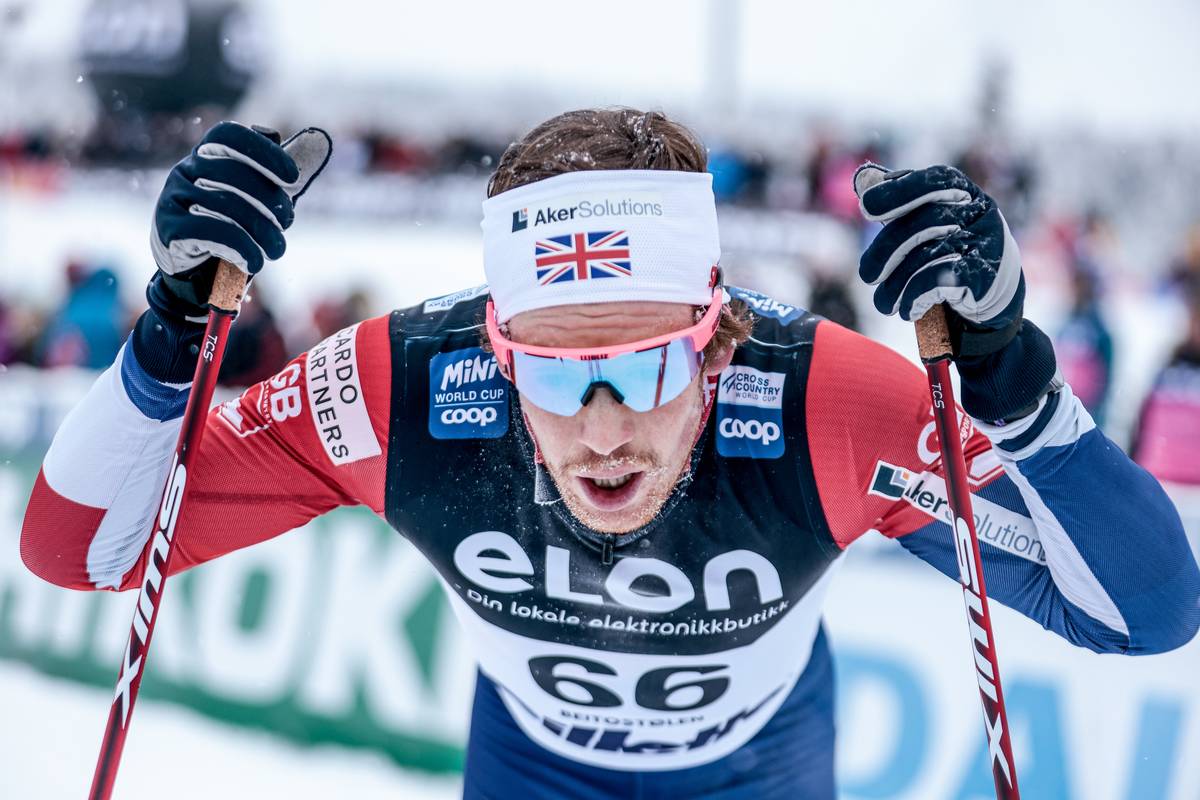
    British fans must be thrilled to see Musgrave’s efforts rewarded. Saturday’s announcers spoke of Musgrave as a breakthrough performer on the day, but he’s been steadily chipping away at the results for years, with his results often hovering near the podium. Racing buff-less, and in his signature headband, Musgrave seemed unaffected by the cold in Beitostolen. And his willingness to latch on to a speeding Golberg displayed a confidence that worked to his advantage in this ten kilometer test. Throughout his career, Musgrave has been known to race bravely—even rashly—but that is the sort of attitude that can pay off at 10k. It paid off for him today.

    World Cup Men’s Classic 10 k, RESULTS

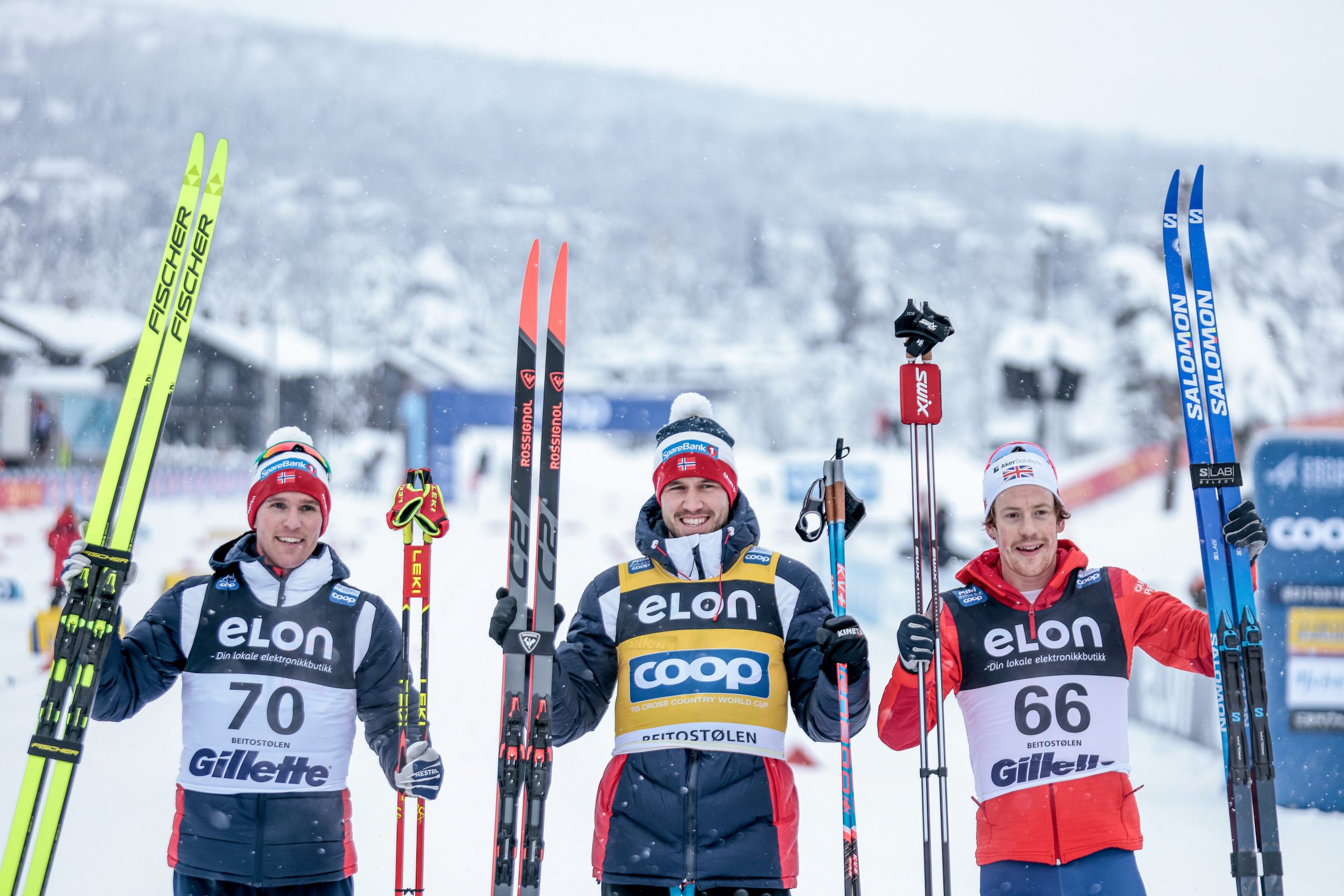
    Didrik Toenseth (NOR), Paal Golberg (NOR), Andrew Musgrave (GBR), (l-r) – FIS world cup cross-country, 10km, Beitostolen, Norway. (Photo: NordicFocus)


  • Niskanen Takes Classic Win in Beitostolen 10k. Diggins 6th, Brennan 8th.

    Niskanen Takes Classic Win in Beitostolen 10k. Diggins 6th, Brennan 8th.

    A_Hall_Mark_of_Excellence_Award-logo-300.png (300×244)

    This World Cup coverage is made possible through the generous support of Marty and Kathy Hall and A Hall Mark of Excellence Award.  To learn more about A Hall Mark of Excellence Award, or to learn how you can support FasterSkier’s coverage, please contact info@fasterskier.com.

    The women’s 10 kilometer individual classic race was held on the second day of the FIS World Cup stop in Beitostolen, Norway.  So far this season, distance racing has been dominated by Swedish women with Ebba Andersson and Frida Karlsson winning at the 10 and 20-kilometer distances, respectively.  With Andersson sidelined with Covid this week, Swedish hopes rested upon Karlsson’s shoulders.

    The home country—Norway—would look to Tiril Udnes Weng who finished second a week earlier in the Lillehammer 20 kilometer mass start classic, having been barely beaten out by Karlsson by 0.6 seconds. Katharina Hennig (GER) was hoping to continue her excellent long-distance form this season, having finished third in the 10-kilometer classic individual start two weeks ago in Ruka, and second in the 10-kilometer freestyle in Lillehammer.

    Kerttu Niskanen (FIN) celebrates her victory in Beitostolen, Norway. (Photo: NordicFocus)

    At the finish line, though, it was classic phenom Kerttu Niskanen earning the victory for Finland. Anne Kjersti Kalvaa (NOR) continued her breakout season in second, followed by Frida Karlsson (SWE) in third.

    Jessie Diggins (USA) was in the mix the entire day, finishing only 33.8 seconds back in 6th. Rosie Brennan was just behind her in 8th, 39.8 seconds behind. The rest of the American finishers were Sophia Laukli (29th), Novie McCabe (32nd), Alayna Sonnesyn (47th), and Lauren Jortberg (53rd). Top Canadian finisher was Katherine Stewart-Jones, 19th—continuing her impressive string of top-twenty finishes.  Dahria Beatty was 36th, followed by Olivia Bouffard-Nesbitt in 46th.

    Women’s 10-Kilometer Classic Individual

    At the start, the racers had to warmup in cold but sunny Beitostolen weather: gorgeous if you like clear and cold with temperatures around 0 Fahrenheit (-18.3 Centigrade). The snow was loud and squeaky cold.  In other words, it was a perfect day for classic skiing. The racers competed on a five-kilometer course which had a number of climbs with a steep long climb towards the end of the lap.

    Many of the racers wore protective face tape, including Jessie Diggins and Rosie Brennan.  With downhill speeds reaching 30 mph, precautions were in order.

    “It was VERY cold today! I think the temperature actually dropped from when we woke up to when we started, and the course sits in a bit of a cold sink too. I am normally not bothered by the cold, but I was admittedly not as prepared as I could have been.”                                       Rosie Brennan

    Head Coach Matt Whitcomb said the team was ready for the cold. “We have heated vests, blankets, face tape, and incredibly warm clothing from our sponsors,” he said. “I didn’t talk to any athletes who really froze up.”

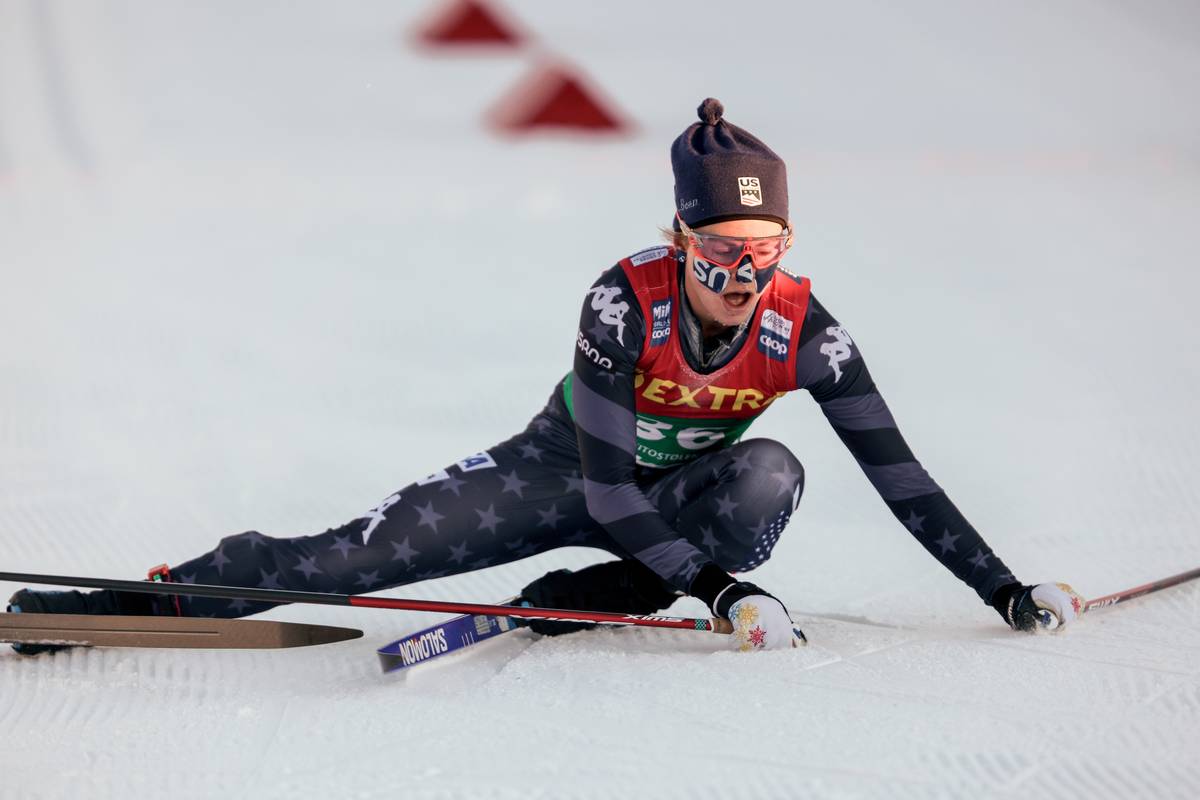
    Jessie Diggins (USA) battled through the cold in Beitostolen, collapsing at the end of her 10 k effort. She would finish the day in 6th, yet another impressive classic skiing performance. (Photo: NordicFocus)
    The Race

    The racers started in thirty second intervals. Diggins crossed the first time check as the leader on course, but most of the competitors for the podium were still behind her. After all racers had cleared the first time check at 1.3-kilometers, Karlsson led Niskanen by 5.5 seconds, a lead she would extend to 7.9 seconds by the 2.6-kilometer mark.  Diggins was in the hunt for the podium crossing the second time check in fourth, only 8.3 seconds off the lead. Brennan was holding steady in 5th place only 11.5 seconds off the lead.

    By the halfway point, Niskanen had asserted herself and led by 1.1 seconds over Kalvaa, a lead that Niskanen would extend to 6.4 seconds by the 6.3 kilometer split. After this mark Niskanen never looked back.  By the time skiers reached the 7.6-kilometer checkpoint the race had settled into a battle between Niskanen, Kalvaa, and Karlsson. Americans stayed close with Diggins and Brennan off the podium by only 11 seconds and 18 seconds, respectively; however, with three great classic skiers ahead of them, the Americans would not get the break they needed.  Niskanen continued her relentless pursuit, displaying the textbook classic technique for which she is known. At the finish, she led comfortably by 12.7 seconds. Kalvaa held onto second by four seconds over Karlsson.

    Diggins told Fasterskier that she had trouble with the cold.   “It was so cold that I raced with heated socks and boot covers and struggled to keep myself warm,” she said, adding that she didn’t feel great throughout the race. “I felt kind of mentally detached during the race and was not ok at the finish. It took a definite toll. Our skis were on fire, and I was proud of how my classic technique has progressed. ”

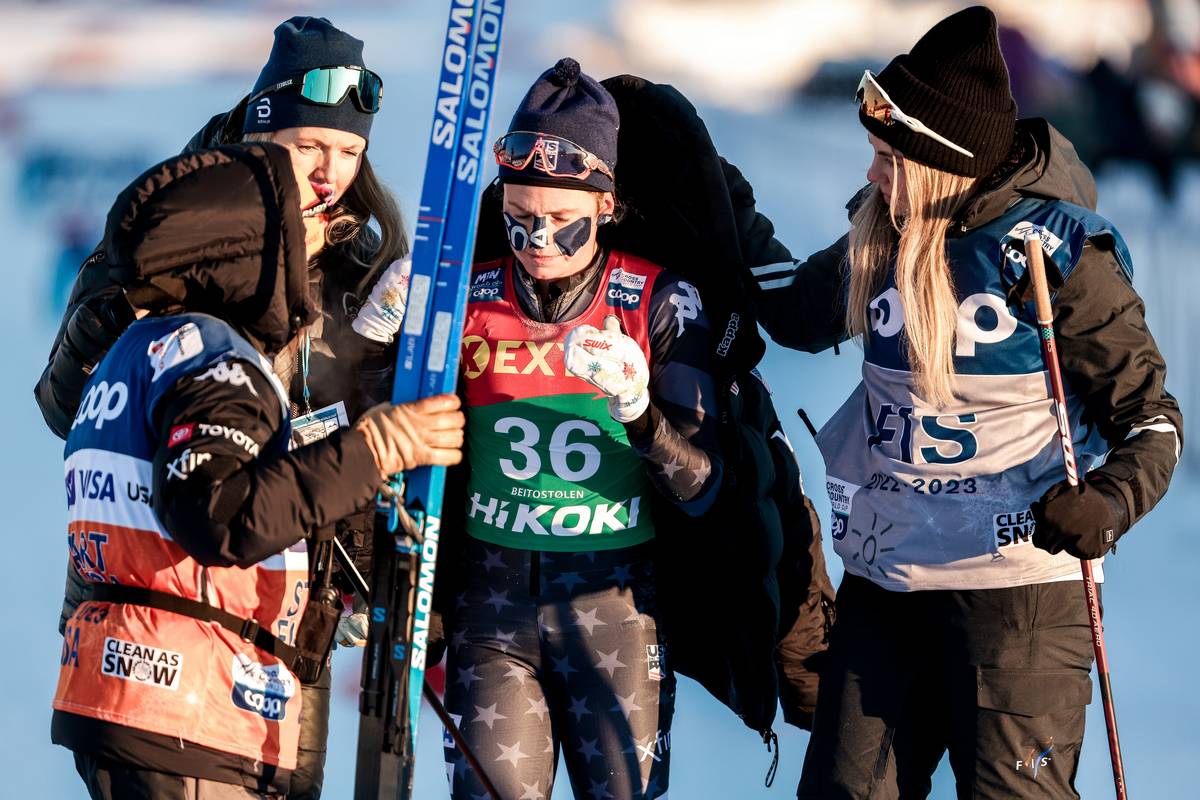
    Diggins being helped by teammates after paying the price for fighting in the cold of Beitostolen (Photo: NordicFocus)

    Brennan reflected upon her day by saying that, “I was really happy with my skiing, especially coming off illness. My skis were great as well. I did what I could with the body I had, and it was definitely missing a gear that I wanted, but it was a very solid effort with some improved technical skiing.”

    Whitcomb stressed the success of today’s outcome. “We had phenomenal skis today. It was one of those classic days you hope for. Our skis were exceptional, we’re very proud of that.” He added that, “We don’t take top ten or even top 30 finishes for granted.”

    Whitcomb also highlighted the accomplishment of Sophia Laukli who is better known as a skate racer, and who finished in the top thirty today in Beitostolen.

    Sohia Laukli having a top 30 day in the 10 k Classic Individual at Beitostolen. (Photo: NordicFocus)

    “It’s easy to forget that just 15 years ago it was often that we would have zero people in the top 30 in distance, so this is a natural progression and an important thing to remember.”  Matt Whitcomb

    It was a great day for classic skiing and a great day for the American women.

    Full Results

  • Ben Ogden Races to 7th Place in Beitostolen as Richard Jouve takes the Win

    Ben Ogden Races to 7th Place in Beitostolen as Richard Jouve takes the Win

    Ben Ogden (USA) and Richard Jouve (FRA) in the semi-final of the men’s classic sprint in Beitostolen, Norway. (Photo: Nordic Focus)

    The sun had begun to set in Beitostolen, Norway. The day—and the day’s racing—entered its golden hour as Norwegian fans anticipated more success for World Cup Sprint Leader, Paal Golberg (NOR). That all changed in a flash as Golberg—wearing the yellow Leader’s bib—crashed on a curve in the men’s Classic Sprint final. Golberg fumbled in the snow, a stark contrast to the control he has shown through the first few weeks of this year’s World Cup. The field stretched out in front of him, the Norwegian “sure thing” having been removed from the equation. Something new was about to play out at the front of this World Cup Sprint race.

    The field hit the final climb with reigning overall World Cup Sprint champion, Richard Jouve (FRA), at the the front of the pack. After his tumble, Golberg managed to scramble gamely back into the field, personifying a stubbornness to restore logical order to the day’s proceedings. This is men’s cross-country skiing in 2022, where Norwegian domination of the men’s podium seems to be a given. As the field entered the stadium, though, two unexpected skiers—one clad in green and black, the other in blue and white—overtook the scene among those vying for podium positions. While Jouve eased across the line for a win, behind him jubilation ensued as Simone Mocellini (ITA) in green and black charged into second, leading Calle Halfvarsson (SWE) in blue and white who claimed third. Something new, indeed. 

    The men’s final in the finishing strech. Richard Jouve (FRA) (R) over Simone Mocellini (ITA) (L) (Photo: Nordic Focus)

    Thus it was that a day where pre-race expectations for new-comers to gain a foothold in the World Cup sprint field crescendoed (note the verb) at a finish line marked by an ebullient Italian celebration recalling the days of Maurilio De Zolt and Marco Albarello

    The promise that there might be new faces at the front of today’s race stemmed from the fact that the only certain sprint contenders in this current era of skiing—Johannes Hoesflot Klaebo (NOR) and Federico Pellegrino (ITA)—were both absent, the former due to illness and the latter due to a desire to “recharge the batteries”. Accordingly, the day provided early indications of a more wide-open field. In the first quarterfinal, the top qualifier on the day, France’s Jules Chappaz, was outsprinted by Golberg and Even Northug (NOR) in a late race push where the Norwegian pair took the inside line on the hill leading into the stadium and simply outran everyone. That successful inside move would become a trend, and one of that strategy’s most effective practitioners was Ben Ogden (USA), who was the only American to advance to the heats (he qualified 7th). Skiing in the fourth quarterfinal, Ogden claimed the inside lane going into the rolling downhill that marked the first 500m of the course, and stayed in control as the field swept into the first climb of the day. This junction—later the site of Golberg’s fall—saw the field narrow into tracks, and in Ogden’s heat saw another Norwegian favorite, Haavard Solaas Taugboel, get tangled. Ogden was behind the fall, side-stepped it, and remained in touch with the field as they crested the climb. Entering the last climb, he pushed to the inside and outran Michal Novak (CZE) and Renaud Jay (FRA) to advance to the semi-finals.

    The quarterfinal heat offered the latest sign of Ogden’s growing poise and comfort in sprint heats, and one in which he also possessed the most definitive punch of the whole bunch.

    Ogden advanced to the second semifinal, where he joined the seasoned duo of Jouve and Joni Maki (FIN) alongside a youthful contingent of Niilo Moilanen (FIN), Michal Novak (CZE), and Anton Persson (SWE). Jouve used the race as a test-drive for his winning strategy on the day, taking control of the race on the first climb before delivering his final push on the next. Maki mirrored Jouve throughout the race, while Ogden was initially forced to the front before settling back and making a final storm on the last hill. Notably, on the hill, Ogden was again a powerful force running into a position equal with Jouve as they entered the stadium; however, Ogden faded slightly in the final sprint, while Maki came up to claim the 2nd place spot behind Jouve. Ogden’s finishing time was not fast enough to earn a lucky loser’s position in the final. He finished a very impressive seventh on the day.

    Friday’s second semifinal featured Richard Jouve (FRA) (R) taking the win over Joni Maki (FIN) (2nd from R) and Ben Ogden (USA) (3rd from R) (Photo: Nordic Focus)

    The other semi-final saw Golberg play out his strategy, following from the gun, staying out of trouble until the final climb, and then marking Lucas Chanavat (FRA) over the final climb into a 2nd place spot in the heat. 

    In that semifinal sprint, what seemed like a forgone conclusion with Golberg’s straight line speed was interrupted by a boot throw from the next lane over. It was Calle Halfvarsson, who ended up taking the first lucky loser spot. Behind him, Simone Mocellini powered into 4th place and the second lucky loser spot. The pair had mirrored Golberg, earning further opportunities to face him in the final.

    Simone Mocellini, the young Italian who ignited hopes for his country’s skiing future with a 2nd place finish today. (Photo: Nordic Focus)

    In retrospect, their placement behind the yellow bib concealed Halfvarsson and Mocellini’s potential in the race to come. That potential was realized in the final when Golberg went down, Mocellini surged, and Calle Halfvarsson drove forward to step onto a podium for the first time since Seefeld in 2018.

    Simone Mocellini, the young Italian, offered up a scene reminiscent of old times when talented Italians could upset the Norwegians on their home soil: hardcore ski fans may recall the Lillehammer Olympics Team Relay in 1994. The Norwegians surely will. Whether today was an introductory phrase or an early coda, however, will be up to Mocellini, the conductor at the heart of the jubilant orchestra that greeted him at the finish line today.

    Full Results

    Qualifying | Heats

    The Men’s podium in Beitostolen on Friday. 1st) Richard Jouve (FRA), 2nd) Simone Mocellini (ITA), 3rd) Calle Halfvarsson (SWE). (Photo: Nordic Focus)
  • Faehndrich wins in Beitostolen, Kern top American in 10th.

    Faehndrich wins in Beitostolen, Kern top American in 10th.

    A_Hall_Mark_of_Excellence_Award-logo-300.png (300×244)

    This World Cup coverage is made possible through the generous support of Marty and Kathy Hall and A Hall Mark of Excellence Award.  To learn more about A Hall Mark of Excellence Award or to learn how you can support FasterSkier’s coverage please contact info@fasterskier.com.

    Today, the FIS World Cup travelled to the Norwegian countryside town of Beitostolen, Norway, a three-hour drive from Oslo. It would be the first time in the hamlet’s history that it would host a World Cup Sprint event.  Beitostolen (population 358) has approximately 320-kilometers of ski trails. That’s close to one kilometer of ski trail for each resident!”

    The Swedish women were hoping to continue their domination and to make history today by being the first team to finish first and second three times in a row in individual sprints to start a season. Swedish women have won five of the first six World Cup events, with Jessie Diggins (USA) being the only non-Swede to interrupt the streak. Emma Ribom (SWE) was looking for a three-peat in the World Cup Sprints as she won the first two races handily.

    Nadine Faehndrich (SUI) celebrates as she takes the victory in the Beitostolen Classic Sprint (Photo: NordicFocus)

    But Swedish hopes were ripped apart before the racing even began.  Ribom was not feeling well Thursday and made the decision to sit out the event, and perhaps the entire weekend. Adding to Sweden’s woes was the revelation that Ebba Andersson (SWE) had tested positive for Covid, joining Anna Dyvik (SWE) on the bench for this weekend’s activities. Already missing from team Sweden was another star, Jonna Sundling, who is working her way back from illness. Over the course of a few days, Sweden had gone from high hopes of continued domination to near-desperation as their all-stars were sidelined. Opportunities for Sweden’s rivals were there for the taking if other athletes could step up.

    Norway would be defending national pride—seeking redemption on home soil— after the dominant Swedish sprinters had shown no mercy to their hosts the prior weekend in Lillehammer.

    Attempting to qualify for the U.S. were; Julia Kern, Jessie Diggins, Alayna Sonnesyn, Lauren Jortberg, Novie McCabe, and Rosie Brennan. This would be Brennan’s first day back after missing all of last weekend due to illness. Diggins would be gunning to join retired teammate Sophie Caldwell-Hamilton as the only non-European woman to win an individual World Cup sprint in both freestyle and classic technique.

    Canada fielded Dahria Beatty and Olivia Bouffard-Nesbitt in the qualifiers.

    The Results

    In the qualifying rounds for the U.S. the results were: Jessie Diggins (7th), Rosie Brennan (12th),  Julia Kern (17th), Alayna Sonnesyn (44th), Novie McCabe (50th), and Lauren Jortberg (56th). For the Canadians it was: Dahria Beatty (37th), and Olivia Bouffard-Nesbitt(43rd). Only the top 30 could move on from the qualifying rounds.

    No North Americans qualified for the finals, which consisted of Nadine Faehndrich (SUI), Lotta Udnes Weng (NOR), Johanna Matintalo (FIN), Tiril Udnes Weng (NOR), Kristine Skistad (NOR), and Tereza Beranova (CZE). Ultimately, the Swedes could not overcome their personnel deficit and didn’t place any racers into the finals.

    Julia Kern (USA) during qualifying at Beitostolen, Norway. Ultimately, her 10th place finish would be the  the top result among American women. (Photo: NordicFocus)

    The winner of the day was Nadine Faehndrich (SUI), followed by Lotta Undes Weng (NOR), and then, Johanna Matintalo (FIN). The only American to make it to the semifinals was Julia Kern who ended up 10th overall. Rosie Brennan finished 21st, Jessie Diggins was 17th.

    The Race

    Julia Kern skied in fourth place through most of her quarterfinal race. She made a final surge going into the stadium and was able to double pole past two competitors to finish second.

    Kern told Fasterskier that she had an early morning ski in from the team’s apartment to the venue using a headlight in the dark.  “I was really excited for the heats. In the quarterfinals I picked the first heat thinking that it might be the lucky looser heat with it being a pretty stacked heat.” Kern added that there was a little arm shoving in the quarterfinal final, but that she held her own ground and was able to make a move. “I’m learning how to be physical and hold my own in the sprints.”

    In her semifinal, Kern started out at the rear of the lead pack. Going into the first hill, she double poled powerfully to the front and maintained that lead going up the next steep hill. But the group pulled her back and she dropped to fourth. Coming into the stadium she charged up the last hill to keep herself in the hunt, but entering the finish stretch she was fifth and there was too much traffic for her to work through. She tried to fight through other skiers crowding the finishing lanes, but was ultimately boxed out. She finished fifth in a photo finish.

    Of her positioning in the semi’s, Kern said, “I was worried about leading on the downhill, so I tried to slot in behind Johanna Hagstroem. Nadine pulled a bit of a questionable move on the inside, outside of the track between me and the V-board, where I got my pole kicked and a little bit pinched from both sides. That was my tactical error perhaps. I was feeling really good at the finish and even got out of the track to lunge hoping to make lucky loser. Every time I ski heats I learn more about tactics.”

    U.S. coach Matt Whitcomb told Fasterskier that, “Julia might have made a little bit of a mistake: she skied almost flawlessly, but she hesitated into the final downhill, not wanting to lead, I think that’s something she’d like to get back.” He added that, “We’re so impressed by Julia’s ability to hit the semis three weekends in a row. When you regularly make the semis, your sprint experience doubles, and she’s becoming quickly tactically more savvy.”

    Johanna Hagstroem (SWE), and Julia Kern (USA), battle in Beitostolen (Photo: NordicFocus)

    In Brennan’s quarterfinal, she came out of the start behind the rest of the field, but quickly slotted into the middle of the pack. She looked to have very fast skis as she glided up on her competition. As the race progressed, she drifted toward the back, then had to work herself around a fall by Mathilde Myhrvold (NOR). That put Brennan into fifth place: the damage had been done, and she was never able to challenge for the front. She would finished her quarterfinal in fifth place.

    After the race, Brennan commented to Fasterskier: “I was happy with my qualifier after a bad sprint in Ruka and sitting out sick last weekend. The heats ended up being more technical than I had hoped and I struggled to find space and the speed I needed to advance. I was so happy to be in the heats again and to be reminded of all the little details sprinting requires to put together a good day. I’m glad to be back at it racing and am really looking forward to the 10k tomorrow.”

    Rosie Brennan charging in Beitostolen. (Photo: NordicFocus)

    Whitcomb added that “Rosie probably still has a little rust to chip off after her illness and that it was incredibly impressive that she was 12th in the qualification.”

    I’m glad to be back at it racing and am really looking forward to the 10k tomorrow.                                    Rosie Brennan

    In Diggins’ quarterfinal, she quickly went to the front to set the early pace, but she was overtaken on the first steep hill and dropped to third. Diggins was able to work herself back into second, but lost a little distance on the next steep hill and couldn’t match the pace of skiers breaking away at the front. She double poled hard to the finish, but ultimately finished fourth; not fast enough for a lucky loser position. Her day would end in the quarterfinals.

    Jessie Diggins (USA) at the start of her quarterfinal in Beitostolen (Photo: NordicFocus)

    Diggins commented to Fasterskier that “[My] strategy was to get off to a fast start and be in the front, as it’s a tough course to pass on if you’re stuck in the back or boxed in, and I wanted to try to stay ahead of any crashes or tangle-ups.”

    Diggins added that, “The day felt really fast and that [my] speed and kick . . . felt really good. I didn’t think I skied all that well in the heat, but I learned a lot of things and am excited to put that energy forward into tomorrow’s 10K race.”

    For the American women, it was a day of near misses as so often happens in sprint racing. All the women who made the heats appeared strong enough to advance, but Beitostolen proved to be a very fast course and tactics counted today as much as speed. Things easily could have gone their way with a few minor changes. U.S. coach Matt Whitcomb told Fasterskier that, “It was a fast sprint, and if you came into the final hill with legs and in the front of the pack, you had a good chance of advancing. If you were in the back, it was very difficult to advance.”

    Whitcomb had praise for the U.S. team’s travel setup: “We’re living in apartments, cooking our own food. It’s a great setup for us where we just walk or ski to the venue.”

    Whitcomb also spoke very highly of the contribution from the second fellowship the team has had from the Trail to Gold. Once again, the U.S. team was able to fill the two bibs reserved for female coaches with Annika Martell from Williams College filling one of those roles. Each Trail to Gold Fellow will receive a grant to complete a two-week immersive internship with the US Ski Team this World Cup season.

    Full Results

    Beitostolen, Norway:  Nadine Faehndrich (SUI) celebrates her World Cup Classic sprint victory, along with current World Cup Sprint Leader Tiril Udnes Weng (NOR) and Hohanna Matintalo (FIN). (Photo: NordicFocus)
  • Schumaker and Cyr in Top 20, Golberg Gets First Race Win of Season in Classic 20 k

    Schumaker and Cyr in Top 20, Golberg Gets First Race Win of Season in Classic 20 k

    This World Cup coverage is made possible through the generous support of Marty and Kathy Hall and A Hall Mark of Excellence Award.  To learn more about A Hall Mark of Excellence Award or to learn how you can support FasterSkier’s coverage please contact info@fasterskier.com.

    Ben Ogden (foreground) and Zak Ketterson (background) during the Classic 20 k Sunday. (Photo: NordicFocus)

    If Saturday’s individual sprint race was a return to the archetype for this era of World Cup skiing, then Sunday marked something completely new. Part by design, part by necessity, the men’s field raced a 20 k classic mass start for the first time on the World Cup since the 2012 Tour de Ski (when Eldar Roenning (NOR) won over 2nd place Alex Harvey (CAN) and 3rd place Dario Cologna (SUI). 

    The part by design: FIS has moved to the 20 k mass start as part of equal distance racing for men and women on the World Cup, replacing the 15 k that had become the standard classic distance event. The 20 k is an odd distance that has rarely been raced (by either men or women) on the international scene . . . though it does seem to represent a good compromise for both the women’s field, and the men’s. 

    The part by necessity: this race was originally slated to be a 30 k skiathlon, but operating on man-made snow all weekend in Lillehammer, the organizing committee had to scratch plans and lay a classic track on a 3.3 k snowmaking loop where the field would ski 6 laps. The course chosen was the Biathlon loop, which meant that homologation standards usually present on the World Cup were not present on the course today.

    In an interview with FasterSkier after the race, US National Team member, Gus Schumacher, said that the course led to a clear expectation of how the race would play out. “We were kind of expecting a bunch sprint, because the course was missing those long, sustained climbing sections that most of our World Cups have. There were guys out there today who probably had higher aerobic capacities that weren’t necessarily able to flex it.”

    Then there was the glaring fact that the best classic distance skiers at 15 k in the past year —all three Olympic medalists in the 15 k —weren’t on the start line. Iivo Niskanen (FIN) was absent, Johannes Hoesflot Klaebo (NOR) scratched after his sprint win yesterday, and Alexander Bolshunov (RUS) is not participating in FIS World Cup events due to Team Russia’s suspension. In their place was a group of contenders who raced as a sustainable pack, through six tightly wound laps.

    In the end, the only signifier that might have distinguished one of the competitors in that pack was the yellow FIS World Cup overall leaders bib, worn by Paal Golberg (NOR). A marked man throughout the day, Golberg nonetheless moved to the front of the pack as they entered the Birkebeiner stadium, applying extra force to his double-pole, and opening up a gap that saw him pull away to his first race victory of the season. A pack of his countrymen followed close in his wake with Norway taking the top four spots on the day: 1st) Paal Golberg, 2nd) Sjur Roethe, and 3rd) Martin Loewstroem Nyenget, 4th) Didrik Toenseth.

    Paal Golberg (NOR) celebrates his first World Cup win of the season in Lillehammer’s 20 k Classic Mass Start. (Photo: NordicFocus)
    The 20 k Classic Mass Start

    Racing all the way to that Norwegian-heavy conclusion, however, was a tight-knit and colorful affair. The first kilometer of the day’s course featured its major climb, which from the gun saw Andrew Musgrave (GBR) move to the front in an unflinching double-pole. Musgrave didn’t relent as the rest of the field turned to striding, a pattern that would repeat through the early laps of the race. Musgrave would move off the front before each major climb, having discovered that the other skiers’ transitioning from double-poling to striding impeded the momentum he needed to double-pole the course. Best just to get off the front, then pay for it at the top of the climb. 

    Andrew Musgrave (r) double-poles ahead of the field early on in Sunday’s 20 k classic. (Photo: NordicFocus).

    Musgrave animated the field through that early part of the race; with the rest of the pack able to keep pace on their classic skis, there was little reason for them to push the pace. Who got to the front of the field wasn’t a question of strength or fitness through most of the race, but rather how well skiers could find the little pockets of space or snow needed to move up through the pack. For the Americans, Scott Patterson and Ben Ogden were able to move up within the first 2 laps of the race. Gradually, though, more and more blue suits with stars came into picture—Zak Ketterson, then Gus Schumacher, and then Hunter Wonders, until the whole US contingent was present somewhere in the pack. In particular, Gus Schumacher stood out, adorned as he was in a pink cap that he said, “Was for my mom, she likes the pink hat.” Two Canadians—Antoine Cyr and Olivier Leveille—also weaved purposefully through the field.

    Gus Schumacher (USA) skis behind Richard Jouve (FRA) in the pack during Sunday’s 20 k Classic. (Photo: NordicFocus)

    On lap 3, the field began to settle into the contours of the course, and anxious competitors started to test where they might be able to break the race open. The first main animator was Martin Loewstroem Nyenget—champion of the 2022 50 k Holmenkollen—who moved to the front of the pack on the climb that covered the first kilometer of the lap. The field quickly bunched up over the top of the climb; through the halfway point, the race remained a stalemate.

    Having not found the pressure point he wanted on the climb, Nyenget looked for it on the rolling terrain of the last two kilometers of the course. Again, the field picked up the pace; but again, no definitive gap developed as they hit the climb entering Lap 5. A similar move came from Finnish skier, Markus Vuorela, but the only effect was to stretch the lead group a bit, with skiers slowly fall off the pace.

    Going into the final lap, all that had built was anticipation. Thirty skiers still jockeyed for position within the pack, with Americans Gus Schumacher and Hunter Wonders among its ranks.

    It was the Swedish skiers who initiated a long attack. William Poromaa and Jens Burman ran to the front on the last big climb and continued to push the pace over the top. No doubt, the pair sensed that the new race format gave new life to the long-awaited hope that the Swedish men could re-establish themselves as elite distance skiers. That hope for a win now stretches back nearly a decade, since Daniel Rickardsson won the Holmenkollen 50 k in 2014. However, like most Swedish attacks in nearly every race since then, the ambitious pair were soon swarmed by a who’s-who of Norwegians. As the contenders entered the stadium, the sudden appearance of Golberg in the yellow leader’s bib was unanticipated, yet not at all surprising. Then came Roethe, Nyenget, and Toenseth, with Iversen and Krueger within striking distance too.

    Even during the sprint the field remained tight, with the top 30 finishing within the span of 10 seconds. Gus Schumacher held his own in the sprinting pack, placing 17th—his highest finish in a classic distance race since the Tour de Ski in 2021 (where he was 8th). Hunter Wonders also finished in the charging pack, finishing 31st.

    A pair of Canadian’s had also held strong in the pack: Antoine Cyr finished in 12th place, while Olivier Leveille came across the line in 27th.

    The pack rolls into the Lillehammer stadium after lap 5 of 6, led by William Poromaa (SWE). (Photo: NordicFocus)

    Gus Schumacher said that the fast field sprint reflected the general experience of being in the pack, “It was pretty chaotic throughout the race, jockeying for position without expending too much energy. I was definitely aware [the race] was getting more strung out and I was finding myself more up near the front as it went on, but there wasn’t a specific moment [where someone attacked]. 

    In a new race format with a classic, old-school feel, the World Cup moved on through Lillehammer with a weekend full of homegrown success for the home country, and some promising glimpses for their rivals ancient (Sweden) and new (USA). For the latter, the momentum is building in a unique way. Gus Schumacher said to FasterSkier that the distinguishing feature of this season for the team so far is, “We’re getting good results in a wide variety of races. It’s sprints and distance races this year, and the wax team is doing really well too. It’s really fun as a team right now, we’re building good momentum.”

    That momentum will certainly carry the US Ski Team, and the road show that is the Cross Country World Cup, to Beitostolen, Norway next week.

    Full Results

    Sunday’s all Norwegian podium. 1st) Paal Golberg, 2nd) Sjur Roethe, 3rd) Martin Lowestroem Nyenget. (Photo: NordicFocus)
  • Karlsson Wins Women’s 20 k Classic Mass Start: Diggins 9th, Stewart-Jones 13th

    Karlsson Wins Women’s 20 k Classic Mass Start: Diggins 9th, Stewart-Jones 13th

    A_Hall_Mark_of_Excellence_Award-logo-300.png (300×244)

    This World Cup coverage is made possible through the generous support of Marty and Kathy Hall and A Hall Mark of Excellence Award.  To learn more about A Hall Mark of Excellence Award or to learn how you can support FasterSkier’s coverage please contact info@fasterskier.com.

    Jessie Diggins (USA) and Katharina Hennig (GER) setting the early pace in the FIS World Cup 20 k Classic Mass Start, Lillehammer, Norway. (Photo: Thibaut/NordicFocus)

    Lillehammer, Norway was the site of the latest event displaying new FIS Cross Country World Cup policies offering equal racing distances for both men and women with today’s 20 k Mass Start Classic event. Sweden’s Frida Karlsson finished first in 53:51.9, followed .6 seconds later by Tiril Udnes Weng (NOR), and 1.2 seconds ahead of Ebba Andersson (SWE). Jessie Diggins (USA) finished 9th and Katherine Stewart-Jones (CAN) 13th on a day that saw the women’s 20 k field stick together, only sorting out the finishing order in the final kilometer. Podium finishers were separated by just over a second, and the top ten finishers were separated by less than 10 seconds.

    Other North American finishers included Americans Alayna Sonnesyn (36th), Sophia Laukli (39th), Julia Kern (44th), and Canadian Olivia Bouffard-Nesbitt (43rd) who was forced to recover from a crash that sent her tumbling into trailside powder on Lap 2. Canada’s Dahria Beatty did not finish, while Americans Rosie Brennan and Novie McCabe did not start due to illness.

    Originally appearing on the FIS World Cup calendar as a 20 k Skiathlon, today’s event was changed to Classic Mass Start due to limited snow conditions that would not allow the construction of skating trails sufficiently wide enough to meet FIS guidelines. There appeared to be lots of snow in Lillehammer: evidently just not quite enough. Despite the event alterations, the racing did not disappoint.

    Women’s 20 k Classic Mass Start

    Only three start lanes were available as racers lined up; even so, likely contenders in today’s race were gathered in the front row of starters: Weng wore the yellow FIS World Cup overall leader’s bib, Andersson wore the FIS World Cup distance leader’s red bib, and Karlsson lined up in the third starting position. Diggins started 7th near perennial contender Krista Parmakoski (FIN) who started 10th.

    Facing six laps of a 3.3 kilometer course, the skiers opened the race very quickly on the downhill out of Birkebeiner Stadium, with Andersson, Karlsson, and Weng (NOR) moving to the front and dictating the early pace. Andersson continued to lead the closely-bunched field as they looped through the stadium at the end of Lap 1.

    “I knew it would be chaotic on such a fast course,” said Stewart-Jones. “So I wanted to be smart with my energy so that I could pick up the pace when the front tried to break. It was really cool to see my tactics pay off.”

    Canada’s Katherine Stewart-Jones (seen here racing in last years 10 k Classic in Lahti, Finland) was the top Canadian finisher in Lillehammer’s 20 k Mass Start Classic, skiing strongly all day in the lead pack, and finishing 13th. (Photo: NordicFocus)

    “I wanted to be smart with my energy so that I could pick up the pace when the front tried to break. It was really cool to see my tactics pay off.”                 Katherine Stewart-Jones (CAN)

    Most teams appeared to have managed the kick wax challenges, and the field stayed together in the early laps without too many racers needing to exit the tracks. Diggins moved briefly to the front at the beginning of the significant climb on Lap 2 in what would become her pattern throughout the day: move forward on the climbs while allowing the Swedes to set the pace. Through two laps, Alayna Sonnesyn (USA) and Sophia Laukli (USA) remained tucked efficiently within the main field, though by Lap 3 Diggins and Stewart-Jones were the only North Americans remaining in contention. Chase groups were forming, but the main field of 17 had definitely established a gap.

    Through the middle laps, pace-making duties were traded among a number of contenders—Andersson, Hennig, and Karlsson—always closely marked by Weng and the Finns, Krista Parmakoski, Kertu Niskannen. Diggins and Stewart-Jones stayed within the ever-shrinking main field, carefully adjusting their positions, staying out of trouble, and always avoiding the back of the pack where they might’ve been susceptible to being dropped whenever the pace heated up.

    “I knew that people would try to break away on the big climb or going through the stadium,” said Stewart-Jones. “So, I expected that those sections would be really hard. My skis were really fast today so I knew that if I could stay in contact on those sections, I would no problem with the downhills and would get some recovery.”

    Frida Karlsson (SWE) edges out Tiril Udnes Weng (NOR) and Ebba Andersson (SWE for the win. (Photo: NordicFocus)

    Karlsson attacked through the stadium at the beginning of the final lap, a bold move undertaken with more than three kilometers to go. No team tactics were on display today, as Andersson—Karlsson’s Swedish teammate—led the chase to reel in Karlsson who began slipping on the hill. Hennig joined the chase, and a group of three (Karlsson, Andersson, and Hennig) formed by the top of the climb, to be interrupted soon after when Hennig broke her own pole on a misplaced herringbone stride. Coaches quickly replaced her broken pole, but the damage had been done as Andersson and Karlsson escaped without her.

    Thirteen skiers (including Diggins and Stewart-Jones) were still in contention at the base of the final hill before the stadium, but Tiril Udnes Weng disrupted the field by surging up the climb to slot in behind Karlsson who had already begun her double-poling push toward the finish line. While Weng appeared to have the faster skis, Karlsson definitely had the faster tempo, and they remained 1-2 all the way to the line. Ebba Anderson finished just a second behind them.

    Diggins skied across for 9th, while Stewart-Jones finished 13th, only ten seconds behind the winner. Stewart-Jones finish was a great result for Team Canada, building on fine performances from last week in Ruka, and extending even into performances by Canadian athletes in the men’s field in Lillehammer. When asked about his team’s progress, Canadian Coach, Robin McKeever, credited team dynamics and the supportive atmosphere of Team Canada. “I believe in creating a team, much the way Matt Whitcomb has done in the United States: focusing on the team first, working for each other,” McKeever said. “It’s about maintaining balance and composure, and creating an environment where every skier can do their best.”

    RESULTS

    Always a “team thing” with American skiers: Jessie Diggins, Julia Kern, Alayna Sonnesyn, and  Sophia Laukli. (Photo: NordicFocus)
  • Canada Cup/SuperTour Skate Sprint at Sovereign Lake

    Canada Cup/SuperTour Skate Sprint at Sovereign Lake

    The U20 women’s semifinal 2 heading up onto the bridge at Sovereign Lake. (Photo: Peggy Hung)

    Day 3 of the Sovereign Lake race week brought a skate sprint on a shorter course and warmer weather:  -10C with no wind and occasional light snow.

    Wednesday and Thursday were Nordiq Cup events, with only U20 and Open categories. Saturday and Sunday are Canada Cup races, with the addition of U18 and U16 categories, resulting in 402 racers across the eight groups. All four race days are part of the US SuperTour.

    All groups completed the 1.2km qualifiers first, starting at 8:30am, and the heats ran from 11am until 4pm, finishing 1 minute ahead of schedule. Though today’s skate course incorporates one meter more of climbing than Wednesday’s classic course (37m total skate climb, compared to 36m on the classic course), many athletes described the feel of skate course as flatter. For comparison, the fastest women’s qualifier on the skate course—APU’s Hailey Swirbul (USA)—finished in 2:46.77, significantly faster than her 4:10.99 win in Wednesday’s classic sprint on a slightly longer 1.3km course.

    Julien Locke leads the men’s final up into the finish straight. (Photo: Peggy Hung)
    Men’s Freestyle Sprint

    The men raced first today, with University of Denver’s (DU) Andreas Kirkeng (NOR) taking the victory in 2:20.30. Dartmouth’s John Steel Hagenbuch (USA) was second, at 0.07 back, with Black Jack’s Julien Locke (CAN) in third at 0.54 seconds behind. Tom Mancini (U Utah, FRA) who won Wednesday’s classic sprint was fourth, followed by Bridger’s Graham Houtsma (USA) and teammate Finn O’Connell (USA).

    Kirkeng liked the course: “It’s a flat course, but you don’t have any rests so every small uphill, over the top, transitions, turns, everything matters in this course. The finish is really hard . . . 25 seconds with slightly uphill and a long flat section to the finish line. So the finish is really hard and that’s coming after like two minutes with all out flat skiing so it’s a challenging course, not like in terms of steep hills and a lot of climbing, but just because you have to ski fast and be on top of everything all the way.”

    As with many of the podium finishers, Kirkeng tried to save energy for the end.

    “For the final, I plan to stay like in third, fourth position and go all out from like the last turn, up and under the bridge, and it worked out real well,” he told FasterSkier. “[Hagenbuch] was coming real fast like the last 100 meters but I managed to stay in front of him.”

    “I actually did better than I thought considering I’m usually a distance skier,” Hagenbuch said. “And it was super fun out there. I think, tactically, I was kind of doing the same thing, where I was sitting back a little bit for the first part of the course, and then really pushing on the final hill through the finish.”

    Hagenbuch liked the course: “it’s super fun. It’s fast. And obviously a very competitive field here today.”

    Locke was the top Canadian, expressing satisfaction with the day as he builds back from injury. He pushed hard into the ‘hole’ descent and led the climb back to the bridge.

    “My tactics in all the heats was just cruise the first half and then try to have some good punch at the end,” he said. “Unfortunately, I didn’t have great legs in the finishing straight. But it was not a bad day; a step in the right direction for me.”

    Many racers would be happy with a SuperTour/Canada Cup podium under any circumstances, but skiers reach the top by always chasing the next target, each success leading to a higher goal.

    The women’s Final descending the stadium bridge towards the final downhill. (Photo: Peggy Hung)
    Women’s Freestyle Sprint

    After the men’s open and U20 heats completed, it was the women’s turn. “It was a really fun and exciting day,” top qualifier, Swirbul, told FasterSkier. “It’s a shorter sprint course than last time so it was fun to do some real sprinting and tactics.”

    Swirbul wanted to try something new today: “I’m normally a racer that will kind of hammer from the gun. So today I challenged myself to try to play more strategy and try and sit behind people into that last downhill. In the last downhill, I’ve tried to free skate as hard as I could and carry as much speed into the final corner and up into the last climb into the drag race in.”

    Swirbul won the final in 2:43.02, 0.87 seconds ahead of Bridger’s Sarah Goble (USA). U of Colorado’s Weronika Kaleta (POL) completed the podium, 1.17 seconds back.

    Goble was happy with her hard finishing tactics in the earlier heats: “I tried to do that again in the final when I was in third, and I pushed over the top of the hill to put myself into second and kind of control the race through there,” Goble said. “And then Hailey had a really good final push to the finish but [I] couldn’t quite hang.”

    Kaleta was very happy with her racing and sticking to her plan: “I wanted hard to be controlled, make sure that I save some energy for the last part. So I tried to do it and I guess I did it quite great.”

    U of Utah’s Sydney Palmer Leger (USA) continued her solid week in 4th at 3.49 behind, followed by top Canadian Liliane Gagnon from CNEPH and Team Birkie’s Erin Bianco (USA).

    U20 skiers who qualified in the top 30 were automatically moved to the Open heats. Sun Valley’s Samantha Smith (USA) and Chelsea Nordiq’s Tory Audet (CAN), both born in 2005, ‘raced up’ in the U20 group, and qualified into the Open heats where they were eliminated in separate semi-finals.

    Tory Audet (bib 108) on her way to a lucky loser spot in her Open quarterfinal. (Photo: Peggy Hung)

    Asked about the challenge of racing in the open heats instead of U18, Audet was direct: “I love it. I love the competition,” she told FasterSkier. “World juniors would be probably the biggest goal this year. And then a national title would be awesome. Due to COVID and then a concussion last year, I wasn’t able to attend.”

    As Canada ignores the U18 championships, Audet is targeting U20 World Championships in Whistler in late January.

    Many of the skiers appreciated the race volunteers at these Sovereign Lake events, but Hagenbuch may have phrased it best: “Sovereign put on a great event. The volunteers have been great. I think they’re gonna be out here for something like nine hours today. So pretty Herculean effort. So big thanks to all the volunteers for their hard work and another day of racing tomorrow.”

    Results: Qualification, Qualification with 14 splits, Heat Brackets, Full Week (with live timing)

  • Ogden and Schoonmaker Miss Skate Sprint Final by Narrowest of Margins as Klaebo Wins Again

    Ogden and Schoonmaker Miss Skate Sprint Final by Narrowest of Margins as Klaebo Wins Again

    This World Cup coverage is made possible through the generous support of Marty and Kathy Hall and A Hall Mark of Excellence Award.  To learn more about A Hall Mark of Excellence Award or to learn how you can support FasterSkier’s coverage please contact info@fasterskier.com.

    Ben Ogden (USA) raced boldly on Saturday, finishing less than a boot’s-length away from the World Cup Sprint Final. (Photo: NordicFocus)

    Lillehammer, Norway—that most timeless of ski venues—provided viewers with a familiar scene on Saturday: Johannes Hoesflot Klaebo exiting the final turn in the lead, gliding away from the field en route to an easy win in an individual skate sprint. It was the 32nd win of his career in the event—exactly double the number of any other skier in history. The man behind him on that list—Federico Pellegrino (ITA)—was also 2nd behind him on the day. Even the name of the skier in 3rd place—Northug—fit the scene, though in this iteration the Northug was Even, not Petter. 

    So it was that the first skate sprint of the 2022-2023 season ended with a podium that could have been plucked from any skate sprint in the past half-decade. Partially because of that fact—and because Johannes Hoesflot Klaebo first staked his ground in the event before moving on to also dominating every other discipline of skiing—the skate sprint has become the archetypal stand-in for this current era of cross-country skiing.

    Johannes Hoesflot Klaebo (NOR) celebrates down the finishing stretch during Saturday’s World Cup Sprint Final. (Photo: NordicFocus)

    Anyone looking for winds of change in the sport would probably want to watch for little changes in the landscape of a World Cup skate sprint. On Saturday in Lillehammer, those little changes came clad in Stars and Stripes, as Americans Ben Ogden and JC Schoonmaker finished the day in 7th and 8th, respectively. Luke Jager also qualified for the heats, finishing in 27th. Three Americans in the heats, two contending in the semifinals; a year ago, that would’ve been cause for hopeful surprise, as the young potential of this current generation of young men began to peak through onto the sport’s highest level. At the beginning of this season, however, today’s qualifying crop marked more of a hopeful progression, as that group of American men looked to expand on a newfound comfort in World Cup sprinting that they’ve gained over the course of last season.

    That progression was on full display once the heats started rolling. Ogden would ski out of the fourth quarterfinal heat, taking the inside lane alongside seasoned veterans Erik Valnes (NOR) and James Clugnet (GBR). Ogden marked moves by Valnes and Clugnet as they charged the uphill. Around the sharp-left that marked the beginning of lap two into the downhill again, Ogden moved to the outside, swept around the corner into the hill, and this time led the charge rather than marking it. By the time the field hit the long flat of the Lillehammer stadium, Ogden was clear in front, allowing him to avoid a tangle-up involving Valnes and Clugnet. Clugnet broke a pole and lost the chance to advance to the semifinal.

    Ogden’s strategic success may be indicative of big things to come:  the skier who last spring in an interview with FasterSkier claimed that he “[is] not known for my detailed race plans” had out-witted and out-skied competitors who are fixtures in World Cup sprint fields. In an interview with FasterSkier  US Ski Team Head Coach, Matt Whitcomb, said that Ogden’s patience was a noticeable difference between this week’s sprint and last week in Ruka. “When Ben was leading in the heats today, he wasn’t spazzing like he was in Ruka, he was controlled. [That meant] that when he did go—he hit the gas pedal—the vehicle went a lot faster.”

    Those same patient-minded tactics were the hallmark of the American’s approach throughout the day. In the next quarterfinal heat after Ogden’s, Luke Jager followed JC Schoonmaker as the latter executed the same plan. Jager fell off the pace just at the end, but Schoonmaker held off all-comers, including Richard Jouve (FRA), to win the heat and advance to the semi-finals.

    Luke Jager (USA) during qualification on Saturday. He would advance to the quarterfinals, and finish the day in 27th. (Photo: NordicFocus)

    On this nuanced approach to the day’s heats, US Ski Team Head Coach Matt Whitcomb pointed to Schoonmaker, Ogden, and Jager’s experience gained over the past year. “When you struggle through a season and qualify once or twice, you don’t get very much sprint experience,” Whitcomb said. “Once you get to a point where you are getting through the quarterfinals, your experience starts to double each day. And that’s what we are seeing: a year of skiing into heats and skiing them aggressively.”

    Whitcomb also stressed that the key lesson learned for the talented American sprinters was patience. “For athletes that have that natural…[what I’d call] Tesla power, the key is to not use too many matches early in the heat,” Whitcomb said.

    The American pair of Ogden and Schoonmaker held steady on that patience while starting together in the second semi-final of the day. In that heat, they were outnumbered by a Norwegian contingent that included World Cup Overall leader Paal Golberg, Ansgar Evensen, and Erik Valnes. The Norwegians also appeared to approach the heat with a preference for patience. A furious pace from the gun quickly gave way to a kind of stalemate in which Ogden found himself at the front of the pack, leading the first climb alongside Evensen. Paal Golberg tucked comfortably behind Ogden (indicating that Norway and USA were attempting to utilize similar tactics) as they went into the second turn around the downhill. Ogden moved to the outside; Golberg, Jouve, Evensen and Schoonmaker followed; and the five came into the stadium together. That was the crystallizing moment for the Americans on the day. Ogden and Schoonmaker, in a semi-final, fending off the World Cup Overall leader and Richard Jouve, the only other skier in the world than Klaebo to have won a skate sprint this calendar year.

    Ben Ogden (USA) stretches for the line in his semifinal. Ogden finished 3rd in the heat, with JC Schoonmaker (USA) 4th. (Photo: NordicFocus)

    The Americans came up just short. Golberg won the heat, besting Evensen by a boot throw. The patience of Ogden and Schoonmaker in the beginning of this relatively slow heat likely cost them a shot at the lucky loser times, as they finished 3rd and 4th, respectively. Thus, the American’s maturity was met with some decidedly bitter irony. Still, it was mature racing, and will surely be marked by a mature analysis.

    In the opposite semi-final, four Norwegians matched up against Federico Pellegrino and a twenty year-old Swede named Edvin Anger making only his 3rd World Cup start. The Swede’s second start was last weekend in the Ruka Classic Sprint, where he showed a propensity for racing at full gas from the beginning of each and every heat. That crashed spectacularly in Ruka, as he was spit out the back of the pack in the semi-final, but it didn’t change his approach this week. 

    Anger went hard from the gun, the Norwegians filed in, Klaebo moved out from the back and moved to the front, and everyone else sprint for 2nd. This time though, Anger kept the pace. He advanced to his first sprint final, and in the process animated the pace to the degree that 3rd place Pellegrino and 4th place Even Northug advanced to the final with the lucky loser times.

    Federico Pellegrino (ITA), who finished 2nd on the day after earning a lucky loser spot into the Final. (Photo: NordicFocus)

    The final began as a near-replay of this semi-final: Anger went out hard, the Norwegians filed in, Klaebo moved out from the back and moved to the front, and everyone else sprint for 2nd. There was a change to the script, though: the old veteran, Federico Pellegrino, had seen Anger’s move in the semi-final, and decided to follow him this time. Result: the old veteran passed up the new kid on the block, and solidified second place on the day. Klaebo 1st place, Pellegrino 2nd place, Northug 3rd place.

    The established champions still had their way, for now.

    On his day progressing to the cusp of the final, Ben Ogden said in an email to FasterSkier that:

    “today is a massive step for me in my [sprint progression from last year]. My goals this year are to feel more control and composure in the quarterfinal and advance regularly. Today was huge for that confidence and I’m really happy with how things turned out. Always hungry for more, but [today] was satisfying.”

    JC Schoonmaker also emphasized that experience was the most important quality to his sprint success, saying in an email with FasterSkier that:

    “It is tough to be so close to making it to the final, but with better tactics I know it is possible. A lot of heat skiing for me has been gaining experience and making sure that I’m learning from every race I compete in.”

    Schoonmaker added that the highlight of the day was lining up next to his teammate Luke Jager in the quarterfinal, “Racing that with Luke was more fun than anything really.”

    Tune in next Friday in Beitostolen to see where the boys sprint from here…


    Full Results

    Qualifying | Heats

    Federico Pellegrino (ITA), Johannes Hoesflot Klaebo (NOR) and Even Northug (NOR), (l-r) take the freestyle sprint podium in Lillehammer, Norway.
    (Photo: NordicFocus)
  • Diggins and Kern Finish Top Ten in Lillehammer Sprint

    Diggins and Kern Finish Top Ten in Lillehammer Sprint

    A_Hall_Mark_of_Excellence_Award-logo-300.png (300×244)

    This World Cup coverage is made possible through the generous support of Marty and Kathy Hall and A Hall Mark of Excellence Award.  To learn more about A Hall Mark of Excellence Award or to learn how you can support FasterSkier’s coverage please contact info@fasterskier.com.

    Julia Kern (USA) Having a big day in Lillehammer. (Photo: NordicFocus)

    Today is day two for the World Cup stop in the Nordic skiing playground of Lillehammer, Norway. But it was all work and no play, today, as skiers faced the challenge of the 1.6-kilometer freestyle sprint course. It was another grey, overcast day in Lillehammer as skiers lined up for the races. Fifty-five women fought for the Sprint qualifiers, hoping to land a place in the heats. The top 30 qualifiers would earn the right to compete through to the quarterfinals—a bit of a misnomer, as there are actually five races in the quarterfinal round.

    Going into the qualifiers, the United States was represented by Julia Kern of Massachusetts, Minnesota native Jessie Diggins, Vermont resident Alayna Sonnesyn, and Colorado native Lauren Jortberg. As reported yesterday, Jortberg is a coach’s discretionary pick, racing in her second World Cup weekend.

    At the end of the day, Jessie Diggins (USA) was tantalizingly close to securing her second podium in as many days.  She qualified 5th leading into the quarter finals, and made her way to the finals, but fell just short of the podium, finishing fourth overall. Julia Kern (USA) finished 20th in qualifying and made it into the semi-finals, just missing qualifying for the final heat.

    The race was won by Emma Ribom (SWE), who is showing sprint prowess this year, having topped the podium last week as well.  Maja Dahlqvist (SWE) was second, followed by Tiril Weng (NOR).

    Emma Ribom celebrates her second sprint victory in as many weeks. (Photo: NordicFocus)
    Lillehammer Women’s Freestyle Sprints

    Diggins landed in the first heat and kept the pace brisk. A late turn of pace brought her to the front, and she finished in a photo-finish for second, which she took by .02 seconds.

    Kern competed in the fifth quarterfinal, conserving her energy in the first half of the race, moving up to the lead in the last half of the race. She pushed very hard toward the end, separating herself going in the final turn. She ended up comfortably winning her heat.

    “I found my gear and skied it tactically exactly how I wanted to and had really good energy to push in the second half of the course, which was my plan,” Kern said. “I walked away feeling super energized and confident going into the semi-final.”

    Diggins at the finish in Lillehammer (Photo: NordicFocus)

    In the semi-finals Diggins raced in the first heat, and Kern in the second.

    In her heat, Diggins’ skis appeared exceptionally fast as she glided past many of her rivals. She bided her time, remaining toward the back for the first half. She then exhibited the cagey race tactics for which she is now known, deftly working her way through traffic. She ended up finishing third to advance to the finals in a lucky loser slot.

    Kern used a strategy similar to what she had shown in the quarters, keeping back for the first half of the race; however, the racers bunched up at the half-way point and there was still a lot of traffic for Kern to make her way through. As the pack neared the finish, Lotta Weng (NOR) crashed, slightly disturbing Kern’s pace. Kern desperately pushed through to the finish, but finished fourth, failing to advance. Kern confirmed with FasterSkier that this affected her race:

    “I saw it coming, I had a feeling there might be a tangle and was able to react pretty quickly and get around her,” she said. “That little blip and hiccup, that maybe cost me moving up. But, that’s sprint racing. I’m really happy with today, with how my skis felt and how my body felt. Looking forward to more racing tomorrow.”

    “It was a super exciting day to have four in the top ten (including the men), Kern said. “We had ripping fast skis.”

    Diggins a happy finisher at the Lillehammer sprints. (Photo: NordicFocus)

    U.S. Head Coach Matt Whitcomb shared with Fasterskier that, “Julia executed perfectly the general recommendation to get a reasonable start, and if you find yourself boxed out, take the opportunity to relax, and when you find a window go through it fast.”

    “The strategy going into the races was based on footage watched earlier in the week,” Whitcomb added. “We do this to minimize the amount of talk race day, or the meeting before the race, to avoid putting too much stress on the racers. By the time we showed up, everyone pretty much had their own plan. Watching the athletes warm up, they knew what they were intending to execute, that’s a pretty special thing to watch.”

    Whitcomb continued his explanation, adding that, “We felt that we had great skis today, which is nice because you can guarantee that Norway’s going to have great skis and that’s half of the competition for us.”

    In the finals, Diggins was joined by Ribom, Dahlqvist, Tiril Udnes Weng (NOR), Johanna Hagstroem (SWE), and Victoria Carl (GER).  Diggins started fast and still looked to have very fast skis. She shot into third place right off the start.  After about a minute, the skiers were tightly bunched. Diggins managed to pass skiers on the outside of the track and move herself into the lead. As other skiers accelerated on the long hill leading into the stadium, Diggins gradually drifted to fourth, but she was still in the thick of things. Ultimately, she couldn’t match the pace of the top three as they separated from her going into the finishing stretch. Diggins ended up fourth—1.1 seconds off the podium—but it was definitely another of her signature sparkling days for the American star.

    Whitcomb told Fasterskier that  yesterday’s first-place effort had taken its toll on Diggins.  “By the end of the race, Jessie felt like her arms had kind of run out of power,” Whitcomb said. “At this point in the season, she could have podiumed yesterday or today, but to have both, was going to be a tall ask. We’re so thrilled with yesterday’s race that getting fourth today feels like a podium.”

    Full results can be found here.

    Maja Dahlqvist (SWE), Emma Ribom (SWE) and Tiril Udnes Weng (NOR), (L-R) take the freestyle sprint podium in Lillehammer, Norway. (Photo: NordicFocus)


  • Nordiq Cup/SuperTour Mass Start Skate at Sovereign Lake

    Nordiq Cup/SuperTour Mass Start Skate at Sovereign Lake

    Hailey Swirbul (USA) leads the 10km Nordiq Cup/SuperTour at Sovereign Lake (Photo: Peggy Hung)

    Continental Cup racing at Sovereign Lake continued Thursday with a 10km mass start skate for both genders, using the traditional Upper World Cup 5km course. The weekday races are U20 and Open categories only, with ‘smaller’ fields of 87 women and 127 men registered Thursday.

    “I think this is probably the most competitive race in North America this year, so there were a lot of really strong and talented skiers.” — John Steel Hagenbuch, Dartmouth Ski Team

    Mass start races at this level usually run in two modes. The group at the front has a tactical race, with most of the group skiing in control and making plans. Behind this group, all the skiers are drilling it, pushing hard to reduce the time gap to the leaders. Many of the men experienced their first 10km mass start today, as this has traditionally been a distance offered primarily in women’s racing.

    The day was cloudy and cold, with temperatures hovering at -18C.

    The women raced first, with APU’s Hailey Swirbul (USA) setting the pace to reduce the lead pack to 15 skiers by the end of the first 5km lap. The video is at the mid-point of the first A climb, just short of 1km into the race.

    “I often find it comforting to be able to ski my own pace and take my own line,” Swirbul told FasterSkier. “I did that. And yeah, it ended up not working out for me, but that’s the way it goes.”

    Swirlbul estimated that she led for 9.5km: “I tried making a move,” Sydney Palmer Leger (University of Utah, USA) said, “and then right at the finish, I ended up sliding on my butt.”

    Palmer Leger stepped on a ski at the Tree Island turn leading into the finish straight, but was able to sprint back to take second place to U of Colorado’s Anna-Maria Dietze (GER). Dietze finished in 29:59.0, 0.6 seconds ahead of Palmer Leger, with U of Utah’s Karianne Dengerud (NOR) 1.1 seconds back.

    “I feel like always kind of sitting in the back for the first loop,” Dietze said, “trying to figure out like which downhills I can take where I can like draft a little bit and was trying to stay relaxed and then when people started to attack, just trying to stick with them and then putting everything on the finish line.”

    “I was just trying to take the [last] turn really well,” Dietze continued. “My legs were hurting and I was like I’m just gonna send it and I felt pretty powerful. Felt like I had few metres on them. I thought that was gonna be it and it was awesome.”

    Dengerud followed a similar strategy: “I managed to stay like quite far up in the front from the beginning of the race and that helped me save a lot of energy so I had a lot towards the end. And then I wish I’d passed one girl earlier, but except from that, it was great.”

    Dengerud skied the loop for the first time in her pre-race warmup and liked the course: “It’s really good. I didn’t ski it before this morning and I heard that it was really hard. But I skied it on my warm up and I figured out that it was as many downhills as uphills, as it should be.”

    Dengerud, who grew up near the famous Holmenkollen venue, prefers this course which was built for a 2005 World Cup: “I like it better when you can work the flats a little bit more and it’s not only downhill or uphill, and this course has it all.”

    Liliane Gagnon from the Centre National d’Entraînement Pierre Harvey (CNEPH) was the top Canadian in 6th at 9.8 seconds back, trailing Bridger’s Sarah Goble (USA) and Swirbul.

    “It was pretty fast at first,” Gagnon said, “but then it calmed down a bit, but on the second lap, the pace got picked up. So you really had to be in the game for it to finish strong.”

    Russell Kennedy leads up the second A climb during the Nordiq Cup/SuperTour 10km at Sovereign Lake. (Photo: Peggy Hung)

    The men’s race played out in similar fashion to the Women’s, with 22 men finishing the first lap together, passing through the stadium at a comfortable pace.

    “I will say that a 10k skate mass start is definitely fast and pretty hectic,” Hagenbuch confirmed. “So there was definitely some carnage out there.”

    Wednesday’s winner Magnus Bøe (U of Colorado, NOR) broke a pole in the first kilometre, losing the advantage of his second row start.

    Canmore’s Russell Kennedy (CAN) was one of the people pushing the pace, shown here at the top of the second A climb, about 2km into the race.

    “[It was] a lineup of guys ripping it and then Johnny [Hagenbuch] started moving up and I saw the attack coming but I wasn’t sure when he was gonna go,” Kennedy said. “And then the second last hill, he pushed super hard. I got boxed in and then tried to make up time but I couldn’t see really what was going on in the finish for them.”

    Ten skiers reached that second last hill, known locally as the ‘Wall’ climb together.

    “There’s a pretty big steep kicker hill, about a kilometer and a half out from the finish,” Hagenbuch said. “I kind of felt the moment there and I went for it. And luckily, I was able to drop most of the field. But Tom Mancini, he was able to stick on me after that. And then we kind of duked it out towards the end, but I knew going up against Tom in the finishing stretch probably wouldn’t go my way given that he’s such a strong, older skier and obviously a 2018 World Junior Champion.”

    U of Utah’s Tom Mancini (FRA) took the win in 25:24.2, 0.6 seconds ahead of Hagenbuch and 4.7 seconds clear of Kennedy.

    “Yesterday, I was disqualified [for micro-skating], ” Mancini said. “I wasn’t totally agree with this decision. But so, today, I wanted to race nice. And also just enjoy my first race here. And this is what I did.”

    Mancini moved to Utah in the fall and still thinks in French grammar. He also was seeing this course for the first time, unlike Kennedy who has years of experience here.

    “I noticed that they have a nice finish,” Mancini revealed. “So I was like, I just need to stay in this game until the last two kilometres. And so the pace was hard since the beginning. So it started pretty high, so pretty fast. So at the beginning, it was a bit hard for me and then after maybe one lap, I felt better. And I was like, alright, no, just have to keep focus and wait until the end.”


    It was a challenging day for clothing selection, with many athletes struggling to stay warm on course. “I think we got prepared by being in Alaska last year and Canmore two weeks ago,” Dengerud shared, “so had a lot of clothes on, for sure.”

    If the Alaskan skiers (names withheld to protect the guilty) are complaining about the cold after the race, that is a sign that others suffered more.

    Mass starts are ‘easy’ to host: today’s event used 65 volunteers over a 12 hour period, including this group building a start grid with numbered marks for 127 athletes. (FasterSkier photo)

    Results: Mass Start, Full Week (including live timing)

    What does the CEO of a National Ski Federation actually do? Stéphane Barrette was found clearing frost from the sponsor’s banners early this morning. (FasterSkier photo)
  • Ketterson’s Season’s-Best in Lillehammer, Norway’s Depth on Display

    Ketterson’s Season’s-Best in Lillehammer, Norway’s Depth on Display

    A_Hall_Mark_of_Excellence_Award-logo-300.png (300×244)This World Cup coverage is made possible through the generous support of Marty and Kathy Hall and A Hall Mark of Excellence Award.  To learn more about A Hall Mark of Excellence Award or to learn how you can support FasterSkier’s coverage please contact info@fasterskier.com.


    Any time a Cross Country World Cup is contested on Norwegian snow, the story is likely to be about the racing prowess of the many additional Norwegian skiers who are granted start positions (a courtesy that FIS provides to host nations). Today’s World Cup 10 k Freestyle race was no exception, with the list of finishers in Lillehammer being led by a crowd of Norwegian stars and soon-to-be stars. With only one World Cup start on his record, 22 year old Iver Tildheim Andersen earned an unexpected win over his more famous countrymen, Didrik Toenseth (2nd) and Hans Christer Holund (3rd).

    Zak Ketterson (USA) on his way to a World Cup career-best 26th place in the men’s 10 k freestyle. (Photo: NordicFocus)

    Up and coming North American skiers also took advantage of this moment to shine, as Zak Ketterson posted a World Cup career-best 26th place finish, closely followed by Gus Schumacher in 32nd. Other American finishers included Scott Patterson (40th), Hunter Wonders (45th), and Ben Ogden (56th). Canadian finishers included an impressive World Cup performance by Oliver Leveille (36th), followed by Antoine Cyr (46th), and Graham Ritchie (51st).

    The additional story in Lillehammer, though, was about who was NOT on the roster of starters: in this case, World Cup leader Johannes Hoesflot Klaebo. Norwegian news reports indicate that Klaebo’s absence from the race was due to illness (a sore throat, with early reports suggesting it is unrelated to Covid). It is unknown whether he will be at the start for tomorrow’s World Cup Sprint. With Klaebo’s absence from today’s racing, his Norwegian teammate, Paal Golberg, takes over the lead in the World Cup Distance standings.

    Andrew Musgrave (GBR) skied a typically aggressive race, becoming the only non-Norwegian to place within the top ten. He would finish a very impressive 4th. (Photo: NordicFocus)

    Fresh snow decorated the trees along the Lillehammer course, but the snow that lay on the ground appeared heavy and wet. On a day marked by relatively warm conditions, many racers were feeling their way into the race rather than charging blindly ahead. Early splits were widely spread as skiers attempted to sort out the conditions and determine where best to glide and where best to drive. One of the early standouts was England’s Andrew Musgrave. Skiing barehanded on this relatively warm Norwegian day, Musgrave was one of the few who pushed the pace early.

    Ketterson’s 26th place represents a season’s-best finish, and an indicator that his training and his preparation are bringing him into form at just the right time. “I think just having another year of professional training under my belt has made a really big difference,” he commented. “Last year was my first season with Team Birkie and I was able to make a pretty big jump. This summer and fall has just been a continuation of the momentum we picked up last year and it’s been pretty cool to see it working out so far.”

    While Ketterson’s career-best World Cup finish was last spring in Falun when he was 15th in the 15 k skate, today’s result bodes well for the remainder of Ketterson’s World Cup season. “I think it is a great sign of things to come,” he said. “It’s easy to forget that it’s still only the beginning of December and it is a very long season!

    A fresh new face on the Norwegian cross country scene, 22 year old Iver Tildheim Andersen (NOR) celebrates victory in the the World Cup Men’s 10 k Freestyle. (Photo: NordicFocus)

    For surprise winner, Andersen, the day was one that must’ve felt like a dream. “It was pretty amazing,” he said. “I didn’t actually expect to win this race.”

    Andersen raced aggressively from the start, continuing to extend his lead throughout the race, and delivering a blistering finish that saw him take the lead by a large margin after the first half of finishers. Ultimately, his hold on the leader’s chair would be confirmed as Norwegian after Norwegian fell short of his finishing time.

    “It was a good feeling, for sure, hearing that I’d taken the lead, and just keep increasing the gap,” he said. “I was hoping to improve my best from the World Cup, and I did . . . So I’m very happy.”

    Andersen’s only other World Cup finish had been a creditable 24th place in last years Holmenkollen 50 k. Considering his win in today’s Lillehammer World Cup, it seems we should expect to see Andersen appearing at many more World Cup starting lines.

    Norway ended the day with nine of the top ten finishers in this men’s race. In a further display of Norwegian dominance, Klaebo’s withdrawal provided an opportunity for a Norwegian replacement-skier—Henrik Doennestad—who finished 15th, only 35 seconds behind the winner.

    In Klaebo’s absence, the World Cup Distance Leader’s jersey passes to Paal Golberg who finished 6th today in Lillehammer, and 2nd in both the 10 k and 20 k World Cup distance races last week in Ruka.

    Racing continues in Lillehammer with the Men’s and Women’s Sprints on Friday, and the Men’s and Women’s Mass Start 20 k Classic on Sunday.

    Lillehammer World Cup 10 k Men’s Freestyle RESULTS

    Didrik Toenseth (NOR), Iver Tildheim Andersen (NOR), Hans Christer Holund (NOR) earned the podium positions for host country Norway in the World Cup 10km Freestyle in Lillehammer. (Photo: NordicFocus)
  • Diggins Takes the Victory in Lillehammer Thriller

    Diggins Takes the Victory in Lillehammer Thriller

    A_Hall_Mark_of_Excellence_Award-logo-300.png (300×244)

    This World Cup coverage is made possible through the generous support of Marty and Kathy Hall and A Hall Mark of Excellence Award.  To learn more about A Hall Mark of Excellence Award or to learn how you can support FasterSkier’s coverage please contactinfo@fasterskier.com. 

    Jessie Diggins (USA) charges to the line for the narrow victory. (Photo: NordicFocus)

    Today, the World Cup moved to one of the most picturesque locations in Nordic skiing—Lillehammer, Norway—where the women contested the 10-kilometer freestyle individual start event. The trees in the forests surrounding the race venue were covered with snow as racers were greeted by a beautiful morning in Lillehammer. It would be a home field advantage for the large Norwegian team, though the skier who drove herself to the finish line first was American, Jessie Diggins, who bested second place finisher, Katharina Hennig (GER) by 3.8 seconds. Heidi Weng (NOR) finished third.

    Other American finishers were Julia Kern (25th), Sophia Laukli (29th), Alayna Sonnnesyn (34th), Lauren Jortberg (48th). Top Canadian was Katherine Stewart-Jones (26th).

    Women’s 10 k Skate

    Friday’s race consisted of three laps of a 3.3-kilometer course. Each lap employed several climbs which would help separate the field. Temperatures were comfortable, in the low 20s. Diggins started in an excellent strategic spot, beginning third from last; therefore, she would be able to know the split times of her competitors’ most of whom would be skiing in front of her. Diggins’ starting position—combined with her proficiency in the 10-kilometer skate—set the stage for high hopes for the American team.

    Rosie Brennan (USA) last week in Ruka, Finland. (Photo: NordicFocus)

    But as head coach Matt Whitcomb told Faster skier, Diggins late start spot wasn’t all an advantage.  “The downside is that you don’t get to warm up on the course as long, so she is limited by about 20-25 minutes less than what she’s accustomed to.”

    Illness in the Camp

    Unfortunately, the American field was thinned when Rosie Brennan and Novie McCabe could not start. Whitcomb informed Fasterskier that a cold has been slowly creeping through the U.S. camp, one or two people per week.

    The illness led to an opening for Lauren Jortberg who skis for SMS T2, who had originally been selected as a discretionary pick.  But, due to the illnesses, she was able to race today.

    As it turns out, according to Whitcomb, Diggins had also been affected by the same bug last week in Ruka, and was only getting her legs under her now.  She bounced back quickly, in the way that she can.

    When contacted by FasterSkier, Brennan expressed her profound disappointment about not racing: “I caught a cold on Thursday and made the difficult decision to not race today.  As with many Olympic sports, we don’t have salaries so without sponsors, my income is solely made up of prize money and result bonuses from equipment sponsors. As such, missing a race you consider your biggest strength hits extra hard. I am heartbroken with the bad timing of this illness and hope it passes quickly. There were many stand out performances from our team today which I am doing my best to use to lift my spirits and confidence moving forward.”

    The Race

    Many of the pre-race favorites began in the middle of the start order, including Frida Karlsson (SWE), Heidi Weng (NOR), and Ebba Andersson (SWE), all of whom began within a few spots of each other.

    Karlsson was the first of the pre-race favorites to reach the initial time check at 1.6-kilometers.  She established the early standard, leading by 3.9 seconds. But at this point, none of the other main competitors had reached the first-time check. When Weng reached it, she was over nine seconds behind Karlsson. Seconds later, though, the lead changed as Andersson posted a 2.2 second advantage.

    Katharina Hennig (GER) was excited with her second place finish. (Photo: NordicFocus)

    By the time Diggins reached the 1.6-kilometer mark, most of her main competition was already halfway through the race.  She came through the first time check in fourth, only 2.4 seconds out of the lead. Diggins looked strong and crisp as she powered through the initial timing mark. At this point, Andersson was still the skier to catch.

    By the 5.6-kilometer mark, Karlsson had slowed significantly and was 13 seconds out of the lead, with her main rivals yet to reach that point of the race. Hennig crossed the time check, powering into the lead, while her teammate Victoria Carl (GER) stood in second. But Diggins had yet to reach the half-way point.

    As the race went on, Karlsson continued to fade; by the 8.2-kilometer mark it was clear that she was not in her best form and would not be on the podium as she was over 16 seconds back.

    Diggins again became the focus as she approached the 5.6-kilometer mark. When she crossed the timing point, she had narrowly taken the lead over Hennig by a scant 1.6 seconds. Diggins looked fantastic as she rounded the corner past the timing mark and tucked down the following hill.

    Karlsson had tired near the finish, and sat 21.8 seconds behind the leader, Hennig, but many of the primary contenders were still out on course. Then, Heidi Weng finished and eclipsed Karlsson’s time putting Weng into second for the moment. Andersson finished one-tenth of a second behind Weng and was sitting third, but Diggins was still on course.

    Things could not have been closer when Diggins crossed the 8.2-kilometer mark. As she used her V-2 to ferociously ski to the split, she fell to one second behind Hennig. With only 1.8-kilometers to go could Diggins surge past the German who had completed a very fast final split? The question was answered quickly when only seven-tenths of a kilometer later, Diggins had put 2.2 seconds into Hennig.

    Hennig was sitting in the leader’s chair as Diggins began to approach the stadium. Diggins clearly had excellent form as she put the hammer down with the finish line in sight. She put her V-2 form into overdrive as Hennig nervously jumped out of the chair to see the finish. Diggins lunged across the line screaming as she knew that the race was hers. Diggins lay in the snow as Hennig approached to congratulate her. Diggins had won by 3.8 seconds, a display of grit and determination made all the more impressive by her having outpaced the Norwegians on their home turf.

    Jessie Diggins (USA) hauling in the the winner’s hardware.  (Photo Credit: NordicFocus)
    Diggins’ and Whitcomb Post-Race Comments

    After the race Diggins commented on how fantastic her skis were and how an American contingent from Stratton had given her encouragement standing along one of the hills.  “There was a lot of extra love and energy out there. I just love skate races.”  Diggins continued that she realized how close the race was at the end and “I was pretending like I was anchoring the relay, cause I felt like I needed a little extra oomph.”  Diggins continued that she normally doesn’t like to hear timing splits, but started to listen to the splits after she realized the cheering from the sidelines meant she was having a great race.

    Whitcomb added that it was a tricky day for skis. “There’s a lot of gliding at slow speeds. There’s a little bit of new snow mixed in with man made, which can provide a little bit of a gliding hazard. Our servicemen and women knocked it out of the park today.”

    Whitcomb also noted that under the new protocols for course access, where there are two bibs reserved for women, that the U.S. is currently the only nation filling both bibs on the test track, “which has been a nice advantage for us.”

    Diggins responded to Fasterskier that “It was such a cool atmosphere. Thanks to the wax team who worked really hard.  My skis were so awesome and gave me a lot of confidence and I felt like I was flying on those downhills.” Diggins continued that ” I went into the race with the plan to ski smooth and pace evenly, really working the transitions and corners. I wanted to maximize every little half of second that I could.” Diggins again expressed her appreciation for the many Americans who had traveled to the race. “I felt in Ruka that my body wasn’t in a great place yet, but today when I asked my body to go deep in the pain cave, it responded accordingly . . . Happy to have had a good day out there!”

    Full Race Results here.

    L-R, Katharina Hennig (GER), Jessie Diggins (USA) and Heidi Weng (NOR) share the women’s 10k podium in Lillehammer, Norway. (Photo: NordicFocus)
  • Nordiq Cup/SuperTour Classic Sprint at Sovereign Lake

    Nordiq Cup/SuperTour Classic Sprint at Sovereign Lake

    Hailey Swirbul leads over the biathlon bump in classic sprint quarterfinal 1. (Photo: Peggy Hung)

    North American racing hit high gear today with the opening of the combined Nordiq Cup and SuperTour series at Sovereign Lake with classic sprints. This week brings together the top skiers from all of North America, Mexico included, and Wednesday’s qualification was kicked off by the top ranked skiers: USA’s Hailey Swirbul and Canada’s Russell Kennedy.

    Many teams arrived two weeks in advance to enjoy some elevation training on corduroy while teams with good early skiing—like Alaska Pacific University (APU) and University of Utah—rolled in just in time for official training.

    Race day dawned with heavy snowfall and strong winds at -11C. Roughly 20cm of snow fell while the grooming team was preparing trails, starting at 3am. The snowplow got stuck before clearing the Sovereign Lake access road, forcing a one hour delay. The wind and snow ended about 10:30, half an hour before Swirbul started her qualification. As the day rolled on, skiers saw clouds and sunshine, but ended under the lights as the sun set on the men’s final.

    APU’s Swirbul qualified first, completing the 1.2km course in 4:10.99. University of Colorado’s Anna-Maria Dietze (GER) was second, 3.29 back, followed by University of Utah’s Karianne Dengarud (NOR) at 4.29.

    For the men, Sun Valley’s Peter Wolter (USA) was fastest, completing the same course in 3:32.38. U Utah’s Noel Keefe (USA) was close behind at 0.86 seconds, with national team member Kennedy third at 1.78 back.

    Canada has joined a number of countries in automatically shifting U20 athletes into the open heats if they qualify in the top 30 overall. National team member Xav McKeever (CAN) was the fastest U20 male in 9th, 3.29 back, 

    Mexico’s Karla Schleski Shepard did not qualify for the heats, but her presence made this a truly North American event.

    In the heats, racing progressed smoothly with a minimum of jury intervention, although many racers commented on how long the 1.2km course felt.

    Hailey Swirbul leading the final into the saddle climb. (Photo: Peggy Hung)

    Swirbul won all three heats on her way to victory, leading the final in 4:02.05. Sydney Palmer Leger (USA) was a close second at 0.35 with Dietze completing the podium at 1.05. The final was distinctly international with Germany, Poland, and Norway represented.

    Swirbul and Palmer Leger talked about their races and the full North American field, watch it here.

    “It’s definitely a hard course,” Dietze told FasterSkier, “it was really tough to do four of these loops all out. A lot of fun.”

    Canada’s top woman was CNEPH’s Liliane Gagnon in 10th, followed by AWCA teammates Katie Weaver and Sonjaa Schmidt in 11th and 12th.

    Magnus Bøe (161) attacking into the finish straight. (Photo: Peggy Hung)

    On the men’s side, U Colorado’s Magnus Boee (NOR) won in 3:23.83, with APU’s Zanden McMullen (USA) at 0.46 and McKeever leading the U20 contingent at 2.70 seconds back.

    U Colorado’s Will Koch (USA), Kennedy, and Bridger Ski Foundation’s Graham Houtsma (USA) completed the final heat, with U Utah’s Walker Hall (USA) scoring the same 3:28.68 lucky loser time as Houtsma, but losing out on a tie breaker.

    FasterSkier reporters didn’t locate race winner, Magnus Bøe, in the post-race darkness, but we caught up with the other podium finishers.

    “I think it was important to keep your energy low early, in the first half of the race, and then coming around the last turn, you want to be in a good position,” McMullen said. “Make sure you really gunned it from there.”

    “It’s amazing to be here. SilverStar is beautiful and Sovereign Lake here. This is my first time here, only second time in Canada,” McMullen continued. “So yeah, no complaints. I’ll definitely be back again.”

    “I had a pretty spicy semifinal there, broke a pole going into the biggest climb of the course,” McKeever said of his lucky loser path the final. “I just tried to ski as best as possible in the final and just try and be tactical and position myself well and came out third.”

    Thunder Bay’s Julian Smith was the third Canadian, going out in the semifinals for 8th.

    Russell Kennedy leads the final through the lights of the stadium. (Photo: Peggy Hung)

    Athletes will spend a lot of time combing through results from these first high level races, and comparing those with results of Canadian NextGen skiers from Bruksvallarna earlier in November.

    “I was happy with my races overall and was happy to come back here to SilverStar, as it’s one of my favourite places in the world to ski and compete in.” McKeever said. “I had a good time in Europe, just warming up with some first races of the season, competing with some really strong people, had some good sprints.”

    The “strong people” mentioned by McKeever included a list of stars like Sweden’s Calle Halfvarsson and Ebba Andersson , who moved on to the World Cup in Ruka. Many domestic racers will be looking at the NextGen results in Bruksvallarna and Sovereign Lake to get a sense of how North American racing compares to Scandinavian speed.

    Results: Qualification, Brackets, Heats, Full Week (including live timing)

    Look for some action video on Nordiq Canada’s social media, because Nathaniel Mah is raising the bar.


    SilverStar/Sovereign Lake

    Confused about the Sovereign Lake versus SilverStar thing? Sovereign Lake Nordic Club has 50km of trails hosting races in Silver Star provincial park. SilverStar Mountain Resort has lodging, an interconnected 50km of trail, and an alpine resort, but isn’t in the park.

    The 1.2km loop used today is nicknamed the Beckie Scott course. In December 2005, Beckie Scott earned her first World Cup win in a skate sprint here. This was also Canada’s first dual WC podium when Sara Renner snatched a bronze medal. Nothing brings the passage of time into focus like realizing that both Scott’s and Renner’s children will be racing in the U16 group this weekend. 

    Men’s semifinal #2 catching the sun. (Photo: Peggy Hung)
  • Women Start Biathlon Season in Kontiolahti

    Women Start Biathlon Season in Kontiolahti

    Kontiolahti Kickoff

    Today marked the beginning of the World Cup Biathlon season for the women.  The women raced the 15-kilometer individual start format in Kontiolahti, Finland, skiing 5 laps on a 3-kilometer course. Missing from the start line were common pre-race favorites, Norwegian’s Marte Olsbu Roiseland and Tiril Eckoff, allowing other known stars to dominate the podium: Sweden’s Hanna Oeberg finished first, Norway’s Ingrid Landmark Tandrevold second, and Italy’s Lisa Vittozzi third. The U.S was represented by Deedra Irwin (25th), Joanne Reid (48th), Chloe Levins (56th), Kelsey Dickinson (61st), and Tara Geraghty-Moats (87th) who had recently switched from Nordic Combined and received her World Cup biathlon initiation.

    Norwegian, Ingrid Landmark Tandrevold shot clean on the day, finishing second behind the skiing prowess of Sweden’s Hannah Oeberg at the IBU World Cup Biathlon, individual women, in Kontiolahti, Finland. (Photo: NordicFocus)
    The Race

    Wednesday’s individual start format saw racers starting every 15 seconds in conditions that were a pleasant 26 degrees (-3 Celsius). But by the beginning of the race, 2:15 p.m. local time, the Arctic night had taken hold, and the sunlight had disappeared. Skiers raced under the lights. Wind is always an issue for the shooting portion of biathlon and the race began with relatively calm conditions of 2.5 mph (4km/h). The leadoff skier was Italian biathlon superstar Dorothea Wierer.  She would set the early pace by clearing all five targets in her initial shooting (prone) in under 25 seconds.

    Wierer’s strong start was quickly eclipsed by Swedish star Hanna Oeberg who left the first stage having shot clean.  The majority of the early racers went clean shooting, as well.  The race quickly turned into a family duel as Sweden’s Oeberg sisters, Hanna and Elvira, were separated by only five seconds after the first shoot.

    Much to the relief of the Italian team, bronze medalist, Lisa Vittozzi (ITA), overcame last year’s problems in prone shooting, hitting four of her first five shots. (Photo: NordicFocus).

    But charging hard was Ingrid Tandrevold of Norway who shot clean through two rounds and was also skiing well. Coming into the third shoot she continued her streak and shot clean, keeping her in the hunt.

    Coming out of the third shoot, Hanna Oeberg’s ski speed and clean shooting put her on top, followed by Linn Persson (Sweden) and Tandrevold. Elvira Oeberg missed one shot on her third round, ending the sibling rivalry, for this day at least.

    Coming into the final shoot, the outcome was still in doubt.  But Wierer fell out of contention when she missed three targets.

    Tandrevold skied at a controlled pace and ended up shooting clean on her final round, and for the day. She emerged from the fourth shoot in the lead, but many others had yet to shoot.

    Hanna Oeberg came into the final shoot knowing that five out of five would all but guarantee her the victory. She opened the door slightly by missing her fourth shot, but her quick skiing kept her in the lead.  She put the hammer down after her fourth shoot and put a little extra time on the competition.

    The sighs of relief continued from the Italian camp as Vittozzi shot clean in her final shoot; hopefully putting an end to her epic shooting woes from last season.

    The final standings mirrored the results of the standings at the end of the fourth shoot, with Hanna Oeberg slightly extending her lead over Tandrevold and Vittozzi.

    After the race, Hanna Oeberg related that her main goal for the day was to put the pieces together with the shooting and the skiing, and she was happy with both.

    Results for this race may be found here.

    Deedra Irwin (USA) finished 25th in the IBU World Cup Biathlon, individual women, at Kontiolahti (FIN). (Photo: NordicFocus)
  • U.S. Biathlon Season Preview with Lowell Bailey.  Part II

    U.S. Biathlon Season Preview with Lowell Bailey. Part II

    Deedra Irwin (right) competes in the Women’s 15km Individual race during the 2022 Beijing Olympic Games. (Photo: NordicFocus)

    This article is part of a series based on an interview with Lowell Bailey. Mr. Bailey represented the United States in biathlon in four Olympic games, 11 World Championships, and 15 World Cup seasons. He is currently Director of High Performance for U.S. Biathlon. His World Championship gold medal race is one of the most thrilling races ever. If you haven’t seen it, the race is available on YouTube and is a great watch. His continued enthusiasm for biathlon continues, and is contagious.

    This interview has been edited for clarity and brevity.

    Part II:  Perspective on U.S. and International Biathlon.

    How does the U.S. training, support, and logistics compare to other national teams?

    In some ways it’s a David versus Goliath situation, with the Goliaths being the Germanys and Norways of the world, which are government supported, and budgets are not a challenge. I want to make very clear that we receive tremendous support from the USOPC (United States Olympic & Paralympic Committee). We are aligned in our pursuit of excellence. It does a huge amount of the lift. We definitely have the support of our Olympic committee. The USOPC has increased focus on sports that we [the United States] haven’t traditionally excelled in. The conversation has shifted to include focus on sports where there are opportunities in terms of increasing medal count. Biathlon has twenty-seven possible medals in an Olympics. So, it’s a huge opportunity. It’s also one of the most competitive sports. In particular the USOPC’s support for our Lake Placid facility is critical. There are dorms, food, and medical support under one roof for biathletes at every development level. This is critical. Every day we spend there is time we don’t have to spend elsewhere and spend money elsewhere.

    That being said, there are teams out there who really don’t have to worry about budget. Some of the European teams which are government supported have close to a blank check. They have higher staffing levels than we do. They have more coaches and wax technicians, physical therapists, and doctors. So we have to be creative and find ways to highlight our strengths. The Goliaths are more concerned about what’s the winning strategy and don’t really worry about how much the strategy costs. Still, we have better support than many other nations, but if the goal is podiums, the competition is the big programs. We have to find creative ways to be better every year.  But, it’s not all about money.

    Susan Dunklee (USA) racing to 8th place in Nove Mesto’s pursuit. (Photo: NordicFocus)

    What are the expectations long and short term?

    One of the biggest changes has been reassessing goals, not for next year only, but for the next eight years. What is it going to take for a U.S. biathlete to step onto the Olympic podium? This has been part of a targeted plan to focus on areas for sustained excellence. But, we also definitely focus on the present and maximizing the opportunities of success for our current athletes.

    Individual goals are determined by each athlete and the coaches. Athletes are individuals. A good coach understands that some athletes are very goal oriented and want to focus on those goals. Others just want to think about their training plan and be removed from nuts and bolts of goal setting and training plan design. They just want to trust their coach, be given a plan, and execute the plan. Others want to set their own goals.

    The season is long and grueling. How do the athletes manage?

    It’s very individual. For instance, Scandinavia in November is dark (sunlight wise) and challenging for some. For many athletes that’s really challenging. It’s critical for athletes to find joy in the effort. Athletes have to maintain the identity of “why I’m doing this.” If you want to get to the top of the world you have to put yourselves in tough places. You have to maintain the identity that “this is why I’m doing this.” Everyone has a choice to stay excited … finding the excitement against the World’s best. It’s exciting and you have to remind yourself that you’re on that exciting path, competing against the world’s best.

    Is it really possible to race at full intensity every weekend? Do racers intentionally hold back some weekends to save energy or taper for “bigger races?”

    Not really. I can’t speak for everyone, this is my personal thinking, but from my experience, that’s a bad idea. You might be slower some weekends than others. But, that’s more likely a function of fatigue from training or racing, not purposely taking it easy during a race. It’s not physically possible to go at the absolute top of your ability every weekend, but from my perspective, that’s not intentional. To cope with a long season, it’s better to set up a strategy of adjusting workouts instead of adjusting race pace. You can’t have the pedal to the metal every day. You get into a tricky spot when you say to an athlete that you only want them to give 90 percent or 95 percent. There may be athletes that go out and say I’m only going to race at 95 percent today. But, it’s a slippery slope to give less than 100 percent. I don’t think you want to give yourself the option of dialing it back. My way of thinking is you don’t want to have the programing to turn the dial back during racing. There’s more to lose from that than to gain. You adjust to stress and fatigue in ways other than on race day. But, at the end of the day, every athlete’s path to success is individual and specific to that athlete.

    Sean Doherty (USA) – IBU World Cup Biathlon, sprint men, Oestersund (SWE). (Photo: NordicFocus)

    Cross-Country recently adopted equal distances for men and women. Thoughts on biathlon adopting that?

    I haven’t heard anything from the IBU (International Biathlon Union) about it. I’ll be interested to see how it plays out. The athletes should have a very very big voice in that decision about race length. From the Federation’s viewpoint, there’s merit to consider what’s popular, is our sport competitive, are we appealing to fans? On the other hand, the athletes are the ones out there competing. IBU’s decision- making does consider the athletes’ voice as very important.

    How about fluoro bans?

    Athletes’ right now are concerned about the non fluorinated wax situation and how biathlon would deal with fluoro detection. There’s a lot of attention on that issue. There’s enthusiasm for being fluoro free. From the federation’s perspective, the IBU wants to reach a fluoro free race environment, but in a way so that the competition is fair.

    I recently watched your World Championship gold medal race on YouTube. Do you ever bring that up as inspiration or motivation for current athletes?

    I don’t try to highlight that. I trust the athletes with the knowledge that they’re prepared. We create an environment for every athlete to have had the best preparation that they can.  Specifically pointing to certain events, I’m open to discussing what went right. But, it’s more important to let an athlete experience for themselves what their journey looks like. If that means using U.S. biathlon history as something positive, then there’s a long list of success that provides positive thoughts. I lean away from saying, “Here’s what I know or here’s what I did.”

    That’s one of the most exciting biathlon races ever. By the end of the race even the commentators were cheering for you. Is that an event that you look back on a lot?

    I don’t make a point of highlighting that in my present day life.  It was one of the most impactful things that I was a part of. I say “a part of” because the drivers of success had to do with all the pieces of the puzzle coming together … logistics, training plan, ski prep. So, what I take away is how critical team support is for an athlete’s individual success. No athlete succeeds on the World Cup without team support. The margin in that race was 3.3 seconds over a 20 kilometer race.  Success then depends on so many different variables on that day and literally over the course of the preceding year. It shows the importance of being prepared on all platforms. When I look back, I feel our team worked together really well on all levels. I use it as an example of what can happen when you get everything right as a team.

    A healthy dose of perspective is important. Everyone we compete against is talented. How do you get that final fraction of a percent to get on the podium? How do you keep on moving things up a notch until there is a U.S. Olympic athlete standing on the podium? That’s what’s so motivating. The better you get, the harder it is to improve.

    Clare Egan (USA), Linn Persson (SWE), Hanna Oeberg (SWE), Marte Olsbu Roeiseland (NOR), (l-r) – IBU World Cup Biathlon, Hochfilzen (AUT). (Photo: NordicFocus)

    Anything else you’d like readers to know?

    Just our focus on our eight-year strategic plan of how we sustain competitive excellence. We are making very real and very big changes at all levels of our community. We have one of the most talented World Cup teams. We have a lot of forward momentum. We focus on our current team, and we are also playing the long game for sustained competitive excellence. World Cup careers are relatively short. We need to look at sustainability on the long term. We can be up there with the Germanys and Norways!

    Lowell Bailey, Director of High Performance, U.S. Biathlon (Photo: Team USA Biathlon)