Category: Feature

  • Women’s 20-Kilometer Pursuit: U.S. Places Two in the Top 10 with Diggins and Brennan.

    Women’s 20-Kilometer Pursuit: U.S. Places Two in the Top 10 with Diggins and Brennan.

    A_Hall_Mark_of_Excellence_Award-logo-300.png (300×244)This World Cup coverage is made possible through the generous support of Marty and Kathy Hall and A Hall Mark of Excellence Award.  To learn more about A Hall Mark of Excellence Award or to learn how you can support FasterSkier’s coverage please contact info@fasterskier.com.

    Women’s 20K Pursuit.

    Today, Ruka, Finland was home to the inaugural running of the women’s 20K pursuit. The format is now a 20-kilometer skate race with interval starts based upon skiers’ finishing times taken from yesterday’s classic race. The weather has stayed consistent over the weekend. Temperature at the start was 21 (-6.0 Celsius). The humidity has been high all weekend, this morning it was 93 percent.
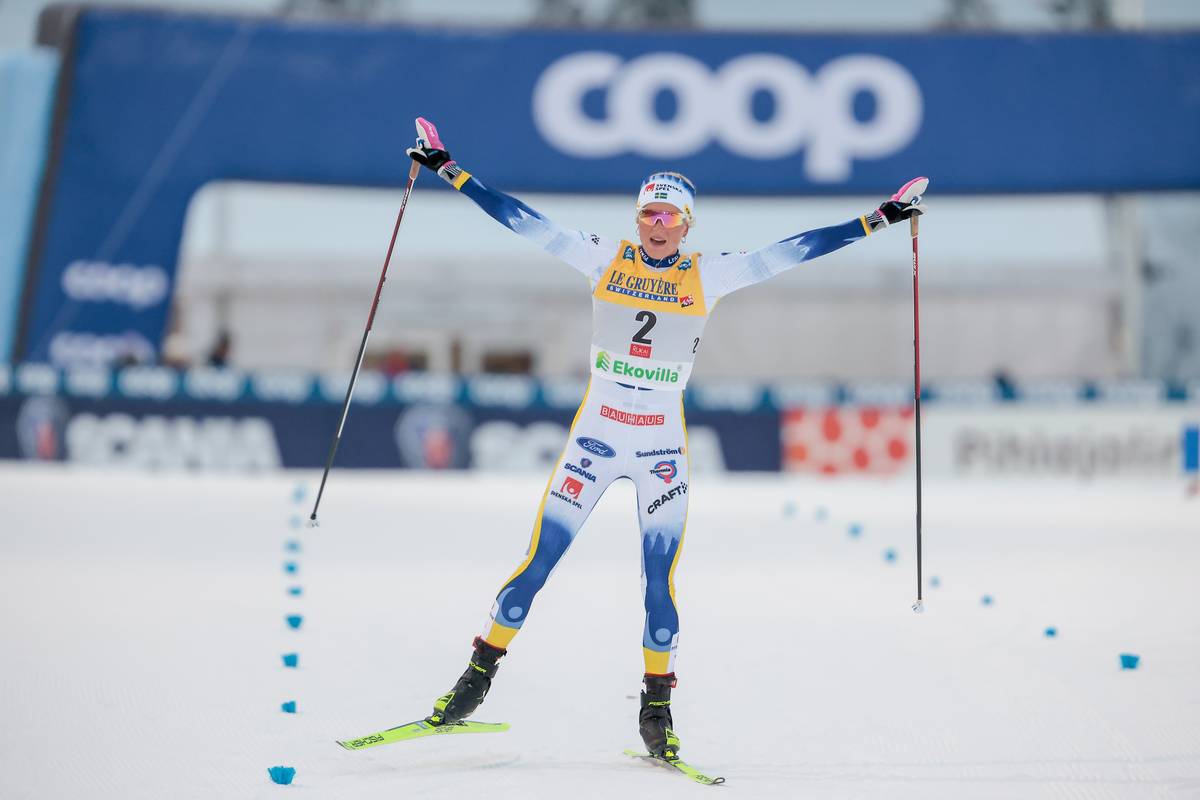
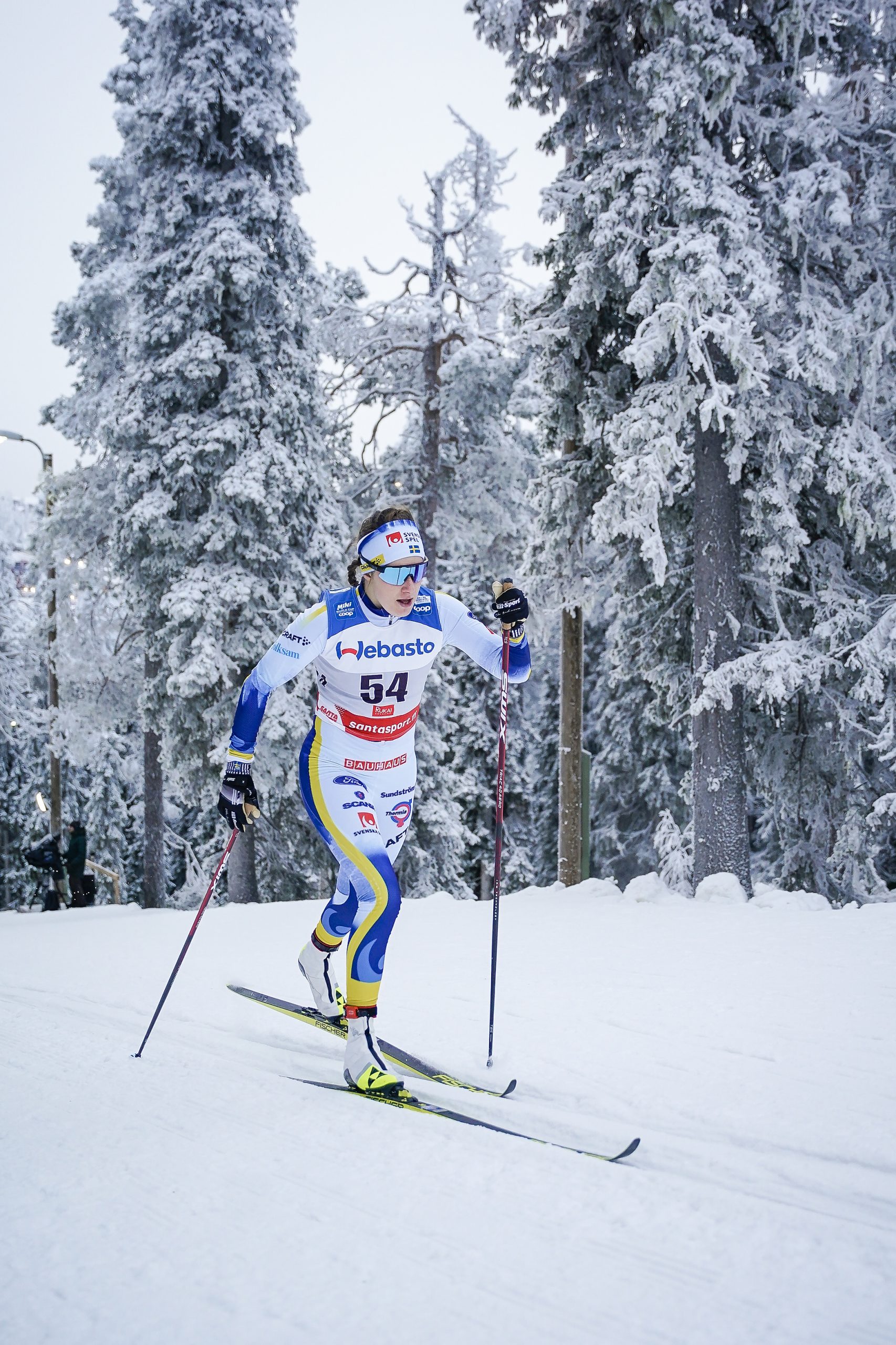
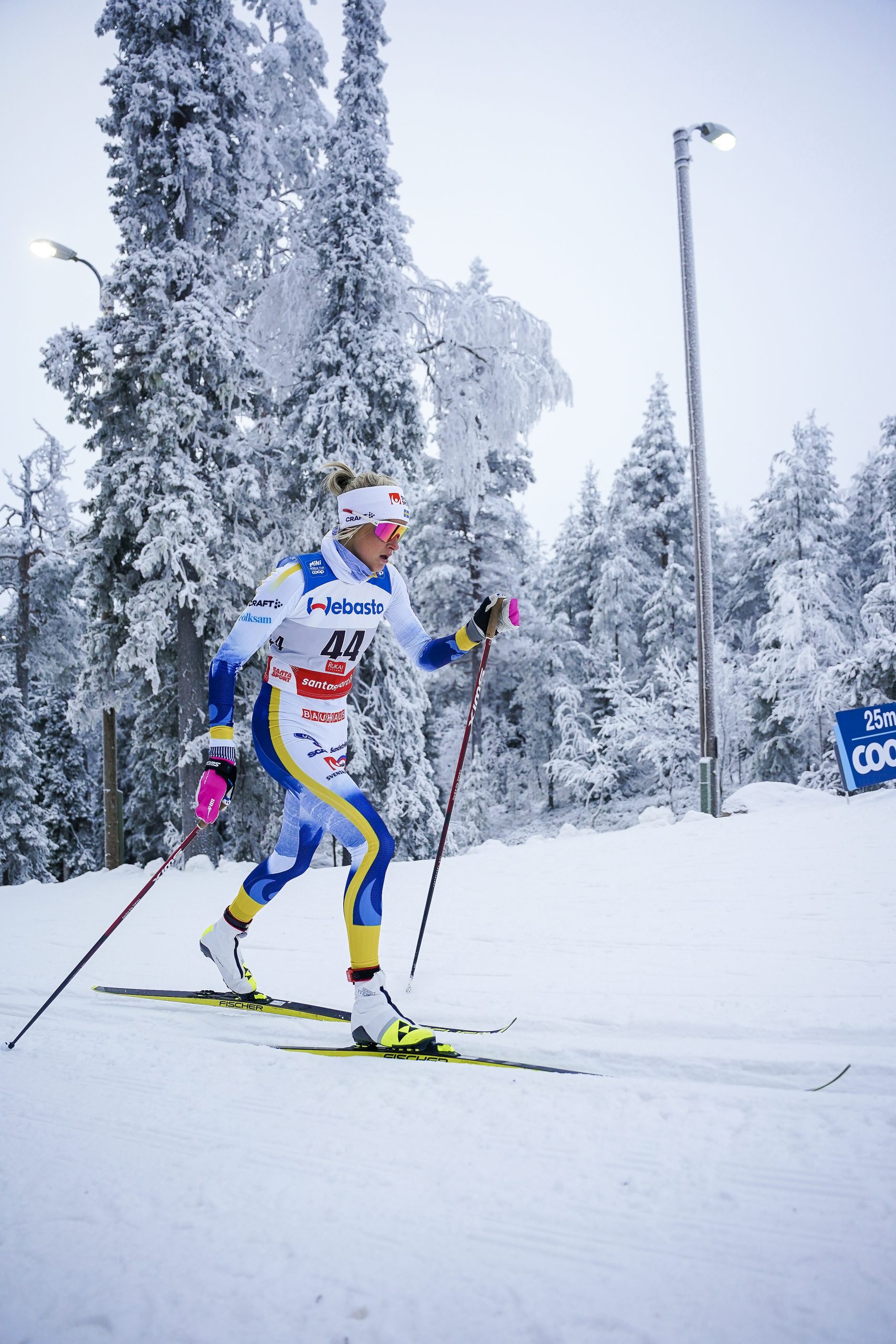
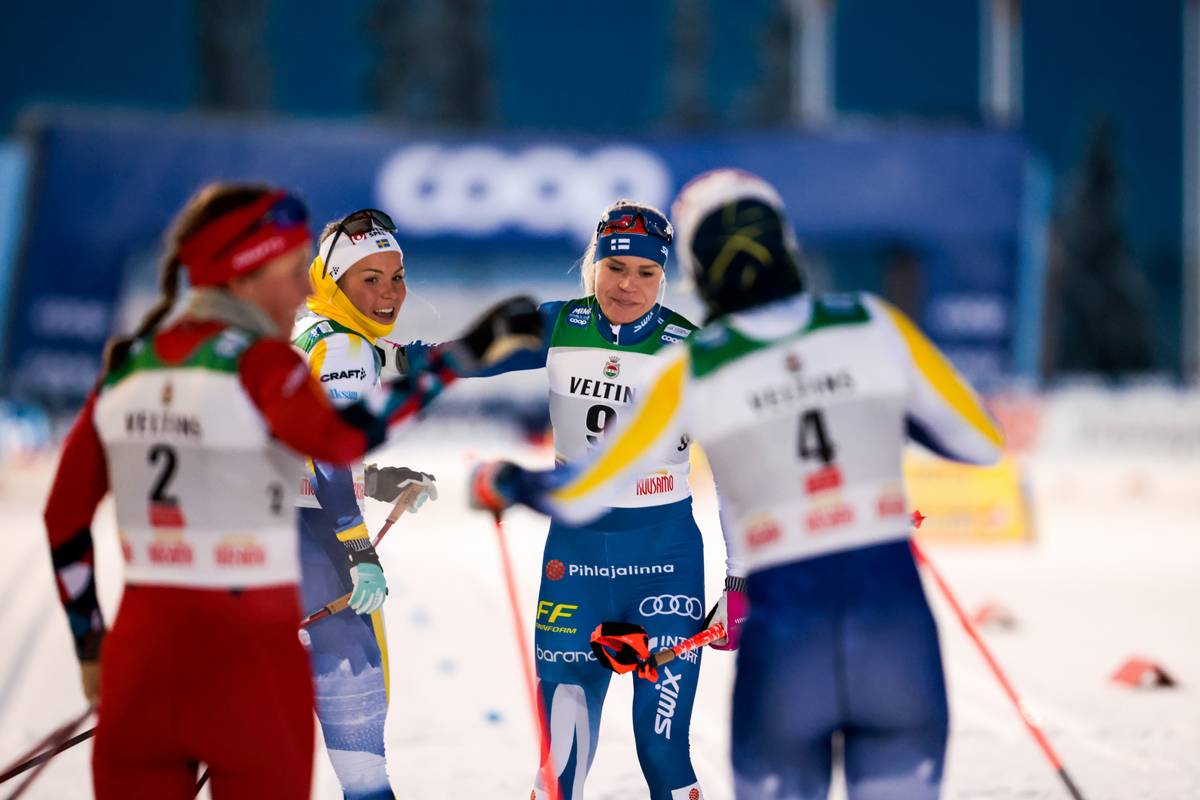
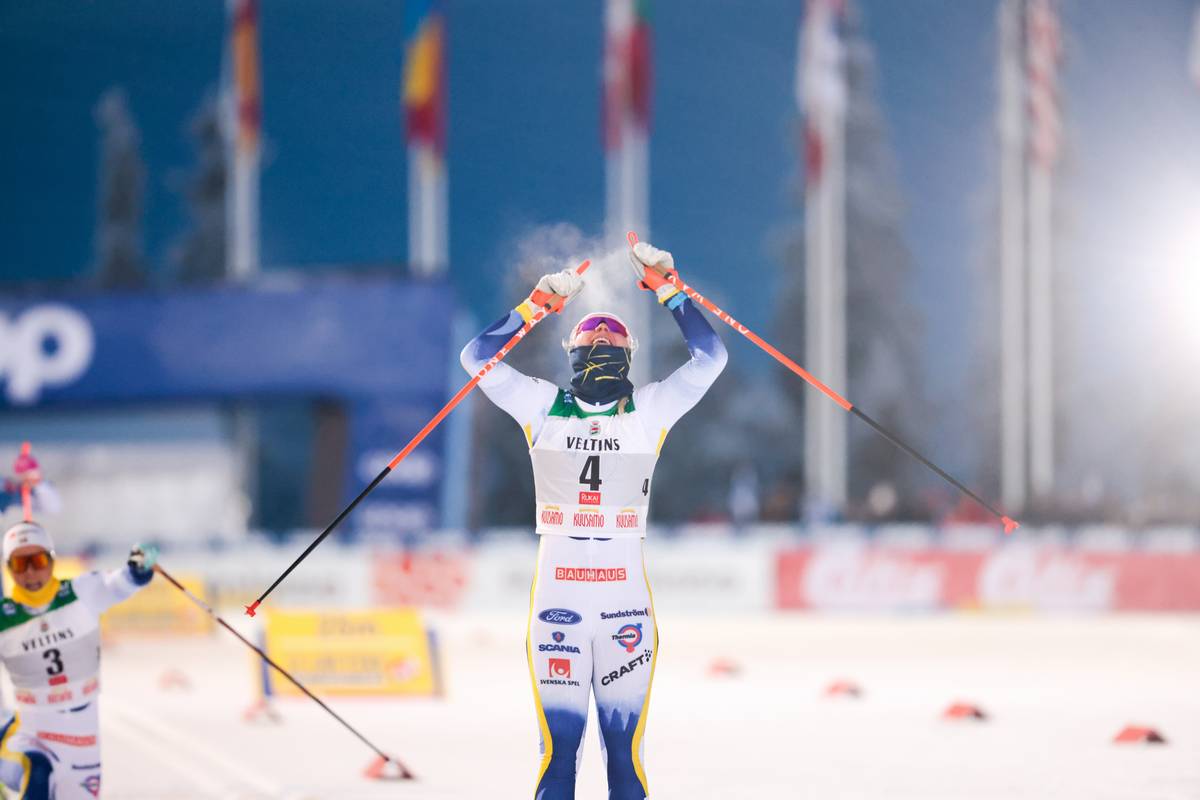
    Frida Karlsson (SWE) celebrates the victory as she nears the finish of the 20k pursuit in Ruka (FIN). (Photo: NordicFocus)

    The course was different from yesterday’s 10-kilometer race. Skiers raced six laps on a 3.33-kilometer course.

    Ebba Andersson (Sweden) started first with a six second advantage over Frida Karlsson (Sweden) and 13 seconds over Katharina Henning (Germany).

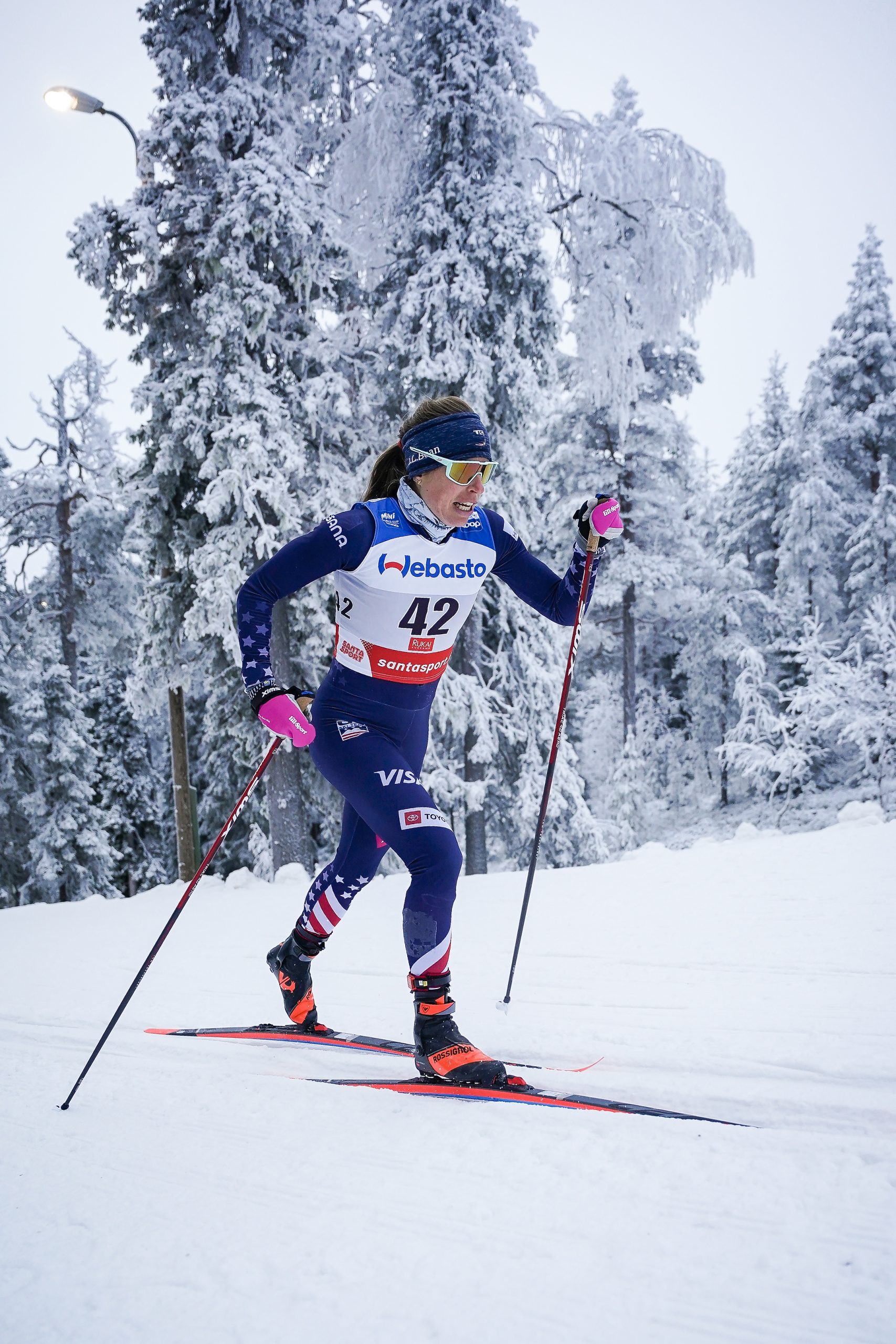
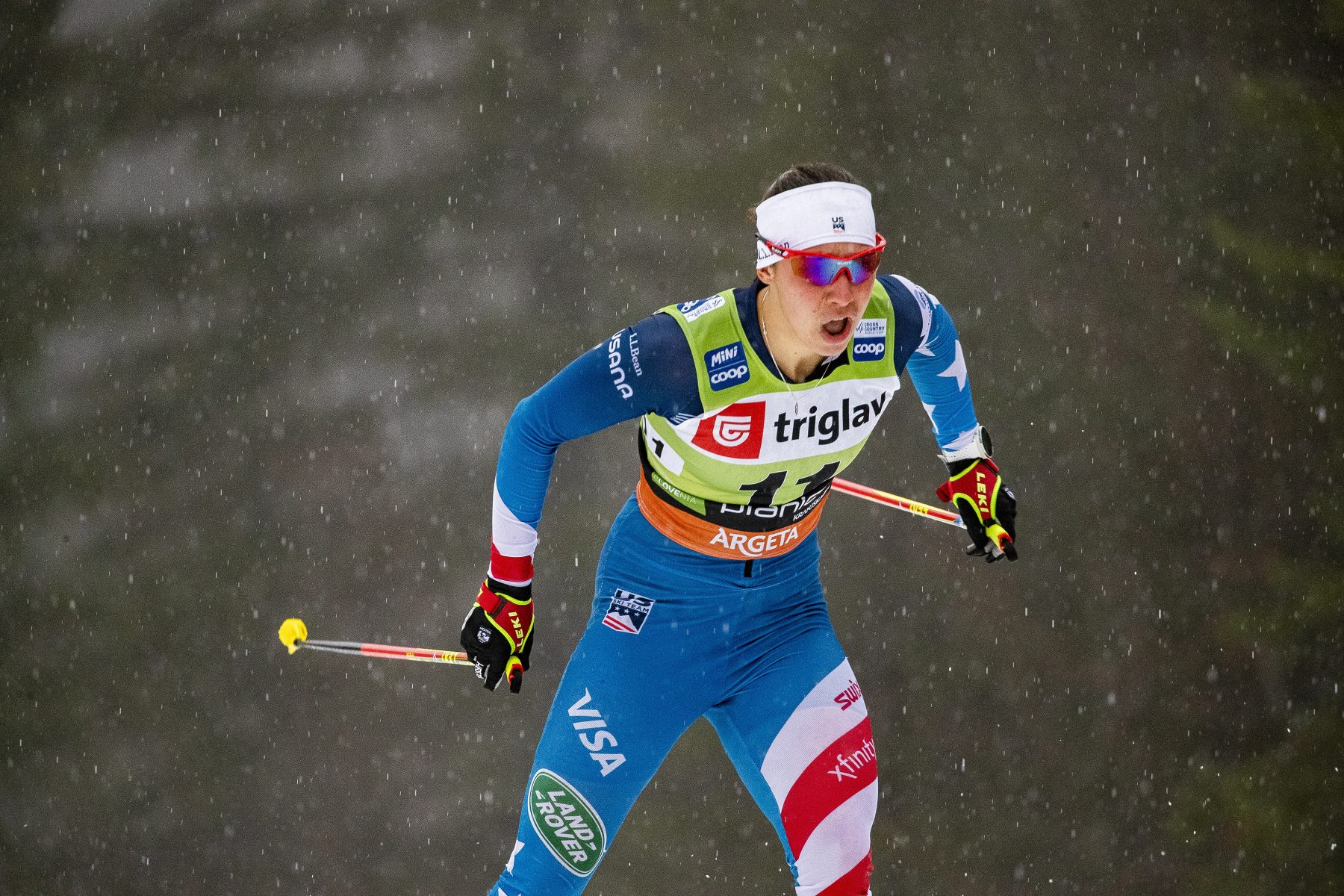
    American Rosie Brennan started 29 seconds back. Her teammate Jessie Diggins started at plus 1:18. Diggins usually performs well in this format but had a long way to come back to reach the podium. However, the new longer format could work to her advantage. The other Americans, Novie McCabe, Sophia Laukli, Alayna Sonnesyn, and Julia Kern, all began over two minutes after the starting gun.

    Prior to the race Rosie Brennan expressed her excitement on the 20-kilometer format. “I’ve never done 20k on the world cup, but it is a distance I’ve done in the U.S. before, it’s super tight at the top ten and it will be fun and exciting.”

    The Results.

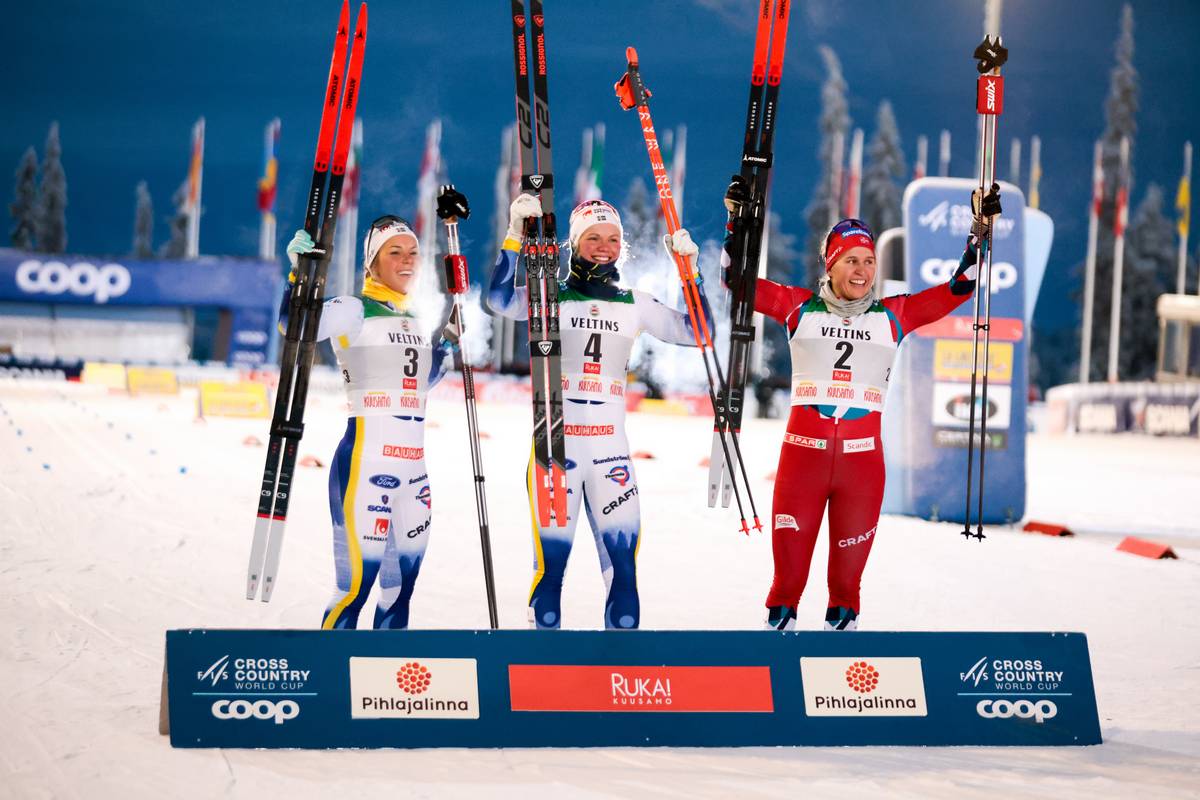
    First:  Frida Karlsson (Sweden)

    Second: Ebba Andersson (Sweden)

    Third: Tiril Weng (Norway)

    Fourth: Heidi Weng (Norway)

    Fifth: Silje Theodorsen (Norway)

    Sixth: Rosie Brennan (U.S.A)

    Seventh: Maja Dahlqvist (Sweden)

    Eighth: Anne Kalvaa (Norway)

    Ninth: Krista Parmakoski (Finland)

    Tenth: Jessie Diggins (U.S.A.)


    Other American finishers:  Novie McCabe, 25th, Alayna Sonnesyn 33rd, Sophia Lauklia 34th, and Julia Kern 35th
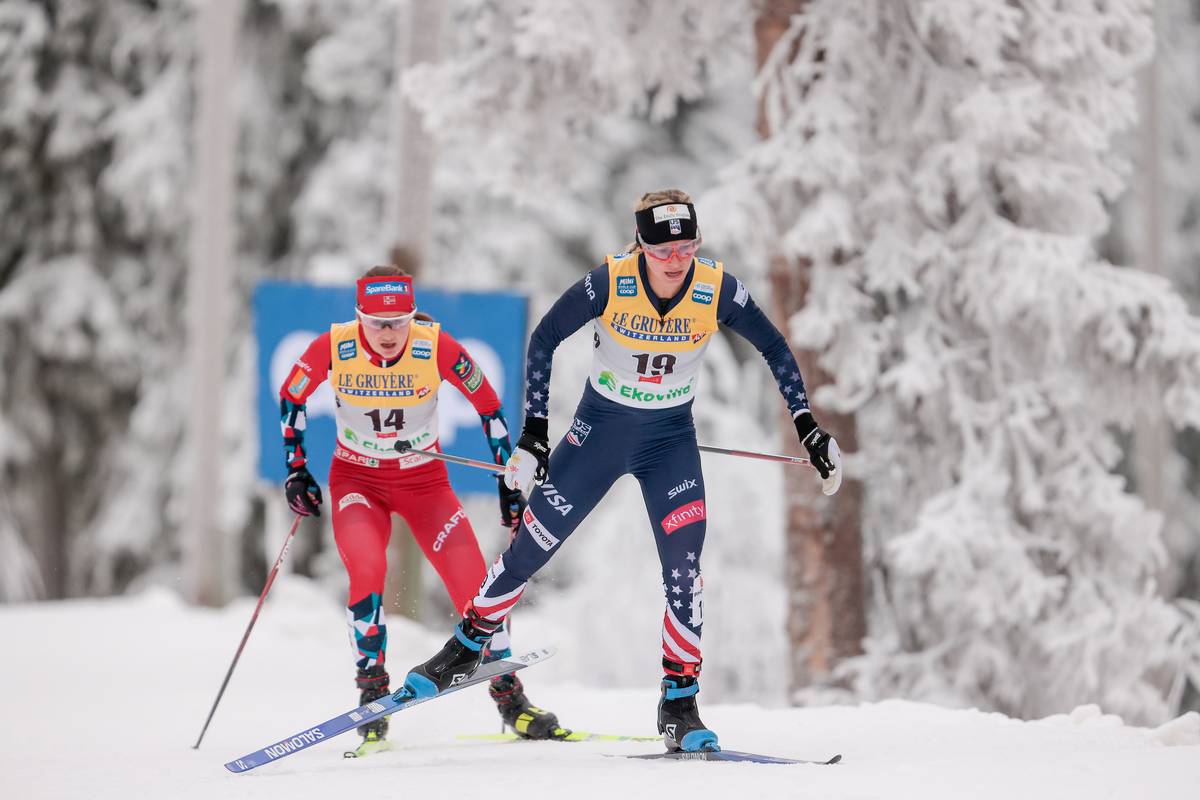
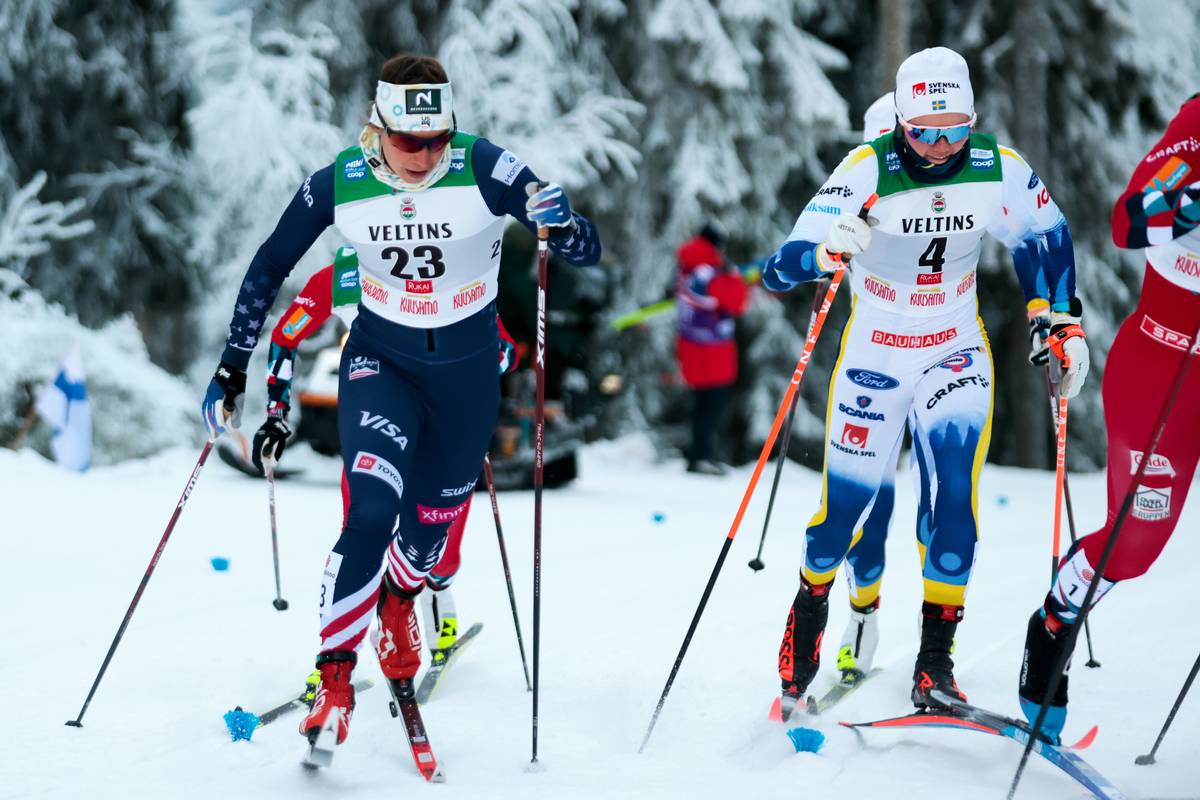
    Jessie Diggins (USA) leads Ingvild Flugstad Oestberg (NOR) during the 20k pursuit. (Photo: NordicFocus)

    The Race.

    One minute before the race, competitors were part of one of the stranger sights at a World Cup start. The entire field of athletes were holding their hands over their ears trying to block the incredibly shrill piercing noise of the pre-race alarm going off. It was much like the frequency of a smoke detector. The athletes were visibly bothered, but the race began without a hitch.

    Within the first two minutes, Karlsson had closed the initial gap on Andersson. The unanswered question arose: was this intentional team tactics to try and work as a group or was it simply two skiers racing?

    At the 1.1-kilometer mark, Brennan had reduced her deficit by three seconds, and was only six seconds out of third place. Diggins had already shaved six seconds from her deficit moving into 19th place.

    Pacing for the new 20-kilometer distance was going to be a challenge. It remained to be seen how racers would manage the new event. Brennan hooked up with a seven-person chase pack at about 2.5-kilometers. It included Maja Dahlquist, Heidi Weng, Tiril Weng, and Anne Kalvaa.  Kalvaa had put in a strong performance yesterday, barely missing out on a podium.

    By the 3.3 mark, the leading Swedes had slightly extended their advantage over the chase group. Brennan was 27.6 seconds back. But the lingering question of whether the leading Swedes were working together had been answered: they were.
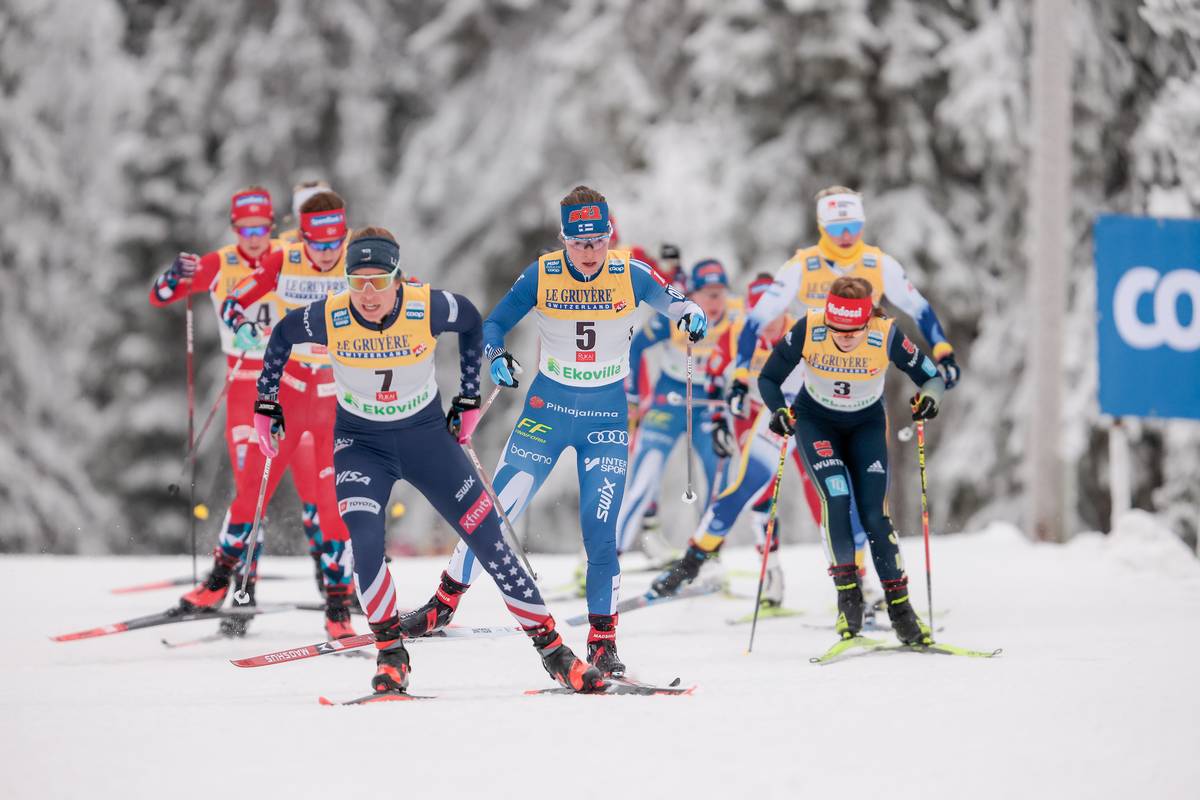
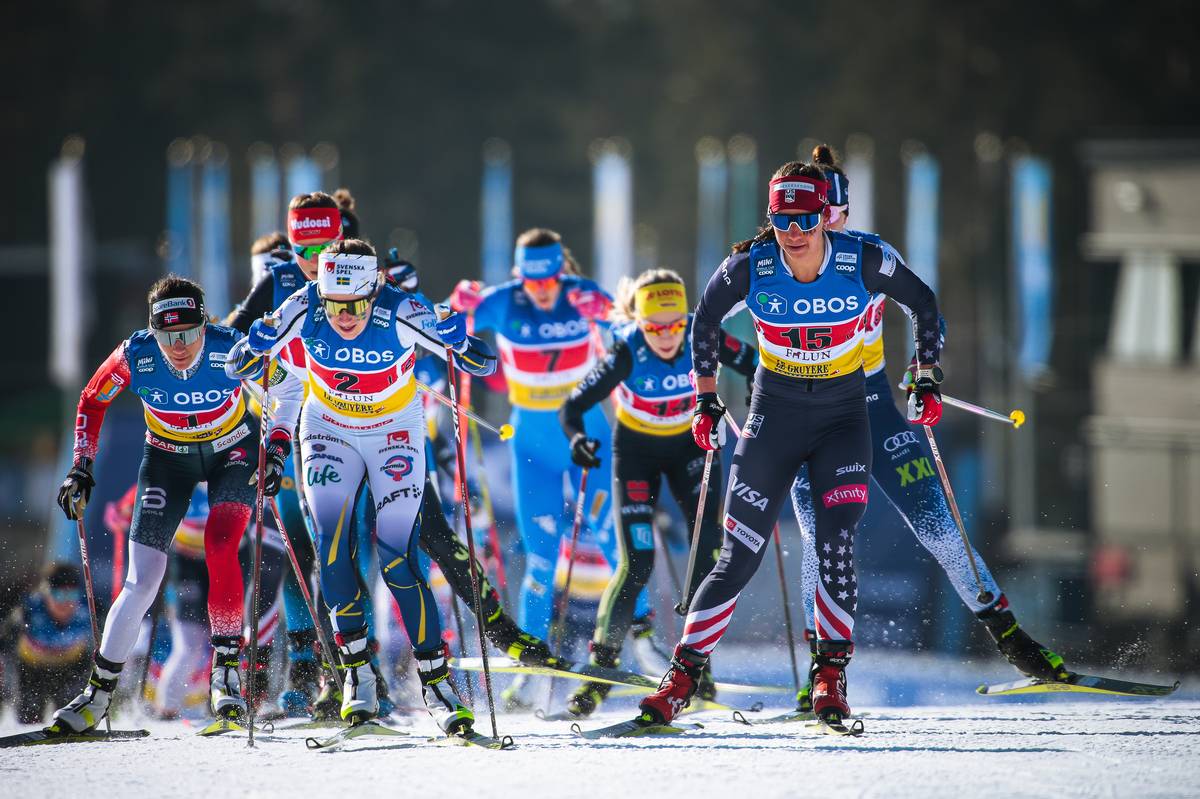
    Rosie Brennan (USA) leads the chase pack during the 20k pursuit. (Photo: NordicFocus)

    At the 3.3-kilometer mark Diggins was 1:03.8 behind the two leaders and was now skiing in a group. She had trimmed 15 seconds from her original deficit. But the lead Swedes continued to press their advantage, increasing the gap on the next chase group by another couple of seconds at the 4.4-kilometer time check.

    Going into the 6.6-kilometer mark, the lead Swedes continued to swap spots, while the chase group had now increased to ten racers. Brennan—perhaps realizing that the pace was not good enough to catch the leaders—moved to the front of the pack, but the group was still bleeding time to the lead Swedes, now 38.3 seconds behind.

    Meanwhile, the second chase group—which contained Diggins—was working hard. Diggins was now only 57.2 seconds behind with over 13-kilometers to go. But, closing the gap to the next chase group would be a monumental task.

    At 7.7-kilometers Brennan was clearly trying to push the pace and began to try and pull away from the rest of the chase group.

    By the halfway point, the lead Swedes had extended their lead over the chase group to 49 seconds. It appeared that much of the chase group had given up the hunt and were jockeying for third place. Their pace had slowed enough to allow Diggins to join the group. At this point the chase group had swelled to twelve athletes with Diggins tucked in the middle.

    Meanwhile, the front running Swedes calmly exchanged the lead, skiing in tandem, in almost perfect rhythm which each other.

    At the start of the fifth lap, if any doubt had remained, it was clear that the chase group was now competing for third place. The chasers were about 50 seconds behind the leading Swedes.
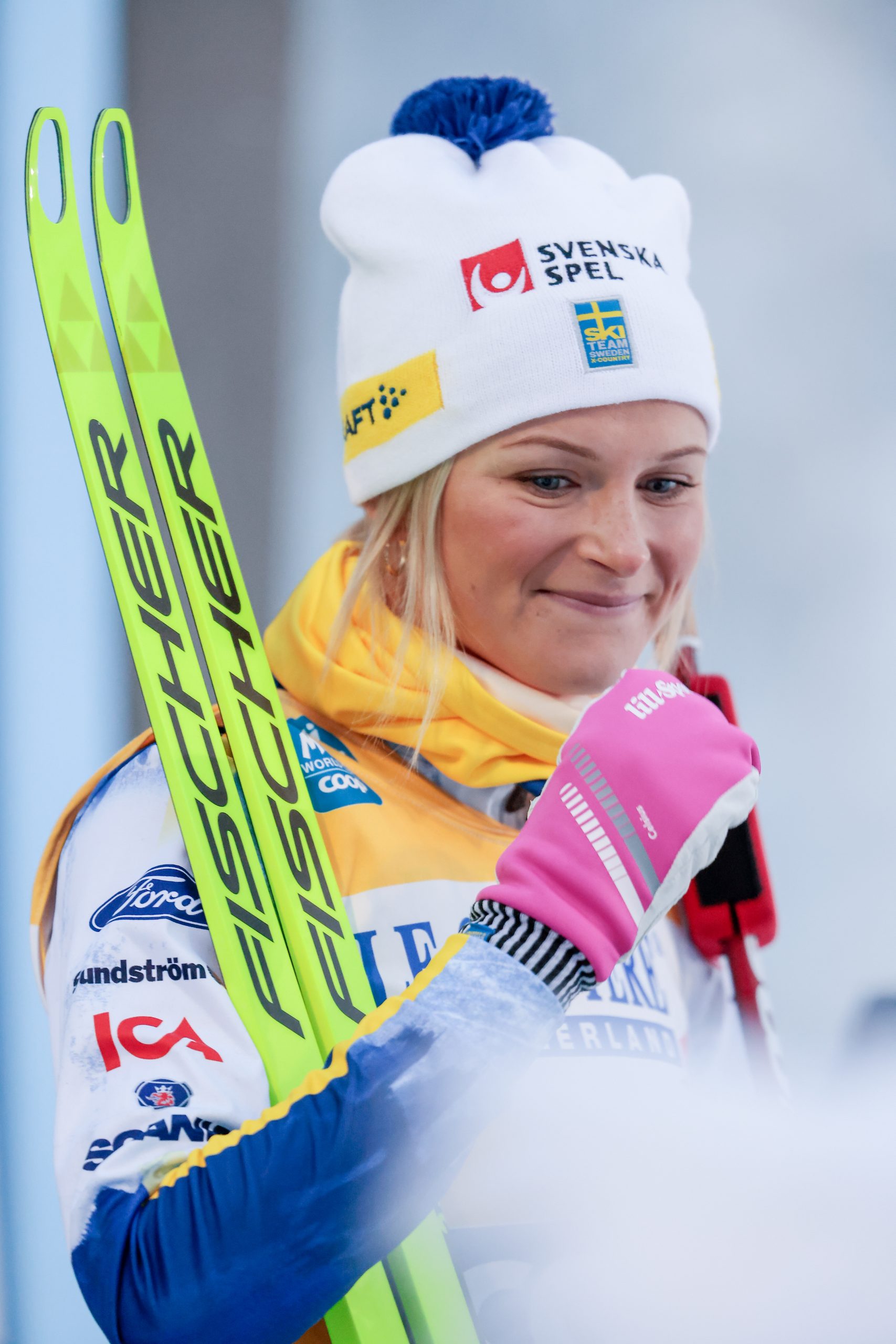
    27.11.2022, Ruka, Finland (FIN): Frida Karlsson (SWE),- FIS world cup cross-country, pursuit, Ruka (FIN). www.nordicfocus.com.

    It was at this point that Norway tried to assert itself as a wave of red suits went to the front of the chase group. But Diggins would have none of it, and at 14.3 kilometers she had broken through the Norwegian wall and pushed herself to the front of the pack and was now in third place overall, having started the day in 19th.

    With 3.5-kilometers to go, race tactics took over as the skiers in the chase group began to position themselves for what would surely be a sprint finish. The chase group was now over a minute back from the leaders, but it didn’t really matter as the top two spots had been conceded.

    At the front of the race, Karlsson put in a gigantic turn of speed to establish a small gap over Andersson. It was the first time since the start that there had been any space between the two Swedes. Karlsson then shot up the next big climb putting several more seconds on her compatriot.
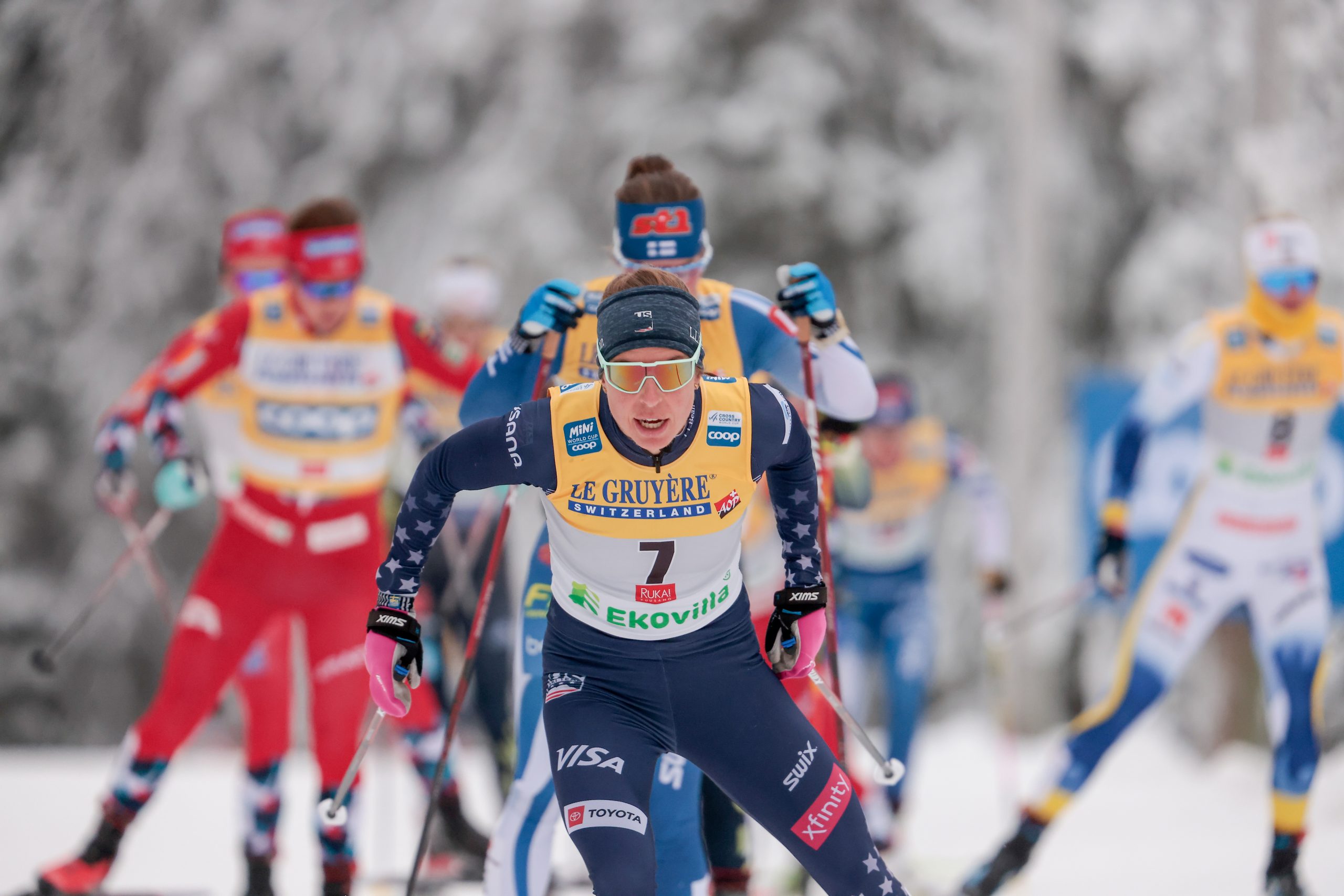
    27.11.2022, Ruka, Finland (FIN): Rosie Brennan (USA) – FIS world cup cross-country, pursuit, Ruka (FIN). (Photo: NordicFocus).

    At about the same time, the chase group pushed the pace and began racing for third.

    With 2.4 to go Karlsson had amazingly gapped Andersson by over 18 seconds; a remarkable push to the lead in the short span of only 1.1-kilometers.

    By the time the chase group reached 2.4-kilometers to go, the Norwegians created a gap on much of the group; fracturing it. Kalvaa went to the front trying to earn the podium spot which had barely eluded her yesterday.

    Diggins gamely held onto the surging Norwegians. She then jumped to the front of the group with about 1.5- kilometers to go trying to break the Norwegian red suits. Having committed so much energy into making up her original deficit would she have enough left to gain a podium spot?
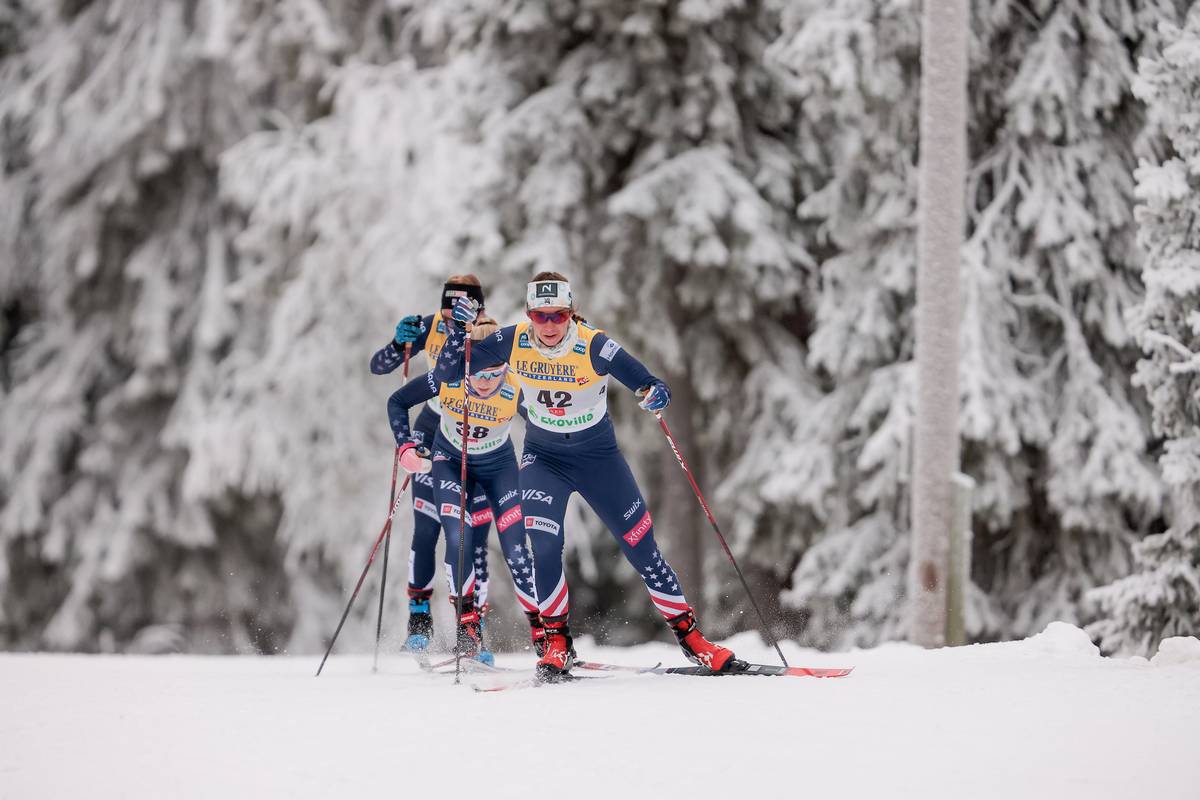
    Julia Kern (USA) on her way to 35th place. (Photo: NordicFocus)

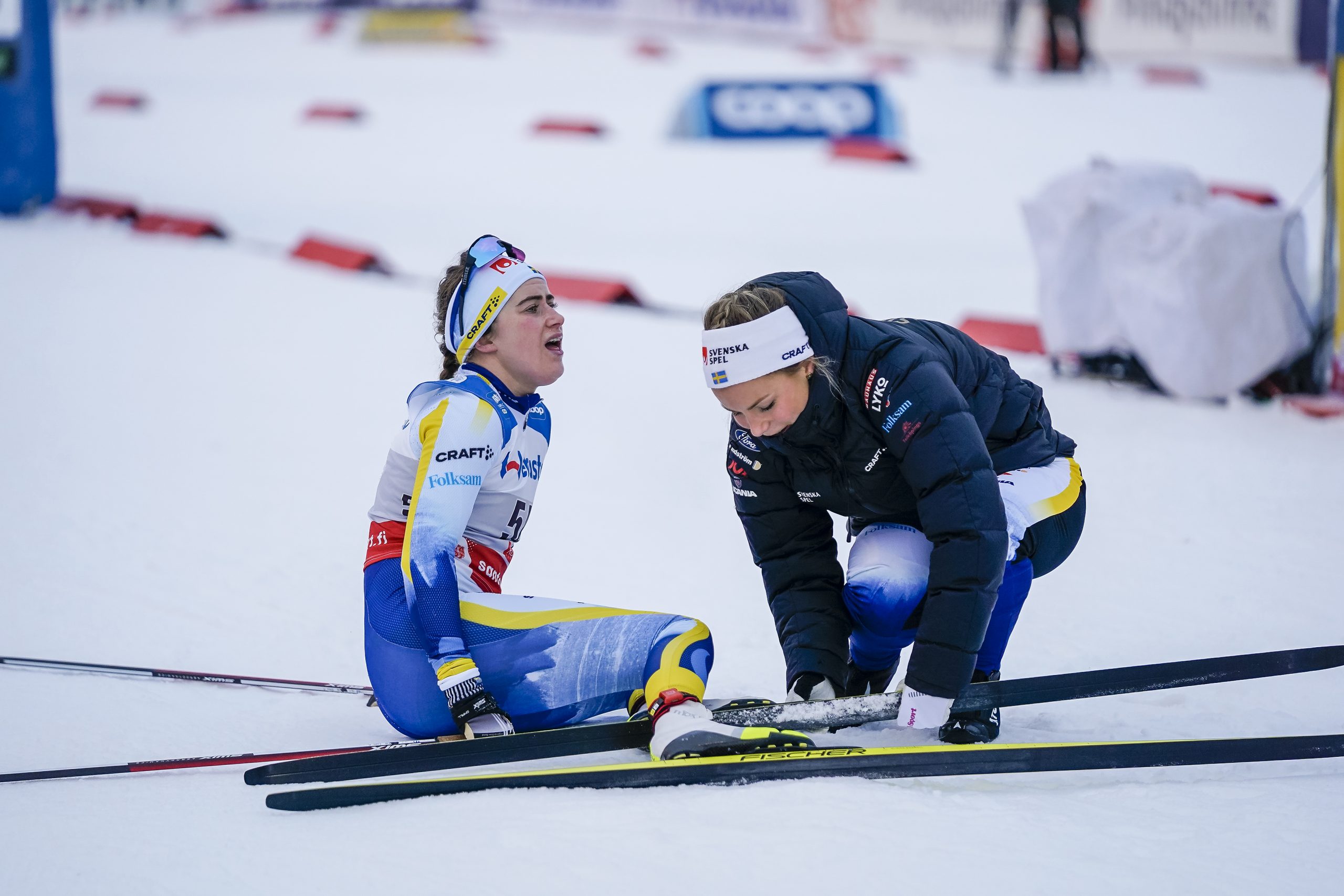
    While the rest of the field was still fighting, Karlsson calmly skied across the finish line having broken away from Andersson, never looking back. Karlsson had put in such an impressive burst of speed that she ended up finishing 33 seconds ahead of Andersson.

    Coming into the stadium the large chase group mounted a frenetic charge toward the finish with Diggins remarkably out front. But it was too much to ask, even for Diggins, as she faded slightly going up the final hill and the Norwegian skiers swallowed her up. Diggins eventually slowed up the final hill, as she stumbled slightly, but American hopes were kept alive as Brennan asserted herself and moved into third position in the chasse group. Coming into the finishing straight it was T. Weng, H. Weng, and Brennan.

    Brennan gave it everything and tried to outsprint the Norwegians, but she fell just short as T. Weng, H. Weng and Silje Theodorsen beat her out at the finish. Brennan, having started seventh, ended up finishing sixth, in a photo finish with Theodorsen, missing the podium by just under one second!

    Having started 19th, Jessie Diggins ended up in tenth, but, Diggins final placing didn’t reflect just how close she had come to making the podium as she lost several spots going into the finish.  She ended up missing the podium by just eight seconds. A remarkable comeback.

    Overall, the inaugural women’s 20-kilometer did not disappoint.

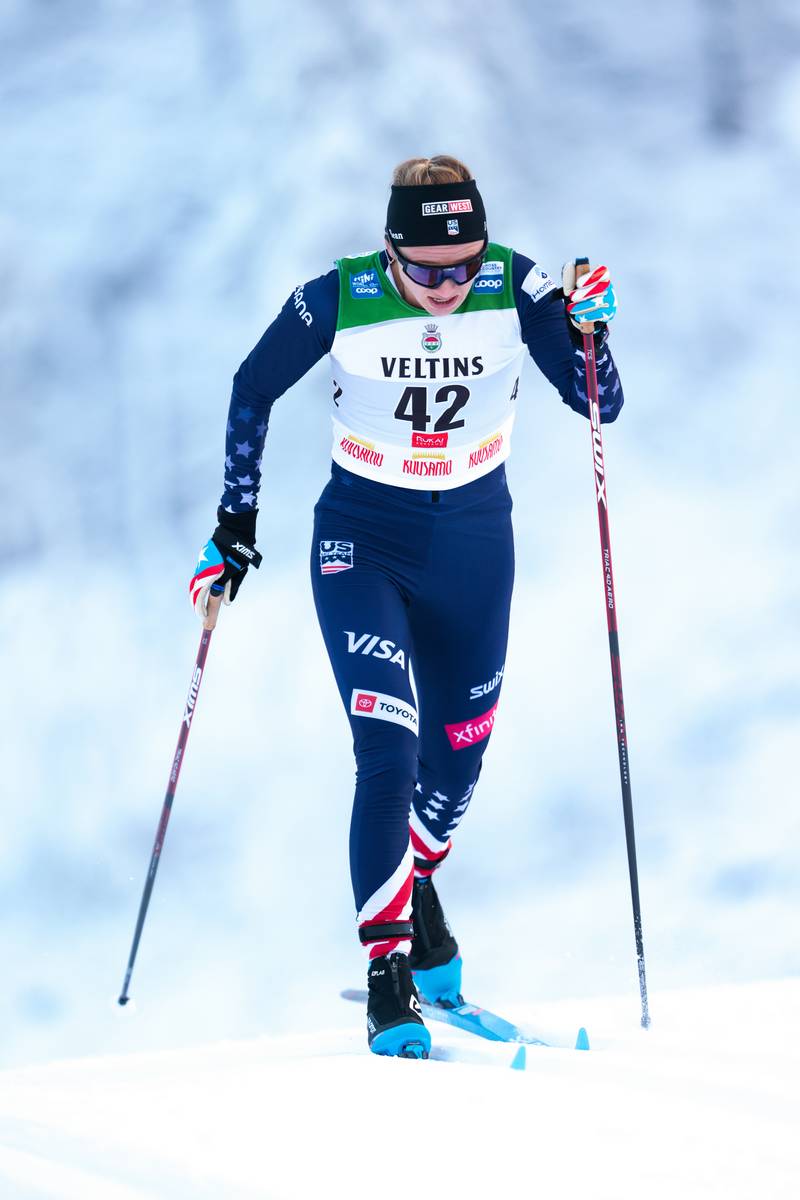
    27.11.2022, Ruka, Finland (FIN):Jessie Diggins (USA) – FIS world cup cross-country, pursuit, Ruka (FIN). www.nordicfocus.com. .

    After the race Karlsson said that she went hard from the start to maintain the gap and had planned to not push the pace until the final lap.

    U.S. coach Matt Whitcomb was pleased with the day. “We are satisfied with our opening World Cup weekend. We had some very good results, but not as many big fireworks compared to what we are capable of. This is the fourth year of a team strategy of not doing a longer training camp prior to the first weekend of racing. The idea is that we shorten the amount of time on the road between day one, and World Championships. It’s a strategy to win races in February. Next season, we’ll consider a longer pre-camp, as it’s a non-championship year, and a good opportunity to test our strategies and try new things.”

    For complete results: https://www.fis-ski.com/DB/general/results.html?sectorcode=CC&raceid=41541#details

     

  • Klaebo Sweeps Ruka World Cup Weekend

    Klaebo Sweeps Ruka World Cup Weekend

    A_Hall_Mark_of_Excellence_Award-logo-300.png (300×244)This World Cup coverage is made possible through the generous support of Marty and Kathy Hall and A Hall Mark of Excellence Award.  To learn more about A Hall Mark of Excellence Award or to learn how you can support FasterSkier’s coverage please contact info@fasterskier.com.


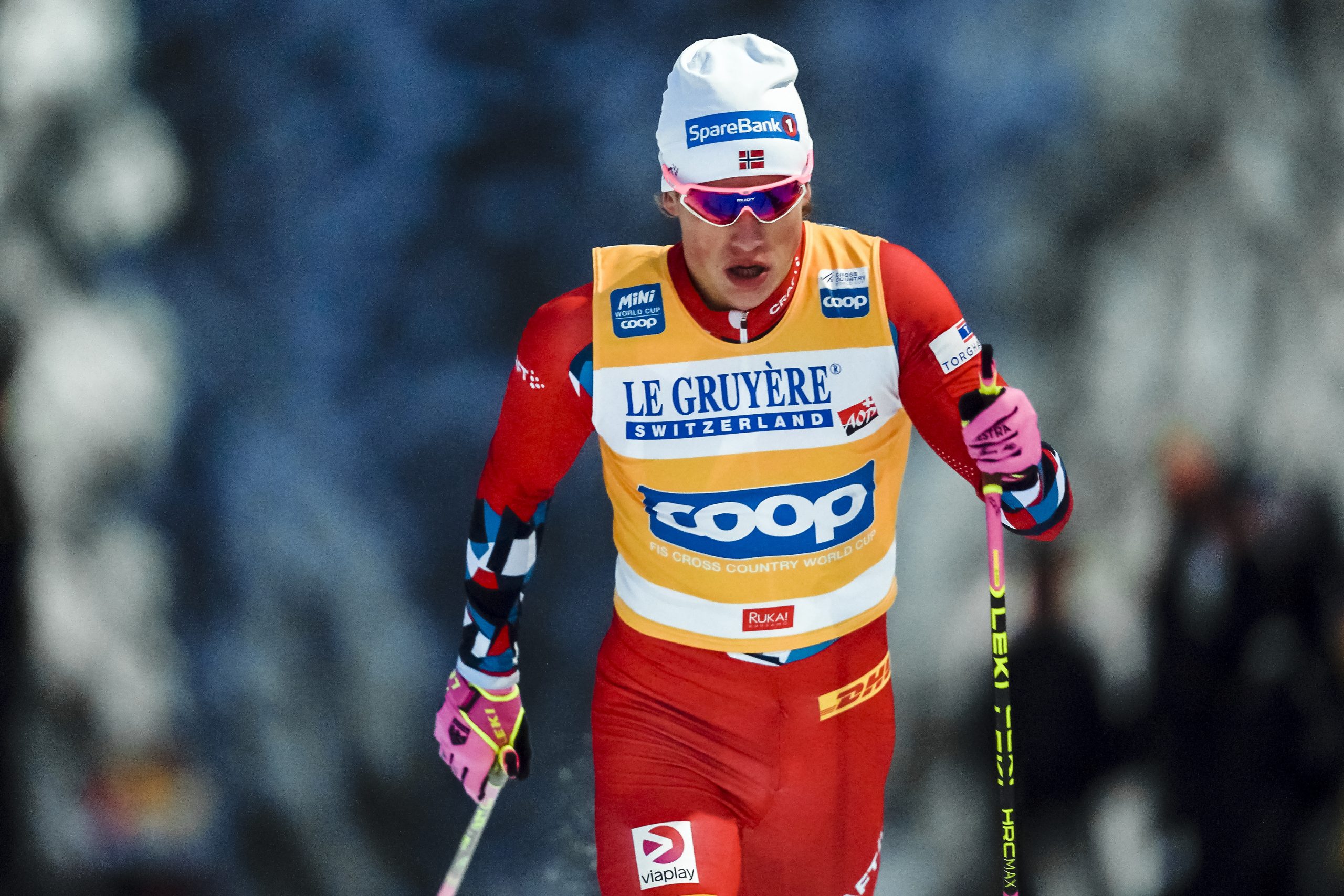
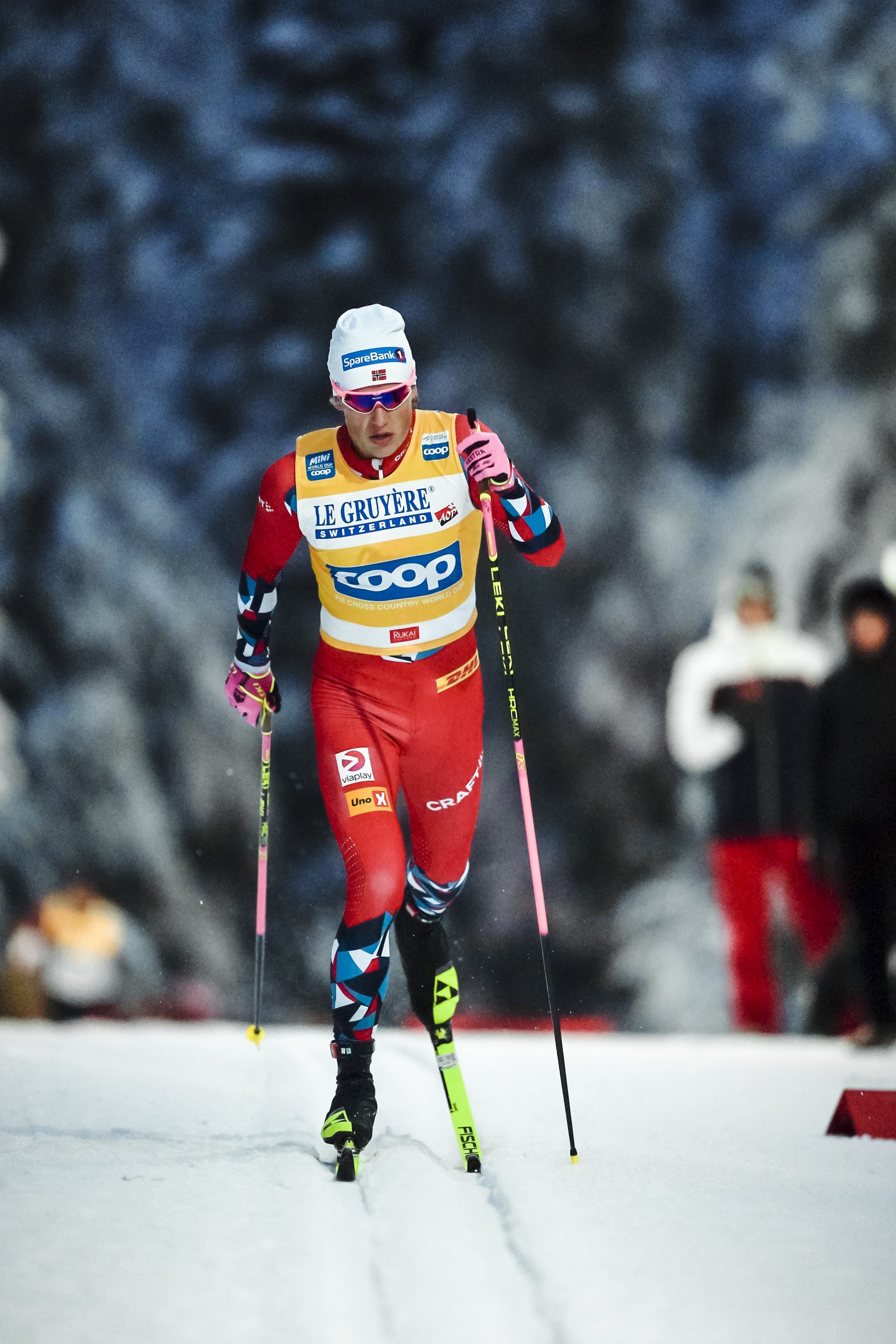
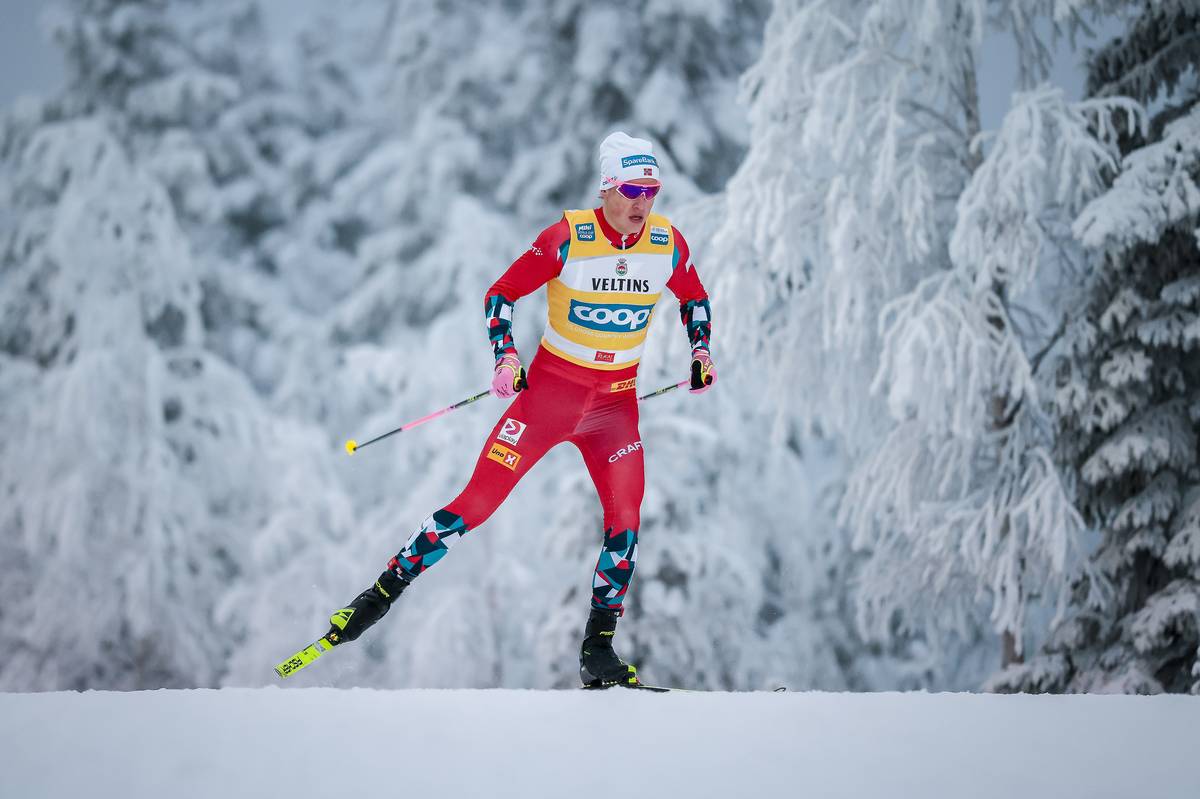
    Johannes Hoesflot Klaebo (NOR) cruising to victory in Sunday’s 20 K World Cup Freestyle Pursuit, and posting a clean sweep of sprint and distance events in the season’s first FIS World Cup weekend. (Photo: NordicFocus)

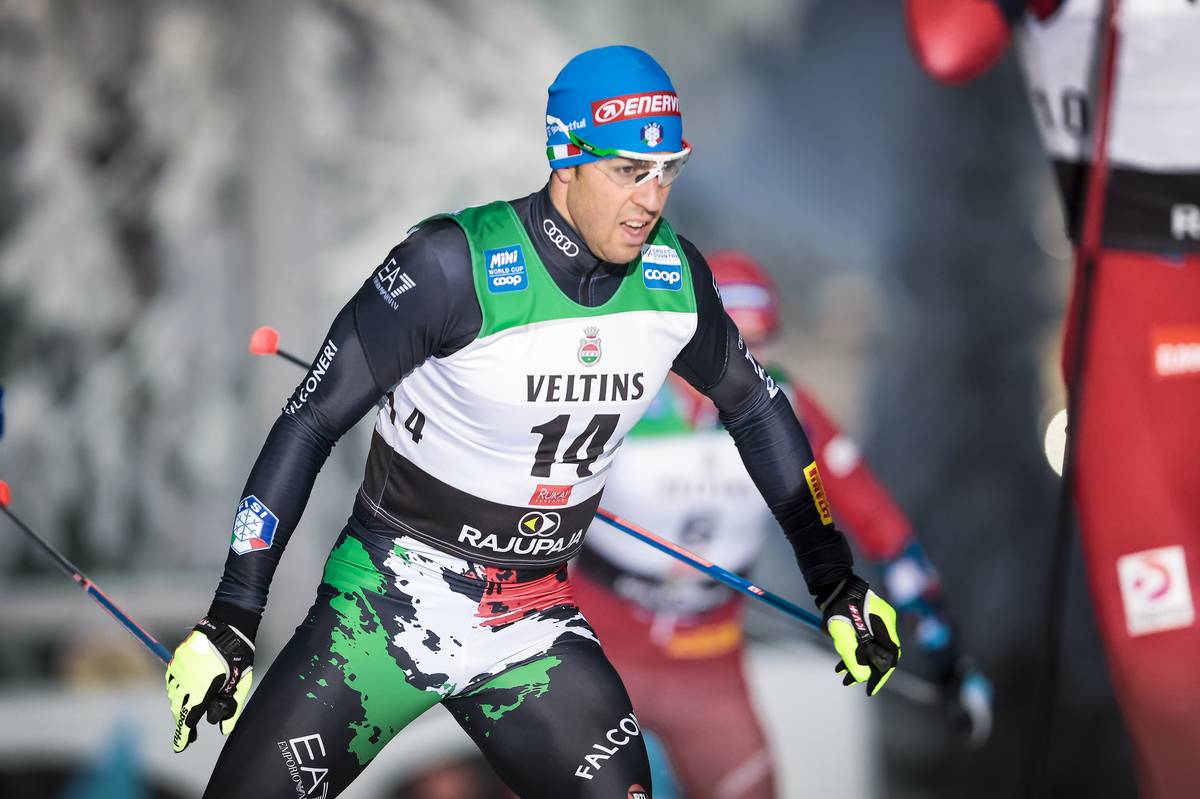
    Snow-covered Ruka, Finland set a wintry stage for the third day of World Cup cross-country racing, as the men’s field returned to the trails to contest a 20 k Freestyle Pursuit. Johannes Hoesflot Klaebo skied a smart, economical race to claim the victory (his third of the weekend), and was joined on the podium by Norwegian teammate Paal Golberg, and Italian sprint-specialist Federico Pellegrino (who advanced to bronze medal position upon the ultimate disqualification of Sweden’s Kalle Halfvarsson).
    Among North American finishers, Canadians Graham Ritchie and Oliver Leveille were 47th and 55th, respectively, while American finishers included Scott Patterson 14th, Hunter Wonders 30th, Zak Ketterson 32nd, Gus Schumacher 36th, and Ben Ogden 50th.

    In 2017, Klaebo swept the opening weekend of World Cup Races at Ruka on his way to an eventual 2018 Overall World Cup Championship It may not have been his goal to repeat such a sweep in 2022; nonetheless, Klaebo has silenced any who may have doubted his readiness for another season of dominance. At this early point in the season, Klaebo definitely looks like the skier to beat.

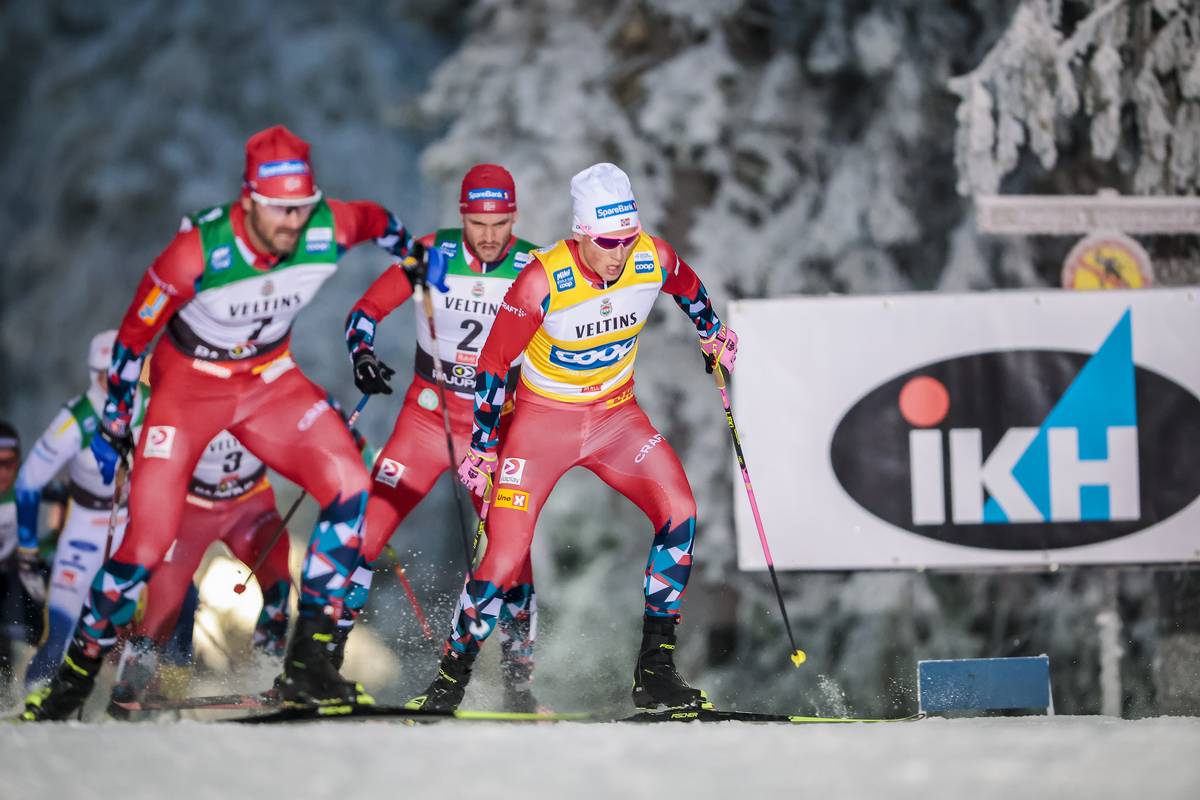
    On his way to victory in the Men’s 20 K Pursuit, Norway’s Johannes Hoesflot Klaebo (in yellow bib) consistently marked the pace-making efforts of his teammate, Han’s Christer Holund (on left). (Photo: NordicFocus)
    20 K Freestyle Pursuit

    Sunday’s Freestyle Pursuit incorporated start positions determined by finishing statistics in Saturday’s Individual Classic 10 k. Having won Saturday’s race, Klaebo started first with an advantage of twenty seconds over the second starter, Paal Golberg. As it turned out, a number of other starters—including some starting nearly a minute back—would play significant roles in today’s race.

    In the absence of Russian skiers, World Cup mass start races are likely to revolve around Klaebo. With any Klaebo-led pursuit race apt to evolve into a mass start strategy, it will always be unlikely that Klaebo—the world’s best sprinter—will volunteer do the lion’s share of the work. Predictably, while Klaebo’s pace was brisk at the beginning of Sunday’s race, he soon eased up and allowed himself to be caught by a charging chase pack led by Klaebo’s Norwegian teammate, Hans Christer Holund. The train of chasers behind Holund included Norwegians Martin Lowestroem Nyenget, Golberg, Erik Valnes, Emil Iverson, Mattis Stenshagen; Swedes Kalle Halfvarsson and William Poromaa; Pellegrino of Italy, Friedrich Moch of Germany, and the lone Brit, Andrew Musgrave. With Klaebo now skiing in the group—and Holund setting the tempo—this lead pack of a dozen proceeded to maintain a pace that effectively excluded all others from the race for medals.

    American skiers spent the early part of the race grouped in the 30’s, with Scott Patterson having moved up 20 places from his 51st place starting spot. Patterson would continue to ski strongly throughout the race, eventually forming a group of only four chasers closely pursuing the lead group. Patterson would ultimately finish the day in a remarkable 14th place, after having begun his race near the back of the pack.


    Hunter Wonders (USA) skied from an original 54th starting position to finish in the first chase group with a very impressive 30th place finish. (Photo: NordicFocus)

    Holund drove the pace through the halfway mark, knowing that Valnes, Golberg, Halfvarsson, Pellegrino—and of course Klaebo—all possessed far superior sprinting skills. Musgrave also pushed the pace through the later kilometers, but neither he nor Holund could break the other contenders—nor did they put a dent in Klaebo who seemed contained, confident, and relaxed throughout the race.

    With less than two kilometers to race, Klaebo moved to the front (shadowed by Pellegrino). Klaebo’s victories at Ruka have all been delivered by a surging attack on the final hill before the finish, and Sunday’s race proved no different. Klaebo led the pack into the bottom of the final hill, increasing his tempo and jump skating over the top of the hill with the other contenders faltering in his wake. Halfvarsson sought space far to the skier’s left, possibly even leaving the race course, though in a manner that did not seem to give him any advantage or to shorten his distance to the finish line. Ulitmately, both Halfvarsson’s skis veered outside the course markers for just a stride or two. In the eyes of the FIS jury, that small infraction was sufficient to merit his disqualification. Third place on the podium was awarded to Pellegrino who had started the race in the 14th position, and moved up to 3rd for what is likely to have been his first World Cup distance medal. In a post-race interview, and emotional Pellegrino spoke of goals well beyond what he had accomplished on this day: “The main goal this season will not be in sport, but with my wife at home.” Pellegrino and his wife are expecting their first child.

    Sunday’s Ruka World Cup Pursuit was an especially satisfying day for sprinter Federico Pellegrino (ITA), who notched his first World Cup Distance Race podium. (Photo: NordicFocus)

    20 K Freestyle Pursuit:  FULL RESULTS

  • Ruka Women’s 10 Kilometer Classic: Sweden Dominates, Brennan Shines

    Ruka Women’s 10 Kilometer Classic: Sweden Dominates, Brennan Shines

    A_Hall_Mark_of_Excellence_Award-logo-300.png (300×244)This World Cup coverage is made possible through the generous support of Marty and Kathy Hall and A Hall Mark of Excellence Award.  To learn more about A Hall Mark of Excellence Award or to learn how you can support FasterSkier’s coverage please contact info@fasterskier.com.


    Ebba Andersson (SWE) on her way to victory in the women’s 10k classic in Ruka, Finland. (Photo: NordicFocus)

    Women’s 10K Interval Start:

    Today began a new chapter in World Cup racing as women and men competed at the same distances on the same course for the first time ever. This also marked the first distance competition since the retirement of Therese Johaug. With that competitive force no longer dominating the races, it would be left to the field to decide who would lead it into the future.

    The Results:

    The race was won by Ebba Andersson of Sweden, followed by Frida Karlsson of Sweden, and Katharina Henning of Germany. The top American was Rosie Brennan finishing in seventh place, 29 seconds out of first.  Jessie Diggins was the second American, finishing 21st, 1:18:0 out of first place.  Rounding out the field for the Americans were Novie McCabe in 39th, 2:03.4 back. Sophia Laukli in 45th, 2:26.2 back, Alayna Sonnesyn in 49th 2:38.4 back, Julia Kern 51st, 2:49.7. The top Canadian was Katherine Stewart-Jones, followed by Dahria Beatty and Olivia Bouffard-Nesbitt.

    Ebba Andersson (SWE) earned the win in the season’s first distance World Cup, the 10km classic individual start at Ruka, Finland.  (Photo: NordicFocus)

    The Race:

    The women’s individual race in Ruka, Finland was held this morning in cold,  overcast conditions.  The athletes competed on a five-kilometer course with a mix of natural and artificial snow with temperatures around 17 degrees Fahrenheit (-8.0 Centigrade) at the start.  Humidity was 93%.  Conditions were favorable as skiers used a mixture of klister and hard wax for kick.

    First out for the American’s was Alayna Sonnesyn starting in the 18th spot, followed by Novie McCabe in 22nd,  Sophia Laukli in 23rd, Julia Kern in 25th, Jessie Diggins in 38th, and Rosie Brennan in 42nd.

    Racing to an impressive seventh place finish, Rosie Brennan (USA) was the top American finisher. FIS world cup cross-country, 10km, Ruka, Finland.  (Photo:  NordicFocus)

    Karlsson Jumps out to the Lead:

    The steep hills of Ruka proved challenging as many skiers stepped out of the tracks to take advantage of loose snow going up hills. Most were resorting to herringbone on the second lap. Karlsson asserted herself early, taking a lead at the 3.1kilometer interval by ten seconds over Andersson by 6.5 seconds. Even so, by the 6.1 kilometer mark, Ebba Andersson took a 2.7 second lead over Karlsson.  Henning was in third place, 9.5 seconds back. At this point, Rosie Brennan was 21.9 seconds back in sixth place.

    Frida Karlsson (SWE) on her way to 2nd place. (Photo: NordicFocus)

    Andersson Takes a Slim Lead:

    By the 8.1 K mark Andersson’s lead had been reduced to the narrowest of margins, leading Karlsson by just 0.6 seconds. Henning had dropped back to fourth place, 8.5 seconds back.   Brennan was in fifth place, just behind Heidi Weng who had a very fast second half.

    Karlsson crossed the finish line and had to wait to see how Andersson would fare.  Karlsson had looked very strong as she finished, but would it be enough to hold off the surging Andersson? As it turned out, Karlsson’s time in the winner’s chair was short-lived as Andersson ferociously attacked the last hill to make time on Karlsson. Anderson had an incredible final two kilometers and ended up beating her teammate by 5.7 seconds to give Sweden first and second place.

    The surprise of the day was Anne Kjersti Kalva of Norway. Kalva missed the Olympics with Covid, but on this day she battled back to a fourth place finish, falling just two tenths of a second short of a podium finish.

    Complete Results

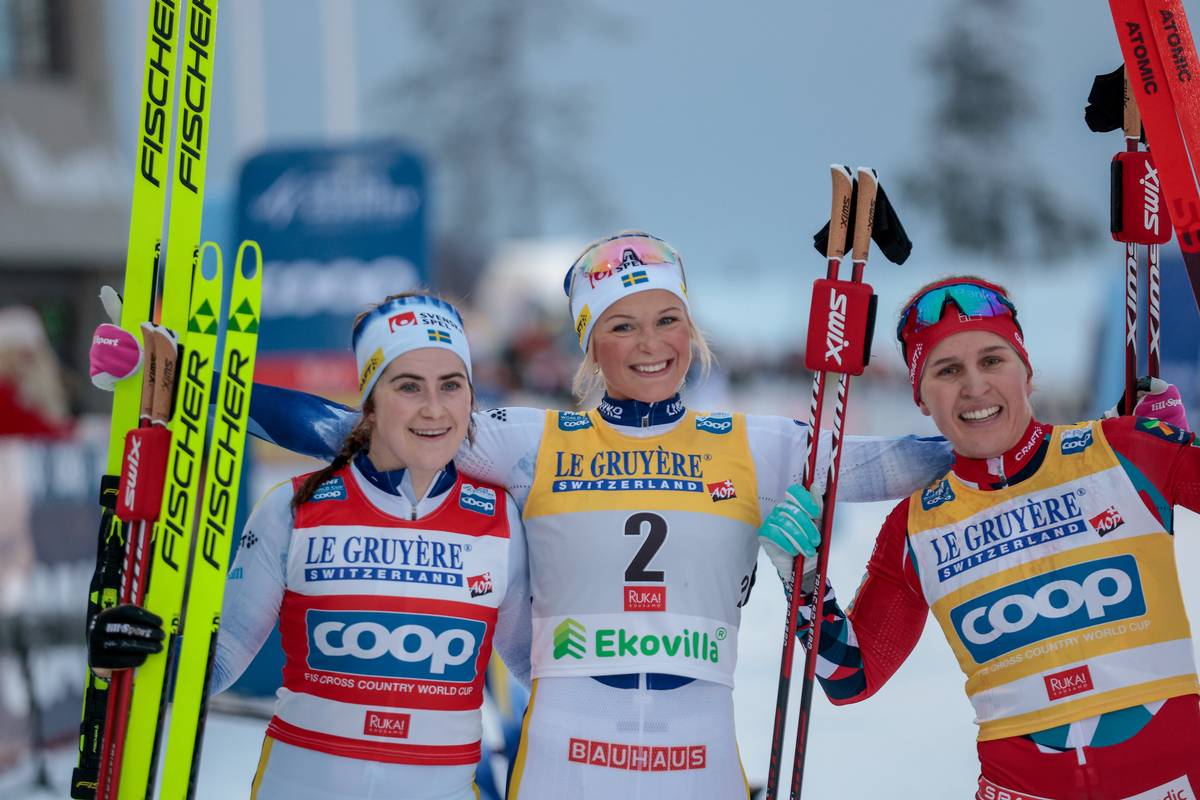
    Frida Karlsson (SWE) – second place, Ebba Andersson (SWE) – first place and Katharina Hennig (GER) – third place share the women’s podium of the 10k classic in Ruka, Finland. (Photo: NordicFocus)
  • Ruka Men’s 10 Kilometer Classic Individual Start:  It’s all Team Norway.

    Ruka Men’s 10 Kilometer Classic Individual Start: It’s all Team Norway.

    A_Hall_Mark_of_Excellence_Award-logo-300.png (300×244)This World Cup coverage is made possible through the generous support of Marty and Kathy Hall and A Hall Mark of Excellence Award.  To learn more about A Hall Mark of Excellence Award or to learn how you can support FasterSkier’s coverage please contact info@fasterskier.com.


    Ruka Men’s 10K Classic Individual Start

    Ruka presented less challenging conditions this year compared to last year for the athletes.  Temperatures were in the high teens (-8.0 Centigrade) with racers running on green cold waxes. Humidity was 100 percent, which posed the possibility of tracks glazing during the race. The racers competed on a 5-kilometer course with 30 seconds between the start of each racer.

    Johannes Hoesflot Klæbo (NOR) on his way to victory in the 10k in Ruka (FIN). (Photo: Nordic Focus)

    Results:

    The Norwegians dominated the field.  Johannes Klæbo finished first, besting countrymen Paal Golberg by 20.5 seconds followed by Martin Nyenget who was 28 seconds behind Klæbo.  An outstanding performance was turned in by Andrew Musgrave of Great Britain, who finished in fifth, 40.3 seconds behind Klæbo. Norweigans took six of the top ten spots.

    The top American was Ben Ogden, finishing 28th, 1:23.9 back.  He was closely followed by Zak Ketterson who finished 31st, 1:24.6 out of first.  Rounding out the field for the Americans was Hunter Wonders, who is also a competitive canoe racer, finishing in 39th. 2020 Junior World Champion in the 10 kilometer, Gus Schumacher, finished 48th. Scott Patterson finished 54th.

    The top Canadian was Graham Ritchie, finishing 35th.  He was followed by Olivier Leveile who finished 44th.

    Hunter Wonders (USA) on his way to 39th place in the 10k classic. (Photo: Nordic Focus)

    The Race:

    The steep climbs of Ruka proved challenging for the men who consistently jumped out of the tracks early on climbs, preferring to run up the loose snow on the sides of the course.  Prior to the race there had been much discussion about Klæbo’s health.  Questions continued to swirl when he hit the one-kilometer split in 21st place and still trailed at the 3.1- kilometer split.

    Calle Halfvarsson (SWE) on his way to 4th place in the 10k in Ruka (FIN). (Photo: Nordic Focus)

    Calle Halfvarsson of Sweden gave many of the Swedish fans in the crowd a thrill as he led the race at the first three splits.  Ogden was in the hunt at the one-kilometer mark, only 12.5 seconds out of the lead, but by the 3.1 checkpoint, his trailing margin had widened to 22.4 seconds.

    Starting at about the six-kilometer mark, Klæbo removed any doubt about his nagging injury when he jumped into the lead establishing a six second advantage over countryman Halfvarsson.  Meanwhile, Musgrave had pulled himself from 23rd to sixth place, only seven seconds away from a podium spot.  Musgrave turned in the fastest time from the 3.1 to 5.0-kilometer split.


    Andrew Musgrave (GBR) – FIS world cup cross-country, having an outstanding weekend in Ruka. (Photo Credit: NordicFocus)

    However, because of the start order, Klæbo was never really able to relax since he had started the race ahead of Golberg.  When Klæbo finished he had a 28 second lead over the next best finisher.  But most of the contenders were still on course, so he was uncertain as to where he would finish.  However, the writing was on the wall as Golberg entered the stadium and it became apparent that he wouldn’t be able to catch Klæbo.

    The only remaining question was would Norway capture all of the podium positions?  The question was only partially answered when Halfvarsson crossed the eight-kilometer checkpoint in fourth but was only 0.2 seconds behind Nyenget.  At the finish it appeared that Halfvarsson was struggling mightily but was able to hang on for a fourth place finish.  The results; Norway 1-2-3.

    Complete Results

    Paal Golberg (NOR), Johannes Hoesflot Klaebo (NOR) and Martin Loewstroem Nyenget (NOR) share the 10k classic podium in Ruka (FIN). (Photo: NordicFocus)
  • Ruka Sprint Redemption for Johannes Høsflot Klæbo

    Ruka Sprint Redemption for Johannes Høsflot Klæbo

    A_Hall_Mark_of_Excellence_Award-logo-300.png (300×244)This World Cup coverage is made possible through the generous support of Marty and Kathy Hall and A Hall Mark of Excellence Award.  To learn more about A Hall Mark of Excellence Award or to learn how you can support FasterSkier’s coverage please contact info@fasterskier.com.


    Johannes Høsflot Klæbo displayed his dominance in this year’s FIS World Cup Sprint in Ruka, Finland. (Photo: NordicFocus)

    Ruka, Finland sits at a northern latitude similar to Fairbanks Alaska, similar to the northern end of Canada’s Hudson Bay. By early winter, the sun is a weakened glow on the horizon, and then for only a few precious minutes each day. By midday, skiers vying for the win in today’s FIS Cross-Country World Cup Sprint were racing under Ruka’s stadium lights.

    The first men’s events of the FIS World Cup Cross-Country season took place in cold conditions that left competitors wreathed in the steam of their own breath, and tested the skill of ski technicians charged with creating kick and glide. Johannes Høsflot Klæbo quickly dispelled any notion that he may be limited by a lingering hamstring injury: Klæbo qualified first, dominated all heats in a manner that appeared easy, even for him, and cruised to victory ahead of Norwegian countrymen, Even Northug and Paal Golberg.

    Ben Ogden and JC Schoonmaker were the only North American’s advancing to the heats in the men’s field—Ogden 13th  and Schoonmaker 19th—with a near-miss for Logan Diekmann who skied to 32nd place in qualifying. Luke Jager tied for 40th, and Kevin Bolger 46th.

    Canada entered two skiers in sprint qualifying, with Graham Ritchie placing 53rd and Oliver Leveille 56th.

    Ruka Men’s World Cup Sprint

    While Klæbo’s first win of this World Cup season appeared leisurely, it was not without emotion. Ruka is where Klæbo was famously pipped at the line by Alexander Bolshunov in 2018. Ruka is also where Klæbo lost a World Cup sprint to Erik Valnes in 2020, and where Alexander Terentev outskied him in the opening World Cup Sprint in 2021. If Johannes Høsflot Klæbo were ever motivated by a desire for redemption, it would be at Ruka.

    Norwegian teammates Erik Valnes and Johannes Høsflot Klæbo celebrated a team sprint victory in Oberstdorf. Valnes is one of the few sprinters to take a World Cup sprint victory from Klaebo, as he did last season in Ruka. (Photo: NordicFocus)

    QUARTERFINAL 1—Klaebo and Valnes dominate

    Norwegian skiers arrived for Quarterfinal 1 clad in truly confusing red racing uniforms (all but indistinguishable from what Russian team skiers have worn on the World Cup circuit for quite a few years).  Except for Klæbo, most Norwegian athletes even raced in very Russian-looking red hats. At least the Swedes (mostly white) Finns (blue) and Americans (in blue with red/white stripe accents) remained recognizable.

    Wearing the yellow bib of last year’s overall World Cup champion, Klæbo advanced easily by means of his now-familiar acceleration on Ruka’s signature hill, though he never needed to unleash the high tempo striding that has been his trademark in this event. His skis seemed to float along the finishing stretch, allowing him sufficient space in front of his rivals to stand up and remove his pole straps well before the line. Norwegian teammate, Erik Valnes, followed him across the line in second.

    QUARTERFINAL 2—Halfvarsson advances

    The day’s second heat saw American, Ben Ogden, joining Norwegian sprint specialist, Even Northug, and the rejuvenated Swede, Calle Halfvorsson. Finland’s Joni Maki displayed fast skis as he moved to the lead, with Ogden pressing forward on the course’s first uphill. Ultimately, Halfvarsson finished first in the heat ahead of Northug, with Maki advancing as a lucky loser. Ogden seemed to struggle with slow skis, ultimately finishing the heat in fifth.

    QUARTERFINAL 3—Chanavat fades

    Heat 3 was dominated by Norway’s Haavard Solaas Taugboel who sprinted the ultimate hill followed by an inspired Francesco De Fabiani. France’s perennial sprint contender, Lucas Chanavat, finished fourth without ever appearing sharp.

    QUARTERFINAL 4—Schoonmaker comes close

    Paal Golberg moved quickly to the front in Quarterfinal 4, with American JC Schoonmaker jumping in behind. France’s 2022 World Cup Sprint Champion, Richard Jouve, worked his way forward through the quarterfinal field to tuck in behind Goldberg. Schoonmaker raced cleverly through the final stretch with a smart move to the inside on the final curve, narrowly missing a lucky loser spot.

    QUATERFINAL 5—Pellegrino climbs to the win

    Beijing silver medalist, Federico Pellegrino wore Italy’s new black race suit, and advanced to the semifinal by moving efficiently through the quarterfinal field. Pellegrino went to diagonal striding early on the ultimate hill, allowing him to pull away from the field. The inspired Frenchman, Jules Chappaz, crossed the line second.

    A resurgent Calle Halfvarsson moved consistently through the field on his way to the final. (photo: Fischer/NordicFocus)

    SEMIFINAL 1—both the lucky losers

    Wearing a white hat that differentiated him from his Norwegian teammates, Klæbo moved easily to front of his semifinal field before abruptly easing up. Northug and Halfvarsson took over the pace-making: thereafter, the script was pure Klæbo: driving to the front on the hill before gliding unchallenged across the finish line. Halfvarsson, Valnes, and Northug all advanced to the final.

    SEMIFINAL 2—Chappaz arrives on the scene

    The 1.4 k Ruka sprint course incorporates a critical uphill groomed four lanes wide, continuing over the top and down the other side to a lefthand turn into a wide finishing straight. Commentators often become so focused on Klæbo’s quick-striding domination on Ruka’s signature hill that we may overlook the fact that many other skiers bide their time on the hill, using the finishing straight to pick off their rivals. Semifinal 2 looked to be competitive, with Goldberg, Pellegrino, Chappaz, Jouve, and De Fabiani seeming well matched. Early on, Jouve moved into the lead after a very tight move that cut off De Fabiani. Ultimately, Jouve faded badly on the uphill—as did Pellegrino—allowing Chappaz to storm ahead for the semifinal victory (though he may have used too much energy in achieving it). Golberg crossed the line second to advance to the final.


    Sprint Final

    Making only his 12th World Cup start, Jules Chappaz may have spent more energy than was necessary in winning his semifinal; he would not end up being a factor in the final. That left Sweden’s resurgent Calle Halfvarsson to face four Norwegians (Northug, Valnes, Golberg, and Klæbo). Golberg and Valnes maneuvered to the front after Klaebo had  slowed the opening pace. Lingering mid-pack, Klæbo accelerated on the course’s primary downhill, and moved into a leading position before the hill. Klæbo never appeared to need his top gear, easily distancing the field on the hill. By the top, he had established a considerable gap which he handily maintained through the finish for his 49th World Cup victory. Northug won last week’s tune-up sprint Beitostolen, and his good form and good strategy brought him to the finish line second followed by teammates Golberg in 3rd, and Valnes in 4th.

    Johannes Høsflot Klæbo of Norway takes the win in Ruka, Finland’s classic sprint, gaining redemption for two Ruka World Cup sprints when he suffered rare defeats. (Photo: NordicFocus)

    While Klaebo had shown his early season fitness last week in Beitostolen with wins in Classic and Freestyle 10 k’s, his sprint-condition had remained in question. It wasn’t known (even by Klæbo) whether or not he would have the speed, the power, and the pop to contend in a World Cup sprint.

    “I didn’t know how this should go,” Klaebo said in a post-race interview.” . . . [I’ve had] things to deal with the last three weeks (referring to his lingering hamstring injury). [But] I had a really good day today. It was a lot of fun.”

    If there were any lingering questions regarding Klæbo’s fitness—or about his recovery from his summer-long hamstring injury—those questions have now been answered.

    The World Cup Sprint podium ceremony was still fist bumps instead of handshakes, reminding viewers that Covid still threatens events such as these. That memory must be particularly poignant to Klæbo: in 2020, the Norwegian team was unable to compete in the final World Cup events, and in 2021 Klæbo, himself, succumbed to Covid in the final weeks of the year, allowing Richard Jouve to claim the crystal globe. Today, at least, Klæbo had achieved a level of redemption, finally exiting the Ruka stadium with the sprint win that we’ve all come to expect.


    Full Results

    RUKA MEN’S SPRINT:  QUALIFYING | RUKA MEN’S SPRINT:  FINAL RESULTS


  • New Season, Same Swedes: Ribom Notches First Career World Cup Win, Kern Strong into Semis

    New Season, Same Swedes: Ribom Notches First Career World Cup Win, Kern Strong into Semis

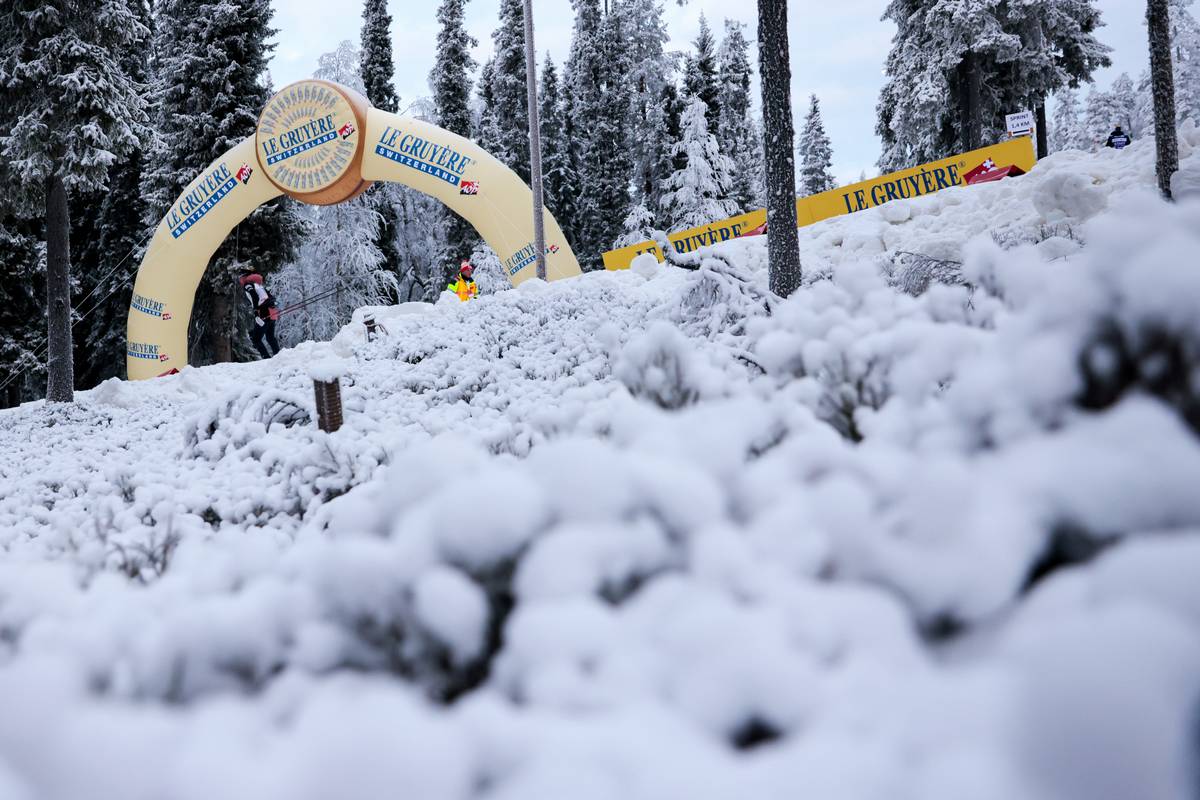
    Ruka covered in a fresh layer of frost ahead of the first World Cup race of the season Friday. (Photo: NordicFocus).

    This World Cup coverage is made possible through the generous support of Marty and Kathy Hall and the A Hall Mark of Excellence Award.  To learn more about A Hall Mark of Excellence Award or to learn how you can support FasterSkier’s coverage please contact info@fasterskier.com.

    The temperature was a balmy -11℃ (12℉). A glow hung in the sky and new snow decorated the trees; a welcoming winter scene in Ruka, Finland. With the FIS Cross-Country World Cup making its start there on Friday, the crisp, clear, sub-arctic conditions seemed to be an indicator of good things ahead.


    Ruka’s 1.4 k classic sprint course remains unchanged from previous years. (To see a breakdown on this course, check out our video from 2018 with Andy Newell here). The straightforward read on the Ruka loop is that for all the jockeying and positioning possible in the first 1 k of rolling terrain, the last hill—the big one—plays an outsized role in deciding who wins. Yet, the critical read on why it has produced such awesome racing over the years is that the place in the racing calendar is just as important. The jitters and nerves of an entire offseason bear down on skiers in a way where the decisive moments in a day come not on the hill meant to test their mettle, but in the moments before where they know that test is coming. Don’t miss the forest for trees. Don’t miss the whole race because of the big hill.

    Alayna Sonnesyn on the 1.4 k Ruka classic sprint course during qualifying on Friday. (Photo: NordicFocus).

    The women’s field came into that course today anticipating an extra degree of variability. For all the variety of the World Cup last season, its classic sprints were surprisingly predictable. Only four skiers notched wins: overall sprint champion Maja Dahlqvist (SWE),  Natalia Nepryaeva (RUS), Maiken Caspersen Falla (NOR) and Jona Sundling (SWE). This season, Falla has retired, and Nepryaeva is out due to the FIS’ Russian suspension. With no skier showing a firm hold on the sprint events, today looked to be anyone’s race.


    The Americans started a full lineup of six skiers, with Jessie Diggins qualifying for heats in 11th place, +4.68 seconds off winner Ane Appelkvist Stenseth (2:48.85). Julia Kern also qualified for the heats, placing 23rd (+5.39 sec). Kern ended up in the first quarterfinal along with the winner Stenseth, while Diggins took to the 3rd quarterfinal in a match up with 2nd place qualifier Tiril Udnes Weng (NOR) (+0.56).

    The first quarterfinal also featured Sweden’s Emma Ribom, who was coming off an FIS sprint victory over most of the Swedish national team last week. For the 24 year old, that result follows an offseason in which she had top results in rollerski races of all types, from sprints to a 42 k classic marathon win in Trollhaettan.

    Julia Kern (USA) and Emma Ribom (SWE) in the first quarterfinal on Friday. (Photo: NordicFocus).

    In that quarterfinal, Stenseth (NOR) set a pattern her countrywomen would follow throughout the day; taking the inside lane at the start and leading out the early action. The Swedish counter throughout the day was to let the Norwegians do the pace-setting and hit that decisive last hill hard. Kern meanwhile comfortably moved in the pack, always near the front but never commanding the lead. When they hit the last hill, Ribom surged and Stenseth followed from the other side of the trail. Ribom crossed in 1st – 2:47.54, and Stenseth crossed in 2nd – 2:48.21 (+0.67). Kern had followed the Stenseth move up the hill, and held on in a late sprint with Anna Svendsen (NOR) for 3rd place 2:48.60 (+1.06).

    The first heat had been fast, though Kern in 3rd place would be forced to wait out the rest of the quarterfinals before learning if her time was good enough to earn a lucky loser spot.


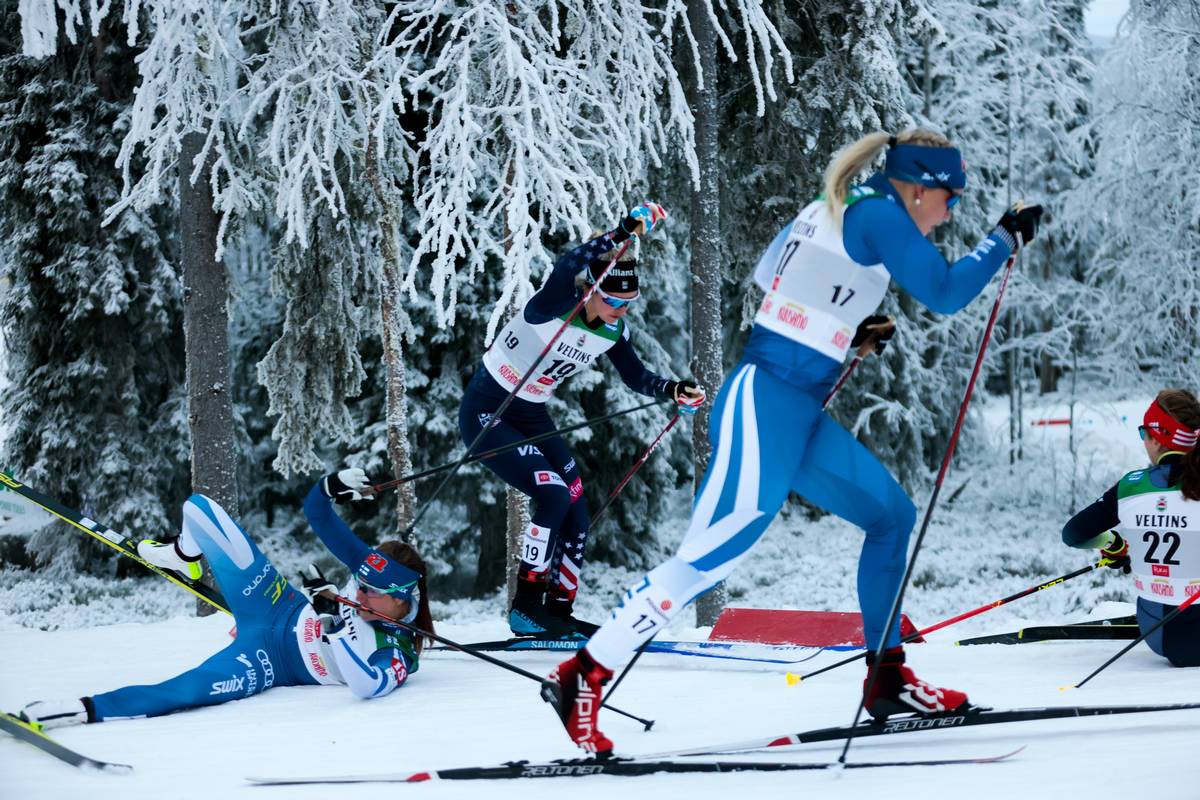
    In the 3rd quarterfinal, Jessie Diggins tucked in behind the Norwegian pair of Tiril Udnes Weng and Kristine Stavås Skistad, and through the early part of the race was in a comfortable position in the pack. As that field rounded the corner that led to the course’s only prolonged downhill, however, Finn Katri Lylynpera and German Katharina Hennig tangled up and went down. Diggins was held up ever-so-slightly, but the spot on the course was unfortunate, stifling the momentum Diggins hoped to build by skiing out from the back of the field. She ended the heat in 5th place.

    Jessie Diggins (USA) got caught behind a pile-up during her quarterfinal Friday. Diggins qualified 11th on the first day of World Cup season. (Photo: NordicFocus).

    When the rest of the dust had settled on the quarterfinals, the first heat proved to be the fastest, sending Julia Kern into the semi-finals where she would race out of the second heat.

    In the first semi, Emma Ribom and Maja Dahlqvist formed a Swedish contingent matching up to a three-strong Norwegian contingent of Tiril Udnes Weng, Ane Applekvist Stenseth and Anna Svendsen. The sixth skier in the heat was the host nation’s Jasmi Joensuu (FIN), who also has a strong American skiing connection – an alumni of Denver University, where she was an All-American and part of DU’s NCAA national title winning teams in 2016 and 2019.

    Former Denver University skier Jasmi Joensuu (FIN) (3rd from left) had a breakout day, finishing 4th place overall. (Photo: NordicFocus).

    On the Ruka hill, Joensuu earned the distinction of having the best finishing kick of the day. In a heat where the Norweigans took it out fast, and then Maja Dahlqvist took them out even faster, the Finn was able to hold on to the pack just long enough so she could kick back into contention in the final climb. Joensuu followed Weng and Stenseth on the hill, who overtook Ribom and Dahlqvist, but saw themselves be out-double poled in the sprint. The result: Emma Ribom 1st place, 2:44.99, Dahlqvist 2nd (+0.05), Weng 3rd (+0.09), and Joensuu 4th (+0.67). It was the fastest heat of the day.

    Julia Kern started her semi-final alongside Johanna Hagstroem (SWE), Frida Karlsson (SWE), Kristine Stavås Skistad (NOR), Lotta Udnes Weng (NOR), and Tereza Beranova (CZE). The Norwegians again took the inside track and took the heat out in front. Kern, for her part, chose to stick behind the pairing of Swedes early in the race, The pack didn’t have the same ferocious pace as the previous heat, instead seeing a quiet battle for positioning going into the final hill. Kern came into that in 3rd place, before losing ground as Czech Tereza Beranova made a massive push. That broke the field into a final sprint early, with Hagstroem (SWE) coming out on top in 1st – 2:47.16 and Skistad (NOR) getting Beranova by a boot’s throw for the 2nd spot (+0.43). Kern finished the heat in 6th place (+4.92).

    Julia Kern after the semi-finals on Friday. Kern finished the heat after a strong performance in the qualifier and quarterfinal. (Photo: NordicFocus).

    The Final: three Swedes – Emma Ribom, Johanna Hagstroem, and Maja Dahlqvist, two Norwegians – Kristine Stavås Skistad, and Tiril Udnes Weng, and one Finn – Jasmi Joensuu. The dynamic was everything a spectator would expect watching the rest of the days racing, but the decisive moment was not.

    The Norweigans took the final out hard from the gun, while the Swedes took the early part of the race to find the right position. That eventually led to a moment of attrition, where the field slowed and stared over into the downhill, not daring to be the first down into it. That led to a more jumbled pack going into the final hill than usual, but it was still a similar race to what had been seen all day. The Swedes took to the uphill at full speed, and seemed to gain a slight advantage on their Norwegian and Finnish pursuers. The final turn looked to be all that was left between them and a podium sweep. Dahlqvist led it out, then Ribom, then Hagstroem.

    And then, Dahlqvist went down. One of those trips that every skier has tripped. A little touch of the toe under the boot, and she hit the ground. Ribom and Hagstroem were left to sprint for the victory, and Ribom took the win, 2:49.22.

    Hagstroem in 2nd (+0.91) and Weng in 3rd (+0.93) rounded out the podium in the first race on the first day of the World Cup season. Last year’s sprint champion, Maja Dahqvist, crossed the line well after the field, broken Swix Triac in hand. 

    Emma Ribom crosses the line for her first World Cup win in the Ruka classic sprint. (Photo: NordicFocus).

    On a course designed to open the World Cup with a piece of decisive terrain, its latest chapter was defined by an accident that no amount of engineering could snuff out. Maja Dahlqvist, the reigning sprint champion takes a tumble. Emma Ribom, the 24 year-old, takes her first World Cup win. New season, same Swedes.

    Women’s podium: 1st – Emma Ribom (SWE), 2nd – Johanna Hagstroem, 3rd – Tiril Udnes Weng (NOR). (Photo: NordicFocus).

    American skiers had strong results further down the qualifying list. Rosie Brennan placed just outside of heats in 32nd (+9.15), while Alayna Sonnesyn placed 43rd (+12.36), Novie McCabe placed 52nd (+17.28), and Lauren Jortberg placed 54th (+19.33). 

    Lauren Jortberg (USA) during qualifying on Friday. (Photo: NordicFocus).

    The Canadians also saw a strong grouping of skiers in the results, with Dahria Beatty 38th (+10.16), Katherine Stewart-Jones in 45th (+12.48), and Olivia Bouffard-Nesbitt in 46th (+14.03).

    Novie McCabe (USA) during qualifying on Friday (Photo: NordicFocus).

    Full Results

    Qualifier | Heats

  • U.S. Biathlon Season Preview with Lowell Bailey: Part I

    U.S. Biathlon Season Preview with Lowell Bailey: Part I

    This article is Part One of an interview with Lowell Bailey who represented the United States in biathlon in four Olympic games, 11 World Championships, and 15 World Cup seasons. He is currently Director of High Performance for U.S. Biathlon. His World Championship gold medal race remains one of the most thrilling races ever. The race is available on YouTube, ( https://www.youtube.com/watch?v=yguD6SEAAmw) and is a great watch. His enthusiasm for biathlon continues, and is contagious.

    This interview has been edited for clarity and brevity.


    Lowell Bailey is the Director of High Performance for U.S. Biathlon (Photo: USA Biathlon)

    You’re Director of High Performance for U.S. Biathlon.  What does that job entail?

    I maintain programing for our athletes at all levels. That includes World Cup, IBU (International Biathlon Union) Cup, and the National team, and all the resources that go into athlete support. It covers staffing, logistics, and managing coaches. Things like how do you get teams from the U.S. to Europe to compete on international circuits.

    The most exciting part is strategizing about how we as a country can improve. It includes long range planning for U.S. Biathlon. It’s very analogous to any CEO position. I look at what our strengths and weaknesses are, and where are our advantages. We look at other sports and what they do well and gain information from that.

    We are at the highest level of competition and the margins are very small. We ask how do you get the final fraction of percentage which puts you on the podium? How are we going to move things up one notch? We’re constantly looking for fresh perspectives. We can tend to be myopic. There’s a lot to be gained by looking outside of your comfort zone. I don’t want to give away any secrets, but we’ve learned a lot from U.S. speed skating with their approach to innovations. We don’t just look at biathlon, but we look at other sports as well to learn from their approaches.

    What does summer training traditionally look like for the team?

    We generally have camps which last two to three weeks and happen almost every month of the training year, which is broken up by athletes training at home. We manage the entire year for the athletes, 365 days.

    What does a typical plan look like?

    There really is no such thing. Training plans are always changing and are a result of dialogue between athletes and coaches. Each athlete needs different things, and we work to tailor training to those needs.  We are always looking at where we’ve been and how we get better. The best coaches help athletes clarify what comes out of the athlete’s self-reflection. It’s the coach’s job to say whether goals are achievable, and here’s the changes to the plan to achieve those goals.

    Clare Egan races to fourth place in the 15km Women’s Individual competition in Antholz, Italy. (Photo: NordicFocus)

    Are you satisfied with the way summer training has gone?  What’s changed in summer training?

    Yes, I am satisfied.  One of the biggest changes has been the reassessment of goals for the next eight years. We have the singular goal of a U.S. athlete stepping onto the podium, what will it take to get us there, and keep us there. This analysis resulted in a very specific plan to focus on the areas that will have the biggest impact on those goals. Those include focusing on looking at development pipeline for improvement. That’s been one of the biggest changes.

    Coming out of the last two years so much of our work was just keeping the team going during the middle of a pandemic. So, this is a big change.

    The race season starts in a couple of weeks.  What do preparations look like now? What’s it like to make the transition from summer training to the beginning of the season?

    We have staff on the ground in Europe throughout the summer testing skis and wax. So, preparations have begun well in advance of now. Most of our testing is based in Europe since that’s where the ski companies and snow tunnels are. For staff that does ski preparation, they tend to be European based, and that works well for us. When the skiers travel, staff travels with them. We have a big staff that goes with the athletes that manages logistics, travel plans, hotels, skis, and anything else we can to support athletes. Preparation for getting an athlete to the start line in December starts in April.

    We’ve finished our last dryland camp in Utah, which was very intense. We head to Finland on the 12th of November for final preparations and a final two week camp on snow. Right now it’s basically a matter of tweaking things; you’re just putting the icing on the cake.  Most of the hard training blocks are done. There’s only so much which can be done in two weeks. A lot of the next couple of weeks will be getting used to being back on snow. Most of our athletes had one week on snow in September. Other than that, they’ve been on roller skis for the last six to eight months.

    The team has had some big changes from last year: Susan Dunklee, Clare Egan, and Leif Nordgren have retired.  How do you fill that void?

    It’s a big void to fill. But, we’re in a very good place now with new leadership. Every team has ebbs and flows as veterans retire and younger athletes take their place, that’s natural. We have an experienced team.  We do try to intentionally manage team leadership, but it also has to develop organically. You definitely have both an organic and intentional process. It’s our job to manage that process to get the best team culture. I commend the athletes for working through the transition and honoring the athlete leaders they looked up to for years. We have a really good mix of experience levels. Our continuity of leadership is in a good place and a lot of that is due to the job our prior athlete leadership has done.

    Deedra Irwin had a fantastic result in Beijng finishing seventh in the 15 kilometer individual. Does that bring with it the pressure of high expectations?

    Deedra Irwin (right) competes in the Women’s 15km Individual race during the 2022 Beijing Olympic Games. (Photo: Nordic Focus)

    I’ll answer it this way; it does set up internal expectations. I mean that in the sense that an athlete now knows what it takes to make it to the top. The expectation from the athlete internally changes: “I know now what it takes to be seventh place at the Olympics.” It reframes the approach and the mindset. It also changes coaches’ expectations in the sense that they need to know the athlete and whether the athlete thrives under this type of pressure, or whether the athlete needs to downplay those results and not make it the focus. The sports psychologists and everyone around the coach needs to understand these differences. Everyone supporting the athlete needs to know which cue words to say and which cue words to avoid. These are things that an athlete needs to succeed. So, it’s not pressure in the sense you mean.

    Deedra Irwin competes in the Women’s 15km Individual race during the 2022 Beijing Olympic Games. (Photo: Nordic Focus)

    During Covid racing there weren’t fans at the venues.  It was strangely silent.  Was that difficult for the athletes, and do you now have to retrain athletes to get them used to shooting during fan noise?

    What happened with the crowds was unprecedented. We have traditionally had 20,000-30,000 at a venue. Dealing with it varies athlete to athlete. Some athletes thrive on the crowd noise. Others just focus on what can I do on a given day to be at my best. We do use various forms of distraction during training to account for this. Sometimes it’s as simple as loud noise. Sometimes it’s a singular voice which is the most distracting. We practice things such as coming into the range for the final shooting round and putting the athlete in a situation where we simulate that they are leading a high stakes race. We train athletes how to regain focus in moments of distraction whether that’s crowd noise or race pressure. The athlete who can still focus on the fundamentals and adapt to those scenarios will come out in a better position. That’s the secret to success. Being able to refocus in the moment.

    Thoughts on the World Championships in Oberhof, Germany? Expectations of an American being on the podium?

    We’re ready. We know the venue really well. I’m optimistic that we can see podiums. Any given day, any athlete can make it. We’ve shown podiums are within reach. Everyone wants World Championship podiums, so they are hard to come by! Of course World Championships are the focus, but something to remember though is that every World cup race is just as competitive as World Championships because of the limited number of spots for different squads. So, in a sense, stepping on a World Cup podium is just as important as stepping on a World Championship podium.

    How’s the ban on Russian athletes affecting what we see in competition?  Any sense how the participating athletes feel?

    I’m not sure. When the invasion first happened, it appeared there was overwhelming support to rally behind the Ukrainian’s cause. The IBU has made their decision. We need to see how that affects the World Cup.  I can’t really comment on how current athletes’ feel. If I were still competing, I’d have a mix of emotions. There’s no universally right answer.

    FasterSkier will continue its interview with Lowell Bailey in Part Two, including how support for Team U.S.A. compares to other countries, dealing with a long race season, fluoro bans, and the legacy of Mr. Bailey’s World Championship gold medal race.

    The U.S. Biathlon team and staff celebrate Lowell Bailey’s World Championship gold medal in Hochfilzen in 2017. (Photo: USBA/NordicFocus.com/Twitter)
  • Season Preview with Chris Grover, United States’ Cross Country Program Director,  Part II

    Season Preview with Chris Grover, United States’ Cross Country Program Director,  Part II

    Chris Grover is the U.S. Cross-Country Program Director.  He has held that position for three years. He corresponded with FasterSkier’s Ken Roth in discussing the upcoming World Cup season, and an overview of the U.S. program.  This is the second in a series of interviews with Mr. Grover.

    The Russian Olympic Committee takes gold in the men’s 4 x 10 k relay in Zhangjiakou, but both Russian and Belarusian teams will continue to be banned from FIS competitions while war continues to be waged on Ukraine. (Photo: NordicFocus)

    FIS (International Ski and Snowboard Federation) has reaffirmed the Russian ban.  How do participating athletes feel about it?  Do they feel deprived not being able to compete against some of the top skiers? Are skiers talking about how it will affect competition outcomes?

    Europeans tend to see this as a very black and white issue, that the Russians and Belarusians should not be able to compete while (the war) is happening. At the same time, the athletes recognize, for the most part, that this is something that is happening to the Russian and Belarusian athletes, and they aren’t involved in the military or geopolitics. We all feel sad for the athletes and servicemen that we know. There are definitely two sides to see on the issue.

    From a competition viewpoint, people aren’t looking at like “I’ll ski harder because people are absent.” We’ve kind of gotten used to absent teams. We’ve missed Norwegians, Swedes, and Finns over the last two years due to Covid. It’s a similar situation. Our perspective is that this is our one opportunity to perform. We can’t control the pandemic or geopolitics. We focus on just having the best race possible.

    FIS voted last spring to change to equal distances for men and women. This came after an athlete survey which didn’t support it. Did it come as a surprise? What’s been the impact for training and planning?

    The change came around really fast. One of the people who really drove it was Vegard Ulvang (former FIS executive board chairperson). His perspective was that the original thinking of the design of the distances was “old thinking.” Are we going to change with the times or (be) dragged into the future?

    It’s not surprising it wasn’t popular in the athlete survey. Athletes have grown up racing and training for certain distances. To change that is really hard for the athletes to envision. But, the practicality of the changes aren’t that big . . . It may seem dramatic, but in reality, it’s not as big as you would think.

    Some of the discussion was around things such as television time.  Should this be part of the discussion?

    Now women will have more television time.  But changes have happened so that men’s and women’s race times have gotten a lot closer.  More importantly, if there’s more coverage devoted to the women, then that’s great.  The women deserve more attention than they get. They’re incredible athletes and we need to build the interest in women’s racing . . . In the U.S. we’ve had female winter sport superstars for a long time.  It’s been slower to come around in some places in Europe. Getting the women more coverage will be helpful.

    With the change in distances, genders will also race on the same course. This will be an indirect positive impact. It saves the organizers lots of money. You can use the same television cameras, and the same snow. That will be really critical this year when it comes to energy costs related to snow production. That’s a serendipitous advantage.

    Jessie Diggins placed second behind Marit Bjørgen in 2018’s Holmenkollen women’s 30 k, but this season she is even more excited to be racing the 50 k freestyle distance. (Photo: FIS Cross Country/Twitter)

    Are the women psyched about racing the 50k Holmenkollen?

    Yes and no, depending on the athlete. Jessie’s really excited for it. This race has been going for over 100 years; and it will be skating this year. For the first time ever, the women will get to do the big race. That’s really exciting. There’s going to be a woman who’s the first time winner of the 50 K Holmenkollen. History will be made. That’s pretty exciting to contemplate. The one challenge is it’s also a week after the World Championships.

    FIS is still on the fluoro merry-go-round; announcing fluoro bans and then backing off a couple of times. Has this caused turmoil in planning?  Has FIS cried wolf too many times to be taken seriously on this issue?

    The biggest issue for us on this has been financial.  Instead of a straight transition to fluoro free, we’re having to make two transitions. We have to go from the world of C8 fluoros to C6 (differing fluorocarbon chain lengths found in the waxes), which we’re in now, to then potentially fluoro free.  Every transition costs a massive amount of money in terms of testing and buying wax. Last year we had a massive investment into C6 wax when the call was made that we weren’t going fluoro free and that C6 wax would be allowed. We have boxes full of C8s, and made the transition to C6s. Then if you transition to fluoro free, you now have a bunch of obsolete C6 wax. Last year we spent double our budget on wax because of this.

    I think our service guys agree the FIS decision to delay was correct. The new testing devices just haven’t worked that great. No one wants an environment when there are ways to cheat the ski testing protocols. The technology isn’t there yet to support an even, fair playing field.

    FIS had their hearts in the right place with the original decision on fluoro and thought the technology would be easier. Making a detection device is way more granular than you think. You have to allow a certain percentage of fluoros to be ok. There’s a certain amount in the background, and testing in the field is harder than testing in the lab. No one understood the amount of challenges involved.

    Are people concerned about ski doping?

    Oh yeah. We’re worried about the same bad actors that have in the past been associated with doping finding another way to cheat. That’s why everyone wants the technology to be fool-proof.

    Will teams have confidence in the testing technology once it’s implemented? 

    Yes, because teams are involved in the process already. Over the last several years, nations were invited to try and fool the testing devices. The bad news is, we could fool it. We have had a number of World Cups, and will have several this season, where we bring skis into the venues to test the devices’ accuracy. You can get creative trying to fool the machines. Things like burying fluorocarbons, using different application methods, and different layering. Testing the devices has been a group effort of all the nations.

    In the spring we’re also testing proposed protocols. That means when the skis are tested, and when they go into a control area. The protocol is to test before races. For races with multiple rounds (sprints) this means skis going into controlled areas and picking up skis. Sprints will particularly tricky. It’s not realistic to submit skis for testing four times.

    Are false positives an issue?

    We’re testing for that to. Technicians are testing the machines with skis that have fluoros and skis that don’t. But, that’s one of the reasons proposed testing will be before the race. There are still a lot of things to figure out. For example, if a ski tests positive can an athlete submit a second pair?  If you detect fluorocarbon ahead of the race, there’s no disqualification, the skier is just not permitted to start. You definitely don’t want to test after the race. There are lots of issues with that. You don’t want to have a winner disqualified afterwards.

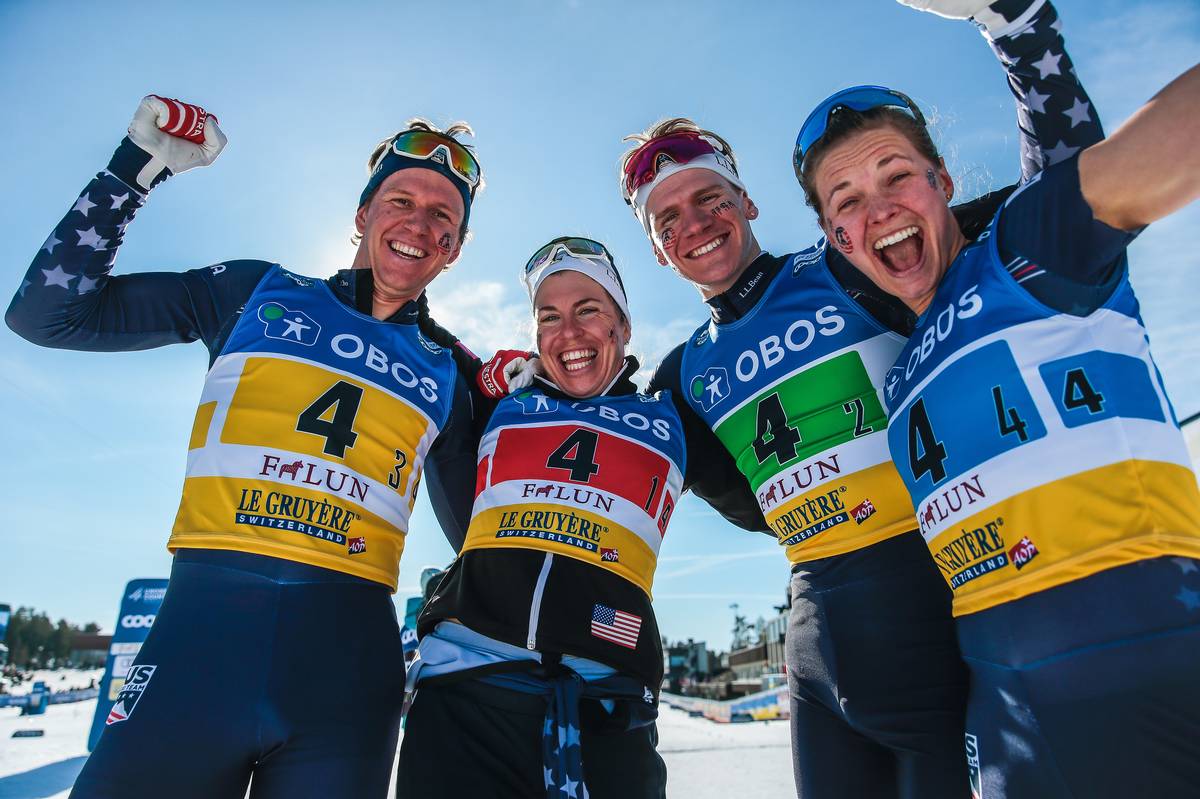
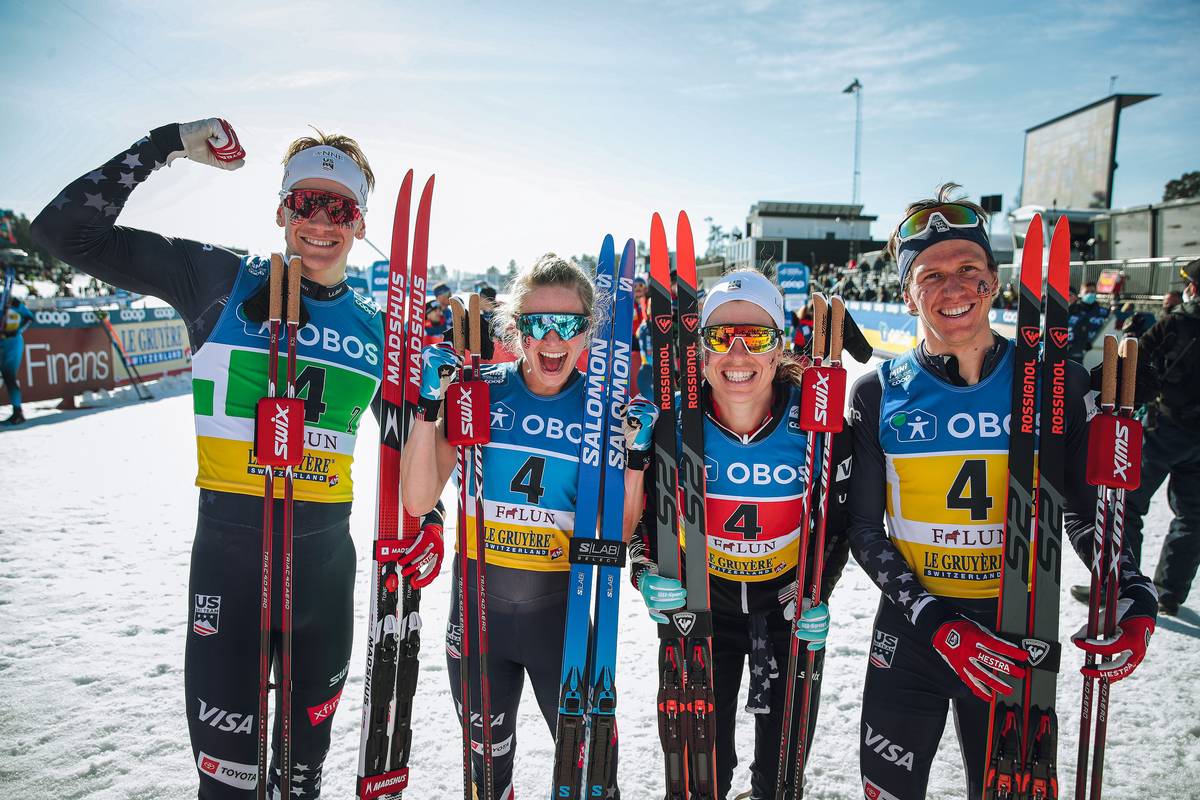
    USA I took the win in Falun’s 4 x 5 k mixed relay. From left to right, Scott Patterson, Rosie Brennan, Zak Ketterson, and Jessie Diggins. (Photo: NordicFocus)

    Will we see mixed gender racing?

    Not at the world championships, but in the World Cup for sure, in mixed four by five relays. But, there will not be a mixed team sprint.

    Additional thoughts you would like readers to know?

    It’s going to be a really exciting season. Equal distances will be an interesting story in every race.

    It’s going to be really exciting watching Jessie and Rosie battle for the overall championship.  They’re at the height of their careers battling at the same time. It’s a huge gift to U.S. racing fans.

    It’s also going to be exciting to watch all the emerging young talent we have. Another interesting story will be watching Julia Kern: she had a great last four to five weeks of her racing season last year.

    The other neat story will be the two mixed team relays on the schedule.

    There’s also been a push to cluster races at venues, so we’ll have a lot of three race day weekends.  More events at every weekend brings more value to racing fans every weekend.

    The teams have had a really good summer, so I’m really excited to see what everyone can do.

    Chris Grover s the U.S Cross Country Program Director. (Photo, US Ski and Snowboard)
  • Jessie Diggins Looks Ahead

    Jessie Diggins Looks Ahead

    American cross country skiers continue to climb the international ladder, and any number of them are likely to find their names in the headlines this winter, but it’s Jessie Diggins who continues to be the skier, the competitor, and the leader through which this team is recognized. It’s a distinction she’s earned time and time again.

    For Jessie Diggins, team is family. From left to right, Zak Ketterson, Jessie Diggins, Rosie Brennan, and Scott Patterson. (Photo: NordicFocus)

    On the morning of November 21, Jessie (who is in Ruka, Finland in preparation for the season’s first World Cup weekend) joined a virtual group of ski-media reporters and sport representatives for a discussion of the upcoming season. Three FasterSkier staff writers—Ben Theyerl, Ken Roth, and John Teaford—were on the media call, hearing the many questions and answers. In typical Jessie-style, it was an event filled with smiles, laughs, and optimism. This article offers highlights of the wide-ranging conversation:


    Ben Theyerl

    FasterSkier staff writer, Ben Theyerl, paid particular attention to Diggins’ responses concerning team dynamics and equal distance policies (for male and female race distances):

    Skiing and Racing

    Diggins was asked to reflect on what is coming up immediately on her calendar—the Ruka World Cup this weekend—and on her long-term future in the Olympics, World Cup, and beyond. As always, Diggins remained team-focused in her answers. Regarding this weekend’s Ruka World Cup, she noted that she finds it helpful to channel the energy of younger teammates: “When you see someone making their first start, it brings back the energy and excitement of your first World Cup.”

    Ruka will also mark an athletic first for Diggins: the arrival of equal distance racing means that she will race a 20 k World Cup race for the first time in her career. She is looking even farther down the road to a particular race made possible by new equal distance policies: the Holmenkollen 50 k. “I’ve been looking forward my whole life to racing the actual 50 k. I’ve raced that distance a couple of times . . . and they’ve never had to have an ambulance waiting like they used to think [women] needed . . . I think it’s total crap that women never got to race this iconic distance. I’m very grateful for FIS making this change.” Diggins added that the messaging of switching to equal distances was also critical. “The message that it sends to young women is that you’re totally capable of doing anything that you want to if you train hard and work hard.”

    “The message that it sends to young women is that you’re totally capable of doing anything that you want to if you train hard and work hard.”

    Diggins was also candid about how the conclusion of the 2022 Olympic cycle has led to a more relaxed feeling this season. “[The Olympics] was the most type of pressure I have felt in my career. I feel a bunch of relief now, and can keep skiing knowing if I retire tomorrow I can be more than satisfied with what I have done in my career . . . I’m still here because I love what I do. I love my team. I think this is super fun.  I’m not racing because I have to prove anything, and I think that keeps a lot of the pressure off.”

    In the upcoming season, Diggins is anticipating the World Championships in Planica, Slovenia next March. She also admitted to being excited to be “Chasing the Crystal Globe” for the World Cup overall. In particular, she noted that the World Championships would offer the chance for the US Team to build off their recent successes in Team Relays. “I love Team Relays, and we have been really close in the past couple of [World Championships]. I feel like now is the time for us to take the next step.”

    American Racing

    Of additional interest to American skiing fans had been Diggins’ role in securing a North American World Cup placed within the 2020 FIS calendar (to have been held in Diggins’ home state of Minnesota at Theodore Wirth Park in Minneapolis). Though Covid restrictions ultimately caused that race to be cancelled, there has been a provisional joint bid from the Loppet Foundation and American Birkebeiner Ski Foundation to stage 2023-24 World Cup events at Wirth Park, and Cable, Wisconsin. On the prospect of a Minnesotan World Cup Diggins said that “I remember the first time I went to a World Cup, and I think about how unique and inspiring it is. [Wirth Park] is an ideal venue to grow the sport. It is in the middle of the city, which would bring a diverse set of fans from outside skiing, with the prospect that they can all be right next to the athletes . . . That energy [is] electric . . . and I want everyone to experience that.”


    Ken Roth

    FasterSkier staff writer, Ken Roth, concentrated on message’s communicated in Jessie’s responses pertaining to team culture and fan support:

    Team Culture

    Diggins noted that she came directly from high school to professional racing, and that the sense of being “a team” was very similar to what she experienced in high school. “I was fortunate that when I came onto the [national] team we were all invested with this idea that we would support and help each other.”

    “I was fortunate that when I came onto the [national] team we were all invested with this idea that we would support and help each other.”

    When asked for her impression of her own teammates’ prospects this season, she replied, “They look really good. They’re really thoughtful in technique, analyzing video, it’s not just more more more.” She has high hopes for her teammates and pointed out how hard she, herself, has been pushed by Julia Kern in recent intervals.

    Jessie Diggins and Julia Kern take second in the team sprint in Dresden, GER in December 2021. (Photo: NordicFocus)

    Training Changes and Adaptations 

    She noted that the biggest change to her training plan is focusing on technique and maximizing on-snow time (including her choice to spend three weeks on snow in Australia this autumn). “Pure fitness can be gained just as easily on roller skis, but you can really only improve certain [technical aspects] on snow.” She noted that in order to avoid plateauing, her training hours creep up slightly every year, giving her “room to grow.” She also credited her training plan as devised and supervised by her coach Jason Cork: “the brains behind the operation.”

    Fan Support

    Diggins smiled broadly when she recalled being invited to a fan’s wedding; she seemed to have been genuinely touched by that gesture. She also mentioned that she had been contacted by a woman who is in recovery at the Emily Program and how moved she was by that person’s journey. Diggins is definitely a fan favorite; she also seems devoted to returning that affection. Looking down the road several years, she said “I love what I do, so here I am, still doing it.”


    John Teaford

    FasterSkier editor and staff writer, John Teaford, heard Diggins expressing opinions and hopes extending well beyond her presence as a star in the sport of cross country skiing.

    Advocacy in Skiing, and Beyond

    Diggins has proven to be a powerful champion of numerous social and environmental issues ranging from awareness of eating disorders to climate change legislation. Her answers to the questions she fielded on these issues were especially thoughtful. She spoke of her meetings with lawmakers on Capitol Hill regarding her work with Protect Our Winters (POW).  “I had a really great trip to the Capital with Gus Schumacher.  I used the story of my food poisoning in the Olympic 30k (in which she won silver) to show that just because something’s hard doesn’t mean it’s not worthwhile. It was an uplifting visit.”

    “Just because something’s hard doesn’t mean it’s not worthwhile.”


    With regard to climate change—and the potential for activism and social consciousness to inspire beneficial policies—she said, “I am really hopeful . . . It is a man-made problem, and we are the ones who need to fix it. This isn’t an issue that we should feel the need to take sides on.”

    Jessie’s Athletic Future

    When asked about long-term plans to go back to the Olympics, she again attribute her motivation to her team, and her teammates. “This is a group that supports each other . . . a really safe space,” she said. “I feel a lot of love and support; that makes it easy to be here. Without [this great team chemistry] I probably would’ve been done a long time ago . . . If I’m healthy and uninjured, I’m definitely planning to do the 2026 Olympics.”

    All in all, the video conference was 45 minutes of pure Jessie Diggins: candid, generous, passionate.

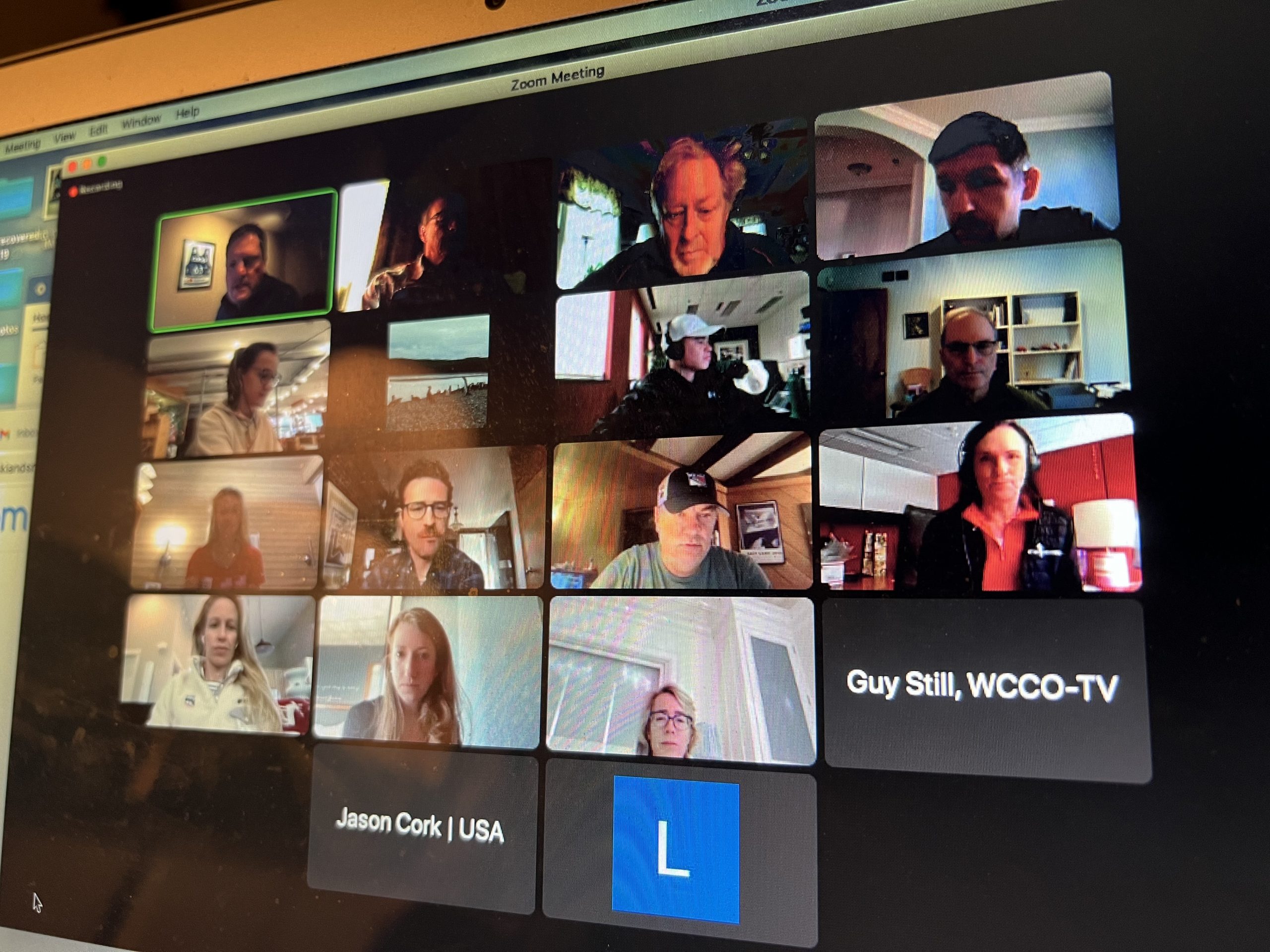
    Jessie Diggins previewed her upcoming season on a media Zoom call on Nov 21, 2022.


  • Q and A: Sun Valley’s Rick Kapala on coaching, sport development, and constructing a “complete ecosystem” in the skiing community

    Q and A: Sun Valley’s Rick Kapala on coaching, sport development, and constructing a “complete ecosystem” in the skiing community

    A common sight in the Intermountain West for the past 35 years: Rick Kapala on race day. Kapala is stepping away from coaching, and into sport development, this season. (Photo: Sun Valley Ski Education Foundation – SVSEF).

    “I’m sorry, but once I start talking cross-country skiing, I can’t stop,” admits Rick Kapala. Remove the “talking” from that statement, and it’s still a succinct summary of long-time Sun Valley coach Rick Kapala’s career.

    This season will mark the first time in thirty-five years that Kapala won’t be manning the wax bench on race day for the Sun Valley Ski Education Foundation. This summer, he turned to a new role at the Sun Valley Ski Education Foundation with the title “Sport Development Director.” In his stead, former Bates College Coach Becky Woods will take over his former Program Director duties.

    For those who have known Kapala during his long tenure in US skiing, his new title signals an exciting prospect. Kapala has been a constant, forward-thinking mind in US Skiing. He has played a role in creating a domestic professional skiing scene, helped start the National Nordic Foundation, and counts a plethora of key figures in US Skiing as his former athletes, coaches, and mentees.

    FasterSkier caught up with Kapala to reflect on his own journey to this point and get a glimpse into some of the most exciting ideas pushing US Skiing, from one of its most passionate minds.

    (This interview has been edited for length and clarity.)

    FS/FasterSkier (FS): Let’s start with your biography as a coach. Can you give us a summary of your career as a coach and at Sun Valley? 

    Rick Kapala (RK): Coaching for me started at my alma mater, Michigan Technological University (Michigan Tech), the year I graduated. Then I moved out west and I coached for a couple years in Washington state at a club program run by Pacific Lutheran University.

    Then I moved to Anchorage which was where I was really fortunate in my timing. I landed coaching at West Anchorage High School as their ski coach, track, and cross-country coach. And the stable of athletes I had there was full. Nina Campbell, Joey Caterinichio, and Chris Grover are just a few your readers might know. I was really lucky that was my first exposure to sort of an “all-in” type coaching job. Then I came down to Sun Valley in the summer of 1987 and have been here ever since.

    FS: What did the Sun Valley team look like when you got to Idaho?

    RK: We had a pretty good little program, this being the ski town that it is. The Alpine program was big, but the cross-country team was this small, ancillary program. We had seven to nine on the high school team, and then seven or eight middle schoolers.

    FS: How did you approach building out that program back then? Was it adding a younger development program? Bolstering numbers for the high schoolers?

    RK: There was a separate, kind of “Bill Koch League” (learn-to-ski) type program in the Valley. We assimilated that and made it our Devo program under the umbrella of our offerings. The program immediately began to grow from there. I attribute that to having really good coaches at that younger age who were really invested in the right way over the course of the first four or five years I was in Sun Valley. That eventually led to steady growth for the Comp (high school) program. That model is the basic infrastructure of a club. The same can be said about New England with the Bill Koch League, or in Minneapolis with the Minnesota Youth Ski League. Really dedicated coaches at the younger level are what end up powering competitive programs.

    FS: At what point did Sun Valley grow beyond the junior programming? When did the Gold Team (Sun Valley’s Pro Team) and Post-Grad programs start to develop?

    RK: The genesis of the Gold Team was a really fortuitous set of circumstances. We had a great coach, Chris Grover (who Kapala had coached at West Anchorage), landed in Sun Valley after the Nagano Olympics in 1998. He had been with the national team, but at the time there were budget cuts. Grover, coming off of that, had a pretty profound instinct that skiing couldn’t just develop within the [United States Ski and Snowboard Association]. He came to me and said, “we should start a pro team [in Sun Valley],” which, in retrospect, was such an important development because it allowed us to imagine a whole new ecosystem for our programming.

    Having Grover come off of the national team also made it an easy prospect to get athletes here. Chris Cook, for example, got cut loose from the national team, and Grover was able to step in and give him an obvious avenue to keep pursuing professional skiing. That was key—having an avenue to go down. Cook won a national championship the first year he was at Sun Valley, and then made it to the Olympic Games.

    That was a part of the fortuitous nature I talked about too. That the next Olympics were in Salt Lake City [in 2002]. The Gold Team was originally the Olympic Development Program—we got told eventually we couldn’t use that name, but it gave us a lot of visibility from the community here in Sun Valley, and a clear “brand” for talented skiers to know what they were pursuing here.

    Ben Lustgarten and Rick Kapala at a SVSEF training session in 2014 (Photo: Ben Lustgarten).

    FS: What strikes me as interesting about that “fortuitous” timing is that there was a push around US skiing at the same time Sun Valley’s team got started to have those Olympic Development programs around the country, but most of them weren’t nearly as sustainable as Sun Valley ended up being. In the past few years, we’re seeing a renewed push to introduce more pro racing opportunities across the country, whether that’s Bridger Ski Foundation’s team in Bozeman, or Team Birkie in the Midwest. What are some of the things that have made Sun Valley sustainable that could help make those programs sustainable as well?

    RK: Whenever I get a question like this, I always start with a disclaimer. Sun Valley is a really unique place that affords us some big advantages when it comes to building and sustaining new programming. We have one of the richest traditions of skiing in the country, and it is still a ski town—it hasn’t sprawled out in the same way that other places have. It is also a fairly affluent community.

    The industry here is skiing too, that always is going to be an advantage. We have an outsized role in our community because of that. When we roller ski in the summer, people are cheering on our kids, that’s not happening in other places, right?

    I think we have had to center our approach around the idea that we are a community asset here. We try to have success, just like any sports team, but what we are really trying to be is the highest-quality recreational and competitive opportunity for kids in our valley. That gives kids the resources they need to take skiing as far as they can. Whether that was Morgan Arritola, or now Sammy Smith and Cora Faye Scott. They all came through a program that at the start was really a way to get out and involved in our community and kept true to that impetus. Naturally, that is going to engender warmth and engagement from outside of just the ski community. There is also making sure that the talent that is coming through the Gold Team, for example, is able to invest in the wider community here. We need to make sure they have the chance to do that. And they have.

    I am not saying the model here is the model everywhere. What the Loppet Foundation has done to make skiing the big deal it is in Minneapolis—that’s phenomenal—they figured out how to balance programming, events, and facilities in a way where kids might just want to go skiing on Sundays rather than watch the Minnesota Vikings play football. And not every kid will, but they have the option to and feel like it is worth it. That is so important.

    Or in Anchorage, right, skiers are on the front page of the newspaper. That’s a big deal. It is the same in Sun Valley, and I think that speaks to creating a community ecosystem that celebrates and invests in skiing.

    FS: I am struck by how the skiers that the Gold Team has a pretty consistent mix of kids from your junior program and from other programs across the country . . . 

    RK: That’s super intentional. There just needs to be a critical mass to be able to inspire and also, provide a high-quality training environment. Johnny Hagenbuch, right now, for example: when he got to a point as a junior, having the Gold Team for him to hop into for training made a big difference in his development.

    FS: With regard to “development,” we haven’t covered your new position in detail. You’re moving from individual athletic development to a more club-wide role. What does that look like in Sun Valley, and how do you see what you’re doing in Sun Valley pertaining to US Skiing in general?

    RK: Well first, I don’t want to say I have answers beyond the community here. I think keeping my focus here is really important.

    My new position as “Sport Development Director” is multi-pronged. I’m still doing the resource development for the Nordic Team and coordinating events like the upcoming SuperTour. Then, there are a few other initiatives that follow along the lines of thinking, “what is the next thing?” in sport development. One of those is coach education. In our organization [at Sun Valley] we have about one-hundred coaches on the payroll during the season. Right now, the coaches certification process they go through is kind of transactional with US Ski and Snowboard, right? Meaning they take this coaches’ course and maybe do a continuing education credit, but that might be it. One thing I think is big incongruency in [American] skiing right now is that we work on cultivating a growth mindset for our athletes, but we don’t have the same mentality for our coaches, let alone the resources to make it possible. I think that’s where we need to go. Like Doctors have the American Medical Association, we need to have an organization—or use our existing organizations—to cultivate a culture of what I’d call “professional development.” As a ski community, we’re past the point where we are simply hiring people to coach based on the merits of their skiing. I think it is a positive development that it is a distinguishable profession, but now we need to do the work to not make it a profession where everyone is kind of self-educating.

    Kapala out in the Idaho mountains in 2022. (Photo: SVSEF).

    FS: I’ve been thinking about that a lot the past few weeks, coming off of the National Coaches’ Symposium and off of Dr. Stephen Seiler’s talk with NNF last week (which Kapala was partly the brainpower behind). My operable knowledge of physiology as a coach up to now was based on what I learned at an REG camp presentation as a sixteen- or seventeen-year-old kid, and all of a sudden it was like, “whoa, this whole field has evolved a bunch” and I came away with three or four things I was ready to change in my coaching right away . . . 

    RK: Yeah, and that coaches conference happens what, every two years? Imagine if we made that part of coaching culture. That collaboration and knowledge-sharing: it is imperative. I’ve been paying attention to the system of coaching in international soccer, for example, where American coaches are going over to Germany and realizing just how beneficial the structure and rigor of coaching education is over there.

    FS: As in, the accreditation system?

    RK: Not so much the accreditation, but more so just how seriously they invest in all the individual aspects of sport development. Like this American soccer coach I was listening to a podcast with [Jesse Marsch, who came up through the German coaching system and now is the first American coach in English Premier League history with Leeds United]. He said he had a year-long course in sports psychology just to get accredited in Germany. We are no year to making that investment in something as beneficial as that.

    One of my other initiatives is on that front: I’d like to create a dedicated professional position at Sun Valley who can work with our athletes on sports psychology and wellness. We have always been great at catering to the physical aspects of our athletes, but not the emotional, or just human, aspect of human athletic performance.

    FS: Putting the resources to institutionalize new developments in athletic performance seems to be a theme of your work. I ran across an article from our archives where you talk about making training camps, like the U16 camp system, a regular part of the developmental pipeline in the US. That was a decade ago, and now, that’s well-established across US skiing. Is sports psychology and wellness the next front for that you think?

    RK: The U16 camp idea was a collaborative idea that came from a couple coaches at REG camp being like, “this is a great system, why aren’t we expanding this type of incentive and experience to kids at the crucial point where they decide to go all in on skiing or not?” And we could do it quickly with relatively few resources. That is the same thing with wellness and catering to that aspect of our athletes. I actually think it is even more important in the American context, too, because we’re correcting for that persistent “toughness” or “suck-it-up” mentality that is a feature in our athletic culture. That has never worked when you look at skiing.

    FS: It was interesting that in Johan Olsson’s presentation at the National Coaching Symposium a couple weeks ago, he cited a study on [UCLA’s legendary basketball coach John Wooden] where the main finding was essentially that his main feedback to his players was positive, rather than negative; that was a revelation in the 1970s.

    RK: Yeah, and then a couple years after that, [Indiana University basketball coach] Bobby Knight was throwing chairs at his players! Somewhere it got lost, and so we still have to address it in the landscape of our coaching.

    FS: Is the answer doing more coach education and dedicating resources to making it part of our clubs?

    RK: Yes, I also think it goes to a base-level of empathy. One of the cool things about skiing now versus when I first started coaching is that there is a critical mass of people—coaches or even just parents of athletes—who went through all the highs and lows of ski racing as athletes themselves. We have a depth of knowledge present in skiing that just did not exist in the 1970s and 1980s, and it is so helpful as an athlete to not just have one coach, but a support network, that can help you navigate a really hard, and really rewarding sport. That is special, and we have that going for us.

    FS: How do you incorporate that experience into the practice of coaching?

    RK: I actually think it is a community thing. Which enough individuals working together is always going to lead to. At the end of the day, that is what we have that is special. I’ve been in this game long enough to see how skiing connections last. Our kids meet other kids from across Intermountain West at JNQs, and they go on to become their friends, neighbors, teammates later in life. It just lasts.

    I think about what drives our community to do this sport a lot. There’s certainly not a lot of money in it, and there is not the capital of a lot of Division One college scholarships on offer. I think the ethos of it truly is that the people in cross-country skiing love it deeply. Love it individually, and together.

    FS: That’s a beautiful way to say a really true thing. Just to try and collect some of the themes I am seeing run through this, the “Rick Kapala” philosophy towards skiing development seems to include a community powered by that ethos—that love of skiing you talk about—that provides a “complete ecosystem” in terms of the resources needed for athletes to succeed. And you seem to be very careful to say that needs to match the specific context of the place in which the ski community exists.

    RK: I think that is fairly well put. The levers we can pull in Sun Valley are different than what those in Minneapolis—or you in Crested Butte—can pull. So you have to be collaborative and observe what works and what doesn’t in the place you are, and then take in knowledge from other places too. That’s how we ultimately make skiing in this country go ’round.

    We can’t just do what the Norwegians or Swedes are doing. We have to think about how we do things soundly, but differently. We have been successful in doing that to some extent, but there is always room to improve—which was the most important lesson of my coaching career.

    FS: And that’s the most important thing you’re now bringing to development?

    RK: For sure.

    Long-time SVSEF XC Program Director Rick Kapala. (Photo: SVSEF)
  • Season Preview with Chris Grover, United States’ Cross Country Program Director,  Part I

    Season Preview with Chris Grover, United States’ Cross Country Program Director,  Part I

    US Cross Country Program Director, Chris Grover (US Ski Team photo).

    Chris Grover is the U.S. Cross-Country Program Director, a position he’s held for three years. He sat down with FasterSkier’s Ken Roth to discuss the upcoming World Cup season, and an overview of the U.S. program.

    What exactly is the job of Program Director?

    I oversee all aspects of the program for team development, coaches’ education, events, budgets, selection criteria, and all other staff. This includes technicians, volunteer physical therapist, volunteer doctors, sports psychologist, and skiers.  We  have six full time staff, plus skiers.  We have six World Cup technicians who are seasonal, plus three part time contract employees who work domestically.  We’re relatively small, so all of us coaches have to be able to do everything.  I go with the team to Europe and travel back and forth to home a little bit.

    That’s a surprisingly small number of full-time staff.  How does that compare to Norway and other countries?   How are you able to get everything done with such a small full-time staff?

    It’s hard to compare ourselves to Norway in that they are lightyears ahead in terms of size and budget. Their budget is probably ten times ours.  For example, they have 98 athletes on their team (national and regional) compared to our 22 (A, B, and D teams).  Russia, Sweden, and Finland are all larger as well.  We are similar in size to many Central European nations like Italy, France, and Germany.  But, some of those countries have connections with the military, police force, or border guard which gives them additional support.

    What are other challenges the U.S. team faces compared to the Europeans?

    One of our big challenges is that our cost to compete in Winter is high, because our team never really goes home.   We’re on the road nonstop.  The Europeans save money because during the week they’re living at home. They will arrive just before the weekend and leave after the weekend.  This savings allows them to invest in extra staff.   We don’t have the same resources for coaching.

    You have a lot of volunteer staff and part time staff while in Europe?

    We rely 100 percent on volunteer physicians to travel with us.  Most of the physical therapist and massage therapist are volunteers.  The volunteers are literally taking their own vacation time to be with us.  In the case of the physicians, they’re even paying their own way!  It’s an incredible gift.  We only have one person on our medical team who is not a volunteer.  All our technicians are seasonal employees.

    What does it take to get the team to Europe and compete nonstop for four months?  What supports are in place for the athletes?

    It’s a huge task.  The real change for us is that the size of the program has grown in the last 15 years.  In 2006, we’d have six staff and maybe seven to eight athletes.  Now we have 16 to 20 athletes, with 11 to 15 staff.  So, the logistics have really grown.  We’re going to start this year with 16 athletes and have about 15 staff for each World Cup start.  Most of those are technicians and a few coaches.  We also have a physical therapist, a doctor, a strength and conditioning coach, and sometimes a sports psychologist.  This year we’ll also have a coach from the Trail to Gold Fellowship (a program through the National Nordic Foundation which provides promising women coaches in the United States the opportunity to gain international-level coaching experience at the World Cup).

    How do you help the athlete’s maintain intensity during this long period on the road?

    We work with sports psychologist which the athletes have access to.  That’s a key support mechanism.  It’s very individual also.  Our veteran athletes have figured out what works for them.  For some that’s coming back to the U.S. during the middle of the season.  Others stay in Europe and bring family over, which has been really challenging during Covid.  Hopefully this year will be more normal.

    We also create more family style living situations on the road rather than being in hotels.  It’s really important psychologically.  It also helps us to improve the food we eat.

    But, it’s a huge disadvantage for non-European nations.  Everyone else gets to go home to recharge, but we can’t.

    The US Ski Team has become known as a traveling family, attributing much of its success to the supportive atmosphere created by athletes, coaches, and staffers. That dynamic is evident in this celebration of Jessie Diggins’ Olympic silver medal in the 30 k mass start skate (Photo: NordicFocus)

    The women’s team is well known for its team dynamics and team culture. Do you try to develop team leadership and team dynamics, or do you let it develop organically?

    A little of both, depending who’s on the team in a given year.  We don’t have team Captains, and that’s on purpose. We try and create an atmosphere where everyone can lead at times.  Everybody’s good at something, we need to bring that out.  We’ve had an incredible women’s team culture at times.  Sometimes we’ve had to work to maintain it.

    Right now we also have an incredible men’s team culture driven by this younger generation that’s been entering the national team that’s had a lot of success at the world Junior level.  The current group are great friends and training partners who want to see each other succeed.  So then it’s more about maintaining what you have rather than trying to create something.

    Ben Ogden—shown here racing Stage 3 of the 2021/22 Tour de Ski in Oberstdorf—is one of a number of up-and-coming American skiers whose international experience is beginning to pay dividends. (Photo: NordicFocus)

    The men have gained experience.  Are they at the point where they can now maximize their potential?

    Last year, for a lot of them, it was their first time for a lot of venues.  Of the six men at the Olympics, five were first time Olympians.  They are just coming into their own.  The future is very bright.

    So the men still need more experience?

    For sure.  They’re still growing, still learning, still building their training bases.  Many of them are still finishing school.  Some are still NCAA racing, and a majority are still U23 (under 23 years old).  Many will take time off from World Cup to come back for the U23 championships in Whistler (British Columbia).

    The Tour de Ski, which is in the middle of the season, requires enormous energy expenditure.  Do you plan in advance how to manage the Tour de Ski, or do athletes and coaches wait until they are in it and see how they are doing?

    It’s individual; and the U.S. is a little different.  Individual athletes are primarily coached by the individual coaches or club coaches, except for Jessie Diggins.  We do that because they spend the vast majority of time with those coaches.  We only held three training camps this summer and fall.

    Within that system there are lots of individual plans.  The national team staff helps to advise the best way to manage planning.  Of the 22 different athletes, there will be 22 different plans.

    This year FIS (International Ski and Snowboard Federation) has added a weekend off prior to the Tour and weekend off following the Tour.  So that will help.  FIS is trying to encourage all of the superstars to be at all of the races, so they’re trying to build in better breaks.

    Some athletes will wait and see how the first few weeks of World Cup are going.  I think there will be a big group of athletes who go home after the tour.

    With only three training camps what’s the opportunity for being on snow in the off season?

    We had a training camp in May at Mt. Batchelor, which is a great on snow camp.  We had a couple of other opportunities in Australia and in a ski tunnel.  A big challenge is that Eagle Glacier (Alaska) has been closed for three years.  A number of our Alaskan athletes would use it, so losing it is a big challenge.

    Also, the New Zealand snow farm might be permanently shut down, and we have been using that facility forever.   That’s a huge loss.  Also, diminishing snowpacks on European glaciers is a problem.  On snow opportunities are drying up.

    We generally prefer to avoid the tunnels.  They’re only 1.2 k and you get bored easily.  It’s way nicer to be outdoors.  You can’t do week after week in a tunnel like you can outdoors.

    Julia Kern placed 20th in sprint qualifying during the 2018 World Cup in Planica. She seems prepared to fare far better this winter when the World Championships return to Slovenia. (Photo: NordicFocus)

    The World Championships will be held for the first time in Planica, Slovenia.  Do you need to scout it, or are you familiar enough with it?  Any specific training changes in a World Championship year?

    No, we don’t need to scout it.  We’ve been there many times. I’ve been there going back to 2001.  We have done a lot of sprints there, not as much distance racing.   But we’ve done some distance racing there over the years, having raced on the primary distance course. It’s a compact set of courses, and typically not a ton of snow.  It’s likely to be a 5k loop for most races.

    We have a good situation going into it.  We’re going to live in Italy, just over the border.

    In terms of preparation, it’s not high altitude, so its manageable. Being in the end of February, early March, I expect warmer conditions.  So, strategies to keep racers cool will have to be used, like we have in the past two World Championships.  We start preparing for warmer conditions during the summer.  Jessie in particular has done work with this; but I can’t go into the details.

    It will be a battle to figure out ski structure if we have sloppy, wet, dirty snow conditions.    Fingers crossed for more traditional winter temperatures.

    Any goals you can share for this season? 

    For Jessie and Rosie, both are focused on spending the entire year in Europe.  This will be different for Rosie compared to last year.  Both are hyper focused on pursuing the overall World Cup and the World Championships.

    On the men’s side, the younger guys want to go to U23 championships.  They see it as a great opportunity being in Whistler.  It’s a bit of home advantage.  A lot of the focus of the year will be on that.  Beyond that, it’s making incremental steps on the World Cup and World Championships.

    How did athletes adapt to not having fans the last two years?
    For the most part, everyone missed the fans.  The atmosphere suffered without fans.  It’s been really nice to see fans returning.

    Stay tuned for Part II of Fastskier’s interview with Chris Grover.  In the next segment, we’ll talk about the Russian ban, equal distances for genders, and fluoros, among other thing

  • Viewing Cross-Country and Biathlon in the United States

    Viewing Cross-Country and Biathlon in the United States

    Julia Kern leads the pack during the first leg of the 4 x 5 k mixed relay in Falun, SWE in March 2022. (Photo: NordicFocus)

    This season’s cross-country and biathlon World Cup races promise to be some of the most exciting in recent years; however, this season also presents dramatic changes in how American fans will be able to—or unable to—watch races.  The new season will be quite different from what we’ve come to expect in seasons past. NBC’s coverage is gone; it will be replaced by a combination of paid streaming services and accessing European coverage.

    Cross-Country

    There will no longer be coverage of cross-country events through NBC or any of its platforms.  Fortunately, coverage of World Cup races held in Europe will be available on Ski and Snowboard Live—specifically, https://usskiandsnowboard.org/latest—allowing access that’s searchable for any cross-country World Cup race.  U.S. Ski and Snowboard has told FasterSkier to expect commentary with these broadcasts.

    The bad news related to viewing options for European races is that viewers will need to pay in order to watch.  There will be several payment options:

    • There will be a monthly all access pass ($15.99/month) which provides full viewing of all sports on the channel. If you watch more than the Nordic sports, this will be your choice.
    • For cross-country only fans, there will be a “Monthly Discipline Pass.”  While this may sound like some type of high school program for misbehaving students, it’s actually a platform that allows viewers to enjoy all coverage in the sport of their choice ($8.99/month).  If there’s one race in particular you want to watch, you pay $1.99 for any single event.

    For complete details, visit U.S. Ski and Snowboard’s site at: https://usskiandsnowboard.org/news/how-watch-2022-23-world-cup-events.

    There are known alternatives for those who want to access coverage in the VPN universe (virtual private network), but that’s not something FasterSkier has investigated in regard to cross-country events.

    Sean Doherty (USA) – IBU World Cup Biathlon, sprint men, Oestersund (SWE). (Photo: NordicFocus)
    Biathlon

    As of this writing, there will not be network coverage of biathlon events by any American broadcaster or streaming service!  The principal option will be to watch via Eurovision live stream: go to https://www.eurovisionsports.tv/ibu/ for coverage of individual races.  According to U.S. Biathlon, they are still investigating other streaming options for the American audience.  U.S. Biathlon also indicated that “without NBC (coverage), American viewers should be able to watch live via this link this year.”  Races should also be available later for replay.  “It is our understanding that you may need to create an account, but it should be free and there will be no need for a VPN as NBC is not a rights holder this season…”

    Joanne Reid (USA) -(Photo: NordicFocus)

    A recent test of Eurovision’s site indicated that viewers would be able to use the link without a VPN, and could gain full access to the entire biathlon race library.

    Better or Worse?

    Depending upon streaming options that viewers have accessed in the past, these broadcast/streaming changes may be an improvement or a deterioration in coverage options. Being able to watch Eurovision without a VPN will be a game changer for many.  Stay tuned to FasterSkier for updates—especially in Biathlon coverage—as changes may occur.

  • Signs of the Season:  Ski Sale/Ski Swap traditions fuel local clubs

    Signs of the Season: Ski Sale/Ski Swap traditions fuel local clubs


    Skis and boots, gloves and clothing, uniforms and race suits, collectors items and miscellaneous treasures: the annual Ski Swap is where bargains are found, where hand-me-downs are passed on, where new ski adventures begin.

    The Elk’s Lodge, the hotel conference room, the middle school gymnasium: those are the places where skiers gather in the fall of the year. Those are the sorts of places reserved by clubs, teams, retailers, and those whose garages and basements are chock-full of skis, poles, boots, suits, and miscellaneous ski-related gear. It’s time for the annual Ski Swap and Sale.

    Cross country skiing is not a sport that’s rich with sponsorship, or that benefits from big prize money, of that is bankrolled by a population of wealthy, deep-pocketed devotees. To keep trail systems going, to keep clubs going, to keep young skiers and masters’ programs going, many organizations seek to support their needs through the staging of seasonal ski sales. These are events where institutional knowledge comes in handy:  someone needs to remember how things were done last season. Who makes the signs? Who does event advertising? How to tag and price the items? How to collect sales revenue? How to pay those whose gear has sold? Where does the cash register go? What about the folding chairs and display tables? What’s the wifi password? Has anyone checked the bathrooms? The whole thing adds up to the sort of Mom n’ Pop operation on which our sport depends:  many hands making light work, many being introduced to our sport, and many snowy days ahead of us.

    Signs of the times . . . this is the season of bargains, deals, and hand-me-downs.

    This is how the ski season begins. So watch for classified ads in the local paper, for notices in Shopper Give-Aways, for posters on local bulletin boards, for reminders on social media. The Ski Swap and Sale is coming soon to a ballroom, conference room, gymnasium near you; whether as buyers or a sellers, those are the places where skiers gather in the fall of the year.

    And at the end of the evening—after all the sellers have been paid, and the chairs and tables folded, and the signs taken down, and the floors swept—then we’ll drive home through the autumn darkness with backseats full of treasures—both new and used—to speed us across the snow that is soon to arrive.

    Residents of the Elk’s Lodge oversee Ski Swap activities.
  • From the PT: a look at Chronic Exertional Compartment Syndrome

    From the PT: a look at Chronic Exertional Compartment Syndrome

    Kris Freeman—seen here winning a NorAm 30 k freestyle at Sovereign Lake—is one of many elite skiers whose careers have been affected by CECS (Photo: Frances Weeks)

    US Ski & Snowboard recently hosted a course titled “Medical Emergencies in Skiing and Snowboarding”, which is required training for all physical therapists and athletic trainers working with the team during competitions. As the name would imply, we learned about emergency management of acute injuries: application of cervical collars, tourniquets, back boards, distraction splints, and plenty of other nasty scenarios we hope to never see. 

    Thankfully, cross country skiing tends to be lower risk when it comes to traumas and medical emergencies. Typical of an endurance sport, our injuries are more self-induced from the volume and intensity of training. Instead of blown out knees and broken bones, we contend with tendinopathies, muscle strains, and joint pains. For better or worse, these ailments are quite common, and we’re pretty good about diagnosing and treating them. That might not be the case with a condition called Chronic Exertional Compartment Syndrome (CECS), a painful condition most often affecting the lower leg. It’s common among Nordic skiers, it’s painful enough to seriously disrupt training, and it’s often difficult to diagnose and treat. This article attempts to investigate the condition, and to offer some advice to those suffering from it.

    C.E.C.S.

    Chronic. It occurs repeatedly and/or persists over time (not the result of a trauma).

    Exertional. It happens with effort. This is one of the hallmarks of the condition: symptoms are present with exercise, often only at higher intensities, but tend to subside fairly quickly with rest. 

    Compartment. Throughout our bodies we have connective tissue called fascia. I think of it as Saran Wrap. It’s thin, pliable, and has a small amount of elasticity. Our organs are packaged in fascia. Muscles are encased in fascia. The typical physiological explanation for fascia is that it creates “compartments” to reduce the spread of infections or pathogens. (From a musculoskeletal perspective, fascia may play a large role in how our muscles, tendons, and joints interact.)

    Syndrome. A group of symptoms that occur together. Generally, not a good thing. 

    CECS occurs when exercise causes the muscles within a fascial compartment to become swollen and enlarged to the point of exceeding the space within the compartment. This leads to decreased blood (therefore decreased oxygen supply to the muscles) and ultimately pain, numbness, and/or weakness. 

    CECS almost exclusively affects the lower leg, which has four compartments

    • The anterior compartment contains muscles of ankle dorsiflexion and stability, primarily the tibialis anterior. 
    • The muscles of the lateral compartment provide dynamic stability at the ankle. 
    • There are two posterior compartments: the superficial compartment with ankle plantar flexors and the deep compartment containing muscles that stabilize the ankle and foot. 
    Compartments of the lower leg are those likely to be affected by CECS.


    The mechanics of CECS is a simple matter of too much stuff in too little space. The more that muscles work, the more oxygen they need. The body obliges by increasing the heart rate, pumping more blood, and delivering more oxygen. This causes the muscles to swell and take up more space. While the fascia has some elasticity and ability to stretch, it does become quite confining and won’t let the muscles expand any further. This causes pressure to build within the compartment. 

    So far, this is all a normal physiological response. But, if the incoming blood flow continues at a higher rate than the outgoing flow, the pressure will continue to increase. When the compartment pressure exceeds that of the blood vessels, blood flow becomes restricted. The muscles become starved for oxygen and will get very pissed off. Pain is the body’s response, yelling at you so you’ll stop what you’re doing and leave the poor muscles alone.


    Traits of CECS

    Pain is the most common complaint with CECS. It is sometimes accompanied by numbness or sense of weakness. Along with pain, there is often a description of tightness or cramping. As previously mentioned, symptoms arise only with exertion and subside quickly – often within only a few minutes of rest. Symptoms arise only with exertion and subside quickly–often within a few minutes of rest. This is a key trait of CECS.

    Location of pain is commonly bilateral and often broad–it takes a whole hand instead of a finger to point to the pain. However, it is almost always within the anatomical borders of the compartment. (This does get more vague when multiple compartments are symptomatic, especially the combination of anterior and lateral.) 

    Symptoms of CECS are typically very hard to reproduce without the exertion of the offending sport. This is a clinician’s nightmare as we glean a considerable amount of information when our tests reproduce the patient’s pain.

    Taken together, these traits are what will most readily differentiate CECS from other chronic musculoskeletal issues like tendinopathies, muscle strains, or joint pathologies: symptoms subside quickly with rest, are diffuse, and are not reproduced during a physical exam.

    Diagnosis

    The gold standard is an exercise test using an intra-compartment pressure monitor. It’s basically a syringe needle attached to an air pressure gauge. The protocol is to take baseline measurements at rest and then again after exertion. The pressures are compared using the Pedowitz criteria: “1) a preexercise pressure greater than or equal to 15 mm Hg, 2) a 1 minute postexercise pressure of greater than or equal to 30 mm Hg, or 3) a 5 minute postexercise pressure greater than or equal to 20 mm Hg.” This essentially means 1) your resting pressure is really high, 2) your pressure under exertion is really, really high, or 3) your intra-compartment pressure is not decreasing normally with rest. 

    Treatment

    Conservative treatment is frequently not very effective but certainly worth exploring, especially if you are trying to make it through competition season. Massage and taping are the most common interventions that have potential for at least short term improvement (if a bit of tape lets you race without pain, that’s a win!). There may be more substance behind altering the movement pattern responsible for CECS in the first place: for example, this study found very positive results by making changes to the subjects’ running gait and foot-strike pattern.

    Unfortunately, we are not very good at treating CECS without a scalpel. Surgery is by fasciotomy. Oversimplified, this is a procedure where the fascia is cut to create more space within the compartment. For most surgeons, a positive on the Pedowitz criteria is a prerequisite; however, they will also consider the compartments affected and the severity and duration of symptoms. While not perfect, surgical outcomes tend to be pretty good. A study of elite French skiers with CECS observed that 94% became asymptomatic and almost 90% returned to competition after fasciotomy surgery.

    Skate techniques—and the dorsiflexion required by the recovery of the pushing ski—have been shown to exacerbate CECS even more than classic technique.
    Ski-Related CECS

    The article just referenced found the prevalence of CECS to be 6.1% among the elite, national team skiers they studied. It was slightly higher amongst biathletes and slightly lower for cross-country skiers. Symptoms were much more common with skate vs classic skiing techniques, and the anterior compartment was the most commonly affected.

    The anterior compartment and skating 

    Recall that the anterior compartment houses muscles that generate ankle dorsiflexion, in other words, the muscles that lift the foot and toes toward the shin. When we skate, we lift the kick ski off of the snow before swinging it back into position for gliding–a motion that activates the dorsiflexors. But these anterior compartment muscles, especially tibialis anterior, are also ankle stabilizers. When we balance on one leg, the tibialis anterior is co-contracting with the soleus and gastrocnemius to maintain stability. So, it is also very busy during the glide phase so it is getting very little rest. In contrast, with classic technique the kick ski stays mostly on the snow and is brought forward action at the hip vs ankle. Meanwhile, the glide phase balance demand is generally lower.

    Too much tibialis anterior? That was the finding of this study that looked at muscle activation during skate skiing. In comparing elite skiers with CECS to their asymptomatic teammates, they saw greater tibialis anterior muscle activation in the swing phase (active dorsiflexion) but even more so in the glide phase (dynamic balance). 

    The swing vs glide question was also inadvertently investigated in this novel study from way back in 1992 when skate technique was emerging. And, unfortunately, so too was CECS. The authors measured intra-compartment pressures after subjects skated with both skate and classic skis. While they found slightly higher pressures with classic skis, the results were not deemed statistically significant. This would seem to demonstrate that the increased load on the dorsiflexors from swinging a longer, heavier ski did not make much difference.

    The Takeaways

    CECS is common enough amongst at least competitive cross-country skiers that it should not be considered an outlier diagnosis when a skier complains of lower leg pain. 

    Diagnosis can be tricky, and often misleading, but relatively clear with intra-compartment pressure testing. (Clinical interjection: The testing must be done with the offending sport/activity to be accurate. Most physicians will be accustomed to patients who are symptomatic with running so the common test is running on treadmill. If a skier is only symptomatic with skate skiing, a running test is likely to return a false negative. They need to reproduce their symptoms; therefore, they need to skate ski/roller ski for the test.)

    Anterior > lateral > posterior compartments. Skate > classic. Maybe symptomatic with other exercise and training but maybe not.

    According to the current research, those who meet the compartment pressure criteria will likely be unsuccessful with conservative treatment and ultimately require surgery, though it should be expected that most surgeons will want to see a failed trial of PT before they operate. However, there are some tactics, from taping to training modifications, that might help to at least decrease symptoms and are very much worth exploring, especially in the short term if trying to salvage a competitive season.

    The glide phase is likely the most problematic. This would seem to indicate a technique and balance issue. This is also where those of us who do not wield scalpels might make a difference in both prevention and treatment (even if the skier has had surgery). I, for one, consider the ability to demonstrate appropriate balance in ski-specific postures a prerequisite for effective skiing and recommend single leg stability exercises to all skiers, independent of CECS treatment. To paraphrase a recent interview with Matt Whitcomb, head coach of the US Ski Team: “[A]ll great technique starts with the ability to use our feet well. And for anyone that has a hard time being stable on their feet, it’s going to be very difficult to ski well in the rest of the body.” If technique changes can improve symptoms in runners with CECS, as noted above, perhaps the potential exists for skiers as well.

    Ultimately, CECS is complex and often quite pernicious. Neither surgeon nor physical therapist has a magic sword to slay the dragon. However, if athletes, coaches, and medical providers work together as a team, they look to have a much better chance of taming it. 


  • Snow Day

    Snow Day

    Early snow on Colorado’s Front Range (FasterSkier photo).

    Winter is up there in the sky above us, patiently circling, waiting to come in for a landing. Eager skiers are beginning to hear reports of snow in the mountains, snow in the high country, snow on the upper slopes. Snow is falling in downtown Bozeman, along the trails of Livigno, on the plateau at West Yellowstone, among the Olympic trails at Canmore, in the open loop between Sovereign Lakes and Silverstar. Mt. Washington wears a whitened summit, the Flatirons reflect a new veneer of glimmering silver: early snows are falling. In Colorado’s Front Range, an afternoon storm brought 4-5 inches, bending over the trees, spoiling a day of roller skiing. Even days after the storm, shaded curves on canyon roads still hold panic-inspiring slush and confidence-shaking road sand.
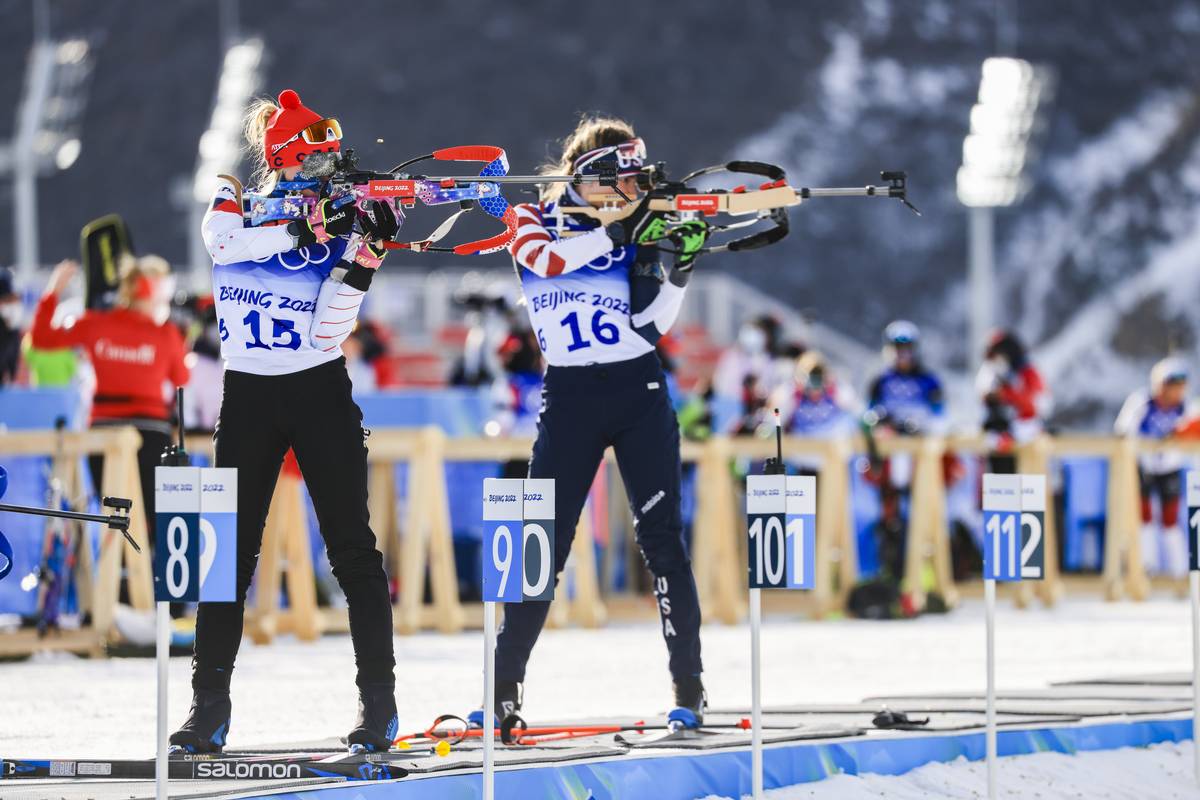
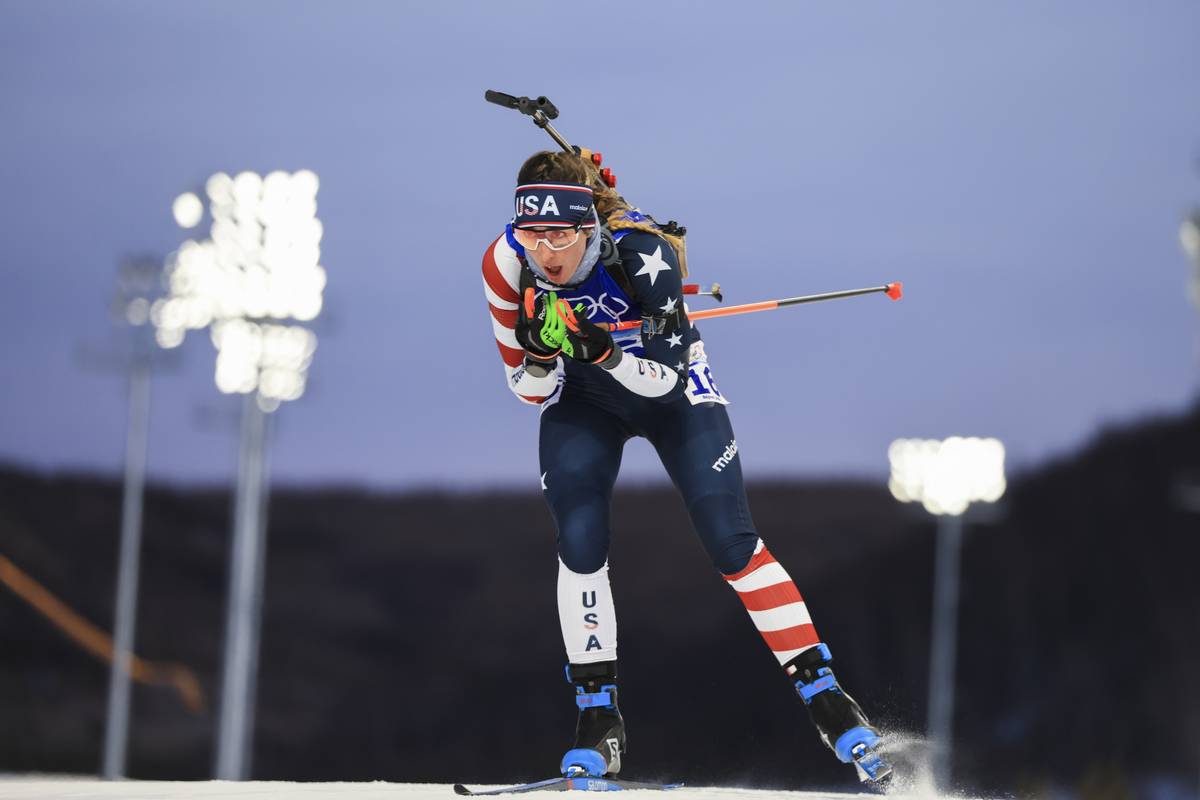
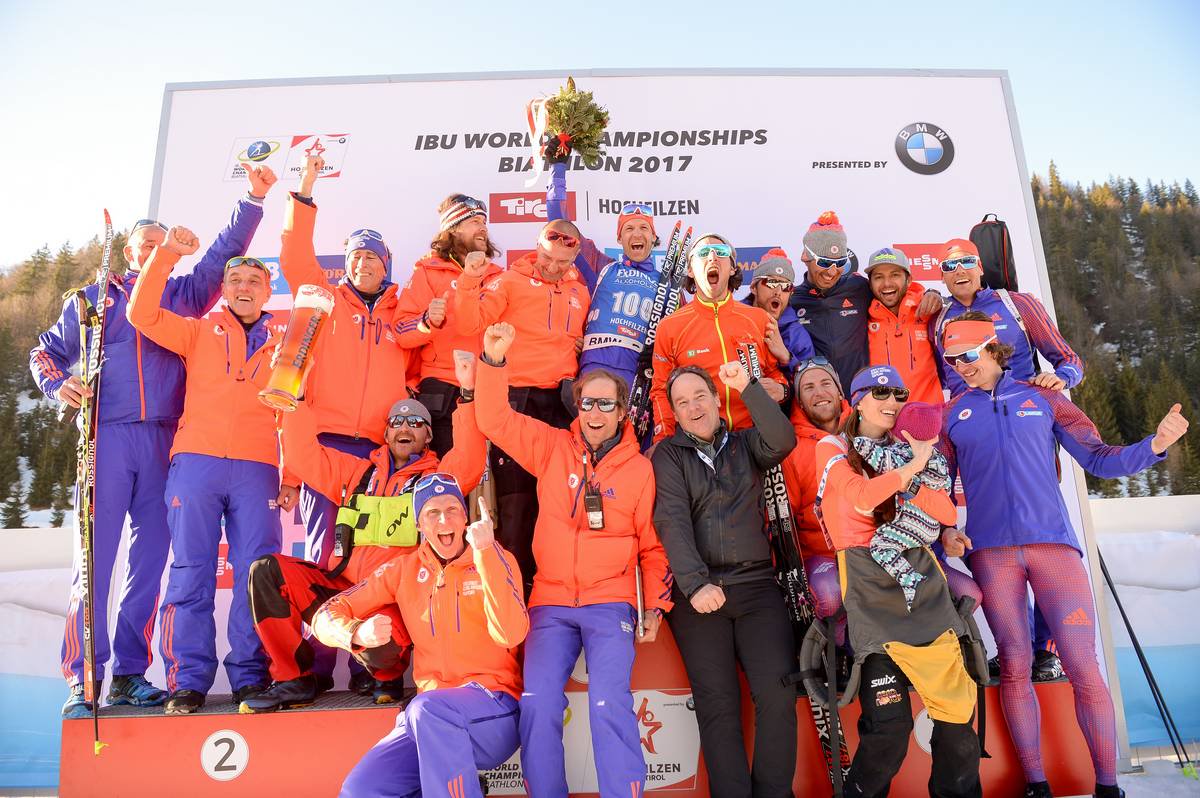
    November conditions in Lefthand Canyon (Sophie Spalding photo).

    How strange it is to go looking for clear roller skiing pavement when the mountain tops are all white. But this is not winter’s snow—this is an early arrival, a “save the date” notice, a precursor of what’s to come. Clouds swirl, pressures shift, winds converge, and this too-early delivery sends the city scrambling for trucks with plows, sends cars on the high passes skidding into ditches, sends a warning to those who aren’t yet ready. Early snows anoint those winter-faithful who impatiently await the blessing, but this first November snow will not be part of winter: it won’t lie beneath the gathering blanket of the season, it won’t provide a “good base” for snows that come later, it won’t become part of some future glacier. November days are likely to warm again, and this snow will melt back into streams and rivers, or trickle back into the earth, or evaporate back into the sky. Winter is up there in the sky above us, patiently circling . . . but it may make us wait a bit longer.

  • US Ski and Snowboard Coaches Symposium returns in Virtual Format

    US Ski and Snowboard Coaches Symposium returns in Virtual Format

    Convened for the first time since the pandemic, USSS’s biennial coaches National Coaches’ Symposium brings focus to US Skiing’s progress, and highlights the ever-evolving nature of the sport.

    U.S. Ski and Snowboard Development Team Coach Greta Anderson encourages athletes during the men’s 30k distance race during the 2022 U.S. Cross Country Championships in Soldier Hollow. (Photo: Tobias Albrigtsen / @untraceableg)

    Last held in 2019, the US Ski and Snowboard’s National Coaches’ Symposium has traditionally provided insight into program priorities and training philosophies of those coaches working directly with the US Ski Team. With in-person conventions having been interrupted by the Covid pandemic, this season’s re-convening of the two-day Coaches’ Symposium represented a welcome return to the dialogue that has typically benefitted the Nordic skiing community. The virtual venue ostensibly helped reduce attendance costs for coaches, but also spoke to a key theme of accessibility and collaboration touched on as a strength of contemporary US skiing throughout the conference.


    Friday
    U.S. Ski Team head coach Matt Whitcomb (right) and Julia Kern course-side during the 4 x 5 k mixed relay amidst the 2021-2022 World Cup Finals in Falun, SWE. (Photo: NordicFocus)

    Friday’s program began with an introduction from US Ski Team Sport Development Director, Bryan Fish. “There’s 138 people on the call right now,” Fish said, which reminded attendees that the audience was larger than could have fit into the Center of Excellence in Park City where previous symposiums had convened. There was much important information that presenters were to convey, and many eager listeners had gathered to hear it. 

    Dr. Hans Kristian Stadheim

    Friday’s keynote speaker was Dr. Hans Kristian Stadheim, the current British National Team Endurance Performance Director, and a coach long-renowned for his intricate and scientific approach to endurance as it specifically applies to nordic skiing. As Matt Whitcomb commented in his introduction of Dr. Stadheim, “when you’re at the World Cup, Hans stands out as the one who’s really digging into what makes [ski training and racing] work.”

    Hans Kristian Stadheim, current Director for the British National Ski Team. (Photo: Courtesy Image).

    Stadheim’s presentation, “The Norwegian training method and experiences working with British team,” discussed the evidence behind current trends in nordic ski training, including the principles behind Norway’s dominance that Stadheim applied to building an elite program in Britain. He used his coaching with Simen Hegstad Krüger (NOR) as a case study for pointing out the training trajectory that the Norweigans follow for fostering a skier from junior to Olympic champion. The big takeaway from this example was that, “[The Norwegian] method is a gradual increase in training load with stress on limiting high volume at an early age.”

    That point fueled a lively Q and A facilitated by Matt Whitcomb, which focused on implications for coaches working with junior and college athletes. Stadheim—along with useful addendums from Whitcomb—provided thoughts on balancing Threshold and VO2 max work, recovery metrics, and fitting individualized training into a team environment. Key recommendations included:

    • Intensity work for juniors should focus heavily on increasing VO2 max.
    • Recovery should be gauged dynamically using analytical tools and athlete perception.
    • Building a national program requires retention of a robust base of athletes from the junior level through to higher levels of competition.

    The remainder of Friday’s program featured discussions and demonstrations by medical and training staff members of the US Ski Team. Jen Kimball and Tschana Schillier, alongside Luke Jager, demonstrated mobility and strength movements that target particular weaknesses seen in cross-country athletes. Dr. Heather Cichanowski and Dr. Tod Olin detailed the medical community’s interest in the high occurrence of respiratory issues among competitive skiers, chiefly asthma and vocal cord dysfunction. Then, Jessica LaRoche wrapped up the program with a talk on athlete wellness.


    Saturday
    Johan Olsson smiles after winning the 15 k freestyle at the 2015 FIS Nordic World Ski Championships in Falun, Sweden. (Photo: NordicFocus).
    Johan Olsson

    Saturday’s presentations began with a keynote from Swedish skiing legend Johan Olsson. Since his retirement in 2015, Olsson has developed a career as a TV contributor to Swedish National Television’s (SVT) ski coverage. From a career that included fourteen Olympic and World Championship medals (2nd only to Gunde Svan in the history of Swedish skiing), Olsson shared anecdotes that illustrated breakthroughs in his approach to ski racing, with a special focus on mental preparation. Olsson’s career took place prior to the detailed focus on mental preparation and wellness in training that are common at the elite level today. His anecdotes, therefore, illustrated an innovative individual approach that soon saw parts become common in competitive skiing today. 

    Johan Olsson during the 2015 World Championships in Falun, Sweden. Olsson won the 15 k skate in Falun. (Photo: NordicFocus)

    In one anecdote, Olsson detailed how his development of a dedicated mental approach to racing grew out of his own treatment for anxiety. After a disappointing 15k Classic at 2009 World Championships, Olsson’s wife Anna (also an accomplished Swedish skier) prescribed a self-imposed grieving period for him. “You have until 6pm tonight to be sad,” she said. “But then you will come to dinner and be the same positive Johan you always are.” Olsson popped in a cassette tape of “the saddest Neil Young songs I could find” and went about devising psychological strategies not unlike those found in Sport Psychology books today. A year later—at the 2010 Vancouver Olympics—Olsson’s charge in his relay leg saw Team Sweden win Gold in the event for the first time since Calgary in 1988.  It was the culmination of a persistent application of techniques he had devised while wallowing in the saddest songs of Neil Young who—in an ironic twist—was seen passing through the crowd while Olsson stood atop the Olympic podium. Full circle, indeed.


    Bryan Fish

    Bryan Fish described trends in training and development philosophy on which he and US Ski and Snowboard are currently focused. Fish’s presentation implicitly conveyed the strong progress US Skiing has made, as well as identifying next steps. Strong points identified include a philosophy towards “not training the most, but training really well,” an emphasis on strength training, and a spirit of collaboration among US Ski Team programs, local clubs, and regional associations.

    Bryan Fish, U.S. Ski and Snowboard Sport XC Development Manager, at a SuperTour in Duluth last December. (Photo: Jordan Woods/Woods Creek Productions)
    Greta Anderson 

    What Bryan Fish had described as US Ski Team’s “holistic approach” was a continued focus during Greta Anderson’s presentation. Anderson spoke in detail on the number of athletes being reached by international trips, national training/elite groups, and regional elite groups. She further emphasized the ways each region uniquely incorporates its ski resources into this developmental program. For example, Eastern collegiate coaches played active roles in the Eastern/Midwestern U16 camp. In the Midwest, Team Birkie pros and U14 Dream Camp both expanded the region’s Regional Elite Group camp to more skiers. Anderson reiterated that these types of partnerships with clubs and programs feeding the US’ national development pathway were likely to continue. Matt Whitcomb quickly followed with an appeal to mobilize the US skiing community through the National Nordic Foundation, which will hold its annual Drive to 25 from November 21st-25th this year.

    US Ski and Snowboard Cross Country D-Team head coach Greta Anderson supports athletes during the Sun Valley SuperTour races in January. (Photo: Tobias Albrigtsen / @untraceableg)
    Jason Cork

    In the final presentation of the symposium, Jason Cork narrowed US skiing’s development focus from the entire system to just one athlete: Jessie Diggins. In a candid and entertaining talk that considered the ethereal mix of trust, knowledge, and competence required in the coach-athlete relationship, Cork delved into the minutiae of training numbers, and how data derived from Diggins’ training logs reveals pertinent information about peaking. He rattled off Diggins’ history-making results in a casual tone, while being much more serious about the types of workouts, training cycles, and long-term trajectories that led to World Cup Overall wins and Olympic medals. Those accomplishments would tend to suggest that American skiing is doing things right, and that this symposium was a valuable opportunity to describe the knowledge, the practice, and the craft of bringing those performances about.

    Jason Cork and Jessie Diggins out on a sunny day in Australia last August. Cork has worked with Diggins for 12 seasons, stretching back to their time on the CXC Elite Team. (Photo: Julia Kern)

    “Let’s let this knowledge radiate out to our athletes,” said Bryan Fish in closing out US Ski and Snowboard’s first-ever virtual coaching symposium. It was a call-to-action that resonated on Zoom screens across America, leaving a whole community of coaches ready for the demanding season to come.

  • Building Biathletes: John Farra and the USBA

    Building Biathletes: John Farra and the USBA

    Development of young biathletes is key to USBA’s long range plan (NENSA photo).

    As the new Director of Sport Development for the US Biathlon Association (USBA), John Farra’s career is coming full circle (maybe even for a second or third lap). As he enters this newly established position within USBA, Farra reflects on decades of involvement—as athlete, as coach, as administrator—within the multi-faceted world of nordic skiing and Olympic/Paralympic sport. An alumnus (and former coach) of the University of Utah, a member of the 1992 Winter Olympic Team in Nordic skiing, Coach and Vice President of the Maine Winter Sports Center), High Performance Director for US Paralympic Nordic Team, High Performance General Manager for USA Triathlon, and Nordic Director for US Ski and Snowboard, Farra has spent his life on snow. Now he’s ready to make sure others have the same opportunity.

    John Farra is USBA’s new Director of Sport Development (USBA photo).

    “USBA stakeholders got together and created a strategic plan for 2030, a long view plan for how USBA can be one of the best governing bodies in the USA,” Farra said. “A core foundational component of that effort is the need to have more young people find the sport of biathlon.”

    FasterSkier caught up with Farra on his drive from Utah to Colorado to investigate the potential for developing a biathlon range in Steamboat, already a winter sports Mecca, but one without a dedicated biathlon facility.

    “Established ski clubs—like the Steamboat Springs Winter Sports Club—seem like a logical place to start,” Farra said. “There are already effective clubs around the country. Now, what can the USBA do to support their efforts, and to introduce young athletes to the sport?”

    He’s been thinking that way for a long time. Near the beginning of his long career, one of Farra’s earliest administrative roles was as Director of the Maine Winter Sports Center (now called the Outdoor Sport Institute).

    “Maine is an environment well-suited to the development of young biathletes: much of this massive state is covered in snow for half the year, and nearly every youngster knows how to handle a rifle. It made perfect sense to develop the sport in a community like that. So, my new role with USBA is like turning the clock back; revisiting a part of my life that I really enjoyed, introducing young skiers to a sport that I love. I’m hoping that the things I learned back then will come back to me.”

    USBA’s new plan includes three objectives to which Farra will respond:

    1. The need to support existing biathlon clubs. USBA sees that the club is the thing that’s sustainable: gatherings of passionate people who love biathlon.
    2. The need to identify and support nordic communities that haven’t yet figured out how to add biathlon for their participants. How many new clubs can we help develop? And where are there nordic communities that haven’t yet figured out how to add biathlon to their programs?
    3. And, the need to identify talented skiers who might excel at—and enjoy—biathlon. Where do we find the athletes? How do we find the kid who just hasn’t yet discovered that they should be a biathlete?
    Closely contested racing at Schutzenski Festival, 2022 (FasterSkier photo).

    “Some communities have the people, but not the venue,” Farra said. “Others have the venue but not the people. I’ve already had conversations with communities who might not know how to start. My job is to show them the possibilities, and to assist them in getting it done.”

    Sometimes, “getting it done” means building new facilities (like Steamboat is considering). More often, it means developing programs and events that can introduce young skiers to biathlon without exorbitant financial commitments—maybe it’s the incorporation of pellet rifles, or laser rifles, or the staging of paintball biathlons (like the annual NENSA/Bill Koch League event that has been so successfully staged at Mountaintop Resort in Vermont). Farra’s goal is to provide opportunities for young skiers, to start them off early in their exposure to biathlon.

    “We’re not here to steal skiers from cross country clubs,” Farra said. “In the past, there may have been defensiveness or concerns about that, but not everyone is a fit for biathlon. We don’t want to take opportunities away from young athletes. We want to provide athletes with even more opportunities than they might otherwise have had.”

    The lead Elite Women’s field at the recent Schutzenski Festival, Soldier Hollow in Utah (FasterSkier photo).

    There are high level athletes in the US Biathlon program, most of whom began focusing on biathlon as post-collegiate skiers. Such American biathletes have experienced great success, but it’s logical to assume that athletes who begin mastering biathlon skills at a younger age will stand an even better chance of succeeding at even higher levels of the sport. Farra is determined to show young skiers what might be possible.

    “The pathway from entry level biathlon to the Olympic Trials is amazingly short at the moment,” he says. “There’s so much opportunity there.”

    USBA is aiming for a bright future, and for the ongoing development of young American biathletes (FasterSkier photo).

    For additional information—or to discuss particular possibilities—John Farra is available to the nordic/biathlon community via email:  jfarra@usbiathlon.org. Those conversations could result in some very big opportunities and outcomes for individual athletes, for interested clubs, and for the sport of biathlon in the USA.


  • President Biden Designates National Monument at Camp Hale, Preserving American Ski History

    President Biden Designates National Monument at Camp Hale, Preserving American Ski History

    Members of the US Army’s 10th Mountain Division training below Mt. Rainier in the winter of 1941. In 1942, the 10th found a home at Camp Hale, Colorado. 53,800 acres of the area surrounding the training site was designated the Camp Hale – Continental Divide National Monument by President Biden last week. (Photo: Colorado Snowsports Museum).

    In a ceremony held last week in Colorado’s high country, President Biden proclaimed The Camp Hale – Continental Divide National Monument, the first National Monument designated during his presidency. The ceremony was conducted on the former grounds of Camp Hale deep in the Pando Valley between Leadville and Vail. Camp Hale was the training site of the famous 10th Mountain Division—the “skiing soldiers”—who played a critical role in the Italian theater of World War II. After the war, members of the 10th went on to form the core group of instructors, coaches, and entrepreneurs who established skiing in the United States.

    In declaring 53,800 acres of Colorado’s Tenmile Range a National Monument, President Biden stated:

     “The rugged landscape serves as a living testament to a pivotal moment in America’s military history, as these peaks and valleys forged the elite soldiers of the famed 10th Mountain Division – the Army’s first and only mountain infantry division – which helped free Europe from the grip of Nazi control in World War II.”

    Since its ratification in 1906, the Antiquities Act has allowed presidents “to proclaim national monuments on federal lands that contain historic landmarks, historic and prehistoric structures, or other objects of historic or scientific interest.” There have been 130 National Monuments designated since President Theodore Roosevelt signed the Antiquities Act into law, but never has the object of historic interest been so closely tied to the history of skiing and the ski community. President Biden’s designation of Camp Hale as a National Monument formally recognizes a generation of skiers whose legacy is felt in the ski organizations, resorts, and clubs they helped found. 

    Map of the newly designated Camp Hale – Continental Divide National Monument, located about 20 miles south of Vail, Colorado. (Photo: National Forest Service).

    The roster of 10th Mountain Division veterans includes many who profoundly influenced the modern skiing and outdoor industry: Aspen Ski Club founders Friedl Pfeiffer and John Litchfield; Vail Resort founder, Pete Seibert; Head Ski Company founder, Howard Head; Nike founder, Bill Bowerman. In the cross country ski world, there are many 10th Mountain Division veterans whose legacies within the sport are evident, and whose names will be familiar: Chummy Broomhall, 1948 and 1952 Olympian, designer of 1960 and 1980 Olympic courses, tireless booster of skiing in Maine, and namesake of the Maine State Collegiate Championship; the Von Trapp brothers, founders of the Trapp Family Lodge that established Vermont as a cross-country ski destination; Tony Wise, founder of the American Birkiebeiner, Telemark Lodge, the Worldloppet, and a key figure in the founding of the World Cup; Leif Odmark, “Mr. Sun Valley,” who coached the US Olympic team and influenced such cross country notables as John Caldwell, Si Dunklee, John Burton, and George Hovland.


    10th Mountain Division in World War II

    Camp Hale in the Fall of 1942, when 15,000 servicemen and women of the 10th Mountain Division arrived. (Photo: Colorado Snowsports Museum).

    With Hitler’s invasion of Poland in September of 1939, Americans began realizing the potential for the US to be drawn into war.  Having predicted that battles were likely to be waged in Europe’s high mountains, National Ski Patrol founder, Minnie Dole, proposed the creation of a ski force within the US military. Based on his assertion that, “It is easier to train a skier to be a soldier than a soldier to be a skier,” Dole proposed recruiting heavily from the populations of eastern collegiate skiers and midwestern Scandinavian immigrants. By the summer of 1942, the 10th Mountain Division had been established, including 300 expert skiers from across the United States. Those experienced skiers formed the Mountain Training Group which was responsible for teaching the rest of the Division—some 16,000 soldiers—how to ski. 

    The last American Division sent to Europe during World War II, the 10th deployed to Italy in December of 1944. The Allied campaign in Italy had stalled on the southern slopes of the Apennine Mountains where the German “Gothic Line” held strong from San Marino to Mt. Belvedere near Pisa. If the Allies could break the German’s defensive positions on Mt. Belvedere, 30 miles north of Pisa, they could push through the Po Valley and push the German divisions back to the Alps. A daring strategy was devised by Lt. Gen George Price Hays who proposed launching an attack across terrain on Riva Ridge that the Germans would deem untraversable. On Feb 18, 1945—in the dead of night—the 10th mounted an assault up five different routes on the sheer rock face. The skill and courage of 10th Mountain Division soldiers allowed the audacious attack to succeed. Mt. Belvedere and the Apennines were taken; German forces fell back. In April of 1945, the German Army in Italy surrendered, followed only two weeks later by the end of the war in Europe. 

    The 10th Mountain Division’s success came at a high cost: 992 men were killed in action, with another 3,800 wounded during just four months of fighting. Among those lost was the greatest American ski jumper of that generation, Torger Tokle, who was struck by a German artillery shell at the base of Riva Ridge, and for whom the memorial given by fellow 10th Mountain Division soldier, Lyle Munson, serves as an epigram for those lost: “[He] died in much the same fashion he lived, engaged in action up to the hilt.”

    For many years following the war, members of the 10th Mountain Division remained “engaged in action,” and the ingenuity and vitality of the American ski industry is what our nation has to show for their efforts. That their base in Colorado’s mountains is now a National Monument is part of the way that Americans—and American skiers—may continue to thank them for their service. 

    Members of the 10th Mountain Division perform an evacuation for a wounded member during the Allies’ Italian campaign in 1945. (Photo: Colorado Snowsports Museum).


  • Schutzenski:  Biathlon and Nordic Blaze the Trails
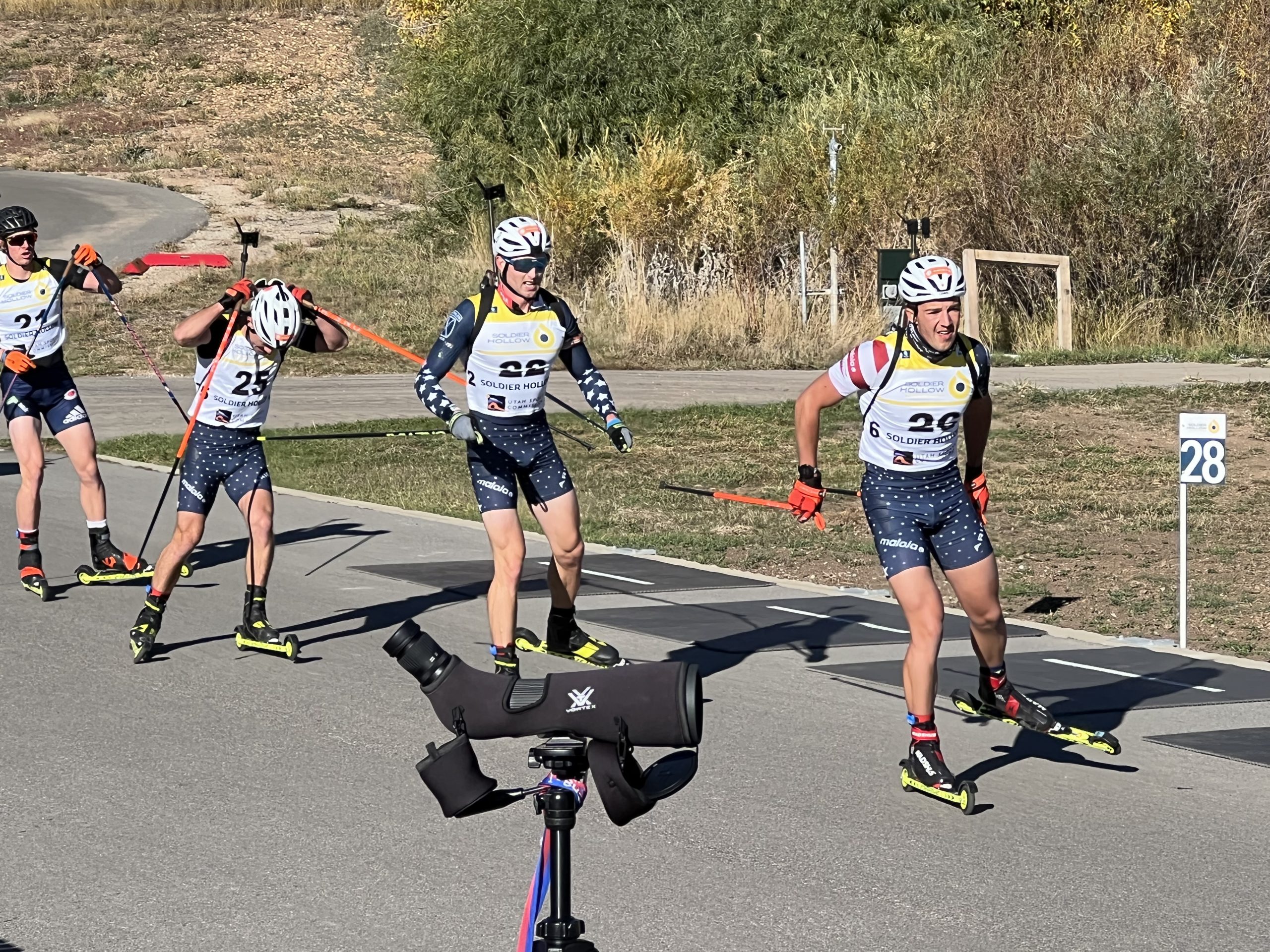
    Schutzenski: Biathlon and Nordic Blaze the Trails
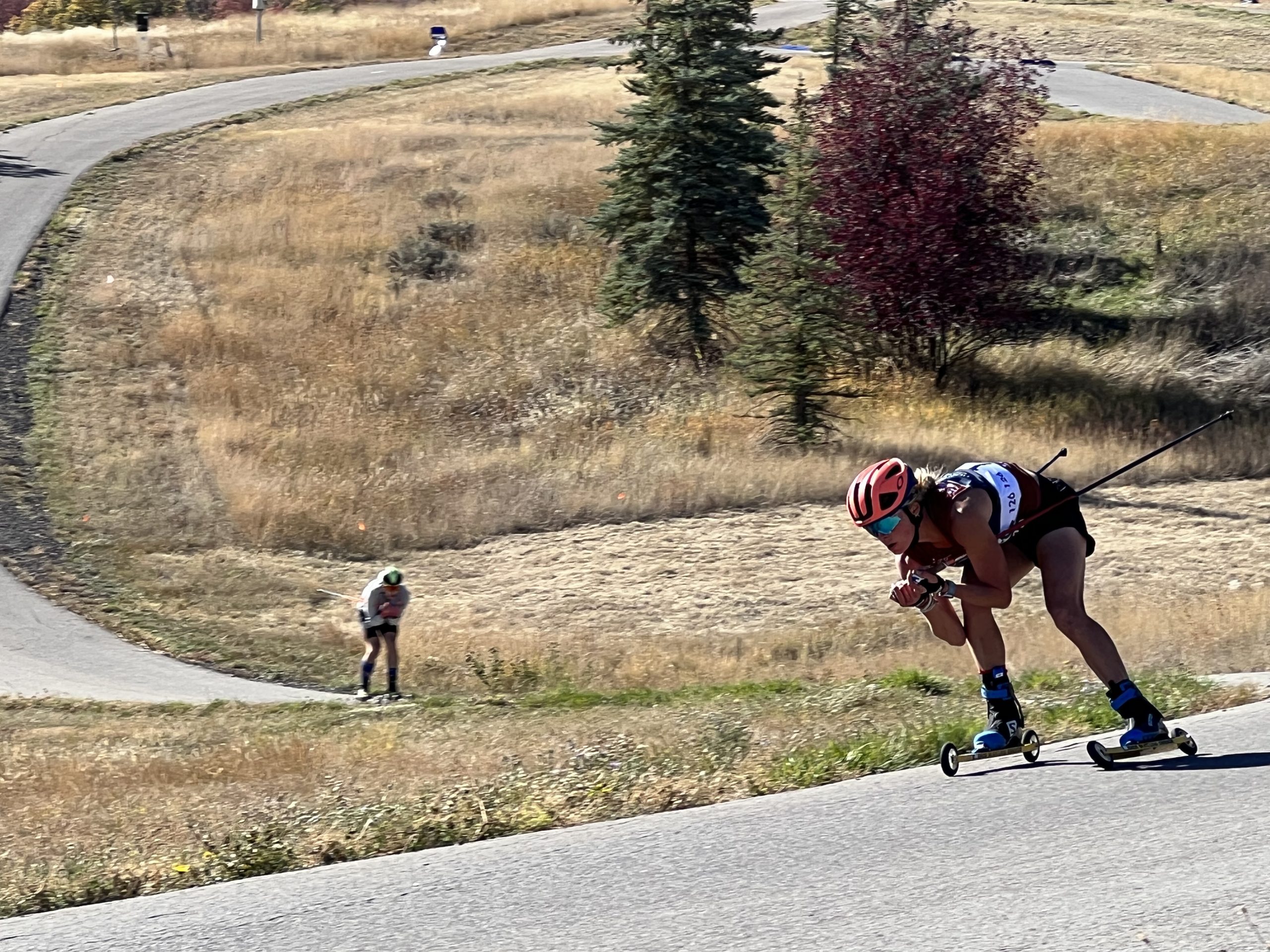
    Clear, crisp autumn mornings in the Heber Valley are a delight to the senses: scrub oak and sumac color the high slopes, willow and cottonwood fill the dry washes, and the scents of cedar and sage waft up from nearby flats. On just such a morning—dry, windless, and cool—this section of “Utah’s Alps” rang with the sounds of cheering along the trails and the pops of rifles on the range. Schutzenski Festival 2022 had arrived in Soldier Hollow.
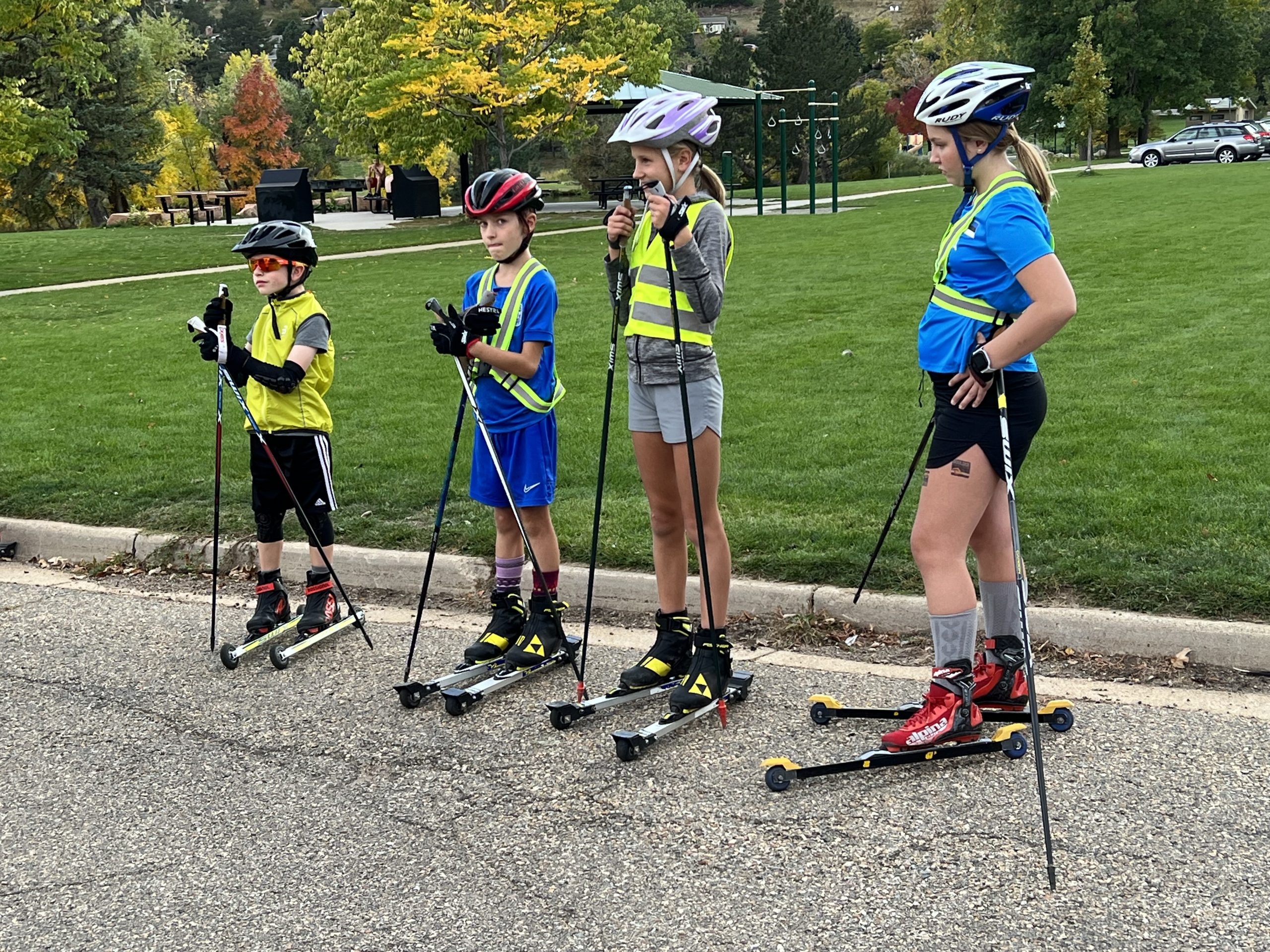
    Soldier Hollow hosted Schutzenski Festival 2022 on a perfect autumn morning.

    Located in Utah’s Wasatch Mountain State Park, the Soldier Hollow Nordic Center played host this weekend to the 2nd Annual Schutzenski Festival. Site of biathlon and cross country events in the 2002 Olympic Winter Games, Soldier Hollow is known for diverse trails and challenging race courses, made even more exceptional by the numerous kilometers that have been meticulously paved for roller skiing. In this world-class environment was staged the Schutzenski Festival, a series of roller ski races and associated events displaying the talents of the nation’s best biathletes and nordic skiers.

    Saturday

    Saturday dawned with temperatures below freezing, but the Soldier Hollow tracks had warmed up before the start of the Biathlon Mass Start. This was the second biathlon event in two days at Soldier Hollow, but Saturday’s event was the one circled on everyone’s calendar, and this was the event in which athletes acknowledged the biggest opportunities and the most severe consequences. While Schutzenski is a roller ski festival rather than an on-snow event, Saturday’s mass-start biathlon would be used to refine the selection process for US Biathlon’s World Cup Teams. Much was on the line, and emotions ran high both before and after the event.


    Deedra Irwin celebrates her win in the 10k mass start alongside Joanne Reid (2nd) and Chloe Levins (3rd).
    Women 10k Mass Start

    Deedra Irwin led the field from start to finish, stamping her authority on the 10k Mass Start event. Shooting cleanly—and posting the second-fastest ski time—she separated herself from a national-caliber field, and established herself as one to watch in the upcoming World Cup season. Posting the day’s fastest ski time, silver medalist Joanne Reid was hindered by two misses in the initial shooting round and spent much of the race playing catch-up. She skied bravely and efficiently, clawing her way back into contention, but additional misses in the third shooting round may even have kept her from the victory. Third on the day, Chloe Levins skied and shot with confidence while the remainder of the field behind her struggled with consistency on the shooting range.


    Men’s lead pack enters the shooting range in the 12.5 mass start biathlon.
    Men 12.5k Mass Start

    Sean Doherty posted the day’s fastest ski time (and second fastest time on the shooting range) while matching the field’s best shooting performances. Doherty worked through early laps in a field that included Vaclav Cervenka, Paul Schommer, and Campbell Wright. That group only broke up after the second and third shooting rounds. Cervenka missed two in the third shooting round, and the issue was all but decided as Doherty skied into the final shooting round with a lead. Doherty would miss once in the fourth round, but his skiing prowess was sufficient to hold on for the win.

    Schutzenski Festival Biathlon Results


    Cross Country Individual Start

    US National Team Camps and NTG Camps have been ongoing in neighboring Park City, so many of the USA’s top nordic skiers were also in Utah this weekend. Schutzenski Festival races were scheduled to include these fine fields with men’s and women’s individual start 10k classic races on Saturday.

    Jessie Diggins in full flight; 10k Classic Individual Start.

    Jessie Diggins won the women’s race in commanding fashion with winning margins of 42 seconds and 46 seconds over second place finisher Novie McCabe and third place finisher Sarah Goble, respectively. The energy and power that Diggins brings to her racing is a thrill to witness, and spectators were not disappointed. With three Olympic medals to her name—and certainly the most recognizable face in American nordic skiing—Jessie is followed around the course by the voices of young fans cheering her name.

    A late starter in the men’s field, US Ski Team’s Scott Patterson skied a consistent race that saw him rise to the top of the leaderboard. The top three finishers were closely grouped, with second and third place finishers—USST’s Zak Ketterson and University of Utah’s Tom Mancini—separated by less than three seconds.


    Shoot out

    Saturday’s finale was a highlight of the weekend as competitors gathered for a Shoot Out on the biathlon range. In front of a large and appreciative crowd, competitions were conducted in quick-draw accuracy in an environment of humor, energy, good-natured ribbing, friendly trash-talking, and eventual celebration. In a field that included both male and female competitors, Deedra Irwin emerged as champion, narrowly edging Vaclav Cervenka and Sean Doherty.


    Sunday

    On Sunday, the trails belonged to the cross country skiers, as the Schutzenski Festival offered up a sprint competition contested on the same loop as last year’s Senior Nationals. Jessie Diggins was the top women’s qualifier on the day, advancing efficiently through her heats. Even so, it took a lunge at the line for her to best USST teammate, Julia Kern, in the women’s final. In the men’s field, Noel Keefe was the second qualifier behind Logan Diekman, but Keefe turned the tables on him in the final, taking the win by a second. The final spot on the podium remained in doubt for more than a minute, as a late-race crash involved racers two-thirds of the field. Ultimately, Reid Goble extracted himself from the pile up, crossing the line for third.

    SchutzenskiFestival 2022 Final Results

  • Changing Seasons 2022

    Changing Seasons 2022

    We just can’t wait . . . for winter in the air, for the cold in our breath, for fluffy flakes falling from the sky, for snow on the ground. Seasons turn, leaves surrender, days shorten, and our imaginations turn to tracks on the hills and corduroy on the trails. Winter is coming . . . and we just can’t wait.

    (FasterSkier photo, 2022)

    Youth Sport autumn leagues are winding down—soccer, mountain biking, cross country running, all the wonderful sports offered through programs and schools—and young ski-athletes are beginning to imagine winter. Throughout the world’s skiing nations, kids and coaches, teams and programs begin gathering on playing fields and running trails and parking lots. SKIERS are beginning to gather! Programs supporting young skiers stage workouts and meetings, combine games and skills with ski-specific challenges and opportunities. This is the season of trying on new boots, of sizing up taller poles, of shopping skis at the ski swap. This is the season of bounding and striding, of strength-building and core-testing:  we re-start the process of building young skiers in preparation for the season we love.

    In youth programs around the skiing world, kids are rolling tentatively across parking lots, re-learning the skills of roller skiing: the pushing and the gliding, the slowing and the stopping, the weight shift and the body posture. In every skiing community, young skiers are taking first steps onto paved paths and suitable roadways, learning techniques that allow wheels to imitate skis and pavement to imitate snow. But we also need to acknowledge that roller skiing requires some courage—first steps are always unsteady, last year’s muscles are not yet toned, last year’s balance needs to be reawakened—and the pavement is an unforgiving surface. Everyone who has roller skied has known the scraped knee, the scuffed palm, the tattered fabric. Everyone who trains on roller skis once experienced a very first moment on roller skis. No one started out as an expert. We all stumbled. We all tumbled. We all learned. We all figured it out. That’s what these young skiers are doing today . . . all around the skiing world. So, we celebrate the enthusiasm they bring to the task, the skills they are eager build, the techniques they are determined to master. We celebrate all those young skiers who prepare for a season that is yet to arrive. But when it does arrive, they’ll be ready.

    (FasterSkier photo, 2022)

    A chill in the evening air, the first frost on the morning grass: these are the autumn days in which skiers begin to imagine the season ahead. Winter is not a season to hide from, not a season to fear. It’s simply a time when the world rests, when celestial lights are turned down low, when the planet’s waters are replenished and we lie tucked under a blanket of white until spring returns. Skiers are the people who go out to meet this winter season: it’s half of our year, so we find the means to go out to play. If we get to go play in the snow, then we’ll happily endure the windshield-scraping and the winter-driving and the firewood splitting and the driveway-shoveling. We bundle up, we pack snowballs, we make angels, we stay young.

    We just can’t wait . . .