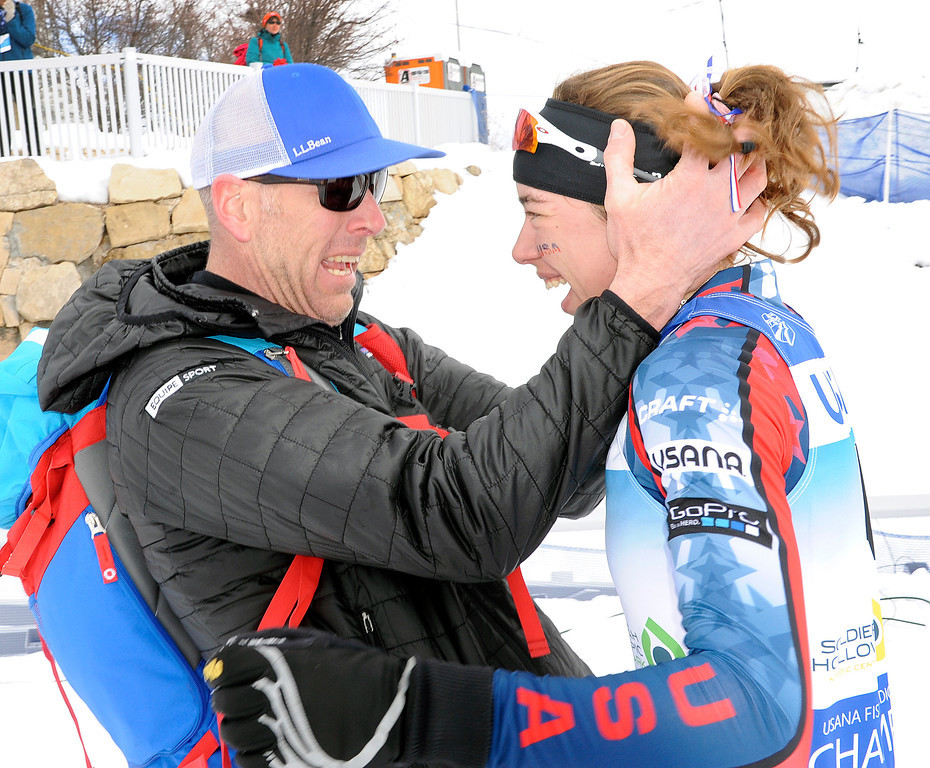
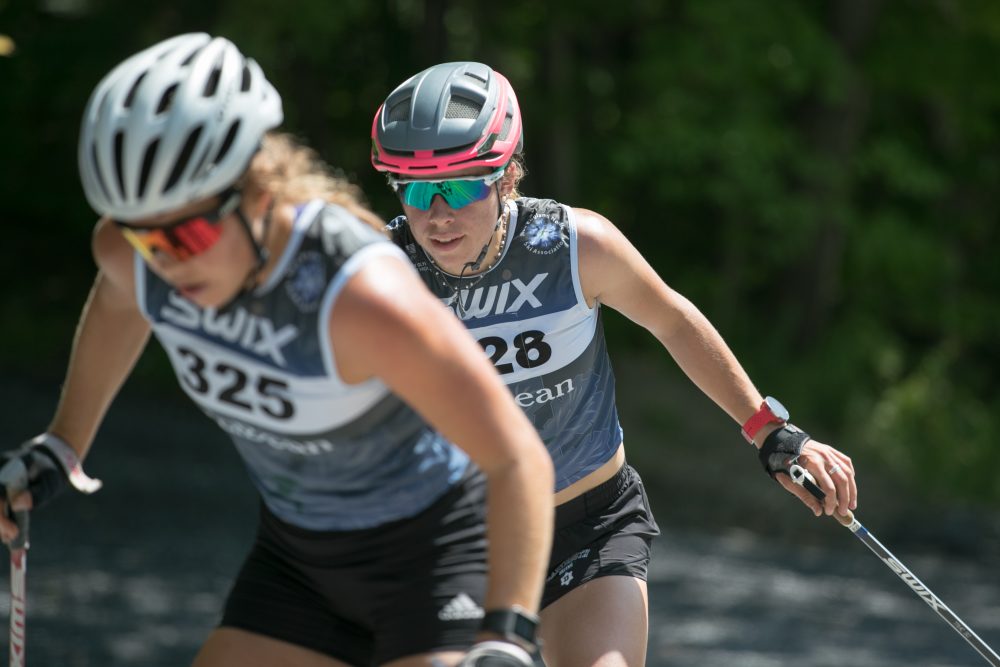
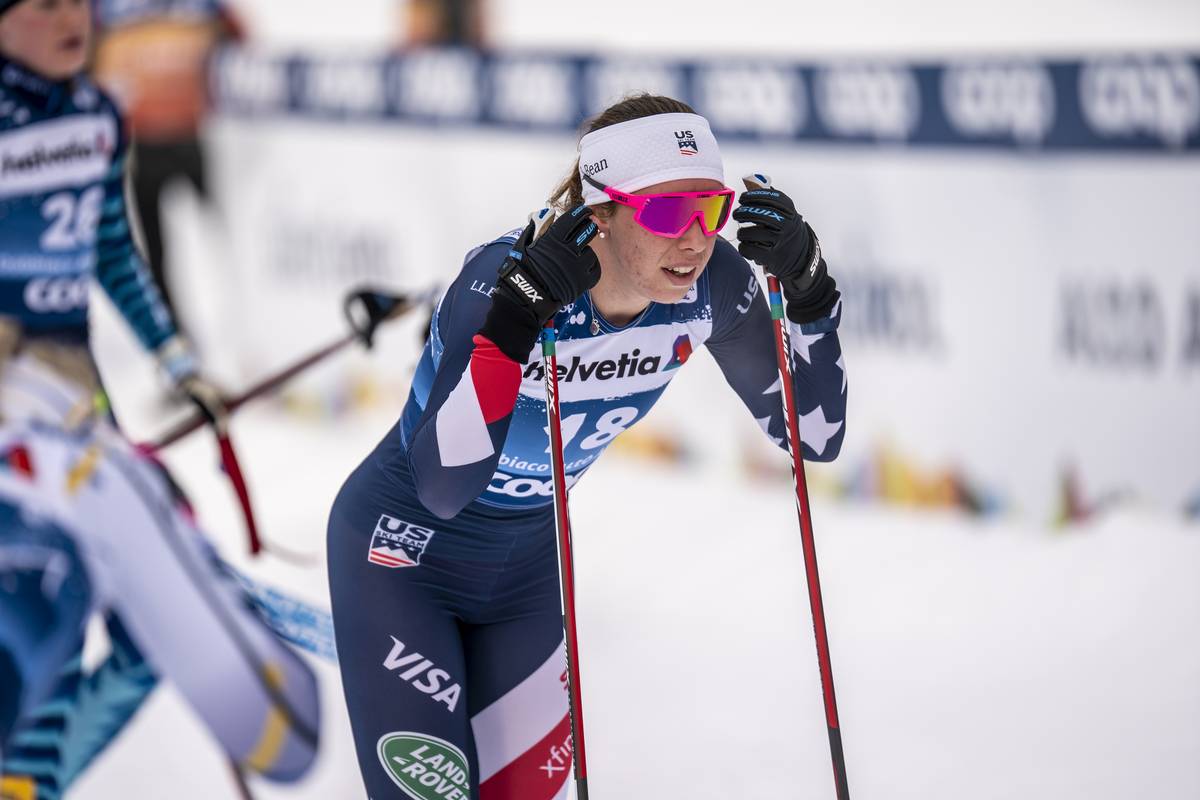
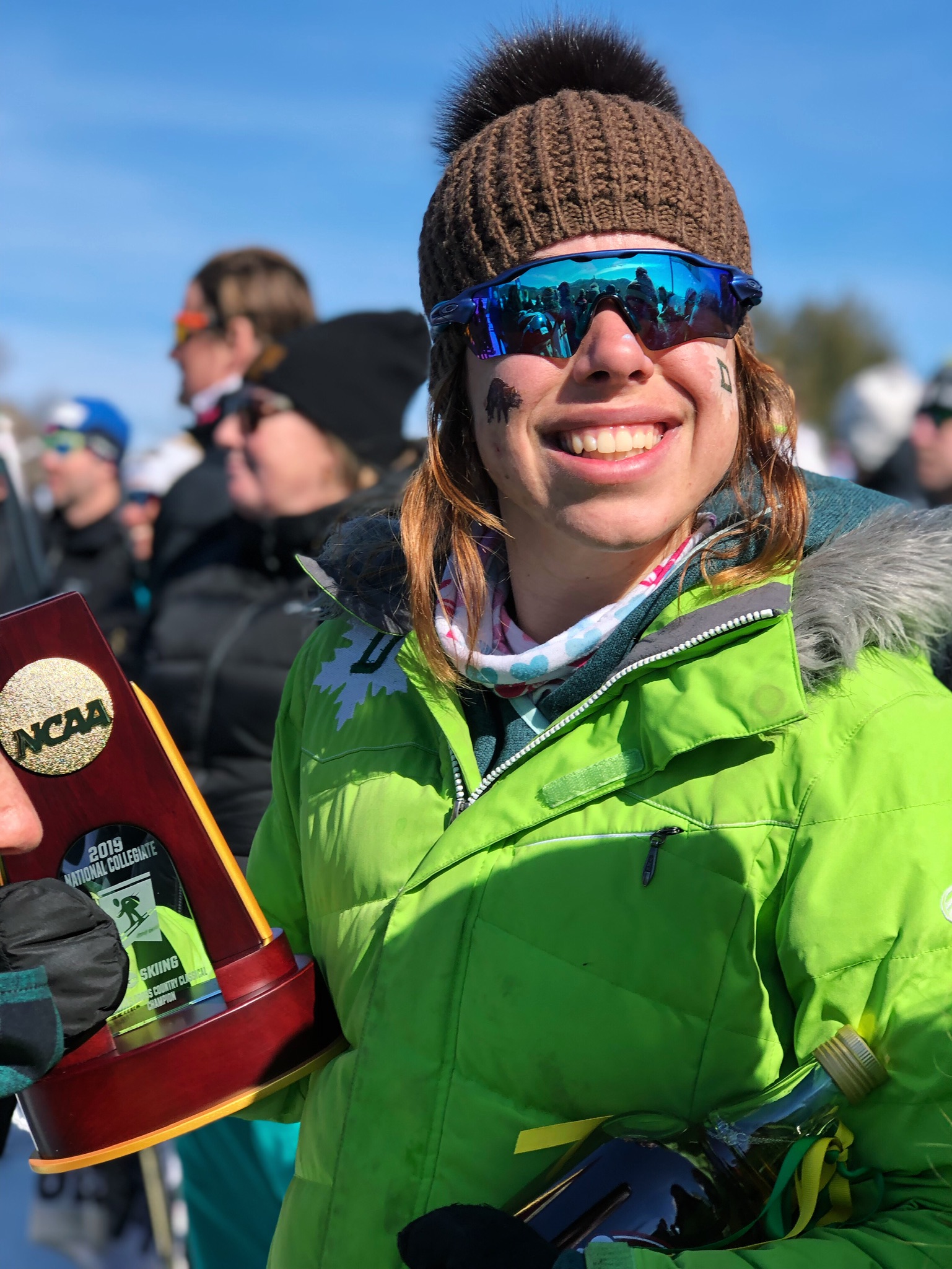
U.S. Ski & Snowboard recently announced its U.S. Ski Team nominations for the 2022-23 season. Of the 22 athletes named to the team this season, six were not on the previous year’s roster, either newly named or renamed: Michael Earnhart, Walker Hall, Zak Ketterson, Will Koch, Finn O’Connell, and Sammy Smith.
To help fans get to know these new(er) faces, FasterSkier is doing a series of interviews, providing insights into the factors that have contributed to development, progress, and growth for these athletes last season. In this installment, we talk with Zak Ketterson about his renomination to the U.S. Ski Team on its B-Team, his World Cup breakthroughs this past season, and the growth of his club, Team Birkie.
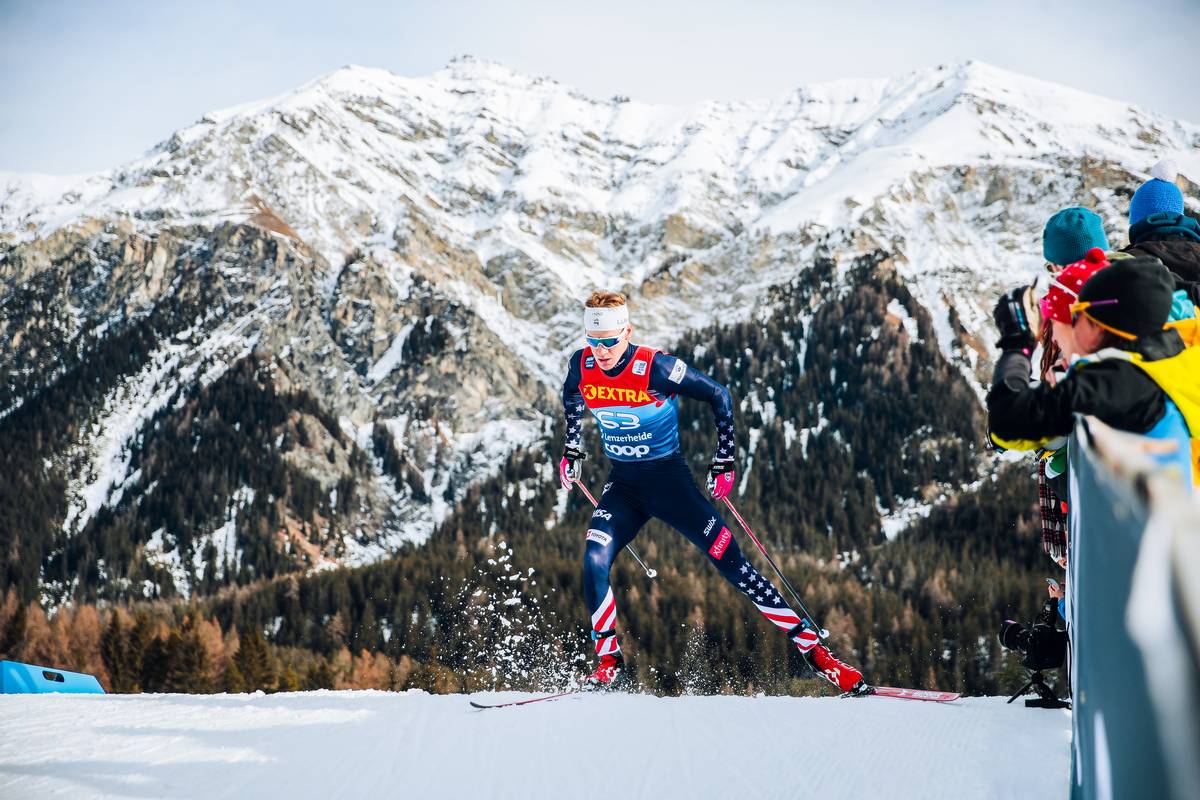
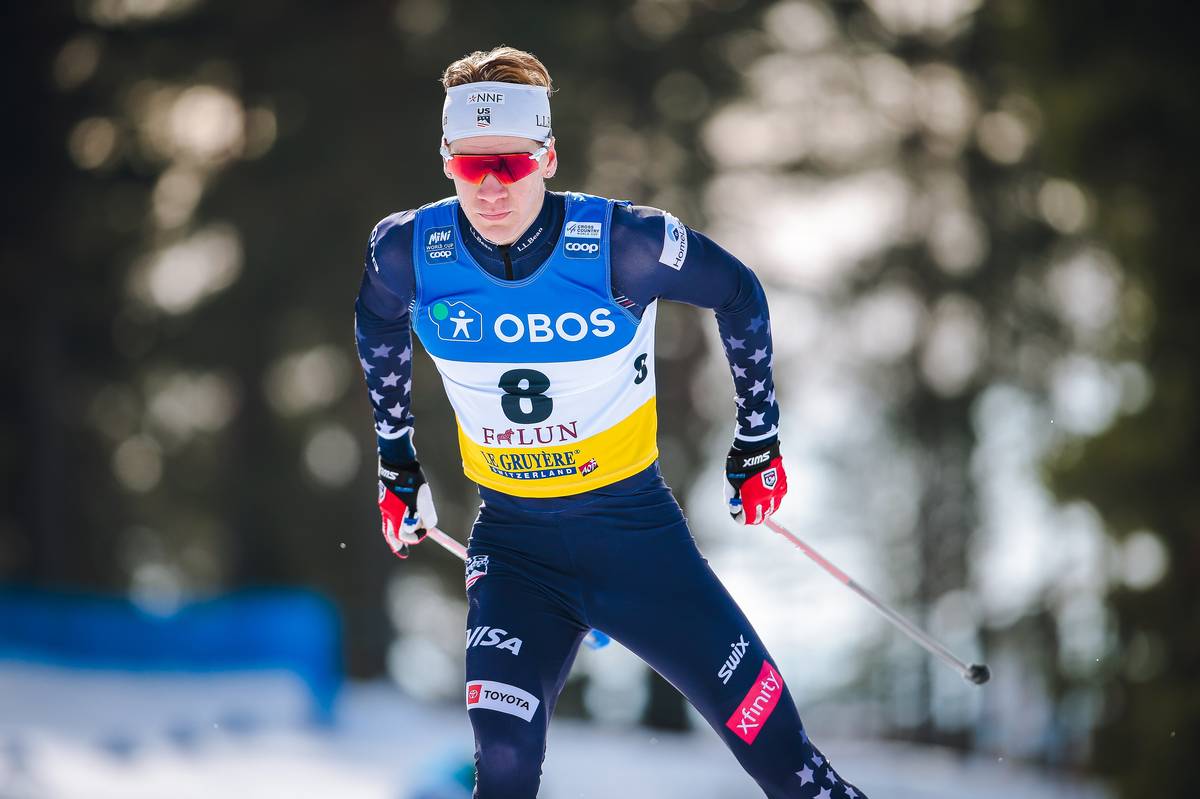
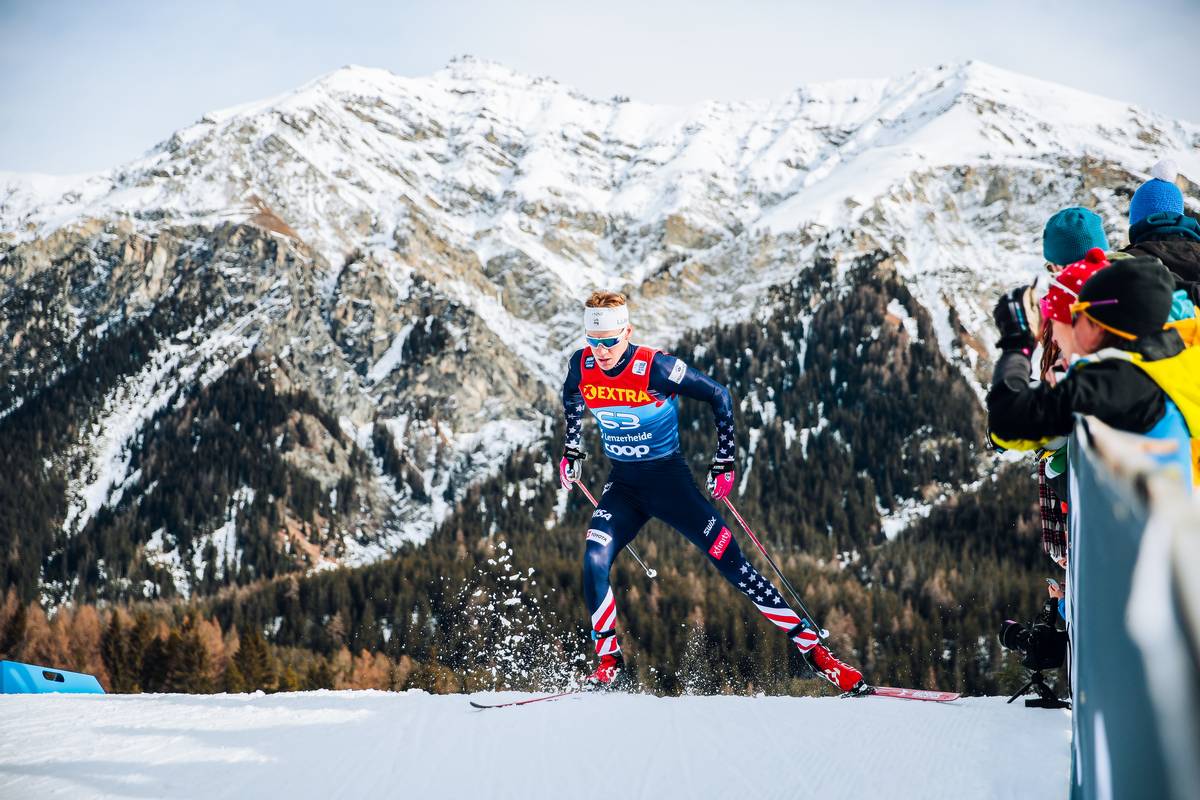
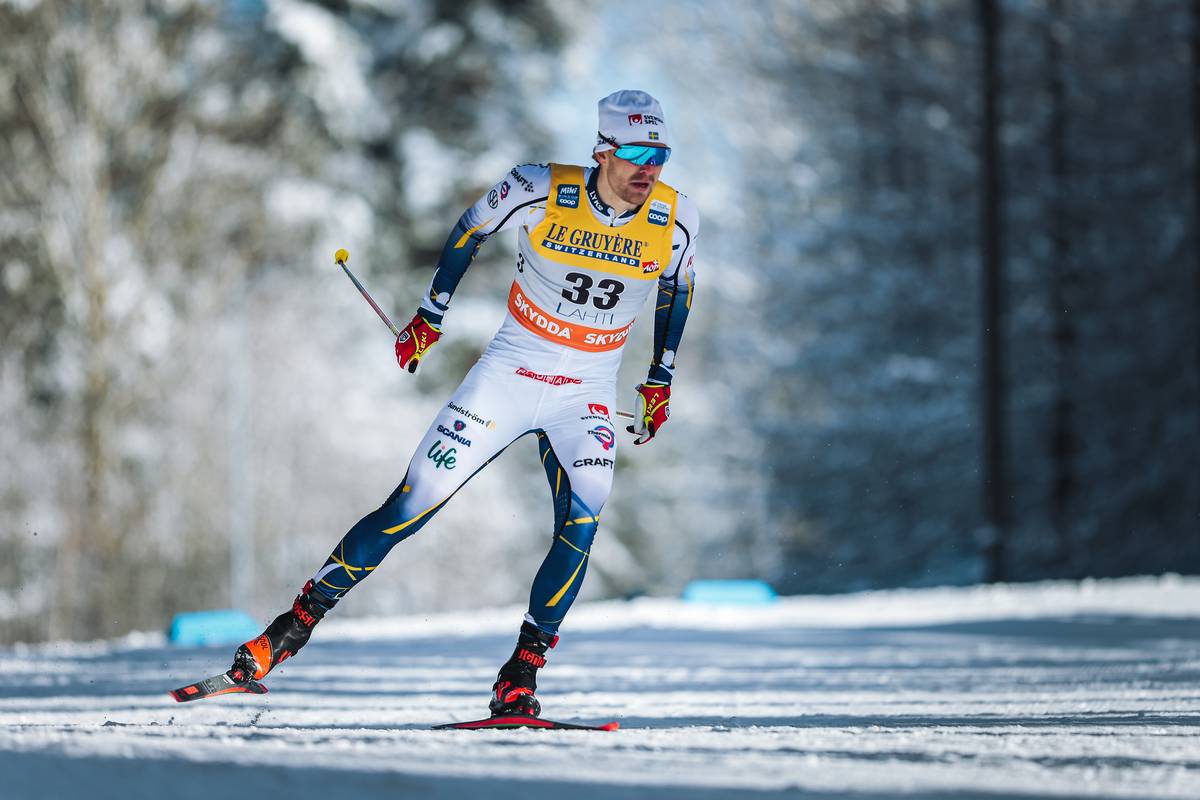
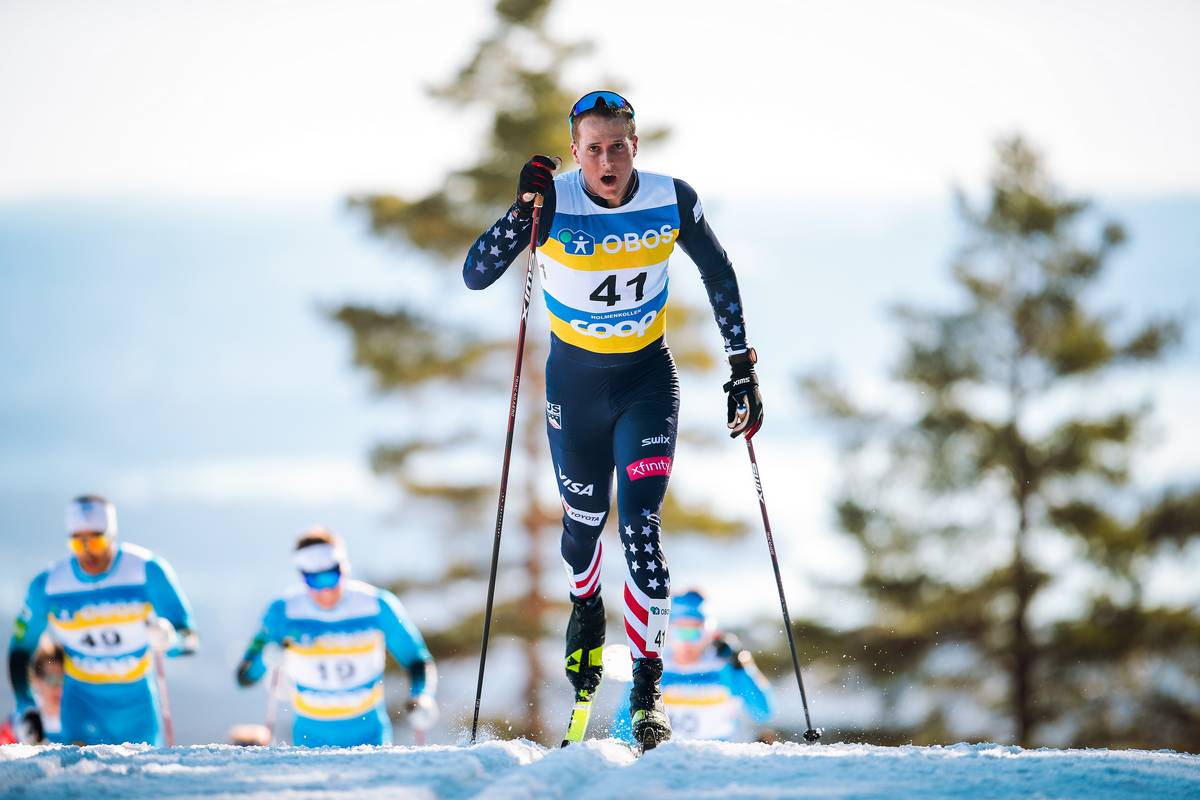
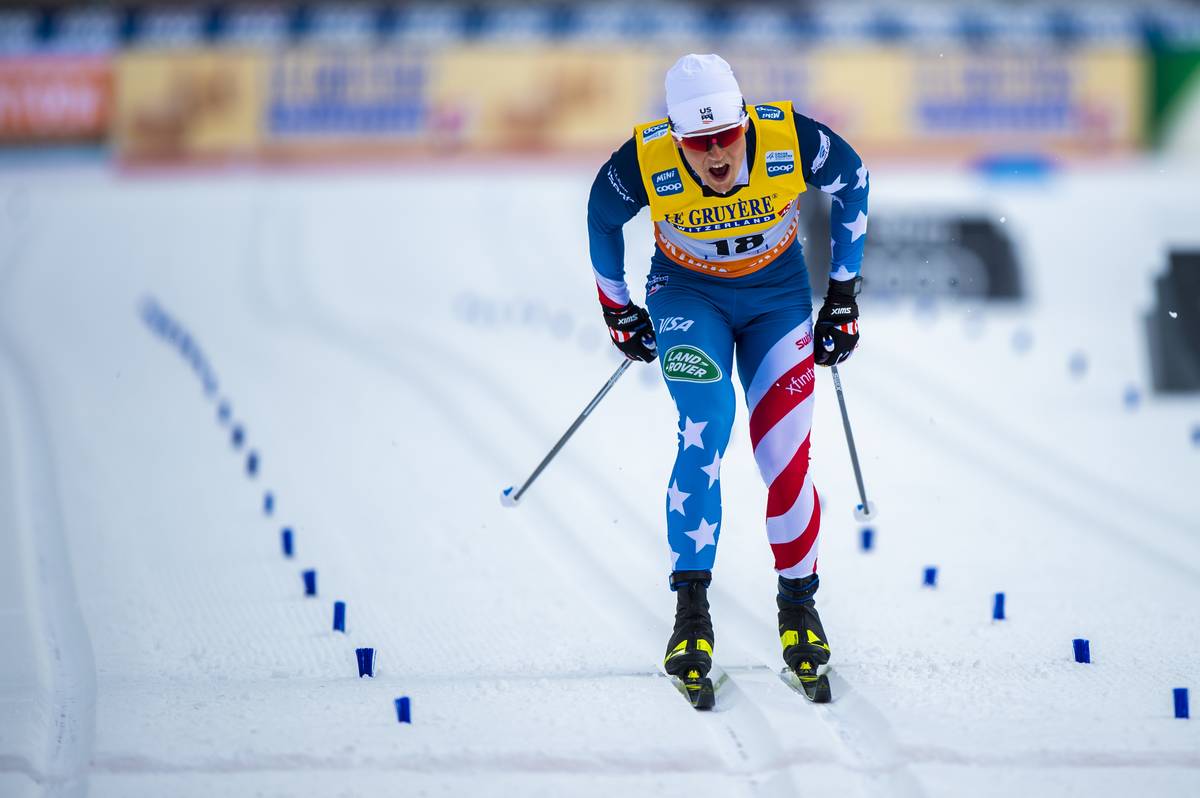
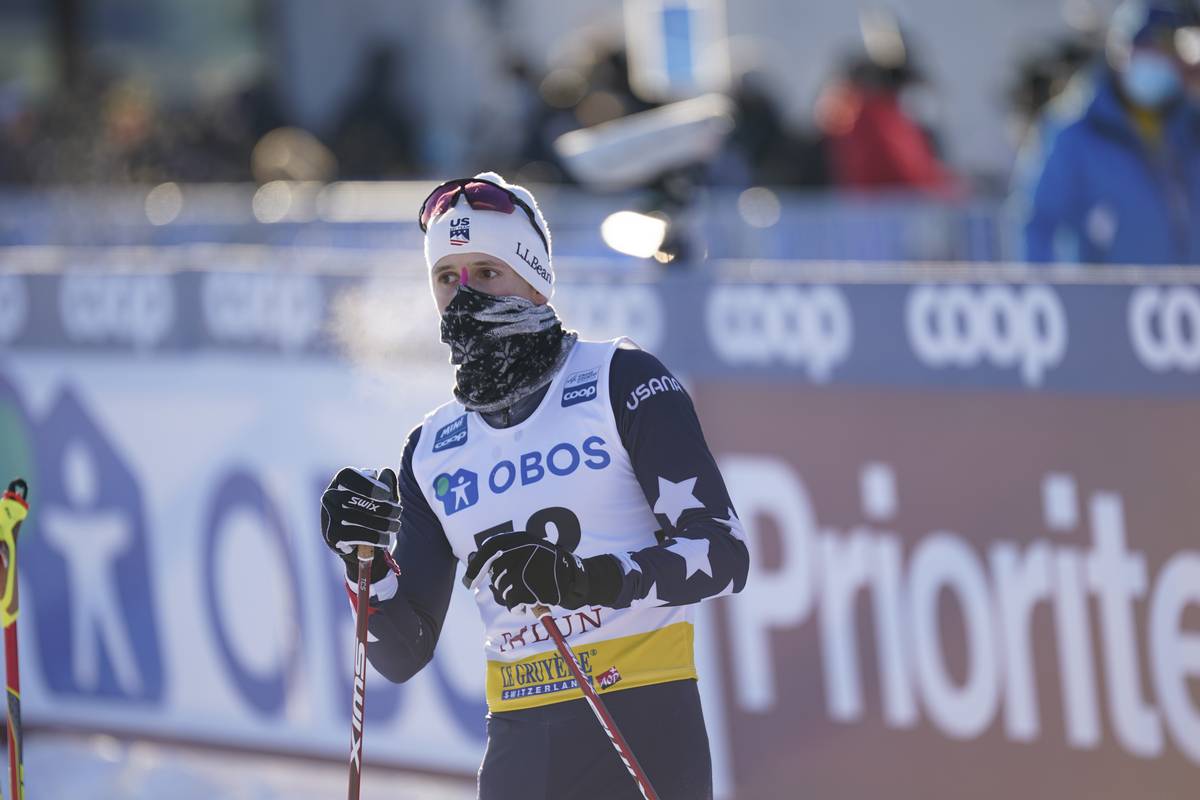
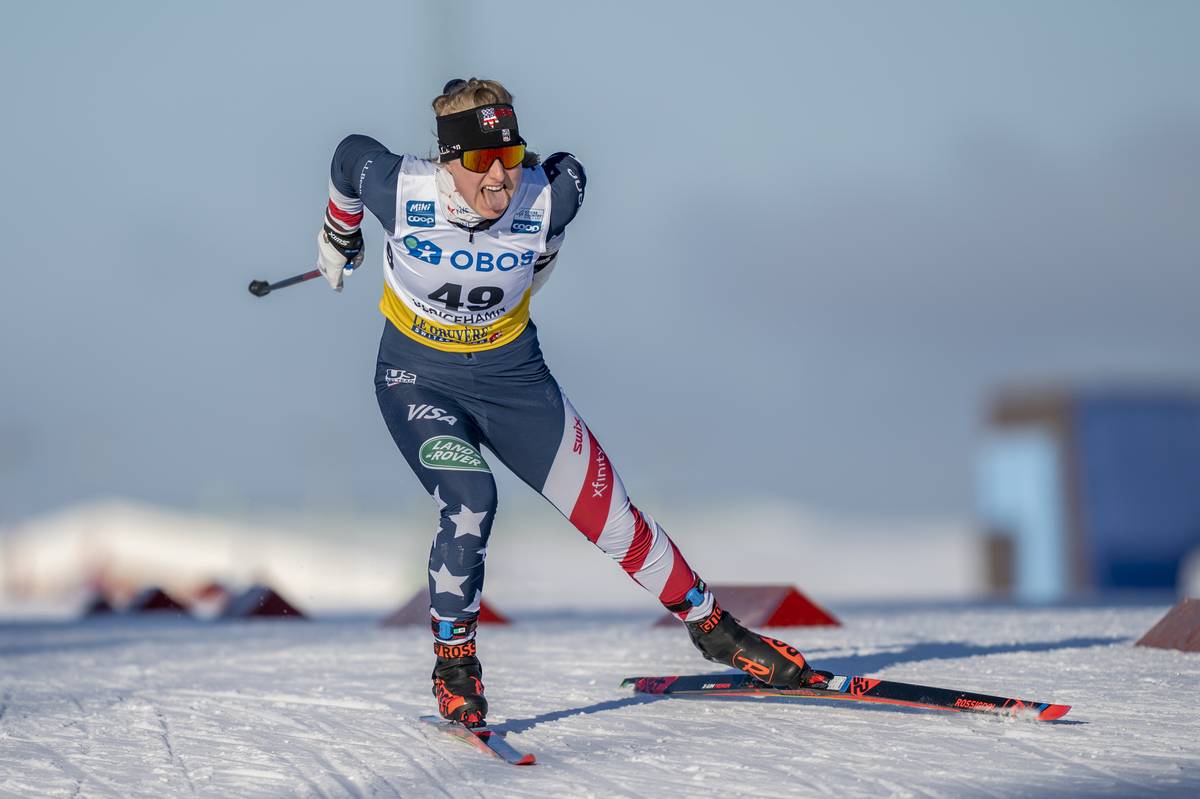
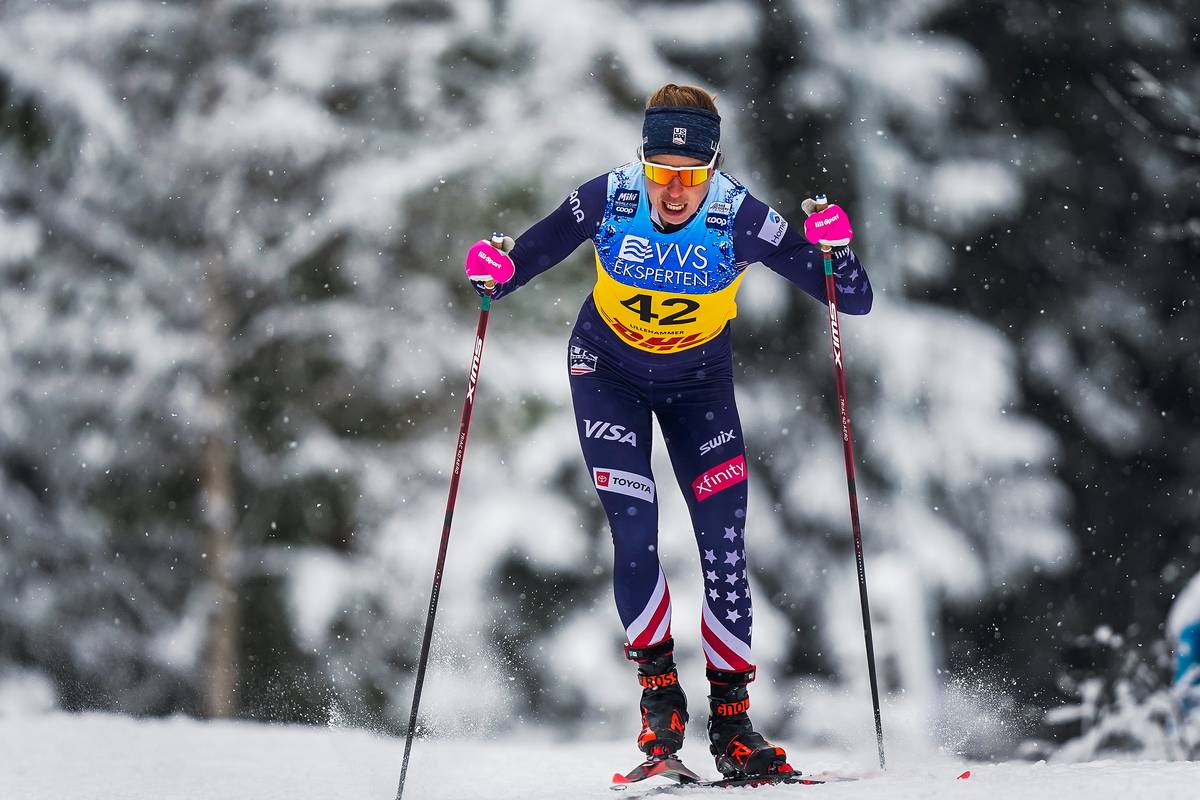
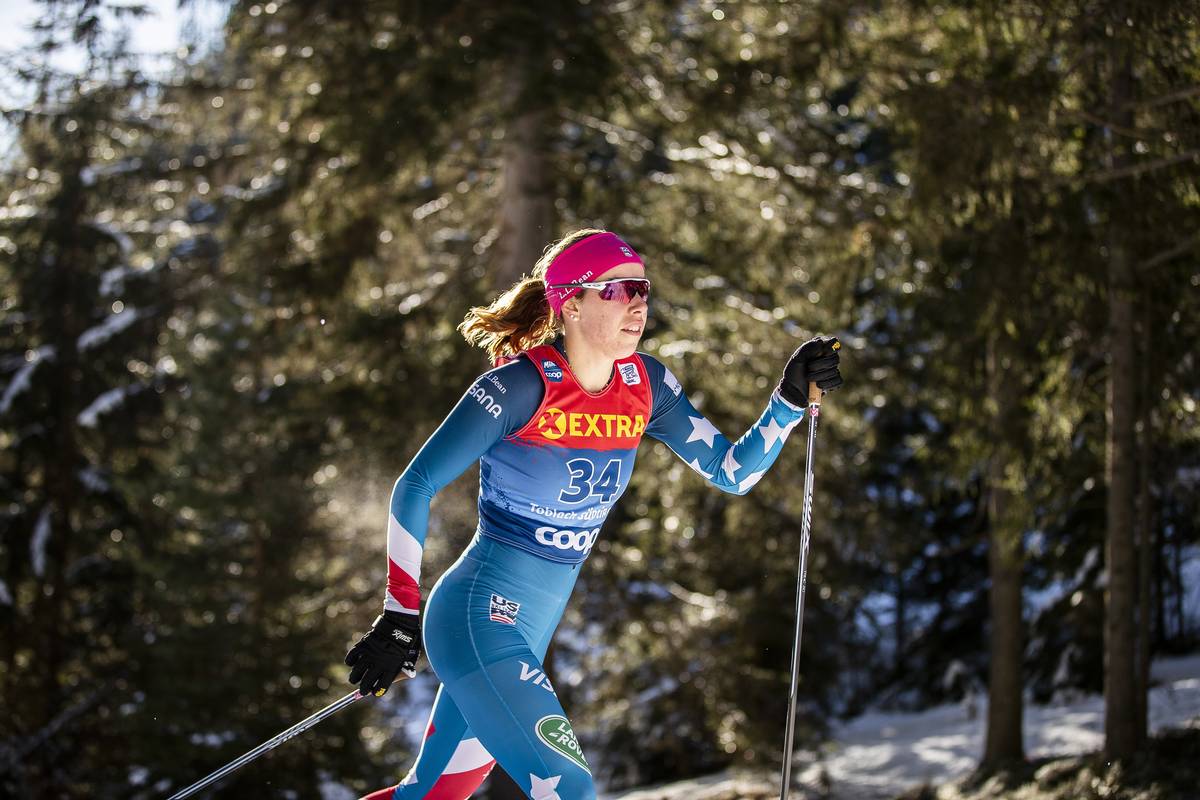
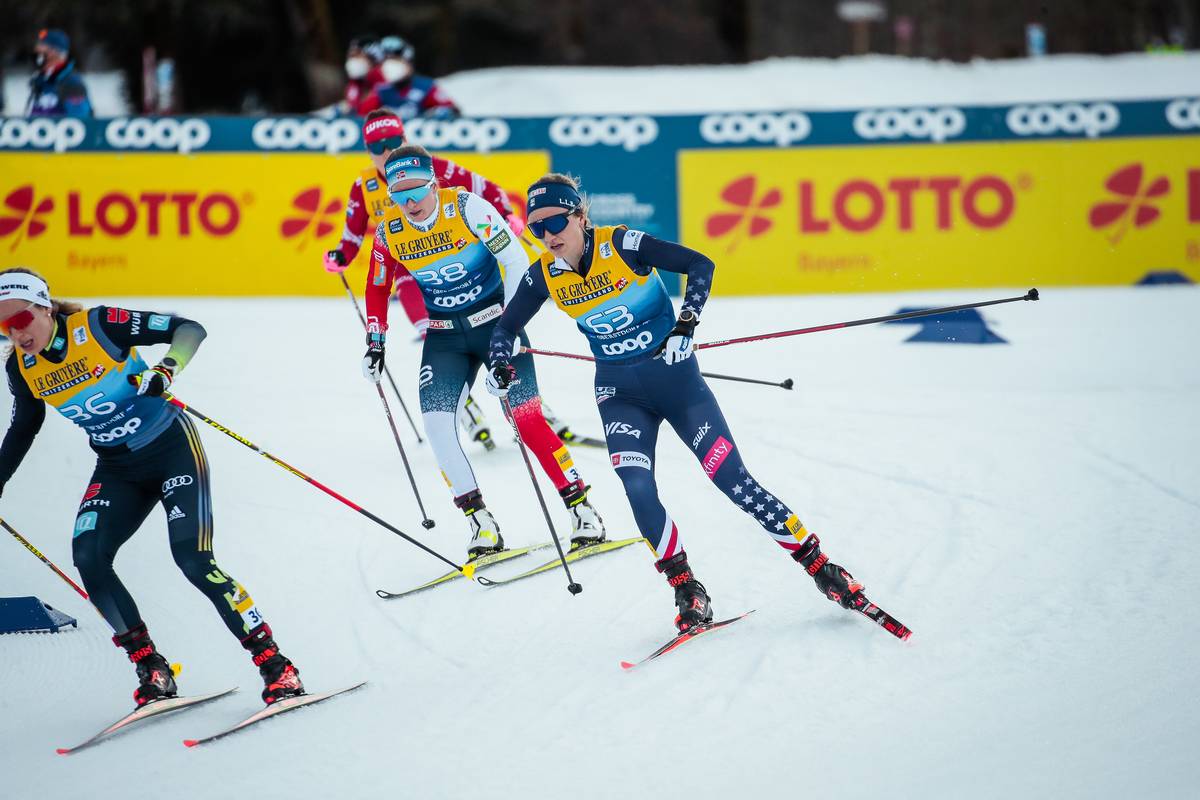
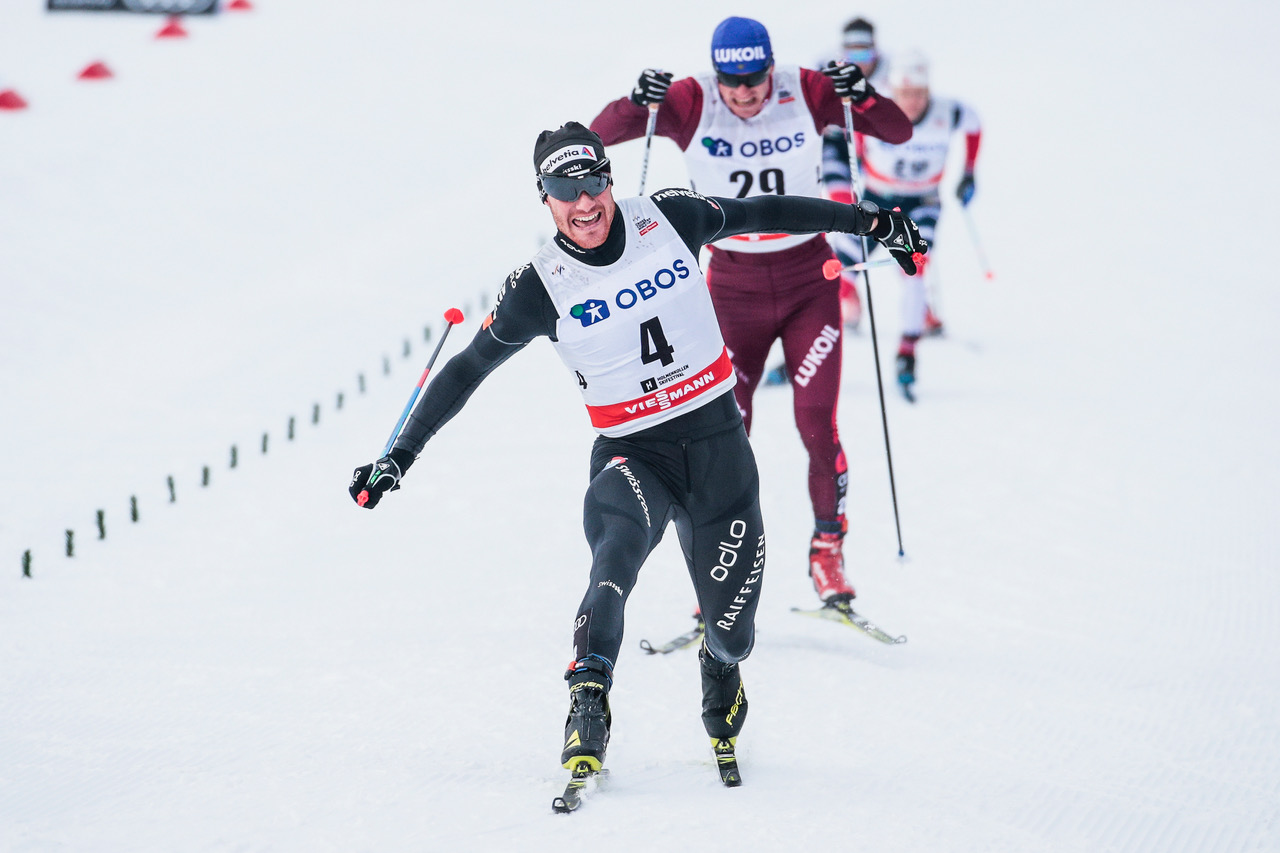
Zak Ketterson races the freestyle sprint qualifier in Lenzerheide, SUI, the first event of the 2021/22 Tour de Ski. (Photo: NordicFocus)
Ben Theyerl/FasterSkier (FS): Can you start off by telling us a little bit about yourself?
Zak Ketterson (ZK): I grew up in the Twin Cities area in Bloomington (MN). I didn’t really start skiing until 7th grade, when I got into it because my older brother (Jan) was on the high school team. Up until then, I had been into more of the traditional American sports – basketball, football, baseball – and even after my first few seasons of nordic skiing, I really didn’t like it that much better. I really wanted to play basketball, but I kept with skiing because I was having a lot of success in it, which is always fun, and like I said, I was getting to spend time with my brother and our teammates.
My first introduction to competitive skiing was the Minnesota high school league and trying to win the Minnesota state meet. That was the highest level of skiing in my head at the time, and in Minnesota, that’s the thing to win. Even as I progressed to being at Junior Nationals and started competing nationally, I wanted to win the State Meet.
When I got out to JNs, it was like, ‘oh, there’s a lot of good skiers from elsewhere,’ and that made me start thinking I wanted to continue with skiing – maybe do it in college. I went to Northern Michigan University (NMU), so stayed very local because being from the Midwest is pretty important to me. I just think it’s the coolest ski community, and always have, and going to NMU was cool because I got to follow the footsteps of Ian Torchia, Adam Martin, Kyle Bratrud, and go there with Leo Hipp and be teammates with them all – I didn’t have to leave.
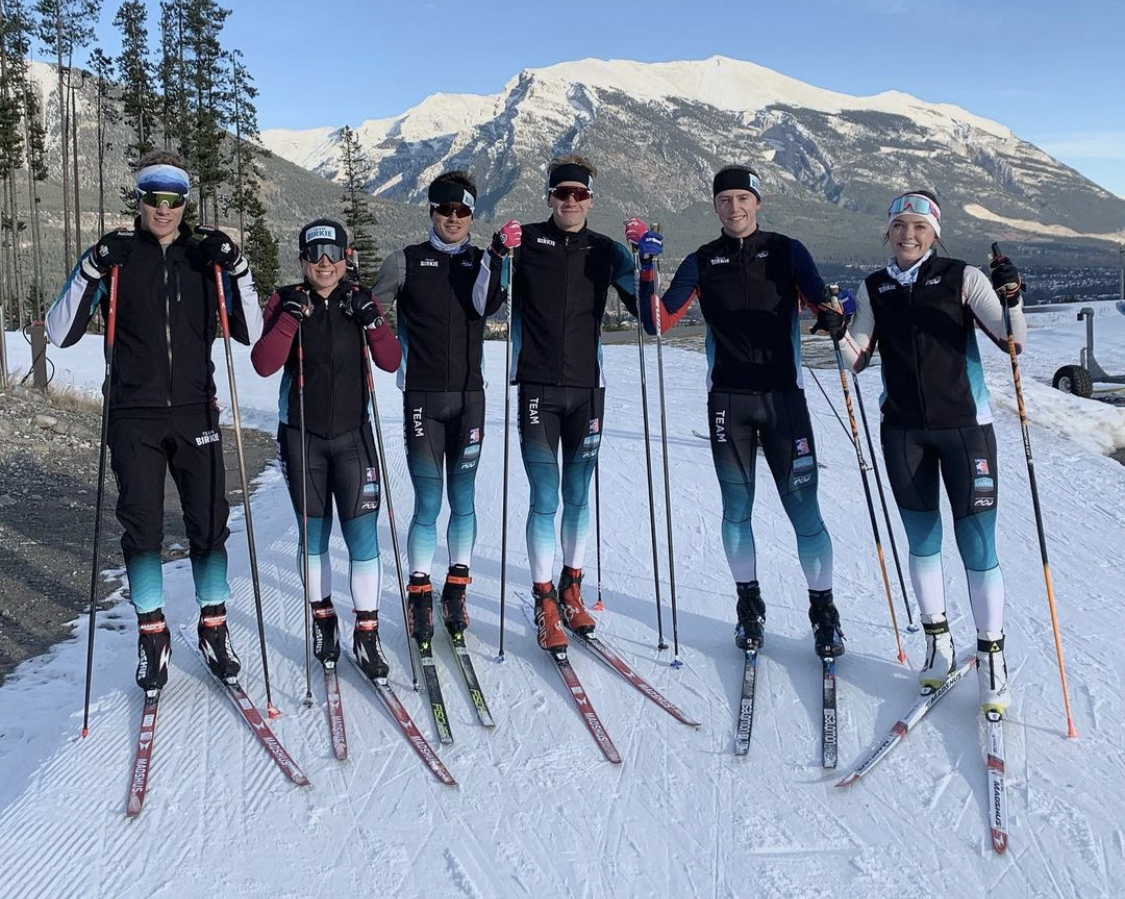
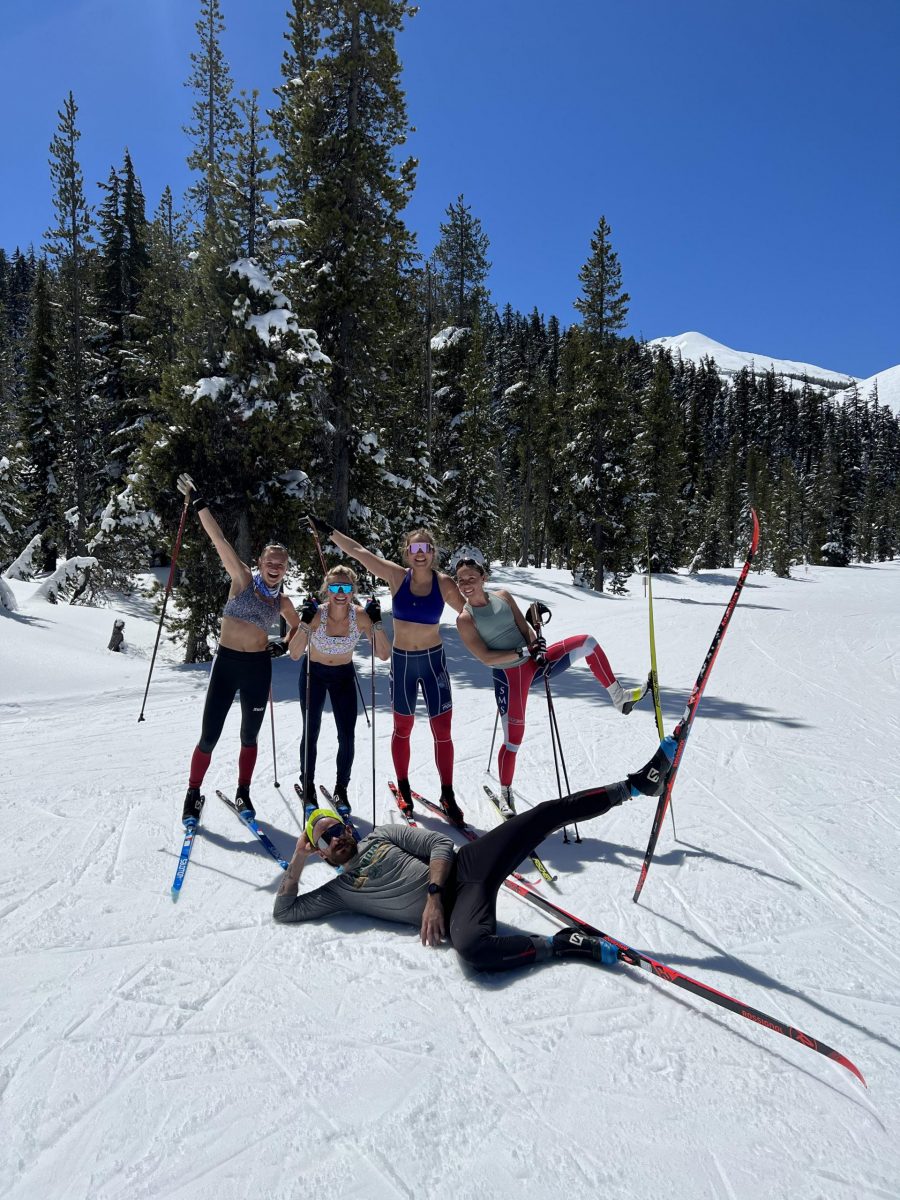
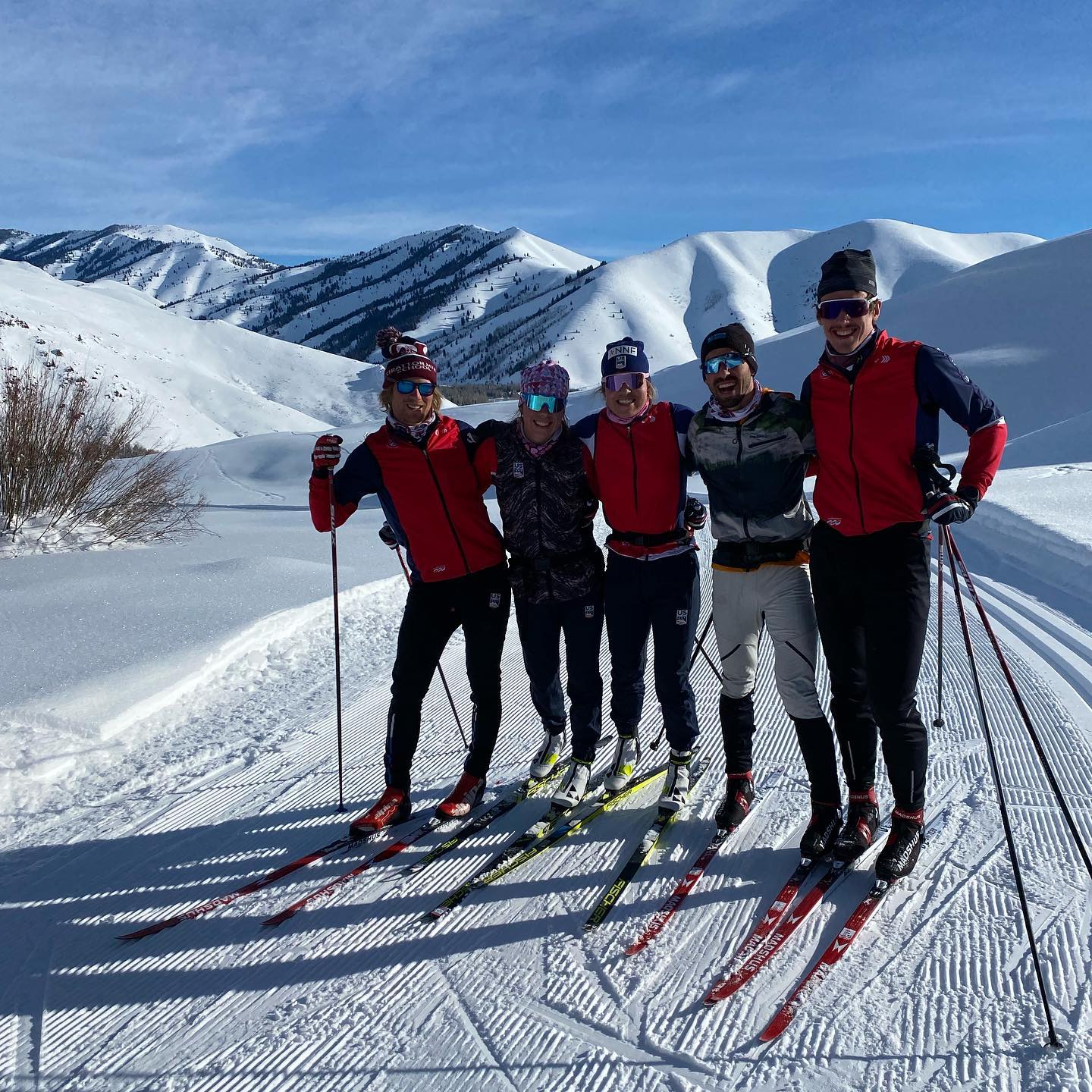
Skis on snow in Canmore. Athletes Christian Gostout, Ingrid Thyr Andrew Millan, Zak Ketterson, Tony Mathie and Jordan Schuster (l-r). (Photo: Team Birkie)
I worked with Sten (Fjeldheim) and NMU for five years and would say that was really where skiing turned into an actual passion for me. I fell in love with the process of improvement, training, and learning a lot more of the nitty-gritty stuff involved with this sport.
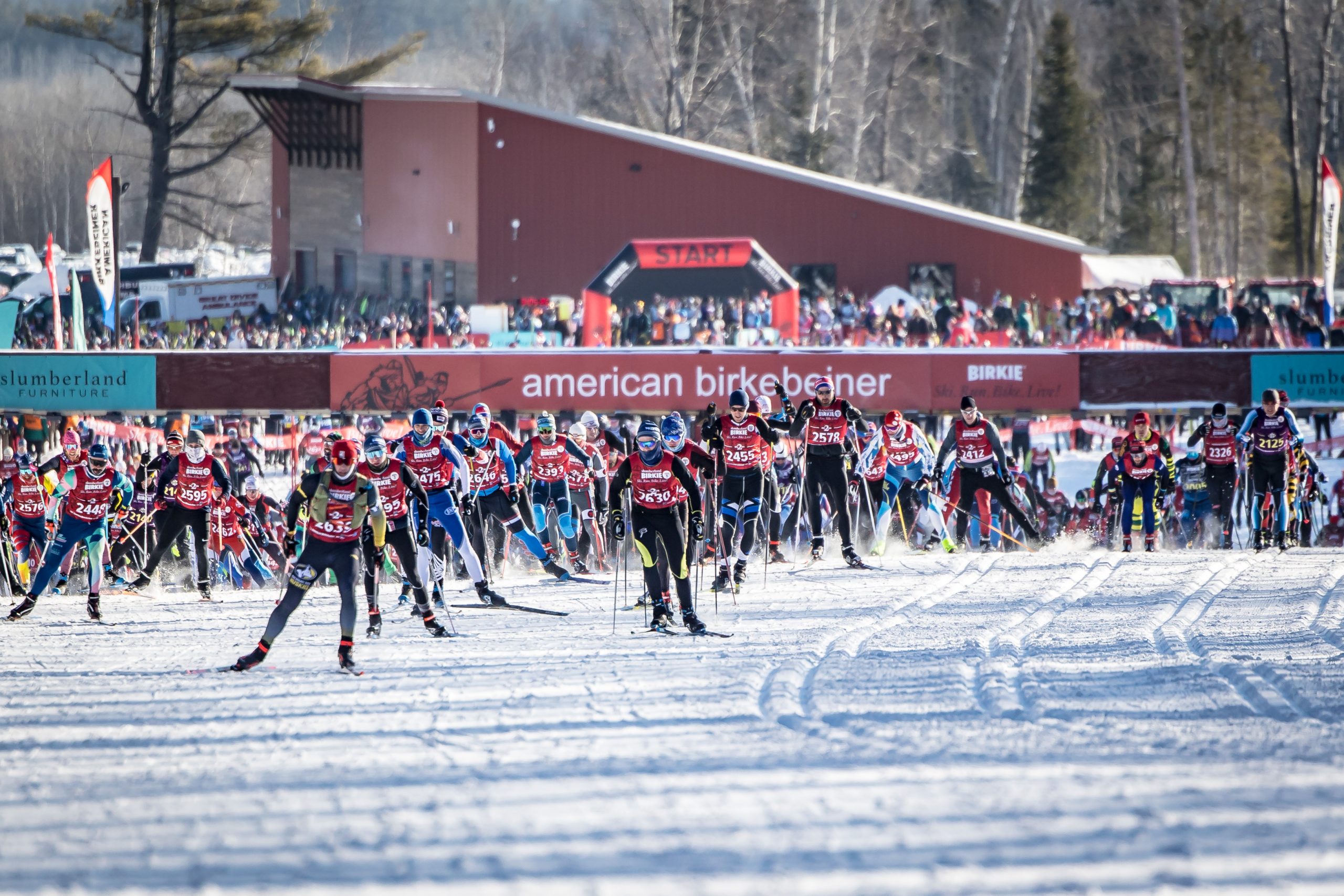
The Midwest thing really ended up influencing my decision to keep skiing afterwards as well. The [American Birkebeiner Ski Foundation] and the Loppet [Foundation] came to me with the idea of Team Birkie, which had been in the works ever since the CXC [Elite] team went away in the Midwest. And it worked out that it could finally come together last season. I was graduating, and it was already in the back of my mind that it would be really cool to be on a local team and building something new. When the Team Birkie opportunity came around, I was excited to say the least. It was a little scary to be part of something new, but I think we were pretty proud of what we were able to put together, and now, to see more people joining the team this year is even more exciting.
FS: Congratulations on the U.S. Ski Team nomination. If you take us back to last fall, what were your goals for the 2021-22 season?
ZK: There was a lot of big question marks – which is natural, I guess, when you’re going through a really big training environment switch. I was really comfortable at NMU for five years, and leaving that my mind was more towards how do I really take on the role of being a professional skier? Like, I moved back to Minneapolis, where I grew up, but I was renting an apartment and in the real world for the first time and starting with a new team where there were even more big question marks around what it would look like. So, I was nervous.
But the first week of practice here it just felt like coming home, and that the right pieces were falling into place. I had my old teammate Leo Hipp as my coach, and one of my old Loppet (Loppet Nordic Racing, or LNR) coaches Caitlin Gregg right there to work with me. It all sorted itself out very quickly, and I was just comfortable going into the racing season.
My goal then was to try and make some World Cups. I was hoping to have a successful first year doing pretty well on the SuperTour, which would lead to that main goal. When it kicked off in December, the races were was in Duluth and Cable, which again, just really made things feel comfortable. It felt like being on my home course. Even then, I was a little surprised with how well those went. I was ecstatic to come out of those weekends as SuperTour leader, to say the least, but I think myself and my coaches were a little surprised that it happened.
That had a real validating effect for the whole team that we were on the right track with how we were approaching the new training environment at Team Birkie.
After his first season on Team Birkie and first experiences racing on the World Cup, Zak Ketterson earned a spot on the U.S. Ski Team B-Team. (Photo: Instagram @zaketterson)
FS: I was wondering about what happened right after that period. You earned a Tour de Ski start for leading the SuperTour, and so you went from racing the ultra-familiar on the Birkie trail to being on the start line of what is essentially the Grand Tour of skiing. How did you handle that stark transition?
ZK: I was very focused on just skiing the Tour de Ski (TDS), and not thinking about what it may lead to, or who I was going to be skiing against.
If you get an opportunity like that, you don’t turn it down. But flying over to Switzerland and seeing how big of a spectator event the TdS was and seeing these guys you’ve just seen racing on TV in the starting area with you, it’s a different world from Cable, for sure. I think it’s a sentiment most first time World Cup skiers would share – it’s overwhelming. Those first few races do feel different. It’s hard not to be super nervous and you’re not really skiing like yourself.
Doing the TdS as my first World Cup race was a whirlwind. There were some terrible races, some solid races, and some decent results. But I do think doing it as my introduction to the World Cup made the rest of the races seem very chill by comparison.
FS: One thing I noticed about your World Cup season is that you did well in some of the less ‘traditional’ formats, like the Alpe (Cermis) hill climb, or being on a mixed relay. Is there anything about your approach to racing that you think helps you adapt to those unique challenges?
ZK: I don’t know. I think sometimes if you expect to do super well in a race you put too much pressure on yourself – the Drammen sprint this year was a good example of that for myself. I know sprinting, and so I put too much pressure on myself to do well in the sprint, and it ended up being one of my worst races. Going into some races with no expectations this year really worked well to race relaxed.
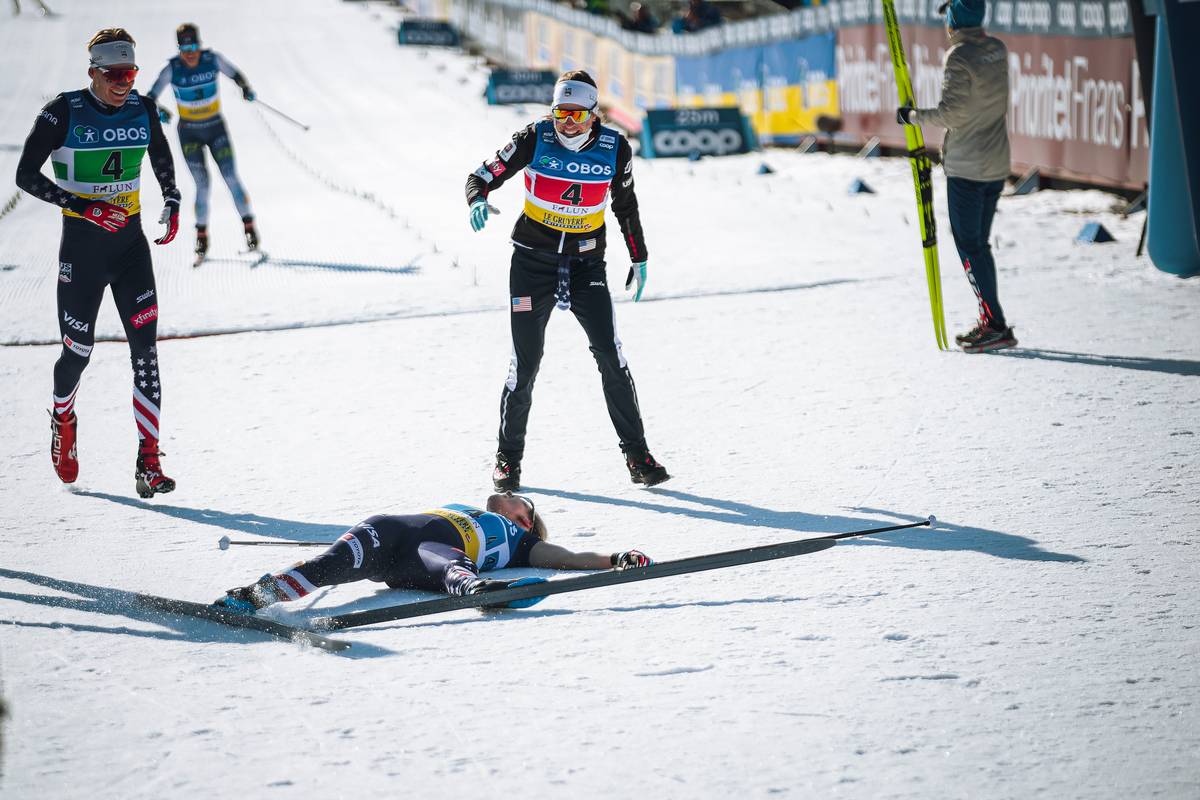
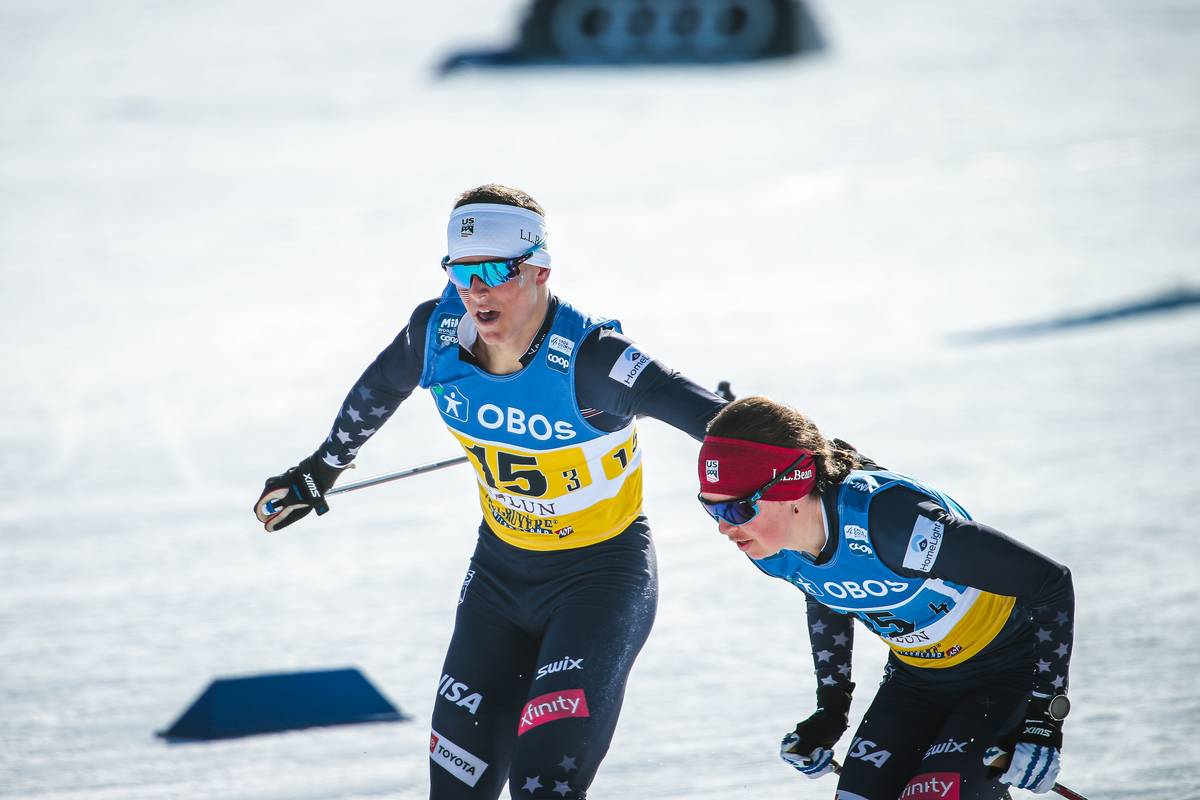
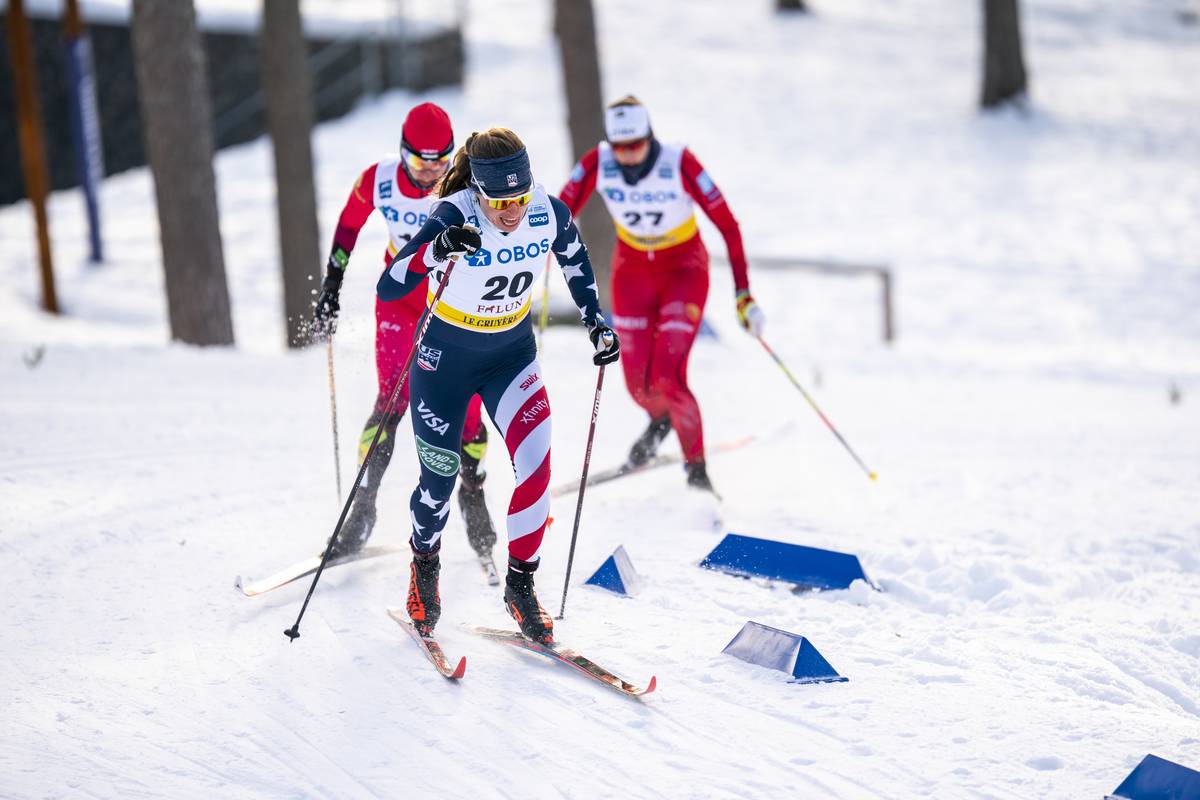
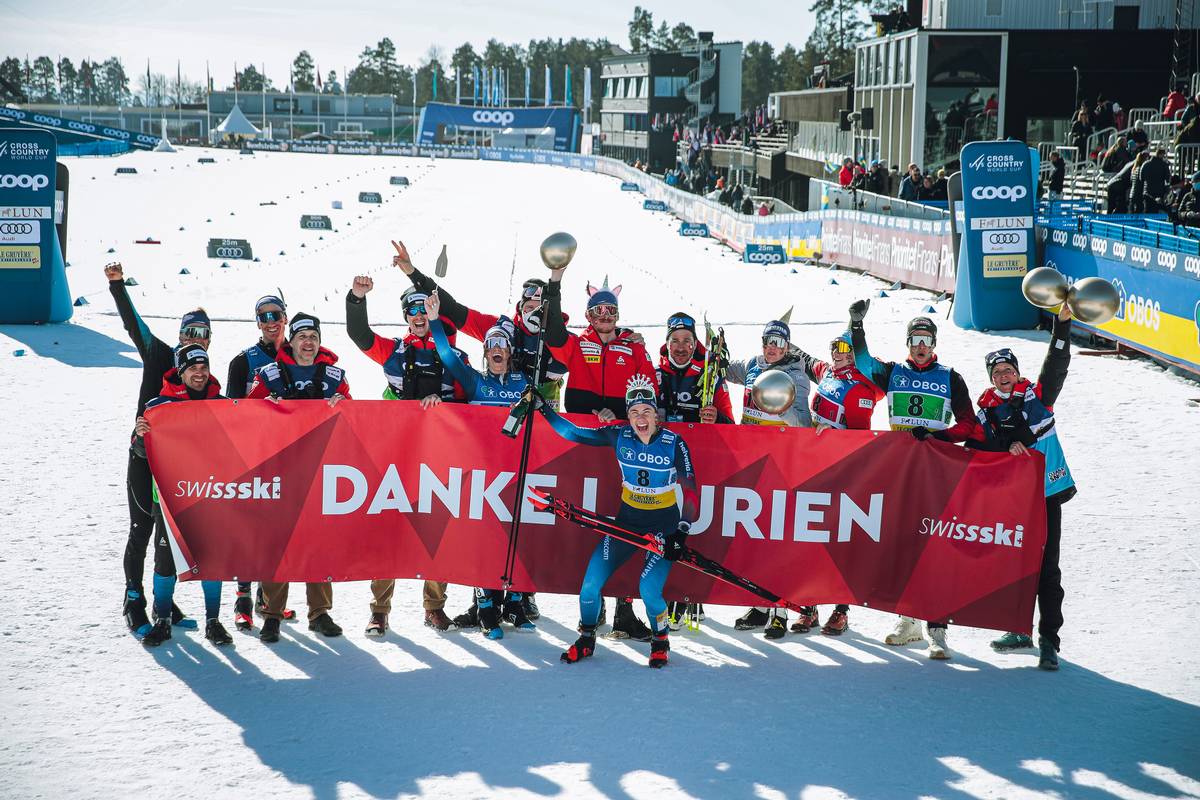
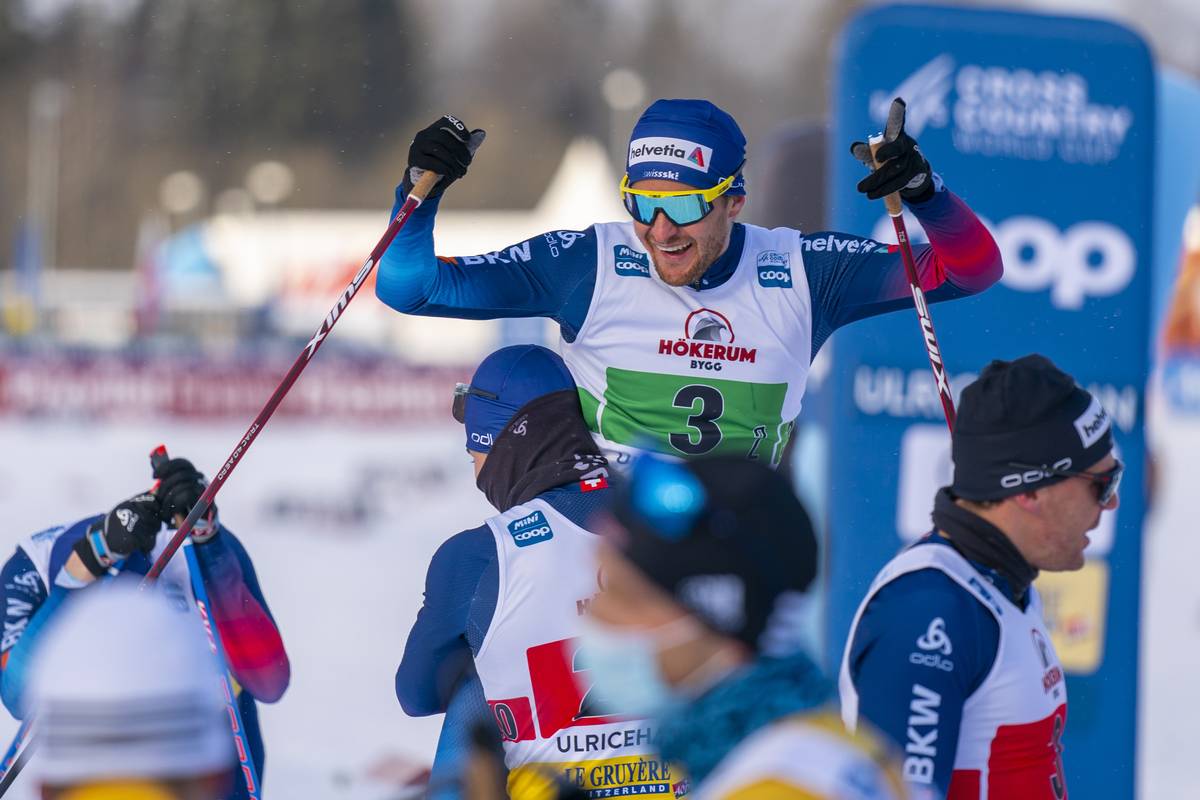
Rosie Brennan and Zak Ketterson rush to celebrate a mixed relay win in Falun with their collapsed team anchor, Jessie Diggins. (Photo: NordicFocus)
FS: Do you think you can pick one highlight of the season?
ZK: That’s a good question…I think it’s pretty easy to say the two Falun races (the 15 k Skate, and Mixed Team Relay), but I think more so than just the results that came there. I was coming off of some really tough races that were making me have those moments where you question whether you have to re-think your training and go back to the drawing board, and then I just tried to start from scratch when I got to Falun and came away with some great results (Ketterson finished 15th in the 15 k skate, and was part of the 1st place USA mixed relay team).
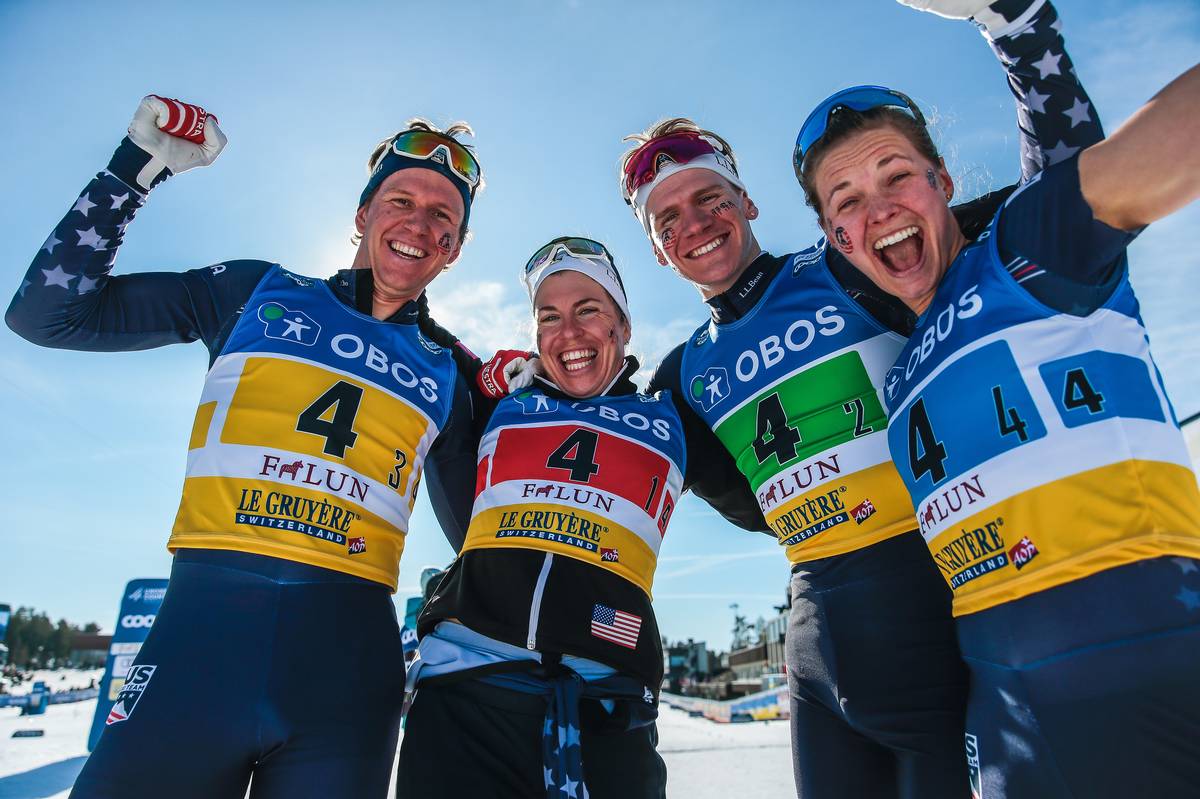
USA I takes the win in Falun’s 4 x 5 k mixed relay. From left to right, Scott Patterson, Rosie Brennan, Zak Ketterson, and Jessie Diggins. (Photo: NordicFocus)
FS: Now turning to joining up again with the U.S. Ski Team. Did you make it out to Bend [for the USST spring training camp]?
ZK: I ended up staying in Europe after Falun actually, staying with an old NMU teammate in Norway to get some great spring skiing in. I wasn’t really expecting the call from Chris Grover (USSS Program Director) that I made the team, if I’m honest, and so when I did, I had just put in a big block of skiing in Norway, was half-way across the world, and decided that I probably couldn’t and shouldn’t hop into a huge training camp in Bend.
I’m really close with a lot of the guys and girls on the team so I’m not too worried about hopping in when I get to some of the other camps in summer. The big thing with the U.S. Team is the funding for the World Cup and the support; it will just take a lot of the complications to get to the racing out of it, so I can just focus on skiing well.
FS: What are your goals from here? Next season?
ZK: My goal in the sport is to become a really good World Cup skier, so anything that gets me there is going to be super important this next year. I think at the moment, the goals for next season are dependent on the if I get Period I starts, and from there, just trying to improve my placings on World Cup.
Zak Ketterson races into the top-15 during a 15k skate in Falun, SWE in Mar. 2022. (Photo: NordicFocus)
FS: I’ve both skied with, and now interviewed, a lot of your old LNR and NMU teammates, and one thing that sticks out to me is that you’ve contributed to, and been part of, some pretty great team environments in your ski career. What do you bring from those experiences to the US team now?
ZK: Well, like you said, I’ve been super fortunate with LNR and NMU to always have a really good training group where I feel like we’re there to make each other better in a really supportive way. I can recognize that it’s not us trying to out do each other everyday in training. That’s the attitude I hopefully can bring to the US Team. At the end of the day, if we’re doing better as individual skiers it helps make your teammates better. Keeping the ego out of it and really approaching it like a team environment is important to me.
FS: You’ve touched on Team Birkie a few times now. That strikes me as a pretty unique confluence of time and place for you graduating NMU and then joining up with a new team in the Midwest. Can you say a little bit about where that program is going? What is it like to be working with the Greggs – Caitlin and Brian – who both bring a lot of experience on the World Cup to preparing you to step onto that stage?
ZK: It’s so cool to have both of them at training pretty much every day. When I look at my goals, I have two people right there who’ve done it and know what it takes. To go to practice and have them hold me accountable, to literally have Brian right there doing intervals and holding me to what I need to be doing given what we’re finding in the training data is just a unique experience that I’m lucky to have. They’re also just really well prepared to offer training advice, life advice, and logistical advice for me – because with Team Gregg, it was them doing all of that stuff.
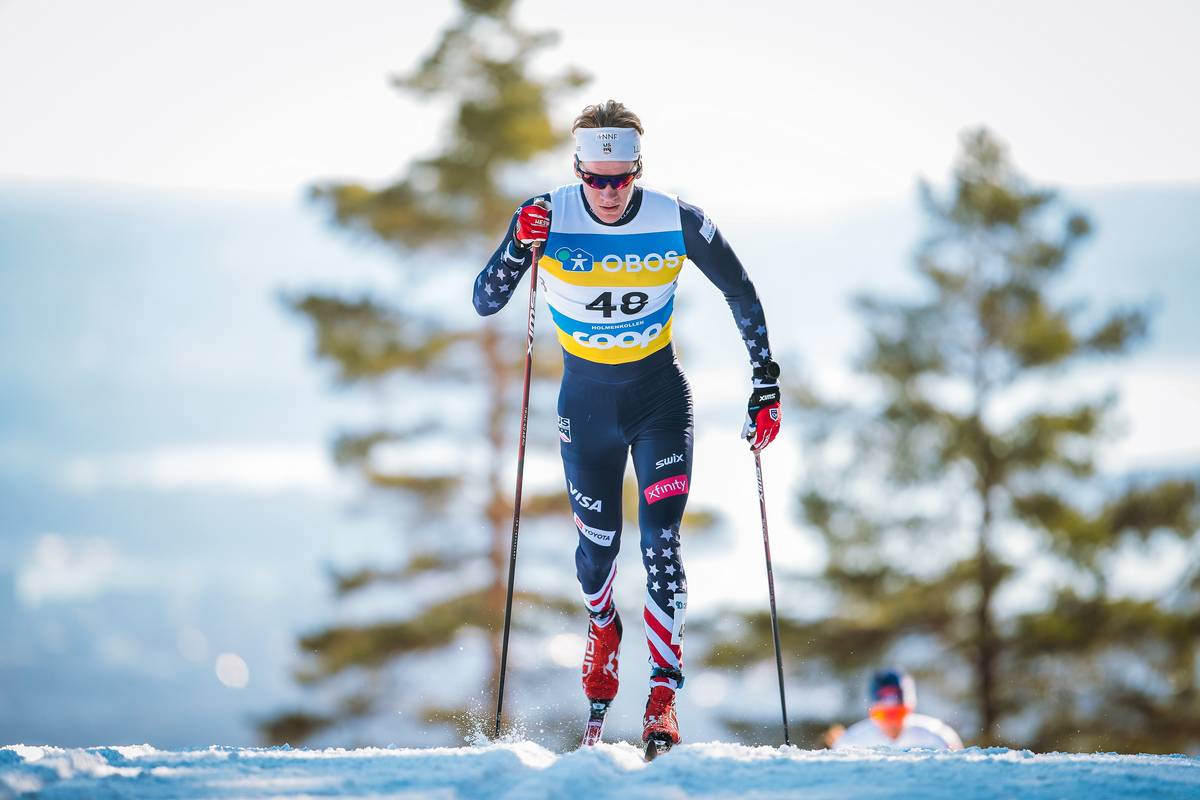
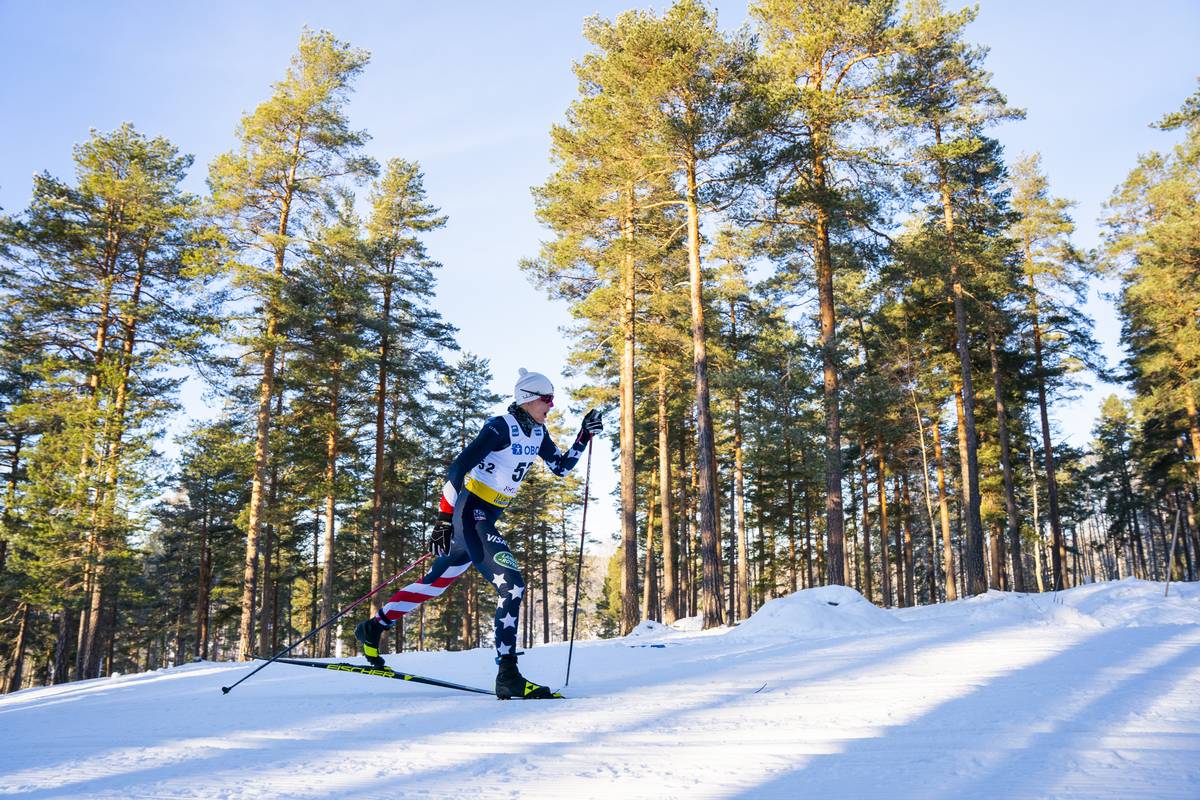
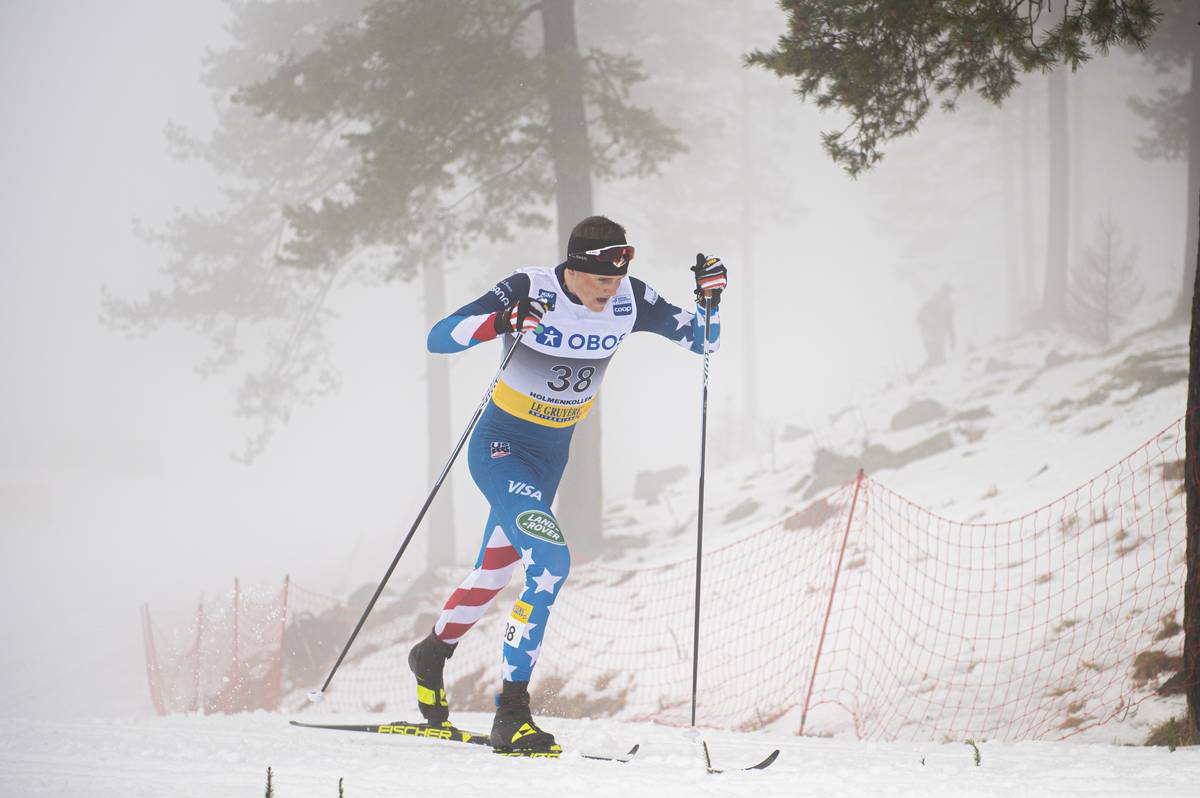
Zak Ketterson races the 50k classic at Holmenkollen in March 2022. (Photo: NordicFocus)
FS: Team Birkie also recently made team announcements, and I couldn’t help but notice that there’s 1) a lot of new skiers coming out of college, and that 2) many of them, even if they have been skiing elsewhere in college, have Midwestern roots. And with what you’ve said about your loyalty to the region, I was wondering if you have any reflections on that?
ZK: I’d definitely encourage other people from other regions join up with us, but it’s really cool to have a lot Midwestern skiers recognizing the resources we have here, and wanting to come back to this community. Both Renae (Anderson) and Erin (Bianco) for example, skied out east at Colby and Bowdoin. I know that they had really positive experiences as students there and will bring those back here. That’s cool. The goal with Team Birkie is that those who come from this ski community in Minnesota, Wisconsin, and Michigan can stay in it and reach the top of the sport. And the number of skiers coming back to pursue that adds a lot of pride and ownership to that mission for all of us.
FS: Final question then: What’s more likely, Petter Northug starts another World Cup, or the Minnesota Vikings win a Super Bowl?
ZK: Unfortunately, I would say both have about a 0% chance of happening.
I just got done having the most typical Minnesota sports experience watching the Timberwolves build me up to let me down in the playoffs. Hopefully Team Birkie can escape the Minnesota sports curse.
FS: Well, if you’re the quarterback of Team Birkie, I think you’re doing better than Kirk Cousins is for the Vikings.
ZK: That’s not saying much, but I really appreciate it.
FS: Well in any case, thanks Zak, and good luck this season!
ZK: Thank you!
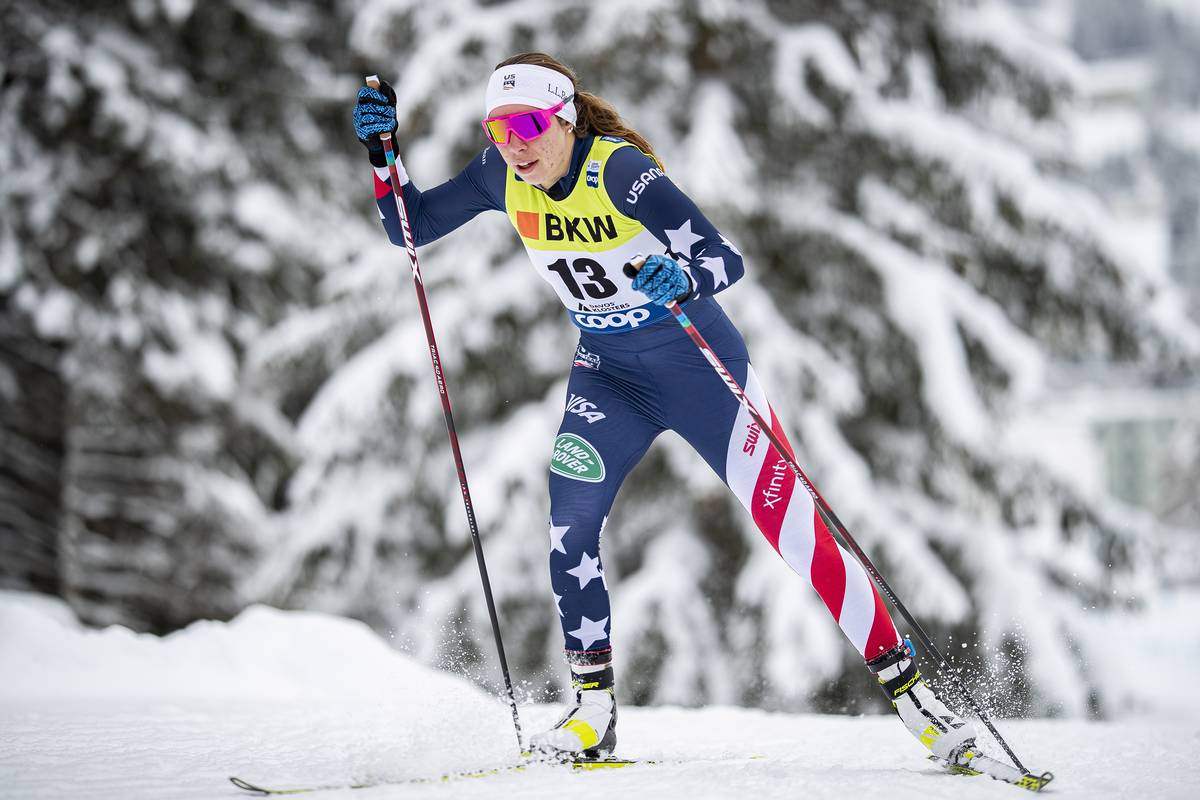
Zak Ketterson crests a climb dutinh his World Cup debut in the freestyle sprint in Lenzerheide, SUI in January 2022. (Photo: NordicFocus).
After eight years at the helm of the Stratton Mountain School (SMS) T2 team, head coach Pat O’Brien is in the process of taking a few steps back, passing the reins to Perry Thomas, who has spent the last five years as the assistant coach at the University of Vermont.
Perhaps highlighting this transition and the sharing of responsibilities the two are in the process of navigating, FasterSkier connected with Thomas in mid-May while he was in his second week of supporting the SMS T2 athletes who had joined the U.S. Ski Team for their spring training camp in Bend, OR, and with O’Brien who was back in Stratton, having recently wrapped up with his participation in U.S. Ski & Snowboard spring congress sessions.
Pat O’Brien supports some of the SMS T2 athletes during a 2022 SuperTour weekend in Sun Valley, ID. (Photo: SMS T2)
A 2006 graduate of SMS himself, O’Brien raced collegiately for Dartmouth College, then spent four years training and racing professionally with the Craftsbury Green Racing Project. His move from Craftsbury back to Stratton was timed with his retirement following the 2014 Sochi Olympic Quad. Given his age and the proximity to his racing career at that time, many of the athletes on the T2 team were among what he called his “peer group”, having overlapped with many of them during either high school, college, on the race course, or all of the above. Jessie Diggins and Sophie Caldwell Hamilton were quickly becoming rising World Cup stars on the women’s team, while Andy Newell and Simi Hamilton headlined the men’s roster, and a young Julia Kern and Katharine Ogden were spending a PG year training with the T2 team.
Eager to stay connected with the sport after retirement, O’Brien seized the opportunity to take over in Stratton, stepping in as his predecessor Gus Kaeding departed.
“Ski coaching is the one thing that I’ve always known that I wanted to do, it was just kind of a natural progression for me. I knew that I was done with my athletic career – I didn’t really want to ski race anymore – but I knew that I still wanted to ski, I still wanted to be involved and to give back to the sport. I felt like, to some extent, when you spend basically your entire life skiing, you get pretty good at understanding the sport. But we never know as much as we think we do, and we always need to be students of the sport and have an open mind and learn.”
As he began his coaching career, he quickly realized that writing training plans and facilitating training was only a small subset of the responsibilities of an elite club coach.
“Good coaching is being comfortable wearing a bunch of different hats. And I mean, I joke, but the actual coaching is such a small part of it. The nitty gritty of pulling an athlete on the side of the trail and looking at video and all of that is important, but you’re there as a friend, a drill sergeant at times, and as someone that is just really trying to be supportive.
“And that’s all-encompassing. So for me, it has been a pretty fun experience to see people figure stuff out and be there to support them when they needed a little extra help and to do it in a pretty collaborative, dynamic way.”
He described his experience transitioning to coaching primarily as a mindset shift from the inevitable self-centric focus required of professional athletes toward selflessness; but the work required and pace of life remained equally taxing.
“When you coach at a club level – all coaching is a demanding job. I do think that you have to – I don’t want to use the word ‘sacrifice’, but when you transition from being an athlete yourself to being a coach, your job as an athlete is to be a little selfish. You’re trying to maximize your athletic performance. You need to have balance… but at the end of the day, you need to make sure that you’re training well and with purpose, you’re recovering well, you have goals and you’re going about achieving them. It shouldn’t be simply looked at as like what you have to give up to do that, but to be the most professional athletes and succeed against people who are trying to do the exact same thing, you just have to do a really, really good job with it. And coaching is the same thing. You have to be willing to approach everything that you do with the same degree of drive and focus that you would as an athlete…
“Basically, I just threw myself into it with the same approach that I had as an athlete which is, I’m just going to work, and work, and work, and learn all along the way. And then give it my best push and know that if I get to the point where that balance starts becoming harder and harder, or I can’t really do the job that I want, to be supportive of the athletes [to the level I want to be], that’s when you’ve got to know that you either double down and keep pushing or make a transition.”
While O’Brien is no less dedicated to the SMS T2 program or its athletes, a new endeavor has begun which will make achieving the balance he described significantly harder: he’s about to become a father. His wife, two-time Olympian and long-time U.S. Ski Team member Ida Sargent, is due in mid-August.
After eight years as head coach of the SMS T2 team, Pat O’Brien takes a step back as he and his wife, Ida Sargent, begin their family. (Photo: SMS T2)
Since retirement, Sargent has been working for her high school alma mater, Burke Mountain Academy, in Northern Vermont, and is currently the Academic Director for the school while also teaching STEM classes. O’Brien has been splitting his time between Burke and Stratton, which lies roughly 150 miles southeast in the opposite corner of the state. His usual coaching schedule pulled him around the country for weeks at a time to support athletes at U.S. Nationals and SuperTour events, and sometimes around the globe for World Cup, U23s, and other international camps and races.
While he acknowledged that there are many examples of coaches at all levels who have successfully juggled a demanding work and travel schedule with raising a family, what felt like the best fit given his and Ida’s vision and priorities for their own growing family was for O’Brien to decrease his level of responsibility with the T2 program, allowing greater flexibility and more time at home.
“I just felt like there’s part of me that was like, ‘I’m not seeing a pathway that I feel like I can still commit [to coaching] at the level that I want and know that you need to in order to to do the best job with your job, while simultaneously trying to start a family.’ I felt like it was my time to reevaluate and maybe step back or be completely done with ski coaching, because I certainly didn’t want Ida to have to put her growing career on hold to be the [primary] caregiver…
“Eight years is a long time to do something and I am very proud of what the team has accomplished in that time… it’s really cool having spent this time seeing athletes grow, not just not just athletically and within their their ski careers, but as individuals from high schoolers to finishing up college to full blown ‘this is my job.’”
While his role will be smaller, O’Brien is certainly not stepping away from the T2 team altogether. “Starting a family does not necessarily mean that it means the end of being involved in the sport,” he said. “It just means trying to figure out what the right relationship is with it.”
Pat O’Brien supports SMS T2 skiers Julia Kern and Alayna Sonnesyn at the 2022 U.S. SuperTour Finals in Whistler. (Photo: SMS T2 Blog)
The exact balance and distribution of responsibilities remains a work in progress as Thomas moves into the head coach role and the new season of training begins, and both O’Brien and Thomas are excited to collaborate and support one another throughout the year.
Explaining his philosophy as “under-commit so I can open perform”, O’Brien anticipates taking on many of the behind the scenes tasks that support the team, from collaboratively blocking out the season calendar, to managing travel logistics for camps and SuperTour races. As he put it, the little details of deciding “which flights to take to get from Canmore to Sun Valley” and where to stay are often made easier with several years of trial and error under your belt.
While Thomas will spend more time with ski boots on the ground, both in Stratton during the summer and at races and camps throughout the year, O’Brien anticipates he’ll still be plugging in a fair amount too. Though his stay might be shortened to the period immediately surrounding races, he plans, at minimum, to be in Houghton, MI for U.S. Nationals in January, and also the SuperTour finals in Craftsbury in late March.
He’s also excited to reconnect with the team in Stratton early in the summer before Ida gets close to her due date, but also to take off a few of his usual coaching hats while doing so.
“I think it’ll be really fun for me to actually be able to flow in and out get to see people, connect with them, but also not be like ‘Okay, now I don’t have to worry about making sure that the van’s filled up with gas, or water jugs have been filled, or that I’ve ordered all the lactate strips in advance so that we don’t run out.’”
Perry Thomas out for a crust ski with the SMS T2 athletes who joined the national team training camp in Bend, OR this spring. (Courtesy photo)
As Thomas gets his feet under him in Stratton, he explained that he feels “very fortunate that Pat will still be involved.”
“As much as I can have him in the mix, the better,” Thomas said. “His knowledge with skis and wax is just unreal, so tapping into that resource is huge for me, for sure.”
***
UVM assistant coach Perry Thomas in action during the 2022 U.S. Cross Country Skiing Championships in Soldier Hollow. (Photo: Instagram @oneswellperry)
Prior to joining the UVM program, Thomas spent five years as the assistant coach at the University of Vermont, working alongside head coach Patrick Weaver. During his own collegiate racing career, Thomas spent four years racing for the University of New Hampshire, where he served as team captain during his senior year in ‘12-13. Departing briefly from the cross-country ski world, he spent a year teaching high school science to underprivileged youth in the Oakland area of California, before returning to the Northeast to begin his coaching career as the assistant coach at Williams College in Massachusetts.
“Working at UVM was unreal – a great experience,” Thomas said emphatically. “I really loved working with Patrick Weaver and the athletes there and it seems like almost a seamless transition, in many ways. Four of the skiers on the T2 team I actually coached at UVM. So knowing a lot of athletes here already – what they’re working on with technique, and racing, and goals and all that – has been very seamless, and that’s been great.”
The UVM graduates who now ski for SMS T2 include Alayna Sonnesyn (‘18), Bill Harmeyer (‘20), Lina Sutro (‘21), and Ben Ogden (‘22).
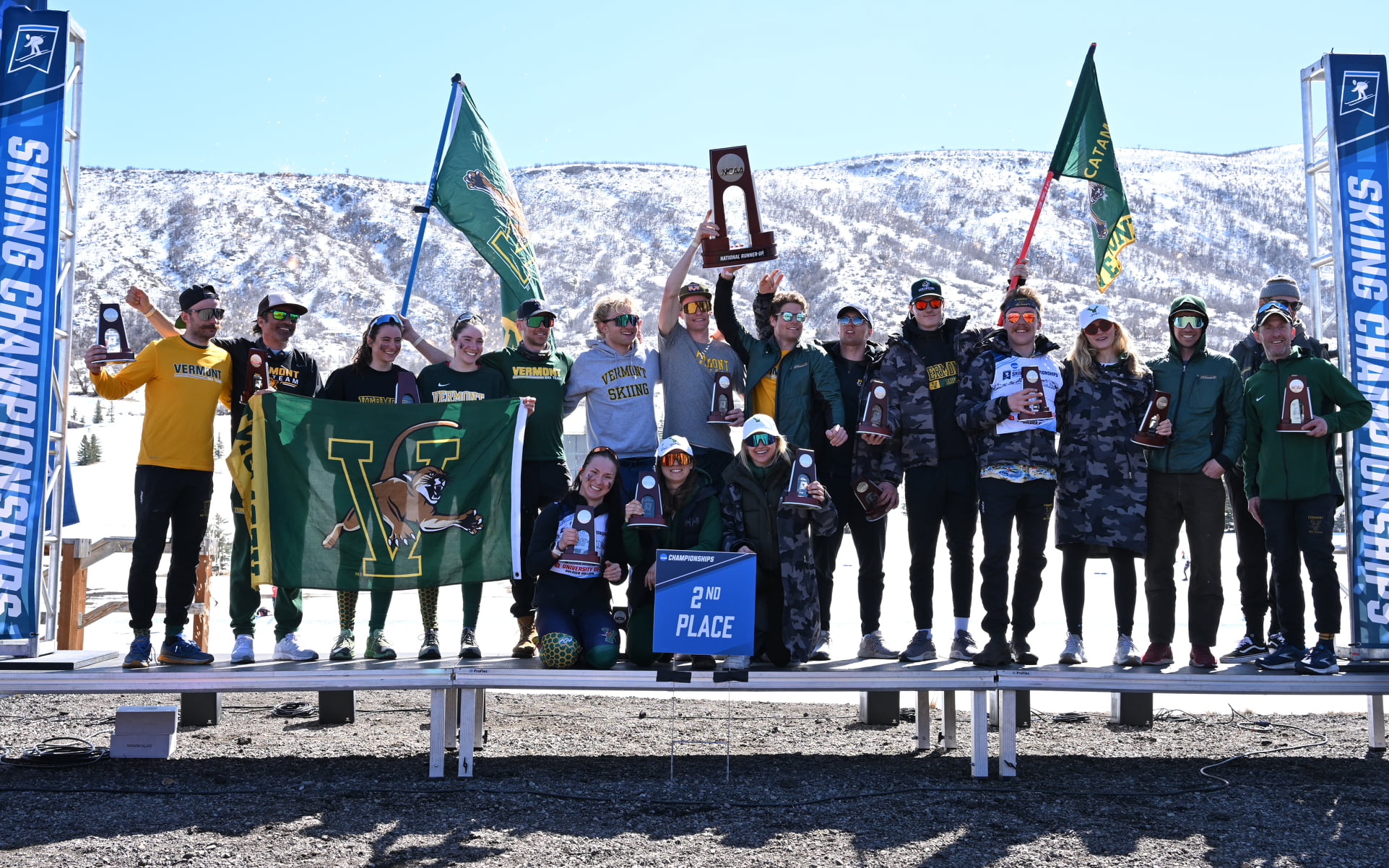
The UVM ski team celebrates a successful 2022 NCAA Championship. Assistant coach Perry Thomas is at the far left. (Photo: UVM Skiing)
Given the caliber of these athletes and the success of the UVM team as a whole during his tenure, Thomas credits his time with the program to the acceleration of his development as a coach, preparing him to take his next steps forward with SMS T2.
“Patrick Weaver definitely gave me a lot of opportunities and ownership over different facets of coaching that team and I think that’s been instrumental in me being here now with T2. I was able to go to World Cup Finals with Ben Ogden in Quebec his first year in school [in 2019], and I was just able to do trips like that on my own with athletes. That was huge for my development as a coach and for my experience of waxing, ski testing, and [other responsibilities at that level of racing]. So working at UVM was a lot of fun – I’m gonna miss it for sure – but it set me up very well for this transition.”
Ben Ogden gets a congratulatory fist bump as he heads to the podium during his sweep of the 2022 NCAA Championships. (Photo: Tobias Albrigtsen / @untraceableg)
A theme of both Thomas and O’Brien’s comments on the difference between collegiate and elite club coaching is small in terms of the training and technique coaching itself, but vastly different in terms of the opportunities elite club coaches have to support their athletes.
“I think the big differences are what we can and can’t do throughout the year from collegiate [racing] to the elite team,” Thomas explained. “Like, I wouldn’t be here [in Bend] and been doing an on-snow training camp if I were at a college team. And obviously the racing schedule is super different.
“The college schedule is pretty efficient, whereas the SuperTour calendar is quite a bit more spread out. And then, in addition to that, you have an athlete’s like Jesse Diggins, and Ben Ogden, and Julia Kern that are going to be on the World Cup, as well as athletes that are trying to make it to the World Cup. And at UVM, we had crazy talented athletes – Ben Ogden is one of them – so working with with high caliber athletes is nothing entirely new, but dealing with athletes where some are on the World Cup and some of them on the SuperTour is an interesting dynamic that you don’t often get with the college teams.”
In terms of what Thomas adds to the program as he steps in as head coach, he described his coaching philosophy and the environment he seeks to create within the training group, which keeps athletes motivated and happy through the arduous and long-term development process.
“[Cross-country] skiing is such a hard sport – it’s so much time that that we’re putting in, and so many sacrifices that we’re making, that I wholeheartedly believe in making that time that we’re together training and working hard fun and enjoyable,” Thomas said. “I think that’s a big part of what we do – and it has to be a big part of what we do – because like I said, it’s a hard sport. So I think making things light and having fun with all that is super important. And that’s definitely something I bring to the table in that regard.”
The SMS T2 team enjoys spring skiing at the Mt. Bachelor Nordic Center. From left to right, Alayna Sonnesyn, Jessie Diggins, Lina Sutro, and Lauren Jortberg, with head coach Perry Thomas. (Photo courtesy Alayna Sonnesyn)
But Thomas will add more than just fun to the T2 program. While he may be, as phrased by his new colleague, “almost too humble”, O’Brien was quick to highlight Thomas’s preparedness to prescribe training, coach technique, and otherwise lead an elite team stacked with some of the nation’s best athletes.
“If you have been at a D1 college program where you’re dealing with 15-20 athletes and that dynamic environment where student athletes are constantly balancing all these different commitments and time constraints… And really, what you learn there as an athlete and what you learn there as a coach is that working with a club – it just isn’t that different.”
O’Brien added that the shift to an elite club from college may, in fact, be easier than going in the other direction. When athletes no longer have to miss key workouts to take an exam or rush off to class halfway through a team meeting, barriers to consistent communication and training are removed, and consequently a coach has a greater capacity to build relationships with the athletes as they stack together the bricks of the training program.
“You get an opportunity to really work one-on-one with the athletes and to really be there to facilitate and support their training and their racing. In that sense, I think coming from a college background – especially given his ties with many of the current athletes that are on the team – you’re just working with the same people and you’re doing the same stuff.
“I mean, there’s no magic formula,” O’Brien continued. “Someone can claim that they can write the best training plan in the world. And that’s all fine and dandy – there are definitely people who do an amazing job with it and they really enjoy that aspect of that aspect of the sport. But at the end of the day, it’s just really just working with people. You don’t need to make it more complicated than it is. The best athlete is not a robot. The best athlete is someone that is self aware, that can think critically, learn from mistakes, recognize when things go well, and the coach is there to support them along the way.”
New SMS T2 head coach Perry Thomas working with his athletes during a 2022 spring training camp at the Mt. Bachelor Nordic Center. (Photo: Lauren Jortberg)
Thomas identified building upon his relationships and experience with his former athletes, who account for half of the team’s eight athletes, as something he’s looking forward to in joining T2.
“I am very appreciative of the continuity and being able to work with some athletes I’ve worked with in the past,” said Thomas. “I love all of them – they’re incredible people, incredibly hard workers. So to be able to continue working with them is just awesome. With that, too, it’s like – I have been working with Ben for the last four years, I worked with Lina Sutro for four years, I worked with Alayna for a little bit. It’s just a matter of knowing how they operate and how they train and knowing what they’ve been working on too. It’s easy for me in training, [even] this morning, to see some of them and be like, ‘okay, like this is something we’ve been working on for the last however many years’ or maybe, ‘a couple years ago, this was something we’re working on’. So let’s continue this, let’s continue these cues that we’re working on, and have that continuity there.
“It’s been awesome to be able to continue that work with them. It’s nice to see the progress – to see what they were doing in college a few years ago, and then to see where they are now, and then also to be able to help them through the transition to professional skiing.”
Simultaneously, these UVM-T2 athletes are excited to be working with their former UVM coach again. In an email to FasterSkier, Alayna Sonnesyn reflected on her time as a professional skier guided by O’Brien, while crediting Thomas’s contributions at UVM for her reaching the professional level in the first place.
“Stepping into the professional ski world four years ago and onto the SMS T2 team was super intimidating to me,” wrote Sonnesyn. “The team has been home to some of the fastest skiers in the world and I was clueless when it came to racing at that high of a level. Pat O’Brien helped steer me in the right direction as I made this adjustment and took huge jumps in my skiing ability. He taught me when to train for fun and when it was time to buckle down and get serious. When Pat says it’s go time, you go! He helped develop me from a reasonable distance skier to a strong and powerful distance AND sprinter, a trait I never thought I would be capable of. Pat’s knowledge of the sport and ski waxing, as well as the mental and emotional obstacles that come along with it, is unparalleled. He was a coach that believed in me as a junior skier and saw potential. The only thing that can make a good ski race even better is when Pat gives you a proud hug at the finish line. Although I will miss these hugs and his direct coaching, I know that he will use these skills to care for his growing family and I am excited to see where life takes him next.
Perry Thomas works with a few of the SMS T2 ladies in Bend. (Photo: Alayna Sonnesyn)
“Back when Pat was just seeing the potential in my college skiing, I was working with Perry Thomas when he was the assistant coach at UVM. I feel like my athletic career has come full circle as I get to transition back to a coach who helped put me in a place where I first believed skiing professionally was an option. Although I only had the pleasure of working with Perry for one year at UVM, it was a very special season! I instantly trusted him with my skis and could feel his enthusiasm for the sport radiate on the ski trails. I’ve witnessed just how hard Perry has worked over the years and how well-prepared he is to take over the position as head coach of the SMS team. Just in the first month of working with Perry again, I already know the team is heading down a path to continue its mission; local inspiration, international excellence.”
Likewise, Lina Sutro shared she is looking forward to the transition, applauding Thomas’s dedication to his athletes.
“I am truly so excited to be working with Perry again,” she wrote. “He is one of the most hard working and committed coaches I have worked with. He has a strong work ethic that I am excited for the Stratton community to experience. Pat and Perry both give so much back to the ski community and their athletes, I am excited to see the two of them work together.”
The 2021/2022 SMS T2 Team. Back row (l – r): Ian Torchia, Ben Ogden, Bill Harmeyer, and Will Koch; front row: Alayna Sonnesyn, Julia Kern, head coach Pat O’Brien, Lina Sutro, Katharine Ogden, and Jessie Diggins. (Photo: SMS T2 Blog)
As for the broader questions of “what’s new?” and “what lies ahead for the SMS T2 team this summer?” Following Katharine Ogden’s retirement in March, Lauren Jortberg will join the team as the fifth athlete on the women’s side – five and five is what the team identifies as the sweet spot for numbers. Jortberg joins Jessie Diggins, Julia Kern, Alayna Sonnesyn, and Lina Sutro. The men’s team is light this season, as Ian Torchia moved on this spring also, leaving behind a three-man roster of Bill Harmeyer, Will Koch (who also competes for University of Colorado), and Ben Ogden.
After Bend camp, the team will part ways with many attending “a big event in the Midwest” which happened over Memorial Day Weekend. The SMS T2 team will finally reconvene as a whole in Stratton in early June. Though regional and international camps are planned, particularly for athletes named to the national team, Thomas anticipates ample quality training based in Vermont and the surrounding region.
“We’ll be in the Stratton area for the majority of this summer,” he explained. “I think one of the cool things that we’re doing is: Sverre, and Pat and I have started working on doing a summer [training] program, so we have some awesome athletes joining our crew this summer.”
This list includes University of Utah and U.S. Ski Team skiers Sydney Palmer-Leger, Novie McCabe, and former SMS junior athletes Adam Witowski and Zander Martin, who now ski for Michigan Tech and Bates College, respectively. JC Schoonmaker and Gus Schumacher also plan to join the T2 team for some training in Vermont throughout the summer.
“So a really stacked crew, for sure,” said Thomas. “It’s gonna be a really exciting summer to say the least.”
Click here to read part 1 of this series, which takes a look at international news surrounding the Russian athlete ban through the spring. For how these bans have impacted a broader cross-section of the sporting world and analysis of the complex questions surrounding whether Russian athletes should be able to compete, check out this recent Sports Illustrated article by Michael Rosenberg.
Concerns over both fair play and propaganda have been tied to the necessity of the ban on Russian athletes. Yet ultimately the reason given by FIS for the ban was to “ensure the safety and security of all athletes”. This wording removed any political connotations, and was criticized for its weak stance that failed to condemn the war in Ukraine.
Natalia Nepryaeva slides for the heat win during a sprint stage of the 2021-2022 Tour de Ski in Oberstdorf, GER. (Photo: NordicFocus)
Still, there were real concerns over the safety of the Russian athletes at European races. On March 1st, due to threats, the organizer of the World Junior Championships for jumping moved the Russian contingent out of their hotel in downtown Zakopane, Poland with the aid of 200 police officers. In Norway, Neprayeva reported being threatened in the team’s hotel in Oslo, and the Norwegian Ski Association was flooded with messages insinuating that if the Russian athletes started a race they would not finish.
“[The] FIS followed the IOC decision and based [the ban] on security,” Ulvang said in a call in March with FasterSkier reporter Nat Herz. “This has also become a legal case because Russia has taken this to CAS [The Court of Arbitration for Sport].”
While the FIS cited athlete security for the ban, the Federation took their cue from the IOC which recommended banning Russia due to the violation of the Olympic truce. This historical agreement, presented at the UN prior to the start of the Games, calls for the “cessation of hostilities” surrounding the Games, incorporating the Olympic values of sportsmanship and unity “with a view to protecting, as far as possible, the interests of the athletes and sport in general, and to harness the power of sport to promote peace, dialogue and reconciliation more broadly.”
Russia’s invasion of Ukraine on February 24th, 2022 violated the agreement, co-sponsored by the Russian Olympic Federation, to abide by the truce from February 4th through March 20th, surrounding both the Olympic and Paralympic Games in China.
“We will see,” continued Ulvang, “whether this is within the overall statutes of sport or FIS actually, because our rules are not made for such special things. This is a very, very special circumstance. I have spoken to many lawyers who think this is an interesting question.”
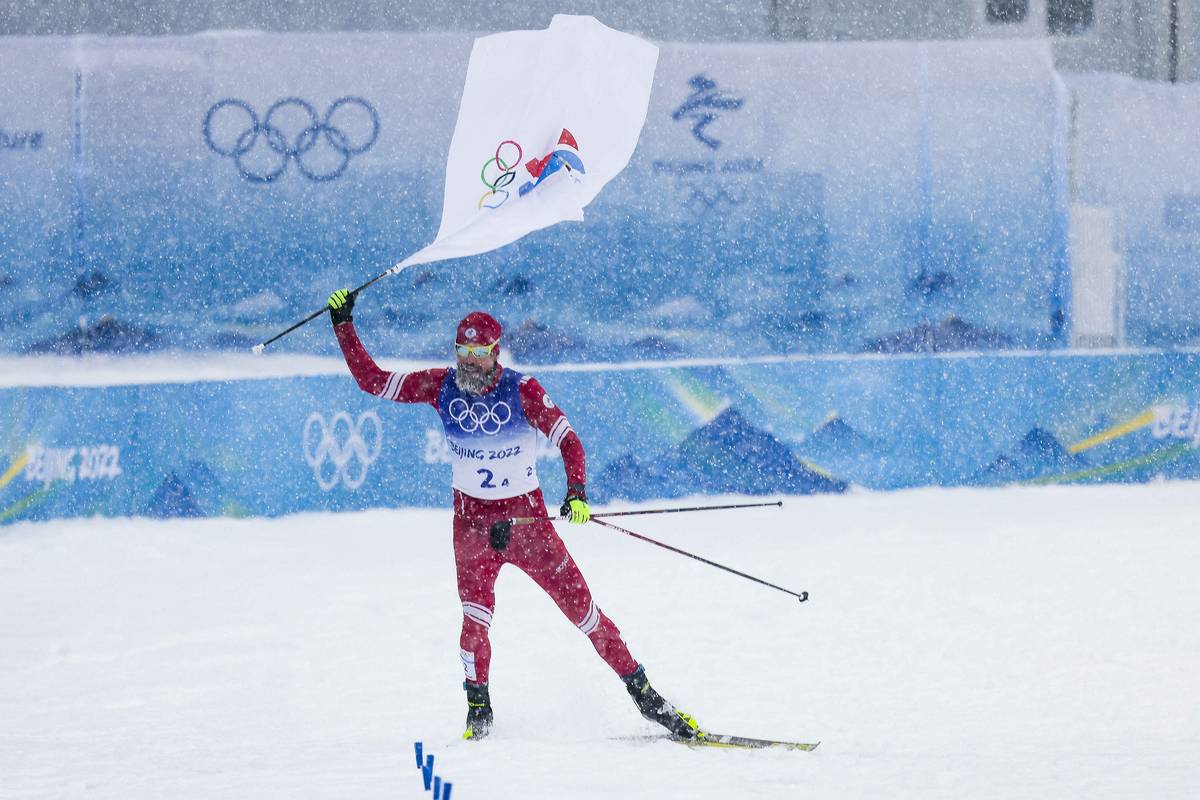
Waving the flag for the Russian Olympic Committee, Sergey Ustiugov brings home a win in the men’s 4 x 10 k Olympic relay. (Photo: NordicFocus)
Russia has pursued aggressive appeals of bans in a variety of sports, though with exception of Luge, largely without success. On May 21st, Vyalbe conceded that after consultations with lawyers, the Russian Ski Federation would not appeal the ban in CAS, saying, “We won’t win.”
An anonymous Russian blogger examined the legal considerations of banning Russia, and found that while the IOC had operated outside of its normal boundaries to call for a blanket ban, it had done so out of the special circumstances. Previously, it was the UN that called for athletic exclusions, such as that of Serbia during the siege of Sarajevo.
In this case, with Russia being a permanent member of the UN Security Council, any resolution could be unilaterally vetoed by the country, so in turn the burden fell to the
IOC to take an action that was theoretically beyond its scope—though roughly in keeping with previous cases.
For Russia, there is no easy recourse for dealing with sporting sanctions. Unlike economic ones, they do not inflict mutual pain and any victories achieved in the sport courts could easily be undermined by canceled visas or boycotts.
Yet a sustained ban on Russian athletes is likely to reshape skiing in a number of ways, beginning with the sport’s media position. Russia now comprises the largest audience for cross country skiing, averaging 1.5 million per World Cup race and accounting for at least a third of the sport’s total audience.
After Russia was banned this spring, Match!TV—a large Russian public broadcaster— pulled coverage of all international ski races and redirected its energies toward covering domestic competitions where it is likely to remain focused until Russian athletes return to the World Cup.
Compounding the difficulties of that loss will be the continued transfer of ski racing from public TV in Norway, Sweden, and Finland to streaming service Viaplay, which charges a hefty subscription fee—as much as €40/month in Finland.
Traditionally, public broadcasts in the Nordic countries accounted for half of skiing’s total audience. In 2020/21 that share fell to a third, in part because of Covid restrictions that kept their teams at home. Norway especially tuned out, with a 55% reduction in viewers, and numbers in Sweden, Finland, and Germany also declined.
Offsetting this loss has been Russia, whose star skiers have propelled coverage of the World Cup from subscription channels to public TV in their country, boosting domestic viewership in 2020/21 by 600%.
The men’s 4 x 10 k Olympic relay podium: the Russian Olympic Committee (ROC) came out on top ahead of Norway in second and France in third. (Photo: NordicFocus)
While last season’s viewership numbers have not yet been published by FIS, during Period 1 of the World Cup last season, VG found that the races shown on Viaplay averaged far fewer viewers than would be typical for an NRK broadcast.
Should broadcasting continue to sustain a loss of 40% of its audience in the Nordic countries while also losing the majority of Russian viewers, the sport may find itself in crisis, as sponsors balk at paying for low return advertising. Still, it may be too soon to write Viaplay off completely—the service recorded more than a million Swedish viewers tuning in to the World Cup weekend in Lillehammer.
As a whole, FIS cross country skiing has struggled to hold its audience, and losses in some regions have been more than offset by the recent tide of Russian viewers.
While Russian viewership is huge, most sponsors of the FIS World Cup are not particularly oriented toward Russia. Coop—the title sponsor of the Cross Country World Cup—is a Norwegian grocery chain. Coop early on sided with the Norwegian Ski Association in calling for the exclusion of Russian skiers. Many other sponsors have no business in Russia, and some, like Audi, have halted operations there.
Despite the €29 million that Russian viewership is estimated to be worth to sponsors, the audience may hold little allure, perhaps because of the average Russian’s low purchasing power. In 2021 the average Russian made around 40,000 rubles annually, or about $6,400. Now, with many western businesses pulling out of Russia, there is even less value placed on reaching Russian fans.
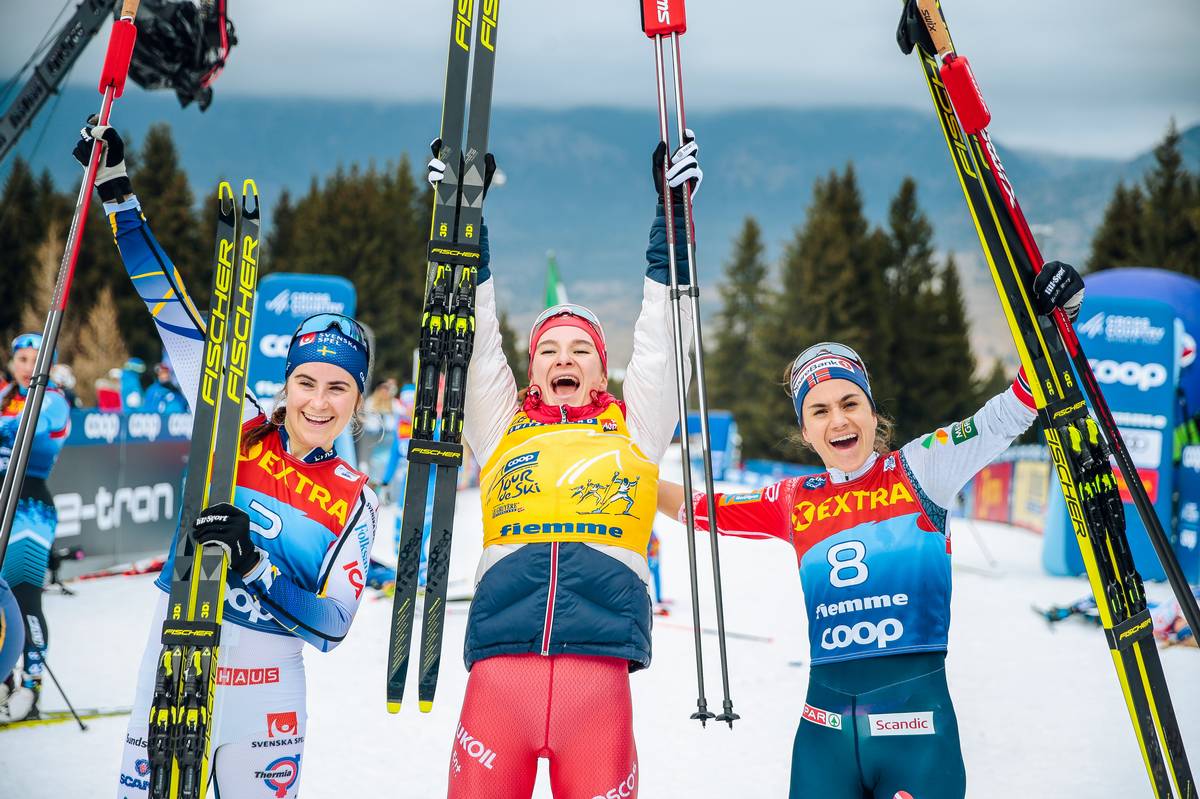
The women’s overall podium of the 2021-2022 Tour de Ski: Natalia Nepryaeva (RUS) was the overall champion ahead of Ebba Andersson (SWE) in second and Heidi Weng (NOR) in third. (Photo: NordicFocus)
For sponsors, the Russian exclusion may ultimately be beneficial. Germany, and Central Europe in general, are a core market for skiing—a market which has been drying up in an era of poor performances by the region’s skiers.
With the German women winning gold at the Olympics and the retirement of the dominant force in distance racing, Norway’s Therese Johaug, the opportunities for success of sidelined countries could become plentiful on the women’s side with the additional absence of Russia.
On the men’s side of skiing, though Norway remains poised to dominate, a potential lack of a Russian team would create significant podium opportunities for up-and-coming American, Canadian, French, German, and Czech athletes. In recent seasons the rivalry between Norway and Russia has consumed almost three quarters of the World Cup podiums. The long term absence of Russia could allow the podium of men’s skiing to once again take on a broader flavor.
Chris Grover, U.S. Ski & Snowboard Cross Country Program Director, clarified that a continued ban on Russian athletes wouldn’t change the quota system, writing, “We’ll have the same number of athletes starting each race. Obviously, Russia has a lot of the top performers, so there will be more opportunities for many other nations to secure podiums, gather World Cup prize money and points, and improve Red Group standing.”
Julia Kern leads the way in the first leg of the 4 x 5 k mixed relay in Falun, SWE in Mar. 2022. (Photo: NordicFocus)
All told, the changes that skiing will endure if Russia remains banned through next season may not be as dire as Russian sporting officials have suggested.
“The tired rhetoric that world sport will not be able to fully develop without Russia does not seem to inspire the speakers themselves anymore,” wrote the anonymous blogger. “It is no coincidence that you can already hear talk about alternative tournaments, leagues, and other ways of self-reliant development.”
The alternative for Russian skiing is to try to create its own circuit among friendly nations. To date, Russian skiing has only managed to solidify a sporting partnership with Belarus, via a cooperative agreement signed in May.
Stay tuned for Part 3, which considers historic athlete bans, and barriers the Russian program face to keep their program operating in the interim.
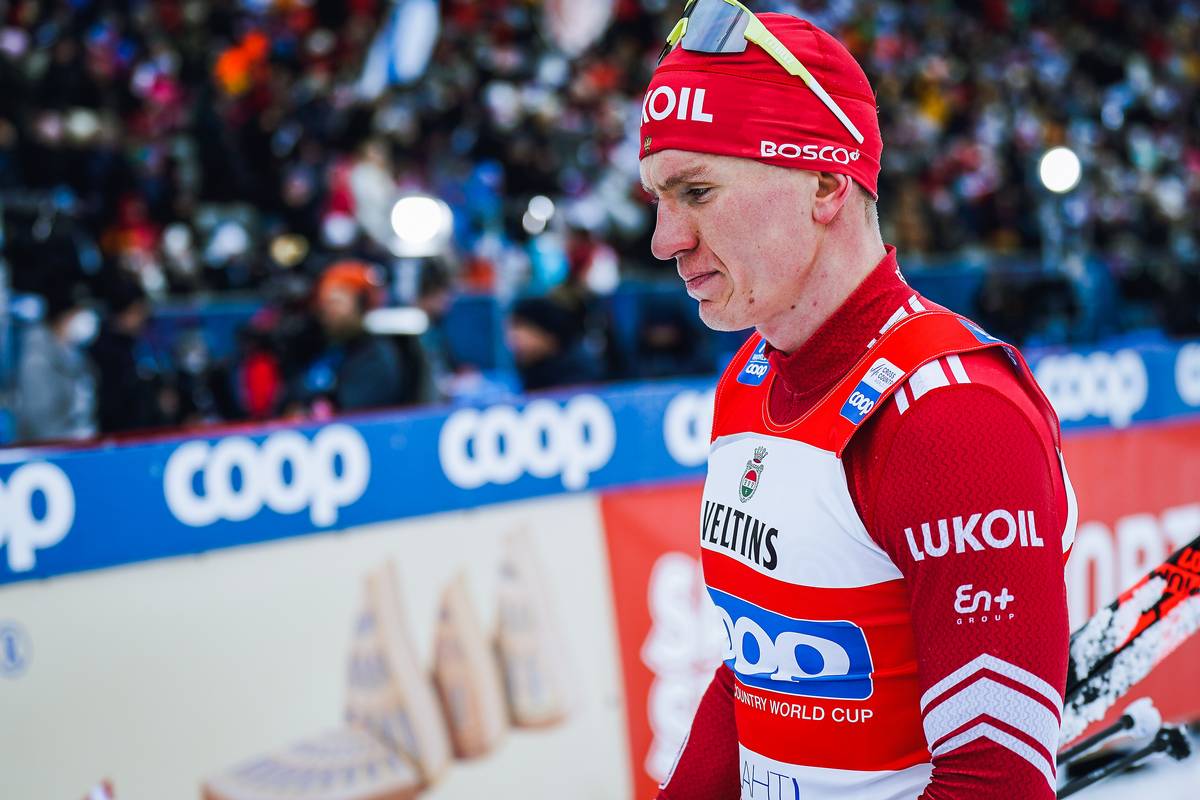
Alexander Bolshunov takes fifth in his final World Cup race of the 2021/2022 season, a 15 k classic in Lahti, FIN. (Photo: NordicFocus)
With Russian athletes banned from all FIS competitions, and no end in sight for the war in Ukraine, there is a growing belief that Russian skiers are unlikely to rejoin the World Cup next season.
Some commentators have gone further, proclaiming that we have seen the last of Bolshunov, Neprayeva, and the rest of the Russian team on the international stage. The pessimism is rooted in the history of similar bans—which tend to be long lived—and the uncertainty over what circumstances would allow for the Russians to rejoin.
Will the ban end when Ukrainian athletes can return fully to competition? That may not be possible until long after the end of the conflict. Perhaps a negotiated peace settlement? That possibility could still create discontent with athletes such as Bolshunov being used to fuel propaganda at home. Does the ban require the Putin regime to end? That could be a distant future.
“I expect that this situation will last as long as the conflict is unsolved,” said Vegard Ulvang, the outgoing chairman of the FIS Cross Country Committee, “but that’s of course up to the FIS Council or IOC.”
Ulvang was outspoken in calling for the Russian exclusion from the Norwegian hosted World Cup events this spring. Ulvang said in a call, “We have a fairness rule in FIS that there should be equal opportunities. When one nation cannot compete because they have to go home to defend their country, and the attacking country is racing, that’s not nice.”
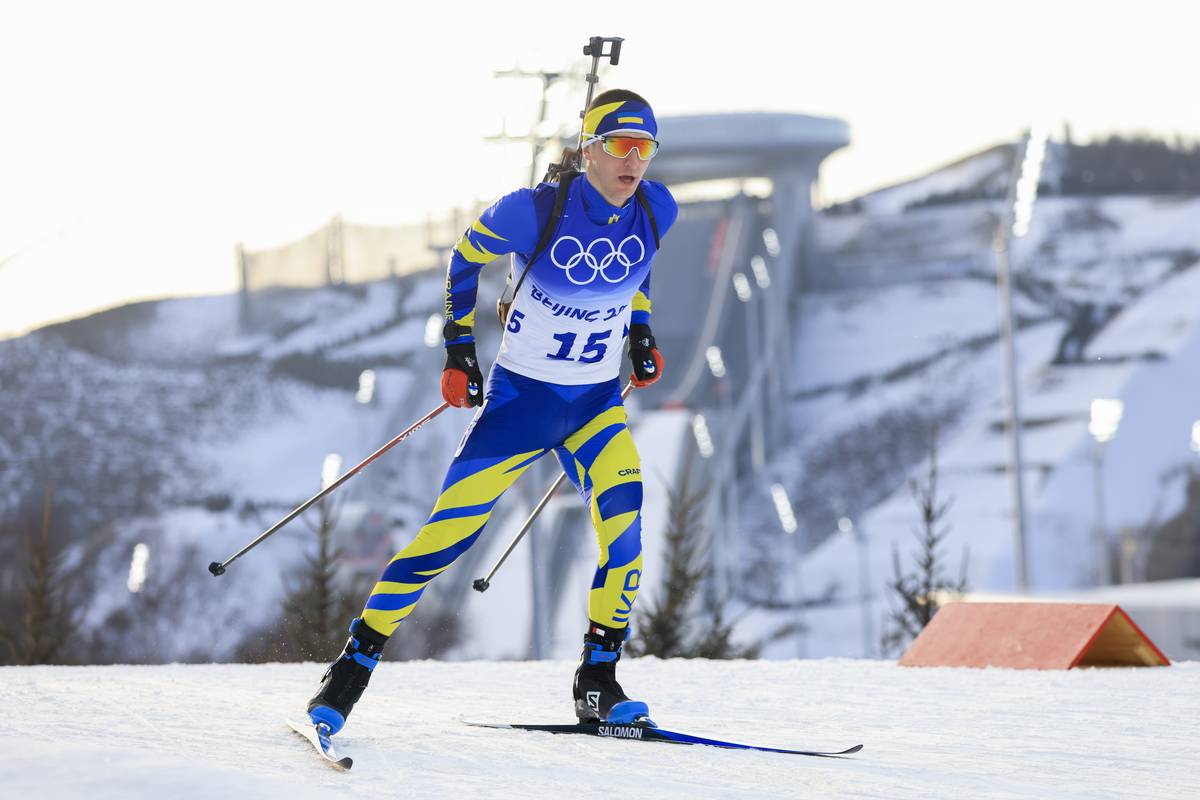
Ukrainian biathlete Dmytro Pidruchnyi competes in an Olympic sprint during the 2022 Games, shortly before being called into military service to protect his country amidst Russian invasion. (Photo: NordicFocus)
Ulvang’s point is underscored by the Ukrainian athletes now fighting on the front lines, with many called up just days after returning from the Beijing Olympics. Among the Olympians taking up arms was Dmytro Pidruchnyi, a biathlete who has won gold in the World Championships. The danger faced by the athletes defending their country was made clear early on in the conflict with the tragic loss of nineteen year old biathlete Yevhen Malyshev, who was killed defending Kharkiv on February 26th.
Another explanation for the ban was that it would help send a message to everyday Russians and deprive the state of a propaganda tool.
The charge that athletes were being used for propaganda purposes was confirmed during Russian President Vladimir Putin’s March 16th pro-war rally in Moscow. The event, titled “For a World Without Nazism” was MC’d by longtime biathlon TV commentator Dmitry Guberniev. Stars of the Beijing Olympics—including Alexander Bolshunov—were trotted out in front of the (reportedly) 100,000 strong audience in the Luzhniki stadium.
Questions remain about whether the athletes attended of their own accord, and there has been speculation about whether Bolshunov’s decision not to wear a letter Z pin on the stage—a pro-war symbol—reflected an ambivalent attitude to the conflict now raging near his home.
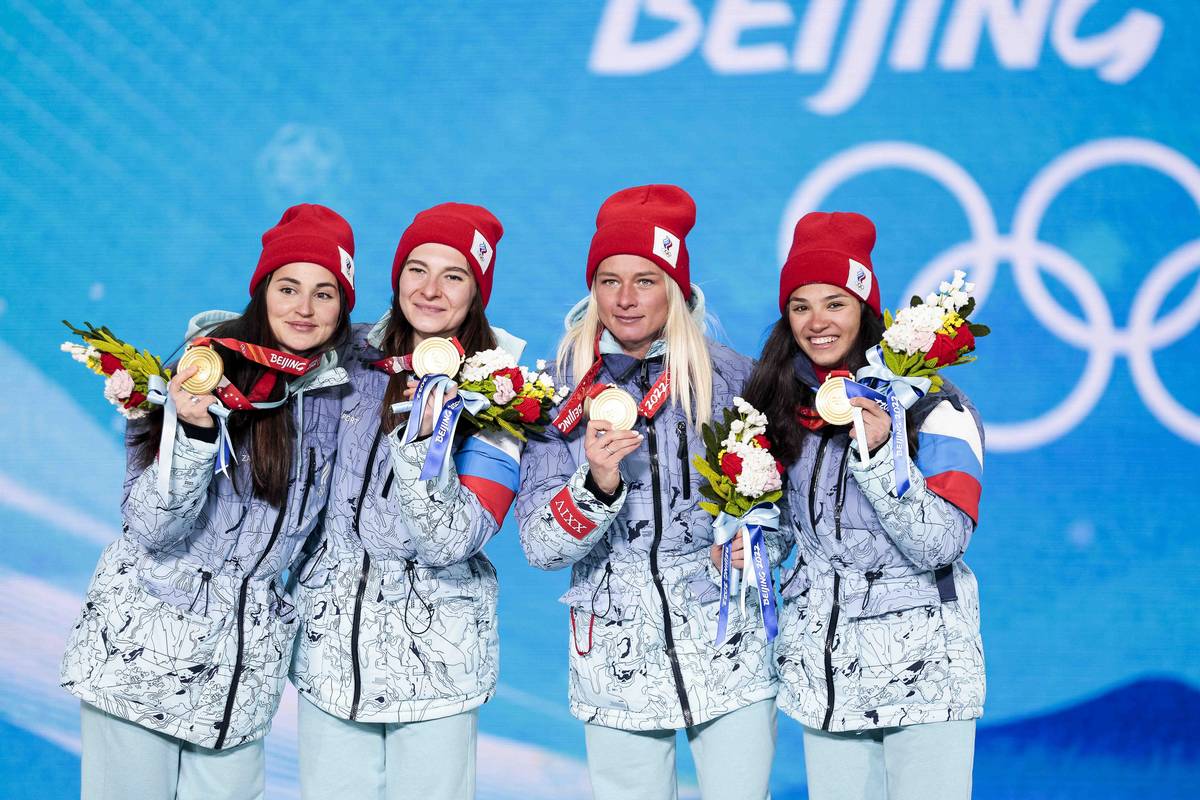
The women representing the Russian Olympic Committee strike gold in the 4 x 5 k relay. From left to right, Yulia Stupak, Natalia Nepryaeva, Tatiana Sorina, and Veronika Stepanova. (Photo: NordicFocus)
On April 26th, a host of Olympic heroes were called to receive state awards by Vladimir Putin in a ceremony that required the athletes to quarantine prior to the visit. Putin congratulated the skiers, saying “First of all, I would like to note the long-awaited victories in the relay race…We have not had a simultaneous victory of both the women’s and men’s teams for exactly half a century. This is a big result.”
A few notable Russian stars missed the Kremlin occasion: Bolshunov for dental surgery, Neprayeva because she arrived to quarantine sick, and Ustiugov because his wife had recently given birth.
Bolshunov’s absence at the event stirred further speculation that he had intentionally scheduled the surgery to avoid the ceremony, and with it the possibility of a personal ban set against him by FIS, much as FINA – the International Swimming Federation – did by banning Yevgeny Rylov for nine months after he stood next to Bolshunov at the March 16th rally.
Elena Vyalbe, who heads the Russian Ski Federation, manages the national team, and sits on the FIS council, dismissed this speculation, saying, “Who wrote that Alexander [Bolshunov] refused? I already spoke about this…He was scheduled for surgery on the 24th [of April].”
However, during the Olympics Bolshunov made it clear he dreaded the idea of the quarantine required to meet Putin, saying, “If they put me in jail forcibly, I’ll run away in two hours. I can’t just take it and throw 10-14 days out of my life. It’s unrealistic.”
During the Kremlin ceremony, Putin singled out the missing Bolshunov for special praise: “I note that Alexander Bolshunov has collected a solid collection of awards in Beijing,” Putin said. “Everyone knows this well. He has three gold, silver and bronze medals. And the absolutely well-deserved symbolic title of king of skis.”
Alexander Bolshunov displays four of the five Olympic medals he collected in Beijing, bringing his career total to nine medals earned over two Olympic Games. (Photo: NordicFocus)
The political significance of the event, which was delayed due to the war in Ukraine, was not lost on anyone. Veronika Stepanova, the upcoming ski star from Kamchatka seized the moment to make a splash.
Addressing Putin and the Kremlin audience, Stepanova said, “I am the same age as the century—I was born in January, 2001. Before my very eyes, Russia has again become strong, proud, and successful. Not everyone in the world likes it. It is obvious. But we are on the right track. And we will definitely win, as we won at the Olympics.”
The overt statement of support from Stepanova far exceeded expectations of decorum that called for perfunctory public speaking at most. That Stepanova would jeopardize a burgeoning ski career for a soundbite even shocked Russian commentators who speculated that the 21 year old was positioning herself for a transition to politics. For her part, Stepanova responded saying, “Negative consequences for my international career? They don’t scare [me].”
Far from distancing herself from the comments, Stepanova has brashly doubled down, saying, “Was I nervous when I spoke at the meeting with Putin? You have to believe in what you say. The presence of the president does not confuse or frighten, on the contrary, it energizes. You feel tremendous confidence next to him, you feel a special energy.”
Stepanova’s words have reverberated as she has gained a following in the west: outgoing and fluent in English, as well as adept at social media, many fans as well as fellow competitors felt they could relate easily to her.
Helene Marie Fossesholm of Norway was one such skier that enjoyed a friendly rapport with Stepanova off the ski trails. In the wake of her Kremlin speech, Fossesholm told NRK she was uncertain of how the friendship would continue, saying, “I can not answer that until I have experienced it. But it is clear that it will not be forgotten, at all.”
Flooded with foreign media requests to explain herself, Stepanova responded via her Instagram page, writing “I have an answer to [Western journalists]: Did you expect anything else from me? Just because I smile, speak a little English and am almost always ready for some nonsense, does that make me ‘another type of Russian?’ The peak of naivety!”
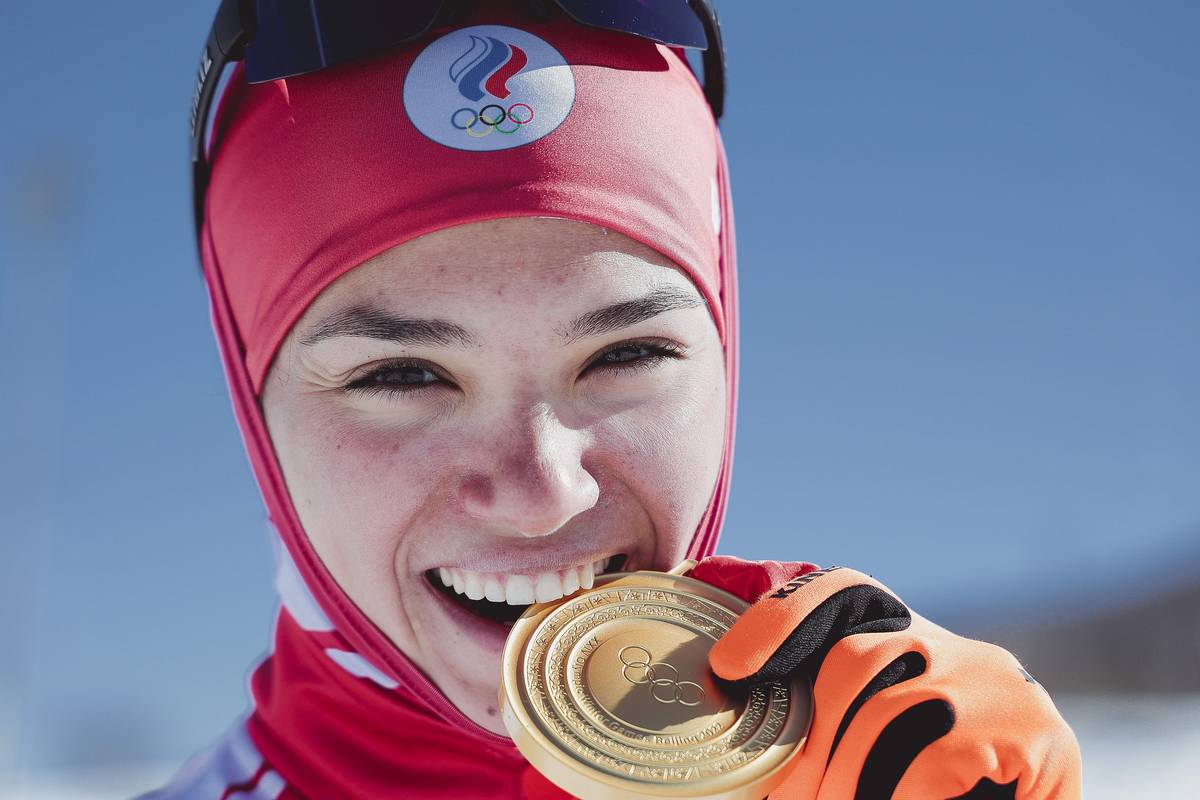
21-year-old Veronika Stepanova anchored the Russian gold medal winning women’s 4 x 5 k Olympic relay team during the 2022 Beijing Winter Games. (Photo: NordicFocus)
Vyalbe has been among Stepanova’s detractors this spring, criticizing her by saying that she may be suffering from “star disease” and that “now she is not an athlete, but a patriotic blogger.” For the head of Russian skiing, Stepanova has become irksome. “My senior leaders ask me questions about her,” Vyalbe told Championat, “and I feel ashamed and unpleasant.”
For her part, Vyalbe faced pressure in her bid to remain on the FIS council, after the Ski Federations of Poland, Finland, and Sweden moved to bar her from running for reelection at the FIS Congress on May 26th. FIS, however, allowed Vyalbe’s candidacy.
In allowing Vyalbe to run, FIS may have looked at the difficulties endured by the International Luge Federation (FIL). In early March FIL had voted to ban Russia in much the same manner as FIS, though Luge went a step further—voting in favor of expelling elected officials from Russia.
In April, Russia won their appeal in the FIL’s own Court of Arbitration, and saw the ban removed on the grounds that they were—according to the Russian Luge Federation—”dictated solely by political motives and had no legal grounds for adoption”.
For FIS, the Luge ruling was likely a reminder that barring Vyalbe from running could run afoul of their own laws against politically motivated rulings.
Apart from from the symbolism of being Russia’s representative to FIS, Vyalbe had escalated tensions in the ski world by laying the blame for the ban squarely on the shoulders of Norway’s FIS representatives—Erik Røste, the head of the Norwegian Ski Federation and FIS councilor, and Vegard Ulvang, the outgoing chairman of the FIS cross country skiing committee.
In response, Røste said, “Norway will not vote for Russia because of the terrible things happening in Ukraine.”
The Vyalbe election saga has proven to be a tender subject for Russian commentators. When Swedish skier Markus Grate commented that “There is no possibility that Vyalbe will remain on the council,” biathlon TV commentator Guberniev declared that if Grate was suggesting that Vyalbe be excluded on the basis of her nationality, then “he is a Nazi, these are the words of a Nazi.”
Marcus Grate (SWE) races a freestyle sprint qualifier in in February 2022 in Lahti. (Photo: NordicFocus)
In any case, Vyalbe lost the election on May 26th at the FIS Congress—finishing last. “In this situation, it was expected,” Vyalbe said. “There was a letter from the Ukrainian Federation, which says that everything should be politicized.”
With Vyalbe out of the FIS council, Russian skiing will likely recede further into seclusion.
Stay tuned for parts 2 and 3 of this series, which will be released over the next week.
In most states, youth skiing is divided between club and high school programming, where club programs support skiers looking to race competitively on a regional, national, or international level, perhaps with goals of NCAA skiing and beyond. High school ski programming is typically more participation focused, and comes with a much lower price tag for families, consequently with a much smaller program budget. It’s less about year-round training, and more about learning to ski, enjoying a low-cost introduction to the sport, and providing a healthy activity to get kids outside in the winter. In some places, athletes may fall into an overlapping Venn diagram of categories, while in others, it may be a choice of club versus high school racing.
Within high school programs, it is much less common to have multiple pairs of skis, and conversations on grinds and structures are less likely to be overheard between coaches. Here in Colorado, it’s one of the only (maybe the only?) high school sport that does not have a uniform rule – kids can essentially race in whatever they want; no lycra required.
In this setting, a universal wax call might be a more reasonable proposition, according to Nystad.
“Arguments can be made on both sides. If everyone just agrees: ‘We have one pair of skis and we wax with blue.’ Okay, it probably will be as fair as you can probably make it, but just be aware that still there will be huge individual differences on the quality of the skis and how they differ from different conditions… there will still be variations, it’s not like everyone will start on the starting line having identical skis. That’s not realistic.”
Slovenian sprinter Eva Urevc tests skis with her wax technician at the 2022 Olympics in Zhangjiakou, CHN. (Photo: NordicFocus)
With all of this in mind, is there a way to create equity via equipment or waxing at any level of the sport?
“No,” said Caldwell frankly. “No, there isn’t.” Adding perspective from his business, Caldwell explained that the cost of equipment has been steady over time with respect to inflation. That said, among competitive programs, the demand for skis has increased with time, in particular, following the removal of a now-banned leveler that we haven’t yet mentioned: fluorocarbons.
“It’s a technical sport,” Caldwell said. “And the fact is that people have become more aware of the opportunity to get ahead with material. And I think what we’re seeing is a reaction to the reality of what the sport is. It’s not running. It’s just not. And yet people are doing the same thing in running with these carbon-plated shoes. Now you can only win if you have a high-tech shoe that goes 4% faster. Does that mean that those shoes shouldn’t have been invented? Or should they be banned? Possibly. I mean, whatever, we have to talk about this.
“They banned fluorocarbons for a lot of very good reasons, or they’re in the process of it. When it’s health and safety that is the problem, then you have to take the necessary steps. And yet, we also have to acknowledge that removing fluorocarbons really takes a big, big leveling factor out of the equation. There’s no opportunity to take a universal cold grind ski and put it in a wet race. That kid’s screwed. Every single time we remove the opportunity to optimize the solution that’s at hand, you’re penalizing the kids who don’t have the perfect setup.”
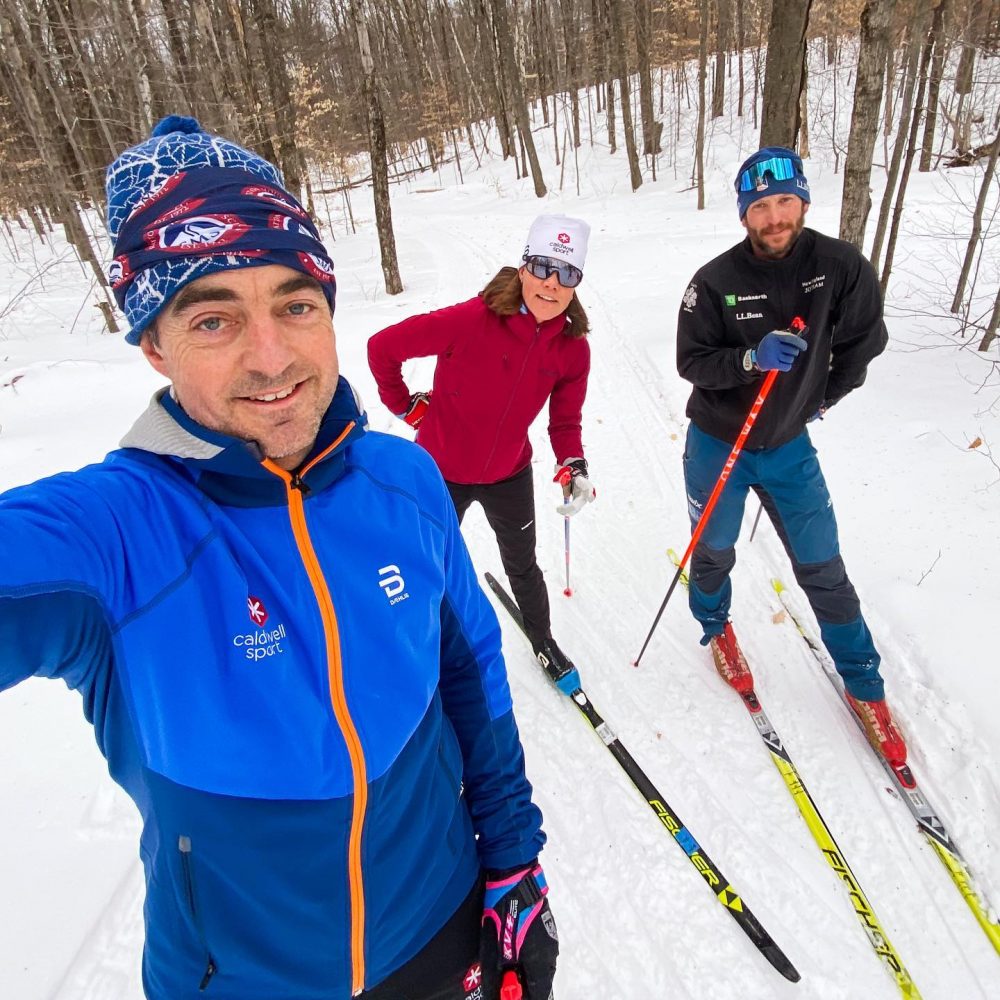
Zach Caldwell (left) out for a ski with his wife and business partner Amy and Craftsbury Green Racing Project wax tech Nick Brown. (Photo: Facebook Caldwell Sport)
Making it clear that his opinion is not clouded by the inability of a Colorado, Wisconsin, or Washington-based club skier to use a non-Swix wax purchased through Caldwell Sport, he added, “From a business perspective, with regard to my overall outlook, I probably should be applauding this model because it creates a massive incentive for kids to carry a lot more skis. And we’ve already seen this with the removal of fluoros from competition – you wouldn’t believe the uptick that we’ve seen in demand for warm weather skis, and grinds, and bases.”
In Caldwell’s opinion, the opportunity for athletes and coaches to optimize a ski through testing and the use of a product line they know well, regardless of brand, is a more viable option for “leveling the playing field” as it could bring any ski closer to what he called it’s “terminal velocity.” A wax protocol that puts every athlete on the same brand and hardness of wax, creates “a situation where that opportunity doesn’t exist and the only way to gain competition advantage is to buy another pair of $800 skis. So it very quickly becomes a sport that, really, is hard to succeed at without a lot of personal resources.”
While the focus of these points might suggest that competitive youth skiing will trend toward an arms race, Nystad’s points included a reminder that a skier with limited access to equipment and race-day wax expertise may not be doomed. Other aspects of athlete development remain as important as ever in a skier’s trajectory and long term prospects.
“Quite honestly, I don’t want kids to have ten pairs of skis,” Nystad said. “I have kids that ski, but I try to limit the amount of skis and I try to buy used skis and rather look at what properties do the skis have, so that they have okay skis for for each condition. And then we focus on other things that are far, far more important. And that is the mentality to learn to train, to have fun while you’re training, and then to work on technique and tactics. So it’s also a cultural thing.
“If you only focus on buying yourself time by buying equipment and buying wax and tweaking things and using resources — yes, you are probably going to gain some time, but you have to also say, ‘Are you investing as much time training and enhancing your technique and your tactic as the others are?’ So it’s definitely possible, even if you come from less resources, you can beat the guys with the most resources if you just train well and smart and develop good technique and good tactics.”
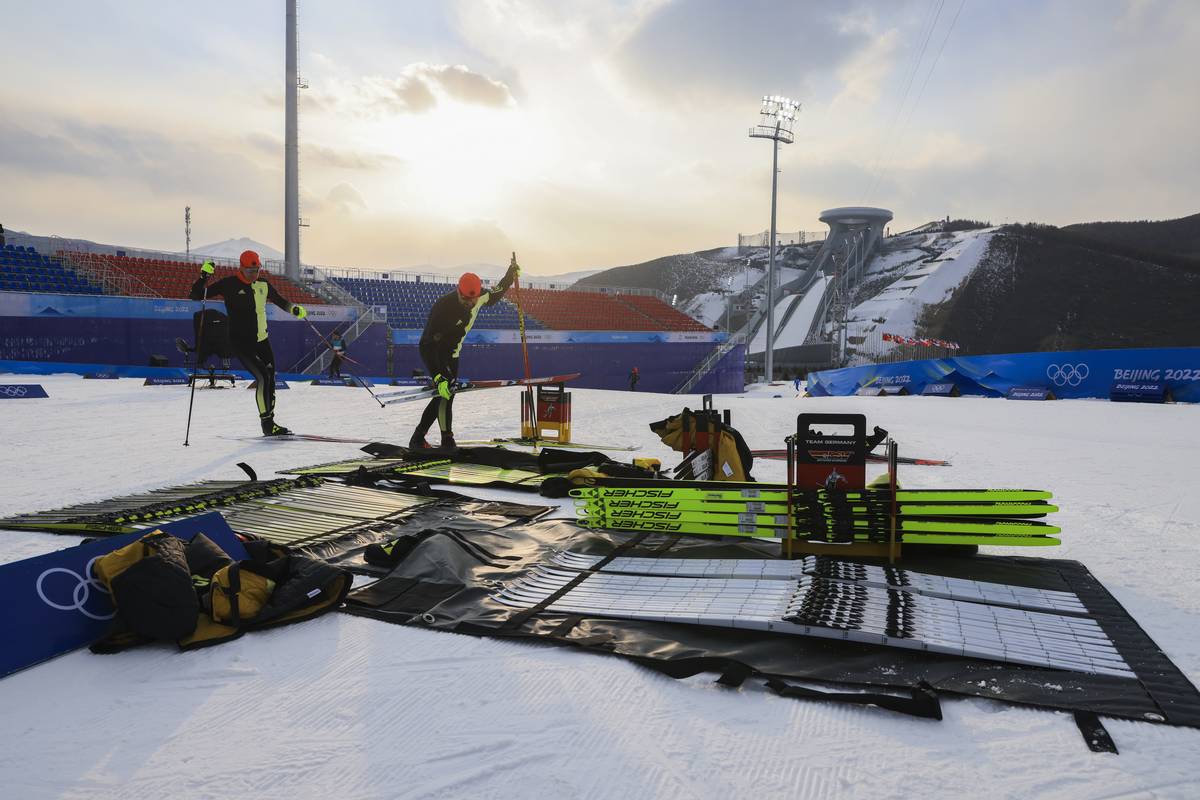
The German biathlon team tests skis during the 2022 Olympic Winter Games in Zhangjiakou, CHN. (Photo: NordicFocus)
As a serviceman working at the highest level of sport, Nystad also offered a thought-prompt on the impact to athlete knowledge and the ability to develop a new generation of wax technicians under a protocol, regardless of brand.
“If you want to educate athletes to also be able to become great service people at World Cup level races – if you take away that experience in club skiing or in high school skiing or in collegiate skiing, you will have no resources that are going to be able to serve your American athletes going to World Cups or World Championships or Olympics. Where are they going to get the knowledge? Because it’s like anything else, if you want to become good at something, you have to work at it.”
According to Caldwell, incorporating a wax protocol is “reductionist attempt to level the playing field” that creates more disparity than equity. And so, the goal of leveling the playing field in cross country skiing remains “laudable”, but out of reach, and perhaps unattainable.
“I understand the discussion, but I think you have to cater to common sense,” Nystad concluded. “You can always tell people that we decide to [have] one pair skate, one pair classical. I think you can also try to have the waxes [matched]. But still be aware, it’s never going to be fair.”
Stay tuned next week for follow-up series which highlights some of the leagues who have enacted a waxing protocol, namely, the Wisconsin Nordic Ski League (high school & club), and coaches from Rocky Mountain, Intermountain, and the Pacific Northwest. This discussion includes the evolution and reasoning behind the protocols, and what advantages/disadvantages have been identified by each league.
FasterSkier shares insights into ski performance theory from Any Gerlach, Zach Caldwell, and Knut Nystad. (Photo: NordicFocus)
In November 2021, the Wisconsin Nordic Ski League (WNSL), which oversees both high school and club level youth programming state-wide, accepted a sponsorship proposal from Swix and Salomon, which would provide the league with $10,000 in funding per year for three years. The proposal also included stipulation that a standardized wax protocol using Swix waxes would be adopted by the league at all affiliated races, including the state championship.
In practice, this would look like an email going out to all coaches a day or two prior to the event indicating which of a subset of Swix glide waxing products should be used by athletes that weekend. Equivalent temperature range and performance level waxes from other companies would be disallowed. In the sponsorship presentation given to the league by Swix, the proposal promoted the simplicity and affordability of a unified wax call, and a shift in focus for coaches away from time-consuming wax testing to race day support of their athletes.
The concept is not new, and WNSL is not the first league to adopt such a protocol. An equivalent protocol has been used by the high school, club, and collegiate level ski programs in the Rocky Mountain region (RMN and RMISA) for the last six years, and has more recently been adopted by the Pacific Northwest and Intermountain Division junior club programs. On the whole, these policies have been seen as beneficial by these regions.
While an additional $30,000 of funding has the potential to profoundly impact the reach of the WNSL, which will be discussed in a subsequent story, the adoption of the corresponding wax protocol also raised red flags, particularly among members of the Independent Nordic Distributors of America (INDA). The INDA includes distributors of wax products from other smaller companies like Start, Vauhti, Star, and more, and are primarily based in the Midwest.
The two primary issues that were flagged were the restriction of trade should Swix monopolize the buyer market encompassed by the WNSL, and also whether limiting the available choices to a single option actually creates the equity and uniformity that one might anticipate from putting all skiers on the same wax. Instead, could it widen the opportunity gap between those who could afford high-end skis with condition specific grinds and those who could not?
Enjoy Winter’s Andy Gerlach snaps a picture with 2020 Birkie Champion Ian Torchia (SMS T2). (Photo: EnjoyWinter.com)
In the fall, these issues were brought to FasterSkier by Andy Gerlach, director of Madison, WI based EnjoyWinter, which distributes Start, among other cross country related brands like Blitz Eyewear and Swenor rollerskis. With vested interests in the implications to his own business, but also as someone who offers brand-neutral education on wax theory for coaches, Gerlach actively opposed the decision by WNSL to accept the offer from Swix.
“The biggest argument against these exclusive sales agreements and proof that they are bad for the sport, and in fact illegal, is that they decrease the incentive for any other brand to fight for any part of a team’s or consumer’s business,” Gerlach said in the fall. “Why should my business continue to do wax clinics for Madnorski (Madison Nordic Ski Club) members if we know we are no longer getting a large chunk of their business. Why should any brand even visit Colorado clubs if we know we do not have a chance at a large chunk of the business there? Legal marketing arrangements should increase competition in the market, not decrease it. Change the agreements to marketing rights and not sales rights and every other brand would increase their efforts to reach the individual teams.”
After discussions among the cross-country sport committee during the recent U.S. Ski & Snowboard annual spring congress meetings, Gerlach summarized his objections to wax protocols to the following four points.
“They perpetuate a misconception that waxing is so difficult and mysterious. Our clinics state just the opposite.
“They perpetuate a misconception that extensive testing is effective and needed to select a glide wax that an athlete can race up to their abilities with. Our clinics state just the opposite.
“They increase the likely hood that those skiers with a quiver of skis will have the fastest skis. Multivariable mathematical analysis, as well as ski industry testing and ski sales figures shows this.
“They endorse one brand ‘because it is the most available’ and in so doing extends this advantage.”
There is plenty more involved in the debate on the legality and consequences on the business end of the decision whether to accept the sponsorship offer from Swix, which will be revisited in subsequent parts of this story. This installment, however, will focus on the underlying principles of ski performance theory, with input from experts, like Gerlach, on what factors ultimately determine ski speed, and whether restricting the waxes available for a given race would level the playing field by reducing variables, or adversely affect the pre-existing disparity between ski performance, thus limiting the potential of the skier clipped into the binding.
Brimming with insights into ski performance, this thought-provoking conversation should provide fodder for discussion within race-leagues at all levels as they consider waxing protocols and avenues to improve equity within the sport.
***
We’ll start with what Gerlach identified as the factors that affect the performance of a ski from most to least significant, and where in this process limiting a coach/athlete to a single wax from a single brand becomes significant.
“In my hierarchy of ski speed deciding factors, it’s a flexible ski, the freshness of the base is the next important, the structure, then the hardness of the wax, and then the brand,” Gerlach explained in a call. “Now we’re going to take away the hardness of the wax as a differentiator between them. And now, all we have as the only differentiator is the ski model, the freshness of the base, and the structure.”
The understanding of this theoretical model underscores the remainder of the question. When we hear “wax tech”, the name seems to imply the key player being adjusted and assessed is the wax. Gerlach explained that this reasoning is misguided.
“I, and scientific studies, will show you that 95% of this theoretical wax testing is not determining the fastest wax to apply that day. If it was, at US Nationals, or at any of these races, the line Saturday morning two hours before the race start would all be at one wax trailer. But you know, every coach comes up with their own thing… There is a different theoretical ideal wax for a Rossignol with an aggressive grind to the same Rossignol with a fine grind, and you would theoretically wax it differently. If you are testing on your Madshus cold skis and all your kids are on dried burnt out skis, or are on Fisher or on Salmon, theoretically, there’s a different wax [for each ski].”
It’s a counterintuitive concept to those, like myself, who prefer to focus on the technique and training aspects of the sport, versus the technical side. Why doesn’t putting everyone on Swix PS8 on a day forecasted to be in the right temperature range remove a factor that might create disparity between ski performance, thereby improving equity? Particularly in a larger state, like Colorado, where teams are driving long distances (through vastly different elevation zones) to race without knowing exactly what conditions will be like until arrival, I could see the appeal for coaches of removing a step in the planning process.
Swedish Technicians at work at a March, 2022 biathlon World Cup event in Oslo, NOR. (Photo: NordicFocus)
To simplify the answer on why equity may not be achievable with wax, Gerlach offered an analogy most skiers can relate to, regardless of their background knowledge in waxing theory.
“If you’ve ever shaved your legs or your face with a razor,” he began. “A sharp, brand-new razor is like a fresh ski with a fresh base. You don’t need shaving cream and that razor works great. But a dull razor – a dried, crappy base – you need that shaving cream. And you need the best shaving cream you can get, and it’s going to help that razor and that shave a whole lot more.”
How does this affect youth level programming? Ultimately, it accentuates the ever-growing “pay to play” problem of competitive sports. A newer, higher-end ski with a fresh base, or perhaps a quiver of skis that are ideal for different conditions, becomes much more important without the ability of a skier or coach to add versatility and improve the performance of a single pair of skis ski by utilizing a range of products to optimize the wax job.
“We have one ski with a great freshness of the base and a great structure, and one ski with a really dried up base. Had I applied wax to [the dry base], it does more to increase the ski speed than applying wax to a great ski… The more skis you can add to that quiver, all waxed the same, one of those is going to highly outperform the others. Versus when you had the ability to not only figure out which ski to go with, but which wax to go with. So by taking away variables that are easy to change, you make it more important to have a very good ski.”
To include additional knowledgeable voices in the discussion, FasterSkier also spoke with Zach Caldwell and Knut Nystad, two savants in the complex and nuanced world of wax and skis. Caldwell is a leading expert in ski selection, wax, and grinds in the US, and the co-owner of Caldwell Sport. As a distributor of Vauhti, Rode, Star, and other waxes, Caldwell is also a member of the INDA.
Nystad is the former head of the Norwegian Wax Team, who still works as a ski serviceman for the Norwegian program at the World Cup, World Championship, and Olympic level. Prior to this work in his home country, Nystad spent twelve years as the head coach at the University of Denver.
“The idea of having a fair competition and limiting variables in order to generate more fairness and equity in the racing and create equal opportunity and a lower barrier to entry is a really laudable goal, but it misses the point,” Caldwell said simply in a call.
“The fact is that it’s a pretty complex system that we’re working with, with a lot of additive contributing variables that contribute to a whole solution, including ski flex, base material, base preparations, waxing, hand structure, all of it. When you have a lot of variables available to you, you have a lot of different pathways to success. The peak performance that might be available [on a particular ski] can be considered something along the lines of terminal velocity; you’re just not really going to go past a certain level of performance [on a day], the performance that the snow is going to yield. But there are a lot of ways to get there.”
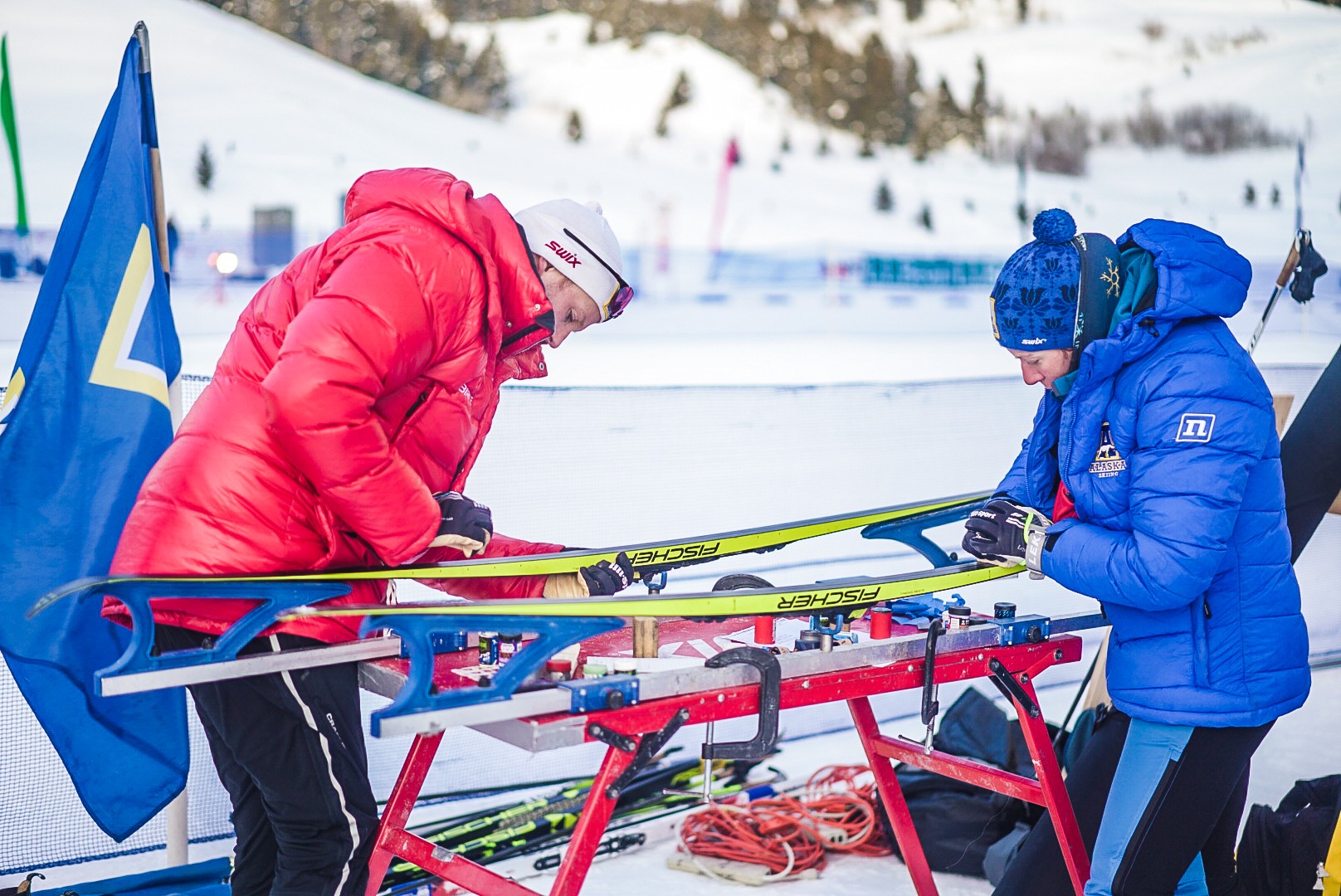
Inside the wax at a February SuperTour race weekend in Craftsbury, VT, where Zach Caldwell (left) supported SMS T2 athletes. (Photo: Facebook Caldwell Sport)
“As you begin to limit variables,” Caldwell explained, “you begin to place much more emphasis on other variables. They become proportionally much more important in determining how to get to the best performance possible [on the day]. And as you remove wax, which is a really inexpensive variable per application that can be put on specific to a day, you skew the emphasis toward skis base materials, grinds and hand structures.”
Individual variation among the skis and in the technique and strengths of the skier on those skis adds additional complexity to the scenario.
“Think about classic skis; this is a better way to imagine this,” Caldwell pitched. “Some athletes or some skis require different layering and build up of classic wax on a day. But if you’re saying, ‘Oh, you get two layers of extra blue. That’s it.’ That’s asinine. It means some people get to race and others basically have to herringbone.”
Nystad also questioned the premise of leveling the playing field by creating uniformity in the wax selection.
“Let’s start with the beginning,” Nystad said. “All of us that have done this for a long time, the only thing we know is that we don’t know. The only thing we know is that we need to test in order to get the answers. But what I can tell you from my experiences is that if you limit one factor, sometimes it just opens up another can of worms…
“There’s definitely good arguments for trying to make the sport as simple as possible. But I think that for the people that think that just by waxing with blue, that that’s going to make it more equitable. It is a sign to me that they don’t have that much in-depth knowledge.”
Knut Nystad provides insight into ski performance theory and why a one-wax call may widen the gap in cross country skiing. (Photo: knutnystad.com)
Without giving hierarchical ranking, Nystad also discussed the myriad of factors that contribute to the performance of a ski on a given day: the properties of the ski, including flex and splay, the quality of the base and its structure, the manual tools used, and the wax. “And then to top it all off, you have the method methodology that you use to apply the wax.”
He walked through various ways a particular wax could be applied to yield different results, before echoing Caldwell’s sentiments that equity and uniformity cannot be achieved by restricting the options for wax that can be applied to a ski.
“When people say, ‘Well, can’t we just all wax with the same thing? It will make it easier.’ Clearly it will make it easier; you have one less factor to think about. But if the intention was to make it more of an even playing field, it’s not necessarily the truth. Because when you go to a race, you’re only limited to try to test what you can afford from money, resources, and of course, time being one of those resources. So if you don’t have the test wax, what else can you test? Well, you can test many more skis, with many more properties with many more different bases, with many more structures, with many more manual tools.
“So it just opens up other things that you can test to get an advantage. And everything that you’re going to test if you’re going to have more skis, of course, that’s going to cost more. If you’re going to have more structures, different kinds of structures, that will also cost more. If you’re going to add manual tools, that will also cost more.”
Stay tuned for more insights from Gerlach, Caldwell, and Nystad in Part 2 of this story.
Julia Kern prepares for her Olympic debut on the tracks in Zhangjiakou, CNH. (Photo: NordicFocus)
FasterSkier recently shared a press release on behalf of the US Nordic Olympic Women (US NOW) announcing Julia Kern as the 2022 recipient of the fourth annual Gold Rush Award. The release included comments from 2021 winner Jessie Diggins on the qualities that she, along with the other past winners, recognized made Kern deserving of this year’s award, but it became clear that there was a gap in FasterSkier’s coverage on the history of US NOW and the evolution of the award.
To learn more, FasterSkier connected with the spark that launched Gold Rush Award into existence: recent U.S. Ski & Snowboard hall of fame inductee and early groundbreaker for American women’s skiing, Alison Owen-Bradley. It was Owen-Bradley who planted the seeds to bring together the generations of women who have represented United States in cross-country skiing at an Olympic Games, bringing US NOW into fruition.
According to Owen-Bradley, US NOW filled a gaping hole in connection among the women who helped set the foundation for what is now one of the most successful women’s ski programs in the world. Though each of the 53 women Olympians had played a role in propelling the next generation forward, opportunity for connection between the generations had been lacking. With individual efforts, a network amongst these women slowly began to connect sooner, but when the World Cup swung through Quebec City in March 2019, it provided an ideal opportunity to reunite as a collective.
“We ended up having quite a few Olympic women there,” recalled Owen-Bradley in a call. “And it was fun because we wore our vintage clothing to the race, so we had all kinds of different eras of Olympic clothes. It was so congruent because we were really cheering on the latest, greatest women racing but we were also together with our teammates from the past, and it kind of just kind of grew from there.”
An intergenerational collective of Olympic women reunite at the 2019 World Cup Finals in Quebec City. (Photo: Peggy Shinn)
Having been teammates long before the era of Facebook – in fact, some well before the internet – it had been hard for these women to feel connected and maintain ties after careers ended. Owen-Bradley said that before the reunion, she didn’t have contact information for many of these women, and consequently didn’t feel the relationships had been sufficiently developed among the various generations.
With some word-smithing to nail a catchy acronym, the energy and camaraderie established at this reunion evolved into US NOW. But there’s much more to the name than meets the eye.
“US NOW – being retired from ski racing, who are we now? What have we learned? There’s so much gold in that for mining, in a metaphoric way. All these women, what have they learned? What have they gone on to do? How was it good and bad in their lives to devote their time to this? I don’t think we’ve even come close to exploring that and getting the nuggets [of wisdom] out of what women went through and and got from those experiences. But also, how hard was that? And was it worth it? And what would have made it more worth it? And then to just go forward in a way that uses that wisdom.”
And so, the organization was built by Olympic women and for future generations of Olympic women.
The first Women’s cross-country Olympic Team. The 1972 Games were held in Sapporo, Japan. Bottom row—Gloria Chadwick, pseudo Chaperone, Margie Mahoney, Alison Owen Top Row—Marty Hall, Trina Hosmer, Barbara Britch, Martha Rockwell. (Photo: courtesy Alison Owen-Bradley)
When the coach of the first women’s Olympic team, Marty Hall, was inducted into the U.S. Ski & Snowboard Hall of Fame in the spring of 2018, he invited Owen-Bradley to attend the ceremony, having been one of his original athletes. While traveling through Norway to race at World Masters, a print inspired by the Birkebeiner story caught her eye; instead of the image she was familiar with, which depicted two warriors valiantly carrying Prince Haakon to safety on their trek through the mountains, it was an image of Prince Haakon’s mother, Queen Inga. She too had made the arduous journey on skis to save her son, and yet, Owen-Bradley had never seen her included in the story’s artwork.
Finding it symbolic of the emergence of women’s cross-country skiing in the US over the last 50 years, Owen-Bradley purchased the print, and decided it would be a fitting gift to honor Hall at the ceremony. “He had been the first Olympic coach for women and had kind of gotten us on the map.”
However, the piece of artwork was large. She laughed as she recalled giving it to him, but also telling him it did not need to take up a wall in his home.
“We decided that it would be a traveling picture, and we would pick someone every year to give it to, and so out of that came this idea [for the award].”
In 2019, following the World Cup, the Inga Award was presented to its first recipient: Rosie Brennan. Having rebounded from a season impaired by the effects of the mononucleosis virus, Brennan was selected based on the “courage, fortitude, grit, determination and raw talent [it took] to achieve an extremely high level of success on the international ski racing circuit [that] season.”
Over the next year, however, Owen-Bradley began to dwell on why the image of a Norwegian woman should be the symbol for the efforts of the women in the American cross-country program. She began looking for inspiration closer to home, eventually finding an equally strong, noteworthy, and under-recognized alternative.
“I changed it to the Gold Rush award because in the High Sierras during the Gold Rush era, women were nordic racing. Not on the same levels that we do it [now], but they had cross country races that that women raced in… So I thought, ‘Oh, what a cool thing — the Gold Rush.’”
She also noted the ties between racing for gold medals at the Olympics, which Kikkan Randall and Jessie Diggins achieved in 2018. Working with artist Andy Rogers, a new image was created, superimposing the image of a woman on skis in the High Sierra on the bust and profile of a determined and modern-looking woman in a race headband and sport sunglasses. In 2019, this image was presented to co-recipients Sadie Maubet Bjornsen and Sophie Caldwell Hamilton.
Gold Rush Award: (Artist Andy Rogers)
While each of the women mentioned to this point have unquestionably racked up an impressive resume of results, the award is not meant to recognize what happens on the race course directly. Rather, Owen-Bradley explained a recipient is selected for the award by “exemplifying and showing the grit and the grace that it takes to be successful.” It’s what happened behind the scenes to get the result, not the result itself.
“An example would be Sophie whose mother died [in 2019] and she still went on with such grace and was so successful through all of that. And Sadie because of all the injuries she worked through and kept going… So, to me, it’s been about the grit and the grace of what it takes to be a woman nordic ski racer at that level.”
Approaching the 50-year mark of her own Olympic debut and now focusing more of her time and energy on her small farm in Idaho rather than the cross-country ski world, Owen-Bradley explained that this year, she felt less directly connected to the potential recipients for the Gold Rush award. She decided the decision should be made collectively amongst the four previous winners, to which she would add a fifth vote. After some discussion, the group voted unanimously for Julia Kern.
Jessie Diggins and Julia Kern celebrate a second-place team sprint finish in Dresden, GER in December, 2021. (Photo: NordicFocus)
A member of the U.S. Ski Team since 2017, Kern’s progression on the international level has been steady, but non-linear. Alongside leaps forward, she’s faced her fair share of injuries and setbacks. Both the 2020/2021 season and her first Olympic appearances in 2022 left her wanting more, but interjecting these lows during the 2021/22 race season were a slew of career highlights. Her top results include two individual fourth-place sprint finishes on the World Cup, a team sprint podium in Dresden, a handful of other World Cup top tens, and finishing the year winning three out of four events at the joint U.S SuperTour Finals / Canadian National Championships in Whistler, BC.
And in February 2023, she’s heading into a World Championship which will take place at the venue where she earned her first World Cup podium in December 2019: Planica, Slovenia.
Sophie Caldwell Hamilton / Julia Kern
Julia Kern / USST Coaches
Smiles and hugs all-around to celebrate Julia Kern’s first World Cup podium in Planica, Slovenia in December 2019. Kern finished third in the freestyle sprint, with Sophie Caldwell Hamilton just behind in fourth. (Photos: NordicFocus)
According to the past award recipients on the selection committee, it was the juxtaposition of these celebrations and challenges over the last few seasons that highlighted Kern’s candidacy for the award this spring.
“To me, what is special about this award, is first that it was voted on by this very incredible group of women who all share tenacity and drive to get through challenges and be better on the other side and second, that it awards just that and not results,” explained Brennan in an email. “Julia exemplifies this in her ability to be a strong teammate, no matter what the circumstances are. She holds her head high and goes out of her way to never bring people down when things are tough, aren’t going her way, or she’s faced with a challenge. When something doesn’t work out for her, she immediately jumps gears and does literally whatever she can to help her teammates have success.
“On top of that, she doesn’t lose faith in herself, she continues to fight, look for opportunity and carry an optimistic outlook towards her future. She has shown this many times after coming off a slump, injury, or some other challenge to find herself notching career bests. I think these things aren’t mutually exclusive and that we all have a lot to learn from Julia’s ability to be an exceptional teammate and in turn have that give her energy to continue chasing her own goals.”
Smooth and powerful, Julia Kern races through the heats during a classic sprint in Falun, SWE in March 2022. (Photo: NordicFocus)
Commenting on her nomination, Kern attributed her own success to the efforts of the women who came before her, including those who would present her with the award.
“I am incredibly honored to be given the Gold Rush Award by such an incredible group of women. US NOW is a group of women who have paved the way for U.S. skiing, many of whom have been personal role models and mentors to me in skiing and in life. I would not have had the opportunities, experience and knowledge without their hard work and passion for giving back to the younger generations. The past few years have been challenging for a variety of factors, and it was rewarding to come back stronger with my best season yet.”
As the list of award winners grows and US NOW builds momentum, Owen-Bradley hopes the award can be expanded to include a monetary prize in addition to the print and tribute. Acknowledging the increase in representation for women across various aspects of skiing, such as coaching and waxing, she would love to see new awards developed to recognize these important examples also.
When Owen-Bradley began skiing as a child in the 1960’s, her only option was to join the boys program; Title IX did not pass until June 1972, at which point she was 19 and had already raced at a World Championship. As she reflected on the amount of opportunity for women in cross-country skiing now, and what the creation of US NOW and the Gold Rush Award means to Owen-Bradley personally, she expressed feelings of joy and optimism.
“For me to go from not having a place, to having these strong women’s teams – it’s just so fun.”
Alison Owen-Bradley, a pioneer of elite level women’s cross-country skiing in the U.S. (courtesy photo)
Adam Martin strides at the 2022 Holmenkollen 50 k classic in Oslo, Norway. Martin finished 26th in his third Holmenkollen in March, and recently announced his retirement. (Photo: NordicFoucs).
Adam Martin’s skiing has always tended to be best described in conjunctions rather than disjunctions. He could do this and he would do that.
Or, that’s always how his mentors looked at it. My most distinct memory of Martin is from a CXC (Central Cross Country Skiing) camp about a decade ago when Sten Fjeldheim, then Martin’s coach at Northern Michigan University (NMU), gathered a group of us J2s (U16) around in the lobby of the old Telemark Lodge and said, “there’s proof you can be an All-American caliber skier and have a 4.0 GPA too,” pointing to Martin as the example.
That stuck with me as I watched him as a US skiing fan for years. Martin was giving it everything he could in everything he did, and the juxtapositions that produced were inspiring in their absurdity.
He would run a combined bike/run hill climb andbeat all but one of the cyclists. He would win a local 5 k while pushing for pro runner–caliber paces (seriously, he ran a14:34). He would compete on the World Cup, and his best result would consistently come at its longest and hardest race – theHolmenkollen 50 k.
That pattern strung along almost a decade from his high school career to its final, most striking juxtaposition: Martin had his best season ever in 2021/2022, and now he will retire from professional skiing.
The pattern held all the way through. He gave it all, in every way, and at everything the ski world had to offer.
It was exemplary of his philosophy of inclusiveness, of an and; a persistence in bringing in others’ ideas, their accomplishments, their experiences in skiing, learning what he could, andchanneling it all into his performance out on the course.
That stance towards thoughtfulness and inclusion could be figured as an essence to Adam Martin the skier. Something that reached all the way back and followed him all the way through. When we spoke a couple weeks after his retirement, that was the timescale he reached for. “I was lucky to grow up in the nordic skiing community that I did, with a lot of great people helping me in the sport, both getting into it and supporting me today,” Martin said.
Adam Martin strides through the woods in Falun, Sweden, during a 15 k classic in January 2021. (Photo: NordicFocus)
That nordic community was the one in Martin’s hometown of Wausau, Wisconsin. He first came to skiing as a 10-year-old there – venturing out on skis after the local skating rink shut down and left his then favorite sport, figure skating, an impossibility. “It was a good winter so there was good skiing at 9-mile (Wausau’s trails) for all of March. My mom took me out once or twice a week for a whole month and I think we progressively worked up to 20 k at the end of the ski season. And that was big for me. I didn’t think about figure skating after that.”
It was an understated but persistent start in the sport that matched the ski community that Martin would grow up in. An old timber-boom relic in Wisconsin’s Northwoods, Wausau hums along as a city of 38,000 marked most prominently by Rib Mountain, an erratic that signals that glaciers crept across the land there, carving up knolls and hills under the forests that now surround it. It is as perfect ski terrain as you’ll find in the Midwest. Granite Peak, one of the oldest lift-served ski hills in the country, calls one side of Rib Mountain home. Characteristically of Martin, when I asked him if he skied there as a kid he replied “Never downhill. I used to ski up it after the lifts closed in high school though.” Martin was instead drawn into skiing by the rolling terrain at Nine-Mile County Forest, a network of trails a mile south of Rib Mountain that had already been home to a couple generations of nationally competitive skiers .
Before he joined those ranks though, Martin signed up for the Wausau Night Gliders, the community’s youth program coached by Rachel and Greg Kresse. “We met twice a week, and I was just so excited to see and learn different things in the sport. I remember the first time we learned to skate, and was like thinking, ‘could you V2 in a race?’ Because at that point I was just doing one technique. That was the clincher, I decided I wanted to race. I wasn’t even doing particularly well in the beginning, and getting extremely nervous, but I do remember one race at 9-mile where I had one of my experiences hitting the ‘flow state’ and that was it after that. I was totally hooked on that experience.”
From there, Martin started to look down the road at skiing. Standing there metaphorically, he saw skiers doing what he would one day hope to do. “[In Wausau] the Hugus brothers were three or four years older than me. When I was in 8th grade Ben [Hugus] won the state Championship. One of them was getting top 10s at Junior Nationals, and then I was good friends with Matt and Chris Nichols who were around my age. I had a lot of great competition in Wausau, and in Wisconsin too. I remember Dylan McGarthwrite (from Hayward) making the Scando (Nordic Nations U18) trip when I was a freshman in high school, and I was really hyped up about that.”
After gaining that preview of the Wisconsin nordic world, Martin would chase down each and every one of those goals reached by his role models. By the time he was a freshman in high school, he was qualifying for Junior Nationals. Then, he won the Wisconsin high school state meet, and then qualified for the U18 Scandinavian Cup trip with US Ski & Snowboard. With dreams realized and only good things ahead, Martin decided to go all in on skiing.
Adam Martin pushes over the line during a 15 k classic in Falun in February, 2020. (Photo: NordicFocus)
His time, and his place in Wausau, were serendipitous in presenting a ready-made opportunity in his own backyard. In the early 2010s, the Midwest was home to a grouping of skiers who would go on to define their generation of American skiing. Martin headed to the CXC Elite Team, where an orbit of skiers that included Jessie Diggins and Kevin Bolger, along with coaches like Jason Cork, Igor Badamshin and Bryan Fish, were all forging the philosophies and approaches to skiing that would eventually influence the direction of US skiing for years to come.
That it was happening was almost hidden by the shabby surroundings in which they were pushing forward. After joining up with CXC, Martin split his time between Wausau, and CXC’s main training site at the Telemark Lodge in Cable, WI. The training environment was spartan, but the facilities couldn’t even strive for that aesthetic – they were just run down. The VO2Max-fitted treadmill hung out in what used to be a shop floor in the Lodge’s old mall, most athlete accommodations still donned the dull color tones of the 1970s, and the old Telemark World Cup trails were overgrown and uncut.
It was out of the way, but it was also all about skiing, which let Martin fully lean into his developing thoughtfulness towards his technique and his training. “I took a lot of cues from Igor [Badamshin] there. The thing that stood out for me was that he was so joyful about skiing, and that joy could extend to looking at every little aspect of things. He’d point out a little thing in technique, and would get incredibly excited about it, and that was contagious.” (Badamshin passed away in 2014; read a FasterSkier tribute to him here).
That attitude extended to new areas of interest too for Martin, who began to take an amateur’s interest in the sports science behind cross-country skiing. “I just bought a standard exercise physiology textbook and think I like read it cover-to-cover. … I started reading all sorts of exercise physiology, and still do.”
Martin’s post-grad year was a fruition and a starting point. Going into a year at CXC, Martin was a skier whose results indicated a huge amount of physical talent and mental intelligence. Then, somewhere in the Wisconsin Northwoods, they melded together, and Martin formed a full-on focused approach to skiing.
But there was a paradox at play too. In developing this holistic approach to skiing, Martin realized he had let go of fitting skiing into his holistic approach to life. “Just focusing on skiing and putting all that pressure on one avenue of my life did not work for me. I really needed to challenge myself mentally and take the pressure off skiing after that post-grad year.”
That led Martin to another natural stopping point in his skiing career, college skiing at Northern Michigan University (NMU) under coach Sten Fjeldheim. “I really fell in love with the sport again under the tutelage of Sten, and with the incredible team environment there.” NMU had long been a waypoint for talented Midwestern juniors – the path that stemmed from JNQ wins to Marquette seemed almost ubiquitous. That meant Martin joined up with a group of teammates that could help him push and be pushed by him.
Adam Martin tags Craftsbury Green Racing teammate Caitlin Patterson during a March, 2022 4 x 5 k mixed gender relay in Falun, Sweden. (Photo: NordicFocus)
Like he had when he was a young skier in Wausau, he looked ahead to see what and where his teammates were achieving results, and found cues he could take, saying that “When I was a sophomore, Kyle Bratrud won the15 k skate at Nationals in Houghton. He was a year older than me and that really opened my eyes to say ‘ok, we can do this. That level is achievable.’”
With that long view of what he wanted to accomplish, Martin also found in Sten Fjeldheim a coach perfectly matched to the detailed approach to skiing he had formed. Fjeldheim at the time was somewhere between elder statesmen and guru in his career, which meant that the years that Martin was beyond in his skiing knowledge had found a home. “Oftentimes, before a workout, [Sten] would explain exactly why we were doing it, why we needed to execute it a certain way, and what the physiological effect would be for doing that. That was exciting to me, and it worked really well with how I looked at ski training.”
As important as his coach was the skiers that Martin called teammates during his time at NMU. “That was a rare team environment, we were all super competitive with each other but in a super constructive manner.” During his four years, Martin was part of teams that included former, present, and future US ski team members with Ian Torchia, Zak Ketterson, Kyle Bratud, and biathlete Jake Brown. At the NCAA Championships in 2016, he, Torchia, and Brown combined to put NMU at the top of the team scoring – all earning All-American status in the process. Across both the 10 k Classic and 20 k Skate races, he and Torchia were the top American-born athletes in collegiate skiing.
When Martin graduated in 2017, it was also with a distinction that marked a whole other focus during his time at NMU. He hadtwo degrees – one in mathematics and one in computer engineering. He had taken what he learned about himself during those post-grad days in Wisconsin, moved on up to the U.P., and nailed it.
Adam Martin (NMU) racing to a American-leading 23rd in men’s 15 k classic at 2016 U23 World Championships in Rasnov, Romania. (Photo: Pete Leonard)
With a 23rd in the 2016 U23 World Championships 30 k Freestyle, there were plenty of professional clubs that were interested in seeing Martin continue his skiing career. And he was up for it, if he could continue to take the holistic approach that had seen skiing not be “the only thing” in his life. From a far-flung corner of Vermont’s Northeast Kingdom, a call came in from Pepa Miloucheva, the coach atCraftsbury Outdoor Center’s Green Racing Project. The GRP was a top-level, proven club, and also one uniquely structured to have its athletes take an active role in the sustainability and outdoor recreation–focused activism of the Outdoor Center. “It just made sense,” said Martin on his decision to head to Vermont after graduating. “I was getting into a program that was more than just training…I was able to work with them, take the GRE, take grad school classes, and make it feel like NMU where I was very challenged.”
Again, Martin had put himself in a place where skiing was the thing. A small pocket of rolling hills that were a little bigger than the ones he started out on in Wausau, but rolling, nonetheless.
On the skiing front, things continued to progress for Martin after joining the CGRP. He made his World Cup debut at the 2018 openerin Ruka, where he placed 51st in the 15 k Classic. That season he also notched a pair of 2nd places at US Nationals in the 15 k Classic and the 50 k Classic, while earning consistent World Cup starts throughout that 2018-19 season. Those World Cup appearances culminated in a season-high31st place at the Holmenkollen 50k marathon in March 2019. It was Holmenkollen that year which provided another one of Martin’s realizations about himself as a skier. “I started to learn that my strength as a cross country skier is that my physiology is really geared towards distance – it’s definitely not speed or transitions. Holmenkollen specifically has these grinding features that make you get to your VO2 max and have to stay there for a long time. It’s almost a perfect physiological stress for me.”
Adam Martin during the Holmenkollen 50 k in 2020. (Photo: NordicFocus)
That further stuck out to Martin especially when he returned to the Holmenkollen race the next season, in 2020. “In 2020, it was a low snow year, so we had to do a different course than the traditional 8 k, and it was more focused on transitions. I just learned again, in one race, a lot about myself as a skier. I was just happy to finish.”
That Holmenkollen marathon also marked the end of normalcy in skiing for the next couple of seasons to come. “That was my last race on the World Cup before the pandemic, and then I came home to do the SuperTour in Minneapolis right before the World Cup, and I won. It was my first SuperTour win, and then the pandemic happened.”
Martin was in a weird spot. The markers that he had traditionally used to gauge and reach for new heights in his skiing career would suddenly disappear over the course of the next season. He was making progress, but the road didn’t have as many markers as it did before.
“[The pandemic] was something everyone dealt with differently, right? But I think for me, the big challenge was that the Craftsbury program is traditionally very communal and very close knit. It’s a big group of athletes – like 30 between our skiers and rowers – and traditionally we’re eating in a dining hall, working together, working out together, and sharing the same gym. That was a super vulnerable situation to COVID, so we went from super communal to basically not going into public buildings for that first year.”
Adam Martin races a frosty 15 k in Falun, Sweden in January, 2021. (Photo: NordicFocus)
It was as if someone flipped a switch on the type of training environment that Martin had been in since his days at CXC. His training grounds had always been out of the way geographically, but always included the ability to bounce ideas off his teammates and coaches, to try out new things, and to get feedback then and there. They also had always included a full race schedule, which due to a combination of the COVID situation locally in Craftsbury and Vermont state safety policies, became an impossibility the next season.
When Martin could race, it was internationally. “I was lucky to get a start on the World Cup at Davos in December, but while I was gone, the state of Vermont changed the rules around COVID travel. (At the time, COVID cases were undergoing a spike.) I got back and I couldn’t be on the ski trails in Craftsbury while I quarantined unless it was like before 7am or after 6pm at night. I knew I was lucky to be getting racing in, but it brought restraints that forced you to adapt your training.”
Martin credits the imperatives surrounding COVID compliance with giving him a new adaptability to his training approach, even if the changes he made were more informed by what they always had been – his coaches, his intuition, and his constant searching for knowledge that would lead to improvement. “I think there was some changes in those two years that helped me make some big improvements that were probably independent of COVID, but came about because I felt like the pressure was off again for the first time in a while.”
That intermittent COVID season’s lessons would all come to a fruition in Martin’s skiing at the start of the 2021-22 season. Martin started his season on the US SuperTour circuit, and the SuperTour circuit was to begin in the Midwest. That, for Martin, brought back an extra level of familiarity to the return of a regular racing schedule in 2022. “I was so happy to win that first SuperTour in Cable (in the15 k Classic).”
The early part of the season also saw him call to mind some of the moments that he had once seen teammates achieve back when he was based in his home region. When he came out of the first SuperTour period in 2nd place overall, behind former teammate Zak Ketterson and barely missing out on the automatic World Cup start Ketterson earned, Martin turned towards US Nationals in Soldier Hollow in January.
There, on a sunny Utah day, he won the 15 k Classic, a moment that was “particularly awesome, since it was what I watched Kyle Bratrud do at Houghton.” Over seven years, Martin had had the revelation about who he skied with, and then chased down that moment for himself.
Adam Martin at 2022 Nationals in Soldier Hollow. Martin would become a National Champion in the 15 k Classic, a goal he set 7 years earlier after watching then NMU teammate Kyle Bratrud accomplish the feat. (Photo: Tobias Albrigtsen / @untraceableg)
His National Championship and SuperTour results would, in nearly any other season, have seen him shortly to the start line of a World Cup. But for a second winter in a row, COVID was surging (this time as part of the Omicron wave). A slate of World Cups were canceled in January, and the Olympics in February took out any flexibility in the US Ski Team’s lineup. In the Olympic qualifying period, Martin was just behind Scott Patterson for 2nd place in the standings. With a more competitive field than ever before, Martin just missed out on qualifying for the 2022 Beijing team.
From there, he would continue to race the SuperTour, with his consistency throughout the whole season earning that series’ overall title, which he capped off with a win in the15 k classic at SuperTour finals in Whistler. He also would get the nod to race the final World Cup period in March. A period that included, once again, the Holmenkollen marathon.
Martin had a memory and a goal. “I had been 31st there my first time, so I wanted to notch a top-30 finish. I looked at the points list and my bib and knew it was going to be a challenge, but the way the race went out I felt like I could hang onto the pack a little longer than I had before, and with the course being one I knew I liked, I just skied with a confidence that I might not otherwise of had.” That effort and that approach, as it had throughout his career, saw him through to accomplishing his goal. Martinfinished in 26th.
Martin could continue like that – setting goals that, through the constant refinement of his approach to skiing, he would surely accomplish. But that’s where the paradox of his approach comes in again. In powering his skiing through a fine-tuned balance between focus on skiing and focus on other aspects of life, there came a time when the balance would shift towards life. For Martin, that moment is one he says has come:
“What was important to me in professional skiing is giving it everything I have, and that requires a lot of sacrifices. It’s important to me that I’m giving my best effort, and now I give that to other things in my life. I had so much fun this season, and don’t have to step away with any bitter taste in my mouth. Skiing will always be there – I’ll be doing the Birkie or the Noquemanon next year I’m sure, but I’m ready to push myself in a different sense.”
The journey into motherhood, though challenging, has also been rewarding for UAF head coach Eliška Albrigtsen. (Photo: Tobias Albrigtsen / @untraceableg)
Part 1 of this story details Eliška’s experience coaching through pregnancy and the birth of her son. Keep reading to learn about the challenges she, like many women, experienced during the postpartum recovery process, and what it took to navigate year one of life on the road with baby Viggo.
Expectation versus reality.
When preparing to interview Eliška Albrigtsen about her experience pairing NCAA coaching with new motherhood, I expected the challenges she faced during her transition to primarily be focused on the balancing act of managing a demanding job with frequent travel and a new baby. Maybe a few relatable stories of airport meltdowns, sleepless nights in hotels while on the road with the team, and inopportune timing of diaper blowouts. Or any number of other ways societal systems in the US seem to be structured in opposition to new moms in the workplace.
But Eliška’s passion for her job and dedication to her athletes were abundantly clear throughout the conversation; coaching is where she thrived. Her grit and energy allowed her to problem solve bringing baby Viggo on the road with the team – perhaps paired with the added fortune of a husband whose skill set includes waxing and ski testing and a well placed mother-in-law eager to help care for her grandson. And the team embraced its new member without hesitation.
In reality, the biggest challenges Eliška faced in returning to coaching postpartum were connected to the physiological impacts pregnancy and delivery had on her body. In short, it was a discussion on the shortcomings of our healthcare system and the myriad of ways the current standard of postpartum care falls short of what many women require to restore their body to full function.
Her story highlights a few key takeaways for programs looking to support women coaches surrounding pregnancy; in particular, there’s much more to the return to coaching than navigating who will care for your child while you’re out training with athletes and traveling to races. Respecting the timeline of a slow return, and perhaps offsetting the costs of postpartum physical therapy, may be an essential component of an improved and holistic support system.
Eliška Albrigtsen in action at US Nationals in Soldier Hollow, UT. (Photo: Tobias Albrigtsen / @untraceableg)
Postpartum Recovery
A theme of Eliška’s narrative of her perinatal experience was the ways in which her “athlete mindset” served and hindered her ability to roll with the punches.
While women like Kikkan Randall, Marit Bjørgen, Aino-Kaisa Saarinen paved the way for women looking to begin their family before retiring from professional skiing in many ways, Eliška said that the ease with which they outwardly seemed to rebound beyond their previous levels of fitness was, in some ways, a disservice to women like herself who did not experience as smooth a return. In her mind, she had expected a comparable experience given her athleticism and good health, but quickly learned that women might be better served using caution when extrapolating from outliers.
“You see these professional skiers having babies and then coming back and winning gold medals at [the] Olympics,” she said. “And you’re like, ‘Oh, yeah, that’s gonna be me.’ But no one really sees the giant support team they have behind them.
“They have professional doctors, physical therapists, and strength and conditioning [specialists] to go through their pregnancy with them, monitoring everything, having them at the birth, and then jumping right into the recovery. As a coach, you don’t get that. You probably have the same amount of on-ski hours as professional skiers – not the same quality of course, but you can’t do your job without being there. So I think that’s how most of our ski community sees pregnancy – so easy and you are an even better athlete afterwards, because all these women did it…
“For me, it was the opposite. It was hell. I can’t wear the clothes that I wore when I was pregnant because I have extreme PTSD from that… it was such a, not just physically but painfully, impacting experience.”
Though expectation and reality could not have been more different, her drive to recover from the injuries sustained from pregnancy and birth, and the creativity required to adapt during the recovery process, mirrored her general approach as an athlete more broadly.
“I think the athlete mindset in me was, ‘Okay, I had this baby. Now I put myself through physical therapy, and I’m gonna recover’… Just like after having a shoulder dislocation or having a torn iliopsoas, all those pretty crazy injuries – I knew that eventually you get better, and you get back to yourself.”
What Eliška identified as the biggest physical challenge she faced after the birth of her son was the repair of a condition called diastasis recti (DR), which is a separation and consequential loss of function and strength of the rectus abdominis muscles.
Happy baby and happy mom. (Photo: Tobias Albrigtsen / @untraceableg)
During pregnancy, as a woman’s belly expands to accommodate the growing baby, the muscles of the abdomen are forced to stretch. The deeper muscle layers, known as the transverse abdominis, are structured like a corset wrapping around the belly, giving them a greater capacity to expand. However, the rectus abdominis muscles, better known as the “six pack” muscles, run vertically while connected by fascia, and have significantly less ability to adapt to the expansion.
Instead, the outward pressure and growth of the belly causes the rectus abdominis muscles to separate, thinning and weakening the fascia as it stretches, or in extreme cases, tearing it.
“When I was the most pregnant, my six pack was under my armpits.”
This connective tissue cannot simply snap back to its original state after delivery. As fascia lacks the blood flow of muscle tissue, it is slow to heal, leaving many women with a gap between muscles known as a diastasis. All women experience some amount of ab separation during pregnancy, but if the gap of two or more finger widths between the muscles persists postpartum, she is diagnosed with DR.
Because of the combination of her stature, a short torso, and the size of her baby, Eliška found herself with an extreme separation.
“Basically, you could stick your whole fist into my stomach. That was the biggest problem for me because I basically lost my core. And my core was a big part of me as an athlete – not just as a skier, but as an athlete. So that was really hard.”
As she hopes for a second child down the road, any surgical repair options were contraindicated, and instead, Eliška dedicated herself to a physical therapy regimen. She felt lucky to have access to a Fairbanks-based Osteopathic medicine expert, Dr. Todd Capistrant, who specializes in the Fascial Distortion Model and was therefore primed to help Eliška improve her diastasis.
“I saw him basically on a weekly basis.”
She also met regularly with a pelvic floor physical therapist, both to work on the diastasis, and to restore appropriate function to the muscles of her pelvic floor. Her PT identified that her pelvic floor was hypertonic, meaning the muscles carried tension chronically, rather than contracting and relaxing in functional patterns. Like holding a flexed arm hang and then being asked to knock out a set of chin-ups, this chronic low-level tension leads to fatigue in the pelvic floor muscles, preventing them from outputting the strength and tension required to support the organs sitting inside the pelvic girdle and interact appropriately with surrounding musculature when recruited during activity.
With the guidance of the PT and a set of progressive exercises to relax and engage her muscles appropriately, Eliška saw progress, but it took time for her muscles to function in coordination subconsciously.
“It took me probably around eight months to incorporate the mental [and neuromuscular] connections back. I was able to [engage the muscles] when I wanted to, but all the muscles of the pelvic floor, everything that’s sitting in the pelvis, they were not working with the rest of my body.”
On the bench: Eliška Albrigtsen prepares skis for the UAF athletes. (Photo: Tobias Albrigtsen / @untraceableg)
She expressed feeling lucky to have access to high level care in Fairbanks, including her therapist who could incorporate a variety of techniques to help her recover, including deep tissue massage, cupping, electrical muscle stimulation, and biofeedback.
“I think biofeedback for athletes just works the best. Because we’re such strong willed people. Like, if we see it happening, we can really focus on making it happen more.”
An unexpected benefit of time and resources being placed into learning how to strengthen and reintegrate her deeper core musculature trickled down to her athletes. She recognized that several of her athletes, who had complained of back pain surrounding core workouts, were not sufficiently engaging their transverse abdominis muscles, instead relying too heavily on the outer rectus abdominis or other smaller core muscles. Teaching the techniques she learned through PT helped improve the form of her athletes, relieving the back pain they had experienced previously.
“It definitely deepened my understanding of how the core should work, and how we use it when we ski.”
As she navigated her own challenges, she became aware through talking with friends of how common these experiences are amongst mothers. Describing herself as “someone who says everything”, she felt it was important to both be open regarding the challenges she’s faced, and the resources and options available for women to make progress toward recovery, rather than accept the conditions as permanent.
Most women only receive one postpartum checkup, approximately six weeks after delivery. As my own pelvic floor PT described it, these visits typically only check to see that the tissues have healed and that there are no visible pelvic organ prolapses, but most midwives and OB/GYN practitioners do not have the depth of knowledge to assess muscle function, hence the need for an evaluation from a pelvic floor PT. However, quality pelvic floor physical therapy is not universally available, and as it is not always covered by insurance, making it cost-prohibitive for many women to continue care long enough to make sufficient progress.
“I think the most tragic experience post-pregnancy that I had was the realization that women are left being damaged from bringing life to the world.”
As she discussed her own experience with the women in her community, in turn, many of them shared that they continued to suffer from the impacts of ab separation or pelvic floor dysfunction from pregnancies, including friends who were more than ten years postpartum. Some of these women had given up activities they had enjoyed previously, like running, because they felt as though they were “spilling their guts” out of their bellies due to a lack of core function.
“How is this okay for women to live this way? That was just mind blowing to me.”
Imparting the knowledge she gained in the process, and advocating for women to find their own ways to make it work, she offered up suggestions.
“I was just like, ‘Hey, if you can’t go to physical therapy, this is how you tape your belly, so at least you can start hiking fast.”
At roughly 13 months postpartum at the time of the call, Eliška recognized the improvements she’s made, while still acknowledging she has not fully recovered.
“It’s [been] more than a year, and I feel functional. I still have pains and I would not go and enter a race, because my brain can push much harder than my body can, so I know I would hurt myself. But I’m so much better than most of my friends that, you know, [had to] just give it up…”
Eliška Albrigtsen lead the UAF Nanooks to an historic seventh place finish at 2022 NCAA Championships following the birth of her son in February 2021. (Photo: Tobias Albrigtsen / @untraceableg)
As she worked with athletes through the fall and winter, Eliška found ways to adapt her ski technique to avoid putting unnecessary strain on the musculature she was working to rehab, and work instead with the muscles that already had the necessary strength. In particular, she needed to change her doublepole technique.
By returning to the older style of doublepoling, which involved less of a crunch through the abdomen than modern technique, instead increasing the bend at the waist and relying more heavily on the arm and shoulder muscles.
“I don’t have the strength there anymore [to crunch]. My muscles are two three packs, they’re not connected. So I go into doublepole and I tighten my lower belly, but then I pull my butt up kind of like into downward dog instead, and work with my arms again.”
Multitasking: Eliška Albrigtsen feeds her son trailside while on the road for competition. (Photo: Tobias Albrigtsen / @untraceableg)
Another lingering problem she has experienced is a result of the endocrinological changes experienced surrounding pregnancy. To allow the body to grow during pregnancy and a widening of the hips for delivery, the body releases an aptly-named hormone called relaxin, which acts on cartilage and other soft tissues to allow expansion and increased joint mobility to occur. The production of relaxin typically declines after delivery, but remains higher than normal for the duration of breastfeeding.
While beneficial for pregnancy, it also puts perinatal women at a higher risk of joint instability and consequently injury.
Eliška shared that she seems to produce an above average amount of relaxin, which has continued to affect her postpartum as a nursing mom. She experienced joint pain, particularly in her pubic symphysis joint at the front of the pelvis, with unexpected movements – like slipping on ice or mud. “And it’s always slippery here. Like 10 months out of the year.”
“On skis, I don’t have a problem. Because everything’s gliding and I already have the natural anticipation of gliding. But walking and slipping – I try to catch myself and my muscles, my joints, my tendons are just too loose.”
Reflecting on her journey through the first year postpartum, the lack of care available to most women remained at the forefront of her mind. The impact of these types of conditions, which linger if left untreated, affects more than just the level of activity a woman can enjoy. As those who have experienced it (waves hand) can attest, the emotional toll affects quality of life more broadly.
“I would absolutely fight for every woman to be able to have a year of free PT [after pregnancy]. You just need your life back.”
Life on the Road
There’s a commonly used phrase when it comes to raising children: “It takes a village.” This resonated as Eliška shared insights into what support was necessary to allow baby Viggo to travel with the team through the competition season.
While children under two-years-old are typically able to fly for free on their parents’ laps, the travel of the person who would care for Viggo while Eliška was working is not. Fortunately, her husband Tobias was already incorporated as a volunteer assistant coach, and had both the skillset and the NCAA certifications to play a variety of roles during travel, which also got him on the payroll to offset travel costs.
“I’m lucky that my husband’s quite good tester and waxer as well. And traveling with a full team this year, six [women] and six [men], I knew that we will need more than two coaches to wax.”
And, conveniently, Tobias’ mother is based in Boulder, CO. “She was able to actually drive to all the races and babysit when we were ski waxing and racing.”
The village: Eliška Albrigtsen has help from her mother-in-law during the RMISA Championships in Steamboat Springs, CO. (Photo: Tobias Albrigtsen / @untraceableg)
For US Nationals, UAF collaborated with other Alaskan clubs to wax, but it was still useful to have an extra driver to bring athletes back and forth to the venue. Consequently, they paid out of pocket for the flight, but Tobias was able to get a per-diem salary as a driver. “So we got at least the food covered,” she laughed.
For other RMISA and SuperTour races where UAF was only waxing for their own athletes, Tobias could have his travel expenses fully covered in exchange for his work. It’s perhaps a model that’s hard to replicate for other mom-coaches, but still demonstrates that with some creativity and determination, bringing the family along for the ride is possible.
“We call it the primary. He’s the primary on the baby when we have training days, where me and my assistant go with athletes and train. And then when we were testing and race waxing, grandma was the primary. And oh my God, bless her heart — she paid for all of her gas and her accommodation and food. She would just come to the house where we were staying when we had to leave and just babysat for us… So that’s the way that we made it work, but it’s a very, I think, exceptional situation.”
Was traveling back and forth from Fairbanks to Colorado and Utah challenging with a toddler? Yes. But Eliška knew it was something they would need to navigate as a family regardless of her career.
“I know living in Alaska, he’s gonna fly anywhere he goes. That’s just what it is. So that was just like one thing that we were like, ‘Yeah, there’s no way around it.’ We did have to travel with more things. Because you have to have the car seat, we have to have the crib, we had to have a bunch of diapers with us.”
The system worked for the first year, but it will need to be modified for next season. The full RMISA calendar has not yet been set, however, the regional championships will be held in Anchorage, which will make at least one competition easier to travel to.
From there, it will be running the calculus on what makes sense financially. She laughed that Viggo is already a squirmy baby to keep on their laps on the plane and will need his own seat next year, but she is also not sure whether he will still be nursing, which may make it easier for her to leave him behind with Tobias.
Just another member of the team: the UAF skiers pose with coach Eliška Albrigtsen and baby Viggo at the RMISA Championships in Steamboat Springs, CO. (Photo: Tobias Albrigtsen / @untraceableg)
In terms of the impact to the team, better worded as the lack thereof, Eliška felt Viggo’s presence on the road improved the atmosphere. Rather than lamenting their littlest teammate, they found humor and joy in his presence.
“When you’re stressed before the race, and you’re having breakfast and you’re barely putting the oatmeal into your mouth [because of nerves], and the baby in front of you is just like throwing the food and laughing… I think that it helped with the team atmosphere, for sure.”
In addition to helping distribute the weight of ski, wax, and baby gear when navigating through the airport, the athletes also served as an extra set of eyes in the team house.
“The team, in general, was super helpful as well. When we would be waxing in the garage, they were playing with Viggo, and he believes they’re all his brothers and sisters, I’m pretty sure.”
A relatable image: the al fresco diaper change during a competition weekend. (Photo: Tobias Albrigtsen / @untraceableg)
Reflections on the Experience Thus Far
Praising the community in Fairbanks, Eliška was grateful for the help and support she received through her perinatal journey, which allowed her to not only continue as head coach, but help the team to new heights this season. Rather than holding her back, becoming a mother enhanced her ability to lead the Nanooks program.
“I also feel like my season was so much more successful this year because I really wanted to go home to my baby. So I was really trying to work smarter and more efficiently, and I think the athletes probably had that push too.”
While some might fault a woman who shares that her priorities have shifted since having a child, Eliška explained the number of ways this desire to optimize practice time served her team.
“I was always driven for success – I love being successful. But now it’s more like, ‘Yes, I will be successful so then I can spend more time with my child.’”
University of Alaska Fairbanks head coach Eliška Albrigtsen shares her experience with pregnancy, postpartum recovery, and life on the road with baby Viggo in tow. (Photo: Tobias Albrigtsen / @untraceableg)
As to whether there was anything she would have done differently, Eliška’s answer was more focused on reducing barriers to mom-coaches as a group surrounding pregnancy.
“I think the side that no one ever talks about is: how fit coaches should actually be able to do their job well.”
Because her insurance cycle was aligned with the school calendar, her deductible reset in July. Having maximized her out of pocket expenses with prenatal care and delivery, this meant the physical therapy treatments she needed were essentially free for the first four months. However, after the plan turned over for the new year, each pelvic floor PT visit cost $60–70, and she was looking to go twice per week to continue to make steady progress. This adds up quickly, particularly for a family relying on one salary, which happens to be a ski coaching salary.
While nationwide free postpartum PT for all women would be the ideal, Eliška proposed that these costs should, at minimum, be offset by the school or program.
“That is something I would definitely fight for women coaches. Talk to your boss, or whoever, and tell them, ‘If you want me to come back to the same level of coaching, you need to pay for occupational therapy for me to recover.”
University of Alaska Fairbanks head coach Eliška Albrigtsen shares her experience with pregnancy, postpartum recovery, and life on the road with baby in tow. (Photo: Tobias Albrigtsen / @untraceableg)
While skimming through the extensive photo albums shared by Tobias Albrigtsen during the U.S. Cross Country Ski Championships in Soldier Hollow this past January, one head coach caught my attention. University of Alaska Fairbanks (UAF) head coach Eliška Albrigtsen (Tobias’ wife) had an extra member of the team in tow: her then 11-month-old son, Viggo.
As most ski coaches know all too well, the demands of the job are multifactorial, and can make it challenging for women coaches who are looking to start a family. It’s a physically demanding job with frequent travel butting up against a physically demanding biological process that results in a tiny being that is, at least in the short term, still very dependent on its mother.
Yes, some women have a fairly smooth perinatal experience and (somehow?) enjoy the experience of pregnancy. And yes, a woman’s ability to grow a new life inside her body is a wonderful and sometimes mind-blowing feat, but the experience of pregnancy and childbirth can also undeniably leave behind a lasting impact. A woman’s uterus grows to be the size of a watermelon over the course of roughly 40 weeks, forcing supporting musculature to stretch well beyond its normal capacity, while other internal organs are forced to relocate elsewhere. And that’s just a small subset of what’s happening throughout the body.
The process of repairing this damage after birth is often nonlinear, leaving those who rely on their bodies for work, recreation, or both, in need of extensive postpartum physical therapy while making a careful progression back to activity.
And everyone’s experience is unique.
It’s the miracle of life, but it’s also a little bit like donating your body to science for at least 15 months. I can attest; as I write this, the daughter I’ve been growing for the last 30 weeks feels like she’s trying to claw her way out of my belly button, which remains herniated from growing her sister.
And, if you live in Fairbanks and spend weeks at a time traveling to races 3000 miles away (or more), it creates a logistical challenge. How do you bring the baby, who you continue to nurse, along with you while coaching your athletes to an historic seventh place at the NCAA Championships? In addition to benches, wax boxes, and heavy ski bags, you’ll need, at minimum, a cumbersome car seat, and plenty of spare clothes and diapers. And you’ll need someone to care for the child while you’re on the wax bench, testing skis, and otherwise supporting your athletes.
It turns out that the experience has been as challenging and rewarding as it sounds. Let’s start at the beginning.
Eliška Albrigtsen and her husband, Tobias, on a trail run in the North Cascades. (Photo: Instagram @untraceableg)
Preparing for Baby
Though baby Albrigsten was conceived in the spring of 2020, he was not simply a “COVID baby”. The urge to begin a family came out of feelings of being “stupidly comfortable”.
“Our life started to be kind of plain, so we thought, ‘Okay, this is the time to do it’ – to go into another hardship, I guess,” Eliška said with a laugh.
With a few years under her belt, she felt efficient and dialed in her role with the UAF team, and she knew she could leave the program in good hands in her absence given the capability and coaching talents of her assistant coach, Jennie Bender. After her own NCAA racing career at the University of Vermont, where she became an All-American, Bender trained and raced professionally through 2017 in cross country, earning four national championship sprints, and standing on over 25 SuperTour podiums.
(Bender has since moved to Whitefish, MT where she is the executive director and head comp coach for the Glacier Nordic Club.)
While women coaches in the NCAA are already a minority, there are even fewer examples of women who have started families while in the head coaching role. However, Eliška was not without footsteps to follow. She explained that her friend, former UAF coach Christina Turman, had given birth to her first child while actively coaching, so she knew it was “somewhat possible”, and while racing at University of Colorado Boulder (CU) during her own collegiate career, then assistant coach Jana Weinberger had begun her family.
University of Alaska Fairbanks head coach Eliška Albrigtsen leads the Nanooks to an historic seventh place finish at the NCAA Championships with baby Viggo in tow. (Photo: Tobias Albrigtsen / @untraceableg)
Looking to be informed and prepared, Eliška applauded the time and energy she and Tobias put into learning about the process in terms of what would be available to her for maternity leave, the amount of perinatal care her insurance would cover, and more. As her job included benefits and had flexible hours, she and Tobias agreed in advance that it made more sense for him to leave his job and become the full-time caregiver for their child, keeping her in a coaching role she loved. And then, they began trying to conceive.
Nailing the timing, Eliška knew that her baby’s predicted arrival in February would allow her to take three months of maternity leave, with an additional month of leave per her usual 11-month contract. This would bring her to June, when athletes are typically away for summer, allowing her to ease back in while writing summer training plans and handling the many other non-coaching aspects of leading an NCAA program.
Coaching Through Pregnancy
As winter approached and the 2020-2021 race season loomed, Eliška began to step back from her usual involvement with team training, “which for me, is not standing on the side of the trail and watching the athletes. It’s to be there with them when they’re struggling, to see where they can improve in the highest point of their performance.”
Her knowledge and expertise as a coach are rooted in both her academic studies in physiology and her own accomplishments as an athlete. Growing up in the Czech Republic, she was named to the national team at 14. During her junior career, she earned a silver medal at the European Youth Olympic Festival in Switzerland in 2005, then went on to place in the top ten at three World Junior ski championships, and helped her relay team to a bronze medal.
Heading to CU for college with World Cup starts under her belt, she went on to become one of the most accomplished skiers in the school’s history, if not the NCAA more broadly. Of the 48 races she entered, she missed the top-10 only three times, and stood on 33 podiums. Eliška (then Hájková) was NCAA champion in classic in 2011, and contributed to two NCAA team titles for the Buffaloes.
In short, she is an incredible athlete and skier. And yet, perhaps both in spite of and because of that strength and athleticism, she was significantly challenged by the toll pregnancy took on her body.
Eliška identified that she has a very short torso relative to her height at roughly 5’5”. In the context of growing a human, this means that there is nowhere for the baby to go but out.
At 40 weeks, Eliška Albrigtsen snaps a shot of her large pregnant belly and swollen face. (Courtesy photo)
“It literally looked like I swallowed basketball,” she laughed as she described her body toward the end of pregnancy.
Even earlier in the process, she found herself regularly adjusting to her rapidly growing belly, and she had to be creative in ways to remain active for the sake of her health and maintaining her usual active lifestyle. She abandoned running early, and had to stop biking halfway through pregnancy “because my belly was just so big.” Because of the risk to the baby of a crash, she did not feel comfortable rollerskiing. “I did an insane amount of hiking with poles.” And, she enjoyed prenatal yoga throughout pregnancy.
***
Returning to the impacts on coaching, as she entered into the third trimester, the physical demands of pregnancy began to significantly impede her ability to work with athletes as she was accustomed.
“I was at the practices, but not really skiing. I skied until the end of the year, and then, my feet were so swollen, I couldn’t fit into my boots. But I was still walking to the practices, and [timed] some time trials until halfway through January. And then I was just too pregnant to move.”
Outgrowing her ski clothes long before winter, she also had to be creative to stay warm for practices. She began wearing spare team jackets in a men’s extra-large to accommodate her belly, and could be sometimes found sporting a large fleecy Chewbacca onesie.
Having outgrown her clothes, Eliška Albrigtsen sports a Chewbacca onesie to stay warm at practice. (Courtesy photo)
As the competition season began, team leadership responsibilities began shifting to Bender, who would assume the role of interim head coach, giving her the authority to call the shots on the road while Eliška remained in Fairbanks.
Still shrouded in COVID precautions, the 2021 RMISA calendar was contained to Utah and Colorado, with most races happening in Soldier Hollow. This worked out well for Bender, who was able to rely on contacts from her racing career to fill in for wax support, primarily Josh Korn, who is the events coordinator in SoHo.
Had Bender not been available and able to fill in so seamlessly as head coach, the program might have been compromised during the season. While the skillset of a high level coach already narrows the pool able to cover a maternity leave, Eliška explained that the clearance process to become an NCAA coach adds another barrier.
“With all the college or university regulations, it’s quite hard to just hire a coach as an independent contractor… it’s so much easier to actually hire someone as a wax tech because they don’t have to [go through the whole process].”
Ever problem solving and adapting, with Bender at the helm, the race season rolled by. And on February 25th, midway through the RMISA championships, Eliška gave birth to her son.
Delivery Day: The Baby is Born
With her aforementioned background as an athlete, combined with participating in training with her athletes and fueling her own passion for outdoor recreation, Eliška explained that she came into pregnancy “quite fit”, which she believes was helpful as she adapted to the load of a growing and changing body. “Honestly, sometimes I was thinking ‘how do women who are not in [good] physical shape do this?’ Because when I was eight, nine months [along], I could barely walk and I was quite strong.”
However, it proved to be a double-edged sword that she felt complicated her delivery. “I had a lot of tightness in muscles, which we want for sport, but not for giving birth.” In particular, this applied to the muscles of her pelvic floor.
Like an extension of the core that line the pelvis, these muscles have a myriad of important roles. They’re responsible for the support and stability of the joints and organs surrounding the pelvis, including regulating the function of the bladder, bowels, and reproductive organs, and they interact with larger muscle groups of the hips, legs, and abdomen used for movement.
For Eliška, her pelvic floor was so strong and rigid that they were unable to sufficiently relax and stretch to allow the baby to pass through her birth canal.
Her due date had come and gone, and time began to run out for her to deliver at the local hospital.
“I was 41 weeks already. And in Fairbanks, they don’t have the NICU specialty, so they don’t let you go over 41 weeks because if something happens, they have to fly you to Anchorage.”
Eliška Albrigtsen provides trailside support for the UAF skiers. (Photo: Tobias Albrigtsen / @untraceableg)
With no signs of the onset of labor happening naturally, she awaited an induction, but Alaska was experiencing a surge in COVID cases in February 2021 and beds in the hospital were at a premium.
“I was just sitting at home with my cup on my belly just waiting for them to call me that they have a space, because the hospital was overwhelmed. They had so many emergency cases coming in that week.”
When she was finally called to come in, she and Tobias headed to the hospital, but her body was reluctant to respond to the Pitocin used to kickstart labor.
“For three days, they kept inducing. The second day, my water broke, and then suddenly, it was happening. Then I was in contractions for like 18 hours, every two and a half minutes a contraction, and it was just so painful that I started to throw up.”
Worn out from the previous 18 hours of labor, her body began to tighten in response to the pain, rather than relax to allow the baby to make progress. Her doctors recommended an epidural in hopes that pain relief would improve her ability to relax and allow her pelvic floor muscles to release.
“After the epidural, I was like, ‘Oh, this is hilarious. I don’t feel anything.’ But then the baby’s oxygen started to drop with every contraction. They put me on oxygen, and that helped, but when they took me off, [his oxygen] was dropping. And the heartbeats were dropping as well.”
The doctors felt it was no longer safe for her to continue trying for a vaginal birth, and instead prepared her for an emergency C-section.
“That was like 11:30 p.m. on the 25th. And he was born at 11:57. It was just so cool.”
Returning to the concept of “donating your body to science”, Eliška recounted a strange experience resulting from the inability to eat during the induction process. Most hospitals do not allow women to eat in case they need to be put under anesthesia for an emergency procedure.
“At that point, I was three days without food… they were giving me sugars through IV, but I was shaking like this,” she said as she demonstrated full body tremors. “They had to have extra nurses to hold me down during the C-section because my body was just trying to shake all the glycogen from my muscles out into the bloodstream… physiologically, I literally shook all the sugar that I had in my whole body out into the bloodstream to make this baby happen.”
Despite the complications, both Eliška and baby Viggo were fully healthy, and the remainder of their hospital stay went by without a hitch. She fondly remembered his perfectly round head, a mark of a baby delivered via C-section, and proudly showed a picture of her sweet newborn.
The journey into motherhood, though challenging, has also been rewarding for UAF head coach Eliška Albrigtsen. (Photo: Tobias Albrigtsen / @untraceableg)
Reflecting on the unexpected hurdles she faced, she voiced the opinion that, like her athletic body had been “detrimental to the birth” process, her athlete mindset stood in her way of entering the labor and delivery room with open-minded acceptance.
“I had a ‘perfect’ birth plan. I knew that I’m going to go there and I’m not going to push until I’m [dilated to] 10. And then I’m going to have the baby. But it does not work that way. No one told me that.”
As skiers, we’re accustomed to the notion that diligently following a training plan and putting in the work during the build up to a key race will lead to a somewhat predictable outcome: ideally, an optimal performance, or at minimum, an improvement from previous cycles. But for Eliška, this expectation proved to be crippling as she was faced with the realities of her birth experience, which differed greatly from her “plan”.
“That’s how I raced. I trained hard and I did a lot of technique, and then I was the best skier out there because I prepared… If I went there without any plan, I would be so much happier. When they came and said, ‘You have to get the epidural’, I cried. But at that point, I was throwing up every two and a half minutes with pain. When they came and said, ‘He has to come out, we have to do a C-section,’ I totally lost it.
“So that’s kind of what I would do differently next time. Now knowing that, you know, birth really messes people up. It’s not this perfect thing that just happens.”
Stay tuned for part 2, discussing Eliška’s postpartum recovery, return to coaching, and year one on the road to competitions with baby in tow.
Hannah Halvorsen creates a video on eating disorders in cross-country skiing from a survey of coaches of all levels. (Courtesy photo)
At 24-years-old, Hannah Halvorsen recently announced that she is ending the pro-skier chapter of her life, but it’s not the only transition she has on deck. This past weekend, Halvorsen also graduated from Alaska Pacific University (APU) with degrees in cognitive psychology and business administration. As a senior capstone project, focused on the psychology side of her studies, Halvorsen chose to research a topic she has been invested in throughout her time as a student-athlete: eating disorders in sport.
Given the size and scope of the topic, she began to explore ways to narrow the lens. She chose to focus on cross-country skiing to leverage her extensive experience as an athlete, but was still initially unsure of where to begin.
“I didn’t want to look at just, ‘how do we get them to go away?’ because I just don’t think that is feasible with the resources and education we have right now,” Halvorsen explained in a call.
Ultimately, she chose to consider the topic from a perspective she had not encountered previously: that of the coach.
“Not every nordic athlete has access to a dietician or to a counselor, depending on their insurance, depending on their family culture, their family support… But the majority of athletes have a coach and that’s a frequent person that they’re interfacing with. So I thought, ‘This is a really unique link that a lot of people have. How do we utilize that?’”
Hannah Halvorsen races through the heats in Dresden during a December 2021 World Cup skate sprint. (Photo: NordicFocus)
Rather than trying to identify a “solution” to a nuanced and multifaceted mental health condition, Halvorsen looked to collect a “broad perspective on what coaches think, what coaches feel, [and] what coaches see… I wondered what it looks like for them because they see athletes come and go all the time, and they see all different types of athletes.” Utilizing connections in the sport both internationally and domestically, she contacted coaches from the junior level through the World Cup.
Looking to avoid factual answers that may just be regurgitated onto a survey from a basic Google search, Halvorsen sent coaches a list of four prompts, and asked them to submit their response as a video. “I wanted to see their mannerisms and their body language and the inflection in their voice when they were responding. Essentially, where they were at with [the topic].”
Specifically, the questions were as follows:
How do you see issues with eating disorders manifest in athletes who may or may not be struggling? What types of behaviors do you see that you associate with this problem?
What are some of the pressures or contributing factors that you either notice or athletes tell you are the reasons that an athlete starts down the path of an eating disorder?
What do you see as the challenges with reducing the amount of eating disorders in sport? What types of obstacles make it hard for an athlete with an eating disorder to recover?
Do you see a difference with eating disorders between male and female skiers? Such as prevalence, the root cause, how it manifests, or anything else.
Setting her expectations low on what she would receive in return, Halvorsen was amazed as videos rolled in, and suddenly found herself with over three hours of thoughtful and in-depth responses. Some of the participants included: US National Team coaches Matt Whitcomb, Kate Barton, and Jason Cork; the Italian and Finish National Team coaches and Norwegian Women’s Team coach; current and former NCAA coaches like Cami Thompson Graves (Dartmouth), Maria Stuber (College of St. Scholastica), Marine Dusser (Univ. of AK Anchorage); elite post-graduate coaches Erik Flora (APU) and Andy Newell (BSF Pro); and junior level coaches Anna Schultz (Craftsbury), Molly Susla (Crested Butte), and Kris Hanson (Stillwater, MN).
The challenge then became condensing this footage into a concise and effective 15-minute montage, fit to a “script” that would connect the perspectives without redundancy or losing the attention of viewers. “I wanted to have this artistic effect of being [shorter] sound bites, so people would stay engaged.”
The final project: Hannah Halvorsen’s senior project video.
As she reflected on what she heard from coaches, Halvorsen identified some of the important themes that resonated with her and aligned with what she had learned through her studies on the subject.
“There were some very noticeable overlaps. A lot of [coaches] said, ‘I’m not a medical professional, I’m not qualified in eating disorder rehab or therapy or treatment. I am not the person for that. It’s not appropriate for me, it’s not something I have the skills to do, and it’s unethical for me to be doing it.’ And it was honestly really nice to hear that at all different levels, coaches do know that this isn’t their job or role…
“I also noticed that a lot of them talked about how eating disorders weren’t just about sports performance, or wanting to perform in sport. A lot of the coaches pointed out how it often came at a time where the athlete has a lot of other stress in their life, and this is just something that they have found control over, which is also something that I’ve researched and learned about in preparing for this video.”
Halvorsen pointed out that this is a key distinction. While negative body image and a preoccupation with one’s physical appearance can be symptoms of eating disorders, the root cause is typically much deeper. In the endurance sport realm, an unhealthy need for control can run parallel to the type-A, perfectionistic mindset that may also contribute to athletic development and progress in sport.
In her advocacy work in the eating disorder space, Jessie Diggins has often used the phrase“Genetics loads the gun, but the environment pulls the trigger.” Or, as Andy Newell put it in Halvorsen’s video, eating disorders are “stressful habits that manifest themselves as eating habits.”
Hannah Halvorsen spends time at home in Truckee, CA with three of her five siblings. (Photo: Instagram @hannah.g.halvorsen)
“Another big takeaway that I would describe more as a tangible lesson from this,” Halvorsen continued. “And the coaches kind of led to it – is that the right role for a coach is to be in touch with athletes and be aware and there for them, so that if they do notice a change in behavior, they can be that link that helps the athlete get connected with the help that they need as soon as possible. They’re not the one to fix that problem, but they might be the first person who sees it. The first person who checks in with [the athlete] and says, ‘Hey, you should see someone about this.’ That, I think, is where I stand on the issue right now.”
Reflecting on her experience as a World Cup athlete and the responses of international coaches she received, Halvorsen indicated that she did not notice any significant differences in trends compared to the US, though this was an aspect she was looking to investigate.
“‘Does it vary culturally in how we see it, how it manifests, how we talk about it?’ Overall, I would say, the problems seem to come from the same issues. They seem to be similar in the way that athletes want to hide it. It’s kind of taboo to talk about it. It’s largely more taboo to talk about an eating disorder if you’re a male athlete. Those trends seem to hold very similar.”
While the pervasiveness of eating disorders and disordered eating across genders in sport is a challenging project to take on, Halvorsen indicated that she left feeling positive about the direction progress is heading.
“Something that surprised me is that I didn’t give coaches enough credit for how in tune they are and how much they care and their capacity to communicate about this. There’s so much talk about how eating disorders are uncomfortable, they’re very secretive, no one wants to talk about them. And that was why I thought, ‘I’m gonna have to send this to 200 coaches because I’m going to maybe get five who are willing to talk.’ And that wasn’t the case at all. They talked in depth about it and I think that surprised me, and made me feel really optimistic, too, because coaches are willing to have this conversation and to be very authentic and real about it. And I left feeling a little bit more optimistic that people can get in touch with the help that they need, if they’re ready or wanting that help.”
Another aspect that Halvorsen pointed out was the development that has happened surrounding eating disorder research over the last decade. She noted a shift away from pigeon-holing the disease as a women’s issue – for example, the change from Female Athlete Triad to Relative Energy Deficiency in Sport (RED-S) – and stated that there are notable differences in studies that were conducted within the last two years, in comparison to those published five or ten years ago.
“It needs to be acknowledged that there has been progress. There’s a lot more conversation about it. There’s a lot more training, there’s a lot more education and understanding of it. That needs to continually be part [of the solution].
“We need people, particularly coaches and older teammates and people in the nordic community, to identify as lifelong learners… because it’s gonna keep changing and we’re gonna get better and better at knowing how to support athletes and how to make the environment better. And so I think committing to having an open mind and staying that way is really important.”
Hannah Halvorsen congratulates Sweden’s Moa Lundgren at the finish of a skate sprint heat in Dresden, Germany in Dec. 2021. (Photo: NordicFocus)
While it was not a focus of the questions posed to coaches, Halvorsen discussed her perspective from her experiences and research on what still needs to change in cross country skiing.
“I think that there is a subconscious cultural emphasis put on being lightweight, and that was being affirmed and validated and encouraged in subtle ways. Even if we’re saying the right things, athletes and kids and everyone is still aware of what is validated and when is affirmed and when is celebrated.”
She discussed the overt messages a coach could give to athletes, such as an instruction to lose weight for performance or complementing a leaner aesthetic, however, she felt that more covert messaging is pervasive and perhaps more harmful. In particular, she identified aspects of traditional ski training that may skew focus and praise toward athletes with smaller body-types.
“Every time I went to a summer training camp growing up, there was an uphill run test that, I think, held a lot of weight.”
Halvorsen called the test “iconic” and expressed how the test felt like a measuring stick, both for one’s merit as a skier and as a basis for a social hierarchy among the athletes attending the camp. “There’s just a lot of, ‘That’s the cool athlete who can run uphill.’ And it holds for men and women.”
Simultaneously, there are the challenges of a sport whose athletes race in lycra body suits throughout the winter, put in the most training hours during the heat of the summer.
“That means a lot of shirtless time, a lot of shirtless social media, and a lot of emphasis put on doing things uphill. Uphill rollerski time trials, bounding intervals, uphill running time trials, mountain running races. I think all of that plays [into developing good fitness for ski racing], and I’m not saying ‘let’s get rid of it all, don’t do it.’ It just gets validated in a way that a doublepole time trial does not… There’s never quite as much emphasis being put on someone who’s really good on their skis, or really powerful, or really tactically gifted.”
This leaves coaches in a catch-22; should they abandon a measuring stick that has served programs at all levels, both in the US and internationally, or are there alternatives?
“[The uphill run test] is a good marker of fitness, and if there was a way that you only compared to yourself and didn’t use weight loss as a way of improving your times, you would be able to track your fitness. But there’s just no comparison. You could be a better skier than someone and if they’re a lot smaller than you, they probably are going to beat you in that. And no matter what your age is, it’s hard to not see that.”
Denying the inextricable connection between size and uphill performance is not the answer in Halvorsen’s mind, as athletes will “see right through it.” Rather, she believes that an intentional shift in culture toward placing equal value on the myriad of athletic qualities that are less correlated with body size.
“How do you shift the weight to ‘it can still be valued, it should just be valued the right amount’? Like, ‘It’s one marker that we use, but we also want to see you improving on the doublepole tests. And if you lose a bunch of weight, you’re not going to. We also want to see you improving in speeds, and if you lose weight, you’re not going to improve in speeds.’ I think just giving it a little more balance is the only realistic, well-rounded solution that I see.”
Hannah Halvorsen pushes through the freestyle sprint qualifier in Ulricehamn, Sweden in Feb. 2021. (Photo: NordicFocus)
Halvorsen described herself as “a little bit blunt” and “pessimistic” as she continued to discuss systemic changes she’d like to see in the future, namely, whether athletes at U16 and U18 training camps should be allowed to go shirtless.
“The kids who go to [U16 and U18] camp are the kids who are really cool and fast on their local teams. So every kid who’s on the local team is looking up to them, and looking at the pictures that they post, and I think that they help set the trend for their local teams. They bring home that culture.”
She proposed that instead organizers ensure that tee shirts and tanks that athletes receive at those camps be made of lightweight, breathable material that remains comfortable even when training in heat and humidity.
These ideas are rooted in her own experiences as a junior. Attending her first U18 camp was Halvorsen’s first exposure to the unhealthy culture permeating sport, which interrupted the otherwise healthy and unencumbered relationship she had with food and her body, developed through her family culture. Diggins has also acknowledged the disordered eating she witnessed at junior camps as a triggering example she later followed once her eating disorder took hold.
For Halvorsen, this led to a year of fixation on shrinking her body, with an aftermath of self-image and body dissatisfaction highs and lows that have persisted to the present.
“People were talking about what they eat and their weight, and I put it all together and kind of became obsessed with it… I just spent all my energy and time obsessing over what I could eat and when, that I couldn’t see anything else. Making sure to time it so that people would see me eating so that they would hopefully not know that I was doing this. It made me so miserable. It wasn’t sustainable.”
Hannah Halvorsen and her brother Bjorn enjoy the Alaska backcountry after finishing the 2022 race season. (Courtesy photo)
While plenty of change and education remains necessary to improve the climate surrounding athlete health, eating disorders, and RED-S, Halvorsen expressed optimism in the trends across sport culture and the outlook for future generations of athletes.
“It’s such a difficult issue and I don’t know that it’s ever going to totally go away… We’re at a point right now where it’s becoming common knowledge this is an issue and a lot of people are open to having that conversation and learning about it and it’s not as secretive. And that’s huge, because now we have enough people on board that we can start to think, ‘So what are we gonna do about it? I don’t think that we only know. I think we’re flailing a little bit. I think we’re looking, we’re asking the right people, we are trying to figure it out, and we care and we want to make this better. But I don’t think that we’ve figured out exactly what to do and put that into action yet…
“But I feel optimistic because I think I see a lot of energy being put into, ‘We can’t just ignore this. This issue is huge. And we’re willing to spend the money and the time and energy even if it makes us uncomfortable to figure out what what that is that we need to be doing.’”
Halvorsen is soon headed back to her home state of California for an internship in Berkeley that she described as “more on the business side” of her academic experience. However, she remains passionate about advocating for better education, support, and resources for coaches and athletes, and hopes to return to this type of work in the future.
“I just think there’s something so central about it, because it’s your body. It’s you. It’s so important. And I think everyone deserves the right to feel good in who they are. I don’t really care if people are good, medium, or slow at skiing, I just want them to feel good in their bodies. Skiing should be a way to feel good, not something that makes you feel bad about your body.”
Rosie Brennan races to fifth in the freestyle sprint during a December, 2021 World Cup in Lillehammer, NOR. (Photo: NordicFocus)
On April 13th, Rosie Brennan wrote in an Instagram post, “The world is constantly changing and I’m trying to move with it.” The post announced the launch of an online auction for a limited edition NFT, in partnership with the organizations Parity Now and VereNFT. The NFT, titled “Perseverance Trail”, was designed by artist Kerri Schiff and features a mountainous ski trail with a variety of images of Brennan racing in her Team USA suit.
If you just read that introduction and thought, “Wait – what does any of that mean?”, you’re not alone. It’s a very new realm and can very quickly make you feel as though you’ve been transported into the Matrix.
For starters, NFT stands for “non-fungible token”. An NFT is a unique and non-interchangeable digital asset, typically a piece of digital art or music, that is stored on a blockchain and can be sold or traded via an online marketplace. A blockchain is more or less a virtual ledger for transactions in that marketplace, made across a secure network. To learn more, you’re better off heading to Forbes, or reading this helpful and entertaining article on The Verge.
When it comes to Brennan’s Perseverance Trail NFT specifically, the highest bidder on the auction is purchasing a unique piece of digital art, along with the exclusivity of that token.
“For our physical reality,” Brennan explained in a call, “you’re purchasing that [digital] image and you are then the only one who then owns that. So I can’t reproduce it or sell it, or make it a poster. It is just that singular item.”
For those who bid at different levels, regardless of whether they eventually own the NFT, Brennan has offered a tiered list of rewards: $100 gets you a signed athlete card, $500 for a signed World Cup bib, $1000 for a 30 minute Zoom session, and $2000 for a three-month personalized training plan.
(Photo: Instagram @rosiewbrennan)
It’s an altogether different and very new avenue that an athlete might incorporate to support a career, and Brennan admitted to still being in the learning process. That said, she explained some of the factors that were intriguing about the proposition.
“Maybe the more interesting part about NFTs is that, because there is only one of them and it’s tracked, it has a digital footprint. So, if somebody buys it, I get some of the proceeds from [the sale] and the artist gets some and then Parity Now gets some. But every time it’s resold after that, I continue to get some of the proceeds. So that’s kind of different from a physical piece of art. When an artist sells a piece of art, that’s the only time they gain profit from it. If that [buyer] then resells it, the artist doesn’t get any benefit from that.”
Another unique aspect is that the value of the NFT may increase with time. “As we see in art, most artists don’t become famous until they’re dead.” Brennan laughed as she expressed that thankfully, athletes don’t need to wait quite as long, however, it remains unknown what they will accomplish during their career until it is finished, or what they may achieve in other spaces afterward.
Ultimately, the NFT marketplace remains a nascent and still-developing platform for investment and trade, and it’s unclear how profitable this type of auction could be in the long term. Nevertheless, Brennan applauded Parity Now for offering women these non-traditional opportunities.
“It’s obviously very [new]… and so who knows what that really means, but I’m impressed that this organization is kind of pushing the boundaries in these areas and looking at different ways to create, not only like money for athletes, but just also awareness and marketing and hype.”
Rosie Brennan skis to 7th during the 30k classic at Holmenkollen in March, 2022. (Photo: NordicFocus)
Taking a step back to how this came about, we’ll rewind to the 2018 Olympics in PyeongChang, when Brennan found herself frequently riding the bus to and from the athlete village with American bobsledder Lauren Gibbs, who she described as “super outgoing and very friendly” and seemed to, coincidentally, be on a very similar schedule to the cross country ski team. After earning an Olympic silver medal in 2018 and a World Championship gold in 2020, Gibbs retired and became a spokesperson for Parity Now, an organization which advocates for equal pay, media representation, and opportunities for professional women athletes. Parity’s community of athletes includes more than 165 Olympians and Paralympians across more than 40 sports, all working together to “[propel] professional women athletes forward.”
When initially approached about the NFT opportunity, Brennan put the idea on hold. However, after seeing other women athletes on the marketplace and learning more about the process, she decided to give it a go.
From there, Brennan worked through a lengthy questionnaire to identify the aspects of her career and self that were most meaningful, to guide the artist in creating the design. Brennan also provided a wide variety of images of herself skiing to ensure the sport would be well-represented. She was then allowed to provide feedback throughout the process, until landing on a finalized piece of digital art
“It was cool to see an artistic interpretation of the values that I felt [were] meaningful in my ski career,” she said.
Rosie Brennan races to third in the 10 k skate in Lillehammer, NOR in December, 2021. (Photo: NordicFocus)
With athletes from all sports competing in the NFT marketplace, Brennan said she “really wanted to highlight what makes cross-country, in my opinion, different from other sports. And for me, one of those things is the fact that we’re doing all the events and all the techniques.”
In the image, both skate and classic techniques are featured, along with a couple of fast tucks, in and out of the tracks. Brennan also wanted to feature the variation in terrain, in contrast to a more controlled environment like a running track, along with the natural beauty and challenge of a cross-country ski trail.
“I wanted that natural environment highlighted, which is the part I really like about mine — I think [the artist] did a great job making some really cool-looking mountains… And then to me, [Perseverance Trail] is such a great metaphor for life. Particularly my own [journey] in cross-country skiing that has just been so up and down, and maybe required a little more perseverance than others. And just using that analogy – that no two trails are the same. I don’t think anyone’s path in sports is the same either.
“And then, this fine balance of being present in the moment on a trail, but also having that adaptability and flexibility to deal with what the trail brings on any given day. Changing elements, changing snow, changing weather, and skis – all these [variables] that cross-country requires, and that are such an important aspect of life, really.”
As for working with Parity Now more broadly, Brennan does aspire to partner with the group beyond this NFT project. She explained that she has already benefited from some of the webinars Parity offers to women athletes to equip them with the variety of business skills they might need to successfully support their career and ensure they’re well set up for life after sport. Brennan also explained that Parity can help connect athletes with other companies for work in social media and advertising campaigns, which she’d like to participate in down the road.
“It’s just neat to see different groups trying to tackle women’s equality from different angles,” she concluded. “And I think this business angle is actually a very important one. Lauren’s a real go-getter, and so I’m sure that there’s more good things to come from it.”
Parity Now cites research that estimates that, of the $66 billion global sports sponsorship market, only 0.4% goes to women. “You read that right,” Parity Now said. “For every dollar spent on sports sponsorship, women receive just half a cent.”
Rosie Brennan skis onto the podium with a third place finish in the 10 k skate in Lillehammer, NOR. (Photo: NordicFocus)
As fans of cross-country skiing in the US, it might be easy to lose sight of this pervasive inequality faced by women in sport. We see Jessie Diggins’ face on magazine covers before the Olympics, equal opportunity for prize money on the World Cup, and a whole team of women ready to pop a Top-10 or podium on any given weekend. In fact, the results achieved by American women over the last decade-and-a-half have made it easy to forget that the U.S. Ski Team had dropped funding for the women’s program prior to 2006 — though we now have two books, World Class and Trail to Gold, to remind us of this journey.
Speaking to her experience in becoming one of the top women in the US program, Brennan said, “I feel very lucky to be an American woman skier. I think we have had a lot of really great opportunities. To be honest, I think in the last decade or so we’ve honestly overshadowed the boys and, if anything, they usually get the raw end of the deal. So that’s maybe been a unique perspective that we’ve had as women cross-country skiers, and something I definitely try not to take for granted. And it is interesting traveling on the World Cup, you do notice cultural differences and how countries treat men and women differently. And not all is good and not all as bad, it’s definitely different.
“From an international perspective, like on the World Cup, navigating that is challenging — figuring out what actually is equality and what that means to different people and different cultures, and how we implement that into the bigger scope of the world is definitely challenging.”
Brennan added that she felt Americans are “a little more progressive on that end”, which makes her proud to represent the U.S. Ski Team. She did point out that there is one very obvious source of inequality present at most levels of the sport: how far men and women race.
“That’s maybe the most glaring aspect in which men and women are not equal [in cross country skiing]. I’m definitely a proponent for equal distance and it sounds like, honestly, everyone’s moving in that direction. I actually think that change is coming faster than we all anticipated.”
Rosie Brennan races a January, 2021 World Cup classic sprint in Falun, SWE. (Photo: NordicFocus)
Brennan serves as an elected athlete representative on the U.S. Ski & Snowboard cross-country sport committee and shared that equal distance will be a “big topic” at the upcoming annual congress. She also indicated that this is the case at the International Ski Federation level. “It’ll be interesting to see how that unfolds in the next month or so. But I definitely think it’s coming.”
Circling back to the NFT and what all of this means in the broader context of her career, Brennan concluded with both uncertainty and optimism.
“I don’t know if it will become such a big thing that people are wanting to gamble on a young athlete in hopes that they make it big and their NFT becomes worth millions or something,” she said with a laugh. “I don’t know if that’s what the future holds or not. But I definitely think it’s a cool way to bring awareness and promote women’s sports and take part in an interesting project.”
A look at what’s ahead for the Birkebeiner, and its former home at the Telemark Lodge.
When I reached out to American Birkebeiner Ski Foundation (ABSF) Executive Director Ben Popp before Christmas to set-up an interview discussing the Birkie’s plans for the now-defunct Telemark Lodge property, he was already putting plans into action. An interview would have to wait until after the holidays, because that weekend ,the Birkie was hosting a SuperTour race which would serve as a test event for its start-line venue in a bid, along with the Loppet Foundation in Minneapolis, to host an FIS World Cup in 2024.
Bringing a World Cup to Cable, Wisconsin is ambitious, but then again, when Popp is involved with the Birkie, energy and momentum are not the barriers. It’s not a question of “if”, but “how big” the end project will be. Since starting with the Birkie in 2013, he has overseen the expansion of what was already America’s largest race into a year-round docket of endurance programs.
For Popp, that expansion has been done with a forward-looking vision that is deeply rooted in his own history. A son of Wisconsin’s Northwoods, he witnessed first-hand the outsized dreams of Birkie founder Tony Wise, who at the opening of the Telemark Lodge in 1971 invited US Olympic Gold Medalist in Alpine Skiing Billy Kidd, and found his reaction to be simply, “[Telemark] is the only place where the Lodge is bigger than the ski hill!”
Ben Popp, Executive Director of the ABSF. (Photo: ABSF)
For the original Telemark, that turned out to be both an intrepid mantra, and its ultimate failing. Which leads me back to why I initially reached out to Popp – discussing the Birkie’s purchase of the now-closed Lodge and its demolition last year, and the new plans to build a dedicated Nordic Center on the former site.
Our conversation, though, turned into something much more akin to sharing a round of Leinie’s at Seeley’s famous Sawmill Saloon. Which is to say, Wisconsin skier to Wisconsin skier, cheesehead to cheesehead, Ben to Ben, we covered a lot of ground. The result is a conversation that covers the idiosyncrasies of a very specific place in the skiing landscape – Wisconsin – but by doing so gestures towards contemporaneous issues in the development of our sport in the US from a multitude of perspectives, all wrapped up into one professional – Ben Popp.
The excerpts below touch on, among other things: how the Birkie views plans for new infrastructure as supporting their mission; how skiing organizations are planning a sustainable future for the sport; and how Wisconsin skiing can develop the next generation of elite skiers from its ranks.
(This interview has been edited for length and clarity.)
FasterSkier (Ben Theyerl): The Birkie Foundation (the Birkie) now owns the former site of the Telemark Lodge, can you bring us up to speed on what’s happened since you bought the old Lodge last year, and what the plans are for the future there?
Ben Popp (BP): In February 2021, we closed on the property. As part of that agreement, we had to commit to raising the money to remove the building. That turned out to be a challenge, because generally people don’t like to give money to tear things down – that’s not very exciting.
To make up the costs, we decided to sell 250-acres on the far-western edge of the Telemark Property that didn’t have any trails on it, and to try and conserve it into perpetuity. Landmark Conservancy bought that property; it’s now the Telemark Forest Preserve.
That brings us to now. The building is down. We just applied for a $7.5 million dollar grant with the federal government to build a Nordic Center (details here) which will be LEED Platinum certified. We’re also working on a huge solar-array with Dairyland Cooperative, which would help us offset [the carbon emissions] from our snow-making operation [at the Birkie start venue and Telemark].
That’s the the nuts-and-bolts that got us to where we are now, which is the idea that Telemark is vital to: one, the economic activity of this region, and two, for the Birkie to carry out our mission of having amazing experiences while getting people outside, we need a medium, and this is the place for it.
(Photo: Telemark Education Foundation)
FS: As a follow-up, what’s the timeline looking like for the Nordic Center?
BP: The timeline is tricky. We’ll hear back on the grant in June, which with the current construction market would make breaking-ground this year very hard. We have said though, that now is the time to start planning, so that’s what we are doing.
What we’ve already started implementing is additional snowmaking, so that we could successfully host the Super Tour in December (2021). What’s interesting about that is we’ve still only invested $400,000 into it, which, yes, is a lot of money, but in the world of snowmaking is nothing. [For example,]Battle Creek (in the Twin Cities) is going to be about $5.6 million dollars. I give a lot of kudos to our crew for [what they were able to do for the SuperTour], having 3.75 kilometers of trail open before December 10th, but the reality is that was such a heavy lift, and we’re going to have to invest another $1 million into our snowmaking system to make it sustainable and reliable.
FS:The Birkie has a lot of other projects outside of Telemark. How do you see Telemark intersecting with those?
BP: That’s one of the highest priorities for us. If we look at our mission: one, putting on great events; two, being stewards of the [Birkie] trail; and three, providing opportunities for people to be active outside. Getting Telemark ready for events is critical to part one and three. You could argue that this isn’t directly related to how you improve the Birkie Trail, [part 2 of our mission]. But by way of getting more people involved, it gives us the capacity to put resources into the Trail.
FS: There also seems to be more of a faith in the Birkie Foundation to get Telemark right than past attempts at reviving the property. How have you built trust in the local community and gotten them involved in what the Birkie is doing?
BP: I think there’s two parts to it.
One, doing what you say we are going to do. [In the past,] people saying “we’re going to rebuild Telemark!” and then never having it happen just made it worse and worse. For us, starting back in 2013-14 when we said we’re going to raise $750,000 and buy an area for a new Birkie start line and build a bridge over highway 63 at OO, we got reactions of “no way, no way” and then…we did it! I think little steps like that start to prove to the community that you’re worthy of trust.
Two, it’s being really involved in the community and being open to other nonprofits. That allows us to openly invest in the community. We donate over $50,000 to the [Hayward] schools and their initiatives. Instead of us looking at simply how we leverage the assets around the community, we look at how we can partner with them so it’s good for both parties. That example is very local in Cable/Hayward, but we also help with initiatives around Wisconsin/Minnesota that need help get projects off the ground.
Like as an example I was just brainstorming with Claire Wilson (Executive Director of the Loppet Foundation in Minneapolis, MN) – how cool would it be to do some kind of exchange program where we’re going to send kids from the Northwoods to go down and experience living in Minneapolis and skiing at Theodore Wirth, and vice versa, they send kids up here and we can house them at Telemark and they get to spend a week in the woods [and make them say] “wait, where’s the stoplights?!” Those would be opportunities that would be awesome.
The remnants of the Telemark Lodge lobby in winter 2022. The Birkie has started grooming trails on the Telemark Property from the adjoining Birkie startline just a half-kilometer away. (Photo: ABSF)
FS: You’ve also startedTeam Birkie (a pro-racing development team that launched this summer) that’s already had success getting skiers to the World Cup.
BP: Yeah, we want to bring in the elite athletes to train [in Cable], that’s whatTony Wise (Telemark, and Birkiebeiner founder) used to do. I mean the U.S. Ski Team – Marty Hall and Bill Koch – they were here! They designed our trails! We need to figure out how we get our elite athletes, our role models, to stay in the Midwest and train so that they can inspire our kids here. The next Jessie Diggins can, but shouldn’t have to go out and live elsewhere, which is how it currently stands with Midwestern skiers. But they can’t spend time here if we don’t have roller-ski loops, snowmaking, and the things that they need to get better at their profession.
[Your dad] (Ted Theyerl, former Wisconsin Nordic Ski League President) has a great way of putting it. Trying to teach skiing without reliable snow is like trying to teach basketball if the gym is there only once every other week.
Team Birkie’s Zak Ketterson takes command through the heats to win the classic sprint during last December’s Gitchi Gami Games – the Birkie’s SuperTour event. (Photo: American Birkebeiner Ski Foundation.)
FS: That part is something I look at with a lot of potential based on my experience at Telemark. I intersected with the brief period [around 2010] when CXC (Central Cross Country Skiing) was trying to use Telemark Lodge as a training center. I remember going into what used to be the nightclub at the Lodge, which they were using as our dining hall, and sitting down and Jessie Diggins was at the table, and it made us juniors go “Holy crap!” That’s so inspiring.
BP: You’re right that’s inspiring!
FS: In a similar way, I wanted to get your personal perspective on what Telemark has meant to you, and the community in the Northwoods, and how that drives your plans and the Birkie Foundation’s plans?
BP: I mean I grew up in northern Wisconsin and I remember as a kid going over to Telemark and being like, “Woah, where am I? This is incredible!” Telemark was just an incredible economic and cultural driver.
I think personally my motivation is that this project is going to create a ton of opportunity, and essentially extend the reach of the Birkie Foundation and what we do. I often use a statistic when we are out on the road. If you draw a circle 50 miles around Cable/Hayward, 90% of our revenue comes from outside of that circle. But we spend over 80% of our revenue within that 50-mile Hayward/Cable circle. The bigger the Birkie gets then, the more gets spent here in our community.
FS: And now, to me, the additions of the Super Tour and the World Cup build on that spirit of Tony Wise saying we can dream big, and we can do it in Cable, Wisconsin. I was wondering if you find inspiration in that spirit? What is your “wish list” as an Executive Director for the next 10 years for the Birkie Foundation?
BP: Tony is an inspiration, no doubt about it. TheWorld Cup is a great example. Is hosting in 2024 going to be a ton of work? It is going to be a ton of work. But to do it as a part of the 50th anniversary of the Birke, bringing it full circle to Tony having the first World Cup here back in1978, and his creation of the Worldloppet, well it will: one, shine a light on the sport that we love; and two, on the Midwest, where many times even from a ski standpoint people think you just fly over it.
Then we go, “How do we get to doing it?” Well, we’ll take it step-by-step.
Tony was really vested in making sure Telemark and the Birkie benefitted his community and had a primary focus on getting people outside and being active. While [Telemark] isn’t going to be a lodge with 200 rooms, it is going to be cut from the same cloth of getting people outside, skiing in the Nordic community, and being connected to the world at-large.
That [last part] was especially important to Tony – he was a tank commander in World War II for goodness sakes, and learned to love Scandinavia and Austria along the way – so for us there must be that worldly component of the Birkiebeiner. Being a WorldLoppet and us trying to bring a World Cup here in 2024.
That gives us comfort knowing that where we’re going, well, with the historical vision Tony had, it’s one and the same.
Rosie Frankowki races the classic sprint qualifier in Cable, WI during the Gitchi Gami Games. (Photo: American Birkebeiner Ski Foundation.)
FS: Final question: The Birkie and you have been a leader in sustainability in the sport over the past couple of years, how do you see clubs, organizations, and the sports headed towards a more sustainable future? Especially the shift to going fluoro-free in waxing so it’s sustainable for the environment, but still equitable so that the best skiers are rising to the top?
BP: That’s a great question. For the Birkie, the sustainability piece is at the forefront for everything we’re doing. It’s tough because we balance the environmental, actual sustainability of the sport – skiers getting into skiing and staying in skiing – and the financial. If we go 100% and do everything possible on the environmental front, which would be the ideal, then we’re not going to be able to be financially sustainable and therefore the sport isn’t here in the Northwoods in 5 years. It’s about how you marry those three things in an optimal amount.
At the Birkie, we want to remain at the forefront for years to come.
FS: What’s your dream in that respect?
BP: My ultimate dream often comes when I think about the World Cup.
How amazing would that be to line up Jessie Diggins next to Johannes Høsflot Klæbo, next to your dad, my mom, a kid from Minneapolis who didn’t know what skiing was two years ago, a kid from the Lac Courte Oreilles reservation, and on and on.
I like to think that Klæbo may be just as inspired by a kid out on skis for her first time as I might be sitting at home watching him on the start-line. When we all get to sit at the same table, we all get to inspire each other, and that’s what I’m working towards at the end of the day.
The American Birkiebeiner takes off towards Mt. Telemark in 1978. (Photo: Telemark Education Foundation)
Anyone who has had the pleasure of interacting with Katharine Ogden, also commonly known as KO, can tell you that she is humorous, kind, and thoughtful – both in regard to others as well as in her own self-introspection. She is also a wicked good skier, proving herself both nationally and internationally in competition. Ogden recently shared that she was stepping away from professional skiing, having already experienced a range of career ups and downs at her relatively young age of twenty-four.
Katharine Ogden races the classic sprint during the 2021/22 Tour de Ski in Oberstdorf, Germany. (Photo: NordicFocus)
I had the privilege of overlapping with Ogden for two years as teammates on the Dartmouth Women’s Ski Team, during which time I was undergoing my own personal, though distinctly less significant, reckoning with ski racing. Thus, when Ogden announced her retirement at the end of last month, I asked to be the one to write this piece, hoping to do justice to the story of a career that is as important in its low moments as it is at its heights. Ogden herself wrote an eloquently expressed reflection of her career on the SMS T2 blog which can – and should – be read here.
Ogden began skiing at the tender age of two, after her family moved from Seattle to Vermont. Shortly thereafter her brother Ben was born and as Ogden explained it, “I was now living in Vermont, no longer an only child, and so I spent a lot of time with my dad, while my mom was having, you know, the baby. And my dad, once we moved back to Vermont, kind of re-engaged with the Nordic ski community and started coaching the local ski program.” Ogden’s father, John, has long been an active member in the Eastern ski community, most recently through his work with the timing company, Bullitt Timing, which he runs with a colleague. “Pretty much since I can remember, my dad has been coaching for [West River Sports] my childhood club, and bringing me to practices and he would also go to the local races and bring me along,” said Ogden.
A young KO takes to the race course. (Courtesy photo)
These early memories of ski racing instilled a strong sense of ski community within Ogden and given the high level of participation in Nordic skiing among her elementary school peers, Ogden explained that this was a big reason why she stuck with ski racing. “And, of course, my dad coaching the team,” she added, “Definitely he encouraged us to do it.” Racing with her best friends throughout elementary school and middle school, while participating in events like the Bill Koch Festival, played a big part in growing Ogden’s love for the sport.
Entering high school, Ogden attended Stratton Mountain School in southern Vermont, the well-known private school which, according to its website, “provides a unique environment that offers each student the opportunity to pursue excellence in competitive winter sports and college preparatory academics.” Around the same time, Ogden was earning her first international starts, as she participated in the U18 Scandinavian Cup trips in 2013 and 2014. “That was kind of a cool progression up to World Juniors,” shared Ogden, “I think it’s very important, and honestly sometimes underrated in my opinion, to build up your international experience in that way.”
For at least one, if not both of the years, Ogden had also qualified for World Juniors but she explained that her coaches encouraged her to choose the U18 trip instead. “Sometimes there are really young kids who got to World Juniors and I think that it’s a bit of a missed opportunity, because those U18 team trips are still a really high level of competition,” Ogden said, “And a good way to be like with people your own age, which really improves the experience.”
Katharine Ogden (SMS) competing at U.S. Nationals in 2013 representing Stratton Mountain School. (Photo: Bert Boyer)
After having built some international racing experience, Ogden attended her first FIS World Junior Ski Championship in Almaty, Kazakhstan in 2015. “At that point, I had made a lot of good friends in the ski world,” shared Ogden, “I knew Julia Kern and Hailey Swirbul really well, so that was a blessing for me to have people that I knew and cared about and relied on in that type of situation being there for support. [It] makes the whole experience a lot more enjoyable and it takes a little bit of the pressure off to just be able to treat it as a fun trip.”
This approach seemed to pay off as Ogden placed 11th and 6th in the individual races, besting some familiar names such as this year’s Tour de Ski winner, Natalia Neprayeava. “[It] was fun to go to a crazy country that I wouldn’t normally go to and be able to experience that, while also getting to focus on some higher level racing,” explained Ogden. Her second World Juniors appearance came in Rasnov, Romania the following year where she placed 13th in both individual races.
Katharine Ogden (10) on her way to a sixth-place finish in the women’s 10 k skiathlon at the 2015 Junior World Championships in Almaty, Kazakhstan. (Photo: Bryan Fish/USSA)
In June of 2016, Ogden graduated from Stratton, and having applied to college but deferred her acceptance to Middlebury College – her father’s alma mater – she embarked on a gap year. Remaining at SMS, she began training more with the pro team (SMS T2) and focusing a little more seriously on ski racing. “That was definitely an interesting experience for me, it was a pretty mentally difficult year,” said Ogden, “it felt like a convergence of a lot of things in my life that were difficult for me to emotionally handle.”
For one, the 2017 World Junior Championships would be held at Soldier Hollow in the US, an exciting prospect that simultaneously created pressure to perform for the American young athletes who would be in attendance. “There was a lot of hype about it being in the US, which was cool, don’t get me wrong, but I felt that – not by anyone else’s fault other than mine – but that I was putting a lot of pressure on myself because of that.”
Self-aware and reflective, Ogden was open about the difficulty of this time, “Because I’d had previous success at the other two World Juniors that I went to, it kind of felt like it was a lot of pressure on me for those races. On top of that, I didn’t have school to focus on anymore, so I was really not doing much other than skiing, which is not something I would recommend to anyone, even if you’re a professional skier.” Ogden stressed the importance of having something else to balance your attention, “whether it’s a job or school, or even just working on your self-marketing or whatever – something that takes some brain power that is not just directly related to training.”
Katharine Ogden racing in her first World Cup events during the Tour de Canada in 2016, pictured here in the women’s 15 k skiathlon in Camore, Alberta. (Photo: Fischer/NordicFocus)
In addition to these pressures, Ogden’s father, who earlier had been diagnosed with cancer, was in worsening condition. “So that was also kind of weighing on me,” explained Ogden, “all of those things culminated into me not having a good time.” She shared that she has struggled with anxiety since she was young, but in 2017 it morphed into something that became unmanageable at times. (Read Ogden’s January 2020 narrative on her experience with severe anxiety here.)
“I couldn’t functionally live with it anymore,” said Ogden, “So at that point, I was really struggling to eat because the manifestation of my anxiety disorder was that it really caused me to have a lot of gastrointestinal distress and a really upset stomach, so it was difficult for me to fuel myself enough to train and I didn’t have a lot of energy, partly from not eating and partly from just being stressed all the time.”
The U.S. women’s relay after taking a historic third in the 4 x 3.3 k relay at 2017 Junior World Championships on Sunday at Soldier Hollow in Midway Utah, with (from left to right) Hailey Swirbul, Julia Kern, Hannah Halvorsen, and Katharine Ogden. (Photo: U.S. Ski Team/Tom Kelly)
Reflecting on this achievement, Ogden shared, “Because I haven’t really had a ton of podium results since then, on an international scale, that is something that my ski career often gets boiled down to. It’s really bittersweet for me because it was a really incredible achievement, especially the relay day, when I was able to work with three of my best friends to accomplish something pretty cool. I still have a lot of pride and such about that experience, but on the other hand, it’s really hard for me to remember that without remembering how awful I was feeling, and how that was really honestly one of the hardest parts of my life to date.”
Returning home to Vermont in early February, Ogden started just one other ski race that season, “I think I did one random Eastern Cup ski race that I ended up actually dropping out of,” she explained. “[After] that race I didn’t put on my skis or anything… I did not go for a ski or a run or do anything for the rest of that year, basically up until May.” At this point, Ogden thought her ski racing career might be over. However, the idea of collegiate skiing started to bring her back around.
Rewind to early December 2016, before World Juniors, and Ogden and the SMS team were in Silver Star, BC for the season-opening Nor-Am events. “My dad was on that trip, because he was helping SMS with some waxing and logistics, and we talked about how I wasn’t very happy, how I wasn’t feeling well, and I was struggling to want to ski and ski race,” said Ogden. While she had accepted a spot at Middlebury, she explained that “no part of me really thought I would go to college.” Examining this feeling, she reflected, “I think part of SMS is that, it’s an interesting environment where sort of everyone’s expected to got to college, but on the other hand, the people who are having a lot of success in their respective sport are almost really expected not to go to college.”
Referring to the infamous US Ski Team “pipeline” and expectations for members of the national team at that time, Ogden said, “I honestly didn’t think a ton about going to college. From pretty early in my high school experience I was like, ‘I’m not gonna do that, I’m gonna be like Liz [Stephen] and Kikkan [Randall] and Andy [Newell],’ and I have so much respect for their ability to focus on skiing that much,” she added, “Like Jessie [Diggins], those people who are really emotionally and mentally healthy and ready enough to be able to accomplish what they did in the ski racing world, without distractions, it’s amazing to me.”
Katharine Ogden, of the Stratton Mountain School and U.S. Ski Team D-team, in the women’s 20 k classic at 2017 U.S. nationals at Soldier Hollow in Midway, Utah. She finished second among the senior women. (Photo: U.S. Ski Team)
As the race season was about to get underway, Ogden was reexamining her priorities. Among the many skiers and teams present for these Nor-Am races was the Dartmouth Women’s Ski Team (DWST), who were wrapping up their annual Thanksgiving camp at Silver Star. “I was kind of watching the Dartmouth team from afar,” said Ogden, “they were always smiling, and they were nor-pining (alpine skiing on nordic skis), and they were going on long skis together. And something about seeing that, I was like, ‘That seems like something I want.’”
Recognizing this, though still not ready to fully commit, Ogden met with long-time Dartmouth coach Cami Thompson-Graves. Like many of the US Ski Team athletes, both alpine and nordic, who chose to attend Dartmouth, Ogden was drawn to the flexibility of the Dartmouth “D-plan”, and thought that perhaps she would take classes in the spring but continue ski racing full time in the winter. Breaking some rules with Middlebury, to whom she had already committed attendance, Ogden applied to Dartmouth that winter. When her acceptance letter arrived in the spring following World Juniors, she talked to Thompson-Graves again. “I was like, ‘I don’t really know what’s going to be the case by the time September comes around. I want to try to ski, but I’m going to ski for Dartmouth, I’m not going to ski for SMS or the national team.’”
Katharine Ogden (fifth from left) with the 2017/18 Dartmouth Women’s Ski Team training in Silver Star BC. (Photo: DWST)
With this new plan in place, Ogden started to re-engage with training and the ski world. “That summer, I was back to training with Stratton some. I also worked at a preschool that summer, which I loved. I generally went on a bit of an upward trend,” she said. When fall rolled around, she showed up in Hanover unsure of what to expect. “When I got to Dartmouth, it was honestly life changing,” she said, “The team was incredible, full of inspiring and interesting and passionate women, people who were passionate about ski racing, yeah, but also a million other things, which was not something I’d really been exposed to. Stratton Mountain School is incredible in a ton of ways, and was instrumental in facilitating my ski career and getting me to where I got to, but that being said, there’s not a lot of diversity of opportunity there. Because it really is, as advertised, very focused on skiing and ski success.”
Ogden explained that arriving at Dartmouth opened her eyes to the many possibilities that existed beyond the realm of ski racing. “When I got to Dartmouth, it was kind of the first time I’d been able to be like, holy cow, there’s so much else out there that I could be passionate about, not just skiing.” She detailed how the team of women her freshman year displayed the many ways in which one could be both an amazing ski racer and also completely invested in an opposite pursuit. “Lydia [Blanchet] for example, to be so excited about skiing and so talented as a ski racer, but then also sometimes, she would prioritize whitewater kayaking. Or, Taryn [Hunt-Smith] who was casually one of the best skiers on the team but also getting citations in every class and being pre-med… I think that was really eye opening to me.”
Lydia Blanchet, Taryn Hunt-Smith, and Katharine Ogden (l-r) of the Dartmouth Women’s Ski Team celebrate post-race. (Photo: DWST)
With these role models and examples, Ogden allowed herself to pursue other things outside of skiing. She also devoted herself wholeheartedly to the team and racing collegiately and didn’t compete in any international races for those first two years of school. “My freshman year that was kind of on purpose,” she explained, “I just needed a break, and I just wanted to focus on college skiing.” In November of the following year, as she was warming up to the idea of returning to international racing, Ogden broke her hand. “I was like, man, I don’t need to do that, I’ll just ease into the season and get my hand healed. But in the process of not going to the U23 [Championships], I also got booted off the national team, because I didn’t do any international racing for two years at this point.”
This turned out to be a blessing in disguise for Ogden. “I think in the moment I was sad about it, I had been on the development team for three years at that point, and I was a little bummed to lose that,” she shard, “But also, I wasn’t as sad about it as I expected to be and that next season, when I wasn’t on the national team, it was like a huge sigh of relief, if anything, because I felt a lot less pressure to perform.”
Dartmouth Women’s Ski Team freshmen Sofia Shomento, Katharine Ogden and Maddie Donovan (l-r) happy and ready for Dartmouth Carnival. (Courtesy photo)
However, the lack of international racing didn’t stop Ogden from achieving outstanding results. In 2018, as a freshman named to the National Collegiate Athletic Association (NCAA) team for Dartmouth, she took the win in both events at the championships by astonishing margins. In addition she earned seven collegiate victories that season, landed on the podium ten times, and never finished lower than fourth place. The next year, recovering from a broken hand, Ogden finished on the podium in every collegiate race she entered, save for one fourth place finish at NCAAs.
Dartmouth freshman Katharine Ogden racing to her second-straight victory of the 2018 NCAA Skiing Championships in Steamboat Springs, Colorado. She won the 15 k freestyle mass start by more than 38 seconds. (Photo: Dartmouth Sports/Clarkson Creative)
Moving into her junior year of college, Ogden found herself back on the international stage for the Tour de Ski (2019/2020) as well as for the Scandinavian Ski Tour. “It was kind of a perfect system for a college student because it was a ton of World Cup racing, but really condensed, into just two weeks of missed school,” she explained. In this way, Ogden was able to accrue eight and six World Cup starts from each event series respectively, making for fourteen international appearances after several seasons away. “That year, I got pretty inspired to pursue that a little bit more fully. So throughout the winter, I started making the decision that I wanted to ski more for the national team and for Stratton again, instead of Dartmouth, the next year, after my three years of skiing for Dartmouth, so that I could take the winter term off from school and try to do a few more World Cups because I was feeling really excited about that, and had some success, especially in the Tour de Ski.”
Ogden finished in the top-thirty in her first attempt at the challenging multi-stage event, ending up 28th overall. “I was feeling confident in my ski racing, and excited and passionate about it again, so I wanted to pursue it,” explained Ogden.
Katharine Ogden during the 2019-2020 Tour de Ski. (Photo: NordicFocus)
If you’ve been following the timeline of this story, you will know what happens next. Enter COVID-19.
At the end of the 2019/2020 season, the World Cup finals scheduled to take place in Minneapolis, Minnesota were canceled and everyone headed home. For Ogden, the timing of the global pandemic happened to work in her favor. The following race season, 2020/2021 was virtually non-existent for the eastern collegiate circuit and with college classes moved online, Ogden was able to keep up with her studies no matter where in the world she was. “When COVID hit, no one was skiing for Dartmouth, it turned out, so I got really lucky on that one, and I was able to take some online terms and continue training with Stratton. So, it was really a year where I was skiing professionally, even though I was still in college.” Ogden reflected that she got “weirdly lucky” with the COVID, “because otherwise, I think I probably would have graduated late if I hadn’t been able to take those remote terms.”
As it was, Ogden graduated from Dartmouth in June of 2021, having completed school in just four years, and the 2020/2021 race season became the first season that she was fully on the World Cup circuit. Ogden wasn’t guaranteed a full season of World Cup racing to begin with but she had starts for Period I, and if she raced well there she could stay for Period II, and so on. Racing in Davos before Christmas break, Ogden finished 22nd in the 10 k skate, securing her ticket to later season races. “That worked out great for me, partly because of COVID, it meant that some of the World Cups were a bit poorly attended, so it was pretty easy to score points and keep on racing, whereas in a normally year it’s a little tougher to score points in Period One,” she explained.
Katharine Ogden, racing to 22nd in the Davos 10 k skate, 2020. (Photo: NordicFocus)
Although, there were other, less desirable outcomes from COVID. “I really enjoyed being on the road longer in the fact that I was able to get to know the team really well and feel like I was really a part of it, and feel really accepted in that environment and that group, but parts of it were also, really, really hard for me,” she said.
For one, as a COVID precaution, the US Ski Team implemented “bubbles” and athletes stayed with the same roommate all season, limiting interactions even among teammates. “One thing that was really tough was, because of the COVID travel restrictions, it was very claustrophobic because we weren’t really supposed to leave to go home at all, or leave the bubble,” Ogden explained. “And even if we could, like if we wanted to, for me it was hard because I was really worried about my parents.” At this point, Ogden’s father, John, was undergoing another round of chemotherapy for cancer, putting him in a high-risk category if he were to catch COVID. “So I didn’t want to travel home and get him sick, but I was feeling very stuck. I couldn’t leave, and I’m definitely a homebody, so being on the road for that long was really tough for me.”
American Katharine Ogden (SMS/USST) and her dad John celebrate her bronze medal in the women’s 10 k skiathlon at the 2017 Junior World Championships in Soldier Hollow in Midway, Utah. (Photo: U.S. Ski Team/Tom Kelly)
These feelings were building, particularly as Christmas break approached, “right before Christmas, I was definitely overwhelmingly homesick, where I was just like, I don’t even know what to do,” said Ogden. “I was feeling stuck, I couldn’t go home, the coaches didn’t want me to go home, and I didn’t really want to put my parents in any sort of danger because I was worried about that.” Thankfully, around this time, John became eligible for a vaccine which took some of the worry off his daughter’s plate. “[That] was one of the most exciting things, I was just thrilled about that because I had to worry a bit less about him, but also because it meant I could feel okay about going home.”
Ogden stayed in Europe to race the Tour de Ski, her second showing at the event. She finished 23rd overall, having posted two top-twenty finishes over the course of the Tour and several more top-thirties. After completing the Tour, Ogden returned home to Vermont for two weeks before the World Championships in Oberstdorf, Germany.
Katharine Ogden on her 30 k classic journey in Oberstdorf, Germany at the 2021 World Championships. (Photo: NordicFocus)
At the 2021 World Championships, Ogden was joined by her brother Ben, who made an impressive championship debut, qualifying 11th in the sprint and ultimately finishing in 17th. Regarding having her brother around, Ogden shared, “Having Ben on the World Cup was great. He’s an entertaining kid. It has also been really fun to watch him finding success and navigating the World Cup in his own unique way. I am really proud of the way that he approaches training and racing, he doesn’t let anyone tell him what he can and can’t do, and makes sure he prioritizes school and jobs and his teammates, even when it appears on the surface to be the detriment of a perfect training/racing plan.”
Ogden finished out the 2021/2022 World Cup season with the rest of her teammates in Engadin, Switzerland before returning home. “I was pretty excited to go home at the end of the season, but a little bit less desperate at that point.” In spite of this, Ogden had realized that being on the road for such a long time was a significant challenge and said it was “hard for me to rationalize doing it again.” Surrounded by older teammates who had been navigating this challenge for many seasons, Ogden asked for advice. “They [told me] this year has been really different than every other year, because of COVID, and you can’t judge the experience based on a COVID year.” Hearing this, Ogden decided to give it another year.
At the same time, she was wrapping up her time at Dartmouth. Given her gap year experience, Ogden was nervous about losing the balance and distraction that school provided from skiing. “I actually, that winter, started applying to grad schools with remote programs for social work,” explained Ogden, “I wanted to have something to do the next year and also, because I was kind of thinking maybe this [skiing] wouldn’t last that much longer for me, because I just really was not enjoying myself that much.” Ogden also pointed out that, perhaps an oft-underrated part of professional skiing is the challenge of earning money from it. “It’s pretty tough to do,” said Ogden, “and involves either being very fast, or extremely good at Instagram marketing… so [that] made it a little bit less sustainable for me, on top of the homesickness and not really enjoying the traveling too much.”
Katharine Ogden racing the App Gap rollerski race with SMS T2 teammate Evelina Sutro. (Photo: Reese Brown – xcski.org)
Recognizing this, Ogden started graduate school online in September (2021) through the Columbia School of Social Work. Having committed to these studies, Ogden would soon have to make another decision, given that part of the program requires a practical, internship component. “At the end of the winter, I had to decide if I would not be ski racing next winter so that I could do my practical, and I had pushed that off for a year, so that I could just do the online classes and some ski racing.” With this knowledge, Ogden entered the 2021/2022 season with an open mind, asking herself the questions, “is this sustainable? Is it something I want to do for longer? In which case I will apply for a leave of absence from school? Or is it something that I’m not really that excited about anymore and I will instead start the process of getting myself placed for that internship?”
An added boon to keep racing this season was the fact that it was an Olympic year. In the end, Ogden was not named to the 2022 Olympic team but she was quick to make it clear that this did not factor into her decision to retire at the end of the season. “I wanted to put my best foot forward, to see if I could qualify for the Olympics. Which obviously, I didn’t. But I would like to clarify that was not why I wanted to stop… I was thinking about it before that.”
Katharine Odgen after finishing 20th in Stage 5 of the 2021 Tour de Ski. (Photo: NordicFocus)
That being said, Ogden shared candidly that it was difficult not to make the team. “[I] can’t understate the fact that it was really hard emotionally to not qualify, to put that much effort and training and goals and everything into trying, and then fall short. That was definitely hard, emotionally.” But putting on a positive spin, Ogden noted, “I got really lucky, because when I was home, instead of going to the Olympics, I was in Vermont and I love it in Vermont.”
Taking a bit of a mid-season break, Ogden lifted a little pressure off herself for training and skied for enjoyment, rather than in pursuit of a goal. She also did some volunteer coaching for the local ski club, Ford Sayre Nordic. “I really loved doing that, and it got me really excited about that aspect of the ski world,” explained Ogden. “During that month of the Olympics, I was kind of sad from not qualifying but also kind of happy because I got to do this stuff where I was hanging out with kids and going skiing with different people, and skiing for fun and going to the eastern SuperTours… I sort of forgot how much it’s like a blast. The eastern ski community is pretty cool.”
Through these various outlets, Ogden was coming to a realization. “Showing up to a race where I knew so many people there and a community where I felt really valued for myself and not for how I ended up doing in the races, or that type of thing – it was just really amazing to see people and re-engage with that community in a way that reminded me that I’m a part of it because of who I am, and not because of any results I had.” The weeks that she spent in New England showed Ogden a path to fulfillment and engagement with the ski community outside of competitive racing, “I think over those few weeks, when I was home and racing in the east and really enjoying that, I started being ready to be done with skiing, in part because I was like, I’m really happy right now,” she explained.
Katharine Ogden celebrates a victory and fourth place finish at NCAA’s in Stowe, VT 2019. (Photo: DWST)
For someone whose life and identity has been so integrally tied to ski racing, making the decision to step away can be a frightening prospect. “Part of me was scared of losing the ski community,” reflected Ogden, “It’s been such a huge part of my life that I was really scared of not having it anymore, and part of that experience reminded me that I’m not going to lose it. It’s not ever going to be something that goes away, I’m going to be a part of this community and with these people forever. I think it hadn’t really occurred to me that that was the case. I’d never been a part of the ski community as anything other than an athlete.”
With this decision “figured out,” Ogden was ready to return to the World Cup season to get some closure and to go race for fun. She rejoined the US team abroad in Lahti, Finland and was able to race the legendary Holmenkollen 30 k event where she finished 37th, before a positive COVID test took her out of contention. “So I didn’t end up actually doing my last World Cups,” laughed Ogden, “But I still had a great time being quarantined with Hailey [Swirbul] (who also tested positive). We were kind of suffering, but once we were feeling a little better we got to explore Oslo. And Hailey is one of my best friends and a really important part of my ski career, so it was kind of fun, honestly, [to have] a little impromptu vacation with just Hailey at the end of the season.”
Katharine Ogden (left) and Caitlin Patterson (right) take to the course at the start of the women’s 30 k classic at the Holmenkollen, 2022. (Photo: NordicFocus)
Wanting to close out her career with her SMS T2 teammates, Ogden traveled to Whistler, BC for the combined Canadian Nationals/Super Tour Finals event once she was no longer contagious. Unfortunately, an untimely ear infection meant that she spent most of the week watching Netflix and taking antibiotics. “By the end of the week, [I] was finally able to rally for some races, where I truly had no expectations. I had literally not trained in the past month and still kind of had an ear infection and a cough from COVID, so not thriving, but it was pretty fun. It was nice to be able to celebrate the end of my career with my Stratton teammates who’ve been there, especially Julia [Kern] and Jessie [Diggins], since day one. So I was lucky to be able to do that, even though they were not the most enjoyable races of my life, per se,” she concluded.
Asked to reflect on her career highlights, Ogden mentioned the World Junior performances in Soldier Hollow, but added quickly, “I don’t like that to be my career highlight because I was not happy then. But I would say the 2019/2020 Tour de Ski was one of the real highs of my career. That was something that was a hard thing to do and I was really excited that I’d accomplished it.”
She also noted her first World Cup starts during the 2016 Canadian Ski Tour when she was a senior in high school were a high point. “I think it was an eight-stage tour, and the first World Cup I’d ever done, and that was really gratifying and exciting. Putting on my World Cup bib for the first time was a moment that I will not forget. I got to give my dad a hug on the side of the course when I was warming up, and he was crying. Very cute,” smiled Ogden.
Katharine Ogden crests a hill during the women’s 10 k freestyle at Stage 7 of the 2016 Ski Tour Canada in Canmore, Alberta. (Photo: Fischer/NordicFocus)
Her collegiate races were another notable experience for Ogden, “Almost all the races I did for Dartmouth were really up there,” she said, “but going to NCAA my freshman year was a pretty incredible experience. I had never really had the experience of racing on a team until college. I absolutely loved being able to go into races and know that my result was going towards something bigger and that I was working with a bunch of people to accomplish a goal.”
Offering advice to the next generation, Ogden said “my advice to younger skiers would be to make sure you’re thinking about what makes skiing fun and making sure you prioritize that the whole time. And also, not trying to be just a skier — trying to focus on everything that makes you a complete person, because if you focus on being 100% skier, sometimes it can make this game a little harder.”
Though she is stepping away from competitive racing, Ogden fully intends to remain involved in the ski community. She applied to be on the NENSA board and says, “I’m going to really throw myself into this community, but in a way that’s a little bit more sustainable for me and feels more fulfilling and exciting.” She is continuing to work her way towards a master’s degree in social work, in the specific track of clinical social work with a focus on working with children and families. The current plan is to start her internship for the program in September and eventually graduate in the spring of 2024. “After that I hope to get a job, but as to what job, I’m not sure!” Ogden said, “Hopefully by that point I will have more clarity on that.”
Katharine Ogden celebrates her last professional ski race with 45 k and a tutu. (Photo: Joern Rohde / www.joernrohde.com)
Erik Bjornsen, Sadie Bjornsen Maubet, and Rosie Brennan enjoy a very different race atmosphere at NordicX. (Photo: Eric Maurer / NordicX)
What comes to mind when you think of a cross country ski race? Depending on your location and how you choose to interact with the sport, there are likely a variety of answers to the question, but it’s likely that there are some common themes.
“Cross country events are pretty much all the same when you boil them down, you know?” said retired US Ski Team member and 2018 Olympian Reese Hanneman. “It’s a test of endurance and speed over a set course, and it’s timed, and you’re usually out there in the woods alone. And I mean, that’s what cross country [racing] always will be, but I always felt like there was room for more.”
In what he described as “living out [his] 10 year old dream”, Hanneman set out to break this mold. His dream came to fruition on April 2nd in his home of Anchorage, Alaska, as cross country skiers from the junior level to recent Olympians careened down the slopes at Hilltop Ski Area, rounding tight turns, skating uphill, and catching air – with some not-so-graceful landings – off of jumps before finishing amidst a festival atmosphere at the base. The event was NordicX, an untimed, head-to-head “nordic-cross” event where style points on the final kicker into the finish might earn you a lucky loser spot in the next round.
“I knew that there was a lot of appetite for [an event like] that because every time I coach kids, which has been quite a bit over my career, I see that same energy and excitement for hitting jumps and sessioning little whoopty-dos or tabletops. And basically, there’s no cross country event that caters to that.”
One of many kids enjoying the features on course and in the Kiddie Cross terrain park at NordicX. (Photo: Eric Maurer / NordicX)
While Hanneman wanted a non-traditional event, he was not looking to eliminate the character or skills of cross country skiing altogether. He pulled from his experience competing in the 2016 Red Bull Nordix event at Lake Louise in Alberta, where he raced against other top international skiers including Norway’s Petter Northug and his US Ski Teammate Andy Newell.
“It was so fun and it was so crazy and scary and fast. And I was like, ‘Man, I need to bring this to Alaska.’”
In creating his own event, he said he wanted to navigate the “delicate balance of new, exciting, and extreme, but also staying true to cross country skiing. It’s one thing to build a little booter next to the xc ski trail and ski ’round and ’round hitting it with your friends, and it’s another to try and package that experience into a full-on event that offers excitement for all ranges of skills and ages.”
JC Schoonmaker does a 360 into the finish at NordicX. (Photo: Eric Maurer / NordicX)
“I knew it needed the right venue,” Hanneman continued. “I wanted something ‘net downhill’ because otherwise I felt like it would be too similar to other xc races, a loop with the same start and finish meant that in order to have a huge downhill you would need a huge uphill. But I also wanted it to be ‘cross country’, so that it truly rewarded good cross country skiers, and so that cross country skis were truly the best tools for the job.”
As the course and conditions hinged on both the weather and Hilltop’s grooming, an official course map was never set. To ensure the event catered to skiers beyond the nucleus of elite skiers based in Anchorage, an A-, B-, and C-Line was established on each of the features, making air-time not requisite and allowing athletes to select a route that felt safe, at the expense of simply forgoing the fastest line, which might pay off in the end if it kept the racer upright with equipment intact.
Holding to the spirited theme of the event, Hanneman described it as “a freestyle event in both feel and in practice,” meaning there were no official course maps, no timing, and plenty of subjectivity in the results. Get sendy and try to 360 off the final kicker into the finish only to crash and stall out before the line? Style points – you just became the lucky loser and can move on. Flooded legs from the uphill sprint section cause you to catch an edge off the drop and yard sale? The crowd loved it – lucky loser spot for you also.
Not everyone stuck the landing at the finish of NordicX… (Photo: Eric Maurer / NordicX)
No official prologue seeded athletes; after a few hours where skiers could preview the course, the event simply kicked off with heats of six in the quarterfinal, splitting the 100 athletes between open and junior men’s and women’s categories. Among the field were six Olympians: alphabetically, Erik Bjornsen, Rosie Brennan, Hannah Halvorsen, Logan Hanneman, Sadie Bjornsen Maubet, and JC Schoonmaker, most of whom ended up on the podium at the end of the day. Next year, Hanneman hopes to include additional categories for parents, masters skiers, etc.
For those who weren’t up for racing or couldn’t quite match the on-ski agility of Maubet or Schoonmaker, a continuous stream of raffles offered plenty of alternative opportunities to win. A DJ fed the energy at the base, while emcees Rob Whitney and Lee Bolling kept the momentum alive between heats, announcing the winners of numerous prizes from sponsor companies like Odlo, Fischer, Oakley, Skull Candy, Toko, and more.
Emcees, director of radness, associate director of send: keeping the energy high at the base with continuous prize drawings. (Photo: Eric Maurer / NordicX)Rosie Brennan charges around a tight turn as she races through the heats at NordicX. (Photo: Russell Hood / NordicX)
Though these factors added to the festival atmosphere at the base, spectating alone was plenty exciting. In particular, the finish of the senior men’s final was one to watch.
“You couldn’t have scripted a better finish,” Hanneman laughed. “You had JC Schoonmaker, who’s one of the fastest sprinters in the world right now, and Erik Bjornsen, who was just on fire all day back from retirement. [They were] just completely sending it and just flying through this final steep slalom section, and Erik is trying to catch JC, and JC is trying to hold him off. They go to the finish, over this big table top, and everyone’s holding their breath. JC goes off it and does this massive spread-eagle.”
But he didn’t stick the landing. Landing a little too far in the backseat, Schoonmaker’s skis washed out from underneath him, leaving him sliding across the snow toward the inflated archway that marked the finish. He stalled out just before reaching the line.
“Erik is coming at Mach 50, about to beat him to the line. JC has to roll over and, like, flops [his skis] over the line.”
Erik Bjornsen sticks the landing, but JC Schoonmaker flops over the line first for the win.a (Photo: Eric Maurer / NordicX)
From a photo finish, Schoonmaker was awarded the victory, with Bjornsen narrowly taking second. U20 APU athlete Michael Earnhart skied to third, taking the final podium step.
“NordicX was one of the most fun races I’ve participated in,” wrote Schoonmaker after the event. “It took me back to middle school building jumps with my friends and seeing how far we push the skinny ski boundaries. Everyone who took part in putting the race on did a great job and with the spectators who came out, it really just had a good vibe to it. Everyone was having a great time and I’d definitely like to do it again. My highlight was watching some of the younger skiers before the race who were hitting the last jump doing 360’s and backflips and seeing how pumped up they were to be there.”
The men’s NordicX podium: JC Schoonmaker came out on top in a dramatic photo finish with Erik Bjornsen, while Michael Earnhart took third. (Photo: Ophira Group / NordicX)
In the senior women’s senior division, it was a current and former APU athlete sweep, with Sadie Bjornsen Maubet taking the win ahead of Hannah Halvorsen in second and Rosie Brennan in third.
“Nordic X was a super fun event, with a fun new twist to nordic skiing, and nordic ski spectating,” wrote Bjornsen Maubet. “Reese did an amazing job of dreaming up this super fun and social way to share our sport with our community… I relied on my thirty years of spending most of my days on nordic skis to attempt to gracefully make it down the little jump park. Though incredibly inspired by all the young kids catching tons of air, and throwing font and back flips, I figured I better save those moves for another life. The day was full of tons of laughs, cheers, and excitement. It felt special to put a bib on beside my previous teammates, and participate in the fun.
“I look forward to watching this spectator friendly event grow in the Anchorage Community. I think my husband had the most fun of us all, as he showed up with his chainsaw without the blade, some flares, and wearing a hat that said ‘Make the Bjornsen’s Great Again’. He was the cheering squad of the day, representing his French blood and the famous French Team Valoche cheering squad.”
The women’s podium at NordicX: Sadie Bjornsen Maubet took the top spot ahead of Hannah Halvorsen and Rosie Brennan. (Photo: Ophira Group / NordicX)When you can’t spray, pour. Winner Sadie Bjornsen Maubet shares a champagne celebration with third place Rosie Brennan. (Photo: Ophira Group / NordicX)
For Hanneman, there were also a number of smaller highlights he’s enjoyed looking back on. While marking the course with food coloring, he loved watching skiers riding the lift to the top of the course on their skinny skis, and seeing athletes from 13-year-olds to veteran racers sessioning the course to dial in their lines and strategize. During the heats, he watched a number of young athletes gain confidence, and perhaps some additional skills, after working through initial trepidation surrounding the new race experience.
“There were some juniors who you could see at the start of the day were pretty intimidated by the last part of the course, which was really steep and had some sharp slalom turns,” Hanneman explained. “It was definitely challenging their skill level. And by the end of the day, like they were coming through and just ripping, and they were having so much fun and you could tell they had gotten a lot better just in a couple hours.”
One of many kids enjoying the features on course and in the Kiddie Cross terrain park at NordicX. (Photo: Eric Maurer / NordicX)
For those 12 and under and too young to compete on the full course, there was a “Kiddie Cross” course, which included banked turns, tabletops, a rhythm section, and a number of other terrain park features for kids to play on and session.
“The parents love it, right? Because the parents are just sitting there in the sun, watching their little kids just love cross country skiing.”
He commented that he had friends who had been trying to sell their child on cross country skiing but felt like it was a hard sell compared to downhill skiing. “They were like, ‘Oh, man, I’ve been trying to get her out on their cross country skis all year and they don’t want to go,’ and they brought him to this event and their kids were like on their on their cross country skis just doing laps up the hill 1000 times so they could go back and hit the jumps again. So for me, that right there is like the essence of this event.”
A pair of NordicX racers ride the chairlift with their skinny skis. (Photo: Andre Horton / NordicX)
In reflecting on the event and its impact on the local cross country ski community, Hanneman felt it added “a shot of energy… I mean, there’s so many cool races out there, but this is just a little bit different. And I think it gets people excited.”
While the biggest air and most impressive skill was seen from the elite racers, Hanneman kept coming back to the youth participating in the event, highlighting that it really was his boyhood dream to see an event like this in Alaska.
“Something like this would have probably excited me for a whole year like knowing that it was coming. And I think the more people that we get excited about cross country skiing the better, because I think it can be a really fun sport, but, let’s be honest, sometimes it has this perception of being kind of slow and boring, and hard.”
He described it as the type of event that could nudge skiers with that perception to give it a try, opening their eyes to what’s possible and how fun the sport can be. While there are perhaps other locations in the US that might be a candidate to host, Hanneman also explained why Anchorage is an ideal location for NordicX.
Spectators catch the NordicX action from the base of the Hilltop Ski Area in Anchorage. (Photo: Eric Maurer / NordicX)
“We have a huge ski market here, massive participation in high school skiing, and obviously a ridiculous number of elite-level racers here.”
On all accounts, the first year of NordicX was a success, which begs the question: what are the plans for next year?
“So many people came up and were like, ‘I can’t wait for next year.’ And I’m like, ‘Oh, man, I don’t know.’ I haven’t necessarily committed, you know? This was a crazy undertaking.”
Since retiring from professional ski racing, Hanneman has been investing his time and energy in starting and serving as CEO for the PR agency, Ophira Group. He and his wife also welcomed a baby girl in March, 2021, and he’s remodeling their family home. He expressed that pulling off the inaugural event was already “pushing the limits” of what he should take on.
Balancing CEO and family life with NordicX planning, Reese Hanneman hosts the xc ski event of his childhood dreams. (Photo: Ophira Group / NordicX)
“I do want to say thank you to the team that we put together which includes Lauri Bassett (exec. administrator at Cross Country AK) and Rob Whitney, and the people at Hilltop, because without them, this absolutely would not have happened.”
As for next year, “people are too excited about it for it to not happen again.” And he wants to see it happen for a second year. To pull it off, he anticipates putting together a larger team to more evenly distribute the workload, “just so that we can all maintain a healthy NordicX-life balance.”
Editor’s note: This is the third essay in our series, “Letters to my younger self.” Lauren Fleshman provided the modern locus classicus for this genre, while John Wood and Adam Verrier kick-started the series on FasterSkier.
When the private school at which my husband teaches offered him a sabbatical for the 2020-21 school year, we quickly began to fantasize about the ski town(s) in which we’d spend the following winter. A February 2020 trip to the Alley Loop Marathon had me captivated by the tiny high-altitude town of Crested Butte, which, despite being roughly 40 miles from our home in Carbondale as the crow flies, is over four hours by car in the winter, over 2,000’ higher in elevation, and has a truly magical community surrounding its nordic center. It’s pure paradise for cross country skiing.
We lucked into a rental on Craigslist in mid-February, only a few weeks before the pandemic descended on the US and made such rentals (and prices) impossible to find as a mass exodus from cities began for those who were suddenly able to work from anywhere in the world. We also lucked into jobs at the Crested Butte Nordic Center, myself coaching in the masters programs and instructing private lessons, and my husband coaching the youth programs.
It was in the masters performance group that I had the chance to work alongside Murray Banks, whose reputation as a one-of-a-kind, enthusiastic, high-energy coach with a keen eye for technique preceded him.
The masked-up smurfs behind the 2020-2021 masters performance group in Crested Butte, CO. From left to right, Rachel Bachman Perkins, Murray Banks, Cam Smith, Woody Martineau.
Coaching with Murray was an unforgettable experience. His energy and positivity are the right kind of infectious – the type that makes you want to be a better version of yourself, overall. The kind that leaves you wanting to ski better, try harder, be kinder, and recognize that attitude is everything, even when life throws you some massive curveballs.
You’d never know that Murray was fighting cancer. Even on the days where most would throw in the towel, Murray would slip into his ski boots and make his way to practice. On days he wasn’t feeling well, he’d ski more slowly and keep the distance traveled to a minimum, but that didn’t prevent him from showing up with an ever-present grin, ready to encourage the group of skiers through technique cues and an interval session.
Though we only worked together for a few months, his impact was lasting. It is my pleasure to share the following letter Murray penned to his younger self.
March, 2015
Hey Murray,
Wow, you look so young! Oh yeah, you’re only 6. Have you got freckles? I don’t remember having freckles. Anyway, this is a bit unusual but a friend here in 2015 asked if I’d write you a letter with a few observations and perhaps a tip or two. Have a seat, this will be long as there has been a lot of water under the bridge over the past 68 years. I’m surprised you are reading this, you’re usually out in the neighborhood playing endless tag games with your friends. Did you have a hockey rink in the yard this past winter? Oops, gotta run, headed out to ski with my/your granddaughter Winter who is actually 6 just like you!
A young Murray Banks. (Courtesy photo)
March 2022
Sorry about that, I started this 7 years ago but got busy. That’s probably good though as you will have a better handle on some of the insights I’ll be sharing with you now that you are 13. OK, here in 2022 you are 75 years old. Hard to believe that you will be as old as your great gramma is now.
As you are learning, yours is an athletic family and we play almost every sport imaginable. And when we’re not playing an official sport, we are riding our bikes, competing in a tenacious whiffle ball game or playing capture the Flag ’til way after dark. Playing sports is our family thing and you are doing them all… baseball, basketball, football and hockey. It is a perfect childhood so I hate to do tell you this, but you will hold your own in sports until high school, then everyone else will grow and you won’t. Hey, it’s ok, you were born in late October and everyone is way older than you.
First, the bad news: you aren’t going to continue to be a star baseball player like you are now. And you aren’t going to make it in basketball either. And the football coach will say to you “Banks, you’re a tough kid but I can only use you when it’s 3rd down and 3 miles to go. You should run cross country.” I don’t think you even know what cross country is!
But, here’s the good news: you’re going to love running and you will become quite good at it in a few years. One more thing, don’t fret about maturing late… when you are in your 40’s and racing triathlons, you’ll go to your 25th class reunion, look around and wonder who all those old people are. Triathlon, bet you don’t even know what that sport is. It’s a cool sport that involves three events you already love and will be invented when you are in your 30’s, more about that later.
Murray Banks joins the cross country team at Cortland State in Upstate New York. (Courtesy photo)
In a few years, you will have to decide on a college — well, if you put a bit more focus on your school work, you will. You will get lucky and choose a school and major that you love and be on championship teams with great guys and coaches. One day while walking to class, a professor with national prominence for his teaching and coaching, will stop you and say, “Ya know Banks, you’re tougher than hell and someday all your training and determination will pay off big time. Keep up the good work.”
That interaction may only last 60 seconds but the eventual benefit will last 60 years. This is important, pay careful attention to older, wiser people you admire and respect.
They see things you can’t possibly see at your youthful, exuberant age. They have perspective that will benefit you in ways you can’t imagine now. Oh, and one more thing about college… you’re going to meet a very special girl on your track team. She’s a sprinter, she’s smart and she’s really attractive. If you don’t mess this up, she will become your lifelong love and training buddy.
With a bachelors degree in hand, you will embark on a teaching and coaching career that will earn you several honors and great satisfaction… slow down and soak it all in. Now this will be hard to fathom, but getting cut from baseball, basketball and football will come in very handy in a few years. As a high school running coach, you will seek out athletes who were rejected from other sports and turn them into championship caliber runners. The energy and imagination that often got you in trouble in school, will produce unique results in your teaching, coaching and racing career — hard to imagine isn’t it? Your struggles academically won’t last, just remember what Einstein said, “Imagination is more important than intelligence.”
“When you coach kids, you lose 40 years off your chronological age.” – Murray Banks (Photo: Xavier Fane / Crested Butte Nordic)
Now, back to that girl you will meet in college… she is a sprinter and you are a distance runner, that’s how she catches you, you just weren’t fast enough! But, she will become quite an accomplished endurance athlete and the two of you will enjoy years of racing all over the world. And it will be in two sports you aren’t even aware of now: triathlon and cross country skiing. And, as a bonus, when you marry her you will get an island! Yup, your teaching careers will enable you to spend summers on the family island and you can swim, bike & run a lot and become quite proficient at that triathlon sport. Actually, so proficient that you will both race in the world championship and people will pay you to do it. Really, honest, not kidding, this will be your job for a few years, you lucky guy!
Murray Banks and his wife prepare for Ironman Hawaii, 1988. (Courtesy photo)
Although you will absolutely love teaching, you will have an opportunity to take time off to be a full time athlete. And your 8th grade teacher Mrs Bentley, who will say to you “You’ll never make anything of yourself just playing sports, Mr Banks!” Well, turns out she was wrong, but probably best if you don’t say anything to her.
Instead, you will create a niche as a speaker and corporate trainer that provides the time to train and race nearly full time. It’s an occupation that resembles training and racing in every way… you prepare thoroughly for long periods of time; you need to be focused and goal oriented; you work intensely hard for short periods of time, followed by longer periods of recovery; and, when it’s time to race or deliver a presentation, you really need to be on your game, there is no room for mediocrity. Any time your work, recreation and passions intersect, you have the best of all worlds and so many good things arise. So, younger Murray, keep all options in your life open, there is no predicting what opportunities will present themselves.
Ironman Hawaii, 1983. (Courtesy photo)
But, I digress. Training for triathlons during long, cold Vermont winters was a challenge so you know what comes next? Cross country skiing.
For several years, skiing will just be winter fitness for triathlons but eventually, skiing will became your favorite family activity. You and Janie will eventually have two rambunctious boys who love to play outside day and night, just like you! They will play all the usual sports but will eventually get into ski racing and soon you will be going to races to cheer for them rather than the other way around.
Team Banks at a community fun run in Vermont. (Courtesy photo)
So finally, cross country skiing… get this, skiing downhill is way more fun than running down hill! And, while triathlon training can be tedious, arduous and exhausting, skiing is generally fun and challenging. So, you will retire from triathlons and spend most of your athletic energy training for and racing in cross country skiing and have the opportunity to race in cool places like Norway, Austria and Italy.
Masters World Championship, Asiago, Italy, 2014
You and that sprinter girl will both win gold medals at various masters world championships and you will meet people from those countries that will become lifelong friends. And, you will find that folks in their 50’s and 60’s who continue to ski race are really an energetic and positive group of people to hang out with.
And those boys you and the sprinter girl so enjoyed skiing with when they were kids…they took that joy for snow and mountains and parlayed it into careers as international mountain guides. And the best part? You will get to ski big peaks all over the world with them, which it sure beats playing basketball and baseball!
Troll Peninsula, Iceland, 2017. (Courtesy photo)
This all sounds a little too good to be true doesn’t it? Well, as you have probably guessed, it is. At the very pinnacle of your personal, athletic and professional success, life will throw you a curveball… cancer.
Now, at your young age, you may not understand what cancer is, so I’ll break it down a bit for you. Cancer is an insidious disease that eats at you over time and saps the energy and strength that have been hallmarks of your life. In your case, you will endure surgeries, radiation treatments and a bevy of drugs that will end your racing career. You will need every ounce of patience, optimism and tenacity that you’ve spent a lifetime developing through sports.
It will be the greatest test of endurance that you have experienced in your lifetime. But, there is an interesting cancer/ski racing analogy, bear with me on this. Imagine, you are in a 50km classic ski marathon, with temps at freezing and a damp, cold wind that makes the track indiscernible and waxing impossible.
The track is poorly marked and you are never 100% sure if you are on course. There are no kilometer signs and the route is ambiguous. Your kick wax has failed you – one minute you are slipping and the next your are walking on snow stilts. You pass spectators and ask “is this the way?” and they respond “not sure, just keep going.” You ask others “how far to the finish?” and they respond “not sure, just keep going.” The blowing snow and poor markings obscure any semblance of direction and you press on not knowing which trail to take.
Yup, living with an aggressive cancer is very much like a tough ski marathon… you know you have to keep going, but you have no idea how long and you can only hope the ones giving directions know the best path forward.
2020 Covid Cancer Climb with buddies at the summit of 12,300’ Cottonwood Pass, CO. (Courtesy photo)
But, my younger self, you are well prepared. All those years of endurance training and racing are paying off now as mental toughness, dealing with pressure, staying focused and learning to exceed your perceived limitations will carry you far longer than you might expect. Those teammates and coaches you loved will support and encourage you, just like they did decades ago. And, no matter how exhausted and frail you may feel, you will find strength and joy in doing what you’ve always done… getting outside in the sunshine to ski and bike with your friends.
At your age here in 1959, sport is a competition that you prepare for and do your best at. You are in the moment and not thinking of the lifelong benefits. But looking back, you will see that training, competition and pushing yourself was the best possible preparation for a lifetime of great joy, professional success and personal satisfaction. But most importantly, it will give you the ability to withstand discomfort, uncertainty and challenges you did not sign up for.
As an endurance athlete, you developed a unique life skill set that you can cash in when you need it most; and here in 2022, you are reaping those benefits.
Murray Banks and “the sprinter girl”, his lovely life partner, Janie. (Courtesy photo)
While World Cup Finals were underway in mid-March in Falun, Sweden, a second contingent of top American skiers was lining up roughly 2,000 kilometers south to race in the OPA Cup Finals in Sappada, Italy. Located along the northern edge of Italy near the Austrian border, the small town is nestled among the spectacular, jagged massifs of the Italian Dolomites, roughly an hour’s drive east of Toblach, which typically hosts the final stages of the Tour de Ski. The team spent the week prior to competition training in Toblach, which features similarly spectacular views, along with the benefits of the delicious food and drink one might expect when traveling in Italy.
For those unfamiliar with the OPA Cup, it is an international race series featuring predominantly European athletes racing just below the World Cup level. The US Ski & Snowboard development program typically facilitates a trip to OPA Cup Finals to provide athletes who may not have earned World Cup starts the opportunity to experience high level competition overseas. Qualification is based on national rankings, beginning with those racing on the World Cup, and proceeding through the top domestic racers, depending on declines. Often, there is overlap between the teams for the FIS Junior/U23 World Ski Championship teams and the OPA Cup teams, which may conveniently allow some athletes to prolong their stay in Europe and attend both events.
“Generally the trip is geared toward athletes that are a bit older, who either have had World Cup starts or on track for that,” explained US Ski Team Development Team coach Greta Anderson.
The American OPA Cup Finals team celebrates fast races and bluebird days in Sappada, Italy. (Photo: Bryan Fish/NNF)
Identifying it on its list of “Pillar Projects”, the National Nordic Foundation (NNF) helps subsidize the cost of the trip for the qualified athletes. The trip can accommodate up to 16 skiers, who are generally kept to an approximately even male to female ratio through the qualification criteria. This year, due to conflicting schedules and a number of declines, thirteen athletes attended, with nine women and four men.
In alphabetical order, the senior men included: Braden Becker (CGRP), Logan Diekmann (BSF Pro), Finn O’Connell (BSF Pro), Karl Schultz (SVSEF). Senior women included: Mariah Bredal (BSF Pro), Margie Freed (CGRP), Alex Lawson (CGRP), Hannah Rudd (BSF Pro), Becca Rorabaugh (APU), Lina Sutro (SMS T2), and Alayna Sonnesyn (SMS T2).
Finn O’Connell (2nd from L) alongside Braden Becker (L), Karl Shulz (2nd from R), and Logan Diekmann (R) at OPA Cup Finals
in March 2022. O’Connell was recently named to the US Ski Team for the 2022-23 season. (Photo: Alayna Sonnesyn)
SMS T2 teammates Alayna Sonnesyn and Lina Sutro show their love for Sappada during the Opa Cup Finals trip. (Photo courtesy of Alayna Sonnesyn)
This year, two U20 athletes headed from World Juniors in Lygna, NOR to Italy along with D-Team coaches Anderson and Bryan Fish: Kate Oldham (Aspen Valley Ski Club) and Annie McColgan (UVM).
“It’s pretty cool that we have more racers that are racing professionally or post collegiately than, I think, ever in the US, and they have more clubs and places to choose from,” said Anderson. “There were several athletes that, especially because racing was shut down on the East Coast last year and I happened to be in Alaska and wasn’t wasn’t traveling very much before I took this job, it was kind of the first time I’ve gotten to work with them, or the first time I’ve gotten to work with them in three or four years. So it was really cool to get to know Alayna Sonnesyn a little better and Lina Sutro a little better, and Margie Freed and Alex Lawson, who I’ve seen race many times, but it was the first time I’ve gotten to really work with them and get to know them. The same with Braden Becker and Karl Schultz… So it was a pleasure on the trip to get to work with some new athletes that have come through different development systems and are excited about and ready to make that next step. And this racing circuit is a really good opportunity for that.”
Anderson took the lead with organizing the trip and supporting athletes, working alongside US Ski & Snowboard Cross Country Sport Development Manager and long-time OPA Finals trip lead coach Bryan Fish. The wax support staff included BSF Pro Team head coach Andy Newell, former APU athlete and current staff member Peter Kling, and Jackson Hole comp team coach Jon Filardo.
US Ski & Snowboard Cross Country D-Team head coach Greta Anderson supports athletes during the Sun Valley SuperTour races in January. (Photo: Tobias Albrigtsen / @untraceableg)
Anderson identified the OPA Finals trip as a key development opportunity for a number of reasons: though perhaps lower pressure than World Cup, it’s a professional race circuit with small but competitively dense fields, athletes race aggressively and tactically in a style younger athletes who have not yet raced at this level may not have experienced, and it offers the opportunity for an athlete to dial in some of the small but significant factors details that support success adapting to a new and different environment following long international travel.
“Bryan’s been doing [the OPA Cup Finals] trip for a long time,” Anderson said. “So Peter Kling, who was on a coaching staff, and Becca Rorabaugh, they were like, ‘I’m pretty sure that we were on Bryan’s first ever OPA Cup trip.’ And it used to be that we started at the bottom of the results sheet and started looking upward for names. And right now we’re starting at the top and we don’t have to look very far down.”
In two days of racing, the US had seven top-10 finishes, with another set of athletes finishing well-within the top-20. Highlighting the US team was SMS T2’s Sonnesyn, who took third in the 10 k classic on Saturday the 12th, and won the 10 k skate the following day.
Alayna Sonnesyn (SMS T2) takes the win in the 10 k skate at Opa Cup Finals in Sappada, ITA, with Mariah Bredal (BSF Pro) finishing just behind in fifth. (Photo courtesy of Alayna Sonnesyn)
“It’s pretty special,” Anderson said of the performances in Sappada. “It’s awesome to get to see that. For Alayna to start a race and say like, ‘What’s my plan to try to win this?’ It’s not just, ‘Hey, we’re here to participate and learn,’ but ‘Hey, we’re here to participate and learn but also we’re going to try to win.’ And I think, with that comes — not only from staff but from racers — this level of professionalism. Okay, we’re going to select skis. We’re going to make sure we’re organized and in a good place. Where can we be? Where can we do feeds? How can we set you up to have the success you need to have?
“It just feels like a really good time to be an American ski racer.”
After winning two of the first five SuperTour races this season, and finishing on the podium in each of the others, Sonnesyn was offered starts at the Tour de Ski, where she hoped she could achieve strong enough international results to qualify for the Olympic Team. But these goals did not come to fruition; Sonnesyn struggled to find the same race sensations while on the World Cup and tap into the fitness she knew was still there, which was reflected in results below her expectations. She shared her disappointment openly on her blog and social media, providing a relatable and important example to her followers that the pro-skier journey is not immune to bumps in the road.
“My experience on the World Cup this year – it was quite demoralizing, to be honest,” said Sonnesyn in a call from the airport as she was on her way to SuperTour Finals in Whistler. “And then, after the Tour de Ski, I got COVID. And it just really put a damper on the whole winter for me. And I started questioning like, ‘Okay, am I fit? And I like, can I race? Well, like, what have I been training for? This is really bad timing with COVID, too.’ So I was just pretty down. But then I was able to have really great SuperTour races, back in January and February, and then to be able to race internationally again in Italy. It wasn’t a World Cup, but it was still very high level of racing. So to have it go so well kind of reaffirmed to me that I belong on the international stage. And I definitely needed that, a little bit, just to give myself more confidence moving forward and motivation as well. So I’m really excited about the races and how they went and what I did to prepare for them and kind of my mental attitude around them, too.”
A selfie in Sappada: the American team prepares for race day at Opa Cup Finals. (Photo: Alayna Sonnesyn)
As she reflected on the trip and her experiences racing internationally over the last few seasons, Sonnesyn echoed Anderson’s sentiments about the progression of the American team at the event.
“Compared to my first OPA Cup trip, which was in 2018, I think there were maybe two or three top 10 performances. And they were exciting, but for the most part, it was kind of like, ‘We’re just here to get the experience. We’re not really sure what we’re doing.’ And I think that the way the US is developing right now, the way that new courses are being built in Cable or Duluth, or wherever it is – they are preparing us better for racing internationally. And I think that was shown in the results that we had in Sappada. And it was just so exciting during that 10 k skate on Sunday to cross the finish line in first, and then turn around and see a ton of my other US teammates come in right behind me. That’s not something that was happening four years ago. So I think we are really developing and that is a huge thanks to so many different people and so many reasons, but it’s exciting to see.”
Sonnesyn also spoke to the importance these international opportunities have provided her specifically, speaking from the perspective of what she dubbed a “bubble athlete” who has oscillated between World Cup and domestic racing over the last four seasons. She got her first World Cup starts in Quebec in March, 2019, and has been offered starts beginning in Period 2 each season since. Though this is a key stepping stone in the process toward consistent World Cup racing, she expressed that bubble athletes can have a challenging time planning seasons in advance and need to be prepared to adapt quickly to more frequent overseas travel.
“I think that every single experience that an athlete has going and racing internationally, and traveling, and competing at that higher level, it all adds up to be super beneficial and a great learning experience. For example, I have gotten really great at overcoming jet lag, which the first couple of international trips I went on, I had no idea how to handle. I tried my best to do what I could, but it’s hard. And also to know what little things you want from home, like after being in Europe for four or five weeks, what do you really want from the US?
“And then also, how do you work in a new environment? A lot of times, if you’re going over to the World Cup, sometimes you’re provided a wax tech or sometimes not, or you have to bring your own, but you have to be willing to work with whoever you get.”
Sonnesyn explained that on the Sappada trip, she had worked with each of the techs before, but on her first trip in 2018, it was her first experience working with those wax staff members. Given the importance of ski choice and wax, working together effectively is imperative to an athlete’s success, but it requires dialogue and practice.
“Being ready to communicate effectively with the staff, what do you need? How do you want your skis prepared? What do you need from a hotel? All those things seem like such small little details, but they really add up with the more experiences you have.”
Alayna Sonnesyn races in Oberstdorf, Germany during the 2021/22 Tour de Ski. (Photo: NordicFocus)
She also spoke to the differences in the style of racing between the US and her international experiences, and how a trip like Sappada better athletes for what they might encounter should they be offered a World Cup start down the line.
“When it comes to racing: the courses in Europe are very challenging and very technical. Downhills, uphills, flats – whatever it is, there’s a lot of it, and you have to be ready to go for it. And then the competitors are fierce. They know how to be aggressive in a race, and you have to know how to hold your own. So it just helps to have that experience to understand how you approach the race. How aggressive are you going to be? How are you going to pace the race? How are you going to handle others around you?”
With the highest levels of competition for our sport happening across the pond, it is easy to understand why opportunities like the OPA Cup trip provide an essential bridge for developing athletes. But it is not simply the facilitation of this trip that has led to marked improvement for the American team.
“I think we’re open to change right now,” Anderson said as she reflected on her key takeaways from the experience in Italy and her first season coaching the D-Team. “I think the US, in a year with COVID, and lots of challenges logistically and politically in the world, we handle those changes better than almost any other country does. And I think that’s really shown here.”
Alex Lawson skates to 7th in the 10 k skate during OPA Cup Finals in Sappada, ITA. (Photo: Bryan Fish / NNF)
While the OPA Cup crew was putting together a very solid day in the 10/15 k skate, the team of Rosie Brennan, Zak Ketterson, Scott Patterson, and Jessie Diggins had taken the win in the thrilling 4 x 5 k mixed relay in Falun. As the team in Sappada mingled near the finish to support the final racers as they skied through, Anderson said that a Swiss national team coach walked over and showed them the World Cup result on the phone.
Layered on top of the broader success at the OPA Cup Finals, Anderson expressed that this opened her athletes’ eyes to what might be possible for them in the years to come also. In particular, the Falun results of Zak Ketterson, a newcomer to the World Cup who ended his debut season with a 15th place finish in the 15 k skate and a mixed relay win.
“[The guys racing at OPA Cup] are like, ‘Oh, man, I beat Zak sometimes’, or ‘I’m right with him’, ‘I trained with him in college.’ The level of confidence that brings… ‘Maybe maybe I can do that too.’”
Moreover, Anderson expressed that this relay gold medal speaks to the equity of skiing in the US. “That we have good female athletes, and we have good male athletes, and we have a good balance of the two, and teams that are mutually supportive of each other,” she said. “Not every country has that.”
Boiling down the experience and her feelings as the season wraps up, Anderson concluded, “I have nothing but good things to say about our athletes right now. I’m really impressed with them. They handle the change better than anyone, and I think as a staff and from an organizational perspective, we’re trying to keep up, remove barriers, make sure they’re supported. And we’re open to trying new things, and it seems that we’re excelling in places where we’re willing to experiment and get our feet wet.”
Kate Oldham (AVSC) races the 10k classic during Opa Cup Finals in Sappada, ITA. (Photo: Bryan Fish / NNF)
Providing additional insights from the perspective of an OPA Cup Finals first-timer, FasterSkier also heard from U20 athlete Kate Oldham, who trains with the Aspen Valley Ski & Snowboard Club (AVSC) and competes for Middlebury College. Oldham took 11th place in both the 10 k classic and skate in the junior women’s category.
“Sappada was incredible,” Oldham wrote. “In congruence with the pre-camp in Toblach, the OPA Cup trip was unforgettable… My favorite ski to-date was on a long ski over the pass from Cortina to Toblach, stopping midway for trail side pastries and cappuccinos! Being with a group of older athletes was a valuable change from the World Junior trip because each team member brought new energy and experience to the group. Between that and the gelato shop next door to our hotel, the trip couldn’t have gotten much better!
Enjoying a cappuchino and pastry fueling stop while skiing from Cortina to Toblach. (Photo: Kate Oldham)
BSF Pro Teammates Hannah Rudd (left) and Mariah Bredal (right) sip cappuchinos while skiing from Cortina to Toblach during the Opa Finals pre-camp. (Photo: Kate Oldham)
“One of the things I think are most valuable about training and racing camps is the exposure to coaches and athletes outside one’s home team. For years I have been seeking out opportunities to attend regional and national camps that would bring new perspectives, training groups, and social dynamics to push me and help me adapt my own training method while making friends from schools and clubs all over the country. This winter I was lucky enough to have both my club coach and a group of skilled and passionate wax technicians/trip leaders selected from all around the US to lead the trips to Junior World Championships and OPA Cup finals. I know that over the six years I’ve been skiing competitively I have developed the competence to independently navigate high-level skiing events, but having techs to guide me through the process at the international level was extremely helpful, particularly when one of them I had worked closely with for those six years of training and racing.
“With new coaches come new perspectives. Another set of eyes, a different experience, or a new phrase can be all it takes for the pieces of new advice to click into place. Or maybe a coach has a different perspective on the bigger picture of skiing that resonates with you unlike the philosophy you previously knew… which of the infinitely wide range of mindsets in ski racing works best for you? Which one reminds you why you love ski racing? Which one helps you stay motivated through the hardest parts of the season when the last thing you want to do is get out the door for training? Which one eases the heartbreak of coming so close to a goal but falling short despite your hardest effort? Without a doubt, cross country skiing is a delicate balance of internal and external factors, but having great teammates and coaches like the ones I got to know and work with in Europe this winter is certainly a key ingredient to the recipe for success in the lifelong pursuit of excellence on the race course and off.”
Each year at the conclusion of the race season, there are always a few athletes who hang up their skis and step away from professional racing. The end of the four year Olympic cycle inevitably means a higher concentration of such announcements. Whether it was a fourth or a first appearance at the Games, or a near miss, the Olympics are always a target and their completion provides a good moment to move on. While the retirement announcements will likely continue into the spring, here is a roundup and recognition of the international athletes who have shared the news that they will be ending their ski careers.
A scene from the cross country venue in Zhangjiakou, China, host to the 2022 Olympic Winter Games. (Photo: NordicFocus)
Four athletes from the Swiss team have announced that they will be moving on, chief among them – the king of the 15 k, Dario Cologna. At the age of 36, Cologna released his decision before the 2021/22 season even began, saying, “the decision came within the last months and after the Olympics, it will be the perfect timing for me. I have achieved everything I ever dreamed of in the sport.”
Switzerland’s Dario Cologna lunges to the line at the 2018 Holmenkollen 50-kilometer freestyle race in Olslo, Norway. (Photo: NordicFocus)
Cologna had his World Cup debut in 2006 and his first Olympic start came in 2010 in the 15 k skate event, where he finished first. This victory crowned him as the first Swiss cross-country skier to earn an Olympic gold medal. He went on to win three additional golds, in the 2014 Sochi Games he won both the skiathlon and the the 15 k classic, and in 2018 in PyeongChang added a gold in the 15 k skate. All told, Colgona had eighteen Olympic starts at four different games.
In between Olympic years, he was equally successful. He won the Overall World Cup globe four times, first in the 2007/08 season, again in 2010/11 and 2011/12 and a few years later in 2014/15. In the 2007/08 season he also earned his first Tour de Ski victory, in spite of the fact that he never took a stage win that year. He won the grueling event three more times, in 2010/11, 2011/12 and again in 2017/18.
Dario Cologna (SUI) with his trophy after winning the Tour de Ski in 2011 (Photo: Fiemme2013)
After his final outing in the legendary Holmenkollen 50 k, Cologna wrote on Instagram, “I look back on a beautiful and successful career. 15 years ago I never dared to dream that one day I would be a four-time Olympic champion, World Champion, multiple Tour de Ski- and overall World Cup winner. In addition, I was privileged to travel to places I would never have seen and met great people, who became good friends.”
Dario Cologna (SUI) after a 6th place finish in Val Mustair during the 2021 Tour de Ski. Photo: Nordic Focus
Cologna’s teammate, Jovian Hediger, also announced his retirement prior to the start of this season. Hediger was known as a sprint specialist and has 107 World Cup starts to his name, having made his debut in 2009. His first and only podium appearance came in 2021 during the team sprint event in Ulricehamn, Sweden, where he and Roman Furger finished second. Hediger represented Switzerland at three Olympic games, beginning with Sochi in 2014 and ending most recently in Beijing (2022).
Jovian Hediger (SUI) gets a boost from some happy teammates at the finish line in Ulricehamn Sweden. (Photo: Nordic Focus)
Ueli Schnider of Switzerland is also stepping away from elite competition. Schnider has 62 World Cup starts and made two Olympic appearances, both in 2018 in PyeongChang where he finished 37th in the classic sprint and 41st in the 50 k classic mass start.
On the women’s side, Laurien Van Der Graaff of Switzerland is moving on. Van Der Graaff has long been a staple in women’s sprinting, beginning in 2011 with her first World Cup podium in Duesseldorf, Germany. In doing so, Van Der Graaff became the second Swiss female athlete ever to reach the podium and over the years she continued to pave the way for young Swiss female athletes. Her first victory came in 2017 in a skate sprint Tour de Ski stage race on home ground in Lenzerheide, Switzerland.
The women’s sprint podium in Rybinsk Russia, 2015 (from l-r): Natalia Matveeva (RUS) second, Jennie Öberg (SWE) first, and Laurien Van Der Graaff (SUI) third.
Van Der Graaff partnered up many times with Nadine Fähndrich in team sprint events, resulting in four World Cup podium finishes. At the World Championships in Oberstdorf, Germany (2021), Van Der Graaff and Fähndrich teammed up again, earning a silver medal when they finished just hundreths of a second behind team Sweden.
Van Der Graaff shared with FIS, “for some time I was convinced that I would not continue skiing until Beijing 2022, but I made it and I am very proud of what I have achieved. However, now my time has come and I am excited for everything that is coming my way in this new chapter.”
The Swiss program celebrates the retirement of Laurien Van Der Graaff at the finish of the 4 x 5 k mixed relay in Falun. (Photo: NordicFocus)
While some athletes knew from the outset of the season that this would be their last, others only recently came to the decision. Such was the case for Swedish star, Charlotte Kalla, who just announced her intentions within the last month. The 34-year said, “the curiosity about life outside of elite sports weighs heavier than what a continued investment would entail.”
Kalla burst onto the World Cup scene at the age of eighteen. She earned her first victory in the next season, taking a stage win in Nove Mesto (2007) in the 10 k skate pursuit. In her first individual World Championships appearances, coming in Sapporo, Japan in 2007, Kalla finished 7th and 5th. To give you a sense of her consistency from then on, of the 34 World Championship events Kalla completed spanning 2007-2021, she finished in the top ten in 30 of those appearances with the exceptions being three 11th place finishes and one 18th.
Charlotte Kalla of Sweden on her way to Olympic gold in Vancouver 2010 (Photo: FS archives)
Kalla represented Sweden at four different Olympic Games, Vancouver 2010, Sochi 2014, PyeongChang 2018, and Beijing 2022. She came away from these events with five individual podiums, including two gold medals and three team medals including her jaw-dropping relay performance in the relay in 2014 when she made up a 25 second deficit to bring the Swedish women their first Olympic relay gold since 1960.
Since then, the Swedish women’s team has come to dominate the World Cup circuit and Kalla has taken on a mentorship role within the team. “It’s an inspiring team to be a part of and many girls who have the right mindset to do their very best every day,” said Kalla in 2020. On March 22, 2022, Kalla announced on Instagram that the Swedish national competitions would be her last as an elite athlete. She wrote, “here I took my first [steps] as a seven-year old and it feels nice to end my career here.”
Charlotte Kalla (SWE), Marit Bjoergen (NOR) and Heidi Weng (NOR) claim the podium in the women’s Olympic skiathlon, Sochi 2014. (Photo: Fischer / Nordic Focus.)
Elisa Brocard of Italy is ending her ski-racing career at the age of 37. Brocard had her first World Cup start in 2006 and went on to contest 162 World Cup events. She represented Italy in three Olympic Games, beginning in Vancouver 2010, through PyeongChang in 2018. Her best season came in 2018 when she finished in the top-30 distance World Cup rankings and 38th overall.
Nadine Herrmann of Germany is leaving elite competition as well. She is the younger sister of Denise Herrmann who raced the cross-country World Cup circuit until she transitioned to biathlon in 2017 where she went on to win gold in the individual event at the 2022 Beijing Olympics. Nadine Herrmann finished in the top-thirty in her maiden World Cup appearance in 2018 in the Dresden city sprints. She went on to earn a number of top-thirty finishes, including a personal best individual finish of 18th in Dresden in 2020. At the age of 26, Herrmann has decided to move on, she wrote “My active sporting career is coming to an end. The last 14 years of performance sports have shaped me into the person who today can say in the best of my conscience, I gave it my all.”
Adrien Backsheider of France has also announced his retirement. Backsheider began racing on the World Cup circuit in 2013. He earned six World Championships starts and helped propel team France to a bronze medal in the men’s 4 x 10 relay in Falun in 2015 and again in Seefeld in 2019. Backsheider also has four Olympic starts, as he represented France in Sochi 2014, PyeongChang 2018, and Beijing 2022. He was a member of the bronze medal relay team in PyeongChang when the French again earned a podium spot in the 4 x 10 relay. Backsheider’s personal best individual World Cup finish came in Östersund, Sweden in 2020 when he finished 7th in the 15 k skate stage race during the Tour de Scandinavia.
The men’s 4 x 10 k relay at 2015 World Championships in Falun, Sweden, Norway with gold, Sweden with silver, and France with bronze . (Photo: Fischer/NordicFocus)
Cendrine Browne of Canada is saying goodbye to professional ski racing as well, having concluded her career with a national title in the 45 k skate in Whistler, Canada. Browne made her World Cup debut in 2012 and went on to start 76 World Cup races. She made the Canadian Olympic team in 2018 and 2022 and also posted thirteen World Championships starts. Browne finished 16th in the 30 k skate mass start in Beijing, a personal best individual finish for her. In a statement to Nordiq Canada after the 45 k race, Browne said, “thank you to everyone in the ski community who has believed in me and cheered for me over the last ten years.”
Cendrine Browne reached a new personal best with her 16th place finish in the 30 k skate mass start in Beijing 2022 (Photo: NordicFocus)
The notable retirement of the extremely successful, Therese Johaug of Norway has not been missed but will be receiving its own feature from FasterSkier in the coming weeks. Additionally, US Ski Team members Katharine Ogden, Hannah Halvorsen, and Caitlin Patterson have all shared news of their retirement, in addition to top SuperTour athletes Ian Torchia and Adam Martin. (Read Torchia’s retirement story here.)
Stay tuned for more in-depth reporting on those athletes from FasterSkier.
I hate rollerskiing. As much as I try to be a good Nordie, I just can’t get over my fear of hitting the pavement. Between a history of bike racing and the rollerski learning curve, I’ve already lost enough skin. I know it’s good for me and might make me faster on snow, but I’m too old to put up with my heart rate being affected more by fear-induced adrenaline than by quality training.
My legs and lungs get plenty of work all summer from running, cycling, and strength training, but my typical dryland routine does little for the arms. I’ve tried to swim, but I haven’t progressed past drinking half the pool.
A few years ago, I set up some resistance bands to train the arms for double poling. After developing triceps tendinopathy, taking a snapped band to the crotch, and generally finding the bands to be either too hard or too easy, I realized my workouts were far from ideal.
(Photo: Concept2.com)
What the bands gain from their price-point, they yield in utility. By their nature, the more you stretch a band, the more resistance it provides. This is the opposite of what happens with poling on snow, where the greatest resistance (or force requirement) takes place near the beginning of the pushing phase and decreases through the end of each cycle.
Staring in the face of another hot (and smoky) summer, I splurged on a Concept2 SkiErg last spring. Thus, I was immediately able to avoid rollerskiing (without feeling guilty) while simultaneously shielding myself from the heat and poor air quality. Solved were the resistance bands’ problems of poor adjustability and inverse force curve. This utility continued during the purgatory of shoulder season in the fall, and carried me through the local trails’ annual mid-season melt out here in Salt Lake City.
Cool tool. What do I do with it?
For some expert information, I asked Miles Havlick, head Nordic coach for the reigning NCAA national champion University of Utah Ski Team, some questions about how they incorporate the SkiErg into their training.
What are your typical resistance settings? What’s the max you’ll use?
We almost always use the max resistance setting of 10 during SkiErg workouts. The majority of the time we do sprint type workouts on the SkiErg machines with interval lengths of less than 5-minutes in duration. However, during longer sessions we will lower the resistance in order to keep the intensity lower.
Author’s comment: 10 is hard! Keep in mind these are elite skiers. In a video blog from Jens Burman, he notes that his max resistance is 7.
Better for easy, Z1-2 endurance or higher intensity intervals?
In my opinion, it is better for high intensity sessions targeting more anaerobic or strength training. Although the muscles are fairly similar to actually double poling, we prefer to perform longer L1 sessions on rollerskis which offers more variety in terrain and more closely resembles double poling on snow.
Author’s comment: In my opinion, pavement hurts more than snow and I haven’t lost any skin to L1 sessions on the SkiErg.
Head coach of the University of Utah nordic team, Miles Havlick (far right), was named RMISA coach of the year in 2021 following a record setting season for the Utes. (Photo: utahutes.com)
Do you cue or work on technique during SkiErg sessions?
We certainly do. It is easy to get higher power numbers when using techniques that are not as effective on snow, however, we are training to be better on snow. Therefore, we are always trying to emulate the most effective on-snow double pole technique on the SkiErg machines.
Author’s comment: more on this below.
Do you incorporate drills like balancing on one leg or BOSU?
We have played around with it but we do not regularly utilize this. It is effective for making L1 workouts more interesting, however during higher intensity bouts, it seems to detract from the quality and focus of the on-snow movements that we are trying to emulate.
Training sessions on the SkiErg can cover both ends of polarized training with the capacity for both longer duration, low intensity workouts with emphasis on metabolic efficiency and for shorter, high intensity intervals to work power.
SkiErg Technique
While perhaps the best indoor replacement, pulling on the SkiErg is definitely not the same as poling on snow or rollerskis. The notable difference is the lack of balance with a forward trunk lean. Without bindings and the ski to counterbalance, there is much more tendency to fall forward on your face. Or, perhaps, more tendency to sit back so you don’t fall on your face. This is a likely reason why coaches can be critical of spending too much time on a SkiErg, with a nod toward the potential non-ski-specific movements Havlick alluded to when he commented that they are always attentive to form.
With that in mind, there are absolutely some technique fundamentals that can be reinforced on the SkiErg.
A pair of Craftsbury Green Racing Project athletes complete a 1k time trial on the SkiErg in November, 2014. (Photo: GreenRacingProject.com)
The Arms
The monotony repetition of the poling motion creates a great opportunity to reinforce some key components:
Hands high: don’t be lazy, get those hands up
Elbows fairly fixed with short swings under higher resistance (think uphill double pole or V1)
Elbows extend with long swings under lower resistance (think fast V2 or V2 alternate)
Smooth on the power: like starting a car from a dead stop but getting up to speed quickly – if you just stomp on it, the wheels will spin. With poling, we want to achieve peak force quickly but smoothly; setting the poles, then delivering power to them as the upper body drops powerfully onto the poles and the pole angle decreases to deliver the force behind the skier as a push off, versus just stabbing the poles as hard as we can into snow. The latter strategy does not propel forward motion as the peak force is directed into the ground, which incurs vibrational losses in the pole shaft, and robs the system of energy before the pole angle changes toward one more effective for force delivery.
The Hips
“Hips high” might be one of the more overused and less understood cues in Nordic skiing. Without digging too deeply here, the basic premise while on the SkiErg is starting the poling motion from a tall position. As the body compresses with the arm pull, hinge at the hips and ankles. Then, focus on quickly getting back to the tall start position by extending the hips via contraction of the glutes (aka “squeeze your butt cheeks”). Your knees should be relaxed and bend slightly on each cycle, but you’ll want to avoid significant knee bending as it likely indicates that you are sitting back too much. I’ve personally found that one of the biggest gains I’ve found on snow is through focusing on quickly returning to the high hands and hips start position, over and over and over on the Erg.
As much as high intensity double poling is a full body effort (not just the arms), in skiing it is more about movement across the hips and ankles vs the knees. In CrossFit gyms, this is not necessarily the case. They are after maximum generation of force, not skiing efficiently. Please don’t do this.
Balance
While Havlick mentioned that they rarely incorporate balance drills into SkiErg sessions, I think they can be very useful for reinforcing single leg stability, especially if there is a specific component to address like foot pressure distribution, ankle dorsiflexion, or lateral weight shifts from the hips. As with any balance exercise, it is generally more beneficial to work on consistently accomplishing appropriate balance on the floor before moving on to an unstable surface like a BOSU or Dynadisc.
Looking for more? Find a 2017 Wednesday Workout with Sadie Bjornsen here, featuring 30 minutes of 30/30’s on the SkiErg.
Doublepole form on display at the start of the 4×5-kilometer relay in Lillehammer. Hailey Swirbul (bib 3) skis the scramble leg for the U.S. (Photo: NordicFocus)
Author’s Disclosure: Concept 2, manufacturers of the SkiErg, is a sponsor of FasterSkier; however, I purchased mine at full price before I was affiliated with this fine website. In addition to the SkiErg, Abilica makes a very similar device. The Italian company Ercolina makes an upper body ergometer that has the advantage of being much more compact and portable, but it is also more expensive and very hard to find in the US.
ZHANGJIAKOU, CHINA — A month ago, I met with a source close to the Chinese government in a tiny room in this mountain resort outside Beijing, which hosted the 2022 Olympic cross-country skiing events.
There, the source explained how a decision by international skiing officials to disqualify a Chinese cross-country skier from a race was like killing a baby.
China does not have, exactly, a long tradition of success in winter sports like cross-country skiing. But after several years of work and hundreds of millions of dollars invested in facilities, Scandinavian and Russian coaches, athlete development and gear, it was hoping for big results in Beijing, especially from star sprinter Wang Qiang.
China’s Wang Qiang races to fifth in the freestyle sprint qualifier in Zhangjiakou during the 2022 Beijing Olympic Winter Games. (Photo: NordicFocus)
Wang, in cross-country’s Olympic skate sprint last month, was poised for a top-10 finish, and maybe even a medal — definitely the only hardware that China’s cross-country ski team had a chance to win on home snow during the Games.
But in one of the event’s preliminary head-to-head knockout rounds, Wang tangled with a Norwegian skier, Pål Golberg, who crashed. The International Ski Federation jury overseeing the race relegated Wang to 30th place, ruling that he’d obstructed Golberg, even though China vehemently disagreed.
Hence the tamped-down outrage I was witnessing from my source, who wanted international followers of cross-country skiing to understand his country’s anger over the disqualification.
China had just poured huge amounts of money into hosting the Olympics and building up cross-country skiing; thousands of volunteers had put their lives on hold to pull off the Games during a pandemic. The ski federation, known as FIS, couldn’t give Wang the benefit of the doubt? In a country with hundreds of millions of potential new cross-country skiers and skiing fans, where the sport was still in its infancy?
“You don’t kill infants,” the source said.
This is a Chinese-friendly perspective on Wang’s disqualification, and many others disagree, saying that Wang committed a clear infraction and that skiing’s rules must be enforced without regard to politics or business.
China’s Wang Qiang races through the heats during a classic sprint in Falun, Sweden. (Photo: NordicFocus)
But the Chinese perspective on the event is one that’s worth understanding. Because doing so can help answer one of the most interesting, and important, questions in cross-country skiing right now: Will China keep up its investment in the sport?.
“What I’m very curious about is: What next?” Vegard Ulvang, the retired Norwegian Olympic gold medalist who now chairs FIS’ cross-country committee, said in a phone interview. “Will they continue? Will they have a national team? Will they join the World Cup? To be honest, we don’t know. I have no information on what they will do.”
The question has enormous implications for the sport of cross-country skiing, given the size of China’s potential market for skis, wax and television broadcasts.
But I got conflicting answers when I asked the people who would know the answer.
The source close to the government said Wang’s disqualification soured China’s sports minister, Gou Zhongwen, on further investment in cross-country skiing, and he said the sport’s future in the nation looks deeply uncertain. Many of the team’s Scandinavian employees have contracts that end in May, without assurances they’ll be renewed.
“Everything is political, and the culture is completely different,” said Tor Arne Hetland, a Norwegian coach and former Olympic gold medalist who’s worked with Chinese athletes. “If the sports minister says, ‘We are not going to pursue winter sport or cross-country skiing or biathlon,’ then of course, there will not be any money for it. And the project will be completely dead.”
But in an interview in Zhangjiakou during the Games, Zhang Bei, the Communist Party official who leads China’s cross-country ski team, struck a positive note.
She said her country’s commitment to training athletes will continue into next year, and plans have already been announced that the team will keep sending athletes to train in Finland through the 2026 Games. Wang also proved his potential with a podium performance on the top-level World Cup circuit earlier this month in Drammen, Norway.
One of the multiple vehicles that China’s cross-country ski team had stationed at the 2022 Olympics in Zhangjiakou. (Photo: Nat Herz)
But Zhang would not reveal details about China’s cross-country budget. And she also suggested, logically, that the country would be scaling back its investment in skiing infrastructure from its big Olympics build-up.
“There is a saying in China: Everything is difficult to start,” Zhang said in the interview, conducted through a translator. “After you have the bases for the infrastructure, then of course, there is an adjustment.”
Ulvang has closely watched China’s cross-country program and, as the country’s athletes trained in Scandinavia before the Olympics, he hosted two of the nation’s top female prospects, Bayani Jialin and Dinigeer Yilamujiang, for a week at his home.
Ulvang described China’s efforts to train ski champions as “all out.” But he’s still waiting to see if the country’s commitment will last, because, he said, developing a durable skiing culture takes time.
“We need to see if this was motivated by the medals on the home field,” Ulvang said, “or if this was part of a long term strategy.”
“Starting from zero”
China’s huge pre-Games spending on cross-country skiing was fueled by Zhongwen’s belief that the discipline was one of the best measures of a nation’s overall prowess in winter sports, said the source close to the government.
The country spared no expense. Among its investments was a $150 million, 1.3-kilometer indoor ski tunnel that athletes can use to train year-round; one Chinese team employee showed me a video of another contraption that resembled an enormous plate with snow on top, which spun in circles while athletes stayed in the same place by skiing in the opposite direction.
China hired dozens of Scandinavian coaches and experts at yearly salaries that reached $120,000. The government recruited hundreds of Chinese athletes from other sports into cross-country skiing, and sent them to training centers in Norway and Finland. (Chinese officials considered Alaska as an option, where athletes could fly in helicopters to train at Alaska Pacific University’s facility on Eagle Glacier, but Zhang said securing visas proved too difficult.)
The team spent millions more on wax and equipment. In Zhangjiakou, the Chinese team had access to the Games’ only on-site ski waxing bus, which has sliding doors and facial recognition technology.
The Chinese ski team’s main wax bus at the 2022 Olympics in Zhangjiakou. (Photo: Nat Herz)
“They have started from zero,” said Hetland. The skiing infrastructure that the country has built up, he added, “is more than what Norway has done in the last few years.”
In the years before the Olympics, the team’s athletes recorded impressive results, even though some had only been skiing a few years — unlike many European athletes who have raced for the majority of their lives.
Yilamujiang and Bayani both cracked the top 30 on the World Cup circuit, and notched top-15 results at the world championships for juniors and athletes under 23 years old. Wang, China’s star male skier, performed at a similar level.
But at the Olympics, other than Wang, none of China’s cross-country skiers cracked the top 30. Some people close to the team described the event as a disappointment, given the Chinese athletes’ proven potential.
Former employees of the Chinese team said two dynamics help explain the results.
One was a tendency by Chinese team leaders to disrupt the Scandinavian coaches’ training programs, by pushing athletes through brutally difficult workouts that the Chinese staff thought were needed.
The other was the decision by team leaders to pull China’s athletes out of the World Cup circuit during the COVID-19 pandemic — a move that kept the skiers safe but deprived them of experience against international-caliber competition on trails outside their home country. (Chinese officials did hire semi-elite Russian athletes to travel to China to give the country’s athletes more racing experience.)
“They need to spend even more time in Scandinavia and learn from everybody in the environment that is around a skier,” said Hetland, the Norwegian coach. “And that has been maybe the biggest challenge for the team, when due to COVID they have stayed at home in China in the last two years.”
Olympic 30 k winner Therese Johaug (NOR) greets last place finisher Dinigeer Yilamujiang of China who finished over 25 minutes behind the Norwegian (Photo: NordicFocus)
Hetland said it’s important to remember that China has its own distinct culture from those of the European nations that have historically dominated cross-country skiing. Adapting that culture takes time, he and others said.
“I visited China two years ago, and I was clear to the officials there that developing or training up a good skier, fighting for medals, is not a quick fix,” said Ulvang, the Norwegian FIS official. Still, he added: “It’s really special to see such fast development into some of the best racers in the world.”
Zhang, the Chinese leader, had no complaints about her team’s Olympic results.
“I am very much satisfied with the performance of our athletes,” she said. “I also feel very satisfied that each of our athletes is enjoying the competition, and that they are happy.”
“They cut him”
Zhang spoke with me in a busy athletes’ lounge in the bowels of Zhangjiakou’s biathlon building.
With the help of some of her European coaches, I’d picked her out of her white-jacketed, fur-hatted entourage at the cross-country skiing venue a few days before. She reacted with surprising openness, and agreed to an interview after I supplied her with enough details to get approval from her superiors.
Zhang Bei is the Chinese Communist Party official in charge of the country’s cross-country ski team. (Photo: Nat Herz)
Zhang embodies China’s recent foray into winter sports: She came to her job four years ago, with a background as an elite rower, and only recently took up cross-country skiing herself. She told me she was too shy to try it in front of her athletes because she was worried they’d laugh at her.
In our hour-long discussion, Zhang came across more like a politician or ambassador than a coach or executive, striking a vague but upbeat tone that glossed over some of the challenges I’d heard about from former employees.
“We have a very good start,” she said in response to a question about her program’s future. “Most importantly, we have many young people that are interested in cross-country skiing. And we have to help them to fulfill their dream.”
The only time Zhang acknowledged even a hint of tension or conflict was on the subject of the disqualification of Wang, China’s star athlete. She said she and other team members were upset about the decision at the Olympics, which Zhang called “wrong.”
Technically, FIS’ race jury ruled that Wang would be “ranked as last” in the freestyle for breaking international competition rules against obstructing other skiers.
Slow motion replay of the event shows Wang in his neck-and-neck sprint heat edging to his right in a way that appeared to impede Golberg, the Norwegian, who was skiing alongside Wang and ultimately crashed. (The video cannot be posted here due to Olympic broadcasting rules, but FasterSkier can provide a copy by email upon request.)
The video isn’t exactly conclusive, and the jury’s decision has its critics — including, apparently, Gou, China’s sports minister.
Four separate sources told me that Gou learned of the disqualification during a dinner with Johan Eliasch, the FIS president, where Gou subsequently “lost his appetite” and raised his concerns with Eliasch directly. (A FIS spokesperson said in an email that the federation “does not comment on speculation about discussions between individuals during private dinners.”)
China ultimately appealed the jury’s decision, but the appeal was rejected, said Ulvang. The source close to the government said China also asked FIS to extend some type of goodwill gesture after the disqualification, but that request wasn’t granted either.
Representatives from cross-country ski equipment manufacturers were frustrated, too. Currently, the industry sells only small amounts of gear and skis in China, and only to elite athletes there — not to “normal people,” said Hans Hubinger, an official from ski giant Fischer who was working at the cross-country venue in Zhangjiakou.
“It’s not easy for us to see if there’s a future for the Chinese market or not,” Hubinger said in an interview.
Hans Hubinger is an official from ski company Fischer who was working at the 2022 Olympics in Zhangjiakou. (Photo: Nat Herz)
Wang was the industry’s only hope for a Chinese cross-country skiing medal, which could have stimulated new interest, and gear sales, in the nation’s massive market. That market could also bring much-needed television viewers to cross-country skiing’s broadcasts — a major source of revenue for the sport.
Hubinger said he thought Wang’s disqualification was a close call where the jury could have given him the benefit of the doubt.
“I think, ‘Oh, this is the chance now, to turn some guys into heroes’…and they cut him,” he said. “If the rules are clear, then you have to cut him. But this rule is not clear.”
Pierre Mignerey, FIS’ cross-country skiing race director and a member of the jury that disqualified Wang, said he sees the situation completely differently.
In an interview in Zhangjiakou, Mignerey said it would be completely inappropriate for a race jury to weigh political factors, like the size of China’s ski market or its investment in the Games, in their decisions.
“Sports mean that we have some rules. And that would be, in my opinion, quite shocking if the rules would not apply to everyone in the same way, regardless of if it’s the host nation,” said Mignerey, a retired French racer. “What would people say if the jury had decided something else?”
Others placed responsibility for the disqualification on Chinese team leaders, arguing that their decision to skip international races during the pandemic left athletes like Wang without enough experience in the kind of tight-quarters competition that happened in the Olympic sprint.
In the weeks after the Games, Wang delivered results that only underscored the opportunity he missed when he was disqualified — regardless of who bears the ultimate responsibility for that decision.
In his first World Cup race after the Games, in Finland, Wang, 28, finished a career-best sixth place. The following week, in Norway, he landed on the podium for the first time.
That result delivered a shot of hope to those who want to see the Chinese program continue.
On social media afterward, Wang made clear his intentions to continue in the sport, even if his country’s commitment to its skiing program remains something of a mystery.
“Today is a milestone. This is the first time a Chinese athlete stands on the podium of the World Cup series. We have won the respect of the world,” Wang said on a platform called Weibo. He added: “I will continue to pursue my dream with a humble attitude.”
Richard Jouve (FRA) takes the win in Drammen, NOR, with a first podium for China’s Wang Qiang, who took second ahead of Lucas Chanavat (FRA) in third. (Photo: NordicFocus)