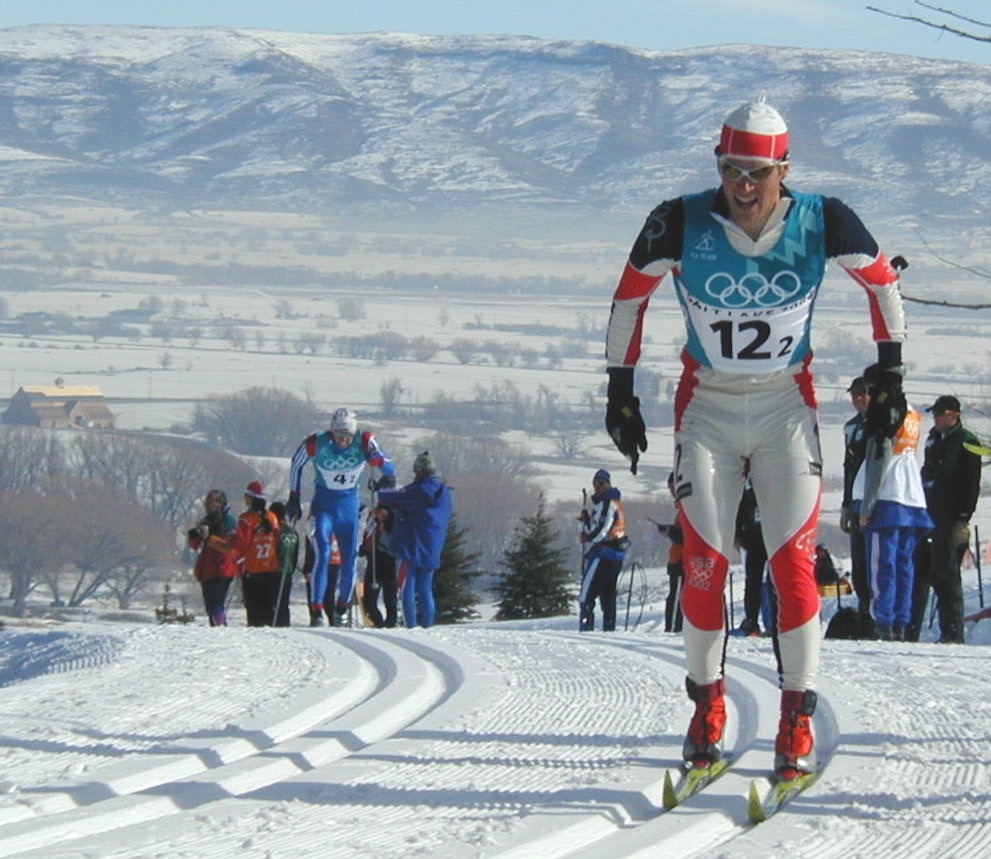
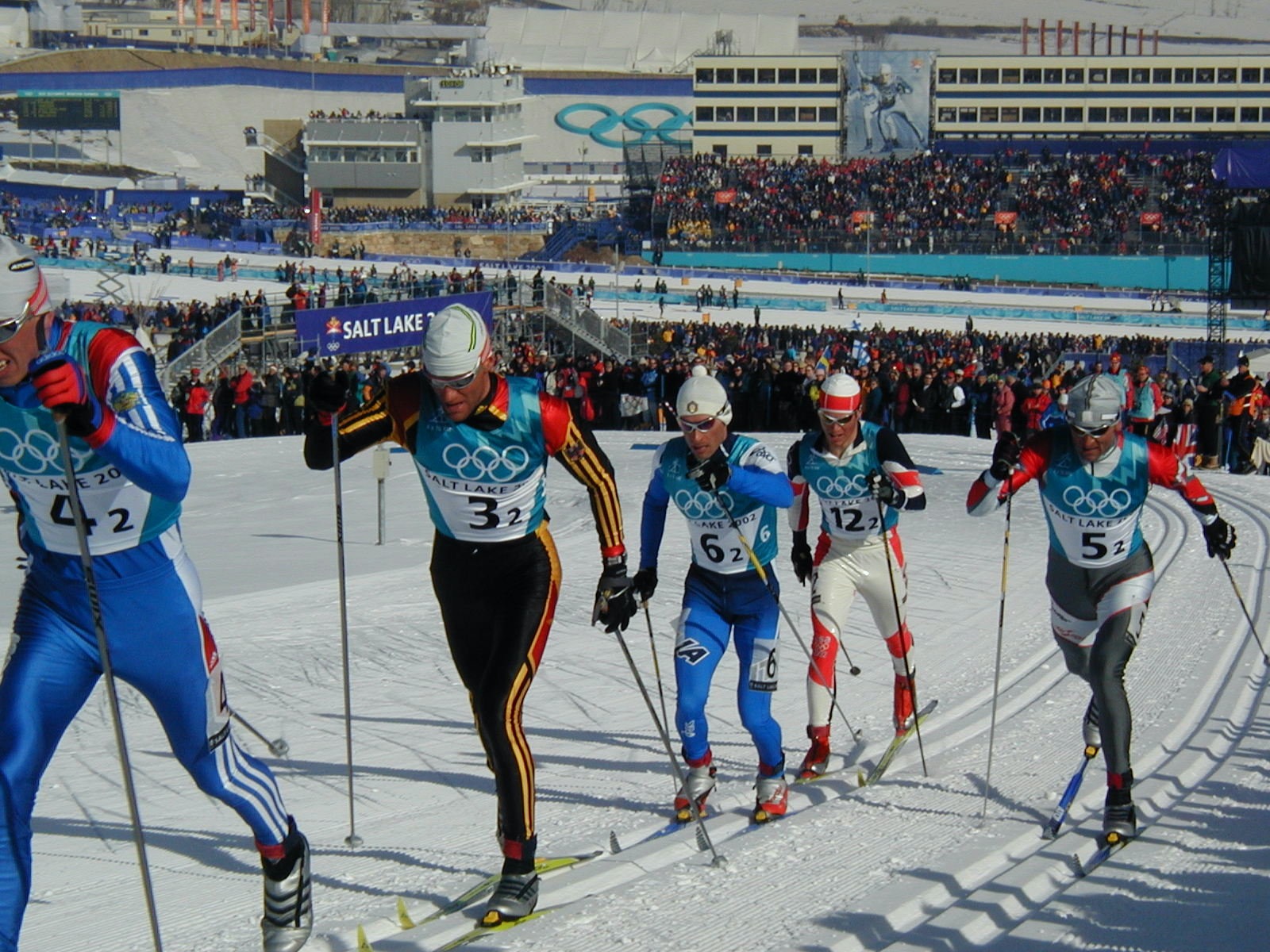
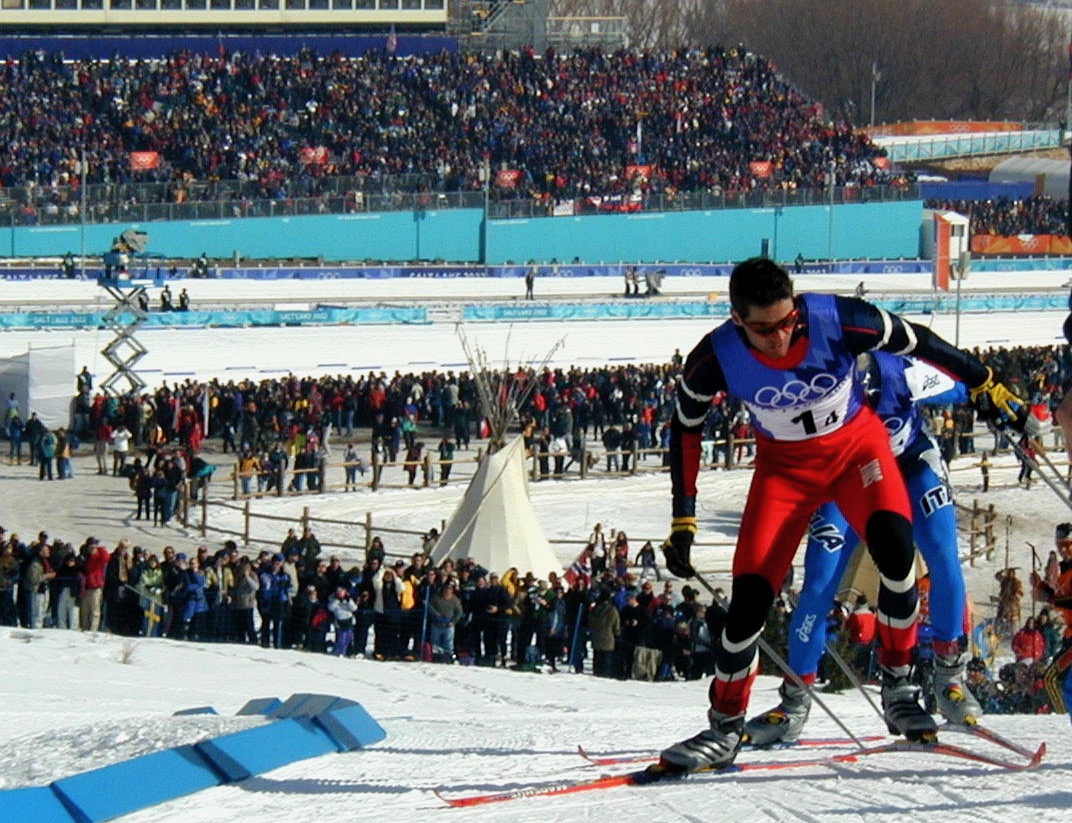
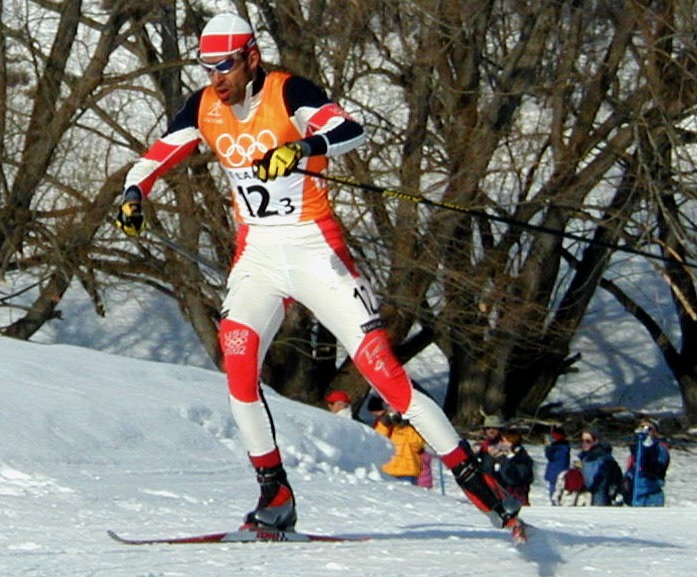
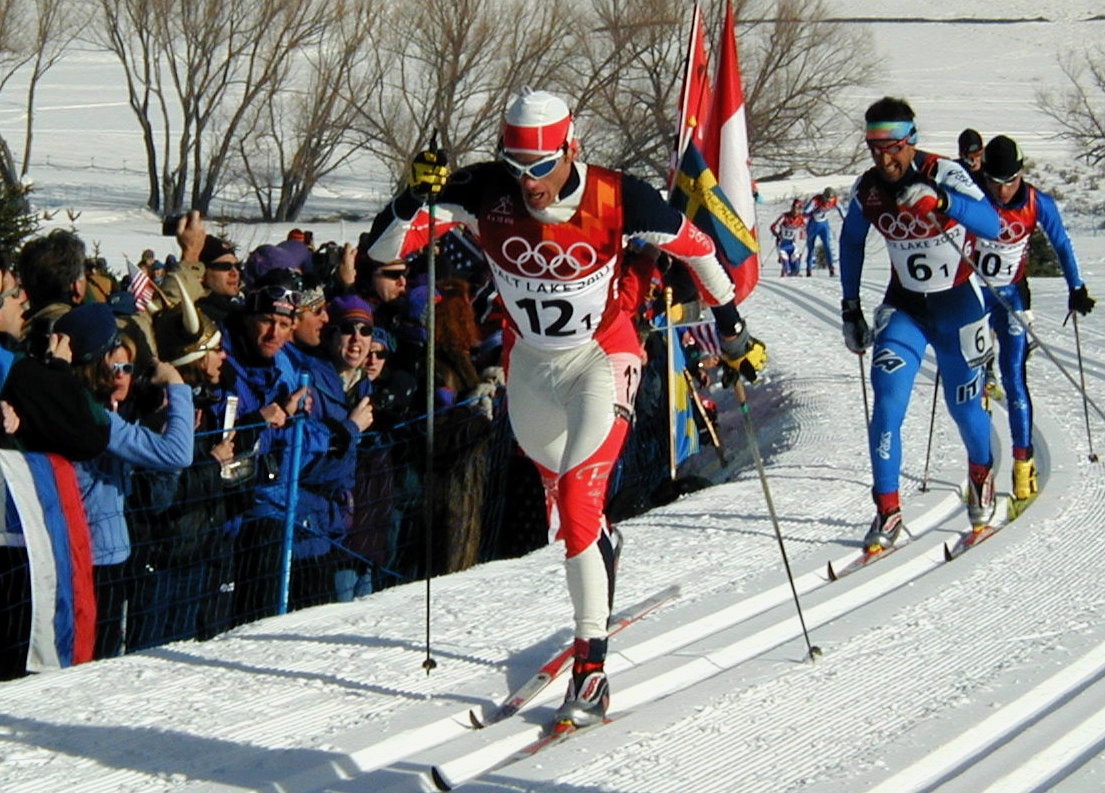
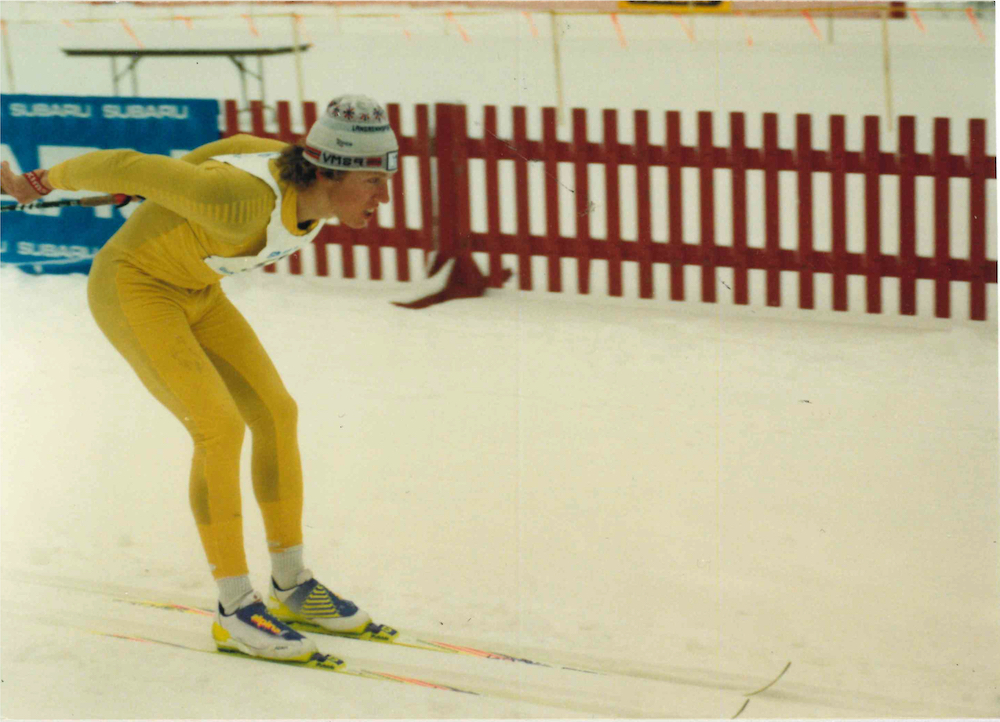
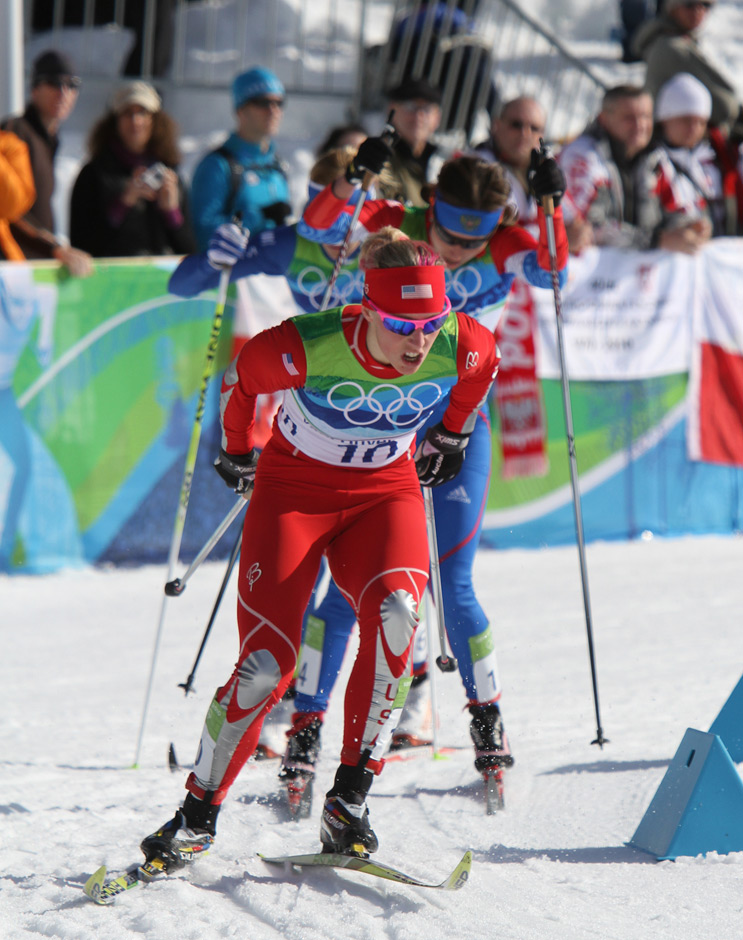
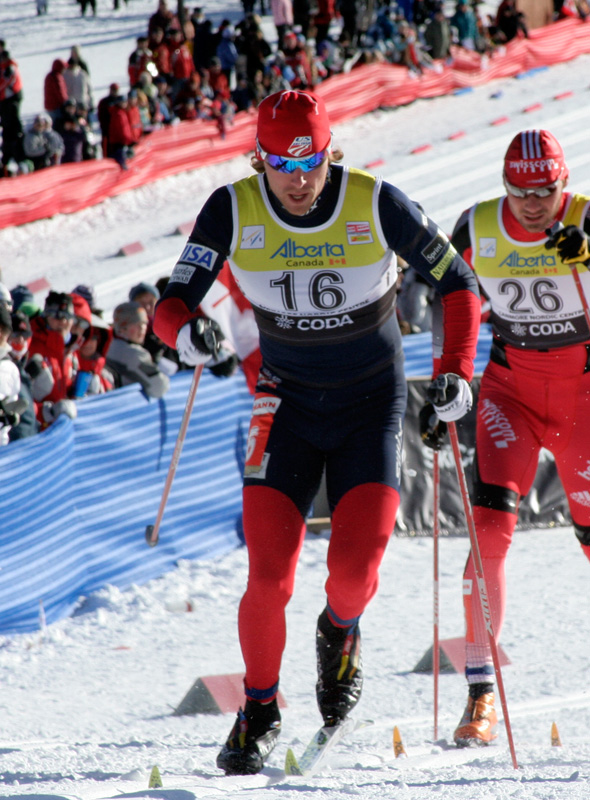
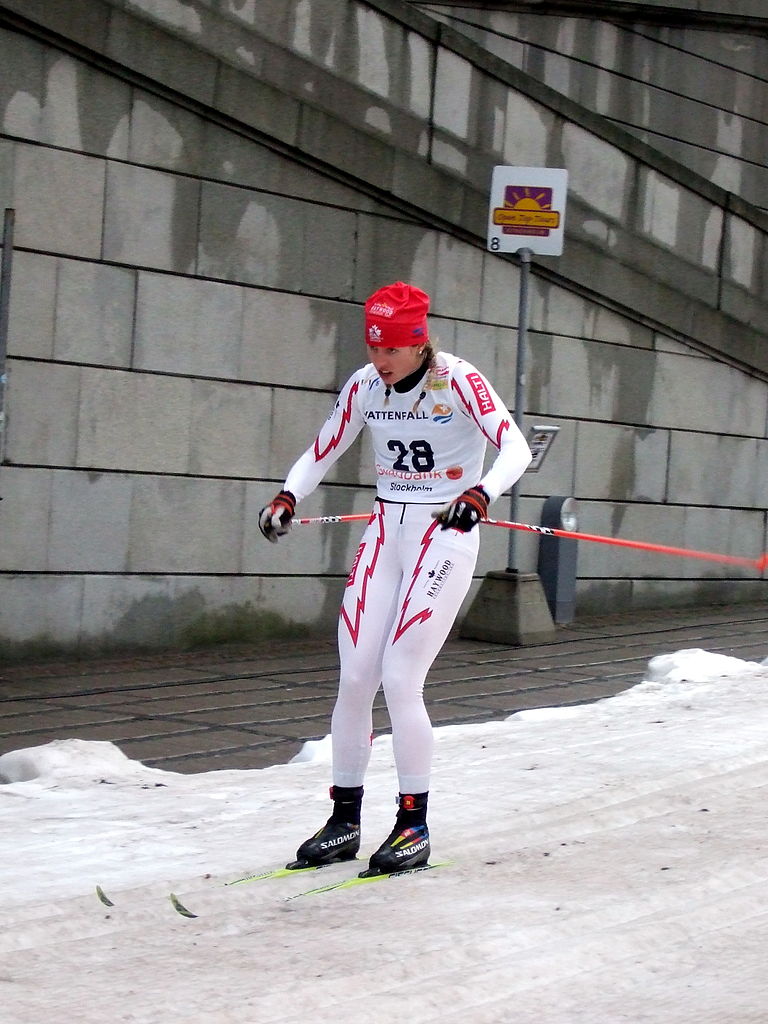
A 21-year-old Kris Freeman skis leg two of the men’s relay for the U.S. at the 2002 Winter Olympics at Soldier Hollow. (photo: Cory Smith)
This humble website went live twenty years ago today. (How long ago was that? Pretty long, judging from this recent Buzzfeed listicle.) As a later retrospective on this site would explain, “FasterSkier was founded in January 2002 by Torbjœrn Karlsen, Cory Smith and Erik Stange. FasterSkier.com was launched on February 1, 2002 and quickly grew to become one of the most trusted sources for Cross-Country skiing information in the United States … .”
The ur-articles from February 1, 2002, have sadly been lost to the ravages of time; the switch to the “modern” CMS interface has not been kind to content from the site’s first year. Early coverage presumably included a “Hello, World!” introduction, while the substantive focus was likely on the 2002 Winter Olympics, which began in Salt Lake City one week later.
Happily enough, the site’s Olympics coverage is preserved in its entirety, thanks to the intercession of the Internet Archive’s Wayback Machine. You can find a roundup of all 2002 Olympics coverage here, and a link to all compiled Olympic race reports here.
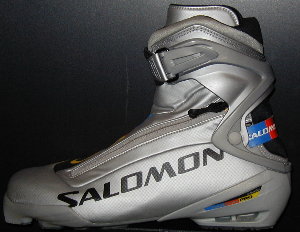
Coming soon to a store near you! Salomon Carbon Pro skate boot (photo: Cory Smith)
The articles are, collectively, a heck of a period piece, and are worth your time, particularly if you have been reading this site for years and would like to see how far the technology has come. You may also be interested in the gear reviews, of, for example, the new, all-gray Salomon Carbon Pro. “I think that they are a real improvement over the Pilot Racing Skate 9,” our reviewer wrote, in a comparison to the product better and more universally known as “bumblebee boots.”
It was tough to choose just one article from an embarrassment of historical riches to reprint for today, but this piece, a race recap of the men’s 4 x 10-kilometer relay, feels appropriate. Thomas Alsgaard; Cristian Zorzi; Anders Aukland; John Bauer; Kris Freeman. This was a long time ago.
(The writeup of the women’s relay, from four days later, may be found here; it ends, “The Americans finished a disappointing 13th,” and says little more than that about the American team composed of Wendy Wagner, Nina Kemppel, Barbara Jones, and Aelin Peterson.)
This article was written by site co-founder Cory Smith, and was originally published on February 17, 2002. Photos and captions, both also by Smith, are reprinted as they originally appeared. A few bonus race photos are appended at the bottom, thanks to Smith’s impressive archives.
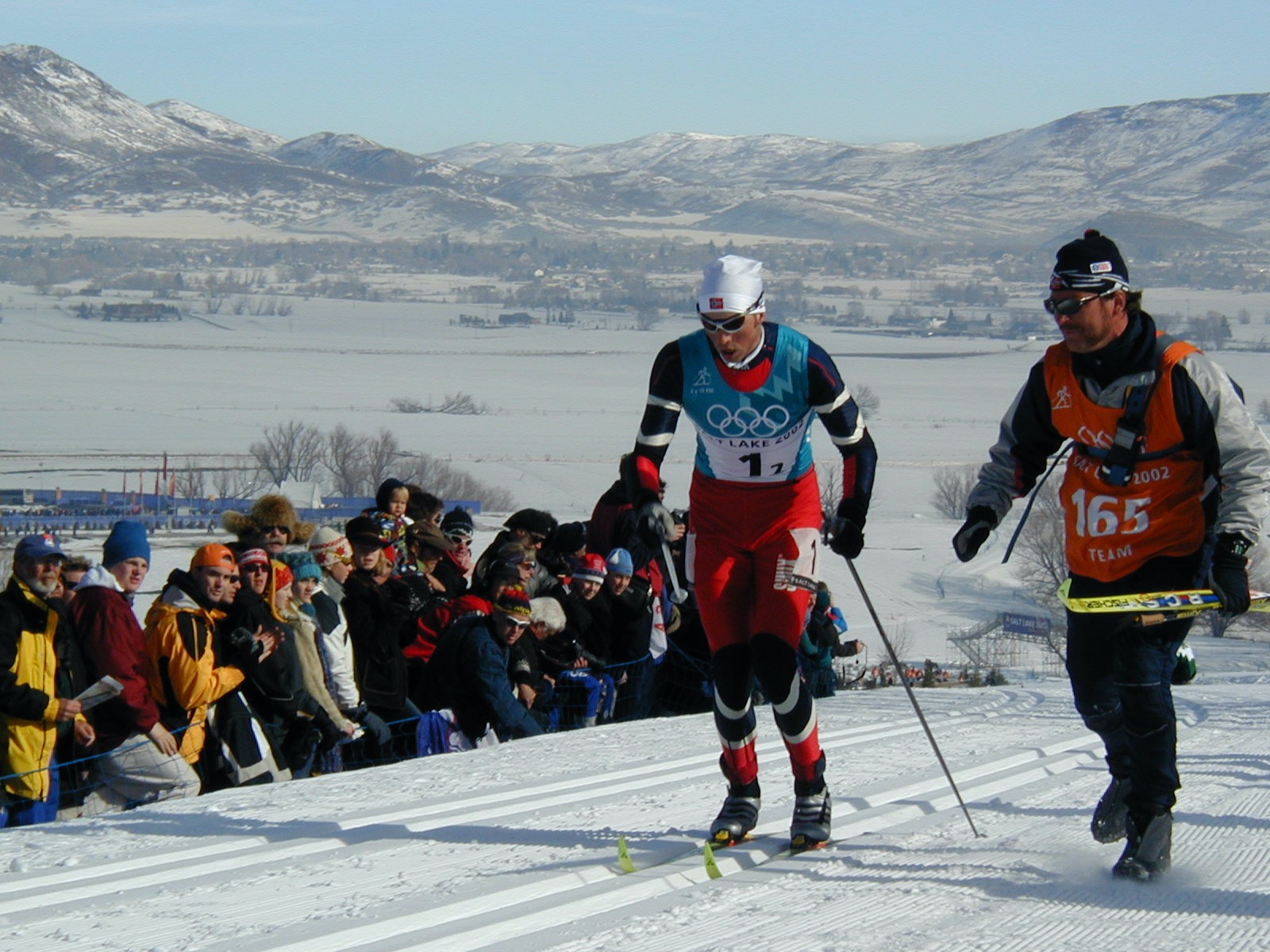
A Norwegian athlete skis in the men’s relay at the 2002 Winter Olympics at Soldier Hollow. (photo: Cory Smith)
Norway Beats Italy in Sprint to Finish (again), US Men’s Relay Team Posts Best Result Ever
By Cory Smith
By the length of one ski, Thomas Alsgaard brought order back to the cross country ski world. In today’s Men’s Cross Country 4 x 10K Relay race, the Norwegian team proved that even without an individual gold medalist in these games, they are still the best team in the world. Thomas Alsgaard outsprinted Cristian Zorzi in the final 100 meters to take home the gold for Norway.
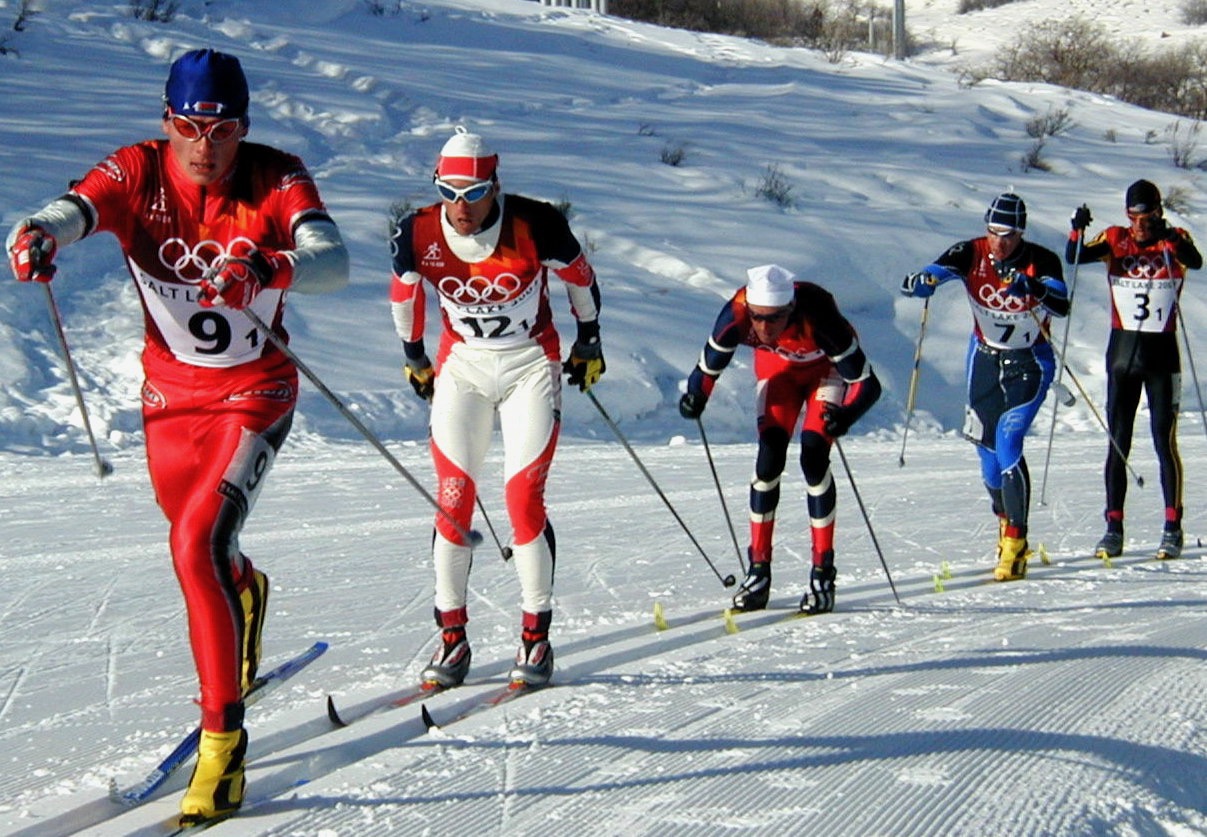
John Bauer (USA, bib 12) and Anders Aukland (NOR, bib 9) follow Belarus’s Roman Virolainen in the men’s relay at the 2002 Winter Olympics at Soldier Hollow. (photo: Cory Smith)
In a week that has seen more men’s gold medals for Estonia and Spain* than for Norway, and even a Canadian woman winning a medal, Sunday’s race was also extremely memorable, but with a more familiar outcome. The entire country of Norway was able to breathe a sigh of relief after their relay team put them back on top of the nordic world.
Meanwhile, the US men’s team, in the top five for most of the race, posted their top Olympic relay result by finishing a very impressive 5th. All four US skiers skied very fast and very smart to come within seconds of a medal for the first time ever.
Norway showed their dominance of the classic technique right from the start. After letting Belarus’s Roman Virolainen lead for much of the first lap, Norway’s Anders Aukland took control on his second 5K loop and opened a 10 second lead. Meanwhile, John Bauer, after a slow start that had him in last place out of the stadium, had moved up to the front of the pack and was actually leading the chase of Aukland. Bauer lost a few places gliding through the stadium, but he finished his excellent scramble leg in 5th place, right with Italy, Kazahkstan, and Germany, only 13 seconds off the lead.
Kris Freeman (bib 12) stays right with the lead pack. (photo: Cory Smith)
On the second leg, Norway’s Frode Estil build the lead up to a maximum of 24 seconds while Kris Freeman (USA) jumped in behind Germany, Italy and Kazahkstan in the pursuing pack. As the leg went on, Estonia’s Andrus Veerpalu bridged up to the pursuing pack, as did Russia’s Mikhail Ivanov and Austria’s Mikhail Botvinov. This pack of six strong skiers started to cut into Estil’s lead, but as the leg came to an end, the pack began to break up. At the end of the second leg, Norway had an 11 second lead over Russia and Estonia. Kris Freeman skied an amazing strong race to stay in the thick of it, coming in right behind Italy’s Giorgio di Centa, in 5th place only 25 seconds off the lead. Halfway through the relay and the US men were only 14 seconds from a medal!
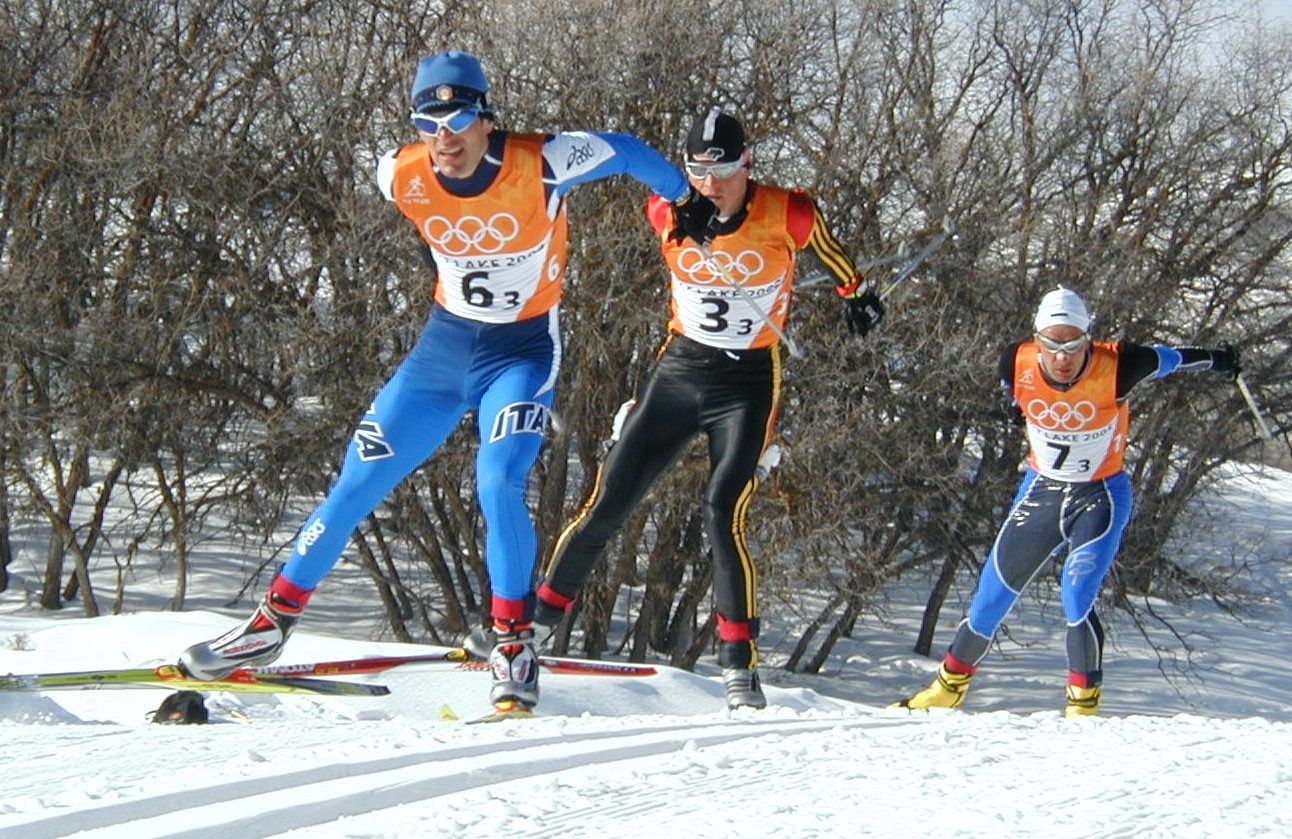
Pietro Piller Cottrer (ITA) charges towards the lead with Tobias Angerer (GER) in tow. (photo: Cory Smith)
The clear standout on the third leg was Italy’s Pietro Piller Cottrer. He started his leg in 4th place, then quickly passed the Russian and the Estonian and after about 5K, he was right with Norway’s Kristen Skjeldal fighting for the lead. The two of them skied together the rest of the leg, setting up yet another epic final duel between Italy and Norway. Justin Wadsworth looked to finally be over the head cold that had hindered him all week. He was smart enough to not try to stay with Piller Cottrer, but instead skied a very solid leg all on his own, until he was caught by Austria’s Gerhard Urain, whom he latched onto and followed until blowing by him near the end of the leg to finish in 5th place. In between the leaders and Wadsworth, Germany and Estonia came in together in 3rd and 4th.
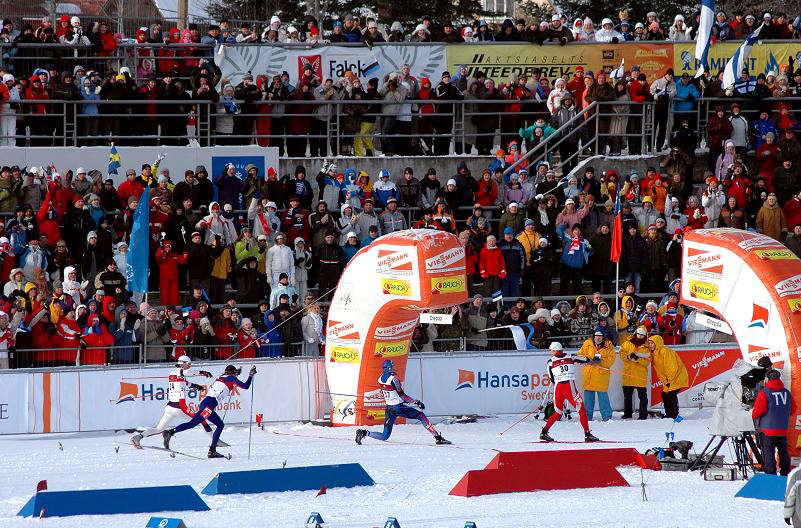
Alsgaard leads Zorzi into the stadium to sprint for all the marbles. (photo: Cory Smith)
On the final leg, it became obvious that Alsgaard’s strategy was to try and shake Italy’s Zorzi, one of the best sprinters in the world, early. Alsgaard led most of the leg, but Zorzi held tight. Meanwhile, Germany’s Rene Sommerfeldt had pulled away from Estonia to assure a bronze medal. Carl Swenson jumped in behind Russia’s Nikolaj Bolchakov and Austria’s Christian Hoffman and they quickly passed the Estonian team. With the top three significantly ahead, Swenson was skiing strong and relaxed, as is his trademark, and was clearly gearing up for the finish. Along the way, they dropped the Russian, setting up a duel between Hoffman, who outsprinted Alsgaard in the 1999 Relay to win the World Championship, and Swenson.
Speaking of duels, Alsgaard and Zorzi were putting on a tactical clinic. Going up the last big climb at 9K, Alsgaard had the lead and tried on a couple of occasions to put on a kick and lose the Italian. But Zorzi held tight and made a pass just before the top of the hill. Just before the downhill, Zorzi dropped into a tuck and slowed way down, obviously trying to get Alsgaard to pass, so that he could draft.
Alsgaard wanted nothing to do with that plan and instead of passing, he pushed on the back of Zorzi’s ski with his pole to speed him up. Then Zorzi pulled over and nearly stopped. Alsgaard did the same. They were a kilometer from the finish and they were standing still arguing about who was going to lead!
Alsgaard eventually took the lead reluctantly. They went stride for stride up the short hill by the stadium and then dropped down to prepare for the sprint. On the gradual downhill, Zorzi freeskated hard to take the lead, and had about 5 meters on Alsgaard as they rounded the turn. Alsgaard then kicked it in and began gaining on Zorzi. With 50 meters to go, they were dead even, but it was clear that Alsgaard had greater speed. Alsgaard got a slight lead and held it. It was a very close finish, but there was no doubt that Norway had won.
Carl Swenson and Christian Hoffman pass the Russian team. (photo: Cory Smith)
Germany’s Sommerfeldt finished all alone in a surprising 3rd, and was mobbed by his bronze-winning teammates as he crossed the line. The battle was now for 4th. Swenson was up against formidable competition in Hoffman, but if any American could outsprint him, it would be Swenson and that’s why he was in the anchor position. Hoffman had the lead around the corner and they went toe to toe down the line.
For a moment it looked like Swenson would catch him, but there just wasn’t enough distance left. Another 20 meters and he would have had it. But instead Austria took 4th and the US maintained its 5th place on all four legs to post its best relay result ever.
The US skiers skied very, very well, both physically and tactically. But none of them skied unbelievably well, they all simply skied strong like they have all week. What I am trying to say is that this was no fluke. They finished right where they belong. They have been one of the top five teams on these trails all week and today they certified that. What is even more amazing is that there were two other American skiers, Pat Weaver and Andrew Johnson, who could have filled in and skied just as well. The US now has at least six World Class skiers. Don’t look now, but the United States is a force to be reckoned with.
20,000 people cheer wildly at Soldier Hollow. (photo: Cory Smith)
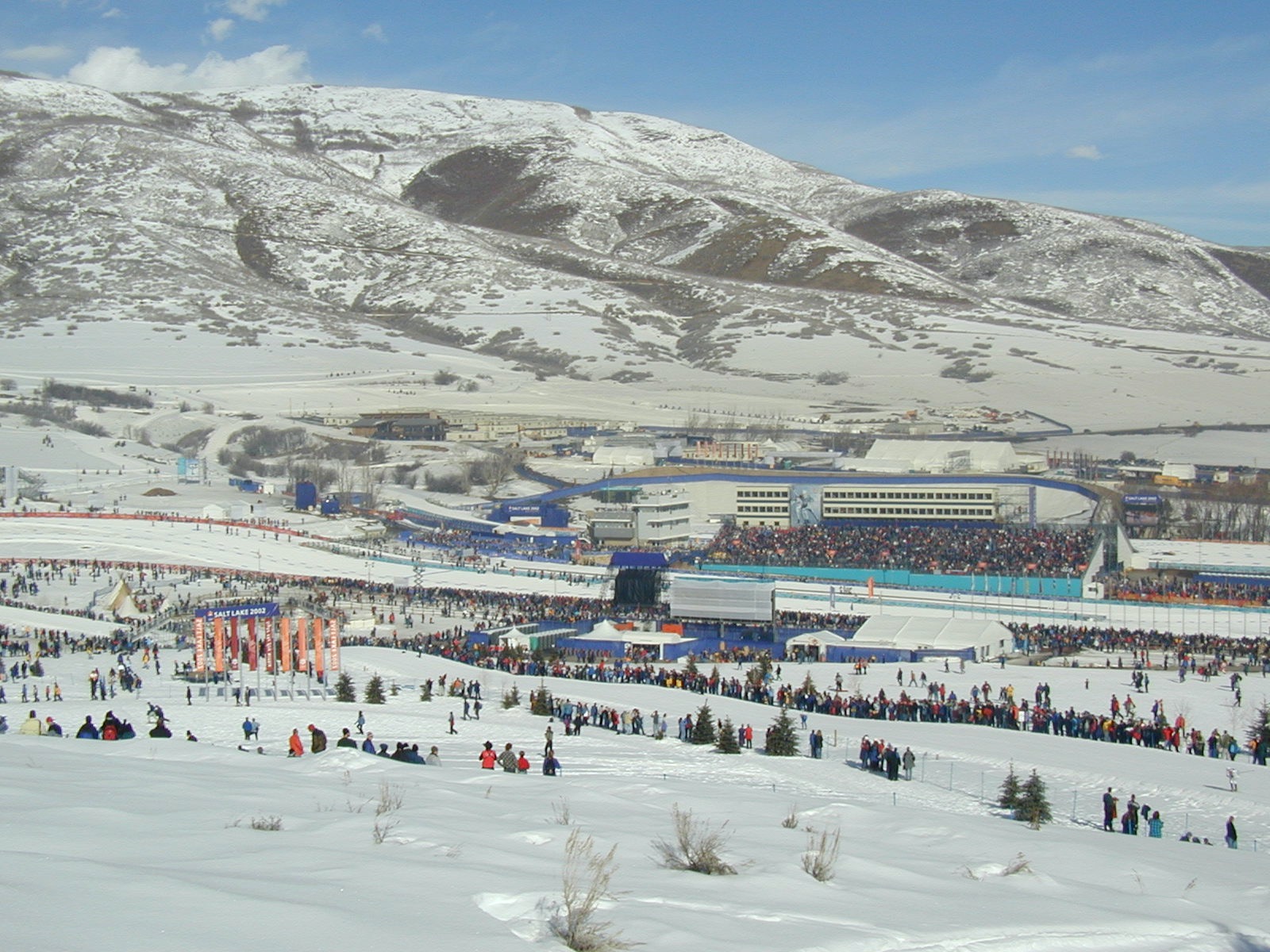
Just as amazing as the race itself, was the crowd. Soldier Hollow was sold out for the first time ever, with 20,000 people watching a cross country ski race in this country for the first time ever. The crowd was loud and energetic. It was a sight that warmed the hearts of all Nordic die-hards on hand. Today, our little sport took a huge step forward in many ways.
[* Modern-day footnote: This statement, while accurate at the time, was ultimately belied by history, as the three gold medals that Johann Mühlegg won for Spain at these Olympics (in the 30-kilometer skate, 50-kilometer classic, and 2 x 10-kilometer pursuit) were subsequently rescinded following his disqualification for a positive darbepoetin test.]
Some additional photos from this race:
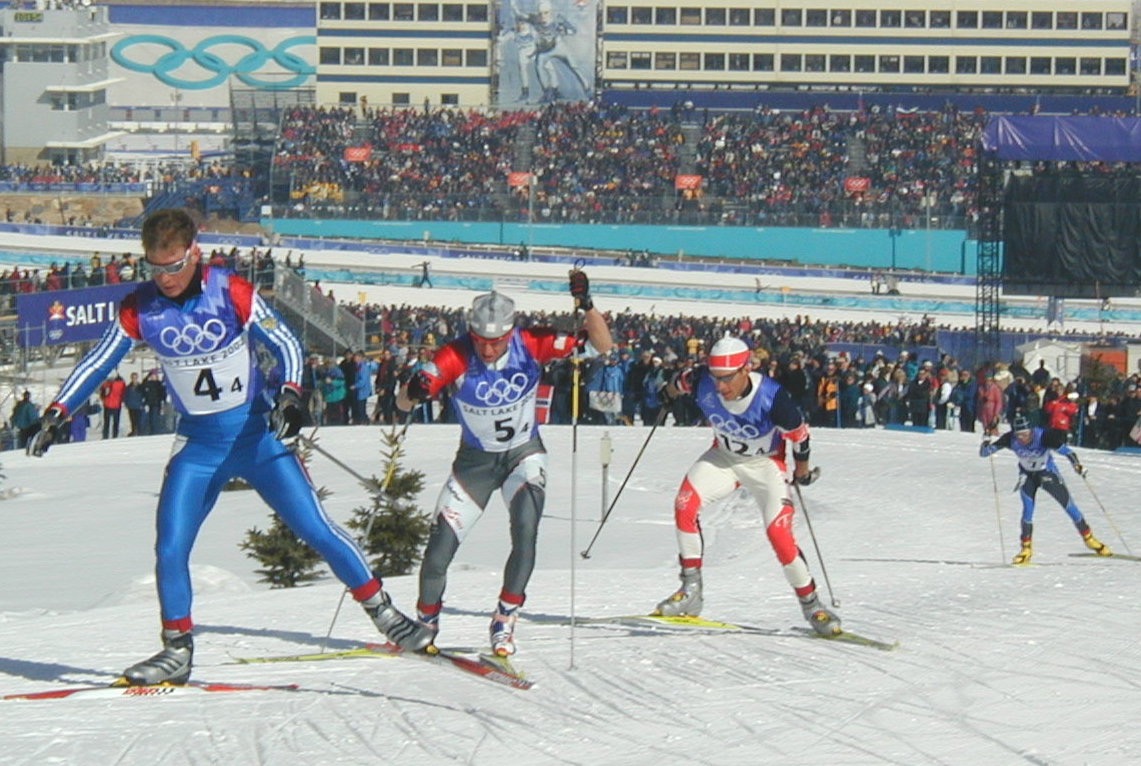
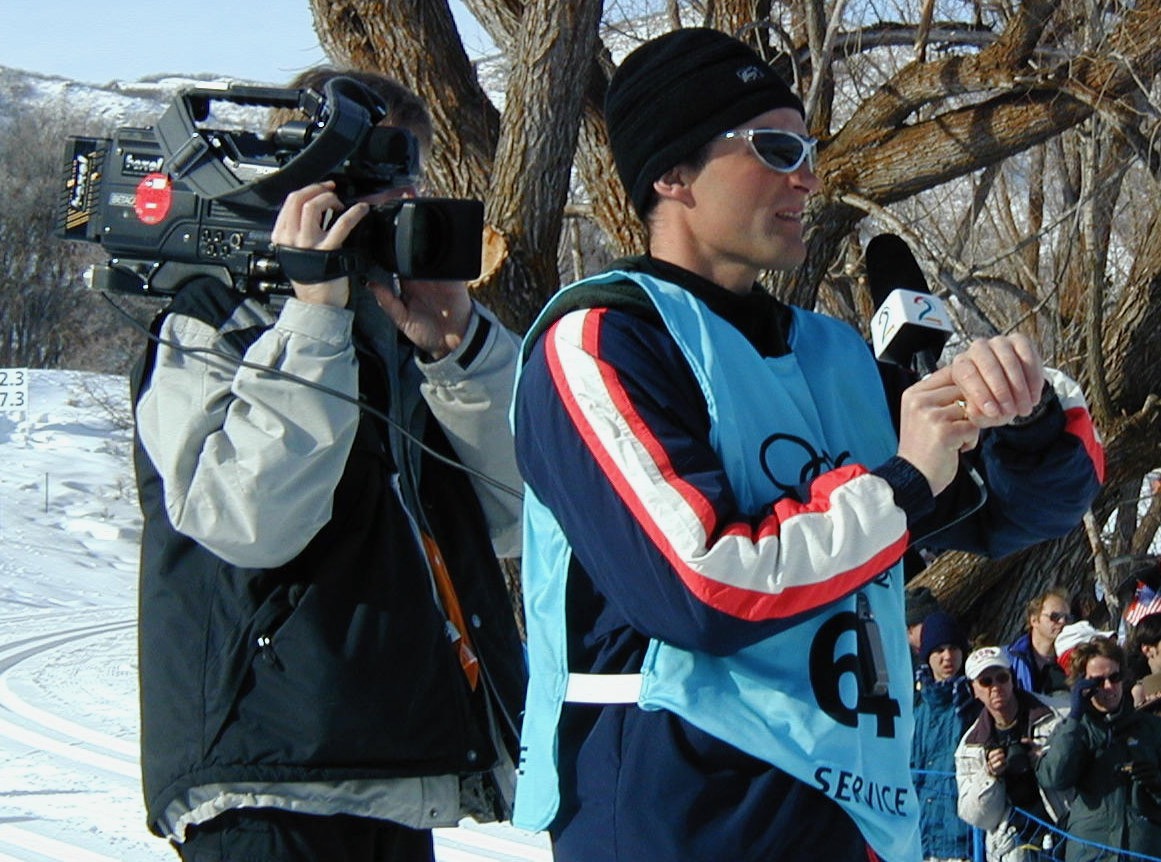
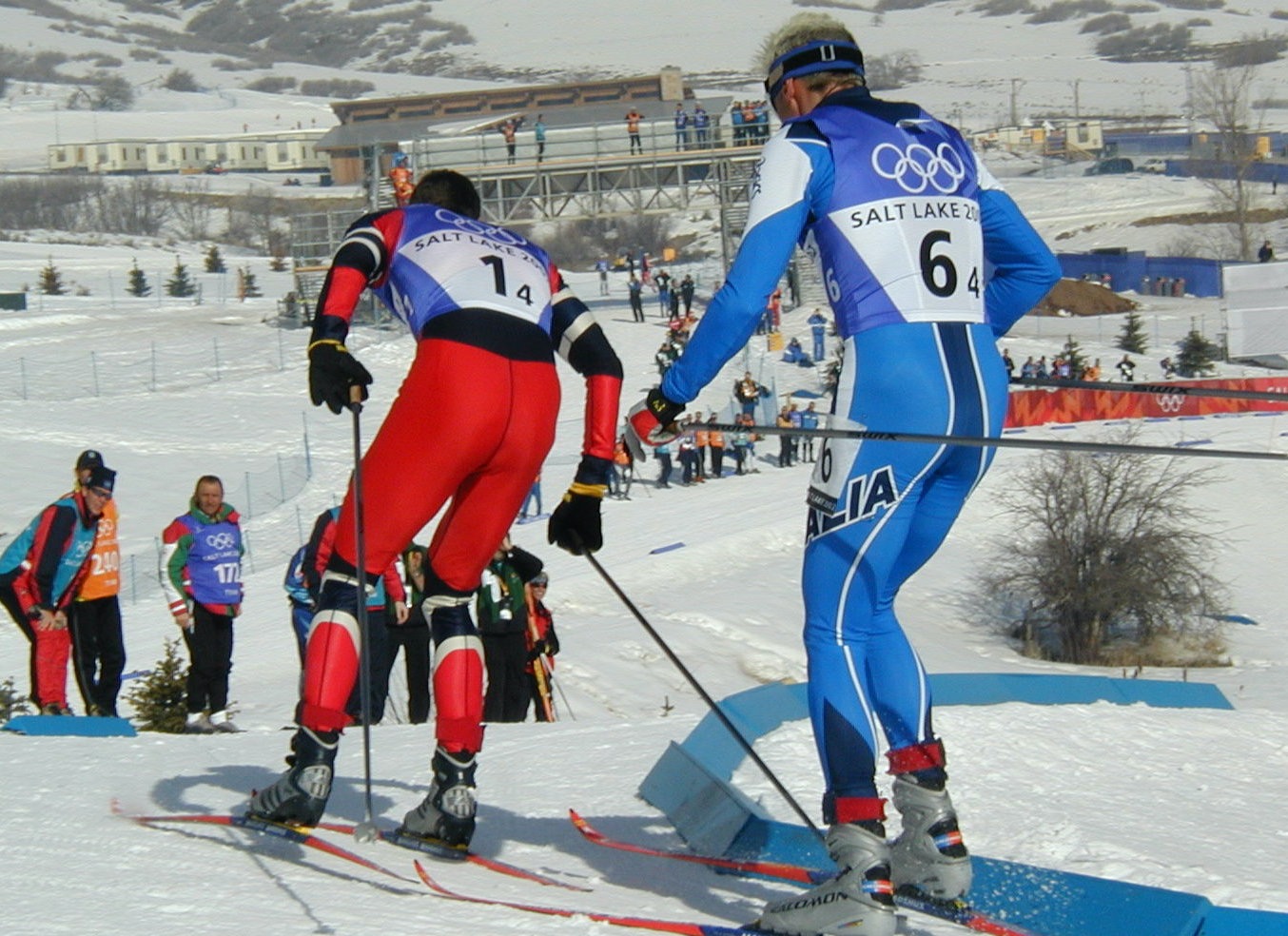
Vegard Ulvang serves as a commentator for Norwegian television at the 2002 Winter Olympics at Soldier Hollow. (photo: Cory Smith)Thomas Alsgaard leads Cristian Zorzi in the men’s relay at the 2002 Winter Olympics at Soldier Hollow. (photo: Cory Smith)Justin Wadsworth skis leg three of the men’s relay for the U.S. at the 2002 Winter Olympics at Soldier Hollow. (photo: Cory Smith)John Bauer skis leg one of the men’s relay for the U.S. at the 2002 Winter Olympics at Soldier Hollow, slightly ahead of Fabio Maj of Italy (bib 6) and Andrei Golovko of Kazakhstan (bib 10). (photo: Cory Smith)
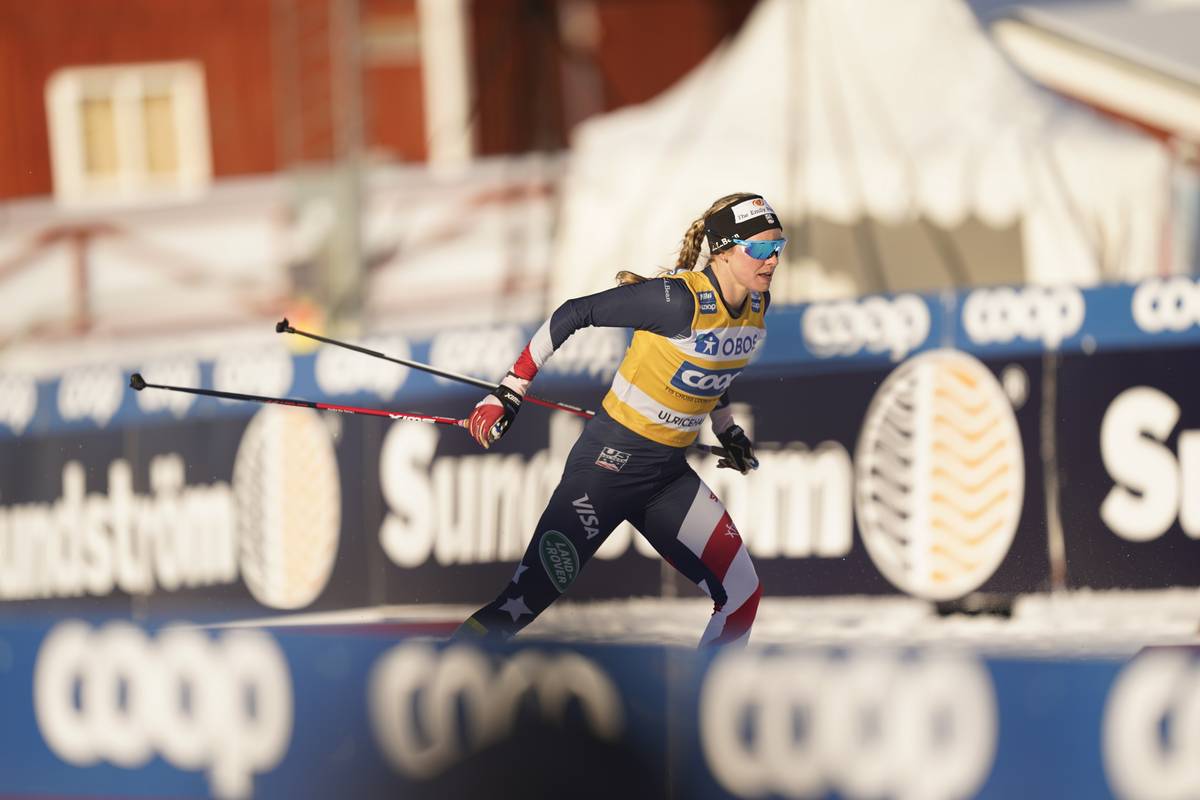
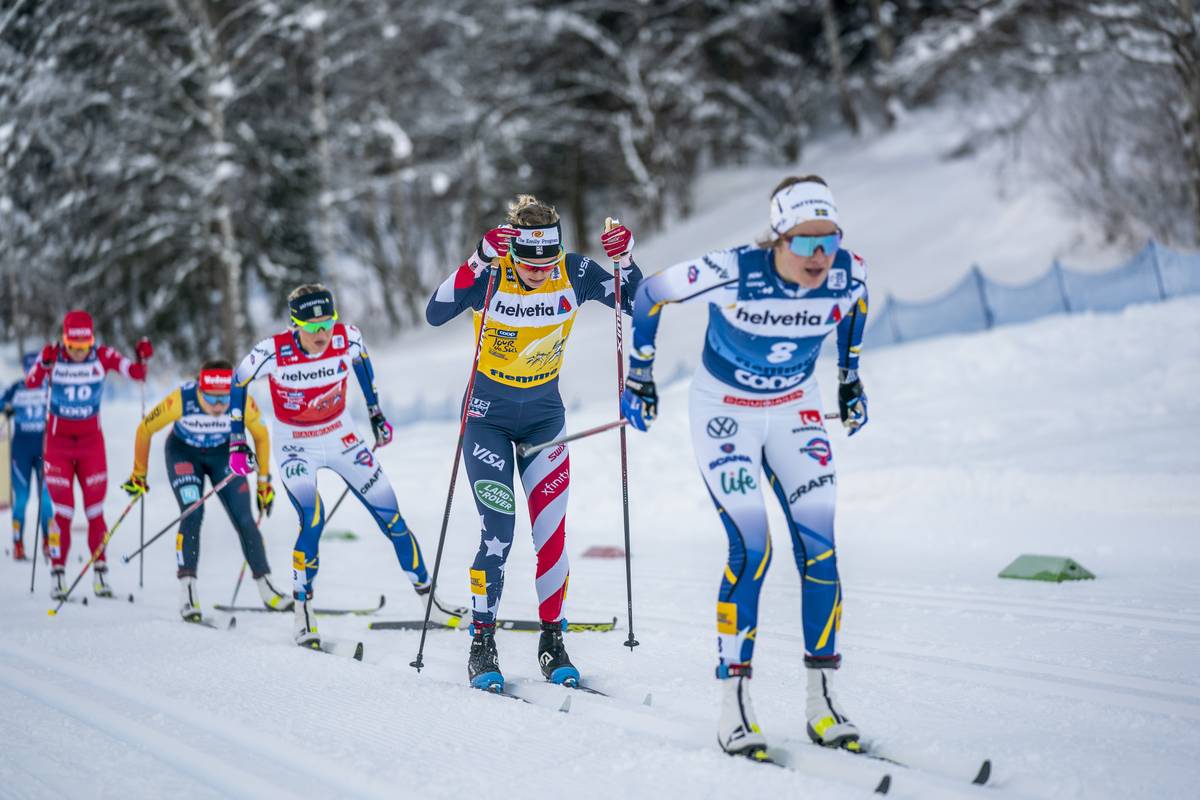
As January draws to a close, energy, excitement, and perhaps anxiety surrounding the rapidly approaching 2022 Olympic Games in Beijing is steadily building. In an effort to better manage her time and energy heading into these Games, Jessie Diggins offered a media conference facilitated by U.S. Ski & Snowboard cross country communications manager Tom Horrocks to answer questions about her preparation, outlook, and plans for the remainder of the time before the team heads to the athlete village in Zhangjiakou.
Diggins began the conference with a comment on the team that has been named. Of the fourteen athletes named to the Olympic cross country team, just four have competed in past Games. Diggins is headed into her third Olympics with ten total Olympic races under her belt, while Rosie Brennan, Caitlin Patterson, and Scott Patterson competed only in the 2018 Games. In Pyeongchang, Brennan competed in just the skiathlon, while Caitlin Patterson raced in the skiathlon and 30k classic, and Scott Patterson raced in each of the three individual distance events plus the men’s relay.
Six of the athletes were born in the year 2000 or 2001. Overall, it’s a relatively young crop of athletes, many of whom have very limited experience racing at the international senior level compared to veteran-dense teams like Norway.
Diggins emphasized that the age and experience of the team should not be associated with what fans of the sport should expect to see in competition, adding that she is individually very excited to see what her teammates will do at the Games.
“Everyone’s working so hard,” she said. “And staying really cool in what is a stressful time – with COVID, and with variants, and with all the different paperwork and all the things that you need to do headed into any Olympics, but especially this one, given the extra hurdles with COVID… I think everyone’s doing such a remarkable job of not only handling all the extra stressors very well, but also still being excited and still seeing this as, ‘Okay, we’re gonna find ways to make this fun. Obviously, it will be different from Games in the past, and probably different from future Games too…’
“I think we’re in a really good place, despite everything that’s happening in the world. And I think that’s kind of one of the things that the Olympics does for us is it lets us feel inspired and let go of all the stresses that we’re feeling in the moment. Or at least that’s what the Olympics I think is supposed to do.”
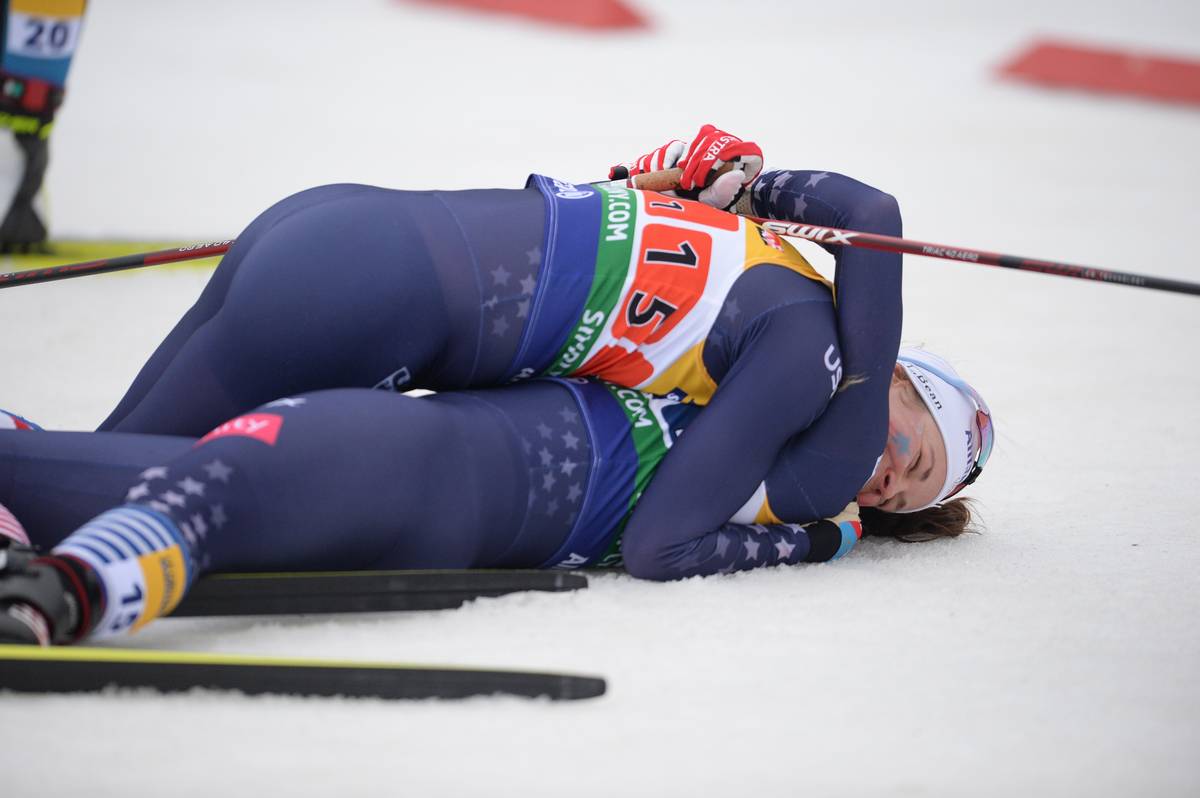
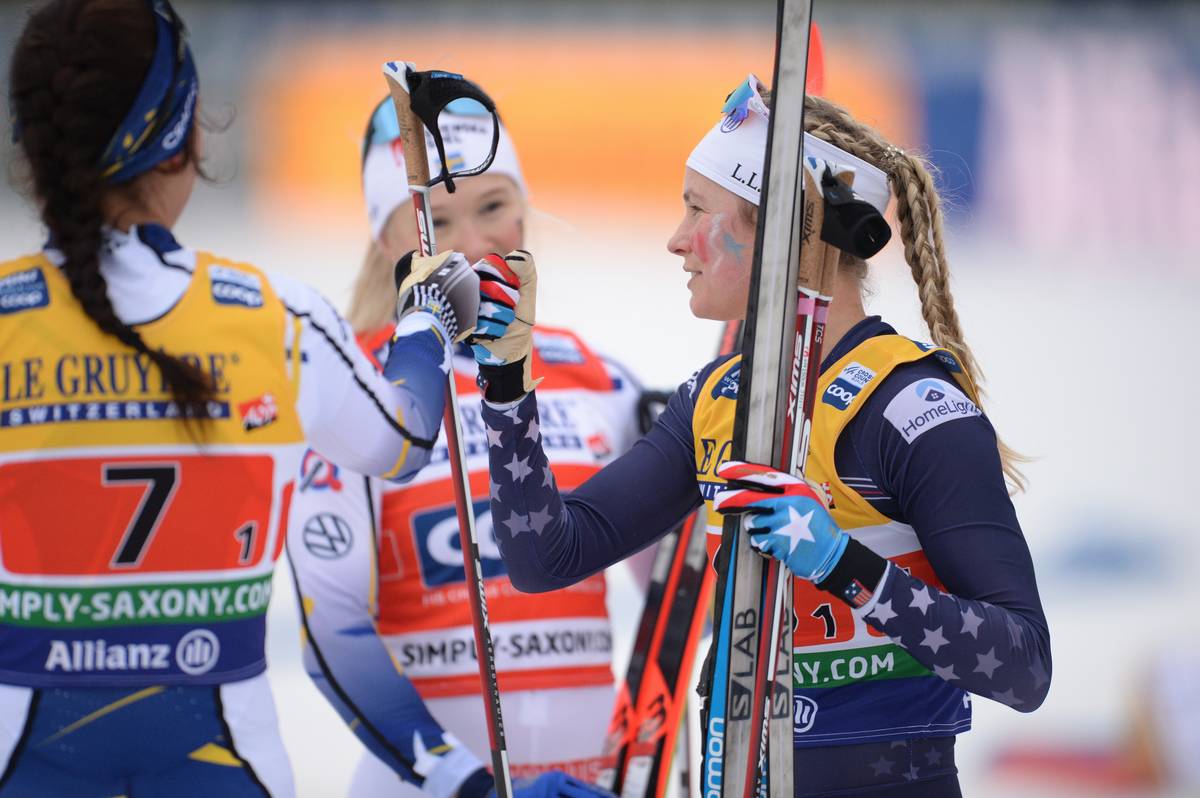
Jessie Diggins embraces team sprint partner Julia Kern after the pair took second place in the freestyle team sprint in Dresden, Germany in December, 2021. (Photo: NordicFocus)
Following the Tour de Ski, the members of the team who planned to remain in Europe began a recovery training block in Seefeld, Austria, which sits at roughly 3,800’, before moving to higher elevation to begin an altitude training camp. Having come down with a head cold during the final stages of the Tour de Ski, Diggins expressed the value of this recovery block, particularly in a location where her body was not further impaired by altitude-related physiological effects.
“Within two days after the tour, I was symptom free. Five days later, totally healthy and able to train totally normally again. So that was really, really nice to dip down in altitude and recover and feel like I absorbed everything that the tour brought in terms of training stimulus.”
With the cancellation of the final two World Cups before the Olympics, the team headed to Livigno, Italy earlier than originally planned, earning them extra time training at a venue that sits at a nearly identical elevation to the competition venues in Zhangjiakou. Diggins expressed that this has provided the team with a variety of excellent training options, from challenging race courses to flat valley skiing ideal for recovery, all supported by a team of staff that includes wax techs, a chef, and a physical therapist.
Acknowledging individual variation athlete-to-athlete, Diggins explained that overall the team’s preparations have looked “normal” in terms of how they would train and peak leading into another Championship. To account for the lack of races, the team has been building in simulations, including practicing events that have not been included in the World Cup calendar yet this season.
“Yesterday, Julia and I did a skiathlon simulation,” Diggins shared. “It was awesome. It was really hard. And I’m so glad we did it. We had coaches going nuts – taking video, cheering for us. We had bibs on, we had pits set up, we had everything to simulate it, which was really nice, because we don’t get to do very many skiathlons anymore. And it was really cool to practice that pacing at altitude. That was really helpful.”
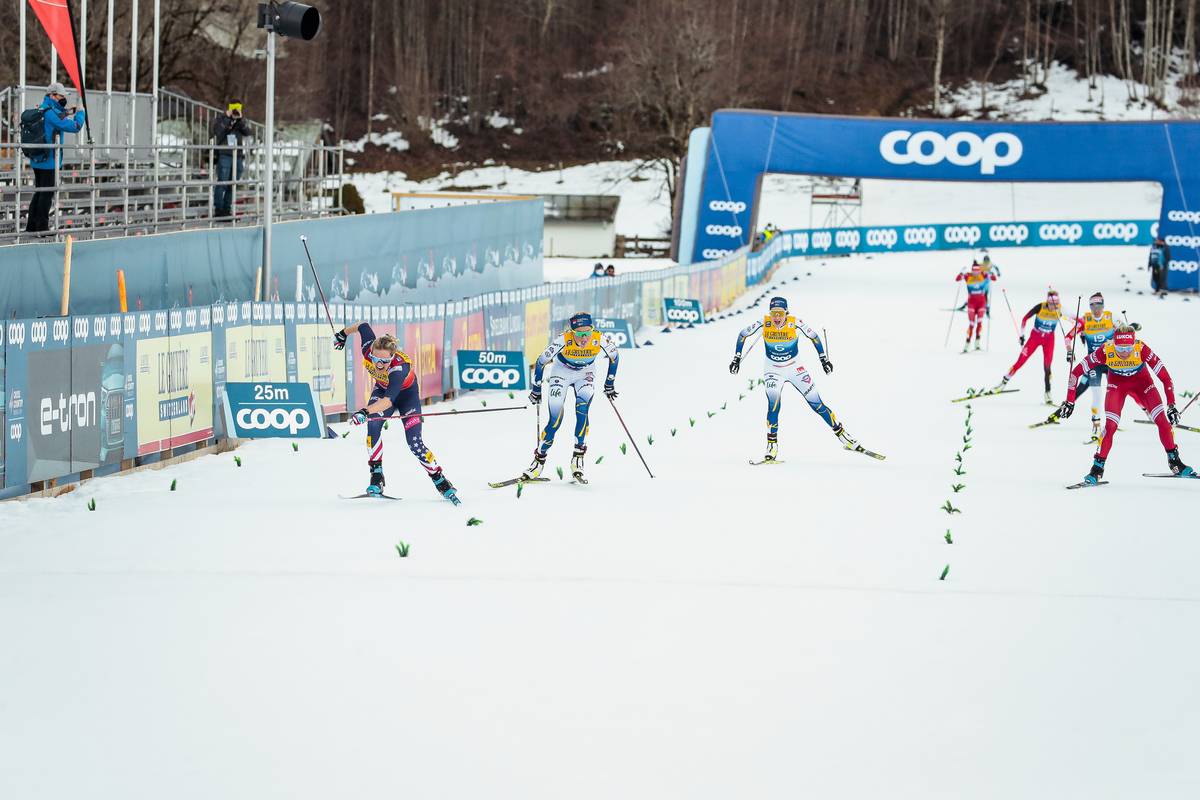
With an epic free skate in the final meters, Jessie Diggins wins the thrilling 10-kilometer mass start freestyle in Oberstdorf, Germany during the 2021/22 Tour de Ski. (Photo: NordicFocus)
In previous press conferences, Diggins has emphasized the importance of frequent racing in helping her reach her mental and physical peak during the season. She had planned to race in at least the first World Cups after the Tour de Ski in Les Rousses, France before they were canceled. With this piece of her plan suddenly removed, what would she do to replace these stimuli to ensure her preparations were unaffected?
While Diggins shared that she loves racing in France and had been looking forward to the races in Les Rousse, she quickly found a silver lining to the cancellation. And to the many setbacks she faced in the second half of the Tour.
“[The cancellation was] kind of a huge blessing in disguise,” she stated affirmatively. “I was able to fully absorb the Tour and then build in a full training block and move up to altitude sooner. I felt like, ‘Whoa, actually, this is kind of perfect.’ This is how I would have designed it because I got in all the racing I needed to in terms of World Cups. Mentally, I felt like the tour was kind of the icing on the cake in terms of getting mentally strong. In terms of being able to push myself – being mentally there, being positive in any situation, all of that – that was the best preparation I could have ever asked for.”
In terms of replacing the intensity of World Cup racing, Diggins expressed her confidence both in the training sessions the team has put together, and the ability of her teammates to push themselves and each other.
“I feel really fortunate because my greatest strength has always been being able to push myself no matter what. And so I was like, ‘Well, this is totally fine, because even if there aren’t World Cups, that’s not a problem.’ I pushed myself in our time trials so hard that I couldn’t feel my legs and I was tasting blood. And that was in a time trial with just one other athlete.”
In year’s past, the Americans have collaborated with athletes from other nations when paths have crossed; for example, in December 2020, the Americans raced in a set of time trials with athletes from Russia, Italy, Switzerland and Germany while all were training in Davos following a canceled World Cup event in Lillehammer, Norway. In lieu of opportunities to face off on the World Cup, these collaborations have perhaps provided a measuring stick to see how an athlete’s fitness might compare at the international level. Did the lack of this type of opportunity affect Diggins mental preparation heading into her goal races in Zhangjiakou?
“In terms of the lack of international feel, that’s also been a blessing in disguise, because everyone’s worried about germs. When you get more and more people [together], then you’re exposing yourself to more and more people who aren’t in your bubble. I can’t speak for how other countries feel, but for me, it’s made me feel very safe from a COVID perspective to say, ‘Nope! We’re just gonna keep this as tight as we can, and run some very small time trials.”
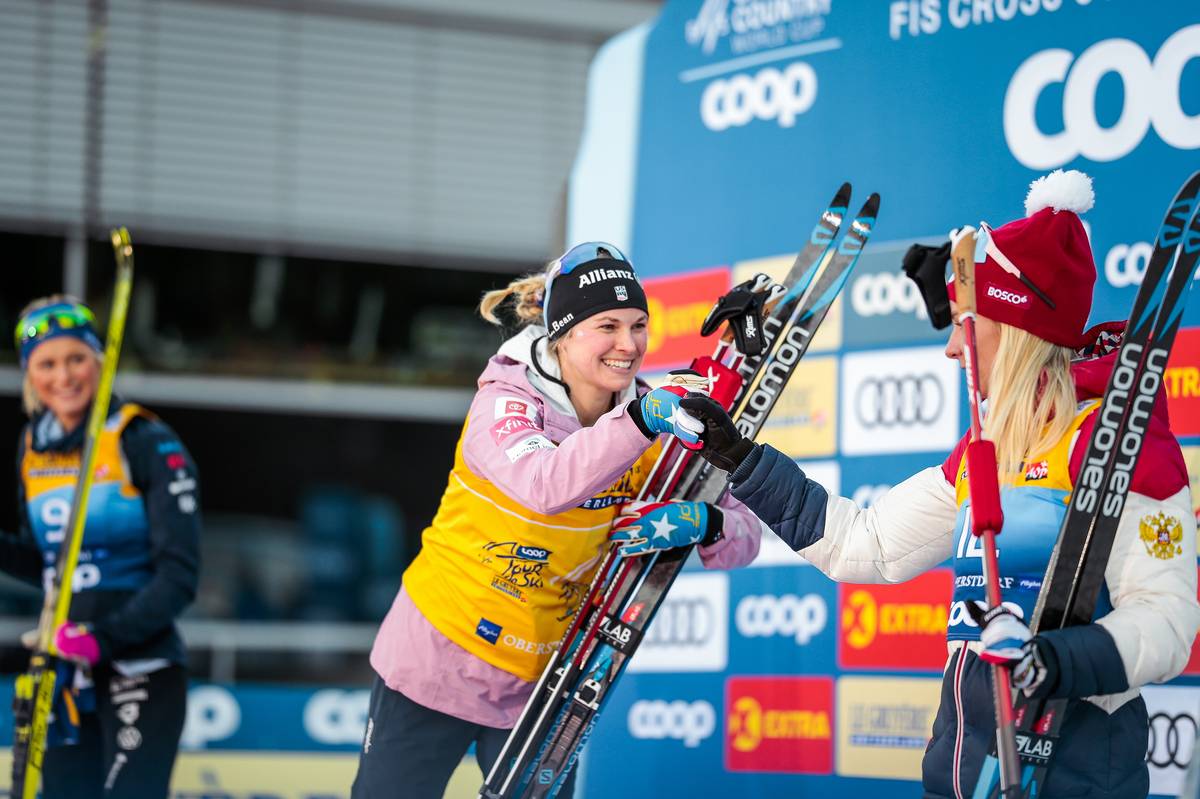
Jessie Diggins wins the 10k mass start freestyle in Oberstdorf, Germany during the 2021/22 Tour de Ski. (Photo: NordicFocus)
Staying in the COVID-vein, Diggins also fielded questions from Matt Futterman of the New York Times regarding her fear level and the tension among the team about getting COVID, which remains rampant. A positive result would be a “nightmare scenario”, in his words, for an athlete as it could prohibit travel to Beijing, admission to the Olympic bubble, and/or the ability to compete in the Games?
“It would be silly to pretend that that’s not a stressor, right? I think it’s important to acknowledge that, COVID, especially the variants, are everywhere. It seems like every day, you hear about an athlete or somebody getting sick, and so that is hard. But I think one thing that we’ve done really well is created a bubble with really strict rules that we feel really safe within.”
Diggins explained that the team who is currently based in Livigno has minimal contact with those outside of their “bubble”. The chef is the only person from the group who goes to the grocery store, always while wearing a KN95. Otherwise, the small group only interacts with its members, not entering any buildings beyond the house they are staying in. Athletes who have recently flown over from the U.S. are staying in a separate apartment to quarantine for a week, before joining the larger team.
With reassurance from daily antigen testing and weekly PCR testing, they are living a monk-like lifestyle focused on heading out the door to train, and otherwise focusing on optimal nutrition, recovery, and logistical preparations for the Games.
“We’re trying really, really hard to make sure we protect each other. So even when we’re in this house, when we leave the room, we have our mask on. So you’ll be hanging out in the living room and everyone has KN95s on. So it’s a lot. And I think you hear the phrase ‘out of an abundance of caution’ everywhere now, but I think that is what we’re doing – taking all the cautionary steps that we can.”
Futterman acknowledged that for some, these protective measures can have an adverse effect on stress levels; rather than reassurance, the constant vigilance might leave an individual “freaked out”. Diggins affirmed that the decrease in risk relieved far more tension than the heightened awareness caused.
“It would be more stressful to feel like we’re just risking it… I think that wearing masks has actually lowered everyone’s tension level because you don’t have to wonder ‘what if?’ because we know that the masks work. So if you are wearing your mask, you don’t have to be stressed, because you’re doing everything that you can. I think that mentality of: ‘We’re going all in to protect not just ourselves, but each other’ is actually less stressful. Because if you’re the person who isn’t wearing masks and going into stores, and then you bring [exposure] into the team – that would be the actual nightmare scenario if you got someone else sick. So, for me, at least, and for the teammates here, so far that I can tell, it’s less stressful to just know that you’re doing everything possible.”
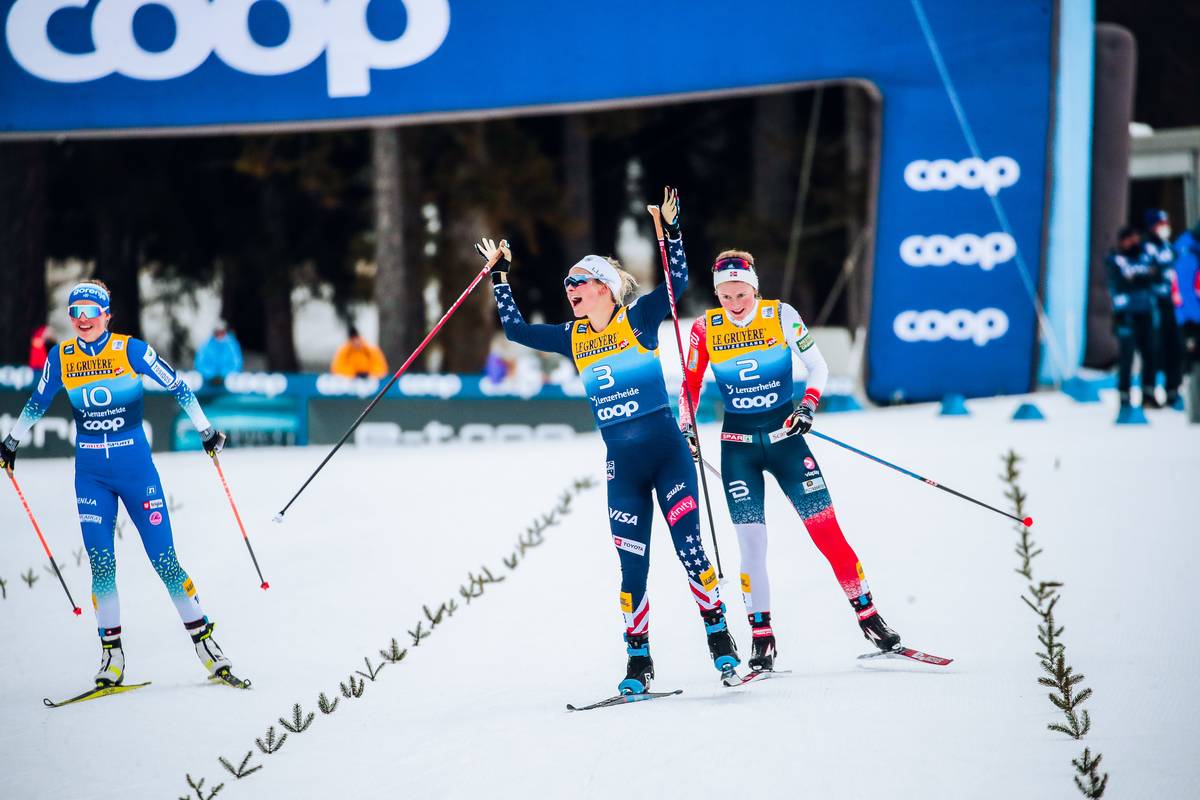
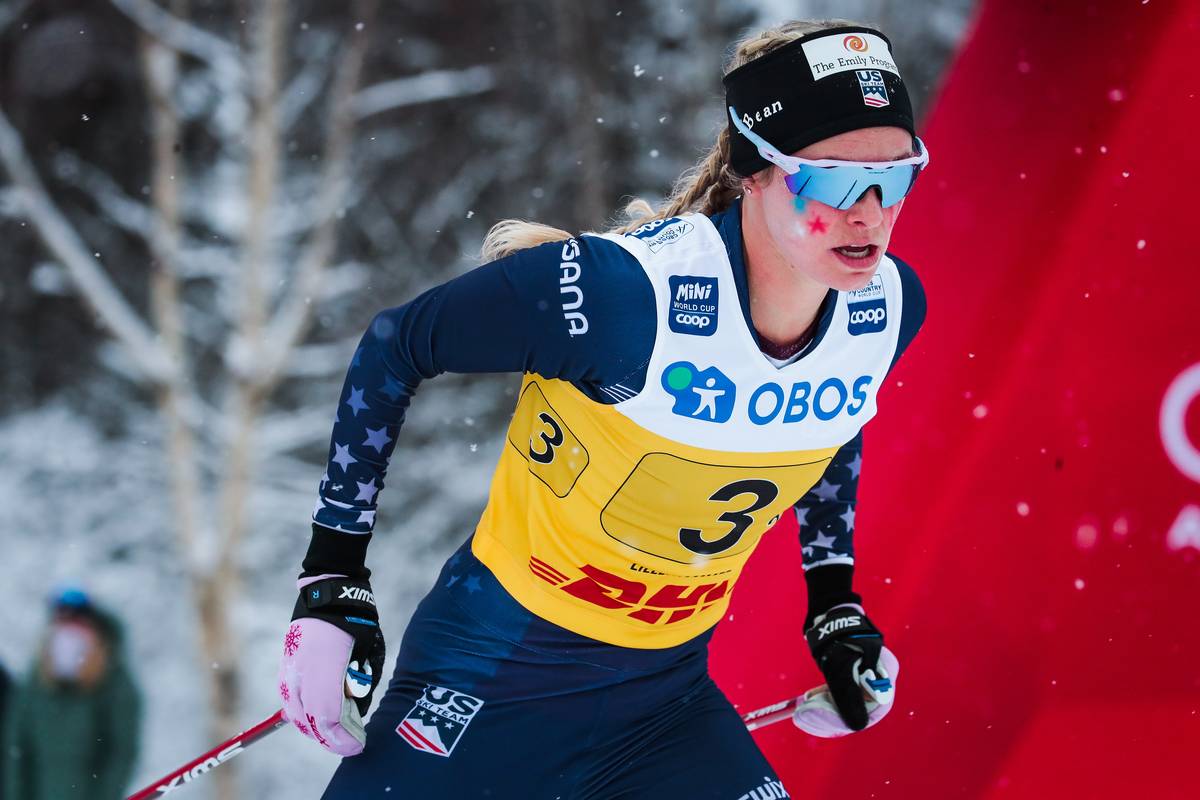
Jessie Diggins wins the opening stage of the 2021/22 Tour de Ski, a freestyle sprint in Lenzerheide, SUI. (Photo: NordicFocus)
While the team has carefully been collaborating in Livigno, it is unclear what the opportunities to be together and support one another will look like once they’re on the ground in China. Diggins shared her limited knowledge of what communication and time together might look like during the Games, responding to whether it might be more isolating than years past.
“I think some of that we’re just gonna have to feel out once we’re on the ground and see and feel, after a week, what’s the situation here? How safe do we feel? How good is the WiFi in terms of having team meetings over Zoom instead of needing to find a place where we can do it in person and all wear masks. I think our team has been really, really good about masking protocols, so I do feel like there might be opportunities there.”
In terms of lodging during the Games, Diggins shared that the team will be sharing a set of apartments with four athletes per unit, split between two bedrooms with a common area in between.
“So at least to be able to make a pod with three other people. Beyond that, we’ll just have to feel it out,” she concluded.
In terms of where we can expect to see Diggins on the start lists during the Games, that also remains to be determined, which is a slight shift from what Diggins shared following Period I, earlier this season.
“The original plan was to just race everything, assuming, of course, that I have start rights to do so. And then, earlier in the year, I was thinking, ‘I hear it’s really cool – which, yay! Love it. I hope it is cold. I want it to really be winter. But if it is incredibly cold, the way it was in Ruka, that becomes really draining, because you’re out there for so long. It’s not just the race; it’s the warm up, it’s the cool down. You’re outside going through the media zone, because you need to be outside because of COVID… But you’re out there for a while. So I think we’re going to look at the situation, once we’re on the ground and see, ‘What does the transport look like? How long does it take to get in and out of the venue? How cold is it? What kind of energy drain is this?’ And then we start making the plans on, ‘Does it make sense to do every single race? Or do I sit one out in the middle and sort of store [energy] up?’ That said, traditionally, it’s been great for me to simply keep racing, it kind of takes care of itself. So I’m really excited for every single race and all these opportunities ahead, and I would I would love to be able to do that if it makes sense.”
Diggins also fielded a variety of questions along the lines of comparing her feelings and preparations leading into these Games compared to the last two, given that she is both more experienced, and perhaps facing ever-increasing external expectations as she has steadily brought more attention to the sport. Diggins recently landed on the cover of both Sports Illustrated and Outside Magazines.
Jessie Diggins races the third leg of the women’s 4 x 5-kilometer relay in Lillehammer in December, 2021. (Photo: NordicFocus)
Many of these questions surrounded the pressure of being a defending Olympic Champion, who has since become a World Cup Overall Champion. Has this implied a steady building of pressure felt externally as more and more eyes will be focused on her in Beijing?
“I think the pressures and expectations are definitely different,” Diggins reflected. “Headed into Sochi, I was coming in as a World Champion, (Diggins and Kikkan Randall won the team sprint in Val di Fiemme during the 2013 Championships.) but I felt that I didn’t have any eyes on me. I didn’t have any pressure to medal. I felt that – it was sort of a wonderful flying under the radar feeling of: ‘If I have a good race, awesome.’ Nobody expects anything. If I have a bad race, they’re like, ‘Cool, you’re young, whatever.’”
With less focus on her first Olympic results, Diggins recalls a lighter atmosphere at the Sochi Games with more opportunities to explore a new place and attend competitions for other sport. This shifted as the internal and external pressure built to medal in 2018 in Korea.
“And I do remember getting to go down to the coastal village [in Russia]… And I remember getting to go watch some of the biathlon races, so I actually got to go see other events. Then, in Pyeongchang, it was different because I came in with a lot of eyes and pressure and expectations. I never got to go see a single other event, because I was racing every single event of ours. So it was like race, recover, race-prep, race, recover, race-prep – it was just this cycle. So I felt that for me – I never went and saw the coast, I have no idea what South Korea looks like, someday I want to go back and see it and experience it. But I felt like it was very, very focused. And I know that in that way. Beijing will be the same. So for me, it’s not a huge shift…”
While that focus may be a necessity for Diggins and other medal-favorite athletes at any Games, the pandemic and the resulting COVID-19 safety protocols that will be enforced in Beijing will likely make the isolated “race-prep, race, recover” cycle one all cross-country skiers will experience, regardless of how close their names will appear on results sheets.
“I am sad for my younger teammates, because I want them to have that first [Olympic] experience,” Diggins said somberly. “I know it will be a little bit different. At the same time they’re young and hopefully will have many Games in their future. So at some point, they’ll get that experience of getting to go and watch bobsled and hockey and figure skating and get a little bit of that feel of that huge team unity feeling, because I do think that was pretty cool. At the last two Games, you really felt connected to other sports. And one of my favorite things was like sitting in the Athlete Resource Center, watching a race with the bobsledders and hearing their reactions to our sport, and then watching their sport and then seeing how we react to their sport. It was so cool to feel really like the whole team USA was pulling together. So I hope that we find a way to still feel that, even though obviously, we’re going to be keeping our distance because keeping each other safe is paramount.”
A silver lining of having more eyes, ears, and attention focused on Diggins is a proportionally larger microphone. Since earning a gold medal in 2018, Diggins has found her voice as an advocate, speaking out on topics ranging from eating disorders to climate change.
“My goal all along was to try to grow the sport and to try to do as much good outside of the race track as I possibly could. With my work with the Emily Program, Protect Our Winters, and the Share Winter Foundation, the goal is, ‘Let’s make this about more than just skiing.’ Because that way – win, lose, or draw – you’ve taken this time that you are in the spotlight and actually did something with it. And that does feel good. So in that way, it’s great to be one of the stars of Team USA, because that brings attention to mental health and climate change. And these things that I’ve been shouting about for four years – people are really listening.”
With strong performances across all distances and race disciplines, Jessie Diggins is a medal favorite for the 2022 Beijing Olympic Games. (Photo: NordicFocus)
“The flip side is, yeah, it is hard not to feel like there’s a lot of external pressure. But that doesn’t mean that I have to feel it. I know it’s there, and again – sort of like COVID – it would be silly to not acknowledge it. It would be silly to pretend that it’s not a thing. Of course it is. But for me, it’s more of like, ‘Whoa, what a cool, privileged place to be in. 15 year old Jesse would be so psyched to learn that this is how I’m coming into my third Olympics, let alone any Olympics.’ So for me, the key has been flipping it around and reframing it as an amazing privilege to get to carry this amount of pressure and hopefully show that it’s totally possible to come in and still be yourself; to care about the things you care about; to be a good teammate; and to just focus on what you can control. And you’ve just got to let the rest go.”
Perhaps the size and variety of media publications present at her conference is evidence on its own that Diggins has been identified, outright or otherwise, as an athlete to watch at the 2022 Games. Since the Pyeongchang Games, she has been on the podium in ten freestyle sprints, winning two. She was second behind Marit Bjørgen at the 30k freestyle at the Holmenkollen in March, 2018, the last time she competed in the event.
Diggins has raced three 7.5k/7.5 skiathlons in the last Olympic Quad, taking second to Norway’s Therese Johaug in December, 2019 and fifth place, behind an all-Norway podium plus Sweden’s Ebba Anderson in fourth, in January, 2021. And then there are the relays, for which she has been known since the beginning of her career.
Perhaps the only event where Diggins may not be considered a medal contender is the 10k classic. While she just one podium in this event over the last Quad, third place in Val Müstair in the 2020/21 Tour de Ski with a Norwegian-free field, she has cracked the top-10 enough times not to be ruled out.
Jessie Diggins skis to 13th in the 10-kilometer mass start classic in Val di Fiemme, ITA during the 2021/22 Tour de Ski. (Photo: NordicFocus)
With these performances across all race disciplines and distances, it might be impossible for Diggins not to feel some amount of pressure heading into Beijing. She explained that managing this, for her, comes down to taking ownership and control over her definition of success.
“One thing to understand is that when it comes to pressure, there will never be a point where you are enough, if you start listening to it, right, because then it’ll be ‘Will you podium?’ to ‘Why didn’t you win?’ And at some point, it’ll be, ‘Why didn’t you win by more? Why wasn’t it more impressive?’ There’s no end point.
“So it’s better to not let my self-worth be determined by anyone other than myself. And that’s easier said than done. It’s something I’m obviously still working on with my sports psychologist, but I think it’s so important to say that I get to define what success looks like. And I’m the only one who gets to say that and nobody else. It’s important for me to [establish] ahead of time what that means. And so for me success at the Games means crossing the finish line with nothing left in the tank and knowing beyond a shadow of a doubt that I left it all out there. And that I feel confident I can do.”
Diggins also proposed a definition that was multi-faceted, shifting the focus away from the outcomes on the podium or results list.
“The other thing success means is being a good teammate, like, Who are you off the snow? What kind of person? Are you? What do you stand for? How do you treat the people around you? That’s really important. And the third thing is, how did you prepare? Did you do everything possible? And not just in the last week or the last month? Or even the last year? The last decade of training for skiing? Have I put everything I have towards this? So I don’t have to wonder what if I had just committed? And if I can do all those things, and cross that finish line and look back and go, that was it? That was my best effort. And that was everything I had, then that will be success? And it doesn’t have to be a medal? It’d be great if it is. It will be fine, if it isn’t. Because at the end of the day, I know that whether or not you earn a medal is not within your control. You can’t control anyone’s effort, but your own. So I think that’s been so important for me in trying to deal with that kind of pressure.”
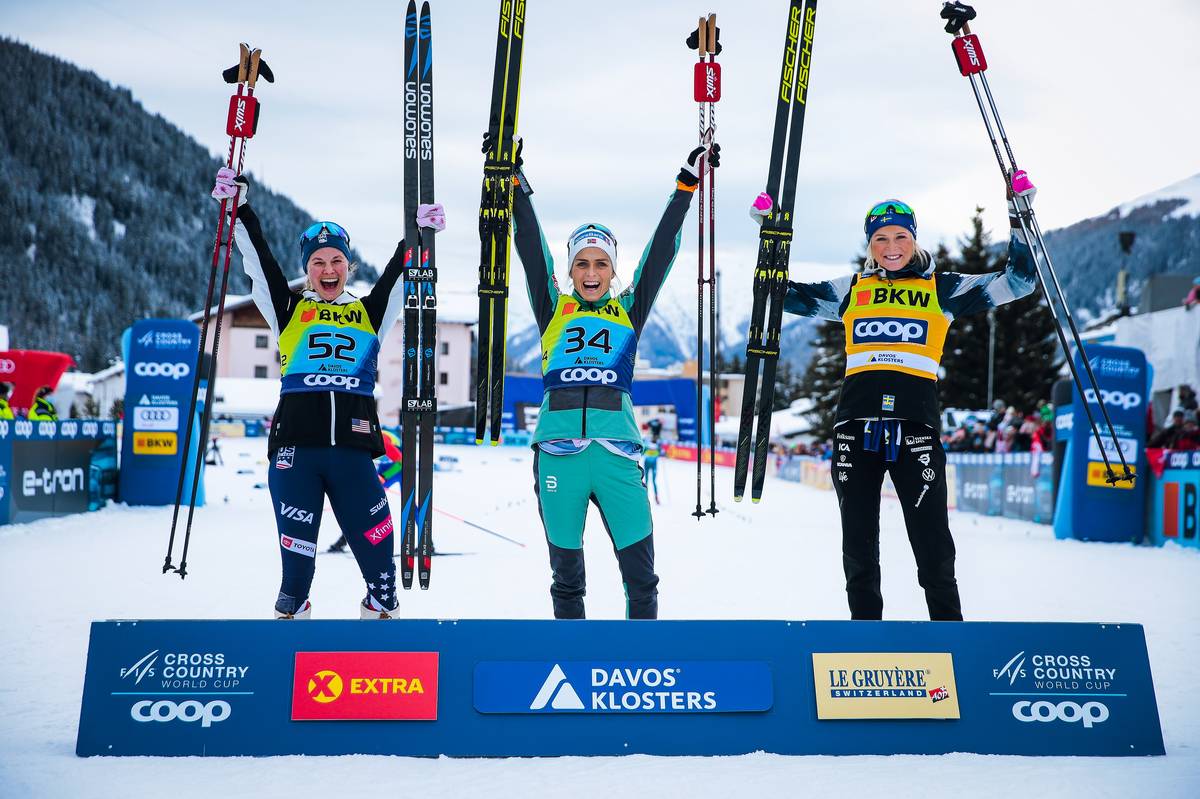
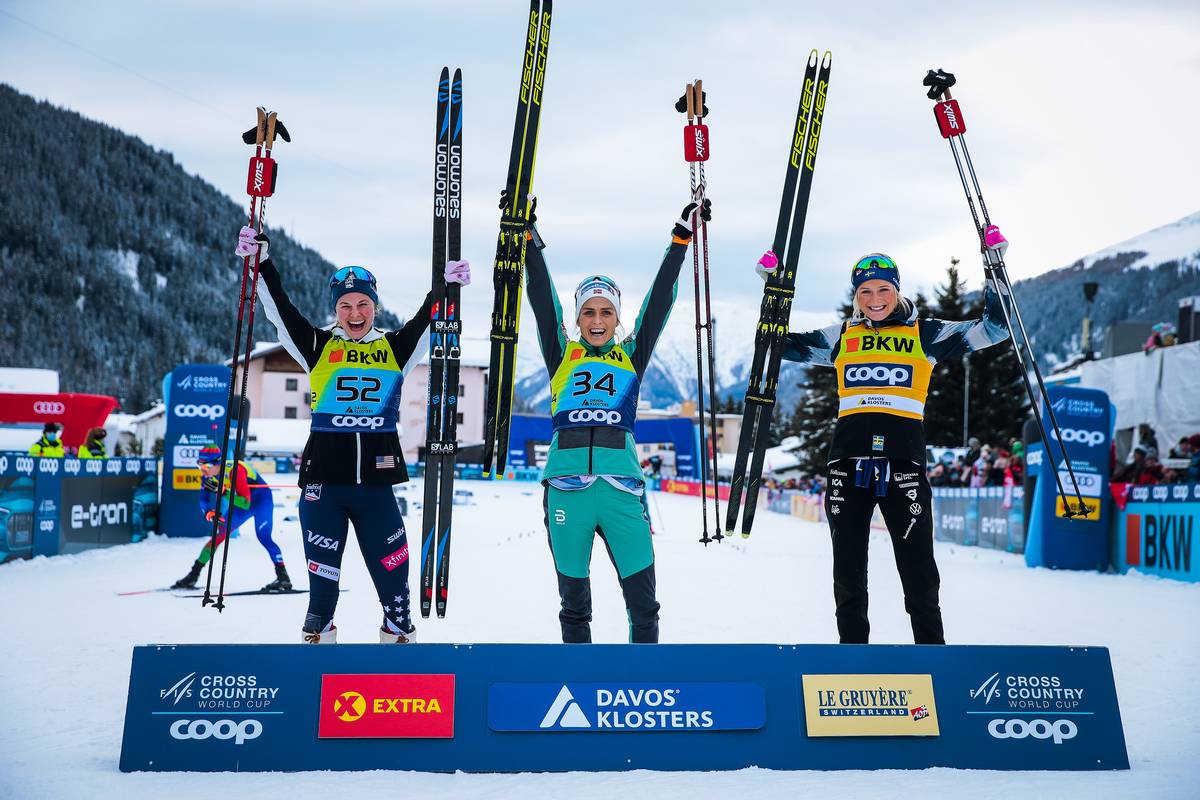
Jessie Diggins takes second in the 10k free in Davos, behind winner Therese Johaug (NOR) and ahead of Frida Karlsson (SWE), both dominant distance skiers. (Photo: NordicFocus)
Diggins concluded by sharing a quote that resonated with her from two-time Olympian and former national team coach, Pete Vordenberg. He said, “Every time you do something, it’s for the first time. And even if you do it again, it will be different. And you will be different. So enjoy it.”
Unpacking this, Diggins explained, “I think that’s so important to remember because it’s not the same as Pyeongchang. And that’s okay. It’s going to be different. And it’s also going to be the first time I’ve ever been to this Olympics, because: different trails, different country, different year, different Jessie. So I think it’s important to remember that I don’t have to go in there defending anything. Nothing makes that medal and what I did four years ago disappear, and I won’t disappear if I don’t do it again.”
Stay tuned for a few additional insights from Diggins coach and wax tech, Jason Cork, who also appeared at the conference.
A whiter version of Beijing 2022 than athletes and fans might actually encounter.
The following opinion article was originally published on FasterSkier on June 20, 2015. It was written by Chelsea Little, who contributed sterling ski reporting to this site for nearly a decade before ultimately retiring from nordic ski journalism, though not from nordic skiing. She is currently an Assistant Professor of Environmental Science at Simon Fraser University outside of Vancouver, B.C., where her research interests focus on community and meta-ecosystem ecology.
The article was published roughly a month before the IOC, as expected, selected Beijing as the host of the 2022 Winter Olympics. Although it was originally published over six years ago, much of its criticism proved prescient.
For example, the first two problems that Little noted were “snow” and “water.” Here is a photo from the cross-country venue at Zhangjiakou taken on January 19 of this year. Bare hillsides are visible in the background. The endemic issues with the use of limited available water for snowmaking, as analyzed by someone who at the time had three scientific degrees (Little would earn her Ph.D. in Ecology four years later), seem unlikely to have substantially improved.
As for air quality, as of the writing of this intro (Friday afternoon in Anchorage, Saturday afternoon in Zhangjiakou), air quality at the venue was an “unhealthy” 161 micrograms per cubic meter of PM2.5 particulates, though that can clearly change from day to day and it is unclear where this reading was taken relative to the precise location of the ski trails. The longstanding seasonal weather patterns that can bring in pollutants from elsewhere seem to still be an issue, as was discussed roughly a week ago.
The physical distances between clusters have remained unchanged, though a pandemic-induced near-total lack of spectators means that this may be less of an issue in practice: It may indeed take longer than anticipated to travel between venues, but virtually no fans will be attempting to do so.
And finally, what about human rights? This recent op-ed from the Washington Post, headline: “The Beijing Olympics has become an exercise in genocide denial,” expresses the view that things have not improved since Little’s article six years ago. (If you prefer your political opinions from a news site somewhat to the right of the Post, here’s a Laura Ingraham segment on Fox News, also from last week: “Ingraham encourages Americans to boycott watching Beijing Olympics over China’s human rights violations.”) Or here’s The Guardian: “Protesting Winter Olympics athletes ‘face punishment’, suggests Beijing official.” Or here’s Politico: “‘Checking a box’: Biden’s Beijing diplomatic boycott flop,” in an article quoting one Noah Hoffman.
As Little wrote six-plus years ago, “The goal of Olympism is to place sport at the service of the harmonious development of humankind, with a view to promoting a peaceful society concerned with the preservation of human dignity,” citing the second point of the Olympic Charter. She was at the time dubious that awarding the Olympics to China would support these goals.
Screenshot of Zhangjiakou AQI on Jan. 21, 2022.
Six Big Problems with the Beijing 2022 Olympic Bid (June 2015): by Chelsea Little
In just over a month, the International Olympic Committee members will vote in Kuala Lumpur, Malaysia, on the site of the 2022 Winter Olympics. Their two choices: Almaty, Kazakhstan, and Beijing, China.
Only these two candidates remain after other bids from regions like Bavaria, Germany (centered in Munich), Graubunden, Switzerland (centered in Davos and St Moritz), Stockholm, Sweden, and Oslo, Norway, were felled by referendums.
That’s not a good sign for the IOC. Both bids have some problematic features, and are almost certainly not the ideal locations the organization was looking for.
While there are problems with the Almaty bid, to almost any reasonable person there appear to be far more, and more serious, problems with Beijing. Despite all of this, Beijing is the frontrunner.
That’s because it has the force of the Chinese government behind it. The IOC knows that the Chinese can deliver a Games. A Beijing Olympics would happen, without any major cost to the IOC except for bad publicity and a continued slide down from any moral high ground they might have left.
The Almaty bid closed part of its gap at the candidate city presentations in Lausanne, Switzerland, last week. But in the event that Beijing still comes out on top when voting is over, here’s an overview of six major issues that the Olympics would face – and examples of some of the misrepresentation and lies the bid committee says publicly when questions are brought up.
First, there’s the snow. As skiers, it is probably one of our main concerns. Will there be enough? Where will it come from? Zhangjiakou boasts about a meter, total, of snowfall each year.
The answer is, snow will come from water. But that leads to another question. What effect will that have on the regional water dynamics of a drought-prone region?
Then there’s air quality. It’s known to be terrible in Beijing. But organizers assert that air quality is great at the mountain venues. The problem is, that’s just not true.
Next up, how will spectators get to the mountain venues? At almost 200 k north of Beijing, travel times could be long. The bid committee touts a high-speed train connecting the clusters, but it’s becoming clear that this won’t solve all problems and could even be dangerous.
After the 2008 Olympics, it was clear that China followed through on few of their promises to improve human rights. Is there any reason to think that this time around will be different?
And finally, thinking long-term, what is the point of hosting a Games where winter sports are not popular and where snowmaking is so disruptive? Will the venues be used in the future?
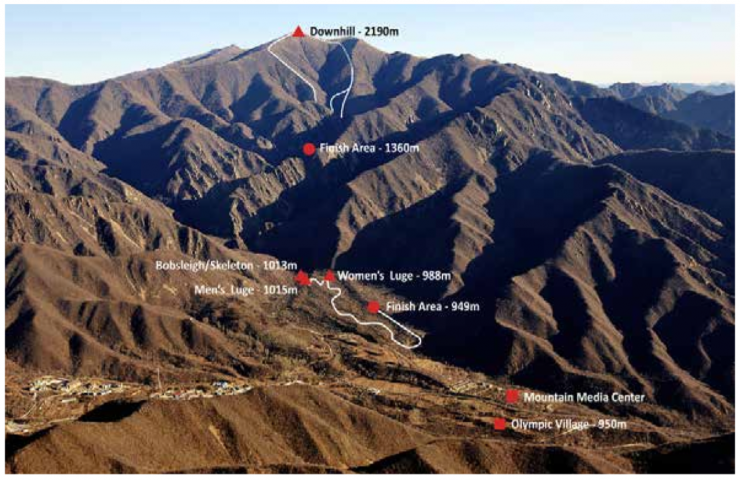
The site of the alpine skiing and sliding sports for Beijing 2022, photographed in January 2015 for the IOC Evaluation Commission report.
Snow:
Quite honestly, there isn’t much.
The weather is cold and it’s enough to blow snow, however, at least for alpine skiing. The Chongli area outside of Zhangjiakou has four alpine ski resorts which host, according to the bid committee, 1.5 million visitors annually. Nordic facilities have not yet been built.
On the ground, the area isn’t always teeming with skiers.
“The chairlifts are somewhat slow, but queues are rare and the slopes are mostly empty,” a review of the Wanlong resort, one of the biggest in the area, notes.
By comparison, the state of Vermont gets about 4.5 million ski visits per year, although that is based on ticket sales and it is unclear whether the Chongli numbers are from all tourists or just those who buy a lift ticket.
Looking at meteorological data, it’s hard to imagine the region becoming a real winter sports mecca without snowmaking.
“The total annual snowfall here can reach more than one meter,” Liu Jianjun of Chongli’s weather bureau told the press.
One meter!?
And yet:
“We have a 20-year history of hosting skiing events… Each year there is a 25% increase in the population taking part in skiing in Zhangjiakou,” Hou Lang, the mayor of the city, said in a press conference in Lausanne. “The temperature, wind speed, and mountain situations are ideal for hosting a Games.”
The bid committee’s strategy is to make and hoard snow. Already, resorts feature snow on the trails but brown forests and dry, frozen ground beside them.
“In addition to natural snowfall we have a very comprehensive plan to ensure the quality and quantity of snow,” Zhang Li, the venue manager, said in the press conference. “This plan is based on the combination of appropriate temperature, abundant water supply, and reliable existing snowmaking facilities.”
The IOC Evaluation Commission noted in their report that the resorts are already situated on the highest mountains in the region, so there would be no way to haul in snow from other locations. And as was shown in Vancouver 2010, temperatures can unpredictably rise during warm snaps and prevent snowmaking.
During discussions about the two candidate cities, experts reportedly testified that a 50-50 mix of manmade and natural snow was ideal, and that this was attainable with the Beijing bid. Two problems: most athletes would argue that actually a zero-manmade, all-natural snow base would be ideal, and secondly, it’s not clear that 50% natural is even realistic.
Siting an Olympic Games in a place with essentially zero natural snow seems like a big risk. Yet the IOC does not seem overly worried with this issue compared to others.
Water:
On top of all of that, it appears that the bid committee does not fully understand just how big an undertaking it would be to make all of that snow. 16 million cubic feet of snow were reportedly stockpiled before the 2014 Sochi Olympics, where there was more natural snow to use as a base anyway.
It took over 140 gallons of water to make just one of those cubic meters of snow.
“The Commission considers Beijing 2022 has underestimated the amount of water that would be needed for snowmaking for the Games,” the Evaluation Commission wrote.
Zhangjiakou is in a notoriously arid region. There simply isn’t a lot of water available: just 383 millimeters per year, or 15 inches. The winter is the dry season, and Zhangjiakou receives less than five millimeters per month then.
The New York Times reported earlier this year that the region is home to water conflicts, which those in the western U.S. might find familiar.
The small amount of water available is often sent south to Beijing, a major city which has priority over rural areas. It is now being used for snowmaking as well, and should Beijing win the 2022 bid the amount needed for snowmaking will only increase.
“The total amount of water used for the entire Games duration for snowmaking represents only 1% of annual available water supply in this area,” Zhang Li said in the press conference.
However, the Evaluation Committee had already made clear that they believed this estimate was incorrect. And in a region with barely any water, one percent can still make a big difference – just ask California.
Because of China’s controlling government and human rights problems, those suffering from further declines in water resources would certainly be the least affluent residents of the Zhangjiakou region. Pouring more effort into snowmaking would represent a further shift to focusing on an affluence tourist market instead of local dynamics.
Yet the bid committee insists that there’s nothing to worry about.
“To ensure an abundant the water supply, we have three sources of water,” Zhang Li said in the press conference. “One is the surface runoff which has been the sole source for the existing resorts for the last 20 years. The second source is large capacity reservoirs in 6 kilometers of the venues. The third source is that we will benefit from the already almost-completed National Water Transport plan, which is transferring an enormous amount of water from southern China to the north.”
That transport plan has reportedly cost as much as $80 billion, although detailed estimates are hard to pin down.
The bid committee also plans to recapture snowmelt and use it to blow more snow, but the Evaluation Commission wrote that the ability to do this had been greatly overestimated.
Air pollution in Tiananmen Square, Beijing, in 2013. (Photo: Michael Davis-Burchat, flickr)
Air Quality:
Beijing currently faces some of the worst air quality in the world. During the 2014 Beijing marathon, particulate pollution was at 400 micrograms per cubic meter; the World Health Organization’s maximum for healthy outdoor activity is 25. Most participants wore masks and many did not finish the race.
“In Beijing, the ice sports will all be in indoor venues,” Wang Anshun, the mayor of Beijing and the head of the bid committee, helpfully noted in a press conference.
Beijing is in the midst of a five-year action plan to clean up air quality, which is costing about $130 billion and features 84 specific action points.
“At present, the action plan is already achieving excellent results,” Wang said. “Major pollutants in this period have dropped by 17.7 percent as compared to last year.”
After the plan ends in 2017, there are already plans in the works for another five-year agenda leading up to the 2022 Games.
In fact, the bid committee used the prospect of improving air quality in a not-so-subtle attempt to guilt people into supporting the bid.
“This also will be a form of permanent legacy that will benefit the local people of the city and the region,” Wang noted.
In other words: how could you turn this bid down when it will improve quality of life for millions of people, and make the air that they breathe no longer able to kill them?
However, it’s worth noting that an IOC mandate to fix pollution problems has not always in the past led to pristine conditions. Air quality was still a problem at the 2008 Summer Olympics in Beijing, even after much-publicized attempts to solve it by closing factories limiting the amount of vehicles in use. While vast improvements were made, pollution was still worse than in all but the most polluted U.S. cities and about six times higher than at the 1996 Atlanta Olympics.
Immediately after the 2008 Olympics, air quality worsened again, now to those levels seen during the 2014 Beijing Marathon. Improving air quality during the Games did not have lasting effects.
Another case of the IOC struggling to mandate pollution cleanup is in Rio de Janeiro, Brazil. Just a year before the 2016 summer Games, organizers are still struggling to clean up the water in the city. Last summer the IOC brushed off concerns, saying there was still time to clean up, but they now seem more alarmed, and at the recent Executive Board meetings in Lausanne demanded to see progress by the end of July.
Part of the Rio bid was a promise to reduce the flow of raw sewage into the sailing venue by 80%, but officials now acknowledge that will never happen. (More alarmingly, they say that the failure to clean up is irrelevant because the sewage poses no health risks to sailors.)
In other words, if the host city promises in a bid to clean up, the IOC has no real way to hold them to that promise. Statements by the bid committee about air quality do not mean that athletes won’t see significant health risks when they arrive in Beijing in 2022.
Finally, the bid committee says that at the two mountain clusters, air quality is ideal. However, while Zhangjiakou does have the best air quality in its region, it is still not good. In the next two days, for example, air quality is forecasted to dip into the “unhealthy” zone, with the definition “Everyone may begin to experience health effects; members of sensitive groups may experience more serious health effects.”
And local regulations cannot completely solve air pollution problems, anyway.
“Increased energy demand in winter coupled with seasonal weather patterns that can bring pollutants from other regions could create air quality issues across the Games zones,” the Evaluation Commission wrote.
Distances Between Clusters:
The Beijing bid will feature three clusters for sports: arena ice sports will be held in Beijing; nordic sports, freestyle skiing, and snowboarding in Zhangjiakou; and alpine skiing and sliding sports in Yanqing.
The bid committee promoted this three-zone idea as a benefit to athletes, who will not have to travel far to reach their venues or deal with the more general hubbub of a compact Olympic Games.
“To ensure the athlete experience, I know from my experience as an athlete that the most important thing is the performance in the Olympics,” said Yang Yang, a gold medalist in short-track speedskating and now an IOC member. “So to minimize the travel times would bring much benefit to the athletes. Having three zones will help the athletes with short distance to travel from the venues to the villages. It will be about 15 minutes, which is a very good benefit to the athletes.”
Aside from athletes, travel times for spectators could be quite long. The bid committee has proposed building a high-speed train system which it says would cut the time needed to travel roughly 200 k from Beijing to Zhangjiakou to 50 minutes.
There’s several problems with this. First of all, the bid committee left the expenses associated with building the network off the books, claiming that it would have built the railway anyway. That’s false, and cut the bid’s budget down to better compete against Almaty. Officials still refuse to reveal the actual cost of the railway.
Secondly, only when pushed did officials admit that actually, it would take longer than 50 minutes to travel between the venues. They admitted that 10 minutes should be added for waiting times to board the trains.
IOC members pointed out that that’s not all; after all, they have to get from hotels to the train stations, and then from the stations to the venues. Members complained that it would likely take them 90 minutes.
And for regular spectators who don’t receive the special treatment of IOC members, it’s likely to be a lot longer. This, along with the lack of a snow sports culture in China, contributes to the strong possibility to sports in the mountains facing empty stadiums. That doesn’t exactly make for the best athlete experience.
Already in 2014 in Sochi, Russia – a country where cross-country skiing and biathlon are successful and popular – seats were empty in the stadiums. This was likely due in part to the sale of multi-sport ticket bundles. A non-ski fan might go check out a sport they had a ticket to if it’s close; if it takes hours of travel each way, they might decide to stay in Beijing.
Lastly, with well-documented catastrophic train disasters and high levels of corruption hindering safety measures in China’s railway construction (you can find an incredible piece from The New Yorkerhere), does anyone really want to be on a high-speed train system where a crash, or even just a decrease in speed, by a train that departed just five minutes earlier could lead to a pile-up?
Human Rights:
One of the biggest problems will provide nothing more than a repeat show from the 2008 Olympics. When Beijing won the bid for the 2008 Games, China boldly proclaimed that this was an opportunity for the country to improve their human rights record before they showed off to the world.
That certainly did not happen.
Hundreds of thousands of residents were evicted in the leadup to the 2008 summer Games in order to build new stadiums and infrastructure. The 2022 Games will use some of that infrastructure, so evictions should not be as numerous. But the Evaluation Commission report still estimates that thousands of people will have to be relocated.
And relocation is not something that China handles well. Houses were demolished and when residents tried to protest their evictions or appeal through the legal process, they were arrested, jailed, and sometimes beaten. Citizens have no choice in the matter, and are not provided the means necessary to re-make their life somewhere else.
“Compensation rates have rarely enabled affected people to relocate while retaining the same standard of living,” the Geneva-based charity Centre on Housing Rights and Evictions noted in a 2008 report. “Instead, residents have been forced to move further from sources of employment, community networks, and decent schools and health care facilities.”
Journalists who covered these issues did not fare well, with dozens of members of the media detained in the leadup to Beijing 2008. The Foreign Correspondents Club of China reported that 40% of foreign journalists covering the 2008 Games had experienced some sort of governmental interference, and that since then, conditions for foreign journalists have declined substantially.
Even while reporting on the bid for the 2022 Games there have been incidents. When two foreign journalists tried to visit the site of the mountain cluster and interview locals, government “minders” scared people away from speaking to them and inhibited them from visiting parts of the sites.
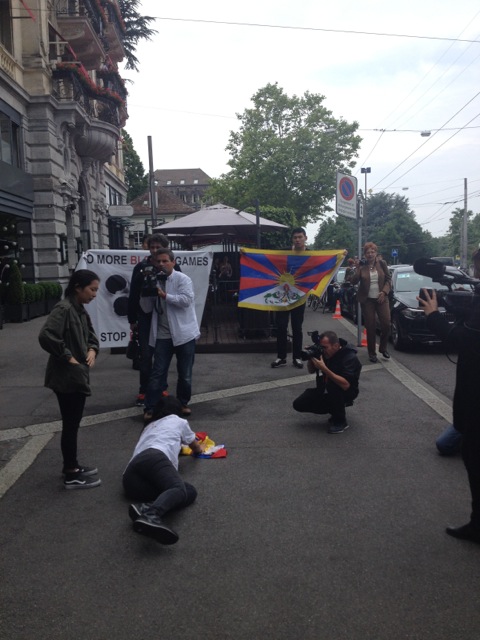
Protestors shouting “Beijing Lies, Tibet Dies” and “No More Bloody Games” appeared outside the hotel hosting the candidate city presentations. Later, another activist snuck into the Beijing presentation room. After unfurling a banner and chanting, he was forcibly removed.
Those outside the media fared much worse. Before the 2008 Games, citizens who spoke to foreign media were sometimes beaten by police in retaliation. According to Human Rights Watch, Chinese who spoke out on a variety of issues, from human rights to the environment or corruption, were often arrested. In some cases activists were kept in prison for longer than the actual term they were sentenced to.
Then there’s the athletes. According to The Guardian, China forbid athletes with any history of dissidence or activism from participating in the 2008 Olympic or Paralympic Games. For instance, Fang Zheng, whose legs were crushed by a tank in Tiananmen Square in the 1989 massacre, was not allowed to compete despite having two national records in the discus.
There’s many other human rights issues in the country. Tibetan activists, for instance, infiltrated the candidate city presentation room in Lausanne last week to stage a protest of China’s occupation of the region. Before 2008, the Olympics were seen as providing a platform for Tibetans to speak out about their oppression. But nothing changed for the better.
If the 2022 bid is successful, that means seven more years of Free Tibet protests. That’s seven more years of the world being reminded that the IOC has chosen to host the largest, most lucrative sporting event in the world in a country that does not support the basic tenets of the Olympic movement.
“The goal of Olympism is to place sport at the service of the harmonious development of humankind, with a view to promoting a peaceful society concerned with the preservation of human dignity,” the second point of the Olympic Charter reads.
Legacy:
One of the main points of the Beijing bid is that should they win, they will bring winter sports to “hundreds of millions” of people and provide a lasting legacy. This is how the bid committee appeals to IOC President Thomas Bach’s “Olympic Agenda 2020” plan.
Frankly, this seems unlikely. Even in countries which already have a strong winter sports culture, building new venues in places which are only moderately accessible to the general population has rarely been successful in building lasting legacies.
Let’s look back at Sochi, 2014. The snow and sliding sports venues will certainly never be used again for World Cup competition, and it’s not clear that they are seeing significant use from Russian athletes either. $51 billion were spent to build this Olympics and the mountain cluster is eerily empty. Resorts were operating at losses and renting luxury rooms for as little as $17 pernight.
What about Vancouver, four years earlier? Canada has strong nordic, alpine, and freestyle ski programs. But the cross-country and biathlon teams no longer base training groups in the Callaghan Valley, a venue which sees little traffic. Canadian ski jumping and nordic combined struggle to even remain funded. Whistler Sport Legacies has more costs than profits, although some venues, such as the luge and bobsled runs, see a lot of use.
British Columbia and the Canadian Rockies have plenty of alpine skiing opportunities, which is perhaps the reason that the Whistler Creekside venue, which hosted alpine racing for the Olympics, has not seen any FIS-level competition since 2010. Lake Louise, Alberta, beckons instead.
Pragelato, the site of nordic racing at the 2006 Torino Games, has not hosted a FIS-sanctioned cross-country ski race since the World University Games 2007. The luge track has been dismantled for economic reasons, but the hockey and speedskating arenas have hosted other sports events as well as plenty of concerts.
Sestriere, where the alpine racing was held, is still a popular venue for Europeans, but hasn’t hosted a World Cup since 2009. And unlike most other snow sports venues used in 2006-2014, Sestriere was already a high-profile destination for both tourists and elite racers; the Olympics likely did not significantly affect its future.
So even in countries where there are plenty of winter athletes, developing new venues for the Olympics hasn’t contributed much to sports programs. Reaching fans is a different story, but there’s still not much evidence that hosting an Olympics seriously shifts the support for winter sports within a country long-term, aside from a brief flush of enthusiasm surrounding the Games itself.
And considering the high water cost of running the snow sports venues, it’s not clear that they would even be maintained in the long run, especially as climate change progresses.
The bottom line, and the Almaty comparison:
Almaty faces some of the same issues that Beijing does.
Air quality is not great in the city, although it is of course nowhere near as bad as Beijing. Kazakhstan is not a model for human rights, and there is expected to be significant corruption should Almaty win the lucrative bid.
But on many points, Almaty comes out clearly ahead. For instance, many stadiums are already built and being used by both Kazakh athletes and to host international competitions like the 2011 Asian Winter Games or the upcoming 2017 World University Games. Almaty has snow, and it has winter athletes; it’s much more likely that the Games would have a lasting legacy improving sports opportunities for residents.
It is also a compact Games, with everything close together, and a relatively cheap one.
What Almaty lacks is the slick, powerful, marketing machine that Beijing has already put into place. Should Beijing win, it will be a clear message that money, financial stability, and glossy PR lines matter more to IOC members than the actual tenets of the Olympic charter.
Three-time Olympian, gold and silver medalist, long-time chair of the World Anti-Doping Agency’s Athlete committee, Officer of the Order of Canada, company founder and CEO, the list of Beckie Scott’s achievements is both lengthy and remarkable, and those included here only scratches the surface. In the nordic world specifically, Scott made history as the first North American woman to earn a medal at the Olympics in cross-country skiing. She has also been a long-time advocate and voice in anti-doping. In recent years, Scott’s focus and attention has shifted to the creation of Spirit North, a non-profit organization using the power of sport to improve the health and well-being of Indigenous youth in Canada.
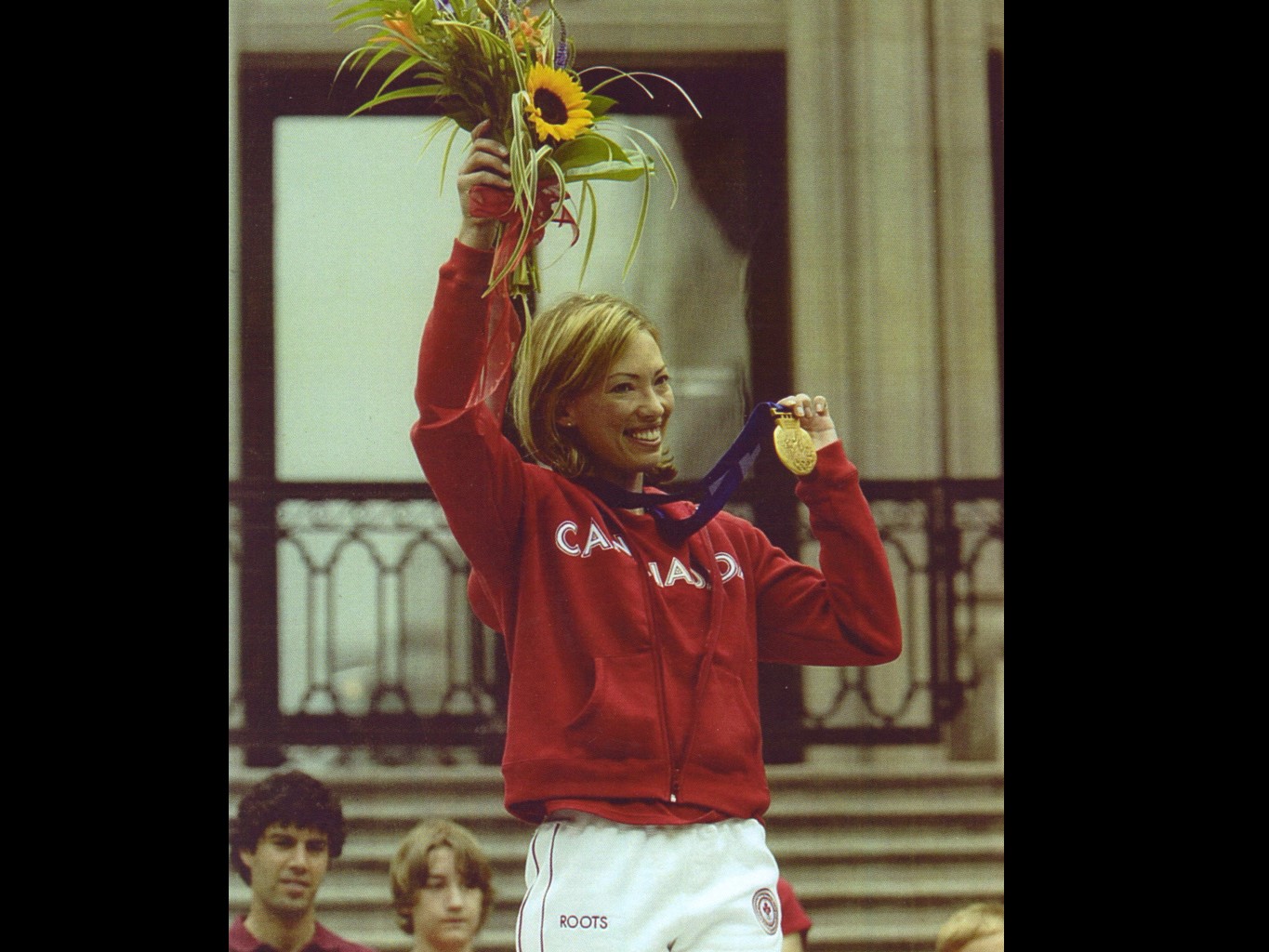
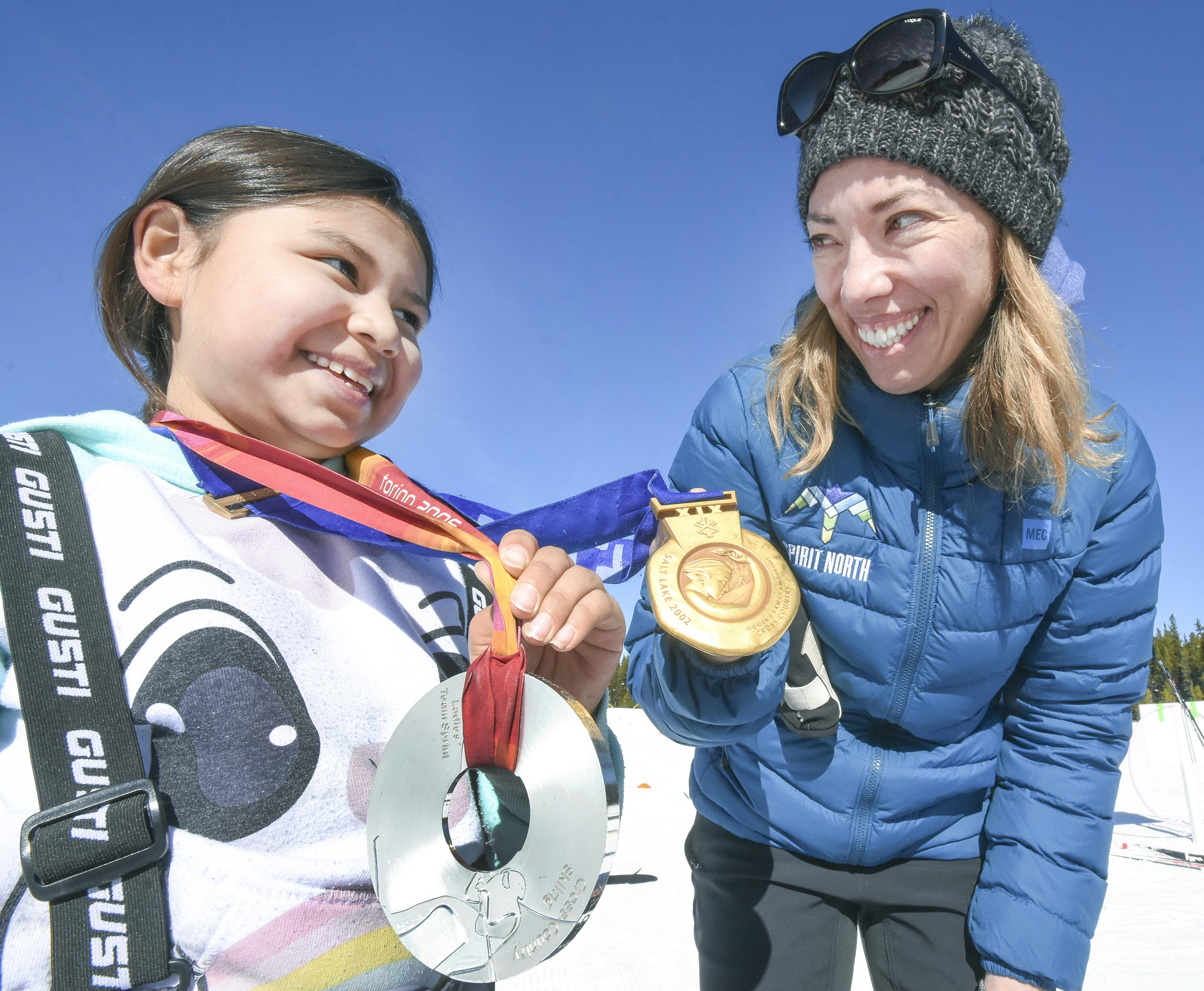
Beckie Scott displays her Olympic Gold medal from the 5 + 5 k pursuit at the Salt Lake Winter Games in 2002. She finished third but when the two women who finished in front of her were caught doping, Scott was awarded the gold in 2004. (courtesy photo)
The inspiration for founding this organization came after her retirement from ski racing, as Scott was invited to be an ambassador in a learn-to-ski program in northern Alberta funded by an oil and gas company that sponsors Cross-Country Canada.
“I started traveling up to these communities in northern Alberta for a number of years,” shared Scott, “the majority of which were indigenous, and I saw, for the first time, the realities of life there for community members, but particularly for the kids.”
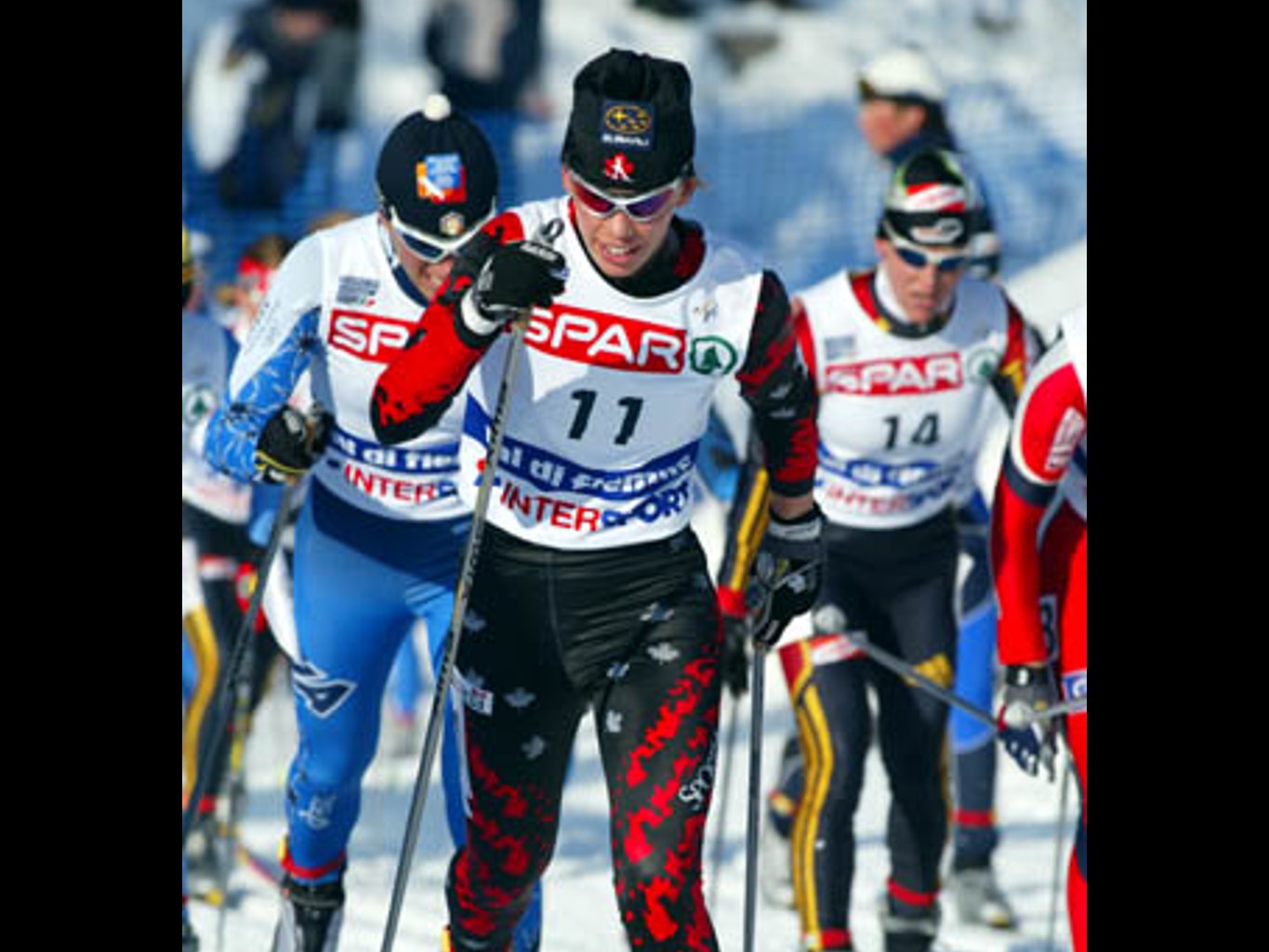
Beckie Scott racing in Val di Fiemme, Italy (courtesy photo)
Struck by how little there was in the way of sport and recreation, whether by virtue of the remoteness of the community, lack of infrastructure, or poverty, Scott noticed how many barriers there were for children in these communities to access sport.
“And yet, in parallel, when we would do this program, I was seeing this universal experience that kids have when they take part in sport,” continued Scott, “which is, just loving being out there, having fun, just walking a little taller because they’ve learned a new skill, all those great transformative benefits that come with being able to have that opportunity.”
Happy kids head out for a Spirit North event (Photo: Spirit North)
After a number of years with this program, she gradually came to the realization that the program should be something more, it could be bigger, it could be better, and it should be its own organization. In 2017, Scott made it an independent entity, rebranded and renamed it, and thus, Spirit North was born.
The motivation and realization for this move was also partially spurred by the publication of the Truth and Reconciliation Commission report, published in Canada in 2015. The TRC came about after the Indian Residential Schools Settlement Agreement, to facilitate reconciliation among former students, their families, their communities and all Canadians. From 2007 to 2015 the TRC traveled throughout Canada, hearing from over 6,500 witnesses, and in June 2015 at its closing event in Ottawa, they presented an executive summary of the findings in a multi-volume final report. This report also included 94 “calls to action” to further reconciliation between Canadians and Indigenous peoples.
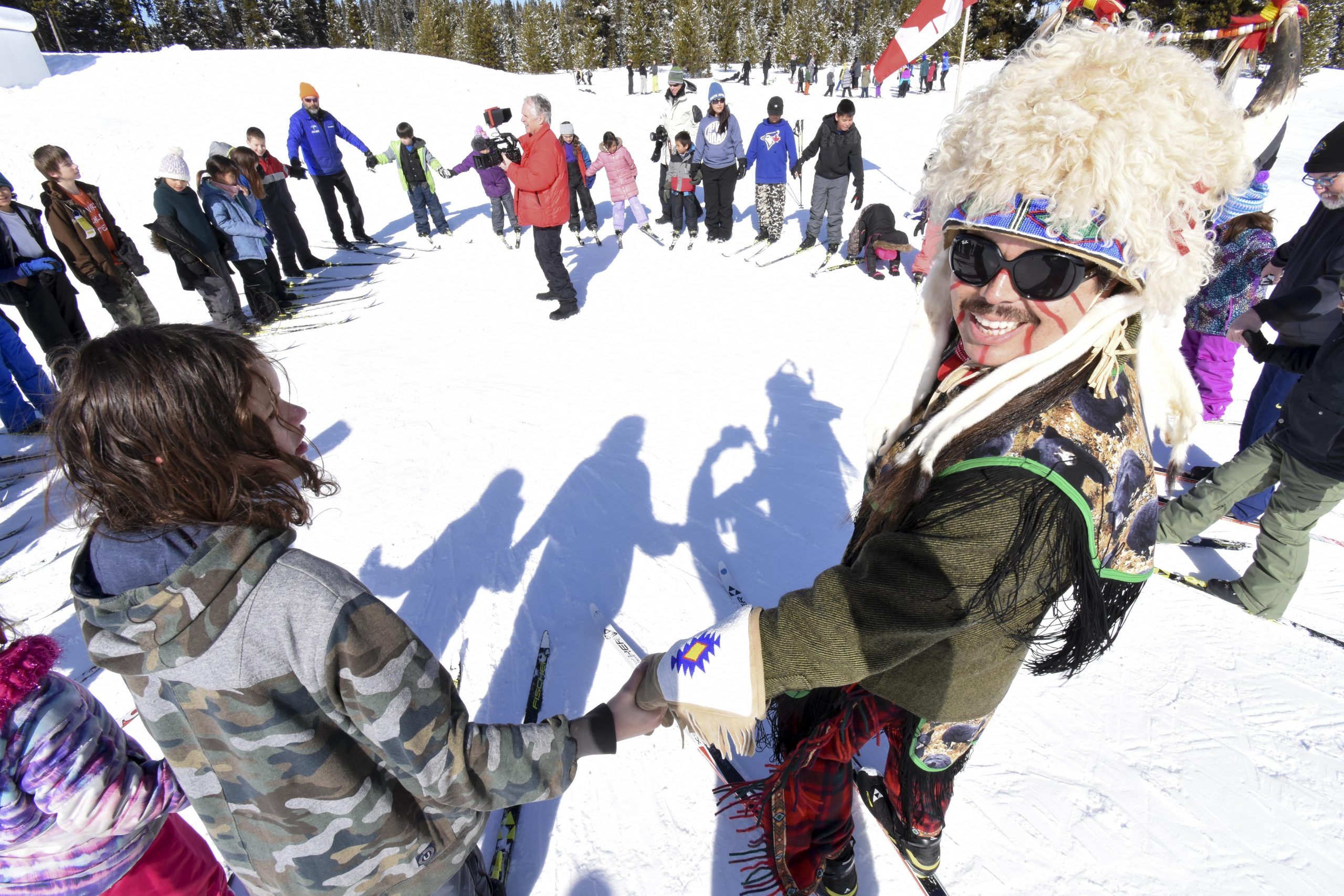
Levi Bent, a Spirit North coach, leads an event with a group of skiers (Photo: Spirit North)
“I think the Truth and Reconciliation Report was really a turning point for a lot of Canadians,” reflected Scott, “the legacy of residential schools and the intergenerational trauma, and the damage that was done, it lives on today. Those calls to action were really aimed at primarily non-Indigenous people starting to take steps to reconcile and to heal the harms of the past.”
Among the 94 calls to action were some specifically mentioning or targeting sport. The Spirit North website highlights three of them: Number 19, relating to the legacy of health, and Numbers 89 & 90, relating to sports and reconciliation.
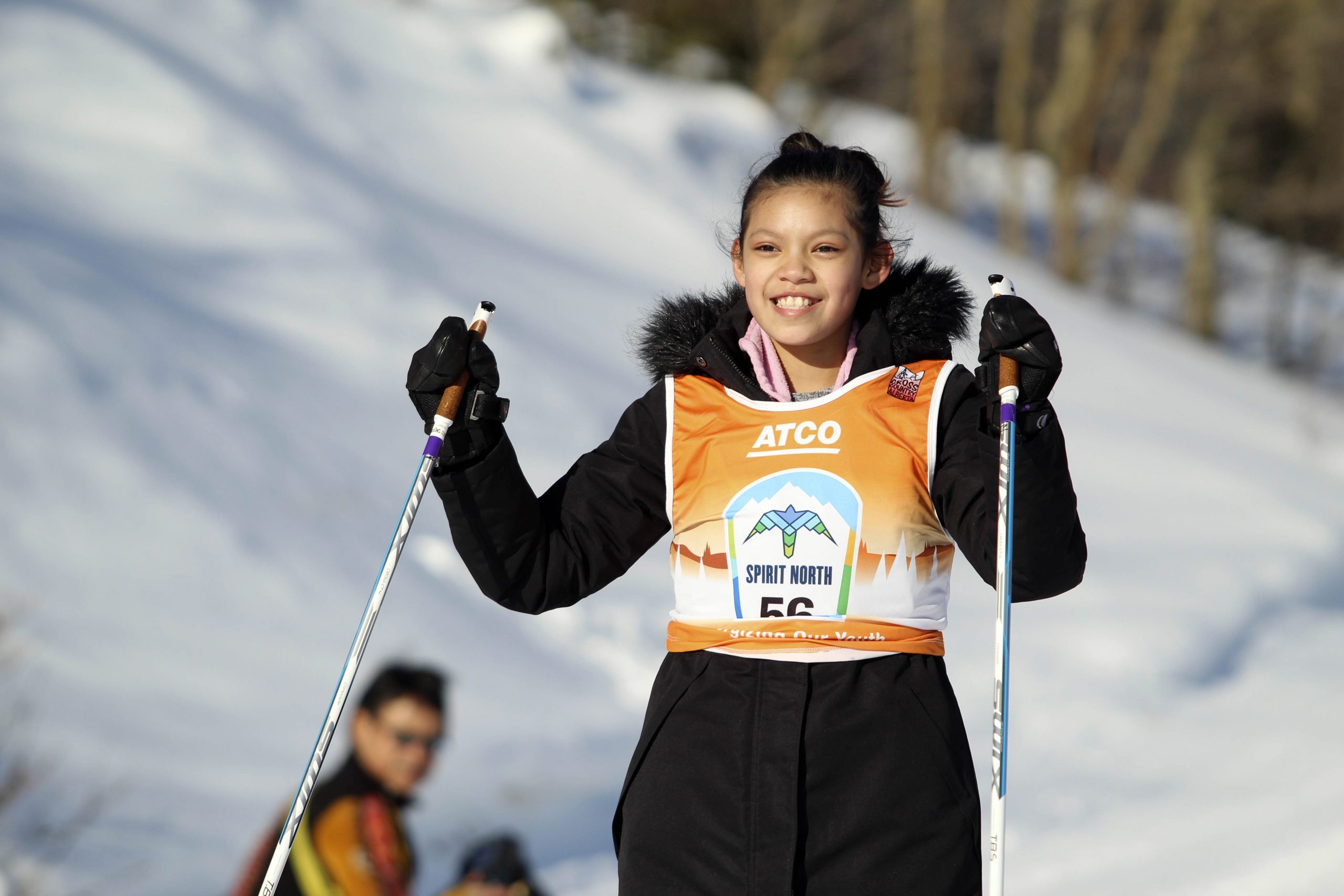
A participant enjoying the sunshine and snow at a Spirit North event (Photo: Spirit North)
“It was really incredible to see sport in there,” said Scott, “Of course, I know that as a former athlete how valuable sport has been in my own life, not just as a professional pursuit, but in terms of life skills, friendships, and opportunities. To think that we can contribute to reconciliation through this platform, that is really at its heart a very simple concept – it’s activity, it’s play, it’s sport, and it’s something that all kids should have the opportunity to benefit from. I think it was really inspiring to know that we are part of this whole movement toward reconciliation with Indigenous peoples in Canada.”
Initially cross-country skiing was the only sport offered in the Spirit North programs, but when they started to get interest and questions about expanding beyond winter, the list of offerings started to expand.
“It really grew, it just exploded this last year to include everything from rock climbing, to equestrian, to skateboarding,” said Scott, “basically, if a community indicates interest in another sport and we have the capacity to meet that interest, we will do it. One of our primary goals and objectives is to ensure the experiences are really enjoyable for kids and make sure that they have a great time, and if they want to try a new sport and it’s beneficial, then we’re open to exploring it.”
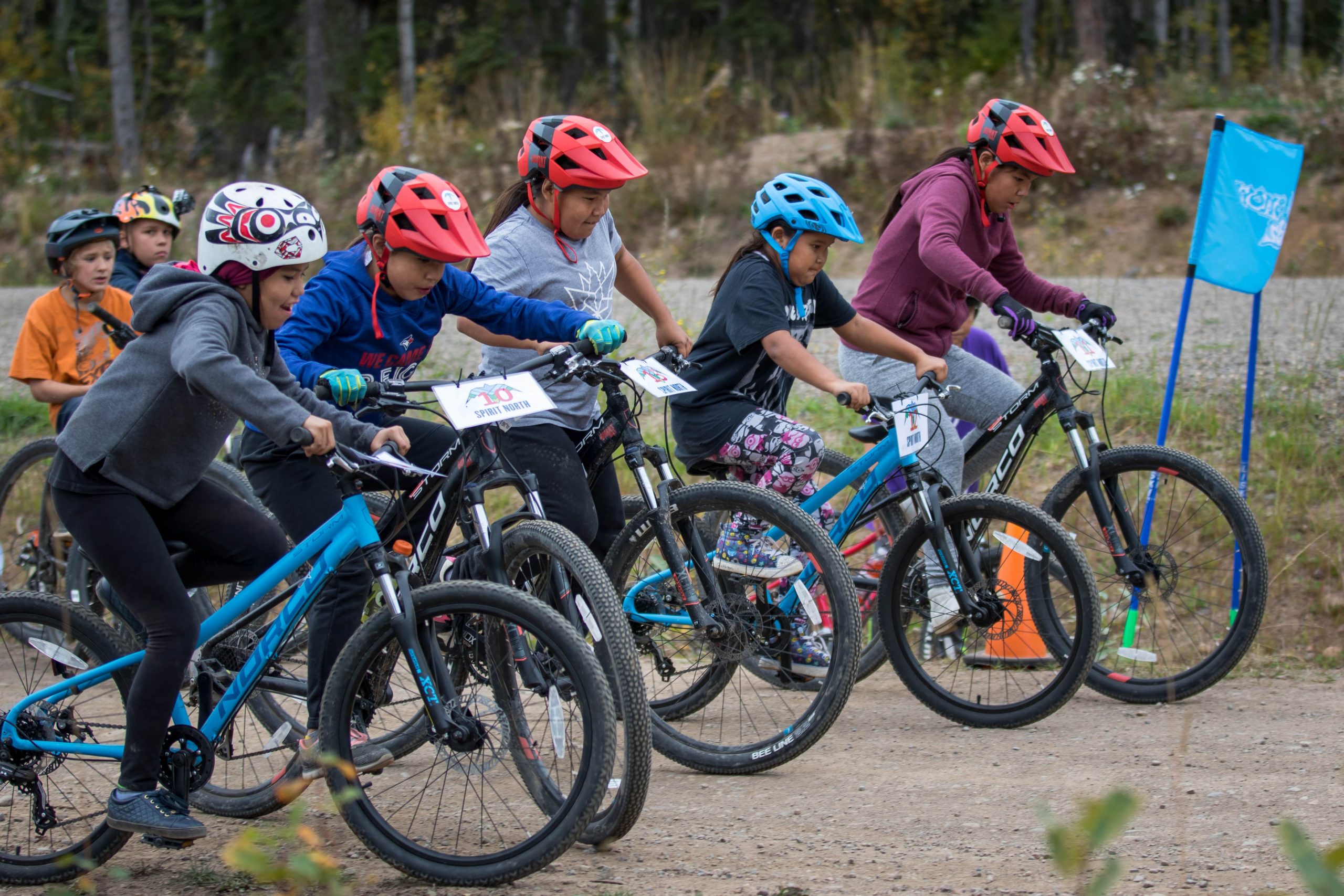
Spirit North participants work on their mountain biking skills, one of the sports added to the program. (Photo: Spirit North)
In the last year, 77 schools took part in Spirit North programs across six provinces and territories. Scott explained that they have a number of different models for programs within a community but primarily, the relationships start with what she calls a “co-creation process.” This includes meeting with the community members, teachers, elders, families or whoever is interested.
“Really, it’s a discovery,” explained Scott, “just learning what their values, beliefs, traditions, and knowledge are, and what are the barriers and then the program design is developed in collaboration with the communities. It’s very much a partnership.”
After this, the Spirit North program rolls out with a leader who is local if possible, if that capacity isn’t there, then they bring in a coach from an outside or neighboring community to lead programs.
“Every program looks a little bit different in every community, because it’s community driven,” said Scott. “We have been in communities for ten years now, there’s no cutoff date, or time we transition out,” she continued, “I think one of the reasons for success is relationship building, we just really commit to the community in terms of long-term relationships and delivering programs for as long as they want or need us there.”
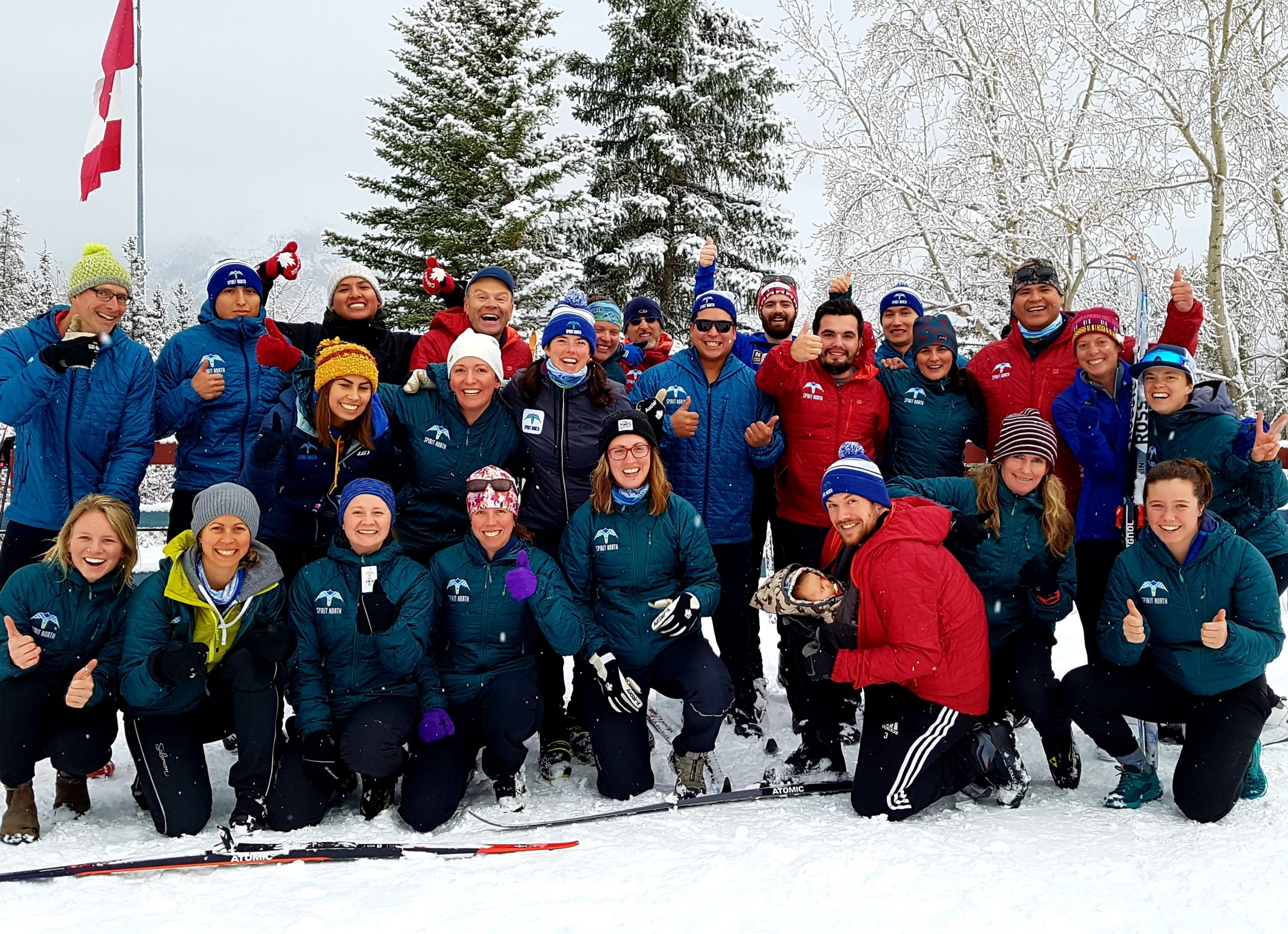
Spirit North leaders gather for a team photo (Photo: Spirit North)
It hasn’t all been smooth sailing. When asked about the learning process, Scott laughed, “I started a nonprofit really with no idea how to start, and so the learning curve was extremely steep.” However, with the help of a great team of people to lean on and provide advice and guidance, she was able to get the program off the ground. “I don’t think I could have known how much work it was going to be,” reflected Scott, though she was quick to say that it has all been worthwhile and very rewarding. “I think one of the biggest challenges we have is the challenge of every charitable organization, which is fundraising, you have to keep the lights on, and the programs running, and coaches paid.”
This has been particularly challenging during COVID. “We really have two jobs here,” said Scott, “raising money, and running programs, and raising money during COVID has been a challenge for a variety of reasons.” As with most non-profits, their fundraising success ebbs and flows. “We’re lucky and we feel fortunate, we’ve got some great backers, but growth and expansion as we go forward requires more funding. So it’s a constant sort of push and pull or a balance to try to maintain,” Scott concluded.
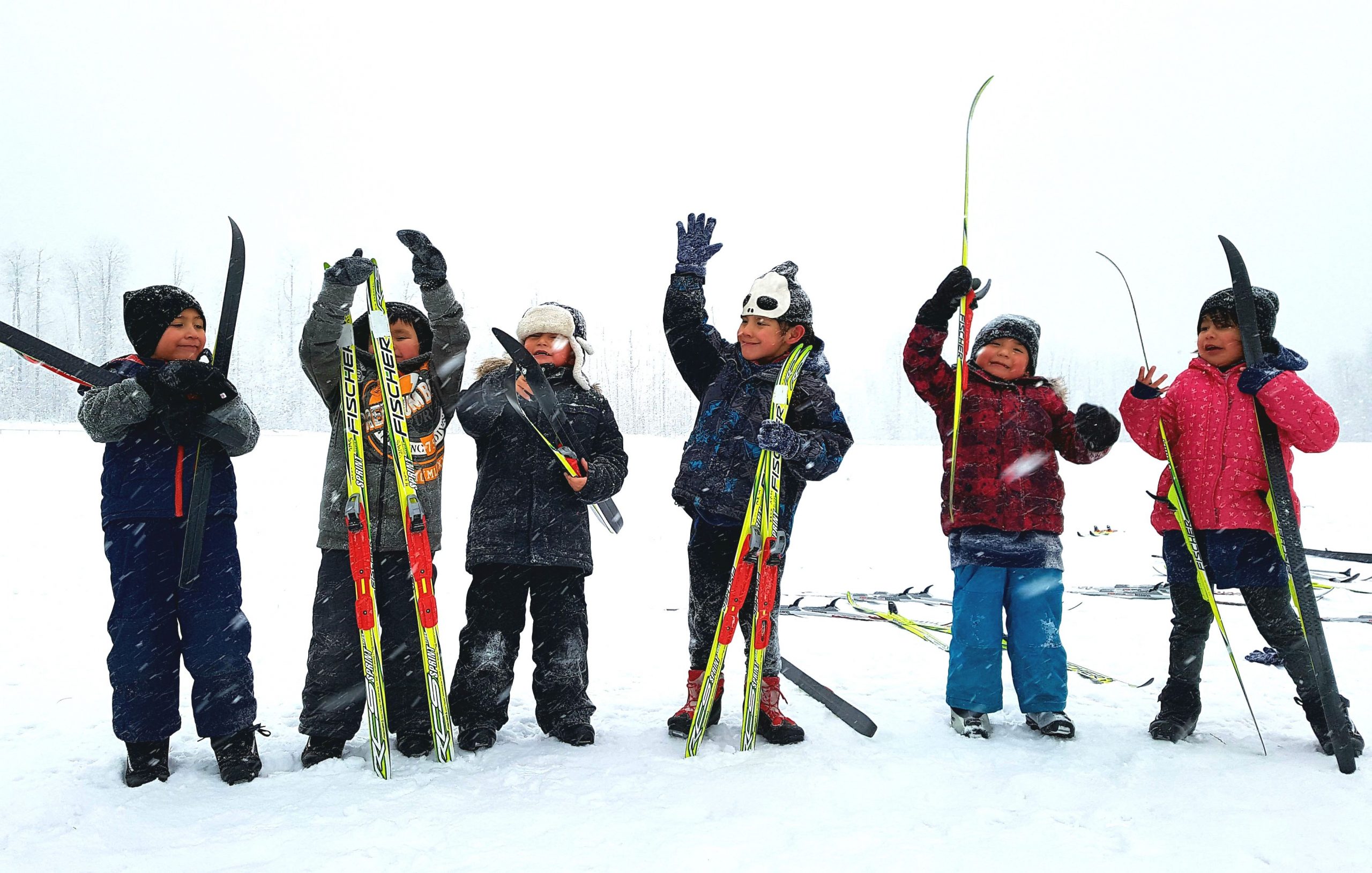
Enthusiastic little skiers show off their fischer skis, taking part in a Spirit North program (Photo: Spirit North)
On the flip side, Scott said the rewards from her efforts come in two parts, heartwarming individual stories, and the cast of extraordinary quality who work for the organization.
“We have coaches across the country now, who will send in a note or a text about a kid in the program who’s just completely transformed,” said Scott, “it’s so heartwarming and it never gets old… when we know that this program has touched them in a positive way, and it has made a difference in their life, that’s the most rewarding thing I think we could ask for.”
Regarding her team, Scott said, “the cast of people that have come to the organization – it’s been really extraordinary to see the quality of our team grow over the years, and I feel very fortunate to have the team around us that we do, running these programs, people who are really truly talented, but also caring and committed to the cause.”
As the Spirit North programs continued to grow, Scott reflected particularly on the satisfaction she draws from seeing kids participate in and enjoy Nordic skiing.
Beckie Scott shares her silver and gold Olympic medals with a Spirit North participant. (Photo: Spirit North)
“I think for me, it’s always so heartening and inspiring to see kids enjoying the sport that I love the most, and have grown up loving,” she concluded, “and just to have seen the sport, carry me through all these different phases of my life has been really something remarkable.”
To find out more about Spirit North or to make a donation, you can visit their website here.
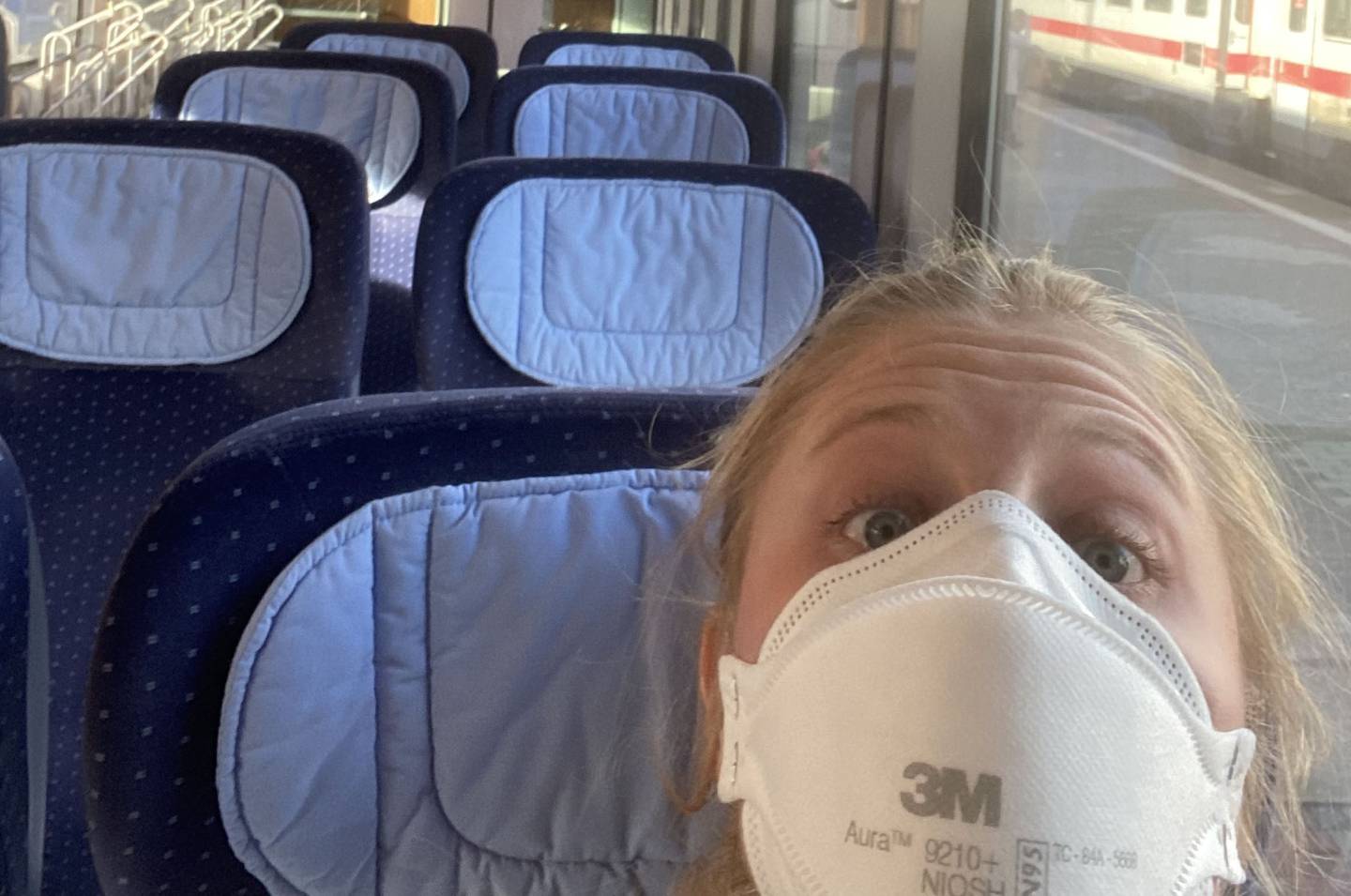
Hailey Swirbul searched out an empty train car to ride in while trying to avoid infection with the omicron variant on her way to a ski town in Austria this month. Swirbul is one of a number of Alaska athletes taking rigorous COVID-19 prevention measures to avoid derailing their hopes of competing in the Winter Olympics in Beijing. (Courtesy photo)
This article originally appeared on Wednesday January 19th, 2022 in the Anchorage Daily News. Reposted with permission.
The organizers of next month’s Winter Olympics in Beijing have imposed a rigorous regime of testing, quarantines and isolation for incoming athletes and staff.
Among the casualties is Steve Patterson’s pickleball game.
Patterson has two adult children, Scott and Caitlin, who grew up in Alaska and are both Olympic hopefuls in cross-country skiing.
They’re planning to prepare for the games from their parents’ home in Montana. Which means the whole family is being careful to avoid any contacts that could invite the coronavirus into their home — potentially derailing access to China for Scott, 29, and Caitlin, 31.
The Patterson siblings are two members of what’s currently one of America’s most COVID-conscious demographics: aspiring Olympians with plans for Beijing.
China, with its “zero COVID” policy, has draconian requirements for anyone flying into the country for the Games. They start with two negative lab tests just to get on the plane to China, followed by another immediately upon arrival at Beijing’s main airport.
A positive test would disrupt teams’ meticulously laid plans for travel and training, and even asymptomatic cases would almost certainly force athletes to miss flights and competitions for which they’ve trained for years.
As a result, Alaska athletes and others involved with the Olympics are going to great lengths to stay free of omicron as the variant spikes across the U.S. and the globe — even with training and competition schedules that include inevitable cross-country or intercontinental travel.
“This experience that I’ve dreamed of my entire life is sort of now just grounded in stress, more than anything,” said Luke Jager, a 22-year-old Anchorage cross-country skier likely to be named to the Olympic team. “I’m sure at some point, being over there, it’ll kind of set in. But right now, the challenge of not getting COVID feels just as big as the challenge of even qualifying for the Games did.”
Luke Jager starts a race at Anchorage’s Kincaid Park in 2020. (Loren Holmes / ADN)
Chris Grover, the Anchorage-raised program director for the U.S. cross-country ski team, recently returned home to Idaho from the European racing circuit.
He spent his first few days with his in-laws, rather than with his family, to avoid catching the coronavirus from one of his children who’d had a potential exposure.
Meanwhile, one of the athletes that Erik Flora coaches at APU, he said, has even been wearing masks around and sleeping in a different room from their romantic partner.
“That’s the commitment that probably tops just about everything,” Flora said. “You’re messing with the human spirit at that point.”
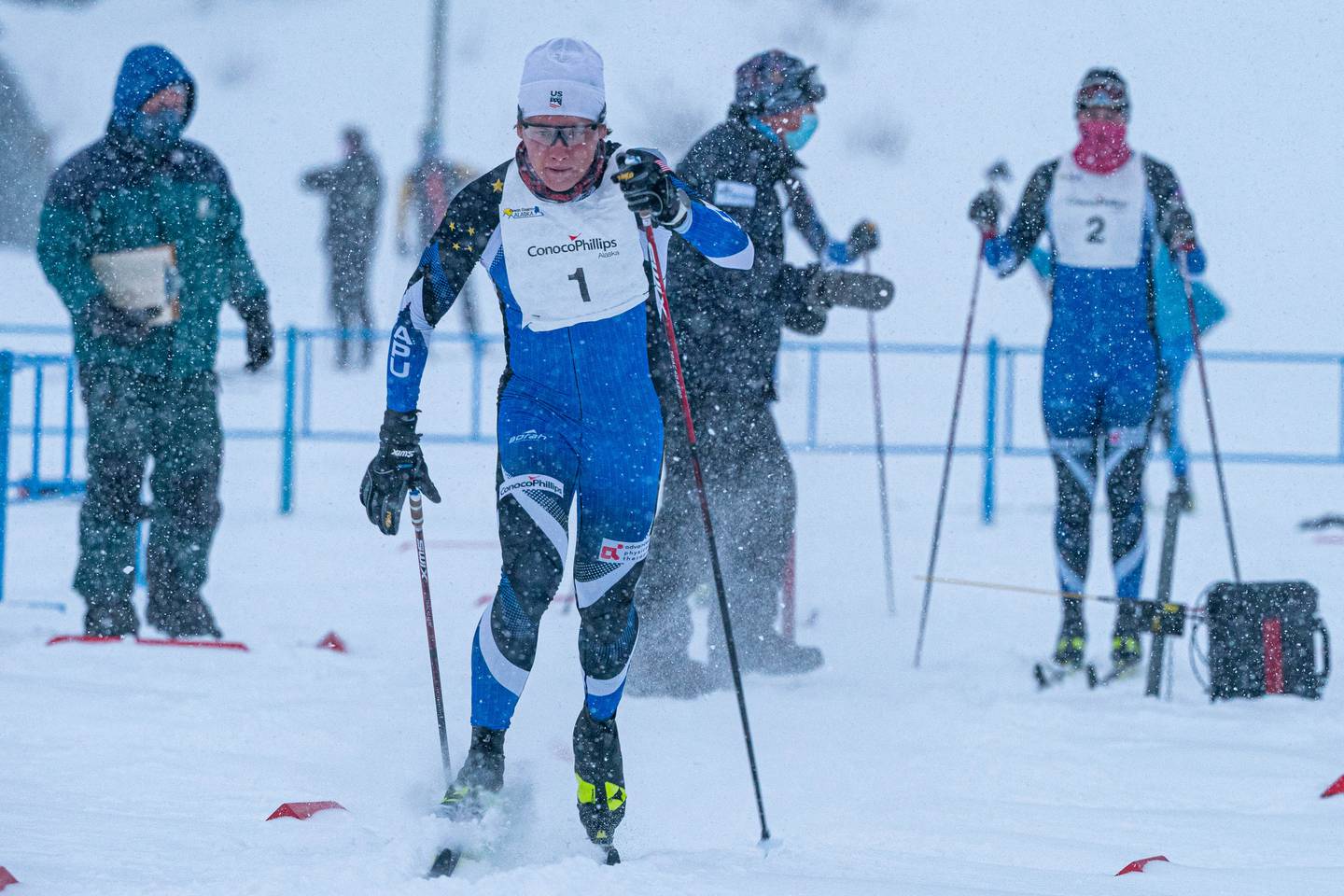
More than a half-dozen cross-country ski racers with Alaska ties have a good chance to make the American Olympic team when it’s named Thursday — joining two curlers, a hockey player and a figure skater as some of those destined for Beijing from the 49th state.
In interviews, the skiers and coaches describe taking Olympic-level anti-omicron precautions. But each faces a unique set of risks, depending on their circumstances.
Hailey Swirbul also trains with APU in Anchorage; she planned to return from European racing to Alaska for a pre-Olympic camp, where she could spend time with her boyfriend and dog.
But after catching a cold, Swirbul, 23, decided to stay in Europe and avoid two rounds of major international travel.
After three train rides — sporting an N95 mask, with no breaks for eating or drinking onboard — Swirbul arrived in Austria for pre-Olympic training. There, she and her teammates broke into smaller groups that don’t mix indoors.
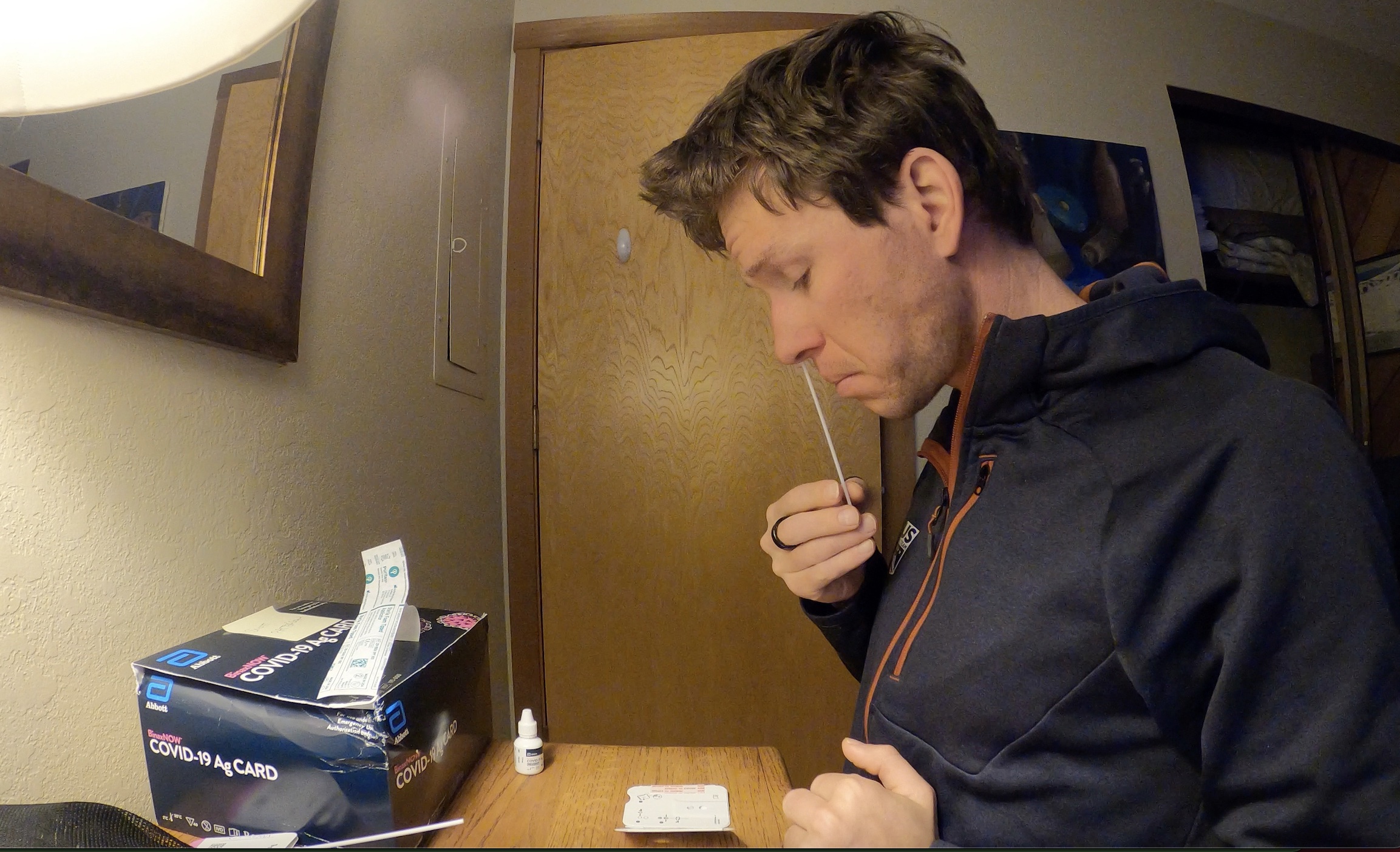
Scott Patterson self-administers a COVID-19 rapid test. (Courtesy photo)
The athletes take rapid antigen coronavirus tests every day, retrieve meals cooked by a team chef, bring them back to their living quarters and eat only after washing their hands. Swirbul got in the habit of climbing out a window to leave her apartment, rather than walking through a shared space that would require her to don an N95.
She also turned down an invitation to meet a friend, outdoors, for hot chocolate. And “definitely no grocery stores — we haven’t been in those since we’ve been here,” Swirbul said in a Zoom interview.
Jager has suffered through much more of a saga. Outside of international competitions, Jager races for the University of Utah, and he had to return from top-level European racing a few weeks ago to compete in collegiate events in the U.S.
When he arrived, the coronavirus was circulating among his team, so he couldn’t move back into his house. In a phone interview last week, he described staying in the vacant home of friends of his girlfriend’s parents before a race series in Idaho.
“They get back tomorrow night. So, we’re trying to find some other place to stay because we’re trying not to see anybody,” he said. “I’ve been nomading, pretty hard.”
Jager returns to Europe this week for a training camp in Italy with the American team, then will fly to Beijing from Switzerland.
JC Schoonmaker, another likely Olympic team member who competes for University of Alaska Anchorage, is on a similar program to Jager, except he traveled and lived with his collegiate team during races in the western U.S. this month.
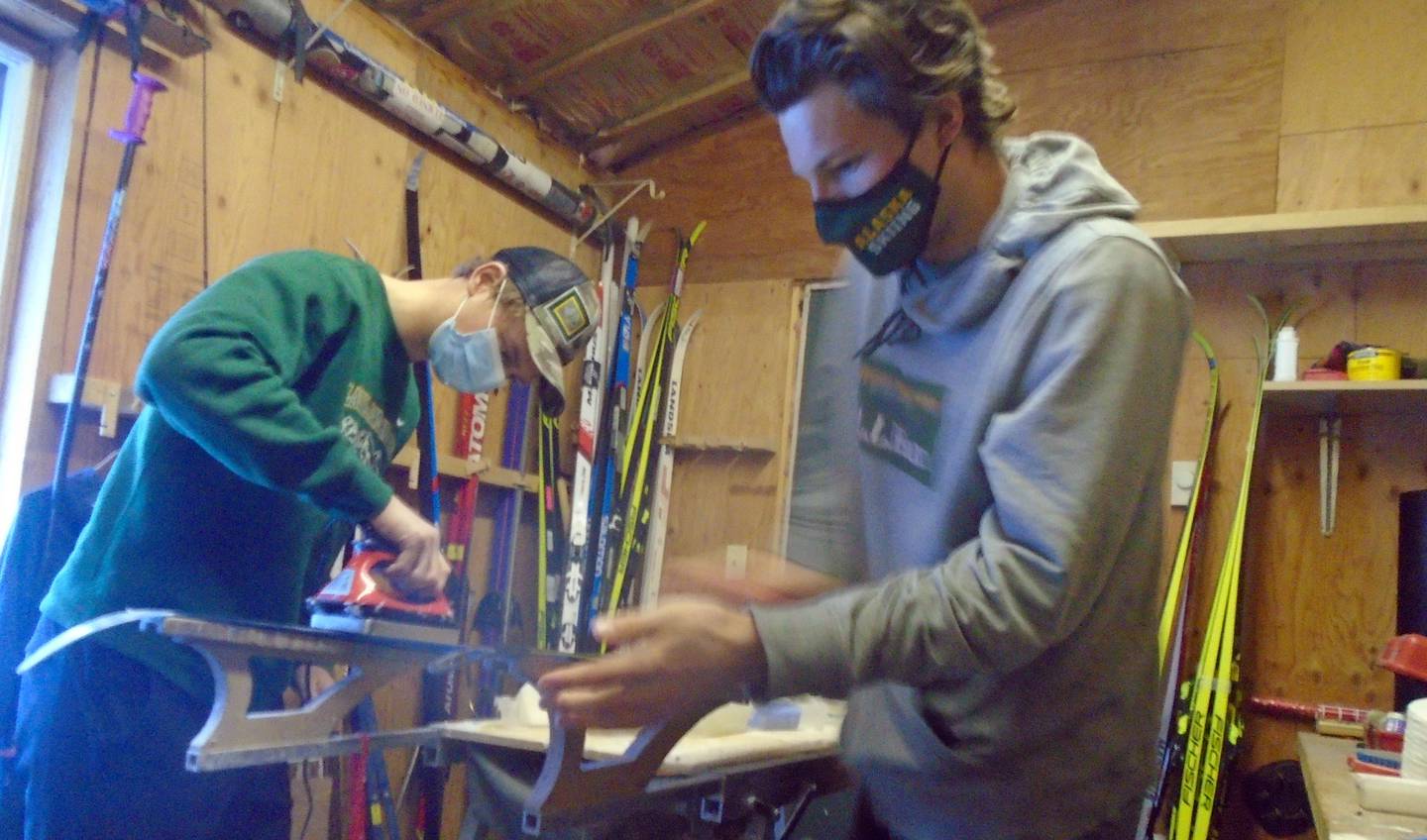
JC Schoonmaker, right, and a teammate tune skis Friday, January 14, 2022, before a weekend of racing in Idaho. Schoonmaker is one of a number of Alaskans taking rigorous COVID-19 prevention measures to avoid derailing his hopes of competing in the Winter Olympics in Beijing. (Adam Verrier)
Schoonmaker’s coach, Trond Flagstad, said the UAA coaches are doing all the shopping; they enter the athletes’ houses to drop off groceries only while wearing masks.
“It’s definitely risky, but I’m pretty confident,” Schoonmaker said. “And I really do trust my teammates — I think they’re doing a good job.”
Aside from presenting obvious logistical problems, the coronavirus has affected the skiers in subtler ways, too.
It’s forced them to keep their support networks at a social distance, whether that’s partners, family members or friends. And with coaches taking on more risks, like grocery shopping, it’s also harder for them to work closely with their athletes, or even to drive them to races in vans.
Added all up, it makes for an especially grueling, and isolating, build-up to what was one of the most pressure-filled experiences in athletics even before the pandemic.
“It really weighs on me,” said Rosie Brennan, a medal hopeful who trains with APU in Anchorage. “It’s honestly harder than preparing yourself to race.”
With the Games, and the negative tests required to enter China, approaching, each swab presents aspiring Olympians with a new reason to worry — especially with the awareness that omicron may present itself without symptoms.
“You know how it is when you’re a skier: You’ve got stuff coming out of your throat and you’re always blowing your nose and stuff,” said Jager. “You’re like at 7,000 feet, you’re like, ‘Maybe I’m a little tired today and I just blew my nose a couple extra times. Definitely could be low-level symptoms of COVID.’”
One silver lining for the Alaska ski racers, in the final days before the games begin: They’re not alone.
One of Norway’s top cross-country skiers, Heidi Weng, made tabloid headlines in that country when she said she wouldn’t be seeing her boyfriend before Beijing.
And Maja Dahlqvist, a Swedish cross-country superstar, has to stay at least 6 feet away from her boyfriend, American cross-country skier Kevin Bolger. That applies even as their teams hold separate pre-Olympic training camps on the same trails in Italy.
“I mean, of course we wish we could hold hands or hug,” Bolger said in an email. “But both knowing what is on the line, we will survive until after Beijing.”
The season’s biggest races start in less than a month at a venue that is by all accounts well-designed, but also has yet to host an official FIS race. Here’s some of what is currently known about the National Cross-Country Skiing Centre in Zhangjiakou, 100-plus miles northwest of Beijing in the Hebei province of China.
The Courses
The races will be held at altitude. The stadium is located at an elevation of roughly 1,650 meters above sea level (appr. 5,400 feet), according to the homologation certificates, and the 8.3 k loop reaches an elevation of 1,721 meters. The last comparable global championship was the 2002 Winter Olympics in Salt Lake City, Utah, where the stadium in nearby Soldier Hollow is between those two heights. It is not coincidence that the presumptive American Olympic team is spending this month in some or all of Seefeld, AUT, Livigno, ITA or Park City, UT to log more time at altitude in advance of the Games.
You can find full homologation certificates for all of the Zhangjiakou courses here. Here are excerpts from some of the course profiles. Note the color key, which indicates that an A-Climb is highlighted in yellow, a B-Climb in orange, descents in blue, and undulating terrain in green.
Zhangjiakou sprint course. (screenshot from FIS homologation certificate)Zhangjiakou 3.3 k course. (screenshot from FIS homologation certificate)Zhangjiakou 5 k course. (screenshot from FIS homologation certificate)Zhangjiakou 8.3 k course. (screenshot from FIS homologation certificate)
Going off of simple math alone, the sprint course features a maximum climb of 30 meters, the same as the sprint course in Falun, SWE. The distance courses feature roughly 39 meters of climbing per kilometer, at the high end of the allowable homologation range but very much in line with other championship courses. You can consult the homologation certificates for a more nuanced look at overall gradient, course flow, and associated statistics.
More holistically, the 14-meter climb back up to the stadium, in the final half-kilometer of all courses, is notable, at least in contrast to venues that feature a downhill into the stadium. A follow-up article in the next few weeks will compare this aspect of the Zhangjiakou courses to other recent championship courses.
Intriguingly, rumor has it that the warmup track at the venue is underground. This is perhaps less noteworthy in track and field, where major international stadia often have a small warmup track near the athletes’ call room, near bathrooms and out of view of spectators. It seems more notable when it appears to describe a ski tunnel–like environment.
Conditions
It is widely expected to be cold and dry. This was presaged in a research paper in the Journal of Science in Sport and Exerciseblurbed on this site last May, which was summarized as stating, “The Beijing venue has a very high probability of temperatures near the lower limit permitted for FIS races (-20C). Combining cold with higher elevation and low humidity results in suggested pacing adjustments to ensure good lung function at the end of races.” Matt Whitcomb, in discussing the Period 1 races held near this temperature limit early in this World Cup season, similarly referred to these races as being good prep for the Olympics.
Screenshot image of Olympic venue in late December 2021, taken from video published on news site ruptly.tv. (original video)
Expect entirely manmade snow throughout the venue; natural snowfall in the region is negligible, and two weeks ago the ground was bare everywhere outside the ski trails and stadium (see background of photo above, or background of this Instagram post). A comparable preview article published two weeks ago on SkiRacing.com and discussing the alpine venue at Xiaohaituo Mountain (A+ title: “What to expect when you’re inspecting”) unpacks some implications of this for waxing and ski performance. This is not to say that precisely the same conditions will be present in Zhangjiakou, dozens of miles away at a different venue, but rather to flag some relevant issues to consider here.
For the alpine runs, for example, that author foresaw “average annual snowfall of 5cm/2 inches, high winds, very low temperatures, sunny days and clear nights,” all of which also describes likely conditions in Zhangjiakou. She also noted the possibility of “sand blowing in from Mongolia and debris from the massive earthmoving during trail construction” being present in the snow. She described one wax manufacturer formulating a “special series of Beijing waxes for extreme cold temperatures, extremely aggressive snow and massive daily temperature swings due to sun exposure.” This is all likely broadly applicable to conditions at Zhangjiakou as well.
What about the waxing
To paint in very broad strokes here on a potentially touchy subject, the American skiers appear to have had “good” skis for some races in Pyeongchang, but, shall we say, “not as good” skis for some races in Seefeld and Oberstdorf. Given that euphemistic use of “not as good,” keep in mind as you read this section the norms that generally govern reporting on or public statements about the efficacy of wax jobs in this country: By the time an athlete is expressing polite concern about her wax job to the American press, it is probably the case that her skis were, objectively speaking, noticeably worse than other athletes’.
You may have seen this photo before: Jessie Diggins (14) edges Sweden’s Stina Nilsson (r) for gold, while Norway’s Maiken Caspersen Falla (l) races to bronze, in the women’s freestyle team sprint final at the 2018 Olympics in Pyeongchang, South Korea. (Photo: Noah Hoffman)
Regarding Pyeongchang, the 2018 Winter Olympics, if you’re reading this website you are probably familiar with a certain highlight that ends with Chad Salmela’s epochal cri de cœur (“Here comes Diggins!”). But rewind 56 seconds, to the descent off the top of the final downhill coming into the stadium, and you will see Diggins rocket into contention midway though the downhill. Her skis were, it appears from this video, at worst “competitive,” and at best “fastest in the field.” The air temperature for this race was -5.4 C and the snow temp was -10.1 C, according to the official results.
Regarding Seefeld, the 2019 World Championships, Sadie Maubet Bjornsen told this website, following the 30-kilometer freestyle at the end of two weeks of racing, that while she generally felt good on course, “It’s just so hard because you can’t control what you have on your feet a lot of the time.” She added, “At this level you have to have your skis at a level that can compete if you’re going to fight for a medal or even top 10, top 20. And there were some races this week that that was not the case.” Air temp for this race was +5.6 C and the snow temp was -0.3 C, according to the official results. (Disclosure: In this same article, teammate Jessie Diggins said, of the same race in the same conditions, “I had the best skis in the world.”)
Jessie Diggins races in the skiathlon in Oberstdorf, February 2021. (photo: Modica/NordicFocus)
Finally, regarding Oberstdorf, the 2021 World Championships, the ever-upbeat Diggins contemporaneously told this website, following a rough day in the skiathlon for the entire American women’s team, “I think that is so promising to see how well [my teammates] skied given the disadvantage that we had today. I think, to me, that is really impressive because it is easy to put together a good race when you have the fastest wax in the field. It is harder to just never give up and keep fighting [in less advantageous conditions], and to me, that is so much more impressive.” Air temp for this race was +3.2 C and the snow temp was -0.6 C.
Writing several months later in the Boulder Nordic Sport catalog (page 6 of this PDF), U.S. Ski Team coach and wax tech Jason Cork spoke more bluntly when discussing this race and the championships more broadly: “I thought Jessie should medal in the 10km, and she missed the bronze by 5.1 seconds. I thought she could medal in the skiathlon; I’ve never been more sick and angrier about screwing up skis as I did that afternoon. We’d hoped to finally get the women the championship relay podium they’ve been chasing since 2013, and we weren’t able to deliver skis competitive enough to make it a reality. It was warm and soft, course access was severely limited, we got outsmarted and outgunned. We stood in the way of a lot of dreams in Oberstdorf.”
Zach Caldwell, for his part, has voiced the opinion that the Americans’ relative lack of tech resources, specifically the lack of an on-site stonegrinder and a centralized grind system, has harmed them in the last two championships held in warm and sloppy conditions. If some of these premises are correct, then forecast waxing conditions in Zhangjiakou that are far more akin to those in Pyeongchang than to those in Seefeld or Oberstdorf could be beneficial for the American tech team. (Find more insights into the challenges ski technicians will likely face during the Games in the latest episode of The Devon Kershaw Show, featuring Caldwell. Spoiler alert: These dynamics are in fact a whole lot more complicated than just “cold = easy, warm = difficult,” and Caldwell knows a heck of a lot more about this area than this reporter, so you should probably listen to him.)
The first cross-country race in this year’s 2022 Winter Olympic Games will be the women’s skiathlon, held on February 5.
Last year, in an effort to create a standardized workout that could be easily replicated and repeated, national team coaches presented the concept of the “U.S. Pace Project.” The concept is straightforward: a shift away from time-based intervals to distance-based, centered around repeated laps of a 5-kilometer course.
This familiar distance is key. In a call in July, Matt Whitcomb, U.S. Ski Team Head Coach, and one of the creators of the project explained that: “5k is essentially the building block of just about every race we ever do. It’s a very tangible distance that everybody knows right from childhood.”
Jessie Diggins races the Keys to the Castle Rollerski Race in Lake Placid. (Photo: Matt Whitcomb)
Whitcomb continued that while the session itself is not revolutionary, it has provided a shared pathway for clubs to explore pacing during intensity sessions. Usually athletes will complete three rounds of the same 5k course, and repeat the workout intermittently throughout the training season to track overall progress or fine-tune pacing strategy. Given the ease of implementation, clubs of all levels nationwide can adopt the concept.
“Clubs are encouraged to find a 5 kilometer stretch of rolling road, something that can replicate race terrain as best and as safely as they can,” Whitcomb explained. “If it’s on a rollerski track, that’s even better.”
As the training year progresses, so does the nature of the Pace Project. “This is a workout that is meant to build in intensity throughout the year, but also in creativity,” Whitcomb stated.
Creativity, in this context, is an ongoing experiment with pacing, fueling, technique, and effort, followed by a discussion of individual outcomes amongst the group. Essentially, the U.S. Pace Project is a personal study for athletes to find their own fastest and most efficient approach to racing.
Ian Torchia races NENSA’s Trapp Invitational Rollerski race in November, 2021. (Photo: George Forbes/SMS)
Another motive behind the project, according to Whitcomb, is to promote the sharing of insights between athletes and coaches nation-wide as they incorporate and discuss the takeaways from the Pace Project format. He explained that time-based intervals offer less concrete information to learn from, as there is more room for variation in training venue and conditions.
“[The sport] is challenged with regards to metrics,” Whitcomb said. “So this is meant to catalyze more objective feedback and learning.”
As many national team members train in Stratton, VT in the summer, SMS T2 head coach Pat O’Brien provided a look into his experience facilitating the workout with his athletes and his current takeaways.
“If you give the athletes a set distance workout, they are going to learn how to manage their energy over that distance,” O’Brien said, citing supporting research by Norwegian based Sports Science Professor Steven Seiler.
“The whole point,” O’Brien continued, “is in a training type environment, go out and play around with different [approaches]. It might not all work. It might fail. But it’s better to learn those lessons in a training environment than in a race.”
Ben Ogden (bib 13) races the Keys to the Castle Rollerski Race in Lake Placid. (Photo: Matt Whitcomb)
While a nationally shared workout is new, the project itself grew out of conversations with previous American athletes who incorporated similar workouts as a fitness benchmark.
“I think the most notable one is Kris Freeman,” O’Brien explained. “He was truly one of the best in the world at the 15k distance. He would do a repeated workout of 3x5k, and he knew if he could sustain three repeats on [a particular] 5k stretch of road, he was in good shape.”
O’Brien said that inspiration had also come from one of his mentors, Sverre Caldwell, former Nordic Director at SMS.
“Back in the early 2000s, the Stratton program had a string of successes with high schoolers going on to these great sprint results when sprinting had just started coming out,” he said. “What was interesting talking to [Caldwell] was they didn’t go out seeking to pace sprints. He wanted to make his athletes stronger and tougher, so he devised a double pole test.”
The test involved double poling up a specific hill, which happened to take high schoolers like Andy Newell about three minutes. “It was not intentional, but they got good at figuring out how to go up that hill as best they could for about three minutes, which happened to be about how long a sprint was. They didn’t go out with the intention of being great sprinters, but if you give the athletes a set distance workout, they are going to learn how to manage their energy over [that distance].”
These ideas have fused into the Pace Project. Still in its infancy, it remains an elastic concept meant to help American skiing in a number of ways. Part nationally shared workout, part personal experimentation project, part data gathering opportunity, there are many objectives at play.
“The pacing project is an idea where if we subject ourselves to all these different stimuli, we can be more flexible,” O’Brien said. “The point is, we’re always going between environments, and we’re always trying to get athletes better at finding what their red line is, so to speak.”
Bill Harmeyer and Ian Torchia lead the charge during a fall training session. (Photo: George Forbes/SMS)
O’Brien explained that coaches had been seeking a way to reap the benefits of racing without the physiological toll they require.
“How can we construct workouts that challenge you in a similar way to what you experience in a race without the same cost?” he asked rhetorically.
The Pace Project seems to be filling this gap, by offering athletes a chance to experiment with novel pacing strategies outside of a race environment.
“I don’t care if someone goes into it too hard and blows up,” said O’Brien. “We’re not looking for an objective time, It’s about how athletes pace themselves.”
O’Brien stressed that the key to the pace project lies in athletes figuring out what works best for them, both in what technique they use on specific sections of the course, and for overall pacing.
“Every athlete has a style,” he said, “a way they want to move. [It’s] not ‘you should do this because it works for you.’ I think that’s how we unlock our athletes’ best potential.”
The Pace Project has received favorable reviews from athletes and coaches beyond the SMS T2 team. The SVSEF Gold team in Sun Valley, Idaho use their 1.2k rollerski trail for pace sessions according to Head Coach Chris Mallory.
“This workout basically brings a little more focus to threshold workouts,” wrote Mallory in an email. “Athletes can play around with different pacing strategies, whether it’s starting more conservatively, using different techniques, or skiing different parts of terrain harder or easier to see what works best for them… It’s nice to have something that’s repeatable, where you can measure progress.”
Strava users who follow some of the top domestic skiers may have seen some of them completing these workouts, like this example of Gus Schumacher’s October iteration. Schumacher explained in an email the role the workout has played in his summer training this season:
“[The Pace Project] is a cool format because it allows for a lot of different strategies, similar to racing. Usually in the earlier summer we’ll use it as a way to get L3 while lapping a track with similar features to a race course. Later however, like at our camp in Park City, it was fun to use it as almost a race simulation.”
Gus Schumacher completes a 4 x 5k pace project session during a fall training camp in Soldier Hollow. (Photo: Strava)
Schumacher described one of his sessions in October: “I started the first 2 minutes hard like I would in a mass start,” he wrote. “After that I eased back to a sustainable pace, then in the last one I finished hard. This made it feel a lot like a race without the same cost (because of 3 minute rest between each interval). Breaking it up into segments also allows us to change our strategy more from lap to lap, which can help with testing new pacing strategies, especially at altitude.”
Reflecting on the outcomes for coaches, Whitcomb said that he was pleased with how the Pace Project sessions had increased the conversations between athletes.
“What we’ve observed is that there’s more interesting discussion before and after these sessions, than there is for just your standard threshold interval workouts.”
Over the summer, Whitcomb stopped by Stratton during a SMS T2 pace session and remarked on the depth, variety, and value of the subsequent conversations.
“Of the ten athletes that were there that day, there were ten different approaches to this workout, because Bill Harmeyer is setting his sights on one specific goal on that day, and Jessie Diggins on perhaps another goal, and everybody’s learning and discussing and crowdsourcing ideas effectively.”
Alayna Sonnesyn pushes the pace in a fall training session. (Photo: George Forbes/SMS)
While the value of the project lies in its idiosyncratic freedom, the aim is competitiveness.
“Hopefully,” Sun Valley’s Mallory suggested, “it helps our nation to continue to make progress in distance racing.”
As the largest NCAA circuit in the nation prepares for a return to a full schedule, anticipation, anxiety, and lessons from a pandemic year abound in New England.
Carnival, as a noun, has perhaps had its moment. We’ve been building towards ennui, not excitement, for nearly two years now. Maybe it’s time to dispel the anticipation, let the moment fade, and let “Carnival” go along with it.
But then again, calling a collegiate race circuit a “carnival” has always been a bit old-timey. One of those New England-isms – like calling your town park a “common.” My alma mater Colby College hasn’t had a winter carnival, festival, ball, or snow sculpture on its grounds in years. Those memories are confined to dusty old photographs hung in student unions throughout New England — all distractions from another time. Nonetheless, in January eleven New England schools will gather at Colby to start the NCAA collegiate racing season, and it will be all jubilation, camaraderie, and competition. There will be the return of the possibility to mark time by the traces of human emotion that linger on in memories, rather than case counts and travel restrictions.
All-too-well then, that Colby will still call it a Carnival.
The Eastern Intercollegiate Skiing Association (EISA) Carnival circuit is set to return to a full calendar on January 14th-15th, 2022 after a season that saw heavy modifications in response to the COVID-19 pandemic. With it comes lessons learned, appreciation, and excitement from both athletes and coaches across New England.
The 2021 Carnival Circuit
The EISA last year could, at its best, be described as disjointed. Each team was subject to individual state COVID-19 policies — in a region with a lot of states — on top of their own institutional policies. Vermont teams couldn’t travel outside their state for competition due to state restrictions. Colby couldn’t travel out of Maine per school policy. Many of Harvard and Bowdoin’s skiers weren’t on campus at all for the fall or spring semester. Some skiers were being tested daily, others twice a week. The means and ends were shifting constantly.
Athletes responded in different ways. Some pressed on with their education and their athletic career. Some re-evaluated and decided that enjoyment in skiing could be found elsewhere. Others chose to compete in their home regions towards skiing goals separate from the NCAA ranks.
For one, Foss Kerker, who is serving as Colby College’s team captain this year and will graduate in January, the missed season was serendipitous. A shoulder injury left him unable to race what was set to be his senior year, and so he decided to focus on recovering, training, and looking forward to this season. After taking the semester off, he returns this year feeling renewed, saying in an interview with FasterSkier that “On the whole, I am more grateful for skiing and ski racing. Not being able to ski or race last winter has made me refreshed and just excited to get out and race in the fun and competitive environment of the EISA, whatever the results might be.”
Foss Kerker attacks a climb at the last Colby Carnival, held at Quarry Road in Waterville, ME in Jan. 2020. (Photo: Gary Solow)
Gratitude for Skiing and Ski Racing
Kerker extends this newfound sense of gratitude to how he is helping prepare the Colby team to race. It has been an anecdote to the quick and rapid changes precipitated by the pandemic in skiing, in the world, and in life. As Kerker reflected:
“[Coach] Tracey has talked a lot about this recently – not knowing what is going to happen with schedules, conditions, or travel was something that was really hard to deal with before. That has sort of become the default now and being able to go with the flow and continue to perform is something that is only going to help us in the long run.”
Colby head coach Tracey Cote also touched on how the return of the traditional run-up to the EISA carnival season has helped her team build off of the flexibility that was required in training last season, saying in a response to the author via text that “I’m really excited about my team as we’re off to great start with our Canada training camp and the first Eastern Cups on our home course at Quarry Road.”
As other coaches look back at their own takeaways from last year, the lessons all point back to a re-centering of their roles around the joy of skiing.
Becky Woods, head coach at Bates College in Lewiston, ME, said her team now has a sense of how “important [it is] to embrace opportunities when they are put in front of you, and we see this season as a great big opportunity to come together, race fast and have fun on skis!” While Molly Peters, head coach at St. Michael’s College in Burlington, VT stated that “we appreciate every day we can practice and every opportunity we can race!”
Peters also added that this re-found joy has seeped into her team’s race preparations. “The team spent a lot of time backcountry skiing and having fun on skis last year. We will definitely keep these fun days this winter to take a step back and remember what it’s all about. Fun!”
In a way then, the year off from the carnival circuit looks only to have added to its carnival spirit. With that sense of joy, the EISA looks ready to maintain its traditions and do as its skiers have always done, make the sport fresh and exciting.
The women’s field, headed by (from L to R) Katharine Ogden (DAR), Margie Freed (UVM), Annika Landis (MID), and Alexandra Lawson (MID), heads out on course at the last Harvard Carnival, held in Craftsbury, Vermont in February 2020. (Photo: Gary Solow)
A New Field with New Faces
That strong spirit though, is accompanied by a sense of anxiety. This is, after all, a different group of skiers than the one that finished the last full EISA carnival at Middlebury in February of 2020.
As Williams College Assistant Coach Annika Martell responded to the question, “How do you think the carnival circuit will look differently this year than it did before the pandemic?”:
“Besides half the field being new to the eastern racing circuit?!? There will be a lot of new faces for sure!”
She has a point.
Martell is uniquely positioned in the EISA. She finished the last full Carnival in 2020 as an athlete with Colby, and now will start the first full Carnival in 2022 as a coach with Williams.
Annika Martell, Colby alumnus and current Williams Assistant Coach, racing at the Williams Carnival, held in Lake Placid, New York in 2020. (Photo: Gary Solow)
Two classes of graduates since the pandemic began, along with athletes like Kerker who have remained on the circuit longer than the traditional four years, mean a shakeup in who is on the circuit, and how familiar they are with one another.
Martell thinks that while this doesn’t change the way that athletes have prepared themselves for the season – the training hours are still high, the periodization the same – but it does change how an athlete might evaluate their performances.
“I’m excited because all sense of expectations have been dismantled with two new class years and a year of not being able to really race each other,” Martell said.
That lack of preconceived order in the field – which individuals and which teams fall where – provides opportunity, but also a unique variable. As Bates coach Becky Woods stated, “[This] brings some challenges as we’ll really have to evaluate performances from a new perspective. Relying on past results is not a method we can really use this year because so many had to take time away from racing.”
That leaves the forecasted results nearer to an unknown than they have been in past seasons. Without continuity comes a chance for individuals to reach with tenacity, grit, and discipline for top placings, without the hesitation that might come from lining up next to more experience collegiate racers whose resume’s have been followed. This combination promises to introduce new characters into the mix of the top collegiate ranks.
Still Not “Normal”
Of course, amidst overcoming many of the obstacles the pandemic has presented looms the reality that we haven’t yet overcome it. The EISA returns not because COVID is gone, but because the organization has been able to put into place substantial measures to control the spread of the virus while engaging in competition.
Martell reflected on this, pointing out that some of the energies that add vibrance to the Carnival circuit will still have to be subdued.
“Prior to the pandemic, I think there was a lot of organic inter-team bonding,” Martell explained. “Athletes had their home, region and team friends that all got to socialize in a unique way that other sports don’t experience. But out of an abundance of caution and in order to keep everyone safe and healthy, there may be slightly less mask-less mingling than previous years.”
That will leave a Carnival with its core intact, but with less of the frills that tend to animate the EISA from week-to-week.
The energies will still be there in some form. There will still be the warmth of seeing friends from far-and-wide all together in the New England woods, the glimpse at the future of US skiing that the top-end of the Carnival circuit consistently provides year-after-year, and of course, the good ol’ fashioned collegial competition whose atmosphere can be best described as, well, collegial.
They may come attached to signs of the time though. Masks to keep each other safe, shouts from slightly further off the v-boards along the sides of the trail, and Carni Crushes (an annual Valentine’s Day tradition whose details will be left fuzzy here) that this year will no doubt include a couple of really bad puns regarding something about social distancing.
Scenes from the sidelines at Bates Carnival in 2020, with Bill Kerker making sure no one lets hunger get in the way of the festivities. (Photo: Gary Solow)
All of those involved, especially those that have spent the most time on the EISA carnival circuit — the coaches — are adjusting to this world in a way that will keep the timeless camaraderie of the circuit alive. As Becky Woods says, “Health and safety first. Always. We certainly focused on that in the past but it has taken on a new level of urgency.”
The best summary though, of what has carried the Carnival Circuit through the pandemic and into its return this year may come from the coach on the EISA Circuit who’s had to transition and grow along with it. Martell ended her reflections by saying that she “[feels] well-equipped to empathize and connect to athletes and what they have been dealing with over the last few years.”
And what we’ve all been dealing with. It’s a poignant message that anticipates the jubilee — the Carnival — that ski racing brings.
Rosie Brennan charges over the line to finish 6th in a cold individual start classic race in Ruka, meeting the objective standard for Olympic qualification for the first of several times this season. (Photo: NordicFocus)
It’s always tough to make the Olympic team. It got tougher this year, due to smaller quotas for all nations interacting with some math that is disadvantageous to the American men.
If you just want the executive summary of this article, here it is: The maximum team size, for any nation’s nordic team for the 2022 Olympic Winter Games, is eight athletes per gender. If the Games started tomorrow, the Americans would be able to send a total of eight women to Beijing, up to five of them sprinters. They would only be able to send five men, no more than four of them sprinters; it seems likely, but not guaranteed, that the latter figure will soon increase to six men total, with the same four-sprinter maximum. The eight-athlete quota for the American women will not decrease.
You would be justified in closing this tab now and heading off to start drafting form charts for the American Olympic squad and arguments for your favorite athletes. If you’d like an explanation behind the math, a brief history lesson, and/or some parameters for your speculation, then read on.
Jessie Diggins celebrates with fans after finishing in Lillehammer, where her podium finish in the skate sprint gave her the objective standard for Olympic qualification for the first of several times this season. (Photo: Modica/NordicFocus)
The quota system: Theory and practice
The system under which different nations may send different numbers of cross-country athletes to the 2022 Olympics is controlled by a dense, but logical, document promulgated by FIS, which may be found here. It has been interpreted in graphical form in this somewhat more user-friendly Wikipedia article.
Briefly put, the qualification system assigns one quota spot to any nation with at least one athlete racing at least year’s World Champs who met a minimum standard of international competitiveness. It then assigns the next tranche of quota spots in a manner consistent with how well a nation’s athletes did on the World Cup last year. Finally, remaining quota spots are allocated, in an iterative distribution, in a manner that similarly rewards nations with better performance in last year’s World Cup season.
The process proceeds independently for each gender, even within the same country, which is why the American women currently have the full eight spots, and the American men only five: The women ranked higher than the men in last year’s World Cup standings, which inures to their benefit in this year’s Olympic quota “standings.”
Step one: Each nation (or, most precisely, each National Olympic Committee, or NOC) that had at least one athlete notch a result below a specified FIS-point cutoff in at least one race at 2021 World Championships or U23 Championships gets one quota spot for this year’s Olympics. This standard is 300 FIS points, for men, or 330 FIS points, for women.
As a reminder, lower FIS scores indicate a more competitive race, and the lower an athlete’s FIS points the better their ranking relative to another athlete. For example, Jessie Diggins scored 8.17 FIS points for her second-place finish in the 10k skate in Davos, while winner Therese Johaug (NOR) scored 0.0.
Going back to the 300/330 standard, this is not a particularly rigorous standard to meet; this reporter could likely have obtained a result worth less than 300 points at the 2021 World Championships.* At the December 5th SuperTour in Duluth, MN, all but two athletes in the men’s 10k skate race earned fewer than 300 FIS points, despite finishing as much as +8:36 behind winner Zak Ketterson. The two athletes who earned over 300 points hailed from Israel and Venezuela, and were born in the 1970s; each finished more than 20 minutes behind the winner.
With that perspective, each of the professional athletes on the U.S. Ski Team has more than met this standard, to put it mildly. Log one quota spot each for the American men and women.
Ben Ogden (far right) racing in a heat of the classic sprint at World Championships in Oberstdorf this February. His 11th place in qualification, slightly over eight seconds back from Klæbo, was worth 53.98 FIS sprint points. (photo: Modica/NordicFocus)
Step two: Each country gets an additional number of quota spots based on where its athletes ranked for their cumulative overall performance in last year’s World Cup (“Nation Ranking for OWG”). The American women were third in these standings last year; the American men were ninth.
Nations ranked 1–5 on this list get an additional four quota spots in step two; nations ranked 6–10 get three. So that’s now up to five spots for the women (1 + 4), and four for the men (1 + 3).
(Also in step two, nations ranked 11–20 get two quota spots, then nations ranked 21–30 for men, and 21–33 for women, get one quota spot.)
Step three: Now it gets slightly complicated. Take those spots previously allocated in steps one and two. Subtract that from the total of 148 quota spots per gender (less a guaranteed minimum of four per gender for the host country, China, as necessary). Allocate the remainder according to the following metric (screenshot from FIS quota document):
So, for example, the third-ranked American women got one quota spot in Round 1 (up to six total), then another in Round 2 (seven total), and another in Round 3 (eight total, the maximum possible).
The men were ranked ninth, so they got nothing in Round 1. They received an additional quota spot in Round 2, bringing them up to five total (1 + 3 + 1). And that’s… all for the time being. If the Olympics started tomorrow, the American women would have eight quota spots, and the American men would have five. Sorry, 165 out of 170 Olympics-eligible American men.
Step four: Not all nations fill all their start spots. The Americans in 2014 are one example of this, as discussed in the history section below. If a nation declines to fill all its quota spots, or wants to but is unable to do so with qualifying athletes (e.g., an athlete has more than 300 FIS points on the January 17, 2022, distance list, or incurs an anti-doping violation), then unused quota places will be reallocated to the next eligible nations, in accordance with the distribution list at the bottom of this page. The American men are currently first in line to receive the next spot that becomes available in the reallocation process. If substantial reshuffling occurs, the American men also have spot no. 16 on the reallocation list, which would bring them up to seven quota spots total.
Timing: FIS informs National Olympic Committees of their final quota numbers on January 17. NOCs must confirm how many allocated quota places they will use on January 17 or 18.
Over the next two days, January 19 and 20, a certain amount of expedient reshuffling occurs: “FIS to reallocate all unused quota places and NOCs to confirm within 12 hours,” the FIS quota document states.
Entries are due to Olympic race organizers on January 24. The first cross-country race at this year’s Olympics is the women’s skiathlon on February 5.
Canada’s Rémi Drolet skis to 39th in the World Championships 15k/15k skiathlon in Oberstdorf, Germany. (Photo: NordicFocus)
What about Canada?
Our neighbours to the east, if you live in Alaska, or to the north, if you live in the Lower 48, currently have four quota spots for women and three for men. They are currently in sixth position on the reallocation list, for the women, and fourth, for the men, for any new spots that become available. Canadian ski fans will be hoping to receive at least a quota spot for a fourth male athlete in Beijing so that they can field a relay team.
Some historical comparisons
The baseline quota size, and the number of athletes the U.S. Ski Team has taken relative to this quota, have varied over the years. Across the last three Olympiads, for example:
In 2014 (Sochi), the quota was 17 athletes. The U.S. Ski Team did not fill this quota, instead taking seven men and seven women, citing visa restrictions that limited the amount of staff available and a desire to take only competitive athletes to the Olympics. The Americans’ three unused quota spots were reallocated to other nations.
In 2010 (Whistler), the American quota was initially seven athletes at the start of the 2009/2010 World Cup season, but was later expanded to eight, then ten, and ultimately to 11 athletes in the months leading up to the Olympics. A 22-year-old sprinter named Simi Hamilton was the 11th and final American athlete taken.
APU’s Tyler Kornfield (126) leads his APU teammate Eric Packer (118) to the line in the men’s 30 k classic mass start at 2018 U.S. Cross Country Championships in Anchorage, Alaska. Packer probably missed objective qualification to the Olympics by the difference between first and second in this race, 0.8 seconds over 30 kilometers. (photo: Gavin Kentch)
Team naming tends to evoke impassioned responses within the relatively insular American nordic skiing community, where many fans of the sport have a direct connection to athletes who were or were not named to the team, and where Olympian status is often widely valued above all else.
Ask supporters of, say, Eric Packer their thoughts on his not being named to the team in 2018, arguably due to Annie Hart being named instead. However, a spot on a team does not guarantee starting in an Olympic event. As Hart was selected as a sprinter on one of the world’s deepest sprint teams, she attended the first few days of the Pyeongchang Games, then flew home without starting any of the races. Meanwhile, the American men started two athletes primarily known as sprinters, Andy Newell and Reese Hanneman, in the 4 x 10-kilometer relay, and a third, Tyler Kornfield, in the 15 k and 50 k.
Or ask supporters of Sylvan Ellefson/Matt Liebsch/Caitlin Gregg/Kate Fitzgerald/take your pick if they think “their” athlete should have filled one of those last three spots in Sochi instead of being left home. They’ll probably have thoughts on this. Indeed, the 31 reader comments preserved on the bottom of this 2014 FasterSkier article give a sense for the depth of this sentiment among American ski fans.
Instagram screenshot from @crosscountryskimemes earlier this week.
Some guidelines for speculation
Step one of team naming, discussed at length above, is how many spots are available to fill. Step two, previewed here, is which athletes are taken to fill those spots, and what criteria are used to choose them.
With regard to step two, the first version of the U.S. Olympic team will not be named until January 17 or 18, 2022, and is potentially subject to revision depending on results of the reallocation process, so take this entire section with a grain of salt. Also keep in mind that there are multiple World Cup races yet to come.
Nonetheless it is possible to say, with reference to the selection criteria, that if the American Olympic team were named as of Monday of this week (December 27, one day before the start of the Tour de Ski), Rosie Brennan and Jessie Diggins would certainly be on it: Both have met the objective standard of qualification via a top-8 result in specified races. Julia Kern, Hailey Swirbul, Hannah Halvorsen, and Sophia Laukli would likely be on the team, for the women, and JC Schoonmaker, Ben Ogden, Kevin Bolger, Luke Jager, and Gus Schumacher, for the men: All are currently* (*as of December 27, before the Tour de Ski races began) in the top-50 sprint or distance World Cup standings, under a slightly modified USSS scoring list that discards points earned in relays, team sprints, or Dresden in accordance with the “excluded points” language of the criteria document.
Julia Kern (USA) follows Coletta Rydzek (GER) in the semi-final rounds in the Lenzerheide sprint, en route to a fourth-place finish in the final that gave her the objective standard for Olympic qualification. (Photo: NordicFocus)
Again, these standings are very much subject to change between now and January 17; this is just a snapshot from the start of this week. [One update: For example, Kern met the objective qualification standard with her fourth-place finish in Tuesday’s skate sprint in Lenzerheide.] There will be three scoring distance races during the Tour de Ski (the final climb does not count), and two more at the January World Cup weekend in Les Rousses, France, before Olympic selections are made. Plus some sprints. Not all athletes will contest all races. These things are definitely subject to change.
High-performing athletes from next week’s U.S. Nationals races, and other athletes not otherwise captured by the criteria, may also be named to the team, depending upon overall team size, quota spots available, and the exercise of discretion. Domestic athletes relying on their performance at U.S. Nationals for potential team naming are on the bottom of the totem pole for Olympic selection, in the sense that this selection method is number four out of four, and comes into play only “Should there be any remaining quota slot(s) after Selection Methods Nos. 1-3 above have been applied … .”
Turning to the Olympic races themselves, which could bear on the makeup for discretionary selections to fill any remaining quota spots, there are three pure distance events in Beijing: the 10/15 k interval-start classic, the 15/30 k mass start skiathlon, and the 30/50 k mass start freestyle. There is one pure sprint event, the, well, skate sprint.
The classic team sprint has “sprint” in its name, but it is seeded based on either an athlete’s sprint or distance points, depending on which is better. This seems telling, and U.S. global championship medalists in this event include the skilled generalists Diggins and Sadie Maubet Bjornsen, plus late-career Kikkan Randall was a top-10 World Cup distance skier, so, ¯\_(ツ)_/¯.
JC Schoonmaker leads the Americans in qualifying for the second weekend in a row, qualifying in 15th in Lillehammer earlier this season. (Photo: NordicFocus)
The men’s relay, 4 x 10 k, certainly feels like a distance event, but the women’s relay is only 4 x 5 k, so maybe it’s a little less so. But putting a pure sprinter on the scramble leg in Pyeongchang didn’t lead to a medal on the day (though it still was the American women’s best Olympic finish in the relay), so maybe it’s a distance event after all? But maybe also the U.S. men are stronger in sprint than in distance right now, as witness the four athletes listed above who would qualify off of the sprint rankings (Schoonmaker, Ogden, Bolger, and Jager), versus only one for distance (Schumacher), so it looks like there’s going to be some “sprinters” on that men’s relay team regardless of how you classify it?
Bottom line, the U.S. has four start spots per race, six races over two weeks, a total of 24 start spots per gender. Bringing eight women, and assuming for the moment equal distribution, yields three starts per athlete. (This ignores the fact that someone like Diggins could, and likely will, start all six races and be a contender in each.) Bringing six men, mutatis mutandis, yields four starts per athlete, which is a higher workload.
The American women’s best distance skiers, Brennan and Diggins, are currently also their best sprinters. There may be less overlap for the men, though with an exquisitely young team athletes’ strengths are still being refined from week to week as their cumulative World Cup experience swiftly accrues. Do you strive for four starters in every race, across all races and genders, or do you aim to maximize your chances of medaling by putting more contenders in fewer races, potentially leaving some start spots unfilled as athletes tire over a high-stress two-week race period. You have only six athletes to pull this off for the men, maybe as few as five, and most of them may be only 21 years old. Start your speculation now.
* This isn’t just a throwaway remark. I’m typically around 25% back from World Cup skier Scott Patterson in local skate races. 25 percent back from Patterson in the 15 k skate in Oberstdorf would have yielded a time of 45:13.4 – dead last, unsurprisingly for a random 39-year-old in a global championship race, but also good for 270 FIS points. My point is not that I’m a particularly good skier – I’m not; ask me about fighting to avoid DFL in local Junior Nationals qualifying races – but rather that this is not a particularly stringent standard relative to what is generally viewed as the pinnacle of human athletic achievement.
For comparison’s sake, the infamous Dominican Olympic nordic skiers Gary di Silvestri and Angelica Morrone likewise notched sub–300 FIS point results in the run-up to the 2014 Olympics. Their ski results in Sochi were treated here; their coach, J.D. Downing, shared his side of the story here. Neither athlete finished a race in Sochi.
Kristen Bourne (center) joined the U.S. tech team to learn and support the American squad in Davos, SUI. (Courtesy photo)
In November, FasterSkier interviewed Kristen Bourne, assistant coach at the College of St. Scholastica (CSS) in Duluth, MN, after she was selected as a Women’s Sports Foundation Van DerVeer Fellow, which came with a grant totalling $17,500. The objective of the fellowship is to improve representation of women in elite level coaching by supporting the development of rising coaches at the college level.
The majority of the funds from the VanDerveer Fellowship went directly to CSS, allowing the university to support Bourne’s position. However, $2,500 of the grant was allocated toward independent professional development opportunities of the fellows choosing. With additional support from U.S. Ski & Snowboard, Bourne recently had the chance to shadow, support, and learn from the American squad of athletes, coaches, techs, and support staff who were traveling the World Cup circuit.
Joining the team in Davos, Switzerland in early December, Bourne was immediately welcomed into the fold and handed responsibilities as both a coach and wax tech, which she described as an “intensive course” on all things World Cup. While this might seem like a high-stakes, intimidating experience for a developing coach, Bourne explained that she was well-supported as she stepped into the role.
“Coming in, the idea was that I was going to get a taste of doing everything,” Bourne explained in a call from Dresden, Germany. “I came in pretty early on in the week before [the races in] Davos, and was able to get a bit of a tutorial and orientation on the wax truck and how everything worked on a day to day basis. It actually turned out that that first weekend in Davos, I was going to be teching for Caitlin Patterson, so I needed to get an idea of what I was walking into, how everything worked, and how to make it as efficient as possible. So those first couple of days, the techs really took me under their wing and showed me the ropes. [They] taught me a bunch of new waxing techniques, and I got to pick their brains a whole bunch — just being in the wax cabin with them and asking any kind of question that I had, and they would take time to answer it.”
On the coaching side, Bourne sat in on pre-race team captains meetings, helped out during intensity sessions, recorded video to discuss technique and course strategy, and supported logistical planning as the team moved from Davos to Dresden and back. Throughout her time with the team, she explained that she shadowed Matt Whitcomb and Chris Grover, listening in and engaging with their discussions regarding what would be important for the team, and each athlete individually week-to-week.
She also took her turn behind the wheel. While not a glamorous part of the job, most coaches would agree it is a significant, and sometimes quite stressful, component.
“I drove a van of athletes from Switzerland to [Dresden],” she said with a laugh. “That was my first European road trip, so that was an experience that ended up being okay… I’ve had an opportunity to at least try everything once if not way more than that, so it’s been super awesome.”
At 25, Bourne is just beginning her career in ski coaching, and though she had done some post-collegiate training and racing in Norway, she was newly minted to the World Cup scene. It’s natural that with such an opportunity would come some self-doubt. Would your 25-year-old self feel comfortable talking World Cup tactics with Jessie Diggins? Yet, Bourne spoke highly of the culture developed on the U.S. Ski Team, and how both athletes and coaches made her feel valued as she stepped into each of her roles.
“Of course, that thought comes into your head. I’m working with people that are several years older than me, who have much more experience being in this environment than I do. But it’s been way easier than I thought it would be primarily because everyone has been really welcoming. When you have athletes who are older than you that then ask for your feedback or your opinion or your help, then all of a sudden it’s like, ‘Oh, they want to hear what I have to say here. They are appreciative of any feedback that they get. Age doesn’t matter so much.’ So it hasn’t been difficult at all, and I think that’s primarily due to the people and the environment that this team has created.”
Kristen Bourne logs k’s on the stunning tracks of Davos, SUI while teching for the U.S. team. (Courtesy photo)
Though there were not established times for her to debrief or ask questions of coaches or techs, Bourne described the communication between herself and the coaches and techs as open. The crew would regularly ask how she was doing, and she felt comfortable asking questions whenever they cropped up.
“We have had this natural agreement where – they know I’m here to learn. And I also know I’m here to learn, but I’m also here to help them. And so, it’s been quite open that way. We have a plan for once this trip kind of wraps up and I get back that we’ll chat again and talk about that whole experience. But I’m hoping that this is something that [the U.S. program] will continue to do with other female coaches in the future, and I’m hoping this at least set the tone for a good experience on their end. It definitely has on my end.”
According to Grover, Bourne immediately demonstrated her capability and potential as she stepped into her roles, and what started as a stand-alone opportunity may just be the beginning.
“Having Kristen on this trip to Davos and Dresden was incredibly helpful, and we are so grateful to the Women’s Sport Foundation and to Maria Stuber and the College of St. Scholastica for making this trip possible,” wrote Grover in an email. “We have a U.S. Ski & Snowboard program-wide goal, and a cross-country-specific goal, to drastically improve gender equity in our coaching and technician staffs, so this opportunity was perfectly aligned with this mission.
“Kristen was an amazing asset to the World Cup group right away, almost seamlessly integrating into both our coaching and service teams, having never met many of the team members. We were really impressed by her skiing ability, her stamina in the test track, her knowledge of the sport and exercise physiology, and her ability to relate so well with each athlete and staff member. She was quick to embrace the team culture, including being thrown into one of the most intimidating team rituals of all – Secret Santa – almost immediately upon arrival, and brought fresh perspective and energy to the Team.”
On all accounts, the U.S. Team had highly successful weekends in both Davos and Dresden. Highlights include: Jessie Diggins taking second in the 10k skate in Davos, with Rosie Brennan close behind in 4th and Hailey Swirbul in 6th, plus Sophia Laukli in 19th and Novie McCabe 28th. The previous day, Brennan had been 4th in the freestyle sprint, while Ben Ogden skied through the semis to finish 12th. Dresden saw another American podium finish with Diggins and Julia Kern finishing second in the team sprint, while JC Schoonmaker made his third World Cup semifinal in the individual sprint. Grover applauded Bourne’s contributions to the team’s success throughout these events.
“She skied an amazing amount of kilometers in the test track in Davos, and was instrumental in identifying the products that we raced on in the 10/15 km F there,” Grover continued. “In Dresden, where we had a smaller staff, I would have really struggled without her support. We all really enjoyed getting to know Kristen and cherish making this professional connection and friendship with her. I know we’ll be looking to get her on another trip as soon as possible.”
The team behind the podium in Dresden. From left to right, physical therapist Ana Robinson, rising tech and coach Kristen Bourne, Jessie Diggins, and Julia Kern. (Courtesy photo)
After the World Cup experience, Bourne would return to CSS, bringing back a host of new insights into the highest levels of racing. As she leaves the whirlwind adventure behind, what would stand out as key takeaways from her time in Europe? In particular, Bourne added tools to her belt on the technical side of sport performance.
“The waxing, for sure, [stands out],” she said conclusively. Different techniques, different ideas of what to focus on. It gets really easy to focus on certain aspects of picking skis, but their perspective is so much different. And they focus on things that [I wouldn’t have before], but when they explain it, it makes a lot more sense.”
A specific example that came to mind was a conversation she had with one of the techs, Bjorn Heimdall, regarding ski selection for Luke Jager.
“The skis that he had picked had a colder grind on them, however, It was also a pretty stiff ski. And so I asked, ‘Why would you put a cold grind on such a stiff ski?’ And he explained that, from his perspective, it has to do with the firmness of the snow, not necessarily how cold the snow is. It’s just how firm the track is that makes the difference. The grind does have some effect, but to him, it had more to do with the flex of the ski, and how high the ski was that made the bigger difference overall [in those conditions].”
Bourne contrasted this concept with her experience waxing for collegiate athletes, where she felt there was more focus on the ski’s grind.
Another factor that stood out from her time in the wax truck was the strategy and robust processes used to select the products used on race day and the skis to which they’d be applied. With massive fleets of skis, and an equally massive chemistry kit, finding a winning combination seems like a special brand of magic.
“I also realize that their ability to do that is much different than at the college level where you have only two coaches, instead of five to six wax techs who are able to test all of these powders, structures, topping… That’s pretty intense. But I think that the way they do it with various measurements, I find that to be really interesting. They can do all of these tests and not eliminate a specific ski in the first round. When you do single testing, [comparing pairs of skis] one to one, they have a method for that. I think that’s really cool.”
Bourne also explained how impacted she was by the depth of the relationship between an athlete and their tech.
“[The techs] are just as much coaches in this process as the actual named coaches of the team. They have really close relationships with their athletes. There’s a lot of trust there. And I really admire it. I’ve seen and heard from multiple techs that say, “I want to bring my athlete skis to her or to him.’ Because it’s like this special moment that they get to have before every race and that I just admire a lot.”
Lastly, Bourne revisited the culture within the U.S. program, remarking on how cohesive the group was as a whole.
“It shows that when you have people that you work with that you really enjoy, you can work in a hard environment or a tough environment, you can have long hours. But if you’re around people you enjoy working with, it makes the whole group become successful. It’s just very cohesive. And I’ve been very impressed by that… You hear all the time that this team is really great, and then when you’re in it, you’re like, ‘Wow, this is actually really cool.’ So I’m just really grateful. It’s been awesome.”
Kristen Bourne (left) snaps a picture with Vale Vuerich, head of service on Slovenian tech team and one of the only women teching at the World Cup level. (Courtesy photo)
As the conversation concluded, Bourne spoke to the impact this opportunity has had on her career development, opening the door to a level of racing many coaches never truly see up close. Continuing to build on this model, Bourne feels that developing coaches of all genders can gain the skills to continue the elevation of American cross country skiing at all levels.
“I hope that this is something that can be continued. It has been super valuable. And I know that [U.S. Team members and staff] also feel pretty on board with continuing something like this. It’s an interesting conversation that I’ve been having where – when you’re new to something, you don’t know what you don’t know. But with this experience, I’m starting to realize that I do know what I don’t know now. And so it’s very easy to pick out the specific things that I have questions about, and I get those answered really, really quickly. I’m learning from some of the best. So I hope that other people also get to have this experience because it’s incredibly valuable, and there’s a lot that you can take back. If more people have had an experience like this and could learn these types of [skills], it just would progress the development of not only coaches and techs but also the athletes going forward.”
“1992. Senior year of college. Biwabik, Minnesota. Another cold day. Olympic trials. I was in the top ten in every race that week and came about as close as possible to making the Olympic Team without making it.” (courtesy photo)
Editor’s note: This is the second essay in our new series, “Letters to my younger self.” Lauren Fleshman provided the modern locus classicus for this genre; Adam Verrier ably takes up the mantle here. While the first two essays, from Adam now and John Wood before him, have set a high bar, the general theme of this series is clear: If you were writing a letter to your younger self, what would you want to tell them about skiing, life, or skiing and life? Additional contributions from our readers are respectfully requested and gratefully accepted; see the bottom of this article for our contact info.
Adam grew up in New Hampshire, as he discusses in this memoir. He skied collegiately for the University of Wyoming, when it had an NCAA ski team, and was a nordic ski Olympian at the 1994 Lillehammer Games. He began dominating Anchorage endurance sports soon after, with wins in the Crow Pass Crossing, Lost Lake Run, and Tour of Anchorage among many other items on his local race résumé. He has the all-time record for podium finishes in the Tour of Anchorage 50k skate, the unofficial Alaska citizens championship contested by dozens of Olympians over the years, with eight. At 53, Verrier recently qualified for the classic sprint heats in a loaded Anchorage JNQ field, only to bow out so that a junior could race instead. He has announced numerous prominent American ski races. He founded the iconic Oosik Classic ski race now held in Talkeetna, Alaska. And he is a very, very nice guy.
But “None of these things define who Adam Verrier is,” current University of Alaska Anchorage head coach title Sparky Anderson wrote in a recent blog post. “Adam is a musician, a connoisseur of experience, deeply interested in anyone lucky enough to engage him in conversation, a rural Alaska home appraiser, and an avid clothing-optional motorcycle operator.” As Anderson also notes, Verrier has been a volunteer assistant coach for the UAA ski team since 2001. Verrier keeps a delightful, sometimes idiosyncratic blog about the UAA nordic team here.
By Adam Verrier
Dear Seventeen-Year-Old Adam,
I’ve been asked by FasterSkier.com to write a letter to my “younger self.” So this is your future 53-year-old self, with some advice and some insights based on the intervening 36 years’ worth of life experience between you and me. (By the way, FasterSkier.com is a “website” on the “internet.” Since it’s 1985, you’ve probably never heard these terms before, but that’s a topic for another conversation.)
Under normal circumstances, I’d never write to you from the future and spoil your suspense. After all, isn’t life all about finding your own way forward, being ignorant but curious, charting your own course, trying to make good decisions, and hoping for a little luck, too? To write to you from the future with the answers seems like a great way to deprive you of most of the excitement and joy that a life has to offer. So ordinarily, I would never agree to this. But since I don’t believe in time travel, I’ve agreed to participate.
“Probably 1984. Bretton Woods, NH. I remember it was FREEZING cold that day!” (Courtesy photo)
As fate would have it, I had a conversation just last week about pretty much this same topic during ski practice with the women on the college team that I’ve been volunteer-assistant coaching for years. It was suggested, during our warm down after a set of intervals, that I use my little mobile recorder to tape conversations with them – our college skiers – about skiing, about life, about their hopes and dreams – and then we could listen to it 20 or 30 years in the future and see how differently things will turn out in reality, as compared with how we now think they will.
When I was their age, I had such a dramatically different set of goals and ambitions for myself from what has actually transpired over the years from then until now. I never would have imagined my life would follow the path that it has, and I’d have never imagined that I’d end up living in Alaska. And I expect they’ll feel the same way thirty years from now. Because, really, isn’t it that way for most people who are curious and open to new ideas and new experiences?
At this point in your young life, Adam, I know that things are looking and feeling pretty dark. High school is a struggle, and you hate it. It seems you’re spending all your time studying and doing homework, and trying so hard just to get C-minuses. No matter how hard you try to understand it, algebra doesn’t make any sense at all, chemistry is beyond your comprehension, and your English teacher thinks your writing sucks.
Cross-country skiing is your favorite sport, but you’ve never really been very good at it. I mean, yes, good locally against your friends, but you’re not remotely in the same league as the best skiers in the New England. You’ve been racing in all the New England qualifying races, trying to make Junior Nationals for years, but have never qualified. And you’ve never even been very close to making it. You want to go to college but there’s the question of how to pay for it. Joining the military and using the G.I. Bill to go to college like Uncle Tommy seems like the most likely route, but there’s also the chance that distance running could get you a Division 1 college athletic scholarship. Because running is the thing that you’re actually very good at. Problem is, while you love cross-country skiing, you dislike running. You find it jarring and uncomfortable, and you can’t imagine having to keep doing all that running, all the way through college. You feel like you’d probably rather join the military.
“Getting my first look at Alaska. Junior Nationals. 1987. I was third [far left]. That looks like Jeff Graves in second. And Ed Lynt in first.” (Courtesy photo)
As I said earlier, I’m now a volunteer assistant ski coach for an NCAA ski team. Yeah, seems hard to imagine now, doesn’t it? I get to be the “team uncle” to this group of kids (older than you, I know, but I call them kids) who are talented and smart and ambitious. When I think back to when I was seventeen, it seems unimaginable that I’d go from being a frustrated high-school athlete with a strong work ethic but dim prospects, to being someone that they’d let hang out with a group of elite athletes like we have here on this college team. But somehow I went from there to here. And I’m going to tell you how I think it happened. I will tell you what your future has in store for you, and how I think you could do a lot better, with less frustration and misery than what I’ve put myself through.
In the very near future, you’re going to have some luck in one particular ski race – the New Hampshire state high school championship. Due to some inclement weather conditions (heavy snow and rain on race day) and because you’ll have extraordinarily fast skis on that day (due to pure luck with the weather – maybe all those rocks you’ve hit gave your bases lots of anti-suction structure to handle the soggy snow) you’ll win a race against skiers who are usually a lot faster than you. This one lucky result will open a door, which will lead to other opportunities, and your goals and ambitions will change with each new result and new opportunity.
“New Hampshire State High School Championships. 1986. Carl Swenson in front, obviously knew how to skate. Me, in back, obviously kind of fumbling around with it. But I won that race, somehow. That turned out to be a very big day for me.” (Courtesy photo)
I know that becoming a member of a college ski team doesn’t seem realistic now. It seems like either distance running or the military are the options for getting tuition paid for. Because you’re definitely not going to do it with an academic scholarship, the way things are going! But because of this one lucky race, you’re going to take the opportunity that’ll be offered to spend your senior year of high school at a ski academy. There, you’ll find out that you really don’t have very good skiing technique, and that this lack of technique is likely the reason your running is so much better than your skiing. You’ll also find out that, even though you train more, and far harder, than all your high school teammates now, you’re really not training very much at all, compared to the best in your age group. Finding out about this thing called a “training log,” and having teammates who are surprised you don’t know how to “V2-skate”… a lot is going to change in the near future.
One thing that’s going to keep changing is your goals and ambitions. I know what your goal is now: to find a way – any way – to escape rural northern New Hampshire and go west – anywhere west of the great plains – like your uncle Ronnie who escaped New England and became a cook at a restaurant in Lake Tahoe. Uncle Ronnie’s accomplishment – his escape from rural life – has been your ambition for as long as you can remember.
But you’ll find that just one year at the ski academy (Green Mountain Valley School), coached by one of most energetic and extraordinary women you’ll ever know, will change your thinking dramatically. Having never qualified for the New England Junior Nationals squad, you’ll finally qualify next year as an eighteen-year-old, and then actually win gold and silver at Junior Nationals, and it will seem very surreal and weird, like it’s not even you doing the skiing that week. Because everybody, especially you yourself, knows that you’ve never been fast enough to beat any of these other kids; they’ve always been much faster than you. But you’ll have to reconcile yourself with this new reality.
This result will provide the opportunity to be on a Division 1 college ski team. It will provide the opportunity to go west. To the University of Wyoming! As a high school senior, your goal will be, by the time you’re a senior in college, to get a few top-20 finishes in some western college races. If you can accomplish this, you’ll feel like you can legitimately call yourself an elite skier and a big success.
Summer 1994, Östersund, Sweden, US Ski Team training camp. Cart racing on our day off. Back row from left: Ben Husaby, Coach Sten Fjeldheim, Todd Boonstra, Justin Wadsworth, Verrier, Marcus Nash, Carl Swenson. Front row from left: Leslie Thompson, Suzanne King, Kerrin Petty, Nina Kemppel, Laura Wilson, Pete Vordenberg. (Courtesy photo)
I know this is going to sound utterly unbelievable to your 17-year-old self, but one thing is going to lead to another, and there are actually going to be some college wins in your future. There’s even going to be some World Cup racing and an Olympics. I know that this isn’t even remotely on your radar at this time in your life, but you’ll be shocked at how your future reality will differ from the way you imagine it now, when your only goal is to escape from this dark, rural life in this little town where it feels like nothing has ever happened, and it seems nothing ever will.
One thing that’s going to be of use to you as you move upward and onward in this sport is your inclination toward angst and melancholy. The discomfort that’s endemic to this sport will be an opportunity to explore your tendency to gravitate toward the dark and difficult, and toward isolation and self-reflection. Your most memorable, most rich, most intense workouts will be the ones done alone, in driving snow, in the dark, and half-lost. And your most successful races will be those rare occasions when you can manage to manipulate your own reality, to convince yourself that discomfort is no longer part of the equation, and that the ski race performance is more important than life or death. That the immediate moment is everything – is the only thing. It’s quite a stretch. You’ll learn some real mental gymnastics to manipulate your perception of reality for the purposes of a good race performance. For now, this penchant for despair and darkness mostly manifests itself as raw angst. But you’ll find, when you learn to work with it, that it can be a powerful tool in a sport like cross-country ski racing.
Verrier in Nesbru, Norway, outside of Oslo, in 1988. “With my 1962 VW Beetle and my friend Tariq Eik,” he writes. (Courtesy photo)
But the coin has two sides, and you’re going to see your friends and teammates struggle with some of the same feelings of futility and desperation that you have now. Many of your friends, teammates, and competitors are not going to survive their twenties. You’re going to be left shocked and speechless every time you hear about another friend.
You’ve heard it said that your brain is your most important muscle in sports, and I know you think that’s nonsense – everyone can see that it’s your heart, lungs and muscles that are most important in this sport. But you’re going to find out as you get older that it’s actually true; your brain really is your most important organ. Without focus, without willpower, without problem-solving, we’re not going to accomplish much. My friend Roy, who was an all-star Division I college basketball player and went on to play a decade in the pros, told me recently, “When I was younger, I wanted to explore the limits of what my body could do, but as I got older I gradually became a lot more interested in exploring the limits of my mind.”
Now I have some advice for you. If you want to do better at this sport than I did, spend less time thoughtlessly bashing yourself through workouts than I did. Instead, find ways to train smarter. Don’t just take all your coaches’ advice and grind through the training on the presumption that if you just do the workouts prescribed by whomever your coach happens to be, the success will automatically follow. That’s not a given. The most successful athletes in any sport have always been the creative ones who found their own way to do things nobody had done before. Among skiers, Bill Koch, Gunde Svan, Marit Bjørgen, Kikkan Randall, Petter Northug, Bode Miller… all of these skiers did things their own way, and in so doing became the best, or among the best, in the world. And the most successful skiers I’ve known here at UAA have been the ones who haven’t always agreed with what their coaches have told them. They’ve had their own opinions and they’ve been pretty stubborn. The best skiers I’ve known here at UAA… coaching them has not always been a picnic.
1992 NCAA Championships. Waterville Valley, NH. With my friend Joe Barton. (Courtesy photo)
The most important think that you should know, though, is that success in this sport is not going to turn you into something else; it’s not going to get you millions of dollars and a future in Hollywood. I know (because I remember) that you have this vague notion that there’s some kind of firm and defined dividing line between “success” and “not success” in this sport. I know that you have this foggy conceptualization that if you can achieve “success” by whatever criteria you’re defining it at the moment, then everything will be OK, you will have “made it” and you’ll be happy and satisfied and relaxed and proud of yourself. And I know that you don’t allow yourself to think about the consequences to your psyche if you don’t achieve “success,” whatever that means.
But I can tell you now, as your future 53-year-old self, that the reality is nothing like this. For example, my biggest regret in skiing is not quite ever winning an NCAA Championship. I came very close a couple of times, but never quite pulled it off. Nevertheless, the time I came closest was when I was beaten by my teammate in one of my best, most focused, and most excellent races ever. It was such a dramatic and fun day for me! Thus, as it turns out, my biggest regret in this sport is also one of my very favorite and most special moments.
You think that “success” and “not success” are defined by results, on paper. But I can tell you that, in hindsight, one of my proudest moments in this sport was a few years ago when my friend Ian told me that he used to call me “The Scrapper” because it was his impression that I would never give up, regardless of how well or how poorly I was doing. If there was going to be a battle for 467th place, I was going to fight hard to win that little battle. It made me feel so good to hear that from Ian, who is the same age as me but has always seemed to me like a role model, much more mature and a far better athlete than me, ever since we were young. Hearing Ian say that to me felt as much like “success” as I’ve ever felt.
“Success” and “not quite” are not nearly as defined and concrete as your young mind now conceives them to be. You’re going to find out, gradually over time, that your definition of success will morph and change in relation to, and in synch with, your goals. You’ll recalibrate to your successes and you’ll rationalize your failures. And you’ll also find out, because you’ll have friends with Olympic gold medals, that after the elite-level skiing is over, life goes on and these people do normal-people stuff just like you and me, with jobs and spouses and dinner parties and divorces and mortgages and everything else.
After the ski racing career is over, the most important and salient thing you’re going to be left with, contrary to this vague idea you have now, is not going to be a million dollars or a Hollywood acting career or free beers for life.
The most important and lasting thing you’re going to be left with is the memories of the good times you’ll have, and the friends you’re going to make.
As my friend Lucy, who was on another country’s national team, and about the same age as me, and whom I visited earlier this fall while on a motorcycle trip, said, “I can’t hardly remember what I had for breakfast this morning, but I remember all those crazy times racing in Europe like it was yesterday, and all the friends made along the way. And those good times and those good friends are the most special thing.”
1986, 18 years old, with Muffy Ritz, who had a big influence on me. (Courtesy photo)
So now, as I’m writing to you, they’re letting me be a volunteer assistant coach for a group of kids who are just a few years older than you are now. I hate to break it to you, but these kids seem much more mature and pleasant to be around than you will be when you go to college in a couple of years. Your college life will be a lot more pleasant for you and those around you if you could just dial down the intolerance and dismissal of your teammates’ goals which may be a little different or a little less all-consuming than your own. You could learn a thing or two from one of our current UAA kids, who is a lot better skier than you will be, who told me a few weeks ago that if he couldn’t be a personable and friendly guy for his friends and teammates to be around, he would quit the sport. Because it wouldn’t be worth compromising his humanity just to be a successful athlete. I found this statement shocking and profound, and I’ve been thinking about it a lot lately. It occurred to me that when I was his age, I had pretty much the opposite point of view. And it probably showed.
Seventeen-year-old Adam, you have a lot to learn in the years ahead. But even now, I’m finding out that I have so much to learn from the young people I’m around. This volunteer coaching gig gives as much to me as I give to it. The energy and curiosity of our skiers goes back with me to my “day-job” office after ski practice and influences how I handle the rest of my day. Their optimism and vigor inspire me to try new things and take chances for myself. Their search for purpose and meaning nudges me out of my own complacency, both physically and mentally.
“1987, Holderness, NH. First time I qualified for Junior Nationals. 18 years old.” (Courtesy photo)
Ultimately, my advice to you, seventeen-year-old Adam, is to tone it down with the obsessing and worrying about the future, and about achieving success. Connecting with the experiences and the people around you won’t prevent you from training hard or training smart. Enjoying the journey won’t preclude success. The fire and brimstone stuff is great as a race-day tool to help you achieve a transcendent performance, but it has no place in the team van.
And ultimately, none of this matters as much as you think it does.
* * *
If you are interested in submitting a letter to your younger self, or know of someone with a compelling story that might be a good fit, please contact us at info@fasterskier.com with questions or for more information. Don’t be put off by Adam’s credentials; we’d love to hear from you even if you’re not a former Olympian.
As Period I wanes and the Tour de Ski approaches, curiosity is naturally piqued as to how various athletes are analyzing their first four weekends of World Cup racing. In particular, our focus is drawn to Olympic medal hopefuls, like last year’s World Cup Overall Champion Jessie Diggins. How is she feeling as she heads into the holiday break, with two individual and one team sprint podium already under her belt and another six weeks to further sharpen her race gears before the Beijing Winter Games kick off in early February?
Jessie Diggins hoists the Crystal Globe as the 2021 Overall World Cup champion. (Photo: NordicFocus)
On December 15th, Tom Horrocks, Cross Country Media Coordinator for U.S. Ski & Snowboard, facilitated a Zoom call with a small group of media representatives who wished to question Diggins on the start of her season and her plan for the months ahead. Though we often hear her feelings about individual performances through the audio clips embedded in our race reports, Diggins fielded a variety of broader questions in this call, including her thoughts on early podium finishes, nutritional strategies to support the long grind of World Cup racing, and her focus as the Olympics draw near.
In a previous media call, Diggins explained that viewers should expect her to build into the season as her primary focus was peaking in February for her Olympic goal races. Nevertheless, she won the qualifier in her first World Cup start, the classic sprint in Ruka, then continued to race her way onto the podium on the subsequent three consecutive weekends. If this is what Diggins is capable of while keeping the training volume high in the early season, it’s going to be an entertaining year to be a fan of American cross-country skiing.
“I didn’t have a lot of expectations going into Period I,” Diggins said in the call. “I was not expecting either podium, they came as a wonderful surprise that I’m very grateful for.”
Jessie Diggins in the heats during the skate sprint in Davos. (Photo: NordicFocus)
We’ve heard from both Diggins and her coaches that she is an athlete who responds well to frequent racing. While she puts in large volumes of quality work through the summer and fall, it is during the race season that Diggins truly hones her fitness, both physically and mentally.
“Basically, all of this racing is how I get in shape,” Diggins explained. “Because racing that hard gets you in shape pretty fast. So for me, it’s using the Tour de Ski as part of my preparation for the Olympics, but also – whether or not I’m working into the season, whether or not it’s part of the intentional prep phase – for me, every single race I hit it as hard as I can. And as you probably saw in Davos, I crossed the finish line and there was nothing left. And I’m very proud of that, because that’s how my head gets into the exact right space I need it to be in, so that when I am in my sharpest race form at the Olympics, I already know how to push that hard.”
Diggins also fielded a question on balancing her demanding career with ambitious goals with her life outside of skiing, to which she replied:
“To be totally honest, it is my everyday life. There is not as much balance as you might find, as I hope I find in my next job someday when I retire from the sport, a very long time from now. But it is interesting because it is very all-consuming in that everything you do does reflect upon how you race. So you do have to make sure you’re prioritizing taking care of yourself and sleeping enough and hydrating and on your rest day, you don’t want to go climb the nearest mountain, even though it looks incredibly fun, because you have to rest and let your body recover. So I do think that the way I balance it is by having hobbies that are very restful, so it doesn’t take away from my training.”
She explained that earlier that day, she had spent several hours baking a birthday cake for her teammate, Novie McCabe, who had turned 20. She also expressed gratitude for the support of her family and fiancé, Wade, who will be joining her in Davos, SUI for a week at Christmas.
Jessie Diggins and her fiance, Wade, enjoy sun and perfect tracks in Davos. (Photo: Instagram @jessiediggins)
It’s no secret that Diggins has ambitious goals, and she has been open in discussing the work she has put in to manage internal and external expectations and pressures during her career. Particularly in a year where she will receive plenty of attention from the media and her fans as she strives to add additional Olympic medals to her trophy case, she explained how diverting her focus from the end goal allows her to take the steps needed to actually attain it.
“I think it is really important to not fixate on the Olympics, and especially to not fixate on results. Because just thinking about the outcome goals is probably the worst way to achieve them. [That] will create a lot of stress, a lot of pressure and a lot of hype. So, for me, in order to try to meet these big outcome goals, I actually just spend all my time focusing on the process goals and taking care of myself because I really, truly believe that if your mental health is in the right place, that’s how you can push that hard. And that’s how you can train that much and still love it and not feel burned out or feel like racing is suddenly not fun in any way. Because I think, for me anyway, racing does have to be fun in order to be able to push my body that hard over and over and over again.”
A process focus, as Diggins explained, might look like hammering out a specific set of intervals, following a peer and mimicking their technique to fine tune her own, or focusing on skiing the race course in Dresden with powerful leg pushes to maximize her speed on flat terrain.
“It’s really just those little day to day things that add up over time and allow you to get those big goals.”
Jessie Diggins leads her heat through the quarterfinal of the opening classic sprint in Ruka. (Photo: NordicFocus)
Fielding a question from Peggy Shinn, author of World Class: The Making of the U.S. Women’s Cross Country Team and senior contributor at TeamUSA.org, Diggins discussed the upcoming Olympics and her role in guiding younger teammates through the build up to their first Games as she prepares for her third.
“It’s weird to say your first Olympics, but we are a sport that lends itself to multiple Olympic cycles because of the lifespan of our sport. So your first Olympics is, and should be, incredibly fun, and hopefully, without a lot of pressure. With every resource that you need to succeed, but without the weight of expectations on your shoulders. And so one of the things I’m going to try very, very hard to do is just – ahead of time, answering all the questions about the Olympics that they could possibly have. And also trying to answer questions that they haven’t even thought they might need to ask to prepare them for success in the little things. Like, it might be noisy, so invest in a really good pair of earplugs and an eye mask, and maybe travel with your own pillow – little things that make your room a better setup for rest and recovery. And even, ‘Hey, you know, there’s this athlete Resource Center. You should go print out some pictures of your family and hang them on the wall.’”
She explained how these little touches can go a long way to helping an athlete stay calm and comfortable amidst the wild experience of competing in what our country deems is the pinnacle of sport.
Diggins also spoke highly of the work ethic and grit of her teammates, in particular lauding Julia Kern’s anchor leg in the 4 x 5k relay in Lillehammer, and the contributions of the men who have put at least one American in the semifinals in each sprint event this season.
Jessie Diggins celebrates a podium effort with team sprint partner, Julia Kern, who anchored the team to 2nd place in Dresden, GER. (Photo: NordicFocus)
If you’ve listened to interviews with Diggins or follow her on social media, you’ll know she places a high value on teamwork. After a slew of retirements of veteran members of the team, like Sadie Maubet Bjornsen, Sophie Caldwell Hamilton, and Simi Hamilton, Diggins finds herself as the longest standing member of the U.S. Ski Team.
In the most recent episode of Nordic Nation, Gus Schumacher, Ben Ogden, and JC Schoonmaker each recognized Jessie as a mentor who has provided invaluable advice to help them succeed on and off the tracks as they step up to senior level racing on the World Cup. Whether it is support in handling the highs and lows of results, or the tactics required to be in a position to advance during the sprint rounds, they explained that Diggins has been thriving in her unofficial leadership role this season.
Diggins laughed that they may have sung her praises because she had baked them cookies the night before, but then she reflected on her own start on the World Cup and how impactful it was when her older teammates welcomed her into the fold and supported her as she first took her own steps forward in racing.
“I had so many people in my life helping me at my first Olympics,” Diggins recalled. “Obviously, we had Kikkan [Randall], and Liz [Stephen], and Holly [Brooks]. And I was going through my first Olympics, together with Sadie and Ida [Sargent] and Sophie… And on the men’s side, we had Andy [Newell], who had been there before, as well as Simi. It was so cool to feel like I could ask all my questions of them and feel so supported.
“And I also feel like a big part of it, too, is just some of the little things about being on the road. For example, we’re going into the Christmas holiday next week, and for a lot of people it is their first time on the road, away from home for Christmas. And that is hard. You know, I haven’t been home for Christmas in like 10 years. And I remember my first Christmas before the Tour [de Ski]. I was rooming with Holly Brooks. And she was like, ‘All right, no Christmas tears.’ She pulled out a whole bag of cloves and oranges and decorated the room, and we had a big secret Santa with Liz, Kikkan, Holly and me, and it was so cool to feel like they really took me under their wing. They were like, ‘We’re gonna make sure this is fun. We’re gonna make sure that you don’t feel super homesick.’ I feel like around the holidays, or really any hugely emotional time, which includes the Olympics and any Championship – anytime it’s really hard – that’s when you feel like you miss and need your family the most. And that’s when it is so important that the ski team becomes your second family because you need that support to fill those holes.”
Teamwork. Diggins lays in the snow, exhausted from the effort of earning 4th overall in the 10k skate at 2021 World Championships in Oberstdorf, while Sadie Maubet Bjornsen helps remove her skis. (Photo: NordicFocus)
Following her 2020 Tour de Ski overall victory, Diggins was interviewed by a sports dietitian on the “Eat for Endurance” podcast. One thing that caught my attention was her discussion of having a dietitian and chef on the road with the team, and how she utilized this resource to combat the inevitable depletion that occurs during an event like the Tour. She explained in the podcast that racing often leaves her stomach unsettled, making it harder for her to replace the calories expended when racing repeatedly at maximal effort in the cold. In order to absorb and translate the efforts of the Tour into a fitness boost for the second half of the World Cup season, she needed to first dig out of a calorie deficit during her post-Tour recovery week, giving her body the energy and nutrients it needed to repair and replenish reserves.
Bringing this approach forward into the upcoming Tour, Diggins explained how important focusing on her nutrition has become to ensure she doesn’t fizzle out by the later stages, or carry fatigue forward into Period III and the Olympics.
“In Tours of the past, I’d found myself getting to the last few stages and just feeling very drained. Which, of course, you will anyway, because it’s very tiring, but you don’t necessarily need to feel drained from an available energy perspective when it comes to food. So it has been really amazing having a dietitian with us during the Tour, because I’m pretty sure the extremely high calorie smoothies actually kept me alive.
“For me, it is interesting because my body manifests stress very physically, even if I don’t feel incredibly stressed – you know, I’m excited to race but not overly fluttery about it. I might feel emotionally like I’m in a great place, but my body’s like, ‘Nah, we’re still stressed.’ And so that makes it very hard to eat enough sometimes.”
Jessie Diggins collapses after climbing the Alpe Cermis to win the 2021 Tour de Ski, making her the first North American athlete to do so. (Photo: NordicFocus)Jessie Diggins is hit with emotion as she processes being the first North American athlete to win the Tour de Ski. (Photo: NordicFocus)
Diggins later explained that one of the ways the stress her body is retaining manifests itself is very visible and “kind of gross.”
“At the last Olympics, the skin just started falling off my hands to the point where I lost my fingerprints on some of my fingers. And it’s weird because – the performance side was great, my best Olympics ever, my headspace was great, the sports psychology was great, I was able to eat enough…”
Nevertheless, Diggins’ body showed clear evidence of the stress that it was under. This leaves Diggins in a catch-22 as she also recognizes the stress of high-stakes racing helps her dig deeper into the well.
“Although I don’t love what [stress] does to my body, I do thrive under that pressure. Instead of making me crack, it just unleashes that very top level of performance and it brings out the best in me. Which is why I think anchoring the relay was, for a very long time, the only way I would have an outstanding World Cup. It took me a very long time to do that individually without the pressure of holding down the team. But yeah, [when my skin started to fall off] I realized, ‘Wow, my body really feels this.’”
Acknowledging that subjecting herself to this level of stress may not be ideal for her long term health, she rationalized that it – so far – has only happened at the Olympics, which only amounts to a three-week period once every four years.
Returning to the concept of mitigating the nutritional losses accrued during the Tour de Ski, Diggins explained some of the principles that the team dietitian has helped her to develop.
“It has been really, really helpful coming up with these strategies. [One of the strategies is] using Nutrimeal in calorie-dense shakes, or stirring it into my oatmeal in the morning. A lot of peanut butter – that stays down and digests really well. And honestly, a lot of chocolate, that helps too, because you always want to eat it, it always tastes good, and you just need the calories however you can get them. So for me, it has been really fun working with the sports dietitian and figuring that out. Then especially after the Tour, it’s been really important to make sure I’m able to absorb everything that I’ve just done, because that is then going into the Olympics.”
Jessie Diggins powers through the qualifier of a skate sprint in Ulricehamn, SWE in February, 2021. (Photo: NordicFocus)
She also explained that she has been working with the dietitian to problem solve fueling throughout the day leading into an afternoon or evening race, like she will encounter in most of her Olympic events. Diggins shared that it’s a fickle balance, ensuring that her body has the energy and fuel throughout the day that it will need to perform come race time, while also making sure her stomach is settled enough that she does not risk revisiting her breakfast or lunch as she pushes herself to her physical limit.
“It’s been really interesting for me working with our amazing staff, and our awesome sports dietitian, to figure out ‘Okay, here’s what you can digest, because you need a lot of calories, it’s going to be very cold, you’re working very hard, you need that energy, but you need to time it in such a way that you will not have an upset stomach.’ You don’t need any distractions on any race day, but especially not at the Olympics.”
Apart from a dietitian, the team often has access to massage and physical therapists. Diggins credits these resources as another invaluable tool in keeping her body healthy.
“We are so fortunate to have this amazing pool of volunteer massage therapists and physical therapists. Having them on the road with us has been absolutely incredible. It’s a good way to avoid injuries before they happen by taking care of those little things that inevitably pop up, but especially during the Tour, you definitely need massage work every single day. I mean, you need even more than that – you need 10 hours of sleep every single day. So I think trying to really stay on top of the body care, the rest of the recovery, the nutrition pieces, the hydration… I travel with a ton of Nuun products, because staying hydrated through all those races, especially sprint days, which are so long, and you inevitably get dehydrated, because it’s hard to drink enough when you’re jumping up and down and your stomach sloshing. For me, trying to take care of those little pieces has been huge. And that’s definitely something that I’ll be talking to our younger and first time Tour team about. ‘Alright, look, it’s gonna be hard to eat enough, it’s gonna be hard to drink enough. But you just really have to keep hammering that home because this is what will get you through the Tour, and then get you through that week after the Tour so you can bounce back and then race well in Les Rousses (FRA).’”
Jessie Diggins follows Sweden’s Ebba Anderson during a mass start 10k classic in Val di Fiemme, ITA, during Stage 6 of the 2021 Tour de Ski. (Photo: NordicFocus)
In reviewing Diggins’ last two Olympic appearances, she raced four events in Sochi in 2014 (15k skiathlon, freestyle sprint, 4 x 5k relay, 30k freestyle), and all six events during the 2018 Olympics in PyeongChang, of course, highlighted by her Gold Medal performance in the team sprint with Kikkan Randall.
This begs the question, in her third Olympics, piggybacking on a season where she won the Overall World Cup title and became the first American to win the Tour de Ski, would Diggins take the same approach and stick her neck out in every event with the hope of having a medal placed around it? Or would the approach be more targeted, sitting out in races where perhaps her odds of a medal are lower in order to conserve energy for a few target races?
“I’m definitely one of those athletes that loves to race and to race everything and so I think for me right now, looking at the Olympics, I definitely need to be racing at a level where I’ve earned starts and where it makes sense for me to race the races, but if I’m racing the way I hopefully am when I come into that sharp form, I’d like to race everything for sure. And I think the plan includes racing nearly all the World Cups to get the experience [I need for that], because pacing different courses, different altitudes, and different techniques that does just take time to get all the little things dialed in and play around with them. So the more World Cups I can race, the more I can play around with those little pieces, especially altitude, because that’s when it gets really tricky. So yeah, I think I’ll be racing most things. Probably not every single World Cup this year, but most of them.”
FasterSkier will continue to provide insight into the American team as they continue their individual journeys through this season. If Period I is any indication of what is to come, bringing you this coverage will be a fun job.
Jessie Diggins fist bumps Jenny Solin (SWE) after the team sprint final in Dresden, where she and Julia Kern took 2nd. (Photo: NordicFocus)
The rapidly approaching year of 2022, and the upcoming Beijing Olympics, will mark 50 years since women cross-country skiers first began competing in the Winter Games. With multiple World Cup podiums already achieved this season and strong chances for medals in February, the origins of the U.S. women’s program might not be at the forefront of one’s mind. We’ve become accustomed to seeing our women at the top of the results lists; with almost an assumption that they will be there each weekend.
The recent women’s podium in Davos: Therese Johaug (NOR) took the win ahead of Jessie Diggins (USA) and Frida Karlsson (SWE). (Photo: NordicFocus)
How far women’s skiing has come, and how hard women have worked to bring the program to its current status was recently highlighted to me in Trail to Gold, The Journey of 53 Women Skiers, a collection of stories written by the 1972-2018 U.S. Olympic Women Cross-Country Skiers. This is a book that will be impactful in a unique way to each reader. As a relatively-young member of the nordic skiing community, I read it as a story of history, tenacity and teamwork.
Trail to Gold, the Journey of 53 Women Skiers, written and compiled by the skiers themselves.
The creation and publication of this book was a collaborative effort that originated when current U.S. cross-country head coach (then women’s team coach) Matt Whitcomb suggested that the 2013-14 national team women interview previous Olympians. While the idea of a book was floated at the time, the project stalled until 2018 when Alison (Owen) Bradley, a member of the first women’s Olympic team, and Kikkan Randall, five time Olympian and 2018 gold-medalist, brought the group of women together again. Through this partnership, USNOW was founded, the U.S. Nordic Olympic Women. Tying history to the present, the group began recognizing a current standout U.S. female skier with the annual Gold Rush Award, the first of which was awarded to Rosie Brennan at the Quebec City World Cup in 2019.
Rosie Brennan (bib 43), recipient of the first Gold Rush award, racing the Québec City 10 k skate pursuit. (Photo: John Lazenby/lazenbyphoto.com)
With the founding of USNOW came a renewed motivation for writing a book. 1984 Olympian, Sue (Long) Wemyss, headed a committee composed of eight former and current U.S. Olympians, and the book project began in earnest in May of 2020. With the interviews conducted in 2013-14 as a base, USNOW members contributed additional written recollections and photographs. These accounts were woven together by four of the 53 women Olympians to form chapters and provide a collective narrative. They write, “this book tells our stories as committed international competitors through five decades of history. In our own words, we reveal how the sport has developed, grown and changed. We hope you enjoy our journey.”
While the book is perhaps not a suspenseful page-turner, it is compelling, informative, and important, and should be a staple in any cross-country skiing household.
I consider myself to be close with three of the fifty three women Olympians; one of whom is my mother, the other my aunt, and the third a family friend and former coach. Growing up, I saw these women as role models and mentors. Not only to me, but to their communities as well. They are also all exceedingly humble and not likely to hold forth on the glory days of their Olympic careers. Thus, much of the history revealed in Trail to Gold was new to me.
While men competed in cross-country skiing at the very first Winter Olympics in Chamonix, France in 1924, it was another 48 years before the first U.S. women raced. While women from other countries started competing in cross-country at the Olympics beginning in 1952, it wasn’t until 1972 that the U.S. sent a women’s team.
The first Women’s cross-country Olympic Team. The 1972 Games were held in Sapporo, Japan. (Left to Right) Bottom row: Gloria Chadwick, pseudo Chaperone, Margie Mahoney, Alison Owen; Top Row: Marty Hall, Trina Hosmer, Barbara Britch, Martha Rockwell. (Photo: courtesy Alison Owen-Bradley)
The book details the exceptional path these first five women took to be at that start line in Sapporo, Japan in 1972. Not only were these women blazing a path in the record books of nordic skiing but they were experiencing elements of world history first-hand as well. I was struck by an account from 1972 Olympian, Trina Hosmer, of the 1970 World Championships in the High Tatras, current-day Slovakia. The women flew into Prague, arriving the winter after the Russian army had driven tanks through the city and bombed some of the buildings. At this time, the country was called Czechoslovakia and was still under the rule of Russia and as Hosmer described, “very much an Iron Curtain country, which was quite intimidating for us, naive, first time international skiers.”
The first U.S. women’s World Championship cross-country team on the way to Czechoslovakia in 1970. From left to right: coach Marty Hall, Coach, chaperone Gloria Chadwick, Trina Hosmer, Martha Rockwell, Barbara Britch, and Alison Owen. The U.S. team took four skiers as the relay at that time was a three-person format. (Courtesy photo)
The rise of skating was another piece of history that stuck with me from Trail to Gold. Given the popularity and prevalence of the skate technique today, it’s difficult to imagine that it was only adopted as its own race category 35 years ago. For many of these Olympic women, they only competed in classic or they were racing as the transition came about. Sue (Long) Wemyss described how this new technique evolved over the 1984-85 season. She writes, “Most of us really didn’t know what we were doing; we were inventing skating techniques on the spot.”
Throughout the fifty years that U.S. women have raced at the Winter Olympics in nordic skiing, they have faced enormous obstacles in their quest to compete. As much as anything, Trail to Gold is a testament to the tenacity of these 53 women and the many others who weren’t named to an Olympic team. Over the course of its pages, the book lays out many of the challenges these women dealt with over the years. They include: lacking financial support, competing against doped athletes, a lack of club teams, inconsistent leadership and troubled team dynamics, to name a few.
Olympians Sadie Maubet Bjornsen, Jessie Diggins, and Kikkan Randall representing their club teams at the 2018 Super Tour Finals. (Photo: John Lazenby/Lazenbyphoto.com)
The period following the 1998 Nagano Olympics was a particular slump for women’s cross-country skiing in the U.S. Many women were leaving the sport at the time, feeling unsupported and discouraged by the team culture. In fact, the year before the 2006 Winter Games in Torino, the U.S. ski team cut the women’s program altogether and did not even name a women’s cross-country team.
Kikkan Randall racing the classic sprint at the 2010 Olympics in Vancouver. (Photo: FS archives)
To anyone even remotely familiar with U.S. cross-country skiing, it will not come as a surprise that it was Kikkan Randall who helped lead women’s skiing out of this downturn. For a time, Randall was the only woman on the A-team, having to sit out most team sprints and relay events. In the book, she describes how her vision of a women’s team was inspired by the Canadian women at the time. In 2006, when the U.S. women were at a low point, Canadians Beckie Scott and Sara Renner earned a silver medal in the team sprint. Randall writes, “I was stirred by their transformation and envious of the team they had created.”
Twelve years later, when Randall and Jessie Diggins earned U.S. women’s cross-country skiing its first medal, gold in the team sprint, it seems safe to say that the U.S. women had also undergone a transformation. Throughout the pages of Trail to Gold lies an underlying theme of the importance of teamwork. But the book also makes it clear that this culture and dynamic was hard-fought.
From the historical first Olympic appearance in 1972, through the bumps and turns presented in the ensuing years, the teamwork that brought about that gold medal was fifty years in the making. As Diggins writes in her account of that night, “It’s taken years of every member of this team committing to the team goals, coming to training camps, and pushing each other through grueling training sessions,” and the cumulative pages of Trail to Gold support this statement.
The power of team (Photo: Caitlin Patterson)
The two-part layout of Trail to Gold, and it’s logical progression from the early trailblazers in the sport to life after retirement makes for easy reading. While part-one tells the story of the 53 women as a whole, part-two gives an individual introduction to each of the women. Through these profiles the reader learns more about these Olympians in their own words. This section provides an excellent reference point for anyone looking to delve deeper into the lives of these 53 unique women.
Table of Contents from Trail to Gold.
Through narratives, anecdotes and photographs, Trail to Gold effectively conveys an influential story of women’s Nordic skiing over the years. I urge everyone to read this book, to discover the story for yourself and find what it means for you. Regardless, it is an important book in the world of U.S. cross-country skiing and deserves a spot on the coffee tables and bookshelves of our ski community.
Trail to Gold is available from Pathway book distributor at this link. Additionally, personal bulk shipments have been sent to various locations around the country with the idea that the Olympic women will do book presentations, have copies to sell and attend some events. The NENSA Women’s XC Day on January 23rd is one such event where at least four of the women Olympians will be present for book signing.
Ian Torchia (SMS T2) pushes through a set of double pole intervals. (Photo: Tom Horrocks / Instagram @fullytorched)
As endurance athletes, and especially as cross country skiers, we like to suffer. We enjoy a sport that takes place in the coldest months of the year and requires both strength and endurance to climb big hills and descend on skinny skis with no edges. We like to breathe hard. Most of us are in it for the suffering and the healthy dose of chemicals that our bodies release when the heart rate goes up and the muscles begin to burn. The runner’s high, an endorphin rush, pick your preferred phrasing.
Hopefully, we’re smart enough by now to know that we can’t go hard all of the time, at least not without consequences. The really smart among us are able to listen to their bodies and know intuitively when they can step on the gas and when they need to back off. But the rest of us could probably benefit from some type of external governor besides the voices in our heads egging us on, or constantly available Strava competition taunting from inside our pocket.
If life was just eat, sleep, and train, the calculus of easy/hard or short/long might be pretty easy. But work, school, kids, relationships, global pandemics, and social media bring no shortage of life stressors. And, physiologically, these life stressors can load the body just the same as an interval session. Stress is stress, and stress takes a toll on the body.
So, your training plan might call for a hard session, but what if work was crazy, the kid kept you up all night, and you made the mistake of reading the news headlines this morning? Is your body in the right place to make the workout productive? (Or at least not detrimental?) How do you know?
I think the honest answer is that we don’t always have an answer, but there are some metrics that can help us shape a well-informed guess.
But before we even get there, it’s worth having a quick refresher on some principles of training, exercise, and activity. Depending on your goals, Nordic skiing can be an activity that simply gets you out in nature, a tool to maintain fitness for other sports like cycling or running in the winter, or it can be a year-round focus with time on snow dichotomized into either training or racing. In any of these scenarios, the cumulative load on the body is a very important variable to manage.
Too much load and we stop having fun, plateau or lose fitness, and begin to risk injury. Too little load and we don’t progress, but I doubt that’s an issue with the majority of us. We must also remember that the basic recipe for improving strength and fitness is load + recovery = adaptation. Or as Brad Stulberg and Steve Magness phase it, stress + rest = growth.
Lina Sutro (SMS T2) models the female skier’s signature “heart rate monitor tucked under sports bra band” look while training in Vermont. (Photo: Julia Kern)
Our bodies respond to load by making adaptations, but if we go too hard too often, and/or take too little rest and recovery, the equation becomes out of balance. We lose out on adaptation, and thus our capacity for improvement stalls out.
Strategies like polarization and periodization aim to apply the load/recovery equation to maximize the training adaptations and improvements. Briefly, polarized training is the division of activities into either “hard” or “easy” intensity in roughly a 20:80 ratio. There is no “moderate.” The premise being that moderate efforts are neither hard enough to stimulate adaptations nor easy enough to allow to develop aerobic pathways or for active recovery — putting in “junk miles”, as it’s often described.
In a periodized training program, polarization is taken a step further with hard and easy sessions layered together over longer cycles (think weeks and months). A periodized training plan builds progressively toward a goal race, followed by a period of time following the event that is focused on rest and unstructured training.
During that macrocycle, the split of your weekly training might stay roughly at the 80/20 ratio, but every third or fourth week might be recovery-focused, with a lower volume than the previous weeks. This three to four week block might be called a microcycle. On average, the easy-to-hard ratio is the same, but the overall load of the week is lower, allowing the body to adapt and repair. (And you can catch up on your laundry.)
These fundamental concepts should be incorporated in any good training strategy, whether it’s a week-by-week homemade plan or a comprehensive annual program from a coach. But, just because the plan is intended to provide a roadmap for loading and resting doesn’t mean we will always get the implementation right.
This is not the coach’s fault. It’s life’s fault. A training program is written to balance trainingload and frequently doesn’t account for the additional stressors of work, school, or family. Stress is stress, regardless of the source. We can’t achieve the intended balance in training if we are over-tired from traveling for work, have been chasing our kids around all day, or burned the midnight oil trying to get our work done when our kids’ school is shut down. Similarly, pushing too hard when we should be going easy leaves us over-cooked before an interval session, deeming it unproductive. But how do we gage the load our body’s have been under?
(If you read the previous paragraphs and said, “This is stupid, I just want to ski” I don’t blame you. I don’t think everyone needs a rigid or even dichotomized workout schedule. However, if all of your exercise is at a hard intensity your risk of injury is increased so you might consider rethinking your strategy. If all of your exercise is at moderate intensity, then you’re just unlikely to get faster. For a lot of people, that’s not a priority, which is perfectly fine and you shouldn’t be judged or dissuaded. Go have fun!)
From l to r: Simi Hamilton, Erik Bjornsen, Ian Torchia, and Paddy Caldwell of the U.S. men’s team during a 2018 rollerski up l’Alpe d’Huez in France. (Photo: Chris Grover)
There’s an old proverb in bike racing about burning matches. Everyone on the starting line starts with the same number of matches. During the race, matches are burned quickly by riding at the front, attacking, covering attacks, and just riding above one’s threshold. At the end of the race it’s often not the strongest rider who wins but the one who burns the least matches (the 2021 men’s Paris-Roubaix is a perfect example).
We, too, start the day with a set number of matches that we’ll burn up with road rage, frustrations at work, frustrations at home, social media FOMO, and of course training. The number of matches we get each day is directly related to how rested and recovered we are heading into the day, both mentally and physically. Exactly how many matches are in the box goes back to recovery, and, once again, to our original question: “How hard should I push myself today?”
If your matches are burnt up before you head out to train, the answer might be “Not very,” regardless of what the training plan says.
One of the earlier attempts to answer this analogue question with a binary “hard or easy”, was resting heart rate. It’s a simple concept: Take your heart rate every morning for a few weeks and calculate an average. If your heart rate has increased by more than 5 beats per minute from the average, then your inventory of matches is not fully replenished. While this article won’t go deeply into the details, there is some research to indicate that resting heart rate doesn’t correlate that well with fatigue levels. This article from Marco Altini goes into significant detail on the topic. (If you follow that link, you’ll find that you’ve arrived on the last of a five part series on Heart Rate Variability. Dr Altini is one of the leading experts and innovators in the field, you may find his articles to be more robust than one you’re currently reading.)
Relative Effort, TSS, EPOC, PTE, CTL, ATL, are all metrics generated by modern wearables to quantify training load and, therefore, stress on the body. These numbers are based largely on heart rate and duration: the higher your heart rate and the longer you keep it there, the more points you score. This is certainly useful information, especially with regards to periodization and keeping track of hard vs easy training sessions; however, it only gives you one number in the load + recovery = adaptation equation.
Gus Schumacher and Kevin Bolger, heart rate straps on and up, bump fists after a training session in Soldier Hollow. (Photo: Simi Hamilton / Instagram @gus.schumacher)
We still haven’t answered the question, “How hard should I push myself today?”The same device or app that gave you a training load score will likely give a number for recovery status or a time needed to recover; this evaluation is typically still based on average heart rate during training and the overall duration of the previous session(s). It does not take into account the other life stressors. Enter Heart Rate Variability (HRV).
In a nutshell, HRV is a measurement of the time between heart beats rather than the number of beats itself. More specifically, HRV looks at the inconsistency of timing between heart muscle contractions.
Heart rate is governed by the autonomic nervous system, or the division of the nervous system that is responsible for body functions that happen automatically. This is the same part of the nervous system that controls things like temperature regulation (sweating and shivering) and digestion — bodily functions that we don’t have to consciously think about to make happen.
The autonomic nervous system is influenced by the sympathetic nervous system — the “fight or flight” mode that upregulates the body to prepare for battle (heart rate increases, armpits get sweaty, digestion gets turned off, etc.), and by the parasympathetic nervous system, which calms the body down. Our bodies are programmed to seek homeostasis — that happy place where everything can function optimally. The sympathetic and parasympathetic systems work to maintain that balance.
HRV attempts to quantify that balance between the parasympathetic and sympathetic systems, and thus the measurement is a gauge of how the body is down-regulating versus up-regulating — homeostasis.
Somewhat counterintuitively, a higher HRV, which indicates more variability and less consistency in the time between heartbeats, is indicative of greater parasympathetic versus sympathetic influence on the autonomic nervous system. Looked at another way, the greater the stress on the body, the greater the influence of the sympathetic system, which decreases the variability in time between heartbeats and therefore equals lower HRV.
This infographic from Firstbeat Technologies, an industry leader in heart rate training science, modeling heart rate variability. (Photo: Firstbeat.com)
These days, there are many options for recording and tracking HRV: Whoop is a 24/7 wristband with an LED sensor that measures a gazillion things, but specific to HRV, the measurement is taken every night during sleep. The Oura Ring, which is used by some members of the U.S. Cross Country Ski Team, also contains an LED sensor and records automatically during sleep. HRV4Training has an app that turns the camera and flash of your smartphone into a recording device much like a pulse oximeter. EliteHRV uses a device that goes on your finger very much like a pulse oximeter. Firstbeat, who use a proprietary ECG style sensor, were one of the first commercially available HRV trackers on the market (as mentioned in a Nordic Nation podcast with Jim Galanes and in this old article from Zach Caldwell, which also discusses HRV in all the detail you’d expect from Zach).
With all platforms, consistency in recording is key so you can recognize patterns over time. The devices that record automatically during sleep (Whoop, Oura, and Firstbeat) have the advantage in being the no-brainers as long as you’re wearing the gizmo, but they have the disadvantage of being the most expensive. Both HRV4Training and EliteHRV require you to take the recording daily at a consistent time and in a consistent way. Ideally this is first thing in the morning (I go to the bathroom first then immediately sit down and record). I’m a creature of habit and since building this into my morning routine, I’ve not had much trouble incorporating the one minute it takes to record a daily HRV measurement. If consistency is going to be a challenge, invest in one of the automated devices.
This brings us to the utility of HRV: tracking the body’s response to stress over time. The emphasis here is over time. HRV can help answer our question, “How hard should I push myself today?”, but it’s not exactly a stoplight. Waking up to a low score doesn’t necessarily mean you should go easy if you still feel good, but waking up to a seven day average with a negative trend means you should probably skip the hard workouts until your HRV stabilizes. For example, both this paper and this paper found benefits to using HRV to modify training vs strictly following a periodized schedule.
From what we know about the metric so far, the primary goal is to keep HRV stable. If your training plan is appropriately balanced, you’re keeping life stressors in check, and your body is responding favorably, then HRV will remain fairly uniform, even after a hard workout. (A low HRV score after a hard session is definitely not a goal or badge of honor.) But if your HRV becomes unstable, especially a downward trend over at least a few days, that is when it really has the potential to catch an issue while it’s small, whether that’s due to training load, illness, or life stressors. Anecdotally, I’ve heard of notable dips in HRV with people just prior to illness (especially COVID) and after the vaccine. These are situations where maybe you’ve not yet become symptomatic — your body hasn’t started yelling at you — but it is already enduring stress, and the additional load from hard training is not going to be welcomed.
Ultimately, HRV is just another tool in the box. It’s not necessarily there to change what you do on any given day, at least not without subjective input on sleep quality, soreness, emotional state, and how much you drank last night. It’s best viewed as a safety device like anti-lock brakes on your car: if you’re always looking down the road and anticipating what’s to come, you might never need them. But sometimes, when we’re training hard and emotionally invested in our goals, it’s like driving through a snowstorm to make it home for Christmas. It can be easy to focus on the objective outcome and wanting to get there as quickly as possible, rather than slowing down and proactively adapting to the road conditions. Chances are, you’ll make it to your destination unscathed, but in the event that a deer runs across the road or you hit a patch of black ice coming into an intersection, the antilock brakes might help you stop and reset rather than crash.
As Jason Cork, World Cup Coach for the US XC Ski Team, put it, “I think it has some utility as long as you’re honestly also taking into account how you feel, how long you slept, energy, etc. I guess an analogy is if your HR at L3 is usually 180, and you’re super tired, it might be incredibly easy to hit 180 at an L1 velocity or incredibly difficult [to hit all-out velocity because HR is suppressed]. But the question really should be, ‘If you’re tired, why are you doing intensity?’”
Author’s disclaimer: I have no affiliation with any company that tracks HRV. I personally use the HRV4Training app, a Suunto watch, a Wahoo chest strap, and Strava, all of which I have paid for without discount.
The women’s 20 k skate podium at the 2019 U.S. Cross-Country Nationals at Craftsbury, VT. From left to right, Jessica Yeaton (APU/Australian National Team) in third, Caitlin Patterson (CGRP) first, and Rosie Frankowski (APU) second. (Photo: John Lazenby)
In the fall of 2018, on the heels of a season that included representing Australia at the PyeongChang Olympics, Jessica Yeaton applied to physical therapy programs. What she did not expect as she focused her lens on a new goal is that the 2018-2019 season would include some of the top results of her career, which reinforced the vision that she was not quite ready to fully hang up her skis.
During that season, Yeaton secured her first podiums at U.S. Nationals with a second place finish in the 10-kilometer classic behind Caitlin Patterson, followed a few days later by a 3rd place finish in the 20k freestyle, which was also won by Patterson. (Yeaton’s APU teammate Rosie Frankowski took second.) Later in the season, she earned her first SuperTour win in a 5k skate, and achieved a career best finish at the FIS World Ski Championships in Seefeld, AUT with a 22nd place finish in the 15k skiathlon.
Despite the upward trajectory of her skiing, Yeaton enrolled full time in the physical therapy program at the University of New Mexico in Albuquerque. Six months later, she won the 2020 American Birkie as a relative dark horse considering infrequent racing and significantly less time on snow than her previous training cycles. Yeaton explained in her post-race interview that she was only able to get on snow a few times a week in her Birkie build up, and that she had been listening to recordings of the lectures and her own notes while driving or training to ensure her training was not cutting into the study hours she needed to log.
Then the pandemic hit, making traveling to races more complex — increasing her risk of exposure not only threatened her own health, but the health of the patients she saw during clinical rotations. The university imposed its own set of quarantine rules, and as parts of New Mexico were severely impacted by COVID outbreaks, Yeaton was primarily restricted to the Albuquerque area. Out of state racing was out of the question.
Between the Birkie in February 2020 and the beginning of the 2021-22 season, she competed in only one FIS race in December 2020 — a 10k skate at Kincaid Park in Anchorage, which happened to coincide with an extended winter break from school. Yeaton took third in this event behind Sadie Maubet Bjornsen and Rosie Frankowski.
Flashforward to fall 2021, Yeaton is on a leave of absence from PT school, delaying her completion of the program by roughly five months, to chase down a spot on the Australian Team in Beijing. She’ll still walk with her cohort in the spring, but is putting off her final three clinical rotations to put on a bib and some skinny skis.
FasterSkier connected with Yeaton on a call in early November shortly after she had returned to Anchorage and plugged back in with her APU Teammates. At the time, Yeaton was making the trek from Anchorage to Hatcher Pass almost daily to take advantage of early-season snow in preparation for the upcoming season.
While Albuquerque may not immediately incite mental imagery of pristine corduroy and crisp classic tracks, Yeaton explained the area has been an excellent place for her to train. The city’s elevation is roughly a mile high, but thanks to a geological anomaly, the nearby Sandia Nordic Center sits atop the “rim of a massive uplifted fault block” at an elevation of over 10,600 feet. While this makes breathing all the more difficult, Yeaton applauded the local ski community’s dedication to keeping these trails well-maintained and was grateful to have access to the venue during her time at UNM.
A silver lining of the pandemic for Yeaton was online classes, which allowed her to make the 45-minute drive from town to the trails four to five times a week, nearly doubling her time on snow the previous season.
“I was able to train super well,” Yeaton explained. “And in the back of my head, I was always focused on this [upcoming] season. I had asked for the time off last winter, so I knew I was going to be taking the leave of absence and could focus on qualifying for the Olympics this year. So I think having that goal just made me better able to not worry about last season, but just stay focused on building base fitness and putting in quality training. Just focusing on the Olympic goal.”
Jessica Yeaton puts in high-altitude training at the Sandia Nordic Center above Albuquerque, NM. (Courtesy photo)
As previously mentioned, Yeaton’s success in the season before she began full-time school included many of her career highlights. She explained that knowing her potential helped her stay hungry, even when she was busy with schoolwork and watching races from afar.
“In the back of my head, I’m like, ‘Man, I want to have a shot at that 30k skate at the Olympics.’ And there are other goals that I still have. So that has made it hard for me to just sit back and be like, ‘Oh, I’m okay not doing the ski season,’ because I do really want to race and I want to see how fast I can ski this year. So that’s played a really big role. I think without some of those results that last season, and without the Birkie, maybe I wouldn’t be so motivated, but it’s been pretty easy to stay motivated to train just because of some of those results.”
Yeaton said that it was easy to stay motivated to take a break from school to rollerski, and she enjoyed getting more into mountain biking on the plentiful trails in the area. She also enjoyed the contrast of the high desert climate compared to what she had grown accustomed to in Anchorage.
“I don’t even check the weather anymore,” she laughed. “I worry about thunderstorms in the afternoon, but you’re never like ‘Oh man. It’s raining out, I don’t really want to go do this workout.’ It’s always a beautiful day, so you’re just like, ‘Of course I want to get out there and train today.’”
Yeaton also enjoyed getting to know the small but very supportive local ski community surrounding Sandia Nordic.
“There’s so many people in Albuquerque that are stoked on cross country skiing, and it was really cool getting to know some of them. They’ve been really welcoming and supportive of me as a skier. I did the virtual Birkie last year [with some other local skiers], and there were people out cheering and one guy brought a bunch of food for us and set up a feed station and things like that. I’ve met a few people that will train for the Birkie [or other marathon races], so I’ve had people to ski with up there… It’s been cool just to see that there is this great community in New Mexico, and it’s sort of hidden.”
Jessica Yeaton skis the “Virkie” — the 2021 virtual Birkie — at the Sandia Nordic Center. (Photo: Instagram @jjyeaton)
Though the training has been good, it can be hard without races to keep a finger on the pulse with fitness relative to your competition. Yeaton had hoped to enter some mountain bike races this summer, but this was prevented by a significant setback in April. While on a mountain biking and camping trip in the Utah desert with her partner, David Norris, Yeaton slipped while navigating her way down an embankment to a creek in crocs. She fractured her pelvis and had to significantly modify her usual training.
“It took a really long time to get back to full training and I didn’t want to rush or risk anything.”
Instead of races, Yeaton tracked her progress using times on Strava segments.
“Which was a little dangerous at first, because if you’re not meeting those segments, you can just be really hard on yourself. But I would use that, really just to see how I’m measuring up against myself.”
She explained that there were only a couple of options for rollerski venues, and she would typically do intervals at the same location. This made it easy to directly compare her results from similar sets of intervals.
Despite full time schooling toward a doctorate in physical therapy, Jessica Yeaton has maintained her training base in hopes of qualifying for the Beijing Olympics. (Courtesy Photo)
Yeaton also found it encouraging and invigorating to rejoin her APU teammates upon her return to Alaska, as she knows these women have been working hard and are in excellent shape.
“I think one thing people on teams forget is that it’s so valuable — even if the point isn’t to measure yourself against each other, you do have that feedback from teammates. I’ve really valued just being here and doing intervals [with the team].”
On one hand, she recognizes that, compared to doing level four on her own, she can tap into a different gear when chasing another skier down. Even if it meant “getting [her] butt totally kicked”, Yeaton recognized her teammates would help elevate her fitness and sharpness before the season began. On the other hand, having respect for the talent and strength of her teammates, she also gained confidence from being able to complete these workouts alongside them.
“All these girls are so fast. And I’m like, ‘Man, if I can keep up with these girls, then that’s a good sign.’”
At the moment, Australia’s quota for the Beijing Olympics is limited to three men and two women. To earn a spot, Yeaton will need to perform well in early-season races that fall during the qualification period, roughly the month of December.
In terms of outlook, Yeaton expressed that she believes she has “a decent shot”; however, she recognizes that a lot can change during the 18 months she has been away from racing.
“I’m hoping it goes well, but I’m definitely nervous, just not having really raced last season.”
She explained that she trusts the quality of the training she has been putting in, but even pros experience self-doubt.
In preparation for the season ahead, she headed to Davos, SUI in late November to begin training with the Australian national team. World Cup support was not available to the team until the third race weekend in Davos, beginning December 11th, but she will be able to use results from nearby Alpen Cup races toward qualification instead.
Yeaton kicked off her season last weekend in Goms, SUI and also plans to race in St. Ulrich am Pillersee, AUT December 18-19th. After that, she will head back to the World Cup to start in the Tour de Ski.
A sunrise trail run overlooking the author’s hometown of Carbondale, CO.
CONTENT WARNING: This article includes stories of an individual experience with an eating disorder, including numerical values of weight. If you’re struggling, you can contact the NEDA Helpline, which has options for text, chat, or phone support.
INTRODUCTION: This opinion piece is a response to some recently publicized experiences of women of the University of Oregon track and field program who were routinely scrutinized for their body composition, underwent DEXA scans to measure body fat percentage multiple times per year, and were assigned additional training if their body fat was above the threshold set by their coach, Robert Johnson, and other staff. They were given the message that their performance and potential were directly tied to these metrics, which led to rampant disordered eating, body dysmorphia, and anxiety among the team. Meanwhile, their coach claimed these tests and individualized training regimens were backed by science, saying: “The health and safety of all our student-athletes is extremely important and at the forefront at all times.”
It required time to work up the courage to post this narrative. I chose not to use photos of myself from the time period discussed, instead including recent photos that remind me of the rewards that come from being nourished, strong, healthy, and whole.
To submit an op-ed or personal essay, email info@fasterskier.com. We fully support open dialogue and feedback.
***
In August of 2011, I got Giardia. I had spent the better part of the summer between my sophomore and junior years of college backpacking, canoeing, and swimming in small ponds throughout the Adirondack Park in northeastern New York, and must have picked it up along the way. While most experience “beaver fever” as a rapid-onset and violent gastrointestinal nightmare, mine was a slow burn: feeling full as soon as I started eating, sharp stomach pains and cramping, a chronic headache, and a few cross country running practices where I was questioning the food from the dining hall.
Meanwhile, the unchecked pathogenic colony was slowly festering in my gut, stealing the nutrients from my food, leaving me little to absorb. Consequently, I lost weight. Stepping on the scale at the annual “health check” put on by the athletic department, I saw that I weighed 119 pounds, which was roughly 5-10 pounds lighter than my normal set point. I was being complimented by my peers for how fit I looked, and my times were steadily improving. This germinated dormant seeds in my perfectionist mind that being “good” at running was directly tied to the number on the scale, and the seeds began to grow like a weed.
It wasn’t that I had put in a solid summer of training, it was the weight. 119 pounds was good, but I’d look more like a runner if I weighed 115 pounds.
Midway through the season, I had bloody diarrhea just before a race, and called my parents freaking out. A few days later, a stool test confirmed that I had Giardia and I was given antibiotics to get rid of it.
I panicked. If being sick was causing the weight loss, would killing the parasites in my gut mean I would undo all of the “progress” I had made toward being a good athlete? I became obsessed with exerting control over what I was eating. I went gluten free and vegan, making it nearly impossible for me to eat with others. I continued to PR through the end of the season, then I all but disappeared.
To be clear, I was blessed with supportive parents who put zero pressure on my siblings and me when it came to sports. At both the high school and collegiate level, I had wonderful coaches who fostered a healthy and supportive team environment with no discussion or pressure surrounding how we ate or what our bodies looked like. My only memory of my college coach commenting on someone’s body was to say he was concerned about a male athlete on the team whose eyes, he felt, appeared “gaunt and a little bit haunted” at that point in the season.
This was all at a Division III school with no track program, and USCSA-level skiing — not the pressure cooker of Division I programs that were more centered on competition and results. The coaches embodied a healthy lifestyle that was built around a love for endurance sports, and I still admire them.
But as Jessie Diggins said when discussing her own experience with an eating disorder, “Genetics loads the gun, and the environment pulls the trigger.” Even without being told outright that leaner is faster, or being instructed to lose weight for performance, athletes can fall into these lonely and unhealthy traps.
The author on Frigidaire Pass along the roughly 26 mile Four Pass Loop outside of Aspen, a Colorado classic. (Photo: Kate Phillips)
In my case, I was feeling mounting pressure to know the answer to the question: “What are your plans for after college?” The end of undergrad was looming, I had no answer, and I didn’t know how to cope. Meanwhile, I was topping out the levels of rigor and challenge offered at the undergraduate level with an applied math course load, and constant focus on maintaining my GPA heightened my anxiety. My friends were getting internships and applying to jobs, and I just wanted to run and ski and have everything stay the same.
It was also the early days of social media and blogging, which were feeding me indirect but clear messages about what other athletes looked like, what they ate on Wednesdays, and how to make any dessert I used to enjoy “healthier” to reduce the number of calories I was consuming. A decade later, almost everyone has a smartphone and these influences have become even more toxic.
When I reached 115 pounds, it wasn’t enough. Surprise, surprise.
I was switching over to ski season and building training volume, all while meticulously counting calories and restricting my caloric intake. I bought a scale, which might as well have been a set of shackles. On Thanksgiving, my concerned older brother tried to pile extra turkey and stuffing onto my carefully portioned plate, and I melted down.
My relationships with friends and family were strained. Everyone was worried and I just wanted them to stay the f**k out of my way. I was depressed, I cried myself to sleep most nights, and I couldn’t convince myself to stop starving my body, simultaneously finding comfort in the emptiness and hating the shell of myself that I had become. This is what being trapped inside an eating disorder is like.
During the nordic season, I was so fatigued that I avoided skiing with others. I couldn’t keep my body warm, regardless of how many layers I was wearing. I was slowly slipping backward in race results. I was constantly getting sick. One day, at my self-imposed morning weigh-in, my five foot six inch skeletal frame weighed 98 pounds, and I felt desperately frail. I broke down crying. I had lost 30 pounds within five months. What was I doing to myself? Maybe I’d just try to hover here rather than continuing to strive for a smaller body. I didn’t want to die.
At USCSA Nationals in 2012, on the opening day of racing, I didn’t qualify for the heats for the classic sprint. I was devastated. My body had no muscle for double poling. I was on empty.
Over the next eight months, I began to see a counselor. I met with doctors, and I managed to improve my physical health, but I lacked sufficient holistic support to truly overcome the disease. I was on a rollercoaster of binge–purge cycles, feeling like my body was taking over and forcing me to eat manically. I would then try to starve myself through extra training in the subsequent days to “balance it out”, perpetuating the cycle. It was scary and embarrassing and incredibly uncomfortable.
The next fall, I was training harder than ever for cross country running and finally making progress again. The night before the regional meet, our team went to Applebee’s for dinner, which listed the calorie content of meals on its menu. I picked whatever had the fewest: a small portion of rice, some broiled white fish, and some steamed veggies. I “treated” myself to a Luna Bar before bed as dessert. The next day, it was like someone had filled my legs with cement, and I ran my worst time of the season.
***
Ten years later, I feel healthy, whole, and empowered, and my primary goal in life has become ensuring my daughter does not go through the same hell that I did. There are years missing from this story. Getting to this point has taken work, and it has been far from a linear progression of recovery. It’s ongoing, and it’s messy, and it’s all too common.
Simultaneously, by learning about female athlete physiology and working with my body instead of attempting to squeeze it into an extra small, I am far stronger, faster, and more durable than I was when I weighed less. My mind is well enough to care far more about what my body can do than whether it looks like a magazine cover, and I’m happier because of it. I get to explore my potential as an athlete who is supporting her training with plenty of fuel. And my body is healthy and durable enough to support countless long and burly adventures in the mountains on skis and on foot that I could not have dreamed of at 21.
Most importantly, after healing from five years of amenorrhea, my body grew a small-but-mighty human being, who inspires more joy and love than I can put into words.
The author with her daughter following a ski race on Colorado’s Grand Mesa.
As women in sport, we’ve come a long way, thanks to the strong women who have spoken out and taken action to support the physical and mental wellbeing of their successors. Reading the stories from the women of the Oregon who were subjected to direct messages from the coaching and support staff that they could not achieve their potential without attaining unrealistic, unhealthy, and unsustainable body composition goals feels like a giant step backward; it is a disheartening reminder of how unhealthy cancerous appendages of sport systems remain.
One woman shared that the metric she was recommended to attain was 13% body fat. It is estimated that 10-12% of fat on a woman’s body is “essential fat”, which cushions organs (like the heart), serves in nerve tissue, and performs other functions vital to physiological function. Most women require at least 22-25% body fat for fertility, i.e., optimal physical and hormonal health to support a pregnancy. 13% body fat is dangerous to an athlete’s immediate and long term health.
Amenorrhea, or the loss of menstruation, is dubbed the canary in the coal mine for a host of ailments associated with RED-S, including low bone density, impaired immune and cognitive function, and risk of cardiovascular disease. Eating disorders have the highest mortality rate of any mental illness.
My story may not seem similar to those the women of Oregon shared; I had only positive experiences with coaches who ultimately didn’t care how fast I was. My point is that athletes — of any gender — don’t need coaches or systems to tip the scales. Endurance athletes often already exhibit Type-A tendencies; we like to track hours, watts, mileage, heart rate, and to nerd out on technique. We always want more from ourselves, to explore the limits of our potential.
These problems are pervasive, and they are certainly not limited to the top tiers of sport. Indeed, one recent study found no difference in the prevalence of restrictive eating, menstrual dysfunction, primary amenorrhea, or injuries between elite and recreational female athletes across a sample set of over 800 athletes.
“She should weigh 62-63 kilos to perform optimally, but right now her weight stands in the way of her development,” he reportedly told Match TV. “She has to fight to lose weight to be able to perform well in the Olympics.”
A snowy fall trail run with strong female adventure buddies. (Photo: Lina Sutro)
Coaches at any level have a responsibility to guard their athletes from the deleterious effects of RED-S, not to set the stage for them.
Especially at an age where bodies are changing rapidly (aka puberty), flush with hormones, and transitioning into an adult state, coaches should not be steering athletes toward interrupting these processes with fat loss. There should not be regular weigh-ins, or extra unproductive training to lean out.
According to Johnson, athletes are simply part of a numbers game. “A good mathematician probably could be a good track coach,” he told The Oregonian.
I’ve got a math degree, and I call bullshit. What about all of the intangible elements that lead to individual and team success? The women and men in his program deserve so much more than this treatment.
Chronic low energy availability, i.e., not eating enough to match the energy output of training, has been proven to decrease training response, muscle strength, and endurance. In the long term, essentially all metabolic, musculoskeletal, and endocrinological systems are affected. This equates to a brief spike in performance coinciding with the initial weight loss, followed by at best a plateau, and at worse injury, low bone density, and being so depressed and broken that the athlete leaves the sport altogether. The equation does not check out. How do the numbers support athletes starving themselves to achieve a body composition goal? How does this support athletes in a sport where professionals are peaking a decade or more after college? Is the real goal to see how fast an athlete can get before shit hits the fan?
What if instead of running athletes through a physical and mental gauntlet to see who could achieve the best results in college without breaking, coaches fostered the fire and love of sport in their athletes? What if they helped athletes focus on their long-term goals and to see the bigger picture?
So many already have the wiring for anxiety and disordered eating. The coach or program should not be pulling the trigger.
Athletes need support. They need positive role models. They need access to information from a registered dietitian who can help them fuel their body for performance and health. They need a well-rounded team culture that cares about each athlete as an individual who matters more than the number on the scale or the time on the results page. This needs to happen at all ages and levels, no matter the stakes of the competition.
They need to be told that short term gains are never worth risking long term physical or mental health.
I hope the world of endurance sports collectively shifts toward supporting the athlete as a whole person. And I hope adding my voice to the many women speaking out helps nudge the boulder a little further up the hill.
A well-fueled body means more energy to enjoy days like this one. (Photo: Laura Puckett Daniels)
Leaders at the halfway point of the 2012 Tour of Anchorage 25k classic race. From left, with local high school and year of graduation: Max Romey, Service ’12; John Wood, East 1965; Henry Loeffler, West ’13; Matt Falconer, Dimond ’13; Max Robicheaux, East ’15. (courtesy photo)
Editor’s note: We are thrilled to have John Wood start off our new series here at FasterSkier, “Letters to my younger self.” Lauren Fleshman provided the modern locus classicus for this genre, and John has written a superb, ski-specific first installment for this site. He sets a pretty high bar, but the general theme of this series is clear: If you were writing a letter to your younger self, what would you want to tell them about skiing, life, or skiing and life?
John Wood has been an Alaska resident since age 11. He is an age-group champion in the American Birkebeiner (first out of 112 men in the 65–69 division of the 55-kilometer classic race a few years ago), and is a multiple-time age-group winner in just about every ski race in southcentral Alaska. At the 2019 World Masters Cup in Beitostølen, Norway, John was the top American in his age group in every race, including an 11th-place finish, out of roughly 100, in the fiercely competitive M9 15k classic. The photo that he submitted for this article of the 2012 Tour of Anchorage 25k classic (above), in which he is going head to head with athletes 50 years his junior in a race where he finished fifth out of 304 overall, represents #lifegoals for masters athletes everywhere.
The other athletes mentioned in this essay constitute a who’s who of Alaskan skiing. Dick Mize was a 1960 Olympian in biathlon, a two-time NCAA nordic team champion, six-time World Masters champion, and did more than anyone else to help bring Anchorage’s world-class trail system into existence. Tom Besh would go on to ski on the U.S. Ski Team, be the first full-time ski coach for the University of Alaska Anchorage, and found numerous races that still exist, including the iconic Crow Pass Crossing. The modern-day Alaska JOQ races, Besh Cups, are named after him. Jim Mahaffey founded the nordic teams at University of Alaska Fairbanks and what is now Alaska Pacific University, the Tuesday Night Race Series in Anchorage, and the Equinox Marathon in Fairbanks, after arriving in Anchorage in 1950. He coached at least six Nordic skiing Olympians. The APU campus trail system is named after him. Mize and Mahaffey, now in their 80s and 90s, respectively, are still alive; Besh died in a small plane crash in 1993. John lives in Eagle River, Alaska, outside of Anchorage.
By John Wood
I just finished reading FasterSkier’s brilliant interview with Greta Anderson. A karma flowed from this wonderful article and distant memories of my high school and early college days in the 1960’s begin to wash over me and I began to write:
Building a successful cross country skier takes time and vision, the willingness to set goals, then work for intermediate milestones on the way to the ultimate goal.
Building a successful cross country skier takes patience, the patience to work through bad days, sickness, subpar results.
Building a successful cross country skier takes more than natural ability. A successful skier needs an intense desire and single-minded dedication to succeed, have the discipline to forgo late nights with associated “extracurricular” activities, and have or develop the ability to organize so there is sufficient time for class, studies, training and rest.
Building a successful cross country skier takes a support team that starts with parents and family then extends to coaches, friends, club and community.
Finally, and perhaps most importantly, success in skiing is just as much about the journey and “enjoying the ride” as it is climbing to the top of the podium.
* * *
Anchorage street scene, ca. 1965. (photo: U.S. National Archives/public domain)
In the beginning (1962), I was a runty little high school freshman in Anchorage, Alaska. My family had been living on a remote homestead and I had been homeschooling for several years and had few friends. We had just lost all of our personal possessions in a disastrous fire that totally destroyed our homestead home. Our family had a hard time making ends meet and my paper route supplied most of my clothing money and all of my spending money. Plus, most of the other students in my classes were growing and I wasn’t! I wasn’t shy, but I definitely was not very athletic.
Then something changed… in 1964 during my junior year I had Dick Mize for a P.E. teacher. I also started to grow… YAY!! I turned out for the hockey team, but soon switched to the cross country ski team because I was so inspired by Mr. Mize, who was also the ski coach. I knew nothing about skiing other than my neighbor, Tom Besh, was on the team and he talked about skiing all the time. For $5 I bought a pair of GI “white elephant” skis and cut them narrower to a profile that I traced from Tom’s race skis. My athletic ability blossomed with my height and by the end of the season I was consistently the fifth man on the East High school ski team.
The March 27, 1964, Good Friday (magnitude 9.2) earthquake hit just after the ski season completed and really shook things up in southcentral Alaska. As the months went by life slowly returned to normal; the highlight of the summer was when Tom and I, at the last minute, signed up and raced in the very first Junior Mount Marathon race, where I placed fourth. [Tom would go on to win the 1965 junior race, and the senior race three times.]
Damage to Fourth Avenue, Anchorage, Alaska, caused by the 1964 Good Friday Earthquake. The author was shopping in a business one block beyond the foreground of this photo about one hour prior to the earthquake, looking for a white dinner jacket to rent for his upcoming high school Junior Prom. (photo: public domain/USGS)
During my senior year in 1964-65 my skiing continued to improve, and I was third in the state meet and was a member of Alaska’s second full Junior National team, competing in Bend, Oregon. By this time, skiing and running had become second nature to me and I expected to be in the competitive mix every time I approached the start. I had risen to the top echelon of the Alaska junior talent pool.
Picture from the 1965 East High School Yearbook: John on the podium at a local race. (courtesy photo)
Success began to come easily, perhaps too easily. I could ski hard during the day, dance and party hard at night, and wolf down an occasional meal between activities. I was taking advanced “college prep” courses and didn’t need to study much in order to make decent grades (B average). In retrospect, I was not developing good life habits necessary to sustain any kind of a career in collegiate skiing.
1965 Alaska Junior National Team, Alpine and Nordic. John is third from right and was a member of the 4×5 relay team that placed 4th out of 15 teams entered. Second from left is Tom Besh, for whom Alaska’s JOQ race series, Besh Cups, is now named. (courtesy photo)
After high school graduation I worked as a laborer for a company that made concrete precast manholes that were used to help replace the sewage systems damaged by the earthquake. I worked hard all day and caroused till late at night. Skiing was far from my mind, even though a lot of my friends entered and placed at the top of the Junior Mt Marathon race that summer. According to my father, college was for study and any extra time was for work so you could scrape enough money together to pay for the next semester. Sports were for losers who were not academically preparing themselves for being gainfully employed, and “everybody knew” these young men were headed for the Army.
Well, in the fall of 1965 I only had enough money to attend the local college, Alaska Methodist University (“AMU”), and live at home. So I became an undisciplined college freshman trying to participate in all the wonderful new activities available at college while continuing to work part time at the precast shop. About this time something else happened. We were required to take a P.E. class during the fall semester, and I took cross country running along with the basketball team members (the only organized intercollegiate sport at AMU). I was beating those guys by minutes in our time trials, and I was approached by the instructor and asked if I wanted to ski cross country for AMU, even though they didn’t yet have a team or coach. So, driven by my love of skiing, I started to train by myself with no plan or goals or sponsorship.
Picture of article from Anchorage Daily Times, December 27, 1965. As John notes: “Included in the field were four future USA Olympians (Williams (1968), Morgan (1972), Martin (1972) and Britch (1972), one future member of the USA 1979 World Championship biathlon team (Alligood) and at least three NCAA All-Americans (Besh (1970), Chesnut (1971) and Morgan (1972)). Britch and Morgan also went to the World University Games in 1972.”
I won most of the local Junior races till the end of January, when my too-busy lifestyle and a lingering illness combined with overtraining caused my results to slide precipitously. I was physically beat and mentally flamed out. I quit training and finished the school year on a real down note.
After the end of the semester I got a job in the mountains on a BLM cadastral survey crew for the summer. We worked eight hours per day, six days per week, and my job was to operate a large chainsaw and clear the trees and brush so the instrument man could have a clear view down the survey line and the distance measurers (chainmen) could measure the distance. Operating a large chainsaw while hiking up and down the mountains every day made me really tough!
The summer flew by and in early September I was off to the University of Alaska in Fairbanks to study Mining Engineering. Mining engineering was and still is a very difficult major that combines aspects of engineering principles, geology, and mining-specific engineering with a heavy dose of upper mathematics and mineral preparation. That first year my mornings were filled with classes and afternoons with three-hour “labs.” Due to a class conflict I had no lab on Wednesday but had one on Saturday morning. Not much time for anything but attending class and study.
Fairway Union 76 service station, famous for its fake palm trees, Fairbanks, Alaska, ca. 1960. (photo: Wikimedia Commons/public domain)
I made a lot of new friends and one of them who knew my athletic background bet me that I couldn’t run the Equinox Marathon that’s held annually [in Fairbanks] in mid-September. Even though I hadn’t run a step for many months (other than fast hiking in the mountains most days at work to get to where we had finished the night before), I felt strong and thought I had it in me to run the entire distance – 26+ miles that includes running up and down Ester Dome twice.
On race day I laced up my ROTC canvas Converse tennis shoes and stepped to the starting line behind what looked to be the fast runners. Off they went at the gun, and I followed behind in the masses at a fast jog. After a while, I felt my body dropping into its familiar mile-eating pace so I allowed myself to “open it up” and started to pass hundreds of runners. Up Ester Dome and down the other side, turn around and back up again. At the top somebody told me I was in the top 10, and I was so excited that I bounded down the Dome.
At the bottom there were a few more miles to go, and all of a sudden I felt really tired. During the summer work I had trained myself not to drink during the workday but to take lots of fluids in the morning and when I returned to camp at night.
I had not been taking any fluids at the aid stations; I had never been in a race where they were offered.
But with about three miles to go I was so thirsty that I had to have fluids, so I drank a glass of sugar water. Bad move, it came right back up, I got the dry heaves, and it was all that I could do to keep running and keep putting one foot in front of another. I did pass another competitor just prior to the end and found out I finished fifth overall! The small stainless steel engraved candy dish trophy for fifth place is my most cherished athletic possession.
My most cherished trophy, 5th place in the 1966 Equinox Marathon. (courtesy photo)
I really felt good about myself and after I recovered from the race effort I tried to turn out for the ski team. I could only train on Wednesday and Saturday afternoons, and I soon became disheartened, lost interest, and dropped out.
In 1968 I decided to spend the summer in Anchorage and got a job surveying. I ran into a couple of old ski friends who were off-season training for Mt. Marathon, and they talked me into running the race with them. I trained for about three weeks and got ninth place! (After not running or training since my Equinox Marathon days some 20 months previously.) Well, fresh from that most positive experience I decided to train for the rest of the summer and try to win the Equinox Marathon that fall. Trouble is, when I was playing soccer about three weeks later, a week after my 21st birthday, I experienced a major tear of the medial meniscus in my right knee and ended up having surgery after experiencing a “locked knee.” I have never been able to run another competitive running race.
Some of the guys and girls that I knew from high school and AMU that stuck with skiing in college and trained during the summer became either NCAA All-Americans or Olympians, or both.
Me, I just couldn’t get my athletic life together beyond an occasional flash of brilliance.
* * *
Fast forward 39 years (1968–2007). I had been living a comfortable, if somewhat sedentary typical middle class Alaskan lifestyle, interrupted by occasional periods of regular physical activity. The Iditarod dog team was gone by the middle of 1986 and our children had left home and begun careers of their own. [Note that John’s “typical” and “sedentary” lifestyle included finishing the Iditarod sled dog race four times between 1978 and 1986. Also, within this period the school formerly known as Alaska Methodist University had renamed itself as Alaska Pacific University. – Ed.]
John Wood approaching Nome in the 1979 Iditarod Trail Sled Dog Race, with ten dogs in harness. (courtesy photo)
So when I turned 60 I decided to treat myself to a winter “subscription” to the Alaska Pacific University Nordic Ski Center (APU) masters ski program, which provides top-notch coaching that tailors modern cross country ski training methods to the older bodies of masters skiers. I thrived and finally felt in my element. I was able to enjoy the big picture athletic preparation and feel good about the “whole me.” My coaches and fellow master skiers were, and continue to be, great and plain-ol nice people and a real pleasure to be around.
It is now 2021, I am 74 years young and have lived a full life with a successful career. I have no regrets, wouldn’t change a thing in my life, and have always tried to make the best with the hand of which I was dealt. I have been married for 52 years to my wonderful wife Cathy, whom I met in structural geology class at college. She continues to be my “reality check” and is the steadying influence on our extended family. Any excesses that I may have indulged in during my younger years have now disappeared in my rear view mirror.
John warming up for the start of the 2017 Tour of Anchorage 25k classic race. (courtesy photo)
Sooooo, after 13 + years with the APU program and the numerous age-group competition successes that flowed (for example see my two previous FasterSkier articles, “Life at 71 on Two Artificial Knees: 2019 World Masters” and “From a Bum Knee to a 2015 Birkie Age-Group Win”), if I could reach back in time and advise my former self as a young man living in a parallel universe 56 years ago, the advice that I would offer contains many of the elements that I would give to my grandchildren now:
“Kid, don’t think you know it all, ’cause you don’t! You have just graduated from high school, are full of yourself, and are headed somewhere to college. What do you want to do for a job for the rest of your life? Not sure? You can either enter college as “undeclared” or take a flier on a major and change if you find that’s not you.
Do you want to ski in college? First you need to do a “gut check” and ask yourself if you really want to commit to being the best skier you can be, at least till after college. If the answer is “yes” then you need to come up with a plan to get through college while competing and training in a year-round program while not getting drafted into the military and going to Viet Nam. Finally, you need to convince your parents that you have a plan that will work and it’s the best thing for you and everything will turn out just fine and you will be successful in life. The best way for them to show that they love you is to let you stick to your plan!
Well, you have decided to go to engineering school and ski, and you don’t have any money other than what you make in the summer and part-time work at school. There are no ski scholarships at any colleges that I know of, and few schools that offer mining engineering and intercollegiate skiing that you can afford, so that limits the choices to exactly one, the University of Alaska (Fairbanks). Don’t try to get through in four years, plan on taking five or six. Take fewer classes per semester so you have time for some part-time work as well as time to train and recover.
Since all eligible age males that are not full time students are now getting drafted into the military (and headed for Viet Nam), you will need to have a plan up front for your military service. Several options to explore immediately are:
Take ROTC for four years in college, but before committing determine if you can put off active service until after the extra year(s) needed to graduate. Contact your old friend Sven Johannsen, the USA Biathlon coach at Fort Richardson, and tell him you will take him up on his offer to “get you onto the Biathlon Team” after graduation, or before if you get “drafted” in your fifth or sixth academic years. Alternatively, if you decide you want to, go to Viet Nam and “give ’em hell”. There is always the possibility the war will be over when you are ready to serve.
Talk to the National Guard. Some of your friends have signed up and find that they have been able to serve locally and can continue their college education with only a few interruptions.
Commit to being a student athlete once you have sorted out your college and military plan. Have single-minded dedication to school and skiing and don’t fill your cup too full. Be happy and have fun with what you are doing and be frugal with your money … you are barely scraping by. Save regular late-night carousing and extracurricular activities for later. I know it doesn’t seem like it, but there will be plenty of time for that after graduation. And who knows, once you have achieved a track record of academic success you might be able to garner those valuable academic scholarships that helped your parallel universe self to stay in school and graduate.
Finally, when you are older you will find that you will look back upon college with fond memories. You got an education and prepared for a career, you got to ski on the collegiate ski team with its associated travel to the United States for competition, you learned how to live a balanced life while having a ton of fun, and you made friendships and memories that will last a lifetime. Trust me, these things are priceless and can never be replaced.”
If you are interested in submitting a letter to your younger self, please contact us at info@fasterskier.com with questions or for more information. We envision providing submissions with light editing for clarity and house style, but not making significant substantive changes. Don’t be scared by John’s credentials; we’d love to hear from you even if you’re not one of the best age-group skiers in the country!
While no one would choose the circumstances, pandemic induced cancellations presented marathoners with a unique calendar of events this fall. All six of the iconic World Marathon Majors — Berlin, London, Chicago, Boston, Tokyo (held virtually, in-person event postponed to 2022), and New York — took place within a span of 42 days. (In a typical season, Tokyo, Boston, and London are run in the spring.) While Shalane Flanagan has been in the limelight for her accomplishment of running all seven events each under 2:47, many other marathoners also seized the opportunity to run multiple Majors this fall.
Among these athletes was Aaron Pike, professional wheelchair racer and U.S. Para Nordic national team member, who raced the London Marathon on October 3rd, followed by Chicago on October 10th, and Boston the next morning. This was all on the coattails of the Tokyo Paralympics where took 6th place in the marathon, just 40 seconds outside of the medals.
Aaron Pike on course during the Boston Marathon. (Photo: Instagram @tmistret)
While the transition between a Summer Paralympics in August and a Winter Games six months later is already tight, Pike trusted the crossover in fitness between sports and seized the opportunity to put together a fall marathon series. FasterSkier connected with Pike on a call in early November at the beginning of his first on-snow camp of the season in Canmore, Alberta.
Before jumping into the races, a bit about Pike’s background in sport. After sustaining a hunting injury when he was 13, Pike was paralyzed at the T11 vertebra of his mid-back. He explained that his family was living in Virginia at the time, which was fortuitous as a community member who was a former Navy Seal that began racing IronMan distance triathlons after his own injury heard about Pike’s circumstances and quickly took him under his wing.
“He came and visited me in the hospital pretty shortly after [I was injured],” Pike recalled. “I think I was still in inpatient [treatment] — but he came to visit me and was just telling me that he’d be a resource. He showed me some pictures of adaptive sports and what he does, and gave my parents all the contact information.”
The mentor was also coaching a youth wheelchair racing team and invited Pike to attend a practice once he was out of treatment.
“Maybe like a month or two after, I went out to watch a practice.. He had a group of six or seven other kids out there, and he brought a program chair out for me to try out. And it all just went from there.”
Pike advanced quickly in wheelchair racing through high school, but it was during his time at the University of Illinois-Champaign when his career flourished. Pike found success racing on the track, focusing on events 1500 meters and upward. It was also at the University of Illinois where he was first introduced to nordic skiing and biathlon, although he did not try it for himself until later on.
“[Former US Para Nordic] biathlon coach, Rob Rosser, came to the University of Illinois with a SkiErg and some rifles and just to introduce people to biathlon and cross country skiing. He set up the SkiErg so we could try them out — I think they were set up side-by-side, so you could sort of race each other. But the timing was tough, because it was right before the London Games, so everybody was kind of like, ‘Oh, this is cool,’ but then was right back to what they were focusing on. I didn’t think too much about it either.”
Shortly after racing the marathon at the London Paralympics in 2012, Pike received an email inviting him to attend a Para Nordic camp in Bozeman, where the national team now calls home base.
“So the first place I ever skied was in Bozeman,” he laughed. “So I got to try [out sit skiing] and, ended up liking the sport a lot right off the bat, day one pretty much. So it didn’t take too long for me to realize that it wasn’t just something that I was only going to try here and there in the winter.”
Aaron Pike is eyeing the sprint and the individual biathlon races in the upcoming 2022 Beijing Paralympic Games. (Photo: U.S. Paralympics Nordic Skiing / Getty Images)
Two years later, Pike made the Paralympic team for both the Sochi Games in 2014 and PyeongChang in 2018, earning his best results in Korea with a 6th place finish in the 15-kilometer biathlon event and 7th in the 12.5k biathlon. He hopes to improve upon these results in Beijing this winter.
While he hoped for more in Tokyo, Pike has steadily climbed the Olympic ranks in the event. He was 16th in London in 2012, 10th in Rio in 2016, and 6th in Tokyo. As previously stated, he was just 40 seconds outside of the medals and finished alongside the 5th place athlete from Great Britain.
“I was happy with how [the race in Tokyo] went considering a few factors: we had wet conditions, which always makes it super challenging. It’s kind of like skiing where if you choose the wrong [wax], you’re going to have a really rough race. So I set myself up really well by prepping for the rain, whereas a chunk of the field had problems just managing [the conditions].”
Let’s unpack the ski comment quickly. What those unfamiliar with wheelchair racing may not expect is that one of the primary challenges on race day is much like that of classic waxing: achieving optimal grip. Instead of skis on snow, it’s gloves on rings, and problem solving with sandpaper, rubber, and even klister. Yes, klister. Pike shared that Rode Chola is a commonly used product in wet conditions.
Despite preparing for wet conditions, Pike explained he did not feel his strongest during the event and quickly fell out of medal contention. Nonetheless, he stayed in it and advanced through the field as the race went on.
“The start was not the best for me, a couple people got away early. Right off the bat, I was in eighth or ninth place, but I was able to keep reeling people in. I pulled up to one of the Japanese racers, and then he and I pulled up to my teammate, Daniel [Romanchuk]. All three of us reeled in two more guys, so then we were in a pack of five, but weren’t able to catch the front leaders.”
From the 1500 upward, Aaron Pike has excelled in wheelchair racing. (Photo: Tobias Lackner / Tobil Photography)
The experience of competing in a pandemic-shrouded Games also gave him a taste of what to expect in Beijing. Compared to his past Olympic experiences, Pike missed the energy of team processing and meetings where collective energy was all that was infectious. He explained that travel was more cumbersome with the added precautions, however, once in the Olympic Village, the differences felt less significant.
“Once you’re in the Village, that was normal. The Village life was cool. We still got to go to the cafeteria [with all the other international athletes], they just had plastic barriers up everywhere. I think the weirdest part was having an empty stadium. It was just super bizarre… it’s like this gorgeous massive stadium that can hold like 70,000 people and it’s just empty.”
He explained that tickets had been sold out for all of the final rounds of events, so it was disappointing that fans could not attend.
While Pike was happy with his effort in Tokyo on the day, he felt significantly stronger in each of the three World Majors that he raced. Rather than cumulative fatigue, Pike was in full stride throughout the series.
“Oddly enough, the worst was the first one, the London Marathon. For whatever reason I was able to hang with people, but not really do much more than that.”
Pike took 5th place in London in 1:31:36 (+5:09), before hopping on a plane bound for Chicago.
Despite unseasonably warm conditions and wind that supported the city’s nickname, Pike raced his fastest time on course to finish on the podium in third, his best overall result in Chicago. It was a race where everything came together so well, he had little to say about it, other than, “It was awesome.”
Pike finished 21-seconds behind the winner in 1:29:28. Less than 24 hours later, he was back on a starting line in Hopkinton, ready to race to Boston.
“That was the one I was going to be the most worried about, because that’s a really tough race, and coming the day after [Chicago]. And that was one where I made the wrong decision about grip.”
Remember: like classic skiing, some days are straight-forward cold snow and hard wax days, whereas others you’re down to the wire looking for answers, tossing an extra option or two in your drink belt before heading out just to be safe. Variable conditions and changing weather for wheelchair racers are akin those dreaded humid near-freezing with falling snow days where you can’t tell if hairies will get the job done, or if you need some kind of miraculous combination of covered klister, and no matter what you go with, you’ll probably deal with some icing. Err on the side of caution with icing, and you may have no grip whatsoever.
In a race wheelchair, rubber on rubber maximizes surface area between gloves and rings, allowing the most force as the athlete pushes powerfully on each stroke. But Pike explained that sandpaper is “night and day better” when the wheel rings are wet.
On the morning of the Boston Marathon, a mild storm was clearing. Pike explained it was raining during the warm up, but it let up before the start. Still, the precipitation left standing water on the roadway, making for conditions that were wetter than the weather. Because the weather didn’t match the actual race conditions, Pike explained his initial choice of gloves meant he could not take advantage of the early downhills, which is typically one of his strengths. Luckily, he stashed a backup pair of gloves, which he normally does not do.
“It seemed fine,” he said of his glove choice in the warm up. “I had my sandpaper gloves on me [just in case I needed to switch], and I strapped into my chair, which I’ve never done, but I just had a feeling something might not go right with a grip. Sure enough, when we started bombing down the hills right at the beginning — it wasn’t until going super fast on the hills that the wheels were lifting up water from people around me and spraying the rings and getting them wet. But there was no time to change [gloves] early on, so it was just kind of a struggle at the beginning.”
On the track in Switzerland, Aaron Pike pushes through the rain. (Photo: Tobias Lackner / Tobil Photography)
While trying to minimize his time losses, Pike found an opportunity to switch into the sandpaper gloves, which drastically improved his grip and allowed him to bring himself back into contention.
“Once I switched them out, then I was just catching one person after the next, all the way up to the point where I got fourth. I think I could have easily got third in that race as well if I just started with the sandpaper.”
Every year, Pike has to decide when to hang up the race wheelchair and transfer into his sit ski. The calculus is complicated by late-season opportunities like the marathon series, and is especially fickle surrounding Paralympic cycles.
“It was a really hard decision…I think the fact that there were three marathons in such a short time — having missed so many marathons because of COVID and not having the opportunity to race for a while, then having three of them within eight days of each other. It was just hard to pass that up.”
While both are endurance sports, wheelchair racing is a pushing motion, while double poling in a sit ski, like standing, is a pulling motion that involves more engagement of larger back muscles. For whatever reason, Pike feels the transition from skiing to wheelchair racing happens more smoothly than the opposite direction. As he shifts back into ski mode, his primary focus is rebuilding the specific strength.
“I really have to moderate the intensity for the first month,” he explained.
After a successful marathon season, Aaron Pike transfers from racing wheelchair to sit ski in preparation for the 2022 Beijing Paralympics. (Photo: Team USA Paralympics Nordic Skiing)
Eager to begin the transition process, Pike and his partner, Oksana Masters, headed to Canmore a week before their teammates. Masters is also a USA Para Nordic team member and is a three-time Olympic Gold Medalist in both cycling and cross country skiing.
“It’s just getting that feeling back,” he said. “Nothing truly replicates skiing. So just going out and skiing every day and getting x-amount of hours on snow every week is just huge.”
Pike reiterated the importance of a smart progression in the early season as his specific strength develops, not rushing into intervals that his body might not be ready for without that strength and trusting that his fitness from the marathon season will stick around for when the time does come to push hard.
“And also — not worrying about the first World Cup…” he continued. “We almost don’t even look at the results sheet. We’re still going to be lifting heavily and will mostly just use it as an intensity block in the training season.”
He added that the coaches are also able to take plenty of video for technique work during the camp and opening races, ensuring athletes are skiing with good form from the start of the season.
The opening World Cup event will take place in Canmore beginning on December 4th. Pike explained that his season goals are not until March, when the Paralympic Games kicks off in Beijing. He’s focused on gaining race experience in the World Cups and working with his coaches to hone his skiing and shooting skills. Ultimately, his eye is on a Paralympic medal.
“[In terms of specific events,] on the cross country side, I really love the sprint. It’s our only race where we go head to head and it’s purely just a race to the finish line. More times than not, I’ve made the final for the sprint, so that’s definitely one of the focuses for me.”
Pike also is focused on the individual biathlon events.
FasterSkier will continue to follow the Para Nordic athletes through their build up to Beijing.
This is not a very good photo, but is the oldest image that I can find of Andy Newell in the FasterSkier image library: Americans Torin Koos (white suit, far left) and Andy Newell (blue suit, second from left) approach the line in the classic sprint final in a World Cup race in Otepää, Estonia, in January 2007. Koos would pip Newell for third. (photo: TeamToday)
The following article was originally published on FasterSkier on February 24, 2004. It was reprinted from press releases from the U.S. Ski Team and Cross Country Canada.
Andy Newell, who is now the head coach for the BSF Pro Team, had 220 individual World Cup starts in his career. His first ever start came the weekend before this: Stockholm, February 18, 2004, 1.1-kilometer classic sprint, 43rd in qualifying. That race was won by Norwegian Jens Arne Svartedal, who was born in 1976 and last raced the World Cup in 2010. I wanted to reprint this site’s coverage of Newell’s inaugural race, but it seems, based on the existent archives, that we… just didn’t cover it? Oops. Sorry.
Thankfully, a mere six days later, Newell scored points in his second-ever World Cup start, in Trondheim, Norway, an event duly recorded on this site. Note that Newell’s 25th-place finish in qualifying in Trondheim was good for World Cup points, but not for a spot in the heats, which at that time involved four heats of four athletes each. That is not how sprints currently work.
The women’s race in Trondheim was won by Marit Bjørgen, whom you may have heard of. The men’s race was won by Janusz Krężelok, whom you would be forgiven for not knowing much about. Note also two German women on a sprint podium, and “upstart” 20-year-old Chandra Crawford finishing 9th in an OPA Cup race, as described at the bottom of this article. Crawford would, of course, win Olympic gold in the sprint in Torino, just less than two years later. Newell would, by my math, finish in the top thirty in an additional 114 World Cup sprints in his career, highlighted by three podium finishes: second in Lahti in 2008; third in Changchun, China, in 2006; third in Drammen in 2010.
After 16 years on the National Team, Newell stepped down in 2018, transitioning into his current role as head coach at BSF with a couple final World Cup races along the way. For some nostalgic not-quite bookends to his professional racing career, watch this 2007 footage of Newell jibbing in Park City (a little lower film quality than his resources on Nordic Team Solutions) – inspiring the next generation of heavy-metal skinny ski shredders – then read FasterSkier’s coverage of Newell’s “anti-retirement” here.
The below article, featuring a then–20-year-old athlete still getting his feet wet at the sport’s highest stage, feels appropriate to revisit now, as a large crop of American youngsters invades the World Cup for Period 1 starting later this week. Someone’s first World Cup points are coming soon.
This is the second-oldest photo of Andy Newell in our image library: Racing in the classic sprint heats, Canmore World Cup, January 2008.
Newell Scores His First World Cup Points
TRONDHEIM, Norway (Feb. 24) – Andy Newell (Shaftsbury, Vermont), sprint champion of the 2004 SuperTour, collected his first World Cup points Tuesday, finishing 25th in a freestyle sprint at the 1997 World Championships venue at Granåsen Park. Janusz Krężelok gave Poland its first World Cup victory in cross country, edging sprint world champion Thobias Fredriksson of Sweden, while Norway’s Marit Bjørgen, the women’s world champion, won her fourth straight sprint.
Martin Koukal (CZE) finished an impressive 7th, less than two months after breaking his arm in a sprint in Peking, China.
Newell, a member of the U.S. Development Team from Stratton Mountain School, earned start rights to the final three weeks of World Cup races by winning the SuperTour sprint crown. He races again Thursday as the tour moves to Drammen, Norway, south of Oslo, for classic technique sprints.
Canada’s women’s cross-country ski duo of Beckie Scott and Sara Renner had a difficult day on a wet and sloppy one-kilometre sprint track in Trondheim, Norway on Tuesday.
With rain pelting down throughout the race, Scott, of Vermilion, Alberta, qualified for the finals with the top-16 women, but was knocked out in the opening heat and finished 14th, while Sara Renner, of Canmore, Alberta, finished 24th in the one-run qualification round, which were considerably slower times than usually posted by the 48 women entered in the event.
“We just weren’t very good today, but that happens,” said Dave Wood, head coach, Canadian Cross-Country Ski Team, who is preparing his troops for a busy week which has them competing four times in various countries throughout Europe. “The conditions were terrible today with warm weather and rain. It seemed more like a 5-kilometre race than a sprint, but it was the same for everyone and we’ll just have to regroup.”
The finals consist of four heats of four athletes; with the top-two athletes in each heat moving onto the next round and the bottom two sent packing.
Hometown favourite, Marit Bjørgen, was the eventual winner in the women’s final. Two German athletes joined Bjørgen on the podium. Evi Sachenbacher [now Evi Sachenbacher-Stehle, now also known for retiring from skiing following a positive test for methylhexanamine in Sochi, although contemporary coverage was somewhat sympathetic] grabbed the silver, while Claudia Künzel [now Claudi Nystad] was third.
The Canadian men did not suit up on Tuesday in Norway as they are preparing for a 50-kilometre marathon this weekend.
Chandra Crawford racing in Stockholm in 2008. (photo: Wikimedia/Creative Commons)
Meanwhile, upstart cross-country skier, Chandra Crawford, continues to shine at an OPA Continental Cup event in Capracotta, Italy. The 20-year-old Canmore, Alberta, native, who was not supposed to travel to Italy until she won two medals 10 days ago at the Under-23 World Championships in Soldier Hollow, Utah, followed up a silver medal sprint on Sunday with a ninth-place finish today to lead the Canadians in the 10-kilometre classic event with a time of 33 minutes 50.3 seconds.
Dan Roycroft, of Port Sydney, Ontario, led the Canadian men in the 15-kilometre classic event, finishing 11th with a time of 44:42.9.
For those who have yet to experience the beauty of Canmore, Alberta, a Google search for photos of the town alone should provide sufficient motivation to put it on your travel bucket list. A dramatic skyline of rugged and imposing peaks provide a backdrop to main street, the Nordic Centre, and pretty much anywhere else you could visit in the Kananaskis Valley. Smaller than its perhaps better-known neighbor, Banff, the streets of Canmore are lined with mom-and-pop shops that offer a low-key and inviting atmosphere. Canmore is home to many long-term residents and families, and has what local Lindsey Sinclair refers to as a “home-grown feeling”.
The town of Canmore lit up on a wintery night with the Canadian Rockies looming above (Photo: Travel Alberta)
As a cross country skier, you have likely heard of Canmore and it’s fabulous nordic center. Whether it be because of the 1988 Winter Olympics, the FIS World Cup in2005,2008,2010,2012 and2016, the annual Frozen Thunder race hosted in early November, or simply the 60+ kilometers of beautiful trails, the Canmore Nordic Centre Provincial Park is well known in North America.
Inviting tracks sparkle in the sun along the 10/15km race course for Masters World Cup in March 2022 (Photo: GibsonPictures)
In March 2022, Canmore will be host to the annual Masters World Cup of Cross Country Skiing. Skiers from around the world will meet in Canmore for ten days of fun racing and camaraderie. But Canmore and the greater Kananaskis area has much more to offer than just great ski trails. For those looking to fully experience Canmore, the opportunities are numerous and varying in physicality. With a mix of culture and outdoor adventure, there is something for everyone.
The wide and inviting stadium at the Canmore Nordic Center (Photo: GibsonPictures)
For off-ski outdoor recreation that keeps the energy output to a minimum, a dog-sledding adventure is one way to experience more of the area through a unique form of transport.Snowy Owl Sled Dog Tours was started in 1983 by Connie and Charles Arsenault with one team of ten dogs. The operation has since grown into a thriving business with sixteen teams of sled dogs. They offer a range of outings and experiences that are sure to give you a taste for both the community and scenery in the Canmore area.
You could enjoy a sunny sled dog ride just like this with Snowy Owl Sled Dog Tours (Photo: Travel Alberta)
A caving tour or evening ice walk could also be a great way to pass time spent away from the ski trails.Canmore Cave Tours offers tours to Rat’s Nest cave under Grotto Mountain. These excursions are more pleasant than the cave name suggests and feature 7,000-year-old animal bones and pictographs in a cave that is completely untouched by development. Similarly, an evening walk down Grotto Canyon will take you away from town and towards the amazing ice formations of the canyon’s frozen waterfalls.
Experience a very different type of outing with a cave tour (Photo: Travel Alberta)
Ice climbing and frozen waterfall viewing in Grotto Canyon (Photo: Travel Alberta/Mike Seehagel)
When you’ve had your fill of the outdoors for the day, downtown is ready to welcome you because, as Sinclair says, “Canmore is home to a little bit of everything.” With five breweries and distilleries in town, taking a trip through town with theCanmore Brewery and Distillery Tours would be a great way to learn more about the local craft beverage scene. The guides from this locally-owned business are professional, experienced, and well-versed in just about everything in the area has to offer, plus they will transport you to and from stops while keeping you entertained with stories.
A crew of fat-bikers heads through downtown Canmore (Photo: Hero Images)
For morning, midday, or anytime pick-me-up beverages, the award-winningEclipse Coffee Roasters is a sure bet. Not only do they have a diverse selection of over ten freshly roasted bean varieties available, but they are also well-stocked with delectable baked goods to fuel you out on the ski trails.
After a fortifying cup of coffee, you’ll be ready to dive into the arts and culture scene that flourishes in Canmore. Home to world renowned sculptures, painters, and photographers, Canmore has a multitude of art galleries that are worth visiting. Stroll down main street and enjoy the beautiful collections on display. Then, if you find yourself inspired and in a creative mood, head toCrock A Doodle where you can paint your own pottery.
The Carter-Ryan Gallery and art venue found in Canmore (Photo: @carterryangallery)
After a hard day out on the ski trails, visiting one of Canmore’s spa or wellness centers would be the perfect place to recover.Back At It Sports & Wellness caters specifically to sports, therapeutic massage, and acupuncture. Maybe you’re too sore to even leave the hotel room? Not a problem becauseMobile Massage Canmore will come to you. They offer in-home and hotel massage therapy and will bring their table, lotion, music and highly skilled RMTs directly to your doorstep.
Speaking of hotels, it is worth stopping by thePaintbox Lodge, even if you don’t end up staying there. Owned and operated by Olympic silver-medalist, Sara Renner and her husband, former World Cup Champion in alpine skiing, Thomas Grandi, the Paintbox Lodge is an award-winning boutique hotel located downtown. They offer five unique and comfortable suites and rooms with complimentary breakfast featuring a legendary sourdough bread. Additionally, you and your party can sign up for a kitchen party, harvest table dinner or tapas party at “the BOX.”
Spray Valley at night, in the greater Kananaskis area (Photo: Travel Alberta)
Whether you’re there to race at World Masters, on a ski vacation, or simply to enjoy the mountains in winter, there are plenty of activity options in Canmore and the greater Kananaskis area to keep you interested and engaged during your stay. For assistance with planning your trip or any other questions about Canmore, the staff at the Visitor Information Centre are ready and eager to help. The Centre is staffed daily and can respond to emails sent to: canmore.vic@gmail.com.