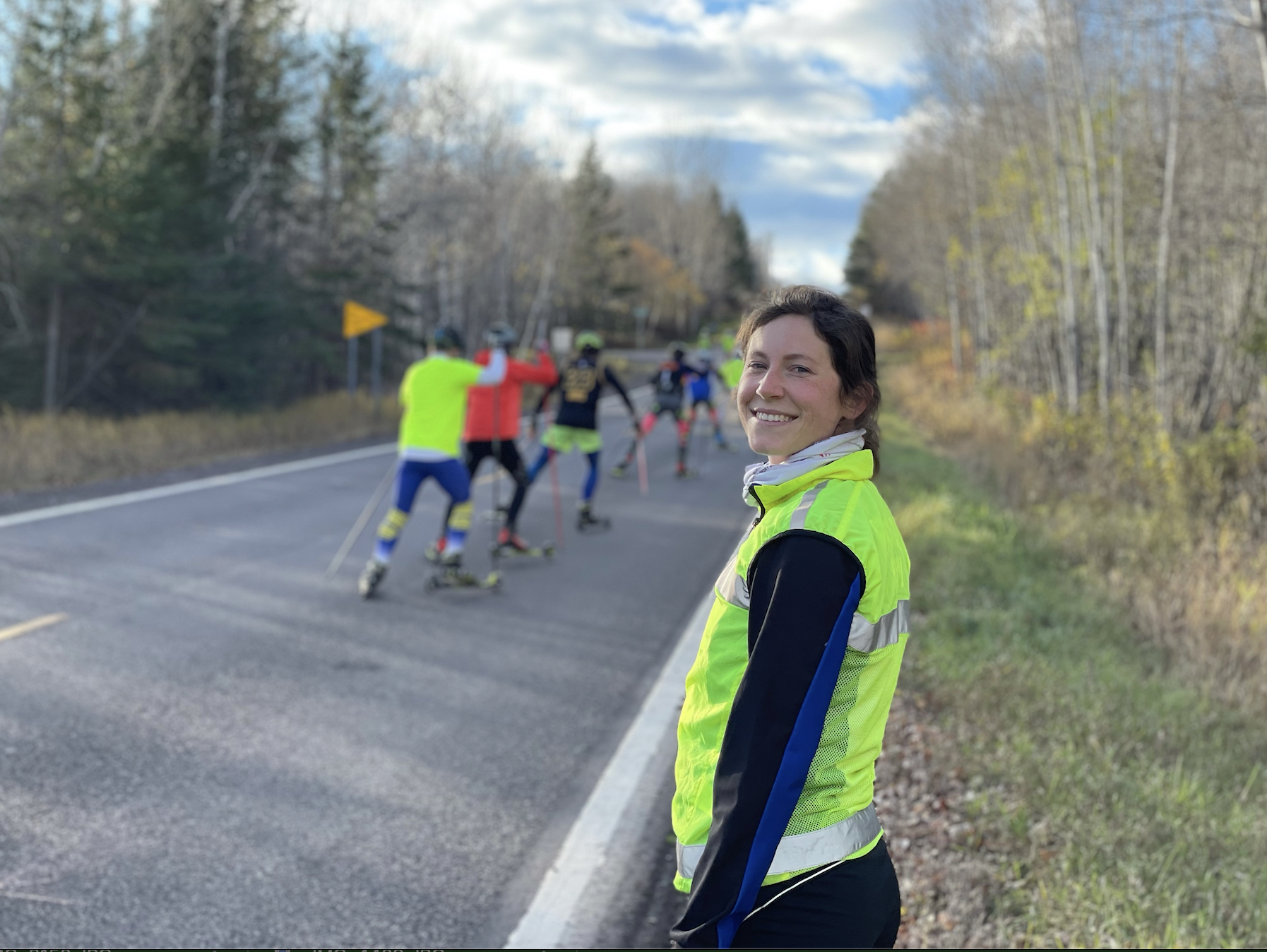
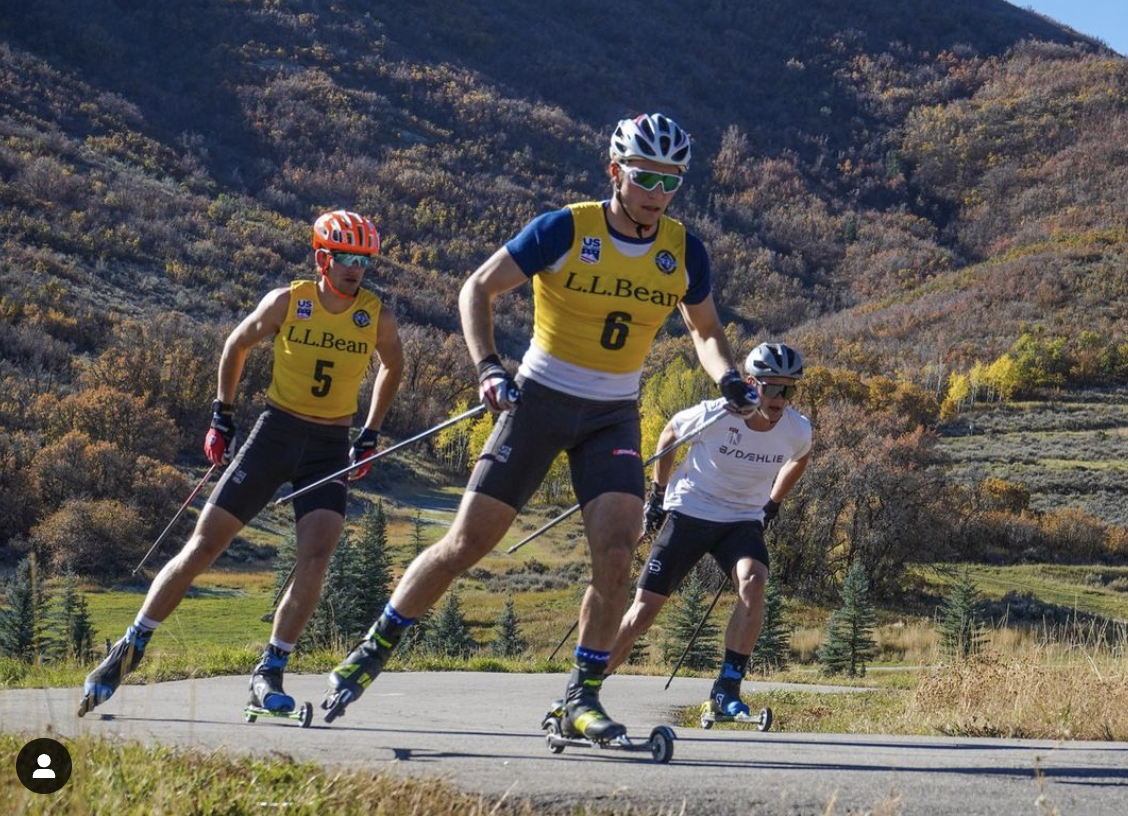
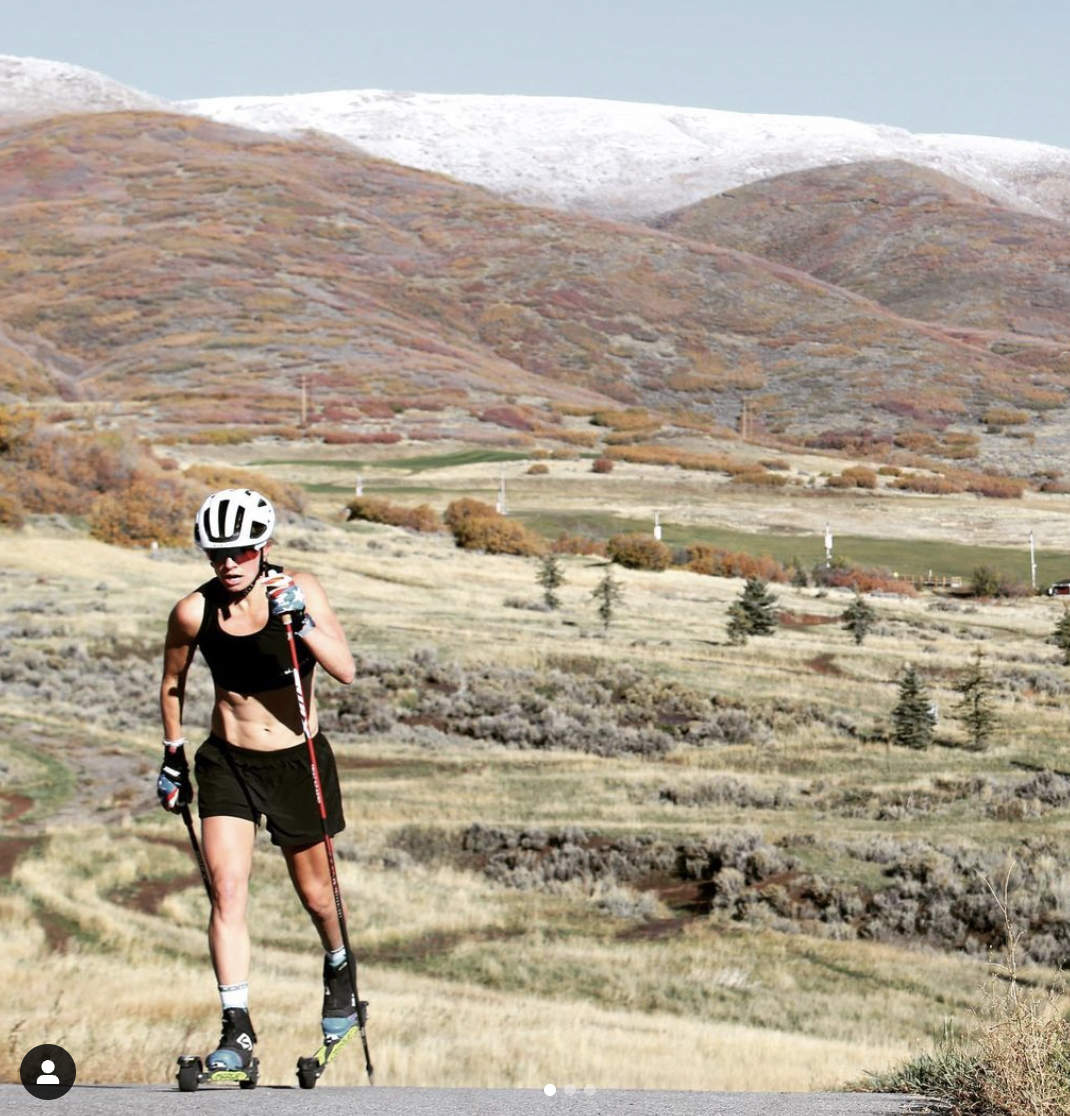
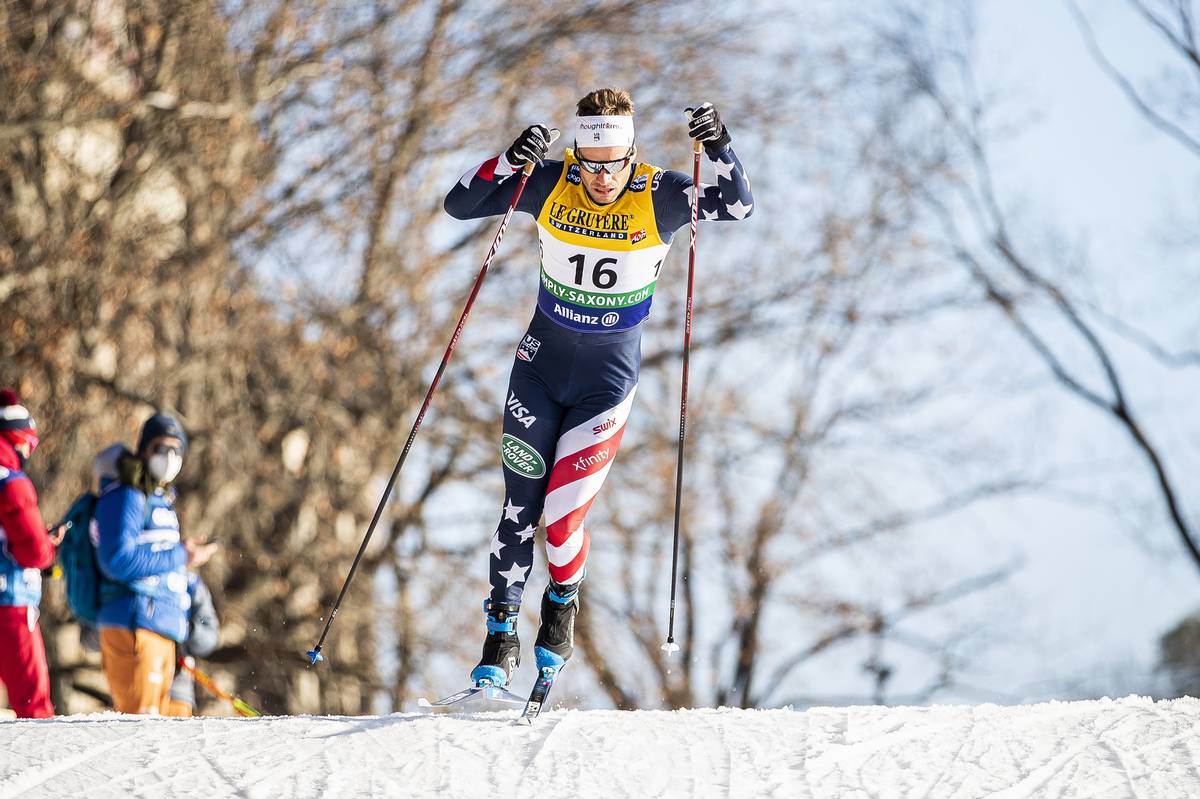
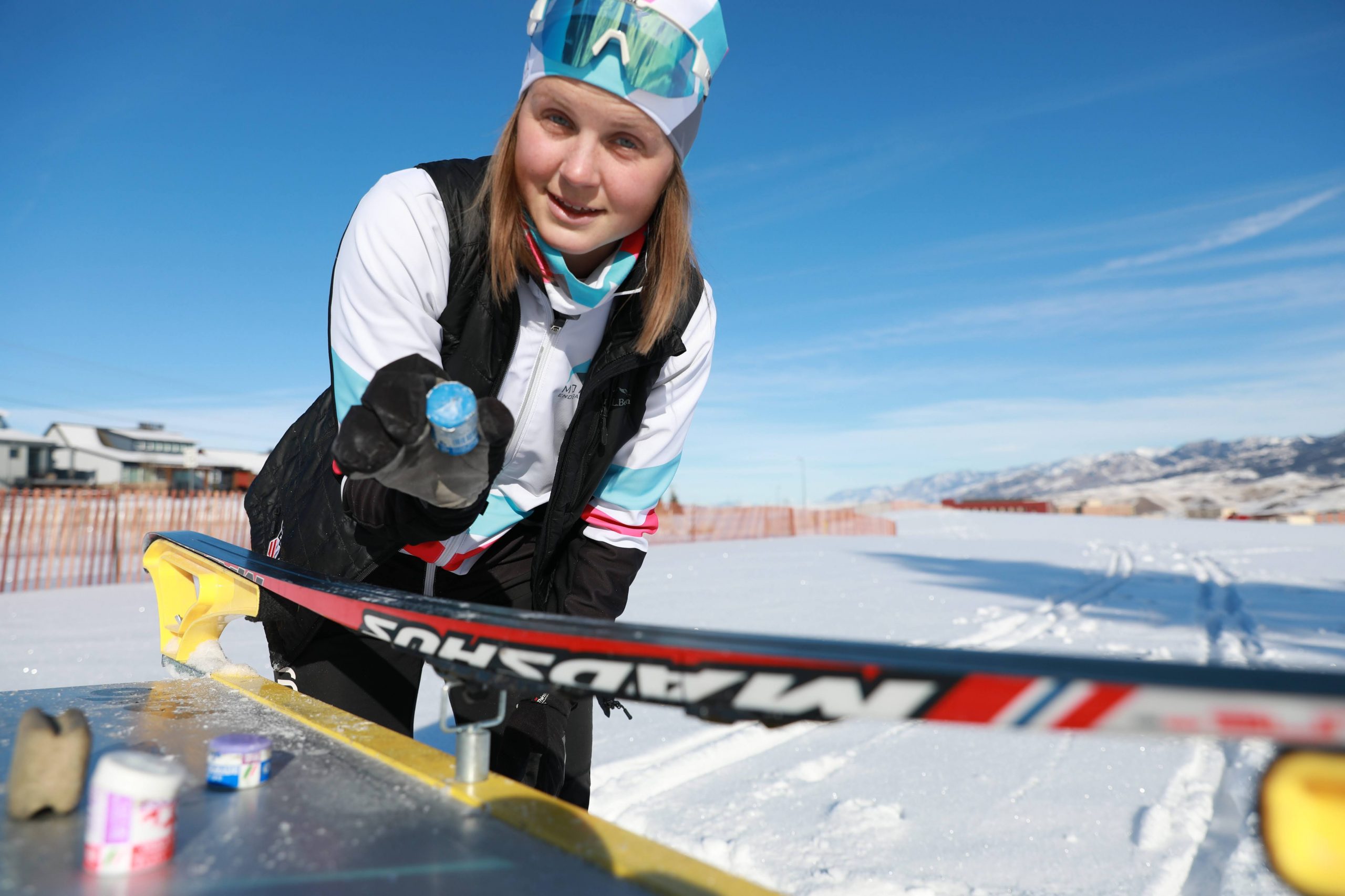
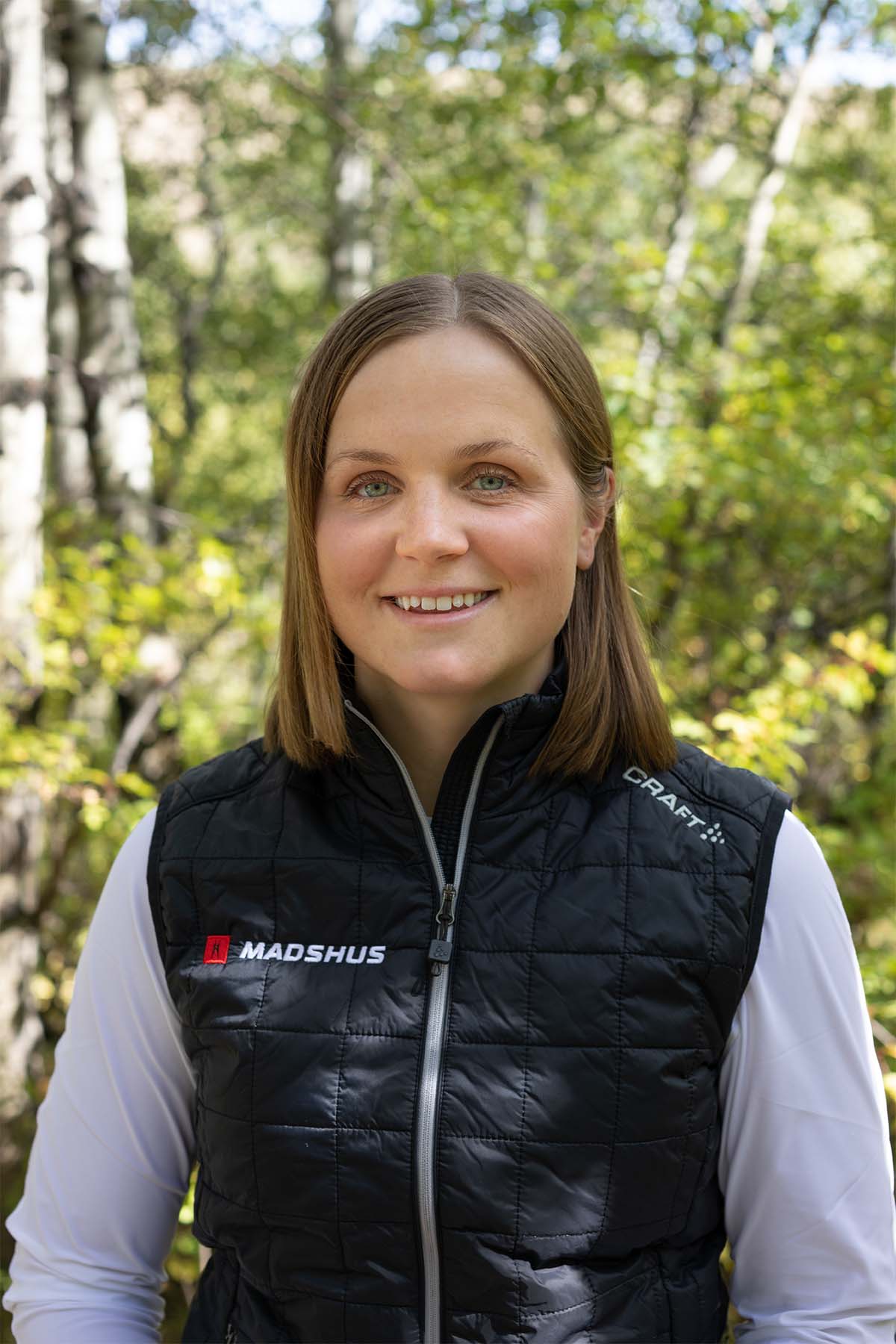
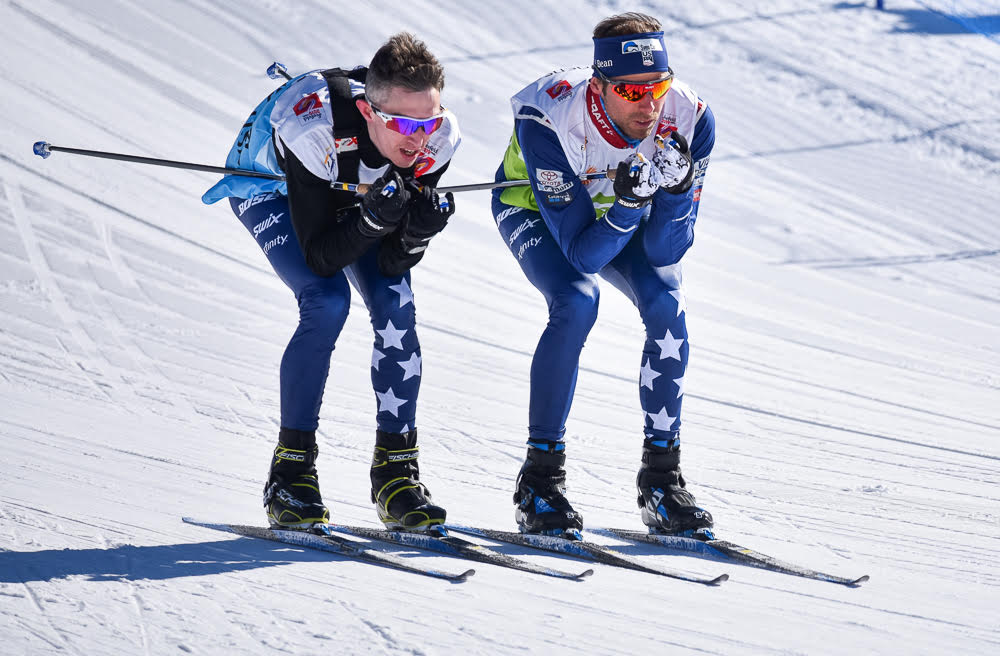
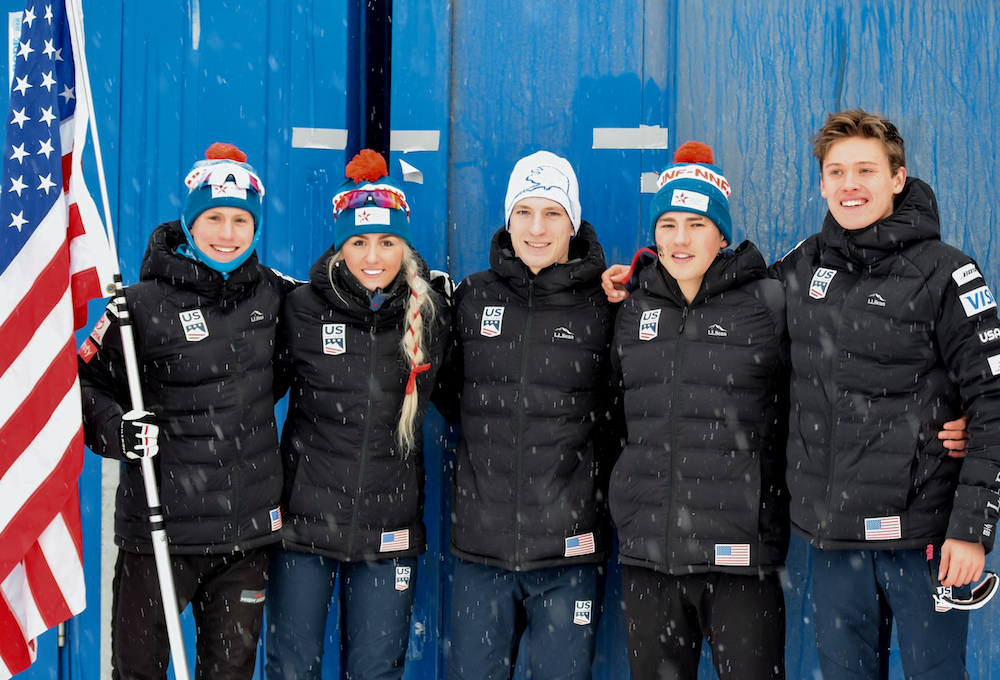
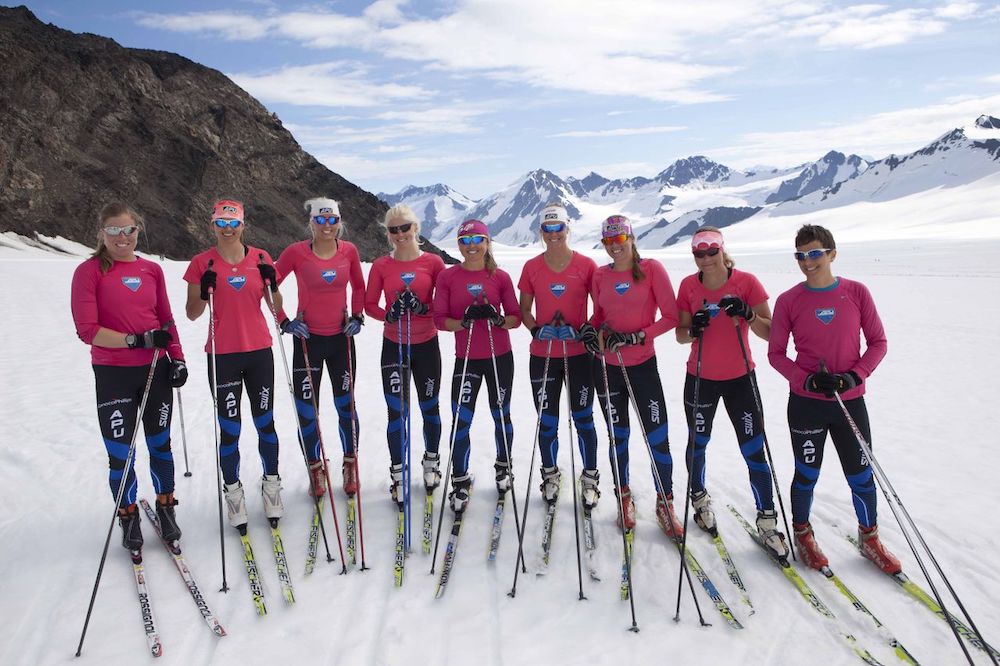
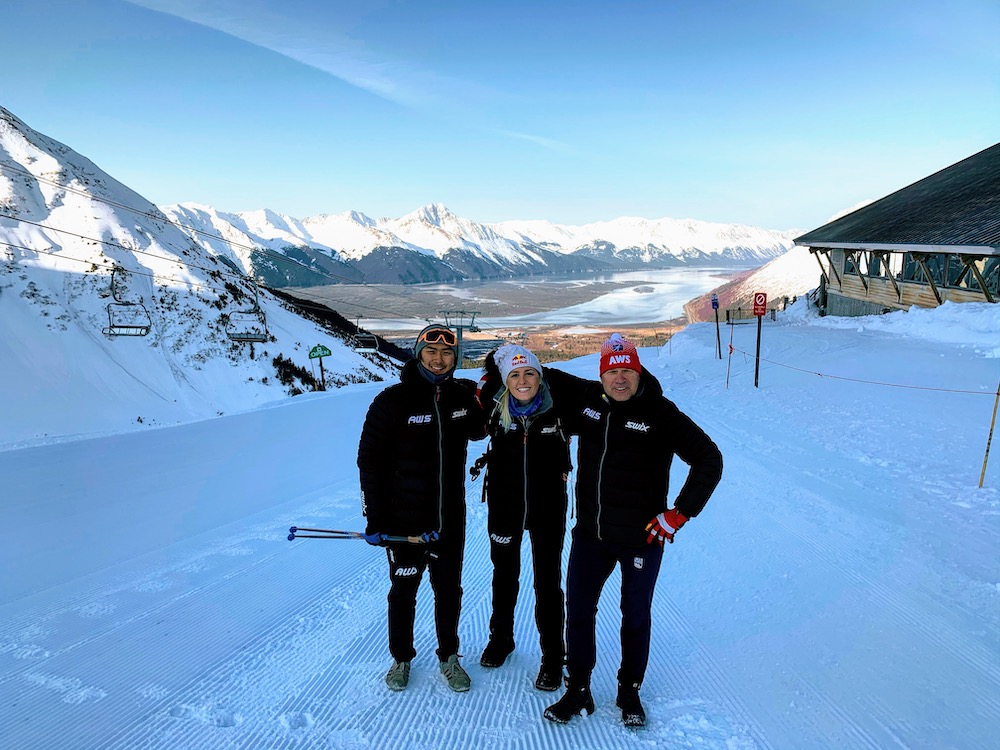
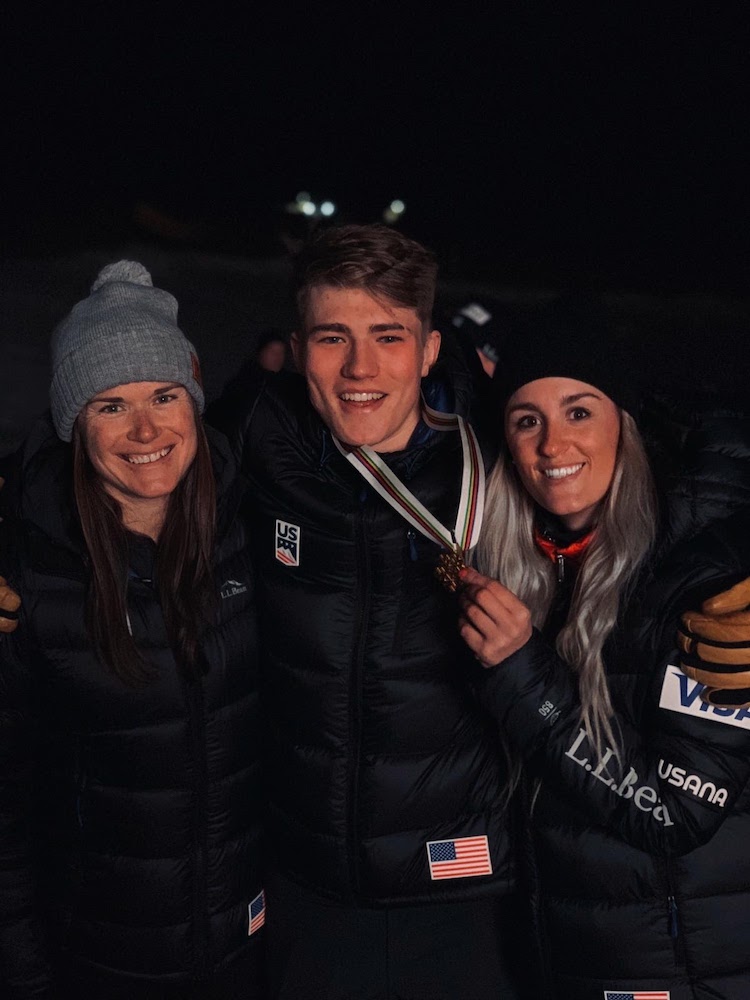
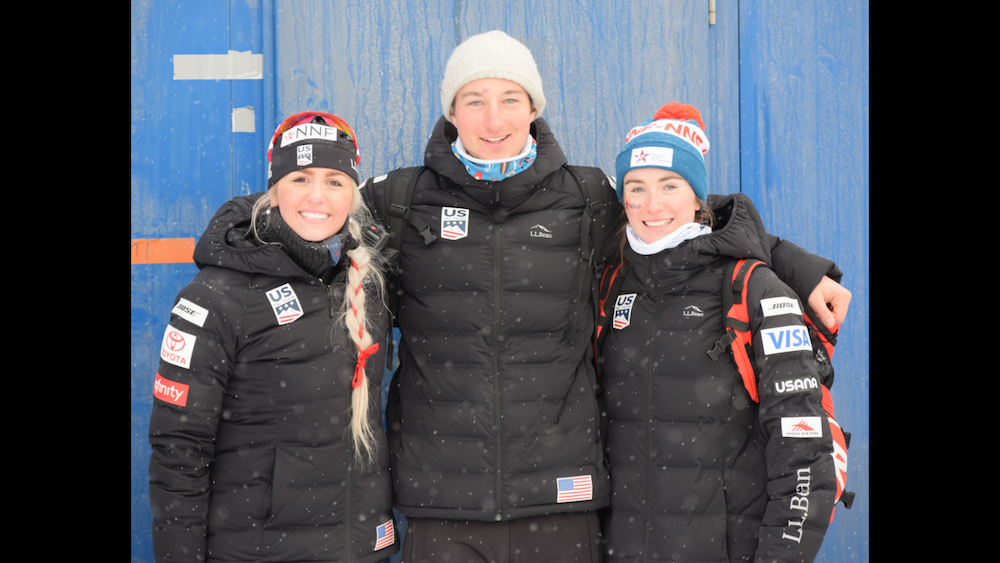
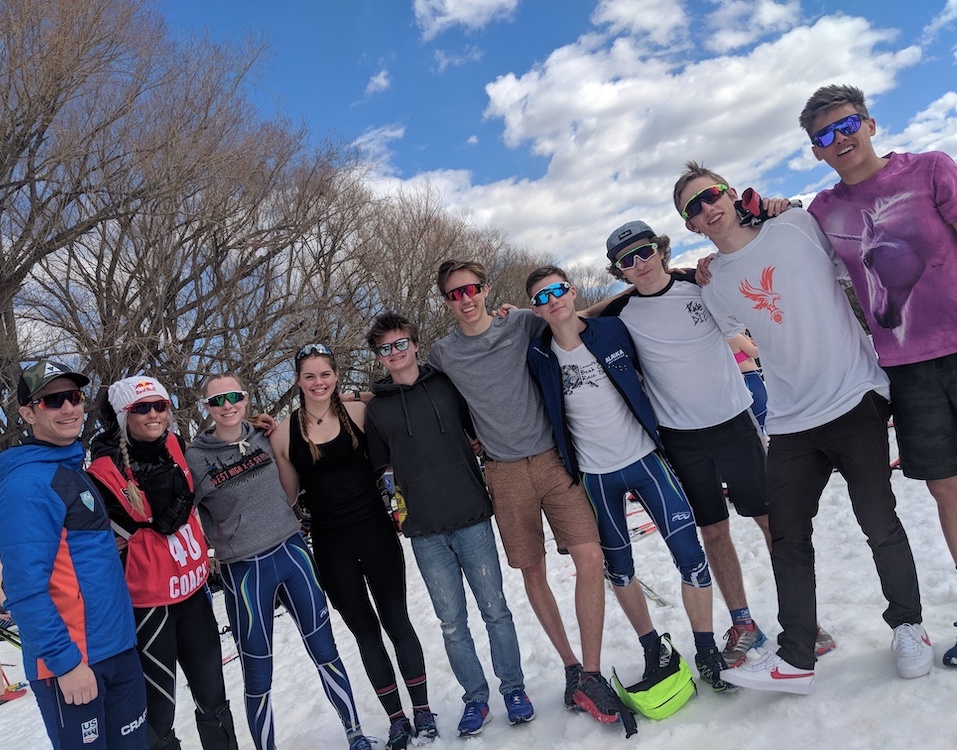
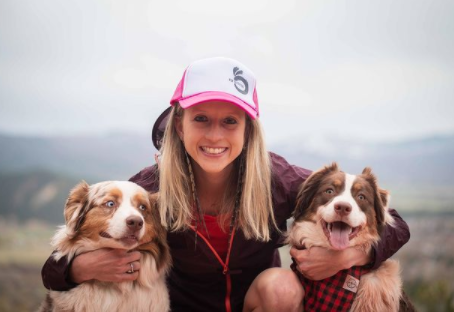
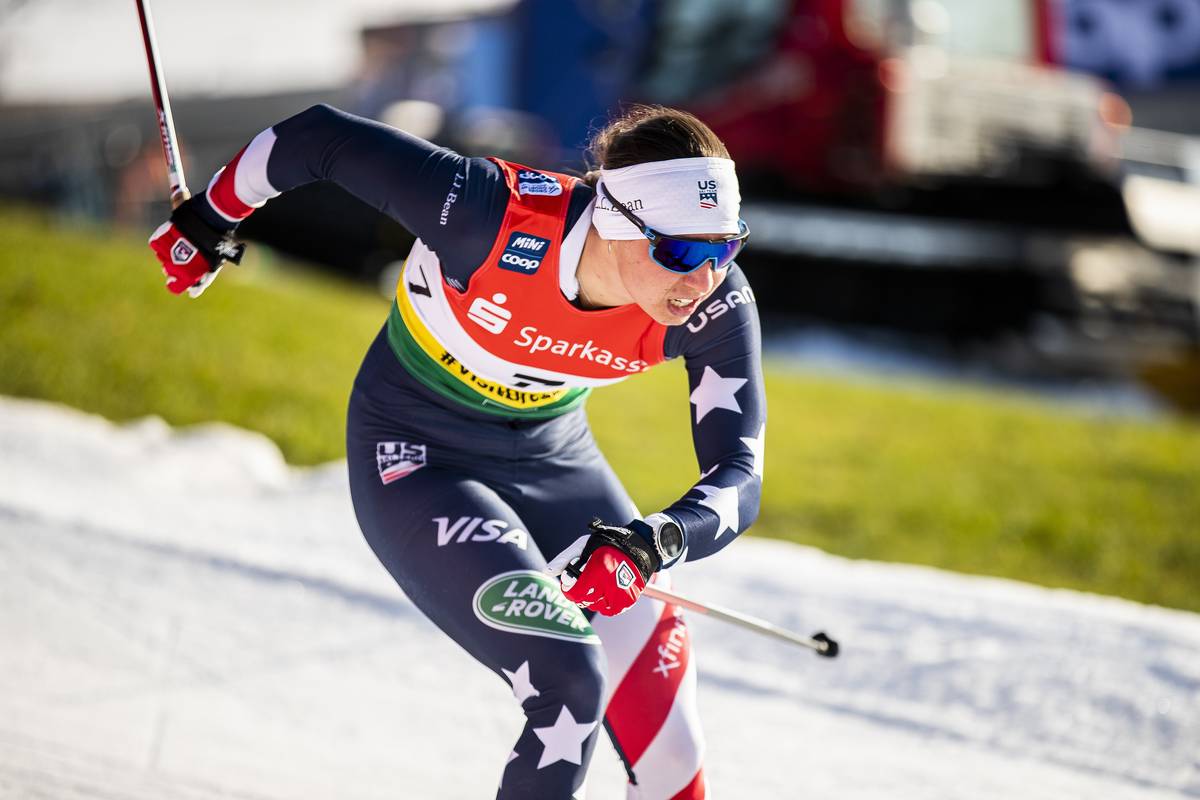
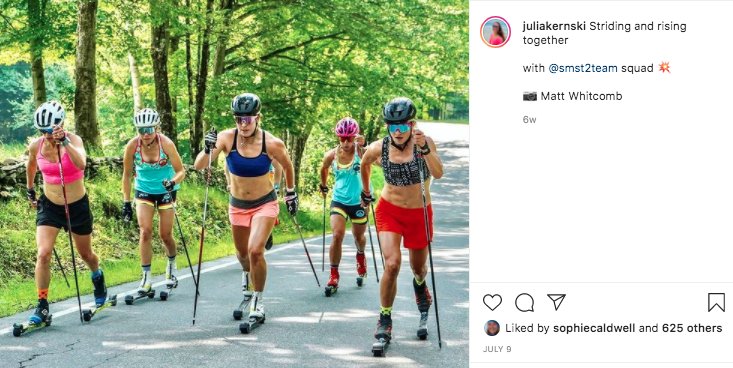
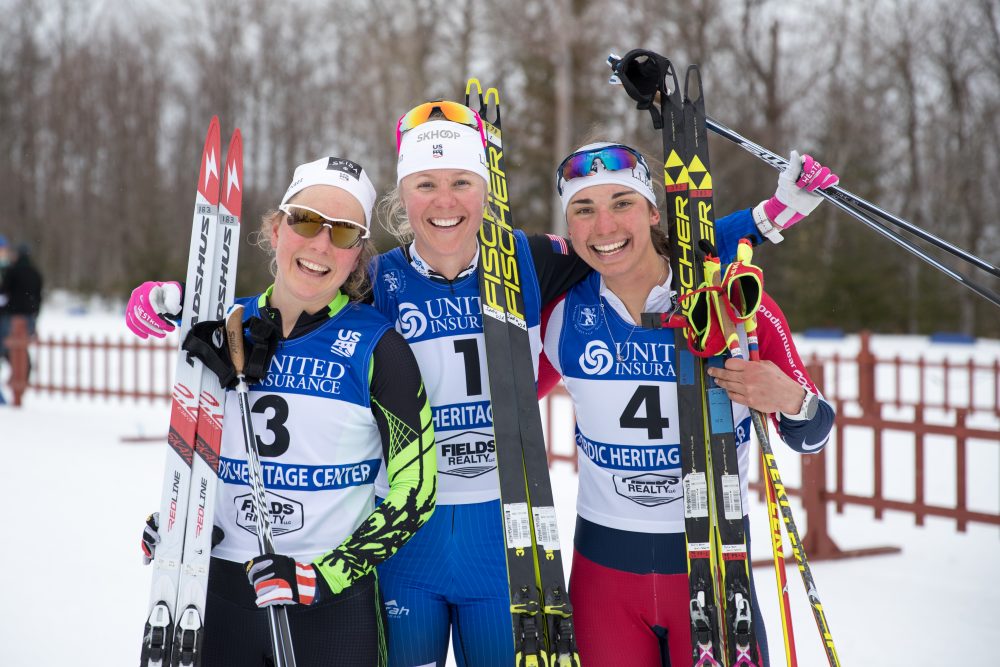
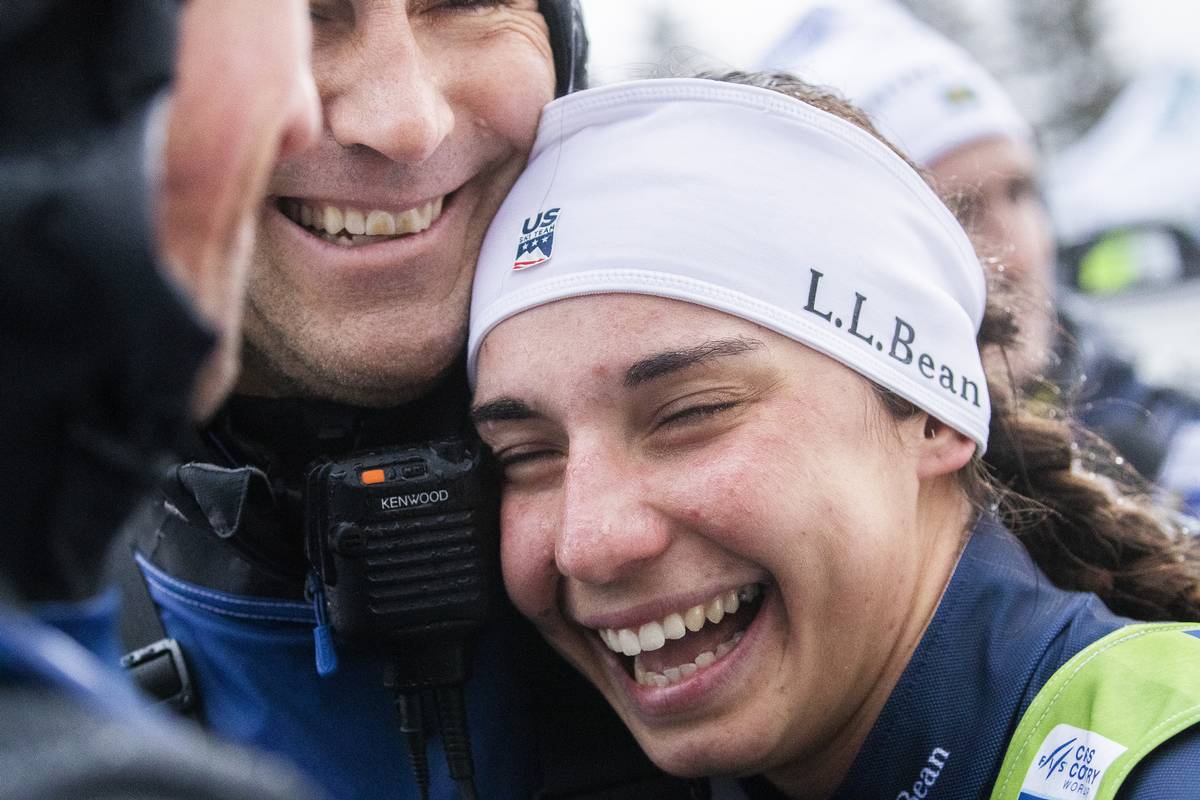
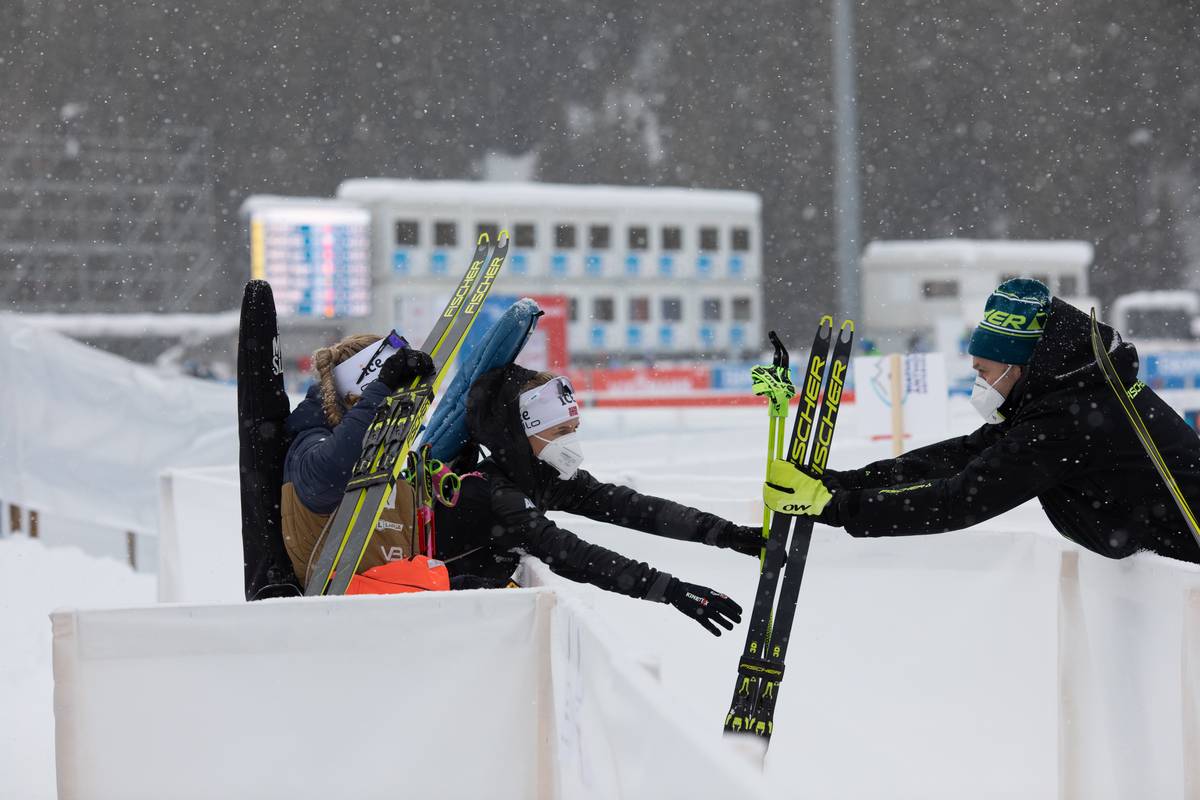
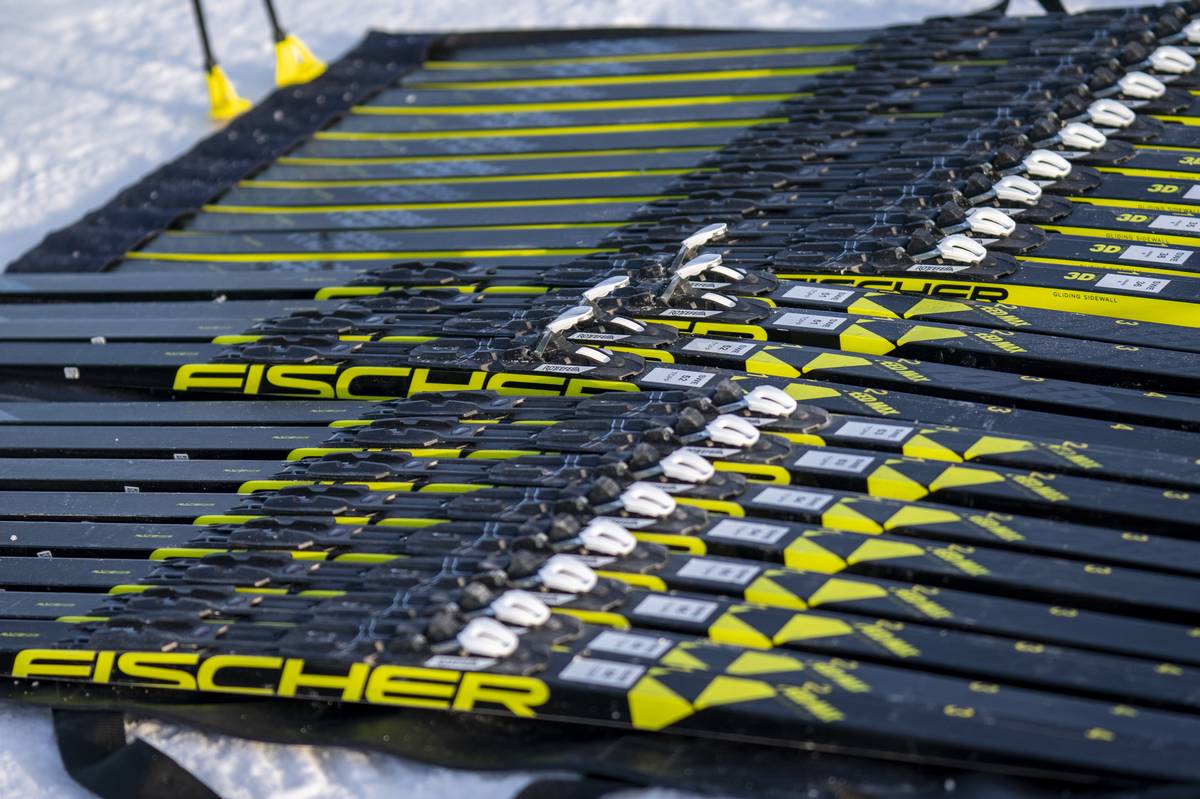
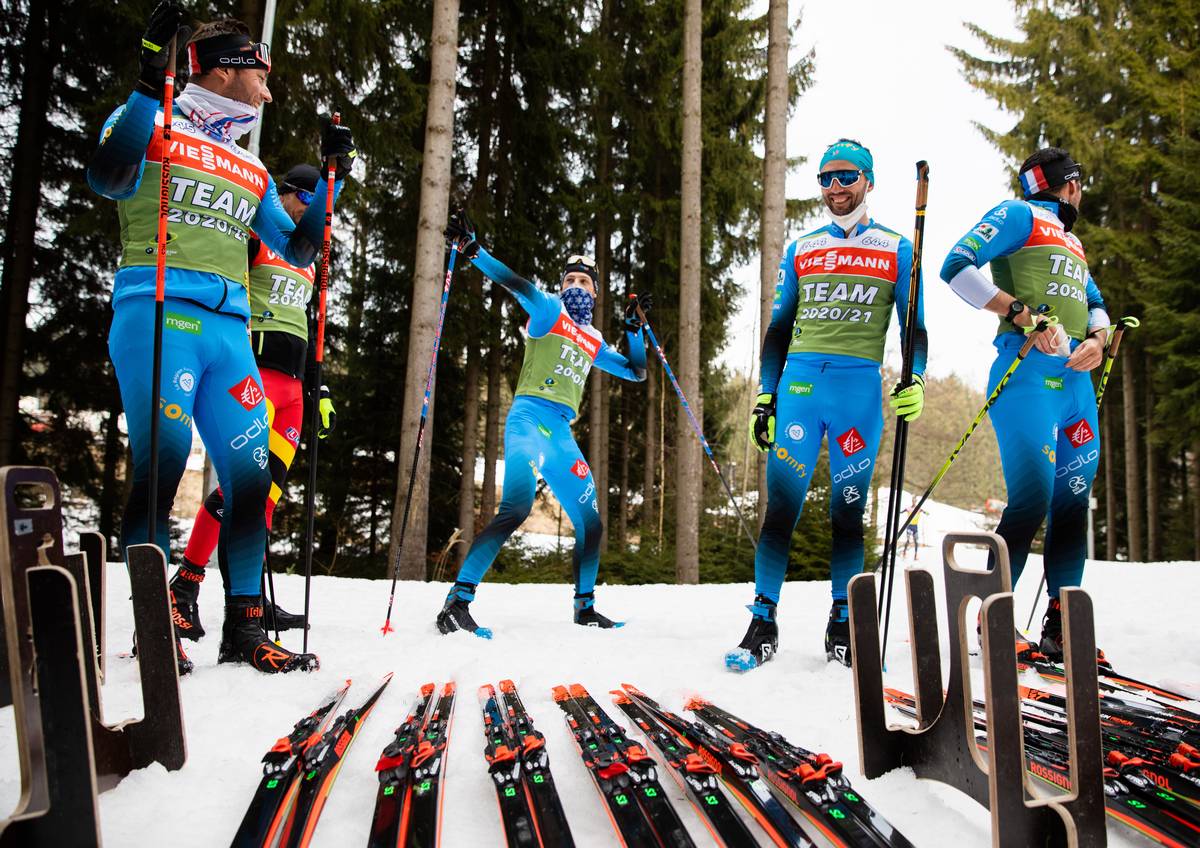
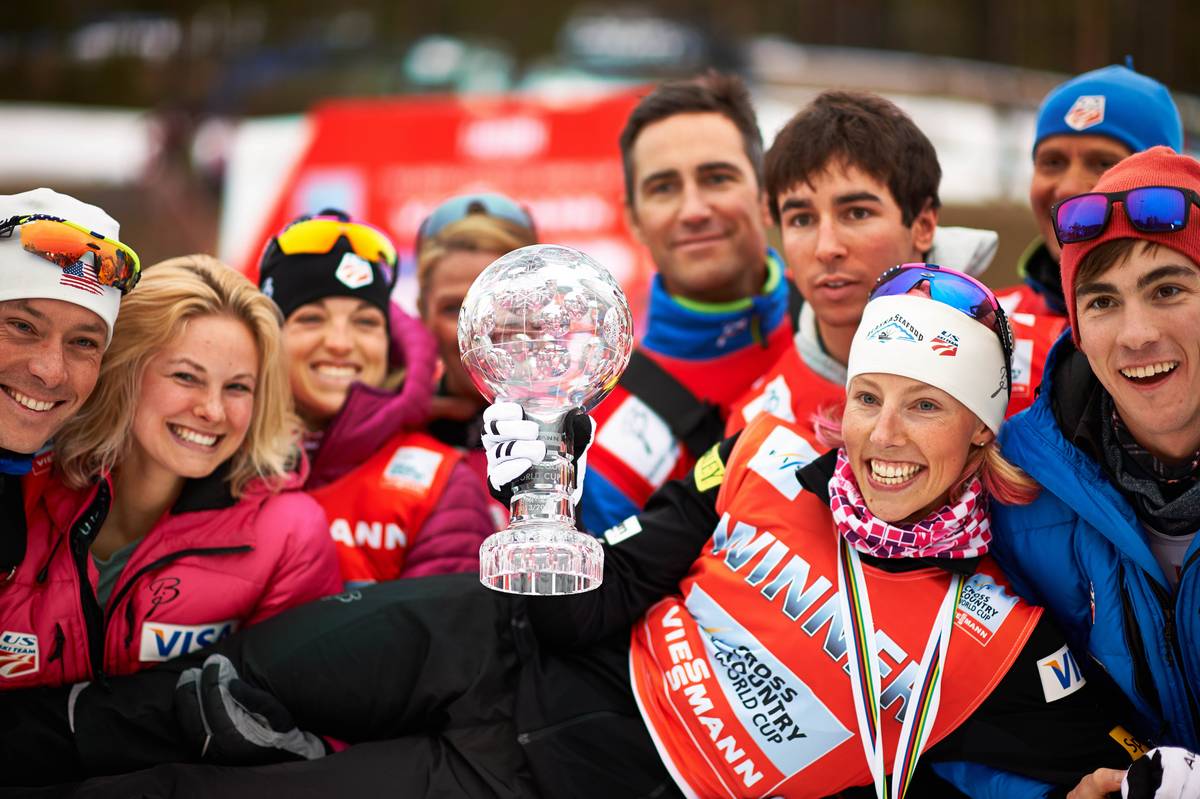
CSS assistant coach Kristen Bourne was awarded the Women’s Sports Foundation VanDerveer Fellowship for the advancement of women in coaching. (Photo: Maria Stuber)
Kicking off her second year as assistant coach at the College of St. Scholastica (CSS) in Duluth, MN, Kristen Bourne was recently named one of ten recipients of the Women’s Sports Foundation VanDerveer Fellowship. The program, named for revered Stanford University Basketball coach, Tara VanDerveer, aims to increase representation of women in coaching at the collegiate level through the development of the rising generation. This is the first time that the award has been granted to a cross country ski program.
According to the WSF, “this pioneering program provides grants, paid fellowships and mentorships for aspiring female coaches. Emphasizing hands-on training for female coaches in all collegiate sports, from basketball and volleyball to water polo and fencing, it is a salute to the extraordinary compassion, optimism and leadership that its namesake has shown over the years.”
Along with opportunities to collaborate with coaches across a variety of sports nationwide, the program offers institutions $15,000 to use in support of their fellow, along with $2,500 that goes directly to fellow to put toward additional professional development opportunities. FasterSkier connected with Bourne to learn more about the fellowship, her path to coaching, and how this opportunity will support her growth and long term goals in cross country ski coaching.
Originally from Lake Elmo, MN, on the eastern side of Minneapolis, Bourne attended Northern Michigan University (NMU), where she graduated with a degree in Sport Science in May, 2018. While racing for NMU, Bourne raced on four NCAA championship teams, and was a member of the 2015 U.S. World Junior Championships team and the 2016 U23 World Championships team. Post-college, she headed to Norway to train with Lyn Ski and Team Obos in Oslo, while competing in numerous FIS races throughout the country.
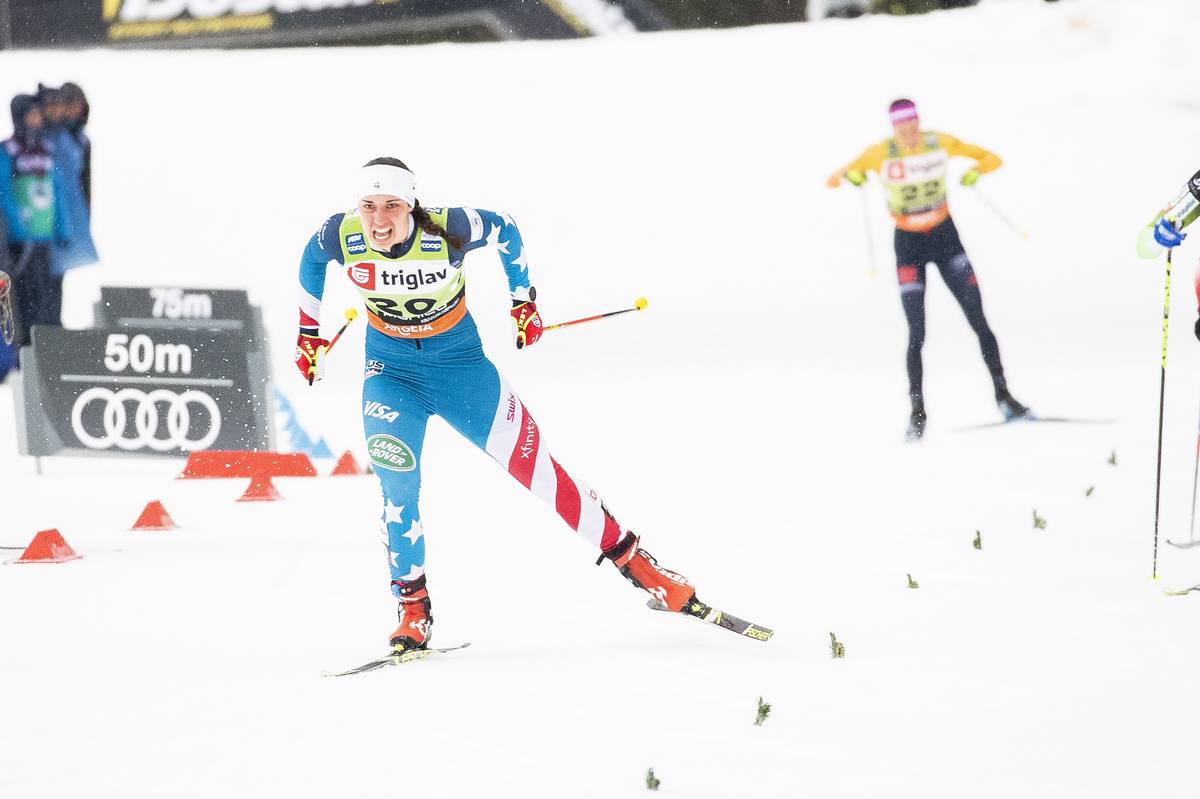
CSS assistant coach Kristen Bourne spent time in Norway after college training with Lyn Ski / Team Obos. Bourne is pictured here racing in a Norwegian Cup race in Gålå. (Photo: Martin Riseth)
Bourne returned to the US in December, 2019 to finish her racing career at the 2020 U.S. National Championships in Houghton, MI. It was there that she met Maria Stuber, head coach at CSS and the founder of the Women Ski Coaches Association (WSCA), who recognized Bourne’s potential as a coach and recruited her to the CSS program.
“I was just deciding that my ski career was about done and trying to figure out what to do next,” Bourne explained in a call. “I was at U.S. Nationals, I was leaving a parking lot, and Maria drove up and essentially slammed on the brakes, and yelled out the window, ‘Hey! My name is Maria. I heard that you’re interested in potentially coaching. You’re gonna get an email from me sometime soon.’”
Bourne went on to explain that Stuber emailed her the next week asking if she would be interested in joining her as the assistant coach at CSS. Tying the fellowship opportunity into the offer, Stuber knew about the VanDerveer grant and would help oversee the school’s application on Bourne’s behalf. CSS was not chosen after the first year of application, but they were selected this year on the second attempt.
Bourne explained how receiving the VanDerveer fellowship allows her to pursue a number of development opportunities beyond her role at CSS.
“Right now I have a few things in mind that I’m going to put that money towards. I would really like to go to the NCAA Women Coaches Academy, which happens every May. They have a bunch of super awesome female speakers and head coaches that all talk, and it seems really valuable. I think Maria did it a few years ago. Then the other professional development opportunity would be: I’m currently working on a trip over to the World Cup this winter.”
Though her education and wealth of experience lends itself well to coaching, Bourne did not always see this as a path she would choose.
“People were always telling me that I would probably end up being a coach, and I didn’t want to do what everyone thought,” she laughed. “And then, you come to this realization: I love the sport, and I want to learn more about it, and I’m really passionate about it. I can take my personal experiences from being in Norway and seeing how they work over there, I can apply what I learned there, and through college, my own [time as an athlete]… Right now I’m also working on my master’s in exercise physiology. So being able to take all of that experience and knowledge and be able to apply it as a coach, I think it’s kind of a no brainer.”
Though improvement is trending, women remain underrepresented in leadership roles in the ski community. According to the 2020-2021 Women in College Coaching Report Card issued by the Tucker Center for Research on Girls & Women in Sport, only two of nine NCAA Division 1 cross country ski coaches are women.
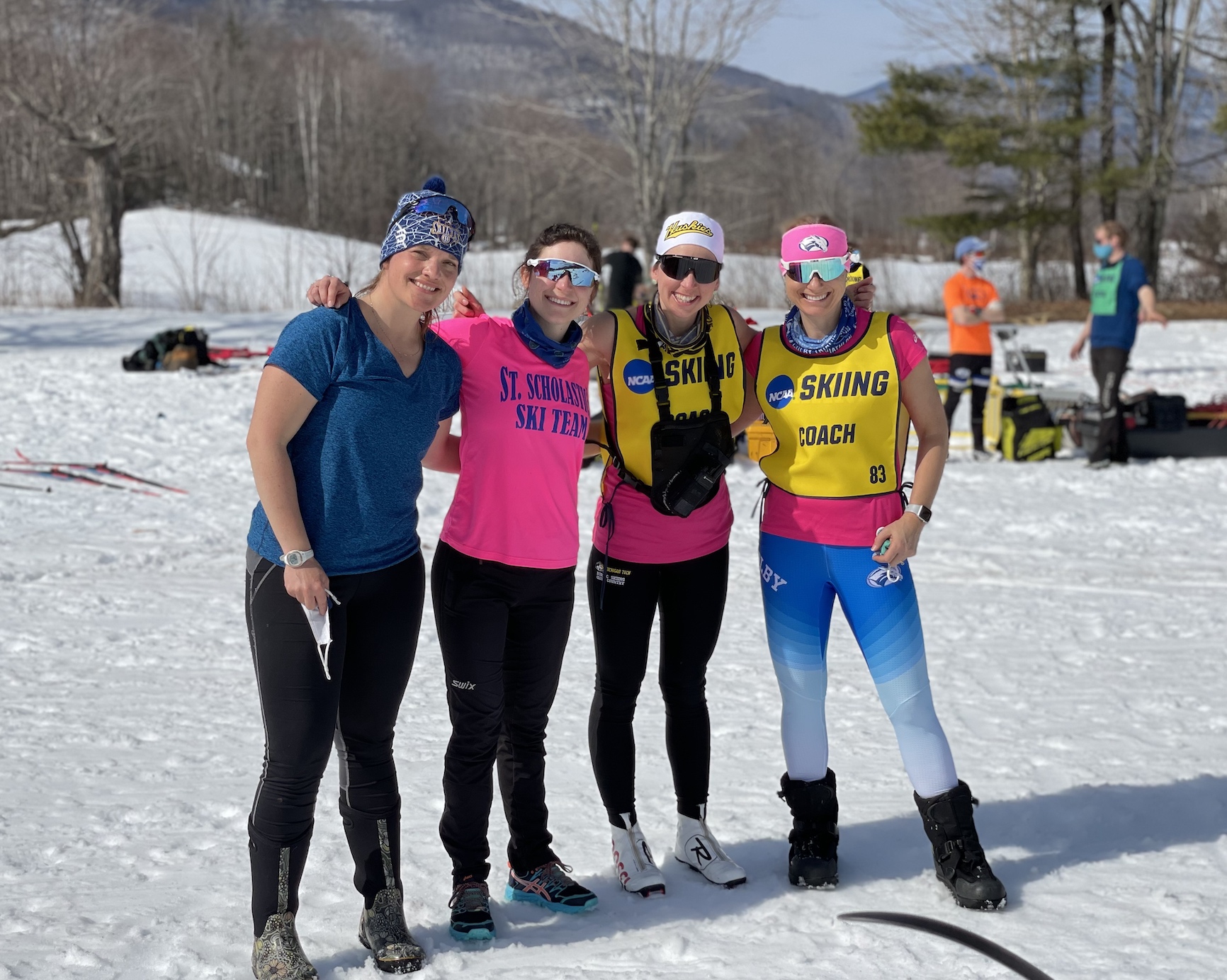
A few of the female coaches represented at the 2021 NCAA championships. From left to right, Maria Stuber, Kristen Bourne, Kristen Monahan-Smith of Michigan Tech, and Tracy Cote of Colby College. (Courtesy photo)
Stepping into this realm without significant experience in coaching, Bourne spoke to the importance of having a strong mentor and role model in Stuber, who has helped her realize her potential in the role.
“The other [factor influencing my transition into coaching] has been working for Maria. She has just taken me on and put me under her wing, and really gets me to do things that I wouldn’t normally do. It has boosted my confidence in myself knowing that I can do this and that this is what I want to do for the rest of my life. That was a huge piece of it, too.”
Expanding on Stuber’s formal role as a mentor for the VanDerveer Fellowship, Bourne explained that both she and Stuber will have the opportunity to connect with the other fellows and mentors involved in the program, which spans a variety of sports from basketball to water polo to track & field. This collaboration allows the women to discuss their successes and challenges in their respective sports, and learn from each other’s experiences.
In a 2019 presentation at the U.S. Ski & Snowboard annual meeting on the importance of women in coaching, Dr. Nicole LaVoi of the previously mentioned Tucker Center explained the importance of women in leadership roles to inspire the next generation of coaches and improve the experience of developing female coaches.
“When you see women being successful, it inspires people,” LaVoi said. “‘Oh, I could do that. That seems cool, she seems cool, I want to do that.’ And in they come. It’s the same thing with women in positions of leadership.”
Bourne emphasized that this concept rings true for her in working with Stuber, who has stoked her fire to become an example for future women in the sport.
“She said so many times that the Women’s Ski Coaches Association and empowering women — this is her passion. I just feel so honored that I get to be right alongside her. She’s so powerful, and she has such a strong impact, and she’s doing this incredible thing that I think quite a few people are scared to do. She just says, ‘No, I’m doing it. We’re gonna change some things here.’ And I think that’s just — it’s pretty dang cool.”
Looking to the future and the role she hopes to play, Bourne aspires to be a head coach at or above the college level. She enjoys the environment of collegiate programs, but remains open-minded. Reflecting on the dearth of female coaches in her own athletic experience, she concluded with her intention to be part of the solution in the slow progression toward gender equity in sport leadership.
“When coming to the decision of becoming a coach, there is this thought of, ‘Well, I’ve never really experienced anyone like me in that position before. Can I do that? Can I have the same impact on a team as a man would? But really it’s [lack of] representation. There’s also the concept that women are proven to improve work environments — having more women is better. And being able to support female athletes — and being able to support male athletes — with a different perspective is super important. There’s a lot of pieces — it’s a huge question. I just hope I can be a role model for more women coming up who want to get into coaching and stay in the sport.”
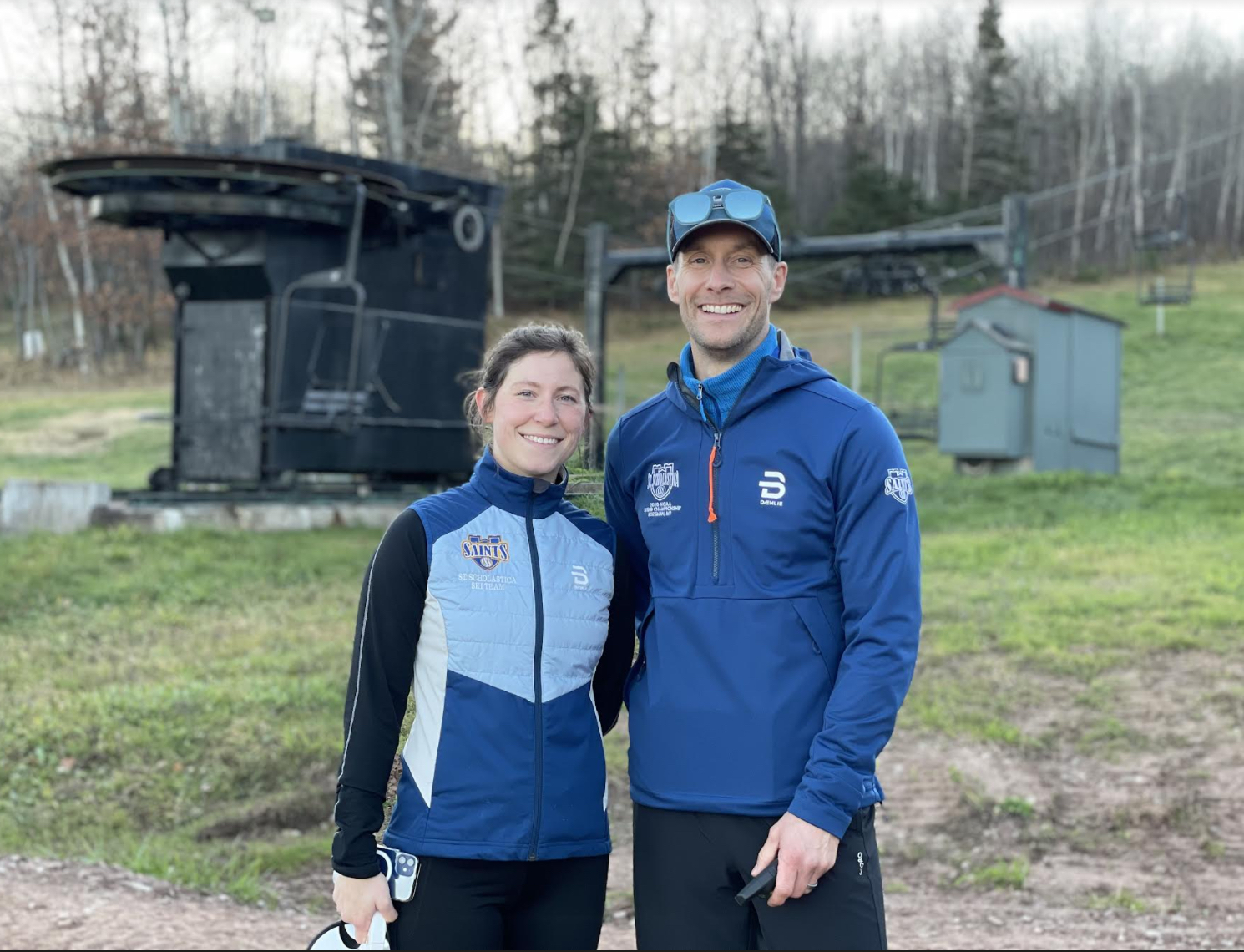
The CSS Assistant Coaches: Kristen Bourne (left) and Joshua Tesch (right). Stuber explained that Tesch has bee coaching at CSS for 15 years and has been a mentor for both herself and Bourne. (Photo: Maria Stuber)
There’s no denying that participation in a sport like cross country skiing is a privilege, from which many people are excluded. Whether it be the cost of gear, the investment of time, the inability to access a trailhead by public transportation, or simply the lack of representation in the sport, there are a number of significant barriers that would-be participants face. FasterSkier has already highlighted the fact that our sport is disproportionately white, and as one climbs the ladder of competitive youth programming, reaching the upper levels of cross country skiing becomes increasingly out of reach for low-income families.
In the wake of the killing of George Floyd last spring, many organizations around the nation issued statements and commitments to diversity. One such letter from then President and CEO of US Ski & Snowboard, Tiger Shaw stated, “It is no secret that U.S. Ski & Snowboard and our sports are historically white… and we could use more widespread initiatives for marginalized communities to participate.”
Charles Harris, an African American alpine ski coach wrote an open letter in response in which one of the many issues he highlighted was the fact that, “we are also in an arms race in this and other sports. There are parents with the ‘country club’ mentality who will spend large sums of money on their child. That gives the impression that someone of modest means cannot afford to compete and that drives away talent.” While Harris was referring to alpine skiing, the same sentiment could be applied to nordic. If the sport and community of cross country skiing is to be more inclusive, then these barriers need to be eliminated.
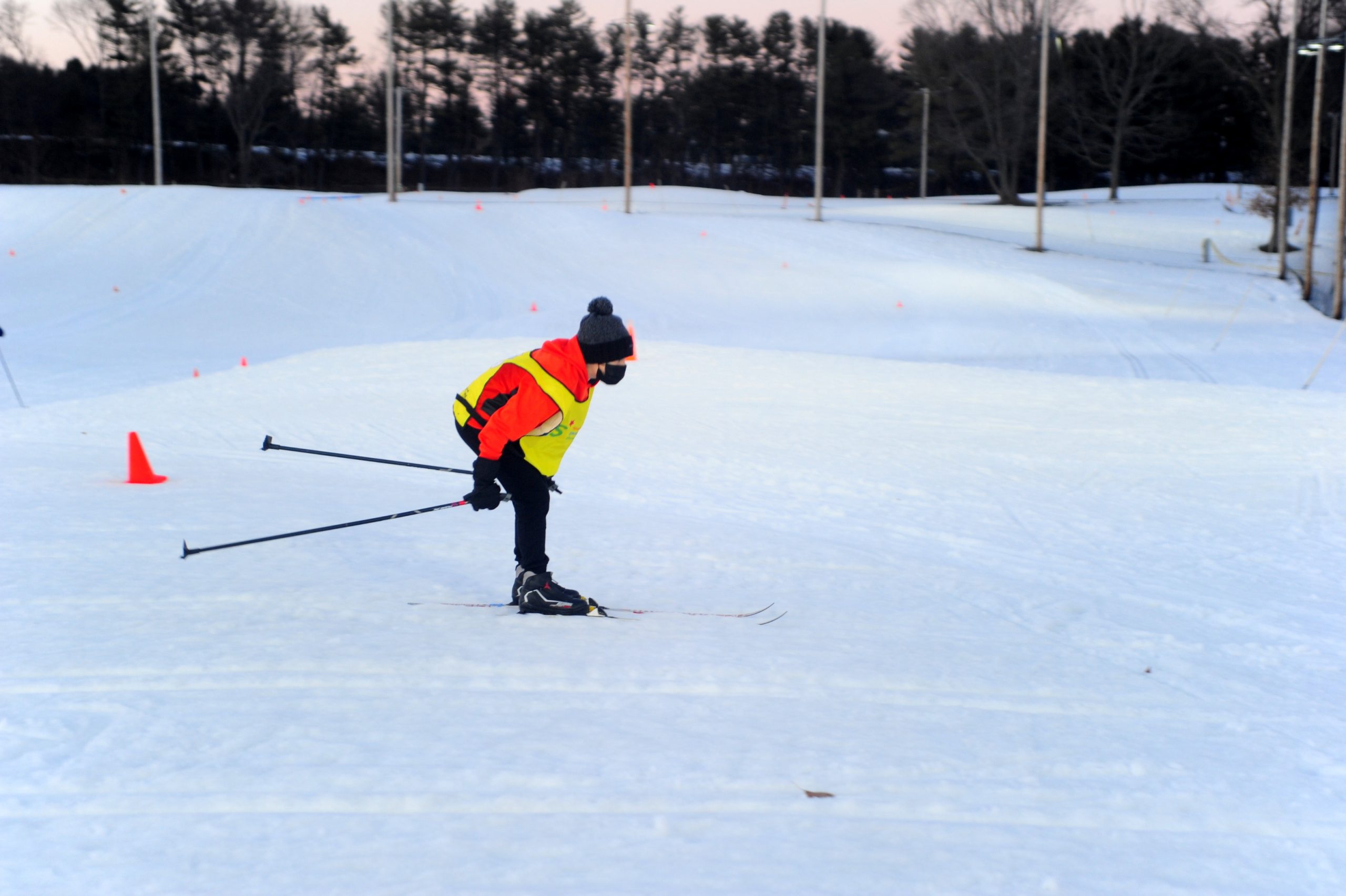
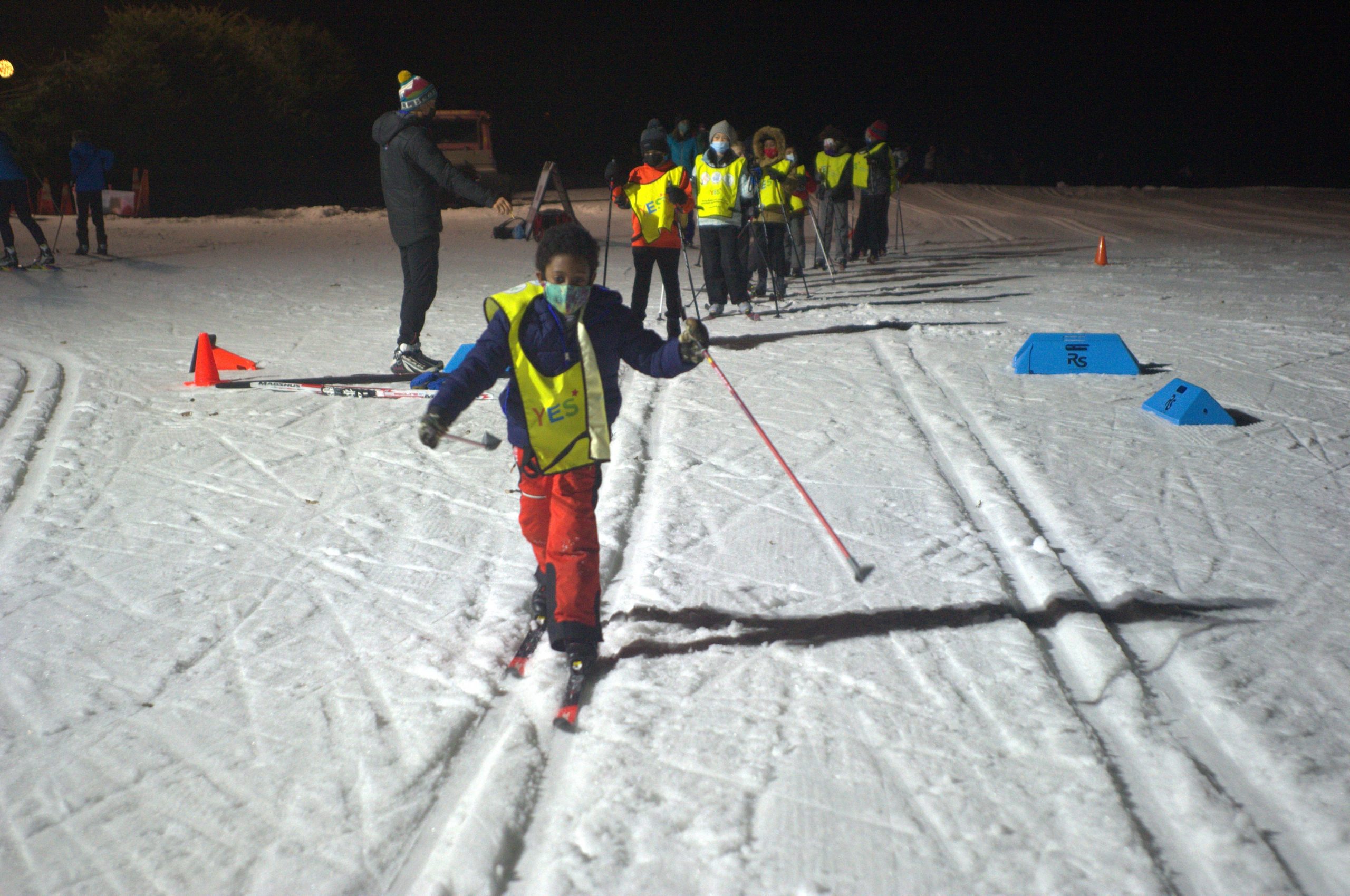
This is easier said than done but perhaps starting with kids is the way to approach this task. This is the angle taken by the Youth Enrichment Services (YES) in Boston, who first piloted their cross-country ski program for Boston Youth in 2015.
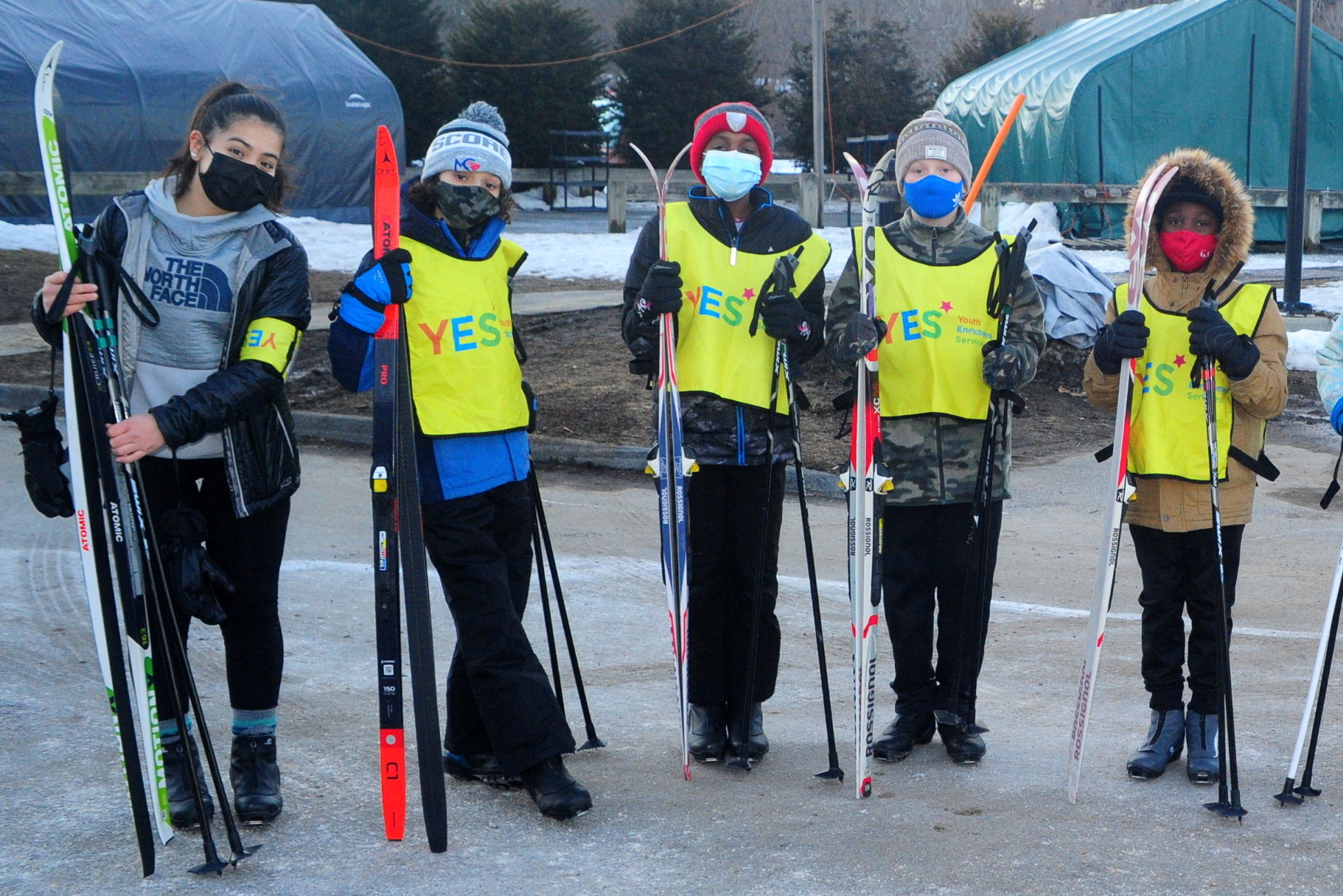
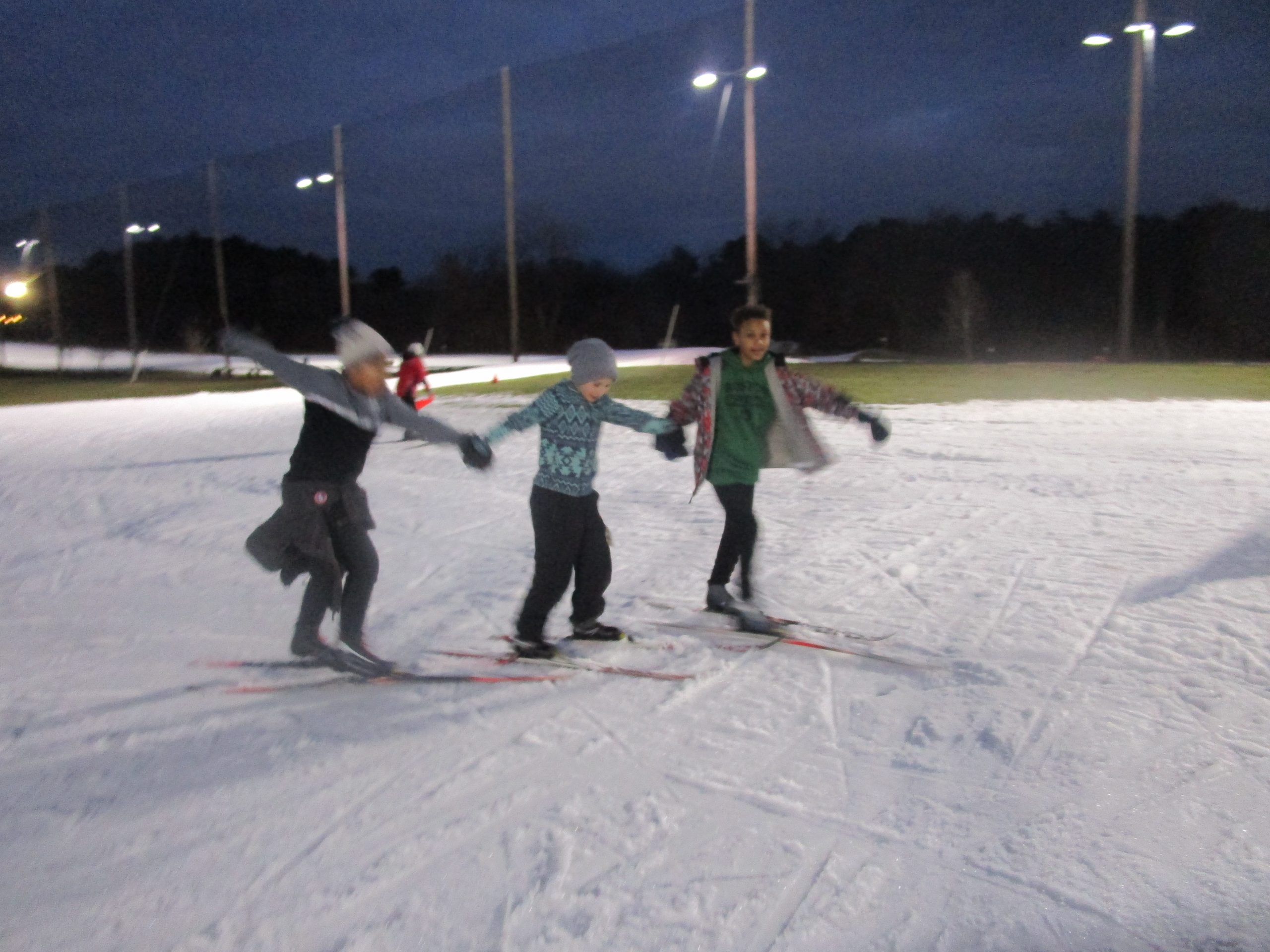
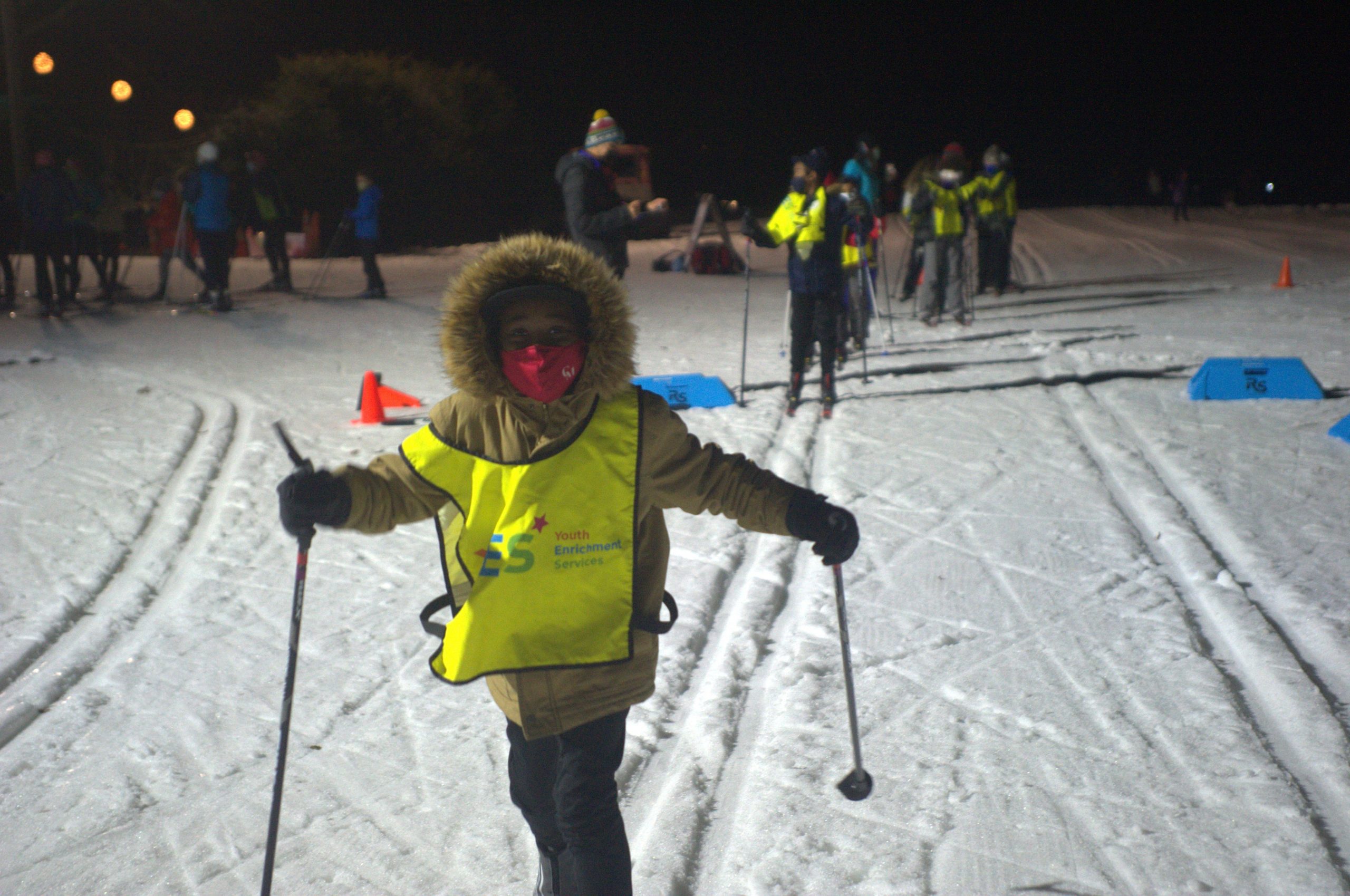
Masked up and ready to ski, YES Cross-country ski participants (Photo: YES archives)
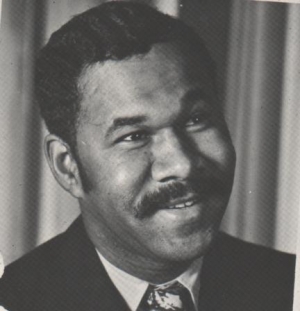
YES was started in 1968 by Richard Williams who was driven by his passion for skiing and the idea to “Give Youth a Chance”. What began as Operation Ski Lift (now called Operation Snowsports) in 1970 with 500 youth from low-income families has now grown to include not only alpine but now cross-country skiing as well.
Richard Williams, founder of YES in 1968. (Photo: YES website)
The Nordic program is currently open to Boston children ages 7-12 with a priority focus of reaching youth of color and low-income households. The cross-country program was established to expand winter opportunities for young people to experience outdoor physical activities and is partnered with the Weston Ski Track which is owned and operated by Paddle Boston at the Leo J. Martin Golf Course in Weston, Massachusetts.
“Cross country skiing is a winter activity that most of our youth don’t normally have access to,” says Bryan Van Dorpe, Executive Director of YES, “Working with local partners we are able to offer the program in a structured setting and introduce young people to a new confidence-building sport.”
When asked about the biggest barriers they have observed to participating in a sport like cross-country skiing, YES staff responded that it is primarily the cost and access to ski gear, as well as the required transportation that are keeping these youth from experiencing the sport. Van Dorpe added, “with all sports at YES, cost is a challenge for things like equipment rentals and time on snow. We have some great partners like Share Winter Foundation and Paddle Boston that provide us with the resources that allow us to get our kids on the snow.”
Working on that double-pole, YES participant at Weston (Photo: YES archives)
Volunteer recruitment and connecting with the cross-country ski community were also mentioned as possible challenges.
“The weekday timeframe of 4:30-7 pm isn’t particularly convenient for volunteers who work during the day,” says YES Equipment Specialist & Senior Outdoor Instructor, Elliot Simmons- Uvin. “We are fortunate to have received awesome support from Eastern Mass Cross Country Skiing – formerly known as the Cambridge Sports Union – to provide volunteer instructors and coaches.” Additionally, “getting the YES name known in the cross country ski community could have been a challenge, but friends and partners like NENSA and EXMC have allowed YES to build relationships, gain visibility, and connect with some awesome people,” says Simmons-Uvin.
Elliot Simmons-Uvin (L) with YES Youth (R) (Photo: YES archives)
Perhaps another barrier to entry in the sport of Nordic skiing is the fact that few people within the country have even heard of it. Though this is beginning to change, the fact remains that when you say the word “skiing”, most people will think of downhill skiing. Within the relatively small world of the YES programs, this is also true. Most YES youth and families are not aware of what cross country skiing is, and only know about downhill skiing.
“I remember talking to kids in the YES Track & Field Program when we first started the Cross Country Ski Program. They asked me, ‘Is it running with skis on?’ They really had no clue what it was,” shared Van Dorpe. “A few youth may know a little about it, but none have had any experience with it.”
YES members working on their strides (Photo: YES archives)
In light of this, it can be challenging to build enthusiasm for the program at YES since the kids and their families aren’t familiar with the sport. “Sometimes it’s hard to get kids excited about cross country skiing because most of them haven’t had exposure to it,” says Simmons-Uvin. “Being in the shadows of downhill skiing, you have to work to show kids that cross country skiing is just as cool!” Despite this initial reluctance, Van Dorpe says, “I do think there’s interest there. We have a waiting list every winter.”
Capacity level is what drives the numbers in the YES programs and so far, the organization has a much larger capacity to introduce youth to downhill skiing and snowboarding. If capacity wasn’t as limited for cross-country skiing, more youth could get involved in the program.
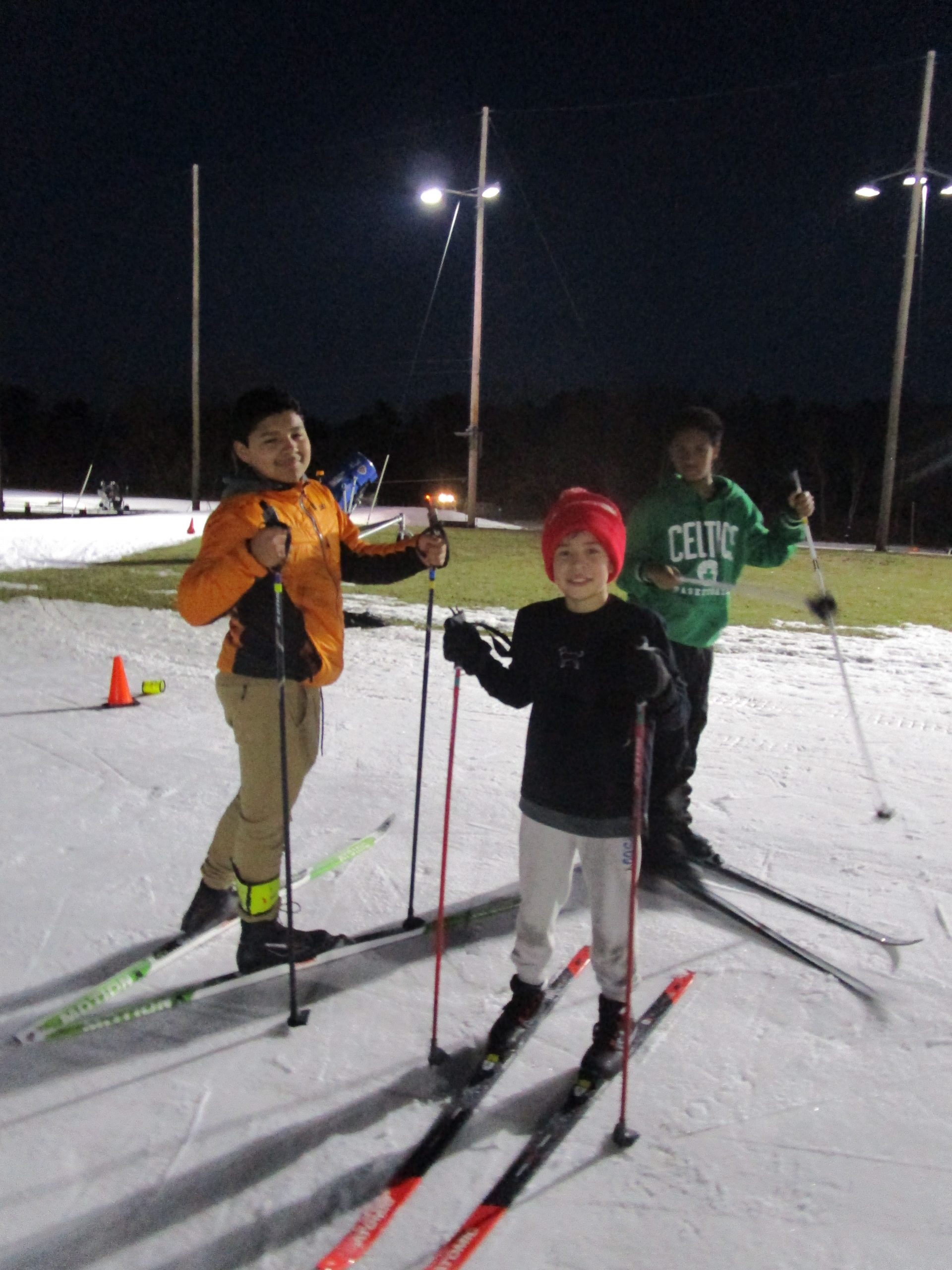
Some happy YES participants (Photo: YES archives)
The role of Operation Snowsports at YES is to fill a huge need and gap within the Boston community for outdoor winter programming. YES shared that 75% of the families they work with reported that these programs are their child’s only access to outdoor winter activities.
“There are very few opportunities for recreation and physical activity during the winter months for Boston kids besides basketball and hockey,” says Van Dorpe. “There’s a void in Boston and it’s huge in terms of getting kids outdoors.”
Skiing is more fun with friends (Photo: YES archives)
When asked about the steps that the ski sport community could take to address the lack of diversity (both racial and socioeconomic), Simmons-Uvin said, “as an organization that is intentionally trying to get youth of color outdoors, I think an important step is recreating what our outdoor spaces look like. Representation in the sport for the young people YES serves is few and far between. Having role models that are representative of our youth is essential.” To this end, YES also tries to provide leaders and coaches of color so the youth see and work with adults who look like them. Van Dorpe said, “YES is intentionally part of the solution. We are working hard to create access for traditionally marginalized youth to access the sport and reduce barriers to access.”
All bundled up for some evening skiing (Photo: YES archives)
Looking forward, YES hopes to grow their cross-country program. They are currently exploring options to expand the program to include other skiing locations for informal programming such as Franklin Park in Boston. “For young people at YES, cross-country skiing is a great transition sport and one that definitely has the possibility to grow at our organization!” concluded Van Dorpe.
If readers wish to support the work that YES is doing, more information can be found at this link.
How many medals will the U.S. Ski Team win in the future? What, really, is perfect ski technique? Gus Kaeding — the one man team behind the US Ski Team’s analytics department — aims to provide data-driven answers to these questions. From his office in the Center of Excellence in Park City, Utah, he delves into the data that may help illuminate a path to success for both individual athletes and the greater cross country ski collective in the U.S.
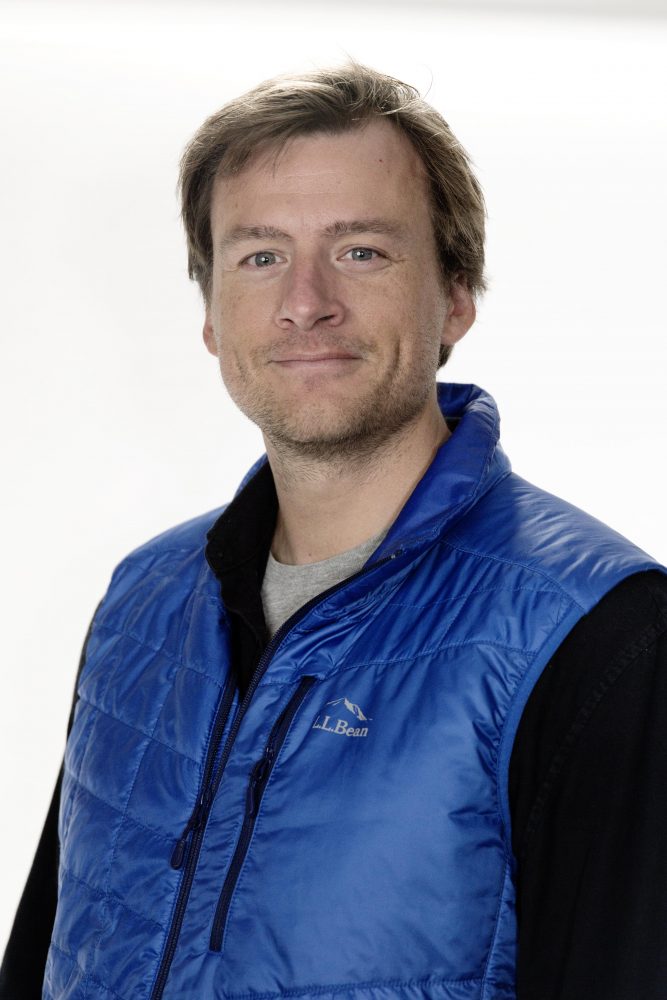
The man behind U.S. Ski and Snowboard data analytics, Gus Kaeding. (Photo: Sarah Brunson/U.S. Ski & Snowboard)
Kaeding, whose background as both a nordic ski athlete and coach led him to his current role with U.S. Ski and Snowboard, discussed his current and future projects with FasterSkier over the summer. Talking with him, it became clear that many assumptions about the sport remain unproven, and in his perspective, “we actually understand very little of what happens in between the start gun and the finish tape.”
Through data analysis and some exciting new technologies, Kaeding has a plan to gain a deeper understanding of the fundamentals of ski performance. This interview has been edited for clarity and length.
FasterSkier: I’ve read a little bit about what you’re up to with the analytics department, but I’m not totally up to speed.
Gus Kaeding: Yeah, I don’t think anyone really is.
FS: What sort of projects are you working on?
GK: If you watched the Bend camp, a number of coaches and athletes are now using Archinisis bibs. They basically look like a sports bra with a GPS unit in the back. I tested these last winter, and you’ll see a lot of the Scandinavian countries using them or something similar.
The Archinisis bibs can not only give you the GPS [data], but they can also tell you what technique you’re using. If you’re skating, it tells you your time in V1 versus V2, versus V2 alternate—to a pretty good percent of accuracy. The coolest thing is you can compare [the metrics] to each other, and also to yourself, meaning if you set a rollerski loop, and do it multiple times, you’re able to see an overlay of previous performances and where you’re gaining or losing time, and it’s really visualized nicely. You can do the same with multiple athletes, and then compare athletes and say: “you were three seconds slower than another athlete over the top of this hill. And as a result, you were five seconds slower at the bottom of the hill,” which are insights that we didn’t really have a lens into before.
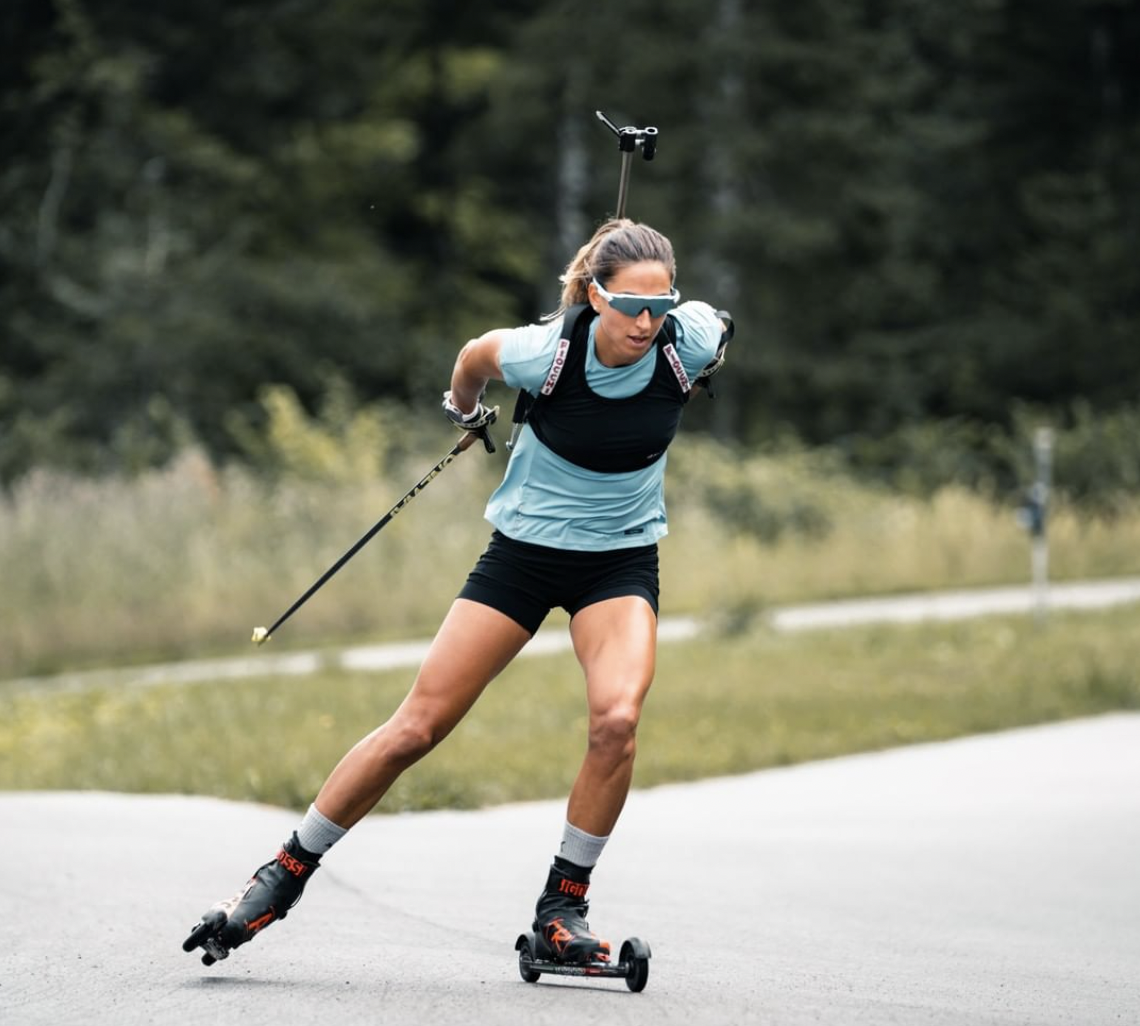
Italian biathlite Lisa Vittozzi trains with a Archinisis bib. (Photo: Instagram @archinisis)
That’s still in the test mode—we’ve got six of them. We had the option of rolling it out to the whole team and taking a big financial risk, but we chose to start small, and see where there’s value. Part of the risk when you roll out something like that is: who’s managing the project? Do they have the bandwidth to do it?
Someone like Jason Cork is super excited about things like that, and then if it ends up adding value, we’ll probably roll it out further next year, to a larger squad, and have a few bibs we can rotate through.
We may also have a few set courses around the country, so that when people come in, they can say, “I want to do a time trial against previous performances”, and afterward they can really look granularly where they’ve had success or need to improve a bit.
FS: What other ideas are you working on?
GK: The second one that I’m really excited about but didn’t get funded this year, is a ski treadmill at the Center of Excellence here in Park City. The problem is, the cross country team does not come here very often. One of the weaknesses, frankly, as a team is just general technique compared to the other nations—I don’t think that’s a secret. So we’ve been looking for a way to improve that for a few years now.
What we proposed was installing a 3D motion capture system around our ski treadmill, to get a better quantitative idea of what is good technique. What are the markers we should be looking for? And what are the markers we should be ignoring? That project did not get funded, but it got positive reviews. So I think in the future, there is hopefully a good chance [of getting it].
The idea would be to have the athletes come in once a year and do a movement assessment while on roller skis. From that, we would be able to break down multiple speeds, techniques, and inclines. Then we would look at where our techniques are similar across our athletes and where they are dissimilar. Where do we think they’re improving and where do they need some work?
Scenes from the 2021 Park City Training camp: from left to right, Kevin Bolger, JC Schoonmaker, and Simon Zink during a rollerski intensity session. (Photo: Simi Hamilton / Instagram @isaschoon)
I would build into that proposal getting someone who’s really got some stronger chops as a biomechanist. A lot of other countries have multiple people on staff who have PhDs in skate technique, so it’s like, “Yeah, no kidding, they have better technique”. So we need to do a little bit better job there. This is a project that has yet to come to fruition, but I think is going to be promising in the next 12 months.
FS: I believe Sweden’s been a leader in adopting 3D motion capture technology.
GK: Sweden with HD [Hans Christer Holmberg] and Norway with Oyvend [Sandbaak], do a lot of research in this area. Fortunately for us, they make a lot of it public, so we don’t have to start from scratch. We can play catch up for a little while until we feel like we’re in a place where we’re able to start to innovate ahead of the other countries. We’re still a few years from that, for sure.
FS: Tell me about your research into sleep?
GK: We’ve been looking for ways to quantify recovery and sleep. Finally, a couple of years ago, we decided to take the Oura ring as our primary recovery tool. So that’s been a project for the past two years.
We could look back at athletes who had Covid and their Oura data previous to that. Fortunately, we didn’t have a large sample set of people. Were the results conclusive on anything? No, probably not, but I will say the main similarity between everyone was that three days prior to showing Covid symptoms, their [sleep] temperatures just went bonkers. Whether high or low, it was all over the place. The deviation from the standard variation was nuts. So I think, for anyone out there that has a Whoop or an Oura, anytime your temperature goes one way or the other, watch out.
The latest version of the Oura Ring sleep and recovery tracker. (Photo: ouraring.com)
FS: What is the main goal of collecting this sleep data?
GK: It gives you some indication of how stressed out you are. It’s helped us add another lens to evaluate athlete load and upcoming performance.
FS: What are the challenges to gathering the kind of data you would like to work with?
GK: One of the major problems is, when the coaches are at races, they are busy—really busy, and you really can’t ask them to do anything more. You know, “go collect this data, collect that data”. And if you do, it better be able to return immediate, impactful results.
I think if we’re looking at the model that works in other sports, like soccer and basketball, you really need to have someone traveling with each team who’s just in charge of collecting and analyzing data. We’re just not at that point, as a sport, or as a program yet. Certainly one of the aims, probably in the next quadrennial, is putting a research/data person with each team: cross country, alpine, snowboard, just to gather data, analyze, and then innovate. That is in our long term planning. Until then, we are just not going to be able to even collect the data necessary to do any type of really interesting analysis. Because it does take having someone there, and that being their sole priority.
FS: That makes sense. It brings me to my other question of what sort of data do you wish you could gather?
GK: We do a lot of video analysis, but we don’t do a great job of storing that video. To me, it would be really helpful to have a video library of Jessie Diggins’ V1 technique through the years, to overlay year after year, and look where improvements have been made and then look at results on sections of trails. Have these V1 technique changes correlated to actual faster split times on V1 sections?
FS: Are you able to get enough video from World Cup races to effectively analyze those questions?
GK: We use the video for, say, qualitative analysis. I think the future is in computer vision and pose estimation [technologies] that would be able to look at technique just from the FIS feeds available now. They’re just starting to hit the sport level, in terms of price and scale. Those are technologies we’ve all got our eye on, and a lot of other sports do too. The NBA has started to dabble in it, but [the cost] is in the millions of dollars and the math is also hugely complicated. That’s the future, but it’s still a ways off for us.
FS: How do you envision data helping the program as a whole?
GK: We know, essentially, what results athletes need to get at each level. But we don’t do a good enough job of helping athletes figure out what is important to get those results.
The big goal of this next year, for every sport, is going to be to formulate a list with the coaches on what are really the most important factors to creating a good skier, and then figuring out ways to measure each of those.
Is it fitness? Is it power in the gym? Is it technique? Is it sports psychology? There’s so much on tap there. We need to do a little bit better job of delineating how important each is, and then being able to help the community and lead them a bit, showing what’s important at what age.
I think we do a pretty good job of that, but it would be nice to say: if you want to be one of the best skiers in the world, you should be achieving these results and here’s how to do it. We haven’t quite gotten there yet.
Scenes from the 2021 Park City Training camp: Jessie Diggins strides it out. (Photo: Simi Hamilton / Instagram @jessiediggins)
FS: That seems like a large project.
GK: Yeah. The goal over time would be to have all of [the categories] with objective measures. That’s another area ahead of us: innovative ways of measuring all those elements of a skier’s development and what the opportunities are to get better.
One of the things we’re working on is a sensor project that allows you to look at all these different metrics that we haven’t really gotten before, in order to understand what goes into an alpine turn. The technology is 100% applicable to cross country skiing as well, and now we can understand a bit more of what goes into the push phase.
Whether it’s cross country, or alpine, we actually understand very little of what happens in between the start gun and the finish tape besides time, pace, and heart rate. So it’ll be good to start to understand that with some more physical markers. So that’s where we’re at. The whole thing comes back to what matters.
FS: You mentioned that you can predict, to some degree of accuracy, future medals for the US Ski Team. How do you quantify that?
GK: We can break it down to: “we need this many athletes, at this level, to expect a medal in five years”, which is cool. I did a pretty quick analysis the other day — it was kind of back of the napkin math, but I figured out that with the implementation of the bigger development team that we started in 2018, and by really putting more of an emphasis there, we can expect another medal. [This is] simply from that team being established, and the level that it’s brought not only those junior skiers, but the rest of the skiers around them.
Once you start to get into expected medals, and expected performances, then you can do a better job of evaluating how well you’ve done as a staff, as a coach, and as an athlete. That’s something we’re a little bit lacking right now. Not that all those [calculations] are going to be correct, but you can continue to improve those over time. So far, they’ve played out pretty well.
The U20 World Juniors 4 x 5 k relay first place team from the U.S, (l-r) Luke Jager, Ben Ogden, Johnny Hagenbuch, and Gus Schumacher. (Photo: JWSC2019 / Mikaela Takala)
FS: You have a few interns this summer that are nordic athletes, what are they working on?
GK: One of our interns is Annabel Hagen, who is currently at Harvard on the cross country ski team. She is working on a project that is near and dear to my heart. She is looking at a spike in USSA membership in 2012, and how it correlated to 2015/2016. Are we seeing a greater influx on the national team if we had 30% more participation at the 13 year old level in 2012? We break that down by numbers, but also by region, by state, and by club. We’re really looking at doing a better job with our demographics, and looking at where our athletes are coming from.
There’s also Jackie Garso, who’s a training biathlete right now and is a recent graduate from St. Lawrence College. She’s working primarily with our women’s alpine team, looking at our force plate data. Another is current US Ski Team athlete Sophia Laukli. She’s at Middlebury College and is a math major like myself. She’s been looking at alpine skiing when you start a World Cup at the back. She’s trying to figure out when it is beneficial [for an athlete] to go down a level into the Europa cup, and try to score their best points in order to get back to the World Cup with a better start spot.
FS: Gus, thanks for speaking with FasterSkier. Is there anything you’d like to add?
GK: We have a really smart community and a really innovative community, so if there are people out there who want to help or are interested in one subject or another, I am definitely willing to utilize their expertise.
If you’re interested in getting involved with the analytics department at the US Ski Team, you can reach Gus Kaeding by email at: gus.kaeding@usskiandsnowboard.org
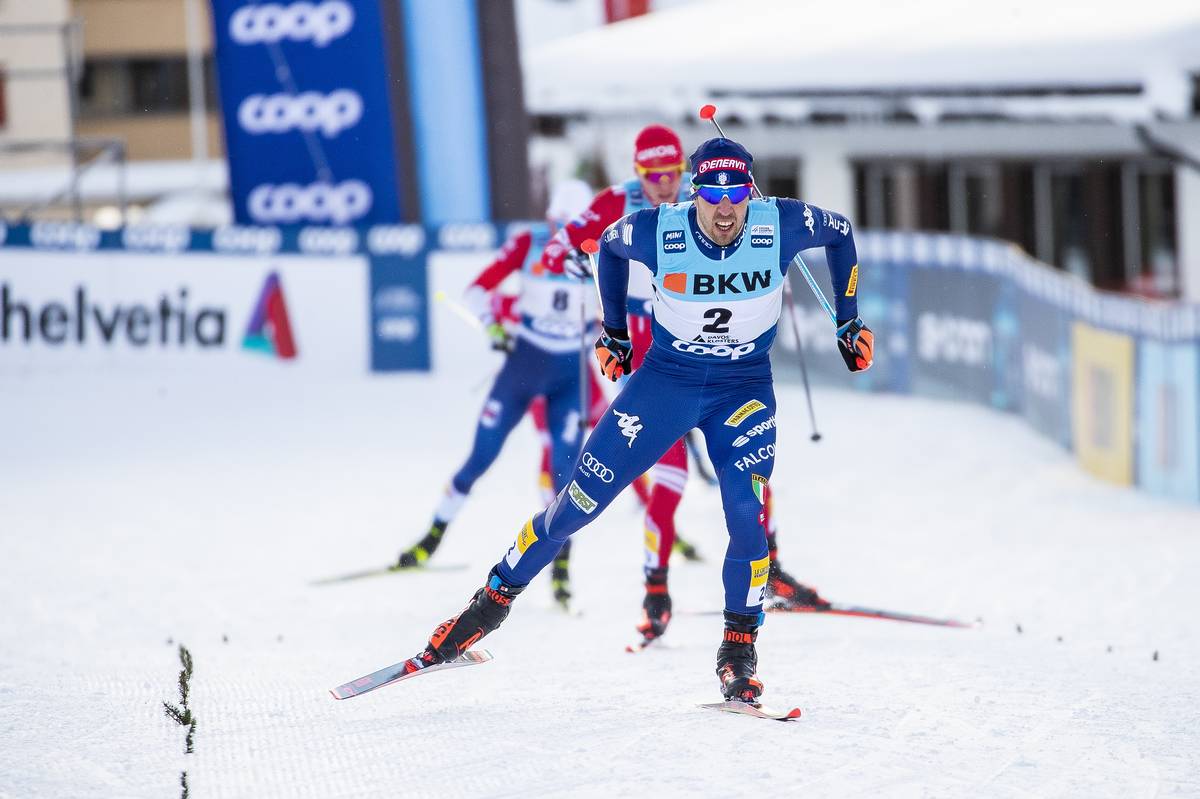
Italy’s Federico Pellegrino closing out the win at the 2020 Davos freestyle sprint. (Photo: NordicFocus)
This article builds upon the four-part “Building a Better Skier” series, which explores how biomechanics and movement patterns affect skiing technique, and more importantly how you can apply these concepts to improve your skiing. Please feel free to email the author with any questions: ned.dowling@hsc.utah.edu.
Recently, I overheard one of my Physical Therapy colleagues tell a patient, “We’ve got to get you jumping. If you want to get back to running, you’ll need to do some jumping first. Running is nothing but jumping from one leg to the other.” Running is a bit more complex than that, but she made a good point.
But what does ‘happen at a faster rate’ mean? To answer this, I’m going to take a dive into some physics and biomechanics. First, we need a name for what exactly is happening faster. For the sake of this article, we’re going to go with force. This is perhaps more appropriate than power and maybe less accurate than impulse, but it certainly does the trick of conveying the message that an action has been initiated with the intent of creating motion, be it skiing, running, walking, jumping, etc. (If you want a deeper dive, I highly recommend Force: the Biomechanics of Training by Dan Cleather.)
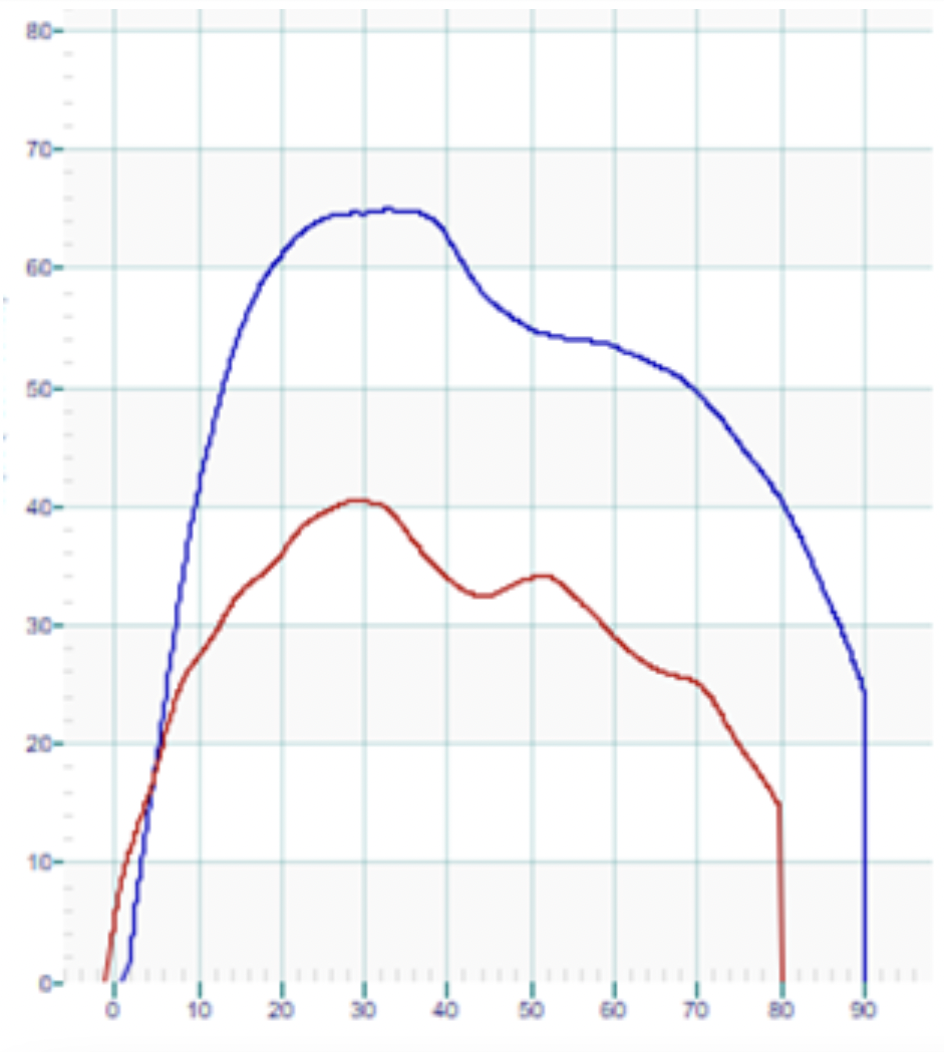
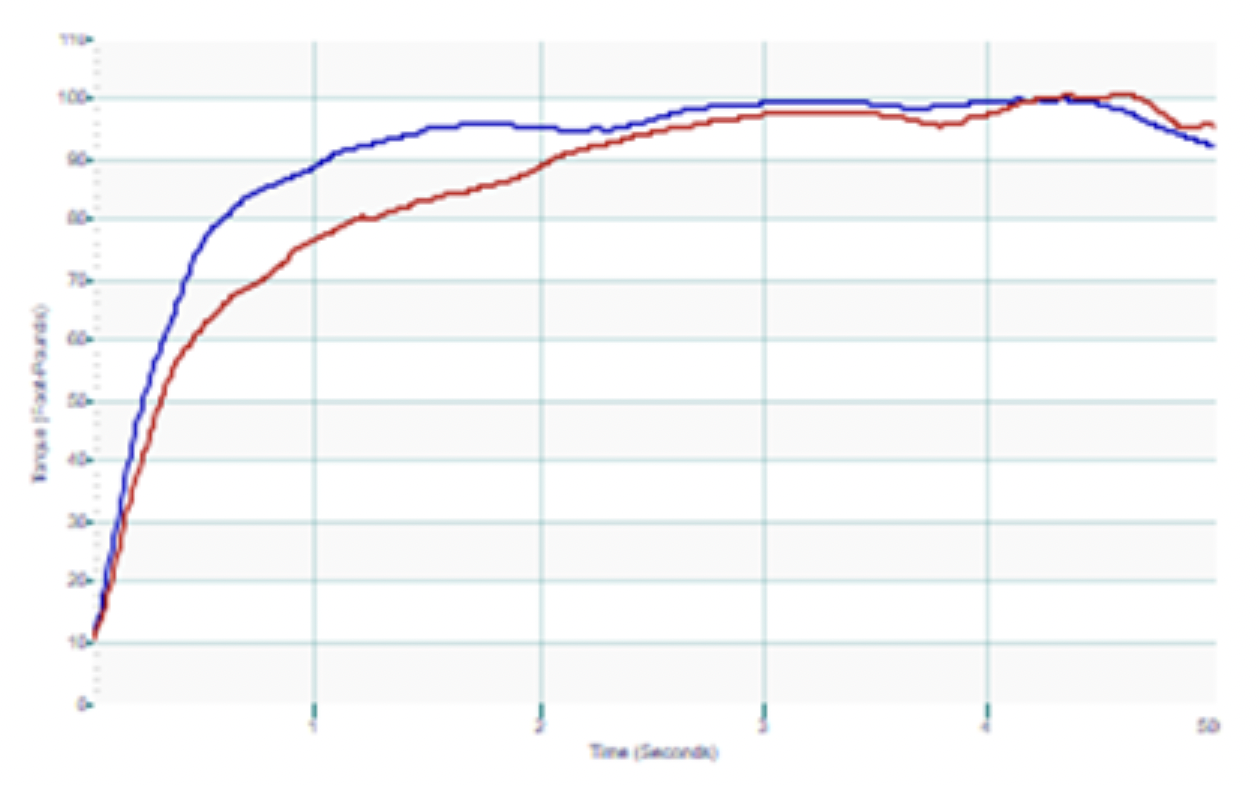
To overcome gravity and the friction (or suction) of snow, force is required. Our velocity or speed is largely dependent on the magnitude of the force we generate. However, force is not simply an instantaneous measurement. We can talk about peak force or average force, but these miss the big picture. With skiing, whether we are talking about legs propelling skis or arms pushing on poles, force can be plotted on a graph where the Y-axis is the magnitude of force, the X-axis is the amount of time that force is applied, and the area under the resulting curve is the total quantity force applied to the ski or pole during one cycle.
In this graph, the peak force (y-axis) is much greater for the blue line. The greater magnitude of force is also held for a longer period of time (x-axis). Thus, the area underneath the blue line is considerably greater than the area under the red line. All else being equal, the skier producing the blue line will be faster.
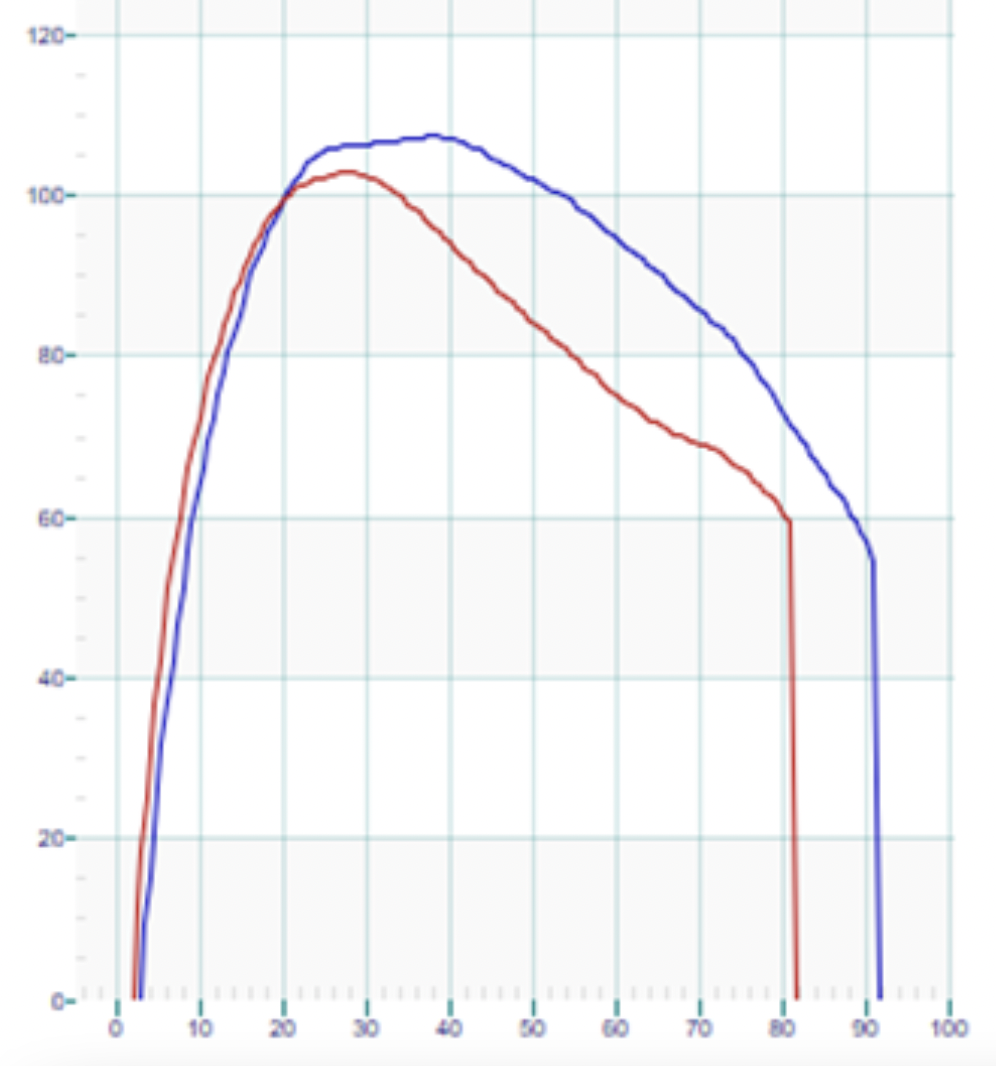
Here we see similar peak forces (y-axis), but the red line doesn’t maintain its force and drops off more rapidly (x-axis). The area under the blue line is larger as a result.
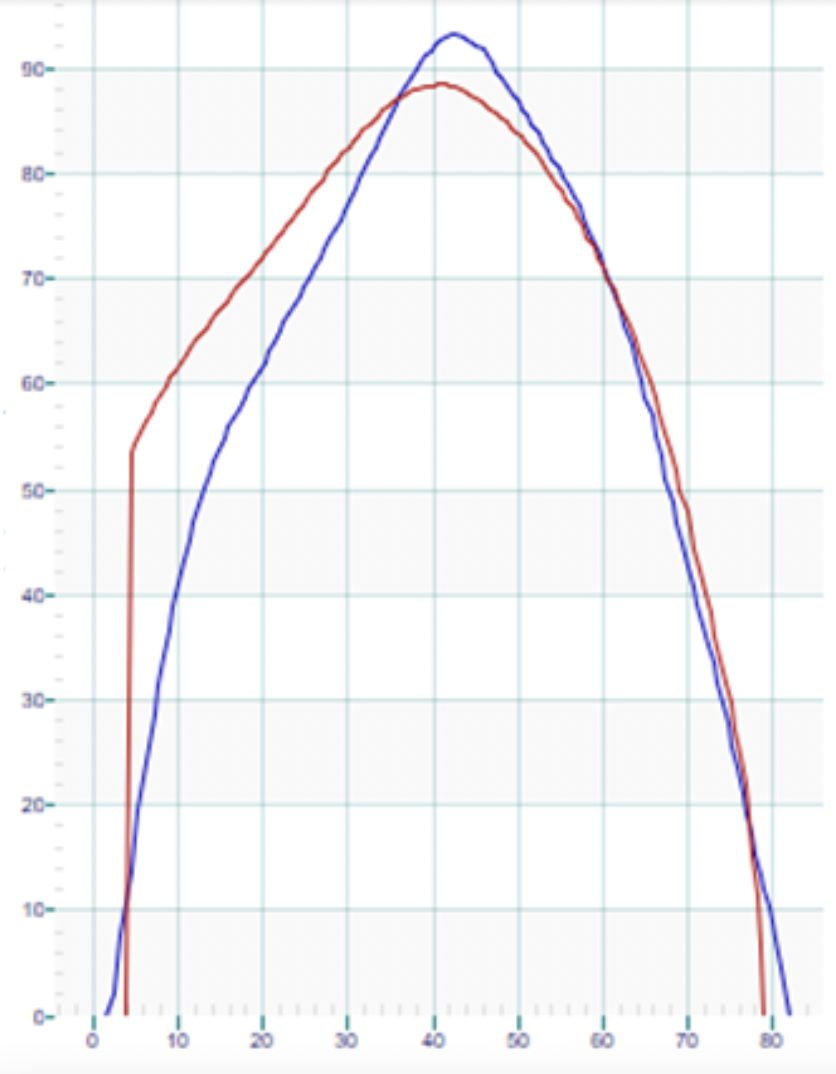
In this graph, the red and blue lines have very similar peak forces (y-axis) and duration (x-axis). However, there is a major difference in how they get there. The red line reaches its peak force faster. As a result, the area under the red line is larger than the blue. This is because, even though peak force and duration are the same, the red athlete’s peak force happened faster.
Here’s another example of similar peak force, but the blue line has a much steeper curve and is reaching peak force more quickly.
The slope of the line, “rise over run” if you remember way back to middle school, represents how quickly force is generated. This is called the rate of force development (RFD), and since it is the name of the article and we’ve spent so much time just getting to this point, it must be important.
I already pointed out that force development in powerful skiing happens quickly. In their article, General strength and kinetics: fundamental to sprinting faster in cross country skiing (also cited above), the authors set out to draw correlations between biomechanics, kinematics, and strength in elite skiers. Among their primary findings were: 1. “Analysis of kinetics and kinematics revealed that it was not exclusively the magnitude of applied forces during skiing, but the timing and proper instant of force application were major factors discriminating between faster and slower skiers.” And 2. “General strength and power per se seem not to be major determinants of performance in elite skiers, whereas coordination of these capacities within the different and complex skiing movements seems to be the discriminating factor.”
A primary takeaway is that RFD is related to maximum velocity. This sounds intuitive enough: a sprinter on the track is generating more force per stride over 100 meters than a distance runner racing the 5k. But they go on to conclude that as the skiers increased their speed, they decreased their stride time/duration of force (X-axis). How can speed be increasing if the duration of force is decreasing? Won’t the area of the graph get smaller?
Some of the speed increase is the result of higher peak forces, but it was also attributed to increased RFD. If we manipulate the graph such that peak force is achieved more quickly — meaning a steep spike at the onset of the force — we can afford to decrease the force more rapidly while still generating a larger area under the curve.
With regards to physical attributes, the authors discovered that maximum strength was not correlated with maximum skiing speed; however, jump height (aka RFD) was closely correlated. In the study, maximum strength was considered isometrically, meaning that the muscles were resiting a static load (think planks) versus a push or pull against a load.
It also should be noted that a quicker, but shorter, stride must be accompanied by a faster stride cycle or cadence in order to be effective. This will be well understood by anyone who rides a bike with a power meter: if you are trying to maintain 300w on a climb and shift into an easier gear, your cadence has to increase or the power will drop off. The change in gearing creates less max force through the pedals but is compensated by increasing the speed at which the crank is turned.
Simi Hamilton pushes over the roller during a 2020 skate sprint in Dresden, Germany. (Photo: Nordic Focus)
RFD sounds awesome. How do I get some?
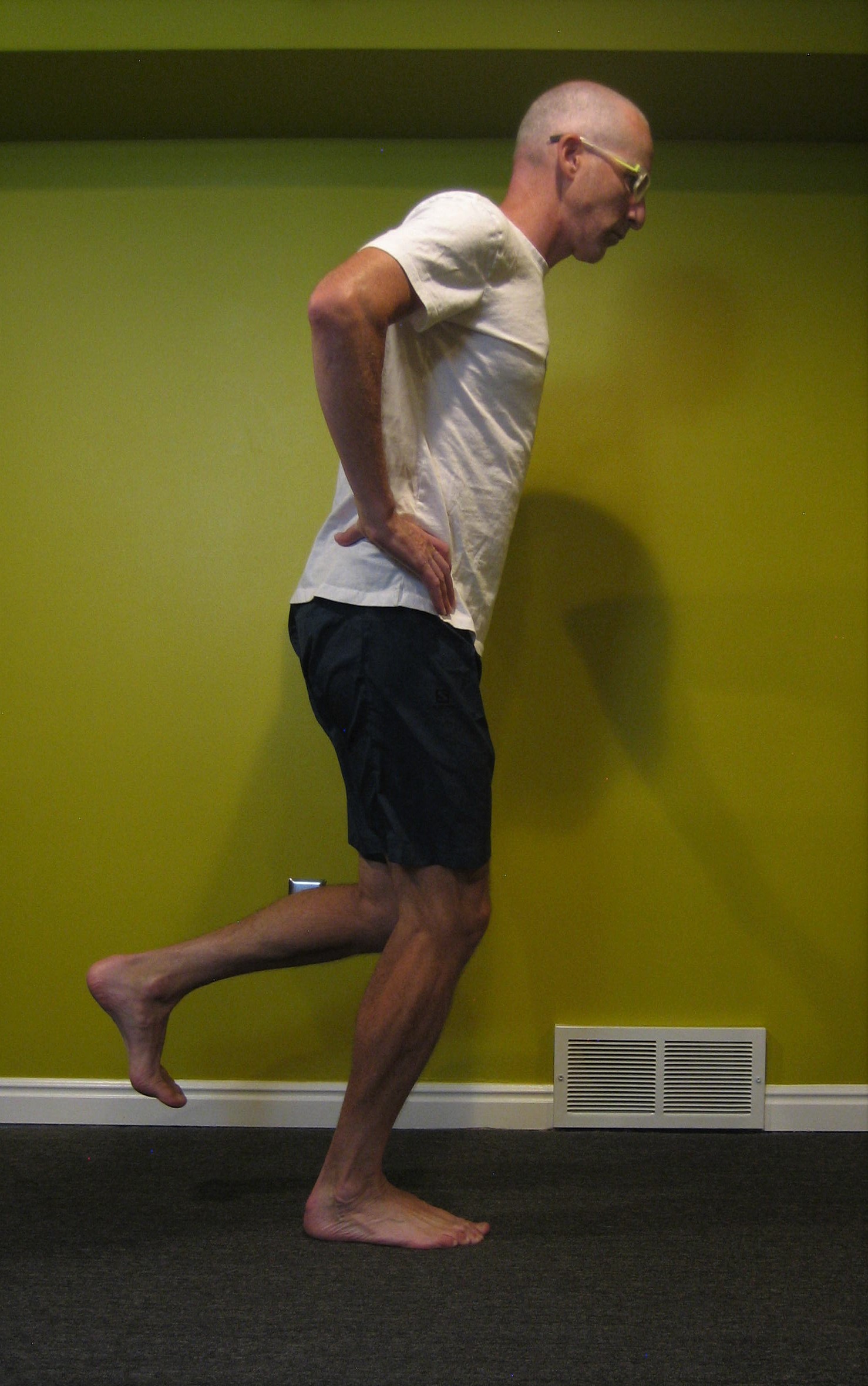
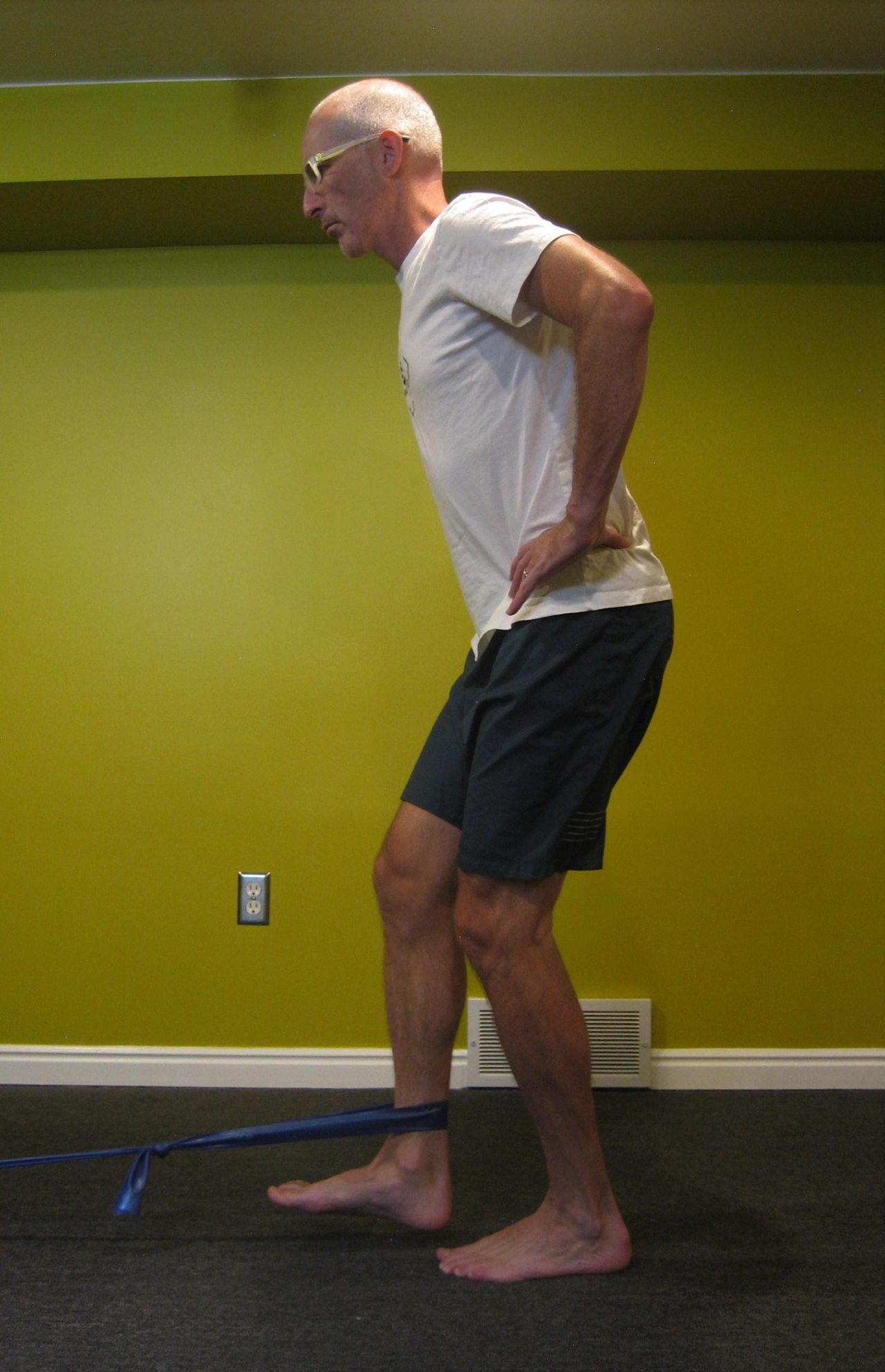
Simply put, you train it. In order to increase the speed at which muscles contract and generate force, we must increase the speed of muscle contractions in training. On the low-load end of the spectrum, this can mean simply speeding up standard strength exercises like squats, leg press, and lat pulls.
Plyometric exercises incorporate a pre-load or “stretch” phase prior to a rapid contraction. For example, if we consider a vertical jump, starting the jump from a squat position is a simple contraction of the muscles responsible for hip, knee, and ankle extension. But if the jumping motion begins in standing before dropping into a squat and quickly rebounding for the vertical jump, the same muscles that generate the jumping force are lengthened before contracting. This harnesses the energy produced by the elastic recoil of muscles and tendons.
Think about putting a fairly tight rubber band around your wrist. The rubber band is actively contracting against your wrist and the pressure, or force, is evident. Now pull back on the rubber band and let it snap against your wrist. This amount of force is significantly and noticeably (sorry!) greater. Our muscles and tendons do not harness that much elastic energy, but you get the idea.
A pause for words of advice/caution: If the previous paragraph made your knees tremble or your back start to tighten, keep in mind that all exercises exist on a spectrum. With any exercise program, the load or difficulty must start with what is doable. There is a fine line between doing enough to stimulate adaptations in the body and doing too much, increasing the potential for injury. If you are managing a chronic musculoskeletal issue or returning from injury, it is highly recommended that you consult with a Physical Therapist or Athletic Trainer for a more personalized RFD program. Plyometric exercises can be done in a pool with a significant decrease in resistance. The overall load in the water is decreased, but the RFD benefit is retained.
Plyometric Exercises to Increase RFD:
Hopping: Whether on two feet or one, hopping drills will help strengthen the feet and ankles while developing RFD in the calf muscles. These have the lowest loads and can be valuable exercises themselves or as part of your warm up. Jumping rope falls in this category and has been shown to improve running speed.
This video demonstrates a handful of “pogo” style hopping drills. Notice how the knee and hip stay fixed with force being generated by the ankle.
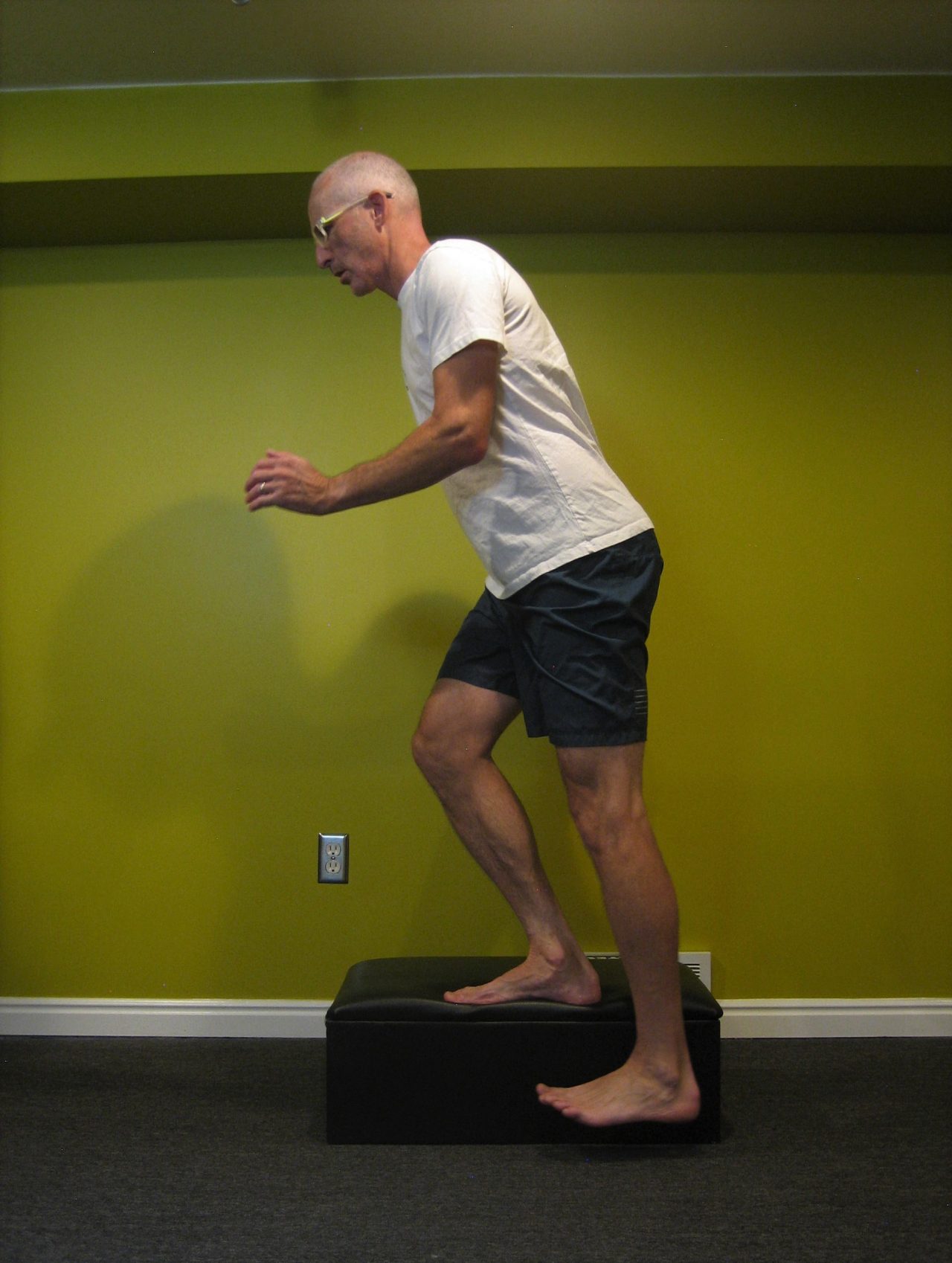
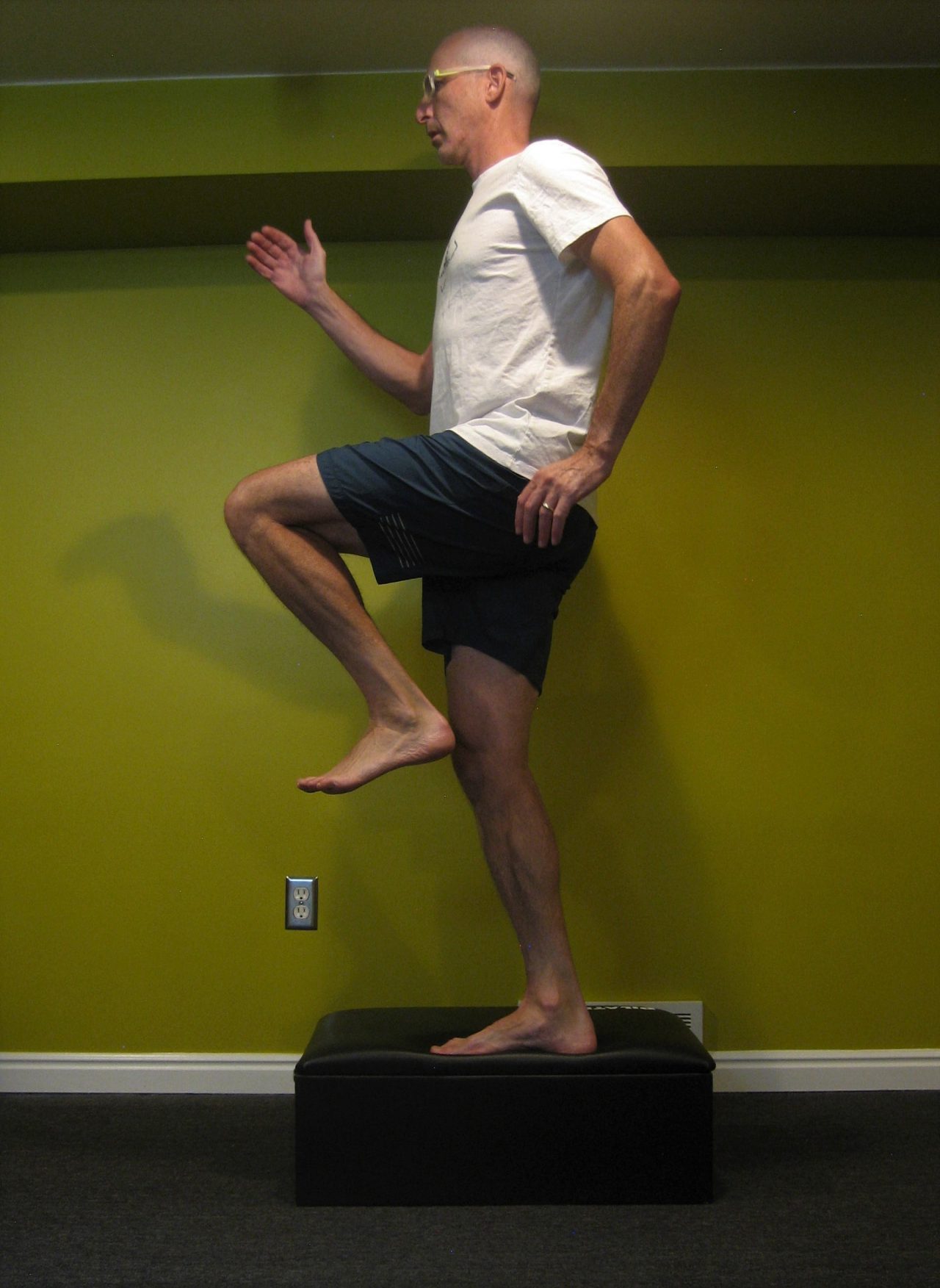
Jumping: Vertical jumps, broad jumps, box jumps, drop jumps, bilateral, unilateral, backwards, sideways–the variety is only limited by your imagination. However, to get the most out of the plyometric stretch cycle, it is arguably best to make these countermovement jumps where the body drops down before exploding upwards (or sideways, forward, etc.).
In this video, Dave Quammen of Park City Sports Medicine demonstrates a series of two-legged jumping drills. Challenge can be increased with added repetitions or with reversing direction with the forward jumps. Try these on one leg for a significant increase in load/difficulty.
Bounding: With or without poles, bounding follows the basic premise of adding “pop” to a normal stride for increased RFD and exaggerated height, distance, or speed. While boulding can be done on flat ground, there are added benefits to going uphill: because height and flight time are reduced so are the impact forces when landing. It also takes more effort to go uphill, so the workout is more efficient (more bang for the buck), and it just feels more natural.
Demonstration of more running-oriented hill bounding, from Lydiard Training.
Ski bounding with poles is a traditional dryland exercise that not only improves RFD but works the core and arms at the same time — valuable training even if you only skate ski. It can be done on a long gradual hill for endurance work, but short, steep hills will emphasize RFD.
The U.S. Ski Team completes a set of longer duration L4 ski bounding intervals way back in 2012. Camera quality has since improved, but the background song is still a classic. Note how the technique is very different from running even though the speed might be similar.
Again, with the basic concept of creating quick, explosive movements, there are far more ways to develop RFD than this summary can hope to cover. The remaining topic, then, is dosage.
Plyometric exercises are demanding and stressful to the musculoskeletal system. Delayed onset muscle soreness is to be expected, and at least one recovery day is mandatory. Aside from muscle soreness, any pain that is beyond mild or takes more than a couple of hours to subside should be considered a contraindication and deserving of a consultation with a sports medicine provider.
For most readers, doing the exercises once or twice a week is an adequate stimulus for both improvement of RFD and appropriate recovery. As for duration or repetitions: when in doubt, start small. In the jumping video above, Dave demonstrates two repetitions of each jump. If we consider the full video to be one set, then starting with 2-3 sets is likely reasonable. Then, increase repetitions to progress the program. Keep in mind that quality is key — if you feel your technique or stability start to wean, it’s best to stop there. Total exhaustion is not the goal.
Precede plyometrics with a light cardio warm up. If coupling plyometrics with core or strength training in the same session, it is generally recommended to do the plyos first before you are too fatigued.
Sophie Caldwell Hamilton powers through the heats during a classic sprint in Oberstdorf, Germany in March 2021. (Photo: Nordic Focus)
Lina Hutlin steps into the role of Race and Service Manager for Madshus. (Photo: Madshus)
At the end of September, Madshus USA announced that they had hired Lina Hultin as the new Race and Service Manager. According to the press release, “Lina will work towards finding, developing, and retaining the most talented and influential Nordic athletes in every age category. She will also work closely with the rest of the Madshus team to develop, and execute, a club and coach program that supports the brand and its dealers throughout the country.”
Hultin is Swedish and came to the United States in 2014 to pursue a Masters degree in Exercise Science and Nutrition at Montana State University. As part of this academic opportunity, Hultin was awarded a scholarship for racing with MSU Nordic. Faster Skier caught up with Hultin to learn more about her background and what led her to this position at Madshus. The following interview has been edited slightly for clarity.
Faster Skier: Can you tell us a little about your background?
Lina Hultin: It’s a cliché but for me, growing up in Scandinavia meant I started skiing as soon as I could walk. That’s how my family spends time together, we ski, bike, run, and have fika, ( preferably the activity and fika combination). I entered my first ski race was when I was five years old. Nothing intense or competitive, just a snowy field with blueberry soup at the halfway mark. After a few winters of little snowfall, my parents decided to move further north to a little town called Bruksvallarna. It’s a Nordic skiers paradise, and we quickly got involved with the local Nordic team. Shortly after the move, at age seven, I got really serious about racing (yeah, I was that kid). We had a 5k groomed Nordic track outside of the school I attended, so there was no stopping me at that point. I skied all day, every day during the 7+ month winter.
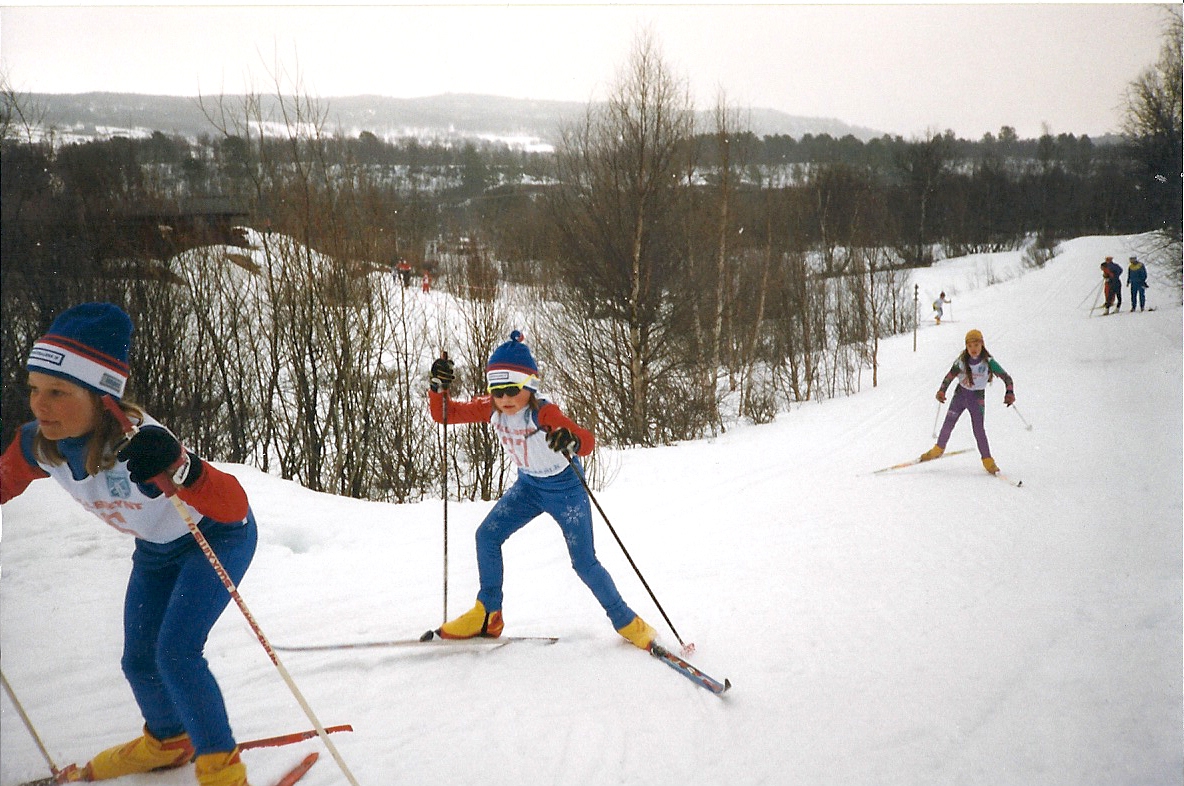
Lina Hultin age seven, getting after it in a ski race. (Photo: Lina Hultin)
I spent my high school years away from home at a Swedish high school skiing program (like most Swedish Nordic skiers do). I tended to perform best in sprints, I placed 5th in the Swedish Junior National Championships in 2009. I decided very young that I wanted to be the best. In my search for constant improvement, I became passionate about learning how the body reacts to training and how to perform optimally. So, when I heard about an undergraduate program in Meråker, Norway, where a group of world-class Nordic athletes study exercises physiology and sports performance, I had to apply! I got in as the only female athlete that year (together with Emil Iversen, Finn Hågen Krogh, Tomas Northug.. ). After being accepted I moved to the small village of Meråker, a town whose highschool and undergraduate alums have produced 24 Olympic medals in Nordic skiing and biathlon.
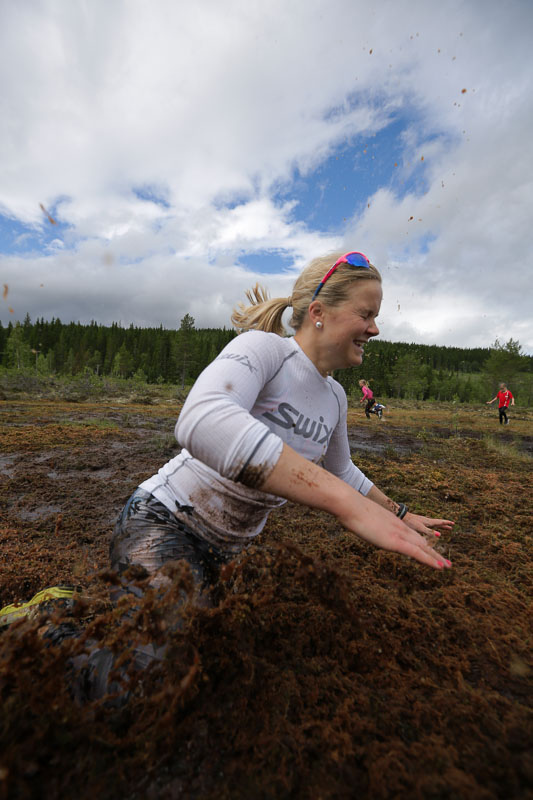
The perils of Norwegian bog running, Lina Hultin gets a taste of the mud (Photo: Adam Karls Johansson)
In this village, skiing is religion, and successful skiers become gods. However, even if you didn’t quite reach this status, there was a place for everyone who attended. I discovered the magic in the Norwegian success was their ability to share knowledge with one another. I will never forget the rainy fall mornings (when it has already been raining for two weeks straight) at 8am when I would start doubting why I was once again getting ready for an intensity session, only to show up alongside more than one hundred athletes, ready to do the same workout. The athletes ranged from freshmen in high school who just had decided to focus on skiing, to athletes who had podiumed in the previous season’s Olympics. There was room for everyone and it gave me the sense that it was just a matter of putting in the effort and time before I would be able to keep up with the fastest in the group. It felt like there were no secrets, no magic tricks, just smart training in an abundance, and in good company.
To fully submerge myself in the culture, I joined the Norwegian team Henning Skilag. The club is run by Audun Kolstad and his brother Esten. Both in their 70’s with an infinite passion for skiing. Audun coached Petter Northug when he was in high school. Audun is a man of very few words, with a big heart and fitness any 70-year-old could only dream of. No matter how many hours we ran in the Norwegian bog, he was always right there running with us, while Esten was providing the fika. During my time in Norway I was able to produce some top 10 sprint performances in Norwegian cups. In my last race in Norway, I got to ski the sprint relay in the Norwegian National Championships with my teammate Kari Vikhagen Gjeitnes. This is another experience I will never forget since I was right there with the best athletes in the world, feeling like I belonged.
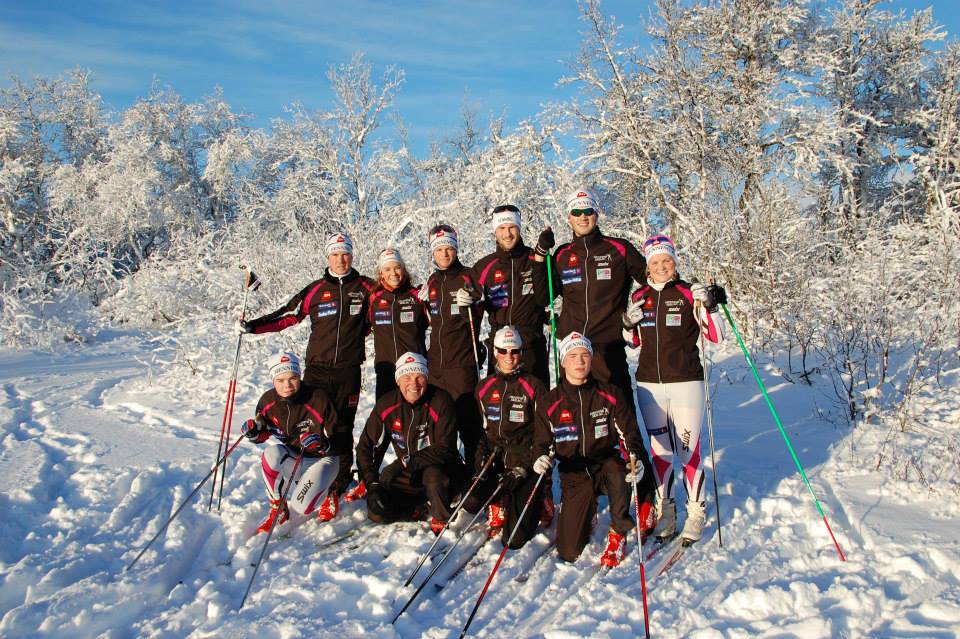
Team Henning Skilag, Lina Hultin standing to the right (photo: Henning Skilag)
After finishing my bachelor’s degree in Sports and Physical Education, I knew I wanted to keep studying (preferably full-time) but my love for racing was still strong. I always knew in the back of my mind that college skiing might be an option but, at age 22 I was starting to run out of time. Luckily, the MSU team had a spot left to fill and they had a Master’s program where I could study human performance in a lab with a roller ski treadmill (I later realized that was rare at the time in the US).
Lina Hultin (second from right) with MSU teammates (photo: MSU skiing)
I had never been to the states before, but after seeing the success of the US team and watching them at races in Sweden and Norway I was really curious to learn more about the emerging ski culture that was beginning to be established. I landed in Bozeman, Montana in August of 2014 and had no idea I had arrived in such a special place. The Nordic ski culture might not be apparent at first glance, but this town has more groomed trails and terrain for training than one can cover in years (and lots of sun! the sun is always shining and if it’s not, it’s snowing). Being a part of college sports in the US made me realize how much inspiration and knowledge can be drawn from other sports. I was thrilled at the idea of so many different ways and paths one can take in order to reach the same goal, it’s humbling and opens up a world of possibilities.
Lina Hultin (right) racing at the Utah Invitational for MSU (Photo: MSU Skiing)
FS:What has been your history with the Madshus brand?
LN: Growing up there were really two dominant (go-to) brands for skis in Scandinavia, and Madsus was one of them. Having an older brother, I got to inherit his skis, which happened to always be Madshus skis.
Lina Hultin (left) and her brother, looking stylish. (Photo: Lina Hultin)
After performing well as a junior I got in contact with Madshus and got my first pair of brand new skis. I always felt a great deal of support from them, both in Sweden and Norway. I have been happy with the company’s products, so I kept skiing on Madshus for my seventeen-year long ski career. I have some favorite’s, including my Madshus klister skis (on which I beat the family record time in the Swedish Vasaloppet) and my Madsus Zero skis (which work in way warmer and way colder temperatures than you would expect from a zero ski).
Lina Hultin gives a kick-wax demonstration (photo: FS archives)
FS: What about this new position at Madshus excites you the most?
LN: I am looking forward to being able to explore a whole other side of the skiing world. I have been coaching in the US for five years and have done my fair share of wax tech-ing but I have yet to learn about the supplier side of things. I’m excited to have the opportunity to work and learn firsthand from Bryan Cook who has years of experience in the industry. I’m also thrilled that I will be continuing to work closely with athletes, helping them to perform at their best.
FS: What do you think will be one of the more challenging aspects of the job?
LN: It’s always challenging to learn something new, but I have always been curious and eager to learn so I think I have that going for me. I guess I will figure that out as soon as the season starts! Madshus is a forward-thinking brand and I’m stoked that I get to be part of such a great team.
FS: Any other thoughts or comments?
LN: I’m very thankful for my US skiing family and for the warm welcome I have always felt being a part of this great community. I am especially grateful for the support, encouragement, and network I have found through being a part of the Women’s Ski Coaches Association. Go check them out!
Lizzie Larkins, Lina Hultin and Kate Johnson at Park City this week for the NEG/National team training camps (Photo: Women Ski Coaches Association)
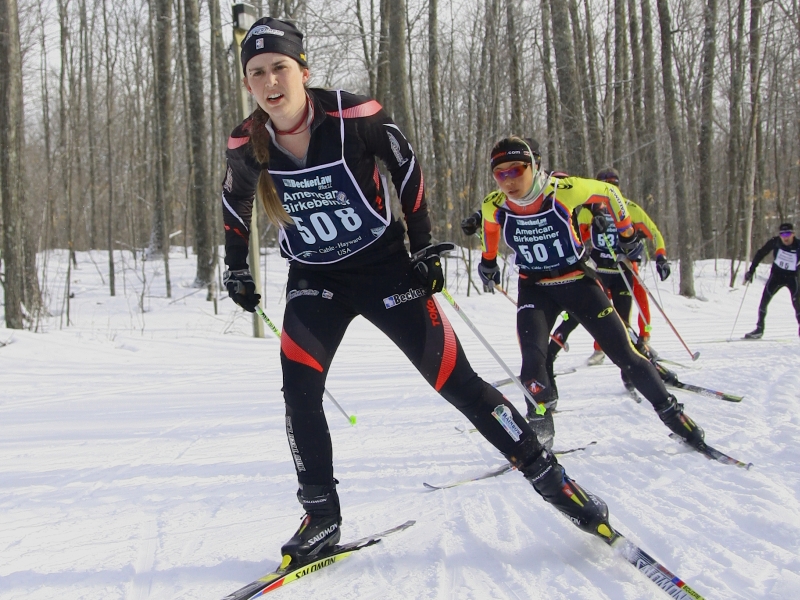
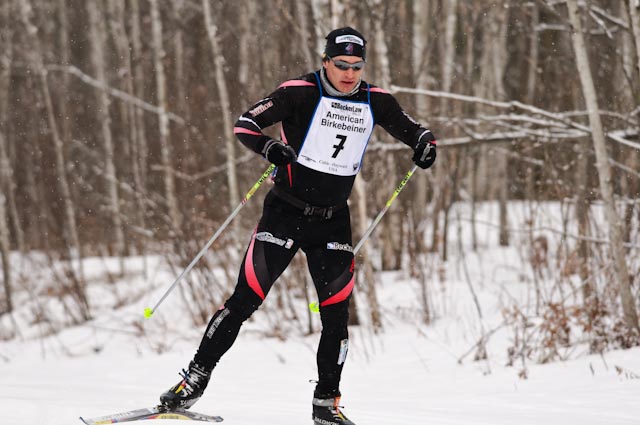
Author Kristina Owen races in the 2009 American Birkebeiner ahead of Evelyn Dong.
The following article was originally published on FasterSkier on October 15, 2008. It was written by CXC (Central Cross Country Skiing) athletes Kristina Owen and Heather Zimmerman. Roughly contemporary photos have been added for this reprinting; the pictures that originally appeared with this article are no longer available.
The piece is simultaneously from very much another era, yet also completely timeless. On the one hand, “Caitlin Compton” now has a different last name; Jessie Diggins, who had recently turned 17, would go on to do things even more impressive than win the junior division of the Climb to the Castle rollerski race; the article’s authors last competed in FIS races in 2011 (Owen) and 2009 (Zimmerman). On the other hand, in October 2008 skiers enjoyed the fall foliage, did hard doublepole efforts, and benefited from having athletes from multiple clubs together in one place for head-to-head competition. A quick perusal of social media shows that New England fall colors are still a thing, and that athletes from multiple clubs (including that obscure junior, Jessie Diggins) still come together in Lake Placid for fall training. 13 years later, some seasonal rhythms of American skiing remain very much the same.
Matt Liebsch coming up the final hill on his way to victory in the 2009 American Birkebeiner.
CXC Elite Team – Lake Placid Training Camp Report
The CXC Elite Team recently completed a two week monthly camp in Lake Placid, NY. We stayed and trained at the Olympic Training Center, which provided an ideal environment to make huge gains in both fitness and technique.
The weather was excellent for the first couple days: chilly, but clear skies. “The only problem with the weather was that is was cool enough that none of the boys took off their shirts,” Caitlin Compton mentioned with a smile. After a few days of such perfect training weather, the team’s luck broke and it started raining; beautiful miserable cold rain. The training continued as planned, but between workouts the hallways were filled with the smells of damp and drying athletic apparel.
One of the team’s favorite workouts at this annual camp is an over-distance run in Adirondack Park. We are able to take advantage of great trails up mountains with gorgeous panoramic views. This year the men’s team made it to the summit of Mt. Colden, but disaster struck on the way down. Matt Liebsch, Midwest born and bred, was unused to the speed on the steep rocky descent. He went down hard with a nasty ankle sprain. His teammates carried him out, but the injury was camp ending and he returned to the Midwest for recovery.
Leaves in the Lake Placid region were in their peak foliage and so was the CXC Elite Team’s performance during the second week. The highlight came at the culmination of the camp, with the Whiteface rollerski race. However, there was a lot of work to be done, both intensity and volume, before the race arrived.
Caitlin Compton sprinting at US Nationals in 2008 in Houghton, Michigan.
The workload wasn’t the only thing increasing during the second week of camp. The Olympic Training Center was overtaken by Nordic athletes. CXC Elite was joined by their Junior Development Program athletes and coaches, as well as the Sun Valley team, the USST, various NENSA athletes, and some of the region’s collegiate racers. CXC Elite Team was able to frequently take advantage of the large athlete gathering, as all the groups came together for some of the workouts. The best example of this was a hard double pole workout up a long gradual hill. The men did two sets of 3×4 minutes, with a ten minute break between sets, while the women concentrated their efforts to 3 1/2 minutes. It was a great workout and the added numbers definitely helped in ramping up the intensity!
The camp was also notably included the first competition of the year between CXC and their friendly rivals, Sun Valley. Last year Sun Valley pulled out a narrow victory in overall points. This year CXC was off to a good lead, with a win in an inter-team soccer match. The competition was fierce, but CXC’s greater numbers this year gave them the edge to pull off the victory.
CXC Team continued to utilize the hilly terrain in the area, traveling to Whiteface Mountain for a ski walking workout on the lower trails. Some of the team returned to the mountain later in the week for an evening hike, lured in by the fresh snow that covered the top.
Our second week contained not only some good intensity efforts but also a lot of volume. By Sunday most of the team had completed at least three ODs. All the mileage made us feel as though we had really gotten to know the Lake Placid area!
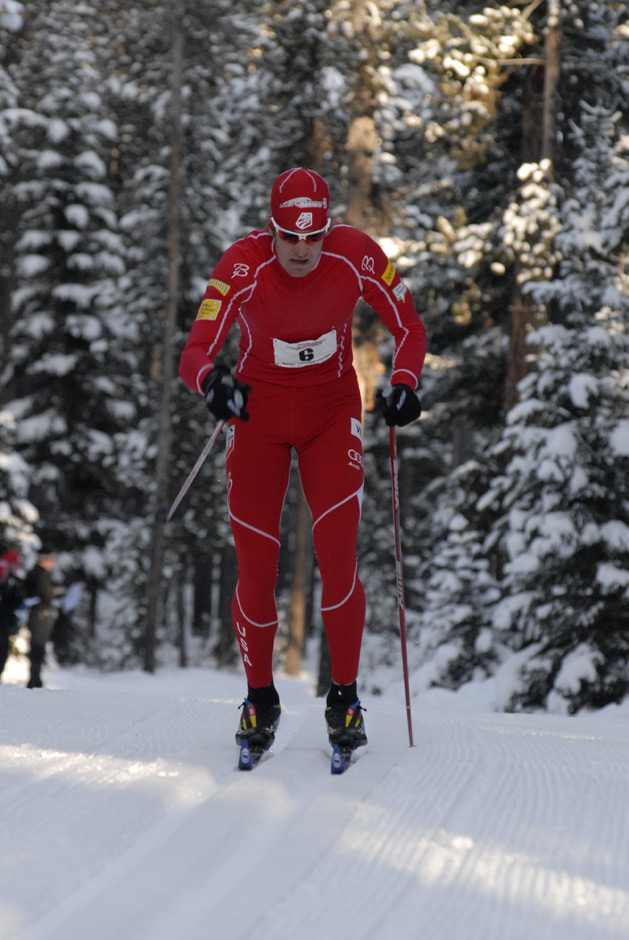
Garrott Kuzzy (CXC Team Vertical Limit/US Ski Team) races the sprint in West Yellowstone, November 2009. (Photo: Win Goodbody)
The camp ended with a grand finale, the Whiteface Mountain rollerski race! After testing ourselves on the area’s hills for the previous two weeks, what better way to finish up than a five mile, steep uphill race. Of coarse, mother nature decided to throw a few additional hurdles in our path before we began. The top of the toll road was too icy for skiing so the race was moved slightly down the hill. However, despite the alterations, the course still proved to be plenty challenging! Despite being tired, CXC athletes turned in some impressive results. Caitlin Compton led the way, winning the women’s race. CXC Junior Devo Program Jessie Diggins had a very impressive showing as well, placing 5th overall and winning the junior category. On the men’s side Garrott Kuzzy led the charge with a notable 4th place finish, followed closely by Brian Gregg in 6th.
Sufficiently exhausted by this final effort the team departed Lake Placid. This was the team’s final two week dryland training camp. Athletes will now have the next four weeks at home before leaving for West Yellowstone, early snow, and the beginning of the Supertour circuit!
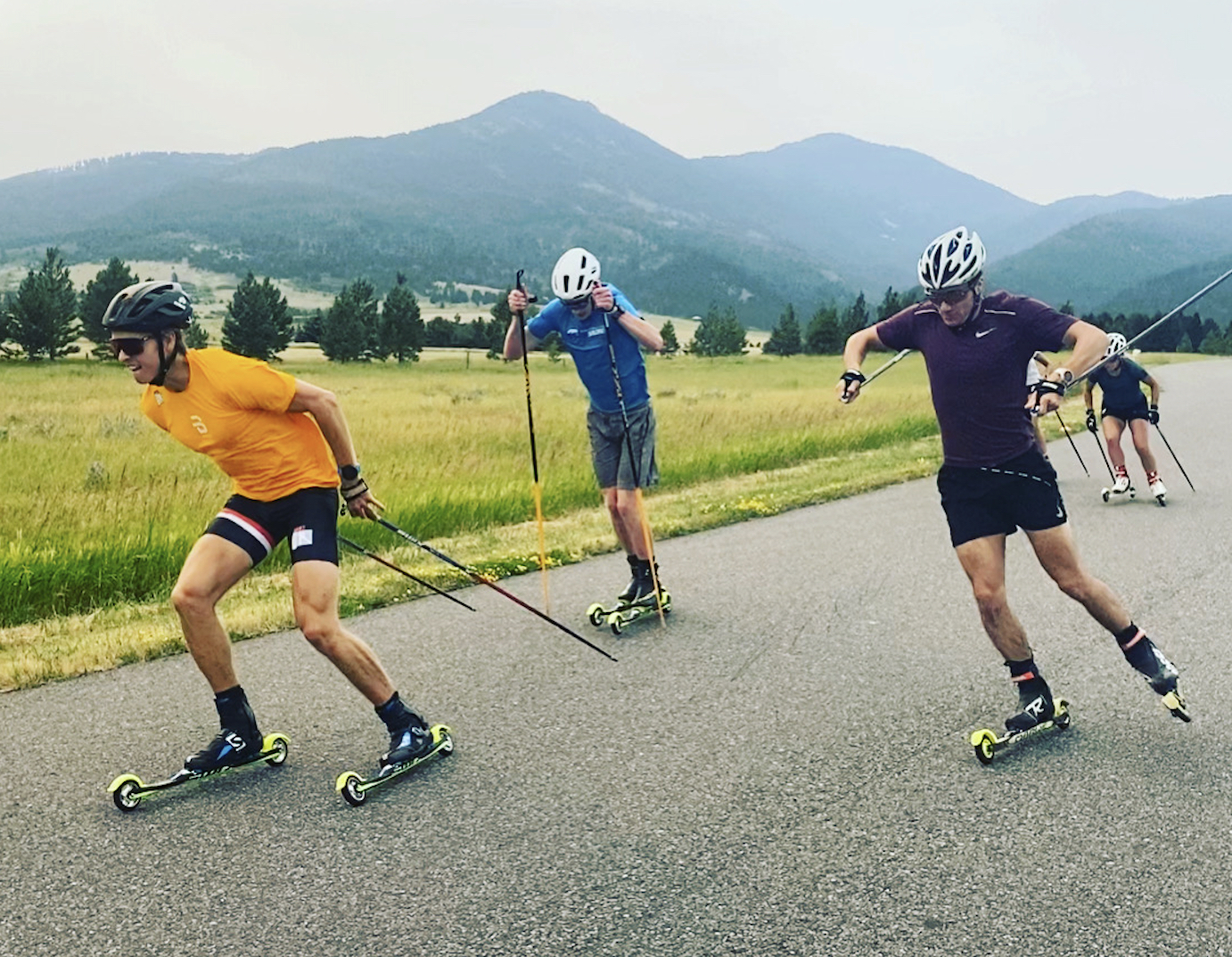
Smoky haze. Not quite the bold and crisp view expected on this ridgeline near Carbondale, CO.
Spinning past the autumnal equinox into fall, the West looks back on a summer marred by wildfire smoke. Here in Colorado, the Aspens have dropped their golden leaves, snow encrusts the high peaks, and I’m struck by the beauty of my backyard, which spent the majority of June, July, and August muted by smoke that — thankfully — blew in from elsewhere.
Over the last six weeks, checking AirNow before training has been phased out of my morning routine, and there is a palpable sigh of relief within my community as rain and high country snow frequent the forecast. The fire danger is not gone, but the threat feels less omnipresent.
A screenshot of active fires and subsequent air quality taken in August from Fire.AirNow.Gov.
While regions like California, the Pacific Northwest, and Montana perhaps faced the longest durations of acrid high-AQI haze, cross country ski communities nationwide experienced its effect. As particulates from these fires were swept across the country, even air quality in the Northeast dipped into unhealthy zones for periods of time.
This phenomenon is not new, and as the planet continues to heat up, the West will be faced with longer and more devastating “fire seasons”. While sport might seem insignificant relative to the scale of issues at play, learning more about the modifications teams and athletes might consider can support the cross country ski communities overall health and wellbeing.
FasterSkier connected with coaches from areas heavily affected by fires and smoke to hear more about how they managed the impact in terms of protocol and adjustments to training with their athletes. Coaches also spoke to the increased frequency that these decisions will need to be made as climate change progresses.
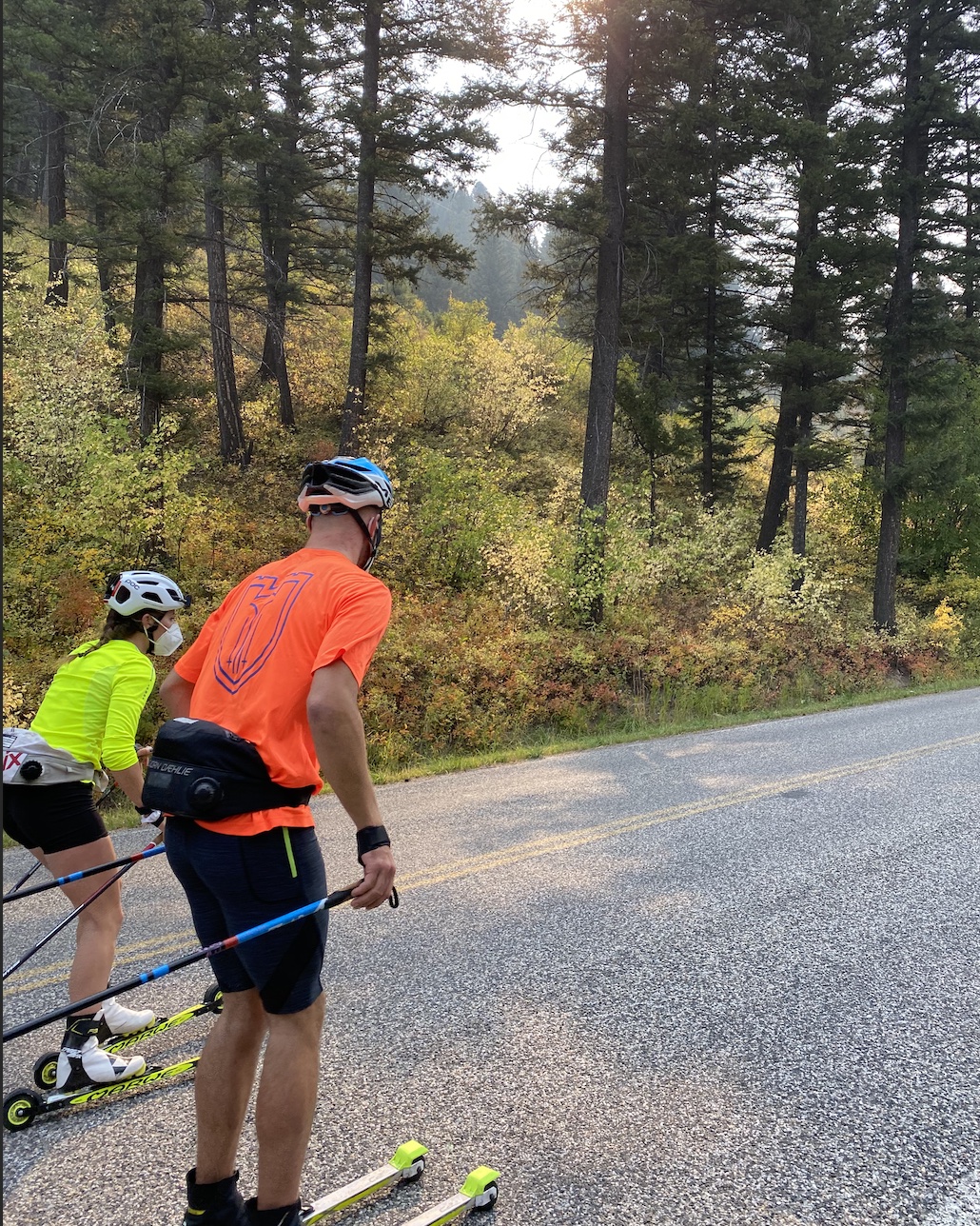
BSF Pro athletes train in hazy yet safe conditions in Bozeman, MT. (Photo: Andy Newell)
First up is Andy Newell, head coach of the Bridger Ski Foundation Pro Team in Bozeman Montana.
“Air quality and training is definitely a concern particularly because there’s not a ton of research about how smokey air affects high level athletes. We know a little bit about the short term implications but not much about long term exposure for athletes. The reality is this is something a lot of western clubs have been dealing with for a while but now we are seeing a lot of smoke in the midwest and even the east too.
“On a typical year in Bozeman we usually don’t see smokey air until August and even then it’s not as bad as many other parts of the Northwest. This year we saw smoke earlier than ever, around the middle of July and early August, but much cleaner air than normal in the last few weeks. It really depends on wind, the jet stream, and where the big fires are burning. So far this year we have had to adjust about 3 workouts to bring athletes indoors when the air was bad. I’d say that’s about average for us, 3-6 workouts per year disrupted because of smoke.”
Newell continued by discussing the tools his program has used for decision making with regard to air quality and athlete safety.
“One of the things I have learned is that air quality can change very quickly and iPhone readings are not always accurate. We use the VisualAir app for forecasts and to find training areas that might provide better air for training. In this app you can see which sensors are gathering data from satellites and which ones from the ground. We’ve found obviously that the ground readings are a lot more accurate. Another thing we notice here in Bozeman is that the air quality can be very different even within the same region depending on high or low pressure, inversions, etc. So if you notice poor air at low elevations we might modify training and go up into the mountains and this can make a big difference.
“We do use general guidelines at BSF to keep the athletes safe. If the AQI is above 100 we’ll start to monitor things and potentially modify training. If we are between 100-150 we will cut out L4 training or consider bringing athletes inside on treadmills for aerobic training. Also in this 100-150 range we’ll consider using KN95’s while out for easy distance training. Luckily we’ve only had to do this once this year so we’re hoping we make it through fire season without much more disruption.”
BSF Pro athletes wear KN95s in order to safely train outdoors when air quality is above the safe threshold. (Photo: Andy Newell)
A long-time advocate for climate policy and spokesperson for Protect Our Winters (POW), Newell closed with a statement on the impact of an ever-warming planet.
“As an athlete that has worked on a lot of climate issues this is definitely a scary reality, it goes to show you we are all affected by climate change.”
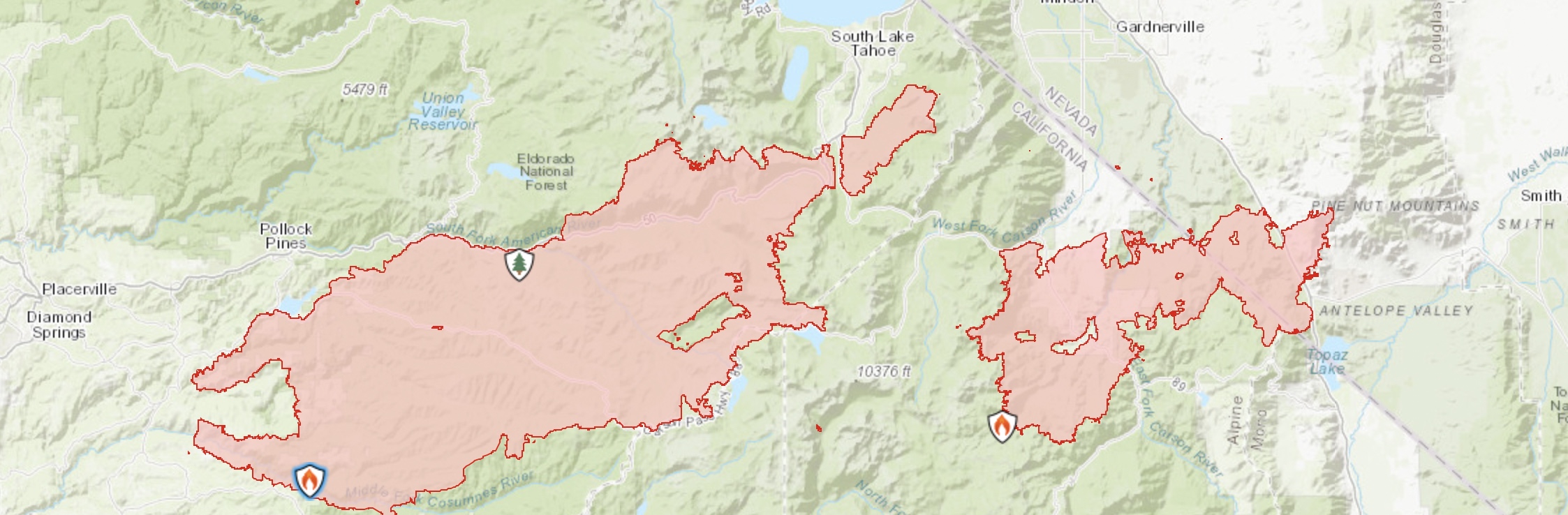
Heading Southwest, FasterSkier also corresponded with Will Sweetser, Director of Nordic Programs for Sugar Bowl Academy (SBA), northwest of Lake Tahoe. The Tahoe region was struck hard this summer, as the devastating Caldor fire ripped through nearly 220,000 acres and destroyed over 1000 structures.
Now 98% contained, the Caldor fire remains active, over two months since it began on August 14th. It has burned over 220,000 acres, an area larger than the state of Rhode Island. Although the fire is still active, most evacuations and closures have been lifted.
A map from October 11th of the still-active Caldor Fire south of Lake Tahoe, California. (Photo: Screenshot InciWeb.nwcg.gov)
Sweetser first outlined the nuts and bolts of air quality considerations. For those unfamiliar, AQI considers the concentration of fine particulate matter in the air. Particulate matter, like wildfire smoke, that is 2.5 microns or less (PM 2.5) is most concerning, as it can penetrate deeply into the lungs.
“Train as usual if school is in and AQI is between 0-60; offer optional/slightly modified training — consider shortened length first, and reduce continuous intensity — when AQI is between 60-120. Optional training is reduced, and outdoor training is only recommended for healthy, unaffected individuals when AQI is 120-150. Sessions are capped at 1 hour, and intensity capped at L2.”
While indoor recreation amidst the COVID-19 pandemic poses its own set of complications, Sweetser explained that indoor training is preferred when the AQI is above 150. To support the health of its athletes, SBA has integrated air purifiers in every indoor space on its campus, including classrooms, common areas, dining halls, and the gym. These filters help maintain an indoor AQI of 25 or below.
An SBSA athlete moves his training indoors with an air filter when AQI plummets. (Photo: Will Sweetser)
“In heaviest smoke events, we encourage families with the capacity to travel to cleaner air for the week to do so within the confines of school requirements. If we are in a remote schooling period, which was precipitated by Tahoe area evacuations last week, many families simply move to second homes in the Bay area or elsewhere in CA. We write individual suggestions for each athlete to meet the training options in that area. Our general week plan (MON–OFF, TUE-WED-THU–heavier training 1-2x daily, FRI–recovery, WEEKEND–high training load/family outings) readily allows families to take weekends away for cleaner air.”
When Sweetser was first contacted in late August, he responded that he was with the team on the coast enjoying a training block in fresh air. In his email afterward, he included the purpose of this camp.
“Last week, we utilized our first planned smoke escape team training weekend. It was in the school travel calendar. Teachers prepared some work in advance. The entire team went to the north coast of California for FRI-SUN. We had 5 excellent training sessions, including 1km L4 repeats, pure speed double pole session, 2 technique sessions and a 15-20-kilometer run. AQI in the Mendocino area varied from 8-43 during that time and was a great reset for us. Extremely valuable to get to clean air, sea level and group training in a pretty stressful time. We are lucky to be able to do so with just 4-5 hours driving.”
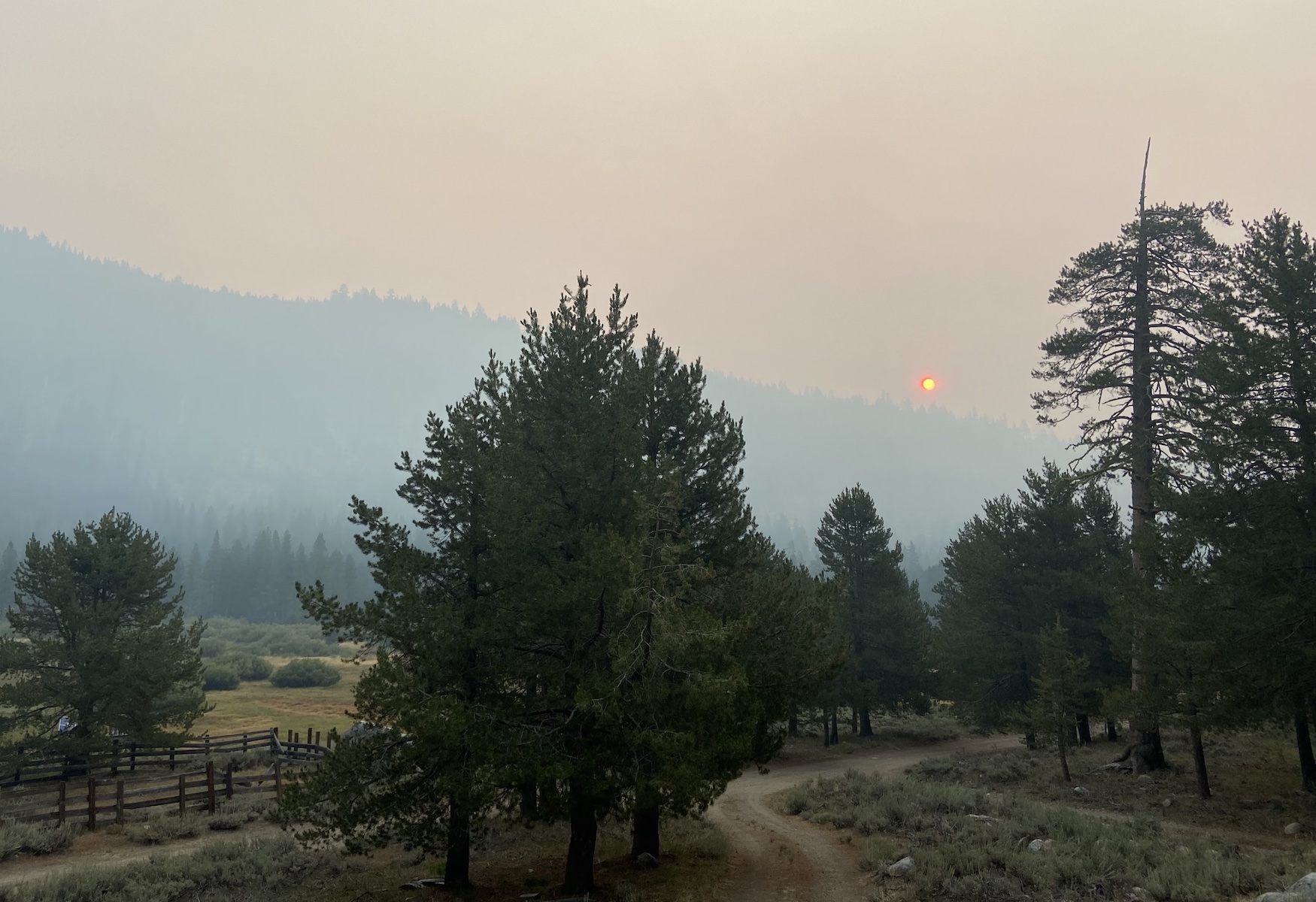
The smoke filters over the ridge line in Tahoe’s Carpenter Valley last August. This day was relatively mild, with AQI readings remaining below 200. (Photo: Will Sweetser)
When the team is not able to travel and air quality is poor, Sweetser explained how they approach indoor training to achieve similar stimuli to those they’d seek in “normal” conditions outdoors.
“When we are on Donner Summit with poor AQI, we utilize gym time and treadmill/SkiErg sessions to offer modified indoor sessions that still reflect each athlete’s goals — often these sessions are shortened and feature slightly more L2, or intermittent work, than we might normally do outside — although looking at HR data, the planned intermittent nature of these sessions is not totally different than sending the crew for a trail run through rolling terrain.”
Sweetser also reflected on the learning curve for appreciating how quickly AQI can change based on wind and weather patterns. He recalled leading an OD training run with a couple of his athletes and assistant coach David Sinclair that began at a borderline AQI of 120. As they progressed toward the objective, Hawks Peak, the air quality plummeted.
“We could see smoke pouring in from the north as we headed across the ridge… We called parents for pick up and dropped down as quickly as we could.”
SBSA athletes climb a ridgeline as AQI shifts rapidly from a safe level. (Photo: Will Sweetser)
By the time the athletes reached their pickup point, the AQI was over 400, which is considered emergency conditions.
“Since then, myself and much of the region have become much more savvy about using real time AQI monitors such as PurpleAir, wind and smoke forecast apps like Windy and Dark Skies, and I’ve purchased a handheld AQI monitor.”
Sweetser added that he coughed for at least a week after this singular session.
Brown air and minimal visibility atop Hawks Peak. (Photo: Will Sweetser)
Lastly, FasterSkier connected with Dylan Watts, new head nordic coach for the Mt. Bachelor Ski Education Foundation (MBSEF) in Bend, OR. At the time of his response, Watts had only been in his role for a month and thus could not speak to the program’s response to smoke levels in Bend throughout the summer. His perspective spoke to a broader philosophy regarding athlete development, particularly at the junior level.
“What I keep in mind is that we are really training for a healthy body and mind for the long term. That no one day, week, month, or even whole season is so critical that we potentially sacrifice our long term health for a short term result. In this sport, any short term results we achieve are very unlikely to bring us any benefit other than good health. Cold weather injury is a serious consideration in skiing. Regular exposure to air pollution, wildfire smoke included, is just as — and I would argue more — serious.
“You don’t know what sort of interruptions you will face in a year. Modifications to training happen for conditions all the time. It is built into our sport. Weather, lack of snow, too cold, not cold enough, smoke. Add sickness, a hard semester, family needs, and so on. For those reasons it is always a good idea to work ahead. When it is good you go and that way when conditions are bad you don’t have too. You don’t need to feel the pressure to make up for something you didn’t do.”
The MBSEF programs had been following similar guidelines to SBA, however, Watts responded that after the World Health Organization’s release of new air quality guidelines at the end of September, the program further tightened its tolerance of poor air quality. With mounting evidence of the increase in all cause mortality risk due to prolonged exposure to pollutants, the WHO drastically reduced the acceptable levels of PM2.5 and other pollutants individuals should be subjected to in both short and long term settings. The 300 page document also calls for a global response to air quality improvement.
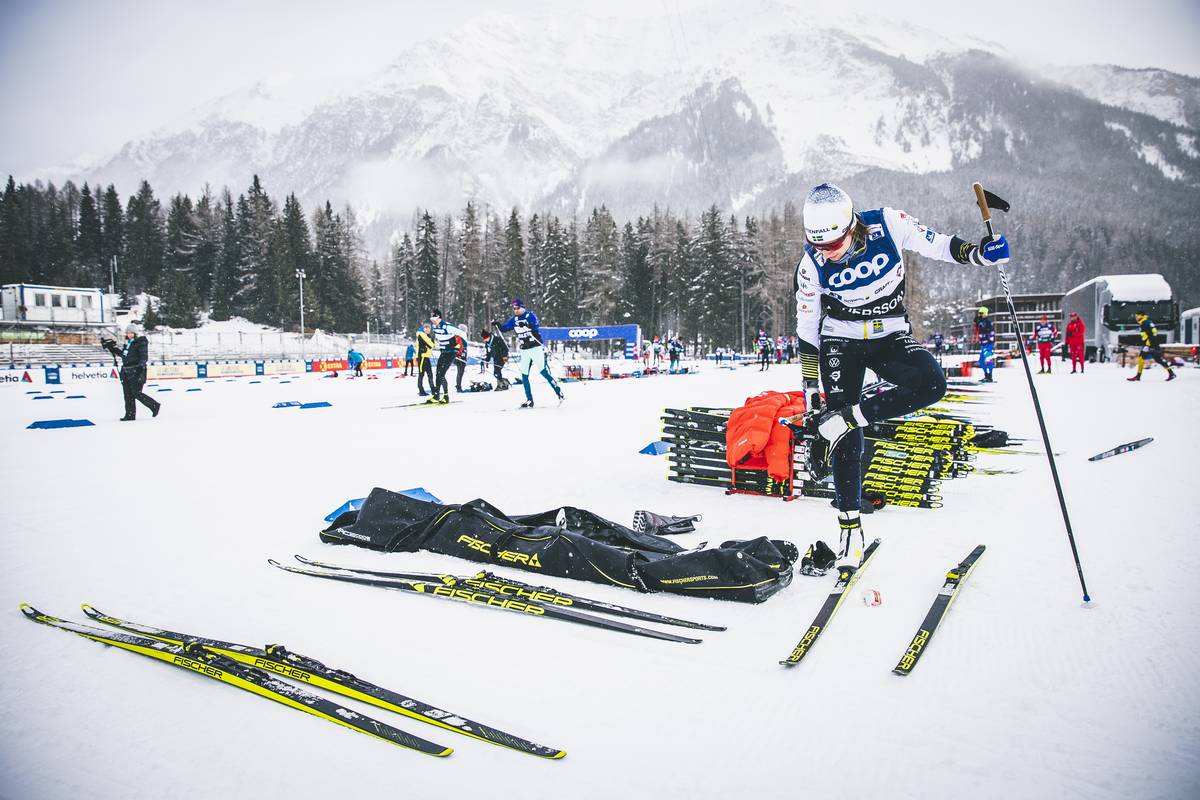
Testing the Fischer fleet in Davos. (Photo: NoridcFocus)
The cost of providing World Cup athletes with competitive skis is mounting at an alarming rate for teams without deep pockets.
This spring, coaches of US National Team athletes and staff from the Center of Excellence in Park City huddled around zoom for their annual meeting, called “Moving USA Skiing Forward.” Among the topics discussed were plans for the US Ski Team to keep pace with what Head Coach Matt Whitcomb calls the “waxing arms race.”
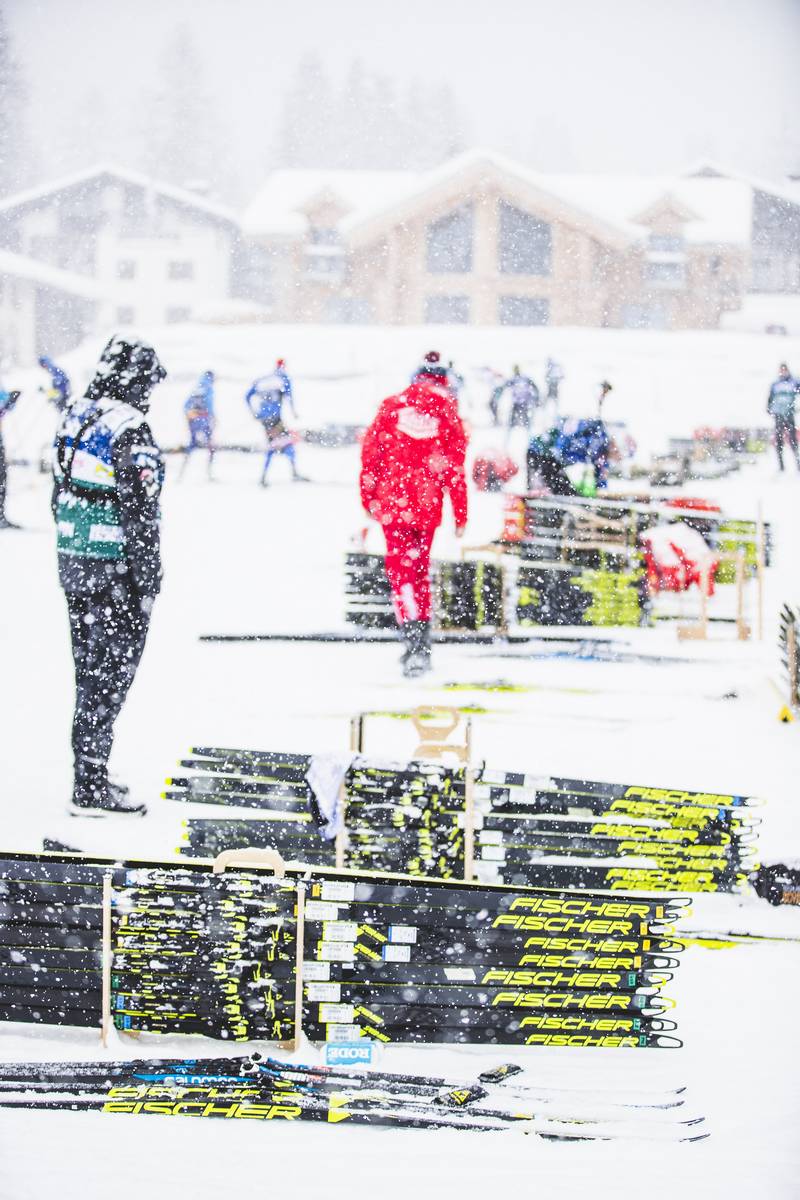
While high end ski service has never been cheap, costs have ballooned, in part due to the growing adoption of on-site grinding programs by well-funded national teams. The desire for teams to have grinding programs is expected to intensify should the fluorocarbon ban take effect in the 2022/23 season.
Cross Country Program Manager Chris Grover. (Photo: US Ski & Snowboard)
“A lot of technicians think it’s going to exacerbate some of the problems, because most people view the C8 fluorocarbons as being a great equalizer,” said Cross Country Program Manager Chris Grover. “There’s so many products that are so good… that they end up being quite similar in terms of ski speed.”
Because of the equalizing effect of fluoros, teams looking to gain a competitive edge have increasingly turned to ski selection, grinds, hand structures, and above all, testing. Grover said the challenge was to keep up with nations that can “take brand new skis and put a specific grind on them during the championships, and have the massive manpower needed to do the incredible amount of testing to figure out how every hand structure that they’re testing interacts with every one of the grinds that they’re testing, and doing all that before they even test an athlete’s fleet of skis, or apply those enhanced structures to the ski.”
As a result, Grover said that, “most nations are now spending much more on World Cup ski service than they do on their development budgets, or even their camp budgets.” A 2019 survey by FIS found that big ski nations spent 33% of their annual budget on ski service, compared to 15% for training costs. Dagbladet reported that of the costs teams pay at the World Cup itself, more than half goes towards race service.
When fluoros are phased out, Grover said it would, “put more pressure on the grinding and hand structure side of things, which is a place to spend a lot more money: a lot more R&D money, more testing money, more application and on the ground winter logistical money.”
Grover affirmed that “easily” a third of the US Ski Team budget has already been going toward ski service. He listed expenses such as paying wax techs, including their salary, lodging, and travel, as well as the cost of moving the wax truck around Europe. Add to that ski testing camps and purchasing wax. According to Grover, these costs are “putting immense pressure on all the teams.”
The USST wax truck, new in 2017, fully deployed. (Photo: Matt Whitcomb)
To catch up to the likes of Norway and Sweden, the US Ski Team has made large investments. In 2017 the team purchased a $600,000 wax truck. This season nine nations will haul their own waxing rigs around the World Cup circuit: Sweden, Norway, Finland, Russia, Germany, Switzerland, France, Canada, and the United States.
Where wax trucks were once the cutting edge, grinding is now at the forefront of elite ski service at championship events. “As many as five teams bring grinders to championships,” said Whitcomb. “In a championship that is very wet…[that can] be a huge benefit.”
With the past two World Championships being held in summer-like slush—conditions that allow grinding programs to shine—a US Ski Team grinding program has become more appealing. Currently, most US skiers use factory grinds which vary from company to company. As a result, it can be difficult, especially in very warm conditions, to find a hand structure that works over a variety of grinds.
The advantage to having an in-house grinding program is less venue specific, in the opinion of Zach Caldwell, ski-grinding guru and owner of Caldwell Sport, and has more to do with “overall control of the process.”
Zach Caldwell with a pair of Madshus skis.
Still, Caldwell said in a call with FasterSkier that he believed a team grinding program would be “putting the cart before the horse.” Caldwell outlined the challenges to starting a grinding program: “You can get a very competitive grinder for seventy thousand to a couple of hundred thousand dollars. [The real cost would be] at least one dedicated person who is really going to learn the trade.”
Added to that would be two to four testers to “run skis as often as you can get them out on the snow, around the world, to as many different venues as you can. A good structure needs to work in a lot of different places…this is where the factories come in — they’re testing all the time.”
As it stands, Caldwell said that the US Ski Team has a “very underfunded service department. They don’t have a single 12 month employee…I think there’s so many areas to do super beneficial work by just adding one, maybe two or three full time employees.”
To get a grinding program up and running would require paying “full time employees, every year, and figuring that it’s going to take several years to make any advantages — and that’s only if you have people good enough to be close to the best in the world doing it. It’s just a tough way to make a small advantage,” said Caldwell. “Just adding a championship grinding operation to what they’re already doing doesn’t make sense.”
Testing the Salomon fleet in Davos. (Photo: NordicFocus)
The US Ski Team has been pursuing other initiatives to bridge the gap to leading wax nations. Gus Kaeding, who runs the analytics department for the US Ski Team, created a system to track weather conditions and skis used at World Cup events.
“Let’s take a place we go every year like Ruka, [Finland],” said Kaeding. “ [Previously] we just had the weather written down in notebooks somewhere. Now, every morning when the coaches arrive, they are able to attribute what skis they’re using to their athlete, all in a centralized system. We can look and see which skis performed and which didn’t, and what the weather conditions were.”
Kaeding felt that the old school method of logging conditions, waxes, and skis in notebooks was a “competitive disadvantage.” He pointed to the weather tracking system that Norway developed beginning in 2009, complete with their own weather stations at World Cup venues.
“They can tell you the weather conditions in Ruka from the last decade and a half and what happened down to the millisecond each day,” Kaeding said, adding, “They’re a decade ahead of us. In terms of information, there’s basically no way we can catch up to that, which is a bit frustrating.”
Nevertheless, Kaeding is optimistic that a couple of developments may help the team in the future. One is that a future fluoro ban may make much of other teams’ waxing databases less relevant. The second is the Beijing Olympic venue, which, apart from the Chinese ski team, has not been accessible to any of the teams.
This lack of access to the Chinese venue has hampered plans by Norway to conduct research and testing in advance. Normally, the Norwegian Gliding Project—a partnership between the Norwegian cross country, combined, and biathlon teams—conducts ski testing at an Olympic venue beginning four years in advance. In the lead up to the 2018 Games, the project spent 14.7 million NOK, equivalent to about $1.7 million USD. With the Beijing Olympic venue closed, the level of research a nation like Norway can have in its back pocket is severely limited.
“Frankly, when we go to a place, such as the Beijing Olympics — a venue no one’s ever been to — it gives us an advantage,” Kaeding said. “Because they don’t have 10 years of data on this place… It brings everyone to a more level playing field.”
Kaeding is among those who believe that a FIS ruling on limitations is the path to a fairer sport. “All the teams are dedicating such a high portion of our budgets just to improve the last 1% [of ski speed],” said Kaeding. “Which is a little ridiculous… I’m almost of the mind that we need to push harder on FIS to put something in place, and put more energy into doing that, because it’s going to benefit us if we can get on a more level playing field, and a lot of the other countries as well. Creating a more equal playing field should only help the overall health of the sport.”
Andy Newell (right) with U.S. Ski Team wax tech Patrick Moore (left). (Photo: John Lazenby/lazenbyphoto.com)
Whitcomb explained that the US Ski Team is “supporting measures by FIS to try and cut back on this to make it more affordable.” Over the years, many ideas to equalize the sport have been floated, and a few have been implemented with little effect.
“The takeaway,” said Grover, “is that there’s been all kinds of workarounds, and the bigger nations have actually figured out a way to continue to do what they’re doing.”
In 2015, FIS attempted to limit the size of service teams by capping the number of technicians a nation could bring to an event at 22. Norway found a workaround by partnering with Great Britain and thereby increasing their quota to 35. That has been a boon for British skiers, while increasing pressure on smaller nations to find a patron state. Ireland now partners with Sweden, and Australia has partnered with the U.S.
Caldwell felt that quotas on race technicians wouldn’t get to the heart of the issue, saying, “the resources that big teams bring to bear are often offsite and in the background. So just limiting on site accreditations doesn’t level the playing field. As long as Norway can show up and take 200 pairs of skis from the factory to test for [Therese Johaug] and take just six and send them to the World Cup for further testing—good luck.”
In 2019 measures were introduced to FIS to prevent teams from traveling with grinding machines or testing at championship venues years in advance. As of yet, the measures have not been passed.
Grover has a seat on the FIS working group within the Cross Country Committee that will discuss ideas for rule changes. He wrote FasterSkier that “currently there are no formal proposals in front of the FIS Cross Country Committee for this season. The working group is discussing possible measures for debate and implementation in the Spring of 2022.”
Among the measures he said the group will discuss are: “banning grinders from venues, limiting cooperation between nations, limiting the size of service teams (i.e. staff reductions), limiting access to testing tracks/race courses, [and] homogenized waxing by neutral parties.”
Lenzerheide, Switzerland World Cup, Sweden’s Ebba Andersson tests her Fischer fleet. (Photo: Nordic Focus)
“The challenge,” Grover wrote, “is that no measure alone is comprehensive and there are always workarounds. It will be interesting to see where the discussion goes and if there are any meaningful steps we can take as a community.”
Caldwell believes that if the goal of measures is to limit spending, they should target that issue head on. “You have to find an economic instrument to limit the costs, like a budget cap,” he said. “I don’t know how you regulate it, but you have to start there.” He added that: “The Norwegians are out there with a basically unlimited budget just looking for creative ways that add value that they can spend their money on. They’re setting a bar that’s difficult for smaller teams. They just are.”
These issues are not contained to the World Cup. The fluoro free future, already in place in different regions and circuits, is changing the priorities of teams and clubs domestically. Caldwell believes that when teams are no longer focused on fluoros they will, “make room in their schedule and budget to focus on other things.”
The cost of these new priorities — ski selection, grinding, hand structure, and the intensive testing that comes with each — will easily make up, and likely increase, the cost of competitive ski service domestically. Caldwell pointed to the fluoro free (EISA) collegiate circuit, saying, “College budgets aren’t changing — they’re going to spend the money.”
“It always comes down to resources,” said Caldwell. “To be competitive you’re going to spend what you can spend.”
For more debate on this topic, listen to this episode of the Devon Kershaw show.
From left, Zanden McMullen, Greta Anderson, Hunter Wonders, Gus Schumacher, and Luke Jager following the boys gold medal relay performance at 2019 World Junior Championships in Lahti. (Photo: courtesy of and shared with permission by Barb McMullen)
This summer, the U.S. Ski Team announced that it had hired Greta Anderson as the new Development Team Coach. FasterSkier caught up with Anderson on the afternoon of the official announcement to delve deeper into her coaching philosophy, precise job description, and only sort of tongue-in-cheek plans for world domination.
Anderson’s hire was widely praised by both current and former athletes. Here’s Luke Jager, who’s known Anderson for nearly a decade starting in Alaska junior skiing and is currently a member of the USST Development Team, or D-Team: “Super stoked. We have come through the sport together so fired up to get to keep working with her!”
Here’s Gus Schumacher, now on the USST A-Team, who ascended the Alaska junior skiing ranks alongside Jager: “I think she’ll be good at bringing knowledge from a lot of different clubs, camps, and backgrounds to the national team pool. She’s been with [Alaska Winter Stars] recently, but has also been with APU and Crested Butte, as well as doing a bunch of REGs and World Juniors trips. Also it’s always good to get a female perspective in that currently disproportionately male area. She’s a good leader, and I think she’ll be really good in that position.”
And here’s fellow A-Team skier Hailey Swirbul, who was first coached by Anderson many years ago as a junior in Colorado: “I know that Greta has put in the time and work to gain valuable skills that will really help the D-team! She has been on so many international trips and coached at all levels to really develop as a leader and coach. I’m super excited that she will be part of the U.S. staff!”
So the athletes are excited. What does Anderson think about this job, and what parts of her background have prepared her for this position? Anderson spoke with FasterSkier at a west Anchorage playground in early June, a one-minute rollerski away from her childhood home, while planes from the nearby international airport intermittently roared overhead and a reporter’s children patiently entertained themselves on play structures.
Two quick disclosures here: One, Anchorage skiing is a small town. Greta was my coach with APU Masters from 2014–2015, and has remained a close personal friend since. She has listed me as a reference on her applications for several coaching positions over the past few years, though not for this particular one (and so far as I know, I had nothing to do with her being hired for this job). Two, the questions in this interview have been expanded from what I originally asked, so that they will provide more information and better function as transitions in a standalone article. The answers have been lightly edited for syntax and clarity.
From left, APU skiers Rosie Brennan, Lauren Fritz, Greta Anderson, Erika Klaar, Holly Brooks, Sadie Bjornsen, Becca Rorabaugh, Sarah Cresap, and Kate Fitzgerald on Eagle Glacier, Alaska, summer 2013. (photo: courtesy APU Nordic Ski Center)
Let’s start with your background. I know that you’re from here; you attended Service High School and skied for Alaska Winter Stars, then went to Alaska Pacific University, where you skied for the APU University Team and won the Tour of Anchorage. You graduated with a B.A. in Counseling Psychology. Am I leaving anything out – did you do anything else before you began coaching the Masters and Devos with APU?
That was my first get-my-feet-wet-in-coaching experience. And what happened was, it was springtime, I think in my junior year, and I hurt my back in the gym. And I said to Erik Flora, ‘I am going to take a break because my back is injured.’ And he said, ‘Well, why don’t you coach a little bit’, and I said, ‘Okay.’
And like so many people who do sports, I’m not good at moderation, and I slippery-sloped into a lot of coaching. And then my back got a little better. I was working with Charlie Renfro as the Devo coach at that time, and then Dylan Watts was the Masters coach at that time, and he was going to phase out in a year. And I enjoyed it a ton. And so then Erik was like, ‘Are you going to come back to racing.’ And I said, ‘No, I kind of love this. I think I wanna do this.’ So then I kept doing it.
Anderson, with, from left, fellow Alaska Winter Stars coaches Seiji Takagi and Jan Buron, top of Alyeska hill climb, Girdwood, Alaska, April 2021. (photo: courtesy Greta Anderson)
So one year at APU begat several years with Steamboat Springs Winter Sports Club, and a brief stint with Crested Butte Nordic, before you ultimately came back home to Anchorage and Alaska Winter Stars, this time as a coach. And you must have been pretty good at this, because before too long you were at World Juniors with a front-row seat for a spate of breakthrough American performances. Which World Juniors were you at, and what was your official role at them?
I was at two, Lahti and Oberwiesenthal [in 2019 and 2020]. My first year was as a wax tech, my second year coaching – but those are float roles, right? It’s like, what do you need to do on race day? What gaps need to be filled? You’re wearing many hats.
And I was lucky in that a lot of coaches that go as a staff member on that, some of them don’t have any athletes there that they’ve worked with previously. And I, my first year, had Noel [Keeffe] and Waverly [Gebhardt] who were Steamboat athletes; Hunter [Wonders], Zanden [McMullen], Luke [Jager], and Gus [Schumacher]. And Gus I had not directly worked with at that time, but I’d seen him kind of grow up from across the stadium many times. And then, because of going to REG (Regional Elite Group) camps and that sort of thing, and U16 camps, I had already gotten to work some with Sydney [Palmer-Leger], with Novie [McCabe], with quite a few of those athletes. Which was – that rapport, which is such an essential part of this job, was really key in being able to connect quickly and be a good representative, a good helper for those athletes.
You mentioned rapport; I don’t think it’s controversial to suggest that you need to be able to connect with your athletes in order to be an effective coach. That said, the ten athletes currently on the Development Team hail from a wide swath of the country (Alaska, Washington, California, Idaho, Colorado, Vermont, and Maine), and even beyond these specific individuals my sense is that your job requires you to be thinking about athlete development for basically the entire country, or at least the ski-friendly parts of it. How do you undertake to be a national team coach that in some way has her pulse on an entire nation when the country is just so darn big?
One common goal: to win, to put the athletes on the start line ready. I think when you walk into those rooms having the experience you have had and working with the people you’ve worked with, you realize there’s this essential amount of humility. That you realize what it took the athletes to get to that level and how huge their goals are.
As a coach, you have to check your ego at the door because you’re responsible for boosting everybody else. And there’s that old quote, right, “if you want to go quickly, go alone; if you want to go far, go together.” But those days when you accomplish the huge goals the athletes have, everything has to go perfectly that day, which means you have to be willing as a coach to wear a lot of hats, be a shapeshifter, and be really collaborative, so that that’s possible.
And more than getting athletes onto the podium by doing anything special as a coach, it’s really removing obstacles: Okay, what’s going to be a challenge? What can we foresee and take care of, with good planning, good logistics, and knowing what we know going into this in order to make sure that those huge goals, those huge reach goals, are attainable that day. And if we come in really prepared, then we have the potential when the athletes are on the start line to watch magic happen in front of us, to watch something really incredible happen. Because we all were doing the right things and all were working together. And more than anything else, I’m really proud of the way that the ski team is lacing those things together. So I’m really excited to start working with them in that capacity.
I don’t think there’s any single athlete in this country right now that’s made it to the top, world-class level only working with one coach, only having one tech, only having one source of input, and only working with one super genius. And that’s something that as a country we maybe have as an advantage over some other nations.
Anderson and Hailey Swirbul, 2019 World Juniors, Lahti (photo: courtesy Greta Anderson)
You alluded to a range of viewpoints here. With that in mind, how does your job description and what you’re doing on a daily basis relate to what this country’s club coaches are doing? How do you see your role, let’s say vis-à-vis club coaches – I don’t want to say “versus” because I assume it’s not antagonistic, but that said, how do you do your job as The National Team Coach when your athletes are clearly spending most of their time with their other coach in the club system?
My job is the opposite of “versus,” right. My role in this job is to do whatever it takes with the coaches that are making these athletes so phenomenal to lead, get out of the way, and advocate for the athlete’s best interest. And with each coach on a one-on-one basis and with the athletes and with their parents and with whoever else they’re working with that is enabling their success, making sure that that I’m walking into a room and I’m figuring out what they need, and I’m able to either meet that need, or be a resource who finds or links them with the person or the situation that’s going to enable that development. So I think more than anything that I do, my job is to help the athletes have the potential and opportunity to take skiing as far as they want to take it. It’s a little more I think of being a catalyst and an advocate, and somebody who’s able to communicate and link everyone together.
I think high-level sport – and really high-level anything, any craft, any art, any skill – you deal with people who have a ton of conviction, a lot of discipline, and big personalities, which often come with big egos.
There are so many coaches in this country, and so many athletes who believe in what they’re doing and are uncompromising on it. And I don’t know a single coach in this country, who’s super effective, who isn’t a bit polarizing, because they believe in what they’re doing, they’re not going to compromise on it, and they’re not going to let in distractions. My job is to work with those athletes and those coaches to make sure and to help put a system in place to — not just interpersonally in my role — but to put a system in place where there are really open doors of communication all the time. My job is to not be in the way, not be a barrier to open doors, and to make sure people know they are welcome to run through them at full speed.
I think we have six to eight “Jessie Digginses” in this country. Jessie is a really unique athlete. She’s obviously done a lot to maximize the potential she has. She has also had coaches who were moving on to the national team stage who knew her and provided continuity from the time that she was a club athlete. I would like to have that pathway, that system, and those open doors in place for more athletes, so that we can develop those versions of Jessie Diggins, those versions of Gus Schumacher, those versions of Kikkan Randall. So that that is something really deliberate we can identify and develop as a leading body in U.S. skiing, not an accident where we’re like, ‘Man, how do we do that again?’
From left, former D-Team coach Bernie Nelson, Gus Schumacher, and Anderson, 2020 World Juniors, Oberwiesenthal, Germany. (Photo: courtesy Greta Anderson)
Speaking of identifying areas for success, what are some things that you think are currently strengths when it comes to junior skiing or development in this country, and what are some things that you think present areas for improvement?
So the thing I think we do the best of anybody is: we put our athletes in the driver’s seat.
So to use the [2019] boys relay team as an example, they hung this really big goal out there and said, “We want to win the gold medal in the relay.” And you, a little bit in those meetings, saw Bryan Fish’s eyes glaze over. And he was like, “Okay…” And I think the boys’ inspiration stemmed from the girls’ relay team success, in many ways, in Soldier Hollow, in 2017. And the boys said, ‘We want to do that.’
Whoa, huge goal. Scary. Achievable. Gonna take everybody on board, pitching in and being all-in and having a lot of buy-in throughout the process. And from the year that they won the silver medal, Hunter Wonders had aged out of that spot. And so we didn’t know who was going to fill that spot, necessarily, going into that week in Lahti [in 2019]. And I was standing next to a German coach during the relay – Johnny [Hagenbuch] ended up being our guy – and Johnny got tagged, and he started skiing the third leg. And the German coach said, ‘Oh, this is the least experienced one, he must be your weakest link, we’ll see what happens.’ And Germany had happened to put their strongest skier in the third leg, actually.
And I said – and I really meant this – I looked at him and I said, ‘Actually, he might be our strongest skier. Johnny’s our wild card; we haven’t seen him race like this yet.’
And everybody – all four of the guys in that race had their job, had their assigned task. And Johnny executed his perfectly. And he didn’t know if he was going to be the strongest athlete or the weakest one or whatever link, either. I think all four of those guys were so strong, I would put four of any of them on the start line and put my money on them.
And so I think the thing that we do really well in this country is we’ve put our athletes in the driver’s seat, and we have said, ‘Okay, what do you want to do with skiing, where do you want to take it?’ And we sit down as a team – and Bryan Fish has been really good about this, and so has Kate [Johnson, née Barton], and so has Bernie [Nelson] – and we sit down at the beginning of meetings, when the teams come together. Everybody checks their ego and walks into the room.
And a lot of people don’t know each other yet or have raced and sort of know each other, but not well, and they say, ‘Hey, what are the keywords? What do you want this team to be?’ I mean, people spitball. ‘I want it to be collaborative;’ ‘I want it to be fun;’ ‘I want it to be strong;’ ‘I want it to be inspiring.’ Okay, what does that mean to you? And we pick some concepts, and we write it down, and it gets sent out on a WhatsApp or whatever. And we go with that all week.
That’s huge ownership for the athletes, right? That is what do you want this team to be? And what are you going to bring to the table to make it happen? And what are you going to hold your teammates accountable for bringing to the table.
And I’ve been so impressed with every single one of our athletes at both World Juniors I’ve been to, and I’ve watched that ripple effect now filter through U16 camp, and you hear it in Simi Hamilton’s voice when he races his last race, and he says, ‘I’m so happy to be part of Gus’s process in the future, I’m so happy to be this part of U.S. men’s skiing,’ and I think that’s really cool.
So that’s what we do well. [As for an area for potential improvement,] we’re a big country; we’re spread out. We have a lot of people that know what they’re doing well, in their respective area. I think that we can do a better job moving forward of collaborating, as far as realizing that what works in the East is not going to work in the Far West and saying, ‘Well, both are turning out world-class, top-caliber athletes.’
That’s not a bad thing, right? That’s a really good thing. Because that means that if you have a certain personality type, and you happen to live in Colorado, but you would like to go to sea level and train, you can go to the Pacific Northwest and get really good training there. I think that’s pretty huge. That’s something that can be a weakness if we let it be, or we can turn it into a huge advantage for ourselves.
Greta Anderson on course during the classic leg of the men’s relay, 2020 World Juniors, Oberwiesenthal, Germany. (photo: courtesy Greta Anderson)
I jumped right into things here with your personal background, but I should really back up and ask you a little more about your job description. I hate to make you define your job by reference to someone else, but this spring when I saw the D-Team position being advertised for the third time in three years I frankly thought something rather uncharitable, roughly, ‘Oh man, yet another coach left after just another year, something bad must be going on over there.’ And I know that some other people involved in American skiing had a comparable reaction when they saw your job posting this spring, after Bernie was announced for this role in 2019 and then Kate last year.
I’ve since learned that Kate is in fact very much still with the program, so obviously these initial, somewhat negative conclusions were inaccurate and unfair on my part. That said, can you speak to not only what your job entails, but also how it complements Kate’s current role, given that she is also employed by the U.S. Ski Team and that on paper your job description looks basically identical to hers?
So every coach that’s been in the Nordic program, all people I have tremendous respect for, who are disrupting the industry in such a good way are coming to it – and I saw your list of questions, that you’re going to ask what my coaching philosophy, I am a complete student of the sport. So I try to come to it with confidence and humility. And say, ‘Here’s what I think I know, here’s what I definitely don’t know, here’s some people who can help me find out.’
And I think more than having really good answers, I view my role here as being able to ask really good questions, being able to work together with people. And being able to communicate when there are disconnects.
I’ve worked across a lot of programs now and in several regions. And so I feel – I know that’s something that energizes me coming to my job, the different challenge every day, and I’m really excited to stay on my toes and keep having those challenges, if you will.
Having said that, what I’m getting to in my longwinded way, is: the coaches that I will be working with, who include all of Jason Cork, Chris Grover, Matt Whitcomb, Kate Johnson, Bryan Fish – I’m Fish’s shadow, basically. So all of those, but especially Fish.
The job description for this job was three pages long. And it was the same as it was for Kate last year. And this is the thing with the ski team, I think with pitching in and being willing to do what needs to be done. It’s, “Do you see a need, can you fill it.” And all of those coaches, those five coaches that I’ll be working with, especially Fish, have created a niche for themselves within the job role. They filled the role that needs to be filled.
So Matt and Grover – we don’t have a men’s coach right now. We have a World Cup coach [Whitcomb] and a program director [Grover] who are motivated to work together and work with other coaches and work with techs to make sure that there’s no gaps on race day. And so what Kate did was, Kate took on this job that Bernie [Nelson] had done a tremendous job with in the nine months that she was with the program and then vacated. And Bernie had a tremendous impact – a tremendous impact; she was so well received and so effective so quickly.
And they were understaffed last year on the World Cup. Kate, who was over in Europe, ended up staying over in Europe and helping out with World Cup, and she did a tremendous job, and she carved out a little niche for herself and they love having her there.
What we used to have with the D-Team was these athletes that were racing the college circuit and the NorAm circuit and when they were ready to race up a few starts, they were racing up. We’re so fortunate, our future in this country with skiing is so bright, that our D-Team, our development team athletes, are ready to go on World Cup and they’re ready to score points. That means they need a coach there supporting that. That step, that Kate’s job role is changing, is showing our progress as a country in skiing.
And so Kate is going to be working internationally, she’s going to be on World Cup, she’s going to be continuing to work with the athletes in about the same capacity that she was last year, is my understanding. I am directly overseen by Bryan Fish. And Kate, Bryan, and I are going to work together pretty closely; Whitcomb’s going to tell us what he sees as successful at the World Cup level, and then I’m going to fill the gaps that need to be filled and try to carve out a little niche for myself. That’s going to look like whatever the team needs.
Kendall Kramer (far right) leads the junior girls off the line in the Gasline Time Trial at Alaska REG camp, Anchorage, Alaska, July 2021. Katey Houser (bib 313), Adrianna Proffitt (301), and Aila Berrigan (311) are among the athletes following. (photo: Seiji Takagi)
Mostly, I’ll be organizing Junior camps, organizing logistics of U16 camp, making sure we’re inviting the right athletes, we’re casting a wide enough net, we’re able to support those athletes. And we’re able to – and this is a big goal of mine, having worked at several clubs directly – able to keep parents looped in, so that all the cogs on the wheel are working in unison to make everything spin as quickly and smoothly as possible.
Can you give me an example of something that you would want parents to know or something that would be important to you, when you say that you want to make sure that the parents are looped in?
I’d say, ‘Nothing you say is going to be used against your child.’
The more that we know about their whole lives, the better. And I want parents to feel like if they call or email me, they’re going to get a call or email back.
I guess in a word, I want to be approachable, right? I want parents to feel like the national team at the development level is there to help them navigate, help their child navigate, the ins and outs of ski racing. The kids, as they become high-level athletes, pressure increases; the responsibilities they carry increase, even when they’re minors. There are skills they’re going to need to be able to develop to manage travel, to manage sleep, to manage their time, that I want parents and coaches and national team staff to work in unison to know what’s going on and to be able to help where we can.
Anderson with, from left, Noel Keeffe and Waverly Gebhardt, 2019 World Juniors, Lahti (photo: courtesy Greta Anderson)
You just mentioned five or ten important skills that people need to be able to develop. At least at a facile level, none of them had anything to do with ski racing per se. Can you talk about that sense that maybe we’re talking about a whole person here rather than just “the athlete,” for lack of a better phrasing?
Happy people race fast. They train well, and they race for a really long time, long enough to develop. If you’re not happy in your life – I know Flora has the cup thing [“don’t overfill your cup,” discussed as the central metaphor of this article]. If you’re not happy in your life, you can win World Championships and there’s going to be a hole there. And what I want is to work with happy people who are really good friends; I want us to do what we can to make sure that ski racing is a really great part of these athletes’ lives and a part of their family’s lives. Not something they have to weigh against their happiness in order to enable.
But our athletes for the most part, the ones that I’ve seen, develop really well, stay in it, and are committed to it and are able to make it through injuries or tough times or years like Covid where things are very uncertain. When they have good support, and people to talk to and clarity, and they’re happy – or maybe that’s not the right word, but they find deep meaning in what they do.
I’ll tell you as a coach, I’ve wanted to be in a development role for a long time. Because I think what sport brings to us – you know this, you’re a master skier and you’re watching your girls grow up and start their first experience with sport outside of your home, right? It’s so deeply meaningful and such an important part of life that not a lot of other things can teach.
And so I guess that’s where my passion for this stems from. I coach the whole person; I want to work with the whole person, I don’t want to work with a piece of you. A world championship is most deeply meaningful when you share it, and so the image that comes to my mind when I say that is when Gus – Gus was the last finisher in that race [in Oberwiesenthal], or one of them. And when he finished the 10k that he won, there’s a picture of him hugging his mom. And in the background is Lin Hinderman, who came over with her husband just to watch the Alaskan kids and all the kids ski race because she’s been a FIS rep at Junior Nationals and watched all these kids. She’s a huge fan of skiing. She was, I think, the first women’s World Junior coach ever, working under John Estle, because he said, Lin can do this.
And then Matt Pauli was a chief of course, was on the jury there. Matt is an Anchorage resident, and I’ve known him for many years. And he is a huge fan of the sport. And it was them, and it was 12 different sets of parents from the United States. It was the Palmer-Legers, it was the Hagenbuches, Luke Jager’s dad came over for it, Greg Schumacher [Gus’s father] was our team doctor — everybody’s involved in this teeny, tiny piece. And what makes it meaningful are moments like those – and Gus said that, right? He was looking around and crying because he knows how much it means to the community.
And I think that’s – I want to take that community and on the race course, I want us to weaponize it to dominate the world.
And I think Kate’s vision is very similar. And she sent me a really nice text when I got hired and said, like, ‘Let’s take over the world together. Haha, kidding, but not really at all.’
I’m so proud of those athletes. And I’m as proud of them when they have to sit out a relay race and they’re just as happy for their teammates who are racing, as I am when they’re on the podium.
I want to ask you basically the same thing I asked Sadie earlier this spring. American skiing is currently at a very high level; results that would have been widely celebrated a decade ago sometimes don’t even get noticed now. This is a great problem to have, but it potentially still is a problem. What do you say to a 16-year-old junior who thinks if she’s not training 700 hours a year, or medaling at World Juniors, she’s a total failure. What do you say to a maybe not-very-hypothetical junior skier who in fact is doing everything right, at least for them, but who nonetheless thinks, ‘Oh my gosh, if I’m not reaching these impossibly high standards, either real ones or what I think I see from social media, I have no future in skiing’?
I say Rosie Frankowski, I say U16 Gus Schumacher, I say Holly Brooks.
[All three are, relatively speaking, late bloomers: Frankowski finished 44th at U.S. Nationals as a college skier, and 42nd after graduating, then went on to place 21st at the Olympics four years later; Schumacher finished 11th out of 26 in one U16 JOQ race; Brooks never qualified for NCAAs while skiing in college and once described her junior skiing results as, “I’m the girl from PNSA who always finished 40th” at JOs.]
[Relative to national-team athletes in local races] if you’re within four minutes of these guys at these races – and they hop in local races, and that’s unique to the U.S., and that is cool – you don’t go to World Juniors and wonder if you’re going to crack the top 30 that day anymore. You know. And so we have a really cool metric.
I absolutely understand what you’re saying, where the level is so high that maybe it seems discouraging. As adults and people with a lot of life experience, we look at Instagram and social media, and it gives us this skewed sense of all kinds of things, right – body image, finances, what people are up to on a day-to-day basis. Those things are going to keep happening. That’s our world now; at least currently; the only constant is change.
So how do we equip our junior athletes with the tools to handle things like that, the tools to handle those expectations, the tools to stick to what they’re doing, which is a good life skill, right? I can look around and see a bunch of other things that look rewarding, but I believe in this process, and I’m going to do it. I think as coaches, good coaches lead by example doing that. They believe in the training they’re doing, they’re not chasing hypotheticals, and I guess they have conviction, is the right word.
“Mixed precipitation” strikes the windows of the training center at Eagle Glacier, July 2017. (photo: Gavin Kentch)
Are we giving them the tools to manage these unrealistic expectations, or these, ‘It’s sunny every day where I’m training.’ You well know that on Eagle Glacier, [according to social media] there are only pictures of sunny days, and everyone who has never been to Eagle Glacier thinks the sun shines there nonstop every day, and you can get the most wicked sunburn of your life.
Dylan Watts drives a snowmachine into the mist at Eagle Glacier, July 2016. (photo: Gavin Kentch)
Because if you pull a camera out on Eagle Glacier on a normal day, your camera will be destroyed. And so a lot of times, we’re not looking at the people putting their head down and putting in the work, because we just see the outcome.
I would like to make more people aware in this communication, as a coach, of the hard work, dedication, and sweat equity. Okay, do you want to wear that jacket? Do you want to wear that suit? Or do you want to put your head down and do intervals on Saturday morning, which means that you couldn’t be up late on Friday night? Do you really want to do that? Are you dedicated to that?
And that’s not a question of opting out, that’s as a coach saying, here’s what it takes, opt in. Because at this point in the U.S., if you opt in, as coaches, and I really believe this, we can get you there. We say as coaches, ‘You have to give us 110% of your effort.’ If we as coaches are only giving 98% of our effort, or attention, or we’re only giving 70%, or we’re not keeping up on research, we’re not paying attention and we are complacent – in business, that’s called fraud.
So if I say as an athlete, ‘You have to give me 110%, and I’m going to do the best I can with everything within my power to make you a world champion.’ If you follow this plan, and I give you anything less than my absolute best, that’s not integrity. That’s not how champions are made.
I want us to have a system in place in this country where we can tell athletes, ‘We know these are the benchmarks. We know that this is what it takes. We know we can’t make guarantees. But these are the things that, if you do these things, we’re as sure as we can be within our control, that you can be really successful at this.’ And maybe you don’t win a world championship, but you carry those skills over into your life, and you will be successful applying those skills at anything you do. You have a chance to have meaning in your life, and you have a chance to be happy. And that’s a philosophy, that’s an idea, that’s a concept that I really believe in. I believe that for sure.
Part of Team Alaska at 2018 Junior Nationals, Soldier Hollow. From left: Hunter Wonders, Greta Anderson, Annie Gonzales, Ellie Mitchell, Kai Meyers, Eli Hermanson, Zanden McMullen, Bryce Pintner, Everett Cason, and Luke Jager. (photo: courtesy Greta Anderson)
You’re obviously giving up your current coaching job with Alaska Winter Stars to move into this U.S. Ski Team role. I saw you at Kincaid last night, surrounded by Winter Stars juniors, all of whom adore you. Are you going to miss your current athletes?
Yes. I love coaching. I miss every job I have – every time I’ve moved into a new job, new role, I have missed what I have departed from. Having said that, and this is a strength I think I have as a coach, I’m pretty good at maintaining that rapport. I have great friends that I’ve worked with since my first year coaching and I feel like we can pick up where we left off and maintain those relationships.
Coaching is people, and you have to give more than a small afterthought about people; you have to really care about people as people in order to take a step toward first being an effective coach. That is a foundational aspect of being a coach.
Anything else?
I’m really thrilled to be doing this. I’m so excited to start collaborating with a lot of coaches in this country that I think are absolutely brilliant.
After roughly 26 kilometers of racing, Kendall Gretsch takes Paralympic Gold by just over a meter. (Photo: Screenshot NBC Sports)
If you didn’t catch the ending of the triathlon during the Tokyo Paralympics, prepare for the chills. Spoiler alert: in an all out, last gas effort in the final meters, dual-season athlete Kendall Gretsch edged out Australia’s Lauren Parker by one second for a Gold Medal victory.
This is Gretsch’s third Olympic gold, alongside the two she earned during the 2018 PyeongChang Paralympic Games, first in the 6-kilometer biathlon sitting sprint and again in the 12 k cross-country distance race. Her achievement in Tokyo makes her the fifth American — third female — to win a Gold Medal at both the summer and winter Paralympic Games.
Taking a step back, triathlon was first added to the summer Paralympic schedule in 2016, however, only a subset of the nine competition classification categories were allowed to compete. Gretsch was born with spina bifida, which is the result of a neural tube defect during fetal development, impairing her spine and spinal cord. While she walks with crutches, she competes in the PTWC2 (paratriathlon wheelchair) division, meaning after the swim, she races the bike leg on her handcycle, before transitioning into a racing wheelchair for the run. The Tokyo games were the first opportunity for the two PTWC categories to compete.
FasterSkier spoke with Gretsch in April of 2020 when the news first broke that the Tokyo Olympics were definitely postponed until 2021 due to the ongoing COVID-19 pandemic. As we discussed, this leaves just over six months for athletes like Gretsch who compete in both winter and summer sports to prepare for the upcoming Beijing Paralympics, which begin on March 4th, 2022. Following up to learn more about her experience in Tokyo, FasterSkier reconnected with Gretsch on a call to hear how she is mentally and physically recharging before ramping up her training for the winter season.
Paratriathlete Kendall Gretsch made history in Tokyo, becoming one of only five Americans to earn a Paralympic Gold Medal in both winter and summer Games. (Photo: Mark Reis)
First, let’s go beyond the highlight reel to learn more about the Gold Medal day.
Because Gretsch is in the lesser impaired category, she starts at a deficit of four minutes and four seconds behind competitors in the PTWC1 division. The clock starts running at the same time for all athletes, and the first woman across the line is the winner, regardless of starting wave. Among the women in the PTWC1 division was Gretsch’s mark, Parker.
The Australian has a lengthy resume in elite triathlon, including a second place finish in the 2015 Kona World Championships as an able-bodied athlete. After recovering from a serious accident in 2017 that left her with permanent spinal cord damage, Parker began competing in paratriathlon, quickly ascending the ranks and ending the 2019 season with a commanding victory at the ITU World Championships.
While Gretsch is accustomed to the staggered start in her event, she explained that it does change the tactics compared to a mass start competition.
“The goal is to consistently make up ground,” Gretsch explained in a call. “So I wouldn’t say it’s a very tactical race, and that you’re like, waiting to time your move, or finding the right spot on the course to make a move. You’re basically just going all out in trying to [catch the earlier starters] by the end of the race, hoping you can make up that four minutes.”
The PTWC race includes a 750 meter swim, a four-lap 20 km bike, and a four-lap 5 km run, which Gretsch completed in a total time of 1:06:25. She explained that the many laps during the bike and run allowed her coaches to regularly provide her with feedback of where she stood relative to the leaders.
On the hunt, Kendall Grestch chases down a Gold Medal during the run in the 2022 Paralympic triathlon in Tokyo. (Photo: Mark Reis)
Gretsch began making up time right away. She was 35 seconds faster than Parker in the swim, and left the second transition from bike to run just a minute and twenty seconds back. While she acknowledged that the percentage of the race that happens on the bike makes it an opportunity to make a dent in the deficit, she also explained that her progress during that leg surprised her.
“It did play out a little bit differently, in my mind, than I thought it was going to,” she shared. “Usually I can make up a little bit more time on the swim, and then I know that Lauren is a super strong biker. So going into this race beforehand, my goal was to make up some amount of time on the swim and really just not lose time to her on the bike. So yeah, I was really pleased that I was able to make up as much time out on the bike as I did in this race. Especially because she had an amazing swim.”
Sometimes good results come from races where we never feel our best and may feel surprised by the outcome. Likewise, there are the days we dream about where everything is clicking from start to finish and we know from the gun that it will be a good day. For Gretsch, there were elements of both.
“I would say my swim was average. And then as soon as I got onto the bike, I knew that it was a really good day for me and that I was feeling really strong. So I kind of just told myself throughout the race — I knew that [I was giving] everything I had on that day, and could push really hard. And regardless of what happened, I knew it was gonna be a really close race. If I passed her, if I didn’t pass her; I just knew that it was going to be a really exciting race to watch. So that was kind of cool to have that recognition during the race that regardless of what happens, I wasn’t going to have any regrets about the race because I knew I was going as hard as I could, and that it was going to be an exciting race for people to watch.”
While she felt “average” in the swim, Kendall Gretsch had a well-above-average day competing in the triathlon at the 2021 Tokyo Paralympics. (Photo: Mark Reis)
With three golds and a silver from ITU World Championships, five USA Paratriathlon national titles, and a slew of international podiums, Gretsch is no stranger to high level competition. However, the Paralympics is the Paralympics; held as the pinnacle of sport in the United States.
Grestch spoke about her mindset approaching the Games in terms of managing expectations she feels, whether internal or external, and her approach to the mental strain of competing in Tokyo.
“Going to the Paralympics is something that I’ve wanted to do ever since I got involved in triathlon, so finally having the opportunity this year in Tokyo — this race was just so important to me. And I maybe underestimated the mental drain going into the race. It’s such a mental roller coaster where, you know, you feel great some weeks, and you feel bad on some days. And it’s hard, because it just feels like your whole — everything you’ve done for the past five years, even longer than that has just been leading to this one day. So I think for me, it was just such a huge relief that I did have a day where I felt so strong. And again, if it was first or second, I was going to be happy with the outcome either way, because I knew that I had done everything I could in the preparation leading up into the games, and that was everything I had on that day.”
Circling back to the postponement of the Games, Gretsch reflected on whether or not the decision to move the games to 2021 was a benefit or detriment.
“I think the postponement really worked in my favor. I had gotten all new equipment for my bike and the run in October of 2019. So just having that extra year gave me time to work with that equipment and dial that in, and it also gave me the opportunity to take a step back and maybe rethink how I was training. Specifically, I think, the run and bike became two really big focuses for me. And so just having that extra year to be able to change things up, try something new and not have to worry about risking a race season because if something didn’t work, it wasn’t as big of a risk.”
Considering the elongated buildup for Tokyo and the brief window to take a break before preparing for Beijing, Gretsch explained that her mind more so than her body needed to recharge. Our call took place following a short vacation.
“Obviously, you need the physical recharge, and that’s something that I’m familiar with from going between the seasons every single year. But the mental drain of the Games was a lot bigger, I think, than just a regular summer season. So the mental break that I took was so important for me. Now that I’m starting to get back into [ski training] now, I’m just excited about it and ready to go and not, you know, carrying any fatigue this week from that.”
Kendall Gretsch takes aim during the women’s 6-kilometer sitting biathlon at the 2018 Paralympic Winter Games on Saturday in PyeongChang, South Korea. She won the race to become the first American woman to medal in a biathlon event at the Paralympics (or Olympics). (Photo: US Paralympics/Getty)
At the moment, changing gears looks like a steady reintroduction of ski specific elements to her training, including shooting and double poling. Gretsch, who is based at the Olympic and Paralympic training center in Colorado Springs, also attended a 10-day USA Para Nordic training camp in the ski tunnel in Oberhof in late September.
“Since I don’t have access to snow yet [in Colorado], introducing some time on the Ski Erg again, getting range time when I can. So yeah — just trying to get back into the ski motions before leaving full time for the Winter, around the end of October or early November.”
Finally, Gretsch reflected on her experience in the COVID restriction shrouded Games in Tokyo compared to her previous Winter Olympic experiences.
“It’s weird to think about because — if I thought about what the environment was, or if someone told me that this is what it was going to be like four years ago, I think I would have said, ‘Oh, wow! That’s so crazy to imagine.’ But we’ve been living through COVID for 18 months, almost two years now. And so it strangely feels kind of normal.”
FasterSkier will continue to follow the Para Nordic team’s whirlwind build up to the Beijing Games.
Over the bumps, Jessie Diggins heads out for her qualifier during the Keys to the Castle rollerski race in Lake Placid, NY. (Photo: Reese Brown / RDB Marketing)
As summer turned to fall, skiers from the Stratton Mountain School T2 team (SMS T2), the Sun Valley Gold Team (SVSEF), and the Bridger Ski Foundation Pro Team (BSF) met in Lake Placid, NY for a collaborative training camp, capped off with two stages of rollerski racing. The weekend featured a freestyle sprint event — The Keys to the Castle — on the rollerski track at Mt Van Hoevenberg, followed by a distance stage dubbed the Free Fall Rollerski Race in Jericho, VT. These events are perhaps the climax of NENSA’s summer rollerski series, which has helped feed the energy and momentum of the cross country ski community throughout the Northeast.
“Lake Placid and Jericho were fantastic events and the beginning of the vision becoming a reality,” NENSA competitive programs director Justin Beckwith shared in an email. “They also highlight the amazing partnerships we have with clubs, venues and sponsors. We have four more roller races this fall including Climb to the Castle this weekend, which is paired with our Eastern Coaches Symposium — back in the Empire State. The really exciting part is we hope to carry the enthusiasm from rollerski into our Popular Race calendar, which will be released in the coming month.”
The man behind the wheels: NENSA competitive programs director Justin Beckwith. (Photo: Reese Brown / RDB Marketing)
After a year with minimal opportunity for cross-club collaboration, the events provided not only a solid training stimulus, but also invigorated the teams as they prepare for the upcoming season. It left U.S. Ski Team head coach Matt Whitcomb scheming about the opportunity to grow the events in the years to come.
“Pulling off a stage-style roller ski race weekend, with over 100 competitors on two different roller-ski tracks, reminds me of summer racing in Norway and Sweden,” wrote Whitcomb in an email. “NENSA has upped its game. Think of the potential, too; we could do four stages, using four different tracks, and all within 1-2 hrs in VT and NY. Start in Craftsbury, move on to Jericho, and then to each of Lake Placid’s tracks. Everyone camps together at each location, and it’s just a giant summer ski party.”
The facilities at Mt Van Hoevenberg, home to the 1980 Olympics and an Olympic & Paralympic Training Center, have been undergoing extensive renovations and improvements, including the building of the new four-kilometer rollerski track which was finished this past August. (You can take a tour of the track via YouTube courtesy of Paul Schommer/Biathlon Uncharted.)
“If I win the lottery, I’m putting in more roller-ski tracks in the U.S.,” said Whitcomb. “It’s a game-changer to not have to worry about cars. Also, the best way to replicate the demands of a ski course is to ski on a ski course.”
Bill Harmeyer (SMS T2) makes his way through the heats during the Keys to the Castle rollerski sprint. Harmeyer finished 4th overall on the day. (Photo: Matt Whitcomb)
Mt Van Hoevenberg has also improved their snow making operations, allowing for 5k of groomed skiing with 3-4 days of blowing snow in cold weather. Whitcomb explained the value this provides to American cross country skiing.
“This was our second time utilizing New York’s investment in its facilities at Mount Van Hoevenberg. I’d be surprised if we’re not racing World Cups here in the future. A lot of work by ORDA has resulted in a world class roller-ski track and new race trails. What excites me is the chance for easterners to have early November skiing in years when the weather cooperates. Their snow-making capacity is impressive.”
With the added twist of a rolling ramp at the start, racers skied their way through the qualifier and rounds. In the women’s field, Jessie Diggins (SMS T2/USST) won the qualifier, cruising onward to snag the top spot on the podium, followed by teammates Julia Kern (SMS T2/USST) in second and Alayna Sonnesyn (SMS T2) in third.
Jessie Diggins (SMS T2/USST) over the climb during the final round of the Keys to the Castle sprint. (Photo: Matt Whitcomb)
“This is the time of year where the intensity in training starts to ramp up and it’s always awesome to have the chance to test out your race day preparation,” wrote Diggins after the race. “Things like the timing of pre-race meals to warmups and what you do in between sprint heats to stay activated but not get tired — this was a perfect chance to tune in to those little details at the race in Lake Placid!”
Diggins only competed in the sprint stage of the weekend, bowing out before the teams headed to Vermont.
“I’m super grateful to the organizers and hosts as it was an amazing new roller ski track and venue, and it was very cool to have so many teams and athletes there, from junior skiers to professional teams. The track was challenging and honestly just like a world cup sprint course, in terms of length, challenge and technical aspects. It was fun to fire up the engines and see what I still need to be working on in our final prep phase before the season begins!”
Jessie Diggins stomps the qualifier, continuing through the rounds to win the overall at the Keys to the Castle. (Photo: Reese Brown / RDB Marketing)
On the men’s side, Ben Ogden (SMS T2) also doubled up on the qualifier-final victories. He was followed by Peter Holmes (SVSEF) in second, and Logan Diekmann (BSF) in third.
“This weekend’s rollerski race was like a breath of fresh air for me and I think most of the competitors,” wrote Ogden in an email. “As fun as constant training, time trials and quarantining was, ski racing is all about racing. Getting together with such a talented group and pushing each other on such a beautiful New England weekend seemed almost too good to be true. Having the BSF Pro Team, Sun Valley gold team, and SMS T2 team, all on sight made it a crazy stacked fall time trial, which was such a treat after a year of so many small group time trials.
“This weekend was especially cool for me because It bridged the gap between all the ski worlds, something that has certainly not happened in a long time. Many of the college skiers were there, the SMS t2 team (who I ski with in the summers) was there, even a few fellow US ski team athletes and coaches were there. It’s rare that all these groups get together so that was a lot of fun.”
Putting on a clinic, Ben Ogden powers through the Keys to the Castle, winning both the qualifier and the overall. (Photo: Matt Whitcomb)
While racing in Vermont was not possible for much of the ‘20/21 season, Ogden, now 21-years-old, had a solid first run of international World Cup racing. On form when the stakes were highest, he qualified in 11th in the classic sprint at the World Championships in Oberstdorf, Germany and finished 17th. He was also the third fastest qualifier in the same event at U23 World Championships in Voukatti, Finland, where he finished 11th overall.
Ogden provided insight into his current status with training, and how the races provided him with insight into how his body is responding.
“I had a big period of training ending in these races and in true fall rollerski race style I didn’t change up much of my training for the races. I just thought of them as hard workouts with a bunch of friends who I don’t ski with all too often. I was really pleased to find some good speed through the entire skate sprint day. The course was really fast and tons of fun on rollerskis, so it was awesome to ski all three heats on Saturday…
“I’m really excited to get this winter underway. Feeling good about summer training in Stratton and the beginning of fall training at Groovy. (‘Groovy UV’ = University of Vermont, where Ogden is beginning his third year.) Lots of work to be done!! I think it’s going to be a fun year.”
The men’s podium of the Keys to the Castle rollerski sprint in Lake Placid. Ben Ogden (SMS T2) was the top qualifier and overall winner ahead of Peter Holmes (SVSEF) and Logan Diekmann (BSF Pro). (Photo: Reese Brown/RDB Marketing)
Heading east to the Camp Ethan Allen Training Site, men and women in the open division raced a 15k skate while juniors completed 5k.
For the men, Johnny Hagenbuch (SVSEF) stopped the clock at 32:00.9 with the fastest time of the day. He was pursued by Ben Ogen in second (+1:07.3), with Ian Torchia (SMS T2) on his tails in third (+1:07.6) with a tight finish.
“It was an awesome way to cap off a productive training camp!” wrote Hagenbuch after his race. “Being from altitude in Sun Valley, the main goal for the camp was to capitalize on some great venues for intensity training in and around Lake Placid. We had a bunch of really good sessions on rollerskis and foot, and it was awesome to collaborate with Andy Newell’s BSF Pro Team crew on a number of those quality workouts.”
20-year-old Hagenbuch was born and raised in Ketchum, ID. After taking a gap year following high school graduation, Hagenbuch will be attending Dartmouth College in the fall. He explained that his time spent in the east surrounding these events left him eager for what is to come in the years ahead.
“The new venues in Lake Placid at the Mount Van Hoevenberg were incredibly well-designed, and I really look forward to checking out the ski trails in the winter as opposed to bounding. The rollerski track is a really great resource, and NENSA did a fantastic job of hosting that event. There was a surprisingly robust field for a rollerski race in Upstate NY, and it was cool to see how much energy there is for skiing and rollerskiing in the East. I actually had never previously spent any substantive period of time in New England – winter or summer, so it was great to experience orientation at Dartmouth the week before the camp as well. My perception of the East has completely changed; it’s very different from the West, but I love it!”
Johnny Hagenbuch powers through his qualifying round during the Keys to the Castle rollerski sprint in Lake Placid, NY. (Photo: Matt Whitcomb)
Breaking down the combined stages that led Hagenbuch to a third place finish in the overall standings, he explained his approach to the weekend including how it fits within his overall summer training plan.
“The sprint went pretty well for me, especially considering that I historically and currently have not self-identified as the most talented sprinter. At this point in the season, it was a fun, low-stakes way to throw down with a great group of guys. Ben Ogden is fun to watch. The distance day in Jericho was much more my wheelhouse, as distance skate races are typically my best format. The 5km rollerski track on the National Guard base in Jericho was a treat to experience. I haven’t skied on Craftsbury’s rollerski track, but the Jericho rollerski track could easily be the best in the nation. Given that I’m still training at a relatively large volume, I wasn’t really expecting to feel particularly good or race anywhere near to my best form, but it was still a pretty good effort.
“One of my goals for the past couple of seasons has been to get stronger and ski more powerfully, and it was cool to see some of that effort pay off in Jericho. I felt that I was skiing much more powerfully in general, and I don’t think I lost much on the uphills – despite having gained 25 pounds in the last year. It was an encouraging result in the end, and I’m excited for the next couple of months of training before the season kicks off in earnest in West Yellowstone. I’ll be pretty consistently alternating between being at home for two weeks and away training or racing for two weeks until January, which’ll be a nice way to break it up (and will make time fly)!”
The women’s podium of the Free Fall distance race in Jericho, VT. Alayna Sonnesyn (SMS T2) took the win ahead of teammate Lina Sutro, with Mariah Bredal (BSF Pro) in third. (Photo: Matt Whitcomb)
On the women’s side, Alayna Sonnesyn took the win on the second day in a time of 37:55.3, sealing the overall victory for the combined events. Her SMS T2 teammate Lina Sutro rolled through in second (+49.3) with BSF Pro Team member Mariah Bredal in third (+2:33.6).
“In Lake Placid, it was really cool to ski on the new roller ski track,” wrote Sonnesyn in an email after the events. “I had heard stories about a pretty twisty and technical track but to finally have the opportunity to ski on a course similar to a World Cup level race was pretty sweet. Not to mention the new facilities at Mt. Van Hoevenberg are unbelievable! It was really fun to get into a sprint simulation with all of the other elite ski teams that were there and it felt almost like a SuperTour. That being said, it’s still September so although I brought a competitive spirit to the races, I still approached them as a workout. It was great to practice going super hard in the qualifier and then play around with tactics in the heats, but it was all in good fun too. With a pretty sketchy corner coming out of the last downhill, the women agreed this race wasn’t worth losing skin over. All in all, a great day!”
Alayna Sonnesyn leads her heat during the Keys to the Castle rollerski sprint in Lake Placid, NY. (Photo: Reese Brown / RDB Marketing)
“The following day in Jericho I was definitely feeling a little tired from the sprints the day before, but that was great practice for wintertime when we frequently race back to back,” Sonnesyn continued. “Also, during my time at UVM we skied at Jericho almost every week so it felt good to be back on a track that I knew so well and felt like home. Adding to that, it was great to see the UVM ski team and other junior/college racers attending this event. It had been a while since I had been at an event with so many New England skiers and I felt like everyone was just really happy to be there. Again, I was finding the balance in this race to approach it as a workout while still taking advantage of the opportunity to practice race warm ups, tactics, fueling, pacing, etc.”
Sonnesyn also concluded with insight into her overall feelings at this point in the season.
“I’m feeling really good and lucky to have these races to test things out. I gained a lot of takeaways on little things I can work on in the next few months, but also built some confidence behind what we have already been doing all summer. I’m excited to potentially compete in a few more NENSA races this fall and get ready for snow to fall!”
The women’s final of the Keys to the Castle rollerski sprint in Lake Placid, NY. From left to right, Lauren Jortberg (BSF Pro), Julia Kern (SMS T2/USST), Jessie Diggins (SMS T2/USST), Alayna Sonnesyn (SMS T2). (Photo: Reese Brown RDB Marketing)
Inside the tunnel: Julia Kern focused on the track ahead (Photo: Bill Harmeyer)
With temperatures dropping steadily each day and the first signs of winter visible on distant mountaintops, the mind of a skier inevitably turns towards thoughts of snow. For the professionals this goes one step further: how and when can they get on snow before the season starts? In the US, pre-season snow time is limited. Once the snow disappears on Mount Bachelor, the Eagle Glacier in Alaska is typically the only domestic pre-season skiing available, although this year even this venue was off the table due to renovations.
Internationally, the skiing options are numerous and varied in their scope, distance, and travel feasibility. However, COVID restrictions and rules still play a major part in travel abroad, and the decision of where to go becomes even harder.
Having carefully considered all of these factors, the SMS T2 team took flight at the beginning of September, searching for the goods. Their chosen destination was a ski tunnel in Oberhof, Germany, specifically, the LOTTO Thüringen Skisport-HALLE. Oberhof is located in central Germany and hosted a stage World Cup in 2013 (Jessie Diggins placed 5th in the 3k skate prologue). The Craftsbury Green Racing Project and USA ParaNordic will also be taking advantage of this venue.
Oberhof Germany, site of the LOTTO Thüringen Skisport-HALLE (photo: Google Maps).
This year, SMS T2 is composed of nine skiers, seven of whom made the trip to Germany. Patrick O’Brien, who has now been the team’s head coach for four years, shared his insight on the decision to go to Oberhof.
“Certainly on-snow time was a focal point of the trip for us,” said O’Brien. “Last year with Covid it made for a pretty clear cut decision. We couldn’t leave Vermont or jump on a plane without a lengthy quarantine period upon return, making any major camps or travel difficult to justify in the middle of a worsening and unknown pandemic. It was actually great in some ways because we just trained well and made the most of our fantastic roller skiing, running, and biking that we have out the door in the Green Mountain State. And with less travel we were still able to get out and follow the travel guidelines we had in Vermont and explore some trails and locations closer to home that normally we wouldn’t have time for with lots of camp and travel commitments.
“The one team camp that we did was a three-day mini camp to Green Woodlands across the river in Lyme, NH, which was amazing but gives you an idea of how restricted travel was for us. These measures kept case numbers very low in VT and were the right thing to do at the time… Having our entire team vaccinated and the state of emergency lifted this spring when we hit 80% of VT vaccinated made our options for camps and travel much more open this prep period.”
This year the team was looking to return to a venue with snow for some quality pre-season hours, particularly for those team members who will be racing Period 1 of the World Cup.
“It’s already a long race season for people that leave for the entire year, and going over earlier to a place like Munio or Rovaniemi, might help with the initial transition to snow, but certainly can extract a heavy toll mid season when you are away from family and friends for that much longer,” explained O’Brien. “So getting a focused block of on-snow time late summer/early fall should help make the transition from dryland to on-snow right before Ruka a little easier and faster to keep people with the best energy and fitness for February at the target races.”
Julia Kern, Jessie Diggins, Alayna Sonnesyn and Lina Sutro are stoked to be getting ski time in the tunnel (Photo: Bill Harmeyer).
Another goal of the camp was to simulate a bit of the World Cup travel experience and re-remember what international travel and being away from home is like.
“A very real goal of the camp was to bring our whole team to a new and unique environment, and to collaborate with other nations (the German team),” said O’Brien. “Again, getting used to that sort of time change and environment for a ten-day focused camp makes the travel in the later fall and winter following the World Cup circuit around that much easier and manageable.”
Traditionally, the SMS T2 team, and the US Ski Team, have traveled to New Zealand for several weeks of skiing in late August or early September. The snow farm in New Zealand offers, “midwinter conditions, low altitude, stable weather, gorgeous scenery and amazing people,” said O’Brien. However, New Zealand is still under tight travel restrictions and wasn’t a feasible option this year. Additionally, some of the SMS T2 athletes were hoping to head to Alaska for a camp on Eagle Glacier in mid-July, “when that got scrapped we were caught off guard and scrambled at the last minute to see what alternatives were out there,” explained O’Brien.
“Oftentimes, glacier skiing is super high, involves taking a tram up (Ramsau), the weather can be very variable (to the point you really shouldn’t be skiing), and the snow is pretty slow and rotten.”
Enter the Oberhof tunnel. O’Brien listed the reasons why this ended up being the best fit, “The facility is really impressive, unlike a normal tunnel which often is simply a loop, this one has a variety of different terrain, a large central area for drills and speeds, and two out and back fingers as well so you have some ability to put together different courses for easy skiing or intensity. In 1.7K you have everything from good hills for V1/Striding, steep hills for ski running/jump skate, to a big stadium area where you can have multiple people practicing starts/finishes head to head. Additionally you know the training is stable and high quality. They warm the tunnel on Sunday afternoon by opening the doors to bring it up to freezing, then groom it with one of their two Pisten Bully’s (PB100+400) and close everything up and crank the AC units and close the track until Monday afternoon, at which point its set up and stable at -4C for the rest of the week. By not over-grooming or working the snowpack they preserve its integrity by limiting grooming cycles. For snow that is three years old, it’s in very good condition and means each day you go out to train you know you will have high quality training. You don’t lose a day in a ten-day camp to a weather closure or poor conditions.”
Crucially for the SMS T2 team, the town is just over 200 miles (330 km) north of the airport in Munich, making logistics simpler. Coming from Stratton Vermont, this made travel for the team to Oberhof roughly the same time-wise as getting to Bend, OR, where they typically kick off the training season in May.
“For us, we are three hours from the Boston airport and an overnight flight to Munich, Germany,” said O’Brien, “So while the travel is still substantial, getting to Central Europe for us is a long overnight flight and 3 hours of driving on the front and back ends. A place like Voukatti (FIN) is a much more exhaustive journey with many connections for us coming from the US.”
Compared to New Zealand, entering Europe COVID-wise is relatively straightforward. Since the team is entirely vaccinated, they weren’t required to quarantine upon arrival but did need to fill out paperwork in advance for their whereabouts and, O’Brien added, “we did test our entire group before departure in VT out of an abundance of caution.”
Bill Harmeyer happy to be on snow (Photo: Julia Kern).
Once they were in Germany, they were tested twice again during the camp just for surveillance purposes.
“The rates of COVID in Germany are quite low and there is near universal compliance with masking indoors and straightforward and effective COVID protocols over there,” said O’Brien. “They have different time slots for training in the tunnel and limit the numbers in the tunnel at any one time. It’s a pretty large amount of airspace that is continually cycled over, so while we were entering and exiting the tunnel everyone was required to be masked, but when skiing masks weren’t expected which was great for doing intensity and harder training sessions. Overall while we were cognizant of still being in a pandemic, the fact that our entire group was vaccinated, getting tested, and following existing protocols really made for a safe and comfortable environment to have a training camp”
Furthermore, the team was able to integrate some training sessions with the German ski team who O’Brien said were “absolutely fantastic to work with.” Not only in regards to training but, “ they helped with all sorts of logistics, getting us extra waxing gear, lodging, getting set up at the tunnel, administering Covid tests during our camp, and running combined sessions with their athletes that live locally (Victoria Karl and Antonia Frabel).”
“I cannot say enough how cool it was to collaborate with them during the camp and how open and engaging the sharing of information was,” emphasized O’Brien, “I think that is something that kind of was lost last year (for obvious reasons with COVID). Out of necessity we had to form our ‘pod’ and keep our circle tight with all the testing and possible quarantine that could derail a race weekend. Simply being able to exchange ideas, information, and training with others was a huge benefit for both of our groups.”
Jessie Diggins talks with German coach and former racer, Axel Teichmann (Photo: Ronny Knoll).
For SMS T2 athlete, Ian Torchia, his personal goals for the trip were focused on really “dialing in my on-snow technique from the adaptations I have made from roller skiing this summer, as well as executing some high-quality intensity and speed sessions to zero in on that unique snow feeling.”
Making the most of the trip, the team squeezed in a 45 minute ski the first day they arrived, making for a total of ten-days on-snow.
“The first day was the worst day on snow for me as I was super jet lagged and half asleep,” said Torchia, “other than that, the entire team was vibing with the snow tunnel and I honestly never got sick of the many many loops we skied. There is always something to focus on with your technique that the monotony of the loops doesn’t really take much affect. Getting on snow in the summer was super valuable and I am so grateful for the opportunity.”
Bill Harmeyer (left) and Ian Torchia (right) line up for a sprint start (Photo: Ronny Knoll).
Looking forward, Torchia said “I am super amped for (hopefully) a normal season of racing and for a shot to make the Olympic team. Right now, my roommate Bill Harmeyer is the only other guy in Stratton (along with the girls on the team) and we have been working super well together in training, pushing each other on our weaknesses and dialing in technique. Let the snow fly!”
When the race season begins in a few short months, many SMS T2 members will be heading back to Europe to start the World Cup, while others will stay in the US to race in the Super Tour and other North American competitions. As usual, the World Cup kicks off in Ruka Finland at the end of November where SMS T2 athletes Jessie Diggins, Julia Kern, Katharine Ogden and Ben Ogden will be competing. Alayna Sonnesyn has also been named as an alternate. The US Super Tour circuit starts in Cable, Wisconsin this year with races December 10-12th.
Jessie Diggins kicking up spray during a speed session in the tunnel (Photo: Ronny Knoll).
Jessie Diggins takes a first crack at NENSA’s rollerski ramps, which will be featured in the sprint qualifier and rounds in Lake Placid this weekend. (Courtesy photo)
On the heels of our coverage of the Martin Fourcade Nordic Festival and the Alliansloppet Action Week, we turn our attention to the Northeast where the burgeoning New England Nordic Ski Association (NENSA) rollerski race series is well underway. The next round of racing will take place this upcoming weekend, starting with a freestyle sprint event dubbed “The Keys to the Castle” on September 18th at Mt. Van Hoevenberg in Lake Placid, NY, followed by a freestyle distance race the on the rollerski track in Jericho, VT the next day. Men and women will each race 15-kilometers in the open division, while juniors will have the option to race 5k.
For those interested in seeing the show, in-person spectating is encouraged at the Lake Placid stage, however, as the ski track in Jericho is at a Vermont National Guard base, names must be submitted for entry prior to the event. Events will also be live-streamed on the NENSA Facebook Page, and live timing will be available through Bullitt Timing. Updated COVID considerations for participants and community members can be found here.
Building from past years, the series features nine events beginning with the Lost Nation Roll in Craftsbury, VT in July and ending in mid-November with the NENSA Invitational in Stowe. Captaining the ship and still rocking the mullet-mustache combo is competitive programs director Justin Beckwith, with whom FasterSkier connected in mid-August to learn more about this year’s widened scope of event offerings, supporting a thriving culture of skiing in the region, and whether the dream of a New York City rollerski event is still alive.
Beckwith explained in the call that one of NENSA’s objectives as the rollerski series evolves is to reach more athletes and to make opportunities for rollerski racing more accessible. Given the high density of cross country skiers and high level clubs in Vermont, the well-attended and highly competitive App Gap Challenge, and the designated rollerski tracks in Craftsbury and Jericho, past events have primarily taken place in that state. However, these venues can be quite a drive for skiers living in Western Massachusetts, New Hampshire, or Maine.
NENSA Competitive Programs Director and rollerski race series organizer Justin Beckwith with his son, Red, at an event in Craftsbury. (NENSA photo)
One of the first steps to expanding opportunity in the region? Outreach. Rather than bringing more people to Vermont, bringing the races to the people.
“One of the primary goals was to try and bring our programming across the entire Eastern region,” Beckwith said. “So we’ve done a race in Southern Maine, which Clare Egan so eloquently said at awards that she doesn’t think anyone’s had a rollerski race in Southern Maine before. And just this weekend, we’re going over to New Hampshire. It will be the first event we’ve done in New Hampshire on rollerskis. So that’s really cool.”
The first event he mentioned — the Good Times Roll in Cumberland, ME in collaboration with NonStop Nordic — featured a 4.3k freestyle race for Middle School and beginners, and a 7.5k open race on a closed roadway. The start and an agility course took place inside the Cumberland Fairgrounds. The second stage, The Rollins Roll in Warren, NH, led classic skiers up the Mt Kearsarge auto road, which was closed during the event. Bringing together the community, both events saw participants from the junior level through the 50+ age bracket.
In the Lost Nation Roll, which was co-hosted with the Craftsbury Outdoor Center, youth skiers had the opportunity to race the same course as elite athletes from the Craftsbury Green Racing Project (GRP) whom they admire. Likewise, the GRP athletes had the opportunity to ski their home track with outside stimulation. This event was followed by a learn-to-rollerski clinic and a free biathlon clinic to bring in additional members of the community who were not up for racing or wanted to learn more about shooting.
Now, midway through the series, the events are catered more toward the top juniors and seniors in the region, though some are still open to all levels. Beckwith explained that NENSA was “lucky” to have such a high density of top skiers in the area, including regional high-performance junior clubs, elite teams like SMS T2 and the Craftsbury Green Racing Project, and EISA collegiate teams including Dartmouth College and the University of Vermont.
“We’ve had pretty good success incorporating at least the college programs that are within striking distance — driving time — and who can participate in the races that sort of start in September, October and then in the November.”
From left to right, Greg Burt, Raleigh Goessling, and Luke Brown go head-to-head during the 2021 Lost Nation Roll in Craftsbury, VT. (Courtesy photo)
In addition to new venues, the series is also incorporating a more diverse array of events, including sprint stages. Beckwith explained that the first round of sprint rollerski racing took place at the Eastern REG camp in early July in Lake Placid.
“At Mt Van Hoevenberg — that was really our first sprint course. It was actually our first sprint event that we’ve done in total since Junior Nationals 2020. But it was also the first heat format we’ve ever done in rollerskiing. And it’s an excellent venue for it. I think you can’t make a track wide enough [for rollerski sprints], so we actually pared down [the heats]. And I think the event we’ll do on September 18th… we’ll probably be running heats of four again in that. So it’s a little different than a winter format just because of the track width. But yeah, it’s exciting.” (Beckwith added that long-term, a wider track is something NENSA hopes to develop.)
More specifically, the events will still feature the typical structure of qualification followed by three progressive rounds, only modified to four skiers per section. Lucky losers will be incorporated based on time, as Bullitt Timing is providing a FIS level timing system. Juniors will compete in a mixed gender “Kings Court”-style sprint in order to ski more rounds, gaining more tactical experience.
The events this weekend will include athletes from the Sun Valley Gold Team, the Bridger Ski Foundation Pro Team, and SMST2. (The Craftsbury squad is currently in Germany training in the ski tunnel in Oberhof.) Because the number of athletes on course is limited, these events will have a bit more “vetting of the competition” — i.e., being current U.S. Ski & Snowboard members and holding a current FIS license. However, recreational skiers still have the opportunity to test their mettle at Climb to the Castle in Lake Placid on October 3rd or the Mount Greylock Rollerski Race on November 7th in Adams, MA. Both are uphill classic challenges.
“We created a permitted opportunity to ski up a closed State Park Road. So why not? Even if you’re not racing, go try it out, right?”
NENSA athlete Evelyn Walton on course in Lake Placid during the Eastern REG camp. (Courtesy photo)
Before the pandemic, the series averaged roughly 100 participants in each stage across all ability levels. While numbers have been lower in 2021 thus far, a summer series still remains a valuable touch point to keep the ski community engaged until the snow flies.
“A lot of these races this year, the focus is kind of building — not just out of COVID and building back into events, but into thinking about how we can better support the community and create opportunities. That’s our mission statement: to support a vibrant ski culture.”
To bring in people from all aspects of the community, NENSA is partnering with ORDA — Olympic Regional Development Authority — to organize an Eastern Coaches Symposium and a TD training opportunity in concert with the Climb to the Castle on October 3rd. Climb to the Castle is co-hosted with NYSEF, the New York Ski Education Foundation.
While this race up the Whiteface Toll Road in Lake Placid has plenty of history, it is also quite a grueling and climbing 2,300 feet in five miles is not universally accessible. Beckwith explained that they’ve considered a shorter distance where beginner or youth skiers could start further up the road to make it more manageable, or perhaps supporting a fleet of fast or “juiced” wheels to reduce the load.
Speaking to the concept of growing and sustaining the nordic community across all ages through the rollerski series, Beckwith recalled a conversation with longtime Sun Valley Ski Education Foundation coach Rick Kapala, who had contacted Beckwith to learn more about putting on the series in hopes of putting on similar events out West.
“The idea I think Rick hit on the head is just that you’re creating excitement, to keep the kids engaged, right? And adults — all of it keeps skiers engaged throughout the year, and I think that’s really the goal. There’s no qualification [to enter]. In the past, we’ve built prize money in and I think we’re gonna be building prize money into a few of those bigger events I was telling you about in the coming days, but that’s just fun to roll that out as it comes… So really the most enjoyable piece of it and the broader scope is that we’re bringing together people from different communities, regions, abilities, all of that.”
A host of rollerskiers get together after a NENSA event. (Courtesy photo)
He explained that NENSA’s team will similarly highlight regional popular racing opportunities during the winter.
“We’re really gonna highlight those races, popular racing opportunities, and also let people know that we feel like those are great developmental opportunities. Versus, we’ve been maybe a little Eastern Cup and Junior National qualifying centric in the past. So we’re really trying to support those, you know, it’s inclusive, but more so than that, creating festive opportunities that are available regionally. And the level of competition will be at those events regardless, because there’s really good skiers throughout the region, and they’re already utilizing those events.
“We know people will go to sanctioned events in winter and summer, try to qualify for JN’s, but how can we create opportunities beyond that? If we can bring it to people’s backyard communities, so to speak, or within that sweet spot of an hour or two from their doorstep, then hopefully, we just get more people involved and excited throughout the year.”
Green Racing Project members Susan Dunklee (left) and Caitlin Patterson (right) take on NENSA’s rollerski ramps at the opening event in Craftsbury, VT. (Courtesy photo)
FasterSkier spoke with Beckwith about the nascent series in 2019 shortly after the App Gap Challenge, a skate-to-classic skiathlon that led skiers up a mountain pass on a closed State Highway near Fayson, VT. (The App Gap took a hiatus in 2021 due to construction on the road.) When considering what it took to pull off an event of that magnitude, Beckwith said: “The beauty of a rollerski series is that nobody has any expectations or guideline of how we do this.”
He also said that he envisioned an event closer to the scale of the many summer rollerski festivals in Europe, perhaps in New York City or Boston. While this may seem like a pipe dream, with Beckwith behind the wheel, the idea came closer to fruition than one might have thought.
“Let’s say we were seriously exploring a race in Central Park this fall as part of the series early on. And I think it’s very possible for 2022 — it takes time to do that. But we’re close, we’ve got our foot in the door. People know who we are. And we have developed some key contacts that came up down there, which is exciting.”
NENSA also grew its staff this year to make organizing larger events more sustainable, adding an Event Support position filled by Fred Bailey.
“It definitely takes a team to pull this off,” Beckwith stated.
NENSA will be offering a youth clinic in Boston in collaboration with two other organizations whose goals also include getting kids outside on skis and supporting equity and inclusion in the cross country ski community. Like other clinics NENSA has run this summer, this clinic will introduce current ski program participants and potential future participants to rollerskiing for the first time with a focus on having fun, broadening exposure to different aspects of the sport, and encouraging an active and healthy lifestyle. Beckwith identifies that added exposure in populated areas may also help NENSA create larger highlighted events in the future.
“But there’s twofold to that. Because if we’re getting into urban areas, metro areas, whatever, then the visibility grows.”
With better understanding of the concept, urban venues might be more open to hosting. Beckwith explained that NYC stands at the top in terms of ideal venues. As so many events from 2020 were postponed into 2021 due to the pandemic, permitting became very challenging, which impeded the feasibility of running an event there in 2021.
NENSA athletes Jack Young and Jack Lange compete in the sprint event during the Eastern REG camp in Lake Placid. (Courtesy photo)
“One other issue beside the permit was just that it’s an Olympic year, and the availability and openness of National Team athletes [may be less than non-Championship years]. If we pull off a race in New York City, we’re talking about a budget at a minimum of 10 to 30 grand, so if we’re going to do that we want to have [high caliber athletes racing to] capitalize on it.”
While it may be nearly 300 miles north of Central Park, Jessie Diggins is confirmed to be competing this weekend in Lake Placid. Given the caliber of the elite training groups participating, it’s clear that the level of competition is high and the racing will be spicy.To add to the excitement, qualifier and rounds will feature a 24 foot bicycle ramp directly out of the start.
The NENSA rollerski series is now in its fourth year. If it wasn’t already abundantly clear how dedicated Beckwith is, he became emotional when reflecting on what he is proud of.
“Oh, geez, what am I proud of. We lost, you know, a year of in-person rollerski races with COVID. So that was a real doozy because we had Craftsbury coming online with a roller ski track, we had Van Hoevenberg coming online with a roller ski track, we were really excited to build into that. And then you know, the wheels fell off the bus from the outside — that wasn’t anything that we did. We created some really great regional events, as much as you can in a safe manner. But they were quite engaging challenges, and we saw literally worldwide participation in virtual events.”
Adapting to the times, Beckwith also pulled off running the 2020 App Gap challenge over the course of a week where athletes from the same club could race on matched skis in a designated window. Breaking these groups down further into waves of 15 made it such that there were never more than 30 people in the area at a time.
“So that kept us together a little bit… This year, it’s definitely a big step to re-engage after having a year where you didn’t. If you host an event, at the end of the day, you’re talking about what you’re going to do better the next year to build on it, and that’s just tricky with everything that we had coming down the pike. So I’m just really excited about where we are right now. We’re gonna have more rollerski races than we’ve ever had. I think that we’re gonna have the most competitive races we’ve ever had. It was pretty hard to top the women’s field in that Lost Nation Roll last year. I think it was about a 33 FIS point race or something like that — in no small part because Jesse [Diggins] was there.”
He acknowledged that there were plenty of other strong athletes there also — women and men — but that this weekend’s races will be a step higher.
“I think the big success of this year is going to be just that we’ll have more participation overall. Partly because we have more events — well attended events — but that we’re reaching many more skiers by taking the show to them basically. That’s probably going to be the biggest takeaway win for this year.”
Beckwith also thanked the associate sponsors of the series: Swix, L.L. Bean, and Salomon. Apart from direct funding, he noted that Salomon sharing a video clip of one of Beckwith’s signature agility courses helped it see over 80,000 views internationally.
“We also have a really amazing partnership with Enjoy Winter, and Swenor rollerskis, which has really been a part of the series from the beginning and what makes it work for us. So that’s a really important piece to a partnership. Worthy of mentioning are the great people like, I’m teared up now, but Marty Hall, Joe Lamb. They’re just really supportive. So that’s incredible.”
Hattie Barker attacks a climb with Mansfield Nordic coach Adam Terko collecting video. (Courtesy photo)
Over the last six months, an increasing number of athletes have posted photos and videos from their training sessions that include a small circular pod attached to the back of their arms, near the triceps. As it turns out, the pod is a continuous glucose monitor (CGM), specifically the Abbott Libre Sense Glucose Sport Biosensor which partnered with a new company, Supersapiens, to design an interface that allows athletes to monitor and optimize their blood glucose levels throughout the day. Essentially, the device collects real-time information about the concentration of glucose in the bloodstream, and transmits this data via Bluetooth to an app on the user’s cell phone.
Abbott’s Libre Sense Glucose Sport Biosensor is used by Supersapiens to provide athletes with real-time information about their blood glucose. (Photo: abbott.mediaroom.com/
Taking a step back, here’s a condensed version of the complex physiological process that is energy metabolism surrounding exercise: Carbohydrates are the body’s primary source of energy during exercise. When carbohydrates are consumed, the body breaks them down through digestive processes into simple sugars, which are then converted into circulating blood glucose. The more complex the carbohydrate, the longer it takes for the body to break it down into its smaller building blocks.
At rest, the body stores chains of glucose in the form of glycogen, primarily in the skeletal muscle and liver, to be called upon during exercise. Through aerobic and anaerobic processes, the body converts glucose into cellular energy in the form of adenosine triphosphate (ATP), which allows muscle cells to contract and thus power the activity. However, the amount of stored muscle glycogen is finite and depends on the volume of skeletal muscle on an athlete’s body. As muscle glycogen becomes depleted, blood glucose begins to drop, and the athlete quickly trends toward the fearsome “bonk”.
Therefore, an athlete should supplement with carbohydrate sources — the simpler the better — during training sessions or races longer than 60-90 minutes to enable the body to maintain sufficient blood glucose levels and thereby keep their muscles fueled throughout the session.
Registered dietitian and endurance coach Kylee Van Horn’s guidelines for fueling during training. (Photo: Instagram @flynutrition3)
After the activity is completed, the hormone insulin helps draw glucose out of the blood stream to replenish muscle glycogen stores. Readers may be familiar with the 30-60 minute window of opportunity after exercise during which the body is more sensitive to insulin and therefore can replace the depleted muscle glycogen more rapidly by taking in a post-workout snack containing carbohydrates.
“It is now widely accepted that consuming a diet sufficient in carbohydrates, along with ingesting carbohydrates during and following exercise, can improve performance and speed recovery… It is also well established that beginning exercise with ample muscle glycogen stores is an important contributor to improved exercise performance; further, restoration of glycogen stores is essential for complete recovery and the maintenance of subsequent exercise capacity.”
Bringing it back to continuous glucose monitoring: By monitoring blood sugar and striving to keep it within an optimal range, athletes can become more informed about their body’s response to nutrition and training in order to dial in performance fueling, stabilize energy levels, and promote faster recovery. Peaks and valleys can promote inflammation and impair recovery and sleep, so stability is your friend.
The Supersapiens CGM technology is not yet commercially available in the US, though they are already available in the U.K. and Europe. As such, Supersapiens — a direct-to-consumer American based company — is holding off on media interaction until the products can reach their target user base. FasterSkier will follow up with representatives to learn more about the product itself as this changes.
Gus Schumacher races the 15k skate in Davos, Switzerland in December, 2020. (Photo: Nordic Focus)
However, among the American athletes taking part in an observational wear trial is Gus Schumacher, with whom FasterSkier connected to learn more about how he has used the CGM thus far and what he has learned in the process. At the time of the call on August 9th, the 21-year-old Junior World Champion was in the throes of high-volume summer training in Anchorage, AK, with a handful of “the boys”, i.e., fellow top U-23 athletes Noel Keeffe, JC Schoonmaker, Johnny Hagenbuch, Sam Hendry, and more.
Schumacher started working with Supersapiens, alongside a dietitian from the U.S. Ski Team, to incorporate the CGM into his training in late May during the team’s on-snow camp in Bend, OR.
“At first, the biggest benefit was that I did research about fueling and [nutrition] through the resources with the U.S. Ski Team,” Schumacher explained. “And that just taught me a lot more about how I should be fueling during training and after training. So stuff that I sort of knew, but didn’t really focus that much on previously.”
While some of the concepts may not seem particularly novel to those versed in nutritional practices for athletes, Schumacher explained that watching his glucose levels helped him understand the importance of fueling surrounding his training sessions and ensuring that overall, he was consuming enough food to meet the high demands he places on his body.
“Now, I use it more for the recovery side of things, like making sure my overnight glucose levels don’t drop too low,” Schumacher said. “I mean, part of it is — I can tell when I’m under -fueled, like if I get hungry in the morning or something. But [using the CGM] is kind of a nice way to double check, because it’s hard to always trust your [hunger] cues when you’re when you have to eat a lot more than normal for big training days and adjust [how much you eat] to each training day. So you can be a little more secure about whether you’re eating enough.”
Gus Schumacher wears a continuous glucose monitor during a treadmill training session this summer. (Courtesy photo)
The biggest change Schumacher has made has been in his fueling surrounding training sessions. He explained that he used to rely primarily on large meals between sessions with little fuel during the session, leaving him depleted and feeling like he needed to “bomb” himself with food at lunch and dinner. He also typically carried plain water for hydration the majority of the time, incorporating sports drink for the electrolytes only when it was hot. After seeing the spikes and drops on his blood sugar and learning from dietitians, he now spreads his intake out throughout the day for more stable energy.
“Now, I’m eating more snacks and keeping the meals like a more normal size. So — finishing [a session], having a protein heavy snack and then eating a meal within an hour, and then having a balanced snack before the next training session. And making sure to just take in carbs during that session, so I always have sports drink now and I usually also have some bars or fruit or gummies during training sessions. That’s the biggest thing I learned — even during easy sessions, you can oxidize up to 60 grams of carbs an hour roughly something like that. That’s the goal that I shoot for.”
So is it making a difference?
“Yeah, actually — especially on my high volume weeks. I noticed that it just seemed easier to get out the door as those sessions built up. Like, I still would eat a big lunch and stuff, but it didn’t seem like I was, like, fully come back from depleted after every session. I would finish and not feel super hungry. It just seemed a little quicker to come back to normal.”
While his U.S. Ski Team dietitian provided the guidance on the types of foods he should incorporate and nutrient timing, the team at Supersapiens helped him understand the data he was collecting with the CGM. Specifically, they helped him through the learning curve of understanding normal and optimal blood glucose levels for different types of sessions.
“I would ask stuff like, ‘Why does my glucose not get that high during this session?’ Because all the information on their website shows, ‘You, will you want to figure out what’s good for your performance.’”
Gus Schumacher tracks his blood sugar using a continuous glucose monitor on a training run. (Courtesy photo)
While he was seeing in the Supersapiens information that higher blood glucose levels were important for intensity sessions, he was noticing that his levels would be on the low side during easy distance sessions.
“I asked them about that, and for that particular instance, when you’re going easy, you’re not necessarily oxidizing a ton of glucose [and your body can rely more on breaking down its fat stores], so blood glucose can stay pretty low.”
He also started to consider his overnight blood sugar levels to ensure he was recovering well while sleeping.
“[They recommended] experimenting with having a snack with a decent amount of protein and fat before bed to see if that stabilizes overnight glucose.”
Improving fueling and keeping blood sugar is all well and good. But, we live in a world where diet culture is rampant and the emphasis on power-to-weight ratio in endurance sports can cause athletes to develop disordered eating habits and an unhealthy body image. Skiers are already typically hooked up to a heart rate monitor and a GPS watch to collect a plethora of training data. At what point does it become too much or lead an athlete to be overly meticulous about their diet at the expense of their mental health?
In terms of data overall, Schumacher explained he finds it interesting, and his coaches are “super into data”, but he is able to hold it lightly and not read too much into it.
“I think at this point, I’m still very open to trying anything — any new data collection is kind of cool… So I kind of embrace it, and if it ever feels like too much, I’m pretty good about going back to my instincts. I feel like I can fall back on that intuition pretty easily.”
Gus Schumacher on course during the 50k freestyle at the 2021 World Championships in Oberhof, Germany. (Photo: Nordic Focus)
Schumacher felt similarly about monitoring his blood glucose. He has gained more awareness about the foods that he consumes and how they impact his blood sugar, but he explained when pitched the question of whether he could see the use of GCM technology leading him to place an unhealthy emphasis on eating specifically to stay within a particular range that ultimately, he knows to trust his body.
“I think that’s a good point, because sometimes when I eat something that I think is pretty good, like a balanced meal, and [my blood sugar] spikes really hard, the knee jerk is to be like, ‘What’s going on? Why did that happen? How do I fix that?’ But, more and more as I’ve had [the CGM] on, it’s just like, sometimes that’s just like, normal. It’s whatever. So that’s when I fall back on my intuition, like, I feel satisfied.”
To meet the energy demands of 20-30 hours of training, a pro skier needs to eat a proportionally large volume of nutrition. Endurance sports are about the long haul, and ensuring that the overall lifestyle is sustainable is essential in allowing an athlete to develop and achieve their potential. Schumacher elaborated on keeping his relationship with fueling and blood glucose in a balanced place.
“I think it’s possible that having that data around your food can make it not that fun, like if you’re really just trying to make those numbers look good. But I think it’s important to use [the data] as an overall thing. And just use it to try to make sure your resting levels are high enough, and you’re getting enough during your training, but not worrying too much about the micro things because there’s a lot that goes into that.
“Or [understanding that] you don’t need [the data] to be perfect to be fueling perfectly. And I think it’s fun for me to know more about performance fueling and be able to implement that day to day and feel like it’s making a difference and not have it be overbearing, because part of performance feeling is still eating stuff that makes you happy in general. So yeah, I think it’s important to have a pretty holistic view of all of it, but it’s also fun, I think, to have the eating be part of your training and to know that it matters for how you feel and just making sure you feel good all the time.”
As this technology becomes commercially available, athletes of all levels will need to make similar considerations in the calculus of determining whether this technology and the information if provides is worth the investment (currently around £113 in the U.K. for a one month subscription, including two pods that last 14-days each).
To provide athletes interested in CGM technology with guidance, FasterSkier connected with Registered Dietitian Kylee Van Horn. An accomplished runner herself, Van Horn helps endurance athletes across a variety of sports dial in their nutrition to support their training and overall wellbeing through her business, FlyNutrition.
Kylee Van Horn RDN provides athletes with guidance when approaching new continuous glucose monitoring technology. (Photo: FlyNutrition.org)
Van Horn recommended a targeted approach, cautioning against the aforementioned possibility of becoming too focused on the data and potentially compromising the athlete’s mental health. She knows, perhaps too well, from her clients the propensity for under-fueling in endurance athletes of all levels.
“I think there is going to be some level of risk,” said Van Horn in a call. “The more data you have — and especially within the endurance sports world, for people to tip into the restrictive eating pattern.”
However, she expressed that using glucose monitoring to focus on key areas of nutrition could help athletes improve their overall fueling. In particular, focusing on balanced meals and snacks that provide sustained energy in and out of workouts, that also keep eating and preparing food both enjoyable and sustainable.
“I personally wouldn’t want to use it long-term with an athlete, but I think as a short-term, using it to dial in some specific things could be really beneficial… Dialing in what would be a really good pre-workout breakfast or meal option for [the athlete] that’s not going to cause a rebound hypoglycemic effect where we’ve got a big spike and drop in blood sugar and then we’re seeing this big energy spike and drop part way into the activity or race.”
Van Horn also envisions a more informed version of trial and error to maintain energy levels during workouts, particularly in longer sessions or races. This could be particularly useful with athletes who have sensitive stomachs, as spikes and drops in blood sugar could exacerbate these issues.
“The intra-workout fueling, in my opinion, would be really interesting. Because we do know that some foods do affect people differently in regards to how much they spike their blood sugar and drop it and how quickly.”
Van Horn shared that a coach and professional triathlete who she partners with, Matt Hanson, has also been a member of the pilot group. Hanson is a three-time national champion at the Ironman distance and is the current world record holder in an Ironman event (7:39:25).
Hanson shared with her that he has found a lot of value in using glucose monitoring to better understand his body’s response to his pre-workout meals, because he had been experiencing big swings in energy levels. The CGM has helped him adjust these meals to foster more stable energy. He also found value in playing with the types and timing of different sports nutrition products he was consuming during his training to maintain better glucose levels and energy throughout.
Kylee Van Horn, RDN of FlyNutrition offers suggestions for bedtime snacks to help athletes boost sleep quality and overnight recovery. (Photo: Instagram @flynutrition3)
Lastly, because sleep is an essential component of an athlete’s recovery and overall health, Van Horn explained that, like Schumacher noted, a pre-bed snack that contains protein and carbohydrate can be very valuable in supporting recovery and stable blood sugar during sleep, in particular for athletes training at high volumes or early in the morning.
“If you’re eating a snack with too high of carbohydrate or eating certain foods before bed, that can impact your recovery and cause micro-awakenings, which impacts sleep quality, so that might also be something that you could address [by monitoring].”
Rosie Brennan powers through the final meters for a commanding second place finish in Stage 4 of the 2021 Tour de Ski. (Photo: NordicFocus)
This is Part 4 of a series delving into how biomechanics and movement patterns affect skiing technique. If you haven’t already, start with the introduction, Part 1 which introduces the concept of a neutral spine posture, Part 2 which describes spine stability and mobility, and Part 3 on single limb stability.
Let’s take a closer look at the structures and muscles involved in the upper body during the various poling motions of skiing.
The muscles that comprise the shoulder girdle can be roughly divided into two groups: the stabilizers and the movers. Coordinated motion requires “dynamic stability”, i.e., for the two groups to together such that the stabilizer muscles control extraneous joint motion while the movers perform the primary action.
The shoulder has a tremendous amount of motion available and relies heavily on the coordinated effort of multiple muscles to maintain proper alignment and movement of the joint. At the same time, it is capable of generating large amounts of power, whether that’s throwing a 90mph fastball, hammering a nail, or repeatedly pushing on a ski pole.
The shoulder stabilizers can be further divided into those acting on the glenohumeral joint (the primary ball-and-socket shoulder joint) and those supporting the scapulothoracic joint (shoulder blade on the ribcage).
The rotator cuff is a group of four muscles — supraspinatus, infraspinatus, teres minor, and subscapularis — that attach to both the scapula and humerus in close proximity to the joint. They are not particularly strong muscles, but they play a vital role in coordinating the movement of the glenohumeral joint.
A diagram of the muscle group involved in the shoulder’s rotator cuff. (Photo: www.freepik.com)
The only rigid or bony attachment of the arm to the body is via the collarbone. This small bone is not enough to support the load of push ups, pull ups, or double poling. The base of support truly lies in the muscular attachment of the shoulder blade to the ribcage. For the sake of the simplicity of this article, we’ll limit the discussion to four muscles, one of which doesn’t count. (Side note: a classic physical therapy trivia question is to name all 17 muscles that attach to the scapula–clearly I’m skipping a few here.)
The primary stabilizers of the scapular are lower trapezius, middle trapezius, and serratus anterior. I’ll contend that the upper trapezius is a stabilizer but doesn’t count because it tends to exert force in the wrong direction (and is frequently overactive so needs little in the way of direct strengthening).
The trapezius muscles stabilize and move the scapula along the ribcage. (Photo: www.freepik.com)
As with any dynamic stability in the body — abdominal muscles for the lumbar spine, glutes for the hip, or the aforementioned muscles in the shoulder girdle — strength is important but intermuscular coordination is key. This is especially true at the shoulder due to its wide range of available motion and corresponding muscular complexity.
The following are exercises targeting the stabilizers, both at the shoulder joint and scapula.
Exercises for the Stabilizers:
(The intent of these exercises should be thought of more as activation drills and less about the heaviest weight you can find. Yes, we are looking to induce some fatigue but the emphasis is not on power.)
Side Lying External Rotation: Lie on your side. Keep the top elbow bent at 90° and against your side. Rotate about the shoulder until your forearm is at about 45° to the horizontal. Try not to pull with your shoulder blade. A little bit of weight goes a long way.
side lying ER 1
side lying ER 2
External Rotation + Uppercut: With a resistance band anchored on the opposite side, elbow fixed at 90°, and forearm against your belly. Rotate the forearm away from the belly to a neutral position (knuckles pointed forward). Then raise the arm by spinning through the shoulder. Again, the elbow should stay at 90° throughout. Only raise the arm to shoulder height. Motion should be isolated at the shoulder joint — don’t let the shoulder blade move. Finish by lowering the arm down and rotating the forearm back to the belly.
ER + uppercut 1
ER + uppercut 2
ER + uppercut 3
Scaption: Raise both arms up your sides at 45° (not in front, not to the side, but halfway in between). Stop at shoulder height. Keep the shoulder blades fixed down and back. Start with light weights.
scaption 1
scaption 2
Wall Slides: Loop a very light resistance band around both hands and stand facing a wall. Place both hands on the wall at about shoulder heights with elbows bent and palms facing inward. Stretch the band by squeezing your shoulder blades down and back, not just pulling from the arms. Keep the shoulder blades pinned down and back, band tensioned, and slide your hands up the wall until your elbows are at about shoulder height. Slide back down to the starting position. Ideally, the shoulder blades stay retracted throughout the set of repetitions, but you can stop and reset them between reps or as needed.
wall slide 1
wall slide 2
Serratus Punch: The serratus anterior muscle attaches to the ribcage, inserts on the scapula, and, acting alone, protracts the scapula, or pulls it forward. As a stand alone movement, this scapular protraction is not especially functional unless you are a boxer hitting with a jab. However, the serratus anterior is a team player and becomes very functional when co-contracting with the posterior scapular muscles (especially middle and lower trapezius) to stabilize and coordinate movement of the scapula. The exercise will work the serratus anterior independently.
Lie on your back holding a dumbbell in each hand. Knees are bent and elbows are straight. Push the dumbbells towards the ceiling by moving the shoulder blades forward on the ribcage. This is the opposite of the motion described in Wall Slides. The neck and thoracic spine stay relaxed. This can also be done with a resistance band.
serratus 1
serratus 2
Rows: The emphasis of the rowing motion is on squeezing the shoulder blades down and back as you pull the resistance towards you. This is the same motion described in Wall Slides and the opposite of the Serratus Punch. There are multiple means of adding resistance to the movement: resistance band, cable machine, single dumbbell/kettlebell, TRX, etc.
In the propulsive phase of poling, the prime mover at the shoulder joint is the latissimus dorsi — often referred to as the “lats”. This big, broad muscle extends the shoulder, pulling an outwardly extended arm to the side as in freestyle swim strokes and pull ups. The lats are aided by the posterior portion of the deltoid muscle and teres major.
A diagram of the back muscles, including the latissimus dorsi. (Photo: www.freepik.com)
The elbow joint is also involved with the triceps playing a rather complex role. This muscle, or more technically speaking, this group of muscles has a common insertion on the ulna and acts to straighten the elbow. However, the long head of the triceps, attaching to the scapular vs the humerus, is also able to play a role in shoulder extension. I say the triceps play a complex role because motion about the elbow varies with technique and terrain. In Skate V1 and V2 alternate and in Classic striding, there is a fair amount of elbow extension. However, in V2 and uphill double poling, there is very little motion at the elbow.
Notice how little motion takes place at the elbow during V2.
A clinical case study: (Disclaimer: the subject of this case is the author, a potential duplicity that is frowned upon in academia.) In the lead up to ski season, I began doing “budget SkiErg” workouts double poling with resistance bands. After several weeks of twice a week workouts, I began to develop left posterior elbow pain. It didn’t take much to figure out I had irritated the insertional tendon of the triceps. So I stopped the workouts and focused on eccentric strengthening of the triceps, which has become the standard of care in the treatment of tendinopathies.
Come ski season, I could skate without any problems, but I continued to have elbow pain with more than about 45 minutes of classic. One night at dinner I was venting to my wife about my now chronic elbow pain. Ever the voice of reason, she asked what I would do if I was seeing myself in the clinic. What would I, the PT, do differently for a patient who is not responding? I replied that I would examine, biomechanically, how the patient is poling. So I started to think about how I was doing what I was doing.
My hypothesis was that I was using my triceps too much to generate shoulder extension. I started doing shoulder extension exercises with my elbow fixed at 90°. I focused on leading the motion with the back of my elbow, not my hand. Within a couple of weeks, the elbow pain was gone. The lesson from my mistake is that functional movement patterns often require a high degree of coordination. Because of our bodies’ anatomical redundancy, it is easy to fall into a suboptimal pattern that is inefficient in the best case and in the worst has potential for injury.
Interestingly, the biceps appear to be very active during double poling, which seems counterintuitive since the action of the biceps is in the opposite direction of the propulsive phase of poling. The biceps do contribute to shoulder flexion so they are likely involved during the return phase. But, more likely, the majority of their action is co-contraction with the triceps to stabilize the elbow and hold it in the desired position. Perhaps this is rationale to include some biceps strengthening for more than just filling out the sleeves of your cycling jersey.
David Norris models single-stick poling technique during a skiathlon in Lillehammer, Norway in December, 2019. (Photo: NordicFocu)
Exercises for the Movers:
Shoulder Extension: This is most easily done with a dumbbell, but a resistance band will work as well. As described in the case study, keep the elbow locked at 90° and focus on spinning at the shoulder joint by leading with the back of the elbow.
shld ext 1
shld ext 2
Strengthening the Triceps: Like with Rows, there are numerous ways to work the triceps with no single exercise being the best. Resistance band, cable machine, dumbbell, push ups, and dips are all appropriate.
Strengthening the Lats: The basic lat workout is pull ups. If these are too difficult to do at least 3 reps, then put your feet on a chair or on a long resistance band loop attached to the pull up bar (just make sure the band stays on your feet and not in between them!). Lat machines in the gym are a great alternative as you can select resistance that is lighter than body weight (or more than body weight if you can whip out 10+ regular pull ups)
Epilogue: The goal of the Building a Better Skier series has been to identify some key biomechanical and kinematic components of cross country skiing and to provide exercises with the specific intent of facilitating these movement patterns and strength requirements. By no means has the depth of these articles been exhaustive. Nor have the lists of exercises covered all possibilities. Hopefully, these articles have been easy to follow and the exercises have been included in your twice weekly strength/dryland/pay-to-play routine. Even better, I hope the work done now will pay dividends when the snow falls this winter. Best of luck with the remainder of summer (the heat, the smoke, the pandemic), the glorious autumn, the struggles of shoulder season, and the winter we’ve all been waiting for.
Scott Patterson sets a remarkable new course record at the 2021 Crow Pass Crossing. (Photo: Brad Benter/Crow Pass Crossing)
On July 24th, Scott Patterson toed the line outside of Girdwood, Alaska, for his eighth run of the Crow Pass Crossing, a roughly 22 mile race with nearly 3,000 feet of vertical gain through the rugged Alaskan backcountry. Two hours fifty minutes and five seconds later, he crossed the finish line at the Eagle River Nature Center, shattering the 11-year-old course record set by ultrarunning legend Geoff Roes at the peak of his career by four minutes and 39 seconds. To put this in perspective, Roes set the record at the storied 100 mile Western States Endurance Run that same summer.
To those, like myself, who are thousands of miles away from Girdwood and lack perspective on the Crow Pass course, a 2.7% difference in time for a race that long may sound unremarkable, but to those versed in the trail, Patterson’s time garners respect comparable to Eliud Kipchoge’s 2:01:39 at the 2018 Berlin Marathon. In the race’s 30-plus year history, the three-hour barrier has only been dipped under ten times by four separate individuals. Four of those times are Patterson’s, three belong to Roes, two to former elite ski racer turned APU Junior coach Eric Strabel, and one to local semi-pro mountain runner Allan Spangler. Patterson has now won the footrace seven times, which is also a record.
The course record has been on Patterson’s mind for several years, and he’s come very close — a minute and a half back in 2015 — but due to changes to the trail, chasing the time became an increasingly elusive goal.
“Scott, along with fellow Nordic skiers Eric Strabel and David Norris, have helped raise the bar of what’s possible in Alaska trail and mountain races, so we were thrilled when Scott finally broke the Crow Pass record that he’d been chasing for years…” race director Matias Saari wrote in an email. “It was hard to imagine anyone breaking Roes’ Crow Pass record, and while Patterson came close in 2015, the changing conditions of the trail were conspiring against him. Despite Scott’s great fitness and course knowledge, the lack of course maintenance, extremely brushy trail, elimination of key shortcuts and a trail reroute extension four miles from the finish made breaking a stout record all the more challenging.”
Geoff Roes leads the way in the 2011 Crow Pass Crossing with the Raven Glacier in the background. (Photo: Matt Hage/Crow Pass Crossing)
To dive further into the story and what a result like this implies as he prepares for an Olympic year, FasterSkier connected with Patterson on a call on August 9th. Patterson also discussed his pursuit of the record at Crow Pass, and his decision to repeatedly come back to Crow Pass despite the lack of prestige it may hold relative to other well known Alaskan running events.
“I think it was one of the first Alaskan mountain running races that I actually won,” Patterson explained. “And so it kind of felt like it’s this one that I’ve got a good history with and I always want to come back to. I’ve won it a lot, but it seems like every year it gets slower. It’s more overgrown, there’s more downed trees, there have been a couple of reroutes of the trail, which have slowed things down. So, as I’ve gone through these years, I have just felt like I could maybe get the record, but it’s been a little bit out of touch.”
While this year, Patterson gapped the field to win by a margin of almost seventeen minutes, he has often had chasers only a few minutes back. That said, he explained that he typically spends the majority of the race running on his own and sees this as a factor that has historically held him back mentally from pursuing the record in earnest.
“My strength is always the first miles climbing up to the pass. So I always tend to break away really early, and then run on my own for 18 to 20 miles of the race. And it’s a long run, so it’s like, ‘Okay, I think I can run faster.’ But sometimes, you’re kind of just running along the bottom of the river valley just running along, get a little distracted and lose motivation, trip a couple times and slow down… And so I’m solid at it, but that record has kind of felt out of reach.
“This year, I kind of went into like, ‘Okay.’ I haven’t run the course, since we raced before COVID, so it’s been two years since I’ve been on the full race course. I actually got to ride down to the start with the race director. And he was asking me, if I thought I had a course record in me, and I said, ‘Ehh — I think I’ve got sub three hours in me’… but I really didn’t think I had the record. And then going out into the race, I hit the pass where my friend and former teammate Eric Packer was up at the top. I came through there with a really good split, and he was cheering me on. I was thinking to myself that I had one good split, so I better keep going and pushing hard.”
Fourteen miles and multiple water crossings later, Patterson reached an unofficial checkpoint known as the Perch, and looked at his watch to see how close he was to the record with four miles to go.
“I was exactly 30 minutes from the course record. I know I can definitely run in from the Perch in sub-30. So it was great, kind of that last final spur of motivation. I think I said in the [Anchorage Daily News] article that I threw down some sub-six-minute miles on the trail after that, when I realized I was going to get the record and kept pushing to try and make sure it actually happened.”
While overall, the course has gotten slightly longer and, according to long-time racers, “harder”, Patterson credited ideal racing conditions this year for his ability to capitalize on his fitness and take down the record.
“It was just kind of a combination of really good conditions. It was not too bad of temperatures — not too hot, not too cold. The brush — the trail is pretty notorious for getting overgrown, and that’s part of the challenge of the race is that in the middle 10 miles it can be hard to really see your feet in places while running a technical trail. And so that section was actually in pretty good shape this year. The race organizer and a few others had gone out a month before and done some brushwork, and we really thought it wouldn’t make a difference because it was a month out, but it ended up being great conditions. So I was really excited to take advantage of that.”
Runners cross a snowfield as they begin the descent from Crow Pass during the 2019 event. (Photo: Brikru Photography/Crow Pass Crossing)
So far, you’ve read about 3,000 feet of climbing, water crossings, and an overgrown cobbled trail along a river bottom. But this subset of obstacles does not fully paint the picture of how burly the Crow Pass Crossing is to an outsider. To bring this section of the Last Frontier a little closer to those of us in the Lower 48, Patterson further broke down the course, which includes a little bit of everything the Chugach has to offer.
Starting at a trailhead at the end of the road outside of Girdwood — home to Alyeska ski resort — the trail climbs 2,200 feet to Crow Pass, rapidly ascending from the lush undergrowth of a coastal rainforest to subalpine tundra. Patterson describes this section as “beautiful trail, easy running.” [According to FasterSkier contributor and multiple time race finisher Gavin Kentch, those without an Olympic level engine may not describe this climb as “easy”.]
Dropping over the pass, racers are met with spectacular views as they navigate glacial terrain.
“That’s kind of the classic photo. You can see Raven Glacier in the background, and there’s a few snowfields you cross because it’s northern aspect and it just holds snow over the summer. You drop down, gradually to start, into Raven Creek gorge. And again, you’re still above treeline, so it’s really nice.”
Here, racers pick their way through loose shale while running down a series of moraines as they continue to drop to the first major creek crossing, which Patterson described as “knee high,” although it has a very strong current. The trail follows Raven Creek as it descends down the valley toward its confluence with the Eagle River.
“And that’s where you really start getting into the brush… It’s still a really good trail underneath, but it’s just overgrown. So it’s alders, it’s cow parsnip — and on a sunny day, those can give you some pretty bad rashes, so you have to watch out for that. There’s stinging nettles, and rose bushes, and other spiky things. And it just kind of covers the trail on either side.”
In this section, experience reigns. Runners spend 30 minutes to an hour loping through an extended rolling downhill, pushing back chest to eye-level overhanging vegetation while attempting to dodge the hidden toe-grabbing rocks below.
Patterson explained that his previous runs gave him the insight to trust his footing even when he couldn’t see where his feet were landing, and he remembered the sections where he needed to slow down to avoid obstacles underneath the vegetation. Patterson recalled that a few years ago, a handful of higher profile non-Alaskan mountain runners came to the event, but their lack of experience on the trail held them back during this section.
“It’s really about knowing the trail more than just running, so it becomes really tricky for them.”
Just before the confluence, the trail peels away from Raven Creek and climbs gradually over a divide before dropping down to the Eagle River.
“The Eagle River crossing is kind of a distinctive feature that everyone thinks of with Crow Pass. You’re crossing the river a couple miles downstream of the glacier, but it’s pouring out a solid amount of water. I mean, I think this year, I was probably upper thigh [deep] crossing. I mean, I’m basically six feet. So anyone smaller is starting to get pretty wet and pushed around a little bit.”
Runners cross the icy Eagle River during the 2019 Crow Pass Crossing. (Photo courtesy of Crow Pass Crossing)
Not only will you get “wet and pushed around”, but the water temperature is what you’d expect given its proximity to the glacial source.
So you’ve successfully forded the river, found the trail on the other side of a featureless gravel bar, and avoided cramping after a minute or more in the icy water, but we’ve only made it halfway. The next 11 miles continue down the Eagle River Valley, between towering granite peaks often compared to Yosemite. The trail stays mostly at river level, with a few exceptions where it hops up onto a bench above the river.
“There’s one place — it’s called Chutes and Ladders — where it’s these quick up and downs and there’s a few ladders going over rocks, and then a descent with a rope to grab on to. It’s kind of tricky, slows you down.”
This section is also where many of the reroutes Patterson mentions have taken place. Over the last few years, sections of trail that were being eroded by the river have been rebuilt higher up. In the year Roes set his long-standing record, runners were able to run along the floodplain of the river, whereas now, racers are climbing and traversing above the river.
“It was just flat fast running versus rock on the hillside,” Patterson explained.
The most significant of these climbs happens around mile 18 as racers approach The Perch.
“It’s the only significant elevation after the top of the pass at mile three. So there you are at mile 18 trying to climb up this decent ascent. I mean, it’s nothing huge, but after running downhill for the last 15 miles, you really feel the uphill.”
As runners approach the Eagle River Nature Center, the trail turns to a dirt road double track, where those fit enough to still have pop in their step can open up their stride and cruise the last couple of miles. But, sticking with the theme of the race, the final mile contains a steady climb of about 100 feet.
“The last mile is going from basically river elevation up to the Nature Center. It’s just this gradual uphill that kind of grinds you down for the little bit to the finish.”
Patterson covered this final mile in 6:15.
Scott Patterson sets a remarkable new course record at the 2021 Crow Pass Crossing. (Photo: Brikru Photography/Crow Pass Crossing)
By all accounts, the Crow Pass Crossing is “low key”. There are no course markings, no aid stations, no pacers, no support, no help at the river crossing, no prize money save for a course-record bonus, few rules beyond required safety gear, and the participant list is almost entirely Alaskan. The event is also a fundraiser for the local non-profit Healthy Futures AK, which aims to empower Alaskan youth to lead active lifestyles.
Patterson explained that the simplicity and lack of “hype” are part of what draws him back year after year.
“Usually it’s kind of the local scene,” he explained in a call. “It’s a big deal for those of us that like the race, but it’s got nothing like the hype of, like Mount Marathon or something like that. Which, for me this summer has definitely been something I’ve kind of keyed into. I didn’t race Mt Marathon, partially with all the hype. I didn’t want to deal with it. With something like Crow, it’s kind of low key; just go and do it on the weekend and have fun, And then it’s over and you move onto the next thing.”
The next thing was a week later — the Cirque Series event at Alyeska, which packs almost 4,000 feet of climbing and descent into a 5.9 mile loop.
“That one’s a little more hyped up, but it also had some prize money, which I didn’t feel like passing up on.”
Patterson won that one too, setting a course record and taking home a $1000 check.
Looking ahead, Patterson acknowledged that his big goal is six months away: the 2022 Beijing Winter Olympic Games. Patterson had strong results at the 2021 World Championships in Oberstdorf, Germany, finishing 10th in the 50-kilometer classic and 14th in the 30k skiathlon.
Amidst high-volume summer training with the APU Team, Patterson explains that he holds his results in summer mountain races lightly. They provide insight into his training, but he does not project into the ski season based on a course record earned in the summer.
“We don’t do that many time trials during summer, so [results at Crow Pass and the Cirque Series are] definitely one of those markers that I always have. But it’s a little hard to read too much into them, because, like Crow Pass, you get a great year, and it’s fast, then it’s a nasty, rainy, cold year and you probably don’t want to read too heavily into it. But I think I mean, for me, I’ve done four races this summer, and set course records on three of them. So between that, and then also just taking in the other factors from intervals, some of the time for time trials we do, things like that, it really kind of gives us a good overall picture for going into the season. So it’s definitely a marker, but it’s not the only one.”
Besides the Cirque Series race, the two races Patterson mentions were Kal’s Knoya Ridge Run and the Robert Spurr Memorial Hill Climb on Bird Ridge, both of which he called “low key” and put on by Alaska Mountain Runners. Patterson snagged the course record on Knoya Ridge, but laughed that David Norris “crushed him a bit” on Bird Ridge. He explained that there were a few others he looked at, but he decided he didn’t want to do too much summer racing coming into the Olympic year.
Scott Patterson sets the course record at the Cirque Series Alyeska mountain race on July 31st. (Photo: Instagram @scottgpatterson)
If his proclivity toward low key races and relatively low profile on social media haven’t already indicated to you that Patterson is humble and modest, his closing statement on his current fitness and how he’s feeling heading into the season should do the trick.
“I’m pretty psyched with where I am right now with some fast races and then some good other signs. So training is going well for the summer.”
– Additional course intel contributed by Gavin Kentch.
Julia Kern racing during the 2019-2020 season in Dresden, Germany. (Photo: NordicFocus)
Julia Kern finds herself heading into an Olympic season as one of the veterans for the US women’s cross country ski team. At the age of twenty-three, she’s ready to take on the leadership role left by the retirements of long-time team members Sadie Maubet Bjornsen and Sophie Caldwell Hamilton. After a lackluster season — by her own lofty standards — she has shaken off the disappointment, along with a hamstring injury she picked up last fall, to have one of the best summers of training in her career.
Kern spoke to FasterSkier in late July about where she’s been, how things are going, her philosophy for dealing with adversity, and her new role on the US women’s team.
“So far, the summer has been really good,” said Kern, who completed her degree at Dartmouth this spring with a major in Economics and a minor in Human Centered Design. After graduation and the US Ski Team camp in Bend, Oregon, she rejoined her SMS T2 teammates in Stratton, Vermont.
“We’ve had a really solid group training together most days. And it’s been really fun to work with such an incredible team and group every day.”
Kern has put a special emphasis on improving her double poling this season after working on it on snow in Bend this spring . “We had a few really productive double pole technique sessions there,” Kern said. “I’ve taken what we started doing on snow and have tried to apply it in every training session. The more reps you do, the easier it is to feel that progress. I do feel like my double pole has been better now than in the past, and I want to continue that into the season.”
Matt Whitcomb, Head Coach of the US Ski Team said that “she’s skiing with the best double poling technique that I’ve ever seen her ski with.”
Julia Kern pushes through a set of classic intervals with her SMST2 teammates. (Photo: Instagram @juliakernski)
Kern has also made an adjustment to her strength training, saying, “I’ve changed my strength approach a little bit this year. It’s more of a physical therapy, injury prevention approach.”
Kern has been bothered by an injury she picked up last fall. “I don’t know exactly what I did, but I kind of strained my hamstring in November doing some sprints, right before heading over to Europe,” Kern said. “So I’ve been dealing with that. Since it was unfortunate timing right before the season, I couldn’t really heal it up; I just managed it all winter. I kind of had constant pain skiing last year. So this spring, I focused a lot on rehabilitating the injury, working with doctors and PTs, and just have been really consistent with PT to get back to being pain free.”
“Any injuries are concerning of course,” said Whitcomb. “But it seems to be under control. It’s nothing that’s going to prevent her from being successful.”
“For the last three weeks, I have had a pain free stretch for the first time since November,” Kern said. “Now, in the last few days, I’ve started to feel it. Progress is never linear, you take two steps forward, one step back. I would say it’s something that I don’t have to consider in my training anymore, which is really awesome.”
Kern didn’t think that the injury played into last season, which results-wise didn’t go the way she had wished. “I wouldn’t say that was the reason for not having the season I’d hoped for,” she said. “I think I’ve dealt with injuries a lot in the past.”
The hamstring injury did, however, prevent certain types of training. “It limited my ability to do sprint training, especially classic striding and speeds,” Kern said. “I had to be really careful with my reps. I couldn’t do any plyometrics. So I think in that sense, it changed my training a little bit, but I don’t think it affected in the grand scheme my whole entire season. I don’t think it played that huge of a role.”
Julia Kern locks eyes on the finish as wins her semi-final heat of the 1.2-kilometer freestyle sprint in Planica, Slovenia. (Photo: NordicFocus)
Whitcomb praised her resiliency and leadership during a challenging season.
“Julia is coming off a season that was disappointing for her,” Whitcomb said. “But even on a disappointing season, an athlete like Julia can still qualify in the top place for sprinters and get 25th in a distance race…so it’s not like it was a disaster. One thing that I find very important to point out with Julia is that with this last season being a huge disappointment for her, you would assume that would be reflected in her general spirit, day to day. When that happens it’s usually almost as if poor days lead to more days when [an athlete doesn’t] perform because it becomes very difficult emotionally to stay focused on how to right the ship. With Julia, I don’t know that I’ve ever seen somebody believe so consistently throughout the season that things are going to turn around. I think that is why currently she’s having one of the best prep seasons that she’s had in a while. It’s because of patience and belief that she’s been able to do that. A lot of athletes put together a bad season and it takes them another season to recover from it because they just can’t turn things around. And Julia just never got stuck in the mud that way.”
Kern also reflected on her handling of the season, and what she’ll take away from it as she moves forward through her career.
“I would say it was a big learning year for me,” said Kern. “Progress isn’t linear from season to season either. I think it was a very challenging year—I never really found my rhythm, never really raced the way I thought I could, and was a bit confused and baffled for a while. But I think I learned a lot with COVID. It just changed what we normally do in ways that weren’t even intentional. It was an accidental learning year, we didn’t travel for training camps and training was really, really consistent. As a result, I never had really big weeks followed by easy weeks. I just had really consistent weeks, and I learned that maybe that isn’t the best way for my body to train.
“I’ve always seen this with injuries, where you have certain situations that force a change in how you normally train or behave. Either you learn from it and say, ‘oh, that worked really well and was unexpected,’ or you learn from it say, ‘okay, that’s not what works well. So, how can I figure out what does work?’ I think that’s important for the learning process. When things change, you have to react and then look back and say, ‘okay, was this a positive thing or negative thing’? And, ‘what can I take away from it?’”
Luckily for Kern, she is familiar with seasons that did not go as expected, and can put this into perspective as still being a valuable part of her overall athletic career.
“I have had seasons where things come around pretty late. I thought, ‘Oh, it’ll come around, it’ll come around,’ and it never did, which was a really hard reality. I never really had races like I wanted. But at the same time, I think it was really cool, because it gave me an opportunity to see how I can contribute to the team in other ways.”
Despite her own struggle, Kern looked outward and found ways to help her team.
“One of my big goals this last year was: how can I be a good teammate, even when my performances are far from what I want them to be? It’s easy to be upbeat, and be a good teammate, when you’re on top of the world and things are going well. But it’s really hard to not be a Debbie Downer when you’re just having a tough season and you don’t know why. Especially with COVID [protocols], we were so isolated in our rooms. We couldn’t even do the natural social things that make being on the road really fun. I just took it as an opportunity. How can I learn from this? How can I learn to deal with disappointment and bad races and still be a good teammate?
“At the World Championships I ended up racing for three minutes—total. And I was like, ‘Well, I’m here, how can I contribute to the team?’ and that meant helping with glide outs with the wax techs on certain races. It was incredibly rewarding to contribute to the team in a different way and help people succeed, collectively. I think I reframed it in a way of ‘okay, even if I’m not performing my best, I’m still growing as an athlete and learning, and I’m also still contributing to this team even if right now my performances aren’t where I want them to be.’”
These actions were visible to her coaches; Whitcomb praised Kern’s selfless role on the team.
“Julia is an incredible leader. We operate a team where we don’t name captains, we don’t like to have one men’s team leader and one women’s team leader. We really like, and request, and encourage everyone to lead in some way. And Julia is just so creative when it comes to the ways in which she leads, and she’s so bought into the idea of building something where everyone is connected and working together. She’s really a productive athlete, not just for herself, but for her teammates. It’s really, really a coach’s dream to get somebody like this.”
The women’s skate sprint podium from 2019 SuperTour finals (l-r): Ida Sargent (CGRP) in third, Sadie Bjornsen (APU) first, and Julia Kern (SMS T2) second. (Photo: Reese Brown).
With team veterans Sadie Bjornsen-Maubet and Sophie Caldwell announcing their retirement from the team this spring, there is a changing of the guard on the women’s national team and Kern is ready to act as a leader for the new generation.
“It’s crazy to think I went from being the youngest athlete to now being one of the more experienced older athletes on the team,” said Kern. “It’s definitely a transition. But I think it’s also exciting to see the next group of young girls and guys coming up, and I remember when Hailey Swirbul, Katharine Ogden, Hannah Halvorsen, and I were that group when we first joined the team. I just hope to follow in the footsteps of what Sadie and Sophie were able to do for me, and Kikkan [Randall], and Liz [Stephen], and Ida [Sargent did for them]. I mean, they all wanted to share all of their experiences, so that when I came around, I didn’t have to relearn all these tips and tricks about venues or being on the road. I hope I can be that resource to the athletes coming up now, so that they don’t have to have that learning curve. I had the luxury of the older girls teaching me and sharing those experiences, so that when you join the World Cup, you’re not figuring things out, you’re ready to succeed right when you come over.”
Kern commented that the transition of the team as it ushers in a new era will be “interesting”. Considering the ages of the women starting in Period 1 for the first time during the upcoming season, Sophia Laukli will be 21-years-old, Novie McCabe 20, and Sydney Palmer-Leger 19.
“I think that with young people, there comes a different energy, which is really exciting, and a little bit of freshness. When I joined the team, everyone was a seasoned World Cup athlete, so it was very much the same for them every year. Now, there’s going to be a lot more transition of people coming and going. A lot of people will be going to World Cups for the first time, and it’s always exciting to have that. Our team is just pretty open to sharing their experience. There’s a lot to be learned from the younger athletes and older athletes. But yeah, I’m curious to see how the dynamic is. The Bend camp this year was super fun. Everyone’s really engaged with having conversations about the team and beyond. A lot of people are passionate about doing big things collectively.”
Kern is looking ahead to the Olympic season, focused on her individual goals in sprinting and the success of the team as a whole. “I want to be one of the top sprinters and see if I can consistently start making semifinals and finals,” said Kern. “The sprint’s definitely a big goal of mine, and, of course, to be named to the Olympic team, qualify for the Olympic team, and then give it my best at the Olympics if I get to race.
“I’m a huge fan of the team sprint and relay, so if I get named to the Olympic team, fighting for a spot on that team would be an absolute privilege and honor. That’s a big goal of mine that’s motivating, and what’s cool about that too is I train with Jesse [Diggins], Katharine [Ogden], Alayna [Sonnesyn] and Lina [Sutro], and so collectively, I feel like whether we’re training for individual spots or for team results, it’s all one and the same. I think having those team and individual goals is super motivating.”
With an excellent spring and summer of training, Kern is on track.
“I think things are going really well for her right now,” said Whitcomb. “She’s happy and focused and executing some great workouts.”
“I’m just excited for more,” Kern said. “More training camps to come, and excitement for the winter.”
An ecstatic Julia Kern celebrates her first World Cup podium performance with her coaches after the 1.2-kilometer freestyle sprint in Planica, Slovenia. (Photo: NordicFocus)
Biathete Tiril Eckhoff (NOR) hands over the skis to Gerhard Urain, Nordic Race Director for Fischer. (Photo: NordicFocus)
Will there be enough skis this season? That’s the question every ski shop and many consumers are asking. With demand predicted to remain high this winter, and some unique challenges faced by ski producers, ski scarcity may remain a reality.
“I imagine if demand stays high we will see some significant shortages this season,” said Nathan Shultz, owner of Boulder Nordic Sport.
The problem, from a supply-side, started with the pandemic. People thought that the demand would be low and the most popular would be home-based activities like online games from Casinosters. “In the beginning, everyone freaked out and thought that no one was going to buy anything,” said Schulz. “Factories had to adapt to that expectation and then everything started going gangbusters, and demand escalated at a pace we haven’t seen. So on top of supply disruptions, there was a huge demand, everything sold out, and then the fire happened.”
In October 2020, a massive fire tore through the ski production line of Fischer’s factory in Mukachevo, Ukraine, requiring much of the production floor to be rebuilt. Most of the skis for the 20-21 season, however, had already been produced and were awaiting shipment in a separate facility.
Fischer—the world’s largest ski manufacturer—produced around sixty percent of its skis across all disciplines at the Ukrainian site, which handled ski production for several other brands as well. In all, it has been reported that a quarter of the world’s skis came out of the Mukachevo factory.
“Globally the loss of that factory is a big hit, and not only for Fischer but the brands that they manufacture for,” said Zach Caldwell of Caldwell Sport. Like many large ski factories, the Ukrainian factory produced cross country and alpine skis for a number of brands including Rossignol, Alpina, Scott, and Dynafit.
Jeff Courter, the Nordic Manager for Rossignol said the Fischer factory fire was, “shorting the worldwide ski supply because the factory made skis for a lot of different brands. When you think about finding a home for all those skis, not only for our brand, but for Fischer and anyone else they made skis for, that’s a lot of skis you have to find factories for. So that’s putting a lot of pressure on all the other ski factories as well.” (Rossignol’s high-end race skis are manufactured at their production facilities in Spain and France.)
“Without Covid, we might have been able to absorb [the Fischer factory loss]…but with Covid—impossible. So this is why all the big brands need to shut down for business early.” Said Robert Lazzaroni, the Regional Commercial Manager of Salomon, referring to the earlier than the normal deadline for retailers to order skis.
In a normal year, ski shops order equipment for the following season in the late spring and reorder products as demand requires. “Normally if we need something specific we call and get something,” said Schulz. “We do a lot of small juniors orders, because it’s so hard to know what juniors are going to need…we call Fischer if we need something.”
This year, the flexibility to order small batches on the fly has dissolved. “We’ve been told, ‘don’t expect any reorder capability,’” Schulz said. According to some ski reps, many retailers are left with little ski stock heading into the 2022 season and will have to rely on their preseason order made in March to get them through the winter.
“I believe the shops did learn the lesson last year with the crazy demand for our product,” said Lazzaroni. “And I think the shops did go a little bit heavier on the preseason versus the reorder.”
In recent years, with the retirement of Canada’s Alex Harvey, U.S. skier Jessie Diggins has become the face of the France based ski brand. (Photo: NordicFocus)
What was already a perfect storm of increased demand and faltering supply chains as the pandemic ensued, was only compounded by the Ukraine fire. Factories able to upscale their ski production worked at full capacity to meet the preseason order requirements.
Courter said that the Rossignol factories had been, “really maxing out on what it can make, and not only make, but ship in a timely manner. These production ceilings we have rarely, if ever, been bumped into until now—so it’s been a learning experience.”
Ski production has seasonal constraints as retailers need to receive products during their selling window, most of which happens between October and January. “We could keep making skis and boots all year,” said Courter, “but it’s not going to do the retailers any good if we send them a bunch of stuff in March.”
Fischer compensated for the production loss in part by transferring some of its Ukrainian ski makers to its factory in Ried, Austria allowing production there to ramp up, with the factory running additional shifts.
Steve Reeder, Fischer’s Nordic Sales Manager in the U.S., said that under the circumstances, Fischer was handling the demand well. ”Can we absolutely get as many as we want? No,” Reeder said, “but we’ll have more product out there this season than we did last season.”
Fischer’s high-end products are mainly produced in Austria and were unaffected by the fire. “The two factories have been separated on the nordic side by their core technologies,” said Reeder. “Ried [Austria] has specialized in Air Core, and the Ukraine is kind of a complete tree to ski facility. Everything other than our entry-level price point is Air Core, so it’s coming out of Ried.” Reeder continued, “For the FasterSkier audience there’s actually minimal impact from the fire. We’re still making the majority of our race ski product in Ried, Austria. So the supply concerns are focused more on the touring category which has been compounded by the impact that Covid has had on outdoor recreation sales, and the fact that the increase in business we’ve seen in the States is happening globally.”
A fleet of Fischer race bred Speedmax. According to Fischer, production of the high-end race ski will not be affected by the Ukraine factory fire. (Photo: NordicFocus)
The supply-side strain is most acute on the recreational and backcountry ski category that sold so well last winter, according to ski reps and shops that spoke to FasterSkier. “Touring and backcountry is where, not only us, but a lot of the other brands will not have the availability, unfortunately,” Courter said.
“Already last year the supply [for touring] was very short, and this year we are facing known shortages,” Caldwell said. “I know we’ve been promised that our preseason orders would be filled, but on reorders we’re anticipating having zero availability.”
For high-end race skis, the situation is calmer, though demand for racing equipment has rebounded. “Even in the performance and race categories the demand is really high, which is great considering that last year was troubling to get races off the ground,” said Courter. With factories working at full tilt to produce orders, manufacturers are unable to produce an excess of high-end models. “With top-end race skis, we’re anticipating getting what we ordered,” Caldwell said, “but also anticipating some short supply as we get closer to winter.”
Apart from skis, there are ramifications for other nordic products due to the topsy turvy global supply chain.
“The wax folks I’ve talked to have acknowledged that material costs have gone up and their margins have gotten really lean. I wouldn’t be surprised to see costs go up at some point,” said Caldwell. “I bet some companies might introduce them already this year, but a lot of companies are stuck with what they’ve promised, so it might be something to recoup from in the future—but that’s a price thing. The absolute chemical that goes into it is pretty small, it’s not a big industry.”
Another question Caldwell has considered is whether ski poles will be affected by global pressures. “Who knows, maybe poles will be difficult with a ton of Asian carbon manufacturing,” said Caldwell who clarified that he was, “totally speculating.” He added that, “Pretty much every pole out there is made in Asia, and that Asian supply chain…I just don’t know at what point that becomes an issue. Because of the cross over into other industries, the ski pole factories aren’t always ski pole factories, so that introduces a level of vulnerability and knock-on effect from other supply chain issues and excess orders.”
While burgeoning demand, reduced stockpiles, and the loss of the largest ski factory have strained the industry, it is in a relatively better position than that of other outdoor sport manufacturers, notably the bike industry.
“I think everyone recognizes that the bike supply chain is really screwed up,” said Caldwell. “With skis, it’s a limited range of raw materials and according to the companies I’ve spoken with, they’re not seeing shortages in raw materials. So in terms of assembling the products, it’s not so much a problem, the problem is on the demand side and on the capacity of factories to produce the skis. The nice thing about skis is they make a finished product in one factory.”
The ski brands that spoke to FasterSkier were confident in their ability to deliver on their preseason orders, and to varying degrees, believe they may be able to offer reorders on high-end race skis. Shop owners, however, expressed some concern that orders would be delivered in full.
French World Cup athletes hover over the Rossignol goods. (Photo: NordicFocus)
In any case, possible ski shortages this upcoming winter will likely be decided by the size of retailers’ preseason orders and, most of all, snowfall. “Our sport is dependent on snow on the ground, so assuming that some of our markets like New England and the Midwest—if they get early snow, then there’ll be a point somewhere in the year that shops could get a little lean on in-stock product,” said Courter.
Lazzaroni put it succinctly, “If, and it’s always an if, we have a decent early winter, the industry will lack product. I do believe what we saw last winter will continue into this winter and there will be a crazy high demand for nordic product,” said Lazzaroni. “The question is, has our retailer network been optimistic enough, and crazy enough with their preseason order to cover future needs from the consumer? I don’t think so, to be honest.”
For skiers looking for new boards this winter, the message was clear: buy early. “People would be advised to get their names on orders early,” said Caldwell, “because I would be unsurprised to see some brands fall short
A U.S. ski technician holds different skis in the warm up area on the IBU World Cup. in Kontiolahti, Finland. (Photo: NordicFocus)
This is Part 3 of a series delving into how biomechanics and movement patterns affect skiing technique. If you haven’t already, start with the introduction, Part 1 which introduces the concept of a neutral spine posture, and Part 2 which describes spine stability and mobility.
The ability to balance and be stable on one leg is where the rubber meets the road (or ski hits the snow). True, we generate propulsion with strength and endurance, but if that power is not transferred into glide, it becomes wasted effort. This is quite literally what separates the efficient from the inefficient. Or, the fast from the not so fast.
This study set out to quantify the difference in glide between elite and sub-elite skiers (national vs regional skiers). As expected, they found that the higher caliber skiers did, in fact, glide better. In trying to quantify the why, fitness aside, they found that the national level skiers had a different pattern of foot pressure in the boot. Where the regional skiers only pressured the medial side (big toe side), the national skiers loaded their feet across the whole foot.
In this photo, pressure is only on the medial side of the foot due to lack of full weight shift. This is the result of an incomplete weight transfer and would result in poorer glide.
Here, the pressure distribution is across the whole width of the foot, which is consistent with full weight shift.
What’s really happening here is that the national level skiers were better at shifting their weight over the glide foot/ski. This “commitment” to the glide ski is one of the hardest things to master, especially for adults learning to Nordic skiing later in life.
When standing on two feet, your center of gravity falls in the middle between your feet. If you want to balance on one foot, your weight has to shift. You can’t just pick up one foot. To achieve this weight shift, you can lean your trunk, which will allow you to balance, but it is not a stable or powerful position. If you shift your pelvis to the side of the stance leg, you can accomplish the requisite weight shift AND place your body in a position where muscles are engaged and ready to roll .
Center of Gravity: Neutral
Weight shift via trunk lean.
Ideal: shift in the pelvis allows the body’s center of gravity to shift over the standing leg.
The skiers in this video are fine examples of appropriate, hip-centric weight shifts. Notice how the upper body stays very quiet and still. There is no side to side movement. The pelvis, however, can clearly be seen moving side to side to move the skier’s center of gravity fully over top of the glide ski.
This is all easier said than done. Go stand in front of a mirror — a bathroom vanity mirror is fine because you only need to see your shoulders. Balance on one foot. Do your shoulders stay level? Now move the opposite leg to the side and back a few times. Are your shoulders still level? If they are not, then it’s unlikely that you are shifting your weight appropriately. If you are struggling with balance on a smooth, flat floor, you can appreciate the challenge of finding stability while gliding down an undulating track on a toothpick of a ski.
Another major component of single limb stability is the coordination of joint flexion at the hip, knee, and ankle. Anyone who’s had a ski lesson has heard the phrase nose, knees, and toes — or that the shin and trunk should be parallel. These cues are all about getting the ankle, knee, and hip to flex together. The goal is to put the body in a position that is both inherently stable due to muscle activation and preloaded for propulsion. This is what I’ll be referring to as the basic shape.
Norwegian biathlon star Johannes Thingnes Bø models “nose, knees, toes.” Notice that the shin and trunk (green lines) are parallel. (Photo: Ned Dowling)
The next experiment requires a partner. Balance on one leg staying very upright with your knee and hip straight. Have your partner push you (gently!) from each side. Did you maintain your balance? Now aim for the nose, knees, toes position and have your partner push on you again. Which position was more stable? (If you had difficulty finding this position, there will be more cues with the exercises below.)
If the distribution of foot pressure and coordinated joint flexion are two major components of single leg stability — which has been shown to be a major component of skiing efficiency — then it seems highly rational that we should strive to perfect these traits on dry land before we expect ourselves to do it on skis (including and arguably even more so on rollerskis). We must be able to form the basic shape.
Adequate strength of the gluteal muscles is a prerequisite. If you don’t already incorporate glute exercises in your strength program, you can get some great ideas from previous FasterSkier articles here and here.
Foot and ankle mechanics are also a primary contributor. In the basic shape, we are asking the ankle to flex forward at the same time that the foot has to accept our full weight. Insufficient or excessive flexion, or poorly controlled mobility through the foot and/or ankle can force the tibia (shin bone) to rotate inward, taking the knee with it. Lack of glute strength and control can have the same effect from the top down. With this extraneous motion coming from either direction, the result is an increased valgus (medially-directed) force on the knee, which equates to increased loads in both the tibiofemoral and patellofemoral joints. Clinically, this is the most common cause of knee pain with Nordic skiing.
If the prescription for controlling top-down motion is glute strength and coordination, the bottom-up is addressed through strength of the muscles in the foot and ankle. Conveniently, these can often be addressed by simply working on single limb stability — as long as you pay attention. Quality control is mandatory!
A note on orthotics: In many circles, custom orthotics have fallen out of vogue especially since studies like this one have found them to be no better than exercise at helping knee pain. But the demands on the ankle joint are quite different in Nordic skiing than with walking or running, which are more commonly studied. Skiing generally requires a much greater amount of dorsiflexion. As mentioned above, we want this dorsiflexion to happen without internally rotating the tibia. The addition of external support to the foot has the potential to control this aberrant motion. I am a strong proponent of at least some upgrade of insoles in ski boots (and cycling shoes for the same reason). Most stock insoles are terrible, even the ones that came in my very expensive carbon boots. Out-of-the-box options from Superfeet, Sole, Powerstep, and Curex are all quite good and far less expensive than custom. For some, these might not provide enough support and custom orthotics with a strategic build up of additional material would be better.
How do you know? A quick test I do in the clinic is to have my patient balance and do a couple of single leg squats while barefoot. Then I have them do the same thing with a more supportive insole. Then I place a piece of ¼” (4mm) thick folded cardboard under the insole at the ball of the foot and have them repeat the balance and squats. I’m looking for whether they become “easier,” “less painful,” or appear better controlled to my eye. If the extra material under the insole made for improvements, then we talk about custom orthotics. If it made no difference, then I just advise an upgraded insole. Ultimately, we are looking to improve both the alignment of the knee as the ankle dorsiflexes AND improve balance.
All of that said, here are my top three exercises/drills for ski-specific balance–the basic shape. Ideally, these are done barefoot, without the additional support of an insole and shoe (opposite of the previous conversion), so the muscles have to work harder and get stronger. The basic cues are the same for all three:
Tripod Foot: A tripod gets its stability from three legs and we want three primary pressure points on the foot–the ball of the foot, the pinky side ball of the foot, and the heel. Weight should be slightly biased forward off of the heel. The toes should be on the floor but relaxed and not gripping for dear life.
Nose, Knees, Toes: My preferred way of thinking about this is if snot is dripping from your nose, you want it to land on your shoe not down the front of your shirt. Bend at the ankle, knee, and hip to accomplish this.
Weight Shift: comes from the pelvis/hip not leaning the trunk. Park yourself into the hip. If your glutes aren’t burning, you’re doing it wrong (or the exercise is too easy).
Posture: neutral spine is the goal. Forward trunk lean occurs through the hips, not the spine.
Forward Gaze: Avoid staring at your feet. You’ll need to keep your head up to look down the track while skiing, so best to get used to it in training. It will also remove some visual dependency and help with maintaining a neutral spine.
Quality vs Quantity: the emphasis is on how you do the exercise, not just going through the motions.
The author models “the basic shape”.
Start by forming the basic shape. If this is challenging to maintain, then do not progress until it becomes natural and thoughtless.
Exercise #1: Step Ups
Stand sideways on a step (preferably the bottom, not top, step). Lower your outside foot towards the floor. As you lower, you should be going into the basic shape. Return to the tall starting position. Don’t worry about trying to fully touch the floor–that’s not the goal. The goal is to move up and down, in and out of the basic shape. For added challenge, hold a dumbbell in the outside hand. 2-3 sets of 10-15 reps should be adequate to bring on some fatigue and challenge your balance.
Step up 1
Step up 2
Exercise #2: Single Leg Series with Band
Loop a long exercise band around one ankle and face the anchor point of the band. Than, assume the basic shape standing on the unbanded leg. While maintaining the basic shape, pull straight back against the band to bring the foot in line with the standing leg, then follow through to kick the foot a few inches behind. Turn your body 90 degrees in either direction and repeat the process; extending the banded leg outward to work the gluteus medius muscles of the outer hip, or pulling the banded leg toward the standing leg to stimulate the inner adductor muscles. Ultimately, you will face four different directions but the force against the band is always in direct opposition to the anchor point of the band.
SLS 4 way 1
SLS 4 way 2
SLS 4 way 3
SLS 4 way 4
If you can only source a “mini-band” loop, put it around both ankles and skip the pulling-in motion. A little resistance goes a long way with this exercise. Aim to perform 10-15 repetitions in each direction and do two laps on each leg.
Exercise #3: Lateral Hops
Form the basic shape on your right leg. Step onto the left leg, shifting your weight from the pelvis, and again form the basic shape. Progressively increase the distance between steps, turning it into more of a sideways hop than step. Keep the unloaded leg extended to the side as if skiing — do not let it flag behind the stance leg unless you are a speedskater.
Keep it honest: make sure you are sticking the landing and holding your balance for a second or two on each leg before pushing off to the next side. This is meant to be a balance exercise, not plyometric strength work. The next progression is to hold a resistance band anchored from the side. I prefer to base this exercise on time (1-2 minutes) vs repetitions so there’s no question of whether that botched one was good enough to count.
Lateral Hop 1
Lateral hop 2
Notably absent from this article is the neurological component of balance. Many of my PT colleagues would absolutely berate me over this; however, I wanted to stick to the basic kinesiology and this article is long enough already. The brain receives massive amounts of information from vestibular, neural receptors in joints and soft tissue, and vision. In fractions of a second, it processes this information and directs muscles to act. If any link in that system is compromised, so too is your balance. If you think about the difference between skiing on a sunny, bluebird versus flat light or a storm, you can quickly appreciate how vision affects balance. There are certainly ways to challenge and train these systems, but that is beyond the scope of this article. However, an excellent way to progress any balance exercise is to do it with your eyes closed.
Kikkan Randall with her Olympic gold. (Photo: NNF)
On July 28th, the Nordic Skiing Association of Anchorage (NSAA) announced the hiring of Kikkan Randall as its new executive director. If you’ve found your way to this publication, we assume that Randall needs no introduction, but Olympic Gold Medalist, three-time World Cup Sprint Champion, mother to Breck, the example of success at the international level needed to propel the American women’s team into their current powerhouse status, and cancer survivor are just a few of the many descriptors that could be included in her bio. You can learn more about her illustrious career and retirement here.
From the NSAA press release: “Alaska’s Nordic skiing legend and Olympic gold medalist returns to lead the organization that sparked her cross-country skiing passion…
‘We are thrilled to have Kikkan return home to Alaska and serve as the NSAA’s Executive Director,’ said Joey Caterinichio, NSAA’s board president. ‘Kikkan is a product of Alaska skiing who has participated in NSAA’s Junior Nordic program and brought home an Olympic gold medal. We couldn’t ask for a better role model for our community or leader for NSAA.’”
FasterSkier connected with Randall on August 4th to learn more about her transition into the role, which she began remotely from Penticton, British Columbia, at the beginning of August. Randall will relocate to Anchorage later this month.
As Caterinichio mentions in the press release, Randall grew up skiing with NSAA youth programs, beginning as a “Polar Cub” and continuing through middle and high school racing. She continued her career racing at multiple Olympic trials and national championships put on by the NSAA. And now, she describes her return to Anchorage as “coming full circle.”
“My son [Breck] is five years old,” Randall said in the call. “So I’m starting to see the lifestyle of skiing through his eyes. And it’s a chance to take all the experience [I’ve gained through my ski career], and now put it back into getting more people excited about skiing, and enhancing their experience. I just can’t think of a better way to capitalize on the last 38 years worth of experience.”
In recent years, Randall estimates that the NSAA is composed of roughly 2,500 members — a number she hopes will grow given the city of Anchorage is home to 300,000 residents. The organization has had an executive director intermittently, but over the last few years has been led instead by the board of directors. She explained that the reinstatement of an executive director and a reorganization of the responsibilities of the administrative team will help refine operations and allow for more fluid and effective development for NSAA.
Randall is approaching her new position as she did her goals in skiing: seeing it as a process, which will require her to first put in the work to learn the organization and community it serves from a new perspective before utilizing her experience to implement changes.
“The organization has been in existence for 50 years,” Randall explained. “It’s got a great rhythm with established programs and events. So as I come in, I’m really looking to just learn a lot more about the way things have been done, what’s working and not working, and make sure that that experience through this next season is very consistent. Then as I learn, I hope to be able to look at every asset of the business and figure out ways where we can enhance our efficiencies, get more people into the sport, have more recognition in the community, and have strategic partnerships, both locally and nationally and potentially internationally.”
Several members of the U.S. Ski Team lift up Kikkan Randall after she won her third-straight World Cup sprint Crystal Globe a the end of the 2013/2014 season. (Photo: Fischer/Nordic Focus)
Randall mentioned growing the NSAA’s culminating community event, the Tour of Anchorage ski marathon, which takes place in early March. While the race is one of the largest marathons in the US, it sees primarily Alaska-based participants. While several APU elite team skiers that are in the area at that time typically capture the prize purse — Rosie Frankowski and Tyler Kornfield were the 2021 winners — Randall sees no reason the event could not attract a broader and perhaps international field with some strategic changes.
“So it’s going to be, you know, keeping on top of all the added administrative tasks and responsibilities, making sure the business is running well, staying on budget, analytics, coming up with some strategy for the future, overseeing and supporting the team on the deployment of the programs. And then working closely with a very engaged Board of Directors, to again, just continue to make sure that the experience is consistent, and then look for ways to grow. So my plan is: year one, just, you know, really get in and contribute. And then start to look at where we can really grow.”
While Randall was based in Alaska throughout her ski career before relocating to Canada, she acknowledged that it has been much longer since she actually spent a winter there. World Cup racing kept her in Europe from November until March each season. That said, she believes her history with the organization, paired with the fresh perspective of a relative outsider, helps her identify ways to increase the organization’s visibility and grow its membership base.
“In a sense, I’m going to be kind of new coming back to Anchorage. And I think that’s going to be helpful in that it’s going to allow me to just really try to get in and talk to people and find out: ‘Do people know about the club? Who is buying memberships? Where do we see opportunities?’ I think a huge focus in this first year will just be building public awareness.”
NSAA is primarily funded by memberships, donations, and community partnership. There are no trail passes or fees required to ski on the trails in Anchorage, which are owned by the city but groomed by the organization. And quality grooming is expensive.
Randall explained that many skiers who are less versed in the collaboration between the city and NSAA are unaware of this piece of the puzzle and simply see it as free access to quality skiing. As such, increasing the visibility of the organization and the retention and recruitment of paid membership will be an important component of Randall’s new job.
“We’ve got to connect the dots so that people know that the club is [providing this service] and continue to build on that partnership with the city. So I think that’s going to be a great focus this year.”
Like many other towns in the U.S., a desire for outdoor recreation sparked increased interest in cross-country skiing in Anchorage over the last two winters. Randall aims to bring these new skiers into the fold in order to promote retention and also encourage them to purchase memberships
“I also think partnering with, you know, with the retailers who are seeing, like who’s coming in and buying equipment right now and making sure we have a good presence to support them, and then they could help promote us with awareness. Just so hey, you’re buying skis, you’re getting into this. How about a membership, right? And here’s, here’s all the reasons why that is compelling — not only does it support the grooming, but you know, hopefully it has a larger benefit [to the skier] because you get to be a part of something bigger: a community… I have ideas of what it might be like or what might work, but it’s gonna be fun to just get in and talk to people and, and see what unfolds.”
Retirement feels like the wrong word to describe Randall’s transition out of her professional ski career over the past three years. Rather than wowing the North American ski community with her rigorous training and prolific success on the World Cup, we marveled at her seemingly superhuman capacity to dive into numerous meaningful projects as an advocate and inspirational figure. All while going through breast cancer treatment and parenting a small child.
So how did all of these projects and roles evolve into her decision to pursue the executive director position at NSAA? Randall condensed her whirlwind journey over the last few years into a synopsis, with a serendipitous ending.
“Coming off my ski career, I was fortunate to have a lot of cool opportunities and a lot of things I was interested in. And, you know, right as I was preparing to really jump in the pool, I found out I had cancer. So I had to press pause on things for about 10 months, while I went through treatment. And you know, that may have actually just been kind of nice to just have some time to think through and plan out. And then once my treatment was done, I did jump in the pool. I had all these great opportunities to go out and talk about all the things I learned from my Olympic career, all the things I was learning through my cancer journey, you know, being that face for skiing domestically, whereas I’d always been in Europe [in the winter]. So there were so many cool opportunities that I spent 270 days on the road. And as I got through that, I realized, while those were all really cool opportunities and I was making an impact on people, I had to balance it with family time, you know, just personal health balance, like being able to still work out.
“So, that inspired me as we headed into 2020 to kind of reevaluate all the things I was doing and think about what steps I needed to take to actually start to build a career that was going to fit that life balance. And I worked with a career coach at the US Olympic and Paralympic Committee, which got me turned on to accounting of all things. Realizing that all the data analytics I did on my training actually translated really well into analyzing financials and spreadsheets. So actually, that inspired me to go back to school at APU and finish my business degree.
“So I was considering that track, then the pandemic hit, and travel went away, which was kind of nice. But then I also had to kind of reinvent what I was doing. And I really just, in 2020, just went on the search of like, how can I take all of the experiences and skills that I’ve built through skiing and turn that into a career? And I’ve talked to a lot of people and tried different things. And so I was starting to realize, like, well, I love you know, I love leadership, I love working on teams, I love building strategy, and then coming up with plans to execute. That said, I love sport. I love skiing, you know, working with the International Olympic Committee, which was really cool to learn, and to see the inner workings of the IOC, and the US Olympic and Paralympic Committee. But it was very big and broad, you’re looking at all sports, all nations. And it was also pulling me, you know, away from my family priorities.
“So now, that brings me to 2021, and I’m still going through this exploratory process. You know, January through March, I kind of mulled over the decision about backing down from the IOC. Just because I wanted to be home and focus on Breck and focus on building my career and realizing I didn’t have the time and bandwidth to really focus on the IOC position to the level I felt it deserved. And if I couldn’t do it, I’d rather have somebody else be in that position.
“So I mulled over that for a few months and announced that in June, and literally coming off the heels of that big decision, I got the call about NSAA about the position. And I went ‘Whoa! This is a chance to stay involved in sport, come back to Alaska, be involved with skiing, but yet kind of test the waters of leadership and business skills and all of that. This just feels like the right next step for me.’ And that’s why I’m excited about it, because I just feel like, I can’t think of a better confluence of the skills and experience and connections I have from my past. And putting it into a way that allows me to build a future where I feel like I’m contributing, and challenging myself and growing, but in a way that’s just so connected to the people I love being around, and to the passion that I have around skiing.”
Kikkan Randall will move back to Anchorage with her son, Breck, in mid-August. (Photo: Instagram @kikkanimal)
Apart from a seemingly dream career opportunity, Randall says it feels “so good” holistically to be moving back home to Anchorage with Breck.
“When this came up — it’s a chance to come back, and be closer to my family, and be closer to all my friends and the community that literally raised me. I think back on all of the great memories from my childhood, and I’m so excited to have Brett get the chance to experience those same things now.”
In closing, Randall reflected on how impactful it has been to see the positive reception of the announcement of her role from her supporters.
“The press release went out last week. And it’s been so cool to see that the community is so excited to hear I’m coming back. I was joking with a friend — I was telling her about the release and the response. And she was like, ‘Only you would get a press release about your new job!’ And it just makes me realize and just have gratitude for the community support I’ve always enjoyed, and just how open the arms are to have me come back. For people to be excited about the potential in this new role. It’s a little bittersweet because I’ve made some friends here in Penticton as well, but they all know that this is a really good thing for me, so I’m grateful to have their support as well.
“I’ve always felt the love when I would have a big performance, but over the last couple of years, I’ve really learned to appreciate the value of how much people support me when I’ve been through cancer, or through making this big life transition to come back. So I’m just really excited to be around all the people that have been so supportive.”