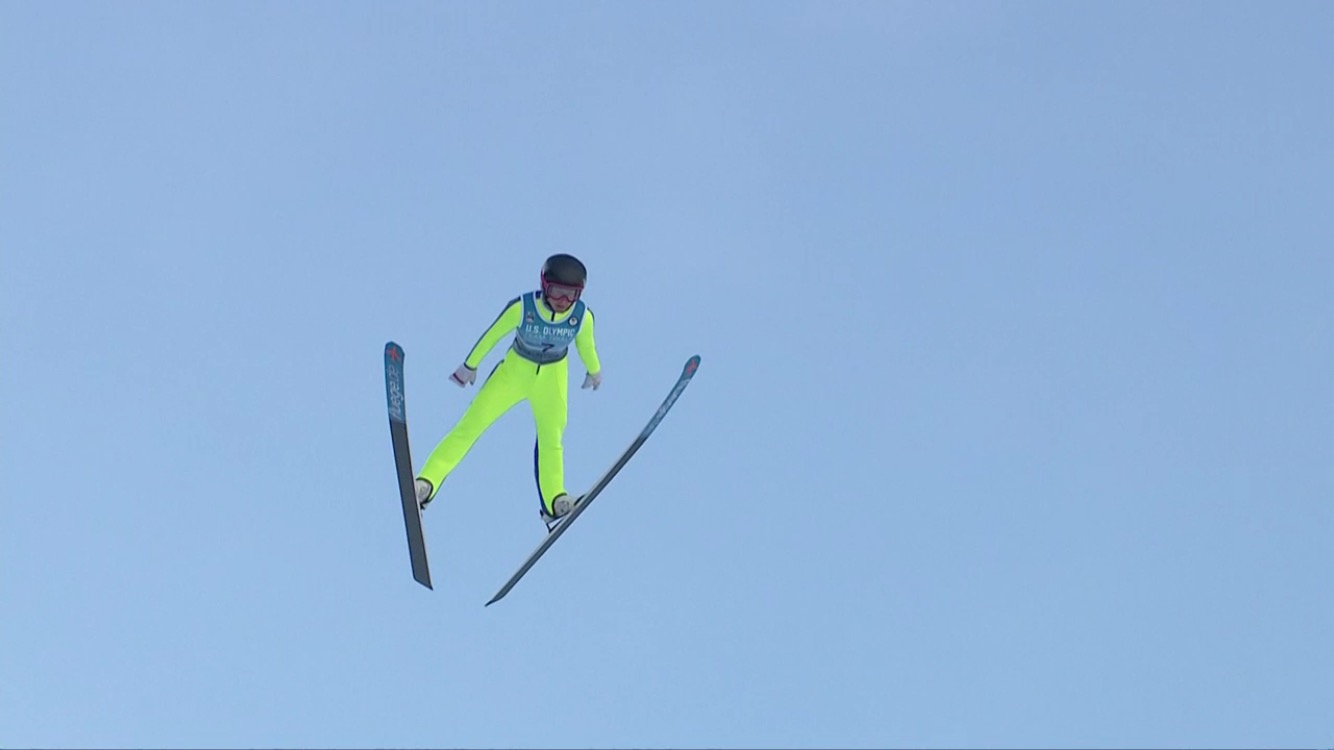
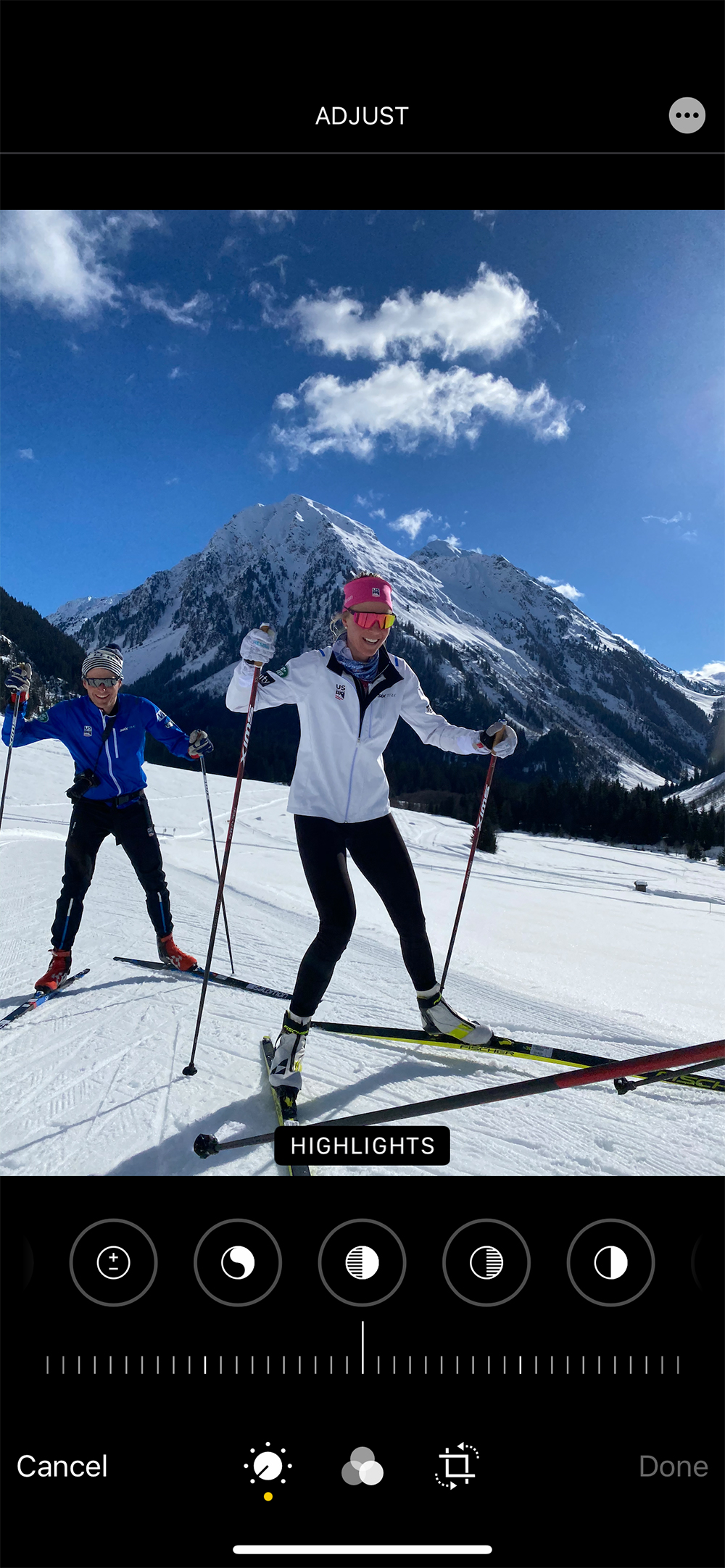
Sarah Hendrickson, jumping in this photo, is a FIS athlete representative to the Ski Jumping Committee. (Courtesy photo)
Let’s start with some basic gender equality facts in skiing.
The first women’s downhill at the Olympics was in1948. Women were awarded Olympic medals in combined (one downhill run and two of slalom) beginning eight years earlier in 1936. FIS has awarded a women’s World Championship in downhill since 1931. The FIS database marks 1967 as the first year for an official FIS World Cup downhill race for both men or women.
It’s a different narrative in ski jumping. FIS sanctioned ski jumping began for men during the 1979-1980 season. It took three more decades for women’s ski jumping to be recognized by FIS. The first women’s FIS World Cup ski jumping competition for women was held in 2011. American Sarah Hendrickson won. The first World Championships in ski jumping for women was awarded to another American, Lindsey Van, in 2009. Men, on the other hand, have been ski jumping in the Winter Olympics since their inception in 1924. The IOC welcomed women’s ski jumping at the Olympics in 2014.
This story though is about Ski Flying. But we’ll tie it back into alpine skiing later on.
Ski Flying is a close relative of ski jumping. Essentially, they are the same beyond the size of the jump. Ski Flying jumps are larger. Athletes soar farther on these jumps. Ski Flying is not an Olympic sport, however, FIS has sanctioned a World Championships in the discipline since 1972 – but only for men.
“Anybody who knows ski jumping even a little bit, you have a small hill and a big hill, and those are usually around a K90 and a K95 or K125. Ski Flying is jumping off anything that is above a K155,” said Jessica Jerome, a former U.S. ski jumper and Olympian. “There are six of these hills in the world, and only five of them are usable. It’s not a set K point or jump size. Basically, it’s ski jumping but just more of everything — it’s more speed it’s more flight time.”
Recently, if you’ve been following Jerome on Twitter, her Tweets about Ski Flying may have caught your attention. Here’s one poignant tweet: “Safety is not, and will NEVER be a valid argument @FISskijumping. I have seen some trash ski flying from forejumpers and other small nations. I think what you guys are afraid to say is you must have a penis to fly?”
Jerome was responding to an April 19 FIS press release and the decision made by the FIS Ski Jumping Calendar Planning Committee to not schedule the first-ever women’s Ski Flying competition next season. “No Ski Flying yet for the women next winter,” claimed the press release. The two reasons given by FIS for not allowing women to participate in Ski Flying were safety and issues with calendering an event.
One of the five operable Ski Flying hill towers in the world sits above Vikersund, Norway. The local Vikersund organizing committee recently proposed to host a FIS women’s Ski Flying event concurrent with a men’s jump next season. The proposal was voted down 9-7 by the FIS Ski Jumping Calendar Planning Committee.
“I can not believe that this comes from adults,” said Norwegian National team ski jumping coach, Christian Meyer, in a translated Dagbladat article. “We have jumped a big hill for a long time. Also in Granåsen in Trondheim, you can jump 145 meters. We have been doing this since 2013. For the history-less, I can also inform you that a lady jumped 200 meters in Kulm in 2003. At that time, Daniela Iraschko-Stolz was a test jumper. At that time, both equipment and technology were inferior. Still, it was zero problem to jump 200 meters for a girl.”
Maren Lundby, a twenty-six-year-old two-time Olympic ski jumping champion, and the 2019 and 2021 ski jumping World Champion, has been an outspoken critic of the decision. Active on Instagram, Lundby released a terse video with a singular message: The Girls Want to Fly.
The April 19 FIS statement on women’s Ski Flying claimed women would be introduced to Ski Flying incrementally. “The next step will be the women’s World Cup on the HS 147 hill in Willingen in the 2021/22 winter season,” read the statement. “The Muehlenkopf-hill in Willingen, [Germany] is considered a small flying hill, the perfect introduction to Ski Flying hills.”
That specific jump will be the largest yet used in an official women’s FIS ski jump competition. FIS goes on to claim, “The experts want to have these competitions first and then make a decision concerning Ski Flying events next winter.” FIS does not clarify who the “experts” are.
The U.S. representative to the Ski Jumping Calendar Committee is Park City based, Alissa Johnson. A now-retired ski jumper, Johnson is a former world top-10 ranked jumper and is a certified international technical delegate (TD). She voted to approve women’s Ski Flying in the 9 to 7 vote.
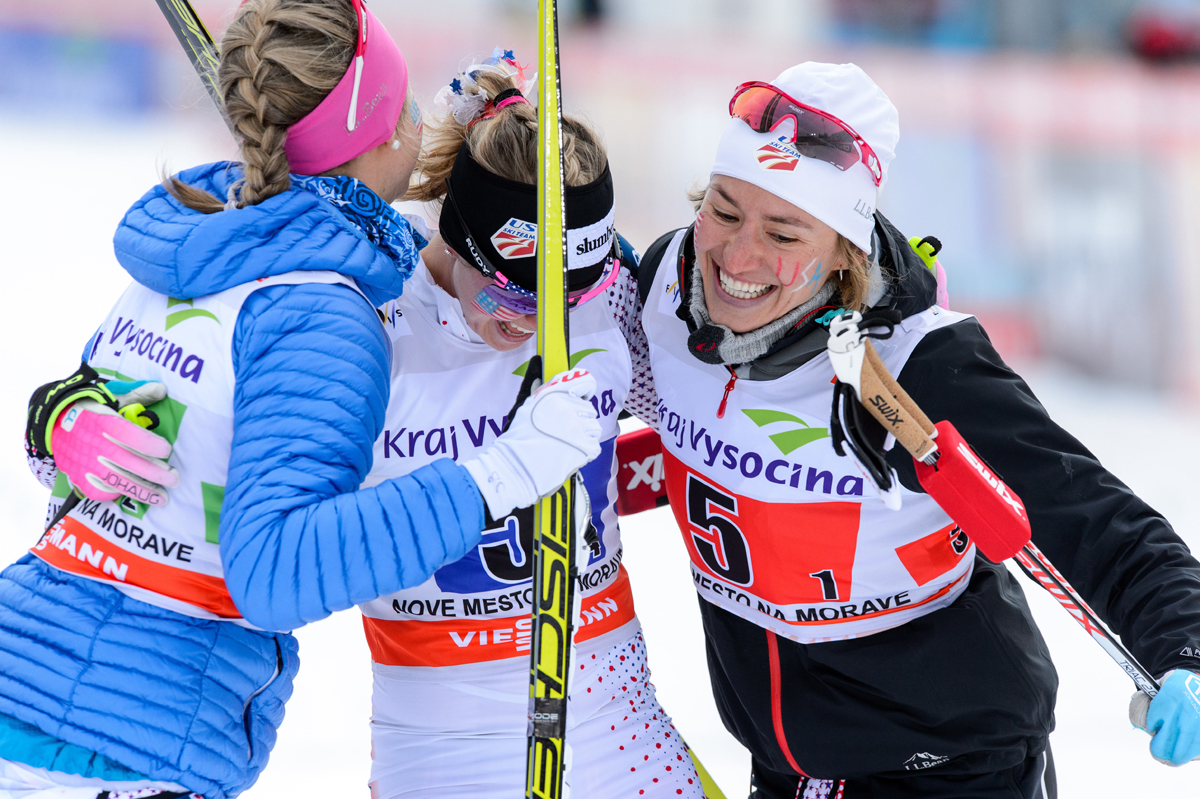
A vintage shot of then 2009 World Champion Lindsey Van (middle) celebrating a U.S. Ski Jumping title along with teammates Jessica Jerome (left) and Alissa Johnson (right) in Lake Placid. (Photo:ORDA-Jon Lundin)
“I think there have been safety concerns, like if you have a full World Cup field,” said Johnson of the sub-committee’s discussion on the issue. “So their safety concern was not so much for the top tier athletes, I think probably it’s safe to say they were referring to the top 10 or 15 depending on their age and World Rank. I think the safety concern is more directed at the back end of the field.”
The step up to Ski Flying should not be understated. The speeds achieved, and the distances jumped are greater than those on Ski Flying hills. The fact exists that ski jumping has been accessible to men far longer than women. It renders down to simply more opportunities for men and a greater number of male athletes perceived to be capable of Ski Flying.
With fewer opportunities to Ski Fly, the progression some women need to make technically and mentally to handle much larger hills is restricted. Johnson explained that to her knowledge, only seven women internationally have been allowed to Ski Fly – all as forerunners or test jumpers at men’s events.
According to Johnson, during the sub-committee meeting, some voting members were against approving the Vikersuznd round of Ski Flying because the field of women jumpers able to competently Ski Fly would be too small.
“I think women, in general, need advancements, but I also feel like the top-tier women can jump, and can jump safely,” said Johnson. “But I think a lot of the discussion came down to this: can we justify calling a World Cup a World Cup if it has less than 30 athletes?”
One solution to cull the women’s field for a potential Ski Flying event was to evaluate the women’s field mid-season after they had jumped on the large hill in Willingen, Germany.
Former U.S. jumper Sarah Hendrickson is one of two athlete reps to the FIS Ski Jumping Committee. (Courtesy photo)
Sarah Hendrickson, a twenty-six-year-old now-retired U.S. Olympian, and World Champion serves as one of two athlete reps to the FIS Ski Jumping Committee — a role she has served in for five years. Hendrickson explained that Norway’s Vikersund Ski Flying proposal, presented to the FIS Ski Jumping Calendar Planning Committee by Norway’s representative Clas Brede Bråthen, was both supported by Norway’s government and framed as an opportunity to raise the market value for women’s jumping.
“So Bråthen is stating it from a very business-money point of view, which I think is fantastic because marketing and sponsorship are important factors for FIS,” said Hendrickson. “They’re complaining during this meeting that they need to raise the viewership. Bråthen clearly explained here’s one way to increase the viewership and gain popularity in ski jumping, and some listening in were simply like ‘yeah no’.”
Hendrickson was further disheartened by the step-by-step approach suggested for women to gain experience on incrementally larger ski jumping hills. Absent from the discussion, according to Hendrickson, was what precise objective criteria the decision-makers were looking for to determine if a woman was capable of Ski Flying. Hendrickson recalls Bråthen trying to clarify what specific criteria the women had to meet to be certified to Ski Fly. Despite Bråthen’s questions, Hendrickson said no answer regarding a more structured method for assessing able-to-Ski-Fly women was forthcoming.
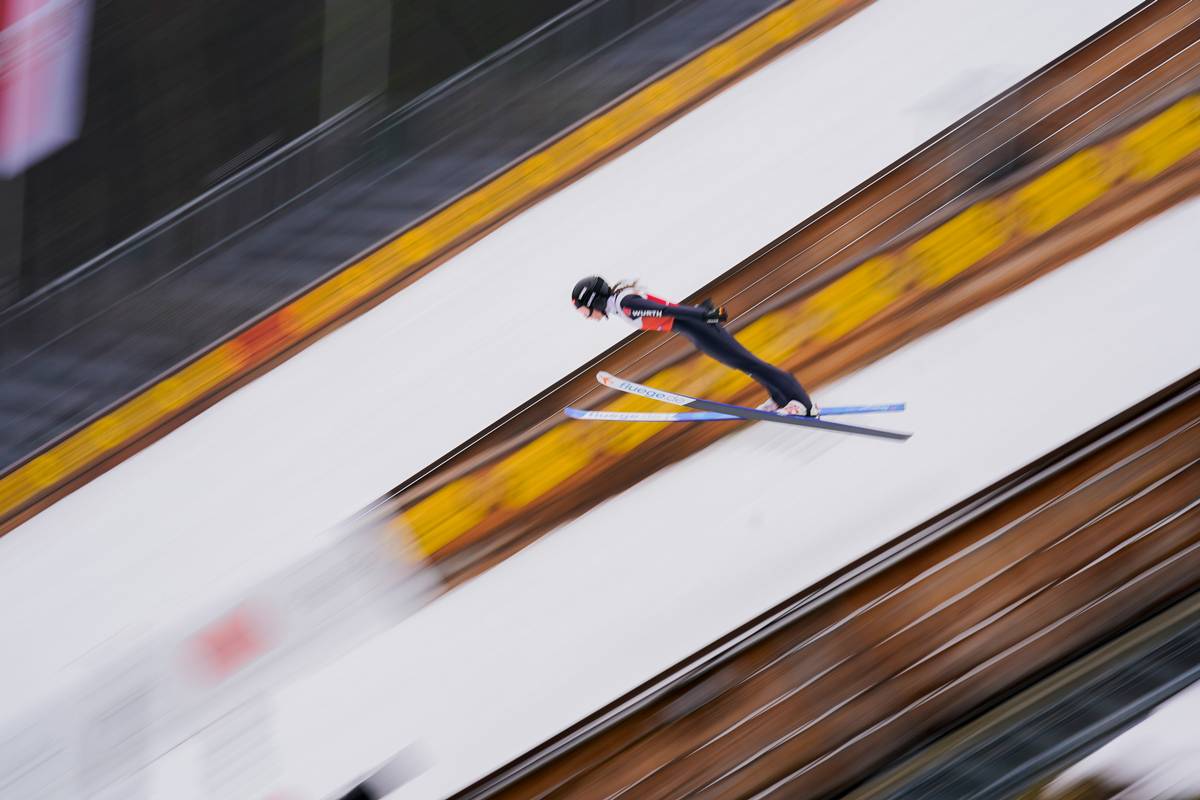
Cindy Haasch of Germany(GER) – jumping during the FIS nordic world ski championships nordic combined women’s individual Gundersen. (Photo: NordicFocus)
How Safe is Safe?
The notion that safety remains a concern falls flat for many athletes and observers of the sport. “I’m female, I didn’t get into the sport because I knew it was the safest sport,” said Hendrickson. “We love ski jumping because there’s a risk of danger, there’s a risk of challenge. We know there’s a risk, there’s just as much a risk jumping off a small hill as a big hill.”
Johnson, the voting member for the U.S. on the Ski Jumping Calendar Committee, expressed that individual athletes were the real experts in terms of determining Ski Flying readiness.
“At the end of the day, I think safety concerns should come down to the technical delegates that are appointed to those competitions on any given weekend,” reasoned Johnson. “It should come down to the coaches, but ultimately, it should come down to the athletes. Because regardless of whatever my coaches are saying, if I don’t feel safe, I won’t be safe. I think the safety argument has to come down to those individuals jumping. It’s so individualized. In the broad scheme of things, FIS and our TDs can host a fair and safe event for all athletes.”
The obvious long-term opportunity cost for limited Ski Flying opportunities for women is clear: fewer women might be ready to Ski Fly. If it is desired to increase the size of an experienced, and therefore “safe”, women’s Ski Flying field, then more women need the chance to Ski Fly.
“Safety is a non-issue, it’s not a thing,” said Jerome about a women’s ability to Ski Fly. “Because if safety were an issue, then first of all, why are you letting anybody participate if safety is an issue? It doesn’t matter whether it’s a male or a female or whatever. It’s a human being and it’s either going to be safe or it’s not. So if you’ve decided it’s safe for men, then it should be safe for certain women as well.”
Jerome went on to clarify that women who have demonstrated high technical proficiency and have the appropriate mental calmness to fly off large jumps should be allowed to Ski Fly. “It’s not one of those things where they’re going to fill quota spots for Ski Flying because you have to take it a little more seriously,” said Jerome.
Let’s circle back to the historical information mentioned at the top. Women have participated in downhill at the FIS World Championships since 1931. Beyond alpine skiing, of which downhill is a sub-discipline, FIS is responsible for sanctioning several winter sports considered to be potentially unsafe. Among them are snowboarding, freestyle, and freeskiing.
Perhaps FIS has data unavailable to the public regarding the inherent fragility of women compared to men that were rectified for downhill in 1931 but remain current for Ski Flying in 2021? Considering safety, the downhill is still among the diciest of the FIS disciplines. As noted, FIS does not discriminate by gender in that event. Women race downhill. And they race on courses at extreme speeds, over sometimes water injected snow.
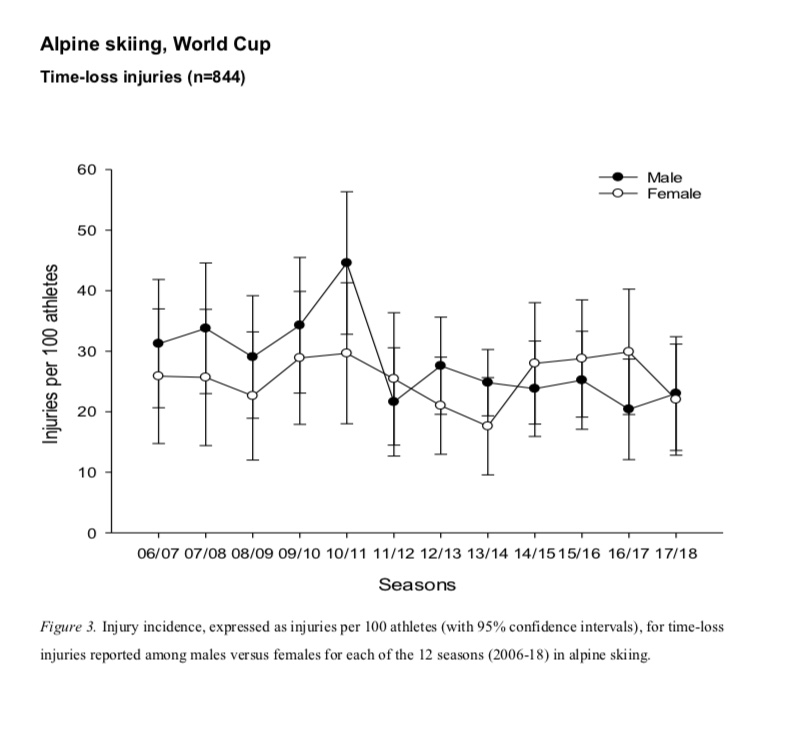
However, between the 2014/15 and 2016/17 race seasons, data from the FIS Injury Surveillance Ssyetem 2006-2018, found women were more likely than men to suffer time-loss injuries on the alpine World Cup. Ask American stars Lindsey Vonn (retired) and Mikaela Shiffrin, the women played through and they played on. Women were not kept from competing due to safety concerns.
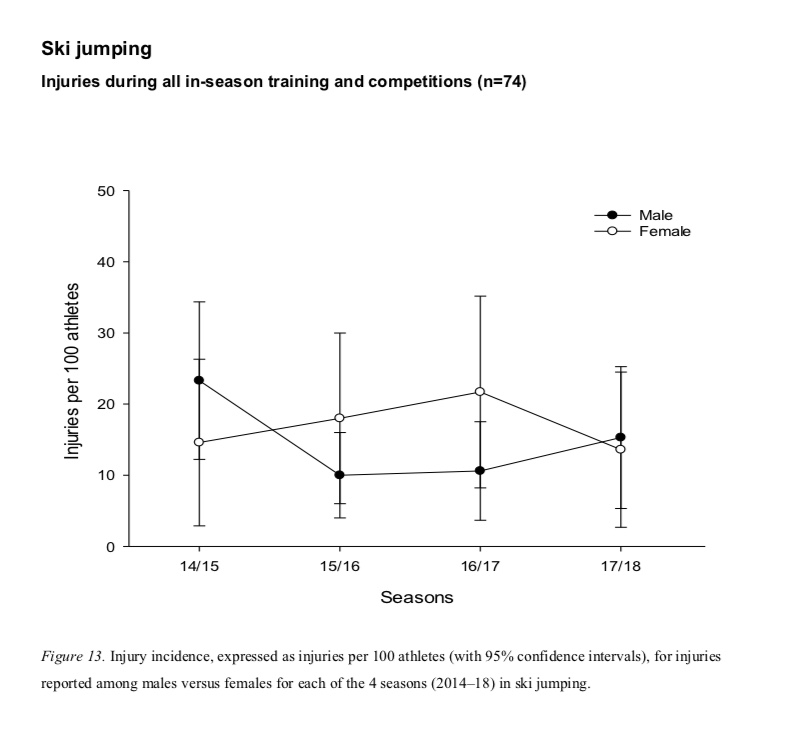
Over the same period, 2014-2018, FIS concluded men and women suffered about the same number of injuries ski jumping at the World Ski Championships and Olympics.
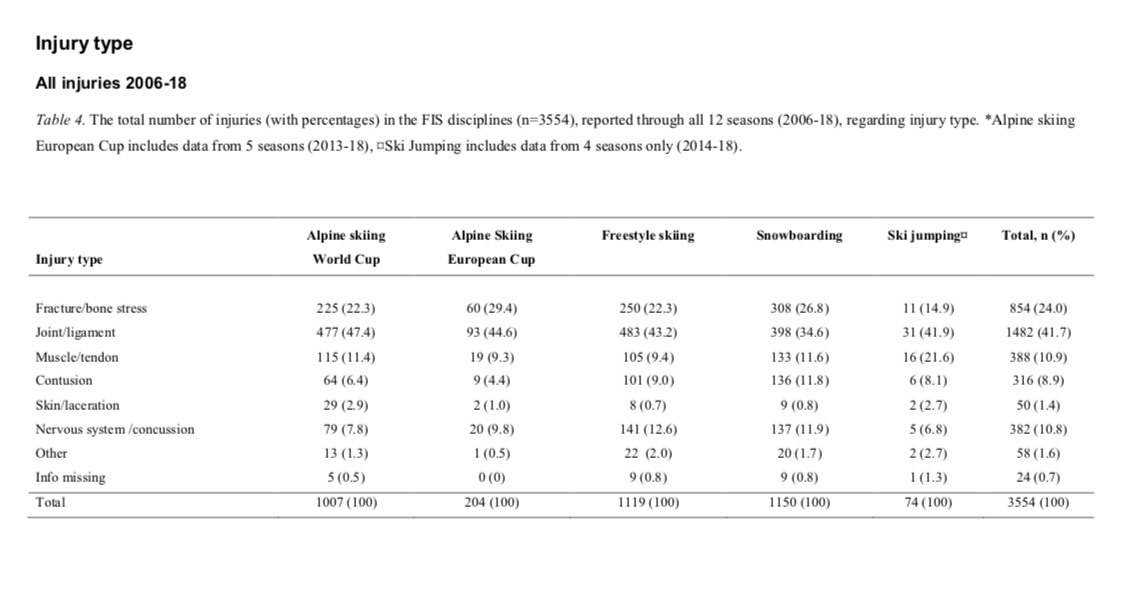
Of the total number of injuries through 12 seasons of the FIS disciplines (with ski jumping data from four seasons), 7.8% of all injuries suffered on the alpine World Cup were nervous system or concussion injuries. The same category accounted for 6.8% of injuries in ski jumping. Fractured bone/stress injuries comprised 22.3% of all injuries on the alpine World Cup. 14.9% of injuries in ski jumping were fractured bones/stress injuries.
On the surface, alpine skiing, at this elite level, appears more dangerous than ski jumping. Broadcast contracts for alpine skiing are much larger than those for ski jumping. Considering safety data, or the potential for yard sale crashes, the scheduling of FIS alpine events for men or women has not been deterred.
Across the spectrum of elite sport, the ceiling remains opaque for female athletes. Considering ski jumping, at the 2018 Winter Games, men had three unique events, the women one — an individual event on the normal hill. The legacy of discrimination extends to the first modern Olympics in 1896. The Games’ founder, Pierre de Coubertin is quoted as saying, “No matter how toughened a sportswoman may be, her organism is not cut out to sustain certain shocks”.
Again, according to FIS and their World Championships, those “shocks” somehow disappeared in the downhill for women in 1931 but persist for women in 2021 when it comes to FIS sanctioned Ski Flying competitions. FasterSkier requested an interview with a FIS representative. This story will be updated when we receive a reply.
On the men’s side of World Cup ski jumping, the top-30 earn prize money; the top-20 earn a paycheck for women. A quick check of the field size at a joint men’s and women’s competition in Râșnov, Romania in mid-February had 39 women in the field and 48 men, respectively.
Pay equity and safety aside, which are important issues, women have been allowed to chase the FIS dream in the alpine skiing realm for 90 years. (Although Lindsey Vonn was never granted the right to compete against men.) Women ski jumpers, for the time being, have to wait through at least another winter for the chance to Ski Fly in a FIS competition.
The wait, no matter how short or long is difficult, said Hendrickson. She explained that during the most recent Ski Jumping Calendar meeting she unmuted her audio and challenged the committee chair when they insisted there was “no rush” to get women Ski Flying.
“I explained that the Olympics are next year and a lot of women are going to retire after next year and they’ll never get a chance to Ski Fly,” said Hendrickson. “So it might not be a rush to you, but for someone who’s an athlete, that is looking to retire and now could not have this lifelong dream because they’re a girl is pretty devastating.”
NMU coach Sten Fjeldheim retires after 35 years at the school. (Photo: Courtesy NMU)
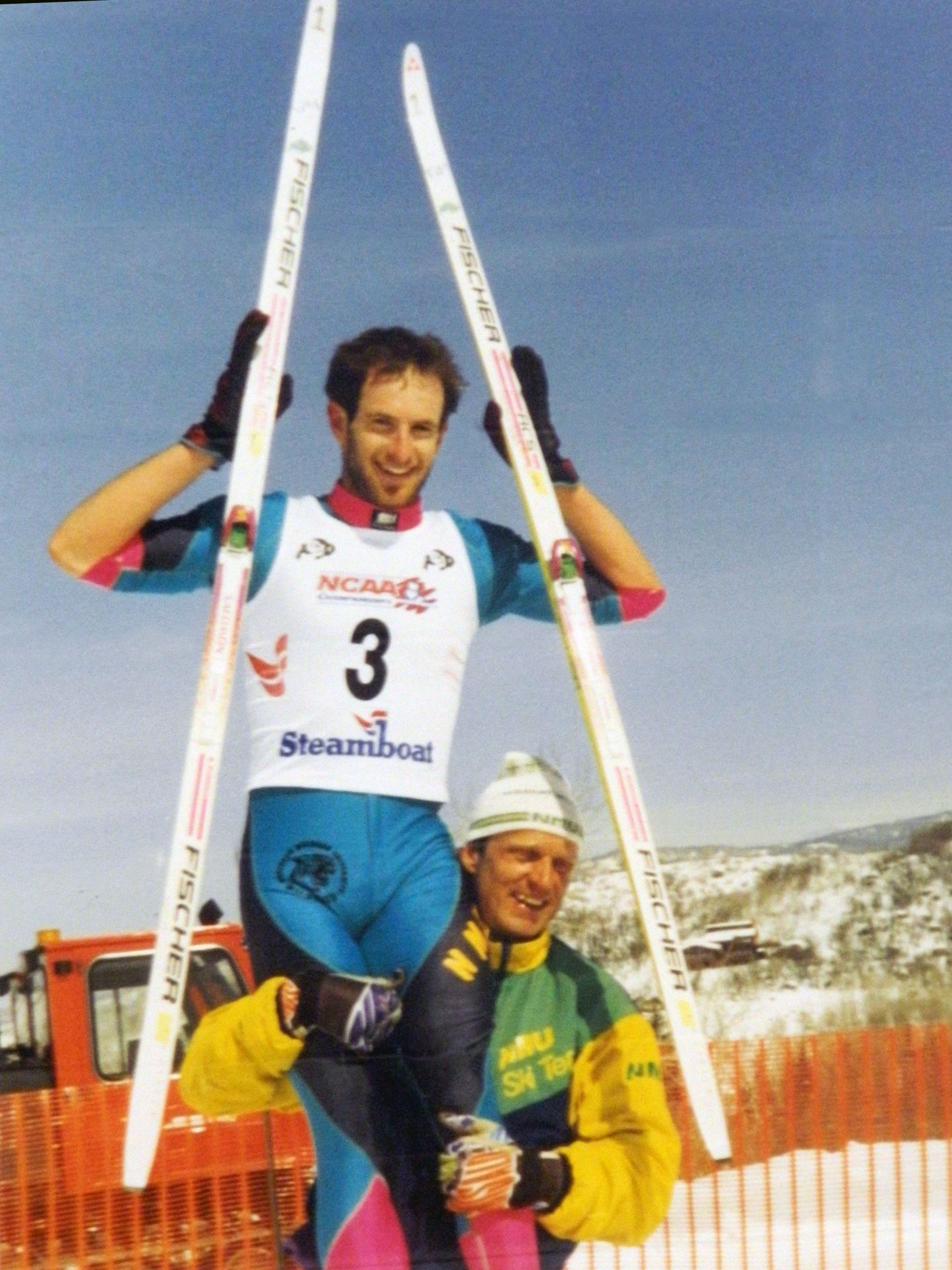
Sten Fjeldheim, the cross-country ski coach at Northern Michigan University announced his retirement on March 30th. He coached and mentored at the school for 35 years. This piece from The Mining Journal speaks to Fjeldheim’s legacy and the many accolades NMU skiers achieved under his tutelage. Below are thoughts about Fjeldheim from former NMU skier, U.S. Ski Team athlete and Head Coach, Peter Vordenberg. According to a NMU press release, Fjeldheim had this to say about Vordenberg’s 1993 individual NCAA National Championship: “Of course Peter Vordenberg winning the NCAA National Championship in 1993 I’ll never forget. We had just moved into the NCAA in 1992 and to have a national champion a year later was really exciting.”
***
Sten is a pure jolt of electric fire. He is energy.
Sten has spent decades electro charging hundreds and hundreds of ski racers. Electricity doesn’t pass from one to another without a jolt, without that shock, that zap, that spark. Electricity doesn’t amble, it jumps. Zip!
It crackles. It singes, burns, ignites.
Get shocked, and you can taste it, smell your own hair on fire. Sten is fury and passion and joy and love. Sten Fjeldheim can drive without looking.
In my day he could beat almost everyone on the team and most of the rest of the racers in the U.S. too. At Senior Nationals back in the early ‘90’s, I recall Sten waxing team skis late into the night, kick waxing in the morning, shepherding the team on course to race and then pulling his own bib on. I want to say he was top-10. I’m certain he then drove the van back to the hotel without looking at the road once, telling outrageous stories the whole way. That’s how I remember it.
The vein. That’s what we called it when Sten got mad. He was balding in that Scandinavian sort of way; blond hair pulling back off his forehead but still flowing behind. The vein descended as a zig-zag lightning bolt from upper temple to down near his eye. Seeing that vein bulge out was not a good thing.
Fire heats, and fire burns.
The vein meant you were about to get burned. Sometimes that fire got you out the door, lit a fire under your butt, as the saying goes. And as the saying goes, Sten’s passion for skiing spread like wildfire. Sten is the ignition point. From there the whole team catches it, passes it, from one to the next until the whole team is on fire. That’s how a team gets hot. That’s how a team gets on fire. You need someone to light it and fan the flames, and that someone is Sten.
I don’t have any facts. Which is something that wouldn’t slow Sten down either. So here it goes. I am pretty sure the NMU Wildcats have won more NCAA cross-country ski titles than any other team. I mean cross-country only, rather than combined with alpine. And what about homegrown NCAA champions? I mean American kids – has anyone coached more American kids to NCAA titles? I doubt it.
I’m not going to count. Electricity doesn’t stop to count.
I can’t imagine Sten not coaching. What does electricity do when it stops moving? Static electricity doesn’t stay static for long, get close enough and Zang! I’m not getting anywhere near the U.P. if Sten is retired.
I never saw Sten sit still. I’m really trying hard to remember a single time. I can’t. I’ve never seen it. Most of my memories of Sten are out skiing, running or rollerskiing. Some of the best times of my life, running through those vibrant colors of a U.P fall with Sten and my teammates, everything on fire, exhilarating, vibrating, charging down those sandy trails through the woods.
And come winter flying along the trails up and over those punchy Midwestern hills just knowing we were on the right track to success. Just knowing it. I recognize that now as what people call faith. It was something you felt, something you just knew.
Sten could have been a preacher. Fire and brimstone style, getting the whole congregation speaking in tongues, believing in themselves as ski racers, leading us to some kind of ecstatic snake worship type thing. Yes, he could have been a snake oil salesman too.
It’s hard not to believe in something when it’s backed by pure electric fire. I’m talking about passion. Sten loves skiing so much you fall into it too. Maybe not everyone did. But, I was in the front row, waving my hat in the air, shouting amen, hallelujah and praise be.
But it wasn’t really like that. Sten wasn’t preaching so much as living it with you. We trained together, dreamed together. He pulled you in with him, didn’t stay up above. That’s for sure.
If there was a fight, Sten was in the middle of it. He is a human and all the humans I know come in somewhere less than perfect, Sten included. Me included too, and same with you. Imperfection never stopped any preacher from preaching. I promise you that, and Sten isn’t a preacher, just a guy who really, really loves ski racing and is a genius for sharing that passion. And it was more than a passion for ski racing it was a belief in you. He believed you could do it so much you started to believe it too and before long you just knew it.
I came to NMU in fall of ’91 never having made the Jr. World Team. By winter of ’92, I was on the Olympic team. In ’93 I won the NCAA championship for the Wildcats. It was the first of many for NMU skiing. I’m proud of that.
I like to think I added to the intensity of the fire, stoked the flames up a little higher. Later, I certainly brought some of that Fjeldheim intensity to my own coaching with the National Team and again I’m proud of that. I like to think I helped bring the flames up higher there too. I owe much of that fire to Sten. I carried it with me for many years. That’s what I wanted to do. If there is one thing I learned from Sten it is this: If something is going to happen, you have to want it to happen first and want it bad.
“You have to want it!” – Sten Fjeldheim.
Thank you Sten. U.S cross-country skiing owes you much. I sure do.
The author hoisted by Fjeldheim after the 1993 NCAA win. (Photo: Courtesy NMU)
Simi Hamilton of the U.S. Ski Team announced his retirement last month. (Photo: NordicFocus)
According to the FIS database, sprints on the cross-country World Cup began during the 1996-1997 season. That year, American Simi Hamilton was nine years old. And if you listen to any of the Hamilton-lore floating around adventure circles, the Aspen, Colorado native was already eyeing deep-country adventure. We’ll touch upon this often here, but Hamilton moves in the mountains as few can. He’s capable of pushing at near race pace in technical terrain with a masterstroke of whimsy. According to writer Bill McKibbon, a longtime friend and mentor to Hamilton, his mother once pointed to the mountainscape beyond Aspen noting a steep slope Hamilton had wended to and skied for his ninthbirthday.
World Cup sprinting has evolved for nearly a quarter-century since Hamilton began feeding the rat near his hometown mountains.
Hamilton, now thirty-three, remains the only American male to win a World Cup sprint. Andy Newell first broke the sprint podium barrier for the U.S. in 2006 with a third place in Changchun, China. Torin Koos followed with a third-place sprint in 2007. Newell took a step up when he placed second in 2008. The high-reach to sprint success on the World Cup for those that follow stand on Hamilton’s shoulders.
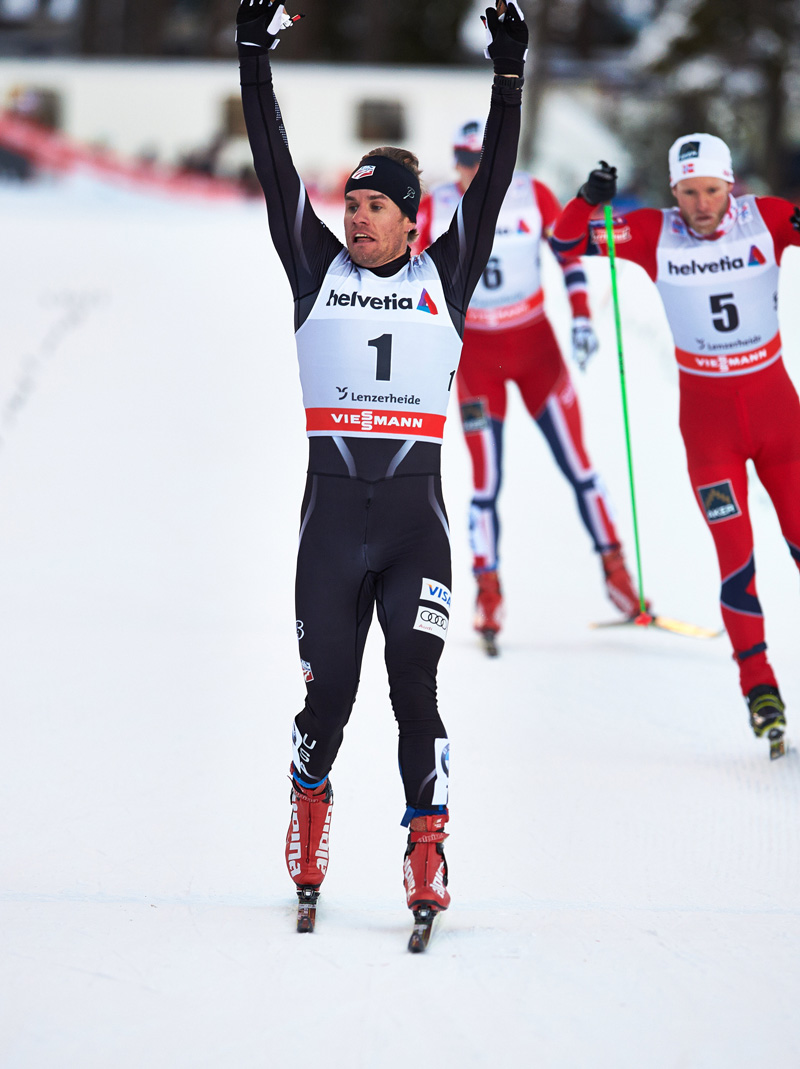
Simi Hamilton (U.S. Ski Team) celebrates his victory in the third stage of the Tour de Ski. Hamilton is the first American male to win a stage of the Tour. (Photo: Fischer/Nordic Focus)
Hamilton’s win came in 2013 in Lenzerheide, Switzerland. During his career, he earned two second places, one in 2015 and another in 2017, both in Toblach, Italy. He also landed third in Gatineau’s 2016 sprint. All were in skate technique.
He popped 10 top-fives on the World Cup, which include four fourth places, one a fourth fastest time of day in a 15 k skate pursuit in 2019, and a single fifth place this season in Dresden. He raced into the top-10 on 27 occasions when aggregating team and individual results.
In 2016 and 2017, respectively, he was ranked 10th and ninth overall in the sprint standings. He finished this season, his last, ranked 14th. In 2017, he was 30th on the distance list, his best career distance ranking. His top distance result was 12th in a 15 k mass start skate in 2018 in Seefeld, Austria. Side note here, we are ruminating on World Cup results. The fastest/fittest cross-country skiers period. In a post-race conversation this winter, U.S. Ski Team Head Coach Matt Whitcomb commented that Hamilton was as proud of his 32nd in Falun’s 15 k individual start skate as any race he’d done. At the 2021 World Championships Hamilton paced himself to 31st, the third fastest North American, in the 15 k indivudual skate. Again, Hamilton was thirlled. It speaks to the notion that Hamilton understood perfectly well the best-in-class competition he faced with each race opportunity.
Simi Hamilton (c) races towards the win of the 1.5 k freestyle sprint final at the 2017 Tour de Ski Stage 3 in Lenzerheide, Switzerland. (Photo: Nordic Focus)
Stating it outright, Hamilton is the most successful U.S. sprinter to race the World Cup. To couple all the results pressure, and the desire for the U.S. men’s team to cultivate a regular podium threat, he also carried a heavy karmic burden when in 2014 Outside Magazine declared “This Man Will Make Nordic Skiing Cool”.
With 2020 in the rearview mirror and the masses flocking to cross-country skiing, there’s no doubt it’s cool. Even more, this much is clear: it’s necessary. And it seemed that way for Hamilton too.
Back to the buzz about Hamilton. There’s the “have you seen him climb?” There’s “Have you seen him kayak?” Mountain biking savant? That he is. Ski mountaineering? We alluded to that up top in this piece. I’m sure if endurance tap dancing were a thing and required a flow-state of mind and big lungs, he would kill.
“Simi is someone, I think, whose heart is mostly in the high mountains and the backcountry but his body was just so designed for going fast on skis that it would have been a shame not to do it,” McKibben said on our podcast.
Hamilton raced at three Olympic Games and six World Championships.
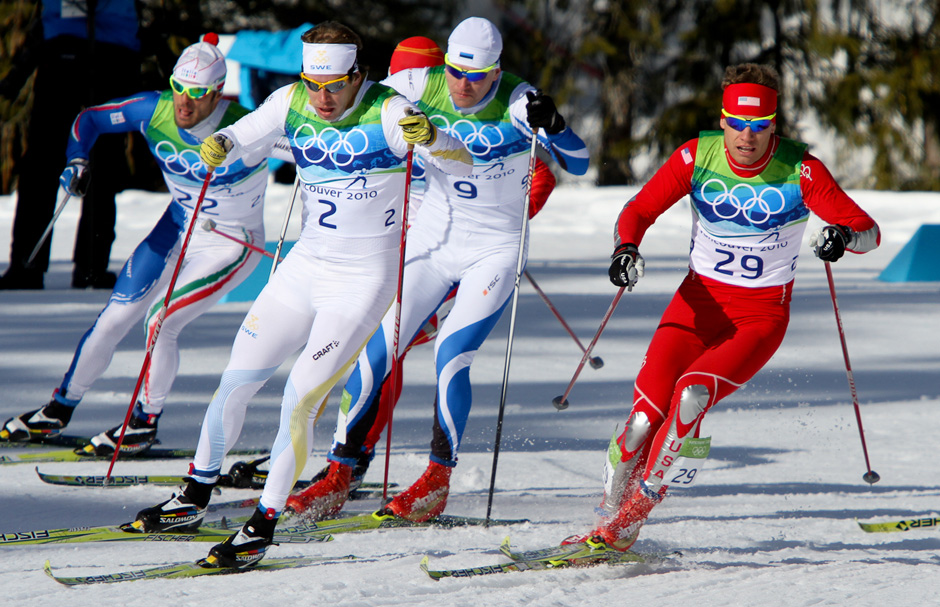
Simi Hamilton sprinting at the 2010 Vancouver Olympics.
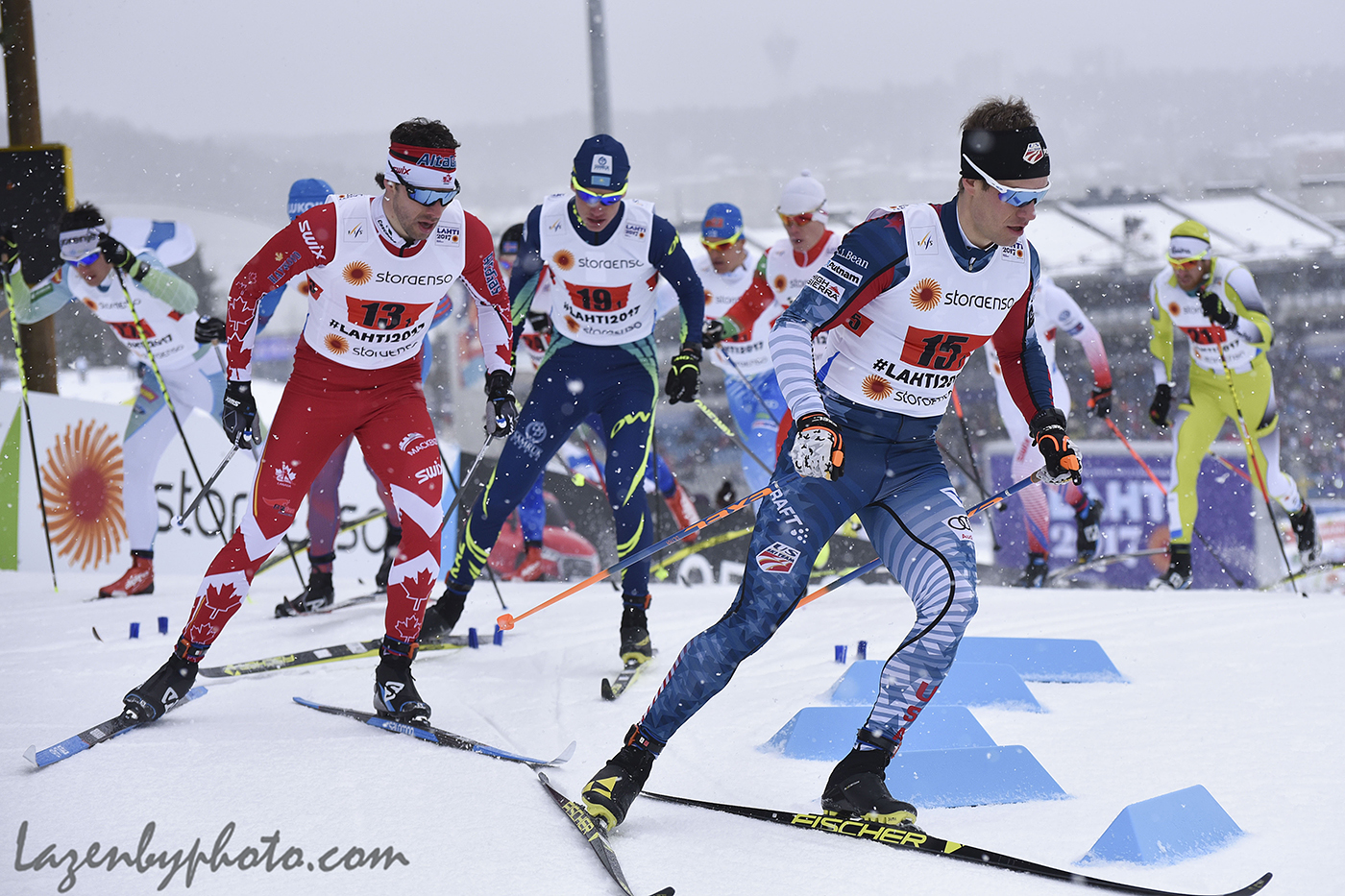
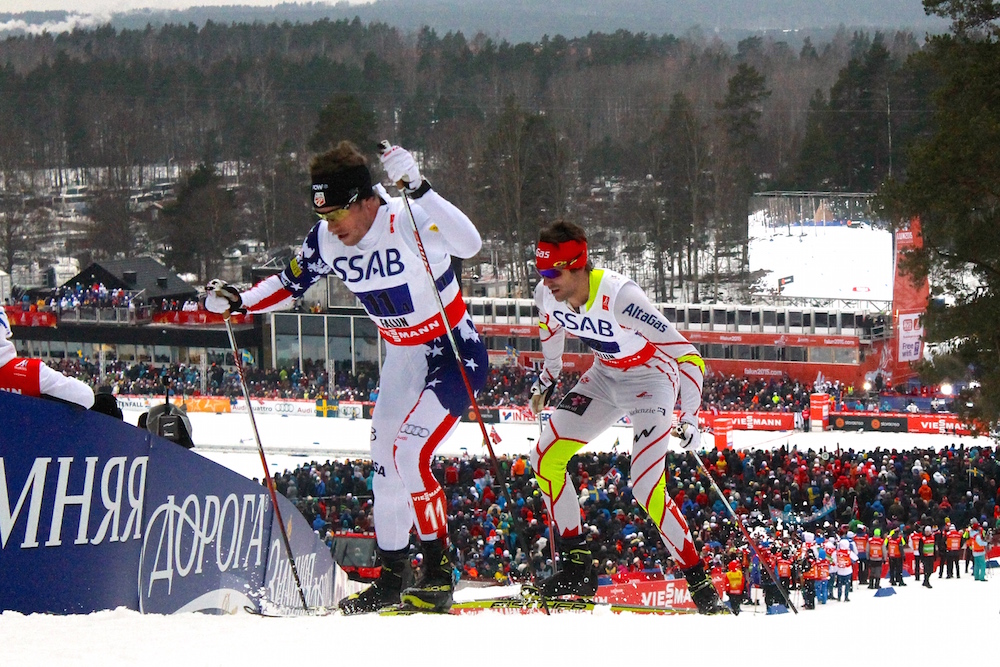
American Simi Hamilton (r) leads Canada’s Alex Harvey (in red) during the men’s classic team sprint at the 2017 World Championships in Lahti, Finland. (Photo: John Lazenby)
His U.S. Ski Team tenure overlapped with a mix of skiers populating the men’s team. From Kris Freeman to Gus Schumacher, Hamilton has navigated a period often overshadowed by the women’s team. The men’s team, for its part, had a core, of which Hamilton was part of its nucleus. The men’s team was small some years, larger on others. Discretion came into play in nominating teams, sometimes rosters filled out with those meeting objective criteria. The men’s side wasn’t exactly a revolving door, however, it lacked the three to four hallmark skiers who would routinely race into the top-20 in sprint or distance events.
We know Matt Whitcomb had the official title of women’s coach for years. Yet the U.S. rarely named an official men’s coach during Hamilton’s time on the national team. This is not so much a comment on a possible lack of commitment towards the U.S. men as a reflection on the environment in which Hamilton matured as an athlete. Cohesion was often not a trait used to describe the men’s team.
This season marked a turning point. Younger skiers emerged on the team, several of them more than a decade younger than Hamilton. Schumacher set the bar in distance racing, he’s twenty years old. JC Schoonmaker proved to be a reliable sprint qualifier and heat skier. He too is twenty. Ben Ogden, a teammate of Hamilton’s on the SMST2 Team, raced in his first World Championships at 21 years old. Ogden was a U.S. best 11th in the classic sprint qualifier and 17th overall. Hamilton, however, was noticeably absent as a starter in the 2021 World Championship individual sprint. Known more for his skate prowess, Hamilton, according to Whitcomb, had the right to refuse the start. Hamilton did so with the understanding that Ogden just might be able to capitalize.
Ogden did.
Simi Hamilton after placing fifth in the individual skate sprint in Dresden, Germany this season. (Photo: NordicFocus)
“People have been messaging me asking why I didn’t race yesterday… valid question and I take it as a compliment that so many have faith in my classic sprinting! I’m not sick or injured. The reality is that after 11 years of trying to crack the code on classic sprinting at this level, I didn’t really think I was going to figure it out in what is most likely the last few weeks of my career, and I wanted to put all my focus into my skate racing, especially with the chance to partner up with one of my role models @gus.schumacher for the team sprint. I knew my decision was a good one yesterday when @ben.0gden was given my start and made the statement that he did, qualifying in 11th from bib 61 and finishing the day in 17th. I’ve said this before but I’ll say it again: this team of American boys coming up is going to do some extraordinary things, and I’m just humbled and grateful to do what I can to contribute to that. But first it’s time to get this old, creaky body in gear and do some skating!”
At those same championships, Hamilton and Schumacher, a hotly anticipated pairing in the skate team sprint, did not advance out of their semifinal. Schumacher, in his first career World Championship start, left early in the tag zone without the tag from Hamilton. Schumacher reversed his progress for a redo, yet by then the time-loss damage was done. Hamilton could have been the prima donna and castigated Schumacher. Certainly, Hamilton’s disappointment was palpable. Schumacher felt he had let an opportunity slip away from Hamilton. The two processed the snafu and moved on.
It doesn’t take a colorful imagination to conjure up a messier scenario unfolding had someone more self-centered been in Hamilton’s place. Elite sport is rife with the self-absorbed. As I have heard Hamilton note on several occasions, he understood the real gravity of the situation — “It’s just a ski race.”
One can also imagine all those younger skiers either on the team or on the cusp took note of Hamilton’s class and humility as he ceded his start to Ogden and comforted Schumacher. Many skiers likely think they are invincible at 20. Their time to retire will come too. Hamilton set a high bar for the men’s team in terms of how and when to acknowledge another skier’s emergence and deal gracefully with race-day disappointment.
“At the beginning of the year, I wasn’t that aware of Simi’s leadership efforts; I knew our team was actively trying to cultivate a group of strong athletes and leaders, but didn’t know the role Simi played in it,” Schumacher wrote to FasterSkier. “Fast forward to the end of the year and I understand Simi’s role in our team culture so much more clearly. He held off his retirement for another year in part to ski fast and support Sophie, but a major goal of his was to facilitate an incredibly tight and positive team, as well as helping us younger guys get acquainted with the whole scene. I learned a lot of this after the team sprint when I was feeling very disappointed in myself. He opened up about how little he cared about the result, and how much he valued our relationship and the experiences of everyone else on the team. He truly wanted to be there for his teammates all year, and when I realized this, so many things he did this season came into perspective. He’s been so quick to help the team and be a friend, sometimes at the expense of his own training and convenience, and I think that has made so much difference for our team culture. This is one of the strongest and most supportive men’s teams in a long time, and I think a lot of that is due to Simi’s efforts as an amazing team leader and friend. I hope we can continue to use what we learned from him in the future, and keep the good momentum going!!”
The men’s podium for the 2019 15-k mass start classic during the Super Tour Finals in Presque Isle, ME. Erik Bjornsen (center) took the win ahead of Simi Hamilton (left) and Gus Schumacher (right). (Photo: U.S. Ski & Snowboard – Reese Brown)
Schoonmaker had similar sentiments when it came to a “hero” in his midst and Hamilton’s willingness to foster a welcoming environment.
“When I was younger and first started paying attention to the World Cup, Simi was our best men’s American skier so he was the guy I looked up to and aspired to be like,” explained Schoonmaker. “I knew he was an awesome skier and I could tell from listening to his interviews and hearing him talk that he was also an amazing person. It was an incredible experience this season being able to ski with and learn from one of my heroes.
“The men’s team on the World Cup was an incredible and fun group to be around this season and I think Simi deserves a lot of credit for that. He could’ve easily swept Gus and me under the rug but instead, he went out of his way to make us feel comfortable as newcomers on the circuit. He always gave his thoughts on tactics or the course the night before a race and showed that he was invested in each person on the team and had our backs.”
Hamilton also forged a deep friendship with now retired skier Erik Bjorsen. He and Hamilton paired together in the team sprint at the 2014 and 2018 Olympics, where they placed sixth on both occassions.
“Good results don’t always make up an unforgettable day, there are so many other factors that contributed to a dream race day,” Bjornsen said. “I’ll always remember the other shenanigans Simi and I got up to on those days in Sochi and in PeyongChang. We shard everything together; nerves, excitement, and celebration. He’s an amazing friend and the most supportive teammate I’ve ever had. There is no doubt why I had my best performances alongside him.”
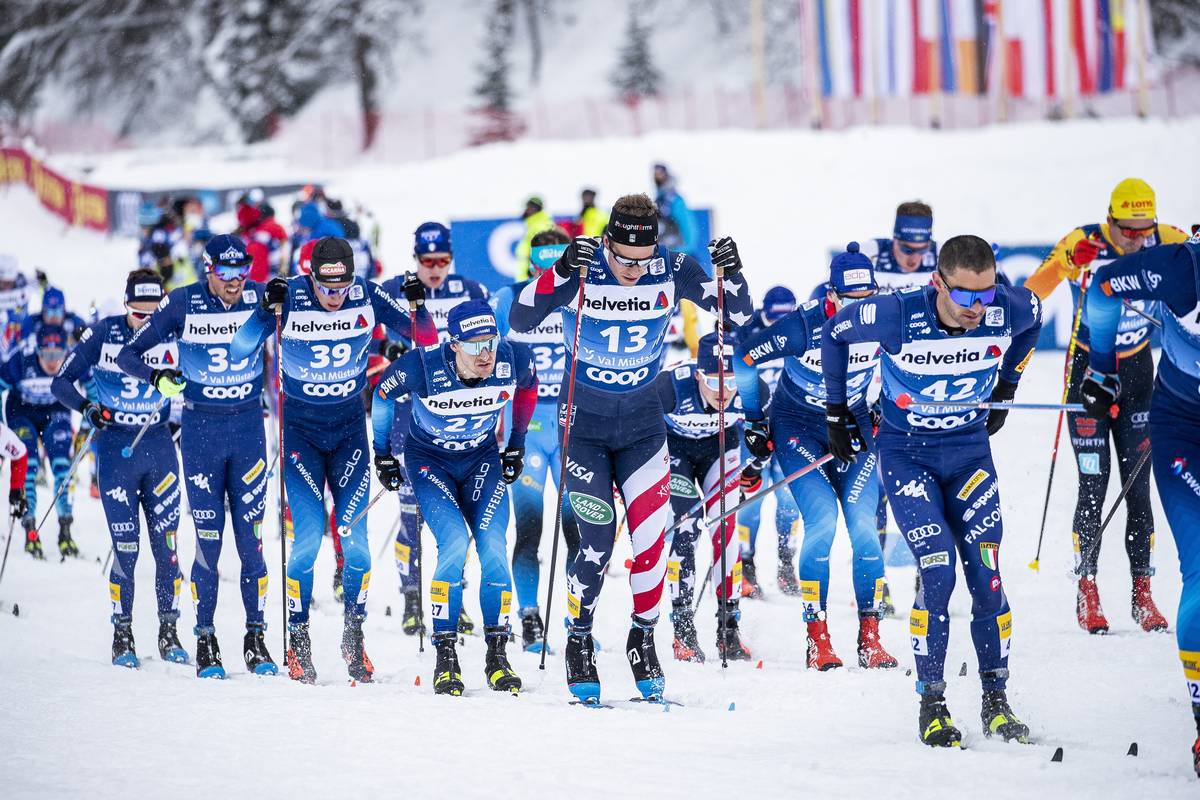
Simi Hamilton (bib 13) at the start of the men’s 15 k mass start classic during the 2020 Tour de Ski. (Photo: NordicFocus)
***
Beyond his wife Sophie Caldwell Hamilton, who also retired this season, Whitcomb is perhaps Hamilton’s closest confidant on the team. We sent Whitcomb a series of questions, the same for Caldwell Hamilton if you are keeping tabs. Below we are including his responses.
FasterSkier: Nugget of wisdom from Hamilton that you have learned and now apply in coaching/life:
Matt Whitcomb: Unlocking the strength of the mind is more important than physical talent and hard training. Simi made career-high gains in the last two months of the season with regards to his distance racing (Falun and Oberstdorf), even though they weren’t rewarded with big results. We made this a project, and it worked. Look for distance-racing potential in people who consider themselves sprint specialists. Often, sprinters just assume they will explode in distance races if they redline because they have before. Instead, make the warm-up harder, perfect pacing, and toughen up. Pain is only real if you’re soft.
FS: Most difficult aspect about Hamilton in terms of priming him for peak racing, and how did you navigate that issue?
MW: For Simi, everything is about motivation. The day he won a World Cup in Switzerland, I vividly recall his arrival at the wax room that morning. He was psyched and it was clear he was ready. Just the same, whenever we missed the mark on motivation for a race, he never performed well. But don’t mistake this for motivation as it’s often viewed; I’m talking about ready-to-make-a-kill motivation, rather than watch-TV-or-workout motivation. Getting Simi out the door to train hard or long was never an issue. Most people don’t know that he was a 900-hour athlete.
FS: Easiest part of coaching Simi?
MW: For me, the most important skill a coach can have is the ability to connect with others. Simi and Sophie are great friends, so that connection—that two-way flow of concern—makes coaching them easy. A hard part of coaching is not knowing the unspoken stresses of an athlete. This stuff needs to be tackled first before any training can take.
FS: Non-competition personality trait that made the “team” more of a team.
MW: Simi connects easily with, and inspires developing athletes. They idolize him. He figured out how to be an effective, consistent leader later in his career, and because of it, our men’s team is now a world-class, cohesive environment. I think he’s going to have a lot of fun watching this team succeed, and he’ll know he made a difference.
FS: Simi’s side of the room, by Sophie’s assessment, is fastidious: folded and tucked in everything. How might that trait manifest as an xc skier in Simi’s case?
MW: Well, the side of the room that has the folded clothes and the portable steamer, also has the athlete that needs more structure and tidiness to his plan and goals. The race plan and strategy are more important. The one whose clothes singe on the lamps, and carpet the floors, and whose passport gets lost in the couch cushions, and who might race a semi-final at World Championships on Jessie Diggins’ poles even though they are five centimeters shorter, and who…okay I’ll stop…well, she just needs to be fit and happy on race day. She’s better at adapting in the moment.
FS: Proudest moment as Simi’s coach?
MW: I don’t hang my hat on results, so nothing really jumps out there. That they raced into their 30’s is my proudest accomplishment for them. Many good athletes in the U.S. quit in their early 20’s before they had a chance to bloom. I’m also feeling proud of the way they handled their quarantine during their intended last World Cup races, which should’ve been a week-long celebration of their ski careers. (As I write, they successfully boarded and are on a plane home.)
FS:I know Simi considers you a close friend. How did you balance that when coaching him? How did that enrich the experience?
MW: I don’t subscribe to the you-can’t-be-friends-with-athletes rule when it’s adults coaching adults, but that only works if you can maintain your ability to get tough from time to time. We’ve been through some hard personal times together, and it hasn’t always been just me supporting them. I ski coach because I like to ski and because I like to connect with people. Sophie and Simi are two of the people I credit for me still loving my job after so many years.
FS: Simi’slasting legacy for each athlete when it comes to team culture?
MW: For Simi, a big goal of his and mine was to stop fucking around with men’s skiing, and finally build a team that works together. This happened this year, and Simi was consistent in his leadership from Ruka, all the way to the team meetings in St. Moritz last week, where he continued to offer thoughts from quarantine. This will last for the team, and for him in his next career.
American Simi Hamilton leading Lenny Valjas of Canada over the top of a hill in the men’s 4 x 10 k relay at 2015 World Championships in Falun, Sweden.
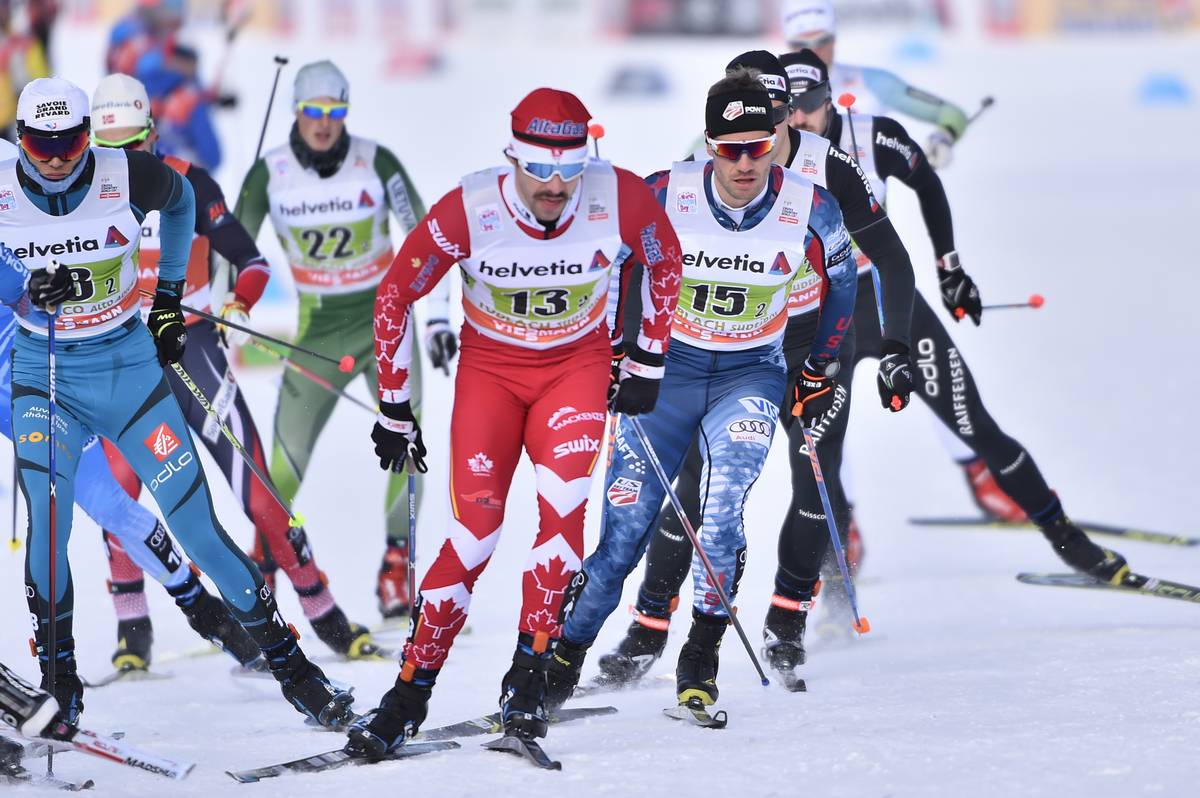
Canada’s Alex Harvey (13) leading American Simi Hamilton (15) in the 2017 men’s 6 x 1.3 k team sprint on Sunday at the World Cup in Toblach, Italy. (Photo: NordicFocus)
***
What follows is an interview conducted with Hamilton in mid-March. At the time, he was quarantined in Switzerland and awaiting permission to return to the U.S.
FasterSkier: The way it was described to us by Sophie, you are fastidious when living on the road: Tidy and folded t-shirts. Maybe socks nested together. Just pretty much tidiness to contrast her mayhem. Where does that come from?
Simi Hamilton: Honestly, I don’t know where it comes from. My mom, she’s super organized and neat. And I wouldn’t say any of us have OCD, but for sure, I’m more towards that side of the spectrum than many others. You know, I really like to be clean. I don’t feel comfortable if I’m spending time in a room or something and things are just temporarily tidy. Honestly, I think that’s been one of the ways that I’ve been able to cope with, living on the road for so long. I’m in a new hotel room every weekend, living out of a duffle bag. I feel like if I kind of make it my little organized space, it feels a little bit more like home. At least that is what I tell myself.
First of all, on this team, I can say this is a bit of a generalization, but you walk into any one of the women’s rooms and it’s just like a freaking bomb. There’s just stuff everywhere. There are clothes, there’s shit hanging off of everything like you just dumped it everywhere and then you walk into basically anyone of the guys’ rooms and clothes are put away. It’s just funny.
FS: How did you find purpose on the team this year outside the racing? Can you give us a little bit of insight, like, what was your role on the team this year? And if you found purpose, what was that purpose?
SH: I think coming into the season, I didn’t know exactly what my role was. I didn’t know that there was an opportunity to step up. As someone who has been doing this for a long time, and has learned a lot about training and racing and being on the road and being part of a really good organic functioning family team, I didn’t know exactly how it would be. I did sense that there would be an opportunity to step into a leadership role in some way.
I think I did a good job of coming in and, and not trying to force these young men to do certain things or fit a certain kind of mold, or act like a certain type of team. I think a lot of people outside of this team, look at the women’s team and they see what they’ve done. And they try to apply that model or that template to other teams or other situations. It’s the kind of thing where if you want a group of people to function well, you simply have to prop each other up. If you want to build something like that in a positive direction, you have to let it do its own thing.
I don’t think you can ever force the team dynamic to be a certain way. The women’s team has certainly become dominant and successful. But I wanted to allow this entity to morph into its own type of team, and function with its own identity. I simply came into the season just trying to foster that amongst all of us. And I think it worked well.
You know, it was awesome having Gus and JC for the first half of racing and in the second part of the season, we had more of these young men joining us from World Juniors and U23s. It became a really awesome crew and I think you saw them bring out the best in me and Kevin Bolger, Scott Patterson, and David Norris — all these guys who’ve been doing this for a long time. It was rejuvenating and it gave us a spark.
But to be more direct in answering your question, I didn’t do anything beyond trying to be present. I tried to be positive and I tried to lead by example with these young guys.
I always felt like that was something that I never really experienced during my younger years. And that isn’t to say that there weren’t strong leaders on the team. That isn’t to say that they didn’t learn things from people like Kris Freeman, Andy Newell, Torin Koos, and even some of my peers like Noah Hoffman. I learned so much from those guys and I am grateful for that. But I think, for whatever reason, there was never really that cohesive bond amongst every single person on the men’s team. I wanted to encourage us to find that this year, and I think we did.
I honestly think the most important thing that we all did this year to make that happen was we just encouraged everyone to bring what they had to the table without expecting anyone to be someone or act a certain way or be someone they didn’t want to be.
As that became the standard we could simply be ourselves every day and buy into this team. It was cool. It made all the difference. Obviously, I wanted success for myself this year, I wanted some good results. I wanted to feel proud of what I was accomplishing and go out on a good note.
But absolutely, it was more important to feel like we were coming together as a team and doing something organic and positive. It was a huge success.
Simi Hamilton amidst a slew of Russian skiers this season on the World Cup. (Photo: NordicFocus)
FS: Just refreshing your FIS profile…you are 33 years old. You’ve been with many different groups as you raced the World Cup. What have you learned about being in close quarters with many different teammates and how to navigate situations where the dynamic is not ideal?
SH: Our ultimate goal with that is creating an environment where, you know, if somebody is doing something, or seeing something, or acting a certain way, that is either detrimental to themselves or detrimental to the team or detrimental to the community that we’re in at that time, that we can soeak up. I’ve learned that it is important to create an atmosphere where someone feels comfortable speaking out and saying something constructive. Sating something like, “Hey, you know, that’s offensive to me, or I don’t think what you are doing is making us ski faster.”
So I think just being able to create that team environment, that team energy, where we all feel comfortable enough with each other that we can change things and have everything be constructive. That’s the work of a high-functioning team. I think that’s valuable and we did that this year.
FS: I know in the past, whether officially or not, it was year to year for you in terms of ski racing. I understand that you as a person do not need the validation of another Olympics to bolster your self-worth. That said, the Olympics are not that far away and that’s a big carrot for a lot of elite athletes. You are forgoing another Olympic experience. What was your calculus in thinking this was the time to step away?
SH: That’s certainly not the first time I’ve heard that. I think honestly, I think both Sophie and I were pretty ready to be done last year. And then I had the season I had last year and I just felt so unfulfilled with what I was capable of doing. And not only individually. It was tough for me just because I was injured and sick for much of the season, even when I was on the road, I felt like I couldn’t be very present, I couldn’t be the leader that I wanted to be on the team. I was just feeling like I wasn’t checking those boxes that I wanted to be checking.
As soon as I said I was going to ski one more year, I felt really good about that. So I knew then basically people would immediately start saying if you’re gonna go through with next year, then why would you just not go one more year to the next Olympics?
I won’t say it’s never been about that kind of thing for me, obviously, there’s something awesome about doing things like going to the Olympics and World Championships, making a certain team, or something like that. But I think, at this point, we’re such dynamic people, we’re well educated, we have some awesome hobbies outside that allow us to experience these amazing communities in Vermont and all these awesome families — We have all these things tugging at us. And I think for both of us, they’re finally really touching hard enough that we want to respond to those things out there.
I also think we’re wanting to start a family soon and start building this house. We want to start writing all the things in the textbook if that makes sense. So it never really felt like we were giving up on the team, or the Olympic movement. I don’t think need those things in our lives anymore to progress.
Simi Hamilton Mid-Crust Cruise around the Four Pass Loop — A loop circumnavigating the Maroon Bells outside Aspen, CO. (Photo Credit: Linden Mallory)
FS: In talking about you, Bill McKibben mentioned an anecdote about you skiing off some peak near Aspen for your ninth birthday. And some of the stories are legends. I know you like moving fast, be it on skis in the mountains, climbing, biking, whatever. You probably could have been a lot of things when considering the pro-athlete realm. Can you provide some insight into your path as an athlete?
SH: Certainly growing up in a place like where I grew up, I always had a huge draw to getting outside and doing things other than just cross-country skiing. I plan on doing a lot more of that now. But I have come to realize in the last few years of my career that it’s so much more important to find something that is simply fun. I also need to feel like I’m doing something worthwhile. What I started appreciating about cross-country skiing was just the amount of hard work to be good at it. I think especially as a US cross country skier doing that, dedicating your entire life, to doing something like that for 10 years, and not getting a ton of recognition for it — and I say that with a grain of salt because obviously we have this amazing community of supporters and we do get a lot of recognition for what we do, but when you compare the amount of praise and financial earnings between like what we’re doing and between what freeskiers are doing or maybe some things that I could have potentially seen myself doing if I hadn’t have gone down this path, they are incomparable.
But doing this for the last 10 years has taught me how incredibly valuable humility is. And just like I said, sheer hard work, and commitment, and dedication. And I think that those things that I’ve learned are going to be the most valuable things that I can use going forward in life. And those things are the things that I want to pass down to my children and have them pass down to their children.
FS: The concept of humility is interesting when thinking of elite athletics. You have a reputation as an amazing all-around athlete let alone a cross-country skier. But if you can think back over the decade, and racing on the World Cup, that is a tough scene. Some weekends it works out, others someone might get their ass-kicked. Can you reflect on your humility and how that evolved?
SH: I don’t think there’s anybody who comes on to the World Cup scene, from any country, who isn’t somewhat confident. But, I think a lot of people say that they’re ready for this level of racing, and then when they’re experiencing it, it’s like they don’t have any idea of what hit them or what is coming.
It certainly took me a long time to figure out how to be good. And it still boggles my mind to see how consistently good someone like Klæbo or Pellegrino. Basically, weekend after weekend after weekend after weekend they are one of the top five or on the podium. That is such a ridiculously high-level sport.
It certainly took me some time to figure that out. As I progressed I started to appreciate the lesson in patience more and more. Knowing that maybe I would go two periods on the World Cup without really having a truly awesome race. But you know, maybe in that third period or something I would have a top-10 or podium or a final. That is worth waiting for and working hard for. It took me a long time to learn that lesson. Especially coming from a pretty successful career as a junior skier in the US. I certainly was expecting it to be hard as it was and take as long as it did, but again, as I said with your previous question, that’s just the part of this sport that is pretty cool: You just have to keep your head down for a long time. And be doing it for the right reasons. Because if you’re not, then you’re not going to be able to grind away.
FS: The usual question, what are you most proud of in terms of race results?
SH: Obviously, my win in Lenzerheide, my third place in Canada, were all very special. They were awesome days. But I think, you know, I would say my three best moments in my career on the World Cup at least, and I’m not ranking these because they’re all a little bit different. But three experiences stand out to me as incredibly special.
The first was watching Sophie win her first World Cup in Oberstdorf. It sucked because I was sick. I had gotten sick the night before, during the Tour. I wasn’t even at the venue. But the coaches gave me the OK to go and pick her up in one of the vans. I had some great alone time with her. I was just so happy for her knowing how hard she worked and knowing how much that meant to her, to get to that point was pretty special.
The other two were the 2017 Lahti World Championship classic team sprint and the 2014 Sochi Olympic team sprint and those were both with Eric Bjornsen. They were races where we both skied well. But more important than that, everything just kind of clicked. And I felt on both of those days that Erik and I were racing for each other. And that felt cool to do. I have felt that in some distance relay teams and some other races throughout my career, but, I think those two days stand out to me as just being so connected with somebody else, that we will race until your heart explodes for that other person. It’s a cool feeling to have. And I’ll for sure reflect on those days.
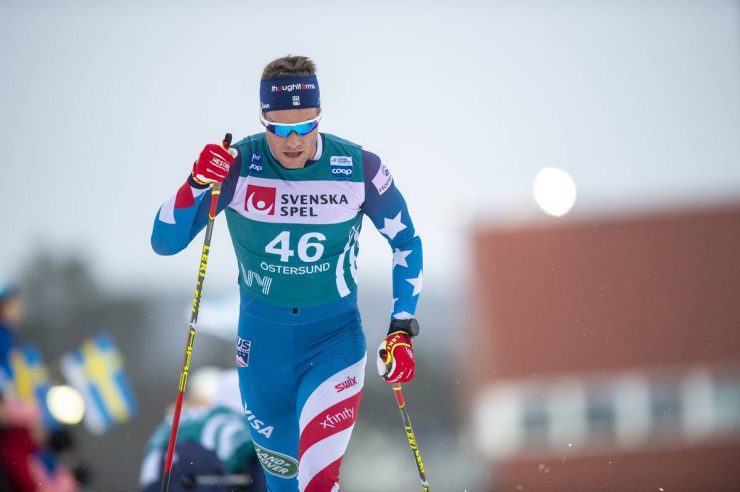
Simi Hamilton racing in Östersund, Sweden. (Photo: NordicFocus)
FS: Is that perhaps because you had a personal connection specifically with Erik?
SH: I definitely wouldn’t say that I wouldn’t have had that same experience with anybody else. But, Erik and I always had a close, really special relationship with each other. And I think we both understood each other. We understood what motivated the other person. We understood what bummed the other person out.
I think we were doing it for the right reasons. Just being able to share an experience like that with someone who really gets you and who you get is pretty cool. I’m sure it’s like when you’re on a team, playing a team sport, whether it’s hockey or soccer or baseball, whatever it is, just being able to share a huge success like that with your whole team, it’s got to be a very similar feeling.
I have enormous pride for what Jessie did this season or our girls are on a podium, we always feel a lot of that. But, I think to be in the team sprint with one other person who is one of your best friends in life, there’s not a lot of substitution for that.
Simi Hamilton racing during the team spring semifinals at the 2021 World Championships. (Photo: NordicFocus)
FS: That brings up the experience this year at the World Championships with Gus. Maybe give us some insight. You are paired with an exceptional skier in Gus who is more than ten years your junior. This was his first senior World Championship race and I am sure he was nervous. What was that emotional trajectory like for you?
SH: I definitely won’t say that that day was not heartbreaking. But, I will also say, with 100%, truthfulness and accuracy is that it wasn’t heartbreaking because of Gus. It was just heartbreaking because of the situation. It wasn’t that we got unlucky, but we didn’t get lucky that’s for sure.
Gus would have done anything for me that day. He knew how important that day was for me, but I think he thought the result was way more important for me than it was. And the result was absolutely important. We both went into that day wanting to get on the podium, and we knew that we could but it had to take the perfect race from both of us – and probably perfect conditions for both of us, which, you know, it wasn’t.
It was never is never about the result for that day, that was our goal and it would have been a perk, but there was so much more about that day that was important. A lot of what happened was, I think, it can mostly be attributed to Gus just not having that much World Cup experience yet and team sprint experience, and being able to adapt as you’re racing especially on a day when conditions are changing that much.
And, you know things were so different from even a couple of minutes before. What happened that day was we were in the second semi-final which was an unlucky thing in the first place, just because those springtime championship races in the middle of the day the conditions are changing so quickly. The course is slowing down like 10 seconds per lap — that’s how much it was breaking down as it was getting softer and slower. So the first couple of tags we did, the snow was decently fast, but you could tell it was starting to slow down. But towards the end of that semi where you’d come into the tag zone, it was just everything you could do to try to sprint through slush.
I think on that last tag, when I was tagging Gus, he just thought the tag zone was way faster than it was, and he started going with the guys who were around him. And that was just a little bit too early, and we missed the tag. I made the split-second decision to not try to hide that and actually go back into the zone with him and get the tag off because I just figured, you never really know what’s going to happen in that lead pack, there could be a crash, you something could happen. I figured it was worth doing it right because I also knew the jury always sees if you tag or not and I knew we had not tagged.
So I made that call to tag. We skied our asses off but it wasn’t enough.
He was devastated. I think that he finally understood that that is just part of racing — shit happens and it sucks when it happens on a day like that in a race like that. That’s one of the lessons he’s gonna have to learn, and I mean he has learned, I guess that’s kind of a rude awakening for your first World Champs. But this season, as I said, it’s been so much more about getting those results and what I could do in my last World Championships.
All of those things would have been awesome and they were goals that I had, but it was about way more than that, and I think at the end of the day we both recognize that and appreciate that.
I’m just psyched to see what he can do in the future and I’m sure he’ll start doing team sprints with one of those other young guys. I’m sure that in six years or 10 years, however long, they will be winning medals and it’ll be pretty cool to see.
FS: To close out, let’s talk about risk-taking. As someone who loves adventuring in the mountains, and I mean real-deal adventures, you’ve got to be constantly assessing risk. You are married. Thinking about kids. Renovating a house back in Colorado. Those things make people reassess. Skiing off North Maroon last spring, for example, that brings a certain spice level and some real risks to mitigate. All things considered, how do you consider risk-taking now knowing you will be lured into those amazing Aspen hills soon?
SH: I will be the first to tell you that compared to 10 years ago, I have no desire to really push the limits too much. Obviously like by doing anything even getting in a car or whatever there’s risk involved. And there’s a lot of things that we do, we do them because there is some amount of risk. It’s cliché to say, but that’s what makes you feel alive, like if you’re not doing anything that isn’t sometimes a little bit dangerous, then you’re not appreciating life, I think, to its fullest extent. But, at the same time, I don’t need to be out there like filming all these gnarly things and jumping off shit on my skis or my bike. I don’t think I need to be doing that to feel a sense of self-worth and value to society. I feel that in the last few years, I’ve started to recognize some individuals out there who are doing an unbelievable job with kind of telling the story versus posting the sickest photo or skiing the gnarliest line. And to me, that’s so much cooler, and a more admirable way of going about your life, people figuring out a way to tell this really interesting story and cool interesting experiences and connecting with people that aren’t exactly like you.
So that’s what I’m most looking forward to.
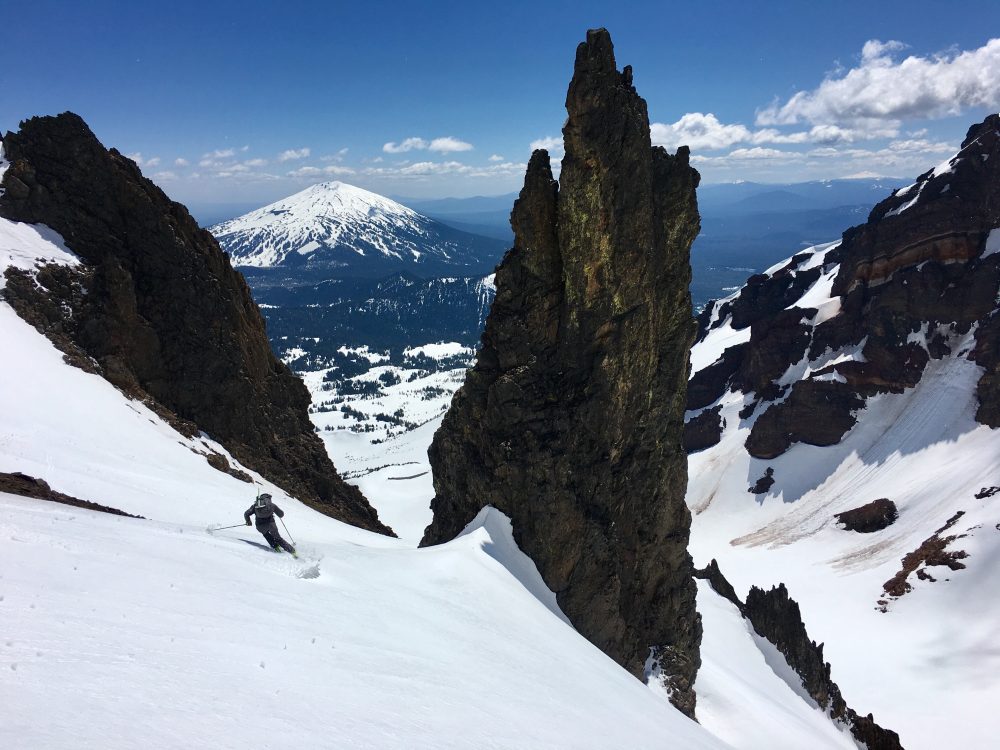
Simi Hamilton harvesting corn snow on Broken Top near Bend, Ore. (Photo: Linden Mallory)
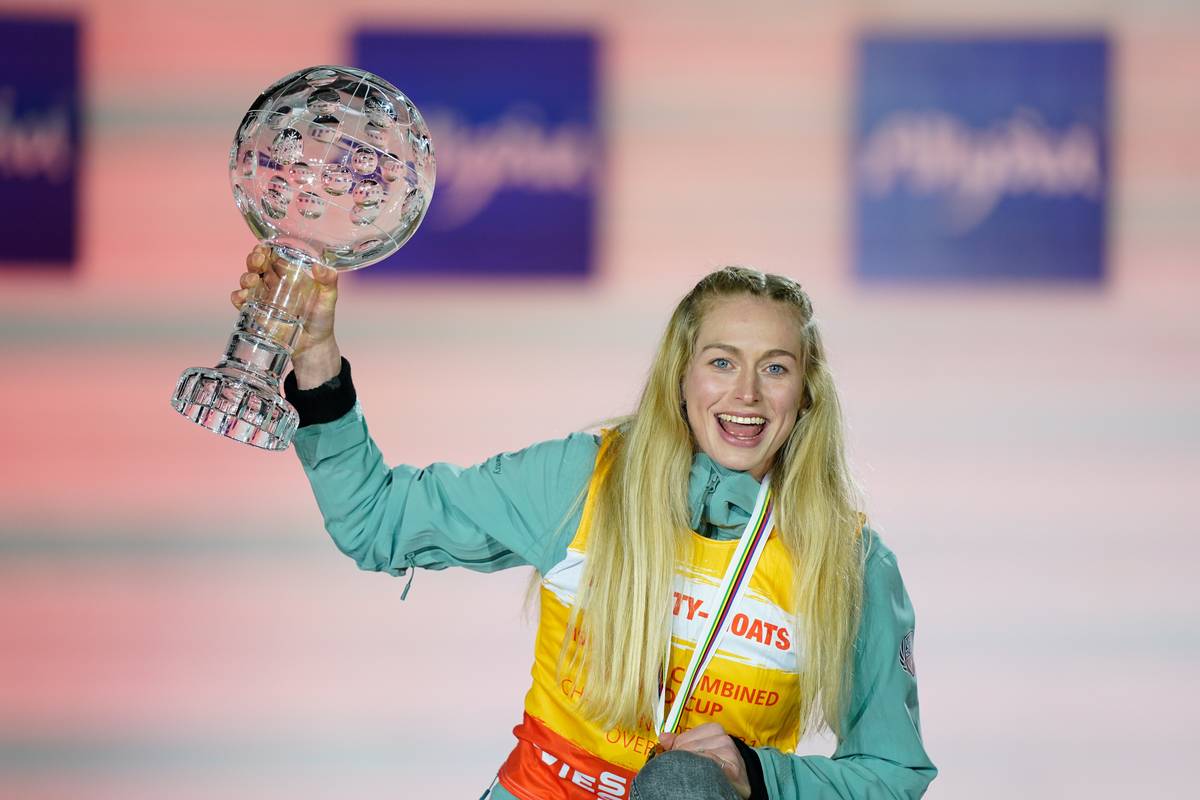
Tara Geraghty-Moats hoisting the first-ever awarded overall World Cup crystal globe for women’s nordic combined. (Photo: NordicFocus)
This year was a big year for women’s Nordic combined racing, not in the way 2020 was a “big year”, but in a record-breaking, moving forward to better things kind of way. For those of you who don’t follow Nordic combined, here’s what you need to know: Competitions involve ski jumping, in which athletes are scored based on style and distance, and later in the day, they compete in a pursuit-start skate race based on their performance on the jumps. It is also the last sport at the Olympics to be contested only by men.
The 2020/21 season marked the first year of a World Cup circuit for women’s Nordic combined racing. Enter Tara Geraghty-Moats, who won the inaugural FIS Nordic Combined World Cup in Ramsau, Austria and took home the Overall Crystal Globe for the season.
Geraghty-Moats grew up in West Fairlee, Vermont and has been competing on the Ski Jumping World Cup circuit since 2014. As FIS has taken steps towards gender equality in the sport of Nordic Combined, Geraghty-Moats has been at the forefront. When the Continental Cup was established in the 2018/19 season Geraghty-Moats placed first in eleven out of the twelve competitions that year. In 2019/20, she took home the gold in every single Continental Cup race. Heading into 2020/21 with the first World Cup circuit, Geraghty-Moats looked to be the strong favorite.
“This was our first ever season of women’s Nordic combined World Cup and I was very excited about it,” said Geraghty-Moats, “going into the season I knew that there was a possibility of cancellation but I was really hoping for the best, trying to stay optimistic.”
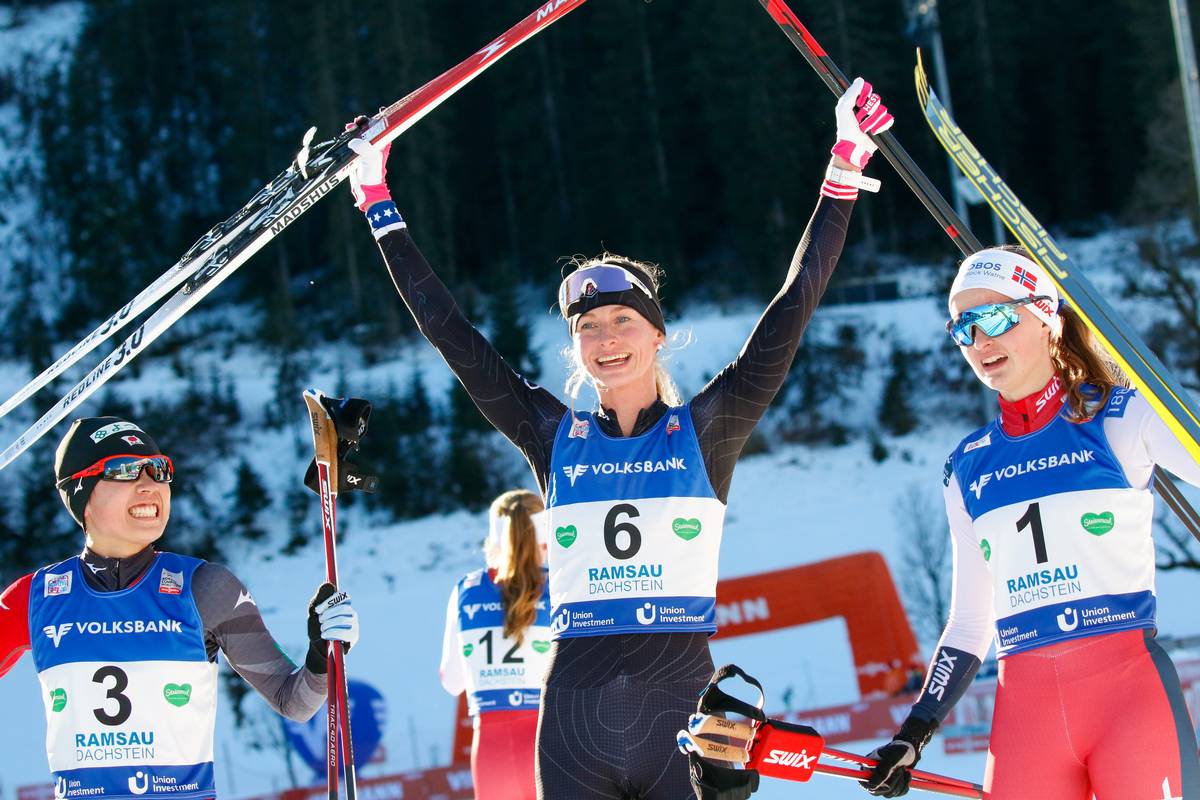
The podium from the individual Gundersen HS98/5km, in Ramsau, Austria: Anju Nakamura (JPN), Tara Geraghty-Moats (USA), Gyda Westvold-Hansen (NOR) (l-r). (Photo: NordicFocus)
In Ramsau for the first-ever women’s World Cup event, Geraghty-Moats was in fifth after the ski jumping leg, having a 39-second deficit to make up on her competitor, Gyda Westvold Hansen of Norway. Geraghty-Moats did just that over the 5k skate, finishing 1.5 seconds ahead of the Norwegian and becoming the first women to be awarded World Cup gold in the sport’s history. The two other World Cup competitions scheduled for the season were canceled due to COVID, but World Championships went on as planned in Oberstdorf, Germany.
In Oberstdorf, Geraghty-Moats came in fifth after starting the cross-country portion in 18th position starting 2:13 minutes behind the leader. On Instagram, Geraghty-Moats wrote, “I am incredibly proud I got 5th at the World Championships. I felt like I used the opportunity and support I had to its fullest potential… Complications this season meant I was not able to ski jump as much as I needed to. I was not a good enough ski jumper to overcome only having 205 jumps since March 2020. I did the best I could and that is all I can ask of myself.”
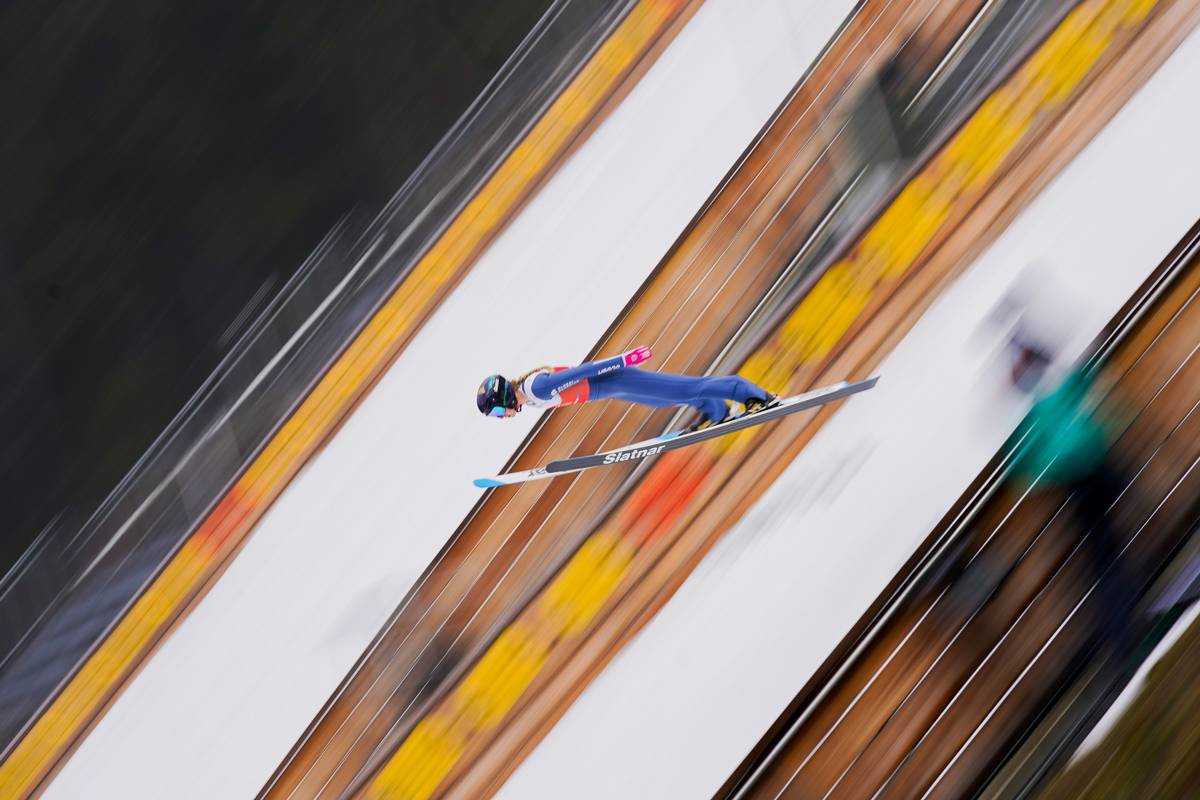
Tara Geraghty-Moats jumping during 2021 World Championship women’s nordic combined individual Gundersen HS106/5km, in Oberstdorf, Germany. (Photo: NordicFocus)
At the conclusion of a historic season, Geraghty-Moats became the first woman to take home the FIS Nordic Combined Overall crystal globe. To this achievement, Geraghty-Moats wrote, “We did what we could with what we had. We made history and came home with a crystal globe. We didn’t have a lot but we had each other. I’m proud of this team. These girls are tough, I’m honored to have them as my teammates.”
Speaking to Geraghty-Moats after the season’s end she reflected on this achievement by saying, “It’s pretty wild, it’s a huge honor. After I was awarded [the globe] I kind of woke up and had to pinch myself that I was the first-ever globe winner. I’m really proud that all my hard work paid off and not only that I helped the sport move forward but that I was able to get the first overall.”
Despite the progress towards parity in the sport, many challenges still remain. The men’s Nordic combined World Cup schedule this season included 13 venues and competitions (six of which were cancelled due to COVID), whereas the women’s schedule only included four, three of which were cancelled.
Geraghty-Moats said, “In the spring (2020) we thought there would be about eight World Cups, four weekends, which although that isn’t too much we were excited for the first year of the World Cup. We didn’t know how many were going to get cancelled but it was going to be a good start. And then going through the season more and more started getting cancelled and it was pretty hard to keep our motivation.”
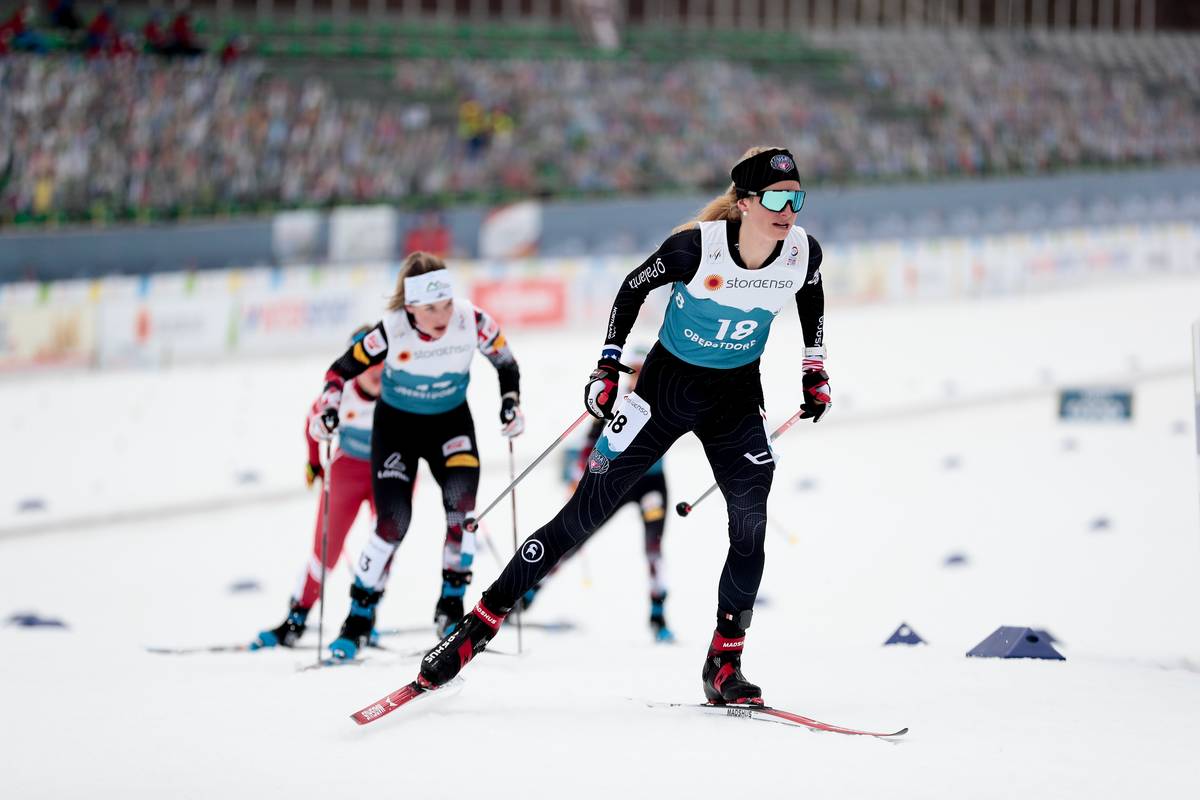
Tara Geraghty-Moats during the ski portion one the women’s individual Gundersen HS106/5km, at the 2021 World Championships. (Photo: NordicFocus)
On the topic of parity, Geraghty-Moats acknowledged that this season was a big step forward, “it wasn’t as big as we wanted it to be because there weren’t that many World Cups but it is a huge step towards being included in the Olympics, we had our World Championships which was huge and a very successful competition but it wasn’t as big a year as we had hoped for,” said Geraghty-Moats. Even after an inaugural World Cup season, women’s Nordic combined will not be included in the 2022 Olympics in Beijing.
“I would really encourage people to follow women’s Nordic combined, take an interest in it and support the female Nordic combined athletes who are trying to make waves in the sport,” said Geraghty-Moats. “I guess I would challenge everyone… to engage in our story and be an active part of moving this sport forward because at the end of the day, sport is a business and we need more fans and more attention to move this forward. And I think that is starting to happen, especially after the World Championships, but the more involvement we can have, the better for gender equality in the sport and better for the ski community as a whole.”
Nordic combined fans can expect to see more of Tara Geraghty-Moats as she continues to push the boundaries of the sport and compete at the highest level. “It will be a season I tell my grandkids about,” Geraghty-Moats said, “I got the overall in the middle of a pandemic in the first-ever season of women’s Nordic combined. Like you can’t even say that without going like, wow, what?! There is only forward, only upward to go for women’s Nordic combined and I’m really excited to see the progress we will make in the coming years.”
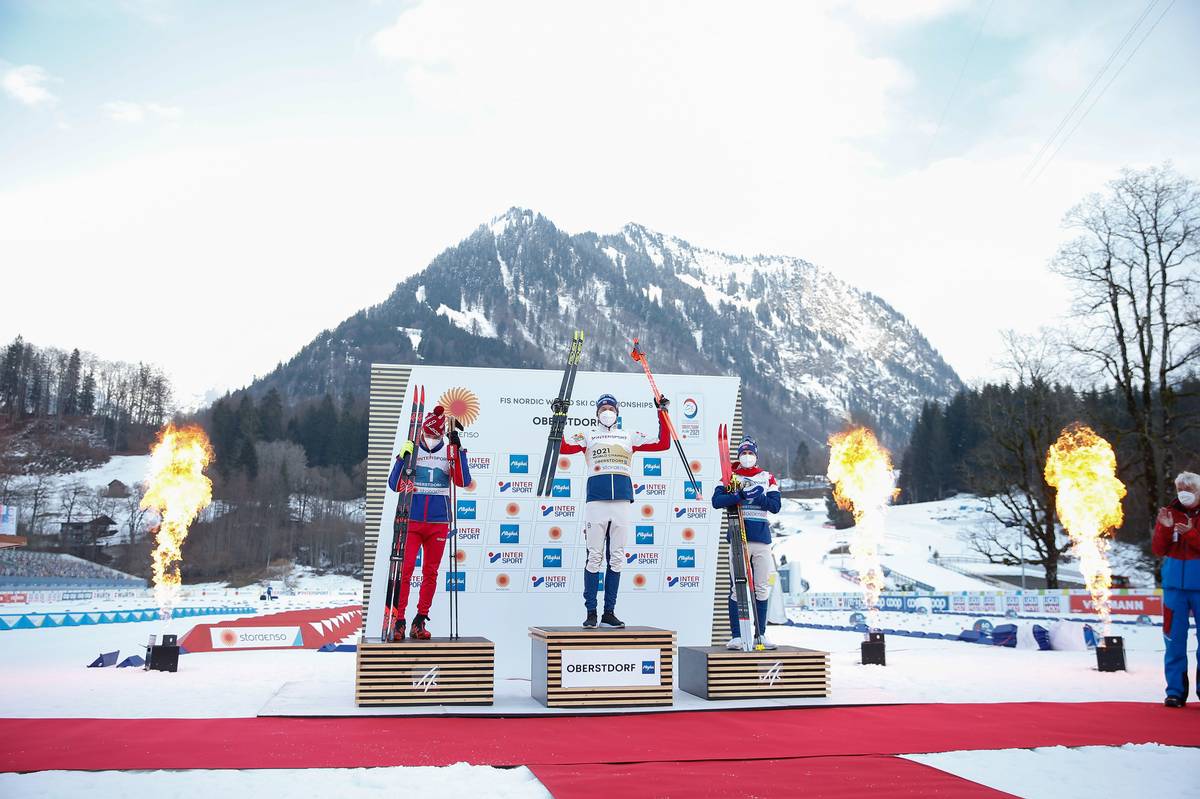
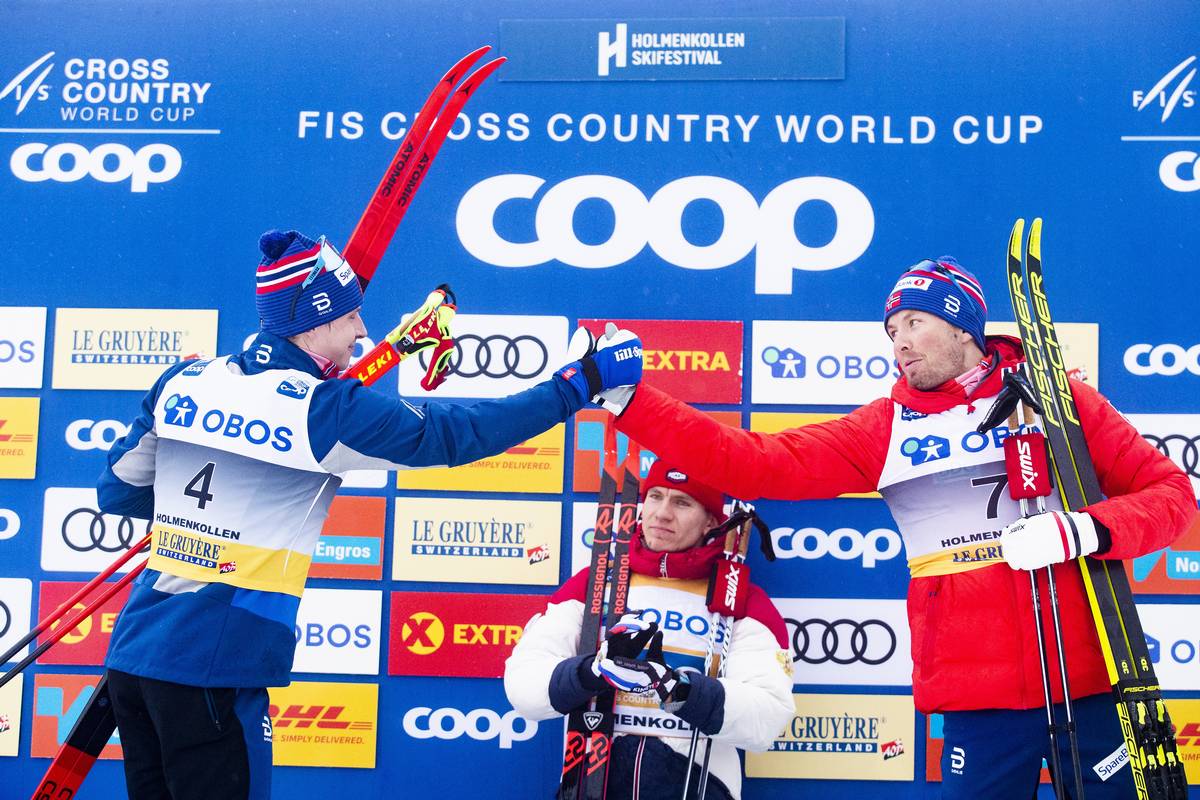
The men’s 50 k podium: Alexander Bolshunov (RSF) second, Emil Iversen (NOR) first, and Simen Hegstad Krueger (NOR) third. (Photo: NordicFocus)
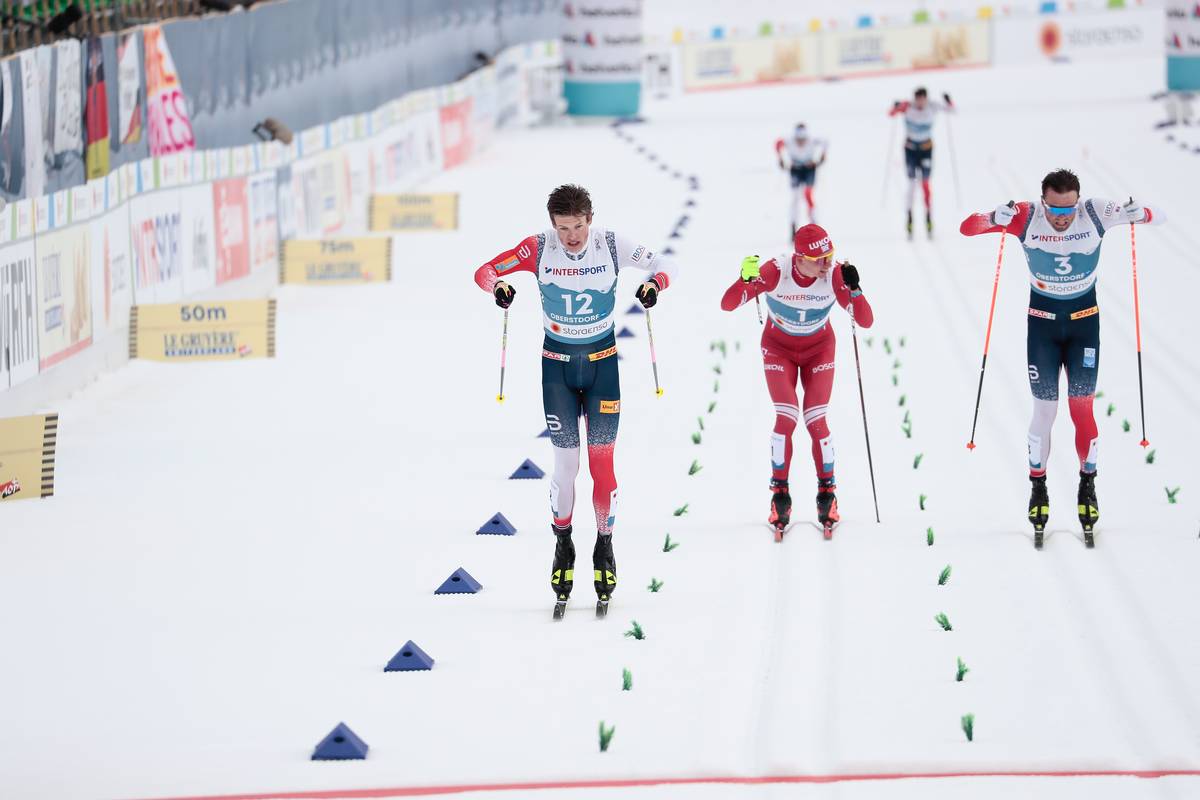
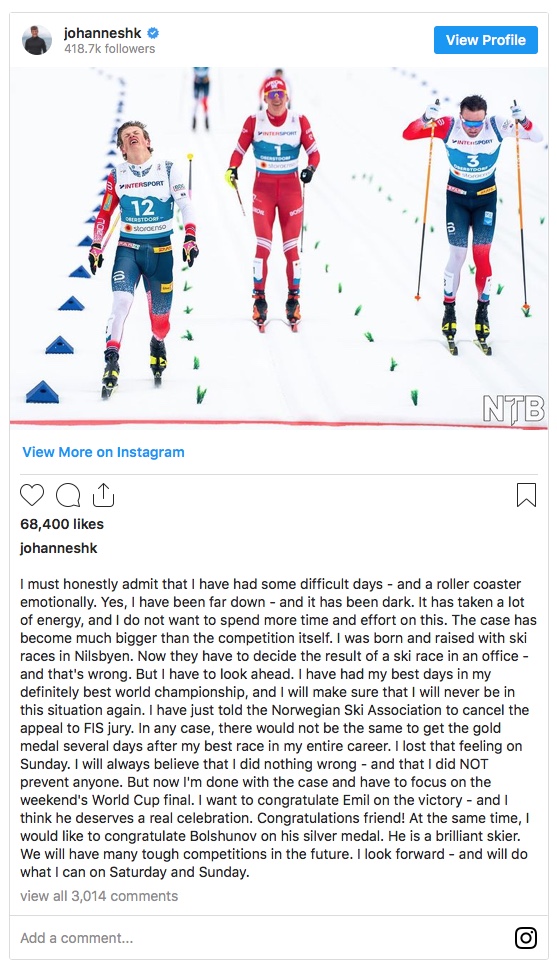
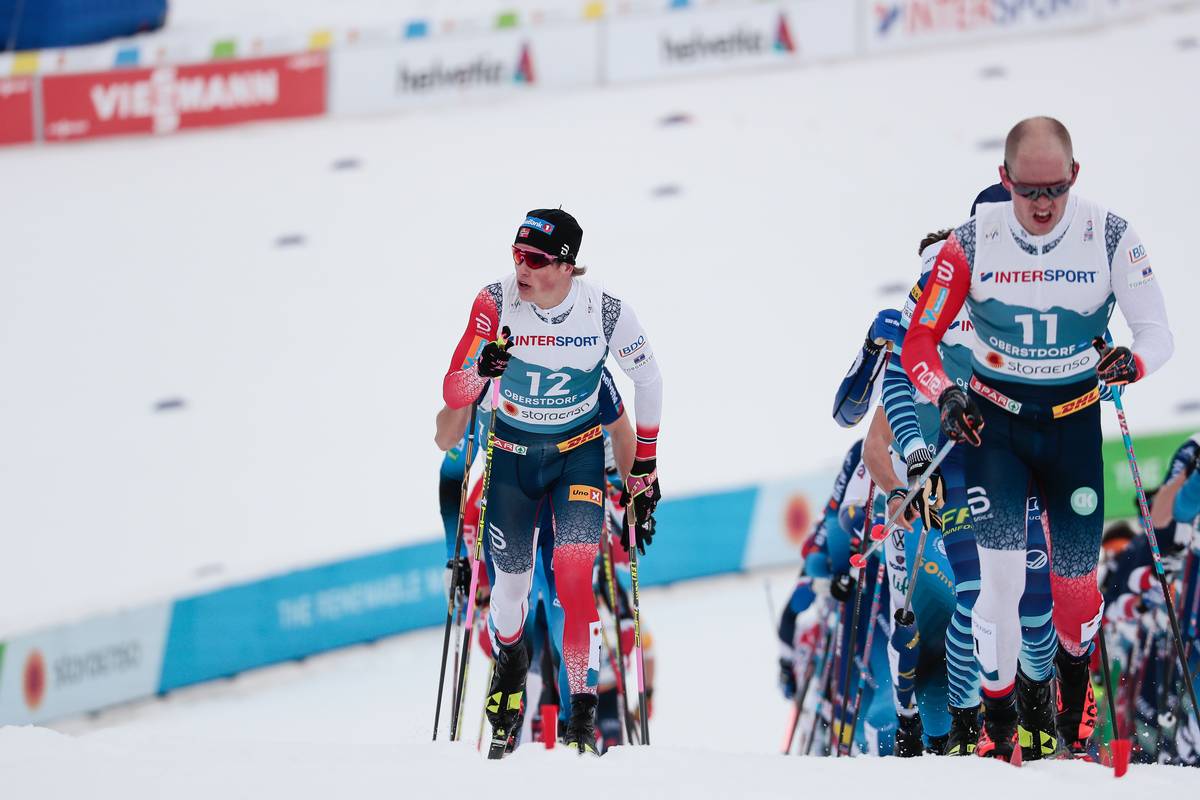
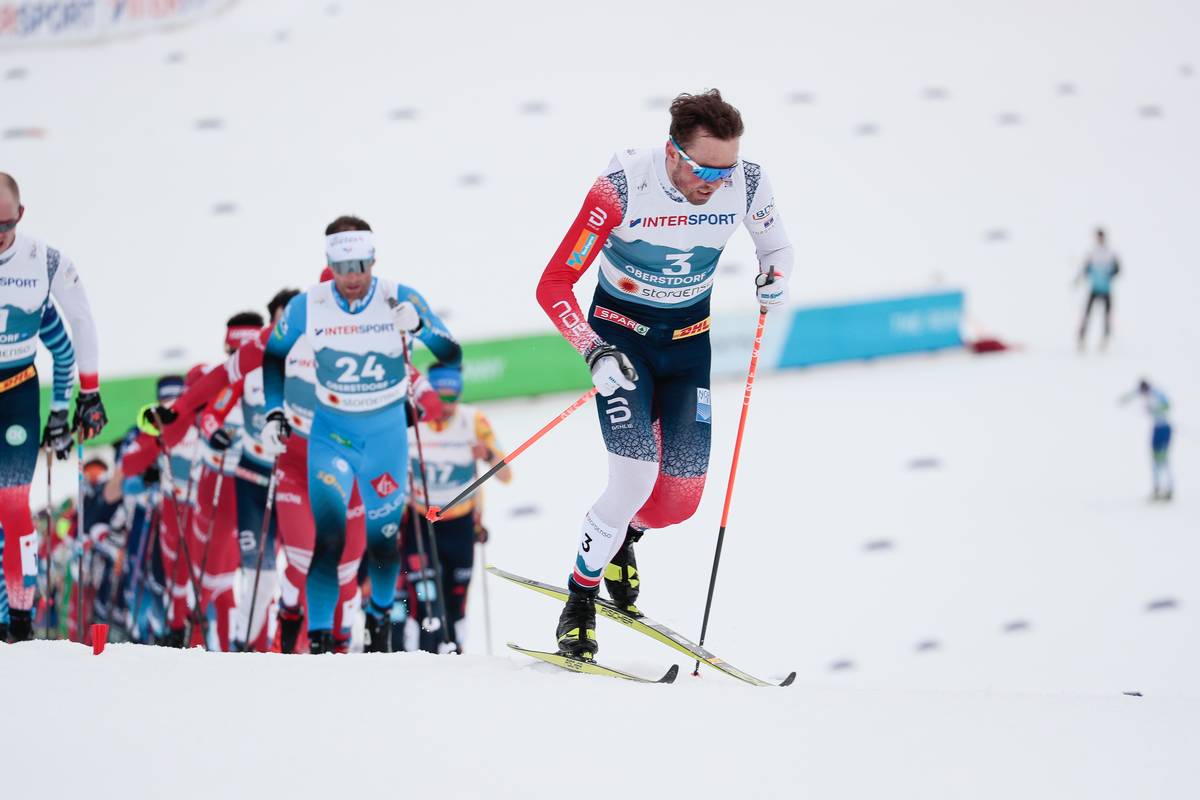
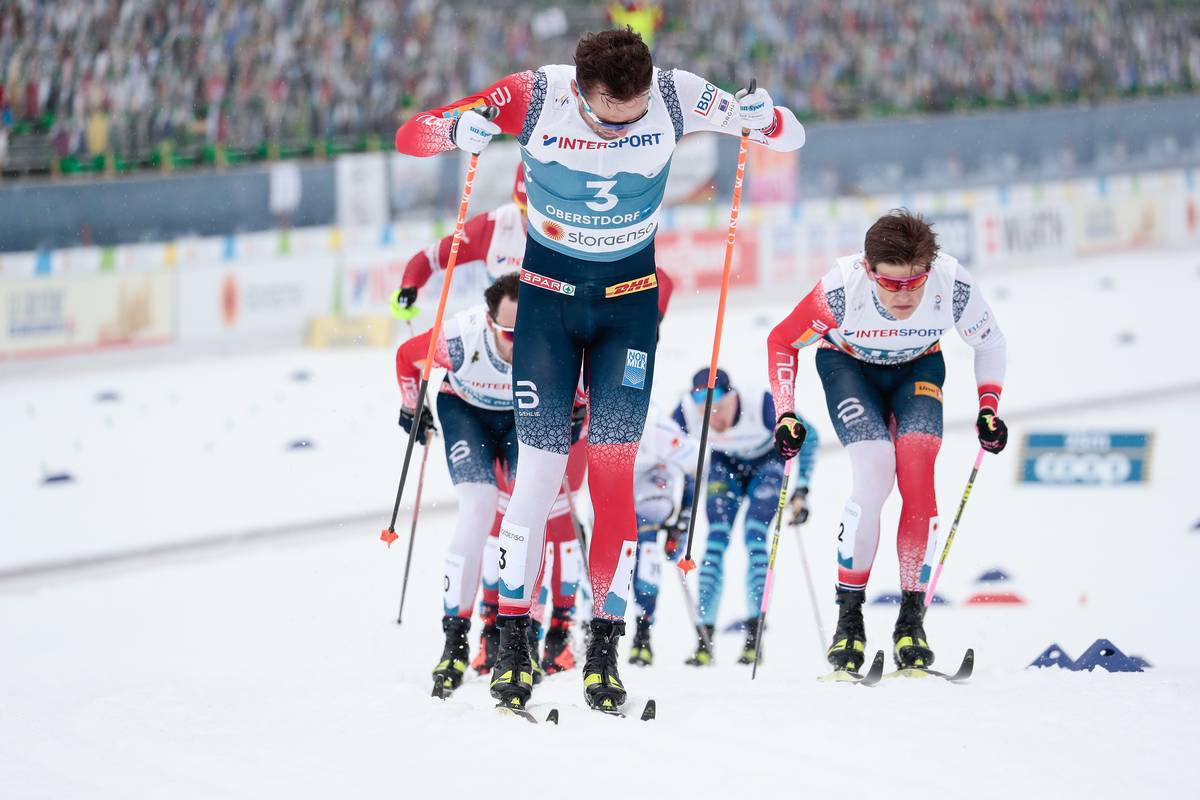
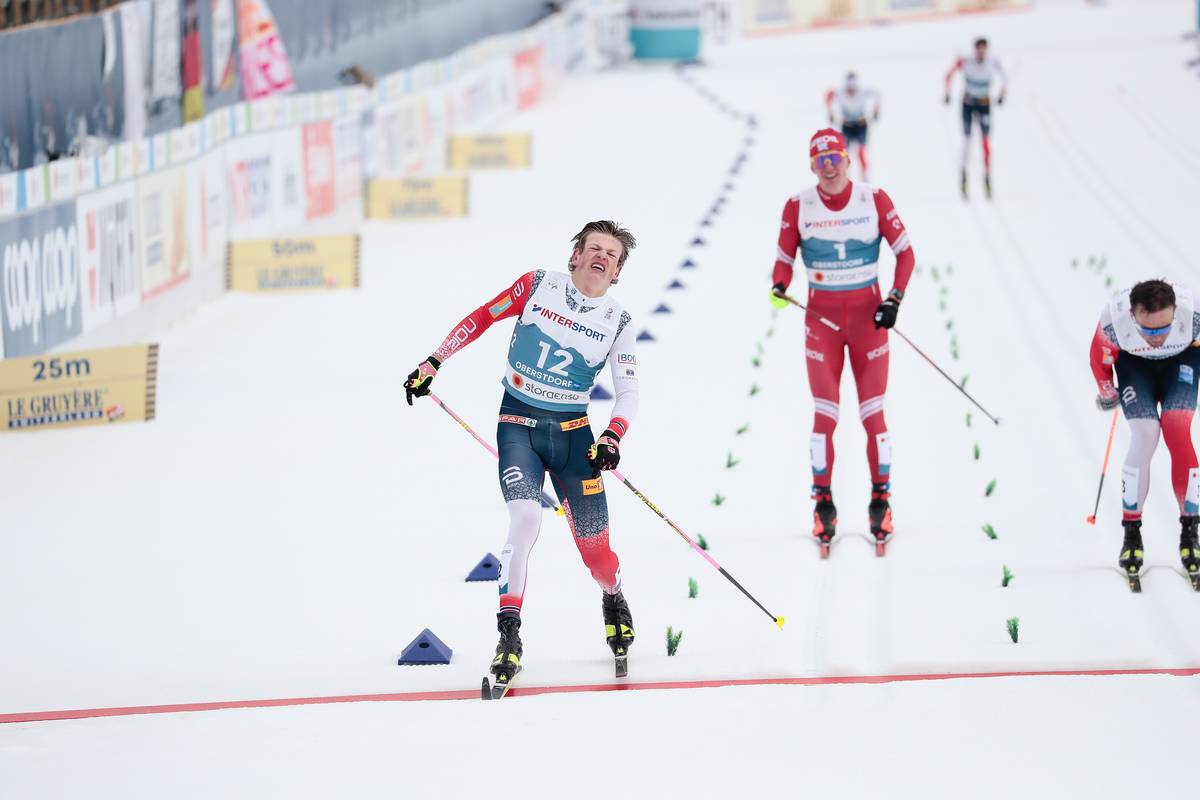
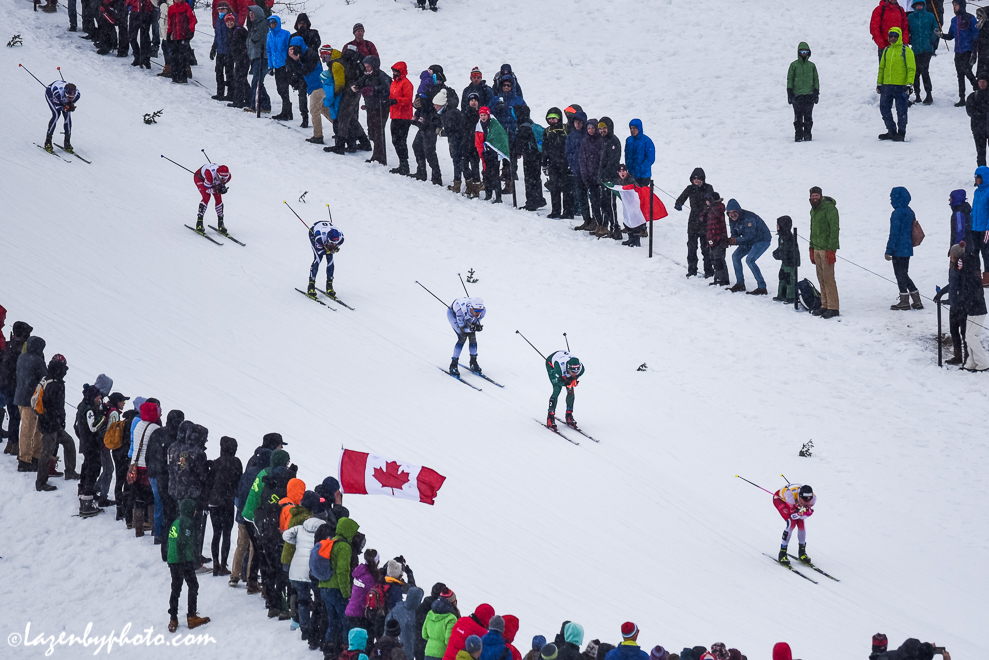
Let’s dial back to mid-March and the close of the 2021 World Championships with the men’s 50-kilometer mass start classic race. Russia’s Alexander Bolshunov and Norway’s Johannes Høsflot Klæbo came into the final corner and finish-straight in close quarters for the win. In the real-time fast-paced moment, Bolshunov and Klæbo tangled, with both skiers barely maintaining balance.
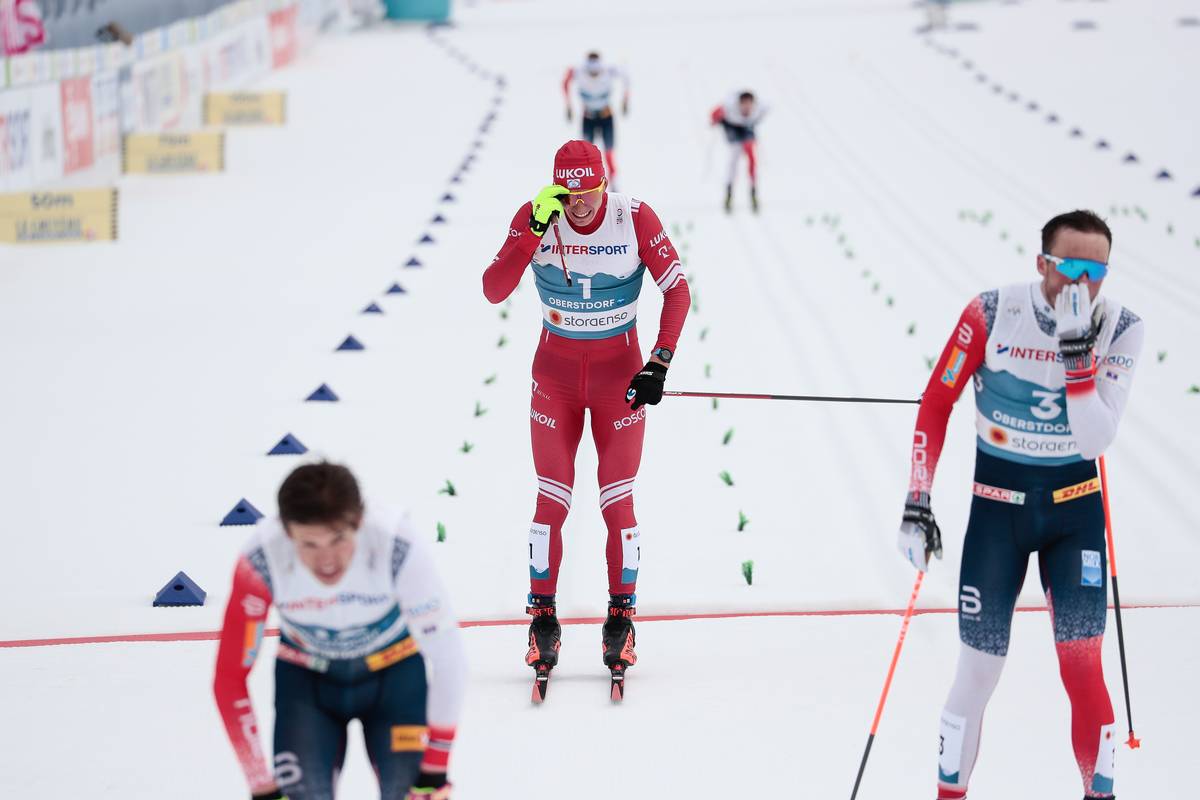
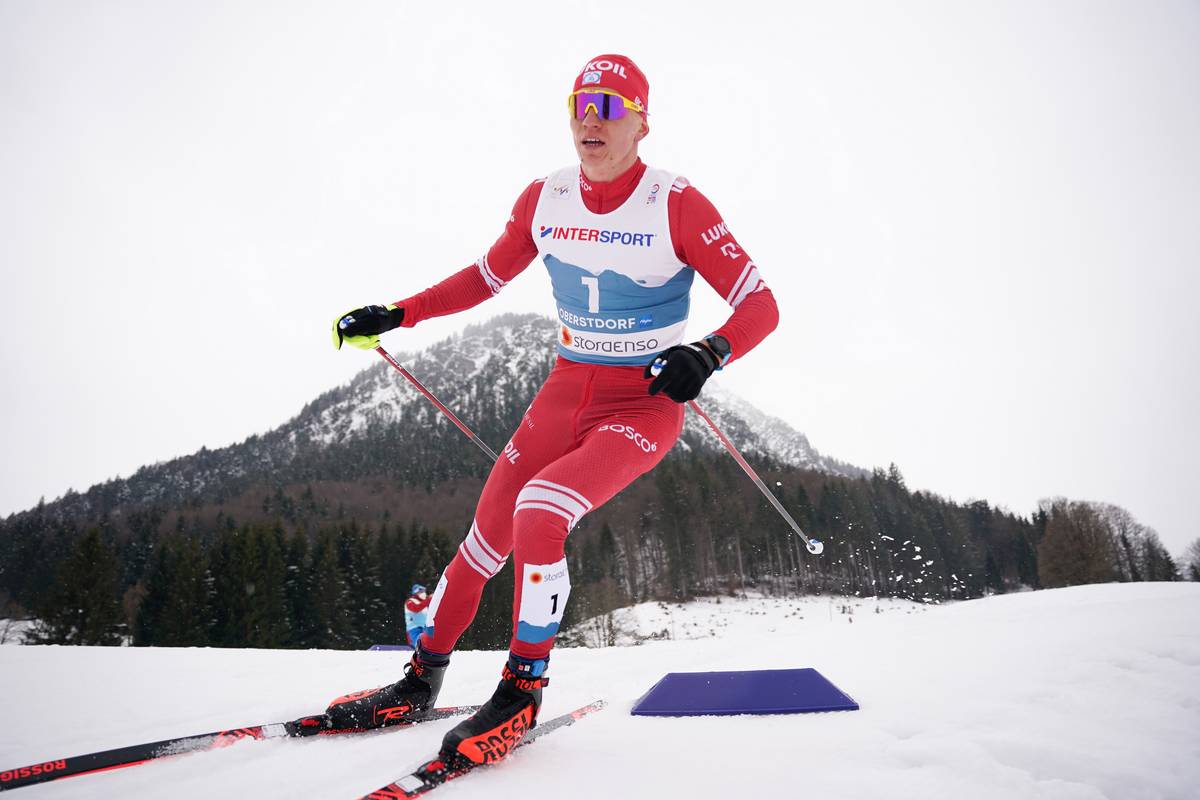
To summarize, Bolshunov used all available real-estate coming around the final turn. Klæbo, as he had been doing throughout the championships, carried speed, and schussing to the outside of Bolshunov. There simply was not enough room for both skiers. Klæbo kept his momentum, barely, while Bolshuvnov, snugged up close to the Norwegian, snapped a pole. Meanwhile, the third-place skier at the time, Norway’s Emil Iversen, sped past Bolshunov and his not compromised single-pole finish speed.
First, it appeared Klæbo had won. The live feed then began covering images of the race jury room and something was clearly afoot. Perhaps thirty minutes later, Klæbo was DQ’d for violating FIS rule ICR0 343.10 – Obstructing another athlete when overtaking.
Iversen, the second-place skier across the line, was declared the winner — he passed Bolshunov in the closing meters, with Bolshunov earning silver. We have included several slo-mo videos to highlight the incident.
In the weeks since many have debated the ruling and the outcome. The Norwegian Ski Federation initially filed an appeal. A day later, Klæbo asked the federation to rescind the appeal. Case closed.
Our first set of comments are from Alaska’s John Estle. FIS TDs John Matt Pauli, Lin Hinderman and Scott Jerome reviewed the comments and agreed in principle with the conclusions stated in this section:
The first thing to remember: the skier who is overtaking another skier has the responsibility to make a clean pass. The pass is not complete until the overtaking skier’s tails are (comfortably) in front of the tips of the skier who is being overtaken. Keep that definition in mind.
Also, it is generally accepted that the skier in the lead has the right to choose whatever path he/she wants to get to the finish, provided that they don’t make a sudden change in their line, or zig-zag, to block someone.
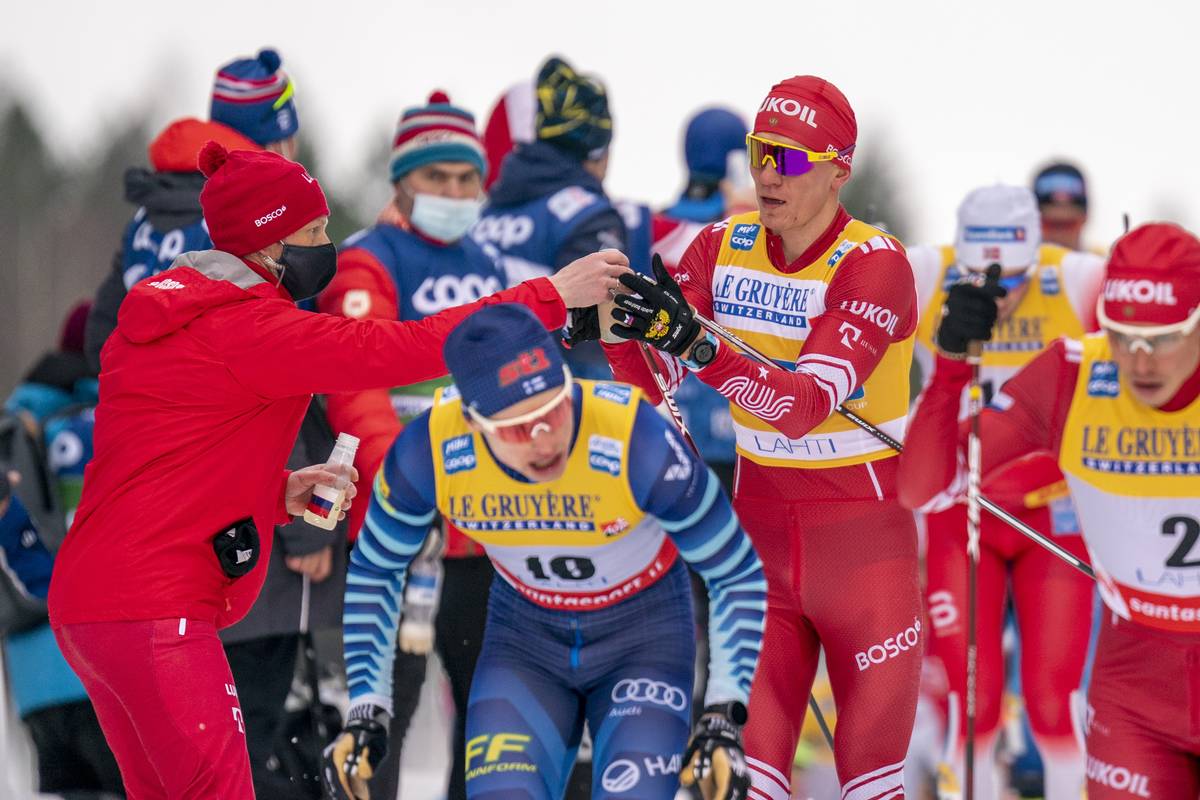
To go back a month-and-a-half, in the Lahti relay Joni Maki of Finland was leading Bolshunov into the Lahti stadium, which has a long, relatively high speed, sweeping left turn into the finish straight – similar to the arrangement in Oberstdorf. As Maki was nearing the end of the turn and the start of the finish straight, Bolshunov tried to overtake Maki on the right. His ski-tips got up by Maki’s boots, so Maki knew that Bolshunov was trying to pass.
Once Maki saw that Bolshunov had committed to passing him on the right, Maki had an easy tactical choice: just keep going as far to the right as possible so as to leave Bolshunov no space to pass. That’s what he did. That’s when Bolshunov took a swipe at Maki with his pole, because Maki had not given Bolshunov any space to pass. Bolshunov had to let up and let his tips get behind Maki’s tails so he could then go around Maki and make a clean pass. Of course, because he decelerated so much, lost his cool and was close to the finish, he had no chance to pass. Then he decided to cross-check Maki after the finish line.
After that incident, everyone castigated Bolshunov for his behavior (pole swipe, cross-check); no one faulted Maki for taking advantage of Bolshunov’s tactical error (getting his tips beyond Maki’s tails and leaving himself no options). There were no sanctions against Maki for going far to the right.
Maki was trying to beat Bolshunov. Going all the way to the right was the tactic that gave him the best chance to beat Bolshunov, so that’s what he did. The objective is to win within the rules, so he did everything he could do within the rules to achieve that objective.
Now, fast-forward to the finish of the Oberstdorf WSC 50 k, which was almost a perfect replay of what happened in Lahti.
Bolshunov led down the final hill (with considerable daylight between his tails and Klæbo’s tips) and around the big, sweeping left turn into the finish straight. Klæbo initiated an attempt to overtake Bolshunov on the right, with both of them traveling at a very high speed. Had Klæbo been able to completely overtake Bolshunov before they got to the finish straight, all would have been well. However, Klæbo was not able to complete the pass – he was just pulling even with Bolshunov when the trouble started. By definition, Klæbo was still in the process of overtaking Bolshunov.
Bolshunov, with the experience of the Lahti finish in his back pocket, made the obvious, logical choice to go as far to the right as possible and leave no space for Klæbo, because that was his best (only?) chance to win the race. Remember that Bolshunov and Klæbo have sprinted against each other a few times in both sprints and mass-start races, and Bolshunov knew well that if he chose a route to the finish that would provide a clean path for Klæbo, there was a very good chance that he would be beaten to the finish line by Klæbo. I hope I am not attempting to get too deeply into Bolshunov’s mind to think that his awareness of their history had an influence on his choice of tactics approaching the finish. He was in the driver’s seat because he had the “right of way” having been in the lead and Klæbo being the one trying to overtake.
It is also useful to keep in mind that all of the skiers in the 50 k spent quite a bit of time skiing (especially double-poling) out of/between the tracks. If Bolshunov thought that it was faster out of the tracks, he had the right to go for the spot between the rightmost tracks and the v-board so that he could double-pole to the finish out of the tracks.
So, Bolshunov went as far right as he could, leaving Klæbo with insufficient space, between the v-boards and the rightmost tracks, to complete a clean pass. It was the most logical tactical choice for Bolshunov (he wanted to win!) and was, according to my experience and my reading of the rules, completely within the rules. I watched the replay from two different angles several times. Bolshunov never changed his line, which would have been a violation. He simply had Klæbo right where he wanted him (thanks to Klæbo’s choice of tactics), and he took him to the edge of the course and closed the gate. Many skiers, runners and bikers have done the same thing in the same situation.
Did Bolshunov skate a little wide with his right ski once or twice? Maybe, but there is no rule in the book that I can think of that would define what Bolshunov did in that situation as a violation. Maybe Klæbo would have skated that wide, too, if he hadn’t been hemmed in by the v-boards on his right. Bolshunov never extended his arm to push Klæbo farther to the right — that would have been a violation.
Klæbo has incredible balance and agility on his skis and can accelerate like nobody’s business. However, in this situation, he was outmaneuvered by Bolshunov because he (Klæbo) made a tactical choice that left him no options. There were two alternative tactics which, had he chosen one of them, would have avoided the problem: 1) keep his tips behind Bolshunov’s tails, wait until Bolshunov commits to a finish track, then choose a clean/empty track, and 2) pass Bolshunov on the final uphill and get a gap. Maybe option #2 was not physically possible for Klæbo at that point. But that doesn’t matter.
Klæbo, because he is so good on his skis and can accelerate so dramatically, has virtually always been able to overtake skiers in tight quarters and sketchy situations, because his skills allow him to do things that other skiers are incapable of. However, in this case, his skills were insufficient for the task at hand.
Klæbo must not have watched the video from Lahti. Had he watched that video, he would have had a pretty good idea of what Bolshunov might choose as a tactic if he (Klæbo) tried to overtake on the right. Maybe he wouldn’t have tried to pass so far out from the finish.
Initially, the Norwegian Ski Federation appealed the decision of the Jury, but later withdrew the appeal when requested, by Klæbo, to do so.
The Jury is 100% responsible for making (subjective) judgment calls based on how they interpret what they see in the video. Upon appeal, a Jury decision can be overturned. However, in practice, it is rare for a subjective/judgment call to be overturned. Normally decisions are reversed only if the Jury did not follow proper procedures not followed.
That’s how it should be. If the higher level can reverse subjective calls, then no TD and no Jury member is ever going to want to make a difficult decision, because their subjective evaluation could always be reversed by a “higher level” (of people who WEREN’T THERE), and they would end up with egg on their face, even though they did everything correctly.
In my experience working on Juries at major events, the TD and Jury work very hard at following correct procedures, so that a Jury decision (whether I agree with it or not) will be upheld if it is appealed.
In this case, with a very experienced and knowledgeable Jury (Norwegian TD!), I have no doubt that the correct process was followed.
One other issue that I believe affects people’s perception of what the Jury decision should have been, is that I believe many people were taking into consideration in this case Bolshunov’s behavior in the final meters of and after the finish line in the Lahti race. I found Bolshunov’s conduct in Lahti reprehensible. I in no way condone that. However, in the 50Km in Oberstdorf, the Jury had to evaluate the situation between two skiers, not one “good guy” and one “bad guy.” They had to evaluate the situation without any regard for what they may have thought of Bolshunov’s conduct in Lahti. In the eyes of the Jury, it just was two guys approaching the finish line.
I’m sure that this situation and decision will be used in TD/Officials training well into the future. I have spent a lot of time thinking about it, and trying to be objective and applying rules as precisely as possible. It was a very unfortunate way to conclude a World Championships. But I think it was the right way.
Is there any way to avoid a repeat of the Oberstdorf 50Km? I don’t think so. Each venue has its own quirks and limitations which can create less-than-perfect approaches to the finish. In places where the approach to the finish involves high speeds and long, big radius turns (e.g. Oberstdorf, Lahti, etc.) there is only one best line for skiers, and that is as close to the inside edge of the turn as possible.
If a skier skis any significant distance off that inside line, he/she is skiing a lot of extra distance, which no skier wants to do – especially at the end of a 50Km race. So, what happens is everyone wants to occupy the same space. Isaac Newton has made clear that doing so is not possible within the laws of physics. When everyone wants the same space, there will be conflicts.
However, my guess is that Oberstdorf spent many millions of dollars developing their venue. I have been told that the venue is hemmed in in places by private farmland, which places limits on how the finish can be arranged. Similarly, in Lahti, given the soccer pitch where the race finishes and the location of the grandstand, practical considerations mean that their finish setup is unlikely to change.
In any venue where the start and finish are at the low point of the course – a very common situation, it is almost impossible to avoid having a downhill near the finish, which means higher speeds. And if more land with terrain below the start and finish is not available, there is no way around that issue. Which doesn’t mean people shouldn’t build ski trails and racecourses where the start and finish are at the low point.
The venues I am most familiar with (including my home venue, Birch Hill) all have limitations that create work-around situations. Every compromise arising from a limitation is the potential cause for a problem in a race. What it really comes down to is this: given that the host venue has done everything in its power to create a course that makes safe and fair competition possible, the competitors have to choose tactics that will work without creating problems that the Jury has to “solve.” In this case, the choice of tactics did not match up well with the arrangement of the race finish.
***
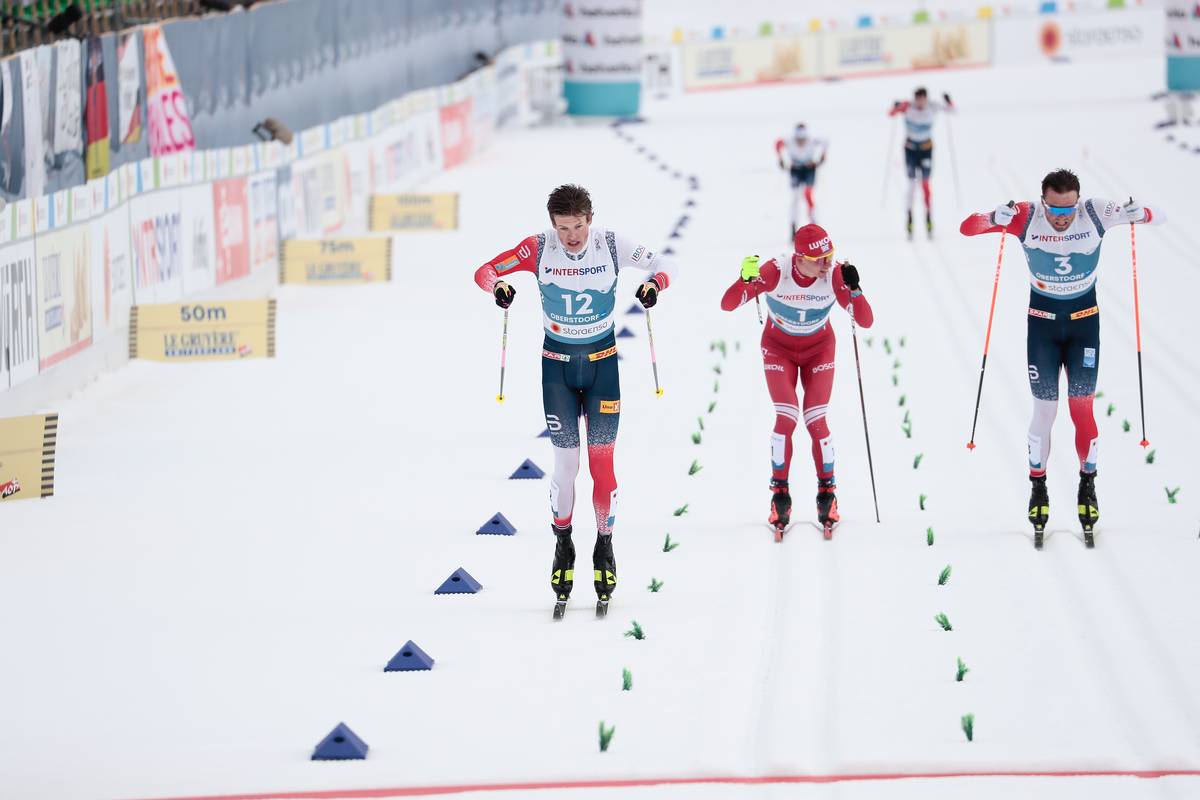
The closing stages of Sunday’s 50 k classic mass start. Klæbo (NOR), Bolshunov (RSF), and Iversen (NOR) (left to right). (Photo: NordicFocus)
Our next comments are from Ollie Burruss, a TD who has organized and led Senior National Championships from his home base at the Craftsbury Outdoor Center:
What I saw (and admittedly I’ve only seen it in the context of the replays and reviews, so I knew there was an incident prior to seeing it) was a high stakes game of chicken between two racers. Klæbo, as the overtaking skier, had the responsibility to not impede Bolshunov’s line until he had completely overtaken (tails in front of tips). That’s my interpretation of 343.10.2, at least. So when Bolshunov and Klæbo collided, Klæbo, as the overtaking skier, bore the responsibility to avoid that contact and not obstruct Bolshunov’s progress. At the same time, Bolshunov is moving sideways to the outside of the corner. This could be looked at as changing off the best line in order to block a competitor, which would be a violation of 343.9, the rule that bans obstruction, blocking, and deliberately impeding another competitor’s progress. The issue there is that it is impossible to determine the motive and Bolshunov’s line didn’t vary drastically. Plus, Devon and Alex discussed at length the idea that it is actually faster to take a wider line because it allows a racer to carry more velocity into the finish lanes. So really Bolshunov was taking what appeared to be his best line. Did he know Klæbo was going to go wide? Probably. Does that matter? No. Again, the onus is on the overtaking skier. That’s why Klæbo didn’t get sanctioned in Seefeld in his incident with Ustiugov, it’s why Joni Maki didn’t get sanctioned in the Lahti relay, and it’s why Bolshunov wasn’t sanctioned here. If you’re being passed, it’s not up to you to avoid contact.
I would say that Bolshunov did not violate 343.9 because he didn’t noticeably take a worse line to block Klæbo. The 343.9 rule seems to me to be for competitors blocking in a sprint or mass start, where they know someone is trying to overtake and they are just doing whatever they can to stay in front. That’s not what Bolshunov did. He took his line, Klæbo took his line, and Klæbo ran out of real estate to make a clean pass. So Klæbo violated 343.10.2.
I do not see any issues with the V-board alignment. The course was wide there and they were taking that modern approach line on the outside that allowed them the most speed into the lanes as Devon and Alex mentioned. Klæbo had done it 3 times already. I bet there is video of Bolshunov taking the same line in a sprint heat too. I haven’t gone back to look. But the course is not the issue here. I will say that having watched it again, Devon’s questions about the corridors do not seem to apply. Pretty sure the incident happened well before the finish zone.
To remedy this type of situation from arising in the future, it would be easy; go back to the individual start 50 k. Otherwise, I am not sure we can. This one was a bummer, for sure, to see such a great race end with controversy and a jury decision. It’s not even like penalty kicks or free throws because there is no opportunity for the competitors to “earn” the win after the referee gets involved. That said I don’t think it’s appropriate to look at this and bemoan the state of ski racing. What we saw was two competitors, the two preeminent male faces of the sport right now, play a game of chicken, the result of which was more than a race incident. If Bolshunov had not broken a pole, had they just tangled or bumped and then had a great sprint decided by a lunge, few would have been complaining. Sure, the losing nation would have been pissed. Especially if Bolshunov had been beaten – the Russians would have lost it. But the rest of us would have been talking about a hard-fought race that nearly went off the rails but wound up going down to the wire. Instead, we saw the darkest timeline.
This is the logical end result of FIS’s move towards “more exciting/TV friendly racing.” Shorter courses and more mass starts are going to lead to tighter finishes. Ski exchanges mean that skiers can maintain high speeds until the end of a 50k. All of these are purposeful, desired outcomes. So to turn around and bemoan this sort of thing after setting the table for this for years is not only disingenuous, it’s insulting to our collective intelligence. No one – not FIS, not the media, not racers, not coaches – can act like these incidents aren’t going to be a regular part of the sport moving forward. This is inevitable. If FIS truly cares, they should put more interval starts and pursuits back into the program. They should lengthen loops. They should get rid of ski exchanges.
But they won’t do that because most of the time the fans love the contact and the near misses and all that. They made a calculation that TV fans want to see contact and tight racing and high speeds. Are they right? I don’t know. I think it is a tragedy to see such changes trickle down from the elite level because it’s not what I love about the sport. But maybe it is what younger kids love, the ones who grew up on sprints and Northug and Klæbo and all that. Remains to be seen.
***
Alexander Bolshunov (RSF) sporting a broken pole finishes behind Iversen and Klaebo of Norway. (Photo: NordicFocus)
The final set of comments are from Allan Serrano, also an experienced TD based in the Midwest:
In my perception, Bolshunov was very strategic with the choice of the line that he skied from the top of the Egli to the finish zone. He stayed tight to the inside of the corners and went for the far right finish corridor. Klæbo committed himself to pass on the right. Passing on the left would have forced him to dump some speed. Klæbo ran out of time and space to pass before the corridors began. Instead of yielding he continued into the same corridor with Bolshunov and this caused the broken pole.
I would have interpreted the rules on obstruction the same as the jury. Bolshunov was in the lead and it was Klæbo’s responsibility to pass without obstruction. There is quite a bit of precedent for a situation like this. Not just in the finish zone, but on curves out on a course. Ustiugov essentially did the same thing to Klæbo in Seefeld in 2019 and there are many more cases.
I know there has been some discussion that the v-boards should have been set wider, however, this defines the course. The space between the v-board and the fence is not usable as that is for timing equipment and cushion of safety to the fence. Assume that that space could be used, it would simply be another corridor, and Bolshunov (or any other savvy competitor would have gone for that corridor).
There is nothing that could be done in the Ried Stadium in Oberstdorf to improve the approach to the finish.
In looking towards the future, we know the problem occurs with stadiums that have high-speed turns coming into the finish zone (Lahti and Davos are good examples). Even the relatively low-speed 90-degree turn in Ruka has had issues. We always look to have an approach to the finish zone that does not favor any particular finish corridor. Sometimes it is possible to adjust the radius of the final curve so that it spits the competitors out in the center of the finish corridors.
In an ideal world, there would be a long, straight, uphill approach to all finishes.
One possible rule modification could be around the rule that mandates that competitors must choose a corridor. Corridors are defined by markers (whiskers or boughs). The rule does not require that the competitor ski in the classic track, only in the corridor. But even if it was the case that Bolshunov had to go to the classic track, then Klæbo would have had to go in a track in one of the corridors to the left.
***
FIS Rules
343.9 In all competitions obstruction is not allowed. This behavior is defined as deliberately impeding, blocking, charging or pushing any competitor with any part of the body or ski equipment.
343.10 Overtaking
343.10.1 During an Interval Start competition competitors who are being overtaken must give way on the first demand.
This applies in classical technique courses even when there are two tracks and in free technique courses when the skier being overtaken may have to restrict his/her skating action.
343.10.2 For all other competitions, when overtaking occurs, competitors must not cause any obstruction.
The responsibility for a correct passing without obstruction is on the overtaking skier. The overtaking skier must have his/her skis in front of the skis of the overtaken skier before skiing his/her best line.
343.11 In sections with marked corridors, the competitors should choose a corridor. Competitors are allowed to leave the chosen corridor as long as ICR 343.9 is upheld.
Julia Kern racing this season in Dresden, Germany. (Photo: NordicFocus)
*This is the second part of a multi-piece series on photographing skiing, ranging from capturing skiing on your smartphone to taking a deep dive into how professionals capture skiing on the World Cup. You can read part one here.
Smartphones are versatile cameras to have on the go, but if you want to take your photography another step further and dive into the inner workings of a camera, experimenting with a manual camera is your next step. Using a manual camera for the first time can be daunting. There are an overwhelming number of modes and settings. This is also true about the best cameras for sports photography which are equipped with auto focusing. Quickly, with a bit of use, you will realize these options and settings are not as complicated as they first seem. Think of them as opportunities to expand your world of creative liberties. Understanding the different types of manual camera options out there is a good first step to understanding the basics of photography and which manual camera is right for you.
Camera Types
If you are buying a manual for the first time, you will want to think about how and where you will want to use it. Will you want to travel with it? Do you want to bring it along while
skiing? What kind of lens(es) are you looking for- an all-around lens, fixed lens, tele lens, or interchangeable lenses? What is your price range? A lot of the answers to these questions will help guide you when purchasing a manual camera.
Compact Cameras:
There are three general types of compact cameras: the point-and-shoot, zoom compact camera, and advanced compact camera.
The point-and-shoot is the most basic manual camera, although is pretty limited when it comes to setting variables or making adjustments. Smartphone technology has evolved so much, that I think people are better off sticking to their smartphone if they are considering a point-and-shoot.
Point-and-shoot example: Canon Powershot Elph 190is (*camera examples, not
personal recommendations)
If you want a low-cost, lightweight manual camera that you can throw in your pocket, drink belt or in your backpack, the zoom compact camera might be a great fit. This camera style offers a versatile camera with a magnification ability typically ranging from 28-300mm and the ability to shoot in automatic or manual. However, zoom compacts only feature auto-focus capabilities. This type of camera is good for personal images but not professional use.
Zoom compact example: Panasonic Lumix ZS50 or TZ200
Advanced compact cameras come bundled with the bells and whistles of a manual camera without the bulkiness and larger price tag of a DSLR camera. It boasts manual modes (meaning you can adjust the aperture and shutter speed) and manual focus capabilities. Advanced compact cameras are still lightweight and user-friendly, but also shoot higher resolution pictures, making it the ideal high-quality on-the-go camera.
Advanced compact example: Canon PowerShot G3, Sony RX100 IV 20.1 MP Premium Compact Digital Camera
Compact Camera Pros: User-friendly, small, light, affordable, no extra lenses.
Compact Camera Cons: Little customization, limited zoom range, lower resolution.
DSLR (digital single-lens reflex):
DSLR cameras are for individuals who want to be serious amateurs to professionals. DSLR cameras use a mirror (or prism) to reflect the light into the optical viewfinder so the photographer sees everything in real-time. Since these cameras house a larger sensor and mirror, they are bulkier and heavier. DSLR cameras not only offer the full spectrum of manual modes and settings, but they allow for interchangeable lenses and other accessories such as external flash, microphones, etc. Despite the loud sound when shooting, DSLRs have fast shutter speeds and function better in low light than compact cameras.
DSLR Camera Pros: Optical viewfinder (no lag time), fully customizable settings, high resolution, interchangeable lenses, fast autofocus, long battery life.
DSLR Camera Cons: Bulky, heavy, loud, more expensive.
DSLR examples: Canon EOS Rebel T6i, Canon EOS 5D Mark, Nikon D3400, Nikon D850
Mirrorless Camera:
The mirrorless camera is the newest popular type of camera on the market. Instead of using a mirror to reflect the light, the light goes straight to the sensor and then is transmitted to the LCD screen with an electronic viewfinder, reducing camera shake. In a nutshell, it has most features of a DSLR camera but is smaller, lighter, and slightly less expensive on average. Due to their small size, they are good for traveling and are quieter than DSLR cameras.
However, since the technology is newer, there are fewer interchangeable lenses and accessories. There is a big debate over whether mirrorless cameras or DSLR cameras are better in the photography world. My answer is that they both have their strengths and weaknesses; the right camera is dependent on your priorities. They are both incredible manual camera types that offer the photographer a full set of creative tools for image composition to take their photography to a professional level.
Mirrorless Camera Pros: Lightweight, compact, quieter, no camera shake, often a little less expensive.
Mirrorless Camera Cons: Shorter battery life, slower focus, fewer lenses, and accessories.
Mirrorless examples: Canon EOS M50 Mirrorless, Sony a7R III Mirrorless Camera
Action/Adventure Camera:
Of course, we can’t overlook action/adventure cameras! These compact and durable cameras have made huge steps forward in terms of the quality of their photos and videos. GoPro even offers a frame capture tool where you can pull still frames from your videos and render them into photos. Although these photos won’t be as high quality as those taken with a manual camera, these are still powerful cameras for capturing the action on any adventure and their abilities shouldn’t be underestimated.
Action/Adventure Camera Pros: Lightweight, compact, durable, wind/weather/waterproof, mountable.
Action/Adventure Camera Pros Cons: Small sensor, fixed focus, little customization.
Action/adventure examples: GoPro,Nikon Coolpix, etc.
Not bad for a photo that came from a still frame of my GoPro video.
These are the six general camera types to consider as you make the jump to manual photography. There are pros and cons to each. Ultimately the type of camera you buy depends on how you will want to use it, which features are most important, and how much you want to spend on a camera. Once you have your manual camera in hand, your photography journey has just begun! Understanding the fundamental settings of a manual camera listed below will have you well on your way to improving your photography.
Modes On A Manual Camera
Most manual cameras have at least 5 different modes: Auto, M (manual), A (aperture), S (shutter speed), and P (program). Usually, there is a wheel on the top of your camera to change the shooting mode. (*Read your camera manual to learn where this mode dial is located, as well as where you can adjust your aperture, shutter speed, and ISO on your camera).
Auto (camera icon):
Similar to your smartphone, auto mode adjusts the camera settings for you to produce the best shot based on the information the sensors are receiving. Although this mode is great when you are learning, the beauty of having a manual camera is to use the other modes to capture images with more freedom and control. I strongly recommend you don’t use auto mode; you will create higher quality pictures with the other modes discussed below since you can adjust your settings properly. At the very least, it provides good practice in learning how to adjust the settings yourself.
Shutter Speed (S):
Shutter Speed controls the length of time that light enters your camera. You can think of it as the time it takes the camera to “blink” its eye, usually in a fraction of a second. When in shutter speed priority, you can adjust the shutter speed and while the camera automatically adjusts the aperture to properly expose the photo. Shutter speed numbers are usually indicated by fractions such as 1/500 (one five-hundredths of a second) or for longer shutter speeds 2” (two seconds). The faster the shutter speed, the less light the camera receives since the camera eye “blinks” quickly.
What can you do with shutter speed? You can freeze or blur a subject. To capture the fast action of ski racing, shutter speed priority will be your best friend. Generally, shutter speeds faster than 1/125 will start to freeze motion, but it is likely that you will need to shorten your shutter speed even more if a skier is zooming past in order to capture a crisp image. This is the mode I would recommend starting with when you first pick up a manual camera. It is my go-to mode when shooting action sports.
As you become comfortable with shooting in shutter speed priority, the next step in advancing your photography skills is to play around with slower shutter speeds to capture blurred motion. This can be a challenging but fun thing to experiment with. Motion begins to blur at 1/60, and the slower the shutter speed, the more blur you will see in your subject. One thing to note is that as you reach slower shutter speeds, it becomes difficult as a photographer to keep your camera steady enough to capture a clear image without a tripod. You may be seeking a blurred effect of your subject in motion, but if your camera shakes in slower exposures, the whole image becomes blurred – this is called “camera shake”. The best way to avoid camera shake is to mount your camera to a tripod or find a stable object to rest your camera on. In addition, some cameras feature an Image Stabilization (IS) or Vibration Reduction (VR) setting which might help reduce shake when shooting at slower speeds without a tripod.
Rosie Brennan flying by fast. I shot this photo at ISO 250 with an aperture of f/5.0 and a fast shutter speed of 1/4000 to make sure to capture Rosie clearly despite her fast speed.
Aperture (A) controls how much light you let in the camera. You can think of it as the pupil of your eye. With plentiful light, your pupil gets smaller, and as the light dims, your pupil gets larger. In aperture priority, you can adjust the aperture and your camera will automatically adjust the shutter speed accordingly. Aperture values range from f/1.8 to f/22, with the f/1.8 allowing the most light in (pupil is the biggest), and f/22 allowing the least amount of light (the pupil is very small). Just to reinforce, the larger the aperture, f/22, the smaller the amount of light entering the camera.
Not only can you adjust the amount of light coming in using aperture priority, but it can change the look and feel of your image drastically. Aperture changes the depth of field of your image, or more simply put, how blurry the background of your image is.
A low aperture such as f/2.8 creates a very shallow depth of field, that is, very little depth of your image is in focus, and as a result, everything in the front and behind your focus point is blurred out.
An aperture of f/22 on the other hand, has a deep depth of field, which makes everything in your image clear. You have probably seen many photos that have used different apertures to achieve a distinct visual effect. However, you may have not noticed how that effect is created. Low apertures are great for portraits because your subject’s face is in focus and stands out from the blurred background. Higher apertures are best for landscape images because you want to capture a whole landscape with varying depths. It sounds confusing at first, but this diagram is really useful when you are first starting out with learning how aperture adjustments function.
This image was shot with a 50mm lens at f/2 and a shutter speed of 1/80. It was in a dimly lit hallway, so I set my ISO to 640. I wanted the viewers’ eyes to be drawn to the USA so I decided to use a larger aperture to create a shallow depth of field, in addition, to receive enough light for the low lighting.
This image was shot with an ISO of 100 because it was fully sunny. I set the aperture at f/8.0 and a shutter speed of 1/6000 since there was a lot of light. I used a middle range aperture because I wanted to show the entire landscape but still draw some focus to the skiers.
Manual (M):
Manual mode lets you take full creative liberties with your camera. Unlike aperture or shutter speed priority, manual mode does not adjust any settings for you. You set your aperture and shutter speed. This mode is the best way to really get to know your camera and experiment with how each combination of aperture and shutter speed can drastically change the look of your image. The exposure meter built into your camera will be your best friend when shooting in manual. As you adjust your shutter speed and aperture, the exposure meter will indicate whether you are over or underexposing your image. This will guide you in which direction to change your settings to properly expose the image. I would recommend using manual when you are learning how to change aperture and shutter speed, or if you are trying to get a specific desired shot. However, in many cases, aperture or shutter speed priority will be the best mode to shoot in since they adjust the other value for you.
Program Automatic (P):
Program is the mode between auto and manual. Program mode will choose a combination of shutter speed and aperture, but you can still choose the best exposure values such as ISO, light metering, focusing, and flash settings. This is another great mode to learn as you experiment with introducing more control over settings.
ISO:
ISO controls how sensitive your camera is to light. ISO is often found in your settings or has its own button on the camera. When it is a sunny day out, your camera doesn’t need to be sensitive so you can lower the ISO. When it is cloudy or early or late in the day and there is less available light, your camera will need to be more sensitive to the light – that’s when to increase the ISO. A standard camera’s ISO values range from 100 to 1600. A good rule of thumb is that an ISO of 400 is good for an overcast day. If it is sunny, you can lower your ISO, and if it is darker than an overcast day, you should increase your ISO. Since ISO controls how sensitive your camera is to light, this should be set before you begin to adjust your aperture and shutter speed since it affects how much light your camera registers. A note of caution, as you increase your ISO above 800, your images will likely start to show some “noise”, the grainy texture on images when shooting in low light situations.
These settings may seem confusing at first, but once you get out there and practice, they will become much more intuitive and exciting to use. My recommendation for anyone wanting to capture ski racing is to shoot in shutter speed priority first. You can dial in the proper shutter speed to make sure the skier is in focus as they ski by.
Tip: If you don’t want to invest in a manual camera but still explore the power of having control over your camera settings, search and download a manual camera app in your app store. These apps allow you to adjust the same settings, just for your smartphone camera!
On the front lines, Jessie Diggins (left) and Rosie Brennan (right) take to the course during the 10 k mass start classic in Falun, Sweden. (Photo: NordicFocus)
This article is part of a series regarding female athlete specific physiology and nutrition. To get started, you can find a primer on the menstrual cycle here and listen to this podcast on Nordic Nation discussing female athlete specific nutrition with registered dietician and professional runner Maddie Alm. The survey analyzed here is an extension of the conversation with Guro Strøm Solli on her research on female athlete specific physiology and effects that the menstrual cycle has on training and performance, which can be found here.
Over the last five years, Dr. Stacy Sims book ROAR and the work of the team behind the FitrWoman app, cited by the US Women’s National Team soccer athletes as a key to their World Cup victory, have sparked conversations on how female athletes might take their unique physiology into account to optimize their training. However, the application of this research is far from ubiquitous. Research into the implications of hormonal fluctuations across the menstrual cycle to strength, inflammation, fatigue, nutritional demands, and the myriad of other training considerations is relatively new to the exercise physiology scene, partly because women tended to be excluded from research as their cycle might cause anomalies in the data.
While this area has seen a boom in research over the last decade, the individual variation women experience coupled with the prevalent use of various forms of hormonal contraceptives makes it challenging to provide concrete generalized recommendations that will serve all female athletes. However, as the area gains more attention, trends have emerged that may help athletes who feel they could benefit from aligning their training or nutrition to their cycle.
Some examples include periodizing hard strength training and intensity sessions earlier in the cycle when the ratio of estrogen, a steroid hormone, to other sex hormones is optimal, including a greater emphasis on hydration and electrolyte supplementation in the later half when elevated levels of progesterone trigger a rise in body temperature, or consuming anti-inflammatory foods during the pre-menstrual phase to mitigate inflammation and other PMS symptoms.
For women desiring to troubleshoot or better attune their activity to their cycle, tracking is recommended as a first step to illuminate patterns in mood, fatigue, sensations during training, et cetera. Diving into the information presented in ROAR or tracking tools like the FitrWoman App that present findings on how training or nutrition might be aligned to the cycle may be a good next step to access information on existing research. Then, through self-experimentation or communication with a coach and/or registered dietician to apply these strategies, an athlete can learn which strategies might make the greatest impact in optimizing their training and overall health.
As the topic of female-specific physiology gains traction in exercise physiology research circles, we began to ask how it is being used amongst elite athletes? And, how does this apply to the FasterSkier community?
To look for parallels to this research closer to home, FasterSkier distributed a similar anonymous survey to assess the extent to which elite American skiers and biathletes track their menstrual cycle alongside their training, adjust based on cycle, experience side effects, and feel they have sufficient access to knowledge in this area. FasterSkier’s survey can be found here for reference.
And now for the takeaways: the similarities to Solli’s research and the trends in responses, including featured responses that best represent common themes or differing viewpoints, and what coaches and athletes might gain from this insight.
Picture perfect. Sophie Caldwell on her way to qualifying in first in the 2019 Davos, Switzerland skate sprint. (Photo: NordicFocus)
The Basics:
The survey saw 16 respondents, all of whom were national team members and/or trained with elite-level clubs such as Alaska Pacific University, Stratton Mountain School, Craftsbury Green Racing Project, or the Bridger Ski Foundation Pro Team. 68.8% were between the ages of 22 and 30, with 18.8% in the category of 18-22, and 12.5% between 30-35 years old. 62.5% of these athletes experienced 8-12 menstrual cycles per year, 6.3% experienced 4-7 cycles and 31.% fewer than 4.
The respondents were evenly split between hormonal contraceptive users and non-users (this question was not further broken down by type), and of athletes who used a tool like FitrWoman to track their cycle. Of the 50% who used a tracking tool, 87.5% had done so for 1-3 years, with the remainder of athletes tracking for less than one year.
Q: In your experience, what affect, if any, do the phases of your cycle have on your training adaptations and/or performance?
In line with Solli’s research, most athletes identified the week leading up to menstruation as the most common to experience detrimental symptoms, such as bloating, fatigue, lethargy, or mood changes. Some athletes also expressed positive impacts, which are featured in the next section. Three athletes expressed that due to the nature of ski racing every weekend during the winter, they either chose not to focus on the impacts of the cycle since they would need to be mentally and physically primed to race during all phases, and maybe preferred not to plant the seed that there might be factors that may hold them back on race day.
“I have noticed that when I feel unwell due to my period, I am less inclined to train hard; however, I think if anything it is more mental than performance related (more related to just feeling unwell, tired, PMS symptoms, etc.)”
“I don’t really change anything or adapt my training during a cycle, and haven’t noticed an impact on my performance.”
“I use the pill and often find my best races are when I’m not taking it (I.e. when I’m on my period).”
“Hard to really see patterns but sometimes detect a few. We have to train and race through all phases, so it’s detrimental from a mental perspective to think that any phase, in particular, is “bad” – they’re just different. I try to be extra nice to myself with training/rest/shortening workouts if I’m going through a rough phase of a cycle, which for me is usually in the lead up and when I have my period. However learning that the time on your period is when your hormones are most ideal for high performance has helped me get through it, because even though I may be feeling icky, I know that my body should be ready to go underneath it.”
Q: During which times within your cycle do you feel your performance potential and/or ability to train hard and recover well are maximized? Explain.
Most athletes indicated that the best sensations in training and racing occurred in the first half of their cycle, after their period had started. During menstruation, female sex hormones estrogen and progesterone are low, then estrogen independently rises in the second week of the cycle. Both “ROAR” and the FitrWoman app identify this as a sweet spot for high intensity training, heavy strength training, and decreased recovery time between sessions.
“I tend to agree with the FitrWoman app predictions, of increased strength performance during my period and decreased activation beforehand. I know that I’ve had very strong races at all times of my cycle so I’m not sure it affects the very top end performance, but more affects my body’s willingness to activate and work hard. My main concern is dealing with cramps during my period. I have to take a lot of pain medication, which sometimes doesn’t seem good for racing or for general health when combined with hard efforts. Cramps also make it very hard to activate my lower abs and have stability through my torso, which makes it difficult to ski well unless I’m very motivated.”
“I can tell that I’m more apt to lift well in the weight room while I’m on my period, after the cramps are gone. I think that also correlates to racing well. The wild mood swings before my period can occasionally be helpful in racing motivation, i.e. when I can be angry and keyed up. But moods swing both ways.”
“Right when my period starts and the week after, I feel less bloated and I tend to feel faster in training. I don’t notice a difference in recovery time, but in overall feelings I tend to feel better.”
“There are so many variations in a normal training cycle, and just from life, that I wouldn’t say I noticed any particularly maximized phases related to my cycle. However it is easier to embrace hard training and expect normal highs and lows when I’m not on my period, so the other 3 phases I guess.”
Q: During which times within your cycle do you feel your performance potential and/or ability to train hard and recover well are most diminished? Explain.
Thirteen of the respondents identified the week leading up and the first few days of their period as the time their training and overall feelings were most impacted, both physically and mentally. Note that registered dietitian and professional runner Maddie Alm, who is concurrently collaborating with coaches and experts on a project surrounding female physiology, offered suggestions for mitigating the effects of PMS during her interview on NordicNation.
“I usually feel pretty drained mentally before and during my period, as well as feel effects on my body (bloating, cramps, cravings). Right after is when I feel the best since my body is back to ‘normal’.”
“When I am on my period- I just feel very tired, irritable, bloated, and often relatively nauseous. Even with an IUD and not having normal cycles, I can feel hormonal fluctuations that make me feel unwell.This overall effect on my mental state makes me less motivated to train hard, but I am not sure if in terms of performance or recovery I actually perform worse or am less capable of adequate recovery (like in terms of race results and intervals I don’t think my performance is diminished while on my period, I just feel worse).”
“Sometimes when I’m on my period, it feels like it affects my ability to train hard, to perform well, and to recover, as well as my mood and outlook on life. This can be in the few days leading up to the cycle starting, and the few days when it’s happening. However it doesn’t happen every month – while I get my period every month, the intensity and difficulty of it vary significantly. Unfortunately, I haven’t been able to track any patterns with this, otherwise, I would always do what makes it less severe. And as I mentioned before, hormonally the body is strong when you’re on your period, so I try to give myself extra positive thinking, pep talks, shorten workouts, and not be too hard on myself if I’m not super fast in a training session on the bad months, because that’s just what happens. Most of the time if I am gentle on myself I can still perform quite well, but there have been notable occurrences when I’ve had terrible performances that are almost directly attributable to feeling terrible from the intensity of my period.”
“Before and during my cycle it is difficult to recover because I experience mood swings that affect the ability to recover properly. I often use ibuprofen to deal with cramps which I feel sometimes compromises how my body feels during training.”
Q: What adjustments, if any, do you make to align your training and/or nutrition with your cycle? Examples could be: postponing or increasing recovery between hard sessions, increasing volume or intensity during a specific phase, increasing/decreasing carbohydrate or fluid intake, etc.
No athlete reported strategically aligning her training or nutrition to their menstrual cycle, though several responses included the idea of listening to their body and dialing back when needed.
“I don’t adjust because I have to race every weekend, and I want to be used to having to perform no matter what my body is feeling. That said, I always try to have good hydration and make sure I’m adequately fueling my body.”
“I think nutritional adjustments could be made to make me feel less bloated and nauseous, but I would need education in this area (and I think there is a really big need for it). I think that much of the negative effects are from feelings of nausea, cramps, etc.- so if there are things that could be done nutritionally to help, that would be great. In terms of adjusting training, I think it’s more difficult because a race schedule won’t adjust to your cycle so it’s good to get used to pushing hard during different times of your cycle. However, if it were found that there is a training benefit associated with training a certain way during different times of your cycle (i.e. intervals at a certain time, etc.), I think it could be an awesome training tool… if only more research were done in this area!”
“I mostly look at it mentally. I don’t make any adjustments to my training and/or nutrition, however, when I’m feeling sluggish or low-energy I reflect if this could be because of my period. Then I try to justify it and remember that it will only last a few days and that I shouldn’t be too hard on myself.”
“I do notice that I need to eat more during PMS, so I try to follow that. I also try to let down after my period and eat less when I don’t need as much. We don’t officially change training, I guess I listen to the Fitr App about when it’s a good idea to reach a little in the weight room, but mostly I micro-adjust training to how I feel.”
Hailey Swirbul (third overall) and Rosie Brennan (first overall) enjoy the moment after the Davos 10 k skate. (Photo: NordicFocus)
Q: Do you communicate with your coach regarding how you feel during different phases of your cycle? If so, explain how you and your coach use and discuss that information.
Thirteen athletes responded that they do not communicate with their coaches about this topic, though some added that they did feel they could if they were to initiate the conversation. The remaining three athletes state that they sometimes or occasionally talked with their coaches about their cycle, usually when it pertained to feeling negative side effects that impaired their training that day.
“I do not, but I would be comfortable doing so, since both my coaches are women. I would address if my period cramps were making me nauseous.”
“Sometimes I’ll explain that I need space or less coaching if I’m feeling down or off because of my cycle, and my coach has always been really great at understanding and respecting that.”
“No, I don’t communicate. I think I could if I needed to, but I also have a male coach and it is not brought up much for awkwardness level. My teammates and I communicate openly about periods and if someone has cramps, etc. and I find their support and ideas as helpful as a coach.”
“Most phases are just normal life and training, ups and downs, but my coach and I definitely talk about it when I’m on an intensely bad cycle. Sometimes if it falls on an intensity day I’ll do fewer intervals than otherwise planned, or else use it as a wake-up workout rather than really pushing hard. More often I’ll carry on as planned, because ups and downs of feeling are just part of the training life.”
Q: What information, if any, have you received or read regarding how normal hormonal fluctuations may influence training adaptations, nutritional requirements, and performance?
Five athletes reported that they had never received information about the menstrual cycle as it pertains to female athletes. Six athletes expressed they had received some information, and five expressed that they had attended presentations put on by U.S. Ski & Snowboard or regularly used the FitrWoman app as an educational resource.
“None! Ever! Huge need for this!!!!”
“I have received information but chosen to ignore it.”
“The Fitr App mentions characteristics of each phase, like when it’s good to train heavy weights for example. I generally agree with it. I’ve been to one lecture by the Fitr App creators at US Ski Team camp, which gave me the most information I’d ever gotten. Previously I’d noticed some trends myself, but didn’t understand the different phases and what hormones caused which effects.”
“Working with Fitter Woman and using their app, I’ve learned that these fluctuations in body temperature, sleep and recovery are normal, which helps me to be less concerned by them and be able to focus on performance. It was also super helpful to learn that right before my period starts I’m most at risk for getting sick, so I try to be extra careful with my immune system that week.”
“I have been tracking with the Fitr app the past year plus, and that has some helpful suggestions. I eat and hydrate with care and healthy habits all the time, so I can’t say that I’ve made many changes as a result of tracking or reading about it. Sometimes I do notice cravings that make sense in the context of the cycle. As I mentioned before, I prefer to believe that there are good and bad parts about each phase, and as there are ups and downs in all parts of life, it’s something I adapt to on the fly while training and don’t make too big a deal about. As we nordic racers will compete during the entire winter and just about every weekend, it’s not possible to race in the same phase of the cycle every time – we have to be adaptable and ready to handle what the body throws at us, and I find that is mostly mentally knowing that it might feel bad but I can still have a great performance if I ease into my warmup and maybe recover a little extra.”
Q: Additional comments?
“I think effects on the body and overall experience of a cycle is not discussed enough in the ski community. I have had some ‘girl talks’ with teammates or coaches but nothing more than once or twice a year, and nothing significant to make a difference in how I train or deal with it.”
“I would like information on nutrition/hydration/recovery and other ways I can deal with cycle side effects. Some simple tips to start and maybe more info for those interested. I also think noting birth control methods and effects for athletes would help young women make choices that they often go blindly into.”
“This is definitely a great survey and a topic that should be discussed much more frequently!”
“I’ve always been curious about the effects of hormonal birth control on performance. The hormonal birth control I’ve tried (Sprintec pill and NuvaRing) changed my personality somewhat, made me more compliant and non-ambitious or depressed. They also made me gain weight. None of those were good things for skiing, so I’ve been unable to find a good solution. The Fitr App lecture talked about progesterone-only options being better, but I haven’t been able to find a good one. Apparently, I’m not a good candidate for an IUD, and wish there was another very low dose progesterone-only option. I also feel that people with ‘overly healthy’ menstrual cycles are a minority at my level in this sport, so I don’t have a lot of other athletes with heavy periods to brainstorm with…”
In her first World Cup start, Sophia Laukli (USA) skis to 33rd in the Lahti, Finland skiathlon. (Photo: NordicFocus)
Conclusions:
So, what can we gain from these responses?
It is noteworthy that over 80% of the responses stated that they had never spoken with a coach regarding their cycle or female physiology. As absence or irregularity of a menstrual cycle can also be thought of as a “canary in the coal mine” for the damaging condition referred to as Relative Energy Deficiency in Sport (RED-S), providing resources and initiating conversations about this topic might help female athletes not only optimize their athletic performance but also prioritize their overall health and wellbeing.
One athlete commented that it was awkward to discuss her cycle with her coach as he was male, one said she did feel comfortable because her coach was female, and another commented that their conversations about the topic were in the form of “girl talk” with teammates. This is consistent with Solli’s journal article, where athletes were quoted as citing “because he is a man” as a reason for not discussing the topic with their coaches. The respondents in this article also expressed that their coaches lacked general knowledge about the menstrual cycle and the differences between male and female athletes. “I think there may be differences due to the MC that he is not aware of,” one athlete wrote.
Female coaches are underrepresented at the elite level. In the United States, roughly 20% of Division 1 ski programs are led by a female coach, and the Craftsbury Green Racing Project stands alone as the only postgraduate elite team with a female coach, namely Pepa Miloucheva. U.S. Ski & Snowboard has recently hired a female coach to lead the D-Team, Bernie Nelson for the 2010-2020 season, who passed the baton to Kate Barton.
Though male coaches can certainly be informed in the subject matter and engage in appropriate conversations with their athletes about this topic, per the athletes’ comments, more effort may be required to normalize these conversations. (Read how Diljeet Taylor, head coach of the 2021 NCAA title winning BYU women’s cross country running team, approaches these conversations with her athletes head-on in this Runner’s World article.)
Coaches should educate themselves on these topics to help support their athletes and, if they do not feel comfortable initiating conversations with athletes directly, consider bringing in professionals to provide education to their athletes. Ensuring females are represented in a program’s coaching or support staff, or relying on female team captains to initiate these conversations may also be valuable.
As we wrap up this series (at least, for now), we remind readers that this is an evolving topic as the impacts athletes experience take place on a spectrum and research is ongoing. We hope this information has started conversations, given women tools to start their own inquiry and self-experimentation, and raised awareness for the work being done to learn more about the female athlete body.
Sophie Caldwell Hamilton (right) beaming in Toblach, Italy. (Photo: NordicFocus)
By the time you read this story, Vermont’s Sophie Caldwell Hamilton will have turned a fresh thirty-one. Her birthday is today, Monday, March 22. Although Caldwell Hamilton began representing the U.S. Ski Team on the World Cup in Québec City in 2012, she is profoundly Green Mountain State. Raised in Peru, Vermont near where she later attended the Stratton Mountain School, we’re pretty certain that, in a metaphorical sense, she bleeds maple syrup. As much as she has been the object of our European cross-country ski racing coverage for nearly a decade, she is a Vermonter. She graduated from New Hampshire’s Dartmouth College, we’ll let that slide, but it’s only a sprint finish few hundred meters across the Connecticut River from Vermont. Post-college, she trained with the SMS Elite team with the likes of Jessie Diggins, and husband Simi Hamilton.
As we begin this close-out piece regarding Caldwell Hamilton’s retirement, which she announced March 11th as she was quarantined in Engadin, Switzerland, we’ll begin with the race stats. According to the modern FIS database, Caldwell Hamilton is one of five U.S. women to have won a World Cup race. Alison Kiesel (formerly Owen-Spencer) won the inaugural women’s World Cup event in December 1978 at Mount Telemark in Wisconsin. Kikkan Randall broke her ground by initially winning in 2007. Caldwell Hamilton first won in 2016, to be followed by Diggins that same year. Rosie Brennan posted her first World Cup victory this season. That, when considering the women’s team has headlined the U.S.’s cross-country media coverage for a decade, is rarefied ground.
Caldwell Hamilton during the 2021 Dresden, Germany team sprint. (Photo: NordicFocus)
Caldwell Hamilton racing Planica, Slovenia, 2019. (Photo: NordicFocus)
Caldwell Hamilton won two World Cup sprints, one in Davos the other in Oberstdorf. Over her World Cup career, during which she was a feared sprinter, she advanced to 16 sprint finals for four fourth places, and 10 podiums. She notched five second-place finishes, three third-place finishes, and the two aforementioned wins.
At the 2014 Olympics she placed sixth in the skate sprint, and eighth in the 2018 Olympic classic sprint. Her top result at the World Championships was sixth place in the 2017 Lahti, Finland skate sprint.
Sophie Caldwell Hamilton in Planica, Slovenia, 2019. (Photo: NordicFocus)
From a consistency standpoint, Caldwell Hamilton shined. In 2014 she was ranked eighth overall in the sprint standings. That was followed by a 20th, seventh, eleventh, third, fourth, sixth, and tenth this season considering her career World Cup sprint rankings.
Compartmentalizing her as a sprinter isn’t totally accurate either. This is the World Cup after all. She ranked in the top-30 in the distance standings five times. In 2018 when she was third overall in the sprint cup, she was 19th in distance.
She was also part of a 2016 second place 4 x 5-kilometer relay team with Sadie Maubet Bjornsen, Liz Stephen, and Diggins. That result was repeated with a Caldwell Hamilton, Maubet Bjornsen, Brennan, and Diggins quartet in 2019. Caldwell Hamilton placed third twice in the team sprint, both times paired with Ida Sargent, in 2017, and 2018, respectively.
Her technique, wholly refined, was smooth, the angles perfect, and at times, crushingly powerful. She raced sprints with smarts, knowing her capacity was not her ace card. But damn, could she toe at the line. A mix of old-school Nuryev in its grace and the “pow” of Ali.
Sophie Caldwell Hamilton lunges to edge Norway’s Heidi Weng (not shown) for the win at the 2016 Tour de Ski in Oberstdorf, Germany. (Photo: Marcel Hilger)
We’ve condensed Caldwell Hamilton’s results for roughly 400 words. A much smaller part of this written whole. That is, perhaps, on-point. Although historic in the annals of American cross-country skiing, Caldwell Hamilton’s human qualities, foremost among them, empathy and compassion, may, be her lasting legacy. As much as physical exertion can reveal the core of a person, Caldwell Hamilton’s energy exuded while skiing was revealing. “Serene,” was a word writer Bill McKibben used on several occasions on our podcast recently to describe Caldwell Hamilton as she sped past either in a local Vermont race or the World Cup.
Her coach at Dartmouth, Cami Thompson Graves, added that Caldwell Hamilton led by example and has inspired. “Sophie has always been a pro when it comes to racing, when she puts on the bib, she knows how to race hard, although she is one of the most graceful skiers I have ever seen so she makes it look easy! I am so glad that she decided to make skiing her career for a while,” wrote Thompson Graves. “How cool is it to see that friendly, young woman who grew up racing in Vermont and New England, who trained locally and helped out at numerous camps in the off season go out there and fiercely compete for World Cup medals. I know she has inspired many, many young women to follow in her footsteps.”
***
I’m going to take a moment to allow longtime U.S. Ski Team and personal coach to Caldwell Hamilton, Matt Whitcomb, fill in some gaps for us with this Q & A:
FasterSkier: Nugget of wisdom that you have learned and now apply in coaching/life from Caldwell Hamilton?
Matt Whitcomb: Just because someone says they are okay, and seems like they are okay, doesn’t mean they are okay. Ask again, later.
FS: Most difficult aspect about Caldwell Hamilton in terms of priming her for peak racing, and how did you navigate that issue?
MW: This year notwithstanding for Sophie, she’s been easy to peak for championships. The main difficulty with her is maintaining muscle mass when we can’t find good gyms. She needs two good strength workouts per week or she will lack adequate power. Fortunately, she also puts on muscle mass responsively.
FS: Easiest part of coaching Sophie?
MW: For me, the most important skill a coach can have is the ability to connect with others. Simi and Sophie are great friends, so that connection—that two-way flow of concern—makes coaching them easy. A hard part of coaching is not knowing the unspoken stresses of an athlete. This stuff needs to be tackled first before any training can take.
FS: Non-competition personality trait that made the “team” more of a team?
MW: Sophie makes everyone a better person. Who is the best human I know? I’m not being dramatic; it’s Sophie Caldwell.
FS: Sophie describes her side of the room as a hurricane. How might this trait manifest as an xc skier?
MW: The one whose clothes singe on the lamps, and carpet the floors, and whose passport gets lost in the couch cushions, and who might race a semi-final at World Championships on Jessie Diggins’ poles even though they are five centimeters shorter, and who… okay I’ll stop… well, she just needs to be fit and happy on race day. She’s better at adapting in the moment.
FS: Proudest moment as Sophie’s coach?
MW: I don’t hang my hat on results, so nothing really jumps out there. That they raced into their 30’s is my proudest accomplishment for them. Many good athletes in the U.S. quit in their early 20’s before they had a chance to bloom. I’m also feeling proud of the way they handled their quarantine during their intended last World Cup races, which should’ve been a week-long celebration of their ski careers. (As I write, they successfully boarded and are on a plane home.)
FS: I know Sophie and Simi, who is also retiring, consider you a close friend. How did you balance that when coaching her? How did that enrich the experience?
MW: I don’t subscribe to the you-can’t-be-friends-with-athletes rule when it’s adults coaching adults, but that only works if you can maintain your ability to get tough from time-to-time. We’ve been through some hard personal times together, and it hasn’t always been just me supporting them. I ski coach because I like to ski, and because I like to connect with people. Sophie and Simi are two of the people I credit for me still loving my job after so many years.
FS: Sophie’s lasting legacy when it comes to team culture?
MW: For Sophie, everyone—except those who lack empathy—are good enough for her. It doesn’t matter who you are; Sophie Caldwell will ski with you, or sit with you at lunch. She will not judge you, and her departure will expose us. We’ll need that role filled in, and I have a couple of safe guesses on who it will be.
***
In her element. Sophie Caldwell Hamilton in the 2019 Davos, Switzerland skate sprint. (Photo: NordicFocus)
Devon Kershaw, a former Canadian skier who knows Caldwell Hamilton from the World Cup, commented in a recent podcast that Caldwell Hamilton had a rare type of leadership skill set. “The leadership qualities of Sophie that might not shine through to those who are not so close to the project, she has this quiet confidence that I have not seen by many athletes in my career,” said Kershaw. “Not only that, she is incredibly kind, she is incredibly caring, she doesn’t take up a lot of space, which you might think, ‘Is that good or is that not good?’ But when you think about it, you are traveling the world for months on end, having someone so kind, so caring, who doesn’t take a lot of real estate, but when she talks, when she says something, everyone listens.”
There is also the real person, non-ski racer side to Caldwell Hamilton. A little FasterSkier mining reveals these nuggets from Caldwell Hamilton: “I was bald until I was 2!”; “I grew up with two Dalmatians named Daisy and Douglas. They were around my age, so I thought I was a dog for the first couple of years of my life.”
Sophie Caldwell Hamilton racing in Toblach, Italy in 2015. (Photo: NordicFocus)
First on skis at 10 months old, her confidence on dicey downhills and hunting podiums is masked by an endearing self-effacing quality. “I was probably the last person who woke up this morning and thought this would happen,” Caldwell Hamilton told FIS in a post-race interview after her first World Cup win in 2016. “I’m thrilled.”
Thrills, by definition, are fleeting. We’ll explore more about that with Caldwell Hamilton in the interview that follows. We conducted this lightly edited interview with Caldwell Hamilton last week as she was concluding her mandatory 10-day quarantine in Switzerland after testing positive for Covid-19 one day, and negative the next. Either way, the Swiss keep it tight. Despite several negative tests and no symptoms, Caldwell Hamilton missed the final weekend of World Cup racing. She has subsequently returned to Vermont.
***
Sophie Caldwell Hamilton after her first World Cup win. (Photo: NordicFocus)
FasterSkier: You’ve been high in the sprint standings throughout your career. You were someone fighting for top-fives and podiums. Holistically, how would you categorize yourself as a sprinter?
Sophie Caldwell Hamilton: I guess the consistency of the sprint standings does kind of go hand in hand with how I like to approach each season. I wanted to have that consistency of being confident that I could make the finals on any given sprint day just helped. Rather than focusing on a podium at a specific race, or win a medal here, I think for me, it was if I can get in a groove of consistently making the final, I know I’d have the confidence to get some podiums. For me, that was kind of a nice way to approach the season, and I think I felt like I was in a good place and confident when I could have that consistency — which I maybe did not have so much of this year. But I think results build on each other out of that consistency.
I’ve known for a long time that I don’t have the biggest capacity. For me, I think when I approach sprints, I always tried to see myself as technically and tactically one of the best sprinters in the world because I knew I didn’t have the biggest motor. So my style is never to go out and lead from the beginning. I always try to be the smartest racer I could and that was something I was proud of. I think it’s important for younger skiers coming up to know that just because they don’t have the biggest engine or the most hours trained, you can find other ways that you can be the best.
FasterSkier: You can see it in some at an early age, a real deep instinct to “win,” I mean some call it the “killer instinct”. You know, win, win, win and that is all that matters. You’re obviously competitive – you are a professional ski racer. But, can you describe your competitive drive? When I speak to you and watch you, what I do not see manifesting are any of the negative attributes we might associate with being a competitive person.
SCH: That’s a topic that I’ve spent a lot of time thinking about especially later in my career. Sometimes I do wonder if I’m competitive enough to be doing this. I think you do have to have some sort of base level of competitiveness to pursue professional sport, or maybe even sport in general. But, I think as I’ve gotten older, it’s been harder and harder for me to find that competitive drive. I don’t think you have to be the most competitive person in the world to be successful. That said, it can be hard sometimes because I think especially as I’ve gotten older, I’ve watched some of these young girls coming out, not necessarily Americans, but, you know, the Swedish girls maybe for example. They want more than anything to win. And that’s hard to compete with. I think mentally that’s been a little tough for me because I’m kinda like, well, that’s certainly not how I feel now, and I don’t know if I was ever like that, even when I was 20 years old.
I guess my level of competitiveness has definitely been something that I’ve put a lot of thought into. I don’t think it’s necessary, but sometimes it can be hard to compete with. Again, just as an example on the Swedish team, it’s like my gosh, that level of competition just to get a sprint start is incredible.
Jonna Sundling (SWE), Sophie Caldwell Hamilton, and Katerina Janatova racing in Planica, Slovenia. (Photo: NordicFocus)
FasterSkier: How has your perception of the World Cup evolved?
SCH: Well, you know, I think the level of competition is always rising, which is really cool. It’s crazy to watch how the sport is changing. I obviously have done sprints, but I think if you go back and you watch a sprint from 2012 or 2014, you have someone like Kikkan who’s just absolutely dominating. She is so much stronger and so much better than anyone else in the sprint.
It seems like now, you don’t see so much of that. I know Klæbo can show up on the men’s side. And Linn Svahn can be dominant, but it’s not like people go out and they drop the field in the first 20 seconds. I think everyone’s level has risen so much. Everyone is fit. Everyone is strong. So you have to ski to the finish and be strong and ski the smartest. So I think that’s a pretty cool thing to see, just to watch the level rise. Of course, since I’ve been doing it non-stop for the last eight years, I don’t really notice that until I go back and I watch a race from a long time ago or think about what sprints used to be like for me when I first got it on the World Cup.
FasterSkier: You’re choosing to step away before an Olympics. You’ve been to several Olympics, and I understand it’s not like you need that feather in your cap to validate who you are. But you’re stepping away, you know with say 11 months to go before the Olympics. Was that planned all along, or just sort of organic and you simply don’t have the energy to deal with the uptick in demands during an Olympic year?
SCH: I mean we never knew this was going to be the year we retired. I think for a while we took it a year at a time. But, yeah, I think a lot of people have been surprised that we’re retiring right before the Olympics. I guess the way I see it is that I’ve been before and so I don’t feel like I need to go to the Olympics just to go to the Olympics. And, if I went to the Olympics, I would want to be in a place where I could be competitive and ski at my best. I think I’m at the point where I’m too mentally tired to put in the work for another year. I would rather see someone who has never been, like one of the young girls, to be able to go and have that experience that I had at my first Olympics rather than go to my third Olympics just to have gone to my third Olympics.
The Olympics are an incredible experience. My first Olympics in Sochi will always be one of my favorite experiences. You know, as far as competition goes, World Cups aren’t any less competitive, or they’re more competitive. So, yeah, I feel like the weight of the Olympics isn’t as big for me anymore, especially if I feel like I’m not in a place where I can prepare myself to be performing at that level.
I think for every person, no matter what they do, there’s always an evolution as you age. You’re aware of what’s happening around you and you simply age out of things, and sports is an obvious one because it favors the young.
Sophie Caldwell Hamilton shows her cornering skills in Val Mustair, Switzerland, 2015. (Photo: Nordic Focus)
FasterSkier: For you, on a high power women’s team, what has it been like for you in terms of being part of the core, the center, and slowly moving to the side as other women have stepped up?
SCH: This might have to do with that question. Part of the reason we also want to be done now is I think we want to stop while we still love the sport and finding some success, because I think it always feels good, rather than the sport become stale or having everyone else be like, ‘Oh, they’re still skiing’.
But, yeah, back to the other question. It’s been interesting because when I first came on to the World Cup, at 22 or 23 years old, everything was new and exciting. You don’t have any expectations and in a way that’s really nice to not put any pressure on yourself or have any expectations. You can just enjoy it and screw up every once in a while. But learning from your mistakes, I think, in a way, becomes harder and harder the more results you get because your expectations grow.
That said, it’s been really cool watching those young girls come up. I forget sometimes how much younger they are, eight years younger or something, which is about the time when I was coming on the World Cup and I feel like they’ve already accomplished so much compared to what I had at that age.
Sometimes I find myself wanting to guide them and give them advice, and I think I have and it’s been helpful. But they also have to figure it out on their own as we did. And like I said before, I was young with expectations and having some good results at that age but I was also screwing up and doing some things that didn’t work early.
I was having a conversation with Julia [Kern] the other day just about the inconsistency at that young age. I remember my first few years on the World Cup, I felt like I had a good year then an off-year. I remember thinking like, ‘Oh my god, I think it’s just how it’s gonna go it’s gonna be up and down and up and down.’
I figured it out. That’s what you’re doing when you’re young, you’re trying things and sometimes it works and sometimes it doesn’t. And when it doesn’t you change something for the next year and after a few years of doing that, I think you kind of figure out what works for you. But so many of those girls are still at the age where they haven’t figured it out, which I think is really cool, and they probably will have some inconsistency in their careers early on. But they’ll get to a point where they’ll figure it out. When you look at my training or Jesse’s training, it is not rocket science. I figured out what worked for me and I changed it a tiny bit each year, but I’m not going to go try something crazy different at this point because I’ve found a pretty good routine.
Jessie Diggins (c) celebrates with teammates Sadie Bjornsen (l), Sophie Caldwell Hamilton (r) and Liz Stephen (not shown) after anchoring the U.S. women’s 4 x 5 k relay to a second place in the 2016 Nove Mesto World Cup in the Czech Republic. (Photo: NordicFocus)
FasterSkier: The softball retirement question. What are you most proud of?
SCH: I mean I guess I touched on this a little bit before, but I think I’m proud of my consistency as one of the top sprinters, and just showing that there are different ways to be successful. Sometimes people think a specific win is what you should be most proud of. Or that you go out there and put your head down and work harder than everyone else. But I think I found a different way to do it. And like I said, relying on technique and tactics and being a smart skier is something I’m proud of.
FasterSkier: What are you most proud of when it comes to your legacy on a positive team culture?
SCH: Well it’s interesting. I have had this conversation about the importance of safe spaces or feeling like you’re in a safe space and not judged when you’re on the road for a whole season. I think it’s really important to have one or two people that make you feel that way. Maybe it’s you who is the safe person or you provide a safe space. I think, for me, it’s always been very fulfilling and been a goal of mine to be that for other people, and I think, in general, I’ve been able to do that — particularly with the younger girls, I hope.
I’m not someone who is very loud or says much at team meetings or in public. I hate public speaking. But I do love connecting with people one on one. So yeah, the relationships, the connections I’ve been able to make and the relationships that I’ve had that are more in a one-on-one setting. I feel I have been very valuable and meaningful and I hope that I’ve been able to be kind of a safe person for people.
Sophie Caldwell Hamilton (bib 18) sprinting at the 2017 World Cup Finals in Québec City. (Photo: John Lazenby/Lazenbyphoto.com)
FasterSkier: How do you frame this sport, as you begin thinking about having a family of your own, when you think about competition and when you think about it as just a way to engage with nature? Those are two very different experiences. And I mean let’s face it, you have had a competitive experience that very few people can relate to.
SCH: We hope that we can start a family someday and I think that’s something we’re both looking forward to at some point. Navigating that relationship with sports, with our kids, will be interesting because I think, I mean I’ve probably said this before to you, but I think for me, the reason that I ski raced for as long as I did was that my parents were very good about how they exposed me to the sport without putting much pressure on me to be a ski racer.
I think the greatest thing about sports when you’re young is that it can be this social thing you do with your friends. And I think it’s so important to try a bunch of different sports. I definitely plan on introducing my kids to cross-country skiing but I hope they’ll try a bunch of different things whether they pursue cross-country skiing or not. That’s totally up to them. But, I do plan to introduce them to it at a young age and hopefully, it’s something that their friends do too and they can enjoy it that way and then decide where they want to take it. But I’m sure it’s easy to say, I’m not going to put any pressure on them now and maybe as a parent, or when you become a parent, it becomes more difficult. But I think my parents did a very good job. So I would plan to model it off whatever they did, and hopefully, my dad can give me some advice on that.
FasterSkier: I know you lost your mom not so long ago and I know you were close. I also know you’re not a very public person. But I’m curious how that experience may have informed you about keeping things in perspective when it comes to sport?
SCH: I’ve always tried to look at skiing as just one part of the bigger picture. Skiing has never been my life, it’s something I do in my life. I’ve always tried to be a real person before I’ve been a skier. And I think when my mom got sick and when I lost her, that definitely put it all into perspective even more. It was a no-brainer to fly home that winter and to spend the next year at home with her. There’s nothing I would change about those last ten months I had with her from when she was diagnosed to when she passed away.
It was interesting because she passed away not this last fall, but the November before. And so, I went on the World Cup about a week after she passed away and I didn’t know what it was going to be like. In hindsight, I think I was probably a little numb all that winter. I had my fair share of sad moments and Simi was usually the only one to see.
But in general, I was a pretty happy person. I remember looking back and realizing I didn’t cry about a single result that year — not that I was a huge results-crier before. But sometimes you get a disappointing result and you’re tired and your emotions take over and you shed a tear. But I think that whole experience just put it into perspective for me. You’re allowed to care about skiing for sure, I hope people care about it. But in the grand scheme of things, it’s just a ski race and there are so many more important things in life.
I was still able to have a really great season that year, and my preparation going into that season was absolutely not ideal and it was a huge emotional roller coaster. But, I spent her last year doing exactly what I wanted to do and what I needed to do. In that sense, I think I was and am in a place where I have no regrets even though it was, obviously, a very sad time.
For me, it highlighted the importance of relationships, even more. And so, yeah, you know I’ve had, I have a very strong support system between my Simi and my family and my best friends and Matt and I can’t imagine having gone through any of this without them but I think it’s also made me kind of try to find connections in these last two years on the road with the younger skiers and, yeah, when it’s become harder and harder to be purely focused on results I think it’s been nice to, to know that what really matters is, those relationships that I’ve made.
I think it’s worth acknowledging again that one of the main reasons I’ve been able to do all this is because Simi has been a safe space for me, particularly the last couple of years. While I enjoy being able to be strong for others, I think the reason I can do that is that I don’t always have to be strong for him.
Matt has also been an instrumental part of both of our ski careers and lives. I know we both consider him one of our closest friends, which at times probably made it harder for him to coach us, but he is a very special person to both of us who has been much more than a coach.
Lastly, I just want to acknowledge the importance of my family in my ski career and coping with the loss of my mom. My dad has the most incredible outlook on life of anyone I’ve ever met and he made sure we spent the time we had with my mom with no regrets, which mostly just meant being together, and that allowed us to be grateful more than devastated. I used to talk to my mom on the phone every day, but now I talk to one (but usually two) of my dad, sister, brother or cousin every day and I can’t imagine going through something like that without them.
Sophie Caldwell Hamilton racing this season in Davos, Switzerland. (Photo: NordicFocus)
The U.S. Ski Team’s Julia Kern in Davos, Switzerland earlier this season: cross-country ski racer and photographer. (Photo: NordicFocus)
* This is a part of a multi-piece series on photographing skiing, ranging from capturing skiing on your smartphone to taking a deep dive into how professionals capture skiing on the World Cup.
Just about everyone carries around a smartphone these days. Also, bundled up in that hi-tech rectangle is a tiny, powerful camera. People often joke that their phone takes a better photo than they could with a manual camera. For many users, that is often true at first. Smartphones are the “Auto” mode of a standard camera. The phone’s software uses algorithms to adjust settings for the user as it calculates for the best average outcome. Dig a little deeper, and your smartphone can be a tool allowing you to take creative liberties when capturing photos. Whether you want to capture your friends, family, or racers skiing, improve your phone photography skills, or find new perspectives to share through your images, here are some tips and tricks to take your smartphone photography to the next level and maximize the tiny powerful device in your pocket.
Light & Focus
Tap the screen on your phone of the person or object that you want to focus on. This will ensure that your subject is crisp in the picture. On an iPhone, when you tap on the screen, a yellow box with a sun icon appears. If you tap and hold, you can drag your finger up or down to change the brightness of your image too.
Make note of what angle the sun is coming from. If your subject is facing away from the sun, their face might be shadowed and dark unless you are trying to achieve a silhouette effect. Try to have the skier facing the sun so they are well lit. Oftentimes smartphone cameras will have a hard time focusing if your subject is too dark. I would recommend keeping your flash disabled unless you are in a situation where there is not enough light for the camera to register the subject.
Framing
Take a look around and see how you want to frame your photo. The Rule of Thirds is a great place to start. We apply the Rule of Thirds by aligning a subject with the guidelines and their intersection points. Check out the grid layout on the image below. The skier is aligned along the intersecting lines on the right-hand third of the image. This pulls the viewer’s attention to the subject and balances out the picture without being too symmetrical. You can imagine these gridlines or apply the grid in your phone settings as a real-time guide when shooting images. In addition, trees, horizons, banners, or signage can help frame your photo and draw attention to the subject you want to highlight.
The Rule of Thirds in practice. (Photo: Julia Kern)
Action
The best way to capture the action of skiing is to take a burst of pictures and select the best images after. It can be difficult to freeze an exact moment when someone is flying by you. In photo-speak, we use the term “burst” to describe shooting numerous images per second. To shoot in burst mode on an iPhone, you slide the capture button to the left and hold until you want your phone to stop taking photos (*Note: If you have an older iOS version, you tap and hold the capture button).
Capturing the action in a well-illuminated scene. (Photo: NordicFocus)
Perspective
Most people capture pictures from eye level, but if you are looking to take your photos to the next level, try out different perspectives. Try crouching down near the ground and take your image at an upward angle, or climb up a hill and get a higher perspective looking down on your subject. Playing around with perspective can be a really fun way to capture similar action scenes but make it look exciting and new.
Get low down and close to the tracks to highlight your skis for example. (Photo: Julia Kern)
Often if you look up, there are some pretty tall, beautiful trees along the trail. (Photo: Julia Kern)
Patterns
Everyone loves a bit of pattern — it captures attention. Keep your eyes peeled for patterns and symmetry in tracks, trees, or snowflakes, for example. Who doesn’t love untouched, fresh corduroy or glassy reflective lakes?
Ski tunnel pattern. (Photo: Julia Kern)
Glassy mountain reflections along the ski trail. (Photo: Julia Kern)
Editing
Even if you didn’t quite frame the shot how you intended at the time or the light wasn’t quite right, smartphones have quick and easy editing tools to help you make adjustments to your photos on the go. Some of my favorite settings to adjust are brilliance, highlights and shadows, and contrast. Often when taking pictures of skiing in the winter, the snow can be quite bright and over-exposed which you can easily adjust by lowering the highlights and brightening the shadows for detail.
You can adjust your images with a variety of settings. (Photo: Julia Kern)
Just like training for skiing, practice and experimentation are how you can learn and improve your photography skills, whether you are a professional photographer or someone who wants to learn how to capture skiing on the smartphone for the first time.
You can find some of Kern’s images on Instagram @juliakernski. You can also find more info and photos at juliakernski.com.
Out of the start gates in Engadin, Switzerland. (Photo: NordicFocus)
This World Cup coverage is made possible through the generous support of Marty and Kathy Hall and their A Hall Mark of Excellence Award. To learn more about A Hall Mark of Excellence Award or to learn how you can support FasterSkier’s coverage please contact info@fasterskier.com.
Four months after the season debut in Ruka, Finland the women lined up at the start line one last time to conclude a season many were skeptical would even reach this point. While there was the occasional bump along the way in the form of venue cancellations or missing nations, the World Cup circuit persevered to end in Engadin, Switzerland (replacing the events cancelled in Oslo, Norway due to COVID travel restrictions). For Sunday’s point-to-point 30 k pursuit start skate race there was more on the line than simply glory for the day with the season distance globe still undecided and third place in the overall rankings close, though perhaps less likely to change.
The lead four, led here by Ebba Andersson (SWE), working together for 27 of the 30 k skate race. (Photo: NordicFocus)
Going into the day, Rosie Brennan of the United States sat in fourth in the overall points with 897 points after losing time and places to Ebba Andersson of Sweden during Saturday’s classic mass start. Andersson began Sunday’s race with 931 points. With the format of Sunday’s event being a pursuit based on Saturday’s finish, Brennan would need to make up 50 seconds to the Swede in order to have a chance.
Rosie Brennan (USA) bib number 14 skiing in the large chase pack. (Photo: NordicFocus)
For the distance globe, Jessie Diggins of the United States had the lead entering Sunday’s race with 603 points, just 43 ahead of Andersson. Yulia Stupak of Russia was just one point behind Andersson with 559. With all three of these athletes finishing within 20 seconds in Saturday’s event, they were poised for a good final battle Sunday morning. As previously noted, two of this season’s top distance finishers, Therese Johaug of Norway and Frida Karlsson of Sweden were both absent this weekend due to injury.
In contrast to yesterday’s sun, today’s race took place in blustery winter conditions with cloudy skies and blowing snow. Stupak was first out of the gate with a +7.1 lead over Heidi Weng of Norway and +8.5 to Andersson. Laura Gimmler of Germany, who had a career best finish of fourth place on Saturday, started +16.4 and Diggins was +20.7. This twenty-second margin was breached within a matter of minutes and a lead pack formed with these five skiers.
Yulia Stupak (RUS) followed by Jessie Diggins (USA) and Heidi Weng (NOR). (Photo: NordicFocus)
As they made their way up the first significant climb of the course, Gimmler dropped off the pace, whittling the front group down to four. They continued to change leads with Weng and Andersson doing much of the pulling, Diggins taking the occasional turn and Stupak content to sit continuously in the rear. Behind the top four, the first chase pack was coalescing, comprising eight athletes – three Germans, two Norwegians, a Swede, Russian and American. Around the time Gimmler was dropping off to join the chase pack, Helene Marie Fossesholm of Norway made a charge out on her own. With the wintery conditions and long sections of flat course that is more conducive to pack-skiing, her break did not last long. At 31 minutes on the race clock she was once again swallowed by the chasing group.
Helene Marie Fossesholm (NOR) wearing bib 7, finished fifth in the 30 k pursuit start. (Photo: NordicFocus)
Contrary to a typical World Cup course, with small loops and plenty of coach access, the final event of the year was about self-sufficiency. Many of the athletes chose to wear water belts for feeds and in this environment, a snapped pole would essentially mean the end of your race.
Pack racing in exposed, blustery conditions, shadowed by the ever-present snowmobiles. (Photo: NordicFocus)
At the fifty-minute mark, the second chase pack merged with the first group of chasers and their ranks doubled. With 10 k remaining, the four athletes up front cycled leads frequently while the gap to the large chase pack behind was up to +1:30. Behind the first chase group, the margin back to the next athlete was over two minutes, with Jonna Sundling of Sweden drifting slightly ahead of the next large pack, some 25 women strong.
Katharine Ogden (USA) bib 33 racing in a pack, on her way to finish 33rd. (Photo: NordicFocus)
With 5 k to go for the leaders, the sun broke through the clouds and the tempo ramped up. With 2.3 k remaining, Weng made her move, hop skating away up a long, grinding climb. With Weng out front, Andersson made to chase her while Stupak and Diggins dropped back. For the next two kilometers, Weng and Andersson pushed. Andersson seemed to close on the Norwegian but when it came down to the line, it was Weng in first +4.5 seconds ahead of Andersson in a time of 1:28:11.6.
Heidi Weng (NOR) made an early break to take the win, Andersson (SWE) visible behind her. (Photo: NordicFocus)
The gap back to Stupak and Diggins widened to some 30 seconds, with Stupak pulling away from Diggins slightly to finish third, +33.7 behind Weng. Diggins finished fourth, +37.3.
Jessie Diggins (USA) giving it all she’s got one last time this season. (Photo: NordicFocus)
To find the last time Weng topped the World Cup podium one must look all the way back to 2018 when she won the Tour de Ski. The last time she won, excluding Tour de Ski events, was 2016 when she took gold in the 10 k skate mass start in La Clusaz, France. After the race, Weng said, “Oh it was very tough. I tried to get fast in the down hill, but I don’t remember that hill [climb] was so long and it was so steep in the top and when I come down it was a little bit snow. It was very hard. The hill was a friend with me today so that was fantastic.”
Sunday’s 30k race winner, Heidi Weng of Norway. (Photo: NordicFocus)
Brennan was the next American finisher, coming in 12th place.
“Today we did a 30km point to point that started in the pursuit format, based on our finish from yesterday,” Brennan emailed. “It was really fun to do a point to point race on a famous marathon course! It provided a different kind of challenge from our traditional World Cup races and I really enjoyed that. I started hard to try to bridge up to a pack in front knowing that the flats would be easier in a pack. We were treated to a wicked head wind and fresh snow making for some very challenging conditions. I made it up to the pack and skied comfortably in that pack the rest of the way. I miss judged the distance from the first climb to the last big hill and found myself further back in the pack than I wanted to go into the last climb. I was able to pass a lot of people on that climb, but was too far back to go with girls at the front of the pack. I felt very good so I was bummed about that, but it was really nice to feel good and have fun on the last day of the season.
“I would have really loved to hold onto the top 3 in the overall and distance and I fought with all I had yesterday, but luck was not on my side. I am disappointed to have missed that dream, but especially this year, there was a lot out of the control with races cancelled and moved that made it quite the moving target in the last month of racing. In the end, I did what I thought was best for me and I fought with all I had every time I lined up. To take a step back, I am also very proud of finishing 4th. Last year, I was 15th and that was my best ranking to date so to have moved up to 4th is a massive improvement and shows some of the big steps I made this season. It’s incredibly challenging to put together a perfect season when you pack your bag in November and live out of a suitcase for 4-5 months. I have incredible respect for how Jessie did that this year and am inspired to keep trying to put together good races throughout the whole season.
“A real highlight for me is that our women’s team finished 2nd in the nation’s cup! That shows the depth we are building and momentum we have behind us right now, not to mention the resiliency we all showed navigating one of the more stressful and uncertain seasons I have ever experienced.”
Rosie Brennan (USA) closing in on the finish line for 12th position. (Photo: NordicFocus)
Katharine Ogden stayed steady to finish 33rd again (her position in Saturday’s race as well), +4:42.8 back. Sophia Laukli was 38th, Julia Kern 41st and Hailey Swirbul 53rd, +8:53.5.
Jessie Diggins (USA) hugs teammate Sophia Laukli (USA) at the finish line. (Photo: NordicFocus)
Dahria Beatty led the way for the Canadian women, finishing in 15th, a personal-best distance finish. “Today was awesome. It was so much fun skiing in a big group like that,” said Beatty to Nordiq Canada. “I caught the first chase pack, and it was fun to have so many women to ski with. I finished strong but had nothing left at the end. I can’t think of a better way to finish the season.”
Katharine Stewart-Jones also ended in the top thirty, in 24th position, +4:17.5. “I made a mistake with ski choice yesterday and struggled with my glide so was frustrated with how things went but I knew I was feeling good, so I channeled that energy into today’s race,” said Stewart-Jones to Nordiq Canada. “It was a cool race, definitely different than what we are used to on the World Cup.
“It was flat and slow conditions, so it was a pack race where strategy mattered a lot. I just stuck behind my pack until it started climbing with three kilometres to go, and then I followed (Ragnhild) Haga to the finish.”
Cendrine Browne came in 35th for the Candian squad.
Laura Mononen (FIN) and Dahria Beatty (CAN) followed by a snow-machine during Sunday’s 30k pursuit. (Photo: NordicFocus)
With the final race of the season concluded, it was time to award the globes. As previously noted, Diggins had already secured the World Cup Overall, the first time in history the title has been won by an American woman. She concluded the season with 1347 points, 268 ahead of Yulia Stupak (RUS) in second. Ebba Andersson (SWE) rounded out the podium in third with 1011 points.
Jessie Diggins (USA) first American woman to win the World Cup Overall globe. (Photo: NordicFocus)
While the margins for the distance globe narrowed over the course of the day, the placings remained the same. Diggins topped the podium with 653 points, just 13 points ahead of Andersson in second with 640 points. Stupak finished the season third with 619 points, just 21 points behind Andersson.
Ebba Andersson (SWE): second-place for the day, third place in the Overall and second in the distance standings. (Photo: NordicFocus)A happy Yulia Stupak of Russia, third place for the day, second place in the season Overall standings and third place in the distance rankings. (Photo: NordicFocus)
Since the last World Cup sprint event was at the start of February in Ulricehamn, Sweden, the standings have remained constant since then. Last season’s sprint globe winner, Linn Svahn of Sweden, took third place with 275 points.
Linn Svahn (SWE) 2020/21 U23 leader and third in the Overall Sprint Standings. (Photo: NordicFocus)
In second place was Nadine Fähndrich with 296 points and in first place with 402 points, Anamarija Lampic of Slovenia.
Team finish pile and huddle for Linn Svahn, Johanna Hagstroem and Maja Dahlqvist of Sweden. The Swedish women’s team took home the team trophy this season. (Photo: NordicFocus)
Jessie Diggins during the Ruka, Finland classic sprint – the start to her 2020-2021 World Cup campaign. (Photo: NordicFocus)
This World Cup coverage is made possible through the generous support of Marty and Kathy Hall and their A Hall Mark of Excellence Award. To learn more about A Hall Mark of Excellence Award or to learn how you can support FasterSkier’s coverage please contact info@fasterskier.com.
This is a story that might make Jessie Diggins cringe. We’re here to render her efforts to the singularity of cross-country ski results. (A quick nod – her default is to defer to her team, and to only reluctantly ruminate on herself.)
Last month, with the conclusion of racing in Ulricehamn, Sweden, and the subsequent canceling of World Cup races in Nové Město, Oslo, and Lillehammer (although the Oslo weekend was replaced with two distances races in Engadin, Switzerland), American Jessie Diggins had locked up the overall World Cup. She’s the first American woman to win the overall crystal globe. Back in 1982, Bill Koch became the first American to win the overall.
Diggins’ season has been dreamy. She won the Tour de Ski. She barely missed out on two medals at the 2021 World Championships when she placed fourth in the 10 k skate and the 4 x 5 relay (but oh so close). Diggins stood on eight podiums this season before Engadin and bested one of the world’s greatest ever distance skiers, Norway’s Therese Johaug, in Falun, Sweden’s 10 k skate, the first time an athlete has raced faster than Johaug in the format since 2016.
This is as good a time as any to address the elephant in the room: the dearth of Norwegian starts on the World Cup due to the pandemic. Norway pulled from World Cup competition after the opening weekend, only to rejoin the circuit on January 23rd in Lahti, Finland. Compounding Norway’s decision, Finland pulled skiers post-Ruka (the opening weekend) until the Tour de Ski, as did Sweden. But, you race against those who show up.
Diggins showed up. And she showed up during this funk of a dryland season having not been on snow until arriving in Europe in November.
Her Ruka, Finland races, the start to the World Cup season, ended with a 15th overall (fifth fastest time of day in the pursuit) in the three-race series. On to Davos, Switzerland, where she placed 13th and then 7th on the weekend. In Dresden, Germany, she placed fourth in the sprint. The points began to accumulate. After Dresden, Diggins was 8th overall in the overall World Cup standings with 191 points, whereas her teammate Rosie Brennan led with 377 points.
If you’ve followed Diggins’ career, you’ll know she warms into the season. She often finds better form in the Tour de Ski. There she opened with a third-place sprint. She followed up with a third, first, first, third, ninth, and 10th, then second on the final mass start climb. She won the Tour, a first for a North American, with Russian Yulia Stupak second, and Sweden’s Ebba Andersson third.
Jessie Diggins becomes the first North American skier to win the Tour de Ski in its 15-year history. (Photo: NordicFocus)
Diggins during the Tour de Ski’s classic pursuit in Val di Fiemme, Italy. Diggins won the Tour, adding to her collection of points towards the World Cup overall. (Photo: NordicFocus)
With her flurry of points scored during the Tour, Diggins came away as the yellow-bib-wearing overall World Cup leader with 932 points to Stupak’s 802 in second.
With a short rest, Diggins returned to racing in Lahti, as did the Norwegians. She placed fifth in the skiathlon. In that race, in which Therese Johaug won in her usual dominating fashion, Diggins missed silver by two seconds.
In Falun, Diggins made it very real with her 10 k skate win over Johaug. She then placed 7th and 8th, respectively, to close out the Falun stop. In Ulricehamn, in what turned out to be the final racing before World Championships in this Covid-19-truncated season, she placed fourth again in a sprint.
Racing is no riddle for Diggins. In other words, when she enters a sprint, she’s no one-dimensional distance skier angling for sprint points. She can win. The same goes for distance events. With race cancellations this season, the schedule skewed more heavily towards skate races – a format Diggins has historically excelled in. However, the term overall means just that, skate and classic, sprint and distance. Diggins, known foremost as a skate skier, included two podiums in classic this season, both third places and both during the Tour de Ski. She also earned four other top-10s in classic. Her bread and butter remains skating. According to FIS, Diggins had a single skate race out of the top-10 this season, a 13th in the Davos skate sprint. Of the rest, the worst was a 7th place in the Davos 10 k skate. All the others were top-fives, including five podiums: a third place, a second place, and two wins all during the Tour de Ski, and her win in Falun.
On the sprint points list, Diggins is fourth overall. On the distance list, she’s first with 552 points, to Andersson’s 490 in second (both Stupak and Brennan have 444 points in a tie for third). Statistically, although Diggins has secured the overall, the distance globe is still up for grabs with two distance races this weekend.
Back in 2018, Diggins was second in the overall World Cup, and third on the distance list, her best final rankings to date. Ingvild Flugstad Østberg of Norway won the overall that season.
Jessie Diggins locked in for the win: Falun, Sweden 10 k skate. (Photo: NordicFocus)The women’s 10 k skate podium from Falun, Sweden: Therese Johaug (NOR) second, Jessie Diggins (USA) first, and Ebba Andersson (SWE) third, (l-r). (Photo: NordicFocus)
The barrier-breaking continues for Diggins. Living out of a few duffles, on the road from November until the end of March, she also juggled a minefield of Covid protocols during this time. The added stress of a pandemic and the reality that North Americans cannot simply head home for a week of rest between races, adds context to a season peppered with deep-nasal swab Covid-19 testing.
“It’s really exciting because I feel like this is something we have really worked towards as a team, and something we have been building a lot of momentum towards for many many years,” said Diggins during a streamed press conference organized by FIS earlier this week. “I think the first thing I feel is a lot of gratitude because this is something that you cannot achieve alone.”
She went on to thank the cadre of wax techs, coaches, sponsors, teammates, and supporters who have been part of her success.
“To be able to do anything in the same sentence as Bill Koch is really cool; I have been looking up to him for a very long time,” Diggins said of her legacy now being linked with some of America’s most accomplished skiers. “Also, of course, looking up to Kikkan with her sprint globe wins, so it is really cool to be the first to do something and have the opportunity to say yes this is totally possible.”
Diggins crossing the finish for fourth overall during the 2021 World Championship 10 k skate. (Photo: NordicFocus)
The closing stages of Sunday’s 50 k classic mass start. Klaebo was eventually DQ’d for obstructing Alexander Bolshunov (bib 1). Norway’s Emil Iversen was declared the winner (left to right). (Photo: NordicFocus)
“Go back and watch the video,” is something I have heard and done maybe 100 times collectively since the men’s 50 k mass start classic concluded with a winner then a DQ, then another winner on Sunday as the 2021 World Championships slammed the door on competition.
To say it was a bizarre scene would be an understatement as Norway’s Johannes Høsflot Klæbo and Russia’s Alexander Bolshunov rocketed into and around a sweeping left-hand curve and into the final straight in Oberstdorf. Here’s what I wrote to describe the scene on Sunday:
“No matter how you look at it, pro-Russia, pro-Norway, pro-fun racing, Bolshnov went wide to close the door on Klæbo, and the Norwegian sprinter nearly lost his balance dodging V-boards, ski tips, and Bolshunov’s physical presence. During the brush-up, with no crowd noise, you can hear Bolshunov’s pole crack with the bottom half falling to the ground after he stuck it between his legs.
“As Klæbo and Bolshunov re-centered, both now with barely enough room to push the pedals down, the drag race ensued with, as one might guess, Klæbo winning and Bolshunov, with one effective pole, losing ground. It looked like this: Klæbo as the 2021 championship sprint champ and 50 k classic champion in 2:10:52.2. Iversen, for his part, closed in down the straight and passed Bolshunov for second place (+0.7), with the Russian crossing third (+1.4) while slamming his now-dysfunctional pole to the snow.”
After watching the race, watching slo-mo on the rewindable live-feed, and listening in on Devon Kershaw and Alex Harvey discussing the details of the rumble in Oberstdorf, the case seemed maybe a few degrees clearer in terms of who had the right of way. If you are looking for a 3000-word treatise on the FIS rules and how obstruction in and near the finishing lanes has been interpreted, this is not it. We hope to have something for you next week. For now, social media appears to be a rife environment for opinions and speculation.
After the race, when Klæbo had been disqualified, the Norwegian Ski Federation (NSF) intimated they would appeal the race jury’s decision to DQ Klæbo for obstructing Bolshunnov. That appeal came from the NSF, reportedly, on Tuesday. On Wednesday, with a post on Instagram, Klæbo informed the public he asked the NSF to rescind the appeal. The NSF is bowing to the skier’s wishes.
Klæbo wrote:
I must honestly admit that I have had some difficult days – and a roller coaster emotionally. Yes, I have been far down – and it has been dark. It has taken a lot of energy, and I do not want to spend more time and effort on this. The case has become much bigger than the competition itself. I was born and raised with ski races in Nilsbyen. Now they have to decide the result of a ski race in an office – and that’s wrong. But I have to look ahead. I have had my best days in my definitely best world championship, and I will make sure that I will never be in this situation again. I have just told the Norwegian Ski Association to cancel the appeal to FIS jury. In any case, there would not be the same to get the gold medal several days after my best race in my entire career. I lost that feeling on Sunday. I will always believe that I did nothing wrong – and that I did NOT prevent anyone. But now I’m done with the case and have to focus on the weekend’s World Cup final. I want to congratulate Emil on the victory – and I think he deserves a real celebration. Congratulations friend! At the same time, I would like to congratulate Bolshunov on his silver medal. He is a brilliant skier. We will have many tough competitions in the future. I look forward – and will do what I can on Saturday and Sunday.
For fans, this latest episode between two historic figures in cross-country skiing adds plenty of drama for the weekend’s closing distance races in Engadin, Switzerland – a 15 k mass start classic and 50 k skate pursuit.
Saturday’s new snow did not linger long, and spring conditions returned to Oberstdorf for the men’s 50 k classic. (Photo: NordicFocus)
This World Championship coverage is made possible through the generous support of Marty and Kathy Hall and their A Hall Mark of Excellence Award. To learn more about A Hall Mark of Excellence Award or to learn how you can support FasterSkier’s coverage please contact info@fasterskier.com.
It was under overcast skies that the men made their final preparations before the start of Sunday’s mass start 50 k classic, the final event of the 2021 World Championships in Oberstdorf, Germany. They would be skiing eight laps of a 6.25 k loop in temperatures of 40 degrees. With the crack of the starting gun, 57 athletes were underway, with hours of racing ahead of them.
As the championships began to wind down, the sharp end of the race began to wind it up. In the early kilometers the accordion effect from so many bodies jostling with pacing and positions causes a few mishaps, like a fall on the same hill where Heidi Weng, Ebba Andersson, and Frida Karlsson slid yesterday. The first-lap tumble took out Norway’s Simen Hegstad Krüger, Lauri Lepisto of Finland, and Jason Rüesch of Switzerland.
Watch the poles and skis – close quarter racing during the 50 k classic. (Photo: NordicFocus)
The long snake that was the men’s field early in the 50 k classic. (Photo: NordicFocus)
But such small insertions of mayhem are common in what was close-quarter racing. Through 16.5 k, maybe a small grimace from classic crusher Iivo Niskanen upfront revealed a smidge of hurt. Otherwise, 41 skiers came through within 13.2 seconds. The point: this race had yet to blow apart. To keep the accounting tidy, by then Krüger, Lepisto, and Rüesch were all comfortably back in the morass of skiers.
At 20.5 k, Russia’s Alexander Bolshunov, wearing bib 1 and puple-mirrored shades, moved towards the front. As the winner of the last World Cup 50 k, the Holmenkollen 50 k classic last March, this was an apt position for a skier seeking his second career individual championship win. He won the 30k skiathlon in Oberstdorf.
Alexander Bolshunov (RSF) navigates the final corners heading into the stadium. (Photo: NordicFocus)
An hour in, Norway’s Hans Christer Holund and Iivo Niskanen shared calm words through the checkpoint – perhaps a nod to when and where the race would become a more earnest affair.
Through the stadium for another hill-climbing lap at 25 k proved to be the point of no return as Bolshunov and Niskanen moved towards the front and some more than mild duress began to break apart the field. The names already mentioned, along with Dario Cologna (SUI), Emil Iversen (NOR), and Johannes Høsflot Klæbo (NOR), skied near the front.
Johannes Høsflot Klæbo (NOR) looks to his right, receiving info from a coach mid-race. (Photo: NordicFocus)
Keeping the accounting straight, the main pack still included 30 skiers, separated by 8.4 seconds at 27.9 k.
By 31 k, counting the skiers up front became markedly easier. Twelve skiers raced through within 10.5 seconds, a distinct pack forming: from Bolshunov in the lead to Ireland’s Thomas Westgård Maloney in 12th. A few kilometers later, skiers latched on to the front pack from behind, including American Scott Patterson and Brit Andrew Musgrave in 15th and 16th. All five of Norway’s skiers were bunched together as were three of Russia’s.
Andrew Musgrave (GBR) finds a tuck. Musgrave finished 8th. (Photo: NordicFocus)Iivo Niskanen (FIN) charging down the corners on the descent towards the stadium. (Photo: NordicFocus)
One Finn, Niskanen, pulled the trigger around 35 k. The skier is known to have gone out on solo missions. In 2018, at the Olympics, he rolled away alone late in the race to win gold, with Bolshunov through 18.7 seconds later in second. In close contact on Sunday were Jens Burman and Klæbo, with Musgrave, Goldberg, Iversen, and Scott Patterson within 18.9 seconds. For all practical purposes, this race had busted apart into different pieces scattered across the course.
At 1:48, roughly 40 k into this affair, Iversen snuck a few looks behind here and there and sensed the final chapter was being written. Bolshunov was dangling off the lead group of six skiers that included Iversen, Holund, Klæbo, Burman, Bolshunov, and Niskanen.
Emil Iversen (NOR) took on much of the work in the later stages of the race and came away with a gold medal. (Photo: NordicFocus)
And as if on cue, as the racing became increasingly spicier upfront around the two-hour mark, storm clouds shrouded Oberstdorf’s peaks, and light precipitation began to fall. Working from behind, and connecting to that front group with their own spiciness were Musgrave and Krüger, who closed down a 41-second gap at 43.8 k (1:54:25.4) to connect with the leaders.
Atop the final go-around up the Burgstall climb, notorious at these championships for breaking apart the skate races, four Norwegians (Holund, Iversen, Krüger, and Klæbo) and Bolshunov remained. Coursing through the upper plateau before the descent towards the stadium, Bolshunov upped the tempo, perhaps mindful of his tactical mistakes late in the men’s 4 x 10 k relay when Klæbo out-ran him on the final hill before the finish straight.
Emil Iversen (NOR), and Johannes Høsflot Klæbo (NOR) (l-r), animating the 50 k. (Photo: NordicFocus)Johannes Høsflot Klæbo and Emil Iversen round a corner. (Photo: NordicFocus)
That final hill was again a showdown – yet, Bolshunov led the run with Klæbo on his tails. Iversen scurried slightly behind and was positioned solidly for third.
All hyperbole aside, Klæbo is the game’s best finisher… maybe ever. Klæbo’s dream finish almost wasn’t.
Swooping around the left-hander into the straight, it was Bolshunov in the lead and going wide up against the edge of the right-hand V-boards. (Reminiscent of Lahti where Finland’s Joni Mäki of Finland and Bolshnov nearly tied up near the 4 x 7.5 k relay finish? Maybe. Tune into the post-race podcast.)
No matter how you look at it, pro-Russia, pro-Norway, pro-fun racing, Bolshnov went wide to close the door on Klæbo, and the Norwegian sprinter nearly lost his balance dodging V-boards, ski tips, and Bolshunov’s physical presence. During the brush-up, with no crowd noise, you can hear Bolshunov’s pole crack with the bottom half falling to the ground after he stuck it between his legs.
As Klæbo and Bolshunov re-centered, both now with barely enough room to push the pedals down, the drag race ensued with, as one might guess, Klæbo winning and Bolshunov, with one effective pole, losing ground. It looked like this: Klæbo as the 2021 championship sprint champ and 50 k classic champion in 2:10:52.2. Iversen, for his part, closed in down the straight and passed Bolshunov for second place (+0.7), with the Russian crossing third (+1.4) while slamming his now-dysfunctional pole to the snow.
The closing stages of Sunday’s 50 k classic mass start. Klæbo (NOR), Bolshunov (RSF) and Iversen (NOR) (left to right). (Photo: NordicFocus)Johannes Høsflot Klæbo lunges for the line. (Photo: NordicFocus)Disgruntled and disappointed, Alexander Bolshunov (RSF), after 50 k of effort. (Photo: NordicFocus)
STOP THE PRESS.
In the meantime, still, twenty minutes after the race, the race jury discussed the final moments of the race. In the jury room, on a live feed, were Russia’s Markus Cramer, a longtime head coach, a Norwegian official, and Klæbo arguing his case. Later on, within the post-race compound, Bolshunov, alone and masked, awaited the decisions, as did Klæbo and Iversen.
Thirty minutes later and Klæbo was called back towards the jury room. Rule ICR 343.10 – Disqualified – Obstruction, came into play as Klæbo was disqualified.
The disappointed look of Klæbo after being informed of his DQ. (Photo: NordicFocus)
Followed by the press – a dejected Klæbo. (Photo: NordicFocus)
The official podium became Iversen for the win in 2:10:52.9, Bolshunov second (+0.7), and Krüger third (+ 8.2). Norwegian broadcaster NRK is reporting that the Norwegian Ski Federation may file an appeal of the race jury’s decision to disqualify Klæbo; it has 48 hours in which to do so.
A fitting podium shot for a hotly debated final 100 meters. The men’s 50 k podium: Alexander Bolshunov (RSF) second, Emil Iversen (NOR) first, and Simen Hegstad Krüger (NOR) third. (Photo: NordicFocus)Eyes downward for Bolshunov during a moment on the podium. (Photo: NordicFocus)
For the Americans, two skiers paced into the top-20. Scott Patterson skied a steady and headstrong race to place 10th (+1:24.7). Patterson skied to 11th in the 2018 Olympic 50 k classic. With dogged skiing and persistently moving up, Patterson’s effort completes a solid championships that saw him place 14th in the skiathlon.
“It was good, it was an interesting race, a lot of the early laps felt pretty chill, a lot of maneuvering around, people skiing on each other and then kind of lap four people accelerated,” Patterson told the U.S. Ski Team (USST) after the race. “Lap five, I went in and changed skis and that really all of a sudden strung us out. I mean I put in a pretty strong surge after that to try and get back on the leaders and paid for it in the end but I’m pretty happy. I wish I could have gotten a few more but I was hurting that last lap, up the big hill. It was a good race, I’m pretty psyched with it.”
Scott Patterson racing to 10th overall for the U.S. (Photo: NordicFocus)Scott Patterson (USA) closing the race. (Photo: NordicFocus)
Asked about his thoughts on the week, the Anchorage skier was already looking ahead for more. “I mean overall I was really shooting for a top ten, I was one place off today but I mean I’m fit, I’m feeling pretty good,” Patterson said before the official results were announced and he was bumped up to 10th overall. “ I think I can pull out top-tens and if you’re in the top-ten it’s not that much to get a little further up so I’m looking forward to a few more races for this season and then see what we can do for next year and build into the Olympics.”
David Norris was the next U.S finisher in 16th. Norris, who grew up in Fairbanks but is now based in Anchorage, returned to the racing fold to notch his lifetime best championship result. He placed 17th in last week’s skiathlon, and 20th in the mass start skate at the 2019 Seefeld World Championships.
“It felt good, I’m just a little disappointed that when we transitioned, I lost the lead pack and the slow transition and my skis were sticky for maybe 3 k or so,” said Norris to the USST. “But once they skied in, my second pair was actually quite good. I think I definitely picked off some spots in the last 10 k but that gap was already formed so it’s a little disappointing to know I could have been fighting for a top-ten and instead I got stuck with a top-20 battle.”
David Norris skied to 16th overall in the men’s 50 k classic. (Photo: NordicFocus)
Late last year, Norris recovered from Covid-19 and a modified training and race schedule to ultimately be named to the U.S. championships team.
“Earlier in the year I didn’t think I’d race this winter so I’m grateful to be here and happy that I’m in good shape and yeah I really can’t complain, I just have big goals,” added Norris. “I’ll be hard on myself a little bit but overall I’m stoked.”
Gus Schumacher, in his first senior championship and first ever 50 k at any level, ended his day in 29th. “There were definitely some times when I started to flood a little bit and I was like, ‘oh boy there’s five more laps’,” said Schumacher to the USST. “I had some good guidance in that it’s such a long race you have some ebbs and flows and I finished feeling solid, I mean completed it. I mean I’m glad I made it, fun first 50 k.”
Gus Schumacher of the U.S., pacing to 29th overall. (Photo: NordicFocus)
In a race in which the twenty-year-old, also from Anchorage, lost a pole basket at 8 k, he came away from Oberstdorf all the wiser. “This year has been a really big learning year,” said Schumacher to the USST. “A lot of it is patience, a lot of it is just kind of seeing how everyone does it and you know I would have loved to do better this week. But you know, this morning I was happy, I released a little pressure from myself and I came into the day just ready to absorb it and focus on the future and how to be in the top in a year. I mean a lot can happen and I feel good about myself and where I’m at.”
Russell Kennedy (CAN) and Hunter Wonders (USA), also from Anchorage, charging through the early laps of Sunday’s 50 k. (Photo: NordicFocus)
The trio of Canadian skiers also left a mark within or near the top-30. Antoine Cyr (22) was 27th, Russell Kennedy 28th, and Rémi Drolet (20) 31st. Phillippe Boucher began the race but did not finish. Forty-eight skiers finished the race.
Antoine Cyr was the top Canadian in 27th. (Photo: NordicFocus)
Rémi Drolet and Russell Kennedy for Canada. (Photo: NordicFocus)
We’ll have more race coverage later on today from The Devon Kershaw Show Podcast with 2017 World Championships 50 k champion Alex Harvey.
Bolshunov strikes again in the 2020 15/15-kilometer skiathlon in Oberstdorf, Germany. (Photo: NordicFocus)
This is the first part of a three-part series on Russia’s Alexander Bolshunov. You can find part two here.
At 24 years old, Alexander Alexandrovich Bolshunov has become arguably the best men’s skier in the world. He has already secured this season’s World Cup title, to go along with his 2020 Overall Crystal Globe. He has a handful of Olympic and World Championship medals—all silver. At the Oberstdorf World Championships, his least favorite venue in the world, he aims to correct that and beat his Norwegian rivals in open competition. Elena Välbe, the head of Russian skiing, has said that agold medal at the World Championships is his greatest dream.
It’s a goal Bolshunov has chosen not to state publicly. Something of an enigma, Bolshunov avoids interviews and keeps his dreams mostly to himself. His competitors have compared him to a machine, his detractors to a deranged hooligan. He’s been called the most hated man in cross-country skiing. To Russian ski fans he’s a virtuous hero: quiet, hard-working, humble, and serious – a patriotic poster boy. Retired Russian skier Alexander Legkov has compared his discipline to that of a monk. Then there is the lighter side of Bolshunov. Markus Cramer, a coach for Russia, says that privately he is quite funny. His fiancé sees a kind and gentle person. Bolshunov, for his part, describes himself as a soft simpleton.
“Why do I need cross-country skiing?” Bolshunov hassaid according to a translation. “First, I love this sport. Secondly, there are unrealized goals. Thirdly, there is a person whom I want to overtake.”
Stage 6 of the 2021 Tour de Ski: starting as it finished with Russia’s Alexander Bolshunov in front. (Photo: NordicFocus)
The Early Years
On New Year’s Day 1996, Bolshunov was born in the small town of Podyvot’ye. Little more than a collection of houses surrounded by fields and forests, Podyvot’ye lies just a few kilometers east of the Ukrainian border.
His father farmed and ran a sawmill out of their barn; his mother worked in forestry. Alexander, who is generally called by the diminutive Sasha or Sanya, became accustomed to the physical labor of both field and mill. He still enjoys the work when he goes home. “It does good to my head,” he says. For fun, he hunted mushrooms, fished, and skied.
Skiing began as a fun family activity for the Bolshunovs, but Sasha quickly became hyper-competitive. “My dad began to train me, after which we decided to run a competition, where I won and I had a great desire to become the best and achieve great goals,” Herecountedon his Instagram. A week later he was slower in his time trial. “I was very upset, to tears…for me at that moment there was no difference that the skis were worse and the weather was completely different. And after such moments, you understand that the main task is to beat, overcome yourself, become better than yesterday.”
Pin marking Bolshunov’s hometown, Podyvot’ye, in Russia. (Google Maps Screenshot)
His father started to coach the young Bolshunov to be a competitor, using his tractor to cut his own ski trails and bringing him to local races. By Bolshunov Sr.’s account, that was one of his goals for Sasha’s life: to make him a great skier.
His father had, in his own time, tried to make it as a successful skier but was unable to reach a level of acclaim. He used his knowledge to create a training regimen that was anything but mellow. After school, Sasha would work on the farm or in the mill. His “real workout” was often not until eight or nine at night, when the work was done.
He would ski daily on the homemade trail outside their home with his father, usually classic skiing and avoiding the nearby Ukrainian border where it was illegal to ski. In the summer, Bolshunov’s father would store snow in the family barn and haul it out for a short-lived ski
According to Bolshunov, he has never fully adjusted to life outside Podyvot’ye, describing himself as a country boy at heart. “I can’t stand city life,” he hassaid. “It takes all my strength.” Adding, “I just want to be home.”
Eventually, his father realized his son would need more than his hand-cut trails in the fields of Podyvot’ye to become a world-class skier, and Bolshunov would have to leave his village to get an education, either on skis or otherwise.
In ninth grade, Bolshunov had to make a pivotal choice about his future: to pursue the life of a ski racer or an education for a professional career. For Bolshunov, the choice was already made. Ever since he had learned that the 2014 Olympics would be held in Sochi, he dreamed of representing Russia on home snow. Although Bolshunov would be just seventeen years old during the Sochi Games, he judged it was enough time to get to an Olympic level.
In 2011, shortly after Bolshunov had turned fourteen, his parents enrolled him in the ski academy in Bryansk, a city of more than 400,000 that lies 165 kilometers to the north of Bolshunov’s village. There he would work with esteemed coach Nikolai Nekhritov, the first-team coach of the academy.
“By that time he was already quite good on skis,” recalled Nekhritov. “He was just a child, but he ran under the first [junior] category.”
Small for his age, Bolshunov took time to develop and lagged behind his peers at the Bryansk academy in terms of results. His races were decent but not exceptional. Still, Bolshunov was competing as a junior, against skiers three or four years older.
He competed in his first FIS race in November 2012 at an Eastern Europe Cup 10km race held in Vershina Tyoi, 200 kilometers north of Mongolia. He was 15 years old and finished in 188th place. A month later he raced in juniors and finished 107th. In that race, he competed against his current teammate Alexei Chervotkin, who was 16 at the time. Chervotkin beat Bolshunov by more than two and a half minutes.
Nevertheless, Nekhritov, his coach, maintained faith in his ability to perform in the future and looked after his long-term development. His father also continued to play an active role in coaching Bolshunov during his time in Bryansk.
By the following December of 2013, 16-year-old Bolshunov was finally seeing some progress. He finished 14th at a mid-December Juniors sprint race in Syktyvkar.
Two weeks later he turned seventeen and theresults began to flow. That March he won the skiathlon event at the Russian National Junior Championship, outsprinting Chervotkin and Ivan Yakimushkin. It was a breakout event for Bolshunov, who won the pivotal race in a pair of borrowed boots. On the back of that notable performance, he was named to the Russian Junior Team and awarded an honorary Master of Sport.
The hard work Bolshunov had put in at the Bryansk academy paid off. As Nikita Kriukov, the famed former Russian sprinter, later recounted in aninterviewabout Russian youth development: “Sasha Bolshunov never won a single extra medal in juniors. But thanks to his perseverance and certain abilities, which were created in him by the first coaches … A lot, as far as I know, was put into him by Nekhitrov, his Bryansk coach. The parents, of course, had a hand. All this has been transformed, and the person is now virtually invincible.”
The following winter Bolshunov was invited to compete for Russia at World Juniors in Almaty, Kazakhstan. His lone event was the classic sprint. He qualified in 4th but finished 11th. Johannes Høsflot Klæbo was third. It was their first encounter.
Around this time a new face soon arrived in Bolshunov’s training group: Anna Zherebyateva. They met at the medical examination before Anna’s first training camp, and Bolshunov was unusually chatty. He began to look after her in her first three training camps and though Anna didn’t think much of it at the time, he was interested. When she became sick during a camp in Belarus, Bolshunov took the chance to act. “On his day off he came to me with a huge sack of fruit,”recalled Zherebyateva. “One fruit I remember very well – watermelon. At that moment, oddly enough, I realized.” Things took off after that. “After I recovered, and even during the time when I was sick, we began to communicate and so everything started spinning.” They have been together ever since, and rarely apart, with national team groups spending 250 days a year together between races and camps. Last summer Bolshunov proposed.
In the winter of 2015/16, Bolshunov was a regular on the podium of Russian Junior races and competed at all the events at World Juniors in Rasnov, Romania. While he took silver with the Russian relay team, Bolshunov’s best individual race was 8th in the 15km freestyle. The star of World Juniors that year was Klæbo who won three gold medals. He even pipped Bolshunov in the 15km, finishing just three-tenths of a second in front of him. Klæbo’s stardom began in Rasnov, while Bolshunov was still trying to catch up to Spitsov and Yakimushkin.
In 2016 it was time for a change for the nineteen-year-old Bolshunov. He left Bryansk and signed a contract with theTyumen region team, while also being a member of the junior national team.
The oil city of Tyumen in Central Russia was an apt move for Bolshunov. Skiing for a well-funded region is important, as the regions themselves pay the majority of a skier’s expenses and salary. Elena Välbe, current President of the Russian Cross Country Ski Association and Manager of the National Team, described the funding structure: “All overseas fees were fully funded by the regions. We pay…when necessary, but the athletes are completely on the shoulders of the regions. This is the situation…The federation’s own funds would be enough for a maximum of one training camp in the off-season.”
In addition, skiers often take positions in the police or military as another method of funding, similar to the path that many skiers take in Central Europe. Bolshunov joined the National Guard, in the Ural District, where he now holds the rank of lieutenant.
Tyumen was a logical choice for an ambitious skier. There was generous regional funding supported by the oil wealth and a new skiing complex, called thePearl of Siberia, built to be a world-class venue to rival anything that Western Europe could offer.
Bolshunov’s entry into the national team coincided with the return of Yuri Borodavko to coaching. Borodavko, a long time national team coach for Russia, had been suspended for two years by Välbe in 2010 after his skier Evgeny Dementiev tested positive for EPO at the 2009 Tour de Ski.
The formerly banned coach was now nominally charged with the U23s, which included a promising group of young skiers, such as Bolshunov, Denis Spitsov, and Natalia Neprayeva.
Borodavko’s old-school training philosophy suited Bolshunov, who thrived in the environment. “Personally, in my work, I try not to deviate from the methodology that bore fruit back in Soviet times,” Borodavko said in an interview. “There are, of course, some adjustments due to the fact that a lot of time has passed since then, but the overall picture is the same.”
Borodavko’s group is known for their demanding regimen—the hardest of the four Russian national groups.Still, there may be an element of myth-making at work. Bolshunov has said that Borodavko’s reputation as a tyrannical coach doesn’t match reality. He considers him to be a typical ski coach.
By all accounts he trains a lot; 5 hour morning sessions are not out of the ordinary. Last spring he skied 135km in a single, continuous 6.5-hour session. “Here are all the conditions, everything that only his soul desires,” said Borodavko.
Legkov, who averaged around 12,000km a year in his training, has said that Bolshunov does twice as much as he did when he trained with Borodavko. Of course, this is an exaggeration, but it remains a distinct possibility that Bolshunov trains more hours than anyone else on the World Cup.
Legkov hascommented on Bolshunov’s uniqueness, “like Usain Bolt, Phelps, [or] Bjørndalen.” He mused about his preternatural focus on racing. “He has his whole life there, there is nothing else,” Legkov said. “Just like a horse with blinders on its eyes, which only goes forward, because it does not have the ability to look around.”
Bolshunov described his ownphilosophy: “Training must bring suffering. This is a workout to achieve results. And if for pleasure – it’s not for us, it’s not for the national team. But you also need to force yourself in moderation. If you go through [with it] every day, then you will not live to see winter.”
For some of Borodavko’s skiers, the training was too much for their bodies to tolerate. For others, like Bolshunov, it was about to work wonders.
Johannes Høsflot Klæbo (l) passing fellow Norwegian World Cup Team member Martin Johnsrud Sundby (10) for the win in the 2017 15 k freestyle pursuit at the Ruka Triple mini-tour in Kuusamo, Finland. Russia’s Alexander Bolshunov (2) was 1 second back in third place for his first World Cup podium. (Photo: NordicFocus)
A Career Begins
In the winter of 2017, Bolshunov dominated Russian FIS races and came to the U23 World Championships in Soldier Hollow, Utah ready to win. There he captured two golds and a silver medal, matching Klæbo’shaul the previous winter. Yet what really caught public attention was the way the skiathlon ended. Bolshunov, and his teammates Chervotkin and Spitsov, finding themselves to be the only podium contenders, decided to cross the finish linearm in arm.
The race jury, after much review, ultimately declared Bolshunov the winner. Borodavko was not impressed. Asked later if he wanted to spank Spitsov, hesaid, “And not only him! All three…what they performed at the finish was a circus. Until now, if I start scolding them, I start like this: ‘Well clowns…’”
The young skiers looked ahead to the Olympic games the following year, but uncertainty and infighting reigned that winter after theMcLaren report, outlining the systematic doping in Russian sport, was released in December 2016. With it came the provisional suspensions of six Russian skiers, including the well-known Alexander Legkov and Maxim Vylegzhanin.
That was the climate leading into PyeongChang, an Olympic games Russia was initially barred from attending. When it was announced certain Russian skiers would be allowed to compete, but without the Russian flag and national anthem, Bolshunov buried his head in his hands and questioned whether it was even worth competing at all. Intensely patriotic, Bolshunov has said he takes hispersonal motto from Putin’s slogan “No one in front”, meaning no one in front of Russia.
Bolshunov had only four career starts at the highest senior level as he headed into the Olympic season. At the 2017 Lahti World Championships, he notched his best result—8th.
Bolshunov’s first World Cup podium – the 2017 Ruka overall. Martin Johnsrud Sundby (NOR) second, Johannes Hoesflot Klaebo (NOR) first, and Alexander Bolshunov (RUS) third. , (l-r) (Photo: Fischer/Nordic Focus)
In the 2017/18 season before the Games, he stood on the World Cup podium four times, each instance finishing third. He placed 6th at the Tour de Ski. The PyeongChang Olympics would be another turning point in his career: he took home three silver medals and a bronze.
His Olympic performance was big news in Russia and made all the more significant for the recent tribulations to the country’s sporting stature. When Bolshunov arrived back in Russia he received a hero’s welcome and was mobbed at the airport. His mother, who had been too nervous to watch the races on TV, pushed through the throng to hug him.
There was now a Russian rival to Klæbo’s ascendancy as the king of cross-country, and with it, an air of mutual wariness between the Norwegian and Russian camps emerged.
Russia’s Alexander Bolshunov leads five Norwegians in the men’s 2018 classic sprint final at the World Cup in Drammen, Norway: (from l to r) Eriik Brandsdal, Johannes Høsflot Klæbo (yellow bib), Sindre Bjørnestad Skar (10), Kasper Stadaas (16), and Emil Iversen. (Photo: Fischer/Nordic Focus)
This is the second part of a three-part series on Russia’s Alexander Bolshunov. You can find part three here.
During the season of 2018/19, there was fierce competition for the overall World Cup between Johannes Høsflot Klæbo and Alexander Bolshunov, who surprised the Norwegians by proving to be a versatile and resilient competitor.
Sergey Ustiugov was initially seen to be the main threat to Klæbo’s World Cup campaign, haunting him in the Tour de Ski until the penultimate race of the Tour in Val di Fiemme, Italy. It was a bad day for Ustiugov, and his teammates made it worse, with Bolshunov leading the effort to drop Ustiugov. The race cost Ustiugov more than 40 seconds to Klæbo, doubling the Norwegian’s lead.
Hans Christer Holund couldn’t believe what he was seeing,saying, “They’re as stupid as bread…I just had to laugh inside myself, even though I was tired.” Nossum, the Norwegian distance coach, also delighted in thanking the Russians for the victory on Instagram.
Markus Cramer, a coach for Russia, tepidly defended Bolshunov’s greedy maneuver. “We have another runner, Bolshunov, who can fight for the overall winner. He wanted to take his chance. This is normal.”
When Bolshunov was asked another time if he would work together with Ustiugov in a race heresponded, “Through the race, we can help each other, but Sergey and I are rivals. We are friends, but not close friends.”
Ustiugov was in Cramer’s group, Bolshunov in Borodavko’s—there was no special alliance. Bolshunov wanted to try and win the race, and he didn’t especially care if it cost Ustiugov the Tour.
After the final climb up Alpe Cermis, Klæbo was the winner. Ustiugov was second, just16 seconds behind.Bolshunov would finish fifth in the Tour, and third in the race that spoiled Ustiugov’s chance.
Alexander Bolshunov (RUS), Johannes Hoesflot Klaebo (NOR), Sergey Ustiugov (RUS), (l-r) early during Stage 5 of the 2019/2020 TdS in Val di Fiemme, Italy. (Photo: NordicFocus)
As the season progressed, the Norwegians continued to taunt the Russians as a hapless bunch, too concerned with fighting each other for places on the team to mount a genuine threat. Nevertheless, as the season progressed, the point spread between Klæbo and Bolshunov grew tighter.
An altercation between Ustiugov and Klæbo in the World Championship sprint race in Seefeld would add bad blood to the rivalry. Klæbo cut Ustiugov off on a corner, riding over his skis. Ustiugov responded byslapping Klæboon the face. The jurydisqualified Ustiugov for unsportsmanlike conduct while Klæbo’s interference went unpunished. For the Russians, it was further evidence substantiating their claims that the rulebook applied to only one team.
A couple of weeks later, in the Holmenkollen 50-kilometer race, Bolshunov, who was skiing just ahead of Emil Iversen, stopped abruptly just before the intermediate sprint, thwarting Iversen’s chances to collect points. Bolshunov received a warning for unsporting conduct, and the move marked a new era of hostile racing between the countries. Bolshunov ultimately won the marathon, awarding him an awkward audience with the King of Norway and the leader’s bib going into the season finale in Québec.
The start of the 2020 Holmenkollen 50k. (Photo: NordicFocus)
The mistrust between Norway and Russia showed in Québec. The Norwegian team declared they would be helping Klæboin any way they could. “That is the only thing we talk about,”said Sindre Skar, a Klæboteammate.Cramer expressed his hope the Norwegians would compete fairly in Québec. “I’m sure they will try to help Klæbo,”he said, “but I hope they do it in a fair way.”
Skar denied that any unfair tactic was in the playbook; “we do not do that,” he said. Still, the Norwegians did take a somewhat cynical approach to end Bolshunov’s sprint day. Norwegian sprint coach Arild Monsenconfirmed he directed Golberg and Iversen to join the first quarterfinal with Klæbo, Pellegrino, and Bolshunov, turning the first round heat into a stacked field worthy of a final. The aim was to see if they could knock Bolshunov out early and thereby maximize Klæbo’s point tally over the Russian.
Ultimately, the strategy didn’t work and the two contenders ended their day prematurely—a sacrifice the two Norwegians were willing to make. Skar clarified that there was nothing untoward about this,“no one goes to destroy [him], we go to beat him, we do not go to step on [his] pole. We do not do that.”
Russia’s Alexander Bolshunov leads the front group of skiers in the mens’ 15 k mass start classic in Québec City. (Photo: John Lazenby/lazenbyphoto.com)
With only 24 points separating the pair going into the final two races, the relationship between Bolshunov and Klæbowas more frosty than friendly. Bolshunov recounted aslight he perceived from Klæbo at the World Cup finals that year in Québec City. “When we were leaving the ski stadium in Québec, the organizers provided one bus for everyone,” recalled Bolshunov. “The bus was full, the only free place was next to me – but Johannes passed it by, went further back to look, did not find anything. Then another Norwegian did the same. I’m like ‘whatever, if you prefer to be standing in the bus rather than sitting next to me that’s your call!’”
Alexander Legkov had a more diplomaticexplanation, “If Sasha spoke English calmly, they would sit with him.” He surmised the Norwegians found it too awkward to sit next to their rival without being able to share words.
Klæbo, with the entire Norwegian men’s team working for him, secured the crystal globe in Québec. It was a tough loss for Bolshunov, who had been the leader just a week before in Oslo.
The Norwegian team tactics were a sore spot in the Russian camp. They considered the use of cycling strategies unfair in what they felt should be an all-out competition. “We do not have a club sport, but an individual one,” commented former Russian skier Evgeny Dementiev. “At the World Cup, there are slightly different concepts and values.”
Johannes Høsflot Klæbo of Norway stringing out the 2019 men’s sprint final in Québec City. (Photo: John Lazenby/lazenbyphoto.com)
The inability of the Russians to respond with their own teamwork ceded a distinct advantage to the Norwegians in sprints and mass start races. It exposed a weakness in the Russian system that couldn’t easily be corrected. Part of it came down to team culture, but the separation of the national team into four groups that rarely overlap meant there was little incentive, or direction, to sacrifice for a member of another group.
The team itself is oversized, some 39 strong in 2021, meaning that a majority of its athletes do not start any given World Cup race. Few of the skiers can afford a poor result if they want to stay on the circuit.
Legkov has called for a revision of the Russian playbook saying, “I want the team to act according to the principle ‘It doesn’t matter who, as long as they’re Russian!’” Dementiev has said that the national team coaches hold the power to change their approach to racing. “If the coaching staff sets the task, then no one will engage in selfishness…But they have to make the decision themselves, the coaching staff and the guys. Everything is in their hands.”
The 2019/20 Season: Contentions
In the spring of 2019, Bolshunov felt it was time for another change. He left the Tyumen region team and signed a new, more lucrative four-year deal with the Arkhangelsk region, which had secured a new patron in the form of alumber conglomerate. Bolshunov, Zherebyateva, and Neprayeva would be new additions to the team.
Bolshunov’s rise the previous season was seen as a serious threat to the hegemony of Norwegian dominance. Bolshunov started strong, winning the Tour de Ski and celebrating on the podium over a miserable looking Klæbo. Later that winter, Klæbo broke his finger, mis-landing a punch on a boxing bag. Once Klæbo returned to the Scandinavian Tour in February, the tension returned. Bolshunov himself was not entirely convinced by the broken finger story saying, “I understood that this was strange information. Either it’s true or not.”
Klæbo and team, 2020 Scandinavian Tour. (Photo: NordicFocus)
Klæboneeded a victory at the Scandinavian Tour to turn around a point deficit and work towards regaining the yellow bib in the later stages of the World Cup calendar. Bolshunov took control of the Tour early but felt the Norwegians were stooping to new lows to thwart his campaign after Simen Hegstad Krügerfell awkwardly in front of Bolshunov in the sprint semifinal, robbing him of precious points. Bolshunov felt the move wasintentional, to take him out of the race.
“Apparently, the Norwegian national team is going to fight me unfairly. After today’s race I am very angry with the Norwegian team. I’m just angry! The more they do this, the more they will anger me and the stronger I will have to become. He apologized? Well done, but this is not enough. You have to fight honestly.”
Borodavko backed up his athlete,saying, “Indeed, the Norwegian simply brazenly tried to oust him and provoke a fall, so this prevented him from fighting for higher places. How much was done from the Norwegian on purpose, it is very difficult to say. But it was clear that he openly and deliberately went to the collision.”
Russian ski fans were incensed and took to Instagram to vent their fury at Krüger and called on Välbe to respond. Välbe told them: “It’s a pity that you think that we are not protesting. We serve [protests], but out of ten maximum one is in our favor. What do you propose to do?”
The next day was a distance race and Bolshunov easily won despite breaking a pole. Spitsov supplied him with his own, a possible sign the Russians were beginning to work together toward mutual success. “…Spitsov sacrificed a stick when I broke mine. This is so cool,” said Bolshunov.
Nevertheless he dispelled the notion that the Russians were starting to work together in races, “We will not be able to do this, there is no such approach in the team.”
But this race too was not without its detractors. Iversen, a provocateur of Bolshunov in general, declared that he must have paid off the snowmobile driver who was takingvideo of the race. Iversenalleged Bolshunov had unfairly skied alongside the snowmobile to use it as a draft from the fierce crosswinds.
Likely Iversen meant this as a clap back for Bolshunov rousing the Russian fans’ ire against Krüger after his fall in the sprint race.
Alexander Bolshunov of Russia — the hunted on Stage 6. (Photo: NordicFocus)
With Bolshunov holding a solid lead going into the final race of the tour in Trondheim, disaster struck when the Russian team made the decision to go with klister. The Norwegians, with their own meteorologist on staff tracking the changeable weather over the Granåsen ski stadium,switched to rub skis just before the start.
When Pål Golberg, the winner of the day, saw Bolshunov on the start line with klister skis, he knew his race was over. Bolshunov said that he too had realized he had the wrong skis but had no time to correct the issue.
“They were very happy when they were overtaking me. I saw their beaming smiles, especially from Iversen,”recounted Bolshunov about his unfortunate race that saw him lose the Scandinavian Tour. Afterwards he threw his skis and ripped his leader bib off his body as camera crews followed him. He described his meltdown as a performance for Norwegian TV station NRK.
Välbe didn’t see any harm in Bolshunov’s finish linedisplay. “It is not necessary for a person to keep emotions in himself at such moments…Emotions must be thrown out. I was taught to yell in the forest, and I did it after all the failures.”
Sjur Røthe leading out: State 6 Ski Tour 2020. (Photo: NordicFocus)
There was a note of bitterness in Bolshunov’s final assessment of the Ski Tour. “I was not surprised that the Norwegian skiers tried to actively…use command tactics against me. In Norway, tactics always come first.”
When the final showdown of the 2020 World Cup season in Canada and the U.S. was cancelled due to the emerging pandemic, Bolshunov—the points leader at the time—was crowned the overall World Cup champion. Still, the victory felt incomplete to him. “One might say that there were no first emotions,” he said about hearing the news that he had prematurelywon the title, the first Russian man to do so in the post-Soviet era. “I wanted to bring this business to the end and stand together on a pedestal with my rivals, stand above Klæboand Røthe.”
There was another perceived slight when only Sjur Røthe reached out to congratulate him via text message. Klæbo, whom Bolshunov had so looked forward to standing over in Canmore, was silent. “I think Klæbo, Sasha’s main rival, was just very upset.”ThoughtVälbe, “He is an easily vulnerable person, he could not find the strength to congratulate Sasha.”
Bolshunov’s plan for the crystal globe was simple, “I’ll take the globe home and hide it, put it in a quiet and peaceful place.”
The Oslo 50 k classic podium: 08.03.2020, Oslo, Norway: Simen Hegstad Krüger (NOR) second, Alexander Bolshunov (RUS) first, and Emil Iversen (NOR) third, (l-r).
The prized globe took a long time to reach Russia, a delay owed to the pandemic. One morning that spring while Bolshunov was at home in Podyvot’ye he awoke to find that his father, impatient with the delay, had built and painted a wooden approximation of the globe for him.
His achievement that season would see him invited on a popular late-night talk show and nominated as Russian athlete of the year.
Despite the accolades, the interrupted season left him unsatisfied. The next season would surely bring a new chance to revisit his rivalry. There were loftier goals for Bolshunov, who reminded everyone, “I’m not the king yet.”
Bolshunov racing in Falun, Sweden. (Photo: NordicFocus)
This is the third part of a three-part series on Russia’s Alexander Bolshunov. You can find part one and part two here.
This season, the Alexander Bolshunov vs. Johannes Høsflot Klæbo show has been largely sidelined due to Norway pulling from cross-country World Cups due to the coronavirus. When the Norwegians returned to the World Cup in Lahti, the wait proved a pressure cooker of tension.
Bolshunov’s coach Yuri Borodavko suggested that he did not fall of his own accord and that it was curious because it happened in “the grey zone” without TV crews.
Holund, for his part, wasangry, “Bolshunov drove into me in one turn there…I just asked ‘why’. What’s the point? That was not where the race was decided.”
Another Norwegian, Emil Iversen, expressedcriticism of Bolshunov’s bullishness in races and suggested it was getting him into regular trouble on the ski courses. “He does not see people and just walks straight through [them].”
Russia’s Alexander Bolshunov racing in tight quarters with Norway’s elite during the 2021 Lahti skiathlon. (Photo: NordicFocus)
The relay in Lahti the following day was set to be a pre-World Championship showdown between Russia and Norway. The race instead turned out to be a contest for silver—as Norway dominated—with Bolshunov and Finland’s Joni Mäki coming down to a sprint. Mäki moved towards Bolshunov’s lane causing the Russian to scrub speed. Bolshunov’s subsequent body check of Mäki at the finish line became the headline. While audiences in North America and Europe found his behavior shocking, Bolshunov’s physicality was supported in some quarters of Russia. (Bolushunov and his team were officially disqualified.)
Perhaps the strongest words of support came fromBolshunov Sr. who said, “If you don’t answer them, they will humiliate Russia.” He elaborated, saying, “It was all about emotions, I understand him perfectly, it’s okay. For me, these are scoundrels—like he did not see and shifted. He just brazenly removed Sasha from the track and drove him into billboards. The video shows that Sasha did not touch him first. I’m on the side of my son, maybe I would have acted even harder.”
Alexander Bolshunov of Russia tackling Joni Mäki of Finland. (Photo: NordicFocus)
“I always stand for pure struggle, and when such bestiality occurs, I understand that it is, to put it mildly, ugly…You just need to approach in Russian and give it [to them] in the face. Unfortunately, this cannot be done.”
Retired biathleteAnfisa Reztsova said she, “would also hit with a stick! I would give him a stick on the back so that he would not cross my track.”
Elena Välbebacked Bolshunov but chided him for his actions. “The fact that after the finish line he drove into the crowd where the Finn was – it is clear he did it on purpose. Yes, this is unsportsmanlike behavior, but I’m on Alexander’s side. The Finn acted like a pig, I can’t say otherwise. Of course, there will be no sanctions from our side.”
Others called for a calming down of the violent rhetoric directed at Mäki. Russian biathlon and cross country commentatorDmitry Guberniev said, “the words of both the entourage, and the veterans, and anyone else…look monstrous. This is the absolute path to a dead end. This is set for Russian skis and set for Bolshunov.”
While Russian ski fans were supportive of Bolshunov, their sportingjournalists were not, calling his action adisgrace.
While some skiers, such as Iversen, took to social media to condemn Bolshunov, Klæbo was more clear-eyed andremarked that he “recognized myself in him.”
Joni Mäki of Finland during the 4 x 7.5 k relay in Lahti, Finland. (Photo: NordicFocus)
Mäki, who celebrated his 26th birthday that day by winning a silver medal for Finland was greeted to a barrage ofhostile posts on his social media from Russian ski fans with comments such as, “lucky that this is not biathlon and the athletes do not have rifles.”
A hallmark of recent years has been the vocal presence of Russian ski fans and supporters taking to social media to vent their frustration and at times disturbing ideas of retribution over sporting disagreements. Natalia Nepryaeva has tried to call off her legion of supporters who continuously harass Johaug. “…it is sometimes unpleasant when Russian fans start writing that she is such and such – a doping player, she won again. It’s low. Why do you write like that?”asked Nepryaeva. “We are then treated badly because of such sofa critics.” Nepryaeva herself never communicates with her fans online, saying that if she did, it would be “a complete mess.”
To top off a bizarre day for the sport, two Finnish citizens reported Bolshunov’s actions through the Häme Police Departments’ online crime reporting system. An open case against him wasconfirmed by Criminal Commissioner Martti Hirvonen. When the news broke it was misconstrued in a variety of ways, with confusion over whether Bolshunov had been detained in Finland, and sensational headlines that he faced a nearly three-year prison sentence for assault. Mäki himselfdid not wish the case to continue, and Hirvonen expected the matter to be resolved soon.
Bolshunov offered an apology, and an unconvincing explanation that his binding broke, causing him to accidentally hurtle into the Finn. Mäki for his part accepted the apology and seemed eager to move on from the issue.
Bolshunov remarked on the post-relay episode in a briefinterview on the subject with Norwegian broadcaster NRK. It was unusual for the Russian skier to speak only to the Norwegian channel, and not Russian or, especially in this case, Finnish TV. It may have been a subtle indication by Bolshunov that in skiing, all roads lead to Norway. Avoiding further punishment required damage control in the Norwegian market, particularly now that Bolshunov was theface of Swix’s new fluoro-free wax. Bolshunov has often been preoccupied with NRK, and his sour comments and theatrics have usually been meant for one audience in particular: Norwegians.
After tumbling earlier in the race, Russia’s Alexander Bolshunov clawed back for another World Cup win this season in Falun. (Photo: NordicFocus)
Another vein opened up in the post-Lahti landscape as well. Bolshunov’s father commented that his son had always wanted to be abiathlete, and hinted he was considering switching sports. This inspired a frenzied slew of speculation and headlines that made Borodavko chuckle about theprank being taken too seriously. A more shrewd reading would see it as a subtle reminder to FIS that they need Bolshunov more than he needs them.
Biathlon captures a much higher share of the Russian television market than cross country, despite its less successful team, and would undoubtedly be a profitable move for Bolshunov provided he shoots as well as his father claims.
Surprisingly, prior to the 2019/20 season, cross-country skiing was only available in Russia via subscriptions. That changed last winter when15 races were shown on public TV. This year,Match TV!, the state-sponsored sport channel, will show all the World Cup races. One suspects the Bolshunov bump has something to do with this.
Without him, the FIS World Cup would lose its marquee event that is likely to last for many more years: Bolshunov vs Klæbo. The comments about switching to biathlon were likely a shot across the bow of FIS as it faced pressure from some quarters to take a stronger stand against Bolshunov’s behavior in Lahti.
On February 11th, authorities in Finland announced the case against Bolshunov would not be prosecuted. Without Mäki willing to ask for punishment or compensation there was no cause to proceed. The police had found the incident rose to the level of “mild assault.” Thereport stated that Mäki’s injuries were minor and that in the context of a competitive sporting event, Bolshunov had acted impulsively. The case is closed.
The aftereffects, however, remain to be seen. Bolshunov’s sponsors have stuck with him for now. He knows he will be closely watched at the World Championships, where any such behavior would, in the words of Markus Cramer, “be a disaster.”
The incident has once again highlighted the gulf of understanding between Russian and Western athletes over the rules of the game. One gets the sense there are two ski races happening at once, with different senses of fair play. Even the stakes of the game are perceived differently. The idea that Mäki’s questionable move was a humiliation for Bolshunov and Russia only makes sense when you consider their aggrievement over the past few years.
Bolshunov was untouchable at this season’s Tour de Ski. (Photo: NordicFocus)
Grievances
The misunderstanding between the Russian and Norwegian camps stretches back years, but in recent times it has centered on a few issues in particular.
One is the World Cup calendar itself. Elena Välbe has railed at the ability of Norwegians, with an outsize presence on the FIS council, to shape the events of the World Cup in ways that suit their skiers, namely more sprints and mass start races, favoring Klæbo over Bolshunov. Conversely, Välbe herself has conceded that these events are favored largely because they’re a more popular product for television.
The inconsistent enforcement of rules by race juries is seen as grossly biased against their skiers, with warnings and disqualifications against Russian skiers while others, particularly Norwegians, avoid penalties. When asked about whether the judges are always on the side of the Norwegians,Legkov said, “There is some truth to this…the Russian always remains guilty. If the Norwegians have a violation, it is played up in such a way that you really start to think that you were wrong, and not them.”
Then there is Norway’s immoderate use of asthma medicine. It goes to the core of the contention the Russian skiers feel of a double standard permeating their sport.
Välbe has called the therapeutic use exemptions “legalized doping”,saying,“perhaps the whole problem is in the cold Scandinavian air, otherwise how can one explain that 70% of Norwegian champions have asthma?”
Russians wondered aloud why they were “banned” from the Olympics in PyeongChang while the Norwegian ski team brought atreasure trove of more than 6,000 doses ofasthma medicine to South Korea, along with questionable nebulizers and atomizers to speed up the process. It was an amount far in excess of other teams and amounted to hundreds of doses per athlete.
New research suggests overconsumption of salbutamol can aid performance by as much as 5%, not far off from the 6 – 9% that EPO is often considered to offer elite athletes.
In the eyes of Russian ski fans, this approach amounted to little more than the Norwegians own systematic doping scheme, made all the more infuriating by the ease at which their athletes received therapeutic use exemptions (a method that Välbe does not endorse for her athletes) and the righteous indignation of declaring that these practices are necessary to protect their athletes’ health, an idea that has not been consistently supported by research.
Russians even began to suspect the credibility of Norway’s publicized training methods. Where the Norwegian team projects an air of being an open book, the Russians saw misdirection. “When they spread new rumors, many thoughts arise,” said Legkov. “Recently it has appeared from them that training indoors with a temperature of 40 degrees [104 F] is the same as training in the mountains. And you subconsciously think: ‘Maybe this is really so?’ But you also think: ‘Or maybe they threw it out on purpose so that others begin to train in this closed room with a temperature of 40 degrees?’”
They felt belittled by the decision to remove their flag and anthem from the Olympics, apointless measure for assuring clean sport that has been portrayed in Russia as the cost of a tit for tat political game with the West. The decision to ban Sergei Ustiugov from the 2018 Olympics shortly before they began, and again just before the 2019 World Championship withoutexplanation was seen as an injustice. Välbe has described the rulings against them as symptoms of a larger conflict. “In war, all means are good, and sport is also war,” Välbe said. “Well, cross-country skiing is part of sport.”
Since the McLaren report was released, Russians have been suspected of doping rightly or wrongly at every turn and indeed, more revelations continue to be forthcoming. However, Norway, despite having two of its stars in Sundby and Johaug sanctioned, banned, and in Sundby’s case, stripped of titles for doping offenses, sees no presumption of guilt for its athletes. Despite the team’s acknowledged program of aggressive asthma medication use, in many circles, Norway maintains its sterling reputation as the gold standard in the sport.
Finally, the Russians perceive the Norwegian team tactics on behalf of their leader as a violation of the sport’s essence: open competition. Bolshunov clearly believes he is targeted, and occasionally taken out, by Norwegian skiers. Joni Mäki’s closing off Bolshunov in Lahti went too far for Bolshunov, at least on that day.
Charging for the podium in the 2021 World Championship classic sprint. Johannes Høsflot Klæbo (NOR), Erik Valnes (NOR), Haavard Solaas Taugboel (NOR), Alexander Bolshunov (RSF), (l-r). (Photo: NordicFocus).
Road to Oberstdorf
Russian coach Alexander Grushin cautions that Bolshunov’s error in judgment in Lahti will cause himfurther problems with his competitors. “100% that the rivals, knowing Bolshunov’s psychological vulnerability, will deliberately provoke him.”
Some in the Norwegian camp have already sensed this opportunity. Eirik Nossum, the Norwegian coach, has continued to prod,saying, “Now we are wolves, whose breath Bolshunov will feel over the next month.”
The braggadocio from the Norwegian camp heading into the World Championships has proven too shrill for some ears. Simon Fourcade, the French biathlete, has said he willcheer for Bolshunov at the World Champs because he finds Norway’s repetitive boasting to be distasteful.
Thehype for the World Championships is magnified all the more by the bad blood, the bragging, and the limited opportunities for Bolshunov to test his competitors this season. Rarely has a Championship felt this important.
Bolshunov for his part seems ready to deal with what may come at the World Championships. “The difference between the ski track and ordinary life is that there are no friends on the track,” Bolshunov has said. “There is a battle on the track – with yourself and with others, there you tear and sword.”
Although he had already secured the overall World Cup title in Falun, there was no celebration from Bolshunov. “There was no particular joy,”reported Borodavko. “…it is already a fait accompli, all the attention and spirit is on the preparation for the World Championship.”
Bolshunov racing the classic sprint, where he placed fourth, at the 2021 World Championships. (Photo: NordicFocus)
It is the prospect of a World Championship gold medal that tantalizes, and the opportunity to beat his rivals Klæbo, Iversen, really any Norwegian—even Ustiugov. Everyone else is, after all, a rival.
“The biggest thrill is when you cross the finish line first,” says Bolshunov. “Then you understand that everything that was done before was not done in vain.”
He is circumspect about the journey. “There are many buzzes in this story. To give more than a hundred kilometers per day – a thrill. Then to lie down exhausted in the sauna – also a thrill. Then to jump into the lake – such a thrill that you can’t tell. You just have to be able to find it.”
There is a bit of zealotry about Bolshunov. His need to suffer daily in training, the disciplined, monastic life that he leads. The unshakeable desire to train more, to win more, and to dominate his opponents. “Everyone is a patient who has been doing the same thing for 25 years with burning eyes,” he says. “But it’s such a pleasant illness, and it’s not offensive. Each person is sick in their own way.”
On a solo flyer: Russia’s Alexander Bolshunov, Stage 5 of the Tour de Ski.
Part one of this series covered regional racing in Alaska and parts of the Lower 48. It surveyed multiple sources suggesting that the true health risk involved with ski racing is not what happens on the race course, perhaps especially in an interval-start competition, but rather what happens outside of it, in the process of traveling to the race, or eating or drinking or sleeping while doing so, or returning to a home community after traveling to somewhere else.
With this in mind, there is an elephant in the room, and it’s wearing birchleggings: the American Birkebeiner. The Birkie, which is scheduled to start on Wednesday, is perennially the largest ski race in the country, a multi-generation celebration of skiing that brings over 10,000 athletes and tens of thousands of spectators to rural Wisconsin. Only a tiny fraction of them live in the immediate area; in 2016, the last year for which detailed zipcode data is readily available, only 122 finishers in the longest skate and classic races came from the 54821 and 54843 zipcodes that include Cable, Hayward, and the surrounding areas. (Possibly relevant: the year-round population of Cable is roughly 825, and of Hayward, 2,300.)
The Birkie Trail itself is a delight to ski, and there is high-level competition at the front of the pack… but for many, many attendees, the point to the weekend, at least as much as skiing, is to see friends, to mingle in restaurants, to drink comically large beers, to eat brats on Main Street, and so on. These ancillary activities are a heck of a lot of fun. They are also, largely, contraindicated during the time of Covid; a “normal” Birkie experience feels discomfitingly like it has the potential to be the athletic version of the Sturgis motorcycle rally or the Boston biotech conference, in which people travel from a wide area, mingle with abandon, then return to their home states, in some cases bringing asymptomatic Covid cases with them.
Hindsight is, famously, 20/20, but that infamous Biogen conference at the Boston Marriott a year ago this week is estimated to have been responsible for over 300,000 cases in this country alone. The biotech conference had 175 attendees total, which is orders of magnitude fewer than the tens of thousands that typically travel to Birkieland.
So with all this in mind, is the Birkie going to happen this year? (Yes, assuming that nothing major changes between now and race day(s) regarding either trail conditions or public health.) What’s it going to look like? (A series of one-day 43-kilometer events, starting and finishing in Cable (read: no shuttle buses), spread out over five days, with virtual participation strongly encouraged and no inside spaces available.) Should it happen? Good question.
Here’s the argument against its happening, or at least against some aspects of its happening, from current Boston resident, 15-time Birkie finisher, and self-described “huge Birkie fanboy” Ari Ofsevit in an email to FasterSkier: “I think the Birkie is doing a good job of spreading things out, but the worry would be people in restaurants and bars and doing things they really shouldn’t do (being in a hotel room doesn’t seem like an issue, being in a restaurant does). If everyone drove to Cable, skied the race, and drove home (or to a hotel room, and got takeout, and went home the next day) that would be one thing. I can see the worry that people are going to be congregating outside the race area, although even if the Birkie went full cancel, people would probably still show up and ski together and otherwise spend time together.”
On his popular site BirkieGuide.com, Ofsevit, in a recent blog post, summarizes an update from the Birkie that sounds similar notes: “There are a lot of visitors coming, but not a lot of medical capacity. Follow all safety protocols: ski on the right day, get a negative test [organizers are recommending that participants receive a negative Covid test within five days of their race day], stay in your bubble, self-sufficiency, and avoid indoor spaces (get takeout!).”
In a conclusion that ably approximates a Covid-safe version of the traditional Main Street post-race gestalt, Ofsevit writes, “Post-race: Get in your car and drive home. If you’re hungry, get takeout. Buy some brats and Leinies and New Glarus and throw the beer in the fridge while you cook the brats up at home.” (Ofsevit would also appreciate it if you record some audio about your virtual experience and send it to him for his podcast: info (at) birkieguide.com. Full recording instructions here.)
Birkie representatives are not blind to these concerns. As Birkie Medical Director Dr. Dayle Quigley stated in a November video, “Realize, however, that the Birkie organization can control the safety of participants at the start and the finish. They cannot control what happens on the trail in terms of bunching of athletes, nor can they control the hotels, bars, restaurants, grocery stores, or hospital, where Covid exposure could occur.” After discussing other safety considerations and reduced levels of on-course medical support for this year’s race, Quigley concluded, “My recommendation is that all skiers seriously look at virtual options. It will make the 2022 Birkie Week that much sweeter.”
For athletes who are nonetheless traveling to northwestern Wisconsin to ski in person, the race “strongly encourage[s] skiers to get a Covid-19 test, receiving a negative result, before traveling” to the area. Skiers are also “asked to voluntarily self-quarantine for 7 days before they travel.” Finally, skiers are also “encourage[d]” to abide by the USSS no-fluoros policy (learn how to clean your skis here).
It’ll be like this, but with no spectators. Also, not in Hayward: David Norris winning the 2016 American Birkebeiner. (photo: Paul Walsh)
What will they find in Cable? Less than normal. As Birkie Executive Director Ben Popp told FasterSkier in a January phone interview, “And this year, there is no party. There aren’t any spectators, you’re not finishing on Main Street. So do what’s right for you and your Birkie. So that … you don’t compromise yourself.” Popp similarly noted the large numbers of people choosing a virtual option, suggesting, “there isn’t a one size fits all Birkie this year.” And he stated that the area had already been seeing such high skier numbers this winter, he wasn’t sure if formal Birkie activities would significantly increase the number of skiers on site.
Some locals are less sanguine. A press release from the Sawyer County Health Department in late January (this year’s Birkie starts and ends in adjoining Bayfield County, but “many of the participants and guests also are expected to be in Sawyer County [the Hawyard end of the course] visiting local stores, hotels, restaurants and bars”) noted that it was “fielding an increasing number of calls from local residents who are concerned about the potential negative impacts of hosting a large international event in our rural county during a global pandemic.”
Sawyer County Public Health Officer Julia Lyons wrote, essentially, that she saw the potential issue, but that her hands were tied: “We share many of those concerns; however, in Wisconsin, both local and state health officials have limited power to maintain and enforce public health orders.” She recommended that local residents not directly involved with the event “Limit your travel to public spaces and continue to follow recommended safety guidelines,” such as “Stay home as much as possible” and “Wear a mask in public spaces.”
Some locals did not appreciate being urged to stay home while thousands of visitors, and their tourism dollars, were welcomed into the area. The health department’s Facebook page features a robust discussion of this topic. One commenter noted, “If 5000 participants plus their spectators and volunteers from all over the world can be at an outdoor event I would imagine Julia Lyons would be fine with children in our community playing together on a playground without worrying about mixing with other classes. The hypocrisy is beyond ridiculous. She recommends this and that but when it comes to the BIRKIE has no recommendation? Ben POPPE [sic] is a hypocrite serving on the COVID panel…. he had one agenda. How do you expect the community to respect any of your recommendations when you aren’t consistent.”
Another observed, “I do find it ironic that schools can’t operate normally, restaurants can’t operate normally, stores have restrictions — but the birkie can go on as normal! $$$? Money for the town/county, not for the safety of the residents.”
(The money involved is significant. In 2017, Wisconsin’s governor, in declaring Birkie Week in late February, noted that the Birkie brings in 26 million dollars annually. “That’s nearly $1,000 per person for Sawyer and Bayfield counties!,” Ofsevit wrote.)
As of February 21, Covid case numbers in Sawyer County were at a seven-day average of 26.7 cases per 100,000, over twice the Wisconsin statewide average of 12.7.
FasterSkier spoke with Popp in late January about some of these issues. (The interview occurred four days before the issuance of the public health statement quoted from above, and so did not ask about the health department’s statement specifically.) The interview transcript follows below. Popp’s comments have been lightly excerpted, with elisions noted, for brevity and clarity. This reporter’s questions have been more heavily edited, to make the overall piece more readable and to provide better introductions to Popp’s answers.
FasterSkier: I’m writing about ski racing in the Covid era, and I’m looking at what different races are doing in different parts of the country. My working assumption by this point is that whatever happens on the course is, if not no-risk, at least low-risk – I’ve read the Birkie website, the discussion about buffs on at the aid stations and at the finish, smallish waves of racers starting throughout the day, five different days of racing, and so on. So let’s assume that there’s a low risk of health issues on-course. That said, it’s no secret that a lot of the appeal of the Birkie is what happens afterwards – I did it once, and yes the trail is great, but all my best memories are honestly about the awesome people I met in the bar before and after the race, and how much fun it was to be in a small town with 10,000 other skiers for a few days. So with all this in mind, assume that you’re keeping people pretty safe on the course, which I think is fair. Do you have concerns about everything that happens before and after those two or three or five hours of skiing?
Popp: I think if it was a normal year, I would say of course, you know, I think if we thought that Birkie 2021 on the ground was going to be like a normal Birkie, that then, of course, I think we’d have huge concerns. I think as we see it evolving now, we feel better and better about what’s not only happening locally and regionally, but sort of what we’re seeing happening on the ground.
And maybe to take a step back. I think we’re now – by going out and creating virtual options, we’re seeing a huge shift in people choosing virtual, because we’ve really started to message that, hey, there isn’t a one size fits all Birkie this year. What we’re seeing, I think – one of the largest percentage of people that are coming are people that are either going to make a day trip of it, or that they own a place here, and that they come here routinely. Or people that are here frequently.
In fact, we’re seeing literally record numbers of skiers and pass sales this year, out on the trails, and it’s the people that are coming up as training for the Birkie. And so I think the people that we’re going to see on the ground, or we know the people that we’re going to see on the ground based on just who we’re seeing switching to virtual, are the people that can travel there easily, or they’ve already been. Because again, right, if it is really going to be difficult to travel. The same reason there aren’t SuperTours all over the country is that – last weekend, for instance, we had a JNQ, we had 935 people through the venue – that was over 400 racers, and then parents, spectators, and coaches. We only know that because everybody had to check in after they did their e-screening. They do their Covid e-screening, and then checking in to get a wristband and get their face mask if they didn’t have one.
And so that part of it, and that was coming from a very similar, right, range of Michigan, Wisconsin, Minnesota, these people could easily make it. And so what we’re seeing is I think that again, in a normal year, yes, that would be like, Oh my god, we’re bringing all these people here. But first and foremost, we’re seeing that number coming down pretty significantly because of these virtual opportunities. And then the other thing is that and I think well, I shouldn’t say – this is not unique to here, but I think maybe unique to ski destinations.
Oftentimes ski destinations are very much tourist locations, right? People want to go there to do the fun things that they do. And so we are no different than that. People love to come snowmobile, cross country ski, icefish, do all the things you do in northern Wisconsin. And we’re seeing really record numbers of visitors coming to visit here right now. And so what that tells me as a community – even though we can only control what we can do on the ground in a ski race, our other community partners – restaurants, grocery stores, housing establishments – they’re all putting in similar protocols. Because right, they’ve been operating through this whole thing as well.
And now we’re seeing actually record low [Covid] numbers happening since our peak back in September. In the area, even as we’re seeing tourism really booming right now, because everyone wants to get out of the metropolitan areas and go snowmobiling or skiing and biking. So I think what we’re seeing, and the reason that we have confidence that the community will be safe, is that I get as I call our, quote unquote, community partners, like I said, whether it’s a grocery store, you know, and what the precautions are, restaurants are almost all doing takeout or pick-up, you know, the different cleaning protocols that they have to do now for housing. And I think, to your point, this year, the Birkie skiers aren’t going to be sitting at the bar for four hours drinking all night afterwards; it is going to be very different than that.
SMS T2 skier Alayna Sonnesyn with the 2019 American Birkebeiner win. (Photo: James Netz)
So I think all of those pieces as they come together now, are really part of it. And then the other part that we’re doing is that all of our staff, all of our race chiefs … they’ll be all masked with N95s. And, you know, we also likely will test all the staff beforehand, because they’re the ones interfacing obviously, with most people.
But, you know, when we were talking to one of the epidemiologists that we work without in the Twin Cities, talking about their protocols and taking a physician back to work after COVID, is they’re using an N95; they wear it all day, they don’t touch it, or take it off. That’s the level of safety an N95 brings, that having the staff and the volunteers that are interfacing with any of the skiers outside because we have no inside spaces being protected with an N95 felt like that’s going to even further enhance some of that. And so I think putting all those things together, we actually feel pretty good about it.
In terms of general numbers, do you currently have a sense as to how many people we’re talking about showing up in person?
My best guess at five weeks out [as of a late-January interview] is that we’re gonna have around 4,000 skiers total, that’s my best guess right now. … That’s looking at the current trend line of people going from in-person to virtual.
So that sounds like roughly 800 people per day over five days?
Yeah. And it’s, of course, not perfectly equal. More people want to show up on Saturday [the traditional race day, and the day that this year’s Birkie skate champions will be determined], so Saturday is gonna be like, probably, 1100ish. But again, that is, I guess, a little to be determined. But yeah, that’ll be the biggest day. And then I think our smallest day right now is around 500, which I think is Sunday. And those of course are switching a little bit or kind of shuffling a little bit, but not for the most part. Pretty, pretty close.
The Birkie media folks told me about the other events you’ve hosted, and cited your successes there. Roughly how many people are we talking about in those races?
So the Birkie Trail Run was around 1000. The Ascent was 250. Seeley Hills, Birkie Tour is going to be around 850 to 1000, we’ll see this weekend obviously. Gitchi Gami Games, with skiers or spectators, was 935 one day, and like 897 the other. And that was a little heavier on numbers, simply because obviously, when you have a youth event, you also have – you know, my kid’s 14 and can’t drive to the race, obviously. So you end up with – versus the Birkie, when we’re not allowing any spectators, then suddenly, you know, well, I’m just driving up, I’m going, racing, then coming home, so it’ll be – it’s a different dynamic of people, I think, obviously, for Gitchi Gami versus obviously more of an adult race, like the Birkie.
I know you have a sign-in app, and some degree of contact tracing potential, or at least knowing who was there. Can you tell me if you have had positive cases coming out of those events?
Knock on wood – no, we have not had any reported – anyone either report back to us or say that they had Covid. Again, somebody could not tell us, obviously, and we would never know, but we’ve not had anybody report back.
So just to clarify, you had all those events, and you have not had a single person affirmatively get back to you about a positive Covid test.
Correct. … But no, knock on wood. We’ve been very fortunate. We’ve not had any – no one’s reported any cases from the event or that they had it while they were at the event.
Akeo Maifeld-Carucci in green, Brian Gregg left, and Matt Liebsch right race down main Street in Hayward at the end of the 2019 race. (Photo:James Netz)
Again, as I’ve said, I’ve been looking at what the risk factors are. And from what I’ve seen, the on-course stuff really doesn’t seem to me to be the problem. Is that fair?
Yeah, I agree. And I think the other thing is now in all honesty, and it’s the reason other races are now opening up and starting to happen all over more and more, is that we understand the virus better, and we understand how it’s transmitted.
You know, initially, we weren’t sure of anything, right, my wife’s a physician, and every night was like, holy [cow], what is going on, what are we going to do? Now, as we learn more about the safety protocols and can further protect ourselves, even as a traveler or somebody that’s going somewhere. And all that, okay, I just got to carry my hand sanitizer, and I always got to be masked and those simple things, and keep my six feet. Boy, by doing those couple things, I am actually really, really, really very unlikely to get it. And gosh, I go to a place and I need to get food. Well, I’ll get takeout or curbside pickup or, you know, I’m gonna get a condo that’s a kitchen so I can make all my food indoors. And so I think what we’re finding is, as skiers, participants, just general travelers, we’re getting better at implementing safe protocols around how we travel or move around.
It was really interesting at Gitchi Gami Games, my job was one of the really fun ones to walk around, tell people to put their mask on. I think it was probably over the two days, less than a half a dozen times I had to ask somebody to do it. And then it was always like a, Oh jeez, yeah, sorry, type of thing. It wasn’t really, [makes angry noise] grrr. I think I was talking to some people afterwards, and I said, “Man, I don’t get it. People, you know, gosh, in the general population, we don’t see that kind of compliance.” And you know, somebody said, “Well, it’s because I think everyone really wants it to work.” And everybody, these families all want to go ski racing, they see how happy their kids are. … And so they really want to make it work. So they’re willing, and want to follow the rules, because they know how important it is as part of their lifestyle or whatever, which was really fascinating. I hadn’t really thought about that before.
And so I think that will carry over to the general, the greater Birkie crowd and the greater ski crowd, and that people want to do the things that they feel like are going to protect them and others because they value it, they want it to keep working and make sure that it does, because it makes them happy. And it makes them feel good. And so, I don’t know, maybe that’s just wishful thinking, or just we were making that up or something. But … I was like, wow, that resonated with me.
Norway’s Anders Gløersen winning the 2018 American Birkebeiner elite men’s 50 k skate race on Saturday in Hayward, Wisconsin. (Photo: American Birkebeiner Ski Foundation 2018)
So in terms of the local community that you’re in, clearly plenty of people travel for this. They travel from the Twin Cities, mostly, and other parts of Minnesota, Wisconsin, and Michigan; I traveled from Anchorage; in the typical year, tons of people travel. It’s sort of this magical Birkieland where there’s awesome grooming and very large beers. But in all seriousness, there are, as you know well, real people who live in Cable and Hayward year-round.
So my simple question about this is, are there currently public health orders that bar this event? It looks like if the race were being held the first weekend of January, it wouldn’t have been allowed under a Bayfield County public health order that was then in place. It’s after January 3, so that’s not relevant… but still, the simple question is, are there state- or county-level public health orders that bear on this? And the larger question is, how would you characterize local community views toward hosting this race, even in a five-day format? On the one hand, if you run a business in the area, you presumably have an incentive to have 4,000 people come through. On the other hand, I’m sure the local hospital is tiny. How would you characterize these views?
No, there aren’t any currently health orders barring it, because if there was, and we wouldn’t do it – couldn’t do it. Obviously Kristy Maki, our event director, works really closely with Bayfield County, Sawyer County health departments, as well as our local health provider, Hayward Hospital, and they meet, I think it’s every other week, looking at trends, looking at what can we provide, what can’t they provide, what are their thoughts?
And so yeah, I would say that we work very, very closely with the health departments and following their guidelines; they have helped us put in place some of these different ideas and modifications. So yeah, I would say at this point, they’re certainly supportive of what we’re doing. Because if they’re not, we wouldn’t be doing it. And what we’ve all said all along is things can change in a day – if a week from now, things suddenly skyrocket – you know, something happens or changes immediately, we often have said, Hey, we’ll absolutely on a dime switch, if that’s what has to happen, and say, you know what, things are skyrocketing, or this happened, we have to go completely virtual. We completely want to be transparent that if the health officials that we’re working with say that’s got to be the case, that will absolutely be the case.
And I think when you talk about local residents, I think you’re exactly right. It’s is no different than any other topic of debate these days. You know, some are like, There’s a lot of skiers, and a lot of business owners that are like, Absolutely, this is safe. One, to your point, there’s record numbers of people already coming to the area to recreate and ski; as I mentioned, our trail pass sales are up like 50 percent, over 50 percent in some instances, 100 percent month over month. And so, like we know, there’s already huge amounts of people coming here. So, arguably, by doing the Birkie weekend, I don’t know if there’s really going to be that many more people here. And so from the skier perspective and the businesses that are already seeing those people that are like, Well, why wouldn’t we, we’re already seeing those numbers of people here anyways.
On the flip side, I think there’s other community members that are more like the line of thinking of what you’ve said early on, what I think of is when I think of the Birkie, there’s going to be 40,000 people, bars packed, crammed in downtown, busy tents, stuck on buses, and then that is going to be a health disaster. And so I think there are definitely both perspectives and/or opinions on it within the community.
And, you know, like I said, we’re doing what we think is best – I mean, all of us live in this community. It’s not like we all live in the Twin Cities and commute here every morning – our kids, our kids go to school here, we go to the same churches, all those sorts of things. So we’re definitely ingrained within the community and want to do what’s right for the community. We’re not going to do something that is going to bring a superspreading event to the area.
So I would say that, yeah, the experts on that are our health officials, right. That’s why we don’t make that call; we rely on the health officials that are dealing with public health. Certainly one of the issues with the hospitals early on was they had people that were having to be quarantined, and so they were just working like dogs. However, as they get, you know, they’ve now all been vaccinated and are able to be back to work. So the healthcare force is regaining a fair amount of strength.
And so we have that dialogue with them and say, We’ll own the decision. Of course, the decision has to be ours. Absolutely. But we’re going to take your guidance, you’re the experts in the world of public health, and our local health care system. You tell us what you think. And that’s going to help us frame up and determine what’s right and what’s wrong, or what we can and can’t do.
In this file photo, the new Birkie trailhead as seen on Friday afternoon before 2017 race day in Cable. The American Birkebeiner Ski Foundation announced that it was canceling that year’s race due to a lack of snow. (Photo: Birkie webcam)
I’m put in mind here of the run-up to the 2017 Birkie, which I’m sure you remember very well. Many people were struck by your openness and transparency while they were trying to decide if they should cancel plane tickets or make other plans. What did you learn from that experience that you’re bringing to bear on this year’s race?
We went, hopefully from the start this year of continuing to say, Hey, listen, things could change, I mean, not necessarily maybe overnight, but certainly over a matter of 10 days, you know, if there’s something that happens, and all of a sudden cases start to go on the rise hugely, or whatever. …
One of the reasons that we’re also, I think, very cognizant of keeping people updated is that, listen, whether you want to do your virtual Birkie in Madison, or Milwaukee, or Boston, or Steamboat Springs, or Royal Gorge, wherever you want, if that’s the right thing for you, you should do it, because you’re still gonna get credit for the Birkie. You know, a lot of people are like, Oh, I want to get credit, you know, I gotta get my 11th. … The message now is like, Listen, if it’s just about you coming to get credit, then do it wherever you want. There’s no difference.
And this year, there is no party. There aren’t any spectators, you’re not finishing on Main Street. So do what’s right for you and your Birkie. So that it – so that you don’t compromise yourself and put yourself in a place it. At the end of the day, if you come up, and we can’t do the Birkie, it’s all virtual? Well, you can ski it anywhere you want, you can still ski it if you’re here. That’s irrelevant. That is, you know, one of the reasons that, you know, frankly, like I mentioned, there’s already been nearly, I think, as many people here that we normally will have even at Birkie weekend, interestingly enough, just because the numbers are coming down by people choosing virtual and wanting to – obviously we’re not getting any Europeans, my guess is the elite field will be very, very, very small, probably a regional, right, Brian Gregg and Caitlin, etc., right? …
And so, you know, it’s the people that can be here that are in the area, you’re not going to, you know, fly across the country just to come , you know. In fact, the prize money has also been reduced greatly for that very reason. … One of the things we really want to do is disincentivize that you’re only coming to win money. [Popp then explained that the overall prize money has been substantially reduced. This year’s prize money amounts may be found here on page 14.]
So I think that as a group, I mean, I hate to overgeneralize, but the ski community is a generally smart group of people that often really use good judgment. Now, maybe not on the starting line, you know, but in general, I mean, really does use good judgment. And I think, this year, you know, sort of this mantra, that it’s not a one size fits all Birkie, is something that we continue to really push. … Because again, it’s easy if I live in Minneapolis or Madison to make a day trip. No problem driving four hours. Come home. But on the flip side, it’s very different if I’m trying to get here from Tampa, Florida.
The women’s team sprint podium from earlier this season: Linn Svahn (SWE), Maja Dahlqvist (SWE) second, Anamarija Lampic (SLO), Eva Urevc (SLO) first, Laurien Van Der Graaff (SUI), Nadine Faehndrich (SUI) third, (l-r). (Photo: NirdicFocus)
One last question and this one’s actually from Jason Albert: On the World Cup, we’ve seen mixed fidelity to post-race mask wearing in the finish zone. Will the Birkie be more forthright in enforcing mask-wearing post-race?
Absolutely. Yeah, period. That’s a great question. And something that we’ve worked really hard on at the finish line, and actually the start line. So we tell you, you got to take your mask with you, because you’re gonna need it at the end, and show us how you’re going to take it with you, you know, don’t have a paper mask around your chin that you’re going to throw, because then you’re not going to have it at the finish.
And we will, I mean, we will have them at the finish. I’d rather not buy 10,000 masks, or 4,000 masks, we will have them at the finish for those that don’t. We’re not going to let them leave the little tunnel area – we built a separate stadium that they’re going to be finishing in. And so they have to walk out under a tunnel to get out of it. And we’re not going to let them leave out of that area, once they finish, where they kind of go back to get to their car and stuff, without it.
And so we’re going to be very diligent on the post-race. Because we’ve seen it now with the juniors, originally, we were like, We’re going to be really hard at the end. Well, it was too late. Because they got there, and they had nothing. So we’ve kind of learned now that you got to be really hard at the start. Show me how you’re going to be carrying this thing – like, is it a buff? What is it? What are you going to do with your mask, because the other thing is we’re going to require you to put it on in the aid station. So if you’re planning to stop at an aid station, you’re going to have to put it on, otherwise, sorry buster, there’s no stopping. And this year is very much self-serve anyways in the aid station. But if you want something, that requires a mask, so you gotta show us how you’re going to carry that with you. In other words, is it around your neck? Is it going to be – what, you tell us. And so I think that’s what the takeaway from us has been, be diligent at the start to ensure they have it with them at the finish. That’s been maybe our best – a little offense has been the best defense, if you will.
* * *
In-person events for this year’s American Birkebeiner start on Wednesday morning. The 2021 Birkie and Kortelopet skate champions will be crowned on Saturday, and 2021 classic champions on Sunday. Other than prize money for the top six finishers in the skate Birkie, and top three classic finishers in the classic Birkie, this year’s results will not be used for age group awards this year or for wave qualification or placement next year.
An athlete finishes the sprint qualifier-only event in a largely empty Kincaid stadium in Anchorage in a December 2020 FIS race. (Photo: NSAA webcam screenshot)
The winter of Covid continues. Most of the FIS races scheduled for this country this year did not happen. A few did. No one in Canada has done a single official high-level race this winter. No one in Vermont has, either. Some athletes from Canada and Vermont did not race and were chosen for international travel teams. Some athletes in Alaska raced a ton and were not. It’s been a tumultuous winter for everyone, for many reasons, skiing or otherwise.
After several months of hosting, or not hosting, ski races in this country, a few themes have emerged. In this article, part one in a two-part series, FasterSkier surveys some of the lessons learned and considerations informing race directors’ decisions about whether to hold a race, and if so with what safety measures in place. In part two, FasterSkier considers the case of the American Birkebeiner, which even in this year’s scaled-down format is once more poised to be the most popular ski race in the country, and to draw athletes from across a wide swath of the Midwest to rural Wisconsin.
This article begins with an attempt to quantify where the health risks in nordic skiing lie, then examines first regional racing in Alaska and then in portions of the Lower 48.
Methods of transmission
You’re doubtless familiar with the epidemiological basics by now: SARS-CoV-2, the novel coronavirus that causes the disease known as Covid-19, is largely spread through exposure to respiratory droplets carrying infectious virus, less so through touching fomites left on surfaces. Unventilated indoor spaces are, to paint in broad epidemiological strokes here, “bad”; outdoor spaces are “good.” From an outdoor recreation perspective, the message has been heeded; the rise in usage numbers for outdoor endurance sports over the past year has been well-documented, and you’ve very likely encountered crowded parking lots at your favorite trailhead in all seasons.
Early in the pandemic, the statement, “there have been no documented cases of outdoor transmission” was often repeated like an article of faith. This is, no longer, literally true. In Alaska alone, for example, the Alaska Department of Health and Social Services last summer documented cases of outdoor transmission among attendees of backyard barbecues and spectators at youth sporting events, perhaps where parents were relatively close to each other for extended periods.
As one scientist’s work in this area was summarized by FiveThirtyEight blog, “The situations he found where clusters were associated with outdoor transmission tended to be times when people were, as [the scientist] put it, ‘invited or required to break natural social distance.’ These event-specific behaviors might help explain why he found clusters associated with farmers’ markets, where people crowd around the stalls, but not with people just hanging out in the park.” Or, as another article summarizing the same research was headlined, “Catching coronavirus outside is rare but not impossible.” “Only about 10% of transmission events are linked to outdoor activities,” one lecturer in infectious diseases and medical virology recently told The Guardian.
So what does this mean for skiing? This reporter is no epidemiologist, but anecdata from the Anchorage cross-country ski community over the past several months suggest that the risk is relatively low. One unofficial case study comes from the Alaska Pacific University Elite Team, where Rosie Frankowski publicly announced in January that she had suffered from a mild case of Covid, and David Norris had it in November.
David Norris racing the scramble leg for the U.S. in a World Cup relay this January. (Photo: NordicFocus)
APU Head Coach Erik Flora told the Anchorage Daily News in January that all APU athletes who had caught the virus, four in total since the pandemic began, “were exposed somewhere other than training and there has been no internal spread among APU’s 30-member group.” (Most athletes on the APU Elite Team train together daily, most frequently men with men and women with women.)
In the specific case of Frankowski, meanwhile, Flora told the paper, “I skied with Rosie for a half-hour before she (tested positive). We did the proper spacing and when we weren’t skiing and all that good stuff, and I was negative. It made me really think how effective and important it is – the spacing and the mask-wearing.”
The experience of Anchorage School District (ASD) high school nordic teams suggests a similar conclusion. Although no ASD high school student has physically attended class since March 2020, many high school sports have proceeded with caution and new mitigation standards, including cross-country skiing. High school skiing in Anchorage is a big deal; the most popular teams can have over 100 athletes.
The ASD Nordic Ski Mitigation Plan states that athletes must maintain at least six feet of space at all times, and that “Face Coverings must be worn by Athletes.” (A separate provision in the same document states that “masks and face coverings during high intensity outdoor organized sports activities are encouraged, but not required, if athletes generally can maintain ten (10) feet physical distancing at all times,” tracking the language of the relevant municipal emergency order.)
Based on this reporter’s firsthand observations from local ski trails on weekday afternoons, there is a wide range of interpretations of this rule among Anchorage high school ski coaches and their teams. Some teams pass by with every single athlete wearing a mask, over both their nose and mouth. Some teams exhibit roughly half the athletes wearing a mask, with varying degrees of coverage of an athlete’s nose. Some teams present not a single athlete wearing a mask, with three athletes classic skiing side by side, or five or ten immediately behind one another in the tracks. As Rosie Brennan captioned a photo on her blog showing her racing in the middle of a train of skiers, “I hope no one has Covid…”
In late January, the Anchorage Daily Newswrote that, although the district had “dealt with a number of team quarantines during the fall sports season” (at one point last fall at least five volleyball teams at three different schools were in quarantine), “none have occurred this winter.”
Skiers move through the “Z” starting formation lineup in this Anchorage citizens race in January 2021. (photo: NSAA webcam screenshot)
“We’ve not had any (team) quarantine situations thus far for skiing, basketball or cheer,” a district spokesperson told the paper. “We’ve had some isolated cases where an individual had to quarantine.” (Two weeks later, unmasked basketball practices would lead at least three large high schools to close in the nearby Matanuska-Susitna Borough School District, roughly an hour’s drive from Anchorage.)
FasterSkier has learned that some skiers on Anchorage High School ski teams tested positive for Covid-19. While it is unknown what mask-wearing practices were in place on the Anchorage ski teams that did experience cases – ASD representatives declined to identify to FasterSkier the teams involved or their safety procedures, citing student privacy concerns – the apparent lack of widespread intra-team transmission among nordic teams is anecdata that there is a relatively low risk associated with outdoor exercise.
(One person with direct knowledge of Anchorage high school skiing told FasterSkier something somewhat different, observing that they were personally aware of transmission occurring within ski teams, but noting that it occurred between students who carpooled together to practice. This would mean that the ASD administrator’s point about no within-team transmission is incorrect, but that points about the relative safety of outdoor exercise remain largely accurate.)
Other sports have suggested similar conclusions.
In football, for example, Sports Illustratedreported an NFL representative stating in early November, “We have seen zero evidence of transmission player-to-player on the field, either during games or practices, which I think is an important and powerful statement. And it also confirms what other sports leagues have found around the world. We regularly communicate with World Rugby, Australian rules football, European soccer leagues. To date, no one has documented a case of player-to-player transmission in a field sporting environment.”
“Somehow,” Kelsey McKinney wrote for Defector, summarizing this data, “every week, players are taking COVID-19 tests on Saturday and not being placed on the list (be it for positive tests or close contact) on Sunday. By Monday, they need to be on the list. Someone with a conspiratorial mind might take that as evidence that the league is pulling some number of strings to make sure that the Saturday tests are being administered in some way so as to ensure their results won’t endanger the next day’s games.”
The other sports leagues cited above have less of a checkered past in this regard.)
NFL representatives suggested to Sports Illustrated that more high-risk contacts occurred from “meeting, eating, and greeting” – that is, team meetings; eating together; and “when I say greeting, what I mean by that is social activity outside the building, people hanging out together doing things.” The last of these, extracurricular social activity, seems to be the greatest issue in the recreational ski context. Traveling for races raises the possibility of the second, as athletes have to eat somewhere. As for the first, local race organizers have consistently moved to Zoom for pre-race meetings this season, while the World Cup has featured memorable images of outdoor team meetings in single-digit temperatures.
Ski racing in Anchorage: Mostly local fields
A pair of December races in Anchorage, the first FIS races held on the continent this winter, were largely responsive to these concerns. There were a suite of mitigation measures that are by this point likely familiar to most racers: interval-start format; masks required up to the starting line and immediately upon crossing the finish line; paper bibs distributed by club coaches; no indoor facilities; leave the venue right after the race; spectators officially barred; etc.
The fidelity to the application of these measures was mixed. But rules were in place, and athletes likely had relatively little contact on course over a pair of interval-start races, at least while officially competing. (This reporter glimpsed multiple athletes from different teams skiing unmasked cooldowns together on trails away from the stadium. He also saw some spectators in the stadium, which violated both club policies and an official city emergency order in place at the time.)
So if the races themselves were presumptively fairly safe, was hosting them okay? Particularly when they had some of the best points profiles of any domestic races this season, and were held in a hotbed of American skiing? (At least nine athletes who were named to a 2021 World Juniors team competed in these races, and the results were used to help justify the discretion-based selection of at least five athletes to this year’s World Cup squad. Every Alaskan athlete who was named to an international team this year competed in these races, save for Gus Schumacher, who was already racing in Europe. Regarding these considerations, Caterinichio wrote to FasterSkier, “When you have an NRL race it isn’t only for points in fact points don’t mean much this year and there are no qualifications which has allowed a family to not have to come.”)
Opinions differ. Criticism about hosting the races focused on the fact of the races themselves, for the off-course behavior it could enable or incentivize, rather than any specific deficiency in safety measures on the part of Nordic Skiing Association of Anchorage, or NSAA.
As one local coach, granted anonymity to candidly discuss sensitive local issues within a small ski community, wrote to FasterSkier in late December, “I disagree with hosting any form of race right now in Alaska, including town series races. I do not doubt the efforts or the effectiveness of race day mitigation plans which are data driven and based on those designed by healthcare professionals. The issue is people’s ability to adhere to those plans, and what they do outside the race venue. Skiing is a social sport and carpooling to the venue, waxing as a team, or even congratulating your teammates on their performance poses a very serious health risk to racers and their families. Lastly, incentivizing travel of any kind at this point in time is absolutely unacceptable.”
John Estle at Birch Hill Ski Area in Fairbanks, Alaska, on Oct. 19, 2017. (photo: courtesy John Estle)
Or as John Estle, the longtime doyen of Fairbanks skiing, wrote to FasterSkier, “Between our first and second meetings [of the Nordic Ski Club of Fairbanks advisory committee, which includes three local physicians], a patient from Bethel was sent to Fairbanks Memorial Hospital (FMH), due to a lack of ICU beds for COVID-19 patients in Anchorage. That fact, in addition to a still-climbing daily rate of confirmed cases were decisive factors in the Advisory Committee’s recommendation, and the NSCF BOD’s decision, not to host the first FIS races of the 2020-21 season on November 21-22 as scheduled.
“The decision was motivated by the knowledge that were NSCF to host a FIS race, it would likely draw skiers from other parts of the state. It is clear that travel contributes to the spread of the coronavirus – the people who travel to a community outside their own not only expose themselves to many more people than would be the case if they stayed home, but potentially could unknowingly (approximately 40% of coronavirus infections are asymptomatic) increase exposure to coronavirus among residents of the host community. In addition to the concern regarding travel, not holding the races would eliminate the possibility of members of our race crew being exposed to the virus.”
Estle continued, “I believe that it is possible for clubs to provide opportunities for competition during this pandemic which limit exposure of competitors, volunteers and officials in meaningful and effective ways. I believe the spectrum of formats where this can occur is fairly broad, but I believe a key component of safe competitions is that they be LOCAL in nature. I do not believe it is wise to organize an event which creates an incentive for people to travel from one geographic area to a fairly distant geographic area, thus increasing exposure both among the visitors and the hosts.”
He also noted, “One issue that I have not even mentioned is the risk to both the short-term and long-term health of young athletes. Although research is ongoing in this area, it is clear that young athletes who contract COVID-19, even those who have had only mild cases, can suffer long-term respiratory and cardiac issues post-COVID. I don’t advocate that young athletes abandon exercise and sit at home. However, it seems to me that concern for the health of young athletes would dictate that competitive opportunities make sense when they are offered within a structure which does nothing to INCREASE the exposure of the participants.”
Fairbanks racing in simpler times: left to right, Thomas O’Harra (APU), Paddy Caldwell (SMS), Eric Packer (APU) and Tad Elliott (SSCV) during the men’s 50-kilometer freestyle mass start in 2017 U.S. Distance Nationals in Fairbanks, Alaska. (Photo: Max Kaufman)
When Estle, and the NSCF board, decided to cancel the November FIS races, the average daily rate of Covid cases in Fairbanks over 14 days was 40 cases per 100,000. When the decision was announced on December 8 that the Anchorage races were going ahead, albeit with statewide participation discouraged, the rate in Anchorage was 90 per 100,000.
(Both rates are substantially lower now, 12.4 cases per 100,000 for Fairbanks and 14.5 per 100,000 for Anchorage as of February 16. This is, however, all quite relative; when Norway announced the cancellation of all remaining World Cup races in the country earlier this month, its rate was roughly 5 cases per 100,000, although Norway was also concerned with the emergence of new variants in addition to absolute case numbers.)
When asked about a difference between the two cities that could justify holding a race amidst the higher case numbers present in Anchorage, Caterinichio wrote, “A difference from Fairbanks vs Anchorage, could be that we have been running multiple events since June in Anchorage and we have had a mask mandate where other cities do not to include at our outdoor events. The experience of having multiple mitigated events and having the races removed from state-wide to local emphasis. The majority of the athletes live in Anchorage so travel to Anchorage is minimal where Fairbanks, more people would be traveling.”
The Anchorage case rate of 90 cases per 100,000 in early December came at a time of significantly reduced local hospital capacity. There were between two and four ICU beds available in Anchorage, out of 73 total, throughout the week leading up to the races, for a city of 300,000, potentially also for any rural area that would hope to medevac patients to Anchorage. A mobile morgue was parked outside of Anchorage’s Providence hospital, the largest hospital in the state.
The rate of 90 cases per 100,000 was over three times greater than the threshold of 25 cases per 100,000, defined by U.S. Ski & Snowboard as “high community spread,” which triggers a USSS recommendation that a race organizer should “speak with your local health authority regarding ICU bed utilization and ventilator availability in the location’s level 1 medical center catchment” and that decision-making be guided by “whether or not pre-competition COVID-19 testing and asymptotic [sic] COVID-19 screening during the competition are being conducted.”
The Anchorage races featured a series of self-assessment questions generally designed to screen for asymptomatic cases. It did not conduct formal Covid testing, as occurs on the World Cup. As noted, ICU bed availability was at two to four beds out of 73 for the entire city. In Southern California the same day, a drop of ICU beds to below 2% capacity led health officials to turn to “increasingly desperate measures to prevent the state’s coronavirus surge from killing more patients,” the Los Angeles Times reported. Anchorage was within one additional ICU bed occupancy of reaching this level.
When asked about any conversations with local health care authorities per the USSS recommendations, Caterinichio initially wrote, “I would hope that no person would be putting on an event in their city without permission from the local authorities. I also served on the USSS committee as the mitigation efforts and suggestions were being rolled out so I am aware of the suggestions.”
In a follow-up conversation, Caterinichio stated that she had worked with the Alaska Department of Health and Human Services, and had worked directly with Municipality of Anchorage representatives. She cited her professional experience running a medical business that is accredited by Medicare – she owns a home health care and hospital distribution company of medical and orthopedic products – as giving her experience in implementing a standard operating procedure to ensure health and safety. “We have procedures on how to clean equipment, whether it’s infectious disease, how to treat patients, so we never stopped our business,” Caterinichio told FasterSkier.
Caterinichio discussed the sporting events that she had been involved in hosting for several months now at the time of the December races, including swim meets and cross-country running. She said, of these events, “When you follow your mitigation plan, and you follow the CDC guidelines and your state guidelines, you realize that you can do it safely. It’s never a percentage of zero, but your goal is zero. If for any reason somebody did get it, the goal is not to have a spread. And I did, I will say there was, in some of my events one or two people that would end up positive weeks later, but there would be no spread.”
Caterinichio expressed her belief that there had been very little travel within the state of Alaska for these races. In advance of the race weekend, she wrote to FasterSkier that there were four entrants coming down from Fairbanks for the races. However, at the time of that estimate, race registration had not closed.
FasterSkier’s review of the results sheet from Sunday’s distance skate event suggests that finishers included eight athletes from University of Alaska Fairbanks and two additional athletes from Fairbanks, plus two athletes from Colony High School, one from Palmer, one from Soldotna, one from Kenai, and one who listed a local club but who had flown up from Outside shortly before the race. Some of these athletes were listed on the results sheet with team affiliations that could potentially be interpreted as concealing a location outside of Anchorage, such as listing an Anchorage-based club despite attending school in Fairbanks or simply leaving team affiliation blank.
Ski racing Outside: Regional fields drawn from several states
As the comparison between Anchorage and Fairbanks illustrates, even relatively nearby regions of this sprawling country can have divergent case numbers, public health regulations, and/or hospital capacity, by virtue of being in different jurisdictions at the state/county/city level.
The 2021 Alaska high school state nordic skiing championships, to be held later this week, are an instructive case study: They may not be held in Anchorage without requiring pre-competition Covid testing for all participants. They were ultimately instead moved to Government Peak Recreation Area, or GPRA, about an hour’s drive away in Palmer. Government Peak is a world-class venue, and the Mat-Su Ski Club has careful and conscientious volunteers – but the GPRA stadium, parking lots, and associated infrastructure are simply far smaller than those at Anchorage’s Kincaid Park, leaving less space for everyone at a venue that will draw hundreds of people over three days. As Caterinichio told the Anchorage Daily News earlier this month, addressing municipal organized sports requirements then in place, “We do want to host the state meet at Kincaid. It’s one of the safest venues and our crew is probably the most tenured as far as putting on a mitigated meet. Unfortunately, this particular event would have to move for it to happen.”
Basically, everything in this picture is the Kincaid stadium, seen here in this view from April 2020 with the author’s daughter in the foreground. (photo: Gavin Kentch)
Some people involved with high school skiing have raised to FasterSkier the specter of teams potentially carpooling from Anchorage out to the Valley, roughly an hour’s drive away. Indeed, the official state meet information form from the Mat-Su Ski Club states, “There will be no indoor facilities for teams. … If all athletes [from a school] are brought up to the venue via bus, athletes will need to use the bus as their warming area.” Moreover, travelling itself has some potential risk, as witness the athlete or athletes who contracted Covid while en route from this country to Finland for 2021 World Juniors, or Estle’s comments on this subject to FasterSkier.
(The Mat-Su Valley has consistently had laxer regulations than the adjoining Municipality of Anchorage, and for nearly a year now has hosted events that were barred in Anchorage. This past weekend saw a statewide indoor hockey tournament in the same jurisdiction, despite the documented health risks of such an activity. Multiple statewide high school basketball tournaments are following suit in Valley gyms. The current case rate in the Mat-Su Borough, 36.4 cases per 100,000, is 2.5 times that of Anchorage, and nearly 3 times that of Fairbanks. It is, by a substantial margin, the highest case rate of any region of the state on the road system.)
The Lower 48 has also exhibited the patchwork effect of different regulations in different jurisdictions. In the Midwest, for example, hundreds of athletes from around the region raced in Houghton, Michigan, in early January, including many from Minnesota – at a time when gathering for group exercise was barred in Minnesota, and high school ski teams could not hold even outdoor practices. Regardless of which state’s policy was “right,” they were clearly quite different.
Athletes line up for an interval-start race in Houghton in January 2021. (photo: Livestream screenshot)
Underscoring the incentives involved with competitive races and team naming opportunities for aspiring young skiers, which even in this year could lead skiers to seek out high-level racing opportunities, not a single athlete racing in Houghton in early January qualified for World Juniors. The sole Midwestern athlete among the 30 skiers named to this year’s World Juniors/U23 teams “made the drive to Utah to take advantage of an opportunity to race” that weekend, SkinnySki wrote. Shetold SkinnySki, “the conditions were absolutely beautiful and I was happy with how well organized and Covid-safe the race was.”
Perhaps also relevant, her 8th-place finish in Soho was good for USSA points of, in round numbers, 100, with a race penalty for the winner of 54. Eighth place in Houghton was a 121-point USSA result, with a race penalty of 63. Lower numbers are better, i.e., the Utah race had a more competitive field. The math may become particularly persuasive when presenting oneself as a domestic skier seeking discretionary start rights for European racing.
(Caitlin Gregg, who won both Houghton races, was later given a World Cup start on the basis of “dominating competition in the Midwest and with her points profile from last season,” the Loppet Foundation wrote, though the Nové Město races were subsequently cancelled.)
Later in the month, hundreds of athletes raced at Soldier Hollow in mid-January. The event was still called a “Super JNQ” – critics alleged that it was potentially rather a “superspreader JNQ” – even though there are no Junior National teams to qualify for this year. Athletes travelled broadly from throughout the American West for these races, with clubs based in Utah, Idaho, Montana, Colorado, Oregon, Wyoming, Washington, and California, plus Ontario, Canada, among others, represented in the results. (Athletes from multiple RMISA schools also competed, so add Alaska to the list.)
Athletes line up for an interval-start race in Duluth in January 2021. (Photo: Livestream screenshot)
And the following weekend, Minnesota, just a few weeks removed from a full-on bar on group outdoor exercise, was holding mass start racing at the Skinnyski Santa Solstice Race outside of Minneapolis.
Meanwhile, the high school racing season continued in Anchorage with a steady stream of interval-start races, a decision mirrored in all Anchorage citizen’s races. The racing season in the Midwest proceeded in fits and starts, as different states cycled through different regulations, sometimes with interval-start races and sometimes with wave starts. In Vermont, athletes spent weeks doing unofficial time trials. For not the first time in this pandemic, different states’ restrictions led to different case numbers and different levels of permitted activity.
So, what about the Birkie?
Part two of this article series, coming soon, will examine the American Birkebeiner, and some of the considerations that have gone into the decision to go ahead with this year’s race, albeit in a significantly modified form. FasterSkier will set forth its interview with the race’s executive director, Ben Popp, in advance of the country’s largest ski race(s), currently scheduled to occur over five days starting on this Wednesday.
Katherine Stewart-Jones racing in Ulricehamn, Sweden. (Photo: NordicFocus)
Canada’s Katherine Stewart-Jones landed on the World Cup this season beginning in January – and late January at that. The Canadian National Team remained off the race circuit until then due to a variety of issues related to the pandemic. Domestically, Canada took a hard stance on running races. When Stewart-Jones and her teammates raced in Lahti on January 23, their only “race” experience since the end of last season were head-to-head efforts within a respective athlete’s bubble or comparable, yet solo effort, time trials.
Talk about being thrown into the shark tank.
Before this season, Stewart-Jones’ lone top-30 on the World Cup was a 29th overall place in the Ski Tour 2020 which she achieved by placing 29th on the Ski Tour’s final stage, a 15-kilometer classic pursuit.
Since joining the World Cup in 2021, Stewart-Jones has contested five individual races. She has earned points (a top-30) in three of those five events. There was a 24th in her first race this season, a World Cup no less, in the 15 k skiathlon in Lahti. She placed 17th – a career-best – in Falun, Sweden’s 10 k classic mass start, and 30th in Falun’s classic sprint (she qualified in 29th).
As Stewart-Jones stated in the interview that follows, she has always been thought of as a motor. She could fly along the course despite what some would consider less than ideal technique. As she refined that motor, she suffered a serious concussion in 2017 – but she stuck with the goal of becoming her best self on the racecourse.
Canada’s National Team coach Erik Bråten. (Photo: Nordiq Canada)
A year after her concussion, Norway’s Erik Bråten arrived to help coach the National Team. Now in his third season as National Team coach, the athletes collaborating with him have been able to realize some of their goals. One main goal for Stewart-Jones, refined technique.
But let’s be clear, I want to underline that Katherine’s progress is her own doing. I for sure think that my input set up the framework for a beneficial process, but this is mostly all her. She has taken cues, tried everything I have given her, come back with feedback on what worked and what did not. Like Devon said in the podcast a few days ago, without the athlete a coach is just a weird person yelling at the ski track and treadmill – Erik Bråten
Below are video clips provided by Stewart-Jones to cross-reference technique modifications in double poling, offset (V1), and one skate (V2).
Double poling
Offset (V1)
One skate (V2)
***
This interview has been edited slightly for clarity.
FasterSkier: The Canadians came over for the World Cup this season beginning after the Tour de Ski. Considering the pandemic, what were some of the challenges preparing for the World Cup this season? But also, what maybe were some upsides? Let’s face it, you folks have hit the ground running with several notable results. So maybe there is a big upside to the late arrival.
Katherine Stewart-Jones: It is difficult when you haven’t raced people for such a long time. I mean I’ve raced teammates but that’s different. It was difficult to miss the early-season World Cups during Period I. But at the same time, we had what we had. I think it was a good opportunity to put in extra training hours and take advantage of that so we were prepared for January when we were racing on the circuit.
I’ve found that for me if I’m racing consistently throughout December, it’s harder to put in training and build up that volume. And also, as an upside, I spent a lot of time on snow here in Canada. We had snow at the end of October here in Canmore. So, that was good too and I felt lucky especially looking at some places in the U.S. that had zero snow and some racers weren’t on-snow until they were racing World Cups. So, at least we had that on our side.
As far as the World Cups, I think it’s more of a mental thing going into those races blindly- it’s scary because I’m pacing off my teammates during some training sessions and we are all trusting that we are fast enough. I’m just trusting the process and going for it.
Katherine Stewart-Jones during the 10 k skate in Falun, Sweden. (Photo: NordicFocus)
FasterSkier: Are you someone that from afar is glued to the results from each weekend and you are finding a way to watch those races? Or are you simply flipping through social media and observing and recognizing how things are/were looking without the Finns and the Norwegians and Swedes… how much attention are you paying to it and how fast people are racing?
KSJ: I love watching the World Cup, so I pretty much wake up every morning they are held, and before looking at the results, I’ll watch it on YouTube. I’ll take screenshots of the videos and then compare their technique to my own.
FasterSkier: Erik, you are from Norway, a pressure cooker when it comes to cross-country skiing. Now you are in a slightly different scene in Canada and establishing your own team culture. What were your thoughts about the positive sides to not being on the World Cup for the initial periods of racing, realizing now since arriving in Europe, that maybe this is playing out okay?
Erik Bråten: It is tricky because there is a delicate balance between what is safe, what is smart, and what is ethically right and all these perspectives in top sports when it comes to competing this year and thinking there is a chance to race out there we should grab it. It is an ever-evolving kind of process to be a part of and you can even find yourself conflicted all day. I think it is quite energy-consuming for everyone involved. I think a good thing for athletes and certainly myself, I am not the one making the decisions in the end, even though I have my voice in there, is that you can be disappointed but you have to roll with whatever is decided.
It comes to a place where I think the best athletes are quite good at adapting. They might be super disappointed or angry, or happy or whatever for a very short amount of time, but they adapt quite fast. A bad day or two and they are like, ‘OK this is what I have this is what I can work with, let’s make a plan.’
We had good skiing from early on, like Katherine said, for her living in Canmore like me, we had good skiing from the 19th of October. And we were able to go with our plan. I think everyone else had to adapt to not going over to Europe, thinking about test results possibly being bad over there, travel over to Europe, certain hotels not working out, food issues.
We have been able to go through with our planned training on snow continuously for months. We rarely do that. So I think our base that has been built is a strength that hopefully … well it has already shown and should show even more in the weeks to come. But I think of course as Katherine said, the obvious downfall is that you need to race fast.
That is why I think some of the team, including Katherine and a couple of others, are extremely impressive because I was expecting it to take two weeks before really seeing what they are capable of. They just jumped straight into good results. So that is super fun.
Canada’s Katherine Stewart-Jones skiing to a 28th overall in the 30 k skate at the 2019 World Championships. (Photo: John Lazenby/lazenbyphoto.com)
FasterSkier: Specifically in terms of Katherine’s skiing, some folks keen on analyzing the sport are commenting on her improved technique. Erik, this is your third season with the team. When you first observed Katherine’s skiing what were you seeing and what did you think some of the biggest challenges would be in terms of improving her technique?
EB: It was a process where I came into the first season, it was winter, that is the correct point, I first came meeting a big part of the team back then on a race day. It was straight into race season. Even after I had a full winter here and could observe, I had nothing to do with the training process that first winter. And I just tried to be as a good a coach as possible on the scene without having too much depth when it came to the process leading up to it.
I observed Katherine for the first winter, before I actually started a full season with her. And Katherine was fit, she was relatively strong, she was hard-working, She had all these things and that doesn’t mean she was good enough on all these things, but one thing that I thought was a limiting factor in her performance was technique.
I thought she wasn’t getting her entire amount of potential energy out on the course and into speed. She was leaking energy as I like to say and it was not going in the right direction.
That was something ,when I started coaching her personally after half a year, the Spring of 2019, we sat down and I explained my perspective on what she could do to take the next step results wise.
For me it was several things, the baseline started with Katherine’s posture which was not ideal in my opinion, there was a bit of an arch and a couple of other things and we took it back to the basics. I took her off the skis as she could not really handle the movements I was asking her to do. And so until she was able to do that without skis, I think, it is unfair to put her on skinny skis at 30 k an hour and ask her to do it.
So we took it all the way back and connected with a great physio in Calgary. I was present at about one-third of the sessions because it was an interesting process for me as well. The physio also asked me about what kind of movements do I want to see in Katherine. We had a great system set up and she began to move differently. Her body was much more in control and she could do the movements without skis, then we were ready for me to bring my eye and knowledge to her movements on skis.
Again, it is unfair to ask her to not arch on skis if she is arching when she is standing on two legs and fully balanced. That is not going to happen when she is exhausted on one leg at a time on skinny skis.
FasterSkier: Katherine, what was your perception about what you needed to work on?
KSJ: I’ve always been the girl with the engine and not really the best technique. So, I think that it’s been something that’s been difficult for me and difficult in every sport I’ve done. I’m not the best soccer player, my ball-handling skills were never any good – I just have a hard time with that type of thing.
And I’ve worked with coaches in the past but it’s been really hard for me to make any improvement because, like I said, I’m missing those basic movement patterns and it’s years and years of bad habits that have built up.
So if someone tells me to do something technique-wise, I can’t even do it because I don’t even know how to do it when I’m not on my skis. It’s been really difficult for me to change anything about my skiing.
So since I’ve been working with Erik, he made it clear that it was possible to change. That was already huge — just having someone that dedicated to getting me better and more efficient. That’s why we went through the process and technique modifications for me to be more efficient. We started to work with a physio in Calgary and she’s incredible to work with and she completely changed my view on how movement works. Even just my day to day posture because I’m someone who has an arched back, generally. So, learning how to adjust my whole hip action was something that I needed to learn.
I began a series of exercises every single day and it was actually to the point where I stopped going to the gym that entire year I worked on this — I didn’t go to the gym at all that season. My focus was completely on becoming strong in a different way.
Katherine Stewart-Jones (CAN) during Stage 2 of the Ski Tour 2020. She was 29th overall in the si stage event. (Photo: NordicFocus)
FasterSkier: You are 25 years old, and the brain becomes less “plastic” as we age. I mean it becomes more difficult to hard-wire new movements, new ways of using our body. Altering ski technique can be hard, especially for people who are already fast enough to be on the World Cup. Can you elaborate a bit more on how your were able to make those changes?
KSJ: I think that I got lucky by watching the video with my physio. She totally understood how to communicate, and how to best express to me how to change my movement patterns. And so much of it was her telling me to try this or try that as she motivated me to change my patterns. And if something didn’t click, then she found a new way to explain it.
It was also giving me physio exercises that I’ve repeated every single day until it stuck in my brain. It wasn’t easy and I think I get that. It probably does become harder to change body patterns when you get older, but at the same time, if you have the right resources and you’re also committed to continuing to find the right thing that works, then it’s totally possible.
As Erik said, he went to appointments and was able to communicate with my physio and talk about what he wanted to see on skis, we could look at video past and present and work from there. He could articulate what he wanted to be seeing. That benefitted me on the treadmill.
FasterSkier: One thing Devon Kershaw notices is your stronger double poling power and timing. Erik, What are you noticing about Katherine’s technique that is manifesting in the increased ski speed we are all seeing?
EB: When your back is slightly arched you are leaking power out there somewhere versus if your back and your core can resist the force going through your body and then we hope it will go into the ski and into the ground.
One of the things that is important to realize is that Katherine made 55% of the technique gains while I have been around, what I mean is that she made these gains last season, she had it already. But, we had done it in a very controlled format. We had done it without any strength, just movement patterns. And we had not tried to make these modifications when she was super fatigued.
But she had it already last season. We have had an entire year to just tweak small things. This is the first season where we have had time as she already skis 85% then 90% then 95% of what she really needs to do technically and can train with that over time. We eventually incorporated those technique changes when she has done speeds, skied in zone 5, zone 4, three hours, short duration, with or without poles, just poles, different terrain, everything.
And just establishing and having that base layer there for an entire year, I think that is what is coming out right now.
If you look at Katherine at least in her best races last year, it is not that hard to see she had made gains – but maybe it was still too fresh to shine through in the way we are seeing right now. And there is probably a bit more of her pulling back to old patterns last season when she was very fatigued towards the end of races.
So I think the biggest thing for her, that she is really establishing, is that now she knows her sustainable race pace while using her “rested” ideal technique. She can hold it almost when she is basically dying at the end of a race as well. That is a huge thing in technique.
People do a lot of technique fully rested – which is important, that is where you learn how to move, you can train as much as you want there. But if your technique collapses after 1 k in a 10 k, it doesn’t really matter how great you are in zone 1 or zone 2 or even zone 3.
Her double poling has been a huge focus because she felt that was where she was losing the most time. Even with her technique not being ideal back in the day, she still had the capacity to compensate. But in flatter terrain she could not keep up even it looked like she was almost sprinting.
She just did not have the tools or the speed and we were working a lot on that. We believed that she was strong enough and powerful enough and she could eventually find that timing and tempo where she does not have to be super fast all the time. Now we see that sometimes just putting in just big powerful pushes with the poles has been a huge piece for her to find that breakthrough in her double poling.
Katherine Stewart-Jones during the 2021 skiathlon in Lahti, Finland. (Photo: NordicFocus)
FasterSkier: Okay, Katherine, are you noticing all this when you are out skiing? Like in the moment, you are feeling that you are truly more powerful and technically sound?
KSJ: Yeah definitely. Last season, especially when I was classic racing and on the hills, I would have no problem keeping up. Well, not no problem, but I felt like that was not where I was losing time. But then, even when I was in a group, drafting on the flats, I felt like those were times when I could never keep up. And now I feel like I can relax so much more on those sections and that allows me to have a lot more energy for the climb.
If we look at something and a piece looks off, I might say, ‘oh well I’ve watched this video and it looks like maybe I could have my hands a little wider’ and I could try it and then he’ll be like, ‘how did that feel, better or worse?’
Then we can look at the video and see if it, in fact, looks better. It’s all about feedback from each other and that’s what really makes you better because I feel like so many people have told me in the past things like, ‘okay get your hips forward’. For me, that just doesn’t work because I can throw my hips forward and have no connection. It just doesn’t make my body any faster.
One thing I want to mention is that this is has been a two-way street. If, for some reason, you are in a situation with no back and forth communication, you are probably not going to get better. It is a lot about the athlete giving feedback to the coach. If we look at a video and we can both see what is wrong and talk about it, then it is all about figuring out how to fix it. And communicating and the way you express how you want to see changes is really important. And also, Erik has really encouraged me to go and try different things.
EB: We are in this project together. It is not a project where it is me telling her what ideal technique is and she trying to do what I am trying to tell her to do. It is very much a two-way street in communication and Katherine telling me this doesn’t work, I don’t understand that – I think this is extremely key. We have plenty of single pieces in this where Katherine might have been the leading person and I am just confirming or having input. And other things, I give a bit more guidance. This is a two-way street. She has been testing things out and we have been focusing on how does it feel and not what it looks like.
Let’s use the example of someone who needs to flex their ankle more. Well, ok that is what needs to happen, a bigger angle or lower angle in your ankle. But maybe for Katherine that feels like she needs to have a really aggressive knee drive. If your knee goes forward, then the ankle angle will also change. But it doesn’t feel like that for her, maybe it feels like something is driven from the knee for her. You have to approach it the same way she said her physio approached it – if you want to see some changes in her hips or something and I try to correct that with different feedback, in the knee, for example, and nothing happens, then we scratch that. Maybe we can think about her shoulders being in this position, trying different angles, try a different way of communicating. If it doesn’t change with that feedback, it is not the athlete’s fault. You gave the wrong feedback to that athlete.
But let’s be clear, I want to underline that Katherine’s progress is her own doing. I for sure think that my input set up the framework for a beneficial process, but this is mostly all her. She has taken cues, tried everything I have given her, she has come back with feedback on what worked and what did not. Like Devon said in the podcast a few days ago, without the athlete a coach is just a weird person yelling at the ski track and treadmill. So super flattered by all the kind words Devon said, that was the reason this interview came to life. But everyone should know that Katherine is the reason for her own success and I am super lucky to be coaching her.
Linn Svahn During the 2021 qualification in Val Müstair, Switzerland. Both Stewart-Jones and Bråten used Svahn as an exemplar of good technique. (Photo: NordicFocus)
FasterSkier: Name one athlete who exemplifies a powerful and efficient technique?
This article is part of a series of interviews with professionals in sports nutrition and female physiology. To get started, you can find a primer on this topic here, and listen to this podcast on Nordic Nation discussing female athlete specific nutrition with registered dietician and professional runner Maddie Alm.
Guro Strøm Solli is a PhD candidate and instructor of exercise physiology at Nord University in Bodø, Norway. (Photo: Nord.no)
Readers who have followed cross-country skiing for several decades may be familiar with the name Guro Strøm Solli. Now 37-years-old, Solli was a member of the Norwegian National team from 2005-2008, retiring from professional skiing in 2010. During her athletic career, Solli earned two individual sprint podiums and another in the team sprint, and finished 10th in the classic sprint during the 2005 World Championships in Oberstdorf, Germany.
FasterSkier connected with Solli on a call in January to discuss the findings of the research and how it might benefit female athletes.
In reflecting on her own time as an athlete, Solli does not recall considering her own MC in training and did not experience significant side effects from it. It was not until she began working as a coach of developing athletes and an instructor at the university level that the topic crossed her radar.
“It was not talked about at all [when I was an athlete],” Solli recalled. “It was not a topic that was discussed by the coaches, or even the athletes so much. So that was something I was kind of thinking about — it was nothing that I focused on during my career, but I received a lot of questions from my athletes when I was a coach and also teaching exercise physiology. I experienced that there are a lot of questions, and I started to think, ‘Okay, this is something we need to look into to try to answer all these questions for the athletes.’ So it’s after my career that I’ve been more aware of the topic.”
The research presented in Solli’s article summarized the results of 140 responses to a detailed survey by female Norwegian cross country skiers and biathletes 18-years and older who compete at a national or international level. The questionnaire involved 54 questions regarding age, overall training volume and high intensity training completed during the general preparation and competition periods of a training year, use of hormonal contraceptives, and the prevalence and intensity of side effects such as pain, bloating, mood swings, and appetite changes. Participants also identified when their overall feelings in training and competition were at their best, and conversely when their overall feelings in training and competition were at their worst, and when and to what extent these negative side effects required them to alter or miss training sessions.
“I think an interesting thing that we saw was that over 50% experienced this varied physical shape or training feelings across different phases,” Solli explained. “And there were over 50% that had to actually change their training because of menstrual related side effects. But only 27% had communicated about it and only 7% had planned their training according to the menstrual cycle, so it’s kind of a mismatch between the experience of the skiers and the planning of training. So I think that was an interesting finding, and I think it’s possible to gain something by increasing communication and logging to see if you can find some patterns that work for you.”
An additional statistic that perhaps frames this series of articles is that only 8% of participants reported to have sufficient knowledge about the MC in relation to training, and, as Solli mentioned, just 27% had communicated about it with their coach.
“We asked them why [they had not discussed it], and there was a lack of knowledge, the coach was a man, it was embarrassing, and private,” said Solli. “A lot of athletes didn’t feel the need to talk about it. So it was different topics, but lack of knowledge and that the coach is a man was the most mentioned topic to why it was difficult, so I guess there is still a barrier that there are a lot of male coaches that perhaps have the knowledge but perhaps they don’t dare to talk about this or approach it or know it it’s appropriate.”
Craftsbury Green Racing Project’s Liz Guiney (l) and head coach Pepa Miloucheva during a ski on Saturday, Jan. 2 in Houghton, Mich., the day before the kickoff of 2016 U.S. nationals.
Some athlete quotes featured in Stolli’s September, 2020 article include:
“It feels like it’s a taboo. I am afraid that the coach won’t take it seriously and thinks I’m using it as an excuse.”
“I think I have more competence and knowledge about this topic than he.”
“Because he is a man.”
The September, 2020 article also summarizes the importance of this communication, both in terms of athletic development and overall well-being.
“Since menstrual dysfunctions are an important marker for relative energy deficit, a syndrome affecting many aspects of physiological functioning, health, and athletic performance, it is important that athletes feel comfortable to discuss this topic with their coach. Furthermore, because of the high inter-individual variability in performance and side effects experienced by athletes during the MC, coach-athlete communication is important to safeguard the athlete’s health as well as optimize training adaptations and performance. In response, increased attention should be paid to educating female athletes and their support teams about the MC and athletic training.”
Optimistically, Solli continued that she sees the lack of knowledge and communication as a barrier that is in the process of being broken down.
“I have a lot of talks about this with coaches who have wanted me to talk a little bit about the topic,” explained Solli. “And they’re very curious, and they’re starting to realize — you kind of have to get over this being a topic that you don’t mention… Particularly in elite sport, when there are so many topics that are discussed, it’s kind of silly that this topic should not be mentioned as part of the whole situation of an athlete.”
She continued that both research and coach-athlete education on the subject is trending in the positive direction. However, high levels of variation are experienced by women, which makes it challenging to give generalized recommendations.
“It’s starting to be, for the last 2-3 years, kind of a hot topic. I’ve experienced that both coaches and athletes are starting to see that and to investigate if this has an impact [on the individual]. Also, when I read up on the research and meta analysis that are published that try to sum up what we know and what do we not know, it summarizes that we don’t have evidence-based recommendations that can be done on a group level, but it seems like this topic should be approached through an individual.”
Overall, she sees increased awareness and access to information as a positive for female athletes. She noted the increased prevalence of logging apps, such as FitrWoman, that make it easier for athletes to track their cycle and observe trends in their feelings.
In Norway, the possibility to log the MC has also been implemented into the digital training diary that has been designed by the Norwegian Olympic Federation and is used across all sports.
“That’s a step forward, I think. It’s going quite fast in this area, so it will be interesting to see in five years, where are we? I think we will get a lot more knowledge just because athletes are starting to log and discuss this topic. Research takes time, but slowly we will be able to get more studies and more knowledge.”
Zooming out to discuss existing research on the MC and how it might influence the planning of training for elite athletes, Solli noted that a pervasive theme is that the potential for optimal performance can occur during any phase.
“In theory, we expect [hormonal fluctuations] to affect training, nutrition, and performance, but when you look at the meta analysis of how the menstrual cycle affects performance, we don’t have a clear answer on that. It seems like the studies are concluding that on average you can’t see a large difference between the performance in different phases.”
(Click to enlarge.) Reprinted from “Changes in Self-Reported Physical Fitness, Performance, and Side Effects Across the Phases of the Menstrual Cycle Among Competitive Endurance Athletes” by G.S. Solli et. al., September, 2020 in the International Journal of Sports Physiology and Performance.
While athletes can rest assured that racing is unimpacted, Solli explained that there are considerations athletes and coaches might apply to training to optimize adaptations.
“When it comes to training effect, there are some studies that highlight that it might be beneficial to periodize your strength training early in the menstrual cycle. This is the phase where you have an increased level of estrogen, which is a hormone with over 400 functions in the body, but two important functions is that it is an anabolic hormone, so it’s good for your ability to build muscle mass, and also important for bone health and to build bone mass and ensure bone density.”
She explained that 4-5 peer-reviewed studies indicate that you can get a higher training effect in terms of muscle strength and muscle mass by periodizing strength training sessions with higher weight and lower reps in the first half of the cycle. Solli added the caveat that, like all research in this area, the studies are often small and the overall topic is still in its infancy.
“It will be interesting to follow the research during the next years to see if we can get stronger evidence in the case of strength training, and whether we’ll also see that we can get some endurance studies, for instance, with periodizing high intensity training in particular phases. We don’t have studies answering that conclusively yet, but it would be exciting to see.”
Diving deeper into the survey results analyzed in her study, Stolli discussed the most prevalent themes athletes reported. She also discussed how hormonal fluctuations might explain these effects.
“As we discovered in the study, what the athletes perceive is that the phases where they feel their worst physical shape and have their worst performance was in the days right before the menstrual bleeding and during the bleeding. Right before the menstrual bleeding, we have a drop in both estrogen and progesterone, and this hormone drop is associated with PMS symptoms and different side effects, and we also saw that in our study. The negative side effects reported by the athletes were high during the periods right before and during the bleeding phase.”
This is also the time when athletes most frequently reported using pain-killers to manage symptoms and needing to alter their training by decreasing volume or intensity.
“I guess that is not only my study, but also other studies highlight that those two periods can be a risk for decreased training quality or that the athletes don’t manage to perform the training they have planned because they are experiencing these negative side effects.”
In contrast, most athletes perceived their best fitness was achieved during the middle phases of the cycle. This coincided with the window where negative side-effects were least reported.
(Click to enlarge.) Reprinted from “Changes in Self-Reported Physical Fitness, Performance, and Side Effects Across the Phases of the Menstrual Cycle Among Competitive Endurance Athletes” by G.S. Solli et. al., September, 2020 in the International Journal of Sports Physiology and Performance.
Another noteworthy statistic Solli touched on was hormonal contraceptives (HCs), which 56% of athletes reported using. The fact that HCs were not broken into subcategories such as oral contraceptives, IUD, etc., was listed as a limitation of the study.
“A large proportion of the athletes are using hormonal contraceptives,” said Solli in the call. “And there are a lot of different types with different amounts of synthetic estrogen and progesterone that suppresses the normal hormonal fluctuations, and you get a more stable cycle. As we saw, there were positives experienced with using HC’s that athletes reported that they get reduced pain and they also get control of the bleeding phases, so they can control it according to their competitions or trainings. But there are also some negative effects with weight gain and irregular bleeding.”
Solli explained that there is little research apart from survey data pertaining to how HC’s might affect female athlete performance and, similar to experiences with a natural cycle, the side effects women experience vary considerably. Here too, Solli recommended considering each athlete and situation as unique, advising athletes to pay close attention while adjusting to new or different forms.
“From research, when they compare using HC to having a normal menstrual cycle, most studies show that there is no effect on performance and that also performance is relatively consistent across the HC cycle,” Solli explained. “Also here, an individualized approach based on each athlete’s response is recommended from research, because you see that from some athletes they report more negative side effects, so that’s important to find a type that suits you and to log the effects when starting a new type.”
Of the athletes not using HC, a noteworthy 35% reported fewer than nine periods per year, an indicator of menstrual dysfunction possibly due to low energy availability, meaning the caloric and/or nutrient density of an athlete’s diet does not meet the demands of their training. While this may be unintentional, the condition known as Relative Energy Deficiency in Sport (RED-S) is prevalent in endurance sports, particularly those that favor leanness. It is often associated with disordered or restrictive eating behaviors.
“Although we did not assess energy intake or energy expenditure,” the article states, “high volumes of training and high amounts of high-intensity endurance training are associated with high energy expenditure and can prompt relative energy deficiencies. Elite endurance athletes and their coaches should therefore be aware of the risk of MC irregularities induced by high volumes of training and high amounts of high-intensity training. The prevention of MC irregularities should also be pursued, because primary and secondary amenorrhea can result in adverse health conditions, including reduced bone health.”
Ingvild Flugstad Østberg (bib 5) leading the chase during the classic portions of the Obertsdorf, Germany 15 k skiathlon in January, 2020. (Photo: NordicFocus)
At the World Cup level, this phenomenon has made FasterSkier headlines in the cases of Norway’s Ingvild Flugstad Østberg and Sweden’s Frida Karlsson, who were pulled from competition last season by national team doctors after failing to meet team health metrics. Østberg resumed competition for the 2020 Tour de Ski, where she finished third, and competed through the first weekend of racing in March in Falun. Her season then ended abruptly after she sustained a stress fracture in her foot from hopping off a three foot cement step to the ground.
The 30-year-old Østberg sustained a second stress fracture in July and has not competed on the World Cup this season. Østberg has been working with team doctors to bring her body back to health in order to compete in the 2021/2022 World Cup and Olympic season.
Karlsson was withheld from competition from early December, 2019 to February 9th, 2020 and has remained in competition since. More recently, Finland’s Kerttu Niskanen sustained a fracture in her tibia during a race in Falun that was not caused by a crash. FasterSkier has not received further insight into her situation.
Bringing it all together with the information Solli discussed in mind, how should athletes and coaches approach this topic? Solli’s article lists a set of practical applications of the information currently available.
Practical applications of self-reported data from elite cross country skiers and biathletes for coaches and athletes. Reprinted from “Changes in Self-Reported Physical Fitness, Performance, and Side Effects Across the Phases of the Menstrual Cycle Among Competitive Endurance Athletes” by G.S. Solli et. al., September, 2020 in the International Journal of Sports Physiology and Performance.
Solli concluded that understanding the MC and how it might influence training and performance is just one piece of the puzzle of female athletic development. She stated that hype from media attention might make it seem essential, but for many who do not experience significant effects, this area might not be worth investing in. However, for many athletes, better understanding and communication could lead to significant improvement. For this reason, Solli recommends an individualized approach, adjusting the focus based on the extent to which an athlete is impacted.
“It is a part of a lot of different [aspects of training],” said Solli. “So you have to look at it in the bigger picture, but that doesn’t mean that we don’t need to talk about it. You can’t ignore it, but you should not make it too big of a deal if you aren’t struggling with it and you have a natural cycle and everything is okay, I don’t think you need to change something. But I think some athletes are struggling with it and I think they should know that it’s possible to get help.
“There is a lot of information now, a lot of good articles that are published, and information in the apps — I think it’s really good for young athletes to start there and to log [their cycle] and learn. That’s something I really would have wanted when I was a young athlete, that I could have an app and to start early to find my own pattern that I could optimize. I think that’s a really good opportunity to learn how your body works.”
The SMST2 squad led by Jessie Diggins pushes the pace in a double pole interval workout during a fall 2019 training camp in Lake Placid, NY. (Photo: Matt Whitcomb / smseliteteam.wordpress.com)