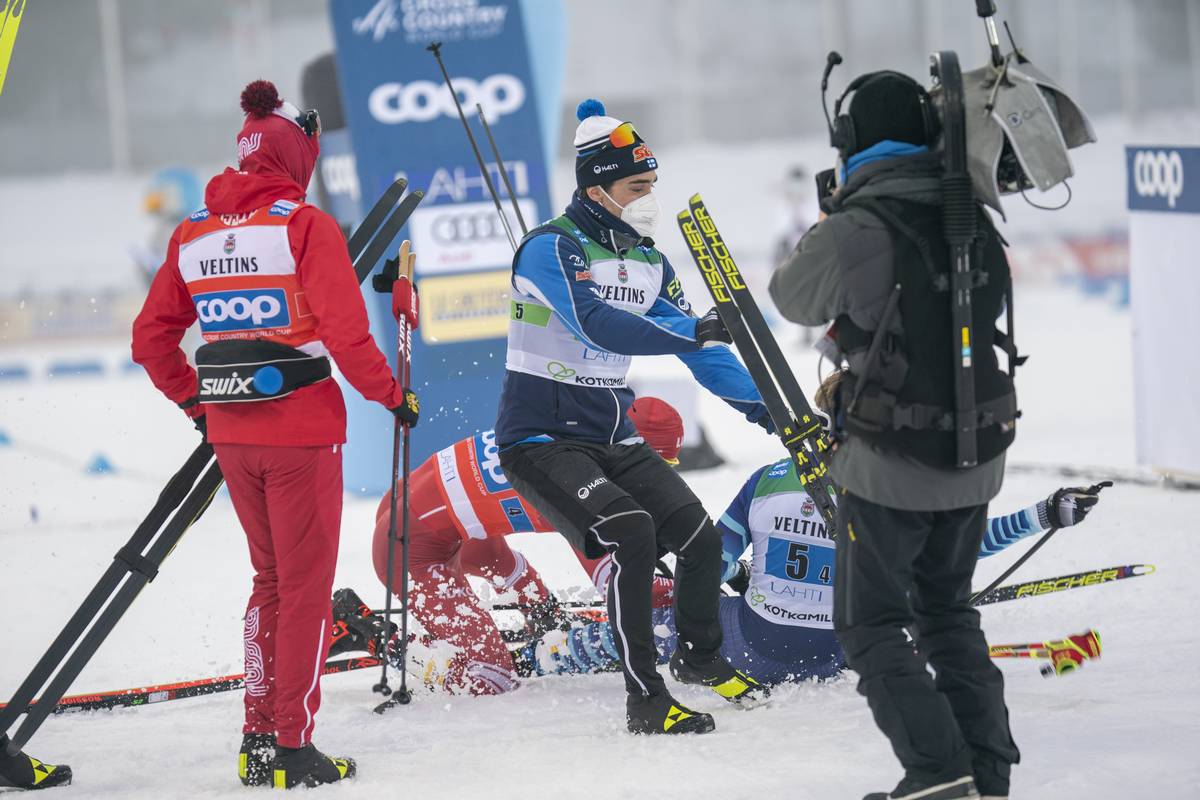
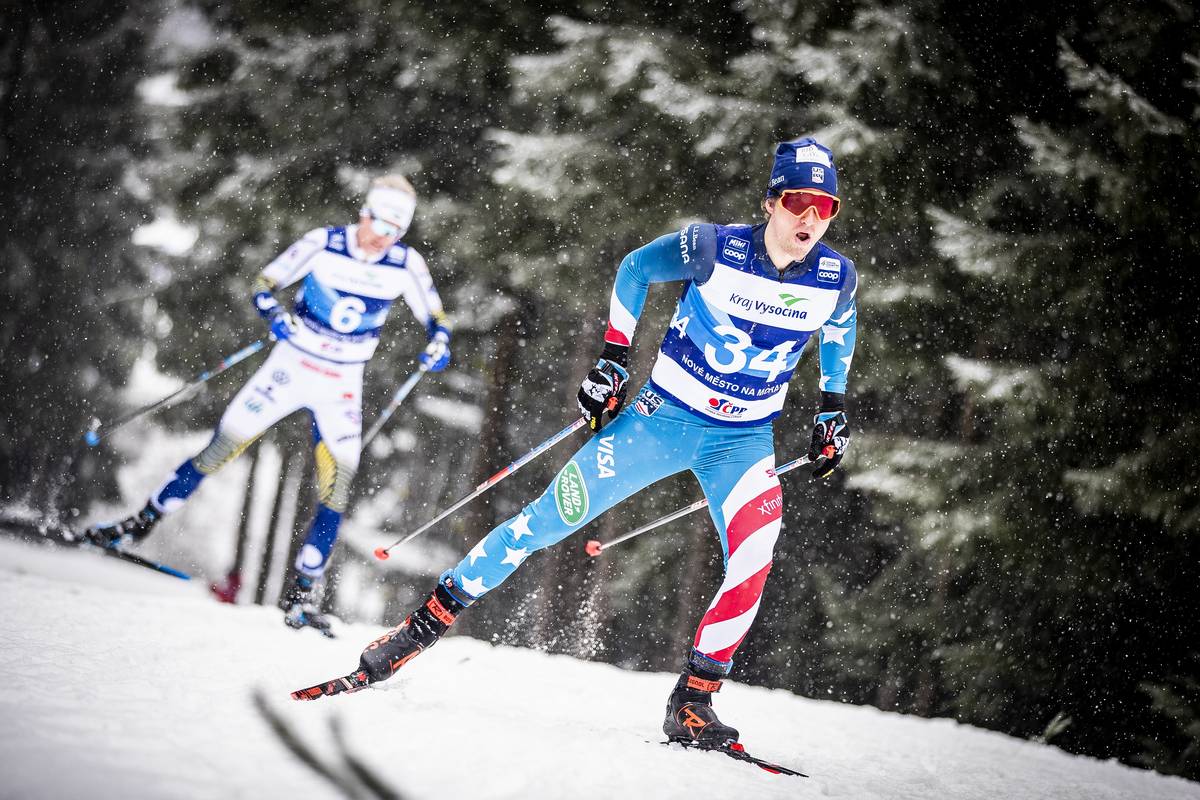
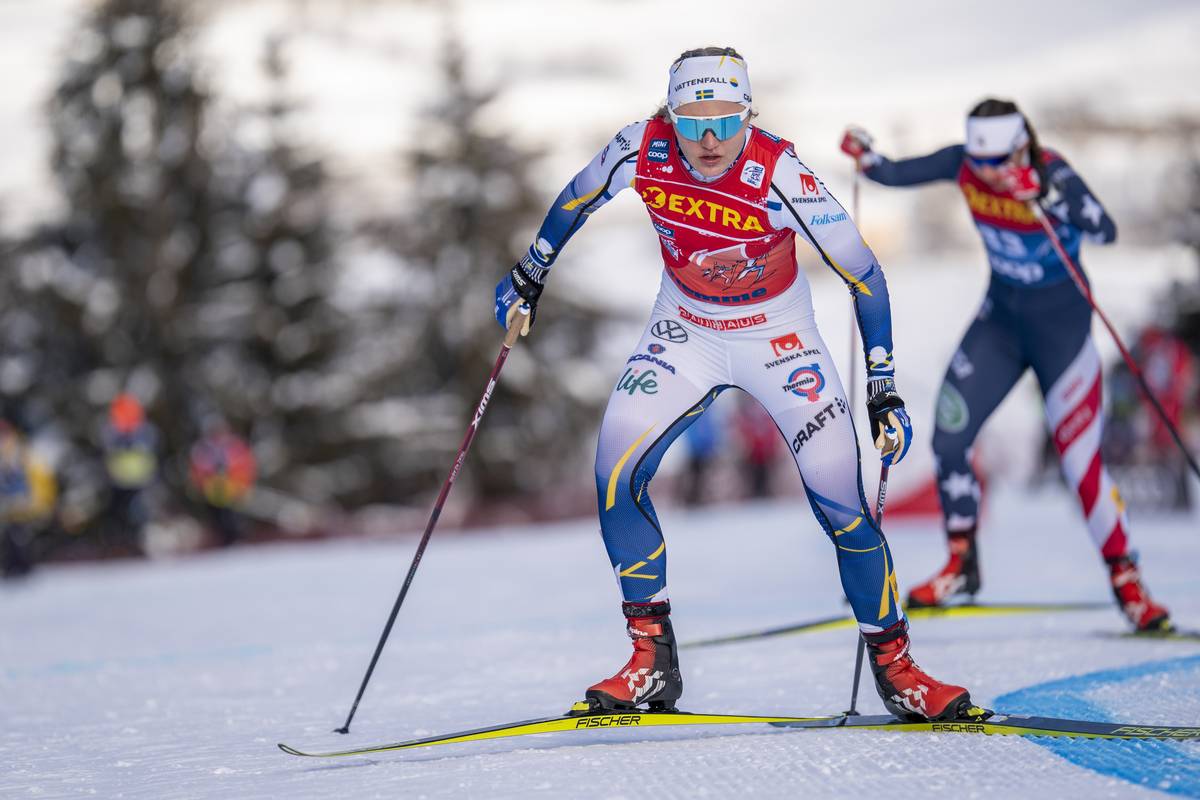
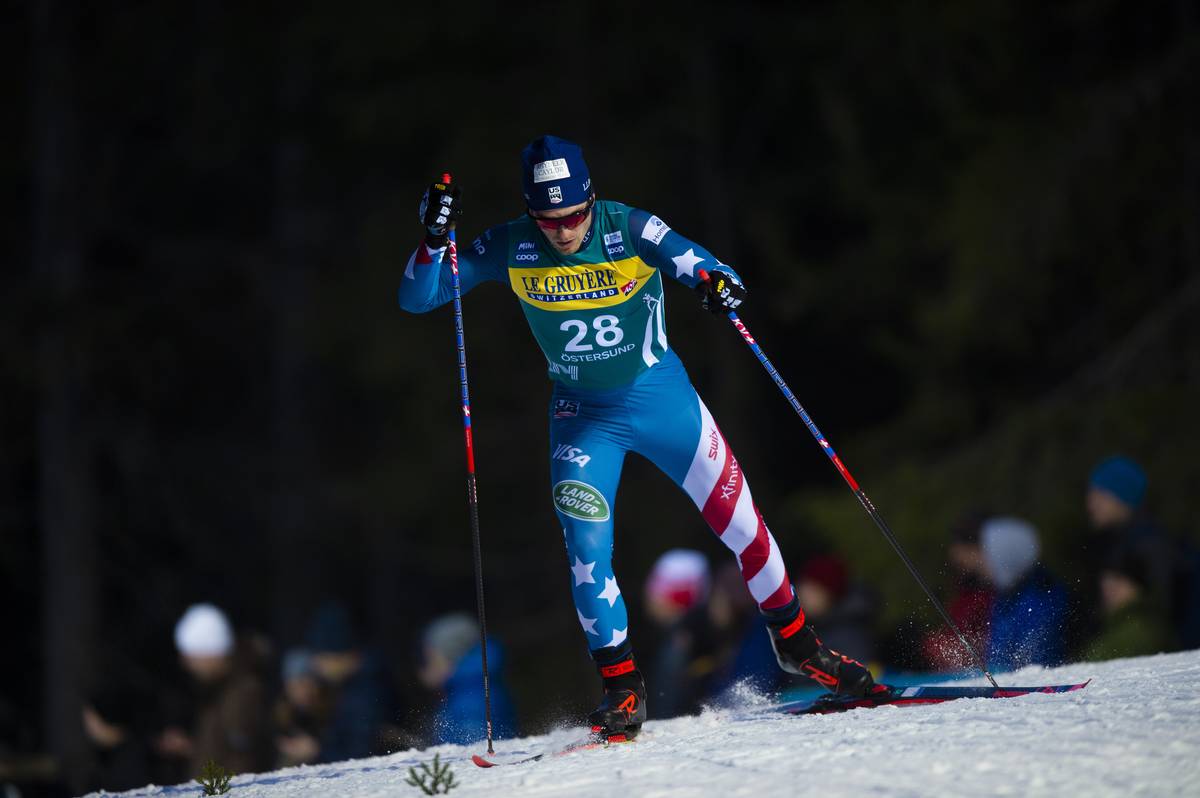
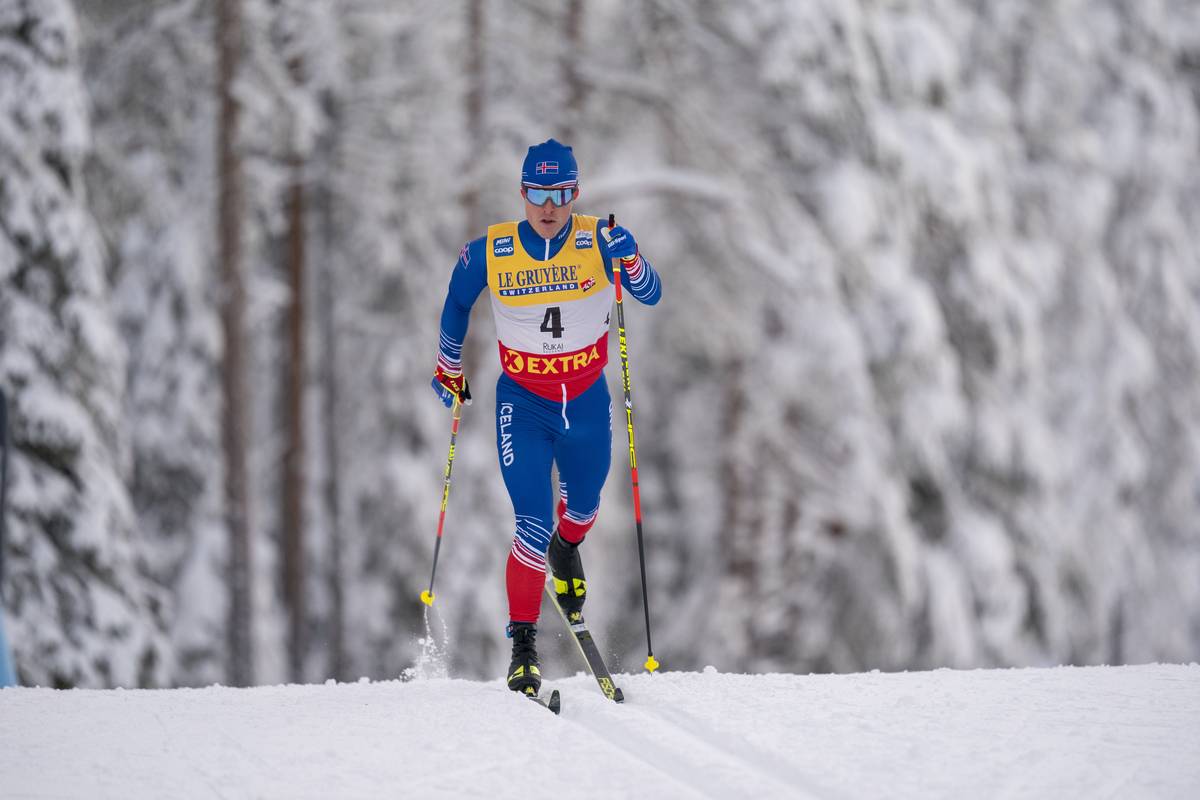
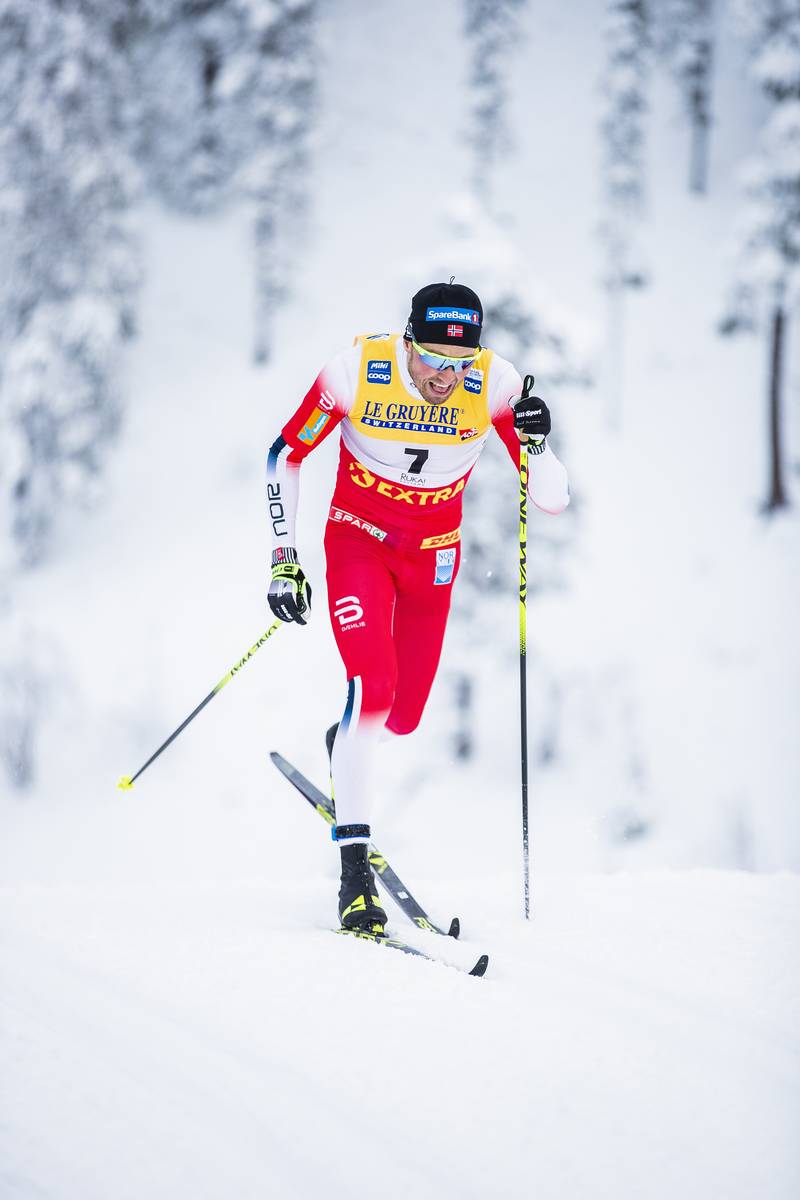
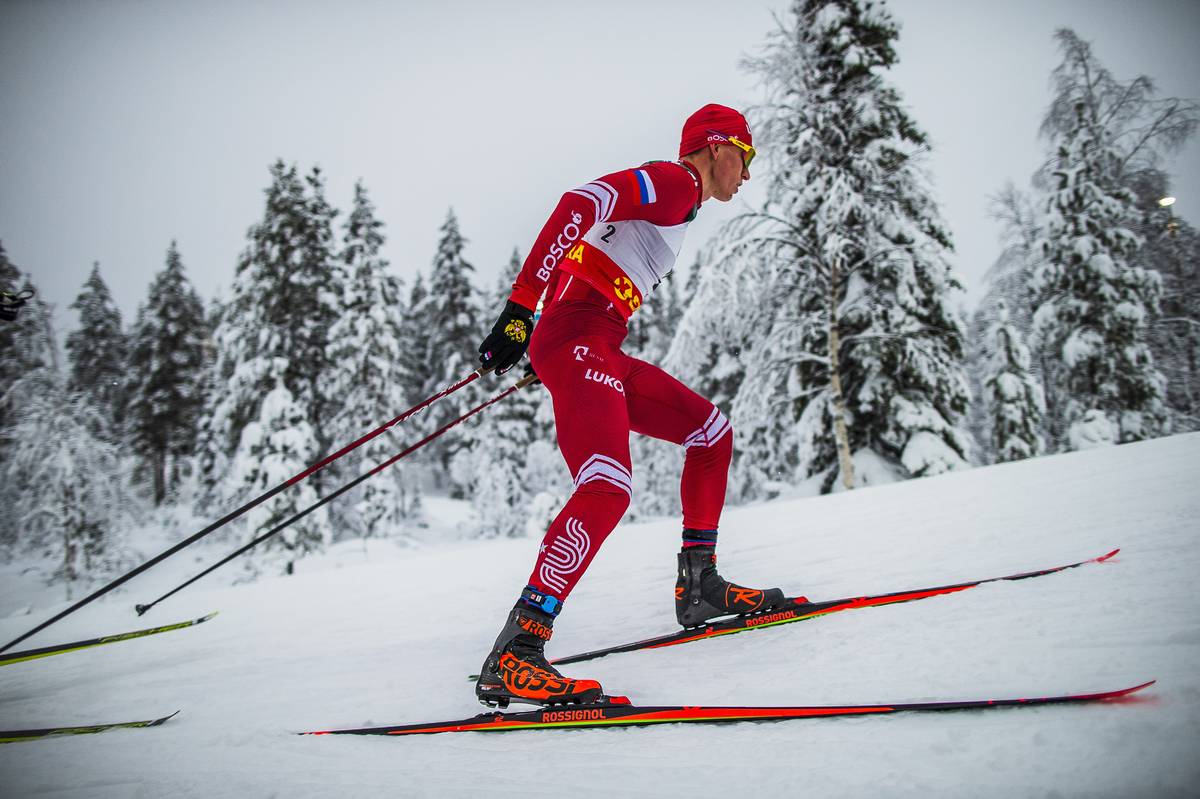
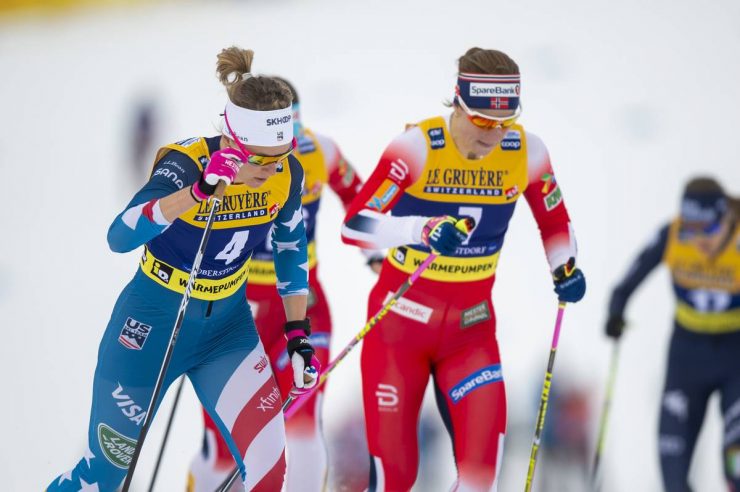
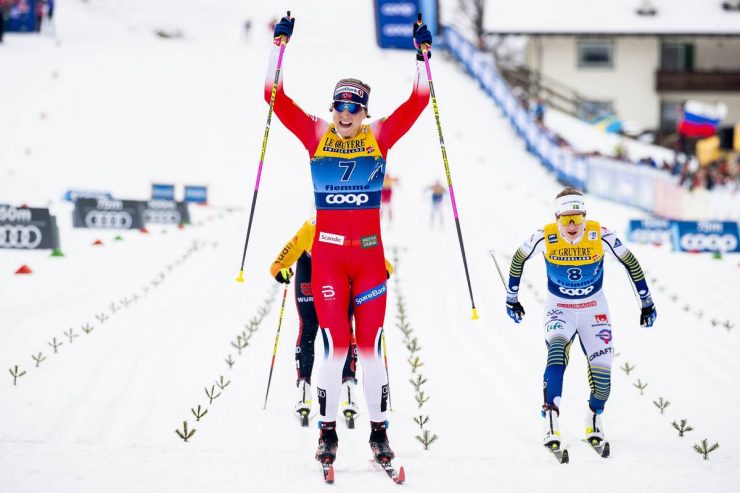
Alexander Bolshunov of Russia tackling Joni Maki of Finland after the conclusion of the men’s 4 x 7.r k relay in Lahti, Finland. (Photo: NordicFocus)
By Ella Hall and Jason Albert
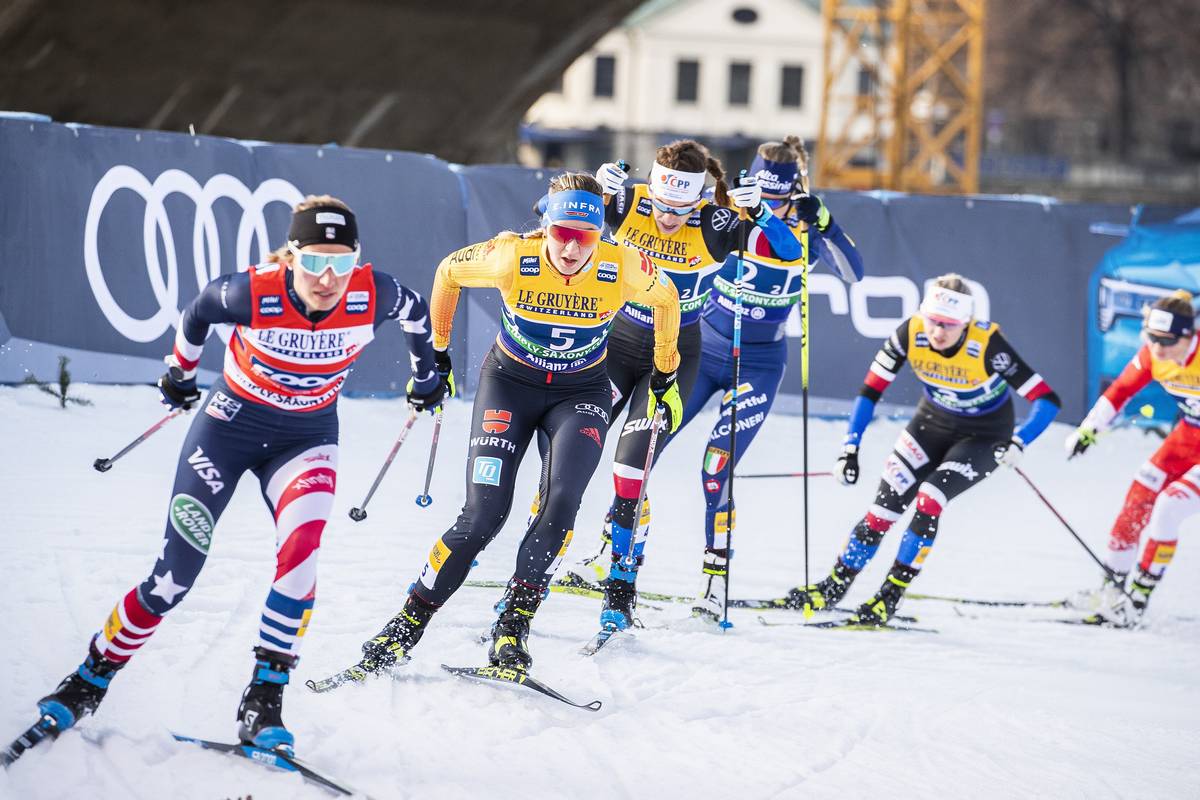
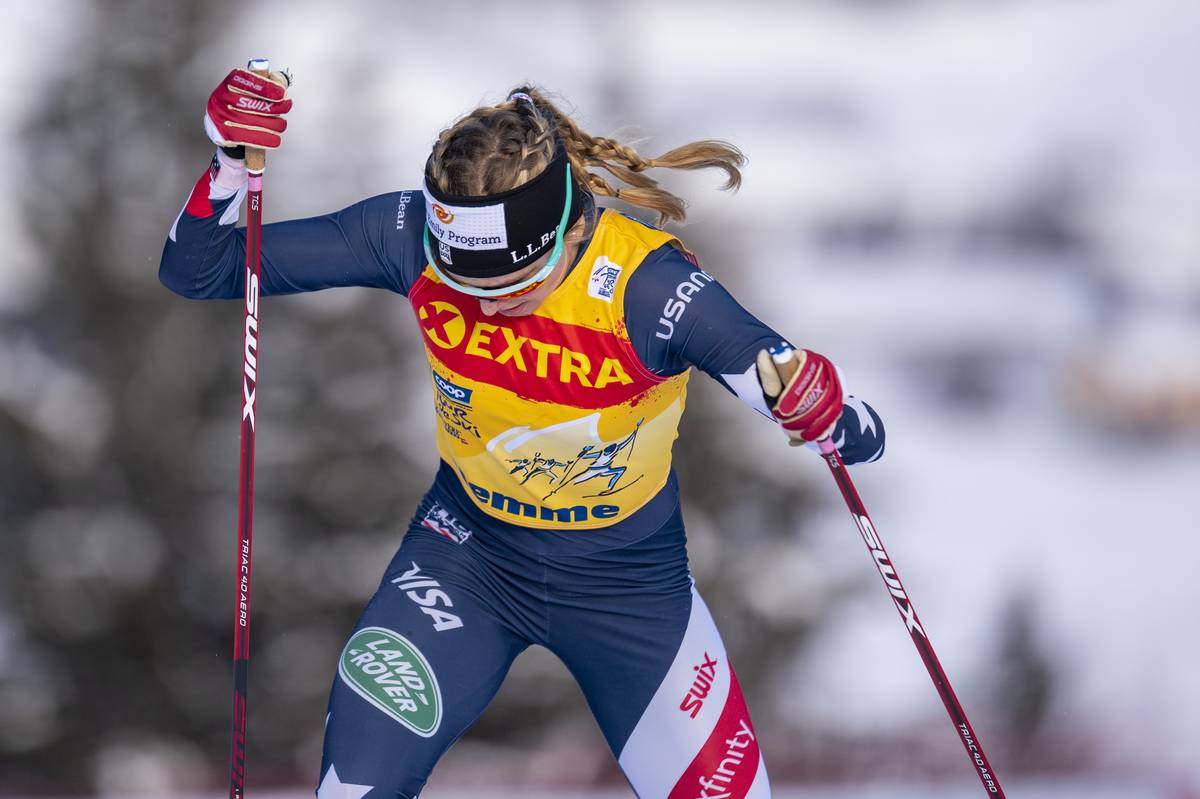
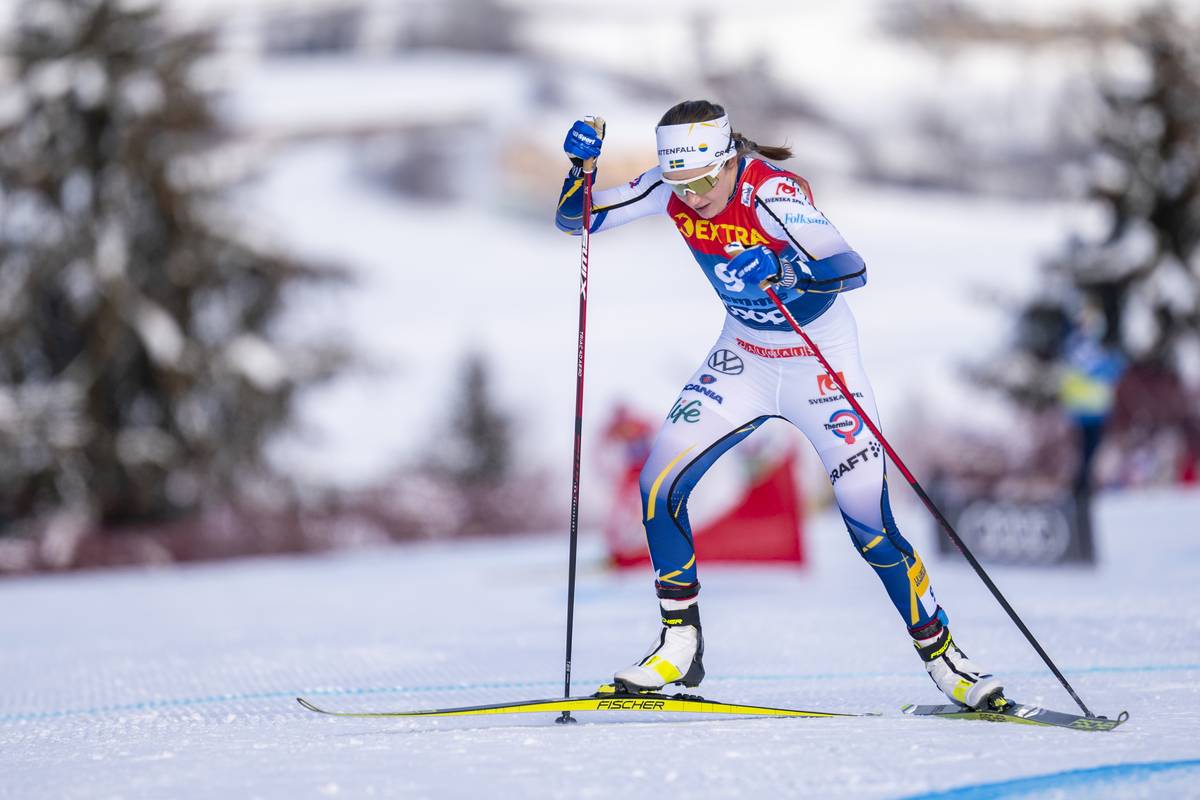
So many moving parts when considering Alexander Bolshunov’s aggression towards Joni Mäki of Finland in the closing moments of the men’s 4 x 7.5-kilometer relay in Lahti on January 24. The finish line was in sight for the two skiers as Mäki came around the sweeping left-hand turn into the final straight ahead of Bolshunov. Mäki, it seemed, sensing Bolshunov making a move and advancing in the outermost right lane, carried momentum towards Bolshunov, and closed the door on the Russian’s progress. In a moment, Bolshunov became unglued. He swung a pole at Mäki, and after crossing the finish line, he barreled into the Finn, knocking him down.
After a short period, the competition jury reviewed the footage and disqualified Bolshunov’s relay team, Russia I. The aftermath of the incident was predictably muddy. Some said Mäki drifted, obstructing Boshunov. Others likened Mäki’s tactics to bike racing where closing sprints are often rife with aggressive position tactics.
We know this: the jury did not penalize Mäki, only Bolshunov.
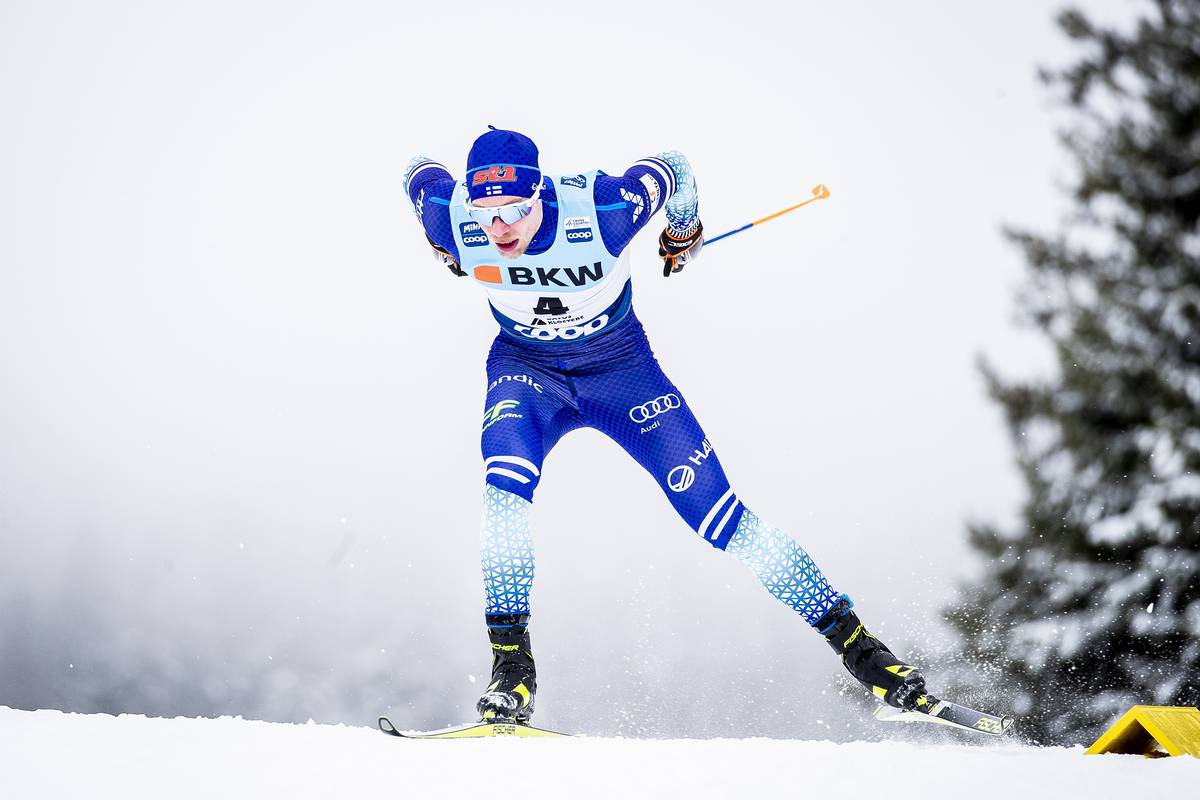
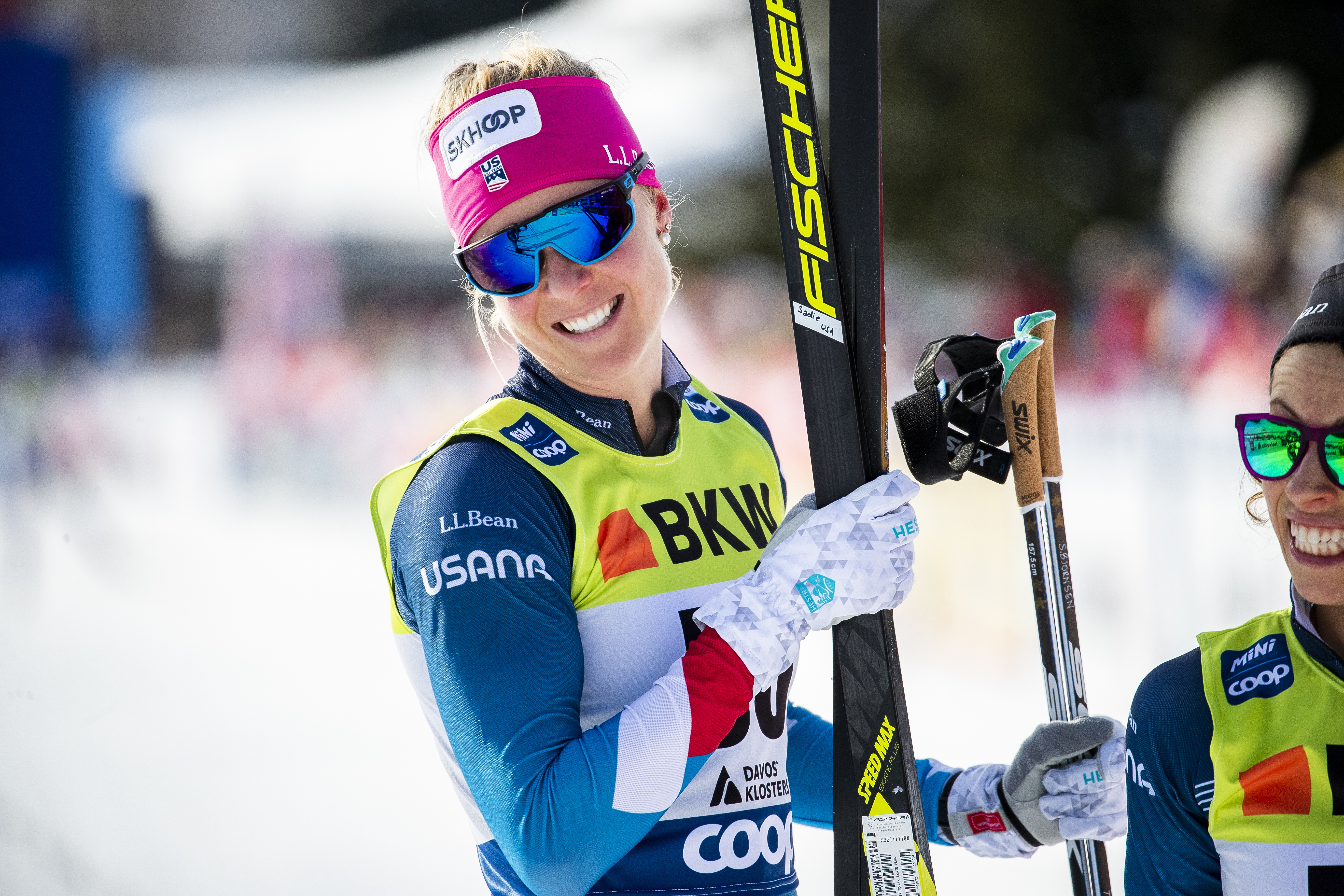
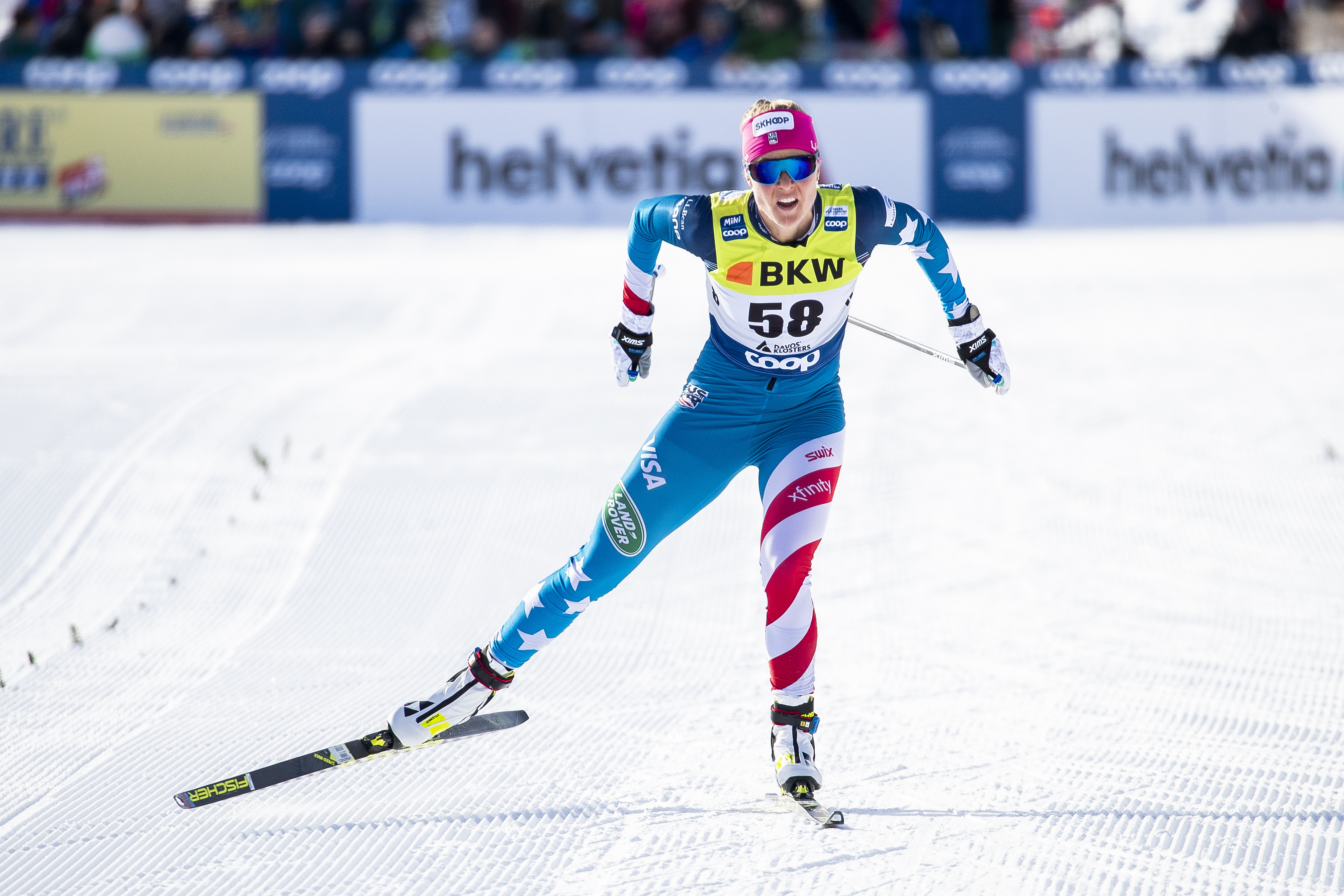
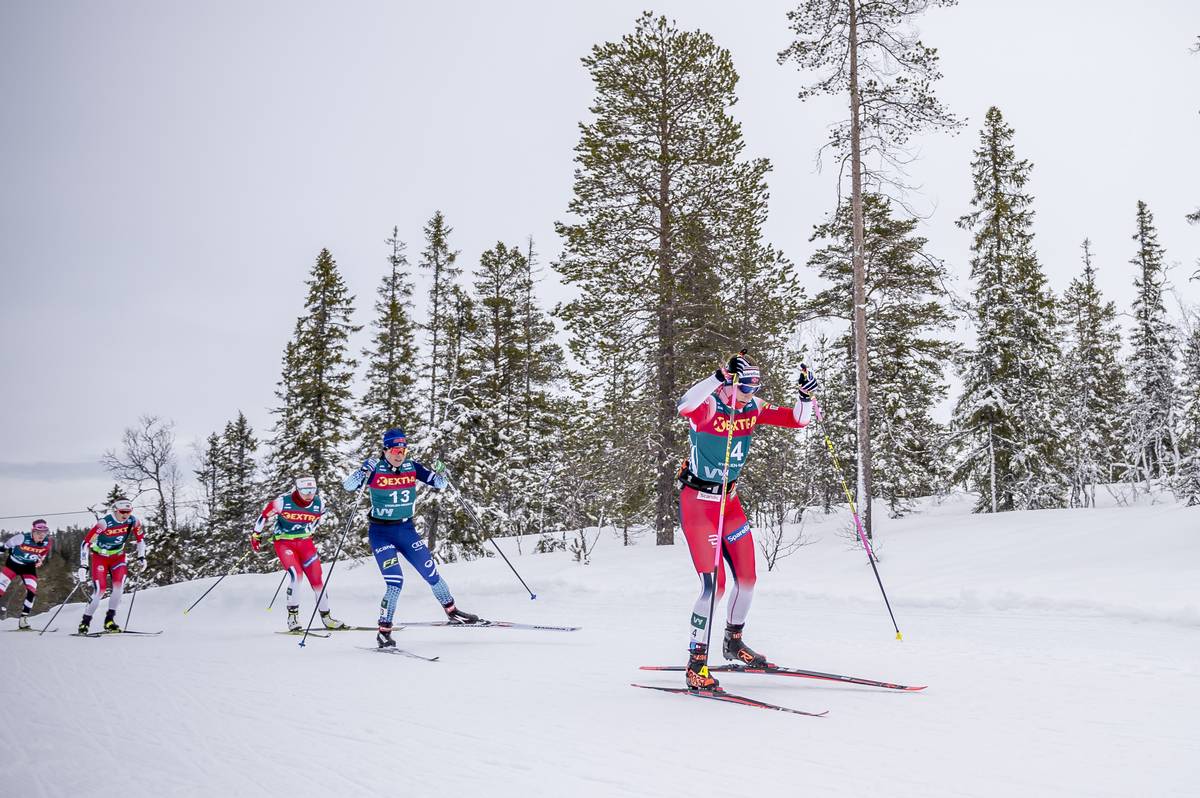
Finland’s Joni Mäki racing earlier this season in Davos, Switzerland. (Photo: NordicFocus)
The cries for a harsher and longer-lasting penalty for Bolshunov were loud on social media. One commenter on Facebook claimed Bolshunov needed an intervention. “Bolshunov should be taking anger management classes instead of winning World Cup races,” stated the post.
One response to that claim was equally terse: “Chill, and by the way, even if he will stop skiing and take crocheting classes – with his world standing he will win everything and wear his yellow bib regardless just deal with it.”
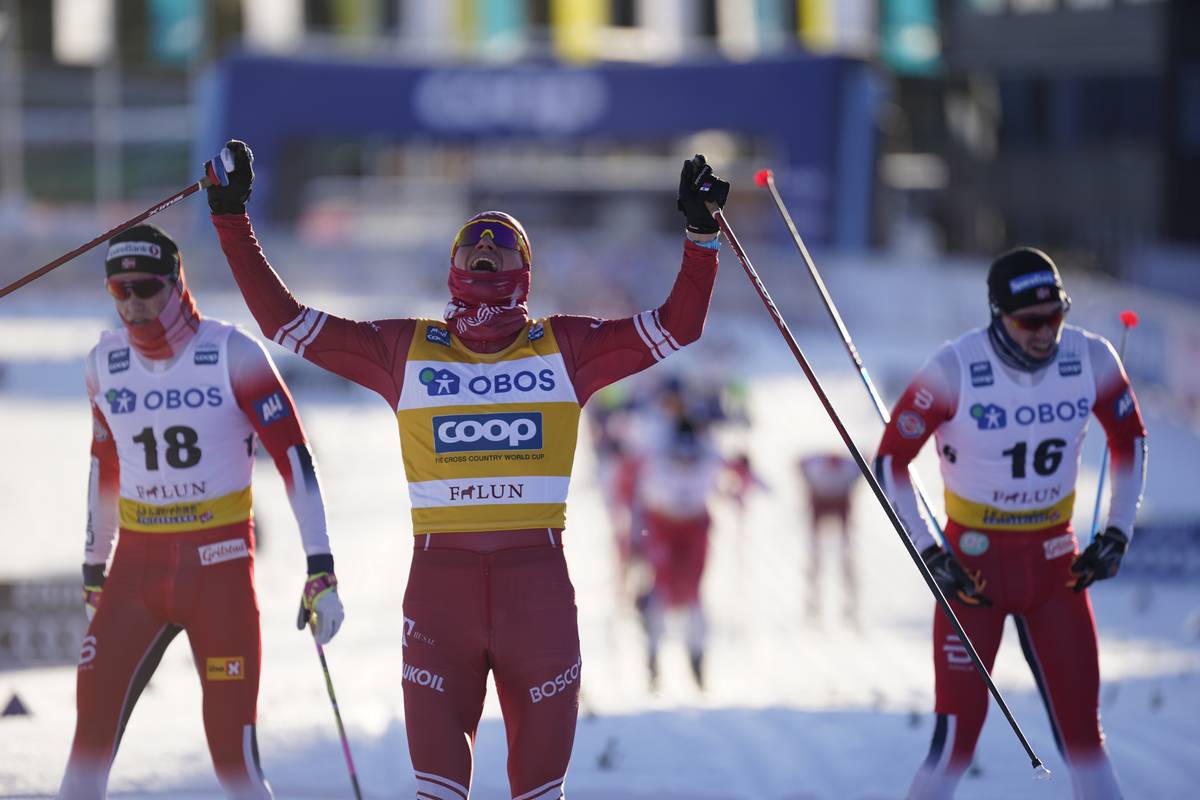
The next week, mum was the word from FIS. Bolshunov arrived in Falun, Sweden, and won the two distance races – a 15 k interval start skate, and a 15 k mass start classic. He contested Sunday’s sprint but finished 46th. He still leads the overall World Cup and represents the sport as the best all-around skier, wearing the yellow bib.
To get a closer look at the inner workings of FIS, we opened the cross-country rules tomb that is the FIS International Ski Competition Rules (ICR) Book II which was approved by the FIS Council in October 2020. It’s dense and arcane but historically has functioned adequately. In this case, Bolshunov was disqualified according to ICR rule 223.1.1 for unsportsmanlike behavior. (Now that you have the link, and find fault with Mäki’s move – you consider it obstruction- you can look to ICR rule 343.10 on “overtaking”).
The question became, with Bolshunov arriving in Falun, what other sanctions could FIS have handed down? Clearly, at least for the Falun weekend, Bolshunov was allowed to race.
Rule 223.3.2 states, “All competing competitors may be subject to the following additional penalties: – Disqualification – Impairment of their starting position – Forfeiture of prizes and benefits in favour of the organiser – Suspension from FIS events.” There it is, “Suspension from FIS events”.
But diving a bit deeper into the rules, ICR Rule 223.4 states: “A jury may impose the penalties provided in 223.3.1 and 223.3.2, however they may not impose a monetary fine of more than CHF 5’000.– or suspend a competitor beyond the FIS event at which the offence occurred.” The operative verbiage here being, “beyond the FIS event at which the offence occurred.” The competition jury in Lahti was not authorized to suspend Bolshunov in a manner that would impact his standing at another event – like Falun.
It’s worth mentioning that the skier in question, Bolshunov in this case, could be held back from competing by their national ski federation. The Russian Ski Federation did not penalize Bolshunov. They did, however, issue a public apology.
The press release stated: “On behalf of the Russian Ski Association, Alexander Bolshunov and Elena Vyalbe express their apologies for the reaction of Alexander towards Joni Mäki (FIN) during the men’s relay competition at the FIS Cross-Country World Cup in Lahti, Finland. Animosity is not a part of the spirit of Russian Team and we strongly value fair play in every aspect. Alexander Bolshunov therefore apologized to Joni Mäki and an official letter of apology was sent to the Finnish Ski Association by the Russian Ski Association. We sincerely hope that the dedication and hard work of all athletes, their performances as well as the beauty of Cross-Country skiing will return to focus and amaze many fans all around the world.”
Any further action regarding Bolshunov rests on FIS gatekeepers. According to FIS Cross-Country Race Director Pierre Mignery, FIS has several avenues for suspending an athlete. He pointed us towards the FIS statutes for clarity.
Mignery wrote, “suspensions can be given by the Appeals Commission, the FIS Council and the FIS Court (but not by competition juries as written above).”
Part V of the FIS Statutes deals with sanctions and appeals, which is where you can find the references Mignery cited. Under that sub-heading, Statute 55 states, “The following sanctions can be imposed … suspension for a period or a lifetime.”
Statute 56 illuminates “Responsibilities”. It puts forth what FIS entities are empowered to sanction and enforce those sanctions. Those were noted by Mignerny above and are spelled out in Statute 56 – they are the Appeals Commission, the FIS Council, and FIS Court.
Statute 56 also uses similar language to ICR rule 223.4 in stating, “The competition juries can express warnings, start prohibition, changes of the starting order, disqualification, removal or refusal of accreditation, fines to a maximum amount of CHF 5’000 (Five Thousand Swiss Francs) and suspension from the event at which the offence occurred.”
Alexander Bolshunov taking his second win of the weekend in Falun, Sweden. (Photo: NordicFocus)
For now, Bolshunov is free to race as if it’s business as usual, which is most often race-win fast. He leads the overall by a whopping 839 points over second place, Ivan Yakimushkin of Russia. If in fact Bolshunov is sanctioned further by FIS, an appeals process and specific procedures are described in FIS Statutes 57 and 58.
Learned on background, FasterSkier understands the Bolshunov incident continues to be discussed by FIS.
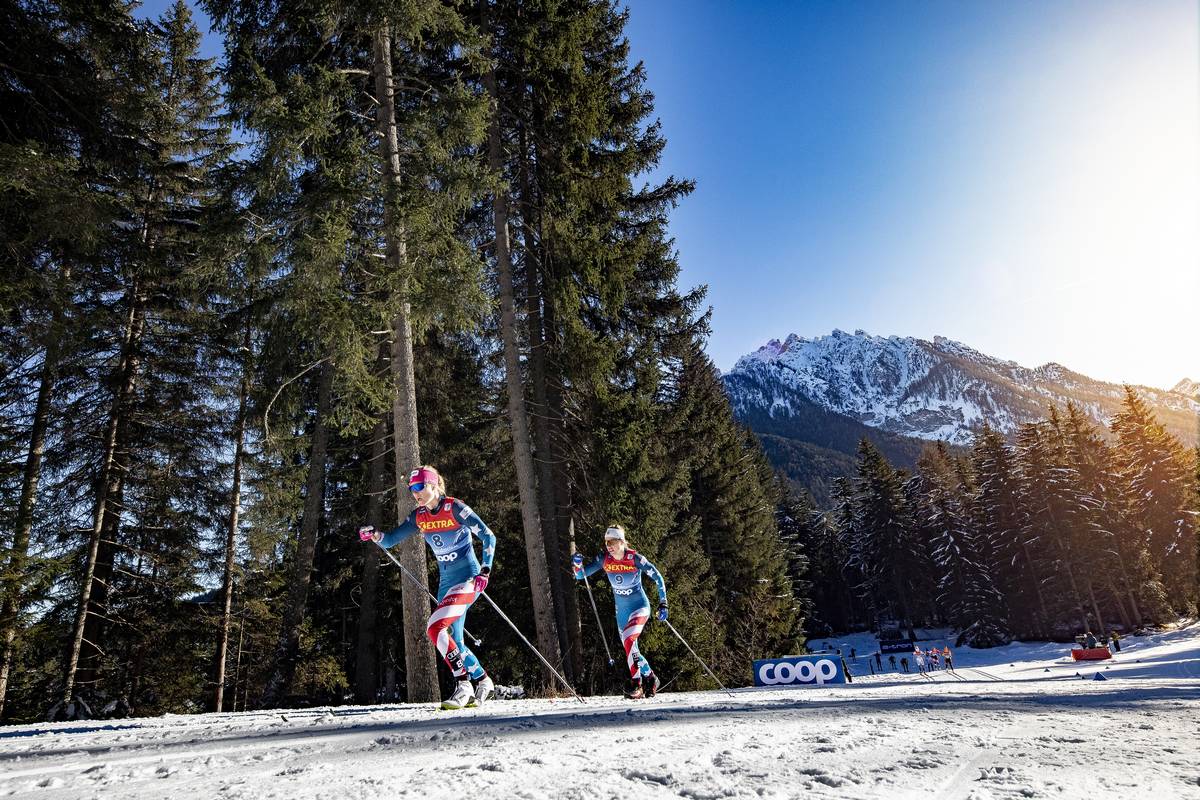
Sadie Maubet Bjornsen (left) and Rosie Brennan (right) stride in sync during the 2020 Tour de Ski in Toblach, Italy. (Photo: NordicFocus)
This article provides an introduction to a series of interviews with professionals in sports nutrition and female physiology. Results from a survey regarding how elite US cross-country skiers and biathletes use insight into their cycles in their own training will also be analyzed and shared.
An arguably essential component of developing as an athlete is learning how to listen to the signals one’s body sends. Am I skiing easy enough on my recovery days to absorb the interval workouts? Am I dehydrated? Bonking and in need of a quick hit of carbs? Am I feeling mentally and physically flat because I have been stressed at work or lacking sleep?
In an ideal world, progress in skiing would be predictable. If I do X-Y-Z, my performance or technique will improve. However, the body is much more complex than a simple if-then statement. For female athletes, whose hormone levels fluctuate over approximately monthly cycles, this is especially true.
Before we jump into the nitty gritty of hormone levels throughout the menstrual cycle and how they might be considered in optimizing training and nutrition, I’d like to insert some anec-data to highlight the importance of talking about this issue.
Up until 2017 when my husband and I wanted to start our family, my understanding of the menstrual cycle was that it was roughly 28 days, PMS is generally unpleasant, and menstruating can be both uncomfortable and inconvenient. I thought of my cycle as two parts: bleeding and not bleeding, and I had never considered that there might be physiological changes throughout the cycle that might cause an ebb and flow (no pun intended) in my energy, moods, immune function, or nutritional requirements. In fact, had you told me that training and nutrition should be aligned with my cycle, I might have even scoffed, thinking I just needed to suck it up on the days I didn’t feel well.
Katharine Ogden (left) and Sophie Caldwell Hamilton (right) on a frosty training day in Toblach, Italy in December, 2019. (Photo: NordicFocus)
In reality, that means 15 years where, despite trying to tune in on minutia of my technique and training to improve my skiing and running, my understanding of a fundamental body process I experienced regularly was all but nonexistent. This is not an uncommon scenario. And this is from someone who has a collection of books on training and performance and loves geeking out on exercise science research.
Clare Egan crests a climb during a December, 2020 sprint in Hochfilzen, Austra. (Photo: NordicFocus)
Apart from training, understanding that the menstrual cycle is a window into your overall health is becoming more evident with research. The “Apple Women’s Health Study” — a partnership between Apple Inc., the Harvard T.H. Chan School of Public Health, and the National Institutes of Health (NIH) — is currently analyzing a wealth of self-reported data to “demystify and illuminate menstruation and accord it the scientific scrutiny and social acceptance it deserves.” This comes in response to the fact that hormone fluctuations were long considered an uncontrollable variable that might skew scientific data, thus women were left out of experiments.
“In recent years, researchers have acknowledged the need to reevaluate the relationship of menstruation to overall health,” writes editor of Harvard Public Health magazine Madeline Drexler on the study. “Treating the menstrual cycle as a vital sign—comparable to blood pressure, temperature, pulse rate, and respiration rate—could lead to earlier detection of many conditions, both gynecological (such as fibroid tumors) and systemic (such as diabetes). Likewise, tracking lifestyle changes among those who menstruate—including the effects of body composition, activity levels, increased life expectancy, and postponement of childbearing—could help scientists glean factors that make an impact on menses.”
In addition to a canary in the cave for overall health, ROAR author Dr. Sims encourages women to understand that a regular period can be an “ergogenic aid”, i.e., a performance enhancer, that should not be avoided [1]. Yes, there are times when hormones might make us feel suboptimal. Wouldn’t you like to know why that is and what you might do about it so you can ameliorate your symptoms? That’s what this series is about.
To further the point that the menstrual cycle should not be thought of as a bemoaned inconvenience limiting female athletes, there is no evidence that V02 max is affected at any phase of the cycle, indicating that top performances in endurance events cannot occur at any phase. If it’s not holding back performance, but there might be ways to adjust your training to optimize adaptations throughout the cycle, why not learn more and begin paying attention?
Here is a brief primer on the menstrual cycle and what it might mean for female athletes. This information is intended to help female athletes and coaches understand the underlying physiological changes women experience throughout their cycle so they can adjust their training and nutrition to adapt accordingly, optimizing their training outcomes and performance over the long haul of endurance sport.
APU teammates Sadie Maubet Bjornsen and Rosie Frankowski chat trailside during a training day before World Cup races in Lillehammer Norway in December, 2019. (Photo: NordicFocus)
Menstrual Cycle Phases and Hormones
For the purpose of this article, we’ll focus on what is considered normal menstruation in a healthy female. Lack of a period, called amenorrhea, is well discussed in this podcast and will be addressed in subsequent parts of this series.
It is also important to note that while the fluctuations of hormones in a healthy cycle is well understood, conclusive evidence of the implications is still under research. While patterns have been seen in research, positive and negative effects of the menstrual cycle are largely individual. This information is intended to inform athletes of the body process to help kick start the process of learning their own unique patterns and responses.
The menstrual cycle begins at the onset of menstruation and lasts on average 28 days, though 21-35 days is considered normal. At its root, the menstrual cycle prepares the uterus for pregnancy, first preparing a follicle in the ovary to release a mature egg and thickening the lining of a uterus so that the egg, if fertilized, can be implanted and develop into a tiny human. If the egg is not fertilized, the lining of the uterus begins to break down and eventually is shed during menstruation, beginning the cycle anew. Note that high performance training is not included in that basic description.
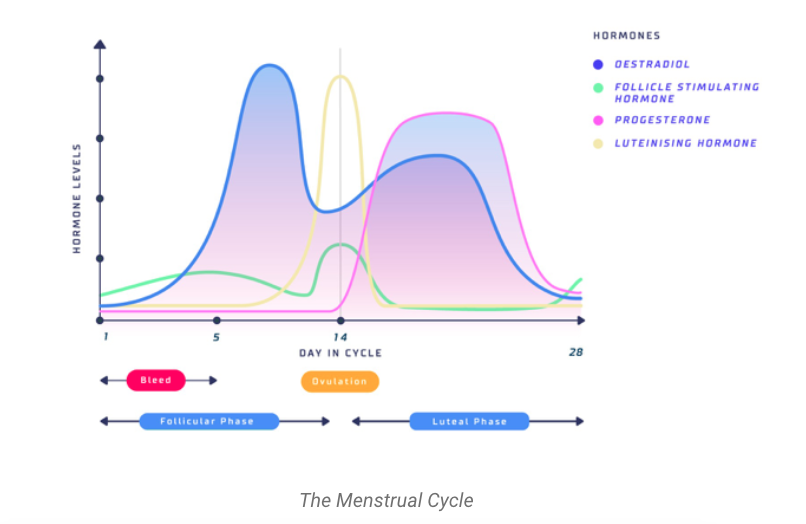
These processes are controlled by four primary sex hormones: estradoil (or oestradiol), which is a form of estrogen, progesterone, follicle stimulating hormone (FSH), and leutinizing hormone (LH), with estradiol and progesterone being the leaders [2]. Their changes in concentration divide the menstrual cycle into two primary phases, the follicular phase, which leads up to ovulation, followed by the luteal phase. These phases can then be separated into two sub phases of early and late.
The profile of the fluctuations of the four primary female sex hormones over the course of a normal menstrual cycle: estradiol, progesterone, luteinizing hormone, and follicle stimulating hormone. (Photo: Screenshot fitrwoman.com)
To align with the information presented by the revolutionary FitrWoman App — which many see as the gold standard of cycle tracking for female athletes as it includes evidence-based insights from research in physiology, performance, and nutrition — I’ll refer to the progression from early to late follicular and luteal phases as Phase 1-4, which last roughly a week each [3].
As previously mentioned, phase 1 of the cycle begins when a woman’s period begins. In this phase, estrogen and progesterone are both low while testosterone (yes, women produce that too) is at an average level. This combination can help many women feel their strongest, however, because the lining of the uterus is being shed, women might experience side effects from inflammation at the beginning of this phase, like GI upset or fatigue [4]. If experiencing the latter, it could also be a good time for shorter, more intense sessions with plenty of rest in between, rather than longer threshold workouts.
In phase 2, estrogen begins to rise while progesterone remains low. Estrogen is a steroid hormone, which is linked to increased muscle mass and strength, as well as bone health [5]. With testosterone also at its highest, this can be a sweet spot for a hard block of training. Many women experience increased pain tolerance and decreased recovery time during this phase, and positive moods and mindset are also most common. The increased levels of estrogen may also promote stability in blood sugar levels, helping athletes maintain their energy levels during training. This could be a time to ski hard and ride the endorphin high!
The definition of intensity: Sophie Caldwell turns toward the finish during a sprint heat in the 2020 Tour de Ski in Toblach, Italy. (Photo: NordicFocus)
Phase 3 begins when ovulation occurs. After a spike in LH and FSH to initiate ovulation, estrogen drops rapidly, then begins to rise again while progesterone steadily climbs throughout. The elevated levels progesterone causes a rise in body temperature of about 0.3℃ or 0.5℉, which may influence hydration requirements and make it more challenging to regulate body temperature if training in the heat [3, 1]. Breathing rates and heart rate also increase both at rest and during exercise, making training feel a bit harder, and blood sugar levels may be less stable, placing a higher demand on carbohydrates during training and increasing the importance of balanced meals that include fiber, healthy fats, and protein to help keep energy levels and appetite predictable [2].
In the fourth and final phase, both estrogen and progesterone drop to their lowest levels of the cycle. This rapid drop is linked to the symptoms commonly referred to as PMS, which include GI distress, bloating, headaches, moodswings, and fatigue. These symptoms are likely due to an inflammatory response triggered by the lack of hormones, which continues into Phase 1 as mentioned previously. You read that right. When you have PMS, you’re not “hormonal” — you’re actually un-hormonal.
From a training perspective, this inflammation may make it harder to recover from hard sessions, leaving you fatigued on top of other PMS symptoms. It may be possible to reduce these negative feelings by eating anti inflammatory foods, like berries, nuts, and fish, and avoiding processed and high sugar foods that are thought to exacerbate inflammation.
To be clear, some women experience very mild, if any, impacts from their hormonal fluctuation. However, if this is something you’re curious about or you feel your energy levels and appetite do not always match your expectations based on your training schedule, this might be something that could help you feel better throughout the month, in and out of training.
Jessie Diggins powers through a strength session in February, 2018. (Photo: Instagram @jessiediggins)
Conveniently, the “three weeks up, one week down” general guideline of training — meaning three weeks of building volume and/or intensity, followed by a recovery week — already aligns well with what FitrWoman recommends in terms of experimenting with aligning training to the cycle. During Phases 1 and 2, progressively build and increase loading during strength sessions. In Phase three, consolidate, meaning longer recovery between sets of intervals, or perhaps lower weight with higher reps in the gym.
Then, in Phase 4, rather than pushing through while feeling suboptimal, back off on the intensity sessions and include additional easy or rest days to absorb the previous three weeks of training and give your body the extra recovery it might need.
Want more? The team at FitrWoman hosted an informative free webinar in February 2019 on Facebook featuring Senior Sport Scientist and elite marathoner Dr. Georgie Bruinvels. The webinar is still available here.
Sources:
[1] Sims, Stacy T. Roar: How to Match Your Food and Fitness to Your Unique Female Physiology for Optimum Performance, Great Health, and a Strong, Lean Body for Life. Rodale Books, 2016.
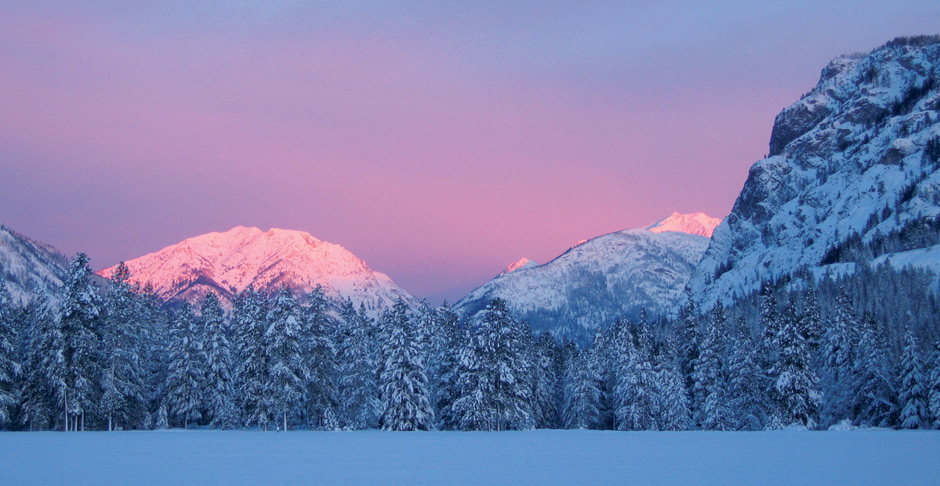
Winter in the Methow…(Photo: Paul Butler/Methow Valley News)
To say Coronavirus is reshaping our world is to state the obvious. Even in the tucked-away haven of the Methow Valley, COVID-19 is having an impact in more ways than one. An article written by the Methow Valley News in October, details how the valley is becoming a “zoom town”, a phenomenon echoed by many mountain towns around the country as the pandemic encourages remote work and less densely populated living environs. Just three hours over North Cascades Highway in the summer from the metropolis of Seattle and five hours from the city when the pass closes in the winter, the Methow Valley is well located for urban recreationalists looking to escape the city.
When Washington stay-at-home orders eased following Memorial Day this spring, the rural valley experienced an unprecedented number of visitors throughout the summer and fall. A significant increase in property and housing sales correlated with the increased visitation, which as Ann McCreary writes for the Methow Valley News, “is creating the most competitive and stressful [housing] market brokers have seen in the Methow”.
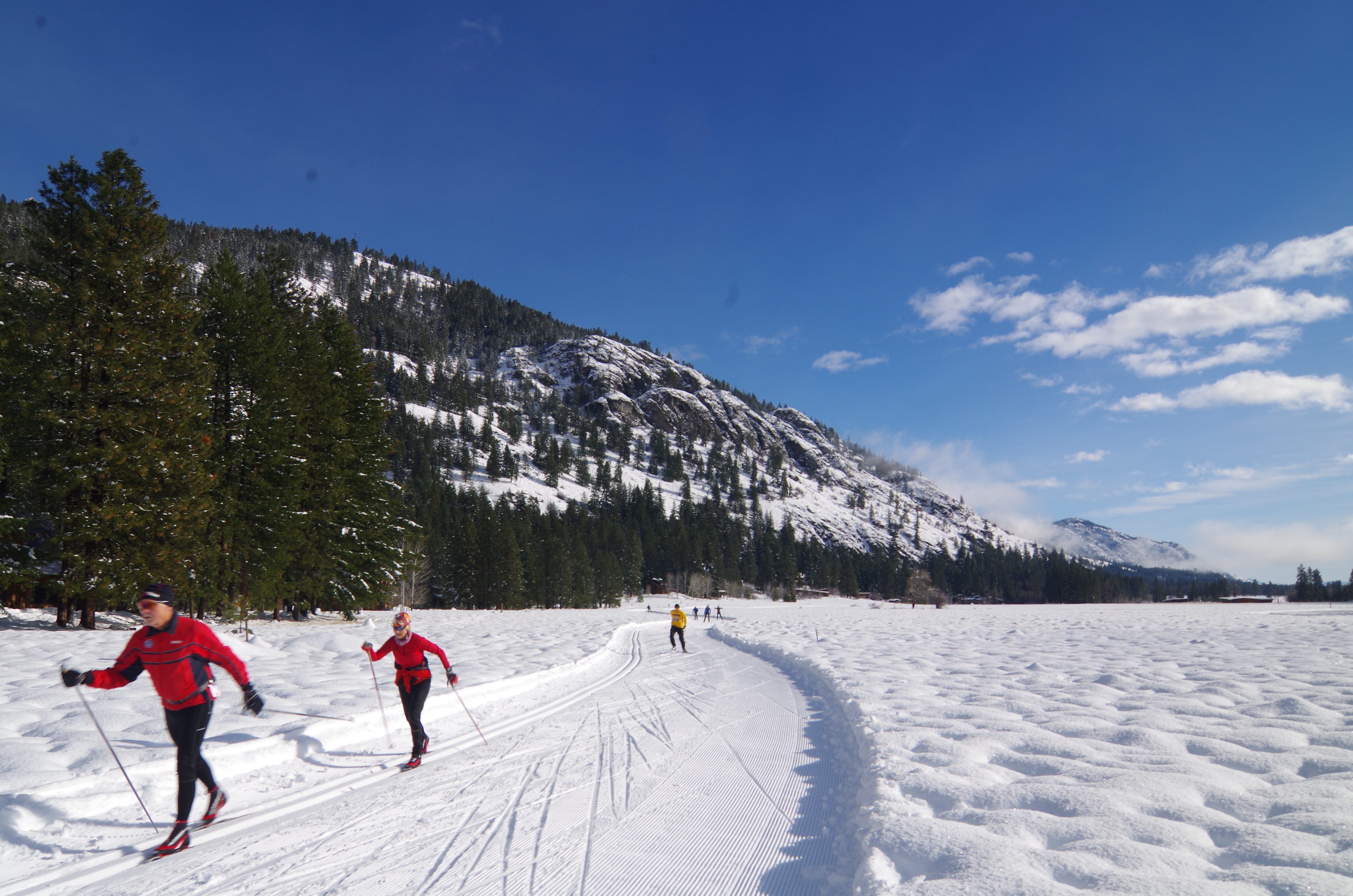
Skiers on the valley floor: during the first skis of the season last year. (Photo: Methow Trails)
Coupled with the region’s remoteness are its high value sporting options. One key winter-time asset is this: the Methow boasts the largest cross-country trail system in North America with over 200km of groomed skiing in the winter. While nordic skiing is not exactly a widely known or popular sport in the United States, as this little corner of the country experiences a rise in popularity, so too does this sport. Recently published articles by the Seattle Times, Wall Street Journal, and Outside Online, all detail why cross-country skiing is the ideal sport for social distancing. The Seattle Times article, “How to start cross-country skiing- the ideal sport for social distancing,” mentions the Methow Valley several times saying, “the crown jewel of [Washington] state’s Nordic offerings, though, is Methow Trails, the Methow Valley’s massive cross-country ski network spanning Mazama and Winthrop.”
Winter on the Methow Trails. (Courtesy photo)
Graced with an early season snowfall, this year’s ski season began early in the valley. Methow Trails, the non-profit organization responsible for grooming and year-round trail maintenance, announced opening day on November 21st, the earliest ever official opening. According to James DeSalvo, Executive Director for Methow Trails, early season pass sales were up 33% from last year’s numbers. DeSalvo attributes this increase to two things, the early season snow and COVID-19.
Another indicator of the sport’s new found attraction, for now certainly a short-term impact of COVID – can be seen in the Methow Valley Nordic Team. (The author was a member of MVNT through childhood and high school and that her mother is the director of the junior team). Enrollment in the ski team typically hovers around 100 skiers from year to year, according to Leslie Hall, director of the Methow Valley Nordic junior team. This year 127 athletes signed up for the junior team and the coaching staff has increased by an additional 5-6 members to cover the higher number of skiers. Pete Leonard, Executive Director of Methow Valley Ski Education Foundation, the umbrella organization which the junior team falls under, believes that somewhere between 15-35% of these new faces are newcomers to the valley. Others have lost the option of school-related sports due to COVID restrictions and are trying a different sport this winter. Hall says, “I do think we have gotten some new local kids, since now there is no basketball or wrestling.”
Members, small and tall, of the Methow Valley Junior Team pose for a team shot at the end of the 2019/2020 ski season. (Photo courtesy of MVNT)
The Hoffman family, who recently moved to the valley from Seattle, made the decision to sign their twelve-year old daughter up for the ski team “because it’s what you do in the Methow Valley” said Danielle Hoffman. “With COVID, I didn’t feel comfortable standing shoulder to shoulder in endless lines or making my way to the bathrooms [at alpine areas]. It was time for a change. Nordic is basically free. Sure the initial investment is there for a set up but I can ski right outside my door. It was worth the change.”
Some happy little skiers. The Methow Valley Nordic Team caters to those ages six and up. (Photo courtesy of MVNT)
Similarly, the Menzies came to the Methow in March to escape COVID. “What could [be] more quintessentially Valley than cross country skiing!” exclaimed Pete Menzies in an email, “and our neighbors told us it was a wonderful program, and we knew that many excellent skiers coached here. Plus, with COVID lurking, what could be better than getting outside for regular exercise, meeting new people and kids, and learning to love winter weather than joining the ski team and learning from the best.”
In this postage-stamp community surrounded by mountains, for the influx of new residents and families moving full-time into what were once urban-escape valve vacation homes, cross-country skiing becomes a means to be part of a broader community during uncertain times.
David Norris during last season’s 15 k skate in Nové Město. Norris placed 27th. (Photo: NordicFocus)
This is part two of a two-part story about U.S. skier David Norris who was recently diagnosed with Covid-19. Part one explores how Norris experienced the illness, whereas part two will look into some of the medical literature around athletes and COVID and how Norris plans to build fitness post-illness. You can find part one here.
We’re going to start where it counts when considering endurance sports: the heart. This elegant and complex organ, colloquially known as the “ticker”, pumps the blood and motors the movement of oxygenated blood throughout the circulatory system and fosters a return trip for deoxygenated blood to the lungs. And then a repeat – for approximately 100,000 beats per day. Round and round it goes.
Covid-19 still ravages. It would be curt to place the moral equivalency of a return to sport to a return to normalcy for those without resources or at high risk due to comorbidities. The wellness aspects of sport are well-documented. Nearly a year into the pandemic, the consensus on a proper return to sport for athletes infected with Covid-19 has become, if not crystal clear, certainly less opaque.
Beyond reduced lung capacity for those with compromised lungs post-Covid, a primary concern for athletes contracting Covid-19, or reason enough for avoiding it altogether, has been the prospect of heart abnormalities, primary among them myocarditis. Myocarditis, or inflammation of the heart, is linked to viral infections. Medical journals have documented sudden death syndrome in some athletes with the condition. Not all who contract Covid-19 develop myocarditis and not all who exhibit heart inflammation suddenly die when exercising. Although rare, it is worth monitoring in athletes and non-athletes alike.
As the pandemic began to roar, the buzz in the sports community focused on this potential cardiovascular Covid-19 side-effect. In late September, The New York Times Magazine published a piece citing two studies indicating myocarditis might be linked to positive Covid-19 athletes. The studies did not categorically prove if A then B. It was more like if A then in some cases it might be B. Matter of fact, if you valued even low-intensity pursuits, and especially those providing wellness through access to nature, your attention may have been grabbed.
The same was true for David Norris, a prominent U.S. skier to test positive for Covid. Norris had been offered both Period I World Cup starts and a Tour de Ski start but declined them due to his diagnosis in mid-November 2020.
His return to sport (RTS) involved electrocardiograms, tests for troponin levels (elevated levels are an indication of myocarditis), and a markedly conservative approach to exercise.
Norris took two weeks rest after his symptoms subsided. According to Norris, his loss of smell was not considered in the catalog of symptoms when deciding on his return to training. When he finally took to skis again, easy was his mantra. “If the terrain is flat I might be V1-ing across, and on a hill that I normally just ski right up, I might do the coach’s skate,” Norris told FasterSkier in an early December interview. “But it wasn’t like I was straining to ski easily. I did that for a whole week, just one session per day for roughly 45 minutes to an hour.” That single session involved running or skiing.
For his second week of training, he skied an hour per day. His third week doubled the hours: an hour ski in the morning and an hour ski in the afternoon. This plan, a prescription of only easy distance, continued through roughly December 21.
“Christmas week I did my first intervals,” emailed Norris. “Tuesday I did 3×10 level 2-3 then Friday I repeated 3×10, but in true level 3. I have been really careful to keep to my prescribed zones. Generally, unless I am approaching an important race or coming off illness I am not strict with my zones as I tend to just listen to how my body is feeling.”
The week beginning December 28, Norris began to tone his upper threshold.
“I plan to do two intervals sessions that build from level 3 into some level 4,” explained Norris. “If all goes well I hope to do quite a hard session next week and possibly a time trial by the end of next week. My goal is to return to the World Cup following the Tour de Ski and earn a spot on the World Championship team. I was in great shape this fall and now I’ve been forced to rest and build back. Obviously, this isn’t the way anyone would want their season to go, but I believe good results and progression as an athlete is still possible for me this winter.”
Norris, with the advice of several physicians, believes he has a path forward back to the upper echelons of the sport.
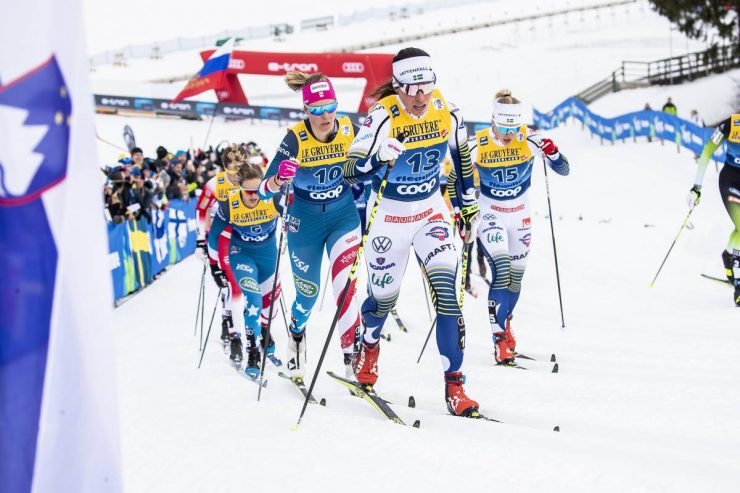
Charlotte Kalla (SWE, bib 13), Sadie Maubet Bjornsen, and Jonna Sundling (SWE) lead the chase group during Stage 5 of the 2019/2020 Tour de Ski. (Photo: NordicFocus)
Sweden’s Charlotte Kalla (33) was the highest-profile international cross-country athlete to test positive just before the start of the World Cup season in November. In a translated article from the Swedish daily, Espressen, the national team doctor said, “We have a potentially very serious infection. We know that this virus has a tendency to settle on the heart. And that is precisely the aspect we are most worried about when it comes to cross-country skiing, because it is one of the sports that places the highest demands on the heart. There we have to be extra careful with how we handle the return to training.”
Four years ago, Kalla suffered from atrial fibrillation before the race season and was sidelined for rest and testing. The former World Championship and Olympic medalist was not short-listed for Sweden’s Tour de Ski team. According to some media reports, she has resumed training and participated in internal Swedish National Team competitions. Kalla had originally opted to not race the 2021 Tour de Ski but had recently expressed interest in the event after missing Period I racing. She ultimately was not named to start the race. The FIS database lists Kalla as the winner of two FIS races in Sweden on Jan 8 and 10, respectively.
Sergey Ustiugov takes control in Stage 3 of the 2019/2020 Tour de Ski in Toblach, Italy. (Photo: NordicFocus)
Russia’s Sergey Ustiugov, a former World Champion and still young at 28 years old announced on Instagram he had contracted Covid in October while training in Italy. According to a translation, Ustiugov suffered. He attempted to restart training in November and decided that was a mistake. “I tried to start training in November, slowly getting involved, but all my attempts were, unfortunately, in vain, my body refused to adequately perceive the proposed load and each time I fell into a hole,” the translated posted stated.
On December 27, the Russian posted an image on Instagram in which he donned a bib and was at the start line.
Across the board, it appears that the return to sport after testing positive, whether it be the consideration of heart issues, possible clots, or fatigue associated with long-haul Covid-19, should be tempered. Caution reigns supreme. Rare, if it all, are calls for an immediate return to vigorous or even mild exercise for those symptomatic for Covid.
The British Journal for Sports Medicine recommends a six-stage protocol lasting approximately 18 days before what it calls a “return to competition”. The BJSM calls the progression a GRTP, or graduated return to play protocol. The graduated return is perhaps best described as a sliding scale for each individual and their baseline metrics like respiratory function, for example, but also their comorbidities. The more at risk an athlete, the more conservative the graduated return to play.
But also factoring into the decision and time frame to return is the nature of the sport. “Less aerobically intense sports like golf may progress quicker,” claims the BJSM. “Experience suggests that some athletes take over 3 weeks to recover.”
GRTP protocol from the BJSM.
Practitioners of cardiovascularly taxing sports like cross-country ski racing know the endeavor falls into the more aerobically stressful side of the intensity curve. Using Norris as a sample size of one, he displayed no signs of myocarditis. His troponin levels were within the range of normal, and he never experienced issues breathing. Norris waited approximately 14 days before he broached even remotely intense levels of exertion.
Each one of us is unique. And it goes without saying that what works for Norris may not work for others. General guidelines for a return to sport are exactly that, general. Some are ready sooner, others not for a longer duration, beyond what might normally be expected.
Again, using a healthy heart as the benchmark for returning to sport, The American College for Cardiology (ACC) advises different protocols for different age groups. And then again, within those age cohorts, it differentiates its return to play advice between those asymptomatic and symptomatic individuals. Then again, a return to sport might look different between those exhibiting mild symptoms compared to those with acute manifestations of Covid-19.
Presuming an athlete has been cleared of myocarditis or any other underlying heart conditions, the ACC states, “when considering the question of return-to-play, we believe there are three variables to consider: (1) How recent was the COVID-19 infection? (2) How severe was the infection? (3) What is the physical activity or sport being considered?”
Lastly, heart conditions in endurance athletes manifested long before Covid-19. The attention paid to athletes and heart conditions is not new. As recently as 2017, FasterSkier reviewed cyclists Lennard Zinn’s book, The Haywire Heart, which examined his terrifying experience with heart arrhythmias. Zinn, a well-known cyclist, had existed for the ride – many long and grueling rides over years. Causation is a tough thing to prove. We’ll leave that for others to debate. But the evidence is there that Zinn’s massive and high-exertion miles over decades may have altered his heart’s electric pathways.
“Further, abnormalities that have emerged as markers of COVID-19 cardiac injury may overlap with normal physiology and the established attributes of the athlete’s heart.18 For example, bouts of exercise in individuals in good health often lead to a transient elevation in troponin level and short-term imaging findings suggestive of cardiac fatigue, including myocardial inflammation and tissue edema.19,20 Similarly, benign consequences of longer-term exercise training, including mild reductions in left ventricular ejection fraction21 and nonischemic myocardial fibrosis, may further complicate the diagnosis of cardiac injury secondary to COVID-19.22″
If like Norris, you are cleared to ramp up your exertion levels and possibly eye World Cup starts, or a major goal like chasing down a 50 k race at a more pedestrian speed, both of which are worthy goals, your return to sport should be monitored, sensible, and grounded in being around for the long-term.
With Arctic sun as a backdrop, David Norris of the U.S. remains stacked during the 2019 15 k skate pursuit in Ruka, Finland. (Photo: NordicFocus)
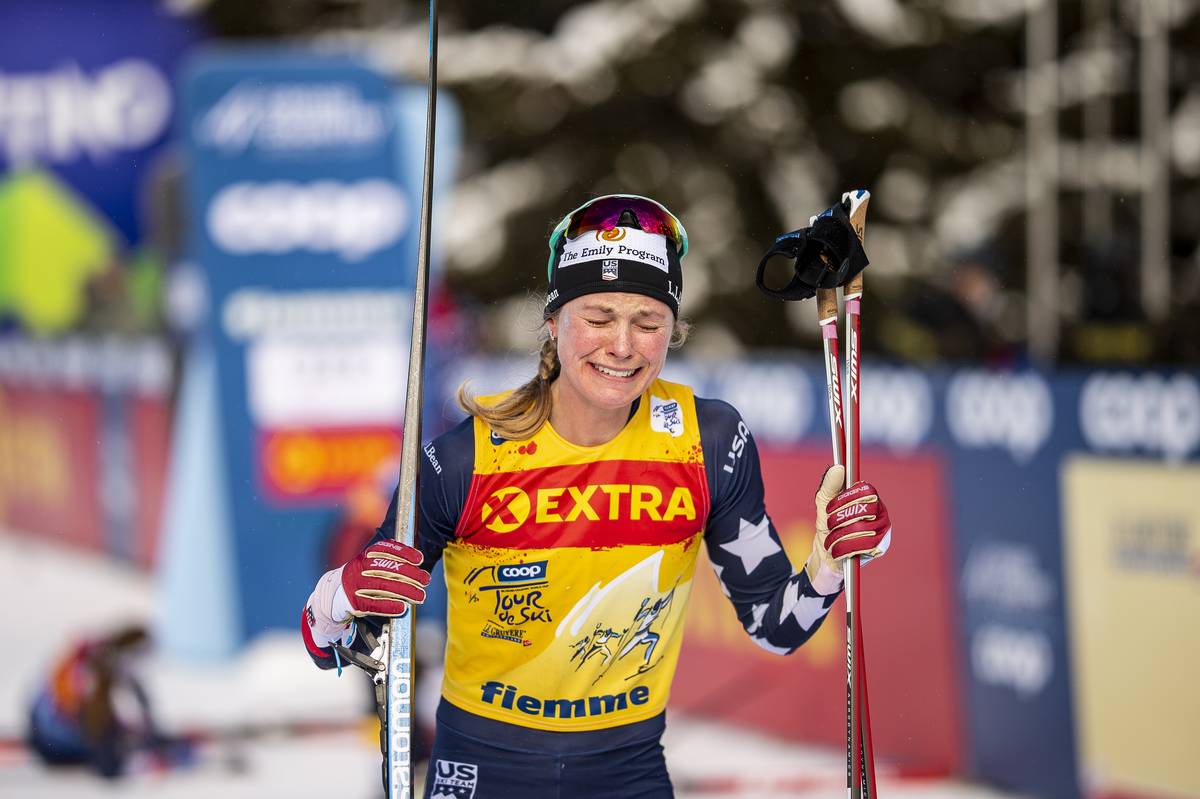
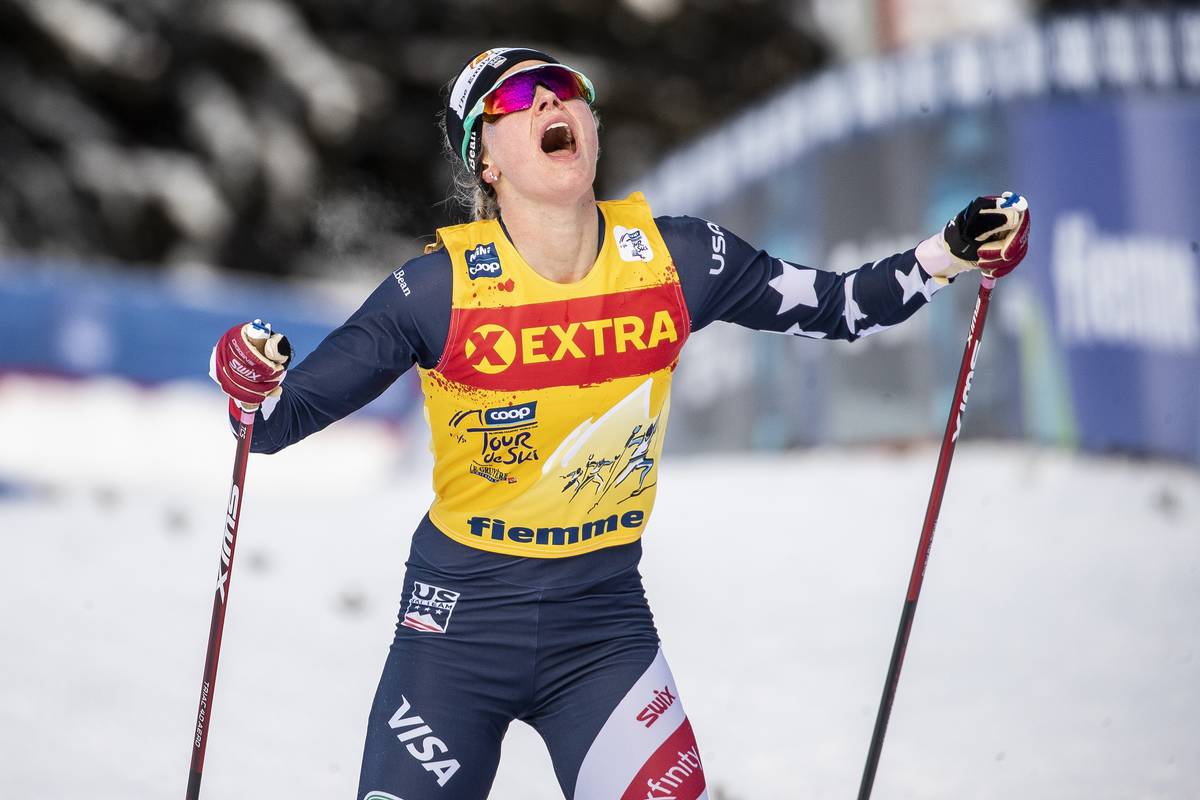
Raw emotion as Jessie Diggins becomes the first North American to win the overall Tour de Ski. (Photo: NordicFocus)
This World Cup coverage is made possible through the generous support of Marty and Kathy Hall and their A Hall Mark of Excellence Award. To learn more about A Hall Mark of Excellence Award or to learn how you can support FasterSkier’s coverage please contact info@fasterskier.com.
Though Devon Kershaw might fairly say “It’s not really cross country skiing,” as a viewer, the grueling climb up the Alpe Cermis is the crown jewel of the Tour de Ski. Sure, it is both impressive and visually appealing to watch beautiful technique and tactical racing, but there is nothing quite like watching racers toil through the lactic burn of grinding their way 400 meters up a ski area, at times with over 40% grade. Wheels come off, gaps close quickly, anything can happen.
Here’s how today shook out.
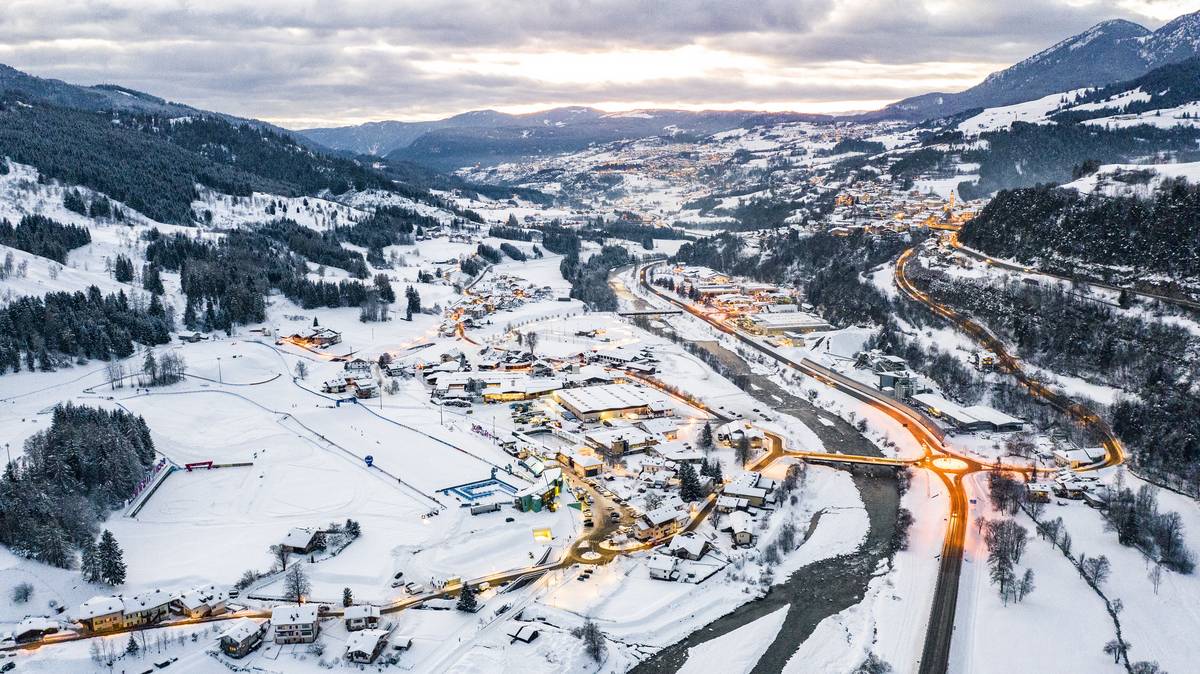
After nearly 50 kilometers of racing over seven stages, skiers take to the tracks one last time in Val di Fiemme, first for a lap of the sprint course, then soaring along the river banks along the narrow winding track of the Marcialonga, Italy’s WorldLoppet series classic. And, as camera angles altered from shots of the Swedes that set pace down the valley, controlling the narrative from the front while still conserving energy for the climb over the final 2k, to breathtaking aerial views of the frosted valley, it is clear why Marcialonga organizers refer to Val di Fiemme as a “Italian cradle of cross-country skiing”.
An aerial view of the storied venue in Val di Fiemme, Italy. (Photo: NordicFocus)
After a thrilling set of four podium finishes, including back-to-back distance wins in Toblach, all eyes were on Jessie Diggins. She entered the final stage wearing the yellow bib with a lead of 55 seconds in the overall standings. Given the beastly nature of the climb, this time margin certainly did not indicate that Diggins had her first Tour de Ski win in the bag.
To add to the energy, two sprint opportunities for bonus points were available at the 2.5 and 6.6 k checkpoints, this alternate leaderboard adding interest and incentive for sprinters to remain in the Tour.
Linn Svahn on the Alpe Cermis- she helped pace Andersson early in the stage and won three stages in this edition of the Tour. (Photo: NordicFocus)
Point leader and winner of both sprint stages, Sweden’s Linn Svahn charged off the front of the pack at the 2.5 k mark, collecting 15 bonus points with her teammate Ebba Andersson hot on her tails. The two quickly allowed the pack to close the nearly 4-second gap, but Andersson remained at the front, pulling away to create a gap of over 10 seconds at the 6.6 k mark, which she kept as the grade inclined.
Perhaps trying to lure Diggins to push too hard too soon, perhaps she had her eye on the TdS podium, or perhaps just looking to be the queen of the hill and win her first World Cup, it was clear that Andersson wanted to dictate the pace from the front in the back half of the mass start event.
Sweden’s Ebba Andersson takes the stage win, and placed third overall in the Tour. (Photo: NirdicFocus)
Andersson was the epitome of steady as she worked her way up the climb. She could V2 when the grade was humane, and smoothly transitioned between her V1 and the “coach’s skate” required to keep skis gliding on the steepest pitches.
While the Swede remained composed, Diggins displayed the grit and perseverance for which she is beloved as a racer. Though Andersson was more than two minutes back in cumulative time heading into the final stage and the remainder of the field behind her, Diggins left nothing to chance, giving her all as she pushed every meter. Holding her ground, the American kept her time back on the leader even and tight, hovering around nine seconds throughout the climb.
Like everyone, even Diggins rides the struggle bus up the Alpe Cermis. Diggins, however, motored to a Tour de Ski overall win on Sunday. (Photo: NordicFocus)Jessie Diggins racing to second on the stage and first overall in the Tour de Ski atop the Alpe Cermis. (Photo: NordicFocus)
With less than a kilometer to go, head coach Matt Whitcomb cheered from a switchback as Diggins passed, his excited shouts leaving him nearly as breathless as the athletes. Pine boughs tucked into the snow to create the final lanes as Andersson and Diggins headed toward the inflated arch that offered relief from the pain in their bodies.
Ebba Andersson (SWE) chugging along in front for the Stage 8 win. (Photo: NordicFocus)
With the end in sight, Andersson with a poker face V2’ed through the finish while a slack-jawed Diggins held together in V1 to cross the final meters and collapse over the finish line.
Finally, the Tour de Ski victory was hers and she could simply lie in the snow, chest rising and falling with her labored gasps for air. More than a win, this achievement makes Diggins the first American — in fact, the first non-European — man or woman winner in the 15-year history of the Tour. She also sits atop the leaderboard for Overall World Cup standings.
Victory and relief, Jessie Diggins completes the climb up the Alpe Cermis to win the overall 2021 Tour de Ski. (Photo: NordicFocus)Exhausted, Jessie Diggins crosses the line second in the stage to hold onto her lead in the overall Tour de Ski. (Photo: NordicFocus)
“This was a lifelong goal,” Diggins told FIS after her race. “We had an amazing team atmosphere this whole time, and amazing support and help, and so many cheers from around the world — it really gave me wings up the hill today.”
The interviewer asked what this result meant in light of a World Championship season, as completing the arduous Tour in such a year could be seen as a risk. If an athlete cannot recover properly in the subsequent six weeks, their potential on the championship stage could be compromised. Diggins’ answer looked through a wide-angle lens.
“It means so much. I think it’s so cool for our country to show that it’s possible. And now I’m looking forward to resting.”
Jessie Diggins wins the overall 2021 Tour de Ski and sits at the top of the overall World Cup standings. (Photo: NordicFocus)On the top step of the podium, Jessie Diggins is the 2021 Tour de Ski winner. (Photo: NordicFocus)Jessie Diggins becomes the first North American skier to win the Tour de Ski in its 15 year history. (Photo: NordicFocus)
Behind the two leaders, France’s Delphine Claudel crossed the line in 3rd (+32.6). Evidencing the “anything can happen on the Alpe Cermis” sentiment, Claudel sat in 19th in the overall standings leading into the final stage and had never before earned a World Cup podium, though she was 7th in the 10 k skate in Stage 4. The 24-year-old overtook Russia’s Yulia Stupak in the final kilometer, closing a 12 second gap and creating a nearly 8 second one of her own.
Stupak held on for 4th place (+40.0), followed after a gap by teammate Tatiana Sorina (+1:04.3) rounding out the top five.
Yulia Stupak of Russia here on the Alpe Cermis, placed second overall in the Tour. She won two stages, and podiumed in four others. (Photo: NordicFocus)
With this result, Stupak held her ground in second place for the overall TdS standings, finishing 1:24.8 behind Diggins in cumulative time. Andersson’s outstanding climb was a springboard, advancing her from 6th to 3rd (+2:00.8). Recall that Andersson did not make the heats in Stage 1 of the Tour and finished 12th and 18th, respectively, in the second and third stages. Landing on the podium four times in the final five stages fueled her steady rise through the ranks.
Today’s queen of the Alpe Cermis, Sweden’s Ebba Anderson set the fastest time in the final stage of the 2021 Tour de Ski. (Photo: NordicFocus)A good day for Sweden, Ebba Andersson wins Stage 8 of the Tour de Ski to finish 3rd overall, while Linn Svahn takes home the victory in the point standings. (Photo: NordicFocus)
Adding reason for Swedish team celebration, Svahn was the winner in the point totals, with Diggins in second and Slovenia’s Anamarija Lampic in third.
Rosie Brennan, here in the Alpe Cermis, animated this Tour and finishes a career best 6th overall. (Photo: NordicFocus)
Closing out a career best finish in the Tour de Ski, Rosie Brennan was the 7th woman up the hill (+1:17.8) to finish 6th in the overall standings. Brennan’s previous best finishes in the TdS overall were 15th last season and 24th the season prior.
“I love the final climb because of its simplicity and the feeling of accomplishment of reaching the top,” wrote Brennan in an email after the race. “I knew there was an opportunity to make up some places today so I set out with intention. Unfortunately, I stuck a tip in the powder on the side of the trail on the Marcialonga portion leading into the climb and took another digger. Luckily, I didn’t lose much time, but was then at the back of the pack and knew that if I was going to make the most of the climb, I needed to be ready for the breaks as soon as we hit the bottom. I worked really hard to make up the places that I could and then really went for it when we reached the climb to try to get into the leading group. It was my only option at the time, but definitely took a little more energy than I had hoped. I had a moment of weakness when I hit the first steep pitch and lost the ride I needed to take. I was able to recollect myself and hold strong, but frustratingly missed top 5 by a mere 4 seconds. 6th place is absolutely a career best and I am proud of my effort of fighting back after the disaster that was stage 6, but I always want more of myself and those 4 seconds certainly sting a bit.”
The end in sight, Rosie Brennan finishes 7th in the hill climb and 6th in the overall Tour de Ski. (Photo: NordicFocus)
“It was inspiring to watch Jessie put so much fight in every day and that certainly inspires me to find more,” Brennan continued. “I couldn’t think of a better person to take the yellow bib off my back. I am also really excited to hold onto the red [World Cup distance leader] bib! The Tour de Ski is always a new experience and always requires a lot of fight. I am thankful to have been able to race the event this year and am really looking forward to some recovery!”
Antonia Fraebel (GER) and Hailey Swirbul (USA) behind, during Stage 8. (Photo: NordicFocus)
Hailey Swirbul skied the 15th fastest time today, bumping her up to 18th in the overall Tour standings. The 22-year-old is in good company with this result, considering the only other American women to finish in the top-20 of the Tour de Ski are Jessie Diggins, Kikkan Randall, Rosie Brennan, Sadie Maubet Bjornsen, and Liz Stephen.
Hailey Swirbul, another American high point, placed 15th on the day and 18th overall. (Photo: NordicFocus)
Katharine Ogden finished 24th (+2:34.5) up the climb for 23rd overall in the Tour, while Caitlin Patterson rounded out the Americans in the top-30 finishing 27th (+2:42.9) in Stage 8. Patterson was 34th in the overall TdS standings.
Katharine Ogden V1-grinding on the Stage 8 final climb. (Photo: NordicFocus)Caitlin Patterson climbs to 27th in the final stage of the 2021 Tour de Ski. (Photo: NordicFocus)
Finally, Julia Kern skied to 37th today (+3:41.3) to end the Tour in 38th.
– Gavin Kentch contributed
This story will be updated with additional comments from athletes when available.
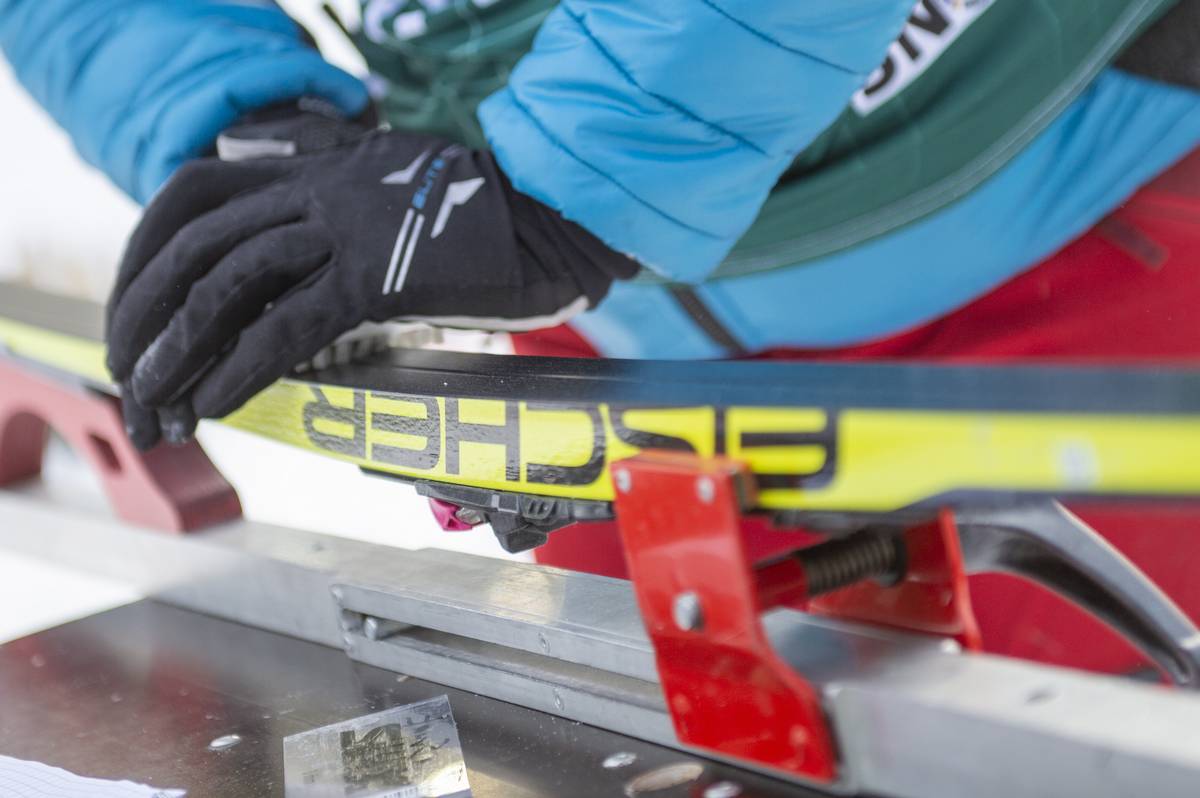
What: Fluoros, aka perfluorinated waxes, aka ski waxes containing per- and polyfluoroalkyl substances (PFAS), aka the really expensive waxes that you put on for big races, in some or all of block, liquid, or powder form.
What they do: Make your skis go really, really fast, particularly in the wet or dirty snow conditions that sadly characterize more and more high-end races in an era of artificial snow and climate change.
What else they do: Exposure to certain perfluoros is associated with thyroid disorders, hypertension and preeclampsia during pregnancy, and testicular and kidney cancer, as well as statistically improbable rates of illness and death for people exposed to it in high quantities. PFAS chemicals have been found in the drinking water in multiple states. Lawsuits have been filed; over a billion dollars in settlements have been paid.
What’s their status for ski racing: It’s complicated. For the past few decades, fluoros were ubiquitous in high-level ski racing. Then, in November 2019, the International Ski Federation announced that fluorinated waxes would be banned in all FIS races, including the World Cup, effective this race season. Nations began testing fluoro-free alternatives from major wax manufacturers. FIS began working on a workable and efficient fluoro-detection machine. Much upheaval ensued.
Work on the fluoro-detection device did not go as efficiently as planned. At the eleventh hour, in mid-October of this year, slightly more than a month before the first World Cup race of this season, FIS announced that the fluoro ban would be postponed by a year, and would not go into effect on the World Cup (or at, say, the 2022 Winter Olympics) until July 1, 2021. “Stay tuned,” FasterSkier wrote last month.
What did Devon Kershaw think about this: He was not a fan of FIS’s lack of competence or professionalism.
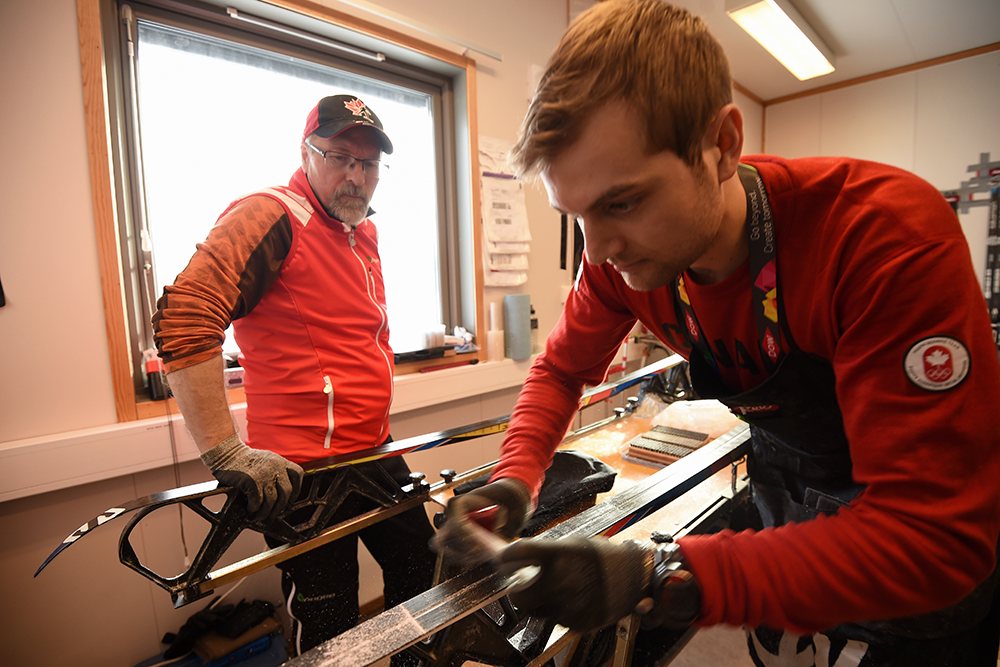
Canadian wax technicians Mike Mappin (l) and Camille Cheskey (r) hard at work during the 2016 Winter Youth Olympic Games on Feb. 10 in Lillehammer, Norway. Yes, they should really have some form of respiratory protection. (Photo: Jon Buckle for YIS/IOC)
No, really, what’s their status for ski racing: Simply put, fluoros are allowed in FIS races in this country this season, as in any FIS race in any country this season. They are not allowed in races sanctioned by U.S. Ski & Snowboard. (These were formerly known as USSA races. They are also known as NRL races, or National Ranking List races, that is, a points system used to rank domestic athletes.)
That’s nice, but I’m your average master skier in this country. I’m not a USSS member, and I’m not racing any high-level races. Other than the general health and safety considerations, why do I care about this? Ever hear of a little thing called the American Birkebeiner?
Yes, the one true ski race for Master Blasters everywhere. But what does that have to do with fluoros? They’re banned at the Birkie, starting this year.
Really? Really. Here’s American Birkebeiner Event Director Kristy Maki, in an email to FasterSkier this November:
“The 2021 Birkie Events will be fluoro-free. We are working on determining how testing will be implemented and right now, our goal is to do testing on a limited number of skiers. We have been working on the basic planning of Birkie Events, but I will be updating the Participant Rules soon.
We have announced previously that we would be fluoro-free in 2021, but it has not gotten a lot of attention lately.”
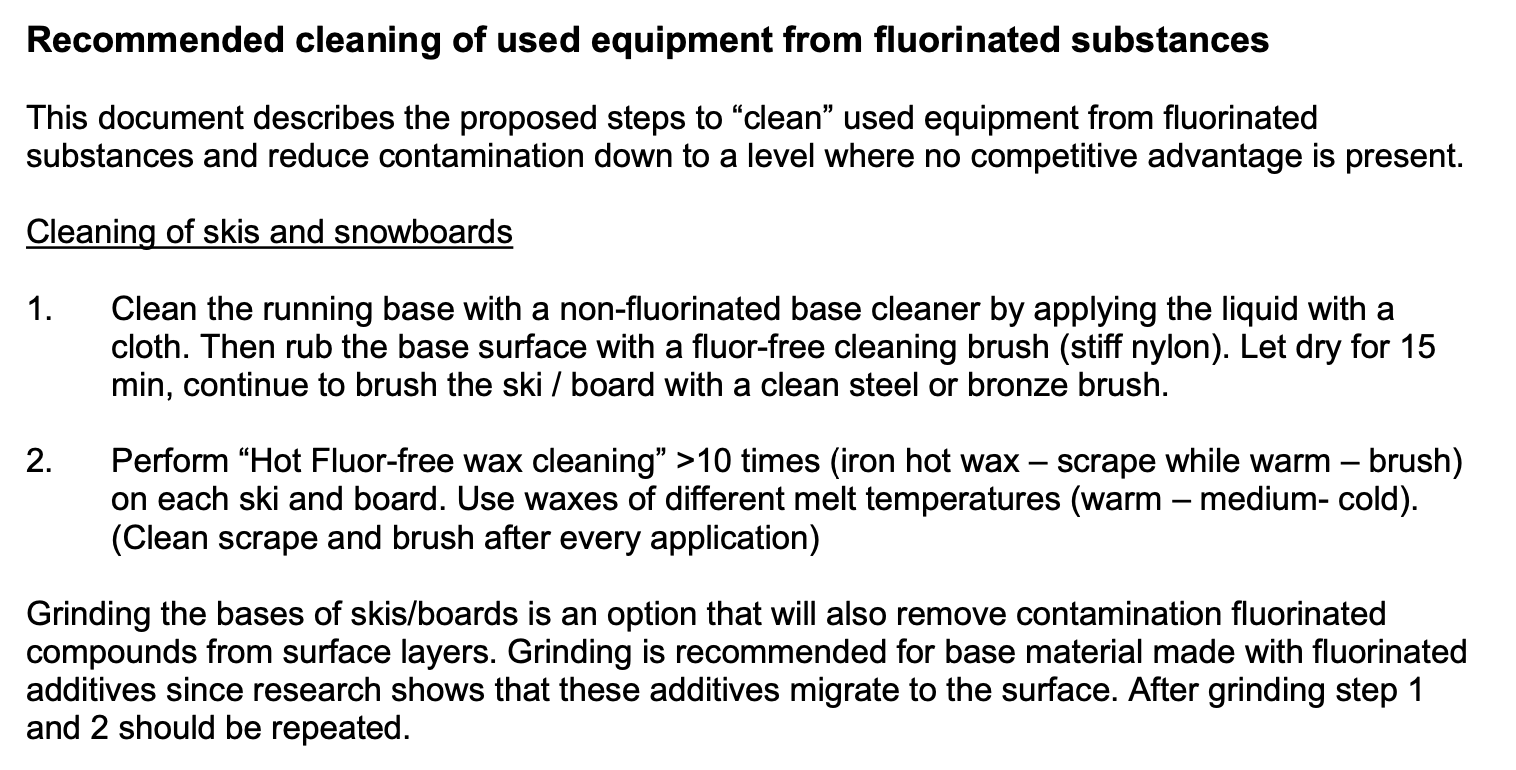
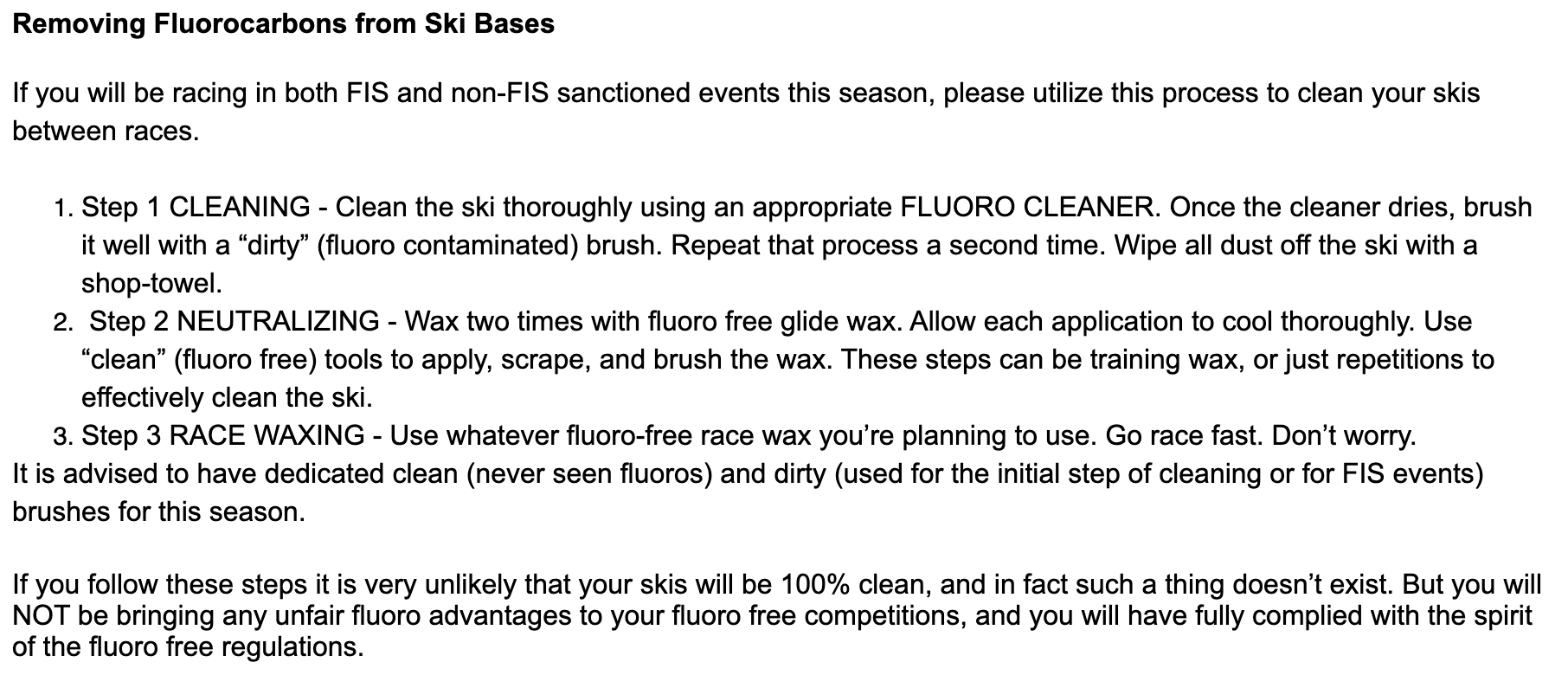
Okay, I’m listening now. How do I get the fluoros off my skis so I can race the Birkie without breaking the rules? The short version is that you need to clean your skis; de-fluoro your skis; and then wax your skis anew with fluoro-free wax. Here is an excerpt from a longer document prepared by FIS:
If hot waxing more than 10 times does not seem like enough work, the full document also explains how to clean/purify your iron, scrapers, brushes (but you should really just buy new brushes), roto fleece, wax apron (wash on high “several times”), files and file guides, ski bags, and wax room.
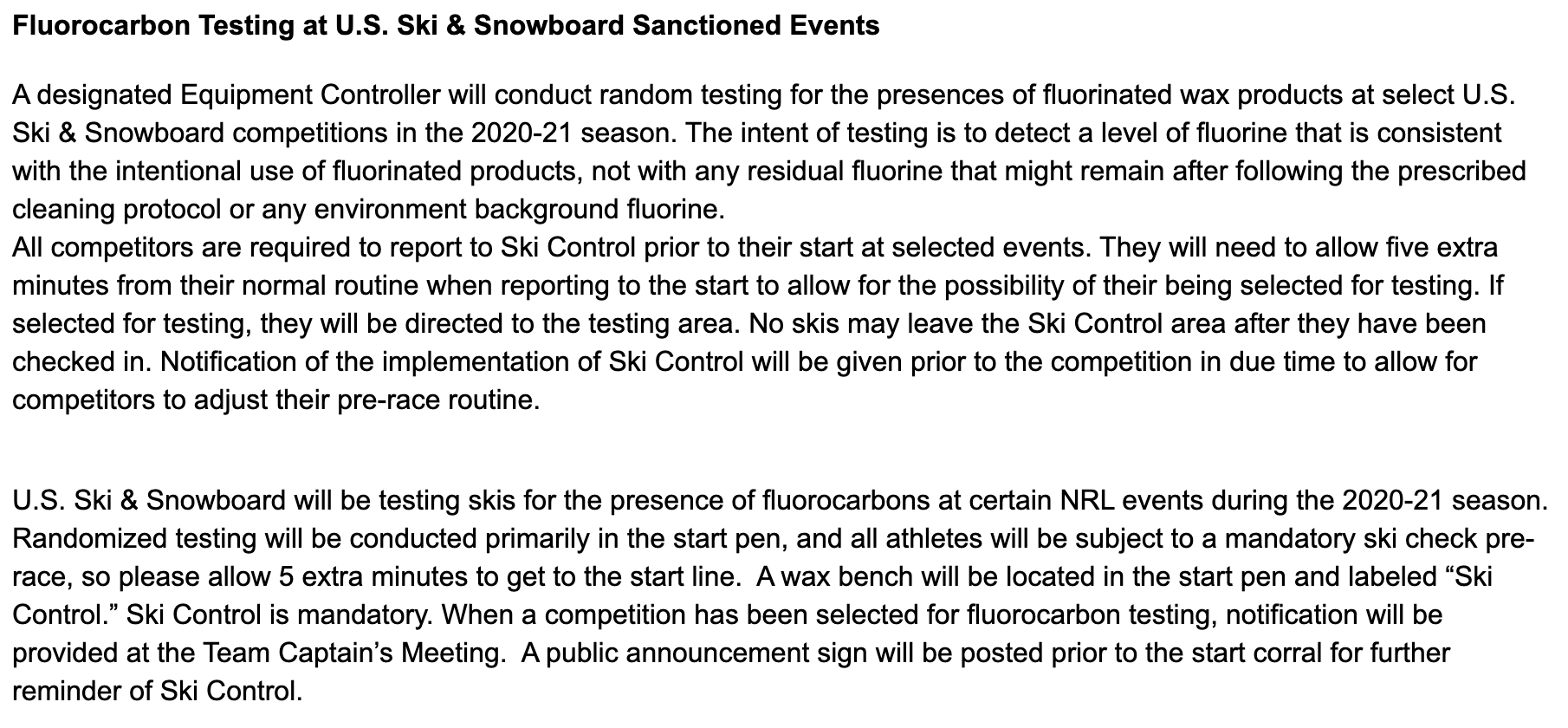
Wow, that sounds really involved. Do you have a shorter version of what I can do and still achieve some sort of good-faith compliance with these new rules? Thankfully, yes. Here’s what USSS sent out in an email to all members in mid-November:
The main difference is that it involves far fewer repetitions of the cleaning step, specifically “two times” rather than “more than 10.” (Granted, that’s twice through a normal wax application in which the wax cools each time, rather than 10 times hot scraping, so that’s a little apples to oranges.) But this was sent out by Adam St. Pierre on behalf of U.S. Ski & Snowboard, so this would seem to have USSS’s imprimatur behind it. Also, this accords with the “two layers of NF” protocol used by EISA teams over the past few seasons.
Bigger picture, USSS seems to envision this as something you could do if if you’re transitioning between, say, USSS and FIS races multiple times this season (or USSS and no-holds-barred citizens races), while the FIS protocol is probably more applicable to making a permanent transition from a fluoros to a no-fluoros world. Which is clearly coming soon, but, depending on where you live and the viewpoints of your local ski club, may not be here yet – citizen races in southcentral Alaska, for example, remain very much fluoro-friendly this season.
Okay, I did all this, but I don’t trust my competitors to do this at all. What type of oversight is there going to be at races this season? Probably some but not much. As Maki with the Birkie said, they will be targeting “a limited number” of entrants. Or here’s St. Pierre, in the same mid-November email quoted from above, describing random testing at “select” USSS races this season:
Full details on the testing protocol (brief version: the ski is swabbed in two places on the glide zone; sample is sent in for analysis; results come back in 10-14 days) may be found here. St. Pierre also explains the possible sanctions for evidence of fluoro use, up to and including disqualification. He adds, “Remember: Testing can indicate the degree of fluoro contamination. Our intention is to catch intentional and unethical fluorocarbon use; the goal is not to sanction individuals for traces of fluorocarbons from prior waxing, those present in the ski base, or the environment.”
What do you have to say about all this, USSS official site?Here you go: “In order to provide U.S. Ski & Snowboard members, coaches and officials guidance with the [no fluoros] policy, we are providing the following information: …
Fluorinated Wax Testing: Testing procedures and protocols will be forthcoming.”
Oh.
What do you have to say about all this, American ski community? Here’s CXC, writing about its new wax policy for this year’s events (emphasis in original): “Our CXC Cup Wax Policy is first and foremost an honor system, but athletes at Salomon CXC Cup NRL Events are subject to random ski testing for illegal wax by representatives of U.S. Ski and Snowboard. It should also be recognized that ski waxing, especially with non fluoro waxes, is quite variable and often two similarly waxed pairs of skis can have large differences in glide based upon non wax factors such as flex and structure/grind. All competitors and coaches should adopt a culture of compliance, and all our membership should presume their fellow competitors are acting ethically and legally, rather than pointing fingers based upon a subjective idea that someone has fast skis from illegal waxing.”
Or here’s Boulder Nordic Sport’s Roger Knight, writing in this winter’s version of the BNS catalog, which was prepared at a time when fluoros were going to be completely barred this season, and so was partially obsolete by the time it was printed: “Where does [the absence of widespread fluoro testing] leave us? With an honor system. Will some people cheat? Undoubtedly. Do you want to be one of those people? Only you can answer that question. One thing that we essentially have never had here in the US is a stain of cheating on our cross-country skiing culture. We hope that this continues at all levels of the sport.”
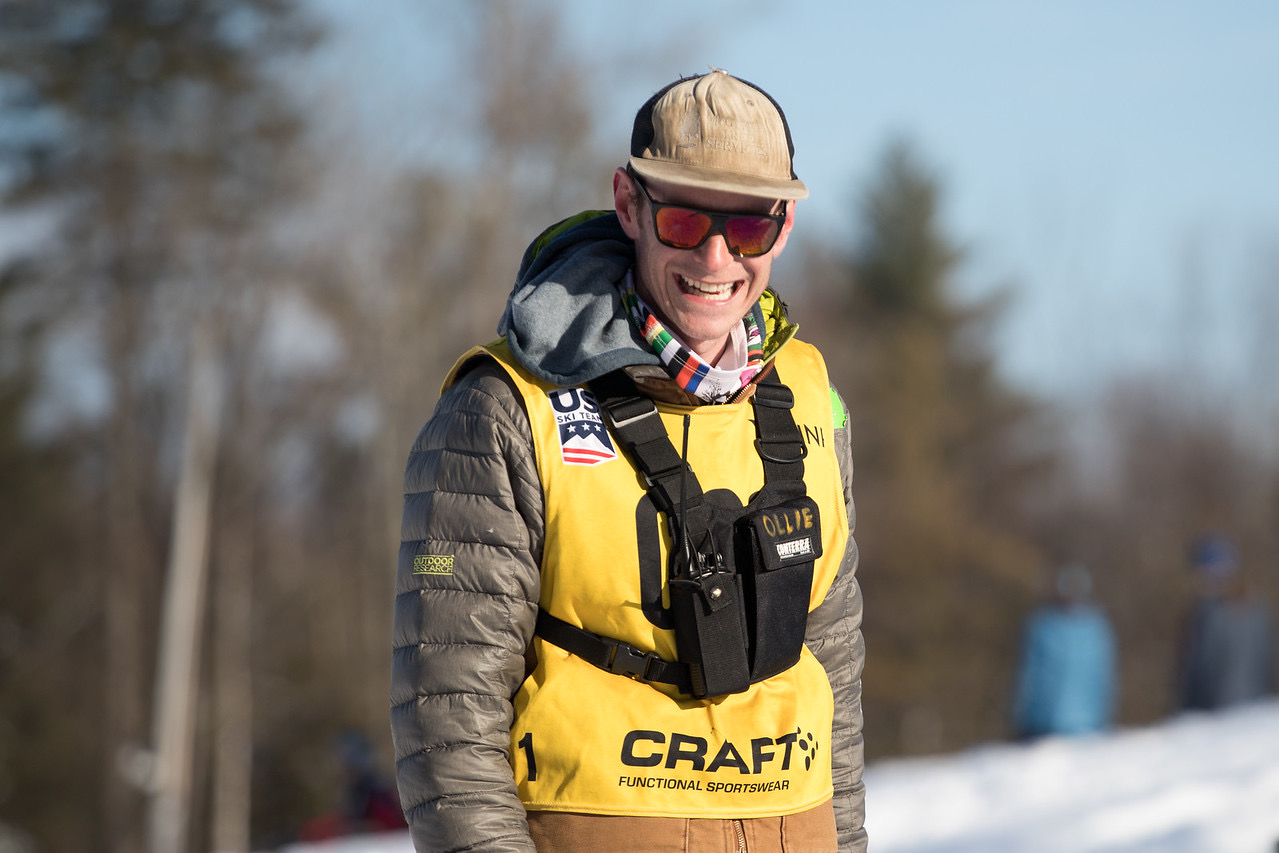
Ollie Burruss, chief of competition at the 2019 US Nationals in Craftsbury. (Photo: Craftsbury Outdoor Center)
Finally, here’s FasterSkier writing last month about Craftsbury nordic race director Ollie Burruss: “In Burruss’ estimation, racing at the Outdoor Center is de facto fluoro free. … The Outdoor Center asks you not to use fluoros. That decision, according to Burruss, will be based on trust and a hardened value system relying on people doing the right thing, not necessarily the fastest thing.”
Burruss added, “We don’t have a community in New England where it’s fraught with suspicion, backstabbing, and people trying to one up each other. We really have, I think, a really tight-knit supportive ski community. And so when we planned on having FIS racing, we weren’t going to test.”
I’m sorry, but I’m still skeptical that some of my competitors are going to comply with a largely honor system-based protocol, when the advantages of fluoro use in some conditions are so great, and widespread testing or enforcement is not really an option yet. Am I alone in this concern? You are not. Although it was admittedly unscientific, an informal poll conducted on FasterSkier last fall suggested that large portions of the 160 respondents were less sanguine than Burruss or CXC leaders about the ethics of their competitors. (N.b., there was likely no practicable, quick-turnaround, fluoro-detection device on the market at that time. To be fair, there still isn’t.)
One of the questions in the 2019 survey was, “If a fluoro ban was put in place, would you trust that the field was ‘clean’ with regards to fluorinated ski bases?” Only 25% of respondents answered “yes.”
Narrative comments made in response to this question included, “A 20%+ advantage in some snow conditions? Yeah, that’s a big incentive. I can’t imagine [a ban] working.” (For perspective, and back to the Birkie for a second, a 20-plus-percent improvement is the difference between qualifying at the back end of the Birkie Elite Wave and making the podium at SuperTours or U.S. Nationals. That’s a pretty big difference.)
Also, “If there isn’t a simple compliance test, no doubt some people will cheat to win.” Also, “I would like to trust that the field was ‘clean’, but I think I would struggle to do so if it were to actually happen. Furthermore, I think that any stellar performance by an athlete would be subject to suspicion, regardless of whether or not they were ‘clean’, and that this would be unfortunate.” Also, “I am sure several masters racers with large wax stores would still use them until they were depleted; I would expect races to be clean in several years and primarily clean in the interim.”
Also, and more optimistically: “At the World Cup level, I probably wouldn’t trust the field to be clean, because there is a lot at stake, and some people already dope, so I’m sure they’d have no qualms about fluoro doping. However, at the US level, I have a lot more faith in the nordic ski community and I honestly believe that anybody that is seriously competing to win super tours and represent the US at world championships would do so honestly.”
In response to other questions, 64% of respondents stated that they would continue to use their existent stock of fluorinated waxes. 56% of respondents stated that they foresaw some sort of black market developing for banned wax products. Again, you can find the full poll results here if you are curious. You may also note this narrative comment, which speaks volumes: “I hate the poison but feel non-competitive without it.”
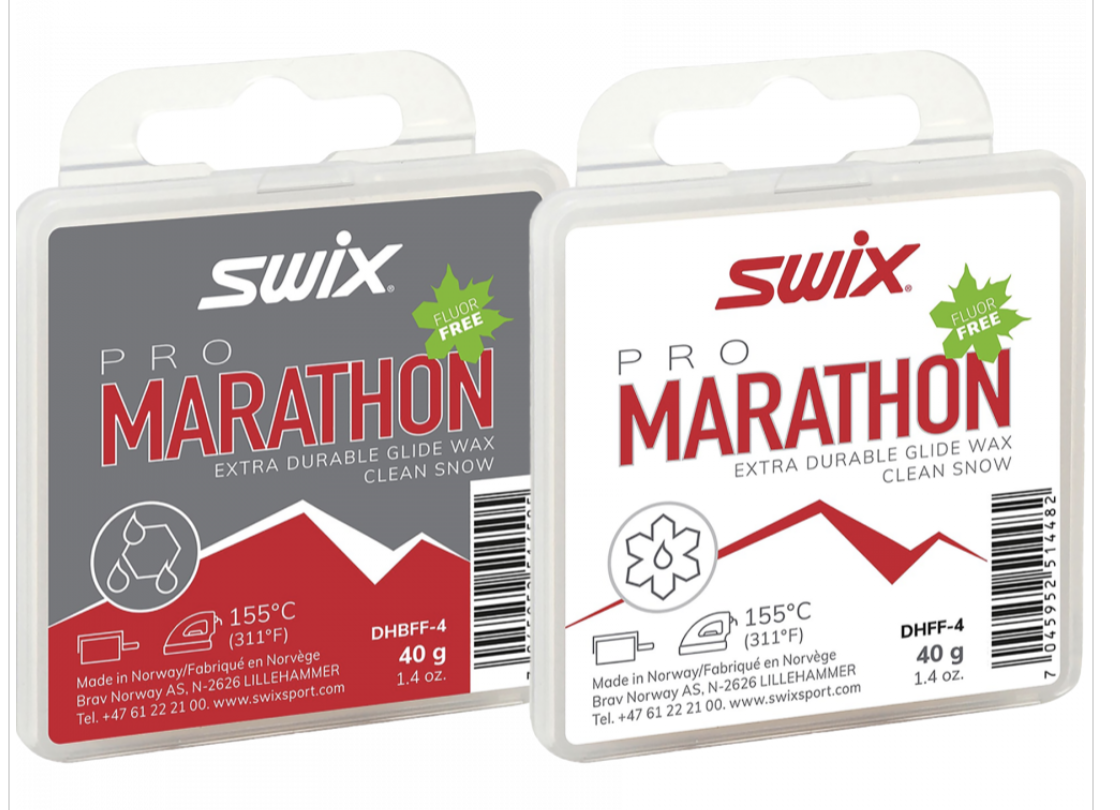
Swix would be glad to help you restock your wax bench: Swix Pro Marathon Fluoro Free. (photo: screenshot from current BNS catalog)
So after I clean off my skis, what do I buy to wax with instead? Most wax manufacturers have developed fluoro-free analogues of most of their fluorinated products. Your local ski shop will be well-versed in your new options.
What else should I buy? Maybe some new skis, or at least some new structure tools. As USST wax tech Chris Hecker wrote, summarizing his testing of World Cup-level non-fluoro waxes during the 2019/2020 season, “I am very impressed with how good some of the non-fluoro alternatives have been. In colder, dry conditions I find a number of brands have found competitive alternatives to fluoro top coats, but when it comes to warm, wet snow days the gap is still fairly large. On warmer days with non-fluoros being present, skis, hand structure and ski grinds will become ever more important.”
This article has been edited to remove a link to a table of waxes approved for CXC races, because it represented only a portion of fluoro-free waxes currently available.
Virtual Race Courses Look Different: An action photo from a time trial at Sovereign Lake during the pandemic. 20 racers spread out over three hours, no officials, no spectators.
COVID19 has brought many changes to the nordic world. In many places, we can still ski. Some people can travel, some cannot. Some people live near snow, some don’t. There is no one size fits all solution to having fun while the pandemic rages, but there are a lot of potential solutions to specific needs.
The race organizers among us know how to host traditional large group races. If that is allowed, you just need to build your bubble plus testing regime, and off you go. That’s certainly more difficult than it sounds. For the rest of us with smaller budgets, outside-the-box thinking is mandatory.
This is the beginning of a series exploring recipes for hosting your own virtual ski event. We are all learning as we go and the only FasterSkier staffer who knows everything about everything is too busy studying medicine, which means we need your help to build a better resource. Tell us about event types we have overlooked, better ways to categorize events, solutions that worked for your running or mountain biking club, or even just ways to use the solutions we have already found. Write up your own solution or event and let us all learn from you. (You can leave a comment or email gerry@fasterskier.com directly.)
Most of the examples cited below can be done with self-timing or GPS timing. GPS makes it harder to cheat, but it isn’t that hard. The easiest way to stop cheating is to reduce the awards. Sadly, some people will cheat to get their name on top of a digital list; if that is your biggest problem in 2020, it is time to throw a (virtual) party.
For some ideas on how to convert the ideas and examples below into your event, see Virtual Event Hosting: Things to Think About.
The collection of recipes will grow as the community adds ideas. Just as there is more than one oatmeal cookie recipe on the internet, there can be multiple event recipes based on the same tools. As with any recipe book, both the ideas and the detailed steps are just a starting point, an inspiration to making something your own.
Types of Event:
With real examples where we have found them and explanations of how some events were created.
Pick your own start time on a fixed course.
This could be a Strava segment or any specific route that everyone skis.
Caledonia Nordic has announced the Grand Tour, built on zone4.
Create a Strava club, make a segment for each race, and invite the registered entrants to join the club. Here’s a recipe.
Have races scan a QR code to record times using WebScorer.
Pick your own course, single sport.
Many running series did this over the summer. Run at least 5km anywhere in the world and upload a photo of your gps watch or your gpx file as proof.
WebScorer has a blog with one solution here for self-reported results.
Pick your own course, multi-sport.
For visitors who can’t visit, selected distances with sport options to suit the areas your participants live in.
The Kangaroo Hoppet was in lockdown in August with the trails closed. People chose one of the distances and a sport they could do at home. As Australians in some states could only go outside for two hours, the distance could be done over multiple days. The road cyclists dominated the result sheet, but the roller skiers had the best photos.
The Merino Muster had both a virtual event and an on-snow event. The on-snow portion was postponed a few weeks for safety reasons, only local skiers could attend. This wasn’t as polished as the Hoppet, possibly because the OC had two parallel events with conflicting demands.
Club/Group Challenges
A participation based competition between areas or organizations. Kilometres or hours are easy to do. Even miles if you live in Myanmar, Liberia, or what was that third non-metric country again. Some form of per capita ranking will be needed if there is a large disparity in sizes.
Nordiq Canada and zone4.ca are creating a kilometre-based challenge for all of Canada that will start in January. More detail on how they are building this is forthcoming, but here is a FAQ from zone4.ca while you are waiting.
Nordiq Canada has partnered with iSKI and FIS for a kids challenge, also starting in January. More information pending after this initiative is announced.
Ski every trail in the system.
Difficulty depends on how big your trail system is, but it is a mental and physical challenge to find the shortest route the covers every trail and finishes where it started. Mathematicians call this kind of problem NP-complete, which means you have to try every possible route to be certain you found the shortest. At this author’s home system, there are millions of possible routes, and the shortest path to ski all 50km of trail is likely to be about 75km long.
Almost Real
Some places have the pandemic under control and have more freedom to get together for almost normal ski racing. Take my Covid expert’s advice to ‘be kind’ and celebrate those who have more opportunity than you.
The Great Bear Chase has changed to have smaller waves and more of them.
David Norris skiing in last season’s Tour de Ski. (Photo: Nordic Focus)
This is part one of a two-part story about U.S. skier David Norris who was recently diagnosed with Covid-19. Part-one explores how Norris experienced the illness, whereas part-two will look into some of the medical literature around athletes and COVID and how Norris plans to build fitness post-illness.
There’s been drama this season on the World Cup. The opening act was the superb racing in Ruka – it was exactly the fist-bump we needed. The closing act from Finland, a knee-buckle winnowing of the World Cup field as Norway, Finland, and Sweden pulled back from racing World Cups.
For the U.S. Ski Team, Ruka served, as is typical with the now podium-pedigree women’s team, as a warm-up for some and an exclamation point for others. Rosie Brennan skied to fifth overall in the series and popped a third-best time of day in the final skate pursuit. For the men, Gus Schumacher and JC Schoonmaker arrived sprint-ready with Schumacher proving at 20, he’s capable of moving into the top-30 in any discipline. And Scott Patterson, rebounding after a down year in 2020, raced to a 23rd fastest time of day in the 15 k skate pursuit.
Norris will be absent from the World Cup through at least December and most of January. He informed FasterSkier that he was confirmed positive for Covid-19 on November 13. Mask-wearing, social distancing, and handwashing were all part of his Covid-19 avoidance strategy.
Norris’s subtle symptoms began on November 7 with a low-grade stuffy nose.
“I had an interval scheduled for that day when I sensed something was up,” said Norris. “ I was up in Fairbanks training. It was subtle enough that each of those days I was stuffy, I contemplated doing intervals and I was like, ‘maybe I’m a little bit on edge.”
With his experience training through a virus and cratering, Norris now embraces caution. He pushed the intervals back a few days.
“This wasn’t even a COVID consideration,” he added. “Having a stuffy nose, I did not even think about COVID, I just thought I was training a lot. At the time I was simply living with my parents and going to Birch Hill to train and going back to the house. I just really didn’t think I had any exposures.”
On the morning of the 9th, Norris lost his sense of smell, something we know now is a hallmark symptom of a Covid infection.
“I woke up and ground coffee and didn’t smell it at all,” Norris said. “I’d heard from a friend of mine who contracted COVID that his red flag was that he could not smell his scented Chap-Stick as he applied it. Then I started running around sniffing everything in the kitchen. And so at that point, I knew I needed to go get tested. In my parent’s house, I began continually wearing a mask and keeping my distance from them.”
Norris ceased skiing mid-week on the 11th out of precaution. The confirmed positive came two days later, on Friday Novenber 13.
During those few days Norris continued skiing, he said those were the times he felt best. He skied easily, by sensation, during which he felt more himself. When not skiing, he endured headaches, mild fogginess, and occasional nausea.
He soon heard back from several doctors and academics affiliated with the APU program and was advised to cease all exercise. “They pretty much suggested that I should have stopped exercising the second I lost my sense of smell,” said Norris about the medical advice he received. “Once I received the positive I stopped exercising completely. My energy was OK. I think it was a good call. I felt better.”
According to medical literature, Covid-19 symptoms run the full gamut. Depending on the person and their underlying conditions, some experience no symptoms, while others suffer quick onset pneumonia and other devastating diagnoses. Norris was lucky.
“I never had an actual fever when I checked and I was able to sleep 10 or 11 hours and then still take a nap in the middle of the day and I wasn’t training at all,” he said. “And mostly I just had a bad headache for about a week straight. So, for me, I wasn’t concerned about prolonged risk or damage because it wasn’t the most severe cold, by far, that I have experienced compared to previous illnesses.”
David Norris racing at the Holmenkollen 50 k last season. (Photo: NordicFocus)
***
What follows is an interview with Norris on December 3.
FasterSkier: After your positive, what did your doctors recommend in terms of rest and exercise?
David Norris: They said I had mild to moderate symptoms. And so there was a recommendation for zero exercise until 10 days from the last symptoms. It’s hard to identify what my last symptom was because I guess I’m feeling good, but then periodically throughout the day, my chest might hurt. Then I think, is that a symptom or am I just this kind of sore from the lingering virus?
So with my stuffy nose, I think I gave it 12 days before I started exercising again just to give it the extra wiggle room and it seemed like there was no rush to do anything. I could do more harm than good by getting back to training. And the training – the recommendation was to just do 45 minutes of L1, very easy, nothing remotely hard.
FasterSkier: L1 recovering from COVID, does that look like you’re simply walking up any hill?
DN: Yeah, I guess in terms of skiing everything is pushed or dialed back. So if the terrain is flat I might be V1-ing across, and on a hill that I normally just ski right up, I might do the coach’s skate. But it wasn’t like I was straining to ski easily. I did that for a whole week, just one session per day for roughly 45 minutes to an hour. Right now, the second week, I do a morning session for an hour. In the afternoon I’ll ski 45 minutes to an hour. Easy again.
FasterSkier: Let’s circle back to the chest pain, since Myocarditis, or inflammation of the heart, can be one symptom of the virus. That condition is also associated with shortness of breath, chest pain, a decreased ability to exercise. I’m sure you have read about it. So is that something you are mindful of?
DN: I received feedback from different doctors and academics in the APU program. Some were very pro-testing and scans while others said that process usually just leads to more tests. I ended up getting an EKG and then did some blood labs that are specific to cardiac damage. The cardiologists told me that the echocardiogram was fine. The biggest risk of dying post-COVID, evidently, is sudden death in an athlete. The specialist said something about not being able to detect that in an echo. But, one of the results or complications from myocarditis would be sudden death.
They also explained if I was at risk I would have a reduced EF, which stands for ejection fraction. The cardiologist said that he told me he’s never heard of an athletic person with sudden death. And then they checked my troponin levels, and they said that would normally be high if you have myocarditis.
(According to the Mayo Clinic, ejection fraction refers to “the percentage of blood that’s pumped out of a filled ventricle with each heartbeat.” Troponin is a protein found in heart muscle cells. Troponin usually is not found in the blood. When the heart muscle is damaged, Troponin is released and diffuses into the bloodstream where it can be detected.)
David Norris racing in the 2020 World Cup in Östersund, Sweden. (Photo: NordicFocus)
FasterSkier: It sounds like you are meeting all the benchmarks to be tentatively cleared?
DN: Yeah. And, any of the big red flag type concerns, none of my scans or pictures showed those. Without finding those red flags, we decided to just make a very controlled and conservative return to exercise. By doing a very gradual build-up, the thought is if there is something more to catch it, you’ll discover it during that gradual build-up versus just jumping back into intervals and time trials.
FasterSkier: How are your lungs or is that of concern to you? Maybe you have not had symptoms linked to lung function?
DN: I never had a cough. And I, I would say, I never felt anything like shortness of breath. And honestly, I haven’t secretly done three minutes hard to test myself. I haven’t done any formal tests to see what my lung volume is, so I don’t have any gauge, other than just when I have skied easy, nothing seems wrong.
FasterSkier: I’m sure you have been asked a million times – do you know how you might have contracted the virus?
DN: I don’t know of anyone COVID positive who I have been in contact with. It is possible I got it while traveling though. I flew from Anchorage to Fairbanks, and before I flew to Fairbanks I had a negative COVID test. But anytime I’ve been in public I’ve been careful with not touching stuff and keeping my distance from people.
FasterSkier: OK, some personal history that might relate to how conservative you say you are taking your recovery. Your senior year of college, in 2014, you trained through a lingering virus and were pretty much fried for about a year. If this is accurate, how are you informed by that experience?
DN: That’s pretty much accurate. I guess as a motivated athlete I could tend to ignore those chronic symptomatic things like a week or two of a stuffy nose or a sore throat. I would go for an entire month before I just said I need to bag it and get recovered. So my senior year of college, I ended up taking from about November 1 through February 1 off, and then by Spring Series, I raced to fourth place in the 15 k skate. And up to that point, that was my best 15 k skate result at the national level.
Having gone through that experience, it is nice to have that, because I know it gives me confidence that I can be patient and not stress about losing fitness. I just need to take care of my body and health and when everything seems to turn around, it doesn’t take that long to get back to race shape after so many years of training. I know that three months of low volume training doesn’t set you back that much.
FasterSkier: For a lot of people, not exercising can be a real stressor. And to take significant time to re-balance and heal is a non-starter for some, there’s the constant fear that you are de-tuning and will never be “fast” again. You know everyone has an athletics success window. But I can see how what you experienced in college can be valuable. That all said, I know you were given starts for at least Period I. What might the World Cup look like for you moving forward? But maybe I am getting ahead too much.
DN: I still have big goals for myself for individual World Cup performances and World Championships this season. That was the season goal, World Champs, but also to put me in a position to be on track for making the Olympics next year.
I mean getting good results would be great. That’s always great. But now my mind has shifted to just thinking about getting healthy, and building fitness this season, whether or not I race.
Erik Flora’s tentative plan, assuming I don’t have any negative side effects to training, has me building up to Christmas. After Christmas, I can build in high intensity and time trials. And if the World Cup selection committee decides to give me starts after the Tour de Ski, I would go to Lahti and Falun and hopefully, I would be selected for World Championships.
That being said, having contracted COVID and seeing that racing isn’t everything, it is just hard to know. Even by the end of January, maybe the right decision is to just stay home and try not to catch COVID for a second time.
I’m going to prepare and train to aim for those World Cups and World Championships. But then I’ll have to assess, assuming I get those opportunities and decide what is the best move.
David Norris of the U.S. during the 15 k skate, Stage 1 of the Ski Tour 2020. (Photo: NordicFocus)
FasterSkier: How were you feeling before all this? You are coming off a very solid year internationally.
DN: I felt good. I was confident. I had adjusted my training to try to come into Ruka a little hotter than in normal years with the plan to just come home for Christmas, and you know get through Period I with all the COVID stress and then come home and reassess.
I felt better than other falls, thinking that I wanted to be set for the first distance race in Ruka. I felt really good in early November, doing intervals and just all the training was really good. Through early October I intentionally trained through quite a bit of fatigue as I was carrying a lot of load. Fitness-wise, I was just coming around in early November where I was starting to get fresh and feel sharp. That was part of why I had the confidence to not do intervals on those days that I just had a stuffy nose because things were moving in the right direction. I know it’s not going to hurt me to do one less interval set in this 10-day block.
FasterSkier: What do you say to younger athletes who may get sick themselves? It sounds like you have a lot of patience but you also had an adverse experience when you were a senior in college.
DN: My junior coach in Fairbanks, he always said have the confidence to take a day off. I think that’s true. But at the same time, if you know that you’re training super hard when you’re healthy and you’re consistent with your training, as the fall approaches and you’re in the racing season, and knowing that I trained my ass off in the summer, all that gives me the confidence to take a day off and not stress about a small interval session.
My advice is that if you work hard when you’re healthy and when you’re supposed to train hard, then you should be confident that when you are sick, know you have the base to take a day off. When you feel like you might be catching a cold or even when you’re coming back from a cold and you feel ready to do an interval set, maybe, wait one extra day, and then do the interval set.
That was always the advice from the assistant coach, this Norwegian guy — he said in Norway when you showed up to practice and you told your coach you’re ready to do intervals after an illness, the coach would say, “Ok, you’ll do it in two days.”
FasterSkier: What type of medical follow-up might you do?
DN: I think I’ll do some more blood labs again, towards the end of December. Other than that, unless I get adverse effects from the increased training, I don’t think I would do extra scans.
Bright colors in the woods: Kerttu Niskanen, Lotta Udnes Weng, and Anne Kjersti Kalvaa (left to right, bibs 10, 9, and 13) race in the 2020 Ruka pursuit. (Photo: NordicFocus)
No one knows what the 2020/2021 World Cup season will bring by its end, but for three days, at least, its beginning felt like a spectator-less success. While a handful of familiar nations clogged the top of the results sheet – Norway, Sweden, Russia (plus Rosie Brennan’s time-of-day podium in the pursuit!) – there were in fact athletes from a total of 22 nations racing in the opening World Cup weekend in Ruka. That means 22 different national-team suits on the tracks in northern Finland.
We previously brought you a diachronic look at the U.S. Ski Team suit over the past decade-plus… in this installment of Uniform Watch, please enjoy this synchronic look at the multiplicity of suits currently on the World Cup. Hopefully this can help tide you over till World Cup racing returns in Davos. Additionally or in the alternative, if the roll call of nations withdrawing from international racing continues and World Cup racing this season becomes cancelled or farcically unrecognizable, at least you can have this reminder of what it looked like in Ruka for three glorious, sort of normal days.
Teresa Stadlober in the Ruka pursuit. Photo: NordicFocus. The Austrian flag has three equal horizontal bands of red, white, and red; per Wikipedia, “it is considered one of the oldest national symbols, with its first recorded use in 1230.” The red and white are present here on the extremities of the arms and legs, but the lion’s share of the suit is black.
Czech Republic
Luděk Šeller in the Ruka sprint. Photo: NordicFocus. The Czech flag is one of multiple flags in this roundup featuring red, white, and blue. Šeller’s uniform, much like Stadlober’s for Austria, features the red, white, and blue below the knees and past the elbows, while sticking with black for the torso and upper legs.
Estonia
Aveli Uustalu in the Ruka sprint. Photo: NordicFocus. The Estonian flag, visible in the headband, is colloquially called the sinimustvalge (literally “blue-black-white”), Wikipedia once more instructs. Uustalu’s uniform ably checks off all three colors, here with a distinctly early-90s vibe. A matching headband completes the ensemble. The country code, “EST,” is visible on the right arm and left thigh.
Finland
Riitta-Liisa Roponen, who was born in the 1970s and still racing World Cups, in the Ruka classic race. Photo: NordicFocus. The Finland flag features a blue Nordic cross on a white background. This interpretation emphasizes the “blue” part of the flag, here visible in multiple shades and gradients. The left forearm is labeled with the country code, “FIN.”
France
Lucas Chanavat in the Ruka sprint. Photo: NordicFocus. The French flag, much like the Czech flag, contains red, white, and blue. Of the three colors of the Tricolour, blue features most prominently here, much as with Finland. The home kit for the national football team (“Les Bleus”) is similarly blue-dominant for the jersey and shorts, though with red for the stockings covering the shin pads.
Germany
Nadine Herrmann, Sofie Krehl, and Laura Gimmler (l-r) in the Ruka pursuit. Photo: NordicFocus. This photo appears to have been staged in anticipation of this article, but was nonetheless taken live during Sunday’s race. The three colors of the German flag are black, red, and gold, in equal horizontal bands. The German uniform ably incorporates all three colors. The lettering on the lower left leg, as read from the bottom up, reads “GER.”
Great Britain
Andrew Musgrave in the Ruka classic race. Photo: NordicFocus. The Union Jack would appear to share in common with the flags of the Czech Republic and France (and, forthcoming, Iceland, Norway, Russia, Serbia, Slovenia, and the U.S.) that its colors are “red, white, and blue.” However, its colors are actually “gules, argent, and azure” (and they’re actually more precisely tinctures, not “colors”). The Great Britain uniform incorporates all three tinctures. (Musgrave is listed in FIS results sheets as representing “GBR,” or Great Britain, as opposed to the United Kingdom.) “GB” is printed on both arms and the upper right leg, with a flag on the headband and on the lower right leg.
Iceland
Snorri Eythor Einarsson in the Ruka classic race. Photo: NordicFocus. The Law of the National Flag of Icelanders and the State Arms, enacted in 1944 when Iceland became a republic, describes the country’s colors as “blue as the sky with a snow-white cross, and a fiery-red cross inside the white cross.” The blue and the red predominate in Einarsson’s suit, but the full-length zipper adds a white accent through the torso. The flag is visible on the hat, and at least on the right arm (the left arm is not visible). The upper right leg reads “ICELAND” in white.
Ireland
Thomas Hjalmar Maloney Westgård in the Ruka classic sprint. Photo: NordicFocus. Westgård has a Norwegian father and an Irish mother; he is a dual citizen of both countries. He is shown here competing for Ireland, which he has represented in World Cup skiing, as well as the World Championships and the Olympics, since 2016. The flag of Ireland is a tricolour (trídhathach, in Gaelic), of green, white, and orange. Although green is dominant in this kit, all three colors are present. The Irish flag is visible on the headband.
Italy
Greta Laurent in the Ruka classic sprint. Photo: NordicFocus. The colors of the Italian flag are green, white, and red. This all-blue uniform contains, well, no green or red, and only minimal white. However, the uniform is in keeping with the branding for Italy’s international sports teams; you may know its football team as Gli Azzurri, or “The Blues.” Per Wikipedia, “Savoy blue is the common colour of the national teams representing Italy, as it is the traditional paint of the royal House of Savoy, which reigned over the Kingdom of Italy from 1860 to 1946.”
Japan
Masako Ishida, who is 40 years old and still racing, in the Ruka classic sprint. Photo: NordicFocus. The Japanese flag features a red disc centered on a white background. Continuing a theme of de-emphasizing white in national team uniforms (unless you’re Sweden), Ishida’s uniform intersperses red with gray. The Mizuno logo, on the right leg and both upper arms, is described on a company website as the “beautiful, free-flowing, graphic emblem of the Mizuno brand, the RunBird.” The red and black on the bottom half of Ishida’s KV+ poles complement the uniform color scheme. A national flag is featured on the headband.
Latvia
Patricija Eiduka in the Ruka 10 k classic. Photo: NordicFocus. The flag of Latvia is “carmine red,” with a white horizontal stripe – the flag is faintly visible on the left side of Eiduka’s headband. The red is “a particularly dark shade, which is composed of brown and purple,” per Wikipedia. This comes through in Eiduka’s uniform, in which the red is noticeably darker than that present in Japan or Germany’s kit. An upgrade to the new Triac poles (see Lithuania below) would further the effect.
Lithuania
Tautvydas Strolia in the Ruka classic sprint. Photo: NordicFocus. The flag of Lithuania is a horizontal tricolor of yellow, green, and red, visible on Strolia’s upper left arm. Bands of the same colors are present on the right hip. The right leg reads “LIETUVA” in yellow, and the left arm reads the same in white. Nearly the entire rest of the uniform is black. Strolia’s choice of black Fischer boots and black Speedmax skis coordinates well with the dominant color scheme.
Norway
Emil Iversen in the Ruka classic sprint. Photo: NordicFocus. The flag of Norway is, like others in this roundup, red, white, and blue – or, more precisely, “red with an indigo blue Scandinavian cross fimbriated in white.” Norway’s uniforms have consistently emphasized red for decades now. Despite the consistent look, and being one of the most recognizable uniforms currently on the World Cup circuit with ample screen time in television broadcasts, the uniform nonetheless states “NOR” on the lower right arm, in case there was any doubt. The brand is DÆHLIE, née Bjørn Dæhlie, also visible in Latvia’s current kit and some former American uniforms.
Poland
Monika Skinder in the Ruka classic sprint. Photo: NordicFocus. The flag of Poland is red and white, two horizontal stripes of equal width with white on top – you can see this in the flag on Skinder’s hat. Red predominates in this interpretation of the two-tone color palette, with white at the extremities. The order of red and white is reversed between the two arms, yielding an asymmetrical effect. The lower right leg states “POL” at the bottom of the red field.
Russia
Alexander Bolshunov in the Ruka pursuit. Photo: NordicFocus. The Russian flag is yet another tricolour, and yet another red, white, and blue (readily visible on Bolshunov’s right biceps). In practice, however, red is dominant in the Russian national kit, another uniform that, like Norway’s, has long been near the front of the men’s field, and has had a consistent color theme for many years that makes it easily recognizable. Nonetheless, the lower right leg states “RUS,” in a 70s-era curving script, in case there is any doubt. The red of the Swix Triac 4.0 Aero poles completes the effect; the Rossi boots and S2 skis don’t hurt, though the sidewalls appear closer to orange in this photo. Bolshunov’s glove contains the Russian coat of arms on the back, and a subtle flag on the ring finger.
Serbia
Anja Ilic in the Ruka classic sprint. Photo: NordicFocus. The Serbian flag is, well, another red-white-and-blue tricolour. That is expressed here as a subtle fade through all three colors, passing through something closer to purple around Ilic’s midsection, and with abstract whorls on the lower right leg. There is what may potentially be the Serbian coat of arms near the left shoulder, though it is difficult to tell for sure. The design elements on the right arm and lower left leg represent the four firesteels of the Serbian coat of arms, which is visually a relatively low-key part of this race suit but may conceptually be the coolest thing in this entire article.
Slovenia
Janez Lampič in the Ruka classic sprint. Photo: NordicFocus. The Slovenian flag is, well, another red-white-and-blue tricolour, though the flag also contains the Slovene coat of arms on the upper hoist side. Iconography for the coat of arms does not seem to be present in this suit. Rather, it emphasizes the blue of the red/white/blue color scheme through the torso, fading to white at the extremities. “SLOVENIJA” is spelled out on the upper right leg. There are more sponsor logos on the arms, and fewer on the legs, than is often the case for World Cup uniforms. (This is by convention rather than by regulation; while the total surface area of all commercial markings on a race suit has an upper limit, “The number of markings is not restricted,” per the relevant FIS regulation, and they are proscribed only in the torso area covered by the bib.)
Sweden
Lots of Sweden on the podium in the Ruka classic sprint: (l-r) Maja Dahlqvist in second, Linn Svahn first, and Jonna Sundling third. (Photo: NordicFocus.) The Sweden flag features a yellow or gold Nordic cross on a blue background; at the risk of being a culturally illiterate American, you may recognize this from such stores as IKEA. The Swedish suit, however, foregrounds white, and has for many years. Blue is present at the extremities, with some yellow bands. As for sponsors, Sweden reverses the logo placement of the Slovenian suits: relatively little on the arms, but three large logos down each leg, plus a horizontal “BAUHAUS” across the waistband.
Switzerland
Nadine Fähndrich in the Ruka pursuit. Photo: NordicFocus. The Swiss flag features a white cross in the middle of a square red field. There is some red, on the left arm of this suit, but not much, and scant white. This comes in contrast to other Swiss national team kits; the first colours for the national football team are red and white, and have been since 1895. Dario Cologna, similarly, won Olympic gold in 2010, 2014, and 2018 in three variations on red and white, though the overall effect was tending more toward red and black by 2018, and the Swiss World Cup race suit has in recent years been predominantly black. The blue of Fähndrich’s suit does evoke the flag and coat of arms of both the Zürich and Lucerne cantons, which are blue and white.
Ukraine
Ruslan Perekhoda in the Ruka classic sprint. Photo: NordicFocus. The flag of Ukraine is a horizontal bicolour of blue (representing the sky) and yellow (representing wheat); it is shown on Perekhoda’s hat, and again on his upper right arm. Blue is present throughout the torso, yielding to a mesmerizing pattern of fluorescent yellow geometry through the arms and knees. I love this suit so much. Then again, this reporter once raced at U.S. Nationals looking like this, and at World Masters looking like this, so, caveat lector.
United States of America
Hailey Swirbul in the Ruka classic sprint. Photo: NordicFocus. This year’s American suit represents only a slight change from last year’s: there is a darker shade of blue used for the background, and some of the sponsors on the arms have changed. Otherwise, however, this is the “candy cane stripes” kit from last season. Stars are present on the lower right leg and left arm, with stripes on the left leg and lower right arm.
Sophie Caldwell matches Sweden’s Jonna Sundling stride for stride up the climb in Falun in 2020. (Photo: NordicFocus)
Perhaps, by the time you read this, Sophie Caldwell will have already sped her way around the sprint circuit in Ruka, Finland. The World Cup begins on Friday. At once Caldwell possesses a down-to-earth humility and a killer’s instinct to find the gaps and repeatedly progress through World Cup sprint heats. Off the course, she’s more likely to ask about your day than she is to dwell on a World Cup podium.
We caught up with Caldwell for this interview while she was still in Vermont, prior to her departure for Finland on November 18.
***
FasterSkier: I think Vermont received some early season snow. Have you been able to get out and ski a bit?
Sophie Caldwell: There’s actually this dirt road, just kind of past my parent’s house. It’s a little higher elevation, we have been doing some limited early season skiing there, but it’s kind of just back and forth on that road. It’s not good skiing, but at this time of year, it’s exciting just to have it. So we just kind of tromp around on it. But there’s no tolerance for complaining about bad skiing, right?
FasterSkier: Correct, that is a good rule of thumb. Generally, how was your off season?
SC: Simi and I have been living with my dad this summer, which has been really nice for all of us. And my dad has been busy. He did a ton of gardening in the summer which I think is awesome. I feel like we didn’t have to buy any vegetables at the grocery store because his garden was doing so well.
FasterSkier: The pandemic has been ruling all. What has your experience been?
SC: I guess the pandemic kind of impacted the basic training that I would normally undergo as an elite athlete. But starting early summer, we didn’t have any of our usual camps. And that’s been our chance to get on snow, late spring, early summer. And so that was the first big change. And then all the camps were canceled throughout the summer. So I’d say that’s been the biggest change is not having any national team camps.
And it’s tricky, because a lot of our team is in Vermont, and a lot of our team is in Alaska. So national team camps are the one thing that brings us together to meet in the middle. We haven’t seen a lot of our teammates since we left the World Cup in February or March. But, really, I feel very lucky to have such a strong club team here in Stratton. We’ve been training as a group, we’ve more or less been kind of a pod all summer.
And if we know if someone leaves the state or travels or we’re exposed to anything, that person would come back and either quarantine for a week and get a test or quarantine for two weeks before resuming train.
I feel like everyone’s been very respectful of those rules. And as a result, it’s worked quite well. And we’ve been able to stay healthy and put in some really good training back here. Even though I’ve missed the national team camps, it’s actually been really nice to get into a good training routine in Southern Vermont, and in a way, be a bit of a Vermont tourist. I feel like we’re exploring more of our backyard, and maybe going up to Northern Vermont a little more. So we’ve been staying closer to home, but still getting out for some adventures, which has been fun.
FasterSkier: How did the vibe change from say the first couple months of the pandemic where it was seemingly like, and I’m just projecting here, “Oh, my gosh, don’t go near other people or don’t do this.” Then, of course, we knew to mask-up and wash-up. Then we became more familiar with how the virus is transmitted, and how it appears to correlate to the duration of exposure. I’m just kind of curious, how did that look for the first month or two for you, and how did that change as we began to better understand this from a scientific perspective?
SC: You know, I think in the beginning, it was pretty terrifying because we didn’t know how to protect ourselves. We didn’t know how to protect the ones we love or maybe those higher risk among us, we didn’t know how you got it really, or how you got sick.
There were just so many unknowns. And while they’re still some for sure, some unknowns, I feel like, we better know how to protect ourselves. I think that’s been the biggest change. And I’m not scared of going to the grocery store now. because I am wearing my mask. Everyone else is wearing their mask, I sanitize my hands as soon as I get back to my car, and just these little things that I know if I wear my mask and wash my hands they help.
And I’m not sticking my fingers in my eyes and my mouth all the time. I’m doing a pretty good job of protecting myself. So I think that’s been helpful.
I guess the change for me has mostly been, the virus hasn’t gone away. But we’ve learned to live with it and how to protect ourselves the best we can. And in the beginning, I think there were just so many unknowns that it seemed the only safe thing to do was to lock yourself in your house and never leave.
Now, it’s nice, because we’re still not doing indoor gatherings or anything, but you can at least get out a little more and return to a small sense of normalcy.
Although this is kind of becoming the new normal, I guess. I have to say it’s sadly normal.
FasterSkier: I am curious, when I look at the world map and the national map right now, there’s a lot of red. I’m referring to high transmission rates for COVID. I know you plan on heading over for Period I on the World Cup. What is that going to look like for you? How are you wrapping your brain around all this?
SC: I feel like it still hasn’t really sunk in. I mean, there’s still just so many unknowns and things change so much each day that I think the key is going to be being able to be flexible, going with the flow. But right now our plan is to fly over a week from today on the 18th.
Our first stop is Finland. And Finland is actually doing remarkably well compared to Europe and to the rest of the world. And so I do feel okay about that. And as far as I know, they’re planning on holding those races.
And then it gets really tricky because then we’re down in Central Europe. Pretty much everywhere in Europe is in the red, Sweden and all of Central Europe. And so, yeah, I don’t know, I don’t know what’s going to happen. I think we go over there with the mindset that we could have a full season. But I just don’t know what’s going to happen after those first two weeks, because a lot of those countries are as bad or worse than even us right now.
Which, when you think about it, is pretty crazy. I really don’t know how much the country or national government itself has to do with holding races, you know, but we could run into the problem like we did in Québec last year where no one really wants to cancel. I think those local organizing committees and communities lose a lot of money.
But my hope is that if we are racing, we can do it in a responsible way that provides entertainment for everyone. Back home we have pretty strict COVID protocols, we’re all gonna do our best to be always wearing our masks and washing our hands and not interacting with any of the other athletes. On the World Cup we’ll probably have the same roommates for a whole period on the World Cup, if not the whole season.
Sophie Caldwell (USA), and Katerina Janatova (CZE), (l-r) during the women’s team 2019 sprint in Planica, Slovenia. (Photo: NordicFocus)
FasterSkier: Outside of this, I don’t consume a ton of sports, to be honest. You know, I just get enough doing what I’m doing. I know some people who cover sports discuss openly that they are flummoxed they are even speaking of sports at all. I’m bringing this up because you mentioned the idea of entertainment. I mean, you are right, at the end of the day, I guess some people see sport as entertainment. I’m just curious, how have you worked through that, to say I’m a professional athlete and I have a job to do?
SC: I think this also provides people like me and people who like to watch the sport, a sense of normalcy. They get to see and know that people are going about their business and preparing to race.
My feelings about it go back and forth a lot. I’m often pretty torn because, I mean, like you said, right now it sometimes seems so crazy to be thinking about sports and thinking about training. But, you know, if we are able to pull this off somehow, and do it safely, that can be a positive.
I understand we can’t really have a bubble, like some of the other major sports. It’s hard because we’re going from country to country, but hopefully, the cross-country World Cup isn’t going to be a super spreader event. Hopefully, it’s not a huge risk and I do think if we can have even just a few races to provide some entertainment for people back home and for families to provide a sense of normalcy, that can be a positive. I do think there’s that mental aspect for we, to think that maybe our racing circuit could be helping out. But I know that is a hard line to draw when considering all that is going on. Like when is it worth it and when is it not worth it?
But yeah, I go back and forth on it. It’s tricky. But, hopefully, we can do it and make it interesting.
FasterSkier: Have you set your own guidelines when it comes to COVID? Like, if this is going on and that is going on then you tell yourself that you’re out? For you personally, what will you consider a situation where you pull the plug? I’m just curious if you have thought about what your own limits are?
SC: Yeah, I guess I haven’t set any hard limits but I think if I feel they are not following the guidelines they agreed to, or races aren’t being held safely, I would have no problem saying I’m not comfortable with this and I’m out of here. My hope is that their guidelines are very strict and their standards are very high and of course everyone is expected to follow them.
I guess it’s not like ‘oh if I see this one particular thing I’m gone’. It’s just sort of a general feeling of safety and security and if it becomes super uncomfortable at any point, then no, I don’t think it’s worth it to continue on.
FasterSkier: Are you planning on coming back to Vermont at all during the season? Let’s assume a best-case scenario with COVID — Are you just going to stay for the duration in Europe through World Champs?
SC: The original plan A would be to stay till the end of the season. But considering other scenarios, then it gets tricky because if they start canceling things and they cancel things far enough in advance, then I think we’d come home. But you know, there’s a chance that maybe they would cancel things a week at a time.
That makes it really hard for North Americans because we’re just kind of stuck over there playing the waiting game. I guess we’ll navigate that as we get to it. But plan A would be to stay over in Europe for the whole season.
FasterSkier: From a training perspective, do you feel good?
SC: It’s been nice to just get in some consistent training back here. We have one more week and we’re doing an intensity block with some time trails this weekend. So I guess the idea is to try to sharpen this weekend then cut it back next week until races get started.
FasterSkier: The softball question, what are the season’s goals?
SC: The personal goals, the focus has always been World Champs but I’ll be focusing on every sprint and I think this season, in particular, it’s important just to show up all-in for every weekend because you never know when it’s going to get cut short. You never know how many races we’re going to have. I think it’s a little more important to show up sharp rather than really try to work into the season this year. So hopefully I can do that.
FasterSkier: Okay, you’ve been married a year. All things considered, life is good. Do you feel like you have much to prove from a ski career standpoint?
SC: My approach to ski racing and my ski career is pretty different from what it was when I was 20, just starting out on the team. But I would say, you know, I think we’re definitely nearing the end of our ski careers. It’s been really nice for me to end these last couple of years and really feel like I’ve found a sustainable ski-life balance. I think that’s helped both my skiing and my life outside of skiing. So maybe being married was part of that, but it is nice because it makes me feel like I’m a real person and taking these real steps in life.
So I think in that sense, I think my mindset towards skiing is different than it was when I was 23. And it doesn’t mean that I’m any less fired up. It’s just that I’ve kind of found a nice balance and found a good healthy way and scheme to fit it into my life.
Sophie Caldwell racing in Toblach, Italy during Tour de Ski. (Photo: NordicFocus)
A new anti-doping bill that criminalizes international doping conspiracies, while pointedly focusing on high-level organizers rather than on individual athletes, and that makes an expansive claim for U.S. jurisdiction over doping occurring at international competitions while excepting the most high-profile American professional sports leagues, is on the verge of becoming law. Here’s what you need to know:
What it is: “An act to impose criminal sanctions on certain persons involved in international doping fraud conspiracies, to provide restitution for victims of such conspiracies, and to require sharing of information with the United States Anti-Doping Agency to assist its fight against doping, and for other purposes.”
What you can more casually call it in conversation: The “Rodchenkov Anti-Doping Act of 2019,” or even just the Rodchenkov Act.
What’s its current legislative status: Passed the House, passed the Senate without amendment, sent to the President for his signature. It will become law when or if he signs it. [Update: The bill was signed into law on December 4, 2020.]
What the bill does, summary form: Per the nonpartisan Congressional Research Service: “This bill makes it unlawful to knowingly influence (or attempt or conspire to influence) a major international sports competition by use of a prohibited substance or prohibited method. A violator is subject to criminal penalties – a fine, a prison term of up to 10 years, or both – and mandatory restitution. Additionally, property may be seized and forfeited to the U.S. government if it was used or intended to be used to commit an offense or traceable to the proceeds in connection with an offense.”
Section 3(a) of the Act provides, “It shall be unlawful for any person, other than an athlete, to knowingly carry into effect, attempt to carry into effect, or conspire with any other person to carry into effect a scheme in commerce to influence by use of a prohibited substance or prohibited method any major international sports competition.”
Section 3(b) provides for extraterritorial federal jurisdiction over an offense described in 3(a), i.e., it gives the U.S. Department of Justice legal authority to prosecute alleged criminal conduct that took place outside the physical borders of this country.
Extraterritorial jurisdiction of American criminal law is the exception rather than the rule. However, there are multiple areas where this exists, at least in theory, although in practice actions are relatively uncommon. As one overview of this issue states, “A surprising number of federal criminal statutes have extraterritorial application, but prosecutions have been relatively few. This may be because when extraterritorial criminal jurisdiction does exist, practical and legal complications, and sometimes diplomatic considerations, may counsel against its exercise.”
The rest of the Act provides some definitions. Major international sports competition means a competition featuring at least one American athlete, plus at least three other athletes from other countries, which is governed by the World Anti-Doping Agency Code (aka “WADA Code”), and where the competition organizer or sanctioning body receives sponsorship or financial support from an organization that does business in the U.S., or received money for the right to broadcast the competition in the U.S. (“Competition” is defined in this manner so as to provide jurisdiction under the capacious expanse of the Commerce Clause, in Article I of the U.S. Constitution.)
A scheme in commerce has a similarly broad definition, with the same aim of effecting Commerce Clause jurisdiction: “any scheme effectuated in whole or in part through the use in interstate or foreign commerce of any facility for transportation or communication.” Bottom line, if you send a text or email in support of your doping scheme (at a qualifying, multi-national competition subject to the WADA Code), the U.S. is going to have jurisdiction over you.
… if you’re “any person, other than an athlete,” that is. (Write your own John Kruk joke here.) If you’re an individual athlete who has allegedly doped, this Act, by its explicit terms – “other than an athlete” – does not apply to you. You obviously remain bound by the WADA Code, as well as by American state and federal law (if you’re an American athlete), but this Act does not apply to you. The title of Section 3 in the Act hints at its true target: “Major international doping fraud conspiracies.” Individual athletes are, well, not off the hook, but also not targeted by this Act.
Individual athletes are, however, eligible to receive restitution if they are defrauded as the result of someone else’s doping scheme. The Act amends 18 U.S.C. § 3663A, “mandatory restitution to victims of certain crimes,” to provide that someone who suffers financial damage as a result of someone else’s international doping fraud conspiracy is eligible to receive restitution. The Act itself provides for substantial fines for someone found guilty of violating it: $250,000 for individuals, $1,000,000 for associations or other groups. Jail time, of up to 10 years, may also be imposed.
Restitution provisions are well and good, but as any family law attorney who has ever tried to collect alimony from a former spouse can attest, you can’t get money if it’s not there. Another provision of the Act, regarding forfeiture, provides broad powers for criminal forfeiture to the U.S. Department of Justice, for property used, or intended to be used, to commit or facilitate an international doping conspiracy. At least in theory, the U.S. DOJ could prosecute the bad guys, seize their assets, and financially compensate the American athletes who were harmed. In theory.
The bill’s drafters certainly intended to provide protection to whistleblowers (that is, people who expose alleged doping conspiracies). The original version of S. 259, when it was first read in the Senate, contained a number of findings, including that “whistleblowers … can play a critical role in exposing doping fraud conspiracies and other fraudulent acts in international sport.” The final finding stated, “These whistleblowers, including Dr. Grigory Rodchenkov and Yuliya and Vitaliy Stepanov, often expose major international doping fraud conspiracies at considerable personal risk. By criminalizing these conspiracies, such whistleblowers will be included under existing witness and informant protection laws.”
On the one hand, it is accurate to state that the drafters of the Act intended to provide some protection to whistleblowers, rather than not to provide such protection. That’s what the final sentence quoted above says. On the other hand, it is also accurate to conclude that the Act itself (that is, the statutory language actually enacted, which does not contain any findings) says nothing at all about whistleblowers, and that anyone coming forward to expose an alleged conspiracy will be protected, if at all, only under general criminal laws as they relate to whistleblowers.
This reporter has worked as a criminal defense attorney for most of the past seven years (and clerked for a criminal appellate court before that), and retains considerable professional skepticism about the munificence of the federal Department of Justice. In his professional opinion, anyone planning to blithely avail themselves of the assumed generosity of federal prosecutors should carefully consult with legal counsel first, and should not assume that they will be automatically protected from prosecution for their role in an alleged conspiracy in exchange for revealing its existence. In practice, prosecutors have almost unlimited discretion regarding who they wish to prosecute or not. And the general protections of “existing witness and informant protection laws,” in criminal law, are far, far less robust than the explicit protections of whistleblower protection doctrines in other settings, largely civil employment law.
Bottom line, if you have something incriminating to report, talk with a defense attorney first before you go anywhere near the feds. (But not this reporter; I’m a full-time stay-at-home parent these days, and am truly not soliciting business.)
So, about those individual athletes: Again, they are explicitly not targeted by the text of this Act, nor are they intended to be. The Act covers only conspiracies, not individuals.
MLB player Robinson Canó, shown here playing for the Yankees in August 2009, was busted for steroid use earlier this week. He will be suspended for the entire 2021 season, and forfeit $24 million in salary. These punishments come through a scheme reached through collective bargaining by the MLB players’ union, not from WADA. (photo: Creative Commons)
So, about those individual athletes in major American team sports: Again, they are explicitly not targeted by the text of this Act, nor are they intended to be. The Act covers only major international competitions that are subject to the WADA Code; American college sports and the big four professional sports leagues (MLB, NFL, NBA, NHL) are not signatories to the WADA Code; therefore, this Act does not cover them.
As the New York Timessuccinctly put it, “Because drug policies are collectively bargained in the North American pro sports leagues, penalties for doping violations in those organizations are far less stringent than they are for international sports. Professional athletes in the North American leagues who fail doping tests are usually suspended for a portion of a season. International violations usually bring suspensions of at least two years.”
The exclusion of the most visible American professional sports leagues has raised some eyebrows. For that, and other reasons, let’s conclude with:
Who doesn’t like this Act (viz., everyone other than America):
“No nation has ever before asserted criminal jurisdiction over doping offences that occurred outside its national borders – and for good reason. It is likely to lead to overlapping laws in different jurisdictions that will compromise having a single set of anti-doping rules for all sports and all Anti-Doping Organizations under the World Anti-Doping Code (Code). This will have negative consequences as harmonization of the rules is at the very core of the global anti-doping system.
“WADA remains concerned that by unilaterally exerting U.S. criminal jurisdiction over all global doping activity, the Act will likely undermine clean sport by jeopardizing critical partnerships and cooperation between nations. Further, the Act could impede the capacity to benefit from whistleblowers by exposing them to possible prosecution and preventing ‘substantial assistance’ deals in line with the provisions of the Code.”
The WADA Independent Commission
The Central European Anti-Doping Organization:
Sounded similar notes, in a statement largely copy and pasted from WADA. It ended with an original paragraph: “CEADO joins WADA and other stakeholders around the world in asking why this U.S. Act, which purports to protect athletes and claims jurisdiction overseas specifically excludes the main areas of professional and college leagues which are the show cases of sports in the U.S.?”
Dick Pound:
The former WADA president and IOC vice-president has expressed strong concerns about maintaining common international standards for testing and enforcement. “To try and destroy WADA does not provide any additional protections to American athletes,” Pound told British Columbia newspaper The Province earlier this year. “In fact, it increases the risk. If you don’t have a harmonized international approach to international doping, you’re going to have more and more doped athletes competing against America.” He claimed that the legislation is based on “intentionally inaccurate and misleading information” from American anti-doping officials.
Pound added, “It’s unfathomable why they would do that, unless it’s some kind of a takeover bid, an untimely takeover bid, to come and say, ‘Throw your money around, we’ve put in more than anyone else,’ which is of course not true. But that doesn’t seem to bother the executive branch of the U.S. government these days.”
Ulrich Haas:
One of the drafters of the WADA Code penned an op-ed entitled, “Flawed Rodchenkov Act risks a return to anti-doping chaos.” Its opening paragraph is, “Be careful what you wish for. Designed to protect clean sport, the Rodchenkov Anti-Doping Act will have the opposite effect.” It gets more caustic from there.
Haas expressed particular concern that the Act’s treatment of whistleblowers could expose them to criminal prosecution from non-WADA sources, while compromising WADA’s ability to provide them with immunity: “How could WADA carve out an agreement with this [hypothetical] whistleblower in exchange for her collaboration if there existed legislation that allowed for her criminal prosecution? The Rodchenkov Act and other similar laws would leave her exposed to criminal prosecution by various extra-territorial jurisdictions. There is no legal security for these whistleblowers in exchange for coming clean and providing valuable intelligence. The effect of the Rodchenkov Act will be to discourage people from coming forward with information.”
The Kremlin:
As a Russian presidential spokesman told an English-language Russian news agency earlier this week (headline: “Kremlin blasts US attempts to extend its jurisdiction to other countries”), “In the context of this document and in general we are extremely critical of any attempts by the United States to extend its jurisdiction to other countries. … This can cause nothing but concern. Such transborder practices do not suit us and we disagree with them.”
Who likes this Act (viz., Americans):
United States Anti-Doping Agency:
USADA CEO Travis Tygart issued a statement earlier this week. Tygart said, “The Act will provide the tools needed to protect clean athletes and hold accountable international doping conspiracies that defraud sport, sponsors and that harm athletes. … The Act establishes criminal penalties for systems that carry out doping-fraud schemes that rob athletes, citizens and businesses. It also protects whistleblowers from retaliation and provides restitution for athletes defrauded by conspiracies to dope. It is a monumental day in the fight for clean sport worldwide and we look forward to seeing the Act soon become law and help change the game for clean athletes for the good.”
USADA also made the following statement on Twitter on Tuesday: “Myth: The Rodchenkov Act doesn’t apply to athletes at all. Conspiracies to distribute & administer performance-enhancing drugs are already a felony under US conspiracy, narcotics & fraud laws, which carry stiff sentences. In that regard, RADA would have been completely redundant.”
This is quizzical, because the Rodchenkov Act, by its explicit terms (“other than an athlete”), literally does not apply to individual athletes at all. And the statement regarding a redundancy seems to admit that the Act does not in fact cover athletes, as they are already subject to the criminal laws described in the tweet’s second sentence.
Noah Hoffman racing to second in the men’s 15-kilometer freestyle individual start on Wednesday at 2018 U.S. Cross Country Championships in Anchorage, Alaska. It was his first January nationals appearance since 2012. (photo: Gabby Naranja)
Noah Hoffman and Jessie Diggins:
In an op-ed written in March of this year for the Minneapolis Star-Tribune, the two American Olympic skiers spoke to the importance of clean sport as a force for good. They wrote, in part, “The global anti-doping system, though well-intentioned, has failed to stem the tide of doping conspiracies that have undermined confidence in international sport. The current system does not have the power nor the independence to counter state-sponsored programs that corrupt the Games we hold so dear. The Rodchenkov Anti-Doping Act will bring the power of federal law enforcement to the fight for clean sport. The bill will criminalize international doping conspiracies, protect brave whistleblowers who expose malicious behavior, require information sharing between law enforcement and anti-doping authorities, and allow athletes like us to seek restitution when we are defrauded by cheaters.”
Hoffman also responded to Pound’s statements in the Province article with a letter of his own addressing some of Pound’s arguments. Hoffman writes, in part, “the article implies that the Rodchenkov Anti-Doping Act will undermine WADA and the global harmonization of anti-doping rules. This assertion disregards the fact that the bill uses the global WADA code to determine what is or is not doping fraud. The bill also mandates information sharing between law enforcement and the U.S. Anti-Doping Agency, the organization that works in partnership with WADA to enforce global anti-doping rules in America.” Hoffman also, accurately, states that the Act “covers both Americans and non-Americans who commit doping fraud at events that occur inside or outside of the United States” – but does not engage with the argument that it only covers events subject to the WADA Code, which rules out roughly 99% of professional sport in this country.
Grigory Rodchenkov:
The Act’s namesake, through an attorney, told the New York Times that the law represented “the dawn of a new day. This will be an immediate worldwide deterrent.”
Sadie Maubet Bjornsen matches Astrid Jacobsen (NOR) up the climb in Oberstdorf, 2020. (Photo: NordicFocus)
The cyclic nature of the U.S. Ski Team can be described as a slow churn. The team, most often, invests considerable time and resources on developing promising skiers. Roster turnover, from year to year, is rare. Among those rarefied athletes we take for granted as nearly always being part of the elite of elite is Sadie Bjornsen. Originally from the Methow Valley and now a resident of Anchorage, Alaska where she trains with APU, the soon to be 31 year old mulled some major career moves this off-season. Her brother Erik officially retired last year from international competition. And the on-the-road life for U.S. World Cup skiers, the live out of a suitcase and hopscotch from venue to venue and hotel room to hotel room existence, became burdensome.
The backstory for Bjornsen is complex. For starters, she suffered an adverse reaction to the antibiotic Levaquine in high school. A side effect of Levaquine can be Achilles tendinopothy. Since that time, she has suffered foot related injuries. Off season training for Bjornsen entails a non-traditional look that often manifest with what we consider a traditional mark of excellence — top 10s and podiums. This, however, is not a retrospective article. There will be time for that in the future. We spoke with Bjornsen earlier this week as a basic pre-season check in.
Below is the interview with Bjornsen who has chosen not to race Period I on the World Cup. She has maintained her training, feels great, and secured a new job.
She’s pressed reset. That wasn’t as easy as it sounds. Bjornsen has known success and skiing and departing for the World Cup each November for years. This season will have a decidedly different look.
When I called, Bjornsen was finishing up a problem set for a statistics class as part of her MBA degree. The interview has been lightly edited for clarity.
***
FasterSkier: What are you up to at the moment?
Sadie Bjornsen: I haven’t been sleeping for like, basically six weeks now just because it’s totally got me hooked, all these problems. And when I can’t solve it, I stay up the whole night trying to figure it out. I’m in this MBA class. It’s modeling analysis using a statistical spreadsheet. It is by far the most difficult class I’ve ever taken, but I’m completely hooked. I’m like, I freaking hate this, but I love it at the same time.
FasterSkier: Do you have Noah Hoffman on speed dial to help you knock out some stats homework?
SB: You know who I do have on speed dial, I speed dial Scott Patterson. He’s my go to for help. We are analyzing things like different health insurance policies and electricity pricing strategies for hydro-power. Here I am trying to analyze electricity, but really, I don’t understand how electricity works in the first place. All things considered, it’s been fun.
FasterSkier: I’m going to shoot straight here. I’m coming into this relatively cold. I’ve not put feelers out to see what you’ve been up to or really been on social media at all for months. All I know is that I was told you weren’t racing Period I on the World Cup.
SB: Yep. I love that. I can relate to that. I think that that’s been something that I have been inspired by a bit too this summer. I’ve taken on a lot of things in my life and as a result of my, my time to be present on social media is a lot less. Let me fill you in. Because the last time I talked to you I wasn’t really ready to be open about what I was doing, and honestly, I did not know.
FasterSkier: OK. I mean, should I mentally prepare for a heavy conversation?
SB: Hah. Nope. Just some real life decisions. The middle of last season was hard for me. I had an awesome period I on the World Cup. I had a super great Tour de Ski, and then I had a slump in the middle of the season.
I think a lot of it was simply that I wasn’t really happy. And in ski racing, I need to be happy. And I also recognized I was really out of balance. I was investing everything in skiing. I have gotten to a really high level like that, but that’s not really who I am. The process that got me good was always a very balanced version of myself — like going to school, doing a lot of things, and not just only focusing on skiing. Then as I started having more success, I felt like I needed to focus more and more.
Nowadays, if you want to make a living out of it at all, you have to invest all your time on things like finding sponsors and being present on social media, recovering well, and doing everything by the book. And I think that I just kind of lost a lot of my greatest strengths doing that.
I got caught in that rabbit hole of feeling like this is what I need to do to be the best. And last winter between the Tour de Ski and the Ski Tour 2020 I was in a slump. Then I started feeling okay and during the first day of the Ski Tour I got the stomach bug. I could not figure out how to get out of that. I just didn’t know and that really sucked. And then with the pandemic, the whole season came to an end.
So that was it. That’s a bummer because when you can end on a good note, generally, that’s always nice.
This spring, I realized I can’t keep doing it this way. I’m not happy, and it’s not sustainable. And I wouldn’t trade what I did for anything, because I reached a really high level, but, I have to think about this a little bit differently and like, find my balance again. And so I don’t know, I guess I explored the idea of quitting skiing.
I wasn’t sure if I was ready for that. And so then I just took the opportunity to have a little bit of silence — meaning no real commitments. I just gave myself time to try to figure out what I wanted. This summer has been so amazing in that respect, and since nobody knows what’s going on in the world it was easier to have no demands. I could work through this on my own without any pressure. I didn’t have to show up at camp in Bend on May 1 and know what I wanted from my skiing.
Sadie Maubet Bjornsen gives a final push across the line for a 9th place finish at the 2019 10-kilometer skate race in Davos, Switzerland. (Photo: NordicFocus)
FasterSkier: What were some of the changes you made to find that balance?
SB: One of the main changes was that I decided to try to get a job. A big stress of mine and something that contributes to a lot of my stress is I feel like I have all my eggs in one basket. And I don’t know what any of the other baskets in my life are.
I asked myself, what do I want to do? I have an accounting non-profit management undergrad degree. I knew there were a lot of really cool avenues to go with that. But this might sound silly, but when I went to go write a resume, I thought all I could list was babysitting.
I just felt like I had nothing to write on my resume. I ended up calling one of the dads of a junior skier on our team — he has a CPA firm in town. I was thinking that since I have an accounting degree, I should go work in a CPA firm. That seemed like a good idea.
And so I called him up and asked if he would hire me? He asked if I wanted to be a CPA and I wasn’t sure. But I knew I should try to see if I like it. He agreed to take me on but he expected me to be up to date on taxes and auditing. I asked him to give me a month because we were fixing all the earthquake damage to our house this spring. Our house was torn to pieces, and we were doing tons of work. So I took that month to get situated.
I graduated from college in 2015, a full five years ago. I understood taxes and auditing, but five years ago. I took a month and studied hard. I decided I’m going to go back to school, I’m going to get a job. And I’m going to ski race.
I knew I could be good at that, that I would be able to focus. I decided I was going to divide my attention instead of putting it all in one place. I think it was this new found balance that helped me not stress about all the unknowns— like would we be racing or not.
So I got this job this summer, and it was awesome. My boss allowed me to start work at noon each day. That way I could get a quality morning session in. I then worked until five or so and could work out again in the afternoon. It worked out well.
I got really into it. I am so glad that I did that. What I learned is that while I am a specialist in one field, that would be skiing, I’m such a beginner in the other world. It was really good emotionally for me and for my personal development to go back to being like a minnow. Just simply knowing nothing and having to admit that I didn’t know anything.
In ski racing, you get to a level where you’re supposed to be the expert and you don’t ask questions. It’s just a different position when you’re supposedly the expert and then you go into a new environment and you have to be okay with asking questions and okay with not knowing and okay with asking similar questions maybe 10 times.
I would say the experience almost balanced me more in skiing at the same time, too. Because it is really like there is no such thing as an expert. You can always learn. I think that’s what I was falling into; thinking like, there is only one way to do it at the highest level. You know — commit your whole heart and being to it. And that’s not who I am.
I just need some balance to keep me happy.
FasterSkier: How long have you felt that the eggs in one basket approach might not be so healthy for you?
SB: Actually, for the majority of my career, I have had school. And I would say until the Olympics in 2018, that’s when I started putting all my focus into ski racing. So it’s only really been maybe two years that I haven’t been quite as balanced.
In 2018 there was enough distraction, like all the Olympic buzz and everything you have to do leading into the Olympics. I think I was able to keep myself busy and it didn’t leave a ton of time to think about perfecting everything.
But then the year after that, in 2019, I think that’s when things started being challenging. For me, I’ve always had injuries and so that provides a different challenge. Dealing with injuries diverts attention, makes me think about getting fit using non-traditional methods. So in that sense there’s kind of a little bit of balance. I would say that has been a savior in a way because it takes the pressure off of being perfect all the time. I’ve always had to find what works for me.
I would say the first eight years of my career I always had school going on, and it was always somewhat stressful. And I recall thinking this is borderline taking away from skiing, but I need it. I know now that it – the schooling – was contributing, not taking away.
That’s what I realized this summer. You know I’ve had this job. It’s been awesome. And then as soon as the end of the summer came, I started studying for the CPA exam, which is what I’m doing right now.
It has all been super intense and I’m going to school on top of that. I’m taking my first CPA exam in mid-December.
FasterSkier: Like I said, I’m coming into this conversation with no intel. So you are still planning to not racing Period I on the World Cup? I mean, recently, Period I has been kind to you in terms of results.
SB: That is the plan. I’m not racing Period I. I can imagine it’s gonna be really hard to not race Period I. But you know, like those feelings I had last summer or last winter were just like, I’m just burnt out on living in a hotel room every single day and just being around the same scene constantly and not being able to mentally recover.
I’m just teaching myself that there’s nothing wrong with doing a little bit less and focusing more. It’s not any different than the way I train: I routinely train with fewer hours than all my competitors. And because I’ve been injured, I’ve always had to do things differently. That doesn’t mean that I race any slower, it just means that I focus those hours, not better per se, but for me, it’s better.
Like it’d be better for me to do fewer hours and have them extremely focused than to try to do a ton of hours and not be as focused. So I guess I would say I’m chasing the same approach to winter racing, but just trying to find a little bit of sustainability with it.
And that means spending Christmas with my family, which I haven’t done for nine years. And experiencing a U.S. Christmas with my husband and my family and then going over to Europe and showing up a little bit later in the season with the same excitement that I always show up in Kuusamo, Finland at the start of the season with.
I think I race the beginning of the year really well because I’m so full of energy, and I love what I’m doing. And then I get burnt out on it. And I think that this will allow me to keep that high energy in the middle of the season for events like the World Championships.
My whole family is now back in the Methow Valley – my brother and his wife, and my sister’s family. That’s been difficult to not be there because my whole family is together, and especially during COVID when you’re not supposed to see anybody. It’d be nice to have my family around.
FasterSkier: That’s right, Erik and his wife, Marine, moved from Anchorage back to the Methow.
SB: I miss Erik and Marine a lot. And honestly, Erik and Marine are my favorite training partners. I used to workout with Marine every afternoon and, of course, Erik would kind of run laps around us, but it’s been really hard because they’re also the two people that make me believe in myself – more than any anybody else.
They both have been super encouraging about doing it my way, and just being confident about it and not having any shame. Because it’s like anything, when you do things differently, at first you’re ashamed because you think you’re doing less than the best.
I actually would love to just be a symbol of making people realize that there’s no one way to do it. And I think that Americans learn that more and more every year. We are constantly having these moments of, ‘wait a minute, we don’t have to do this just because we can do this’, we can constantly become more and more open to new ideas.
The coaches have been so awesome with me. They’re simply telling me you have got to figure out what works for you. And they’ve been supportive and Flora here in Anchorage has been incredibly supportive.
I also have been pretty injured this summer. So it also makes sense to start the season a little bit later.
FasterSkier: Your injuries are the usual issues with your feet?
SB: Yeah, it’s the same thing I usually have going on, it’s just been this foot and back combination. As a result, I spent a lot of July and August walking, which is not the end of the world. But that’s not the training you do to be a world-class skier. So I’m good at finding ways to make non-traditional training methods really useful. For example, when I say I walk, l am probably walking the speed that most people run, so I have gotten good at making things work.
That can also get frustrating. You just feel like you’re just biting yourself all the time and you’re just continuously injured, but at the same time, I am now constantly reminded it’s not the end of the world. In a time like this when COVID is going on, and people are losing their jobs and businesses and their lives, it gives you a lot of perspective. It really is not the end of the world.
And on top of that having all these other things I’m focusing on right now, it’s been like therapy for me. I don’t get as bummed out as I would have, like during the last two years when I have had everything invested. It’s like, OK, well, if this isn’t working, I’m going to dive into this crazy statistics question that’s going to keep me awake the entire night because other great things are going on. There are other ways to challenge myself.
FasterSkier: I’ll take a deep breath here. And considering the complexity of the world and your own life changes, this will sound superficial, but I’ll ask it – how is your fitness?
SB: From a fitness perspective, I will say it is crazy, but I feel fitter than I ever have. And I don’t know if “fit” is the right word, but I feel more open to going fast than I ever have. Because I just feel super balanced and excited every time I get an opportunity to go out and ski. It doesn’t feel like as much of a chore as it has in the last couple years. It feels like an opportunity. And so, I mean, in the event that I do get to race this season, which, who knows what’s going to happen, I look forward to showing myself what I’m capable of when it’s fun and balanced and it all fits in with my life rather than dictating my life.
FasterSkier: Good for you. You do sound like you are in a good place. So off to the Methow for Christmas?
SB: I haven’t shared my plan a whole lot. But I do plan on going home somehow for Christmas. And then Joe, my husband, who is from France, he and I will move over to France at that point for the season. I plan to actually live with him in France and then just travel for the weekends of racing and live more like my European competitors.
FasterSkier:Yeah, so how is the French? Joe is from France as is Erik’s wife, Marine.
SB: So I’ve also been really serious about learning French. But you could say, I’m still learning.
I’ve been in school the whole time. I haven’t had a whole lot of extra time minus these last few years, but the thing that people don’t always realize is trying to make a career out of ski racing takes so much time — just like trying to find sponsors and managing sponsors and managing all of the pieces that go into it. It’s a full-time job. And it hasn’t left me with a ton of mental energy left to challenge myself. I would say that you just live in a constant state of exhaustion in our sport. So it’s easy to just not find the time and find the extra ways to mentally challenge yourself.
And so that’s always been the thing: I’ve had other things going on, so I haven’t learned it. And on top of that, I spend a maximum of seven days a year in France, and Joe speaks perfect English. So honestly, I’ve never had the true motivation to do it until this year when I decided I want to go live in France in between ski races.
And I want to be present when in France. I want to know the other half of my husband. So I have been learning French this summer. And by no means am I fluent yet. But my goal is just to have a base good, enough to be able to participate over there. Because, I think as soon as you get immersed in it, then that’s when the learning really starts.
The plan is to over after Christmas and, of course, now France is shut down. So I’m not sure if that’s going to happen. Well, there’s a lot that we don’t know. But that’s the plan.
FasterSkier: You didn’t speak French with Marine during those training sessions?
SB: No, I think she’s kind of lost hope. And Erik and I, I’ve known all along that if one of us starts it, the other one will — Erik and I are both competitive. I know if Erik becomes more fluent, then that would be the thing that gets me going. And so at Christmas time, it’s my goal to interact with my family in French a little bit so that Erik cannot understand. And then Erik, I know it’ll start the engine in him. And so maybe we can both get our French going.
In bib 4- the U.S Ski Team’s Sadie Bjornsen is locked on during the women’s 2019 4 x 5 k relay in Ulricehamn, Sweden.( Photo: Fischer/Nordic Focus)
The start of the women’s 30 k classic mass start at 2018 U.S. Distance Nationals in Craftsbury, Vt. (Photo: John Lazenby/Lazenbyphoto.com)
On short notice in October, the International Ski Federation (FIS) reversed its fluoro wax ban for the upcoming season. Bryan Fish, Cross Country Sport Development Manager for U.S. Ski & Snowboard, explained this was termed a “delayed implementation”. What had been expected to be a fluoro-free racing scene at the FIS level, became a business as usual wax policy for 2020-2021. In short, fluoros, C8 or otherwise, are allowed at FIS sanctioned events. The FIS fluoro ban won’t come into effect until at least summer 2021. Stay tuned.
In the meantime, U.S. Ski & Snowboard will implement a fluoro ban for all disciplines at its sanctioned events this season. “We see the future and we know that for health concerns about the product, we have implemented a fluorocarbon-free policy,” said Fish.
The policies, though opposite in their allowances, are clear. But things get muddy when events are sanctioned by both FIS and U.S. Ski & Snowboard. Fluoros or no fluoros? Testing or not? Penalize an athlete for violating the rule or not?
These are not simply thought experiments.
As part of its E-blasts, TOKO sent emails last week that raised several of those questions. It also raised awareness for an upcoming dilemma for those seeking to earn FIS points and NRL points, or National Rankings List points used for U.S. Ski & Snowboard national rankings. The TOKO emails listed all the U.S. events where fluoros are allowed. This was a comprehensive FIS sanctioned race list that linked back to the FIS cross-country race calendar.
It’s easy to see how there might be confusion. According to Toko, three of the venues on the list of FIS sanctioned races are in fact fluoro free venues: Wirth Park, the Michigan Tech Trails, and the Craftsbury Outdoor Center. FasterSkier has reported on the Outdoor Center’s initiatives in the past.
Bryan Fish, U.S. Ski & Snowboard’s cross country sport development manager, delivering a presentation in Jackson, Wyoming. (Photo: Nancy Leon/Jackson Hole Nordic)
Last week, Fish said U.S. Ski & Snowboard is in the process of developing guidance on the differences between FIS and U.S. Ski & Snowboard sanctioned events. Fish also explained a document in the works would help clarify how athletes can, for example, can remove fluoros from ski bases and how skis might be tested this season at U.S. Ski & Snowboard races.
Here’s the thing: In the hierarchy of governing bodies, FIS trumps U.S. Ski & Snowboard. If a race were both FIS sanctioned and U.S. Ski & Snowboard sanctioned, a skier “caught” with fluoros on their bases could not be legally disqualified. FIS allows fluoros.
“We cannot force anybody to do anything,” said Fish. “We do sanction events and we ask people to follow the rules. … That means that in FIS events no repercussions can be handed down for an individual that competed in a FIS event and used fluorocarbon wax because that is policy.”
“We’ve been preparing for nearly a year to work in a fluoro free world,” said Ollie Burruss, nordic race director at the Craftsbury Outdoor Center. “And then we got a complete reversal handed down from the International Governing Body (IGB) at the 11th hour.”
In the recent past, as the culture shifted towards fluoro free waxing, the Outdoor Center made exceptions for using fluorinated waxes on its trails. This was the case when it hosted SuperTour events last year. Coming into this season, regardless of race and sanctioning body, no fluoros. According to Burruss, that is still the plan.
A common argument against policies banning fluoros is the lack of testing. Testing is expensive. The cost-prohibitive process often allows for only a few pairs of skis to be tested at any particular event. When delegitimizing fluoro bans, many ask why have a rule that cannot be enforced?
Burruss said in places like New England no quandary exists when it comes to using or not.
Ollie Burruss, chief of competition at the 2019 US Nationals in Craftsbury. (Photo: Craftsbury Outdoor Center)
“All summer, we weren’t planning on testing,” said Burruss. “And so the Outdoor Center had a policy that we wrote last year, you know about it, we made exceptions to that policy for the SuperTour that we hosted. So going into this year we still have this venue wide policy. We’re not going to test every pair of skis that come into the venue. We are going to make a set of guidelines and policies that we ask all of our guests to follow.
“We don’t have a community in New England where it’s fraught with suspicion, backstabbing, and people trying to one up each other. We really have, I think, a really tight-knit supportive ski community. And so when we planned on having FIS racing, we weren’t going to test. We were more concerned about how to safely hold an event during a pandemic. That was way more of my concern than whether or not someone was going to use fluoros.”
In Burruss’ estimation, racing at the Outdoor Center is de facto fluoro free. And for now, the Outdoor Center’s races are still listed on the FIS calendar. The Outdoor Center asks you not to use fluoros. That decision, according to Burruss, will be based on trust and a hardened value system relying on people doing the right thing, not necessarily the fastest thing.
“So basically what I’m what I’m getting at is if you violate that, if you go against that, you’re cheating,” Burruss added. “And so what we are telling people is, ‘we can’t stop you from cheating.’ We’re not going to make your cheating no longer cheating. That rubs me the wrong way. That is not the sport that I want to be a part of.”
The logic is not circuitous. It seems to trend from A to B, then C. As stated, the Outdoor Center did not have the capacity to suitably test for fluoros either way. Burruss has also not been informed by U.S. Ski & Snowboard that the ski governing body can police fluoro use at the Vermont venue with testing. So Burruss sees no contradiction for the Outdoor Center’s races remaining both FIS and U.S. Ski & Snowboard sanctioned.
Thomas Smith, Head Coach at Michigan Tech emailed that the races at the Tech venues would remain fluoro-free but would remove the FIS sanctioning.
“Through discussion and consultation amongst our MTU Race OC and US Ski Team staff, we have decided to remove the FIS sanctioning of our MTU January 2-3 Regional Championship ski race event. We will maintain US Ski & Snowboard (USSS) sanctioning of this event,” stated an email sent Wednesday morning.
“We believe the most important leadership stance for us to take as a public research institution is to ban the use of fluorinated wax at the Michigan Tech Trails to protect and promote a healthy competitive environment for our event participants, our trails, and our community. By removing FIS sanctioning from this event, this allows us to place a fluoro ban for this race event, and all race events we are hosting for the 2020-21 season. As US Ski & Snowboard has banned the use of fluorinated waxes from all USSS sanctioned events for the 2020-21 season, we will still maintain USSS sanctioning for this January 2-3 event with a fluorinated wax ban,” noted the email.
“What I will say is this, if a venue wants to be fluorocarbon-free, then we encourage them to host U.S. Ski & Snowboard sanctioned events because you can implement a fluorocarbon-free policy there and we can have a deterrent and test at that event,” said Fish.
Fish said he was concerned for athletes who might be competing at dual sanctioned events if the use of fluoros would incur no repercussions. Although Fish did not comment on this specifically, FIS events include points for scoring world rank, which is relevant in the run-up to the Olympics. And recently, U.S. Ski Team nominations have also been pinned to world rank. FIS points will matter. This only adds to the depth of the sanctioning morass.
Speaking on behalf of U.S. Ski & Snowboard, Fish was clear about the reasoning for implementing the fluoro ban now. “We want to focus on health, we want to focus on the safety of our environment and that is why U.S. Ski and Snowboard has implemented this policy and done it this year. … We want to move forward because we know it is the right thing to do. We know that fluorocarbon products that are used in some waxes are not healthy for humans and they are not healthy for the environment. We want to move forward on that piece sooner rather than later. It is clearly a hard decision to make. But I think it is the right decision.”
Fish continued that races sanctioned solely by U.S. Ski & Snowboard provide an enforceable and consistent playing field.
In Bib 104, SMS T2 skier Kyle Bratrud crests a hill during the men’s 30 k skate mass start at the 2019 U.S. Nationals in Craftsbury, VT. (Photo: John Lazenby)
The expectation that clubs, coaches, and skiers toss the fluoros may have been premature. Venues like the Craftsbury Outdoor Center are ahead of the curve. As it appears, so too is U.S. Ski & Snowboard when considering the timeline to wean racing off of speed chemicals. The FIS “delayed implementation” policy is a wrench in the U.S. fluoro free movement.
Buruss would like the following message to be loud and clear if people decide to race: “These are complicated times, pay attention to the rules at each venue.” One choice is to take the approach of faith in others that Burruss puts forth. Another is to wait for the threat of testing and punishment to force a behavior change.
This all comes down in an environment undeniably tenuous as urban and rural communities experience an increase in Covid-19 cases. Either way, according to the number of FIS sanctioned races in the U.S., opportunities to dip into the chemical speed-basket this season are plentiful.
Kate Barton, now a U.S. Ski Team coach, waxing skis during her time at Burke Mountain Academy. .
The magic brew. The secret sauce. The omniscient wax-tech with encyclopedic knowledge of all things ski wax and the ability to bestow the goods onto a ski base. Ah, those slick and slippery skis. And that bite of kick in slush. The mythology of wax in this sport looms large. And the few wax-mixologists of note live among their peers as deities.
The popular myth is this: some are gifted with the wax gene, most are not. Recently, I watched a webinar titled Waxing Skis & Waning the Gender Gap, where all came as equals. If you were transported from afar into the scene and knew nothing of “making good skis”, you’d think good wax-teching was as simple as being human – asking questions, trying new things, accepting success and failure as part of the process.
The webinar, which included over 115 participants, was part of an empowerment initiative produced for members of the WSCA, or Women Ski Coaches Association. In talking to WSCA founder and College of St. Scholastica head cross-country ski coach Maria Stuber, this was clear: old-school inequities toxify some wax cabins but it does not need to be that way.
“It’s easy for a newcomer to think that there are definitive right or wrong answers to all these wax questions and that your worth in the profession depends on having the right answers,” said Stuber. “When your worth is on the line it gets really scary to ask questions. If you can’t ask questions, you can’t learn. I hope our webinar communicated to new coaches that we should be searching to learn, not to find answers. I can’t control the environment all these women coaches are waxing skis in, but I can make sure that, at the very least, they have a safe and supportive place to ask questions and collaborate with peers through this platform.”
Maria Stuber presenting about the WSCA gender equity project at the Female Ski Leaders of Tomorrow Symposium in Oslo, Norway. (Photo: Instagram @womenskicoaches)
If you hear “there’s no problem” in the wax-cabin echo chamber – here’s some data. The WSCA conducted a survey among its members and found some stark numbers. Seventy-six percent of those surveyed said they did not have access to information to make them feel successful as a wax-tech. Fifty percent responded “yes” when asked, “Do you ever feel like you are at a disadvantage obtaining wax product or process information because of your gender?” For some background, 77% of survey respondents had four or more years of ski coaching experience.
Keynote webinar speakers included Kate Barton of the U.S. Ski Team and U.S. Paralympic Head Nordic Ski Coach Eileen Carey. Craftsbury’s Anna Schultz, Laura McCabe from MVNST, Tracey Cote from Colby College, and Dartmouth’s Cami Thompson Graves rounded out a panel discussing the nuances of ski prep in colloquial terms. This was a world-class group with serious cultural capital. There was also a remarkable absence of ego.
Let’s be clear, the webinar had nothing to do with airing grievances or bashing authority. This was a safe place to disseminate information and as Stuber said, “demystify this waxing world and share each other’s success and become an image that people associate with being able to wax skis at a high level.”
“It’s not all about confidence—-it’s about competence. When it comes to leadership skills we know that men excel at confidence. I would argue that we should focus on competence or the ability to do something successfully or efficiently because confidence grows naturally if you believe that you are competent.” – Kate Barton
Anna Schulz Head Junior and BKL Coach at Craftsbury.
There was talk of structure, not so secret klister mixing and application tricks, and developing a strategy to isolate variables to test when in a competitive environment. Cote spoke of using a single yet complex wax line over the years to really learn how, when, why some waxes were more effective than others. Simultaneously her methodology streamlined her waxing process while also giving her access to a richer array of products to choose from.
Carey also developed a survey for WSCA members to self-assess their competencies in all aspects of waxing and base prep. Those with areas of strength can provide their contact information to assist others with a perceived deficiency. For example, someone like Thompson Graves could assist a high school coach from Minnesota seeking help developing a strategy for structuring skis that works within that coach’s budget.
Reiterated by Carey via email was the idea that those in the ski waxing world are really on a “journey of continual learning.” Carey explained that the women she observed during the call, despite their expertise, embraced a message of lifelong learning.
“This is an important message because I think there is a perception that the only way to be good at waxing is to appear to know all the answers and be totally confident,” Carey said. “I think this is important to note because I think that women often get passed over for positions because they don’t necessarily exude confidence in the narrow scope of what is considered ‘acceptable’ in the wax world. In my estimation, the lack of ego, the ability to ask questions, and the knowledge that you don’t know everything is a huge benefit. I think that people who make decisions in the ski world, whether it be what coach to hire or which coaches should represent a team on a big trip, should expand the vision of what makes a good coach and what makes a good waxer. Someone with all the answers is probably limiting the scope and quality of their work with athletes and in the wax room. If we can acknowledge as a community that there are many versions of what it looks like to be competent, we will all be better for it.”
With a dizzying array of new products on the market due to new wax restrictions, a window exists for women coaches to lead. Barton was succinct when discussing her thoughts on how to move forward.
“It’s not all about confidence—-it’s about competence. When it comes to leadership skills we know that men excel at confidence. I would argue that we should focus on competence or the ability to do something successfully or efficiently because confidence grows naturally if you believe that you are competent,” said Barton during the webinar.
The WSCA will continue to produce content for members to assist their pursuit of developing, retaining, and advancing women in ski coaching leadership.
Last week Matt Futterman of The New York Times wrote two stories of interest to readers of FasterSkier. One piece was titled “Winter Sports Athletes Are Crisscrossing Europe for Races. Is That a Good Idea?” Futterman advanced this story on Twitter with the following statement: “It’s a really strange moment for the Olympic winter sports schedule to begin. All you have to do is everything medical experts have been telling us to avoid.”
It’s a really strange moment for the Olympic winter sports schedule to begin. All you have to do is everything medical experts have been telling us to avoid. via @NYTimeshttps://t.co/rFUaheiwfl
The article highlights the alpine World Cup, which began last week, and the soon to begin cross-country and biathlon World Cups as athletes, coaches, and organizers tiptoe amidst the pandemic.
That’s knee-deep skepticism in the first roughly140 words of this story. (Futterman, after all, has “Skeptic” listed as a personality trait on his Twitter profile.) As we surge into November, the NYT’s stories illuminate colliding social forces confronting the culture of elite winter sports. There’s Covid-19 and the accompanying down-throttle of the global sports infrastructure engine. Fanless races. Regular COVID testing. Strictly controlled access to the playing field. There’s also, as Futterman evaluated, a significant decrease in testing from anti-doping agencies.
“With winter sports that are considered high risk for doping about to begin their World Cup seasons and the rescheduled Tokyo Olympics only eight months away, antidoping officials say the need to get testing back to previous levels is critical,” explained Futterman. “This is particularly essential at competitions, they say, since those offer the best chance — given current travel restrictions — to catch athletes using illegal stimulants that have an immediate effect on performance.”
Some eye catching words were “winter sports that are considered high risk for doping”. Look no further than 2019 in Seefeld, Austria when several cross-country athletes were arrested and eventually penalized for serious doping offenses. Cross-country skiing and biathlon, historically, are those high risk winter sports.
In 2003, researchers wrote, “These data suggest that blood doping is both prevalent and effective in cross-country ski racing, and current testing programs for blood doping are ineffective.” The authors were referring to a review of blood tests already collected from anti-doping entities as far back as the 1989 Nordic Ski World Championships. The article, “Abnormal Hematological Profiles in Elite Cross-Country Skiers: Blood Doping or?”, published in the Clinical Journal of Sport Medicine, found the likelihood of blood doping prevalent amongst those within the sharp-end of the race field.
Again, in 2018, researchers examining newly released testing data confirmed “suspicious blood values” from previously tested cross-country skiers. None of this may be news, but it’s worth reflecting upon as anti-doping agencies have curtailed testing since last March.
Of late, the U.S. Anti-Doping Agency (USADA) has been one of the more transparent anti-doping agencies. USADA updates weekly the number of doping tests administered to U.S. athletes under its auspices and makes that information public. In March, as a response to changing travel dynamics and social distancing, USADA began what it called “mission critical” testing. In other words, the scale of in and out-of-competition testing was reduced.
For comparison, in 2019, USADA reported a total of 117 tests in biathlon, 74 of them during Q1. USADA aggregates skiing and snowboarding as one sport that includes all disciplines under the U.S. Ski & Snowboard umbrella. Altogether, those sports accounted for 309 tests in 2019, including 152 in Q1 alone.
USADA has released 2020 testing numbers for Q1. According to USADA, these include six tests total for biathletes, all taken out-of-competition. For the ski and snowboard sports, 67 tests were administered in Q1. Comparing Q1 in 2019 to Q1 in 2020, that’s a reduction of 68 tests in biathlon, and 85 in skiing and snowboarding over a similar period. (The International Biathlon Union held a World Cup in Feb. 2019 at Soldier Hollow that may have increased in-competition testing for U.S. athletes. USADA reports 42 in-competition tests for biathlon for Q1 2019, when the event was held. In 2018, USADA reported no biathlon in-competition tests for Q1-Q3.)
FasterSkier has reached out to USADA to learn about testing numbers for Q2 and Q3 in biathlon, and skiing and snowboarding. We’ll update this story if those data become avaiable. However, the general trend in testing is downwards. USADA reports a total of 3452 tests across all sports the first 90 days of 2019, and 2060 tests over the same period in 2020. That’s a reduction of 40.4 percent.
All this is to say that USADA, considered by many to be an anti-doping agency with integrity, has scaled back testing. By extension, one may assume that most of the nations involved in anti-doping have reduced testing too. Using the U.S. as an example is not to insinuate biathletes or cross-country skiers in the U.S. are doping, it is simply reliable data that tells a story of testing constraints. If reduced testing is happening here, it’s likely worse in nations with less anti-doping oversight.
Futterman’s Tweet rings loud and it’s worth stating again: “There is no way to sugarcoat this — 2020 was a great year to dope and not get caught.”
Followers of track and field will know the men’s 10,000-meter world record was broken on Oct. 7 by Uganda’s Joshua Cheptegei. The previous world’s fastest for men in the 10,000 was set in 2005. The same day, Ethiopia’s Letesenbet Gidey broke the world record in the women’s 5000m race – a record that stood for 12 years. Fast track, fast conditions? Primed racers with little fatigue? It’s all possible. So too are the more cynical explanations associated with decreased anti-doping oversight.
***
For reference, we have provided the public USADA testing information for three U.S. athletes: U.S. Biathlon’s Susan Dunklee, and Simi Hamilton and Jessie Diggins of the U.S. Ski Team. Depicted in the data below are USADA anti-doping tests. During the season when athletes are traveling and/or racing, other entities like the International Ski Federation (FIS), or the International Biathlon Union (IBU) in Dunklee’s case, may also test athletes. This is not a comprehensive list detailing the number of times each respective athlete has been tested. The testing information is included to provide a frequency comparison of USADA testing before and during the pandemic.
Like most other states, a cross section of athletes racing in the Colorado High School circuit (CHSAA) looks relatively homogenous when it comes to ethnicity. The field is largely white. However, in stark contrast to skiers hailing from affluent mountain towns like Steamboat Springs, Aspen, and Vail, a team from Denver might catch your eye for adding some color. Most of the Ridge View Academy Rams, all male, are Black or Latino, and line up amidst athletes with NCAA or even Olympic aspirations during their first ever season on snow.
“Our guys are like deer in the headlights [at the first few races],” said head coach Greg Townsend, recalling one such day at an interval start classic race in Vail in roughly 2007.
“One of our better skiers was lined up right behind a young Noah [Hoffman] — and Noah is warming up looking like a bunny rabbit: jumping up and down on his skis, and bounding, and doing all this stuff. Two or three of our kids are staring at him like, ‘Holy crap! I don’t do it that way.’”
The athlete came to Townsend feeling terrified to race against Hoffman, wondering what he should do. Townsend encouraged him to follow along with Hoffman’s routine and to remember what the goal is.
“It’s a ski race. Just do your best, go have fun with it.”
Townsend watched his athlete buck up the courage to head back to the start area. As Hoffman slapped his skis in the tracks to keep his wax from freezing, the Ridge View racer slapped his skis. As Hoffman flexed and stretched, so did the athlete from Ridge View.
“And then he got dusted — I think Noah won the race. But our kid came in with a big smile on his face and I asked how it went and he said, ‘It was fun. I think I did alright.’”
The strengths-based academic model at Ridge View Academy provides the framework for programming and services. (Photo: RidgeViewAcademy.com)
To provide further insight, Ridge View Academy, a Right of Passage (ROP) program, is an alternative education charter school that works with court-involved and at-need young men. ROP offers a holistic, strength-based approach to education, treatment and counseling, which focuses on the individual’s positive qualities and skills, and shifts focus away from past transgressions and toward overcoming adversity. Social services are also offered to help improve the lives of the youth served.
In addition to classes to support kids in earning a GED, Ridge View Academy offers skills and trade based classes, and students can elect to follow a vocational tract to learn bicycle shop skills, culinary arts, barbering, metal working, and more. Extracurricular activities and sports also play an integral role.
At the helm of the cycling, mountain biking, and nordic ski programs at Ridge View is Greg Townsend, who has worked with ROP programs since 1984. FasterSkier spoke with Townsend in June to learn more about the Ridge View Academy program and how cross-country skiing plays a role in the educational and therapeutic model.
Townsend is the type of person you could listen to for hours, and it was immediately apparent how his mentorship and support could help countless young men find their way out of difficult situations.
Townsend’s circuitous path to ROP had a waypoint in Japan. After several years of bike racing, Townsend found his way to Japan where he worked as a paramedic at a ski resort. He was looking for a way to stay fit for cycling through the winter season and was eventually introduced to the head coach of the Japanese national nordic ski team, who agreed to teach him to classic ski. He described the experience as an “eyeopener” as he found himself needing to slowly master one skill at a time to earn the respect of the coach, calling it “the Japanese way.”
“I had to double pole for like three weeks straight before they taught me the next step, which was double pole with a kick,” he laughed.
After moving back to the United States, he began working with a California-Nevada based ROP program, leading groups of young men into the mountains on winter camping and telemark ski trips alongside the head coach who was a former Marines mountain warfare instructor. He called this type of travel and skill development “Mount Everest stuff.”
To get kids on skis more regularly, he proposed starting a nordic ski program, and cobbled together enough gear to start a team. When he moved to Denver in 2001 to help start Ridge View Academy, he brought the concept of a nordic team with him. He explained that the first season, because of a lack of equipment, the team completed almost all of their training on dry land. It was not until the day of the first race that the team actually got to ski on snow.
Although most of his kids were born and raised in Colorado, very few came from families with the financial means to provide a ski experience and many had never been out of their home town or city. Consequently, it was not only their first day on nordic skis, but their first day sliding on snow in any fashion. They arrived early and rented ski equipment the morning of the race, spent two hours practicing, then the kids lined up with everyone else.
The best compliment Townsend overheard was, “They’re not very good, but they don’t quit!”
As the years progressed, Townsend helped find equipment and opportunities to support his kids. As he also teaches metalworking classes, he fabricated a fleet of skate skis and slowly collected pairs of classic. Townsend helped locate used equipment and connected with donors and sponsors to find skis, and Ridge View partnered with the YMCA of the Rockies at Snow Mountain Ranch, exchanging community service for trail time. Now ROP student-athletes are able to complete roughly half their training on snow.
Apart from developing as a skier, Townsend explains that the true value of the program is the impact of providing the young men with access to the outdoors and aerobic exercise.
As a self-described “huge believer in experiential education”, he’s led countless long-distance bike trips, including 600 mile tours from campus to the Grand Canyon or even all the way cross country. Along the way, he watches kids work through physical exhaustion and emotional anguish, pedaling under the weight of personal history of being passed through foster care, criminal records, teen pregnancies, or abuse.
Ridge View Academy’s Greg Townsend regularly leads students on long-distance cycling trips as part of the holistic therapeutic program. (Photo: RidgeViewAcademy.com)
Townsend explained that there is research supporting the role aerobic exercise can play in creating changes in the brain that reduce the risk of depression or psychosis, which can lead kids to make negative choices or engage in self-harming behaviors.
“Skiing has somewhat of the same effect… A lot of brain change takes place with aerobic activity, and sustained aerobic activity has more impact than short term activities,” said Townsend.“You get to see that firsthand with kids. Kids that were pretty self-destructive or using type-A behaviors — it can pretty much go away. There’s a lot of permanent change that takes place in the brain with that type of activity.”
Apart from having the cycling and skiing skills to facilitate these experiences, Townsend is able to connect with the young men and help counsel them through their journey at Ridge View. Though he spoke humbly, he acknowledged that some of his success in this realm stems from his own history within the system, which has shaped his ability to listen to and understand the challenges of others.
“Everybody has a story, every one of our kids is different. I get to make an impact everyday. I was a troubled kid when I was younger, and my brother died in the system a couple years back — he never made changes, and I made changes when I was younger. I wouldn’t call it an affinity, but I have an understanding, so I can connect and have a relationship with someone that is struggling. I can’t say better than some, but that would be something that my wife would say.”
Seeing this impact and supporting kids to become successful adults is what has kept him with Right of Passage for over 36 years.
“You have to love the kids, love what you do everyday. For me, some of my best friends were kids that I coached. They have five kids and a family and they’re doing well. They’re not dead, they’re not on the streets, they’re doing well. One of our lawyers was a kid for us… You never know when you have an impact. When you’re good, it’s a chess game sometimes, and I’ve learned how to play a good game of chess, where I’m not always the one who is going to help the kid. But if you know who your chess pieces are and you can set up success for the kid and put all the people in the right place, then that can sometimes come to success.”
He explained that the philosophy he aims to pass onto teachers he helps develop at Ridge View follows an old Chinese proverb: “When the student is ready, the teacher is going to appear.”
Townsend explained that one cannot presume when a young man enters the program whether or not he is capable of making changes. He reminds staff not to fall into the trap of becoming “pessimistic, antagonistic, and detached.”
“Keep being the teacher,” Townsend added. “You’re not going to necessarily know when the student is listening to you… A lot of these kids have had a lot of pain, have a lot of pride, and a lot of stuff they’re protecting themselves with, and they have a hard time making relationships that they trust as far as adult relationships. They may never let you know that they trusted you and they listened to you… I see our job as building the wall strong enough that it can stand on its own. When they get out there in the real world and have these negative influences again and lots of people trying to pull them down, they’re going to have to be able to stand on their own.”
He continued by explaining that not all kids “make it” in terms of making lasting changes in their lives and finding a healthy path long term, but that a large percentage are successful, and those are the ones that keep him hopeful with each new case.
In terms of his coaching philosophy, Townsend’s primary goal is for the kids to enjoy the sport.
“I stress the fun factor — that’s the hook. Once kids get some balance on their skis and have their first downhill without crashing, they tend to start having fun with it… I had a really great cycling mentor who said, ‘This is too hard not to have fun at it. If you’re not having fun, try something else.’”
From there, he encourages the young men to identify how the skills they are honing by overcoming challenges in skiing might transfer into their everyday lives.
“Apply that from the perspective of building the individual… As I tell the kids, it’s not about skiing, it’s not about cycling. It’s a fun thing, but how many of us are going to do it professionally? But we can learn a lot of lessons from it, and apply those same lessons in everything else that we do. Yeah, we need to double pole 20 times around the track, or whatever, but if you finish that workout, you’re going to get stronger and mentally you’re going to be stronger. I think the guys that don’t quit start to catch onto that and start to see the benefit, and that’s the hook.”
His metric for a successful training session on skis? Naps and positive energy on the bus ride home.
“I always know I’ve done a good job when they’re all just passed out on the way back from Snow Mountain Ranch and they wake up in a positive headspace. The only beauty of driving four hours [roundtrip] to go train is they get to talk and we get to do school work and build relationships on the way there, then they get to nap on the way back, or you have these long two-hour talks on the way back from practice. One of the beauties of being able to drive for four hours a day with kids that need a lot of talking with is the drive.”
Skiers take to the course during the March 2018 Snow Mountain Stampede ski marathon at the Snow Mountain Ranch Nordic Center. (Photo: Facebook.com/SMRNordicCenter)
At this point, our conversation headed toward a question I felt some trepidation about asking. I’ve never coached an athlete of color, nor have I trained alongside one. While I’ve typically had great kids, the exclusive private and public schools I’ve taught and coached for are filled with kids who have grown up with a significant amount of privilege. Heck, we race in Aspen Colorado through a neighborhood of homes that are each worth millions of dollars, [Currently, an empty lot is for sale for $3.9 million, and an estate is listed at $14.9 million.] while some of his kids’ entire multigenerational families live in an apartment the size of a one car garage.
How does this make a young man who is a person of color and has faced an incredibly challenging set of obstacles throughout his life feel? Is there bitterness? Anger? Envy?
On the contrary, Townsend explained that rather than looking around at others feeling spiteful, primarily his kids are just self-conscious that everyone else is looking at them.
“And I’m like, ‘So what?’ It’s a race, and everyone is looking at everyone else.”
He explained that the people they do encounter who may look down on the team or seem concerned about their participation typically don’t understand the variety of circumstances that have led the young man to the program. His kids might be “receivers” of broken families or hard situations that they weren’t able to process at a young age.
“Kids come from varied backgrounds and histories. We have kids where mom and dad were meth heads or sold meth, and the kids were taken out of their homes. They never did a crime in their life, but they’re part of the system. Then we have the other extreme where we may have a different level of kid that was a gang kid. To put a rubber stamp that all the kids are the same that we work with doesn’t do justice to the kids.
“People look at our kids from a couple of different lenses: a resource lens, a villain lens, and a victim lens. Some of these kids are going to be lawyers someday, or doctors, or firemen, or business owners… The way that they’re going to change is by looking at them like they’re a resource. I see these kids as a diamond in the rough. You see this dirty little rock on the ground, and if you just walk by it or kick it, you don’t realize that it’s a precious diamond — you just have to have the right cutter to expose the diamond under the dirty little rock. Our kids have the same ability, not necessarily the same choices, but they do have the same ability as anyone else, they just have to believe it themselves.”
Overall, Townsend concluded that his team has been well received and supported by other teams, and although his kids sometimes feel self-conscious about their skiing ability or how different they are from other competitors, racing in the CHSAA league has been a positive experience.
“Underdog is probably a standard. I always have a new team every year, and I enjoy the hell out of it. Once in a while, we have a phenom kid. Once we placed fourth in the state, and we had four guys in the top-10 at a race once.”
He explained that this anomaly took place on the Rams’ home course in Snow Mountain Ranch where kids felt comfortable enough to “let loose and go hard.”
That is not to say he has never coached a standout. He shared that one of his racers, Maxwell Burnell, was one of the fastest CHSSL skiers in Colorado and was able to earn a scholarship to Vail Ski & Snowboard Academy (VSSA) to further develop as an athlete. Burnell was also an accomplished Cat 1-2 cyclist.
“He was probably our biggest success story in terms of his ability to take the sport and run with it. He had a lot of fun skiing and ski racing.”
Townsend became emotional as he added that most importantly, Burnell was able to transform his life. He followed an upward trajectory to Ridge View Academy from a mental health hospital, then to VSSA, and on to compete at the top level of domestic cycling, racing shoulder-to-shoulder with men who went on to make the national team.
He concluded that each year, his goal is simply to develop whatever group of athletes join the team to become as holistically strong as possible at the end of the season.
“What are you going to take from the season? Our guys learn how not to quit. And I take pride if we get through the season and not one of my kids quits a race — they had a good season from that standpoint.”
From that objective, he added that the advantage of going out more to enjoy themselves rather than to focus on performance is that their conversations can revolve primarily around learning a new lifestyle.
“The goal is to enjoy life and learn some lessons. Teamwork is huge, getting along and building a family where these kids support each other is huge. Kids that are from opposite sides of the tracks — one’s from the south and one’s from the north and they’re in different gangs. At the end of the season, sometimes they’re best friends.”
Townsend concluded that overall, the nordic community has been welcoming and gracious toward his kids, and most importantly, have just treated them like kids. Racing hard at altitude ironically levels the playing field. His kids can leave behind their heavier suffering and just race, turning it into the hypoxic singular focus experienced by any other skier on the trails and being rewarded by the same post-race high.
“Everyone who has suffered through a Snow Mountain Stampede — the 42k that went over to Granby — that was brutal! And our kids went out and did the race. When they finished, everyone that finished has the same affinity — everyone went through the same struggle, no matter how good you are at it.”
DIY Dachstein: September tracks on a snowfield in the Chugach mountains, Sept. 27, 2020. (photo: Gavin Kentch)
The koan that skiers are made in the summer has been around for longer than this website. The related truism, that summer snow time is necessary to effectively compete as a high-level skier come winter, also has a venerable history.
For example, here’s Luke Bodensteiner, writing in Endless Winter about why he had journeyed to a place where “the weather sucks all year long” to ski on the Sognefjellet snowfields in August 1993: “We all come to this spot simply to be able to ski a race faster than everyone else.” Or Billy Demong, discussing summer training on Eagle Glacier nearly 20 years ago: “In the late 90s and early 2000s, we were all working super hard, but we hadn’t quite broken through. I was on Eagle Glacier in 2002 because as a team we were committed to be the best.” Or Andy Newell, who first skied on Eagle the same year: “As the overall level on the World Cup continues to rise, summer training camps have become even more important. To be competitive at the very top level, you simply must get on snow at least once a summer.”
Bottom line, as Reese Hanneman wrote in an essay for a Boulder Nordic Sport catalog a few years ago, “All the best skiers in the world are on snow in the summer. Do you really want to try to be the best skier who wasn’t on snow?”
All well and good, but what happens when a global pandemic interrupts access to estival snow, for many athletes for the first time in a decade? More rollerskiing, of course, is the predictable and relatively simple answer. But bigger picture, it’s also a chance to introduce a new stimulus to long-established training patterns, and to replace travel and camps with increased consistency training out of a home base. Judging from conversations with three veteran athletes and two longtime coaches, high-level American skiers seem to be cautiously optimistic about how well this summer’s training will prepare them for the 2020/2021 World Cup season that starts in Ruka late next month.
(Disclaimer: It should go without saying that the global health toll of the coronavirus pandemic, and resultant inequality, are bigger problems than the inability of professional athletes to train on snow in the summer in the manner to which they are accustomed. Because this is a ski news website, the rest of this article focuses on the latter, but that is not intended to deny the existence and importance of the former.)
Background: In a normal year…
Here’s another saying you may have heard recently: These are uncertain times. In a normal summer, the Alaskan skiers would be on snow through at least mid-May, then all national-team skiers would meet in Bend for a two-week on-snow camp in the second half of May. Skiers with Alaska Pacific University Nordic Training Center, or APU, would then spend one week a month in each of June, July, and August skiing on Eagle Glacier, a short helicopter flight above Girdwood, Alaska.
Some national-team skiers – typically heavy on Stratton Mountain School and Craftsbury athletes, less so APU – would then spend two to three weeks in New Zealand in late August and early September, nearly all of it on snow at the Snow Farm. Groomed skiing returns to Independence Mine, about 75 minutes outside of Anchorage, in mid-October (probably), and to Frozen Thunder, in Canmore, about a week later (quite reliably). Arriving in Europe a few weeks ahead of the season’s first World Cup races typically affords athletes more on-snow time before first putting on a bib.
Summer skiing at Independence Mine, above Palmer, Alaska, May 30, 2020. (photo: Gavin Kentch)
This year, Independence Mine was skiable through the end of May, but everything else has been off the table. No Bend Camp; no Eagle Glacier; certainly no international travel to New Zealand, let alone to Canada for Frozen Thunder or Forêt Montmorency. It’s hard to survey the entire country, but this reporter’s cumulative four-plus hours of skiing since June 1, on snowfields in southcentral Alaska, may be among the highest on-snow summer nordic training loads in the nation, depending on how much time APU athlete Ari Endestad put in during a late-June (!) crust skiing trip in the Alaska Range. Until snow starts to accumulate at Independence Mine – the Mat-Su Ski Club’s historical first date of grooming there has recently been a tantalizingly close October 15 – American skiers’ collective summer snow drought looks likely to continue.
What all this means
So is this a problem when it comes to on-snow performance in the upcoming race season? Not really, according to multiple athletes and coaches.
“You can accomplish 95 percent of your technique goals, perhaps,” on rollerskis, U.S. Cross Country Team Program Director Chris Grover said in a late-May interview with Cross Country Skier magazine (22:54 mark of podcast), speaking at a time when summer training options were still unknown. “And so we’re in a good place; even if we never touch snow this summer, we’ll be ready to race when we get to next winter.”
“We’ve had many instances over the years with athletes who have missed on-snow opportunities in the preparation period, and gone on to have breakthrough winters,” echoed USST Head Coach Matt Whitcomb in a recent email to FasterSkier. “The dryland training is the cake, and the snow is the frosting. Americans will be frosting our cakes this fall when the snow flies, and this should lead to top performances during key mid-season international championships. I’m not one who attaches irreplaceable value to prep period on-snow training.”
2018 U.S. Ski Team camp at the Snow Farm in New Zealand. (Photo: Matt Whitcomb)
“The assessment period, that’s still ahead of us; that’s the race season,” echoed longtime APU Head Coach Erik Flora in a recent phone interview. “But … at least the athletes I work with, they’re in a good position right now heading into the winter.”
“Of course, we will have to see when the races hit,” APU and USST athlete Rosie Brennan wrote to FasterSkier, “but I feel very optimistic that the summer has had a positive impact on my training.”
“I’m hoping that some other training strategies – workouts that I normally won’t do because of the glacier, and a different strength routine – will have actually given me an advantage,” emailed APU skier Becca Rorabaugh to FasterSkier. “This is a good year to try new things and shake it up!”
(Against all this enthusiasm, Whitcomb did provide a more nuanced look at some potential disadvantages, while acknowledging a former athlete’s gentle chiding about his perennial optimism: “Since Holly Brooks once asked me to not always be so positive,” Whitcomb added, “I will start by saying that Norway will have an advantage in the early season. Many of them have found some snow. But Norwegians are often competing for start spots and racing very fast in period one, which allows us a window to catch up when their performance flattens. It all balances out. Beyond that, this is a global pandemic, and every team has been affected. Americans don’t have to do things better than we ever have, but just as good as we can. That will be good enough for this season. I’m confident in our preparation, and believe we’ll deliver great results to our fans.”)
What’s happened instead
“There is naturally more roller skiing” this summer than in prior years, Whitcomb noted, “since during an on-snow camp we will do little to no roller skiing. The sessions on roller skis versus on snow are similar.”
This is sensible enough. But everyone contacted for this article also discussed the broader implications of this year’s changes, be it for the overall training stimulus, travel schedule, training schedule, or all of the above.
Pepa Miloucheva skates behind CGRP biathlete Casey Smith while at a training camp at La Forêt Montmorency in Quebec in early November 2015. (Photo: Caitlin Patterson)
Here’s Rorabaugh, for example, who as a longtime APU athlete has logged three glacier camps each year from 2007 through 2019, making for an impressive 39 cumulative weeks of summer glacier time. (Flora says that athletes typically log 20–30 hours of ski time in a week at Eagle Glacier. Taking the midpoint of this range, 25 hours, yields a healthy 975 total hours of summer snow time over the past 13 years.)
“2020 has been structured similarly to a normal summer of training,” Rorabaugh wrote. “The only difference is that where we would usually have a high volume week on-snow, we have done one in town. My overall training volume may have decreased slightly, since it’s hard to get quite as carried away with dryland training, but it’s also been more consistent week-to-week. We might be doing slightly more running than in the past, but the balance between rollerskiing and running is very similar. My joints and feet are actually the healthiest they’ve been in years though, probably because I’m not able to pound them into the ground with the expectation of a low-impact glacier camp for reprieve. Staying in town is forcing me to be a more responsible athlete, and I think my body appreciates it. Actually the biggest challenge for me this summer has been adapting to at-home strength training. Not having access to a weight room has definitely tested my creativity and self-motivation.”
Or here’s Scott Patterson, like Brennan also an APU and national team athlete, in an email to FasterSkier: “The big changes to my training have mostly been the consistency of time in Alaska and a few alterations for indoor training. We haven’t had any USST camps or APU glacier camps so there have been a lot of weeks just plugging away in Anchorage. It was nice that the snow held on fairly late so it’s only recently that the desire to get sliding on snow has really caught up to me. Not having camps definitely changes things and has its downsides, but I am also really appreciating having fewer obligations and travel days through the summer.”
Ida Sargent, Sophie Caldwell, Sadie Bjornsen, and Rosie Brennan enjoying freshly groomed snow on Eagle Glacier in summer 2011. Photo courtesy of Sophie Caldwell.
And here’s Brennan, another veteran athlete with a long history of summer snow time: “It’s definitely been a bit of an experiment this year, but I have really chosen to look at the potential benefits. For one, as an older athlete it gets harder to introduce new stresses that create the adaptation needed to keep improving. This summer has certainly provided me a different set of stressors that I have had to adapt to. Travel also takes away training days and always comes with some sort of a need to adjust to the new training environment, so without travel, my training has been just so consistent.”
What about technique work?
As Grover said, “You can accomplish 95 percent of your technique goals” on rollerskis.
Others were a little less sanguine. As Patterson noted, “Those weeks of glacier time in the middle of the summer are a great opportunity to preserve the on snow feel even when in town rollerskiing. It’s easy to forget that skis don’t kick like ratchets, pole plants are much softer than pavement, and asphalt never turns to deep slush. I usually try to use the glacier weeks as high volume periods with fairly intense focus on the technical aspects of actually skiing. In town, it has definitely taken some adapting to not have the focus week or the on snow technique.”
And Rorabaugh, a Fairbanks native, sounded similar themes. (Relevant: Even in an era of climate change, Fairbanks, Alaska, reliably provides hard-wax skiing for at least four and probably five months a year, from early November through late March. Fairbanks skiers once started a spring marathon on the Chena River, in downtown Fairbanks, at temperatures of –12° F. On March 25.)
Audrey Kentch, 5, skiing in wet-snow conditions in Alaska, June 2020. (photo: Gavin Kentch)
As Rorabaugh wrote, “Summer on-snow training is a good time to work on technique and try new things, and to adapt to dramatically new ways of skiing. It’s also a vital opportunity to practice skiing in slushy conditions – something that an Alaskan skier might be unprepared for. At my first JNs in Lake Placid I remember being utterly shocked that people skied on sloppy trails, and having no idea how to do it! Thankfully I’ve had a lot of practice on Eagle Glacier since then.”
Looking ahead to the start of the season, Rorabaugh noted, “I don’t think I’ll change my approach when I get on-snow this fall because it’s a different time of year. Early season snow is a good time to transfer dryland fitness to skiing, but it’s not as much of a technical laboratory. It’s more about technical honing than totally revamping.”
No matter what the summer looks like, the first few times back on snow are necessarily different than rollerskis, and can potentially require some degree of transition. As Whitcomb observed, “It takes a few days for everyone; the skate skis feel long and awkward, and the greater hip area muscles get sore from slipping on classic skis. Our first few on-snow workouts in Finland each season call for short, easy training, and after that we’re good to go. I also think it is harder for juniors than for seniors, but neither case is a big deal.”
A more nuanced aspect of this issue involves the optimal application of summer snow time for working on ski technique. Flora is a firm believer in his seriatim method, which involves one week on snow at roughly one-month intervals from June through August.
The June camp is “usually the introduction of new ideas,” Flora told FasterSkier. “And the nice part about being on snow is that it’s real-time, real snow. So it applies 100 percent; you’re not adjusting for a rollerski kick, or, you know, road-style terrain; you’re on snow, and it’s World Cup-style terrain. And so, usually, June, we use to introduce ideas, and then July is kind of, refine and play with those, and then usually by August, you can see those changes kind of setting in. And so that’s a pattern that we’ve used for over a decade. And it’s an effective pattern.”
World Cup terrain: The groomed ski trails on Eagle Glacier gleam in this view from the training center on a late-July evening in summer 2019. (photo: Gavin Kentch)
When attempting to translate this pattern to an exclusively dryland paradigm, Flora explained, he found himself emphasizing more of a “steady amount of technique work in the summer” this year.
Has it worked? With the significant caveat that the race season has yet to begin, Flora is cautiously optimistic: “As far as which one is more effective? Hard to say; I think they both work. One thing right now seems to be we have a number of athletes that have made jumps this summer, you know, similar to in years past. But again, we’ll see as the on-snow time comes.”
Flora is similarly confident about an athlete’s ability to ski well in early-season races this year, even if they have transitioned from rollerski kick to hard-wax skiing at Independence Mine, only to be thrust into, say, a messy artificial snow, above-freezing, klister slopfest race in World Cup Period One. Flora expresses his hope that APU’s “style of coaching and education” has let the athletes “create an adaptable kind of platform to work from. And so when … they show up and it’s icy or soupy, or whichever it may be, that they’re ready just to jump on their skis and adjust.”
Finally, Flora also cites his athletes’ accumulative lifetime on-snow experience: “The athletes that I’ve worked with for a while, I’m confident that they’re ready to kind of jump into any kind of conditions, that those athletes also have thousands and thousands of kilometers behind them, of glacier soup, and spring-like conditions. … I think for my main group [of athletes], everyone is comfortable kind of moving forward. I don’t know that one summer has a huge impact into that. … I guess I’ll know more about that in a few months.”
Towards a philosophical understanding of summer snow
Flora’s observation about lifetime glacial kilometers skied raises a final point: What, perhaps in a more fundamental sense, does summer skiing mean? The final paragraphs of this piece on FasterSkier attempt to limn an answer, and Chelsea Little’s lovely, lyrical essay on summer skiing at Italy’s Passo dello Stelvio does much the same. But what do coaches and athletes have to say about it?
For Flora, summer skiing is, as discussed, an opportunity to install and ingrain technique changes relatively early, “so by the time they’re in the racing season it’s an automation or a natural movement, as opposed to trying to race and then also think about new movements.”
But it’s also a chance to, well, ski a whole lot. This may seem obvious, if not downright unremarkable for professional skiers who ski all winter long, but for Flora it stands in contrast to, perhaps counterintuitively, the relatively reduced amount of actual skiing that occurs during the World Cup season, which brings with it travel days and recovery days and multiple venues with limited snow on small loops.
https://www.instagram.com/p/CC2PpdbpXKD/
As Flora notes, “What’s really interesting about those numbers is that if you go up to a glacier camp, and you ski, say you ski 20, 25, 30 hours that week. And you take that across roughly 15 k an hour, or you can even just look at the pure hours. Most of the athletes in the wintertime are training anywhere from, you know, 30 to probably upwards of 60 hours a month, at most, during the race season. And so the amount of time you get at a camp – if you’re having 30 hours in a week of training up there, take two camps and you have over a month of skiing already. And so the time up there is different than the race season too, because a lot of times when you’re traveling and racing, you’re skiing once a day, jogging in the afternoon, where on Eagle, you’re skiing twice a day. And so that time has a huge impact on kind of turning the body into a ski body.”
All athletes and coaches also noted that summer skiing is some sort of change – a new physical stimulus, to be sure, but also just a change. Whitcomb spoke of the danger of “monotony,” and of the need to avoid not just an outright overuse injury, but also the “physical plateau” that can result from consistent use of one training mode. Brennan unconsciously mirrored Whitcomb almost verbatim, writing, “As for an overall approach, I have tried to remain very consistent all summer so no one activity gets into a level in which I’m risking overuse.” And Flora, similarly, said that he began the summer by telling his team, “the opportunity ahead of us is just the change in stimulus.”
It’s hard to discuss these changes, in this year, without trafficking in tropes, but here are a few more to end things: Every disruption is a chance for improvement. It’s not a challenge, it’s an opportunity. The only thing constant is change.
In all seriousness, though, in a sport where the increased sharing of information has led to high-level training looking relatively homogenous around the world, the unparalleled summer of 2020 provides a chance to see what winter results look like when traditional summer training is disrupted. As Flora said, he’s confident now, but we’ll all know more soon.
This Interview with former Norwegian National Team member Astrid Uhrenholdt Jacobsen comes from Paolo Romanò, a reporter for Fondoitalia.it. The interview was also published on the FIS website. This version of the interview has been lightly edited.
Astrid Uhrenholdt Jacobsen in bib 4 during the Storlien-Meraker, Norway stage of the 2020 Tour de Ski. (Photo: NordicFocus)
Since 22nd February 2007 – at the young age of twenty – Astrid Uhrenholdt Jacobsen shocked the cross-country skiing world. From that first gold medal in the classic sprint at the World Ski Championships in Sapporo, many have followed this athlete who has balanced academic life with elite level sport.
In Japan, Astrid Jacobsen began to show the world her fluid and powerful classic technique that accompanied her throughout her storied career until her last unfortunate race at the Holmenkollen 30 k classic where she struggled with skis. The year prior, in the same event, Jacobsen skied to sixth overall on her home course. It was not the career ending anyone would have hoped for.
Sadie Maubet Bjornsen (USA), Astrid Uhrenholdt Jacobsen (NOR), Elina Roennlund (SWE), (l-r) cresting a hill during the Stage 6 classic sprint at the 2020 Tour de Ski. (Photo: NordicFocus)
At the Olympic Winter Games 2018 in PyeongChang, Jacobsen raced to a well deserved gold medal with her Norwegian teammates in the 4 x 5 k relay. During seven World Championships, she collected a total of ten medals. In 258 World Cup starts, she notched 43 podiums including six individual victories. The last pearl was achieved in Val di Fiemme’s 10 k mass start classic during her final Tour de Ski. These are all stout achievements considering Jacobsen faced strong dominating athletes in their primes such as Marit Bjørgen, Justyna Kowalczyk, and Therese Johaug.
With her retirement from competitive sport this year, Jacobsen continues with her ongoing medical studies. With her final medical exams concluding in the middle of 2021, the Norwegian will have transformed herself from an elite skier to Doctor Jacobsen.
The following interview offers Jacbosen an opportunity to reflect on her career — a career that was shaken by a mountain bike accident in 2009 and the sudden passing of her brother at the start of the Olympic Winter Games in 2014.
That is my favourite thing about skiing, when it makes you flow on snow. That’s why I used so much time trying to improve my technique — to try to reach perfection. When you develop this flow, you can harness speed too.
Jacbosen met with journalist Paolo Romanò in the company of her trusty little dog on a sunny afternoon in Holmenkollen. She looked back on a career that ended six months ago on the same spot. Romanò asked the name of her dog and reports the following from Jacobsen: “He [name] is Dovre, like the Norwegian mountain range. He is very tame for a hunting dog but lately, he is hunting only bees, rather than small prey.”
***
Paolo Romanò: The whole world discovered a young Astrid Jacobsen during Sapporo 2007 World Championships. But what are your best memories before that golden sprint? In junior races or during your school years.
Astrid Uhrenholdt Jacobsen: In Heming IL, my home club here in Oslo, we had many strong skiers when I was a teenager and I remember the Junior Norwegian Nationals in 2004 when the podium was swept by athletes from our ski club. I remember very well that race because my entire training group was from this small area in Oslo and it has been really weird that we beat all the other girls coming from all around Norway. And at the Nationals Champs here in Norway there are always a lot of skiers.
But I remember also my first time I raced Senior Nationals in January 2005 in Lillehammer in which I was second behind Marit Bjørgen. That sprint classical race was my first FIS competition. In qualification, I started last because my ranking was bad, but I was able to finish in third. In the final only Marit was able to beat me.
That race was the last trial for the Oberstdorf World Championships but the Norwegian Federation said that I was just a kid and too young to compete at the senior level internationally. And the same thing happened the year after when I finished third at the Nationals but again they said that I was too young for getting a spot for the Torino Olympics. With that generation’s of coaches, you had to be in senior age to compete in international competition but then things changed with Therese Johaug, Marthe Kristoffersen and Ingvild Østberg or looking at our current period with Helene Marie Fossesholm.
Astrid Uhrenholdt Jacobsen (NOR) takes the win during Stage 5 of the 2020 Tour de Ski. (Photo: NordicFocus)
Paolo Romanò: During your career, you won many medals during World Championships [10] but only one at the Olympics? Are there any particular reasons for that?
Astrid Uhrenholdt Jacobsen: About my first Olympic Games in Vancouver, I had a dramatic crash with my mountain bike the previous summer. Someone said that I wouldn’t race anymore, but getting the qualification for Vancouver has been one of the best performances in my career because on July 1st I had to wear a support-corset that I wore until the end of August because of the many fractures. Just being able to ski again that winter was a victory. I still can’t understand how I was able to ski as well as I did. Of course, I think without the crash things probably would have been different.
Sochi was a sum of multiple bad events that began with my brother’s tragedy. Then when the coach picked the team for the skiathlon I wasn’t selected. That was weird to me because I was consistently strong the whole season in that format. I think with the coach of that time we were not the best of friends.
When I raced the sprint it was emotional for me. But during the final, I broke my pole and finished fourth. For the 10 k classic and team relay we had bad skis. But in Sochi, I was in really good shape before starting those games. Sochi 2014, Falun WCH 2015, and Lahti WHC 2017 have been the events in which I had the best shape. When I left Sochi I was confident that I was the best athlete without a medal. I don’t have a good feeling about the Olympics because the same misfortune happened in Pyeongchang when I got the flu just before we started. Then I won gold in the relay but that wasn’t my best day, maybe they paid me back for the unlucky past.
Norway’s Astrid Uhrenholdt Jacobsen on her way to bronze during the women’s 10 k classic at the 2017 Nordic World Championships in Lahti, Finland. (Photo: John Lazenby/lazenbyphoto.com)
Paolo Romanò: Many ski analysts and commenters say that you have the best classic style in the last three or four decades. Did you work a lot to develop that harmonic and so poetic style?
Astrid Uhrenholdt Jacobsen: Yes, I worked a lot with my technique, and for me, it’s like dancing with skis. I love the feeling when you do the diagonal stride in a proper snow-covered track. Because now in modern cross-country, they ski like machines and I don’t really like it, okay maybe it’s fast or something like that. If we could return to tracks as they were in the past with the difference in height changing all the time instead of what we have now when practically all World Cup tracks have a hill, then a flat, and followed by a downhill. We need tracks in which it’s possible to follow the rhythm of your skiing to get the feeling of the terrain that must be always changing.
That is my favorite thing about skiing, when it makes you flow on snow. That’s why I used so much time trying to improve my technique — to try to reach perfection. When you develop this flow, you can harness speed too. I think I was always focused on the part of the sport which considers improving, working on technique, and doing things over and over to get this feeling of mastering it. That has probably been more important to me than just winning a race and that is why some people may say, ”Ok you ski beautifully but that didn’t make you win.” But it’s also a part of the sport to be able to master it.
Paolo Romanò: What has been the best race of your career? Or the race that gave you most satisfaction that affirmed: “That was my day !”
Astrid Uhrenholdt Jacobsen: I have two races in Falun that I remember very well. The first one was in 2008 in skiathlon that historically has been my least favorite race. But that day I could ski for the whole day long. We were all Norwegian girls in the top positions before the last lap, then on top of Mördanbakken, only me and Marit remained. And I remember that one of my coaches told me: “Astrid you can calm down now, you have another race tomorrow!” and I strangely watched him like I didn’t understand the reason. That was one of my strongest days, I felt in supershape there.
Maybe the race that means the most to me personally is another skiathlon in Falun during the 2015 World Championships. Because after the Sochi OG and what has happened to my brother, I compensated for that loss by dedicating my thoughts only to training during the summer because that was the only way to make me feel a bit Ok.
But all that work caused tiredness in my body — working from August till Christmas — and the rest of the team they thought “Ok, Astrid is out of the team, she will not come back this season.” Suddenly, I started skiing again and in one month I went from being a total disaster and someone that other people didn’t count to get a spot on the Norge squad for the World Championships despite the hard fight that is always present in our team selection, to a podium athlete. The first race in Falun was the skiathlon and winning a silver medal was a great victory for me considering the previous difficult year. That was a year in which I learned the most personally, Skiing was just not simply a sport anymore, it was more.
Paolo Romanò: Did you have any special rituals on race day?
Astrid Uhrenholdt Jacobsen: Not really. The only ritual I had if we can call it a ritual was the food that I could eat or not eat the day before a race – or doing little training the morning of a race if we competed in the afternoon. I think one of my strengths is that I knew what was important and what was not, and rituals weren’t because they are only rituals. So if something unplanned happened before the race, I loved that, some people always got stressed because of that, but for me, it was Ok even if they changed the format from classic to skating the evening before. I stayed calm. I always stayed calm. That was my best quality. So the more the stress, the better for me.
Paolo Romanò: What do you miss most about cross-country right now?
Astrid Uhrenholdt Jacobsen: I miss the girls, my teammates, coaches, and everyone working around cross-country. I miss the flexibility in the daily schedule we have — that is different from working. And I miss my best shape that now is not that good. Now I do my training when I get the motivation. While I don’t miss all the training camps abroad or doing two hard sessions a day or following a daily regime.
The 2017 Nordic World Championships women’s 10 k classic podium, with (from left to right) Sweden’s Charlotte Kalla in second, Norway’s Marit Bjørgen in first, and Norway’s Astrid Uhrenholdt Jacobsen in third. (Photo: John Lazenby/lazenbyphoto.com)
Paolo Romanò: How do you define yourself as a girl outside cross-country? What kind of character do you have?
Astrid Uhrenholdt Jacobsen: I like people, and I think I am quite good at taking different perspectives. I don’t always have my own perspective — I can see that there are two, three, four different ways to see things which makes it easier to understand other people and their perspectives. The other quality that I used in cross-country too is my calmness. I think I usually see the best in people. I am quite naive and I think people have good intentions until proved otherwise. I am a bit impatient and efficient, so I expect others to be the same and expect others to be doing their best which is probably annoying for others around me. I probably think the best in people, but I expect a lot from them.
Paolo Romanò: You have been studying medicine for the last six years. What are your perspectives in that field for the future?
Astrid Uhrenholdt Jacobsen: I have one year left then I am a doctor. Then I will do an internship that is like one and a half years, which is a position allocated to young doctors and then you start specializing. I am not really sure what direction I am going to head in, but this summer I am working in a female clinic where they follow everything from birth to postpartum in a gynecologist office. That has been interesting.
I am not sure what kind of specialization I want to choose, the only thing I know is that I want to choose a branch where there is the possibility of learning throughout your career. I want to specialize where you don’t start with something broad and then you specialize with something small like orthopedics. That’s not my kind of thing. I want to be a generalist, so maybe gynecology, maybe intensive medicine or trauma, or maybe a general doctor. We have a great health system in Norway. I am looking forward to working and being a part of our system. I really like that we have this social platform with the same treatment for everyone, it doesn’t matter if you are rich or poor. We have the same health system for everyone.
Paolo Romanò: Why is so difficult in the wintersports world to combine success in sport and university at the same time? Only a few athletes have done both in recent years?
Astrid Uhrenholdt Jacobsen: Regarding my personal case, I wouldn’t be working towards becoming a doctor if only the National team or my University allowed me to be flexible. They both had to be on board. I have had some years in which I had really strict programs. If you are on the National team you have to do this training camp, this race, this training in this specific place, etc. The same being a medical student, you have to do this exam, this course, this test, etc.
And all of them said to me: “we love if you do both sport and medical studies, that is a really good thing!” And I said, “it doesn’t matter if you love this if you don’t help me.” I never asked the University or National team to skip things, I just needed to arrange my schedule in advance because it’s not that easy to do both of them or to be in two places at the same time.
This is one of my goals for the future, to convince politicians to make it easier to combine sport and study. Because to a politician that can create losers in life. You can be excellent in sport but then you get too old and have no idea what you want to do in the future. They think that’s why some people become losers. In society, it’s better to create winners in life if we permit the combination of sport and school, or if we work to lift up athletes in their after-sport career. That’s better for society. This is one of the very few good things with the pandemic, it has forced universities to use more digital platforms, where it is possible to be located in different places but with a wide possibility to learn at the same time.
Norway’s Marit Bjørgen leading teammate Astrid Uhrenholdt Jacobsen in the Holmenkollen 30 k freestyle mass start at the World Cup in Oslo, Norway. (Photo: Fischer/Nordic Focus)
Paolo Romanò: Let’s imagine that you are the supreme boss of Cross-Country. What are you going to change? You could build your own calendar and develop new rules — what is your advice to bring back cross-country to its glory days?
Astrid Uhrenholdt Jacobsen: First I will cut the number of races. I will stop being politically correct and giving a race to this place and that. For example, now Slovenia and other countries need some races, everyone needs World Cup races. And every winter is not possible to ski here for training in Holmenkollen because they use constant artificial snow, and FIS requires twelve meters wide and 30 cm deep along the entire track for holding races. Then we go to other places and find stones or grass and inconsistent snow. So they should allow different places to have different rules. I would start with having fewer race weekends, starting stages on Friday in the evening with a sprint in prime time when people have finished working. And then distance races on Saturday and Sunday. And doing three weekends in a row and then a break. Other important ideas are using high quality and traditional locations, not always the same locations but those that have something important to offer. And if you fail once offering a bad show, then you are out of the World Cup.
Paolo Romanò: Are you saying follow the IBU program?
Astrid Uhrenholdt Jacobsen: Yes, sort of with the weekend break system. But I don’t like competing on Wednesday or Thursday. The World Cup calendar needs fewer weekends and less traveling. When Bente Skari won her last World Cup in 2003 she won 14 out of 17 World Cup races in which she started, in a total of twenty-one World Cup races in the program that year. That was 2003, less than twenty years ago, and now there are too many races.
Paolo Romanò: A survey revealed a certain loss in cross-country practice in Norway in favor of other sports between young generations. What are your thoughts about it and your suggestion to the Norway Ski Association to limit this loss of enthusiasm in future generations of kids?
Astrid Uhrenholdt Jacobsen: That’s probably because we recently had winters with less snow in the south of Norway. This could be an easy answer — the lack of snow in winter. Nice winters and nice tracks can attract more young generations to cross-country and having fun. But in Norway in the junior races, there are still more and more skiers. The loss of participation in under 14 could be temporary. Of course, one other reason is due to the cost of materials. Being active in youth races already requires too much equipment too early. This high cost causes a loss in recruiting kids.
Paolo Romanò: What is there on your future wish list?
Astrid Uhrenholdt Jacobsen: Good question! Maybe to have my own kids, (Ha ha). That would be the most obvious one. I don’t need too much. I’d like to have a job that I find interesting and stay healthy.
When the country began shutting down in March, sporting good retailers initially shuddered. It appeared many if not all sectors of the economy would bottom out.
“Everything was dicey in February and starting early March,” said Boulder Nordic Sport (BNS) founder Nathan Schultz about the onset of the Covid-19 pandemic. I was about to head off to Italy for the World Masters to wax there. Everybody in the Midwest was getting ready for the World Cup. And then everything got canceled. Things got serious really fast.”
Early on, Schultz decided to curtail BNS operations. He advised his employees to take advantage of the Federal Government’s Paycheck Protection Program (PPP) until he and his advisors could settle on a long-term plan of action.
For BNS and many ski purveyors, March can be a lucrative month – a time to create some financial padding before the dry season. By April, ski and winter accessory sales normally dip as the sun tracks higher in the sky. It’s a timeworn business cycle.
“This March and April were scary,” said Schultz who noted his March revenues dipped roughly 75 percent.“And in April, people were still kind of holed up and April is not usually a big month for us. But to have it go from a little bit to nothing is pretty hard. We were definitely scared about the end on the ski side.”
Back in 2018, Schultz merged BNS with Boulder Cycle Sport – a Boulder based specialty bike shop. Schultz’s close proximity to the bike side of the outdoor retail market was a front seat for the unexpected: a run on bikes during the pandemic’s onset.
In March and April, Boulder Cycle Sport’s bike staff agreed to reduce their hours by 50 percent. Doomsday scenarios were not so far fetched. But as the mercury rose and Colorado’s front range greened-up, Boulder’s denizens, known for their high output energy, became stir crazy like the rest of the nation under lock down. Schultz recounted, “everybody started riding bikes because that was all they could do. It went from zero to 500 percent.” With the uptick in sales, the bike staff transitioned to full time and any interested ski employees were offered hours on the bike side of the business. The experience in Boulder was no anomaly. Bike sales blew up across the nation. Mainstream media outlets reported that wait times for new bikes could be months. From kid-bikes, cruisers, road and gravel bikes, to fat tire steeds, they all were in high demand.
This was true for Boulder Cycle Sport where zero to 500 meant they could sell bikes as fast as they received them. According to Schultz, May, June, and July were all “crazy good”. “It went from ‘super scary’, to ‘wow are we going to be able to survive this?’ to ‘this is amazing we are selling everything that we have.’”
Boulder Cycle Sport does not simply cater to the high-end customer looking to drop 10 k on electronic shifting and featherweight carbon. “We definitely have everything,” added Schultz. “We want to be the neighborhood bike shop. So, we have all types of bikes.”
That bike spectrum spans starter kids bikes, to mid-price commuters, along with a full menu of price points for customers seeking an entry-level or pro-level race bike. No matter, the low, middle, and high end of the bike market was selling out. With brisk sales coupled with factory closures, supply chain disruptions became a common topic. Some bike models remain hard to come by as are some spare parts. “It is at the point right now in the bike world where the supply has been nearly exhausted,” said Schultz.
The exhaustion of the supply chain does not necessarily mean bike manufacturers will full-tilt-boogie ramp up production to meet demand. In an article and radio piece for Marketplace, Chris Rodgers, a supply chain analyst for S & P Market Intelligence said this: “The [bike] industry wasn’t running with lots of spare capacity to start with. What the industry doesn’t want to do is double its capacity to meet the increased demand, and then we turn round in the winter or next year when everyone’s got a bike and suddenly you’re left with a factory that’s too big and machinery or staff that aren’t being used anymore.”
In the short-run, we may see bike shortages persist as manufacturers remain cautious and steady in what could become a massive boom-bust cycle.
Retailers like BNS-Boulder Cycle Sport sell skis too. They know that as cycling use decreases during the winter, ski use increases. Needless to say, they have been informed by the cycling industry’s vagaries. That has shop owners like Schultz consumed with positioning themselves with just enough gear to meet a potential surge in demand for cross-country ski equipment.
Schultz received a positive data point early on. “On the rollerski side of things, it picked way up, about twice what it normally is,” Schultz said. “And it seems like more and more people are coming to us early and they are saying we want to get into nordic skiing this year and we don’t want to miss out. They are coming in at the end of August instead of October and November when they usually show up.”
Testing Madshus newest high end ski, the Redline 3.0 at Sjusjøen (NOR) this spring. Photo: Stefano Zatta/Madshus
The conversations on and off the record here at FasterSkier are the same regarding a potential boom in cross-country ski sales – bullish. One reason for the optimism is alpine areas are now revealing their winter operating procedures. Nationwide they include policies like online reservations for parking and skiing, limited if any food service, and a concerted effort to remain open and profitable by enforcing social distancing the moment a skier arrives, to the moment they leave. Industry wide, these are considered some of the best-practices to ensure financial viability and skier safety.
“People are going to be looking for other winter sports,” said Schultz. “Even if the alpine world were normal, I think the nordic world would still be blowing up because people are looking for a way to get outside and away from people. Backcountry skiing and nordic skiing are great opportunities to do that.”
Cross-country ski shops are figuratively grabbing the bull by the horns as they expect a similar dynamic to the bike industry: an increase in gear sales. However, there’s the hope that supply chains remain fluid. In other words, well supplied.
“The ski industry has had time to anticipate this, everybody I’ve talked to, they are bullish, they have raised production a huge amount and they are all in it,” Schultz said. “What we have been doing is we have been placing backup orders to bulk up and if we don’t sell what we think we will, we will probably modify those orders a little bit. I think all of those vendors are expecting it is going to be a big year and they are probably going to run out of product and they are trying to balance that equation — not get too bullish and have too much inventory because that kills. That is the biggest killer of retail, but we still need to have enough that we don’t run out.”
The Supply Side
Lillehammer, Norway World Cup, a USA Technician working on Rossignol Skis. (Photo: Nordic Focus)
“It is going to be an interesting year, from what we are seeing from the cross-country side, which I am sure you will hear from everybody, everybody is betting on nordic,” explained Jeff Courter, Nordic Category Manager for Group Rossignol North America.
Courter said he expects all segments of the nordic category to grow, yet the greatest increase is expected to come from entry and mid-price point models. The same trend as in the bike market.
Pre-season orders for skis are received almost a year in advance of the following winter. Skis for 2020-2021 were likely pre-ordered in the fall of 2019. That allows suppliers like Rossignol, Fischer, and Madshus, all of which were contacted for this story, to ensure the raw materials for ski production are secured and demand is met.
“We have multiple factories in various parts of Europe,” Courter said. “The difficult thing with us, as I am sure most of the other suppliers are coming up against this too, with all of this massive increase in demand the problem is that the timing of this is a bit off. We have to put in all of our orders almost, not quite, a year ago, last fall over the course of last winter. All of our orders were in with the factories before all of the lock downs when the quarantine happened and, of course, now, the subsequent massive increase in demand.”
Courter said that Rossignol was able to keep production going through August, a time when much of Europe normally shuts down for holiday. “Since everyone already had six weeks off in the spring, all of our factories kept working to catch up and gain ground to be back where we should be in terms of delivery date and also just availability of product,” said Courter.
For now, sourcing materials for skis has not been an issue for Rossignol. The same can be said for Fischer. Steve Reeder, Fischer’s National Sales Manager for Nordic Skiing in the U.S. said in many ways Fischer’s supply chain is almost totally vertically integrated. Reeder used the example of their wood core skis as evidence.
“The wood core skis are built in our Ukrainian factory and that is literally a tree to ski factory, there is a wood mill on-site,” said Reeder. “You pull in the driveway and giant logs are being fed into a building where they are turning them into sheets for cores.”
Fischer’s higher-end skis, those with more complicated builds like the Speedmax which offers a lighter “Air Core”, are fabricated at Fischer’s plant in Ried im Innkreis, Austria.
Globalization has become the norm. Ski companies, which also produce boots, are well versed in navigating complex supply chains when sourcing material from outside their vertical chain. “Base material, that is probably one of the things they have to buy,” said Reeder. “I believe we have a good supply of that on hand. Most of that is Central European sourcing so there were not big concerns. We do some boots constructed in Europe, but we do a good chunk in the Far East, Indonesia, Cambodia, and those facilities got all of their componentry out the door and on the way to the factory before things shut down in Europe. So they were actually in very good shape and we have had stellar delivery on those products this year.”
Lenzerheide, Switzerland World Cup: Sweden’s Ebba Andersson tests her Fischer fleet. (Photo: Nordic Focus)
Like Rossignol, Fischer took preseason orders for this winter’s stock nearly a year ago. Reeder also expects Fischer to have mid-season reorder capabilities for most of their lines. For some product, Reeder said stock vaporized in August when under normal circumstances he would have a supply buffer well into January. Fischer is now considering options to increase its production capacity on select models.
Norway based Madshus is known to operate a nimble factory able to produce small-batch ski runs. Bryan Cook, U.S. Sales Manager for Madshus, says they too are positioned to prevent ski scarcity.
The autumnal equinox just passed. In the market for news skis? This is often the time to begin sniffing around as dealers swap out spring and summer gear for snow sliding options. Time will tell if ski shops experience a supply pinch like bike retailers. It appears ski manufacturers have read the tea leaves. Optimism reigns. For now, it seems that optimism will be met with a solid supply of skis as the cross-country segment looks for a boost in sales.