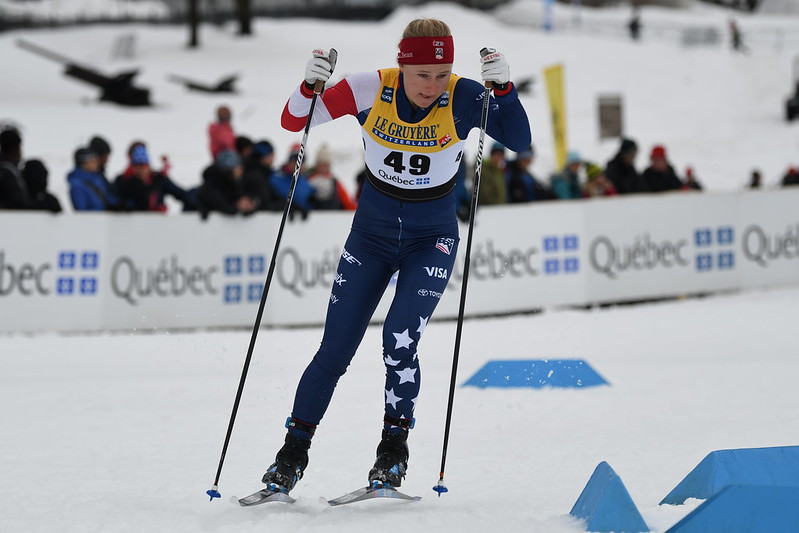
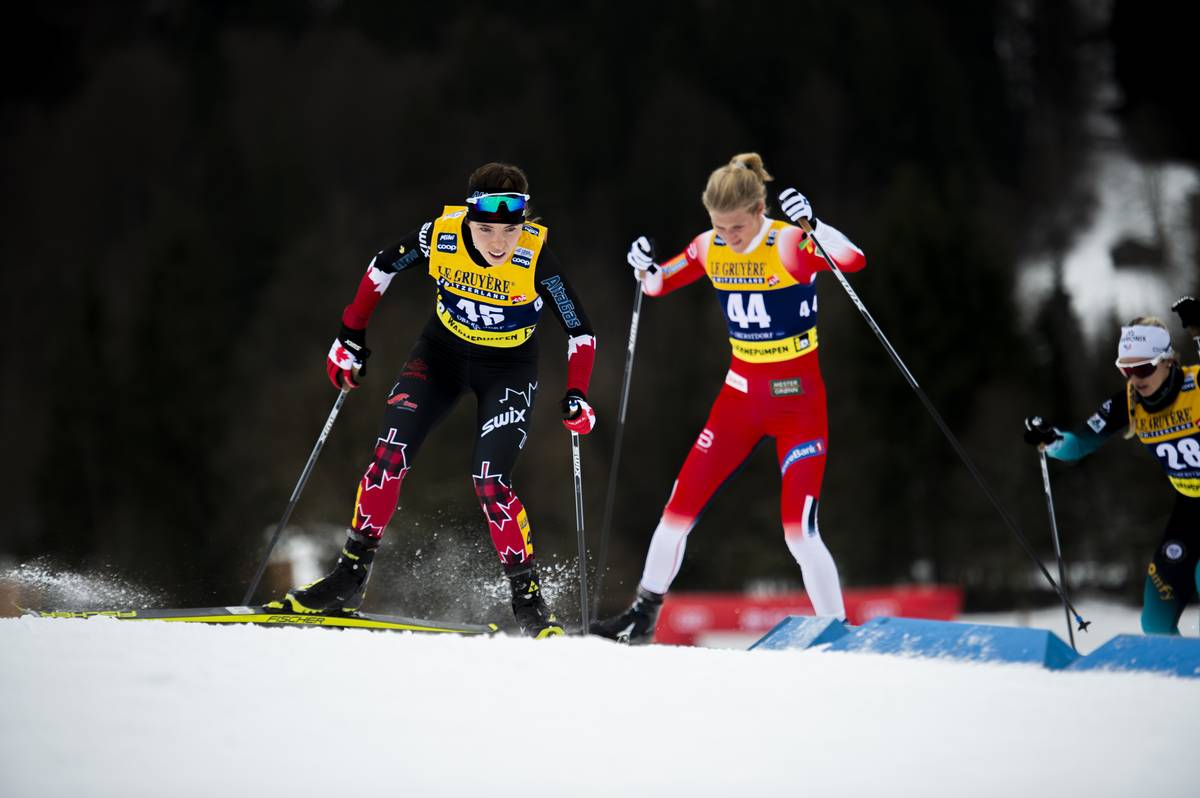
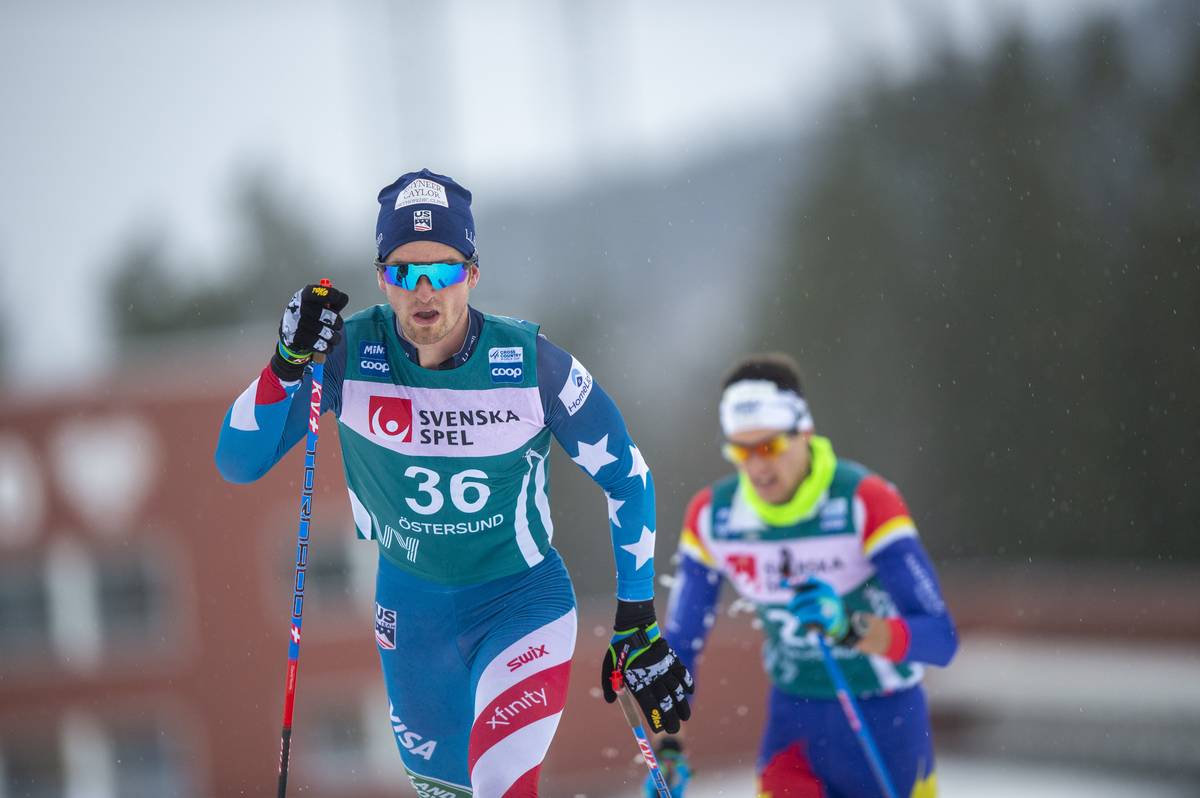
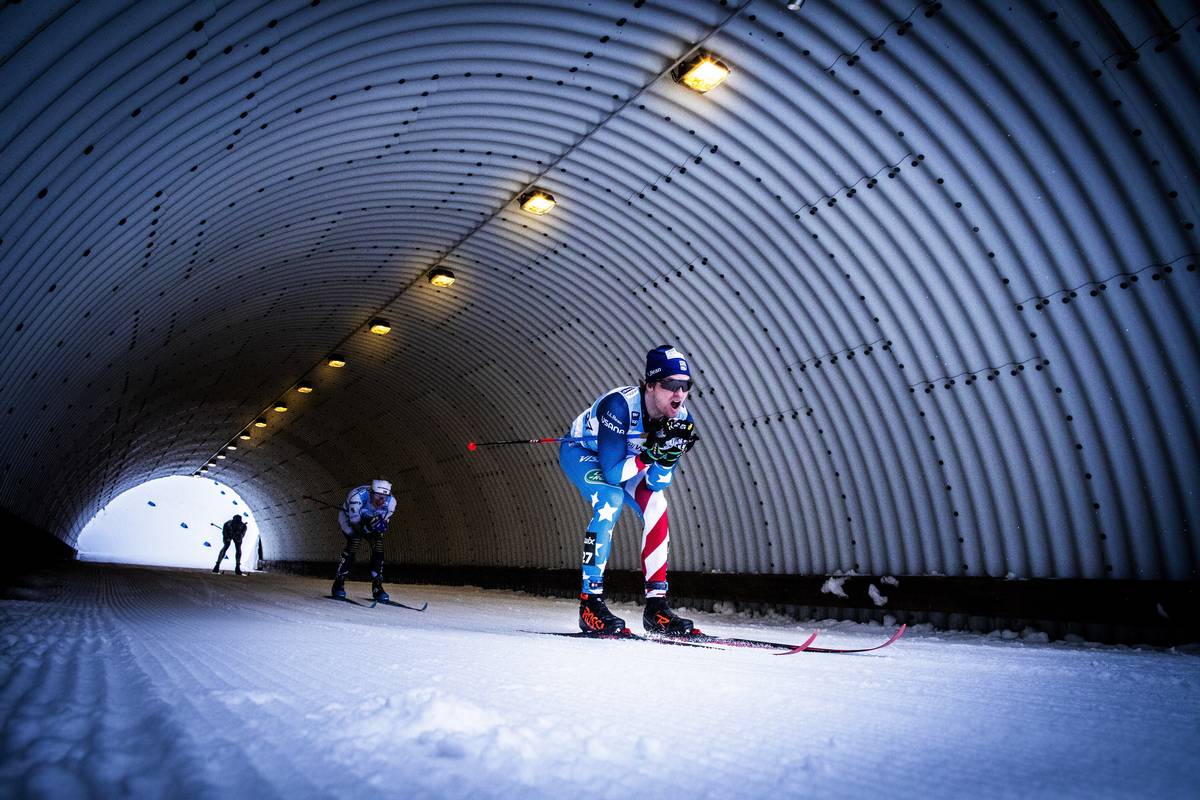
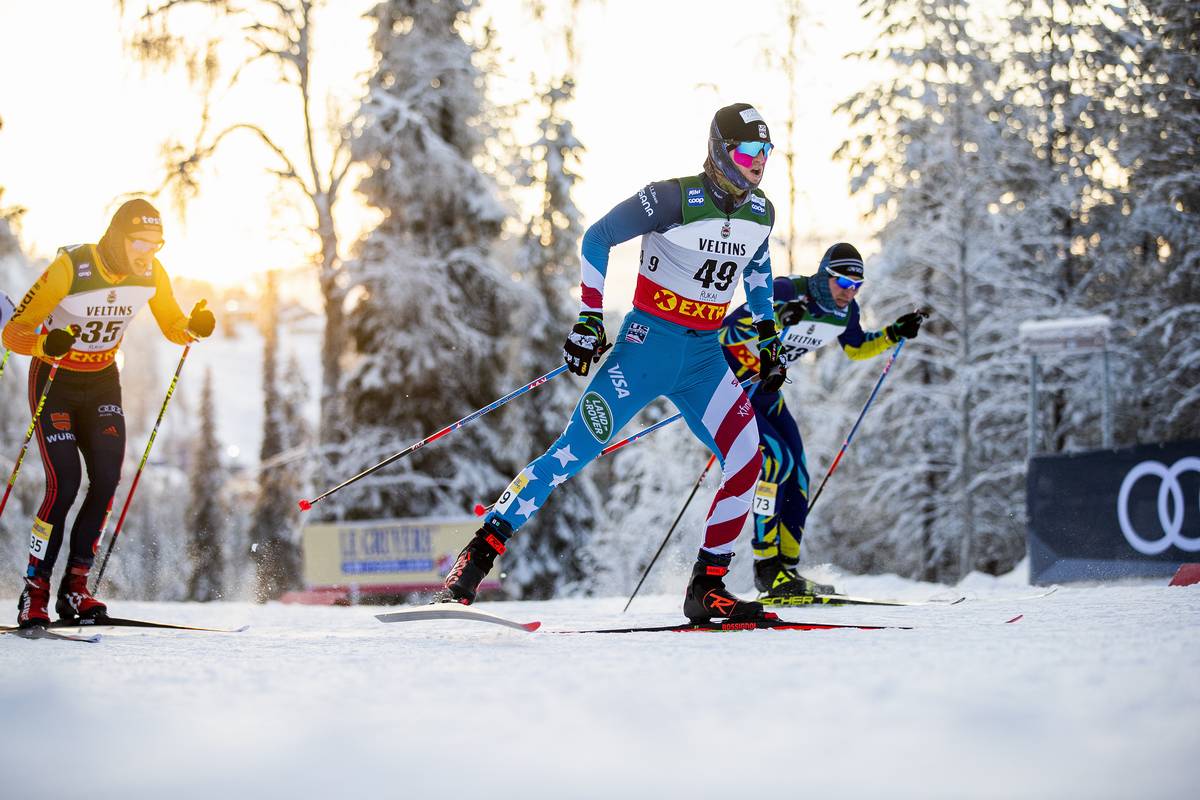
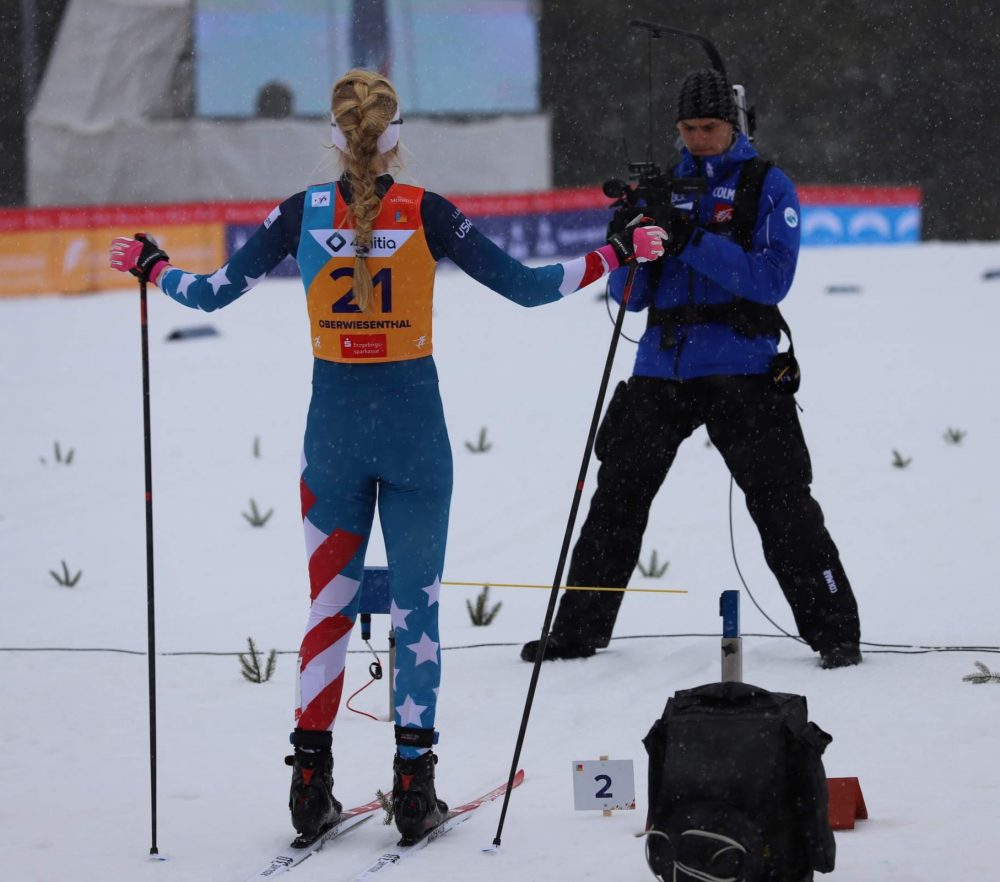
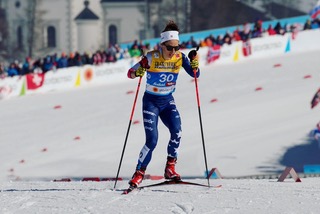
Hannah Halvorsen during the 2019 Quebec City World Cup sprint. (Photo: Doug Stephen)
I’ve struggled with body satisfaction my entire life. I don’t just want to be skinnier, I want to be leaner, more defined, more like an… “athlete”. But last fall, I was hit by a car and I find myself wondering, is the body I have, not the body the insecure part of me craves, responsible for my return to sport?
Since I was little, the word “athlete” activated images of beautiful toned-muscled people in my mind. That has been my subconscious understanding of what an athlete is. I wish I could say it was all about their performances and abilities, and that’s certainly a huge part of it, but it’s not the whole story for me. When I search a famous athlete’s Instagram account, male or female, I don’t just look for pictures of them competing, I look at their bodies. How lean and defined are they? Most of all, do they have abs?
This would probably be okay if it was truly noted without judgment, but it’s the farthest thing from that. It’s not the same as noticing that someone has cool sunglasses or they have good technique. It’s more personal. I take in that information about how they look and then, like it or not, I compare them to myself.
A lot of the time, I don’t have what I notice they have. I don’t have abs.
I don’t think I am alone in this. There are plenty of healthy athletes who wish they looked different. For me, it’s easy to see someone else and think “why would they want to change? They look perfect the way they are.”
But I always want to change things. This searing thought haunts me: “if I looked like this, I’d be happier.” Someone with any sense would tell me that’s not true, that happiness comes from accepting and loving yourself the way you are. I couldn’t agree more, but knowing that doesn’t make me accept myself all the time.
Before I raise any huge red flags, I would say I am not in a place of dangerous self-abhorrence. I am pretty content with myself and compared to some points during high school, I have come light years in accepting who I am. I can say with full confidence that I am a good athlete with my body exactly how it is.
But for about a year in high school, I ate as little as I could bear. I spent all my waking energy figuring out how to lose weight, while not letting anyone notice I was eating less. I don’t think I kept it as hidden as I thought I did, but I was so lost in my own self-destructive mission, I didn’t see anything else. I didn’t even see that I was tired all the time, slow, and unfocused in training. I probably was a lot less enjoyable to be around too because I was so unhappy. I didn’t see that either.
I have evolved from this challenging time in my life, but that doesn’t mean every moment I am overwhelmed with self-love. Most days, I wish I could change something about myself. Now, these are fleeting thoughts instead of an all-consuming obsession with changing myself.
In this state of relative self-acceptance, I had a realization that dumbfounded me. I realized that I don’t appreciate my health. Even though I eat a healthy amount and take care of myself, I have no real gratitude towards my body.
Let me explain my discovery.
On November 1st, I was crossing a street and was hit by a car at what the police estimate was approximately 25mph. The result was two torn knee ligaments, a fractured tibia plateau, and a skull fracture. I suffered a traumatic brain injury. When that problem was sufficiently managed, I underwent knee surgery. I have completed hundreds of hours of rehab. I lost a ski season. I’ve endured a variety of different forms of pain, and have learned more than I want to know about insurance and the medical billing system. I have seen enough doctors to last a lifetime and still go to physical therapy several times a week and do more therapy on my own daily. The whole experience has been traumatic and exhausting.
Now let me tell you some of the positives. First and foremost, I have no permanent injuries. Some of the injuries are going to take a while to heal completely, such as the neck and back pain I have been dealing with due to the whiplash which caused my spinal cord to sprain. And some of the injuries were incredibly severe, such as the large hemorrhages (bleeding and bruising) in my brain. But nonetheless, there’s nothing at this point that I have to accept as a lifelong consequence from this accident. I’ve had doctors of different specialties examine my various injuries and the resounding response is, “It’s incredible you aren’t more injured from this”.
To bring this story full circle, my realization is that I might not have been as lucky if I wasn’t healthy. I take health for granted. I can’t help but wonder, “what would have happened if I had been as unhealthy as I was that year in high school when I was significantly underweight?” Would I have had worse injuries? Would I have been capable of healing? And even more mind boggling, would I have lived?
It’s hypothetical to compare my injuries from this car accident to the injuries I would have sustained if I had been in similar health to my high school low-point. I considered finding a doctor who could provide a quote for this piece to provide evidence to this realization, but I don’t think it is necessary.
The point is, it would be less advantageous to be hit by a car in worse health than in better health. I don’t think anyone will deny me that, even though I make it without a medical license of my own.
There are many physical ramifications of eating disorders such as frail bones and a decreased immune system. Basically, every system in the body is negatively affected; the nervous, muscular/skeletal, endocrine, digestive, cardiovascular, respiratory, hematopoietic (blood), etc. I share this not because I think everyone should optimize their health to prepare for the hazards of crosswalks. That would be a bit apocalyptic.
I share this story because it is an attempt to offer another perspective on how we view ourselves. I don’t expect anyone to read this and to live the rest of their life free from body image issues. I do hope it is a reminder that being healthy is something to be grateful for. As I move forward with my rehab and recovery, I recognize that my body is something to protect and care for. It is something of irreplaceable value.
Like I said in the title of this article, I don’t have a six pack, but a car hit me and I survived.
A clean slate cancelation of U.S. Ski & Snowboard’s cross-country national racing calendar. That’s a piece of the collateral damage in the niche world of domestic ski racing. The cancellation includes SuperTour, U.S. National Championships, SuperTour Finals, and the Junior National Championships.
We’ll get to how these races may be replaced in a moment. First, U.S. Ski & Snowboard set forth a series of bullet points regarding the reasoning and considerations for the wholesale cancelation. They include difficult logistics in terms of race travel and the prospect of hundreds of people settling into small communities unable to properly handle a population spike during the pandemic.
One aspect all should be clear about, U.S. Ski & Snowboard is cancelling its suite of national cross-country races, not national level races in their other disciplines.
“We recognize that the nature of the sport of the Cross Country ski racing in our nation has special considerations that are often dissimilar to other U.S. Ski & Snowboard disciplines,” U.S. Ski & Snowboard wrote in a prepared statement to FasterSkier. “National-level cross country events boast big fields, with hundreds of athletes, coaches, and officials, and these events are often hosted in small communities.”
Another reason cited for the modified cross-country racing schedule was a U.S. Ski & Snowboard survey finding members preferred regional rather than national racing during the pandemic.
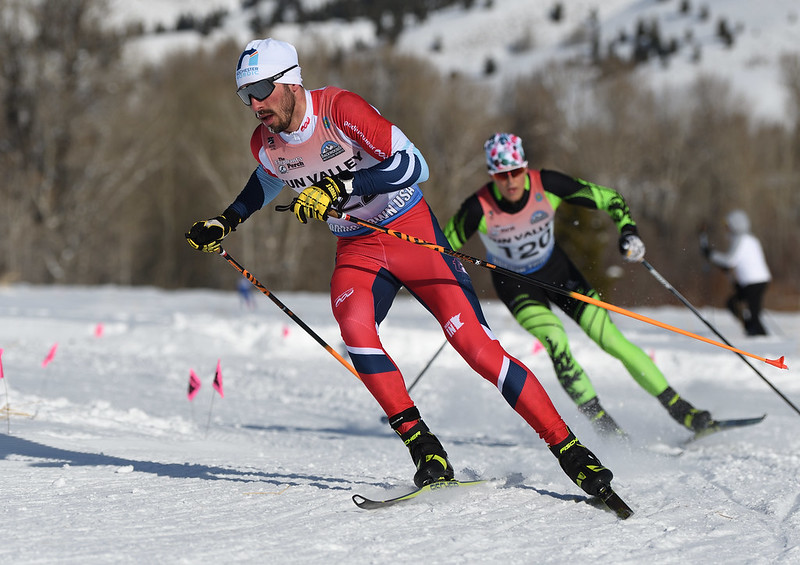
Ian Torchia (SMST2) won the men’s 15 k skate at the 2019 Sun Valley SuperTour. (Photo: Doug Stephen)
Behind the scenes, clubs and regions have been working towards developing high-quality regional racing. What this exactly looks like remains opaque for the time being. Yet announcing the cancellation in early September allows all stakeholders to plan accordingly for new regional races, or conversely, suspend allocating resources on intensive events like Senior Nationals and SuperTour.
“Local organizing committees, divisions, and regions are better positioned to start planning an effective and motivational race calendar for their area, potentially sanctioning races via U.S. Ski & Snowboard and/or the FIS to attract quality competition,” U.S. Ski & Snowboard stated. “Quality events can be built on a regional model.”
For local organizing committees (LOC), the costs for running events is considerable. According to U.S. Ski & Snowboard, most of the larger events require 300 or more participants to break even. Most states currently have strict limits on organized group events capping mass gatherings well below the 300 person threshold. With the cancelation and reformatting of the race season, the financial risks for LOCs are reduced.
An unknown remains: how will aspiring World Cup athletes qualify for starts via a regional race calendar. The usual pathway involves SuperTour and/or Senior National wins/podiums.
“We have the ability to consider races happening across the country, assess performances from those regional events, and name teams for international trips via discretion,” stated U.S. Ski & Snowboard. “We have already created Discretionary Selection Review Committees for all of these selections, as well as mechanisms to solicit community feedback from the divisions prior to many selections. Although this system may be imperfect, it will allow for stand-out regional and divisional competition results to be recognized and considered for international team selection. The move to utilize much more discretion in these selection criteria is intended as a fix during the pandemic only, and we will return to criteria that focus principally on objective selection when the pandemic is over.”
***
FasterSkier followed up with Chris Grover, Cross Country Program Director, U.S. Ski Team to discuss the regional racing format and changes to the selection criteria for international events.
FasterSkier: Assume no SuperTour, since it has been cancelled.Can you describe the general template for what regional racing might look like? (How many regions? How many races per region?)
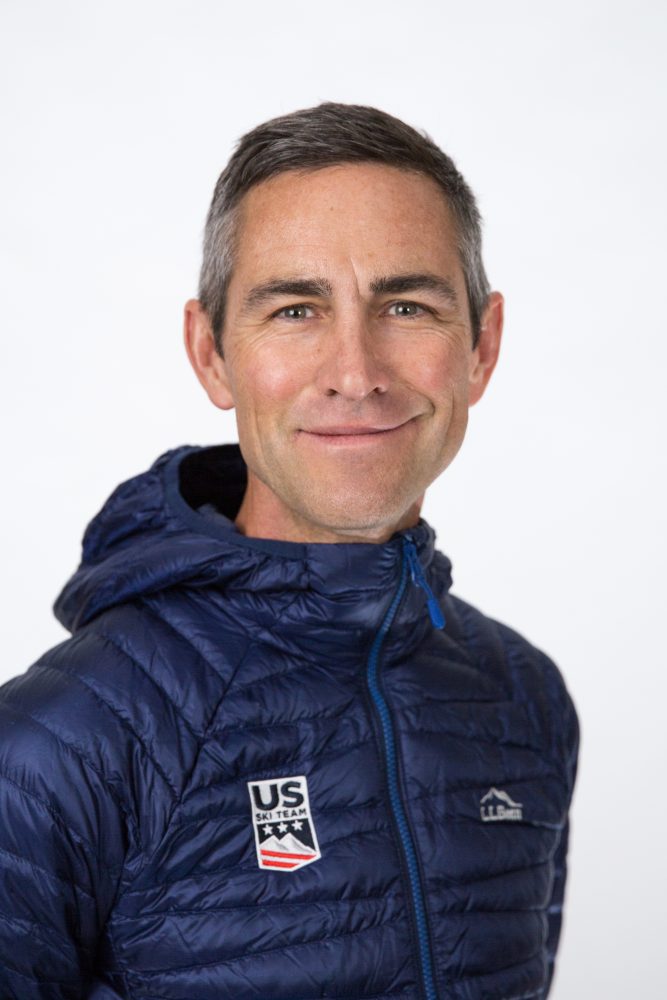
Cross Country Program Director, U.S. Ski Team Chris Grover at Mt. Bachelor in Bend, Ore.
Chris Grover: This is really up to the regions and divisions. From the U.S. Ski & Snowboard side, we are monitoring how many venues are currently sanctioning FIS and NRL races, and when they are scheduling them. We will work with each region to make sure that they have some quality races on the calendar spread throughout the season. In particular, we want to make sure there is something scheduled regionally in December and ideally something in the first week of January (in the U.S. Nationals timeframe) that we can potentially use for selections to various teams.
FasterSkier: How does a regional race not turn into a national race? (Any rules limiting field size or limiting athletes from chasing results at a different and presumably weaker region?
Chris Grover: We expect that some of these regional races will be very high quality given the number of talented athletes in the regions (senior, junior, collegiate, etc.). We will not attempt to limit participation at any event to athletes from outside of a region. Travel will be at the discretion of the athlete, coach, parent, etc. and will reflect their comfort levels. Field size may be limited by local and state rules governing gathering size, and of course, those are always changing. If an organizer does come up against a field size restriction, U.S. Ski & Snowboard will work with them to determine the best way to solve it.
FasterSkier: “Although this system may be imperfect, it will allow for stand-out regional and divisional competition results to be recognized and considered for international team selection.”
Referring to the above quote, can you help describe a scenario where a “stand-out” performance in say Alaska is comparable to a performance in the East?
Chris Grover: We know the athletes so we can easily gauge the quality of the field. If the race is a FIS race or an NRL race, we also have points to use in determining field quality. Then we simply look for stand-out performances. For example, someone who easily wins a sprint qualifier, or several athletes with a big gap over the rest of the field, or a junior athlete that is challenging quality senior athletes, etc. We’ll also look for patterns of quality performance by athletes over multiple race days.
FasterSkier: What if an elite team member or team (say skiers from APU), decide to ski in Europe (assuming they are granted visas) to achieve stand-out results. How would those results be considered?
Chris Grover: As in the case of domestic racing, it’s easy to judge the quality of the race by seeing which athletes are in the race and what the FIS points look like. Ideally, we’ll have many athletes racing World Cup and some of these athletes will certainly be selected to more World Cup via discretion and possibly even to the World Championships. We’ll consider all results from both domestic and international competition.
FasterSkier: Who is on the discretionary selection review committee?
Chris Grover: This is a long answer! The committees are different for each event or race series. They are already included in every criterion and are posted on our website. But here is the long portion of our upcoming letter to the community with details the committees:
Selection to the 2021 Oberstdorf Nordic World Championships
We are still waiting for the 2020-21 World Cup Calendar to be finalized in late September before this criterion can be completed. However, beyond the objective selections that will be made from World Cup competition, this criterion still includes the ability to select athletes via discretion from regional and divisional racing conducted across the country in the first half of this season. We will fill our starts at the World Championships selecting athletes via discretion from both World Cup and regional/divisional racing from across the United States during the selection period. This criterion also already includes the use of a Discretionary Selection Review Group to analyze and ratify all discretionary selections:
All discretionary selections will be documented and appropriate forms will be available for record keeping purposes. All discretionary selections will be reviewed by a discretionary selection review group comprised of the U.S. Ski & Snowboard President and CEO, the Chair of the U.S. Ski & Snowboard Cross Country Sport Committee, and the athlete representative from that sport who is a member of the U.S. Ski & Snowboard Board of Directors. If the Chair of the U.S. Ski & Snowboard Cross Country Sport Committee feels that he or she needs to be recused from the discretionary selection review group due to a conflict of interest surrounding the selection of an athlete or athletes, they may delegate their role to the Chair of the U.S. Ski & Snowboard Cross Country Coaches’ Subcommittee. If the U.S. Ski & Snowboard Board Athlete Representative is also a currently competing athlete then another athlete, who is not actively competing, will be selected by the Athletes’ Council to be the representative in this group.
Current members of the Discretionary Selection Review Group are:
U.S. Ski & Snowboard President and CEO Tiger Shaw
Chair of the U.S. Ski & Snowboard Cross Country Sport Committee Cami Thompson-Graves
Athlete Representative appointed by the AAC Holly Brooks
Any athlete who feels that they may have had a performance overlooked, also has the ability to petition the Discretionary Selection Review Group directly for discretionary nomination consideration:
Athletes may also petition directly to the Selection Committee to be considered for discretionary selection by submitting, in writing, a petition including any rationale to the U.S. Ski & Snowboard President and CEO (tiger.shaw@usskiandsnowboard.org) before 8:00 AM Mountain time on January 17, 2021.
Selection to the 2020-21 World Cup
The current draft of the 2020-21 World Cup selection criterion can be found here:
Like the Oberstdorf WSC criterion, we are still waiting for the 2020-21 World Cup Calendar to be finalized in late September before this criterion can be completed. Our discretionary World Cup selection methods are already in place, understood by the community, and well-equipped to select a large number of athletes from regional and divisional racing across the country. As you may know, we have created Working Group Guidelines for discretionary selection, and they can also be found at the link above.
The Working Group for discretionary selections is:
Dakota Blackhorse-von Jess U.S. Ski & Snowboard Athlete Rep
Tad Elliott U.S. Ski & Snowboard Athlete Rep
Cami Thompson-Graves U.S. Ski & Snowboard XC Sport Committee Chair / Dartmouth College
Austin Caldwell CU
Dragan Danevski MEA
Erik Flora APU
Joe Haggenmiller CXC
Chris Mallory SVSEF
Pepa Miloucheva CGRP
Pat O’Brien SMS
Dan Weiland SSCV
Kate Barton U.S. Ski Team
Jason Cork U.S. Ski Team
Matt Whitcomb U.S. Ski Team
Chris Grover U.S. Ski Team
Nominations are then reviewed by a discretionary selection review group comprised of:
Dakota Blackhorse-von Jess U.S. Ski & Snowboard Athlete Rep
Tiger Shaw U.S. Ski & Snowboard CEO
Bryan Fish U.S. Ski & Snowboard XC Sport Development Manager
Modification of Development Competition Selection Criteria
Due to the restructuring of the national race calendar, the U.S. Ski Team Cross Country Staff and the U.S. Ski & Snowboard Cross Country Sport Committee have been modifying all of our development selection criteria, including the World Junior, U23 World Champs, U18 Nordic Nation’s Champs, and Europa Cup (OPA) criteria. As in the World Champs and World Cup criteria, our goal is to ensure that the development-level criteria are viable and effective in a regional and divisional racing model. As you may know, selection to three of these development trips is traditionally conducted almost exclusively at the National Championships. Please see the finalized criteria which have been approved by the Sport Committee:https://usskiandsnowboard.org/crosscountry
Some of the first changes you’ll see in these criteria are in the formatting or general language of the criteria, where we’ve added language that more clearly mirrors that of our World Championship and Olympic criteria.
The main change is that we’ve removed language that limits our ability to use discretion to select the team (in some criterion previously no more than 25% of a team could be selected via discretion). We are now prepared for a regional racing model, and the need to use up to 100% discretion to nominate a team. We will be looking across the country to divisional and regional races to select top performers from different events, as well as potentially selecting several top-performing athletes based on results at WJC/U23s/World Cup, etc. the previous season. But in these scenarios, all or nearly all selections will need to be discretionary. To make this process fair, we’ve created a Discretionary Selection Review Committee, much like we have in place for the World Nordic Championships and the Olympic Winter Games. U.S. Ski Team coaches Bryan Fish and Kate Barton will nominate the different development-level teams as normal, and then send the nominations to the Discretionary Selection Review Committee, who will review the nominations and either approve them or reject them.
Here’s the specific language:
All discretionary selections will be documented and appropriate forms will be available for record keeping purposes. All discretionary selections will be reviewed by a discretionary selection review group comprised of the U.S. Ski & Snowboard Cross Country Program Director, the Chair of the U.S. Ski & Snowboard Cross Country Sport Committee, and the athlete representative from that sport who is a member of the U.S. Ski & Snowboard Board of Directors. If the Chair of the U.S. Ski & Snowboard Cross Country Sport Committee feels that he or she needs to be recused from the discretionary selection review group due to a conflict of interest surrounding the selection of an athlete or athletes, they may delegate their role to the Chair of the U.S. Ski & Snowboard Cross Country Coaches’ Subcommittee. If the U.S. Ski & Snowboard Board Athlete Representative is also a currently competing athlete then another athlete, who is not actively competing, will be selected by the Athletes’ Council to be the representative in this group.
We’ve also added language that allows an athlete to petition the Cross Country Program Director (me) directly if they feel that they have been overlooked by the coaches in the nomination process. I will then document that petition and correspondence and take it to the Discretionary Selection Review Committee for discussion and review. This will ensure that all athletes have a chance to have their results considered.
That language is:
Athletes may also petition directly to the Selection Committee to be considered for discretionary selection by submitting, in writing, a petition including any rationale to the U.S. Ski & Snowboard Cross Country Program Director (chris.grover@usskiandsnowboard.org) before 4:00 p.m. Mountain Standard Time on January 6, 2021. In the event that U.S. Nationals is cancelled, and the majority or all of the team must be selected via discretion, this petition period may be closed on December 20, 2020, to give nominated athletes time to procure necessary EU entrance visas.
Note that there are differences in selection dates and petition deadlines depending on which criterion it is (i.e. WJC or U18 vs. U23). Also, at this time it is possible that athletes and staff traveling to Europe this winter may need to secure a D visa from a European nation in the Schengen area to gain admittance to the subcontinent, and then observe local entrance testing or quarantine protocols. This is something that U.S. Ski & Snowboard leadership is actively exploring; we’ll know a lot more about these procedures by the time we nominate these development teams this winter. The good news is that we already are finding avenues to get into Europe.
As we look to regional racing to make discretionary selections to the WJC, U23, and U18 trips, we recognize that it is important to have regional representatives review the possible nominations prior to sending them to the Discretionary Selection Review Committee. Our goal is to make sure that no athlete from any division is overlooked and no outstanding local or divisional performance is missed. To accomplish this, we will be sending potential nominations to the divisional representatives listed below for feedback before nominating those teams. Although these Working Group members are not voting, they will be able to share opinions, raise concerns, and bring athletes and performances to the attention of the U.S. Ski Team coaching staff and the Discretionary Selection Review Committee.
Reflections From a White Skier On The Spaces and Places We Ski, And How To Build Inclusivity
By: Ben Theyerl
The start of the American Birkebeiner in 2010.
The typical life story of a competitive nordic skier in the U.S. tends to resemble a character out of a Robert Frost poem. It’s an appropriate metaphor; the Rikert Nordic Center at Middlebury, VT doubles as the quarters of the renowned Bread Loaf School of English during its summer months, where the Bard of New England taught for many years. In America, this sport tends to be filled with people from the quiet corners and empty spaces of our country. From the arcane delight of Vermont’s hamlets, to the mountain outposts strung up and down the West Coast, and the downhome northwoods of Middle America in towns like my hometown of Eau Claire, Wisconsin. All these places color and contain the spirit of those who end up in a sport that receives little fanfare and even less attention in America, sans the two weeks every four years when the Winter Olympics are held.
For many, it has always been about finding peace in the silence and sublimity of harsh winters, and sanctity in the god-damn slog. Pumping hearts, clouds of heat, and the dance of drive and focus. It’s a sport for hearty souls that sees to it that those souls become heartier still; teaches you how to handle the struggles of life when it pushes you full bore to the brink.
I love it. My teammates love it. Despite having grown up surrounded by the sport, it still feels like a little miracle for me, and for many of my teammates, that I happened to find a sport that so-matched the character and values that the wide-open landscapes of this country offer, and that pursuing it with a full heart, that character became part of my character.
If you follow that Robert Frost metaphor I used earlier, eventually you’ll come to those two roads diverging in a yellow-wood. Where that famous assertion of individuality “And I -/ I took the one less travelled by, / and it has made all the difference” comes from. As nordic skiers, I think we’re prone to thinking that our participation in the sport is, in its own right, taking the road less travelled. Skiing is adventure, it’s idiosyncratic — knowing the otherwise useless specifics of waxing, and spending lots of time moving through spaces that otherwise receive little attention. It is easy to think, when you glance over your shoulder back at the forests, mountains, and fields of snow hours into a ski that you are in on a secret that the rest of society is tragically missing out on—and you are.
But if there’s anything that this year has proved, it’s that those glances over our shoulders are looking back at a world that’s changed. You can no longer look at my Frost metaphor and not think, why Frost? Implicit in his cool assertion of individuality is that the choice to take the path less travelled is one all-to-often reserved for those of us who look like Frost. We’re white. Many of us are male. Who we look to in forming our metaphors for individuality and freedom is important because it implies who has access to those virtues.
Why, for example, when plumbing my literary references for a metaphor didn’t I turn towards Langston Hughes, or James Baldwin, or Roxanne Gay? It’s a set of questions that points me back to an unspoken truth that those of us who travel the less travelled path in the nordic skiing community tend to look utterly homogeneous. This is a road taken disproportionately by those of us who are white. In fact, as I write this just 6% of nordic skiers in the U.S. identify as African American.
The demographics of where the places that harbor nordic ski communities are on a map allows this statistic to go unchecked. The trail networks linked to small rural towns and resorts that are historically, and presently, white, shelter us from having to confront and come to terms with our sport’s lack of racial diversity. So do the images of our heritage as a nordic community, and of what it looks like to be an elite nordic athlete. Here, in 2020, it’s apparent that we take the steps to re-examine inclusivity in our community, and understand why we haven’t done better in the past. Like any ski trail system, the road we have been travelling is now, under our societal moment, at another crossroads. We can choose as a community to stay on this sheltered path, or we can take the road less travelled for the nordic community to finally discuss the overwhelming whiteness of our sport and the places that we do it in.
There is one glaring irony in all of this pontificating on our sport’s ruralness and use of wide-open country spaces. The greatest concentration of skiers in America is currently at the epicenter of our national reckoning with our racial injustice—Minneapolis. The same city that, in the wake of the death of George Floyd, stands as the focal point for worldwide scrutiny of America’s historical racial oppression of Black people is also America’s nordic skiing capital.
There’s so much good to say about the ski community in Minneapolis. It’s large. It’s dedicated. It’s generous.
But there’s also a failing in that ski community’s racial make-up that parallels the wider-community of Minneapolis which is currently being highlighted by national events. Whereas most of the ski community can say that our sport is overwhelmingly white because of the communities it draws from are white, Minneapolis can’t fall back on that excuse. It’s a large, multi-ethnic, multi-racial city, and yet it’s ski community is still predominantly white. That’s not to discount efforts by that community, through the Loppet Nordic Foundation and others, to try and bring racial diversity to the sport, but it does go to show that in skiing, its not simply a lack of diversity in the broader communities where the sport can take place that’s an issue. This is a problem that goes deeper than demographics.
In her book Black Faces, White Spaces geographer Carolyn Finney discusses how nature and the environment in America have historically been constructed as a white space. Finney’s work is multi-faceted and should be a priority to read for any outdoorsperson, but here I want to underscore that big main point; it’s constructed. The mountain ranges and forests that we count on each winter to be able to do the sport of nordic skiing didn’t just pass into the hands of land owners, land trusts, or the public government. In considering how most of the spaces we ski in came to be, we have to start with the dispossession and removal of indigenous peoples before you ever think about how a trail system got built and who has access to those trails.
To underscore this point, one can look at our community’s largest gathering, 10,000 people every year at the American BirkebeinerAmerican Birkebeiner ski race in Hayward, Wisconsin. The Birkie trail is a special place, hundreds of kilometers of northwoods traversing ancient glacial terrain. The Birkie is a special event, in large part responsible for the vitality of the nordic ski community in the Midwest. My own family would’ve never started in this sport without it.
In its present form, the Birkie trail straddles the Lac Courte Orillies tribal reservation, and is built on Ojibwe land. This fact is in the constant peripheral in any trip to ski on the Birkie trail. Most of us choose to keep it in the peripheral, however. We don’t think twice about crossing the Ojibwe names that dot the rivers, trails, and forests – Namekagon, Chequamegon, or Totagatic. I find myself guilty of driving from the cabin I stay in for the Birkie each year to the Mosquito Brook trailhead through the Lac Courte Oreilles reservation, and not giving a second thought to the outsized, neon sign that advertises it as such, placed as the welcome sign to the LCO casino not more than two miles away from the trailhead. The proximity of native land dispossession in Hayward makes it a stark example, but this story is one that is at the origin of every trail system we enjoy and compete on in America.
Our sport ultimately is connected to that initial dispossession. As skiers, one step we can take towards recognizing our use of indigenous space is no longer keeping that fact in the peripheral in our community gatherings. Acknowledge it. This follows from a movement that’s already underway in native activist and academic circles, which calls for persistently acknowledging that the land we stand on today is indigenous land, as one statement from Northwestern University states:
It is important to understand the longstanding history that has brought you to reside on the land, and to seek to understand your place within that history. Land acknowledgements do not exist in past tense, or historical context: colonialism is a current ongoing process, and we need to build our mindfulness of our present participation.
We can make this a regular part of the introductory instructions at our community races. We can make it a part of the dedications that take place when christening new trail systems and facilities. To begin the work of inclusivity, we have to go back to the very origin of exclusion in the spaces we use for our sport.
The native experience, of course, is different from the experience of Black Americans in our sport, and in the outdoors community more broadly. Land dispossession began the process of colonizing the outdoors as an exclusively white space, but it wasn’t the only step. White colonization of the countryside in America was enforced and reinforced in the policies and narratives that constructed America historically. Finney writes that “land (and more directly land ownership) directly connected to what it means to be an American,” and highlights that the main historical mechanism for this in America was the Homestead Act, signed in 1862, which allowed settlers to own 40-160 acre plots of land for free if they were willing to farm it for five years.
Over 160 million acres of land from Ohio to California, Wisconsin to Washington, were settled under this act, and created the “countryside” as we figure it today in our national consciousness. Because of the time of its passage during the Civil War, the initial wave of homestead claims completely excluded Black Americans who were still legally under the horrors of slavery, meaning the claims were almost exclusively made by European immigrants. This, along with the pattern of America’s settlement from East to West, meant that the then newly created Midwestern and Western states formed their still predominant demographic make-up, majority white.
Above: the author’s father and Grandfather at Wisconsin’s famed (and sadly discontinued) “Bratski” event in Sheboygan. (Courtesy photo)
My own ancestors were among these claimants, staking out their place in the hills north of Milwaukee, Wisconsin where a century later their great-great Grandson, my Grandfather Walt, would start a family-wide nordic skiing obsession that now stretches three generations.
The immigrant patterns of the time meant that the initial wave of claims were made by mostly German and Scandinavian immigrants, for which this polka-dancing, lederhosen-owning author can tell you still colors the cultural identity of states like Wisconsin and Minnesota today. It’s those Scandinavian settlers who predominantly settled in Minnesota that brought cross-country skiing to America initially, and its place as a cultural keystone in the state was firmly secured for the future. We haven’t strayed far from the place that Scandinavian heritage has in the imagination of our community. We name our races Vasaloppet and Birkebeiner, and I’m happy to say that I’ve been overwhelmed with joy at more than one citizen race when the post-race snack table included lefse and not just orange slices. Take that, running. Nordic skiing is just that: nordic.
It’s worth asking if that close affinity closes off the community to those that don’t share that heritage though. After all, a lot has happened to shape U.S. skiing culture as distinct from that which exists in Norway or Sweden. This isn’t the whole story of skiing in America, but it does demonstrate the way that settler colonialism is intertwined to where and who skis here.
Land ownership also served as the basis on which many white Americans built their wealth and prosperity over the following century and a half, and along with other oppressive economic measures, the exclusion of Black Americans from homesteading helped create the racial wealth gap we inherit today. The relative financial security and disposable income that many white Americans secured in the twentieth century allowed them to spend on the travel, gear, and time required to take part in outdoor recreation. Thus nordic skiing formed a twofold reinforcement of its whiteness: taking place in communities that were almost exclusively white, and requiring a certain amount of wealth that disproportionately was (and still is) possessed by white Americans.
Nordic skiing parallels the well-studied history of outdoor recreation in America, beginning with what Wallace Stegner famously called “America’s best idea,” the national parks. I won’t repeat the history of catering the experience of places like Yellowstone to an experience of “wilderness” by removing Native Americans and buffalo hunters while putting down railroad tracks for wealthy eastern, and white, tourists. I will recommend William Cronon’s “The Trouble with Wilderness” and Ken Burns’ “The National Parks” as starting points, and resources concerning the Parks’ current reconciliation with their past to those unfamiliar. The unsanitized story of the National Parks is one that should guide our understanding of outdoor recreation in America as it plays out in landscapes and spaces, and is one that mirrors the way that the nordic skiing community tends to understand itself.
As Finney writes in her book, “[the countryside is] a key site of nationalistic sentiment, and implicitly excludes Black people in its discourse.” Those of us who look for refuge in the weekend escape to the trailhead, find community in the racing scene that takes over small-towns and rural spaces throughout the winter, and spend hours paging through outdoor gear catalogues filled with white faces, need to think critically about why we feel comfortable in those spaces.
Chances are, it’s because they’ve always been white. And chances are, we’re white too.
Part of the ethos of participating in this sport is that it allows us to gain access to freedom otherwise not found in life. On skis, we can glide over terrain you can’t on foot. The freedom of skiing is derived from access to some sort of wilderness, and that is a sentiment that is colored white by historical practices that can seem so far and distant, but is intimately intertwined with our experience, even when our minds are occupied with tweaking our V2 technique to shave off seconds or taking downhill corners just right. We may be on the road less travelled, but that road was still paved by the pitfalls and racism of American society.
Which means we’re back to that Frost metaphor. Which is good, because it represents the crossroads that society, and by extension, our sport, are at with inclusivity. What I’ve discussed here are tepid steps towards the road we have to take as a community. If this story were trail-building, it’s simply tree-flagging – identifying what needs to be cut and cleared before we do the real work forging new paths. But, it’s a necessary step. Survey and think, recognize and learn.
Where we go from here is also a task we take up in the tight-knit, collaborative manner that the nordic skiing community has always acted in. We’re building a new trail. At the time of this writing, movement is already underway. A number of organizations, such as the National Brotherhood of Skiers, have been doing work to build inclusivity of Black communities in alpine skiing for years. The Share Winter Foundation provides grants to programs across the country that seek to empower youth to enjoy winter and reduce barriers of access to skiing and snowboarding. Their grantees include a number of big clubs and governing organizations in the nordic community. Our path forward must include programs like this, devoting funds to introducing Black communities to nordic skiing and building trail systems that guarantee low-cost, easy access to all. It’s imperative that these resources meet action from those in the community. For coaches, this means figuring out how to create programs that introduce and retain talented athletes regardless of where they come from or the resources they have. For shops and manufacturers, this means figuring out how you can help those coaches get the necessary equipment to coaches working to make this sport accessible to all athletes, especially Black athletes.
These ideas are far beyond my scope as a singular member in this community, but I’m confident that the good-spirited souls and minds that have built our sport in this country can develop and implement action towards drawing in people who our community has historically ignored. This new trail system we’re building won’t be complacent with the twists and turns and hills we’ve travelled on our skis in the past. It’ll be new and true to the nordic skiing spirit—trailblazers who take comfort in the challenge of hard-work.
Ben Theyerl
Ben Theyerl is a third generation nordic skier from Eau Claire, WI, who recently graduated from Colby College this spring. He is currently working on the campaign trail in Wisconsin for the upcoming election, training for whatever the Birkie looks like this winter, and gearing up to help lead fall training with his home club Chippewa Valley Nordic.
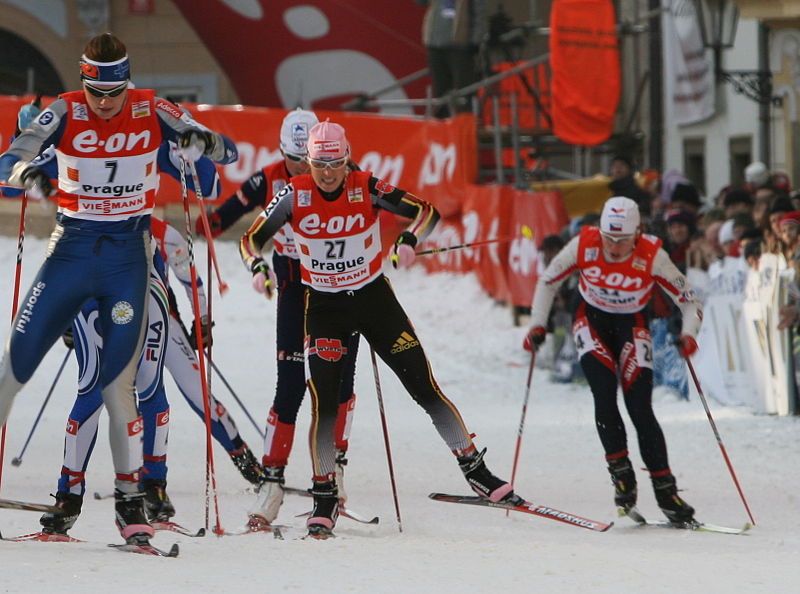
Germany’s Evi Sachenbacher-Stehle (bib-27) in the quaterfinals of the 2007 Tour de Ski in Prague. (Photo: Wikimedia Commons)
A career ended prematurely, for no reason.
During the 2014 Winter Olympics in Sochi, Russia, German biathlete Evi Sachenbacher failed a doping test. Although the ensuing ban was subsequently reduced from two years to six months, it effectively ended her career.
New information seems to confirm that Sachenbacher’s positive drugs test at the 2014 Winter Olympics in Sochi had nothing to do with deliberate doping. Rather, she was used as a sacrificial pawn by Russian doping authorities, according to an article on rtl.de.
In his recently published autobiography, doping meister turned whistleblower Grigory Rodchenkov wrote that with no positive doping tests in the first week of the Sochi Olympics, the Russian doping machine needed to expose someone in order to prove that they were doing good work.
From 2006 to 2015, Rodchenkov headed Russia’s Anti-Doping Center, the only laboratory in Russia accredited by the World Anti Doping Agency (WADA). At the 2014 Winter Olympics, Rodchenkov managed the anti-doping testing. While he concocted a recipe of three banned substances to administer to Russian athletes, he and others developed a sophisticated system to replace Russian athletes’ drug-contaminated urine samples with clean samples.
The July 25 issue of The Daily Mail published extensive excerpts from The Rodchenkov Affair, Rodchenkov’s new tell-all detailing his decades-long involvement with the Russian doping system both as an athlete and an administrator. Rodchenkov was initially exposed to doping as a college distance runner, taking steroids. While a successful collegiate runner – with chemical help – Rodchenkov didn’t turn into an elite athlete. His “enhanced” college running success did spur his study of chemistry.
In November 2015, WADA identified Rodchenkov as the ringmaster in the Sochi doping scandal. He was compelled to resign. Within days, fearing for his life, Rodchenkov left Russia for the United States. His paranoia may not have been irrational, as two other officials died suddenly in February 2016. In May 2016, Rodchenkov gave an extensive interview to the New York Times about the rigged testing process in Sochi.
This brings us back to Sachenbacher, the German biathlete who tested positive in Sochi. In one of her two urine samples Sachenbacher submitted during the Olympics, the testing lab claimed it discovered traces of the banned substance methylhexanamine.
Developed by Eli Lilly & Co in 1948, methylhexanamine was marketed as a nasal decongestant. Although it was withdrawn from sales in the 1970s, methylhexanamine began appearing as an ingredient in various dietary supplements in the early 2000s. Supplements incorporating this drug are generally promoted as fat loss products or for extra energy during workouts.
In his book, Rodchenkov asserted that methylhexanamine “usually occurred in huge concentrations.”
Rodchenkov also characterized Sachenbacher’s result as a “borderline case,” adding “If I had already logged five real violations, I might not have reported her. But we needed blood. She became withdrawn from circulation and the punishment did not really match the violation.”
When she learned of the positive finding, Sachenbacher protested, saying that she must have unknowingly ingested it in a tea powder. In the summer of 2014, she received a two-year competition ban.
Sachenbacher appealed to the Court of Arbitration for Sport (CAS), which determined that she didn’t deliberately ingest methylhexanamine. Her ban was commuted to six months from the date of the test
The Munich, Germany, public prosecutor’s office investigated Sachenbacher following the Olympics. According to Der Spiegel, the prosecutor later deemed that Sachenbacher hadn’t actually taken the drug “because the active ingredient content is too low.”
After the CAS ruling, Sachenbacher was allowed to immediately resume training and competition. However, the positive finding and subsequent battle to clear her name exhausted her, and she opted to retire.
The Covid-19 news in the United States is unequivocally grim: According to the U.S. Centers for Disease Control, July 3rd stands as the current peak of Covid-19 cases diagnosed in the U.S. The curve is spiking as opposed to flattening.
Last week, the European Union took the unprecedented step of banning U.S. citizens from traveling to the region. With few exceptions, unless one is a healthcare professional, seasonal agricultural worker, diplomat, or an essential international worker like military personnel, the travel ban is lock-tight if a U.S. citizen aims to gain access to Europe from the U.S. (A full list of exemptions can be found here.)
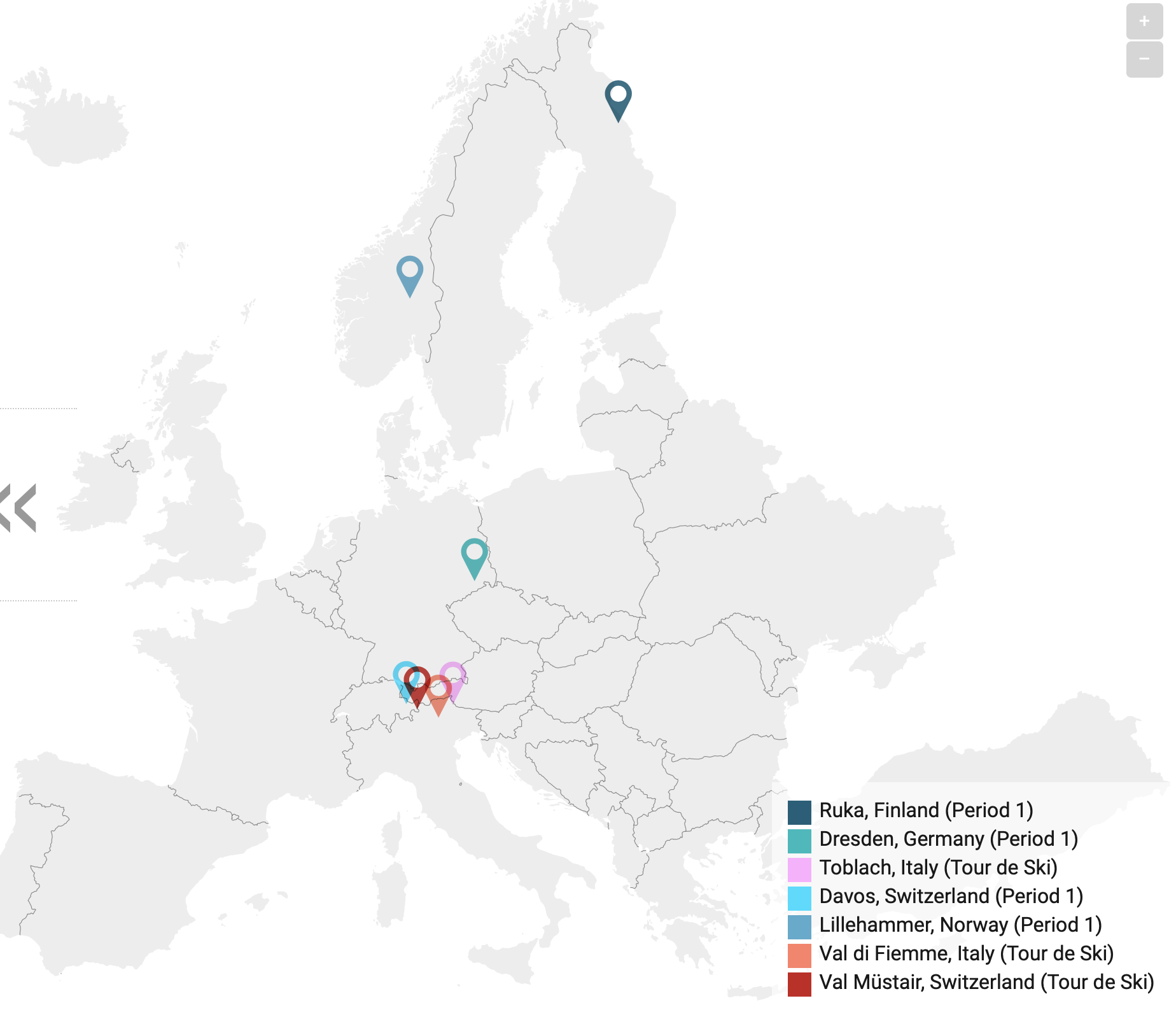
A few caveats: it’s early when considering the potential impact on next season’s World Cup due to Covid-19. But the news of the EU travel ban got us thinking about the respective Covid-19 caseloads for countries hosting Period 1 and Period 2 (Tour de Ski) World Cups. Period 1 consists of four stops — Ruka with three days of racing, Lillehammer with three days, Davos and Drammen with two each. Period 2 consists of the Tour de Ski.
https://datawrapper.dwcdn.net/YGjdA/3/
Finland and Norway, the first and second week’s hosts, appear to have flattened the curve. Both nations have modified their once draconian travel restrictions and loosened parameters for smaller-scale gatherings.
Curves for Italy and Germany are also trending in an optimistic direction. The exception for countries hosting Period 1 and 2 races is Switzerland, which has seen a recent uptick in daily reported cases. Switzerland is not part of the EU. As of July 6th, restrictions on travelers to Switzerland from 29 “high risk” countries were implemented. Travelers from any of the 29 countries, which include the U.S., must self-quarantine for 10 days.
In related news, the International Ski Federation (FIS) confirmed last week that the 2021 Alpine World Championships in Cortina, Itlay would go on as planned with up to date Covid-19 accommodations. In late May, the Italian Winter Sports Federation had requested the championships be postponed to 2022; Northern Italy was originally one of the hardest-hit regions by Covid-19. FIS stated that numerous stakeholders amongst the “FIS Family” had rallied to ensure the financial resources were in place to host the event as scheduled.
This series comes to FasterSkier from the Alaska Pacific University Nordic Ski Club.
A Day in the Life: APUNSC is checking in with Elite Team members of the course of the next few months to get a glimpse into what life looks like for elite athletes as training starts up again during a global pandemic.
Today we check in with Thomas O’Harra (24), an APUNSC member since 2007 when he joined the APU DEVO program. Thomas received his undergraduate degree from APU in 2017 and has continued on working towards a Master of Arts degree, set to graduate in 2020. Thomas qualified for his first World Cups this season!
Where are you right now? What have the restrictions been? Are they now changing?
I am currently in Anchorage, AK. I have been here since March 15th, when I got back after the cancelled World Cup Sprint Tour. I was initially under a 14-day quarantine, and Alaska was under a hunker-down order that has since been lifted. In the past few weeks, Alaska has gone back to pretty much normal, minus wearing masks and social distancing.
How did your season end? Were there any race cancellations that affected your season?
I had just qualified for my first World Cup races, traveled all the way to Quebec, and woke up (on my birthday) to learn that the Minneapolis World Cup had been cancelled. We spent the rest of the day in limbo before the US and Canadian teams withdrew from the races, at which time we bought tickets to fly home the next morning. In addition to the World Cup tour being cancelled, I was really looking forward to Spring Nationals in Silver Star; a few teammates and I were going to arrive a couple of days early and have a mini training camp!
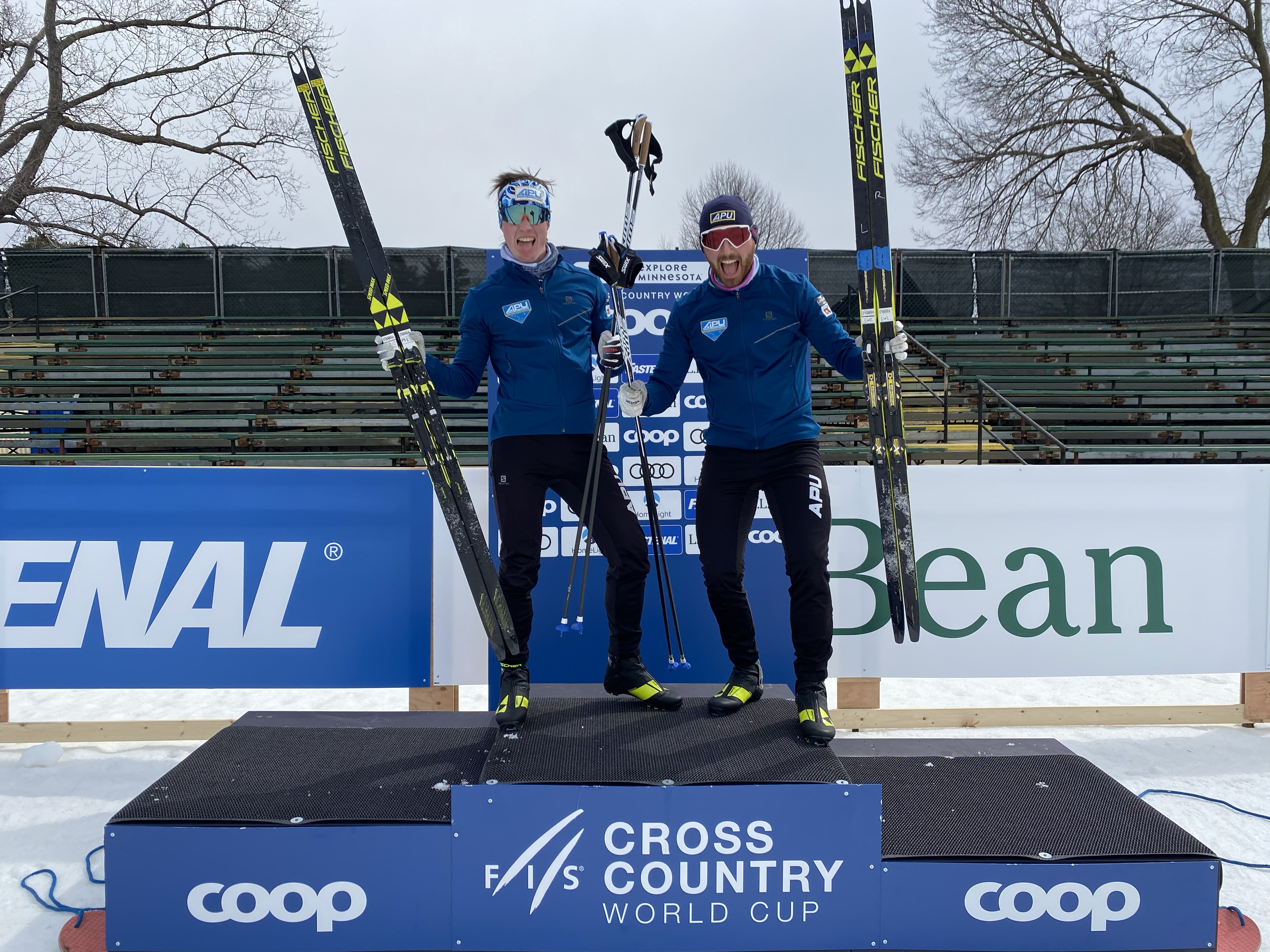
Enjoying the course and podium at the Minneapolis World Cup venue after learning that the event had been cancelled. (Photo: Thomas O’Harra)
What is a highlight of the ski season you did have?
I would say that the highlight of my season was definitely qualifying for the World Cup Sprint Tour, though it was made possible by racing my way into one of the sprint finals at US Nationals in Houghton, which is my best result so far!
(Racing at US Nationals Photo: Thomas O’Harra)
How have you planned around the unexpected end to the season? Did you do anything to “finish” out the season or jump into summer training early?
When I got home, I was in a bit of disbelief over everything that had happened during the previous four days, but I really wanted to take advantage of the amazing spring skiing that we still had in Anchorage. NSAA groomed until mid-April, we had an amazing sea-level crust season, and then Mat-Su Ski Club groomed at Independence Mine until mid-May! I tried to ski as much as I felt like for a few weeks before taking a short break. Everyone seemed to be on different plans, but I just tried to enjoy the phenomenal skiing we had.
Enjoying some fantastic crust skiing after the season ended early. (Photo: Thomas O’Harra)
What activities are you doing to keep yourself busy outside of training?
I have been working mostly. I also (like everyone else in the world) acquired a sourdough starter and have been baking bread with my girlfriend. Additionally, I have been reading more. I recommend The Uninhabitable Earth by David Wallace-Wells; it is a good read and a way not to forget that we are still amid a climate crisis in addition to the pandemic.
What did your workout look like today?
Today I did some rollerski speeds in the morning and then a distance run in the afternoon.
Do you have any indoor/at home workouts you are doing?
I actually started doing core this spring, mostly because I have not been able to get into a gym to do any lifting. For me, core is one of the more difficult workouts to get motivated for.
Without knowing what the future has in store, has it been challenging to keep up the motivation to train? Where are you getting that motivation? What motivates you to keep training?
I enjoy getting out to train, and I am currently operating on the assumption that we will have a season this coming winter. If we don’t get to race, I will deal with that in November. For now, it is summer and I am just excited to be healthy and able to spend time outside.
How are you keeping in touch with friends/family/teammates?
During April, our team used Zoom to keep in touch, and I have done the same with family. That being said, I live a few blocks away from my parents, so I have been able to see them frequently.
What has been your biggest challenge in relation to Covid-19 and how are you tackling it?
Honestly, I feel like life is almost normal for me. I am able to train every day and be outside, and I have been able to work (albeit on Zoom, which was difficult in its own way).
What are your plans from here? What things do you have in store for a summer that will include many restrictions?
I plan to keep training and hopefully do a little adventuring in a tourist-free Alaska, a chance that I might not get for a long time. I also have some off-grid adventure ideas that I’d like to accomplish, so we will see what happens!
Do you have any helpful advice in dealing with the changing times?
Just take everything day-to-day. I am not thinking about planning, or what might or might not happen in a month, but instead, I am focusing on getting out and training quality sessions every day.
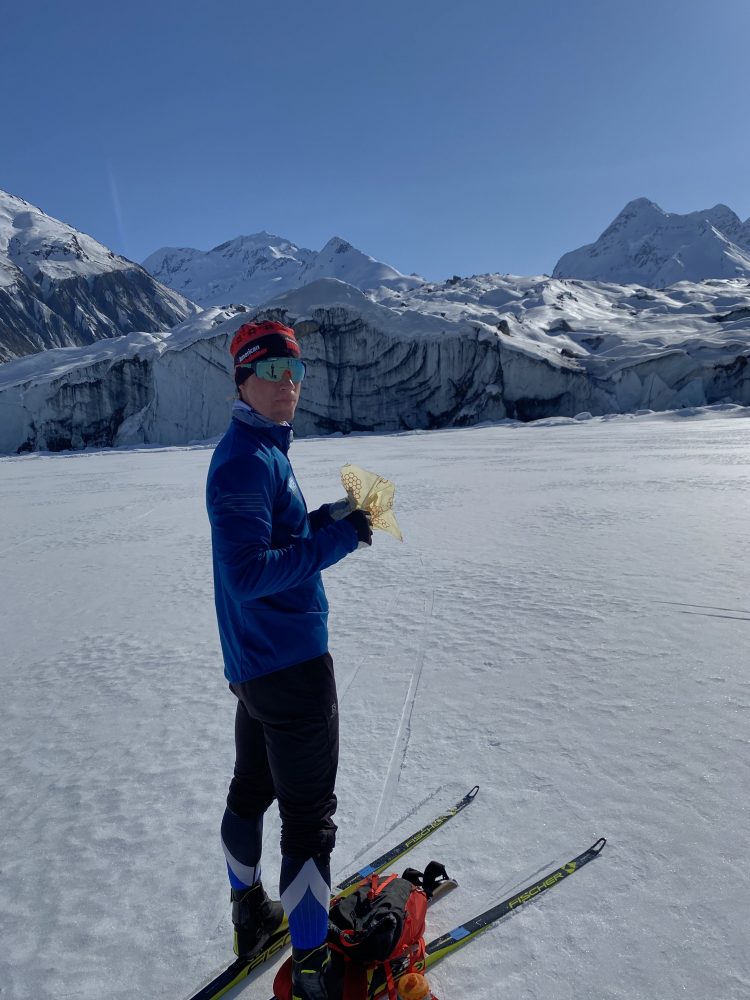
Enjoying the mountains and the close to home adventures. (Photo: Thomas O’Harra)
Katherine Stewart-Jones Trondheim, Norway during the Ski Tour 2020’s classic sprint qualifier. (Photo: NordicFocus)
Win now? Win later? Or somewhere in between?
A one year plan with a World Champs looming in 2021 or something befitting a six-year plan for capturing hardware at the 2026 Winter Games in Italy? Those are the strategies in play as national teams set budgets, rosters, and priorities. For countries like Norway and Sweden – at least on the Swedish women’s side – win now and later seems to be the constant background noise. For other nations like the U.S. and Canada, with smaller pools of championship medal pedigree, planning for the short, near, and long-term can be like juggling four different objects all of different masses. There’s almost too much to coordinate.
Nordiq Canada made it explicit: medal potential at the 2026 Games was the end goal. With a solid second-place finish in the junior men’s 4 x 5 k relay at the 2020 Junior Worlds, Canada may be primed for a delayed gratification epiphany six years out. But translating that 2020 success, with a young corps of skiers, does not necessarily translate to World Champs or Olympic hardware.
When Katherine Stewart-Jones was initially not renamed to the 2020-2021 Canadian National Team, the news came as a thud to many Canadians following the sport. At twenty-five-years-old, Stewart-Jones doesn’t exactly trend towards ancient in ski racing terms. This season, she placed 29th overall, the fourth-best placed North American behind Jessie Diggins, Sadie Maubet Bjornsen, and Rosie Brennan (all of the U.S.) in the Ski Tour 2020. That series of six races split between Sweden and Norway featured a loaded field. A 29th overall was real. It was Stewart-Jones’s best World Cup result since her first World Cup race in Planica, Slovenia in 2016.
In Canada, skiers must qualify for each respective period of the World Cup. In years past, Stewart-Jones earned World Cup race starts after solid results on the NorAm circuit as the Continental Cup leader. Just this season, of the six NorAm races she contested, she won a 10 k classic, a 5 k skate, and a classic sprint. In her other three races, she was top Canadian at a NorAm/SuperTour weekend: Second in a skate sprint, third in a 5 k classic, and third in 10 k skate.
She punched her ticket to Europe as the COC leader and guaranteed funding.
Katherine Stewart-Jones of Canada skiing to 31st in the Oberstdorf, Germany 15 k skiathlon. (Photo: NordicFocus)
Stewart-Jones skied for Thunder Bay NTDC for four seasons. Last spring, she relocated to Canmore with Erik Bråten as her only coach. She still represents Nakkertok, her home club, but does not belong to a training centre.
Despite making career-best marks on the World Cup, she failed to meet the national team’s objective criteria: she needed to place in the top-20 twice on the World Cup, or a single top-12, or earn at least 22 World Cup Points. She fell short. The team selection criteria did not allow athletes born in 1995 (her birth year) or earlier to be discretioned.
“I think it is important to support the top as well as the people that are coming up,” Stewart-Jones said. “I think most people would agree with that. It is a tough situation to be in.”
The national team skews young, with the oldest athlete on the senior team, Dahria Beatty, at 26, and the average age roughly 22.
Nordiq Canada provides a national team selection appeals process that Stewart-Jones took advantage of. When the appeal was filed, a three-person panel approved by both Stewart-Jones and Nordiq Canada considered the case. The panel ruled in favor of Stewart-Jones, declaring that her 9th place time of day during the Ski Tour 2020’s 10 k classic pursuit counted towards the criteria. She was renominated to the 2020-2021 national team. (The original criteria did not specify time of day as a consideration for overall place.)
“I have had a lot of people ask me if the fact that you didn’t get renamed to the national team in the first place, is that extra motivation to race fast? And I don’t get that,” said Stewart-Jones. “To me, it would never be a motivation, because I am doing it because I really just want to be the best in the world and that is why I have done this for the last however many years. So, when it comes down to it, what motivates me is just improving and there is just always always always something to improve on. Which is what makes skiing so fun to me.”
National team selection was critical for Stewart-Jones to maintain funding. As a member of the national team, she would be “carded”, and receive financial support from the government’s Athlete Assistance Program (AAP). For Stewart-Jones, the AAP helped offset the majority of her ski racing costs for the past five years.
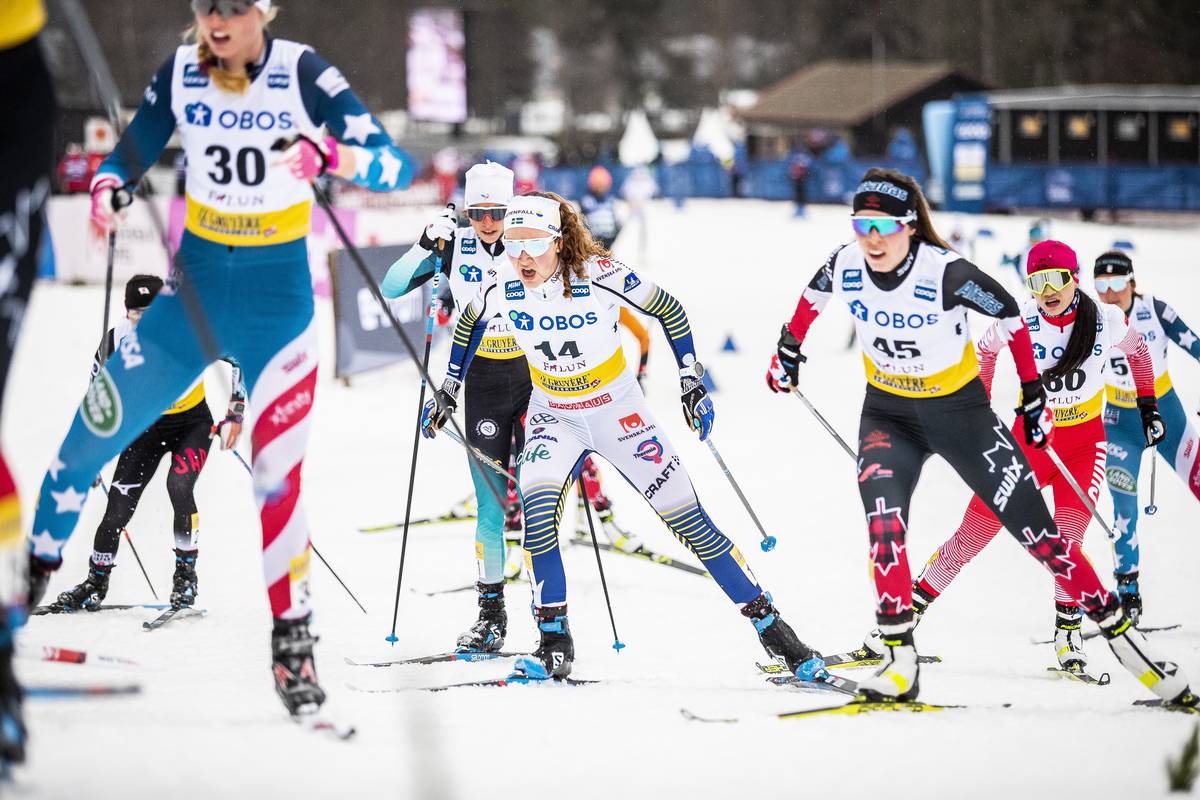
Moa Lundgren of Sweden (bib 14), and Katherine Stewart-Jones of Canada (bib 45), during the 10km women mass start skate in Falun, Sweden. (Photo: NordicFocus)
Coming into last season, Stewart-Jones understood meeting the objective criteria for renomination would have been a massive leap. With one eye on renomination, she felt the added pressure. Knowing the criteria’s benchmarks, she explained that although she made gains, in the back of her mind she understood some would percieve her results as underperforming.
“I would still get disappointed even if I did improve a lot, which can be a good thing and a bad thing at the same time,” Stewart-Jones said. “For me it was important to make the national team so that was definitely a focus I had this season. Which, I think, is not the best when your focus is just the results that allow you to make the national team the next year.”
If steady improvements are considered, then Stewart-Jones and her move to Canmore have paid off. Starting last year she began working with National Team coach Erik Bråten. As she upped her hours, which were considerable, she allowed herself more autonomy in creating her training plan while absorbing Bråten’s ideas.
“I think that was the biggest factor with me improving so much was just that I was able to have more input on what I was doing,” said Stewart-Jones.
Along with the autonomy, she increased her training by roughly 150 hours total over the past two years. In Canmore, she’s part of a group of women a text away from a workout. There’s Dahria Beatty, Maya MacIsaac-Jones, and Annika Richardson among others who can push Stewart-Jones on any given day.
This season left many unknowns on the table. For North American skiers, the prospects for a home snow advantage were fleeting. The Canadian World Cup races were canceled while the World Cup family had already descended on Québec City. Stewart-Jones was slated for the distance races in Canmore. With the season aborted, she missed out on her two most important opportunities to make a statement and make the leap to meeting national team objective criteria.
Cycling into the summer, the where and when for next season’s World Cup calendar is unsettled. Short-term or long-term, win now or later, Stewart-Jones is zeroing in on a 2021 World Championship run as Canada finds its footing with new leadership.
David Norris racing in the 2020 World Cup in Östersund, Sweden. (Photo: NordicFocus)
The razor-thin margin for national team selection in the U.S. played out again this season with David Norris (29) not discretioned onto the U.S. team – the sporting actuaries stated he lacked future medal potential.
On both sides of the aisle, making the team or not, the platitudes didn’t cushion the blow for a skier who has doggedly pursued endurance speed for over a decade. Norris earned his first national championship podium with a third place in 2011’s 15 k classic. With seven senior national podiums to his credit, Norris is the sort of grind it out athlete who finds no need for social media boasting or self-affirming flattery from “likes”.
David Norris racing in Nové Czech Republic. (Photo: NordicFocus)
For skiers like Norris on the nationa team bubble, and aging themselves into tougher and tougher objective criteria to earn full funding as a USST member, Norris had some important decisions to make. He could have taken the odds of playing the FIS point game and returned for the 2020 Senior Nationals. That path would have likely presented fewer barriers to earn the points necessary for a USST nomination. Abroad, he would need to consistently earn top-30s on the World Cup.
Norris committed to the Tour de Ski foregoing the ticket to Houghton for Senior Nationals. His choice premised on gaining international success and raising the standard of U.S. men’s skiing
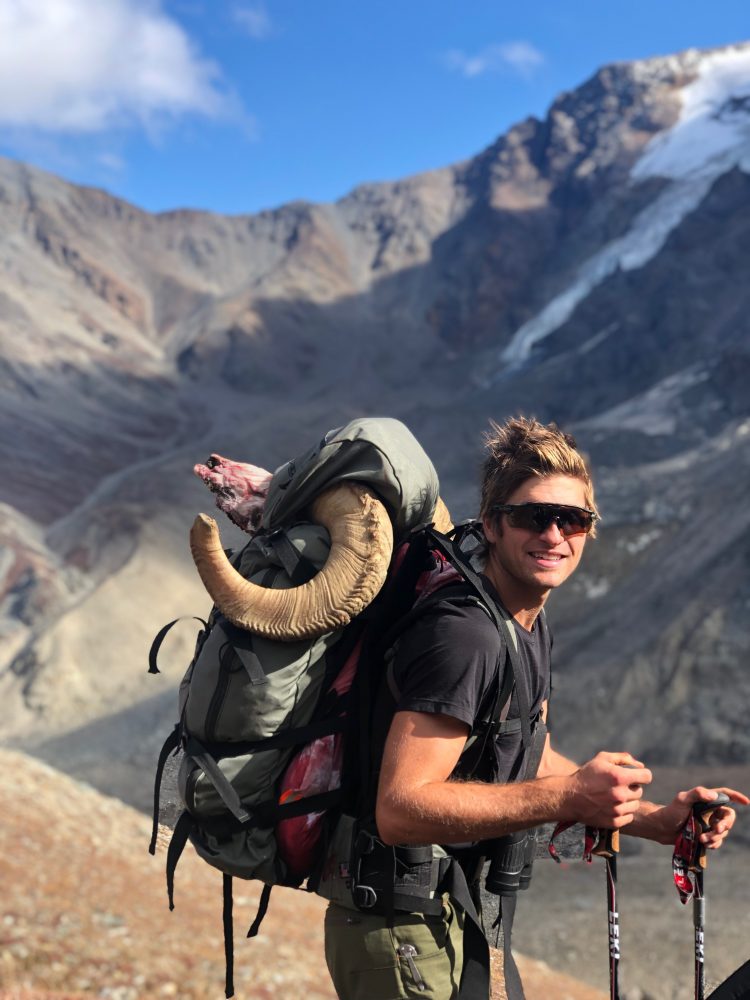
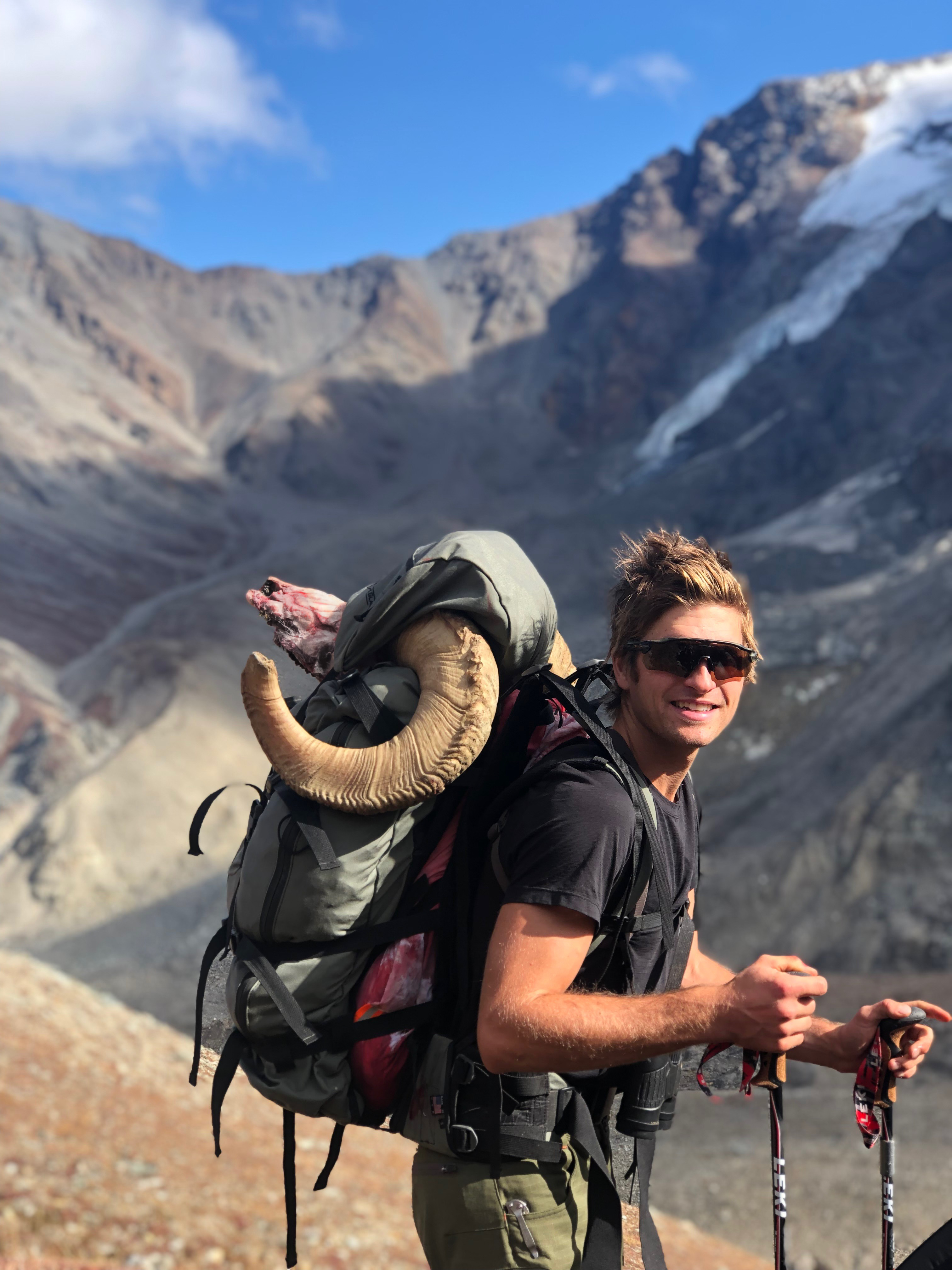
David Norris on a sucessful sheep hunt during a 2019 trip to the Eastern Alaska Range. (Photo: Courtesy David Norris)
Having grown up in Fairbanks, Alaska, and rooted in epic cross-country hunts on foot or skis, Norris understands his unsettled place in the broader ecosystem of making ends meet. On the skiing front, he saw three elite peers in Ben Lustgarten, Kyle Bratrud, and Erik Bjornsen retire this year. All were under 30 and all had won national championships during their careers. All felt they had tapped out on their potential for improving and landing on the side of medal potential.
When speaking on the phone this April, Norris equated his depth of disappointment in not being named to the national team with a missed opportunity to take a Dall sheep on a hunt a few years back. For Norris hunting is a full-immersion endeavor.
He had pursued a sheep and was closing in on a clean shot. From a distance he was unable to discern if the sheep was legal for the take: a legal ram must be aged properly with horn shape, the most common method used for aging during a hunt. Norris hesitated. There was no trigger pull.
“I was just inexperienced enough that I was so cautious of not shooting an illegal ram,” said Norris. “I knew that would ruin my trip more than coming home empty-handed. But once I got home and between the photos I had taken and talking to people and seeing some horns in my hands, the sheep I was looking at and had stalked was clearly legal. It crushed my soul.”
Norris knows soul crushing as much as top-of-the-podium elation. Back in 2018, he missed out on qualifying for the Olympics by mere seconds in a closely packed sprint finish in the men’s 30 k at nationals.
As the pandemic took hold this spring, Norris spent mid-March through the end of May in Bozeman, Montana with his partner Jessica Yeaton. He has since returned to Anchorage for organized training with his APU team. Norris has reset and set goals of competing on the World Cup next year, qualifying for the 2022 Olympics, and notching a top-15 in Beijing.
David Norris racing in Ruka Finland. (Photo: NordicFocus)
Those goals remain a reality as the skier made steady-state improvements on the World Cup this season. Norris credits his APU mates with his progress since joining the team six years ago.
“On our APU team it is not really discouraging to get beat on by each other because you know everyone is actually really legit,” Norris said. “Most guys on the team have podiumed at SuperTour. Luke Jager was beating up on people at World Juniors and the same when Gus Schumacher joins us. We all know Bjornsen’s results and Scott Patterson’s 11th place at the Olympic 50 k.
“With APU, to my benefit, I can go a month without dominating a single workout because on a given day Luke will throw down on the double pole workout and Scott can bound up a hill ridiculously fast and everybody has their own strengths. And particularly when their strength lines up with my weakness it challenges me and pushes me. I am super grateful to those guys and their abilities.”
Part of Norris’s job is finding success beyond the SuperTour. In discussing his full season on the World Cup, Norris said this season was more conducive to training and racing fast while living abroad.
“I think where people struggle and where I struggled in the past is just the mental side of it between being happy and getting along with everybody and feeling like you have purpose everyday – that kind of struggle,” Norris said.
Norris is a professional accountant. He found purpose this year using his non-racing skills. While traveling on the World Cup, he was able to work remotely for his online accounting clients. The daily routine of accounting work filled a void between twice a day workouts and long stints in hotels. According to Norris, his business, Front Range Financial LLC, gave him more structure.
Norris said he has plenty of work during the race season to cap his billable hours to 40 per month, and still afford himself time to train and recover. He recently completed his MBA to complement his accounting acumen. However, he’s reluctant to tap into his inner entrepreneur and grow the business. His priority is finding balance with an emphasis on meeting his racing goals.
The fact remains, Norris would have been relieved with a national team nomination and the more stress free situation of not having to raise 25 to 30 thousands dollars to sustain his World Cup racing as a non-funded athlete. That’s when his accounting and results sheet come in handy. With spreadsheets, a phone contact list, and an easygoing manner, Norris will work the phone and pound the Anchorage pavement keeping the dream alive.
This series comes to FasterSkier from the Alaska Pacific University Nordic Ski Club
A Day in the Life: APUNSC is checking in with Elite Team members of the course of the next few months to get a glimpse into what life looks like for elite athletes as training starts up again during a global pandemic.
APUNSC is also running a fundraiser in which the Elite Team is working towards skiing 1,000 kilometers as a team to raise awareness of road safety and promote healthy lifestyles. Each pledge of $50 = 1 Kilometer skied.
Today we check in with Hailey Swirbul (21), a silver and bronze medalist from the 2018 World Junior Championships and three-time National Champion. Hailey hails from El Jebel, CO and has been a member of the APUNSC elite team for two years. She is working towards a degree in civil engineering from the University of Alaska Anchorage.
Where are you right now? What have the restrictions been? Are they now changing?
I am in Anchorage, Alaska. Restrictions have mostly been lifted for Covid here with businesses reopening. People are still required to quarantine upon entering the state, but otherwise, social distancing is still in place.
How did your season end? Were there any race cancellations that affected your season?
My last races were in Oberwiesenthal Germany at U23 World Championships. I had traveled to Quebec for the North American sprint tour where the rest of the races got cancelled for the season (Quebec, Minneapolis, and Canmore).
Hailey Swirbul racing at U23 World Championships.
What is a highlight of the ski season you did have?
My highlight was scoring my first World Cup point in Davos, SUI, and scoring WC points in all types of races- classic & skate, sprint & distance. I also like learning what life on the road is like on the World Cup.
How have you planned around the unexpected end to the season? Did you do anything to “finish” out the season or jump into summer training early?
I kind of let the season end when the world decided to end it. I jumped into my Alaskan spring of backcountry skiing, Nordic skiing, and playing outside. I didn’t stress about training extra just because the season ended but probably trained more than I would have just by being outside so much.
Making do with a shortened season by getting in some good backcountry adventures. (Photo: Courtesy Hailey Swirbul)
What activities are you doing to keep yourself busy outside of training?
I have been very busy with a part time engineering research job, fishing, and cooking new things!
Baking delicious treats in my free time. (Photo: Hailey Swirbul)
What did your workout look like today?
My workout today was a 3-hour skate roller ski OD with my teammate Rosie and a short 50-minute mountain bike ride with the dog in the afternoon.
Enjoying being able to train with teammates. (Photo: Hailey Swirbul)
Do you have any indoor/at home workouts you are doing?
I have reallyyyy been struggling to motivate for at home strength sessions without a good gym set up. But when I’ve got to get it done, I’ve been doing squats holding the dog, dips on the side of the couch, and I’ve found a great pull up bar branch of a tree!
Without knowing what the future has in store, has it been challenging to keep up the motivation to train? Where are you getting that motivation? What motivates you to keep training?
It can be tough to motivate for me to train sometimes, but that lack of motivation mostly stems from my schedule with my new job. Ive always liked the structure of training, and that aspect hasn’t changed for me. I’m treating this year as a normal build up to winter and assuming races will go on as planned.
How are you keeping in touch with friends/family/teammates?
I see teammates at outdoor training sessions, and try to FaceTime my family or friends when I can!
What has been your biggest challenge in relation to Covid-19 and how are you tackling it?
My biggest challenge has been keeping my mental health in a good place and keeping structure in my life. It has been difficult for me to get little things done without a strict deadline or meeting time, etc. so I let those things pile up.
What are your plans from here? What things do you have in store for a summer that will include many restrictions?
I’m going to keep training as normally as possible and get outside as often as I can! I think fishing, camping,100 and hiking are great things to do with my quaran-team! I might not be able to leave the state as I had planned, but AK isn’t a bad place to be stuck 🙂
Enjoying vacations close to home. (Photo: Hailey Swirbul)
Do you have any helpful advice in dealing with the changing times?
It’s okay to not be okay during these crazy times. Be patient with yourself.
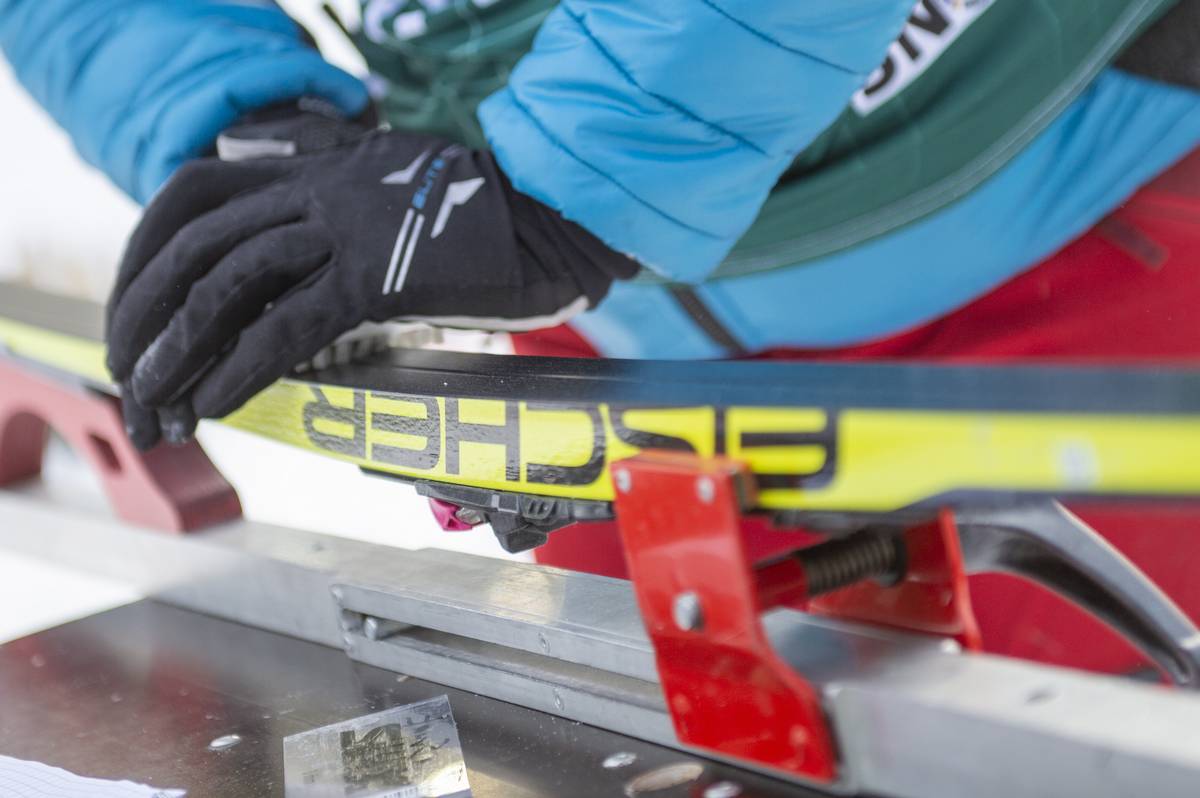
A ski technician brushes a ski: Östersund, Sweden. (Photo: NordicFocus)
FasterSkier spoke with Chris Grover this week to discuss the International Ski Federation’s fluoro wax ban, which will be implemented this season, and the potential for a modified World Cup schedule. Grover is the Davis U.S. Cross Country Team Program Director and the former head coach of the U.S. team. He is also a member of the FIS Cross-Country Committee and the chair of the Sub-Committee for World and Continental Cups.
“The Council decided in November 2019 that the use of fluorinated ski wax will be banned for all FIS disciplines from the 2020-21 season which have been shown scientifically to have a negative environmental and health impact. Regulations have been established in USA that are already in place and will be implemented in the EU from July 2020 which impact the manufacturer of these products.
“Kompass has developed hand-held detector testing devices that will be certified by the Frauenhof Institute and tested during the summer months. Thereafter they will also be made available for the industry and teams. Subject to successful test of the prototype testing devices, the controls will be implemented from November 2020, with tests carried out in the start and finish areas.
“For the season 2020-21 the measurement limit will be defined to give the possibility for the manufacturers, service technicians and teams to adapt to the new situation. The measurement limit will be fixed based on the experience of the testing and validation phase in the summer 2020. From the 2021-22 season, after evaluation from the first season the measurement limit will be lowered to a possible minimum with the objective of a zero limit of fluorinated gliding compounds as from season 2022-23.”
To be clear up what you have read on the Internet, the fluoro ban will take effect this season. What has yet to be determined are the trace limits of fluoros that may be present on a ski base when tested prior to a FIS sanctioned race. In other words, if a “1” represents a full-blown fluoro powdered ski with topcoats, then FIS needs to determine if a hypothetical upper limit of say 0.1 or 0.05 is acceptable. Further, as FIS states, the upper limit for fluoros on a ski base will decrease even further for 2021-2022. The end goal is a limit of zero by 2022-2023.
(The real levels for a fluoro threshold have yet to be determined, the numbers used in the scenario above are hypothetical.)
***
2019-2020 U.S. Cross Country Ski Team Photo: U.S. Ski & Snowboard
FasterSkier: Although the FIS Council is banning fluoro wax for the upcoming season across all disciplines, it is, however, not set in stone. Does that sound accurate?
Chris Grover: You are right it is not set in stone. They are still developing this testing apparatus, and although it is apparently on schedule and they are going to be able to do some testing over the summer. They need to play around specifically with what the tolerances are for having environmental fluorocarbon on the ski base.
They have to figure out what is an acceptable tolerance and how much fluorocarbon could one potentially accumulate accidentally either in a contaminated wax room or wax truck or by skiing across the snow and picking up what somebody else left behind, or even from contaminated brushes or what have you.
So, that is really to be determined. And I think the statement that the FIS released after the council meeting yesterday to the general public said something like it is over two or three seasons they want to be able to reduce that tolerance. But I think that is the one thing they are trying to figure out.
From how it is going to impact the teams, what I understand from Pierre Mignerey [FIS Cross-Country Race Director], is that we are going ahead with a ban on the World Cup. There will be sporadic testing of athletes’ skis as they go to the start and also testing is possible at the finish of the race for anyone that stands out I suppose. Although they haven’t really discussed how they want to do that.
And then an athlete who is above the limit on fluorocarbon at the start will not be allowed to start and an athlete who is above the limit after finishing will be disqualified.
FS: Ok, so an athlete who flags a fluoro test above the limit will not be allowed to potentially swap out skis prior to racing?
CG: Correct. Which if you think about it, that makes sense. If you have an individual or a team that wanted to cheat, they could obviously run out there with skis that were above the limit, roll the dice that they would not be selected for testing and compete. And then if you have that opportunity to swap, then they can of course swap it before the start if they do get tested.
I think it is important, given that they will not be able to test nearly everybody in the field, that it basically is a “show up and if you are above the threshold you cannot start,” type of situation.
FS: Is the new testing device a more advanced piece of equipment that assays a swab that has been swiped across a ski base?
CG: I don’t know for sure. It is my understanding that this is a handheld device that can do a spot check and provide results at the time of the test. This is an immediate test. And so I don’t know exactly how it is implemented. I don’t know if it is simply how many personnel can they dedicate to this and how many of these machines, which may be kind of expensive at first, that you can employ.
FS: I’m guessing with the FIS announcement last November about potentially banning fluoros that the U.S. team began testing fluoro-free products?
CG: We definitely started testing products, but I should have you talk to our wax service team because they could speak with a lot more authority and knowledge than I can. I don’t believe we had a lot of products that we could test, but we certainly had some and those guys were certainly starting to run those tests. But this question of the fluoro ban hung over our heads. Everybody at that point was like, “wow, should we actually be stockpiling waxes right now? Or should we be burning through our current inventory?” Because we didn’t know if the ban would actually go into effect next year or how much time we should actually spend on this project.
Now that the FIS Council has solidified their decision, the testing is a real question for us, and of course, we knew or thought it was going to be something that we need to do this summer. Now, of course, we are challenged with potentially not being able to get on snow for a while given the pandemic. We obviously lost our opportunity at Mt. Bachelor this past month to be on snow. I think it is a little bit up in the air from the bit I have heard from Erik Flora, [at Alaska’s APUNSC], as to whether Eagle Glacier will be able to operate this summer.
I don’t think New Zealand is going to open their borders to us in time for us to be down there. We cannot get into Europe right now. I’m not sure what is happening with the Haig Glacier [in Canada], but that is a hard place for us to test anyway. I think my guess right now is that if we are going to have time on snow to test new products it is going to have to be at the start of next season prior to the racing beginning.
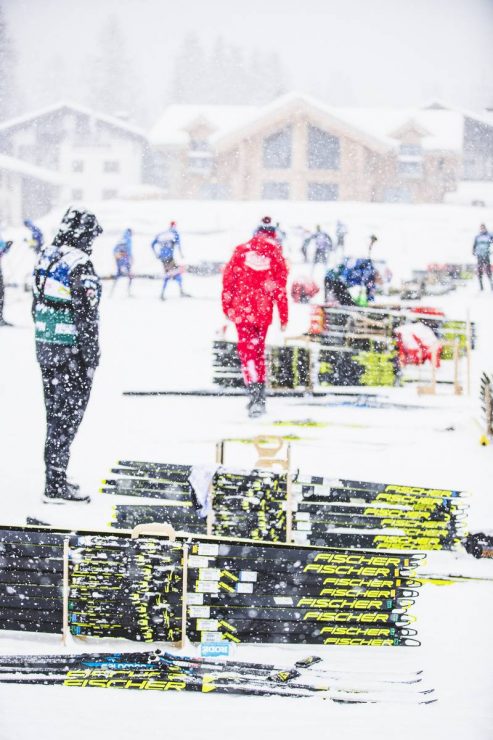
Testing the Fischer fleet in Davos. (Photo: NoridcFocus)
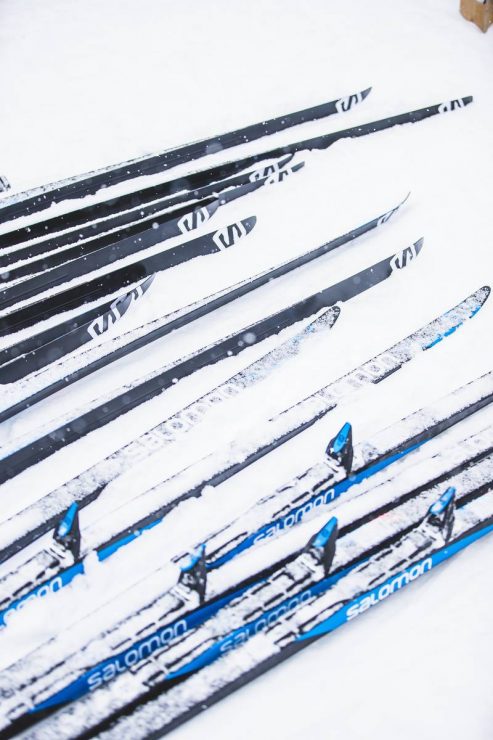
Testing the Salomon fleet in Davos. (Photo: NordicFocus)
FasterSkier: Trust can play a huge part in moving things forward in terms of a ban. How does that play out on the World Cup?
CG: I think most teams are on the level there. And most teams do want to play by the rules. But there are elements within a number of teams that I would say are less than trustworthy or perhaps look at sport through a different lens culturally than we are. I think that becomes a challenge.
Testing becomes the key – what is the saying – “trust but verify.” Something to that effect. I think verification is the absolute key. I think we need to test and test a lot. And I would really encourage the FIS through the various juries and organizers to just really test heavily. We, as you know, see more anti-doping testing happening at every level, in-competition, out-of-competition. And I think we feel the same way about the fluoro testing because we know we are doing it the right way. But time and time again, unfortunately, there have been other individuals and teams that have done it the wrong way.
I think it is really important for our athletes, for all the athletes, to feel confident that it is a level playing field.
FasterSkier: During the course of your discussions on the Cross-Country Committee regarding the fluoro ban, did you try to work out the details before presenting your proposal to the FIS Council for final approval?
CG: Frankly, there has not been that much discussion because this is not something that we had any ownership of, or any decision making power with regards to. This is a decision that has come from the FIS Council and we are tasked with figuring out how we are going to implement that decision. As with any decision, we are trying to figure out how we are going to implement that decision.
Obviously, there are quite a few people that were upset by the decision and don’t quite understand it, don’t feel like they were consulted, whether they should have been or shouldn’t have been. But discussing our feelings about it doesn’t really make a difference because at the end of the day we just have to react and figure out how to implement it.
But, you are right in that usually the Cross-Country Committee is going to make suggestions to the FIS Council about what we recommend for cross-country and they are going to ratify it or disagree with it and not pass it. But obviously, because this affects all disciplines within the FIS family, it was something that just happened without really the consultation of the Cross-Country Committee.
FasterSkier: You’ve been in the game for a long time. What are your thoughts about the fluoro ban?
CG: I think it is a positive change for a number of reasons. I think it is extremely hard on the industry right now. And it is also hard on club programs that have a lot of money invested in wax, so I understand that we are going to have some big challenges there and some serious growing pains for a couple of years as we go through it. But at the same time, the cost of getting young people and kids into ski racing due to a lot of these products was continuing to make it even more prohibitive to entry. So I think from that perspective it is really good that we are getting back to our roots, back to basics to some extent. We still have a lot of technology out there in terms of equipment and stone grinding and everything else.
But I think this is really a positive step. But even though it’s a small step for the environment it is a meaningful statement from our community that we are very interested in protecting the environment and we are very concerned with protecting people. And if we can make the sport more economically within reach of people then that is good. I think overall, as hard as this process is going to be, and of course, it is coupled with all the challenges we have surrounding the pandemic, I think it is overall a really good change and a direction that we should be going.
FasterSkier: It seems the World Cup calendar is in play at this point. There are so many unknowns. It seems like two plans going forward: Plan A, pretty much the pre-existing World Cup schedule, and plan B, a modified schedule organized around racing blocks — or multiple weekends — in a specific country. Is this correct?
CG: I have to give credit to Pierre and all the FIS teams — they have been in discussion with the FIS cross-country staff this spring — because I think they have come up with a really good plan B which is, as you suggest, blocks of racing with limited border crossings during those blocks and potentially no border crossings, and some of them, if necessary, with two or three weeks in between each block to allow for the team to potentially cross the border and then quarantine if necessary for 14 days.
I think that the backup plan makes a lot of sense and it is smart to have this plan where if we cannot do everything that we want to do under normal circumstances, we at least can be on TV in front of the fans, at least the fans on TV. We will still be in front of the public eye so people don’t forget about cross-country ski racing this next winter.
It is really important just for the health of what we are doing.
I think the FIS decision on the World Cup schedule or going to a plan B schedule is tentatively slated for the end of September. We as a FIS staff and as a committee chair, I am going to be meeting with the FIS staff over the summer a little bit to stay abreast of what is happening, and which direction it may or may not be heading. But by the end of September, we are going to go ahead with either plan A or plan B. And at that point, we will really start making our plans for the U.S. team. Right now we just have tentative plans in place but I am a little bit hesitant to spend too much time solidifying everything until I know which direction we are going.
David Norris of the U.S. placed 20th overall in the the men’s 50 k skate at the 2019 World Championships. (Photo: John Lazenby/lazenbyphoto.com)
This series comes to FasterSkier from the Alaska Pacific University Nordic Ski Club
A Day in the Life: APUNSC is checking in with Elite Team members of the course of the next few months to get a glimpse into what life looks like for elite athletes as training starts up again during a global pandemic.
Today we check in with David Norris (29), a 2019 World Championship team member who has been competing on the World Cup for the last two season. David hails from Fairbanks, AK and has now been a member of the APUNSC elite team for six years. He has a degree in accounting from Montana State University and completed a Masters of Business Administration from Alaska Pacific University just last week!!!
Where are you right now? What have the restriction been? Are they now changing?
I’m currently in Bozeman. The restrictions here seem pretty standard: wear a mask and social distance; most shops besides grocery stores are closed. Bozeman has been reopening over the past two weeks with dine-in options and non-essential shops returning to business. The trails were always open so I mostly noticed these restrictions when shopping or wishing I could carpool with friends.
How did your season end? Were there any race cancellations that affected your season?
After Holmenkollen I went to Bozeman to meet up with Jessica [Yeaton], visit her parents, and recover before the Canmore World Cups. Basically the same day the World Cups and the rest of the season were cancelled Jessica’s classes switched to online, so we decided to just stay where we were to reduce travel and see what would come of this pandemic.
What is a highlight of the ski season you did have?
Oberstdorf 30km skiathlon and Falun 15km skate mass-start were both major performance highlights for me. More than the result on paper I was encouraged by my ability in these two races to move into the top 15 when the lead pack started to split up. In the end I didn’t finish where I believed I should or could have, but spending time in the top 15 and learning what that takes was inspiring and made me excited for next season.
David Norris skis to 28th in the 30 k skiathlon in Oberstdorf. (Photo: U.S. Ski & Snowboard)
How have you planned around the unexpected end to the season? Did you do anything to “finish” out the season or jump into summer training early?
I got pretty sick at Holmenkollen and was being a good ski racer trying to recover until I heard all the races where cancelled. Then with no races to get healthy for I started rallying the training; I tried to ski a bunch with Jessica and adventure in the mountains. After about two weeks of that I was completely wrecked and had to slow down. Maybe as a result of not having a traditional ending to the season I haven’t really had a traditional start to the new season either.
What activities are you doing to keep yourself busy outside of training?
April was definitely slow… I hardly had any hours at work and I hadn’t started spring classes yet. April consisted of reading a couple books, carving a butter knife from a dead chunk of apple tree in the yard, and baking lots of bread. In May I took my final MBA class and had work hours pick back up- so lately I’m staying more happily occupied.
The baking goods. (Photo: David Norris)
What did your workout look like today?
This morning I did about an hour and a half jog. I had plans for some strides and plyos, but the ole’ calf was bugging me. This afternoon I rode my mountain bike for about 2.5 hours.
Do you have any indoor/at home workouts you are doing?
I’ve been doing some floor core with Jessica and once a week I try to tie some straps to a tree to do TRX type stuff. I am weak right now for sure, but with the time not in the gym I’ve probably done far more cardio.
Without knowing what the future has in store, has it been challenging to keep up motivation to train? Where are you getting that motivation? What motivates you to keep training?
I like to exercise quite a lot, I think I have held high motivation to stay fit right now by doing only the workouts that sound fun. Jessica and I have been following the weather, and often when the weather is at its worst we just crank out some intervals or hammer for a while and call it good. When the weather is good, we spend hours out in the sunshine mountain biking or backcountry skiing. Its actually been a really refreshing approach; however, in June, I’ll follow a lot more structure.
How are you keeping in touch with friends/family/teammates?
Text and Facetime are my go-to for most friends and family.
What has been your biggest challenge in relation to Covid-19 and how are you tackling it?
I like to make plans with goals and pursue them. Since March I’ve canceled a lot of summer plans and have held off from creating new ones. I think I am being forced to learn that patience is not the same as laziness.
What are your plans from here? What things do you have in store for a summer that will include many restrictions?
I am headed to Anchorage in early June to start back into training with the APU boys. I bet with several of my favorite summer races canceled I might time trial the routes. I’m hoping the restrictions don’t make bouncing back to ABQ to visit Jessica too challenging. Other than that my life should be simple- train, work remotely, study, fish, and avoid making too many plans.
Do you have any helpful advice in dealing with the changing times?
Be patient and exercise every day.
Enjoying the mountains around Bozeman. (Photo: David Norris)
Rosie Frankowski (right) racing this winter in Lillehammer, Norway. (Photo: NordicFocus)
This series comes to FasterSkier from the Alaska Pacific University Nordic Ski Club
A Day in the Life: APUNSC is checking in with Elite Team members of the course of the next few months to get a glimpse into what life looks like for elite athletes as training starts up again during a global pandemic.
Today we check in with Rosie Frankowski (28), a 2018 Olympian, 2019 World Championship team member, and SuperTour podium regular. Rosie hails from Minneapolis and has now been a member of the APUNSC elite team for 6 years. She has a Masters in Public Administration from Northern Michigan University and a Masters of Business Administration from Alaska Pacific University where she is also an adjunct professor.
Where are you right now?
At home in Anchorage, Alaska.
How did your season end? Were there any race cancellations that affected your season?
My ski season didn’t end early because I had already planned to head to South America and Mexico to do a series of running races, trail races, and marathons. I ended my ski season after the Ski Tour 2020 and flew from there to Minneapolis and then directly to Mexico to run a marathon on March 1. Although my ski season didn’t end early, all the running races I had planned after that in Patagonia and Peru were canceled towards the end of March. I, then, had to emergency fly from Mexico City back to Anchorage and give up a multi month trip.
Rosie Frankowski racing at the 2019 World Championships.(Photo:US Ski Team)
What is a highlight of your ski season?
The highlight was doing Period 1 World Cup. Going to a bunch of places I hadn’t been before was a big challenge and I’m proud of myself for tackling it. Also, getting to race in some iconic places like Lillehammer and going to Finland for the first time. That was a good experience for my life and ski career.
I also had a lot of fun doing the Alley Loop race in Crested Butte. It was a low key race, but really fun to be back in the American Nordic ski community. Being part of a citizens event and seeing how much fun everyone has at them was great.
What was it like “moving” or resettling during a pandemic?
That was absolutely crazy. We decided at midnight we were going to fly out of Mexico City at 5 AM the next morning to Anchorage. Luckily my boyfriend’s parents live here so we were able to stay with his mom while we tried to find a place to live and a car.
I was let go of the job I had had for the last four years because I was an event planner and there were no more events. I had to find a new job as well. All of this during a pandemic when you aren’t supposed to be going to peoples’ houses or contacting strangers was crazy and quite stressful.
Maybe by luck we were able to find a place to live and buy a car right before things became very restricted here. Once we had a place to live, we were able to work remotely. It was definitely an added obstacle in the already stressful process of trying to find a place to live. It wasn’t very easy, but it did all work out.
What does a typical day look like now? How have you planned around the unexpected change of plans in your life? Will we see you on the race trails this winter?
My life is similar to what a normal day would look like because we are lucky up here in Alaska and have been able to use the trails. I go out running or skiing in the morning. The biggest difference is not being able to carpool with teammates which as a big fan of car pooling has been killing me. I’ve been getting into some podcast to keep me entertained and luckily gas is really cheap right now.
I train in the morning, come home, eat lunch, work at my job remotely, similar to most Americans right now, and then train again in the evenings. The biggest change has been working remotely and sharing the space in the apartment with other people working remotely. That’s always an interesting challenge.
I will be on the race trails this winter. I hope we are able to have races this winter as usual, fingers crossed. You will see me out there if there are races to be at!
Crust skiing at Hatcher Pass. (Courtesy photo)
What activities are you doing to keep yourself busy outside of training?
That’s been the biggest change for me. I am very social and I love going to breweries or going to listen to music and I planned events for downtown Anchorage in my last job so attending community events is a huge part of what I love about life so the social restrictions have been hard.
We’ve had a lot of outdoor fires so we can stay 6 ft apart and catch up with friends that way.
I attempted to get into yoga which sometimes works and sometimes I just can’t sit still long enough, but it does help to relieve some stress.
Since my trip to South America was cancelled, I’ve been practicing my Spanish and playing ukulele.
I’ve been obsessed with trying to grow cilantro. I have about 12 plants in different parts of my house and really babying them. I take them inside at night so they think it’s night which is a problem in Alaska when it’s so light, plants tend to go to seed quickly.
What did your workout look like today?
I went to Sadie’s house and rollerskied with her around town. We’ve been skiing on snow so we haven’t done much rollerskiing so I’m just easing into that now.
Everything went well and nothing was broken so that’s good!
Do you have any indoor/at home workouts you are doing?
I’ve been doing elements of strength from home. I find some core videos online which is entertaining and sometimes very difficult.
I go to a park across the street to do some lunges and push ups and things so the neighbors probably think I’m crazy, but that’s the gist of getting things done at home right now.
Without knowing what the future has in store, has it been challenging to keep up motivation to train? Where are you getting that motivation? What motivates you to keep training?
I think it has been challenging to keep up motivation to train especially for more ski specific goals. Luckily the spring brings new energy for running and hiking so I’ve been motivated to do that, but I have been struggling to find motivation to get out on rollerskis or even real skis sometimes. I’ve been focusing less on the idea that this is for a specific race and focusing more on the fact that this is me getting to be outside for two hours today, to get sunlight and fresh air. Then taking that day by day so I’m not focused so much on progressing towards a specific goal but on enjoying the outdoors. I’m lucky enough to call that my job and everyone else that has to work from home is spending 8-9 hours inside their home and I get to go outside and call that work.
How are you keeping in touch with friends/family/teammates?
Mostly through FaceTime and Zoom. We had Zoom meetings with the girls team while we weren’t able to train together. Most of my friends and family live in the lower 48 so I generally only get to see them once a year anyhow so that hasn’t been that different. Having fires outside and being able to be 6 feet apart has increased my marshmallow consumption but has also provided a good social outlet.
What has been your biggest challenge in relation to Covid-19 and how are you tackling it?
The biggest challenge has been the uncertainty and stress in not knowing what the future holds. I had planned to be on this trip until early July. I had been planning it for two years and sold my car and moved out of my house, planned to do all these running races and really take a deep breath away from skiing. But I have really fallen back into the pattern of being a ski racer which isn’t bad, but I had really wanted to take that space and gain some perspective and I didn’t get to do that. Emotionally and psychologically it was hard to not feel like I was taking a step backward when I had to come back and not be progressing in my life or athletic endeavors. That’s been something that’s been stressful. I’m still working through it day by day. I have a new job which has been challenging me and hopefully helping me grow. I have been trying to figure out a plan for the upcoming ski season that is different and focusing less on the World Cup and planning more races in the U.S. that I find fun. I have plans for running races in late summer/early fall if they happen so focusing some on the running aspect this summer as well to shift my mind a bit and focus on more than ski only goals.
Running trails in Mexico. (Courtesy photo)
What are your plans from here? What things do you have in store for a summer that will include many restrictions?
Hopefully I will get to do some races. I’m trying to take advantage of the fact that I will be here all summer and might not have camps so doing some adventures that I haven’t been able to do and those that are a little more off the grid with less people around. I am also looking forward to growing a garden because I will be around and foraging for mushrooms and salmon fishing and really taking advantage of the Alaskan lifestyle.
Do you have any helpful advice in dealing with the changing times?
Take it day by day. There are good days and bad days and don’t beat yourself up if you have a few bad days in a row and need to cry it out.