Category: Feature

  • Chris Hecker and the Moment the Sun Came Out

    Chris Hecker and the Moment the Sun Came Out

    This article was made possible through the generous support of our voluntary subscribers.  If you value coverage like this, please support FasterSkier with a voluntary subscription.

    If you are a parent or coach and have been responsible for waxing skis for an important race — a state championship, a Junior National Qualifier — you know how stressful that can be. Now imagine it’s the morning of the Team Sprint at the Olympics, and you are responsible for Gus Schumacher’s skis. Feel your blood pressure rising yet?

    Welcome to the life of Chris Hecker, the US Cross-Country Ski Team service tech who leads the glide program and is Schumacher’s personal tech. Hecker, at this point, knows Schumacher well and that he has logged nearly 1,000 hours of training annually for years, and that he has dreamed of this specific day since the end of last season.

    “One of the most stressful moments actually came [on race day], about 45 minutes before the Men’s Team Sprint. I had selected the race skis for Gus and felt confident in the decision. At the time, it was clearly the best pair for the conditions.”

    Everything seemed to be playing out as Hecker had hoped, but then everything changed.

    “Then, about five minutes later, the sun came out. The course started to break down and got noticeably wetter. I still had a few minutes before beginning to wax, so I decided to run one more quick test. In the ten minutes between tests, the two top pairs kept getting closer and closer in performance.”

    These are the moments when experience, confidence, and a little tech magic can make or break a race. “In the end, I chose what was technically Gus’s second-best pair at that moment,” Hecker recalled. “As more athletes skied and the temperature continued to rise, there’s a good chance those skis actually became the faster option anyway.”

    Hecker was quick to point out that “Gus and Ben were on another level. Regardless of which skis Gus raced on, I’m confident the result would have been the same. They were [racing] on another level.”

    We may never really know, but maybe that decision did have something to do with Schumacher and Ben Ogden winning silver in the Team Sprint? For Hecker, it was a choice that was actually years in the making.

    Guided by family and noted mentors

    Hecker grew up in a family of skiers; his father, Mike, was a Pelton ski and Exel pole rep in the Midwest and had Chris on skis when he was just nine months old, “shuffling around and falling down.” Mike and his wife would pack the entire family, including Chris and his older brother Jeremy, and spend weekends traveling to different ski shows and venues. The parents told Chris and Jeremy it was their ‘vacation’, but in reality, it was just a family deeply invested in both the industry and the lifestyle.

    “So we were skiing from a really, really early age, and then we got into racing,” said Chris. When Chris was in middle school and high school, he raced for Anoka High School, in Minnesota, a northern suburb of Minneapolis. After graduating in 2013, he headed to St. Scholastica in Duluth, where he raced for three years under Chad Salmela and, in his senior year, under Maria Stuber.

    After graduating from St. Scholastica in 2017, Hecker took a job with Rex Ski Wax for the 2018 / 2019 season.

    “I worked with them for a year, spent a year on the World Cup being their racing service manager and research and development, kind of lead testing for all the new products, testing all the old products, and then walking around and working with the teams and saying, What do you need from us?”

    Hecker made himself available to World Cup teams, asking which products he could help with and which they thought were working well and which needed improvement. He continued this work for three full seasons before starting with the US Ski Team in 2020; this is now his sixth full season with the team.

    Two brothers… “Give me something weird.”

    Chris’s older brother, Jeremy, has kept the family tradition alive too, serving as a full-time employee of Pioneer Midwest and, in addition, as the domestic rep and race service lead for Rex ski wax.

    “We talk multiple times a week, and we get really deep into the weeds,” says Chris, who gives his brother lots of respect and praise. “He’s a really good wax tech, and sometimes you just need an idea from an outside source.”

    So when waxing domestically, Jeremy will ask his brother at the World Cup, “Give me something weird, give me something random to go out and test,” because he has all the normal, routine choices down.

    “He’ll always ask me for one random suggestion to try out for some of those race weekends. And sometimes it works, and sometimes it doesn’t.”

    For the most part, the two brothers talk about local races and how Jeremy can better support local skiers, since the products Chris is working on for the World Cup aren’t available to domestic skiers.

    “But it is also fun to talk about, when we have a really good day, like in Goms, or a really good day, like in the Val de Fiemme, on the final hill climb.”

    When that happens, Jeremy can spot it on the livestream and will call up Chris and ask, “Oh, what’d you guys do differently!”

    A lot more than two pairs of skis… like over 100

    In addition to being Schumacher’s personal tech, Chris Hecker is also responsible for Novie McCabe when she is on the World Cup and when she raced at the Olympics.

    In addition, Hecker is responsible for managing both athletes’ ski fleets. For McCabe, that means 38 pairs of skis and another 65 pairs for Schumacher, but even that can be variable, “like, Gus gets a ski [from Rossignol] maybe every other weekend or every third weekend because they’re always coming out with new prototypes and new skis.”

    McCabe is a Fischer-sponsored athlete, and they are admittedly a bit more controlled on allocating skis, but if Hecker and McCabe decide to “knock out a bad ski,” they can give it back to them and get another for her quiver.

    The new Rossignol skis arriving can introduce many more variables for Schumacher and Hecker to consider. As Hecker says, “ it can be new base material, new grinds, new core materials… the construction of the ski can be different.”

    Every little tweak has a purpose, “maybe it’s an easier kicking classic ski, maybe it’s a faster base material on a state ski.” As Hecker continues… “Maybe it’s a different laminate on a zero ski,” and what becomes quickly obvious is that all of these subtle variations make for endless possibilities.

    Building a rapport

    Hecker and Schumacher have been working together for two years now. Last season, Hecker was not responsible for another athlete, so he could focus on Schumacher, and the two quickly bonded.

    From the beginning, “working with him was really fun,” said Hecker . “We were trying to build a rapport as a new athlete and tech combination between the two of us.”

    Schumacher’s previous tech had left for the Swiss Biathlon Team, but Hecker and Schumacher found a lot of success last season with several top 10s and a podium in Falun, Sweden. As they started this season, they got right back to work.

    “Then starting this year, it was like jumping right back into it.” The two had a full year of experience to build on, and the dialogue and descriptions began to get more dialed, which is critical in the relationship between a tech and an athlete.

    Hecker began to know what Schumacher “likes for kick in skis, what feeling and stability he likes on skate skis,” and the two have been able to build that “innate rapport” which leads to a trusting relationship.

    As Hecker puts it, “[Schumacher] is one of the most astute athletes that I’ve worked with. He always comes with a question or two on race day. ‘Do you think we should try testing over on this side of the course instead of that side of the course, because I’m really trying to execute a plan here. Can we try focusing on glide for this half of the course, and maybe do a couple of glide outs here?”

    Hecker continues to describe how impressed he is with Schumacher as an athlete:

    “And so he’s always equally thinking as a wax tech and as an athlete when we’re out skiing together, and he’s really trying to dissect where the best places to test are. And it’s not just my job to revive the skis for him, but it’s also his job to pick the correct skis for him. And so he needs to know almost as much as I do about his skis and what is working and why it’s working, because ultimately we have to come to the decision together. He is racing, not me, and so we have a really cool relationship together to kind of pick and choose what we want to race on as a team.”

    Learning what he likes instead of what you like

    At this level, picking the right ski for an athlete is not just about what is fastest. It is also about picking a ski that responds the way the athlete prefers, and that matches the way a skier races.

    For Schumacher, that means a ski that is “extremely stable and forward tracking.” Hecker knows the way Schumacher skis, and how “when he pushes off to the left or to the right, and he goes fully onto one ski, he wants it to go straight.”

    “He doesn’t want the tip to move at all. He just wants it to point and shoot straight.”

    That isn’t a characteristic Hecker is personally always looking for in a ski, but he knows that’s what Schumacher wants. “So when I’m looking and testing without him some days, I say, ‘Okay, this ski is for sure going to be moving on because this feels better for him.’ And so we kind of have differing opinions sometimes on feeling, because I like a slightly different ski.”

    For Hecker, though, what is most important is that he understands not just what will ski fast, but also what will work best for Schumacher in different conditions, based on how he will race.

    “On a really firm course, he’ll look for this ski that just goes straight. And I think the reason why he likes that is that he will free skate a lot and likes being able to just push with his legs. And he’s so strong at that, and so relaxed when he does it, and so he can conserve a lot of energy.

    So it’s a really cool technique change from him, because I don’t think a lot of people utilize that on the men’s field. You see a lot of people always V2ing, and you’ll see him kind of free skating in the middle of the pack, just relaxing his upper body and giving half of his body a rest.”

    Inside the wax truck: how race morning actually works

    On a stable day, glide testing is fairly methodical.

    “We usually have four fleets of skis that go out,” Hecker explained. “Eight structure skis, eight paraffin skis, eight topping skis, and four to six application skis.”

    Before any athlete even gets to the venue, there is what the service team calls a “thinking period.” Jason [Cork], Tim [Baucom], Hecker, and anyone else in the truck who wants to join in, gather around a table with wax options.

    “We’ll put maybe 10 to 12 waxes in,” Hecker said. “Eli [Brown] might give us a wax. Oleg [Ragilo], our head of service, might give us a wax. Bernie [Nelson] might give us a wax. Then at the end of the table, it’s on me to narrow it down.”

    Ten or twelve become eight after the team removes the overlapping options. Some are eliminated because something similar tested better earlier in the week. Predictability and durability matter as much as outright speed.

    Structure follows a similar pattern. Baucom pulls 10 or 12 patterns before narrowing to eight that fit the day’s snow. The brainstorming narrows the options, then the skis go outside for testing.

    When results come back, they’re measured in inches and sometimes just two or three separate first from third.

    “If there are three that are really close,” Hecker said, “we might race on third place. Even if it’s two inches behind.”

    Because two inches in early testing might not matter if the wax is more durable, safer, or better, as temperatures rise and the track grows glazy under the skis of a throng of World Cup skiers.

    “It’s up to us to make a call,” Hecker said. “This is the wax we’re going to run today, even though it may not have won.”

    Once the athletes start warming up and testing skis, the techs have to add that feedback to the equation as well. Often, Hecker has one ear tuned to Gus’s feedback and the other to the incoming results.

    “When Gus is racing, a lot of these tests are going on,” he said. “I have to have my head on both testing skis with Gus, but also on the results that are coming in.”

    A call might come mid-session: pair 47 instead of pair 45. At this level, it’s small changes, constant recalibration, and decisions layered on decisions.

    For spectators, the race begins at the gun. For the glide team, it began hours earlier — likely in the dark — and never really stops until the racers reach the first checkpoint in the race and the team knows whether their choices put them in the race or not.

    “It’s definitely the hardest part of this job.”

    For Hecker, this will be his last season as part of the US World Cup service team.

    “It’s been a thing that I decided at the end of the year last year,” Hecker said. “I gave a fairly big heads up to the team in Bend in April.”

    This season marks the end of a third Olympic cycle for Hecker, but it is not that moments like the Olympic Team Sprint are wearing him down. That is not the hardest part of the job. The hardest part of the job is being away from his wife, Katie, family, and his dog.

    “It’s time to be at home with my wife and be more with my family and be back at home with my dog. And, yeah, right now it is time to retire after this year, and we’ll see what happens after that.”

    Like other staff and coaches on the US Ski Team, Hecker was able to sneak home twice so far this season, but those opportunities are few and far between.

    “Yeah, it’s, it’s definitely the hardest part of this job, not that waxing isn’t hard, but being away from your family, being away from loved ones for so long. It’s really hard.”

    This decision wasn’t made lightly because there are many things about being on the World Cup that Hecker will miss. Most significantly, the US Ski Team has done an amazing job creating a unified family.

    “It’s hard because this team is like a second family. Being away from these guys for long stretches is tough. I love working with them. When you like the person you’re rooming with every weekend, that means something. So leaving the team feels like leaving family.

    But I know it’s the right decision for me. I’m getting tired. There was a time when traveling to Europe was exciting, going to new venues, seeing new places. That was fun.

    Now it’s, ‘Okay, we’re going back to Val di Fiemme. We’re going back to Oberhof. We’re driving the wax truck to Oslo again.’ Last year, I realized I wasn’t looking forward to the travel anymore. I’d be excited once I got there, but the constant moving was wearing on me. That’s when I knew it might be time.”

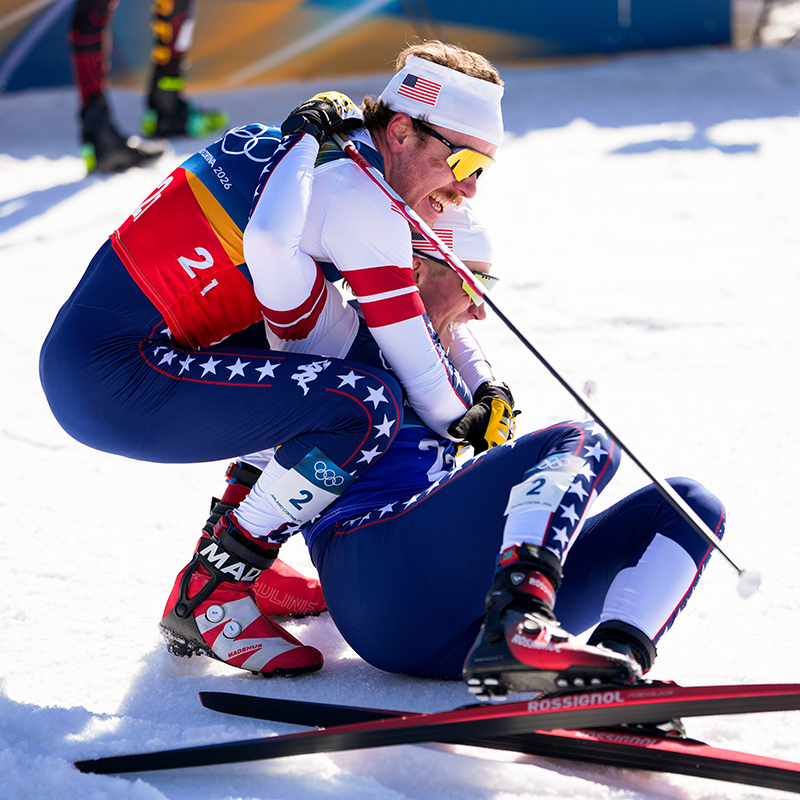
    Gus Schumacher and Ben Ogden (USA), (l-r) celebrate their Olympic silver medal in the Team Sprint in Tesero, Italy. (Photo: Vanzetta/NordicFocus)
    On another level

    When the sun came out in Italy last Wednesday morning, it forced a decision. A choice was made to go with a slower pair of skis, but that decision was not a whim; it was not a swing for a bases-loaded grand slam to win the World Series. It was choosing an option that presented itself through a trusted process, through seasons of tested routines, and having the experience to trust instinct.

    By the time Gus Schumacher and Ben Ogden pushed off the line in the Team Sprint, the work had already been done, in the dark, in the truck, in inches measured on a test lane. Structures narrowed from twelve to eight, waxes debated and eliminated.

    The silver medal will always belong to the athletes. They were, as Hecker put it, “on another level.”

    But long before Schumacher chased down Johannes Høsflot Klæbo on the anchor leg, before the crowd roared in excitement, before the final sprint up the Zorzi Climb, there was a moment when the sun came out, and a technician had to make a decision.

    And one detail to remember when the story of the 2026 Olympic Team Sprint is retold for years to come is that the United States service team, on that day, was also ‘on another level.’


    Help Support Our Olympic Coverage!

    FasterSkier will have our own Nat Herz on the ground at the Olympics, which, to be honest, is a very big financial lift for us. If you value the thoughtful work and access FasterSkier provides at championships like this one, please consider becoming a Voluntary Subscriber. Your support directly fuels the work we do to cover the people, places, and moments that make our sport special.

    Join the FasterSkier community!


  • An Olympic reporter’s wrap-up: An epic U.S. Ski Team road trip, a cheese factory tour and Klæbo’s wings

    An Olympic reporter’s wrap-up: An epic U.S. Ski Team road trip, a cheese factory tour and Klæbo’s wings

    This article was made possible through the generous support of our voluntary subscribers.  If you value coverage like this, please support FasterSkier with a voluntary subscription.

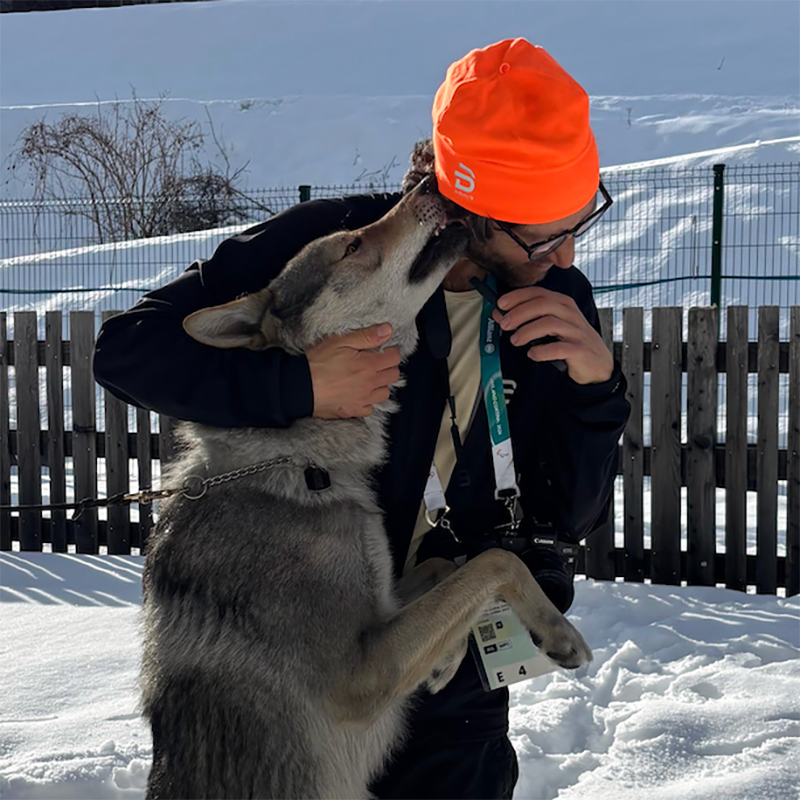
    Reporter Nat Herz bonds with Nazgul, the infamous Olympic wolfdog. (Courtesy Alice Varesco)

    Ciao a tutti!

    Greetings from Torino, where this fatigued Olympics correspondent has retreated to recover through bike rides and repeated doses of pizza with family.

    I had the chance to attend the closing ceremonies — mostly as a spectator — in Verona on my trip down from the mountains. After more than a dozen Olympic features, not to mention podcasts and race coverage, I’m now about to unplug for a couple of weeks. 

    But first, I couldn’t resist one last quick post: a roundup, in abbreviated, Reader’s Digest form, of some of the stories that were still on my list as the Olympics ended.

    That’s below. In the meantime, I wanted to reiterate my gratitude to the many readers, fans and news organizations who stepped up to support my on-site Olympic coverage. The money you provided was enough to make a real difference in what I was able to do, and gives me the confidence that there’s the support to do this again in the future. 

    While the past few weeks were  a lot of work, it was also an enormous, ravioli-filled privilege and pleasure — one where I made new friends, drank innumerable espresso macchiatos and got to cross-country ski downhill to the “office” every morning. 

    As I told a friend yesterday: If anyone ever offers you an assignment in Italy, take it.

    With that, and with these brief items, we’ll see you next year. Or maybe, in Lake Placid.

    American road warrior ski techs grind on

    If you thought the work stopped once the Olympic torch flame was extinguished, think again.

    That’s definitely not the case for the indefatigable crews that do the work of waxing, cleaning and tuning skis for Olympic cross-country teams.

    Top teams, including the U.S., each have their own massive semi truck that they use as a mobile work quarters while traveling all winter around the European World Cup circuit. Those trucks were all in northern Italy for the Olympics — until the last race ended Sunday afternoon.

    Soon afterward, the American truck — named Yolanda, after a character in the cult classic film Pulp Fiction — pulled out of the Olympic venue in Lago di Tesero. Or, at least, it tried to: With the warm weather, the truck got stuck in the mud, and required a tractor from organizers to pull it out, said Chris Hecker, one of the U.S. team’s service crew.

    U.S. Ski Team service staff member Tim Baucom at the wheel behind one of the squad’s trucks, and at the table on the crew’s Italy-to-Sweden road trip after the Olympics. (Courtesy Chris Hecker)

    After a four-hour drive Sunday through the Dolomites, Yolanda and its three staff members  rendezvoused with a secondary truck driven by two other ski service technicians in Munich. A six-hour drive on Monday took them to an overnight ferry from northern Germany to Sweden — which would be followed by a nine-hour drive to the Swedish community of Falun, where the World Cup circuit resumes this coming weekend.

    The distance, according to Hecker, adds up to 1,100 miles. 

    One key pit stop was a McDonald’s in a mountain pass leaving Northern Italy known for its beautiful view.

    The trucks were also well-stocked by the U.S. team’s nutritionist, Hecker said: sandwiches, water, gummies, chips, Red Bull and cookies. 

    “All the important things a tech needs to keep driving throughout the day,” he added.

    A diminished Chinese team

    The 2022 Winter Olympics in Beijing were marked by an enormous investment by the Chinese government in training and building up the nation’s cross-country ski team.

    Well before the Beijing Games, China hired a huge number of veteran European coaches and support staff that included retired Olympic athletes like Russia’s Nikita Kriukov and Norway’s Terje Langli. The country also spent freely on equipment and even built an indoor ski tunnel for summer training.

    This time around? China’s Olympic cross-country ski team was a shadow of its former self, with just a single coach in Italy. Wang Qiang, who during the 2022 Olympic season became the first-ever Chinese athlete to stand on the podium in an elite-level World Cup race, placed 37th in his best event, the sprint, at this year’s Games.

    Meanwhile, the government has asserted “serious violations of discipline and law” by Zhang Bei, the bureaucrat who led the cross-country ski team effort at the last Olympics, and Chinese news sources report that she’s been “taken away” by police amid an investigation for “suspected economic crimes.” 

    Meanwhile, Gou Zhongwen, the Chinese sports minister who’d prioritized government investment in cross-country skiing, has been purged from power. In 2024, the government placed Gou — the former chair of the Chinese Olympic Committee and of the 2022 Winter Olympics organizing committee — under investigation, then expelled him from the party.

    China’s former sports minister, Gou Zhongwen, stands during court proceedings in this photo published by the Chinese government.

    In December, he was sentenced for taking what the government said was more than $30 million in bribes, among other alleged transgressions. Gou’s official sanction was the death penalty, though it comes with a two-year reprieve, and experts say such a sentence is typically converted to life in prison.

    A spokesperson at the U.S.-based Chinese embassy said in an email last week that the country has “consistently placed high importance on the development of winter sports.”

    “Chinese cross-country skiing and biathlon have achieved and will continue achieving significant progress,” the spokesperson said.

    Klaebo’s post-Olympics: a return to World Cup, chicken wings and a trip to America

    Norwegian Johannes Høsflot Klæbo, the winningest winter Olympian in history after sweeping six golds in this year’s games, says he plans to compete at the season-ending World Cup races in Lake Placid, New York.

    At a news conference Saturday after winning his last event, the 50-kilometer classic race, Klæbo said he needs a “couple of weeks, now, to really recover,” but after that it’s his goal to participate in March in Lake Placid — only the second weekend of World Cup racing in the United States in more than two decades.

    “My personal opinion is that we should have a World Cup event (in the U.S.) every single year, but I’m not in charge,” Klæbo said. “I think we are all looking forward for Lake Placid. I think it’s going to be a fun weekend to finish up this amazing season.”

    Klæbo is also on the Norwegian team for this upcoming weekend’s World Cup races in Sweden. 

    But he did let himself indulge, at least briefly, in a break from his notoriously fastidious diet following the Olympic closing ceremonies in Verona, where he acted as Norway’s flag bearer.

    Johannes Høsflot Klæbo orders chicken wings at a McDonald’s after the Olympic closing ceremonies in Italy. (Pien Huang/NPR, used with permission)

    Afterwards, an NPR reporter, Pien Huang, spotted Klæbo and some teammates “putting in a big order for chicken wings” at a local McDonald’s.

    In a text message, Klæbo’s father Haakon confirmed Huang’s report, saying his gluten-intolerant son had turned to fast food “when I said I was not able to order gluten-free pizza.” 

    An Olympic cheese tour

    What’s the point of a reporter traveling to Italy if he can’t con his way into a tour of a cheese factory?

    Yes, dear reader, after these Olympics, I am not just a ski correspondent. I am also now an expert on a raw milk cheese called Puzzone, which is native to the area, Val di Fiemme, that hosted the Olympic cross-country ski races.

    The backstory: One morning at the competition venue, I was having a chat with an Italian ski industry professional, whom I was told was from the town of Asiago. Ah, I said, you guys have some good cheese. Yes, the guy responded, I’m not really a cheese guy, but here in Val di Fiemme, you should really try the local delicacy called Puzzone — an Italian word that translates roughly to “stinker.”

    This being a busy assignment at the Olympics, I filed this fact into the corner of my brain where stories go to die. 

    A day later, though, I was taking a walk from my apartment to a nearby cross-country ski trail when I stopped dead: There was a sign on the side of the road that said: Puzzone di Moena. (Moena is a nearby village.) It was next to a nondescript building that, upon further inspection, contained a cheese shop and a workspace that looked to me like a cheesemaking area.

    I tasted some Puzzone in the store — it was sharp and pungent, especially the more aged varieties — then left with a chunk that I shaved onto eggs and toast. But feeling a little unresolved, the next time I passed the building, I knocked on the door to the workspace, and asked if I could check it out.

    Which was how, a few days later, I ended up exchanging some messages with the “boss” — Andrea Morandini, the son of one of the farmers in the local cheese coop. He told me, in his Italian accent, to meet him the next morning at “da place.” I did, where he walked me through the history and current status of Puzzone — which, he said, acquired its name when an agricultural expert, on a national radio program in 1974, was tasting and describing area cheeses.

    The inside of the Puzzone cheese factory in Predazzo. (Nathaniel Herz/FasterSkier)

    “They are trying and smelling it — the one from Cavalese, the one from Predazzo. And when they are speaking about the one from Moena…they say, ‘Wow, it’s strano (strange), this is Puzzone,’” said Morandini. “So, it’s born live.”

    Puzzone, Morandini told me, had its roots in Val di Fiemme’s agrarian history, when families would keep a cow or two and trade milk to local dairies in exchange for a share of the cheese produced. In a diet that otherwise depended on potatoes and polenta, cheese was a welcome addition of flavor, Morandini said.

    The particularly stinky character of Puzzone is because it’s what’s known as a “washed rind” cheese — with its rind brushed regularly with salty water that encourages the growth of bacteria.

    After my history lesson, Morandini took me backstage. What I thought was a workroom was actually a dressing room, where I donned a hairnet, slippers and vest; we then walked through a cavernous industrial space with vats and tanks, where cheese had been made earlier that morning.

    Down a flight of stairs, we found the racks where wheel upon wheel of cheese is stored. In the deepest, darkest room, I hit a wall of ammoniac haze that made my eyes water and my lungs tickle.

    The cooperative, Morandini told me, includes 11 farmers, most of whom own some 50 cows each. In the winter, the cows stay close to home, but in the summer, they’re sent outside to feast on grass, which gives the cheese made in that season a special flavor, according to Morandini.

    One full wheel of aged Puzzone, a foot or so across, will set you back about 300 euros, or some $350. A wheel of younger cheese goes for some 170 euros, Morandini said. Some 70% of the factory’s production is consumed in the region, while a portion of it goes to customers in the United Kingdom and France, he added.

    Andrea Morandini points to a wheel of Puzzone cheese that’s aging on a rack in the factory basement. (Nathaniel Herz/FasterSkier)

    In a subsequent taste test I conducted with U.S. Olympic silver medalist cross-country skier Ben Ogden — a Vermonter who grew up eating raw milk cheese — Ogden described the young Puzzone as a solid “daily driver” cheese he could eat on the regular.

    The aged stuff?

    “Oh, God, that has got a taste,” Ogden said. “Holy crap.”

    He added: “There are acquired tastes out there. And this is not one that I’ve acquired; it tastes like compost, a little bit.”
    “I’m sorry,” he said. “I hope the Italians don’t listen to this.”

    Schumacher eyes medal celebrations — and maybe some free drinks

    Anchorage’s Gus Schumacher, who last week became only the third ever American man to win an Olympic medal in cross-country skiing, says he’s looking forward to sharing his silver hardware with the next generation of U.S. athletes when he arrives back in Alaska.

    “I’ll do whatever anyone asks me to do — but I’m excited to get some wear and tear on that thing,” Schumacher said in an interview a few days after his medal, which he earned with his podium finish in the team sprint with Ogden. “Not that I’ve not been a role model at home, but to have that carry a little more weight is pretty exciting.”

    Schumacher, who grew up inspired by Alaska Olympic gold winner Kikkan Randall, said he’s seen how beat up and worn her medal is, along with those won by Jessie Diggins, the star American skier from Minnesota, “and I think that’s the coolest thing ever,” he added.

    “I’m really glad they make them heavy — it could be lead in there for all I care,” said Schumacher, 25. “But you feel the weight when you touch it. And I think for people to be able to see it in person is cool.”

    Gus Schumacher, left, and Ben Ogden show their silver medals after the Olympic team sprint. (Davide Barbieri/NordicFocus)

    Schumacher will also race in Lake Placid before finishing his season, and it’s possible he could take a vacation in Central America after that. But he also likes being home, he said.

    His life hasn’t changed much, Schumacher added, and even if a big sponsor showed up at his doorstep, he might still turn it down if it required too much work. He makes enough money from prize money and ski sponsorship, he said, to cover his expenses — especially since he still lives at home with his mom.

    One thing he will be accepting: An offer of free water or beers at Creekbend, a popular concert venue in the community of Hope, outside Anchorage, that Schumacher has visited occasionally.

    “I’ll definitely be cashing that one in,” he said, adding: “If I’m really milking the whole medal thing, I probably won’t have to pay for a ton of beers this spring.”


    Help Support Our Olympic Coverage!

    FasterSkier will have our own Nat Herz on the ground at the Olympics, which, to be honest, is a very big financial lift for us. If you value the thoughtful work and access FasterSkier provides at championships like this one, please consider becoming a Voluntary Subscriber. Your support directly fuels the work we do to cover the people, places, and moments that make our sport special.

    Join the FasterSkier community!
     

  • The Devon Kershaw Show: Glory, grit and agony in the women’s Olympic 50 k

    The Devon Kershaw Show: Glory, grit and agony in the women’s Olympic 50 k

    This episode was made possible through the generous support of our voluntary subscribers.  If you value coverage like this, please support FasterSkier with a voluntary subscription.  

    We’re done and dusted at the Olympics after a rockin’ women’s 50 k — the first-ever at the Games. Devon and Nat smash out a recap of the epic breakaway and the knock-down-drag-out battle for bronze.

    We’ll be back next week. Reach us in the mean time at devon[at]fasterskier.com and nat[at]fasterskier.com. We’re really grateful for all the support during the Olympics — thanks for notes and encouragement.

    A reminder: This is a homegrown podcast done by two guys working long hours and late nights. We’re also paying real money to be here in Italy. If you can, support the show and FasterSkier’s ongoing coverage with a voluntary membership.

    Help Support Our Olympic Coverage!

    FasterSkier will have our own Nat Herz on the ground at the Olympics, which, to be honest, is a very big financial lift for us. If you value the thoughtful work and access FasterSkier provides at championships like this one, please consider becoming a Voluntary Subscriber. Your support directly fuels the work we do to cover the people, places, and moments that make our sport special.

    Join the FasterSkier community!
  • Ebba Andersson’s Golden Redemption—Olympic 50 k

    Ebba Andersson’s Golden Redemption—Olympic 50 k

    This article was made possible through the generous support of our voluntary subscribers who have helped put our Nat Herz on the ground at the Olympics. If you value coverage like this, please support FasterSkier with a voluntary subscription.

    Joy at the end of a trying Olympiad: Ebba Andersson (SWE) celebrates her victory in the Olympic 50 k Classic. (Photo: Vanzetta/NordicFocus)

    TESERO, ITALY — Two weeks of Olympic cross-country ski racing all comes down to this . . . fifty grueling kilometers of this, to be precise; a distance that women have raced only a few times on the World Cup and/or World Championship schedule, but a distance at which they are able to truly show their skills, their tenacity, and their ability as cross-country skiers.

    These Olympics began with lofty expectations—in some cases, outrageously lofty—placed upon many skiers: Karlsson was seen as likely to win four golds: she started strong (winning gold in both the Skiathon and the 10 k Freestyle), but found herself benched by illness in the 50 k. Ebba Andersson was seen as a threat to topple her Swedish teammate, Karlsson, only to find herself toppled in a famously awkward and memorably catastrophic fall that cost Sweden the gold medal in the Team Relay. Jonna Sundling was billed as the best sprinter in the world (and was seen as likely to steal a medal in the Skiathlon, as well). Her moment in the Sprint spotlight was stolen by her own teammate, the rejuvenated Linn Svahn.  And numerous mainstream reporters myopically favored Jessie Diggins to medal in all six events. After all, she’s the defending World Cup Overall Champion, right? And she’s currently leading the World Cup standings in both Overall and Distance, isn’t she? Reading those stats would seem to suggest that she’s the best skier in the world . . . and she may actually be that best skier, but the only skier who consistently lives up to such superlative headline predictions is the unmatchable Johannes Hoesflot Klaebo (who won all six of the men’s events here in the Olympic Winter Games of Milano-Cortina).

    Jessie Diggins (USA) showed the sort of resilience and courage fans have come to expect, overcoming a disastrous ski exchange to race her way back into medal contention. (Photo: Barbieri/NordicFocus)

    Diggins would fight through an unfortunate ski change, and endure a long struggle in returning to the group of bronze medal contenders, only to find herself gapped on the final uphill. Diggins would finish fifth behind fourth place, Kristin Austgulen Fosnaes. Ahead of them, Andersson would ski brilliantly and tirelessly to claim gold, well ahead of of Weng, and minutes clear of the third place performance from an elated Nadja Kaelin (SUI).

    “If you had told me even a year ago, I’d be in the fight for a bronze medal in a 50k classic, I would not have believed you,” said Diggins. “It’s taken so much work from so many people for so many years to get here, and I’m just really proud of it.”

    Among other Americans, Rosie Brennan  would finish 16th. Hailey Swirbul would cross the line in her comeback Olympics to finish 20th while Kendall Kramer would finish 27th. Canadians would place all their finishers in the top 30: Jasmine Drolet 18th, Sonjaa Schmidt 26th, Katherine Stewart-Jones 28th, and Amelia Wells 29th.

    Olympic 50 k: Heidi Weng (NOR), and Ebba Andersson (SWE), set the pace from the beginning. (Photo: Vanzetta/NordicFocus)
    Women’s 50 k Classic

    Pre-race intel reported that Sweden’s Frida Karlsson had taken ill, and was choosing not to race in today’s 50 k. Without Karlsson’s singular presence to push the pace (as she did during her dominant victory in last season’s World Championship 50 k in Trondheim), the race was left without a known direction or strategy. Like Karlsson, Sundling was a DNS, reducing the chances that the medals would be decided in flat-out sprints. Weng hoped to duel it out with Diggins and Andersson down the final kilometers.

    The Olympic 50 k is conducted in a mass start format, seven laps of 7+ kilometers/lap raced in the Classic technique. On an unseasonably warm day—40 degrees (Fahrenheit) and sunny skies—waxing and base prep were likely to play outsize roles in the results. Within the first three kilometers, a lead group of a dozen skiers—containing all the prime contenders—began to ease off the front. The early pace was made by Andersson, followed by Weng, Diggins, Teresa Stadlober (AUT), and Astrid Oeyre Slind (NOR). Val di Fiemme’s challenging hills quickly began whittling away at the lead group as Andersson continued driving the pace, stringing out Weng and Diggins in her wake. Slind inexplicably pulled up on a challenging climb, stalling other contenders behind her including Kerttu Niskanen (FIN), Johanna Matintalo (FIN), and Dariya Nepryaeva (AIN). Slind would drop out of the race only a few kilometers later, a frustrating result for a skier who had entered these Games with such high hopes..

    Jessie Diggins (USA) was an early animator in the Olympic 50 k. After a troublesome ski exchange, she’d come back to be part of the battle for the bronze medal (ultimately won by Switzerland’s Nadia Kaelin). (Photo: Barbieri/NordicFocus)

    By 8.5 kilometers, a solid chase group would form involving Fosnaes, Niskanen, Matintalo, and Karoline Simpson-Larsen (NOR). At the front, the lead group had been reduced to three—Andersson, Weng, and Stadlober—as Diggins began to show the strain of he early pace. Even Stadlober had begun to wobble as the chasers continued to concentrate their pursuit.

    Diggins was the first of the contenders to switch skis (at the 14.4 kilometer mark at the end of the Lap 2). She immediately regretted her decision as her klister-waxed skis tripped her dramatically on her way out of the exchange zone. Stumbling along the track—gasping and yelping audibly—Diggins lost considerable time, finding herself dropping to ninth place, 1:11 behind the leaders. Diggins would need to rely on her new skis working their way into the conditions, in the hope that they would ultimately provide an advantage. But even more time had been lost to the leaders who, themselves, had not shown any dissatisfaction with their own skis.

    “I knew I had to switch early,” said Diggins. “I’m so glad I did. It was just a really gritty race. Literally every muscle in my body started cramping with three laps to go. So I can confidently say I could not possibly have tried harder or gotten more out of my body.”

    “After that first pair of skis, she switched pretty early,” said US coach, Kristen Bourne. “But we also had a lot of confidence in that second pair . . . so we also had a lot of confidence giving her the the go-ahead to switch.”

    The race settled into a few slow-developing stories:

    • Weng and Andersson were off the front, deciding gold between them.
    • Stadlober raced on alone in bronze medal position, but she found the gap behind her being eaten into by Niskanen and Fosnaes.
    • Diggins had fallen from contention, though her fortitude and pride were likely to prevent her from dropping out of her final Olympic event.

    And then Diggins began coming back . . . maybe she began overhearing all of us commentators wondering if she might drop out of this race. That may be just the sort of motivation that Jessie Diggins needs. Diggins drove to the tails of Fosnaes and Niskanen. Together, they closed the gap to Stadlober who was pursuing better traction in the the snow outside the Classic tracks. While Diggins’ skis may have been a disaster in the first few meters after the exchange, it’s possible they were proving to have been a shrewd decision.

    Andersson and Weng changed skis at the end of the fourth lap, where Andersson was pitched over her ski tips by her own sticky kick wax. At the end of lap four, Diggins had moved into  bronze medal position as the chase group entered the stadium. Fosnaes was the only skier who opted to exchange skis. Stadlober, Kaelin, and Niskanen continued in pursuit of Diggins.

    Soon after 30 kilometers, Andersson found her skis to be an advantage over Weng’s. By 34.2 kilometers, Andersson had opened a 20 second gap. She was still 45 minutes from the finish line, but Andersson was beginning to stretch her advantage.

    Now in a group with Niskanen, Fosnaes, Kaelin, and Stadlober, Diggins may have sensed that her best chance to claim the bronze medal was not to be found in breaking away (thereby risking  blowing up, herself) but to sit with this group in anticipation of a bunch sprint that would favor her own abilities. With two laps remaining, the chase group had decisions to make. Among those racers, only Diggins had already changed skis. Among this group, it was likely that someone would stop to make the change. If they did, they could find a late-race advantage, or they might find themselves giving up an advantage (in the time spent changing skis) that would be impossible to overcome. Kaelin, Stadober, and Niskanen all chose to change skis. Ultimately, all the chasing skiers would regroup, and immediately start considering their strategies. Diggins was the sprinter in the group; her advantage would be realized if the group came to the finish line together. Stadlober, Niskanen, Fosnaes—those are not sprinters—their only chance would be to drop Diggins and Kaelin before the finish line approached. Two laps to go . . .

    And who the heck is Eliza Rucka-Michalek? The young Polish skier had been chasing all by herself for the last 40 kilometers. She finally connected with the chase group midway through he final lap, but would find that the efforts expendeded in reahing this group would be too costly to allow her to attack again. Rucka-Machalek would cross the line eighth.

    The final kilometers were led out by Kaelin who was followed by an exhausted, but game, Fosnaes. Diggins shadowed them both, but the final climb would be excruciating for all. Kaelin had the best traction on the Zorzi climb; Fosnaes slipped a bit, as did Diggins who lost momentum when she stepped out of the tracks behind Fosnaes. Kaelin would maintain her advantage over the top of the climb, holding on for bronze, followed by Fosnaes and Diggins.

    “I’m so grateful for our entire staff behind the scenes,” said Diggins. “They have been like, putting my body back together so that I could be out there today fighting. And I just, I wanted to do that for them. I wanted them to know like, ‘Hey, I am so grateful. Like, I’m gonna finish this. I’m gonna leave it all out there.’ And honestly, the most special thing was that I got to hug my mom on the side of the course before the race, and it’s just so cool to know that they were here for my last Olympics, and I got to end it on a beautiful day in a venue that I love so much. I’m just really proud of this last Olympics and really grateful and really happy, and I’m leaving here just full of joy and probably needing a new body.”

    “I mean, we’re super proud of this team,” said Bourne. “And to walk away from this Olympics being like our most successful ever by having a variety of people—three different people—getting Olympic medals is, excuse my language, but #%&!@ insane! And I mean, man, we’re just super proud and stoked to keep the season going after a little bit of rest.”

    Friends and rivals: Heidi Weng (NOR) and Ebba Andersson (SWE). (Photo: Vanzetta/NordicFocus)

    Weng raced bravely and strategically in what may have been her final Olympics. She would claim silver, falling just short in her own quest for individual Olympic gold.

    Andersson would continue extending her lead—20 seconds, 40, 60, 90—to claim a gold medal to go along with her three silvers earned at these Games. Here at the end of an Olympic campaign that found her hitting the deck again and again—including that spectacular somersault and subsequent one-ski scooter-pushing during the disastrous (though ultimately silver-medal-winning) Swedish relay—Andersson raced across 50 grueling kilometers to find glory at the finish line. Individual Olympic gold was finally hers, as well as respect and redemption after days of trials and tribulations.

    Women’s 50 k Classic Mass Start RESULTS

    Help Support Our Olympic Coverage!

    FasterSkier will have our own Nat Herz on the ground at the Olympics, which, to be honest, is a very big financial lift for us. If you value the thoughtful work and access FasterSkier provides at championships like this one, please consider becoming a Voluntary Subscriber. Your support directly fuels the work we do to cover the people, places, and moments that make our sport special.

    Join the FasterSkier community!
    Heidi Weng (NOR), Ebba Andersson (SWE), Nadja Kaelin (SUI), on the podium of the Women’s 50 k Classic Mass start, the final cross-country event of the 2026 Olympic Winter Games in Milano-Cortina. (Photo: Barbieri/NordicFocus)


  • The Devon Kershaw Show: Down to the wire in the men’s Olympic 50 k

    The Devon Kershaw Show: Down to the wire in the men’s Olympic 50 k

    This episode was made possible through the generous support of our voluntary subscribers.  If you value coverage like this, please support FasterSkier with a voluntary subscription.  

    We’ll keep it short and sweet: Here’s a recap of the men’s 50 k. It was a fun race to watch and left us with a lot to discuss.

    We’ll be back after Sunday’s race. Reach us at devon[at]fasterskier.com and nat[at]fasterskier.com. We’re really grateful for all the support during the Olympics — thanks for notes and encouragement.

    A reminder: This is a homegrown podcast done by two guys working long hours and late nights. We’re also paying real money to be here in Italy. If you can, support the show and FasterSkier’s ongoing coverage with a voluntary membership. We’re also offering a bonus during the Olympics: a WhatsApp group with notes on Nat’s experiences in Italy, the food he’s eating, interview transcripts and more.

    Send nat[at]northernjournal[dot]com a confirmation of your voluntary membership and the number he should use for WhatsApp and we’ll get you signed up. You can also Venmo him directly at @nat-herz if a membership isn’t for you. We’re suggesting a minimum of $10, but we also won’t turn anyone away who wants to join because of an inability to pay.

    Help Support Our Olympic Coverage!

    FasterSkier will have our own Nat Herz on the ground at the Olympics, which, to be honest, is a very big financial lift for us. If you value the thoughtful work and access FasterSkier provides at championships like this one, please consider becoming a Voluntary Subscriber. Your support directly fuels the work we do to cover the people, places, and moments that make our sport special.

    Join the FasterSkier community!
  • Six for Six: Klaebo Makes History in 50 k Classic

    Six for Six: Klaebo Makes History in 50 k Classic

    This article was made possible through the generous support of our voluntary subscribers who have helped put our Nat Herz on the ground at the Olympics. If you value coverage like this, please support FasterSkier with a voluntary subscription.

    Martin Loewstroem Nyenget (NOR #3) and Emil Iversen (NOR #4) lead during the opening kilometers of the Men’s Olympic 50 k in Tesero, Italy. (Photo: Barbieri/NordicFocus)

    TESERO, ITALY — Sprint races can be dazzling, relay legs can be heroic, but the 50 k, especially classic, is where cross-country skiing gets carved into stone. The 50 k Classic turns strength, technique, and endurance into history, myth, and lore.

    On Saturday afternoon in Val di Fiemme, Johannes Hoesflot Klaebo skied into that mythology.

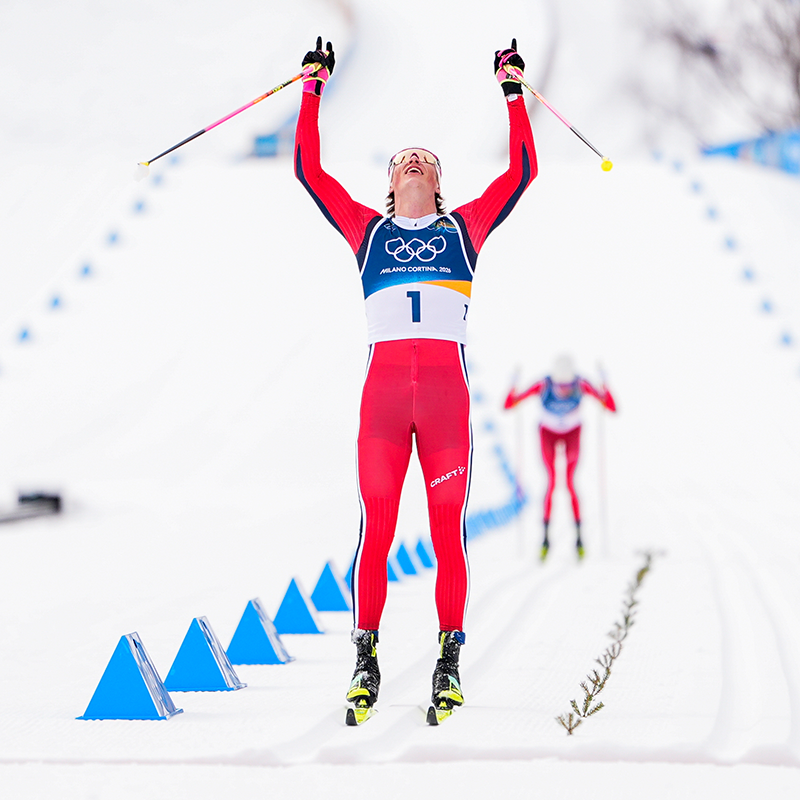
    By winning the Olympic 50 k Classic, Klaebo completed a sweep of six gold medals at these Games — six events, six victories — something no Winter Olympian had ever done before. The sprint prodigy who has built his reputation on ferocity over 1.5 kilometers now owns the sport’s most traditional crown.

    “I don’t think I even could have dreamed about this,” Klaebo said afterward.

    “In Norway, they say you must win a 50 k to become a man.” Klaebo said, smiling in the post-race press conference, “I think I am that now.”

    Johannes Hoesflot Klaebo (NOR) both the Olympic 50 k gold and a clean sweap of these games. (Photo: Vanzetta/NordicFocus)
    Feeling the significance

    The 50 k Classic is the most prestigious event in the sport with a long and storied history, and over 100 years of these championships, no one had ever put their skis on to start this race, trying to win an unprecedented 6th gold medal in one Olympic Games. But Klaebo had proven last year he could, winning six races at the World Championships on his home trails in Trondheim, Norway.

    The historic attempt was larger than cross-country skiing, too. American long-track speed skater Eric Heiden won five gold medals at the 1980 Winter Olympics in Lake Placid, New York. Klaebo was attempting to do something no athlete had ever done before at the Winter Olympics.

    Savelii Korostelev (AIN #12), Iivo Niskanen (FIN #7), Martin Loewstroem Nyenget (NOR #3), Johannes Hoesflot Klaebo (NOR #1), Harald Oestberg Amundsen (NOR #2), Emil Iversen (NOR #4), (l-r) during the early stages of the 50 k. (Photo: Vanzetta/NordicFocus)
    ​The potential spoilers

    Going into the race, the heavy favorites were without a doubt the Norwegians with Klaebo, his training partner Emil Iversen, Harald Oestberg Amundsen, and Martin Loewstroem Nyenget. However, others had to be considered as potential spoilers for the historic moment, among them, athletes on the French team, including Mathis Desloges, Hugo Lapalus, Victor Lovera, Finland’s Iivo Niskanen, American Gus Schumacher, and the Independent Neutral Athlete (AIN) Savelii Korostelev. Though it was a long shot, these other nations’ athletes could, potentially, battle for the win or at least a podium spot.

    Johannes Hoesflot Klaebo (NOR), Emil Iversen (NOR), and Martin Loewstroem Nyenget (NOR), (l-r) turned the 50 k into a three-man race. (Photo: Vanzetta/NordicFocus)
    The Shape of the Race

    The Olympic course in Tesero is not subtle. Seven laps with relentless climbing. Among them, the featured hill, the Zorzi Climb, waits like a toll booth each time the skiers re-enter the stadium.

    Heading into the race, there were 65 men on the start list, but Italy’s Federico Pellegrino, Finland’s Ristomatti Hakola, and America’s Ben Ogden all scratched.

    Once the race started, the first lap went by without much drama, though the field began to stretch. As they entered the stadium after one loop, over 30 skiers were within 20 seconds of the lead. By the end of lap two, that front pack had reduced to 20 skiers within 23 seconds of the lead, and on lap three, things really began to take shape.

    Early on in lap three, two favorites, Niskanen (FIN) and Amundsen (NOR), who had been at the front of the race, pulled out. The French favorites and American Schumacher also began to lose contact with the front-runners. Only Korostelev was able to maintain contact until even he could no longer keep up with the three top Norwegians.

    Martin Loewstroem Nyenget (NOR) did much of the work at the front. (Photo: Vanzetta/NordicFocus)
    By the middle of the race, there were three

    By lap four, it was unmistakable: Nyenget, Iversen, and Klaebo were alone, three red suits moving in steady formation.

    From the stadium, the mood was less frantic than historic, almost strangely calm.

    “The sun shone down… as if God had ordained the great Klaebo, winning his six in a row… I mean, it really was a beautiful day,” said FasterSkier’s Nat Herz, who was on the ground in Tesero. “I think people were just pretty relaxed watching this three-man Norwegian time trial as it went around the course… These guys have the best technique, the best materials, the best skis, the best fitness, and they did exactly what they set out to do.”

    The crowd was not roaring every lap. It was watching. Waiting.

    “Nyenget and Klaebo definitely gave everyone a good show, and it was tense to see. Was Klaebo going to be able to do this incredible accomplishment?”

    There was little theatrics in their separation from the field — no dramatic surge, no visible cracking. Just a grinding tempo that only they could sustain.

    Even the question of ski exchanges became a collective calculation. While much of the field ducked into the pit lane for fresh skis after lap four, the Norwegians skied past the ski exchange zone each lap.

    A Norwegian train. (Photo: Barbieri/NordicFocus)

    “Martin made the choice of not changing skis,” Klaebo said. “Emil and I just followed because we didn’t want to gamble.”

    In long races, fortune often hides in such decisions. The snow was changing; the sun had warmed the surface. Fresh skis could have been salvation or ruined a chance at gold.

    “I think it was the right decision,” Klaebo said in the press conference afterwards about the three Norwegians not switching skis.

    Johannes Hoesflot Klaebo (NOR) makes history as he crosses the line of the Men’s 50 k Classic. (Photo: Barbieri/NordicFocus)
    Saving Something for the Hill

    Through lap six, Nyenget did much of the visible work. Klaebo shadowed him, conserving every drop of energy he could.

    “I wish I was able to help them a little bit,” he said. “But when they asked me if I could go in front, I said no, because I was too tired.”

    It was not false modesty, Klaebo’s Olympic schedule had been more than the other two and fifty kilometers taxes even those who make winning look inevitable.

    “My plan today was just try to save as much energy as possible,” he said. “I needed to play on my strength… the last few hundred meters.”

    On the final lap, Klaebo came to the front, as if to take measure of the other two Norwegians, but in doing so, he created a gap on Iversen. Was the race for gold now just down to two? The answer was yes, as the rubber band had clearly been snapped for Iversen, who began to drift backwards from the leading pair.

    The decisive moment arrived where many had expected it would: on the Zorzi Climb. On the preceding descent, Klaebo rose from his tuck, adjusted his pole straps, and as they exited the sweeping left-hand turn at the base of the final climb, Klaebo pulled alongside Nyenget before beginning to accelerate. Not explosively — this was the closing act of a two-hour effort — but with the control of someone who knew exactly how much he had left.

    Nyenget followed for a few strides. Then he did not.

    Behind them, Iversen skied alone to bronze, sealing a Norwegian sweep.

    A moment of reflection at the finish for Johannes Hoesflot Klaebo (NOR). (Photo: Barbieri/NordicFocus)
    A Private Moment

    At the finish, Klaebo crossed the line and sat down alone on the snow. There was no theatrical collapse, only a quiet reckoning.

    “For me, it’s the best feeling, the last 200 meters before I cross the finish line knowing that I’m going to win,” he said.

    This Olympics, he suggested, had been built on deliberate choices, in training, in team structure, in how he and his father organized his life around the sport.

    “He has probably sacrificed as much as I have done,” Klaebo said of his father.

    Sacrifice is not his preferred word. He calls them choices. But the effect is unmistakable: a skier who once seemed specialized has become complete.

    Emil Iversen (NOR) enjoys his bronze medal and the sunshine after a lot of hard work to get back to the front of the sport and this moment. (Photo: Vanzetta/NordicFocus)
    Racing in His Time

    For the rest of the field, competing in the Klaebo era carries a strange duality, almost a frustration braided with admiration.

    “Of course, a bit,” Nyenget said when asked whether it is annoying to race alongside him.

    “But it’s more motivating as well. [Klaebo] is pushing us to be better every day.”

    Iversen echoed the sentiment.

    “I think it’s just fun to compete with the best skier ever,” he said.

    Across these two weeks, Klaebo has made dominance look procedural, yet his rivals know the margins are real, the preparation exhaustive. He bristles at the idea that this is inevitable.

    “I like myself way better when I’m winning than when I’m losing,” he said.

    Gus Schumacher (USA) gave everything he had to this sixth race at these Winter Olympic Games. (Photo: Vanzetta/NordicFocus)
    The American Effort

    For the United States, the 50 k carried a different emotional weight.

    Gus Schumacher, who had spent the early races in these Games chasing form and momentum before winning silver in the Team Sprint with Ben Ogden, finished 13th. He described the psychological toll of racing in every event.

    “There’s been a pretty heavy mental load the last two weeks,” Schumacher said. “If I’ve got a flame, it was ripping a couple days ago… halfway through the race, it felt like a little candle.”

    He has raced all six events, too, though with different outcomes.

    “I really don’t understand how you can ski 50 k so well and also sprint so fast,” Schumacher said of Klaebo. “I don’t really feel like there’s another athlete in the world that can compare to that scope of athleticism.”

    Hunter Wonders (USA) also pushed his body to its limits in the race. (Photo: Vanzetta/NordicFocus)

    Hunter Wonders placed 35th and spoke candidly about the physical reckoning.

    “I’m alive barely,” Wonders said. “I didn’t think I was gonna finish there for a little while.”

    Cramps seized him in waves — hips, hamstrings, forearms — and yet he finished.

    “I completed a race that four years ago I was really chomping at the bit to be able to compete in,” he said.

    Antoine Cyr (CAN) “gave everything” to the final men’s race in the Olympics. (Photo: Barbieri/NordicFocus)
    The Canadian Outcome

    Canada placed two men inside the top 20.

    Antoine Cyr finished 11th, just outside the top 10 he had targeted.

    “I gave it everything,” Cyr said. “It’s such a hard course.”

    He pointed to the Zorzi Climb and the long drag back to the high point of the course after coming through the stadium, efforts that stretch toward six minutes, rare in modern championship layouts.

    “It’s really tough,” he said.

    Thomas Stephen finished 17th, steady and controlled in conditions that demanded patience. While he did not step into the medal conversation, his result underscored the depth Canada has built in distance racing and marks what is possible in future years.

    Martin Loewstroem Nyenget (NOR), Johannes Hoesflot Klaebo (NOR), and Emil Iversen (NOR) (l-r) share the Milano-Cortina Olympic Winter Games 50 k Classic podium in Tesero, Italy. (Photo: Barbieri/NordicFocus)
    What Remains

    Klaebo plans to rest for a few weeks before racing again in Lake Placid.

    “That’s the plan,” he said.

    There will be time later to measure what six-for-six means, how it reshapes record books, and how it reframes conversations about the greatest Winter Olympians. For now, it exists as a bright fact in the thin mountain air.

    The 50 k endures because it asks the oldest question in endurance sport: what is left?

    On Saturday, Johannes Hoesflot Klaebo had something left. Enough to attack on the final climb once more. Enough to once again finish alone down the final meters. Enough to make something mythical and historic feel ordinary and predictable.


    Olympic Men’s 50 k Classic – RESULTS


    Help Support Our Olympic Coverage!

    FasterSkier will have our own Nat Herz on the ground at the Olympics, which, to be honest, is a very big financial lift for us. If you value the thoughtful work and access FasterSkier provides at championships like this one, please consider becoming a Voluntary Subscriber. Your support directly fuels the work we do to cover the people, places, and moments that make our sport special.

    Join the FasterSkier community!


    Emil Iversen (NOR), Johannes Hoesflot Klaebo (NOR), and Martin Loewstroem Nyenget (NOR) come through the stadium to the delight of the crowd. (Photo: Vanzetta/NordicFocus)
  • Who’s cross-country skiing the most at the Olympics? It’s not the athletes.

    Who’s cross-country skiing the most at the Olympics? It’s not the athletes.

    Norwegian ski testers Pål Trøan Aune, left, and Mats Iversen carry bags back to the country’s service truck at the Olympic cross-country ski venue in Lago di Tesero, Italy. (Nathaniel Herz/FasterSkier)

    This article was made possible through the generous support of our voluntary subscribers who have helped put our Nat Herz on the ground at the Olympics. If you value coverage like this, please support FasterSkier with a voluntary subscription.

    LAGO DI TESERO, ITALY — A day before Norway’s Johannes Høsflot Klæbo won his fourth straight gold medal in cross-country skiing at the Winter Olympics, a strange sight was unfolding next to the race trails in Northern Italy.

    Two figures, dressed in Norwegian team suits, were skiing loop after loop on a tiny test track — in search of the most infinitesimal edge over rivals from France, Finland, Italy and America.

    Neither figure was Klæbo: The superstar was back at his hotel room playing video games and resting up for the next day’s race.

    Instead, the two men were retired ski racers hired by the Norwegian team for one of the strangest jobs of the Olympics: sprinting for miles over the same small patch of snow to help identify which waxes and other products can be applied to the surface of cross-country skis to make them faster.

    While Klæbo spent much of Saturday in bed, one of the testers, Mats Iversen, skied dozens of laps adding up to more than 15 miles. Earlier in the Games, Iversen was skiing even more: as far as 44 miles a day, and just over 200 miles in his first week in Northern Italy, according to numbers he logs on the Strava tracking app.

    Screenshots from the Strava workout tracking app that show a map of one of Mats Iversen’s testing days, and some of the times he skied on a test loop.

    There’s no question that Iversen is skiing “way more” than the athletes competing at the Olympics, Klæbo said at a news conference Wednesday after winning his fifth straight gold.

    Iversen’s one 44-mile day is “close to what I’ve done the whole week,” said Klæbo, whose race Wednesday totaled just over six kilometers, or some 3.5 miles.

    “They’re amazing, and they are doing an amazing job to help us have the best possible skis,” Klæbo said. Referring to the winners’ podium, he added: “None of us would be able to sit here if it wasn’t for them.”

    In a 45-minute interview after a 22-mile day last week, Iversen, his fellow tester, Pål Trøan Aune and their boss Tord Hegdahl offered a behind-the-scenes glimpse of the huge investment of equipment, technology and manpower that go into preparing the Norwegian team’s skis.

    Aune and Iversen relax on the top floor of Norway’s service truck. (Nathaniel Herz/FasterSkier)

    They spoke in a lounge area on the upper floor of an enormous, customized truck that houses hundreds of pairs of skis, along with work stations for staff members who prepare them for testing and racing. Iversen and Aune are, essentially, the engines of an intricate machine — with others operating the controls.

    “You don’t need a 200 IQ to be a ski tester,” Iversen said. Pointing to the lower floor, where the technicians work, he added: “The brains are in here.”

    ‘Dizzy’ from all the loops

    The Norwegian truck is parked in a big lot beside the competition trails in Italy where other nations like France, Sweden and the Czech Republic have their own vehicles and trailers. 

    The American team truck cost some $750,000 and is named Yolanda — a reference to a line from actor Samuel L. Jackson’s character in the cult classic film Pulp Fiction, according to NPR.

    Inside the trucks, teams of technicians work to identify the skis and products that will slide the fastest given a specific set of snow conditions.

    The work has several layers. Each athlete may have dozens of pairs of skis, and teams have to find the best ones for each day. Then, there’s what’s known as the “stone grind” — a pattern of tiny etchings that a machine can apply on the bottom side of a ski to help it move more easily over different types of snow crystals.

    Finally, there’s wax, which can be applied to the ski base to give athletes even more of an edge. Dozens of products and brands exist in block, powder and liquid form, which can be melted or rubbed into the skis with waxing irons or obscure tools like a rotating wool brush attached to a drill.

    A staff member prepares skis inside the Norwegian service truck. (Nathaniel Herz/FasterSkier)

    Testers like Iversen and Aune help identify which combinations of skis, wax and grind work best in a given set of circumstances.

    Every country does some level of testing. But Norway’s big budget for staff has afforded the team the luxury of an unusual level of specialization at the Olympics, with Iversen and Aune doing very little other than skiing — while other teams’ can mix testing in with other staff responsibilities, like waxing.

    “We are terrible waxers,” Iversen said. Addressing a reporter, he said: “I think you are probably better.” 

    The Americans, by contrast, sometimes lean on coaches to test waxes on the trails, freeing up their specialized technicians to focus on picking skis with the athletes.

    “If you take a look at our skis — we might have three bags and a couple of racks out before the race” for testing, said Matt Whitcomb, one of the U.S. coaches. “Norway will have two or three times that.”

    Australian technicians Leopold Hensler and Toni Escher take a break from testing on the Olympic trails in Italy. (Nathaniel Herz/FasterSkier)

    Canada’s team, meanwhile, employs two Italian “ski pilots” who, like Aune and Iversen, focus on testing at big events during the winter — often skiing upwards of 15 miles in a day. The rest of the year, one of them, Thea Schwingshakl, is a research biologist, while the other, Sara Hutter, markets Tyrolean apples.

    Like Aune and Iversen, they spend their days in the tiny testing area, where Schwingshakl joked that they get “a bit dizzy there, from all the loops.”

    But, she added: “It’s good for the whole team. We can just focus on skiing and testing, and they focus more on the product and on the wax and structures.”

    Canada’s ski pilots, Sara Hutter, left, and Thea Schwingshakl ski upwards of 15 miles a day. (Nathaniel Herz/FasterSkier)

    It’s not so much that the right skis, wax and grind will produce an Olympic medal — though they certainly help — as much as the wrong ones can put an athlete out of contention. After the men’s cross-country relay last weekend, American Johnny Hagenbuch suggested that his inability to keep up with rivals on the downhills had to do with his equipment.

    “I was with everyone at the top of the climb and then — yeah, no longer,” he said. “There was nothing I could do.”

    ‘Simple and boring’ work

    Iversen and Aune are part of a larger Norwegian project aimed at boosting numerous Olympic snow sports — not just cross-country skiing, but also Nordic combined and biathlon, said Hegdahl, their boss.

    The effort includes a stone grinding machine that Norway operates near the cross-country race trails; Iversen and Aune help test patterns that can be used across those sports. 

    Another staff member has the sole task during the Games of driving skis over the mountains to the biathlon venue, said Hegdahl, who leads the Norwegian cross-country service staff.

    One of the essential tasks that Aune and Iversen perform is the “paired glideout.” At the top of a small hill in the test track, the men stand side by side, then push themselves forward. As they start moving, Iversen equalizes their speed by grabbing ahold of a ski pole that Aune holds firm.

    A French team member stands in the testing track at the Olympic trails. (Nathaniel Herz/FasterSkier)

    Then, they let go without accelerating or jostling and see which of the different waxes or structures beneath their feet is faster. 

    Typically, they’re assessing sets of eight pairs of skis that — aside from the products underfoot — have been chosen because they’re perfectly matched. That, in turn, allows the technicians to more precisely measure the impact of the wax and grind patterns on speed.

    The testing is set up like a single-elimination tournament, with quarterfinals, semifinals and a final. Results are transmitted back to technicians in the truck via WhatsApp messages or a GPS watch.

    The matching of the eight pairs is so precise that, after the final test, Aune and Iversen take extra laps on the skis that are knocked out early to equalize them with the top pairs, to make sure the winning skis aren’t getting extra wear. Which also means that a mishap during a test lap requires three extras, to keep the six other pairs even.

    Teams leave skis alongside the race trails for testing. (Nathaniel Herz/FasterSkier)

    The whole process — from the unending right turns down to the bending over to take each pair of skis off and put the next set on — is hard on the body. They can ski 200 or more laps of the test track in a day.

    But Iversen and Aune are both fit, and capable of the workload, according to Hegdahl.

    “Testing is quite simple and boring. But we need guys to do the skiing who have the feeling of the skis,” Hegdahl said. “They’ve done a lot of skiing together with some of the best athletes, as well. So they know a bit.”

    Aune and Iversen have also been friendly for years, and enjoy the camaraderie and the chance to participate at a championship event that neither reached as an athlete.


    Mats Iversen’s brother Emil has had a standout season this winter. (Vianney Thibaut/NordicFocus)

    Iversen’s brother Emil is competing for Norway in Italy, and won a gold medal with the men’s team in the relay.

    “It’s very special — it’s our best friends who are racing,” said Aune. “I think they trust that we will do all we can.”

    The work can get boring, Iversen conceded. “But it’s nice to be with a friend,” he said. 

    They’re “better than most” with their team spirit, Iversen added. But Hegdahl, their boss, acknowledged that the testers might need a little time off after three weeks of rooming and working together through the Olympics, which conclude Feb. 22.

    “I’m not sure Pål will be at Mats’ place for a glass of wine on the 24th,” said Hegdahl. “But maybe the 28th.”

    Help Support Our Olympic Coverage!

    FasterSkier will have our own Nat Herz on the ground at the Olympics, which, to be honest, is a very big financial lift for us. If you value the thoughtful work and access FasterSkier provides at championships like this one, please consider becoming a Voluntary Subscriber. Your support directly fuels the work we do to cover the people, places, and moments that make our sport special.

    Join the FasterSkier community!


  • Schumacher and Ogden claim an Olympic silver built on community

    Schumacher and Ogden claim an Olympic silver built on community

    This article was made possible through the generous support of our voluntary subscribers who have helped put our Nat Herz on the ground at the Olympics. If you value coverage like this, please support FasterSkier with a voluntary subscription.

    Ben Ogden, left, celebrates his Olympic silver medal in the team sprint with Gus Schumacher. (Davide Barbieri/Nordic Focus)

    TESERO, ITALY — After Gus Schumacher and Ben Ogden on Wednesday won only the third-ever U.S. men’s medal in cross-country skiing at the Olympics, one of the biggest grins in the stadium was on the face of their teammate, JC Schoonmaker.

    Schoonmaker, who lives in Anchorage and trains with Schumacher at the Alaska Pacific University Club Program, was basking in his teammates’ silver glow. 

    But he was also already starting to dream about when he and Schumacher return home to Alaska, medal in tow.

    “There’s going to be so many juniors out skiing, just so hyped. And that’s the coolest part, I think,” Schoonmaker said.

    Schoonmaker, 25, had his own standout performance at the Olympics, finishing eighth in the individual sprint last week. He said he was himself inspired by the 2018 gold claimed by Americans Kikkan Randall and Jessie Diggins — underscoring how medals can plant the seeds of future medals. 

    “I liked Nordic skiing,” Schoonmaker said. “But watching that, I was like, ‘I need this.’ That gave me such a drive.”

    Eight years later, Schoonmaker’s teammates will be bringing their own hardware to their homes at far ends of the country — Schumacher to Alaska, and Ogden to Vermont.

    And unlike Diggins, who is retiring at the end of the season, Ogden, 26, and Schumacher are still just getting started — with long careers, and likely more medals, still in front of them. 

    Schumacher has spoken openly about competing through the 2034 Olympics, which will take place on U.S. soil in Utah.

    “You just see these guys, the energy building,” Erik Flora, Schumacher’s coach in Anchorage, said in an interview in Italy after Wednesday’s race. “You have this momentum now.”

    Gus Schumacher and Ben Ogden (USA), (l-r) celebrate finally getting onto the Olympic podium together. (Photo: Barbieri/NordicFocus)

    Both American medal winners were talented juniors, with Schumacher featured in news coverage at age 13. And early in their careers, each man found success in the events where they perhaps had more natural talent — Schumacher in longer distance races, and Ogden in shorter-distance sprints.

    The team sprint event that the Americans medaled in Wednesday is unusual in the way it demands both the speed that’s Ogden’s strength, and the fitness that Schumacher is known for. The two athletes, and their coaches, said that the podium performance was a reflection of focused training that Schumacher and Ogden did in an effort to become more well-rounded.

    The work Ogden and Schumacher did to put themselves in medal contention Wednesday didn’t happen overnight, though. It took years, with strong teammates pushing them and elite coaches to advise them — building on a foundation of years more of junior racing and playing on skis with their local clubs, said Matt Whitcomb, a longtime coach of the U.S. team.

    “It’s just not about this last year’s training plan,” he said. “It’s about the very first coach, the support their parents put in, their siblings, the camaraderie there with their friends.”

    Which is one of the things that Whitcomb and other team members say is great about winning an Olympic medal: the chance to share it with everyone who pitched in along the way.

    Ogden, in an interview after his first medal, described feeling anxious as he worked with a press officer to draft an initial Instagram post: What if he forgot to mention someone?

    “It’s so overwhelming to think of all the people you want to thank,” he said. “When the time comes, you’re just like, ‘Oh, my God. This is too many. It’s too hard.”

    He added: “There were so many people that went into that success.”

    Schumacher described feeling the same kind of gratitude as he crossed the finish line Wednesday — for a chance to share his elation with the many teammates, family members and others who were in Italy to witness it in person. 

    Flora, his coach, said that “maybe the best thing about this Olympics is all the people that it touches.” 

    “Everyone that’s been involved. Everyone that’s a fan of skiing, all the coaches that worked with all these people. All the athletes that are buddies and helped push — it’s just a very collective good feeling,” Flora said.

    The Americans still have a few weeks of racing left on the international circuit after the Olympics close Sunday, capped with a final weekend of World Cup racing on home snow in Lake Placid, New York.

    Then, after a chance to celebrate the medals and a few weeks away from training, it will be back to work — likely alongside newly inspired teammates.

    Gus Schumacher and Ben Ogden (USA), (l-r) on the podium showing their silver medals to their fans after the Olympic Men’s Team Sprint. (Photo: Barbieri/NordicFocus)

     “Everyone’s going to be so pumped and motivated and just firing, ready to go,” said Schoonmaker, the Olympian who trains with Schumacher in Anchorage. “It’s just going to be sick.”

    Fed by that kind of energy, the Americans were eager to talk about how the results might look different, and better, by the next Games. Schumacher’s charge up the final hill, where he largely kept pace with Norwegian superstar Johannes Høsflot Klæbo — who’s undefeated in five races in Italy — had his coach’s head spinning.

    “To see him put his head down and try to chase him, and he was holding his own, was unbelievable,” Flora said. “That he could fight with Klæbo in the future? I think so.”

    Flora added: “I think he’s just going to get better. We’re just starting to see what the potential is.”


    Help Support Our Olympic Coverage!

    FasterSkier will have our own Nat Herz on the ground at the Olympics, which, to be honest, is a very big financial lift for us. If you value the thoughtful work and access FasterSkier provides at championships like this one, please consider becoming a Voluntary Subscriber. Your support directly fuels the work we do to cover the people, places, and moments that make our sport special.

    Join the FasterSkier community!


  • The Devon Kershaw Show: A Tesero team sprint slugfest

    The Devon Kershaw Show: A Tesero team sprint slugfest

    This episode was made possible through the generous support of our voluntary subscribers.  If you value coverage like this, please support FasterSkier with a voluntary subscription.  

    The highs were high and the lows were low in the Olympic team sprint in Italy, with the Ogden-Schumacher men’s team claiming silver and the Diggins-Kern women’s pair finishing out of the medals. Devon and Nat break the whole thing down.

    We’ll be back after Saturday’s men’s 50 k. Reach us at devon[at]fasterskier.com and nat[at]fasterskier.com. We’re really grateful for all the support during the Olympics — thanks for notes and encouragement.

    A reminder: This is a homegrown podcast done by two guys working long hours and late nights. We’re also paying real money to be here in Italy. If you can, support the show and FasterSkier’s ongoing coverage with a voluntary membership. We’re also offering a bonus during the Olympics: a WhatsApp group with notes on Nat’s experiences in Italy, the food he’s eating, interview transcripts and more.

    Send nat[at]northernjournal[dot]com a confirmation of your voluntary membership and the number he should use for WhatsApp and we’ll get you signed up. You can also Venmo him directly at @nat-herz if a membership isn’t for you. We’re suggesting a minimum of $10, but we also won’t turn anyone away who wants to join because of an inability to pay.

    Help Support Our Olympic Coverage!

    FasterSkier will have our own Nat Herz on the ground at the Olympics, which, to be honest, is a very big financial lift for us. If you value the thoughtful work and access FasterSkier provides at championships like this one, please consider becoming a Voluntary Subscriber. Your support directly fuels the work we do to cover the people, places, and moments that make our sport special.

    Join the FasterSkier community!
  • Klaebo’s History, USA’s Glory—Olympic Team Sprint

    Klaebo’s History, USA’s Glory—Olympic Team Sprint

    This article was made possible through the generous support of our voluntary subscribers who have helped put our Nat Herz on the ground at the Olympics. If you value coverage like this, please support FasterSkier with a voluntary subscription.

    Gus Schumacher (USA), Ben Ogden (USA) announce the arrival of a new American cross-country tradition. (Photo:  Vanzetta/NordicFocus.)

    PREDAZZO, ITALY — Johannes Hoesflot Klaebo still had something special to do. American skiers still had something special to prove. But the Team Sprint is never as simple as just lining up and racing. Contending nations need to consider the field, rate the strengths and vulnerabilities of their competition, and make a plan to best take advantage of the circumstances. Then they have to ski it . . .

    Not that they needed to, but the Norwegians must have come up with a different plan. For nearly a year—since the straightforward, matter-of-fact Team Sprint victory of Klaebo and Valnes in last year’s World Championships—I’ve been thinking of the Norwegian Team Sprint strategy in only one way: whoever is paired with Klaebo just needs not to get dropped. Stay out of trouble, avoid tangles, respond to the attacks from other teams but don’t allow yourself to be made vulnerable by launching attacks of your (efforts that could, then, be counter-attacked). When considering strategy, picking Klaebo’s partner in this team event seemed like a straightforward selection to make . . . but more than one Norwegian could fit neatly into that role. It’s a role that’s been performed admirably by Valnes in the past, and by Iversen before him (both of them on this year’s Norwegian Olympic Team roster). It’s a role that could have logically been taken on by Harald Oestberg Amundsen, who is both a very fast sprinter and the reigning World Cup Distance champion. All three of them are fast, All three of them are great endurance skiers as well as fine sprinters. None of them would be likely to get dropped by anyone else in the field, and all have a wealth of experience skiing in the should-to-shoulder, rough-and-tumble style of pack racing that is typical of a Team Sprint event. Pick one of those guys, right?

    Not so fast . . .

    Johannes Hoesflot Klaebo finds himself paired in this Olympic Team Sprint with Einar Hedegart. Hedegart is certainly fast, and it’s rumored that he possesses the highest VO2 Max of any Norwegian athlete (in any sport). That would certainly come in handy if Hedegart’s job was to drop everybody in order to give Klaebo a head start on the anchor leg. But is that even necessary? The Team Sprint finishes on the same hill as the Individual Sprint. Remember that hill? The one that’s made Klaebo famous for his unmatchable 11 mph scamper that’s all over the internet? If you put all the best skiers in the world at the bottom of that hill, and say “go,” Klaebo will win a race to the finish line by a mile. We thought the plan for the Team Sprint would take advantage of that advantage.

    What does teaming with Hedegart get them? Those are questions that someone over in Norway must’ve considered. If Hedegart tries to break away, he makes his team vulnerable to counter-attack . . . and he already showed in the 10 k Freestyle (where he went out way to fast, and bonked like an inexperienced age-grouper) that he may not yet possess a full understanding of pacing. Furthermore, Hedegart possesses nowhere near as much World Cup Sprint experience as Iversen or Valnes or Amundsen. They’re less likely to get stepped on or pushed over or boxed in. With Hedegart—well, he’s fast, but the Norwegians really don’t know what they’re getting.

    On the other hand, Hedegart’s raw speed is what Norway may be seeking. With his bronze medal in the 10 k Freestyle, he showed that he was a fairly even match for the speedy Frenchman, Mathis Desloges (already with three silver medals in these Olympic races). And France is starting Desloges in the first leg of the Team Relay (opposite Hedegart). One way or another, Klaebo’s performance is fairly predictable, so all the significant question marks are swirling around Hedegart.

    Ben Ogden (USA) had one job to do—create the gap. (Photo: Barbieri/NordicFocus)
    The American Dream

    It seems like the American men also have decided to try out an unexpected strategy. It would have been easy to assume that Team USA might hope to get Ben Ogden—the team’s most accomplished sprinter—into the anchor leg so that he could battle his way to the finish line among the other designated sprinters. A sprint finish for the medals, assign your best sprinter. Right? Maybe not. The US team decided that the anchor leg will be skied by Gus Schumacher, himself no slouch as a sprinter, and an occasional visitor to World Cup  Sprint semifinals and finals. But if Schumacher skis the anchor leg, then he’s likely to find himself sprinting against Klaebo and Federico Pellegrino and Jules Chappaz. Schumacher may not match up too well against those three . . . but if Schumacher is given a lead going into the anchor leg, there aren’t many skiers in the world who can chase him down. Perhaps what USA is counting on is Ogden being able to launch an attack in the penultimate leg that disrupts the other contenders, allowing Schumacher to coast home alone. Klaebo may already be well off the front by then, but who knows? Maybe there’s a medal for the Americans in this strategy that might not otherwise have existed.

    “I was incredibly nervous before today’s race,” said Ogden. “But the parts, the moments where I’m nervous are, like, the lead up, you know? I know that once the race starts, I can just get to this headspace where I can be confident and be strong and be smart with my movements in the group. And that’s a really good feeling.”

    Time to line up and race . . .

    Einar Hedegart (NOR) would need to be both fast, and patient in an event that he had never skied before. (Photo: Vanzetta/NordicFocus)
    Men’s Team Sprint

    Unlike the Individual Sprint where the event is raced in heats of six skiers, the Team Sprint is a 15 team melee whose selection of teams is based on the compiled individual qualifying times of each team’s sprinters. Once the final field is decided, they just line ’em up, and say “Go.” With 15 teams charging around the Sprint course, it would seem to be anyone’s race.  Ironically, pre-race ski-pundits would have us believe that the three medals should only be distributed among four teams: Norway, France, Italy, and the USA. But teh efforts, attacks, and foibles of many other teams are likey to have an impact. As other recent relay events have amply demonstrated, there is much that can interrupt all best-laid plans between the prediction and the finish. Soon, either those experts would look like geniuses, or fools.

    Ogden would be compelled to deal with Desloges, Hedegart, and Anger in Leg 1. While the Ogden-strategy may have been to accelerate in his leg—creating a gap that will allow Schumacher to maintain an advantage—Ogden was not likely to pursue the all-out-from-the-gun that Diggins employed in the Women’s Team Sprint. It’s just too athletically expensive to race that way.

    Ogden started front and center of the front row, where he was followed quickly by Austra. The first meters were confusing as Riebli (SUI) needed to scramble to find a replacement pole in just the first few seconds of racing. Ogden and Desloges made the early tempo. The field would begin to stretch out, more out of concern for safety than exhaustion.

    “We did our one thing that we talked about: we were gonna meet on the right hand side of the exchange zone,” said Ogden. “Without fail, every single time we caught we came in on the other side, on the far and had to cross, and had to cross through like 15 people in order to get to our guy on the other side. And it was one of those things where we both honed in on the fact that being on the right hand side of the exchange room was not working. But it was also like, we can’t risk going to the left hand side and having him not see us. So we just had to sort of stick with it. And, you know, made for a couple fast first 20 seconds of the legs to try to catch back up.”

    Johannes Hoesflot Klaebo (NOR) will do what he’s going to do. Teams from all other nations will scramble for silver and bronze. (Photo: Vanzetta/NordicFocus)
    Leg 2—Klaebo’s fast lane

    Klaebo may not have been happy at being forced to weave through the field after the exchange (and Hedegart’s presence in the crowded scrum of the transition must have been nerve-wracking), but this is not Klaebo’s first rodeo. He made his way easily to the front followed by Pellegrino and Edvin Anger (SWE) who decided he wanted to take the lead. Klaebo and Pellegrino were only too happy to let the confident young Swede do the work.

    “I was trying to save energy and not lead,” said Schumacher. “When you start off out of the stadium and third or fourth, and another line comes up behind you, you’re eighth pretty quickly. And then, yeah, coming into the stadium, there was a big slingshot, and I was sort of like—I don’t know—I felt like I was generally on the wrong side of that . . . I kept my head, stayed calm, which I’m really proud of.”

    “It’s nice to be able to trust Ben,” Schumacher continued. “To tag him far back, and he’ll tag me back in a great spot. And he set me up in that last lap perfectly. Then I had a pretty simple job to do, and I’m really glad I was able to do that.”

    Leg 3—Hedegart’s patience

    Hedegart inherited the lead from Klaebo, but he led at a pace that indicated he was not interested in laying down the law. Not yet, anyway. Hedeagart settled in behind Lauri Vuorinen (FIN) while the field spread out behind them. No real breakaway yet, but the group was beginning to feel the strain. There wouldl be less “trouble” for Hedegart to encounter on the course, but he wasn’t out of the woods yet. All of Norway held its breath.

    Gus Schumacher (USA) has often shown the sort of speed and endurance needed in the anchor leg, but his performances in recent Olympic races left some questions. He answered loud and clear. (Photo: Vanzetta/NordicFocus)
    Leg 4—Schumacher’s arrival, Desloges’ disasters

    Hedegart had again come through transition with the lead, follwed by Sweden and France. Anger again wanted the front, perhaps hoping to create some gaps of his own. Desloges spent Leg 4 suffering his second broken pole of he day. France was faltering irretrievably, and the field sensed an opening in the medals. Team USA had sat concealed in the field all race, but Schumacher was begining to move forward, and to make his presence felt. Canada shadowed USA. With the field still hanging together, Team USA may have been ready for Ogden’s Leg 5 surge.

    Leg 5—Ogden’s encore

    Just like they may have planned it, there went Ogden leading Hedegart up the significant hill. Hedegart may have possessed the lead, but the USA was putting its plan into effect, as well. While all the leaders remained in contention, it looked like the pre-race script was remaining consistent.

    Celebration at the finish. Ben Ogden (USA) and Gus Schumacher (USA) team up to make history. (Photo: Barbieri/NordicFocus)
    Anchor Leg—USA!

    Ogden had done his job, as had Hedegart. One lap to go, with Klaebo enjoying a small lead over Schumacher, Anger, and Pellegrino. With only the anchor leg remaining, what USA needed was a skier with flashing speed and bottomless endurance. That’s Gus Schumacher . . .

    “The best way to do that is just go as fast as you can,” said Schumacher. “And I think today I did a good job of just looking forward. Klaebo was gonna ski this fast. If I can stay close to him, I’ll also ski it fast.”

    Schumacher made his way to Klaebo’s tails as Pellegrino dropped Anger. Medals waited on the horizon as Klaebo shifted into top gear on his signature hill. Pellegrino made up ground on Schumacher, but did not close the gap enough to benefit from the draft on the downhill where the field spread out in a test of glide wax and base prep. Gaps held as skiers entered the finishing straightaway where Klaebo wrote Olympic history to become only the second Winter Olympic athlete to win five golds in a single games. Additional history followed in Klaebo’s wake, as Schumacher erupted across the finish line to grab silver for Team USA, his first Olympic medal, and Ogden’s second silver of these Games.

    “Once the race starts, I just race the same way I have since I was five,” said Ogden. “So that’s a really nice feeling. And I think that the test of this championship has like, like, set me up really well to just be confident and leap, (to) control the pace and then go hard and be confident that I could, that I could make some time. So was a good feeling.”

    Pellegrino offered the home-crowd yet another thrill when he crossed the line to deliver his second bronze medal.

    Relief, exhaustion, satisfaction: Federico Pellegrino (ITA) has long carried the weight of Italian expectations. With his second bronze medal of these Olympic Winter Games, Pellegrino is writing the closing chapters of his career con brio e brillantezza. (Photo: Barbieri/NordicFocus)

    The legendary American speedskater, Eric Heiden, won every single event on the speedskating card in the Olympic Winter Games of Lake Placid, 1980. Those unprecedented triumphs—from the explosive 500 meter sprint to the brutal 10,000 meter marathon—made it clear that even among the very best in his sport, Heiden reigned supreme. As performers and performances have specialized across all sports, it appeared unlikely that anyone would ever so dominate a sport again. Well, with his own fifth gold medal, Klaebo has proven to be Heiden’s equal. And with one event still remaining in cross-country events at these Olympics, a modern athlete may yet prove the sort of dominance once known only to the great sportsmen of history.

    American sports fans certainly remember Heiden. But today, in Val di Fiemme, the performance that would make hearts beat and souls rejoice—the medal that would see American sports fans leaping from the couch in the middle of the North American night—belonged to Ben Ogden and Gus Schumacher, rivals throughout their long careers, teammates for a decade, and partners in the race that earned only the third cross-country skiing medal in America’s Winter Olympic history.

    Bill Koch has long borne the mantle of American cross-country skiing.  He is now joined in that task by more American skiing stars including Jesie Diggins, Ben Ogden, and Gus Schumacher. (Photo: Peter Ashley)

    Way back in 1976, American viewers were glued to the TV sets watching races from Innsbruck, hoping to see Bill Koch win his second Olympic medal. Back then, that’s what we thought would happen . . . win one medal, win another. But while Koch performed admirably in the race that followed his historic silver medal, he did not earn a place on the podium again. Today, in Val di Fiemme, Ben Ogden made a little history of his own, becoming the first American man to earn a second Olympic medal. He did so in a display of grit, of determination, of long-standing cameraderie and cooperation with his longtime teammate, the indefatigable Gus Schumacher who, himself, became only the third American man to claim an Olympic medal.

    Soon, we may stop talking about historic finishes for American skiers. As a team, most of the firsts and onlys now lie behind them. What arrives in their place is legitimacy and respect, and a future that may bring expectation and anticipation in place of mere hopes and dreams. American cross-country has arrived, just in time to establish a bright future when some of its bright stars are preparing to depart the stage. Mission accomplished, plan complete.

    Men’s Olympic Team Sprint RESULTS


    Help Support Our Olympic Coverage!

    FasterSkier will have our own Nat Herz on the ground at the Olympics, which, to be honest, is a very big financial lift for us. If you value the thoughtful work and access FasterSkier provides at championships like this one, please consider becoming a Voluntary Subscriber. Your support directly fuels the work we do to cover the people, places, and moments that make our sport special.

    Join the FasterSkier community!


    History in hand: Gus Schumacher (USA) and Ben Ogden (USA) hold American silver. (Photo:  Barbieri/NordicFocus)

    Ogden remained refreshingly loose on the podium: “I was giving (Klaebo) some $#!* for the fact that they had the least cool podium outfits,” Ogden recalled. “And then he said, ‘How many golds do you have?’ I was like, well, that’s a good point, but they still have the least cool podium outfits. There can be no denying that . . .”

  • Sweden Wins Gold, America Shows Heart in Exciting Women’s Team Sprint

    Sweden Wins Gold, America Shows Heart in Exciting Women’s Team Sprint

    This article was made possible through the generous support of our voluntary subscribers who have helped us put our Nat Herz on the ground reporting at the Olympics. If you value coverage like this, please support FasterSkier with a voluntary subscription.

    Jonna Sundling (SWE) follows Jessie Diggins (USA) during the Olympic Women’s Team Sprint in Tesero, Italy. (Photo: Vanzetta/NordicFocus)

    PREDAZZO, ITALY — Eight years ago, on a different continent, the words “Here Comes Diggins!” by Chad Salmela vaulted American cross-country skiing into a new era. On Wednesday in Val di Fiemme, the event that changed everything for the United States returned to the Olympic stage.

    The Women’s Freestyle Team Sprint has long been one of the Americans’ signature races. In the PyeongChang 2018 Winter Olympics, Kikkan Randall and Jessie Diggins delivered the nation’s first Olympic gold medal in cross-country skiing. Last March in Trondheim, Diggins and Julia Kern claimed World Championship silver.

    On Wednesday, Diggins started the race in the first leg, handing off to Kern for the anchor leg, as they had in their previous medal run. They hoped for one more shared championship moment.

    It was not to be. The Americans finished fifth, in a race that required not just fitness but flawless execution. Sweden’s Jonna Sundling and Maja Dahlqvist took gold. Switzerland’s Nadja Kaelin and Nadine Faehndrich secured silver. Germany’s Laura Gimmler and Coletta Rydzek won bronze after a late-race crash by Finland opened the door in the final turn.

    For the Americans, the margin was not dramatic. But close, at this level, does not bring home a medal.

    Jessie Diggins (USA) and Jonna Sundling (SWE), (l-r) come through the stadium during the Olympic Women’s Team Sprint.  (Photo: Vanzetta/NordicFocus)
    “Honestly, left it all out there.”

    The Team Sprint is one of the sport’s most punishing formats. Two skiers qualify individually; their times are combined to determine which 15 nations reach the final. In that final, the athletes alternate laps — three each — on a course that offers no reprieve.

    Often, one skier brings distance strength, and the other sprint speed. For the United States, Diggins and Kern blur those categories. Both are capable of driving pace. Both can finish.

    From the gun, Diggins did what she has done throughout her career: she went to the front.

    She and Sundling stretched the field immediately, driving into the Zorzi Climb, the race’s defining ascent. The early order — Sweden, the United States, Norway, Canada — hinted at the nations prepared to dictate terms.

    Jonna Sundling (SWE) stretches her lead. (Photo: Vanzetta/NordicFocus)

    When Sundling surged later in the race, Diggins expected it.

    “I knew she was probably going to do that,” Diggins said afterward. “And I was like, just do the best that you can do. You know, like, you can’t control anything except your effort and your heart. And I was like, skiing out of my body, and I just did everything that I could, and I’m proud of that.”

    That theme — control what you can — carried through her reflections.

    “Honestly, I almost passed out like four different times,” she said. Then, clarifying: “No, from going that hard, no regrets. Honestly, left it all out there. I feel like we did everything we could, and that is the only thing you can control at the end of the day.”

    Julia Kern (USA) and Jessie Diggins (USA), (l-r) gather in the finish area after the race, Diggins racing in the US team’s relay socks for the final time. (Photo: Barbieri/NordicFocus)
    One final lap with ‘Relay Socks’

    By the last exchange, Sweden had carved out daylight. Switzerland began clawing into Finland’s hold on silver. Behind them, Germany, Norway, the United States, and Finland battled for bronze.

    On the final descent, Finland’s anchor, Jasmin Kahara, lost her balance in the sweeping right-hand turn and fell, sliding out on her stomach. Germany and Norway slipped past in their tucks. Kern, just meters behind, fought to the line, but the podium had narrowed to two.

    Coletta Rydzek (GER) brings home the bronze medal for Germany with Norway’s Julie Bjervig Drivenes just off camera. (Photo: Vanzetta/NordicFocus)

    As they drove for the line side by side, aerodynamically no-pole skating with everything they had, it was clear this was going to be close. Germany claimed bronze while Norway left empty-handed in fourth. Just behind, Kern brought the United States to the finish in fifth.

    For Diggins, the moment carried a different weight. It was, by her admission, her last Olympic relay leg.

    “I love racing with this girl. I’m so, so proud of her,” she said of Kern. “And, yeah, it’s emotional to feel like I’m never gonna pull on those relay socks again.”

    When asked whether there was a sense of handing the event forward, she reflected on the arc of her career — from her first team sprint world title in 2013 to the growth of youth programs back home.

    “It’s just really cool to be part of the evolution of American skiing,” she said.

    Julia Kern (USA) and Nadine Faehndrich (SUI), (l-r) find their lines around a tricky corner. (Photo: Vanzetta/NordicFocus)
    Whitcomb knows they can win

    For Head Coach Matt Whitcomb, the analysis was candid and clear-eyed.

    “Yeah, it was a good race,” Whitcomb said. “Of course, this is an event that we know we can win, and we didn’t today.”

    In a format this tight, small imperfections are decisive.

    “For even a bronze medal to happen, both legs have to be firing exquisitely,” he said. “We swung as hard as we could. We did our best. We were prepared to win today, and we just didn’t.”

    Of Kern’s anchor leg, Whitcomb offered both empathy and affirmation.

    “Julia is an incredible performer, and one thing you can always trust from her is that you’re gonna get her absolute best,” he said. “We saw it on the final climb. I was happy with how she climbed. Just didn’t quite have the entire thing today, and that’s okay.”

    Jessie Diggins tags Julia Kern (USA), while Jonna Sundling tags Maja Dahlqvist (SWE), (l-r) in the exchange zone between laps.  (Photo: Vanzetta/NordicFocus)
    Diggins in the best fitness of her life

    Diggins has raced these Games managing injury concerns, including rib pain after a fall in the opening Skiathlon. But when asked whether her fitness was lacking, she pushed back.

    “I feel like I’ve come into this with the best fitness in my life,” she said. “And that’s one of the only things I could control.”

    There is comfort, perhaps, in that certainty — in knowing preparation was not the missing piece.

    “I was skiing out of my body,” she said. “And I just did everything that I could.”

    In Olympic-level team sprinting, that is sometimes enough. On Wednesday, it was not quite.

    But the American women did what Diggins described as the only thing you can in cross-country skiing: you have to leave it all on the course without regret.

    Women’s Team Sprint — Qualification Results
    Women’s Team Sprint — Finals Results


    Help Support Our Olympic Coverage!

    FasterSkier will have our own Nat Herz on the ground at the Olympics, which, to be honest, is a very big financial lift for us. If you value the thoughtful work and access FasterSkier provides at championships like this one, please consider becoming a Voluntary Subscriber. Your support directly fuels the work we do to cover the people, places, and moments that make our sport special.

    Join the FasterSkier community!

     

    Nadine Faehndrich (SUI), Nadja Kaelin (SUI), Maja Dahlqvist (SWE), Jonna Sundling (SWE), Coletta Rydzek (GER), and Laura Gimmler (GER), (l-r) share the Olympic Women’s Team Sprint podium in Tesero, Italy. (Photo: Vanzetta/NordicFocus)
  • Full Bellies for Fast Skiers: Inside Megan Chacosky’s Olympic Kitchen

    Full Bellies for Fast Skiers: Inside Megan Chacosky’s Olympic Kitchen

    This article was made possible through the generous support of our voluntary subscribers who have helped us put our Nat Herz on the ground at the Olympics. If you value coverage like this, please support FasterSkier with a voluntary subscription.

    Megan Chacosky hauling one of many loads of groceries for hungry skiers. (Photo: Megan Chacosky)

    Megan Chacosky had just finished cleaning up from dinner when she hopped on the Zoom from the US Olympic Cross-Country Ski Team’s pre-Olympic training camp in Livigno, Italy.

    “Yeah, that’s okay,” she said. “I appreciate you waiting for me to reply while I cook dinner.”

    When Chacosky isn’t back in Vermont at the Craftsbury Outdoor Center, she’s often doing the unseen work that keeps elite endurance athletes moving: shopping, planning, cooking, adapting — and doing it in places where the grocery store might have four chicken breasts and a cart that doesn’t want to go straight.

    “Especially with the Euro grocery carts,” she said, “because they, like, Tokyo, drift in each direction. So once you weigh them down at all, you’re just bumping into everything.”

    Chacosky’s path to this role didn’t start with a lifelong plan to work in skiing. It started with kitchens — and with the realization that restaurant hours and athletic training don’t always coexist.

    “I really liked it,” she said of her early restaurant experience, “but I recognized really early I was a two-sport athlete in college at the time that it was really difficult to be cooking for a full day, and then still try to be an athlete and move my body.”

    She went back to school for nutrition, initially without much sense that sports nutrition was its own lane. “Thinking that sports nutrition didn’t even exist yet at that point,” she said. But at the University of Utah, she found herself in the right place at the right time: volunteering with the ski team, then stepping into a hybrid chef-dietitian role. “That was 2013, my first year with the team,” she said.

    Chacosky stayed on full-time through the PyeongChang quadrennial, then spent four years at the U.S. Olympic and Paralympic Committee, overseeing sport nutrition for winter athletes. But she kept circling back toward cross-country skiing.

    “Always throughout that time, I’ve tried to maintain a connection with cross-country and with this team in particular,” she said, adding that the athletes “really value nutrition and they value the staff who come in to support them in these contractor roles.”

    She also didn’t romanticize what she saw when she first arrived at the highest level of sport.

    “It’s easy to overclaim, maybe the Olympics, or what it looks like and feels like at the professional level,” she said. “And then you kind of see all these athletes who are footing their own bill for most of the season, or they are, you know, they’re really working to get more financial support, to get more resource support in general.”

    When Chacosky talks about fueling athletes, she doesn’t talk like someone selling a single perfect plan. Her starting point is simpler, and harder: build meals that can work for many different athletes, training loads, preferences, and moods — even if she isn’t the primary dietitian guiding each athlete day to day.

    “I have to assume that every individual from this team is going to walk into this room with a different goal for what they want, their nutrition, or their kind of fueling experience to look and feel like,” she said.

    In those situations, she aims for variety and flexibility. “Really try to make it kind of as, you know, choose your own adventure as it can be,” she said. “So I try to make it feel like everybody walks in and they think, ‘Oh, this meal was made for me,’ even if there’s 20 people walking into the room.”

    The job is equal parts logistics and psychology. Chacosky will ask athletes what they miss, then shape menus around those answers. It could be a “food from home that [they] really want to see, like, a specific hot sauce that I’m going to bring,” she said.

    She’s found patterns. “Any Mexican food and Asian food is usually popular with anybody in the group,” she said, because in much of Europe those flavors can be hard to find — especially in the team hotels athletes rotate through during the winter. “Those are really difficult flavors to find,” she said.

    She also tries to keep herself learning. “It’s been a goal of mine on every trip to try to pick a new meal that I haven’t made before,” she said. In Italy, that might mean leaning into where she is. “Maybe I’m going to try making fresh pasta or making gnocchi,” she said.

    All of it, however, depends on what she can actually buy — and that’s where the day-to-day grind starts.

    “I go to the grocery store at least once a day, every day, since I’ve been here,” she said.

    The reason is scale. At altitude, with athletes stacking long training sessions, food disappears quickly. “It’s just a mental exception, like, I just need to accept I’m going to go to the store every day,” she said.

    In Livigno, she’s had help. “[Coach] Jason [Cork] has been driving me to the store,” she said. “Very, very appreciative of his help.” When someone can share the errand, it changes the rhythm. “To be able to hand him a list, and just know he can go through the store and get some of those things and help me,” she said.

    Even with help, the optics are what you’d expect: foreigners filling carts, locals watching. “And then we just fill up two carts, and we go online, and we get laughs and sneers from a lot of the people who are there,” she said. “It’s like, what are you doing?”

    Sometimes it backfires. “Russia was probably the most,” she said, remembering an incident from years ago. “I accidentally dropped a container of blueberries… and they kicked us out of the store because I dropped the blueberries.”

    Sometimes it works better if she can communicate ahead of time. “We can talk to the grocer and tell them, ‘Hey, we’re staying here for two weeks. I’m going to be buying this amount of food every single day,’” she said. “So… we can actually communicate and just let them know, ‘like I’m going to be eating all of the eggs that you have. So if you can get more from your supplier… that might help you out.’”

    In Livigno, the constraints can be more basic, as in what the shelves can actually hold. Chacosky described walking into small Italian shops and finding limited quantities of meat. “There’s, you know, like four chicken breasts that are there,” she said. “Because that’s just what the butcher brought in. That’s what the farm was able to provide that day.”

    That scarcity has an upside: the quality. “Just the quality of… the meat and dairy products here have been really, really good,” she said.

    Then there are the unexpected windfalls — the strange currency of a long European winter: podium prizes and leftovers.

    The U.S. team arrived with a trio of cheese blocks from recent success; Chacosky said she’d used Gruyère “at almost every single meal so far.” Athletes, she explained, treat it as a snack as much as an ingredient. “They’ve gone through almost a wheel… just in snacking,” she said. But she’s cooked with it too: “I did a bunch of the grilled paninis the other day… We did some pasta and meatballs.”

    She’s also dealing with another inheritance: “There was, like, 20 bags of trail mix from Oberhof,” she said. Rather than let it sit, she’s been breaking it down. “I’ve been sorting the dried fruit and nuts from the trail mix to use for different things throughout the week.”

    Her approach is shaped by her work back home. “My full-time role is with Craftsbury and the Green Racing Project,” she said, “and I think part of that too, I really like to bring this kind of degree of sustainability and resourcefulness when I go on the road.” The goal isn’t just abundance; it’s abundance without waste. “Trying to… get down to as little food waste as possible at the end [of a trip], has become kind of another project of mine,” she said.

    That kind of planning gets more complicated when you add medical constraints — the things that can’t be solved by enthusiasm and another shopping trip.

    “So we have one celiac allergy with us right now,” she said. “And celiac has such an easy cross-contamination zone.” Her response is immediate and practical. “I will travel with painters’ tape and Sharpie,” she said, “and I will just immediately… label them. Like, ‘this is gluten-free only.’”

    There’s another allergy on the coaching staff side that changes everything. “Chris Grover (US Cross-Country Ski Team program director) is probably the weirdest,” she said. “He has a poultry allergy.” She described the implications plainly: “chicken is, like, only one of the best proteins that you can serve… and he can’t.” At a previous championship, she took extreme measures. “In Trondheim for World Champs,” she said, “I would cook chicken in the sports Med Room.”

    These are details athletes sometimes mention in passing, but they define Chacosky’s work: building a kitchen that is fast, safe, flexible, and — somehow — comforting.

    When asked what meals get the biggest reaction, she didn’t point to anything trendy. She pointed to the things that feel almost too easy.

    “It’s probably ‘Brinner’,” she said, explaining: “the breakfast for dinner.” She laughed at herself a little. “I could make it every single day, and I don’t think anybody would complain.”

    Then she offered another surprise: “the soup and sandwich day.” For her, it can feel like she’s cutting corners. For athletes, it can feel like exactly what they needed.

    “It’s all of the meals to me that feel like I’m not doing my job,” she said. “Like I’ve just made a tomato soup and put some grilled cheese together with ham and a fruit and veggie tray. And I was like, ‘this is like, cheating.’” But then: “They just are out of their minds excited about it.”

    The team’s appetite isn’t only for comfort. It’s also for familiarity — the branded products and specific flavors they’ve trained with for years, the stuff they don’t want to gamble on when the stakes rise. Chacosky is involved in that, too: the long process of shipping a slice of home across an ocean.

    “I actually get to be a part of the process too, for all of the food that we ship over from the US to the games,” she said. This year, because Italy’s venues are spread out, cross-country skiing got something rare. “Cross-country, got to pick, we got our own budget to kind of pick our own pallet of food to send for just these athletes,” she said. “Which is such a huge benefit.”

    The list is partly performance, partly preference. “We send a survey out to athletes,” she said. If someone needs a very specific bar flavor, she can put it on the pallet. “Jesse loves peppermint Luna bars,” she said. “I want two cases of those, and we’re going to put them on the pallet.”

    The freight itself is a slow-moving, months-long commitment. “They… put them on a pallet, typically at the end of October,” she said. “To be shipped over.”

    Some places require an absurd amount of paperwork. For Beijing, she remembered, “every product, including different flavors… had to have four pieces of paperwork.” Italy, she said, has been easier on packaged goods, though anything involving meat or dairy still brings extra scrutiny.

    Her description of what they shipped this time sounded like a team trying to control the controllables: hydration mixes they already use, recovery drinks in familiar flavors, and enough real food for the staff who may be away from the hotel all day.

    “We added a bunch of Maurten products,” she said. “We got a lot of Skratch product as well for hydration support.” And for the technicians: “We’ve got some ramen or like Annie’s mac and cheese cups going to them.”

    She paused on that point — the staff. “Some of our focus, too, was very intentionally for the tech staff as well,” she said, because on race days they may be at the venue “from the morning till the night.”

    On television, the sport is skiers, split times, a leaderboard, and a finish line. In the background, there are also shopping carts that won’t roll straight, a roll of painter’s tape, a curated pallet of food from home, and the daily decision to go back to the store again.


    Help Support Our Olympic Coverage!

    FasterSkier will have our own Nat Herz on the ground at the Olympics, which, to be honest, is a very big financial lift for us. If you value the thoughtful work and access FasterSkier provides at championships like this one, please consider becoming a Voluntary Subscriber. Your support directly fuels the work we do to cover the people, places, and moments that make our sport special.

    Join the FasterSkier community!
  • We’re in Italy. So we asked a Milan fashionista to review — and rank — the Olympic xc ski suits.

    We’re in Italy. So we asked a Milan fashionista to review — and rank — the Olympic xc ski suits.

    This article was made possible through the generous support of our voluntary subscribers who have helped us put our Nat Herz on the ground at the Olympics. If you value coverage like this, please support FasterSkier with a voluntary subscription.

    Priscilla Arresti, an art director in Milan, used this digital board to arrange the material for her reviews of the Olympic cross-country ski suits.

    From FasterSkier reporter Nat Herz, in Predazzo: Here in northern Italy, where I’m covering the Olympics, I’m technically the chief fashion critic for the bureau — though  only because it’s a one-man bureau. And unfortunately, the five-year-old baggy ski pants I wear everywhere have disqualified me from offering any sartorial opinions. 

    But this is Italy, a global fashion capital. And I still wanted someone to review the racing suits sported by cross-country skiers that each nation typically customizes for the Olympics — and I figured that this should be doable, knowing that I’m close to Milan, a global fashion capital. 

    It turned out that my host here in Italy knew just the right person for the job. He connected me with Priscilla Arresti, a friend of his who works as an art director for a studio in Milan. As it happened, Arresti had already been following the Olympics and watched the opening ceremonies — and she was eager for the assignment.

    Arresti was tasked with reviewing and ranking the suits from 10 of the top cross-country skiing nations — plus the wild card of Australia, for the sole reason that the Australian suit looked cool. 

    Here are her takes. Photos special to FasterSkier by Tobias Albrigtsen.

    1. Austria

    Are those supposed to be snow strokes? A kind of irregular white wrapping? 

    I’m not sure…

    Confusing, rather than energizing. Far more interesting are these graphic, muscular lines that open up, almost sculpting the body and amplifying its movement. Focusing on this motif alone would have been enough — no need for the snow strokes.

    1. Germany

    Not a fan of this graphic all-over print that is visible on many of the items of the entire German team’s Olympic collection.

    It tries to symbolize an inner fire and passion of the athletes, inspired by the Olympic flame.

    But this thin, geometrical silhouette evokes a more static feeling than dynamism. It reminds me more of an urban pattern of different letters, or a map of some city. don’t get the fluidity and vibrations of a flame.

    1. Italy

    Chic, dynamic but a bit predictable.  I wished for a louder and bolder choice — like asking for advice from a young Italian designer to twist the “tricolore” in a more contemporary way than a ribbon floating around the suit. Someone like Giuliano Calza, of GCDS, which knows how to push boundaries yet remains deeply Italian in its irony and eclecticism.

    1. Finland

    It feels as though the Finnish flag has been lifted by the wind, draped across the body, then sculpted into aerodynamic precision.

    The colors and sweeping lines create the impression of riding an icy wave. Against the snow, Finnish athletes cut a striking silhouette, as if rising from northern waters and frozen seas.

    1. Norway

    Norway gives vintage vibes. Exactly the kind of wardrobe Wes Anderson might envision for his Olympic winter cast.

    Ultra-classic look with lateral stripes in flag colors all along the body. No gradients, no bluff. An iconic look considering all the attire, from the ceremony outfit to the race suits. It reflects all Norway’s grounded, authentic tradition. 

    1. France

    It’s a curious one. It doesn’t quite converse with the graphic boldness seen in the suits worn by French athletes in the other Winter Olympic sports. Are those tiny intersecting ski tracks on the cross-country kit meant to “cross lines” for cross-country? A little too literal, maybe?

    Overall, it’s tasteful, but it feels slightly dated. Which is surprising, considering the other French ski suits are genuinely “magnifique” (chef’s kiss): contemporary, confident, built on strong color-blocking and retro-leaning graphic lines, all cleverly manipulated and artfully enlarged.

    1. Canada

    The Canadian suit plays with black, like an animal camouflage. It reshapes the figure, creating a sculptural effect that impresses both in motion and at rest. The athlete’s body becomes a stage, while the viewer’s gaze bounces playfully from curve to curve, sliding along subtle, luminous gradients — almost as if the suit itself is choreographing the eye.

    1. Switzerland

    The Swiss team is spot-on. Like its flag, red is the statement. Up-close, pixelated chromatic shifts of red emerge. An ethereal mesh design that nods to Switzerland’s strong digital ecosystem, but that also elongates the athletes’ silhouettes with sophistication — sculpting movement through the nuanced use of a single strong hue, and a quiet and measured texture.

    1. Australia

    Behind the vibrant colors of Australia’s Olympic suits lies a layered weave of past and present. The symbolic compositions originate from contemporary Indigenous voices: Torres Strait artist David Bosun and Aboriginal artist and Olympic boxer Paul Fleming.

    Fleming’s work “Walking Together” portrays lines of repeated footprints that, in Aboriginal art, are far more than decorative marks — they are narrative devices. Powerful symbolism of shared steps, collective journeys, ancestral stories, connection to land.

    It’s a superb collaboration — where art, performance, design and cultural narrative converge with intention.

    1. United States

    The entire U.S. Olympic kit genuinely reads like a fashion collection. The interplay of textures, mixed patterns, and calibrated color stories across uniforms and off-duty pieces shows the masterful hands from Ralph Lauren. Garments many would happily claim for their own wardrobes.

    Even the cross-country ski suit carries subtle retro cues, and it works. It feels relevant.

    Perhaps the red armbands could have been reconsidered; they slightly interrupt the line of the body, cutting the silhouette at an awkward point.

    1. Sweden

    A curated throwback by the Craft designers behind the Swedish suits — and a graphic tribute to the 1956 Winter Olympics in Cortina d’Ampezzo, and its legendary ice car races. 

    The checkered flag — iconically displayed at the start and finish line — becomes a transdisciplinary symbol of speed and technology. A dynamic motif that makes the eye vibrate. The suits are infused with an emblem of confidence and luck — after all, the checkered flag is the one historically claimed by the winner at the finish line.


    A reminder that producing this kind of work at the Olympics is expensive — we paid both Priscilla and Tobias for their work, and we’re spending a significant sum to be on the ground at the Olympics in Italy. If you can, support us with a voluntary membership here. If you’re already a supporter, thank you.

  • The Devon Kershaw Show: An Olympic men’s relay wrap and a team sprint preview

    The Devon Kershaw Show: An Olympic men’s relay wrap and a team sprint preview

    This episode was made possible through the generous support of our voluntary subscribers.  If you value coverage like this, please support FasterSkier with a voluntary subscription.  

    We took a couple of days off to do the necessary things, like eat pizza and ski. (And, rest assured, we were working, too — just not on the podcast.) We’re back now to recap the men’s relay and preview Nat’s favorite championship event, the team sprint.

    We’ll be back after that race tomorrow. Reach us at devon[at]fasterskier.com and nat[at]fasterskier.com. We’re really grateful for all the support during the Olympics — thanks for notes and encouragement. And even the anti-eating-on-the-podcast messages.

    A reminder: This is a homegrown podcast done by two guys working long hours and late nights. We’re also paying real money to be here in Italy. If you can, support the show and FasterSkier’s ongoing coverage with a voluntary membership. We’re also offering a bonus during the Olympics: a WhatsApp group with notes on Nat’s experiences in Italy, the food he’s eating, interview transcripts and more.

    Send nat[at]northernjournal[dot]com a confirmation of your voluntary membership and the number he should use for WhatsApp and we’ll get you signed up. You can also Venmo him directly at @nat-herz if a membership isn’t for you. We’re suggesting a minimum of $10, but we also won’t turn anyone away who wants to join because of an inability to pay.

    Help Support Our Olympic Coverage!

    FasterSkier will have our own Nat Herz on the ground at the Olympics, which, to be honest, is a very big financial lift for us. If you value the thoughtful work and access FasterSkier provides at championships like this one, please consider becoming a Voluntary Subscriber. Your support directly fuels the work we do to cover the people, places, and moments that make our sport special.

    Join the FasterSkier community!
  • She almost retired at 26. Now, at her first Olympics, Astrid Øyre Slind has a gold medal at age 38.

    She almost retired at 26. Now, at her first Olympics, Astrid Øyre Slind has a gold medal at age 38.

    This article was made possible through the generous support of our voluntary subscribers who have helped put our Nat Herz on the ground at the Olympics. If you value coverage like this, please support FasterSkier with a voluntary subscription.

    Astrid Øyre Slind races in Norway earlier this season (Federico Modica/NordicFocus)

    PREDAZZO, ITALY — When Astrid Øyre Slind was 26, she almost retired from cross-country skiing.

    She was a good skier, just not quite good enough to break into the international circuit from her home country of Norway, where competition in cross-country is cutthroat. She was, in her own words, “stuck,” feeling like being an athlete wasn’t worth it any more.

    “If you try for the same thing for 10 years, you get disappointed in yourself that you’re not getting better,” she said. “You’re working your ass off, and you’re still not there.”

    But Slind didn’t retire. Instead, she mixed up her training plan, found a new coach and spent years racing on a lower-level long-distance circuit — the minor league baseball of cross-country skiing.

    Nearly a decade later, in 2022, she returned to the international stage, and soon after made her first-ever World Cup podium, against Olympic-caliber competition.

    This season, she finally qualified to race at her first Olympics, at age 38. 

    In Thursday’s 10-kilometer freestyle race, Slind finished a painful fourth place, just seconds from a medal. But on Saturday, she led the Norwegian women’s relay team to gold — punctuating a career arc that few novelists could have scripted.

    “Her story, I think it’s really important to tell,” said Pål Golberg, another Norwegian skier who found success late in his career.

    Slind, he said, was not an athlete with exceptional physical talent, nor especially good technique, and at times she was “struggling to find her way.” 

    But there’s still a message embedded in her success.

    “You can get really far just by hard working,” Golberg said. “And she’s a perfect example.”

    At a news conference after Saturday’s relay, Slind said she’d accomplished something she’d been working toward since childhood.

    Slind, at lower left, celebrates her Olympic relay medal with, in clockwise order, Heidi Weng, Karoline Simpson-Larsen and Kristin Austgulen Fosnaes. (Federica Vanzetta/NordicFocus)

    “It’s kind of crazy to say, but it’s actually been a dream for 30 years,” she said. “And it’s something I’ve given up on during the way there — and then started to believe again.”

    She added: “It’s nice to finally make it.”

    Not a top prospect

    Cross-country skiers can be competitive into their late 30s, but few of them stay in the sport that long. In Thursday’s freestyle race, Slind was the oldest competitor, and one of just two of the 111 athletes who was born in the 1980s.

    Slind grew up in the village of Oppdal in Central Norway, in a family of skiers. Her father, Peder Einar Slind, is a ski coach who once spent a year in Western Massachusetts on an exchange with a collegiate cross-country ski coach there. 

    Astrid also has two ski racing sisters: a younger one, Kari, and a twin, Silje.

    Both still compete at a high level on European circuits. Kari, in fact, had the first breakthrough at the international level, nearly landing on the World Cup podium in her mid-20s. Experts thought she would be “the biggest of them,” said Birger Lofaldli, a reporter at Adresseavisen, the Slinds’ local newspaper.

    In this archival photo, Kari Øyre Slind, center, poses with American skier Jessie Diggins and Slind’s friend Ragnhild Haga after a strength training session in Norway years ago. (Roar Hjelmeset)

    “But Astrid came back,” Lofaldli said. “And now she’s greater than ever.”

    Astrid did not grow up as a top prospect. 

    Unlike Kari, she never qualified to represent Norway at the World Championships for juniors, a proving ground for young athletes.

    But Astrid was always skiing, she said in an interview in November. Her father would take the sisters out to play on skis; the twins were always pushing each other, with Kari “chasing us behind,” Astrid said.

    At three years old, she added, the twins were “crying ourselves in” to local club races in Oppdal, where their parents initially didn’t want them to compete.

    “Silje and I really wanted to go,” Astrid said. “From that day, we’ve just been skiing as long as the snow is out, and loving it.”

    ‘Crazy training’ with a new coach

    After failing to break into Norway’s national team and the top-level World Cup circuit in her 20s, Slind spent years racing on a tour called the Ski Classics. The circuit features distance races as long as 90 kilometers, or 56 miles. 

    Slind celebrates winning the Birkebeiner, a long-distance race that finishes in Lillehammer, Norway. (Federico Modica/NordicFocus)

    She had her ups and downs there, too. In one especially tough year, Slind said, she had trained too much — so much, that she could barely race — and was again thinking about quitting the sport.

    Instead, she started talking about her problems with a teammate, Chris Jespersen, another Norwegian who was a few years older and had also struggled to stay at the highest level of the sport.

    “He was like, ‘You know what? I really think I can make a good skier out of you — I’ve made all the mistakes myself. I can see what you’re doing. Let’s try to figure it out together,’” Slind said.

    Jespersen, at the time, was not a coach, just an “athlete who had ideas,” Slind said. 

    But at that point, Slind said, she had nothing to lose, so the two started working together. They made a deal: When they disagreed — if Slind, for example, wanted to push herself to do more training but Jespersen thought it was too much — Jespersen would get the last word.

    It turned out that Jespersen had a knack for explaining what Slind needed to do differently with her ski technique, in a way that she could understand. He was also a good check on what Slind describes as her impulse to do “crazy training” — things like a six-hour session of skiing with the arms-only double pole technique, with hard intervals in the middle of it, or workouts where she’d try to keep up with her team’s strongest men.

    Slind had done more of those kinds of sessions as she moved into the Ski Classics circuit, where she discovered that she “needs a lot of training to be at a good enough level.”

    “I think it was what put a spark in my skiing again,” she said.

    But Jespersen, she added, helped rein her in when the crazy training got a little too crazy.

    “He wasn’t too eager, and he wasn’t too defensive,” she said. “It was kind of the perfect balance for me.”

    A breakthrough, and medals

    Slind’s breakthrough came in the winter of 2022-2023, when she finally qualified to return to the World Cup circuit after a nearly nine-year absence.

    Two months into the season, after nine races, Slind stood on the podium for the first time. Later that season, she won a bronze medal at the World Championships in the skiathlon, and a gold medal with Norway’s relay team.

    Still, it hasn’t always been easy since then. 

    Last season, she raced at what was effectively a home World Championships, in the city of Trondheim just a two-hour drive from her hometown. Amid challenging snow conditions and constant rain, her results were disastrous, including a mishap with a ski during the skiathlon, and she finished with no individual medals — just a silver from the relay.

    Then, at the Olympics this year, she was oh-so-close to a medal in the 10-kilometer freestyle race in fourth, just 3.3 seconds behind bronze medal-winner Jessie Diggins of the U.S.

    Slind was also painfully close in her first Olympic race, the skiathlon, where she was skiing in medal position before being overtaken by a teammate and ultimately fading to eighth.

    “I completely died out there,” Slind said in an interview afterward. “I’m not a good enough skier today.”

    In Sunday’s relay, though, Slind was one of the strongest athletes in the race, putting pressure on the Swedish star Ebba Andersson, who ultimately crashed twice and cost her team the gold medal.

    Slind leads the Olympic relay on Saturday. (Nathaniel Herz/FasterSkier)

    The performance caps a storybook turnaround — one so improbable that Slind probably wouldn’t have believed it herself, said Jostein Vinjerui, a Norwegian coach who works with Slind’s club team, Aker Dæhlie.

    “If you’d have asked her during the Beijing Olympics, four years ago, if she’d be able to do the Olympics in four years time, I think she would have laughed, I’m pretty sure,” Vinjerui said. “It’s just an amazing story, being 38 years old now and winning a first gold medal.”

    More Olympic medals are possible for Slind: The Norwegian coaches have named her to the two-person team sprint squad, and she and Julie Bjervig Drivenes will be podium contenders in the event Wednesday. Slind is also expected to vie for medals Sunday in the longest race of the Games, the 50-kilometer competition in the classical technique.

    After the relay gold, Slind said at the news conference that she’s good at turning depressing results into motivation for the next event.

    “Maybe the two other races just made me more on fire for today, and really wanting to show what I’m good for,” she said. “And I will take that with me into the 50 k.”


    Help Support Our Olympic Coverage!

    FasterSkier will have our own Nat Herz on the ground at the Olympics, which, to be honest, is a very big financial lift for us. If you value the thoughtful work and access FasterSkier provides at championships like this one, please consider becoming a Voluntary Subscriber. Your support directly fuels the work we do to cover the people, places, and moments that make our sport special.

    Join the FasterSkier community!
  • When a Plan Comes Together—Norway’s Relay Gold

    When a Plan Comes Together—Norway’s Relay Gold

    This article was made possible through the generous support of our voluntary subscribers who have helped put our Nat Herz on the ground at the Olympics. If you value coverage like this, please support FasterSkier with a voluntary subscription.

    Johannes Hoesflot Klaebo (NOR) earned his fourth gold medal of these Olympic Games, but the lead he enjoyed in his anchor leg was delivered to hm on a silver platter by the hard work of his nNorwegian teammates. (Photo: Vanzetta/NordicFocus)

    When it comes to relays, Norway doesn’t need much of a plan. In place of a plan, what Norway has are the four fastest guys in the field. And it looked like the entirety of Norway’s plan was for those four fastest guys to ski like the four fastest guys . . . all so that the one fastest guy—Johannes Hoesflot Klaebo—could be somewhere in the vicinity of the lead with 500 meters left to race. If Norway could do that, then Norway would win the gold medal.

    It’s an important thing, this Olympic Cross-Country Relay, one that Norwegians look upon rather like their Super Bowl. The mood of this Nordic nation for the next four years will be affected by the result of today’s ski race. That’s a heavy burden to load onto the shoulders of four ski racers, but there’s just no way around it. The relay matters to Norway, and the Norwegian national identity relies almost entirely on the outcome. Win, and the world makes sense . . . Anything but gold, and the universe is completely out of whack.

    Norway remembers that it hasn’t always gone to plan: Russia upset Norway in 2022, Italy undid them in 2006, Sweden has been a regular interrupter of Norwegian bliss, most recently in 2010 and 2014. Norway almost always enters as the favorite, but sometimes their team was tripped up by circumstance: an untimely fall, an equipment malfunction, the wrong wax. At other times the reason was far worse—like against Russia in 2022—where Norway just got beaten by a faster team. For the Kingdom of Norway, that’s the kind of unthinkable tragedy they simply cannot tolerate.

    Well, Norway’s tolerance was not tested on this day of relay racing in Val di Fiemme, and the Olympic gold medal was all but won by the end of the first leg. Emil Iversen handed a lead to Martin Loewstroem Nyenget, who extended the advantage for Einar Hedegart, who gave Klaebo a lead sufficient to make the anchor leg into a relaxed, casual victory lap. Behind Norway, France fought through deficits in the early legs to pull clear for silver, ahead of a late charge by Federico Pellegrino that secured bronze for a jubilant host nation.

    Team Canada would race to an impressive fifth place finish on the combined efforts of Antoine Cyr, Xavier McKeever, Remi Drolet, and Thomas Stephen. They battled their way into contention in the early legs, and held on to cross the finish line well ahead of Team USA who finished sixth.

    “I had really high hopes going into this race, and we had a really strong team, and we all, like, gave it everything we had and left it all out there,” said Stephen. “It was like, I gave everything I had, because the whole time I could see the podium, and it was right in front of me, and I was fighting for it to catch them, but yeah, in the end, I just couldn’t quite get there.”

    Ben Ogden (USA) marked Emil Iversen (NOR) throughout Leg 1, giving Team USA a strong position at the first transition.  Barbieri/NordicFocus)

    The American men would ski well and proudly, securing the second-best relay finish in their many Olympic starts. But that brings up a fairly obvious question: might it not have been better if the American relay strategy were “Let’s skip this thing altogether, and save our energy for events where we actually could be contenders?” After all, the Team Relay is another exhausting competition for these skiers, and that represents an accumulation of fatigue that could be avoided, especially when the next event on the Olympic dance card is the Team Sprint. Team USA has skiers—Ben Ogden and Gus Schumacher—could team up to legitimately contend in that event, and both of them were on the roster for today’s athletically expensive Team Sprint. Why not let Norway and France and Italy spend their athletes’ energy today while we put up our feet and watch a race that our participation was truly unlikely to affect anyway? Even with a fifth place in yesterday’s Women’s 4 x 7.5 Relay, this reporter felt the same way about the American women’s efforts. Jessie Diggins and Julia Kern were both on the relay roster, and both skied their hearts out in a fifth-place effort that was actually a better result than anticipated . . . but still fifth. Presumably, Diggins and Kern will be the pair entered in the Team Sprint. Wouldn’t it have been more prudent to keep them fresh for that event? Well, it should not come as a surprise that no Olympic coaches sought out my advice prior to these relay events, so I’ll just sit here in my armchair, happily lobbing criticisms at seasoned professionals who know their athletes far better than I do.

    Emil Iversen (NOR) faced the pressure of leading off for Team Norway. He skied conservatively, stayed out of trouble, did his job. (Photo: Vanzetta/NordicFocus)
    Leg 1

    Ogden opened the American’s account in Leg 1, staying near the front, directly alongside Norway’s Emil Iversen who skied conservatively and kept Norway out of trouble. Ogden’s front row strategy seemed to be the essence of Team USA’s plan:

    “If you lose contact here in Leg 1, the US doesn’t have the depth to make that up,” said on-air commentator, Kikkan Randall. It was as though she was whispering in Ogden’s ear, as he drove the pace, marked by Italy’s Davide Graz and Norway’s Iversen. Xavier McKeever continued to represent Canada  in  Leg 1, alongside Lauri Vuorinen of Finland. Team France found itself gapped; they’d have work to do in Leg 2.

    “I love to be the scramble leg on the relay,” said Ogden. “It’s a really fun position to be in. And it’s not every day that I get to feel like I’m the one that chooses when the pace increases. And today I got to be that guy, which was pretty sick.”

    Leg 2

    Team USA was playing it’s strongest cards early—Gus Schumacher was tagged by Ogden as the Americans continued to push the pace. Finland’s Iivo Niskanen—arguably the best Classic skier in the field—settled back into the top five, where he was soon joined by the high-tempo scamper of France’s Hugo Lapalus. But the favorite was firmly ensconced at the front, where Martin Loewstroem Nyenget began to ski steadily away.

    “Tony Cyr took it out super hot, but it kind of it comes back together,” said Schumacher. “I felt like I was able to stay relaxed and kind of come back. It’s nice to have just like a solid day where I feel like I was skiing high, I feel like I can ski and tag off in a good spot.”

    “Yeah, I was really happy with my leg,” said Cyr. “Was pretty nervous going to today, just because I knew what this team’s potential was. And being leg one, you kind of get the first crack at setting the tone. And yeah, Ben Ogden went friggin hard up the big climb to the top on lap two. And I was kind of just like running for dear life, trying to hang on, and was able to catch up in the downhill.”

    Chasers: John Steel Hagenbuch (USA), Remi Drolet (CAN), Martino Carollo (ITA), Arsi Ruuskanen (FIN), Mathis Desloges (FRA). (Photo: Vanzetta/NordicFocus)
    Leg 3

    Norway’s Einar Hedegart (silver medalist in this week’s 10 k freestyle) was tagged by Nyenget with a 10 second lead over Finland. John Steel Hagenbuch took the tag from Schumacher just 15 seconds out of the lead, and in direct contact with the other medal contenders.

    “Gus and Ben tagged us off in a really good position to be with the leaders,” said Hagenbuch. “And I guess I had the I had the tough position of being the one to lose the lead a little bit, but I was trying as hard as I could, and I was with the leaders at the top of the hill, and then just trying to do as much damage control as possible for the rest of the lap, in the second lap as well. But, you know, I had a great day the other day, and it just didn’t come together in the same way today. I think it’s a testament to how great our team is, and how great our team culture is, that these guys were there for me after that.”

    “I got tagged by Tony in an amazing position,” said Drolet. “Right by the French team with Mattis Desloges. Obviously, he’s gotten two silver medals, obviously, and I think he was hungry to push the pace and try and catch Norway throughout the leg, and it was just so, so hard throughout that first lap.”

    If there had been a perceived chink in the armor of Team Norway, it was the inexperience of Hedegart. He had over-cooked the pace in the earlier Olympic 10 k freestyle, even while showing that he possesses some of the sharpest fitness and greatest athletic talent of any skier in the field. The primary concern in his leg of the relay may have been that he is less experienced racing in a crowded mass-start field. Luckily for Norway, the other parts of their plan had worked, and Hedegart would ski the entirety of Leg 3 all alone, though France’s Mathis Desloges (silver medalist in the recent 10 k Freestyle) began to whittle away some of Hedegart’s advantage,

    Federico Pellegrino (ITA) carried the hopes and aspirations of his countrymen, racing forward to catch Finland and securing the bronze medal for Italy. (Photo: Barbieri/NordicFocus)

    Leg 4

    Hedegart delivered a healthy lead to Klaebo, who could either drive home the issue, or wait to sprint against the fast-closing Frenchman, Victor Loverra. Klaebo still has two more events to race at these Olympics, so he could be forgiven for his casual pace in the anchor leg.

    Klaebo came through the first of his two laps with a 20 second lead over Loverra . . . one lap to go. Behind them, a national drama had begun to play out as Italy’s Federico Pellegrino had tracked down Finland’s Nikko Antola. There would be a battle for bronze.

    In the end, Klaebo would make his long-anticipated finish, coasting unrivaled down the final straightaway. He would wave to the crowd, but not with the sort of flag-waving, fist-pumping celebration that would be the practice of mere mortals. With his fourth gold medal of these games, Klaebo stood alone as the winner of more gold medals than any other Winter Olympic athlete.

    France was elated with its second place finish (improving upon the oft-repeated third-place finishes that have so often been France’s lot). Behind France, Pellegrino was welcomed by an ecstatic Italian crowd as Italy claimed the bronze.

    “The first, like, kilometer and half Pelly started, and I gave it everything I had,” said Stephen. “I knew if I wanted a shot at the podium, I had to catch Pelly. So yeah, I tried to, but as I approached him close, he then took off and caught the Finland. So yeah, I couldn’t quite close that gap, but Fifth place is like a really amazing event, and I’m really proud of the whole team, for everyone putting together, like an amazing relay, and having a good day and just leaving it all out there.”

    “It’s great for us, Olympic games at home,” said Markus Cramer, coach of the Italian Olympic Team. “And then bronze medal with the team, especially for Pellegrino. It’s great for us. Of course, we work long time for this, and now, of course, we were sure it was possible.”

    And Johannes Hoesflot Klaebo changed the landscape of Olympic history: no winter Olympian has won more than Klaebo. And he still has two events remaining in these Games.

    Men’s Olympic 4 x 7.5 k Relay RESULTS

    Help Support Our Olympic Coverage!

    FasterSkier will have our own Nat Herz on the ground at the Olympics, which, to be honest, is a very big financial lift for us. If you value the thoughtful work and access FasterSkier provides at championships like this one, please consider becoming a Voluntary Subscriber. Your support directly fuels the work we do to cover the people, places, and moments that make our sport special.

    Join the FasterSkier community!
    France (silver), Norway (gold),and Italy (bronze). National pride on the podium of the 4 x 7.5 k Relay. (Photo: Barbieri/NordicFocus)
  • After son’s fourth straight gold in Italy, Klæbo’s father says “we’re just having fun”

    After son’s fourth straight gold in Italy, Klæbo’s father says “we’re just having fun”

    This article was made possible through the generous support of our voluntary subscribers who have helped put our Nat Herz on the ground at the Olympics. If you value coverage like this, please support FasterSkier with a voluntary subscription.

    Johannes Klæbo stands with his father, Haakon, during a water break on a rollerski workout in Utah in 2023. (Nathaniel Herz/FasterSkier)

    PREDAZZO, ITALY — Johannes Høsflot Klæbo is four for four — and officially the most golden Winter Olympian in history.

    By anchoring Norway’s relay team to first place Sunday, Klæbo claimed his ninth Winter Olympic gold — moving him out of a tie, with two other Norwegian cross-country skiers and a Norwegian biathlete, for the most ever.

    At a news conference afterward, Klæbo said he’d been drained by the effort it took to win Friday’s 10-kilometer individual start skate race — the first time he’d ever won an event in that discipline.

    The next day, he said, “the only thing I did was lay in the bed and play on my PlayStation.” But by the time he woke up Sunday morning and checked his heart rate, he said, “it looked pretty good.”

    [Read more: That guy rollerskiing around Utah by himself: Yeah, it’s 5-time Olympic champ Johannes Klæbo]

    After Sunday’s relay win over France and Italy, Klæbo is now poised to win the last two cross-country events at the Games, both of which — a team sprint, and a 50-kilometer mass start race in the classical technique — favor him.

    At the news conference, he said he’s still taking it one day at a time. “We’ll see where we end up at the end,” he said. “But it feels, so far, so good.”

    In search of some more revealing answers, we went looking for Klæbo’s father.

    Haakon Klæbo, for the past week, has been a ubiquitous presence at the Olympic cross-country ski venue, watching races with the masses alongside the race trails with friends and family. We found him walking alone behind the stadium — where he was happy to answer a few questions before others broke in.

    Nathaniel Herz: Are the Olympics a platform where Johannes is starting to go from a Norwegian to a global star, with these viral videos of him running up the last hill in the sprint race?

    Haakon Klæbo: Yeah, it looks like at least it is. It is a huge interest in him. Olympics is really big in the U.S. But I also think that more U.S. citizens are learning how much time he spent there. He’s linked with (Utah physiotherapist) Megan (Stowe). She is really the one that has made his strength program, which is — it’s not that it’s secret, but if you look into it, he’s doing a lot of core strength. This is a program that he also follows at home (in Norway).

    NH: How nervous were you for the 10-kilometer skate race two days ago?

    HK: I was really nervous for the 10 k, and I knew that it was his weak point, or Achilles, in a way. We have to remember that he has never won a 10 k skate before, never — and this is in his whole career. I think that he has been in good enough shape, but this has been something in his head — and something that if you do not accomplish, it starts to become even more problematic.

    Devon Kershaw, a retired Canadian World Championships gold medalist in cross-country skiing, who’s working as an expert TV commentator at the Olympics, walks up: Congratulations.

    Herz, to Klæbo: You know this guy?

    HK: No.

    NH: This is Devon Kershaw.

    DK. Congratulations, it’s been quite the show.

    HK: Oh! Yeah — it is a little unbelievable, because you don’t expect it. And we had these crazy days in (the World Championships in) Trondheim last year, in which were hoping for like two or three (medals). (Klæbo won gold in all six events.)

    And now, with four.

    NH: Do you think going through this whole Trondheim experience last year is making this a lot easier for him now?

    HK: Yeah. He had been training for that since he heard Trondheim would host the World Championships, and he has been the front figure. They used him (in their marketing materials), saying, ‘Born and raised.’ He’s standing there, like 18 years old — he had one pair of Leki ski poles at that time. He was wearing a suit that he had borrowed from a friend that was on the team. He was like, ‘This is my dream.’ And then he managed to do it. So, I think he was really stressed for it.

    This season, it has just been fun. We’ve been together with (teammate and friend) Emil (Iversen). Me and him and Emil have been traveling around  — it’s like being there with two boys playing around. So, I think he’s really much more relaxed. And you can see, also — I think he is even stronger, here, if you look at his sprint.

    [Podcast: Johannes Høsflot Klæbo has a lot to say. We listened.]

    DK: I agree with you, 100%. Everyone made such a big deal of it, but winning the individual start skate. That’s the biggest thing to me, as a fan and a person that raced his whole life. I’m getting goosebumps thinking about what I saw two days ago. When you win that, then you’re really the king.

    HK: And I said to Nathaniel that I think that he has been strong enough to do it for years. But it has been something up here (points to his head). He’s never won it.

    NH: Do you think that’s his best accomplishment ever?

    HK: Yeah, I think it is. And he was really tired after — he has been working really, really hard. I was afraid for this relay today — that he wouldn’t be able to run, because I think he put so much into the 10k. So much energy spent.

    Johannes Høsflot Klæbo celebrates one of his four Olympic gold medals in Italy. (Davide Barbieri/NordicFocus)

    NH: Was he at a disadvantage being first, in this individual time-trial style race, of all these Norwegian guys? That meant that he wouldn’t get as much information on the course from his coaches about how his times compared to the others.

    HK: Actually, his best races from skate individual start are when he is just doing his own thing — just making his own pace, and doing what he’s good at. You could see that for the others, it was a disadvantage. I think, for (rival-teammate) Einar (Hedegart), it was trying to push on Johannes’ time (that was the problem). If you look at the two of them, racing, they’re pretty similar in taking it a little slow in the first two kilometers. Then starting to get faster and faster and faster, and having a crazy second half. 

    I think that that was what made Einar lose the silver. He pushed too hard — and he got burned and he lost 20 seconds in the last 1,000 meters.

    NH : Will you be very stressed about the 50 kilometer race, the last event? Or do you feel like, once you get to the 50 k, so much has already been done that you can relax a little.

    HK: The 10 k was what I was really afraid of. And now, I don’t know — we’re just here here enjoying and having fun. And then, everything can happen. And even if he is getting sick tomorrow, we’ve had four gold medals, and you’re the best Winter Olympian — and still, you can race for another Olympics. I think if you ask him, his dream Olympics would be to do a 50 k in Soldier Hollow (in Utah) — which is his home.

    A middle aged fan carrying a Finland flag breaks in, screaming: “Klæbo! Klæbo! Number one!” The fan demands a photo, then ushers Klæbo away.


    Help Support Our Olympic Coverage!

    FasterSkier will have our own Nat Herz on the ground at the Olympics, which, to be honest, is a very big financial lift for us. If you value the thoughtful work and access FasterSkier provides at championships like this one, please consider becoming a Voluntary Subscriber. Your support directly fuels the work we do to cover the people, places, and moments that make our sport special.

    Join the FasterSkier community!
  • The Devon Kershaw Show: Mayhem in Tesero in the women’s relay

    The Devon Kershaw Show: Mayhem in Tesero in the women’s relay

    This episode was made possible through the generous support of our voluntary subscribers.  If you value coverage like this, please support FasterSkier with a voluntary subscription.  


    That was a banger. We’re deep into the Olympics now, and Devon and Nat return for the third straight night to recap the women’s relay. One more race — the Norwegian men versus the world — and then everyone gets two days off.

    Reach us at devon[at]fasterskier.com and nat[at]fasterskier.com. We’ll be back tomorrow.

    A reminder: This is a homegrown podcast done by two guys working long hours and late nights. We’re also paying real money to be here in Italy. If you can, support the show and FasterSkier’s ongoing coverage with a voluntary membership. We’re also offering a bonus during the Olympics: a WhatsApp group with notes on Nat’s experiences in Italy, the food he’s eating, interview transcripts and more.

    Send nat[at]northernjournal[dot]com a confirmation of your voluntary membership and the number he should use for WhatsApp and we’ll get you signed up. You can also Venmo him directly at @nat-herz if a membership isn’t for you. We’re suggesting a minimum of $10, but we also won’t turn anyone away who wants to join because of an inability to pay.

    Help Support Our Olympic Coverage!

    FasterSkier will have our own Nat Herz on the ground at the Olympics, which, to be honest, is a very big financial lift for us. If you value the thoughtful work and access FasterSkier provides at championships like this one, please consider becoming a Voluntary Subscriber. Your support directly fuels the work we do to cover the people, places, and moments that make our sport special.

    Join the FasterSkier community!
  • ‘Hard things are what’s cool about sport’: Gus Schumacher on a tough Olympics start

    ‘Hard things are what’s cool about sport’: Gus Schumacher on a tough Olympics start

    American Gus Schumacher competes in his first race at the 2026 Olympic Games at the cross-country ski venue in Tesero, Italy. (Federica Vanzetta/Nordic Focus)

    Gus Schumacher is one of the stars in U.S. cross-country skiing, and he was one of the team’s top medal hopefuls coming into the Winter Olympics in Italy.

    Against the same field that competes at the Games, the Alaskan won a World Cup race in Minnesota in 2024. Then, Schumacher, 25, was on the World Cup podium twice more just last month, in Switzerland.

    So far, though, his Olympics haven’t gone as planned, with tough results in several races. In his first one, he crashed. In the subsequent sprint — one of the disciplines where Schumacher was on the podium last month — he had another tough day, while his roommate and close friend, Ben Ogden, won a silver medal.

    Speaking with media Friday, after his third race, Schumacher bristled, a bit, at a question from a reporter who asked him if, maybe, he was not having the best time at the Olympics. He said he was actually having a good time, and in a good place in spite of his results.

    A day later, reporter Nat Herz asked Schumacher if he’d be willing to expand on his comments — but also offered him an out if he didn’t have more to share. He responded quickly by text: “Let’s do it. I’d rather get a story out there than have people make their own conclusions.”

    Here’s Schumacher in his own words.

    Nat reached out to me yesterday to ask if I was up for an interview. His timing was good, because I almost for sure would’ve said no most of the last six days. The opening of my Olympics has been hard, and processing it has taken time and effort, but I’m so proud to have been able to get through some rough days and be ready to fight again and again.

    For context, my hard races have involved a crash, an anomalous sprint qualifier, and a day where I think my skis had me out of the race in the second half. On top of it, my teammate and one of my best friends did something we’ve all wanted to do for years. I’m stoked for Ben, but it’s also still hard, and that’s fine! The real miss would be an inability to talk it out and move forward to race another day.

    I’m proud of my team, and I’m proud of myself for how I’ve handled a rough start, because this thing isn’t over and I’ve still got skiing to do!!

    Below is a transcript of Schumacher’s conversation with Herz. It’s been lightly edited and condensed for clarity.

    Nat: I don’t want to put words in your mouth — so maybe you could start by describing how it’s been for you here?

    Gus: I can set the stage for people who are listening. So I finished this (10-kilometer freestyle race Friday) and I wasn’t even on the results board — I knew I was far back. It was not what I wanted. And (a reporter) said, ‘So, I assume you’re having a really bad week here.’ And I was like, ‘Okay.’ First off, I wasn’t in a great mood then. But I’ve had a lot of things I’m really proud of. And I think, just, blanket statement, horrible week — it just goes to show you can’t really assume how people are feeling, because you don’t know.

    I understand, obviously, yeah: It’s not how I want to be skiing. In that sense, it hasn’t been great. But I wouldn’t just say I’ve had a horrible week, because these things make you better overall.

    Gus Schumacher, left, celebrates his podium finish at a World Cup race in Switzerland last month. (Augustin Authamayou/NordicFocus)

    NH: Can you take us back to the beginning of your time here?

    GS: I fell in the first lap of the skiathlon (the first Olympic race, which features legs in two different techniques, classical and skating). Someone fell right in front of me. There’s just a chain reaction, and maybe I could have put myself in a bit of a different place. I could have set myself up otherwise. But it was a crazy corner. I crashed there, 30 seconds back pretty quickly, and the pace was hot. In hindsight, I wasn’t going to have a chance of catching the leaders, which is where I wanted to be skiing.

    And I skied well — I think the classic went really well. In the skate, I think my motivation flagged a little bit. And I realized I have a lot more racing, and it wasn’t worth it to push super hard to get into 20th or something. But, you know, there were still some good things about how I skied.

    But it’s also still hard to really feel good in that situation, because you’re kind of swimming upstream.

    I left that, and I was just already on the back foot, needing to refocus — basically, not having a super confidence inspiring race, even if I was skiing pretty well. Objectively, it still wasn’t the result that I wanted. And then two days later, in the classic sprint, I didn’t qualify (as one of the top 30, who move into heat rounds), in an event where I’ve been pretty solidly qualifying lately. And I was really far back. I wasn’t in the realm of where I feel like I’ve been skiing lately. So that was another bummer.

    I want to say it was (problems with my) skis. I know there’s not super conclusive evidence of that. But I think that’s the best way for me in a championship to go forward — because I can’t change anything now, and I need to believe in my fitness, and I do. It’s just to say there’s something going on under the feet, and whatever: I’m racing again soon.

    And then (teammate and close friend) Ben (Ogden) got a medal (in the sprint). And that was a crazy event for all of us, especially me. Definitely took some thinking and processing to go through — especially given my tough start. I think I did a great job of getting back to a place where I’m just excited to ski and do what I can do.

    Ben Ogden celebrates his silver medal in the Olympic sprint Tuesday. (Federica Vanzetta/Nordic Focus)

    And then in (Friday’s) 10 k, again, I just really struggled. And I opened well, I feel like I skied really well. And again, something just didn’t line up, didn’t work. And I’m just gonna go with the skis again, basically. I don’t know exactly what it was. I think it probably has something to do with how they were actually pushing, and pressure stuff, which is kind of weird. But for my own sake, for these next races, I do still think I’m skiing well, and my movements are good and my energy is good.

    NH: Fair to say this is about as hard an environment as exists to have to deal with this stuff, though?

    GS: Yeah. In a normal World Cup weekend — and I had this at the beginning of the season, and it was still hard — you’ve just got another race the next weekend. And it’s easy to just say, ‘Yep, first race of the season. Shit luck. We got time.’

    But right now, I’m getting interviewed by NBC before every race. And everything’s going viral on social media. And it’s just a big moment, as people like to say. And it’s when everyone wants to be at their best. Part of what’s so hard about winning the Olympics, or medaling, is just that your timing has to be good. And my timing’s been great before. You know, Minneapolis, I still think, is the craziest timing ever. (In Minneapolis, Schumacher took his first-ever World Cup win when the circuit was on its first swing through the United States in more than two decades.)

    But, yeah, it’s really hard place to deal with tough results. Even if they’re not entirely because of me, or they’re a little bit out of my control, it doesn’t really matter.

    At the end of the day, to all the people that never watch skiing — it sucks, in my head, to feel like all those people won’t recognize me. And I know that’s somewhat vain — but, you know, a lot of this is vain. And there’s a part of me that’s, just — I want to be a ski star. I want to be really good, and I am, and it’s just through the first half of this championship, it hasn’t worked out amazingly. But there’s still time. At the end of the day, I just want to be skiing fast, in general. Skiing fast is what’s fun to me. And it’s cool if it’s at the Olympics — but it’s also cool if it’s at the Tuesday night race (in Anchorage, Schumacher’s home town), in April.

    Gus Schumacher stands with his club coach, Erik Flora, during a training session at the Olympics in Italy. (Nathaniel Herz/FasterSkier)

    NH: I talked yesterday with Ben Ogden about how you guys have been navigating since he won the first men’s Olympic medal in cross-country skiing in half a century — which is something that many of you guys on the men’s team are gunning for, but only one of you got.

    He spoke about how that’s obviously a challenging dynamic, but said you guys have been navigating it really openly. He’s also your roommate here in Italy.

    Can you talk about all that?

    GS: I mean, it’s been, honestly, great. It’s super hard. But having it be Ben is so nice. But he’s so good in that situation.

    Obviously, it’s really cool and big for all of us. But everyone wants to be the guy to break the drought, right? And I, for sure, wanted to be that guy. But I also wanted to win the green bib (of best under-23 skier on the World Cup). And I didn’t do that, because I wasn’t skiing that fast, and he did. And that was really cool, that he did that. And then, I’m sure he wanted to compete (at the World Cup) in Minneapolis, but he got mono, and I won.

    It’s not just Ben and I. (American) JC (Schoonmaker) got the first podium of any of us, and Ben was fourth that day. We all know how it feels to be on the other side.

    Ben came back in the room at 5 p.m., after a one o’clock finish — he’d had a crazy afternoon. I know he had interviews lined up, and I’d just been at home, basically stewing about myself and about the whole situation. And I can’t remember exactly what he said, but the first thing he said, basically, when he came in the room, was: I’ve been thinking about you.

    And that meant so much to me. That he would go through all of this, and enjoy himself — I know he was really enjoying himself, and I would not want him to not enjoy himself — but to have your teammate just immediately recognizing: Yeah, I know how it feels to be on the other side.

    It made it so much easier for me. And I’ve been clear with him, too, that yeah, it’s kind of hard. But I’m also really proud of him, and it’s really cool that he (won silver). One of us needed to do it, and it’s so, so cool that one of us did. And I also really want to be racing faster, and those things can be true together.

    It’s hard. But the hard things are what’s cool about sport, and the Olympics. And the hard times are a lot of what I enjoy about what I do, because I think it makes me a better person. It just makes everything else in life feel so much easier.

    To have a team like this, that can have those conversations and be real about it is so nice. Because obviously, it’s not sunshine and rainbows, no matter what it is. You can love someone with all your heart, and if they get something that you wanted, that you can’t have, or you didn’t get, it’s hard. And I’m really glad we don’t just say, ‘I’m so happy for you. Nothing but tears.’ Because it’s not always true. At least for me, honesty is the best policy. And to be able to air stuff makes it so much easier to just go on with it, and talk about the real things.

    Gus Schumacher and Ben Ogden celebrate a podium finish in a World Cup team sprint event in Switzerland last month. (Augustin Authamayou/NordicFocus)

    NH: Maybe this is touchy, but just to put a fine point on it: It’s not just that you and Ben both wanted a medal, any medal. He won this medal in a specific event that you were also racing in, and could very well have won a medal in.

    GS: Yeah. I mean, watching him, it felt a lot like what I did two weeks ago. (Schumacher finished second in a World Cup sprint race in Switzerland in late January.) He looked amazing, and I felt really good in (Switzerland), and I didn’t even really get tired — and the other guys were sort of tired in that final, and it was so similar.

    So, yeah, it felt like, ‘Fuck, it’d be awesome if that was me.’ But that’s just how it works in sport. Sometimes you’re there, sometimes you’re not. And if it was always the same, it would get boring.

    NH: I’ve been thinking back to the Beijing Olympics four years ago. You had a pretty hard time there, but I wonder if you think it’s right to say that you are experiencing things here in a different way — maybe with more resilience based on that past Olympics experience.

    GS: For sure. Everything I do, I think, makes it easier. But four years ago is, for sure, different — a different type of disappointment. And I’d rather have this one — I’d so much rather be in a true contender seat, where I feel like I have a shot at medals. I’d so much rather have that than not be recognizing my body — not be, just, super tired going up the hills.

    I learned a lot from Beijing, and I got a lot better after that. Mentally, it’s been a really cool experience to go through these emotions, feel them really well, write them down, pay attention to it, and talk to a bunch of people that can think with me. And I can just, sort of, rant, or do whatever, and get through it and be ready for the next one, because that’s what you need to do, when you’re feeling good, especially.

    I’m still feeling good. And it would be such a shame to have a couple bad races and mentally throw in the towel, because it’s hard to draw confidence from a race where you fell in. That’s silly. I can draw confidence from so many things, and that’s what I’m doing. The most recent experience I have, which is the easiest one to go on, is not great. But I’ve got a lot more in the tank to draw from, and I’m really excited to go out there and do what I do.

    NH: Fair to say you feel like you are mentally prepared to show up on the start line of the men’s relay tomorrow with a clear head and some confidence in your fitness?

    GS: Yeah. I think I’m ready to ski with the best, no matter what has happened so far. And that’s where I want to be. And I feel confident that that’s where I am. And I’m really excited to lay it out there for the team tomorrow, because I think we have a really strong team right now. I maybe alluded to, ‘Ben got something that I didn’t get.’ But this Games isn’t over — and we’ve got more Olympics (in four and eight years), too. I feel confident that I’ve still got time, which is nice.

    NH: I think I want to print this just as an unadulterated Q&A. Do you feel good about that?

    GS: Yeah — I think it’s important to talk about some of the hard things. It’s what makes our team strong. And I think it is something that is often so much more helpful than I even know for people to hear. Because a lot of this stuff is pretty applicable not just to sports, but even just day-to-day life.

    Shit happens, and sometimes it happens when you really don’t want it to. You’ve got to move through it, and it’s so much easier said than done. But I think talking about it — and hopefully I shed enough light on it to maybe inspire people, to help them understand — I think it’s a good message. It makes me proud to know that I’m still in the fight because of how I’ve gone about it.

  • Sweden Upended—Norway Claims Relay Gold

    Sweden Upended—Norway Claims Relay Gold

    This article was made possible through the generous support of our voluntary subscribers who have helped put our Nat Herz on the ground at the Olympics. If you value coverage like this, please support FasterSkier with a voluntary subscription.

    Norway claimed the Team Relay gold medal in the Olympics of Milano-Cortina. Heidi Weng (NOR) skied the anchor leg all alone . . . she never would’ve expected that. (Photo:  Vanzetta/NordicFocus)

    On paper, no one beats Sweden. After the first three events of these Olympics, Sweden had won all three gold medals. Before the games began, most ski-experts gave few other nations a chance of grabbing any gold in Women’s Cross-Country . . . especially not in the relay. Just consider Sweden’s roster: Linn Svahn, Ebba Andersson, Frida Karlsson, Jonna Sundling. Svahn is the world’s best sprinter. With two silver medals thus far, Andersson has proven herself the second best distance skier at these Olympics. The first two gold medals in Olympic distance races have been won in peerless fashion by Karlsson. And Sundling has been Sprint racing’s World Championship and Olympic Gold medalist. If you wanted to construct a relay team that was certain to win gold, those are the names you’d print on your entry.

    On paper, no one beats Sweden, but cross-country ski racing is a sport that regularly refuses to follow the script, and Olympic medals aren’t handed out based on which team submits the most impressive set of skier résumés. Ski racing happens out on a snow covered course between start lines and finish lines: punishing uphills, treacherous downhills, sharp curves, and variable snow. It’s not a running race . . . and the challenges of racing at high speeds on long, flexible skis with no metal edges means that just about anything can happen.

    And it did . . .

    The field of the 2026 4 x 7.5 k Olympic Relay leaves the starting line. Drama would be soon to follow. (Photo:  Barbieri/NordicFocus)
    Scramble

    Skiers call Leg 1 of the relay the “Scramble Leg,” a self-evident appellation that often finds teams assigning a capable sprinter to the task. The first kilometer of Leg 1 can be a crowded scrum—shoulders rubbed, elbows thrown, ski tails trod upon, poles at risk. The job of the Leg 1 skier is simple: weave through traffic, stay out of trouble, don’t get dropped. The Val di Fiemme course has already shown that it challenges racers with its tight turns and slushy snow. Falls have been common and consequential in Nordic events thus far in the Olympics. And a race day that offered 40 degree temperatures and light rain made the waxing a bit of a tricky prospect for the first two Classic legs.

    Racers would ski two laps of 3.75 kilometers each. Though the field endured the rippling effects of a crash in the opening kilometers, the race settled quickly into a pack of 12 contenders. By the second lap of Leg 1, Svahn had begun to open a gap—not so much a breakaway as it was a demonstration of  a team racing at a different level. Norway’s Kristen Austgulen Fosnaes and Italy’s Iris di Martin Pinter gave chase, but it appeared that the expected Swedish dominance had begun.

    Julia Kern (USA) maintained her position in the top 12, but seemed to be struggling a bit to do so. The American team has struggled with slow Classic skis thus far in these Olympics, but Kern appeared determined to keep her team in contention.

    Ebba Andersson (SWE) had a nightmare of a day on the course of the Olympic Relay. (Photo: Vanzetta/NordicFocus)
    Leg 2

    Kern had continued moving forward through the field, and tagged Rosie Brennan with Team USA in seventh place. Early in the second leg, Andersson suffered an awkward fall that allowed Norway’s Astrid Oeyre Slind to move to the front. Slind and Italy’s Caterina Ganz did their best to add to their advantage as Andersson struggled to overcome the deficit. Just like that, Sweden had a problem: Slind was now racing to win, and Ganz was racing in her home country. Both appeared energized and fresh.

    Andersson ultimately reeled in Ganz, but Slind continued to widen the gap. Behind her, the brilliant Classic technician, Kerttu Niskanen had worked Finland back into the race alongside Italy. Brennan continued to maintain USA’s place in the top seven, as Andersson continued working her way back toward the front. Team Swedn knew htat if it could get back to Slind, then Karlsson and Sundling would likely still be able to deliver victory.

    And then the wheels fell off the Swedish juggernaut . . . and in most spectacular fashion. Andersson had often appeared uncomfortable during her relay leg. Then, on a fast slushy downhill, she caught the tentative outer edge of a high-speed snowplow, somersaulting her across the course in a violent, end-over-end crash that left her briefly stunned and scattered. Andersson scrambled quickly to her feet, only to find herself standing on only one ski, the other one coasting down the slope with a broken binding. Andersson sprinted forward to collet her ski, but the damage to the binding was too severe. Only one thing left to do: run for it. Cradling her crippled ski in her arms, Andersson began frantically scooter-pushing her way up the course. There are plenty of places on a world-class ski course where coaches and team personnel wait with spare poles (just in case one gets snapped). When skiers break a pole, it’s definitely going to affect their progress and their placing, but those poles will likely be replaced pretty quickly. A broken ski is another matter, entirely . . . and the likelihood of a coach standing in the right place wearing skis preppred with decent race wax is not all that high. Andersson knew her team’s chances were fading, and she ran for her life. Eventually, a coach appeared with a ski that must’ve been a decent match, and Andersson was able to get back into the race.

    “Yeah, it was a lot of emotions going through my whole body and the mind at that moment,” said Andersson in post-race interviews. “And, yeah, it was a completely disaster. And first I was thinking, ‘oh, I need to fix it by myself.’ But then I understood that, okay, I won’t be able to do it. So then I just tried to go as fast as possible down the hill and to one of our coaches that was running with a new one. After that, I just tried to minimize the disaster that was already done.”

    But the damage had been done. Sweden now trailed by over a minute, and a rejuvenated Team Norway was forcing the pace at the front.

    Frida Karlsson (SWE) overcame much of the deficit created by Andersson’s disastrous fall, but the gap was simply too great. Sweden would settle for silver. (Photo: Barbieri/NordicFocus)
    Leg 3

    Karlsson would start with a deficit of 1:18. She’d start whittling away at that gap as soon as she took to the course. Slind would hand Karoline Simpson-Larsen a lead of 23 seconds over Finland and Switzerland. But every fan’s attention would have been directed to Karlsson as she began Leg 3 with a deficit of 1:18. Karlsson appears to be in tby far the best form of any of the distance skiers at these Olympics, but so wide a gap would be nearly impossible to solve. Nonetheless, she set off in pursuit.

    Novie McCabe skied brilliantly to move Team USA into fifth place, but even as she did she found her position eclipsed by the flashing white suit of Karlsson who appeared determined to bring Sweden back into medal position. Like Karlsson, Martina diCenta turned up the speed to overtake Switzerland’s Marina Kaelin, moving the host nation back into third place as the field neared the stadium.

    Joy at the finish line: Heidi Weng (NOR) celebrates Norway’s unlikely victory in the Olympic 4 x 7.5 Relay. (Photo: Vanzetta/NordicFocus)
    Anchor Leg

    Simpson-Larsen handed Weng a lead of 48 seconds, followed another nine seconds later by Italy. Yet another nine seconds later, Karlsson tagged Sundling, who set off in pursuit of the medals. Finland’s Jasmi Joensuu held second place, and Italy’s Federica Cassol clung stubbornly third . . . but Sundling was flying, and Italy and Finland would have no answers for a hard-charging World and Olympic champion.

    The anchor leg played out in three segments. At the front, Weng continued to race on alone, checking her speed on each downhill curve, but working the uphills and flats like the former World Cup champion she is. In the medal chase, Sundling was storming forward through the contenders, having already caught Italy, and reeling in Finland before the beginning of the penultimate lap. Behind the medal struggle, Diggins led a small group of chasers poised to claim prizes if any other disasters befell the leaders.

    In the end, Weng would hold on to Norway’s lead, jubilantly sprinting across the line even with a lead that needed no such efforts. She screamd with joy at the finish line where she was immediately embraced by her teammates. Norway had felled Goliath, and proved the experts wrong. Behind them, Sundling would shed Joensuu and coast across the line for silver. Sundling skied into the embrace of her teammates, but their posture was anything but celebratory. Finland would claim bronze, followed by Germany, United States, and Italy.

    On paper, no one beats Sweden. But cross-country ski racing is a sport raced on snow rather than paper, and Olympic medals are won, not given. Sweden can be proud of an Olympic sliver medal in the Team Relay, but the gold that Norway takes home will be one that will be treasured and remembered for ages.

    Women’s Olympic 4 x 7.5 k Relay RESULTS

    Help Support Our Olympic Coverage!

    FasterSkier will have our own Nat Herz on the ground at the Olympics, which, to be honest, is a very big financial lift for us. If you value the thoughtful work and access FasterSkier provides at championships like this one, please consider becoming a Voluntary Subscriber. Your support directly fuels the work we do to cover the people, places, and moments that make our sport special.

    Join the FasterSkier community!
    Podium selfies. (Photo: Vanzetta/NordicFocus.)