Category: XCFeeds

A collection of live feeds from cross-country ski blogs around the web.
  • Week In Review: Friday Dec 31st

    Happy (Almost) New Year!  And thanks once again to Skadi Nordic for sponsoring this week in review.  As the Tour de Ski get’s rolling, here’s what we’ve been up to this week:

    I had planned to post something looking at the North American domestic scene, but some of the last races in December were slow to appear on the FIS site, and then it was Christmas and now US Nationals are right around the corner.  So I have some stuff thought out on that subject, but at this point it probably makes more sense to wait until after US Nationals and assess where we are then.

    Related posts:

    1. <Week In Review: Friday July 30th
    2. <Week In Review: Friday Nov 26th
    3. <Week In Review: Friday Dec 3rd


  • Race Snapshot: TdS Prologue

    I debated whether these snapshot graphs would be sensible for the prologue (and also some other TdS stages as well) since the race formats during the Tour are a bit odd, so comparisons to the past are fairly tenuous.  Also, I think the prologue event is kind of dumb, but that’s just my own bias.  I decided to try them for now.  I’m going to play it by ear with the handicap start stages later on, though, as sometimes FIS scores a “pursuit” stage like a two day pursuit and sometimes they’ve scored only the times from that day (despite the handicap style start).

    I believe tomorrow’s pursuit stage will be treated like a two day pursuit, so the Stage 2 winner will be the person with the best combined time, but they don’t count the prologue time twice for the TdS overall.  I’ll spend some time today seeing if I can come up with a sensible race snapshot graph for that kind of event…

    Related posts:

    1. <Trends In Race Times
    2. <Race Snapshot: Gällivare
    3. <Race Snapshot: IBU WC 1 Men/Women’s Pursuit


  • Off to Nove Mesto!

    div class=”separator” style=”clear: both; text-align: center;”

  • NOW Is It Panic Time For The Norwegian Men’s Distance Team?

    Back in September I wrote a post looking at the supposed woes of Norway’s male distance team.  The bottom line was that, yes, by various measures things haven’t been looking as good lately for the Norwegian men’s distance squad.  With the first period of racing completed, and more rumblings in Norway about their poor performance, I thought it would be a good idea to revisit and update my previous post.

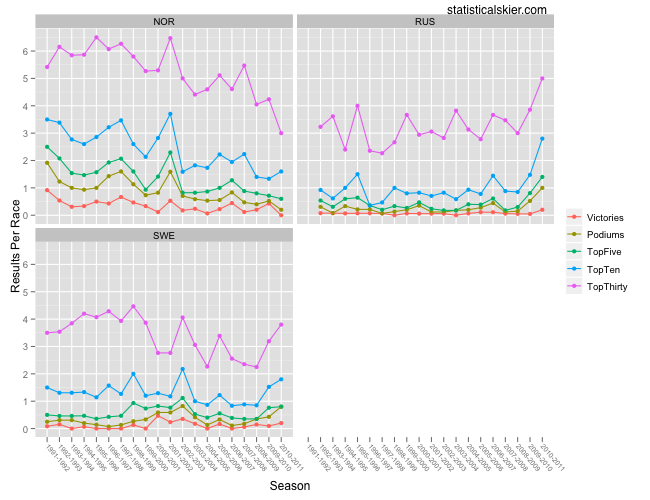
    As before, I’m going to avoid fancier metrics like FIS points and stuff.  So here’s an updated graph showing the number of athletes Norway, Sweden and Russia have placed in various groups, per race, over time:

    Keep in mind that the 2010-2011 data is based on only a handful of races so far.  Just to be clear, the y axis is the average number of athletes each nation puts in the top thirty, top ten, etc. over all the distance events that season.

    Norway’s decline has been accompanied by resurgences in Sweden and Russia over the last 2-3 seasons.  And yes, the downward trend does seem to be continuing this season for Norway, although until recently they have been without their best skier, Northug, and the season is far from over.

    Of course, another complaint I’ve heard that’s making the rounds in Norway is that they’re essentially a one man team, Petter Northug.  There’s certainly some truth to this.  Looking just at podium finishes, Northug accounts for all of them since 11-21-2009, when Ronny Hafsaas, a Norwegian biathlete, shockingly won the WC opener last season.  If you prefer to spit in the face of all your biathlon friends and claim that that “doesn’t count”, we have to move back to 2-14-2009 when Jens Arne Svartedal was second in a 15k classic.  (Martin Johnsrud Sundby was also 4th that day, but who’s counting?)  Since Northug’s first WC distance podium in 2008, he’s accounted for 16 of Norway’s 20 podiums.

    Of course, it’s not like Norway has completely fallen off the cliff in a relative sense.  So far this season, only Sweden and Russia are averaging more skiers in the top 30 and the top 10 than Norway.  And if there’s a glimmer of hope it’s that Norway’s average number of people in the top ten is actually up slightly so far this season compared to the last two.  Not much of a glimmer, maybe, but it’s something.

    These sorts of discussions always make me wish I had a time machine.  There’s just no way to know for sure if today’s Norwegian men are actually slower than those from the glory years in the 1990′s.  Maybe the Norwegian men are slower now, or maybe it’s just that a bunch of other countries have produced faster skiers then they had been.  No way to tell for sure without a time machine.

    Related posts:

    1. <Most Unimproved Men: Distance
    2. <Canadian Men’s Olympic Performance
    3. <Is It Panic Time For The Norwegian Men’s Distance Skiers?


  • Last post of 2010!

    Two thousand ten is coming to a close and I figured I’d better post about it before 2011!

    At the conclusion of the Rossland mini tour, our team dispersed to our relative locales for a short, one week break before resuming the racing season for US Nationals.  Christmas snuck up on all of as usual…. We got home on the 22nd, and had one day before Christmas Eve.  Factor in a good, solid sleep, unpacking, etc and it’s Christmas Eve before you have time to do anything about it. Regardless, it was awesome to sleep in my own bed, pay my bills, and be in Alaska for a couple of days.

    En route home I had a great surprise in the airport.  Our layover allowed time for a short visit with my family (that lives in Seattle.)  My mom surprised me by bringing both of my Grandmas to the airport.  My Aunt showed up too!  We had a great “Christmas Party” complete with cookies and all!  (Unfortunately the pictures from this event are on a different computer, otherwise I would post them.)  Thanks mom for making it happen! While not ideal, an airport Christmas visit with my family is better than no Christmas visit at all…

    In addition to some well deserved R & R in Alaska I was able to attend the APU Devo “Christmas Ski” to Kincaid.  These guys skied 25 kilometers like it was no big thang! (AWESOME!)

    I also got to use my FatBack!!!  Check out more info on Fatbacks at Greg’s site here!
    If you’ve never tried winter biking it’s a whole new sensation and way to enjoy the winter months! 

     Our neighborhood can be quite festive…. that is, when your car isn’t being stolen or your house is being broken into (no joke!)
    Neighbors hang holiday ornaments from tree branch arch
    Fast forwarding to Maine….. The travel from Alaska to Maine is a bit tough.  Maine is the furthest you can get from Alaska as far as a ski venue is concerned.  We’ve found ourselves here a lot lately.  This past spring I spent almost a month in northern Maine coaching Junior Olympics and then competing in Distance Nationals. US Nationals is on a two year rotation so this time next year, we’ll be back. 
    The actual “travel” door to door took us 24 hours.  We flew all night.  This was the extent of our sleep during a short layover in Newark.  (That’s me on the far right underneath the airplane blanket trying to keep the blood from pooling in my legs.)
    Finally – at the venue this morning! The new lodge is super nice… and will probably keep us temporarily dry for the 40 degrees and rain that is forecasted for classic sprint race day. 

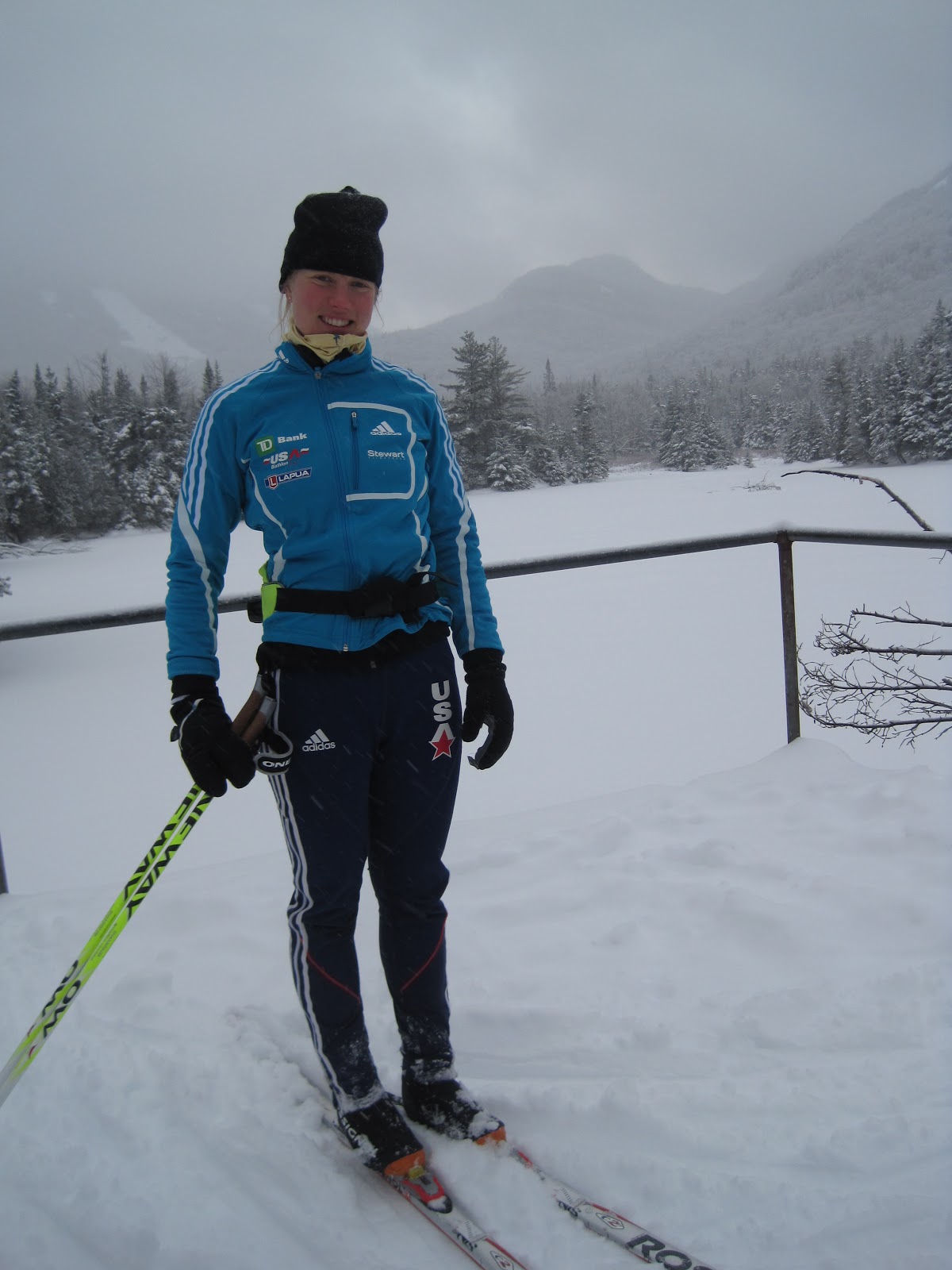
    A quick self portrait overlooking the sprint course.  The snow conditions look good in this shot but there are some solid patches of rocks, dirt, and bare spots. Tomorrow our team is shoveling snow on the distance courses in hopes that we can use them. 

    They have BIG trucks transporting snow. It’s sweet to see how much they’ve stock-piled. 

    The girls on the van ride home. 

    After our ski we took a short self-tour of Rumford.  We’ve started this tradition as we like to find out a bit more about the towns we visit.  On our tour we found this building.  Upon first inspection we thought it was the Star Ship Enterprise that had collided with the White House.  The second inspection revealed that it’s the local hospital. HUH? 
    Happy New Year! Thanks for reading… I’ll try to keep you posted as best I can! 
    ~Holly 
  • Last post of 2010!

    Two thousand ten is coming to a close and I figured I’d better post about it before 2011!

    At the conclusion of the Rossland mini tour, our team dispersed to our relative locales for a short, one week break before resuming the racing season for US Nationals.  Christmas snuck up on all of as usual…. We got home on the 22nd, and had one day before Christmas Eve.  Factor in a good, solid sleep, unpacking, etc and it’s Christmas Eve before you have time to do anything about it. Regardless, it was awesome to sleep in my own bed, pay my bills, and be in Alaska for a couple of days.

    En route home I had a great surprise in the airport.  Our layover allowed time for a short visit with my family (that lives in Seattle.)  My mom surprised me by bringing both of my Grandmas to the airport.  My Aunt showed up too!  We had a great “Christmas Party” complete with cookies and all!  (Unfortunately the pictures from this event are on a different computer, otherwise I would post them.)  Thanks mom for making it happen! While not ideal, an airport Christmas visit with my family is better than no Christmas visit at all…

    In addition to some well deserved R & R in Alaska I was able to attend the APU Devo “Christmas Ski” to Kincaid.  These guys skied 25 kilometers like it was no big thang! (AWESOME!)

    I also got to use my FatBack!!!  Check out more info on Fatbacks at Greg’s site here!
    If you’ve never tried winter biking it’s a whole new sensation and way to enjoy the winter months! 

     Our neighborhood can be quite festive…. that is, when your car isn’t being stolen or your house is being broken into (no joke!)
    Neighbors hang holiday ornaments from tree branch arch
    Fast forwarding to Maine….. The travel from Alaska to Maine is a bit tough.  Maine is the furthest you can get from Alaska as far as a ski venue is concerned.  We’ve found ourselves here a lot lately.  This past spring I spent almost a month in northern Maine coaching Junior Olympics and then competing in Distance Nationals. US Nationals is on a two year rotation so this time next year, we’ll be back. 
    The actual “travel” door to door took us 24 hours.  We flew all night.  This was the extent of our sleep during a short layover in Newark.  (That’s me on the far right underneath the airplane blanket trying to keep the blood from pooling in my legs.)
    Finally – at the venue this morning! The new lodge is super nice… and will probably keep us temporarily dry for the 40 degrees and rain that is forecasted for classic sprint race day. 

    A quick self portrait overlooking the sprint course.  The snow conditions look good in this shot but there are some solid patches of rocks, dirt, and bare spots. Tomorrow our team is shoveling snow on the distance courses in hopes that we can use them. 

    They have BIG trucks transporting snow. It’s sweet to see how much they’ve stock-piled. 

    The girls on the van ride home. 

    After our ski we took a short self-tour of Rumford.  We’ve started this tradition as we like to find out a bit more about the towns we visit.  On our tour we found this building.  Upon first inspection we thought it was the Star Ship Enterprise that had collided with the White House.  The second inspection revealed that it’s the local hospital. HUH? 
    Happy New Year! Thanks for reading… I’ll try to keep you posted as best I can! 
    ~Holly 
  • Last post of 2010!

    Two thousand ten is coming to a close and I figured I’d better post about it before 2011!

    At the conclusion of the Rossland mini tour, our team dispersed to our relative locales for a short, one week break before resuming the racing season for US Nationals.  Christmas snuck up on all of as usual…. We got home on the 22nd, and had one day before Christmas Eve.  Factor in a good, solid sleep, unpacking, etc and it’s Christmas Eve before you have time to do anything about it. Regardless, it was awesome to sleep in my own bed, pay my bills, and be in Alaska for a couple of days.

    En route home I had a great surprise in the airport.  Our layover allowed time for a short visit with my family (that lives in Seattle.)  My mom surprised me by bringing both of my Grandmas to the airport.  My Aunt showed up too!  We had a great “Christmas Party” complete with cookies and all!  (Unfortunately the pictures from this event are on a different computer, otherwise I would post them.)  Thanks mom for making it happen! While not ideal, an airport Christmas visit with my family is better than no Christmas visit at all…

    In addition to some well deserved R & R in Alaska I was able to attend the APU Devo “Christmas Ski” to Kincaid.  These guys skied 25 kilometers like it was no big thang! (AWESOME!)

    I also got to use my FatBack!!!  Check out more info on Fatbacks at Greg’s site here!
    If you’ve never tried winter biking it’s a whole new sensation and way to enjoy the winter months! 

     Our neighborhood can be quite festive…. that is, when your car isn’t being stolen or your house is being broken into (no joke!)
    Neighbors hang holiday ornaments from tree branch arch
    Fast forwarding to Maine….. The travel from Alaska to Maine is a bit tough.  Maine is the furthest you can get from Alaska as far as a ski venue is concerned.  We’ve found ourselves here a lot lately.  This past spring I spent almost a month in northern Maine coaching Junior Olympics and then competing in Distance Nationals. US Nationals is on a two year rotation so this time next year, we’ll be back. 
    The actual “travel” door to door took us 24 hours.  We flew all night.  This was the extent of our sleep during a short layover in Newark.  (That’s me on the far right underneath the airplane blanket trying to keep the blood from pooling in my legs.)
    Finally – at the venue this morning! The new lodge is super nice… and will probably keep us temporarily dry for the 40 degrees and rain that is forecasted for classic sprint race day. 

    A quick self portrait overlooking the sprint course.  The snow conditions look good in this shot but there are some solid patches of rocks, dirt, and bare spots. Tomorrow our team is shoveling snow on the distance courses in hopes that we can use them. 

    They have BIG trucks transporting snow. It’s sweet to see how much they’ve stock-piled. 

    The girls on the van ride home. 

    After our ski we took a short self-tour of Rumford.  We’ve started this tradition as we like to find out a bit more about the towns we visit.  On our tour we found this building.  Upon first inspection we thought it was the Star Ship Enterprise that had collided with the White House.  The second inspection revealed that it’s the local hospital. HUH? 
    Happy New Year! Thanks for reading… I’ll try to keep you posted as best I can! 
    ~Holly 
  • 2011 Tour de Ski Preview

    Ok, so this isn’t much of a preview.  Rather it’s just a bird’s eye view of what happened last year using some bumps plots.  Here’s how things played out for the men:

    2010 Men's Tour de Ski

    The median skier can sort of be thought of as the “peloton”.  As you can see, not much happened until Stage 5, the first really long distance event of the Tour.  That stage clearly split the group into three main packs, with some stragglers in the back.  These groups mostly stayed together through Stage 6, but then began to drift apart in Stages 7 and 8.  Emil Jönsson bagged his sprint WC points and then packed it in despite leading after four stages.

    The women, not surprisingly, were a bit more scattered:

    2010 Women's Tour de Ski

    With more overlap between the sprinters and distance skiers, the eventual leaders started noticeably pulling away in the sprints and never looked back.  Aino-Kaisa Saarinen, leading after four stages, couldn’t quite hold off Kowalczyk, Majdic or Follis.

    As this year’s Tour progresses, I’ll try to present some more versions of these types of graphs, highlighting specific skiers or groups of skiers.

    Related posts:

    1. <Tour de France Bump Plot: Stage 12
    2. <Tour de France Bumps Chart: Stage 14
    3. <Tour de France Bump Chart: Stage 16


  • Rossland Mini-Tour Race Photos

    Thanks to Rob Whitney for the photos.

    Brian in the Quarter Final (Photo: Rob Whitney)

    Caitlin (Photo: Rob Whitney)

    Classic 15k Pursuit Start… I have some time to make up (Photo: Rob Whitney)

    15k, 7 seconds out of third for the day, passed 12 racers.

    My first winter trip to Rossland was a blast.  Thanks to Ethan and Alex for hosting us.  It was great to be so close to the trails.  I was able to train well and get in some good volume. The skate races were a bit dissapointing, but I was able to rally for a good classic race.  The CXC women threw down.

    Results at http://www.fis-ski.com/uk/604/1228.html?event_id=29025&cal_suchsector=CC

    Lars (race leader) and me (30 sec back and taking an unplanned break) on the hard left turn.

  • Mid-Season Review: North American Sprint

    Continuing on from my last post on North American distance skiers, let’s jump right in with the sprinters, starting with the men:

    No fancy metrics here, just what place people finished in.  Once again, red is this season, blue is last year’s Olympics.  Alex Harvey’s sprint race in Kuusamo was unusually good for him.  Simi Hamilton had one excellent race and two pretty bad ones, although he’s been struggling with a leg injury for a while.  Stefan Kuhn hasn’t really put one together yet, but his two results around 30th aren’t exactly atypical for him so far in his career.  Kershaw had a strong sprint result in Kuusamo and then an unusually bad one.

    Len Valjas certainly had some promising results, but then, we don’t have much to compare that to in terms of data.  Phil Widmer had one pretty bad race and another excellent one.

    Andrew Newell is the most consistent of these guys, at least in terms of putting himself in the top 30 or top 20.  People keep waiting for Newell to put together a podium finish again, but keep in mind that his sprint results so far this season are right in line with how he normally does.

    As for the women:

    Chandra Crawford has been all over the place, but that’s actually roughly on par with how she did last season.  Gaiazova’s results so far also seem mostly in line with last year.  Kikkan Randall has had one sprint at the very bottom of how she typically races and two others at the very top of how she typically races.

    For the sprinters, looking at only the early season results didn’t turn out terribly interesting, so I’m going to skip those.  However, I will note that Andrew Newell has never, to my knowledge, made the finals in a WC sprint race before January.

    I began the distance version of these posts with a discussion of performance measures in XC skiing.  I noted that in this sport we have a tendency to pick out people’s best races and treat them as indicative of how they will ski in the future.  But that’s at least partially crazy, since no one can perform at their very best every single day (or at least, the people that can are very, very rare, even among elite athletes).  As a quick example, over the past four years the middle 50% of Kikkan Randall and Andrew Newell’s WC sprint results have been (7th,33rd) and (7th,18th) respectively.  Half the time, these skiers have ended up in these ranges.  That’s a much better indication of how they will “typically” ski in the future.

    Of course, if Randall continues to pump out podium finishes, her middle 50% will start to shift downward to reflect that.  But until then, we shouldn’t be disappointed if she fails to make the finals several times over the rest of the season, since that’s hardly unusual for her.  Similarly, Newell’s results so far may not be what people are hoping for (i.e. podiums) but he hasn’t exactly been off his game compared to his past performances.  It’s all about expectations.

    Related posts:

    1. <Week In Review: Friday Nov 12th
    2. <Week In Review: Friday Dec 10th
    3. <La Clusaz Recap: North American Men


  • How Bad Are the German and Italian Men?

    Pretty bad.Through nine individual events in this World Championships season, the Italian and German distance-racing men are really stinking it up. I dunno what the nordic-skiing communities in either country are saying about this, but I’d wager it isn’t good: Worlds are only two months away.In the head-to-head matchup of dismal distance teams, the German men have a slight advantage. Thanks to a

  • Holiday Hammerfest

    With Christmas morning and joyful unwrapping less than 24 hours away, Brian Gregg and I spent last Friday morning pounding out a set of hard power endurance intervals on the Rendezvous ski trail under Scott’s supervision. It’s great to have an opportunity to mix it up with different athletes during training; everyone skis differently and has different strengths. Brian’s endurance provided a formidable challenge to my speed during our 3x1min, 3x2min, 3x1min L4 intensity.
    After spending a great holiday with the family, enjoying the Methow’s superlative snow conditions and 180km of trails open right now thanks to MVSTA’s awesome grooming, we headed east. Torin, Scott and I arrived in Bethel, Maine last night around 10pm and checked into my favorite local hotel, The Rostay. The Dartmouth team would stay here every year during the collegiate race season and I remembered it for great hospitality and delicious breakfasts.

    Today we had a chance to check out the courses at Black Mtn. Well, maybe not all the courses. But we did spend an hour and a half previewing the women’s sprint loop about twenty-eight times, as the men’s add-on is not currently in any shape to be skied upon. And with the weather forecast looking warmer and warmer (up to 45 degrees on Saturday!), it is certainly going to be an interesting championships!

  • Rumford: Bring Rock Skis

    After a great Christmas break in Minneapolis, I’m back on the road in Rumford, Maine getting ready for the US National Championships.  My week at home was a blast with lots of skiing at Wirth and hanging out with friends and the Kuzzy crew.  The skiing in the Cities was some of the best I can remember.  I was able to recharge my batteries and get ready for the races in Maine.  Here’s a quick update from Rumford. . .

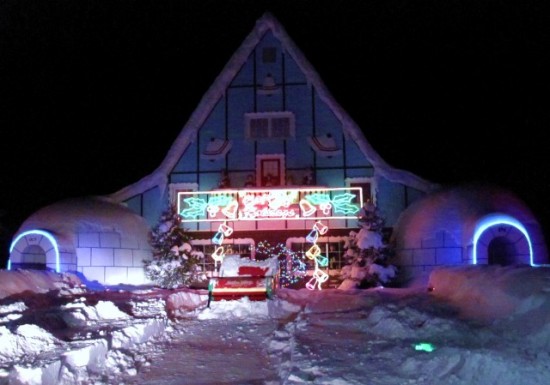
    Santa's Village

    My travels to Maine were flawless. . .not what I was expecting after seeing the storm reports from the East Coast.  I arrived in Burlington right on schedule and cruised down to have a dinner of venison steaks with the Kaedings.  A home cooked meal after a day on the road really hit the spot, especially the tenderloin cooked to perfection with a Minnesota bean casserole.  Wow.

    Gus and I had to make a stop at Santa’s Village to put in some belated requests (both of us were looking for new snow tires), but Santa must’ve already closed up shop for the season.

    In Rumford, we were greeted by fresh snow and anticipated great conditions for skiing.

    Karl waxing up his classic race skis

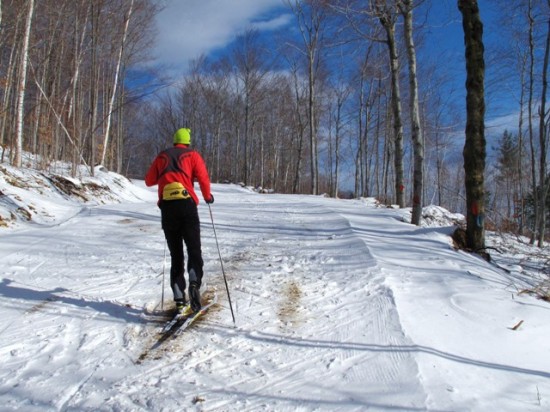
    Unfortunately, the trail itself was far from ideal.  We had to swing back by the van and pick up skis that were more appropriate for the conditions.

    "Well, at least the kick is good!"

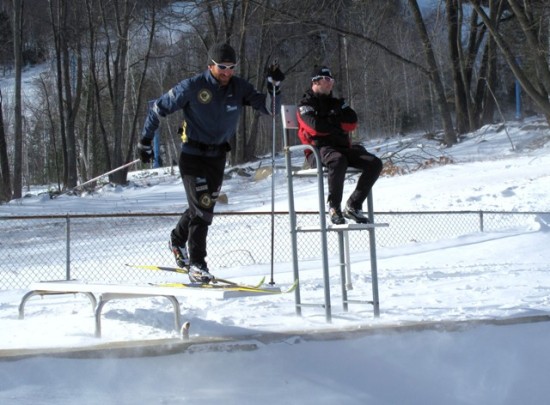
    Perhaps swim trunks would’ve been a better idea. . .

    Gregg prepares for his dive as Cork stands, er sits, on guard duty.

    At any rate, it’s good to have the whole team together out in Rumford getting ready for the races to come.  At least we’re getting some sun out here!

  • Why No Isotropic Structures?

    I am occasionally asked why ski bases don’t have random or non-directional structures.    Typically the question is posed with the addition of “…like a golf ball!”

    The idea of random isotropic surface structures seems attractive at first.    Something simple, elegant, and maybe even something easy to apply to a ski.     Imagine a surface finish on a ski that could be sprayed on! Perhaps smooth indentations on the ski base from a shot-peen gun, or cuts from an abrasive sandblasting apparatus.    That seems simple and relatively inexpensive.    But would it work?

    Golf balls travel through the air, spinning, without a set orientation to the travel direction (imagine having to line up the golf ball just so on the tee…!).     Additionally, the axis of spin can translate while the ball is flying through the air.      So a non-directional isotropic arrangement of the dimples is best.  

    Angled pattern, but the structure elements are
    all aligned length-wise.

    But a ski doesn’t travel randomly; it doesn’t behave the same in all directions.    Cross country skis travel in a straight line, and always work through the snow tip-to-tail.     For this reason, the base structures are optimized to maximize the benefits, and minimize any negatives.      Structures and base finishes need to take into account the motion of the ski against the frictional interface.

    Note that while skating there is typically a bit of torsional force and movement of the ski in the snow.   Additionally, skate skis usually slide through less transformed snow than a ski in a set (classic) track.    So skate skis and classic skis are sometimes treated differently.

    The skate ski structures are tending toward broken patterns, which have easier separation and less stickiness in the ski release.      Long, straight, continuous linear structures with continuous frets tend to track well but have a stickier release or separation from the snow.        Broken structures with linear elements, but with angled interference patterns are proving to work very well on both skate and classic skis.

    So, skis don’t get the simple isotropic base structures, but rely on lengthwise oriented patterns.    The ski structure designs utilize depth, spacing, orientation, and pattern to optimize the ski speed through the snow in various conditions.

  • Why No Isotropic Structures?

    I am occasionally asked why ski bases don’t have random or non-directional structures.    Typically the question is posed with the addition of “…like a golf ball!”

    The idea of random isotropic surface structures seems attractive at first.    Something simple, elegant, and maybe even something easy to apply to a ski.     Imagine a surface finish on a ski that could be sprayed on! Perhaps smooth indentations on the ski base from a shot-peen gun, or cuts from an abrasive sandblasting apparatus.    That seems simple and relatively inexpensive.    But would it work?

    Golf balls travel through the air, spinning, without a set orientation to the travel direction (imagine having to line up the golf ball just so on the tee…!).     Additionally, the axis of spin can translate while the ball is flying through the air.      So a non-directional isotropic arrangement of the dimples is best.  

    Angled pattern, but the structure elements are
    all aligned length-wise.

    But a ski doesn’t travel randomly; it doesn’t behave the same in all directions.    Cross country skis travel in a straight line, and always work through the snow tip-to-tail.     For this reason, the base structures are optimized to maximize the benefits, and minimize any negatives.      Structures and base finishes need to take into account the motion of the ski against the frictional interface.

    Note that while skating there is typically a bit of torsional force and movement of the ski in the snow.   Additionally, skate skis usually slide through less transformed snow than a ski in a set (classic) track.    So skate skis and classic skis are sometimes treated differently.

    The skate ski structures are tending toward broken patterns, which have easier separation and less stickiness in the ski release.      Long, straight, continuous linear structures with continuous frets tend to track well but have a stickier release or separation from the snow.        Broken structures with linear elements, but with angled interference patterns are proving to work very well on both skate and classic skis.

    So, skis don’t get the simple isotropic base structures, but rely on lengthwise oriented patterns.    The ski structure designs utilize depth, spacing, orientation, and pattern to optimize the ski speed through the snow in various conditions.

  • Why No Isotropic Structures?

    I am occasionally asked why ski bases don’t have random or non-directional structures.    Typically the question is posed with the addition of “…like a golf ball!”

    The idea of random isotropic surface structures seems attractive at first.    Something simple, elegant, and maybe even something easy to apply to a ski.     Imagine a surface finish on a ski that could be sprayed on! Perhaps smooth indentations on the ski base from a shot-peen gun, or cuts from an abrasive sandblasting apparatus.    That seems simple and relatively inexpensive.    But would it work?

    Golf balls travel through the air, spinning, without a set orientation to the travel direction (imagine having to line up the golf ball just so on the tee…!).     Additionally, the axis of spin can translate while the ball is flying through the air.      So a non-directional isotropic arrangement of the dimples is best.  

    Angled pattern, but the structure elements are
    all aligned length-wise.

    But a ski doesn’t travel randomly; it doesn’t behave the same in all directions.    Cross country skis travel in a straight line, and always work through the snow tip-to-tail.     For this reason, the base structures are optimized to maximize the benefits, and minimize any negatives.      Structures and base finishes need to take into account the motion of the ski against the frictional interface.

    Note that while skating there is typically a bit of torsional force and movement of the ski in the snow.   Additionally, skate skis usually slide through less transformed snow than a ski in a set (classic) track.    So skate skis and classic skis are sometimes treated differently.

    The skate ski structures are tending toward broken patterns, which have easier separation and less stickiness in the ski release.      Long, straight, continuous linear structures with continuous frets tend to track well but have a stickier release or separation from the snow.        Broken structures with linear elements, but with angled interference patterns are proving to work very well on both skate and classic skis.

    So, skis don’t get the simple isotropic base structures, but rely on lengthwise oriented patterns.    The ski structure designs utilize depth, spacing, orientation, and pattern to optimize the ski speed through the snow in various conditions.

  • Mid-Season Recap: North American Distance

    With the first period of WC racing in the books and the next one just around the corner, I’m going to look back at the results of the North American skiers so far this season.  The theme of this post is context and expectations.

    One of the reasons that I started this blog was that I felt as though the tools we use to measure performance in skiing don’t always match up with our expectations and this can lead to a lot of needless frustration.  The general paradigm for measuring performance in XC skiing is to examine only an athlete’s best few races over some time period.  FIS averages your best five races over the previous calendar year for their point lists; EISA picks out each skiers best two classic and freestyle races (if I recall correctly), and so on.

    We may not be explicitly aware of it, but this methodology stems from an important observation: once in a while good skiers can have truly terrible races.  Averaging is particularly sensitive to extremely small or large values, so one terrible FIS point race could have a huge effect if we were to look at all of someones results.  This is an excellent observation, but I don’t think people are necessarily aware of the consequences.

    Performance measures that look only at an athlete’s best few races are a terrible indicator of how well they typically ski.  Instead, it’s measuring how well they have skied at their very best.  It’s an estimate of an upper limit, not a “typical value”.

    This, combined with short memories, leads to some strange tendencies, I think.  When we think about how good a skier is, we tend to think about their best results: Kris Freeman’s 4th place finishes, Kikkan Randall’s sprint podiums, etc.  But those aren’t necessarily indicative of how well they ski from week to week.

    With all that in mind, let’s look at some graphs.

    Note the slightly unusual scale on the y axis.  I’ve been tinkering with this for a while now, and I’ve grown to like using percent back from the median skier.  Negative values are good (ahead of the median skier) positive values are bad (behind the median skier).  It turns out that it mostly (but not completely!) eliminates discrepancies between mass start and interval start races, it’s easy to interpret, and there are some technical mathematical reasons why I like it as well.

    The red dots are this season’s results.  I’ve highlighted last year’s Olympic results in blue, which I’ll return to in a moment.  I will also point out the one instance here where percent back from the median doesn’t capture everything as we’d like: Devon Kershaw’s 5th place in the Olympic 50k last year.  His percent back from the median skier isn’t all that low, for a 5th place finish.  This suggests that (a) the pace might have been fairly slow and (b) as with all 50k’s, the field was likely somewhat reduced.

    There are a bunch of skiers here who either don’t typically do distance races (Simi Hamilton, Andrew Newell, Stefan Kuhn) or who we just don’t have a ton of data on (Noah Hoffman).

    Kris Freeman has had a fairly solid start to the season, in my reading of the data.  On par with his non-Olympic races last year, and definitely better than two years ago.  And that’s including two races that he reportedly didn’t consider being very good: one due to a lingering illness, and one just sub-par day.

    The Canadian men have come in for some criticism, but I just don’t see it.  Babikov seems a little off his game and George Grey has had results at the low end of what he managed last year, but Kershaw and Harvey have been skiing just fine, I think.  This is a good example, I think, of how our expectations can become skewed.  Each of these guys managed to have one of their best results of the season at the Olympics last year, but they didn’t ski that fast every day.  There’s a danger of only remembering those outstanding races and forgetting all the days when these guys were just having “good” days in 15th, 20th, or even worse.

    What if you don’t like my percent back from the median skier measure?  Consider this.  Over the past two seasons, 50% of Devon Kershaw’s major international results have been between 10th and 37th.  For Alex Harvey, the range is 17th to 34th and for Babikov 12th and 38th.

    So far this season, Kershaw has managed the following: 9th, 9th, 13th, 22nd and 58th.  For Harvey, it’s 17th, 24th, 34th and 38th.  Compared to each skier’s best recent results (<10th or <17th), these don’t look so good.  But compared to how they’ve typically skied, it’s right on target.  It’s one thing to expect people to improve year to year; it’s entirely another thing to pick out their best 5 races from one season and then expect that to become “normal” the next year.

    Now, for Babikov, 50% of his results over the last two years have been between 12th and 38th, and this season he’s seen a 16th, 31st, 38th, 54th and 83rd.  Not as good as Harvey or Kershaw, but not a disaster.  Three races within his normal range, albeit two of those at the lower end, one good race and two terrible ones.  George Grey has been a little more unambiguously behind what’s typical for him, which would be between 17th and 44th.  This year he’s managed a 32nd, 78th and 79th.  That’s certainly less impressive.

    But the bottom line here is that we shouldn’t pick out a handful of extraordinary races from last season and automatically expect that to become normal.

    There are fewer North American women doing distance events:

    Things would have been looking really bad for Morgan Arritola were it not for last weekend’s race in La Clusaz.  But again, I think it’s a mistake to get too worked up over this one good weekend.  We know that Arritola and Stephen can ski that fast from time to time, but it’s not reasonable to expect them to do week in and week out until they actually string several of these together in a row.

    Kikkan Randall has had some very strong (for her) distance results so far.  Last season she was mostly right around the median skier, or a bit below.  So far this year, she’s rattled off three races that are better than nearly all her efforts last season.  I suspect, though, that if her sprinting continues as it has been, we won’t see her in distance events much more outside the Tour de Ski.

    The Canadian women have had a few decent results (for them) but they’re also probably more focused on sprinting at the moment.

    Another way to look at how people are doing is to compare their results to how they’ve done over the equivalent time period in other seasons:

    So this only includes pre-Christmas races from each season.  With the exception of last weekend’s mass start race, Babikov looks a bit behind where he’s been at this point in the season before, as does George Grey.  Things look about the same for Freeman, but both Harvey and Kershaw seem to be skiing better than they have early in the season.

    The women’s picture is largely unchanged:

    A similar look at the sprinters will be up later.

    Related posts:

    1. <Kuusamo WC Recap: North Americans
    2. <Davos Recap: Distance – North Americans
    3. <La Clusaz Recap: Distance Mass Start