Category: XCFeeds
-
The Danger of SS + West in Review….
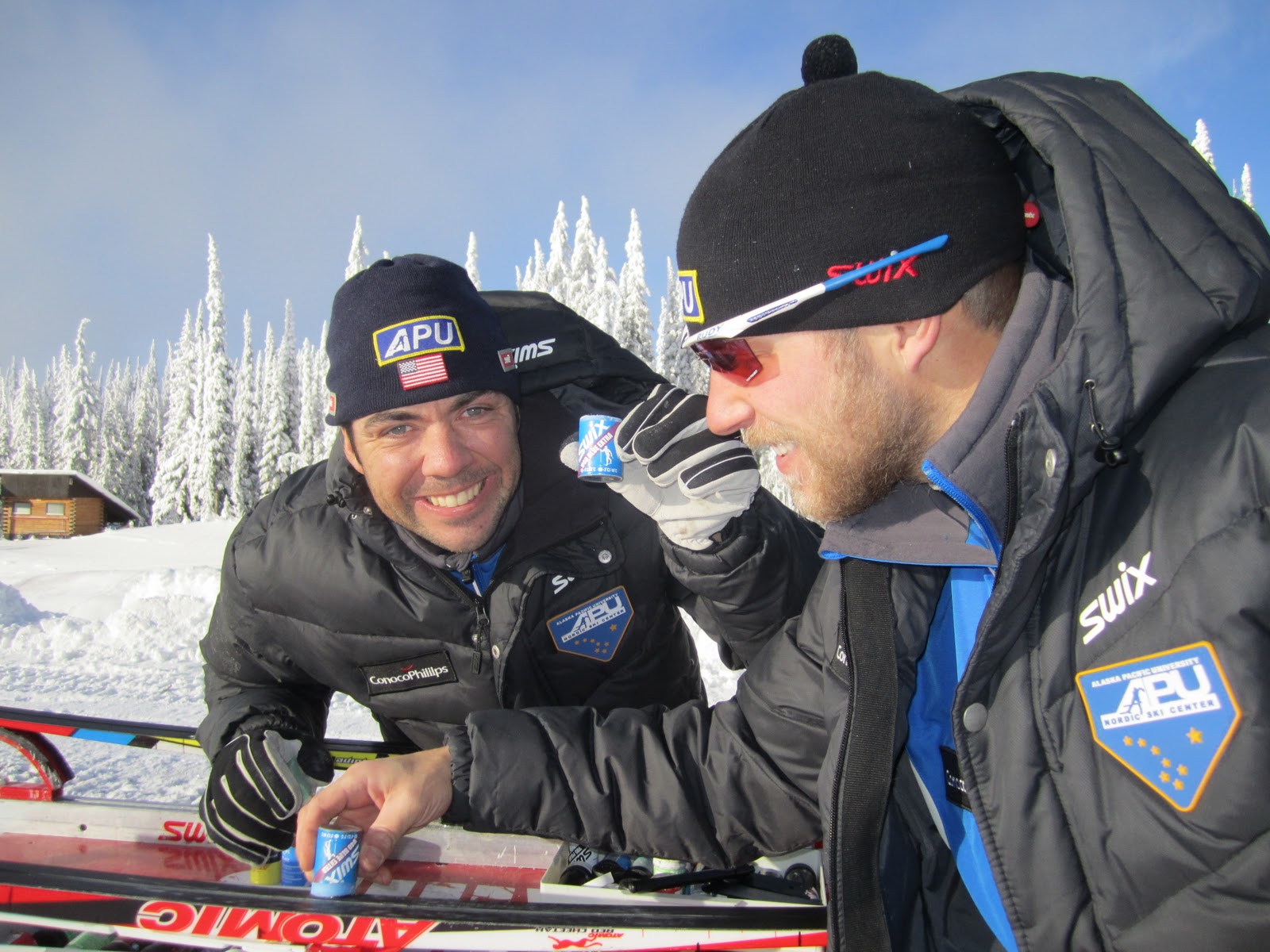
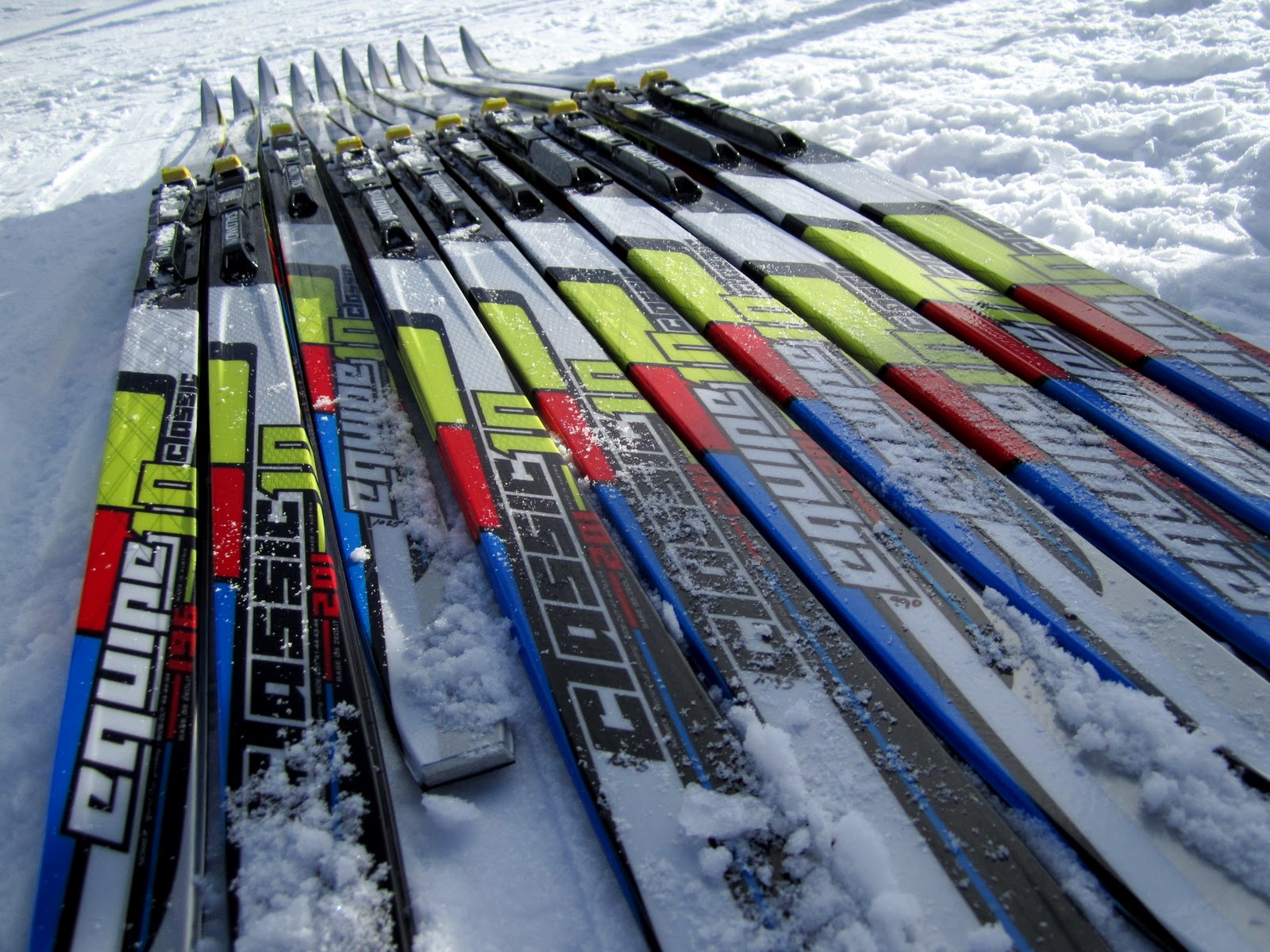
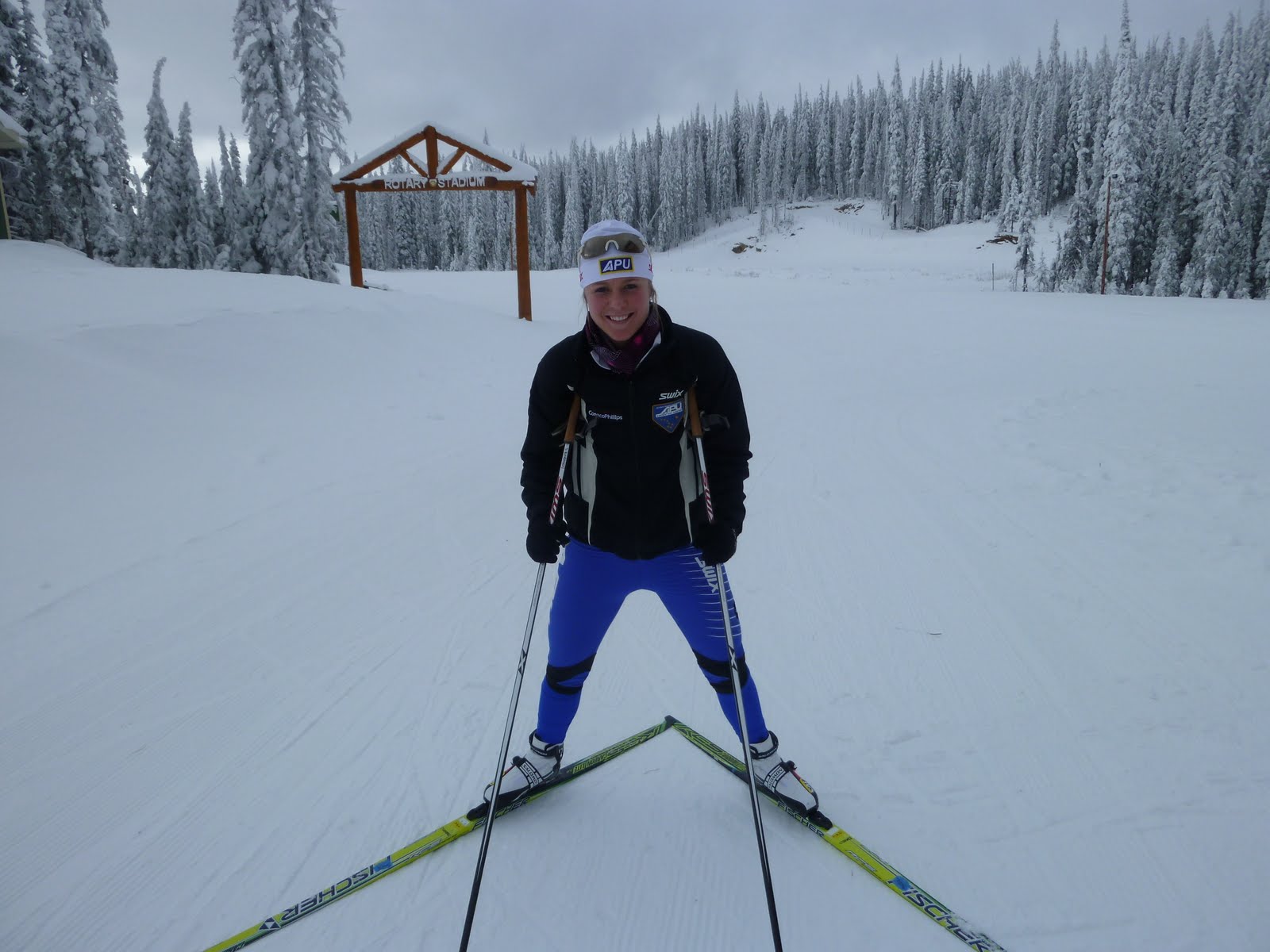
I know that everyone’s been saying it but this place is SWEET! Silver Star has been called heaven, paradise, the best place to ski in North America, etc, etc. It’s probably all of those things that therein lies the problem. When you have races coming up in the future, how do you keep yourself from hammering out a hard 50k everyday? The point is to get in shape but blow yourself out for the races – when you have to ski fast. It’s hard because all I really want to do is ski hard until I drop 🙂 Here are a couple of pictures from our first days in Silver Star…Extra Blue… if I could only have one wax for the rest of my life, this would be it!Me lovin the trails!I did some classic ski testing with Erik and Casey this morning. It’s important to organize your skis and get to know which ski works in which conditions…. It was great to be able to blaze around, switch skis, discuss our thoughts, and come to some conclusions.Silver Star and Sovereign look like THIS – all 100+ Kilometers of trails. The grooming is done everyday and night and skiers wake up to deep, firm tracks and corduroy EVERY DAY. This is what creates paradise!Note the iconic Silver Star trees. For some reason, they always kind of look like this….In many ways, Silver Star is somewhat of a homecoming for me. Having grown up in Seattle, my family would come here to celebrate Thanksgiving every year. Here is a pic of my Grandparents Christmas card in nineteen ninety five!Moving onto the race report from West…..I had a solid beginning to the race season. It was fun to pile four races in three days. Going into the races I didn’t know where my fitness was or where I stood. Now I have a decent idea of where I am and where I need to go. I have a much different approach then last year…. Last season I had to come out at the West Yellowstone races firing on all cylinders. I had virtually no points coming into the season and to make the Olympic team, I needed to be skiing fast right off the bat to get my name into the mix. This year is different. I have decent points and I hope to be skiing my fastest towards the end of the season rather than the beginning. I was especially happy with the sprint races – I didn’t really feel like I preformed better in them than the distance races but for some reason, the result was way better. Here is an article from fasterskier on the sprint races:And, here are a couple of pictures from last week and the races:Sweet shot of teammate Sadie Bjornsen and myself in the skate sprintMy family came to the races in WEST! My sister was coaching and my family ended up volunteering because the races were switched to Thanksgiving Day (and they lacked volunteers.) It was sweet having my mom work course control and hear her cheering and to have my dad in the finish shoot taking my skis off after I crossed the line!My sister Robin is working her first winter as the head coach for Glacier Nordic out of White Fish, Montana. Her team was a great cheering contingent in the distance races! ….. Also a special thanks to USKH, my headgear sponsor for the season.A shot from the classic distance race compliments of Andy Canniff of SwixPost APU team meeting… Fitz wearing the distance bib, Erik holding Lars’ Super Tour leader bib, and me wearing the leader bib 🙂 Go APU!!!!APU Girls team, left to right: Holly, Kalysta, Fitz, Sadie, Morgan, Tax, Greta and Ronsse…. missing Kasandra 🙁Sweet shot of Pickle Pete in the boys race before my camera battery died.Awards ceremony…And last but not least, my huge ski-sickle..Thanks for reading – more to come soon!~Holly 😉 -
Race Snapshots: IBU World Cup 1 Men
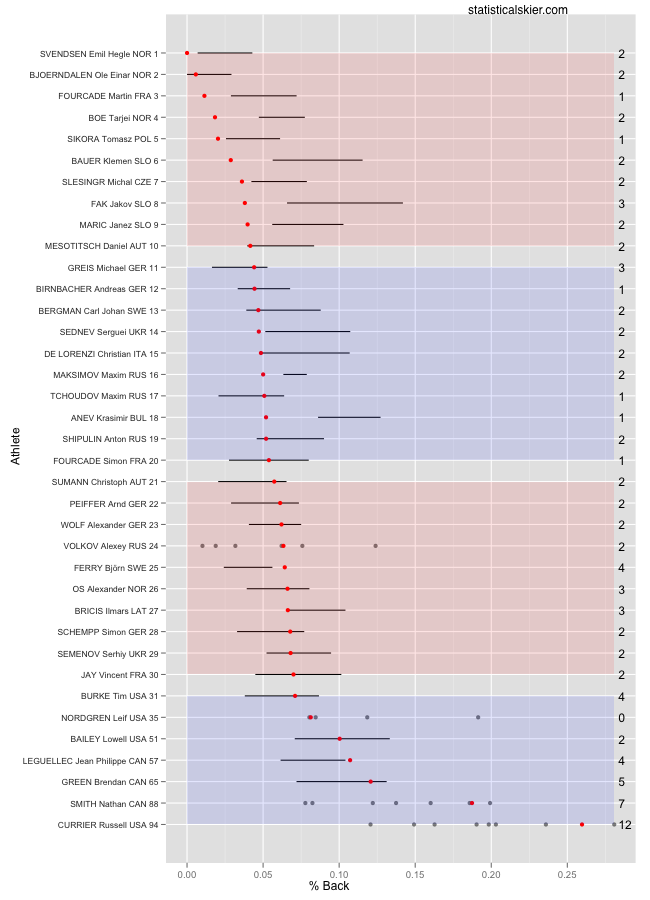
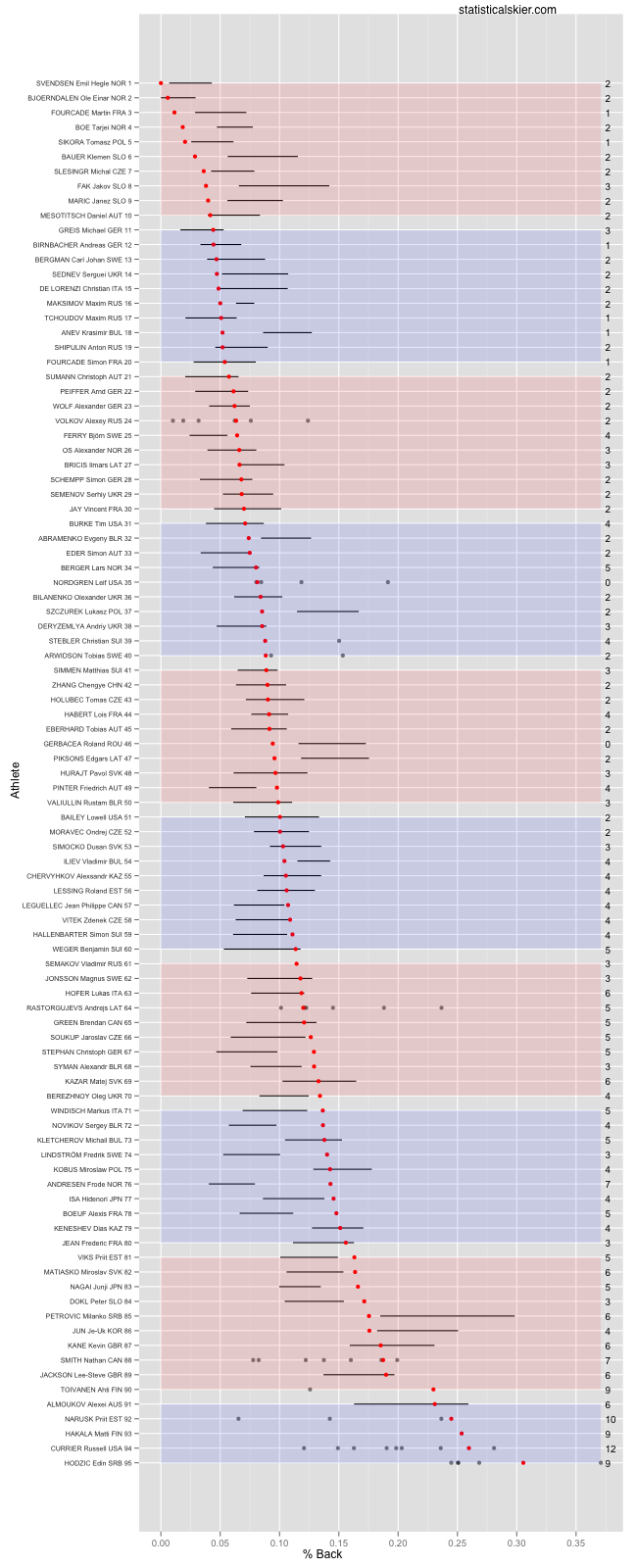
Race snapshot graphs from today’s men’s 20km distance race. Full version below the fold.
Related posts:
-
December Dry-land
a onblur=”try {parent.deselectBloggerImageGracefully();} catch(e) {}” href=”http://1.bp.blogspot.com/_H2SCM3lmKm8/TPgdrZaZ05I/AAAAAAAAFao/TekaXO573sA/s1600/IMG_9916.JPG”img style=”display:block; margin:0px auto 10px; text-align:center;cursor:pointer; cursor:hand;width: 400px; height: 300px;” src=”http://1.bp.blogspot.com/_H2SCM3lmKm8/TPgdrZaZ05I/AAAAAAAAFao/TekaXO573sA/s400/IMG_9916.JPG” border=”0″ alt=””id=”BLOGGER_PHOTO_ID_5546215572499977106″ //aWe are leaving for Quebec tomorrow to get on more snow.br /It is tough when you read about other skiers racing and training on snow at this time of year, but you can still get quality training without the white stuff. Today we warmed up, worked on technique and then did some ski bounding intervals. We are working on rolling forward through the ankles to keep our center of mass forward. The goal is to get a long stride without reaching too far forward with the foot. The group did well and then finished up the morning with some strength.br /Enjoy the pictures and get excited for the ski season!br /a onblur=”try {parent.deselectBloggerImageGracefully();} catch(e) {}” href=”http://3.bp.blogspot.com/_H2SCM3lmKm8/TPgdOjwq5xI/AAAAAAAAFag/mQlmpqTbS1g/s1600/IMG_9925.JPG”img style=”display:block; margin:0px auto 10px; text-align:center;cursor:pointer; cursor:hand;width: 400px; height: 256px;” src=”http://3.bp.blogspot.com/_H2SCM3lmKm8/TPgdOjwq5xI/AAAAAAAAFag/mQlmpqTbS1g/s400/IMG_9925.JPG” border=”0″ alt=””id=”BLOGGER_PHOTO_ID_5546215077061519122″ //abr /a onblur=”try {parent.deselectBloggerImageGracefully();} catch(e) {}” href=”http://4.bp.blogspot.com/_H2SCM3lmKm8/TPgc4VyAVoI/AAAAAAAAFaY/SV_dRsoUJ_k/s1600/IMG_9927.JPG”img style=”display:block; margin:0px auto 10px; text-align:center;cursor:pointer; cursor:hand;width: 400px; height: 300px;” src=”http://4.bp.blogspot.com/_H2SCM3lmKm8/TPgc4VyAVoI/AAAAAAAAFaY/SV_dRsoUJ_k/s400/IMG_9927.JPG” border=”0″ alt=””id=”BLOGGER_PHOTO_ID_5546214695351899778″ //abr /a onblur=”try {parent.deselectBloggerImageGracefully();} catch(e) {}” href=”http://2.bp.blogspot.com/_H2SCM3lmKm8/TPgceBtvXiI/AAAAAAAAFaQ/fwZeT3mhfoc/s1600/IMG_9929.JPG”img style=”display:block; margin:0px auto 10px; text-align:center;cursor:pointer; cursor:hand;width: 305px; height: 400px;” src=”http://2.bp.blogspot.com/_H2SCM3lmKm8/TPgceBtvXiI/AAAAAAAAFaQ/fwZeT3mhfoc/s400/IMG_9929.JPG” border=”0″ alt=””id=”BLOGGER_PHOTO_ID_5546214243288702498″ //abr /a onblur=”try {parent.deselectBloggerImageGracefully();} catch(e) {}” href=”http://2.bp.blogspot.com/_H2SCM3lmKm8/TPgcIk9lChI/AAAAAAAAFaI/bkShBMXNABA/s1600/IMG_9930.JPG”img style=”display:block; margin:0px auto 10px; text-align:center;cursor:pointer; cursor:hand;width: 400px; height: 300px;” src=”http://2.bp.blogspot.com/_H2SCM3lmKm8/TPgcIk9lChI/AAAAAAAAFaI/bkShBMXNABA/s400/IMG_9930.JPG” border=”0″ alt=””id=”BLOGGER_PHOTO_ID_5546213874793253394″ //abr /a onblur=”try {parent.deselectBloggerImageGracefully();} catch(e) {}” href=”http://4.bp.blogspot.com/_H2SCM3lmKm8/TPgbnacEf0I/AAAAAAAAFaA/SFJO8Y66Occ/s1600/IMG_9936.JPG”img style=”display:block; margin:0px auto 10px; text-align:center;cursor:pointer; cursor:hand;width: 400px; height: 300px;” src=”http://4.bp.blogspot.com/_H2SCM3lmKm8/TPgbnacEf0I/AAAAAAAAFaA/SFJO8Y66Occ/s400/IMG_9936.JPG” border=”0″ alt=””id=”BLOGGER_PHOTO_ID_5546213305032671042″ //adiv class=”blogger-post-footer”img width=’1′ height=’1′ src=’https://blogger.googleusercontent.com/tracker/4680416899705879324-7616050913607200198?l=smsxc.blogspot.com’ alt=” //div
-
Athlete To Watch: Nicole Fessel
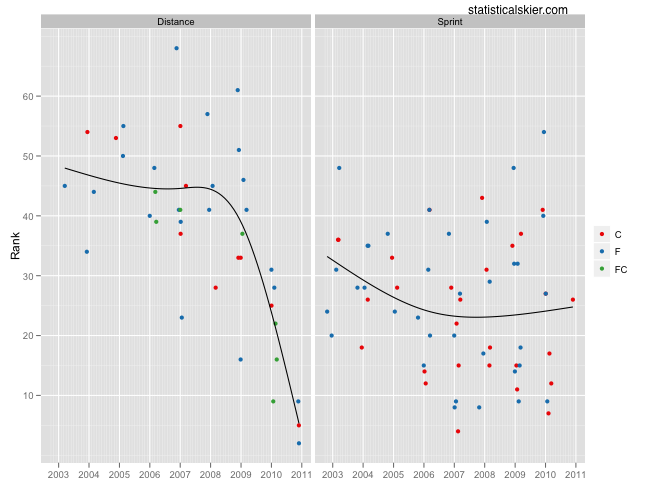
Who impressed me most in the races last weekend in Kuusamo? Well, I have to agree with one of my commenters in picking Germany’s Nicole Fessel. I’m not crazy enough to stay up till 1am to watch the races live on the internet, so I only have the results to go by. Still, how impressive has her season been so far? Let’s take a look:
Note I’ve plotted the finishing rank here, so as to put sprint and distance results together. Her distance results have, um, improved.
I might be reading way too much into her sprint results, but does anyone else see the two diverging trends after 2007? One going up and one going down? Unless someone has a really plausible explanation for that I’m going to chalk it up to random chance (the human eye likes to see patterns, even if none are there).
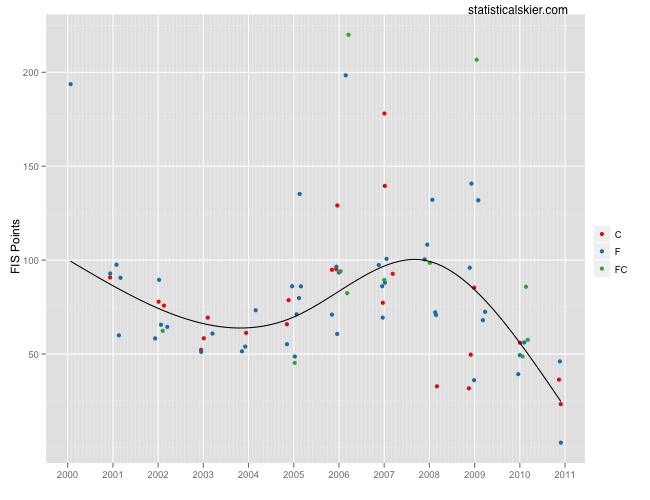
Let’s put her distance results trend in a little more context by plotting all of them, using FIS points this time:
You just don’t see athlete development patterns like that every day. Promising early career, followed by some struggles between 2006-08, followed by rapid improvement. How will she race for the rest of this season? Anyone care to weigh in?
Related posts:
- <Career Retrospective: Sabina Valbusa
- <Career Retrospective: Sara Renner
- <Career Retrospective: Virpi Kuitunen
-
The CSU Compartment Syndrome Survey
I saw this survey a while back, but had forgotten about it. Now I see they’ve written up a little summary that has been published both on SkiTrax and FasterSkier. The actual survey can be found here.
Why am I writing about this? Well, the summary includes some basic statistics. One of the things that is required (upon pain of death!) of people who have pieces of paper hanging on their wall claiming some sort of expertise in statistics is that we must always push people to do a good job of explaining data to people, and I think that in this case some major improvements could be made.
If you think I’m gearing up to “debunk” this survey, or slam Dr.’s Hoenig, Brams and Stock for doing shoddy work, you couldn’t be further from the truth! These guys boldly went out and collected some data on a medical/training issue that’s of growing importance to xc skiers. For that they should be commended. I am neither a physician nor an expert in physiology or training. But I am very good (I hope!) at explaining data to people in ways that are clear and avoid misunderstandings, and in this case I’m worried that their summary could use some editing to avoid confusion.
Let’s start with how the purpose and goals of this survey were originally described:
No one really knows how big or little a deal [compartment syndrome] is. So we are conducting a prevalence study. We want to know how many xc athletes have CECS in the USA and Canada, whether there is a particular geographical distribution, as association with gender, body mass index, use of creatine, association with training and stretching pattern, etc,” explained Hoenig. While he admits that the survey will likely reveal more questions than answers, he’s hopeful that they’ll be the right questions.
“With good data we will hopefully be able to answer some of these questions with pretty reliable numbers. These numbers will help us to define the problem, follow the problem over years (with repeat surveys) and further motivate us to look for prevention and treatment modalities.”
(Italics mine.) I think this is excellent. We’re being clear that this endeavor is exploratory, and that the primary goal is to identify possible hypotheses to investigate more formally down the road.
Ok, now let’s turn to the summary that I read over at SkiTrax. They run through some basic descriptive statistics (geography, gender, etc.) and then near the end we get two statements that feel an awful lot like “conclusions”:
The teams that trained at >500 hours/year had a statistically significant (p value 0.06) higher prevalence of CECS, than the teams that trained < 500 hours/year. Those teams with a higher average vertical gain achieved during skate roller-ski workouts had a statistically significant (p value 0.04) increase in CECS. (The survey did not look at vertical gain during classic roller skiing.)
I’d like to re-emphasize that I’m talking mostly about presentation here, not substance. Note that the original description of the purpose and goals of this study suggested (correctly) that this kind of survey is best used to identify/refine questions, not to establish firm conclusions. Yet these two results are presented with no qualifiers or discussion of their possible strength or relevance.
To people unfamiliar with statistics, these sorts of statements can contain a distinct air of finality and official-dom that I doubt that the authors would really claim. Let’s try to unpack these two conclusions a little bit and see if we can’t re-write those two sentences in a way that’s less likely to lead to confusion.
First: The teams that trained at >500 hours/year had a statistically significant (p value 0.06) higher prevalence of CECS, than the teams that trained < 500 hours/year.
I’m not going to quibble (as some might) about a claim of statistical significance with a p-value of 0.06, when values under 0.05 is usually what people consider significant. Like I said, I’m going for style here, not substance. To unpack what this means in the context of the survey, we need to go back and look at what the survey actually asked.
The first alarm bell for me is the formulation that described “teams that trained >500 hours” rather than individuals. Wouldn’t it make more sense to relate the prevalence of CECS to an individual’s training load rather than to their team’s? Well, it turns out that the only question in the survey regarding total training hours was phrased thusly:
-What is the range of hours per year that your top 10% (most committed) athletes put into training?
There were five possible responses (<100,100-300,…,>700). So it turns out that the relationship they are testing here is actually between the number of hours trained by a team’s 10% most committed athletes and the proportion of athletes on the team who developed CECS. This seems very different to me than what a casual reader would take from this conclusion, namely that individuals who train more than 500 hours are more likely to develop CECS.
Additionally, I would want to make the following concepts clear,
- As a voluntary response survey, no causal relations can be gleaned safely from these data.
- Further, even if the data allowed us to make a causal claim, it is unlikely that higher training hours alone causes CECS. A more reasonable hypothesis would be that there is a specific training activity or behavior that is causing or exacerbating the problem, and so we would naturally expect athletes who train more hours are also engaging in this specific activity more often.
How could we incorporate these qualifiers into that conclusion to make things more clear? How about this:
The teams whose top athletes trained at >500 hours/year had a statistically significant (p=0.06) higher prevalence of CECS than the teams whose top athletes trained <500 hours/year. Naturally, this sheds little light on any potential relationship between an individual’s training load and the risk of CECS, but our data do not allow us to examine this question precisely or to make causal claims. However, this result is consistent with what we would expect from injuries associated with high volume training (increased activity leads to increased risk of injury) and suggests that it may be fruitful to focus on investigating what specific activities or training levels are associated with CECS on an individual level.
I’m moving a bit beyond my realm of expertise with the language about overuse injuries, but I feel like the spirit of that is mostly correct and could be cleaned up by a physician if they object to CECS being referred to as an “overuse injury”. Still, I think this simple addition of 2-3 sentences makes it much less likely that people will read their conclusion and go “ZOMG! Must not train more than 500 hours!”. Which, believe me, if you’ve tried to explain statistics to as many people as I have, someone will do that. Trust me.
Second: Those teams with a higher average vertical gain achieved during skate roller-ski workouts had a statistically significant (p value 0.04) increase in CECS. (The survey did not look at vertical gain during classic roller skiing.)
Once again we have the confusing formulation about teams, rather than individuals. The reason is the same, as the only question about vertical gain in the survey was phrased as follows:
-If your athletes are skate roller-skiing what is the approximate vertical gain that your top 10% (most committed) athletes will achieve in a training session?
with six possible responses (0-100ft, 100-300ft, etc.). So again, we need to be careful relating a quantity measured on a particular subset of the athletes (the top 10%) with the prevalence among all the athletes on the team and the same issues about causal relationships apply here as well.
One last issue I want to highlight on this conclusion (it applies to the entire survey really) is the question of whether the respondents were able to accurately estimate the average vertical gain by their top 10% of athletes in skating rollerski workouts. Is that a number that you feel like you have a good intuitive handle on? I’d be willing to bet that most people (even athletes/coaches) would have a tough time estimating vertical gain if I physically put them on a road, had them ski on it and asked what the vertical gain was. I’m willing to let this slide for estimating total hours trained; it seems plausible that coaches would have at least a good sense of this, one would hope. But I seriously doubt that many coaches are meticulously tracking the vertical gain traversed by their athletes.
How might I rephrase this one? How about this:
Those teams whose top athletes had a higher average vertical gain achieved during skate roller-ski workouts had a statistically significant (p value 0.04) increase in CECS. (The survey did not look at vertical gain during classic roller skiing.) Again, given the nature of our data we cannot make any causal claims about this relationship. Additionally, we should note that it is reasonable to question the ability of our survey respondents to accurately estimate average vertical gain. However, uphill skating has been suggested as a possible risk factor for CECS, and these data are broadly consistent with that hypothesis. This reaffirms that we should investigate more closely the relationship between uphill skating and CECS on and individual level.
Ok, personally, I think both of these rewrites are huge improvements. And not in the sense that Dr.’s Hoenig, Brams and Stock were wrong and I’ve corrected them. I’d be willing to bet that they actually agree with most of my clarifications here. The part that I hope I helped with is effectively communicating these results to the general public. Which, when it comes to statistics, is a lot harder than it looks!
Related posts:
- <Most Improved: Women’s Sprint
- <What Does It Take To Win A Medal? (con’t)
- <The Quick Way To Stay On Top Of FasterSkier Comments
-
Ready, Set, World Cup!
With the Östersund individual race over, the World Cup season has officially begun. For me, it was a decent race, all things considered, though certainly not the way I had envisioned beginning the season.
As you may have heard by now, the town of Östersund is having some trouble with their water supply. Since before we arrived, there has apparently been a parasite (Cryptosporidium) contaminating the drinking water and many of the athletes, including myself and several teammates, have been unlucky enough to contract the bug. For me it has meant several days of upset stomach, some throwing up, and general weakness and feeling drained from not being able to eat much. I didn’t train much in the days leading up to the race, so simply being able to start and have a couple of solid laps was great. I was pretty happy with my shooting and proud of myself for fighting through a less than perfect situation.
I’m definitely on the mend now, though my appetite is not 100% and neither is my feeling. However, I am confident that I can have a great sprint race regardless. My shooting is solid right now and I know I am in great shape, so as soon as I can get this bug completely kicked out of my system, I’ll be ready to rock.
The day was not a complete bust, though, as my teammate Laura Spector had a fantastic race. She shot 19/20 and skied great, ending up in 25th place! It was her first World Cup points ever, so congratulations to her! I think it’s a great indicator of where the US women can be this year.
The men begin their season tonight with the 20km Individual. A few of the men are recovering from Crypto symptoms as well, but hopefully we’ll all be back to 100% in a few days. Off we go!
-
Ready, Set, World Cup!
With the Östersund individual race over, the World Cup season has officially begun. For me, it was a decent race, all things considered, though certainly not the way I had envisioned beginning the season.
As you may have heard by now, the town of Östersund is having some trouble with their water supply. Since before we arrived, there has apparently been a parasite (Cryptosporidium) contaminating the drinking water and many of the athletes, including myself and several teammates, have been unlucky enough to contract the bug. For me it has meant several days of upset stomach, some throwing up, and general weakness and feeling drained from not being able to eat much. I didn’t train much in the days leading up to the race, so simply being able to start and have a couple of solid laps was great. I was pretty happy with my shooting and proud of myself for fighting through a less than perfect situation.
I’m definitely on the mend now, though my appetite is not 100% and neither is my feeling. However, I am confident that I can have a great sprint race regardless. My shooting is solid right now and I know I am in great shape, so as soon as I can get this bug completely kicked out of my system, I’ll be ready to rock.
The day was not a complete bust, though, as my teammate Laura Spector had a fantastic race. She shot 19/20 and skied great, ending up in 25th place! It was her first World Cup points ever, so congratulations to her! I think it’s a great indicator of where the US women can be this year.
The men begin their season tonight with the 20km Individual. A few of the men are recovering from Crypto symptoms as well, but hopefully we’ll all be back to 100% in a few days. Off we go!
-
Silver Star it IS!
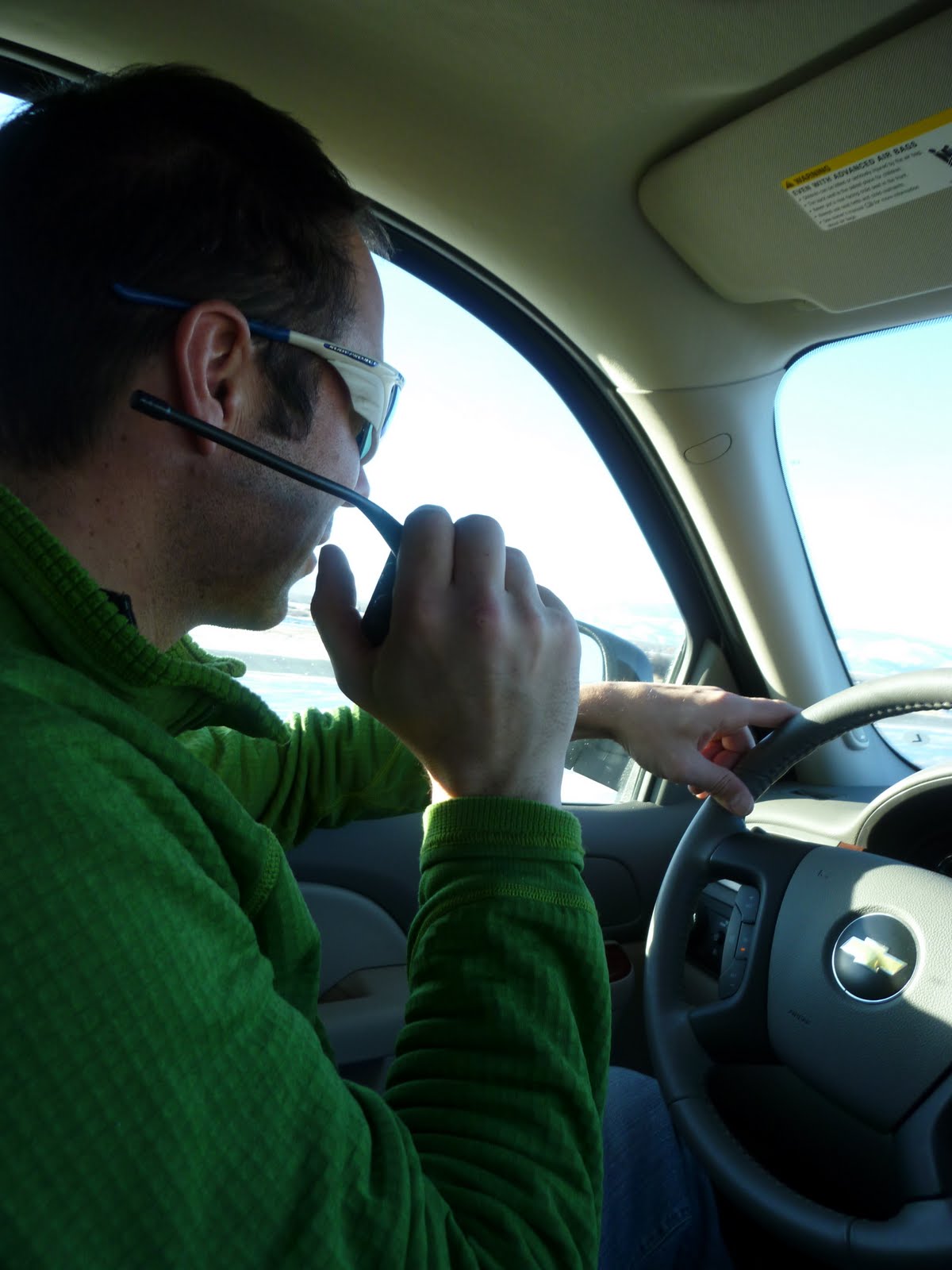
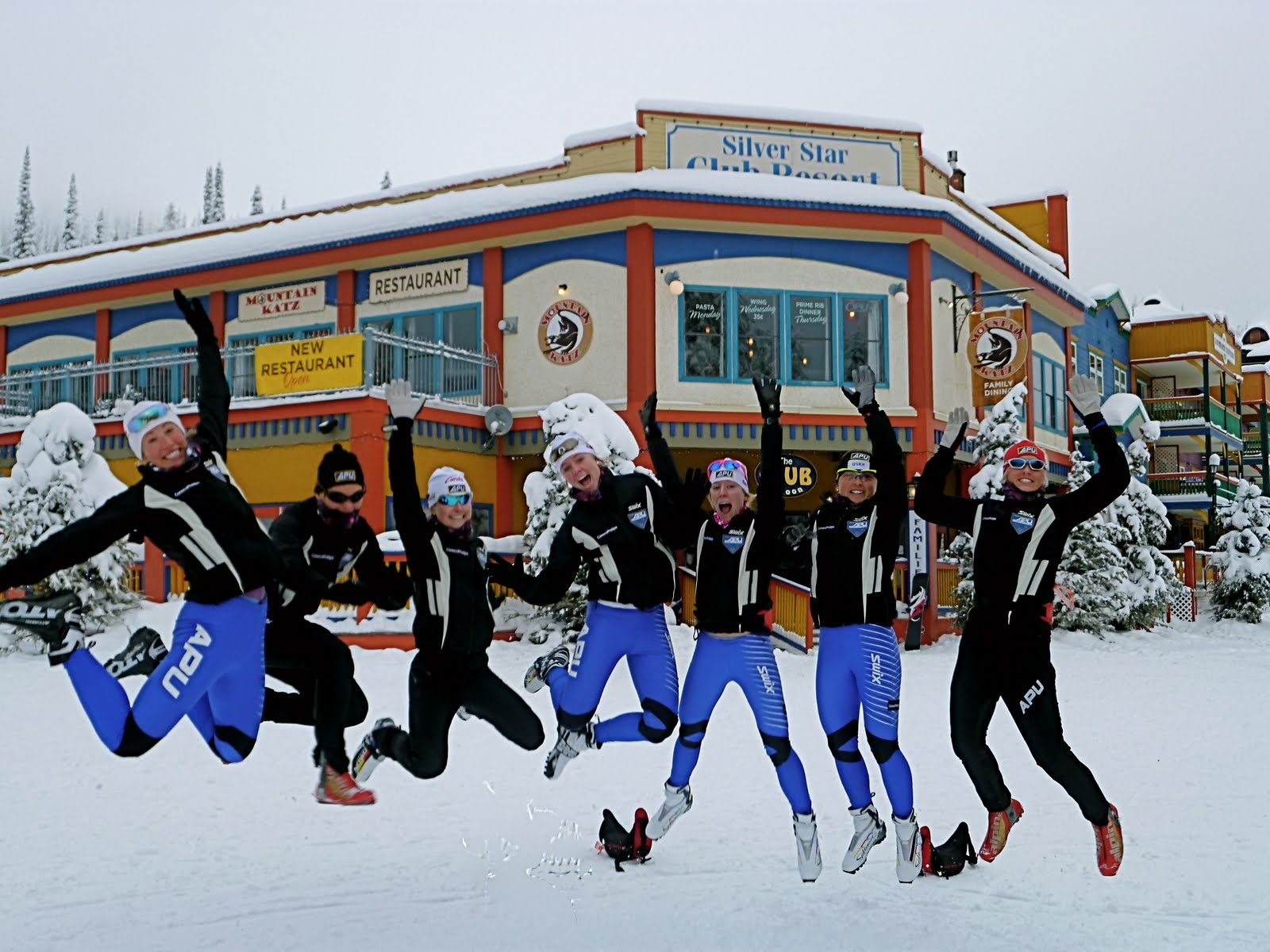
All four vans keeping in contact with the radios along the trekmaking the most of it!The past two days we did the trek across the western US up to Silver Star B.C for a training block before our next period of races. The skiing is amazing!! We did a two hour ski from the mountain down to Sovereign Lakes and back up and around the trails near the village today. Not once did we hit the same trails, and we probably skied one fifth of the total kilometers groomed around the area. This is what I love so much about Silver Star- it is truly a little Winter Wonderland.
For the next week we will hit some volume and build up before we do two weeks of racing.(Silver Star Norams and then Rossland Normams) Following that I will head home for a week of family time during Christmas and then fly over to Maine for Nationals.Here are a few pictures from our awesome ski today-Womans team in the “Village”Down in Sovereign checking out the race courses. -
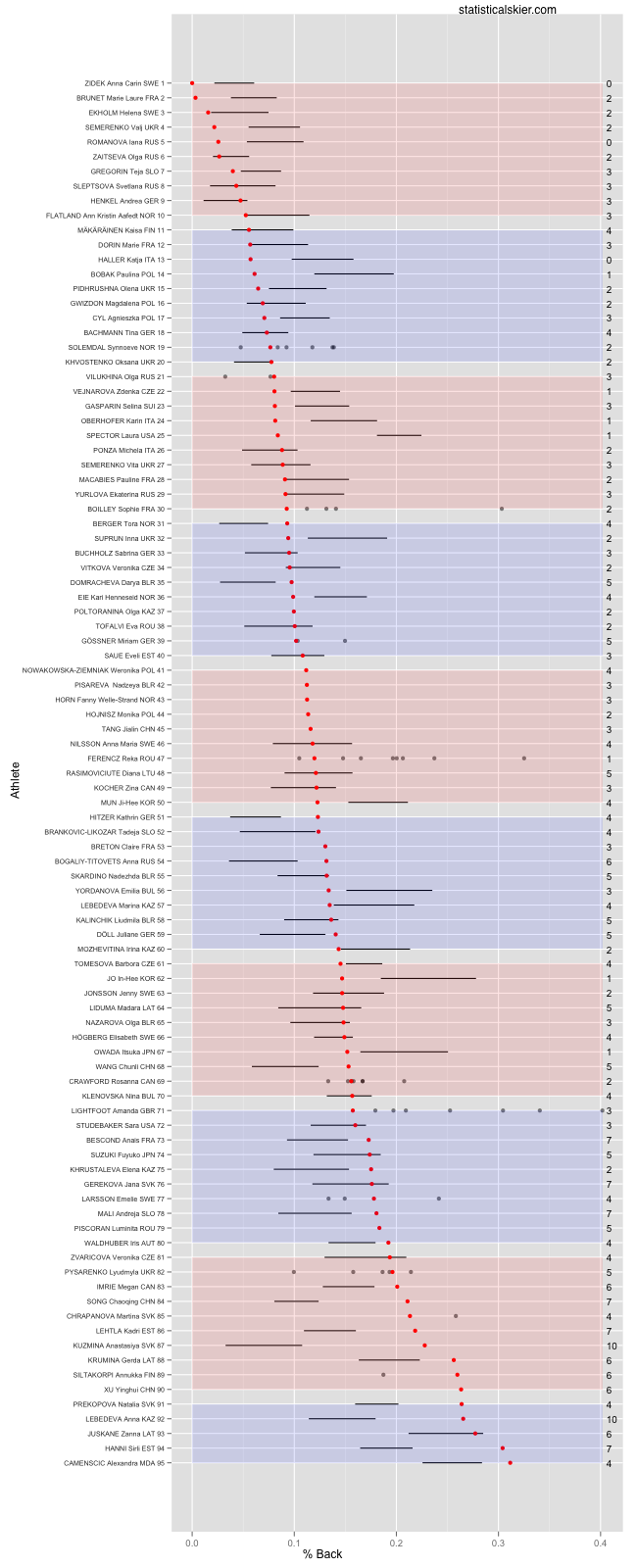
Race Snapshot: IBU World Cup 1 Women
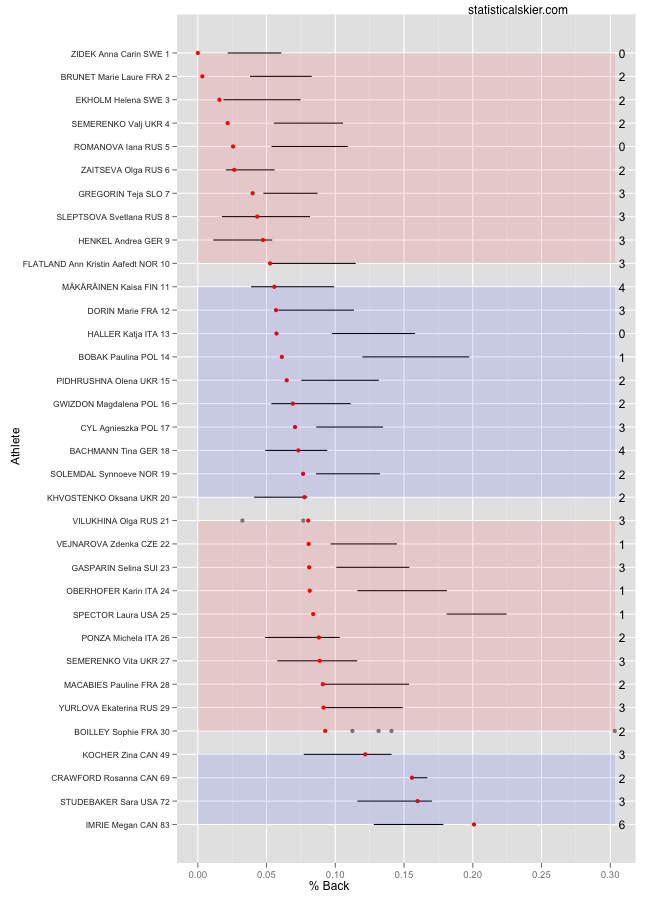
Can’t leave out the poor biathletes, now can we? Biathlon doesn’t have a point system like FIS points, so these will all be using raw percent back. If you’re familiar with these sorts of measures, you’ll notice that percent backs in biathlon are frequently quite a bit higher.
For a variety of reasons, it’s harder for me to stay on top of women’s name changes due to marriage with the biathlon crowd. If you spot a mistake (i.e. a skier who’s name has recently changed and my graph seems to show that they have done almost no previous races), let me know.
I struggled with how to incorporate the athlete’s shooting results from that day into the graph. I tried all sorts of visual elements that just didn’t work well. So I opted for the very simple route of putting the total number of misses right on the graph, over to the right. Not very elegant, maybe, but simple and easy to understand. As always, reduced version first (top 30 plus North Americans) and the full version is below the fold.
Related posts:
- <How Well Prepared Are World Cup Rookies? (Part 1a: Distance)
- <How Well Prepared Are World Cup Rookies? (Part 1b: Distance)
- <How Well Prepared Are World Cup Rookies? (Part 2b: Sprint)
-
Parasites in Sweden?
Just a quick update before the first World Cup here in Ostersund, Sweden tomorrow. If you have been following any of the news about the first World Cup, you have surely read a lot about the parasite problem with the drinking water. Unfortunately, like many of the athletes who trained here prior to the World Cup, I came down with the parasite on Sunday. Luckily, the acute phase of the sickness was pretty quick for me but it still rocked me for a few days. I was back to training the past two days and I will start tomorrow. I am a little nervous about my energy level, as I lost one kilo in less than two days.
At first I was pretty furious about the sickness because I felt like this was not something that I should have to deal with in Sweden. I am moving past that now and am just focusing on getting back to 100% as soon as possible.
-
US Biathlon Preview: Women
Now let’s turn to the US women biathletes. The women haven’t managed to produce any results comparable to Tim Burke’s recent success, but there are a ton of young skiers it seems trying to change that. I’ve noticed a lot of collegiate cross country skiers switching over (or maybe back) to biathlon after graduated, and this is particularly the case with the US women, where I’m beginning to wonder if the USBA hasn’t entered into some secret arrangement with Dartmouth College to develop athletes for them.
Let’s start with the women who raced in World Cups or Olympic races last year:
These are just the WC, OWG and WBC results for these four skiers. Sara Studebaker might have had the most promising season last year, despite not actually having the best results, which came from Lanny Barnes (23rd/~6.5% back at the Olympic 15k) and Haley Johnson (21st/~8.6% back in a 15k World Cup). In both cases Barnes and Johnson shot well (Barnes shot clean, Johnson missed one standing target).How about all the other up-and-comers (along with Tracy Barnes, who’s been around a while but didn’t race any WC/OWG races last year that I can see)?
My apologies to Ms. Chamberlain and Ms. Dreissigacker; I don’t feel like going back and redoing this graph to accomodate for your unusually long names. Feel free to ridicule my laziness.I’ve plotted the finishing place of a bunch of different types of races together here. That means that the only sensible comparisons are really within each color. And I don’t know enough about these races to comment on who’s results might be the most promising.
Turning to shooting:
Lanny Barnes has been fairly consistent with her accuracy and Haley Johnson has been steadily improving. For a newcomer, Sara Studebaker shot quite well, as some subsequent graphs with illustrate. Laura Spector had a big gap between her prone and standing accuracy, but that’s from a rather small sample size.Now let’s see how these ladies fared compared to the rest of the WC field:
The contours represent all female WC biathletes with at least 50 shots. Then I’ve plotted the accuracies for the four US women, with the size of the dot being proportional to their respective sample sizes. Laura Spector’s green dot is hard to make out due to her small sample size, but it’s there in the upper left. Recall that it’s better to be towards the upper right corner.Last season, Lanny Barnes’ shooting appears to have been slightly better than average, Sara Studebaker’s slightly below average. As I said, for a newcomer on the WC scene, I’d hazard a guess that that’s pretty good shooting.
While we noted above that Haley Johnson’s shooting has improved steadily over the last few seasons, it still was pretty far behind where it needs to be for her to be competitive.
Related posts:
- <Most Unimproved Women: Distance
- <Biathlon Shooting Accuracy
- <USST Preview: Liz Stephen & Morgan Arritola
-
Ski Lessons in Paradise. Could this be the newest MOD recruit?
While trolling the seeder neighborhoods in Lillihammer during their many idle hours Scott and Torin chanced upon a wayward Swiss miss hitch hiker. When our daring duo told her what they were up to in Norway she allowed as how she had never skied before. Being the gentlemen that they are, our intrepid travelers offered to give her a few skiing pointers if she was game to try it.br /br /Amazingly, we managed to round up a nice set of Rossignol skis and boots for her to use. After a few words of encouragement, when she balked, after stepped into the -20C temps near our secret mountain lair, Scott started her with some basics about how to keep the pointy ends going forward and she set off. Scott spent as an hour explaining the finer points of weight shift and follow through and the subtle leg drive needed to ensure a solid kicking platform. She seemed game; especially for a first timer and the lesson proceeded well enough until Scott ran out of ideas. br /br /She really does seem to be getting the hang of doesn’t she? We think she might have some potential if we give her another lesson or two. What do you think?br /br /object width=”640″ height=”385″param name=”movie” value=”http://www.youtube.com/v/ICOqSupyqC0?fs=1amp;hl=en_US”/paramparam name=”allowFullScreen” value=”true”/paramparam name=”allowscriptaccess” value=”always”/paramembed src=”http://www.youtube.com/v/ICOqSupyqC0?fs=1amp;hl=en_US” type=”application/x-shockwave-flash” allowscriptaccess=”always” allowfullscreen=”true” width=”640″ height=”385″/embed/objectdiv class=”blogger-post-footer”img width=’1′ height=’1′ src=’https://blogger.googleusercontent.com/tracker/2910103639238326543-2275622427244799535?l=methowolympicdevelopment.blogspot.com’ alt=” //div
-
Thanksgiving: Part II
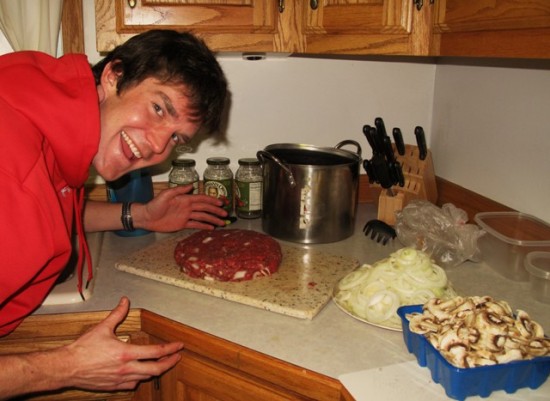
Thanksgiving might have been last week, but why not celebrate the world’s greatest holiday twice?! Given a hefty race schedule last week, we were unable to truly indulge on Thanksgiving number 1–not to mention we didn’t even have pumpkin pie. With a big volume training week coming up, it’s important to pack in as many calories as possible. After the races this weekend, Leif Zimmermann gave us some fresh elk meat he just shot this fall. So, in lieu of turkey, we decided to have elk burgers for our Thanksgiving Part II.
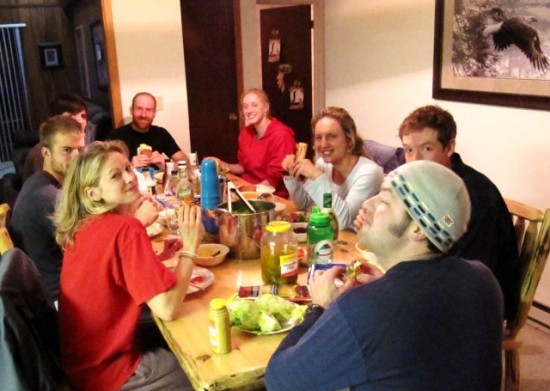
Initially, I was going to make myself a Man vs. Food style four-pound elk burger, complete with sauteed mushrooms and onions (in honor of the Travel Channel show we’ve been enjoying this week). In the end, though, it was probably for the better that the meat get divided into eleven prime elk burgers. . .enough to feed our entire team. In addition to the burgers, mushrooms, and onions, we had squash soup (inspired by Skoldy), baked squash seeds, a big Compton salad, and Jessie made four (count ‘em, FOUR) pumpkin pies. Oh yeah!
A Happy Thanksgiving (Part II) from a happy CXC crew.
-
Marit Bjoergen’s Best Freestyle Race
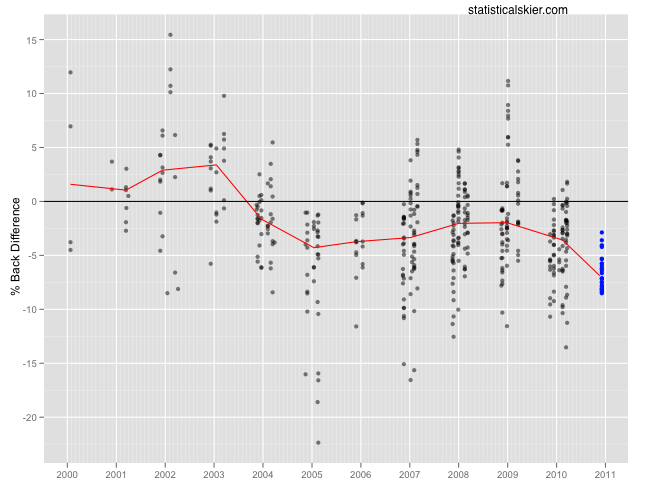
Marit Bjørgen commented somewhere that her win at the WC opener in Gällivare, SWE was “the best skate race of her life”. Sadly, I can’t find where I read that, otherwise I’d have a link for you. Obviously, I found that kind of intriguing. Let’s look at Bjørgen’s race in a bit more detail:
This is the difference in percent back between Bjørgen and the top thirty women at Gällivare in all skate races where they’ve competed against each other. (Since there’s quite a bit of data on Bjørgen I was able to be a bit more picky and only include skiers she’s raced against at least 5 times.) The red line indicates the median percent back difference for each season.This isn’t a direct comparison to specific races, of course, so this doesn’t tell us directly whether this particular race (in the blue) is better than any of her past skating efforts, but it provides some useful context. The most obvious thing to note is that the seasons with the most similar looking performances are from 2004-05 and 2005-06, where Bjørgen appears to have never lost a major freestyle race against these particular skiers (all the dots are below zero). Additionally, the median percent back difference from Gällivare is quite a bit below the median from any other season.
A little editorial comment here. Statisticians tend to react to extreme events differently than other people. The typical response is to assume that this sort of thing is going to keep happening, whereas statisticians will tend to assume it was a rare event, unlikely to happen again. In this case when Bjørgen opens the season by absolutely crushing the field, there’s a natural tendency to begin to expect Bjørgen to destroy the field like this all season long (or at least to seriously suspect this is going to happen). My reaction was more along the lines of “There’s no way she can sustain that level of dominance for any length of time.”
Now, Bjørgen may well continue to win races, perhaps most of them. But I doubt we’re going to see her rack up margins of victory above 2.5% on a regular basis. Unless, of course, she does, in which case I’ll eat my words.
But how about a more direct, simple comparison? How did that victory compare to Marit’s other WC/OWG/WSC wins?
Marit Bjoergen’s Victory Margins
Date Start Tech Length Second Place Points % Back 2005-12-10 Pursuit FC 15 SCOTT Beckie 0.16 0.01 2010-03-13 Mass F 30 STEIRA Kristin Stoermer 0.33 0.02 2004-12-11 Pursuit FC 15 SMIGUN-VAEHI Kristina 0.59 0.04 2004-11-20 Interval C 10 SMIGUN-VAEHI Kristina 0.52 0.06 2007-03-24 Pursuit FC 15 NEUMANNOVA Katerina 1.44 0.1 2010-03-20 Pursuit FC 10 STEIRA Kristin Stoermer 1.82 0.13 2005-02-26 Mass C 30 KUITUNEN Virpi 2.38 0.17 2010-11-27 Interval C 5 KOWALCZYK Justyna 2.18 0.27 2010-02-19 Pursuit FC 15 HAAG Anna 5.2 0.37 2010-03-06 Pursuit FC 15 KOWALCZYK Justyna 6.45 0.46 2005-03-19 Pursuit FC 15 NEUMANNOVA Katerina 7.02 0.5 2007-12-02 Interval C 10 JACOBSEN Astrid 4.2 0.53 2005-03-12 Interval C 30 NEUMANNOVA Katerina 4.38 0.55 2005-01-08 Interval C 10 PEDERSEN Hilde G. 5.12 0.64 2006-03-04 Mass C 45 PEDERSEN Hilde G. 13.88 0.99 2007-11-24 Interval F 10 SKOFTERUD Vibeke W 10.3 1.29 2005-11-19 Interval C 10 KUITUNEN Virpi 10.67 1.33 2005-11-26 Interval C 10 KUITUNEN Virpi 14.56 1.82 2009-11-21 Interval C 10 KALLA Charlotte 15.96 2 2010-11-20 Interval F 10 KALLA Charlotte 23.02 2.88 Margins of victory in Marit Bjoergen’s major distance races.
So yeah, not only could you make a case that that was her best skate race, you might argue it was her best race ever, simply measuring it by margin of victory. Notice how many of her biggest wins came in November, though? Like, nearly all of them? Maybe Bjørgen is just less interested in this whole “peaking” thing I keep hearing about.
This got me wondering what the biggest margin of victories were ever in WC/OWG/WSC races (or at least since 1992, where I have data):
Largest Margins of Victory
Date Gender Start Tech Length First Second % Back Points 2007-01-06 Women Mass C 15 KUITUNEN Virpi SAARINEN Aino-Kaisa 1.47 20.59 2000-02-20 Men Mass F 72 MUEHLEGG Johann ELOFSSON Per 1.94 27.17 2002-12-21 Women Pursuit FC 10 SKARI MARTINSEN Bente BJOERGEN Marit 1.96 19.59 1997-01-12 Women Pursuit Break FC 15 BELMONDO Stefania NEUMANNOVA Katerina 2.08 24.98 2010-03-21 Men Handicap F 15 MANIFICAT Maurice VYLEGZHANIN Maxim 2.25 27.06 1998-03-14 Women Interval C 30 LAZUTINA Larissa NAGEJKINA Swetlana 2.36 18.87 1993-12-11 Women Interval C 5 VAELBE Elena EGOROVA Ljubov 2.4 19.18 2003-01-25 Women Mass C 10 SKARI MARTINSEN Bente PEDERSEN Hilde G. 2.43 24.34 1995-03-12 Women Interval C 5 LAZUTINA Larissa GAVRILJUK Nina 2.53 20.27 2008-12-31 Women Interval C 9 KUITUNEN Virpi SAARINEN Aino-Kaisa 2.53 20.25 2006-11-26 Women Interval C 10 KUITUNEN Virpi BJOERGEN Marit 2.62 20.99 2008-01-06 Women Pursuit F 9 SHEVCHENKO Valentina STEIRA Kristin Stoermer 2.7 37.84 1995-01-29 Men Interval C 15 SMIRNOV Vladimir ISOMETSAE Jari 2.76 22.04 1997-03-08 Men Interval C 15 DAEHLIE Bjoern SIVERTSEN Sture 2.85 22.78 1995-03-10 Women Interval C 15 LAZUTINA Larissa VAELBE Elena 2.88 23.03 2010-11-20 Women Interval F 10 BJOERGEN Marit KALLA Charlotte 2.88 23.02 1994-02-13 Women Interval F 15 DI CENTA Manuela EGOROVA Ljubov 3.29 26.34 2003-02-15 Women Interval C 5 SKARI MARTINSEN Bente SCOTT Beckie 3.33 19.96 1999-11-27 Women Interval C 5 SKARI MARTINSEN Bente MOEN Anita 3.42 27.38 2007-02-16 Women Interval F 10 NEUMANNOVA Katerina PHILIPPOT Karine 4.5 36.02 Largest margins of victory since 1992.
Astute readers will realize that we can’t really count Neumannova’s win in 2007, since those China WC’s were not exactly the same as a typical WC race. I am unsurprised to see Bente Skari Martinsen near the top of this list (and on it multiple times). And of course, there are the odd “unusual” races, like Magnificat’s win at the WC final, where race tactics for the overall standings was probably playing a role.
Related posts:
- <Victims & Nemeses: Marit and Justyna Edition
- <Head-to-Head: Marit vs Justyna
- <Race Snapshot: Gällivare