Category: XCFeeds
-
Vakava Training Weekend

This past weekend I attended the Vakava Training Camp in Hayward, WI. This is the same camp that I went to last year and I have to say that this year the weather made it even better!
Vakava is a racing team based primarily on the East side of the Cities. They are from all different backgrounds and jobs but the one thing they have in common is the desire to SKI FAST. The Vakava racers can be seen at numerous local events throughout the winter as well as representing the Twin Cities at events in Europe, Ice Land, Scandanvia, Canada and at events like the World Masters Championships.
They have the distinct blue and white uniforms with the local Finn Sisu mascot. Dave Christopherson and Mark Ahers are the coaches and they make sure that the weekly workouts at Battlecreek and Afton and distance skis are pushing everyone’s limits.
-
Vakava Training Weekend
This past weekend I attended the Vakava Training Camp in Hayward, WI. This is the same camp that I went to last year and I have to say that this year the weather made it even better!
Vakava is a racing team based primarily on the East side of the Cities. They are from all different backgrounds and jobs but the one thing they have in common is the desire to SKI FAST. The Vakava racers can be seen at numerous local events throughout the winter as well as representing the Twin Cities at events in Europe, Ice Land, Scandanvia, Canada and at events like the World Masters Championships.
They have the distinct blue and white uniforms with the local Finn Sisu mascot. Dave Christopherson and Mark Ahers are the coaches and they make sure that the weekly workouts at Battlecreek and Afton and distance skis are pushing everyone’s limits.
-
Vakava Training Weekend
This past weekend I attended the Vakava Training Camp in Hayward, WI. This is the same camp that I went to last year and I have to say that this year the weather made it even better!
Vakava is a racing team based primarily on the East side of the Cities. They are from all different backgrounds and jobs but the one thing they have in common is the desire to SKI FAST. The Vakava racers can be seen at numerous local events throughout the winter as well as representing the Twin Cities at events in Europe, Ice Land, Scandanvia, Canada and at events like the World Masters Championships.
They have the distinct blue and white uniforms with the local Finn Sisu mascot. Dave Christopherson and Mark Ahers are the coaches and they make sure that the weekly workouts at Battlecreek and Afton and distance skis are pushing everyone’s limits.
-
Vakava Training Weekend
This past weekend I attended the Vakava Training Camp in Hayward, WI. This is the same camp that I went to last year and I have to say that this year the weather made it even better!
Vakava is a racing team based primarily on the East side of the Cities. They are from all different backgrounds and jobs but the one thing they have in common is the desire to SKI FAST. The Vakava racers can be seen at numerous local events throughout the winter as well as representing the Twin Cities at events in Europe, Ice Land, Scandanvia, Canada and at events like the World Masters Championships.
They have the distinct blue and white uniforms with the local Finn Sisu mascot. Dave Christopherson and Mark Ahers are the coaches and they make sure that the weekly workouts at Battlecreek and Afton and distance skis are pushing everyone’s limits.
-
Vakava Training Weekend
This past weekend I attended the Vakava Training Camp in Hayward, WI. This is the same camp that I went to last year and I have to say that this year the weather made it even better!
Vakava is a racing team based primarily on the East side of the Cities. They are from all different backgrounds and jobs but the one thing they have in common is the desire to SKI FAST. The Vakava racers can be seen at numerous local events throughout the winter as well as representing the Twin Cities at events in Europe, Ice Land, Scandanvia, Canada and at events like the World Masters Championships.
They have the distinct blue and white uniforms with the local Finn Sisu mascot. Dave Christopherson and Mark Ahers are the coaches and they make sure that the weekly workouts at Battlecreek and Afton and distance skis are pushing everyone’s limits.
-
Progressive MOD Weight Vest Training
object width=”320″ height=”266″ class=”BLOG_video_class” id=”BLOG_video-6b7894c64f97d142″ classid=”clsid:D27CDB6E-AE6D-11cf-96B8-444553540000″ codebase=”http://download.macromedia.com/pub/shockwave/cabs/flash/swflash.cab#version=6,0,40,0″param name=”movie” value=”http://www.youtube.com/get_player”param name=”bgcolor” value=”#FFFFFF”param name=”allowfullscreen” value=”true”param name=”flashvars” value=”flvurl=http%3A%2F%2Fv18.nonxt5.googlevideo.com%2Fvideoplayback%3Fid%3D6b7894c64f97d142%26itag%3D5%26app%3Dblogger%26ip%3D0.0.0.0%26ipbits%3D0%26expire%3D1295699961%26sparams%3Did%252Citag%252Cip%252Cipbits%252Cexpire%26signature%3DC393E9F1FB67E0C043DE8E0653AB9B7D66C7B8B.2358EAC62A160A046951FA2D4A810E0A197F1E7%26key%3Dck1amp;iurl=http%3A%2F%2Fvideo.google.com%2FThumbnailServer2%3Fapp%3Dblogger%26contentid%3D6b7894c64f97d142%26offsetms%3D5000%26itag%3Dw160%26sigh%3DGzCccRLS-LwK9YNSyEanJblFYucamp;autoplay=0amp;ps=blogger”embed src=”http://www.youtube.com/get_player” type=”application/x-shockwave-flash”width=”320″ height=”266″ bgcolor=”#FFFFFF”flashvars=”flvurl=http%3A%2F%2Fv18.nonxt5.googlevideo.com%2Fvideoplayback%3Fid%3D6b7894c64f97d142%26itag%3D5%26app%3Dblogger%26ip%3D0.0.0.0%26ipbits%3D0%26expire%3D1295699961%26sparams%3Did%252Citag%252Cip%252Cipbits%252Cexpire%26signature%3DC393E9F1FB67E0C043DE8E0653AB9B7D66C7B8B.2358EAC62A160A046951FA2D4A810E0A197F1E7%26key%3Dck1iurl=http%3A%2F%2Fvideo.google.com%2FThumbnailServer2%3Fapp%3Dblogger%26contentid%3D6b7894c64f97d142%26offsetms%3D5000%26itag%3Dw160%26sigh%3DGzCccRLS-LwK9YNSyEanJblFYucautoplay=0ps=blogger”allowFullScreen=”true” //objectdiv class=”blogger-post-footer”img width=’1′ height=’1′ src=’https://blogger.googleusercontent.com/tracker/2910103639238326543-4093092256341966986?l=methowolympicdevelopment.blogspot.com’ alt=” //div
-
Woods Trail Running Race
a onblur=”try {parent.deselectBloggerImageGracefully();} catch(e) {}” href=”http://3.bp.blogspot.com/_H2SCM3lmKm8/TKfFxszXtVI/AAAAAAAAEpk/txbLIzYeKzw/s1600/IMG_8613.JPG”img style=”display:block; margin:0px auto 10px; text-align:center;cursor:pointer; cursor:hand;width: 400px; height: 300px;” src=”http://3.bp.blogspot.com/_H2SCM3lmKm8/TKfFxszXtVI/AAAAAAAAEpk/txbLIzYeKzw/s400/IMG_8613.JPG” border=”0″ alt=””id=”BLOGGER_PHOTO_ID_5523600925624087890″ //aWe went to Thetford for the Woods Trail Run today. This is a big meet for us. There are runners from all over NE and the fields were especially strong this year because the NE Champs will be here in November and teams wanted to come race on the course.br /The Thetford course is tough, but that didn’t stop Tess (above) from setting another PR. br /a onblur=”try {parent.deselectBloggerImageGracefully();} catch(e) {}” href=”http://3.bp.blogspot.com/_H2SCM3lmKm8/TKfEhp-j4wI/AAAAAAAAEpc/TFNT36YRbAg/s1600/IMG_8627.JPG”img style=”display:block; margin:0px auto 10px; text-align:center;cursor:pointer; cursor:hand;width: 400px; height: 300px;” src=”http://3.bp.blogspot.com/_H2SCM3lmKm8/TKfEhp-j4wI/AAAAAAAAEpc/TFNT36YRbAg/s400/IMG_8627.JPG” border=”0″ alt=””id=”BLOGGER_PHOTO_ID_5523599550476182274″ //aIt was a beautiful cool day; great for runners and nice for spectators as long as they were bundled up.br /a onblur=”try {parent.deselectBloggerImageGracefully();} catch(e) {}” href=”http://3.bp.blogspot.com/_H2SCM3lmKm8/TKfECq_3ofI/AAAAAAAAEpU/UpuEayod1pA/s1600/IMG_8625.JPG”img style=”display:block; margin:0px auto 10px; text-align:center;cursor:pointer; cursor:hand;width: 400px; height: 300px;” src=”http://3.bp.blogspot.com/_H2SCM3lmKm8/TKfECq_3ofI/AAAAAAAAEpU/UpuEayod1pA/s400/IMG_8625.JPG” border=”0″ alt=””id=”BLOGGER_PHOTO_ID_5523599018174161394″ //aMac has been working on his pacing and he did an excellent job today.br /a onblur=”try {parent.deselectBloggerImageGracefully();} catch(e) {}” href=”http://2.bp.blogspot.com/_H2SCM3lmKm8/TKfDfEVcqMI/AAAAAAAAEpM/2F5-WNT85SU/s1600/IMG_8628.JPG”img style=”display:block; margin:0px auto 10px; text-align:center;cursor:pointer; cursor:hand;width: 400px; height: 300px;” src=”http://2.bp.blogspot.com/_H2SCM3lmKm8/TKfDfEVcqMI/AAAAAAAAEpM/2F5-WNT85SU/s400/IMG_8628.JPG” border=”0″ alt=””id=”BLOGGER_PHOTO_ID_5523598406500264130″ //aTyler started faster than usual and found that it worked well.br /a onblur=”try {parent.deselectBloggerImageGracefully();} catch(e) {}” href=”http://2.bp.blogspot.com/_H2SCM3lmKm8/TKfC5yAFzOI/AAAAAAAAEpE/sljQOjPa08s/s1600/IMG_8632.JPG”img style=”display:block; margin:0px auto 10px; text-align:center;cursor:pointer; cursor:hand;width: 400px; height: 300px;” src=”http://2.bp.blogspot.com/_H2SCM3lmKm8/TKfC5yAFzOI/AAAAAAAAEpE/sljQOjPa08s/s400/IMG_8632.JPG” border=”0″ alt=””id=”BLOGGER_PHOTO_ID_5523597765923687650″ //aPheobe dukes it out up the last hill.br /a onblur=”try {parent.deselectBloggerImageGracefully();} catch(e) {}” href=”http://2.bp.blogspot.com/_H2SCM3lmKm8/TKfCfdH7h7I/AAAAAAAAEo8/4Mj4RjVD2PM/s1600/IMG_8637.JPG”img style=”display:block; margin:0px auto 10px; text-align:center;cursor:pointer; cursor:hand;width: 400px; height: 300px;” src=”http://2.bp.blogspot.com/_H2SCM3lmKm8/TKfCfdH7h7I/AAAAAAAAEo8/4Mj4RjVD2PM/s400/IMG_8637.JPG” border=”0″ alt=””id=”BLOGGER_PHOTO_ID_5523597313642825650″ //aIssy P. on her way to an impressive 23rd overall.br /a onblur=”try {parent.deselectBloggerImageGracefully();} catch(e) {}” href=”http://1.bp.blogspot.com/_H2SCM3lmKm8/TKfBuOF7TPI/AAAAAAAAEo0/05NCZlhTg80/s1600/IMG_8641.JPG”img style=”display:block; margin:0px auto 10px; text-align:center;cursor:pointer; cursor:hand;width: 400px; height: 300px;” src=”http://1.bp.blogspot.com/_H2SCM3lmKm8/TKfBuOF7TPI/AAAAAAAAEo0/05NCZlhTg80/s400/IMG_8641.JPG” border=”0″ alt=””id=”BLOGGER_PHOTO_ID_5523596467794300146″ //aPaddy and Bridger got to start with 200 boys who have all run sub 18:40’s. They both did well and it was a great learning experience.br /a onblur=”try {parent.deselectBloggerImageGracefully();} catch(e) {}” href=”http://2.bp.blogspot.com/_H2SCM3lmKm8/TKfBOOqY5rI/AAAAAAAAEos/BDwMMwY8gaQ/s1600/IMG_8643.JPG”img style=”display:block; margin:0px auto 10px; text-align:center;cursor:pointer; cursor:hand;width: 400px; height: 300px;” src=”http://2.bp.blogspot.com/_H2SCM3lmKm8/TKfBOOqY5rI/AAAAAAAAEos/BDwMMwY8gaQ/s400/IMG_8643.JPG” border=”0″ alt=””id=”BLOGGER_PHOTO_ID_5523595918191421106″ //aBridger mixing it up with the fast boys. br /a onblur=”try {parent.deselectBloggerImageGracefully();} catch(e) {}” href=”http://4.bp.blogspot.com/_H2SCM3lmKm8/TKfA0cLtATI/AAAAAAAAEok/vxe8d4aVcW8/s1600/IMG_8646.JPG”img style=”display:block; margin:0px auto 10px; text-align:center;cursor:pointer; cursor:hand;width: 400px; height: 300px;” src=”http://4.bp.blogspot.com/_H2SCM3lmKm8/TKfA0cLtATI/AAAAAAAAEok/vxe8d4aVcW8/s400/IMG_8646.JPG” border=”0″ alt=””id=”BLOGGER_PHOTO_ID_5523595475144212786″ //abr /a onblur=”try {parent.deselectBloggerImageGracefully();} catch(e) {}” href=”http://1.bp.blogspot.com/_H2SCM3lmKm8/TKfAJR4qi3I/AAAAAAAAEoc/k39U4_9fKnk/s1600/DSC_0062.jpg”img style=”display:block; margin:0px auto 10px; text-align:center;cursor:pointer; cursor:hand;width: 266px; height: 400px;” src=”http://1.bp.blogspot.com/_H2SCM3lmKm8/TKfAJR4qi3I/AAAAAAAAEoc/k39U4_9fKnk/s400/DSC_0062.jpg” border=”0″ alt=””id=”BLOGGER_PHOTO_ID_5523594733645630322″ //aCam flew around the course and set a PR, placing 2nd in the second seed and top 40 overall.br /a onblur=”try {parent.deselectBloggerImageGracefully();} catch(e) {}” href=”http://3.bp.blogspot.com/_H2SCM3lmKm8/TKe_wy-G9GI/AAAAAAAAEoU/8AKNZb5BAEE/s1600/DSC_0067.jpg”img style=”display:block; margin:0px auto 10px; text-align:center;cursor:pointer; cursor:hand;width: 266px; height: 400px;” src=”http://3.bp.blogspot.com/_H2SCM3lmKm8/TKe_wy-G9GI/AAAAAAAAEoU/8AKNZb5BAEE/s400/DSC_0067.jpg” border=”0″ alt=””id=”BLOGGER_PHOTO_ID_5523594313030104162″ //aHallie ran very well, placing 4th in the second seed race and top 80 overall.br /a onblur=”try {parent.deselectBloggerImageGracefully();} catch(e) {}” href=”http://2.bp.blogspot.com/_H2SCM3lmKm8/TKe_fesja1I/AAAAAAAAEoM/8t19h5xxgtA/s1600/DSC_0084.jpg”img style=”display:block; margin:0px auto 10px; text-align:center;cursor:pointer; cursor:hand;width: 266px; height: 400px;” src=”http://2.bp.blogspot.com/_H2SCM3lmKm8/TKe_fesja1I/AAAAAAAAEoM/8t19h5xxgtA/s400/DSC_0084.jpg” border=”0″ alt=””id=”BLOGGER_PHOTO_ID_5523594015529986898″ //aCoach Boobar is all smiles; 60 degrees, blue skies, no skis to wax..life is good!br /a onblur=”try {parent.deselectBloggerImageGracefully();} catch(e) {}” href=”http://3.bp.blogspot.com/_H2SCM3lmKm8/TKe_IDTVZkI/AAAAAAAAEoE/sQJwyWAh6ew/s1600/DSC_0096.jpg”img style=”display:block; margin:0px auto 10px; text-align:center;cursor:pointer; cursor:hand;width: 266px; height: 400px;” src=”http://3.bp.blogspot.com/_H2SCM3lmKm8/TKe_IDTVZkI/AAAAAAAAEoE/sQJwyWAh6ew/s400/DSC_0096.jpg” border=”0″ alt=””id=”BLOGGER_PHOTO_ID_5523593613039461954″ //aIzzy, Annie Hart and David Sinclair came over from Dartmouth to cheer on the runners.br /a onblur=”try {parent.deselectBloggerImageGracefully();} catch(e) {}” href=”http://4.bp.blogspot.com/_H2SCM3lmKm8/TKe9yQpt_PI/AAAAAAAAEn8/Z6qlgRuRtII/s1600/DSC_0100.jpg”img style=”display:block; margin:0px auto 10px; text-align:center;cursor:pointer; cursor:hand;width: 400px; height: 266px;” src=”http://4.bp.blogspot.com/_H2SCM3lmKm8/TKe9yQpt_PI/AAAAAAAAEn8/Z6qlgRuRtII/s400/DSC_0100.jpg” border=”0″ alt=””id=”BLOGGER_PHOTO_ID_5523592139154259186″ //aThere were close to 2000 racers in the race today. The course starts across the field and then winds through the woods. The organizers ask everyone to send in their fastest 5 km times so they can be seeded with people of simillar speed. There were 5 girls seeds and 5 boys seeds, each with 150-200 runners in them. For the top seeds, this meant really tight races. In some cases there were 200 runners with PR’s within 1:30 of each other.br /a onblur=”try {parent.deselectBloggerImageGracefully();} catch(e) {}” href=”http://4.bp.blogspot.com/_H2SCM3lmKm8/TKe9fIe6k_I/AAAAAAAAEn0/mC63A4C4-bI/s1600/DSC_0102.jpg”img style=”display:block; margin:0px auto 10px; text-align:center;cursor:pointer; cursor:hand;width: 400px; height: 266px;” src=”http://4.bp.blogspot.com/_H2SCM3lmKm8/TKe9fIe6k_I/AAAAAAAAEn0/mC63A4C4-bI/s400/DSC_0102.jpg” border=”0″ alt=””id=”BLOGGER_PHOTO_ID_5523591810543948786″ //aRachel hammers out of the start in the girls first seed race.br /a onblur=”try {parent.deselectBloggerImageGracefully();} catch(e) {}” href=”http://1.bp.blogspot.com/_H2SCM3lmKm8/TKe8_EdLbaI/AAAAAAAAEns/y98k-ci8msE/s1600/DSC_0115.jpg”img style=”display:block; margin:0px auto 10px; text-align:center;cursor:pointer; cursor:hand;width: 266px; height: 400px;” src=”http://1.bp.blogspot.com/_H2SCM3lmKm8/TKe8_EdLbaI/AAAAAAAAEns/y98k-ci8msE/s400/DSC_0115.jpg” border=”0″ alt=””id=”BLOGGER_PHOTO_ID_5523591259707108770″ //aIssy P ran a fine race, beating her time from last year (when she ran a great race) by over 20 seconds. She was our fastest girl today.br /a onblur=”try {parent.deselectBloggerImageGracefully();} catch(e) {}” href=”http://1.bp.blogspot.com/_H2SCM3lmKm8/TKe8sptZJpI/AAAAAAAAEnk/hwbAeivSa2k/s1600/DSC_0140.jpg”img style=”display:block; margin:0px auto 10px; text-align:center;cursor:pointer; cursor:hand;width: 400px; height: 266px;” src=”http://1.bp.blogspot.com/_H2SCM3lmKm8/TKe8sptZJpI/AAAAAAAAEnk/hwbAeivSa2k/s400/DSC_0140.jpg” border=”0″ alt=””id=”BLOGGER_PHOTO_ID_5523590943289714322″ //aPhotographer/cheerer Austin and Pheobe after the race.div class=”blogger-post-footer”img width=’1′ height=’1′ src=’https://blogger.googleusercontent.com/tracker/4680416899705879324-3936421966138195499?l=smsxc.blogspot.com’ alt=” //div
-
Sun Valley in Retro.
I got back to Elinor’s a couple of days ago from a few week hiatus on the west coast. Pepa and I had talked about getting a solid block of altitude training in during the fall, and with friends in high places I took advantage of my college teammate Simi Hamilton’s hospitality in Ketchum, Idaho during most of September.
This place is unbelievable for training. In three weeks I barely dusted the surface on the miles of singletrack that unroll from the edges of town. I took advantage of the thin air by really pushing the volume for the 20 days I was out there, logging over 60 hours and also joining in with the USST on a few speed works during their training camp. With a slight heel injury towards the end of my time in Sun Valley, I was able to really push the mountain biking hours without a guilty conscience. It’s funny now that I’m back in VT where it’s too wet to ride right now, my foot is miraculously feeling much better. I suppose Pepa’s gypsy remedies might be partially responsible as well.

Running up High in SV.
Simi and I headed down to southern Idaho towards the end of my stay to catch the tail end of the summer heat and get in some climbing and camping at the City of Rocks. I had never been down there before, and three days wasn’t nearly enough to soak up all the radicalness that place has to offer. Simi, a geology major at Midd, informed me on our drive down that the rock there is a giant granite basilisk, which I am 90% certain is the big snake Harry Potter killed in his 2nd year at Hogwarts. Upon closer reading of the National Reserve website, it turns out Simi was actually correctly informed (but he is still 2 credits short of earning that elusive college degree). This batholith offers some of the coolest granite spires I’ve ever climbed. In the few short days we were there, we basically climbed while it was light and slept when it was dark. With plenty of fire-cooked dinner each evening, followed with of course dessert, we were ready to rally in the morning. I was even fortunate enough to make acquaintance with a kindly Welsh fellow who ended up giving me a ride to SLC and saving Sim the trek.

Sim and Tim topping out on Theatre of Shadows, a classic 4 pitch 5.7.
All in all- a great training camp with solid company and a superb ending. Despite the three days of torrential rain I’ve been greeted with back in VT, it’s good to be home and smell fall in the air and chase the leaves as they head to the ground. Now it’s down to business taking care of all the little details before the ski season starts. We head to Lake Placid camp with the USST next week, and then on the 25th it’s go time to find snow across the pond in Finland. I’m ready for it.

Looking out at all the carnage Harry caused.
-
Week In Review: Friday Oct 1st
Happy October everyone! Can’t you just smell the ski season around the corner?
Previously on Statistical Skier:
- We took a look at the quality of OPA Cup and Scandinavian Cup (sort of a minor league race series for the World Cup) races as measure by the FIS points awarded to the top skiers at those races.
- I revisited some triathlon data that a friend sent me, in order to share some wacky (to me) looking scatterplots of the associations between your performances in each leg (Swim, Bike, Run) and your overall performance. Adam shared some expert opinion in the comments that sheds some light on the issue.
- Finally, I got super-technical (at least, compared to what I usually do) and modelled the length of a World Cup skier’s career using survival analysis models, looking for some factors that might be associated with longer or shorter careers.
Another travel weekend for me. When will my friends stop getting married? Ever?
Related posts:
- <Week In Review: Friday, June 11th
- <Week In Review: Friday August 13th
- <Week In Review: Friday August 27th
-
Classic TT
a onblur=”try {parent.deselectBloggerImageGracefully();} catch(e) {}” href=”http://2.bp.blogspot.com/_H2SCM3lmKm8/TKZ0O4Q-2WI/AAAAAAAAEnc/PYSpaBiB-Hs/s1600/IMG_8593.JPG”img style=”display:block; margin:0px auto 10px; text-align:center;cursor:pointer; cursor:hand;width: 400px; height: 300px;” src=”http://2.bp.blogspot.com/_H2SCM3lmKm8/TKZ0O4Q-2WI/AAAAAAAAEnc/PYSpaBiB-Hs/s400/IMG_8593.JPG” border=”0″ alt=””id=”BLOGGER_PHOTO_ID_5523229791987095906″ //aAustin, Skyler and Nick skied a 10 km classic TT today.br /a onblur=”try {parent.deselectBloggerImageGracefully();} catch(e) {}” href=”http://1.bp.blogspot.com/_H2SCM3lmKm8/TKZx0WkrVPI/AAAAAAAAEnU/TcxjZLIK-nE/s1600/IMG_8600.JPG”img style=”display:block; margin:0px auto 10px; text-align:center;cursor:pointer; cursor:hand;width: 400px; height: 213px;” src=”http://1.bp.blogspot.com/_H2SCM3lmKm8/TKZx0WkrVPI/AAAAAAAAEnU/TcxjZLIK-nE/s400/IMG_8600.JPG” border=”0″ alt=””id=”BLOGGER_PHOTO_ID_5523227137243043058″ //aThe rain let up just in time for our time trial, but the wet, leaf strewn roads made it slower than usual. br /The boys skied well and Austin and Skyler were just off of their PR’s that were set on nice days so that bodes well.br /a onblur=”try {parent.deselectBloggerImageGracefully();} catch(e) {}” href=”http://3.bp.blogspot.com/_H2SCM3lmKm8/TKZxIy3HFqI/AAAAAAAAEnM/JWf62xmuXvs/s1600/IMG_8602.JPG”img style=”display:block; margin:0px auto 10px; text-align:center;cursor:pointer; cursor:hand;width: 400px; height: 287px;” src=”http://3.bp.blogspot.com/_H2SCM3lmKm8/TKZxIy3HFqI/AAAAAAAAEnM/JWf62xmuXvs/s400/IMG_8602.JPG” border=”0″ alt=””id=”BLOGGER_PHOTO_ID_5523226388922308258″ //aThe boys hit the last hill. This is a 1 km steep up and they all hammered it hardbr /a onblur=”try {parent.deselectBloggerImageGracefully();} catch(e) {}” href=”http://1.bp.blogspot.com/_H2SCM3lmKm8/TKZwkRt_9DI/AAAAAAAAEnE/Iu_Q5WSS9dA/s1600/IMG_8605.JPG”img style=”display:block; margin:0px auto 10px; text-align:center;cursor:pointer; cursor:hand;width: 400px; height: 300px;” src=”http://1.bp.blogspot.com/_H2SCM3lmKm8/TKZwkRt_9DI/AAAAAAAAEnE/Iu_Q5WSS9dA/s400/IMG_8605.JPG” border=”0″ alt=””id=”BLOGGER_PHOTO_ID_5523225761550431282″ //aMeanwhile, everyone else warmed up, did a couple of pick-ups and 1-2 level 3 intervals.br /a onblur=”try {parent.deselectBloggerImageGracefully();} catch(e) {}” href=”http://2.bp.blogspot.com/_H2SCM3lmKm8/TKZvTq87pBI/AAAAAAAAEm8/fE9u_MFbXeE/s1600/IMG_8607.JPG”img style=”display:block; margin:0px auto 10px; text-align:center;cursor:pointer; cursor:hand;width: 400px; height: 300px;” src=”http://2.bp.blogspot.com/_H2SCM3lmKm8/TKZvTq87pBI/AAAAAAAAEm8/fE9u_MFbXeE/s400/IMG_8607.JPG” border=”0″ alt=””id=”BLOGGER_PHOTO_ID_5523224376754545682″ //aBridger and Paddy cruise over the hill during their L3 pick up.br /a onblur=”try {parent.deselectBloggerImageGracefully();} catch(e) {}” href=”http://4.bp.blogspot.com/_H2SCM3lmKm8/TKZuiP2XmYI/AAAAAAAAEm0/MTWk9EL2Yhw/s1600/IMG_8610.JPG”img style=”display:block; margin:0px auto 10px; text-align:center;cursor:pointer; cursor:hand;width: 400px; height: 300px;” src=”http://4.bp.blogspot.com/_H2SCM3lmKm8/TKZuiP2XmYI/AAAAAAAAEm0/MTWk9EL2Yhw/s400/IMG_8610.JPG” border=”0″ alt=””id=”BLOGGER_PHOTO_ID_5523223527665670530″ //aThe girls after their last interval.div class=”blogger-post-footer”img width=’1′ height=’1′ src=’https://blogger.googleusercontent.com/tracker/4680416899705879324-6716310212800353905?l=smsxc.blogspot.com’ alt=” //div
-
Rain
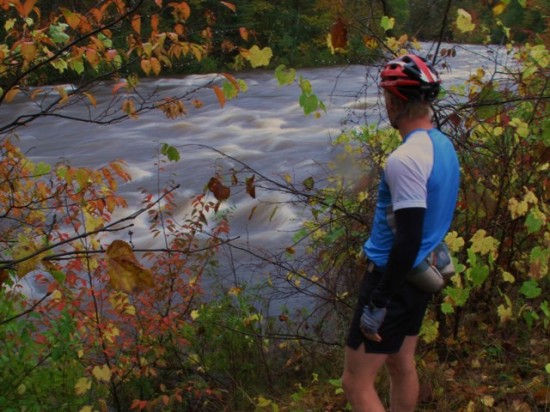
Luckily, no one on the CXC Team is into kayaking, otherwise it’d be hard to pass up water like this after two days of rain.
-
World Cup Survival Analysis
When most people say that World Cup skiers are animals, they probably mean they are fierce, strong competitors. I got my PhD in statistics in a department that found itself working quite often with very strong wildlife biology and ecology departments, so for me that reference leads me to think, “Well, what if they really were animals? What sorts of statistics might I end up doing on these data?”
A common statistical analysis when your subjects actually are wild animals is called survival analysis. Very generally, the aim is to determine what factors influence the survival of, say, bears<1. The poor biologist would spend countless hours over multiple summers capturing, tagging and then tracking and recapturing the shrews or slugs or whatever<2.
The end result would be a bunch of lifetime data (along with other variables) on individual organisms. Then the question is, which variables seem to influence survival rates? There are all sorts of technical details with this kind of data (censoring, mainly) on how to model it that I’m not going to get into here. If some nerdy biologist is reading this and wants more details, let me know, and I’ll put them in the comments.
For everyone else, the basic concept you need to wrap your head around is what a survival curve is. A survival curve tells us what what proportion of animals are alive at each given point in time.
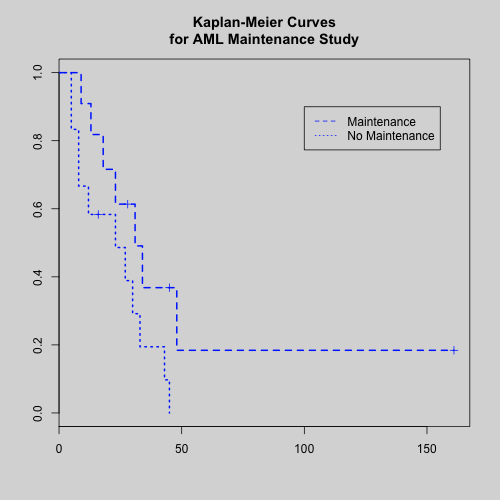
Here’s a quick example that I pulled from the help files of the stats software I use:
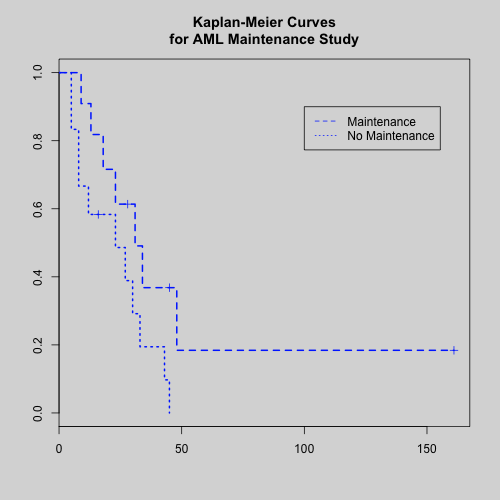
This graph comes from medical research data on humans, and compares two survival curves based on a treatment variable. The “Maintenance” treatment for the study saw better survival rates. The x-axis here is in days, I believe, so each spot on these curves tells us the proportion of subjects still alive after that many days.
Now, how is this relevant to skiing? Consider a skiing career on the World Cup circuit as a “lifespan”. You’re born (first WC start), you ski for a while, and then you “die” (stop racing, at least in WCs). Since I’m keeping this analysis as simple as possible, I chose only the following variables to include in the model:
- Gender
- Nation (Grouped into Tier 1, Tier 2 and Tier 3<3 nations. USA and CAN get their own category; so this variable has five possible values.)
- Number of WC starts by age 24
- Average FIS points of first ten distance results
As you might have guessed, I’m only considering distance results at the moment. My model sifts through the data (lots of stuff being glossed over here) and shows me how survival rates differ with respect to these variables. Here’s the key graph:
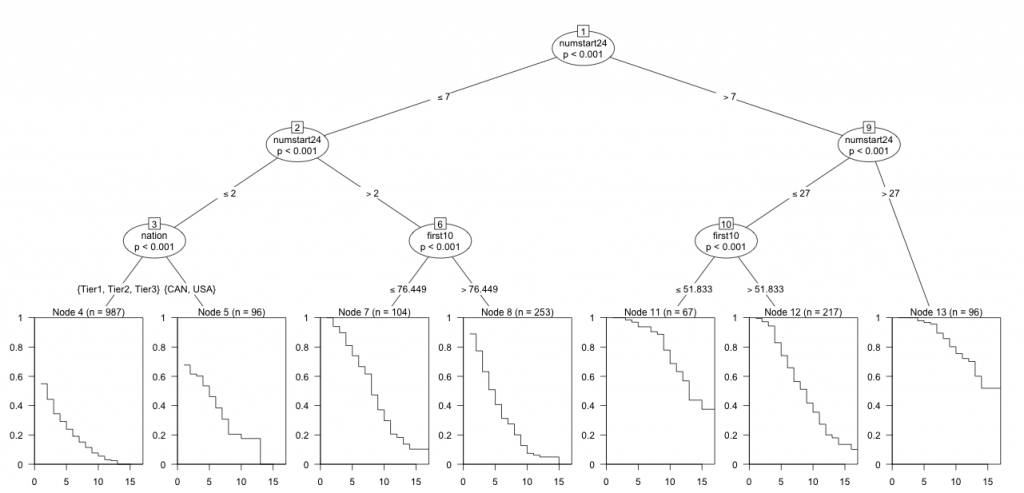
It’s a big one, so you’ll have to click on it for a larger, readable version.
What we have here is a big tree diagram<4. The model has partitioned our data based on the greatest differences it found in survival curves. Reading from the top to the bottom, each oval tells us how the model decided to split things up. (Ignore the p-values.) At the top, we start with all the data, which is then split into two groups: more than 7 starts by age 24 and less than or equal to 7 starts by age 24.
If we follow the branch to the right, we get another split into skiers who’ve had more than 27 starts by age 24 and those who’ve haven’t (i.e. between 7 and 27). Continuing to the right, we come to Node 13, which contains 96 values from our original data set. The survival curve for this subgroup suggests that even after 15 years, we’ve seen only 50% “mortality”. The nodes labelled ‘first10′ refer to splitting on the average of your first ten races. The node labelled ‘nation’ way over on the left looks like something really important is happening there. I’ll come back to that in a moment.
I must emphasize that this model, based on observational data, does not, in any way shape or form, tell us what will happen to a skier if they have a certain number of start by age 24, along with other conditions. It only tells us what has happened to skiers like that. The usefulness of a model like this comes from visualizing features of the data, not making predictions. Neither I, nor the model, is saying that if you take a skier, regardless of quality, and simply give them more starts at a young age, that they will survive longer on the WC.
Ok. The big picture here is that the model has divided our data up primarily based upon the number of starts you’ve seen by age 24. I apologize for the strange numbering of the nodes (ovals) but we’ve got Node 6 (≤ 2 starts by age 24), Node 4 (between 2 and 7 starts), Node 10 (between 7 and 27) and Node 13 (>27 starts). According to the model, that’s the biggest factor accounting for differences in survival rates among our skiers.
Node 13, the group with a ton of starts isn’t split anymore and they have the highest survival rates. The middle two groups, Nodes 6 and 10, are split based upon the quality of their first ten starts. Finally, the group with almost no starts by age 24 is split on the ‘nation’ variable. In general, the survival curves get worse as we move from right to left along the bottom.
That’s what we have. What does it mean? Let’s start at the right and move leftwards. The skiers with >27 starts by age 24 are the people who’ve been identified as great talents early on. Most likely they’ve actually had stellar WC results very early on. There is a reason, after all, that they’ve gotten so many starts at a young age. They’re fast. So it makes sense that they will last a long time on the WC. They aren’t lasting longer because they get more starts, they’re lasting longer because they’re fast. They get more starts because they’re fast.
As we move into groups of skiers with fewer starts, we begin to see a dependency on the quality of their initial results. For example, skiers with a medium number of start (7-27) by age 24 will tend to last longer on the WC if their first ten results average below ~52 FIS points. (Node 11 has a better survival curve, at least in the long term, than Node 12.) A similar thing happens for skiers with 2-7 starts, but the threshold is somewhat higher: ~76 FIS points. Also, the difference between the survival curves here (Node 7 vs. Node
 is a bit smaller.
Finally we have the &le 2 starts group. For North American skiing fans, alarm bells are probably going off right about now, but take a deep breath and chill out. This isn’t as big a deal as it looks. Recall that I classified the ‘nation’ variable into several categories roughly based on the quality of ski programs in that nations (Tier 1, 2 and 3) and then CAN and USA are there own categories.
Technically, what this last part of the model is saying is that among skiers with at most 2 WC starts by age 24, those from USA/CAN tend to survive longer than those from pretty much anywhere else. (Keep in mind that USA/CAN are being compared not to individual nations, but sort of the aggregate of groups of nations.) If this seems counterintuitive, let me attempt to square this circle:
If you’re a skier from, say, Norway and you’ve done ≤ 2 starts by age 24, things are looking pretty bad. Norwegian skiing is super competitive. There’s little chance of you continuing to get WC starts at this rate. At the other end of the spectrum, the Tier 3 nations are made of up countries like Algeria, Israel and the like, countries with almost no ski program at all. These nations tend to send 1-2 skiers to World Championships or the Olympics for national prestige reasons, but aren’t going to spend money on a serious ski program. So athletes from these countries get a handful of starts at big events like these and then disappear because there’s no support in their country for skiing.
The fact that the USA and CAN are singled out here is simply highlighting the fact that we don’t have a very deep pool of racers (compared to NOR, SWE, etc.), but compared to some other countries (Algeria, Israel, etc.) we actually have some money for a ski program. Enough to commit to a continual presence on the WC, at any rate. So we are relatively more willing to commit resources to skiers who “start later” than other countries.
You may recall that gender was a variable I originally included in the model. Well, it turns out that the model didn’t find much difference between men and women, at least in terms of survival rates.
Obviously, this is a very simplistic survival model, but it did identify some interesting features of the data, I think. But I must warn you again that this model is not useful for making decisions about how to produce skiers that will “survive” longer (supposing that were our goal, which it might not). This is intended for exploratory purposes only.
- Usually, the organism isn’t nearly this exciting. Typically I’d see data on something like the western spotted shrew, or the golden mantled ground squirrel. One of those animals I made up, the other I did not. <↩
- Stats grad students would frequently talk about how grateful we were that we didn’t have to do field work. <↩
- Tier 1 = NOR, SWE, FIN, GER, ITA, RUS, Tier 2 = FRA, SUI, AUT, KAZ, EST, CZE and a few others, Tier 3 is everyone else. <↩
- Again, biologists may be wondering what the hell is going on. Tree based models were sort of my bread and butter in grad school, so I’m using a kind of fancy recursive partitioning based survival analysis model. Basically, it’s like a regression tree, but with a survival curve estimated in each terminal node. <↩
Related posts:
- <Variability In World Cup Ski Racers
- <How Well Prepared Are World Cup Rookies? (Part 1a: Distance)
- <How Well Prepared Are World Cup Rookies? (Part 1b: Distance)
-
USOC’s Beyond Sport Summit
span class=”Apple-style-span” style=”font-family: ‘Lucida Sans’, ‘Lucida Sans Unicode’, ‘Lucida Grande’, Verdana, sans-serif; font-size: 13px; line-height: 19px;”span class=”Apple-style-span” style=”color: #351c75;””We all believe sport can bring youth away from and into very important things, away from crime, away from violence, and into academics, into sport, into character development,” Pat Ryan, the head of the Chicago 2016 bid and chairman of World Sport Chicago, said in his address./span/spanbr /span class=”Apple-style-span” style=”color: #222222; font-family: ‘Lucida Sans’, ‘Lucida Sans Unicode’, ‘Lucida Grande’, Verdana, sans-serif; font-size: small;”span class=”Apple-style-span” style=”font-size: 13px; line-height: 19px;”br //span/spanbr /span class=”Apple-style-span” style=”color: #222222; font-family: ‘Lucida Sans’, ‘Lucida Sans Unicode’, ‘Lucida Grande’, Verdana, sans-serif; font-size: 13px; line-height: 19px;”I came across this article on TeamUSA.org, “
-
Mononucleosis
The following should help to explain the dearth of blog entries over the last few weeks.br /br /About a month ago I foolishly occupied myself on an off-day of training by felling trees and bucking up firewood for 8 hours. At the end of the day I was amazed at how tired I was from the effort. I scratched it up to overexertion and ignored it. The following day was a moderately-intense interval session and in the following few days I again had signs of fatigue. And again, I chose to believe it was just overreaching a bit with the training. I rested for a day and a half and, that Saturday morning, felt a lot better and ran the Cutthroat Classic, a 12 mile mountain race in the North Cascades. I didn’t feel spectacular on it but didn’t feel too bad, either. I took it as a sign that whatever fatigue I had been carrying was gone. The following week I resumed normal training and soon felt that same fatigue – inability to complete an intensity workout, less snap in my legs, etc. I again rested for a few days until my morning HR test numbers returned to normal levels. Around that time, we left for the Sun Valley training camp.br /br /When we got to Sun Valley my HRs elevated a bit. I chalked this up to being at altitude. The first workout was a distance run and, despite the slightly higher HRs my energy was good. Then we had a sprint TT. My lap splits in the time trial were pretty erratic – I was dropping off the pace every time and really tying up in the legs. But again, we attributed this to altitude, lack of high intensity training thus far in the summer, and pushing too hard in the first heat. I felt like I recovered in the days following and had a good interval session, speed session and overdistance run. I thought I had gotten past any problems, and excitedly prepared for the 3.5K prologue TT. There again, despite conscious pacing efforts my legs tied up quickly and I felt like I totally blew up, and was way off the pace. I returned home from Sun Valley a bit dejected at my efforts and concerned that something in my fitness was off. What followed was almost a week and a half of full rest, complimented only with occasional easy distance sessions. In these workouts as well I noticed that my HRs were at least 10 bpm higher at a given intensity than they usually were. As well, my morning HR test continued to register high numbers.br /br /Finally, at the urging of Scott and despite my own fears of doctor’s offices, I went to our local doc, Dr. Joe Jensen, and had blood drawn to test for any abnormalities. During the exam he noticed that my spleen was enlarged, along with my lymph nodes, and I also had a bit of a sore throat. He suggested mono. I’d never had the illness before but have heard horror stories of entire seasons being destroyed by the infection. I hoped it wasn’t so.br /br /Blood work came back today: positive for mono. I don’t have the normal high fatigue attributed with the average case of mono so my hope is that I don’t have a very severe case. Doctor’s orders are that I can exercise at low intensities as long as I don’t stress my spleen or go into any glycogen depletion. My hope beyond hope then, is that I can maintain my aerobic base and not be pushed into bed rest, and slowly emerge from this illness relatively unscathed.br /br /Here’s hoping.div class=”blogger-post-footer”img width=’1′ height=’1′ src=’https://blogger.googleusercontent.com/tracker/2910103639238326543-5338097371161544575?l=methowolympicdevelopment.blogspot.com’ alt=” //div
-
Summer DP test at BMD with Newell
Our last video from summer camp. This one was taken during our double pole test at Ball Mountain Dam.divbr //divdivbr //divobject width=”320″ height=”266″ class=”BLOG_video_class” id=”BLOG_video-7e70834cde3719a9″ classid=”clsid:D27CDB6E-AE6D-11cf-96B8-444553540000″ codebase=”http://download.macromedia.com/pub/shockwave/cabs/flash/swflash.cab#version=6,0,40,0″param name=”movie” value=”http://www.youtube.com/get_player”param name=”bgcolor” value=”#FFFFFF”param name=”allowfullscreen” value=”true”param name=”flashvars” value=”flvurl=http%3A%2F%2Fv5.nonxt2.googlevideo.com%2Fvideoplayback%3Fid%3D7e70834cde3719a9%26itag%3D5%26app%3Dblogger%26ip%3D0.0.0.0%26ipbits%3D0%26expire%3D1290805904%26sparams%3Did%252Citag%252Cip%252Cipbits%252Cexpire%26signature%3D25548A8316C8A93D2607F9B0740F927DB60EFA78.777E017157D865A1FDCD7589B313771BFA288C1E%26key%3Dck1amp;iurl=http%3A%2F%2Fvideo.google.com%2FThumbnailServer2%3Fapp%3Dblogger%26contentid%3D7e70834cde3719a9%26offsetms%3D5000%26itag%3Dw160%26sigh%3Dk3PCs2D1uk7OKvmJy3-CUoRAykMamp;autoplay=0amp;ps=blogger”embed src=”http://www.youtube.com/get_player”width=”320″ height=”266″ bgcolor=”#FFFFFF”flashvars=”flvurl=http%3A%2F%2Fv5.nonxt2.googlevideo.com%2Fvideoplayback%3Fid%3D7e70834cde3719a9%26itag%3D5%26app%3Dblogger%26ip%3D0.0.0.0%26ipbits%3D0%26expire%3D1290805904%26sparams%3Did%252Citag%252Cip%252Cipbits%252Cexpire%26signature%3D25548A8316C8A93D2607F9B0740F927DB60EFA78.777E017157D865A1FDCD7589B313771BFA288C1E%26key%3Dck1iurl=http%3A%2F%2Fvideo.google.com%2FThumbnailServer2%3Fapp%3Dblogger%26contentid%3D7e70834cde3719a9%26offsetms%3D5000%26itag%3Dw160%26sigh%3Dk3PCs2D1uk7OKvmJy3-CUoRAykMautoplay=0ps=blogger”allowFullScreen=”true” //objectdiv class=”blogger-post-footer”img width=’1′ height=’1′ src=’https://blogger.googleusercontent.com/tracker/4680416899705879324-2020844792624698534?l=smsxc.blogspot.com’ alt=” //div
-
Dangerous Men Dream With their Eyes Wide Open
Then Spend All Their Waking Moments Actualizing Their Dreams.
Dangerous Men Dream With their Eyes Wide Open
Then Spend All Their Waking Moments Actualizing Their Dreams.