The most controversial of topics. After fitness, the best way to ski faster is to do so more efficiently. There are many opinions on what is the “best technique.” We present different viewpoints from around the ski world.
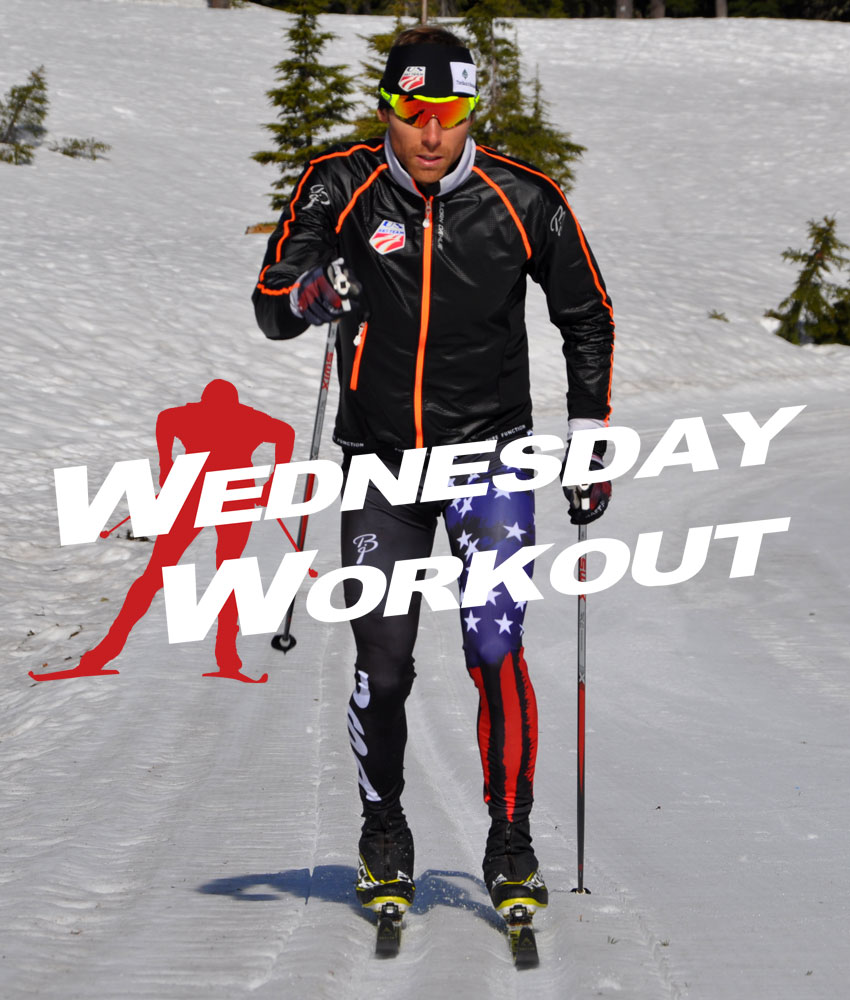
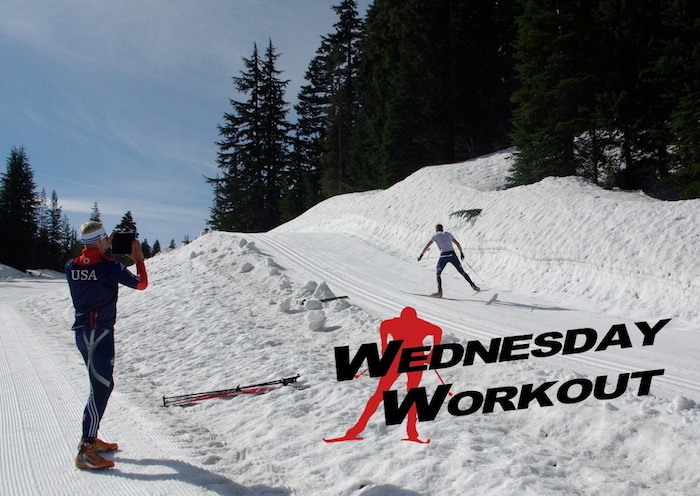
Andy Newell while training with the U.S. Ski Team last month in Bend, Ore. (Photo: Matt Whitcomb)
This week’s Wednesday Workout comes from Matt Whitcomb, the U.S. Ski Team women’s coach. Whitcomb and the team recently returned from their on-snow camp in Bend, Ore., where they practiced improving technique with visualization.
***
Before starting the workout the coach identifies one 10-second clip of one male and one female World Cup skier classical striding up gradual terrain and then plugs it into iMovie. I like the clips of Anne Kyllönen striding up the sprint course in Sochi. If you don’t have access to these clips, YouTube something and video your own computer screen. The quality will be lower but you’ll be surprised at how well it works.
In iMovie, create a project that plays your 10-second clip in regular speed and then in 1/2 speed (totaling 30 seconds), and repeat that six times in your movie project without music or any sound to remove sensory interference so the women’s clip is 2 minutes long. Add a 2-minute clip for the men to watch. Paste a 30-second clip of the women to see one last time at the end followed by a 30-second men’s clip. The total movie is only 5 minutes so you can get out the door and ski more.
Keep the men and women together for the viewing in case one clip works better than the other. Watch on a large TV screen or with a projector play your iMovie clip to the team immediately before going out to ski. As a variation try talking them through the clip one one day, focusing in one one thing the World Cup athlete does well, and on another day try not talking at all to prevent polluting what they are seeing on their own. Many athletes are much better coaches than we are!
If you don’t have access to footage, here is a YouTube video of Anne Kyllönen in addition to other World Cup athletes:
Warm-up for 30 minutes and encourage the athletes to ski by themselves and on similar terrain to what you just watched, trying to channel and emulate the World Cup skier. It’s very easy for some and nearly impossible for others, but the process opens up new windows regardless.
Meet your team on a very gentle downhill slope that is 200-meters long for a drill. Have them ski back and forth, striding both the gradual downhill and uphill. This isn’t about holding your glide for as long as possible on the gradual downhill, but more about feeling the flow of good striding under low tension. Watching our team do this left us feeling that the gradual downhill section unlocked some hip and shoulder tension in many athletes.
Encourage the athletes to ski by themselves and on similar terrain to what you just watched, trying to channel and emulate the World Cup skier. It’s very easy for some and nearly impossible for others, but the process opens up new windows regardless.
After the drill, film your athletes one at a time skiing up a gradual hill. Before they begin to ski toward you, have them rest on their poles, eyes closed and without talking, and visualizing that World Cup clip for 30 seconds. Then have them ski past you. Film the pass on your iPad or phone so they can look at it immediately.
If it works out, great. Please let me know. If not, there are many creative ways to trigger technical improvements. Email me at mwhitcomb@ussa.org if you have a cool idea to share or just drop it anonymously into the comment section :). I would love to take a couple of your thoughts to our glacier camp in Alaska next month. Keep it fun and focused out there!
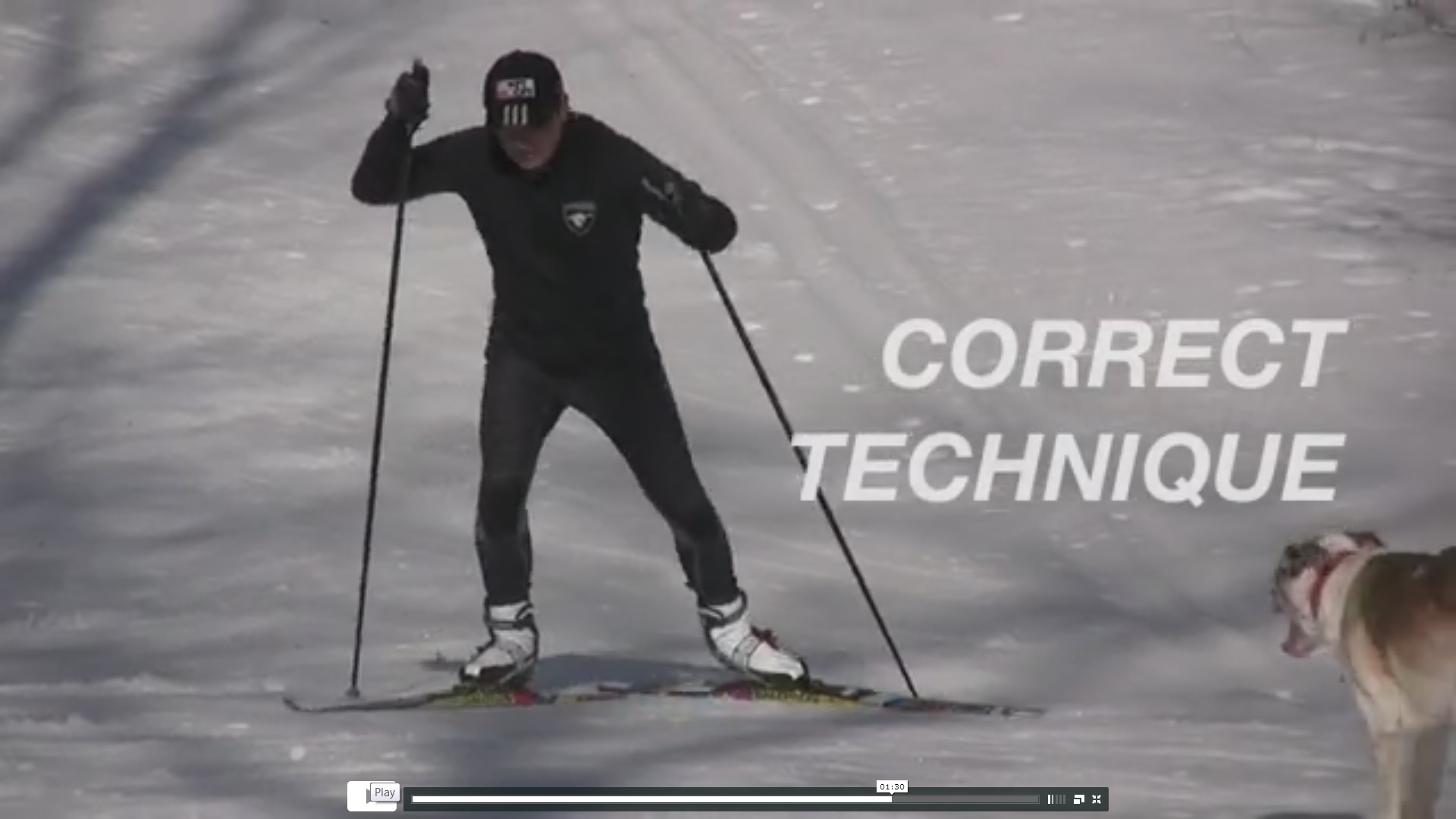
Yuriy Gusev, Central Cross Country (CXC) executive and athletic director, demonstrating proper V1 technique in a CXC Academy video.
You read FasterSkier so it’s probably a safe bet that you would like to, well … ski faster!
And so if, as you recover from the recently concluded race season, you are already thinking about how to improve your race times next year, Yuriy Gusev has a plan for you. A training plan that is.
Intrigued by the CXC Academy, I called up Gusev, executive and athletic director of the Central Cross Country (CXC) Ski Association. The Academy is described on the CXC website as “an online subscription service that provides professional training plans for cross country skiers of all ages and skill levels.”
Gusev explained that was Academy was started in 2007 by himself and former CXC elite coach Bryan Fish (now the U.S. Ski Team development coach) as a way to share the state of the art ski training expertise that Gusev and Fish compiled while developing the CXC elite program.
“Bryan and myself made a lot of connections with sports professionals in strength and conditioning and sports science and medicine,” Gusev said. “We started brainstorming what can it [the Academy] be and who can it serve.”
CXC Academy promotional material summing up its offerings
In its early stages, the Academy was envisioned as at tool to share information for training elite athletes. While the Academy still contains an elite-level plan (plans similar to those used by CXC elite-team alumni Brian and Caitlin Gregg, Matt Liebsch, and Jessie Diggins), the program quickly expanded to include novice, intermediate and elite level format.
“Initially we thought it would work just for coaches, but it has developed pretty quickly that it can be used by anyone all over the world,” Gusev said.
So how was the elite plan modified for intermediate and even novice skiers? “We had a lot of discussions after the first year … what we did is simple, really,” Gusev explained. “We minimized number of workouts per week and number of hours and that mostly takes care of different levels. For example, somebody who trains 260 hours per year who just wants to ski the Birkie … [they don’t] need to do two Level 4 workouts a week. They might just need to go at Level 3 just above their comfortable pace for an hour and half once a week.”
I explained to Gusev my difficulty in researching how to train for two 50-kilometer citizen races (the Seeley Lake, Montana OSCR and West Yellowstone Rendezvous) last winter. My research left me overwhelmed about how I should incorporate various training elements such as intervals, strength training (I decided strength must be important after watching Kikkan Randall do pullups with weights strapped to her waist) and my first-ever pair of rollerskis, into my race preparation.
While chatting with Gusev, I discovered I wasn’t the only one lacking a training plan. “Believe it or not, we just had a coaches conference in November with about 50 coaches, both club and high school coaches, and I asked pretty straight forward question: How many of you give your athletes a day-by-day training plan?” Gusev recalled. “And probably two or three hands went up.”
He went on to explain CXC’s philosophy regarding training plans. “What we believe in our organization is that any structured plan is better than no plan,” he said. “We have athletes on that plan. We have heard from high school coaches to masters skiers to senior level athletes that they have had the best seasons ever … and they still continue to improve season after season.”
Gusev added that the Academy is for everyone from those training for marathons or short-distance races, from a high-school skier to someone who’s qualified for nationals.
“Any structured plan is better than no plan.” — Yuriy Gusev, CXC Executive Director
Sample CXC Academy training plan layout
I told Gusev that most of my resistance to training plans was what I perceived as their inherent rigidity. I have friends who love nothing more than to see their training laid out before them on a neat, orderly grid with a little box in the corner to check when the workout has been completed. I am not one of these people.
To me working out is essentially goofing off, an escape from demands of work and life. I live in Missoula, Mont., if the weather and my work schedule allows for a short mountain-bike ride on the same day when the training plan calls for strength workout in the gym, I’ll dump the plan in a heart beat.
I asked Gusev about how his training plan can work for people with busy lives.
“From the user side, what we’ve heard is that some people follow it like a bible, literally day by day, and some people try to adapt it to work and family and other things,” he said. “What we suggest to people is that this is a road map … you know, its just getting those pieces done some time during the week. That’s what’s really important and everyone has a different way of how to structure the week around training.”
Regarding alternate training activities, Gusev said, “That’s the perfect situation, if someone can do other activities, whether you are an elite athlete or you want to be a wave Birkie skier … you just do those workouts by bike or kayak or by foot or the swimming pool but you follow the plan to build your training. Obviously, the more specific you can be the better it is. Some people might choose to rollerski once a week, and some may choose to not rollerski until September or October … so everyone is different. Even at the elite level there is no single formula out there that will make you fast.”
I discovered the Academy midway through my ski season and signed up for my free one-week introductory membership. My next race was the Peter Hale Memorial, a 22 k race with over 1,000 feet of climbing so I watched an Academy video on V1 technique. In the video, Gusev demonstrated the importance using both legs equally regardless of which side you are poling on. I focused on that single tip during my entire race. I told Gusev that I finished ahead of two racers who had beaten me [quite easily] in a race two weeks earlier. It was the first time I had ever finished ahead of one of them!
I asked Gusev if my focus on his tip could have made the difference for my improvement. “It could be, easily,” he replied. “We have a lot of people email us literally a week before the Birkie, and they say, ‘I didn’t train at all — I just want to make it through.’ You’d be amazed at how many people there are like that, and you know, there’s no magic wand to make them better, but there’s some things you can tell them, some basic tips just like what you talked about with V1.
“I’ve heard from a lot of people that we’ve given advice and they said it was magical,” he added.
CXC Academy video library
CXC Academy has a video library which Gusev said sets them apart, providing both technical advice and a visual demonstration of how it should be done.
“What we learn with a technical sport like cross-country skiing that the most important part for people to understand is what they should be doing … and how the technical elements [of skiing] make them more efficient and faster,” he said. “I haven’t seen anything else out there that gives that advice.”
The Academy video offerings are extensive and include sections on strength training, on-snow skiing for both skate and classic, rollerskiing, dryland training, waxing and equipment. The videos are tightly integrated with the training plans. For example, the intermediate training plan for April calls for one day of general strength training per week. A video demonstrating all recommended exercises is linked to the plan. On a recovery day during the race season the plan might recommend that you get some wax into your ski bases and a link to a waxing technique video is provided.
The CXC Academy offers a free five-day trial period. A one-month subscription is $14.95 and one-year subscription costs $119.40.
“Those paying members … help us pay the cost of servers, the cost of hosting videos. There is cost in everything,” Gusev said. “We we give complementary memberships to Paralympic team members and high level para-athletes. Those paying memberships allows us to have this resource, and without them we couldn’t help those Paralympic athletes and organizations like National Nordic Foundation.”
Gusev said the Academy’s support of the U.S. Paralympics Nordic program wasn’t planned, but there was a need.
“We were at Park City at the National Ability Center ski camps and they had development athletes from all over the country … and they didn’t have one centralized place for getting a plan,” he explained. “For some of them, if you have an adult who has never done any athletic training in the past, now with a disability trying to do a competitive sport, for them a training plan is like, they don’t even know from what side they need to look at it.”
Since I’m just getting started following the intermediate training plan, I asked Gusev what I can expect next ski season.
“You will go faster when you want to go faster and it will be a lot more enjoyable to go faster,” he responded. “I don’t race any more, I don’t have time … but I enjoy when I go ski and I can go up a good hill at a good pace and enjoy it. I can go ski for three hours if I want to.
“Really, what [the Academy] does is builds all components of training, from anaerobic to aerobic and speed and endurance, so it gets to the point where you can do anything you want to,” he added.
I told Gusev that I race mainly to provide goals to get me out exercising and skiing. While I love skiing, I don’t consider myself to be a racer. I asked if his training plan is appropriate for someone like me.
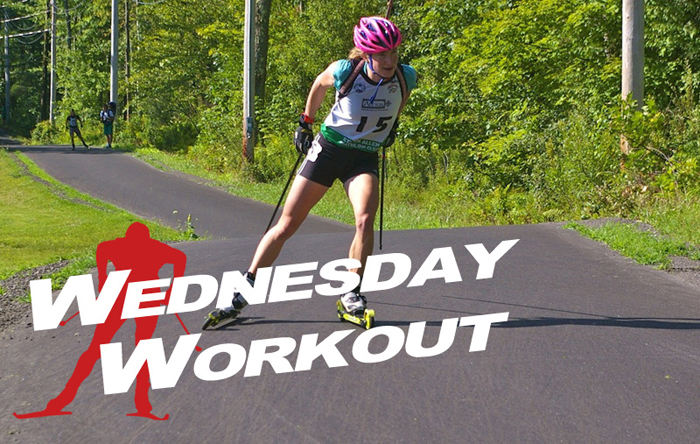
Hannah Dreissigacker (Craftsbury Green Racing Project/US Biathlon) closing in on a 31-second win in the 7.5 k sprint on Aug. 10 at North American Biathlon Rollerski Championships in Jericho, Vt.
Welcome to Wednesday Workout, where we provide and break down training ideas on a weekly basis. This week, Hannah Dreissigacker, a 26-year-old member of the Craftsbury Green Racing Project who made the US Biathlon A-team this year, talks about how she’s made strides in her sport — specifically in shooting — and why combo workouts are some of the best ones biathletes can do.
***
As I’ve transitioned from being a Nordic skier who dabbled in Biathlon to what I like to call a “real biathlete,” it has been a constant learning process. One of the biggest obstacles I had to overcome was my own hope that if I just trained with my Nordic teammates most of the time, and then worked on shooting as much as I could on the side, that would transfer to good biathlon performance. Unfortunately, that sort of training only gets you so far in biathlon.
So although I know that most of you FasterSkier readers are not biathletes, this “Wednesday Workout” will be a little peak into what its like to really train specifically for biathlon. This workout could also be done without shooting—each shooting stop only takes about 30 seconds, but it’s really designed to be about both the physical and shooting-specific training.
Shooting with intensity is what it’s all about. From the point of view of getting better at shooting in a race-like situation, it would be good to shoot with a high heart rate all the time. But since you can’t do intensity every single day, it’s really important to take advantage of the days that you are doing intensity by turning the interval workout into what we call “combos” in biathlon. Since you stop between intervals anyways, you might as well be shooting during that time! And even if the goal is a continuous intensity workout, a 30-second stop to shoot does not have much effect.
This is the workout that I feel has been my “bread and butter” this summer—I’ve done it more times than I can count and I think that doing it consistently has helped improve both my fitness and shooting skills.
Zero the rifle (shooting on a paper target to make sure that my group of 5 shots is centered in the middle of the target).
20-30 minute warmup. I like to warm up nice and easy.
8 x 10-15 second “impulses,” also known as pickups. After each impulse, I quickly put my rifle on my back and shoot while my heart rate is still high and my body a bit jittery from the short speed. This is great practice for trying to calm myself down, and also for shooting with a pounding pulse. I try to use a mix of techniques for the impulses, to spread the love. A minute or two of easy skiing between each impulse is good.
6 x 5-7 minutes Level 3 intervals. I really like the new rollerski loop in Lake Placid for this because it’s a real ski course with variations in terrain, a few technical downhill turns, and some hard uphills. This gives the Level 3 training a lot of variety. On the uphills, I have to hold back a bit and focus on relaxed technique and good glide. But on the transitions and flatter parts I can really push and go for lots of power. I like to end each interval on an uphill approach to the shooting range, so that my heart rate will be high when I come in to shoot. And despite being tired, or hot, or sweaty or thirsty, I try to just focus on shooting quickly, efficiently, and normally every time I come in. I think about my breathing and about pulling the trigger gently. Then after that I can get a drink and take a short break while I put my rifle on the rack again. After successive intervals, I usually alternate prone and standing shooting. And I also try to put a little pressure on myself when I come in to shoot—I imagine that I’m in a race, and think about how well I need to shoot to do well, or how many or few misses I’ve made so far in the day.
20-30 minutes continuous Level 3 skiing on the road, usually going for a total time of 1 hour of Level 3 work. Occasionally we’ll do more L3 with shooting, and so we’ll skip the road part, but often we finish the workout out on the roads. For one, this gives us some time to just ski continuously without shooting. But it also generally gives us faster, flatter terrain. It feels very different both physically and mentally to ski L3 continuously on a flat road than it does to be going up and down big hills all the time.
Short cooldown. This workout can get long, so I keep my cooldown short and easy.
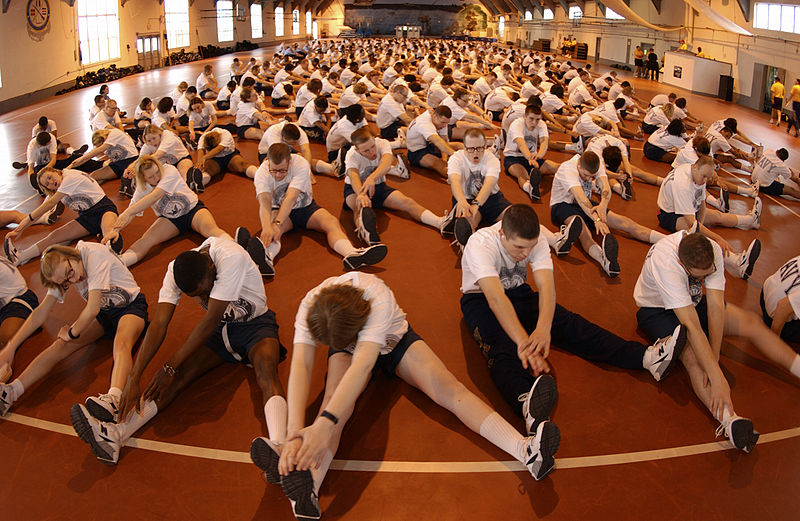
If we could all just stretch a little more effectively, it would go a long way. (Photo: US Navy recruits/Wiki Commons)
Many of us have realized minimal gains with static stretching. For many it seems to be the training element we shove off to the end of the list even though we know it is important. Maybe we do this because for all the time we spend, we don’t get much positive reinforcement?
Static stretching tends to yield short-term changes in muscle lengths. Ever notice about 10 to 15 minutes into your workout you feel tight again? It is because we have not addressed the root issue of what is driving the muscle tightness. We may get a few degrees more range of motion, but it is short lived.
Why are the hamstrings and calves tight to begin with? For a long time, I thought it was due to those muscles being worked more, shortened due to growth spurts or inconsistent flexibility routines. Then I learned that this was only a part of the picture. Yes, these muscles were working extra, but because others were not. The main reason for the tightness had nothing to do with the muscle length, but the muscles that keep them tight are more active or “turned on” when they are not supposed to be, which will keep them tight. Essentially the muscles that are abnormally tight are working extra and always turned on.
In my last article, ‘The Freedom of Movement,’ I discussed the importance of mobility and stability. Physical therapists, doctors and trainers have different theories on which element is best to address first. To a certain degree as we still develop our diagnostic tools, it will continue to be a chicken-and-egg conundrum. Since everyone’s body reacts differently, the best approach is to try a different method of improving flexibility and re-test your mobility or stability to see if it has an effect.
Since we need to look at the muscles as an interrelated system, we should use mobility techniques as such as well (i.e. not stretch one isolated muscle group, but address the whole system). We address the system by turning on the muscles that are not activated (but are supposed to be), while at the same time lengthening the target muscle group we are hitting.
Since no muscle group works with out interacting with other muscle groups, I like to think of targeting an area versus a specific muscle group. For example, instead of stretching just hamstrings, I like to think of stretching the hip, calf and foot muscles, all of which are involved with the hamstrings. Often, we may think our hamstrings are tight when it’s really our hip flexors and weak core driving the movement restrictions.
How to Stretch
Since our bodies work best fully mobile, we ideally want to exercise after improving our mobility.
Hit your primary trouble spot with a mobility exercise sequence, for example, a toe touch (as detailed below)
Then move into your workout.
This will take 10 to 15 minutes, but you will feel like a different athlete for most of your workout.
Since many skiers tend to have tight hips, and especially those that use cycling as their core form of endurance base building – the body position in cycling tends to shorten hip flexors – I will use the hips as a starting-point example. Please keep in mind this is one example of multiple ways to address this.
What will work most effectively to keep these changes in is flexibility coupled with strength exercises that teach and reinforce this improved muscle firing pattern. After a short time, the additional strength exercises will make the improvements in flexibility long term (for days/weeks), versus for 20 to 30 minutes.
What works best for each person will again be driven by what you learn in your evaluation or FMS screening. For making long-term changes in your flexibility muscle release helps for a short duration, but will only elicit a change for a short while, unless we continue to work on fixing the system. The exercises below are based off the work of physical therapist and author Gray Cook.
Hip Mobility
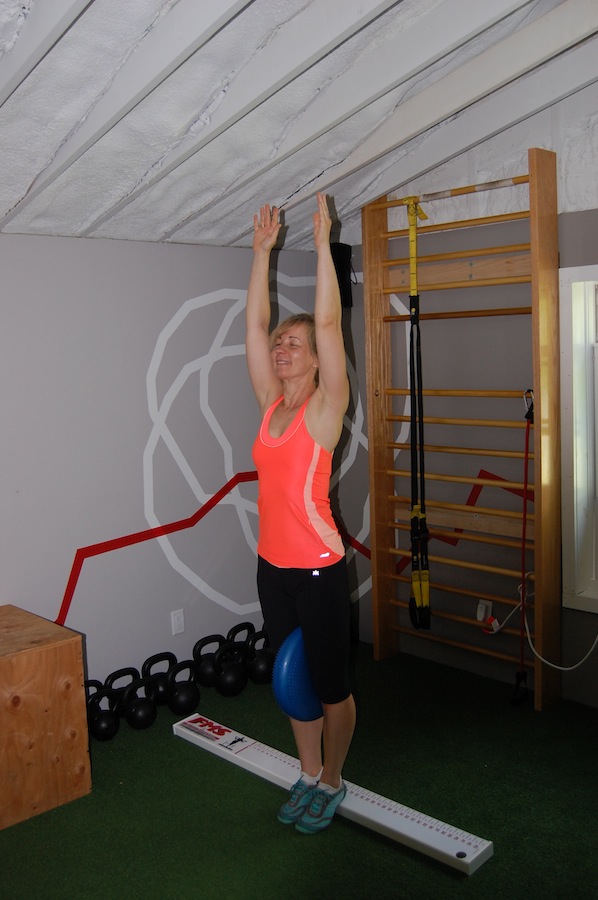
Figure 1: Toe-touch demonstration
Toe-touch example:
Goal: Release tight hamstrings and hip flexors as a system.
Start by doing a toe touch to see your existing range of motion.
Foam roll back and forth 15-20 times: hamstrings, hip flexors, calves, abductors (outside leg muscles), adductors (inside leg muscles), and glutes. (For some folks, try rolling out your foot with a golf ball)
Start with toes up (figure 1) on a 2-inch board and a towel roll between knees, reach up, inhale, then reach down. When you hit resistance, pinch your knees together and stretch more (figure 2). Bend knees if you still cannot touch your toes. Repeat 6-10 times.
Start with heels on a 2-inch board and a towel roll between knees, reach up, inhale, then reach down (figure 3). When you hit resistance, pinch your knees together and stretch more. Repeat 6-10 times.
Figure 2: Toe touchFigure 3: Toe touch
Hip Flexor:
Goal: Release tight hip flexors as a system.
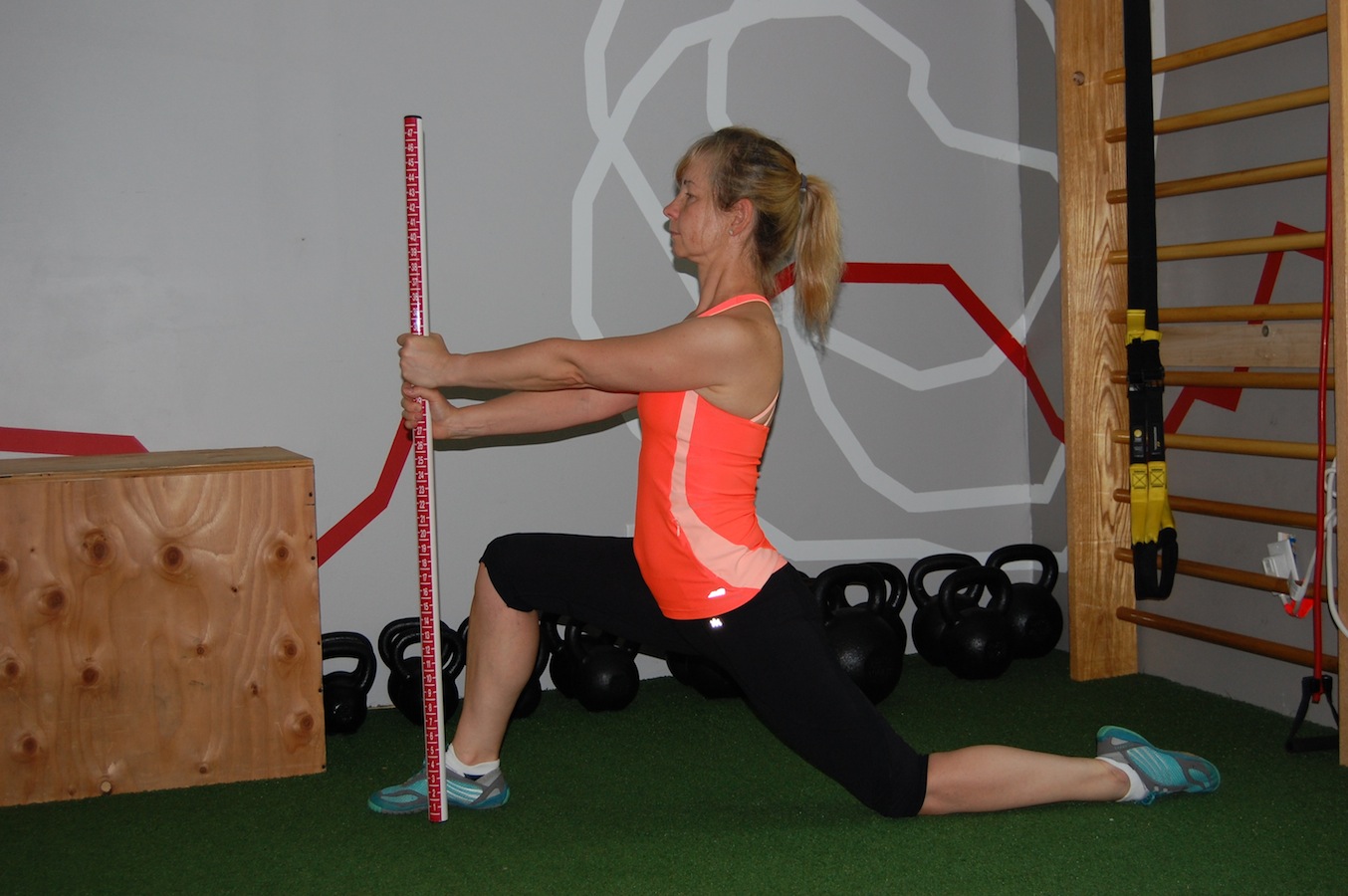
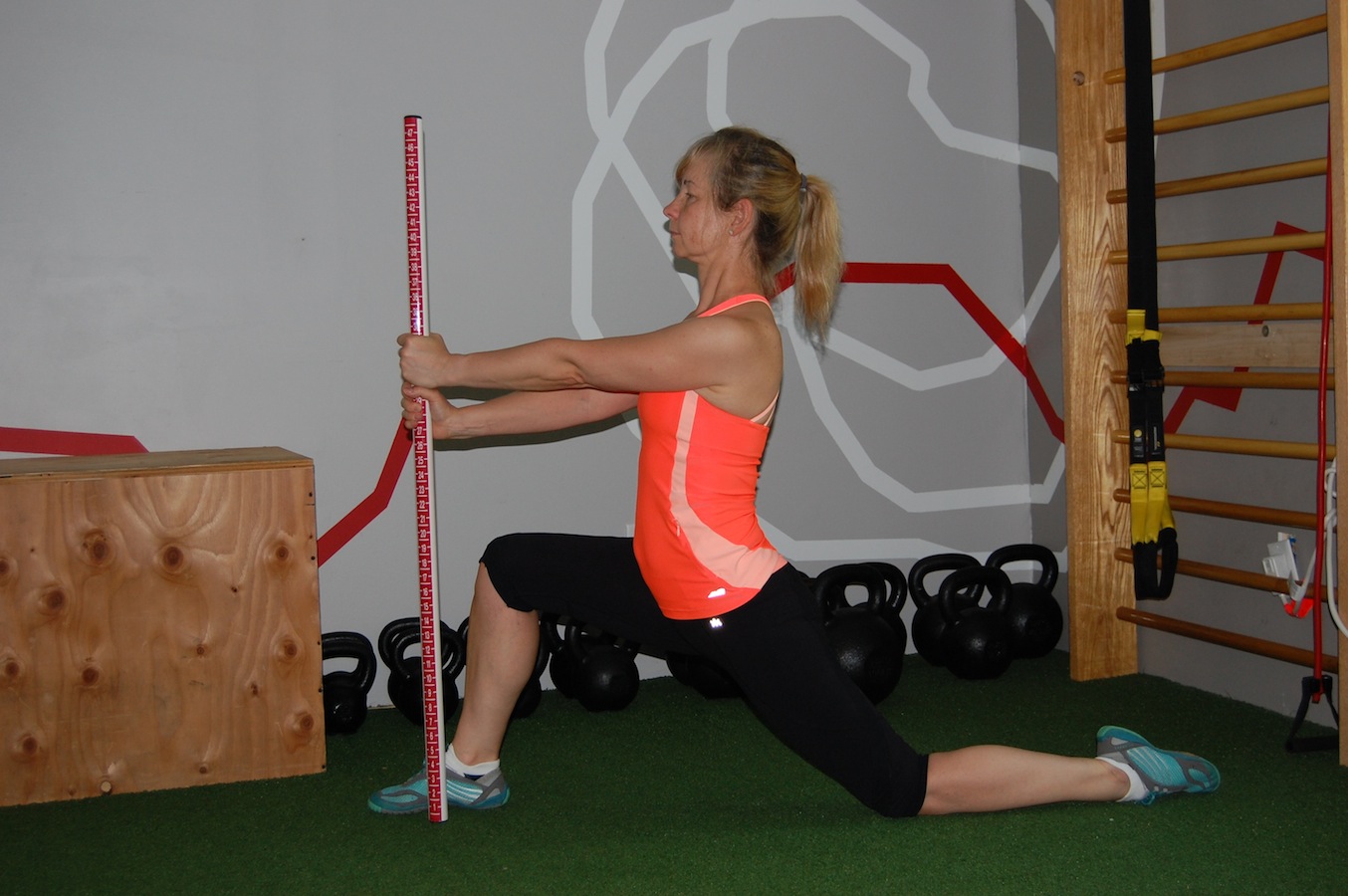
Figure 4: Hip flexor release
Foam roll back and forth 15-20 times: hamstrings, hip flexors, calves, abductors (outside leg muscles), adductors (inside leg muscles), and glutes. If you did this for other exercises, no need to repeat.
Position yourself as in figure 4. Press hips downward into the ground
When you hit resistance, press the dowel into the ground with straight arms, keeping back straight, exhale. This will release the hip flexor further by engaging the core.
Repeat 2-3 times. Switch legs, repeat.
Ankle Mobility
Ankle mobility is important for correct running mechanics. Without the nominal 30 degrees of ankle dorsiflexion (the range of motion in the ankle when the toes are flexed up), one will tend to “over stride” or “block out” (strike the ground too far ahead of their center of gravity) when running.
This can lead to a host of problems do to the repeated jarring and deceleration of the bodyweight when running. It can lead to shin splints and knee and hip injuries. Lack of mobility in these muscles can also cause Achilles tightness and over-active muscles involved in stabilizing the body, perhaps even contribute significantly to compartment syndrome, which can be caused by over-active muscle tissue that swells within it’s muscle sheath (like a piece of wet spaghetti swelling in a straw).
As I explained in my previous article, if mobility cannot happen in the joint and muscles that were meant to handle these forces, it is transferred to adjacent muscles and joints that were not designed to mange these forces, and injury occurs.
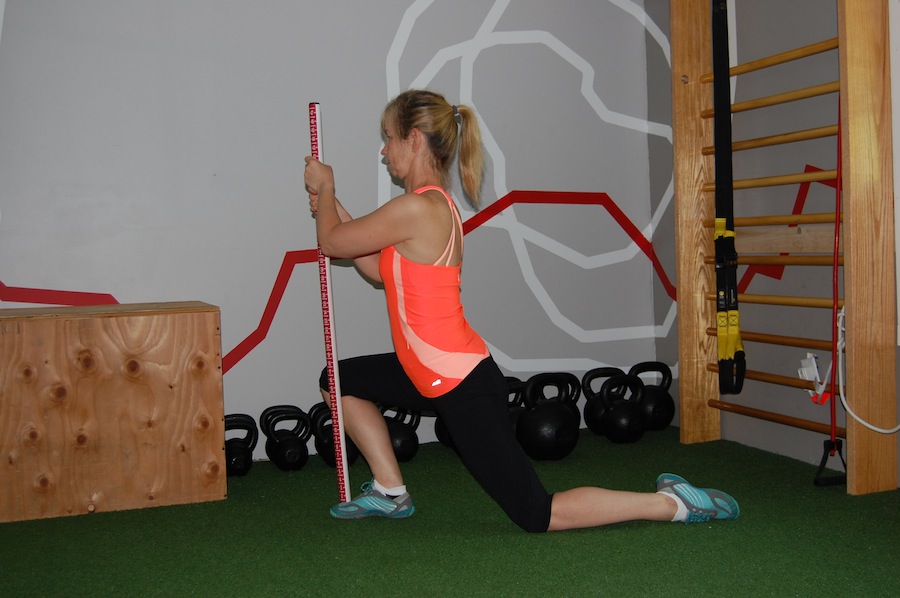
Figure 5: Ankle release
Ankle release:
Goal: Increase ankle mobility by stretching inter-related muscle groups.
Foam roll back and forth 15 to 20 times: hamstrings, hip flexors and calves. Roll out foot, calf and anterior tibialis (front of shin) muscles. If you did this for other exercises, no need to repeat.
Position yourself as in as in figure 5, dowel on the outside of your little toe, knee on the outside of the dowel, press ankle forward with heel flat. When you hit resistance, press the dowel into the ground with straight arms, keeping back straight, also press opposite knee down into the ground, exhale. Hold for 4-6 seconds.
Repeat 6-8 times. Switch legs, repeat.
After you have done these, re-test your toe-touch, move around and see how your body feels with the improved flexibility.
Having good mobility though out your body is important for movement efficiency, not only injury resistance. You may not be getting injured do to some flexibility deficiencies but you may move with less efficiency, and who does not want to be a little (or a lot) faster?
Coach Jonne Kahkonen takes video of Tim Burke during a workout at last spring’s Bend camp.
Welcome to Wednesday Workout, the newest workout series on FasterSkier. During the offseason, we’ll feature components of summer training programs from top individuals and teams throughout the U.S. and Canada at the junior, college and elite club levels. If you ever have a workout suggestion or training question, send them in to info[at]fasterskier.com.
***
As athletes ease back into training this spring, they will gradually introduce each component of their training plan back onto the table: distance. Strength. Threshold intervals. Hard intervals.
What about overdistance? “OD”s are long, base-building affairs, and it can be hard to know where to start after a month or more of relaxing. Can you jump straight into a two-hour run? A three-hour rollerski?
The U.S. biathlon team is luckier than most, as coaches Per Nilsson and Jonne Kahkonen say that all of their athletes are returning to camps this May at about the same level of fitness; that removes some of the guesswork. Today in Bend, Oregon, they’ll be tackling a classic OD on snow, probably in the range of three to four hours, depending on the athlete. In the thick of the training season, cross-training workouts on the bike could last up to five, but there’s no need for that now.
That said, this is the first volume block for the team. The coaches estimated that in nine days, divided into two four-day training blocks with a rest day in the middle, the biathletes would hit between 35 and 40 hours total.
“Bend is the place to be if we are talking big hours in the beginning of the season,” Kahkonen said. “It’s perfect here to get on snow and have the opportunity in the afternoon workouts to go out for either mountain biking or running.”
As the athletes build their endurance base and prepare for other types of workouts, Nilsson and Kahkonen discussed how to execute today’s workout well – both if you’re lucky enough to be on snow, or if you’re stuck doing dryland.
The Workout: “The main goal for sure for all this type of workouts is to have as much continuous work as possible and not too many stops,” Kahkonen said. “In our training system we have Wednesday as the day when we have a long session in the morning and then a halfday off. Here the standard is 3-4 hours.”
As always, there’s a balance between skiing continuously and getting something useful out of the workout besides just the hours. The team tries to have some OD sessions that focus on technique as well.
“It’s important to work on the key elements in the ski technique: postition, weightshift, rhythm, and balance, even if you are going pretty slow,” Kahkonen said. “This is not easy to do from the focus side, but you can see that the athletes that have that in the mind are most of the time also the athletes that have the best technique. We either work with the video or sometimes try to follow an athlete.”
(“It gets harder every year,” he smiled.)
As for the pace, it can’t be too fast or too slow. How to control it?
“By heart rate or feel,” the coaches said. “If you can talk the whole time then the pace is too slow!”
Some teams throw in sprints or mini speeds along the way to break things up; Nilsson and Kahkonen eschew that, saying they’d save it for other workouts. For them, an OD is a continuous workout, and the next most important thing to focus on is technique.
As such, they have their athletes ski mostly solo, especially in skate OD’s, where there is a more technical focus.
“For the specific workouts it’s better to go more alone,” the pair explained. “If you ski side by side and talk, it’s not so productive for the ski technique. In other activities it’s fun and they can run, hike, or bike together in the group.”
Finally, the team knows how lucky they are to be on snow right now. It’s a recent development; last year was the first time the biathlon squad made the trip to Bend, and before that they started their seasons in Lake Placid with dryland.
For athletes in similar positions, Kahkonen had a few suggestions about how to ease the body into dryland OD’s.
“If you are on other places, I think cross-training is good in the beginning,” he said. “You can combine two different activities so you don’t overdo it, especially the impact from the pavement.”
Is this just as important as what happens in the wax cabin? Photo: Wikimedia user Erobins/Creative Commons.
Welcome back to This Month in Journals, where we read the latest exercise and sports science and pull out some research that might be of interest to skiers.
* Many skiers build coffee into their pre-race rituals – and it turns out, they should. For decades scientists have been finding that caffeine increases endurance in more mainstream sports like running and cycling. But finally, someone decided to look at caffeine’s effect on skiing.
Published in Medicine and Science in Sports and Exercise online ahead of print, Dr. Hans Stadheim from the Norwegian School of Sports Sciences in Oslo and his team set ten high-level skiers on an 8-kilometer double-pole time trail; each participant did the test twice, one after ingesting caffeine and another time with a placebo. Eight of the ten subjects improved their times after taking caffeine, and overall the times dropped by about a minute and a half. This represented a four percent change.
The researchers are excited about their results because they are the first to test this effect in a primarily arms-based activity; arm and leg muscles differ in both the types of muscle fibers that make them, and the amount of carbohydrates they use to extract different amounts of oxygen during exercise.
The team not only showed that caffeine was beneficial for performance, but also gained some insight into its mechanism. For instance, they found that skiers who had ingested caffeine were able to maintain higher heart rates throughout the test, a difference of about five beats per minute. Skiers were also able to reach higher blood lactate concentrations after taking the caffeine. Finally, questionnaires showed that participants had lower perceived exertion and less pain during tests after taking caffeine.
The size of the benefit gained by caffeine users was impressive, and the authors made sure to frame it as such.
“The improvement of 4% after ingestion of 6 mg · kg-1 CAF observed in the study would most likely effect results in real life XCS competitions,” they wrote. “Actually a reduction of 1:25 min to complete the 8 km C-PT is [analogous to] the time difference between the winner and 12th place in the 2011 World Championships relay… in Oslo.”
Takeaway message? Don’t forget that cuppa joe on race morning!
* Careful, though. A study published in the Scandinavian Journal of Medicine and Science in Sports suggests that the use of nutritional supplements changes people’s attitudes towards what is or isn’t acceptable performance enhancement.
Dr. S.H. Blackhouse of Leeds Metropolitan University asked: are supplements a “Gateway to Doping?” They surveyed over 200 high-level athletes – just under half of whom used nutritional supplements – across 32 sports and received surprisingly honest answers. For example: 22% of the athletes who used supplements admitted to doping, while just six percent of the non-users did the same.
The athletes were also presented with scenarios related to supplements and doping, and asked both what they would do and what they thought others would do. Supplement users had significantly more positive attitudes towards doping, and also were significantly more likely to think that doping was effective and would help them win.
Interestingly, both groups said that they would prefer to compete in an environment where there was no doping. But supplement users perceived a greater pressure to dope, and also gave higher estimates of the percentage of athletes in their sport who were doping.
“Athletes who engage in legal performance-enhancement practices appear to embody an ‘at-risk’ group for transition toward doping,” the authors wrote. “…This common practice may lead to a greater willingness to engage in doping behavior if athletes perceive the benefits of using NS have been fully realized and believe that doping is an effective enhancement method.”
However, while the authors found the correlation between supplement use and propensity towards doping both significant and troubling, they didn’t fully accept the “gateway” mechanism that has been proposed both here and in other drug situations. Indeed, they questioned whether doping chronologically followed supplement use, or whether both were simply a symptom of the same thought process.
The paper’s final discussion touched on two further issues. The true level of doping in sport is unknown: it is certainly higher than WADA’s adverse analytical findings log, which calculates a rate of about two percent. But how much higher is it? Previous studies have found projections ranging from six to 34 percent. The supplement users reported a 22 % doping rate and guessed that was about typical of the athletic population (although estimates ranged widely, with a standard deviation of 23).
This highlights what may be a feedback loop. Regardless of the true level of doping, athletes who perceive doping to be more prevalent may feel more pressure to dope. In this study, the athletes who did not use supplements were either blissfully unaware of the scope of the doping problem, or were more realistic and optimistic than the supplement users. Either way, their perception of a lower rate of doping coincided with feeling less pressure to do so themselves.
Finally, the authors pointed out that some substances, like creatine, are on the line between being considered illegal performance-enhancing drugs and simply nutritional supplements. For athletes who use and believe in supplements, these types of drugs may create confusion and influence their decisions as they move towards the world of doping.
* A quick piece in the British Journal of Sports Medicine aimed to address whether the minimalist footwear craze is all it’s really cracked up to be. Specifically, is running in such “shoes” the same as running barefoot?
When the runners were barefoot, they had shorter and quicker strides, even while running at the same speed. There were differences in knee and ankle flex and angles, too, but only between barefoot and “shod” running – not between, say, minimalist footwear (in this case Nike Free 3.0 shoes) and racing flats. When running barefoot, power production shifted from the knee to the ankle. That wasn’t replicated with the Nike Frees.
This is somewhat in contrast to other studies, including one that was published looking at Vibram Fivefingers footwear. But other studies have used recreational runners, where this research team, based on Australia, recruited highly-trained runners. They hypothesized that at that level, running mechanics may be so deeply ingrained into athletes that type of footwear has less of an effect, compared to occasional runners who may change their form considerably based on how their feet hit the ground.
This Month in Journals is our occasional series surveying the world of sports science and trying to extract tidbits of research that might be of interest to the skiing public. Previous editions can be found here:March, February, January, December, October, and September.
The Lake Placid USST Elite Camp concluded Friday with morning ski running/bounding natural intervals at Mt. Van Hoevenberg (shown above) and a distance double-pole session in the afternoon.
LAKE PLACID, N.Y. – Friday morning’s U.S. Ski Team workout at the Mt. Van Hoevenberg nordic trails wasn’t designed to be too hard. According to men’s coach Jason Cork, the idea was to run with poles and ski bound for 45 minutes at Level 3 – a sort of tempo pace.
Once a couple dozen athletes between the U.S. Ski Team (USST) and National Elite Group (NEG) got going around the designated loop, most realized what they were in for. Two weeks of dryland training at the USST Elite Camp in Lake Placid had taken its toll on their bodies, and on the last day of camp, they had to tackle Russian Hill – three to four times.
Cork said he’d noticed the group’s fatigue levels increase throughout the last few days, especially during warmups.
“You can see people are getting a little sloppy; you can tell they’re getting pretty fatigued,” he said. “But that’s kind of the whole point of having a training camp, you get the best guys together and have them kind of push each other a little bit and have an easy week afterward.”
Friday afternoon, several athletes took part in the camp’s final workout – a 1-½ hour double pole – which USST head coach Chris Grover said was more of a recovery.
According to Grover, the morning session was considered threshold-intensity, natural intervals. He went on to explain in an email how those intervals work.
“The terrain dictated when the athletes were working harder (uphills) and going easier (downhills and flats),” Grover wrote. “They were probably above threshold at the tops of the hills and well below threshold at the bottoms of downhills. A workout of this duration (45 min.) probably has about 25 minutes of real threshold work-time. But it closely mimics the demands of ski racing, which is important at this time of year.”
Ryan Scott (Team HomeGrown/SSCV) leading the pack up Russian Hill at Mt. Van Hoevenberg during Friday’s threshold workout at the USST Elite Camp in Lake Placid, N.Y.
The loop was marked by two big climbs, one of which was Russian Hill. It took the front group, with Ryan Scott (Team HomeGrown) leading about seven men and Liz Stephen (USST), about 11 minutes to complete. Others rounded the loop in about 15 minutes, and kept the effort going for 45 minutes or more.
Asked what was next for many of his athletes, Grover said off days.
“Some athletes will take just one day off after the camp, others will take two, and some will focus on active recovery for a few days,” he wrote. “It just depends on how each individual handled the load of the camp.”
Looking back, Grover was satisfied with how things went throughout the last two weeks, with workouts ranging from intensity bounding intervals up Whiteface Mountain to the Climb to the Castle Rollerski Race up its access road. On Thursday, 40 skiers competed in a classic rollerski sprint time trial at the Olympic Jumping Complex.
“I was impressed by the improvements of many of the athletes at the camp, USST athletes and club athletes alike,” Grover wrote. “Some of the most biggest gains in my mind include Liz’s overall fitness, Ida’s technique improvements in both skate and classic, Skyler’s performance in the sprint, and Ryan Scott’s performance in just about every workout. We had close to 50 of the country’s best athletes at the camp, across a spectrum of age groups, and it was really cool to see how hard everyone was working and how professional these athletes really are.”
Next on the USST agenda is a final dryland camp in Park City, Utah, where the team will be from Oct. 8-18. Then, they’ll immediately fly north for an on-snow camp Oct. 18-27 at Frozen Thunder, where snow has been stockpiled in Canmore, Alberta.
“The entire team will be in Park City and most of Team in Canmore, the exception being the Alaskans who will head home to find snow,” Grover wrote. “The main goal of the camp is exposure to altitude living (and an increase in Hb [hemoglobin] mass) prior to departing for Europe. Another goal is lab testing to follow up with tests completed on each athlete in the spring and summer; i.e. determining what sort of progress was made by athletes this summer and fall and what needs still must be met. The goal of the Canmore period is to get on snow and to work on technique before heading to the World Cup, and to tune up for racing with some on-snow time trials.”
Noah Hoffman (Ski & Snowboard Club Vail/U.S. Ski Team) attacking a climb at U.S. Nationals this January. Photo: Flying Point Road.
Noah Hoffman has been all over the world this summer in search of snow, and in less than a week the U.S. Ski Team member will be jetting off again to find more. This time he’s headed to the Southern Hemisphere along with teammate Kris Freeman to train at the Snow Farm, New Zealand’s premier cross-country ski field and, until this year, a regular U.S. training destination.
It won’t be the first time this summer that the pair has embarked on an independent trip on top of the regular USST camp schedule; they both flew to Norway in June to spend time on Sognefjell. But between Sognefjell, the Snow Farm and earlier camps throughout the U.S. and Europe, Hoffman will have trained on actual skis this offseason more than any other in his career.
This intensified quest for groomed trails is part of a specific plan to improve on what Hoffman currently considers to be a significant weakness of his: technique. And there’s no better place to fine-tune it than on actual snow.
“You can do a little [technique] on rollerskis but it’s much more realistic on snow,” Hoffman said on the phone from his current base in Park City, Utah. “I’ve struggled with the transition between rollerskis and snow before, and I feel like it’s really important for me to learn to ski on snow because that’s where the races are held and technique has always been one of my biggest weaknesses.”
Hoffman following Canadian Devon Kershaw early in the Oslo World Cup 50 k last season. Photo: Fischer/Nordic Focus.
In fact, Hoffman believes that any success he’s had came in spite of not being the most efficient skier out there. Pure fitness worked for him until a point, but less-than-perfect technical ability eventually got in the way of further progress.
“It’s almost astounding how bad my technique is, and how I haven’t been able to make much progress with this before,” Hoffman said.
As a junior skier rising through the national ranks, he didn’t see the specifics of things like pole placement as a priority. “I kept finding that the harder I worked the faster I skied. But that doesn’t work forever; eventually you start getting tired and over trained. I was lucky in that I was able to handle a lot of training and each year work harder and ski faster, so I never saw the need to really address other aspects of skiing.
“But that stopped working, especially in 2009 when I had a really bad season.”
The summer afterwards was when Hoffman hired Zach Caldwell specifically to be his technique coach, and ever since they have adopted a unique plan to gradually fix Hoffman’s weaknesses. Caldwell assigns Hoffman an intensive three-day block of time about once a month to go away and work on some aspect of his technique. After, they revisit those cues at various intervals down the road and measure progress.
“Zach and I have a unique relationship; I don’t know of anyone who works on technique the same way I do,” Hoffman said. “But it’s worked really well for me… My classic skiing really took off the first year we started working together. Skate has been a longer process but I think we’re making some good gains right now.”
In order to ingrain small tweaks into his muscle memory, Hoffman has learned that he responds best to specific cues. Attempting to imitate other skiers didn’t stick, and so Caldwell and Hoffman devised ways to get the latter to set an edge or reach his arms in certain ways using analogies and imagery cues. Cues range from the simple — ‘stand up’ — to more complicated.
For example: the skateboard cue.
“Imagine a skateboard out in front of you with a stack of weights on it,” Hoffman explains. “A rope is attached to the skateboard, which is attached to your hand. When I’m poling in a classic striding motion I imagine myself pulling the skateboard to me, getting it moving as fast as I can without letting the weights drop off the skateboard. It has to be a smooth motion, but you’re accelerating through it and you’re pushing hard.
“We came up with that the first summer and that’s stuck with me; it’s been a great cue. I don’t know what kind of learner that makes me, but it’s worked really well for me.”
In the skate technique, other prompts include the [Maurice] Manificat cue for V2 and the [Petter] Northug cue — the Norwegian’s V2 alternate is “really good for springing off the foot and getting slingshotted down the track.”
And so when Hoffman steps onto the winding trails at the Snow Farm, ‘skateboard cue’ will be on his mind. He is looking forward to training at a venue free of distraction; with food, lodging and training all under one roof, he and Freeman aren’t even renting a car.
“Once again we’re someplace that is not very conducive to doing much but eating, sleeping and skiing,” Hoffman said. “It’ll be a good opportunity to be focused and work on what I need to work on without any distractions. Kris is one of the best in the world at doing that, so he’s a good person to go down there with.”
Setting out to improve technique is one thing, but Hoffman’s ultimate goal in doing so is to be the best skier in the world in five more years.
“A top 10 or top 15 would be a great success for me [at 2014 Sochi Olympics]. I’m looking to be a regular top-10 skier on the World Cup by that time,” Hoffman said. “But I’m looking at winning a gold medal in 2018. That’s my goal. I want to be winning World Cups by that time; I want to be winning world championships in Lahti in 2017.”
The Ski and Tea women's group gets ready to head out from 00 trailhead in Seeley, Wis., on Feb. 22 for a pre-Birkie clinic.
That last ski of the season might not have set well this year.
You weren’t exactly ready. Some places enjoyed sufficient snow dumpings this winter, but on the whole, it just wasn’t enough. It ended too soon.
Certain parts of the country aren’t quite in summer mode yet. Snow has been known to make April appearances, and some ski towns recently saw a late-season blast of the white stuff.
But in Hayward, Wis., home of the American Birkebeiner and center of Midwest nordic skiing, temperatures were forecast to hit the 60s this week. That’s spring, and essentially, the end of the ski season.
Tell that to the women with Ski and Tea, a nearly 300-person club that gets females together year round to practice cross-country. While it’s dryland training in the summer, they typically meet weekly every month except March (that’s post-Birkie time following the ski marathon in late February. Many spent their Fridays off helping a local charity, Weekend Meals for Kids).
Ski and Tea in the Summer:
April theme: Reboot, Rebuild, Renew
Example workout:Long, slow distance of running or walking with 15-20 second pickups every 2 minutes followed by stretching.
Post-workout:Tea at Mooselips Java Joint in Seeley.
Outlook: “Our weekly workouts for the coming dry-land months will be progressive,” according to Cook. “(They) will include hill workouts with poles, strength, agility, and balance, personal time trials, and interval training. We have several workout sites throughout the year which include the Birkie Trail Northend, 00 Warming Hut, Mosquito Brook and the Fish Hatchery. We will also use the Camba Mukwa Single Track. We ask all our members to buy Birkie Trail passes and we support the Birkie Trail Maintenance at the Ski and Tea 27K Classic Friends of the Trail Marker.”
The program, which includes clinics led by Central Cross Country (CXC) members, started four years ago with about 12 women. Founders Linda Cook and Juli Lynch knew several former skiers that wanted to get back into the sport and arranged a recreational get-together. They saw two more women at the trailhead and invited them along as well.
This past winter, a two-hour “Ski and Tea with the Pros” clinic attracted more than 30 women three days before the 39th American Birkebeiner. Cook, who placed second in her 70-79 age group in the 23-kilometer Kortelopet, said two international skiers attended the seminar, which was broken up into classic and freestyle technique lessons with four elite coaches.
Two of the group’s original supporters, Audrey Weber and Maria Stuber, offered expertise as former CXC members. Both born in the Midwest, Weber skis for Go! Training, and Stuber joined the Craftsbury Green Racing Project in Vermont. She returned to Wisconsin for the Birkie and “Ski and Tea” event, bringing Craftsbury teammate Hannah Dreissigacker with her. CXC’s Carolyn Ocariz also helped fill in for teammate Caitlin Gregg, who was sick, and proceeds from the clinic went toward their training expenses.
The four leaders gave broad tips while answering specific questions, focusing on one technical aspect at a time. Participants could chose to skate or classic and watch themselves on video if they wanted. Post-workout goodies, such as hot cocoa, cookies and tea, wrapped up the afternoon social at the 00 Warming Hut in Seeley, Wis.
Today, Cook said Ski and Tea has about 60 active members with 290 newsletter members living as far as India and Alaska. After moving to the area 16 years ago, she felt there was a need for the group considering the number of interested women.
Ski and Tea co-founder Linda Cook (c) with two of the group's youngest members, Keely and Kiera Jackson.
Looking around the jam-packed cabin with skiers of all ages, some in their early teens, Cook talked about how Ski and Tea had grown. In 2009, it became part of CXC and its insurance coverage. Participants have to sign a waver, and for $40 dollars, get a year’s worth of instruction and ski companionship.
“Someone described it as the modern-day quilting bee,” Cook said with a laugh. “Sweat is the best kind of therapy.”
Outside the 00 trailhead halfway on the Birkie trail, nearly 40 women stood in ski boots swinging their arms and hopping from one leg to the other during the elite coaches’ warmup. Then, they skied off into the woods for a few pointers, which were worth internalizing and practicing for the season ahead.
I took some notes, and this is what I came back with:
Ocariz on skate technique:
Carolyn Ocariz (l), formerly of CXC, demonstrates skate technique during a Ski and Tea clinic in Seeley, Wis., on Feb. 22.
– Focus on the glide and holding it a little longer
– Butt forward
– Poles shoulder-width apart, not too narrow (think of standing like a boxy football player with broad shoulders)
Dreissigacker on classic technique:
– Double pole as long as possible
– Switch to striding when timing feels off, “when you feel like you’re bogging down” but “double poling is definitely faster.”
Hannah Dreissigacker (Craftsbury Green Racing Project) talks to some Ski and Tea members during a pre-Birkie clinic on Feb. 22 in Seeley, Wis.
Weber on classic skiing/hills:
– Double pole on the uphills should involve lots of crunching
– Think “high and quick” on the double pole as the hill gets steeper
– When descending in the track, lean into the curve with both feet equally weighted
– Rest poles parallel on hip creases, hold grips in front of face to keep poles from sticking straight up
– “Don’t abort the track because that’s when bad things happen”
Audrey Weber (Go! Training/Atomic) demonstrates the downhill tuck during a Ski and Tea clinic on Feb. 22 in Seeley, Wis.
I received an email recently from a reader who pointed out to me that Marit Bjørgen completed the 30k classic mass start in Oslo this season in 1:26:09.8, last year at World Championships Therese Johaug did the same course, mass start, skating in only 1:23:45.1, which is only a difference of about 2.8%. Surely, skating is more than 2.8% faster than classic?
Now, there are all sorts of reasons why unusual differences like this could occur. Strange weather and snow conditions, obviously, is the major culprit. My memory for those things isn’t so good, but my correspondent assured me that the classic conditions for Bjørgen were not favorable, which should have made the gap much larger, one would think. (I’m also assuming that the course really is identical, which is another factor that I have very limited knowledge of, being many thousands of miles away with limited TV coverage.)
As a first pass, let’s just look at the average speeds for the winner of all recent women’s 30k mass start races:
Now we can see that the average speed difference does appear to be quite large, but that my correspondent happened to stumble across a particular pair of races that weren’t that different. But clearly I can’t stop here.
Before going any further, let me be up front that there are numerous important variables that influence average skier speed that I can’t control for simply because I don’t have the data. Weather and snow conditions, as mentioned above, but also the fact that I collapse race distances down to their “advertised” distance. For instance, if the schedule says it’s a 15km course, that’s what I call it. The PDF race results will typically have a more accurate number, but pulling data out of PDFs is just more trouble than it’s worth.
With those caveats in mind, I went ahead a fit a big complicated model. Well, it’s not really that complicated, but I’ll spare you most of the details. Basically, it models average speed among the top 30 skiers as a function of gender, technique, race type (mass start vs interval start), race length and time (to account for changes in speed between, say the mid-90′s and now). There were a little over 16,000 observations in the data set used for this model.
Then we can look at the model’s estimates for the average speed of skiers in various types of races. First, the men:
First, a minor statistical point. If we look at the 10km interval start panel (upper left), it suggests that the average speed of the winner is around 144 sec/km when skating and around 163 sec/km when classic. These are actually estimates of the average average speed. Confused? That’s ok.
What the model is estimating here is the average sec/km for men in 10km interval start races. This also means we shouldn’t be fooled by the apparently very narrow confidence bands. Those reflect our uncertainty in estimating the average, but in reality there will be races with actual speeds that vary greatly from these values.
Ok, enough boring stuff.
Happily, our model says that freestyle skiing is considerably faster than classic. Yay for sanity checks! It’s hard to compare the interval and mass start races in this graph, but at the very least we can see that the mass start 30km events see a noticeably smaller gap in speeds. The other things I notice is that (unsurprisingly) the mass start events see a smaller difference in (average) speeds between 1st place and 30th place, but oddly skating seems more even in this regard than classic. (The freestyle lines seem flatter to me than the classic lines.)
The same graph, but for the women:
Some things remain the same. Freestyle is still considerably faster than classic. The difference in speeds between 1st and 30th seems more consistently large, compared to the men. Again, this fits with our general expectations that the men’s field is a bit deeper than the women’s. I also see a more obvious difference between the interval start and mass start events for the women: the gap between classic and skating seems smaller in mass start events for the women.
This last one doesn’t fit quite so well with my expectations. The conventional wisdom is that the women’s field doesn’t adopt quite so relaxed a pace in mass starts as the men, so I would have guessed that the women would have seen more similar gaps in speed between the mass start and interval races.
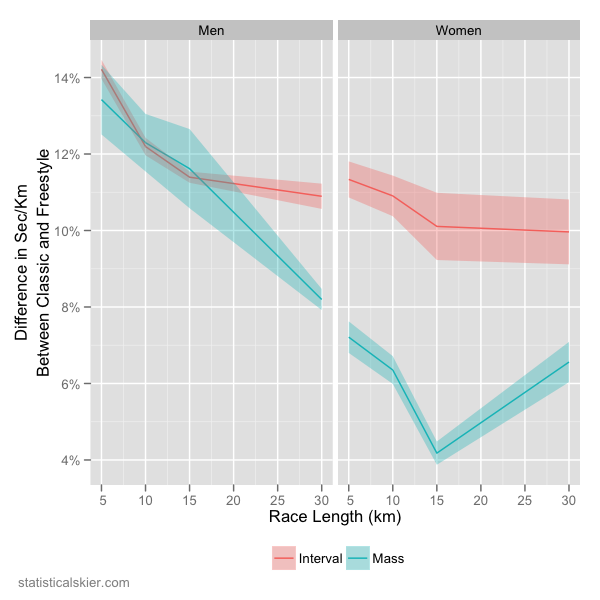
Let’s sum all this up with one last graph:
This would suggest that for the men, skating can be anywhere from 8-14% faster, while for the women skating is typically between 5-12% faster. The men generally see that technique gap decline as the race length increases, particularly so for mass start races. The women don’t really see such a pronounced difference with race length, but they do exhibit a much clearer gap between mass and interval start races, with the former being considerably slower, on average.
Of course, this all only pertains to distance races. I’ll have some similar analysis for sprinting (qualification rounds, at least) on Wednesday.
Note: This is the first of a “quick workout” series, which will break down one ski-specific exercise at a time in a how-to format. We start with Canadian national team member Perianne Jones, who demonstrated a double-pole technique in her hometown fitness center.)
***
If you woke up this morning hoping to see several inches of white stuff and instead met a blanket of balmy air, you’re not alone. Skiers around the world are scratching their heads, trying to figure out what to do as they approach December with no snow.
Before you give up and start baking holiday cookies, consider hitting the gym a little harder and strengthening those nordic muscles. You know once you finally get on skis, you’ll wish you had worked the glutes/legs/arms/core more anyway.
Perianne Jones on a rollerski in Almonte, Ontario, in August.
If your triceps are screaming for attention, start double poling.
That’s what Perianne Jones of Cross Country Canada did during a workout session in Almonte, Ontario, earlier this fall.
At her hometown gym, the Olympian made due without a SkiErg by using the cable machine. With the rope pulley on the machine’s highest notch, she put the peg in 100 pounds and went to work.
While I’m not recommending that kind of weight (start light and add on), any amateur can modify this double-pole simulation exercise.
In an email from Europe, where Jones is racing in the World Cup circuit, she explained how to double pole on a cable machine:
1. Start by holding the knotted ends of the rope pulley in two hands, which should be elevated above your body and mostly straight.
2. “Stand with one foot in front of the other with a forward lean. Try and simulate DP-ing (double poling) as much as possible,” Jones wrote.
3. Bend your knees. Feel free to be explosive by coming up on your toes each time you bring your arms up. Each time you come up to standing, do so with control (slowly).
The cable-machine rope pulley
4. Use your abdominal and arm strength to drive the cable down, bending at the elbows, bringing the rope ends around the front knee.
5. “If you have someone else in the gym with you, it’s helpful to put a belt or band around your waist and have the other person hold it behind you so you can fully commit to your forward leaning position,” Jones wrote. (Note: I was honored to do this for her in Almonte. You might not find someone who feels as lucky.)
6. Make sure you have enough resistance.
“Use enough (weight) so that it’s hard but you are still able to do a proper DP with decent speed,” Jones wrote. “I do anywhere from 8-15 reps depending on the time of year and our strength program focus.”
(Note: For this workout, four sets is a nice, even number. Switch legs between sets and that’s two sets of 8-15 double-pole drives per leg.)
Peri’s Tip: “One thing to focus on is the initiation — (starting) with the head, and driving the elbows towards the floor.”
“The ski erg will feel more natural on the return than the pulleys,” she wrote, “but I’m always focusing on similar technique things (on rollerskis, pulleys, snow, etc).”
***
So think about technique, close your eyes, and imagine snow. (Just don’t whack your head on the rope or cable). Before you know it, you’ll be soaring over the white stuff with triceps of steel.
Daniel Rickardsson, the tall Swede with a mean double-pole technique and the ability to ski seemingly any terrain with ease, is what keeps the Norwegians awake at night asthe 15K classic at the World Championships approaches.
Daniel Rickardsson showing off his double pole while winning in Drammen.
“It’s a heck of an awesome course they have out there, and the atmosphere just adds to the experience. I can’t wait to get on it,” Rickardsson said at the press conference Monday morning.
Along with the rest of the Swedish men’s team, Rickardsson feels in shape and ready to revenge the bad wax on Sunday.
“I will definitely be there and fight for the medals,” said the modest Swede, who doesn’t want to name himself a favorite for the gold. “I don’t want to focus on results as much as I want to focus on my race and the challenges I have to solve on the course. The race in Drammen was the best race of my career, and those are rare, but I think I should be able to race well tomorrow. I am confident,” he said, adding that he thinks the peak from Drammen is just as good now as it was then.
Watch and learn
Rickardsson is a joy to watch on the course. His teammates describe him as majestic and elegant, and almost impossible to match in double-pole technique.
“I’ve always been a stronger classic skier, although I’ve made progress in skating too this last season. Double-poling has always come easily to me, and is something I’ve focused a lot on throughout my career,” Rickardsson said, understated as always.
“I try to ski efficiently and conserve energy. I think being tall is a benefit, especially in double-poling, and I’ve always tried to use it to my advantage,” Rickardsson added.
Anders Södergren, the veteran of the Swedish ski team and an authority on classic technique, admires Rickardsson’s skills.
“Daniel is tall and powerful. He skis with controlled, big strides and has a wicked drive, especially in double-poling,” Södergren said, adding that everything Rickardsson does is controlled and calm, and that he handles the pressure to perform in the 15K just fine.
“He’s totally relaxed. He’ll be fine. I don’t think I’ve ever seen Daniel nervous or stressed out,” he said.
Marcus Hellner, who along with Rickardsson was a member of the Swedish team that won gold on the 4x10K relay at the 2010 Olympics in Vancouver, is also impressed with Rickardsson’s technique.
“I’m envious of his double-pole technique. He skis big, solid and elegant. The drive he generates without spending too much energy is amazing,” Hellner said.
Better wax
The entire Swedish crew had less than perfect skis for the pursuit, but they’re not concerned about missing the wax again. Especially Rickardsson and Hellner suffered on the classic portion of the pursuit.
“That’s all forgotten now. Wax doesn’t worry me one bit. We talked to the wax techs, and we know they work hard on giving us the best skis,” Rickardsson said, concluding that Sunday’s sticky mess is history for him.
“I don’t waste an ounce of energy thinking about skis.”
Northug doesn’t define a race
While Petter Northug is sitting out the 15K classic, Marcus Hellner doesn’t feel like a medal would be worth less without him.
Marcus Hellner winning the World Championship sprint.
“Not at all. Northug has never been the king of the 15K classic,” Hellner said, adding that Lukas Bauer is one of the real contenders for the medals.
Additionally, Bauer sat out the 30K pursuit, and statistically, racers who have skipped the 30K have had better odds at winning the 15K classic that follows. Bauer also often does better in his first event in a major event. On the other hand, some racers feel that having a distance race in the books helps prepare them for the next. Other medal contenders include Martin Johnsrud Sundby (NOR) who was fifth in the 30K pursuit on Sunday, and Dario Cologna (SUI) who seems to be good at all distances.
Sweden’s team to the 15K classic consists of Daniel Rickardsson, Johan Olsson, Marcus Hellner and Anders Södergren.
Norwegian television station NRK wanted to find out what happens when a couch potato tries to be Petter Northug. The first episode of the reality show airs on January 8, 2011 at NRK.no. A famous Norwegian public figure will step into the role of Petter Northug in the show “Mitt Liv som Northug” (ed. “My Life as Northug”). Exactly who this is will be announced this weekend.
12 workouts per week
The show will run up until the 2011 World Championships in Oslo at the end of February. The chosen individual will embark on Northug’s training program as well as his day-to-day lifestyle. That includes 12 workouts per week, lots of recovery time and a controlled diet. Over the eight weeks of the show, viewers will experience what happens when a couch potato is allowed to step into the training regime of an elite athlete, complete with the entire support system at the Norwegian Olympic Development Center (Olympiatoppen) – led by the Norwegian national team technique coach Audun Svartedal, physiology testing, technique training and other expert advice.
“I expect a significant improvement and a positive trend in fitness development throughout the program,” said Svartedal, who will be the head coach for the Northug-imposter.
Public training log, video blogs
The identity of the famous couch potato will be revealed during the annual athletics gala this coming weekend. At the same time, NRK will launch the web sites for “Mitt liv som Northug,” where viewers can follow the day to day progress in a video blog. The pages will also feature a public training log, meetings with elite athletes, technique tips, training advice and more.
From NRK.no, January 5, 2011. Translation by Inge Scheve.
Jessie Diggins racing in November in West Yellowstone.
It’s that time of year again! Snow is falling, trails are open and groomed, and it’s time to toss the rollerskis in the basement.
There are a couple of reasons why rollerskis are great for cross training; they allow you to develop your ski muscles, work on balance, develop arm strength you can’t get while running … and they are the closest thing to actual skiing when you aren’t fortunate enough to live on a glacier. And Ahvo Taipale, owner of Finn Sisu, has been providing the Nordic community with excellent Marwe rollerskis. They’re durable, track well and are closer to the speed of skis on snow than many other brands that roll too quickly.
However, as good as rollerskis are in the off-season, there are also some compelling reasons to get off of the wheels as soon as possible. Due to the ratchets on classic skis, it can be all too easy to develop bad habits and a late kick without even realizing it. On snow, if you do not have your weight fully over each ski as you stride, you will slip out and struggle until you correct your technique. On classic rollerskis, you‘ll get up the hill regardless of your technique. So it’s super important to be very aware of your technique and where your weight placement is, or you may find yourself needing to restructure your technique when snow arrives.
Luckily, if you have coaches helping and calling you out when you begin develop a late kick, the transition onto snow is much smoother. One way the CXC team handles this is to bring a video camera along on the roads and either critique technique instantly, or view it in slow-motion afterwards. In this way, we make sure that our technique will be intact when we need to be able to close down a wax pocket on snow.
Another strategy is to execute rollerski drills that force you to have your weight over your ski when striding. Some of these drills include shuffling with full weight transfer from ski to ski, running uphill on rollerskis with or without poles, or a run on rollerskis that turns into a slight bound. These drills focus on improving balance as well as imitating kicking down a wax pocket, and they are extremely helpful in maintaining good technique.
Personally, I think the transition from skate rollerskiing to snow is easier since there is no kick wax involved, although the longer skis are fairly awkward at first. The easiest way for me to transition is to take the first few days nice and slow, with some long level one sessions. This is also super important if your first days on snow are at 6, 600 feet of altitude, as many skiers are at the West Yellowstone Ski Festival. When adjusting not only to snow but to altitude, it’s good to err on the side of skiing slowly, to give your body enough time to acclimate.
The long-range forecast indicates that there will be some sweet skiing this winter. Grab your jacket, jump onto your skis, and kiss those rollerskis goodbye!
Charlotte Kalla wins the 10K skate at the 2010 Olympics. (Photo: Inge Scheve)
RAMSAU, Austria – “I’ve already gotten proof that it works, some real ‘ah-ha’ experiences that tell me there good things are happening,” said the 23-year-old Swedish cross-country star.
Ask her competitors who is the best skate skier on the circuit, and many of them will tell you it’s Charlotte Kalla. Few can beat her in the steep uphill sections when she gets low and cranks out her best V2 technique.
The Norwegian queen of cross-country skiing, Marit Bjoergen, has studied Kalla’s technique, and is trying to pick up details from the Swede that could give her an edge, especially at higher speeds.
But what Kalla already does as one of the best in the world, she can still improve upon. Kalla has polished her technique for the upcoming season.
“Do you really expect me to reveal all my secrets?” Kalla said with a laugh when Sportbladet asked her about her new technique during a recent training camp in Ramsau, Austria.
“Dare to go low”
Kalla got off the couch to try to explain the difference between the new and the old technique to the reporter. She stands with her feet hip-width apart and bends her knees.
“It’s all about daring to go low to increase the ankle/knee flexion. When I increase that ankle flexion, I get so much more stable, improve balance and I can ride the ski all the way. In comparison, when I am standing taller, I have less stability,” Kalla said and continued:
“Then, I have tinkered a little with how to find the right pressure depending on where on my foot I keep my weight. I’ve tried a few different things, and I decided that keeping the weight on the front of the foot is the most efficient.”
Keeping her weight on the forward part of the foot generates the most power in the kick, Kalla said. “It also improves my balance. I can ride the ski better without getting unstable,” added the 23-year-old, who earned an Olympic gold medal in the 10 k skate last winter.
How much does it matter?
“I get more out of every stride. It has worked very well on roller skis. And it has given me some real exciting experiences, like ‘oh s***, something is happening here!’ Then, I’ve tried it in time trials and interval workouts with other skiers. I try to ski bigger and glide a little more each stride,” said Kalla.
The next week, the Swedish national team is doing a training camp in Kiruna (northern Sweden). That will allow Kalla to polish her new technique on snow at higher speeds than what she’s been able to do at the glacier in Ramsau.
Natural at skating
Kalla can barely contain her excitement to try her new skills on the World Cup circuit, which gets underway in Gällivare later this month.
That she was a natural at skating is something she has known since she was a little girl.
“It’s actually a little strange that I knew that, even early on. My whole junior career, skating just felt more natural than anything else. I never had a coach who taught us how to skate in my home club, so we rarely did that at practice. It was just a harmonic feel from the start,” Kalla said.
From Aftonbladet.se/Sportbladet, October 31, 2010. Translation by Inge Scheve
According to skate technique expert Torgeir Bjørn, Petter Northug is best during the last ten minutes of a race. Bjørn, who is the technique coach with the Norwegian national biathlon team, explains that this is the part of the race where technique matters the most.
Petter Northug agrees with Bjørn, and says that basic core strength is a determining factor in being able to finish ski races on top.
“Up until 2008 I wasn’t particularly diligent with that kind of training, and my upper body sort of collapsed. I was hanging too far forward. While I was able to maintain the speed, it cost me a lot more,” Northug explained.
By focusing heavily on building core strength, Northug argues that you can maintain solid technique all the way through long races, even at times when you’re not peaking.
Important at average fitness
Northug celebrates his victory in the Olympic 50 k while Germany's Tobias Angerer and Canada's Devon Kershaw lunge for the line.
“It’s important to have a strong core, inner abs, back and lower abs. This kind of strength helps maintain posture even when you are fatigued, which is particularly important in races that you’re not peaking for. When you’re peaking, nothing is a problem, but nobody is peaking throughout the season,” Northug said.
“Core strength training is crucial to build stability and maintain solid technique toward the end of almost all race distances. This is in addition to all the strength you build over the hours of skiing and roller skiing,” he said.
– Torgeir Bjørn says it looks like you don’t care about the opening phases of a race?
“It might look like I don’t care about the start, but I think that might be because there’s usually more energy flowing toward the end of a race. I feel like I ski technically fairly well throughout the race. However, I see that it might look like it flows better toward the end. But I don’t change my technique focus during races.”
– Your surges have earned you several Olympic and World Championship gold medals. How much do you practice these surges?
– Ski like H”#!¤ even when you got lactic acid coming out your ears.
“I spend a lot of time practicing accelleration when your body is tired, while at the same time maintaining good technique. I do a lot of little surges during my distance workouts. You have to practice how to ski like h”#!”, with proper technique, even when you got lactic acid coming out your ears,” Northug said.
The star skier also says you need to be aware of technique now, in the transition period from dryland/ roller skiing to on snow training.
“I use video a lot to make sure I don’t carry little roller ski-specific issues onto the snow,” Northug said.
From Langrenn.com, October 28, 2010 By Ola Jordheim Halvorsen, translation by Inge Scheve
ENGERDAL, NORWAY – For as long as she can remember, Maja Solbakken wanted to do everything her older brother Martin Andersen did. Siblings of accomplished athletes often feed off the energy and determination of their brother or sister — that is true not only for those on the World Cup circuit, but also for those who are the second-tier.
Maja Solbakken (Photo courtesy of Maja Solbakken)
The youngest of three siblings, Maja, 16, grew up in the rural Norwegian community Engerdal, close to the Swedish border. Maja always found Martin, 22, to be a support and an inspiration. She said she feels fortunate to have a brother who has helped her pave the way, fallen into the training traps and dealt with them.
Four years ago, Martin and three of his ambitious training partners established a privately funded elite development program called Team Norgeshus. The young athletes calculated their needs, created a budget, went after sponsors and secured the funding for the team, then hired coaches and a support staff, designed camp schedules, training plans and competition plans. So far, they’ve accomplished several top Scandinavian results and are going after the U-23 circuit.
“Martin has a lot of experience to share, and gives me pointers all the time,” Maja said, explaining that he helps her with all aspects of training and racing.
Martin Andersen knows a thing or two about waxing. (Photo, Inge Scheve)
“One thing he helps me with is technique, but he’s also really good at seeing when I’m about to fall into the overtraining trap. Then he gets really stern with me and tells me to back off. He’s had a serious bout of overtraining and been in the pits, and he never wants me to have to go there. That’s super helpful to me, since it’s so hard to see it coming yourself,” she said.
Maja also recognizes that there are significant advantages to being the youngest racer in the family. “My mom and dad have learned a lot from supporting Martin over the years and taking him to races, so they too have a lot of experience at a variety of racing levels, from nationals to local events. They know what’s going on, and that puts me at ease and cuts down on nervousness,” Maja said.
No rivalry, no pressure
“I never felt like I had to compete with Martin. He’s six years older than me, so there’s no way I can do everything he does. But I definitely look at what he did when he was my age, and I want to meet or beat that,” Maja said.
However, whatever pressure there is to perform is entirely her own. Her parents never compare her to Martin, and never expected her to follow his lead.
Maja's parents, Maj Britt Solbakken and Roald Amundsen, are avid skiers themselves. Roald used to race at the national level. (Photo courtesy of Maja Solbakken)
“My mom and dad just want me to be happy doing what I do. They are amazing,” Maja said, pointing out that she’s seen some parents who put a lot of pressure on their children.
“My parents never pressured me to perform, which is something I have seen in some families where there are two or more good siblings,” Maja said, and continued: “The only the pressure is that which I put on myself. I want to perform and improve, and I want to show everyone who supports me that I’m worth the effort — I want to deliver, and I want to give something back.
Ambitious goals
Maja has always set ambitious goals for herself, and her ultimate dream is no less than the Olympics. But realistically, she knows she has a long way to go.
“I’d like to see how far I can get. Of course, I would like to be best in the world, and go to the Olympics, the World Championships and the World Cup eventually, but those are pretty long-term and hairy goals,” she said.
Accordingly, Maja has set up partial goals along the way and has a systematic approach to her progression.
“Before [reaching the Olympics], I realize I have to do the standard progression, aim for top-five, top-three and then number one at the Norwegian nationals and the Norwegian national racing circuit. I hope I can qualify for the junior national team and go to the Junior World Championships in a couple of years,” Maja said.
She believes she has what it takes to go all the way, but that she has to train smart to achieve her Olympic dreams.
“I think I can get as good as I want to. I have the potential to go far. Whether I do is a matter of what I do to get there,” she said.
Training smart
Maja believes there is more to becoming the best than simply volume. She explains that her training philosophy focuses on quality over quantity.
“I don’t think logging the most hours necessarily makes you the best skier. What matters is what you do during the hours you log,” Maja said. She is keenly aware of how she spends her workouts in order to maximize the training effect. Each workout has a specific purpose, depending on what she needs to emphasize at a given time.
“You need to focus on the tasks at hand, and really be present both mentally and physically. I try to have at least one specific task to focus on for every workout. For instance, if I do a skate rollerski workout, I try to think about lifting my poles high enough when I V2,” she said.
However, Maja notices that sometimes skiers seem more obsessed with logging hours than focusing on what they get from the workout. She thinks girls are particularly vulnerable to the junk miles routine.
“I think a lot of skiers just lollygag around, especially on long distance workouts. They just get lost in chatting, and forget what the job is. I like to catch up on talk before and after, but when I train, I’m into training,” she said.
Pursuing the elite at Lillehammer
Maja Solbakken and brother Martin Andersen during a training camp at Sognefjellet last summer. (Photo courtesy of Maja Solbakken)
This fall, Maja moved away from her parents’ house to attend the national elite cross-country academy training group in Lillehammer and pursue her ski career there. While the 16-year-old admits that it was hard to leave home, she’s not entirely on her own. Martin moved to Lillehammer for college a couple of years ago, and she’s sharing an apartment with him. For some siblings, living so close together could spell trouble, but Maja says it’s an excellent setup for them.
“We actually enjoy each other’s company a lot. Martin has a lot of experience living on his own, cooking his own meals and balancing life, school and training,” she said, adding that the training group program is a step toward her overall ski goals.
Different training programs
Although Maja and Martin have similar approaches to training and development, they recognize that men and women are made differently. Maja admits that she wants to do everything Martin does, but realizes he can handle a larger volume and tougher workouts—both because he’s older and has a bigger base, but also simply because he’s a guy.
“We do have to train differently. He trains more volume than I do. I just have to face it: Girls just can’t handle the same volume as guys. They have more muscle mass. There is a reason girls don’t race the same distances,” Maja said.
Maja adds that she also tries to focus on track in the summer, while Martin is strictly focused on skiing. That translates to slightly different approaches to methods and intensity during the dryland season. “I run more than Martin does. He bikes a lot more than I do. That’s partially because I also train for medium and long distances track and field (800m, 1500m and 3000m), and partially because I feel that running is the best way to increase my capacity.”
Maja also believes women are more dedicated than men in some ways, and therefore more likely to follow their training plans like a bible—which she notes is both an advantage and a potential drawback.
“I think girls are more likely to follow a training program than guys. If we have a plan, we stick with it. It seems like guys are better at listening to their bodies and adjusting their training according to how they feel. I think guys don’t feel as guilty for going rock climbing or fishing instead of doing the planned workout if they feel like it. But then again, studies show that girls have better core strength than guys, so maybe there is something to sticking with the program after all,” she said with a grin.
BEND, Ore. – Kristina Strandberg moved to Bend from Sweden. Evelyn Dong moved to Bend from the East Coast. And Chisa Obayashi just recently transplanted herself in Bend all the way from Hokkaido in Japan. They all have been training with the XC Oregon program director and coach John “JD” Downing.
“The three of them are in pretty identical positions, in three different ways. Evelyn is just on the cusp of a breakthrough, Chisa is on the cusp of making the Japanese national team, and Kristina has raced on the Swedish World Cup team,” Downing said.
Perfect match
Obayashi, 25, first came to Bend in June, but the initial set-up happened earlier this spring.
“I tried the SuperTour in the spring, and Peter Hale, the racing manager for Madshus USA, introduced me to some club teams in the USA. I chose Bend and XC Oregon, and JD accepted me,” Obayashi recalled.
Downing was excited to welcome Obayashi to Bend and explained that the chemistry with the women on the team could not have been better.
“Chisa and Kristina really hit it off and trained together daily. The design of our program is perfect for that,” he said.
Kristina Strandberg during a dryland workout in Bend, Ore. (Photo: The Center)
Independent and flexible
“Our program is pretty much perfect for Chisa in that it is so athlete-driven. It lets the athletes dictate how they train, and because the program is so athlete-based, I as the director didn’t really do much for Chisa on a regular basis besides making sure the logistics were covered and match her up with training partners,” Downing said.
Downing explained that self-reliance has been part of his coaching philosophy since the XC Oregon program was established 12 years ago, and that the independence helps athletes excel.
“Chisa could easily have flourished in a more structured training environment as well, but I think she really benefitted from seeing how independently athletes train here and how they can take advantage of the support when it’s there,” Downing said. “Bend is an amazing place to train, and one of the best places in the world for skiers.”
On her first visit, Obayashi stayed for three weeks. She arrived just as the snow season was transitioning into dryland. She didn’t mind at all, as Bend has plenty to offer no matter what the time of year.
“I really like Bend. Bend is a great place for training. It has the best weather, and it has some really nice roller ski courses and big mountains,” Obayashi said. She ended up training a lot with Strandberg – much more than Strandberg had imagined to start with.
“She is pretty much a self-coached athlete, and after one of her first camp workouts, she wondered what I was doing the next week. So I sent her my training plan for the week and I figured she could pick out which workouts she wanted to join me for. But then she just said that the plan looked great and did all of it with me,” Strandberg said with a laugh.
In love with Bend
In fact, Bend was such an amazing place for Obayashi this spring that she e-mailed Strandberg from a New Zealand training camp this summer and wondered if she couldn’t come and stay with her for, say, four weeks this September.
Chisa Obayashi teaches Lars Flora how to make sushi from scratch. (Photo: Kristina Strandberg)
“You always start to wonder when someone comes to stay with you for several weeks, how on earth that is going to go. We don’t exactly have the largest house in town. But she is the easiest house guest ever. She immediately told us she likes housework and likes to cook, and she did a lot of both,” Strandberg said, mentioning that homemade sushi and Japanese specialties often landed on her dining table.
Mutual benefits and lasting impressions
“Kristina and Evelyn taught me some training methods and ways to weight train,” Obayashi said. “They are very strong and have very strong spirits. I have a lot of respect for them, and want to train to become as strong as they are.”
While Strandberg and Dong might have taught Obayashi a lot about their training methods and sent her home with some new tricks – most importantly, more focus on heavy strength training – Obayashi certainly left her impression on the Bend girls too.
“Skiing with Chisa was valuable, because she has perfect technique every minute she is out there,” said Dong. “She is never sloppy, even when we’re just going easy. You can tell she puts a lot of hours into perfecting every detail. That’s probably the thing that stuck out the most and hopefully will stick with me the most,” Dong noted.
Obayashi inspired Strandberg and Dong in ways that go far beyond the trails.
“She is incredibly polite and expressed such gratitude whenever she got help. She was always nice and kept her stuff in meticulous order. Even on training camps when things start to go everywhere for all of us, Chisa kept her stuff neat and packed away,” Strandberg said.
Now what?
For the upcoming season, the three skiers are in very similar positions. They all have to prove their potential to earn spots on their respective teams, and they all dream big.
Strandberg, 35, will try to make the Swedish World Cup team again this season, but she knows it will be hard.
“It’s a very hard team to get onto at this point, and it will be more interesting for the coaches to pick a 20-year-old than a 35-year-old, everything else being equal,” Strandberg explained. “But I will race hard and do my best, and if I make it, it would be fantastic.”
Obayashi will go to Muonio, Finland, with the elite ski team from Japan. “I want to get a chance to race at the World Championships in Oslo and get a good result,” she said.
However, to make it to Oslo, Obayashi will need to have all the stars aligned for her.
“She has to ski really well to make it to the World Cup,” Strandberg said. “She’s a distance racer, but she hopes to make it to the World Championships this year. It would be amazing if she did.”
Dong, 25, also has her eyes on Oslo.
“My goals for the season? I’m aiming big. I want to go to the World Champs and make top 30,” she said.
DALSBYGDA, NORWAY – Therese Johaug’s younger brother, Karstein Johaug Jr., was among the top Norwegian juniors for the 2008-09 season, but he was injured and sick for most of last season. Now healthy and stronger than ever, the 18-year-old is determined to make the 2012 junior world championships. Karstein is a senior this year at the ski academy high school in Tynset, Norway, the same program from which Therese graduated from three years ago. But following a very famous sibling’s footsteps is not something Karstein pays a lot of mind to. It’s just another part of life.
Karstein Johaug Jr. Photo: Kondis.no
“I don’t really think about the fact that I have a famous sibling very often. I’ve always been active, and I’ve skied since I could walk. I started ski racing when I was 3 years old, and I’ve always wanted to follow in Therese’s footsteps since the start,” Karstein says, and explains: “We compete with each other all the time, and it’s really fun, especially lately when I’ve been able to match her. It used to be where she would beat me all the time and I was not even close. We train very much the same, ideally two workouts per day, and we’re pretty evenly matched now. That makes it fun and motivating. I really like it when she’s home.”
“For me, having a famous sibling is solely a bonus. For instance, she gets a lot of equipment, and I get to test and feel a lot of different things. She has contacts that have been useful for me too, so it’s all just a win-win situation,” Karstein says.
Active tribe
Veronika, Therese and Karstein Johaug. Photo: Private
Therese and Karstein are the middle siblings in a family of four kids. They all grew up on a farm in Dalsbygda, in east central Norway, where the family still lives. The Johaug parents were never ski racers themselves, but they encouraged and nurtured the appreciation of the outdoors and an active lifestyle as a family. Karstein also points out that their parents always supported their kids’ pursuits, whether it was soccer, gymnastics, track or skiing, all of which have been important parts of the Johaug kids’ lives.
The older brother, Joakim (the oldest of four), used to ski race but quit after his junior years, while the youngest of the four, Veronika, likes to work out and stay fit but doesn’t particularly enjoy competing, Karstein explains.
No external pressure
Karstein never felt intimidated or pressured by his sister’s world-class performances. To Karstein, Therese’s merits are just a bonus; the drive to succeed is his own.
Therese Johaug in the women's pursuit at the 2010 Olympics. Photo: Kent Murdoch
“I don’t feel any performance pressure from others to be as good as her or place as well as she does. My parents are just really involved and they think it’s really fun that we like being outside and like skiing. The biggest pressure is the pressure I put on myself,” he says.
Local support and good mentors
Talent and drive is only a part of the equation. Success is a result of a community effort and a supportive environment. Karstein said he feels fortunate to grow up in a place that values skiing, with a development structure in place for those climbing the performance ladder.
“I think the local clubs and the training environment here [in the Tynset area] make up the backbone of the recruitment, and it’s a key to developing good ski racers. Also, Norway generally has a club and development structure that works well with the academic system, and it’s easy to find ways to integrate training and academics,” Karstein says, adding that he also has a personal mentor locally.
Starting this fall, Karstein will be working with former World Cup racer Krister Trondsen from the nearby town of Røros. Sister Therese also had a mentor as she transitioned from the junior to the senior level and stepped up her racing, from the international junior circuit to the World Cup. Former Olympian Maj Helen Nymoen, from the neighboring village Os, helped Therese with everything from training programs to counseling and negotiating sponsor deals. They are still close, and while their formal agreement ended in 2009, Therese repeatedly thanks Nymoen for the support and inspiration during those transitional years. Karstein recognizes the value of a personal mentor, and trusts that Trondsen has a lot to offer, both in terms of experience and management.
“I think working with Krister Trondsen is an important part of stepping up to my goals. I want to go to the Junior World Championships in 2012, and I have never set a goal I haven’t attained so far. You have to set a training plan and stick to it, but I also think there are a lot of mental components to reaching your goals,” Karstein concludes.
Adam St. Pierre is an exercise physiologist at the Boulder Center for Sports Medicine in Boulder, Colorado. He is also the head coach of the Boulder Nordic Junior Racing Team. In this article, St. Pierre outlines a strategy for athletes to gradually implement technique changes.
Technique is an important component of cross-country skiing, but it is often difficult for athletes to make technique modifications once their motions have become habitual. As coaches, we often find ourselves telling the same athletes the same things, over and over again—“get your hips forward; drive your knee; don’t twist so much; hands wider; hands narrower”—only to have the athlete reply in frustration, “I thought I was doing X, Y, and Z.” It can be difficult for athletes to make changes to their technique because they can’t see it or feel it.
When implementing a technique modification, the new way of skiing feels different to the athlete initially. As the athlete continues skiing, even if she
Adam St. Pierre talks with one of his junior athletes.
concentrates on maintaining the new technique, she is likely to revert to her old technique eventually without knowing it—that is what has been hardwired into her muscles by hours and hours of skiing and rollerskiing.
A skier’s body recognizes repetitive motion as a pattern. Once this pattern becomes established, the motor neural firing patterns required to perform this technique become ingrained. At this point, the technique feels natural, and any changes will feel foreign. The body will naturally revert to what it is comfortable doing, meaning that a skier will revert to old habits unless the body can be re-patterned with the appropriate technique.
When making technique changes, it is important that a skier is able to recognize the different sensations of the old style and the new style. After a few seconds of attempting a new style, a skier often reverts to old habits unconsciously. By forcing a skier to switch back and forth between old and new styles frequently, she will learn to recognize the differences between the two. This will make it significantly easier for her to make technique modifications in the long run. Capturing both old and new styles on video will allow the athlete to make a visual comparison as well. And since the body will most readily recognize the differences at the transition between old and new, skiers should frequently switch between old and new styles when making a technique change.
At the Boulder Center for Sports Medicine, physical therapist Tim Hilden successfully uses a specific method of neuromuscular retraining to teach runners to alter their gaits to prevent or treat injury, and to improve performance. It takes anywhere from four to six weeks to make permanent a change in running technique. With my skiers here in Boulder, I use this same method with great success. Below are some guidelines:
Weeks one and two: Ski “new” style 50 percent of the time, and “old” style 50 percent of the time. Go back and forth between “old” and “new” styles every 30 to 45 seconds. In the first two weeks, you are focusing on teaching the body what the two skiing styles feel like. This is a great time to do video review as well, so that skiers recognize what the two styles look like. Seeing the transition from one style to the other on video can be a very valuable tool for both athletes and coaches.
Week three: You should spend 75 percent of the time in your “new” style—about 90 seconds in your “new” style and 30 seconds in your “old” style is ideal. In this week, you are gradually moving toward skiing with your “new” style, but keeping the “old” style around a little to keep the differences apparent.
Week four and five: You should ski completely “new” style.
After six to eight weeks, the “new” style should have become the default. An athlete should not have to consciously think about skiing in the “new” style by this point.
It is easiest to make a technique change in this manner during relatively low-intensity training periods. Switching from an old technique pattern to a new and improved technique pattern requires a great deal of concentration on the part of the athlete, which can be difficult to perform during intensity workouts and races. Ideally, this technique modification method is performed at least two to three times per week during easy skis, and during warm-up and cool-down periods. I undertake technique modifications throughout the summer and fall on rollerskis, and will again during early on-snow sessions to fine-tune my skiers’ mechanics.