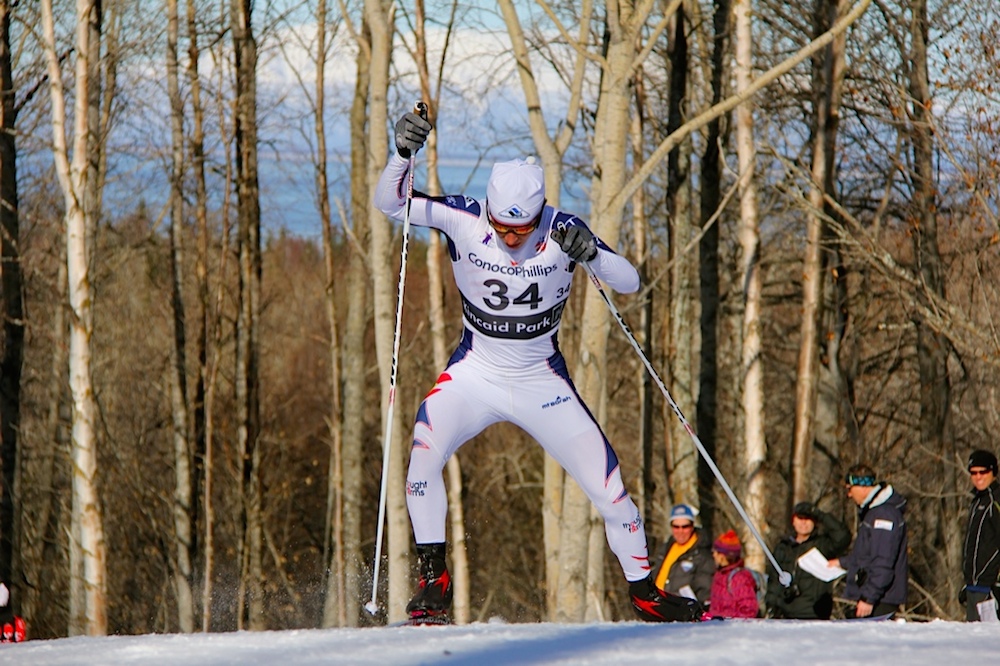
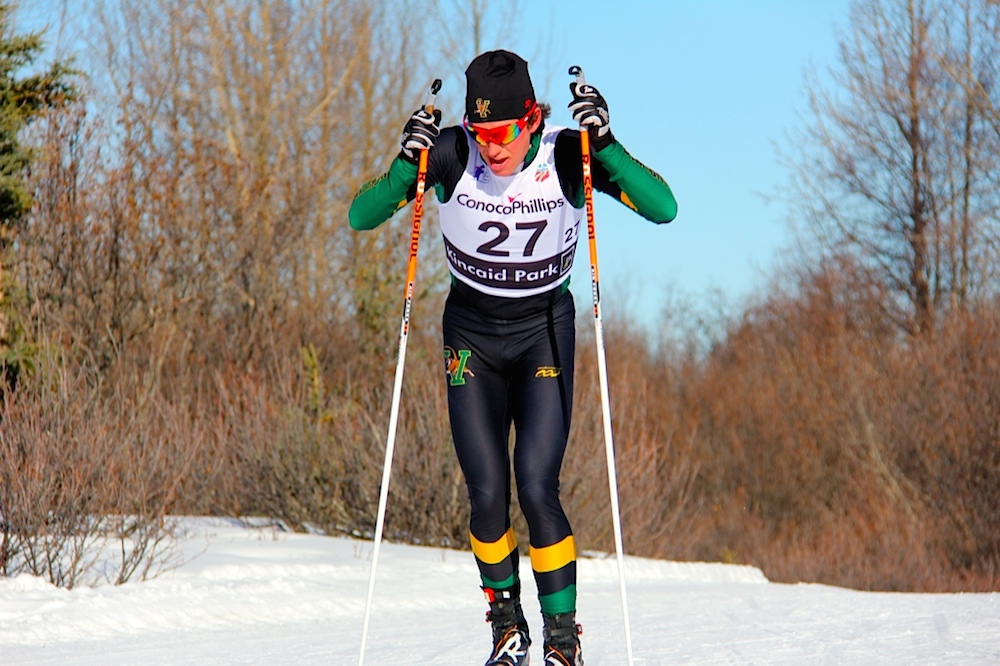
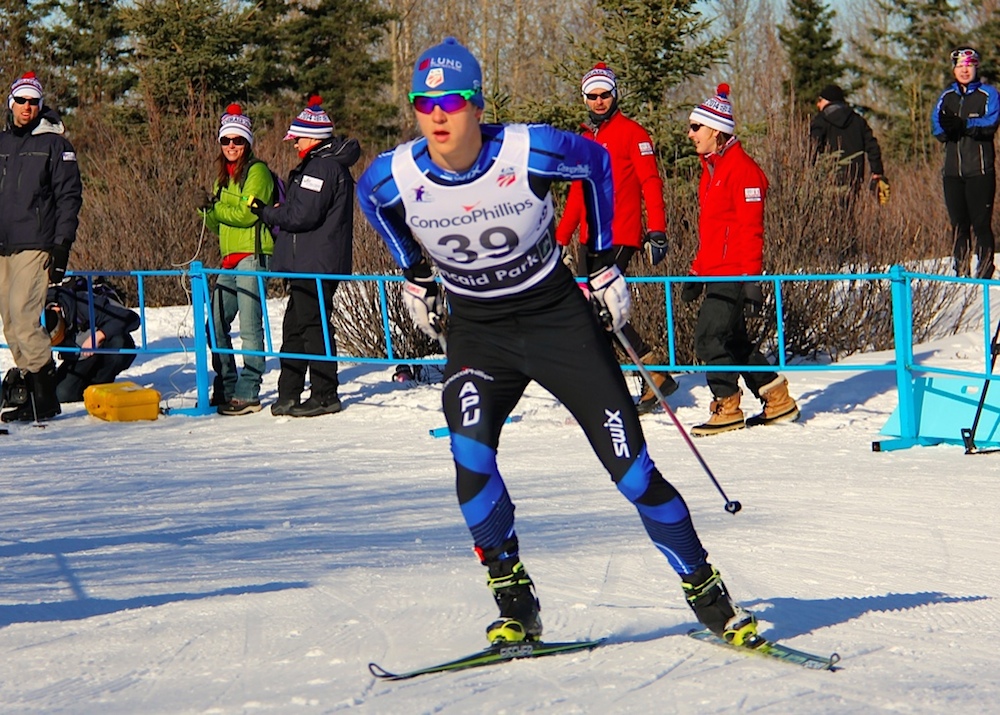
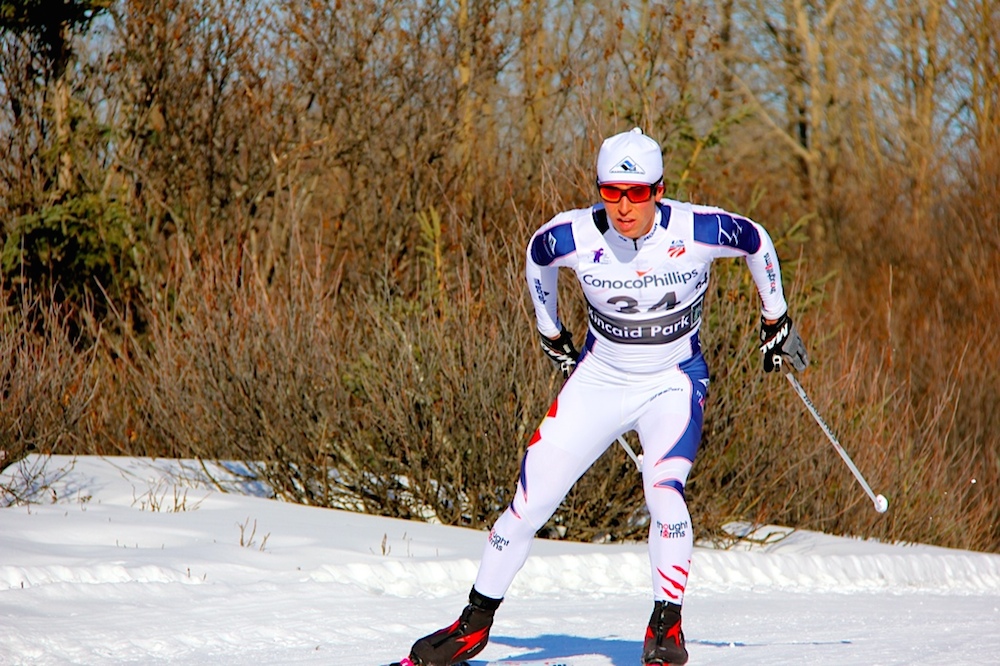
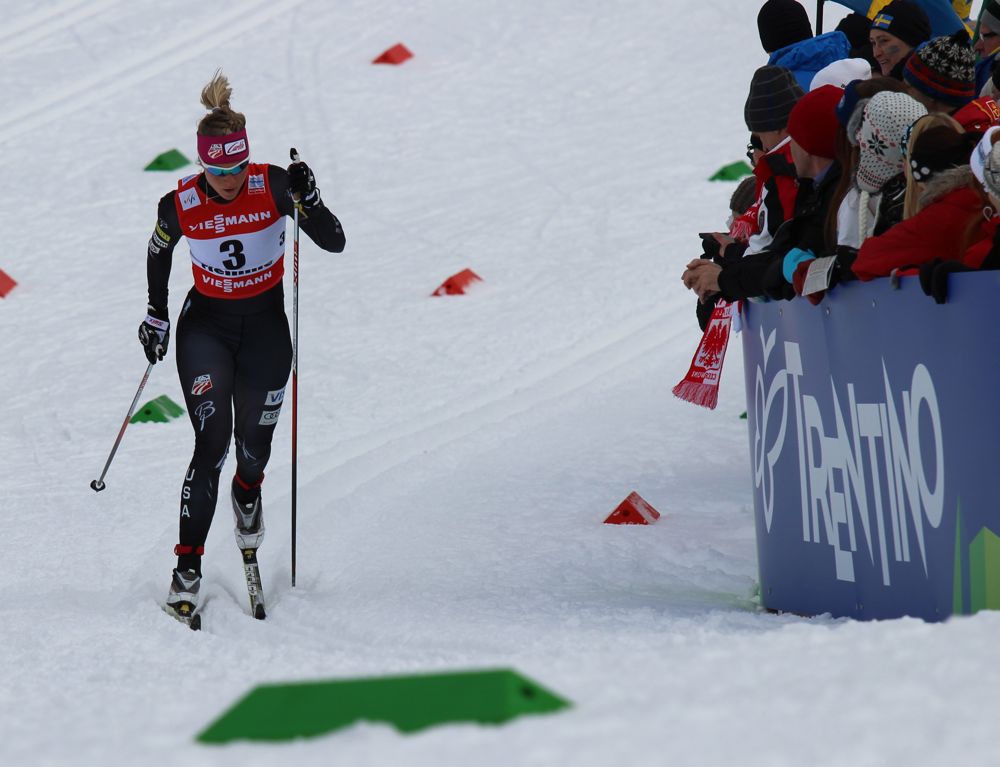
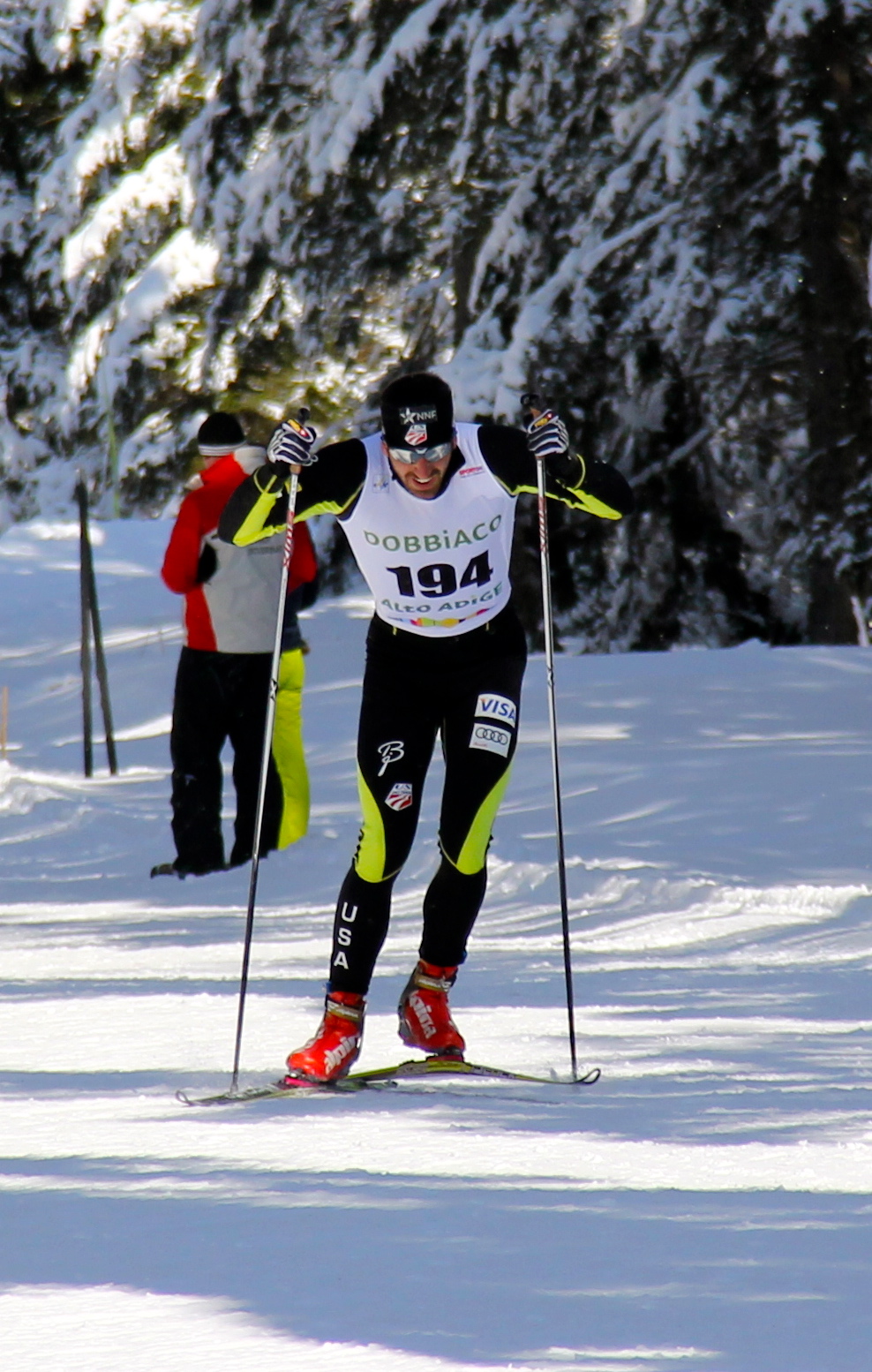
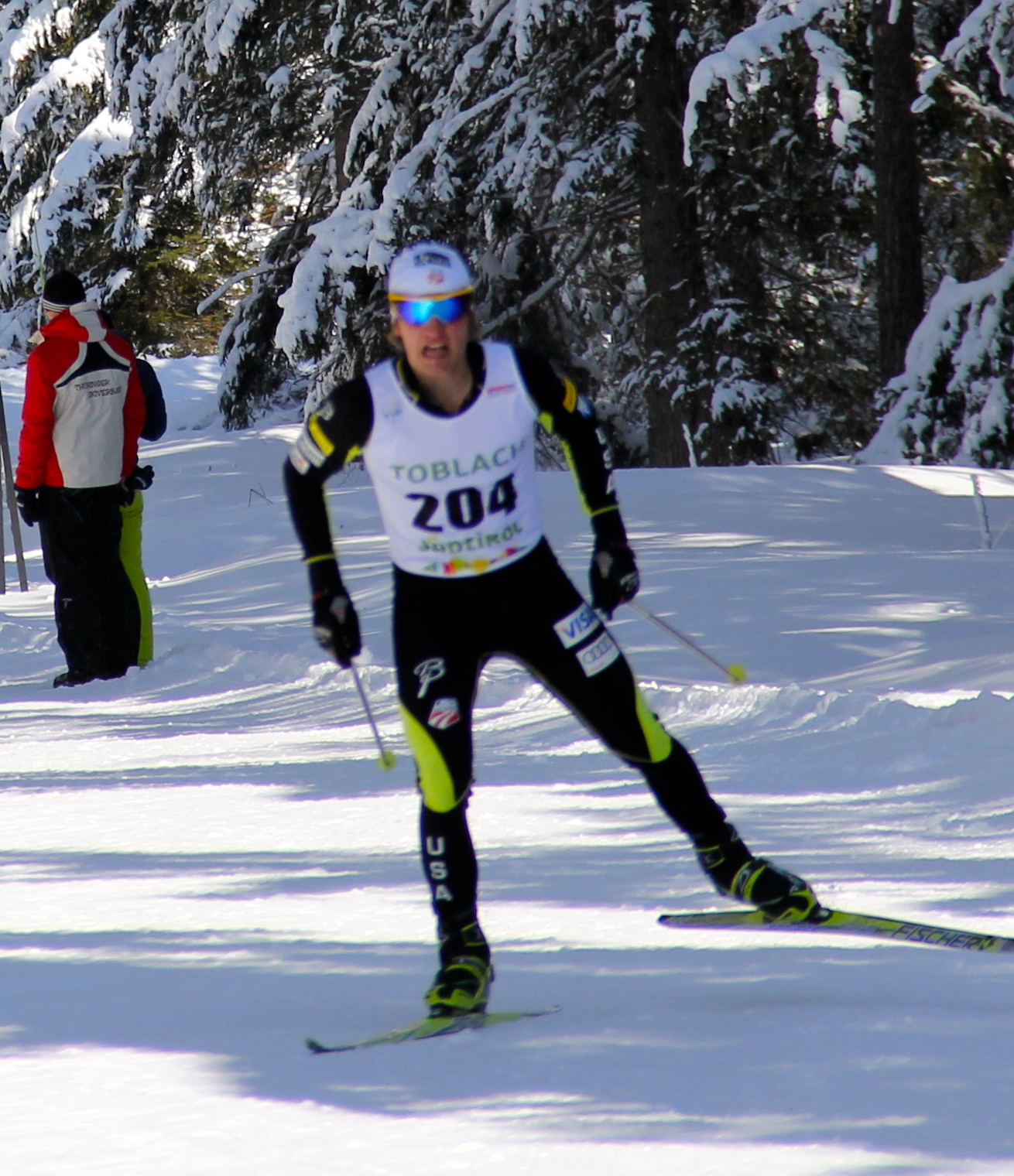
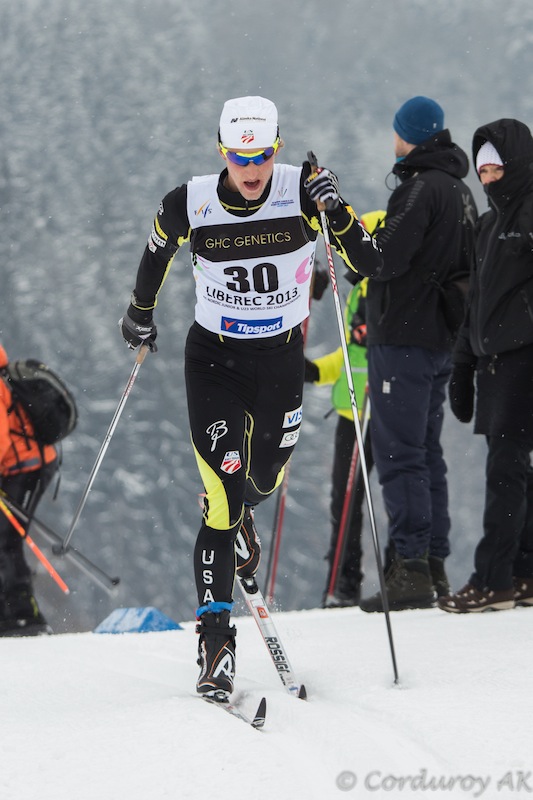
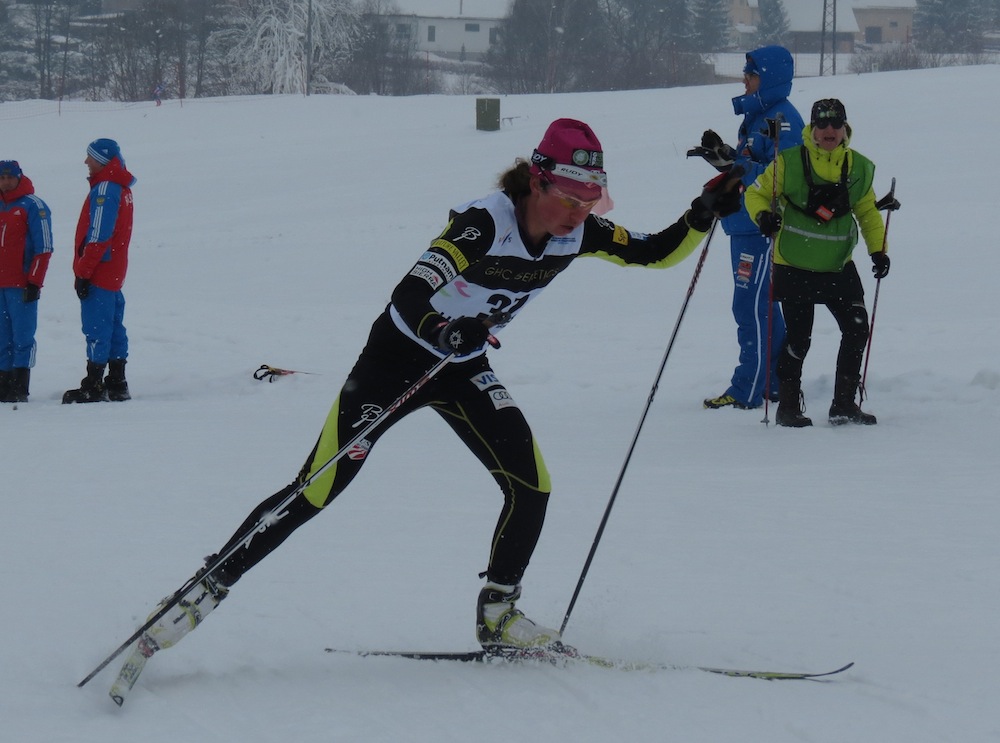
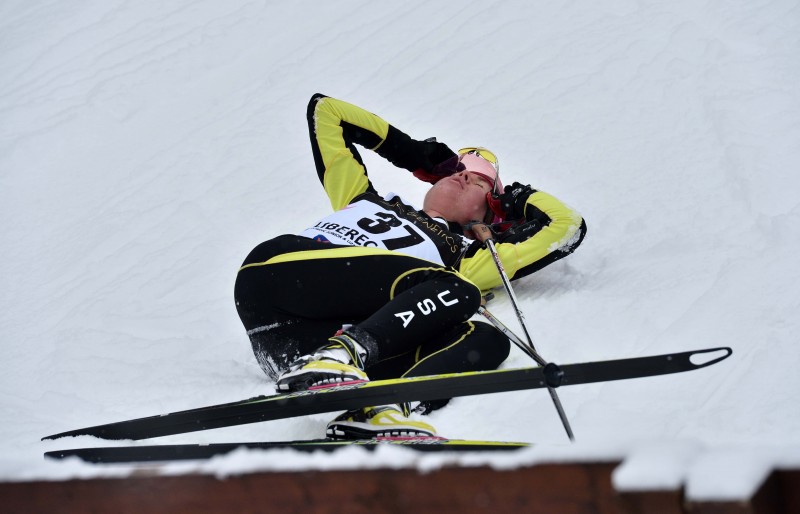
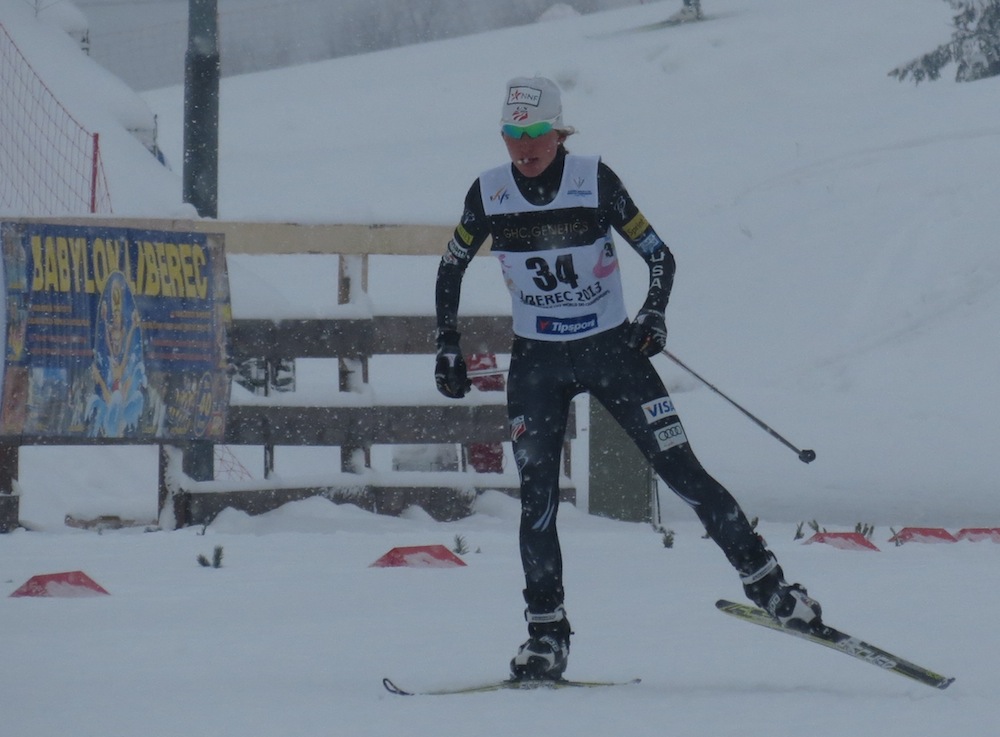
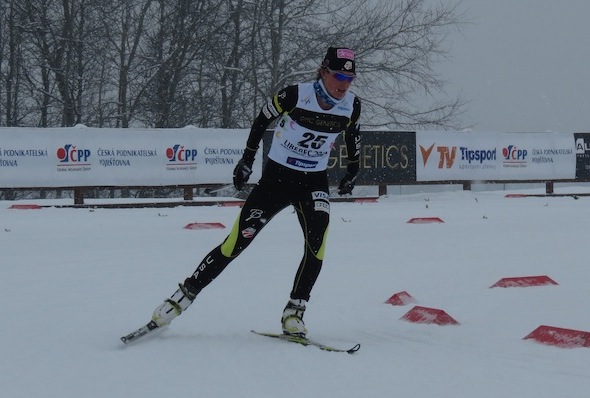
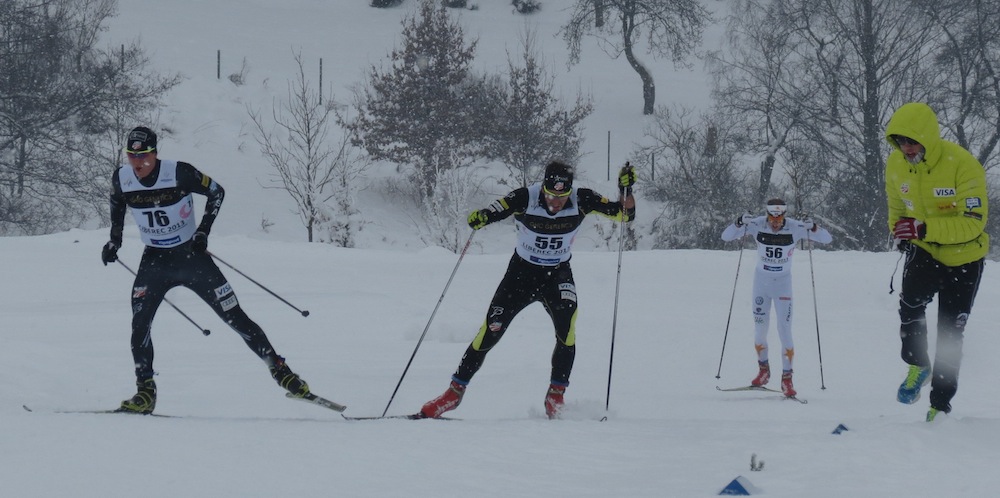
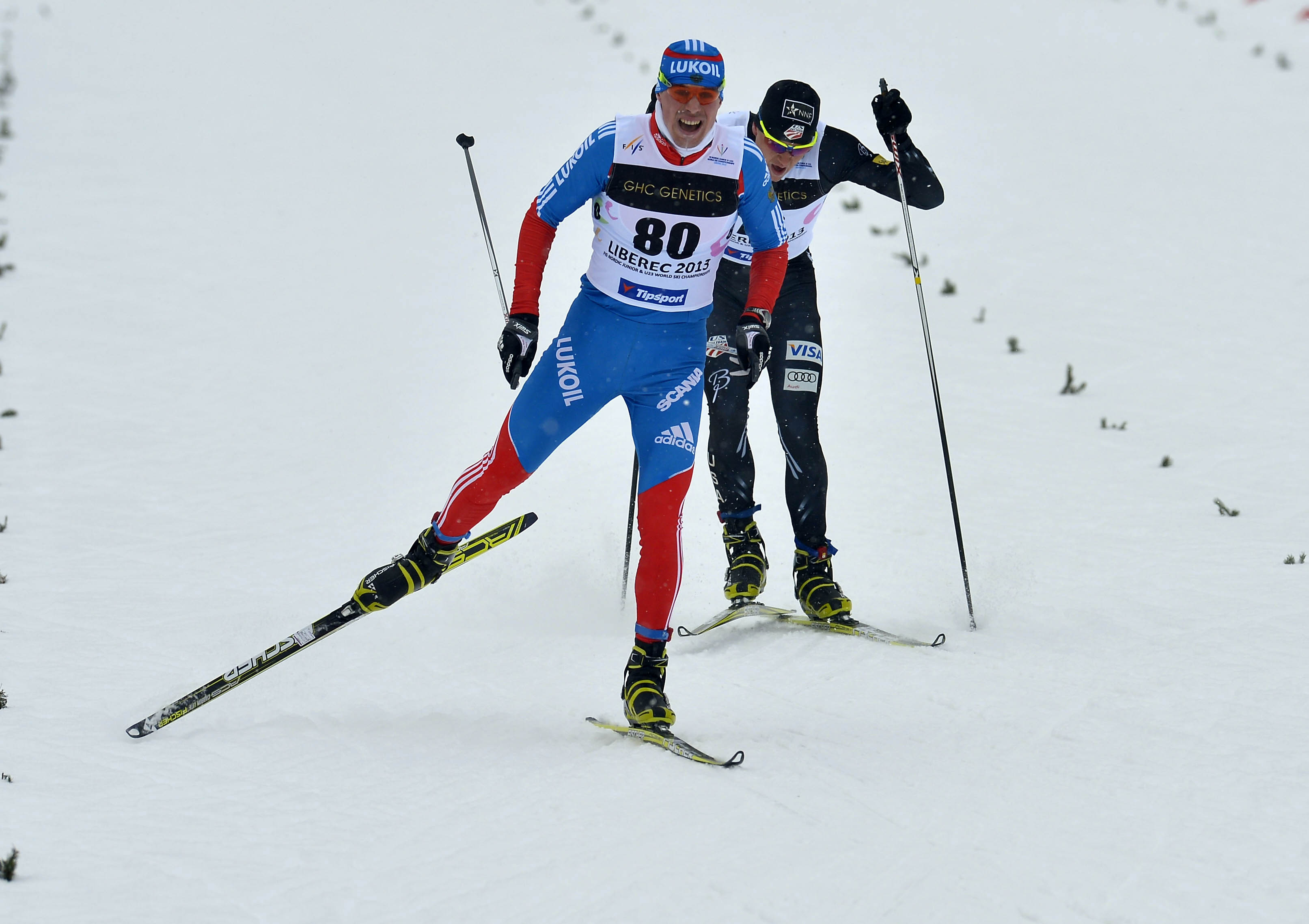
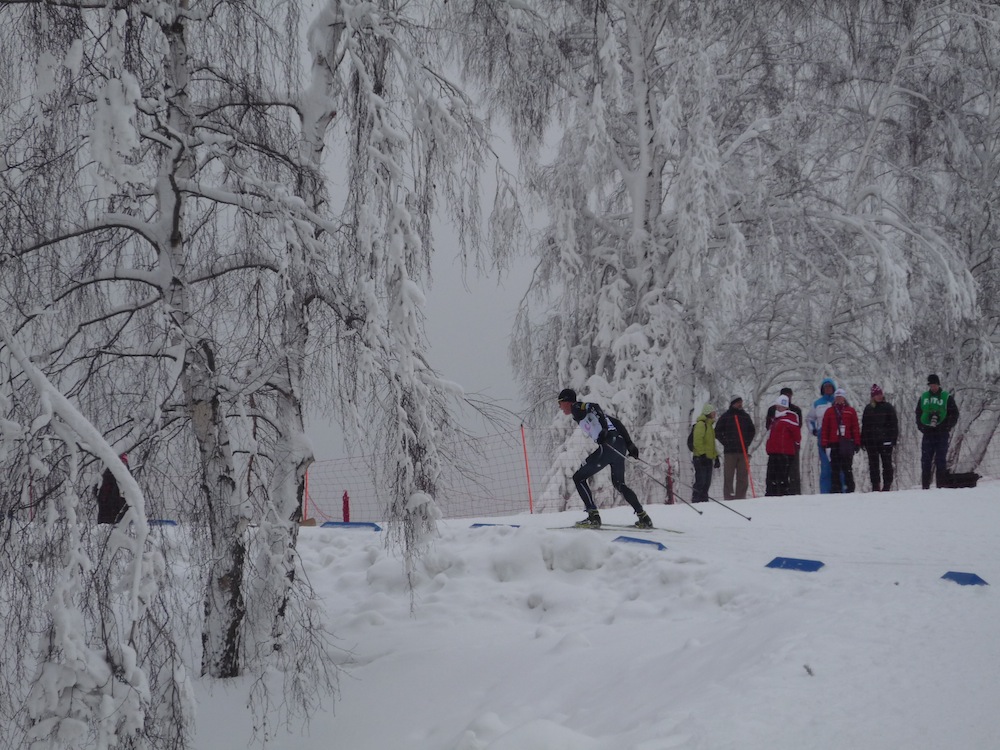
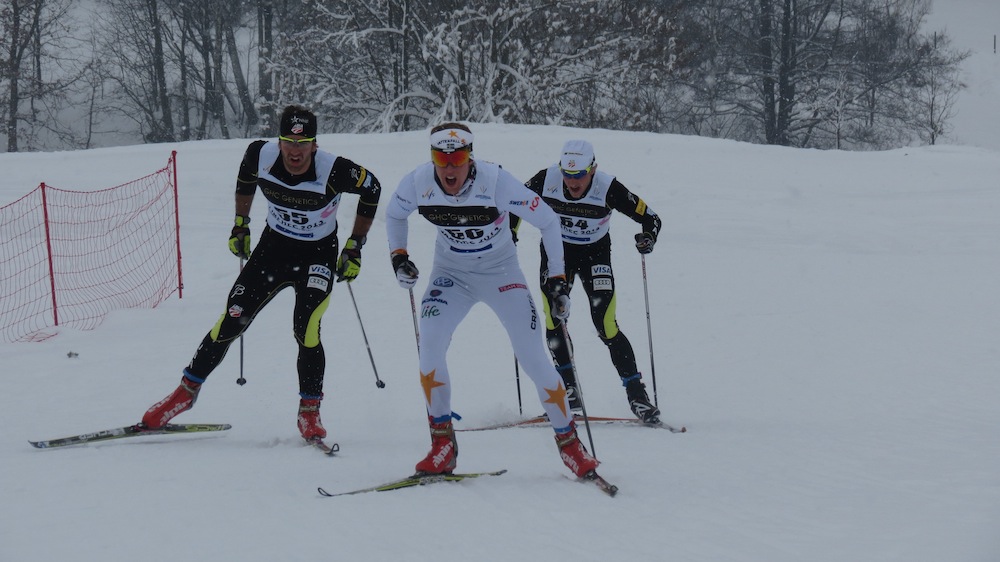
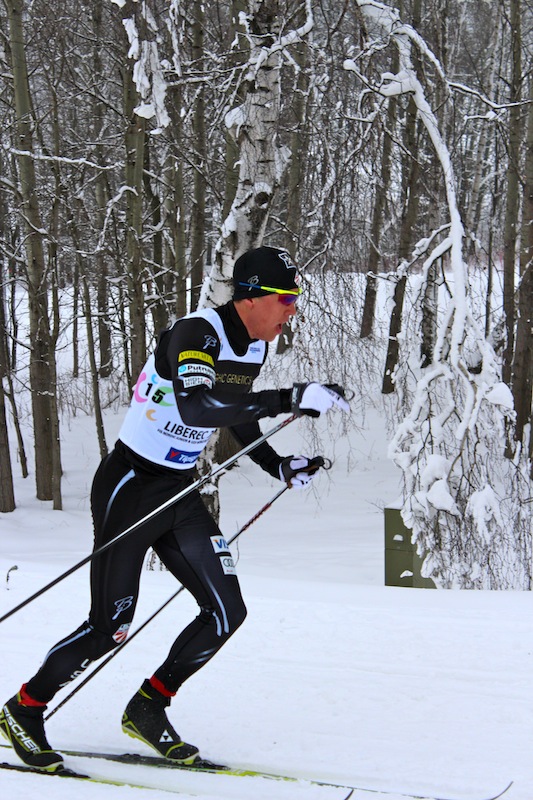
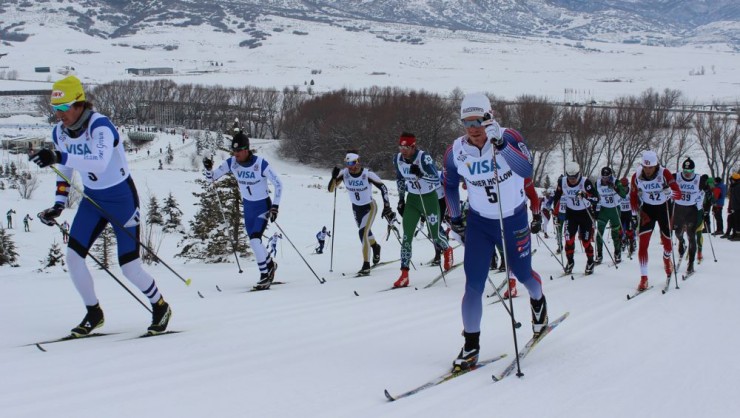
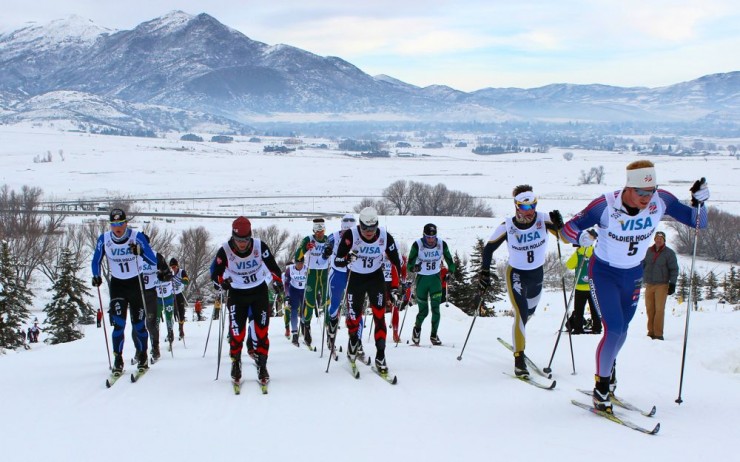
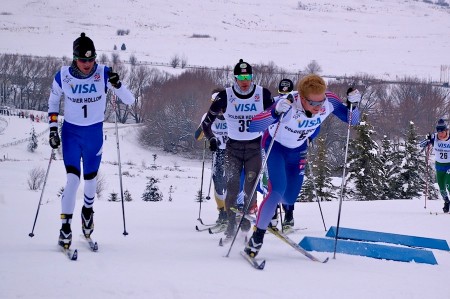
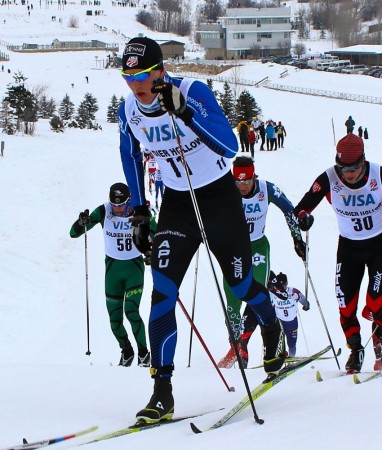
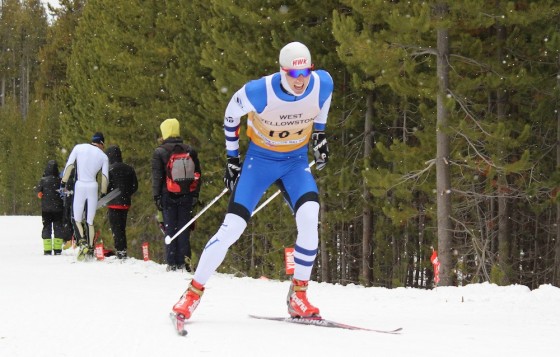
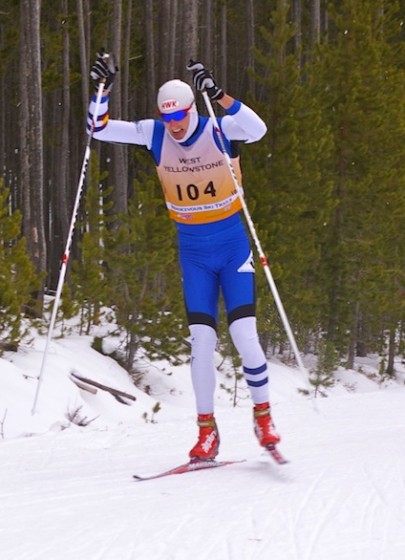
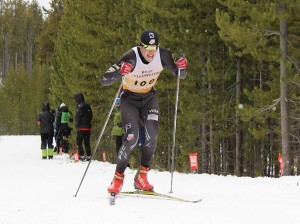
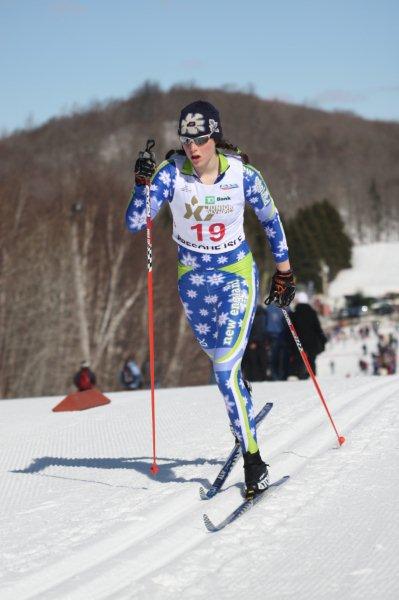
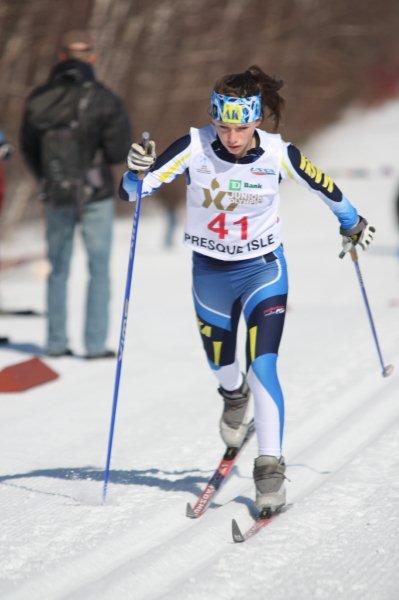
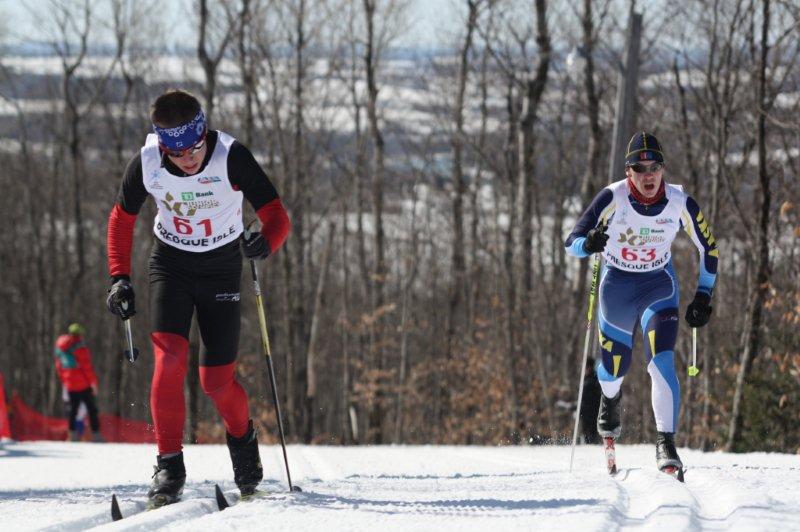
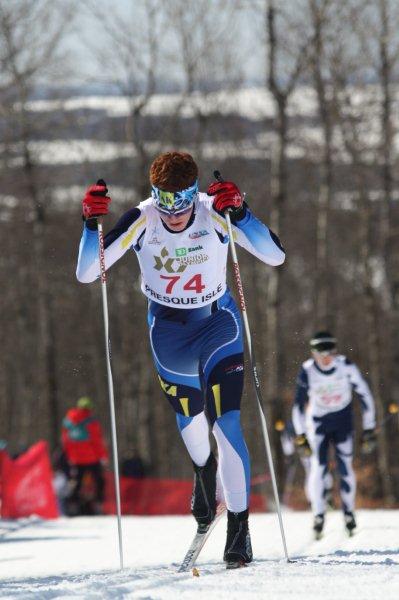
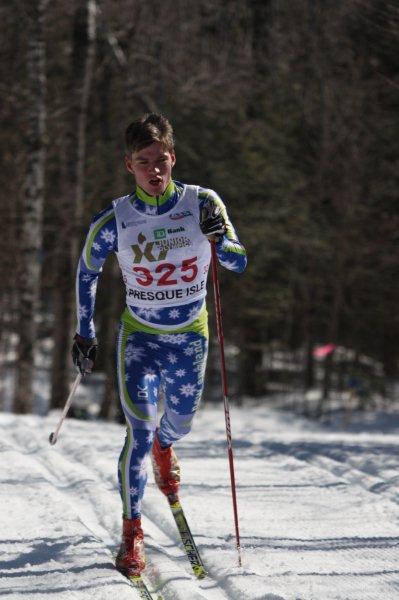
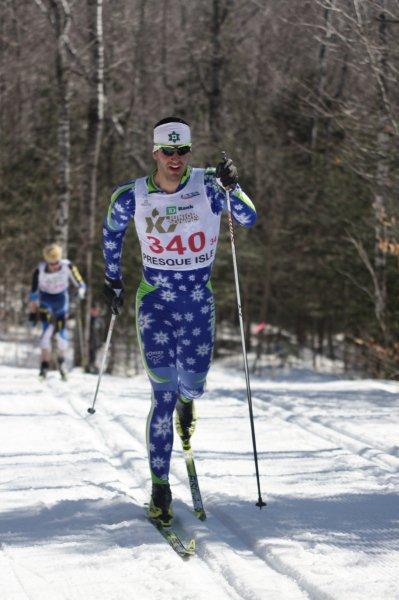
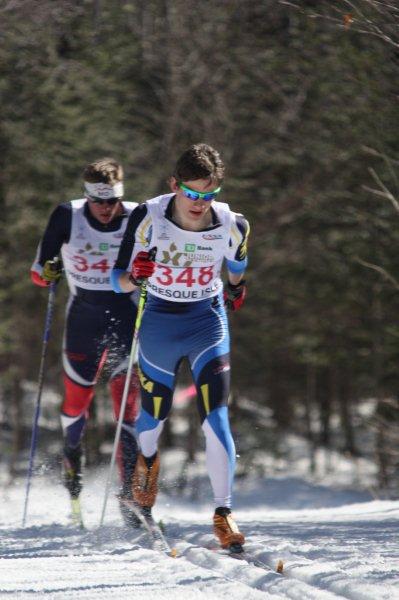
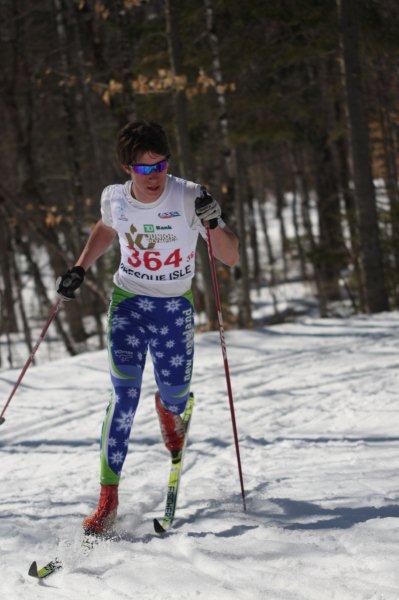
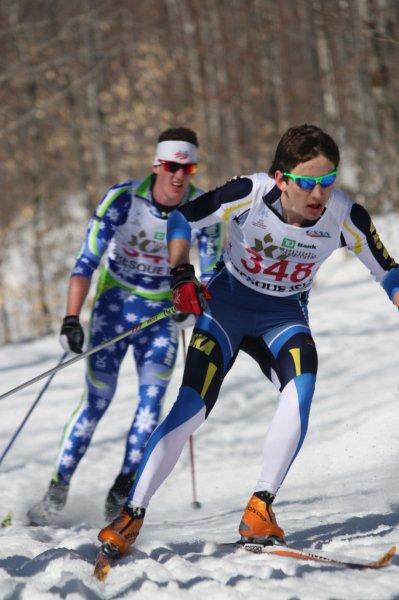
Noah Hoffman (SSCV/Team HomeGrown/USST) racing to a 10.9-second win in Saturday’s 15 k freestyle at SuperTour Finals at Kincaid Park in Anchorage, Alaska. (Photo: Rob Whitney)
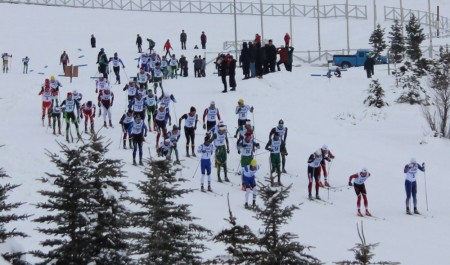
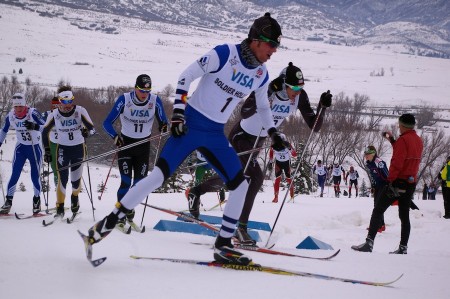
ANCHORAGE, Alaska — Separated by 30 seconds at the start, nearly 70 men in Saturday’s 15.9-kilometer freestyle raced around Kincaid Park individually on Saturday in the SuperTour Finals opener.
One by one, they ascended massive hills, like Elliott’s Climb at the end of each 5.3 k lap, and descended a winding section of the course known as S Turns. They made their way back to the stadium World Cup start area via trails named Burky’s Climb and Roller Coaster.
Some made up ground on their competitors; others lost it.
With one lap to go, it was pretty obvious which side of that Noah Hoffman of the U.S. Ski Team (USST), Ski & Snowboard Club Vail and Team HomeGrown was on.
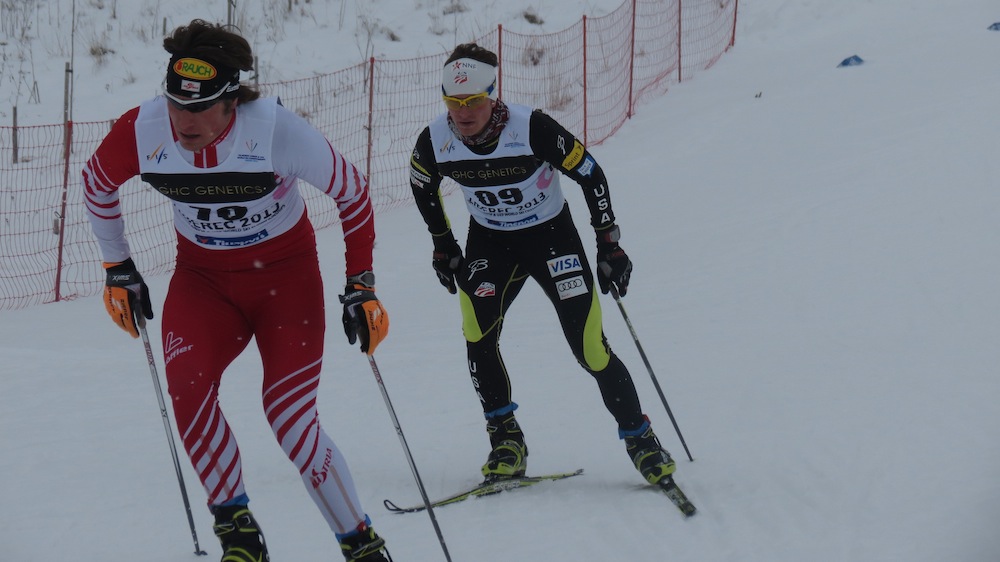
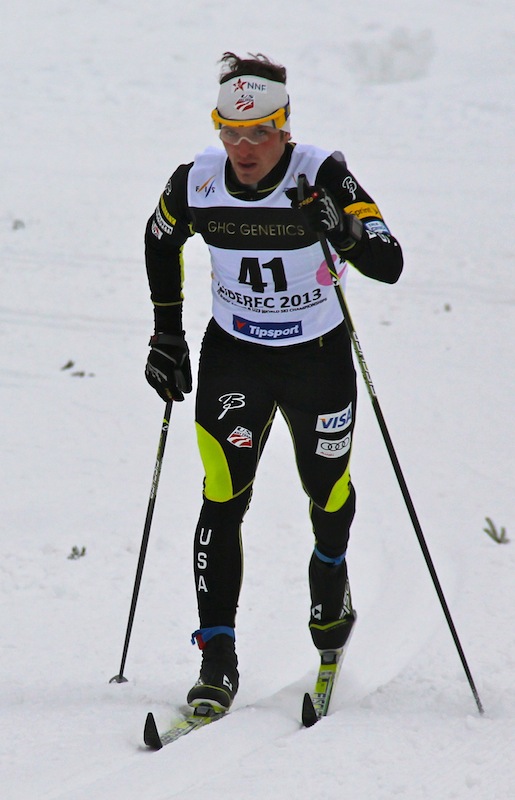
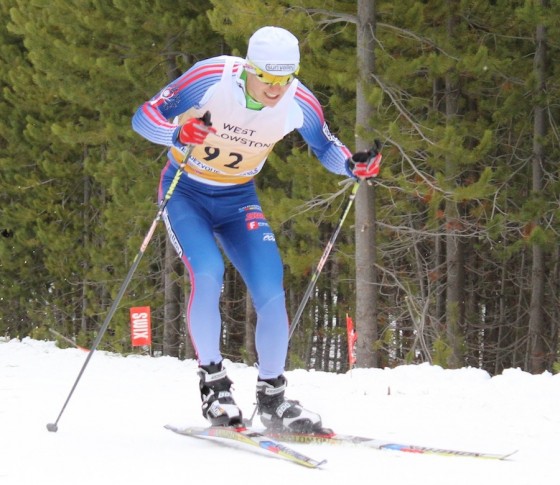
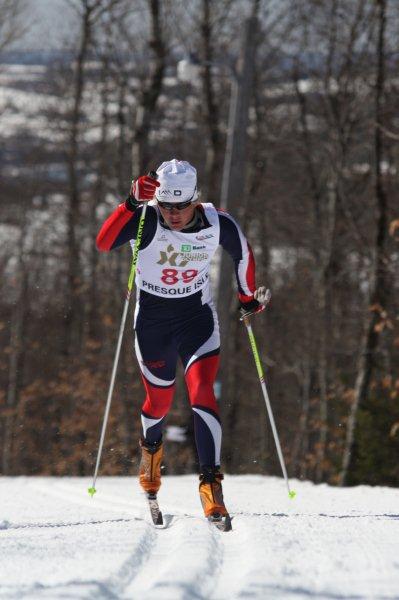
University of Vermont senior Scott Patterson racing to second in Saturday’s 15 k freestyle at SuperTour Finals in Anchorage, Alaska. (Photo: Rob Whitney)
Watching him climb Elliott’s the second time around 10 k was unlike anyone else. Scott Patterson of the University of Vermont (UVM) led Hoffman by half a second after the first 5 k loop, then fell behind by 4.6 seconds by the end of the second.
“There’s no recovery out there,” Hoffman said after the race. “You’ve got to work the whole thing. The downhills are turny, really require you to work, but for the most part it’s just rolling terrain and no big uphills, no big downhills, quite different than anything I’ve raced [overseas] all year. It was fun.”
With about 5 k to go, Hoffman, 25, put the hammer down on the hills he knew were his strength. The lone skier at Spring Series from his Colorado club, Hoffman stood out in white — and in his ability to attack when most were visibly slowing.
“My strategy was try just to ski really high energy but keep it relaxed, knowing that I couldn’t really go over the line because there was no place to recover,” Hoffman said. “There were limited opportunities out there to attack on the uphills so I had to really focus when I did have that opportunity.”
Hoffman continued to gap Patterson, a UVM senior from Anchorage, on the final lap and ultimately beat him by 10.9 seconds for a victory in his first SuperTour Finals since 2012.
“I knew I was close to Scott,” Hoffman said. “I was getting word out there, ‘Tied! Up by two, down by two,’ so I knew it was a close race and you’ve just got to work for every second out there and see what happens.”
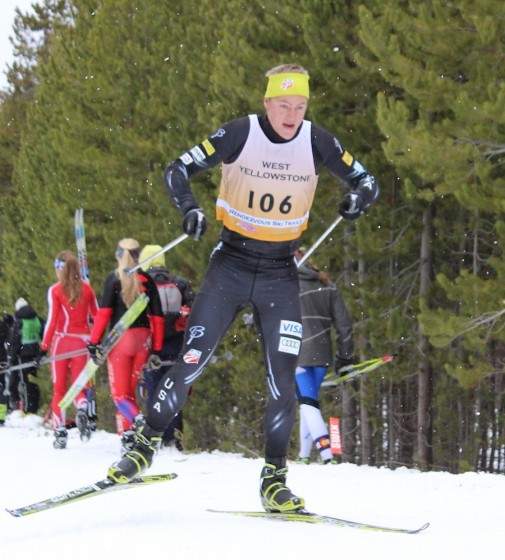
While Patterson gave Hoffman a run, nobody else came too close. Erik Bjornsen of Alaska Pacific University (APU) and the USST was in a three-way fight for third with Patrick Johnson (Far West Elite Team) and David Norris (Montana State University) with one lap to go.
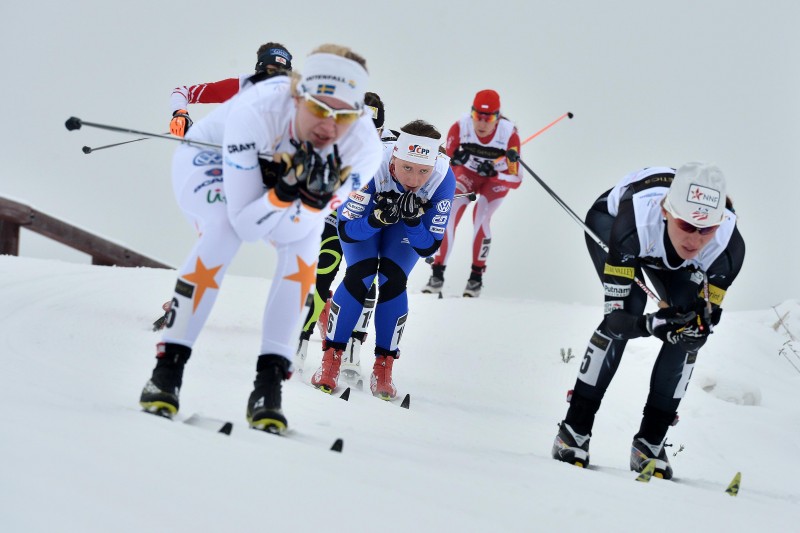
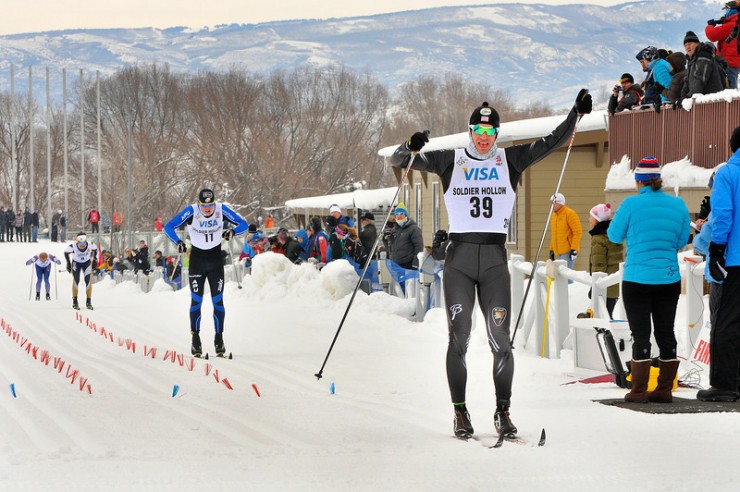
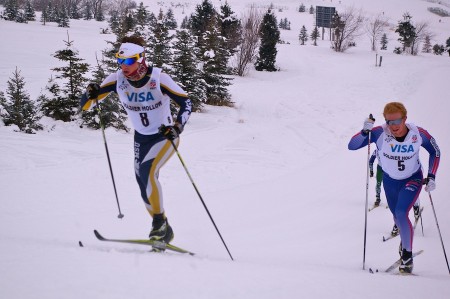
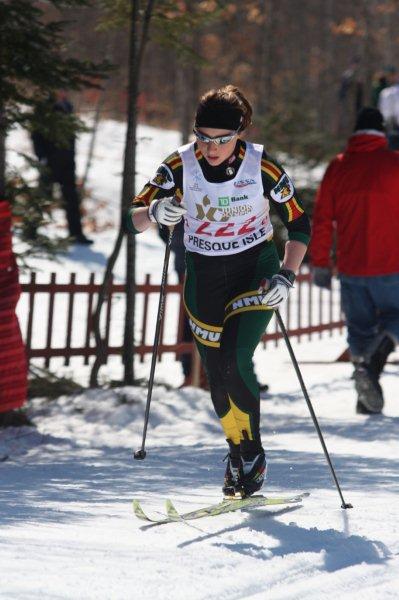
Erik Bjornsen (APU/USST) racing out of the World Cup start area to third place in Saturday’s 15 k freestyle at SuperTour Finals in Anchorage, Alaska. (Photo: Rob Whitney)
Bjornsen ended up third, 59.3 seconds behind Hoffman and 3.1 second ahead of Norris in fourth, and said he lost time on the second loop and didn’t have the finishing punch he’s used to.
“I really didn’t find that top gear in the last lap that I was looking for, so that was a little disappointing,” Bjornsen said.
But a podium is a podium at a race series that ranks right up there with U.S. nationals prestige (on March 28, the 30 and 50 k classic mass starts will serve as U.S. Distance Nationals).
“It’s been cool this year going to the Olympics,” Bjornsen said. “I think Anchorage has started to notice my name. Just a ton of fans out there. It was so fun.
“I thought I was fourth,” he continued. “I’m happy with [third]. … It’s a tough race. You’ve just got to keep working the whole time and keep moving. As soon as you kind of rest or chill for a little bit I think you lose a lot of time.”
“I think Anchorage has started to notice my name. Just a ton of fans out there. It was so fun.” — Erik Bjornsen (APU/USST), third in SuperTour Finals 15 k freestyle
Patterson didn’t let off the brakes, especially with Anchorage spectators lining the course, but thought he came undone a little bit on the final climb. At the halfway point, he recalled being two seconds ahead of Hoffman in the lead — an accomplishment for any non-USST member, let alone a college racer.
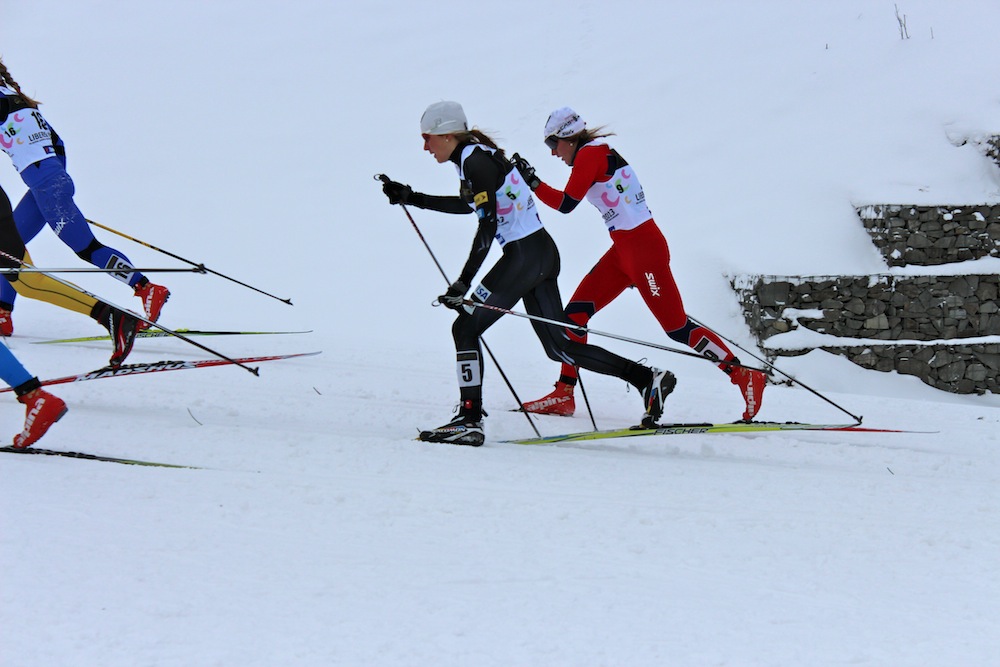
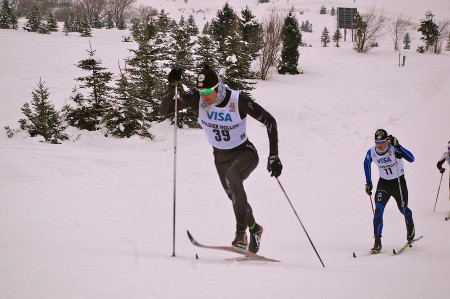
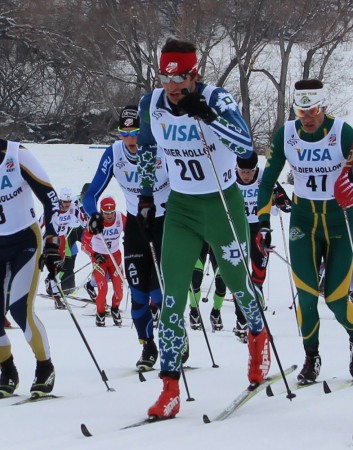
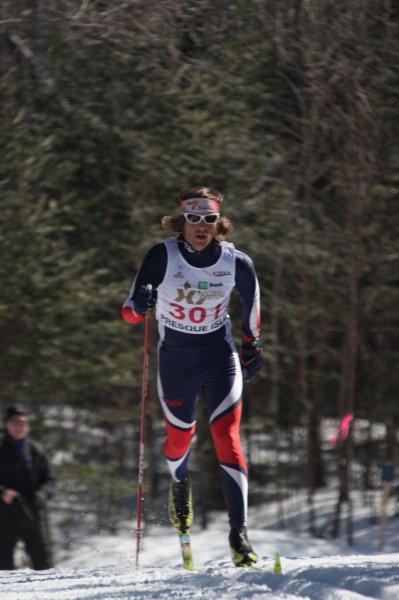
Noah Hoffman on his way to winning his first SuperTour Finals race in two years. He did not compete in Truckee, Calif., last season. (Photo: Rob Whitney)
“It seemed like every person was giving me splits, every volunteer was cheering for me so it was pretty cool. Definitely had a good crowd out there that knew me well,” he said.
“Scott’s a great skier, I’ve known that for a long time,” Hoffman said. “It was never a guarantee I’m going to win this race. I’m just glad to edge it out. I hope to ski Scott at the World Cup level sometime soon.”
If Patterson, the younger of the two siblings at the Finals (Caitlin of the Craftsbury Green Racing Project is the other), has his way, that’s exactly how his career will go down. The first step is not being intimidated by a USST athlete. The second: learn how to deal with limited splits on when you start ahead of the person you’re trying to chase down.
“It was hard to kind of know — up, down, going back and forth — so I tried to push it in, but I was a little slow on the last hill,” Patterson said. “He definitely picked it up towards the end.”
For Hoffman, the attack made all the difference. Besides Patterson and Bjornsen on the podium, Hoffman beat everyone else by more than a minute. Norris was fourth (+1:02.4), Lex Treinen (APU) fifth (+1:06.2). Johnson placed sixth, Matt Gelso (Sun Valley Ski Education Foundation) took seventh, Reese Hanneman (APU) was eighth, Brian Gregg (Team Gregg/Madshus) ninth, and the former APU skier Mark Iverson (Rossignol) 10th.
Hoffman and Bjornsen were among four in the top eight getting wax help from APU this week, including Norris and Hanneman.
“I don’t really know how my fitness is at the moment; it was a lot of travel,” Hoffman said after flying from Sweden to Anchorage earlier this week. “I’ve been sleeping pretty well for the most part this week, but it’s a hard transition, it’s also just been a long season.”
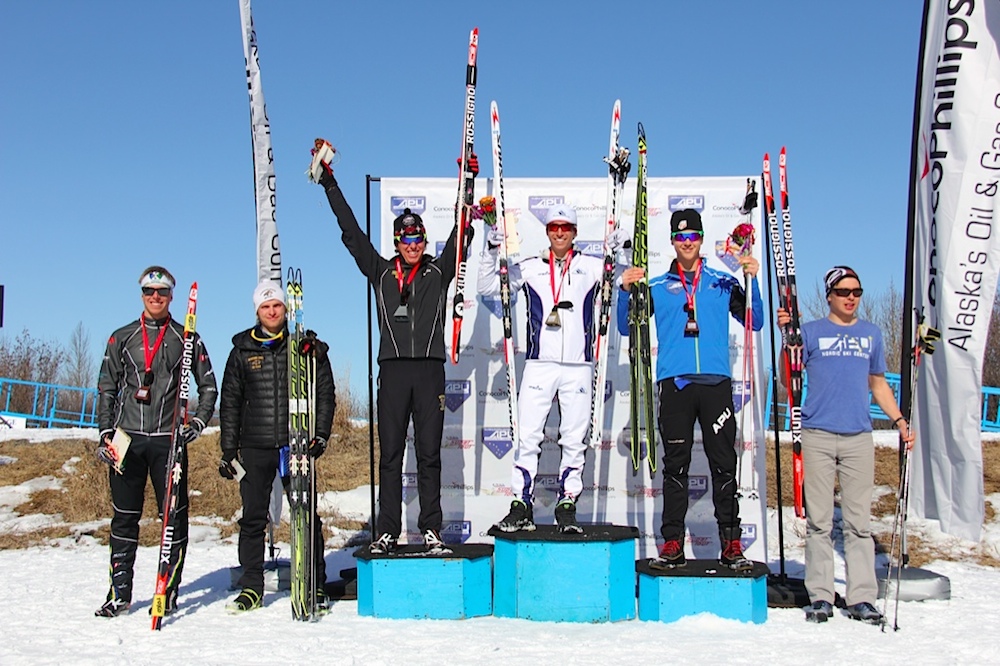
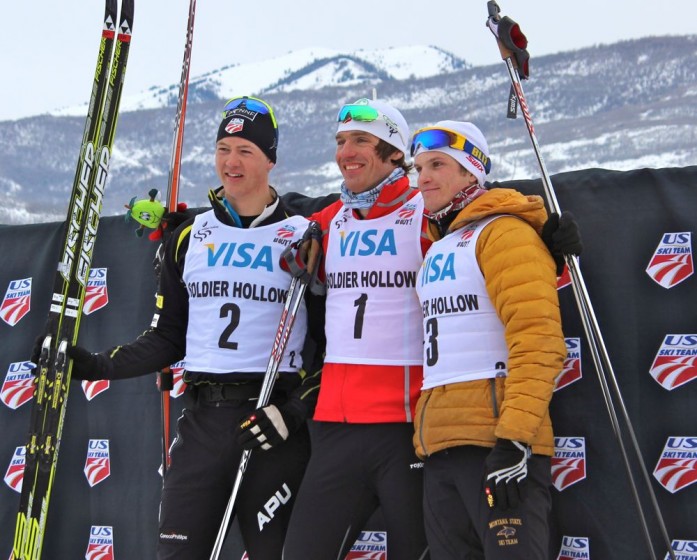
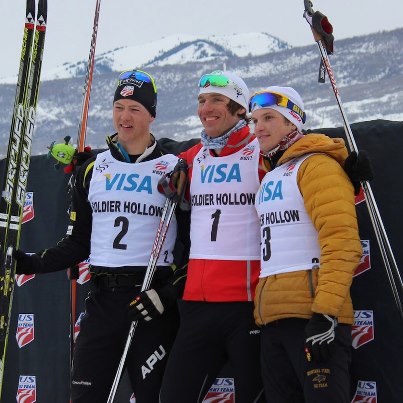
The men’s 15 k freestyle individual start podium at SuperTour Finals in Anchorage, with winner Noah Hoffman (c), runner-up Scott Patterson (third from l) and Erik Bjornsen (second from r) in third.(Photo: Rob Whitney)
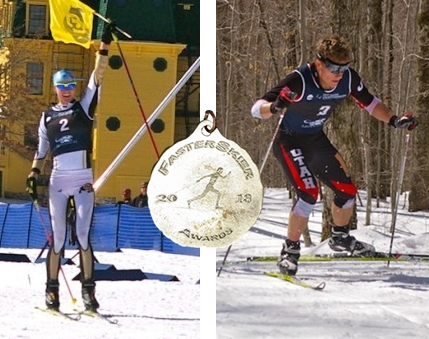
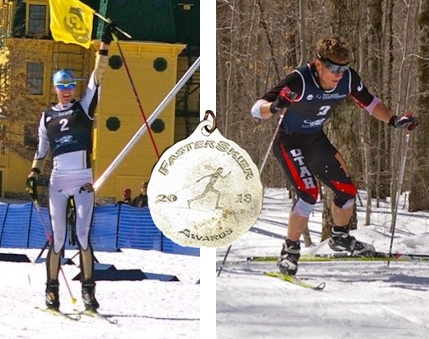
Joanne Reid (University of Colorado) and Miles Havlick (University of Utah) are FasterSkier’s 2013 Collegiate Skiers of the Year.
After a one-year hiatus, our Skier of the Year awards are back. We start with the collegiate category, where for the first time in FasterSkier’s history of giving such prizes Americans took both of the top honors: NCAA freestyle champions Miles Havlick (University of Utah) and Joanne Reid (University of Colorado).
Miles Havlick (USA/University of Utah)
Havlick (Photo: Steve Fuller/Flyingpointroad.com)
When it came time to nominate athletes in the college division, Havlick was at the top of a very short list. There is no question he deserves the honor; in college skiing all roads lead to NCAA Championships and his performance there was the storybook ending to a stellar college career. Not only did the senior from Boulder, Colo., defend his 2012 20 k NCAA title this year, which is no easy feat, he did so against one of the most competitive fields the NCAA has ever seen. The freestyle race, with its dramatic sprint finish and Havlick’s six-tenths winning margin, is not one to be forgotten any time soon. And at an event that’s all about team, Havlick was the first of all three Utes in the top five in the mass start, which propelled Utah from fourth to second on the last day of the Championships. For Havlick, it was a “perfect” ending to his time in Utah’s black and red.
Leading up to NCAAs, the signs were all there that Havlick was bound for success in Vermont; he won six out of ten RMISA regional races and never once finished outside the top 10. At the Montana SuperTours prior to the beginning of the college season, he just missed out on a trip to Canmore, Alberta, as an American representative on the World Cup. He’s our 2013 award-winner because of his achievements in college skiing, but when Havlick makes the transition to racing professionally after graduation he’s bound to shake up the men’s field at the national level.
Joanne Reid (USA/University of Colorado)
Joanne Reid leading CU teammates Eliska Hajkova (4) and Maria Nordstrom (9) in the 15 k freestyle at NCAA Championships. Reid won by nearly 27 seconds and Hajkova was second. (Photo: Steve Fuller/Flyingpointroad.com.)
The skier-of-the-year choice was also clear in the women’s collegiate category. Joanne Reid, in a ridiculously dominant senior season, won eight out of ten regional races leading up the final showdown in Ripton, Vt. At NCAAs, she added another ‘W’ to her resume in the 15 k mass start classic to lead CU to an improbable come-from-behind team win on the final day. It’s hard to call a team with 18 NCAA Championships in its trophy case (now 19) an underdog, but that’s what the Buffs were when they entered the last day of NCAAs 54 points down to the University of Vermont. Colorado relied on its nordic women for the lion’s share of the team score, and with the pressure on Reid delivered a 27-second victory over teammate Eliska Hajkova. Reid later said was unaware of her gap on the rest of the field until she realized the crowd would fall silent after she skied by.
A look back at Reid’s previous record demonstrates just how big a jump she made in the last year: though she’d already been on the NCAA podium as a sophomore in 2011, winning is quite a different thing. Illness plagued the Palo Alto, Calif., native midway through last season, and prior to this year she had only two collegiate wins to her name. What happened next, of course, is history: in the last few months Reid more than quadrupled her win record as she tore through the RMISA circuit like it was no big deal. Reid comes from an intimidating lineage of elite endurance athletes, but with her new individual NCAA title she’s on her way to creating a powerful reputation of her own.
Honorable Mention:
David Norris (USA/Montana State University)
David Norris’ wide-reaching accomplishments this year are worth noting. He particularly didn’t stand in the college circuit, but that was because he skipped half the season to race internationally — first at a little thing called the World Cup in Canmore, then at U23 World Championships in the Czech Republic. In between he was third in the 30 k classic at U.S. Nationals to Torin Koos and Erik Bjornsen. Norris finished a respectable 11th and 12th in the NCAA races, and immediately thereafter he jumped on a plane to compete for the U.S. at OPA Cup Finals in Italy. When he returned, he continued racing at Spring Series. It’s been said that college and skiing are difficult to pursue at the same time, but Norris and his coaches proved this year that the logistics are doable.
Sam Tarling (USA/Dartmouth College)
Like Norris, Tarling put together solid performances both in and out of the college circuit this year. A repeat NCAA title remained elusive for the Mainer, but like Norris the Dartmouth senior accrued impressive results domestically and internationally. Tarling was fifth in the 30 k at U.S. Nationals, joined Norris in representing the U.S. at U23 World Championships, and despite having to miss the first two EISA carnivals he was the second-ranked Eastern qualifier to NCAAs, where he finished 10th and seventh in the 10 k and 20 k, respectively. He joined Norris again in Toblach, Italy, for OPA Cup Finals, where was the top American man in the mini-tour final standings. After SuperTour Finals Tarling announced he’s going pro, and if past results are any indication he’s headed for big things next year.
Sadie Bjornsen (USA), shown here competing at World Championships this February, won the 5 k classic at OPA Cup Finals on Saturday in Toblach, Italy.
After taking third in the prologue at OPA Cup Finals on Friday in Toblach, Italy, Sadie Bjornsen (USA) followed up on Saturday with an outright win in the second stage of the mini-tour, a 5 k individual classic. She completed the course in 14:37, 5.1 seconds ahead of runner-up Sandra Ringwald (GER).
“I just tried to ski right under sprint speed the entire time, because I knew it was going to be fast out there,” Bjornsen said of her race. “At about 3 k I started to get scared as my legs really began to flood, but I managed to hold on.”
With another day in Italy under her belt after a long day of travel from the Drammen World Cup, Bjornsen said she felt more adjusted to the new venue on Saturday.
“I felt a lot better today,” she said. “Much more like a racer in control of my feelings and effort.”
As the race-winner, Bjornsen leads OPA Finals going into Sunday’s pursuit and will start the 10 k freestyle being chased down by the rest of the field.
“We start the season chasing the Euros. Now I get to end running from the Euros,” she said. “It should be a good race. I have limited energy left I can feel, but I will give it all and see what happens. I am of course nervous. It is always nerve-racking when you are the rabbit.”
Bjornsen led six other American women in the 5 k classic. Kate Fitzgerald finished twelfth, 42.6 seconds back, Caitlin Patterson was 24th, Becca Rorabaugh placed 25th, Erika Flowers was 29th, Lauren Fritz finished 25th and Anna Van Der Rhee was 36th.
According to Fitzgerald, conditions were “perfect” for classic skiing in Toblach.
“It was pretty much some of the best snow conditions I have seen all season!” she said. “Cold hard track and fresh snow. The course had some really great gradual striding sections so my plan was to just ski big and strong.”
Though it’s late in the season and many athletes are starting to feel fatigued, Fitzgerald said she is still feeling good.
“It is a very long season but I am still excited to race!” she said.
Sam Tarling (Dartmouth College), pictured above competing in Friday’s prologue, led the Americans in the men’s 10 k classic at OPA Cup Finals. Photo: Bryan Fish.
The two collegiate athletes in Italy led the U.S. in the men’s 10 k; Sam Tarling (Dartmouth College) took 21st, 46.7 seconds behind Basen Poirrier’s (FRA) winning mark, and David Norris (Montana State University) was 28th (+57.1). Both athletes made their plans to race in Europe this weekend knowing OPA Finals fell just after NCAA Championships and also coincided with spring break.
Tarling, despite feeling “flat” in the prologue, felt recovered and more confident on Saturday.
“I went out to test classic skis in the afternoon and finally felt much better,” he said. “I was hoping mostly just to have good skis and good feeling and I felt confident if it all went well I’d be able to get in the top-30.”
Relative to the warm conditions the East has been experiencing lately, Tarling said the Toblach conditions were a welcome change.
“It was textbook classic skiing, perfect course with long skiable hills and bulletproof tracks,” he said. “We’ve been dealing with some pretty warm and variable conditions in the East lately and it was nice to get back to skiing real solid tracks.”
Norris, who says he’s struggled this season to put together good races, felt good about his 10 k.
“I was really conservative and then just tried to rock the last lap,” he said. “I’m happy today and would love to have a very good one tomorrow.”
Four other U.S. men competed on Saturday. Matt Gelso was 30th, Erik Bjornsen took 33rd, Pat Johnson finished 34th and Mike Sinnott tied a Spanish skier for 51st.
Tarling and Norris’ decision to race at OPA Finals was a deliberate one. Not many college skiers choose to keep racing after NCAAs, much less in Europe, but both ambitious student-athletes believe strongly in continuing their athletic development while demonstrating that international competition is possible while going to school.
“We looked at the schedule while we were at U23’s and thought it would fit really well,” Tarling explained. “It was great to get good feeling back today for both me and David, since we weren’t sure how we’d be able to adjust after NCAAs and traveling to Europe the next day. We both believe strongly in college skiing, so we want to help prove that international races and college races are not mutually exclusive, and more importantly that college skiers can compete at an international level.”
David Norris competing in Toblach on Friday. Photo: Bryan Fish.
Norris and Tarling both plan to compete at SuperTour Finals in April as well.
“My class load is a little easier this semester so I figured I would try to get over seas more this season,” Norris said. “It probably didn’t help my NCAA performance, but it motivates me to train harder and I think it’s important to work within the US Ski Team pipeline while doing NCAAs and pursuing an under grad.”
OPA Finals also features junior races, and the U.S. has two men competing. Paddy Caldwell and Kevin Bolger finished with 20 seconds of each other in 10th and 14th, respectively. For Caldwell, it was one of his best results of the season.
“I’m really excited about today’s race,” Caldwell said. “That was one of the best classic races I have had all year. Going into the race I was really focused on skiing techniquely well and trying to improve my start position for the pursuit on Sunday. I am feeling really good right now. This is my last race series for the year; it’s great to finish off the season on a high note here in Italy.”
Beginning with National Junior Championships in Lillehammer, Norway, in early February, Caldwell has been racing in Europe for five straight weeks now. The primary purpose of his stay has been to accumulate international experience.
“My main goals were to feel good racing and to try to mix it up with some international junior fields,” he said. “Another big focus of this trip was to get more comfortable racing in Europe. I have learned a lot about what works best for me for travel and on the road training. This has been an amazing trip and learning experience.”
OPA Finals concludes on Sunday with a 10/15 k freestyle pursuit.
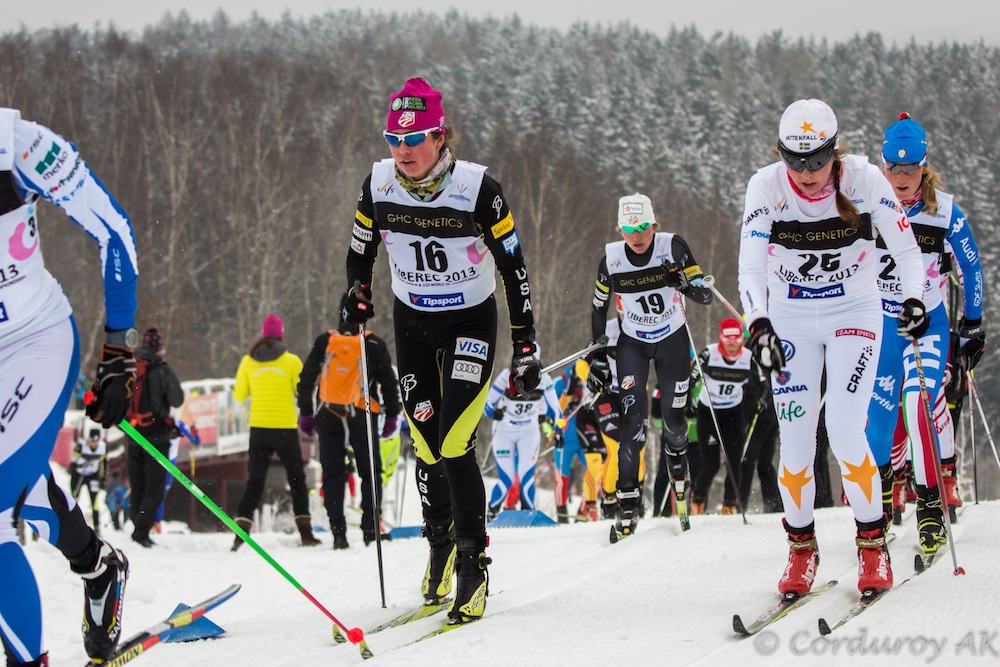
Caitlin Patterson (Craftsbury Green Racing Project) competing in Liberec, Czech Republic, last month. On Thursday she led the U.S. with a ninth-place finish in the 10 k freestyle Scando Cup race in Madona, Latvia. Photo: Logan Hanneman/Corduroy AK.
After the Junior and U23 World Championships wrapped up two weeks ago in Liberec, Czech Republic, a handful of American athletes and coaches remained in Europe to compete in a series of Scandinavian Cups in Madona, Latvia, and Pärnu, Estonia, where they were joined by a few older seniors from the U.S. Together they form a team of seeking to soak up international racing experience, for though each race is the Scandinavian equivalent of a SuperTour, the field contains a talented group of sub-World Cup Norwegian, Swedish and Finnish skiers.
“My primary goal of this trip is simply to soak up the European racing experience,” said Caitlin Patterson (Craftsbury Green Racing Project), who has led the U.S. in results so far this week. “These races are the first time I’ve raced in Europe apart from the World Junior/U23 Championships, so it’s really been about expanding the range of race types and locations I’ve experienced.”
In Madona Patterson was the top American performer in both the classic distance race and mass-start freestyle event. Thursday’s 10 k skate was a particular highlight for her, as it was one of her best mass starts all year.
“It was probably one of the best mass starts I’ve ever had, judging by how well I maneuvered around people and got towards the front immediately,” she said. “I was never in the very front, but I was within the top five a few times on the first lap of two.”
In a lead pack of ten women that separated within the first 3 k, Patterson was pleased to find herself among them.
“I remember noticing during the race that I was the only non-Norwegian among that group! It was very fun to be able to ski with the Norwegians, to match them stride-for-stride and try to keep up with their surges over the tops of the hills,” she said.
After skiing with Finand’s Marjaana Pitkaenen during the second lap Patterson finished just shy of three other women, and crossed the line 46 seconds behind race-winner Kari Vikhagen Gjeitnes (NOR). Patterson described the race as one of the most enjoyable she’s had lately and hopes that if she can find a touch more speed and energy for the end of future races, “some day soon I’ll be able to keep up with those Norwegians on the podium,” she said.
Though there were only 29 women in the field it was still a competitive two races — Patterson noted that several of the top finishers have scored World Cup points in the past.
“While it certainly isn’t the World Cup, the skiers here are absolutely motivated to race fast and hard, and I’d say based on my experience that the competition is more intense than most if not all races in the U.S.,” she said.
Sophie Caldwell (SMS T2), after fighting off a brief cold at the beginning of the week, finished 14th on Thursday.
“I don’t think today’s race was anything special but it wasn’t a disaster,” she said. “I felt pretty good yesterday but today I got very tired from the fast pace the first lap and then slowed down and settled into a little pack the second lap.”
As one of the seven women named to the American World Championships team last month, Caldwell’s goals for the race series include recovering well in between competitions and getting more accustomed to European racing before she heads to Val di Fiemme, Italy.
“I think racing over here does take some getting used to,” she said. “Sometimes back home, the pace of a longer mass start race can start out fairly relaxed but over here it’s very fast from the start and that isn’t something I’m used to. I’m sure the more we do, the easier and more normal it will seem but both mass starts I’ve done since arriving here (Latvia and U23s) have started out at a very fast pace.”
Three American women competed in the 10 k on Thursday; Becca Rorabaugh (Alaska Pacific University) was 23rd, 1:16 after Caldwell.
Packer Has ‘Breakthrough,’ Notches 16th in 20 k
The men’s 20 k went out much like the women’s — fast — but with about 40 more people in the mix. Through the chaos Eric Packer (SMS T2) had his best race of the season, finishing 16th to lead five U.S. men in the race. At the finish he was only 24 seconds behind Sindre Skar’s (NOR) winning mark.
Eric Packer (SMS T2) in action at U23s. He was 16th in the 20 k mass start freestyle in Madona, Latvia, on Thursday. Photo: Logan Hanneman/Corduroy AK.
“Today’s race went really well for me, and was a breakthrough for this season,” Packer said. “I felt comfortable skiing in the group and felt better and better as the race progressed.”
For Packer to be 24 seconds off of Skar, where in Liberec he was minutes off the Norwegian’s pace, was a huge step forward. Packer sat in 30th on the third of four laps and in the remaining kilometers he “put the hammer down” to work his way to the front his group, passing over a dozen skiers along the way. By the end he was catching stragglers from the lead group — no small feat in a field Packer says is “almost as competitive as U23s.”
“Norway is providing World Cup starts to their top three racers this week, and I’m sure Sweden and Finland are placing similar stakes on the races here,” Packer said. “My impression is that all the top Scandinavian athletes not competing on the World Cup are competing in these races.”
Fresh snow fell in Madona nearly every day since the Americans arrived, which made conditions on the course variable in temperatures that hovered around freezing. Packer credited the coaches and his skis with playing a big part in his best race of the year so far.
“The techs did an awesome job on skis,” he said. “Grind was particularly important to day and my 258’s from Caldwell Sport were awesome.”
David Norris (Montana State University) was 28th on Thursday, about a minute behind Packer. After getting sick at U23s in Liberec last month Norris felt closer to normal in Madona but not yet great.
“Today’s race was tough,” he said. “Thirty guys in the lead pack all fighting to move up. The pace was pretty relaxed for 15 k, but when the pace picked up towards the finish I just didn’t have any energy in my legs.
“Today’s race was just decent. I really look towards having a great race.”
Norris, still a junior at MSU, is in Europe for the same reasons the rest of the American contingent is — to gain experience. But he is also in the unique position of still being a college athlete, and when he returns to the States he hopes to qualify for NCAA championships with a good result at regionals.
“I extended my U23s trip so I could get more chances racing in Europe against strong guys,” Norris said. “I asked the coaches this fall if I could make a commitment to getting more race starts in Europe and [MSU head coach] Chad Anderson is just super supportive of anything that may make us better athletes.”
Behind Norris, Jack Novak (Alaska Pacific University) was the third American to finish the 30 k in 39th. Forrest Mahlen (APU) was 51st and Ben Saxton (F.A.S.T. Performance Training) was 57th.
On Thursday evening the team drove from Latvia to Estonia, where a set of Scando Cup sprints are set to take place on February 9 and 10.
Caitlin Patterson (Craftsbury Green Racing Project) en route to a 14th-place finish in the 10 k freestyle at U23 World Championships. Photo: Gus Kaeding.
When some athletes go to U23 World Championships, they come in with an enormous amount of pressure on themselves to perform well in the biggest race of the year. The mentality can work for some, but Caitlin Patterson (Crafstbury Green Racing Project) prefers the opposite approach. The 23-year-old has been to these championships a few times before and is careful not to place more importance on them over any other race. On Thursday in Liberec, Czech Republic, the even-keeled perspective helped Patterson towards 14th place tie in the women’s 10 k individual freestyle event for her best finish in three appearances at these championships.
“I’m happy with the result today,” Patterson said. “My main goal today was to ski my own race and push myself to the limit, to ski as fast as possible… I’m happy to have skied well today in a strong international field while representing the US, and I know the race experience will improve my confidence for future races and help me learn to ski faster.”
Patterson skied a conservative 20th-ranked first lap to come on strong in the second half to finish in 29:31.9, 1:41.5 behind Ragnhild Haga’s (NOR) winning mark. She says her opening pace wasn’t by design, exactly, she just took a few kilometers to warm into the race.
Patterson catching her breath after finishing. Photo: Liberec2013.
“I definitely skied my own race, starting off slowly and building momentum from there,” she said. “Actually I felt a bit disconcertingly weak on the first lap, and so while the coaches said it looked like I was skiing relaxed or maybe starting (very) conservatively, I was actually trying to wake up and feel more energetic. Luckily I worked my way into the race and felt much better on the second and third laps.”
Pepa Miloucheva, Patterson’s coach at Craftsbury, was on course giving splits and said as much of her athlete’s race. “I was able to see most of the race,” Miloucheva said. “Caitlin had a little slow start, but looked great on the second and third lap, so was able to make time and finish strong.”
As the 37th starter in a field of 49, Patterson started just in front a few of the fastest-seeded women in the field. She planned to work the positioning to her advantage and work with people around her, but she wound up skiing much of the course alone. She briefly skied with teammate Liz Guiney in the stadium before the latter turned into the finish lanes, but for the most part had to set her own pace.
“My third lap was particularly lonely, with no one ahead or behind for what seemed at least a few minutes each direction (the course twists and turns enough to be able to see people, and I know no one finished for several minutes after I crossed the line),” she said. “Luckily at that point I was comfortable with my own pace and enjoying the race.”
Many have commented this week on how difficult the Liberec trails are, and on Thursday they were made even more difficult by a fresh layer of new snow that slowed ski speed. In such conditions, Patterson focused on transitions and riding a ski well.
“It was also important not to let yourself think that the few flat areas were parts of the course where you could rest; there was very little rest available, especially with new falling snow slowing everything down,” she said. “It was at least as important to push along the flats as it was to work hard on the hills.”
Looking ahead to the 15 k skiathlon on Saturday and beyond to the rest of the season, Patterson is more excited than ever.
Sophie Caldwell, 17th. Photo: Gus Kaeding.
“The pursuit will certainly be a different race, with classic technique, longer distance, and mass start thrown into the mix, but I think I can build off the strengths of today’s race and I should be able to do well in the pursuit too,” she said. “I’m very excited! It’s easier to look forward to future races when current races are going well, and my experience today will help me progress towards racing faster during the rest of the season.”
Finishing just three places and 23 seconds behind Patterson, Sophie Caldwell (SMS T2) was very nearly the second of two American women in the top 15 on Thursday. She finished 17th after crashing on a major downhill on her final lap, but until that point had skied comfortably in the top 15 and within a few seconds of a top 10.
“She was definitely in the hunt for a top-10 and unfortunately lost a fair amount of time but still ended up 17th, which is a solid result,” said U.S. Ski Team development coach Bryan Fish.
In light of managing a top-20 even with the fall, Caldwell is looking forward to the skiathlon on Saturday.
Annie Pokorny, 29th. Photo: Gus Kaeding.
“Overall I was happy with it,” she said. “I felt good today and am excited to do some more distance races in the next couple weeks. My fitness feels like it’s still improving and I’m definitely learning more each time I race over here against such strong competition.”
Annie Pokorny (Middlebury College) came through in 29th to put three Americans in the top-30. Considering this is her first international event and she was sick with the flu in the week leading up to the championships, Pokorny was “very happy” with the result.
“I went into the first lap challenging myself to ski as smoothly as possible,” she said. “I think I did that. From there I planned to catch as many rides as possible, which I managed to do from [Anastasia] Slonova and [Ragnhild] Haga — short, very speedy rides! I think the coolest moment for me was going up the last climb behind Haga. It was sobering to see how a U23 world champion skis—to be in the same race as that person. It was exciting… Racing today was the coolest thing I’ve ever done.”
Liz Guiney (University of New Hampshire) finished fourth for the U.S. in 42nd.
Erik Bjornsen (left) on his way to a 15th-place finish in the 15 k at U23 World Championships. Photo: Gus Kaeding.
In the men’s race Erik Bjornsen (Alaska Pacific University/U.S. Ski Team) led the way for the U.S. once again with a 15th-place finish in the 15 k freestyle. The result was another personal best — he was 10th in the sprint on Tuesday, and this is his new high mark in a distance race at U23s — but for someone with ambitions like Bjornsen, it ranked somewhere between a “decent” and “pretty good” day.
There were aspects to his race he was happy with and others that didn’t sit well. His finish time for the four-lap event was 37:44.4, exactly two minutes behind Sergey Ustiugov’s (RUS) winning time.
“Fifteenth isn’t bad but being two minutes out is not awesome,” Bjornsen said. “I think it was a decent day for me, but I think I could have been in the top 10 if I’d had a good day. That’s kind of how it goes sometimes.”
Bjornsen finishing just behind race-winner Sergey Ustiugov (RUS) after skiing the final few kilometers with him. Photo: Liberec2013.
Ustiugov actually caught Bjornsen from two minutes back with two kilometers to go, which for some could have been a disheartening development, but Bjornsen took the opportunity to catch a ride with the fastest guy in the field and pick up a few places with a strong finishing kick.
“That was really impressive to watch, because this kid was flying out there,” Fish said of Ustiugov. “I was out in the field and was basically able to watch the last kilometer and they were absolutely flying up the last climbs. It was really impressive to watch both those guys come in and the powering speed that they were carrying.”
Bjornsen didn’t let Ustiugov put any more time on him, and even moved up alongside him at certain points. The Russian only pulled slightly ahead of him as they came into the finishing lanes.
“I like to finish strong, usually I’m able to kick up the pace with a kilometer or two to go, so it was really nice to have him there,” Bjornsen said. “He pulled me for a k or so and then … we kind of duked it out to the finish line. He had a better lane so he actually beat me to the finish but it was sweet to ski with the leader for a k or two.”
The fact that he could ski with Ustiugov, who won every single U23 event in Turkey last winter, left Bjornsen wondering what could have been if he had started closer to the Russian.
Bjornsen climbing. Photo: Caitlin Patterson.
“It would have been nice though if he started 30 seconds closer to me,” he said. “I think that it would have been sweet to have someone to ski with or try to hold onto. So that was too bad, with it being a four-lap course a lot of guys got to ski with people and I felt like I was just working on my own for 13 of the 15 k.”
Bjornsen also feels his top-end gear for low-altitude skiing is still coming around. He spend his entire November, December and early January skiing at high-altitude venues in Montana and Utah, and this was his first distance race close to sea level. Bjornsen thought of several places where he should have skied more quickly.
“It’s definitely a different feeling,” Bjornsen said. “I want to keep working on that and I think I’ll get some more chances this year, but its hard because when you’re at low altitude like this you have to be hammering the whole time, you can’t let up for 10 seconds or anything just because you lose time so quickly.”
On the positive side, though, Bjornsen now knows with even greater certainty than he did after his classic sprint that he can ski with the fastest of his peers in the world.
“I’m starting to know a lot of the guys and I follow their results and stuff,” he said. “It’s cool to know these guys and start feeling like I’m kind of in it, to race with a lot of these guys. So I’m feeling a lot more confident. The top ten dudes all have World Cup experience, which is the same as where I’m at, starting to race some World Cups. I still have one more year [at U23s] so it’s always been my goal to get a medal or at least a top 5 at these championships. Hopefully in the pursuit or next year.”
The new snow that fell in Liberec on Thursday morning created tricky waxing conditions. Bjornsen felt he had the best skis he possibly could have, but some of the American men were frustrated with slow equipment.
Sam Tarling (Dartmouth College), in his first race of the week, placed 39th with a time of 38:47.4, three minutes off the winning time.
Sam Tarling and Eric Packer working with a Swede. Photo: Gus Kaeding.
“I felt pretty good about it,” Tarling said. “I was hoping for better, but you can’t have everything go perfectly in every race. I felt fit in the race, but my skis could have been better… I’m super stoked to be with such a talented group though, and I’m looking forward to making a better impression in the skiathlon.”
David Norris (Montana State University) was 50th, 33 seconds behind Tarling.
“The result is very disappointing,” he said. “I wanted to be top 20 at the very least. Based on fitness and how hard I pushed the race I am confident this is my best race yet this season, but with such awful skis you just cant compete in such a strong field and wish to look good on paper.
Norris noted that he was able to ski with most of the men who started around him and that it was important to stay positive about it.
David Norris, 50th. Photo: Gus Kaeding.
“I out climbed those around me and was very pleased with my fitness, and it is important for me to remember that I was skiing well when the result looks so bad,” he said.
“Our techs are working super hard and today was just a tough one, the coaches are super generous and offer advice and help us out any chance they can. Looking towards the 30 k now!”
Eric Packer (SMS T2) finished fourth for the Americans in 54th.
“I’ve struggled with distance racing this year, and today was probably my best race so far this season,” Packer said. “I’m obviously not happy with the end result, but at least things seem to be moving in the right direction.”
Sophie Caldwell (USA) on her way to ninth place in the classic sprint at U23 World Championships in Liberec, Czech Republic. Photo: Liberec2013.
To follow up a strong first day of junior racing at the 2013 Junior and U23 World Championships in Liberec, Czech Republic, the U.S. team posted another set of personal-best results in the U23 classic sprint. Sophie Caldwell (SMS T2) and Erik Bjornsen (Alaska Pacific University/U.S. Ski Team) made the semifinal round to finish ninth and tenth, respectively, in strong fields that included several regular World Cup skiers.
“They looked really good,” said USST development coach and trip leader Bryan Fish. “Erik and Sophie both in the top 10, that’s awesome.”
Caldwell and Bjornsen have both been to the World Junior/U23 championship event several times before. More importantly to them, however, they have each qualified for the sprint heats on multiple occasions but were always stopped in the quarterfinals. That track record that didn’t sit well with either of them going into Tuesday’s race in Liberec. With another chance to get the monkey off their backs the Americans set the record straight: they can compete with the best sprinters in the world.
Caldwell skiing through the semifinals. Photo: Annie Hart.
Caldwell has been to three World Juniors before but has never attended the championships as a U23. Her previous best at was 17th in the sprint in 2009, but as she has already shown throughout the first half of the season, Caldwell is skiing on another level this year. With a ninth place now in the bag in her first race of the week at U23s, she’s feeling pretty good.
“I’ve very happy with the result,” Caldwell said. “I wasn’t sure what to expect going into the day but saw that I was ranked tenth so I thought top-10 could definitely be a possibility.”
Qualifying tends to be her strong point in classic sprints and Tuesday was no exception; she started off in fifth place in the prologue and knew after that she had a good shot at doing well in the heats.
“I’m better at striding than I am at double-poling but Gus [Kaeding] and I worked a lot on double-poling the other day and my double-pole finish felt pretty good in the quarterfinal so I was psyched about that!” Caldwell said. “I had qualified in the top 30 all three times I went to World Juniors but never made it past the semis, so once I had a good qualifier I really, really wanted to make it to the semis.”
To leave no doubt she would make it to the second round Caldwell pushed hard in the quarters, winning the heat outright. The effort, combined with the qualifier she’d just completed, nearly made her sick.
“I basically went as hard as I could go in my prelim and I was really tired after both my prelim and my quarterfinal,” Caldwell said. “Like, ‘I think I might throw up’ tired (but I didn’t).”
In the semifinals, she positioned herself well in the beginning against women like Hanna Kolb (GER), who ended up third, but ran out of gas in the end to finish fifth in the heat.
“I wished I had relaxed a little more [earlier] because it was easy to tense up and waste energy that way,” she said. “There were three pretty big hills so it was easy to get tired.”
At the end of the day, Caldwell couldn’t complain about a top-10.
“My confidence is good right now — I’ve had a lot of solid results this year that I’ve been really excited about,” she said. “But I definitely still want to build off them. I’m thrilled about the World Champs nomination and feel very lucky and honored, so I want to do everything possible to try to be as fast as I can in late February.”
After Caldwell, three women finished just outside the top-30 cutoff. Liz Guiney (University of New Hampshire) was 36th in the prologue, 2.5 seconds out of the heats, Caitlin Patterson (Craftsbury Green Racing Project) was 38th and Annie Hart (Dartmouth College) was 39th, five seconds out of 30th.
Guiney, in her first U23s appearance, had mixed feelings about 36th.
“I was pretty happy with my result today,” she said. “It was for sure a little frustrating to be within 3 seconds of qualifying, but I’m happy with the way I skied… I didn’t really know what to expect going in, and there are some really fast girls here!”
Hart was also happy with the way she raced, even if it didn’t produce a top 30.
“I feel pretty content I think with the result,” she said. “Results wise I was only a little bit out of qualifying so that’s encouraging for sure. You know, it’s kind of weird to feel good about a race where the whole point is to make the heats, but coming over here and racing against the very best U23s I think it’s really important to focus on how the race felt and not so much on the result (although obviously getting a good result is better than not).”
Erik Bjornsen (USA) in qualifying. Photo: Annie Hart.
On the men’s side, the history leading up to Bjornsen’s performance was almost a mirror of Caldwell’s. He, too, had been to the championships many times but never made the semifinals. Bjornsen, like Caldwell, has come on strong in the U.S. this year to establish himself consistently as one of the best in any given distance.
With a 10th place at U23s, he feels he can confidently ski with the best in the world, too.
“I was pretty excited,” Bjornsen said. “I’m feeling good right now, I keep surprising myself as the weeks go by and I keep getting fitter, it seems like. It finally feels like I have my finish speed back.”
Bjornsen began the heats wearing bib 16 after qualifying with a time four seconds behind Federico Pellegrino’s (ITA) winning mark. To leave no doubt he belonged in the next round Bjornsen his quarterfinal by half a second.
“I just went into it with the mindset that I’ve been in three quarterfinals at these championships and I got knocked out there, and I wasn’t going to let that happen today,” he said. “I felt like I was in a good mindset, like I was going to go out there and fight.”
It actually turned out to be a bit of a real fight, as some aggressive skiing by his competitors in the quarterfinal forced him to be aggressive right back. Many athletes commented on how important positioning and choosing the right track was to the outcome, and Bjornsen had to defend his right to his line.
“I kind of got pushed around by an Italian kid who took my position, so I went over the top of the second hill really hard,” Bjornsen said. It happened twice, but the second time Bjornsen was ready. “He tried to ski right into me but [that] time I didn’t let him do it. I pushed back and it was really crucial.”
Perhaps on the adrenaline of the jockeying, Bjornsen wanted to win the heat decisively.
“I hammered out into front, just like, ‘I’m gonna do this, not gonna let this get away from me,’” he said. “So I pinned it the whole way to the finish. If it was at a US Nationals race I would have tried to be more conservative, but I think these races here you just have to hammer every heat you’re in. I threw up my arms; I was really excited. I think I won it by a solid five to ten feet. That was sweet.”
He beat the eventual runner-up, Juho Mikkonen (FIN), by half a second.
In the semis Bjornsen was matched up with Evgeniy Belov (RUS), who wound up third, and Tomas Northug (NOR), Sindre Skar (NOR), Alexander Wolz (GER) and Amund Bygland (NOR) — a group Fish described as “a really solid field.”
Bjornsen started up the first steep climb in second postion, but got unlucky with positioning on the descent down the other side. Belov and Bjornsen both wanted the inside track and as they both moved to take it they lost the opportunity to double-pole off the top of the hill, and the lost momentum cost them at the bottom. Belov won the best line while Bjornsen was left on the outside, and Bjornsen finished fifth in the heat.
“The guys like to push around out there, I don’t know what the best thing to do is,” Bjornsen said. “You’ve got to choose times where you think you can win that little — I don’t know — conflict, and sometimes skip it and maybe take the slower track if you have to.”
Though slightly different positioning could have moved him to the final round, the 21-year-old was happy to have made it further than he had before and to learn over the course of the day that he could ski competitively with some of the guys who were in the final.
David Norris (USA). Photo: Bryan Fish.
“I feel like I could ski with any of the guys out there, so it’s sweet,” Bjornsen said. “Pellegrino and that Finnish kid, they were looking really good and Pellegrino is a great sprinter, but [Belov] I was skiing with in my semi so that was really cool.”
After Bjornsen, Eric Packer (SMS T2) was the first American to just miss qualifying for the rounds. He was 34th, 2.68 seconds out of 30th. David Norris (Montana State University) was in 36th and Skyler Davis (SMS T2/USST), who was sick, was 53rd.
Packer, who was 26th in the freestyle sprint in Turkey, was not quite happy with the result.
“I’m definitely bummed to have missed out on qualifying,” he said. “I was hoping for a top-15, and I feel like I could have been in there on a good day, but just didn’t piece it together quite right. You have to be on form and ski the course well to qualify in this field. I knew the pace I needed to ski to qualify, and was on track until the last 45 seconds when the wheels started to come off.”
The men’s course as particularly brutal. At 1.6 k it was slightly longer than the women’s, with an addition over the very top of the first climb to make a hard hill even harder.
“The hills were definitely bigger than anything we’ve raced in a sprint domestically this year,” Packer said.
To put the biggest climb in context, Fish said, “the guys were able to diagonal stride right up it, but candidly, it was the type of hill that I couldn’t, physically.”
Torin Koos (Bridger Ski Foundation/Rossignol) won his second national championship race this week with his 30 k classic victory on Sunday at Soldier Hollow. Photo: USSA/Tom Kelly.
FasterSkier’s coverage of the 2013 US Cross Country Championships is brought to you through the generous support of The Memory Clinic in Bennington, Vt.
MIDWAY, Utah —Torin Koos (Bridger Ski Foundation/Rossignol) knew he had a pretty good shot at winning another national title on Sunday. Carrying momentum from a classic sprint victory and a distance skate result that made him optimistic for the mass start, he was pretty confident he would have a good 30 k classic.
“I just had a feeling that I’d have the capacity and the moxie to make it happen,” Koos said.
Make it happen he did, skiing patiently tucked into the lead pack for most of the race to make a move at the base of the final climb up Hermod’s Hill. When he came off the top, he had put enough distance on the field to give himself a margin of a few seconds over Erik Bjornsen (Alaska Pacific University/U.S. Ski Team), and when they entered the final stretch it was a practically insurmountable distance. Koos won the 30 k in 1:26:04, 3.1 seconds ahead of Bjornsen and 8.1 seconds over bronze-medalist David Norris (Montana State University).
The 2013 national 30 k champion. Photo: USSA/Tom Kelly.
“I was optimistic going into it,” Koos said as he awaited to step onto the podium. “I won’t say it was a surprise to me.”
For someone who had completed his first distance race of the season only two days prior, the race played out perfectly: tactically and not too fast. The lead pack, instead of gradually thinning, remained 20 men strong as far along as the 20 k mark. Koos began the race in bib 39 towards the middle of the chevron and had time to work his way up a train that refused to dissipate.
“I just said [to myself], ‘If I made it to the top of the hollow, nobody was going to drop me,’” Koos said of his final lap. “I thought I was going to have real good energy at the end.”
He made it to that point and was still with the leaders. Perhaps if anyone had known the prolific sprinter still had energy to burn they would have made a point of dropping him earlier. But they didn’t, or couldn’t, which enabled Koos to hold on, make a move and employ his notorious closing speed in the straightaway.
Koos making his move at the beginning of Hermod’s Hill.
“I was on the bottom of Hermod’s right when he went and he looked unbelievable,” said BSF coach Tim Baucom. “Just really good skiing on his part and I think he was happy to have it come down to the last lap… If those guys had decided to go out early it would have been a bit tougher for him.”
With a main group as big as it was, a handful of skiers had opportunities to control at various points in the race. Miles Halvick (University of Utah), the 2012 NCAA classic champion, took the first move to the front and directed the race for the most of the first lap.
“I was just trying to keep the pack as thin as possible,” Havlick said. “I don’t know, I was just feeling good and relaxed.”
Havlick’s opening pace a bit faster than expected to the rest of the pack. When the group came through the first feed zone at 4 k, he pushed through without stopping while those behind took swigs of Gatorade. Sylvan Ellefson (SSCV Team HomeGrown), Matt Gelso (Sun Valley Ski Education Foundation), Tad Elliott (SSCV/USST), Bjornsen and Norris clustered behind Havlick as he briefly put space between himself and the others.
“The pace was hard the first lap with Miles leading,” Elliott said.
By the time they climbed Hermod’s Hill for the first time, the focal point of the course profile, and descended back into the stadium, the pack had reabsorbed Havlick. Gelso, Ellefson, Norris and Bjornsen moved to the front, and the pace slowed. At that point, it was still anyone’s race. The pack was still over 20 skiers deep on lap two of six.
Ellefson and Gelso leading the pack over Hermod’s Hill early in the race.
One athlete, however, began to set himself apart. Gelso, with ambitions for his second podium of the week, was the workhorse of the day, consistently pushing the pace from the front.
He said afterwards that he decided to lead just to stay out of trouble, not because he was feeling particularly good.
The pack climbing Hermod’s on the second lap.
“I skied towards the front to keep the pace down and do what I could,” Gelso said. “I was just kind of skiing my own race. Lots of times it’s easier to ski at the front of the pace you want to ski instead of in someone else’s stride, screwing around. With some of the turns around here and where people were feeding, it made sense to be in front in a lot of places.”
Gelso’s competitors were impressed with his effort. “He was skiing awesome all day, Gelso,” Elliott said.
Elliot and Ellefson also took turns pulling at the front, and would move into the front for the same reasons everyone else seemed to: the pace was still under control and it was best to steer clear of traffic if possible.
“I feel like every time I led I just happened to be in there,” Elliott said. “I would lead on the downhills to stay out of trouble and I had fast skis. On the steep uphills I got my own track a lot of the time; I would try to take it easy on the uphills.”
Ellefson, meanwhile, was having the race of his season. Plagued by illness and fatigue this winter as he raced on the World Cup in Europe, on Sunday he felt things finally coming back around.
“I was feeling really good,” Ellefson said. “The whole time I was really just skiing my own race, and when I was out in front I was skiing at just a pedestrian level, as the Eurosport announcers would say.”
Gelso leading, halfway through 30 k.
Just as he was relaxing into the pace, however, disaster struck. With the lead group still quite crowded, someone stepped on Ellefson’s skis right before they began to climb Hermod’s for the third time.
“I lost my balance and couldn’t lift my skis out of the track, because he was on top of them, so I went down and the whole pack just blew past me,” Ellefson said. “It’s nice to have coaches and everyone out there telling you to relax and stay calm, you’ll catch back up. That’s kind of where it helped me out today.”
Elliott attempting a surge, with Koos hanging on.
Elliott and Ellefson thought they had some of the best skis in the field. After Ellefson fell he felt the fast wax prevented an unfortunate situation from becoming worse, and he was able to mitigate the loss of time.
At the front of the pack, meanwhile, Elliott was at the front putting on a small surge. “I kind of made an attack when [Ellefson] was just getting back on,” Elliot said, adding he regretted not knowing his teammate had fallen in the moment.
Apart from Ellefson, the pack did not go away when Elliott quickened the pace; its numbers began to dwindle but the contenders remained unbroken. There was still hardly any distance at all between Bjornsen, Norris, Koos and Gelso. Havlick began to lose contact, but Sam Tarling and David Sinclair (Dartmouth) stayed in the mix, having the race of their lives.
“I was a little worried when I was out in front, but I wasn’t working all that hard,” Tarling said. “There were sections where I was feeling a little bit tired but also sections where I was feeling great.”
Lap four is where things started to get serious. Elliott, going for the win, made another surge in an attempt to break away. More skiers dropped off the back.
“Tad tried to make a move with 9.5 k to go,” Koos said. “That could have been a defining move, but I was able to cover him.”
Koos was able to regain 100 m on Elliott to reestablish contact, but he didn’t want to take over the lead.
“I wasn’t interested in pushing the pace and he wasn’t tell me, like, ‘Go, go, go,’ and we let the pack kind of come back,” Koos said.
Gelso, Elliott and Koos the fifth time up Hermod’s.
The surge may have ultimately cost Elliott. “I felt great all day and I think I just went a little too — I was racing for the win and felt like I was really charging, but those other guys were busting it out pretty hard,” Elliott said.
In a race filled with shuffling leads, Koos and Bjornsen were particularly coy. They were almost always just behind the leaders, trying not to draw too much attention to themselves and conserve from the middle of the pack. When it was finally time to go they had more energy than anyone. On the last lap, when everyone was hanging on for dear life, they were able to attack afresh.
“At the base of Hermod’s all of us came over the sprint hill together and everyone took their own lane,” Koos said. “I just started going, not 100% at the base of it, but with a lot of snappy power.”
Koos bounded up the incline and nobody could match it.
“I tried to kind of kick it up to catch Torin, but he was moving at a really fast pace,” Bjornsen said.
Bjornsen.
Down the other side of the hill and into the stadium, Koos skied as if Bjorsen was right on his tail, not knowing if he’d managed to create a break.
“I heard quite a few people cheering for Erik in particular right behind me, so I could tell I was maybe breaking him a little bit but that it was going be tight,” Koos said.
A bunch of powerful double-poles later and the 30 k title was his. Does it get old after the eighth time at the top of the podium? Not really, he says.
“I mean, it’s awesome to win a race like that,” Koos said.
Bjornsen, having climbed his second podium in two days, was feeing pretty good about how things went.
“I practiced some tactics this time and think it paid of well,” he said. “I still felt like I had a kick at the end. I couldn’t quite match Torin’s kick, but felt pretty relaxed going up that last hill.”
His coach thought Bjornsen skied the race flawlessly.
“It’s just exceptional,” said APU head coach Erik Flora. “For Erik, for his age, for a 30 k today, it was tremendous and he played it perfectly. You watched him in the pack and where he made time.”
Norris crossed the finish line five seconds behind Bjornsen to take the bronze. Like Bjornsen and Koos, he played a smart race and let others do the work. He was second in the 30 k in Rumford, Maine, last year, and seemed satisfied with third on Sunday.
Norris and Gelso on the final climb up Hermod’s.
“I expected some of those bigger guys to hammer that last hill,” he said. “I didn’t feel that great during the race; I was trying to just ski along. I kind of felt sick from some of the feeds.”
Gelso, who had spent so much time working out in front, finished fourth (+11.7). In retrospect he admitted he had led “maybe too much.”
“I’m a little bummed I wasn’t in the top three. 30 k is a huge effort so when you lose out by 10 meters you’re like, ‘Aw, God,’” Gelso said. “Whatever. It was a solid day and it was fun racing, so…”
Though Gelso was disappointed with fourth, the next two finishers behind him were ecstatic with huge personal bests. Tarling and Sinclair placed fifth and sixth, respectively, to lead the Dartmouth men.
“I’m just psyched to have one of my teammates up here with me,” Tarling said, who skipped nationals last January due to illness. “I knew if I could hang on over the top of Hermod’s I’d be in a position to do pretty well.”
Tarling climbing early in the race
Tarling finished 18.1 seconds back from Koos’ time and Sinclair came through less than five seconds after Tarling.
“I was just trying to hang in the pack as long as I could,” Sinclair said. “It felt pretty good for the first four laps and then it started to get hard, and I was just hanging on for dear life.”
Elliott, meanwhile, had spent his energy on mid-race surges and slipped to seventh, 23.3 seconds behind Koos. He had hoped for more, and after the race he regretted not being able to deliver a win for his team more than anything else.
“I wanted to deliver a win for those guys,” Elliott said. “It would have been really nice; [Team HomeGrown] works really hard.”
At the end of the day the top 10 were almost all under the age of twenty-five, a demonstration of impressive depth to the up and coming field of American distance skiers. All but one, of course: the seasoned veteran who can still school them all. Koos, 32, has now won eight national titles in his career.
After the podium ceremony, someone asked Bjornsen if he remembered the first time he met Koos. Without a moment’s hesitation Bjornsen recalled asking for Koos’ autograph as a junior skier at the West Yellowstone Ski Festival.
“I went into a West Yellowstone bar to ask if I could have his signature when I was probably, like, 12 or something,” he said. “I saw him playing pool and I asked him for his signature, I had a little postcard of him.
“I’ve learned a lot from him… Every once in a while Flora is like, ‘You’re skiing like Koos!’”
MIDWAY, Utah – The action at the 2013 U.S. Cross Country Ski Championship heated up this morning when the senior men started off the day with the 30 k classic mass start. Six laps of the challenging 5 k loop at Soldier Hollow made for an exciting race as eighteen skiers were together in the lead pack for the majority of the race, but during the final kilometers only a handful of men were in contention for the national title. As they climbed Soldier Hollow’s fabled Hermode’s Hill for the final time it was Torin Koos (BSF) who made a decisive move to claim the national title with Erik Bjornsen (USST/APU) and David Norris (MSU) finishing second and third respectively. Check out our footage of the race.
Coverage of the Canmore World Cups was made possible through the generous support of Travel Alberta and Tourism Canmore.
It’s been almost two weeks since the Americans competing in the World Cup as part of the nation’s group found out they’d earned spots in the Canmore distance races. The initial excitement now abated, the athletes focused on the mass start classic and skiathlon on Thursday and Sunday want to ski within themselves and not let the bright lights of the World Cup get too blinding.
Here’s what they’re hoping for in Canmore:
Mike Sinnott (Sun Valley Ski Education Foundation)
Sinnott got his first European World Cup starts last winter as the mid-season SuperTour leader, and in Canmore he’s hoping to build on that experience.
“You evolve a layer of comfort at the start line,” he said. “I’ve been to Canmore for World Cups before and that helps as well. I think the first couple times you want to think of World Cups as ‘big races’ and thus emotionally tire yourself out or try to ski out of your ability. No race is bigger than the last, and racing each as hard as you can is the best you can do.”
He has his sights set on the 15 k mass start classic on Thursday. “[It] will be a doozy of a race. I’d like to stay with the pack until the end, as I think they will keep it mellow until a furious kick brings it home.”
__________
Matt Gelso (SVSEF)
This will be Gelso’s first World Cup start, and he says he was (and is) “very happy” to have checked a career goal off his list in making the team.
Now that he’s in Canmore, Gelso has ambitious results-based goals, too. First, he’s aiming for a top 30 finish in both races.
“I realize this is a big goal and I would not say it is necessarily probable, but on the right day with the right skis it is certainly possible,” he said.
Secondly, the World Cup production is a good setting to test the mental strength of any athlete, and he’d like to make sure he treats it just like any other competition.
“I want to remain calm and cool, and not let the magnitude of the World Cup I have only seen on TV get to my head,” Gelso explained. “I also want to keep the larger perspective; these are two races, jut like any others I have done.”
That being said, he’s excited to experience what it takes to race at the highest level.
“I look forward to seeing what World Cup racing is actually all about… It will be fun getting an inside view of what is going on and how real top level racing works,” Gelso said.
__________
Matt Liebsch (Borton Volvo XC United)
Liebsch competed on the World Cup when it last came to Canada, placing in the points (29th) in the 15 k freestyle in Canmore in 2010. The distance course should suit Liebsch quite well — he’s dropped weight this fall in part to make himself a better climber for Canmore’s wall of an uphill.
Earlier this season Liebsch skied to a convincing win in West Yellowstone but broke multiple poles during the 15 k classic in Bozeman, and is most looking forward to redemption on Thursday.
“Even though I won’t be in full peak mode I still want to put together a solid result,” he said. “I am looking forward to another chance at a 15 k classic.”
__________
David Norris (Montana State University)
College skiers can sometimes fly under the radar once the NCAA circuit takes up the majority of their race commitments, but Norris didn’t come out of nowhere. The Fairbanks, Alaska, native has long been posting strong sprint and distance results on the SuperTour and was second in the 30 k classic at U.S. Nationals last winter.
This will be Norris’ first World Cup, and is he’s primarily happy with the opportunity to compete.
“I think I have trained well this fall so I should be in a good place,” he said. “The World Cup plus Olympics an World Championships are what I train for.
“This is a stepping stone to those larger goals and I think this experience will give me a chance to raise my level of racing plus motivate me even more for future workouts and races. It’s going to be awesome to go head to head with the guys I watch on TV.”
__________
Photo: Swix Sport.
Rosie Brennan (Alaska Pacific University)
Brennan has competed in World Cup sprints before, but this will be her first distance experience on the circuit.
“I don’t have many expectations for myself, certainly not results wise as I have no idea how I stack up or even who will be in attendance,” she said. “My goal is simply to be in the mix and to feel like I raced as best I possibly good with good technique and smart tactics.”
The distance events will be especially different for Brennan because they’re both mass starts. Brennan is looking forward to the classic event in particular, which she views as her stronger discipline, and to joining the momentum her teammates have built on the World Cup this season.
“[Kikkan Randall and Holly Brooks] have so much more experience and insight and are an incredible asset to have,” Brennan said. “Many of my teammates from Dartmouth will be there as well. Having good teammates and friends makes the whole experience more enjoyable and less stressful.”
__________
Chelsea Holmes (SVSEF)
With two second-place distance finishes on the SuperTour thus far, Holmes is clearly in a good place at this point in the season. Canmore will be her first World Cup start, but she’s approaching it just like any other race.
“I absolutely love racing and this is just a new (and slightly bigger) stage to do it on,” Holmes said.
She has high expectations for herself in Canmore, but her primary objective will be to ski “with good technique and with confidence.”
Above all, “I am just looking forward to an awesome racing opportunity,” she concluded.
__________
Caitlin Patterson (Craftsbury Green Racing Project)
The Anchorage, Alaska, native will be making her World Cup debut in Canmore. She’s seen international competition before as part of the U.S. World Junior team in 2010, but qualifying for the World Cup brings her to a whole new level of competition in her first year out of college.
“I’m definitely looking forward to testing myself against the best skiers in the world and learning what I can about how to become a faster racer,” Patterson said. “I am also looking forward to enjoying the atmosphere of a World Cup race from a first-hand perspective, and to the camaraderie among the athletes from different nations.”
An equally strong skater and classic skier, Patterson claimed third and a fifth in the two distance races on the SuperTour this season. She’s quick on her feet, so the challenging Canmore terrain could be right up her alley.
“If I make the most of every transition and feature of the course during the race, I believe I can ski as fast as many of the women in this field, so I’ll go out there and race as well as I can to prove it,” she said. “With so many U.S. women racing and the mass start format, I’m also hoping to find some teammates out on course to ski with and work together to move up in the field.
__________
In addition to the distance-only nation’s group competitors, a few athletes who were in Quebec City last weekend will be starting again in Canmore. Watch for Sophie Caldwell (SMS T2), Sadie Bjornsen (APU/USST) and Erik Bjornsen (APU/USST) in all three races this weekend and sprint-specialists Ryan Scott (SSCV Team HomeGrown), Reid Pletcher (SVSEF), Reese Hanneman (APU), Skyler Davis (SMS T2/USST), Pat O’Brien (CGRP), Lauren Fritz (APU), Corey Stock (Dartmouth), Becca Rorabaugh (APU) and Kate Fitzgerald (APU) in the freestyle sprint on Saturday.
Ryan Scott (SSCV/Team HomeGrown) bringing it home for his first career win at the West Yellowstone SuperTour prologue on Nov. 24.
WEST YELLOWSTONE, Mont. — Friday’s distance results in the first SuperTour of the season weren’t easy for everyone to swallow, especially not Ryan Scott of Ski & Snowboard Club Vail/Team HomeGrown.
His coach Eric Pepper racked it up as a bad day. “He went out a little hard, blew up pretty hard [and] didn’t have great legs,” Pepper said on Saturday.
Still, seeing he ranked 78th in the 9-kilometer skate individual start hurt.
“That was embarrassing,” Scott said after finishing more than 2 ½ minutes behind first. Fortunately, he could seek some redemption in Saturday’s 1.6-kilometer freestyle prologue.
Scott skating to a victory at the West Yellowstone prologue on Nov. 24.
With just one shot in the point-to-point race, he could go all-out and try for a drastically better result. More than jump 70-plus places, he wanted to win.
Scott successfully took the top honor for the first time in his skiing career, clocking 3 minutes, 0.96 seconds on the South Plateau course. He beat Erik Bjornsen of the U.S. Ski Team (USST) and Alaska Pacific University by 2.33 seconds.
David Norris of Montana State University (MSU) and Mikey Sinnott (Sun Valley Ski Education Foundation) were just 0.01 seconds apart in third and fourth, respectively. Skyler Davis of the USST and Stratton Mountain School T2 Team, who was 105th on Friday, improved 100 places to finish fifth.
In the men’s prologue, second through fifth place were separated by just 0.68 seconds.
While Scott welcomed the victory, after never having won a SuperTour, International Ski Federation (FIS) or college race, it was more of a primer than anything.
Low snow at the Rendezvous Ski Trails in town forced organizers to change the sprint format earlier in the week from sprint rounds to a prologue. The snowmobile trails on the plateau couldn’t sustain full sprints: they were neither wide enough nor conducive for getting athletes from the finish back to the start multiple times.
The prologue didn’t count toward SuperTour standings and qualifying standards for the upcoming Canadian World Cups, but it was FIS-sanctioned and good practice for the Bozeman SuperTour freestyle and classic sprints as World Cup qualifiers next week.
Either way, the 23-year-old MSU graduate was excited to drastically improve on his distance performance with his first win.
“It was a solid effort,” Scott said. “I felt real quick, and yeah, it went well. I had a lot of confidence going into this course, being that it was so quick and flat, and the finish was pretty good, only a slight uphill, so I thought it could be a good day.”
It turned out to be a great day for Scott, who finished 11th in the SuperTour sprint rankings last year. The course was one he and some 175 other competitors – male and female – were familiar with. It ended where they started Friday’s race, which meant one gradual climb to the finish and mostly flat before it.
Unlike full sprints, where racers tend to conserve energy through the rounds, a prologue required a maximal effort. Pepper said he hadn’t expected Scott to win, but he didn’t rule him out, either.
“He’s better in rounds than qualifying,” Pepper said. “This shows he’s been working on qualifying, so for him to have a good day like that is great.”
Erik Bjornsen (APU/USST) puts it into high gear in the finishing stretch to place second at the West Yellowstone prologue on Nov. 24.
At the same time, he was particularly impressed Scott could outdo a stacked field in which the top 20 finished within 10.21 seconds of one another.
“A win is a bonus really,” Pepper said. “It’s impressive, those first 20 or 30 guys, they’re all really good. To get on top of that group when only a couple of top guys aren’t there feels great.”
Even though Friday’s race didn’t cater to his strengths, Saturday’s result was a major boost moving forward.
“It’s fairly rewarding to be able to come out and race fast today,” Scott said. “I know I can still kick it in gear and move pretty quick so that’s kind of what I’m shooting for. I’m glad I was able to perform well enough today and we’ll see, end of next week for the rounds and whatnot, the races up in Bozeman.
“I’ve been really training for sprint this year,” he added. “I’m hungry.”
Bjornsen as the runner-up tied his best SuperTour result – even though Saturday’s race wasn’t technically a SuperTour – since placing second in last year’s 15 k classic in Bozeman.
He said last year wasn’t his best as far as sprints go (although he did place third in a NorAm classic sprint at Sovereign Lake, B.C.), so he made that a priority this year. Considering Saturday didn’t have World Cup implications, he used the prologue to try a few things.
Mikey Sinnott (SVSEF) en route to a fourth-place finish.
“I warmed up pretty hard and the goal was to go out hard and hammer the V2 alternate on the flats,” Bjornsen said.
After the race, he spoke with some people who said they did some tuck skating. He didn’t do any of that, he said, just tall V2-ing to make every stroke count. When he reached a road sign a few hundred meters from the finish, he focused on turning it on. With 100 meters to go, Bjornsen searched for the finishing kick he usually has, but it wasn’t there.
“I knew that I left it all out there,” he said. “I actually ended up throwing up a little bit [after], but I definitely laid it all out there which I’m happy about.”
While Bjornsen might have been pegged as a favorite, Norris was a sprint surprise finishing 2.72 seconds behind Scott.
David Norris (MSU) racing to a third-place finish.
It’s not that Norris hasn’t logged impressive results; he was second in the 20 k classic at NCAA Championships in March for MSU’s first-ever podium. The 21-year-old was second in the 30 k mass start at U.S. nationals last year and third in the Bozeman SuperTour 15 k classic behind Bjornsen.
But a sprint podium?
“I always want to win, so I was just going for that,” Norris said. “I just went hard right from the start. I was trying to hang on that last hundred meters.”
He held on just enough to edge Sinnott, who was second to Sun Valley teammate Reid Pletcher in the West Yellowstone freestyle prologue last year. Preliminary results listed Davis in second, Norris in third and Bjornsen in fourth, but once timing data updated and results became official, the final standings came through.
Just 0.29 seconds off the podium, Davis felt like he had a great race. The uncharacteristic leaping and shouts from his Stratton coaches indicated he was on the right track. With 100 meters to go, Kaeding was yelling for him harder than he’d ever heard, Davis said. Earlier in the race, program director Sverre Caldwell gave him a “woo hoo!” and jumped as he passed by.
Skyler Davis (SMS/USST) in the finishing stretch of the West Yellowstone freestyle prologue. After thinking he was second initially, he ultimately placed fifth.
“I was like, ‘I’ve never seen that so I better keep going real fast,’ ” Davis said after the race.
While warming up, he laid out a pretty distinct game plan. Only one downhill made the course tough so he needed to build momentum fast and stay smooth. Like Bjornsen, that “little squiggly sign” was his cue to go hard.
“I put it down from there and I saw the hundred meter and it was like, ‘Wooo, [then], uh oh, it’s hurting bad, like, really bad,’ ” he recalled. That’s where Kaeding’s presence helped him.
“More than results everybody had kind of check marks they wanted to do, little process goals,” Kaeding said of his team, which included women’s prologue winner Sophie Caldwell. “Checked those all off. Everyone was happy with how those went. The results take care of themselves.”
Simi Hamilton (SVSEF/USST) won the prologue at SuperTour Finals by 6.6 seconds on Saturday. Sylvan Ellefson (Team Homegrown) took second; Erik Bjornsen (APU/USST) and Noah Hoffman (Team HomeGrown/USST) tied for third.
CRAFTSBURY, Vermont — Looking calm and relaxed as he finished the two-lap 3.2 k freestyle prologue on Saturday morning, Simi Hamilton (SVSEF/USST) skied to a comfortable win in the opening event of the SuperTour Finals at the Craftsbury Outdoor Center.
He beat Sylvan Ellefson (Team HomeGrown) by 6.6 seconds, and in a tie for third, Noah Hoffman (Team HomeGrown/USST) and Erik Bjornsen (APU/USST) both claimed bronze (+11.5). Kris Freeman (USST), skiing for Team HomeGrown this week, took fifth (+14.0), with Mike Sinnott (SVSEF) only 0.1 behind in sixth.
Hamilton won the prologue last year in Sun Valley, Idaho in similarly dominant fashion, so his comfortable margin this year hardly comes as a surprise. At this point, he’s established himself as the one to watch out for in the mid-distance 3.2 k.
Simi Hamilton coming through the stadium halfway through the prologue.
“It was fun,” said Hamilton of the effort this time around on Craftsbury’s man-made loop. “Hard, kind of short.”
Though he appeared to be skiing easy the first lap, the Colorado native said his approach was to attack the course “as hard as you can the whole time.”
The men started an hour behind the women and left the gate every 30 seconds, but the conditions remained fairly consistent and fast throughout the men’s race.
Just as impressive as Hamilton’s gap on the rest of the field was Ellefson’s second-place showing in spite of a swollen ankle from his crash in Falun, Sweden just over a week ago.
“It’s ok — not fantastic,” said Ellefson of his ankle’s condition. “It’s gotten more swollen since yesterday, and there’s a lot of snapping going on.”
Walking around the venue, Ellefson was favoring his uninjured leg, but with the support of skate boots, he said the pain was manageable during the prologue.
Ellefson gritting his teeth for the final few meters.
“I’m not sure how classic racing is going to go,” he added.
After getting his ankle checked out at a nearby hospital Saturday afternoon, the “snapping” noise was determined not to be the fracture Ellefson had feared, and he’s ready to race in the 15 k classic on Sunday.
Prior to the prologue, Ellefson trailed CXC’s Karl Nygren by a slim four points in the overall SuperTour standings. With period 1 start rights for the World Cup next November on the line, Ellefson’s acknowledged that he might be taking more risks than he normally would.
“Hopefully I can take April to really rest my ankle,” said Ellefson. “We’ll see what happens in the next week.”
Hoffman was impressed with his competitors’ performances.
“[Hamilton] has always been really good at prologues, and Sylvan skied really well today, especially with the hurt ankle,” said Hoffman.
As for his own race, Hoffman was “pretty happy” with the result, which sets him up for a good starting position in Sunday’s mass start classic.
“I’ve had trouble pacing prologues in the past,” he said. “I’m looking to be smooth, and not spaz or be too aggressive on the first lap. I think I get better at it every time I do it.”
Hoffman shared the podium with Bjornsen, who lifted the former onto his shoulders to share the small podium step at the awards ceremony. Both clocked in at 6:10.9.
“I went out fast and tried to stay relaxed, which seemed to work out,” said Bjornsen, who was in Toblach, Italy last week for OPA Cup Finals.
Just as it had for the women, the conditions necessitated a running warm-up for the men, which some athletes were more used to than others.
“I kind of prefer it — it’s quick, and when everyone’s in the same boat, it’s an easy way to warm up,” said Bjornsen.
Freeman was the first starter for the men, and said the transition was “a little weird.”
After coming home the Holmenkollen 50 k at the beginning of March, Freeman got sick, so the prologue was also his first intensity session since returning from Europe.
“My plan was to ski big and strong and snappy, and I went big and strong, just not snappy,” he said.
His goal is to improve throughout the week.
“It’s always nice to race in New England, and I’ve always liked racing at Craftsbury, so I’m hoping to get in better shape as the week goes on.”
David Norris (AWS/MSU) was the first collegiate finisher in 10th (+23.7) and Paddy Caldwell (SMS) turned in the best junior time in 15th overall (+25.4).
Miles Havlick (UU) leads group early in race (photo: Stuart Jennings)
The second and final nordic race of the 2012 NCAA’s was held on a blue-bird Bozeman day which reached 60 degrees by race’s end. Spectators who witnessed the 15 and 20 kilometer mass start classic races on Friday were treated to non-stop action and nail-biting finishes in both the men’s and women’s events, as the title for both races ended in a two-way sprint to the finish line.
In the men’s 20k it was a battle between University of Utah’s Miles Havlick and Montana State’s David Norris. Though Norris had a Montana crowd cheering him around the course, Havlick had enough of a finishing kick in the last twenty meters to steal the line by 1.5 seconds, crossing with a time of 56: 24.3. Franz Bernstein of the University of Vermont finished third with a time of 56:40.
In the women’s race it was UVM and Dartmouth all the way, the two teams grabbing the entire first six finish places. The finish finale was given by UVM’s Amy Glen and Dartmouth’s Sophie Caldwell, the pair entering the stadium together, duking it out down the last 200 meter stretch of stadium striding and then lunging toward the line simultaneously. It was only after extensive review of video that the jury awarded Glen the victory, and Caldwell second place. Lucy Garrec (UVM) finished third.
Dartmouth had been leading the team scores after the first nordic race, but UVM pulled ahead after the first alpine race. The classic races further pushed UVM into the lead, with a 92 point advantage over Utah and another 12 points over Dartmouth.
* * *
Early morning tracks entering and leaving the stadium at Bohart Ranch
Men’s 20 k Mass Start Classic
The sun broke through morning clouds with the nearing of the men’s race at 9am. Despite start-line temperatures that were 40 degrees and rising, the track was hard and the downhill S-turns were icy-swift.
After the first lap the entire field was still fairly tight, but that changed quickly in the second lap as the starting pace, steep hills, altitude, and realization that they had to complete three more grueling laps combined to slow many of the racer’s tempo.
“All you had to do today is try to stay relaxed as long as you could, and continuously people were falling back,” said UVM’s Franz Bernstein. “I don’t think there were a lot of moves in there, it’s just the pace was pretty high off the start.”
The race’s top two competitors – Utah’s Miles Havlick and Montana State’s David Norris – were quick to establish themselves at the front of the lead pack.
“The first couple laps, it’s just trying to protect yourself, limit crashes and broken poles and stuff,” said Norris, “I just wanted to ski into it and if it felt right I thought I’d go for it on the hills.”
Norris, who hails from Fairbanks, Alaska but is a (sophomore) at Montana State, admitted that having the home-course crowd in attendance was a big motivator.
“It was awesome, having that crowd,” said Norris, “they are as into it as we are as racers, so it’s a lot of fun.”
By the third of four laps, the field had strung out into clumps of racers who were just trying to pick up an extra spot or not lose their own.
Bernstein explained, “David [Norris]and Miles [Havlick] looked very strong today and they put up a couple of small moves but other than that people were just trying to stay together and hold on tight.”
By the last lap the field had spread out into clumped groups of two and three competitors, driving each other to the finish.
“I knew if everything went right I could be the strongest skier, so I just tried to hammer that last lap,” said Norris. Despite the fact Havlick experienced a couple mishaps during the race Norris said his competitor “kept hanging on.”
On one corner, Havlick caught his ski tip in a snowbank and got spun around and went down.
“I just got up, tried to stay relaxed and positive and work my way back up there,” said Havlick.
Then he broke a pole. Fortunately the break occurred as he was poling through the stadium and he quickly got a replacement from a coach.
So it was Havlick and Norris who emerged from the wooded downhill alone.
David Norris (MSU) leads Miles Havlick (UU) in the final kilometer of the race
Up the first hill into the stadium the pair stepped into adjacent tracks and started to double pole in unison. Together, they sprinted down one side of the stadium, around the corner, and into the finishing stretch. Havlick had just enough strength to pull off the front in the final 20 meters, and it was the Utah senior who crossed the line in first with a time of 56:24, Norris just 1.5 seconds behind.
“I knew I’m not the best sprinter so I knew it would be a struggle,” said Norris, who then smiled and said of the tight race, “but – yeah – it was great.”
For Havlick, a sophomore at Utah, the win was an end to a string of near-misses.
“Everything came together today,” said Havlick. “It was kind of a frustrating season – I kept getting 2nd and 3rd places – but today everything came together.”
Havlick said his win felt “Amazing. It’s been my goal for a long time, it just feels great to do it when it counts most.”
Next across the line was Bernstein, who was 25 seconds back from the lead pair. The senior from UVM was happy to end his career on this note.
“I am super happy about the race – more than happy about the race, said Bernstein. “So much fun out there today – perfect tracks, perfect skis – – – now I’m ready for retirement.”
Fourth across the line was Dartmouth’s Eric Packer, in a time of 57:05. Two seconds later came a sprint for fifth between Patrick Johnson of Middlebury and Didrik Smith of Utah, Johnson winning fifth and Smith placing sixth. In seventh through tenth finished Rune Oedegaard (CU), Andrew Dougherty (DU), Sam Tarling (DAR), and Sjur Prestseater (UNM).
Women’s 15k Mass Start Classic
By the start of the women’s race at 11am the air temperature was already 56 degrees and the snow was at 32 Fahrenheit. The firm tracks that greeted the first morning’s race were now turning towards mush.
The rapidly warming snow sent many coaches scrambling to apply last-minute layers of klister, even as the announcer called a 10, and then 5 minute race-time warning. For some teams and athletes, there wasn’t enough time for adjustment, and the consequences were huge. Around the first of the three lap race it was apparent that some women had very slick skis, as they herringboned and double poled as well as they could.
Annie Hart (DAR) and Sophie Caldwell (DAR) lead the pack up a steep climb
But even the skiers at the front of the race did not have perfect skis, as glide was traded for kick up the hills. After one lap most of the UVM and Dartmouth teams were near the front, joined by Wednesday’s race winner, Utah’s Maria Graefnings, CU’s Eliska Hajkova adn MSU’s Ase Carlson.
Lucy Garrec of UVM said that her skis were “Great for climbing, very jerky on downhills”, but emphasized,“kick was definitely more important.”
Dartmouth’s Sophie Caldwell, who raced on no-wax skis, said that different skis were running well in different places on the course, but that snow conditions were so slow it evened things out.
Caldwell and teammate Annie Hart led much of the first lap, Caldwell explaining “we didn’t want to waste our energy so we went pretty easy.”
Feeling good about her first lap, breathing in control and skiing relaxed, Garrec took over on the second lap, but her strategy was similar to Caldwell’s and she did not want to push the pace; when her teammate Amy Glen took the lead Garrec gave it up readily.
“We definitely compiled our efforts,” said Glen of the way the UVM and Dartmouth teams worked together during the race. Glen said that racing such a strong group of competitors week after week in the East had helped them all achieve a pace consistent with the strongest Western and Central competitors.
Amy Glen (UVM) and Sophie Caldwell (DAR) approach a sprint finish (photo: Stuart Jennings)
It was Glen and Caldwell who finally established themselves as the frontrunners for the victory, and the two emerged together, Glen skiing in front and Caldwell matching her stride as they skied up the hill into the stadium. At first, it looked as though Glen was the stronger sprinter, a small gap opening as they turned the far corner of the stadium.
Caldwell said it was at that moment she decided she wasn’t giving up.
“All of a sudden I was like, ‘Wait a second, I can still do this!’” said Caldwell. “I didn’t know if I had a chance, but then I got a little extra energy and just went for it.”
Sixteen seconds after the exciting finish, Garrec crossed the line for third place. Behind her in fourth place was Dartmouth’s Annie Hart, and in fifth finished Caitlin Patterson of UVM. Dartmouth’s Erika Flowers and Maria Graefnings had a close sprint at the finish, Flowers gaining the edge and placing sixth to Graefnings seventh. In eighth through tenth were Makalya Cappel(DU), Annie Pokorny (MID), and Eilska Hajkova (CU), respectively.
The rest of the women’s field finished during the agonizing wait for the reported champion, the time gap between the first and the 38th finisher a margin of eight minutes. Finally, the review came back and Glen was awarded the victory, Caldwell securing second place.
“It was a little nerve-racking,” described Caldwell of the long-awaited judgment, “but I would obviously be happy either way. I am psyched for Amy and it is pretty sweet to have the east be in the top six, too. . .I think we’re all thrilled with that – it was probably the most fun I’ve ever had in a race.”
For Amy Glen, who is a senior on the UVM team from Anchorage, Alaska, this was both her last college race and her very first college win. When asked what made victory possible for her today, Glen said, simply, “Everything.”
Glen listed, “My team, my coaches gave us awesome skis, I worked with my teammates – and I just felt really relaxed and just went for it.”
Glen said that her connection with her teammates was the biggest motivator. She never felt she was racing as an individual or for an individual title.
“I always felt my teammates with me, “said Glen, “it was never just me.”
1 HAVLICK, Miles UU 56:24.3
2 NORRIS, David MSU 56:25.8
3 BERNSTEIN, Franz UVM 56:40.8
4 PACKER, Eric DAR 57:05.2
5 JOHNSON, Patrick MID 57:07.1
6 SMITH, Didrik UU 57:07.5
7 OEDEGAARD, Rune CU 57:32.3
8 DOUGHERTY, Andrew DU 57:34.3
9 TARLING, Sam DAR 57:41.8
10 PRESTSEATER, Sjur UNM 58:00.4
NCAA Women All-Americans, 15 k Classic
1 GLEN, Amy UVM 53:32.1
2 CALDWELL, Sophie DAR 53:32.2
3 GARREC, Lucy UVM 53:48.7
4 HART, Annie DAR 53:58.3
5 PATTERSON, Caitlin UVM 54:10.1
6 FLOWERS, Erika DAR 54:33.2
7 GRAEFNINGS, Maria UU 54:34.0
8 CAPPEL, Makalya DU 54:37.5
9 POKORNY, Annie MID 54:45.8
10 HAJKOVA, Eliska CU 55:15.2
RUMFORD, Maine – For most of the racers in the men’s 30km classic mass start at the United States Cross Country Ski Championship there was one long effort, but for Noah Hoffman it was ski 20km and then race 10km as fast as he could. Watch how things played out for Hoffman and the rest of the field.
Team Homegrown and U.S. Ski Team members Tad Elliott (l) and Noah Hoffman (r) leading the men's 30 k at U.S. Nationals. Photo: Flying Point Road.
RUMFORD, Maine – There was no sugarcoating it. U.S. Ski Team member Noah Hoffman wasn’t happy with his performance on Thursday at the 2012 U.S. Cross Country Championships.
The 22-year-old had gone out too hard in the men’s 15 k freestyle individual start at Black Mountain. The definitive race leader for the first two laps, Hoffman dealt with the consequences of his pacing – or lack thereof – on the last two.
Noah Hoffman (USST/Team HomeGrown) races to a decisive victory in the 30 k classic mass start at U.S. Nationals at Black Mountain on Friday. Photo: Flying Point Road.
With the fourth-place memory still fresh in his mind, Hoffman channeled his emotions into Friday’s race, taking hold of the men’s 30 k classic mass start and refusing to let go.
“It’s relatively inexcusable, in my opinion, to make the same mistake over and over again,” Hoffman said on Friday. “I was disappointed and I felt like my energy was great so I wanted to go out there today and show what I can do.”
Hoffman won the mass start in 1 hour, 26 minutes and 49.3 seconds, nearly a minute ahead of his next closest competitor, David Norris of the Alaska Winter Stars and Montana State University (+53.6). Dartmouth skier Eric Packer was third after moving to the front of the chase group on the second to last lap. The college senior finished 1:16.7 behind Hoffman.
From the starting gun, Hoffman made a point to get out early without getting too far ahead, working with Team HomeGrown and USST teammate Tad Elliott. After pulling for the first few laps, Elliott turned to Hoffman while in a tuck after cresting the steep and winding High School Hill, and yelled, “Come on, Hoff!”
With four 3.26 k loops remaining, Elliott, who won the 30 k freestyle race at nationals last year, wanted to widen the gap they had already gained on the crowded pack of about 15 to 20 men. Hoffman wasn’t sure he was ready to go just then.
“[It] was maybe earlier than I had intended on going, but by the same token, it was a good time,” Hoffman said. “We were having fun.”
Podium Payout:
How much athletes make for placing in the top 3 in a race at U.S. Nationals:
1st: $1,200
2nd: $600
3rd: $300
Earlier in the race, the two had kept things light – skiing fast yet relaxed and making jokes along the way. As they checked off the nine laps, Hoffman gave Elliott an occasional boost on the downhills, pushing his poles while drafting him.
By the end of the fourth lap, Norris worked his way up to Hoffman with Torin Koos (Bridger Ski Foundation/Rossignol), and Elliott fell back to fourth. Hoffman maintained his game plan – to ski the first six laps as easy as possible – while holding the lead.
With three laps to go, he went for it in the stadium.
“I decided that I wanted to go, just ski a 10 k time trial and see if I could ski people off my tail,” Hoffman said. “[I] didn’t really know if it was going to last, but it just kind of kept growing.”
Over the next lap, he widened the gap by nearly 45 seconds. With one lap to go, he was about a minute and 20 seconds ahead of Norris, who was also skiing alone.
While Hoffman said his wax techs and coaches, Dan Weiland and Eric Pepper, and Caldwell Sport made his skis the fastest out there, he couldn’t stop smiling about his performance.
“It’s not very often that a race works out just like you planned, but it did today and I felt great,” Hoffman said.
“From skiing with him the whole race, I knew the writing was on the wall,” said Elliott, who placed 13th (+1:40.3). “Noah was going to have a good day.”
Traditionally known as a distance skate specialist, Elliott said he had been working on his classic technique. He started Friday’s 30 k with the notion that he’d be helping his teammates, Hoffman and Sylvan Ellefson, who finished 17th. As the race progressed, he realized he might be a podium contender.
“I knew our skis were fast, I knew we were skiing well, so I was hoping that I’d be able to stay with Noah and take 1-2 on the day,” Elliott said. “Wasn’t able to do that, but Noah held up on his end.”
After claiming the 15 k title on Thursday, Elliott figured he wouldn’t have much left at the end of Friday’s race.
David Norris (AWS/MSU) racing to a second-place finish in the U.S. Nationals 30 k classic mass start on Friday at Black Mountain in Rumford, Maine. Photo: Flying Point Road.
“I dug pretty hard in the middle of the race so I knew the snap was kind out my legs for the last lap,” he said. “I felt comfortable in the chase group. I just don’t have the finish like those guys do. They’re a little bigger than I am.”
When Hoffman charged with two laps to go, Norris knew he had plenty in the tank and hoped Hoffman didn’t.
“I just wanted to win so I went with Noah,” said Norris, a freshman at Montana State. “I was basically just redlining it, going as hard as I could and hoping that maybe Noah would blow up.”
But he didn’t. Unable to catch Hoffman, Norris decided to widen his gap from the others to secure second place. It was his best result at that distance since placing fourth two years ago at nationals in the same race.
The third man on the podium, Packer also set a personal best in the 30 k after initially setting his sights on Tuesday’s freestyle sprints. He fell in the qualifier and didn’t make the heats, and hoped his luck shape up for the rest of the week.
On Friday, he was still recovering from a cold, but felt strong enough to challenge the chase group’s leaders toward the end of the race. He successfully pulled away from Lars Flora (Alaska Pacific University), Matt Gelso (Sun Valley Ski Education Foundation) and Koos to place third by nearly 6 seconds.
“It was only around the eighth lap I thought I actually have a shot at this,” he said after hanging around the top 20. “And I went for it.”
Flora, who turned 36 on Friday, beat Koos and Gelso for fourth. After placing second in the 30 k skate and winning the 15 k classic at nationals last year, he was satisfied with his result.
“I cramped the last couple loops. I thought for sure I was about to fall down high school hill backwards,” Flora said. “Of course you want to win all the time, [but] there’s certain things going on that sometimes fourth is as good as first the year before.”
Koos captured fifth, Gelso was sixth, and Brian Gregg (CXC) placed seventh. Rounding out the top 10 was also Pat O’Brien (Craftsbury Green Racing Program) in eighth, Bryan Cook (CGRP) in ninth, Tyler Kornfield (University of Alaska Fairbanks) in 10th.
Ellefson and Bjornsen coming into the finish in the Bozeman 15 k classic. Photo: Shayla Swanson.
Sylvan Ellefson (SSCV/Team Homegrown) took home his second winner’s check of the weekend with his victory on Sunday in the Bozeman, MT 15 k classic. He bested the rest of the field by a significant margin; Erik Bjornsen (APU/USST) was his closest competitor at 30.8 seconds back. Montana State University’s David Norris rounded out the men’s podium in third (+40.6).
Asked if he could sense a win as he warmed up on Sunday morning before his start, Ellefson said, “Yeah, I think so…I felt really good doing a little intensity before the race. I felt pretty calm; just kind of ready to hit that four-loop course pretty hard.”
Ellefson started 30 seconds behind Bjornsen, the eventual runner-up, who he caught up to at the beginning of the third lap. Ellefson said he and Bjornsen worked together for the remainder of the race.
“I skied behind him for the majority of that lap,” said Ellefson. “For the fourth lap I jumped in front of him, and he stayed right on my tail. It was good for both of us; when I have someone skiing on my butt it makes me go faster.”
The thin snow cover was a concern heading into the men’s and women’s classic races on Sunday morning at Bohart Ranch. Even though it snowed four inches in Bozeman the night before, the venue itself got one measly additional inch. Despite the conditions, Ellefson felt that the course held up decently well.
“It was another pretty impressive performance from the Bohart volunteers,” he said. “When you see more grass than snow on the surrounding hillsides, you wouldn’t expect such a high-quality classic track.”
Sunday’s classic race was the final competition of the first period of the SuperTour. The overall points leader after seven races—four in West Yellowstone, MT and three in Bozeman—earns World Cup start rights for the first two weekends of Period 2 in Europe, which includes city sprints in Milan, Italy, and both a 15 k and team sprint in Otepaa, Estonia the following weekend.
Mike Sinnott (SVSEF). Photo: Shayla Swanson.
Mike Sinnott (SVSEF), the SuperTour leader from the get-go at the West Yellowstone opener, finished seventh (+1:03.1) on Sunday to hold onto the bib, and is finally letting himself get excited to race in Europe.
On Sunday evening, Sinnott said he had just begun working out the details for his trip to Europe—“I didn’t want to get ahead of myself,” he said. He’s been coming down with a cold recently, but knew he had to score at least three points (18th place) in the classic race in order to secure his place on the World Cup start line on January 14.
“I knew I had to get a start in so I didn’t blow it on the last day,” he said. “I didn’t have a lot of energy, and felt stuck in second gear the whole race. But it’s a solid result give the low energy.”
Ellefson was 28 points behind Sinnott going into Sunday’s classic race, and at the end of the 15 k Sinnott ended up with a 160 – 148 point lead.
“I’m pretty psyched Mikey got those start rights,” Ellefson said of his competitor. “He really deserves those…but that doesn’t mean I’m not going to be gunning for him at Nationals.”
The SuperTour doesn’t start up again until U.S. Nationals in Rumford, ME after the New Year. Much of the field will soon be on its way to Silver Star for next weekend’s NorAms in Vernon, BC.
Lars Flora on his way to the win in Wednesday's classic distance race. Photo, Kris Dobie.
Going into the 15 k classic race in Rumford, APU’s Lars Flora had a total of four national championships to his name. But to say that he had endured a dry spell would be an understatement: it had been 1098 days since his last title, which came in Houghton, MI in 2008.
James Southam on course in Wednesday's 15 k. Photo, Kris Dobie.
After two tough seasons, and a demoralizing defeat in Sunday’s sprint, the 32-year-old Flora finally broke through on Thursday to collect his fifth crown, besting his teammate James Southam by 18 seconds.
“It’s good to see him skiing well again,” Southam said.
Two skiers from the University of Alaska-Fairbanks (UAF) rounded out the top four, with David Norris completing the podium, 41 seconds back, and Lex Treinen in fourth.
The men ran six laps of the same course used by the women in the morning race. While organizers were limited to a 2.5-kilometer loop due to poor snow conditions, many athletes said that the race didn’t lack for challenging terrain.
Flora, however, said he still would have preferred more hills—and he opted for slick skis, which he used to stake himself to an early lead over Southam.
“The first two laps, I think I blazed it. I was really worried I was going to blow up out there,” he said.
Both Noah Hoffman (USST) and Torin Koos (Methow ODT) were within 10 seconds of Flora through five kilometers, but both lost significant time over the latter portion of the race.
For Koos, it was just the second distance competition of the year, and while he tried to ease into the race, the course’s two big climbs began to take the punch out of his legs towards the end.
“I thought I started conservative—I was really going to try to bring it home [in] the last two laps. But more, I think I just kind of skied it kind of consistent,” he said. “It was a tough course…I [could] hardly see the tracks the last two laps.”
Hoffman had nearly cracked the top-30 on the World Cup earlier this season, and he said he was skiing to win on Wednesday, in hopes of securing a spot on the U.S. team for World Championships. He looked sharp and quick on the first few laps, but couldn’t hold on.
“I just didn’t quite have what I was looking for,” he said.
Southam ultimately overtook both men by the finish, though he didn’t have quite enough to match Flora. The two are good friends, and entering Thursday’s race, they owned the same number of national titles.
“If I’m going to get beat by someone, it might as well be Lars. Although I hate to get beat by Lars,” Southam said.
Meanwhile, the 20-year-old Norris put in a strong closing lap to pick off several places and move up to third.
UAF's David Norris. Photo, Kris Dobie.
It was an impressive performance, though not altogether unexpected—Norris was fourth in the national championships 30 k last year in Anchorage.
Norris was actually sitting in third for most of that event, before bonking and missing out on the podium; he said that it was “awesome” to finally finish a race in the top three.
Treinen, Norris’s roommate at UAF, was another nine seconds back in fourth, and their teammate Tyler Kornfield was ninth, marking the second time in as many years that the school has turned in strong results at nationals. In last year’s classic sprint in Anchorage, UAF put three of their skiers in the top five.
According to Head Coach Scott Jerome, his team is a straightforward bunch. (Jerome included—informed of his athletes’ finishes over a walkie-talkie, the strongest language he could muster was a “holy smokes!”)
“We don’t do any super crazy peaking thing—we don’t have any secrets,” he said. “I think it’s just a good, solid training plan.”
Ultimately, though, not even UAF could touch Flora on Thursday.
While the win was his first in Rumford, it was the third captured by APU this week; between men and women, they’ve captured 75 percent of the titles awarded.
For Flora, the performance was especially gratifying after his struggles in Sunday’s classic sprint. In that race, he set the fastest time in qualification and blazed through two heats, only to collapse in the finals and watch Koos take the victory.
“I haven’t been that disappointed after a race in a long time…It wasn’t that I didn’t win or anything. It was just that I wanted a chance to go against Torin, because I was feeling so good, and I haven’t beat Torin in a sprint in forever,” he said. “I just wanted a head-to-head battle.”
The result was disappointing for Flora, but he showed Thursday that he’s still at the same level he’s been all year—a step above the form he’s found in the last two seasons.
An Olympian in 2002 and 2006, Flora missed the U.S. team for Vancouver last year, and was forced to skip a big chunk of the domestic calendar when he came down sick. But according to Koos, his occasional training partner, Flora still had the potential.
“He hasn’t raced that well the last two years, but besides for [Kris] Freeman, I think he’s the most talented distance skier we’ve got in the U.S.,” said Koos.
This year, Flora said, more rest and a few changes to his training plan left him in better shape for early-season races in West Yellowstone, where he captured three podium finishes.
Since then, he said, “it’s just confidence.”
“It’s a big difference once you start doing well—you get to relax a little bit, not second-guessing yourself,” he said. “The past few years, I’ve done so much of that.”
Kornfield's stretch (in blue and red tights) is just enough to get Norris (Fischer boots). Erik Soederstrom is in the background. Photo, Nick Nugent.
Tyler Kornfield nipped Alaska Nanook teammates David Norris and Erik Soederstrom in the second race of the 15th Annual Flint Hills Resources Town Race Series, the Fairbanks Youth Sports Classic Sprint, Saturday, December 4, in the late-afternoon dusk at Birch Hill Recreation Area.
Kornfield’s photo-finish victory gained him a measure of revenge agains Soederstrom, who last year at the USSA National Championships in Anchorage pipped Kornfield in the Men’s Final.
For a little club race, the men’s field packed a lot of horsepower. In addition to the podium inhabitants, the men’s final included Tyson Flaharty (Goldstream Sports, 4th), Lex Treinen (Alaska Nanooks, 5th) and Logan Hanneman (FAST/Lathrop HS, 6th). Nanook Lars Arneson and FXC/West Valley HS’ Vanya Rybkin rounded out the field.
Had the race been a USSA National Ranking List event, and had there been a qualifying round with the same top five men being the five fastest qualifiers, the USSA NRL penalty would have been 60.86. Not bad for a club race!
The front end of the men’s pack stayed pretty tight for the entire race. Soederstrom was employing the double-pole much more than the others at the front, but he did have grip wax on his skis. Near the high point of the course, the first four were neck-and-neck before beginning the descent back to the stadium where the final uphill climb began.
As they entered the home stretch, Norris had a slight lead in the right lane, with Kornfield coming on strong in the middle, then Soederstrom popping out from behind Kornfield with about 40m to go. Both Kornfield and Soederstrom closed on Norris in the final meters. Kornfield’s stretch, which he employed successfully two weeks ago in nosing out UAA’s Erik Bjornsen in the final stage of the Goldstream Sports Tour de Ski for the overall title, proved again sufficient, as he surpassed Norris by less than one boot-length (see photo).
Soederstrom had just a little too much ground to make up from where he got into an empty lane. After the race he requested that the course be lengthened by 30 meters!
The women’s bracket, though not at power-packed as the men’s still included some top-notch skiers and some tight races. Alaska Nanook Theresia Schnurr was the winner, not far ahead of FXC/West Valley HS Hanna Boyer, and Boyer’s teammates Eliza Rorabaugh and Elizabeth Whisenhant. Megan Edic (FXC/Lathrop HS), Maria Bray (NSC Fairbanks), Ema Mayo (FXC/West Valley) and Claire Ferree (FXC/Lathrop HS) took places 5-8.
Athletes from the University of Alaska Fairbanks racing last year at Birch HIll. Photo courtesy of the Nordic Ski Club of Fairbanks.
FAIRBANKS, Alaska – “It’s important for our best skiers to learn formats they will encounter on the circuit later,” said race director John Estle, explaining why the Nordic Ski Club of Fairbanks (NSCF) is putting on a mini tour to open the 2010-2011 race season.
“We’ve always been early adopters of race formats,” Estle said. The former U.S. Ski Team head coach notes that Fairbanks hosted sprints and continuous pursuit races almost as soon as they were officially on the International Ski Federation’s schedule.
Estle considers the Fairbanks mini tour to be a part of the development of local athletes, broadening their competitive experience and teaching them how to approach multi-day events. A tour requires skiers to think about the racing on multiple levels.
“First, you have to be fit enough to race three days in a row. You have to figure out how much the first day is going to take out of you for the third day,” Estle explained.
Then there is the overall strategy.
“You develop a pacing strategy depending on your strengths and weaknesses as a skier. Are you better at sprint or distance events? Are you better at skate or classic? Do you excel in flatter or hillier terrain? You have to maximize your ability to capitalize on your strengths and look at what you lose in the weaker areas,” said Estle.
In short, a mini tour is more than just three races back to back.
Tour adds to the traditional opener
Traditionally, the NSCF kicks off the racing season with a double-header: Saturday and Sunday distance events. This year the tradition adds a Friday night sprint, and combined, the three events make up the Goldstream Sports Mini Tour de Ski/Fairbanks. The mini tour opens on November 19 with the night sprint, and the results from Friday determine the start order for Saturday’s distance race. The overall results from Saturday will dictate the start order for Sunday’s final race.
Estle expects a large turnout, both in terms of racers and spectators. The Saturday event serves as the season opener for the youth racing season and typically draws several hundred young athletes, while the Sunday event is the first community race of the season. All of the events are scored as USSA National Ranking List (NRL) races.
“We added the NRL status to give skiers a chance to get national points before the season really gets started,” Estle said, noting that it is entirely possible to race only one or two of the events without having to commit to the entire tour schedule.
Strong field
Estle knows the tour will attract ringers at several levels, from juniors to elite.
For the collegiate skiers, the mini tour is a part of the Alaska rivalry between University of Alaska Fairbanks (UAF) and University of Alaska Anchorage (UAA). UAF fields both Erik Soderstrom, who won the sprint at the U.S. National Championships in Anchorage last winter, and Tyler Kornfield, who was second at those sprints, but won the U.S. title because Soderstrom is from Sweden and therefore ineligible. David Norris from UAF was among the top racers at the U.S. Nationals 30 k, and will also contest the tour.
UAA always has a strong squad, and Alaska Pacific University will also send some skiers to Fairbanks, although their fastest crew will be headed to West Yellowstone, Estle said, adding that some of the top regional juniors will also join the tour. Both local clubs Fairbanks Cross-Country (FXC) and Fairbanks Alaska Ski Team (FAST) will field their top racers, and Alaska Winterstars and Alaska Nordic Racing from Anchorage are coming to town with their squads.
Spectator-friendly
Estle, who created the event and designed the race schedule, is excited about watching the mini tour.
“I think it should be really fun to watch. I’ve never watched a multiday tour in person,” Estle said, adding that Birch Hill is a great venue for spectators.
“We will be able to see a bunch of the race from the stadium area.”
FAIRBANKS, AK – Alaska Nanooks skiing head coach Scott Jerome announced the signing of two in-state talents, as David Norris and Eric Ryan have autographed National Letters of Intent. Norris, a native of Fairbanks, and Ryan, of Anchorage, will join the Blue and Gold in the fall and both will train for their first collegiate ski season by running on the trails with the cross country team.
The 19 year-old Norris skied the past six seasons with FAST club of Fairbanks, where former Nanook coach Bill McDonnell has served as his mentor. At this year’s Junior Olympics Norris was the 15km classic technique champion, took second in the 10km freestyle race and relay. He was also fifth in the Classic sprint. He is currently ranked 22nd overall among all US skiers his age (his future teammate Tyler Kornfield is ranked 45th).
“David is quite possibly the strongest skier that we have recruited to Alaska,” said Jerome. “He is one of the top skiers in the US in his age group. I am very pleased that David decided to ski and run for the Nanooks. Clearly he has the work ethic and training background necessary to be competitive at the national level.”
Norris prepped at Lathrop High School, participating in cross country and skiing for the Malemutes, as well as track and soccer. Some of his best performances include taking fourth at the state skiing championships and running a 5km in 16 minutes and 46 seconds. He was also awarded the Wendy’s Heisman Award in 2009.
A soon-to-be graduate of Robert Service High School, Ryan helped the Cougars become state champions during the 2006-07 season, while receiving All-State honors in 2007 and 2009. As a senior this year, earned the school’s Sportsmanship award.
“Eric is one of the top junior racers in Alaska and we are excited that he has chosen to attend UAF and compete for the Nanooks,” Jerome said. “He had three top-five finishes at this year’s junior national championships. This is the type of skier we aim to recruit to our program.”
A seven-year member of the Alaska Winter Stars, where he was a teammate to current Nanook Tyler Kornfield, Ryan earned All-American honors at Junior Nationals in 2008 and 2010. This year he placed 4th in the Junior National Sprint race, and 8th in the Junior National 15-kilometer Classic race.
Both recruits will enter the University of Alaska Fairbanks in the fall with four years of eligibility remaining. Norris, who already has a year of academics at UAF under his belt (and skied independent this year), plans to pursue a career in the medical field, while Ryan plans to major in civil engineering.
The pair is the first to sign with Jerome and the Nanook men for the 2010-11 campaign.
Today was the second day of racing here in Presque Isle and was the first day of distance, with the J2’s skiing classic 5ks, while the J1/OJ women and men skied 10k and 15ks. The J2 girls started at 10a.m and the boys at 10:30. The conditions for this race were hard and fast making the race very interesting.
Corey Stock of New England and Cole Morgan of Intermountain (who also celebrated a birthday today) each repeated their championship performances from Mondays sprint races. Stock won her race by 13.5 seconds over teammate Heather Mooney, while Morgan barely squeaked out another victory by .6 seconds over New England’s Jack Hegman.
The J1/OJ girl’s races were equally as entertaining with PNSA skier Annie Pokorny coming out on top for J1 girls by 7.8 seconds over Midwest racer Annie Hart. The OJ women also had a very close race with only 30 seconds between the winner Kaitlynn Miller of New England claiming her second title and fifth place Corrine Prevot of New England. This only leads one to wonder how close the race would have been if it had stayed a mass start.
“I was pretty disappointed that it wasn’t a mass start”, said Prevot “I think I could have skied well in the mass start”.
This was the general feeling of many of the athletes who were very excited about a mass start this year at JO’s.
A couple of the athletes that didn’t mind having an individual start were among the J1/OJ boys field.
One of these athletes is second place David Sinclair of New England who finished 12.9 seconds behind Alaska’s Scott Patterson. Instead of being let down by having no mass start, Sinclair used the individual start to his advantage.
Sinclair explained “I saw the start list and noticed that Dave Norris (OJ boy’s winner from Alaska) was starting 30 seconds behind me, so when he caught me at 6k I just stayed on his tails and tried to match his rhythm until he lost me at 13.5k”.
Two other boys that were happy for the individual start were Dave Norris and Sam Tarling of New England.
“The individual start didn’t matter”, said Norris “I just wanted to go out hard and see if anyone else could match me”.
Tarling was also excited to have the individual start as he felt it “favored him in a 15k classic race”.
For both of these athletes the race style worked out very well for them as they both skied away from the field by almost a minute while only 3.3 seconds separated Norris and Tarling.
Today didn’t show the same dominance from team New England, as the results showed a much more even distribution of teams throughout each of the age groups. The hunt for the prestigious Alaska cup is still on and the fight will continue Friday here in Presque Isle, Maine with the distance skate race.