Tag: Devon Kershaw

  • Saturday Rundown: Ulricehamn, Antholz, Chaux-Neuve, Zuoz, Whistler, & Truckee (Updated x6)

    Saturday Rundown: Ulricehamn, Antholz, Chaux-Neuve, Zuoz, Whistler, & Truckee (Updated x6)

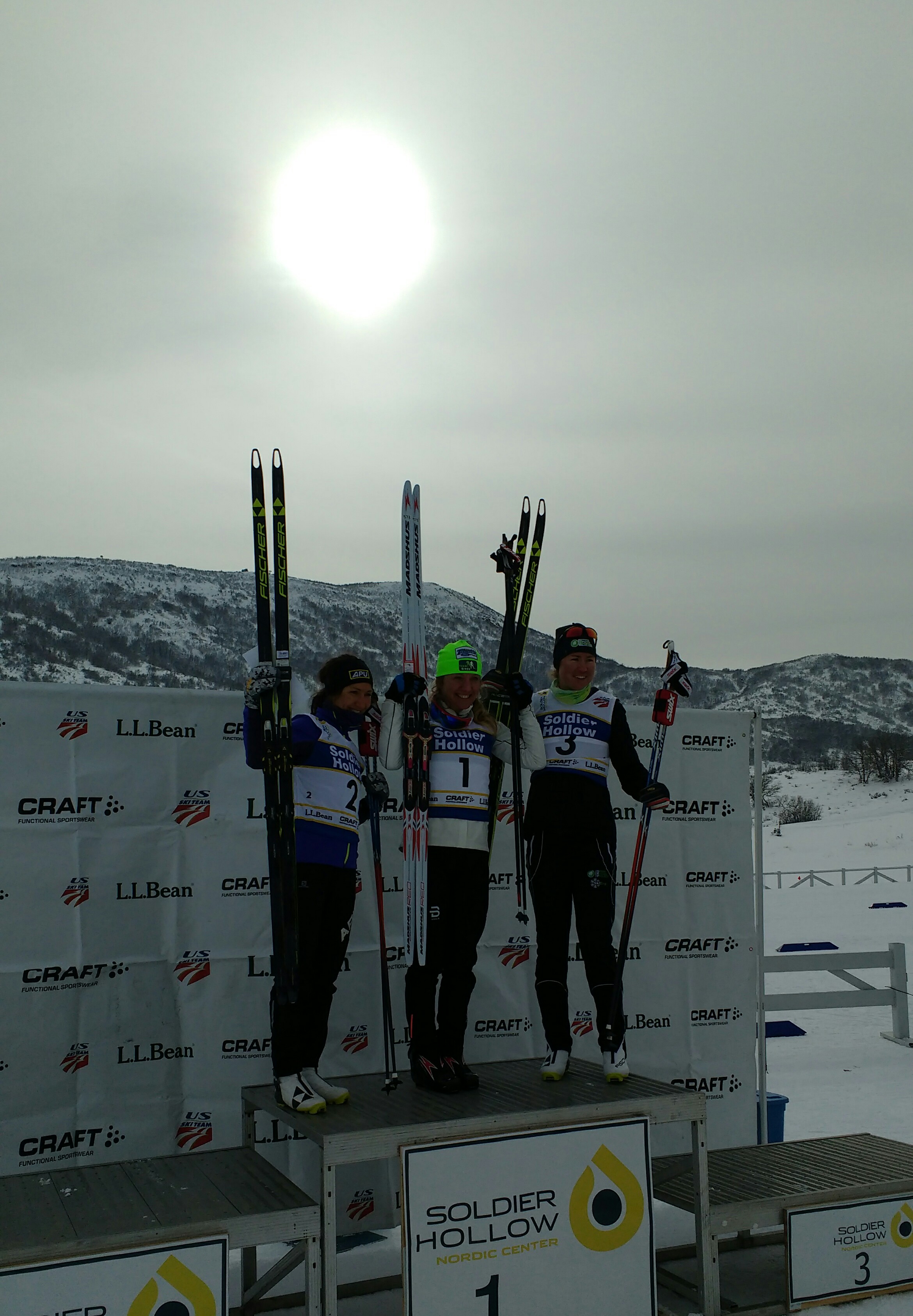
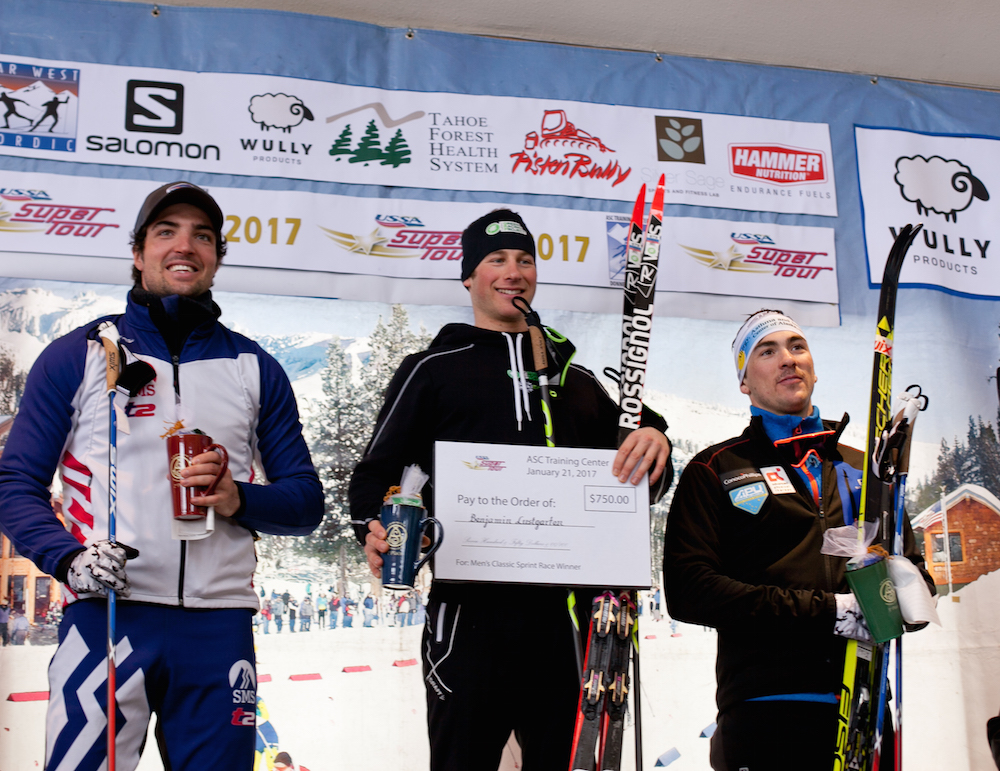
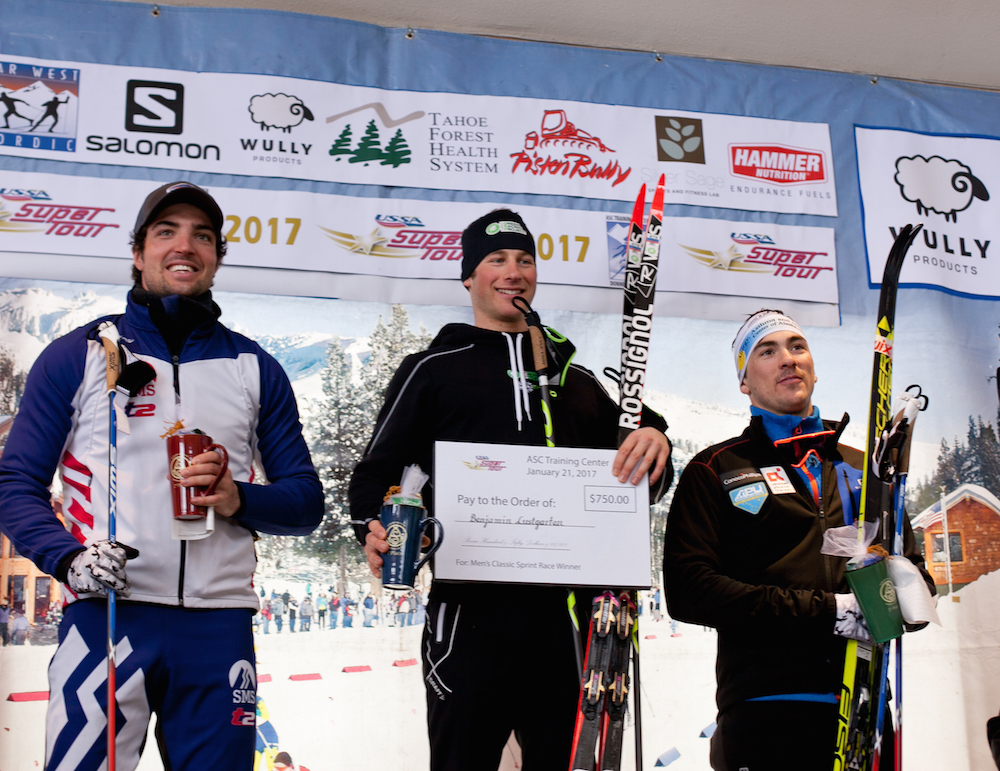
    Ben Lustgarten (Craftsbury Green Racing Project) with his $750-dollar check for winning the men's SuperTour classic sprint on Saturday near Truckee, Calif. Stratton's Ben Saxton (l) placed second and APU's Reese Hanneman (r) was third.
    Ben Lustgarten (Craftsbury Green Racing Project) with his $750-dollar check for winning the men’s SuperTour classic sprint on Saturday near Truckee, Calif. Stratton’s Ben Saxton (l) placed second and APU’s Reese Hanneman (r) was third.

    U.S. SuperTour (Truckee, Calif.): Classic sprints

    [UPDATED] Less than a week after being named to the U.S. team for 2017 World Championships, Ben Lustgarten — the men’s 30 k classic mass start champion at this year’s U.S. nationals — won Saturday’s SuperTour classic sprint as well.

    Lustgarten, of the Craftsbury Green Racing Project, raced to a 1.58-second victory in the men’s A-final at the Auburn Ski Club in Soda Springs, Calif., finishing in 3:03.4. Ben Saxton, of the Stratton Mountain School (SMS) Elite Team, placed second, and Reese Hanneman, of Alaska Pacific University (APU), was third (+2.77).

    Hannenman’s younger brother Logan also reached the final and placed fourth (+4.5), Dakota Blackhorse-von Jess (Bend Endurance Academy) was fifth (+5.86), and the third APU skier in the final, Tyler Kornfield sixth (+18.69).

    Blackhorse-von Jess started the day off as the fastest qualifier in 2:58.8. Saxton qualified second, 4.1 seconds back, Logan Hanneman qualified third (+4.2), and Lustgarten fourth (+6.5). Blackhorse-von Jess went on to win his quarterfinal and place second in his semifinal, while Lustgarten and Saxton both won their quarterfinals and semifinals.
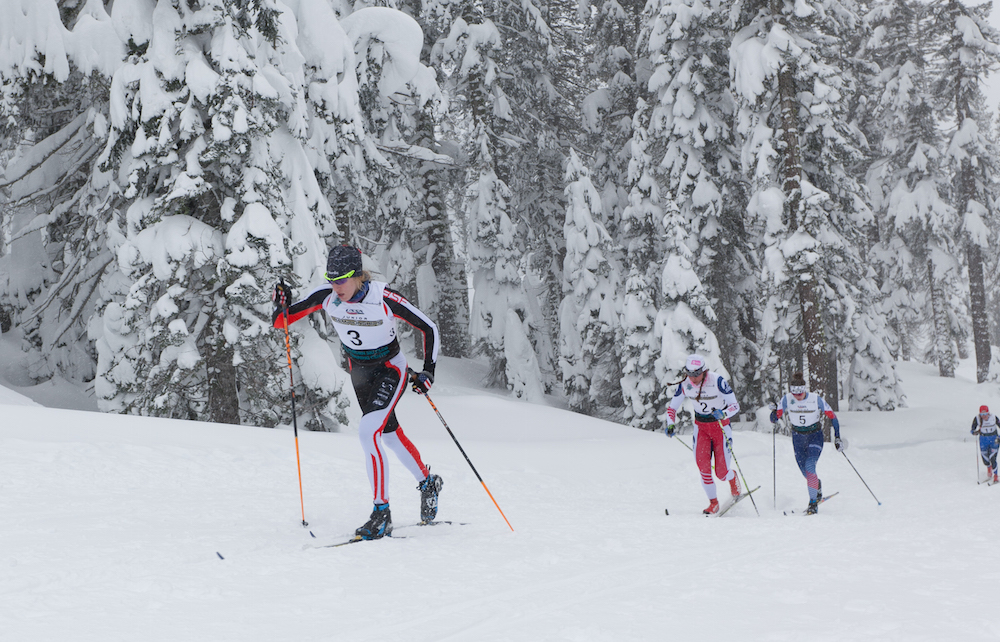
    Jennie Bender (3) of the Bridger Ski Foundation leading Stratton's Julia Kern (2) and Sun Valley's Deedra Irwin (5) during the second women's classic sprint semifinal at Saturday's SuperTour near Truckee, Calif. Bender went on to win the semifinal, as well as the final.
    Jennie Bender (3) of the Bridger Ski Foundation leading Stratton’s Julia Kern (2) and Sun Valley’s Deedra Irwin (5) during the second women’s classic sprint semifinal at Saturday’s SuperTour near Truckee, Calif. Bender went on to win the semifinal, as well as the final.

    In the women’s A-final, Jennie Bender of the Bridger Ski Foundation, coming off a classic sprint win at nationals, scored another victory in 3:29.07. She edged Craftsbury’s Kaitlynn Miller by just seven-hundredths of a second, and Stratton’s Julia Kern placed third (+3.42). Racing at home, Hannah Halvorsen (Sugar Bowl Academy) finished fourth (+3.88). Craftsbury had three in the women’s final with Caitlin Patterson in fifth (+3.93) and Heather Mooney in sixth (+27.35).

    Miller proved to be the woman to beat throughout the day, winning the qualifier in 3:30.9, along with her quarterfinal and semifinal. Kern qualified second (+3.2) and Bender third (+4.6). Bender went on to win her quarterfinal and semifinal as well before facing off with Miller in the final.

    Results: Men | Women

    ***

    NorAm Western Canadian Championships (Whistler, B.C.): 10/15 k classic 

    It was interval-starts day at Western Canadian Championships at Whistler Olympic Park and national-team veteran Emily Nishikawa completed the four laps of the women’s 10 k classic in 30:35.5 to win ahead of teammate Dahria Beatty, 16.5 seconds behind. Maya MacIsaac-Jones completed the national team and Alberta World Cup Academy (AWCA) sweep in third (+1:36.5).

    Sovereign Lake’s Hannah Mehain, of the national junior team, was the top junior for the second-straight day in eighth overall (+3:22.1).

    In the men’s 15 k, Lappe Nordic’s Andy Shields won the six-lap race in 40:34.2, showing some of the form that won him the NorAm overall last season. National-team member Jess Cockney collected his second-straight podium, finishing second, 4.3 seconds behind Shields. Evan Palmer-Charrette (NTDC Thunder Bay) completed the podium in third (+55.1).

    Results

    ***

    FIS Cross-Country World Cup (Ulricehamn, Sweden): 10/15 k freestyle
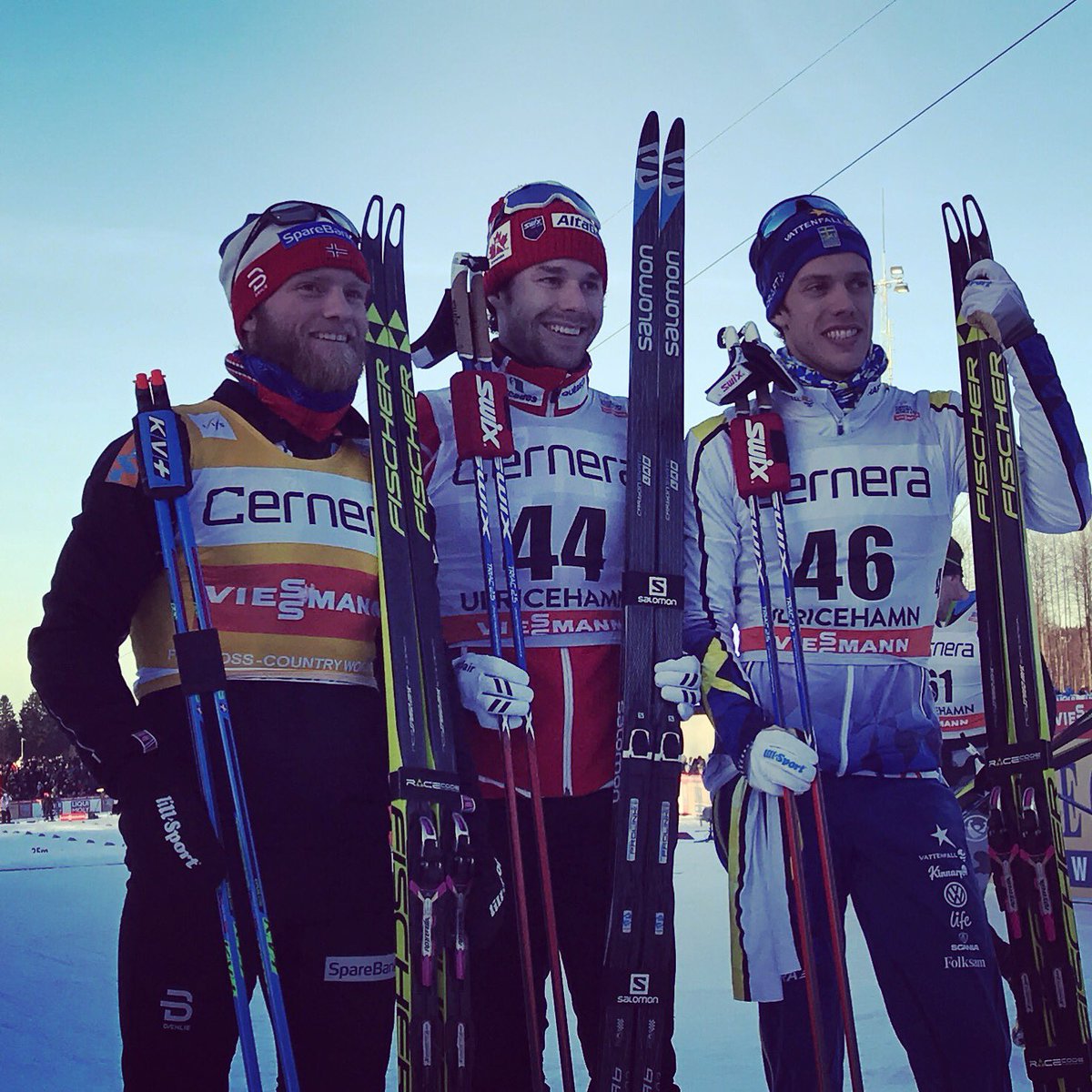
    The men's 15 k freestyle podium at Saturday's World Cup in Ulricehamn, Sweden, with Canadian winner Alex Harvey (c), Norwegian runner-up Martin Johnsrud Sundby (l), and Sweden's Marcus Hellner (r) in third. (Photo: FIS Cross Country/Twitter)
    The men’s 15 k freestyle podium at Saturday’s World Cup in Ulricehamn, Sweden, with Canadian winner Alex Harvey (c), Norwegian runner-up Martin Johnsrud Sundby (l), and Sweden’s Marcus Hellner (r) in third. (Photo: FIS Cross Country/Twitter)

    Men’s report | Women’s report

    First individual win of the season (second straight, after winning last weekend’s team sprint), fifth individual victory of his career. That’s the latest news on Canada’s Alex Harvey, who won the World Cup men’s 15-kilometer freestyle individual start on Sunday in Ulricehamn, Sweden, for his first victory in a 15 k skate race and fourth individual podium of 2016/2017.

    To say Harvey is on a roll is an understatement. On Saturday, he beat Norway’s Martin Johnsrud Sundby by 6 seconds after starting a minute behind the Norwegian defending World Cup champion. Harvey’s fastest time across the line in 32:46.2 held up through 76 finishers, with Sweden’s Marcus Hellner coming somewhat within range after starting a minute behind him. Hellner ended up 14.3 seconds back from Harvey at the finish for third place, behind Sundby.

    Switzerland’s Dario Cologna missed the podium by 0.5 seconds in fourth (+14.7), and Norway’s 24-year-old Daniel Stock broke through in fifth (+16.2) for his first World Cup top 20.

    Great Britain’s Andrew Musgrave placed sixth (+18.7), Sweden’s Daniel Rickardsson was seventh (+25.0), Norway’s Finn Hågen Krogh eighth (+32.2), Russia’s Petr Sedov ninth (+33.9), and Japan’s Keishin Yoshida 10th (+34.2).

    American Erik Bjornsen landed in the points as he tied Norway’s Simen Andreas Sveen for 28th (+1:09.2), leading fellow U.S. Ski Team members Noah Hoffman, who placed 41st (+1:28.8), and Simi Hamilton in 53rd (+1:56.2). Also for the U.S., Matt Gelso, the Period 1 SuperTour leader from the Sun Valley Ski Education Foundation (SVSEF) Gold Team, finished 68th (+3:00.3).

    Harvey’s Canadian World Cup teammates Len Valjas finished 35th (+1:17.7) and Devon Kershaw 38th (+1:22.2). Knute Johnsgaard (Canadian U25 Team) did not start.
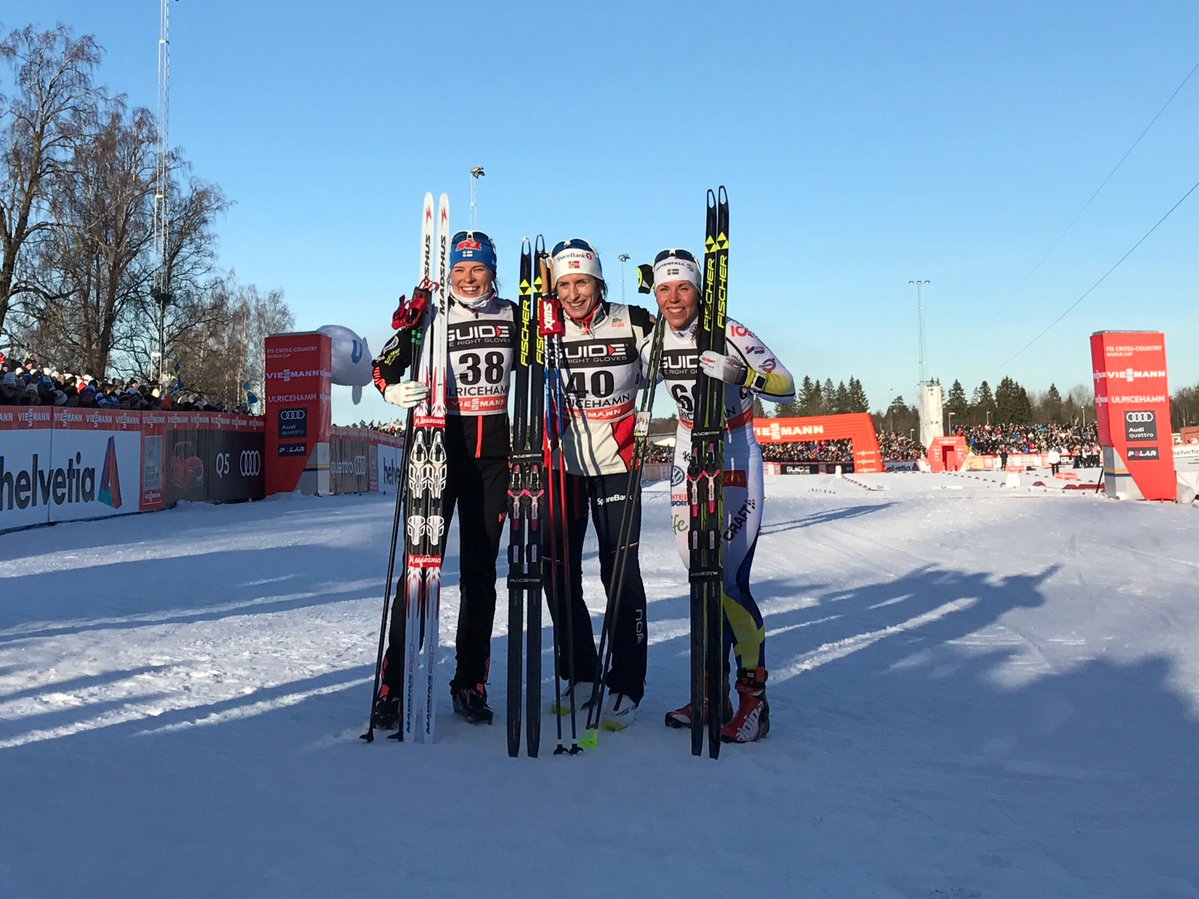
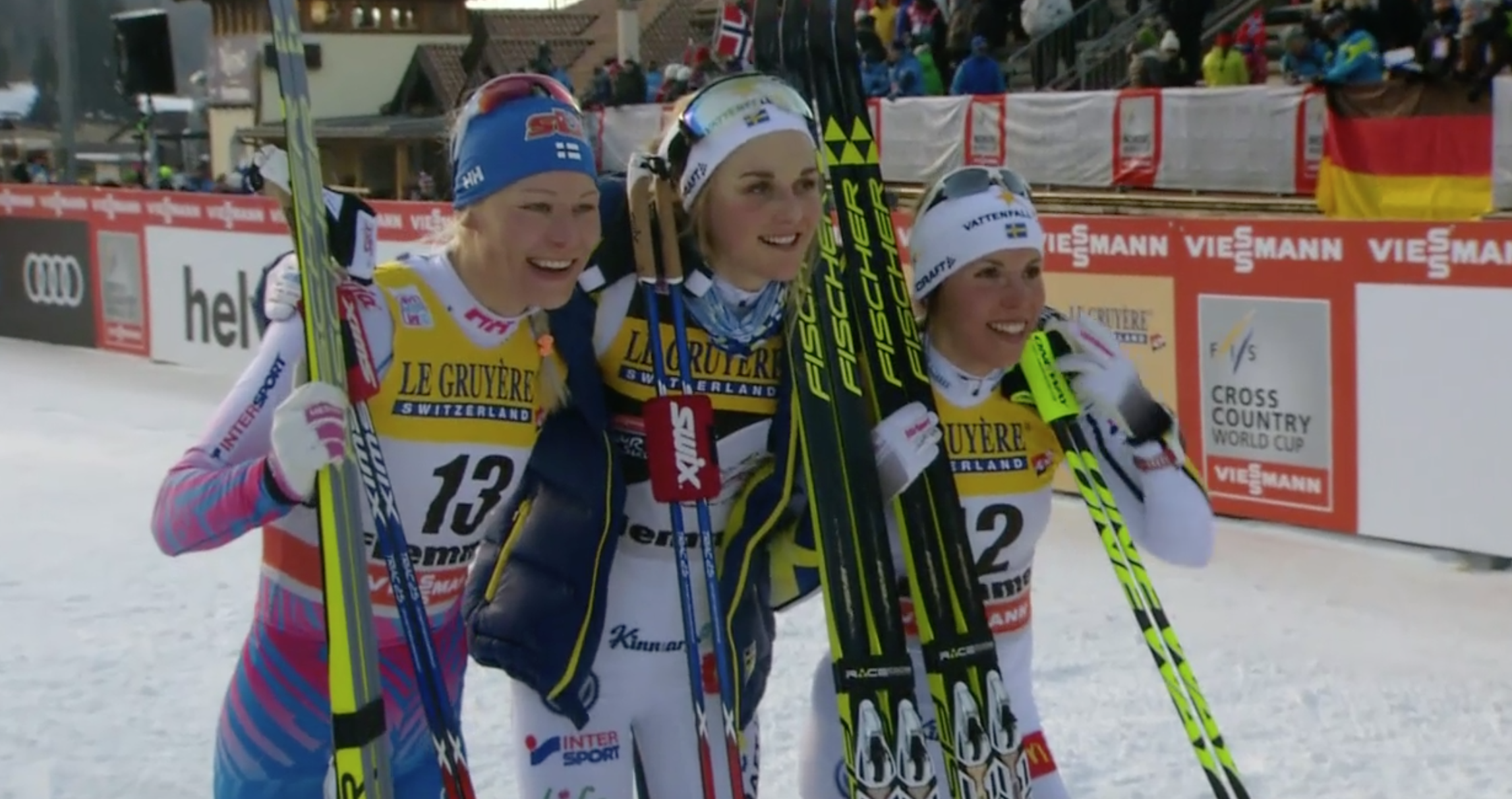
    The women's 10 k freestyle podium on Saturday in Ulricehamn, Sweden, with Norwegian winner Marit Bjørgen (c), Finland's Krista Parmakoski (l) in second and Sweden's Charlotte Kalla (r) in third. (Photo: FIS Cross Country/Twitter)
    The women’s 10 k freestyle podium on Saturday in Ulricehamn, Sweden, with Norwegian winner Marit Bjørgen (c), Finland’s Krista Parmakoski (l) in second and Sweden’s Charlotte Kalla (r) in third. (Photo: FIS Cross Country/Twitter)

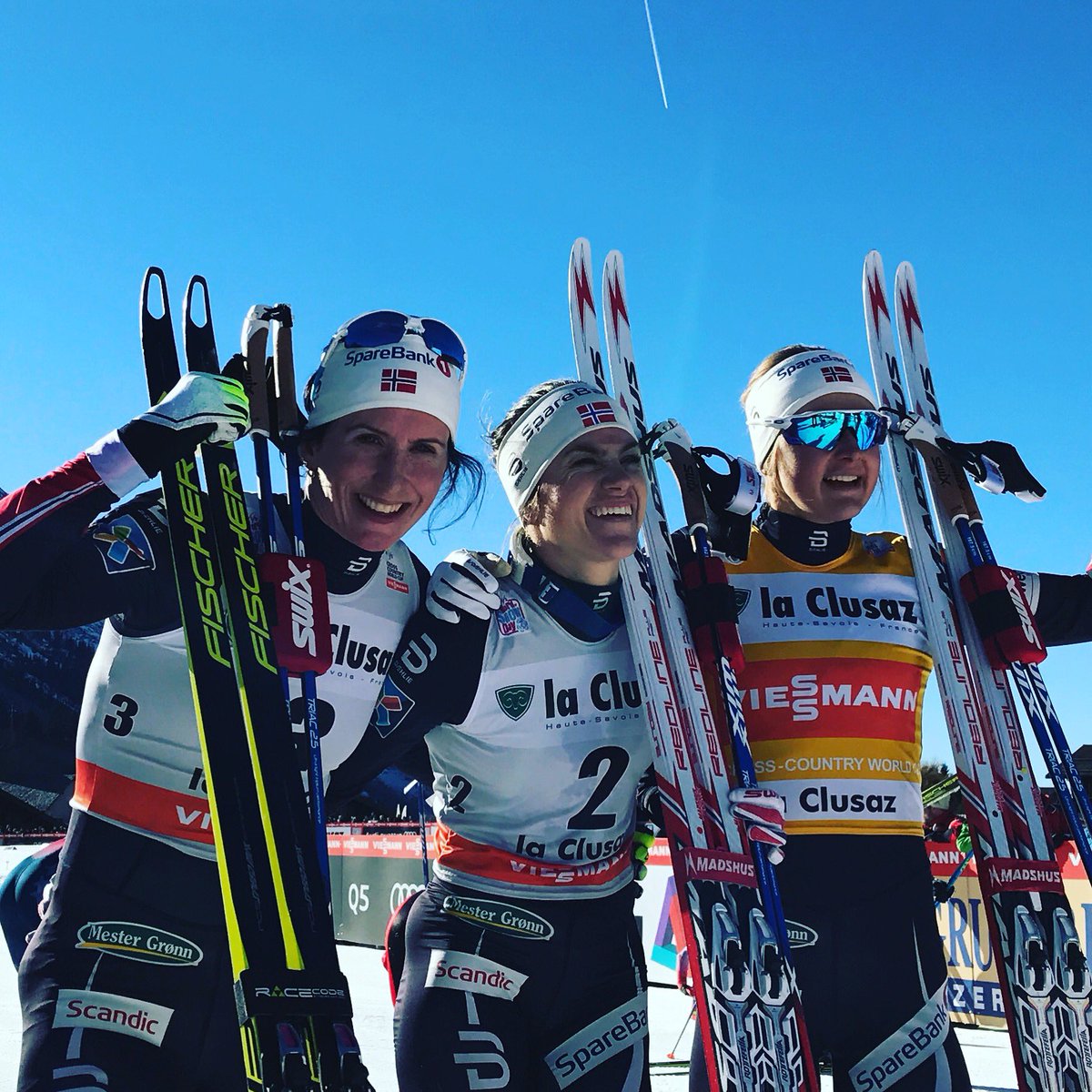
    In her first World Cup race in over a month and at a brand-new World Cup venue, Norway’s 36-year-old Marit Bjørgen returned to her winning ways, topping the women’s 10 k freestyle on Saturday in Ulricehamn.

    Bjørgen started 40th out of 61 finishers and took the lead from Finland’s Krista Parmakoski at the finish with a time of 23:46.3 minutes. Parmakoski, who started a minute ahead of her in bib 38, ended up second, 10.7 seconds back. Sweden’s Charlotte Kalla reached the podium for the second time this season in third (+24.9).

    “It is always great to win,” Bjørgen said, according to an International Ski Federation (FIS) press release. “I stayed at home for five weeks and was training. It is great to come back with a victory. I know that the training I had done was good. It was an amazing atmosphere today by the course. There were people cheering everywhere.”

    Norway swept fourth through sixth with Astrid Uhrenholdt Jacobsen in fourth (+25.7), Ragnhild Haga in fifth (+32.3) and Heidi Weng in sixth (+34.0).

    American Jessie Diggins raced to seventh (+34.9), ahead of Sweden’s Hanna Falk, who recorded her best distance result in eighth (+36.4). Norway’s Ingvild Flugstad Østberg finished ninth (+44.8), and Germany’s Sandra Ringwald was 10th (+56.6).

    “I didn’t have the snappy good feelings I was hoping to have in my body today, but it was a solid race,” Diggins wrote in a post-race email to FasterSkier. “It’s always hard when you know that on your best days you are capable of more, but at the same time we had great skis, and it was really fun for me to be able to ski with my teammates today!”

    The U.S. had three in the top 20 and four in the top 30 with Sadie Bjornsen in 12th (+1:00.5), Liz Stephen in 16th (+1:07.3) and Rosie Brennan in 24th (+1:30.7).

    Cendrine Browne as Canada’s lone woman in the race achieved 35th (+1:52.0) for her career best in an individual race. Also for the U.S., Kikkan Randall placed 40th (+1:59.6) and Liz Guiney of the Craftsbury Green Racing Project 52nd (+2:33.2).

    Results: MenWomen

    ***

    IBU World Cup (Antholz, Italy): Men’s relay & women’s mass start
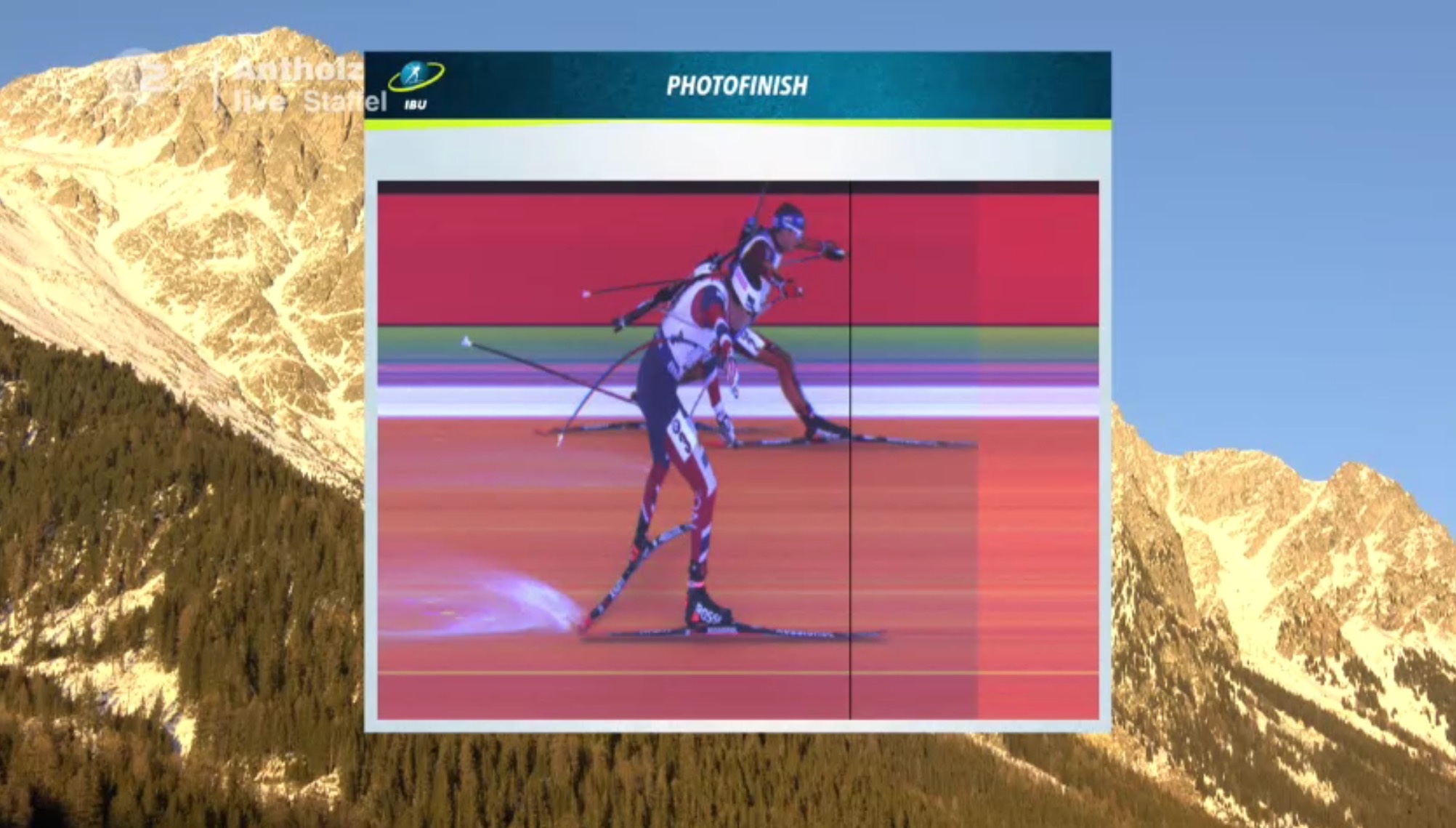
    Men’s reportWomen’s report

    The photo finish of the men's 4 x 7.5 k relay on Saturday at the IBU World Cup in Antholz, Italy, with Germany's Simon Schempp outlunging Norway's Emil Hegle Svendsen. (Photo: IBU screenshot)
    The photo finish of the men’s 4 x 7.5 k relay on Saturday at the IBU World Cup in Antholz, Italy, with Germany’s Simon Schempp outlunging Norway’s Emil Hegle Svendsen. (Photo: ZDF broadcast screenshot)

    For the U.S. men, top six was a target for the 4 x 7.5 k relay on Sunday in Antholz, Italy, according to US Biathlon Men’s Coach Jonas Johansson.

    Mission accomplished. In the final team event before 2017 World Championships, Lowell Bailey, Leif Nordgren, Tim Burke, and Sean Doherty combined for sixth, finishing 1:04.9 minutes behind the German winners. The Americans used a total of 10 spares but avoided the penalty loop, as did the Germans who used seven spares to clean the eight-stage race and won it in 1:13.57.2.

    Germany’s Simon Schempp narrowly outlasted Norway’s Emil Hegle Svendsen in the finishing stretch to secure the victory for Germany (with teammates Erik Lesser, Benedikt Doll and Arnd Peiffer) by one-tenth of a second. Norway finished second with nine spares and no penalties (with Lars Helge Birkeland, Henrik L’Abee-Lund, Johannes Thingnes Bø, and Svendsen), and Russia secured third (+33.6) with nine spares and zero penalties as well (with Maxim Tsvetkov, Evgeniy Garanichev, Dmitry Malyshko, and Anton Babikov).

    Ukraine used a total of just five spares and had zero penalties for fourth (+46.7), and Austria took fifth (+49.2) with eight spares and no penalties, after Austria’s Dominik Landertinger skied away from Doherty on the final loop and finished 6.9 seconds ahead of him for fifth place.

    For the U.S. men, sixth was close to their team-best fifth with the same lineup in last year’s World Cup relay in Presque Isle, Maine. The same group also took sixth in Ruhpolding, Germany, last year as well.

    With all four making US Biathlon’s World Championships team, announced Saturday, they will likely be aiming for a best championships result early next month in Hochfilzen, Austria.

    Canada (Christian Gow, Scott Gow, Macx Davies, and Brendan Green) finished 16th (+4:13.8) on Saturday with two penalties and 11 spares. Scott Gow skied them up to 15th by the second exchange but they dropped to 18th after Davies had two penalties on the third leg. With Green anchoring and using just one spare, they recouped two places before the finish.

    In the women’s race, Germany’s Nadine Horchler achieved a lifetime dream with her first World Cup win, after starting in bib 30 and earning her start as a reserve athlete. Germany took first and second with Laura Dahlmeier in second, and the Czech Republic’s Gabriela Koukalova placed third. Susan Dunklee of the U.S. was the lone North American starter and finished 24th after leading at the start of the second loop.

    Results: Men’s relay | Women’s 12.5 k mass start

    ***

    FIS Nordic Combined World Cup (Chaux-Neuve, France): Individual large hill/10 k
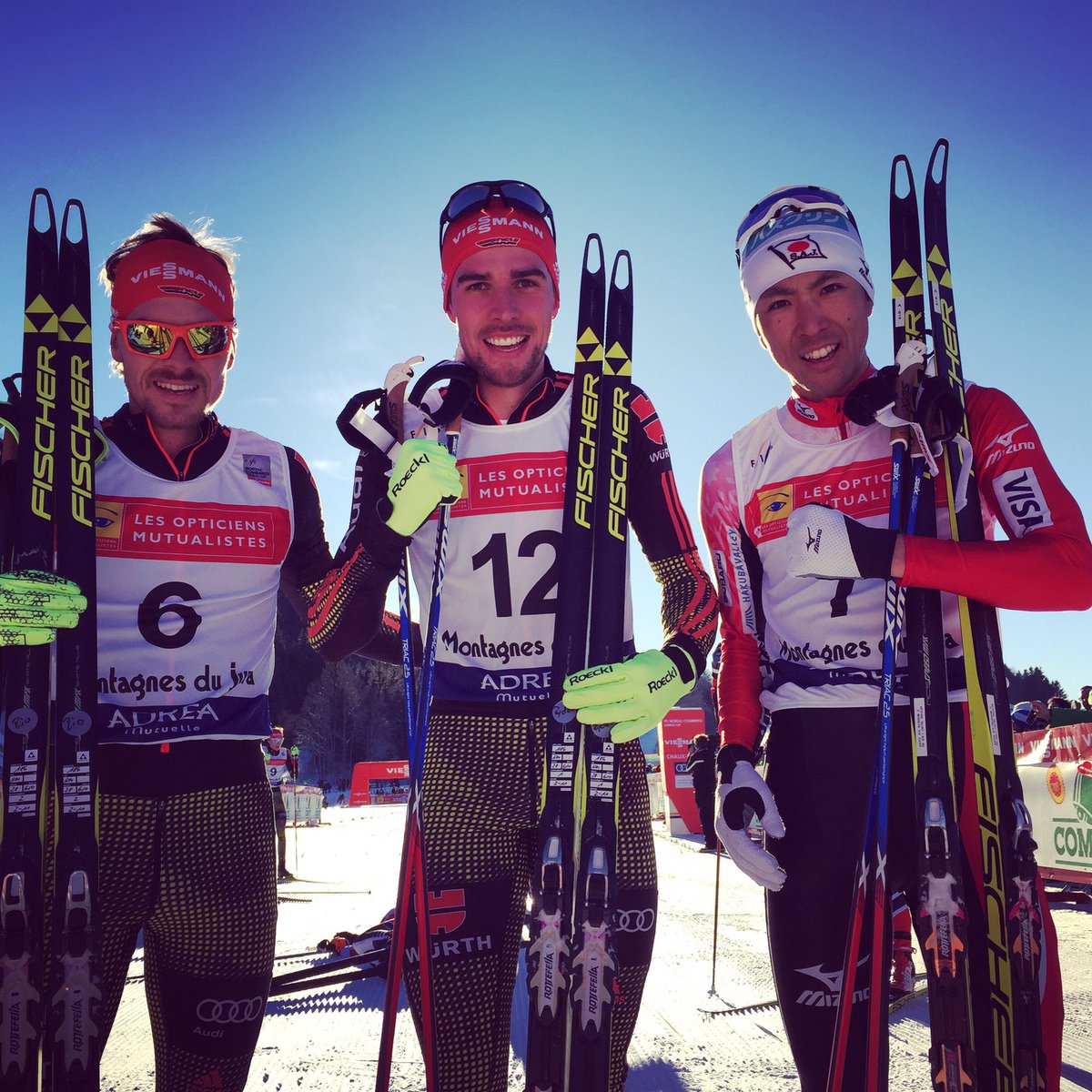
    Saturday's Nordic Combined World Cup podium in Chaux-Neuve, France, with German winner Johannes Rydzek (c), German runner-up Fabian Rießle (l) and Japan’s Akito Watabe (r) in third. (Photo: FIS Nordic Combined/Twitter)
    Saturday’s Nordic Combined World Cup podium in Chaux-Neuve, France, with German winner Johannes Rydzek (c), German runner-up Fabian Rießle (l) and Japan’s Akito Watabe (r) in third. (Photo: FIS Nordic Combined/Twitter)

    The first part of Saturday’s Nordic Combined World Cup individual large hill/10 k competition was a shining moment for U.S. Nordic Combined skier Ben Berend, who jumped to second for a total of 127.5 points, trailing only Norway’s Jarl Magnus Riiber with 139 points in Chaux-Neuve, France.

    Berend flew farther than Germany’s Eric Frenzel, who jumped to third on the Chaux-Neuve large hill.

    Later in the day, they started the 10 k Gundersen in that order, with Riiber heading out first, followed by Berend 46 seconds later, then Frenzel 53 seconds back in third.

    Germany’s Johannes Rydzek started 1:15 minutes back in 12th and skied the fastest 10 k to take the victory at the finish (in 23:01.7). He held off his German teammate Fabian Rießle by 2.8 seconds for the win, after Rießle started sixth and 1:01 back. Japan’s Akito Watabe reached the podium in third (+5.7) after jumping to seventh and starting the race 1 second behind Rießle.

    Frenzel ended up fourth (+8.3), and the fourth German in the top five, Björn Kircheisen improved to fifth (+22.6) after starting 11th.

    Riiber dropped to 15th (+54.0), and Berend fell outside the top 30 to end up 32nd (+2:26.0) with the 39th-ranked course time.

    Berend finished 12.2 seconds ahead of his U.S. teammate Taylor Fletcher, who placed 34th (+2:38.2) after the jump put him in 48th.

    Bryan Fletcher was 49th after the jump but did not start the 10 k.

    The Nordic Combined World Cup continues Sunday in Chaux-Neuve with another large hill/10 k.

    Results

    ***

    Ski Classics #5: La Diagonela (Zuoz, Switzerland): 50 k classic

    [UPDATED] Under “blue skies, no wind and perfect track conditions” in the Swiss Engadin Valley on Saturday, according to a Ski Classics press release, Russia’s Ilya Chernousov and the Czech Republic’s Kateřina Smutná won the men’s and women’s La Diagonela, respectively, in Zuoz, Switzerland.

    Chernousov, of Team Pioneer Investments, and Tord Asle Gjerdalen (Team Santander) led a large pack of men into the final major climb on the 50 k course. There, Gjerdalen attacked and Chernousov matched him, accelerating away from his competitors up the last steep pitch to the finish, according to the press release. He finished in 2:03:39.6 hours, holding off Gjerdalen by 1.5 seconds, while Øystein Pettersen (Team BN Bank) finished third (+3.0).

    In the women’s race, Smutná (Team Santander) pushed to break up the field around the halfway point, where the men caught the women. Britta Johansson Norgren (Lager 157 Ski Team) hung with Smutná, but lost contact over the last 5 k. After finishing second in the last two Ski Classics races, Smutná took the win by 1:03.2 minutes in 2:20:49.2. Nordgren finished second, ahead of Sara Lindborg (Team Serneke) in third, who finished more than three minutes later (+4:17.4).

    Results


  • TDS Stages 5, 6, 7: Toblach/Val di Fiemme Quotes

    TDS Stages 5, 6, 7: Toblach/Val di Fiemme Quotes

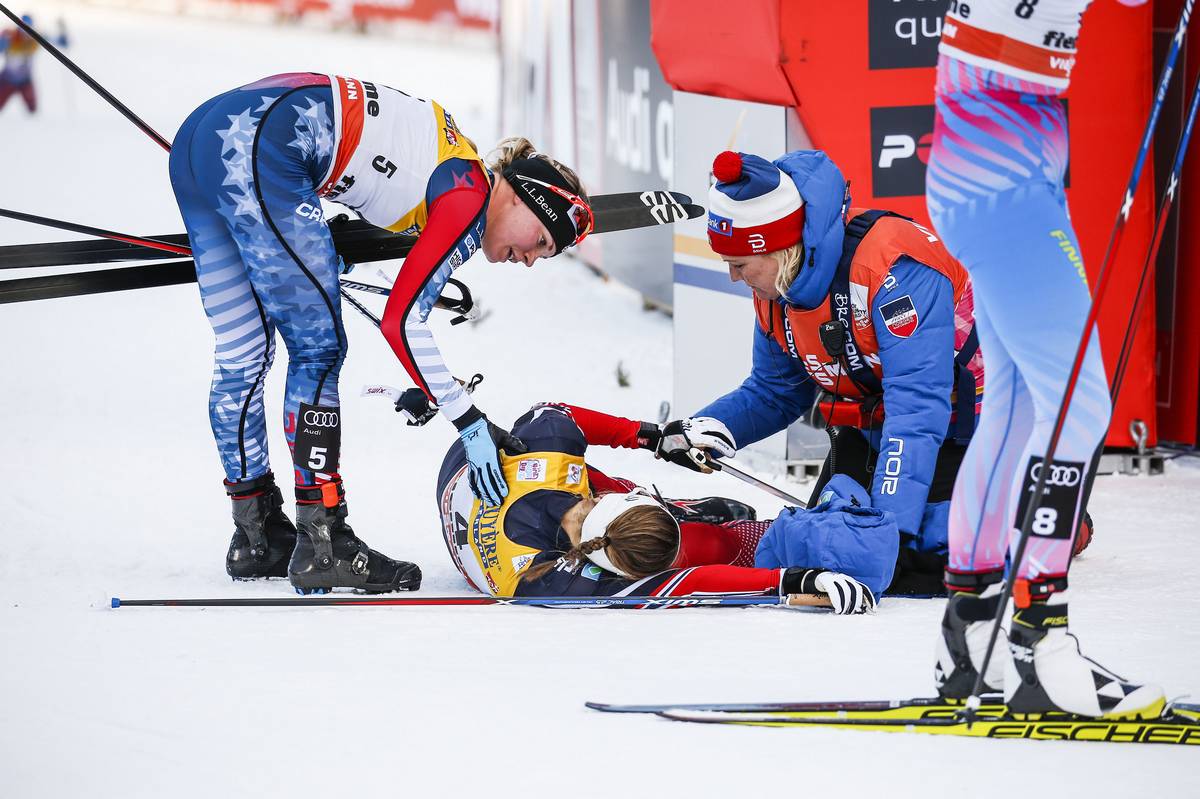
    American Jessie Diggins (l) checks on Norway's Ingvild Flugstad Østberg at the finish of the final climb up Alpe Cermis on Sunday. Østberg finished fourth and Diggins was fifth to end the 2017 Tour de Ski. (Photo: Salomon/Nordic Focus)
    American Jessie Diggins (l) checks on Norway’s Ingvild Flugstad Østberg at the finish of the final climb up Alpe Cermis on Sunday. Østberg finished fourth and Diggins was fifth to end the 2017 Tour de Ski. (Photo: Salomon/Nordic Focus)

    That’s a wrap, folks! With the 11th Tour de Ski coming to an end on Sunday with the infamous Alpe Cermis final climb in Val di Fiemme, we wanted to share some of the athlete and coach comments that didn’t make it into the race reports. Below are quotes from the last three stages of the Tour, all in Italy.

    ***

    Stage 5 (Toblach, Italy): 5/10 k freestyle

    Women’s report | Men’s report

    On pre-race feelings:

    “I think nerves were a little higher, but not a lot higher. It was more just a feeling of belief and confidence: I’ve done it before, I can do it again type-thing. I was telling myself this was my course. This course was basically built for all of the things that I love to do, I think it’s very fun. I love it when it’s cold out, I loved everything about the day, and I was just letting that excitement and the joy of the sport kind of fill me up. I was pretty pumped, standing on the start time.”

    Jessie Diggins (U.S. Ski Team), after winning the women’s race that day

    “I felt really tired yesterday and this morning on my run, but when I got on skis for the warm up today I felt like a different person! Lots of energy and feelings of fresh legs, which I was really excited about! I am always really excited for these last stages of the tour in Val di fiemme, as they are my favorite race courses on the circuit and the more racing we get to do the happier I am.”

    Liz Stephen (U.S. Ski Team)

    On race goals:

    “There’s always going to be a level of disappointment if you don’t perform to the level you know that you’re capable of. I knew I was capable of winning, so if I hadn’t [won], maybe I would have been disappointed. But it’s the same as if I finish in a 30 k classic below where I think I can, and that’s obviously not winning, I’d be disappointed with myself. If I knew I had more, and I didn’t give it, that’s when I’m disappointed. But if I go out there, and I give a race everything that I had, and I know that I held nothing back, then I’m not disappointed. All you can do is your best, I mean it’s mathematically impossible to give more than 100 percent, it’s all that you’ve got.”

    — Diggins

    “My goal was just to go out and lay down a hard final effort to finish off my tour. I have been strong at 5km skate races in the past and I was optimistic that I could have a strong performance today.”

    Kikkan Randall (U.S. Ski Team)

    On American Sadie Bjornsen (who finished a career-best third):

    “Sadie definitely flew under people’s radar, she really didn’t do the damage that she did until the final stretch of the race. Kind of in the last 1.6 k. She really surprised people. Incredibly fast.”

    Matt Whitcomb (U.S. Ski Team Women’s Coach)

    On the weirdness of the Toblach course:

    “Of course I was hoping to at least ski into the points. I have struggled at this venue for distance racing over my career for some reason which I can’t quite put my finger on, and today was no exception. There are no steep hills but the working sections are long and I guess that’s probably what kills me – especially in skating. Anyway, I wanted a little more than this today but the body feels good and it was a good wake up after the rest day if nothing else ahead of tomorrow.”

    Devon Kershaw (Canadian World Cup Team)

    On interval-start racing:

    “I skied a bit with [Norway’s Niklas] Dyrhaug on the first lap — but that didn’t turn out to be a good idea since he wasn’t having one. Alex caught me with about two kilometers to go, so I tucked in behind him for the last descents — which obviously helped — but with how I felt today I would have needed a proper ride to achieve anything. Of course I hoped that Alex would have a beast day and that if I could stay with that pace it could slot me in nicely — but Alex, while solid, wasn’t strong enough for me to get a good result gifted. I struggled to find that rhythm and speed today alone and while I felt fine — without finding that power (which for whatever reason eluded me today) you are bleeding time on such a gradual course.”

    — Kershaw

    On making the most of things:

    “I’m still pretty happy with where I am, where I’m standing at the end of the day. But it was just not a great race. I kind of saved it, I guess. It was not great, but I limited the losses.”

    Alex Harvey (Canadian World Cup Team)

    On deciding between the Tour or returning home for U.S. nationals in an effort to qualify for World Championships:

    “I guess I thought about it a little bit, but I really wanted to do the Tour, and I felt like if I was skiing the way I thought I should, I would be able to get the points I needed during the Tour, and then it wouldn’t be a problem. Especially after having a good result in France, I felt really encouraged then, so I didn’t really question my decision to stay, at that point. I was sick for the whole time over Christmas, and only skiing a few times. Obviously the Tour has not gone the way I hoped, or the way I left off in France, so I think I had a really hard time killing this cold for good, and it’s like taken it’s toll on my body. I just hope that every day I get further away from that illness, the better I’ll start to feel and hopefully come back to the kind of results like today and the results I had in France, and more where I think I should be.”

    Rosie Brennan (U.S. Ski Team), after placing 23rd

    On recovery:

    “Last year [after winning this race], I was so thrilled, there was so much going on, there was a press conference, doping control, traveling, and I remember feeling so tired the next day. And this year, I’m just learning how to handle it a little better, in terms of just managing my energy. I think that’s helped a lot. We had a little less to deal with today, in terms of press things, I think was able to manage my energy. So I’m hoping for a solid day tomorrow.”

    — Diggins

    On going on a World Cup tour with a baby:

    “It’s definitely been a little more challenging to travel the tour with a baby along but now I can’t imagine doing it any other way. We’ve tried to be respectful of the team and the rest for the other athletes, so we’ve been driving our own van and eating at a separate table. Breck has been a really good baby and after some sleep training over Christmas, he’s sleeping through the night and taking naps during the day. The support of my parents and Jeff’s parents have been invaluable and the team is also helping a lot too. It requires traveling with a lot more stuff and I can’t always follow the exact routine I’m used to but it’s surprisingly manageable and so wonderful to have such an amazing new part to my life. The baby rooms provided by the organizers have also been really helpful. I’m excited to stay in Toblach for the next week and a half and just get to enjoy some down time with Breck and recover.”

    — Randall, who has a nearly 9-month-old infant

    ***

    Stage 6 (Val di Fiemme, Italy): 10/15 k classic mass starts

    Women’s report | Men’s report

    On how the body’s feeling through six races in eight days:

    “Felt good, yeah. Felt good in the morning, went for a jog. Felt good in the warmup, and early during the race. But then I just, I don’t know, couldn’t lay down a good race. So that was bad.”

    — Harvey

    On day-to-day strategy:

    “I’m not like stressing about the final climb on Stage 2, and on Stage 3 I’m not going, ‘Oh, I’m here in the overall, and I need this and that.’ It’s just, go out every day and ski as hard as you can, ski each race as well as you can, and then, you know, if you get every step, eventually you’re climbing up, right? … I know that’s my strength, is I can dig really deep and I can deal with a lot of pain, and I can grind it out.”

    — Diggins

    On pack skiing and sketchy corners:

    “Stuff happens in a race, and that’s why we practice for the unexpected. Practice agility, and our downhill skills, because you need ’em.”

    — Diggins

    On finishing in the top 30 for World Cup points:

    “Even getting one point – I never complain when I’m in the points. And definitely moved up in the Tour to 30th, although it’s really tight in there with several of us. But, you know, tomorrow suits my strengths super well, and I’m looking forward to that. Definitely feel like it was another good step forward from where I was at the beginning of the Tour and for much of Period 1.”

    Noah Hoffman (U.S. Ski Team), 30th in the 15 k classic mass start

    On staying focused late in the Tour:

    “I think it becomes easier, you have so much clearer motivation. I mean, a regular World Cup, if you’re skiing, you know, 45th place in a mass start and a minute behind the top 30, like, that’s a challenging place to stay motivated. Because the difference between 40th place and 50th place is not very big. So in terms of getting yourself to fight for those places, it’s more challenging. … It’s quadruple points at the end of the Tour, so time is very important today.”

    — Hoffman

    On the second-to-last stage:

    “A top 20 is always a top 20, but I was hoping for a bit more energetic feeling out there. Maybe my body knows what’s about to happen to it tomorrow.”

    — Stephen

    ***

    Stage 7 (Alpe Cermis/Val di Fiemme, Italy): 9 k freestyle pursuit climb

    Women’s report | Men’s report

    On entering the last stage:

    “At the moment I am feeling like a zombie. I’m really really tired. I think it will all sink in tomorrow, but as of right now I am ready for a break.”

    — Diggins

    “It’s just knowing that that’s it. Sometimes you can eke out more energy to get up the climb.”

    — Brennan

    On racing up an alpine mountain:

    “I realize why we do it and it’s the real show and it’s a fitting end to a grueling week, but I absolutely hate monkey skating up an alpine ski hill. I have never been good at and even when I was fourth and seventh in Tour de Ski overall, I have had vicious times up it.”

    — Kershaw

    On being in the wave start, or not:

    “Last year I had quite a good race up the hill and I was 19th [for time of day]. I was in the waves so that really helped, being packed in a group all the way down to the first 5 k. Today, [Sweden’s] Daniel Richardsson and I tried to work together but we were both just so shitty, and when you know you have two bad bodies trying to do something for the first 5 k, you are just bleeding time, and when you get to the hill you already lost a minute in that section. Then climbing the hill, we weren’t that much better so it was too bad because the Tour had some bright spots for me and but it was a really forgettable day today. One you have to throw over your shoulder and just keep telling yourself that you were better earlier.”

    — Kershaw

    I kind of treat this as a time trial anyway. Usually I do start in the wave, but this year it was nice not to. I did have a Swedish skier on my tail for the flat part and I was hoping to be able to take turns and work together, but she was maybe not feeling the necessity to pull. But that was fine. I just kind of wanted to go fast along the flat, as fast as I could. And I think Hedi put quite bit of time into us, or into me, on the flat. So I have to work on that a little bit, too.”

    — Stephen

    “I don’t know. I’ve only ever done it in the wave, so I don’t really know what it’s like otherwise, but it’s probably a toss up.”

    — Brennan

    On pacing the flats before the climb:

    “It’s such a different kind of skiing. I always feel like you can probably push it a little on the flats without having too much impact on your climb. It’s just narrow, and gradual terrain the whole time, so it’s a different kind of skiing.”

    — Brennan

    I have always kind of pushed as hard as I can on the flat, because as hard as I can push on a flat is still not going to blow me up. It’s not where I can really hit my groove and be able to really put damage into people — I never feel like I have blown myself up even if I have a time trial on a flat course. I just can’t get to that mark yet with my technique. So yeah, I go as hard as I can on that flat part while trying to stay relaxed, because the less relaxed I am on flats the slower I go. I have to find that happy balance. I felt like I skied the flat as well as I could today, and then was just psyched to turn the corner and go up.”

    — Stephen

    On final placement in the Tour:

    “I am happy to be in the top 15 because I didn’t think that was really a possibility for this tour when I looked at the standings last night so that was good… I am never going to be disappointed with a top 15, but also, it’s hard to come from knowing that I can be top five in this tour. So you always kind of want to get back to your best result and then try to beat that. 15th was not what I was hoping for this year, but at the same time, I am not disappointed with it.”

    — Stephen

    On the team:

    “Our team lost a few people for sure due to illness, but it’s always so nice to celebrate with not only with the team that finished to the top fo the hill but also the wax staff and the coaching staff. This is such a taxing event for them and they are on it all the time. And their moods are always good. I don’t know how they do it — even when they are sick they still have a happy mood on. So that is so key for our performance. A huge thank you needs to go out them for all their work and their spirits.”

    — Stephen

    On teammates:

    “Jessie and I are in a room together, and we have kept the same roommates the entire tour to minimize how many germs are being spread around. Sadie’s being quarantined, for sure. It’s heartbreaking, with her having such a good tour, but I think her [Toblach 5 k] result is still so fresh, that helps with having to make the tough decision to drop. The tour is so grueling, and I think you have to decide for yourself: how does my energy feel right now, and is this digging a hole that I can’t get out of? I think that it”s really mature and smart to think about the rest of the season now.”

    — Stephen

    “I am so proud of Jessie. To get fifth this year and have her best climb ever, and she told me she thinks she had her best classic race she ever had yesterday, it’s really fun to watch her mature as an athlete and be skiing so well. She is a force, as we all knew she would be. It’s really fun to see it all working out for her for sure. And Rosie in the top 30. And we have our fingers crossed here cheering for Noah on the climb — we are hoping he gets a top 20 on the day.” [Note: Hoffman’s time was 15th-fastest up the climb.]

  • Sunday Rundown: Alpe Cermis, Oberhof, Lahti, Soldier Hollow (Updated x5)

    Sunday Rundown: Alpe Cermis, Oberhof, Lahti, Soldier Hollow (Updated x5)

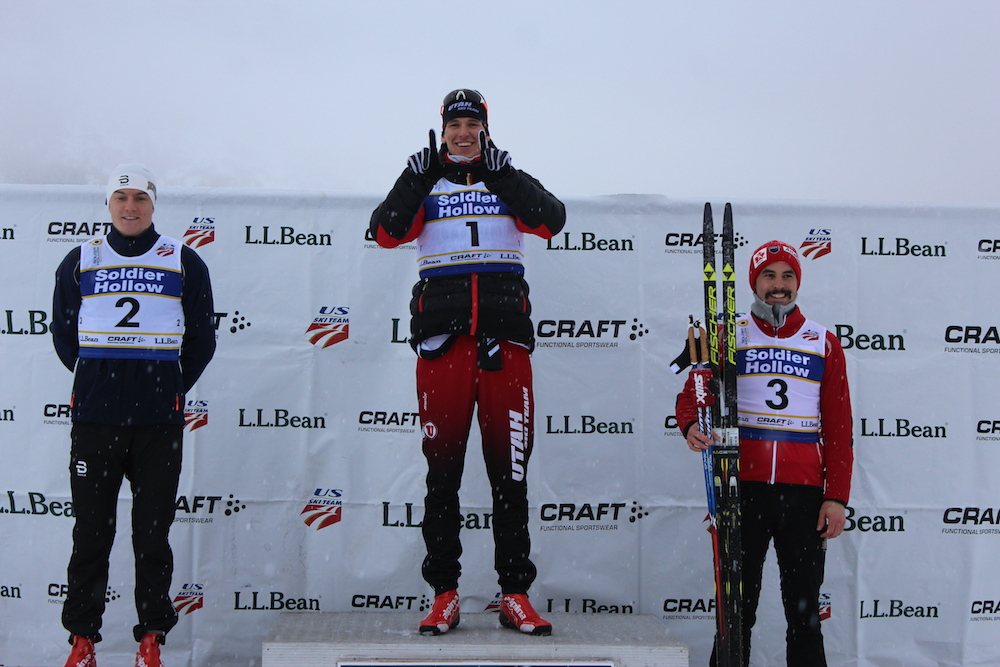
    The men's classic sprint podium at 2017 U.S. nationals at Soldier Hollow on Sunday: with winner Kevin Bolger (c) of the University of Utah, runner-up Moritz Madlener (l) of the University of Denver, and Jess Cockney (r) of the Canadian World Cup B-team in third.
    The men’s classic sprint podium at 2017 U.S. nationals at Soldier Hollow on Sunday: with winner Kevin Bolger (c) of the University of Utah, runner-up Moritz Madlener (l) of the University of Denver, and Jess Cockney (r) of the Canadian World Cup B-team in third.

    U.S. Cross Country Championships (Soldier Hollow): Classic sprints

    Jennie Bender of Bridger Ski Foundation and Kevin Bolger of the University of Utah won national titles in the classic sprints at 2017 U.S. Cross Country Championships at Soldier Hollow earlier Sunday afternoon. They each took narrow – but, for sprinting, relatively uncontested – victories, as each was in the lead coming into the stadium and led through the final 180-degree turn into the finishing straight.

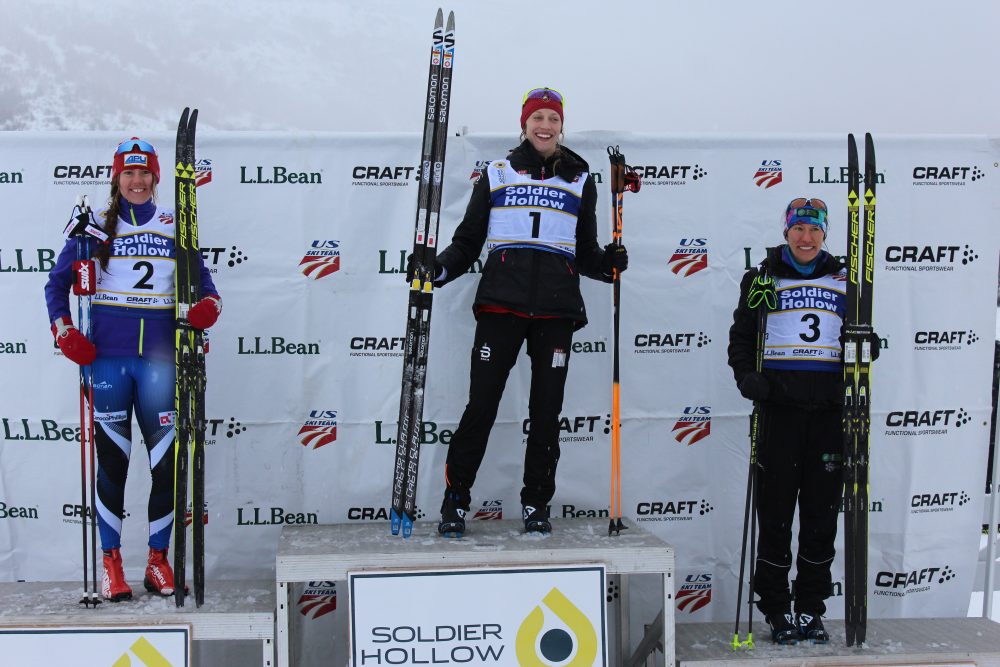
    The women's classic sprint podium at 2017 U.S. nationals on Sunday at Soldier Hollow: with winner Jennie Bender (c) of the Bridger Ski Foundation, runner-up Becca Rorabaugh (l) of Alaska Pacific University, and Kaitlynn Miller (r) of the Craftsbury Green Racing Project in third.
    The women’s classic sprint podium at 2017 U.S. nationals on Sunday at Soldier Hollow: with winner Jennie Bender (c) of the Bridger Ski Foundation, runner-up Becca Rorabaugh (l) of Alaska Pacific University, and Kaitlynn Miller (r) of the Craftsbury Green Racing Project in third.

    In the women’s race, Bender took the victory over Becca Rorabaugh of Alaska Pacific University, who just edged out Kaitlynn Miller of the Craftsbury Green Racing Project for second. Miller had won the qualifier earlier in the day.

    Dahria Beatty of Canada’s Alberta World Cup Academy in fourth, Anne Hart of Stratton Mountain School Elite Team in fifth, and Krista Niiranen, originally from Finland and now a sophomore at the University of New Mexico, in sixth made up the rest of the A-final. There was no B-final contested for either gender.

    In the men’s race, Bolger’s victory marked his best performance in a national championship by a substantial margin: His previous best before today was 23rd, in the 15 k classic at SoHo in 2014. (His 37th in the sprint that same year marked his previous best finish in a national championship sprint.)

    Bolger was followed to the line by Moritz Madlener, of the University of Denver, and Jesse Cockney, of the Canadian World Cup B-team. Cockney had qualified fourth that morning.

    The rest of the A–Final was Canadian Bob Thompson, of National Team Development Centre (NTDC) Thunder Bay, in fourth, Petter Reistad of the University of Colorado in fifth, and Fredrik Schwencke of Northern Michigan University in sixth.

    Madlener is German. Cockney and Thompson are Canadian. Reistad and Schwencke are Norwegian. The USSA selection criteria for World Championships in Lahti provide that, “For the purposes of the 2017 Championship Selection List, athletes that are not US citizens will not be included in the scoring, and US athletes will move up the results/scoring list as foreign athletes are eliminated.” American racers eliminated in the semifinals included, in no particular order, Ben Lustgarten of Craftsbury Green Racing Project, Cully Brown of the University of Vermont, John Hegman and Cole Morgan of Sun Valley Ski Education Foundation (SVSEF) Gold Team, and Ben Saxton of Stratton Mountain School.

    Results: women’s brackets | men’s brackets

    ***

    Earlier Sunday, Kaitlynn Miller won the women’s classic sprint qualifier. Starting sixth out of the 200+ woman field, Miller laid down an unbeatable time of 3:24.5 in difficult waxing conditions. She is the defending classic sprint champion from last year’s national championships.

    Krista Niiranen, originally from Finland and now a sophomore at the University of New Mexico, was next fastest and tallied a time just 0.2 seconds behind Miller’s. Emily Nishikawa of the Canadian National Ski Team was third, Dahria Beatty of Canada’s Alberta World Cup Academy fourth, and Cendrine Browne from the Centre National d’Entrainement Pierre Harvey in Quebec clocked the fifth-fastest time.

    The 30th skier making the cut for quarterfinals — Frederique Vezina, also of the Centre National d’Entrainement Pierre Harvey — was 16.53 seconds behind Miller.

    Ben Saxton of the Stratton Mountain School Elite Team won the men’s sprint qualifier, notching the fastest time by 1.27 seconds over Etienne Hebert of Monteriski.

    Canadians took the three of the top four spots in the qualifier, with Reed Godfrey of Canmore Nordic clocking the third-fastest time and Canada’s Jesse Cockney finishing fourth.

    9.17 seconds separated the top 30 men who moved on to the quarterfinals. That included racers from at least six countries: the U.S. and Canada, but also collegiate skiers from Finland, Germany, France, and Norway. It also included one Under-18 competitor: Ben Ogden from the Stratton Mountain School.

    Results: Women’s qualifier | Men’s qualifier

    ***

    FIS Nordic Combined World Cup (Lahti, Finland)

    It was a World Championships preview weekend on the Nordic Combined World Cup circuit, with two large hill/10 k individual competitions held in Lahti, Finland.

    On Saturday, Germany’s Eric Frenzel took the win in 29:13.7, holding off Finland’s Eero Hirvonen by 4.1 seconds across the line. After posting the second-best jump, Frenzel started the 10 k in second, ahead of Hirvonen in third, but still full 1:06-minutes behind Norway’s Jarl Magnus Riiber, who dominated the jump with 135.2 points. Hirvonen started 1:29 back in third.

    Riiber went on to place sixth at the finish with the 38th-ranked course time (out of 43 finishers). Germany had two on the podium with Johannes Rydzek in third (+26.4).

    American Bryan Fletcher finished 15th (+1:29.8) after jumping to 22nd and starting the ski race 3:06 minutes back. He skied the sixth-fastest 10 k to end up 1:29.8 behind Frenzel at the finish.

    Ben Loomis was the second American competing on Saturday. He finished the day in 40th (+5:18.5) after jumping to 35th.

    On Sunday, Germany swept the podium with Fabian Rießle leading the charge, Frenzel in second and Rydzek in third. Rießle jumped to fifth and captured the win in 25:44.2, ahead of Frenzel (+4.2) and Rydzek (+11.6). Frenzel led after the jump and started the 10 k just 6 seconds ahead of Italy’s Samuel Costa, who ended up sixth at the finish (+40.6).

    Rießle started 16 seconds after Frenzel and posted the third-fastest course time en route to the win.

    Bryan Fletcher raced to 16th (+1:30.7) on Sunday, after jumping to 28th. Loomis did not start.

    The NoCo World Cup moves to Val di Fiemme, Italy, for competitions next Friday through Sunday. Lahti World Championships will hold nordic-combined competitions Feb. 24-March 3.

    Results: Day 1 | Day 2

    ***

    IBU World Cup (Oberhof, Germany): 12.5/15 k mass starts

    Women’s report

    Two North Americans started the International Biathlon Union (IBU) World Cup women’s 12.5 k mass start on Sunday, with one of them finding out at the last minute that they were in for the 30-woman race.

    American Susan Dunklee knew she had qualified well ahead of time after ranking 17th in the overall World Cup. She raced to ninth on Sunday, finishing 1:43.5 behind from the winner, Gabriela Koukalová of the Czech Republic, who cleaned the four-stage race to finish first in 37:20.5.

    Germany’s Laura Dahlmeier made her first appearance of the week in the final race of the World Cup stop in Oberhof, Germany, placing second in the mass start, 31.5 seconds behind Koukalová, with one standing miss (0+0+1+0). The Czech Republic had two on the podium with Eva Puskarčíková in third (+45.4), with clean shooting.

    Dunklee was in contention with the leaders until the last two standing stages, where she missed one target then two more (0+0+1+2) for a total of three penalty laps. Ninth place helped elevate Dunklee to 15th in the overall World Cup standings.

    Canada’s Rosanna Crawford jumped into the race being listed as a reserve athlete on standby. Wearing bib 30, she finished 25th (+3:08.6) with two clean stages and two penalties (0+1+1+0).

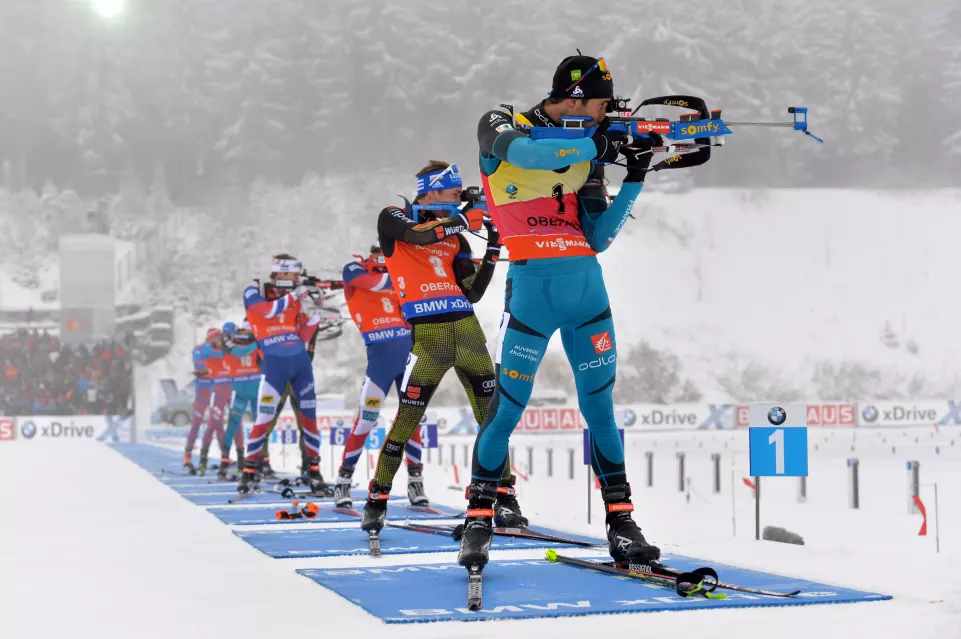
    France’s Martin Fourcade (bib 1) and Germany’s Simon Schempp (bib 3) shooting in the third stage of the men’s 15-kilometer mass start at the 2017 IBU World Cup in Oberhof, Germany. (Photo: IBU)
    France’s Martin Fourcade (bib 1) and Germany’s Simon Schempp (bib 3) shooting in the third stage of the men’s 15-kilometer mass start at the 2017 IBU World Cup in Oberhof, Germany. (Photo: IBU)

    On Sunday in the men’s 15 k mass start, Germany’s Simon Schempp celebrated his first victory of the season, and it was a special one in front of thousands of cheering fans at home in Oberhof. On the final lap, he desperately tried to hang onto the ski tails of France’s biathlon star Martin Fourcade, who pushed hard on the first climb out of the shooting range unsuccessfully trying to create a gap.

    “He started attacking immediately up the Birxsteig [climb],” Schempp told German TV broadcaster ZDF. “And I thought either you blow up or you can stick with him, and I could. Because I was in the draft, I saved a few percent, that probably was the decisive point in the end.“

    Schempp kept right behind Fourcade, then started an attack on the last climb himself and outsprinted his rival on the finishing stretch, celebrating across the line with a time of 38:30.9 minutes, with just one penalty (0+0+1+0).

    To the joy of the German fans, Schempp’s teammate Erik Lesser managed to overtake France’s Jean Guillaume Beatrix on the final loop closing up to the two athletes in front on the last meters, and outlunged Fourcade in a photo finish sprint (both +0.4 seconds).

    “They pushed up the Birxsteig so incredibly hard,” Lesser told ZDF. “I thought I could only fight for position five. Then I saw that Beatrix wasn’t skiing very clean anymore either. So I just tried a full attack… I never would have believed that a second place would come out of that.“

    “My father-in-law is probably watching the Tour de Ski today and saying, ‘Finally the guy makes a lunge,’ ” Lesser joked about the finish sprint. “I never would have believed that Fourcade still lets himself get beaten by the little Lesser. Finally all the strength training paid off.“

    Fourcade had incurred two penalties in the third shooting stage, having to make up a 44 second gap to the top. In the final shooting he stayed clean, but already had to invest a lot of energy on the prior loop so he could not create a significant lead on the last one.

    “I skied as fast as I could, but Simon was just faster and Erik as well,” Fourcade said during the press conference. “I tried my best in the beginning of the lap because we were too [many] people… I gave all I had. I must say I didn’t see Erik until he passed me in the sprint… It was a great competition, a great fight.”

    Coming into the last shooting stage Lesser had been leading the race with Norway’s Ole Einar Bjørndalen, but both missed a target and had to a penalty lap while Schempp and Fourcade stayed clean.

    Fourcade’s teammate Beatrix finished fourth with one penalty (+13.2), Bjørndalen was fifth (+19.5) also with one penalty.

    No North American men competed in the mass start, with US Biathlon’s Lowell Bailey ,who would have been qualified via the overall World Cup standings skipping the race week in Oberhof for a training block. Bailey is currently ranked 19th overall.

    Results: Women | Men

    Overall World Cup standings: Women | Men

    ***

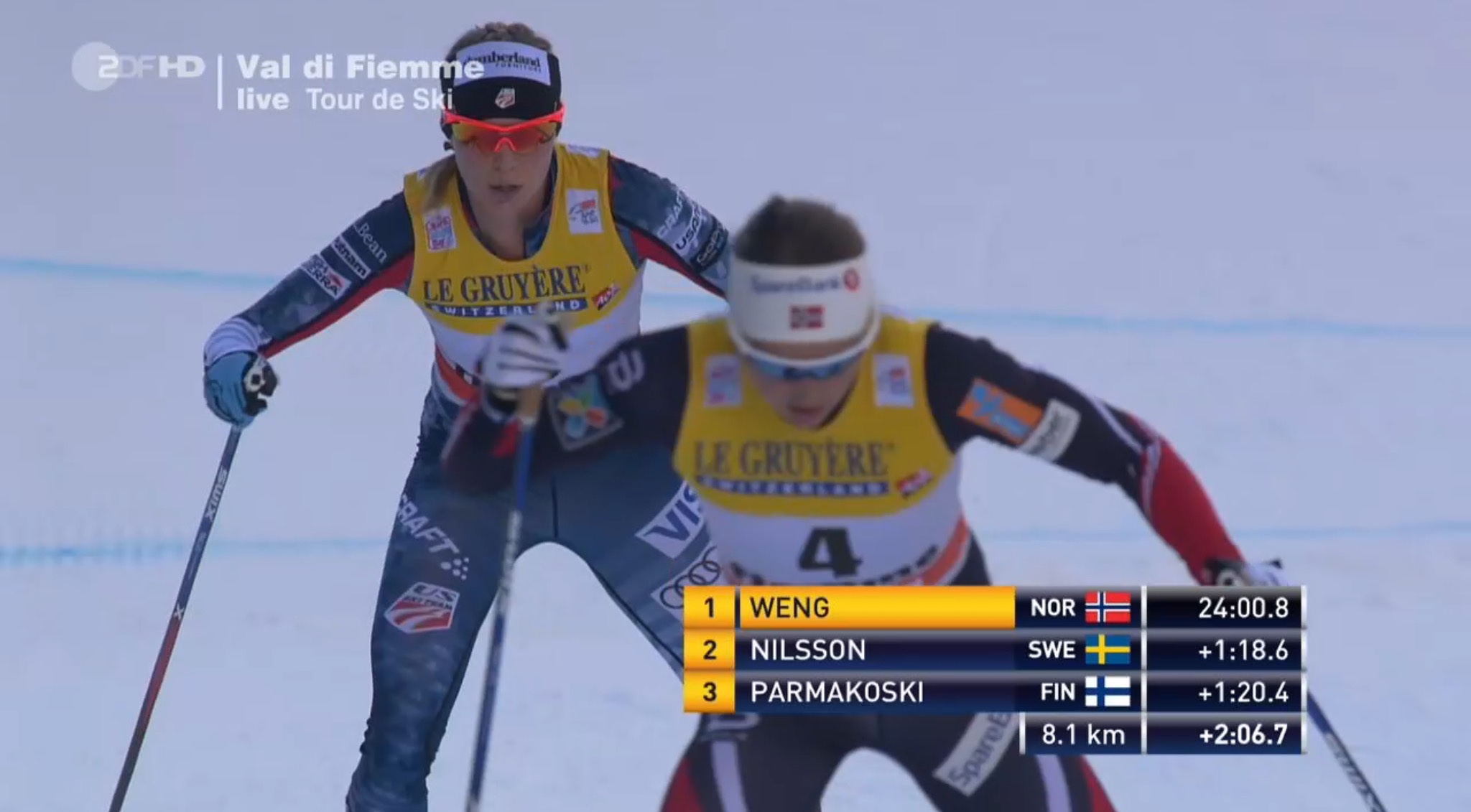
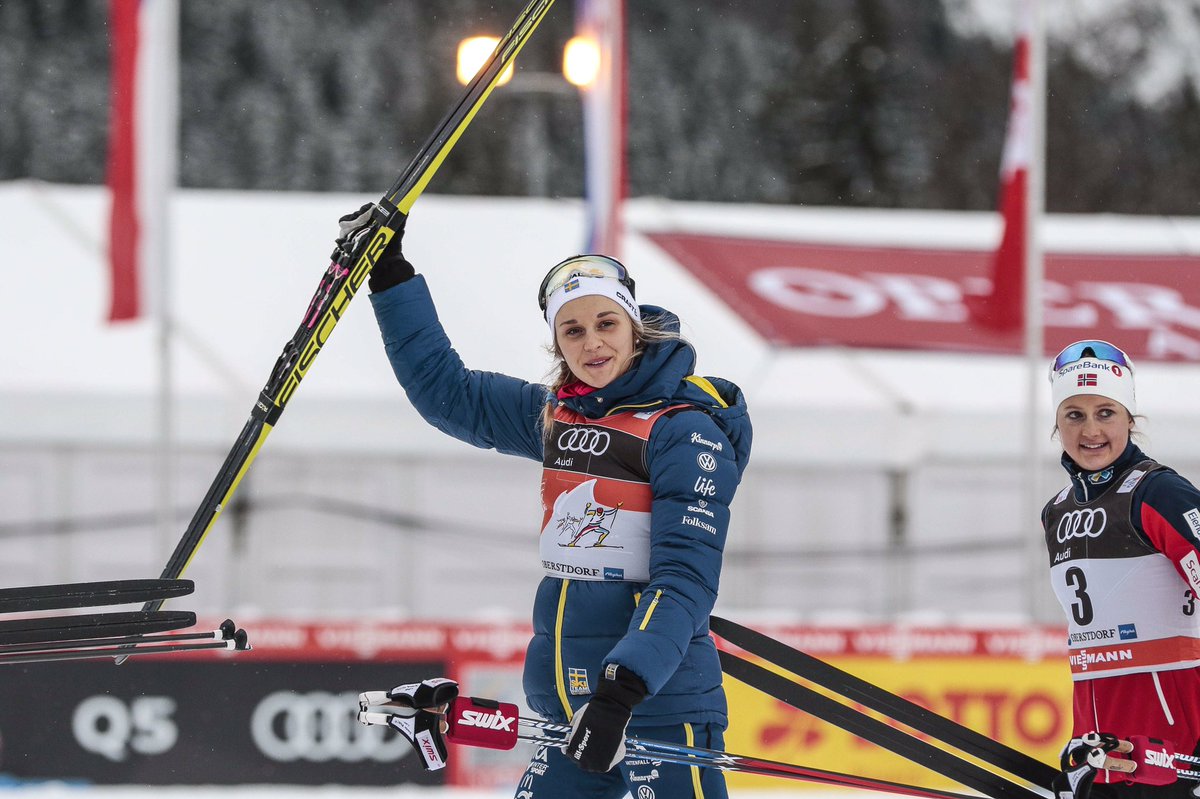
    American Jessie Diggins chasing Norway's Ingvild Flugstad Østberg on the final climb of the 2017 Tour de Ski up the Alpe Cermis in Val di Fiemme, Italy. Østberg finished the Tour in fourth and Diggins fifth, tying a best-ever mark for the U.S., set in 2015 by Liz Stephen. (Photo: ZDF screenshot)
    American Jessie Diggins chasing Norway’s Ingvild Flugstad Østberg on the final climb of the 2017 Tour de Ski up the Alpe Cermis in Val di Fiemme, Italy. Østberg finished the Tour in fourth and Diggins fifth, tying a best-ever mark for the U.S., set in 2015 by Liz Stephen. (Photo: ZDF screenshot)

    FIS Cross-Country Tour de Ski Stage 7 (Val di Fiemme/Alpe Cermis, Italy): 9 k freestyle

    Women’s report | Men’s report

    Heidi Weng of Norway proved that she was the threat everyone was fearing – despite a few races in the Tour de Ski with bad skis or low energy, Weng had a dominating performance up the Alpe Cermis and took her first ever Tour de Ski title.

    At 6.2 k of the 9 k course, Weng passed Stina Nilsson of Sweden, who had started the day in the leader’s bib with a 19.2-second advantage. Weng just stepped on the gas from there, turning in the fastest climb time of the field and winning by 1:37.0.

    Further up the hill, Nilsson was also passed by Krista Parmakoski of Finland, who gapped the Swede and earned second place.

    And Nilsson had to hold off one more attack, from Norway’s Ingvild Flugstad Østberg near the top of the climb. Østberg had started in fourth place and got close to Nilsson, before the Swede found her second (or third, or fourth) wind and sprinted it in to the finish to secure third place and her first Tour de Ski overall podium.

    Weng has three previous Tour de Ski podiums, but never a win. Parmakoski’s previous best overall finish was fourth, in 2014.

    Jessie Diggins of the U.S. Ski Team started behind Østberg and almost made contact at one point, before the Norwegian slipped from her grasp. Diggins finished the Tour de Ski fifth (+3:09.0) — where she had started the day — to tie for the best-ever Tour finish with Liz Stephen, who was fifth in 2015.

    Today, Stephen clocked the second-fastest time up the climb, behind Weng, and finished 14th (+6:45.6).

    Rosie Brennan, the third and final U.S. woman to finish the Tour de Ski this year, landed 28th, +12:59.9. Her time was the 23rd-fastest up the Alpe Cermis.

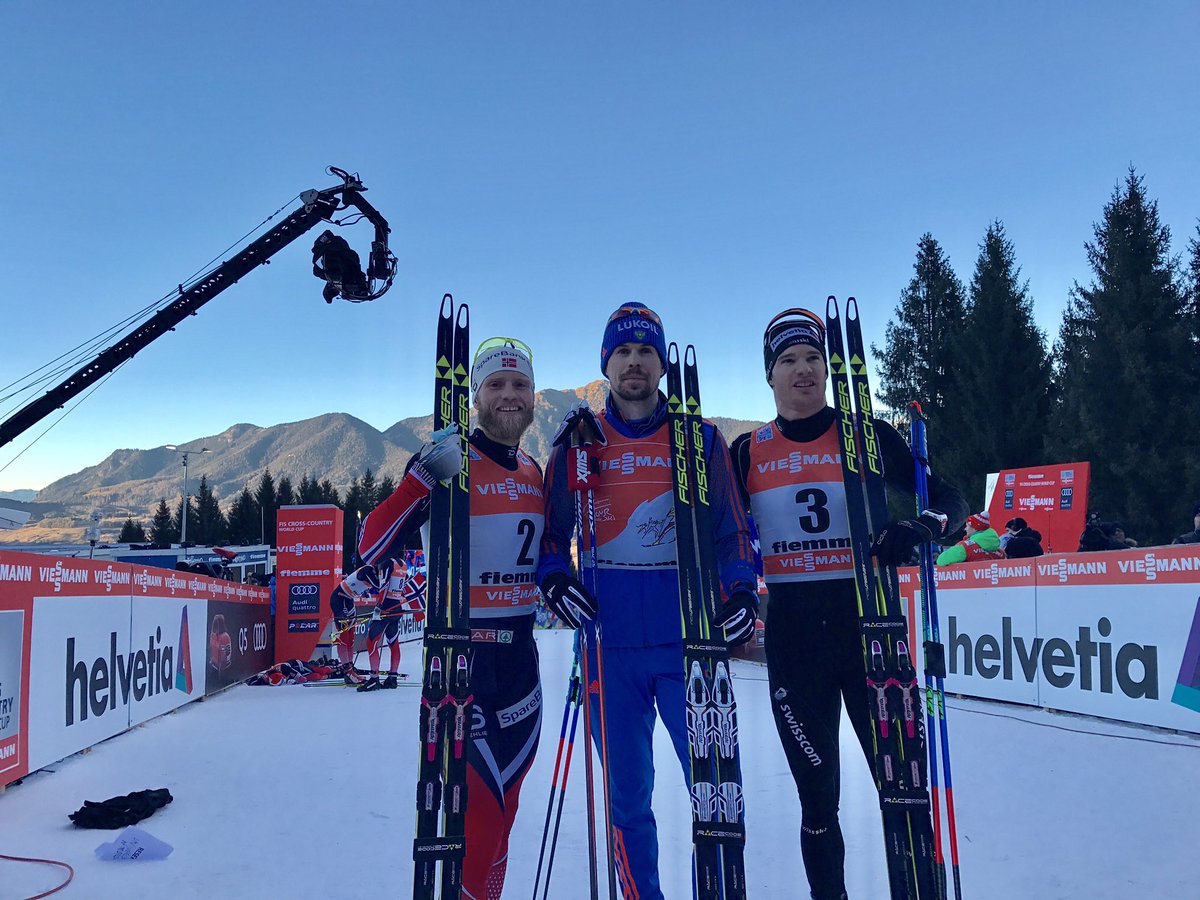
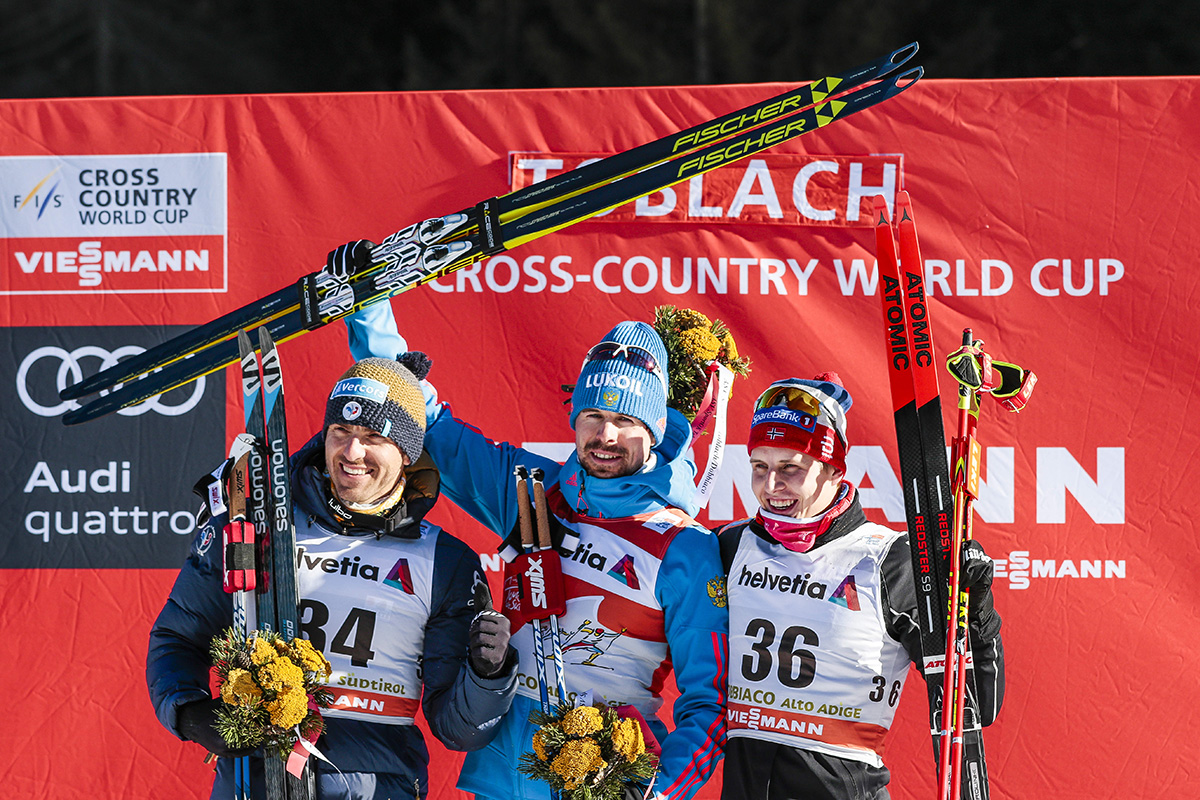
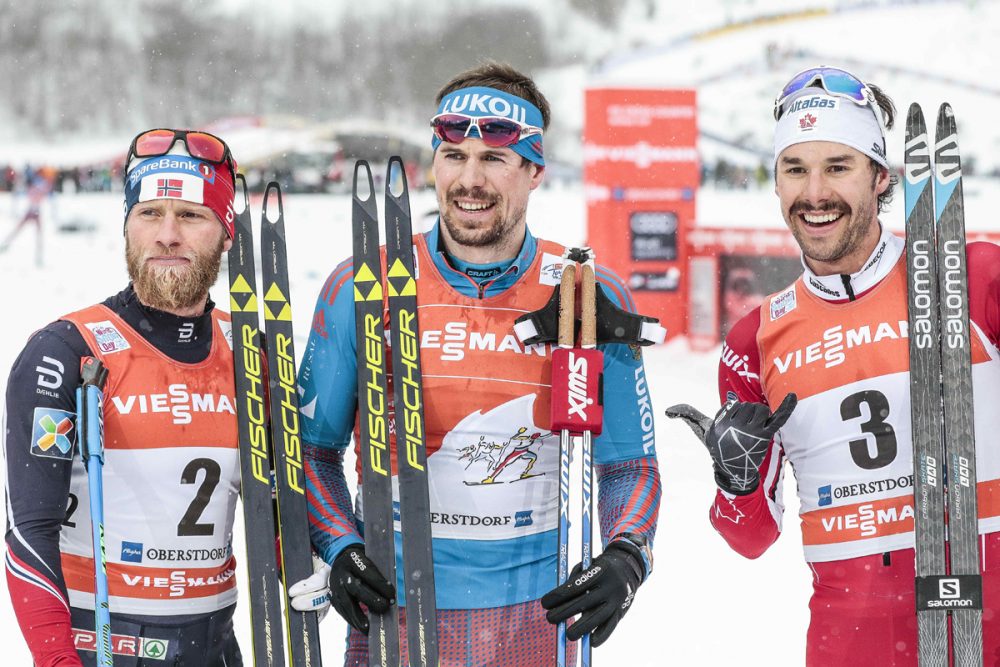
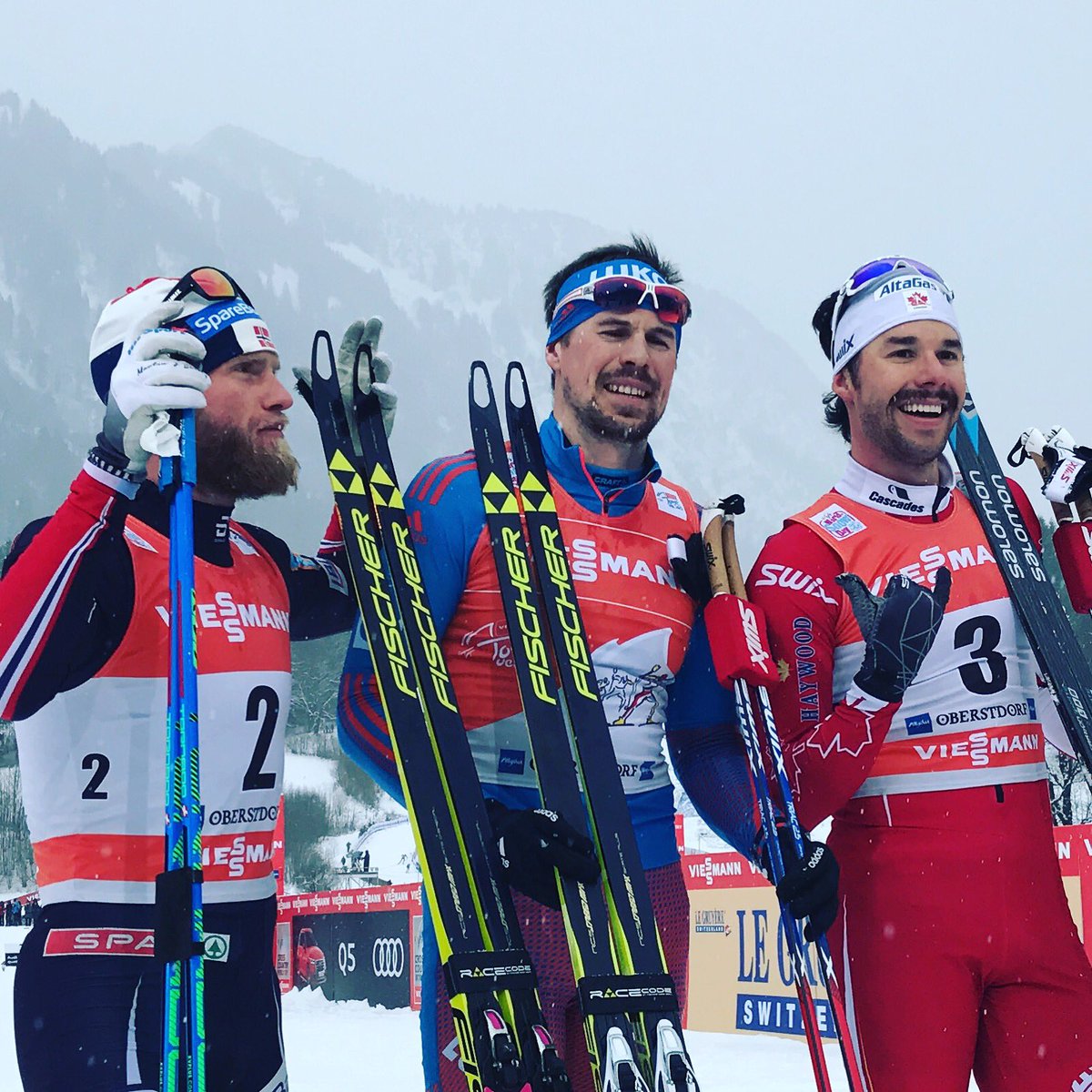
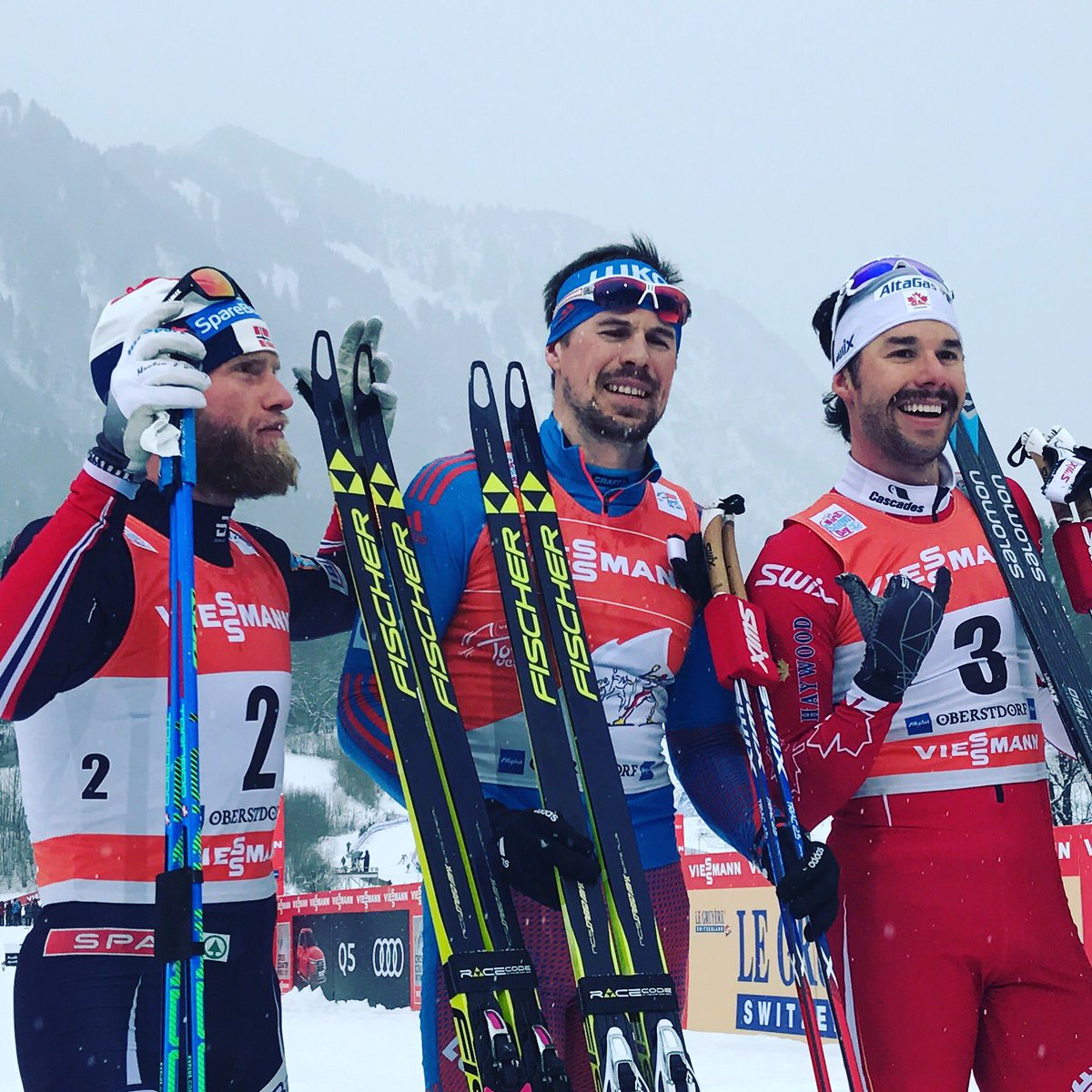
    The overall podium at the end of the 2017 Tour de Ski, with winner Sergey Ustiugov (c) of Russia, Norway's Martin Johnsrud Sundby (l) in second, and Switzerland's Dario Cologna (r) in third after finishing in that order in the 9 k freestyle hill-climb pursuit, Stage 7 of the Tour de Ski in Val di Fiemme, Italy. (Photo: FIS Cross Country/Twitter)
    The overall podium at the end of the 2017 Tour de Ski, with winner Sergey Ustiugov (c) of Russia, Norway’s Martin Johnsrud Sundby (l) in second, and Switzerland’s Dario Cologna (r) in third after finishing in that order in the 9 k freestyle hill-climb pursuit, Stage 7 of the Tour de Ski in Val di Fiemme, Italy. (Photo: FIS Cross Country/Twitter)

    In the men’s 9 k freestyle hill climb that followed, 24-year-old Sergey Ustiugov of Russia raced to his first Tour de Ski victory, heading out of the gate with a 1:12-minute head start over Norway’s Martin Johnsrud Sundby and finishing 1:02.9 ahead for the win in 30:27.7.

    Sundby put time into Ustiugov over parts of the course, particularly in the first kilometer along a flatter section leading up to the climb and then again between 6 and 8 k on Alpe Cermis itself.

    Sundby skied alone throughout the pursuit race, with Switzerland’s Dario Cologna starting 52 seconds behind him. Cologna had a 29-second head start on Finland’s Matti Heikkinen, who entered the race in fourth, and 30 seconds ahead of France’s Maurice Manificat in fifth, but Manificat caught and even passed Cologna with about 0.5 k remaining. Cologna proceeded to pass Manificat back while Heikkinen skied about nine seconds back in fifth.

    Canada’s Alex Harvey had started sixth and helped lead Manificat and Heikkinen in chasing down Cologna early in pursuit, but he faded to seventh, behind Sweden’s Marcus Hellner (who started seventh, 12 seconds after Harvey) by 8.5 k. There, Hellner trailed Heikkinen by 14.6 seconds, and Harvey was another 27.9 seconds back in seventh (and nearly a 54 seconds ahead of the man skiing in eighth at the time, Norway’s Simen Hegstad Krüger).

    Half a kilometer later, it was all over with Cologna securing third overall in the Tour, 1:19.1 behind Ustiugov and 16.2 seconds behind Sundby.

    With the fastest 9 k time of the day, Manificat moved up one place for fourth overall, finishing 1:26.9 after Ustiugov with a time of 29:20 minutes. Heikkinen was the second fastest on course, 6.1 seconds slower than Manificat, for fifth overall in the Tour (+1:31.3). Hellner took sixth at the finish (+2:05.8), ahead of Harvey in seventh (+2:39.7). For Harvey, it was his best overall finish in four competed Tour de Skis (last year, he finished 14th. His best result was 12th in 2012).

    Norway swept the next five places with with Krüger in eighth (+3:27.2), Hans Christer Holund in ninth (+3:50.4), Niklas Dyrhaug in 10th (+4:24.9), Sjur Røthe in 11th (+4:56.4), and Didrik Tønseth in 12th (+5:07.7).

    Canada had two in the final climb with Devon Kershaw finishing 25th (+9:32.2) after starting 23rd. Graeme Killick did not start after being positioned in 37th overall in the Tour.

    Kershaw finished 8.1 seconds ahead of Noah Hoffman, the lone American racing to the top of Alpe Cermis. Hoffman moved up from 30th at the start to finish 26th (+9:40.3) overall, and in doing so, he posted the 15th-fastest time of the day, 1:05.3 back from Manificat.

    Harvey’s time ranked 14th (+1:04.9). Norway’s Holund had the third-fastest time after starting 11th and ending up ninth, Hellner was fourth fastest, and Cologna fifth fastest.

    Tour de Ski final results (with isolated climb times): Women | Men

  • Ustiugov Full of Emotions, Few Words After Winning Tour de Ski: ‘We Did It’; Harvey 7th

    Ustiugov Full of Emotions, Few Words After Winning Tour de Ski: ‘We Did It’; Harvey 7th

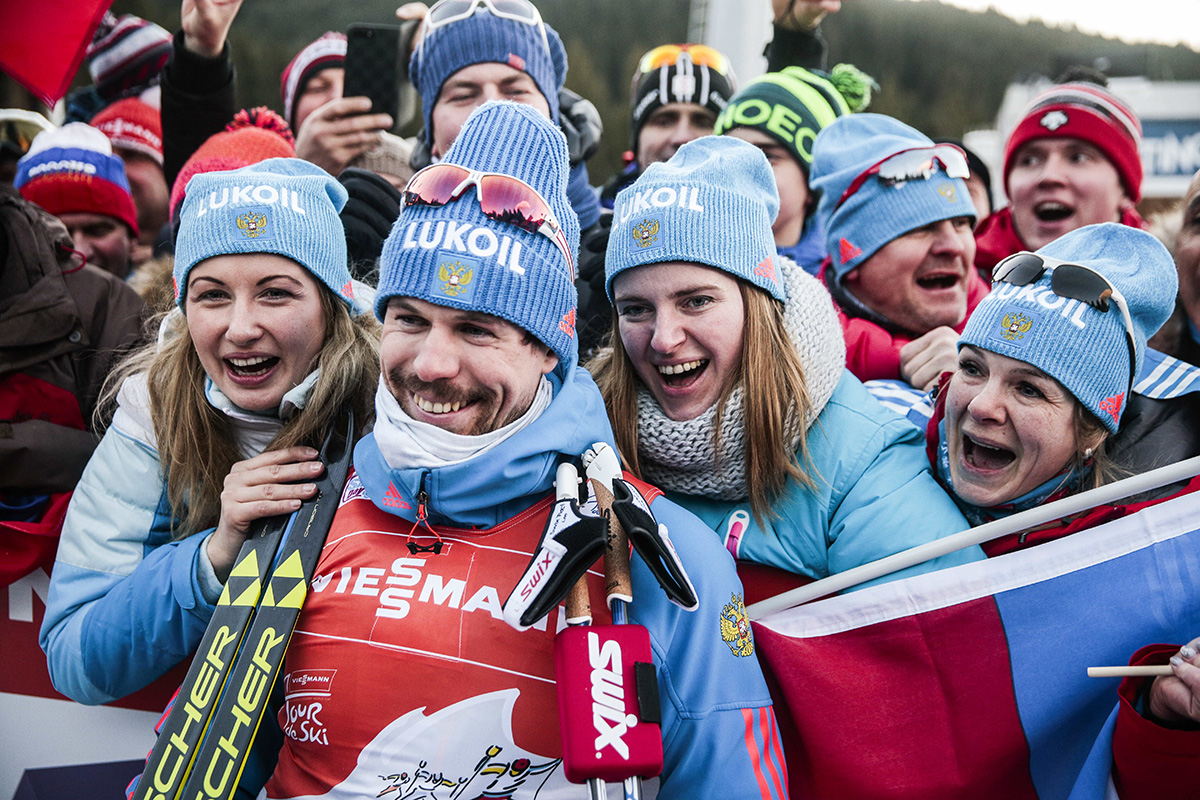
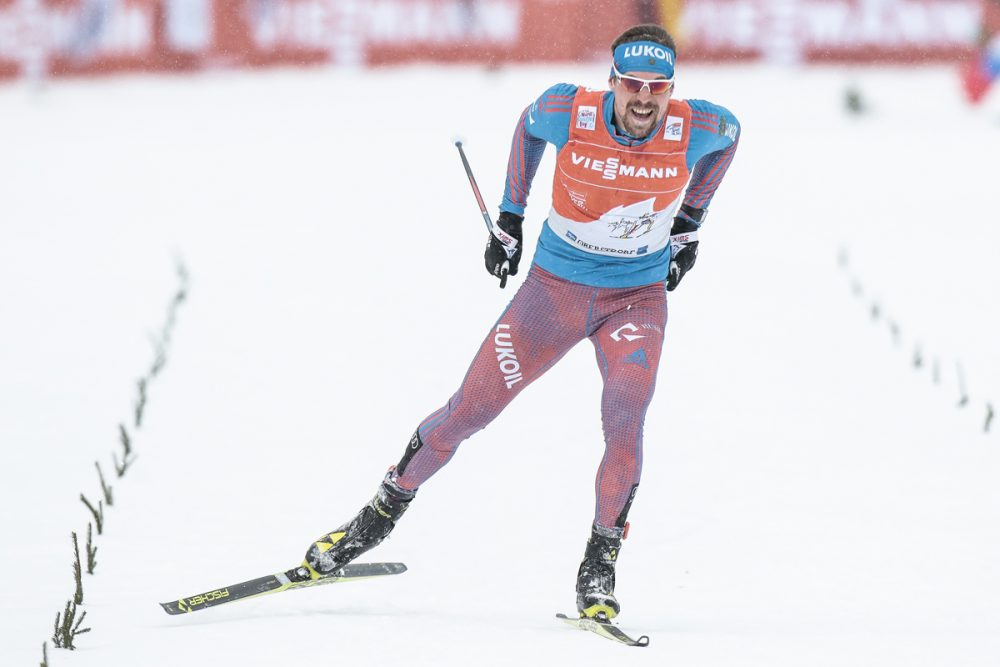
    Russia's Sergey Ustiugov celebrates with his supporters after winning the final climb and his first Tour de Ski overall title on Sunday at Alpe Cermis in Val di Fiemme, Italy. (Photo: Fischer/Nordic Focus)
    Russia’s Sergey Ustiugov celebrates with his supporters after winning the final climb and his first Tour de Ski overall title on Sunday at Alpe Cermis in Val di Fiemme, Italy. (Photo: Fischer/Nordic Focus)

    Note: This article has been updated to include comments from Noah Hoffman.

    There were moments in Sunday’s 9-kilometer freestyle climb up Alpe Cermis, the seventh and final stage of the 2017 Tour de Ski, that Norway’s Martin Johnsrud Sundby appeared to be putting some serious time into Russia’s Sergey Ustiugov up front.

    In the first two kilometers, Sundby as the runner-up entering the day had gained three seconds on Ustiugov, who had won all but one stage so far in the Tour. Norway’s reigning Tour de Ski champion lost about six seconds over the next four kilometers leading up to the climb itself, which began in earnest around 6.2 k, but after that, Sundby regained about 13 seconds on Ustiugov by by 8.1 k.

    Despite looking relatively strong on a course that ascends an alpine run with an average grade of 28 percent, with less than a kilometer remaining, Sundby was still 53.8 seconds behind Ustiugov. At one point, an unofficial, TV-generated speedometer estimated Sundby was going 1 k per hour on one of the steepest sections of the course. At that rate, there was no possible way he could catch Ustiugov, unless the Russian stopped before the finish line at the top.

    Ustiugov didn’t let off, and actually took back nine seconds on Sundby in the final kilometer. The Russian crossed the line without anyone in sight in 30:27.7 minutes for his first Tour de Ski title at the ripe age of 24. Sundby finished 1:02.9 minutes later — with a net gain over his 1:12-minute starting deficit — to place second overall.

    “There is no other venue in the world that makes the best skiers in the world look like amateurs.” — Canada’s Devon Kershaw on the Tour de Ski’s final climb up Alpe Cermis

    “He’s a worthy winner,” the 32-year-old Sundby told NRK after. “The gap was too great, and my chances would have been slim either way.”

    He noted that his leadup to the race wasn’t ideal.

    “I’ve had a stomach problem all night, so the buildup to the race wasn’t that good. It’s frustrating,” Sundby said. “It was brutal.”

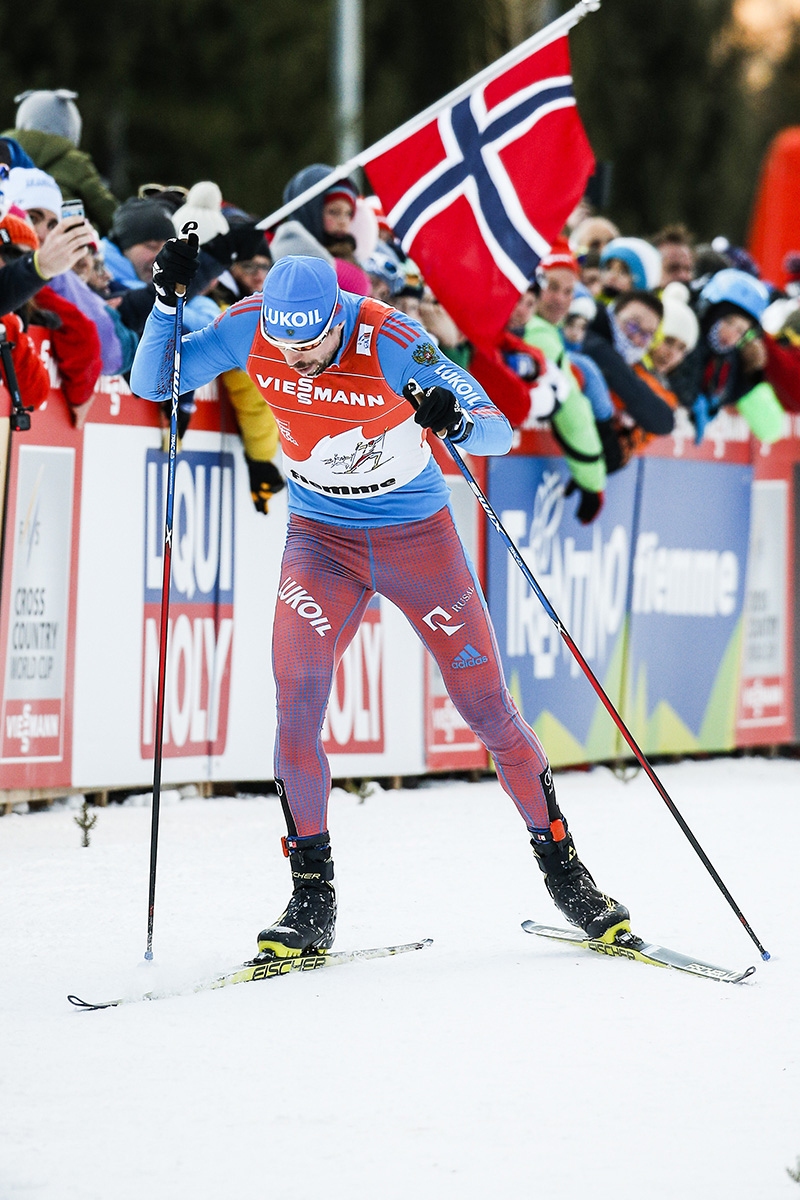
    Russia's Sergey Ustiugov racing to the victory in the final climb of the 2017 Tour de Ski on Sunday in Val di Fiemme, Italy. He finished more than a minute ahead of Norway's Martin Johnsrud Sundby (not shown) in second after starting with a 1:12-minute lead. (Photo: Fischer/Nordic Focus)
    Russia’s Sergey Ustiugov racing to the victory in the final climb of the 2017 Tour de Ski on Sunday in Val di Fiemme, Italy. He finished more than a minute ahead of Norway’s Martin Johnsrud Sundby (not shown) in second after starting with a 1:12-minute lead. (Photo: Fischer/Nordic Focus)

    Overall, Ustiugov moved into second overall in the World Cup standings, 177 points behind Sundby. Before the Tour, he ranked eighth, and had won one World Cup this season: the freestyle sprint in Davos, Switzerland. This year, Ustiugov became the first man to lead a Tour from start to finish, through every stage. He lost just once, in Saturday’s 15 k classic mass start, and for a grand total of approximately 128,000 Swiss francs (about $125,700 U.S. dollars) during the Tour.

    According to an International Ski Federation (FIS) press release, Ustiugov became the first man to win five consecutive stages of a Tour de Ski, surpassing Sundby’s four-straight wins last year. After Switzerland’s Dario Cologna, he is the second-youngest man to win the Tour. (Cologna was 22 when he won it in 2009.) And he’s the second Russian to win it after Alexander Legkov (currently provisionally suspended) won it in 2013. Russia is now the second nation, other than Norway, with two different Tour de Ski winners.

    In a televised post-race interview with FIS, an emotional Ustiugov started off by thanking his original coach.

    “As for now, I don’t have any emotions, no thoughts,” he said through a translator. “I did it for all my guys, so boys, we did it, and thank all of Russia. I know everyone was watching and they all were supporting me.”

    According to FIS, Ustiugov later said it was “like a dream come true. I fought very hard for this. Today was incredibly tough. I thought I was on autopilot, I did not actually realize I crossed the finish line. It is an amazing feeling to be a Tour de Ski champion.”

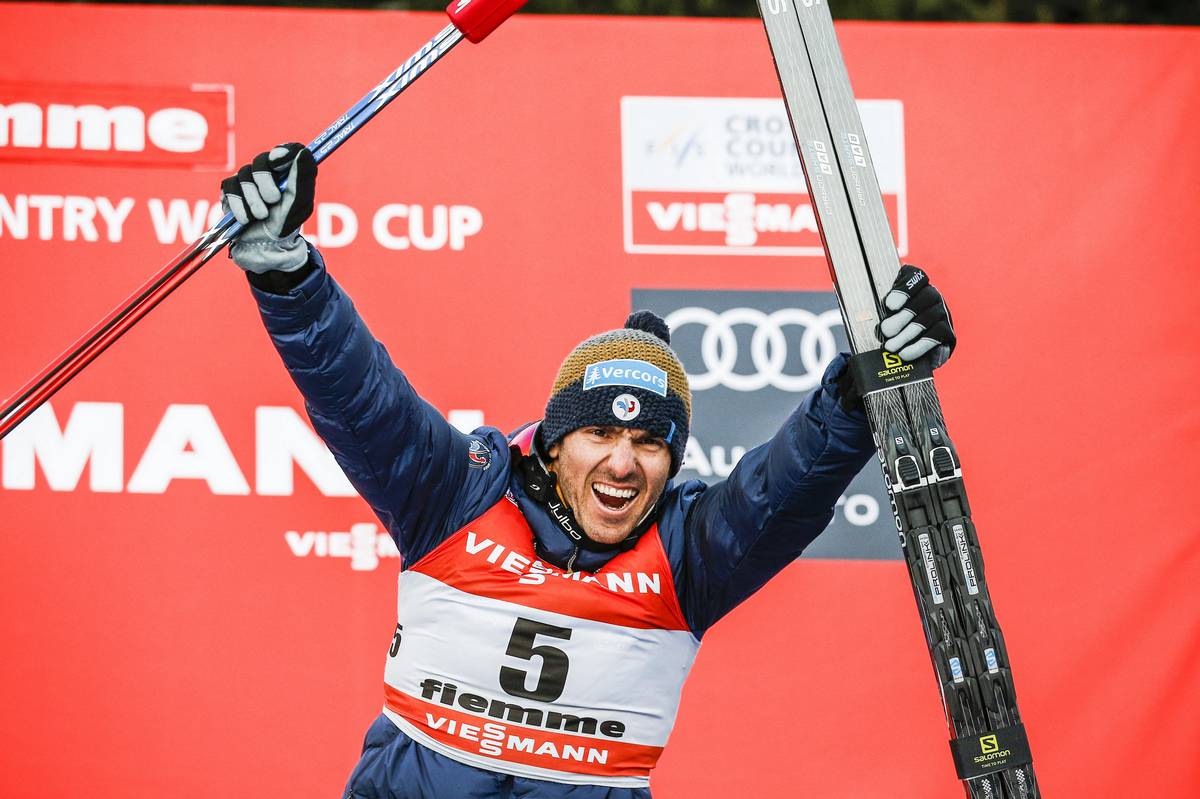
    France's Maurice Manificat celebrates his "time of day" victory in Stage 7 of the 2017 Tour de Ski, with the fastest time in the 9 k freestyle hill climb in Val di Fiemme, Italy. (Photo: Salomon/Nordic Focus)
    France’s Maurice Manificat celebrates his “time of day” victory in Stage 7 of the 2017 Tour de Ski, with the fastest time in the 9 k freestyle hill climb in Val di Fiemme, Italy. (Photo: Salomon/Nordic Focus)

    Starting behind Ustiugov and Sundby on Sunday, Switzerland’s Dario Cologna ended up posting the fifth-fastest course time (in 29:42.7) to hang onto third overall (+1:19.1). He finished 16.2 seconds after Sundby and 7.8 seconds ahead of France’s Maurice Manificat, the “winner of the day” based on his course time (29:20.0) and fourth overall (+1:26.9).

    At the start, Cologna had 52 seconds separating him from second and 29 seconds between him and Finland’s Matti Heikkinen in fourth. Heikkinen started 1 second before Manificat and 9 seconds before Canada’s Alex Harvey, who entered the final stage ranked sixth.

    By the 4 k checkpoint, still skiing along a thin ribbon of snow winding through the valley at the base of Alpe Cermis, Harvey was leading Manificat and Heikkinen with Cologna in clear view, about 20 seconds of them. Harvey had previously caught the Frenchman and Finn by 1.8 k.

    The three continued to pursue Cologna in a hunt for third, skiing together into the base of the climb, with Manificat leading at 6.2 k, and with Heikkinen sharing the load up front though 7.1 k. Over the next kilometer, Sweden’s Marcus Hellner (who started seventh, 12 seconds behind Harvey) successfully caught the Canadian and was a second ahead of him by the 8.1 k checkpoint.

    Switzerland's Dario Cologna celebrates third in at the top of the final climb in the last stage of the 2017 Tour de Ski on Sunday in Val di Fiemme, Italy. (Photo: Fischer/NordicFocus)
    Switzerland’s Dario Cologna celebrates third in at the top of the final climb in the last stage of the 2017 Tour de Ski on Sunday in Val di Fiemme, Italy. (Photo: Fischer/NordicFocus)

    The two were 14 and 15 seconds behind Heikkinen in fourth, while Manificat began to drop Heikkinen in his quest for Cologna. With 0.5 k remaining, Manificat had caught Cologna, even leading him at one point, before Cologna passed him back and held onto his position through the finish.

    “I had to fight hard with two of the strongest climbers behind me,” Cologna told Swiss broadcaster SRF. “It was a difficult position, having to push right from the start. I went into the climb with a little gap, and could ski my own tempo, then I noticed they were getting closer. But the moment Manificat came up to me I slowed down a little, saving a little bit for the counterattack, and that worked out great.”

    Manificat finished 7.8 seconds off the overall Tour podium in fourth, but outlasted Heikkinen by 6.1 seconds for to win the “time of day” and with it, Stage 7.

    Norway’s Hans Christer Holund placed third for course time (+15.8), ahead of Hellner in fourth (+19.0). Harvey’s time ranked 14th (+1:04.9) ahead of American Noah Hoffman in 15th (+1:05.3) and Ustiugov in 16th (+1:07.7).

    Harvey ended up seventh across the line, 2:39.7 minutes behind Ustiugov and 33.9 seconds behind Hellner in sixth, for Harvey’s best Tour de Ski result. His previous best was 10th in the 2011 edition. With his seventh-place Tour finish, Harvey improved to fifth in the overall World Cup standings — after entering the seven-stage series ranked ninth in the World Cup.

    Canada's Alex Harvey racing to seventh in the men's 9 k freestyle hill climb to end the 2017 Tour de Ski in Val di Fiemme, Italy. (Photo: CCC/NordicFocus)
    Canada’s Alex Harvey racing to seventh in the men’s 9 k freestyle hill climb to end the 2017 Tour de Ski in Val di Fiemme, Italy. (Photo: CCC/NordicFocus)

    “If it was a one-day race it would be relief when you reach the finish line. Throw in six races before this race and it is absolute relief when you get to the top,” Harvey said, according to a Cross Country Canada press release.

    “It was quite good today. That was the best position ever for me up the climb, and I had the 14th best time on the day,” he said. “I was skiing with Manificat and Heikkinen, who had the top-two times on the day. I was with them for a bit, but it was just a bit too fast for me. They crushed everyone on the hill.

    “The first part is not so bad, but when you hit that first pitch your legs feel like concrete and then you have to tough it out for the last 15 minutes,” Harvey explained. “Normally you have a downhill, and flats, to recover, but here you don’t flush any lactate. You just keep going and it is a battle against yourself.”

    Moving forward, Harvey was positive about his chances in next year’s Tour.

    “This gives me a lot of confidence for next year to know that if I’m in the top three, I am fast enough to keep it together on the last day and get on the overall podium,” he said. “It feels great to have my best finish ever. I had a really good start of the season with a number of top 10’s, but sometimes you start to think, is seventh the best I can do? I wanted to take that next step and get on the podium in the Tour and I did that.”

    Two Canadians and an American raced the final climb, with Devon Kershaw (Canadian World Cup Team) placing 25th (+9:32.2) after starting 7:19 back in 23rd. Of 40 finishers, the least amount ever in 11 years of the Tour, Kershaw’s course time ranked 39th. (Of note, the 34-year-old Kershaw is one of three athletes to have started all 11 Tours, according to Cross Country Canada.)

    “It was a raunch-fest today for me up the hill, I am actually kind of embarrassed,” Kershaw said on the phone after. “I was destroyed after that classic race yesterday so I think I just didn’t recover well enough, and going up the hill, it’s not a ski race, it’s just survival. I mean, there is no other venue in the world that makes the best skiers in the world look like amateurs and when you’re a bit off, like I was today … it was awful, but I am happy to stay 25th in the overall of course. That is not where I want to be, but all things considered 25th is better than I was last year at the Tour de Ski.”

    At last year’s Tour, Kershaw placed 32nd, while Harvey placed 14th. In the penultimate stage of this year’s Tour on Saturday, Kershaw finished 27th in the 15 k classic mass start, one of his target races. His best result of the Tour (and best result in nearly three years) came in last week’s Stage 3 in Oberstdorf, Germany, where Kershaw placed 10th in the 20 k skiathlon.

    “What I take forward from it is the 10th place and being so close to the podium there. That really meant a lot to me,” he reflected. “… The goal for the season is to have a few great races and I have had one that was that was so close to great that I hope to, at World Championships and beyond, have some more races like that.”

    Hoffman of the U.S. Ski Team moved up four spots after starting 30th and 9:32 back to place 26th overall in the Tour. With the 15th-fastest course time, Hoffman crossed the line 8.1 seconds after Kershaw and 9:40.3 behind Ustiugov.

    Last year, Hoffman placed 22nd in the Tour, again with the 15th-fastest time of day up Alpe Cermis (to improve from 26th to 22nd). Hoffman said Saturday that his goal was a top 15 for time of day on Sunday.

    “I am definitely pleased to have a top 15 time today, and to move up solidly into the top 30 for the Tour,” Hoffman wrote in an email. “I definitely feel like this race can be a stepping stone for me for the rest of the season. I haven’t skied at a world class level yet this year, but I know that I’ve trained at that level and I believe I can show it in the remainder of the season, especially at World Champs.

    “This hill climb is really fun for me,” he added. “It plays to my strengths and it’s just a cool unique event. I’m glad I had another opportunity to race it.”

    Canadian World Cup Team skier Graeme Killick was slated to start 37th and 11:25 back on Sunday, but did not start.

    Killick and Harvey could not be reached for comment.

    The Canadians left Val di Fiemme shortly after the final climb and planned to head in different directions. On Saturday, Hoffman said the U.S. team planned to stay there until Tuesday, then venture to Seiser Alm, Italy, to recover.

    “Alex [Harvey] is heading to Seefeld … and I am headed home to Oslo tomorrow morning,” Kershaw said. “Graham is heading back to Canada for a couple of weeks to recharge. The midpoint of the season is over and we are all going to go back and regroup and recharge and get ready for the next part here.”

    ‘It’s Gigantic’

    Getting back to Ustiugov’s victory, which is certainly a high point for Russia, after the nation has been embroiled in the revelations of its state-sponsored doping program dating back to before the 2012 London Olympics and marring much of the 2014 Sochi Games.

    “It’s gigantic,” Ustiugov’s coach Markus Cramer said to German broadcaster ZDF of his athlete’s overall win on Sunday. “I am incredibly happy for Sergey, and of course for the whole team with how much we recently were shaken up with the whole circumstances. Of course, it’s really beautiful to bring, in the end, a convincing victory home into the finish.”

    The circumstances Cranmer was referring to were the provisional suspensions of six Russian cross-country skiers being investigated as a result of the McLaren report. Ustiugov, along with all of the Russians still competing on the circuit, was not reportedly named in that report.

    “You’ve got to tip your hat to him, the guy had five wins and then today…,” Canada’s Kershaw said Sunday. “Ustiugov came into this tour, like, ‘I have been around a decently long time.’ … We didn’t know that when he won world juniors and then swept U23 [World Championships] and won some sprints, then now we know. … He won so many different ways this Tour; I have never seen anything quite so dominant…”

    “… I will maybe take some heat for this, but you have to be innocent until proven guilty,” Kershaw continued. “FIS did take a position and banned six athletes and Ustiugov wasn’t one of those people. … The only thing that I didn’t really like — but I understand maybe he doesn’t know or maybe none of us really know, it’s pretty murky — is when he said, ‘This is for the boys back home.’ I realize he is a bit pissed [about the suspensions], but he is a young athlete.

    “If we cant believe in our winners than it’s probably time to step away from the sport altogether,” Kershaw continued. “I really hope he is clean, and we have seen dominance in skiing before and we will see it again, and this was something pretty special.”

    Overall Tour de Ski/Final climb results | “Time of day” hill climb results | Overall World Cup standings

  • Sundby Breaks the Streak for 1st Stage Win in Val di Fiemme; Harvey 19th in Mass Start

    Sundby Breaks the Streak for 1st Stage Win in Val di Fiemme; Harvey 19th in Mass Start

    Norway's Martin Johnsrud Sundby (l) well ahead of the field as he double poles toward the finish in Saturday's 15 k classic mass start, which he won by 2.2 seconds over Russia's Sergey Ustiugov (not shown) while Finland's Matti Heikkinen (second from r) placed third at the Tour de Ski Stage 6 in Val di Fiemme, Italy. (Photo: Fischer/Nordic Focus)
    Norway’s Martin Johnsrud Sundby (l) well ahead of the field as he double poles toward the finish in Saturday’s 15 k classic mass start, which he won by 2.2 seconds over Russia’s Sergey Ustiugov (third from r) while Finland’s Matti Heikkinen (second from r, ahead of Ustiugov) placed third at the Tour de Ski Stage 6 in Val di Fiemme, Italy. (Photo: Fischer/Nordic Focus)

    Six laps. Three climbs per lap. Fifteen-kilometer classic mass start. If you’re in it to win it, where do you make your move?

    That was the kind of calculating Norway’s Martin Johnsrud Sundby was doing throughout Saturday’s Stage 6 mass start, the second-to-last stage of the 2017 Tour de Ski, in Val di Fiemme, Italy. Every time he rounded the 2.5 k loop, the man he needed to beat — Russia’s Sergey Ustiugov — was right there, either leading or within a few strides of first.

    Through five Tour stages, the 24-year-old Ustiugov was unbeaten. Could he be beat? Yes, Sundby thought, but it was going to take some brains as well as brawn.

    He had to be patient, despite being extremely frustrated with his race on Friday, when he placed 14th in the 10 k freestyle in Toblach, Italy. That put him more than a minute and a half behind Ustiugov in the overall Tour with two stages to go.

    “Yesterday’s race was really bad and it is good I could win today,” Sundby said, according to an International Ski Federation (FIS) press release. “I was little bit conservative at the beginning. I wanted to win some bonus seconds. I had some power left and I am happy about victory.”

    He attacked on the last lap just before the 13.9 k mark, after pulling up alongside Ustiugov on the first long climb out of the stadium, while Switzerland’s Dario Cologna did the same on the other side of the Russian in the Tour leader’s bib.

    Norway's Martin Johnsrud Sundby glances back to make sure he's out of reach during the final kilometer of the men's 15 k classic mass start at Stage 6 of the Tour de Ski in Val di Fiemme, Italy. (Photo: Fischer/Nordic Focus)
    Norway’s Martin Johnsrud Sundby glances back to make sure he’s out of reach during the final kilometer of the men’s 15 k classic mass start at Stage 6 of the Tour de Ski in Val di Fiemme, Italy. (Photo: Fischer/Nordic Focus)

    Sundby’s move wasn’t obvious then, but it was along a long false-flat, where he began dropping the field with an unmatched double pole. Heading into a tricky descent before the final climb, Sundby had successfully broken away and frequently checked back to make sure Ustiugov wasn’t anywhere near him.

    Ustiugov and two of his Russian teammates, Andrey Larkov and Alexander Bessmertnykh, continued to lead the chase, followed by Cologna, Finland’s Matti Heikkinen, Norway’s Niklas Dyrhaug, and even Italy’s Francesco de Fabiani had worked his way into the mix.

    Up that last steep climb, Cologna switched from the right to the left tracks suddenly, appearing to cut off Heikkinen, who moved outside the tracks to get around him. A few strides later, Dyrhaug stepped outside the right tracks to get around Ustiugov, but Ustiugov wasn’t having it. He stepped out as well, forcing Dyrhaug to file back in behind him. All of this was shaping up to be a fight for second; Sundby was too far gone.

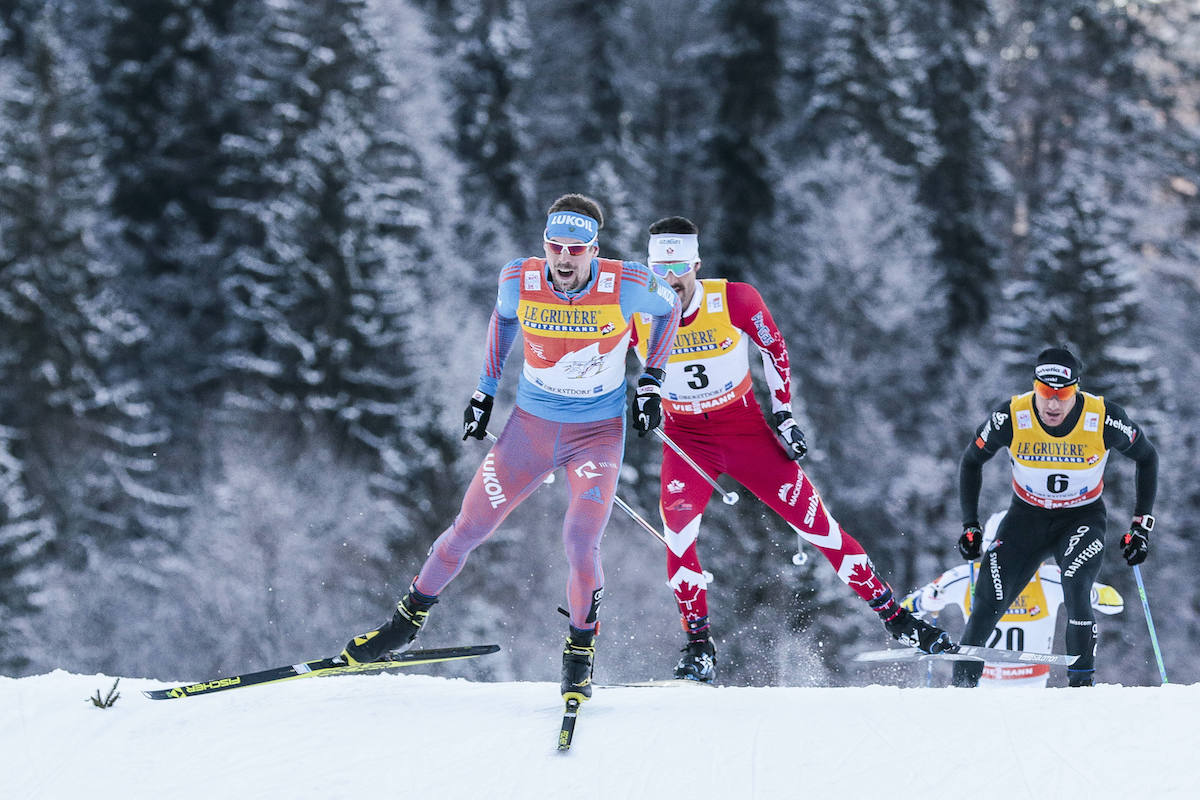
    The second-ranked man in the Tour, Sundby finished in 40:40.0 minutes, while Ustiugov caught a draft and out-double poled the chase pack for second place, crossing 2.2 seconds later. That still puts Ustiugov 1:12 minutes ahead going into the final climb (yep, he’ll start 1:12 minutes ahead of anyone else in the 9 k freestyle hill climb up Alpe Cermis), but at least for Sundby it’s not 1:34.

    But as Ustiugov said Friday, “For Martin, a minute does not mean anything … The main thing is not to lose all that has been so hard-earned in these five races.”

    “Today’s performance gives me a different starting point in tomorrow’s race,” Sundby told NRK. “I need a little miracle tomorrow, but I’m not going to quit before I cross the finish line.”

    Finishing 0.6 seconds behind Ustiugov on Saturday, and nearly being taken out by the Russian at the finish when Ustiugov collapsed sideways across the line, was Heikkinen in third (+2.8). Fourth through eighth place were all within 1.1 seconds of the podium, with de Fabiani taking fourth (+3.2), Larkov fifth (+3.3), Dyrhaug sixth (+3.5), Cologna seventh (+3.8), and Bessmertnykh eighth (+3.9).

    After that, there was a 6-second gap Norway’s Hans Christer Holund in ninth (+9.9), Sweden’s Marcus Hellner finished 10th (+10.3), France’s Jean-Marc Gaillard 11th (+13.6), Sweden’s Jens Burman 12th (+14.9), and France’s Maurice Manificat 13th (+16.3).

    Russia's Sergey Ustiugov leads his Russian teammates Alexander Bessmertnykh (23) and Alexey Larkov at the front of the pack during the men's 15 k classic mass start at Stage 6 of the Tour de Ski in Val di Fiemme, Italy. (Photo: Fischer/Nordic Focus)
    Russia’s Sergey Ustiugov (r) leads his Russian teammates Alexander Bessmertnykh (23) and Alexey Larkov (l) during the men’s 15 k classic mass start at Stage 6 of the Tour de Ski in Val di Fiemme, Italy. (Photo: Fischer/Nordic Focus)

    The fact that Ustiugov finished second was largely in part to his teammates, Larkov and Bessmertnykh, who drove the pace and helped box out competitors up front, especially early in the final lap. Ustiugov even drafted one of them on the final descent into the stadium before switching to an open lane in the finishing straight and double poling to the front of the chase pack.

    “I am grateful to my teammates,” Ustiugov said, according to a loose translation. “If they did not help me, one of them could have won the mass start. Tomorrow’s race? We’ll see. In any case, it will be interesting. I understand perfectly … what is waiting for me, despite the fact that I was only passed once on the final uphill.”

    One thing Saturday showed: the Russian is beatable. Last year, Sundby won the climb, both as the first man at the top and with the fastest time up the 9 k grind. France’s Robin Duvillard, who is not competing in this year’s Tour, was second (+7.2) for time of day, and Heikkinen was third (+11.8).

    Ustiugov as the fourth starter clocked the 13th-fastest time, 47.6 seconds behind Sundby. Of note, American Noah Hoffman was 15th (+56.4) and Canada’s Alex Harvey 16th (+1:07.4) for final-climb time.

    Ustiugov ended up third overall in the 2016 Tour, arriving at the top near four minutes after Sundby.

    Russia's Sergey Ustiugov (front, in Tour leader's bib) leading early in the men's 15 k classic mass start on Saturday, along with Canada's Alex Harvey (l) at Stage 6 of the Tour de Ski in Val di Fiemme, Italy. (Photo: Fischer/Nordic Focus)
    Russia’s Sergey Ustiugov (front, in Tour leader’s bib) leading early in the men’s 15 k classic mass start on Saturday, along with Canada’s Alex Harvey (l) at Stage 6 of the Tour de Ski in Val di Fiemme, Italy. (Photo: Fischer/Nordic Focus)

    “… I think he’s in better shape now,” Harvey said on the phone Saturday about Ustiugov. “So I think those two guys [Ustiugov and Sundby] will stay in front, and Sundby probably second. I think it will be just a really good fight…”

    On Sunday, Harvey will start sixth in this year’s final climb, 2:42 minutes behind Ustiugov and 38 seconds behind Cologna, who is third overall.

    “I am third at the moment with a lead of more than 20 seconds, that surely looks positive, but it’s a long flat section before the climb,” Cologna told Swiss broadcaster SRF. “It’s almost a minute to Sundby, and he is not a bad climber, either. So I really have to look how I can defend my third place. That’s the goal for tomorrow.“

    Harvey entered Saturday’s 15 k classic mass start in fourth overall but dropped two spots when he finished 19th, 38.7 seconds after Sundby. Also slated to start ahead of Harvey on Sunday are Heikkinen, who is fourth overall (+2:33) and Manificat in fifth (+2:34).

    “Manificat will try early on the hill, and then Heikkinen. I’m sure they’ll be pushing really hard down the flat to kind of close that 26-, 28-second gap that they have on Dario [Cologna],” Harvey anticipated. “… When you see someone up the hill, like 10 seconds, it seems like they’re three meters ahead, always. So I think that it’s a good position to be in, for Heikkinen especially. My guess for the podium is probably Ustiugov, Sundby, and Heikkinen, but I’ll be in there, too, so we’ll see.”

    On Saturday, Harvey surged to the front of the pack early, leading at 1.1 k, with superior skis on the uphills, he said. Also up there with him was Romania’s Paul Constantin Pepene — sort of a surprise at this point in the Tour.

    “The Romanian guy started really fast and then he blew up right away,” Harvey said, of Pepene falling off the pace after 2.5 k. “There was a prime in the second lap early on … and I think I had one of the best grip out there today, so on that steep hill it was pretty easy for me to just run in the track and get that prime [for 15 bonus seconds].”

    Alex Harvey (Canadian World Cup Team) en route to 19th in the men's 15 k classic mass start on Saturday, which puts him sixth overall in the Tour de Ski with one stage remaining in Val di Fiemme, Italy. (Photo: Salomon/Nordic Focus)
    Alex Harvey (Canadian World Cup Team) en route to 19th in the men’s 15 k classic mass start on Saturday, which puts him sixth overall in the Tour de Ski with one stage remaining in Val di Fiemme, Italy. (Photo: Salomon/Nordic Focus)

    Heading into Lap 3, Harvey said the wheels started to come off.

    “When we lapped into the stadium, I was starting to get kind of yo-yoed a bit near the end of the group,” Harvey recalled. “And then tried to fight my way back up on the climbs, but I was getting yo-yoed a bit, and then the elastic just broke.”

    Fewer than 5 seconds out of first at 5 k while skiing in seventh, Harvey was down to 15th by the end of the next lap, yet still within 7 seconds of Ustiugov in first.

    Early on the fourth lap, he was 15 seconds back in 18th, just ahead of Great Britain’s Andrew Musgrave and Harvey’s teammate Devon Kershaw in 19th and 20th, respectively. Another three seconds back, a third Canadian, Graeme Killick was skiing in 25th (+18.7) at 8.6 k.

    “I actually didn’t know he was there until he just passed me, but yeah, I skied with him for a bit,” Harvey said of Kershaw, who passed him shortly after.

    Harvey recalled that Kershaw “got kind of tangled up with a Russian in the herringbone part, and then I think he said he lost our group there.”

    Kershaw could not be immediately reached for comment after Saturday’s race.

    The start of Lap 5 saw Harvey 10 seconds back from the leaders in 18th and Kershaw another five seconds back in 24th, with Killick following roughly three seconds later in 26th. Harvey was nearly 20 seconds behind one lap later, skiing in 17th, and he closed the race out in 19th (his worst result after placing 11th on Friday in the Toblach 10 k) of the Tour.

    “I don’t know. The body was good,” Harvey said.

    As for Sunday: “Oh I’m ready,” he said. “I kind of want revenge after today.”

    “Alex is a competitive guy and is hungry,” Canadian World Cup coach Ivan Babikov said, according to a Cross Country Canada press release. “He will be in a group of about four guys who are all good climbers. Dario is always strong, but anything is possible.”

    Kershaw finished the race in 27th (+1:21.1) and Killick 32nd (+1:31.0). They will start the final climb in 23rd (+7:19) and 37th (+11:25), respectively.

    “Coming into the Tour this year the priority races for me to target were the 10km in Val Mustair and the 15km tomorrow in Val di Fiemme,” Kershaw wrote in an email on Friday. “… [The 15 k mass start] will be a real battle royale and it’s the crux of this tour for the top 10. A lot of really strong guys are grouped close together and aside from Ustiugov who has made a mockery of this years event I would say it’s wide open.

    “What that means is that with the two bonus sprints on course and the time at the line – there is 45sec available – there will be a lot of hungry racers gunning for it. Blend that with a difficult and punishing course here in Val di Fiemme and I think this race will be blown open pretty good,” Kershaw anticipated. “I hope to have a good start and really just feel good in the body because you are going to need that for sure if you want to have a good race.”

    “It is a tough course and the guys are pretty tired but they dug deep today,” Babikov said Saturday, according to the press release. “We might have missed it a bit with the skis. We may have gone with something a bit too sticky.

    “It was really hard-packed snow and this is a tough course to get the skis right,” Babikov added. “Ideally you want to have good kick and a fast glide, but it is a gamble on a course this tough. The tracks were firm and icy but there were some sections where there were no tracks and others with powdery snow. We will debrief on it tonight.”

    The lone American to finish, Noah Hoffman landed in the points for the second-straight stage in 30th (+1:17.1) after skiing in 34th for the first two-thirds of the race. By 12.5 k, Hoffman was up into 29th, right behind Russia’s Petr Sedov in 28th and about 50 seconds behind the leaders.

    “I actually felt like I skied the second half pretty well,” Hoffman said on the phone. “I was able to make contact with that group that contained all the way up to 22nd place by the end. I didn’t really lose that much time … But I mean, yeah, certainly not a standout result. I kind of feel like a broken record, when every race I’m like, ‘Well, there were some good signs and I’m optimistic that it’s going to come around, but it’s not here yet.’ That’s kind of where I’m at.”

    Hoffman will start the final climb — a race he hopes to place in the top 15 in for time of day — in 30th (+9:42).

    “I’ve been top 20 on time on day a couple times, but I’m kind of frustrated, I feel like I haven’t shown what I can really do up a climb like that,” he said. “It’s a stage that was built for me, especially if I have help down in the valley, which I do tomorrow, because I’m starting with Sedov and that Swede [Viktor Thorn right behind me].

    “So I will definitely rely on some help to get to the base of the climb, and then I feel like once we get there, then I just need to use my energy and show what I can do,” Hoffman added. “I think I can move up. Certainly a spot or two would be great, but there’s some pretty good time gaps [ahead of me]. But I would love to be at least top 15 for time on day, and I feel like that’s something I can do if I show my aerobic capacities.”

    Erik Bjornsen's crash caught on camera during the first lap of the men's 15 k classic mass start at Stage 6 of the Tour de Ski on Saturday in Val di Fiemme, Italy. (Photo: CCC)
    Erik Bjornsen’s crash caught on camera during the first lap of the men’s 15 k classic mass start at Stage 6 of the Tour de Ski on Saturday in Val di Fiemme, Italy. (Photo: CCC/Eurosport screenshot)

    American Erik Bjornsen started the race but crashed on the first lap on a climb which plagued top competitors in the women’s race as well.

    According to Hoffman, he and Bjornsen watched the women’s race on TV in the athletes’ lounge before their race.

    “And it was in that exact same spot, Kalla and Pärmäkoski went down. … That corner does not ski challenging when you’re alone, but it’s a corner that when you get into a pack, it transforms a bit,” Hoffman recalled. “There was just an ice patch that opened up. I kind of couldn’t believe it when Erik went down, I was like, ‘Oh my god, that is exactly what we just watched Pärmäkoski and Kalla do.”

    Hoffman was behind Bjornsen at the time and narrowly avoided a pileup Russians he created.

    “I believe [Erik] broke a pole, but I have not had a chance to talk with him about why he decided to drop out,” Hoffman said of Bjornsen pulling out of the race at the halfway point at the end of the third lap.

    Bjornsen could also not be immediately reached for comment.

    ResultsTour standings (through Stage 6) | Final climb start list

  • Saturday Rundown: Val di Fiemme, Oberhof, Soldier Hollow, Planica (Updated x3)

    Saturday Rundown: Val di Fiemme, Oberhof, Soldier Hollow, Planica (Updated x3)

    Left to right: Chelsea Holmes, Caitlin Gregg, and Caitlin Patterson standing on top of the podium for the women's 10-kilometer freestyle event at the 2017 U.S. Cross Country Championships at Soldier Hollow in Midway, Utah.
    Left to right: Chelsea Holmes, Caitlin Gregg, and Caitlin Patterson standing on top of the podium for the women’s 10-kilometer freestyle event at the 2017 U.S. Cross Country Championships at Soldier Hollow in Midway, Utah.

    U.S. Cross Country Championships (Soldier Hollow): 10 k skate

    [UPDATED] Don’t bet against Caitlin Gregg (Team Gregg) in a distance skate event. The 36-year-old took another national title in the 10-kilometer freestyle individual start at Soldier Hollow in Midway, Utah, earlier today in the first event of the 2017 U.S. Cross Country Championships. Gregg’s winning time was 27:00.6 on a cold, slow-snow morning at SoHo.

    Chelsea Holmes (Alaska Pacific University) was second, 2.2 seconds back, with Caitlin Patterson (Craftsbury Green Racing Project) third (+14.5). Katharine Ogden (Stratton Mountain School, +20) was fourth, Becca Rorabaugh (APU, +58.4) fifth, and Rosie Frankowski (APU, +1:05) sixth to round out the extended podium.

    In the men’s 15-kilometer freestyle event, Central Cross Country Ski Association’s Kyle Bratrud took first in a time of 34:52.0. Second place wen tot Ski and Snowboard Club Vail’s Tad Elliott  finished in a time of 35:14.6, while University of Denver’s Mori Madelaner (+35:22.4) rounded out the podium in third. Patrick Caldwell of Stratton Mountain School was seven tenths of a second out of third place in fourth overall (the third American on the day) in a time of 35:23.1. Fifth went to Kris Freeman of Team Freebird in a time of 35:28.0. 

    Results: Women | Men

    ***

    IBU World Cup (Oberhof): 10/12.5 k pursuits

    [UPDATED] In the men’s 12.5 k pursuit on Saturday in Oberhof, Germany, France’s Martin Fourcade got back to his winning ways, shooting 19-for-20 (0+1+0+0) on a cold and gusting afternoon for a 1:09.9-minute victory in 36:45.7. He started eighth.

    Germany’s Arnd Peiffer started 15th and finished second with three penalties (0+0+1+2), and for the second-straight race, Italy’s Dominik Windisch placed third (+1:32.4), with five misses. Windisch was just 0.2 seconds ahead of Norway’s Emil Hegle Svendsen in fifth (+1:32.6), also with five penalties (1+1+2+1).

    Tim Burke (US Biathlon) raced to 26th (+3:18.9) after starting 35th, with four penalties, all in standing (0+0+2+2). Also for the U.S., Russell Currier placed 34th (+4:29.8), up from 46th at the start, with five penalties (2+0+1+2).

    Canada’s Scott Gow finished 45th (+5:45.7) with seven misses (1+1+2+3).

    No North American men are listed on the provisional start list for Sunday’s 15 k mass start.

    In the women’s 10 k pursuit that followed, France made it a double on the day with Marie Dorin Habert taking a 38.8-second victory in 34:33.3. She started third and had two penalties (1+0+0+1) en route to the win, ahead of Friday’s sprint winner Gabriela Koukalova of the Czech Republic in second, with two clean stages followed by three misses (0+0+1+2).

    Finland’s Kaisa Mäkäräinen started second and ended up third (+1:19.1) with four penalties (1+0+1+2) amid blustery conditions in Oberhof.

    Canada’s Rosanna Crawford finished 22nd (+3:47.9), one spot down from starting 21st, with four penalties (0+1+1+2).

    For the U.S., Susan Dunklee placed 44th (+6:20.4), up from starting 50th, despite nine misses (1+3+4+1). Clare Egan finished 49th (+7:25.6) after starting 52nd, with seven misses (4+0+0+3).

    Dunklee was listed as the lone North American starter in Sunday’s 12.5 k mass start, as she is currently ranked 17th overall in the IBU World Cup. Crawford is next in line on the “reserve standby athletes” lists by her event results of the week, should another qualified athlete have to cancel (e.g. due to illness).

    Results: Men | Women

    Mass start provisional start lists: Men | Women

    ***

    Alex Harvey (Canadian World Cup Team) en route to 19th in the men's 15 k classic mass start on Saturday, which puts him sixth overall in the Tour de Ski with one stage remaining in Val di Fiemme, Italy. (Photo: Salomon/Nordic Focus)
    Alex Harvey (Canadian World Cup Team) en route to 19th in the men’s 15 k classic mass start on Saturday, which puts him sixth overall in the Tour de Ski with one stage remaining in Val di Fiemme, Italy. (Photo: Salomon/Nordic Focus)

    FIS Cross-Country Tour de Ski Stage 6 (Val di Fiemme, Italy): 10/15 k classic

    Russian Sergey Ustiugov’s Tour de Ski winning streak came to an end on Saturday at the penultimate stage of the seven-stage Tour, with Norway’s Martin Johnsrud Sundby breaking away on the final 2.5 k lap to win the men’s 15-kilometer classic mass start at Stage 6 in Val di Fiemme, Italy.

    Ustiugov had to outlast a chase pack to settle for second, 2.2 seconds behind Sundby, who won in 40:40.0. Finland’s Matti Heikkinen reached the podium in third (+2.8), ahead of Italy’s Francesco de Fabiani in fourth (+3.2), Russia’s Andrey Larkov in fifth (+3.3), Norway’s Niklas Dyrhaug in sixth (+3.5), Switzerland’s Dario Cologna in seventh (+3.8), and Russia’s Alexander Bessmertnykh in eighth (+3.9). Behind Heikkinen, the fourth- through eighth-place finishers were all within 1.1 seconds of the stage podium.

    Canada’s Alex Harvey ended up 19th (+38.7) after losing seconds to the leaders on the second half of the course. He finished ahead of teammates Devon Kershaw in 27th (+1:12.1) and Graeme Killick in 32nd (+1:31.0).

    For the U.S., Noah Hoffman scored points for the second-straight day in 30th (+1:17.1). Erik Bjornsen crashed on an early downhill and dropped out of the race around the halfway point.

    Ustiugov previously built a more than 1 1/2 minute lead in the Tour, so he remains 1:11.9 minutes ahead of Sundby in the overall with one stage (the 9 k final climb) to go. Cologna remains in third (+2:04.1), Heikkinen is fourth (+2:32.9), France’s Maurice Manificat fifth (+2:34.6) after finishing 13th on Saturday, and Harvey slipped from fourth to sixth overall (+2:42.5), ahead of Sweden’s Marcus Hellner, who finished 10th for seventh overall (+2:54.5).

    Kershaw is 23rd overall (+7:19.1), Hoffman 30th (+9.42.7), and Killick 37th (+11:25.1) heading into the final stage.

    Stina Nilsson of Sweden (center) celebrates another win in the Tour de Ski, which puts her atop the overall standings; Anne Kylloenen of Finland (left) was second in the 10 k classic mass start and Charlotte Kalla of Sweden third.
    Stina Nilsson of Sweden (center) celebrates another win in the Tour de Ski, which puts her atop the overall standings; Anne Kyllönen of Finland (left) was second in the 10 k classic mass start and Charlotte Kalla of Sweden third.

    In the women’s 10 k classic mass start to start the day, Stina Nilsson of Sweden won her fourth stage of this year’s Tour, racing aggressively from start to finish and picking up extra bonus seconds along the way.

    Nilsson pushed the hills late and nobody from the already-fractured main pack could keep up. She notched a 3.0-second win over Anne Kyllönen of Finland, who collected her first individual podium of the season. Charlotte Kalla joined her Swedish teammate on the podium in third (+3.7), also her first podium of the year; she had been fourth in the 5 k freestyle the day before in Toblach, Italy.

    Krista Parmakoski of Finland was fourth, +9.4, Teresa Stadlober of Austria fifth, +10.1, and Yulia Tchekaleva of Russia sixth, +10.5.

    With the bonus seconds that Nilsson picked up along the way, she stole the overall Tour de Ski lead from Norway’s Heidi Weng, who finished seventh (+17.5). Ingvild Flugstad Østberg, also of Norway, had been in second place but slipped even farther. After leading at the start of the race, she slipped through the pack and then off the back, crossing the line 18th (+1:08.5). She is now fourth in the Tour de ski, behind Parmakoski.

    Jessie Diggins of the U.S. skied to eighth place (+19.5) and retained her fifth place overall Tour standing. Teammate Liz Stephen raced to 19th (+1:11.2), and moved into the top 20 of the Tour standings for the first time. Rosie Brennan scored points again in 28th (+2:06.1).

    Results: Men | Women

    Tour standings (through Stage 6): Men | Women

    ***

    FIS Cross-Country OPA Cup (Planica, Slovenia): 10 k classic

    [UPDATED] A quartet of American sprinters turned to distance classic skiing, placing as high as fifth, in 10-kilometer classic interval start races at the OPA Cup in Planica, Slovenia, earlier Saturday.

    U.S. Ski Team member Simi Hamilton posted the day’s best result for the Americans, finishing fifth in the men’s race, 13.8 seconds back from winner Jean Tiberghien of France. Hamilton, who started in the final third of the 110-skier field, worked his way into the race, placing 14th at the 3.8 k mark and seventh at 7.5 k before moving up into fifth by the finish. His teammate and the other American in the race, Andy Newell, placed 58th, 1:30.7 back, finishing strong after placing 67th at the 7.5 k time checkpoint.

    Mickael Philipot (+2.0) and Valentin Chauvin (+8.6) rounded out the all-Gallic podium.

    In the women’s race, Ida Sargent (USST) was the leading American in 17th. She finished 1:10 behind winner Sara Pellegrini of Italy. Sargent likewise worked her way into the race, placing 26th and 18th at intermediate checkpoints before moving up to 17th by the finish.

    Three places and less than ten seconds back, Sophie Caldwell (USST) finished 20th, 1:19.7 back of Pellegrini. Caldwell started out somewhat faster than the three other Americans who raced today, placing as high as seventh at the first checkpoint.

    The final podium, reminiscent of the 2006 World Cup soccer final, was Pellegrini in first, Italian Caterina Ganz in second (+7.6), and Delphine Claudel of France in third (+14.6).

    Conditions in Planica were clear and cold and just a few degrees above the FIS-legal cutoff, with race-time temperatures between 3° F and 5° F.

    Racing in Planica concludes tomorrow with interval start 10 and 15 k classic races, replacing the 7.5/15 k skiathlon that was originally scheduled.

    Results: men | women

  • Manificat Nearly Ends Ustiugov’s Streak; Cologna Bumps Harvey in Tour Standings (Updated)

    Manificat Nearly Ends Ustiugov’s Streak; Cologna Bumps Harvey in Tour Standings (Updated)

    Sergey Ustiugov of Russia topped the podium for a fifth straight stage of the FIS Tour de Ski, winning Friday's 10 k skate by just 0.4 seconds over Maurice Manificat of France (left). Norway's Simen Hegstad Krueger was third. (Photo: Fischer/Nordic Focus)
    Sergey Ustiugov of Russia topped the podium for a fifth straight stage of the FIS Tour de Ski, winning Friday’s 10 k skate by just 0.4 seconds over Maurice Manificat of France (left). Norway’s Simen Hegstad Krueger was third. (Photo: Fischer/Nordic Focus)

    Big wins, small wins – wins of all sizes and over all sorts of rivals. That’s how Russia’s Sergey Ustiugov has built his lead, over a minute and a half now, in the FIS Tour de Ski.

    For his fifth consecutive victory, Ustiugov started last in the field in the 10 k freestyle in Toblach, Italy. He knew exactly what he had to do: beat the pace set ten bibs earlier by Maurice Manificat of France.

    Ustiugov built a lead of several seconds by the middle of the race. But Manificat had closed hard, and Ustiugov could barely hold on. In the end he took the win by just 0.4 seconds.

    Alex Harvey en route to 11th in the 10 k skate. (Photo: Salomon/Nordic Focus)
    Alex Harvey en route to 11th in the 10 k skate. (Photo: Salomon/Nordic Focus)

    “I pushed very hard from the start,” Ustiugov told FIS. “I wanted to extend the overall Tour de Ski lead.”

    He did, aided by a less-than-perfect day from Norway’s Martin Johnsrud Sundby.

    Sundby is a two-time Tour de Ski winner who now sits in second place. He seemed like he might be within striking distance of Ustiugov after the fourth stage of the Tour: 42.2 seconds back, with three more races to go.

    But Sundby only skied to 14th place in the 10 k skate, finishing 36.9 seconds behind the Russian. With the winner receiving 15 extra bonus seconds, he is now 1:34.1 out of the lead.

    “This is the worst distance race I’ve done in a year and a day,” Sundby told NRK, recalling finishing 23rd in the 15 k classic mass start in last year’s Oberstdorf Tour de Ski stage. “I’m miles away from top form.”

    Yet Ustiugov wasn’t taking his lead for granted.

    “For Martin a minute does not mean anything — that showed in the Ski Tour Canada,” he said, according to skisport.ru. “Tomorrow will be a very tough race, the 15 k classic… The main thing is not to lose all that has been so hard-earned in these five races.”

    Manificat and Krueger

    Simen Krueger won the men's 15 k freestyle at 2016 U23 World Championships in Rasnov, Romania. (Photo: FIS)
    Simen Krueger won the men’s 15 k freestyle at 2016 U23 World Championships in Rasnov, Romania. (Photo: FIS)

    While Sundby faltered, Manificat surged and came closer than anyone has to beating Ustiugov’s time on the clock.

    “I had a great day,” he told FIS. “I felt perfect on skis, I got a great glide and I found a very good rhythm. Love the course in Toblach. There are steady climbs and nice downhills.”

    It was the first individual podium of the season for Manificat, who had helped his French teammates to a relay podium in La Clusaz before Christmas.

    Instead of Sundby, another Norwegian was third: 23-year-old Simen Hegstad Krueger.

    Krueger was last year’s U23 World Champion in the 15 k skate, and he has had strong World Cup results this season, notably a fifth place in the 10 k skate in Lillehammer.

    But he wasn’t expecting to get on the podium for the first time in Toblach.

    “It is absolutely unbelievable,” he marveled to FIS. “I would not have thought I could be third today. It’s a big moment for me to win the first World Cup podium.”

    Nevertheless, Krueger told NRK that this was “a favorite distance,” so he knew he had a chance of a good race, wherever that landed on the results sheet.

    “I took a chance with hard opening and that burned me toward the finish, but I was able to keep it all the way in,” he said.

    By the middle of the race Krueger – who started a few bibs before Ustiugov – was closer than anyone to catching Manificat. But over the last few kilometers he faded, suffering the consequence of that hard start.

    It was still enough, though, to best fourth-place Matti Heikkinen of Finland by 0.7 seconds.

    Marcus Hellner of Sweden was fifth (+25.8) and Didrik Tønseth of Norway sixth (+27.2).

    Cologna and Harvey Battle for Third

    Seventh place went to Swiss veteran Dario Cologna who has won the Tour de Ski three times (+27.9).

    He had been fourth coming into the day, and had hoped for more – maybe a podium. He has said that the Tour de Ski is his favorite race.

    “I was able to make up time on the direct opponents,” Cologna told Swiss broadcaster SRF. “So in that regard it was okay. Surely I would have liked to be a little faster, but I believe I am now on the podium in the overall standings… everything is still very close together, and the next two stages will be important.”

    Ustiugov on his way to the stage 4 win. (Photo: Fischer/NordicFocus)
    Ustiugov on his way to the stage 4 win. (Photo: Fischer/NordicFocus)

    He did get on the podium – by bumping off Canada’s Alex Harvey, who had been in third. Harvey finished 11th on the day (+34.2) and is now half a second behind Cologna.

    “I was really optimistic about the race, but then just didn’t ski super well,” Harvey said in an interview. “And… It’s Toblach, it’s always been hard for me. Like last year, I was out of the top 30 on that 10 k skate and lost a lot of time. I don’t know, it’s a weird course, not much rest and all work. It seems to be working better for Jessie Diggins than for me.”

    But to still be in fourth place, and so close to Cologna, is a good sign at this stage.

    “Overall I’d say this was definitely the stage I was fearing the most in the Tour, just because of my history here,” Harvey said. “I think I came out of it pretty good, because I’m still half a second behind Dario. And I feel like Dario could have won or been on the podium and put a lot of seconds on me.”

    Indeed, Cologna had tried to game the system by picking bib 20 and hoping that Sundby would be starting while he was on his second lap, and that the two could ski together.

    But it didn’t work out – the lap time for the 5 k course was faster than expected, and Sundby was slower than expected.

    “At the end of the day you have to be ready to make your own race,” Cologna told SRF. “I was able to pull through and make up some time on the second loop.”

    Both men are looking forward to the next stages. Saturday’s 15 k mass start classic is a race that Harvey has been waiting for all Tour.

    “Yeah, I’m really excited for it,” he said. “Classic felt really good in the skiathlon, so I’m hoping to get the similar feeling. It looks like the waxing conditions will actually be pretty similar to what we had in Oberstdorf. It’s been cold in Central Europe so it has made for some nice classic skiing. And I’ve had good results here in the past — I have good memories of this place.”

    Both are shooting to beat each other, but also to possibly move even higher up the food chain.

    In the 15 k, Ustiugov is on Harvey’s radar.

    “In Oberstdorf, I felt that Ustiugov was struggling a little bit in the classic, so you never know,” Harvey said. “He’s on another planet right now, but I still believe it’s possible to beat him.”

    Devon Kershaw (CAN) during the 10k freestyle in Toblach (ITA). (Photo: Fischer/Nordic Focus)
    Devon Kershaw (CAN) during the 10k freestyle in Toblach (ITA). (Photo: Fischer/Nordic Focus)

    Fellow Canadians Devon Kershaw and Graeme Killick were 32nd (+1:06.0) and 35th (+1:11.9), respectively, and currently rank 24th (+5:56.2) and 39th (+9:43.3) overall in the Tour.

    Hoffman in the Points, Bjornsen Just Out

    For the U.S., Noah Hoffman placed 25th (+55.8) for his first top 30 of the Tour to move into 31st overall (+8:14.8). Erik Bjornsen just missed the points in 31st (+1:04.6) for 42nd overall (+10:13.6).

    Hoffman had a fast start. But by the time Ustiugov, who had started one bib behind him, caught up, Hoffman was burnt up.

    “It was set up to be quite good,” Hoffman said. “I was very good on the first lap. Then I just faded. Ustiugov started 30 seconds behind me and I was probably running a little scared from him. And as I started Heikkinin was lapping through about 100 meters in front of me. I got close to him, but I never got there. That probably combined for a bit of a hotter start than I should have had. I wasn’t able to hold it on the second lap.”

    He saw those two potential rides as missed opportunities, but still found some merit in his race.

    “Sticking even close with Ustiugov would have been a great result,” he said. “But I’m happy to be in the points for sure. It’s a step in the right direction.

    After a slow start to the Tour, Bjornsen feels that things may be turning around.

    “Today was good,” he wrote in an email. “I think the pursuit start skate 15 k in Oberstdorf was a little better, and I guess the result showed that as I was 27th on time of day there. Today was comparable though. I’m definitely starting to feel like I’m getting some snap back in my step. I’m guessing my training block post La Clusaz was a little too hard and that’s why I didn’t feel very powerful in the first few stages of the Tour.”

    Bjornsen skied the whole race alone, which he said was a disadvantage.

    “It’s a very grindy course out there with not much rest, so that usually doesn’t play to my favor,” he wrote.

    But his woes were soon behind him: later in the afternoon, his sister, Sadie, got the first World Cup podium of her career in the 5 k skate.

    “My result was forgotten pretty quickly,” Bjornsen wrote. “I kind of feel like I won today just because Sadie had such an outstanding race! I’ve pretty much trained besides her since we started taking this sport seriously. I’ve seen her make steady improvements over the years, but this summer/fall she took another big step in her skating… It was really cool to see it all come together for her today. She’s a ridiculously dedicated and hard worker, she deserved that result more than anyone!”

    Hoffman agreed: “The most important thing – the day is highlighted by that win. I’m so psyched for Jessie, and then Sadie breaking through to the podium level. It’s pretty awesome and it’s fun to be part of that. It’s their day.”

    Results | Tour de Ski standings

    -Harald Zimmer, Aleks Tangen, and Gerry Furseth contributed

    Ustiugov (RUS) was extremely excited to capture another Tour de Ski stage win in Toblach (ITA).  (Photo: Fischer/Nordic Focus)
    Ustiugov (RUS) was extremely excited to capture another Tour de Ski stage win in Toblach (ITA). (Photo: Fischer/Nordic Focus)
  • Friday Rundown: Diggins 1st, Bjornsen 3rd in TDS Stage 5; Crawford Gets Season Best in Oberhof

    Friday Rundown: Diggins 1st, Bjornsen 3rd in TDS Stage 5; Crawford Gets Season Best in Oberhof

    The Tour de Ski Stage 5 women's 5 k freestyle podium on Friday in Toblach, Italy, with two Americans -- Jessie Diggins (c) in first and Sadie Bjornsen (r) in third -- and Finland's Krista Parmakoski (l) in second. (Photo: FIS Cross Country/ Twitter)
    The Tour de Ski Stage 5 women’s 5 k freestyle podium on Friday in Toblach, Italy, with two Americans — Jessie Diggins (c) in first and Sadie Bjornsen (r) in third — and Finland’s Krista Parmakoski (l) in second. (Photo: FIS Cross Country/ Twitter)

    FIS Cross-Country Tour de Ski Stage 5 (Toblach): 5/10 k freestyle

    Women’s report | Men’s report

    Two U.S. women on the podium. Remember when that happened with Kikkan Randall and Sophie Caldwell back in March of 2014 in the skate sprint in Lahti, Finland? Or at 2015 World Championships, with Jessie Diggins and Caitlin Gregg in the 10 k freestyle? Well, it just happened again, this time with Diggins placing first and Sadie Bjornsen third in the women’s 5-kilometer freestyle individual start on Friday at Stage 5 of the Tour de Ski in Toblach, Italy.

    “This is just my thing I guess,” Diggins said in a televised post-race interview after her third-consecutive 5 k freestyle victory. That puts her on par with the record set by Russia’s Elena Välbe for most 5 k freestyle races won in a row in the 1990s, according to FIS.

    “My coaches and I were joking around, saying, ‘OK, just go for top 23 and see what you can do, and we were just having a lot of fun,” Diggins continued. “I love this course.”

    Diggins experienced her first World Cup win a year ago in Toblach at the Tour de Ski in the same race. Since then, she’s been on the podium seven more times, including today’s victory in Toblach — her third-career World Cup win.

    A clear race favorite ranked fifth going into Stage 5, Diggins blasted the competition. She started 12th and finished in 12:45.6, nearly 15 seconds faster than Sweden’s Charlotte Kalla at the finish. Bjornsen in bib 26 ended up bumping Kalla to third by 0.3 seconds after finishing 14.6 seconds off Diggins’ time in second. Finland’s Krista Parmakoski then finished 13.6 seconds behind Diggins for second, bumping Bjornsen to third, where she would remain for her first World Cup podium.

    For the U.S., it was the first time having two U.S. women on the podium in this Tour. For Diggins, it was her second podium of the multi-stage series, after placing second in the Stage 3 skiathlon.

    “To see sadie on the podium with me, I knew she was going to do it this year, I had so much belief in her and to see her up here is just making me so happy,” Diggins said.

    Also for the U.S., Rosie Brennan notched 23rd (+43.3) for her second individual top 30 of the season, Liz Stephen was 32nd (+49.7) and Randall 40th (+1:38.6).

    Sweden’s Kalla ended up fourth (+14.9) for her best result this season. Norway’s Heidi Weng was 17.5 seconds off Diggins’s winning time in fifth for her first time off the podium in this Tour. Finland’s Kerttu Niskanen placed sixth (+18.0), Switzerland’s Nathalie von Siebenthal was seventh (+20.5), ahead of Norway’s Ingvild Flugstad Østberg in eighth (+23.5).

    The Tour leader heading into Friday, Sweden’s Stina Nilsson dropped to third overall after placing 20th (+40.5). She is now 16.3 seconds behind new Tour leader, Weng, who has an 11.1-second lead on Østberg. Parmakoski remains fourth (+36.8) ahead of Diggins in fifth (+1:23.3). Bjornsen is up to ninth overall (+3:18.1), and fewer than seven seconds behind Germany’s Nicole Fessel in eighth (+3:11.3).

    Randall dropped from 10th to 22nd overall (+4:44.9), Stephen improved to 25th (+5:01.7), and Brennan is 37th (+8:07).

    Sergey Ustiugov of Russia topped the podium for a fifth straight stage of the FIS Tour de Ski, winning Friday's 10 k skate by just 0.4 seconds over Maurice Manificat of France (left). Norway's Simen Hegstad Krueger was third. (Photo: FIS Cross Country/twitter)
    Sergey Ustiugov of Russia topped the podium for a fifth straight stage of the FIS Tour de Ski, winning Friday’s 10 k skate by just 0.4 seconds over Maurice Manificat of France (left). Norway’s Simen Hegstad Krueger was third. (Photo: FIS Cross Country/Twitter)

    Sergey Ustiugov of Russia is beginning to seem like quite a familiar face atop the Tour de Ski podium. He took a fifth-straight win, this time in Toblach, Italy, in the 10 k freestyle. It was hard-earned as Maurice Manificat of France clocked a time just 0.4 seconds slower; Ustiugov had the later bib, so knew what time he had to beat.

    Norway’s Simen Hegstad Krüger, the U23 World champion in the 15 k skate last year, was third – his first World Cup podium – 16.6 seconds back. After that it was a list of veteran favorites with Matti Heikkinen of Finland fourth (+17.3), Marcus Hellner of Sweden fifth (+25.8), Didrik Tønseth of Norway sixth (+27.2), and Dario Cologna of Switzerland seventh (+27.9).

    Martin Johnsrud Sundby of Norway, second place in the Tour behind Ustiugov, lost ground on the Russian. He finished 14th (+36.9) and also missed out on bonus seconds awarded to the top three.

    Meanwhile, Canada’s Alex Harvey finished 11th (+34.2). Harvey had been in third place in the Tour, but will be narrowly overtaken by Cologna leading into Saturday’s 15 k classic. Both, however, gained time on second-place Sundby.

    Overall, Ustiugov leads the Tour by a whopping 1:34.1 minutes over Sundby. Cologna is 2:07.5 back in third, and Harvey another 0.5 seconds back in fourth with two stages to go. Manificat is up to fifth (+2:14.5) and Heikkinen is sixth (+2:32.3) ahead of Krüger in seventh (+2:34)

    Harvey’s teammates Devon Kershaw and Graeme Killick were 32nd (+1:06.0) and 35th (+1:11.9), respectively, and currently rank 24th (+5:56.2) and 39th (+9:43.3) overall in the Tour.

    For the U.S., Noah Hoffman placed 25th (+55.8) for his first top 30 of the Tour to move into 31st overall (+8:14.8).  Erik Bjornsen just missed the points in 31st (+1:04.6) for 42nd overall (+10:13.6).

    The Tour now moves to Val di Fiemme, Italy, for the Stage 6 10/15 k classic mass starts on Saturday and Stage 7 final freestyle hill climb on Sunday.

    Results: Women | Men

    Tour standings (through Stage 5): Women | Men

    ***

    IBU World Cup (Oberhof): Women’s 7.5 k sprint

    Race report

    In the first IBU World Cup women’s race of the new year , Gabriela Koukalová of the Czech Republic came out firing on all cylinders, shooting clean in the 7.5 k sprint for a 21.3-second victory in 22:28.5 on Friday in Oberhof, Germany.

    Finland’s Kaisa Mäkäräinen placed second with two penalties in her standing stage (0+2), and France’s Marie Dorin Habert reached the podium in third with one miss (0+1).

    Canada’s Rosanna Crawford led the North Americans with her best result of the season in 21st (+1:32.3), with clean shooting (0+0).

    American Susan Dunklee got the top 60 needed to qualify for Saturday’s pursuit in 50th (+2:36.3), despite two four penalties (2+2). Clare Egan is in there as well in 52nd (+2:40.5) with two prone misses (2+0).

    Canada’s Megan Tandy missed the cutoff in 65th (+3:17.1) with two penalties (0+2), as did her Biathlon Canada teammates Sarah Beaudry in 85th (+5:02.9) with three penalties (0+3) and Emma Lunder in 87th (+5:28.0) with five misses (4+1).

    Results

  • TDS Stages 3 & 4: Oberstdorf Bonus Quotes and Photos

    TDS Stages 3 & 4: Oberstdorf Bonus Quotes and Photos

    Canada's Alex Harvey in his well-known guitar stance to celebrate third in the men's 15 k freestyle pursuit at Stage 4 of the Tour de Ski in Oberstdorf, Germany. (Photo: Salomon/NordicFocus)
    Canada’s Alex Harvey in his well-known guitar stance to celebrate third in the men’s 15 k freestyle pursuit on Wednesday at Stage 4 of the Tour de Ski in Oberstdorf, Germany. (Photo: Salomon/NordicFocus)

    Canada’s Alex Harvey is still on the podium.

    Then there’s the U.S. women’s team, with athletes in fifth, 10th and 12th in the Tour de Ski standings after big-time performances in Oberstdorf, Germany.

    Harvey kept himself in third overall and ahead of Switzerland’s Dario Cologna with a strong pursuit finish on Wednesday, and Jessie Diggins led her U.S. teammates on consecutive days, notching second on Tuesday for a career-best skiathlon result and holding onto fifth overall in the pursuit. Not far behind her, Sadie Bjornsen captured a career-best World Cup result of fifth on Tuesday, and Kikkan Randall skied into the top 10 on Wednesday. Also for the U.S., Liz Stephen clocked the seventh-fastest 10 k time in the pursuit.

    Here are some of the comments and photos that didn’t make it into our race reports:

    ***

    Tuesday’s 10/20 k skiathlon (Stage 3)

    (Race reports: Women | Men)

    Matt Whitcomb, U.S. Ski Team Women’s Coach:

    On the strategies for Jessie Diggins and Sadie Bjornsen: The plan is flexible in the Tour. You never know what type of body is going to show up for you on any given day. We try and be a little bit flexible and try and respond to the cards that you are dealt that day. If you do feel good, try and control things a little bit, stay up near the front third of the pack that you are in, that will decrease the amount of turbulence and crashes and what not. That’s exactly what Sadie and Jessie were able to do today. It worked out fantastically.”

    On Liz Stephen: “Pretty strong classic performance out of her today. At the top of the first climb on the last classic lap, she was only 19 seconds out of the lead and just in contact with the main pack, so we expected pretty big things.” (but then skis were bad, as covered in piece.

    On slow skis: “It’s tough. We don’t often focus on it too much, but when an athlete or two are skiing really well, I think it’s important for them to be able to put some of the responsibility on the skis. It’s not always the athlete. A bit ironic today, as we felt we had some of the fastest skis in the race as well. There’s a lot that goes into making good skis… I think every brand of skis have their strengths, you know have their conditions that they’re great in. Some brands have some conditions that they can struggle in, a bit more than others. Sometimes, with this new snow, which we have a little bit of trouble with occasionally, not specific to any one. While it is a cold, fresh snow kind of day, it doesn’t mean it is going to be particularly straightforward on the glide.”

    On starting alone in a pursuit: That’s something to consider, but in a tour like this for the women, it’s also important to remember that a lot of people will be released from the gate alone. It’s not like everybody’s in a pack except for her. It will be a pretty fair race tomorrow.”

    Sadie Bjornsen, U.S. Ski Team:

    On last weekend: “Val Müstair was a little interesting. I definitely wasn’t stoked about my sprint and then I had quite the blowup in the classic race. It definitely was challenging mentally, but I felt pretty confident in how I felt in my qualifier, the very first day, so I knew I couldn’t be in a disaster zone, I just forgot that I was at altitude in that 5 k race, and I did things a little bit wrong there.”

    On the pace in the skiathlon: “It’s hard to tell because the people in the very front look like they’re working hard, because I think they’re breaking the wind, and then there’s that draft effect for the middle section, and then you go a little bit farther back and then it becomes like they are working hard again, because it’s that constant traffic jam, it’s like, stop-go, stop-go, stop-go. I actually watched the race this afternoon, because they were showing it on TV, and that’s interesting, like it looks like it is a different pace than normal.”

    On her own pace in the skiathlon: “I felt like I was working hard at the beginning of that classic section simply because I was having to go through this accordion effect. But the times when I was conserving energy, I was certainly conserving, but it would be like conserve to sprint. That’s like a challenge of it’s own. I think that’s part of mass-start racing with not much snow anymore, you kind of deal with a little bit of that.”

    On lack of a breakaway: “I don’t really know if it was windy, I didn’t notice. I think it was just that maybe the type of snow, that it just seemed [windy]. All those downhills had flat sections afterwards, that may have a been a part of it, too. It was almost like there was more flat than normal in this course, because there’s that middle section that’s very flat. Most World Cup courses, you’re either going up or down, I think that’s what made a draft.”

    On the final climb: “It’s hard for me to remember, actually, what happened. I felt really strong going up that climb until maybe the last 20 meters of it, I was like, ‘Oh man, I hope I’m gonna make it over the top of this, ‘cause I’m red-lining.’ That’s certainly where I looked up and saw that those front four girls had gapped, and it was simply a difference right there.”

    On leading a group to the finish: I was definitely stressed about being in the front of that pack, because I knew that there was a draft on the bottom. And I don’t know what happened, I tried to take that last downhill really well, and I had no idea what was going on behind me. I knew it was not ideal, but I was just going to go for it.”

    Jessie Diggins, U.S. Ski Team:

    On energy conservation with fast skis: “I had great skis, and then our techs did a great job. And then on top of that, downhills are my thing. So it was great because it was a really hard course to move around a lot, and change position. So if I just let myself just tuck the final parts of the downhill, like glide and draft and find myself able to kind of make some moves out there, or just chill out a little bit. So that was really cool.”

    On lack of a breakaway: “I actually don’t think anyone was really seriously trying to make any breaks, and I don’t know, that’s just my opinion, from where I was sitting, but it seemed like a different sort of race out there.”

    On uphills in traffic: “That will happen, you kind of have to keep your head on a swivel. There were times I felt like I was doing a little hopscotch thing, trying to not step on anyone’s poles, and very carefully, I’m going to put my ski here, and, ‘Oh well.’ ”

    On mixed new and manmade snow: “There were a couple sections where over the top of the hill, if it was powdery, if it had been raked or something, you might kind of get a little ‘ooh’, kind of tripping. I thought the downhills were skiing really well; they’re just fast, with some turns at the bottom. The one where the men crashed, everyone was skidding it, it was one of those corners, that maybe if you were by yourself, you could maybe just step it, but like in a group you need to skid it, and sometimes you don’t have room. Yeah, it’s always harder to ski in a group.”

    On her energy level in the Tour de Ski: “In general, tours are good for me, because I tend to get stronger as I go. And I really like the big grind of it, and because I can stay really positive, I think that’s a strength of mine. It’s not like you can smile away the tired feelings, but you kinda can [laughs]. I’m looking forward to it, so far it has felt really good.”

    ***

    Wednesday’s 10/15 k freestyle pursuit (Stage 4)

    (Race reports: Men | Women)

    Alex Harvey, Canadian World Cup Team:

    On pacing with Dario Cologna: “It was in both our interests, both him and I, to try and keep the speed high in the front and stay away from the chase group and maybe gain a few seconds from the front guys.”

    On the conditions: “It was pretty windy today so you had a big advantage by following along on the flats.”

    On race strategy: “I knew where he would try to attack me, which was on the big hill the same way he did [in the Skiathlon]. So I was just making sure I had enough legs to try and match his speed on the big hill.”

    Devon Kershaw, Canadian World Cup Team:

    On the upcoming stages: “I hope to feel good like this coming into Val de Fiemme and the classic race there, that’d be really really sweet. The uphill [final climb] is my least-favorite race in all of maybe any competition I’ve ever done, that’s a bit of a survival one, but the Saturday race is definitely something I look forward to.”

    Sadie Bjornsen

    On winter storms: “With the super-windy conditions and the slower snow, it was challenging to be exactly where you wanted when moves were made. Those hills were challenging today, but the flats were almost more challenging because of the strong wind and slow conditions. There really wasn’t any resting out there!”

    Liz Stephen, U.S. Ski Team:

    On how mass starts have been frustrating lately: “It’s a nice change! We’ve done so many mass starts, but I feel like there’s so much you can get right or get wrong. It’s nice to have a race that’s engaging because there’s people around. And I like skiing around people! I just don’t enjoy it when the courses are so narrow that you can’t make passes when you want to. Those are the only times I get frustrated with mass starts. I like to ski with people, but it’s hard to want to make these moves and feel like there’s no place to go. It’s nice to have a race I could do what I wanted out there.”

    On form coming around: “I don’t know about yesterday. I feel like I’m coming up little by little, skis are part of it, sometimes, for sure, but I feel like I’m racing myself into the kind of shape that I’ve been trying to get in the season. The Tour generally does that for me. I’m looking forward to more racing and more time going this hard. And I think it’s helping me get into the race shape I want to be in, and I think this Tour is playing its role.”

    On looking forward to Friday’s Stage 5: “Toblach is a really tough course for me. It’s just so gradual, and a 5 k is so short that I have it on my radar to not lose a ton of time. I’m not setting out there to get a podium or anything, or a top 10 on the 5 k skate here. I’m just setting out to not lose a bunch of minutes on a 5 k where I can help it. I want to pace it really well, and ski it the best that I can, and keep my eyes on the prize in Val di Fiemme.”

    On her team: “Watching Sadie skate up the hills, she’s a different Sadie than she’s ever been. Jessie is just a fireball that can’t be caught right now. I think just being a part of the momentum of this team is really a special experience for me. I feel really proud watching my team out there, for sure.”

    Noah Hoffman, U.S. Ski Team:

    On form at this point in the Tour: “I still feel like my energy is good, even though I didn’t show it with a great result today, and I’m looking forward to three more stages.”

    On the wave start: “Starting in a wave is a great position to start, getting a fast time on the day, because there are guys skiing around you who are fast, and guys to follow. I have no complaints about it. It’s basically a small mass start at that point. It’s a really effective way to have a good race.”

    Erik Bjornsen, U.S. Ski Team

    On form coming into the Tour: “I tried to put in a hard training block after La Clusaz and I think it was a little to close to the Tour. I’ve been feeling a little heavy and tired which is not the way you want to start a seven-stage tour.”

    On overall Tour position: “I won’t be competitive in the overall tour. I lost too much time in the skiathlon. That doesn’t mean I’m ready to drop out, though. I’m excited to go into the next couple races with an open mind and try my best to put together a strong race and hopefully take home some more World Cup distance points.”

    On the wave start/conditions: “In these conditions, it tends to makes drafting more important and passing even harder. Being in the wave start has its positives and negatives. It was hard to make passes out there, but at least being in the back we had a little drafting effect.”

  • Ustiugov Continues to Sweep; Harvey Clings to 3rd in Stage 4 Pursuit

    Ustiugov Continues to Sweep; Harvey Clings to 3rd in Stage 4 Pursuit

    Left to right: Norway's Martin Johnsrud Sundby, Russia's Sergey Ustiugov and Canada's Alex Harvey on the podium for the men's 15-kilometer pursuit on Wednesday in Obsterdorf, Germany. (Photo: Fischer/NordicFocus)
    (Left to right) Norway’s Martin Johnsrud Sundby, Russia’s Sergey Ustiugov and Canada’s Alex Harvey on the podium in the men’s 15-kilometer pursuit on Wednesday at Stage 4 of the Tour de Ski in Oberstdorf, Germany. (Photo: Fischer/NordicFocus)

    Could Russia’s Sergey Ustiugov be the first cross-country skier to perform a seven-stage sweep? He’s certainly well on his way, after collecting his fourth Tour de Ski win in a row on Wednesday in the men’s 15-kilometer freestyle pursuit in Oberstdorf, Germany.

    Ustiugov’s four-stage streak alone is unprecedented. Until this year, no other nordic skier in the International Ski Federation (FIS) has been able to complete such a feat during the Tour.

    Not even Norway’s defending overall World Cup leader, Martin Johnsrud Sundby can keep up with — or catch — the Russian.

    “I was watching for Martin to catch me,” Ustiugov said after Wednesday’s pursuit, according to a FIS press release. “But when he did not come I decided to go for it. I gave everything I had today.”

    Russia's Sergey Ustiugov on his way to his fourth Tour de Ski (TdS) win in a row on Wednesday during the men's 15-kilometer pursuit in Obsterdorf, Germany. Ustiugov is the first cross-country athlete to achieve such a feat during a TdS.(Photo: Fischer/NordicFocus)
    Russia’s Sergey Ustiugov on his way to his fourth Tour de Ski stage win in a row on Wednesday during the men’s 15-kilometer freestyle pursuit in Oberstdorf, Germany. Ustiugov is the first skier to win four-straight stages in the Tour de Ski.(Photo: Fischer/NordicFocus)

    Sundby certainly gave it a shot. Starting 30 seconds back in bib 2, the Norwegian steadily put time on Ustiugov through the first 10 k. In fact, with 5 k to go, he was within 16 seconds of the pursuit race leader.

    “At the beginning of the race I felt very good,” Sundby said, according to FIS. “But then something happened and I lost some seconds on Sergey. I did not ski my best today.”

    For the last third of the race, Sundby struggled to maintain the seconds he had just gained. Unchallenged, Ustiugov crossed first in a time of 37:58.5 minutes, maintaining his Tour de Ski (TdS) leader’s bib and securing his fourth-consecutive win.

    Settling for second place, crossing 37.2 seconds later, was Sundby. He now trails Ustiugov by 42.2 seconds in the overall standings (losing a total of 12.5 seconds in the pursuit) heading into Stage 5 of the Tour: the 10 k freestyle in Toblach, Italy.

    Harvey’s ‘Play for the Podium’ Keeps Him in 3rd Overall

    For Canada’s Alex Harvey, it was not so much a matter of whether Switzerland’s Dario Cologna could catch him, but what action he’d take when he did.

    The Swiss skier was slated to start 17 seconds behind Harvey, and judging by the way Cologna raced the freestyle portion of Tuesday’s Stage 3 skiathlon, Harvey had a hunch that company would soon be calling.

    After all, passing the Canadian would not only give Cologna his second stage podium in a row, but more treasured time in the final three stages on Ustiugov and Sundby.

    Seventeen seconds would only slow the Swiss skier for so long.

    “I had a few different plans in my head,” Harvey reflected on the phone about his race strategy for when Cologna caught him. “I knew that if he made up seconds on me … it would be hard [on] him. So I was expecting him to not pass right away, and that’s what happened.”

    By 2.5 k, Harvey’s red-and-white suit was in steady sight for Cologna, less than ten seconds ahead. Within another two kilometers, Cologna had caught Harvey and, as Harvey predicted, drafted for much of their first lap together (Lap 3 of six).

    Canada's Alex Harvey chases Dario Cologna of Switzerland during the men's 15-kilometer pursuit on Wednesday in Obsterdorf, Germany. (Photo: Fischer/NordicFocus)
    Canada’s Alex Harvey chases Dario Cologna of Switzerland during the men’s 15-kilometer freestyle pursuit on Wednesday at Stage 4 of the Tour de Ski in Oberstdorf, Germany. Harvey ultimately placed third ahead of Cologna in fourth. (Photo: Fischer/NordicFocus)

    However, as the two approached the course’s major climb, Cologna went for the pass and Harvey had no choice but to hold on.

    “On the hill he was really putting the hurt on me,” Harvey said. “I was trying to do my best to stay with him and kind of at the same time, play for the podium, too.”

    Harvey’s first ‘play for the podium’ meant staying behind Cologna through the flats of the fourth lap, where the wind made for more work. In a second podium play, Harvey pulled to the front at the start of Lap 5, before returning the lead back to Cologna by the course’s major climb.

    “I noticed that I was faster on the climb, but [Harvey] had the faster ski,” Cologna said during a televised interview, according to a Swiss-German translation. “Maybe he could have helped a bit more on the flats, but that’s the way it is.”

    Not wanting to risk an untimely attack, Harvey continued to draft into the final small hill before the stadium. There, the Canadian surged, with Cologna straining to match Harvey’s ski speed through the last lefthand turn. Fifty meters, twenty, ten. It appeared Harvey had him and  with eighth-tenths of a second to spare, the Canadian took the final podium spot in third, 1:08.8 behind Ustiugov, while Cologna crossed fourth (+1:09.6).

    Heading into the final three stages of the Tour, Harvey holds onto third overall, 1:18.8 behind Ustiugov and 36.6 seconds behind Sundby. With Cologna 5.8 seconds behind Harvey in fourth overall (+1:24.6), the Canadian wants to put as much time as he can on the Swiss skier before the final climb.

    “I’m going try to go for the primes, for sure, in Val di Fiemme,” Harvey said of the Tour’s penultimate stage, the men’s 15 k classic. “Dario is probably the favorite for Toblach, but we’ll see.”

    The second Canadian on Wednesday was Devon Kershaw in 21st (+4:20.2). Unable to find his race “rhythm”, he described his day as just “OK.”

    “I just couldn’t get going as well as the day before so a little bit disappointed that I wasn’t able to stay with some of the Russians,” Kershaw said on the phone. “But before the Tour, I had my eye on three races: Val Mustair, the pursuit and then the 15 k classic in Val de Fiemme. So to come away with another top 30 today, that was definitely a little bit of a bonus.”

    Kershaw is currently 4:35.2 minutes back in the Tour standings in 21st.

    The first American across the line on Wednesday was Noah Hoffman in 37th (+6:49.0). After crashing out of the start, the U.S. Ski Team member worked to quickly recover. 

    “The guy in front of me pulled on the start board … and lifted it up when he lifted his poles,” Hoffman explained on the phone. “My skis went under it, and it caused me to face plant, and the board went flying. … It lost me some places at the start, but I got up quickly.”

    Canada's Devon Kershaw racing to 21st in the men's 15-kilometer pursuit on Wednesday in Obsterdorf, Germany. (Photo: Fischer/NordicFocus)
    Canada’s Devon Kershaw (20) racing to 21st in the men’s 15-kilometer freestyle pursuit on Wednesday at Stage 4 of the Tour de Ski in Oberstdorf, Germany. (Photo: Fischer/NordicFocus)

    He started in bib 37 and ended up in that position, referring to his race as a bit of a “slow grind.” Hoffman added that he is still “looking forward to three more stages” of racing, starting with Friday’s 10 k skate in Toblach. He is currently 7:04 back in 37th overall.

    Following Hoffman, the second American was Erik Bjornsen in 46th (+8:39.0), after starting 50th. With the 27th fastest time of the day, Bjornsen saw the result as an improvement in his overall Tour performance. Heading into the final three stages, he ranks 46th overall (+8:54.0).

    “I ended up finishing 27th on time of day (Not sure if FIS has updated the results, they did have 29th but in fact I was 27th and supposably they were going to fix that.)” Bjornsen wrote in an email. “It hasn’t been a great start to the Tour so far but I was satisfied to finally put one together today.”

    Canada’s Graeme Killick started 46th and picked off three places for 43rd (+8:01.4), which puts him 8:16.4 back overall. Canadian Lenny Valjas did not start, withdrawing from the Tour “to save his energy for upcoming sprint races on the World Cup and World Championships,” according to a Cross Country Canada press release.

    Results | Tour de Ski standings (through Stage 4) | Time of day

  • Wednesday Rundown: Harvey Hangs Onto 3rd; 3 U.S. Women in Top 12 in Oberstdorf Pursuit

    Wednesday Rundown: Harvey Hangs Onto 3rd; 3 U.S. Women in Top 12 in Oberstdorf Pursuit

    The men's 15 k freestyle pursuit podium at Stage 4 of the Tour de Ski in Oberstdorf, Germany, with Russian winner Sergey Ustiugov (c), Norway's Martin Johnsrud Sundby (l) in second, and Canada's Alex Harvey (r) in third. (Photo: FIS Cross Country/Twitter)
    The men’s 15 k freestyle pursuit podium at Stage 4 of the Tour de Ski in Oberstdorf, Germany, with Russian winner Sergey Ustiugov (c), Norway’s Martin Johnsrud Sundby (l) in second, and Canada’s Alex Harvey (r) in third. (Photo: FIS Cross Country/Twitter)

    FIS Cross-Country Tour de Ski Stage 4 (Oberstdorf): 10/15 k freestyle pursuits

    [UPDATED] Another win for Russia’s Sergey Ustiugov (that’s four in four stage races at the 2016/2017 Tour de Ski), another second place for Norway’s Martin Johnsrud Sundby, and another third place for Canada’s Alex Harvey.

    That was how the podium shook out on Wednesday in the Stage 4 men’s 15-kilometer freestyle pursuit, with Ustiugov winning by 37.2 seconds after starting 30 seconds ahead of Sundby, and the Norwegian skiing alone throughout the six-lap race as well, despite seeing Ustiugov ahead of him for most of it.

    Harvey ended up 1:08.8 seconds back in third after starting 1:09 back in that position, but he had to shake Switzerland’s Dario Cologna in order to keep himself on the podium.

    Cologna started 1:26 back and caught Harvey on the second lap. The two skied together for the rest of the race, with Cologna leading for most of it.

    On the final lap, Cologna led into the final descent down toward the stadium, where Harvey “pulled a Nilsson”, repeating the winning tactics from the previous women’s race (see below), and used the slingshot-draft tactic to surge past Cologna on the last little climb over a bridge before the finish. Harvey skated ahead of Cologna and led into the finishing straight, where he edged the Swiss skier by 0.8 seconds.

    Cologna ended up 1:09.6 back in fourth, while Finland’s Matti Heikkinen led Sweden’s Marcus Hellner and Norway’s Didrik Tønseth across the line in fifth (+1:45). (Hellner edged Tønseth in a photo finish for sixth, +1:47.6).

    Ustiugov gained a few seconds in his overall lead, now 42.2 seconds ahead of Sundby in second. Harvey is 1:18.8 back in third and Cologna 1:24.6 behind in fourth. Heikkinen is another 35 seconds back in fifth overall, with Hellner and Tønseth just 2.6 seconds behind him in sixth and seventh, respectively. Fewer than 7 seconds behind Tønseth are Norway’s Simen Hegstad Krüger in eighth and France’s Maurice Manificat in ninth overall.

    Canada’s Devon Kershaw started 20th and ended up 21st (+4:20.2), which puts him 4:35.2 behind overall. Graeme Killick improved to 43rd (+8:01.4) after starting 46th, and is currently 8:16.4 back overall. Len Valjas did not start.

    Noah Hoffman led two U.S. men in the Tour in 37th (+6:49) after starting in that position, and is even with Germany’s Valentin Mättig at 7:04 back overall. American Erik Bjornsen placed 46th (+8:39.0) after starting 50th, and is 8:54 back overall.

    Sweden's Stina Nilsson celebrates her 10 k freestyle pursuit victory in Stage 4 of the Tour de Ski in Oberstdorf, Germany, which she won by 1.7 seconds ahead of Norway's Heidi Weng (not pictured in second) and 1.8 seconds ahead of Norway's Ingvild Flugstad Østberg (r) in third. (Photo: FIS Cross Country/NordicFocus via Twitter)
    Sweden’s Stina Nilsson celebrates her 10 k freestyle pursuit victory in Stage 4 of the Tour de Ski in Oberstdorf, Germany, which she won by 1.7 seconds ahead of Norway’s Heidi Weng (not pictured in second) and 1.8 seconds ahead of Norway’s Ingvild Flugstad Østberg (r) in third. (Photo: FIS Cross Country/NordicFocus via Twitter)

    On the women’s side, the top Norwegians have been complaining about the course, but for Sweden’s Stina Nilsson, it’s been all about tactics in the most crucial final meters of the last two races with her second-straight win on Wednesday.

    Despite starting first, Nilsson hung in third for much of the women’s 10 k freestyle pursuit at Stage 4 in Oberstdorf, Germany.

    With Norway’s Heidi Weng starting 4 seconds back and catching Nilsson early, and Ingvild Flugstad Østberg (who started 12 seconds back) forming a three-woman lead pack by 2.5 k, the three skied together for the rest of the four-lap race. Notably, Nilsson hung at the back while Weng and Østberg set the pace.

    Then, on the final roller climb over a bridge, Nilsson made her move, powering past both Norwegians and leading them by several strides into the finish. A day after notching her first distance win, Nilsson won her first 10 k pursuit in 27:42.7 by 1.7 seconds over Weng in second and 1.8 ahead of Østberg in third.

    With the victory, Nilsson’s third in four stages, the Swede retains first in the overall standings by 6.7 seconds with three stages to go. Weng is still second and Østberg third (+11.8).

    Finland’s Krista Parmakoski hung onto her fourth-place in the overall standings with a fourth place on Wednesday, 42.4 seconds behind Nilsson. She started 39 seconds back and is now 57.4 seconds out of first overall.

    American Jessie Diggins held onto fifth overall as well, skiing alone throughout the race for fifth (+1:47.5) at the finish. She started 51 seconds back and is now 2:02.5 back overall.

    A chase pack formed on Wednesday with Germany’s Nicole Fessel leading two others across the line in sixth (+2:39.1), with Switzerland’s Nathalie von Siebenthal following in seventh (+2:40.2) and Russia’s Yulia Tchekaleva in eighth (+2:40.3). American Sadie Bjornsen hung with that group for the first three laps before dropping 30 seconds behind those three at 7.5 k.

    Meanwhile, another U.S. Ski Team member Kikkan Randall moved into 10th and about 14 seconds behind Norway’s Kathrine Rolsted Harsem in ninth at 9.4 k. After starting 19th, Randall finished 10th (+3:15.5) behind Harsem (who started sixth) in ninth (+3:08.8).

    Bjornsen ended up 12th (after starting 11th), 3:17.7 out of first and 0.6 seconds behind Finland’s Kerttu Niskanen in 11th (+3:17.1).

    Also for the U.S., Liz Stephen improved from 35th to 26th (+4:21.1) at the finish, and Rosie Brennan started 42nd and ended up 42nd (+7:32.9).

    In the Tour standings, Randall is up to 10th (+3:30.5), less than seven seconds out of ninth, and Bjornsen is 12th (+3:32.7), right behind Niskanen in 11th (+3:32.1). Stephen is 26th (+4:36.2) and Brennan 42nd (+7:47.9) overall.

    The men’s 15 k freestyle pursuit starts at 6:45 a.m. Eastern. Follow FasterSkier’s live race updates on Twitter.

    Results: MenWomen

    Tour standings (through Stage 4): MenWomen 

  • Ustiugov Wins Third-Straight Stage; Harvey 4th, Kershaw 10th in Skiathlon

    Ustiugov Wins Third-Straight Stage; Harvey 4th, Kershaw 10th in Skiathlon

    Tour de Ski leader Sergey Ustiugov of Russia leads Canada's Alex Harvey (3) on Tuesday in the Stage 3 skiathlon in Oberstdorf, Germany. Ustiugov won the 20 k race to maintain his overall lead in the Tour. Harvey placed fourth to hold onto third overall, and Switzerland's Dario Cologna (6) finished third on the day for fourth overall. (Photo: Fischer/NordicFocus)
    Tour de Ski leader Sergey Ustiugov of Russia leads Canada’s Alex Harvey (3) on Tuesday in the Stage 3 skiathlon in Oberstdorf, Germany. Ustiugov won the 20 k race to maintain his overall lead in the Tour. Harvey placed fourth to hold onto third overall, and Switzerland’s Dario Cologna (6) finished third on the day for fourth overall. (Photo: Fischer/NordicFocus)

    First things first: fresh snow in Central Europe. Rather than what we’ve been used to — seeing a farmed ribbon of snow snaking through an otherwise snow-free landscape — Oberstdorf, Germany, the site of Tuesday’s third and fourth stages of the Tour de Ski, looked Bavarian-alps idyllic. Snow!

    Despite the new flakes, the Stage 3 men’s 20-kilometer skiathlon (10 k classic + 10 k skate) was still a dizzying affair. That had little to do with the eight total laps each skier contested around the 2.5 k race loop. There were near-constant lead changes, falls, a slinky line of skiers stretching and contracting, and some infighting involving Russia’s Sergey Ustiugov and Norway’s Martin Johnsrud Sundby making a wrong turn.

    After all the tactics and drama, Ustiugov made it three victories in three stages, winning the skiathon by a toe ahead of Sundby in second (+0.6). Swiss skier Dario Cologna placed third (+1.0). Canada’s Harvey, sitting third overall coming into the stage, was fourth (+2.7). Another Canadian, Devon Kershaw skied near the front for most of the race for a World Cup season-best 10th (+7.4).

    Ustiugov came into the skiathlon as the the Tour leader with a 18.9-second lead on  Sundby in second overall, and a 59.6-second gap on Harvey in third. With another win, the Russian increased those margins, further tightening his Tour de Ski grip. Sundby and Harvey are still second and third in the overall Tour standings, respectively, but now sit just a bit further back. Sundby is 29.5 seconds behind Ustiugov, and Harvey is 1:09.3 minutes back heading into Wednesday’s Stage 4: a 15 k freestyle pursuit.

    “It was a really hard race today,” Ustiugov said, according to a FIS press release. “I gave my best. On the last climb I felt the pace went down and I decided to attack. It was not planned. I reacted to the situation.”

    For the initial classic leg Ustiugov led. But whether setting the tempo or sitting back a few places, his race was never one of fighting to gain places. When some like Sundby were starting to double pole after a downhill runout, Ustiugov could glide. His skis a value added variable to his day-to-day dominance thus far in the Tour.

    Before the swap from classic to skate, others besides Ustiugov and Sundby positioned themselves in front. There were Norwegians Niklas Dyrhaug and Didrik Tønseth, Russian Alexander Bessmertnykh and Harvey all taking their turns. It was a mass-start race where no skier could pull away, only those unable to keep pace fell off.

    With the classic-to-skate exchange came some tension

    High speeds and tight quarters led to some tension during the Tour de Ski Stage 3 men's 20 k skiathlon on Tuesday in Obertsdorf, Germany. (Photo: Fischer/NordicFocus)
    High speeds and tight quarters led to some tension during the Tour de Ski Stage 3 men’s 20 k skiathlon on Tuesday in Obertsdorf, Germany. (Photo: Fischer/NordicFocus)

    At 10.1 k, the leaderboard looked like this: Sundby in first, Finland’s Matti Heikkinen second (+0.1), Kershaw third (+0.4), Harvey fourth (+1.2), with Ustiugov sixth (+2.2). At this point, Cologna was 18th (+6.0).

    Sundby then played his traditional role up front. He came through the 12.5 k time check leading Heikkinen. Kind of ho hum. But then a quick loss of focus and Sundby missed the lap lane through the stadium. Heikkinen was caught lapsing and followed, too. All that at the start of the second skate lap with 7.5 k to go.

    “A lot of weird things happened,” Tønseth, who placed 25th (+27.5), told Norwegian broadcaster NRK after the race. “Martin went the wrong way and then Ustiugov ran off. I think that’s poor sportsmanship.”

    What Tønseth referred to was the perception that Ustiugov upped the pace when Sundby U-turned. Even if that was the case, the Russian’s acceleration wasn’t a doomsday type increase of speed for Sundby. The overall World Cup leader kept calm despite retracing his steps, heading back on course and bumping back to 18th (+12.8) at the 12.95 k mark.

    “It isn’t that much to talk about,” Sundby told NRK about his wrong turn. “Real idiot! I hadn’t gone through the course beforehand. I don’t really understand what happened. It was very unintelligible.”

    Ski racing is mental. It’s clearly physical, too. Unshaken, Sundby began picking off places and time. With less than a kilometer to go, it looked as if the parallel universe in which Sundby had skied off course didn’t exist — Sundby was in front.

    Ustiugov outdueled Sundby in the ensuing finishing-straight drag race.

    Russia's Sergey Ustiugov (r) edging Norway's Martin Johnsrud Sundby (l) on Tuesday in Stage 3 of the Tour de Ski, the men's 20 k skiathlon, in Obertsdorf, Germany, with Switzerland's Dario Cologna (behind Ustiugov) racing to third and Canada's Alex Harvey (back left, in red) racing to fourth. (Photo: Fischer/NordicFocus)
    Russia’s Sergey Ustiugov (r) edging Norway’s Martin Johnsrud Sundby (l) on Tuesday in Stage 3 of the Tour de Ski, the men’s 20 k skiathlon, in Obertsdorf, Germany, with Switzerland’s Dario Cologna (behind Ustiugov) racing to third and Canada’s Alex Harvey (back left, in red) racing to fourth. (Photo: Fischer/NordicFocus)

    “I wish I could have won, but I’m not the best skier in the world at the moment,” Sundby said to NRK. “That’s a Russian. I was so sore that it was mostly about finishing with pride and crawling over the finish line.”

    For Swiss start Cologna, being on the podium after a considerable drought was welcome.

    “It was an exciting race,” Cologna told FIS. “I like skiathlon competitions in Oberstdorf and I Iike the course. I wanted to ski carefully, there were some falls and I did not want to lose the race. I was feeling really good in the free technique portion. I tried to be in a good position. In the end I could follow Martin. I am very satisfied with the third place.”

    In a post-race sidenote, Tønseth’s perception of poor tactics on Ustiugov’s part may not have been Ustiugov’s only faux pas. During the race, Sweden’s Marcus Hellner could be seen jostling with Ustiugov.

    NRK quoted Hellner after he spoke to Swedish broadcaster SVT. Hellner claimed Ustiugov was skiing with aggression.

    “I feel like Ustiugov was throwing his poles around,” Hellner reportedly said. “It’s no big deal, but it’s frustrating when it happens … I asked him what he was doing and then he hit me with his pole again. It’s natural to be frustrated by stuff like that.”

    Hellner boiled over. “I punched him back and added some well-chosen words.”

    After crossing the line, Hellner could be seen having words with the winning Russian.

    Maple-Leaf Duo

    Canada's Alex Harvey en route to fourth in the men's 20 k skiathlon at Stage 3 of the Tour de Ski on Tuesday in Oberstdorf, Germany. With his season-best result of fourth place, he maintained his position of third in the Tour. (Photo: Salomon/NordicFocus)
    Canada’s Alex Harvey en route to fourth in the men’s 20 k skiathlon at Stage 3 of the Tour de Ski on Tuesday in Oberstdorf, Germany. With his season-best result of fourth place, he maintained his position of third in the Tour. (Photo: Salomon/NordicFocus)

    At age 28, Harvey is on pace for an overall Tour podium. It’s still early, but with three stages down and four to go he sits third overall.

    “The Tour de Ski, it’s all about consistency, being close to the leaders everyday,” Canadian World Cup coach Ivan Babikov told FasterSkier on the phone. “That will set you up for the good overall [result]. Alex is happy, it’s kind of bittersweet, that we are close to podium, but not really. I think for the long run, it’s a really good race for Alex, and now he’s still third with some clearance, and some good work to do tomorrow with Dario. I think Dario is the only one that is close to him.”

    For the overall, Harvey is third (+1:09), Cologna fourth (+1:25.4), while Hellner lurks in fifth (+1:42.4), and Norway’s Emil Iversen is sixth (+1:44.5).

    “[Harvey] did everything right …  When it’s a mass start, it’s hard to ski away from the pack. You have to be super, super strong, you have to be stronger than everybody else,” Babikov said. “Today, just the plan was to stay with the group, try and collect some bonus points, and finish on the podium or as close as possible. And that’s what he did.”

    In a Cross Country Canada (CCC) press release, Harvey reiterated that his pre-race strategy was spot on.

    “Things played out exactly according to plan,” Harvey said. “I had really good skis again and the body felt good. After watching the [women’s race], I knew it would be a tight race. I really thought I was going to be on the podium today, but in the end I came up a little short.

    Harvey wanted both a podium and bonus seconds — time that in a seven-stage race like the Tour de Ski can pay long-term dividends.

    “I knew with a tight pack I could go for the bonus seconds,” Harvey said. “I won the first sprint and was third in the second one so that gave me some extra time in the overall.”

    Canada's Devon Kershaw skied to a season-best 10th place on Tuesday's at the Tour de Ski's Stage 3 skiathlon in Obertsdorf, Germany. (Photo: Fischer/NordicFocus)
    Canada’s Devon Kershaw skied to a season-best 10th place on Tuesday’s at the Tour de Ski’s Stage 3 skiathlon in Obertsdorf, Germany. (Photo: Fischer/NordicFocus)

    It was Harvey’s best result of the year. That was also the case for his 34-year-old teammate Kershaw.

    “It was just an excellent day for me,” Kershaw told CCC. “I woke up and I felt really good. I felt amazing in the warm up and all of my classic skis I tested felt really good. I took a lot of confidence in that while climbing the steep hill, and it just continued throughout the race. The guys (wax techs) gave me excellent equipment as they have all year and I’m just incredibly satisfied. It feels that extra little bit special since it has been a while for me.”

    For a time as the classic leg was closing down, Kershaw put a ten-meter gap on the field.

    “That was some of the best I’ve felt in classic-skiing in my career,” he said. “I have been feeling good in classic all year. It’s weird though. I feel I have been slightly on the wrong side of things and today I was able to ski at the top and also hold my own in the skate.”

    Kershaw finished fourth overall in the 2012 Tour de Ski, and his 10th place on Tuesday is his best result since the 2013/2014 season. After three stages Kershaw is 20th overall in this year’s Tour (+ 3:01.9).

    Also for Canada, Len Valjas placed 37th (+2:10.6) and is 32nd overall, and Graeme Killick 50th (+3:33.7) for 48th overall.

    The U.S. Ski Team has two skiers remaining in the Tour: Noah Hoffman and Erik Bjornsen. Hoffman began the day in bib 44 but will start Wednesday’s stage in bib 37 as the Tour’s 37th ranked skier.

    On Tuesday, Hoffman finished 35th (+2:06.8).

    “I was very encouraged with Noah’s skate energy today, and with his attitude after the race,” U.S. coach Matt Whitcomb told FasterSkier on the phone. “He said, ‘Thank God there are four stages left.’ It’s not an athlete that is ready for the Tour to be over … I really believe that tomorrow could be one of the best days of the year for Noah. It’s a very challenging skate course, and he looked good doing it today. He spent about 30 minutes skiing by himself today, he unfortunately wasn’t able to maintain contact. That cost him some time, for sure.”

    Hoffman was mindful of his bump in the standings but is keeping a big perspective on the season.

    “It’s more than that for me, though,” Hoffman said on the phone. “I did a lot of really high-quality training this year and I have not shown that. I have not skied at the level that I have even at times last year let alone the Olympic season when I had fastest time of the day in two different pursuits…and I was skiing in the lead pack of the Olympics for 49 k … It doesn’t change the fact that I have done the work and that I have great energy and that I am healthy. The only thing I can do is to take care of the things that I can control.”

    Expanding on his comments to Whitcomb about not wanting the Tour to be over, Hoffman said he wants more chances.

    “Every opportunity is an opportunity to take that next step to get to where I want to be and I believe that it can happen. I’m just psyched that there are some more opportunities coming. There are some good parts of today to take away.”

    One positive aspect of Hoffman’s race was deep into the contest, on lap seven of eight. Skiing solo, Hoffman chased down a group of skiers containing Canada’s Valjas. On that timed sector of course, Hoffman gained insight into what he’s capable of.
    “I skied that section alone, chasing down Lenny’s group,” he said. “A group of like six or eight guys and I made contact with them and I had the eighth-fastest split for that segment, which means I am skiing the same pace as the lead pack on my own. So energy was good and I can ski at that pace and doing it lap seven out of eight. There are good things there.”
    Bjornsen skied to 53rd (+4:22.4) for 52nd overall (+7:35.6).

    Racing continues Wednesday with the women’s and men’s 10/15 k freestyle pursuits.

    Stage 3 Results | Tour Standings (through Stage 3)

  • Tuesday Rundown: Diggins 2nd, Harvey 4th, Bjornsen 5th in Oberstdorf Skiathlons

    Tuesday Rundown: Diggins 2nd, Harvey 4th, Bjornsen 5th in Oberstdorf Skiathlons

    The women's 10 k skiathlon podium on Tuesday at Stage 3 of the Tour de Ski in Oberstdorf, Germany, with Sweden's Stina Nilsson (c) winning her first World Cup distance race, American Jessie Diggins (l) notching a career-best skiathlon result in second, and Norway's Heidi Weng (r) placing third. (Photo: FIS Cross Country/ witter)
    The women’s 10 k skiathlon podium on Tuesday at Stage 3 of the Tour de Ski in Oberstdorf, Germany, with Sweden’s Stina Nilsson (c) winning her first World Cup distance race, American Jessie Diggins (l) notching a career-best skiathlon result in second, and Norway’s Heidi Weng (r) placing third. (Photo: FIS Cross Country/Twitter)

    FIS Cross-Country Tour de Ski Stage 3 (Oberstdorf): 10/20 k skiathlons

    Positioned in third heading into the third stage of the Tour de Ski on Tuesday, the women’s 10-kilometer skiathlon, Sweden’s Stina Nilsson made the case that she’s more of an all-around threat than some might anticipate.

    She contended with early leaders like Norway’s Ingvild Flugstad Østberg and Finland’s Krista Parmakoski throughout the 5 k classic leg, entering the ski exchange in eighth and 2.5 seconds out of first. Østberg led the pack in and came out 0.9 seconds faster than her Norwegian teammate Heidi Weng, while another Swede, Charlotte Kalla, emerged in third (+1.3).

    Meanwhile, two Americans were setting themselves up for big finishes. Sadie Bjornsen picked off two places in the exchange to head out on the 5 k skate leg in 10th (+5.8), and Jessie Diggins left the transition in 14th (+7.6).

    Diggins had previously taken the lead with Nilsson halfway through the classic leg. Despite dropping back to 18th and nearly 13 seconds back at 4.4 k in the classic leg, she quickly rebounded early in the skate leg.

    Half a kilometer in, Bjornsen and Diggins moved within 5 and 6 seconds of the lead, respectively. With about 3 k to go, Diggins and Bjornsen were 3.8 seconds and 4.3 seconds within Østberg in first.

    At 7.5 k, Diggins captured the lead, ahead of Kalla, Weng, and Østberg, with Bjornsen skiing 2.4 seconds back in 10th.

    Despite challenges from the Norwegians (Østberg, Weng and Falla) and Kalla, Diggins kept herself in contention for the podium by attacking on the final major climb, along with Nilsson, who led her to the top. Diggins chased Nilsson to the finish and missed first by 0.2 seconds, taking second for her career-best skiathlon result. Nilsson won it in 27:23.8, for her second stage win in this Tour, and Weng notched her third straight podium in third (+1.5). Falla placed fourth (+3.3) and Bjornsen tied Germany’s Nicole Fessel for fifth (+8.1). Parmakoski ended up seventh (+8.5) and Kalla eighth (+8.8).

    Diggins’s second place puts her fifth overall in the Tour, 51.4 seconds behind Nilsson, who recaptured the lead and of Østberg (now 12.4 seconds back in third). Weng is second, 4 seconds behind Nilsson, heading into Stage 4.

    Bjornsen is up to 12th (+2:16.7), and her U.S. teammate Kikkan Randall is 20th (+2:32.9) after placing 28th in Tuesday’s skiathlon (finishing 43.8 seconds behind Nilsson). Also for the U.S., Liz Stephen notched 30th (+59.9) to move up to 36th overall, and Rosie Brennan finished 45th on Tuesday (+2:14.5) for 43rd overall.

    The men's 20 k skiathlon podium at Stage 3 of the Tour de Ski in Oberstdorf, Germany, with Russian winner Sergey Ustiugov (c), Norway's runner-up Martin Johnsrud Sundby (l), and Switzerland's Dario Cologna (r) in third. (Photo: FIS Cross Country/Twitter)
    The men’s 20 k skiathlon podium at Stage 3 of the Tour de Ski in Oberstdorf, Germany, with Russian winner Sergey Ustiugov (c), Norway’s runner-up Martin Johnsrud Sundby (l), and Switzerland’s Dario Cologna (r) in third. (Photo: FIS Cross Country/Twitter)

    [UPDATED] In the men’s 20 k skiathlon that followed, Russia’s Sergey Ustiugov racked up his third-straight victory in as many stages in the 2016/2017 Tour de Ski, with a 0.6-second win over his main contender, Norway’s Martin Johnsrud Sundby.

    Ustiugov extended his overall lead in the Tour by about 10 seconds, while Sundby remains second, 29.5 seconds back.

    Switzerland’s Dario Cologna reached the podium for the first time this season, finishing third, 1 second behind Ustiugov.

    Canada’s Alex Harvey kept his overall third spot in the Tour in fourth place (+2.7), ahead of Sweden’s Marcus Hellner in fifth (+3.6). Harvey is 1:09.3 minutes back in third in the Tour standings, ahead of Cologna in fourth (+1:25.4), and Hellner in fifth (+1:42.4).
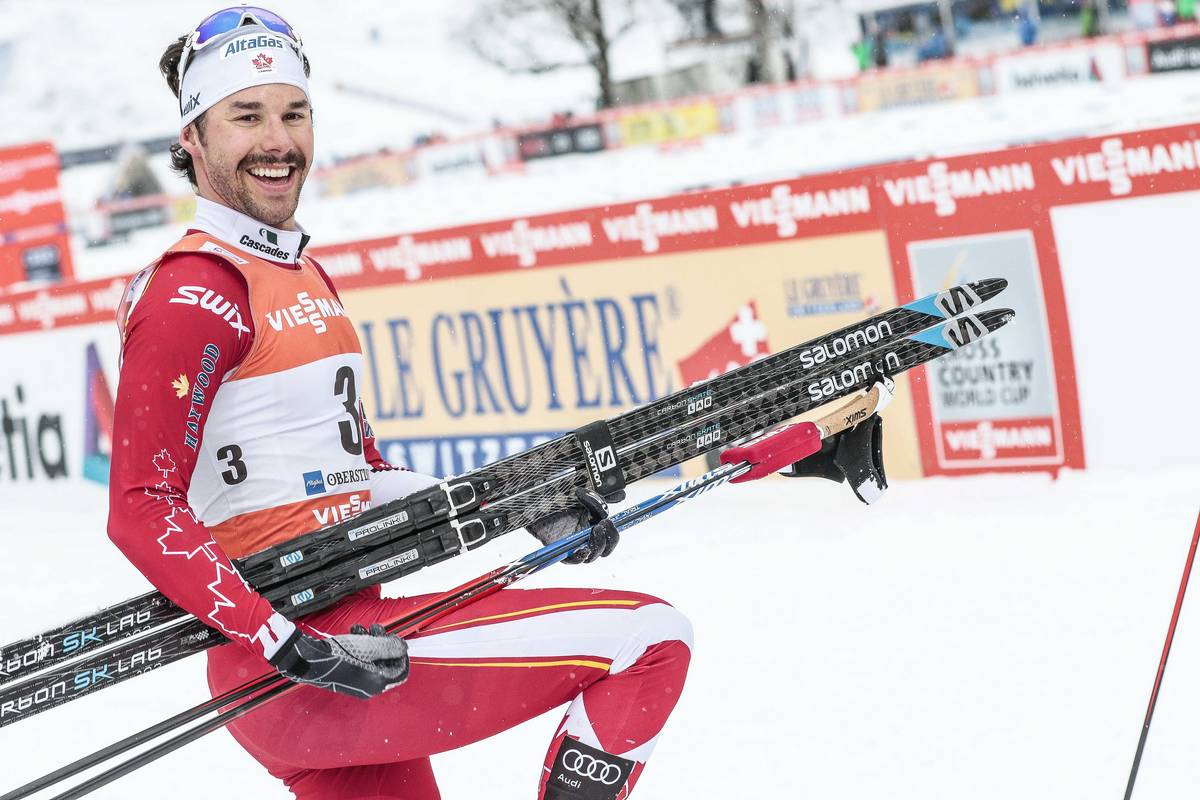
    Canada had two in the top 10 with Devon Kershaw in 10th (+7.4), which puts him in 20th overall (+3:01.9).

    Noah Hoffman led the two U.S. men still in the Tour in 35th (+2:06.8) while Erik Bjornsen finished 53rd (+4:22.4). Hoffman is 37th overall (+5:36.2) and Bjornsen 52nd (+7:35.6).

    Also for Canada, Len Valjas was 37th (+2:10.6), and Graeme Killick was 50th (+3:33.7). Valjas is currently 32nd overall (+4:56.1) and Killick 48th (+6:35.2).

    Notably, Norway’s Finn Hågen Krogh did not finish and thus withdraws from the Tour.

    Results: Women | Men

    Tour standings (through Stage 3): Women | Men

  • Ustiugov Unbeatable So Far in TDS; Harvey Moves Into Third After Stage 2

    Ustiugov Unbeatable So Far in TDS; Harvey Moves Into Third After Stage 2

    Norway's Martin Johnsrud Sundby (r) leading early in the men's 10 k classic mass start on at Stage 2 of the Tour de Ski on Sunday, with Alex Harvey (second from r), Norway's Finn Hågen Krogh (3) and Russia's Sergey Ustiugov (second from front left, in light blue) among those matching his pace. (Photo: Fischer/NordicFocus)
    Norway’s Martin Johnsrud Sundby (r) leading early in the men’s 10 k classic mass start on at Stage 2 of the Tour de Ski on Sunday, with Alex Harvey (second from r), Norway’s Finn Hågen Krogh (3) and Russia’s Sergey Ustiugov (second from front left, in light blue) among those matching his pace. (Photo: Fischer/NordicFocus)

    Alex Harvey wasn’t feeling 100 percent on Sunday, but he didn’t need to be. Within three seconds of the leaders and eighth place at the finish of the men’s 10-kilometer classic mass start was essentially what he needed to secure one of the most coveted positions on the Tour de Ski right now: third place.

    Ahead of him, Russia’s Sergey Ustiugov and Norway’s Martin Johnsrud Sundby have built a nearly one-minute and 40-second lead on third place, respectively. With another victory on Sunday, Ustiugov has back-to-back wins in the first two stages of the Tour. Sundby was fourth in Saturday’s freestyle sprint and second on Sunday, good enough for second in the Tour, 18.9 seconds behind Ustiugov.

    Then there’s Harvey, of Canada, who finished sixth on Saturday then eighth on Sunday for third in the Tour. He realized during the mass start that it was all about whom he was ahead of rather than a specific place he needed to finish in.

    For instance, Finn Hågen Krogh. The Norwegian was third going into Sunday and finished 34th in the mass start, 50.1 seconds behind Ustiugov. That puts him 11th after two stages, nearly 1 1/2 minutes out of first.

    “Not a lot happened, I just skied really slow,” Krogh told VG after Sunday’s race. “It was boring to do such a slow race.”

    He wasn’t sure exactly what went awry on Day 2 of the Tour, but Krogh — expected to be one of Norway’s biggest threats aside from Sundby — was considering dropping out.

    “Yeah, that might happen, but I should probably calm down a little before I make such a decision,” he said.

    (His teammate Emil Iversen assured reporters that Krogh wouldn’t quit this early. “It’s about inspiring each other regardless of good or bad performances,” he told VG. “It’ll work out, I’ll show him some nice pictures of women on Instagram and then we’ll get him back on track.”)

    Norway's Niklas Dyrhaug (28) and Canada's Alex Harvey (r) racing toward the front of the pack in the men's 10 k classic mass start at Stage 2 of the Tour de Ski on Sunday in Val Mustair, Switzerland. Harvey went on to finish eighth while Dyrhaug placed 12th. (Photo: Fischer/NordicFocus)
    Norway’s Niklas Dyrhaug (28) and Canada’s Alex Harvey (r) racing toward the front of the pack in the men’s 10 k classic mass start at Stage 2 of the Tour de Ski on Sunday in Val Mustair, Switzerland. Harvey went on to finish eighth while Dyrhaug placed 12th. (Photo: Fischer/NordicFocus)

    During the race, which included nearly 80 starters on a 2.5 k course in Val Müstair, Switzerland, Harvey took note of Krogh’s off day. Same thing with Iversen, another all-around contender, who started the mass start in eighth and ended up 18th for fifth overall in the Tour, 9.6 seconds behind Harvey.

    “When I started looking at the overall map after yesterday, I knew of course Dario [Cologna], Sundby, Ustiugov and then Finn and Emil were the main threats up there .. and [Sweden’s Marcus] Hellner, too,” Harvey recalled on the phone. “When I saw that Finn and Emil where having a tougher day, I knew it was going to be good for me in the overall standings. I was still able to finish hard and my skis were really fast so I could make up some ground on the downhill, but I was still seven seconds off the pace so I didn’t lose too too much time.”

    Exactly seven seconds behind Ustiugov at the finish, he finished less than a hundredth of a second ahead of Finland’s Iivo Niskanen, who placed ninth. In addition to the first and second finishers, Harvey followed five others across the line: Norway’s Didrik Tønseth (who finished 2.3 seconds back in third) and Sjur Røthe (+3.3 in fourth), Switzerland’s Cologna in fifth (+5.5), Finland’s Matti Heikkinen in sixth (+5.6), and Hellner in seventh (+6.0). But he’s ahead of all of them in the Tour standings.

    “The finish was real good. Actually, I didn’t think I was eighth at the line, I thought I was more like 12th or 13th, so I made up a lot of ground on the last kilometer,” Harvey said. “Once we hit the sprint hill I passed three guys there, and then two guys out of the last curve, so that’s five guys in the last 500 meters. I passed a few guys before that, too, so I just didn’t know… I was really happy with being in the top 10 again.”

    For Harvey, that’s his third-straight top 10 on the World Cup circuit and seventh this season.

    “Over Christmas, I was feeling really, like, really good,” he said. “… I was hoping to be in the top five [overall] from the beginning, so I would say the results are like what I was feeling over Christmas, but the feeling is not so. I don’t know if that is a good thing or bad thing, but I chose it’s a good thing.”

    The race feeling Harvey was referring to was a lack of snap on Val Müstair’s climbs. The highest point on the course is 1,700 meters, he explained, compared to Davos, Switzerland, where he trained over the holiday break at 1,530 meters.

    “It’s not a huge difference, but I didn’t have great feelings, same as yesterday,” Harvey said. “Even though we spent Christmas in Davos and we should be climatized, it was tough so it was kind of going the same as yesterday, trying to go tactical a bit and position myself well at the base of the hills and then kind of drift, lose position and then gain it back on the flats.”

    Canada's Len Valjas (in red) striding near Russia's Sergey Ustiugov (second from r, in blue) in Sunday's 10 k classic mass start at Stage 2 of the Tour de Ski in Val Mustair, Switzerland. According to Valjas's teammate Alex Harvey, most of the top skiers chose to stride rather than double pole, but Great Britain's Andrew Young (r) was among those double poling on skate skis. He ended up 50th, while his teammate Andrew Musgrave double poled to 17th. (Photo: Fischer/NordicFocus)
    Canada’s Len Valjas (in red) striding near Russia’s Sergey Ustiugov (second from r, in blue) in Sunday’s 10 k classic mass start at Stage 2 of the Tour de Ski in Val Mustair, Switzerland. According to Valjas’s teammate Alex Harvey, most of the top skiers chose to stride rather than double pole, but Great Britain’s Andrew Young (r) was among those double poling on skate skis. He ended up 50th, while his teammate Andrew Musgrave double poled to 17th. (Photo: Fischer/NordicFocus)

    While Harvey seemed to be skiing within the top 10 for most of the race, he said he slipped outside it on the downhills.

    “Some guys were really aggressive, the skaters especially, so I kind of drifted back a bit by the end of the first lap,” he recalled.

    For the second and third lap, he anticipated that drift and positioned himself more competitively.

    “I was wearing skiathlon boots so in the corners I could really corner well and my skis were really fast, so I could kind of gain some positions out of the corners there to position myself well for the third and fourth lap,” he said. “But then, when the pace really went in the fourth lap on the hill I just drifted. I could really feel the altitude.”

    Like he said, he finished strong, and that’s what mattered. Heading into the Tour’s third and fourth stages in Oberstdorf, Germany, Harvey knows the 20 k skiathlon is an important race. But perhaps more so than the result, he’s mindful of the bonus sprints — for valuable bonus seconds in the overall standings.

    “It’s at sea level in Oberstdorf, so hopefully the feeling is a bit better there and I can go for [those sprint bonuses], and now I am defending the third spot. I mean, the two guys out front are clearly ahead — already it’s a minute to Ustiugov and 40 seconds to Sundby, but it’s a lot of guys behind me so I am just going to try to defend my position.”

    Are Ustiugov and Sundby untouchable? In a multi-stage series, Harvey didn’t rule anything out. He pointed out that last year Sundby lost nearly a minute in his overall lead after placing 23rd in the 15 k classic mass start in Oberstdorf (although he was still left with 45 seconds wiggle room to second place).

    “You never know, but they have a huge advantage already,” Harvey said. “I think Finn Hågen lost the Tour; I don’t think he can win anymore. In my head he was one of the favorites to win this year, but I think it is going to be between those two guys, but it is not a guarantee. It’s still the tour and a lot of skiing to do.”

    “We’re going to help Finn back on his feet,” Sundby told VG. “It’s the same thing that happened to me last year in Oberstdorf. I had a horrible day and lost a minute. Finn has that kind of day today, which is really boring in a Tour. We will pull back up from the mud so he can be in the fight again.”

    Russia's Sergey Ustiugov racing to the 10 k classic mass start win by 1.9 seconds over Norway's runner-up Martin Johnsrud Sundby (second from r) and 2.3 seconds over Norway's Didrik Tønseth (r) in third on Sunday at Stage 2 of the Tour de Ski in Val Mustair, Switzerland. (Photo: Fischer/NordicFocus)
    Russia’s Sergey Ustiugov racing to the win in Sunday’s 10 k classic mass start, directly ahead of three Norwegians, including runner-up Martin Johnsrud Sundby (third from r), third-place finisher Didrik Tønseth (second from r), and Sjur Røthe in fourth at Stage 2 of the Tour de Ski in Val Mustair, Switzerland. (Photo: Fischer/NordicFocus)

    While Sundby was the first to set the pace in the mass start, Ustiugov closely shadowed him and took control around 7.5 k and then for good with less than 2 k to go.

    “He’s an incredible skier,” Sundby told NRK after. “He’s got it in his head and I hear it during the race that he’s tired. He sounds like a locomotive when he’s skiing. And he’s got an incredible finish.”

    “I had great skis,” the 24-year-old Russian said, according to an International Ski Federation (FIS) press release. “The service team did a great job. The pace was very high from the beginning. I did not expect I would be leaving Val Müstair with two wins and the lead in the Tour de Ski.”

    After Harvey in third overall, Russia’s Andrey Larkov is less than 2 seconds behind him in fourth after two stages, with a seventh place on Saturday and 11th place on Sunday. Iversen is another 7.7 seconds back in fifth (+1:09.2) and Cologna is sixth (+1:10.4) after a ninth place followed by a fifth place on Sunday.

    “I’m not yet at 100 percent, but I felt good and was able to keep up,” Cologna told Swiss TV broadcaster SRF after hanging in the top four and even leading at times during the race, along with Sweden’s Hellner. “On the climb when Sundby attacked, it was fast, but I was able to get in contact again, and then on the steep sprint climb my pole did not find grip twice, went into the void a bit, and then I lost contact. But I think it was fine, a small step ahead. And I could show and also show to myself, that everything is OK.”

    Of note, Cologna grew up about 500 meters from the Val Müstair course.

    “That’s very special. It’s always fun,” he said of the third-straight year of the Tour de Ski being held at the venue. “A good atmosphere and a lot of people, you know? It’s not always easy to meet all demands, but it’s quite fun…”

    Kershaw, Killick and Bjornsen Move Up 

    Two Canadians made up considerable ground on Sunday, with Devon Kershaw racing to 27th (+42.9), putting him 32nd overall in the Tour (+2:22.5), and Graeme Killick finishing 33rd in the mass start (+49.3) for 36th overall (+2:29.5). In Saturday’s sprint, the two finished 51st and 57th, respectively.

    That kind of starting position put Kershaw and Killick toward the back of the mass start, with only five tracks across and more than 50 men ahead of them.

    Canada's Devon Kershaw racing to 27th in Sunday's 10 k classic mass start at Stage 2 of the Tour de Ski in Val Mustair, Switzerland. (Photo: Fischer/NordicFocus)
    Devon Kershaw (54), followed by Canadian teammate Graeme Killick (47), racing to 27th in Sunday’s 10 k classic mass start at Stage 2 of the Tour de Ski in Val Mustair, Switzerland. Killick went on to place 33rd. (Photo: Fischer/NordicFocus)

    “… Most of the race was rather hectic — but to be honest it was better than I thought,” Kershaw wrote in an email. “The conditions were perfect and the descents weren’t nearly as icy as the day before when I was skiing around testing out the course.”

    He explained it was difficult to pass on a twisty 2.5 k loop, but he focused on being patient.

    “It cost me a chance to get into the top 10-15 for sure, but by just biding my time and skiing smooth and relaxed without getting caught up in the mayhem allowed me to have decent energy the whole way,” he wrote. “I just kind of kept picking off a few guys were I could — which happened to be on the climbing section — which I felt decent on.”

    In terms of his standalone result — 27th — Kershaw said it was closer to his goal of a top 20 in classic races.

    “This year in the three classic races on the World Cup I’ve been 33rd, 23rd (time in Lillehammer where I moved up to 27th in the overall) and today 27th — so I guess I’m consistent — but I’d be lying if I said that’s where I want to live,” he wrote.

    And while he might be in 32nd, he’s within 20 seconds of 22nd.

    “There is a lot of skating this year — so perhaps not as good for me as years past which lean heavier on classic — it’s all good,” Kershaw wrote. “I will take it day by day and of course I am really looking forward to the classic race in Val di Femme (15km mass start). The [skiathlon] in two days will be fun too (the 20km) so I am looking forward to that as well since I’ve had some OK [skiathlons] in my day.”

    Like Harvey, he was looking forward to racing at lower elevations.

    Canada’s fourth finisher on Sunday, Len Valjas placed 38th (+54.3) after starting in bib 14. That puts him in 26th overall (+2:13.5).

    The U.S. men were led by Erik Bjornsen in 42nd (+59.9), after placing 64th in Saturday’s sprint. He started in bib 59 and is up to 42nd overall (+2:41.2).

    “Just out of the stadium they had cut it down to just 4 tracks. I just couldn’t move up with that many guys and such limited space,” Bjornsen wrote in an email. “I had to wait until the second lap and by that time it was so spread out. I definitely don’t have the snap I felt a couple weeks ago, but I put in a hard training block around Christmas and then took some easy days before traveling over to Switzerland.

    “I’m hoping coming back down to lower altitude and a couple days of hard efforts will spark the body back into the form I know I have,” he continued.

    Noah Hoffman finished 46th (+1:13) for the U.S. after starting in bib 48, and his teammate Simi Hamilton — who planned in advance to withdraw from the Tour after Stage 2 — slipped from 15th overall to 74th after placing 75th (+3:14.8) on Sunday.

    Hoffman is currently 48th overall (+2:57.4), about 38 seconds out of the top 30.

    The first of two rest days in the nine-day Tour is Monday, then Oberstdorf will host the women’s and men’s 10/20 k skiathlons on Tuesday and 10/15 k classic pursuits on Wednesday.

    Results | Tour standings (through Stage 2)

  • Sunday Rundown: Harvey Up to 3rd, Diggins Holds Onto 6th Overall in TDS

    Sunday Rundown: Harvey Up to 3rd, Diggins Holds Onto 6th Overall in TDS

    The men's 10 k classic mass start podium at Stage 2 of the 2017 Tour de Ski in Val Müstair, Switzerland, with Russia's Sergey Ustiugov (c) in first, Norway's Martin Johnsrud Sundby (l) in second, and Norway's Didrik Tønseth (r) in third. (Photo: FIS Cross Country/Twitter)
    The men’s 10 k classic mass start podium at Stage 2 of the 2017 Tour de Ski in Val Müstair, Switzerland, with Russia’s Sergey Ustiugov (c) in first, Norway’s Martin Johnsrud Sundby (l) in second, and Norway’s Didrik Tønseth (r) in third. (Photo: FIS Cross Country/Twitter)

    FIS Cross-Country Tour de Ski Stage 2 (Val Müstair): 5/10 k classic mass starts

    Men’s report | Women’s report

    There was a lot of jostling between Russia’s Sergey Ustiugov and Norway’s Martin Johnsrud Sundby, with the latter leading early and the Russian not letting him get too complacent up front, but ultimately, Ustiugov was the first across the line in the men’s 10-kilometer classic mass start, the second stage of the Tour de Ski in Val Müstair, Switzerland.

    Ustiugov put himself back ahead of Sundby with fewer than 2 k to go and held a sizable lead to the finish, crossing in 24:50, while Sundby finished second, 1.9 seconds back.

    Norway took second through fourth with Didrik Tønseth in third (+2.3) and Sjur Røthe in fourth (+3.3), while home-crowd favorite Dario Cologna of Switzerland settled for fifth (+5.5) after racing in the top three for much of the race.

    The top 13 finishers all ended up within 10 seconds of Ustiugov at the finish, with Finland’s Matti Heikkinen in sixth (+5.6), Sweden’s Marcus Hellner in seventh (+6.0), and Canada’s Alex Harvey in eighth (+7.0).

    With a six place on Saturday and eighth on Sunday, Harvey is currently third overall in the Tour, 59.6 seconds behind Ustiugov in first and 40.7 seconds behind Sundby in second (Sundby trails Ustiugov in the overall by 18.9 seconds.)

    Finland’s Iivo Niskanen made it into the top 10 on Sunday in ninth (+7.0), as did the fourth Norwegian, Simen Hegstad Krüger in 10th (+7.3).

    Devon Kershaw made big strides in moving up to 27th (+42.9) for 32nd overall in the Tour (+2:22.5), Graeme Killick placed 33rd (+49.3) and Len Valjas 38th (+54.3) for Canada. Valjas is currently 26th overall (+2:13.5) and Killick 36th (+2:29.5) in the Tour.

    Erik Bjornsen led the U.S. men in 42nd (+59.9) for 42nd overall (+2:41.2). Noah Hoffman placed 46th (+1:13) and is currently 48th in the Tour (+2:57.4) and Simi Hamilton (+3:14.8) was 75th out of 78 finishers. A sprinter, Hamilton planned to withdraw from the Tour after this stage for a training block.

    Norway's Ingvild Flugstad Østberg (top and bottom center) celebrates her win in Stage 2 of the 2017 Tour de Ski, the women's 5 k classic mass start, which she won over teammate Heidi Weng (l) and Finland's Krista Parmakoski (r). Østberg currently leads the overall Tour by more than 10 seconds over Weng with seven stages to go. (Photo: FIS Cross Country/Twitter)
    Norway’s Ingvild Flugstad Østberg (top and bottom center) celebrates her win in Stage 2 of the 2017 Tour de Ski, the women’s 5 k classic mass start, which she won over teammate Heidi Weng (l) and Finland’s Krista Parmakoski (r). Østberg currently leads the overall Tour by more than 10 seconds over Weng with seven stages to go. (Photo: FIS Cross Country/Twitter)

    [UPDATED] In the women’s 5 k classic mass start, Ingvild Flugstad Østberg rebounded from Saturday, in which she was eliminated in the semifinals for seventh place in the freestyle sprint, with a seven-second victory over Norwegian teammate Heidi Weng.

    Østberg finished first in 13:21.2, Weng took second for her second-straight podium of the Tour, and Finland’s Krista Parmakoski finished third (+11.4).
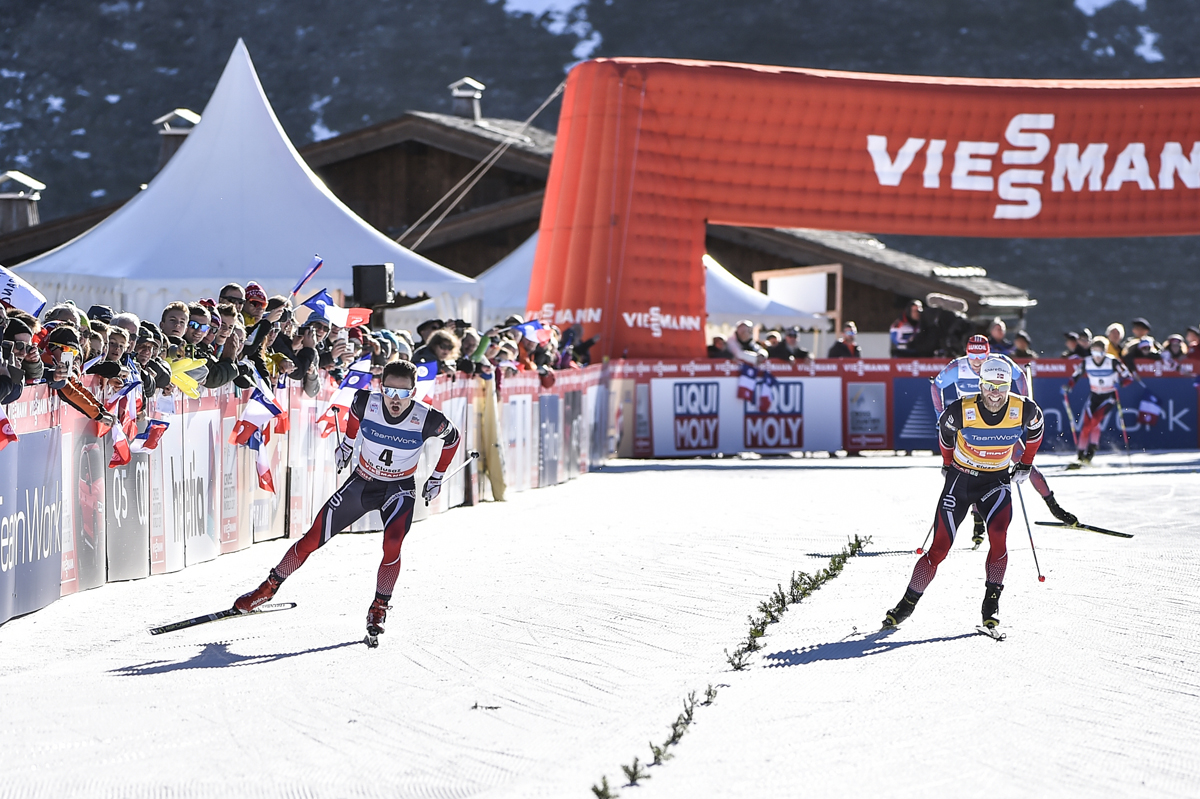
    American Jessie Diggins raced to eighth (+32.6) to maintain her position in sixth overall in the Tour. Østberg took the Tour lead after two stages by 10.3 seconds over Weng. Sweden’s Stina Nilsson, who won Saturday’s sprint, is third, 23.8 seconds back from Østberg, while Parmakoski improved to fourth (+42.0). Norway’s Kathrine Rolsted Harsem placed seventh on Sunday for fifth overall (+51.6), and Diggins 1:01 back in sixth.

    The second American in the top 20, Kikkan Randall raced to 19th (+42.4). Also for the U.S., Sadie Bjornsen finished outside the points for the first time this season in 35th (+1:02.6), Sophie Caldwell was 38th (+1:09.4), Rosie Brennan 39th (+1:10.5), and Liz Stephen improved to 44th (+1:21.2).
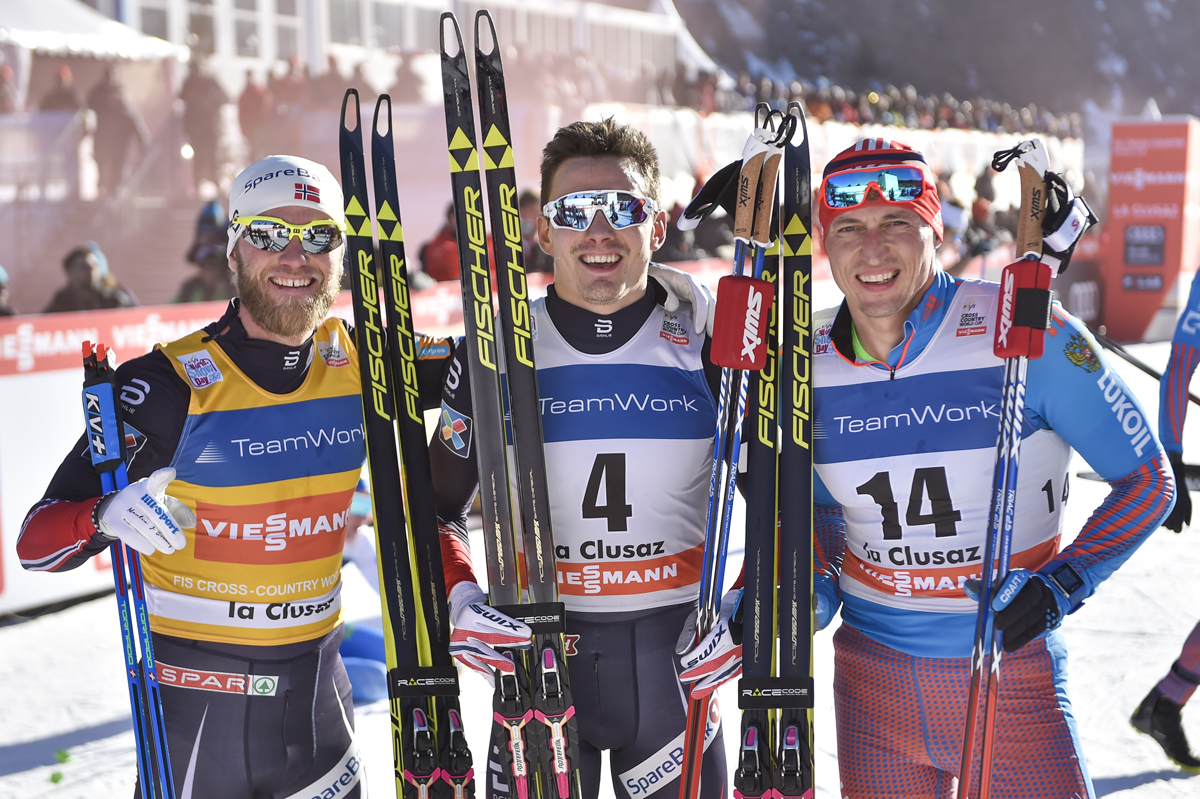
    Overall, Randall is currently 15th (+1:45.9), Caldwell 22nd (+2:03.3) — although Caldwell planned to withdraw from the Tour after Stage 2. Bjornsen is 25th (+2:05.4), Brennan 41st (+2:33.1) and Stephen 46th (+2:49.9).
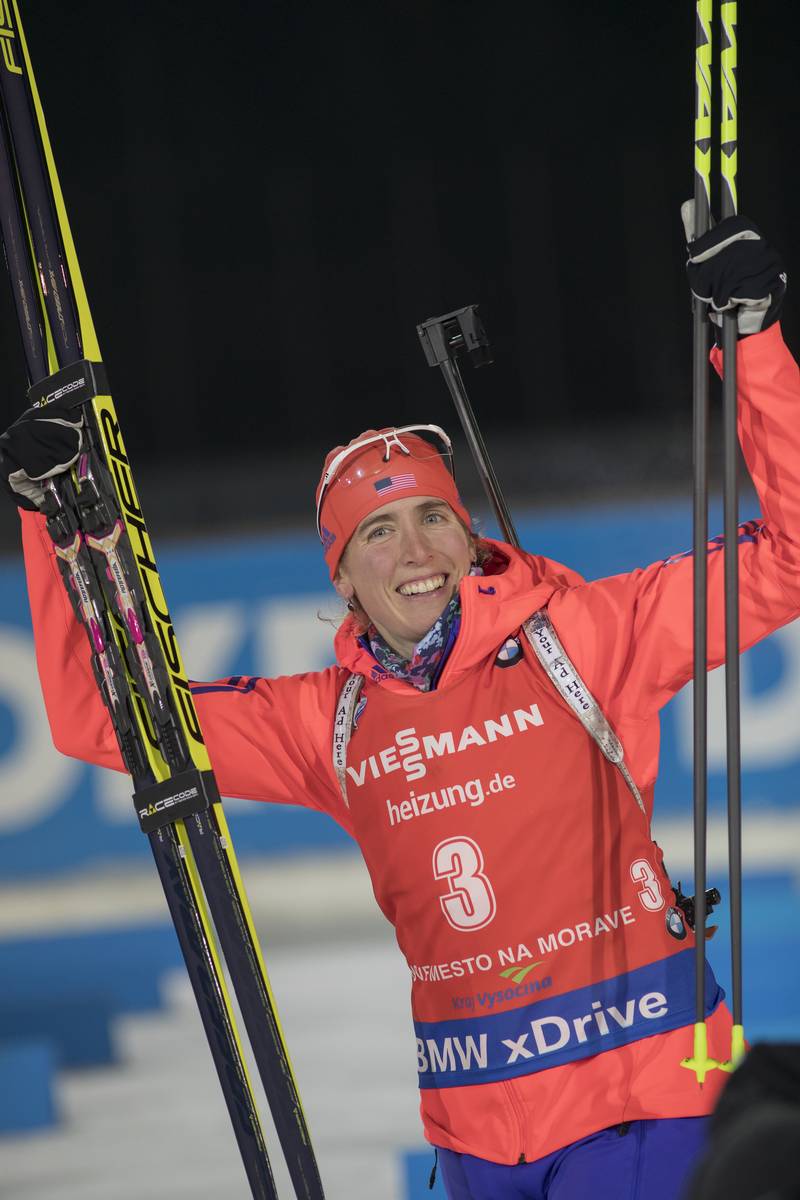
    Results: Men | Women

    Overall Tour standings: Men | Women

  • Ustiugov Wins Tour de Ski’s Only Sprint; Harvey Sixth

    Ustiugov Wins Tour de Ski’s Only Sprint; Harvey Sixth

    Tour de Ski stage one 1.5 k skate sprint podium in Val Müstair, Switzerand. Left to right, Italy's Federico Pellegrino 2nd, Russia's Sergey Ustiugov, 1st, and Norway's Finn Hågen Krogh 3rd. (Photo: Nordic Focus/Fischer)
    The men’s Tour de Ski 1.5-kilometer skate sprint podium at Stage 1 in Val Müstair, Switzerand. (Left to right) Italy’s Federico Pellegrino in second, Russia’s Sergey Ustiugov in first, and Norway’s Finn Hågen Krogh in third. (Photo: Fischer/NordicFocus)


    The 11th Tour de Ski began Saturday in Val Müstair, Switzerland, with a 1.5-kilometer freestyle sprint.

    Nearly three minutes flat — 3:00.50 specifically — is all it took Russia’s Sergey Ustiugov in the sprint final to deliver his country a positive sporting distraction. As the fastest qualifier to start the day, Ustiugov ran the tables in the quarters and semis, too. Last season’s overall Sprint World Cup winner, Italian Federico Pellegrino placed second (+ 2.03), and Norway’s Finn Hågen Krogh finished third (+2.80).

    According to an International Ski Federation (FIS) press release, the 24-year-old Ustiugov played it humble, knowing the Tour is a tour, not a one-off sprint.

    “I did not feel unbeatable but I felt very strong today,” Ustiugov said. “It is good start the Tour with a victory. I will try to stay behind [Norway’s Martin Johnsrud] Sundby tomorrow.”

    Sunday’s stage, the second of the seven-stage Tour, is a 10 k classic mass start and should be a frenzy of tactics and searing lungs, but more on that big picture in a bit.

    “I am very happy to be the strongest today and to tell the truth I want to be the best during the Tour for myself and for all the guys who stayed at home,” Ustiugov said in a post-race interview with FIS, referring to his provisionally suspended teammates. “We were training together. We [are] all very strong, but I will do it, I will try.”

    No podiums until today — that sums up the high standards for Pellegrino. Last season, when he won the sprint globe, the Italian made five sprint podiums, all victories. Before Saturday’s second place, three World Cup sprints into the 2016/2017 season, he’d placed 18th, 17th and seventh, respectively.

    “I did not have a good start to the season,” Pellegrino said to FIS. “I have been looking for a good shape and good feeling on skis. I am lacking maximum speed at the moment. But second place today is a good sign. After the qualification I knew I could be fighting for second place.”

    Krogh is another overall player in the Tour. During last year’s edition, he was second overall to Sundby. A podium in the sprint sets him up for the long haul.

    “I am satisfied with third place,” Krogh told FIS. “The goal of the day for me was to get to the final and get as many bonus seconds as possible. It’s a big bonus to finish on the podium today. Sergey [Ustiugov] showed his strength again. In the second lap Sergey and I were fighting for the lead. But I was not strong enough, my legs were burning. But I am happy with third.”

    For clarity, let’s stick with the sprint specialist. This includes U.S. Ski Team member Simi Hamilton.

    “I think he has kicked it,” U.S. coach Matt Whitcomb said on the phone Saturday, referring to Hamilton’s lingering cold the first part of the World Cup season. “He has been looking really good the last few days. Very punchy, very responsive to speed changes, and he laid down a pretty fast qualifier today in 14th.”

    Hamilton’s qualifying time of 3:09.19, put him just over four seconds off Pellegrino’s second fastest qualifying time; a positive trend.

    “I was really struggling with sickness earlier this year, and I got hit really hard a couple of weeks ago … and I had to take basically ten days totally of from doing anything because I got hit so hard with that cold,” Hamilton explained on the phone. “And then it moved into my chest so I was pretty sick from that, but the Christmas training block went really well, and it felt like my energy came back fairly quickly, so I just focused on getting my speed back over Christmas.”

    Val Müstair’s course is technical; a succession of rollers that looks like it’d be perfect for a charging kids’ league, fast check-your-speed hairpin turns, and a grinding climb.

    “It’s definitely a really hard course here,” Hamilton said. “It’s quite hilly and long. It’s a super-fun course … so I think that that’s suits me well. But at the same time I think it plays into my weaknesses a little bit, in that on both the laps it a long, grindy climb, with a V1 kicker at the end. I think I tend to ski a lot better, and ski a lot more confidently on courses where I’m able to use the terrain more, more rolling courses where I can hammer and recover, hammer and recover.”

    Hamilton finished 18th on the day after finishing fourth in his quarterfinal (+0.85) and said he plans on racing Sunday’s 10 k classic mass start. Afterward, he’ll withdraw from the Tour and get in some training before contesting an OPA Cup sprint along with teammates Sophie Caldwell, Ida Sargent, and Andy Newell next weekend in Planica, Slovenia.

    Canadian World Cup Team member and sprint specialist Len Valjas qualified 21st and placed 16th overall. Valjas was eliminated after skiing to third in the second quarterfinal (+0.41).

    A Sum of Its Parts

    This version of the Tour de Ski features one sprint. And it’s over. Starting Sunday, the remaining six stages for the men feature a 10 k classic mass start, then a 20 k skiathlon, a 15 k skate pursuit, a 10 k skate, a 15 k classic mass start — and that killer 9 k Alpe Cermis climb in Val di Fiemme, Italy, to call it good.

    As much as Saturday’s sprint was a high-speed spectacle, it was also an opportunity to methodically position oneself for the overall.

    That brings up Sundby — a Tour stalwart. He’s a two-time winner of the Tour and just last year beat second-place finisher Krogh by 3:15.7 — the largest margin of victory ever in a Tour de Ski.

    Like continuity? Then you’re in luck. Sundby placed fourth in the sprint (+3.52). Strong, tactically wily, able to string out and pop most hangers on in a tour — he’s won the last eight World Cup Tour events not including the 2015 Tour de Ski from which he was later disqualified for a doping violation — Sundby may have been off the podium on Saturday, but based on precedent, he’s still the skier to beat.

    The day’s winner, Ustiugov, finished third in last year’s Tour (+3.43.8). Krogh and Ustiugov are set up to at least parry one another, if not try to topple Sundby. But in the Tour, every day isn’t exactly a new day — your results are cumulative and one bad day can haunt.

    Alex Harvey racing to 12th in the men's freestyle sprint qualifier at the Ski Tour Canada in Quebec City. Harvey went on to place second in the final. (Photo: John Lazenby/Lazenbyphoto.com)
    Alex Harvey (Canadian World Cup Team) last season at the 2016 Ski Tour Canada freestyle sprint in Quebec City. Harvey went on to place second in the final. (Photo: John Lazenby/Lazenbyphoto.com)

    After the first stage, Canada’s Alex Harvey won’t be haunted. Harvey qualified 25th, but placed sixth overall.

    Call it mustache-mojo, or whatever you want, the Canadian is well positioned; he’ll start Sunday’s Stage 2 with a 27.6-second deficit in the overall hunt. That beginning was better than expected when considering Harvey’s early sensations.

    “Alex said he wasn’t feeling that great today, he was just tactically really strong, and he had it planned ahead,” Canadian World Cup coach Ivan Babikov on the phone.

    “For the prologue I didn’t feel super good,” Harvey explained in a phone interview. “I had heavy legs, heavy breathing. I did my normal warmup, but my legs would get filled with lactate.”

    Understanding his physical limitations for the day, the quick-to-fatigue legs, Harvey skied with more brains and less brawn.

    “Every heat he executed perfectly, but he said he didn’t have very much pop, and wasn’t in super shape today,” Babikov noted. “This course is really hard, especially on the second lap, it’s people getting pretty lactated up. He saved most of his energy for the finish, and he kept out-sprinting people every time. He’s really strong, and he used what he had today, 200 percent. Bottom line, Alex made the final.”

    Initially, it didn’t look like a slam dunk. In the early moments of his quarterfinal, it would have been easy to count Harvey out. He skied in sixth place. He looked poised to get dropped from the draft than advance to the semis.

    Then Harvey moved. “I tried to position myself better, just be in a good position to attack the last hill,” Harvey said of his tactics. “That was good. I had my own line up the last hill, and I had enough jump and could gain a couple of spots there. And I had good cornering in the last downhill and went from fourth to third on the kind of speed bumps there and my final kick was really good.”

    It was precise moves when it mattered most. Harvey won his quarterfinal. “I tried to do the same in the semi and it worked too,” Harvey said.

    He advanced to the final with a second place in his semifinal.

    In the final, Harvey noticed the heavy legs again and began to dial it back.

    “Then at one point [in the final] spending a crazy amount of energy to maybe get fifth was kind of useless,” Harvey explained of his strategy. “I just skied to the line, but not kill myself to maybe get fifth because it’s two seconds more for bonus seconds. I’m still thinking of the big picture in the Tour so overall I am really happy because I made the most out of the situation.”

    Devon Kershaw, Harvey’s Canadian teammate, was not satisfied with the day. He begins Sunday’s stage 1:14.6 back after placing 51st in the qualifier.

    “Well, the thoughts are obviously those of disappointment with my performance today here in Val Mustair,” Kershaw wrote in an email. “I know that my old bones haven’t been the fastest on tour when it comes to Sprint Qualifiers these last 12 months — but here in Val Mustair the last two times we’ve been here I’ve been able to qualify top 20… So to be shelled and back in 51st is obviously a bit of a kick to the stomach…”

    Kershaw, who turned 34 on Dec. 20, indicated he’s moving on, looking forward to the six stages of distance racing to come.

    “So what’s done is done and now I shift the focus towards the longer races that suit my better,” he wrote. “I am really looking forward to a couple stages (tomorrow was one – but a 10km classic starting so far back on a twisty ribbon-of-snow 2.5 km loop will mean that it’ll be ‘busy’ out there on the tracks!) and I am feeling much better than in La Clusaz when I came down with a head cold.”

    A mass start and not much real estate in terms of spreading the World Cup scrum out most likely means dicey skiing for the Tour’s second stage. “Tomorrow will be a very tight and probably a tad sketchy with so many bodies all wanting to be at the front and only 22-23 min to get it done — so I will want to keep my head up and make sure my horseshoe is under my bed tonight before I fall asleep,” Kershaw added.

    Also for Canada, Graeme Killick finished 57th (+15.35) in the qualifier.

    U.S. Ski Team (USST) member Erik Bjornsen finished 64th (+16.28), and teammate Noah Hoffman was 76th (+19.41).

    Results: Sprint qualifier | Heats | Tour standings (through Stage 1)

  • Saturday Rundown: Diggins, Harvey Reach Final in Val Müstair

    Saturday Rundown: Diggins, Harvey Reach Final in Val Müstair

    The women's and men's podiums at Stage 1 of the Tour de Ski, with (top) women's winner Stina Nilsson (c) of Sweden, Norway's Maiken Caspersen Falla (l) in second, and Norway's Heidi Weng (r) in third. (Bottom) Russia's Sergey Ustiugov (c) won the men's final, ahead of Italy's Federico Pellegrino (l) in second and Norway's Finn Hågen Krogh (r) in third. (Photo: FIS Cross Country/Twitter)
    The women’s and men’s podiums at Stage 1 of the Tour de Ski, with (top) women’s winner Stina Nilsson (c) of Sweden, Norway’s Maiken Caspersen Falla (l) in second, and Norway’s Heidi Weng (r) in third. (Bottom) Russia’s Sergey Ustiugov (c) won the men’s final, ahead of Italy’s Federico Pellegrino (l) in second and Norway’s Finn Hågen Krogh (r) in third. (Photo: FIS Cross Country/Twitter)

    FIS Cross-Country Tour de Ski Stage 1 in Val Müstair: Freestyle sprint 

    Women’s report | Men’s report

    [UPDATED] After qualifying in fifth, eighth and ninth, respectively, Sophie Caldwell, Sadie Bjornsen and Jessie Diggins proceeded to represent the U.S. in the quarterfinals of the 1.5-kilometer freestyle sprint in Val Müstair, Switzerland, on Saturday, along with a fourth U.S. woman, Kikkan Randall.

    Randall turned 34 on Saturday and reached the heats for the first time this season, where she placed third in her quarterfinal for 15th overall. Caldwell was just ahead of her in 13th overall after finishing third in her quarterfinal and missing out on advancing as a lucky loser by one-hundredth of a second. Bjornsen placed fifth in her heat after leading it into the finishing stretch for 23rd overall, and Diggins rocketed all the way to the final, where she ended up sixth overall.

    Diggins secured an automatic bid for the semifinals with a second place in her quarterfinal, behind eventual winner Stina Nilsson of Sweden. Nilsson won the qualifier to start the day in 3:28.28. (Norway’s Ingvild Flugstad Østberg qualified second (+1.28) and Switzerland’s Nadine Fähndrich qualified third (+2.34).)

    Diggins met Nilsson again in the first semifinal, which Nilsson won by 1.04 seconds over Norway’s Maiken Caspersen Falla. Diggins finished third, 1.36 seconds back, and advanced to the final as a lucky loser with Switzerland’s Laurien van der Graaff, who placed fourth (+2.10) in that heat.

    In the final, Diggins struggled with her positioning and ended up sixth, 7.64 seconds behind Nilsson in first. Nilsson took control early in the final and built a comfortable lead into the finish, with only Falla coming relatively close in second (+2.48). Norway took second, third and fourth with Heidi Weng in third (+6.47), and Kathrine Rolsted Harsem, who won a photo finish for fourth (+6.95), ahead of van der Graaff in fifth (+6.96).

    In the qualifier, birthday-girl Randall make the top-30 cutoff in 29th (+10.77). Rosie Brennan was 2.66 seconds outside the top 30 in 35th (+13.91) and Liz Stephen finished 57th after coming back from illness. No Canadian women are competing in the Tour.

    In the men’s 1.5 k skate sprint, Canada’s Alex Harvey reached the final after qualifying in 25th, 9.61 seconds behind eventual winner Sergey Ustiugov, of Russia, who won the qualifier in 3:01.24. Ustiugov went on to win his quarterfinal and semifinal, and outlasted his competition in the final with Italy’s Federico Pellegrino coming closest in second (+2.03). Norway’s Finn Hågen Krogh reached the podium in third (+2.8) ahead of fellow Norwegian Martin Johnsrud Sundby in fourth (+3.52). Behind them, France’s Lucas Chanavat placed fifth (+10.25) and Harvey finished sixth (+15.93) after slipping to the back of the pack early in the final.

    Harvey won his quarterfinal and again automatically advanced in second in his semifinal, finishing 0.65 seconds back from Pellegrino in the semi. Like Diggins, Harvey is currently positioned in sixth heading into Stage 2 — 5/10 k classic mass starts — of the seven-stage Tour.

    Two Canadians qualified for the heats with Len Valjas posting the 21st fastest qualifying time, 9.19 behind Ustiugov. Valjas went on to place 16th overall after finishing third in his quarterfinal.

    American Simi Hamilton was the lone U.S. man to reach the heats after qualifying in 14th (+7.95). He went on to finish fourth in his quarterfinal for 18th overall.

    Also for the U.S., Erik Bjornsen placed 64th and Noah Hoffman 76th in the qualifier. Canada’s Devon Kershaw finished 51st and Graeme Killick 57th.

    Stage 1 results: Women | Men

    Qualifying results: Women | Men

    Tour standings: Women | Men

  • Krogh Wins La Clusaz Mass Start; Harvey 7th; Bjornsen 20th

    Krogh Wins La Clusaz Mass Start; Harvey 7th; Bjornsen 20th

    Norway's Finn Hagen Krogh ouduels teammate Martin Johnsrud Sundby durung Satruday's 15 k mass start in La Clusaz, France. (photo: Fischer/Nordic Focus)
    Norway’s Finn Hagen Krogh ouduels teammate Martin Johnsrud Sundby durung Saturday’s 15 k mass start in La Clusaz, France. (Photo: Fischer/Nordic Focus)

    (Note: This article had been updated with comments from Noah Hoffman.)

    Possibly the new normal: a thin 2-kilometer ribbon of manmade snow snaking through the brown hillsides in La Clusaz, France — site of Saturday’s men’s 15 k freestyle mass start. Organizers changed the original format, a 30 k skiathlon, to the 15 k format due to lack of snow.

    The old normal: Norwegian skiers pushing the pace and a yellow-bibbed, World-Cup-leading Martin Johnsrud Sundby making a decisive up-tempo move in the final kilometers. 24:40 into the 15 k race, Sundby nonchalantly glanced back at his group containing Russians Sergey Ustiugov and Alexander Legkov as well as his Norwegian teammates Finn Hågen Krogh and Didrik Tønseth.

    That group, minus a slightly fading Ustiugov, had a 12-second gap going into the final kilometer. The remaining chasers already an afterthought, Sundby was the cat, Krogh, Tønseth, and Legkov the perceived mice.

    In La Clusaz, the old normal was marginally new.

    Krogh, who won in a time of 34:09.3, edged Sundby (+0.3) in the finishing sprint. Legkov was third (+3.1). Norway’s Tønseth placed fourth (+12.1) with Ustiugov fading to fifth (+25.3) just beating Finland’s Matti Heikkinen in sixth (+25.4).

    It was a diverse group of nations representing the top fifteen places. Along with Norway, Russia, and Finland, Canada, Switzerland, Germany, France, and Sweden were all represented. Factor in the top thirty, and add Great Britain, Japan, the United States, Bulgaria, Italy, and the Czech Republic.

    A World Cup melting pot.

    But with Krogh the winner, the post-race press conference was still a Norwegian affair. “I felt in the race I was having a good day,” Krogh said at the press conference. “I wanted to stay in top five and save some energy. Last couple of kilometers are always hard. Last two laps were really fast. I was fighting with myself to keep up with Martin. He was little bit unlucky in the last corner before the finish. He hit an icy patch. I could ski the last curve better and I had more speed to the finish. It is awesome to win.”

    At 3 k, 6 k and 12k, Krogh remained in the lead group. Shadowing him and often taking a turn in the lead was Sundby. Sundby came into the race as the overall leader on the World Cup, and he’ll leave La Clusaz with that designation as well. His second place keeps him in first overall with 550 points. Krogh is second overall having amassed 412 points after La Clusaz’s distance day.

    According to Sundby’s comments during the press conference, Krogh was a favorite coming into the race.

    “I knew that Finn would be one of the toughest opponents,” Sundby said. “He looked very strong yesterday and he was strong in the race today. I knew I had to have more than 2 seconds on the last uphill, I did not have it.”

    15 k Mass Start podium from La Clusaz, France (FRA): Martin Johnsrud Sundby (NOR) 2nd, Finn Haagen Krogh (NOR) 1st, Alexander Legkov (RUS) 3rd. (Photo: Nordic Focus/Fischer)
    The men’s 15 k freestyle mass start podium in La Clusaz, France: (from left to right) Norway’s Martin Johnsrud Sundby in second, Norway’s Finn Haagen Krogh in first, and Russia’s Alexander Legkov in third. (Photo:Fischer/Nordic Focus)

    For Legkov, who, according to a FasterSkier article published Dec. 13th, is implicated as a doped athlete according to the McLaren report, it was his first non-relay podium since a March 2014 skiathlon in Falun Sweden. Legkov won the Sochi Olympics 50 k freestyle, the race he is suspected of doping in. He also finished both the 2013 and 2014 seasons ranked se,cond overall on the World Cup. In 2013, Legkov had five podiums. In 2014, he had six.

    It’s been a dramatic fall off. Last week in Davos, Switzerland after the men’s 30 k freestyle, Legkov is reported to have walked by the scrum of journalists in the mixed zone asking questions about the second McLaren report released the day before.

    “It is great I am back on the podium after 2 years,” Legkov is quoted by FIS as saying in the post-race press conference. “I felt very good today. I had to be very careful to stay away from a crash.”

    Harvey Places 7th Despite Crash; Bjornsen Scores 1st WC Skate Distance Points

    Five and a half kilometers into the race, Harvey took a spill. “I just came into the corner I was kind of riding the berm,“ Harvey said on the phone. “I don’t know. I broke through the berm and was kind of heading towards the grass outside the course and then tried to skate a little bit to scrub some speed and get back on the line. But I just fell on my ass just like that. It is one-hundred percent on me.”

    Before the crash, Harvey remained with the lead group in eighth place, 4.7 seconds off the front. Post-crash, he plummeted to 23rd. The next lap, the race’s fourth, Harvey commented he could only maintain his spot, his body flooded by the crash induced adrenaline rush.

    “My body was filled up with lactic acid from the stress of falling,” Harvey said of his crash. “So then I kind of stayed in my position there for the whole lap because I could not do anything. I kind of got into a rhythm in the fifth lap. So I could start moving up through the group bit.”

    Harvey began to move up. Seventeenth, then 14th, and 12th by 14 k. His final push in the closing kilometer was enough for a remarkable seventh-place finish (+26.0). Harvey is now ninth overall in the World Cup with 235 points.

    If it’s up to the mustachioed Quebecois, the whiskery lucky charm will be Harvey’s Tour de Ski look. “If it is only me it is going to stay,” Harvey said. “But we will see if I have to shave it or not.”

    Harvey’s girlfriend arrives shortly in Davos, Switzerland, where he will remain through the World Cup holiday break until the Tour de Ski begins on Dec. 31. She’ll decide the mustache’s fate. “It is going to be her call, but it has been going pretty well for me with the mustache. I think I am going to fight to keep it, but we will see. Sometimes you got to pick your battles.”

    Harvey’s teammate Devon Kershaw had the type of battle he’d rather forget.

    “All is ok here – but today wasn’t my day,” Kershaw wrote in an email. “This morning I felt a bit weird, but I was hoping that it was just nerves or something. I warmed up and my head felt foggy and energy wasn’t good – but again, I tried to just focus on the race at hand and go for it.”

    Kershaw started in bib 29. By 2 k he had dropped to 34th. By 6 k he was 41st (+29.2). He moved back from there, finally pulling from the race.

    “Right off the start I knew that something was wrong,” Kershaw wrote about his sensations early on. “I had no power in the body, but I tried to fake my way around the course for some laps – but after 5th lap skiing in like 40th or so I knew I had to abandon. It’s only the 3rd time in my career I’ve pulled the plug – but I think it was the best decision. I am feeling worse now, so it seems that like the whole US team, and my roommate here in La Clusaz (Lenny), I’ve come down with the same head cold… I hate being sick – like everyone – but now all there is to do is recover, chill and hopefully it won’t be a long lasting one.”

    Kershaw mentioned that with Graeme Killick, Len Valjas, and now himself sick, Canada is left with only three available starters for Sunday’s scheduled relay. As a result, Canada will not field a men’s relay team.

    Canadians Knute Johnsgaard placed 63rd, Andy Shields 70th, and Len Valjas did not start as he is fighting a cold.

    Erik Bjornsen. (Keeping up with the latest iOS, italics indicate ‘said with loud effect’.)

    World Cup points in classic sprint and classic distance. Ditto in the skiathlon and skate sprint. Saturday in La Clusaz, the U.S. Ski Team’s Bjornsen scored his first ever World Cup skate distance points.

    A small looping course. A narrow trail. 77 skiers in a mass start skate. Bjornsen wore bib 48 in La Clusaz. “It was obvious it was going to be a really hectic race out there,” Bjornsen said on the phone. “I started bib 48 so it wasn’t necessarily a great start position and I knew that I was going to have to fight to get into a position I was happy with.”

    Erik Bjornsen leads fellow U.S. Ski Team member Noah Hoffman during the men's 15 k freestyle pursuit at Stage 4 of the 2015 Ski Tour Canada in Quebec City. (Photo: FlyingPointRoad.com/NNF)
    Erik Bjornsen leads fellow U.S. Ski Team member Noah Hoffman during the men’s 15 k freestyle pursuit at Stage 4 of the 2016 Ski Tour Canada in Quebec City. (Photo: FlyingPointRoad.com/NNF)

    Coming off a cold, Bjornsen had dialed back the intensity in training. “I just went out and was trying to ski pretty smoothly,” Bjornsen said about his race strategy. “I felt like the energy was good … I was trying to be careful and conservative and not push it too hard.”

    In describing his race, Bjornsen used terms like patient — an attribute often associated with veterans which Bjornsen is becoming. During the race he positioned himself on the insides of corners to move up a few spots. It was a crowded field where wisely timed leap frogging — passing one place at a time — could pay off.

    “I think just being comfortable skiing around people and having good instincts is important out there,” Bjornsen acknowledged. “You see guys like that having good races. For me I was just trying to make moves in places that counted — at the base of hills and going over the top. I had some awesome skis and so that helped to knock off a few positions on the downhills.”

    He took advantage. At 4 k Bjornsen had moved into 28th; a twenty place improvement in less than a third of the race.

    Bjornsen was able to keep clean and stay on his feet. “The course was littered with broken poles, lots of crashes I mean it was a super high speed tactical course and [Bjornsen] just stayed out of trouble and kept picking people off,” U.S. Head Coach Chris Grover said on the phone.

    “Really cool he’s obviously very excited about the result and it feels great.

    “He just paced it perfectly,” Grover added.

    Bjornsen is a presence —  pure cross-country brawn. And in La Clusaz’s tight quarters Bjornsen felt it was a benefit.

    “I am definitely one of the bigger guys on the World Cup,” Bjornsen said. “I feel like I am able to hold my position maybe a little better than some of the smaller guys. I think people just can feel, sense maybe a bigger guy being around them and not wanting to get in their way. I don’t know. I actually really like mass starts and racing in close contact with people. I love these small lap races and mass starts are for sure my favorite.”

    Bjornsen’s girlfriend is French. He noted that he spends a considerable part of the year there calling it a “second home”. He mentioned being energized by the crowd.

    That energy and his emerging status as an all-arounder has Bjornsen primed for the end of the month’s seven-stage Tour de Ski. Known as a strong classic skier, the Tour features two pure classic distance races and a 20 k skiathlon among the six distance events — stage one is the only sprint stage. After La Clusaz, ruling Bjornsen out of skate distance races could be a mistake.

    “I think I have more to come,” Bjornsen said.

    Noah Hoffman was the next best placed U.S. skier, finishing 49th (+2:14.6). “Noah started really well,” Grover said. “He was able to move up also into kind of like the low 20s but he faded. You could tell he still had some lingering effects from the cold that he’s had this week so afterwards he was feeling OK, but not quite 100 percent.”

    That cold was audible when speaking to Hoffman after the race. “I am not that disappointed with today, honestly,” Hoffman said on the phone. “The assessment is that I shouldn’t have raced. I got sick this week with most of the team, and really wanted to race. I felt like my energy was really good and that could and so I went for it.”

    The initial k’s went as planned. Hoffman moved through the mass start mayhem. “And I was running top twenty for the first two laps and was really psyched with the way things started and I had every opportunity. I think I had some of the best skis in the race,” Hoffman explained. “And it just got really hard and really painful and I was just going backwards. It was all my body, there was nothing else happening there.”

    Hoffman will remain in Europe and rest up before the Tour de Ski. “I’ll rest as along as I need to until I am totally healthy and then I’ll do as much training as I have time for before the Tour,” Hoffman said of his upcoming plans. “I feel like I have a massive back log of training. I don’t think training is the limiting factor so far this season. I am not concerned about some extra rest.”

    Alaska Pacific University (APU) skier Eric Packer was the only other U.S. starter. Packer finished 66th (+4:12.5).

    “Today was a tough race for me,” Packer emailed. “After staying healthy from the team illness all week, I think it finally got me. I had a decent start, and some great rides, but didn’t have the gas in the tank to go.  After two laps, I was skiing with Alexey Chervotkin (RUS) and Sami Jauhojaervi (FIN), and both were moving up through the field, but I did not have the fitness to hang on with them.”

    Packer will return to Alaska after the weekend to rest and prepare for U.S. nationals at Soldier Hollow in Midway, Utah. He’s been in Europe for Period 1 of the World Cup. “Being over here for period 1 has been an incredible experience,” Packer explained. “I feel like I’ve learned so much that I can apply to my training and racing. I’ve seen other skiers do things in training where I was like “wow, I can’t do that. And if I could do that, I would be a better skier. I’m looking forward to implementing those things in training and coming back to the World Cup ready to contend!”

    The U.S. team is depleted due to illness and will not compete in Sunday’s men’s relay.

    Results | Overall World Cup Standings

  • Saturday Rundown: La Clusaz, Nove Mesto & Rossland (Updated x3)

    Saturday Rundown: La Clusaz, Nove Mesto & Rossland (Updated x3)

    Susan Dunklee (US Biathlon) after achieving fourth place on Saturday for a personal-best pursuit result at the IBU World Cup in Nove Mesto, Czech Republic. (Photo: USBA/NordicFocus)
    Susan Dunklee (US Biathlon) after achieving fourth place on Saturday for a personal-best pursuit result at the IBU World Cup in Nove Mesto, Czech Republic. (Photo: USBA/NordicFocus)

    Welcome to The Rundown, your quick primer of need-to-know information about the day’s racing. We’ll be updating this digest as the day goes on with additional results, photos and quotes. The Rundown is NOT a race report; stay tuned for complete race reports later today with interviews from the day’s top racers.

    ***

    IBU World Cup in Nove Mesto: 10/12.5 k pursuits

    [UPDATE] Third one day, fourth the next. That’s the streak Susan Dunklee (US Biathlon) is riding after notching her third career podium on Friday in the women’s sprint, followed by a fourth place in the women’s 10-kilometer pursuit on Saturday in Nove Mesto, Czech Republic.

    Dunklee posted the fastest range time and third-fastest shooting time overall and shot 18 for 20 (0+1+1+0) en route to fourth (Dunklee’s best pursuit result), 28 seconds behind France’s Anaïs Chevalier, who won in 30:38.1 minutes. Italy’s Dorothea Wierer landed on the podium in second (+9.5) and Friday’s sprint winner, Tatiana Akimova of Russia, placed third (+19.4). Chevalier missed just one in the first prone stage (1+0+0+0) to improve on her second-place sprint finish on Friday, which was her first podium. Wierer rose from seventh at the start to second with two penalties (0+1+1+0) and Akimova had just one miss on the first stage as well (1+0+0+0).

    Canada’s Julia Ransom tied her career best by racing to her first top 20 of the season in 19th (+1:48.5) after starting 26th. She cleaned three straight stages (0+0+0+1), and skied into 18th after the third and fourth stages, before losing one place to Norway’s Marte Olsbu (19th, +1:47.2) at the finish.

    Also for Biathlon Canada, Rosanna Crawford finished 32nd (+2:51.8), up from 37th at the start, with two penalties (1+0+1+0). Megan Tandy finished 57th (+5:32.7) with five penalties (1+1+0+3), after starting 44th.

    American Joanne Reid slipped two spots to 54th (+4:29) with two misses (1+0+1+0).

    According to the provisional start list for Sunday’s mass start, Dunklee will be the lone North American woman competing.

    US Biathlon’s Lowell Bailey raced from 20th at the start to ninth at the finish, 1:22.1 minutes behind French winner Martin Fourcade, for his best result of the season in the men’s 12.5 k pursuit.

    The first starter with a two-second head start, Fourcade hit 19 of 20 targets and cleaned the last two shooting stages (0+1+0+0) to win the second-straight men’s race in Nove Mesto. Russia’s Anton Shipulin, who started second, ended up second again at the finish (+30.2) after a penalty on each of the last two stages (0+0+1+1). France’s Quentin Fillon Maillet and Germany’s Simon Schempp both cleaned all four stages (0+0+0+0) and battled to the very end in a fight for third. Fillon Maillet took third place by one-tenth of a second, 38.3 seconds behind Fourcade, while Schempp finished fourth (+38.4).

    Bailey steadily picked off places throughout the race with just two penalties (1+0+1+0), and after leaving the range for the last time in 11th, he moved up two more spots on the final loop to place ninth for his first individual top 10 of the season.

    Canada’s Scott Gow finished 40th (+3:31.2) after starting 18th, with a total of three penalties (0+2+1+0). Brendan Green moved up slightly from 54th at the start to 52nd (+5:30.6) with five penalties (1+0+3+1), and American Russell Currier was lapped.

    Bailey was listed as the lone North American on the provisional start list for Sunday’s men’s mass start.

    Results: WomenMen 

    ***

    FIS Cross-Country World Cup in La Clusaz: 10/15 k freestyle mass starts

    The men's 15 k freestyle mass start podium on Saturday at the World Cup in La Clusaz, France, with Norway's Finn Hågen Krogh (c) in first, Martin Johnsrud Sundby (l) in second, and Russia's Alexander Legkov (r) in third. (Photo: FIS Cross-Country/Twitter)
    The men’s 15 k freestyle mass start podium on Saturday at the World Cup in La Clusaz, France, with Norway’s Finn Hågen Krogh (c) in first, Martin Johnsrud Sundby (l) in second, and Russia’s Alexander Legkov (r) in third. (Photo: FIS Cross-Country/Twitter)

    It was a good day for Alex Harvey of the Canadian men’s team as well as Dahria Beatty of Canada’s women’s team, and for the U.S., Erik Bjornsen, Rosie Brennan and Liz Stephen, all of which landed in the top 30 in La Clusaz, France. Two U.S. favorites, Jessie Diggins and Sadie Bjornsen did not start the freestyle mass starts due to illness.

    Harvey raced to seventh in the men’s 15-kilometer freestyle mass start, finishing 26 seconds behind Norwegian winner Finn Hågen Krogh. The big news of the day was Krogh beating his teammate and reigning overall World Cup champion Martin Johnsrud Sundby by 0.3 seconds in 34:09.3. Sundby won the last two distance races: a 15 k classic pursuit in Lillehammer, Norway, and 30 k freestyle last weekend in Davos Switzerland.

    While Sundby had to settle for second on Saturday, he held off Russia’s Alexander Legkov, who placed third, 3.1 seconds behind Krogh.

    Russia had two in the top five with Sergey Ustiugov in fifth (+25.3), behind Norway’s Didrik Tønseth in fourth (+12.1). Right behind Ustiugov, Finland’s Matti Heikkinen placed sixth (+25.4), 0.6 seconds ahead of Harvey in seventh.

    Erik Bjornsen led the U.S. men with his first top 20 of the season and second-best result of his career, placing 20th (+1:02.3). (He had previously finished 18th in a 15 k classic in February 2014.) Two weekends ago in Lillehammer, Bjornsen placed 24th in the classic sprint.

    Noah Hoffman finished 49th (+2:14.6) and Eric Packer was 66th (+4:12.5) for the U.S. Canada’s Knute Johnsgaard placed 63rd (+3:50.1), while Andy Shields was lapped for 70th place, Devon Kershaw did not finish, and Len Valjas didn’t start.

    The all-Norwegian women's 10 k freestyle mass start podium at the La Clusaz World Cup in France, with winner Heidi Weng (c), runner-up Marit Bjørgen (l), and Ingvild Flugstad Østberg (r) in third. (Photo: FIS Cross-Country/Twitter)
    The all-Norwegian women’s 10 k freestyle mass start podium at the La Clusaz World Cup in France, with winner Heidi Weng (c), runner-up Marit Bjørgen (l), and Ingvild Flugstad Østberg (r) in third. (Photo: FIS Cross-Country/Twitter)

    In the women’s 10 k freestyle mass start, Heidi Weng outlasted her Norwegian teammate Marit Bjørgen by 2.1 seconds for first, crossing the finish line in 23:43.5. Bjørgen placed second and it was an all-Norwegian podium with Ingvild Flugstad Østberg in third, 0.8 seconds behind Bjørgen and 2.9 seconds after Weng.

    Rosie Brennan was the top U.S. woman in 22nd (+1:31.9) for her first top 30 this season and Liz Stephen was next across the line in 23rd (+1:36.5). Kikkan Randall placed 36th (+2:10.6), and Caitlin Patterson 37th (+2:12.7).

    Canada’s Dahria Beatty landed in the points for her second-straight race and notched her best distance result in 26th (+1:38.7), Cendrine Browne was 41st (+2:32.3), Emily Nishikawa 48th (+2:52.4), and Sophie Carrier-Laforte 59th (+5:59.8).

    Results: Men | Women

    ***

    NorAm Mini Tour in Rossland: Freestyle sprints

    Andy Newell and Erika Flowers celebrated their reunion in Rossland with a couples victory in the freestyle technique sprints today. The Stratton Mountain School (SMS) Elite Team couple is racing in the NorAm as a bonus race before their Christmas break in Bozeman, Mont.

    Flowers, who was second in the interval start on Friday, won the A-final in 3:15.65, 0.44 seconds ahead of AWCA’s Olivia Bouffard-Nesbitt. Nakkertok’s Katherine Stewart-Jones was 7.09 seconds back, just 0.04 seconds ahead of yesterday’s winner, Chelsea Holmes of APU.

    On the men’s side, Newell won comfortably in 2:44.81 after winning the qualifier and each heat.  Black Jack’s own Julien Locke was second, 1.05 seconds back.  Yesterday’s winner, NTDC Thunder Bay’s Evan Palmer-Charrette was third, 0.05 seconds behind Locke.

    Sunday, the mini tour wraps up with a classic pursuit, where the leader after two days starts first and everyone else chases with the first person at the finish line winning the overall.

    “Starting at the front tomorrow,” Palmer-Charrette wrote, “the plan is quite simple, stay there!! I’ll have some nerves on the start line knowing there’s a group of guys hunting me down so the big focus is to ski smooth and stay relaxed.”

    On the women’s side with larger gaps, Holmes shared the most interesting race plan.

    “My strategy for tomorrow is… no surprise here… I think the expression is to go out ‘like a bat out of hell’ and do my best. It will be a hard race any which way — for sure!”

    Results

  • Nordic Nation Podcast: Pearsall to Lead Cross Country Canada

    Nordic Nation Podcast: Pearsall to Lead Cross Country Canada

    USE: Nordic Nation FasterSkier Podcast LogoFor non-traditional cross-country ski nations like the U.S. and Canada, bringing home Olympic hardware is the benchmark for success. The World Cup, although prestigious among fans and athletes, doesn’t share the same fanfare. And just below Olympic success, and again, off the general public’s radar are World Championship results. Canada has Olympic nordic sport hardware: Beckie Scott’s 2002 gold, Chandra Crawford’s 2006 gold, and the duo of Scott and Sara Renner winning silver in in the team sprint also in 2006. Recent World Championship awards include Alex Harvey and Devon Kershaw winning team sprint gold in 2011. Harvey followed that up with more world-champs hardware: a sprint bronze in 2013, a sprint silver in 2015, and bronze that same year in the 30 k skiathlon.

    Shane Pearsall (pictured above) will take over as CEO of Cross Country Canada starting January 1st, 2017. (Courtesy photo)
    Shane Pearsall will take over as CEO of Cross Country Canada starting Jan. 1, 2017. (Courtesy photo)

    Canada’s cross country scene is not lacking for international medals. Yet in recent years, the sport has received a smaller piece of the sports funding pie from government entities like Own The Podium (OTP), and from independent sponsors. Canada is now emerging into the women’s World Cup ranks again, Dahria Beatty recently advanced to the sprint quarterfinals in Davos, Switzerland — she finished 25th on the day. But for many years as the men’s team was loaded with Harvey, Kershaw, and Valjas, on and off the record the sense was that the women’s side of the equation languished. The responsibility for developing the sport in Canada ultimately falls to Cross Country Canada (CCC), the national governing body for the sport.

    CCC’s most recent CEO, Pierre Lafontaine, remained in the job for a year. Starting Jan. 1, 2017, the CEO role will belong to Shane Pearsall.

    Sound like a new name in cross-country ski circles? It is. Pearsall, 58, does come to the job with administrative experience in sport, for three years he served as Bobsleigh Canada Skeleton’s (BCS) chief operating officer. In terms of connection to potential sponsors, Pearsall also worked in the oil and gas industry for 25 years including a long stint with AltaGas, a primary sponsor of CCC and its World Cup team. As an athlete, Pearsall was an elite hockey player and was a member of the 1980 Canadian men’s national team.

    In this Nordic Nation episode, Pearsall answers questions about his vision for CCC and how he’ll measure success.

    Have a listen by clicking play below or subscribe on iTunes here.