Tag: Devon Kershaw

  • Klæbo Rockets to First Distance Win in Quebec Mass Start; Harvey 4th

    Klæbo Rockets to First Distance Win in Quebec Mass Start; Harvey 4th

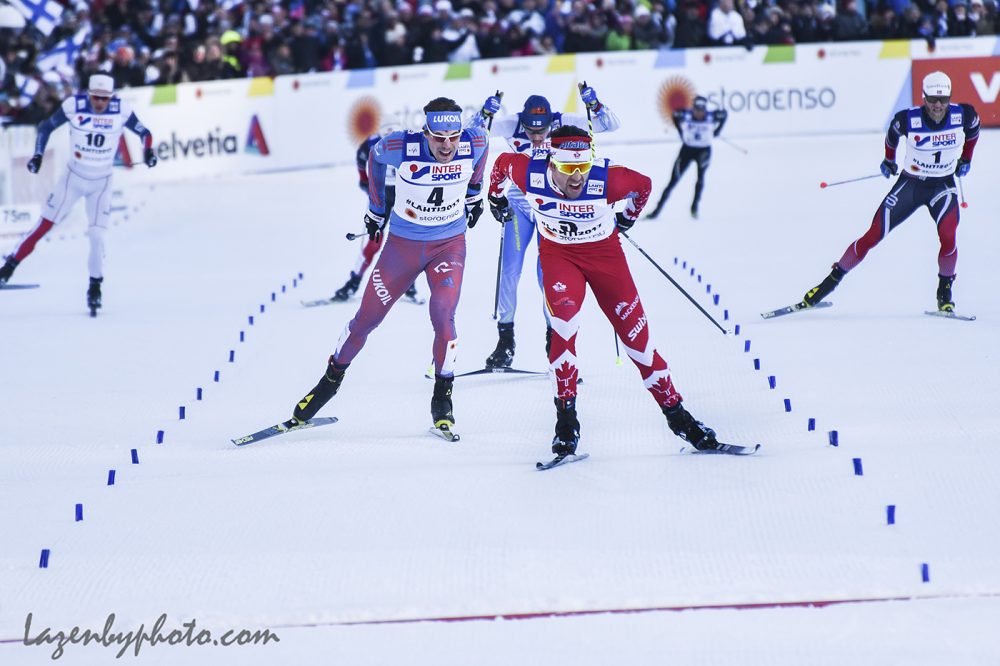
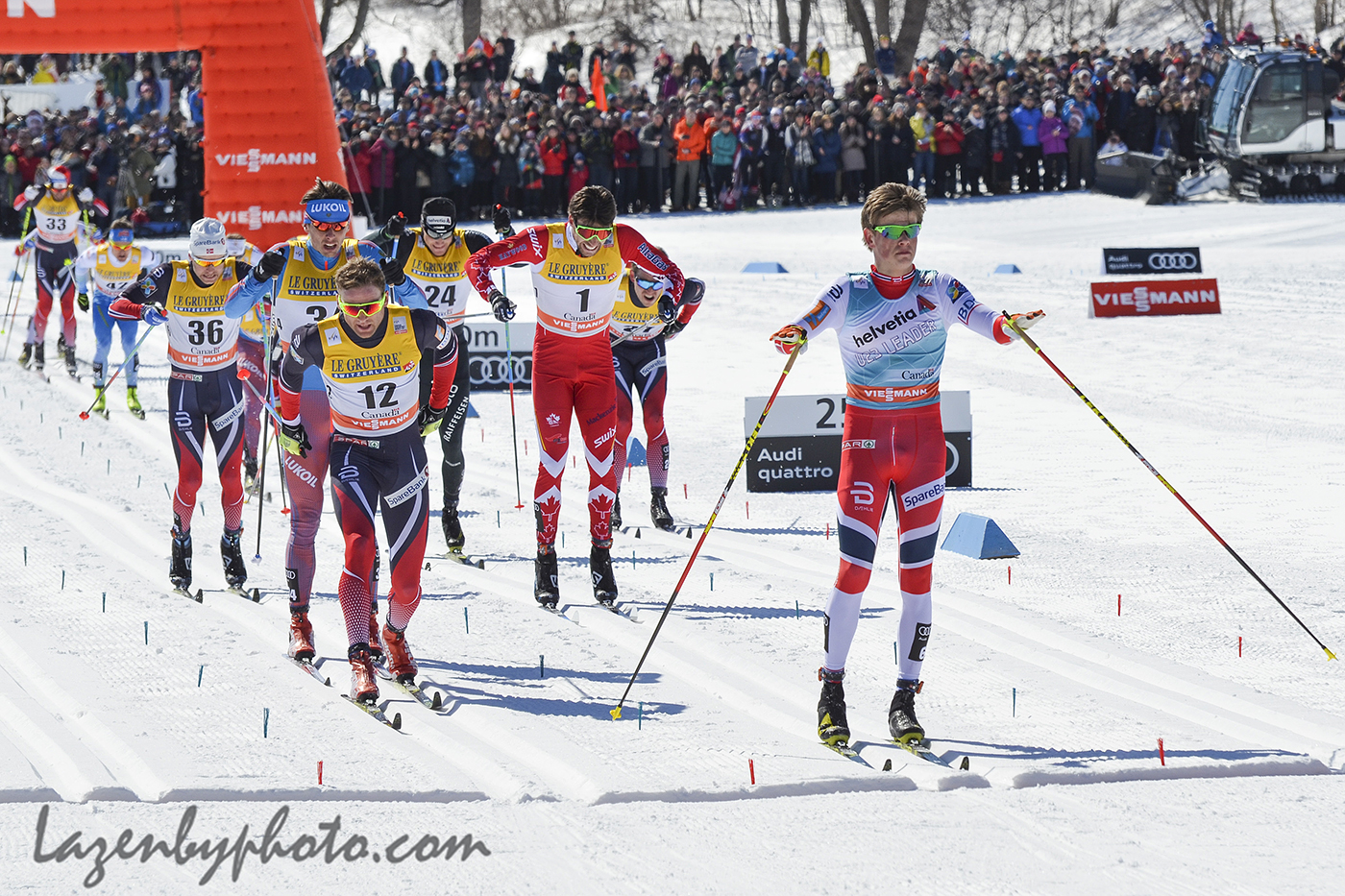
    Norway’s Johannes Høsflot Klæbo (r) crossing the line first in the men’s 15 k classic mass start on Saturday at World Cup Finals in Quebec City, 0.5 seconds ahead of fellow Norwegian Niklas Dyrhaug (12), who placed second. Russia’s Alexander Bessmertnykh (behind Dyrhaug) followed in third, just ahead of Canada’s Alex Harvey (1) in fourth. (Photo: John Lazenby/Lazenbyphoto.com)

    QUEBEC CITY — As 75 men jogged out into the center of the World Cup area assembled on the Plains of Abraham for the men’s 15-kilometer classic mass start on Saturday, one man in particular stood out. Alex Harvey, wearing the red suit of the Canadian national team, led the group out. He wore bib No. 1, but if you couldn’t see that from a distance, it didn’t matter. Essentially everyone knew who he was.

    The official hashtag of World Cup Finals in Quebec City this Friday through Sunday has been #GOALEX2017. He is a celebrity in Quebec, a hero to its locals, and someone even non-skiers know quite a bit about.

    And so far, the 28 year old appears to be soaking up every minute of his homecoming. One day after winning the freestyle sprint to start the finals, Harvey was seeded first in Saturday’s classic mass start. He led racers into the stadium, waved to spectators, started on the front line, and led the pack out of the stadium.
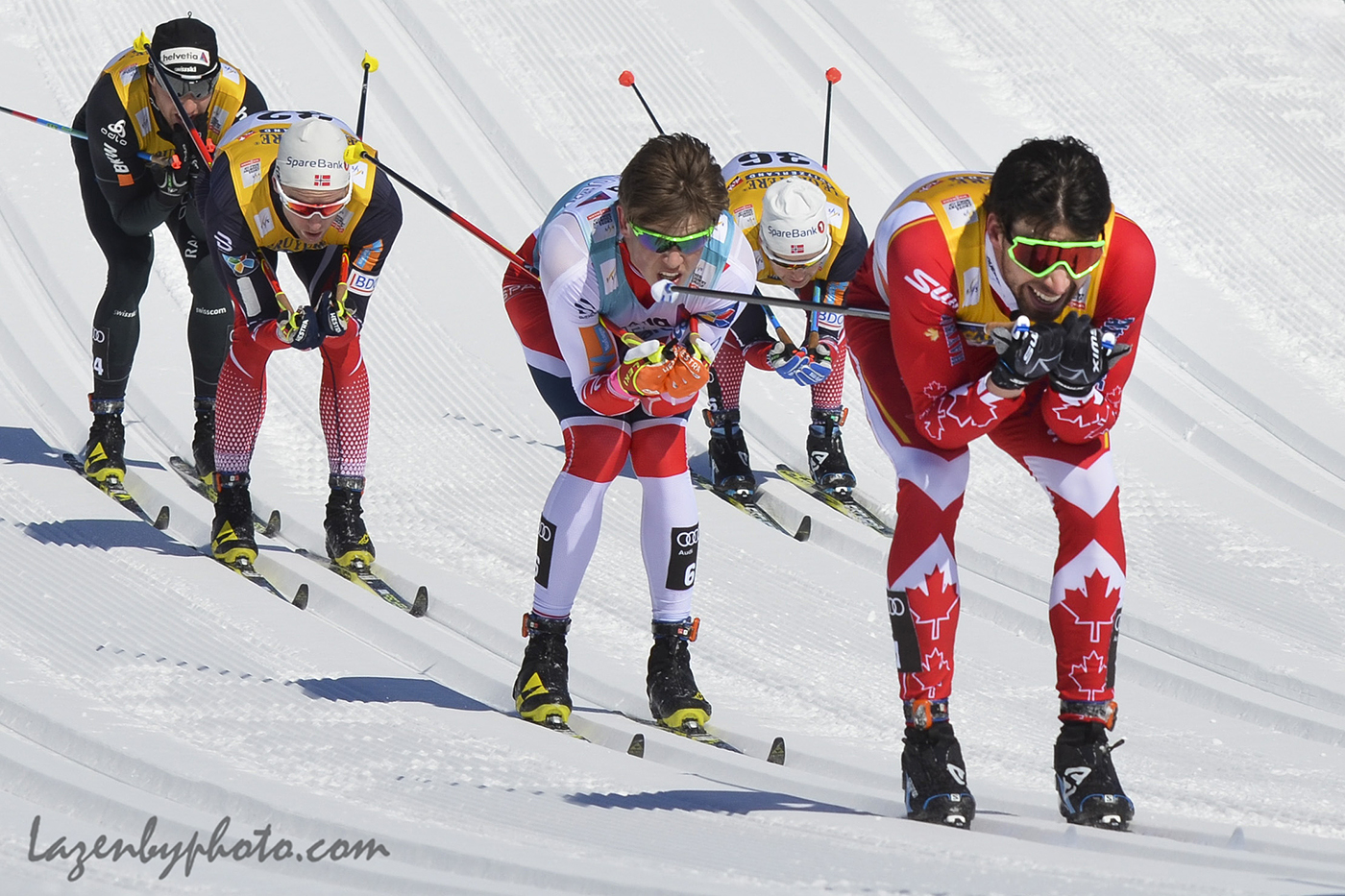
    Canada’s Alex Harvey leading Norway’s Johannes Høsflot Klæbo and two other Norwegians and Switzerland’s Dario Cologna (far left) during the men’s 15 k classic mass start on Saturday at World Cup Finals in Quebec City. (Photo: John Lazenby/Lazenbyphoto.com)

    Even when others took turns leading, with Norway’s Niklas Dyrhaug, Emil Iversen and Johannes Høsflot Klæbo setting the pace on the first of four laps, the possibility of Harvey winning never seemed in doubt. He consistently positioned himself within reach of the lead, skiing around sixth for much of the first lap.

    On Lap 2, the lead group remained about 30 strong. Harvey skied within two seconds of the Norwegians up front, with Pål Golberg, Didrik Tønseth, Finn Hågen Krogh, Dyrhaug, and even Klæbo — the 20-year-old Sprint World Cup champion — all still in contention. By the end of Lap 3, Harvey was into second, right behind Tønseth.

    With 3.75 k to go and the crowd’s ability to see the racers on most of the exposed course, the excitement among Harvey fans began to exceed its already high point from the start. Bells, horns, “Gooo Alex!”

    Russia’s Alexander Bessmertnykh attacked on an uphill and Harvey stuck behind him in second. On the second to last climb, a short and steep pitch that ascends up from the Old City’s historic wall, Dyrhaug surged into first, Bessmertnykh followed him in second and Harvey in third.

    Behind them, Klæbo was sizing them all up in fourth, waiting for the perfect time to strike. He did so by moving to the outside lane on the last long downhill and glided into second behind Dyrhaug. They ascended the final pitch together and rounded the final corner before the 100-meter stretch to the finish, where Klæbo continued to accelerate past Dyrhaug and double poled to his first World Cup distance win in 35:23.7 minutes. Dyrhaug finished 0.5 seconds later for second place, Bessmertnykh 0.8 seconds back in third, and Harvey 1.2 seconds behind Klæbo in fourth.
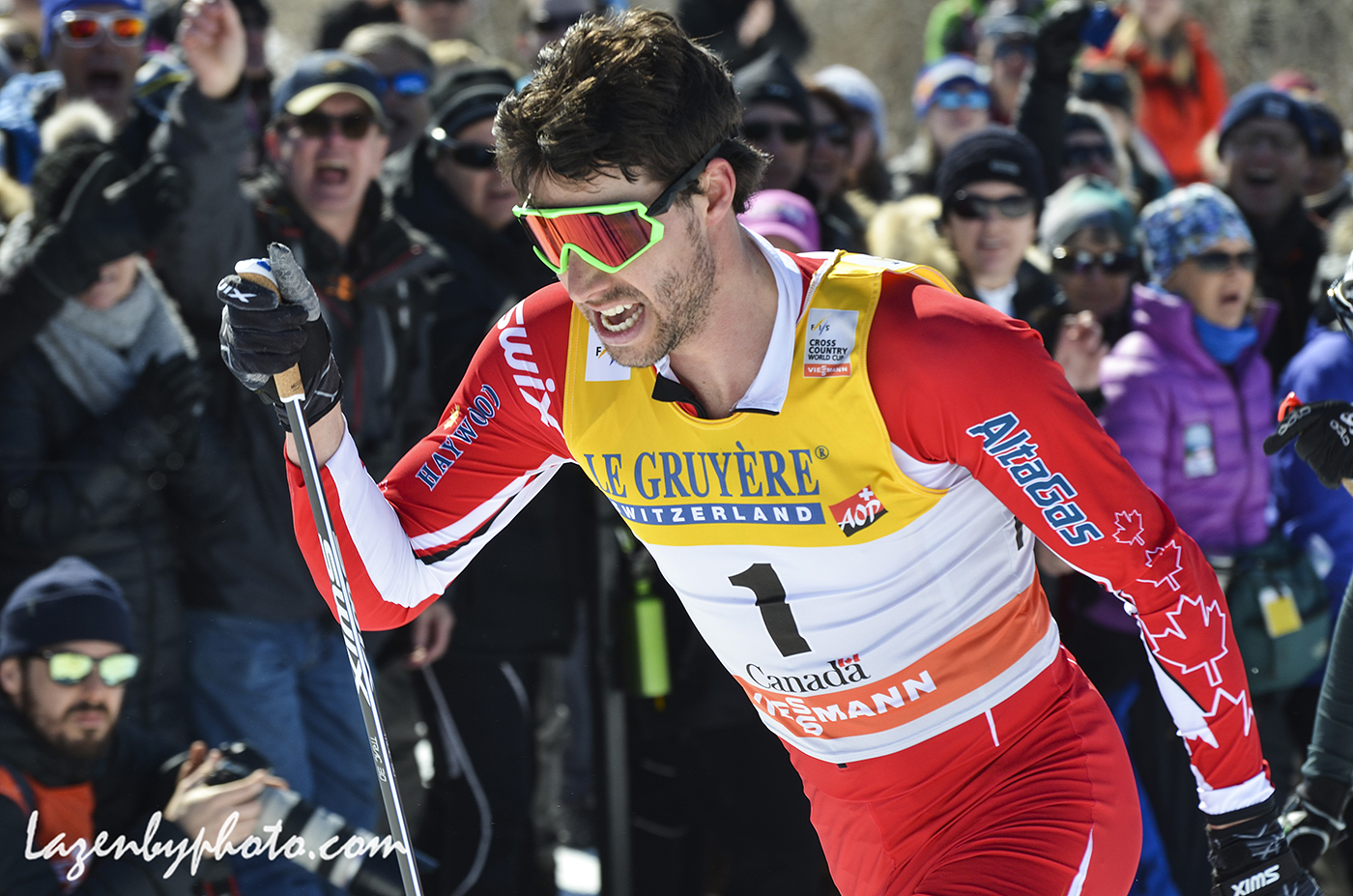
    Canada’s Alex Harvey racing to fourth in the men’s 15 k classic mass start at World Cup Finals in Quebec City. With one race left, the 15 k freestyle pursuit, he is third in the mini tour and third in the Overall World Cup as well. (Photo: John Lazenby/Lazenbyphoto.com)

    While it wasn’t a podium for Harvey, it was a result he was proud of.

    “I’m very satisfied,” he told reporters afterward in French. “Making the top 10 is always a big deal. Today was another step towards securing a third spot in the overall [World Cup]. That was my big goal coming in. So I’m satisfied … You can’t make the podium every time. I felt very good physically.”

    With one World Cup race remaining, Harvey, who’s ranked third in the world, extended his lead on Finland’s Matti Heikkinen in fourth to 92 points. Heikkinen finished 26th on Saturday, 1:04.9 minutes out of first, and will start Sunday’s 15 k freestyle pursuit 27th, 2:15 behind Klæbo as the World Cup Finals mini-tour leader. Dyrhaug will start 22 seconds back in second, followed by Harvey 1 second later in third, and Krogh another 11 seconds back in fourth.

    “Every pursuit is a manhunt so I’ll be hunting the young Norwegian in front,” Harvey said. “It was Klæbo’s first victory in a distance event. We saw him come in second behind Sundby in this year’s first mini tour. So of course, he’s strong. I mean, the guy won five or six gold medals at the Junior Worlds. He’s a complete skier…”

    Asked if he thought he could work with Dyrhaug to reel Klæbo in, Harvey wasn’t counting on one Norwegian helping him bridge the gap to another.

    “I don’t think Dyrhaug will chase, but I will,” Harvey said.

    Dyrhaug told reporters that might not be the case.

    “Tomorrow is going to be an exciting day,” he said in English. “I saw that me and Alex are going out together, so it is in both of our interests to cooperate and do good teamwork, and hopefully we can catch Johannes and then we’ll have to see…

    “We ought to talk together with team staff, hear what Johannes says, too,” he added. “But it is in both interests to have a big gap behind [us]. So if I’m strong, I’m thinking maybe I’m going to help Alex to … yeah, and we’re going to cooperate.”

    In the last year that Klæbo’s been racing World Cups, the three-time 2016 junior world champion (in the freestyle sprint, 10 k classic and freestyle relay) has reached the podium six times in individual World Cups and claimed bronze in the freestyle sprint at this year’s World Championships. But before Saturday, all of his podiums (with the exception of one mini tour) had been in sprints.

    “I hadn’t dreamed about doing a distance race in the World Cup … and cross the finish line in first,” Klæbo said after. “It’s unbelievable.”
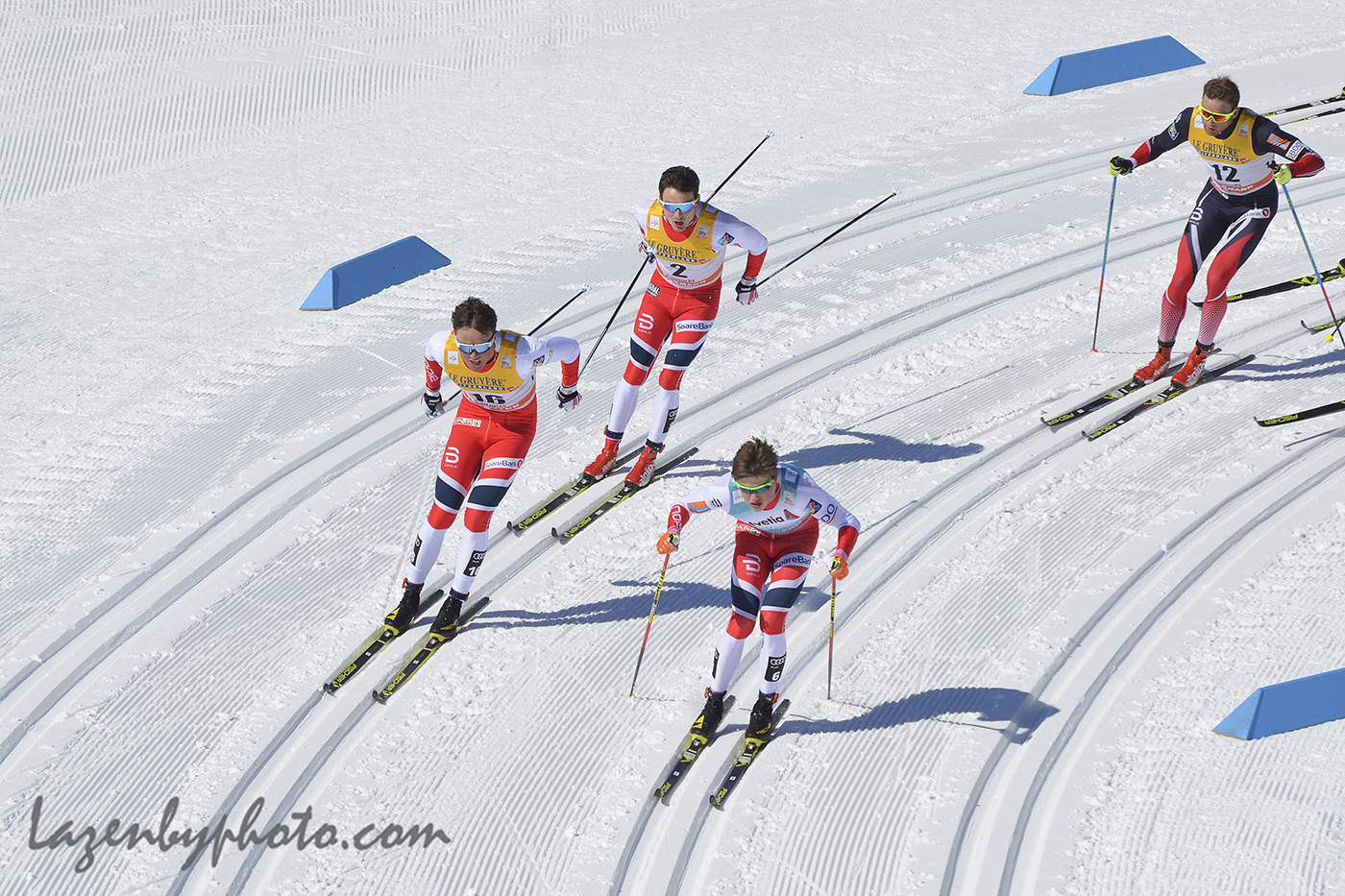
    Johannes Høsflot Klæbo leading three other Norwegians, Emil Iversen (l), Finn Hågen Krogh (second from l) and Niklas Dyrhaug (r) during the men’s 15 k classic mass start at World Cup Finals in Quebec City. Klæbo went on to win, Dyrhaug placed second, Krogh 16th, and Iversen 25th. (Photo: John Lazenby/Lazenbyphoto.com)

    He was the most consistent race leader on Saturday, winning one of sprint preems and crossing in second behind his teammate Iversen for the other. In all, he accumulated 27 bonus seconds, which were deducted from his overall time in the mini tour — putting him first by 22 seconds over Dyrhaug.

    “I just tried to be in the front for the bonus seconds to be able to get some seconds,” he explained of his race tactic. “So that was my plan.”

    Despite trying to lead for most of it, he noticed others trying to do the same on the third and fourth laps. In the final stretch of the race, coming off the long downhill toward the finish, Klæbo focused on moving up from fourth.

    “Niklas gapped our group in the last downhill there so we had push really hard on the last uphill to get to him,” he explained. “At the finish, it was just all out.”

    Bessmertnykh, who will start the pursuit in 13th, 1:08 back, after placing 59th in Friday’s sprint, described Saturday’s mass start as “a fun race,” in a post-race interview with the International Ski Federation (FIS). “There was a lot of things happening all the time. I followed Niklas and Johannes on the last climb. We gained a small gap. I managed to ski well the last curve before the homestretch and carried in good speed.”

    Dyrhaug was also satisfied with his race.

    “The only thing was, I was one meter behind in the end,” he said. “I tried my best. I went all in for a long sprint, when it was one half k left, and it was almost.”

    Under blue skies and a beating sun, Dyrhaug described Saturday afternoon in Quebec as “amazing.”

    “We have been competing for like 40 races this year, but this is the most pretty day, and most pretty conditions for the whole year, so thank you, Quebec,” he said.

    Waxing was a challenge, with temperatures warming quickly to about 2 degrees Celsius (mid-30s Fahrenheit) by midday.
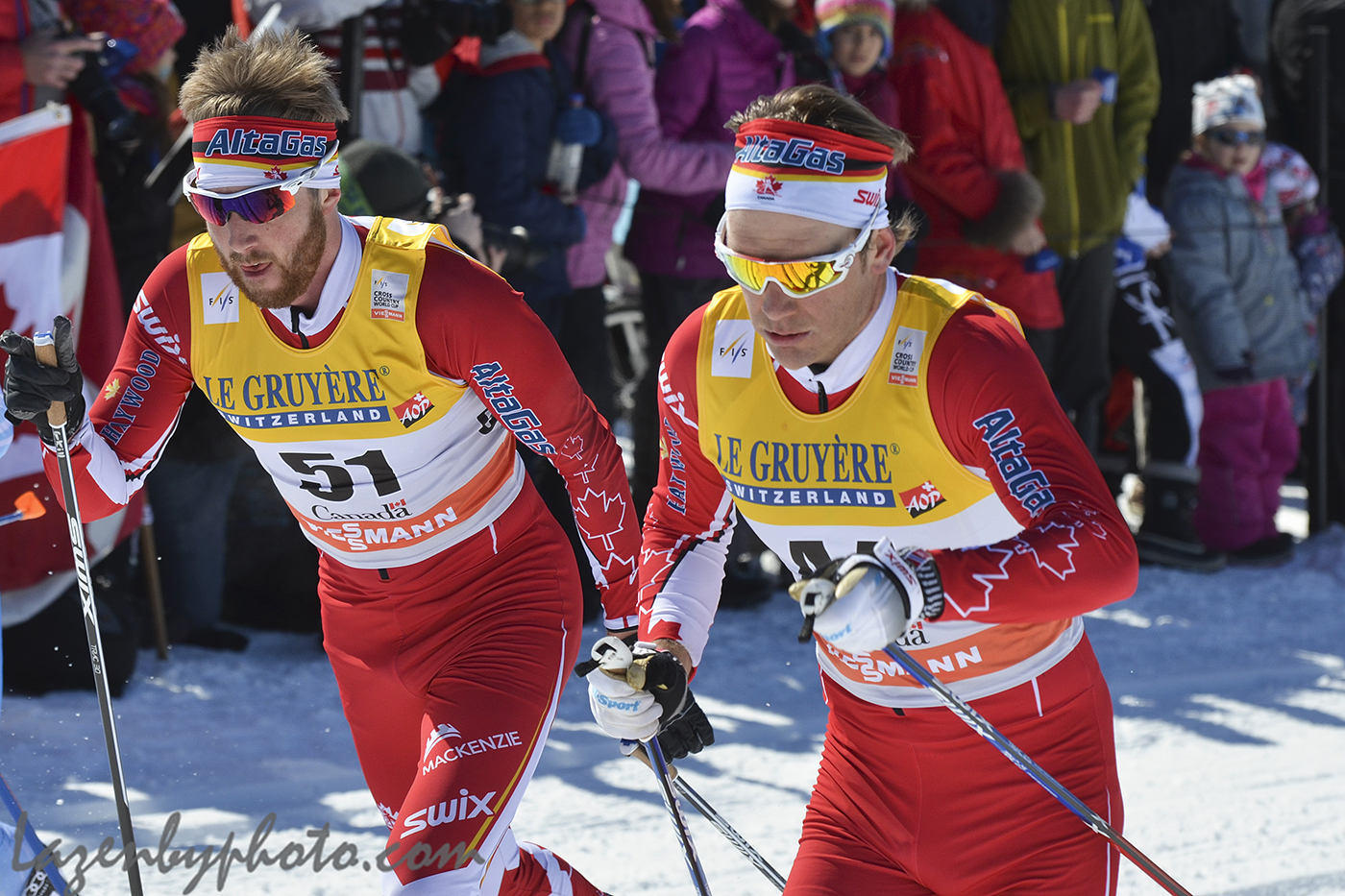
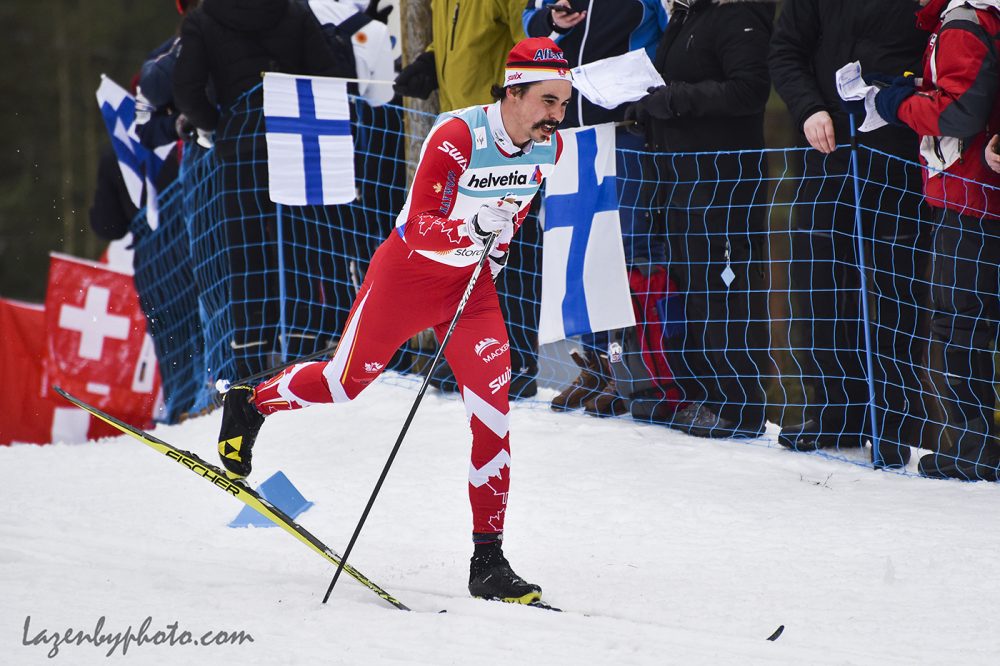
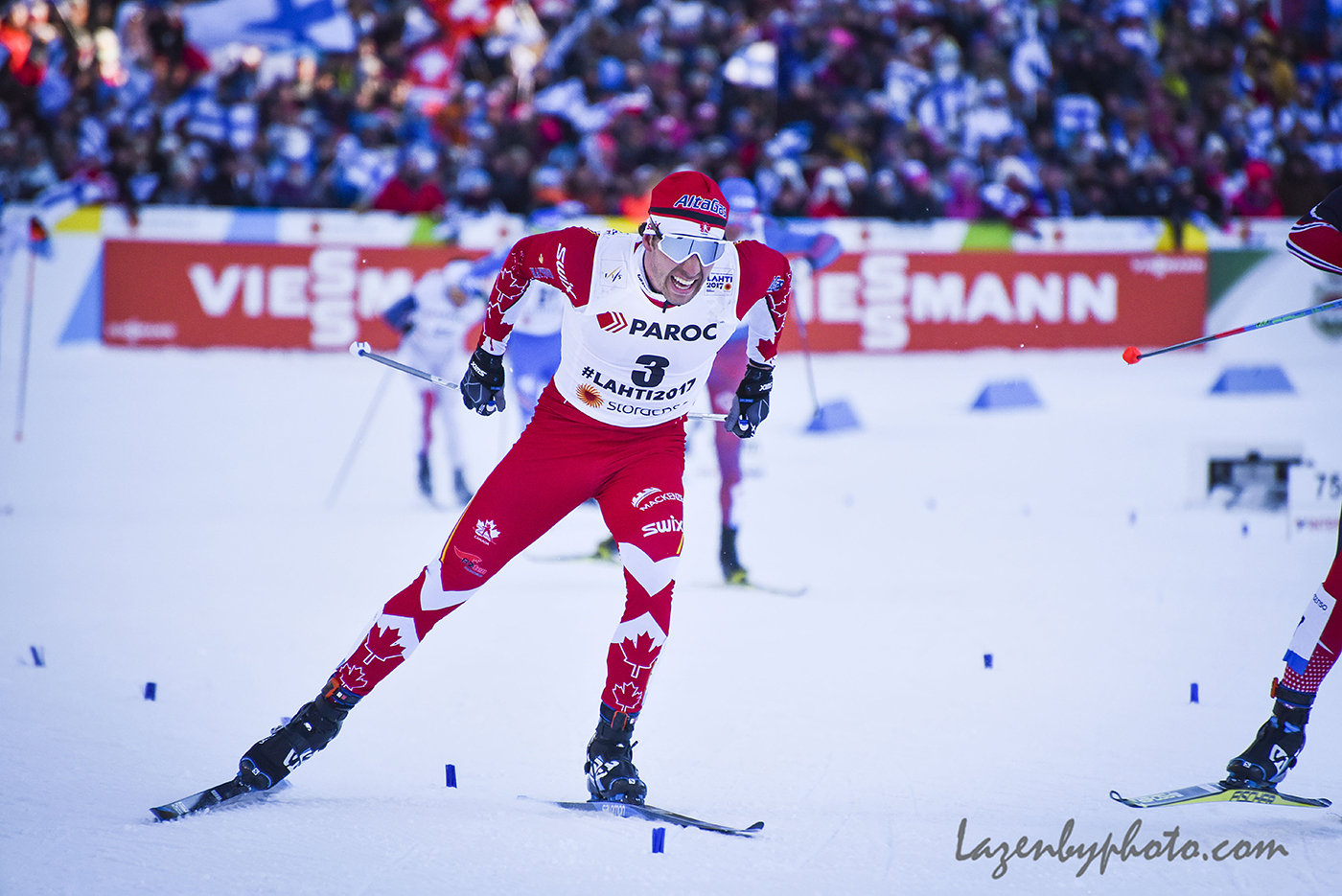
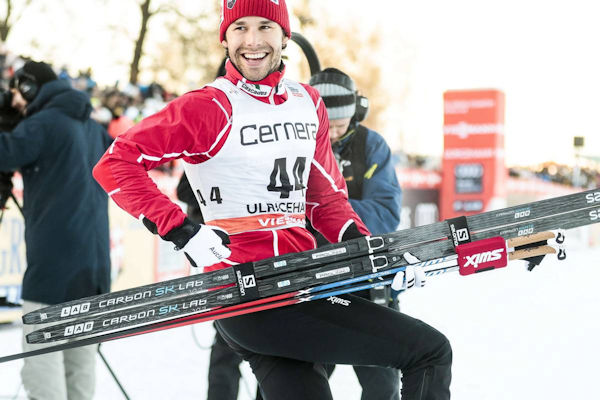
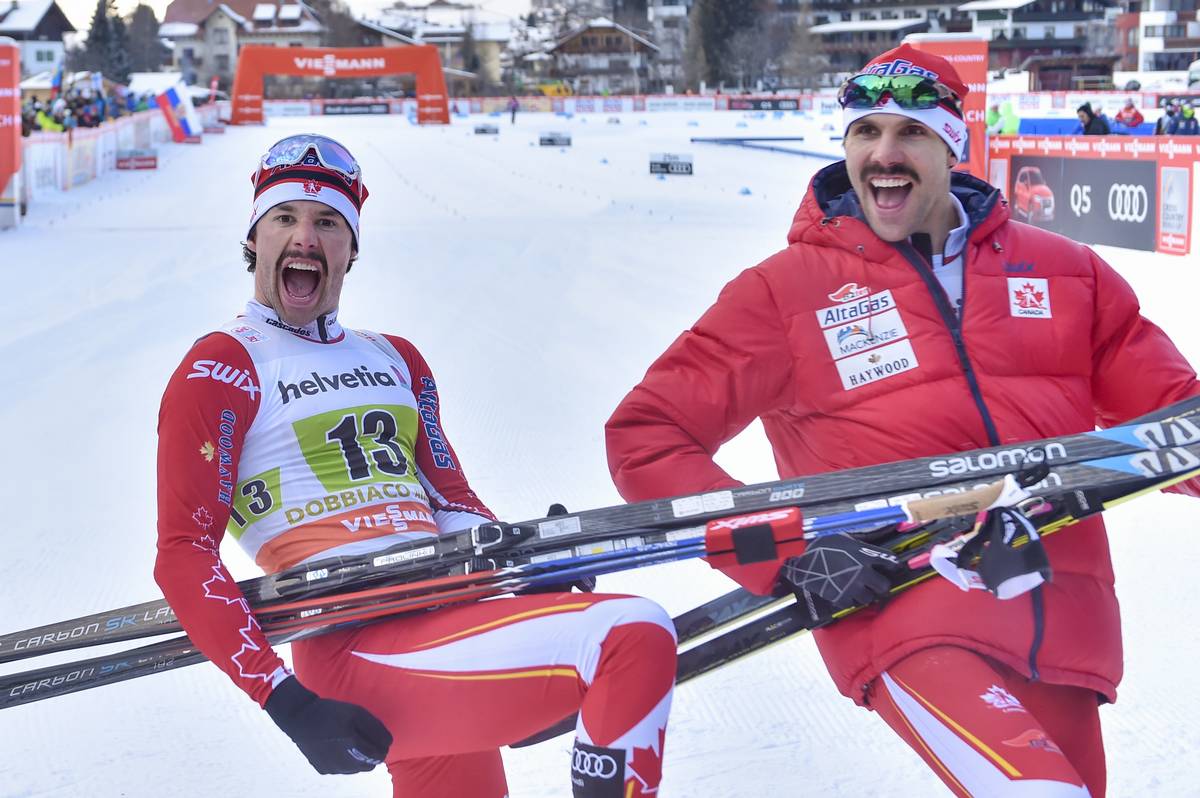
    Canada’s Devon Kershaw (r) and Graeme Killick (l) skied together for most of Saturday’s 15 k classic mass start after Kershaw broke a pole early. They went on to place 28th and 32nd, respectively. (Photo: John Lazenby/Lazenbyphoto.com)

    Devon Kershaw was the second Canadian in the top 30, finishing 28th (+1:08.4) after breaking a pole early on.

    “It was pretty chaotic and broke a pole there pretty early in the start and went all the way back into the 60’s, so made for a lot of work to try to get back in,” he said after. “I am proud of the fact that I was able to ski back into the points, but I had a better body than that today for sure and just had a bit of bad luck there.”

    He finished 9.3 seconds ahead of his Canadian World Cup teammate Graeme Killick, who placed 32nd (+1:17.7), and the two essentially skied together from 5.25 k on.

    While Kershaw said he thought the 3.7 k course would be better suited to skating, he was impressed with the atmosphere and the race organization.

    “I think for a classic, there are a lot of corners and it’s pretty tight … [but] to bring the skiing to the people like they did and to use the terrain they have available, I tip my hat, its a great event,” he said. “It is the most crowds I have ever skied with in Canada, the sun is shining, the venue is fantastic, the organizers did a great job, the tracks are in perfect condition. What a great place to race.”

    Erik Bjornsen led the U.S. men in 31st (+1:16.8) and two seconds behind Switzerland’s Roman Furger in 30th. After losing contact with the lead group of 29 on one of the bigger climbs at the end of the second lap, Bjornsen found himself skiing in “no-man’s land” with Sweden’s Teodor Peterson.
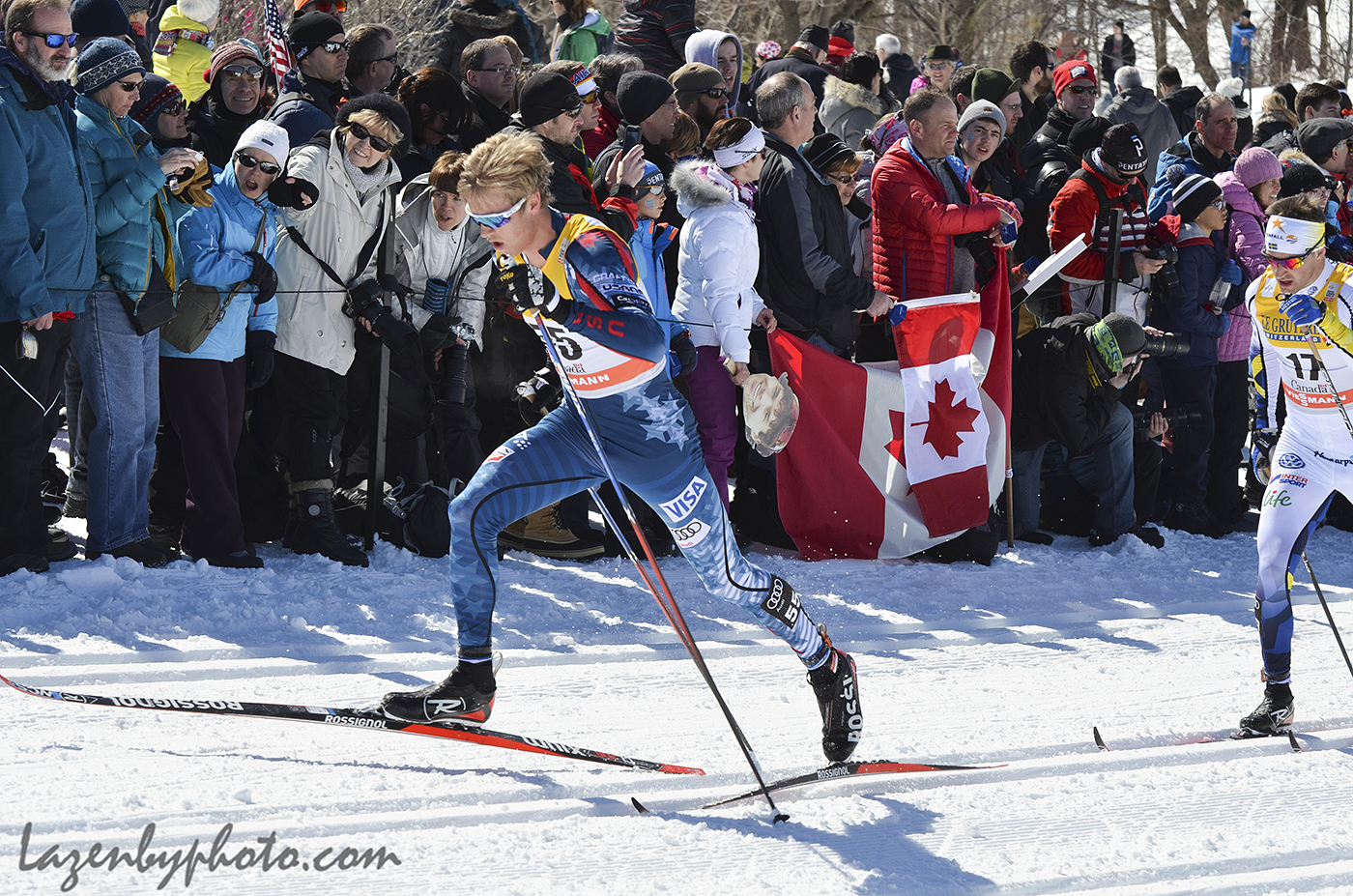
    Erik Bjornsen (U.S. Ski Team) leads Sweden’s Teodor Peterson (r) up a climb during the men’s 15 k classic mass start at World Cup Finals in Quebec City. They went on to place 31st and 29th, respectively. (Photo: John Lazenby/Lazenbyphoto.com)

    “It was a bummer to lose that front pack,” Bjornsen said. “I was struggling on the hills out there; I was a little light on kick. I think a lot of the guys were, but I wasn’t doing much striding. It was pretty much from double pole, to having to run outside the track. I felt pretty good, but I was losing time.”

    While skiing with Peterson, Bjornsen said he led at times and wanted Peterson to help drive the chase as well. Peterson ended up just ahead of him in 29th (+1:14.3).

    “I was like, ‘Come on, dude.’ I could see that there was a group behind, chasing us, and we were kind of right in that no-man’s land, which is always a bad spot to be,” he said. “But it was fun. It’s fun to be racing in North America, and have people cheering my name. It’s so unique, and I love it. I wish we could race over here more often.”

    Matt Gelso was the second American in 37th (+1:32.6), Andy Newell finished 45th, Scott Patterson 46th, Noah Hoffman 48th, Ben Lustgarten 49th, David Norris 50th, Simi Hamilton 54th, Paddy Caldwell 59th, Jack Hegman 62nd, Cole Morgan 64th, and Brian Gregg 69th.

    While the U.S. started 12 men, Canada had 15 in Saturday’s mass start with Bob Thompson finishing 55th, Knute Johnsgaard 57th, Len Valjas 61st, Russell Kennedy 63rd, Evan Palmer-Charrette 65th, Andy Shields 66th, Jess Cockney 67th, Brian McKeever 68th, Joey Foster 70th, Gareth Williams 72nd, Ricardo Izquierdo-Bernier 74th, and Julien Locke 75th.

    Results | World Cup Finals standings | Pursuit start list

    Overall World Cup standings

    — Gerry Furseth, François Léger Dionne, Jake Ellis, and Ian Tovell contributed

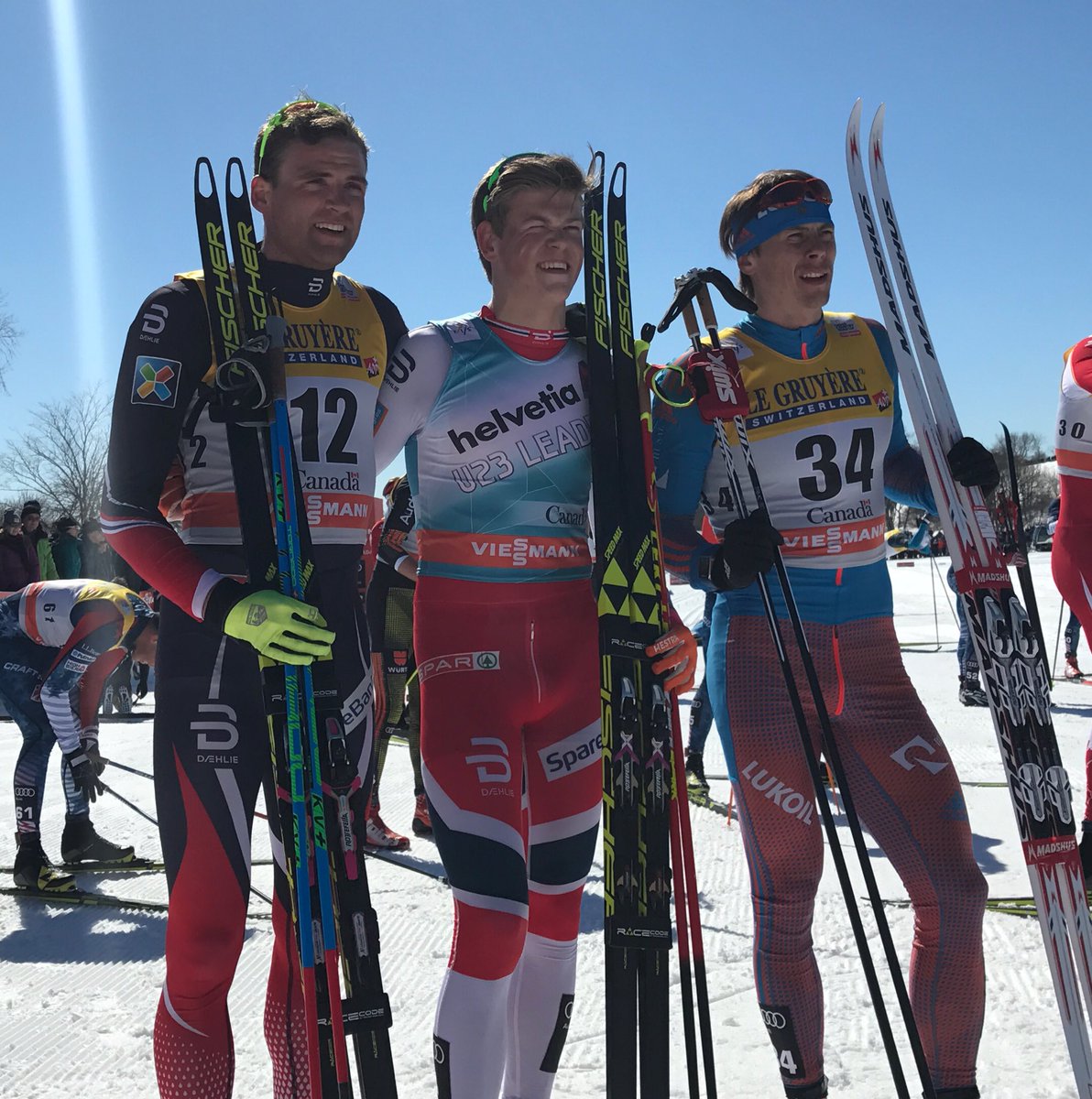
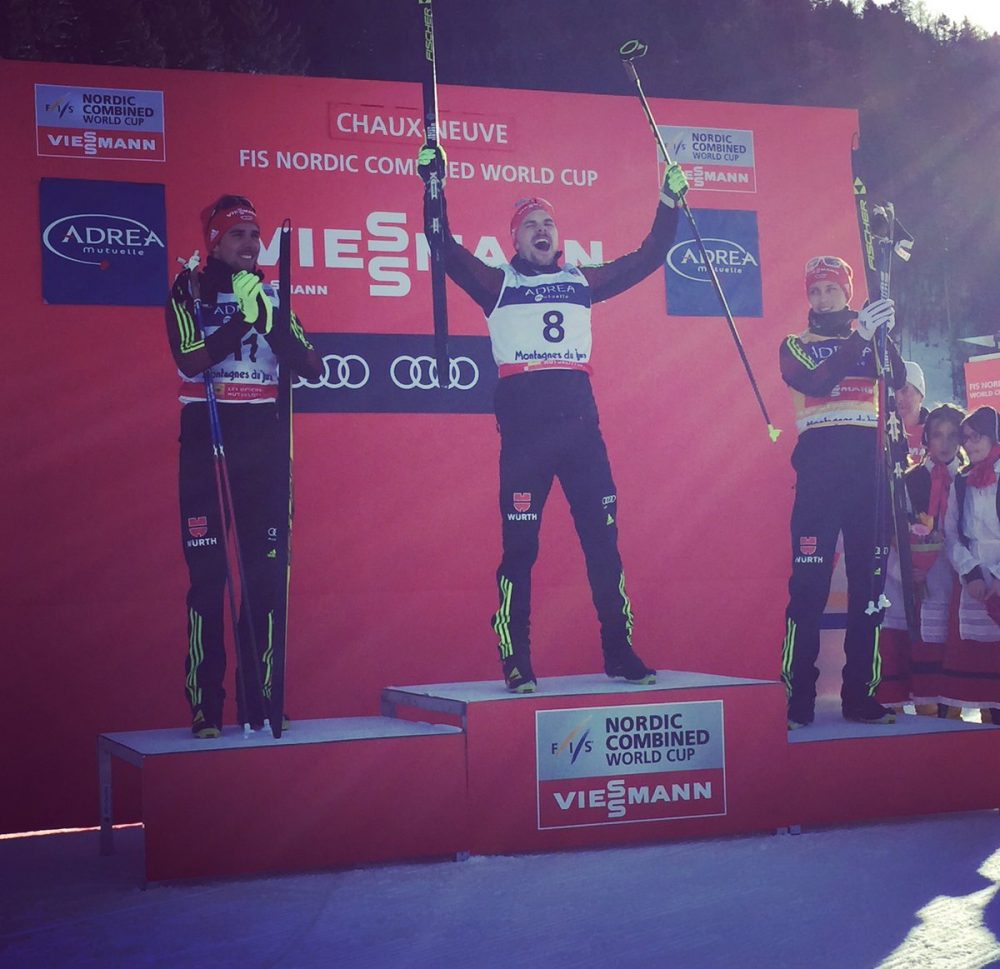
    The men’s 15 k classic mass start podium on Day 2 of World Cup Finals in Quebec City, with Norway’s Johannes Høsflot Klæbo (c) in first, Norway’s Niklas Dyrhaug (l) in second and Russia’s Alexander Bessmertnykh (r) in third. (Photo: John Lazenby/Lazenbyphoto.com)
  • Saturday Rundown: Quebec City, Oslo and Lillehammer (Updated x4)

    Saturday Rundown: Quebec City, Oslo and Lillehammer (Updated x4)

    The men’s 15 k classic mass start podium on Saturday at World Cup Finals in Quebec City, with Norway’s Johannes Høsflot Klæbo (c) in first and Niklas Dyrhaug (l) in second, and Russia’s Alexander Bessmertnykh (r) in third. (Photo: FIS Cross-Country/Twitter)

    FIS Cross-Country World Cup Finals (Quebec City): 10/15 k classic mass starts

    During Saturday’s 15-kilometer classic mass start at World Cup Finals, Canada’s Alex Harvey was in it until the end. But so were Norway’s Johannes Høsflot Klæbo and Niklas Dyrhaug, and Russia’s Alexander Bessmertnykh, to name a few.

    Sitting in second with a few hundred meters to go, Harvey was primed to make his move on Dyrhaug, who was leading at the time. But then came 20-year-old Klæbo, the season-long Sprint World Cup champion, who proved to have more left in the tank than anyone else and passed them both to lead into the finishing straight.

    Klæbo took the victory — his first in a World Cup distance race — on a bluebird day under a beating sun in 35:23.7 minutes, 0.6 seconds ahead of Dyrhaug. Bessmertnykh followed another 0.2 seconds back in third (+0.8) just ahead of Harvey in fourth (+1.2).

    Norway’s Sjur Røthe took fifth (+1.7), Switzerland’s Dario Cologna placed sixth (+1.9), and Norway’s Pål Golberg was seventh (+2.5), half a second ahead of another Norwegian Didrik Tønseth in eighth (+3.0). The top nine were within 3.7 seconds of first, with Russia’s Andrey Larkov in ninth.

    Devon Kershaw was the second Canadian in the points on Saturday in 28th (+1:08.4), after breaking a pole and working his way back up from outside the top 60.

    Erik Bjornsen led the U.S. men in 31st (+1:16.8), about a second ahead of Canada’s Graeme Killick in 32nd (+1:17.7).

    Also for the U.S., Matt Gelso finished 37th, Andy Newell 45th, Scott Patterson 46th, Noah Hoffman 48th, Ben Lustgarten 49th, David Norris 50th, Simi Hamilton 54th, Paddy Caldwell 59th, Jack Hegman 62nd, Cole Morgan 64th, and Brian Gregg 69th.

    For Canada, Bob Thompson finished 55th, Knute Johnsgaard 57th, Len Valjas 61st, Russell Kennedy 63rd, Evan Palmer-Charrette 65th, Andy Shields 66th, Jess Cockney 67th, Brian McKeever 68th, Joey Foster 70th, Gareth Williams 72nd, Ricardo Izquierdo-Bernier 74th, and Julien Locke 75th.

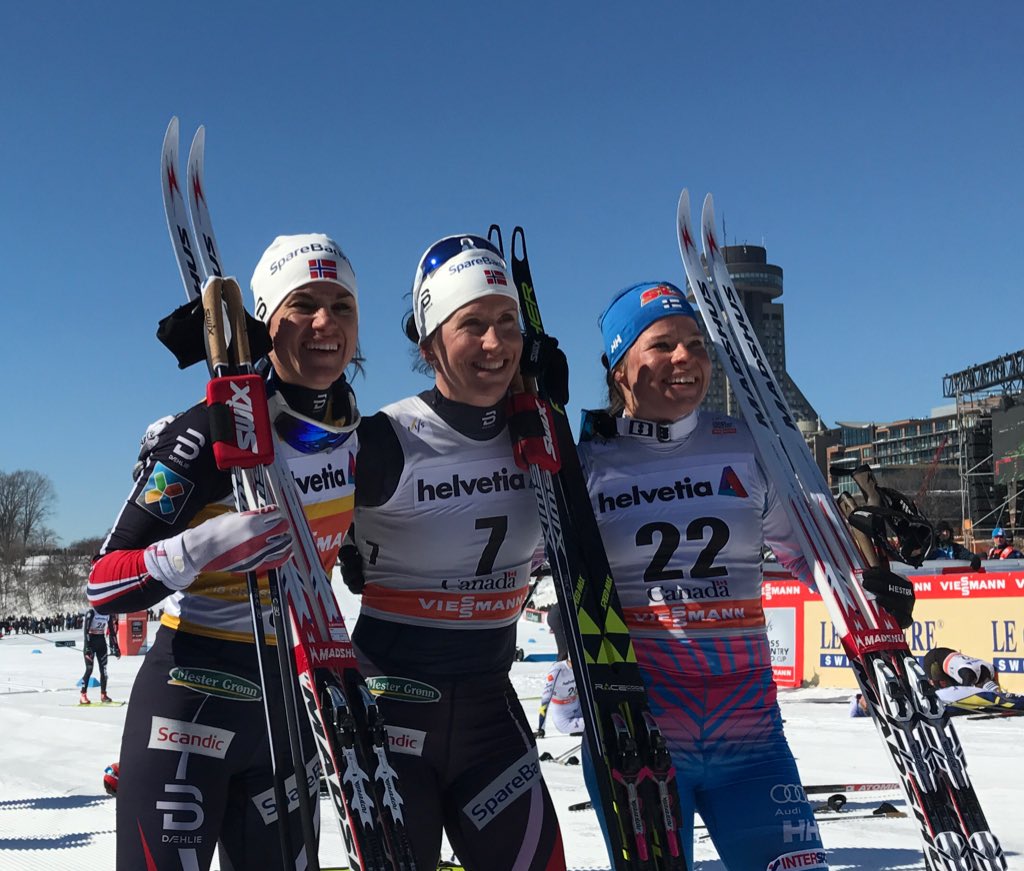
    The women’s 10 k classic mass start podium on Saturday at World Cup Finals in Quebec City, with Norway’s Marit Bjørgen (c) in first, Norway’s Heidi Weng (l) in second and Finland’s Krista Parmakoski (r) in third. (Photo: FIS Cross-Country/Twitter)

    In the women’s 10 k classic mass start earlier in the day, Norway’s Marit Bjørgen racked up her seventh victory of the season after leading a pack of two other Norwegians and Finland’s Krista Pärmäkoski and holding them off to the finish.

    Bjørgen put a few meters into the foursome as she entered the finishing stretch and held her lead across the line in 24:23.6 minutes. Norway’s Heidi Weng finished 0.6 seconds back in second to lock up the Distance World Cup title, in addition to the Overall World Cup title she secured on Friday.

    Pärmäkoski finished 2.9 seconds after Bjørgen in third, and Norway’s Ingvild Flugstad Østberg missed the podium in fourth (+7.8).

    Behind them, Germany’s Nicole Fessel outlasted a large chase pack to place fifth (+18.6), just ahead of Sweden’s Charlotte Kalla in sixth (+19.9) and Anna Haag in seventh (+19.1).

    Sadie Bjornsen of the U.S. Ski Team led the North American women in 15th (+29.9) after skiing at the back of that chase pack in the final stretches of the race. Also for the U.S., Jessie Diggins placed 27th (+1:06.9) and Sophie Caldwell 38th (+1:56.0).

    Canada was led by Emily Nishikawa in 37th (+1:51.7). Behind her, Cendrine Browne finished 41st (+2:28.2), Dahria Beatty was 53rd, Annika Richardson 54th, Katherine Stewart-Jones 56th, Frederique Vezina 59th, Annika Hicks 60th, Sophie Carrier-Laforte 61st, Andrea Dupont 62nd, Katherine Weaver 63rd, Alannah MacLean 64th, Sadie White 66th, Lisle Compton 67th, Mia Serratore 68th, and Laura Leclair 69th.

    For the U.S. Caitlin Patterson finished 44th, Liz Guiney 45th, Kaitlynn Miller 47th, Chelsea Holmes 48th, Rosie Brennan 50th, Julia Kern 52nd, Erika Flowers 55th, Becca Rorabaugh 57th, and Jennie Bender 58th.

    One day left in the 2016/2017 World Cup season remains, with the women’s and men’s 10/15 k freestyle pursuits on Sunday in Quebec City.

    Results: MenWomen

    World Cup Finals standings (Day 2 of 3): Men | Women

    ***

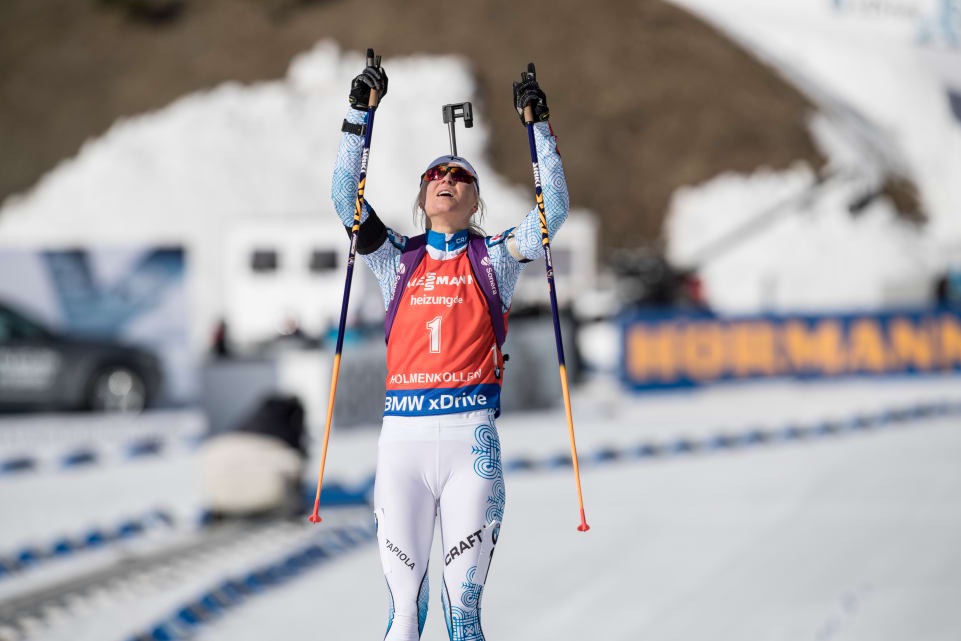
    Finland’s Mari Laukkanen pointing to the sky in honor of her late shooting coach, after she won the women’s 10-kilometer pursuit on Saturday at the 2017 IBU World Cup in Oslo, Norway. (Photo: IBU)

    IBU World Cup (Oslo, Norway): Women’s and men’s pursuits

    Less than 24 hours after winning her first IBU World Cup on Friday in the women’s 7.5 k sprint, Finland’s Mari Laukkanen immediately capitalized on her ideal position with a start-to-finish victory in Saturday’s 10 k pursuit that was never in doubt, cleaning the first three shooting stages before incurring one penalty in her final standing shooting (0+0+0+1) to cross the line in a time of 29:33.3 minutes.

    In addition to experiencing the most successful weekend of her biathlon career by far, it was an emotional day for the 29-year-old Finn due to a personal reason. Laukkanen spread her arms like wings skiing down the homestretch with a commanding lead, pointing repeatedly to the sky and a black ribbon she wore around her right upper arm, before kneeling in the snow in the finish for a few seconds. With those gestures, she reportedly wanted to commemorate her shooting coach Asko Nuutinen, who passed away Friday after suffering a heart attack during the World Cup in Kontiolahti, Finland, a week ago. He was 60 years old.

    “It’s been a really emotional day for me. We have heard really really sad news that last night we lost our longtime shooting coach,” Laukkanen told reporters with a trembling voice in the press conference. “After this it was more or less only about working for him. Working as he has asked me to do for years and years. So I wasn’t thinking about losing or winning today, I was only thinking about him. And I feel really big pleasure that I was able to come to the finish like this, that I can own the victory for him.”

    “I knew it will be difficult after the first victory in my career took me so long,” she added. “And to do it again immediately with good shooting. But as I said I didn’t think about winning or losing today, just doing my work.”

    Finishing 26.5 seconds after her, the Czech Republic’s Gabriela Koukalová reached the finish, moving up from her fourth place starting position with a clean shooting performance (0+0+0+0).

    “I wanted to miss all targets yesterday because I was so tired I didn’t even want to race,” Koukalová confided in the press conference. “It’s difficult to concentrate, three World Cups after the main goal of the season [the World Championships] is too much. Last year it was many times easier… I tried to catch her, but about one kilometer before the finish I saw her far away so I was happy I didn’t have to fight with anyone and was just enjoying the last meters.”

    Despite four penalties (1+1+0+2), France’s Justine Braisaz defended the third place on the podium against a three-person chase group on the last loop (+1:01.4), falling back only one position after having finished the sprint in second.

    “I did not expect such a good place today during the race,” Braisaz commented in the press conference. “Because in the last shooting I completely [failed]. I really wanted to have a clean shooting today, and I did not succeed. So I am happy and surprised, too.”

    Her teammate Anais Bescond who had started the pursuit in third place fell back to 22nd position (+2:53.5) with seven penalties.

    Slovenia’s Teja Gregorin finished fourth with one penalty (+1:08.2), Austria’s Lisa Theresa Hauser shot clean as the only athlete aside from Koukalova on her way to move up from 22nd to fifth place (+1:12.5), while Norway’s Marte Olsbu finished sixth like in the sprint despite three penalties (+1:15.9).

    Unlike in Friday’s sprint race where Germany’s Laura Dahlmeier had still given up a seemingly commanding lead in the sprint World Cup discipline standings to Koukalova, she held onto her lead in the pursuit standings on Saturday, moving up from the 31st starting position to ninth place with a penalty in each of her standing shootings (0+0+1+1, +1:53.8). A 22nd place would have been sufficient to win the “small crystal globe” award in the pursuit. Laukkanen’s teammate Kaisa Mäkäräinen finished 8th  with two penalties in the standing stages (+1:51.2), and thereby claimed the third place in the World Cup pursuit ranking.

    “I knew that I didn’t need to have a perfect race today, just a good one, but that’s always easier said than done,” Dahlmeier told broadcaster ARD after the race. “I am incredibly happy that it worked out and that I could secure myself another small globe… It’s a bit of a weird feeling, standing at the start gate in the middle of the field and the clock ticks and ticks as one athlete after another skis out on the course. And you can only observe how far they have gone and have to wait and be patient, and not make a false start. But then the snow burns, then the chase begins!”

    US Biathlon’s Susan Dunklee experienced an uncharacteristically problematic day on the shooting range and fell back to 37th place (+4:00.2), after starting seventh and less than a minute behind Laukkanen. Dunklee had three misses between two prone stages and seven more in her standing shootings (2+1+4+3) therefore having to ski more than an additional kilometer in the penalty lap.

    “It is a testament to her fighting spirit that she notched the fourth-fastest ski time — one of her best ranks of the season — and never gave up despite suffering a biathlon blowout on the range,” teammate Clare Egan said of Dunklee, according to a US Biathlon press release. “Bad races happen to the best and Susan is no exception, but not everyone fights through till the end no matter what.”

    Egan herself started the pursuit in 34th position and initally was able to make up ground, but then fell back slightly to 41st place (+4:13.9) with four penalties (0+2+0+2).

    “I am satisfied with my race even though the result was not what I was hoping for, and that’s how I would summarize my entire season as well,” Egan said after the final race of her season. “I’ve made a good step forward but my competitors also work hard all summer and we seem to improve at a similar rate.”

    Canada Biathlon’s Julia Ransom moved up to 47th place (+5:04.8) with three penalties (1+0+1+1), after starting in 52nd position.

    [UPDATED] Later on Saturday in the last men’s 12.5 k pursuit of the season, the three best athletes of the season fought throughout the race exchanging in the lead, before they stood next to each other on the range for the final shooting to decide the winner.

    Russia’s Anton Shipulin managed to shoot clean with his elaborate rifle stock in the design of a red dragon, proudly waving to the cameras as he left the arena while his two competitors had to ski into the penalty lap. France’s Martin Fourcade – who had already secured himself the overall World Cup Total Score title as well as the award for the pursuit discipline – was left to duke it out against Norway’s Johannes Thingnes , the winner of Friday’s sprint.

    On the last big climb before the Holmenkollen arena, Fourcade accelerated with a series of explosive jump-skate steps to decisively gap Bø. He even got fairly close to Shipulin on the finish stretch, who had slowed down a bit to grab a Russian flag before skiing over the line in a time of 32:11.9 minutes with one penalty (0+0+1+0), 5.7 seconds ahead of Fourcade who had incurred two penalties (1+0+0+1). While Fourcade shook hands with Shipulin, Bø came into the finish in third place, 21.6 seconds back and also with two penalties (1+0+0+1).

    “It was a crazy race, but I am happy that I managed to finish first,” Shipulin said in the press conference through a translator. “Tough conditions on the shooting range, I had to really work to concentrate on my shooting. On the last loop I was all alone until I saw Martin chasing me, then I got a little bit scared but I managed to [keep him behind].”

    It was Shipulin’s second win of the season, for which he credited his recently improved shooting performance.

    “It was a really exciting competition with Johannes and Anton,” Fourcade agreed with his rival. “I expected to fight with them for the victory on the last loop, but then Anton was simply stronger in the last shooting. My strategy was to be focused on my technique and skills and not on the results, like I did too often in the past few weeks focusing on records and not the victory.”

    Asked about his blazing attack on the final climb, Fourcade added: “Of course I train for that, but I think a lot of athletes do. I talked to Johannes, it was my revenge for the [2016] World Champs where he did exactly the same to me on the last uphill. But I know how it is, it can be different already tomorrow.”

    “I am happy with a new podium of course,” Bø said in the press conference. “I was not at my best in the skiing today. But I still managed to shoot 18 out of 20. As Martin said it was [annoying] that we did not shoot zero [misses] and could not fight with Anton in the finish, but it was quite interesting and fun to stand there in the last shooting … I expected Martin’s attack the second he did it, but I had no energy to fight with him. That was quite strong.”

    Sweden’s Fredrik Lindström placed fourth with no penalties (+44.7), and was the only man in the field who managed to shoot clean in all four stages.

    “For the podium, I was never really close“, Lindström told the IBU in a post-race interview. “But it was a great day anyway. Four times zero [misses], and especially in the standing stages that makes you climb a lot in the standings. Super happy with my performance.”

    US Biathlon’s Lowell Bailey, who had to start closer to the back of the field in 44th position, almost two minutes behind the leaders based on his sprint result, managed to move up 21 spots in the race despite three penalties (2+0+1+0).

    “I’m happy with the race, considering it started out pretty rough with the first two misses,” Bailey told US Biathlon after placing 23rd (+2:23.3). “I just read the wind wrong and didn’t correct enough. After that, I tried to keep my head in the race and make the best of it. I was happy with my skiing and glad to clean the last stage; this brought me up nine spots and I was able to gain another in the last loop. Now, it’s just one race to go. I’m looking forward to tomorrow.”

    Shooting quickly, Bailey recorded the ninth-ranked range time of the day and the ninth-fastest last loop.

    His teammate Sean Doherty started 35th but fell back after having to ski six times through the penalty lap (1+3+1+1) to finish 46th (+4:05.6).

    For Sunday’s mass starts as the final races of the 2016/2017 IBU World Cup season, the only qualified North American starters will be Dunklee (currently in 10th position in the World Cup Total Score standings) and Bailey (currently in eighth).

    The women’s season award in the mass start discipline once more will be decided between Germany’s Dahlmeier and Czech Republic’s Koukalova, while Germany’s Simon Schempp will try to defend his narrow lead on Fourcade. But during Saturday’s final loop, the French star did consider saving energy for the final competition.

    “No,” he simply quipped when asked about this in the press conference. “Of course the mass start is important tomorrow because it will decide about the [mass start] crystal globe. But I think today the pursuit was also really important, and you fight for victory and being one of the best athletes. You can’t be satisfied with only a third place when you can claim a second, and I think all athletes in my position would do the same.”

    Results: Women | Men

    ***

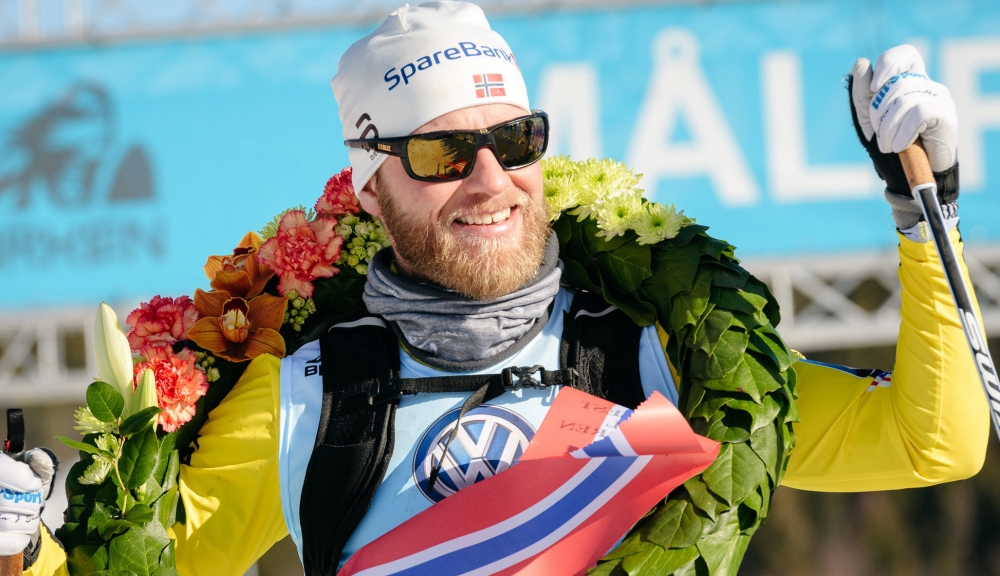
    Norway’s Martin Johnsrud Sundby after winning the Norwegian 54 k classic Birkebeinerrennet, part of the Ski Classics series, on Saturday in Lillehammer, Norway. (Photo: Ski Classics)

    54 k Birkebeinerrennet (Rena to Lillehammer, Norway): Part of the Ski Classics series

    [UPDATED] Not even a snowmobile clipping him and sending him tumbling 20 k before the finish could keep Norway’s Martin Johnsrud Sundby from winning the Birkebeinerrennet on Saturday in Norway. Representing Team United Bakeries, Sundby set a high pace from the start and broke the group down to three by 9 k, with Petter Eliassen of Team LeasePlan and Simen Østensen of Team BN Bank sticking with him until about 30 k in the 54 k marathon.

    With about 20 k to go, Sundby collided with a Ski Classics TV production crew snowmobile while trying to double pole in the snowmobile’s tracks. He was OK and went on to win by 48 seconds over Eliassen in second, and smiled about the incident after the finish.

    “It came in with tremendous speed and mowed me down,” Sundby told NRK, according to a loose translation.

    Ski Classics CEO David Nilsson told NRK he didn’t know exactly how that happened and emphasized that it was unacceptable.

    “We always put safety first, but it is a difficult balancing act with the snowmobile at high speed to get TV pictures,” he said, according to a loose translation. “The skiers often ski in the [snowmobile] track and here it happened and somehow the driver missed it.”

    While Sundby pulled out the win in 2:20:53.5 hours, Eliassen took second and Østensen followed another 3.5 seconds later for third place.

    In the women’s race, Poland’s Justyna Kowalczyk (Team Santander) pulled out a 4 minute and 15 second win over Sweden’s Britta Johansson Norgren (Lager 157 Ski Team). Japan’s Masako Ishida (Team United Bakeries) was another 48.6 seconds back in third.

    “I’m really happy to win this race,” Kowalczyk said, according to a Ski Classics press release. “Everything went well and the cheering on the course was amazing. I will do the rest of the races in Visma Ski Classics, but this victory was the most important for me. Of course, I want to win again in Årefjällsloppet like I did last year, but to win here in front of this audience means so much to me.”

    Tord Asle Gjerdalen, who finished fourth in the men’s race, and Johansson Norgren continue to lead the overall Ski Classics standings with three races to go. The next stop is the Årefjällsloppet in Sweden on March 25.

    “It was a great race and we kept a high tempo up all the way,” Sundby said, according to the press release. “I was able to use uphills for my advantage and get a gap. I had good skis, the conditions were perfect, and to win here was one of my goals for the season. I have the Norwegian Championships in two weeks, and I haven’t counted out the option of going to Finland for the Visma Ski Classics finale.”

    Results

  • Canada Enters 30, U.S. 27 at World Cup Finals in Quebec (Updated x3)

    Alex Harvey racing in the men’s 15 k freestyle pursuit at Stage 4 of the Ski Tour Canada last year in Quebec City. (Photo: FlyingPointRoad.com/NNF)

    For the second-straight year, the World Cup’s season-ending races will be held in Canada, with Québec City hosting 2017 World Cup Finals, this Friday through Sunday. Canada initially announced a roster of 30 (15 women, 15 men) for the three-day mini tour, and the U.S. selected 27 (15 women and 12 men), with both countries maximizing their Nation’s Group “home” quota for the event in downtown Québec City.

    Note: On Tuesday, Cross Country Canada (CCC) announced it would be releasing a revised roster “due to some CPL points errors in calculations,” according to a press release. On Thursday, FasterSkier confirmed that the list included the same 15 women and 15 men that were originally published on FasterSkier.

    And on Wednesday, Quebec organizers announced that the times of each race would be moved back an hour “upon FIS recommendation” to satisfy international broadcast schedules. The updated times are listed below.

    2017 World Cup Finals race schedule (updated Wednesday):

    (All times Eastern Daylight Time)

    • Friday, March 17: Freestyle sprint (qualifier starts at 11:45 a.m.; heats at 2:15 p.m.)
    • Saturday, March 18: 10/15 k classic mass starts (women’s race at 10:40 a.m.; men at 1 p.m.)
    • Sunday, March 19: 10/15 k freestyle pursuits (women’s race at 11:20 a.m.; men at 12:45 p.m.)

    Here are the North American lineups, as well as info on the U.S. selection criteria, and Canadian selection criteria.

    Canada

    Women:

    1. Dahria Beatty (National U25 Team/AWCA)
    2. Emily Nishikawa (World Cup B-team)
    3. Cendrine Browne (NST U25 Team/CNEPH)
    4. Katherine Stewart-Jones (NST U25 Team/NTDC Thunder Bay)
    5. Sophie Carrier-Laforte (CNEPH)
    6. Katie Weaver (Junior National Ski Team/Hollyburn)
    7. Annika Richardson (Junior NST/NTDC Thunder Bay)
    8. Lisle Compton (NTDC Thunder Bay)
    9. Annika Hicks (AWCA)
    10. Sadie White (NTDC Thunder Bay)
    11. Andrea Dupont (RMR)
    12. Frédérique Vézina (CNEPH)
    13. Alannah MacLean (NTDC Thunder Bay)
    14. Mia Serratore (NTDC Thunder Bay)
    15. Laura Leclair (Junior NST/Chelsea Nordiq)

    (Note: Jenn Jackson of Lappe Nordic declined her spot)

    Men: 

    1. Alex Harvey (World Cup A-team)
    2. Devon Kershaw (World Cup A-team)
    3. Len Valjas (World Cup A-team)
    4. Jess Cockney (World Cup B-team)
    5. Graeme Killick (World Cup B-team)
    6. Knute Johnsgaard (NST U25 Team/AWCA)
    7. Russell Kennedy (Canmore Nordic/Team R.A.D.)
    8. Gareth Williams (Junior NST/Telemark)
    9. Andy Shields (Lappe Nordic)
    10. Bob Thompson (NTDC Thunder Bay)
    11. Joey Foster (Team Hardwood)
    12. Julien Locke (NST U25 Team/AWCA)
    13. Evan Palmer-Charrette (NTDC Thunder Bay)
    14. Brian McKeever (Canadian Para-Nordic Ski Team)
    15. Ricardo Izquierdo-Bernier (CNEPH)

    USA

    Women: 

    1. Kikkan Randall (U.S. Ski Team A-team/APU)
    2. Sadie Bjornsen (USST A-team/APU)
    3. Liz Stephen (USST A-team)
    4. Caitlin Patterson (CGRP)
    5. Rosie Brennan (USST B-team/APU)
    6. Erika Flowers (SMS Elite)
    7. Jennie Bender (BSF)
    8. Julia Kern (USST D-team/SMS Elite)
    9. Liz Guiney (CGRP)
    10. Kaitlynn Miller (CGRP)
    11. Chelsea Holmes (APU)
    12. Becca Rorabaugh (APU)
    13. Jessie Diggins (USST A-team/SMS Elite)
    14. Sophie Caldwell (USST A-team/SMS Elite)
    15. Ida Sargent (USST A-team/CGRP)

    (Note: Katharine Ogden, of the SMS Elite Team and U.S. Ski Team D-team, declined her spot due to “ongoing stomach issues,” according to U.S. head coach Chris Grover. Guiney was the first alternate as she was next on the SuperTour list.)

    Men:

    1. Andy Newell (USST A-team/SMS Elite)
    2. Noah Hoffman (USST B-team/Ski Club Vail)
    3. Erik Bjornsen (USST B-team/APU)
    4. Matt Gelso (SVSEF)
    5. David Norris (APU)
    6. Ben Lustgarten (CGRP)
    7. Cole Morgan (SVSEF)
    8. Patrick Caldwell (USST D-team/SMS Elite)
    9. Jack Hegman (SVSEF)
    10. Brian Gregg (Team Gregg/Loppet Nordic Racing)
    11. Scott Patterson (APU)
    12. Simi Hamilton (USST A-team/SMS Elite)
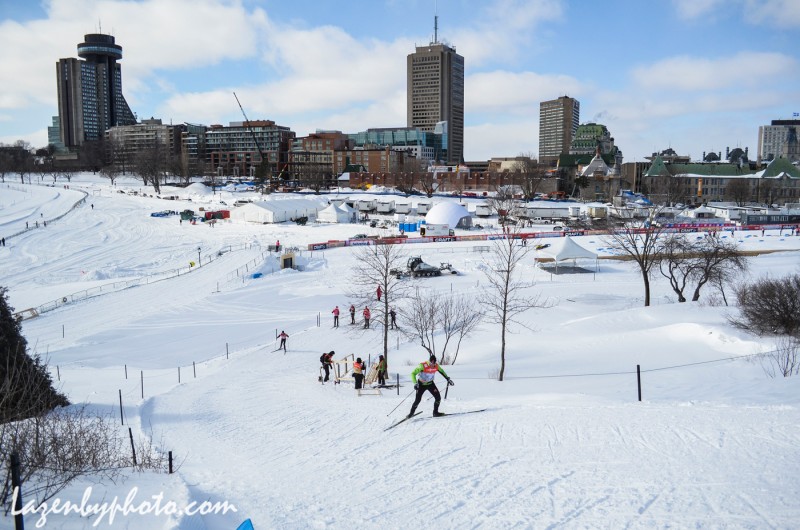
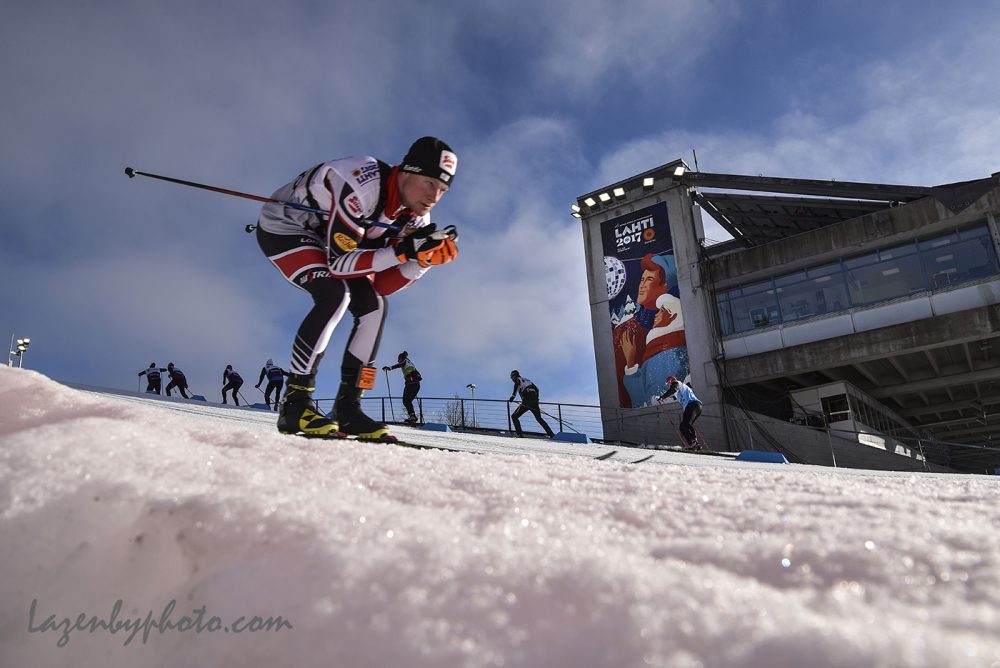
    A view from the steep hill on the sprint course with the stadium area in background, as seen during training last year in Quebec City, one day before the third stage of the 2016 Ski Tour Canada. (Photo: John Lazenby/Lazenbyphoto.com)
  • Sundby Secures World Cup Overall with Holmenkollen 50 k Win; Harvey 6th

    Sundby Secures World Cup Overall with Holmenkollen 50 k Win; Harvey 6th

    Norway’s Martin Johnsrud Sundby exits the stadium as Finland’s Iivo Niskanen shadows during the men’s 50-kilometer classic mass start on Saturday at Holmenkollen in Oslo, Norway.

    OSLO, Norway — Here’s something dizzying: six times around an 8.3-kilometer course with a total vertical gain of just over two thousand meters. In non-metric terms, all 47 finishers on Saturday’s Holmenkollen 50 k classic race accumulated roughly 6,574 feet of climbing.

    On the sharp end of the race for most of those kilometers were Norway’s Martin Johnsrud Sundby and Finland’s Iivo Niskanen. They were the animators for the hordes of Norwegians lining the course — in some places four deep.

    Around 16 k, the lead group was seven strong with a host of skiers dangling just off the back. Up front there were the alphas — Niskanen and Sundby — and a heavy hitter gang including Norway’s Sjur Røthe, Niklas Dyrhaug, Hans Christer Holund, Sweden’s Jens Burman, and the defending 50 k world champ, Canada’s Alex Harvey.

    This went down on a day when the views from Holmenkollen were almost limitless, Oslo Fjord shimmered and the storied venue’s atmosphere was buoyant. The air temps were an above-freezing blend of hello-spring and we’re-not-sure-we-want-you-gone winter. In other words: perfect.

    Finland’s Iivo Niskanen leads Norway’s Martin Johnsrud Sundby during the Holmenkollen 50 k classic in Oslo, Norway.

    It was also a day to see if risk could play out with good fortune. What could go wrong with such a backdrop?

    Niskanen left Lahti World Championships with two medals: a gold in the 15 k individual classic and a bronze in the classic team sprint, both of which were confidence boosters. With speedy skis and his kick not waning, he rolled the dice passing through the stadium after two 8.3 k laps. No ski change.

    The six skiers behind opted for fresh skis. With new fluoros and fresh kick, they also found themselves in Niskanen’s wake as he made a break while the others exchanged.

    “When Niskanen didn’t change at the second lap, it made Sundby chase really hard to close the gap to him,” Harvey told FasterSkier after the race. “Then that kind of blew the pack apart.”

    Niskanen threw down in Sundby’s castle. For a bit, it looked like the challenge might stick. At 18.8 k, Sundby was down 15.4 seconds.

    When Niskanen made his break, the gap back to Sundby was really a static line when it came to Niskanen building a lead. By 22.5 k, Sundby latched back on. The reward for Niskanen’s no-ski-switch gamble was that it became a two-skier race for 2017 Holmenkollen 50 k title.

    Late in the race at 47.5 k when Sundby made a break and built a six-second lead, the gap to Niskanen was still tenuous as the waning kilometers clicked off. But Sundby’s surge was enough for the win. First is first whether by one second or a minute.

    After 50 k, all that climbing, all the Norwegian-flag waving, and all the Carlsberg beer consumed by fans along the course, 9.9 seconds separated the winner Sundby from runner-up Niskanen. Sunday skied the 50 k in 2:02:59.7.

    With the win, Sundby locked some things up: he secured both the Overall World Cup and Distance World Cup crystal globes. This season’s overall win makes it Sundby’s third of his career (not counting the his overall World Cup win in 2014/2015, which he was stripped of because of a doping violation concerning his use of asthma medication).

    “It was a tough pace right from the beginning today,” Sundby told the International Ski Federation (FIS) after the race. “When Iivo broke away and I was able to get back to him, we worked well together and I actually convinced him to change skis with me on the fourth lap. He was going to change on third lap but I told him I would lead and we could get away together. He’s the 15 k world champ in classic and it was a tough fight with him.”

    For Niskanen, Saturday’s second place was his best World Cup 50 k result and marked his best Holmenkollen 50 k classic. In 2014, he placed fourth and was 12th in 2016.

    “After the fourth lap we both switched skis and it meant that I had fresh skis to battle with Martin,” Niskanen told FIS. “He was really strong today. I didn’t have any chance in the last uphill. He was running like Mo Farah. I’m happy with second but my goal was for the victory. You have to have a good race to be on the podium and I think I made a good race today but Martin was better. “

    The podium’s third step wasn’t decided until after five skiers lunged at the line. Russia’s Alexander Bessmertnykh won the photo finish for third (+1:15.2) ahead of Røthe in fourth, (+1:15.2) and Dyrhaug in fifth (+1:15.2).

    A five-deep pack fighting for third place in the Holmenkollen men’s 50 k classic on Saturday in Oslo, Norway. Norway’s Hans Christer Holund (6) leads Canada’s Alex Harvey (behind, in red).

    Also part of that multi-skier lunge was Harvey, just 0.2 seconds back in sixth (+1:15.4).

    Asked about the Niskanen-Sundby breakaway and how that unfolded in the chase pack, Harvey lumped praise onto others.

    “After that we tried to chase, but it wasn’t me doing the chase, it was mostly Hans Christer Holund,” Harvey said. “He was really strong today, probably the strongest of us all … But then after that the gap was too big, it was just a matter of not letting the guys behind us catch up and get ready for the final sprint.”

    Harvey has contested the Holmenkollen 50 k classic on three other occasions. His best result prior to Saturday was 13th. “It was one of my best races here ever, so that was a great day,” he said.

    Next up for Harvey is a trip back home to Quebec for World Cup Finals. He’ll land in Canada ranked third in the World Cup overall with 844 points. Finland’s Matti Heikkinen sits fourth with 837 points.

    The next best North American was U.S. skier Scott Patterson (Alaska Pacific University). Patterson placed 28th (+7:18.8). Most recently, Patterson scored World Cup points after placing ninth in the 30 k skiathlon in PyeongChang, Korea.

    Jonas Baumann of Switzerland (27) leads U.S. skier Scott Patterson (APU) during the Holmenkollen 50 k classic in Oslo, Norway.

    Saturday was more of a final exam; the Holmenkollen 50 k remains a big test. (Many big names were present in Oslo that had skipped the pre-Olympic World Cup in PyeongChang.)

    It was Patterson’s second-ever World Cup 50 k after racing at Holmenkollen last year, where he placed 32nd in another 50 k classic.

    “It was pretty good, it could have been better,” Patterson said of his top 30 this year. “I had a little crash on the sixth lap that was frustrated because I lost a little group. Then also, one time when I went through an exchange, most of my group didn’t so I kind of lost that little, there was a group not too far in front of me that I really wanted on, but couldn’t quite get up there.”

    Patterson explained this was a bottom-line race: he’s here to score World Cup points.

    “I was kind of sitting in 27th for a while and at that point, [U.S. coach] Matt [Whitcomb] and some others kept giving me splits and it was, like, 45 second up to the top 20,” Patterson added. “And at that point, I was aiming for that instead. But I’m pretty happy with some points, it’s the first time I’ve scored points in Europe, so I’m psyched.”

    Whitcomb had praise for all four U.S. skiers entered in the race: David Norris (APU) placed 35th (+9:56.4), Noah Hoffmann (USST) 38th (+11:02.6), and Ben Lustgarten (Craftsbury Green Racing Project) 46th (+18:44.7).

    “It was definitely a day that we were happy with as a staff,” Whitcomb said on the phone. “It was inspiring to see four starters and four finishers in the Holmenkollen. It’s just an accomplishment of itself, to start the thing and finish it. … Of particular note was Scott Patterson’s race. He’s been in the points before, most recently in Korea, but this was really his first big time landing in the points, he came from the 30’s and worked his way into the 20’s early in the race. It was a nice step up from his 32nd last year.”

    Alaska Pacific University’s David Norris (36), representing the U.S., strides out of the stadium followed by Canada’s Devon Kershaw (26) during the Holmenkollen 50 k classic mass start in Oslo, Norway.

    Of note, it was Norris’s first European World Cup; he skied two World Cups in Canada back in 2012.

    “This was my first World Cup in Europe, and I don’t know if it’s ignorant or not, but I want to try for top 30, get points, and come back here,” Norris said when asked about his goals coming into the race. “To have a shot on the US Ski Team, you have to be able to show that you can top 30 on a given day, and that’s my goal, to be on that team, so I’m setting my goals high, to top 30 in everything I can.”

    Also for Canada, World Cup Team member Devon Kershaw placed 33rd (+8:59.4), and Russell Kennedy (Canmore Nordic/Team R.A.D.) was 47th (+20:16).

    Results

  • Saturday Rundown: Holmenkollen, Kontiolahti, Jackson, and Lake Placid (Updated x4)

    Saturday Rundown: Holmenkollen, Kontiolahti, Jackson, and Lake Placid (Updated x4)

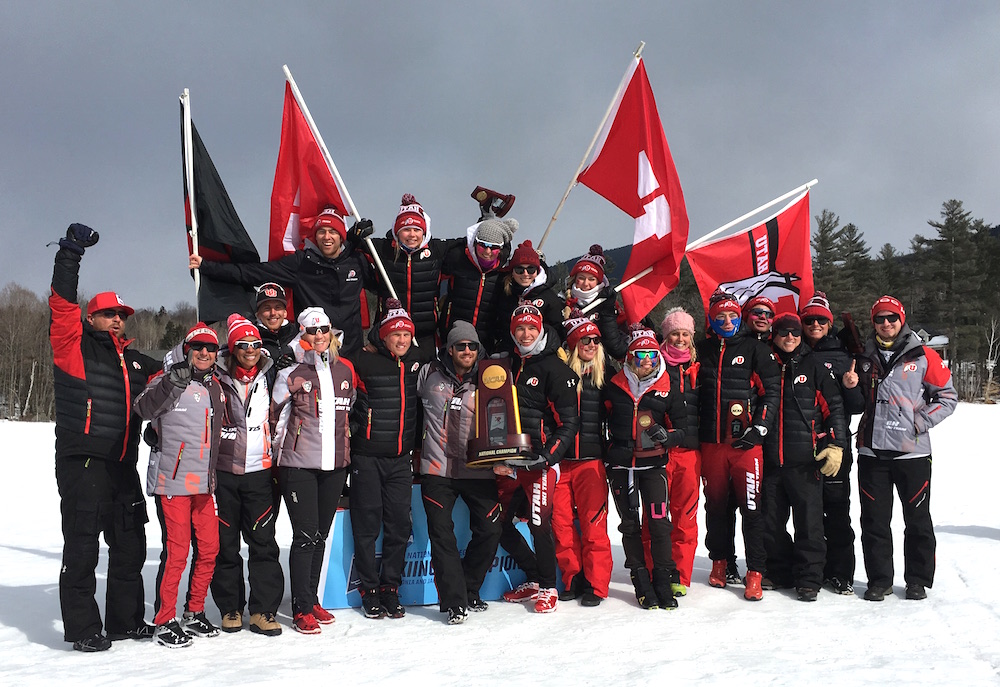
    The University of Utah ski team celebrating its first NCAA title since 2003 on Saturday at 2017 NCAA Skiing Championships in Jackson, N.H. (Photo: Jason Clay/Colorado)

    NCAA Skiing Championships (Jackson, N.H.): 15/20 k freestyle mass starts

    On the final day of the National Collegiate Athletic Association (NCAA) Skiing Championships in northern New Hampshire, the University of Utah pulled out a 16.5-point victory over the University of Colorado-Boulder (and finished 17.5 points ahead of the University of Denver) in the team standings, and the two previous NCAA champions from Thursday’s 5/10 k classic races, Martin Bergström and Petra Hyncicova, achieved their second-straight titles in as many nordic races this week.

    On a frigid Saturday morning in Jackson, N.H., with temperatures just below zero Fahrenheit for the start of the men’s 20 k freestyle mass start, Bergström, a Utah freshman from Sweden, outlasted the University of Colorado’s (CU) Mads Ek Strøm, a Norwegian senior and two-time 2016 NCAA champion, by 0.5 seconds to win his second-straight race in 46:02.8 minutes. Moritz Madlener, a German senior at Denver University (DU), placed third (+0.6). Just behind him CU’s Petter Reistad, of Norway, finished fourth (+1.2), and Dartmouth College’s Fabian Stocek, of the Czech Republic, placed fifth (+1.9).

    While temperatures warmed up to about 1 degree for the women’s 15 k freestyle mass start and the wind picked up to about 15-20 miles per hour, the women raced three laps around the Jackson Ski Touring Center’s race loop and navigated even faster downhills that caused a few crashes.

    Hyncicova used her love for downhills and skate races to capture her second consecutive NCAA title, breaking away with University of Vermont (UVM) junior Alayna Sonnesyn on the second lap. The Czech Republic native and CU junior attacked on the A-climb at the top of the course and won by 21.1 seconds in 39:21.6. Sonnesyn, of Minnesota, bested her third place from Thursday’s 5 k with a second-place finish on Saturday. CU’s Christina Rolandsen, of Norway, finished third (+38.9), ahead of Idaho native Anika Miller of Montana State University (MSU) in fourth (+44.0).

    Utah took fifth and sixth with Merete Myrseth (+1:01.5) and Guro Jordheim (+1:16.1), and had two other men in the top 10 (Martin Mikkelsen in 8th and Kevin Bolger in 10th) to achieve the alpine-nordic team title.

    In the women’s race, the Utes were the only team with all three women in the top 14, with Natalia Müller in 14th (+1:32.1).

    “The turning point of today is when Guro broke a pole, and she was back in the 20’s, and she and Natalia were skiing together,” Utah Director of Skiing Kevin Sweeney said, according to a team press release. “We told them that they had to go and they busted out and made a big move. The men’s results were tremendous, but whether or not we were going to win was based on those guys making the move. It was exceptional athleticism and gutsy performances.”

    The NCAA team title was the 11th for Utah and its first since 2003.

    “I am stunned with the win today,” Sweeney added. “In all my years of coaching, it was one of the most challenging four days of competition. I say that because the weather was incredibly cold and windy, and challenging from both a waxing perspective, as well as visibility and conditions. I know all the teams had to deal with it, but it really beat us up. It took a lot of perseverance and gutsy performances for us to win. We struggled a little bit in the slalom, but they were going for it and came up short.

    “We’ve been crunching numbers and have been able to beat Denver and Colorado by about 30 points on a really good showing during the RMISA season, but didn’t know if we could do it in the championships,” he continued. “Bergström was skiing at a whole new level this week, and Mikkelsen had stepped it up, and I knew Kevin Bolger could get top 10. I was also confident in the women, who have been skiing awesome, so I felt good there. It’s awesome to be able to take this new trophy back to our new ski building.”

    As for those earning All-American status on Saturday with a top-10 finish, Utah had five (Bergström 1st, Myrseth 5th, Jordheim 6th, Mikkelsen 8th, Bolger 10th), Colorado had four (Hyncincova 1st, Strøm 2nd, Rolandsen 3rd, Reistad 4th), Denver had two (Madlener, Dag Frode Trollebø 7th), MSU had two (Miller 4th, Johanna Talihärm 7th), Dartmouth had two (Stocek 5th, Luke Brown 9th), UVM had one (Sonnesyn 2nd), Northern Michigan University (NMU) had one (Adam Martin 5th), the University of Alaska-Fairbanks (UAF) had one (Sarissa Lammers 8th), UNH had one (Lizzie Gill 9th), and Bowdoin had one (Hannah Miller 10th).

    Stay tuned for a more in-depth report with quotes and photos from Saturday’s skate mass starts.

    Results: Men | Women | Team

    ***

    USSA Cross Country Junior Championships (Lake Placid, N.Y.): Freestyle team relays

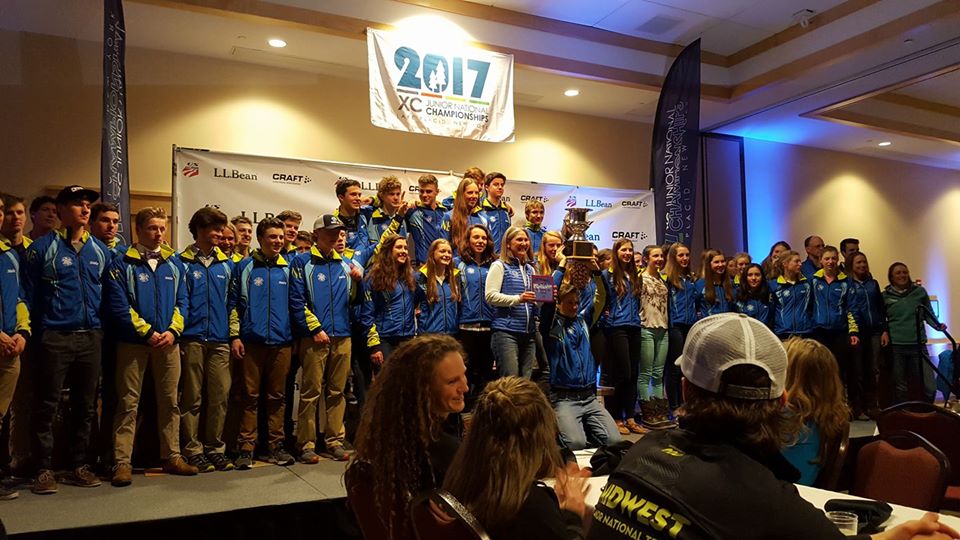
    The 2017 U.S. Junior Nationals Alaska Cup winners, New England, at the awards ceremony on Saturday in Lake Placid, N.Y. (Photo: XCJuniorNationals2017/Facebook)

    [UPDATED] For the final day of 2017 U.S. Junior Nationals in Lake Placid, N.Y., regional divisions formed three-racer teams for the U16, U18 and U20 freestyle relays.

    Intermountain swept the U16 team events with Lane Myshrall, Skylar Patten and Johnny Hagenbuch winning the U16 boys’ relay by 3.6 seconds over the Midwest’s James Schneider, Alexander Nameth and Peter Moore in 23:00.4 minutes. Another 1.1 seconds back, Alaska reached the podium in third (+4.7) with Eli Hermann, Zander McMullen and George Cvancara.

    Intermountain’s U16 girls’ team of Sarah Morgan, Annabel Hagen and Sydney Palmer-Leger posted a 53.7-second victory over New England’s Charlotte Ogden, Anna Lehmann and Abigail Streinz, winning in 26:21.4. The Pacific Northwest finished 18.1 seconds later in third place (+1:29.9) with Fiona Max, Gretta Scholz and Annie McColgan.

    Alaska won the U18 boys’ relay with Luke Jager, Canyon Tobin and Gus Schumacher finishing in 21:42.9, 7.5 seconds ahead of New England’s Elliot Ketchel, Adam Glueck and Ben Ogden in second. The Midwest’s Anders Sonnesyn, Patrick Acton and Luc Golin rounded out the podium in third (+22.2).

    Rocky Mountain topped the U18 girls’ relay with Katja Freeburn, Ezra Smith and Maddie Donovan crossing first in 25:47.3. Just 5.8 seconds back, Intermountain’s Brooke Dunnagan, Anna Gibson and Sofia Schomento placed second, and the Midwest secured third (+16.7) with Margaret McCollor, Luci Anderson and Anja Maijala.

    The U20 men’s relay title went to New England, with Kam Husain, Koby Gordon and Daniel Streinz pulling out a 1.3-second win over Alaska’s Tracen Knopp, Logan Mowrey and Hunter Wonders in 21:53.1. Intermountain followed in third (+8.8) with Eli Jensen, Peter Wolter and Nathan Wells.

    The Midwest came up big in the U20 women’s relay, with Abby Jarzin, Hannah Rudd and Margie Freed finishing 10.1 seconds ahead of New England’s Alexandra Lawson, Mary Kretchmer and Mackenzie Rizio in 25:41.4. Another 1.1 seconds back, Intermountain’s Leah Lange, Maddie Morgan and Marin Coletta placed third (+11.2).

    New England won the Alaska Cup with 325 points, the same point total as Intermountain in second. Alaska placed third in the overall team competition with 295 points, just five points ahead of the Midwest in fourth.

    Results: U16 boysU16 girlsU18 boysU18 girlsU20 menU20 women | Alaska Cup

    ***

    FIS Cross-Country World Cup (Oslo, Norway): Holmenkollen 50 k classic mass start

    (Race report)

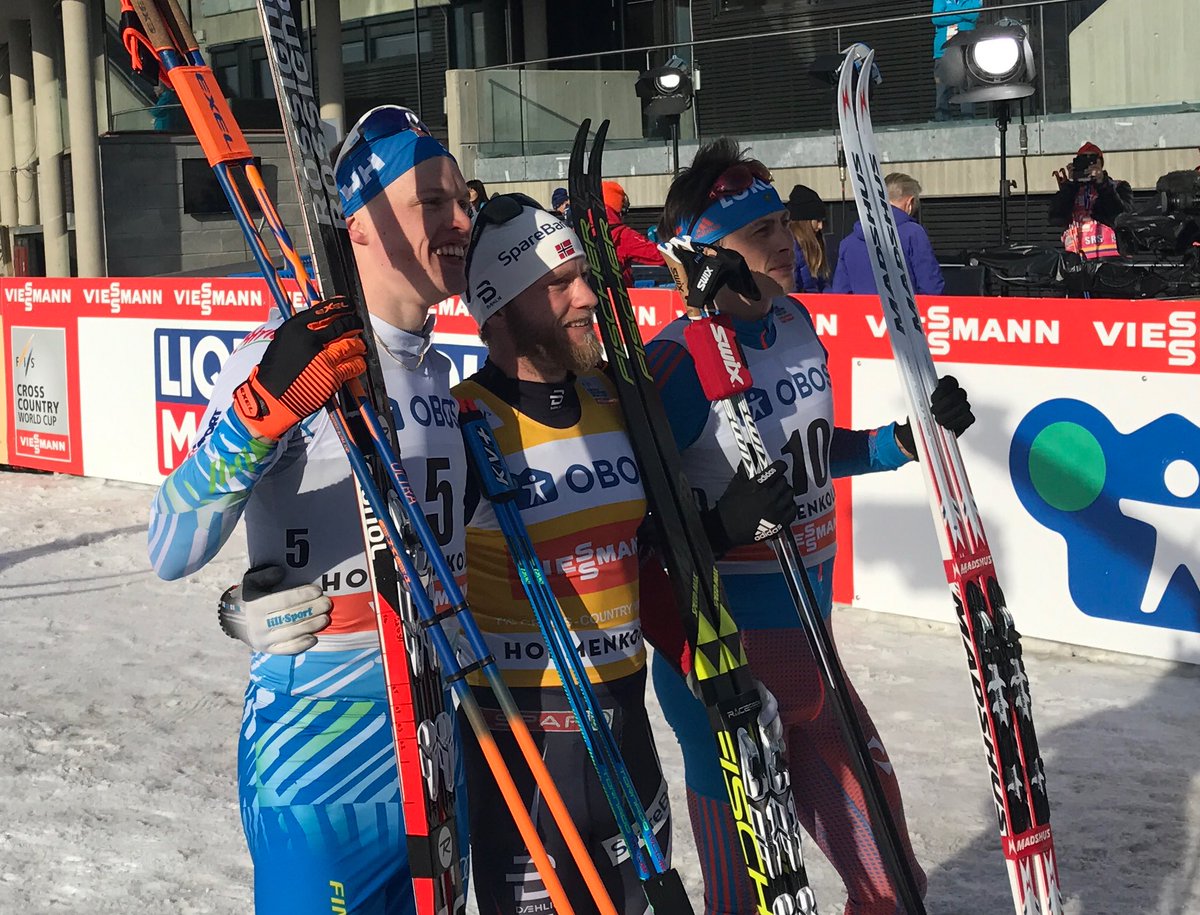
    Left to right: Finland’s Iivo Niskanen, Norway’s Martin Johnsrud Sundby and Russia’s Alexander Bessmertnykh after placing second, first and third, respectively, in the Holmenkollen World Cup men’s 50 k classic mass start on Saturday in Oslo, Norway. (Photo: FIS Cross-Country/Twitter)

    In a historic Holmenkollen, Norway’s Martin Johnsrud Sundby took his second 50 k win in a row, claiming this year’s title in a time of 2:02:59.7 (he won last year’s Holmenkollen in a time of 2:08:41.9). Sundby is now the only male skier to win two consecutive World Cup Holmenkollen 50 k competitions. 

    Crossing behind Sundby in second was Finland’s Iivo Niskanen, 9.9 seconds back from the race winner’s time. In a three-way photo finish, Russian Alexander Bessmertnykh bested Norwegians Niklas Dryhaug, and Sjur Røthe in the lunge to the line, with Bessmertnykh taking third (+1:15.2), Røthe fourth (+1:15.2) and Dryhaug fifth (+1:15.2).

    Canada’s Alex Harvey was just two tenths of a second behind the three-way lunge, finishing in sixth (+1:15.4). Norway’s Christer Hans Holund crossed 2.2 seconds later in seventh (+1:17.2). Three more Russians rounded out the top ten, with Sergey Ustiugov finishing in eighth (+2:35.0), Andrey Larkov two tenths of a second behind in ninth (+2:35.2) and Sergey Turyshev in tenth (+2:42.2).

    The top U.S. skier for the day was Scott Patterson (Alaska Pacific University), earning World Cup points in 28th (+7:18.8). Canada’s Devon Kershaw crossed 33rd (+2:11:59.1) and American David Norris (Alaska Pacific University) finished 35th (+9:56.4).

    Two more Americans competed in Saturday’s Holmenkollen, with Noah Hoffman finishing in 38th (+11:02.6) and Ben Lustgarten 46th (+18:44.7). Canadian Russell Kennedy was the final North American to finish in 47th (+20:16.3).

    Results

    ***

    IBU World Cup Biathlon (Kontiolahti, Finland): Men’s & women’s pursuits

    (Race report)

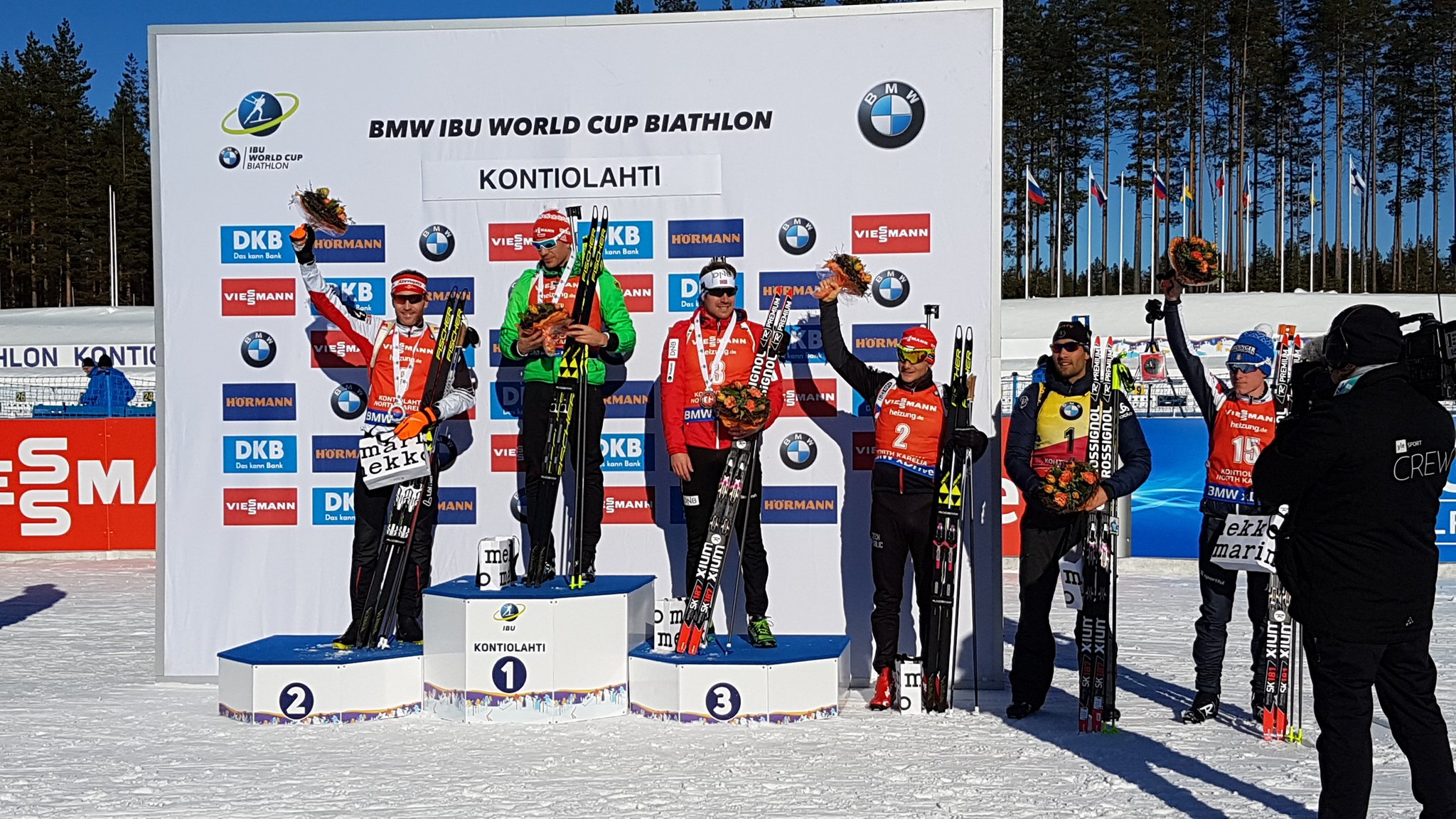
    The IBU World Cup men's podium after the 12.5 k pursuit in Kontiolahti, Finland, where Arnd Peiffer of Germany outsprinted Simon Eder of Austria for the win. (Photo: IBU/Twitter)
    The IBU World Cup men’s podium after the 12.5 k pursuit in Kontiolahti, Finland, where Arnd Peiffer of Germany outsprinted Simon Eder of Austria for the win. (Photo: IBU/Twitter)

    After one day knocked down to the second spot of the podium, it was back to the usual winning ways for Germany’s Laura Dahlmeier in the 10 k pursuit. Dahlmeier caught Norway’s Tiril Eckhoff, who won Friday’s sprint, early in the race after Eckhoff had one penalty in the first prone and second-starter Dahlmeier cleaned. While Eckhoff picked up five more penalties as the race went on, finishing 15th (+1:12.0), Dahlmeier had just one – and cleaned when it counted, on the final shoot with France’s Marie Dorin Habert and the Czech Republic’s Gabriela Koukalova right there with her. Dorin Habert missed one shot and held on to second place (+16.5) despite the penalty loop, while Italy’s Lisa Vittozi picked up her first individual podium in third (+19.9).

    The win secured the overall World Cup title for Dahlmeier, her first. “That makes me really speechless,” she told Germany’s ARD broadcaster. “This is an amazing moment.”

    Susan Dunklee collected four penalties and dropped from fifth place to 14th (+1:02.8) for the United States. Teammates Clare Egan and Joanne Reid finished 45th (+3:24.7) and 52nd (+4:07.0), respectively.

    For Canada, Julia Ransom finished 53rd with three penalties (+4:14.0) and Emma Lunder 58th with four missed shots (+6:20.7).

    Results

    Earlier in the day, Martin Fourcade had started the men’s race in bib one and set out to win the men’s 12.5 k pursuit, but was undone by four errors on the shooting range. No matter: the French biathlete still picked up the World Cup crystal globe for the pursuit discipline after finishing fifth (+25.5 seconds) and now he’s skipping tomorrow’s mixed relays to go be with his wife, who is about to have their second child.

    Capitalizing on Fourcade’s errors were a group of chasers, among whom Arnd Peiffer of Germany managed to shoot 20-for-20. The race came down to a sprint finish between him and Simon Eder  of Austria; Peiffer took a 0.3-second win for his eighth career victory. Emil Hegle Svendsen of Norway finished third, +2.3 seconds, and Andrej Moravec of the Czech Republic fourth, +9.8.

    Besides Peiffer, the only other man in the field to shoot clean was Sean Doherty of the United States. That allowed Doherty to jump from 44th at the start to a season-best 18th (+1:19.5) at the finish, the top result for the American team. Lowell Bailey finished 27th (+1:57.2) and Leif Nordgren 43rd (+3:24.4) with three and four penalties, respectively.

    Christian Gow led Canada with just one penalty and a 37th-place finish (+2:36.0), a big improvement from his 50th-place starting position. Brendan Green placed 50th with three penalties (+4:47.3).

    Results

  • An Air-Guitar Solo: Harvey Closes Out Championships with 50 k Win

    An Air-Guitar Solo: Harvey Closes Out Championships with 50 k Win

    It’s real. Canada’s Alex Harvey after winning gold in the men’s 50-kilometer freestyle mass start on Sunday at the 2017 Nordic World Championships in Lahti, Finland. (Photo: John Lazenby/Lazenbyphoto.com)

    LAHTI, Finland — Here’s the basics: fast and firm tracks, cloudless skies, and once again a stacked field for the final event of the 2017 Nordic World Championships: the men’s 50-kilometer freestyle mass start.

    Over the course of the 50 k, Canada’s Harvey had to think about one thing: be up front near the top three in order to shadow Norway’s Martin Johnsrud Sundby’s inevitable gut punch in the last kilometer. What he didn’t have to think about was playing catch up as a skier yo-yoing off the back, or his skis — they were rockets.

    In Sunday’s closing race of Lahti World Championships, Harvey was slotted in second, sliding around “Lahti Corner” just centimeters behind Sundby. Drafting off Harvey was 2017 championships legend, Russia’s Sergey Ustiugov, who had already racked up four medals previously in the week (skiathlon gold, team sprint gold, freestyle sprint silver and team relay silver). Pulling not far behind the three was Finland’s Matti Heikkinen and Andrew Musgrave of Great Britain. 

    After studying the women’s 30 k mass start on Saturday, Harvey had some cogent takeaways.

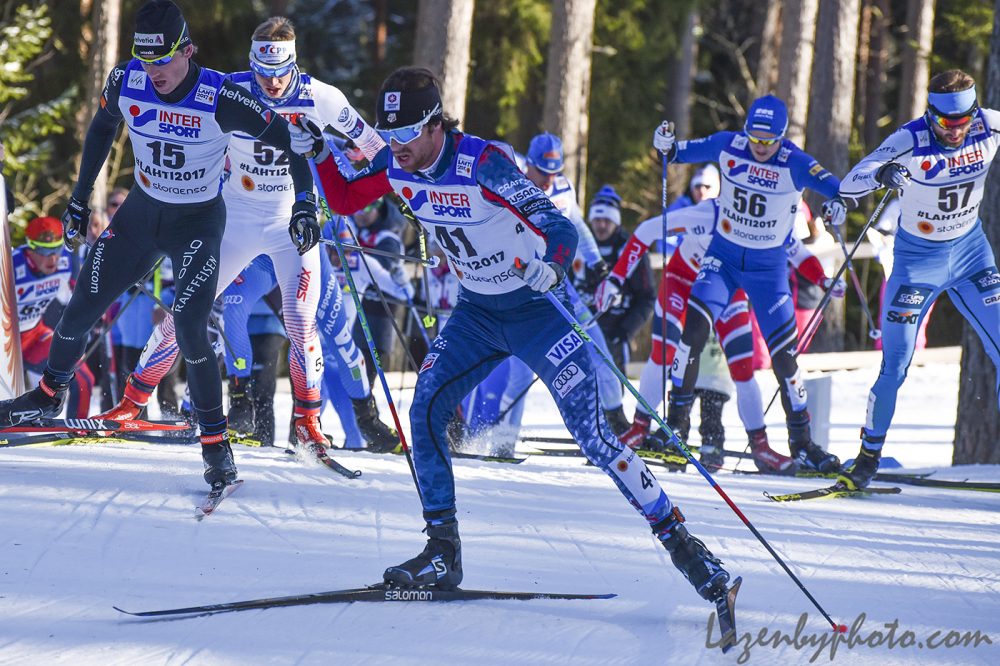
    Russia’s Alexey Chervotkin (21) leads Canada’s Alex Harvey (3) and Sweden’s Marcus Hellner (5) during the men’s 50 k freestyle mass start on Sunday at 2017 Nordic World Championships in Lahti, Finland. Harvey went on to win, Hellner placed 12th and Chervotkin 13th. (Photo: John Lazenby/Lazenbyphoto.com)

    “I saw the women’s race yesterday, and I figured if Marit Bjørgen could not distance herself from the other girls, then there is no way that the men will be able to do that,” Harvey said during Sunday’s post-race press conference. “I knew with the fast conditions, it was going to be a big group, and that leaves the potential for a lot of carnage, a lot of mayhem.”

    For the first 10 k, skiers from various nations took pulls up front, including Sundby and Ustiugov, and Norwegians Petter Northug, Hans Christer Holund, and Anders Gløersen. After testing the field and breaking away around 8 k into the race, Gløersen was still skiing alone up front, 20 seconds ahead of anyone else at 15 k.

    “Gløersen took off a bit and he was like, ‘What’s the gap? What’s the gap?’ ” Canadian World Cup coach Ivan Babikov said of Harvey. “He was always controlling the race and saving energy for the finish.”

    Eventually, the main pack surged to recover the lost time. Gløersen’s off-the-front-flier only earned him camera time. The catch came just before Lahti Corner returning to the stadium around 20 k in, where Russia’s Alexey Chervotkin took over. In another 2 k, Sundby, who had been stalking in the top 10, moved to the front as if the race were all of a sudden for real.

    Norway’s Anders Gløersen broke away early to lead the men’s 50 k freestyle mass start, skiing alone off the front for about 12 kilometers, on Sunday at the 2017 Nordic World Championships in Lahti, Finland. (Photo: John Lazenby/Lazenbyphoto.com)

    From then on, the size of the pack atrophied with each consecutive lap. At 30 k, the pack streaming through the stadium was 24 skiers long. At 45 k, the group winnowed to a train of 19. And within another 4 k, only 13 remained: Sundby, Ustiugov, Musgrave, Harvey, Heikkinen, Northug, Holund, Gløersen, Chervotkin, Sweden’s Marcus Hellner, Norway’s Sjur Røthe, Switzerland’s Dario Cologna, and France’s Maurice Manificat.

    “I wanted to be in the front, top three at least,” Harvey said, reflecting on his skiathlon tactics from last weekend, where he skied around fifth up until the final headwall and finished fifth, outside of the medals.

    “I knew that Sundby’s first chance to win gold was to break everybody,” Harvey continued. “I was expecting him to leave from kilometer 1 or 49.”

    Harvey guessed Sundby would be the only one who would try to break away. With that in mind he marked the Norwegian.

    “He knew it would be hard to break away [and that] it will be all about the finish,” Babikov said. “He was positioning himself perfectly up the last hill and just stayed on Sundby. That was his plan, ‘I’m just gonna stay on Sundby and if he changes skis, I’ll go change skis,’ but today conditions were perfect so he didn’t.”

    With ripping conditions and skis to match, Sundby never slowed nor switched skis. Neither did Harvey.

    “When he waited until the last lap, I knew exactly where he was going to do it: with a k and a half to go,” Harvey explained. “I was just lucky enough to have the legs to stick on him today and from then on it started playing more into my hands.”

    Canada’s Alex Harvey (5) charging to the line ahead of Russia’s Sergey Ustiugov (4), Norway’s Martin Johnsrud Sundby (1), Great Britain’s Andrew Musgrave (10) and Finland’s Matti Heikkinen (behind Harvey) in the men’s 50 k freestyle mass start on Sunday at the 2017 Nordic World Championships in Lahti, Finland. (Photo: John Lazenby/Lazenbyphoto.com)

    In the closing moments of nearly every race of these world champs, the fate of winners seem come down to luck, and often someone else’s bad luck. As the leaders came into the stadium, it was as if every observer were about to witness an upset due to a tumble or a tangle.

    Harvey was clean around the final turn and unscathed down the stretch.

    “I wanted to hit the [Lahti] corner in second, right behind Sundby or whoever was in the lead,” Harvey said. “I knew I needed to do that in the skiathlon, too, and I tried to go around Finn Hågen Krogh there, but he’s a clever sprinter too. He knew he wanted to be second there.

    “In the skiathlon it didn’t work, but today it did,” Harvey continued. “I was second the whole time and then out of that corner I did one push more than Sundby. I had really fast skis, but used the draft to slingshot and then hit the final corner in first and from there, I knew it was mine to lose more than anything else.”

    Canada’s Alex Harvey (5) celebrates his first individual World Championships gold after winning Sunday’s 50 k freestyle mass start in Lahti, Finland, ahead of Russia’s Sergey Ustiugov (4), Norway’s Martin Johnsrud Sundby (1), and Finland’s Matti Heikkinen (2), respectively. (Photo: John Lazenby/Lazenbyphoto.com)

    And so Harvey earned the crown: 50 k world champion in 1:46:28.9 hours.

    It’s his first championships gold since winning the classic team sprint with Devon Kershaw at 2011 world champs, and fifth medal in four World Championships. 

    “He turned around these world champs for all of us,” Babikov said of the Canadian team. “He was solid. We were with no medals so far, and winning 50 k, he’s the king now.

    “This is the legit distance and he took it today,” he added.

    “It’s a long championship,” said Louis Bouchard, Harvey’s personal coach and Canada’s World Cup co-coach. “He feels every day his energy’s still there, so he knows today, if he’s good tactically, then he can do it.”

    Asked how nerve-racking it was watching the final 5 k unfold, Bouchard responded, “I was pretty nervous, too much maybe. But that’s OK.”

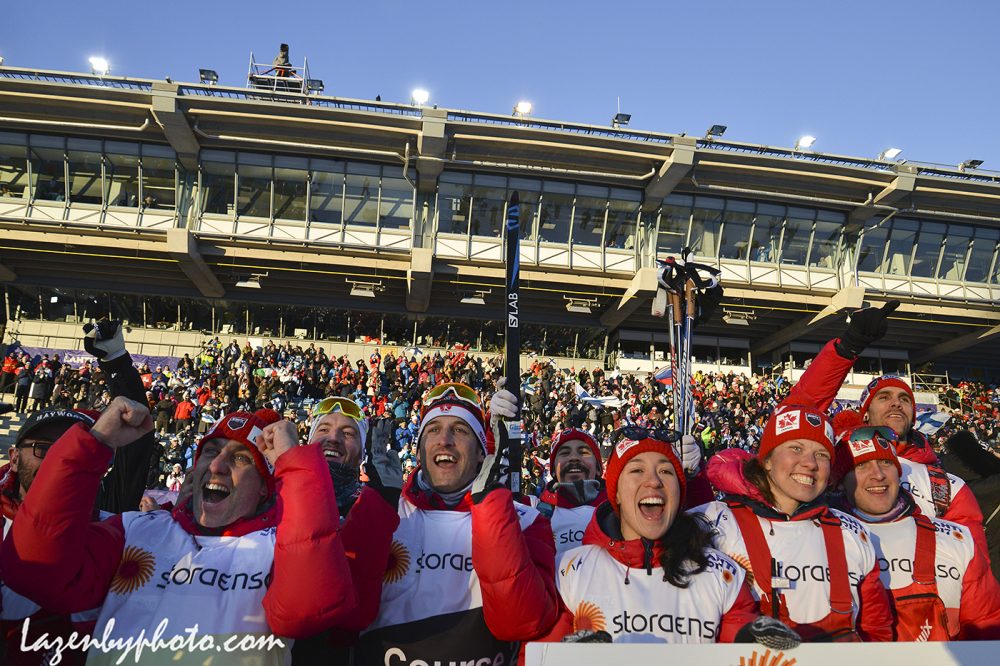
    Alex Harvey’s Canadian teammates, coaches and support team celebrate his win in the men’s 50 k freestyle mass start on Sunday at the 2017 Nordic World Championships in Lahti, Finland. (Photo: John Lazenby/Lazenbyphoto.com)

    For his fifth medal of these championships (and sixth world-champs medal of his career), the 24-year-old Ustiugov crossed second for his third silver of the week, just 0.6 seconds behind Harvey. Finland’s 33-year-old Heikkinen took third (+1.4) for his first medal since 2011 World Championships.

    “Today I skied within my own limits and at the end I was fresh enough to attack,” Heikkinen said in a press conference.

    Asked about his not-so-characteristic finishing kick on Sunday, Heikkinen said he remembered how he faded to 20th in the 50 k classic mass start at 2015 World Championships.

    “After Falun 2015 world champs, I was watching the race after and I was walking in front a mirror and I said, ‘I won’t ever again be like that after a 50 k,’ ” he said. “I’ve been training two years now at a high level [with my team] … and that’s why I’m top three in overall World Cup, so it was possible.”

    Behind him in a photo finish for fourth, Musgrave capitalized on Sundby slowing before the finish — probably after the Norwegian realized he had missed out on a medal — to place fourth (+2.9). For Musgrave, who turns 27 on Monday, it was his first World Championships top 10. For Sundby, who had been on a quest all week for his first individual championships goal — it was a bummer. The 2018 Winter Olympics in PyeongChang, South Korea, will be Sundby’s next opportunity.

    From a North American and perhaps international standpoint, American Tad Elliott skied the gutsiest of races. Halfway through the race, Elliott, a 28-year-old Colorado native and former U.S. Ski Team member, remained a not-too-far-off the back chaser, 27 seconds behind the lead group. His margin back slowly accrued over the remaining distance.

    “At 25 k, man, some guys were really struggling and they balled it up,” Elliott said afterward. “I should have sent it a little harder but that’s how it goes sometimes in that pack. I thought I could get there, but I just missed it.”

    Elliott, of Ski Club Vail, finished 27th (+3:16.8) for his best individual result in three World Championships. In recent years, Elliott has struggled with illness, which impacted his ability to train and peak. Those difficulties caused him to question whether or not his best years were behind him. Evidently not.

    American Tad Elliott (41) racing to 27th in the men’s 50 k freestyle mass start on Sunday at the 2017 Nordic World Championships in Lahti, Finland.. (Photo: John Lazenby/Lazenbyphoto.com)

    “I didn’t know if I wanted to come back [to skiing]. I was so sick. I was so bummed. I was like, ‘Am I ever going to get back? Am I ever going to get back to top-30 form?’ ” Elliott said. “We knew if everything went right, I would qualify for worlds … then to get top 30 here, man, I feel like I’m starting to get greedy. I’m starting to want more, I’m starting to want more opportunities. But I’m proud of this effort, I’m going to savor it a bit.”

    In the first few kilometers, Russia’s Petr Sedov skied too wide on a 180-degree corner and stalled out. American Kyle Bratrud, the next skier to round the turn, was unable to avoid the Russian and collided. Soon after, due to the impact, Bratrud was unable to complete the race.

    U.S. Ski Team member Noah Hoffman finished the day in 50th (+8:53.1).

    Devon Kershaw was Canada’s second skier on Sunday, crossing in 38th (+5:45.5). Also for Canada, Graeme Killick and Knute Johnsgaard finished in 43rd (+7:04.0) and 55th (+12:03.3), respectively.

    “[Alex’s performance] was incredible and such a big boost for our entire team,” Babikov said. “You should see all the techs, and Devon and Graeme and Knute, who didn’t really have a great race today, and they’re still so psyched for him.”

    Results

    — Gerry Furseth, Jake Ellis and Alex Kochon contributed
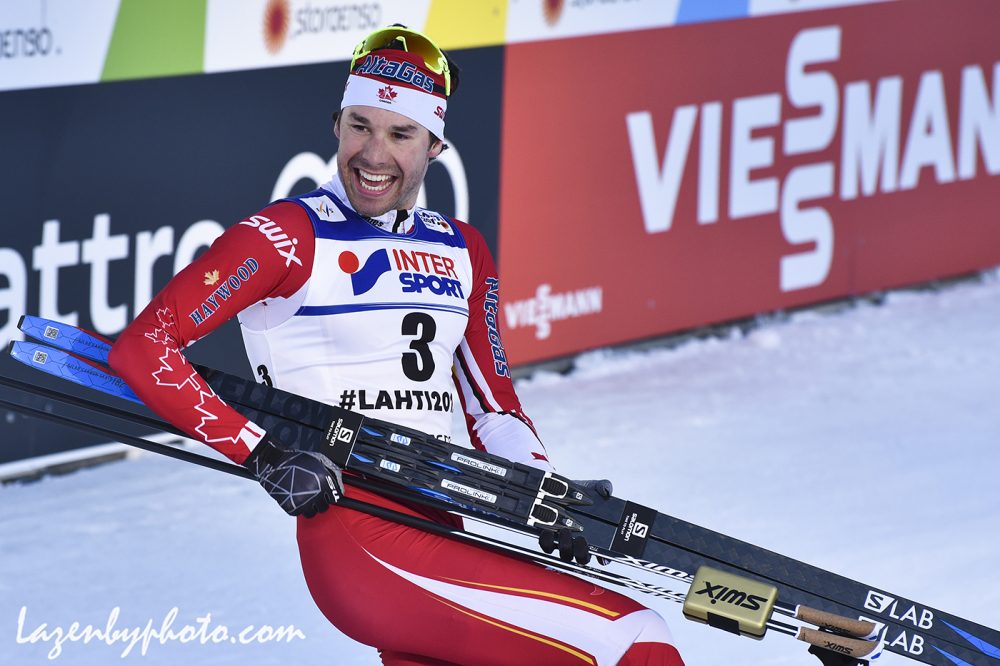
    Canadian air guitar: Alex Harvey performs his team’s signature move after winning the men’s 50 k freestyle mass start on Sunday at the 2017 Nordic World Championships in Lahti, Finland. (Photo: John Lazenby/Lazenbyphoto.com)
  • Sunday Rundown: Harvey Wins World Champs Gold in Lahti; PyeongChang + Vasaloppet (Updated)

    Sunday Rundown: Harvey Wins World Champs Gold in Lahti; PyeongChang + Vasaloppet (Updated)

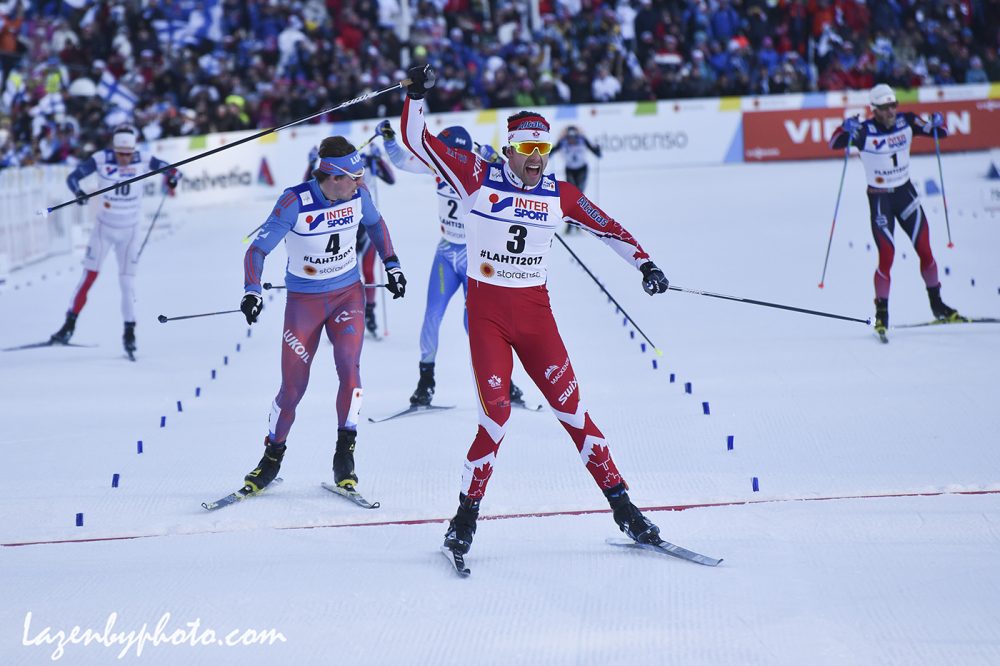
    Canada’s Alex Harvey (3) celebrates his win in the men’s 50 k freestyle mass start, his first individual gold medal at a World Championships, on Sunday at 2017 Nordic World Championships in Lahti, Finland. He beat Russia’s Sergey Ustiugov (l) by 0.6 seconds while Norway’s Sjur Røthe (9) can be seen coming in for sixth place, behind (not pictured) Finland’s Matti Heikkinen, Great Britain’s Andrew Musgrave and Norway’s Martin Johnsurd Sundby, respectively. (Photo: NBC Sports screenshot)

    FIS Nordic World Championships (Lahti, Finland): Men’s 50 k freestyle mass start

    After a week of missing out on the medals at 2017 Nordic World Championships, Canada’s Alex Harvey, a four-time World Championships medalist from 2011, 2013 and 2015, achieved his first individual gold medal in the final race of this year’s World Championships in Lahti, Finland.

    Harvey, 28, won the men’s 50-kilometer freestyle mass start in a drag race to the finish. Entering the final descent into the stadium with Norway’s Martin Johnsrud Sundby and Russia’s Sergey Ustiugov, Harvey rode his fast skis past both of them then had the most finishing kick in the final straightaway for a 0.6-second victory. He finished in 1:46.28.9 hours, while Ustiugov followed him across the line in second and Finland’s Matti Heikkinen from behind for third (+1.4), after passing Sundby around the outside of the last corner.

    Canada’s Alex Harvey (c) celebrates gold in the men’s 50 k freestyle mass start on Sunday at 2017 Nordic World Championships in Lahti, Finland, with Russia’s Sergey Ustiugov (l) and Finland’ Matti Heikkinen (r) joining him on the podium in second and third, respectively. (Photo: Cross Country Canada/Twitter)

    Sundby appeared to miss a pole plant soon after Heikkinen passed him and let off the pace a few meters before the finish. That’s where Great Britain’s Andrew Musgrave continued to accelerate and took fourth place, 2.9 seconds behind Harvey and 0.1 seconds ahead of Sundby in fifth. Norway’s Sjur Røthe followed another 0.4 seconds back in sixth, Switzerland’s Dario Cologna was seventh (+8.9), Norway’s Petter Northug eighth (+12.3), France’s Maurice Manificat ninth (+13.4), and Norway’s Hans Christer Holund 10th (+14.3).

    “I had really good skis,” Harvey said in a post-race interview with FIS. “I knew if I came into the corner in second place, that was the optimal position. So I was able to fight hard and hit that last corner in second and slingshot by Martin along the flat and then that was good after that.”

    “This is the best race of my life, for sure,” he added. “So I’m really happy.”

    Tad Elliott (Ski Club Vail) led the Americans in 27th (+3:16.8). Noah Hoffman (U.S. Ski Team) finished 50th (+8:53.1) and Kyle Bratrud (CXC Team) did not finish.

    Canada started four men, with Devon Kershaw finishing 38th (+5:45.5), Graeme Killick 43rd (+7:04), and Knute Johnsgaard in 55th (+12:03.3).

    For Harvey, the medal is his fifth at three World Championships and his first individual gold after winning the classic team sprint with Kershaw in 2011.

    Results

    ***

    IBU World Cup (PyeongChang, South Korea): Men’s and women’s relays

    Between the men’s and women’s relays on Sunday at the International Biathlon Union (IBU) World Cup in PyeongChang, South Korea, Canada had two teams in the top eighth, with its men’s team finishing seventh in the 4 x 7.5 k and women’s team eighth in the 4 x 6 k. Behind them, the U.S. men finished 10th and U.S. women 14th.

    France won the men’s relay by 33.8 seconds over Austria, using a total of 10 spare rounds but avoiding the penalty lap. Martin Fourcade anchored France to the win in 1:12:09.5 hours, after Jean-Guillaume Béatrix initially tagged them in first, his older brother Simon Fourcade raced them into second with near-perfect shooting (using just one spare to clean), and Simon Desthieux picked off one more place to give Fourcade a 16-second lead for the final leg.

    Austria achieved second place with Lorenz Wäger, Simon Eder, Julian Eberhard, and Dominik Landertinger combining for zero penalties and nine spares.

    Norway finished third (+45.4) with Vetle Sjåstad Christiansen, Ole Einar Bjørndalen, Vegard Gjermundshaug, and Henrik L’Abée-Lund. They had one penalty on Gjermundshaug’s third leg, and used a total of eight spares.

    Canada’s Christian Gow, Scott Gow, Nathan Smith, and Brendan Green finished seventh (+3:03.1) with zero penalties and nine spares. After Christian tagged his older brother Scott in ninth, Scott raced them into sixth place before Smith slipped four places to 10th at the final exchange. On the final leg, Green raced them into seventh, requiring two spares to clean.

    The Americans finished about nine seconds later in 10th (+3:12.8) with Lowell Bailey, Leif Nordgren, Paul Schommer, and Sean Doherty combining for zero penalties and nine spares, just like Canada. Bailey had originally put them in second at the first exchange, Nordgren dropped to seventh, then Schommer to 13th, before Doherty finally brought them back to 10th out of 24 teams.

    In the women’s relay, Germany pulled off a 22.8-second win over Norway, with one penalty and eight spares. Nadine Horchler put Germany in third at the first exchange, then Maren Hammerschmidt raced them into first by the race’s halfway point. From there, Denise Herrmann, a former cross-country World Cup regular, had to ski a penalty lap and tagged off in second, 13.5 seconds out of first. With teammate Laura Dahlmeier sitting out the relay, Franziska Hildebrand anchored Germany to the win in 1:07:35.6 after she used just one spare to clean.

    Norway placed second with Kaia Wøien Nicolaisen, Hilde Fenne, Tiril Eckhoff, and Marte Olsbu accumulating one penalty and 11 spares. Olsbu beat out the Czech Republic’s Gabriela Koukalová by one-tenth of a second at the finish, as the Czechs placed for third (+22.9), with Jessica Jislová, Eva Puskarčíková, Lucie Charvátová, and Koukalová (with a total of one penalty and nine spares).

    Canada took eighth (+1:34) with Rosanna Crawford, Julia Ransom, Megan Tandy, and Emma Lunder. Crawford tagged in second at the first exchange, Ransom slipped one place to third, Tandy lost another place to tag in fourth, and Lunder ultimately anchored them to eighth.

    The U.S., with Clare Egan, Susan Dunklee, Joanne Reid, and Maddie Phaneuf, finished 14th (+3:08.3) with one penalty and 10 spares. After Egan had a penalty on the first leg, Dunklee skied the fastest second leg to move the team from 19th to 14th, then Reid put them in 11th by the final exchange. Twenty-one teams competed in the women’s race.

    Results: Men | Women

    ***

    Ski Classics 90 k Vasaloppet (Sälen to Mora, Sweden)

    John Kristian Dahl (r) of Team United Bakeries outlunges Ski Classics sprint leader Andreas Nygaard (r) of Team Santander for the win in Sunday’s 90 k Vasaloppet in Mora, Sweden. (Photo: Visma Ski Classics)

    [UPDATED] In Sunday’s 93rd annual 90-kilometer Vasaloppet from Sälen to Mora, Sweden, the ninth event of the Ski Classics series, John Kristian Dahl (Team United Bakeries) outlasted Andreas Nygaard (Team Santander) by one-tenth of a second for the win in 3:57:18.1 hours. The race came down to a five-way fight for first, with Stian Hoelgaard (Team Leaseplan) finishing 0.6 seconds back in third. The top 15 men were all within 21.7 seconds of the podium, and Brian McKeever, a member of Canada’s Para Nordic Ski Team, placed 20th (+2:31.1).

    “It has been a fight all day,” Dahl said, according to a Ski Classics press release. Three days ago, he had been unsure about starting the Vasaloppet following a back injury. “I was tired already after 30 k and had to let go of the lead group, but I fought my way back taking it step by step and hill by hill.”

    In the women’s race, Britta Johansson Norgren (Lager 157 Ski Team) broke away from the field to win by 1:37.9 minutes in 4:19.43.4.

    Astrid Øyre Slind (Team United Bakeries) finished second, and Sara Lindborg (Team Serneke) placed third, 9 minutes and 4.2 seconds behind Norgren. Kateřina Smutná (Team Santander) dropped out of the race about halfway through.

    “I am very tired but also so happy to win today,” Norgren said, according to the press release. “It felt pretty easy until Oxberg [Sweden] with 30 k to go, but then it got really tough and I had to fight all the way to the finish.”

    It was Norgren’s first Vasaloppet win after placing second the last three years. She increased her lead in the overall Ski Classics to 215 points over Smutná, while Tord Asle Gjerdalen continues to lead the men’s overall standings ahead of his Santander teammate Nygaard, who is 349 points behind in second place. Gjerdalen did not race Sunday’s Vasaloppet.

    Results

  • Down to the Wire: Norwegian Men Win Lahti Relay with Russia Nipping at Their Heels

    Down to the Wire: Norwegian Men Win Lahti Relay with Russia Nipping at Their Heels

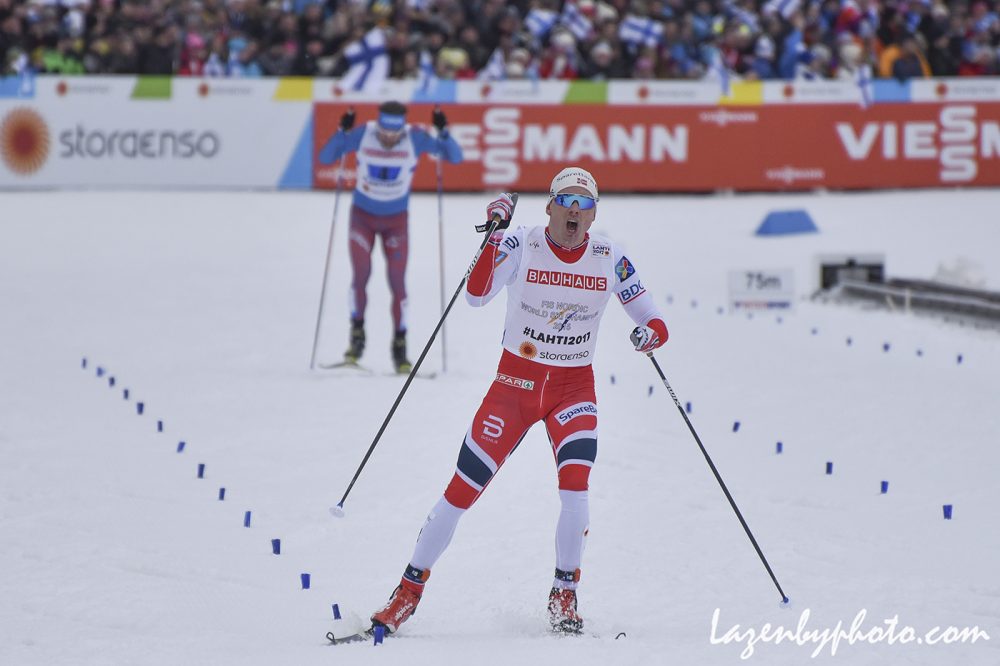
    Norway’s Finn Hågen Krogh with the victory stoke as he wins the 4 x 10 k relay at the 2017 Nordic World Championships in Lahti, Finland, by 4.6 seconds over Russia’s Sergey Ustiugov (behind). (Photo: John Lazenby/Lazenbyphoto.com)

    LAHTI, Finland — There were three medals up for grabs during Friday’s 4 x 10-kilometer relay at 2017 Nordic World Championships on Friday. Yet after the scramble leg, two distinct races: Norway and Russia’s dance for gold, and what eventually became a four-way tango between Finland, Sweden, Switzerland, and Germany for bronze and silver.

    Russia’s Andrey Larkov and Norway’s Didrik Tønseth first strung out and then smoked the field late in their leg. By the tag to their second-leg skiers, Norway and Russia were twenty seconds up.

    Russia’s Alexander Bessmertnykh leads Norway’s Niklas Dyrhaug as they sustain the break during the second leg of the 4 x 10 k relay at the 2017 Nordic World Championships in Lahti, Finland. (Photo: John Lazenby/Lazenbyphoto.com)

    That margin grew to thirty seconds, as Russia’s Alexander Bessmertnykh and Niklas Dyrhaug finished Leg 2 and the transition to skating began.

    Coming in just a half a minute later in third place, was Finland’s Iivo Niskanen, giving the fans a premature taste of the podium.

    Racing the third leg was Norwegian Martin Johnsrud Sundby. Russia tried to match the Norway’s trump card with Alexey Chervotkin. The 21-year-old Chervotkin skied the third leg for Russia in both team relays that took place this season: the first in Nove Mesto, Czech Republic, the other in La Clusaz, France, where the team placed second both times to Norway.

    However, the World Championship leg was the first time Chervotkin matched up against Sundby this year.

    Late in the leg, it was unclear what Sundby’s strategy would be as the young Russian shadowed the 32-year-old Sundby move for move. With Sergey Ustiugov up for the Russians in the anchor leg against Norway’s Finn Hågen Krogh, many armchair-relay strategists would have thought the Norwegian’s line up ploy was a dud.

    Not until 1.2 kilometers left in the leg did Sundby make a sufficient gap. At that point, the time spread from silver to gold was only eleven seconds. Not exactly a huge buffer for Krogh.

    Norway’s Martin Johnsrud Sundby, marked by Russia’s Alexey Chervotkin (4), during a critical third leg of the 4 x 10 k relay at the 2017 Nordic World Championships in Lahti, Finland. (Photo: John Lazenby/lazenbyphoto.com)

    By Sundby’s tag to the anchor skier, he had gifted Krogh a 17.7-second margin for error. The rhetorical question at the start of the fourth leg: when will Ustiugov catch Krogh?

    “He’s the worst the worst guy you can have in back of you,” Krogh said during a press conference, referring to Ustiugov. “He made the race tough for me.”

    At 1.3 k into that fourth leg, Ustiugov was 8.8 seconds back. In another 1.2 kilometers, it ballooned again to 11.6 seconds, and then it contracted again to 5 seconds with 3.8 k to go. But until the finishing stretch, when Krogh rounded the final turn with a 100-meter lead on the Russian, was Norway a sure win.

    Krogh crossed first in a time of 1:37:20.1 hours for the ninth-consecutive Norwegian championship 4 x 10 k relay gold. Finishing 4.6 seconds later in second place was Russia’s Ustiugov.

    “It’s not just for us, it’s the whole team,” Sundby said during a press conference of their ninth world-champs relay gold. “It’s for the waxers, it’s for the trainers. When you go the relay for the Norwegian team, you feel you’re going for your country. So it’s a massive victory for us.”

    What kept the capacity crowd engaged was not so much the battle for gold and silver, but the fate of the on-again, off-again Finns.

    Let’s back up to when Niskanen tagged off to Finnish skier Lari Lehtonen for the first freestyle leg. At that point, the Finns were in third, a solid 15 seconds ahead of France in fourth place, 32 seconds ahead of Switzerland in fifth, roughly 55 seconds ahead of Germany in sixth, and almost a minute ahead of Sweden in seventh.

    We are individual athletes, and you have to focus on your own leg,” Sweden’s Johan Olsson said after the race. “Both me and Daniel [Rickardsson] thought the medal chance was over when we had done two legs.”

    The first sign that something was awry for the Finns was a restless home crowd. What may have been perceived as a plush-time cushion for Lehtonen was in fact cardboard thin.

    Sweden’s Marcus Hellner (r) leads Germany’s Florian Notz (7), Switzerland’s Dario Cologna (behind Notz), and Finland’s Lari Lehtonen (8) during the men’s 4 x 10 k relay at the 2017 Nordic World Championships on Friday in Lahti, Finland. (Photo: John Lazenby/Lazenbyphoto.com)

    Sweden’s Marcus Hellner and Switzerland’s Dario Cologna were on the hunt. Seemingly an afterthought, Hellner skied the fastest third leg, animating the race for bronze by pulling Sweden back into contention.

    These four teams — Finland, Germany, Switzerland, and Sweden — stuck together through the exchange into the fourth leg until the last headwall climb, called Indian Hill.

    It was then that Finland’s Matti Heikkinen hop-stepped around Germany and Switzerland, bringing Sweden’s Calle Halfvarsson with him.

    “I know that Matti will go on the last uphill and it was good game for me to go after him,” Halfvarsson said during the press conference.

    The two appeared to have dropped Switzerland’s Curdin Perl, until Perl miraculously slotted behind the Finn-Swede duo. Finland entered the final 100-meter stretch in a sprint for bronze.

    One errant pole plant as Heikkinen ramped up his gear, causing him to fall to the ground was Finland’s loss and Sweden’s gain. Halfvarsson crossed third for Sweden (+2:31.8) and Perl fourth for Switzerland (+2:32), and Finland ultimately crossed fifth (+2:42.4).

    (Story continues below)

    Sweden’s Calle Halfvarsson (2) crossing the line in third place, ahead of Switzerland’s Curdin Perl (5) in fourth at the finish of the men’s 4 x 10 k relay at the 2017 Nordic World Championships in Lahti, Finland. Finland’s Matti Heikkinen (far left) is seen after righting himself due to a errant pole plant. (Photo: John Lazenby/Lazenbyphoto.com)

    The U.S. fielded a team comprised of Kyle Bratrud, Erik Bjornsen, Tad Elliott, and Simi Hamilton. Bratrud scrambled the first classic leg for the Americans, handing off to Bjornsen in 11th, 1:28.2 minutes behind the leader.

    “I was definitely more nervous for this one because I was starting,” Bratrud said afterward.

    While this is the second World Championships for Bratrud, a 24-year-old member of the Central Cross Country (CXC) Team, Friday was the first time he raced the scramble leg in a relay — he raced the third leg for the U.S. in the 2015 world champs 4 x 10 k relay in Falun, Sweden. Though he eventually lost contact with the front group, Bratrud was happy he was able to hold on for as long as he did, even if it caused him a yellow card for a technique violation.

    “It was nice to at least see the front before they really picked up the pace,” Bratrud said.

    “Props to Kyle on the yellow card,” Elliott wrote in an email. “Scrappy out there.”

    Tad Elliott racing the third leg of the U.S. men’s 4 x 10 k relay at the 2017 Nordic World Championships on Friday in Lahti, Finland. (Photo: John Lazenby/Lazenbyphoto.com)

    While Bratrud had company for approximately one lap, Bjornsen raced completely alone.

    “It’s not the position you necessarily want to be in, but took it for what it was worth and tried to charge up to the group in front of me, which was [the Czech Republic’s Lukas] Bauer and [Germany’s Jonas Dobler],” Bjornsen said.

    “But I mean…they were moving fast,” the 25-year-old U.S. Ski Team member added. “I tried to mentally just keep pushing, but it’s tough to be out there by yourself. I felt pretty good, it’s just a different type of race.”

    Bjornsen tagged to Elliott, for the Americans’ first freestyle leg. He skied the eighth-fastest third leg, 1:47 behind Hellner.

    “I was also getting great splits from the coaches on making ground on the group in front of me,” Elliott wrote.”I wanted to catch them, I just didn’t really get there for Simi to save it all for his sprint. Simi skied one hell of a leg.”

    Elliott handed off to Hamilton, the anchor leg for the U.S.

    “By the time he tagged off to me, I think I was 10 or 15 seconds from [the Czech Republic, Kazakhstan and Italian teams],” Hamilton recalled. “They fortunately started pretty conservatively, which was nice for me.”

    Those three teams were in fact 16 seconds ahead of Hamilton. He eventually closed that distance, putting the U.S. in contention for a top 10.

    “I wanted to start fast and see if I could make up some time on them,” Hamilton siad. “And I did, I ended up catching them by the top of the climb after the tunnel. So I was psyched about that.”

    However, when Hamilton came through for his fourth and final lap, the hill-laden course had taken a toll on his legs. He finished in 10th (+5:31.3), just half a second ahead of the Czech Republic’s Petr Knop in 11th (+5:31.8).

    Canada’s Alex Harvey racing the third leg of the men’s 4 x 10 k relay at the 2017 Nordic World Championships on Friday in Lahti, Finland. (Photo: John Lazenby/Lazenbyphoto.com)

    “That last lap my legs were definitely feeling it a little bit and those guys are all really good climbers,” Hamilton said. “I couldn’t quite make the moves that I wanted to in the last kilometer because I was a little whupped by then … but I was still able to pick off Czech Republic at the finish. Maybe not the best day for us, but still a day that we were fighting.”

    Canada’s team of Graeme Killick, Devon Kershaw, Alex Harvey and Lenny Valjas finished 12th, after being lapped and thus pulled from the race on Valjas’s final leg.

    In January of this year, Canada raced to a historic third place at the Ulricehamn World Cup relay in Sweden.

    “It just wasn’t our day,” said a dignified Valjas after Friday’s relay. “We’re all in shape, it’s just none of us were on our A-game today and that’s what it takes to be fighting in this.”

    Results

    — Harald Zimmer and Chelsea Little contributed
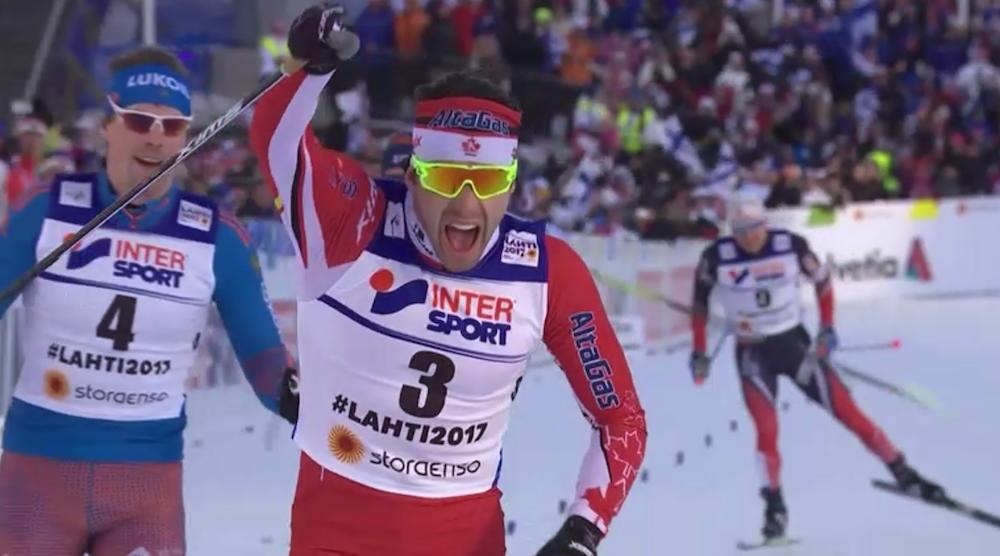
    Erik Bjornsen (U.S. Ski Team) racing the second leg of the men’s 4 x 10-kilometer relay at the 2017 Nordic World Championships on Friday in Lahti, Finland. (Photo: John Lazenby/Lazenbyphoto.com)
  • Friday Rundown: Bailey 2nd in PyeongChang; Lahti Relay & NoCo Team Sprint (Updated)

    Friday Rundown: Bailey 2nd in PyeongChang; Lahti Relay & NoCo Team Sprint (Updated)

    The men’s 10 k sprint podium at Friday’s IBU World Cup in PyeongChang, South Korea, with Austria’s Julian Eberhard (c) in first, American Lowell Bailey (l) in second, and France’s Martin Fourcade (r) in third. (Photo: IBU)

    IBU World Cup (PyeongChang, South Korea): Men’s 10 k sprint

    US Biathlon’s Lowell Bailey kept his clean-shooting streak alive with another one of his personal best results on Friday, racing to second in the men’s 10-kilometer sprint at the International Biathlon Union (IBU) World Cup in PyeongChang, South Korea.

    Bailey started 81st and hit all 10 targets in the two-stage race to cross the finish line in first, 4.7 seconds ahead of France’s Martin Fourcade, who locked up the 2016/2017 overall World Cup title with an eventual third-place finish on Friday.

    An even later starter in bib 90, Austria’s Julian Eberhard rocketed to his third-career World Cup victory (and second win this season), cleaning both stages and topping Bailey’s time by 40.7 seconds. That bumped Bailey to second place and Fourcade to third, for Bailey’s second World Cup podium this season (including his win in the 20 k individual at IBU World Championships).

    In the last five non-relay races, including four at World Championships, Bailey has not placed outside the top six. And in all of those races, he’s only had one miss.

    Bailey is up to ninth in the World Cup Total Score standings. Fourcade ran away with the season-long title in first, now that he’s 360 points ahead of Russia’s Anton Shipulin in second.

    While Eberhard and Bailey shot clean on Friday, Fourcade missed two — one on each stage (1+1) — but made up for it with the fastest course time. Eberhard had the second-fastest course time and fastest shooting time of the 102-man field.

    Austria nearly had two on the podium with Dominik Landertinger finishing fourth (+48.1), 2.7 seconds out of third, with clean shooting.

    Three Canadians finished in the top 60 to qualify for Saturday’s pursuit, with Scott Gow in 27th (+1:40.3) with two penalties (1+1), Brendan Green following in 28th (+1:42.1) with one miss (0+1) for his first individual top 30 of the season, and Christian Gow in 56th (+2.33.6) with two prone penalties (2+0). Nathan Smith finished 88th (+3:32.5) with two standing misses (0+2) in his first World Cup race since early December, and Macx Davies finished 98th (+4:20.2) with four penalties (3+1).

    For the U.S., Leif Nordgren placed 37th (+2:03.7) with two misses (1+1) to qualify for the pursuit, along with Bailey. Sean Doherty was 80th (+3:13.3) with two penalties (1+1) and Paul Schommer 101st (+4:38.1) with five misses (3+2).

    Results

    ***

    FIS Nordic World Championships (Lahti, Finland): Nordic Combined 2 x 7.5 k team sprint

    The nordic combined 2 x 7.5 k team sprint podium on Friday at 2017 Nordic World Championships in Lahti, Finland, with Germany’s Johannes Rydzek and Eric Frenzel in first (c), Norway’s Magnus Moan and Magnus Krog in second (l) and Japan’s Yoshito and Akito Watabe in third (r). (Photo: FIS Nordic Combined/Twitter)

    [UPDATED] Johannes Rydzek and Team Germany completed the World Championships sweep on Friday, with Rydzek teaming up with Eric Frenzel to win the final nordic-combined competition of 2017 Nordic World Championships in Lahti, Finland: the 2 x 7.5-kilometer team sprint.

    Rydzek won all four NoCo competitions over the past week, including two individual events and two team events.

    On Friday, he and Frenzel, the defending World Cup champion, jumped to second and started the 2 x 7.5 k cross-country race 16 seconds behind France’s Maxime Laheurte and François Braud, who jumped to first. The Frenchmen both posted jumps of 125 meters for a total of 264.2 points. Frenzel and Rydzek, meanwhile, scored 256.1 points after jumps of 125.5 and 122 meters.

    The Germans pulled off a 1-second win over Norway, finishing in 28:45.8 minutes, while Norway’s Magnus Moan and Magnus Krog claimed silver after starting the ski race in fourth, 24 seconds behind France. Together, the Norwegians posted the fastest course time, and Moan skied the fastest 7.5 k (13:53).

    “It’s still unbelievable,” Rydzek told German broadcaster ARD. “The race today was so suspenseful again, down to the last curve with the lapped athlete [Russia]. I knew that I am very fast on the homestretch, and had explicitly looked at that section before the race. Eric did a great job today, and despite all circumstances pointing against us we managed to do it again today. Just cool to be back on the top of the podium with Eric.”

    Just a couple hundred meters before the finish, Rydzek used the moment when they approached the lapped Russian athlete to slingshot between him and Krog and gained a decisive edge.

    “I was scared of that situation with the lapped athlete, because that was really close,” Frenzel told ARD. “I thought, ‘What is he doing out there?’ But in the end you can rely on Johannes to solve that like a world champion, that was top.

    “We knew ahead of time that Lahti suits us well, that we can be good here if the conditions work out,” he added. “So we are very happy to be able to go home with so many medals.”

    Japan took the final spot on the podium after brothers Yoshito and Akito Watabe jumped to third, started 18 seconds after France, and held their position to finish for third place, 10.2 seconds after Germany.

    Austria’s Wilhelm Denifl and Bernhard Gruber missed bronze by half a second in fourth (+10.7) after starting in fifth, and France ended up fifth (+11.5).

    Nearly a minute later, Italy placed sixth (+1:10.6) and Finland seventh (+1:10.7). The Czech Republic followed in eighth (+1:26.4), and the U.S. was ninth (+1:48.1) with Bryan and Taylor Fletcher after starting 12th and 2:08 out of first. The Fletcher brothers recorded the second-fastest course time out of 14 teams.

    “Taylor did a good job stepping up in competition and it gave me motivation to step up as well,” Bryan said, according to a U.S. Ski Team press release. “Unfortunately I wanted it a little too much and didn’t have the jump I am capable of.

    “The races went well but we were just too far back,” he continued. “We had the second fastest time as a team overall, which is solid and continually shows our strength on that side of the sport.”

    Final results | Jumping

    ***

    FIS Nordic World Championships (Lahti, Finland): Men’s 4 x 10 k relay

    The men’s 4 x 10 k relay podium at 2017 Nordic World Championships, with Norway (c) in first, Russia (l) in second, and Sweden (r) in third. (Photo: FIS Cross-Country/Twitter)

    The men’s 4 x 10-kilometer relay as the last team event of 2017 Nordic World Championships came down to a two-way battle for gold between none other than Norway and Russia on Friday in Lahti, Finland,

    The two teams skied in either first or second throughout the four-leg race, with Russia’s Andrey Larkov tagging Alexander Bessmertnykh 2.9 seconds ahead of Norway’s first leg Didrik Tønseth, then Bessmertnykh coming through the second exchange just half a second ahead of Norway’s Niklas Dyrhaug.

    Behind them, Finland skied alone in third place at the race’s halfway point, but was ultimately swallowed by the chase pack on the third leg.

    On that third leg, Norway’s Martin Johnsrud Sundby worked hard to drop Russia’s Alexey Chervotkin, and eventually did so, coming through the final exchange 17.7 seconds ahead. That gave Norway’s anchor Finn Hågen Krogh just enough of a gap on Russia’s Sergey Ustiugov, and he was able to hold off Ustiugov by 4.6 seconds at the finish to give Norway the gold in 1:37:20.1 hours.

    Russia claimed silver and Sweden outlasted Switzerland for bronze after Calle Halfvarsson attacked in the final kilometer to drop Finland’s Matti Heikkinen and Germany’s Lucas Bögl. Halfvarsson finished 2:31.8 minutes out of first, and just 0.2 seconds ahead of Switzerland’s Curdin Perl for third place for Sweden (which included teammates Daniel Rickardsson, Johan Olsson and Marcus Hellner).

    Switzerland was fourth (+2:32) with Jason Rueesch, Jonas Baumann, Dario Cologna and Perl, Finland fifth (+2:42.4) with Sami Jauhojärvi, Niskanen, Lari Lehtonen, and Heikkinen, and Germany sixth (+2:42.8) with Thomas Bing, Jonas Dobler, Florian Notz, and Bögl.

    France finished seventh (+3:52), Italy eighth (+5:29.8), Kazakhstan ninth (+5:30.6), and the U.S. 10th (+5:31.3). The U.S. team (Kyle Bratrud, Erik Bjornsen, Tad Elliott, Simi Hamilton) skied in 11th for most of the race before Hamilton moved them up to 10th with the sixth-fastest anchor leg.

    Canada (Graeme Killick, Devon Kershaw, Alex Harvey, Len Valjas) ended up 12th after being lapped on the last leg. In 14th at the first exchange, Kershaw moved them up to 13th, then Harvey put them in 12th with one leg to go.

    Results

  • Amidst Finnatics, Niskanen Strides to 15 k Gold; Bjornsen Notches 18th at World Champs

    Amidst Finnatics, Niskanen Strides to 15 k Gold; Bjornsen Notches 18th at World Champs

    Amidst a sea of Finnish flags, Finland’s Iivo Niskanen turns the final corner on his way to gold in the men’s 15 k classic individual start on Wednesday at 2017 Nordic World Championships in Lahti, Finland. (Photo: John Lazenby/Lazenbyphoto.com)

    LAHTI, Finland — Through the first seven medal races of 2017 Nordic World Championships, the hometown Finns came close. There was Krista Parmakoski’s skiathlon silver. There was the spectacular Finn non-win when Finland’s Iivo Niskanen and Norway’s Emil Iversen tumbled 200 meters from the line during Sunday’s classic team sprint. At the moment of the tangle, Niskanen was primed to pass Iversen for what appeared to be a golden performance.

    Instead of a cheer concluding the sprint, a collective exhale deflated the crowd: Niskanen and teammate Sami Jauhojärvi ultimately settled for bronze. While it wasn’t the result they had hoped for, it remained the 25-year-old Niskanen’s first World Championships medal.

    Another race on Wednesday brought another Finnish opportunity. On a 34-degree Fahrenheit day with moist tracks and low-hanging clouds, gold was up for grabs.

    During the men’s 15-kilometer classic individual start, Niskanen channeled whatever bitter taste remained from his team sprint near-win into a controlled and sufficient pace. After 1.5 k, Niskanen ranked fourth — from then on, he was the fastest through every remaining timing point, and first when it mattered most. Niskanen won in 36:44 minutes.

    Norway’s Martin Johnsrud Sundby finished 17.9 seconds off his time for silver. Sundby’s teammate Niklas Dyrhaug clocked in 31.3 seconds back for bronze, his first-career individual championships medal.

    The men’s 15 k classic podium at 2017 Nordic World Ski Championships in Lahti, Finland: (from left to right) Norway’s Martin Johnsrud Sundby (l) in second, Finland’s Iivo Niskanen (c) in first, and Norwegian Niklas Dyrhaug (r) in third. (Photo: John Lazenby/Lazenbyphoto.com)

    “It’s for sure a really good team, Norway, and it’s a hard fight in all the places for every distances,” Dyrhaug said at the post-race press conference about making Norway’s 12-man World Championships team. “I have been a reserve for the skiathlon and the team sprint. I have been here since Otepää — ten days now. I have been ready so when I got the chance in the 15 k, yeah, I am happy to show everybody that I am in really good shape and I have something in world champs to do.”

    The 15 k classic appears an odds maker’s nightmare. It remains a fickle distance and technique with a million and one variables. There’s the course profile, the athlete’s classic technique to consider — do they thrive on headwalls or stridable terrain, double poling? The wax. The snow type. The venue’s altitude. Then there’s the pacing — go out hard? Look for negative splits? Ski it like a true distance race, not an elongated sprint?

    A single 15 k classic win at a championship or World Cup level evidently doesn’t mean more will come your way. Of the 133 starters on Wednesday, Finland’s Matti Heikkinen remains the only athlete who had won a 15 k classic at a World Championships or Olympics (at 2011 World Championships in Oslo, Norway, he won the gold in this event). Not since the ’54 and ’58 championships has an athlete won two world titles in this event.

    Finland’s Iivo Niskanen (r) celebrates his 15 k classic win with loved ones at 2017 Nordic World Championships in Lahti, Finland. (Photo: John Lazenby/Lazenbyphoto.com)

    Niskanen and the 15 k classic are sympatico and eventually he may buck the consecutive-winner’s curse. Niskanen has three career World Cup podiums: all in the 15 k classic. There’s two wins — both in Kuusamo, Finland, and a second place at the last pre-championship World Cup race last month in Otepää, Estonia.

    That doesn’t mean the Finn isn’t flawless.

    “Many times, in many races I have started too hard for the first two kilometers,” Niskanen said after the race.

    His too-early, hot-pacing issues were remedied Wednesday as he left nothing to chance. Niskanen suggested he’d had a Lahti champs dress rehearsal to test his pacing strategy.

    “It was good to race here before on the Scandinavian Cup and learn the track, today I’m ready,” Niskanen said.

    Back on Jan. 8, Lahti hosted a Scandinavian Cup 15 k classic. Like today, Niskanen won over another Norwegian, Johannes Høsflot Klæbo (+5.8).

    “Today I planned to do a half kilometer and push hard,” Niskanen said on Wednesday. “After a kilometer and a half, I was quite fresh and got quite easily a gap and pushed as hard as I can. Everyone is cheering you and so then you don’t actually feel the lactate as normal. I had a difficult last kilometers, but it was one and a half to go I just thinking about myself, ‘Now we are not going to lose 20 seconds anymore.’ ”

    That losing 20-seconds remark referred to his Scando Cup race. During that 15 k, he was 17 seconds up on Klæbo with 3 k remaining. He actually lost 12 seconds to Klæbo on that final sector, not 20, but Niskanen recognized the trend — slowing down in the final push.

    Finland’s Iivo Niskanen powers down the finishing stretch en route to gold in the men’s 15 k classic at 2017 Nordic World Championships in Lahti, Finland. (Photo: John Lazenby/lazenbyphoto.com)

    Although young, Niskanen has struggled with repeated sickness and overtraining. Promoted as a potential World Cup overall contender, Niskanen’s three 15 k classic victories remain the sole podiums highlighting his World Cup resume.

    “It has been many hard years and I said when I wake up, ‘I feel healthy today and I have hope’,” Niskanen said. “I have gotten easily sick for many years and over training, maybe I have been training too much and too hard during the last years. But this year I have trained more than ever, but I have not raced in every weekend.”

    The higher-volume, limited-racing recipe worked. This season, the Finn tailored his race schedule — not too much, not too little. To date, he’s raced 11 World Cup races.

    “The goal was to win here in Lahti and be in the best shape here and we see it with my gold,” Niskanen said.

    Norway’s Sundby remains a World Cup benchmark— he’s a mutiple overall Crystal Globe winner and leads this year’s standings. But for the reigning overall World Cup winner, an individual championship gold (at world champs or the Olympics) still eludes him.

    “I think my race was really good, I felt so fast out there,” Sundby said after the race. “And then I was 20 seconds behind, I don’t believe it. It was tough for the mind to motivate myself for fighting today, but I did what I thought was one of my best race ever at this distance.”

    Norway’s Martin Johnsrud Sundby on his way to second place in the 15 k classic at the 2017 Nordic World Championships on Wednesday in Lahti, Finland. (Photo: John Lazenby/lazenbyphoto.com)

    Asked if he felt demoralized knowing he was 20 seconds down grinding away on Lahti’s wooded tracks, Sundby explained how he attempted to remain in the hunt.

    “It is not so difficult in the World Champs … [Niskanen] did the race here in the Scan Cup a few months ago, where he for sure lost a lot of seconds in the last 3.75,” Sundby added. “And I tried to motivate myself. I said, ‘He will meet the wall, he will meet the wall, you just have to push.’ I felt good, I felt good all the way and tried to gain seconds but it was nearly impossible today.

    “It is an amazing performance Iivo showed us today, everybody,” Sundby said of his Finnish protagonist. “You have to appreciate a really good sportsman. Also with some things that happened before here in the world champs, maybe in the team sprint, and it’s called karma. Today he showed everybody.”

    Best World Champs Finishes for Bjornsen in 18th, Bratrud in 33rd

    While Niskanen took the overall victory on Wednesday, American Erik Bjornsen walked away with a win of his own. Two days earlier, the 25-year-old Washington native had raced to a historic fifth place in the classic team sprint with his U.S. Ski Team (USST) teammate Simi Hamilton for the best team-sprint result for the U.S. men’s program. Before that, the team’s best was seventh place in 2015.

    U.S. Ski Team member Erik Bjornsen (26) skiing ahead of Norway’s Niklas Dyrhaug (66) during the men’s 15-kilometer individual start at the 2017 Nordic World Championships on Wednesday in Lahti, Finland. Bjornsen went on to place 18th, while Dyrhaug captured third place for bronze. (Photo: John Lazenby/lazenbyphotography.com)

    Bjornsen had raced the anchor leg for the U.S., challenged by names like Norway’s Johannes Høsflot Klæbo, Russia’s Sergey Ustiugov and Wednesday’s eventual 15 k winner, Niskanen.

    Despite some of the heavy hitting names that challenged Bjornsen on Sunday, he found himself in the mix (two of his laps were the fifth fastest and one the fourth fastest of all second-leg skiers).

    “In the team sprint the other day, you saw some of the best skiers, I mean, I was skiing with Iivo Niskanen, who has a good shot at winning today, and I felt pretty comfortable skiing with some of those guys,” Bjornsen after Wednesday’s race. An early starter in bib 26, he initially finished third before being bumped 15 places to 18th (+1:56.7).

    “I definitely went into the [15 k] race with quite a bit of excitement from the team sprint,” he said.

    Bjornsen added that the energy he was able to find during the team sprint is something he sees as working it’s way into his longer-distance efforts.

    His performance in the 15 k appears to prove that, as he finished in the top 20 for his best individual World Championships result. The finish also ties his best individual World Cup result — he placed 18th three years ago in a 15 k in Toblach, Italy. The finish was also the best championships result of an American in the men’s 15 k classic since Kris Freeman placed fourth at Liberec world champs eight years ago. 

    Bjornsen explained that a slight bonk toward the end of his first lap caused him to put on the brakes briefly, though he found he was ultimately able to pick his pace back up before finishing.

    “I went for it in the beginning, for sure, and I think I had a pace for the first lap that would have been pretty similar to some guys in the top ten,” Bjornsen said. “Then I kind of hit a little bit of a wall there, a little bit through the first lap, and struggled for a couple of kilometers … then I was able to pick up a little bit of steam before the finish.”

    American Kyle Bratrud (CXC Team) racing to a career-best 33rd in the men’s 15 k classic at 2017 Nordic World Championships in Lahti, Finland. (Photo: John Lazenby/lazenbyphoto.com)

    “I mean hopefully I can just continue to improve and be able to keep that pace up the whole way and then I think it can come together for me,” he added.

    The second American to finish on Wednesday was Kyle Bratrud in 33rd (+3:11.5). Bratrud’s result was 20.7 seconds out of the top 30 and marks his best individual result at his second World Championships and career best at the World Cup level.

    Seeing himself as a stronger skater, Bratrud, 24, of the CXC Team, entered Wednesday wanting to test his ability to push his classic-technique limits.

    “I think I’m a little more confident in skate skiing, so classic I figured I had nothing to lose,” Bratrud said after. “I basically just went as hard as I could from the gun … to see if I could hang on.”

    While the decision resulted in Bratrud having to ease up during some of the climbs, he indicated that managed to recover well enough on the descents to regain control.

    “The course is pretty rolly and I was dying a lot on the uphills,” he said. “On the downhills I was getting some recovery and and all of a sudden I’d feel good again, but I’d get to the next hill and I’d be totally dead.

    “It was kind of a roller coaster of energy, but I just tried to keep my legs moving as fast as I could,” he added.

    With Wednesday also being his mother’s birthday (both his parents made the trek to Lahti to watch him race), Bratrud was thankful for the opportunity to race before throngs of fans, even if the names most were yelling didn’t belong to him.  

    “This is pretty awesome to not even be able to hear yourself breathing because it’s so loud,” Bratrud said “I love when people are cheering, even if it’s not for me.”

    Two other Americans competed on Wednesday, with Andy Newell (U.S. Ski Team) finishing 50th (+4:21.7) and Ben Lustgarten (Craftsbury Green Racing Project) 55th (+4:56.9).

    With his USST teammate Noah Hoffman out due to sickness, Newell explained that he was then slotted to race Wednesday’s classic event.

    “It was fun to get a 15 k in at the championships like this, it’s unfortunate that Hoff wasn’t feeling good so I had to come in and take his spot,” Newell said after.

    Adding that much of his goals are geared towards races scheduled to take place next season –particularly the 2018 Olympics in PyeongChang, South Korea — Newell is not too concerned with numerical results.

    “I felt OK in a few places, but definitely lost too much time out there. I’m just kind of going after a feeling. It wasn’t a great day, but I didn’t feel awful, either,” Newell said. “I’m hoping to build on this year and kind of use this year as a platform to be at my best by the Olympics. I’m not worried too much about results, just trying to feel good when I can.”

    Lustgarten indicated that he had been dealing with a bout of food illness prior to Wednesday. Unable to eat much in the days leading up to the race, the 24 year old had difficulty tapping into his normal race speed.

    “I was just blown. I tried to ski really smooth and then on the the steep stuff, I tried to ski really light and I tried not to throw up,” Lustgarten said. “I’m probably at 70 percent right now and I’m just trying to ski as well as I can here. … It’s a great experience and it was cool to hear the crowd going, I just wish I could ski like I was a month ago.”

    Canada’s Jess Cockney racing to 65th in Wednesday’s 15 k classic at 2017 Nordic World Championships in Lahti, Finland. (Photo: John Lazenby/lazenbyphoto.com)

    Canada was led by Devon Kershaw in 35th (+3:24.8). The next Canadian to finish was Knute Johnsgaard in 56th (+5:00.7), followed by Jess Cockney in 65th (+6:20.7).

    “I don’t think I pushed as hard as I should have. … Mentally, maybe I wasn’t totally zoned in, but I was happy to do a distance race in front of a big fan base like this in Finland for the hometown favorites, so that was good,” Cockney said.

    This being Johnsgaard’s first world champs experience, the 24 year old was happy with how he race his third individual event of the week.

    “I just went out at a pace I thought I could sustain for 15 k and kept that pace pretty steady I think and was able to push hard and kind of sprint up the last hill,” Johnsgaard said. “I felt like I paced it as well as I could, so I’m pretty satisfied with my race.”

    Results

    — Gerry Furseth and Harald Zimmer contributed
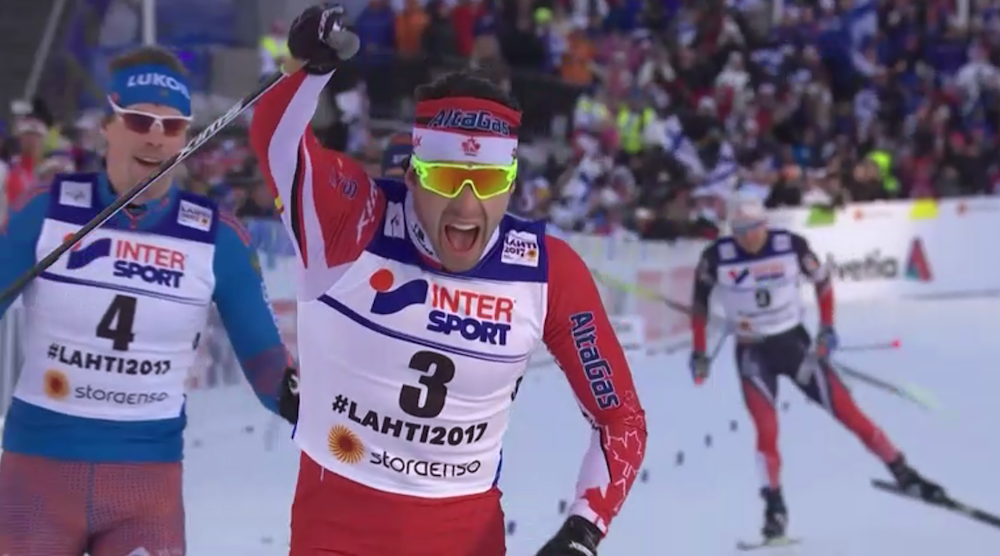
    Finnish fans celebrate Iivo Niskanen’s gold medal in the men’s 15 k classic at 2017 Nordic World Championships in Lahti, Finland. (Photo: John Lazenby/Lazenbyphoto.com)
  • Wednesday Rundown: Lahti 15 k Classic & NoCo

    Wednesday Rundown: Lahti 15 k Classic & NoCo

    Finland’s Iivo Niskanen (c) celebrates his World Championship title as Norwegians Martin Johnsrud Sundby (l) and Niklas Dryhaug hoist him up on Wednesday after the men’s 15-kilometer classic race at the 2017 Nordic World Ski Championships in Lahti, Finland. (Photo FIS Cross-Country/Twitter)

    FIS Nordic World Championships (Lahti, Finland): Men’s 15 k classic

    After narrowly missing the victory in Sunday’s classic team sprint, Finland’s Iivo Niskanen got his gold, winning Wednesday’s men’s 15-kilometer individual classic start race at the 2017 Nordic World Ski Championships on Wednesday in Lahti, Finland. Niskanen covered the course in a time of  36:44.0, besting Norway’s Martin Johnsrud Sundby by 17.9 seconds.

    Starting in bib 64, Niskanen didn’t take long to ski in the top spot, posting the fastest time from the 4.7 k mark until he finished. He held off Sundby, as well as Norwegian Niklas Dyrhaug, who started a minute behind Niskanen in bib 66 and ultimately finished in third (+31.3).

    Missing the podium by 10.5 seconds was Russia’s Alexander Bessmertnykh in fourth, 41.8 seconds behind Niskanen’s winning time. Placing fifth (+53.2) was Didrik Tønseth of Norway. Russia’s Andrey Larkov took sixth (+53.2), while kazakhstan’s Alexey Poltoranin placed seventh (+1:06.3). The second Finn to finish in the top ten was Sami Jauhojaervi in eighth (+1:09.7). Ninth (+1:10.6) went to the former 2015 World Champion, Johan Olsson of Sweden, and his Swedish teammate, Calle Halfvarsson rounded out the top ten in tenth (+1:15.0).

    Erik Bjornsen led the U.S. men, placing 18th (+1:56.7) after starting in bib 26. The second American to finish was Kyle Bratrud in 33rd (+3:11.5) followed by Andy Newell in 50th (+4:21.7) and Ben Lustgarten in 55th (+4:56.9).

    Devon Kershaw led the Canadians, placing 35th (+3:24.8). Knute Johnsgaard was the next Canadian, finishing 56th (+5:00.7), followed by Jesse Cockney in 65th (+6:20.7).

    The women’s 4 x 5 k relay takes place Thursday. The U.S. is slated to start (in no particular order): Jessie Diggins, Kikkan Randall, Liz Stephen, and Sadie Bjornsen.

    Results

    ***

    FIS Nordic World Championships (Lahti, Finland): Nordic Combined large hill/10 k

    Bryan Fletcher (U.S. Nordic Combined) jumping to 31st on the large hill in Lahti, Finland. He later finished the day in 31st in the 10 k Gundersen to lead his team. (Photo: John Lazenby/Lazenbyphoto.com)

    Germany’s Johannes Rydzek racked up win #3 in as many nordic-combined competitions at the 2017 Nordic World Championships in Lahti, Finland, winning the individual large hill/10-kilometer Gundersen start on Wednesday.

    The last individual competition of the championships began with Austria’s Mario Seidl jumping the farthest at 132.0 meters and earning 137.3 points. His Austrian teammate, Wilhelm Denifl finished second in the jumping portion, earning 125.7 points. Japan’s Akito Watabe was third for the jumping, with 123.8 points. 

    Competitors returned later in the day for the 10 k cross-country portion, with Rydzek racing to first after starting a minute back in fifth. Rydzek won the 10 k event in a time of 26:41.6. Just 4.8 seconds later, Watabe captured silver after starting 54 seconds back. The bronze medal went to France’s François Braud, who also started 54 seconds back and finished 13 seconds off Rydzek’s time.

    Four U.S. Nordic Combined Team skiers contested the event. Bryan Fletcher led the Americans finishing 31st (+3:58.3), after jumping to 31st and starting 2:39 back. His brother, Taylor Fletcher was the second American to finish the cross-country portion, racing to 36th (+4:55.6) after jumping to 51st and starting 4:26 back. 

    Ben Berend (U.S. Nordic Combined) jumping to 21st to lead the U.S. on the large-hill jumping portion of Wednesday’s competition at 2017 Nordic World Championships in Lahti, Finland. (Photo: John Lazenby/Lazenbyphoto.com)

    Ben Berend jumped the farthest for the Americans in 21st, and raced to 40th (+5:08.6) after starting 1:55 back.

    The 21-year-old explained during an interview with FasterSkier that he sees his recent success in jumping as a result of not overthinking his efforts on the hill.

    “Basically, Ive just turned my mind off,” Berend said. “I didnt take training yesterday, Ive just been kind of not jumping as much as I usually do, and like when Im at home Im not thinking about ski jumping, I just kind of go up and do it and its working right now, and so Im not going to change any of that. Im just having fun, its been a blast.”

    Adam Loomis finished the day in 44th (+5:47.9) after jumping to 45th and starting 3:29 back.

    Canada’s Nathaniel Mah jumped to 52nd and finished the day in 52nd.

    The U.S. Nordic Combined’s Bryan Fletcher (31) chasing Italy’s Alessandro Pittin on Wednesday in the individual large hill/10 k at the 2017 Nordic World Championships in Lahti, Finland. Fletcher finished 31st and Pittin placed 20th. (Photo: John Lazenby/Lazenbyphoto.com)

    Results: Jumping | Final results

  • Sundby Stumbles, Ustiugov Surges to Win Lahti Skiathlon; Harvey 5th

    Sundby Stumbles, Ustiugov Surges to Win Lahti Skiathlon; Harvey 5th

    Russia’s Sergey Ustiugov (4) leads three Norwegians, including Didrik Tønseth, and the rest of the field during the men’s 30 k skiathlon at 2017 Nordic World Championships on Saturday in Lahti, Finland. (Photo: John Lazenby/Lazenbyphoto.com)

    LAHTI, Finland — A collective gasp fell through the stands. Flags bearing Norway’s iconic red, blue and white symbol, previously waving, went limp. With half a kilometer left in the men’s 30 k skiathlon at the 2017 Nordic World Championships in Lahti, Norway’s race favorite Martin Johnsrud Sundby had fallen.

    A half a second earlier on Saturday, the Norwegian’s shot at the win was still within sight. He and Russia’s Sergey Ustiugov had broken away from the front pack around the 20 k mark, put close to 10 seconds on the rest of the field with the next k, and almost quadruped that by the bottom of the final climb.

    Norway’s Martin Johnsrud Sundby (1) leading his teammates Sjur Røthe (7) and Didrik Tønseth and Canada’s Alex Harvey, among others, including Russia’s Sergey Ustiugov (4), during the men’s 30 k skiathlon at the 2017 Nordic World Championships in Lahti, Finland. (Photo: John Lazenby/Lazenbyphoto.com)

    Heading into the hill, there was only one man to worry about — a scene fairly familiar for the Norwegian. In last season’s 30 k skiathlon in Lahti, it was during the same final ascent that Sundby pulled away from his teammate Finn Hågen Krogh to take the win.  

    Like last year, the Norwegian upped his tempo as he began the final climb. His high turnover surpassed Ustiugov’s, and Sundby glimpsed at gold. But as just as he secured a slight lead over the Russian, Sundby’s pole slipped, sending him off balance and in a forward fall to the ground.

    As Sundby stood up, his right pole was broken. While it didn’t take long for a new one to reach him, by the time he had grasped the fresh pole grip, the Russian skier was long gone.

    “You have to remember I was skiing side-by-side with the fastest guy in the world, so if I would have one chance, I had to try and make a move,” Sundby said during the post-race press conference. “If there was a possibility to gain a few meters, I had to go for it…Unfortunately it did not work and I made a mistake.”

    With no Norwegian to contest his name, Ustiugov descended the final downhill, cornered the final stretch and crossed the finish line first in 1:09:16.7 hours for his first World Championships gold (he took silver in Thursday’s sprint, behind Italy’s Federico Pellegrino). Finishing 6.7 seconds later in second place was Sundby.

    Left to right: Norway’s Martin Johnsrud Sundby, Russia’s Sergey Ustiugov, and Norwegian Finn Hågen Krogh on the men’s 30 k skiathlon podium at the 2017 Nordic World Championships in Lahti, Finland. (Photo: John Lazenby/Lazenbyphoto.com)

    “It is a great achievement for me,” Ustiugov said the press conference through a translator. “I was disappointed after the sprint so to win the gold medal is amazing. It is not only my success. The whole team did a great job.”

    Crossing third for the men was Krogh, 31.8 seconds after Ustiugov. The bronze medal is Krogh’s first in an individual World Championships race. Although Krogh indicated he tried to go with Ustiugov and Sundby when they made their break from the pack, he admitted the two were in a league of their own in terms of the front pace.

    “The second lap of skating, I saw these guys make a gap,” Krogh said of Ustiugov and Sundby during a press conference. “I tried to push hard to hold it, but after a couple of kilometers I realized it was going to be too hard to catch them, and then I tried to save a little energy to secure the bronze.”

    Harvey Top North American in 5th

    The first man out of the exchange for the 30 k skiathlon on Saturday was not from Norway, nor Russia, or even Sweden. It was Canada.

    After racing within a front group of nearly 25 skiers for the first 15 k, Canada’s Alex Harvey led the mass during their final classic leg stadium descent and into the ski exchange. And as racers headed back out on course for the freestyle portion, it was once again the red maple leaf in the lead.

    Canada’s Alex Harvey racing to fifth in the men’s 30 k skiathlon at the 2017 Nordic World Championships in Lahti, Finland. (Photo: John Lazenby/Lazenbyphoto.com)

    While Harvey intended to position himself up front early in the skate leg, he also pointed out that he had the skis to do so, even after one broke in a fall.

    “I had really, really fast skis, both in classic and skate,” Harvey said. “Broke my classic ski during the last lap. Ustiugov cut me off and I crashed on the climb and broke my ski, but they were still running really well and I was still able to come to the exchange in the lead.”

    For most of the classic portion of the race, Harvey had raced within the top 10, at times the top three, following Sundby and Ustiugov, along with Norwegians Krogh, Sjur Røthe and Didrik Tønseth, as well as Finland’s Matti Heikkinen, Great Britain’s Andrew Musgrave and Sweden’s Calle Halfvarsson. 

    The large front group remained intact through the exchange, with Harvey in front. Within a few kilometers, however, Sundby and Ustiugov tookover the reins, and Harvey soon got caught behind Heikkinen. By the 20 k mark, Harvey could see his fight for the podium would be for bronze.

    “On the second lap of skating I was following Heikkinen and I kind of was in a good position in fourth there able to react,” Harvey said, referring to any moves made by Ustiugov or Sundby. “But [Heikkinen] just completely blew up. That’s the moment I’d like to relive in the race because I feel like I had the legs to go with the first two. But once they had a gap, it’s so windy out there, it’s really hard to come back.”

    The battle for third ensued, with Harvey holding on tight to any moves made by Krogh, Røthe or Tønseth. Coming into the final downhill turn, the Canadian was fourth and Krogh in third place, at the front of the chase pack, was making a break. The Norwegian held the lead and Harvey eventually crossed fifth (+33.3), just two tenths of a second behind Røthe in fourth (+33.1).

    “It’s disappointing to be so close to the goal,” Harvey said, explaining that Saturday’s skiathlon was one of the championships races he had been targeting a medal in.

    “But now I know that I’ll have to ski in the top three, not the top four, for the 50 k skate,” he added, indicating that his next individual target event will be the men’s 50 k freestyle mass start.

    Graeme Killick and Knute Johnsgaard also both competed in the skiathlon for Canada, with Killick finishing in 47th (+6:23.5) and Johnsgaard 55th (+8:40.2).

    Canadian Devon Kershaw, did not compete in Saturday’s event due to not feeling 100 percent. Though he explained in an email that he has had good results in the skiathlon event over the course of his career, his world champs focus is on other races.

    “The 30km [skiathlon] is punishing, and with other races slated later in this World Championships it made the most sense to take another day easy and let myself come back perfectly,” Kershaw wrote in an email. “A bit of bad luck not being able to race this first race (the 30km), since I had planned to do it, and the skiathlon has been kind to me in my career, but ‘delay doesn’t mean denial’ as an old sports psych and good friend Cal Botterill would always say to me –  so I won’t be denied of chances to show my fitness later in these Championships.”

    Kershaw’s next focus will be the men’s 15 k classic on Wednesday.

    Three Americans competed in Saturday’s skiathlon, with Tad Elliott placing 48th (+7:11.2), Kyle Bratrud 49th (+7:16.5) and Noah Hoffman 57th (+9:33.6). Ben Lustgarten did not start.

    American Tad Elliott at the arena on Wednesday at 2017 Nordic World Championships in Lahti, Finland. (Photo: John Lazenby/Lazenbyphoto.com)

    Elliott explained that while classic skiing may not be his strength, Saturday’s classic segment was one of his better efforts.

    “It was quite apparent that those guys were going to charge from the front, at a pace I wasn’t comfortable with,” Elliott said. “My strategy was to try and save something for the skate leg, wherever I was, to really let my skating take over, and try to get in the mix after that. After the first lap I knew I was going to have to dig deep in the classic to have a shot, and that was the hardest I’ve gone all year, the deepest I’ve gone.”

    Elliott attributes part of that ability to dig deeper to his growing fitness. Though he had a successful last season and reached the podium at this year’s U.S. nationals, he indicated that his fitness is just now coming around.

    “Nationals were great, but I didn’t feel like I had reached my peak form from last year, and I feel like it’s coming together here,” Elliott said. “I felt great in the skate leg. I was with Kyle, and we worked together really well to pick up as many places as we could, but we were out of contact, because of us, not because of the techs. But I think that bodes well of things to come for Kyle and I, in the skate, especially me, in the skate 50 k. To be able to go that deep in the classic and to skate pretty well. I think it’s great for the 50. I’m pretty excited.”

    Elliott skied much of the race alongside Bratrud, who finished five seconds behind him. Bratrud is also focused on the 50 k, and he viewed the skiathlon as a good opportunity to get competition experience for his later races during his second World Championships.

    Despite also breaking a pole during the first part of his classic race, Bratrud maintained composure and was able to work his way up through the results.

    “I’m shooting for the 50 k, but I had really good energy today,” Bratrud said. “I felt like I was at the back of the lead group, moving my way back up from the start in the classic, and then I got my pole stomped on, and broken at about 6 k. I spent the next 5 k exchanging different length poles, until I finally got my pole, and from there I don’t think I lost too much time. I hooked up with Tad, and we were able to skate pretty fast.”

    As for the 50 k, Bratrud described it as a “brutal course, but if you have the legs, you can do some damage,” he said. “I’m really excited for it. It’ll be a good way to end it. I’m hoping to do the 15 k classic, and the relays before that, but I’m excited for the next week.”

    Results

    — Jason Albert, Harald Zimmer and Jake Ellis contributed
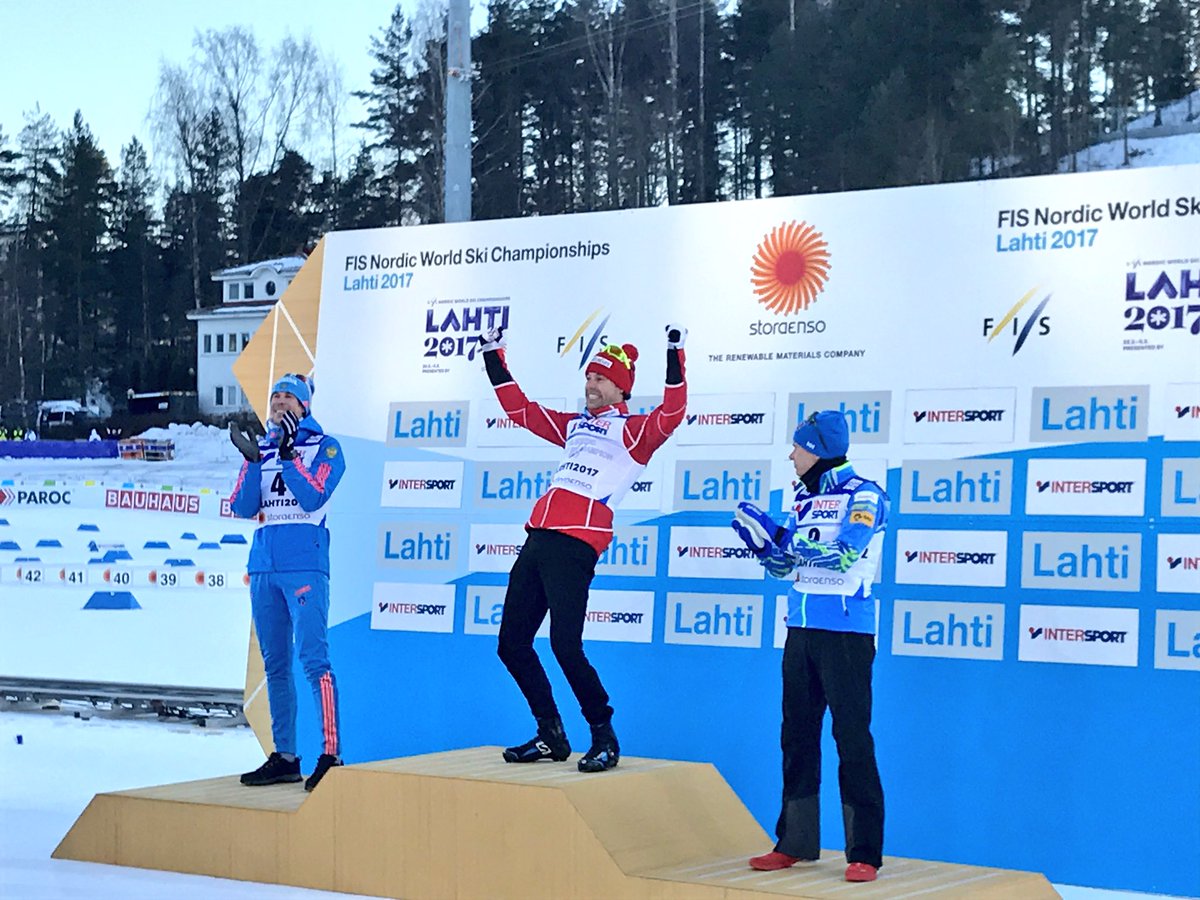
    Norway’s Martin Johnsrud Sundby finishing second in the men’s 30 k skiathlon while Russia’s Sergey Ustiugov (on the big screen in the background) celebrates gold at Nordic World Championships in Lahti, Finland. (Photo: John Lazenby/Lazenbyphoto.com)
  • After The Medals: Video Interviews with Silver and Bronze Medalists Diggins & Randall

    After The Medals: Video Interviews with Silver and Bronze Medalists Diggins & Randall

    Two American woman and one Norwegian reached the podium in the first medals race of 2017 Nordic World Championships, with Maiken Caspersen Falla of Norway (c) taking gold, and for the U.S., Jessie Diggins (l) and Kikkan Randall (r) taking silver and bronze, respectively, in the women’s freestyle sprint on Thursday, Feb. 24 in Lahti, Finland. (Photo: John Lazenby/Lazenbyphoto.com)

    LAHTI, Finland — FasterSkier had an opportunity to interview Thursday’s 2017 Nordic World Ski Championships medalists Jessie Diggins and Kikkan Randall at the athletes’ village outside Lahti.

    (Note: the interviews were conducted in a non-studio environment and are best listened to without headphones.)

    For both U.S. Ski team members, it was their second-career individual World Championship medal and third overall — Diggins and Randall won team-sprint gold at the 2013 Val di Fiemme, Italy World Championships.

    In Randall’s interview, she explains how she progressed through the heats and positioned herself to make the best of any opportunity.

    Diggins discussed how she thrives on pressure and has built the self confidence to be a regular contender for the World Cup podium.

    Both women are entered in Saturday’s 15-kilometer skiathlon. A 30 k event will be held for the men.

    U.S. Skiathlon Entries:

    Women

    • Jessie Diggins
    • Liz Stephen
    • Rosie Brennan
    • Kikkan Randall

    Men

    • Noah Hoffman
    • Tad Elliott
    • Kyle Bratrud
    • Ben Lustegarten

    Canada Skiathlon Entries:

    Women

    • Emily Nishikawa
    • Cendrine Browne
    • Katherine Stewart-Jones

    Men

    • Alex Harvey
    • Devon Kershaw
    • Graeme Killick
    • Knute Johnsgaard

    Skiathlon start lists: Women | Men

  • Setting the Scene: Pre-Competition Day at Lahti World Championships

    Setting the Scene: Pre-Competition Day at Lahti World Championships

    An Austrian athlete tests skis as he glides back into the main stadium. (Photo: John Lazenby/Lazenbyphoto.com)

    LAHTI, Finland — Tuesday at Lahti’s venue for the 2017 Nordic World Ski Championships, the sun sets early. Although technically sunset was 5:22 p.m., the sun on this clear-sky day was still wintertime reluctant. It seemed too short a time for the sun’s transect to thaw Lahti. Temps were in the mid-to-low 20 degrees Fahrenheit. But a brisk wind called for down coats and insulated pants for those not actively skiing — in the shade, it felt like the teens.

    Basked in an early evening glow, Lahti’s three iconic ski jumps dominate the 2017 Nordic World Championships venue. (Photo: John Lazenby/Lazenbyphoto.com)

    For athletes, it was a day of pre-competition ski and wax testing on bulletproof tracks that gradually deteriorated on the steeper climbs. The ski loops have good coverage. The snow remains coarse, as the tracks are covered with predominately manmade snow with trace amounts of natural snow tilled in.

    Lahti’s most dominant feature are its ski jumps, which are among the first objects to catch morning light. The surrounding landscape isn’t marked by serrated mountains, but by subtle hills that make the venue’s three domineering jumps (a K 116, K 90, and K 64), that much more ominous. First nordic-combined skiers then women’s ski jumpers had an opportunity for test flights off the K 90.

    On the non-skiing side of things, the venue was abuzz of last-minute prep: television cables being covered for protection before the onslaught of spectators, event producers testing the stadium’s Skycam, sponsors unpacking schwag, and media arriving to pick up credentials. Like the athletes fine tuning before the competition begins, Lahti’s organizers are near set for the big show.

    On Wednesday, two qualification races will ensue: the women’s 5-kilometer classic and men’s 10 k classic individual starts. These races are for athletes from “non-skiing” nations who have not met the FIS-point benchmark to participate in the championships. Start rights to Lahti’s distance races are granted to the top-10 male and female finishers. (All skiers are granted start rights for Thursday’s freestyle sprint regardless of their results in Wednesday’s qualifier.)

    5 k start list | 10 k start list

    ***

    Cross-Country Competition Schedule

    (All cross-country and nordic-combined events will be streamed live in the U.S. on NBCSports.com)

    A Latvian skier double poles through Lahti’s stadium on Tuesday. (Photo: John Lazenby/Lazenbyphoto.com)

    Wednesday, Feb. 22
    -Women’s 5 k classic interval start (7:00 a.m. EST)
    -Men’s 10 k classic interval start (8:30 a.m. EST)

    Thursday, Feb. 23 
    -Women’s freestyle k sprint (10:30 a.m. EST)
    -Men’s freestyle k sprint

    Saturday, Feb. 25 
    -Women’s 15 k skiathlon (5:00 a.m. EST)
    -Men’s 30 k skiathlon (7:30 a.m. EST)

    Sunday, Feb. 26
    -Women’s classic team sprint
    -Men’s classic team sprint

    (Semifinals starting at 4:30 a.m. EST, finals starting at 6:30 a.m. EST)

    Tuesday, Feb. 28 
    -Women’s 10 k classic interval start (6:45 a.m. EST)

    Wednesday, Mar. 1 
    -Men’s 15 k classic interval start (6:45 a.m. EST)

    Thursday, Mar. 2 
    -Women’s 4 x 5 k team relay (8:00 a.m. EST)

    Friday, Mar. 3
    -Men’s 4 x 10 k team relay (6:30 a.m. EST)

    Saturday, Mar. 4 
    -Women’s 30 k freestyle mass start (7:30 a.m. EST)

    Sunday, Mar. 5  
    -Men’s 50 k freestyle mass start (7:30 a.m. EST)

    U.S. 2017 World Championships Team:

    Men

    • Simi Hamilton (Stratton T2/ World Cup A-team)
    • Andy Newell (Stratton T2/ World Cup A-team)
    • Erik Bjornsen (Alaska Pacific University/World Cup B-team)
    • Noah Hoffman (Ski and Snowboard Club Vail/World Cup B-team)
    • Tad Elliott (Ski and Snowboard Club Vail)
    • Kyle Bratrud (Central Cross Country)
    • Ben Lustgarten (Craftsbury Green Racing Project)
    • Cole Morgan (Sun Valley Ski Education Foundation)

    Women

    • Jessie Diggins (Stratton T2/World Cup A-team)
    • Sadie Bjornsen (Alaska Pacific University/World Cup A-team)
    • Sophie Caldwell (Stratton T2/World Cup A-team)
    • Kikkan Randall (Alaska Pacific University/World Cup A-team)
    • Ida Sargent (Craftsbury Nordic/World Cup A-team)
    • Liz Stephen (Burke Mountain Academy/World Cup A-team)
    • Rosie Brennan (Alaska Pacific University/World Cup B-team)
    • Caitlin Gregg (Loppet Nordic Racing)
    • Chelsea Holmes (Alaska Pacific University)

    Canadian 2017 World Championships Team:

    Men

    • Alex Harvey (CNEPH/World Cup A-team)
    • Devon Kershaw (World Cup A-team)
    • Len Valjas (World Cup A-team)
    • Jess Cockney (World Cup B-team)
    • Graeme Killick (World Cup B-team)
    • Knute Johnsgaard (AWCA/NST U25 Team)

    Women

    • Emily Nishikawa (NST U25 Team)
    • Dahria Beatty (AWCA/NST U25 Team)
    • Cendrine Browne (CNEPH/NST U25 Team)
    • Katherine Stewart-Jones (NTDC Thunder Bay/NST U25 Team)

    Nordic Combined Competition Schedule:

    (All cross-country and nordic-combined events will be streamed live in the U.S. on NBCSports.com)

    Friday, Feb. 24

    -Individual HS 100 competition round (8:30 a.m. EST)

    -Individual 10 k cross-country race (6:30 a.m. EST)

    Sunday, Feb. 26

    -Team event  HS 100 competition round (5:00 a.m. EST)

    -Team event  4 x 5 k cross-country race (8:30 a.m. EST)

    Wednesday, Mar. 1

    -Individual HS 130 competition round (5:00 a.m. EST)

    -Individual 10 k cross-country race (9:15 a.m. EST)

    Friday, Mar. 3

    -Team sprint HS 130 competition round (9:00 a.m. EST)

    -Team sprint 2 x 7.5 k cross-country race (11:15 a.m. EST)

    U.S. Nordic Combined 2017 World Championships Team:

    • Bryan Fletcher
    • Taylor Fletcher
    • Benjamin Berend
    • Adam Loomis
    • Ben Loomis
  • Canada Names Lahti World Championships Team

    Canada Names Lahti World Championships Team

    Left to right: Canada's Len Valjas, Alex Harvey, Knute Johnsgaard, and Alex Harvey after their historic third place finish in the men's 4 x 7.5-kilometer team relay on Sunday in Ulricehamn, Sweden. (Photo: Fischer/Nordic Focus)
    Left to right: Canada’s Len Valjas, Alex Harvey, Knute Johnsgaard, and Alex Harvey after their historic third place finish in the men’s 4 x 7.5-kilometer team relay last month in Ulricehamn, Sweden. All four were named to the 2017 World Championships team. (Photo: Fischer/Nordic Focus)

    Earlier this week, Cross Country Canada announced its team for the upcoming 2017 World Championships in Lahti, Finland. The following athletes (six men and five women) were also selected to the Feb. 18-19 Otepää World Cup, the weekend before the championships.

    Alex Harvey (CNEPH/World Cup A-team)
    Devon Kershaw (World Cup A-team)
    Len Valjas (World Cup A-team)
    Jess Cockney (World Cup B-team)
    Graeme Killick (World Cup B-team)
    Knute Johnsgaard (AWCA/NST U25 Team)

    Emily Nishikawa (NST U25 Team)
    Dahria Beatty (AWCA/NST U25 Team)
    Cendrine Browne (CNEPH/NST U25 Team)
    Katherine Stewart-Jones (NTDC Thunder Bay/NST U25 Team)
    Olivia Bouffard-Nesbitt (AWCA/NST U25 Team)

    This will be the first senior World Championships for Johnsgaard, Beatty, Browne, and Stewart-Jones.

    For more on the selection process and criteria, click here.

  • Ulricehamn Sets the Standard for Nontraditional World Cup Venues

    Ulricehamn Sets the Standard for Nontraditional World Cup Venues

    Charlotte Kalla racing to third place in the 10 k skate in front of a huge crowd in Ulricehamn, Sweden, on Saturday. (Photo: Fischer/Nordic Focus)
    Charlotte Kalla racing to third place in the World Cup 10 k skate in front of a huge crowd in Ulricehamn, Sweden, on Saturday. (Photo: Fischer/NordicFocus)

    Most of the time, the FIS Cross-Country World Cup visits towns and ski trails the racers already know well.

    Some venues, like Norway’s Holmenkollen and Switzerland’s Davos, are visited every year. Others, like France’s La Clusaz, are on the schedule every few years but are still always popular.

    “I’ve been on the World Cup for ten or eleven years, and we go to the same venues all the time,” the U.S. Ski Team’s Liz Stephen said.

    But every once in a while, a new place is thrown into the mix. Last weekend it was Ulricehamn, a town of 10,000 people in southern Sweden.

    The rave reviews from athletes, coaches and fans made it clear that Ulricehamn aced their World Cup hosting duties on the first try, giving other venues something to aspire to.

    The venue even faced some significant challenges, like how to prepare a race course in above-freezing temperatures. No matter – the races went off without a hitch.

    “This was the best World Cup venue of the year — by far,” Canadian skier Devon Kershaw wrote in an email. “The volunteers are so friendly and helpful and to have a five kilometer track with thousands and thousands of supporters lining the whole way was just so much fun. I’ve never raced in an atmosphere like this other than the legendary Holmenkollen.”

    Teammate Alex Harvey – who won the 15 k and won bronze in the relay together with Kershaw, Knute Johnsgaard, and Len Valjas – put it this way: there were so many spectators that it was impossible to find a quite moment to oneself.

    “On the warmup loop, there were people along the whole course,” Harvey said. “I couldn’t even take a piss in my warm up. Usually I take like six pisses in an hour, and I was like, ‘Man, I just can’t piss!’ There were people everywhere. It was fun. They were cheering my name the whole warmup, and the whole race too. In Scandinavia, they are always a well-educated crowd. This was like a championship crowd, like Falun or Oslo. It was awesome.”

    The Ulricehamn organizing committee reported that there were about 30,000 people in attendance each day.

    “If you go back and watch all the races (except maybe Lillehammer) this year, there have been like 1000-2000 spectators max,” Kershaw wrote. “Some venues had like 100 people, it seemed. So this was a big improvement… Bringing events to where people actually care and are passionate about the sport is always best, I feel. I mean, as an athlete to race in an atmosphere like this is really motivating. It looks way better on TV, and people are having a great time out there – which is what we want to promote as ski racing (I feel).”

    King Carl XVI Gustaf even came to watch Sweden win bronze in the women’s relay and silver in the men’s relay.

    “I watched the races on television yesterday and couldn’t help it [to come here],” he told the local newspaper. “I think I’ve had just as much fun as everyone else had here. It has been a fantastic day of skiing in Ulricehamn and extra fun to [hear] the athletes say they felt such powerful public support.”

    Anchoring the women’s relay was Hanna Falk, who grew up in Ulricehamn. The King personally congratulated her.

    https://www.instagram.com/p/BPkjYv8hUa0/

    “It seems that all the skiers have been very pleased,” Falk told the Skövde Nyheter newspaper, according to a translation. “I’ve heard many good things from many different countries, so that makes me a bit extra proud.”

    The venue’s success over the weekend is already being cited as a reason for other Swedish municipalities to invest into their ski infrastructure. For instance, some in Marcus Hellner’s hometown of Skövde, just over an hour north, would like to see a similar effort.

    “It shows that hard work, persistence and courage pays off,” a commentator from Göteborg, the nearest major city, wrote. “That you do not have to be the biggest to be the best is also a nice reminder in these times of centralization … Among the city’s 10,000 residents, there were people who wanted to do something special, people who love their homeland, their sports and who love to show off their hidden treasure for the rest of the world. Talk about daring, talk about winning.”

    Ulricehamn is already planning to host another World Cup weekend in 2019, and may continue getting awarded competitions if the success of their first event is any indication.

    Meanwhile, the World Cup will return back to North America in March. World Cup Finals were awarded to Quebec after being moved from Tyumen, Russia, due to a doping scandal.

    Some athletes felt that Canadian and U.S. ski fans could learn a thing or two about how to earn these rave reviews from athletes – the kinds of reviews that could eventually promote a venue to being a regular or semi-regular World Cup host.

    “Of course the fans were wonderful in Quebec last year, but when you see the amount of people on the courses here in Sweden, it is an insane amount,” Stephen said. “I would like to put it our there as a challenge for fans who are close to Quebec to come out. Let’s try to be as big as Sweden there, because the more the athletes have fun… I heard everyone talking about the crowds, on every team, even the Norwegians. When that kind of talk happens, more World Cups are given to that city or host venue.

    “All the fans who are thinking about maybe coming up, don’t think about it, just come,” she concluded. “It makes the atmosphere very appealing to the teams, and especially us athletes. It’s really fun.”

  • Ulricehamn Extras: Bonus Quotes & Photos

    Ulricehamn Extras: Bonus Quotes & Photos

    The Canadian men's relay after placing third for Canada's best World Cup result in the 4 x 7.5 k, with (from left to right), Lenny Valjas, Alex Harvey, Knute Johnsgaard, and Devon Kershaw. (Photo: Salomon/NordicFocus)
    The Canadian men’s relay after placing third for Canada’s best World Cup result in the 4 x 7.5 k, with (from left to right), Lenny Valjas, Alex Harvey, Knute Johnsgaard, and Devon Kershaw. (Photo: Salomon/NordicFocus)

    Last weekend’s first-ever World Cup in Ulricehamn, Sweden, was one Canada will remember for a long time, after Alex Harvey won Saturday’s 15-kilometer freestyle individual start for his second-straight World Cup victory (after winning the freestyle team sprint with Len Valjas the weekend before) then reached the podium again in the men’s 4 x 7.5 k relay on Sunday — which was a first for the Canadian men. Safe to say, Canada is riding some serious momentum, as are the U.S. women, which missed the podium by 0.2 seconds in the Ulricehamn 4 x 5 k.

    Saturday’s 10/15 k freestyle

    (Men’s report | Women’s report)

    On the atmosphere: 

    “I love Sweden, so I kind of get into my happy place when I enter this country and the fans today really brought out the happy in me. It was really amazing out there.”

    — Liz Stephen (U.S. Ski Team), 16th

    “Competing in Ulricehamn was pretty awesome today.  The course was packed with some of the most enthusiastic fans I’ve ever seen!”

    — Kikkan Randall (U.S. Ski Team), 40th

     “An awesome Swedish vibe.”

    — Sadie Bjornsen (U.S. Ski Team), 12th

    “I’ve been so impressed with the venue, the spectators and especially the enthusiasm and hard work from the organizers and volunteers here in Ulricehamn! We haven’t had a course this packed with energized fans all year long, so it was a really special atmosphere out there!”

    — Jessie Diggins (U.S. Ski Team), 7th

    On getting to know a new venue: 

    “We got here on Thursday … we went skiing Thursday afternoon, and that was the first time on the course. Then yesterday we skied again and did some race prep on it. Yesterday was actually quite different from today, it was slushy and really soft, but it was still a fast course. Even though the 5 k loop is longer than five kilometers, 5.1 k or something so at the end that makes it a 15.5 k … even though it was a longer loop, we thought with our race prep was pretty fast, covering the distance pretty fast, so we knew it was going to be a fast race. Then looking at the girls race this morning, it was 24 minutes for a 10 k, that’s really fast. Devon and I were like, ‘Yes! It’s going to hurt a little less longer than other 15 k’s.’ ”

    — Alex Harvey (Canadian World Cup Team), 1st

    “It was a pretty cool course too.  Deceptively hard with a lot of gradual terrain and not many places to recover.”

    — Randall

    On pacing and ski style:

    “In the team meeting, we said that we thought it was going to be hard to gain time in the last lap, so it was important to open hard, but still steady, not kill yourself, just be in it from the beginning. We thought it would be hard to come from behind.”

    — Harvey

    “For Alex, it is a really good course. There is that one big uphill but the rest of it is kind of rolling, super punchy, you have to be really proactive, really aggressive everywhere. Good speed, good glide, and with a good power. And that is exactly his technique, and today it just clicked together.”

    — Ivan Babikov (Canadian World Cup coach)

    “It was great to have [Sadie Bjornsen] pull me into the finish the last few kilometers, especially when they like flat like that are often challenging for me so it was great to like follow her and see how she races and have a strong finish.”

    — Rosie Brennan (U.S. Ski Team), 24th

    On not quite getting it right:

    “Devon, it didn’t work out perfectly. He had a really good first split and then maybe had to take a break in the middle of the race. But he was still satisfied and he said that there was good moments and bad moments. It is really important in this kind of course, and this kind of race, that you have someone to ski with, and unfortunately he didn’t have anyone today and had to work by himself the whole time.”

    — Babikov

    On steady improvement:

    “Fifteen k individual start has been my weak event for a long time, but over the last two seasons, it’s been coming along nicely. I was second in Kuusamo, and a few top tens in 15 ks, so I knew it was coming along.”

    — Harvey

    “I think the Tour left me in a good zone, mentally and physically, and I am just psyched. We have five weeks till World Champs, and four of those weeks I will be in Sweden and one week in Asia so I have a pretty fun situation coming up and I think it will leave me in a good mental state going to World Champs.”

    — Stephen

    “Skating has been going well this year. I have a lot more confidence every time I start a race, so that is fun.”

    — Bjornsen

    On team spirit:

    “Alex is just lifting everyone’s spirits. Of course it’s Alex’s thing, he won it, but its not only for him. It’s for our whole team, our whole country, Team Canada and everyone. It’s just the best for everyone. Like, the waxers are super psyched, coaches, everybody, and other skiers back home, it’s just a big boost for all of us.”

    — Babikov

    “To witness a performance like that, it has really invigorated the whole team and staff …  It was a beautiful performance to cement his legacy. Simply fantastic skiing.”

    — Devon Kershaw (Canadian World Cup Team), 38th

    “You actually had all the American ladies, all four of those, all really close to each other at the track if not skiing actually in a pack at times, so it was pretty fun.”

    — Chris Grover (U.S. Ski Team head coach)

    On a one-person women’s team:

    “That was kind of last minute decision between Louis [Bouchard] and [Cendrine Browne]. There was opportunity, there were spots, and she was one that was kind of close to the points and showing good shape before [Christmas]. Today again, she proved that she is mature — she had a really good race. She started really aggressive, and maybe at the end it just wasn’t enough. This was more for training to get in shape as well for the World Champs.”

    — Babikov

    ***

    Sunday’s relays

    Men’s report | Women’s report

    On making Canada ski history:

    “It was a really special moment, [head wax technician] Yves [Bilodeau] was crying, Ivan was crying, too — he’s actually raced relays with us so many times, and we were fifth or seventh, which was not stellar, but he was still able to live it on the other side of the fence as a coach … it was great.”

    — Harvey

    “Today was a special day. It was my dream for a long time. When I was racing it was my number one priority of my career to be on the relay podium, so it is really emotional for all of us, especially me. We finally achieved it .”

    — Babikov

    “It was a career highlight for me, and one of the best days of my life.”

    — Knute Johnsgaard (Canadian U25 Team)

    “It means everything to us — and for me as well. We had NEVER hit the podium in arguably cross-country skiing’s marquee event on the men’s side. It’s incredible that it’s taken this long, but my whole career this was something I have dreamed of being involved in. I remember all the talk and dreams as a young senior with George, Stef, Drew, Chris, Gord, Dan, etc… and then again only five years ago when we had four guys (Len, Alex, myself, and Babs) skiing at an insanely high level together in individual races, but not being able to get it done together … So to break through and do it was just incredible. “

    — Kershaw

    On pre-race confidence: 

    “At the team meeting last night we were all saying that there is no expectation, no matter what we do, good day, or bad day, there’s no expectation, which is pretty nice, but then this morning, I’m rooming with Knute, the young guy, and we both woke up, and were like, ‘This is the day.’ We were both confident that neither of us would let the group go.” 

    — Len Valjas (Canadian World Cup Team)

    “We knew we had a really good chance. I knew last week when I decided to come to Sweden, I knew that Len and Alex won the team sprint last weekend in Toblach, and I knew the guys were in really good shape.”

    — Johnsgaard

    On doing it against the odds: 

    “We have been in a tough situation with our budget lately, and I don’t just mean our operating budget. The burden on the individual athletes right now in Canadian skiing is extremely debilitating and the worst I have ever seen. All except Alex in the country are paying tens of thousands of dollars to do this, so to be at that kind of disadvantage compared to the rest of the world could obviously be just too much. Yet, despite the situation, to still break through and stand on the podium with the likes of Norway and Sweden is a testament to our team as a whole. It’s just incredible. I hope this is the beginning and that we can be fighting for relay medals for years to come now that we know we can do it.”
    — Kershaw
    On ski-community support:
    “These four guys did this, they made it possible, but it’s also only because they have these amazing people behind them; all the wax techs, the people back home, the cross-country ski community, they care so much. You should have seen the amount of emails and texts I got from random people who care so much. It was very special, and amazing.”
    — Babikov

    On getting your mojo back:

    “I wish we had some more skate races coming up this weekend, because I feel like I’m getting my skate legs under me again. It will be fun to see if I can get some classic legs under me, too.”

    — Stephen

    On Germany hitting the podium:

    “Over the years we’ve become good friends with the German team, and if anybody was going to step onto the podium above us, it was fun to see them. Because similar to the the American team, they are not just dominating every weekend. It takes more of a really neat day to put everything together, and it was cool to see them do that. I think the last time they would have been on the podium was the Olympics, so it was fun to see how well they did.”

    — Bjornsen

    “I think all of us feel the same way, and even Norway, who wins a lot. It’s nice to see new people on the podium. We’re close with the Germans, as [our coach] Matt [Whitcomb] is dating one of them, and they’re really friendly, smiley, and it was really nice to see them on the podium. I was trying to think when the last time I saw the German team on a relay podium was, and so I asked Steffi Böhler — and she said, ‘I don’t know!’ … You always want it to be you up there, but it’s good to see people equally joyful and excited about being up there as you are.”

    — Stephen

    On keeping perspective:

    “I got overwhelmed a few times with the whole World Cup scene, but just tried to focus on little things like testing skis, and getting in my warm-up and getting to the start, and just remembering that it’s still a ski race like any other one.”

    — Liz Guiney (Craftsbury Green Racing Project)

    “Those guys [the U.S. women’s team] raced great. They had something like the fifth, second, fourth, and then the fastest leg times. Of course it was all really close being so fast out there, especially on the skate side. In fact Jessie, Sandra Ringwald, and Hanna Falk were all within the same second for their ski times. And of course, Ringwald and Falk both raced incredibly well yesterday too, so they are clearly in good shape. Those were some daunting competitors for her at the end. So obviously, it’s super tight and they raced great.”

    — Grover

    On the men’s race:

    “That was disappointing, just to lose contact. On a different day I think we could have been in contact for a lot longer. It was the kind of day where if you could keep the contact it was pretty easy to stay in it, but if you’re all by yourself, you’re just out by yourself. [We] definitely suffered from that.”

    — Grover

    On crazy pre-race logistics:

    “Skis were great all day, which was really a testament to how good of a job the wax team did. Because it was a tough day. It did not freeze last night, and because of that they did not open the course on time as planned, they delayed it. The women were never allowed to skate on the course before the relay. The men maybe just for a little bit. We ended up trying to do all of our testing, kick and all of the glide testing, and work with athletes testing skis, all in about an hour before the start. And make all the skis, with two [women’s] relay teams. Which was incredibly crazy. And then there were only 25 minutes of open track between the women’s race and the men’s race. There’s no natural snow here, so they just had a really tiny 300 meter test track. It was a real challenging day for the wax team and they did an awesome job of being able to produce great skis for these guys and keep everybody in contention.”

    — Grover

    “The snow conditions held up really well for the skate legs. We were not allowed on the course, it was completely partitioned off, so being the fourth or fifth person on the course, I thought it was great! I’m sure it slowed down significantly for the men, and maybe even for the fourth-leg skiers, I don’t know, but it was pristine when I was out there.”

    — Stephen

    On future plans:

    “The race I would have liked to target in Period II is next weekend in Falun (30km mass start classic), but with my wife Kristin expecting (the due date is next Saturday), I doubt I will toe the line there… Too much stress! I will put in some great training coming up here ahead of Otepaa and World Champs and Norwegian Nationals are actually only a 1:15h drive from Oslo — so I have signed up for two races there — but with the arrival of our first child, it’s all about ‘baby-watch’ now. Can’t make too many long-term plans with regards to a race schedule.”

    — Kershaw

    “I’m really excited — I love Falun! I love Sweden and I’m psyched to be staying in this country. And then I get to go to Asia for the first time ever after that, which will be very exciting as well, and then coming back to Sweden for the pre-World Championships camp, so I’m in a good mental spot right now. Sweden always brings out my happy, and the fans and the organizers did a phenomenal job and really made this weekend what it was.”

    — Stephen

  • A Maple-Leaf ‘Miracle’, Canada Races to Historic 3rd Place in Ulricehamn Relay

    A Maple-Leaf ‘Miracle’, Canada Races to Historic 3rd Place in Ulricehamn Relay

    Len Valjas (c) spreads his arms to greet his teammates Alex Harvey (far right), Knute Johnsgaard (far left) and Devon Kershaw after he crossed third in the men's 4 x 7.5-kilometer team relay on Sunday in Ulricehamn, Sweden. (Photo: Fischer/Nordic Focus)
    Len Valjas (c) greeting his teammates across the line, including Alex Harvey and Devon Kershaw (on the right), Knute Johnsgaard (left) after he finished third in the World Cup men’s 4 x 7.5-kilometer team relay on Sunday in Ulricehamn, Sweden, for a best-ever relay result for Canada. (Photo: Fischer/NordicFocus)

    Looking up from the finish line on Sunday, Canada’s Len Valjas saw something he would never forget. Amidst a sea of waving Swedish flags, a trio of men ran toward him. Their arms were outstretched and a chorus of cheers escaped all three as they charged toward their teammate.

    Just a week ago, Valjas had celebrated his first World Cup win in the men’s team sprint with teammate Alex Harvey. Seven days later, after anchoring the final leg of the Canadian men’s 4 x 7.5-kilometer relay team in Ulricehamn, Sweden, Valjas would celebrate another first.

    But this time, the first was not his alone. It was one for Canada as well.

    Left to right: Canada's Len Valjas, Alex Harvey, Knute Johnsgaard, and Alex Harvey after their historic third place finish in the men's 4 x 7.5-kilometer team relay on Sunday in Ulricehamn, Sweden. (Photo: Fischer/Nordic Focus)
    Left to right: Canada’s Len Valjas, Alex Harvey, Knute Johnsgaard, and Alex Harvey after their historic third-place finish in the men’s 4 x 7.5-kilometer relay on Sunday in Ulricehamn, Sweden. (Photo: Fischer/NordicFocus)

    Prior to Sunday, no other men’s team sporting the red maple leaf had reached the podium in a World Cup relay. The closest Canada had come to was fifth place in 2012 in Gällivare, Sweden, with Valjas, Harvey, Devon Kershaw, and Ivan Babikov.

    A little less than five years later, with Babikov as Canada’s new World Cup coach and Knute Johnsgaard having joined the relay-race crew, history was made.

    For the first time on a World Cup, four Canadian men — Kershaw, Harvey, Johnsgaard, and Valjas — would raise their arms in celebration while standing on the third podium step on Sunday, stealing the spotlight from Norway’s first place finishers and Sweden in second.

    “As a small cross-country skiing country, we don’t have two teams at the start line,” Babikov said on the phone afterward. “We barely assembled one team, but that team made a miracle today, so we only needed one.”

    Even if scraping together a squad did not take place until last week — Johnsgaard only flew into Sweden a few days ago and skipped Saturday’s 15 k freestyle to rest up for the relay — Canada has been aiming at a team podium for a while.

    For Babikov, especially, standing on the relay podium alongside his teammates had been a longtime dream. And though it wouldn’t occur while he was skier, watching his athletes (three of them former teammates) climb onto the third podium step was just as momentous for Babikov.

    “I’ll never forget this day,” Babikov said. “We’ve had individual podiums and individual medals, but the relay is special because it’s a show of strength for the whole team and the whole staff behind this team.”

    Just half of a second out of first — which went to Norway in a time of 1:06:47.5 — Canada’s third place finish is an indication not only of the team’s depth, but potential to place even higher.

    “I’ll never forget this day. We’ve had individual podiums and individual medals, but the relay is special because it’s a show of strength for the whole team and the whole staff behind this team.”– Ivan Babikov, Canadian World Cup coach, on the men’s relay’s historic third-place finish on Saturday

    Since distance relays are also one of the primary ways Own The Podium evaluates how much funding Cross Country Canada (CCC) receives, Sunday’s performance may also incentivize an increase in financial resources for the Canadian World Cup team.

    As Harvey explained, most his teammates are not currently getting financial support from CCC due to budget cuts from previous years. As a result of Sunday’s performance, that could change.

    “Because the results over the last couple of years internationally have been not stellar as a team, a lot of funding was cut for us,” Harvey said on the phone after Sunday’s race. “I think this result will really help those guys to be fully funded again.”

    Regardless of what exactly happens with the future funding, Canada’s relay members and coaches alike were smiling, speechless and simply stoked.

    “I felt honored to anchor such a hard working team,” Valjas said on the phone. “I didn’t want to let them down, so it was easy, there was only one thing to do, just get on the podium. They all did their work, and I wasn’t going to be the guy who lets it all go to shame.”

    Canada in Close Quarters, Krogh Out Sprints Halfvarsson for the Win

    In the words of Babikov, relay days are somewhat like the “lottery,” with decisions on which leg to designate to each athlete a gamble. With Sunday’s first two legs classic and the second two skate, Canada selected Kershaw and Harvey to start the team off, followed by Johnsgaard and Valjas.

    “Our strongest guys [were] on the first two legs, Devon and Alex, that’s where most of the damage was done,” Babikov said.

    Canada's Devon Kershaw (bib 7) during the first classic leg of the men's 4 x 7.5-kilometer team relay on Sunday in Ulricehamn, Sweden. (Photo: Fischer/Nordic Focus)
    Canada’s Devon Kershaw (second from r) during the first classic leg of the World Cup men’s 4 x 7.5-kilometer relay on Sunday in Ulricehamn, Sweden. (Photo: Fischer/NordicFocus)

    Kershaw started things off for the Canadians, skiing in bib 7 and positioned in 10th place until just before 2 k, when he made a move to the outside right of the tracks to the front. However, he didn’t lead for long. By 4 k, Russia’s Sergey Turyshev had overtaken him, followed by Sweden’s Daniel Rickardsson and Italy’s Dietmar Nöckler.

    Coming into the exchange zone, it was Kazakhstan’s Alexey Poltoranin in the lead, and Kershaw in fifth. Kershaw tagged off to Harvey for the second classic leg.

    Within the first half a kilometer, Harvey was at the helm of the leading pack of nine.

    “I knew that the heavy hitters were on my leg, but it was good,” Harvey said. “It was hard on the big hill, but then over the top I had really fast skis.”

    At 2.5 k Finland’s Iivo Niskanen and Russia’s Alexander Bessmertnykh traded off leads. Within another 4 k, Norway’s Martin Johnsrud Sundby moved to the front. The Norwegian maintained the lead through the exchange zone, while Harvey chased from five seconds back.

    Sundby passed off to Norway’s Anders Gløersen, and Harvey to Johnsgaard for the third leg and first freestyle portion. Despite considering himself a ‘World Cup rookie’, Johnsgaard, of Canada’s U25 Team, maintained his position within the middle of the lead pack.

    “Alex tagged me off in a good position, and my job was to hold that, and give Len the same opportunity I had to ski in the group in a  good position,” the 23-year-old Johnsgaard said.

    Johnsgaard did his job and tagged off to Valjas within five seconds of Gløersen’s tag to Norway’s Finn Hågen Krogh.

    Seven skiers still remained in the front pack with Krogh, Sweden’s Calle Halfvarsson and Italy’s Sebastiano Pellegrin in the lead. Valjas spent most of his first lap in fifth, following as close to the leaders as possible.

    “On the last lap, I was totally blocked on the hill, so I couldn’t actually empty the tank, which was probably a good thing for me, and then just after the hill I built up some speed, and passed five or six guys just double poling,” Valjas said.

    By the final 300 meters, the Canadian had moved up to second behind Halfvarsson in first. As the group rounded the final corner, however, Krogh moved around to the right of Halfvarsson and Valjas.

    “I gave him a meter in the final turn but I entered the final stretch in good speed” Krogh told NRK of his final maneuver.

    Left to right: Canada's Len Valjas follows Finland's and Norway's Finn Hågen Krogh during the men's 4 x 7.5-kilometer team relay on Sunday in Ulricehamn, Sweden. (Photo: Fischer/Nordic Focus)
    Left to right: Canada’s Len Valjas follows Finland’s and Norway’s Finn Hågen Krogh during the World Cup men’s 4 x 7.5-kilometer relay on Sunday in Ulricehamn, Sweden. (Photo: Fischer/NordicFocus)

    Krogh edged Halfvarsson and Valjas by half a second for the win in 1:06:47.5.

    “I would have like to have won but Finn Hågen is fast,” Halfvarsson told NRK of his final maneuver.

    In his first time anchoring a team relay, Valjas views the moment as one he’ll never forget.

    “I’ve never been the anchor in a relay. I’ve been the second leg in some team sprints, but today was special, the best feeling I’ve ever had skiing, seeing my three teammates sprinting towards me at the finish line,” Valjas said. “I don’t think anything will ever top that, the first relay [podium] for Canada.”

    The U.S. men fielded a team with Andy Newell handing off to Erik Bjornsen, followed by Noah Hoffman, and Simi Hamilton, who anchored them to 10th (+1:16.5).

    U.S. Ski Team Head Coach Chris Grover explained that while Newell maintained contact with the pack during his first lap, he lost it during his second time around.

    “The second time up the big climb he got stuck behind a Russian who was fading,” Grover said on the phone. “By the time he got around, he lost contact with the lead. Then coming down into the stadium he had a fall. And then after that, he was maybe 16 seconds behind the group in front of him. That really took us out of contention.”

    Newell tagged Bjornsen in 13th, 23.2 seconds out of first. From there, the U.S. men steadily picked off the places, with Bjornsen moving into 12th by the second exchange, Hoffman improving to 11th by the last exchange, and Hamilton finally finishing 10th.

    Results

    — Chelsea Little, Jake Ellis and Aleks Tangen contributed
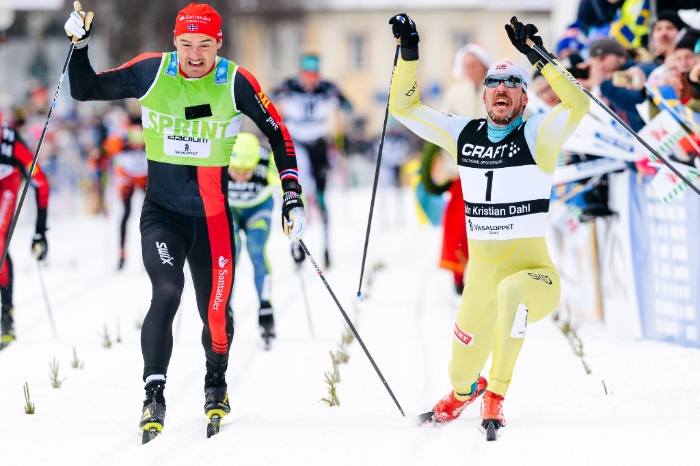
    Team Canada celebrates their first World Cup relay podium in the men's 4 x 7.5-kilometer team relay on Sunday in Ulricehamn, Sweden. (Photo: Cross Country Canada)
    Team Canada celebrates its first World Cup relay podium in the men’s 4 x 7.5-kilometer relay on Sunday in Ulricehamn, Sweden. (Photo: Cross Country Canada)
  • Sunday Rundown: Ulricehamn, Antholz, Chaux-Neuve, Whistler, & Truckee (Updated x3)
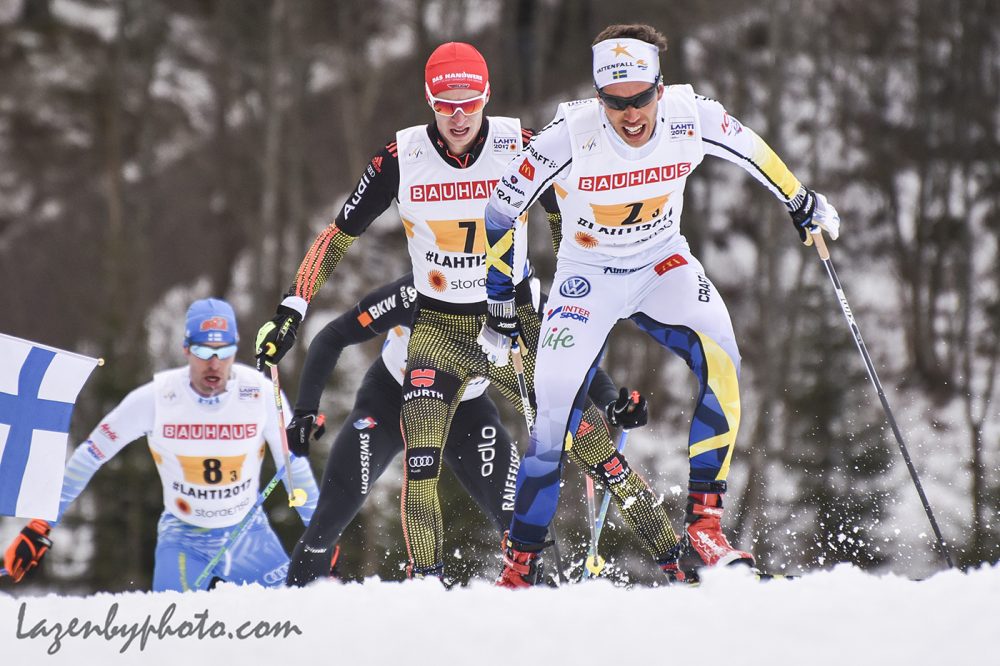
    Sunday Rundown: Ulricehamn, Antholz, Chaux-Neuve, Whistler, & Truckee (Updated x3)
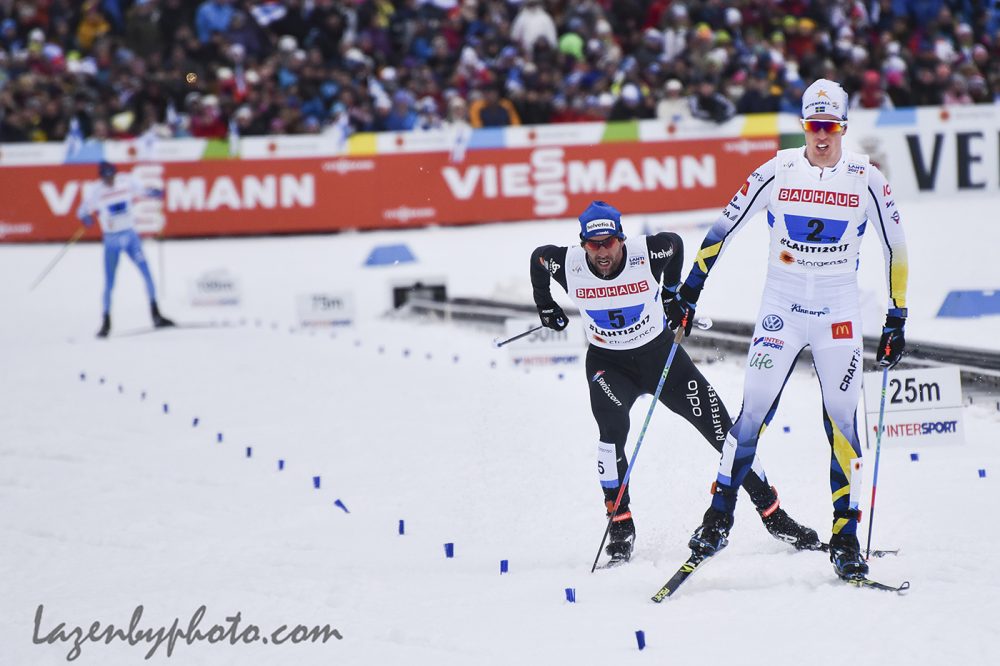
    The men's 4 x 7.5 k relay podium at the World Cup in Ulricehamn, Sweden, with Norway (c) in first, Sweden (l) in second, and Canada (r) with with its best-ever men's relay in third. (Photo: FIS Cross Country/Twitter)
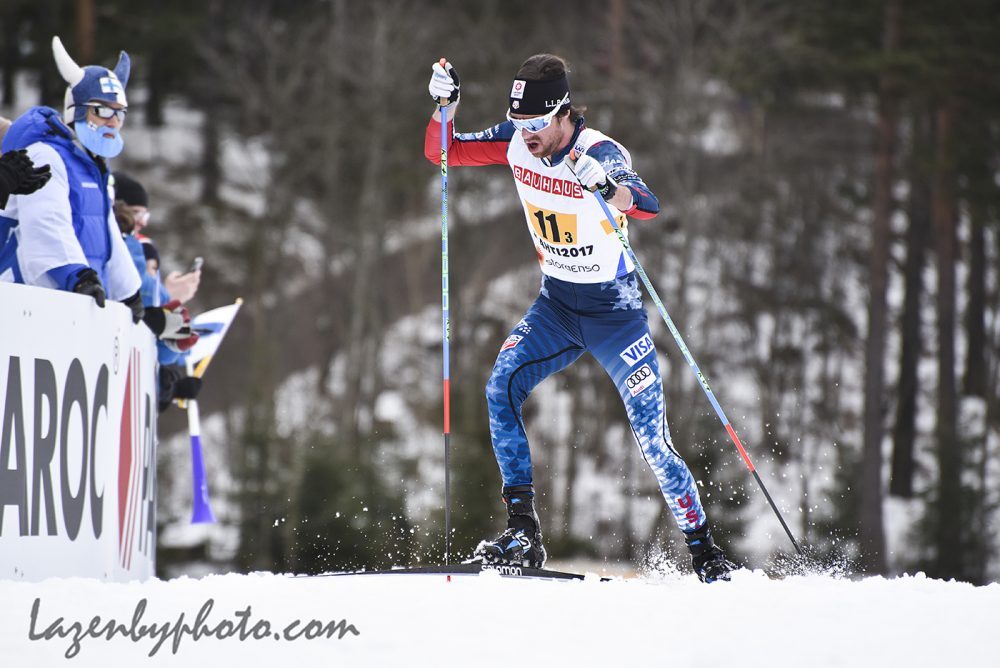
    The men’s 4 x 7.5 k relay podium at the World Cup in Ulricehamn, Sweden, with Norway (c) in first, Sweden (l) in second, and Canada (r) with with its best-ever men’s relay in third. (Photo: FIS Cross Country/Twitter)

    FIS Cross-Country World Cup (Ulricehamn, Sweden): 4 x 5 k and 4 x 7.5 k Relays

    Men’s report | Women’s report

    Norway notched back-to-back team victories in the women’s and men’s relays on Sunday at the World Cup in Ulricehamn, Sweden, with Finn Hågen Krogh securing a win in the men’s 4 x 7.5 k relay by 0.5 seconds over Sweden’s Calle Halfvarsson and Canada’s Lenny Valjas. With two kilometers remaining, nine teams were within 3.8 seconds of first. Krogh outlasted both Halfvarsson and Valjas in the finishing stretch, as Sweden placed second and Canada third for its best-ever relay result, according to a Cross Country Canada press release, besting its fifth-place finish from 2012 (with then-anchor Ivan Babikov, now a Canadian World Cup coach).
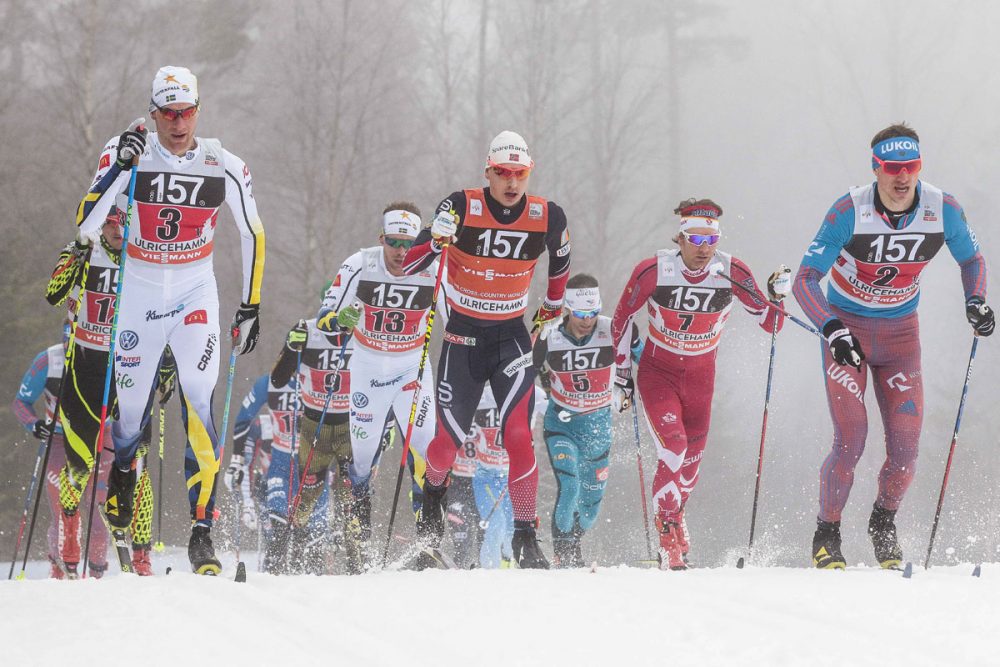
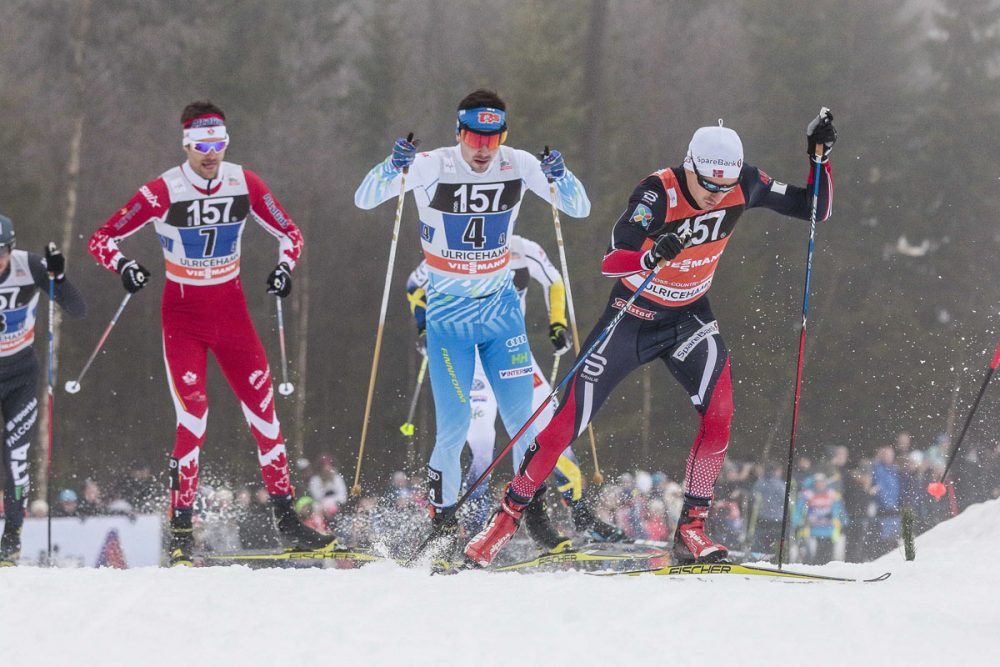
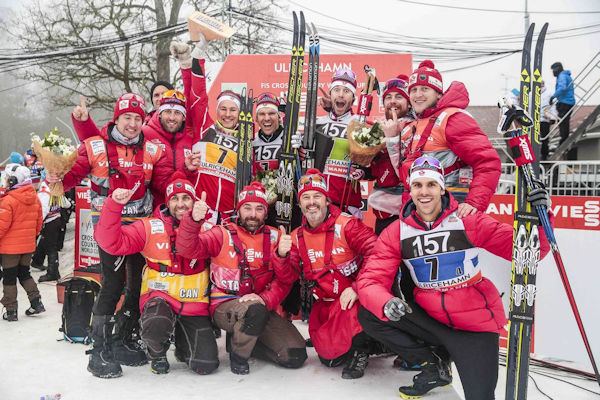
    Krogh teamed up with Simen Hegstad Krüger, Martin Johnsrud Sundby and Anders Gløersen and finished in 1:06:47.5, while Sweden placed second with Daniel Rickardsson, Johan Olsson, Marcus Hellner, and Halfvarsson.

    For Canada, with Devon Kershaw, Alex Harvey, Knute Johnsgaard, and Valjas, it was Harvey’s third-straight World Cup podium, Valjas’s second-straight team-event podium, and national U25 Team member Johnsgaard’s first podium.

    “I have been waiting my whole career for this,” Kershaw said, according to a FIS press release. “All the guys did a great job today.”

    The U.S. placed 10th (+1:16.5) with Andy Newell, Erik Bjornsen, Noah Hoffman, and Simi Hamilton.

    The Norwegian women's team (center) won the 4 x 5 k World Cup cross-country relay in Ulricehamn, Sweden, by 8.8 seconds over Germany (left), with home team Sweden (right) edging the United States for third.
    The Norwegian women’s team (center) won the 4 x 5 k World Cup cross-country relay in Ulricehamn, Sweden, by 8.8 seconds over Germany (left), with home team Sweden (right) edging the United States for third.

    Earlier on Sunday, the women’s 4 x 5 k relay didn’t break apart until the second leg, but Norway still proved its dominance over the ski world with a win to start the day.

    After the group of Ingvild Flugstad Østberg and Lotta Udnes Weng (Norway), Ida Ingemarsdotter (Sweden), and Anamarija Lampic (Slovenia) more or less stayed together on the first relay leg, Heidi Weng made a break for it, giving Norway a 16.8-second lead at the second tag. The Norwegian team never looked back and after the race Weng and teammates Østberg, Astrid Jacobsen, and Marit Bjørgen were able to climb to the top step of the podium.

    The race for second place, though, wasn’t resolved until the finish line. Sweden, Slovenia, Norway’s second team, the United States, and Germany were all in contention at various points in the race.

    On the last leg, Jessie Diggins of the U.S., Sandra Ringwald of Germany, and Hanna Falk of Sweden battled it out, dropping Kari Øyre Slind of Norway. The three shot to the finish line together, with Diggins stuck behind the other two. Ringwald eventually won the sprint finish by 0.2 seconds over Falk, with Diggins another 0.2 seconds back in fourth.

    That gave Ringwald, Katharina HennigStefanie Boehler, and Victoria Carl a second-place result, one of Germany’s best since taking silver at the 2010 Olympics. (The team won bronze at the 2014 Olympics.)

    Ingemarsdotter, Falk, Charlotte Kalla, and Sofia Henriksson took the third step of the podium. Rosie BrennanSadie BjornsenLiz Stephen, and Diggins were left to settle for fourth.

    The second U.S. team, of Kikkan RandallIda SargentSophie Caldwell, and SuperTour leader Liz Guiney finished 12th after skiing in 8th and 9th earlier in the race.

    Results: MenWomen

    ***

    IBU World Cup (Antholz, Italy): Men’s mass start and women’s relay

    Men’s mass start reportWomen’s relay report

    ***

    NorAm Western Canadian Championships (Whistler, B.C.): Relays

    [UPDATED] This season brought a changeup to the Western Canadian Championships with a three-person relay event in response to athletes’ request to add “fun” events to the NorAm series.

    While 146 teams finished in 17 categories, it was Ontario winning the open men’s 3 x 7.5 k in 50:32.9 (Bob Thompson, Jack Carlyle and Andy Shields) and B.C. dominating the open women’s 3 x 5 k in 41:09.47 with three juniors (Katie Weaver, Anna Goodwin and Hannah Mehain).

    The masters men and juvenile girls categories included the most teams, with 15 and 14, respectively.

    Results


    FIS Nordic Combined World Cup (Chaux-Neuve, France): Individual large hill/10 k

    Sunday's Nordic Combined World Cup podium in Chaux-Neuve, France, with German winner Fabian Rießle (c), German runner-up Johannes Rydzek (l), and Germany's Eric Frenzel (r) in third. (Photo: FIS Nordic Combined/Twitter)
    Sunday’s Nordic Combined World Cup podium in Chaux-Neuve, France, with German winner Fabian Rießle (c), German runner-up Johannes Rydzek (l), and Germany’s Eric Frenzel (r) in third. (Photo: FIS Nordic Combined/Twitter)

    On Sunday, after the large hill jump and 10 k ski, Germany swept the podium in the second event of the NoCo World Cup in Chaux-Neuve, France. Fabian Rießle placed first in 22:44, and his German teammates Johannes Rydzek skied to second only 2.2 seconds back, and Saturday’s winner Eric Frenzel was third (+7.9).

    (Frenzel leads the NoCo World Cup, Rydzek is second overall, Rießle is third.)

    Norway’s Jarl Magnus Riiber flew the farthest with 139.8 points. Franz-Josef Rehrl from Austria jumped to second with 135.7 points while his teammate Bernhard Gruber jumped to third with 131.7 points.

    Magnus faded to 23rd (+47.5) in the 10 k ski. Rehrl started 15 seconds back from Magnus and placed 17th overall (+31.5). Gruber maintained a top-ten, placing 9th (+13.5), after starting 32 seconds behind first place jumper Magnus.

    While the top three jumpers all dropped back in the ski, it was a day of catch up for the German’s after the jumping portion.

    Rießle ranked eigth after the jump and earned 128.7 points, he began the ski 0:44 back. Rydzek placed 11th in the jump with 126.9 points, while Frenzel jumped to fourth with 131.4 points.

    The only U.S. skier entered in Sunday’s event was Ben Berend. The U.S. Nordic Combined skier jumped to 13th with 126.8 points — starting the ski 0:52 behind Magnus. Yet Berend couldn’t capitalize on his strong jump, he dropped to 37th (+2:06) after the ski.

    The Nordic Combined World Cup continues next Friday in Seefeld, Austria.

    Results

    U.S. SuperTour (Truckee, Calif.): 10 k/5 k free 

    Events cancelled due to weather.

  • Harvey Tops Ulricehamn 15 k: ‘It’s the Win that Gives Me the Most Satisfaction’

    Harvey Tops Ulricehamn 15 k: ‘It’s the Win that Gives Me the Most Satisfaction’

    Alex Harvey celebrates on his way to the top step of the podium in Ulricehamn, Sweden. The Canadian won the 15 k freestyle over Norway's Martin Johnsrud Sundby and Sweden's Marcus Hellner. (Photo: Cross Country Canada/NordicFocus.com)
    Alex Harvey celebrates on his way to the top step of the podium in Ulricehamn, Sweden. The Canadian won the 15 k freestyle over Norway’s Martin Johnsrud Sundby and Sweden’s Marcus Hellner. (Photo: Cross Country Canada/NordicFocus.com)

    It’s not like winning is a new feeling for Canada’s Alex Harvey. After all, the Quebec-based cross-country skier won a World Cup just six days ago in Toblach, Italy.

    But winning a long individual-start race? Yes, that’s something else. Harvey picked up his fifth individual win in Ulricehamn, Sweden, today, and the first in an individual-start race longer than a prologue.

    “It’s for sure the win that gives me the most satisfaction,” Harvey said after besting every other skier in the 15 k freestyle. “In mass starts or sprints, in the tactical game sometimes I can play it pretty well. I can use the others a bit, and kind of wait for the last sprint. But today — I didn’t have a ride or anything. I had to make it on my own. That’s true skiing, pure skiing, more old school in a way. So it’s the win that gives the most satisfaction in my career, I think.”

    It wasn’t just Harvey who saw the difference between his previous victories and today’s 15 k freestyle. Harvey’s whole team felt like it was a moment where Canada truly had arrived.

    “Today was a legendary day for our team,” Harvey’s longtime teammate and friend Devon Kershaw wrote in an email. “I mean, when you win an individual start race in our sport – then in my opinion you have really written your name amongst the greats. I’m not saying winning sprints or mass starts are easy – but when it’s just you out there – having to do it totally alone – it’s something pretty special… All I can say is ‘chapeau mon gars’ to Alex… To win in the style he did it in too, and in front of such a wonderful crowd, that will be a memory we will all have for life. Simply fantastic skiing.”

    Harvey started hard, and already laid down the fastest split of the field when he crossed the five kilometer mark.

    A number of top competitors had later bib numbers. Dario Cologna of Switzerland, Martin Johnsrud Sundby of Norway, and Marcus Hellner of Sweden were all lurking behind him, hearing his splits and trying to pounce. But none could best his time.

    The men's 15 k freestyle podium at Saturday's World Cup in Ulricehamn, Sweden, with Canadian winner Alex Harvey (c), Norwegian runner-up Martin Johnsrud Sundby (l), and Sweden's Marcus Hellner (r) in third. (Photo: FIS Cross Country/Twitter)
    The men’s 15 k freestyle podium at Saturday’s World Cup in Ulricehamn, Sweden, with Canadian winner Alex Harvey (c), Norwegian runner-up Martin Johnsrud Sundby (l), and Sweden’s Marcus Hellner (r) in third. (Photo: FIS Cross Country/Twitter)

    Initially, that made Canadian coach Ivan Babikov nervous.

    “When I saw the first split, I kind of got a bit scared,” he admitted. “Like maybe, I hope he didn’t start too fast. Leading by two seconds on the first split — there are some guys who start really fast and then blown up.”

    But when he saw how Harvey was skiing, his fears slipped away.

    “I was on the biggest hill,” Babikov explained. “He was just so confident, so powerful, one-skating the whole thing. And then did not slow down in the second lap, and got even more time on the second and third place. Then I thought, he is actually doing it. He has his game plan, he started fast, and he was able to keep his pace and speed all the way.”

    Harvey agreed: he had things under control.

    “I was trying to not put myself too much in the red on the big hill, but to really ski well and fast on everything else for the course,” he explained. “So for maybe 600 meters of the course, on the big hill, let my foot off the gas. Everything else I was able to attack, and recover well on the downhills. At the halfway point I was actually feeling pretty positive still… I was like, ‘Okay, it’s mine to lose now, and I’m not going to let it slip through my fingers.’ It was a good feeling.”

    A few racers lost substantial time over the last several kilometers, or on the rolling sections of the course which require focus, momentum, and, as Harvey said, “punch”.

    But this was a course well-suited to Harvey, and he took advantage.

    “Short uphills that you can really punch it, and then recover quickly again,” he explained. “Skiing it the last two days, I thought it was a great course for me. I was looking for a good result and I know I’ve been feeling good since I took a few days off after the Tour. I was looking forward to the race, but winning… I did not think I could win until the midway point of the race.”

    When all was done, Harvey landed a six-second victory over Sundby. Hellner was third, +14.3, and managed to hold off fourth-place Cologna by just 0.4 seconds.

    Daniel Stock of Norway, who got the call to race within the last week, posted a huge career best in fifth place (+16.2). Britain’s Andrew Musgrave was sixth (+18.7).

    “I don’t believe that I am this good, so I just go out there and do what I’m supposed to do,” Stock told NRK. “And then I finish fifth and that’s indescribable… I got a phone call from Tor-Arne [Hetland, the Norwegian men’s coach] Sunday night and I totally panicked. I had been training like crazy lately. So I just had to eat, lay down with legs elevated and find some extra energy. And I was able to do that.”

    As for the winner, the Canadians were still high on the feeling hours later. Babikov, a former World Cup racer who once won the time-of-the-day on the Tour de Ski final climb, knows a thing or two about how hard it is to win a race on your own.

    “It’s not a mass start,” Babikov said. “If you win by yourself, it you’re off the start leading the whole race, it shows great form… Individual start, it doesn’t show good tactics, or being more smart or lucky than other people, it’s all endurance and it’s all physical ability. Today [Harvey] showed that he is the best in the world, and to win like that with authority from the gun, leading most of the splits — oh it was impressive, it was really impressive. He is one of the best in the world and he is only getting better and better, and hopefully he can keep this shape for the World Championships.”

    In taking the win, Harvey also became the first Canadian to ever win back-to-back World Cups on consecutive weekends.

    “We’ve had a lot great champions in Canada,” he said in a Cross Country Canada press release. “It is nice to be able to own a statistic like that, but I do it for the result and to be the best I can be each race. If that means that I win back-to-back then that is a bonus.”

    With Strong Performances, Canada Looks to Relay

    While Harvey’s win certainly highlighted the day for Canada, the team was also pleased with some other results.

    Canada's Alex Harvey (l) and Len Valjas celebrate their World Cup freestyle team sprint win in Toblach, Italy. It was the first team-sprint victory for Canada since 2011 World Championships. (Photo: Salomon/NordicFocus)
    Canada’s Alex Harvey (l) and Len Valjas celebrate their World Cup freestyle team sprint win in Toblach, Italy, least weekend. (Photo: Salomon/NordicFocus)

    Lenny Valjas finished 35th (+1:17.7), his best result in a distance race over 5 k since 2013. That season, he and Harvey shared the podium in a 15 k mass start stage of the Tour de Ski. But ever since, Valjas has been battling injuries and has primarily succeeded in sprinting.

    “Len had a good starting position and he started well,” Babikov explained. “He kind of tried to pull Alex when Alex caught him, and maybe slowed up a bit on the second lap. But then he recovered and finished actually really, really, strong so I am really proud of him and just happy with it. It’s just kind of bittersweet that he is almost in the points [top 30]. But it’s his best distance race of the season so far… Len is a way that now it’s not about training, it’s about races. The more races he does, he is getting better in shape.”

    Close behind Valjas was Kershaw. The veteran was on track to score points with a top-30 finish, but lagged in the course’s final kilometers and landed 38th (+1:22.2).

    “The last 2km were just absolutely horrendous apparently (based on the splits),” Kershaw wrote in an email. “I was skiing alone – and of course I was tired – but I didn’t think I was SO tired. Very disappointed with the last few kilometres… The terrain was really gradual, undulating and turny – perhaps in my tired state I fell asleep through some of that terrain and I really, really paid for that on the results board… I may have opened a tad hot, but fortune favours the bold – or so they say – so I do not regret my strategy there.”

    Despite an imperfect race, Kershaw was not too disappointed.

    “I was not hoping for anything this weekend if I’m honest,” he wrote. “15km skate individual start is by far my least favourite race in skiing…. The race today had its moments. Both good moments and some tough moments.”

    Canada’s fourth athlete, Knute Johnsgaard, did not end up starting, with Babikov saying that Johnsgaard was still suffering a bit after only recently arriving in Europe from North America.

    Still, the gang will contest Sunday’s 4 x 7.5 k relay, and are particularly pumped after the results of the 15 k.

    “I’m excited,” Harvey said. “The big hill is only in the classic part, so the classic will be harder. Maybe things will go down a bit earlier, because after that the skate is quite… there are no easy courses on the World Cup, but I think this is one that can be a big advantage to be able to follow in a group. Devon and I are going to go in the classic legs. We will try to lay down a good race and stay with the group, and if we’re still with the group after the classic, then we’re allowed to believe in a good result. Top eight would be good for us, after that you never know.”

    Bjornsen 28th to lead Americans

    Erik Bjornsen racing to 20th place in the World Cup in La Clusaz, France, earlier this season.
    Erik Bjornsen racing to 20th place in the World Cup in La Clusaz, France, earlier this season.

    Erik Bjornsen was the top American finisher in 28th (+1:09.2), scoring World Cup points for the third time this season.

    Bjornsen had to drop out of the Tour de Ski partway through, but seems to be back in top form.

    “He obviously needed some time to go and get healthy, or recover from the Tour,” U.S. Ski Team Head Coach Chris Grover said. “He had a really good training block in France. Conditions were good he had a lot of skiing at his disposal, so he was able to recover and then he was able to build in some good training. It was great to see him out there have a good race today. He started I would say fairly conservatively and then he ended up getting behind the Lari Lehtonen of Finland and catch a ride with him for maybe ten kilometers. That really propelled him into another good skate race.”

    Also for the United States, Noah Hoffman finished 41st (+1:28.8), Simi Hamilton 53rd (+1:56.2), and Matt Gelso 68th (+3:00.3).

    Results