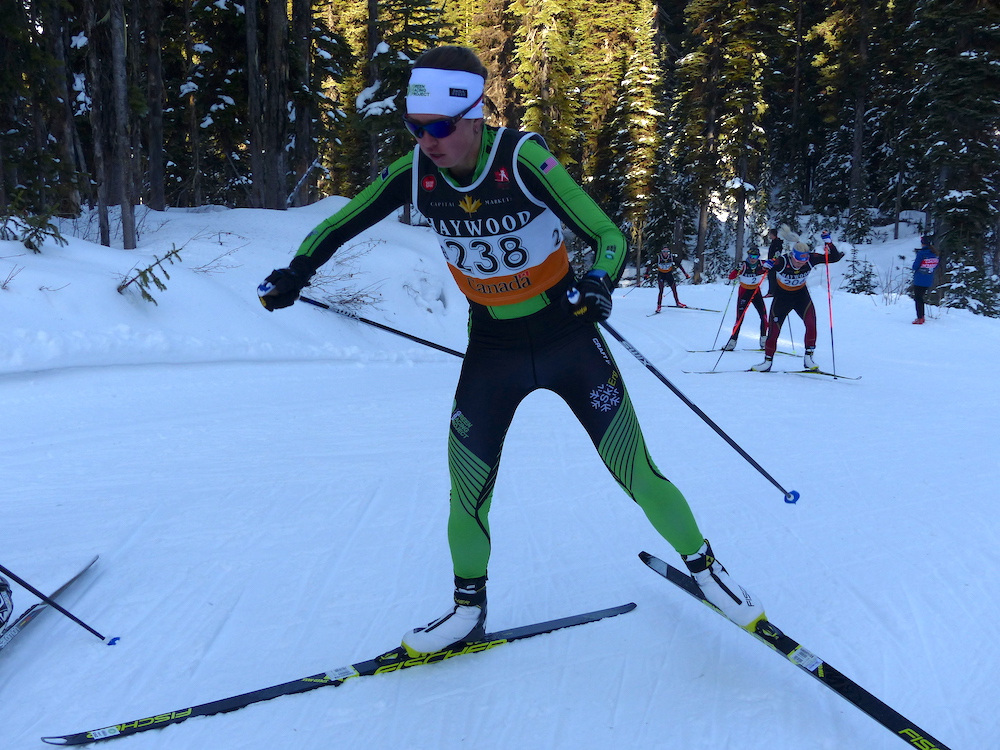
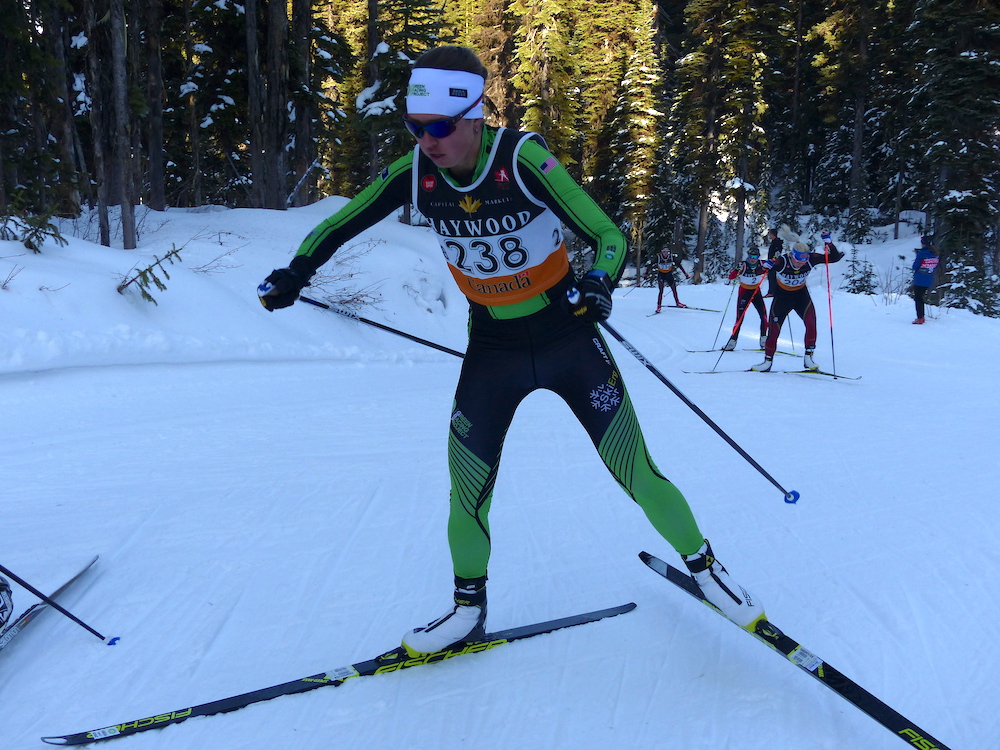
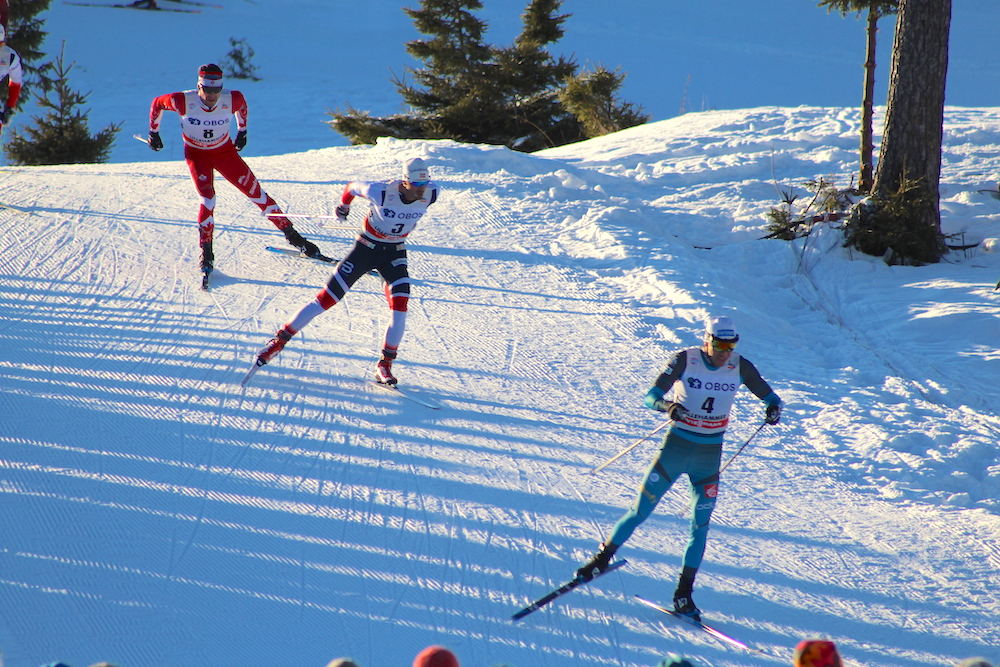
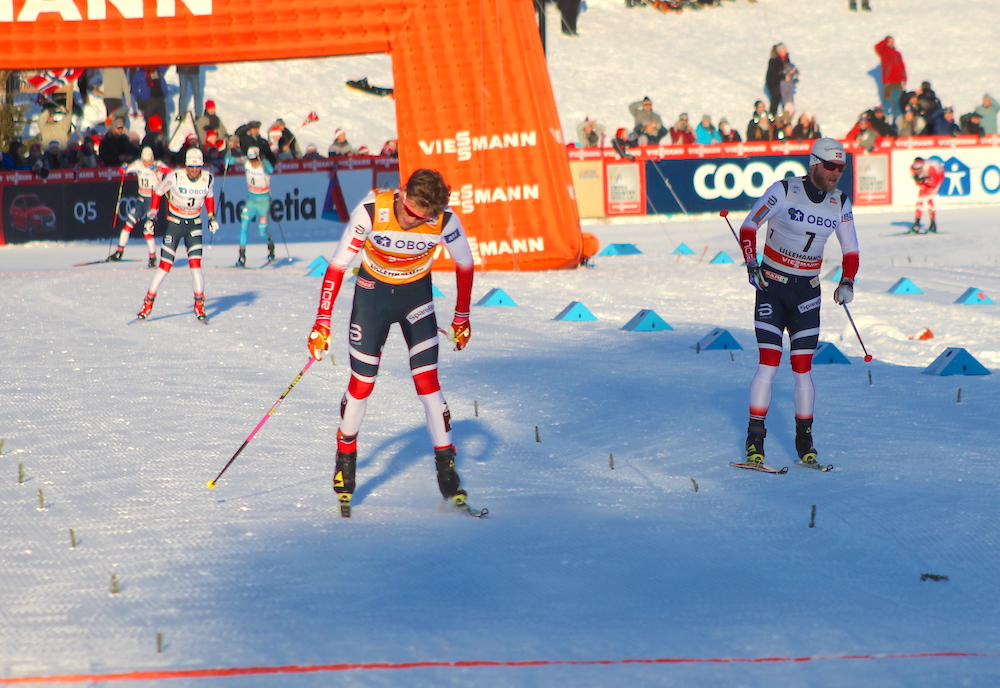
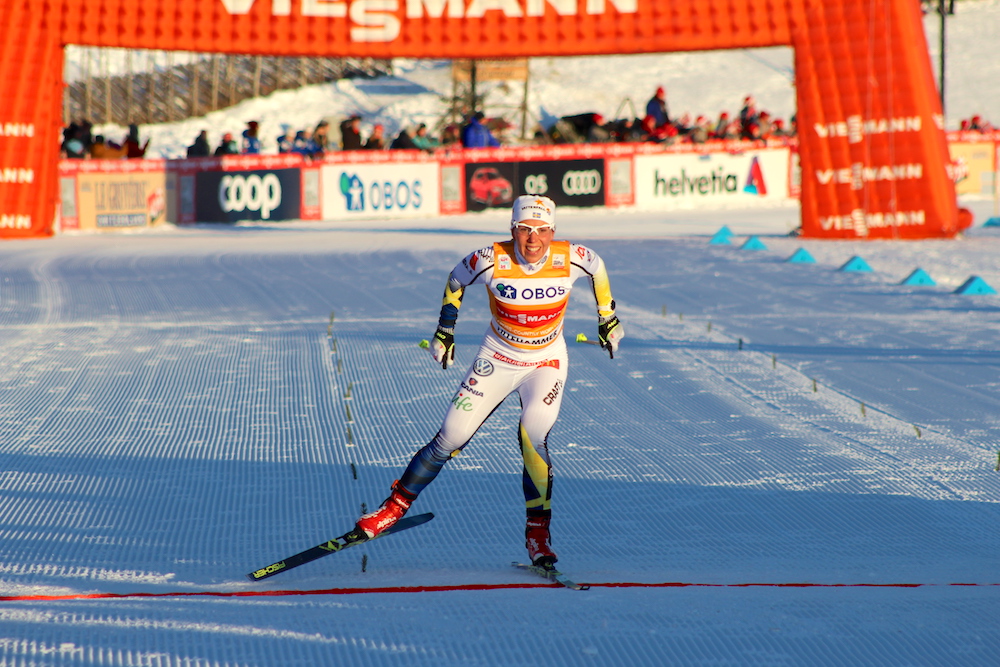
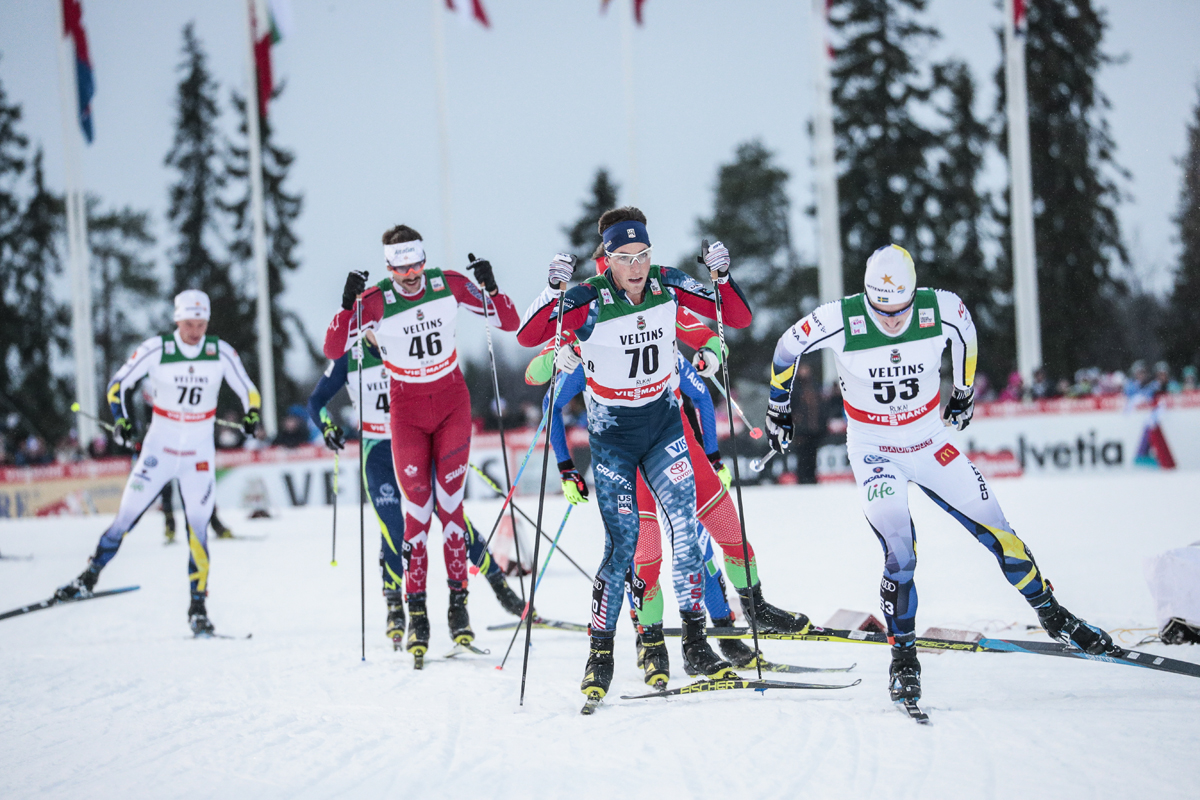
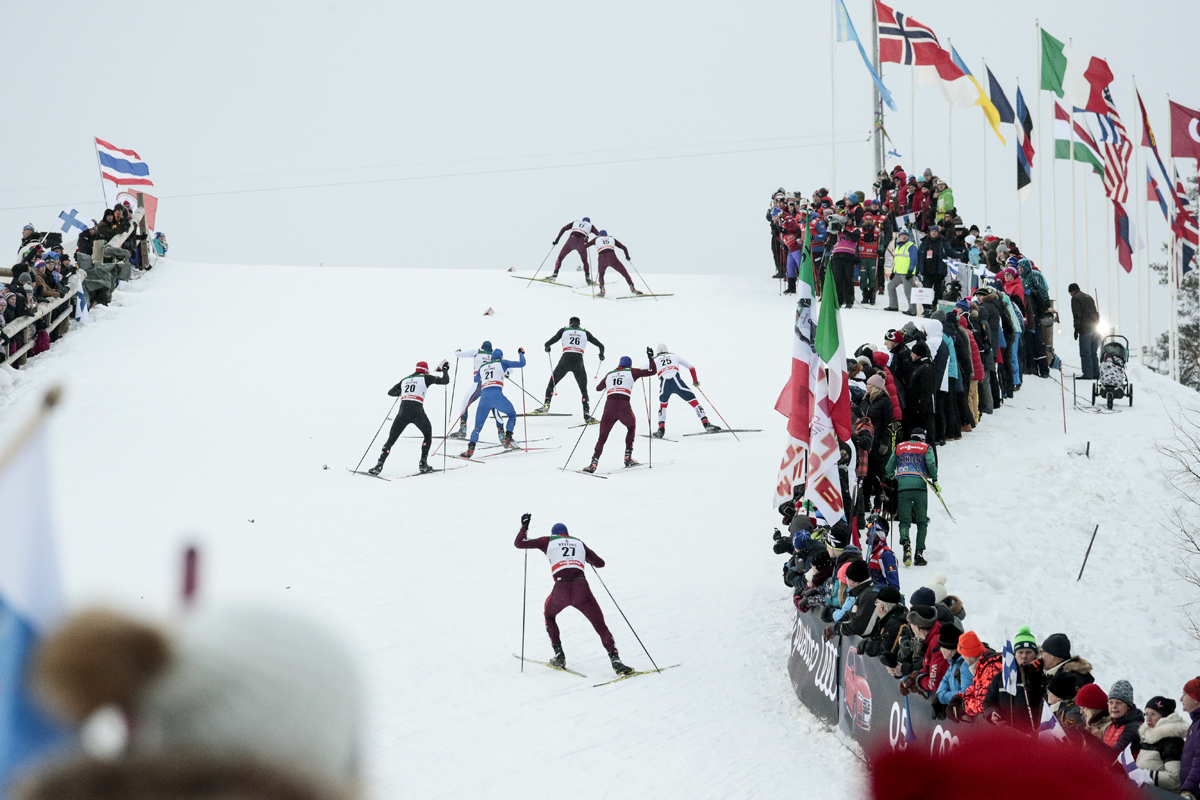
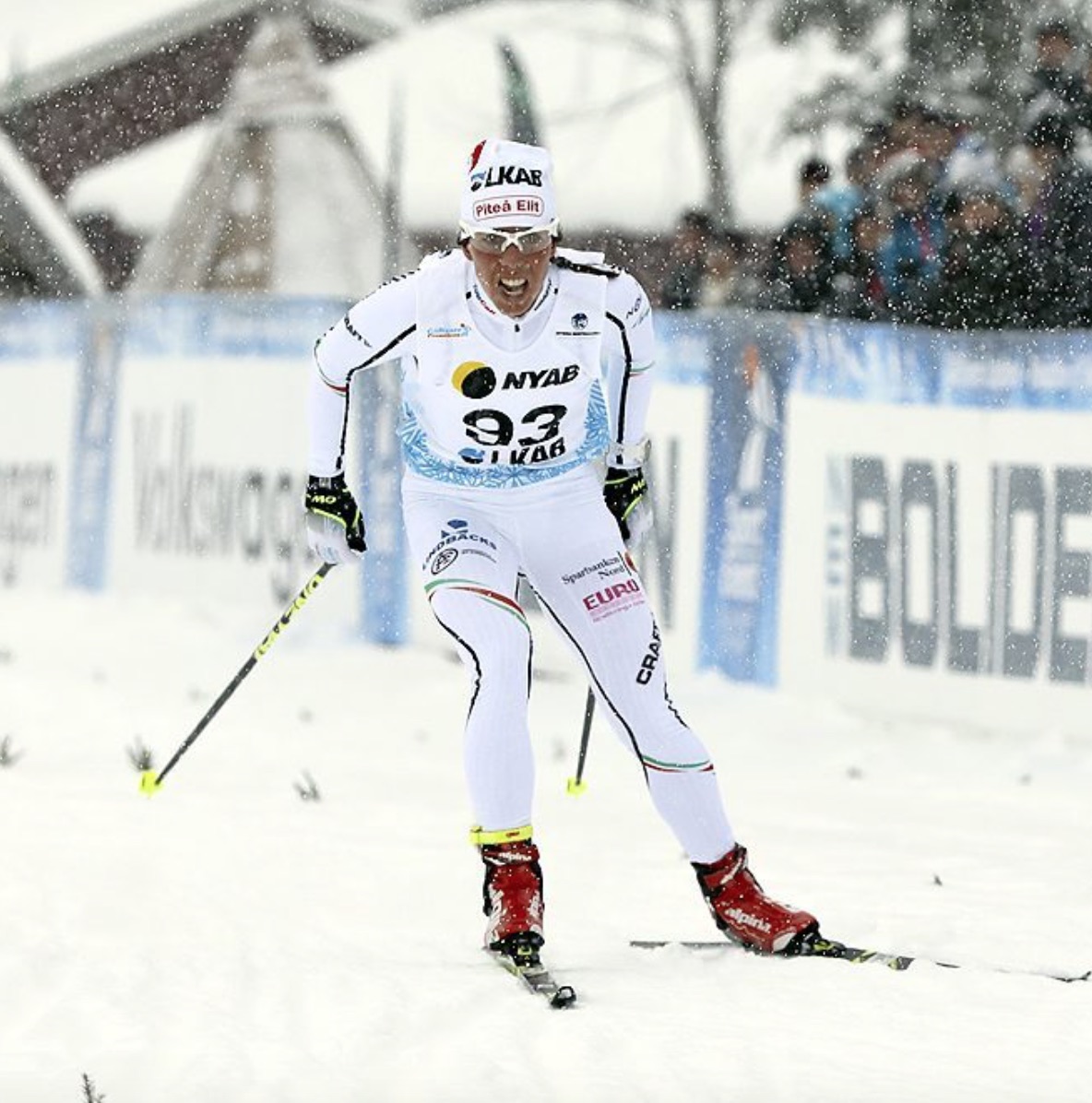
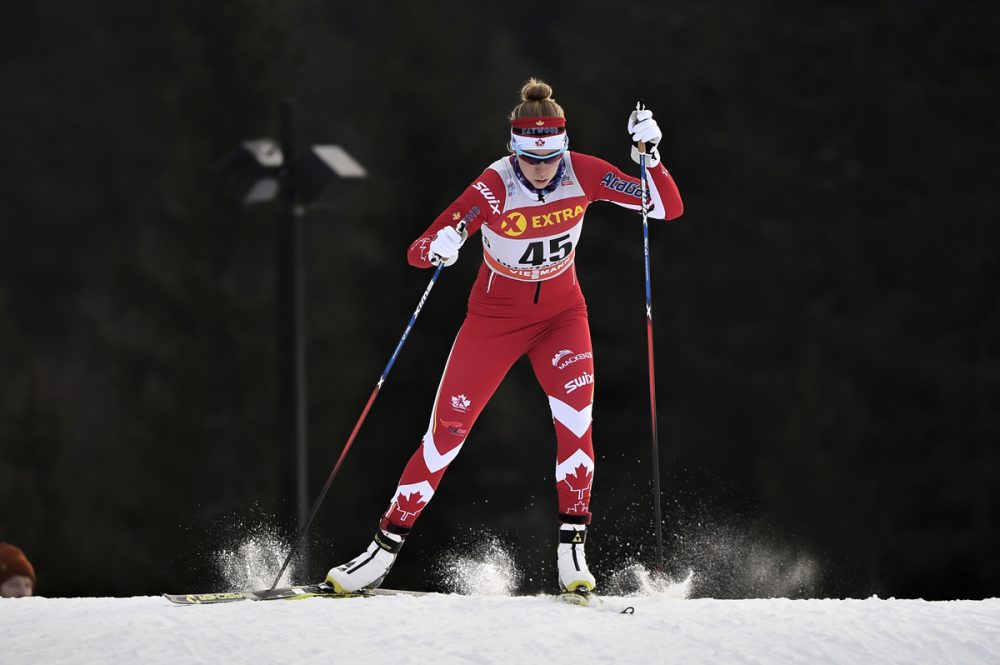
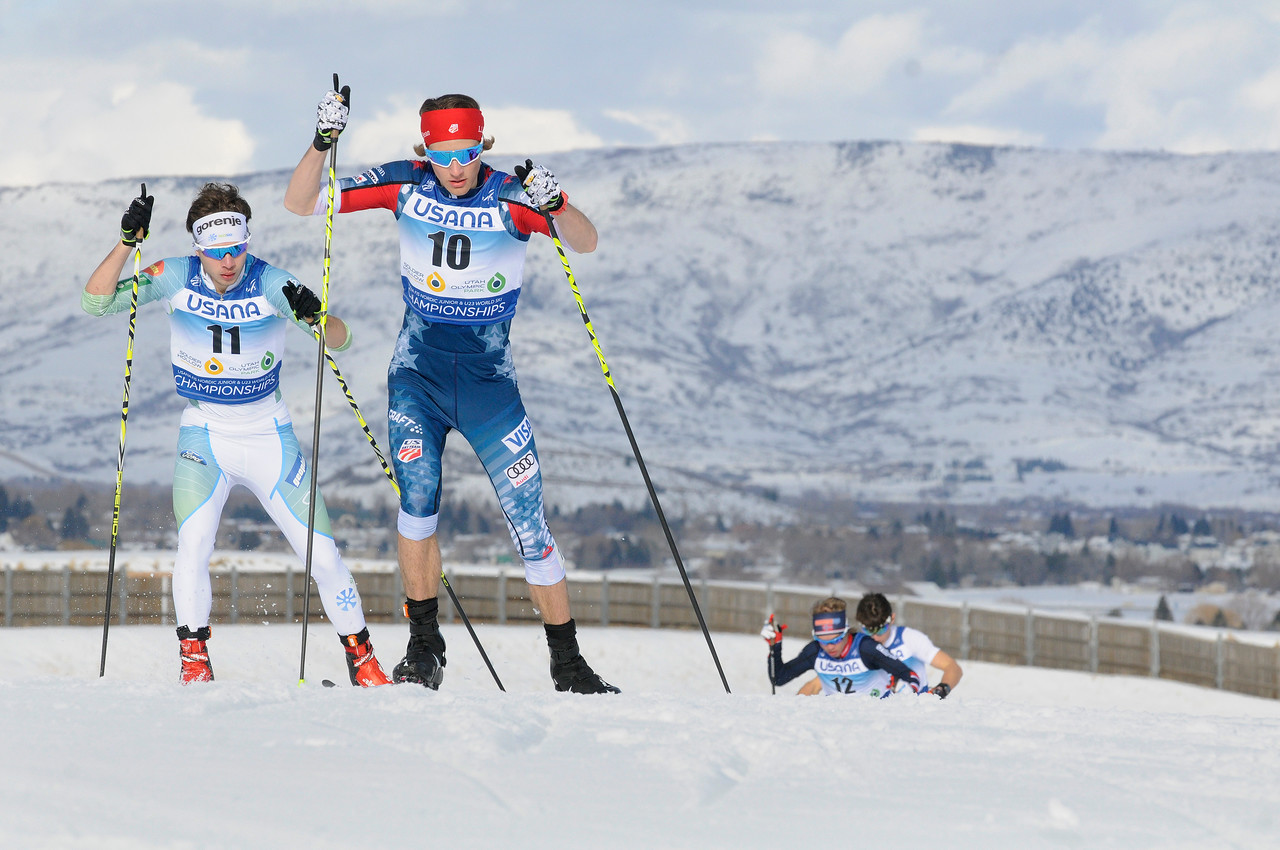
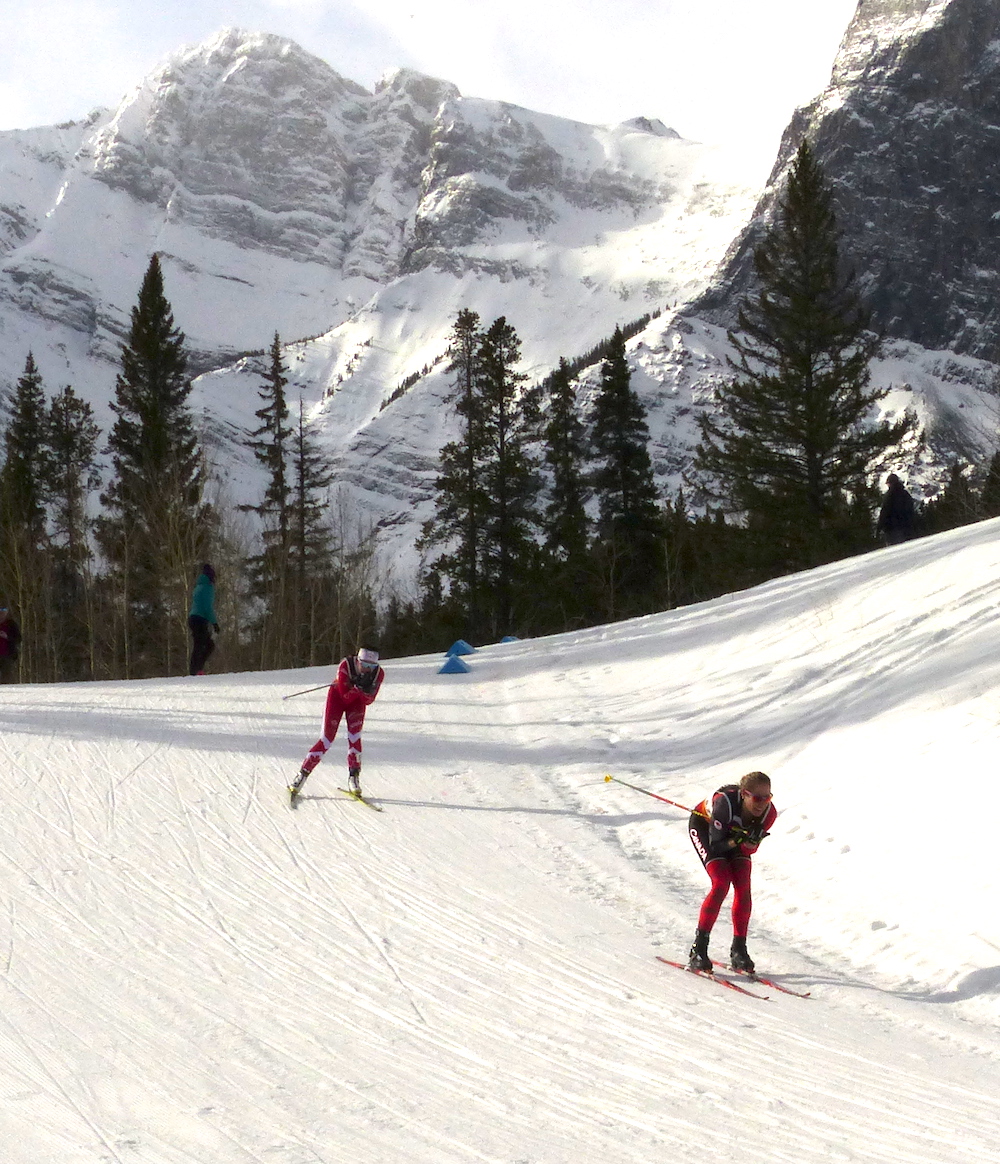
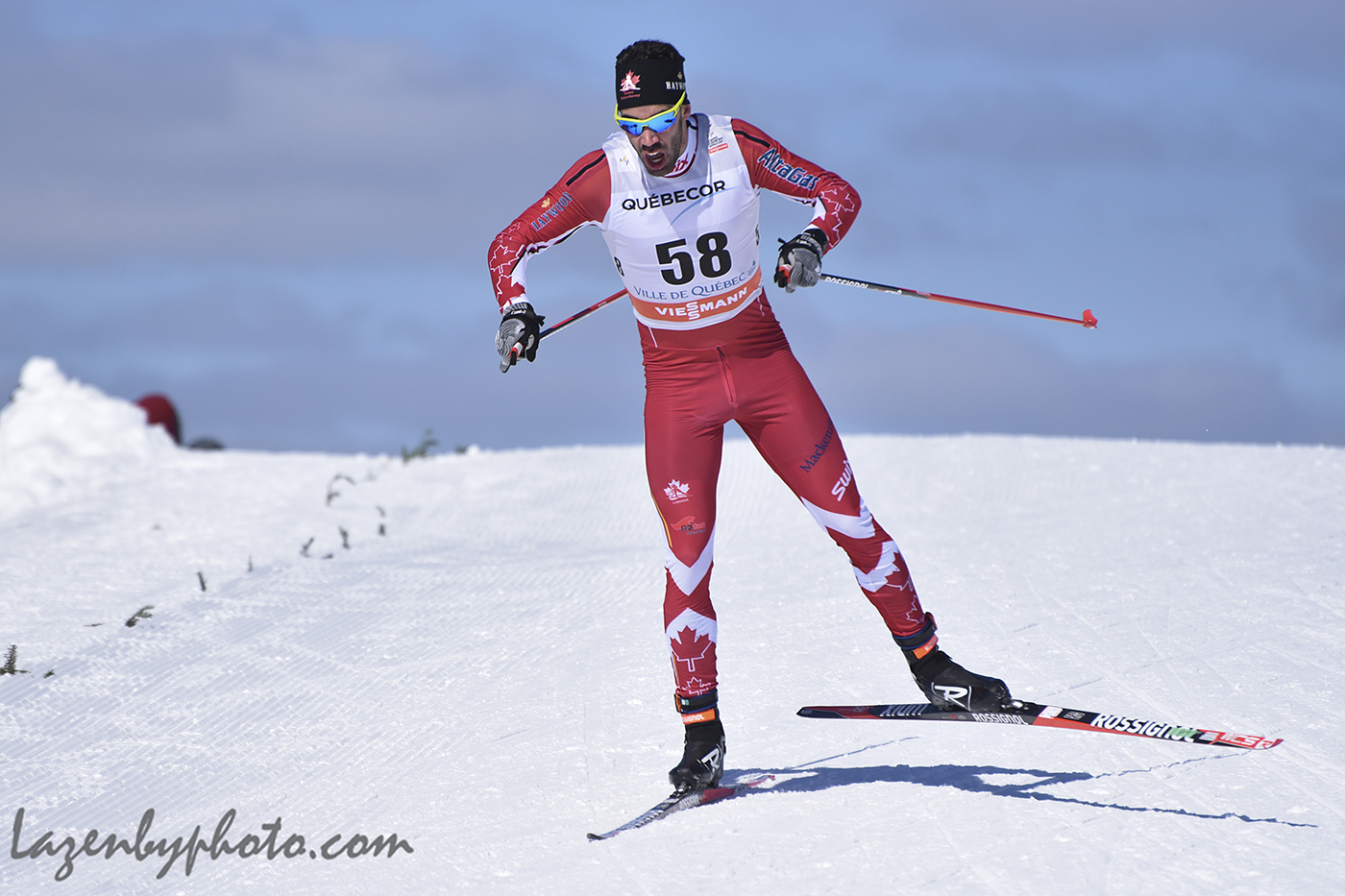
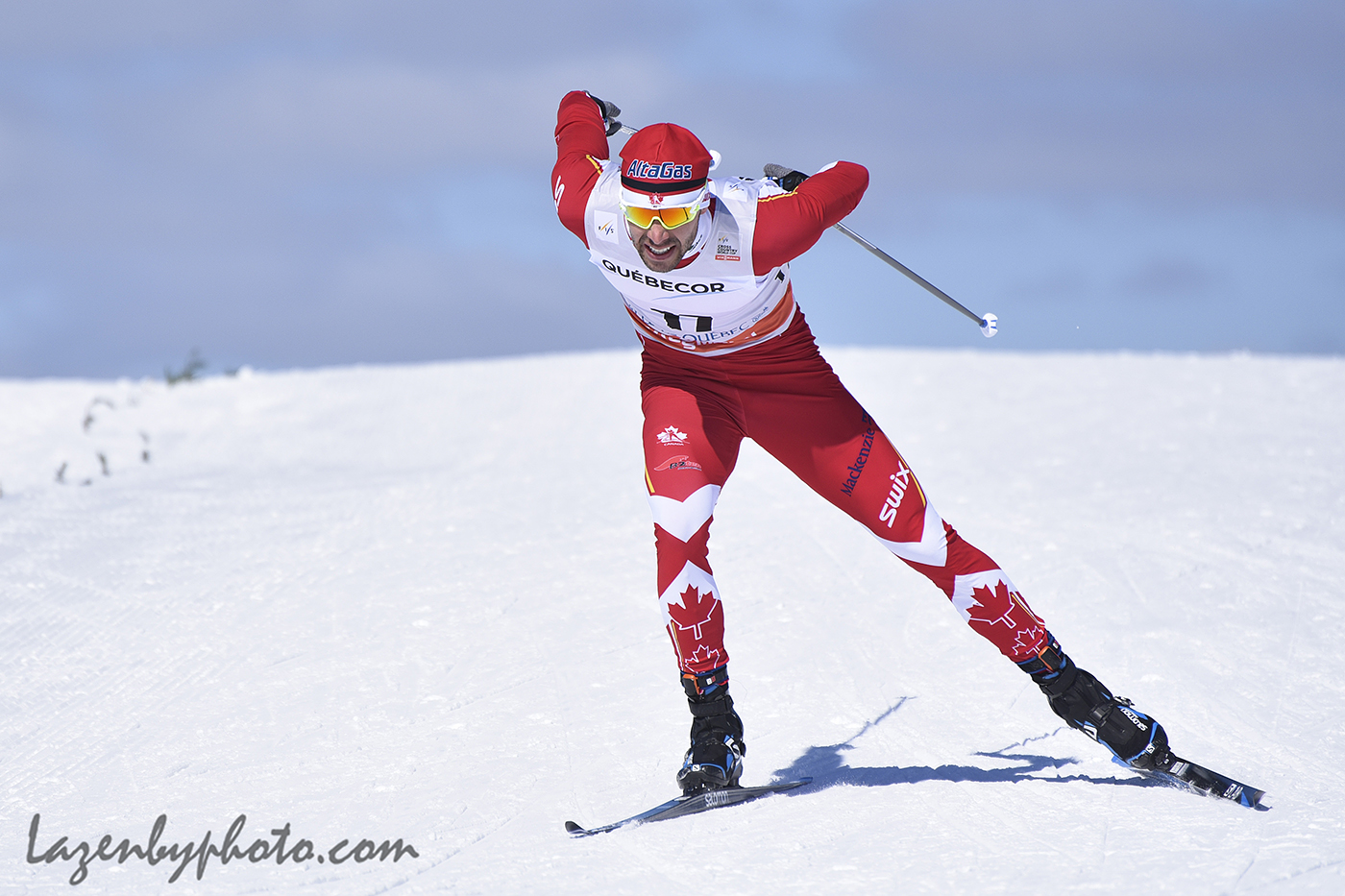
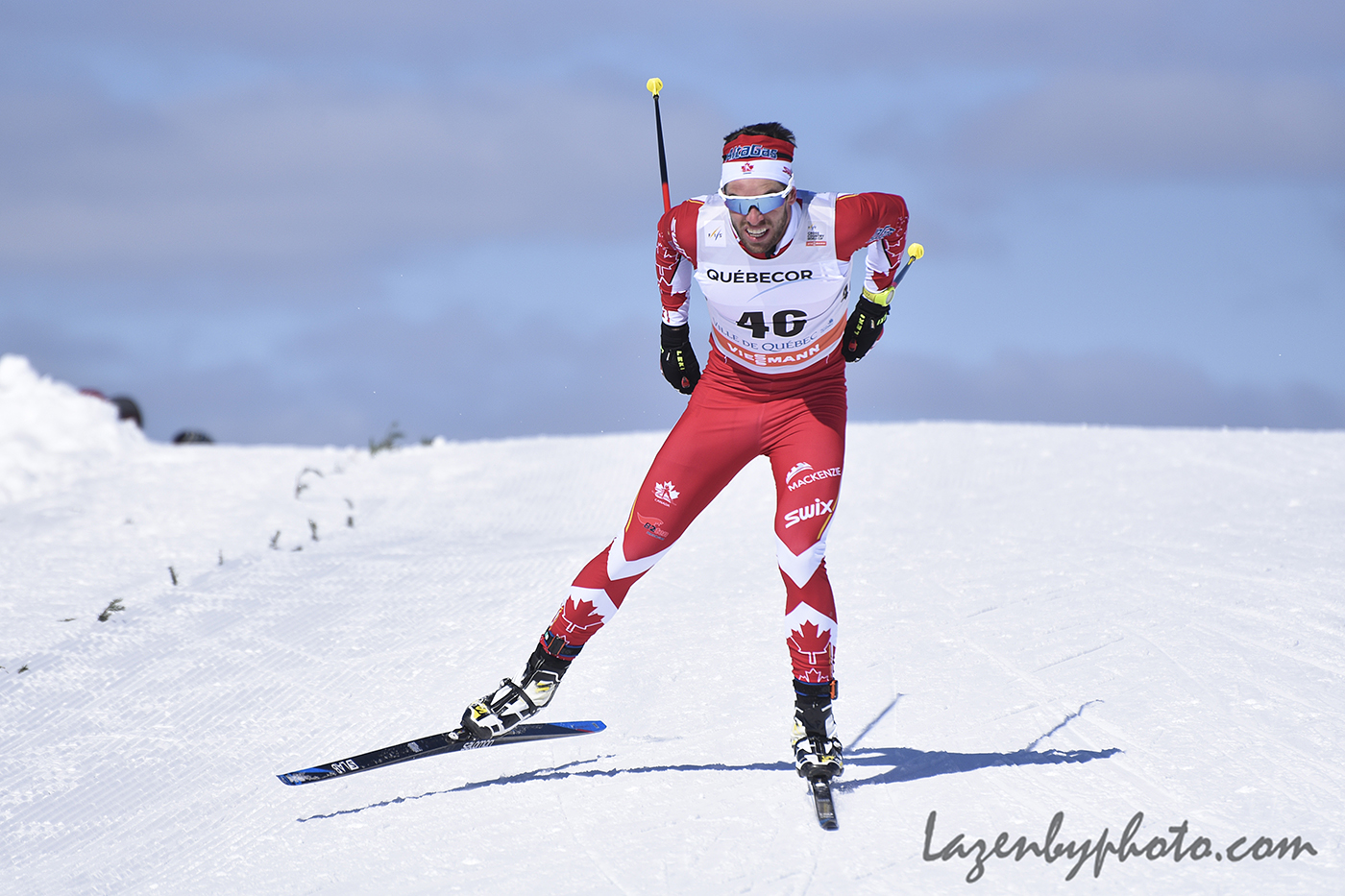
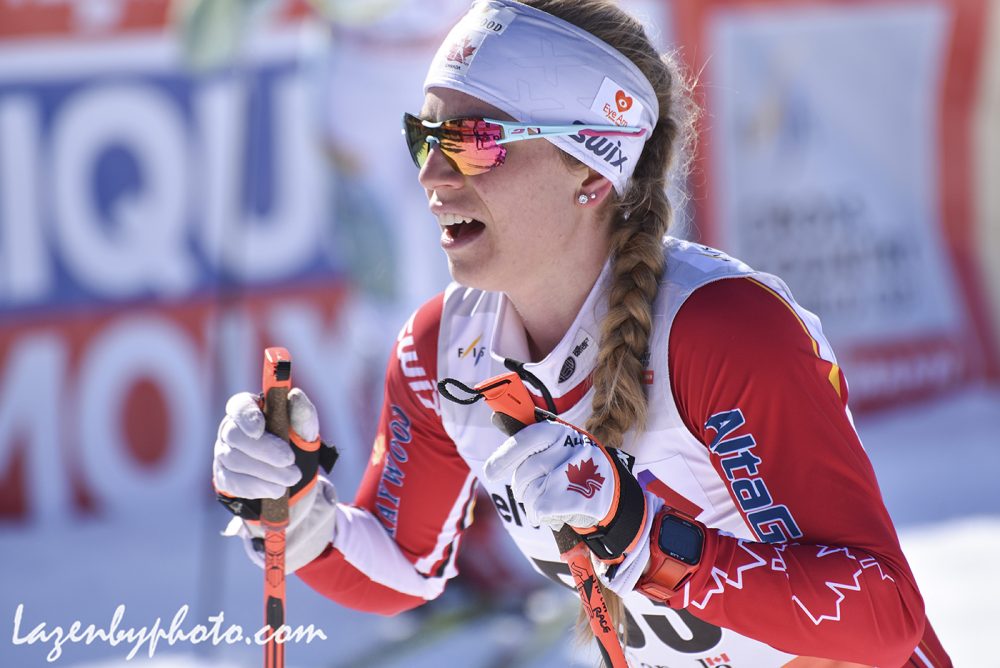
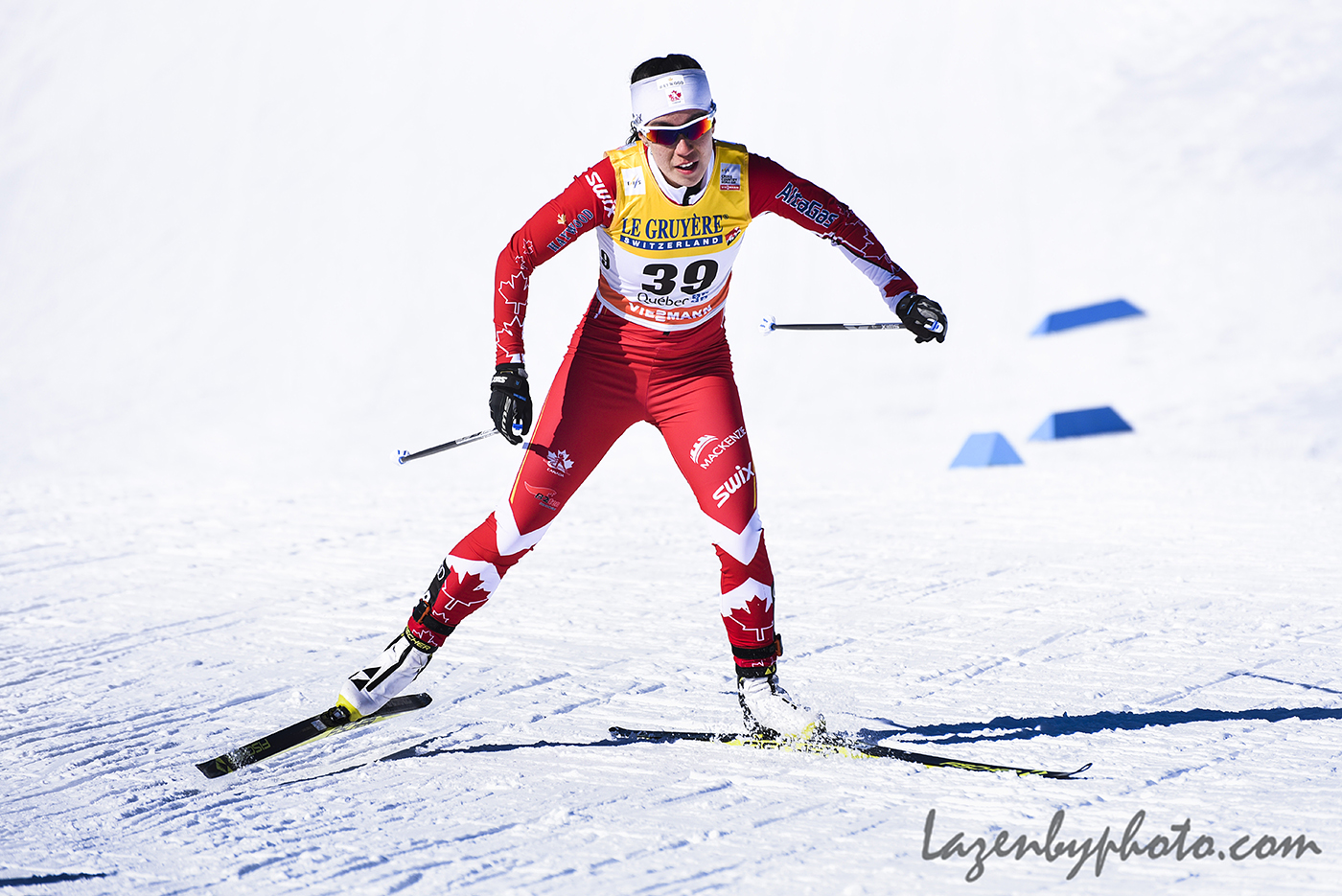
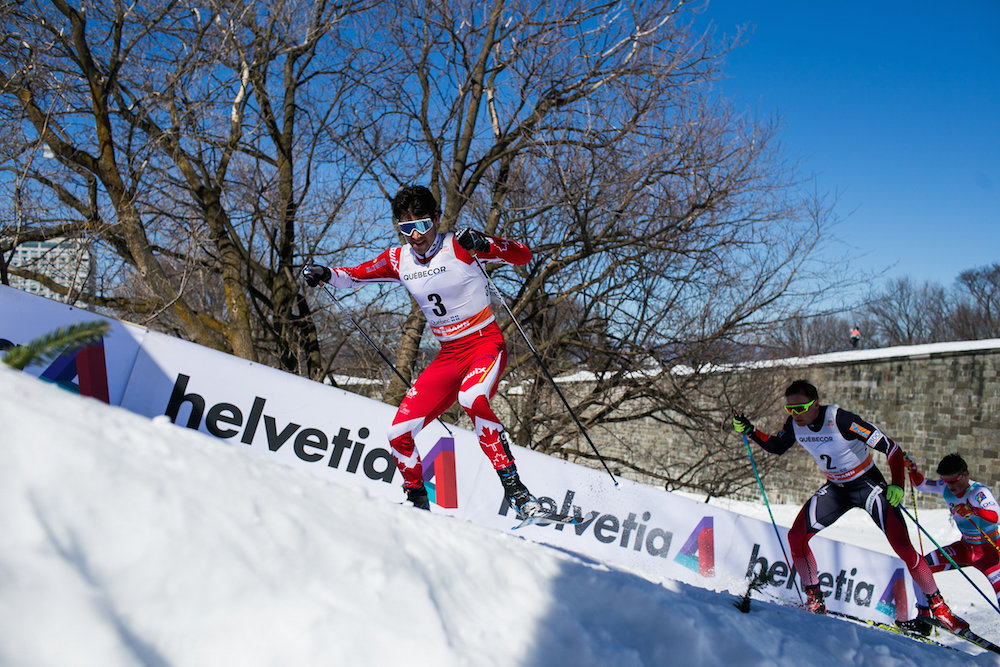
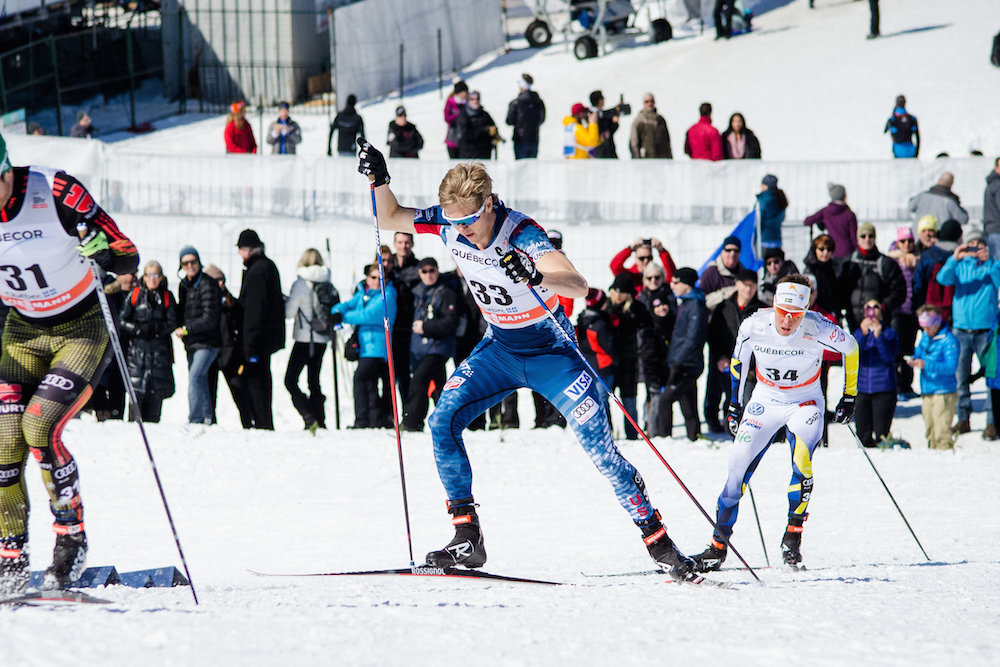
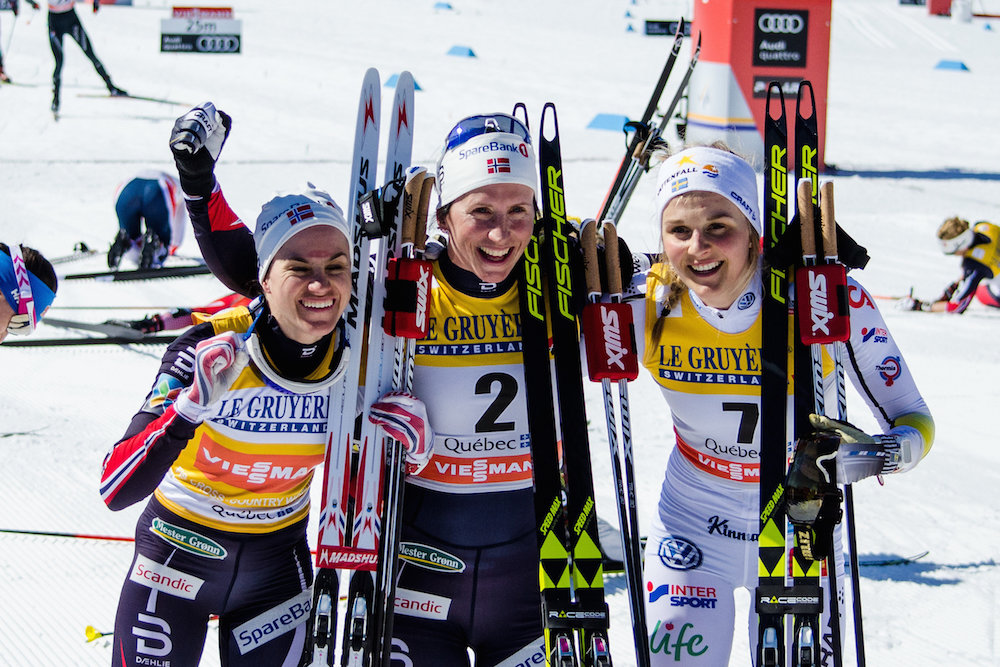
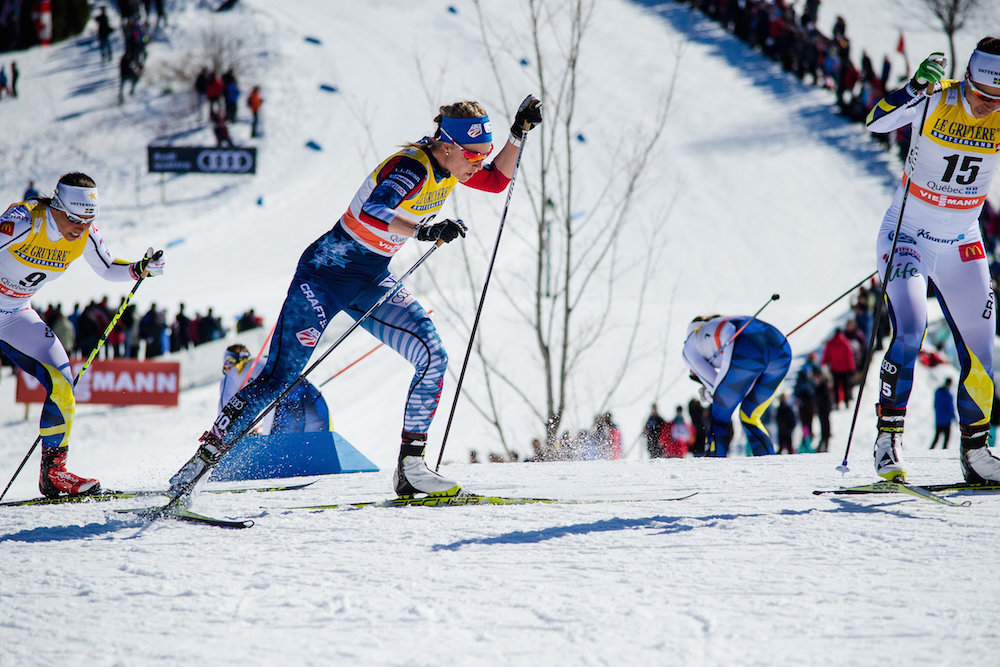
Caitlin Patterson (Craftsbury Green Racing Project) charging up the wall climb en route to the win in the women’s 10 k freestyle on Sunday at the Sovereign Lake NorAm/SuperTour near Vernon, B.C. (Photo: Peggy Hung)
NorAm/SuperTour (Sovereign Lake near Vernon, British Columbia): 10/15 k freestyle
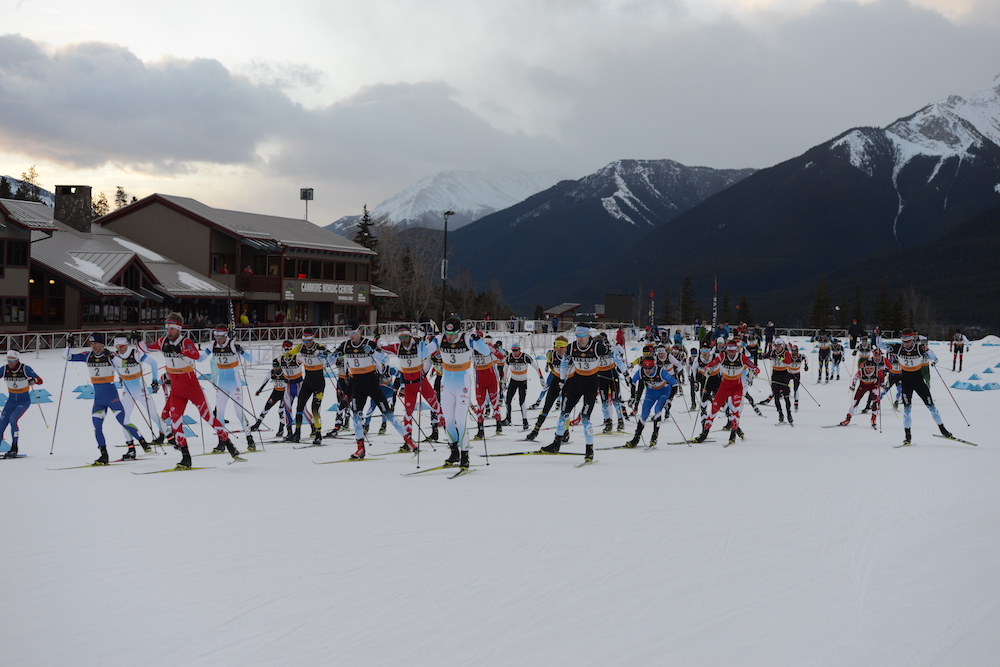
VERNON, B.C. — The combined NorAm and SuperTour event at the Sovereign Lake Nordic Centre continued with individual-start distance races and continued with the theme of U.S. domination of the leaderboard.
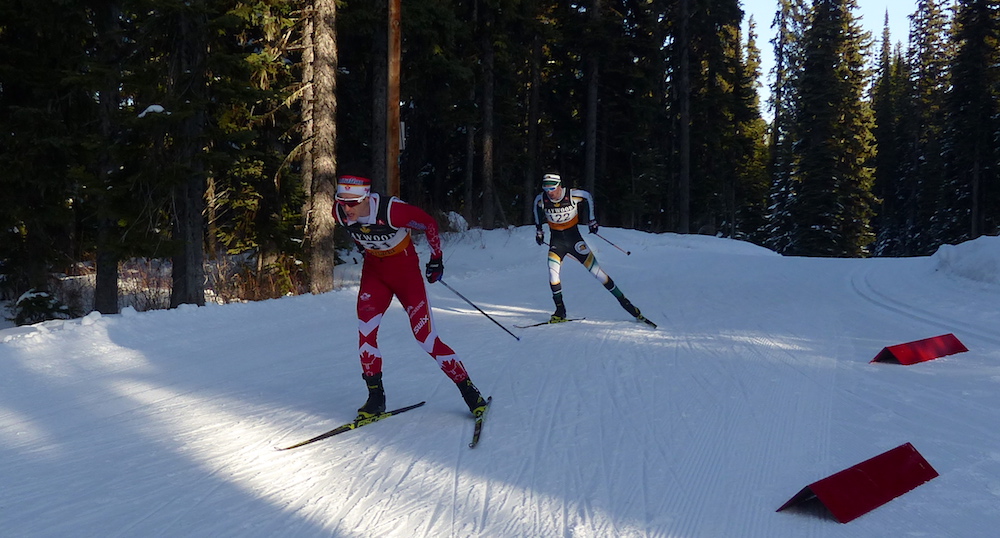
Ian Torchia, of Northern Michigan University (NMU) and the U.S. Ski Team D-team, started the day with a big victory in the men’s 15 k freestyle, finishing in 36:29.7 minutes and on the heels of Canadian Para-Nordic guide Graham Nishikawa, who started 30 seconds ahead of him and ended up sixth. Jack Hegman of the Sun Valley Ski Education Foundation (SVSEF) placed second, 19.0 seconds back, to complete his good weekend. Canadian Para-Nordic superstar Brian McKeever rounded out the podium in third, 22.6 seconds back.
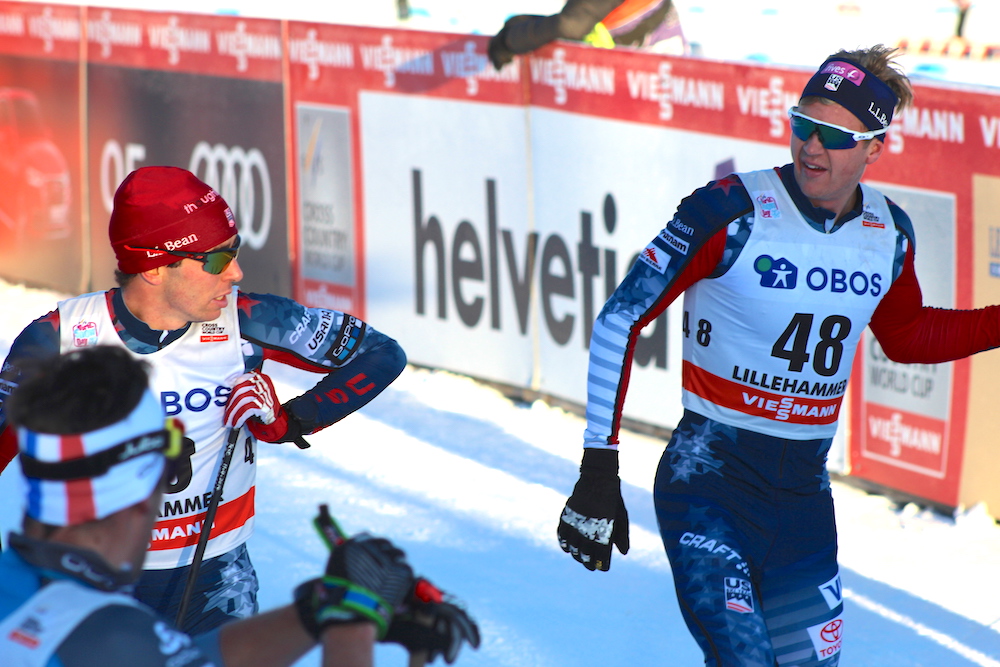
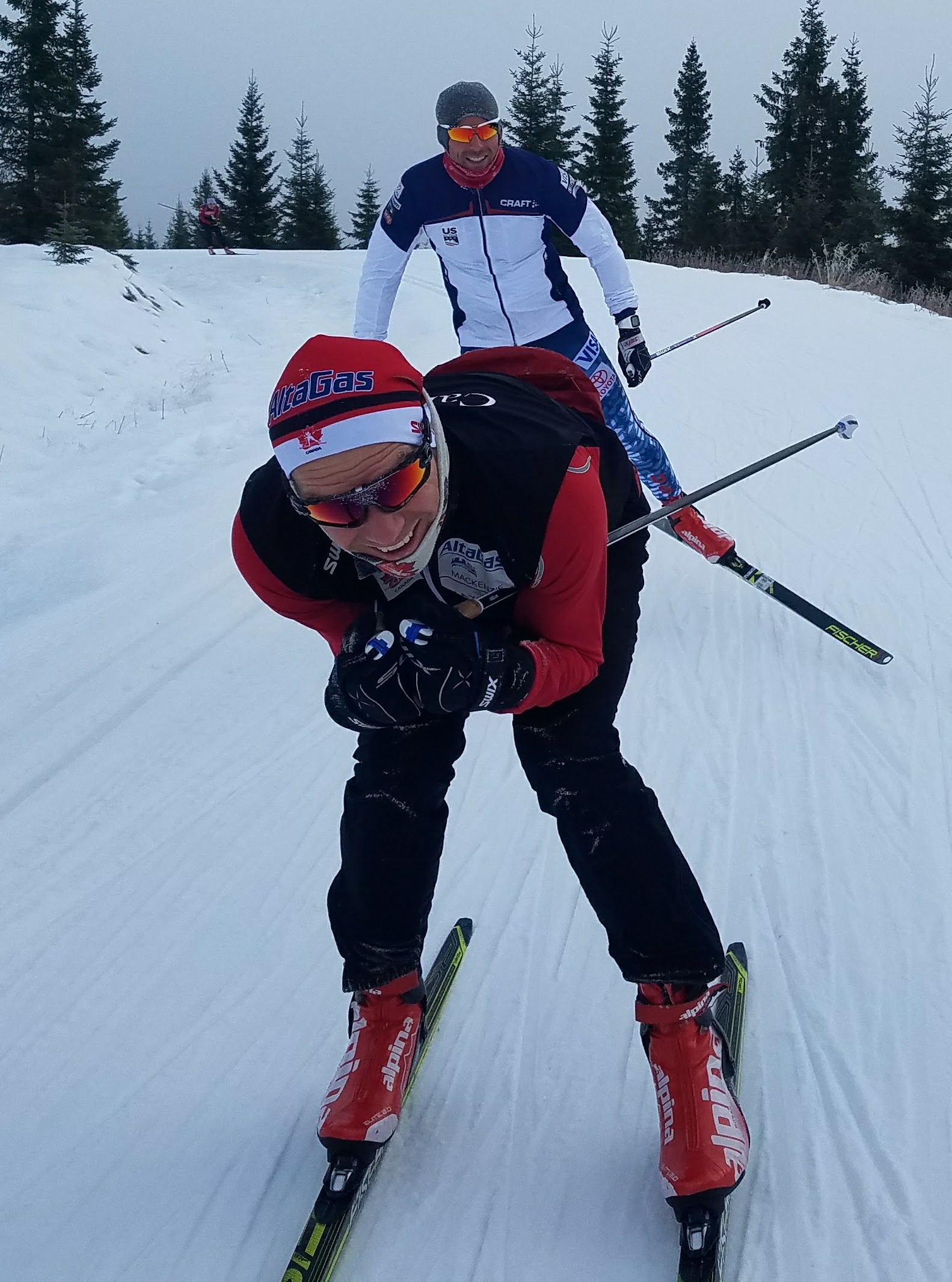
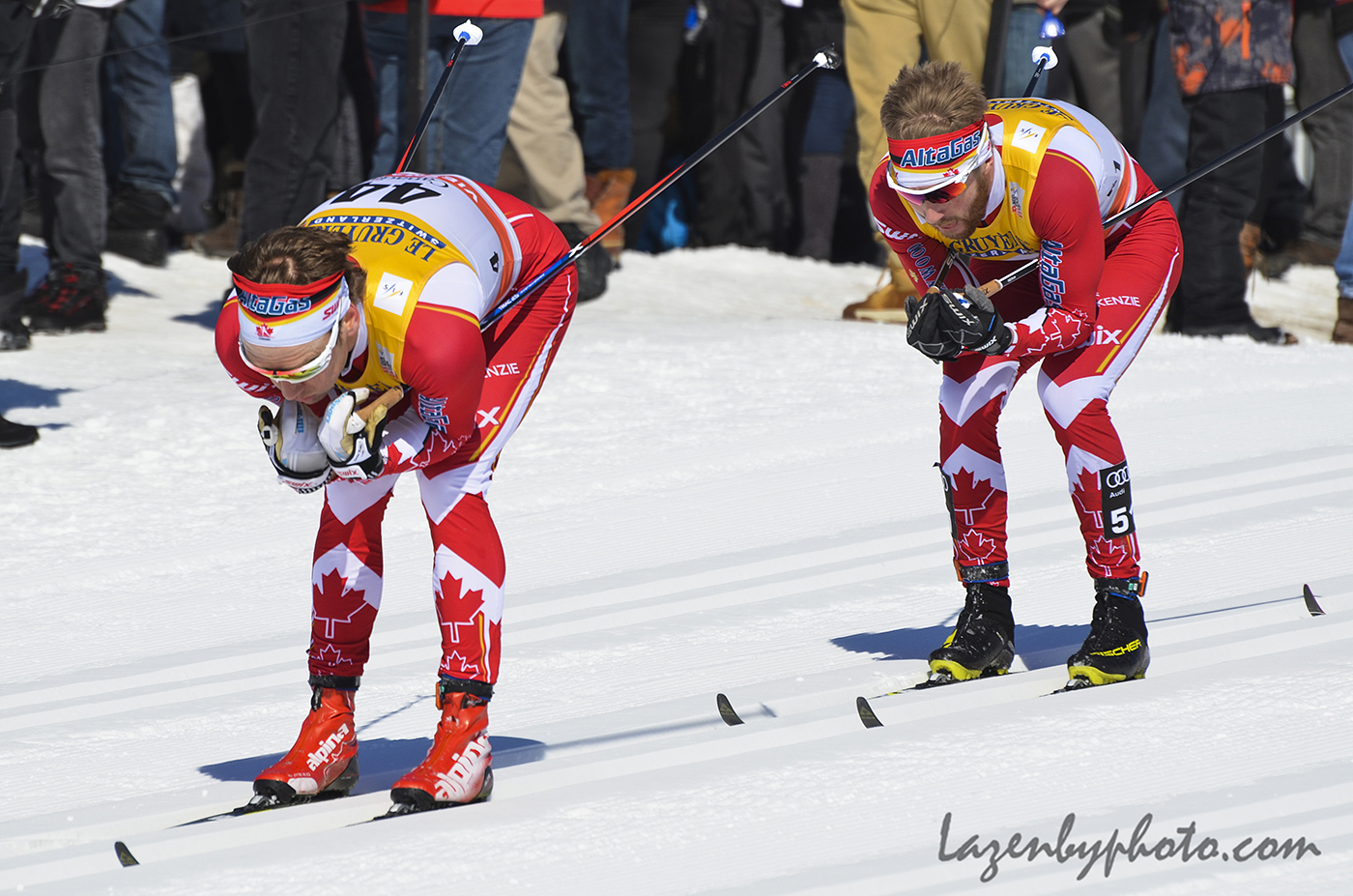
Graham Nishikawa (l) and Ian Torchia worked together after Torchia closed the 30-second gap en route to a victory in the men’s 15 k freestyle on Sunday at the Sovereign Lake NorAm near Vernon, B.C. (Photo: Peggy Hung)
The women were next to get some time in the sunshine with two laps for 10 k. Caitlin Patterson of the Craftsbury Green Racing Project (CRGRP) upgraded from Saturday’s silver to gold on Sunday with winning time of 27:13.0. Rosie Frankowski of Alaska Pacific University (APU) snatched second, 30.7 seconds back. Caitlin Gregg (Team Gregg) raced to third, 1 second behind Frankowski.
Former Canadian national-team biathlete Zina Kocher started her new cross-country career as the top Canadian in seventh (+1:31.2).
The weather was a repeat of Saturday: -2 degrees Celsius, windless and sunny. Smiles were evident everywhere, even for athletes who didn’t quite nail the pacing on an unforgiving course.
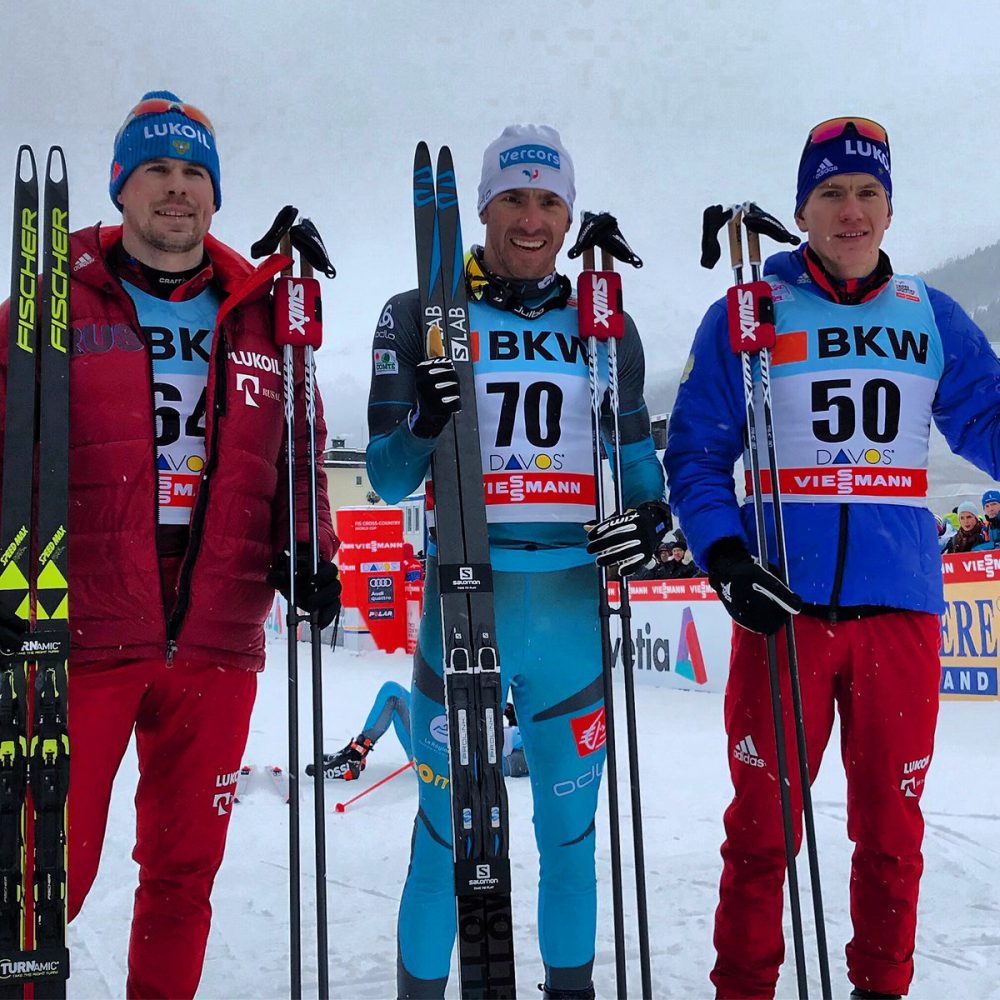
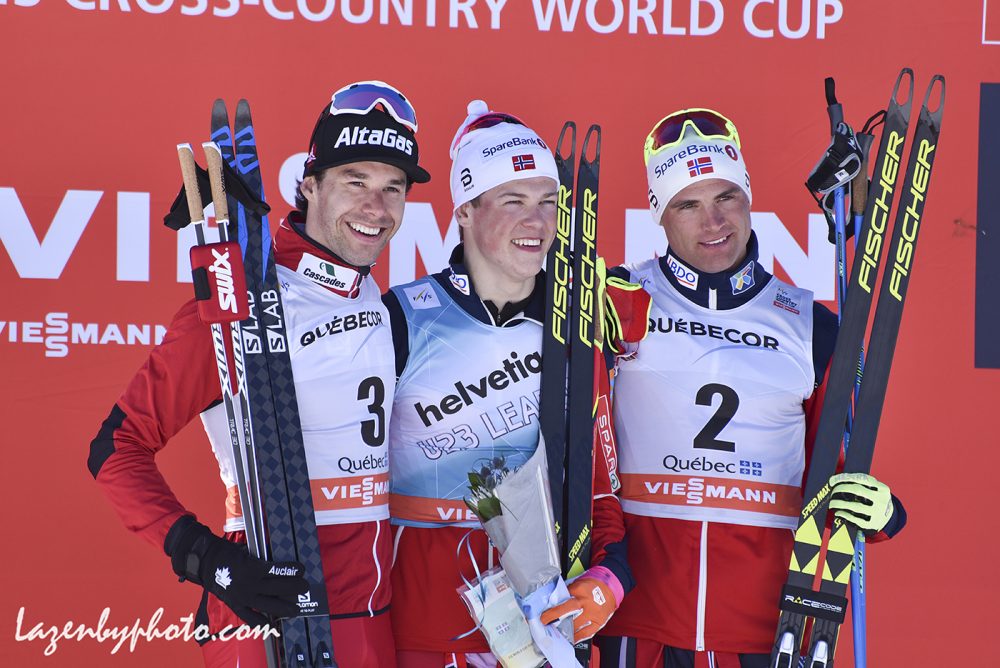
France’s Maurice Manificat (c) after winning the men’s 15-kilometer freestyle on Sunday in Davos, Switzerland. He finished ahead of Russians Sergey Ustiugov (l) and Alexander Bolshunov in second and third respectively. (Photo: FIS Cross-Country/Twitter)
FIS Cross Country World Cup (Davos, Switzerland): 10/15 k freestyle
After a day of sprinting, cross-country racers returned to the Davos World Cup venue on Sunday for the women’s 10-kilometer and men’s 15-kilometer freestyle individual start competitions.
For his first World Cup win in almost two years, France’s Maurice Manificat took the men’s 15 k race title in a time of 33:56.2. Exactly 4 seconds flat behind Manificat in second place was Russia’s Sergey Ustiugov. Ustiugov’s teammate Alexander Bolshunov, finished 10 seconds behind Ustiugov and 14.6 seconds behind Manificat for the men’s third and final podium spot.
The remainder of the men’s top ten included Norway’s Simen Hegstad Krüger in fourth (+21.3), Switzerland’s Dario Cologna in fifth (+26.5), Sweden’s Marcus Hellner in sixth (+35.4), Russia’s Denis Spitsov in seventh (+36.1), Hans Christer Holund of Norway in eighth (+36.9), Russian Alexey Chervotkin in ninth (+54.2), and Alex Harvey of Canada in 10th (+1:01.2).
The next best male North American finisher was American Patrick Caldwell in 41st (1:50.2).
Canada’s Devon Kershaw placed 44th (1:59.8), Graeme Killick 59th (+2:27.8), Russell Kennedy 68th (+2:43.4), and Julien Locke in 94th (4:27.5). Knute Johnsgaard did not start.
For the U.S., Noah Hoffman finished 48th (2:05.5) and Scott Patterson 88th (3:46.2). Simi Hamilton did not start and Andy Newell did not finish.
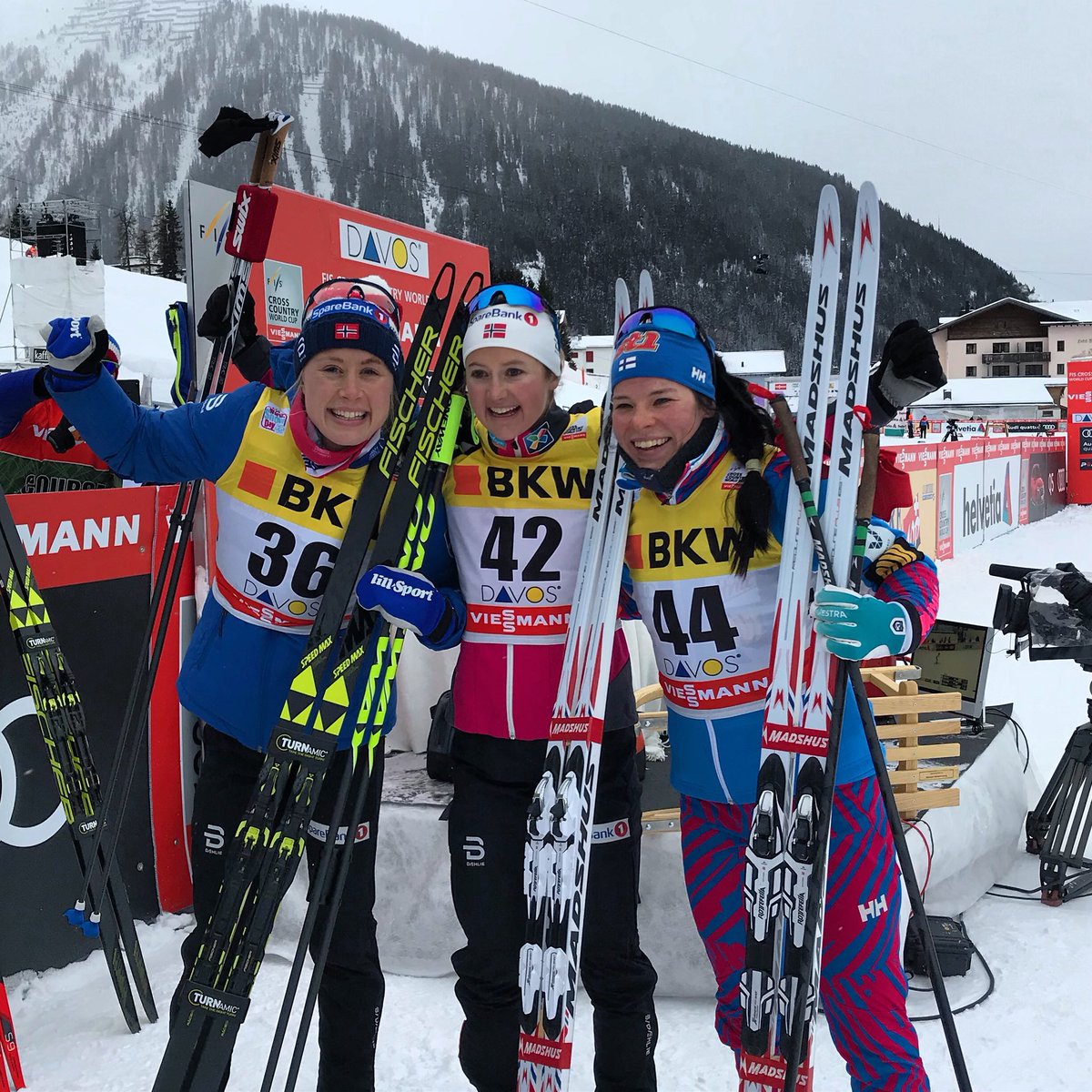
The women’s 10 k freestyle podium on Sunday at the Davos World Cup in Switzerland, with Norway’s Ingvild Flugstad Østberg (c) in first and Ragnhild Haga (l) in second, and Finland’s Krista Parmakoski (r) in third. (Photo: FIS Cross Country/Twitter)
In the women’s 10 k, 75 starters finished the 10 k course with Norway’s Ingvild Flugstad Østberg claiming first in a time of 25:28.5. Her Norwegian teammate, Ragnhild Haga finished 5.9 seconds behind her for second place. Krista Pärmäkoski of Finland raced to the third and final podium spot, 7.9 seconds back from Østberg’s winning time.
Rounding out the women’s top ten was Heidi Weng in fourth (+14.5), Austria’s Teresa Stadlober in fifth (+16.4), Switzerland’s Nathalie von Siebenthal in sixth (+16.4), Finland’s Kerttu Niskanen in seventh (+24.9), Sweden’s Charlotte Kalla in eighth (+26.8), Norwegian Marit Bjørgen in ninth (+35.9), and Astrid Uhrenholdt Jacobsen in tenth (+37.6).
Leading the U.S. women was Sadie Bjornsen in 12th (+44.6), seven seconds outside the top ten. The next two Americans finishers were within 3.1 seconds of each other, with Kikkan Randall finishing 14th (+56.8) and Jessie Diggins in 15th (+59.9).
Also scoring World Cup points for the Americans, Rosie Brennan finished in 17th (+1:11.2) and Chelsea Holmes in 29th (+1:32.9).
The U.S.’s Liz Stephen and Sophie Caldwell finishedin 40th (+1:58.5) and 52nd (+2:20.1), respectively.
For the Canadians, the team was led by Cendrine Browne in 45th (+2:05.9), followed by Emily Nishikawa in 50th (+2:18.4). Dahria Beatty placed 73rd (+2:53.0) and Katherine Stewart-Jones 79th (+3:44.6).
IBU World Cup (Hochfilzen, Austria): Men’s and women’s relays
Men’s and women’s relays took place on the final day of racing in Hochfilzen, with Norway winning the men’s 4 x 7.5 k and Germany topping the women’s 4 x 6 k by considerable margins.
Norway’s Ole Einar Bjørndalen, Henrik L’Abée-Lund, Erlend Bjøntegaard, and Lars Helge Birkeland raced to first in 1:21.21.8 hours, nearly two minutes clear of Germany in second, after taking the lead on L’Abée-Lund’s second leg. They avoided the penalty loop and used a total of nine spares, and never lost hold of first place for the rest of the race.
Germany raced to second (+1:54.9) with Erik Lesser, Benedikt Doll, Arnd Peiffer, and Simon Schempp, with zero penalties and 17 spares, after Peiffer lifted them from fourth to second on the third leg. Schempp held them there, despite using a maximum of three spares on each of his shooting stages, in the final leg.
France claimed third (+2:34.0) with Jean-Guillaume Béatrix, Simon Desthieux, Emilien Jacquelin, and Quentin Fillon Maillet, despite three penalties and 13 spares. Two of their penalties came on Beatrix’s first leg and another in Fillon Maillet’s final shooting. After being tagged in fifth, Jacquelin raced them up to third on the third leg and Fillon Maillet held onto that position for the last spot on the podium.
The U.S. men finished ninth (+3:38.3) with Lowell Bailey, Leif Nordgren, Tim Burke, and Sean Doherty, after they combined for three penalties and 13 spares. Bailey avoided the penalty lap and put them in third at the first exchange, while Nordgren slipped to seventh after a penalty, Burke remained in seventh with one penalty as well, and Doherty had one more penalty to anchor the team to ninth.
Canada placed 15th (+6:22.5) with six penalties and 20 spare rounds, with Christian Gow, Scott Gow, Nathan Smith, and Brendan Green. After being tagged in 21st, Smith raced them up to 13th, using just two spares to clean. Green anchored them to 15th after using six spares and skiing the 15th-ranked time on that last leg.
In the women’s relay that followed, Germany won by 44.9 seconds over Ukraine, with Vanessa Hinz, Franziska Hildebrand, Maren Hammerschmidt, and Laura Dahlmeier using nine spares while staying out of the penalty lap.
After Hinz raced them into first, Hildebrand slipped to fourth after using four spares on the second leg. Hammerschmidt raced the fastest third leg to put them back in first, and Dahlmeier held them there to the finish, crossing first in 1:14:36.4.
Ukraine (0 penalties, 5 spares) took the lead on the second leg but ultimately settled for second with Vita Semerenko, Yuliia Dzhima, Valj Semerenko, and Olena Pidhrushna. Dzhima put them in second heading into the race’s halfway point, but Valj Semerenko lost two places to tag Pidhrushna in third. Pidhrushna used just two spares on the final leg to bring them to second, about 20 seconds ahead of France in third.
Despite a tough first leg for Marie Dorin Habert, in which she had two penalties and tagged off in 14th, France rose to third place at the finish (+1:04.5) thanks to strong skiing and shooting from anchor Anaïs Bescond.
The team had a total of two penalties and 13 spares. Celia Aymonier used four spares to put them in ninth after the second leg, and third-leg Justine Braisaz lifted them one more place to seventh before Bescond skied the fastest last leg to pick off four more places.
Canada placed ninth (+2:31.6) with Emma Lunder, Rosanna Crawford, Megan Bankes, and Julia Ransom, with no penalties and nine spares. Crawford put them in fifth after the second leg, Bankes lost one place on the third leg, and Ransom slipped three more with three spares on her final shooting to finish ninth.
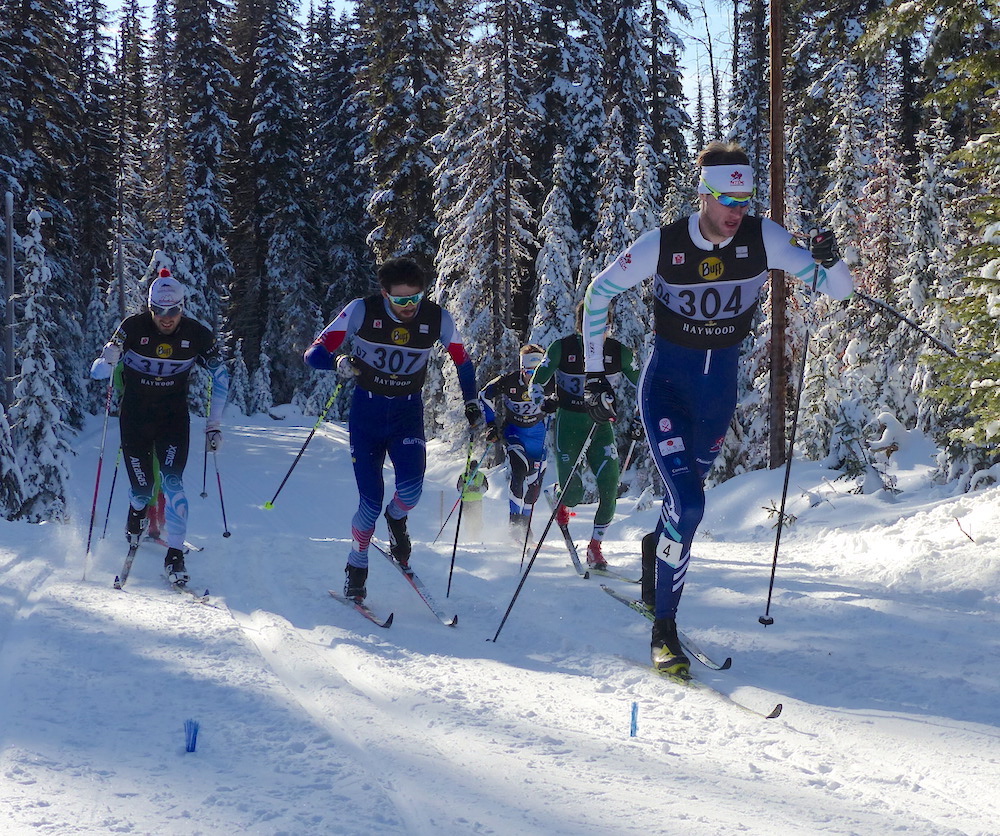
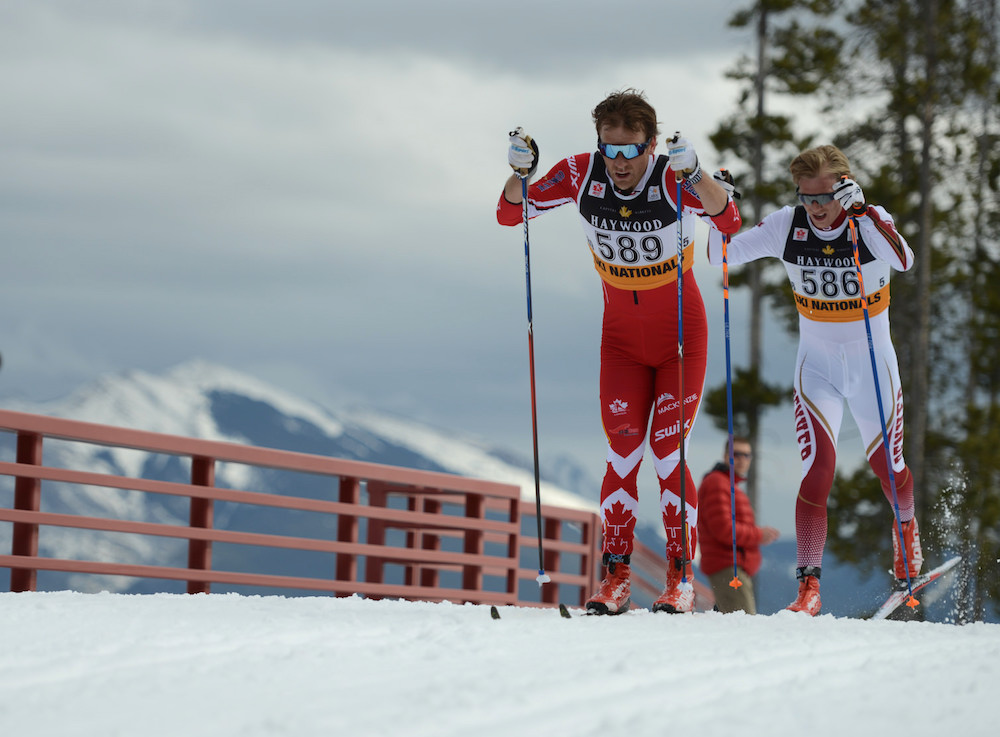
Bob Thompson (304) of NTDC Thunder Bay leading Sun Valley’s Jack Hegman (307) and Patrick Stewart-Jones (317) of the AWCA during their quarterfinal of the NorAm men’s 1.3 k classic sprint on Saturday at Sovereign Lake near Vernon, B.C. (Photo: Peggy Hung)
NorAm/SuperTour (Sovereign Lake near Vernon, British Columbia): Classic sprints
On the opening day of the NorAm Continental Cup series in Canada (which doubled as a U.S. SuperTour), American Kaitlynn Miller of the Craftsbury Green Racing Project (CGRP) started Saturday with a nearly three-second win in the classic-sprint qualifier at the Sovereign Lake Nordic Centre, then went on to win her quarterfinal and semifinal before topping the final as well.
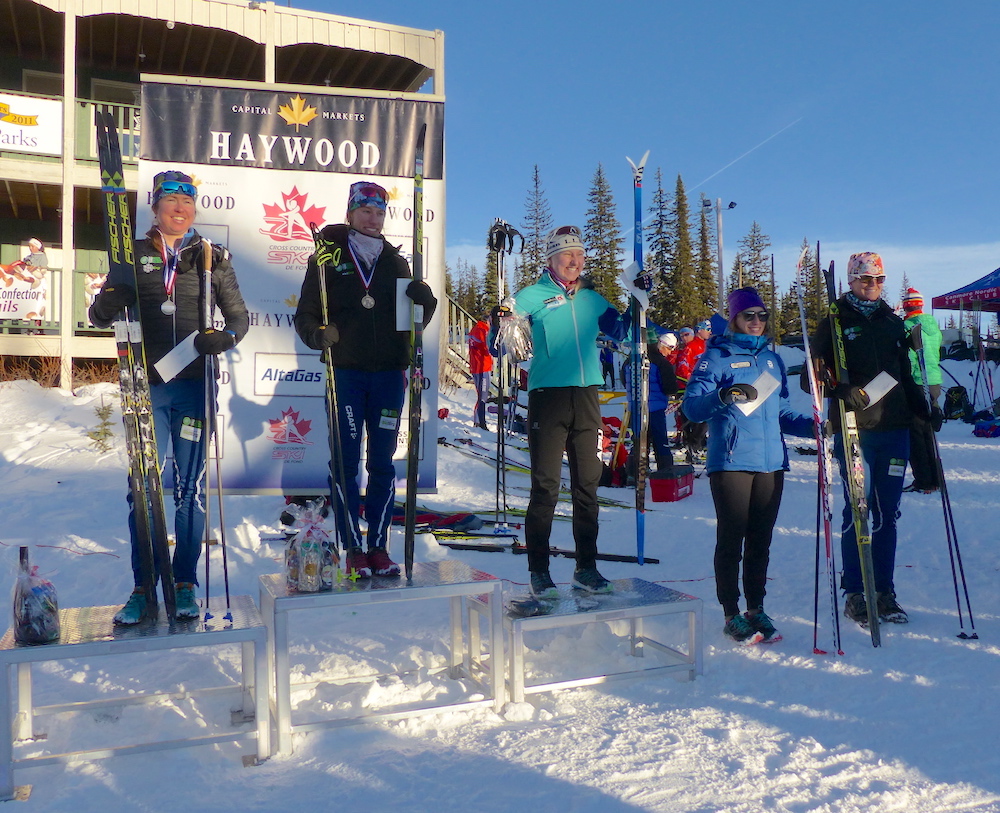
The women’s 1.3 k classic sprint podium and top five at the first NorAm of the season on Saturday at Sovereign Lake near Vernon, B.C., with (from left to right) Caitlin Patterson (CGRP) in second, Kaitlynn Miller (CGRP) in first, Hannah Halvorsen (APU/USST) in third, Kelsey Phinney (SVSEF) in fourth, and Liz Guiney (CGRP) in fifth. (Photo: Peggy Hung)
Miller was the fastest women’s qualifier by 2.87 seconds on the 1.3-kilometer course with a time of 2:59.39. Ultimately, she won the final in 2:57.53, 0.93 seconds ahead of her teammate Caitlin Patterson in second and 2.59 seconds clear of the third American on the podium, Hannah Halvorsen of Alaska Pacific University (APU) and the U.S. Ski Team (USST) D-team, in third place.
Halvorsen previously qualified third behind Kelsey Phinney, of the Sun Valley Ski Education Foundation (SVSEF) in second. Phinney finished fourth in the final (+2.85), while a third Craftsbury skier, Liz Guiney placed fifth (+3.53). The lone Canadian in the six-woman final, Sophie Carrier-Laforte of the Pierre-Harvey National Training Centre (CNEPH) placed sixth (+4.38).
Thompson Fends Off Five Americans
Of the six racers in the men’s 1.3 k freestyle sprint final, five of them were American. Bob Thompson, of the Thunder Bay National Team Development Centre (NTDC), bested them all for the win in 2:29.31, just 0.03 seconds ahead of Ben Saxton, of the Stratton Mountain School (SMS) Elite Team, in second place. Cole Morgan (SVSEF), the qualifying winner who had so far dominated all of his heats, ended up third overall, 0.48 seconds behind Thompson.
Sun Valley and APU each had two athletes reach the men’s final with Jack Hegman (SVSEF) taking fourth (+0.51), and APU’s Reese Hanneman and Tyler Kornfield placing fifth (+7.75) and sixth (+7.9), respectively.
To start the day, Morgan posted the fastest men’s qualifying time in 2:31.00, while last weekend’s SuperTour skate sprint winner Nick Michaud, of the Bridger Ski Foundation (BSF), qualified in second, 0.78 seconds back. Americans took the top-three qualifying spots with Logan Hanneman (APU) in third (+1.59), whileThompsonwas the top Canadian qualifier in fourth (+2.34).
Morgan won both his quarterfinal and the first semifinal to advance to the final, along with Thompson who placed second in that semifinal (and placed second to Hegman in the quarterfinals).Saxtonwon the second semifinal (after finishing second to Logan Hanneman in the quarterfinals) andKornfield was second behind Saxton in that semifinal to automatically advance to the final. Reese Hanneman and Hegman made it to the final as lucky losers after placing third and fourth, respectively, in the first semifinal.
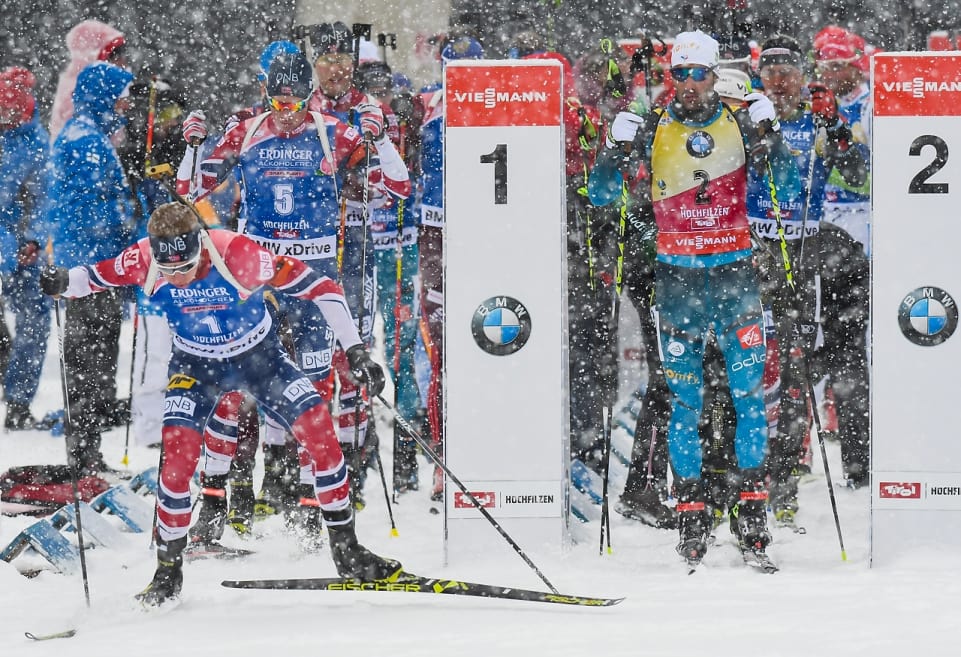
Norway’s Johannes Thingnes Bø notched his second-straight win in Hochfilzen after Martin Fourcade of France missed three on the final shooting stage of the men’s 12.5 k pursuit on Saturday. Bø, who started the race 12 seconds ahead of Fourcade in second, cleaned the final standing stage to leave the range nearly a minute ahead of Slovenia’s Jakov Fak in second. Meanwhile, Fourcade, who had been skiing in first just ahead of Bø before the last stage, dropped 1:19 minutes back to fifth.
Norway’s Johannes Thingnes Bø (1) heading out of the start, 12 seconds ahead of the second starter, France’s Martin Fourcade (yellow bib), on Saturday in the IBU World Cup men’s 12.5 k pursuit in Hochfilzen, Austria. (Photo: IBU/biathlonworld)
While Bø skied the win in 36:41.1 minutes and Fak, the third starter, finished 58.8 seconds later in second place, Fourcade made up two places on the final loop to place third (+1:10.0) after passing Germany’s Simon Schempp and Russia’s Maxim Tsvetkov.
Schempp settled for fourth (+1:10.5), and Bø’s older brother, Tarjei Bø, passed Tsvetkov as well to claim fifth (+1:11.9), while Tsvetkov finished sixth (+11:12.3).
On another snowy afternoon in Hochfilzen, Johannes Bø had three penalties, two of which came in the first stage (2+0+1+0). Fak was one of four men in the race with just one miss (0+0+1+0) — no one cleaned — while Fourcade missed five (1+0+1+3). Schempp had four penalties (3+1+0+0) but held onto his starting position in fourth, Tarjei Bø improved from 14th at the start to fifth with just two misses (1+0+1+0) and Tsvetkov raced up from 20th to sixth with a single miss (1+0+0+0).
American Sean Doherty tied his second-best World Cup result in 17th (+2:12.8) after starting 23rd and 1:39 out of first. He had two penalties (1+0+1+0).
Canada’s top finisher, Nathan Smith placed 31st (+3:02.2) after starting 19th and missing three shots (1+1+0+1). His teammate Brendan Green rose to 33rd (+3:15.7), up from 52nd at the start, with three penalties as well (1+0+1+1).
Four Canadians qualified for the pursuit, with Scott Gow placing 48th (+5:08.4) with seven penalties (1+1+3+2). His younger brother Christian Gow crossed next in 49th (+5:13.7) after missing five (+5:13.7).
The other American man in the race, Lowell Bailey placed 36th (+3:20.6), up from 53rd, with three misses (0+2+1+0).
Kuzmina Gets First Win in Three Years
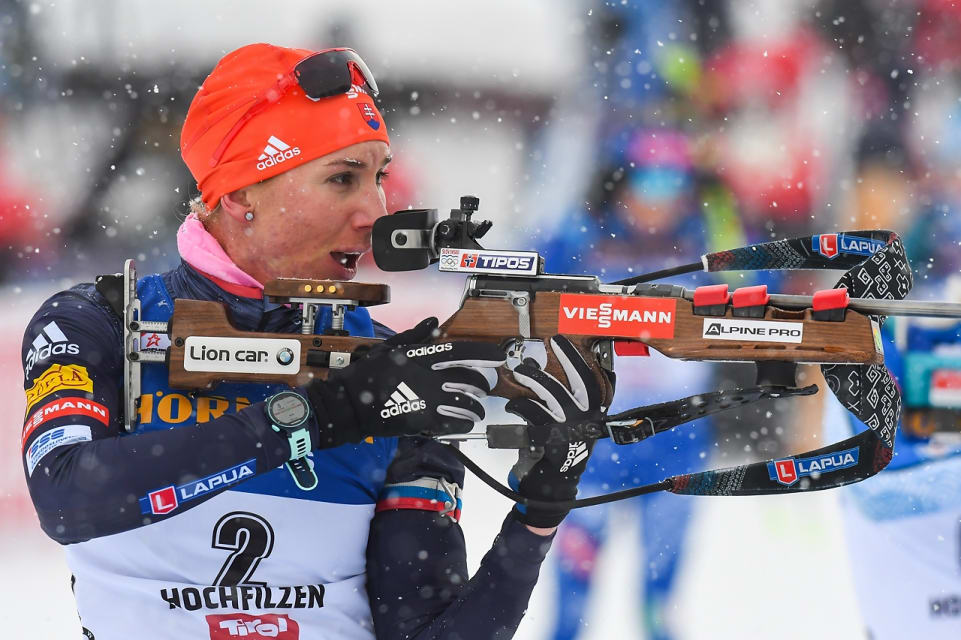
Slovakia’s Anastasia Kuzmina cleaning one of two standing stages in the women’s 10 k pursuit at the IBU World Cup in Hochfilzen, Austria, en route to a 10-second win. (Photo: IBU/biathlonworld)
In the women’s 10 k pursuit that followed, Slovakia’s Anastasia Kuzmina overcame a 22-second starting deficit to win her first race in three and a half years, shooting 19-for-20 (1+0+0+0) and finishing in 34:31.2. Kuzmina (the sister of Russia’s Anton Shipulin) started second behind Friday’s sprint winner Darya Domracheva of Belarus. Domracheva had a single miss as well in Saturday’s pursuit (0+0+1+0) but slipped to second after her penalty in the first standing stage, while Kuzmina cleaned the last three stages to take the win.
Domracheva settled for third (+11.8) and Finland’s Kaisa Mäkäräinen rose to second (+10.2) after shooting 18-for-20 (1+0+0+1) and skiing the fastest course time to rise from her starting position in sixth.
Italy’s Dorothea Wierer slipped one place to fourth (+51.6) after starting third and missing two (1+0+0+1), while Norway’s Marte Olsbu raced up from 13th to fifth (+58.2) with a single penalty (1+0+0+0). Ukraine’s Yuliia Dzhima improved from 20th to sixth (+1:08) with one miss as well (0+0+0+1).
Canada’s Emma Lunder achieved her second-best career World Cup result in 27th (+2:31.6) after starting 42nd and cleaning three stages after missing one in the first prone (1+0+0+0). Her teammate Rosanna Crawford improved from 49th at the start to 39th at the finish (+3:44.3) with four penalties, one in each stage (1+1+1+1).
The U.S. had one woman qualify for the race, Clare Egan, who finished 53rd (+5:21.6) with seven penalties (2+2+2+1).
For the third and final day of World Cup racing in Hochfilzen, the men’s and women’s relays will be held Sunday.
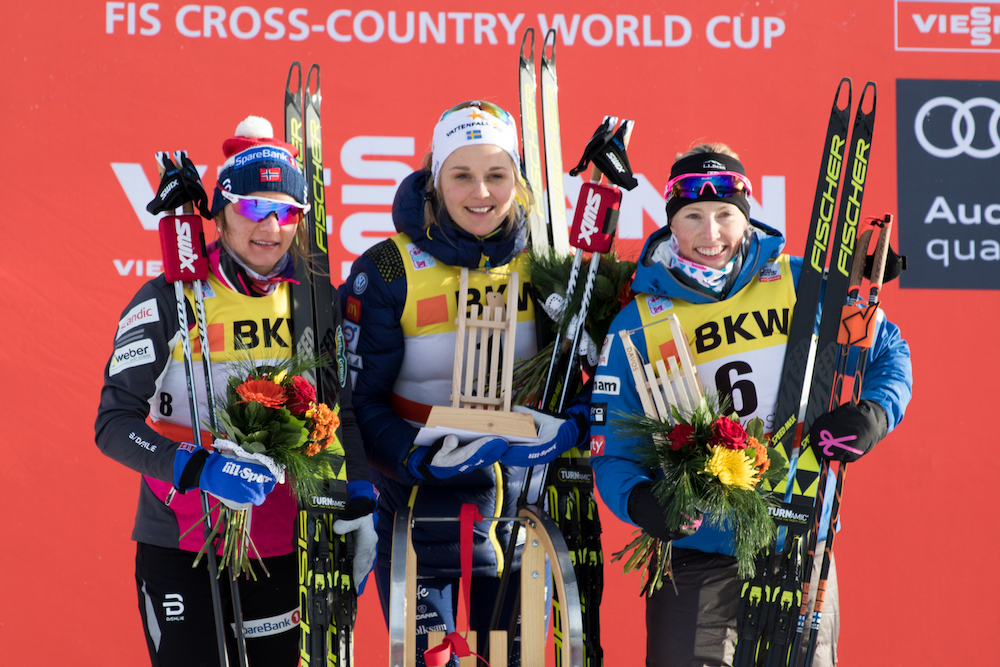
The women’s skate sprint podium at Saturday’s World Cup in Davos, Switzerland, with Kikkan Randall (r) of the U.S. Ski Team in third place, Sweden’s Stina Nilsson (c) in first, and Norway’s Maiken Caspersen Falla (l) in second. (Photo: Reese Brown/US Ski & Snowboard)
Kikkan Randall returned to the podium on Saturday in the first freestyle sprint of the 2017/2018 World Cup season, placing third in the women’s 1.5-kilometer skate sprint behind Sweden’s Stina Nilsson and Norway’s Maiken Caspersen Falla, respectively, in Davos, Switzerland.
Americans made up half of the women’s final, with Jessie Diggins racing to fourth and Ida Sargent sixth, with Norway’s Ingvild Flugstad Østberg between them in fifth.
Nilsson started the day by winning the qualifier in 2:51.71 minutes, while Østberg had the second-fastest qualifing time, 2.57 seconds back. Switzerland’s Nadine Fähndrich posted the third fastest qualifying time (+2.73), and for the U.S., Diggins qualified fourth (+3.37), Sargent fifth (+3.78), Randall sixth (+4.11), Sophie Caldwell ninth (+4.87), and Sadie Bjornsen in 11th (+5.38).
Nilsson then won her quarterfinal and the first semifinal before outlunging Falla by eight-hundredths of a second for the final win in 2:47.99. Randall (who won her quarterfinal and advanced to the final as a lucky loser in third in the first semifinal) finished 2.53 seconds after Nilsson for third overall, and Diggins (who won both her quarterfinal and the second semifinal) was 4.41 seconds back in fourth. Østberg finished 5.62 seconds back in fifth, and Sargent crossed the line 14.49 seconds back in sixth.
Caldwell placed eighth overall after winning her quarterfinal then placing fourth in the second semifinal, behind Diggins, Sargent and Germany’s Sandra Ringwald, respectively. Ringwald did not advance to the final, either, for seventh overall. Bjornsen placed 13th on the day after finishing third in her quarterfinal.
Also for the U.S., Julia Kern (U.S. Ski Team D-team) finished in 57th in the qualifying round, 16.55 seconds out of first.
Dahria Beatty was the top Canadian in 53rd (+15.53), followed by Katherine Stewart-Jonesin 55th (+16.18) and Cendrine Browne in 64th (+18.27).
In the men’s 1.5 k skate sprint, Norway’s Johannes Høsflot Klæbo rocketed to his sixth-straight win in as many World Cup races this season, topping the qualifier in 2:23.10 (by 1.27 seconds over France’s Lucas Chanavat and 1.73 seconds over Italy’s Federico Pellegrino in third) then winning his quarterfinal and semifinal comfortably before capping the day with a victory in the final in 2:28.07. Pellegrino placed second in the final, 1.8 seconds back, and Russia’s Alexander Bolshunov tallied his third podium of the season in third place (+4.64). Finland’s Ristomatti Hakola placed fourth (+5.39), France’s Richard Jouve was fifth (+8.65) and Russia’s Gleb Retivykh was sixth in the final (+18.34).
Americans Andy Newell and Simi Hamilton both qualified for the heats in 10th and 12th, respectively. Hamilton went on to place ninth overall after finishing second in his quarterfinal (behind France’s Renaud Jay) and fifth in the second semifinal (which Hakola won). Newell’s day ended in the quarterfinals, where he placed fifth, 2.44 seconds behind Klæbo, who won that heat. Overall, Newell was 21st.
Canada’s Alex Harvey qualified for the heats in 21st and went on to place 23rd overall after finishing fifth in his quarterfinal, 1.14 seconds behind Retivykh in first.
Also for Canada, Julien Locke missed qualifying in the top 30 by 1.07 seconds in 36th (+7.84). Russell Kennedy placed 48th (+9.39), Knute Johnsgaard was 52nd (+10.35), Jess Cockney 54th (+10.83), Devon Kershaw 63rd (+11.78).
For the U.S., Erik Bjornsen finished 58th (+11.12) and Paddy Caldwell 108th (+24.04) in the qualifier.
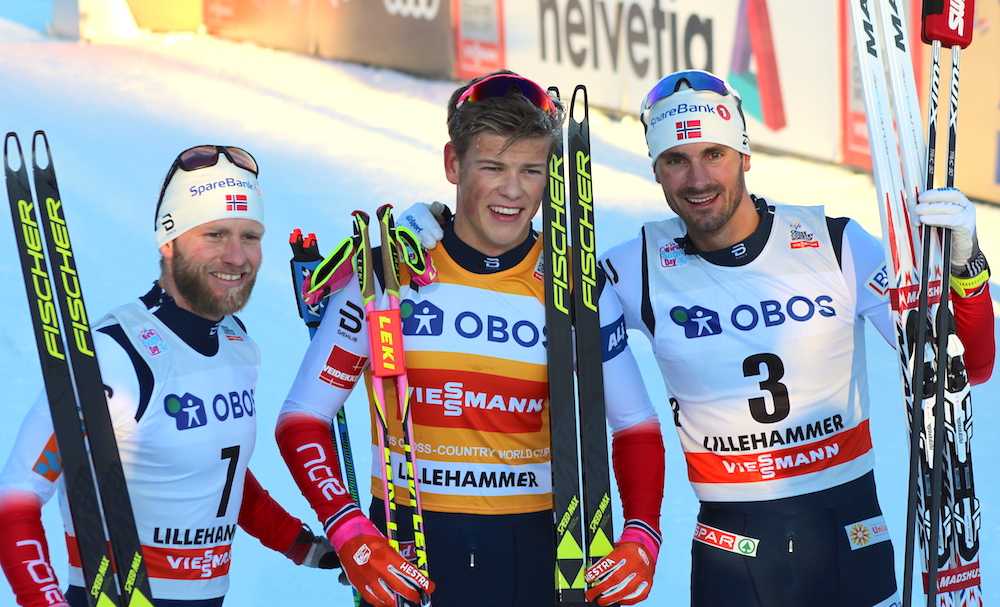
The all-Norwegian men’s 30 k skiathlon podium on Sunday in the 2017 World Cup in Lillehammer, Norway. Johannes Høsflot Klæbo (center) placed first, Martin Johnsrud Sundby (left) second, and Hans Christer Holund (right) third. (Photo: Henrik Hunnes)
Imagine for a moment that only months ago, at about 33 years old, you were in your prime — with World Cup globes on the mantle, six World Championship medals presumably in a drawer somewhere, and four Olympic medals (three of which are from the 2014 Games and will be awarded post-Sochi since the Russians that cheated have been scrubbed from the results sheet). And of course, there’s the iconic beard adorning the iconic Sundby — a technical master with a lung capacity like a blue whale.
But there’s the problem with the human condition of always wanting more. One more win, one more piece of hardware to reaffirm the legacy before the inevitable decay of Father Time.
On a sunny bluebird Sunday in Lillehammer, Norway, on the final buckling climb 28.65 kilometers into the men’s 30 k skiathlon, it looked like Norway’s Martin Johnsrud Sundby would satisfy his need to win. A need that’s been satiated since his first individual World Cup victory in Kuusamo, Finland, in 2008.
When Sundby made his move, he shattered a pack that included fellow Norwegians Hans Christer Holund and Simen Hegstad Krüger, France’s Maurice Manificat and Canadian Alex Harvey. And yes, the relatively new kid on the block from Norway, 21-year-old Johannes Høsflot Klæbo.
The Sundby move that historically would have been a kill-shot turned out to be a slight misfiring. Holund and Klæbo both looked mortal, but the bleed-out wasn’t terminal.
As Sundby glided down the rolling terrain towards the finish. It appeared to be another coronation.
But the roar from the crowds began rising as Klæbo worked the slight ups and the double-polable sections. With his skis running fast, Klæbo dropped Holund and reeled in Sundby by the finishing straight.
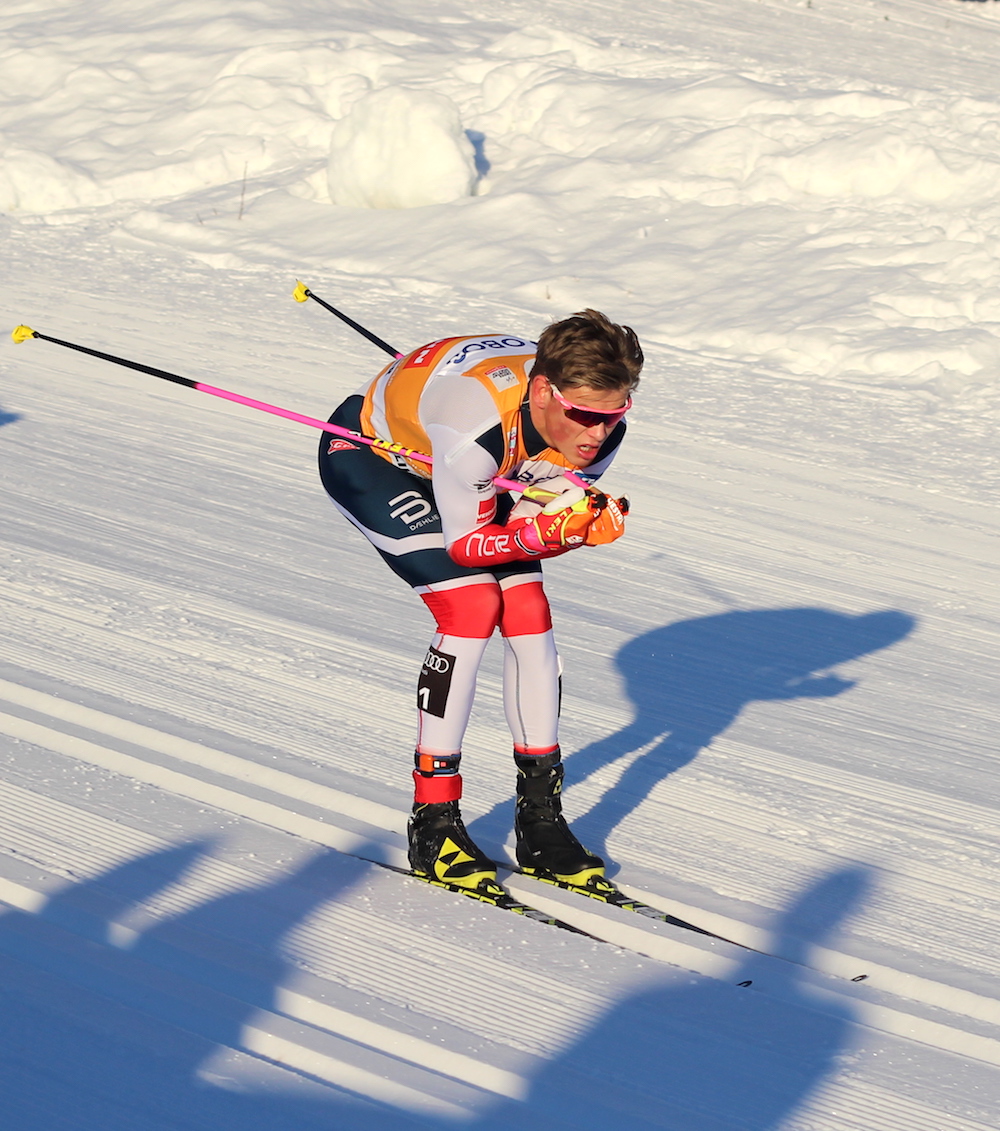
Norway’s Johannes Høsflot Klæbo on his way to winning the 2017 Lillehammer, Norway 30 k skiathlon. (Photo: Henrik Hunnes)
It was a Klæbo win as he claimed his fifth World Cup win this season in as many races. Sprint or distance, no doubt it is Klæbo-time.
The sport’s cliches could be in play. The older, once-dominant lion in Sundby licking his wounds. But these are humans after all. Winning ends for everybody, just not in such a public forum.
Amidst the Klæbo victory, this much was palpable: Sundby’s championship mantle has been usurped. During the concluding seconds of the skiathlon, Sundby saw his racing mortality sprint past with a hair-gelled coif and pink Oakleys.
Klæbo’s winning time was 1:16:47.1 hours.
Sundby placed second, 1.3 seconds back, and Holund third (+6.8). Krueger skied to fourth place (+10.9), Manificat fifth (+11.3), and Harvey sixth (+13.1).
Harvey was the best placed North American, proving once again his deserved reputation as one of the World Cup’s best. After five races, Harvey is ranked fifth in the overall World Cup standings.
“I am really happy — top 10 was the goal, so yeah, it’s really good to fight for the podium until the last three minutes of the race and it’s really good,” Harvey told FasterSkier in Lillehammer. “I felt good. Good skis. I was missing some at the last part of the long climb. The Norwegian guys were the best as expected.”
Harvey’s plan was simple. Tap into a huge training base, keep pace and mark the Norwegians on the skate leg.
“Kind of hide in the classic and then position myself well for the skate, just to be able to cover an attack that was going to come,” Harvey said of his tactics.
In the longest race of the season before February’s PyeongChang Olympics, it was an opportunity for Harvey to test his endurance, but also choose wisely when it came to skis.
“I went for easy kicking skis in classic and that was good,” Harvey said. “I saw Holund especially slipping a lot in the classic. I was just relaxing, and in skate, I wanted a ski that was feeling free on the climbs, because I know on the downhill you have such a big draft, it is not so much about the skis.”
The classic leg offered a more bunched-up group as the primary pacing surges transpired amongst the leaders. That changed quickly after the classic to skate exchange.
France’s Maurice Manificat (4) making a push at the start of the skate leg during Sunday’s 30 k skiathlon in Lillehammer, Norway, while Canada’s Alex Harvey (l) and Norway’s Hans Christer Holund (c) chase. (Photo: Henrik Hunnes)
“Then the skate, right away on the first lap, Holund and [Sundby] went to the front and they tried to make the first selection,” Harvey said of the first pacing challenge. “I think for the first or second lap of skating it was down to six guys. Then Manificat was pushing super hard on the long uphill. But then we kind of started chilling a bit at the end of the third lap.”
The perceived “chill” pace was simply a momentary lull. Sundby is never one to wait for a sprint finish to decide a distance effort.
“From then we went hard again on the last lap,” Harvey said of the turn of pace on the fourth and final skate lap. “Just steady pace from the stadium just fighting for position. We knew it would happen on the big back hill. So it was just about the best position. I entered there in second place behind Klæbo. So really that is hard to be better than that for starting the last hill. And then it was just man on man.”
We know how this race ended. But Harvey’s summation of the final chapters of this skiathlon was keen.
“Sundby was the strongest, but Klæbo was the most clever,” Harvey said of his old and new rivals.
A gassed Johannes Høsflot Klæbo (yellow bib) holding off fellow Norwegian Martin Johnsrud Sundby (r) for the win on Sunday in the men’s 30 k skiathlon at the Lillehammer World Cup in Norway, while Norway’s third man, Hans Christer Holund (3) races to third. (Photo: Henrik Hunnes)
Harvey also reflected that, in terms of results and physical sensations, he is exactly where he’d like to be. Sustainable high output efforts are doable; it’s the 1 percent of the top high speed gear he’s waiting to access.
“Just the punch — I cannot dig super deep yet,” Harvey said. “It’s like that for me before Christmas. It is not unexpected. I think the base is better than in the past, so I can rely on that. So when it is time to really go, I am not there yet, but that is the training, the training is meant for that, too.”
Canada’s Devon Kershaw finished 19th (+2:59.7), just ahead of the U.S. Ski Team’s (USST) Erik Bjornsen in 20th (+2:59.9)y. Although finishing a place apart, their race tales only merged after the transition to the skate leg.
Kershaw must have felt good on the initial classic leg. Six kilometers into his kick-and-stride effort on what was described a quintessentially beautiful hard wax day, Kershaw was positioned 15th in large scrum of skiers, only 4.5 seconds off the lead. The Canadian World Cup vet then played more cat than mouse.
He skied well towards the front by 11 k moving into fifth. At 11.1 k he bolted ahead and won the bonus points. From that point on, Kershaw faded a bit and came through the technique-exchange zone in 18th and 36.2 seconds out of first; his first 15 k were done in a total of 39:58.5 minutes.
Bjornsen’s race took on a different tone early on. He skied conservatively in a technique in which he’s known to thrive. Bjornsen’s classic leg took him 40:28, and he came through the exchange in 23rd, 1:05.7 behind the leaders.
Bjornsen proved on Sunday his race tactics have matured as he’s rounded into a constant World Cup points threat this young season.
“The skiathlon here two years ago, I was feeling great and I charged into the top 10 on the classic and just paid for it on the skate leg,” Bjornsen told FasterSkier in Lillehammer after the race. “So today I tried to be a little smarter.”
Two years ago at the Lillehammer skiathlon, Bjornsen’s early efforts cost him places. He faded from what looked liked a top-20 effort to a sufferfest in the skate portion. After the skate leg, Bjornsen placed 42nd overall, over five minutes back from Sundby, that day’s winner.
Bjornsen’s strategy paid off on Sunday. In a post-race phone call, he explained that at one point on the classic leg, he had the leaders in sight.
“There were times in the second and third lap where the leaders were right there,” Bjornsen said. “But I think it would have been costly to close the 50-meter gap they had. … I think it’s just growing up in the U.S., I didn’t race a lot of 30 k’s. I have had more chances in the last few years over here to see what that race feels like. The 30 k, you can’t make those short sprints to gap up or you pay for it in the end.”
Erik Bjornsen (48) of the USST placed 20th and Noah Hoffman (49, red hat) placed 28th on Sunday’s World Cup 30 k skiathlon in Lillehammer, Norway. (Photo: Henrik Hunnes)
Although his relative position after the exchange did not change considerably, Bjornsen did draw skiers back towards him with his skate effort.
“I think I gained about five spots on the skate leg,” Bjornsen said. “Most of those guys were moving backward. I don’t think we were making any moves towards those front guys, but I was with a good group [including Kershaw]. I could see a pack of ten guys behind us, so my group was motivated to keep charging as well. It was a good plan for me.”
Bjornsen’s 20th place was a career best in a World Cup skiathlon: he placed 27th in the 2016 World Cup skiathlon in Lahti, Finland. Sunday’s result is also Bjornsen’s best in a World Cup race longer than 15 k.
Bjornsen’s former USST teammate, Noah Hoffman was in the points for the first time this season. Hoffman placed 28th after starting in bib 49. Like Bjornsen, he moved up in the standings as the race progressed.
Hoffman finished the classic portion of the race in 41:17.7 minutes and was ranked in 40th place. Kilometer by kilometer, he picked off places. He was 34th at the 19.55 k mark, and in the closing moments had locked into 28th, finishing 3:37.8 behind Klæbo.
Finishing 46.4 seconds outside of the points on Sunday was Scott Patterson of the USST in 36th (+4:56.1).
“Prior to the race, I was quite looking forward to this event,” Patterson emailed. “However, the Norwegian courses and the extra competition of the Norwegian nations group are never things to take too lightly.”
The newly minted USST member has skied against the Norwegian juggernaut before. In last season’s Holmenkollen 50 k classic in March, Patterson placed 28th for the best American result that day. Yet this is Patterson’s first full season on the World Cup and his first time racing World Cups before late January. (Patterson’s first World Cup race was two seasons ago.)
Undaunted, Patterson did keep a top-30 spot as his goal. He began the day in bib 39.
“My approach was to try and move up from my starting position through the classic but also really focus on conserving energy,” Patterson wrote. “I know my skating is a bit more on form currently. From the start things were not going my way. Early on I decided to defend my place in track rather than running up the side. This put me in almost last 500m into the race. For the first two laps I gradually made up some ground but was struggling to ski fast and relax the whole time. I found a little more form for the 3rd and 4th lap, but by that time I had lost a lot of ground.
“The skate leg was better, but I took things a little conservative early,” he continued. “While I was moving up, I was not able to close the gaps to get a good group to work with. Thus most of the skate was trying to catch a few small groups and move through them. Most of the time I felt that I was working on my own. I think I salvaged an ok race from a pretty rough start, but again this one is leaving me wanting more. While I was close again, I still am running with 0 world cup points.”
“It was really cool to start 19th today,” Caldwell reflected in an email. “I didn’t put the early bib to great use but it was a good learning experience and great practice skiing in a big, aggressive pack.”
As the USST’s youngest male World Cup skier gains valuable starts on what is projected as a long World Cup career, Caldwell, 23, did have a moment to reflect in the learning takeaways from the day.
“Mass start races are always fun and a good chance to learn from other skiers,” Caldwell wrote. “I was really impressed with how relaxed the top guys skied on the big climbs. Everyone is hammering but the best guys are so on it technically, really cool to see.”
Canada had three finishers outside the points: Russell Kennedy in 53rd (+7:30.7), Graeme Killick 54th (+6:41.3), and Knute Johnsgaard 60th (+9:49.0).
Racing continues next Saturday in Davos, Switzerland, with a freestyle sprint and a 10/15 k interval start skate race on Sunday.
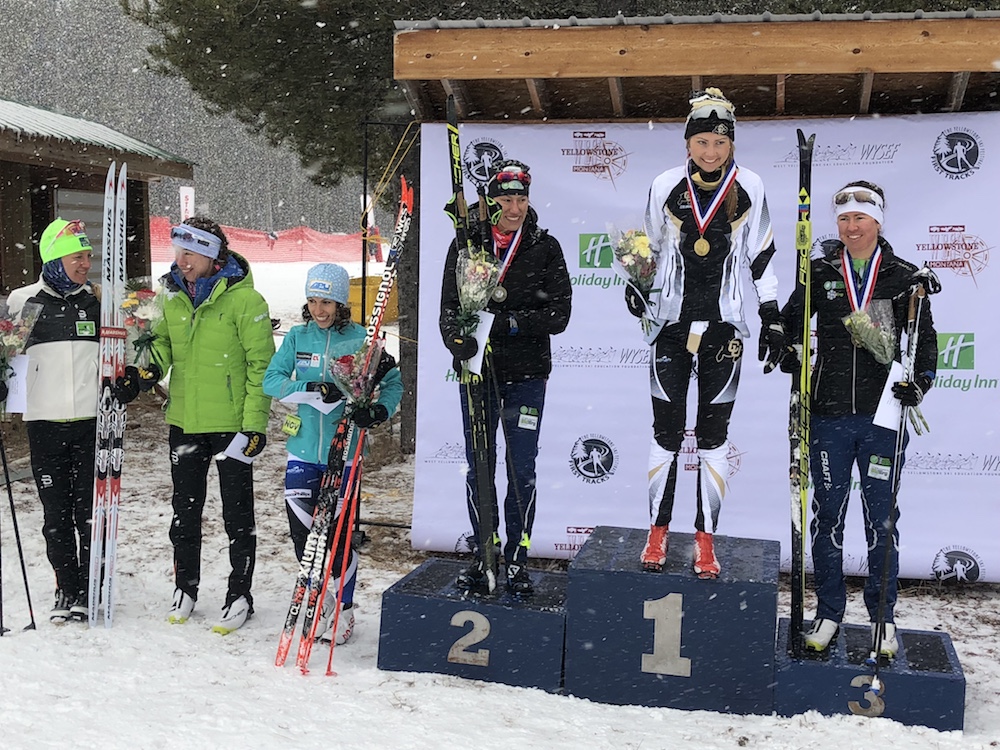
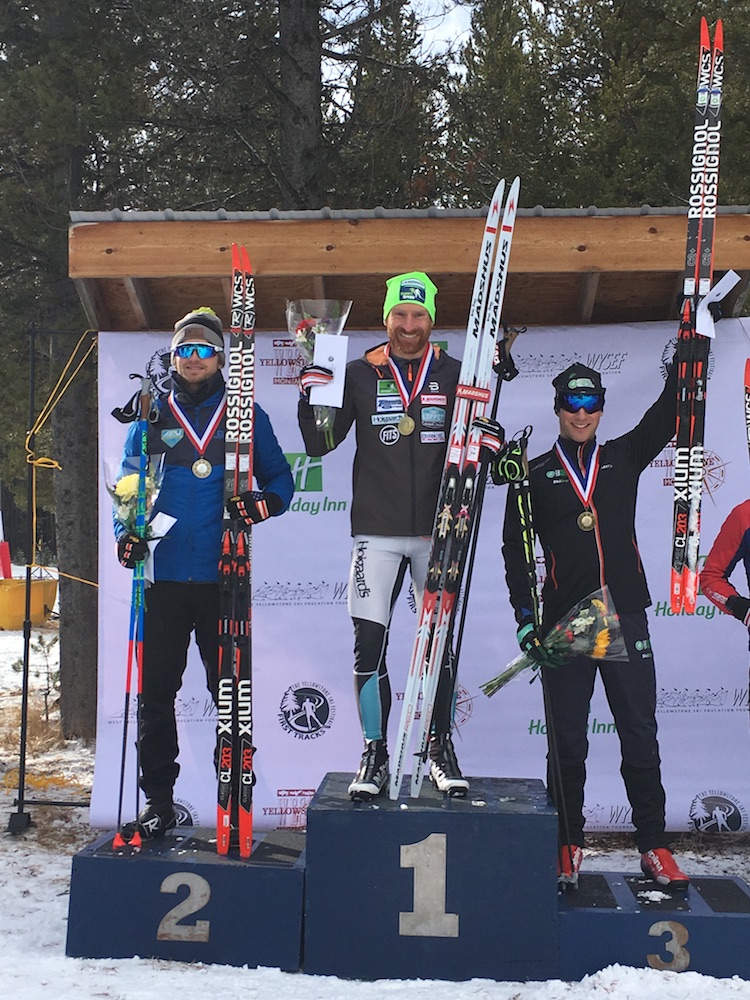
The SuperTour women’s 10 k classic mass start podium on Sunday in West Yellowstone, Montana, with Hedda Bångman (second from r) of the University of Colorado Boulder in first, and Craftsbury’s Kaitlynn Miller (third from r) and Caitlin Patterson (r) in second and third, respectively. From left: Caitlin Gregg in sixth, Katharine Ogden in fifth and Rosie Frankowski in fourth were also recognized at the flower ceremony. (Photo: FBD)
US SuperTour (West Yellowstone, Montana): 10/15 k classic mass starts
The second day of SuperTour racing took place as originally planned at the Rendezvous Ski Trails in West Yellowstone, with 22-year-old Hedda Bångman, of the University of Colorado Boulder (CU), and 33-year-old Brian Gregg (Team Gregg) winning the women’s 10-kilometer and men’s 15 k classic mass starts, respectively, on Sunday.
The men’s 15 k classic mass start SuperTour podium on Sunday in West Yellowstone, Montana,with Brian Gregg (c) of Team Gregg in first, David Norris (l) of APU in second, and Ben Lustgarten (CGRP) in third. (Photo: FBD)
Bångman, a Swedish freshman on the CU Ski Team, won the women’s race in 30:24.8, just ahead of two Craftsbury Green Racing Project (CGRP) skiers Kaitlynn Miller and Caitlin Patterson. While Miller placed second (+1.3) and Patterson was third (+3.4),
Rosie Frankowski of Alaska Pacific University (APU) finished another 10 seconds later in fourth (+13.5), and Katharine Ogden of the Stratton Mountain School (SMS) was fifth (+17.2). Caitlin Gregg (Team Gregg) followed in sixth, Felicia Gesior (CXC Team) was seventh, Anne Siri Lervik (CU) eighth, Erika Flowers (SMS Elite Team) ninth, and Corey Stock of the Bridger Ski Foundation (BSF) 10th.
In the men’s race, Brian Gregg pulled out a 1.9-second win over David Norris (APU), crossing the line first in 41:30.3. Ben Lustgarten (CGRP) reached the podium for the second-straight day (after placing second in Saturday’s skate sprint) in third (+4.6). Kyle Bratrud (CXC Team) finished fourth (+10.9) and Kris Freeman (Caldwell Sport) was fifth (+12.6). Tad Elliott (Ski & Snowboard Club Vail) followed in sixth, Eric Packer (APU) seventh, Ian Torchia (Northern Michigan University/U.S. Ski Team D-Team) eighth, Hunter Wonders (APU) ninth, and Martin Bergström (University of Utah Ski) 10th.
Sweden’s Charlotte Kalla winning the women’s 15 k skiathlon on Sunday at the Lillehammer World Cup in Norway. (Photo: Henrik Hunnes)
Sweden’s Charlotte Kalla pulled out another dominant distance performance on Week 2 of the World Cup, racing to a 19.7-second win in the women’s 15-kilometer skiathlon on Sunday, ahead of three Norwegians and American Jessie Diggins.
Kalla led at the halfway point of the skiathlon when skiers transitioned from classic to skate, just ahead of Norway’s Heidi Weng in second. The two had broken away around 4 k into the classic leg and put more than 20 seconds into the rest of the field by the transition, when Diggins came through 21.6 seconds back in third, leading a large chase group with Finland’s Krista Parmakoski, Norway’s Marit Bjørgen, Austria’s Teresa Stadlober, Norway’s Kathrine Rolsted Harsem, Finland’s Kerttu Niskanen, Norway’s Ragnhild Haga, and Switzerland’s Nathalie von Siebenthal, respectively.
While Kalla and Weng continued to trade the lead over the next 5 1/2 kilometers or so, by the 13.65 k marker, Kalla had dropped Weng, with 12 seconds between the two, while the chasers remained 29 seconds behind Kalla.
Over the next 1.2 k, that time gap grew to 20 seconds and 46 seconds, respectively, and Kalla skied off to her second win of the season in 42:24.7 minutes.
Weng placed second, 19.7 seconds back, and Haga claimed third (+43.6), after skiing alone for the last 4 k of the race. Bjørgen finished just ahead of Diggins for fourth (+54.3) and fifth (+57.0), respectively, and Stadlober was sixth (+1:04.9), Parmakoski seventh (+1:07.8), Norway’s Ingvild Flugstad Østberg eighth, Russia’s Natalia Nepryaeva ninth (+1:27.8), and Sadie Bjornsen 10th (+1:32.6).
Four Americans finished scored points in the top 30, with Kikkan Randall placing 16th (+2:06.5) and Rosie Brennan 29th (+3:07.7). Liz Stephen finished 36th (+3:25.7), Chelsea Holmes was 38th (+3:39.6) and Ida Sargent 55th (+6:41.1).
Cendrine Browne of the Canadian National U25 Team led Canada in 45th (+4:37.3), and Emily Nishikawa followed in 49th (+5:00.1). Katherine Stewart-Jones did not finish.
Klæbo Outlasts Sundby; Harvey 6th
A gassed Johannes Høsflot Klæbo (yellow bib) holding off fellow Norwegian Martin Johnsrud Sundby (r) for the win on Sunday in the men’s 30 k skiathlon at the Lillehammer World Cup in Norway. (Photo: Henrik Hunnes)
In the men’s 30 k skiathlon that followed, Norway’s Johannes Høsflot Klæbo made it a five-peat, proving himself once again unbeatable, this time in the first multi-discipline distance race of the season.
Klæbo outlasted [edit: rocketed past] teammate Martin Johnsrud Sundby to beat him by 1.3 seconds for his fifth-straight win in 1:16:47.1, and Norway swept the top four with Hans Christer Holund in third (+6.8) and Simen Hegstad Krüger in fourth (+10.9).
France’s Maurice Manificat followed closely in fifth (+11.3) and Canada’s Alex Harvey was next in sixth (+13.1), ahead of Finland’s Iivo Niskanen in seventh (+16.2), and Russia’s Alexey Chervotkin, Sergey Ustiugov and Alexander Bolshunov in eighth (+37.7), ninth (+42.2) and 10th (+59.6), respectively.
Klæbo skied patiently in the pack for essentially the entire race. For instance, at 11 k he sat back in 18th, just seven seconds from Canada’s Devon Kershaw in the lead.
One kilometer later, Klæbo remained 5 seconds back in 13th while Kershaw was 8 seconds back in 16th.
At the ski exchange at 15 k, Niskanen led Sundby and Italy’s Francesco de Fabiani and a total of 10 men within three seconds of first. Klæbo clocked through 5 seconds back in 13th, just ahead of Harvey in 14th (+5.3). Sixteen men remained within six seconds and striking distance of first. Kershaw in 18th had fallen off the pace and was 36 seconds back at the transition, just behind Russia’s Andrey Larkov.
While Harvey continued to ski around third place during the first 5 kilometers of the skate leg, Klæbo worked his way closer to the front and led at 22.5 k. By then, the lead group had dwindled to six within two seconds of first. Harvey remained in fourth.
Over the next 7.5 k, the lead changed several times, with Klæbo hovering near the tail end of the group. With about 200 meters to go, however, it was down to Sundby and Klæbo, with the former leading by 2 seconds (and Holund skiing seven seconds back in third). Klæbo ultimately had the most finishing kick to take the win by 1.3 seconds over Sundby, while Holund crossed 6.8 seconds later for third.
Canada had two in the top 20 with Kershaw in 19th (+2:59.7). Last year’s NorAm winner Russell Kennedy (Team R.A.D.) placed 53rd (+7:30.7), and Canadian World Cup Team members Graeme Killick and Knute Johnsgaard finished 54th (+7:41.3) and 60th (+9:49), respectively.
Two U.S. men landed in the points with Erik Bjornsen (U.S. Ski Team) in 20th (+2:59.9; just 0.2 seconds behind Kershaw) and Noah Hoffman in 28th (+3:37.8). Scott Patterson finished 36th (+4:56.1) and Paddy Caldwell was 56th (+7:43).
— International Biathlon Union (@biathlonworld) December 3, 2017
France’s Martin Fourcade overcame an early penalty and his No. 2 starting position to take the men’s 12.5 k pursuit win on Sunday, 40.8 seconds clear of anyone with 19-for-20 shooting (1+0+0+0).
Fourcade started 1 second behind Saturday’s sprint winner, Norway’s Tarjei Bø, and took control of the race after cleaning the second shooting stage. Bø missed one on the first prone stage then five more later in the race (1+0+3+2) to slip to 19th (+1:49.5) while Slovenia’s Jakov Fak raced up from 10th to second, 40.8 seconds behind Fourcade, with two penalties (1+0+0+1). Just behind him, France’s Quentin Fillon Maillet took third (+42.1) with identical shooting after Fillon Maillet started 12th and skied with Fak for most of the race.
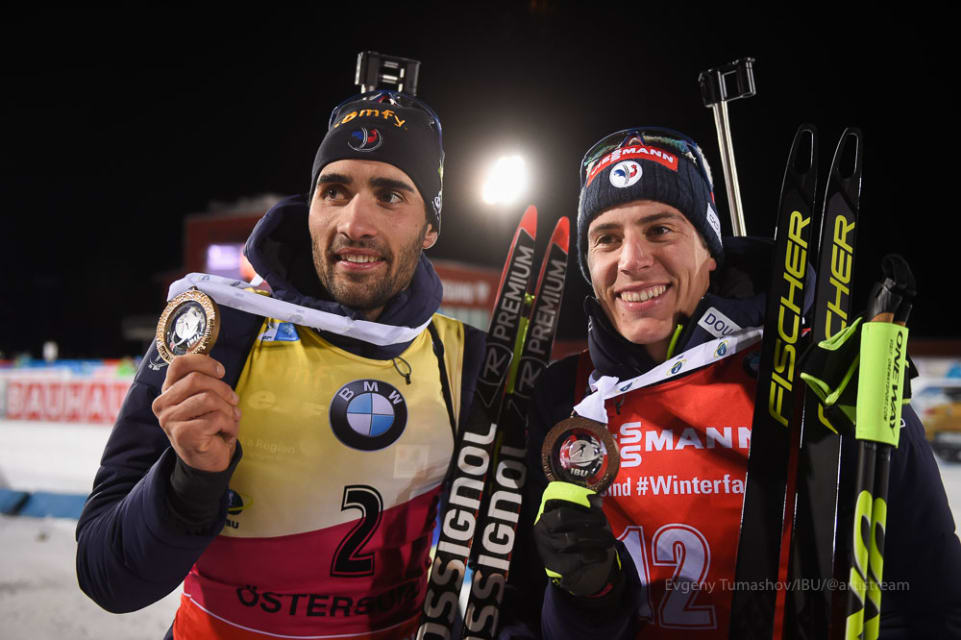
France’s Martin Fourcade (l) and Quentin Fillon Maillet after placing first and third, respectively, in the IBU World Cup men’s 12.5 k pursuit on Sunday in Lillehammer, Norway. (Photo: IBU/biathlonworld)
None of the 58 finishers cleaned the four-stage race. American Lowell Bailey improved from 22nd to 17th (+1:40.2) with two misses (0+1+0+1). Canada’s Christian Gow achieved a career best in 21st (+2:04.6), up from starting 26th, after shooting 19-for-20 (0+0+1+0).
Also for Canada, Nathan Smith slipped from 24th at the start to 42nd (+3:19.2, three penalties), Scott Gow finished 50th (+4:10.9; six penalties) after starting 16th, and Brendan Green placed 51st (+4:18.6; five penalties).
One other American qualified in the sprint top 60 for the pursuit, with Tim Burke finishing 48th (+3:52.7; four misses).
In the women’s 10 k pursuit earlier in the day, Germany’s Denise Herrmann tallied her second-straight win (and the second win of her IBU World Cup career). She started first and successfully held of France’s Justine Braisaz, who started 15 seconds behind her in second place, by 25.8 seconds. While Herrmann missed two on her third shooting (0+0+2+0), Braisaz was one of three women in the field to clean (0+0+0+0).
Norway’s Marte Olsbu raced up from seventh to third place (+48.0) with two penalties (0+1+0+1).
Canada’s Julia Ransom placed 23rd (+2:48.1), up from 29th at the start, with two misses (0+0+1+1). Two of her teammates also qualified for the pursuit, with Rosanna Crawford finishing 52nd (+5:25.1) with six penalties (0+3+1+2). In her first World Cup pursuit, Megan Bankes completed three shooting stages before being lapped (3+1+1).
No American women qualified for the pursuit.
With the conclusion of the first IBU World Cup in Östersund, the circuit moves to Hochfilzen, Austria, where racing kicks off again Friday, Dec. 8, with men’s and women’s sprints.
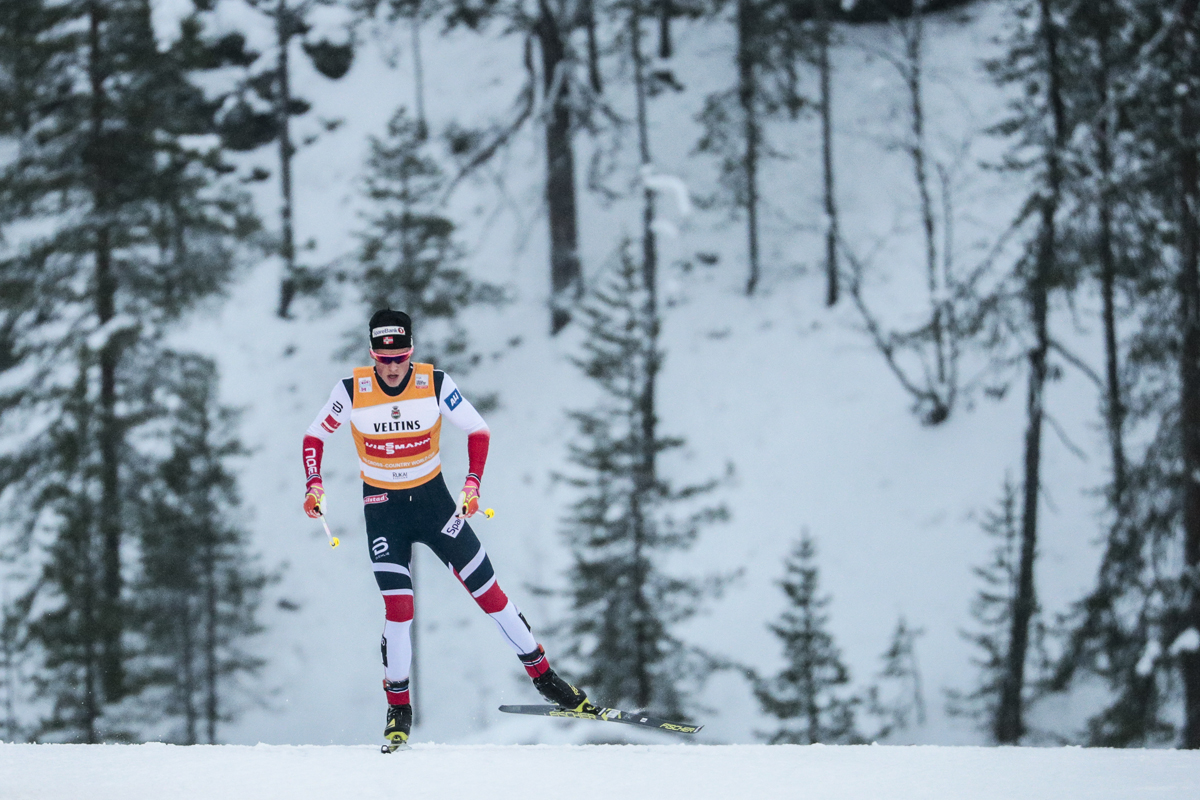
Norway’s Johannes Høsflot Klæbo en route to his third-straight win in as many days of the World-Cup-opening Ruka Triple in Kuusamo, Finland. He won the 15 k freestyle pursuit for the mini-tour title. (Photo: Fischer/Nordic Focus)
Two previous days of racing, and back-to-back victories no less, had begun to take its toll on Johannes Høsflot Klæbo within the first few laps of the men’s 15-kilometer freestyle pursuit on Sunday in Kuusamo, Finland. The 21-year-old Norwegian could feel it throughout his body; he was tired and 38 seconds of a starting cushion wasn’t going to be enough to hold off the hungry challengers behind him.
Klæbo, who won Friday’s classic sprint and Saturday’s 15 k classic individual start on the World Cup opening weekend, wasn’t invincible and he couldn’t race to another win alone. Halfway through the pursuit, the man who started in second place, 38 seconds after him, Russia’s Alexander Bolshunov (who’s actually younger than Klæbo at age 20), had cut that deficit to 19.8 seconds. After him, Norway’s Martin Johnsrud Sundby, who started 10th and 1:05 minutes behind Klæbo, was up to third and just 25.3 seconds back.
Norway’s Martin Johnsrud Sundby, who started 10th in the 15 k freestyle pursuit on Sunday, picking off the places on the final day of the Ruka Triple World Cup mini tour in Kuusamo, Finland. (Photo: Fischer/Nordic Focus)
On his fourth lap, Klæbo accepted the inevitable as Bolshunov and Sundby, who had linked up in an effort to catch him, in fact caught him on a climb around 8.6 k. A larger group of pursuers, including Canada’s Alex Harvey, locked on to the three leaders as well, and from there, the race truly began to take form. Klæbo had to recover, Sundby had to figure out how to try to drop him, Bolshunov had to see what he was capable of, and Harvey had to see how much he could give in the third race of the season.
The first races of each winter aren’t easy for anyone. Despite spending the summer training for skiing, most North American World Cup skiers don’t get the opportunity to actually race — even on rollerskis — too often during the offseason. Because of the rich ski culture in Europe, rollerski races are a big deal with lots of summer and fall competitions to chose from. And because of Europe’s geography, it’s often easier to get on snow than it is for North Americans.
(“I think this applies to all the North American actually, compared to Europeans we don’t race as much in summer,” Canadian World Cup coach Ivan Babikov said on the phone on Sunday. “They have races every weekend so they come into the season pretty sharp already with some good speed workouts, when we don’t have that opportunity. So that’s why, I think, every race is a step forward. It’s just, you have to remember or remind yourself how hard it is.”)
So while Canadians and American World Cup skiers alike often look at an opening weekend like Finland’s Ruka Triple mini tour as a “chance to blow the cobwebs out” or “shake off the rust”, as some have said, it’s also an opportunity to see where you stand — as was the case for Harvey in the final meters of Sunday’s pursuit.
Later in the fourth of six laps, Klæbo pushed the tempo up a climb, Bolshunov responded, and Harvey went with them. Soon after at 10 k, they lapped through the stadium with 11 men within 2.7 seconds of first. Up front, Bolshunov led Harvey, who had started the race 1:23 back in 12th.
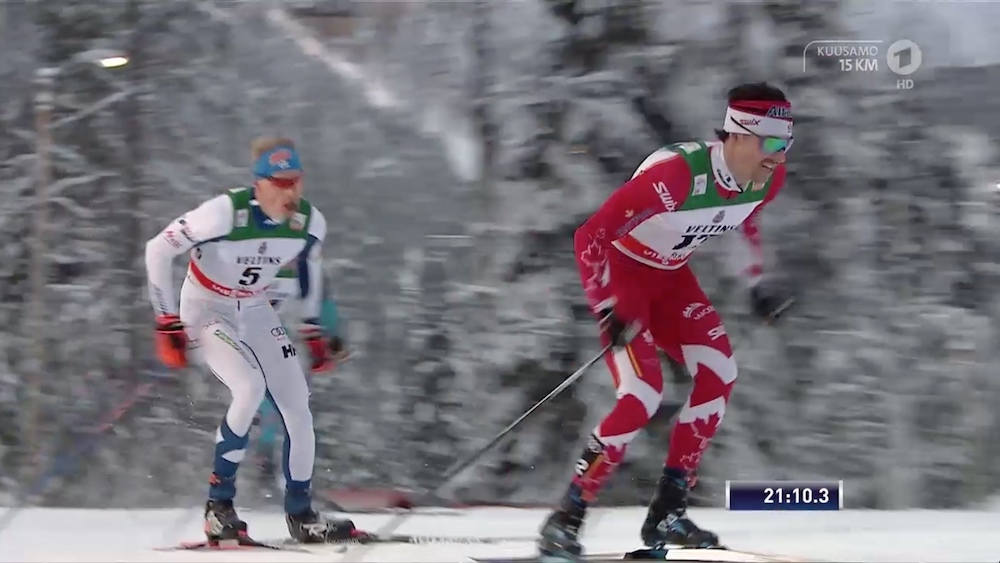
Canadian World Cup Team member Alex Harvey leads Finland’s Iivo Niskanen during the men’s 15 k freestyle pursuit on Sunday, the final day of the Ruka Triple mini tour in Kuusamo, Finland. (Screenshot: ARD)
Harvey had spent the first three laps working up to that lead group, initially with the likes of Russia’s Alexey Chervotkin (*who reportedly thanked Harvey after the race) and Sergey Ustiugov, Norway’s Hans Christer Holund and Sweden’s Marcus Hellner, and later with France’s Maurice Manificat, Sweden’s Calle Halfvarsson, Norway’s Emil Iversen, Chervotkin, and Holund, among others.
“I knew there’d be some fireworks on the last lap so I just wanted to be in the front third of the group, just be ready for a move,” Harvey explained in a post-race phone interview. “I thought Sundby would be the guy making the move, which in the end, that’s what happened. The big uphill in the last lap, that’s where he went. I just wanted to be close to Sundby and ready to respond when Sundby went.”
Sundby attacked as predicted on the second-to-last climb, around 13.6 k, and Harvey slotted behind him to follow him over the top.
“I was just actually there on that last uphill when Sundby attacked,” Babikov recalled. “Klæbo was right there. I think there were just Norwegian tactics … Sundby attacked on the last uphill and Klæbo just cooled down and wasn’t chasing him at all, so for Alex, that was his only chance. … If he didn’t chase him, then Sundby probably would have skied away and it would have been a bigger group at the finish, but at the moment he tried, and they actually created a gap … Alex second and Sundby first.”
With a few meters separating them from Norway’s Didrik Tønseth in third and Klæbo in fourth, Harvey thought he and Sundby had dropped them and that he would fight for first to the finish.
“I kind of went all-in with the Sundby move,” Harvey said. “When I looked in between my legs just before the last downhill I thought we had a big enough gap … so I was feeling pretty good about my chances there, but not good about taking [Sundby] because I was really, really dead.”
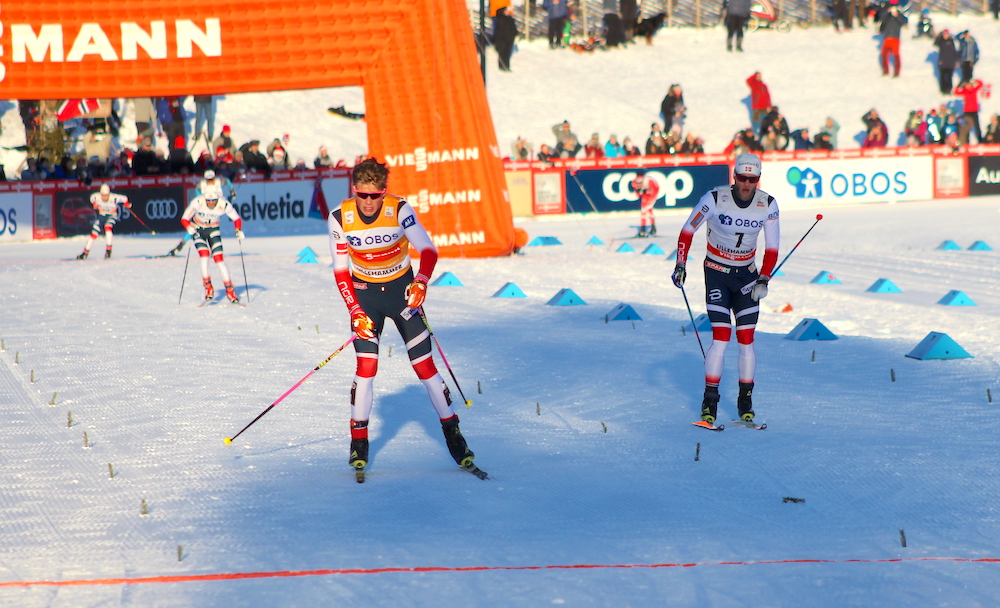
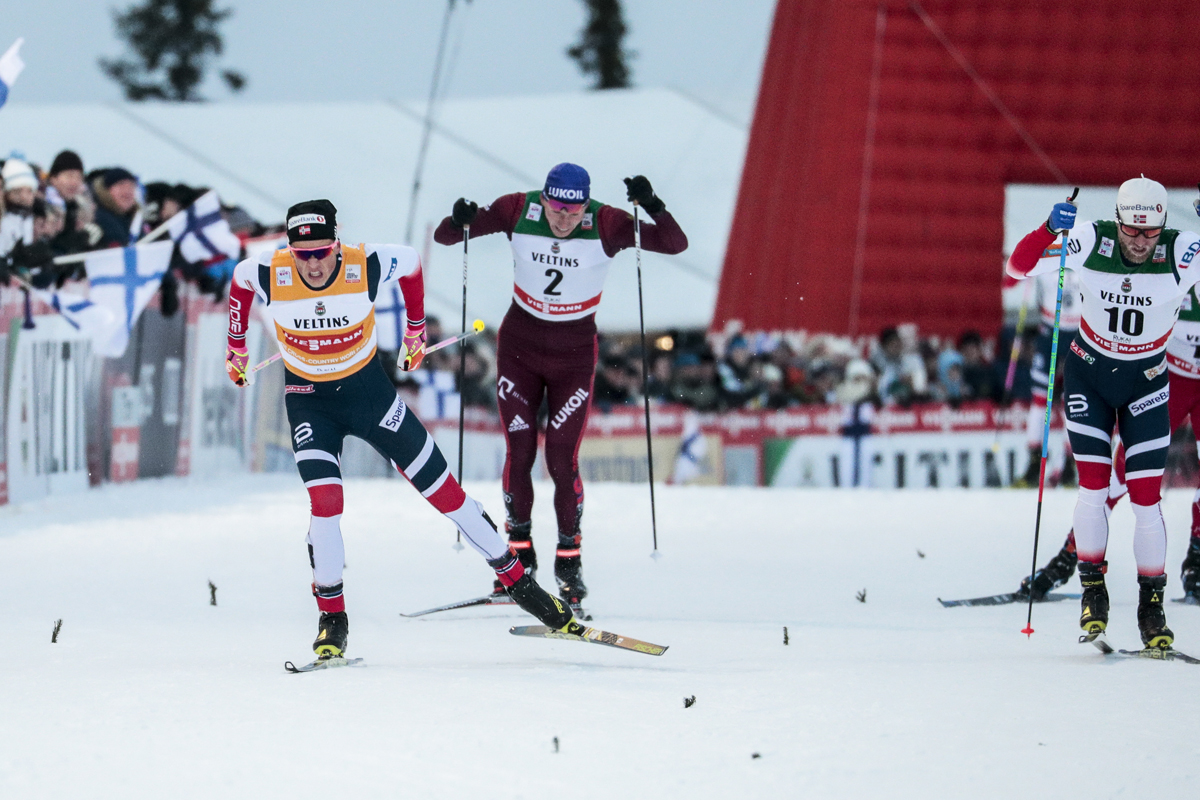
Johannes Høsflot Klæbo (l) passing fellow Norwegian World Cup Team member Martin Johnsrud Sundby (10) for the win in Sunday’s 15 k freestyle pursuit at the Ruka Triple mini tour in Kuusamo, Finland. Russia’s Alexander Bolshunov (2) was 1 second back in third place for his first World Cup podium while Canada’s Alex Harvey (behind Sundby) placed fourth. (Photo: Fischer/Nordic Focus)
After what Harvey estimated to be a 45-second downhill, he realized that wasn’t the case. Klæbo and Bolshunov had slingshot back toward the front, and while Sundby was first to the top of the last climb before the finish, Klæbo and Bolshunov were right behind him while Harvey followed in fourth.
They entered the stadium together in that order, and Klæbo passed Sundby with about 100 meters remaining to take his third-straight win of the weekend.
“Coming out of my tuck there I was just full of lactate, not feeling any fresher … then I just got passed on the hill,” Harvey recalled. “I had nothing left. That was my move. … I’m happy I made that move, but I couldn’t make a second burst after that.”
While Klæbo won the pursuit and with it, the Ruka Triple mini-tour title in 36:23.2 minutes, Sundby placed second, 0.4 seconds back, Bolshunov claimed his first World Cup podium in third (+1.0), and Harvey finished another 0.6 seconds back in fourth (+1.6).
On the day, Harvey’s course time ranked fifth fastest behind Manificat, who was the “winner of the day” in 34:50.9. Finland’s Matti Heikkinen was second fastest (+5.4) after starting 22nd and placing 14th, Holund was third fastest (+7.5) after starting 14th and finishing ninth, and Switzerland’s Dario Cologna, who started 26th and finished 17th, was fourth fastest (+8.7).
Harvey said starting 17 seconds behind Sundby was a tall task on its own, and he had started the race with a goal of breaking into the top 10 overall. All things considered, fourth place was better than he expected at this point in the season.
“… But I knew it was still within reach,” Harvey explained. “I believed in it, but I didn’t put too much hope in, let’s say, a top five or fighting for the podium. It was more like I wanted to be back in the top 10 and just that to me seemed already hard enough.”
Norway’s Johannes Høsflot Klæbo after winning the 15 k freestyle pursuit on Sunday to win the Ruka Triple mini tour in Kuusamo, Finland. (Photo: Fischer/Nordic Focus)
The fact that he was able to hang with Klæbo and Sundby to the finish was a good sign, he added.
“Right now, he’s not just a good sprinter, he’s the best distance skier in the world, too,” Harvey said of Klæbo. “I mean, to win a 15 k individual you have to be in very, very good physical shape, so he’s in really good physical shape and I know I’m not yet. I’m not in my best form and Sundby probably isn’t yet, so you never know what’s going to happen later in the season at the Olympics, but for now it’s hard to drop him when he’s actually just in better shape than everybody else in the world.”
After the race, Klæbo told NRK he was relieved to get the win and have some time to rest before next weekend’s World Cup in Lillehammer, Norway.
“My legs are shaking now,” Klæbo said. “Feels incredible to be the first to cross the finish line. Now I need a few days rest.
“This was brutal,” he added. “I’m actually glad they caught up to me and luckily I had good skis. I’m glad I had a few seconds today.”
Norwegian national-team coach Tor-Arne Hetland told NRK he was “really impressed” with Klæbo. “We have a diamond in the sport of cross country skiing now,” Hetland said.
“That’s very nice of him to say. It’s probably a little too much, but it has been a good start to the season,” Klæbo responded to NRK.
Sundby spoke excitedly about having Klæbo to contest for the overall World Cup lead.
“For the moment, he’s taking international cross-country skiing for men to a whole ’nother level,” Sundby told NRK. “It is a little humiliating for the rest of us, but at the same time it’s extremely inspiring to see what he does in his second year at this level. It’s hell of fun to have a guy like that on the team.”
Bjornsen 26th, Kershaw 29th; Caldwell Posts Top-20 Time of Day
Canada had two in the top 30 on Sunday with Devon Kershaw in 29th (+1:47.8), scoring World Cup points for the second-straight day. He started 28th and 1:59 out of first, just one second behind Cologna in 26th and Russia’s Andrey Larkov in 27th.
“I just wasn’t strong enough to go with Dario,” Kershaw said on the phone. “I had the perfect chance to be able to follow Dario up the field, but he just started so fast, and on the steep terrain, my legs just — I tried up the first steep wall and at the top, I’m like, man, if I keep going like this, after 5 k I’m gonna be dead.
Canada’s Devon Kershaw (28) leads American Erik Bjornsen (23) and others during the World Cup men’s 15 k freestyle pursuit on Sunday in Kuusamo, Finland. (Photo: Fischer/Nordic Focus)
“So I had to manage my energy a little bit and in the end, it turned out that Bjornsen and I’s group just wasn’t strong enough,” Kershaw continued, referring to U.S. Ski Team member Erik Bjornsen, whom he started eight seconds behind and spent most of the race with. “[Our group] had a good 7 1/2 k and then after that, between 7 1/2 kilometers and 12 k, we were skiing really slow. So that’s a bit frustrating in a pursuit because you’re just stuck there in no-man’s land.”
While he felt like he was skiing the flats well, Kershaw said he struggled with the “biting” conditions, which seemed to limit glide, especially on the notoriously steep course’s climbs.
“I had to make the choice to be like, OK, I’ve got to just stay in this group and I’m not strong enough to drive the bus, because my legs just weren’t there today on the terrain” he said. “In the end I made a tactical error in the last 600 meters. I should’ve followed Bjornsen on the outside and I went on the inside and was hoping it would open up for me and it didn’t. So I ended up 29th, but that’s OK.”
Bjornsen started 24th and finished the pursuit in 26th (+1:43.6), after following Larkov in 25th (+1:42.8) across the line and holding off Iceland’s Snorri Einarsson (a former Norwegian skier who raced for the University of Utah) in 27th (+1:46.2), Great Britain’s Andrew Musgrave in 28th (+1:47.2), Kershaw in 29th, and France’s Jean-Marc Gaillard in 30th (+1:49.2).
“I started right around Cologna and [Finland’s Matti] Heikkinen but there was no way I was going to hold their pace, they were flying,” Bjornsen wrote in an email. “I had to settle in with the group around me. It soon became clear our group was not going to catch anyone in front of us or get caught, so it became a tactical game. Some surges, but for the most part nobody wanted to lead.”
Devon Kershaw (Canadian World Cup Team) en route to 29th in the 15 k freestyle pursuit on the last day of the Ruka Triple World Cup mini tour in Kuusamo, Finland. (Photo: Fischer/Nordic Focus)
Kershaw laughed when he talked about some “tips” he gave Bjornsen during the race.
“He had really fast skis so there were a few times that he came by me on the downhill and then would kind of try to hammer for a minute and then get tired and slow down again,” Kershaw said. “I told him, like, ‘Dude, you’ve got great skis. Unless you can stay in the front and really press, then it’s better just to play the game and wait for the end.’ After that, he did that and he torched us all in the end. So that was kind of fun to see for him.”
According to Bjornsen, Kershaw suggested he sit back and wait for the sprint.
“My skis were good but I think my weight is what helped me the most on that last huge downhill,” Bjornsen wrote. “I was fine going for that tactic but at the same time it would have been nice to leave a little more out there today. Stoked to get double points for 26th though!”
Paddy Caldwell (U.S. Ski Team) racing to 70th in the men’s 15 k classic on Saturday, Day of the Ruka Triple World Cup mini tour in Kuusamo, Finland. In Sunday’s 15 k freestyle pursuit, he skied up to 51st with the 19th-fastest time of day. (Photo: Fischer/Nordic Focus)
Paddy Caldwell, new to the U.S. Ski Team B-team this year, posted his best World Cup result with the 19th-fastest time of day, 50.5 seconds back from Manificat. He started with the wave in 70th and finished 51st overall (+3:03.1).
“Going into the race my goal was to move up as much as possible,” the 23-year-old Caldwell wrote in an email. “I wasn’t really thinking about place or time of day – I was just trying to ski fast and put together a good effort.
“It was really hard to move up in the pack,” he added. “I started midway back in the wave and we kept picking up more and more skiers as the race went on. I tried to relax as much as possible on the hills and build in energy to pass where I could on the flats. … I am really excited with the day and psyched to have had a good result here in Ruka. I’m looking forward to the rest of period 1 and learning more from the big dogs!”
“Very exciting race out of Erik today,” U.S. Ski Team coach Matt Whitcomb commented on the phone. “… When he settled to the back of his pack on Lap 6 and headed into the downhill with one climb to go, we just all sort of expressed confidence over the U.S. radio channel, got ready see what he could do. It is so fun to watch him in a stadium when he has to go head to head against five other athletes … he did not disappoint today. Really proud of Erik’s 26th place.”
As for Caldwell, who skied the 25th fastest time of day in the 2017 World Cup Finals freestyle pursuit, Whitcomb said, “this is his race, the skate distance.”
“There were times that he was a little bit road-blocked out there, just the way the pursuit race unfolds in that start … and it looked like today Paddy could keep going, so really great signs out of him,” Whitcomb said.
Whitcomb also highlighted the races of Scott Patterson, who raced up from 78th to 55th (+3:28.4) with the 31st-fastest time, and Noah Hoffman, who improved from 45th to 39th (+2.33.3) with the 35th-fastest time. Also for the U.S., Andy Newell finished the tour out in 75th (+5:39.6).
American Paddy Caldwell (70) racing with Sweden’s Jens Burman (front) and Canada’s Len Valjas (46), among others, during Sunday’s World Cup 15 k freestyle pursuit on the last day of the Ruka Triple in Kuusamo, Finland. (Photo: Fischer/Nordic Focus)
Canada’s Len Valjas moved up two places for 44th overall (+2:47.5), Graeme Killick finished the tour in 68th (+4:39.5), Knute Johnsgaard 81st (+6:43.6), and Julien Locke 83rd (+7:33.6).
Babikov pointed out that Valjas had a shoulder injury that he mostly recovered from, but caused him to struggle with double poling in Friday’s sprint. Despite placing 63rd in that sprint, Valjas was the team’s third-best man in the weekend’s distance races.
“[In] two distance races, he was third best and actually placed higher than he placed in sprint in the distance, 15 k, hardest one with lots of climbing,” Babikov said. “So that shows he has a good shape, but just needs to scrape that rust off and remember how to go fast again. I think physically he is in a good place, just need to do some more races, and it will come.”
***
*Post-race sidenote: According to Harvey, after the race, the Russian team’s massage therapist told Canadian coach Ivan Babikov that Chervotkin wanted to thank Harvey for pulling him in the pursuit. Chervotkin, 22, started 11th and finished fifth, 6.2 seconds out of first and 4.6 seconds after Harvey in fourth.
“There’s a bit of beef with the Russians and me right now,” Harvey said. “I came in wondering if they were just going to punch me in the face. They said they wanted to break my teeth, so this is a good turn of things.”
“I read that in the Norwegian news, actually, that Petukhov wanted to …,” he said with a laugh. “But I knew the media likes that sort of thing. But I think things are good now.”
Harvey noted that Bolshunov and Chervotkin, neither of which have been implicated in the doping scandal, are part of “a new generation” in Russian cross-country skiing. “I saw the results in Bruksvallarna; it looks like the have almost as much depth as Norway does. They’re really strong.”
— Aleks Tangen, Ian Tovell, Jason Albert, and Harald Zimmer contributed
Racers in the Ruka Triple World Cup 15 k freestyle pursuit, including Russia’s Andrey Larkov, Switzerland’s Jonas Baumann, Italy’s Federico Pellegrino, Switzerland’s Dario Cologna, and Norway’s Simen Hegstad Krueger, ascend a climb in Kuusamo, Finland. (Photo: Fischer/Nordic Focus)
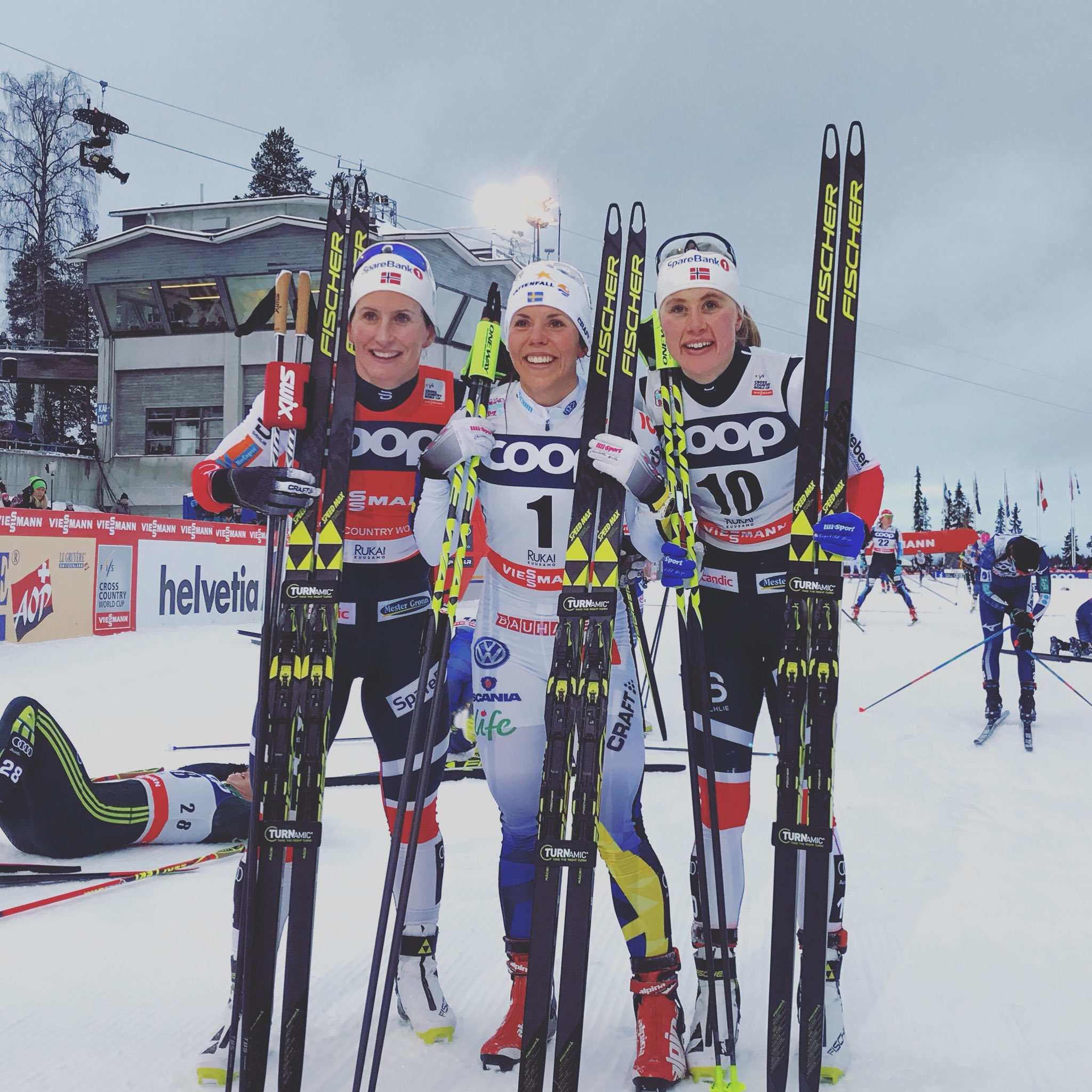
Sweden’s Charlotte Kalla (c) after winning the 2017 Ruka Triple and her first World Cup race since 2015. She won Sunday’s World Cup 10 k freestyle pursuit by 9 seconds over Norway’s Marit Bjørgen (l) and was nearly 34 seconds ahead of Norway’s Ragnhild Haga (r), who placed third. (Photo: FIS Cross Country/Twitter)
FIS Cross Country World Cup (Kuusamo, Finland): 10/15 k freestyle pursuit
Sweden’s Charlotte Kalla took down the fiercest contender women’s cross-country skiing has ever seen, challenging Norway’s Marit Bjørgen on the final lap of the women’s 10-kilometer freestyle pursuit on Sunday then successfully holding her off to the finish.
Kalla entered the final day of the three-day Ruka Triple mini tour with a 2-second lead on Bjørgen out of the pursuit start. Bjørgen quickly caught her and led for much of the four-lap race — until the last lap. The two skied alone, at least 30 seconds ahead of their nearest chasers, with three other Norwegians, Ragnhild Haga, Ingvild Flugstad Østberg and Heidi Weng leading Austria’s Teresa Stadlober and Sweden’s Stina Nilsson at 8.6 k.
Before that marker, Kalla had already launched her attack and was 6 seconds ahead of Bjørgen with 1.4 k to go. The Swede continued to push the pace and extended her buffer to Bjørgen, entering the stadium alone and winning by 9.7 seconds. For Kalla, a 2015 World Champion in the 10 k freestyle, it was her first World Cup win since 2015.
Bjørgen took second and Haga outlasted her teammates for third place (+33.9). Weng finished fourth (+38.0) and Østberg fifth (+40.2), then Stadlober in sixth (+41.0) and Nilsson in seventh (+46.7). Russia’s Natalia Nepryaeva led in the next chase group for eighth place (+1:01.6), followed by Sweden’s Ida Ingemarsdotter in ninth (+1:10.1) and American Sadie Bjornsen in 10th (+1:18.0). Another U.S. Ski Team (USST) member Jessie Diggins was close behind in 12th (+1:35.7), about five seconds behind Norway’s Kathrine Rolsted Harsem in 11th (+1:30.3).
The USST had four in the top 30, with Kikkan Randall rising from 48th at the start to 25th (+2:41.1) and Rosie Brennan improving from 34th to 28th (+2:43.2).
While Haga’s time was the fastest of the day in 25:41.8 (compared to Kalla’s finishing time of 25:50.1, which was third-fastest of the day behind Weng in second), Randall’s time was eighth fastest, Diggins was 10th fastest and Bjornsen 11th fastest of 79 in the last women’s race of the opening World Cup weekend.
Also for the U.S., Ida Sargent finished out the tour in 38th, Sophie Caldwell was 39th, Liz Stephen 56th, Chelsea Holmes 60th, and Julia Kern 73rd.
Canada’s Emily Nishikawa placed 69th overall and Cendrine Browne moved up two places to finish 72nd, while Dahria Beatty was lapped.
Klæbo Sweeps Opening Weekend
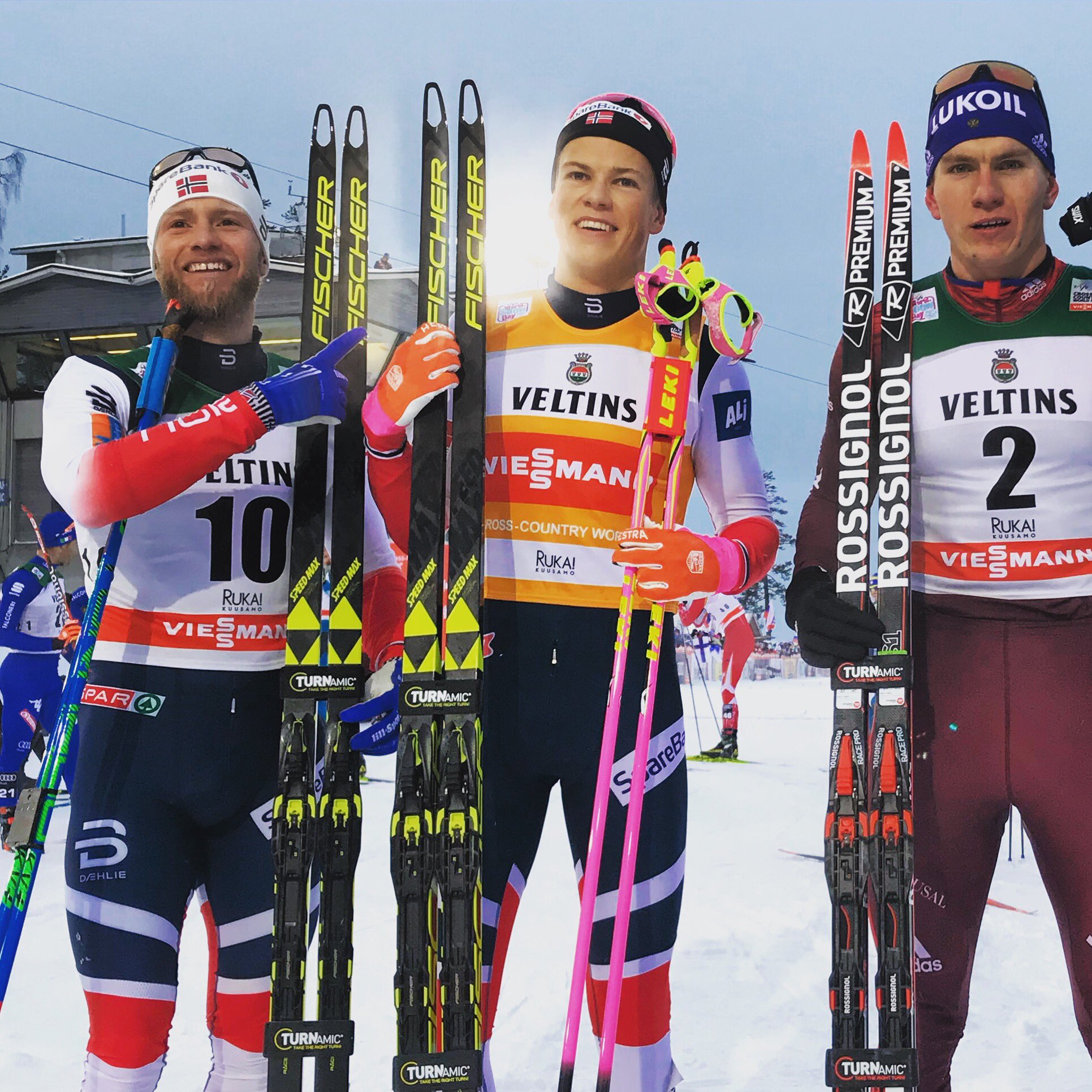
The men’s 15 k freestyle pursuit podium on the last day of the Ruka Triple in Kuusamo, Finland, with Norway’s Johannes Høsflot Klæbo (c) in first, Norway’s Martin Johnsrud Sundby in second, and Russia’s Alexander Bolshunov in third. (Photo: FIS Cross Country/Twitter)
In the men’s 15 k freestyle pursuit later in the day in Kuusamo, Johannes Høsflot Klæbo lost his 38-second buffer to the men’s field, but won the race after outlasting fellow Norwegian Martin Johnsrud Sundby, Russia’s Alexander Bolshunov and Canada’s Alex Harvey, respectively.
While Klæbo started the pursuit 38 seconds ahead of Bolshunov in second place, Sundb started 1:05 minutes back in 10th and Harvey was 1:23 behind in 12th.
Klæbo remained 32 seconds ahead of Bolshunov at 5 k, at which point Sundby led a chase group in third, followed closely by Sweden’s Calle Halfvarsson, Norway’s Didrik Tønseth, Kazakhstan’s Alexey Poltoranin, Russia’s Evgeniy Belov, Norway’s Emil Iversen, Finland’s Iivo Niskanen, and Norway’s Pal Golberg, respectively.
Harvey skied in the next group back with Sweden’s Marcus Hellner, Norway’s Hans Christer Holund, France’s Maurice Manificat, and Russia’s Alexey Chervotkin, all of which were in the top 15 at 5 k.
Over the next 2.5 k, Bolshunov cut his distance to Klæbo to 20 seconds, and at 7.5 k, Sundby was skiing alone another five seconds back in third.
Sundby caught Bolshunov and the two reeled in Klæbo over the next kilometer, catching him around 8.6 k, while 11 seconds back, Harvey led a chase group with Chervotkin, Niskanen, Holund, Poltoranin, and Manificat at 8.6 k.
Harvey lapped through the stadium at 10 k right behind Bolshunov in first, while Tønseth followed in third and Klaebo in fourth. Sundby remained in seventh, less than 2 seconds back.
At 12.5 k, 12 skiers remained in 2.6 seconds of the lead, but 1 k later, that number had dwindled to four within 3 seconds of first: Sundby, Harvey, Tønseth, and Klæbo. Bolshunov kept himself in contention just 3.8 seconds behind, and on the final climb, it became evident the race was between Klæbo, Sundby, Bolshunov, and Harvey. They finished in that order, with Harvey dropping off the pace in the finishing stretch.
Klæbo took the win in 36:23.2, just 0.4 seconds ahead of Sundby in second, while Bolshunov took third, 1 second behind Klæbo. Harvey was another 0.6 seconds back in fourth, and the Canadian’s time stood up as the fifth fastest of the day, behind Manificat in first (34:50.9). Manificat tied Holund for placed eighth overall (+8.2), behind Chervotkin in fifth (+6.2), Niskanen in sixth (+7.2), and Tønseth in seventh (+8.1).
Erik Bjornsen led the U.S. men overall in the tour in 26th (+1:43.6) for his third-straight race in the World Cup points. Also for the U.S. Ski Team, Paddy Caldwell raced to 19th for time of day (after starting 70th and finishing 51st in the pursuit).
Canada’s Devon Kershaw also landed in the points for the second-consecutive day in 29th (+1:47.8).
American Noah Hoffman finished the Ruka Triple in 39th (up from 45th at the start), Scott Patterson was 55th and Andy Newell 75th for the U.S.
Canada’s Len Valjas placed 44th overall, Graeme Killick 68th, Knute Johnsgaard 81st, and Julien Locke 83rd.
While France came in the favorites in the single mixed relay, starting a team of Martin Fourcade and Marie Dorin Habert, it was Austria who put on a master class and skied to a comfortable win today.
Simon Eder tags off to Lisa Theresa Hauser for Austria during the single mixed relay World Cup in Ostersund, Sweden. The pair raced to a 16.5-second win. (Photo: IBU/biathlonworld)
The Austrian duo of Lisa Theresa Hauser and Simon Eder used only two spare rounds over the course of 40 shots, the best shooting in the field by a wide margin. They led nearly the whole race and ended up with a 16.5-second victory over Germany’s Vanessa Hinz and Erik Lesser. The Germans used nine spare rounds to clean all their targets, but Lesser was aggressive on the skis and made up ground on the trails to finish 16.2 seconds clear of the rest of the field.
There, drama ensued on the last loop. Kazakhstan’s Maxim Braun came through a crash caused by Italy’s Thomas Bormolini, who was skiing in third place on the penultimate downhill and also took out Ukraine’s Dmytro Pidruchnyi. That allowed Braun, along with teammate Galina Vishnevskaya, to just barely hold on to third place. Their shooting – with five spare rounds between them, the second-best in the field – allowed this, their best relay showing ever.
Fourcade, who had left the range in seventh, came through the fray to put France into fourth, followed by Sweden (Linn Persson and Sebastian Samuelsson), then Ukraine (Pidruchnyi and Vita Semerenko) and Italy (Bormolini and Alexia Runggaldier).
Both the U.S. team of Emily Dreissigacker and Leif Nordgren and the Canadian team of Rosanna Crawford and Christian Gow were lapped. Crawford was in second position more than halfway through the race when she fell on a downhill, losing a large amount of time and affecting the functioning of her rifle once she reached the shooting range.
Later in the day, countries sent four-athlete teams out for regular mixed relays. Despite an imperfect start on the shooting range, the Norwegian team of Ingrid Tandrevold, Tiril Eckhoff, Johannes Thingnes Bø, and Emil Hegle Svendsen came away with a 5.3-second win over Italy’s Lisa Vitozzi, Dorothea Wierer, Dominik Windisch, and Lukas Hofer.
The German team of Franziska Preuss, Maren Hammerschmidt, Benedikt Doll, and Arnd Peiffer was third, +6.4, and Slovakia close behind in fourth.
Canada’s Emma Lunder, Julia Ransom, Scott Gow, and Brendan Green finished 15th, +3:28.0, and the U.S. team of Susan Dunklee, Clare Egan, Paul Schommer, and Sean Doherty 21st, +4:47.6.
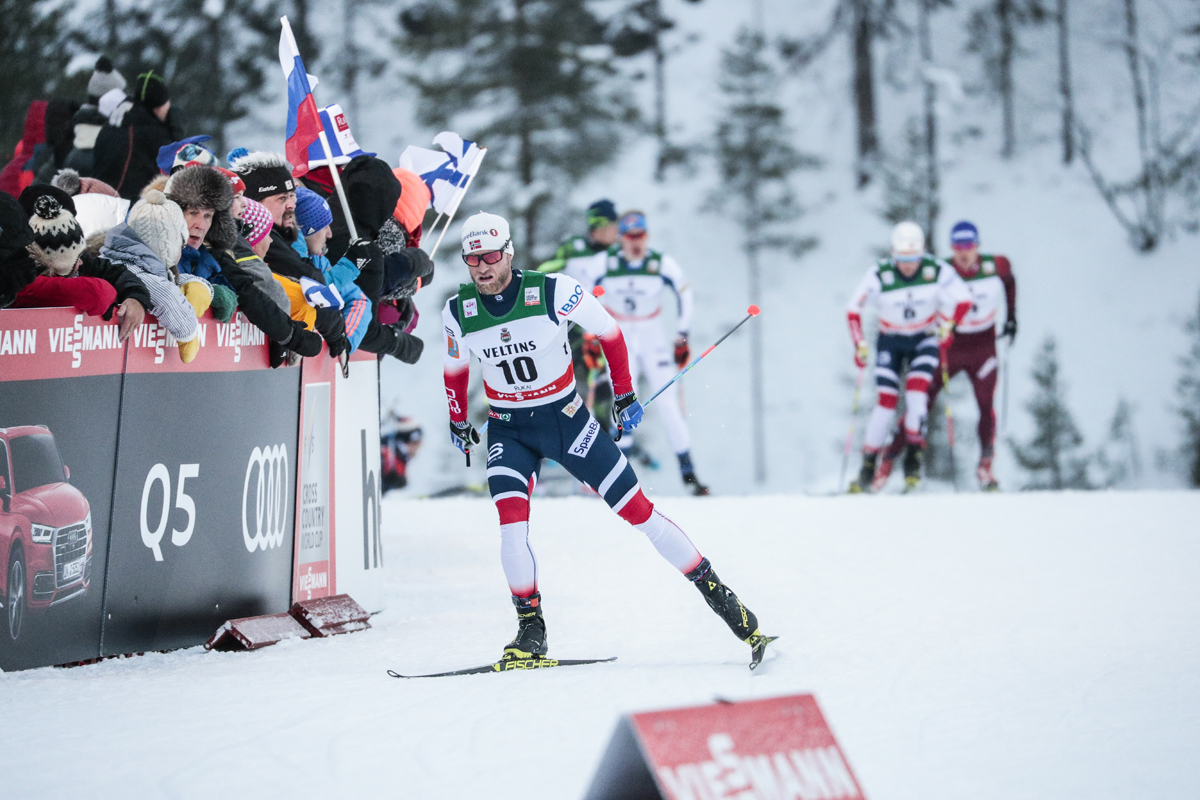
Norway’s Johannes Høsflot Klæbo racing to his second win in as many races at the Ruka Triple on Saturday in Kuusamo, Finland. He won the first distance race of the season, the men’s 15 k classic, by 15 seconds and will start Sunday’s freestyle pursuit with a 38-second head start on the men’s field. (Photo: Fischer/Nordic Focus)
Is Johannes Høsflot Klæbo better than Petter Northug* was at his age? It’s hard to say, reigning Norwegian World Cup winner Martin Johnsrud Sundby told NRK. But his performance in the last two days is pretty unheard of, Sundby said after Saturday’s 15-kilometer classic.
On both Friday and Saturday at the Ruka World Cup opener in Kuusamo, Finland, Klæbo (who’s still a U23 athlete at just 21 years old, although he’s on Norway’s exclusive World Cup Team) won both races to start the 2017/2018 season. He didn’t lose a round in Friday’s classic sprint, then came out to take a 15-second victory over fellow Norwegian Didrik Tønseth in Saturday’s 15 k classic.
“There’s no doubt he’s a phenomenon,” Sundby said after placing eighth on Saturday, 30.7 seconds off Klæbo’s winning time of 33:38.8 minutes, according to a loose translation. “To race like he did yesterday, then do the same today. No, that’s amazing.”
Klæbo ended last season as both season-long U23 (under-23) World Cup champion as well as the Sprint World Cup champion. He’s started this season without a loss, and he led at most parts of the race on Saturday, except for the 3.1 and 5 k checkpoints, where Russia’s Alexander Bolshunov clocked splits that were 0.9 and 4 seconds faster, respectively.
The men’s 15 k classic podium on Day 2 of the Ruka Triple in Kuusamo, Finland, with Norway’s Johannes Høsflot Klæbo (c) in first, Norway’s Didrik Tønseth (l) in second, and Finland’s Iivo Niskanen (r) in third. (Photo: Fischer/Nordic Focus)
But Bolshunov, who started 66th (out of 102) couldn’t hold it, and the young gun in bib 42 continued to hold his own in the leader’s chair at the finish. Klæbo ousted Tønseth from the top spot, putting Tønseth in second place. Finland’s Iivo Niskanen in bib 70 charged hard for the win, coming within three seconds of Klæbo around 6 k, but ended up 17.7 seconds short for third place.
“It’s unbelievable what Johannes did today, having raced four sprint rounds yesterday,” Tønseth emphasized, according to a International Ski Federation (FIS) press release.
“I was surprised myself,” Klæbo told FIS. “My plan was to open hard. When you fight for the World Cup victory, you try to give everything.”
As for his reaction to Sundby’s praise, Klæbo told NRK he was trying to remain focused.
“It’s just two races, so we’ll have to wait and see,” he said. “There is no one who is more of a favorite in the Tour de Ski than Martin. I will smile as long as I have the yellow shirt [as the overall Word Cup leader], but then he will get it in the end.”
Saturday’s 15 k classic, as Niskanen pointed out, wasn’t an easy one. New snow from overnight and the day before mixed with temperatures around freezing made for glazed tracks, where skis were prone to icing.
“It was a difficult competition and it was not easy to pick the right skis,” Niskanen told FIS. “Looking at the whole mini tour, third place today is good. I am still not where I would like to be, there are some good things but also some things I have to improve for the [Olympic] Games.”
He’ll start Sunday’s final race of the Ruka Triple, the men’s 15 k freestyle pursuit, in fifth place, 49 seconds behind Klæbo in first. Bolshunov, who finished fourth on Saturday (19.9 seconds behind Klæbo), will start the pursuit in second. And Klæbo will start first, 38 seconds ahead of the Russian.
Norway’s Pål Golberg will head out third, 6 seconds after Bolshunov, and Sweden’s Calle Halfvarsson will start fourth, another 4 seconds later and 1 second ahead of Niskanen. Tønseth is slated to start sixth (+0:57) just ahead of fellow Norwegian Emil Iversen and Kazakhstan’s Alexey Poltoranin (both 58 seconds back) in seventh and eighth, respectively. Russia’s Evgeniy Belov** is ninth in the tour standings (+1:05) and will start with Sundby in 10th (+1:05).
On Saturday, Poltoranin, an early leader in bib 12, placed fifth (+25.6) to move up the mini-tour ranks. He initially bumped Belov, who started 10th, out of the leader’s chair, and Belov ultimately slipped to sixth (+26.5), just ahead of Iversen in seventh (+30.2) and Sundby in eighth (+30.7).
Russian U23 skier Alexey Chervotkin placed ninth on the day (+31.2). Halfvarsson was 10th (+34.4) after coming within seven seconds of Klæbo’s time in the middle of the race but losing time on the last of three 5 k laps. For Norway, Golberg placed 11th (+38.1) and Hans Christer Holund 12th (+44.7), ahead of Canada’s Alex Harvey in 13th (+49.7).
Canada’s Alex Harvey racing to 13th in the men’s 15 k classic individual start on Saturday at the World Cup in Kuusamo, Finland. (Screenshot: ARD)
Harvey, who started in bib 37, spent most of his race floating between 10th and 14th place, and did what he needed to get within striking distance of the top 10 for Sunday’s pursuit. He’ll start tomorrow’s race in 12th, 1:23 out of first and 9 seconds behind Chervotkin in 11th.
“I was just hoping to move forward a bit in the standings but more importantly to deliver another good race,” Harvey wrote in an email on Saturday. The day before, he reached the quarterfinals and finished 21st overall in the sprint.
“The conditions yesterday were quite different than today’s. Yesterday it was fresh falling snow and cold, then it warmed up quite a bit overnight so today was very glazy [sic] and shiny snow,” Harvey wrote. “Skis were good I think. Not the fastest but good kick in not-so-easy conditions to get grip.”
Like fellow Canadian World Cup Team member Devon Kershaw, who tied American Erik Bjornsen (U.S. Ski Team) for 26th (both 1:15.2 out of first), Harvey explained that he chose no-wax “hairies”, also known as “rub” skis.
(“I think a lot of guys went on rub skis,” Kershaw wrote in an email. “I went with rub skis and it was the right choice for me today. The techs were all pretty pumped because I have been very averse to rub skis in the past. The handful of times I’ve been ‘forced’ to race on them I’ve gotten completely destroyed, so today was fun to feel good and make the skis work for me.”)
Harvey recalled feeling strong on the climbs, using his grip to his advantage.
“From our more detailed splits it seems I was losing a bit on the flats which is usually my stronger terrain but nothing too dramatic,” Harvey wrote. “I’m happy to be within reach of the top ten, that was the goal for the weekend. Tomorrow I’m looking forward for 2 things. 1: chasing guys ahead of me. 2: skating!”
Kershaw, who started 13th and had fewer men to chase ahead of him, explained that he paced his first lap so that he’d catch someone like Harvey, and the plan worked.
“I was going to take my risk and start really slow. Almost level 3 effort,” Kershaw wrote of his pre-race strategy. “I knew I should be able to lap through with either Alex, [Finland’s Matti] Heikkinen, or Dario [Cologna of Switzerland] – and it just so happened that it was Alex. I ended up having great energy after my pedestrian start and was able to ski 10km with him, which obviously allowed me to ski into the points. Perhaps I should have been more aggressive out of the start, but I played it safe and it worked out decently well for me.”
“That was sweet to have someone there,” Harvey said in a Cross Country Canada press release. “It was good for both of us and really helped pull us both around.”
Canada’s Alex Harvey (in red) lunges at the finish of the men’s 15 k classic at the Ruka World Cup in Kuusamo, Finland. While he initially finished sixth, he ended up 13th on the day. (Screenshot: ARD)
Kershaw wrote that he was “decently happy,” with his race. “I know that 26th doesn’t sound earth shattering or anything, but to start the first distance race of the World Cup tour in the points is fine. I’m a notoriously slow starter throughout my career before Christmas, so I’m just looking for some solid races and to hit the points more often than missing them is good.”
On Sunday, he’ll start 28th, one second behind Cologna in 26th and Russia’s Andrey Larkov in 27th. Bjornsen, the U.S. Ski Team’s leading man in the Ruka tour, is 7 seconds ahead of him in 23rd.
“I think the celling is probably 20th,” Kershaw wrote of his aspirations for an overall finish for the mini tour. “We have a good group of about 10 guys all starting within 9 seconds of each other. I will hope to stay in that group and have the energy and punch to have a good last lap. You never know what happens in these pursuit starts too – so guys could blow up, but there’s a break at around 20, and then behind me there’s a break at around 30. Will be fun.”
Bjornsen, who placed 24th in Friday’s sprint, started Saturday’s 15 k in bib 69, just 30 seconds ahead of Niskanen. In an email, Bjornsen described catching a “great ride from Iivo” on the second lap.
“He’s just amazing here,” Bjornsen wrote. “I’m pretty sure he was disappointed with his result. He comes to Ruka with a mission. I jumped on him for a lap in the middle. It felt very controlled in the double pole sections but he was just striding up the hills no problem. The herring bone was not nearly as efficient. I had to let him go after skiing with him for 6kms.”
Bjornsen explained that he took a chance and went for glide over grip.
“I’ve only raced here four times but tricky classic conditions seem to be the norm. The hills are big and steep!” he wrote. “I had a pair of rockets under my feet but I didn’t stride in the tracks once. My double pole is feeling great right now so the tactic was to hammer double pole as far up the hill as I could, and then just get out of the tracks and run/herring bone.”
After finishing in the top 30 to score World Cup points in the first two races of the season, Bjornsen explained he was feeling “psyched”.
“I didn’t have the best feelings the last couple weeks, so I wasn’t expecting to be in the points right away,” he wrote.
“Of course yesterdays race was fun for me, but for sure the highlight of the day was watching Sadie absolutely dominate the heats!” he added of his older sister Sadie Bjornsen placing second in the women’s sprint. “She’s been looking great this year and I think she has a lot more success to come. Personally I believe she was strong enough to take the win, it’s only a matter of time before that happens..”
On Sunday, he hoped to chase a top-30 overall tour finish.
“I’m starting around some legends, so it will be a great experience!” Bjornsen wrote.
U.S. Ski Team coach Matt Whitcomb said he was impressed with Bjornsen’s ability to contend with “some of the best skiers in the world” on Saturday, including Niskanen.
“[He] kind of took the approach, ‘I am going to swing as hard as I can and hope to connect with the ball,’ and it worked for a large part of that race,” Whitcomb said on the phone. “He was skiing up into the top 20, and then Niskanen on the final lap turned things up a little bit and popped him off … It was a gutsy race, so psyched for Erik. It is so fun to watch him figure out a project, some sort of challenge in the race and go after it. … Twenty-sixth is a hell of a race in Finland.”
American Noah Hoffman raced to 43rd (+1:58.4) on Saturday, Andy Newell finished 59th (+2:29.6), Paddy Caldwell was 72nd (+2:53.5), Scott Patterson 86th (+3:17.7), and Simi Hamilton 96th (+3:43.4) for the U.S. Ski Team.
Five other Canadian national-team members competed, with Len Valjas finishing 48th (+2:08.0), Graeme Killick 58th (+2:23.4), Knute Johnsgaard 87th (+3:19.8), Julien Locke (U25 Team) 100th (+3:56.4), and Jess Cockney 109th (+5:20.7).
***
* Northug, 31, who made his World Cup debut in 2005/2006 and has since accumulated 13 World Championships golds and two Olympic gold medals, has started his season this weekend with non-World Cup International Ski Federation (FIS) races in Gålå, Norway, after skipping Norway’s opening FIS races in Beitostølen, Norway, last weekend. Per team rules, he was not allowed to start the Ruka World Cup as a result of that decision. So far in Gålå, Northug finished 17th in the 15 k freestyle on Friday and was eliminated in Saturday’s classic-sprint quarterfinals to place 19th in that race.
** Belov, 27 is one of six Russian skiers currently banned from competing at future Olympics as a result of doping at the 2014 Olympics. He and the five others are allowed to compete in FIS events, like the World Cup, unless FIS decides otherwise.
The women’s 10 k classic podium at Day 2 of the World Cup opening Ruka Triple in Kuusamo, Finland, with Norwegian winner Marit Bjørgen (c), Swedish runner-up Charlotte Kalla (l), and Norway’s Ingvild Flugstad Østberg (r) in third. (Photo: FIS Cross Country/Twitter)
FIS Cross Country World Cup (Kuusamo, Finland): 10/15 k classic
On Day 2 of the Ruka Triple World Cup opener on Saturday, Norway’s Marit Bjørgen collected a 17-second victory in the women’s 10-kilometer classic individual start in Kuusamo, Finland.
Bjørgen started 30th of nearly 90 women and was contested by one other: Sweden’s Charlotte Kalla in bib 44. Kalla clocked through the 3.1 and 6.2 k checkpoints faster than Bjørgen, but the Norwegian’s time stood up against Kalla’s at 8.1 k, where Bjørgen was 1 second faster. Over the last two kilometers, Bjørgen continued to gain speed toward the finish, crossing the line in 25:07.6 minutes. Kalla came within 17 seconds of her, which was good enough for second place and 0.8 seconds faster than another Norwegian, Ingvild Flugstad Østberg, who was bumped to third (+17.8).
Norway had three in the top four with Heidi Weng in fourth (+34.0). Austria’s Teresa Stadlober put herself in the mix in fifth (+36.4), Norway’s Ragnhild Haga was sixth (+38.2), Russia’s Natalia Nepryaeva seventh (+42.8), Sweden’s Stina Nilsson eighth (+46.1), Russia’s Anastasia Sedova ninth (+53.4), and American Jessie Diggins 10th (+1:03.9).
Also for the U.S. Ski Team, Ida Sargent placed 22nd (+1:21.9) and Sadie Bjornsen, who notched a career-best second in Friday’s classic sprint and led the women’s Ruka Triple standings after Day 1, finished 23rd (+1:23.4). Bjornsen is now 11th in the standings (46.5 seconds behind Kalla in first) with one more day of racing (women’s 10 k freestyle pursuit) remaining.
Kalla is 2.6 seconds ahead of Bjørgen in the mini-tour standings, and Nilsson is third (+12.4) ahead of Østberg in fourth (+20.0).
Nine American women raced on Saturday, with Rosie Brennan placing 33rd (+1:47.7), Sophie Caldwell (who was eighth in Friday’s sprint) following in 36th (+1:50.1), Kikkan Randall finishing 48th (2:14.5), Liz Stephen 58th (+2:26.3), Chelsea Holmes 64th (+2:50.0), and Julia Kern 74th (+3:19.2).
Three Canadian women competed, with Emily Nishikawa placing 56th (+2:42.2), Cendrine Browne 76th (+3:23.6), and Dahria Beatty 84th (+3:53.5).
Klæbo Doubles Up in Ruka
Norway’s Johannes Høsflot Klæbo (top and bottom, center) won his second-straight race at the Ruka World Cup opener on Saturday in Kuusamo, Finland, with a 15-second victory in the men’s 15 k classic over fellow Norwegian Didrik Tønseth (bottom left). Finland’s Iivo Niskanen (bottom right) also reached the podium in third. (Photo: FIS Cross Country/Twitter)
In the men’s 15 k classic that followed, Johannes Høsflot Klæbo rocketed to his second-straight win of the World Cup’s opening weekend in 33:38.8, which was 15.3 seconds clear of runner-up and fellow Norwegian Didrik Tønseth.
Finland’s Iivo Niskanen started after Klæbo (bib 42) and Tønseth (bib 33) in bib 70 and pushed to contend with Klæbo, but came up 17.7 seconds short at the finish. Russia’s Alexander Bolshunov also emerged as a later contender, starting 66th (out of 115) and clocking the fastest times at 3.1 and 5 k. Bolshunov ended up 19.9 seconds behind Klæbo at the finish and ultimately settled for fourth.
Kazakhstan’s Alexey Poltoranin placed fifth (+25.6) after being an early race leader in bib 12, and Russia’s Evgeniy Belov (another early starter in bib 10) followed sixth (+26.5). Norway’s Emil Iversen placed seventh (+30.2) and Martin Johnsrud Sundby was eighth (+30.7), Russia’s Alexey Chervotkin ninth (+31.2), and Sweden’s Calle Halfvarsson 10th (+34.4).
Canada’s Alex Harvey placed 13th (+49.7), behind Norway’s Pål Golberg and Hans Christer Holund in 11th (+38.1) and 12th (+44.7), respectively.
American Erik Bjornsen and Canadian Devon Kershaw tied for 26th (+1:15.2).
Also for the U.S., Noah Hoffman was 43rd (+1:58.4), Andy Newell 59th (+2:29.6), Paddy Caldwell 72nd (+2:53.5), Scott Patterson 86th (+3:17.7), and Simi Hamilton 96th (+3:43.4).
For Canada, Len Valjas finished 48th (+2:08.0), Graeme Killick 58th (+2:23.4), Knute Johnsgaard 87th (+3:19.8), Julien Locke 100th (+3:56.4), and Jess Cockney 109th (+5:20.7).
Klæbo extended his lead in the Ruka Triple standings to 38.3 seconds over Bolshunov, who moved up to second place. Golberg is third (+44.1), Halfvarsson fourth (+47.8), and Niskanen fifth (+49.5) with Sunday’s 15 k freestyle pursuit remaining.
Harvey is 12th in the standings (+1:22.8) and Bjornsen 23rd (+1:50.9) to lead the Canadian and American men, respectively.
FIS Nordic Combined World Cup (Kuusamo, Finland): Individual large hill/10 k
Also in Ruka, the second day of nordic-combined action started on the HS 142 large hill and ended with a 10 k Gundersen start, which Japan’s Akito Watabe won by 31.7 seconds over Finland’s Eero Hirvonen. Watabe jumped to first on the large hill with a total of 158.6 points, while Austria’s Wilhelm Denifl followed with 154.2 points in second, just ahead of France’s Maxime Laheurte with 154.2 points in third.
The lone American to start the competition round for the second-straight day, Bryan Fletcher jumped to 31st. (His USA Nordic teammate Ben Berend just missed the top-50 cutoff in the qualification round in 52nd, while Taylor Fletcher was 65th in qualifying.)
In the 10 k that followed on Saturday, Watabe started with a 16-second head start on Denifl and extended his lead to the finish, crossing first in 24:58.6. Hirvonen, who started ninth and 58 seconds back based on his jump, rose to second, while Germany’s Johannes Rydzek raced up from eighth to third (+32.8). Norway’s Jan Schmid placed fourth (+34.4) and France’s Antoine Gerard finished fifth (+36.5), Laheurte took sixth (+38.4), Norway’s Espen Andersen was seventh (+39.8), Austria’s Mario Seidl was eighth (+43.7), and Denifl ended up ninth (+55.7). Bryan Fletcher skied the fourth-fastest time to place 18th. Fletcher started 2:29 after Watabe and finished 1:45.8 behind him.
On Friday, Fletcher placed 17th in the individual large hill/5 k Gundersen. In the first Nordic Combined World Cup competition of the season, Norway took first and second with Andersen holding off his teammate Schmid by 7.7 seconds for the win in 12:58.0. Watabe placed third, 11 seconds out of first, after jumping to third.
Andersen’s jump ranked second on Friday and he started the two-lap 5 k four seconds behind Seidl, the jump leader. Seidl fell back three places to fourth at the finish (+15.4) while Schmid rose from sixth to second place with the third-fastest ski time.
Denifl maintained his jumping position in fifth (+29.1) and Laheurte finished ninth — up from 12th in the jump. Fletcher jumped to 18th and improved one spot to 17th (+2:47.6) after starting 3:04 out of first.
Day 3 of nordic combined’s long weekend in Ruka is another individual large hill/10 k Gundersen on Sunday.
Note: This article has been updated to include comments from Sweden’s Charlotte Kalla.
For the second day in a row, Charlotte Kalla, a name synonymous with the yellow and blue of Sweden, stood atop the podium, placing first in the women’s 10-kilometer classic International Ski Federation (FIS) race on Saturday in Gällivare, Sweden. On Friday, Kalla won another individual-start race, the 5 k freestyle, by a margin of 8.8 seconds. She more than doubled that time gap by the finish of Day 2, winning the 10 k classic in 27:55 minutes, 17.7 seconds ahead of Russia’s Yulia Tchekaleva in second place. Natalia Nepryaeva, also from Russia, skied to third, 40.9 seconds back of Kalla.
“I am feeling good and I think I am where I should be at this moment,” Kalla wrote in an email. “I had a good feeling on the classic race and handle the condition well. On Friday I opened hard and tried to push hard all the way.”
Known as a skate powerhouse, Kalla has improved her classic skiing and is now a double threat. “I have improved my classic technique the last years,” Kalla explained. “When I am in shape it doesn’t matter if it is skating or classic. I am glad I managed to ski well in the condition we had. It was a little bit soft because of the snowfall.”
Although a home FIS event for Sweden, Russia secured six of the top-10 spots with Sweden settling for three. Japan’s Masako Ishida, the only non-Russian or Swede outlier in the top 10, placed fourth (+1:02.4). Russians Anna Zherebyateva raced to fifth (+1:08.8) while teammate Yulia Belorukova was sixth (+1:12.8).
Sweden took the next two spots with Stina Nilsson in seventh (+1:20.9) and Anna Haag in eighth (1:20.9). Russia rounded out the top 10 with Anatasia Sedova placing ninth (+1:24.1) and Mariya Guschina in tenth (+1:25.0).
Sweden’s Ida Ingemarsdotter, a World Cup regular, placed 11th (+1:30.6).
Kikkan Randall was the only U.S. Ski Team member at the race, and a day after finishing eighth in the 5 k skate, she finished 15th (+1:48.1) on Saturday. In an email, Randall explained that snow had fallen continuously for the last 24 hours in Gällivare.
“Conditions were pretty nice, the track was a little soft and a lot of racers here made the pole track a little punchy,” she wrote.
Considering the massive time-zone shift from her home in Anchorage, Alaska, to Central European Time, it appears Randall is adjusting well.
“I felt decent today, not too tired from the jet lag or yesterday’s race. I wanted two back-to-back races to get ready for next weekend’s triple World Cup opener,” she wrote, referring to the first three World Cup races in Kuusamo, Finland, starting Friday, Nov. 23.
Throughout Saturday’s 10 k, Randall steadily improved her overall placing: she was 32nd at 4.2 k, 23rd at 6.8 k and locked into 15th by 9.2 k.
“It was definitely good to race a 10km classic today,” Randall wrote. “I had trouble really digging into my race gear on the first lap today. I think I was skiing a little stiff and not carrying my momentum down the track. Nepryaeva [the third-place finisher] caught me going into the 2nd lap and that was the jumpstart I needed. I was able to match her pace for most of the rest of the race and it helped me find better technique and tempo.
“I wanted to be a little stronger today but I got some really important feedback on where I’m at and what I need to work on as the race season progresses,” she added. “My fitness feels pretty good and now it’s just a matter of fine-tuning.”
Emily Nishikawa was the only Canadian entered on Saturday and finished in 51st (+3:39.3). Sixty-nine women started the race, 38 from Sweden, 17 from Russia, seven from Japan, two from Switzerland and Estonia, and one each from the U.S., Canada, and Poland.
In Friday’s 10 k skate in Gällivare, only Swiss star Dario Cologna kept the Russians from sweeping the top nine by placing third. In that race, Evgeniy Belov and Sergey Ustiugov of the Russian national team finished first and second, respectively.
Saturday was a different race, a 15 k classic, but with a similar thread and no Cologna as a Russian foil.
The Russian men finishing in unison to take first, second and third in the men’s 30 k skiathlon, the final race of 2017 U23 World Championships at Soldier Hollow in Midway, Utah. Alexander Bolshunov (8) was deemed the winner, Alexey Chervotkin (1) was second, and Denis Spitsov (11) third. (Photo: FlyingPointRoad.com)
It was Russia, Russia, Russia.
Alexander Bolshunov, winner of the 30 k skiathlon at 2017 U23 World Championships, won the race in 37:13, one second ahead of Maxim Vylegzhanin in second. Alexey Chervotkin was third (+5.1).
Classic specialist, Kazakhstan’s Alexey Poltoranin finished fourth, 13 seconds off the podium, and Cologna placed fifth (+22.1).
Despite being on Swedish soil, the rest of the top 10 became a mostly Russian affair. Russian teammates Alexey Vitsenko and Artem Maltsev placed sixth (+29.5) and seventh (+37.4), respectively, Sweden’s Calle Halfvarsson interrupted the trend by tying Russia’s Evgeniy Belov for eighth (+38.0), and Russia’s Alexander Bessmertnykh took 10th (+40.1).
There’s a pattern: Russia took 14 of the top-20 places. Twenty-eight of 126 starters were from Russia, with the vast majority of the field being Swedish. Outside of the top 10, Sweden’s Daniel Rickardsson was the next-best Swede in 12th (+49.6).
Devon Kershaw (World Cup Team), who finished 12th on Friday, once again led Canada in 20th (+1:06.7). At 6.8 k, Kershaw was ranked 15th, and at 9.6 k he was down one spot to 16th. By the 11.4 k checkpoint, he began slipping further in the standings.
“Today was a tough one,” Kershaw wrote in an email. “I felt pretty good but conditions were soft, so you had to really feather it (the technique) – especially on the climbs. Pacing wise I think I was doing pretty well, but in the last 2.5km today I was missing any semblance of a kick to the finish and ended up conceding a few seconds to those around me, knocking me from about 15-16 to 20th.”
Although an interval start race, Kershaw never found a strong pacing partner. “I was skiing alone – no help at all today,” Kershaw wrote of his solitary effort. “It would have been so helpful! Especially that last lap when things get tough. But in individual start races, you need to learn to do it alone. So good to try and get used to that “time trial” feeling.”
Three other Canadians competed, with Graeme Killick (World Cup Team) finishing 50th (+2:32.3), Jack Carlyle (Alberta World Cup Academy) 91st (+4:06.1), and Brian McKeever (Para Nordic Team) 110th (+5:16.0).
As of press time, Fasterskier could not confirm if the International Ski Federation (FIS) held an emergency meeting to discuss the involvement of IOC-banned Russian skiers in FIS-sanctioned races. Of the six IOC-sanctioned Russian skiers, four are men: Belov, Vylegzhanin, Alexander Legkov, and Alexey Petukhov. All four skiers raced on Friday, however, Legkov and Petukhov (and Shapovalova, one of the two women sanctioned by the IOC) did not contest Saturday’s race.
Racing continues in Gällivare on Sunday with classic sprints.
Sweden’s Charlotte Kalla racing to a win in her first race of the 2017/2018 season, the women’s 5 k freestyle in Gällivare, Sweden, on Friday. (Photo: Sporteventgallivare/Instagram)
Sweden’s Charlotte Kalla and Hanna Falk went 1-2 in Sweden’s season-opening International Ski Federation (FIS) race on Friday in Gällivare, with Kalla winning the women’s 5-kilometer freestyle by 8.8 seconds in 12:58.1 minutes. Falk, her teammate on the Swedish women’s team, placed second and Russia’s Yulia Belorukova took the third spot on the podium, 10.3 seconds out of first.
The host nation had three in the top four, with Ida Ingemarsdotter in fourth (+16.1). Switzerland’s Nathalie von Siebenthal finished fifth (+17.8), Russia’s Yulia Tchekaleva placed sixth (+23.4), and Russia’s Natalia Nepryaeva was seventh (+25.0).
Kikkan Randall of the U.S. Ski Team raced to eighth (+27.2), just ahead of Sweden’s Evelina Settlin in ninth (+32.0) and Russia’s Anna Nechaevskaya in 10th (+33.5). Japan’s Masako Ishida was just 0.3 seconds out of the top 10 in 11th.
In an email, Randall explained that she decided to venture to Europe earlier this year to get some racing in ahead of the World Cup.
“We also wanted a little extra time to let Breck adjust to the 10hr time change!” she wrote of her 1-year-old son, who will be traveling the World Cup circuit with Randall and her husband, Jeff Ellis, this winter.
(Article continues below)
Most of the U.S. Ski Team arrived in Rovaniemi, Finland, on Thursday, Nov. 16 (with the exception of Andy Newell, who is racing this weekend in Beitostølen, Norway, with Noah Hoffman). The rest of her teammates planned to train at the Santasport Olympic training center in Rovaniemi until Nov. 21, when the entire team will meet up in Kuusamo (also known as Ruka), Finland — the site of next weekend’s World Cup opener.
“I’m happy with my start today,” Randall wrote of Friday’s race. “It took my a couple km’s to get going today but I felt like I was finding my rhythm in the 2nd half of the course. It’s my first hard session this week after the travel over so today was a good jolt! It was a competitive field and I was satisfied to be in the mix.”
Ninety-two women raced the Gällivare 5 k skate, compared to 56 women on Friday in Beitostølen (Norway’s FIS season-opener). Randall planned to race the 10 k classic on Saturday in Gällivare, then skip Sunday’s classic sprint.
“It’s great to be back around other World Cup skiers again and I’ve always liked Gällivare so it’s nice to be back here,” she wrote. “My former wax tech lives here and has been taking great care of us. … Looking forward to meeting up with the team in Ruka next week.”
With 46 Swedes and 23 Russians accounting for most of the women’s field, Canada’s Emily Nishikawa put herself in the mix in 26th, 54.9 seconds behind Kalla. Nishikawa’s Canadian World Cup teammate Dahria Beatty placed 56th (+1:38.3).
For Nishikawa, who’s known as a distance skier, the top-30 result was notable in that a 5 k falls somewhere between a sprint and a distance race.
“5km is such a hard distance, and it is over so fast, but it is a lot of fun,” Nishikawa wrote in an email. “I have been able to work on my sprinting a bit more this summer as I have been injury free, so I’m looking forward to seeing more speed in my racing this season.”
She planned to race all three days in Gällivare, including Sunday’s sprint.
“With these races, I am just hoping to fine tune my fitness and get some hard intensity in to feel sharp for the upcoming World Cup races,” added Nishikawa, who’s entering her fifth World Cup season as a leading member of the Canadian women’s World Cup Team. “Today’s race was a really hard effort and I am happy with how I skied today.”
In the men’s 10 k freestyle on Friday, another one of the Russians sanctioned by the International Olympic Committee (IOC), Evgeniy Belov won in 23:08.5. He was 6.5 seconds faster than his Russian teammate Sergey Ustiugov, who placed second. Ustiugov is the defending Tour de Ski champion and Overall World Cup runner-up.
Switzerland’s Dario Cologna placed third, 7.6 seconds out of first, and Russia swept fourth through ninth, with Sweden’s Marcus Hellner following in 10th (+36.4). Out of the five actively competing skiers the IOC sanctioned earlier this month, all five raced on Friday in Gällivare, which was legal considering FIS had not ruled they can’t.
Four of those skiers are men. In addition to Belov, Maxim Vylegzhanin placed 14th (+43.2), Alexander Legkov followed in 15th (+45.9) and Alexey Petukhov finished 23rd (+56.7) out of 157 finishers on Friday.
Devon Kershaw (front) training with U.S. Ski Team sprinter Andy Newell in Sjusjøen, Norway, last week. (Photo: Noah Hoffman)
Ahead of them, Canada’s Devon Kershaw ended up 12th (+39.9), tying another Russian Artem Maltsev (who is not on the IOC-banned list) with identical times.
“My stance on the whole Russian fiasco is unchanged,” Kershaw wrote in an email, referring to a previous email he wrote to FasterSkier earlier this week when asked how he felt about the IOC-banned Russians competing in FIS events. “I find the entire thing both disturbing and hilarious. The fact that FIS is risking their credibility like this makes no sense to me. Apparently there will be an emergency meeting of sorts tomorrow about it (with FIS I’m assuming but I haven’t heard much about it) – so we’ll have to all wait and see what they come up with.
“As for seeing Belov win – I mean, that’s no surprise,” Kershaw continued. “He’s shown that he’s a force when he’s in form. But yeah, the fact that he and others have been recently banned for life by the IOC are winning races after that news came out just shows the Mickey Mouse club that our sport has become.”
As for his own race, Kershaw wrote that he felt great about it. The course suited him well without too much hard climbing. “… You kind of need to be pushing the whole way around. I really like courses like that,” he wrote.
The conditions, however, with about 10 to 15 centimeters of new snow from the early morning that continued into the race, made the course slower, which Kershaw found to be more challenging.
“But that is another reason why I am so satisfied with the effort today. Individual start skating in soft conditions? Not my favourite, so I’m happy how I was able to execute things,” he wrote. “For me to be in the mix in a 10km skate like that feels great. I had good energy all race and hit my technical goals for the race too, so I have to be satisfied.”
Kershaw and the rest of Canada’s Period 1 World Cup team arrived in Gällivare last Sunday. Over the last week, they’ve been testing equipment and getting into a race routine ahead of the World Cup opener, he explained.
“I changed various things with my training this year so it’s exciting to see how my body feels in the beginning of a new season,” Kershaw wrote. “… My goals are really to just be calm and execute well – which means going into the racing with no expectations other than to ski as technically well as possible while working on the whole pacing thing (which can be challenging at the beginning of the season when you don’t have that many races in the body). I’ll look to have another well executed race tomorrow and the results will be what they will be.”
Canada’s NorAm leader at the end of last season, Russell Kennedy (Team R.A.D.) was the next-best Canadian in 48th (+1:35.7), followed by Len Valjas (World Cup Team) in 49th (+1:37.0). Jack Carlyle (Alberta World Cup Academy) placed 67th (+2:07.2), Julien Locke (National U25 Team) was 72nd (+2:10.9), Graeme Killick (World Cup Team) 90th (+2:32.2), Brian McKeever (Para Nordic Team) 97th (+2:39.0), and Jess Cockney (World Cup Team) 119th (+3:10.7). Knute Johnsgaard (World Cup Team) did not start.
Racing continues in Gällivare this weekend with 10/15 k classic individual starts on Saturday followed by classic sprints on Sunday.
Maxim Vylegzhanin competing in the 10 k classic in Falun, Sweden, in 2016. Vylegzhanin has been banned by the International Olympic Committee for doping at the 2014 Olympics, but is currently free to compete in other ski races, and collected two top-six finishes in Muonio, Finland, this weekend. (Photo: Fischer/NordicFocus)
Note: On. Nov. 23, the day before the first World Cup race of the season, the FIS Doping Panel released a statement regarding the FIS eligibility of the six Russian skiers specified in the following article.
In the last two weeks, the International Olympic Committee (IOC) has disqualified six Russian cross-country skiers from the 2014 Olympics and barred them from ever competing in a Games again.
This weekend, one of them – Maxim Vylegzhanin – was competing in pre-World Cup races in Muonio, Finland, where he collected fifth- and sixth-place finishes.
That is because although the athletes were banned by the IOC, the International Ski Federation (FIS) has not made any changes to the athletes’ status.
“It’s troubling that certain athletes are now banned from ever competing in IOC events in the future, yet are seemingly allowed to compete on the FIS circuit unimpeded,” Canadian Olympian Devon Kershaw wrote in an email (which is printed in full at the end of this piece). “I feel this is unprecedented. Talk about confusing. The Olympics themselves are FIS sanctioned races.”
Vylegzhanin isn’t banned by FIS, and so he’s not breaking any rules by racing in non-Olympic competitions. Likewise, Alexander Legkov, also banned by the IOC but not by FIS, will race in Gällivare, Sweden, this weekend, along with three other athletes in the same situation.
“I’m not ashamed to look into the eyes of athletes, going to the start line, I did not break any rules and my conscience is clear!” Vylegzhanin wrote in an Instagram post.
“We can not comment on it,” Gällivare organizing committee member Stefan Nieminen told Sweden’s SVT broadcaster. “They are free to compete, it is not our decision or our problem to handle that issue.”
It has led to something of a delicate balancing act for his competitors, many of whom have competed next to these athletes on the World Cup for years.
“What I mean when I say it’s not personal is I don’t feel like we need to take the punishment into our own hands and ostracize him on the World Cup or anything like that,” American skier Noah Hoffman said, when asked specifically about Vylegzhanin. “I want to see FIS take action. I don’t want to see extrajudicial action in the sense that it’s not overseen by the organizations that oversee the sport. I want to see the organizations that oversee the sport take adequate action.”
How Did We Get Here?
Previously, the six skiers had been provisionally suspended while investigations into systematic doping by Russia at the 2014 Olympics were ongoing. The athletes appealed to the Court of Arbitration for Sport (CAS), and FIS was given until Oct. 31 of this year to bring a case against the six, or else let their suspensions lapse – in effect, the athletes couldn’t be held in limbo forever.
Oct. 31 came and went, and the IOC’s Disciplinary Commission ruled against the athletes in early November (Nov. 1 for Alexander Legkov and Evgeniy Belov, and Nov. 9 for Vylegzhanin, Alexey Petukhov, Julia Ivanova, and Evgenia Shapovalova).
The silver-medal winning Russian men’s relay team at the 2014 Olympics. Maxim Vylegzhanin (second from left) and Alexander Legkov (right) have both been banned by the International Olympic Committee for doping, but will be competing in Sweden this weekend.
Despite the change in the athletes’ status, FIS says that this does not constitute new evidence that would justify further provisional suspensions or an anti-doping rules violation (ADRV).
“The FIS Doping Panel is obliged to wait until the reasoned decisions are provided by the IOC Disciplinary Commission before it can undertake further action,” FIS Anti-Doping Administrator Sarah Fussek wrote in an email to FasterSkier. “This is a consequence of the CAS decision that the provisional sanctions of the Russian cross-country athletes would expire on 31st October and can only be reinstated if there was more specific evidence of individual anti-doping rule violations.”
In the CAS press release announcing the Oct. 31 deadline for FIS to bring a case against the skiers, the court only wrote that “a further provisional suspension may be imposed on the athletes by the International Ski Federation (FIS) after that date, if the facts and circumstances so merit, and would be subject to appeal.” No further specification was made in terms of what type of evidence would be required to impose another provisional suspension.
Fussek wrote that the IOC sanction on the athletes did represent a change in circumstance, but that it was not enough to impose a suspension.
“The fact that the IOC banned Russian athletes constitutes a change of the status of these athletes,” she wrote. “The IOC decision is a consequence of the assessment of the available evidence by the IOC Disciplinary Commission but does not by itself justify the imposition of a new provisional suspension by the FIS Doping Panel (FDP). The decision of the IOC DC is subject to appeal to the CAS. Before the FDP will independently review the matter of another provisional suspension (or a decision on the merits), it must know and examine the reasons on which the IOC DC based its decision.”
However, Fussek confirmed that both she and Stephan Netzle, FIS’s Legal Counsel, were present at the IOC Disciplinary Commission’s hearings for the athletes.
According to Russian Cross-Country Ski Federation President Elena Valbe, the hearing took ten hours. In the press, Valbe said that a commission from the University of Lausanne discussed finding scratch marks on sample bottles used for anti-doping work at the 2014 Olympics, saying that “they found that there were [marks] from specific people, some of our athletes had it… today there were results on salt [in the urine sample] of Julia Ivanova… there is a salt excess, it’s unclear how it got there, it’s all amazing.”
While FIS had representatives at the same hearing that Valbe discussed, they are awaiting the “reasoned decision”, a longer, written explanation, before acting.
“The FIS Doping Panel will afford the athletes the right of due process to examine the reasoned decision of the IOC before it will proceed,” Fussek wrote. “Until then, the Russian athletes, who are subject to a very rigid and tight doping control regime, will be admitted to competitions.”
In a follow-up email, she explained that Legkov had been tested 10 times by FIS in 2016-2017; Belov 12 times; Petukhov six times; Vylegzhanin 13 times; and Shapovalova nine times. Ivanova has retired and is out of the testing pool.
Athlete Reactions
Several athletes told FasterSkier that the Olympics is the biggest sporting event in the world, and it was most important to them that athletes who had cheated at past Games be excluded from the Olympics.
Canada’s Alex Harvey skating his way to a bronze medal in the 30 k skiathlon at World Championships in Falun, Sweden, in 2015. He is followed by Evgeny Belov of Russia, who is currently banned by the IOC for doping. (Photo: FlyingPointRoad)
“My view is that you have to pick your battles,” Alex Harvey, the Canadian who won World Championships gold in the 50-kilometer mass start last season, wrote in an email. “And this year the big battle is the Olympics, and I’m glad that the IOC was strong enough against doping to ban these six Russians from the Olympics, so there’s that battle.”
“I think the most important thing is the Olympic sanctions because the Olympics are so much more important than anything else,” American 2014 Olympian Hoffman said.
But from there, their views diverged.
Harvey believed that FIS had not found enough evidence to ban the athletes, despite their IOC bans.
“I feel like I have a decent understanding of the law since I’m six courses away from finishing my law degree, and I read the CAS judgement that said FIS couldn’t extend the temporary ban on those six Russians unless they came up with additional evidence, which, so far, didn’t happen,” he wrote. “I think it’s important to understand that this is a precedent that the IOC (and FIS for the temporary ban they gave those six Russians last winter) is/are setting. Never before in our sport have we seen athletes get a doping ban from an infraction other than a positive test, even though there are more ways to ban an athlete than just a positive test.”
Hoffman, however, didn’t understand why evidence that was sufficient for a ban by the IOC would not lead to a ban by FIS.
“The answer I want from FIS is, why does the IOC have enough evidence and FIS does not?” he asked. “Where is the disconnect coming from? And I don’t know the answer to that… I believe in a punishment that fits the crime, but that’s a punishment from every organization involved, not just the IOC. I’m glad the IOC is taking action because I believe it’s necessary to ensure clean sport in the future and that’s the most important thing, right? We can’t change the past, but we want to ensure clean sport in the future.”
Hoffman said repeatedly that for him, the issue of whether the Russian athletes should compete or not was “not personal.”
“How will I feel about racing against Vylegzhanin, for instance, on the World Cup this year?” he asked. “The answer is, for me as an athlete, I’m still just focused on what I can control and what I’m doing, and he’s just one more person within the field and I know the World Cup field is going to be strong… But then it does get personal when you look at last year. I missed the objective criteria for the U.S. Ski Team by one point and one place [on the World Cup distance list], and three places ahead of me was Legkov. Individual spots and individual points do matter, but I’m just focusing on what I can control.”
When asked about FIS’s handling of the situation, U.S. skier Kikkan Randall, who was formerly the FIS Athlete Representative for cross-country skiing, wrote, “I’m not the Athlete Rep any more so it’s not my place to comment on this. I’m also about ready to start racing and that’s where my focus is.”
Kershaw’s Take
When contacted about competing against Vylegzhanin, Canada’s Devon Kershaw wrote the following response.
Devon Kershaw training with American sprinter Andy Newell in Sjusjøen, Norway, last week. (Photo: Noah Hoffman)
“The entire situation regarding this scandal is flabbergastingly odd. The findings in the three major ‘investigative reports,’ with Parts #1 and #2 of the McLaren report issued by [the World Anti-Doping Agency], and then the Oswald commission by the IOC, have caused a maelstrom in the cross country ski world. With good measure to be sure, but at the same time the dysfunction that this situation has unveiled is troubling.
“’The Russians athletes, who are subject to a very rigid and tight doping control regime…’ is a cute response from FIS. Lance Armstrong was also subject to a rigid and tight doping control regime, and never officially failed a test while he was an active athlete, and yet…
“The list of cyclists that are ‘subject to a tight doping control regime’ is long. But so too is the list of athletes like David Millar or Thomas Dekker, who also didn’t fail a test, getting banned. I know, they found actual EPO in David Millar’s apartment in France during a raid, and Thomas Dekker was one of the earliest athletes to be caught with the ‘biological passport’ but the facts remain that both they and others – Did. Not. Fail. An. Antidoping. Test.
“And may I ask who is supposedly overseeing the ‘doping control system?’ Researching and publishing the list of banned substances for example, or in charge of the whereabouts systems in place? WADA? And didn’t WADA publish two explosive reports laying out some pretty troubling findings?
“What is going on? That’s my question for FIS. It’s troubling.
“Troubling in the fact that certain athletes are now banned from ever competing in IOC events in the future, yet are seemingly allowed to compete on the FIS circuit unimpeded. I feel this is unprecedented. Talk about confusing. The Olympics themselves are FIS sanctioned races, haha.
“I wish that with all these competing governing bodies with stakes in this (IOC, WADA, FIS) could come to a consensus and do it soon. The image and integrity of our sport could be likened to that of a dumpster fire; raging with the sickly stench of incompetence. Fans, athletes, staff, sponsors, all are left scratching their heads going ‘is this shit for real?’ and trying to understand how athletes can be banned, have their medals stripped for breaking doping rules and yet also be free to compete because ‘they are subject to a very rigid and tight doping control regime.’ I just cannot see something like this happening in other sports that have had similar issues (cycling comes to mind, or track and field for example).
“Am I happy to compete against the IOC banned Russians? Is it bad to say I don’t really care? I mean, me personally, as an aging athlete that week-in, week-out has been fighting between 10th and 85th in World Cups of late, I don’t exactly have a whole lot of clout. Caring changes nothing. BUT – what I would like to see is some continuity and clarity. That – or I’d like to see major funding partners leave FIS. Because at the end of the day, money talks. Cross country skiing is a tiny sport globally. Is this really what FIS wants the story to be? Apparently they don’t really care or are paralyzed at the moment, but maybe if their TV contracts, sponsors, etc., started asking the same questions WADA and the IOC are asking (by threatening to pull funding), perhaps we could get a clear answer out of FIS with this. Something grandiose seemingly needs to happen before change occurs. If not, this will be the story our sport carries at the forefront of the ‘biggest show on earth’ come February in Korea.
“And that would be sad, because there are a lot of beautiful stories that will be lost along the way. Stories that could help and inspire others.
“What I do care about is the sport of cross-country skiing. I believe unequivocally in the importance of clean sport. I want to see our sport thrive and succeed. This mess needs to be straightened out. I call upon those with the means and the information to please get to the bottom of this before our tiny sport becomes damaged further. It shouldn’t be this difficult and opaque.”
Alex Harvey (4) climbing in the classic leg of the Olympic 30 k skiathlon in 2014, where he placed 18th. Harvey and four other men have met Primary Qualification Criteria for the 2018 Olympics.
As athletes enter their final preparations for the Olympic season, some Canadian cross-country skiers have a pretty good idea that they’ll be heading to PyeongChang, South Korea, in February to compete.
That’s because they have already achieved nomination objectives that will put them on the final ranking list from which the team will be picked. If more than 12 athletes – the maximum team size – meet criteria, then a second selection process will proceed to pick only the top-ranked athletes.
“If you had too many people, you’ve got to rank them on their best results and the team could be full,” Cross Country Canada High Performance Director Tom Holland said in an interview. “But that’s not likely to happen.”
In other words: six men and two women can feel pretty safe that they are heading to PyeongChang.
Other details of the Olympic team selection process are still unpublished. The location, dates, and formats of the final Olympic Trials races are being discussed, but have not been finalized. Those competitions will be used to bring the roster up to 11 or 12 athletes – with a minimum of four athletes of each gender – if that isn’t accomplished on the World Cup.
“We have to do an amendment to this criteria for final qualifying in Canada, which will be in January,” Holland said. “That piece isn’t complete yet. That’s something I have to send out to the committee and work those details through… With the men we’ve almost met the max, and we could probably only take one more. Whereas with the women, we’ll probably taking at least five, [so] there’s at least three more spots for women.”
Who’s (Most Likely) In
Several athletes have already met the “Primary Qualifying Criteria”. That group is headlined by Alex Harvey, who won his first individual World Championships gold medal last season in the 50 k in Lahti, Finland.
There are several ways to meet the primary criteria, all at World Cup or World Championships races. All consider, for scoring, only the first four finishers from each country – for example, removing the fifth (or higher) Norwegian athlete on the results list and moving everyone else up accordingly. For purposes of brevity, this will be called “Olympic-style scoring” for the rest of this piece.
The men’s freestyle team sprint podium on Sunday, Jan. 15 in Toblach, Italy, with Canada’s Alex Harvey and Len Valjas (c) in first, Sweden’s Oskar Svensson and Karl-Johan Westberg in second (l), and Italy’s Federico Pellegrino and Dietmar Noeckler in third (r). (Photo: Fischer/Nordic Focus)
With that scoring metric, sprinters must achieve one top-6 result or two top-16 results to make the list. In distance races, athletes with one top-12 or two top-16 results, or two results with FIS points under 10, make the list. Members of a podium relay or team sprint effort will all make the list. And, in a special nod to the disciplines which will be contested at the Olympics, an athlete with a top-16 distance result and a top-16 classic sprint result will make the list.
Harvey meets most of those requirements individually. Thanks to Canada’s third-place relay in Ulricehamn, Sweden, Devon Kershaw, Knute Johnsgaard, and Len Valjas join him on the nomination list.
Of the group of four, Valjas is the only athlete other than Harvey who has also met the individual standards and would have qualified without the relay result (or a team sprint win with Harvey in Toblach, Italy), thanks to sprint results of 13th in Lillehammer, Norway; 14th in Davos, Switzerland; 16th in Val Mustair, Switzerland; 10th in Falun, Sweden; and fourth in PyeongChang, South Korea.
Jesse Cockney has also met the individual nomination standards by finishing 10th in World Cup sprints in both PyeongChang, South Korea, and Quebec City, Canada.
“So there’s [five] athletes that have met those criteria,” Holland said. “And then we move onto what’s called an ‘Alternate Qualifying Criteria A.’ In this criteria, they have to be three times in the top 30.”
Alternate A, or Next On The List
A number of athletes have met this next set of criteria.
Dahria Beatty finished 25th in the sprint in Davos, 26th in the 10 k mass start in La Clusaz, France, and 29th in the sprint in Otepaa, Estonia.
Dahria Beatty is currently atop the women’s Olympic qualification list with three top-30 World Cup results last season. (Photo: Fischer/Nordic Focus)
Graeme Killick finished 21st in the 30 k skate in Davos. He also had a few near-top-30’s which, with Olympic-style scoring, turn into top-30’s: 33rd in the 10 k mass start in Val Mustair, 32nd in the 15 k mass start in Val di Fiemme, Italy, and 32nd again in the same event in Quebec City.
And Emily Nishikawa did it with finishes of 39th in the Lillhammer 10 k, 34th in Davos, and 37th in the Quebec City mass start, all of which are top-30’s with Olympic-style scoring.
For these athletes, selection is not guaranteed. If more skiers meet the “Primary Qualifying Criteria” in December and January World Cups, they would get preference and those who only met “Alternate Qualifying Criteria” would get bumped down.
Holland doesn’t envision that happening, though.
“There’s nobody that skied at that level,” he said of the possibility that an athlete not already mentioned would pop a top-six or top-16 World Cup result in December. “If you haven’t done it once last year, it’s going to be hard to do it… But it’s not impossible.”
There are several athletes who are on their way to meeting the “Alternate Qualifying Criteria A,” leaving open the possibility that the list of athletes meeting those requirements would be long enough that it would have to be winnowed down by ranking athletes according to their best results.
Cendrine Browne finished 26th in the World Championships mass start 30 k. She also placed 35th in the 10 k skate in Ulricehamn, a result which turns into a top-30 with Olympic-style scoring.
Julien Locke placed 20th in the sprint in Quebec City, and Bob Thompson placed 30th.
(Thompson also placed 31st in PyeongChang, South Korea, a result which would be top-30 with Olympic-style scoring; several other Canadian athletes also finished in the top 30 that weekend. But their results won’t count towards Olympic qualification due to a depth-of-field calculation explained in a separate article.)
So the list of athletes meeting “Alternate Qualifying Criteria A” could grow.
“We have men that have top-30 World Cup sprints, so they could do it,” Holland said. “But I don’t expect on the women’s side [other than Browne] — we don’t have anybody that’s done any, so [for them] it’s going to be hard to do it three times.”
Access to Points Races
A fair number of athletes will have opportunities to work on qualifying criteria this winter, as Canada is planning to send a full team to Period I.
Graeme Killick used the Tour de Ski to hit Olympic qualification criteria. (Photo: Fischer/NordicFocus)
“We don’t want to take more than 12 [athletes],” Holland said. “That’s seems to be the magic number for us, because we know we can support that. So we are going to take at least four women and seven or eight men.”
That’s the biggest chance athletes will get to avoid a nerve-wracking trip to Olympic Trials. While the selection document states that the qualifying period goes through January 21, in reality all of the World Cup-based qualifying will be done by Christmas.
That is because the Canadian team only takes a small squad to the Tour de Ski, the first set of World Cups after Christmas. The selection criteria for 2017-2018 national team trips has not yet been posted on the CCC website, but in the 2016-2017 season, athletes had to achieve one top-12, two top-20s, or three top-30s in Period I in order to head to the Tour de Ski.
In other words, anyone objectively qualifying for the Tour de Ski will have met some Olympic nomination criteria already.
There is a way to reach the Tour without those top results – according to the criteria, athletes could be added to the team by discretion if they had scored World Cup points. In other words, for athletes with one or two top-30 finishes, it is up to coaching staff whether they would be brought along or not.
Killick competed in the Tour de Ski last season through this mechanism – he had a lone top-30 result in Period I. Then he collected two more Olympic-style scoring top-30’s at the Tour de Ski.
Those were the results that allowed Killick to meet the Olympic nomination criteria through “Alternative Qualifying Criteria A”, but this year, athletes in a similar position might not be so lucky.
First of all, the Olympic Trials races are likely to be scheduled at roughly the same time – “around January 6th to 10th,” Holland said. So athletes would have to choose whether to risk a trip to the Tour de Ski, versus closing things out at Olympic Trials.
And secondly, the Tour vs. Olympic Trials decision may not even be a choice. Holland indicated that if an athlete were close to qualifying but had not yet met the Tour de Ski standard – which could be very possible since last year’s Tour de Ski criteria specified World Cup points, not the adjusted, four-athletes-per-country scoring of the Olympic selection – they would not be offered the chance to finish things off in Europe.
“We’re not going to take a whole pile of people to the Tour de Ski to try to qualify,” Holland said. “It’s better to do it in Canada head to head.”
And so, although the selection document states that qualifying can be done through January 21st, Holland did not seem to consider the Tour de Ski or post-Tour World Cups in Dresden, Germany, and Planica, Slovenia, when discussing how athletes can qualify.
“By the 10th [of January] you want to have your team picked,” he said. “You want to have your logistics, ideally you want that whole team to go to the Seefeld World Cup [January 27-28], and move to PyeongChang and get them in their training mode for the Games.”
The Rest of the Process
That means that for at least a few woman and perhaps one or two men, it will come down to the Trials races that Holland says will be held at Mont Sainte Anne.
“We’re probably only looking for one man,” Holland said of the number of athletes that would be selected from those races. “We’ve had men who have scored World Cup points in sprint but not distance so odds are we’ll be looking for a sprinter. On the women’s side, it depends what happens on the World Cup. Cendrine Browne two out of three [top-30’s] so she could make that criteria in December. So on the women’s side it’s a little more open. I think we’re looking for both sprint and distance athletes, and if Cendrine makes it in December we’d only be looking at two women.”
After that, selected athletes will refocus and begin preparing for their Olympic experience.
“After the Tour de Ski, we’re going to skip the next two World Cup weekends,” Holland said of the team’s top athletes. “Then they’ll be training at altitude, probably in Livigno for the most part, and then they’ll go to the World Cup in Seefeld [Austria] with the whole Olympic team. The ones that come from Canada might just come over prior to Seefeld and spend some time in Davos [Switzerland], or something like that.”
Asker til topps uphill running test, featuring author Maks Zechel (front) and his teammate Ola. (Photo: Lars-Erik Nygaard)
Editor’s Note: The following is the fourth post in a series proposed by Maks Zechel, a 19-year-old Canadian cross-country skier embarking on his first season training abroad. He recently made the big move to Norway, where he’ll be training and racing with Team Asker for the next nine months. Through these updates, Maks hopes to share his personal “observations, stories, and lessons learned” to help close the gap between North American and Scandinavian nordic skiing. Previous posts: #1,#2 and #3.
***
Tuesday, Aug. 15, 2017:
It is late at night when I finally get the message: “Meet at Føyka stadium, 9:00am, for practice, 10x2min zone 4 double poling.” I panic. In less than ten hours I will be meeting my new teammates for the first time. My initial reaction is defensive: “I can’t do this. It’s too late. Maybe if I had more time to prepare…. I’ll just do the workout on my own.” I know what to expect, and it terrifies me.
Views of the Black Forest, Germany, 2011 (Photo: David Zechel/Dad)
When I was 13 years old I went to a school in Germany for a year; nobody spoke English and I barely spoke any German. On my first day of school, I walked through the school doors alone. Somebody asked me what my name was, and I replied “I don’t know,” only realizing what they had said after they looked at me like I was crazy. I ended up having an amazing year in Germany and I am still in contact with some of the friends I made there.
Seven years later, the thought of yet again integrating myself with a peer group in a country where I don’t know anyone and can’t speak the language, makes me nervous. It was time for me to make some decisions, time to step up and seize my opportunities. I did not come all the way to Norway to train in solitude for fear of the awkwardness that comes with learning a new language and meeting new people. This may have been just one practice, but to me it was a decision point on whether or not I had what it took to make this trip successful.
I went to practice. I arrived 20 minutes early and waited, breathing in the thick air of anticipation. Slowly, the rest of the team started to arrive. I greeted each of them with a smile, a handshake, and “Jeg heter Maks (My name is Maks)… I am from Canada.” Almost everyone spoke English well, and even if they didn’t, we all spoke the language of “I think I’m going to puke” at the end of the interval session. I rollerskied home from training, giddy with happiness. This was why I put myself into these situations that scare me, because the friendships formed and the memories made are more rewarding than staying in my comfort zone.
Asker til topps uphill run course (Red = very high heart rate, ouch)
After Tuesday’s intensity workout we transitioned quickly to the team’s second testing camp of the year. The “lactate-party” started on Friday evening with a brutal 5.8-kilometer mass-start uphill running test. The race started with a lap of the track in the center of town, then climbed steadily to the halfway point, where the course entered the forest and followed steep, narrow trails requiring all of my willpower just to keep running. The race finished on top of Hagahogget, a rocky peak with an incredible view over the fjord and surrounding towns. I ended up third, far behind the winner, Erland, who happens to run an 8:50-minute 3,000 meter.
The next morning we began the second test, a 4.4 k mass-start uphill double-pole race. It was difficult to go from racing at 7 p.m. the night before to racing again at 9 a.m. the next morning, but it reminded me a lot of afternoon distance race starts followed by early sprint qualifiers the next day, something that I experienced last year at U.S. nationals in Soldier Hollow and Canadian Nationals in Canmore.
Day 3 started off with one of the tests I had been looking forward to the most: a 9.5 k individual-start skate time trial at the Holmenkollen rollerski track. After driving up a long road out of Oslo, I arrived at arguably the most recognizable nordic sports stadium ever built. In the center of everything is the spectacular ski jump. Rollerskiing over the top of the course, you are treated to a panorama of Oslo, the Inner Oslofjord, and all the surrounding towns. Warming up around the course brought me back to the 2011 World Championships, which took place at Holmenkollen. I watched the races live on TV while I was living in Germany. There are many iconic moments from that World Championships that I remember clearly to this day (although I must admit, I regularly re-watch the races).
As we are rollerskiing, my new friend, Erland, points out special parts of the track. The last hill before you enter the stadium is called “Hellenbakken,” named after Swedish skier Marcus Hellner and the attack he made on that hill which won him sprint gold over Norwegian favourite Petter Northug in front of thousands of Norwegian fans. I ask Erland if the stadium is called “Harvey stadium.” No answer, but he laughs amiably. Now, rollerskiing exactly where it all took place, I can see the asphalt turn to snow and Alex Harvey crossing the finish line. He puts a finger to his lips in response to a stunned and silent Norwegian crowd as he and Devon Kershaw take team sprint gold ahead of Norwegian legends Ola Vigen Hattestad and Petter Northug. The crowd may have been speechless, but 13-year-old Maks was yelling in excitement at German Eurosport.
The Holmenkollen rollerski course is filled with the types of steep climbs common in winter ski races, but almost non-existent in summer rollerski races. There were two or three hills per lap where I was forced to offset, something that I have never done before in a rollerskiing race effort. This type of dryland training is invaluable to winter racing success.
View from Hagahogget, end of the uphill running test. (Photo: Maks Zechel)
With the morning time trial finished, we completed the testing camp with a flat, double-pole sprint qualifier in the afternoon. Four race efforts in three days, and five intensities in a week; not a gentle introduction to Norwegian ski training. The amazing part about this weekend was having many strong teammates to compete with. Everyone has different strengths, and depending on the test, I had between five and 10 skiers with whom I was competitive. I did not have the best four race efforts of my life, but I am excited to be training with people who are around my speed, and to have others who are pushing all of us to reach new levels.
Some schools of thought may disagree with cramming this many intensities into such a short period of time, but Team Asker puts a big emphasis on recovery after these intensity blocks. Athletes only ever post on social media about their most “epic” workouts, so it is easy for skiers to think that they need to be doing these ridiculous workouts all the time. I think it is important to recognize the purpose of these workouts, and also gain an understanding of the training that surrounds these big workouts. With regard to Team Asker’s testing week, I appreciated becoming familiar with the difficulty of back-to-back race efforts — the refocusing and the physical shock that one experiences from competition — all in the risk-free safety net of summer training. The next testing week will take place in five weeks’ time and I am excited to give it another shot.
I have to acknowledge how welcoming and kind the Asker Skiklubb community has been. I have already made many friends and have talked to numerous parents who have sought me out just to get to know me. It is never difficult for me to find a ride to training with a teammate, and everyone helps me feel comfortable, while at the same time pushing me to learn Norwegian and become a bigger part of the team. I am having no difficulty working with the coaches, who are excited to have me join the team and want more skiers like me to come train with them as Team Asker grows.
Have I convinced you yet?
Norwegian Word of the Week:
Hjem. Home.
Due to popular request, a picture of another, smaller, roommate of mine. (Photo: Maks Zechel)
About Maks: Maks Zechel is a competitive cross-country skier who secretly wants to become a professional mile runner. He loves hiking and going on canoe trips with his family, as well as peanut butter cups in ice cream. Johan Olsson is his favourite skier and he hopes to race the Cortina-Toblach stage of the Tour de Ski one day. He enjoys writing about his experiences. Follow him on Instagram @makszechel.
The Canadian men’s relay after placing third for Canada’s best World Cup result in the men’s 4 x 7.5 k relay, with (from left to right), Lenny Valjas, Alex Harvey, Knute Johnsgaard, and Devon Kershaw. (Photo: Salomon/NordicFocus)
What a year for Cross Country Canada (CCC). For the first time in history, its men’s team stood on a World Cup relay podium. Its top skier brought home his first World Championships gold and its women’s team pulled off its fourth-best world champs relay result on record.
With the release of Canada’s 2017/2018 national-team nominations earlier this month, FasterSkier caught up with CCC’s High Performance Director Thomas Holland and the World Cup co-coach Ivan Babikov to discuss the program moving forward.
What’s changed since last year? Not much. With a strong season behind them, an Olympic season ahead and a solid coach and tech crew on board, Holland supported a sense of continuity for the upcoming season.
“We’re not changing anything this year. We’re just making little improvements, which is a great thing,” Holland said on the phone on May 23. “We’ve got stable coaching, stable technical team …. We’re just adding one more camp. We used to always do four, with cutbacks we went to three, so now we’re stepping it back up to four.”
Almost all of the 14 athletes named to the senior team are returnees, but two made the jump from the World Cup B-team to the A-team: Knute Johnsgaard and Jess Cockney. With the advance, both Cockney and Johnsgaard will join A-team veterans Alex Harvey, Len Valjas and Devon Kershaw.
Canadian teammates, coaches and support team celebrate Alex Harvey’s win in the men’s 50 k freestyle mass start at the 2017 Nordic World Championships in Lahti, Finland. (Photo: John Lazenby/Lazenbyphoto.com)
For the second-straight year, Babikov is teaming up with Louis Bouchard, Harvey’s personal coach and head coach of the Pierre-Harvey Training Centre (CNEPH), who coaches U25 Team member Cendrine Browne as well. As World Cup co-coaches, Bouchard and Babikov are able to divide the workload and travel required throughout the year, and specifically, five months abroad.
“It’s hard to be on the World Cup circuit all the time for staff,” Babikov said on the phone. “[Louis and I] both have families, so it’s worked out well when we’re subbing for each other once in awhile so athletes have a national-team coach with them all the time. We have a good mix with his experience and my experience on the other side as an athlete. I think I’ve learned from him and it’s been great.”
While the World Cup A-team remains all-male, three women were nominated to the B-team: Emily Nishikawa, Olivia Bouffard-Nesbitt, and Dahria Beatty of the Alpine Insurance Alberta World Cup Academy (AWCA). These women will work with Chris Jeffries, head coach of the AWCA, who plans to travel with the team on certain trips to Europe as well.
Tuesday, May 30, marked the last day of the team’s first official camp of the season in Mont-Tremblant, Québec, which started May 21 and included the entire national team minus Kershaw.
According to Babikov, Kershaw would be at the second men’s World Cup team camp in Park City, Utah, from June 26-July 11. A month later, those six men (including B-team member Graeme Killick) will head to Livigno, Italy, for their third camp Aug. 16-Sept. 3, while the women’s team and Jeffries head to New Zealand for an on-snow camp.
For the fourth and final camp, both the men’s and women’s World Cup teams, along with the Canadian U25 Team, which includes Julien Locke (Black Jack), Browne (CNEPH), Katherine Stewart-Jones (NTDC Thunder Bay), Maya MacIsaac-Jones (Rocky Mountain Racers), and the senior team’s only newcomer Gareth Williams (Telemark), will return to Park City for a dryland camp Oct. 5-24. An all-encompassing Alignment camp is scheduled for early July in Thunder Bay, Ontario, but due to other camps happening simultaneously, the World Cup team members will not be attending, Babikov said.
Heading into the upcoming World Cup season, Harvey remains Canada’s lone athlete in the Red Group (top 15 in sprint or distance World Ranking list) and is accordingly the only one receiving full funding for training camps. According to Holland, the six men that form the World Cup training group (World Cup A-team plus Killick) are receiving funding from Own The Podium (OTP). He reiterated that OTP allocates funds based on medal potential.
“They’re funding the medallist people, the potential people,” he said. “Primarily, that’s Alex Harvey. We did get a medal in the relay last year on the World Cup, part of that group [Harvey, Kershaw, Johnsgaard, and Valjas] is included as well. Len Valjas had a medal on the World Cup too, [in the team sprint] with Alex … and additionally, we want a training group. They support that idea of having a good training group here around Alex. That adds up to six men.
“After that, it doesn’t change much from last year,” he continued. “There’s not a lot of money outside of that [Own the Podium support] window. There’s support on the World Cup, etc., but your question was has it changed. … We don’t have more money, we have actually less money.”
Compared to past Olympics, CCC’s budget this year is about half of what it was for the 2014 Sochi Olympics and “a lot less than what we had in Vancouver,” Holland said.
“It’s a tight budget,” he added. “I’m not going to sit here and whine about money because we also had a tight budget last year. We’ve had cuts for three years leading into last year, and still — small team, small budget — we did pretty good. Our attitude is that we have a little bit more money this year we’re getting from Own The Podium and we’re doing an additional camp for the men. … We’re not changing a lot, except adding a camp and having good preparation. There’s less money, but we’re going to get the job done.”
From his viewpoint, ongoing annual budget cuts have especially hurt development programs with a “lack of money to really invest in the future,” he said. Yet development remains a priority.
“You’ve probably heard of the ‘NextGen’ funding. Expect that there’ll be some kind of announcement this year,” Holland said. “We have a plan in place, and we’re making changes, regardless of not having a lot of money, in how we go about that next generation, in testing and development.”
In order to continue creating opportunities for up-and-coming talent, CCC is now working more closely with clubs, permitting some national-team members to continue their work with club coaches, while simultaneously training with national team. Out of nine World Cup team members, seven are not affiliated with training centres (only Harvey is listed as CNEPH and Beatty is part of the AWCA).
“We’ve never said everybody has to join a training centre,” Holland said. “I guess what we’ve said is, if you’re on the national ski team, you had to be in a training centre. … That is an option for U25 athletes, but once you’re on the World Cup team, we still have a centralized model. What we’re doing is broadening.”
Since the training-centre model was instated in 2006, the level of coaching in clubs around the country has improved, Holland explained. That makes it less essential for an athlete to belong to one of three training centres.
“They provide education and good services in six or eight clubs across the country,” he said. “You’ve got to have a club that has a coach who is well-experienced, can write a good yearly training plan that makes sense. … There’s also requirements to come and be tested here [in Canmore], for those athletes, to participate in national ski team camps, etc. So it’s not just cutting them loose, it’s more of a closely integrated model. Trying to integrate more with the divisions and the clubs. When you do that, you know your dollar goes farther.”
Bottom line, Holland reiterated that CCC is “moving ahead despite not having the resources.”
“We ran a World Cup team program with significantly less money, but we’ve been pretty good at finding ways to do things inexpensively [through] collaboration with divisions and clubs,” he said. “We’re also extending some of our national senior team programming to the clubs. That’s a big change.”
Gareth Williams (Telemark Race Team) on his way to a personal-best 11th in the men’s 20 k skiathlon at 2017 Junior World Championships at Soldier Hollow in Midway, Utah. (Photo: FlyingPointRoad.com)
Because of this change, 19-year-old Williams, in his first year on the senior team, will continue to work with his club, Telemark, while also training with the national team.
Financially, not much separates Canada’s World Cup B-team from its U25 (Under 25) Team.
“In terms of support, there’s not a lot of difference,” Holland said of the two teams. “I think it’s mainly an age factor. If you’re coming through U25, you’re expected to meet a little higher standard for that B-team. Whereas Gareth Williams, we want to look at that as more talent development. … By the time they hit the B-team, we expect them to be at the World Cup level.”
In addition to his international results last season (including an 11th place in the skiathlon at Junior World Championships), Williams was also named to the U25 development team because of the value seen in the years ahead of him.
“Gareth, as a junior, has a few years to develop for us, to put into his program,” Holland said. “We have clearly defined benchmarks of who gets on the team. For Gareth, it’s written in our criteria, top 12 at World Junior championship result.”
“We have to look to the future and look ahead and develop younger guys and give them a nod and give them recognition so they have something to work for,” Babikov said.
A few of the senior team nominations, including Bouffard-Nesbitt, who was injured in a car accident in February, and MacIsaac-Jones, who struggled with a foot injury and had surgery this spring, were based on the “force majeure” clause.
“Some people who were sick at the wrong times last year,” Holland said. “Health is a big concern … that’s a primary thing that we’ll be on top of this year. Then the other people, I wouldn’t call health. … Athletes get injured, we like to stay with them as long as we see that there’s a good recovery plan and the injuries are taken care of. I won’t say that those injuries aren’t serious. As the hockey players say, it’s day-to-day on the comeback.”
As for which Canadian skiers you can expect to see starting World Cup Period 1, Holland confirmed there will be at least 11: seven men and four women. The seven men include the five A-team members who “have met the Olympic Winter Games (OWG) Nomination Criteria outlined in CCC’s OWG Internal Nomination Procedures for the Olympics”, according to Holland, with standout results last year (in individual or team events). Killick will also start the season on the World Cup, as will Russell Kennedy as the Continental Cup leader.
The four women all competed at 2017 World Championships: Stewart-Jones (who is also the Continental Cup leader), Nishikawa, Beatty, and Browne.
And Nishikawa, Beatty and Killick all met “alternate qualifying criteria” for the Olympics.
The Olympic team size is a minimum of four men and four women, Holland explained in an email. “The primary criteria takes precedent over the alternate criteria if the maximum number of athletes is established under the primary criteria.” Olympic selections will be finalized in January.
But in the meantime, CCC will aim to host selection races for Period 1 World Cup starts on Frozen Thunder in Canmore in early November.
“We don’t have criteria yet, but potentially we would add one or two more male sprinters, and at least another female athlete,” he said of the Period 1 team. “I’m not going to get into specifics, because we still have to write the criteria, but that’s the intent coming out of our spring meetings. You’ve got a pretty good World Cup group there in November/December.
“I think it’s good to note we’re a little different, the way we do things, than the U.S.,” Holland added. “After we see what happens in December, then we look at our Olympic trials, which will be in Mont-Sainte-Anne in January. That’s how we’ll pick the rest of them.”
In terms of medal potential at the PyeongChang Winter Olympics in February, Holland said the goal is one, for starters.
“We’re just looking for a medal,” he said. “Always, two is better than one, but our focus … [is on] where our medal chances are. How do we maximize those opportunities for each? Certainly in the relay, we’ll be shooting for the bronze because we’ve done the analysis. For Alex, he’s going to ski in as many events as he can. So it depends on day to day, how he comes into the games. You know he can medal in sprints, he can medal in the 50 k, and everything in between. We’re just optimizing every opportunity.”
FasterSkier’s Performances of the Year (clockwise, from upper right): Jessie Diggins and Sadie Bjornsen placing third in the FIS World Championships team sprint (Photo: John Lazenby/Lazenbyphoto.com), Canadian men’s relay placing third in Ulricehamn World Cup (Salomon/NordicFocus), Ben Loomis placing ninth at Junior World Championships (U.S. Ski Team/Tom Kelly), Susan Dunklee placing second at IBU World Championships (USBA/NordicFocus), and Lowell Bailey becoming the first American to win gold at IBU World Championships (Glen Crawford).
This is it — the final award in our 2016/2017 awards series. Votes stemmed from the FS staff, scattered across the U.S., Canada, and Europe, and while not scientific, they’re intended to reflect a broader sense of the season in review. This honor goes to outstanding North American performances of the year across various nordic sports.
What made his performance legendary wasn’t just that Bailey became the first American biathlete to ever earn the title of world champion. It was the way he did it: perfect 20-for-20 shooting, digging deep on his skis, rising to the meet the pressure of a nailbiter of a competition, and sealing the win with aggressive skiing on the final downhill into the stadium.
Lowell Bailey (US Biathlon) racing to gold in the men’s 20 k individual at 2017 IBU World Championships on Feb. 16 in Hochfilzen, Germany. (Photo: USBA/NordicFocus)
“In my mind, that was where the race began, the second I left the mat,” Bailey said of cleaning his 20th target.
Watching from the finish line was the Czech Republic’s Ondřej Moravec, who had started with an earlier bib, also cleaned all 20 targets, and held a 6.4-second lead as Bailey left the range. It also would have been the first world title for Moravec, who had a gold relay medal but never an individual of his very own. The Czech — a veteran journeyman just like Bailey — shook his head and laughed as he watched his fate hang in the balance on the big screen.
The 20 k individual is often nobody’s favorite race. It’s hard to keep track of what’s happening, with each athlete going through four shooting bouts and a seemingly interminable amount of skiing. The individual-start affair takes nearly two hours from first start to last finish. There are only a few on the World Cup schedule each year and persistent rumors that the format will be eliminated.
But Bailey, Moravec, and their competitors proved that the individual can be as exciting as anything in the sports world.
With just about a kilometer to go, Bailey had a tenth of a second on Moravec’s time. The stadium announcer asked the fans to cheer him around the last bit of the race course and they responded with a deafening roar.
“Every hundred meters it was a sprint,” Bailey said. “Every hundred meters was ‘go as hard as you can for this hundred meters, and then when you get to the end of that hundred meters, go as hard as you can and just keep doing that.’ I thought the finish line was never going to come. I was just like, I don’t know how much longer I can do this, because the finish line is just not showing up.”
It did, and Bailey had done it. The first American world champion let out a scream. He was mobbed by the press afterwards and his performance became one of the defining moments of the World Championships.
“I know how important it really is for biathlon,” World Cup overall champion Martin Fourcade said of Bailey’s gold medal. “To see some people outside of Europe winning. I think that is the most we can do to make our sport bigger. I cannot be more satisfied about the guy winning today.”
Susan Dunklee (US Biathlon): Mass-start silver at IBU World Championships
A few days later, Bailey’s teammate Susan Dunklee matched his 20-for-20 shooting and left the shooting range in the 12.5 k mass start with the race lead.
American Susan Dunklee leaving the range first after the final shooting stage of the women’s 12.5 k mass start at IBU World Championships in Hochfilzen, Austria. She went on to place second for her first World Championships medal and the best result of a U.S. female biathlete at World Championships. (Photo: USBA/NordicFocus)
In the final kilometers, she was caught and passed by Germany’s Laura Dahlmeier, the most successful athlete of the Championships who took home five gold medals. But her fifth and last one did not come easily: the pair were among the only women to shoot perfectly, and Dahlmeier had to chase hard on the last loop. In the end, Dunklee crossed the line 4.6 seconds after the German and won a silver medal, the first individual medal ever by a U.S. woman at a World Championships.
“I had a feeling that [Dahlmeier] would catch me, because it is a lot easier when you are hunting than being hunted,” Dunklee said of not being able to follow the German and thus missing out on gold. “Unfortunately I didn’t quite have that today, but I am pretty happy with the race and it gives me something to aim for in the future.”
While Dahlmeier was faster on her skis, Dunklee was the fastest on the shooting range, and it wasn’t even close. From the first bout of the race, she knocked down her targets in blazing fashion. That allowed her to leave the range first time after time, and set out around the course at her own pace. By the time she came to the last shooting stage, it seemed almost impossible that she could miss; a totally electric performance.
“You have to get to the point where you trust that speed is better than shooting slow,” she said of her shooting training. “That takes a long time… today it worked.”
Jessie Diggins and Sadie Bjornsen (U.S. Ski Team): Classic team sprint bronze at FIS World Championships
Jessie Diggins and Sadie Bjornsen gave us all a glimpse of what was to come when they finished first and third, respectively, in the women’s 5 k freestyle during the Tour de Ski in Toblach, Italy. That was Bjornsen’s first individual podium and Diggins’s third. Less than two months later, they returned to the podium together, this time in a team event at World Championships nonetheless. Bjornsen started first for the two-woman squad in the 6 x 1.3 k classic team sprint in Lahti, Finland, and Diggins anchored, skiing from fifth to third on the final lap and overtaking Sweden’s Stina Nilsson in the finishing stretch.
Sadie Bjornsen (r) greets her U.S. teammate Jessie Diggins after Diggins outlunged Sweden’s Stina Nilsson (not shown) for the bronze medal in the women’s 6 x 1.3-kilometer classic team sprint at 2017 Nordic World Championships in Lahti, Finland. (Photo: John Lazenby/Lazenbyphoto.com)
Diggins edged Nilsson by 0.19 seconds for the final spot on the podium. Following Diggins’s freestyle team sprint gold, which she won with Kikkan Randall at 2013 World Championships, bronze is the U.S. team’s next-best result. The medal was Diggins’s fourth at a World Championships (and second of the week in Lahti, Finland) and Bjornsen’s first.
“I have been dreaming to be on a team sprint at World Championships or Olympics for a while now and it’s so cool to finally be here,” Bjornsen said afterward. “I think it’s finally sinking in, because I feel like I just wanna cry.”
Out of all of the first-leg skiers in the final, Bjornsen posted the fastest splits on her first and second laps.
“For me, this is one of the most exciting ones because, as Sadie said, it’s in classic,” Diggins said.
In all, the U.S. team took home four medals from 2017 World Championships: two in the skate sprint (where Diggins placed second and Randall finished third), and technically two from the classic team sprint (one each for Diggins and Bjornsen).
“This was an event that, in April, we talked about as an outside medal shot,” U.S. Ski Team Women’s Coach Matt Whitcomb said. “With that in mind, the team started brainstorming of a way of ‘coming from some sort of surprising attack’ when the time came in Lahti.”
He explained that they didn’t select the team-sprint duo until about 12 hours before the race.
“We had [Bjornsen] specifically skip the skiathlon because we thought with a little extra rest, she could be that much sharper,” Whitcomb said. Diggins ended up dropping out of the skiathlon to rest up for the team sprint the next day.
“But we had four other women that were up for serious consideration for this spot and we didn’t make the call until yesterday afternoon at 2:25 p.m.,” he added. “[Bjornsen and Diggins] felt the pressure of being selected for this team and … they’ve awarded everybody that could have been on it.”
Canadian men’s relay: Bronze at Ulricehamn World Cup
Len Valjas (c) is greeted by his teammates Alex Harvey (far right), Knute Johnsgaard (far left) and Devon Kershaw after he anchored their team to third in the men’s 4 x 7.5-kilometer team relay for a team best in Ulricehamn, Sweden. (Photo: Fischer/NordicFocus)
“We barely assembled one team, but that team made a miracle today, so we only needed one,” Canadian World Cup coach Ivan Babikov said after the Ulricehamn relay medal. Babikov competed on Canada’s 2012 relay team, retiring just last spring and transitioning to coaching.
“I’ll never forget this day,” he added. “We’ve had individual podiums and individual medals, but the relay is special because it’s a show of strength for the whole team and the whole staff behind this team.”
The four-man squad included veteran World Cup skiers Devon Kershaw and Harvey, as well as U25 national team member Knute Johnsgaard, who flew to Sweden just a few days before the event. By the first exchange, Kershaw put the Canadians in third, just 0.7 seconds out of first. Harvey went on to tag Johnsgaard 3.5 seconds back in fifth, and Johnsgaard as the third leg kept the team within striking distance in seventh, 5 seconds out of first.
Over the final 7.5 k, Valjas raced his team into not just podium contention, but a threat for second place as well.
“On the last lap, I was totally blocked on the hill, so I couldn’t actually empty the tank, which was probably a good thing for me,” Valjas recalled. “And then just after the hill I built up some speed, and passed five or six guys just double poling.”
With about 300 meters to go, Valjas was up to second place behind Sweden’s Calle Halfvarsson in first. Norway’s Finn Hågen Krogh slipped past both of them on the final corner, leaving Valjas and Halfvarsson to duke it out for silver. The Swede took it and Valjas claimed third, 1.3 seconds ahead of Switzerland’s Curdin Perl in fourth, and the Canadian team was ecstatic.
“I’ve never been the anchor in a relay,” Valjas explained. “I’ve been the second leg in some team sprints, but today was special, the best feeling I’ve ever had skiing, seeing my three teammates sprinting towards me at the finish line. I don’t think anything will ever top that, the first relay [podium] for Canada.”
Harvey as the the team’s lone fully funded athlete explained that the relay medal could give the rest of his team a significant financial boost.
“Because the results over the last couple of years internationally have been not stellar as a team, a lot of funding was cut for us,” Harvey explained after the race. “I think this result will really help those guys to be fully funded again.”
Ben Loomis (U.S. Nordic Combined Team): Ninth at Junior World Championships
American Ben Loomis (10) leading Slovenia’s Vid Vrhovnik (11) during the individual normal hill/5 k competition on Feb. 4 at Nordic Combined Junior World Championships at Soldier Hollow in Midway, Utah. Loomis finished ninth for a career best in his third Junior Worlds. (Photo: U.S. Ski Team/Tom Kelly)
Together, the teammates raced to seventh in the 4 x 5 k relay, along with Elijah Vargas and Grant Andrews. Loomis moved the team from ninth to seventh on the third leg, and Schumann anchored them to seventh, 2:10 minutes behind Austria in first.
Two days later, Loomis posted his first top 10 in his third Junior World Championships, finishing ninth in the individual normal-hill/5 k. He started the day by jumping to 10th out of nearly 50 competitors then picked off one place in the shorter-format race before the finish.
“I was able to stay relaxed, focused and have my best competition jump of the week,” Loomis wrote in an email afterward. “The home hill advantage made a huge difference in my jumping. Prior to this week, I had little jumps on the hill this winter. Luckily, I know the hill well and was able to get in rhythm with the jump very quickly.”
Loomis hails from Eau Claire, Wis., a town that actually does have ski-jumping facilities, he explained in an “Under 23 Questions” interview before the championships. He is currently based in Park City, where he trains with his older brother Adam.
In the final competition of 2017 Junior Worlds, he was one of two U.S. men in the top 15. Schumann followed in 15th, racing up from his 20th-ranked jump.
“Overall, I am very happy with my 9th place result,” Loomis wrote. “I was hoping for a little more, but to be 9th in the world is very special. I am already looking forward to next year’s competitions and approaching them with even more experience.”
The start of the men’s 50 k freestyle mass start last week at Canadian Ski Nationals in Canmore, Alberta, with Graeme Killick (1) at the front (Photo: W. James MacLean).
CANMORE, Alberta — Canadian Nationals went to Canmore for 2017 and Canmore delivered. Famous for challenging courses, well-trained volunteers, and erratic weather; the Canmore Nordic Centre showed all three at their best during the eight-day event.
Each day delivered warm sun, cold winds, snow flurries, and warm winds (often all occurring in a single race lap) to more than 600 racers. The first races each morning were held on fast, transformed snow that transitioned to slow and soft in the afternoon. While 30 of Canada’s top skiers missed the first two days of racing, with a new relay cross event and freestyle interval starts, while competing at World Cup Finals in Quebec City, the real action was in the younger categories with more than 100 racers in each.
Retired biathlete Zina Kocher and Para-Nordic Ski Team guide Graham Nishikawa collected the open category national titles, while the University of Denver’s Moritz Madlener, a U.S. student from Germany, won the overall.
On Tuesday, March 21, most of the World Cup Finals racers arrived in time to compete in the 10/15 k classic interval starts, with Devon Kershaw and Emily Nishikawa recovering to take the open-category gold medals.
The next day, Emily Nishikawa took her second-straight title in the classic sprint, despite being visibly tired in her fifth race in six days. All six women in the A-final had completed in Quebec three days earlier. While the three medalists were posing for a photo, one was overheard saying, ‘We have two days off!’
In the men’s A-final, Madlener took the overall victory ahead of his University of Denver teammate Dag Frode Trollebø. Evan Palmer-Charrette placed third overall, and as the top Canadian, he earned the national title.
Thursday held classic sprints for the younger categories and Friday was a rest day for the volunteers.
Saturday, March 25, brought the 30/50 k freestyle mass starts, with Emily Nishikawa completing her hat trick and another World Cup Team member Graeme Killick showing off some little-known sprinting talent to win his first 50 k.
(See also: the race analysis link for each day. Want to know who was climbing fastest? Descending fastest? Slowest? Won the climbing prime? It is all here for the distance day.)
Quotes
On the importance of nationals
“When I was a juvenile, I just had learned so much meeting the national team skiers, seeing them ski around, see what they do for warmups, how they race. … So I just want to be here for the next generation and be able to meet anyone who wants to say hi.” — Emily Nishikawa (Canadian World Cup Team)
“We had 110 girls at the Fast and Female event yesterday. It was really amazing to see so many girls out there. I hope that everyone’s enjoying their nationals and gets some inspiration from watching myself, and Emily, and Graeme, and everyone else who’s been racing overseas race. Especially, too, some of those juniors who had the opportunity to do the World Cups in Quebec. For everyone else in Canada to be able to race them and see where they end up and have that as a marker is really exciting.” — Dahria Beatty (AWCA/National U25 Team)
“We use these as training races, we need to stay competitive with the best in the country, and that’s what we’re here to do.” — Graham Nishikawa (Canadian Para-Nordic Ski Team guide for Brian McKeever)
On winning a national championship
“It’s my fifth race in six days, so I’m really tired, but I couldn’t be happier right now. To win two back-to-back national titles yesterday and today is really cool.” — Emily Nishikawa, after the sprint
“It was a tough end to the season, but nice to finish on a positive note here. It is incredible to win all three.” — Emily Nishikawa, after two rest days
“Awesome to be Canadian champion, surprise for sure in a classic sprint for me. Definitely not quite the Canadian field you’d see at a lot of Canadian nationals, a lot of guys sick and injured after World Cups on the weekend, but awesome nonetheless.” — Evan Palmer-Charrette (NTDC Thunder Bay)
“I’ve never won the 50 before. I’ve have medals in the other races … I’m super happy to get a 50 k win, that’s something that’s been a big goal of mine. I didn’t feel so good coming into this week, so I’m just really happy that it worked out today.” — Killick (World Cup Team)
“It feels great. Super good race for me on Sunday [March 19] and I’ve had a great week overall.” — Graham Nishikawa
On the races
“I wouldn’t say I’m a sprinter, but today with these soft, slushy conditions, it kind of played into my favour. I love classic sprinting, I always have.” — Emily Nishikawa, after winning the sprint
“I had a good tactic for the final downhill, I found some faster snow outside the track. I did a little slingshot off Dahria. She’s usually so good at tactics, I was thinking, ‘What would Dahria do today?’ and did what she would normally do.” — Emily Nishikawa, after the sprint
“The prologue was really tough. We had a very tough race yesterday, so the prologue was just getting through it. And then I recovered better than I thought, it got better from each heat to the next.” — Moritz Madlener (University of Denver), after winning the men’s sprint A-final
“The prologue was very tough. I had a good one, but it was definitely easier in the semifinal. Actually, at the end of the final it was more of a distance race than a sprint race. I think people were hurting a lot, there were very tough conditions, we had sugar snow up our legs, and I was just trying to get up the hill as fast as possible.” — Dag Frode Trollebø (University of Denver), who placed second overall in the sprint A-final
“I tucked in behind the two guys from Denver. I knew they were going to put in a surge on the climb. I went inside to try and go past them, but they were smart, took the two outside tracks which were still there, inside was really soft. I cut over to get behind them, but I lost a couple metres and just wasn’t able to get that back.” — Palmer-Charrette, after placing third overall in the sprint, first Canadian
“I double poled the qualification, it was a good decision for me, I ended up ninth. Very good quali for me. I just can’t describe the heats, it was so perfect for me today. It was perfection, from the start to the end.” — Antoine Briand (CNEPH), after placing fourth overall in the sprint, second Canadian
“Canmore is one of the toughest places to race. The hills are relentless and it suits my skiing. I attacked on the wall of the last lap, which is the toughest part of the course. I was trying to save some energy before that. I just went for it, and didn’t look back.” — Emily Nishikawa
“Emily won in the end going up the wall. She put on a hard sprint, and I, well, I haven’t really been training [laughs]. My legs seized halfway up and I was like, OK, let’s just get to the finish line.” — Zina Kocher (former Biathlon Canada national team member), after placing second to Nishikawa in the 30 k freestyle mass start
“Six [races] in eight, nine days. I’m pretty tired, I had no idea how my legs would react to the race, but I allowed myself to surprise myself, and better than I thought. The legs were good.” — Frédérique Vézina (CNEPH), after placing third in the 30 k
“Probably shouldn’t have started. I went hard off the start, tried to stay with the group, and was absolutely exhausted today. I was already dropped off the pack by the sprint prime, so I tried to go for it. After that, I just skied out the course, I wasn’t really racing anymore, I didn’t have anything left. I just tried to finish it, it’s never fun to drop out at the end of the season, so I thought it was worth skiing it out. It’s a nice day at least to ski, so many people cheering me on.” — Beatty, who placed 12th overall in the 30 k freestyle, and second in the “Queen of the Wall” climbing prime, behind Sophie Carrier-Laforte
“I don’t think I’ve ever beaten Andy [Shields] in a sprint. He’s got some speed. I knew it was my only shot, I tried attacking a couple of times and never really had the energy to go away with it, so I just decided to sit in and see what happened. Luckily, Shields had a good attack on the last climb there [pointing] and I was able to, he pulled us away from third place. It was just between us on the finish. I wasn’t counting on myself in the sprint, for sure.” — Killick, after outlasting Shields for the 50 k win
“I’m happy with how it ended up, but I felt pretty not in control the whole way. Early on, I had some energy so I tried to push it and then that was maybe a bit much. It’s hard to break away when the group comes back on the downhills, so it’s kind of tough for that. I’m just happy with how it ended up.” — Killick
“Graeme, he’s got some good chops [in sprinting]. That’s not the first time he’s outsprinted me to the end. He had the jump on me with the draft, and his skis were a little quicker than mine as well. I’m happy to be on the podium, would have been nice to get the win, but G-Kill had the tactics and he had the jam to stay with it when I pushed it on the last two climbs. He skied the tactics a little better than I did, I guess, and got the win.” — Andy Shields (Lappe Nordic), after placing second in 50 k freestyle
NTDC Thunder Bay’s Evan Palmer-Charrette racing to third place in the A-final to collect the national title as the first Canadian. (Photo: Peggy Hung)
The start of the men’s 50 k freestyle mass start last week at Canadian Ski Nationals in Canmore, Alberta, with Graeme Killick (1) at the front.(Photo: W. James MacLean)
Emily Nishikawa leads the pack out of the start in the women’s 30 k freestyle mass start (Photo: Peggy Hung)
NTDC Thunder Bay’s Michael Somppi leads the way after one lap in the men’s 50 k freestyle mass start. (Photo: W. James MacLean)
Graeme Killick pushing the pace as the lead pack approaches the wall climb in the 50 k freestyle mass start. (Photo: Peggy Hung)
Graeme Killick with the big prize. (It isn’t enough to have the strength to win a 50 k. You have to be able to lift the trophy at the end!) (Photo: Peggy Hung)
After six races in nine days, Jess Cockney is pressed into service to keep the prizes from blowing away. (Photo: Peggy Hung)
CNEPH’s Frédérique Vézina taking the bronze medal in the 30 k freestyle mass start. (Photo: Peggy Hung)
The eventual podium finishers on lap two of the men’s 50 k freestyle, with Graeme Killick (1), Andy Shields (2), Michael Somppi (3), who went on to finish in that order. (Photo: Peggy Hung)
Zina Kocher leads Emily Nishikawa in the 30 k freestyle mass start at the 2017 Canadian Ski Nationals. (Photo: Peggy Hung)
In contention for the junior men’s classic sprint title, AWCA’s Michael MacIsaac-Jones’s (second from left) crashed just before the finish of the A-final. (Photo: Peggy Hung)
Moritz Madlener (University of Denver) powers through the slush to defeat teammate Dag Frode Trollebø while Evan Palmer-Charrette finished as the top Canadian in third. (Photo: W. James MacLean)
Emily Nishikawa takes the sprint title ahead of Dahria Beatty (centre) and Katherine Stewart-Jones. (Photo: W. James MacLean)
Young skiers came from all over the country to represent their clubs and test their progress. Whitehorse’s Natalie Hynes is following the tracks of Emily Nishikawa and Dahria Beatty. (Photo: W. James MacLean)
Nationals is a club event. In the 50 k, the first and last finishers were both Ptarmigan Nordic members. Phil Meagher and Graeme Killick are all smiles afterwards (Photo: Gerry Furseth)
Canada’s Alex Harvey with his medals for placing second in the Distance World Cup and third in the Overall World Cup on the last day of World Cup Finals in Quebec City on Sunday, March 19. (Photo: John Lazenby/Lazenbyphoto.com)
After last weekend’s three-day World Cup Finals mini tour drew nearly 60 North American competitors and tens of thousands of spectators to Quebec City, it’s only fitting that we share the quotes from some of the athletes you haven’t heard from yet (and some you have). Here is a collection of some of the most interesting comments from the Canadian World Cup and Nation’s Group skiers at World Cup Finals. There were 30 in total. (Stay tuned for the U.S. notes & quotes version.)
And here are our race reports (with links to results at the bottom of each) from Friday though Sunday, March 17-19:
Canada’s 21-year-old Ricardo Izquierdo-Bernier, of the Pierre Harvey National Training Centre (CNEPH) racing his first World Cup during the men’s freestyle sprint qualifier at World Cup Finals on March 17 in Quebec City. (Photo: John Lazenby/Lazenbyphoto.com)
“I was surprised when I was selected, but I am very happy to be here.” — Ricardo Izquierdo-Bernier (CNEPH)
“I was stressing when they announced that, ‘The national group, maybe you will have the opportunity to qualify for your first World Cup.’ [My coach and I] just kind of put that to the back of our minds and decided that if it happened, it was going to be an incredible icing on the cake part of my race season, and it happened and it was super exciting. I was really just focusing on the process so I am super excited to be here, a little overwhelmed but really excited.” — Annika Richardson (Junior NST/NTDC Thunder Bay)
“I was just happy to be here. Last year I got my concussion in Montreal [during the Ski Tour Canada] so I didn’t actually get to race here so it’s a great place to come and race. I’ve raced here just a couple of times and it’s an incredible feeling to have the crowd behind you. … It’s really great because you don’t get that in Europe. You get lots of fans, but not people who know your name so it’s pretty cool.” — Andrea Dupont (Rocky Mountain Racers)
“I am really really excited to be here. I did the [Ski Tour Canada] last year and this is probably my favourite venue to race at in Canada, being in the city and it’s a beautiful day. Can’t really ask for anything more.” — Annika Hicks (AWCA)
“I didn’t reach my goal of qualifying for the World Championships, but to race at this level this weekend far exceeds all my expectations. I was a forerunner for the Tour of Ski last year, but now I’m actually racing. That makes me really happy!” — Laura Leclair (Junior NST/Chelsea Nordiq)
“It’s the cherry on the sundae. It’s good to go up against the best in the world, and it’s an opportunity to see what you have to work on for the next year, and try your hardest.” — Frédérique Vézina (CNEPH)
On racing in Canada:
“I thought last year was going to be my last chance to race internationally in Canada so I am really thrilled to be here.” — Devon Kershaw (Canadian World Cup Team)
“We are pretty lucky to have the end of the World Cup here in our own house, and it’s really exciting to be able to finish of the season here in Canada and it’s definitely convenient to be able to relax here after we are finished. We have Canadian nationals still, so I guess not complete relaxation … but it’s really fun to be back in Canada.” — Len Valjas (Canadian World Cup Team)
“It’s nice to be back here in Canada racing a World Cup. I think we are pretty lucky to have the opportunity as a group of Canadians, developing skiers, young guys, old guys like me just trying to get up there, but also seeing Alex skiing so well, world champion. I mean, what can you say? It’s awesome. It’s good for our sport right now.” — Brian McKeever (Canadian Para-Nordic Ski Team)
“The atmosphere here is really on par, today especially, with the races we do overseas, and especially being in a city center that we know so well like Quebec, it’s a really good energy.” — Jess Cockney (Canadian World Cup Team), after Saturday’s 15 k classic mass start
“It’s absolute incredible to come back to Quebec after last year and race something that’s familiar to us already, but slightly different because the race course, they change out the race course, which is always exciting. It’s amazing to race in front of Canadians and to have people cheering your name all around the course that actually personally know you, so it’s a pretty incredible experience to come out here and do that. “ — Alannah MacLean (NTDC Thunder Bay)
“It’s been great to finish the season at home. It’s been a really long season, though. I have been overseas way more than I ever have in my life so I think it’s taking a little bit of a toll on the energy, but I am just so excited to be able to race at home here and enjoy this amazing atmosphere.” — Dahria Beatty (National U25 Team/AWCA)
“I was pretty tired after such a long season, and I was really happy to be here and to able to finish the season on such a fun note, to ski a World Cup at home. It’s happened the last two years, but it doesn’t really happen that often, so it’s a unique opportunity. I gave it everything that was left in the tank, and I had a lot of fun.” — Katherine Stewart-Jones (NST U25 Team/NTDC Thunder Bay)
“This is huge for Canada, and I hope FIS can see that it’s really amazing to have races here, and I think the athletes like it, too, so I hope this becomes a staple even after our generation. There’s enough North American skiers that we should have this here every year. We’re winning medals too and Alex is up there in the overall, we deserve to make them travel a little bit. I’d love to see more races here.” — Valjas
On being cheered on by tens of thousands of fans:
“It started in warmup where you kind of would be skiing around and people recognized the National Development team jacket and yell, ‘Go Canada!’ and I was like, OK, just smile and keep going and trying to keep my focus, but it felt incredible to ski around and have everyone cheering for you and rooting for you because you’re Canadian. Definitely had to nail my focus today a bit more than usual because of that, but good practice.” — Richardson
Alex Harvey (Canadian World Cup Team) racing to fourth in the men’s freestyle sprint qualifier on the first day of World Cup Finals, last Friday, March 17, in Quebec City. He went on to win the final. (Photo: John Lazenby/Lazenbyphoto.com)
“Sometimes they’re cheering really loud and you know it’s actually not for you, it’s just the commentator mentioned Alex but then you’re just like, I’ll take it. I’ll pretend they’re cheering for me.” — Valjas
“It’s a beautiful day in Quebec and the crowds are pretty amazing. It just kind of keeps the intensity high the whole time so it’s a fun place to race.” — Dupont, after Sunday’s 10 k freestyle pursuit
“It was another absolutely beautiful day out here, lots of home crowd cheering us on, so it was a really perfect day at the races.” — Knute Johnsgaard (NST U25 Team/AWCA), after Sunday’s 15 k freestyle pursuit
“Today was not the greatest day in my skiing career, however, it was pretty amazing because the crowd was cheering me on the whole way.” — Julien Locke (NST U25 Team/AWCA), after Saturday’s 15 k classic mass start
“It’s funny that people recognize me and know my name. It’s heart warming to have all the public support me and the Canadian team. … It was really an amazing weekend, the atmosphere, the crowd, the conditions, everything was on point. I couldn’t of hoped for a better way to end the season.” — Cendrine Browne (NST U25 Team/CNEPH)
On making the jump to the World Cup:
“It was amazing. The first day it was a lot to take in with the crowd and such a high-level race and having such high-level skiers around, but then Saturday I was more used to it and I was able to really focus on my race and put in a good effort.” — Katie Weaver (Junior NST/Hollyburn)
“You’ve got a lot of fast guys, and you’re kind of going from being one of the faster guys to obviously to one of the slowest guys around, and that’s a cool feeling, actually.” — Gareth Williams (Junior NST/Telemark)
“It’s always intimidating, but once you’re on the starting line, it’s mostly exciting. I’m not expecting to lead the pack anytime soon, so all I can do is try giving my max effort.” — Sophie Carrier-Laforte (CNEPH)
“This was my first. I qualified for a couple in the winter but because of U23 [World Championships] I wasn’t able to take advantage of it.” — Evan Palmer-Charrette (NTDC Thunder Bay)
“This was my fifth [World Cup race]. I still feel like there’s a lot of work I can do to be more competitive in this field, but I think I’m getting more and more comfortable with it in general.” — Sadie White (NTDC Thunder Bay)
“I don’t think I’m at this level of competition yet, but I think it’s so fun to be here and see how the fastest people in the world race.” — Mia Serratore (NTDC Thunder Bay), at the end of her first World Cup weekend
“I mean, they’re so fast out there, but I love it because I get to see what level I need to get to. Racing in Quebec, it’s so fun. The crowd’s just crazy. It’s so good.” — Joey Foster (Team Hardwood), at the end of his first World Cup weekend
Russell Kennedy (Canmore Nordic/Team R.A.D.) racing to 36th in the men’s skate sprint qualifier at World Cup Finals in Quebec City on March 17. (Photo: John Lazenby/Lazenbyphoto.com)
On five Canadian men qualifying for the sprint heats in the top 30 (a first for Canada in a World Cup):
“I am really pumped for everyone and I think it’s really good for the sport to see that many people up there. We have been sprinting really well in a lot of races and have a lot of good sprinters so it’s good to see everyone get up there and do well. Hopefully they can carry it out in the heats and get a couple of those closer to the podiums.” — Russell Kennedy (Canmore Nordic/Team R.A.D.)
On sprinting:
“It’s about 89.5 k too short for me these days.” — Brian McKeever (Canadian Para-Nordic Ski Team), who also specializes in marathons
On conditions:
“The snow is perfect conditions. The snow is cold, but the sun is warm, and the track is holding up great, so good Canadian conditions.” — Beatty, after Friday’s sprint
“I guess it’s pretty tricky to get grip with hard wax in this stuff, and I think klister would’ve been too slow so I had a lot of speed on my skis but my grip was definitely lacking a bit in the sun. In the shade it was pretty good, but it was a lot of upper body today, which I think was the way to go anyways.” — Andy Shields (Lappe Nordic), after Saturday’s 15 k classic mass start
“The skis showed good grip. The technicians delivered today. The issue was more the skier!” — Carrier-Laforte, after Saturday’s 10 k classic mass start
“The snow was fine. It didn’t really even get that mushy on the course and the downhills were pretty glazed actually. It stayed nice and firm. My skis were just amazing today. I was drafting people and shooting by them no problem. It was really good, really competitive skis.” — Foster, after Sunday’s 15 k freestyle pursuit
On the course:
“It’s tough because there’s a lot of flats, so you’re always working, whether it’s gradually downhill or gradually uphill. It’s good. It’s a challenging course in its own way. It’s not your typical World Cup where you have a huge climb and then a big rest after that, you’re just working stead, so it hurts. It’s a different kind of tough.” — Valjas
On sunscreen:
“Today is the first day that warranted the sunscreen, but I put the zinc on every day. Gotta protect yourself.” — Cockney
On goals for World Cup Finals:
“My goals were just to ski relaxed and push my body as hard as I can. I’ve really been injured this entire season so I haven’t done really that much racing at all. I was able to get enough racing in to qualify for this World Cup, which was something that I didn’t think was going to be possible at the beginning fo the season when I got injured, but to be here and not be 100 percent, but to be able to race in this environment is something that keeps me in the sport.” — MacLean (who herniated a disk)
“I really want to push as hard as I can for each race. I think that is something that sometimes it is difficult to do in Canada on the NorAm circuit because maybe if you’re not having a good race, you could pull back a little bit and save yourself for the next day and come in seventh instead of fifth, but here, I will still probably be in the back of the field, but I really want to push and feel good every time I cross the finish line that I gave it my all and kept pushing.” –– Richardson
Cendrine Browne, of the Canadian U25 Team and CNEPH, after finishing 41st in the women’s 10 k classic mass start on Saturday at World Cup Finals in Québec City. (Photo: John Lazenby/Lazenbyphoto.com)
On digging deep:
“Somehow I found a bit of fight. I didn’t really do much of a warmup today. I opted for a conserving energy strategy and I think it worked well. We’ve done so much racing that my body didn’t really need a warmup to get going so I did as little as possible before the racing to save everything I had for this last effort.” — Beatty
“It’s been a lot of racing this week. I was down in Lake Placid doing U.S. Junior Nationals and then I came here and now we’re off to Canadian Nationals for another three races. It’ll be a lot of racing, but that’s what I love to do.” — Weaver
“[After] yesterday’s race, I wasn’t going to start today and then the physio said, ‘If I’m treating you, you’re going to start.’ And I was like, ‘OK, Let’s do this!’ And she actually fixed me and today was much better.” — Valjas, on his upper-back injury, after Sunday’s 15 k freestyle pursuit
“I felt really really good, but I’m just having so many problems with my shins and my calves this season so it just makes it really difficult to ski properly.” — Serratore
On Quebec City:
“Quebec City, as far as Canada goes, is probably the closest thing to Europe, but it’s still the same country, same food.” — Palmer-Charrette
On their season overall:
Devon Kershaw leads Canadian teammate Graeme Killick in the men’s 15 k classic mass start at World Cup Finals on March 18 in Quebec City. (Photo: John Lazenby/Lazenbyphoto.com)
“It has been a really good season. It has been my most consistent season to date, so I have been really happy with it, have had some really good races and I just think especially in sprinting, my bad races are way better than they have been in the past. The fluctuation is smaller so I am showing good signs for next year.” — Beatty
“I think the season for me was a little disappointing. I had some signs of the training paying off, but I think overall I might have overdone it through the summer in sections and from that I struggled with some sickness through a lot of the season. I think some races were OK for me and I’ll take that and try to fix some things for next year over the summer and see what I can do. I mean, today was a good reminder that skate is not there and I really need to work on it for next year.” — Graeme Killick (Canadian World Cup Team), after 15 k skate pursuit
On season highlights:
“It’s got to be those two relay medals, especially the 4 x 7.5 k, that was so cool because my whole career we’ve tried to get a medal there and I was honored to be the anchor and that was a huge moment in my career to be able to pull that off and secure a medal for the men’s relay was just awesome. And of course, the first win for me with Alex was also just as special. It’s been a good year. Lots of highs, some lows, and I’m ready for next year.” — Valjas, on historic third-place finish with men’s relay at World Cup in Ulricehamn, Sweden, and World Cup freestyle team sprint win with teammate Alex Harvey in Toblach, Italy
Emily Nishikawa (Canadian World Cup Team) racing to 38th on the final day of 2017 World Cup Finals on Sunday in Quebec City, the women’s 10 k freestyle pursuit. (Photo: John Lazenby/Lazenbyphoto.com)
“I think the relay in Lahti for us, it was one of our best women’s results since 2001 or something like that, so 16 years.” — Emily Nishikawa (Canadian World Cup Team), on the Canadian women’s team’s 10th place in the 4 x 5 k relay at 2017 Nordic World Championships
“For me, it would be Davos. I was really happy with my form there, and I think I never felt that good in a skate race. I like altitude, too, so that course kind of suits me. That was my best individual start ever so it’s good to have one of those. I was really happy with that day.” — Killick, referring to his 21st place in the World Cup 30 k freestyle individual start on Dec. 10 in Davos, Switzerland
“That’s hard to call. Probably the highlight of my season was my 26th was La Clusaz, getting my first distance top 30. That was something I wasn’t really sure I’d be able to bridge this season and to be able to ski into the top 30 in distance as well as sprint this year wasp pretty amazing so that was a big step for me forward in coming years.” — Beatty, on her 26th place in the World Cup 10 k freestyle mass start on Dec. 17 in La Clusaz, France
“Maybe this, watching Harv do well. The Holmenkollen was an amazing experience. It was hard and not my best finish ever, but it was a really, really cool experience and I can’t say enough how awesome it was.” — Kennedy, who placed 47th in the 50 k classic mass start at Holmenkollen in Oslo, Norway, on March 11
On the upcoming training season:
“I’m pretty relieved that this season’s over and really excited to kind of get a fresh start on next year and just take some time to reflect on this past season and look at the things that went well and things that I could improve on and hopefully use those as building blocks for next year’s training.” — Johnsgaard
“This summer, I’ll put in practice what I learned from my World cup experience. I’ll really focus on technique and work on my tempo. The only way to improve is to keep racing against the best.” — Browne
Devon Kershaw (589) leads University of Denver skier Eivind Romberg Kvaale during the men’s 15 k classic interval start on Tuesday at Canadian Ski Nationals at the Canmore Nordic Centre in Canmore, Alberta. Kershaw went on to win and Kvaale placed sixth. (Photo: W. James MacLean)
2017 Canadian Ski Nationals (Canmore, Alberta): Days 1, 2 & 3
On the third day of Canadian Ski Nationals in Canmore, Alberta, World Cup skiers Devon Kershaw and Emily Nishikawa — both fresh off World Cup Finals in Quebec City — picked up victories in the men’s and women’s classic interval starts on Tuesday.
Kershaw won the men’s 15 k in 45:05.3 minutes, 44.6 seconds ahead of two University of Denver (DU) skiers Dag Frode Trollebø and Moritz Madlener.
Both of Tuesday’s second- and third-place men’s finishers reached the podium at NCAA Skiing Championships earlier this month. On Tuesday, Trollebø, who’s originally from Norway, finished second, 44.6 seconds behind Kershaw. Madlener, of Germany, was another 2.2 seconds back in third (+46.8). World Cup skier Graeme Killick was the second Canadian in fourth overall (+1:09.2), and David Palmer, of the Black Jack Ski Club, placed fifth (+1:22.5).
“It was so hard, hot, and the conditions were vicious,” Kershaw said, according to a Cross Country Canada (CCC) press release. “I cramped up with five kilometres to go. It was a really hard day. But this is my home. I love Canmore and I think it is important for the kids to see that even after a hard World Cup season you should come and support the national championships.”
“That was a massive effort for me,” he added. “The conditions were just really, really slow, but I wanted to do this race to end the season.”
Nishikawa won the women’s 10 k classic by nearly 1 1/2 minutes in 29:07.6. American Mary Rose, of the Sun Valley Ski Education Foundation (SVSEF) finished second (+1:24.8), Katherine Stewart-Jones (NTDC Thunder Bay/Canadian U25 Team) was the second Canadian in third overall (+1:27.9) and Frédérique Vézina, of the Pierre Harvey Training Centre (CNEPH), placed fourth (+2:44.7).
“It was great to be back racing today in Canmore and see so many friendly faces out there,” Nishikawa said, according to CCC. “It was tough racing today, having raced three races last weekend in Quebec and then travel, but I was so happy to be able to race.
“I had great skis and was able to have another solid race,” she added. “It is always an honour to win a National Title. I love racing at Nationals.”
“I think it is really important for the next generation to get a chance to compete against, and meet National Team athletes,” she continued. “When I was a juvenile racing at Nationals, I was so inspired to be able to meet some of my idols who were on the National Team, so it’s important to me that I am here.”
While many of the 30 Canadians that competed at World Cup Finals last Friday through Sunday flew directly to Canmore for nationals, the races started without them, with a brand-new collegiate relay cross event on Saturday, March 18, and 10/15 k freestyle interval starts (for the open class) on Sunday, March 19.
The relays put university teams head to head on obstacle courses, with two skiers per team.
The women’s relay win went went to the University of Alberta’s Ember Large and Kathryn Stone, with a team name of “Largely Stoned” as a play on their last names. They won in 13:05.1, just 1 second ahead of Jenn Jackson and Makaila Hudson, representing Lakehead University, in second. The Rouge et Or (University of Laval) first team of Christel Pichard-Jolicoeur and Camille Burbidge Izquierdo placed third, 15.3 seconds back.
In the men’s relay, Rouge et Or/University of Laval, with Alexis Turgeon and William Dumas, took the win in 10:36.7, 17.5 seconds ahead of Lakehead’s first team, Noah Thompson and Gavin Shields, in second. Christopher Weller and Carrington Pomeroy of Carleton University’s first team reached the podium in third (+33.5).
On Sunday, Madlener won the men’s 10 k skate by 6.8 seconds over Graham Nishikawa, a guide for the Canadian Para-Nordic Ski Team, in 23:58.0. Another DU skier, Eivind Romberg Kvaale placed third (+13.4), ahead of Jack Carlyle (Alberta World Cup Academy) in fourth (+20.3). Michael Somppi (NTDC Thunder Bay) was the third Canadian in fifth overall (+25.3).
Retire biathlete Zina Kocher won the women’s 5 k skate by 14.6 seconds over Jenn Jackson (Lappe Nordic) in 13:08.7. Sun Valley took third through sixth with Deedra Irwin in third (+34.1), Kelsey Phinney in fourth (+35.2), Annie Pokorny in fifth (+38.6), and Rose in sixth (+41.7).
Racing continues at the Canmore Nordic Centre on Wednesday with classic sprints. The sprints on Wednesday and Thursday will be streamed live on YouTube. Details here: skinationals2017.com.
Left to right: Canada’s Alex Harvey alongside Norwegians Johannes Høsflot Klæbo and Niklas Dyrhaug on the men’s 15 k freestyle pursuit podium at World Cup Finals on Sunday in Quebec City. (Photo: John Lazenby/Lazenbyphoto.com)
Canada’s Alex Harvey has had one heck of a season.
In January, he reached the top of a World Cup podium for the first time in three years. The following weekend, he helped Canada to its first-ever relay podium and two weeks before that, won the men’s team sprint in Toblach, Italy, with his teammate Len Valjas. A little more than a month later, he earned his first individual World Championships gold.
The 28-year-old Harvey kept the ball rolling through the World Cup Finals in Quebec City this past Friday, winning the opening freestyle sprint before a roaring home crowd. The next day, he placed fourth in the 15-kilometer classic mass start.
To top it all off, he finished second in Sunday’s 15 k pursuit — less than one-hundredth of a second short of first after a photo finish with Norway’s Johannes Høsflot Klæbo — to secure not only another World Cup podium, but also third in the Overall World Cup standings and second in the Distance World Cup.
Norwegian Johannes Høsflot Klæbo leading the men’s 15 k freestyle pursuit at World Cup Finals on Sunday in Quebec City. (Photo: John Lazenby/Lazenbyphoto.com)
“It went more than perfectly,” Harvey said of his season to a group of reporters in French. “A gold at the Worlds, some World Cup victories, a second place overall all makes this by far the best season in my career.”
Harvey started the pursuit in third, 23 seconds behind the first starter, Klæbo, and one second behind another Norwegian, Niklas Dyrhaug. Though Harvey managed to catch Dyrhaug just before the 2 k mark, he admitted his real worry was not ahead of him, but behind. Norway’s Finn Hågen Krogh started 9 seconds after Harvey, and a kilometer after Harvey found Dyrhaug, Krogh was skiing three seconds behind.
“I didn’t know whether Finn Hågen would come back, which could of change entirely how the race played out, since he and Klæbo are sprint specialists,” Harvey said. “They could of worked together and bump me to fourth position, but I was glad the pace I was imposing in the beginning was enough for a spot on the podium.”
However, Harvey’s pace proved too fast for Krogh, who gave up the chase after the first lap at 3.75 k and let the chase group catch him on the first climb out of the stadium.
“I just blew up, so when there was no podium to race for, that was my only goal today,” Krogh told FasterSkier of his in-it-to-win-it mentality.
But more than let the chase pack absorb him, he skied the rest of the race just to finish and ended up 70th out of 73, and last place for time of day.
“I was tired at the end today,” he said. “I had a tough day. No power left today.”
Meanwhile, by 5 k, Harvey had pulled himself and Dyrhaug all the way up to Klæbo.
“From the start, I was closing on Klæbo, and I knew early on that a podium was in reach,” Harvey explained. “It’s a rare feeling of excitement to have during a race. Usually, only the last hundred metres will tell the story. After a lap and a half, when I realized Finn Hågen was dropped, I knew the podium was mine.”
That place on the podium, however, remained to be determined. With the Canadian doing all of the pulling up to Klæbo, he’d have to dig deep to find the speed for a sprint to the finish.
“I had my tactic, Johannes had his tactic, and I think Alex had his tactic,” Dyrhaug told FasterSkier. “It was a fair race, the only thing was, I couldn’t help Alex catch Johannes, that was Alex’s job as a Canadian. If I had gone on the front to help Alex catch Johannes, I would get in a lot of trouble with the Norwegian staff, but Alex was strong, and we caught up.”
Canada’s Alex Harvey leads Norwegian Niklas Dyrhaug during the men’s 15 k freestyle pursuit at World Cup Finals on Sunday in Quebec City. (Photo: John Lazenby/Lazenbyphoto.com)
The catch, from Klæbo’s perspective, was not unexpected. Realizing that the two had already put close to ten seconds into him by the 2 k mark and showed no signs of slowing down, Klæbo changed tactics.
“My first plan was to go from the start, but after Lap 1, I knew [Harvey and Dyrhaug] were coming pretty fast so I just had to focus on waiting for them and holding on to them,” Klæbo said.
With Klæbo now part of their train, the three began to take turns up front, Harvey going first, followed by Dyrhaug and Harvey again. The trio were met by no other competitors –only a loose dog as they headed into their fourth and final lap.
“I was looking towards the crowd for someone to pick him up.” Harvey said. “We all saw him. I think we were just hoping not to come across him in the final sprint.”
— NBC Olympics & Paralympics (@NBCOlympics) March 20, 2017
Luckily, the canine caused no problems for the racers and they all remained together during the final lap. At the top of a long descent into and out of the stadium, about a kilometer or so before the finish, all three racers suddenly backed off the pace and stood up. No one wanted to lead.
“Nobody wanted to stay first on the downhill because you can be attacked from behind,” Dyrhaug recalled. “We all knew the fight was about us three, and nobody wanted to go first.”
Finally, Klæbo accelerated in an attempt to catch the other two off guard. They shadowed him closely, and squared off for the second-to-last climb, where Dyrhaug made his move.
“Johannes made a sprint, and then we sat behind. and I tried it here again, so there were a lot of attacks in the last lap,” Dyrhaug said. “It was an exciting race to be a part of. It was a cool fight with Alex and Johannes.”
With 100 meters to go, Harvey cornered to the outside left, while Dyrhaug took the center and Klæbo the right. All three went pole for pole, lunging for the line with Klæbo emerging as the ultimate winner in a time of 32:44.5 minutes.
Harvey finished second, listed with the same time as Klæbo, and Dryhaug third, 0.1 seconds back.
“I lunged with everything I had,” Harvey told reporters in English. “I knew I was going to be second or first, but I had no idea.
“Klæbo is the best sprinter in the world,” he continued. “He has got the [Sprint] Crystal Globe at home already. He’s got a medal from world champs in the sprint.”
“It’s unbelievable to be able to win here in Quebec and to cross the finish line first,” Klæbo said. “My first plan was to go from the start, but after one lap, I knew they were coming pretty fast so I just had to focus on waiting on them and holding on to them because they were going pretty fast. …
“It is my first time in that situation,” he added of starting first in a pursuit. “And it is very easy to be go a little bit too fast, then it’s over, so I think I was tactically smart today so I am really happy to cross the finish line first.
“It’s a lot of people who cheered us forward in the tracks, so it’s amazing to go with Harvey and hear the voices and all the loud voice on the uphills there,” Klæbo continued.
“We have had many highlights [this season]” Harvey’s coach and Canadian co-World Cup coach Louis Bouchard told FasterSkier. “But … we are from Quebec so it’s normal for us to say the highlight is Quebec, because I am from here. I know everyone here. I know the spectators. I hope brings more younger athletes you know for the next generation.”
Canada’s Alex Harvey (r) lunging for first with Norway’s Johannes Høsflot Klæbo (not shown) and Niklas Dyrhaug (l). Harvey placed second and Dyrhaug third in the men’s 15 k freestyle pursuit at World Cup Finals on Sunday in Quebec City. (Photo: John Lazenby/Lazenbyphoto.com)
Led by Bjornsen in 11th, Four Americans in Top 30 for Time of Day
Also on Sunday, Erik Bjornsen of the U.S. Ski Team finished 25th (+2:19.1) and posted the 11th-fastest time of day, with 11th marking his best World Cup result to date.
“This is my first [mini] tour in the top 30, and that was my goal for this year was to finish one of the tours in the top 30, and I am really happy to knock that off.” Bjornsen said. “And I mean 11th on TOD [time of day], that is crazy. That is definitely my best result so I am psyched.”
U.S. Ski Team member Erik Bjornsen (33) racing to the 11th fastest time of day in the men’s 15 k freestyle pursuit at World Cup Finals on Sunday in Quebec City, for his career-best World Cup result. He finished 25th overall. (Photo: John Lazenby/Lazenbyphoto.com)
Bjornsen started 33rd and managed to catch and ski with Finland’s Matti Heikkinen, Canada’s Devon Kershaw, Germany’s Thomas Bing, France’s Jean-Marc Gaillard and Great Britain’s Andrew Young.
“It was hard, I was really worried I was working too hard to catch that group in the first 2 to 3 k,” Bjornsen said. “Luckily I just felt like I was recovering really well and sticking in the draft was really helpful. So it all worked out for me today.”
From Quebec, Bjornsen was bound for Anchorage, Alaska, where he trains with Alaska Pacific University (APU). Next week, he planned to compete at U.S. SuperTour Finals in Fairbanks.
“Excited to go home to sleep in my bed for the first time in four months,” he said.
Along with Bjornsen, four other Americans finished in the top 30 for time of day, with Paddy Caldwell in 25th, David Norris 27th, and Scott Patterson 30th.
Paddy Caldwell (U.S. Ski Team D-team/SMS) racing to 46th overall and 25th for time of day in the men’s 15 k freestyle pursuit at World Cup Finals in Quebec City. (Photo: John Lazenby/Lazenbyphoto.com)
Patterson was the first American across the line after Bjornsen, finishing in 41st (+3:45.6) after starting 46th. Norris was next, finishing 43rd (+4:15.9) after starting 55th. Caldwell came in 46th (+4:25.6) after starting 58th.
“That was one of the goals for the day so I am psyched about that,” Caldwell said of his time of day result. “I was working with David and Scott for most of the race and two other guys, so that was really fun, and fun to work as group and try to put down a fast time.”
Caldwell further explained that a great portion of his performance came from the way he approached the wave mass start.
“I was thankful I was sort of on the edge of the chevron right out of the gun. I just went hard as I could to try to get in front of that pack,” Caldwell said. “That actually ended up being a really good move to being towards the front of our chase pack and you know we just went from there.”
Also for the U.S., Andy Newell placed 44th overall (+4:23.0), Simi Hamilton 45th (+4:23.4), Matt Gelso 49th (+4:32.3), Noah Hoffman 52nd (+5:03.8), John Hegman 57th (+5:45.9), Brian Gregg 58th (+5:55.9), Ben Lustgarten 59th (+6:04.0) and Cole Morgan 65th (39:42.7).
“I started three people in front of the waves,” said Newell, who started 44th and finished in that position. “So I knew they were going to catch me, but that was fun because I got to ski with a lot of U.S. competitors. … Simi and I skied a lot together and Brian Gregg and you know it was fun to finish it off in the sun with some teammates.”
After Harvey, the next Canadian across the line was Devon Kershaw, who finished in 26th (+2:21.4) and posted the 19th-fastest time of day.
Canada’s Devon Kershaw racing to 26th in Sunday’s 15 k freestyle pursuit at World Cup Finals in Quebec City. He was 19th for time of day. (Photo: John Lazenby/Lazenbyphoto.com)
“It’s just kind of like a fitting ending to a kind of a tough season,” Kershaw said. “[I’ve been] just missing that top top gear a lot of the season and I think in all of the tours, I was [27th] in Lillehammer, 25th in Tour de Ski, and I think I was 26th [today]. I am constantly not amazing, but you know, at the same time it’s nice to make a few positions and [in] this beautiful atmosphere.”
Kershaw, who finished the 2011/2012 season in second in both the Overall and Distance World Cup, couldn’t have been more happy for his teammate and friend’s successful end to the season.
“He is one of my best friends and to see his development here and through the years, I have been saying this since he was a 1st year senior … I have never seen an athlete and work ethic like Alex,” Kershaw said. “To see the people of Quebec come out and support their hometown hero is couldn’t be happier for him.”
Among the Canadians, Graeme Killick finished 42nd (+3:45.9), Knute Johnsgaard 53rd (+5:09.6), Len Valjas 54th (+5:20.2), Evan Palmer-Charrette 60th (+6:11.4), Bob Thompson 61st (+6:12.8), Brian McKeever 62nd (+6:30.8), Joey Foster 64th (+6:39.9), Andy Shields 66th (+6:59.4), Russell Kennedy 67th (+7:06.0), Jess Cockney 68th (+7:17.2), Gareth Williams 71st (+9:21.6), Ricardo Izquierdo-Bernier 72nd (+10:22.7), and Julien Locke 73rd (+11:15.1).
–François Léger Dionne, Alex Kochon, Gerry Furseth, Ian Tovell, and Jake Ellis contributed
Canada’s Alex Harvey celebrates his second-place finish (and two overall World Cup medals, in the Distance World Cup and Overall World Cup) after the men’s 15 k freestyle pursuit at World Cup Finals on Sunday in Quebec City. (Photo: Gestev)
Canada’s Alex Harvey leading Norway’s Niklas Dyrhaug (2) and Johannes Høsflot Klæbo (r) up a short, steep climb during the men’s 15 k freestyle pursuit on Sunday, the last day of the 2016/2017 World Cup season, at World Cup Finals in Quebec City. Harvey went on to place second, Klæbo won the photo finish, and Dyrhaug placed third. (Photo: Gretchen Powers)
FIS Cross-Country World Cup Finals (Quebec City): 10/15 k freestyle pursuits
Even after Sunday’s 15-kilometer freestyle pursuit, Alex Harvey had a busy day ahead of him with three different podiums to stand on: one for placing second on the day, another for placing second in the Distance World Cup, and yet one more for finishing the season in third in the Overall World Cup.
It was a suitable ending for Harvey’s storybook three-day venture in Quebec City, after he won Friday’s skate sprint and placed fourth in Saturday’s 15 k classic mass start.
Starting third the pursuit third, 23 seconds behind Norway’s Johannes Høsflot Klæbo in first and 1 second behind another Norwegian Niklas Dyrhaug in second, Harvey set a blistering pace from the gun and caught Dyrhaug around 5 k in.
From there, the three jockeyed for the ideal position and ultimately, the win with over the next 10 k. The chase pack was closing on them slightly, but not enough to be a threat. A loose dog on course at the end of their third lap caused a little alarm as it ran alongside the three leaders, but didn’t affect any of the racers to be a problem.
On the fourth and final lap, just before one of the last long descents into and out of the stadium, all three nearly came to a stop — none of them eager to lead, fearing their attack out of the ensuing draft.
Klæbo finally decided to go first, and he put in a sprint in an attempt to catch the others off guard. The three remained together all the way to the finish, lining up side by side as they squared off for the final 100-meter showdown. In a photo finish for first, Klæbo took it by less than a one-hundredth of a second over Harvey in 32:44.5 minutes, and Dyrhaug settled for third, one-tenth of a second back.
The third Norwegian in the top four, Sindre Bjørnestad Skar outlasted the six-man chase pack that followed the top three across the line. Skar finished fourth, 26.1 seconds out of first, just 0.4 seconds ahead of Switzerland’s Dario Cologna in fifth. Also in that group, Sweden’s Marcus Hellner posted the fastest time of the day (31:55.5) to finish sixth overall (+26.8) Norway’s Sjur Røthe followed in seventh (+27.2), Russia’s Andrey Larkov placed eighth (+27.6), and Great Britain’s Andrew Musgrave ninth (+30.6).
American Erik Bjornsen (33) racing to the 11th fastest time of day in the men’s 15 k freestyle pursuit at World Cup Finals on Sunday in Quebec City, for his career-best World Cup result. He finished 25th overall. (Photo: Gretchen Powers)
For time of day, American Erik Bjornsen broke through in 11th for his best World Cup result. He placed 25th overall (+2:19.1), just ahead of Canada’s Devon Kershaw in 26th (+2:21.4). Kershaw was 19th for time of day.
Four Americans landed in the points (top 30) for time of day, with Paddy Caldwell in 25th, David Norris 27th, and Scott Patterson 30th.
Overall in the pursuit, Patterson finished 41st (+3:45.6), Norris 43rd (+4:15.9) and Caldwell 46th (+4:25.6).
Also for the U.S., Andy Newell placed 44th, Simi Hamilton 45th, Noah Hoffman 52nd, Jack Hegman 57th, Brian Gregg 58th, and Cole Morgan 65th.
Among the Canadians, Graeme Killick finished 42nd, Knute Johnsgaard 53rd, Len Valjas 54th, Evan Palmer-Charrette 60th, Bob Thompson 61st, Brian McKeever 62nd, Joey Foster 64th, Andy Shields 66th, Russell Kennedy 67th, Jess Cockney 68th, Gareth Williams 71st, Ricardo Izquierdo-Bernier 72nd, and Julian Locke 73rd.
The women’s 10 k freestyle pursuit podium on Sunday at World Cup Finals, with Norway’s Marit Bjørgen (c) in first, Heidi Weng (l) in second, and Sweden’s Stina Nilsson (r) in third. (Photo: Gretchen Powers)
In the women’s 10 k freestyle pursuit earlier in the day, Marit Bjørgen caught her Norwegian teammate Heidi Weng almost immediately after starting 1 second back in second, and the two skied together well ahead of anyone else for the rest of their three-lap race.
After leading for most of it, Bjørgen ultimately took the win, entering the finishing stretch slightly ahead of Weng and holding her off by 1.2 seconds across the line with a time of 22:36.1. For Bjørgen, it was her second win in two days, after winning Saturday’s 10 k classic mass start, and she ended her first full season back since having a child ranked second in the Distance World Cup. Weng won both the Distance and Overall World Cup titles.
Bjørgen also won for the time of day (22:35.1). Weng’s time ranked second and Sweden’s Stina Nilsson was third for both time of day and overall after moving up from seventh and outlasting the chase pack.
Nilsson finished exactly a minute after Bjørgen and 1.9 seconds ahead of her Swedish teammate Ida Ingemarsdotter in fourth (+1:01.9). Finland’s Krista Parmakoski finished fifth (+1:05.6) and ended the season second in the Overall World Cup and third in the Distance World Cup.
Norway’s Ingvild Flugstad Østberg started third but ended the day in sixth (+1:19.8) after skiing alone for a good portion of it, well behind Bjørgen and Weng and just ahead of the hungry chase pack. Østberg finished her season in third in the Overall World Cup.
Sadie Bjornsen (U.S. Ski Team) racing to the fifth-fastest time and 10th overall in the women’s 10 k freestyle pursuit on Sunday at World Cup Finals in Quebec City. Dyrhaug placed third. (Photo: Gretchen Powers)
Sadie Bjornsen led the U.S. women with the fifth-fastest time of day in 10th overall (+1:27.2). Jessie Diggins moved up from 20th to place 16th (+2:14.8) with the 14th fastest time of day. Diggins ended up sixth in the Overall World Cup and seventh in the Distance World Cup.
Emily Nishikawa was the top Canadian woman in the pursuit in 38th (+4:52.7) and Cendrine Browne followed in 40th (+4:54.7).
For the U.S., Sophie Caldwell placed 36th (+4:26.1), Rosie Brennan 42nd, Caitlin Patterson 43rd, Chelsea Holmes 45th, Julia Kern 46th, Kaitlynn Miller 52nd, Liz Guiney 53rd, Becca Rorabaugh 54th, Erika Flowers 56th, and Jennie Bender 60th.
Also for Canada, Dahria Beatty finished 50th, Annika Richardson 55th, Frederique Vezina 57th, Katherine Stewart-Jones 58th, Andrea Dupont 59th, Annika Hicks 62nd, Sophie Carrier-Laforte 63rd, Sadie White 64th, Lisle Compton 65th, Katherine Weaver 66th, Laura Leclair 67th, and Mia Serratore 68th.