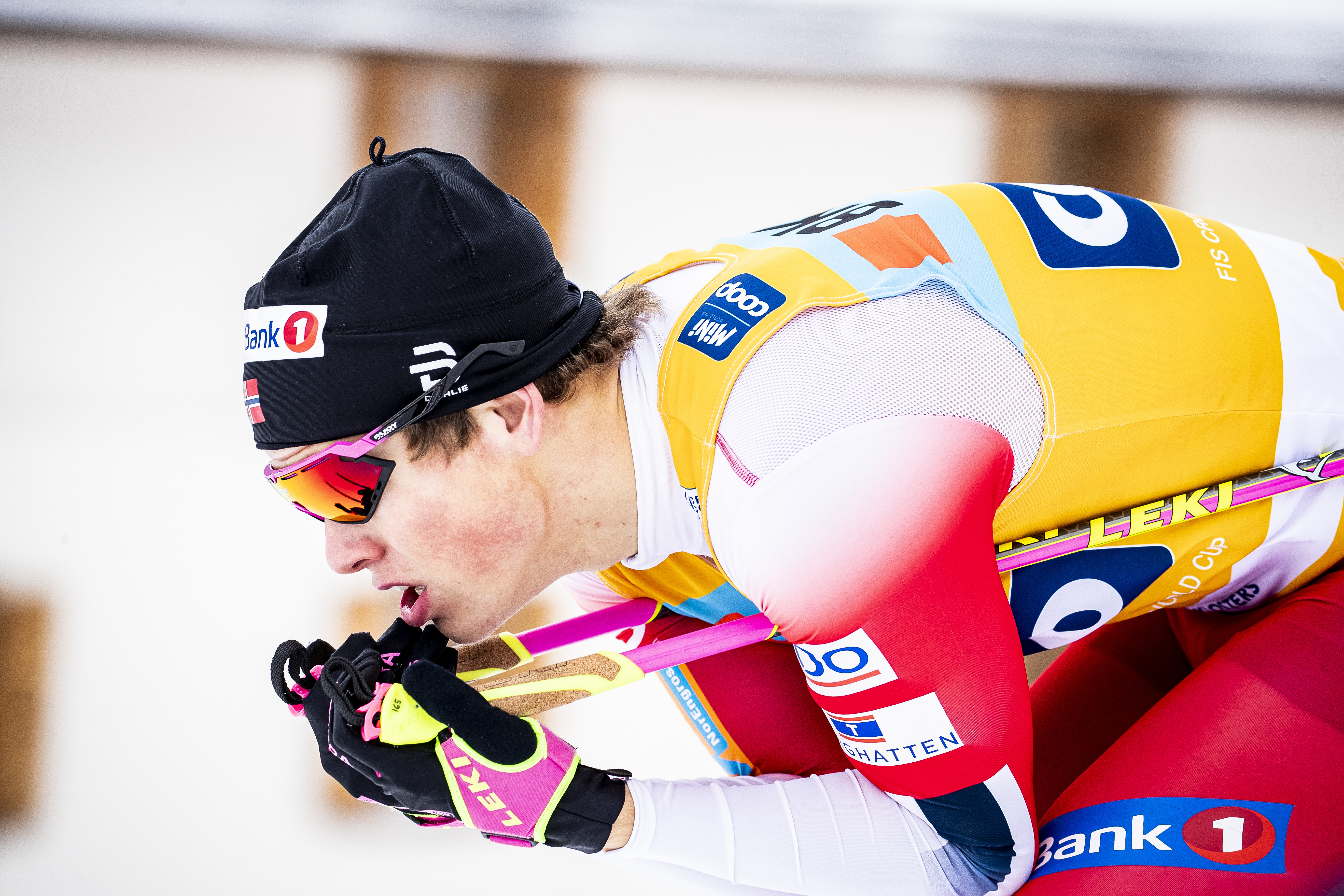
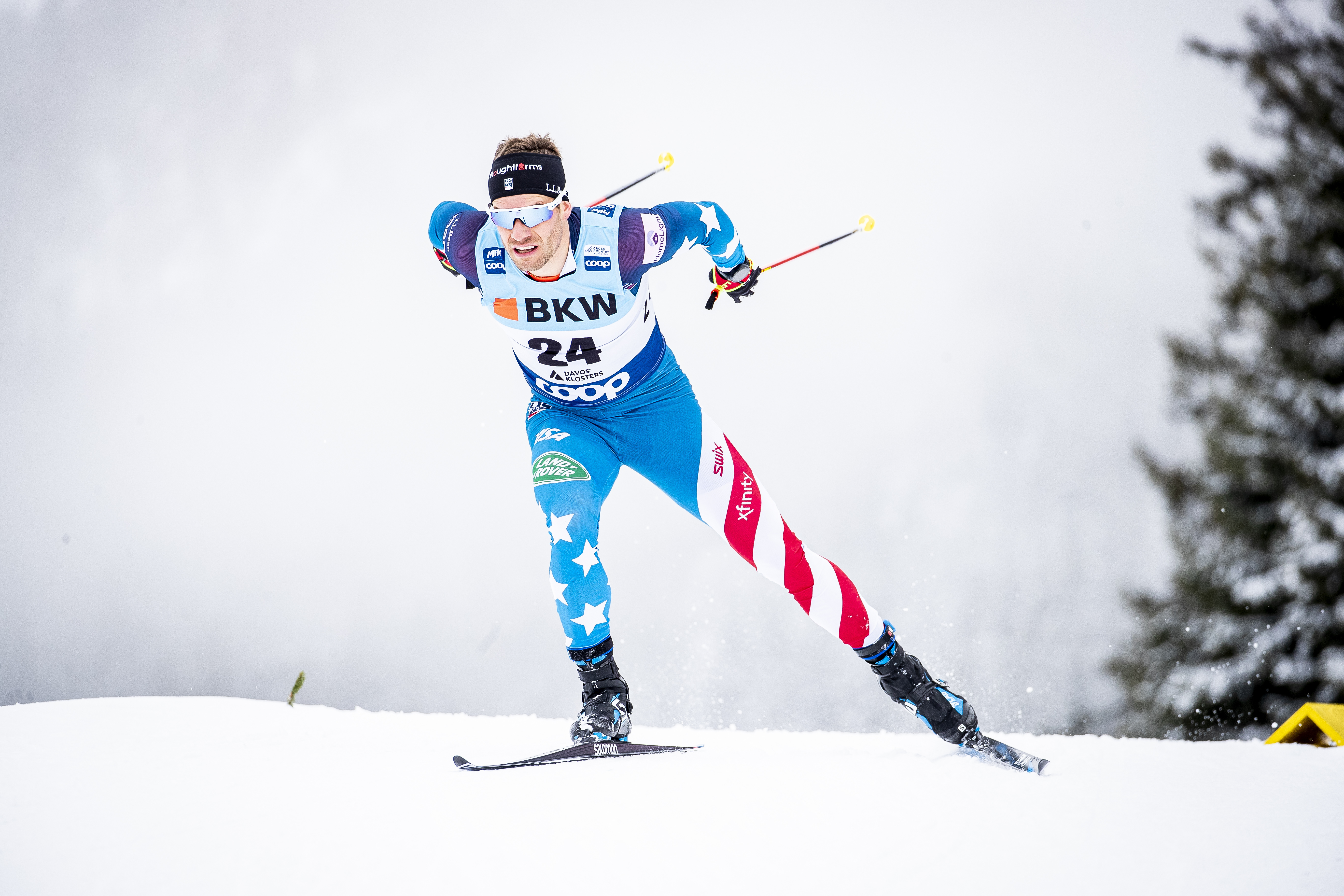
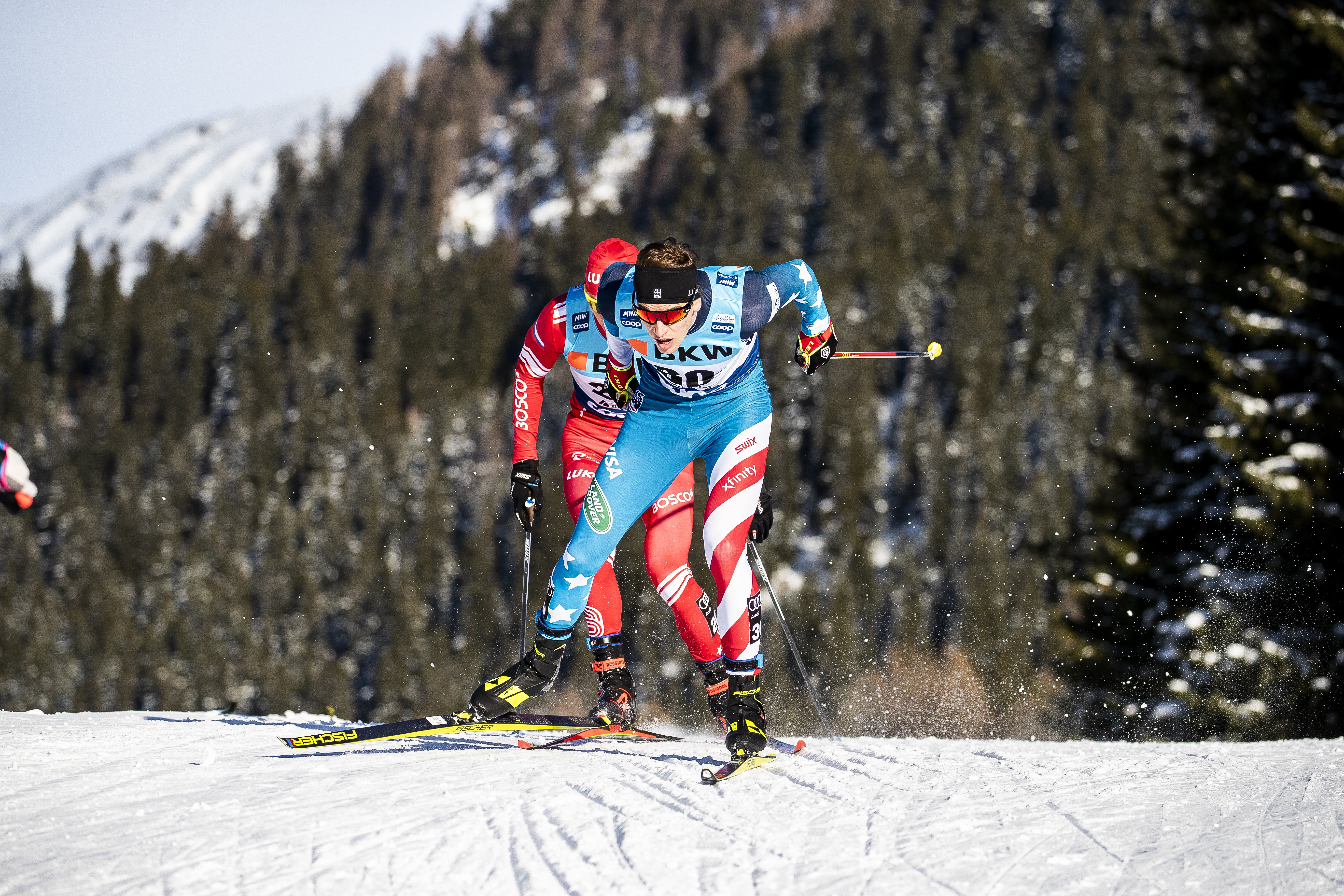
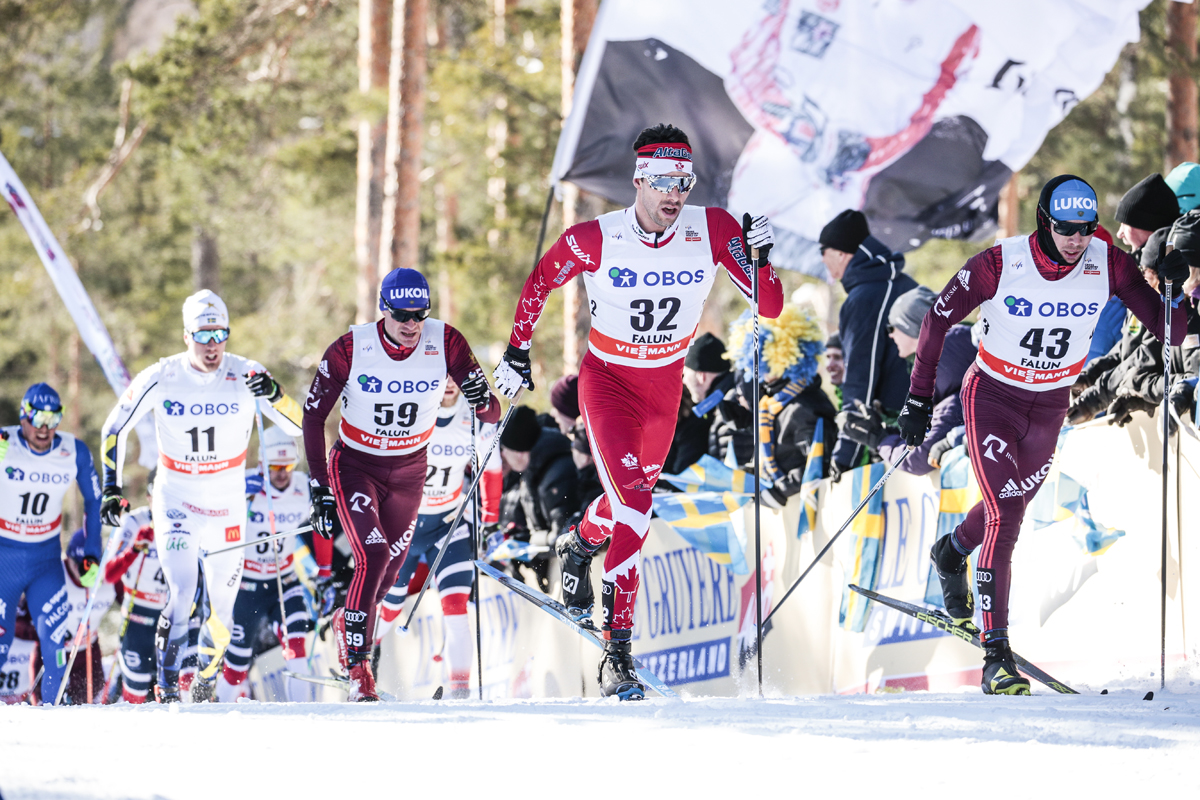
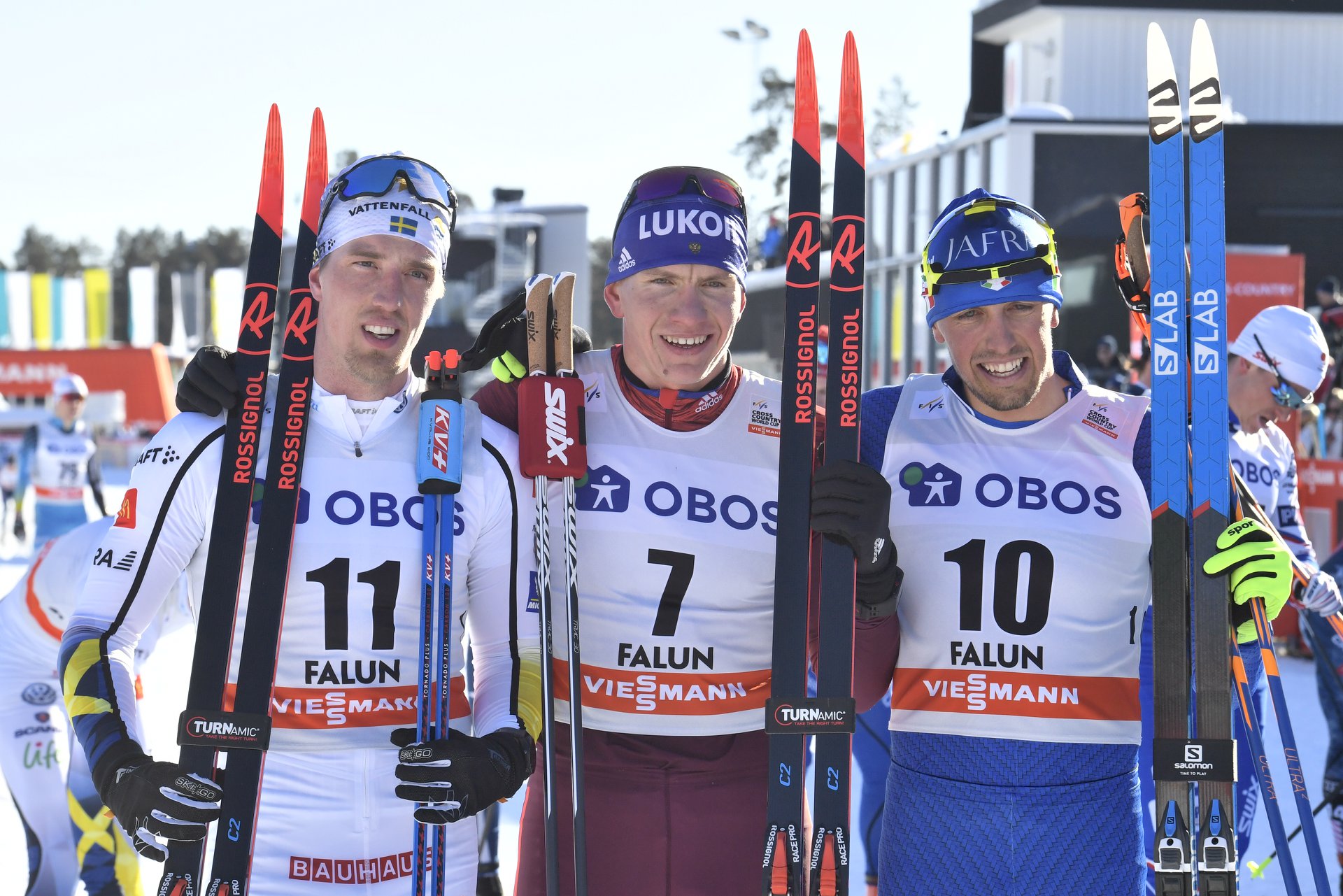
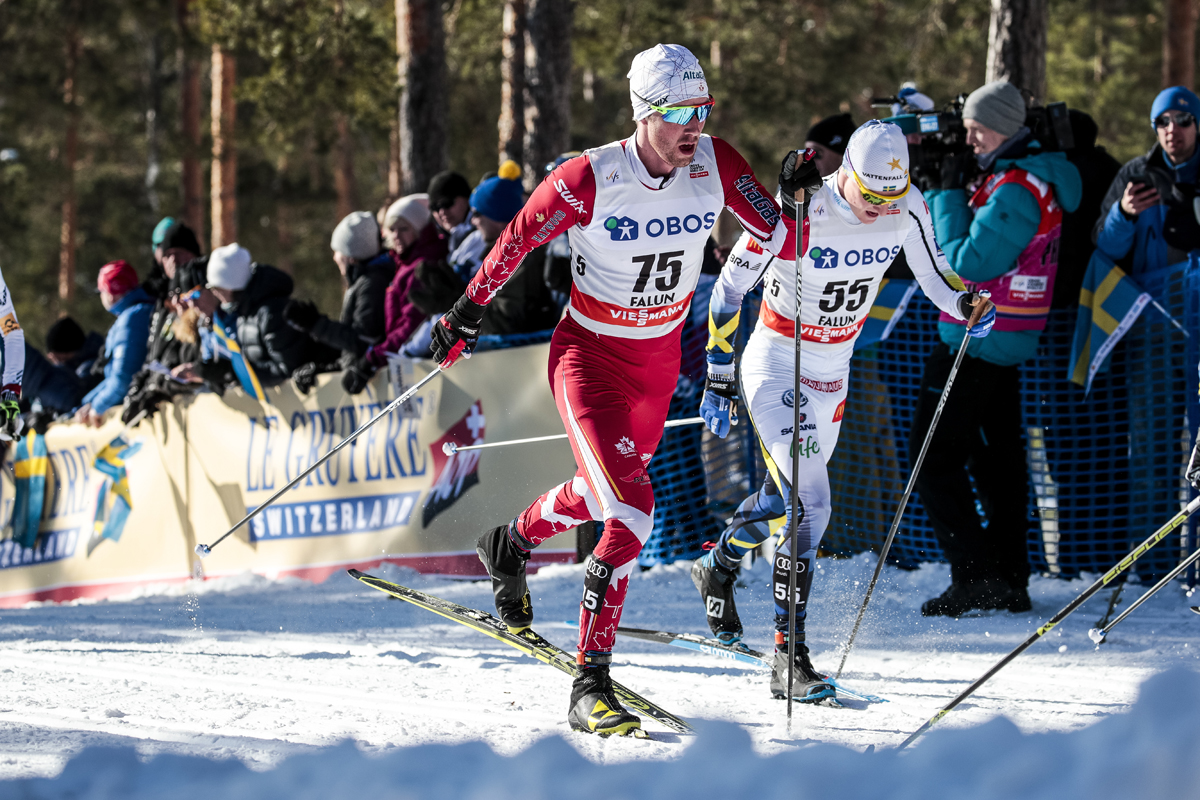
In this episode of of The Devon Kershaw Show from FasterSkier, it is all classic: a deep breakdown from Devon on the nature of Obertsdorf, Germany’s classic sprint course. The course has some relevance for this basic reason: the 2021 FIS Nordic Ski World Championships will be held at this venue next season. And what a preview. With three steep climbs, a wee bit of recovery, this sprint course demands big capacity.
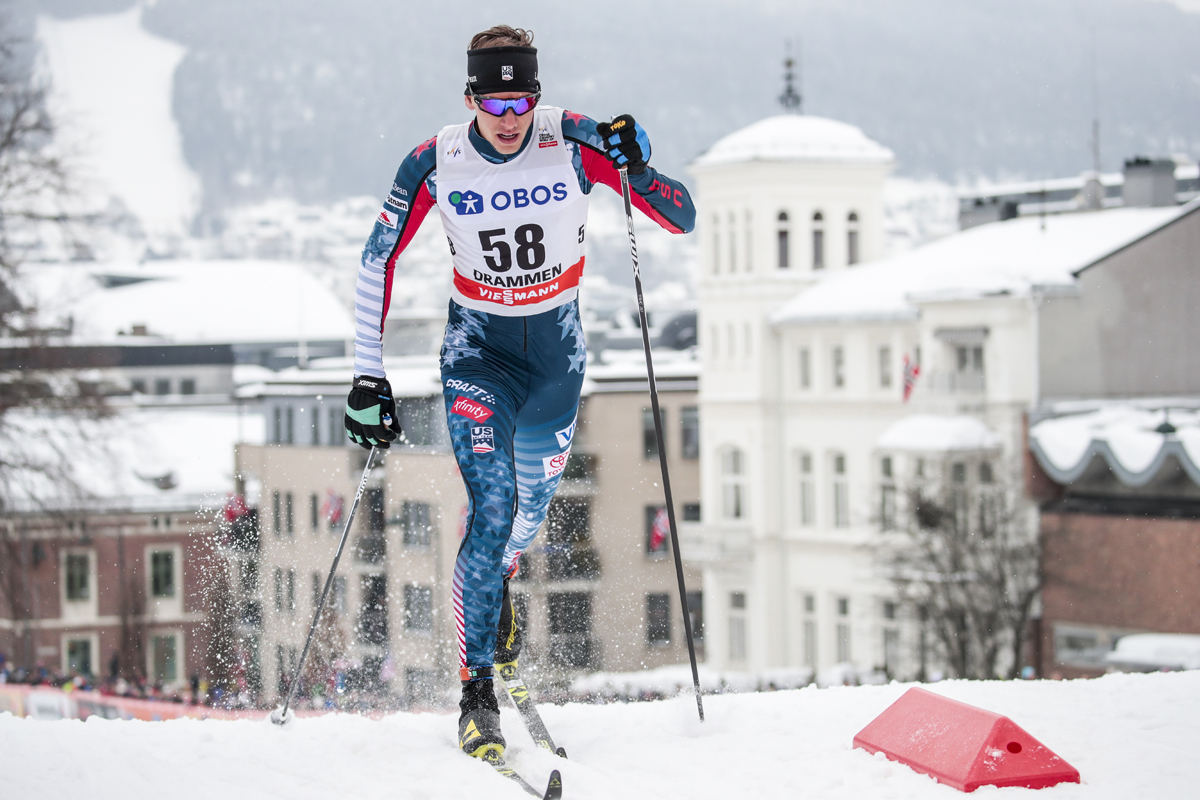
There’s also the highlight of the day for Kershaw – three American women in the top-10. Just 24 hours prior, the U.S. women looked uncharacteristically flat. With a quick reset, the classic sprint was a home-run for the team.
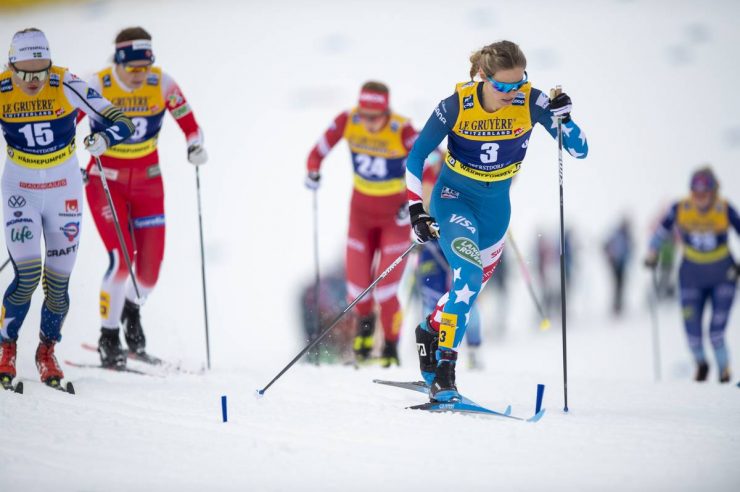
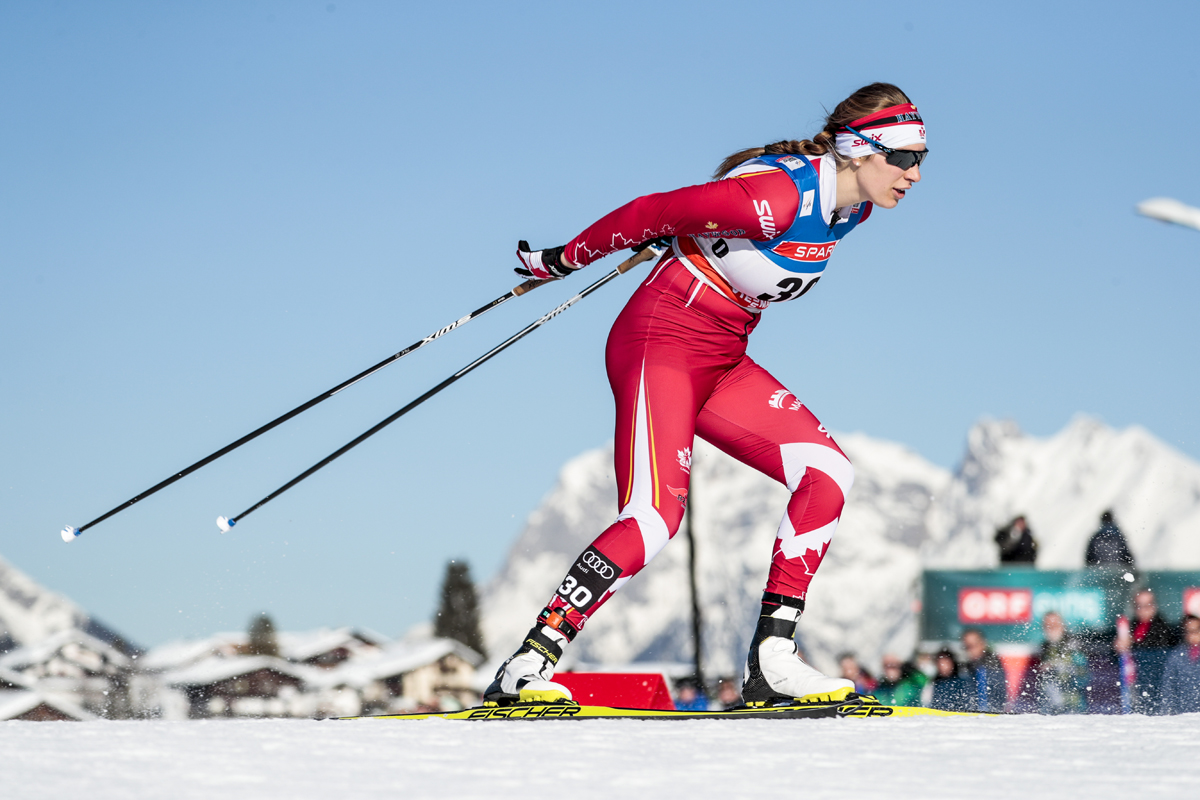
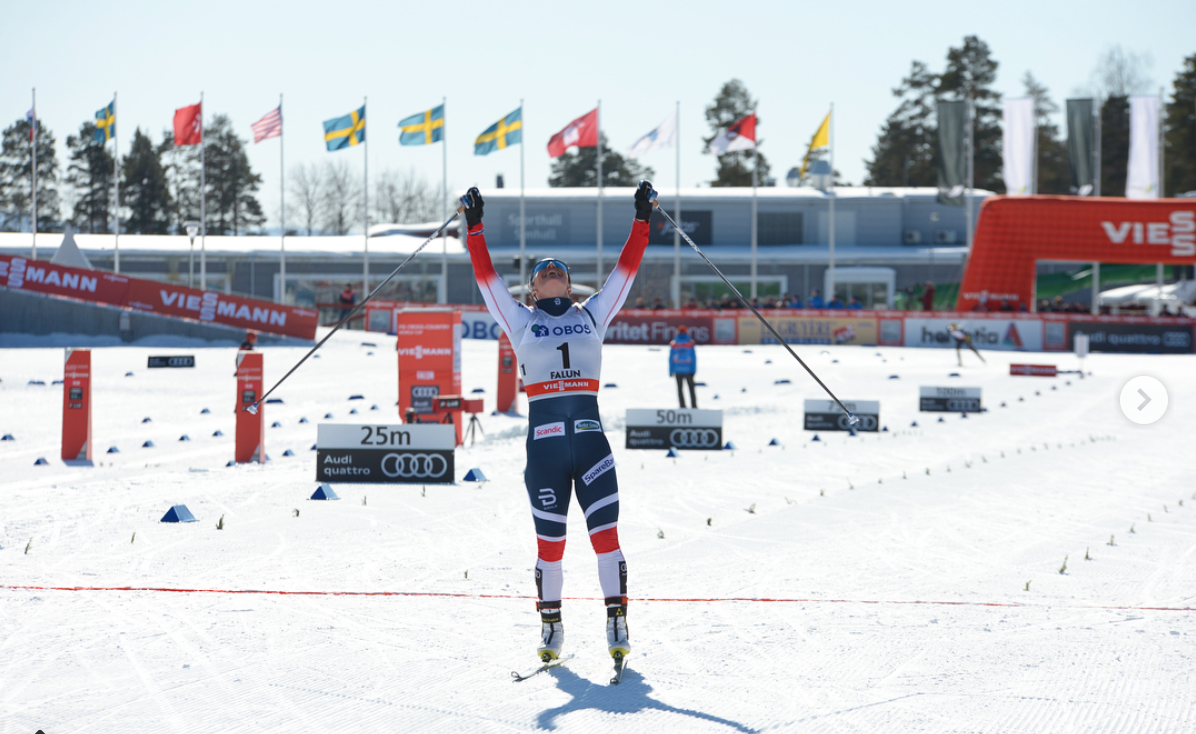
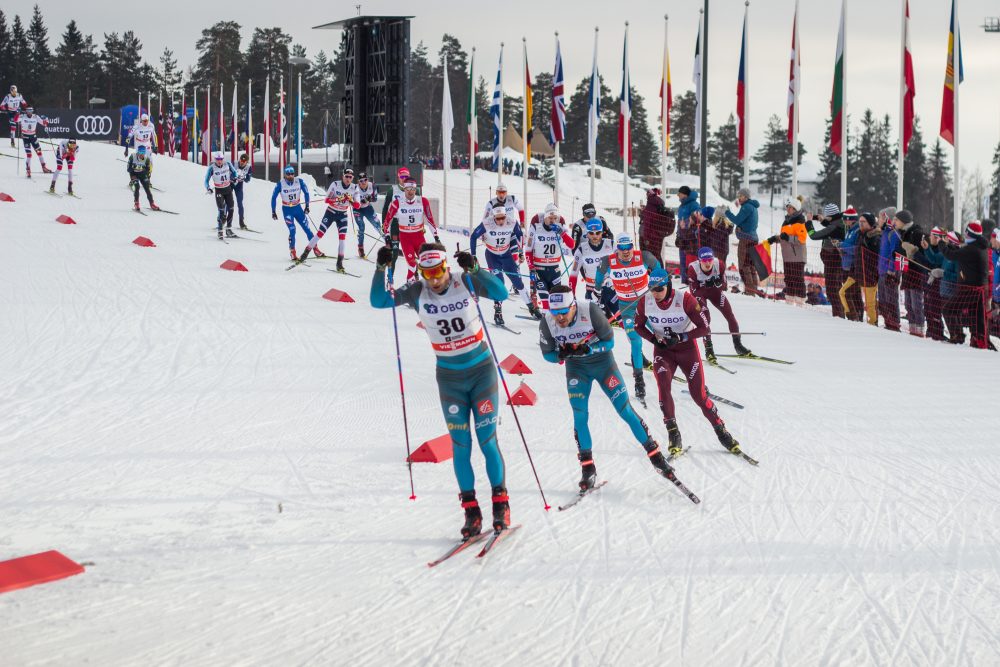
Jessie Diggins leads Sweden’s Linn Svahn during the quarterfinal in Oberstdorf. (Photo: NordicFocus)
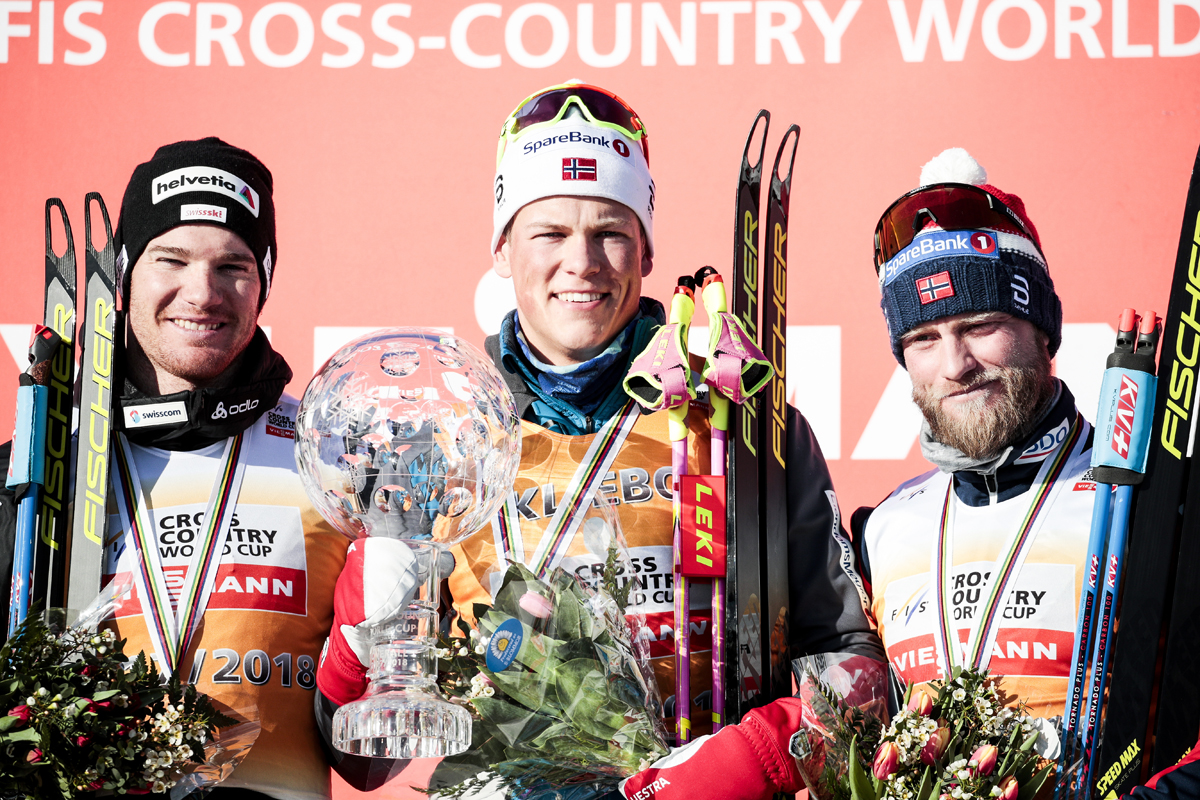
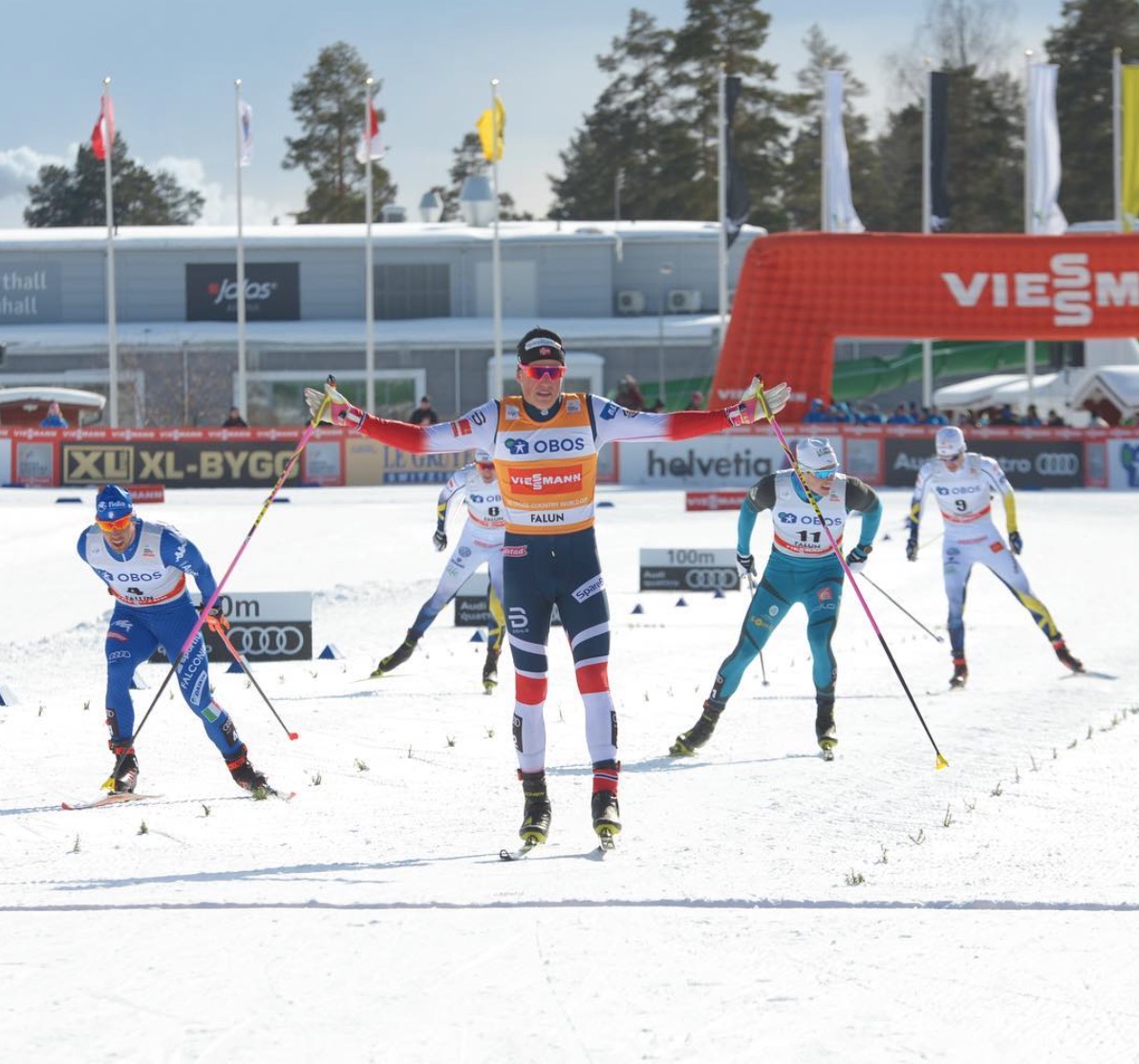
Lastly, we look into the big time gaps in the men’s qualifier in which Johannes Høsflot Klæbo of Norway destroyed the field. And of course we include some analysis of Klæbo’s run away win.
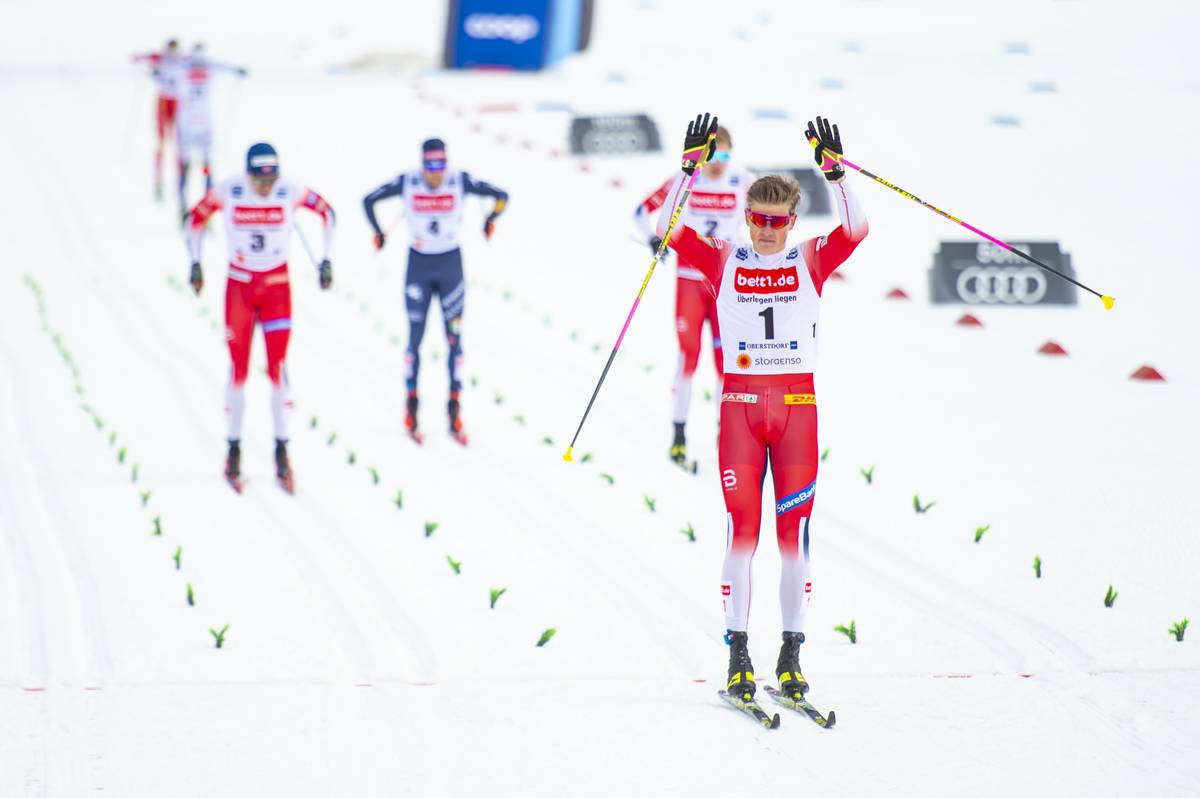
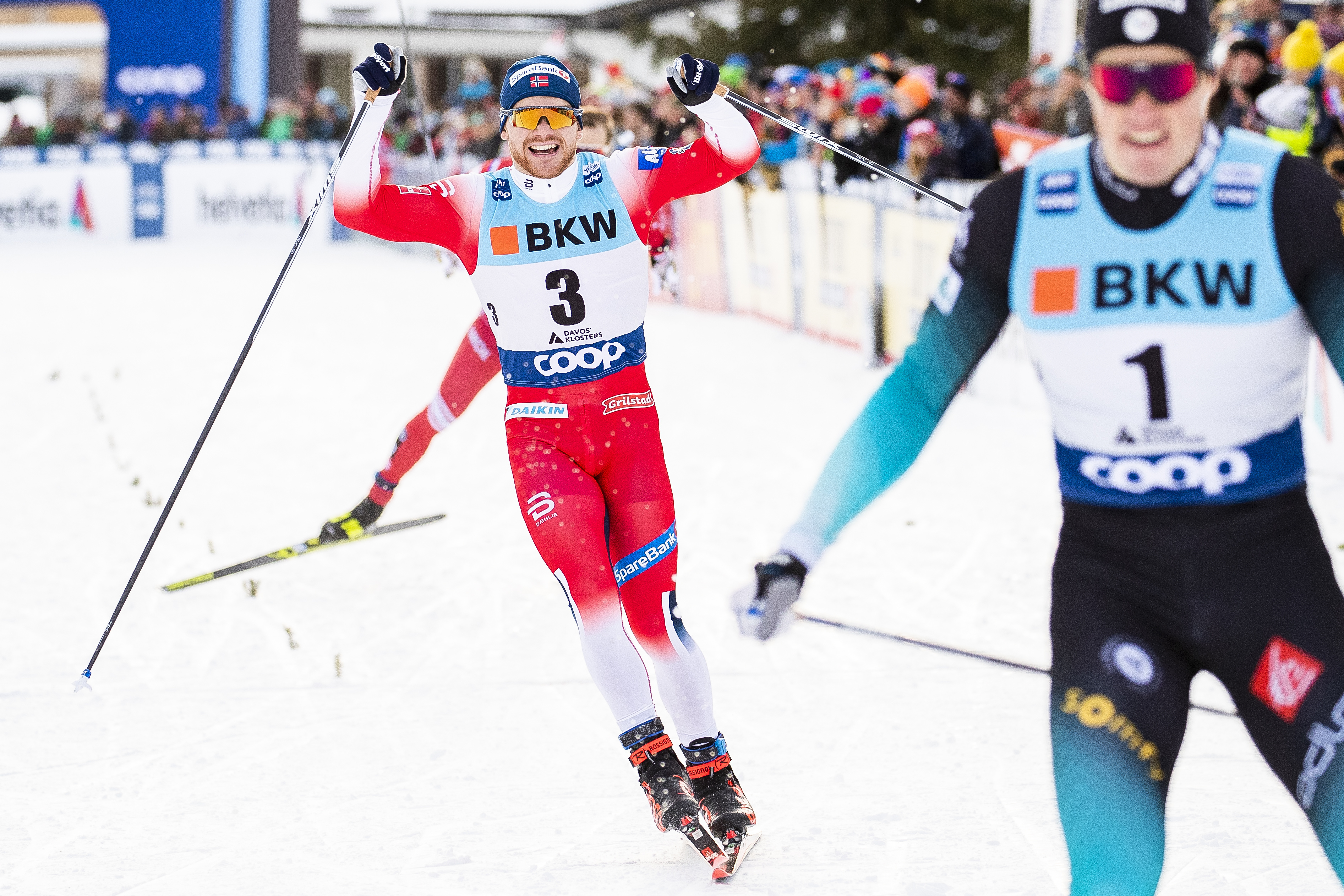
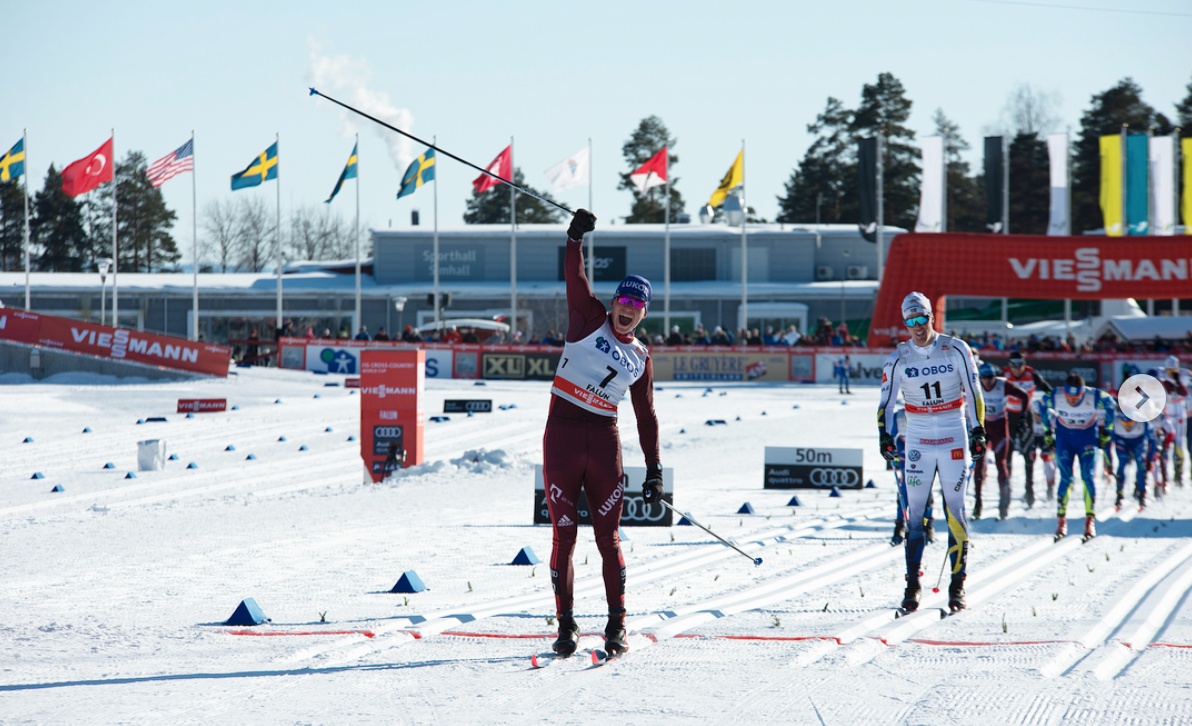
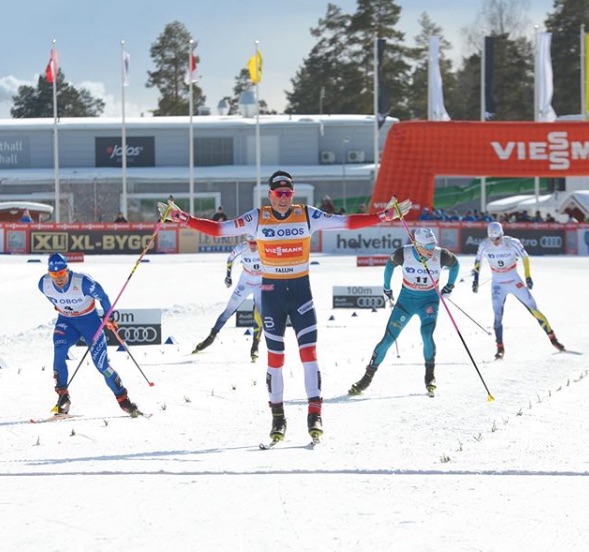
Hands up for the win: Johannes Høsflot Klæbo makes it 5 for 5 for sprints this season. (Photo: NordicFocus)
Next season the 2021 FIS Nordic Ski World Championships will be hosted by Oberstdorf, Germany. On Saturday, the women raced a 15 k skiathlon, the men 30 k on what is now a gut-punch of a course. It is championship-worthy.
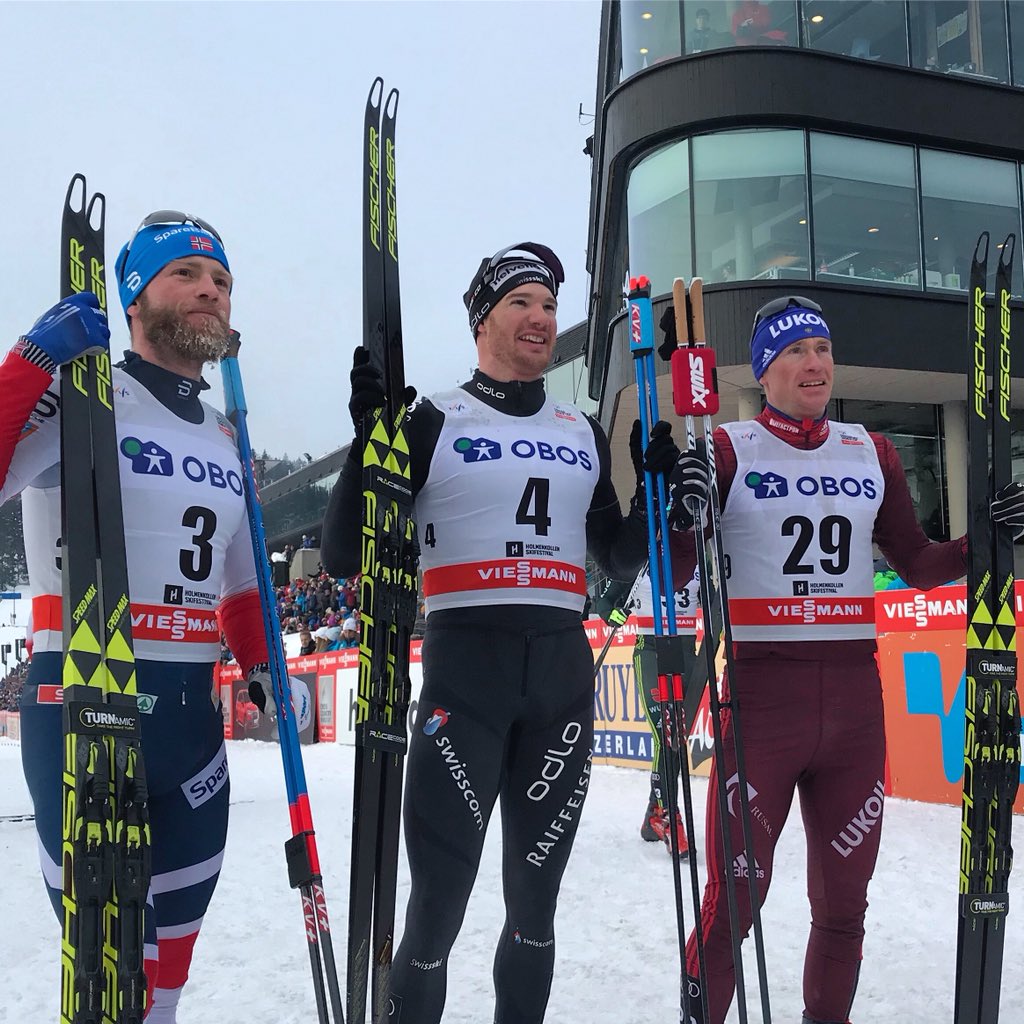
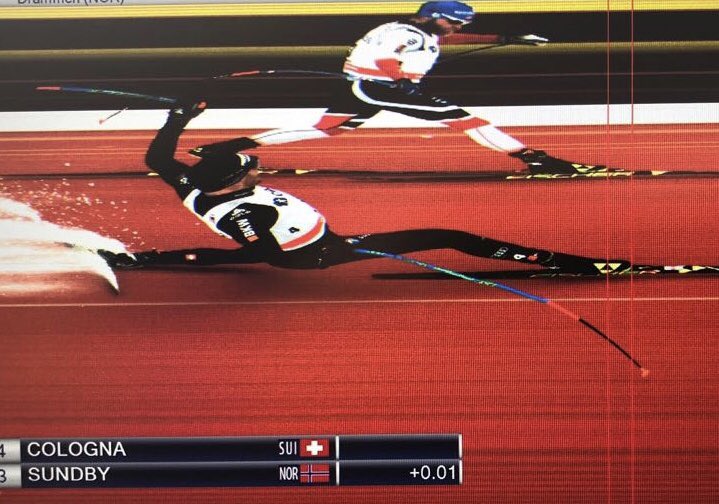
In today’s episode, we cover all the striding, all the gliding, and the ski-exchanges in between. Bolshunov remains on form after the TdS, while two notable Norwegians, Johannes Høsflot Klæbo and Emil Iversen appear to be in a distance funk: both posted a DNF today as they pulled from the race. More pleasant news, father time has smiled on Martin Johnsrud Sundby who missed the podium by a fraction and Dario Cologna who raced to a top-ten.
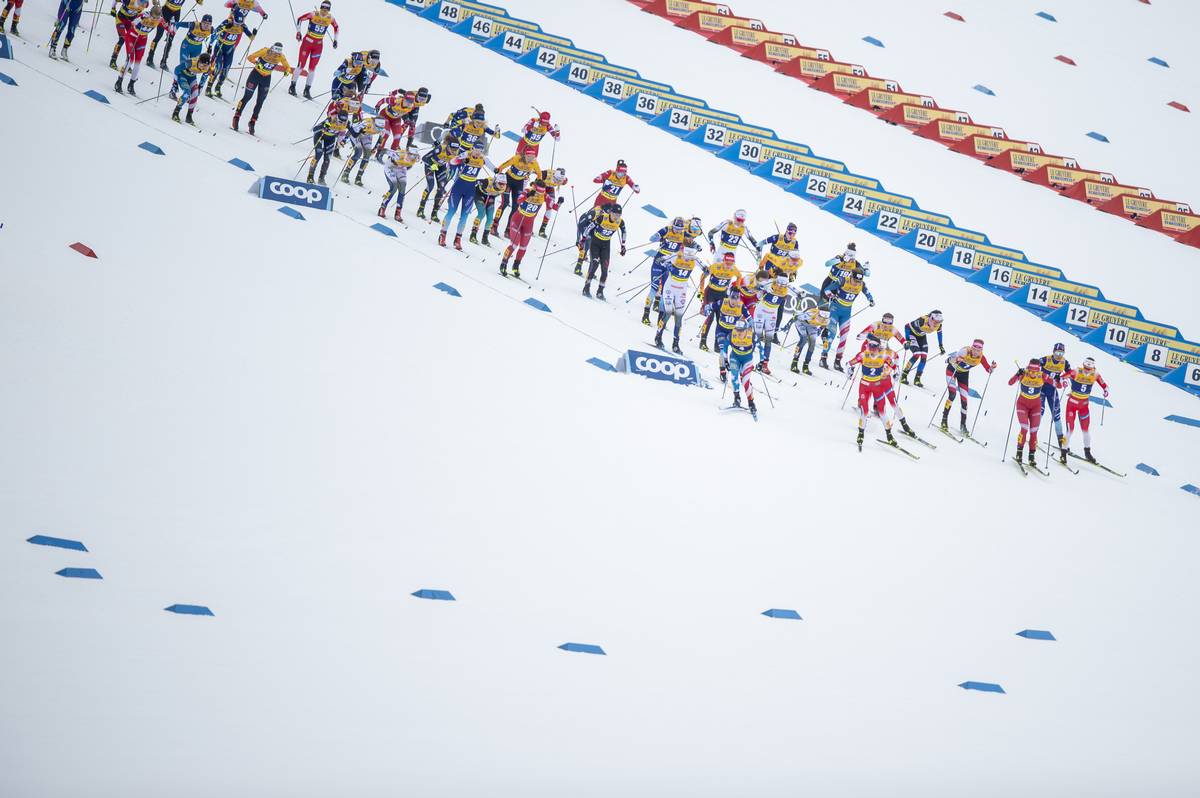
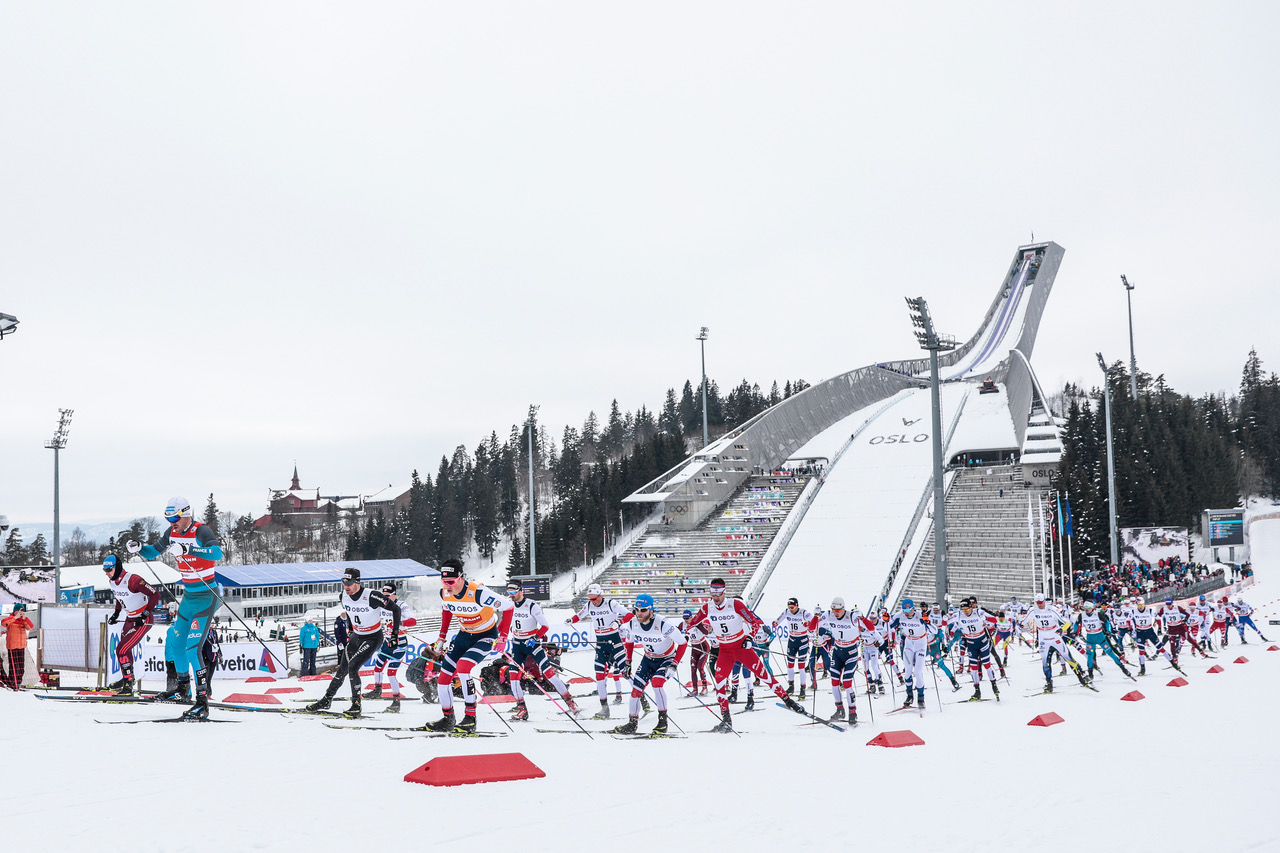
The start of the women’s 15 k skiathlon from Oberstdorf, Germany. (Photo: NordicFocus)
For the women, well, it was Johaug. But not by much. The top end of the field kept her within sight. It was good chase-them-down skiing on the women’s side. And yeah, we discuss the down day for the Americans who have us conditioned for podium expectations.
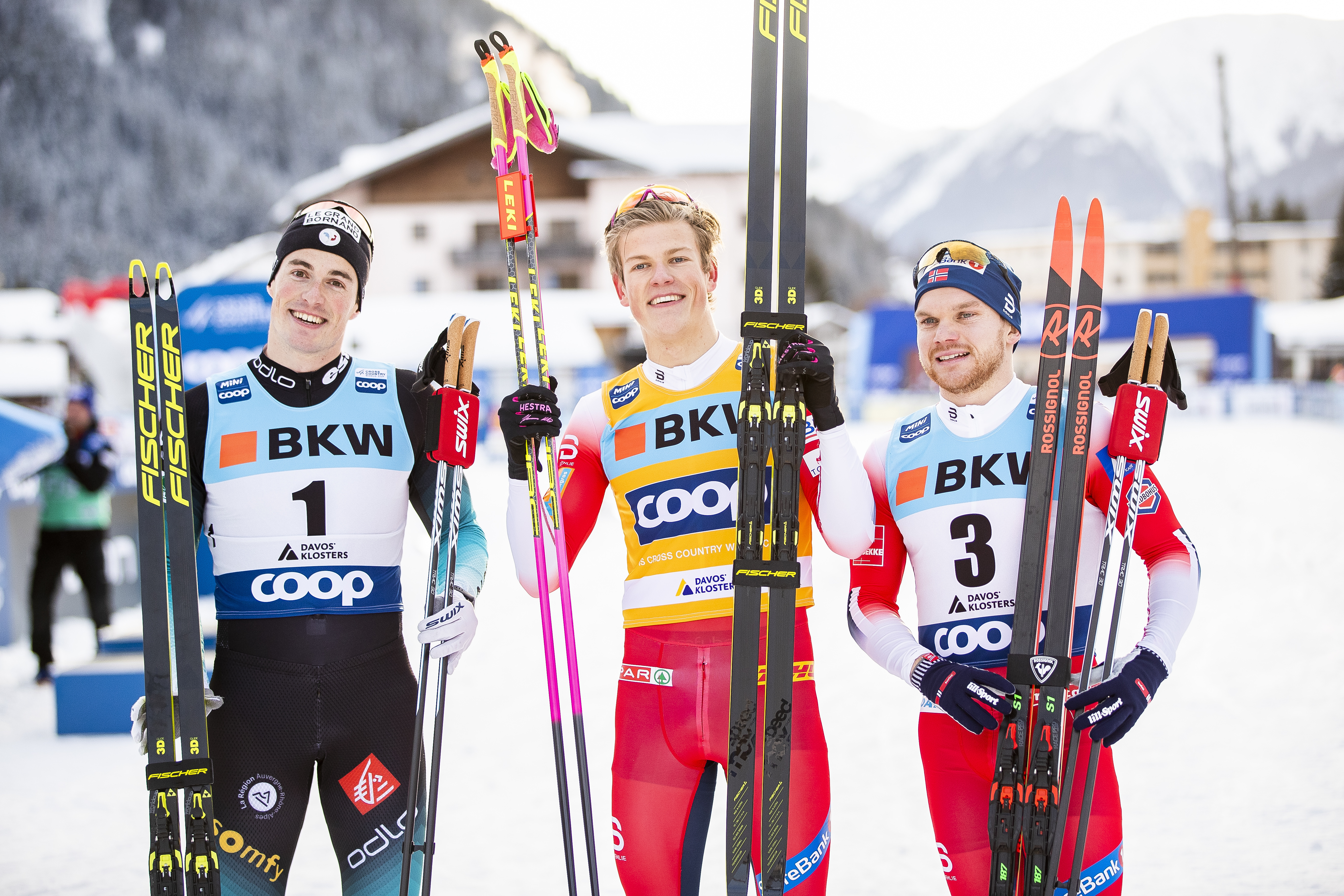
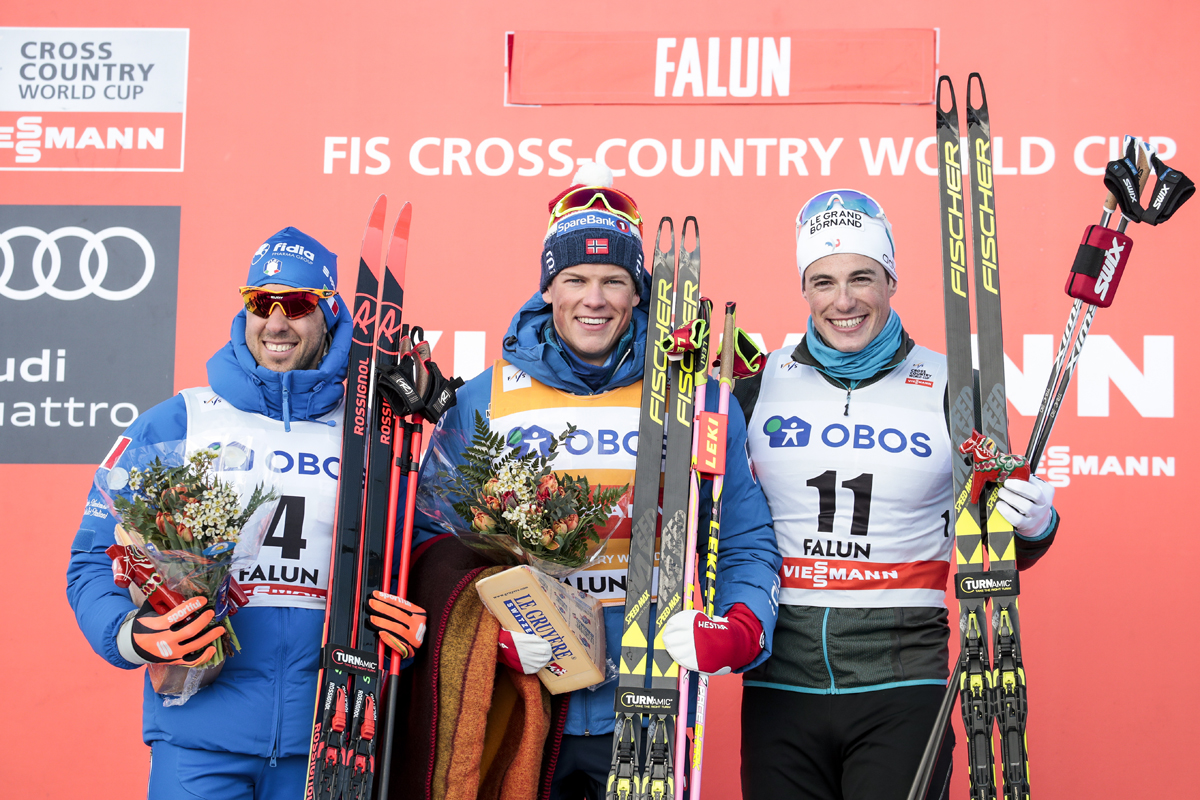
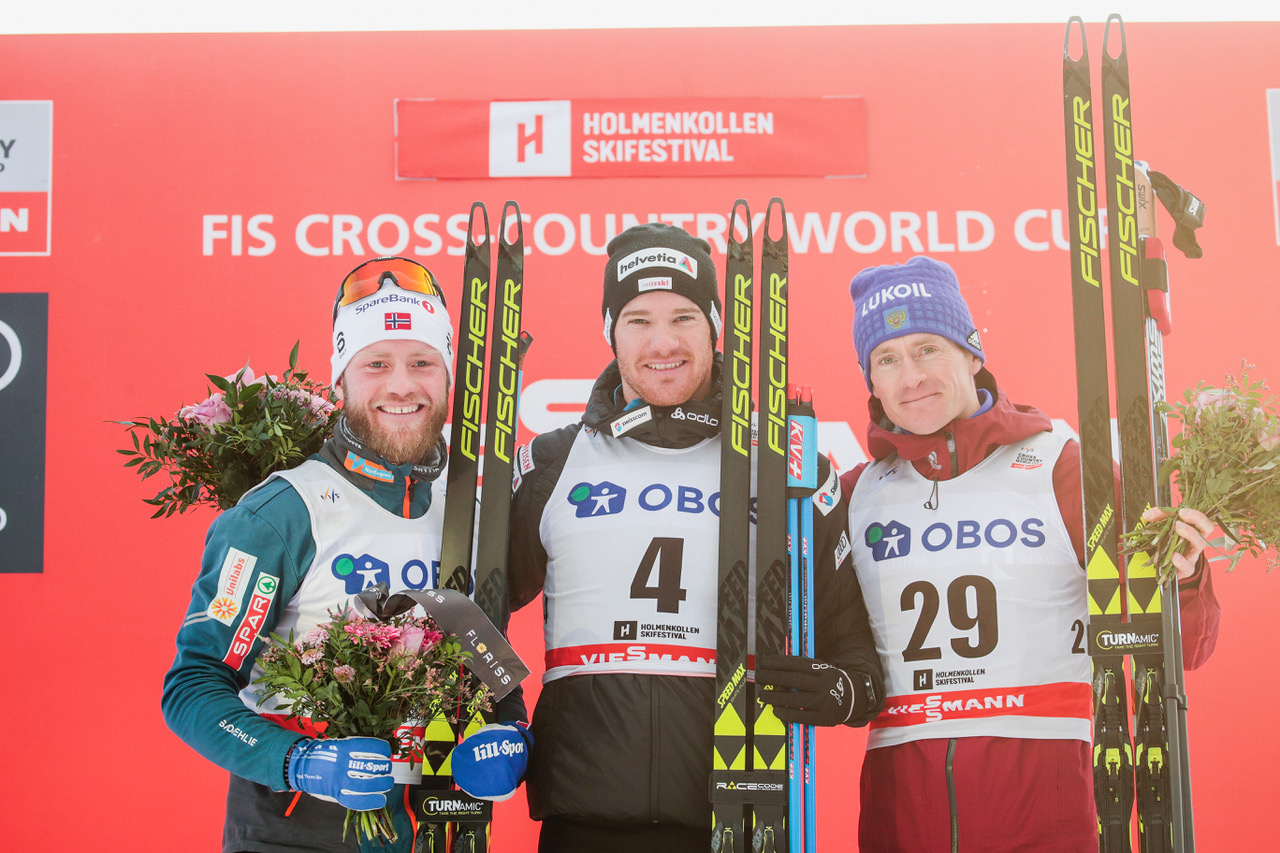
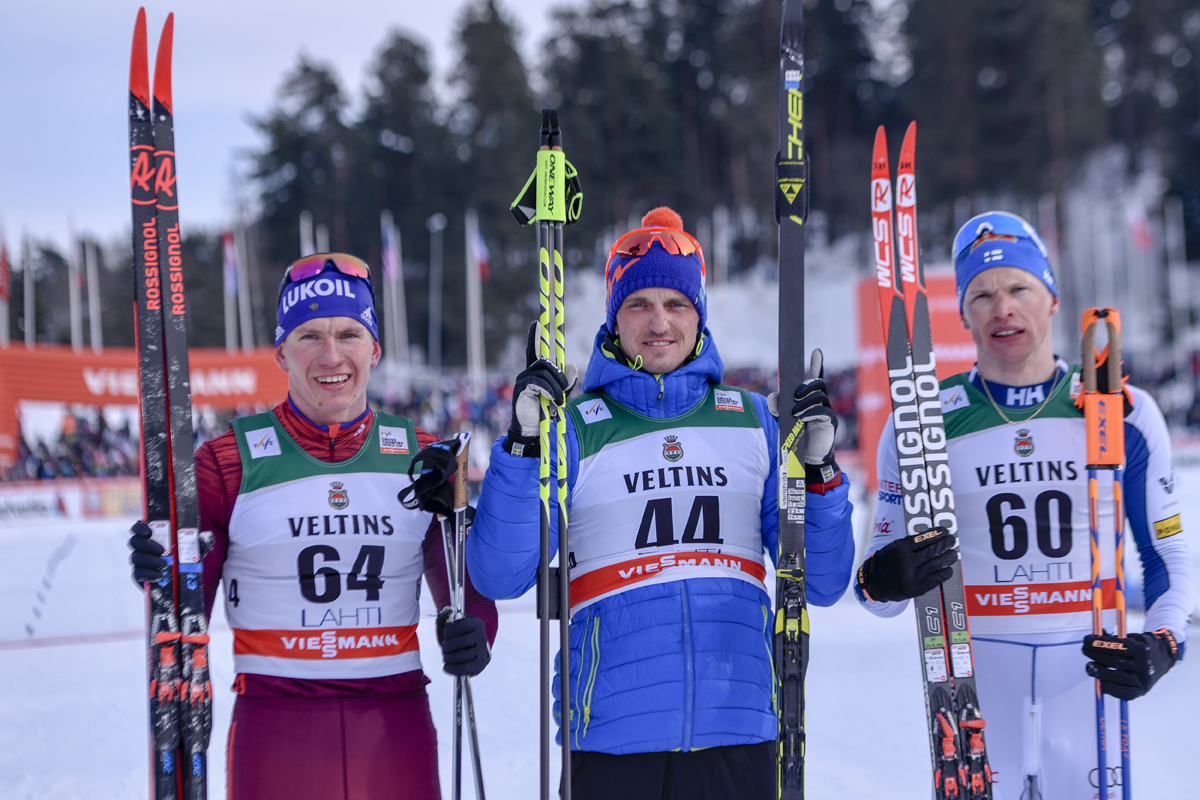
The men’s podium of the 1.5-kilometer freestyle sprint in Davos, Switzerland. Johannes Høsflot Klæbo (center) took first ahead of Lucas Chavanat of France (L) and Håvard Solås Taugbøl of Norway (R). (Photo: NordicFocus)
Davos, Switzerland: gifted athletes, throngs of spectators lining the course, plenty of Vitamin-D and a spectacular day for the 1.5-kilometer freestyle sprint. Racers chased down and skied away from their long afternoon shadows as the sun moved across the cloudless bluebird sky.
The crowds were in for a treat. In sprint racing, heats often have significant variance. Some will be fast, some will be slow with a final upsurge in intensity at the end. In today’s event, heats were fast and tight. Winning times were comparable, lucky losers waited with bated breath through the end.
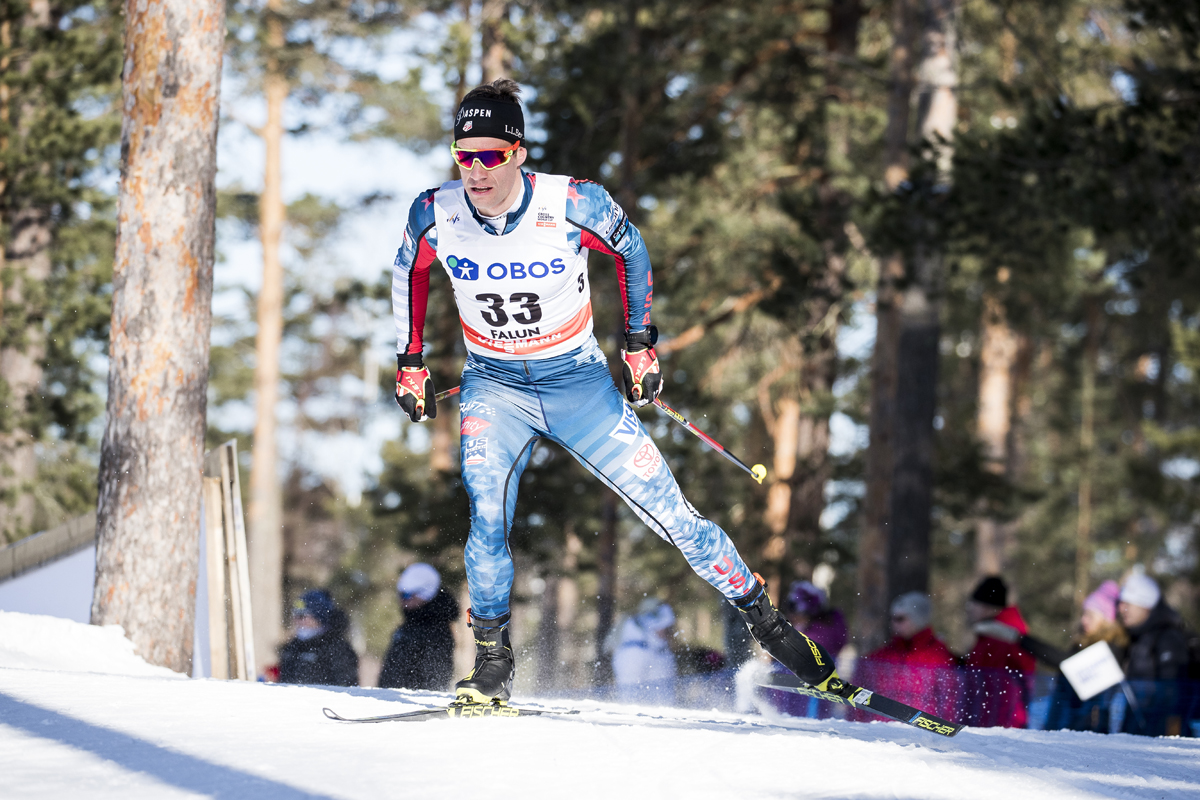
Improving upon their performance in the opening classic sprint in Ruka, two Americans qualified for the heats. Simi Hamilton qualified in 8th and Kevin Bolger in 30th.
Lucas Chavanat of France models composure during the 1.5-kilometer freestyle sprint in Davos, Switzerland. (Photo: NordicFocus)
In the first heat of the quarterfinals, Johannes Høsflot Klæbo, who had qualified in 5th, threw down against France’s Lucas Chavanat, who was the top qualifier. Perhaps making a statement, Klæbo set the tone of the heat, quickly moving to the front and holding his position to comfortably take the heat with Chavanat behind him.
During his round, Hamilton marked the leaders, the Italian favorite Federico Pellegrino and Erik Valnes of Norway. Hamilton maintained contact throughout, fighting through the finish to place third in his heat. His time survived the three subsequent heats each by a fraction of a second to advance as a lucky loser.
Italy’s Federico Pellegrino leading Erik Valnes of Norway in the quarterfinals of the 2019 skate sprint in Davos, Switzerland. (Photo: NordicFocus)
Simi Hamilton hunts down the leaders in the quarterfinal of the 1.5-kilometer freestyle sprint in Davos, Switzerland. (Photo: NordicFocus)
Onto the semis. In the first heat, Chavanat took control from the gate and held it through through the last turn, the stacked group of competitors tucked in closely behind him. Klæbo stayed tucked into the middle of the pack. In the final straightaway, Klæbo swung around overtaking his teammate Valnes in the final meters, besting Chavanat by a toe.
In a tuck and on the hunt. Not an easy victory for Johannes Høsflot Klæbo during the 1.5-kilometer freestyle sprint in Davos, Switzerland. (Photo: NordicFocus)
In the second wave, Hamilton stayed just behind the Norwegian leaders Håvard Solås Taugbøl and Sindre Skar — in the mix but out of trouble. In the final stretch, a pack of five contenders charged toward the finish. Crossing in a photo finish with Gleb Retivykh of Russia, Hamilton was deemed 4th and advanced again as a lucky loser.
At the start of the final, none of the men took the reigns and the first climb looked calm. Chavanat emerged at the front after the descent, but the field behind him stayed tight. Dueling once more, Klæbo tucked in just behind Chavanat, marking him closely and staying low in his draft.
In the final high-velocity stretch, Klæbo and Chavanat were neck-in-neck as the crowd roared. Leading by inches, Klæbo charged with unmatched tempo. He added two jump skates before throwing his boot across the line ahead of the Frenchman in a photo finish. Chavanat was just 0.05 seconds behind Klæbo. Laughing breathlessly, they embraced and congratulated each other at the finish.
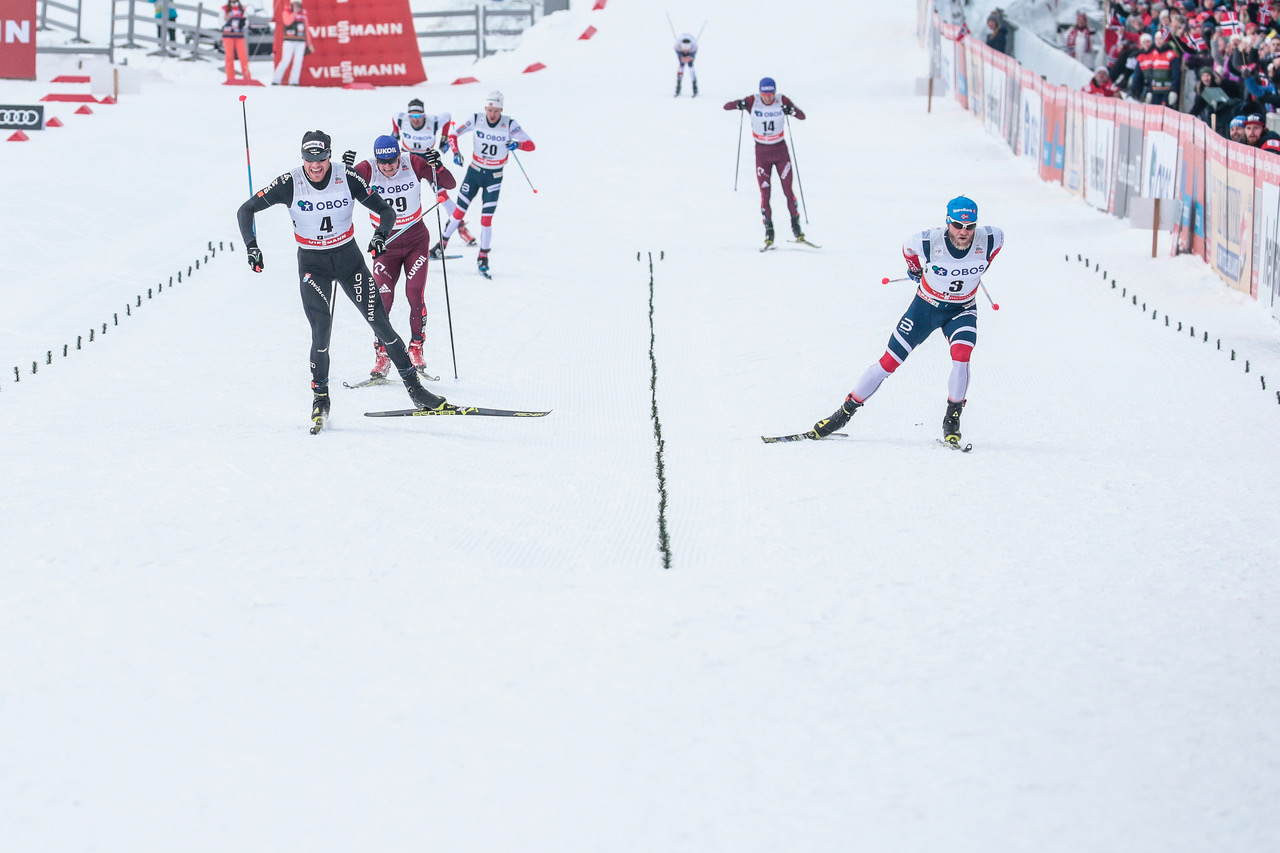
Johannes Høsflot Klæbo of Norway checks his position relative to his opponent, Lucas Chavanat of France, at the finish of the 1.5-kilometer freestyle sprint in Davos, Switzerland. (Photo: NordicFocus)
Johannes Høsflot Klæbo (NOR) and Lucas Chavanat (FRA) congratulate one another after a photo finish in the final of the 1.5-kilometer freestyle sprint in Davos, Switzerland. Klæbo won by a margin of 0.05 seconds. (Photo: NordicFocu)
Håvard Solås Taugbøl of Norway finished third (+1.36) — his first career World Cup podium, followed by Sindre Skar (+1.54), Retivykh (+3.19), and Hamilton (+4.82).
“It was a really tough fight and Lucas was very strong all day,” Klæbo told FIS at the finish. “It was really cool to see that he was that strong again. In the quarter-final, the speed was really high and I was trying my best at a final and was a bit in front of him, but it was a really good fight.”
Håvard Solås Taugbøl of Norway celebrates his podium finish at the 1.5-kilometer freestyle sprint in Davos, Switzerland. (Photo: NordicFocus)
Klæbo’s victory makes him the first male athlete to win five consecutive World Cup sprint events. The last athlete to do so was Marit Bjørgen who won a remarkable eleven in a row between 2003 and 2005. He also became the first athlete to win three World Cup sprint events in Davos. Today’s third consecutive win allowed him to surpass Pellegrino, who won in 2014 and 2015.
In his interview with FIS, the sprint champion was also asked about sharing the podium with his teammate.
“It was really cool to have Håvard on the podium today,” said Klæbo. “I think in Norway we are quite happy today.”
Hamilton has a history of racing well in Davos. He placed 12th last season and 9th in 2017. At 5,100’ Davos is one of the highest elevation venues on the World Cup, but much lower than his 8,000′ hometown of Aspen, Colorado.
In his post-race interview, Hamilton shares why this course suits him well and how this performance gives him confidence on the season ahead. He also discusses his opening performance in Ruka and the tight spread throughout the heats.
Simi Hamilton skis to an 8th place result in the qualifying round of the 1.5-kilometer freestyle sprint in Davos, Switzerland. (Photo: NordicFocus)
Post-race interview with Simi Hamilton.
In a post-race call, head coach Matt Whitcomb discussed Hamilton’s performance, fitness, and headspace going into the qualifier.
Post-race interview with Matt Whitcomb about Simi Hamilton’s sprint day in Davos.
Racing in the speedy second heat of the quarterfinals with Hamilton, Bolger was eliminated after finishing sixth in his heat and finished 30th.
“It was a step in the right direction,” wrote Bolger in an email. “Last year I came here and qualified 31st so to be on the right side of that this year felt good! I’ve been struggling a bit to find my form so to get into some heats today is a big confidence booster going forward.
“Simi and I had a ripper of a heat and it was really awesome to see him go all the way through to the final,” he continued. “I wish I could have joined him but [it will happen] in time. I’m excited to find some more fitness and keep progressing into semi-finals and hopefully some finals this year!”
Kevin Bolger crests the top of the climb during the 1.5-kilometer freestyle sprint in Davos, Switzerland. (Photo: NordicFocus)
Whitcomb gives depth to Bolger’s performance and the role it plays in terms of his starts for the season.
Post-race interview with Matt Whitcomb about Kevin Bolger’s performance and physiology.
Outside of the heats, Logan Hanneman finished in 31st after skiing the same qualifying time to the hundredth of a second as Bolger (+6.86). (It apears that in the event of a tie, the skier with the lower FIS points is the winner.) Canada’s only entrant Russell Kennedy finished 42nd (+8.07).
Canada’s Russell Kennedy qualified in 42nd during the 1.5-kilometer freestyle sprint in Davos, Switzerland. (Photo: NordicFocus)
Logan Hanneman on course during the qualifying round at the 1.5-kilometer freestyle sprint in Davos, Switzerland. (Photo: NordicFocus)
Post-race, Whitcomb explains why the tie in the qualifier went to Bolger for who advanced to the heats.
Post-race call with Matt Whitcomb about qualification.
First off, The Devon Kershaw show is live on iTunes and Google Play. And for that matter, Spotify. So you’ve got a few ways to subscribe and listen. Press the subscribe button on the player below for a direct link.
Second, lots to breakdown after this weekend. Yup, Johaug crushed, but so did Diggins, Maubet Bjornsen, and Brennan. And cheers for the American women’s second place in the relay. For the men, Hans Christer Holund was a master who was foiled only by the sprint closer Bolshunov in the 30 k skiathlon.
Have a listen as we discuss Lillehammer’s infamous climb, waxing, ski selection, and yes, coffee in the Norwegian wax truck.
If you have any questions, send them to devon@fasterskier.com or info@fasterskier.com.
This is a new project from FasterSkier and the podcast title pretty much says it: Devon Kershaw will be sharing his thoughts and insights of the 2019-2020 World Cup with us. It began this morning, Sunday, December 1, very early for me and not so early for Devon who is based in Lillehammer, Norway. Devon is a former longtime Canadian National Team member, a World Champion, and commentator for Eurosport at last year’s Seefeld, Austria World Championships.
He is as deep as you can be in the world of high-level cross-country skiing and we are stoked to have him along. That’s pretty much it: a new podcast and the first episode. If you have questions for Devon, please send them to info@fasterskier.com. (We’ll be changing that email to devon@fasterskier.com, but that part is in the works. As the podcast evolves, Devon will be taking more control of the format. Thanks for reading and we hope you enjoy the new project.
It might be a wee bit of time, but you’ll be able to subscribe to the podcast wherever you get your podcast fix.
You can subscribe to the podcast on iTunes or Google Play.
In this episode, Devon breaks down the three race series in Ruka, Finland which was the start of the 2019-2020 World Cup season.
Devon Kershaw, for many years, was a go-to on the World Cup for Canada. He won a gold medal at the 2011 World Championship in the team sprint with Alex Harvey and finished second in the World Cup overall in 2012. He is accomplished.
Devon Kershaw. Vintage 2016 in Lillehammer. (Photo: Fischer/Nordic Focus)
He is also a student of the sport. That was evident last season as he helped Eurosport with its television broadcast coverage of the 2019 World Championships. Watching Kershaw provide race previews each day was a highlight. It made sense to ring him up and get his thoughts on the upcoming World Cup season. Learn about online casino "Mr Bet" in this page and its main important parameters – what is the license for activity, information about bets, minimum bet and maximum bet, about the minimum and maximum deposit when replenishing an account at a time, what is the minimum and maximum withdrawal of money from the Mr Bet casino per day, per month , in Week. See the level of traffic on the site "Mr Bet" for 3 months to understand the activity of the players. Carefully review the list of countries where the casino can legally operate.
Never shy with analysis, Kershaw is a good listen.
It’s a long way from Ruka, Finland to Canmore — the site of the closing races for this season. Onward. (Here’s a link to our map infographic for the 2019-2020 World Cup.)
Canada’s Alex Harvey celebrating on the podium after placing second in the men’s 15 k freestyle mass start in Seefeld, Austria, for his best result of the 2018 World Cup season. (Photo: Salomon/NordicFocus)
Cross Country Canada (CCC) has begun a reboot process as the new Olympic cycle starts. Corporations call this a reset, a rebranding, a new direction, restructuring, and various other names that try to disguise the challenges and issues that come with enacting real change.
The reboot process traditionally starts with an acknowledgement that the current level of success, and that of the foreseeable future, doesn’t align with the goals or the potential of the organization.
Canada left PyeongChang with no medals at three consecutive Olympics, only one skier in the World Cup red group, and a perception that there was no obvious successor to Alex Harvey.
There are many people who, with the benefit of hindsight, believe that CCC allowed itself to be trapped by a combination of success and the Own The Podium (OTP) funding model.
The process of assigning blame for the past, called “blamestorming”in the corporate world, is one of the most effective ways to waste time and destroy morale without doing anything to improve the future. The “best practices” approach to a reboot starts with four apparently simple questions: How did we get here? Where are we now? Where do we want to be in five years? How can we get there?
While CCC does many things as a national sport body, this article will focus on high performance and the development system.
How did we get here?
After a disastrous 1998 Olympics in Nagano, CCC shrank to a full-time staff of five and endured a forced re-invention. Four years later, in 2002 at Salt Lake, Beckie Scott won all three medals in the skiathlon after the initial silver and gold medalists were caught doping. Sara Renner missed the B final in the sprint for 9th place.
Canadian Chandra Crawford in the 2011 team sprint in Dusseldorf, Germany. (Photo: Fischer/NordicFocus)
In 2006 in Torino, Chandra Crawford earned a surprise gold in the sprint while Scott finished fourth. Scott had earlier teamed up with Renner for a team sprint silver medal.
In 2010, there were no Canadian cross-country medals. However, there were signs of promise. Renner skied to her fourth Olympic top-10 finish. All four Canadians competing in the men’s skiathlon finished in the top-15. Devon Kershaw lost out in final kilometer of the 50 k to finish fifth, 1.6 seconds away from gold.
That post-Vancouver glow was possibly the point where CCC temporarily slid off the rails.
A number of Canadian sports fell victim to OTP incentives. A sport qualifies for OTP funding by having good prospects for a medal in the next Olympics. The money comes with strings attached, to ensure that resources are spent on improving the probability that specific individuals will podium. For smaller sports where the OTP money is a significant proportion of the sport’s annual budget, it is hard to make choices that put that money at risk. Choices like balancing the emerging athletes in the pipeline, while simultaneously supporting those athletes already at the top-end of the sport.
As a result, many sports have lost their OTP eligibility by losing the focus on development and the vision that qualified the sport for OTP in the first place. Some people put cross-country skiing in the list of sports that fell into this trap.
After 2010, the future looked bright. Harvey and Kershaw were World Champions in the 2011 team sprint. Kershaw was second overall in the 2011/2012 World cup. (A feat only equaled in North America by Scott and Jessie Diggins).
Harvey arrived at Sochi in 2014 as a medal favorite. He was fresh off a World Cup podium in Toblach the weekend before the 2014 Games began. Sochi ended poorly when Canada, along with Norway, couldn’t solve the difficult waxing conditions.
The results in PyeongChang were similar to 2002 numerically: Harvey was close to a medal in multiple races and Lenny Valjas collected 7th in the classic sprint. A medal would have changed the mood, but not overall situation.
Where are we now?
Post-PyeongChang, CCC believes Canada is not achieving the international results a country with plentiful snow and 37 million people is capable of.
The development system in Canada consists of the National Team, the official training centers (Centre National d’Entrainment Pierre Harvey (CNEPH), Thunder Bay National Team Development Centre (TBay), and the Alberta World Cup Academy (AWCA)), and the clubs. The ten provinces and three territories have teams, but don’t have a formal place in the development system as each of the thirteen regions approaches development support differently. In the last few years, the number of clubs actively recruiting and developing athletes while supporting a high performance team has increased. For our purposes, as no official name has been affixed to these clubs, the term ‘elite club’ will be used here.
In the past, all national team members were required to belong to a training center while developing athletes were encouraged to join.
“I can speak for many of the athletes, they thought that if they didn’t go to a training centre, then they might as well quit skiing,” Telemark’s coach Adam Elliot said. “It was that broad of a choice, they felt they had to choose between skiing and school immediately.”
The landscape is more diverse now, with more options. The examples that follow skew to Western Canada, largely because the coaches quoted brought teams to Sovereign Lake snow camps in May and November and were available for in-person interviews. Eastern Canada remains equally diverse in terms of its club offerings.
A common theme among the coaches and athletes is that each athlete’s needs are different, and he or she needs to find an environment that fills those needs. FasterSkier asked AWCA’s head coach Chris Jeffries how an athlete should choose his or her path to success.
“It’s such an individual, case by case thing,” he said. “I don’t have an answer.”
In 2017, a shift to allow more development paths resulted in new senior National Team member Gareth Williams staying at his home club, Telemark, in Kelowna, BC. Elliot described how it came about.
“Tom Holland approached us, for Gareth, and said we like what you’re doing in the Okanagan, and we want to keep Gareth there. We’re going to support you and your program to be able to support Gareth.”
Also in 2017, Julien Locke returned to his home club Black Jack while Russell Kennedy shifted to the new Team R.A.D., part of the Canmore Nordic Club.
To further illustrate the spectrum of options and pathways, FasterSkier contacted three Canadian athletes, each with a history of NorAm podiums and some international success, to discuss their ski-training choices. Dahria Beatty started at AWCA and has remained there, Evan Palmer-Charette started at TBay then recently moved to Team R.A.D., and Andy Shields has gone rogue.
Dahria Beatty en route to 20th overall in the Seefeld World Cup freestyle sprint for her season-best result in 2017/2018. (Photo: Fischer/NordicFocus)
“For me, I’ve been working with Chris [Jeffries] for six years,” Beatty told FasterSkier in November. “It works really well for me, and I have a good group of training partners where I am, that can push me everyday in training.”
AWCA is also the home training group for National Team skier Emily Nishikawa and two junior national team skiers. AWCA also benefits from its close proximity to a number of other training groups.
“For me, Canmore’s a location where I want to be training, where I want to be based out of,” Beatty said. “All the pieces fit well together for [me], it’s somewhere I think I can keep improving.”
Palmer-Charrette made a summer-time decision to change things up by finding a fresh environment in Team R.A.D.
“I think the best part of being on a training centre is the entire program is based around a small group of athletes of similar age which makes for a great training and racing environment,” Palmer-Charrette wrote. “I feel training centres, as they are, are best-suited for junior/u23 athletes and especially great for athletes who are a bit late to the game like I was at the end of high school and will really benefit from learning from other athletes on the day to day training life.”
Shields is no longer affiliated with an official team. He funds his skiing by painting houses in the summer and representing ski wax companies in the winter. Although he refers to ski racing as a hobby, he did end the last season as COC leader and will race period 1 of the World Cup.
“I don’t think I could have done this straight out of junior,” Shields wrote. “My time on Tbay is still having a huge positive effect on my ski career. Being on a team through my early years as a senior made it much easier to get a decent training base and set a couple good habits in place which are paying dividends.”
Shields did reflect and offer an alternative to how he might have changed his path to elite level skiing.
“If I could go back in time I would have gone the NCAA route straight out of junior,” Shields added. “College skiing in the States is a much better deal than a training center for people in their early twenties. You can go down to the States, get a degree, not pay a dime, and come out the other side with plenty of time to have a full-time ski racing career. I would have joined a training centre upon finishing with NCAA.”
The Canadian university system differs from the U.S. model, offering little money for sports. Heading south to the U.S. as a student-athlete remains an option for some Canadian skiers. Most athletes remain in the Canadian system to develop. With that in mind, FasterSkier asked why some athletes had chosen some of the Western based training centres.
Jeffries, who leads the AWCA, also noted how his program has evolved. There appears to be room at the AWCA for those with concurrent goals. The AWCA has partnered with the University of Calgary to allow AWCA athletes to work towards degrees.
“We’re always evolving our programming, and what it entails, and how we package it,” Jeffries said. “That’s why we have this new university program this year, because you just look at the popular decision making of graduated high school athletes.”
Elliott, based in the Okanagan, said his program offers athletes a well rounded experience too.
“You’ve got the trifecta,” Elliot said. “You’ve got access to education opportunities for post-secondary. We’ve got the university, UBC Okanagan, and the college. Most of the people who’ve moved here have gone to school. Secondly, it’s the Okanagan. Which is probably the best place to ski in North America, with skiing up and down the valley –with Nickel Plate, Telemark, [Kelowna] Nordic, Sovereign, and Larch Hills. The third is that you’re moving into a community of skiers: family, volunteers, everybody trying to make a go of keeping people in sport.”
Clearly the times have changed from a programming perspective and the past’s financial windfall for Canadian cross-country skiing.
“Probably the quad between 2010 and 2014, CCC had more money almost than it knew what to do with, ” Dave Wood, former National Team head coach, told FasterSkier in May as he finished up a long ski day. “Now, I think the budget’s still three and a half million. While it’s maybe low compared to what it has been, it’s a hell of a lot higher than it was in ‘99, by about four times.”
Former CCC High Performance Director Tom Holland spoke of those larger commitment from clubs during the Frozen Thunder races in October.
“There’s a lot more resources,” Holland said, referencing the increased numbers of coaches attending Frozen Thunder with their athletes. “One of the reasons clubs are more important now is that there are paid coaches at the clubs. That’s why training centres started in the 90’s, because you’ve got to have a coach, full-time.”
Thee deep question remains: what next for Cross Country Canada as it ponders a post-Alex Harvey scene? Better and more diverse options for Canadian skiers, like those modernizing their offerings to connect with the student-athlete, is a step forward. But fans of the sport, and of course Cross Country Canada, have short-term and long-term goals. No one wants to see another Olympic quadrennial transpire without the glimmer of medal potential at the international championship level.
“I think when Alex Harvey retires, mostly likely after next year with Lenny Valjas, it will be the end of an era having athletes being able to finish on the podium at World Cups, World Championships, said Alain Masson, Whitehorse head coach. “So definitely, the program is going to go into a real rebuilding phase with lots of young athletes, but no guarantee of success in the near future.”
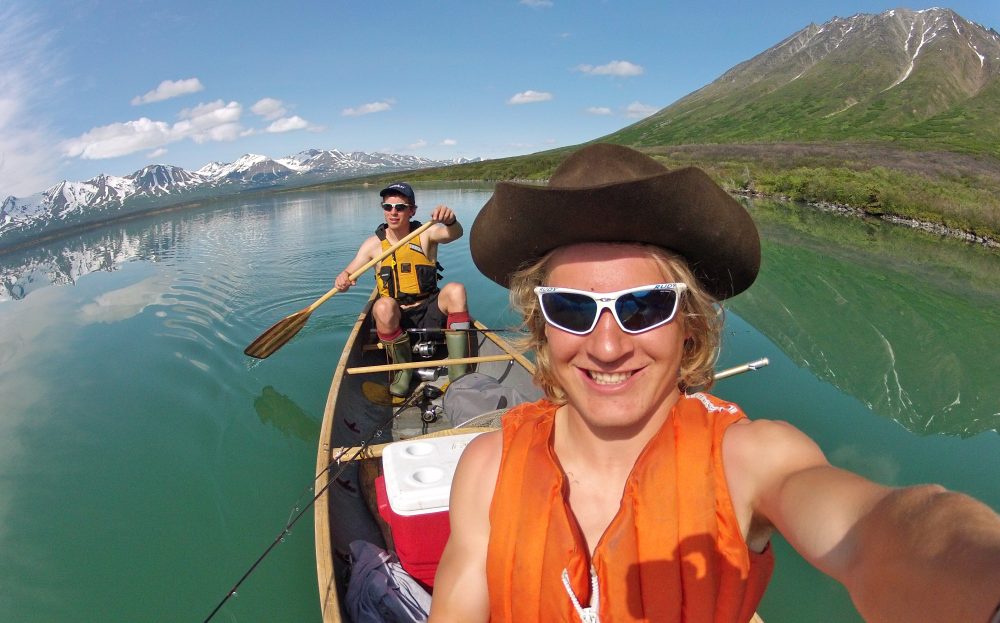
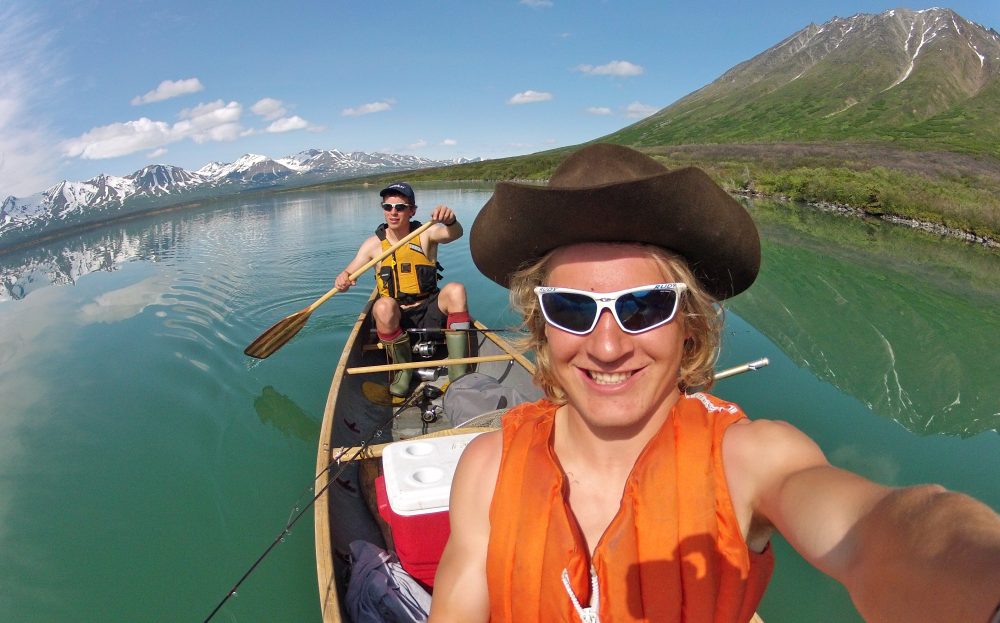
Former Canadian World Cup skier Knute Johnsgaard snaps a photo during a canoe trip. (Courtesy photo)
One hundred and fifty kilometers from the city of Whitehorse, if you are adventurous enough to hike through the troves of white spruce and over the two mountain passes to get there, you may come across Knute Johnsgaard’s family trapline. Traverse the 100 square kilometers of land where his family holds the rights to trap, and you may even catch a glimpse of Johnsgaard himself.
Johnsgaard, a native of the Yukon Territory’s Mount Lorne community, plans to spend most of next winter hunting on his family’s remote patch of land in northwest Canada. He will set traps for lynx, wolverines, foxes, and wolves. He will drop a few fishing lines into the land’s frozen lakes. He will sport cross-country skis as he travels from trap to trap.
He will not, however, train as he once did. That kind of work is a thing of the past (he will, incidentally, get in a few nordic over-distance workouts, as he plans to ski the 60-kilometer stretch of snow-covered land from snare to snare).
At 25, Johnsgaard has been a member of Cross Country Canada’s senior national team for the past three seasons (first on the U23+ Development Team, then on the U25 Team, and finally on the World Cup A-team last season). He represented Canada at this year’s Winter Olympics in PyeongChang, South Korea. And as of this spring, he is officially retiring from professional skiing.
***
Looking at the 2018 Olympic and Paralympic team rosters for Canada and the U.S., the pattern of athletes with the same last name is tough to miss. The Bjornsen siblings. The Patterson siblings. The Nishikawa brother-sister duo.
Knute Johnsgaard racing a 2016 World Cup in Lillehammer, Norway. (Photo: Fischer/Nordic Focus)
Johnsgaard is not one of those. He does not come from a family of athletes. Most of his relatives, he explained, had never followed his skiing or cross-country in general until the two weeks he competed at the PyeongChang Winter Games. What Johnsgaard did have growing up was a family who encouraged him to be outdoors and access to it. A lot of it.
The Yukon Territory spans an area of nearly 500,000 square kilometers, and includes Canada’s tallest mountain, Mount Logan. The region is, as Johnsgaard puts it, “one of the world’s last true wilderness areas.” It was within this last wilderness area that the Canadian began his cross-country journey.
He first started skiing on the ski trails of Mount Lorne. In between skiing adventures, he would join his father for trips to the family trapline. At the age of 13, Johnsgaard’s father suffered an accident that left him paralyzed, which halted their trips together.
Around that time, Johnsgaard and his mother moved to Whitehorse, the Yukon’s capital and only city, where Johnsgaard joined the Whitehorse Cross Country Ski Club. Johnsgaard remained active with the club through his high-school years. Following graduation, he moved to Quebec to train with the Pierre-Harvey National Training Centre, where he spent two years.
“I enjoyed my time in Quebec, but I really missed the Yukon,” Johnsgaard explained. “I felt it was kind of silly, I guess, to be training on the other side of the country when we had better snow conditions and so much available to us right here at home [in Whitehorse].”
***
Scroll through the photos Johnsgaard has posted on his blog and a few anomalies crop up. The first being that many of the shots feature Johnsgaard, proudly smiling, while kneeling over the hulking form of a freshly fallen carcass (the seamless transition between shots of Johnsgaard sporting camouflage then spandex also seems slightly unorthodox for the average cross-country skier).
Knute Johnsgaard (standing) with the Yukon Elite Squad during a cliff-climbing trip. (Courtesy photo)
Yet to those who are familiar with Johnsgaard, there is a reason hunting appears in tandem with his athletic pursuits. Hunting was more than a hobby outside of ski training. For Johnsgaard, hunting was also how he trained.
“The type of hunting he was doing, it’s not like weekend-hunter-type skier, it was a lifestyle,” said former Canadian national-team head coach Justin Wadsworth, who coached Johnsgaard during his first season on the team, during a recent phone interview.
“I think he drew a lot of his confidence from that kind of upbringing and those kinds of experiences,” Wadsworth said.
Following his two years in Quebec, Johnsgaard returned to the Yukon. He and four other Yukon skiers started a training group called the Yukon Elite Squad (YES). The five men had no formative coach, which permitted them to train when and how they wanted. For Johnsgaard, it also meant a hunting trip could count as training, if he wanted.
“There was nobody to tell us we couldn’t skip training to leave and go moose hunting for a week,” Johnsgaard said.
According to Johnsgaard, the squad met about four times a week and tried to coordinate one training camp a year with Alaska Pacific University (APU), an American elite ski team located about 1,000 kilometers west in Anchorage, Alaska. YES also competed at Canadian nationals, “throwing cash” to any team’s wax technicians who were willing to help out.
“We were in a unique situation where we recognized that the Yukon was a great place to ski train and we all wanted to pursue skiing,” Johnsgaard said. “We made the best of it, and that’s how I made it onto the national team, training in the Yukon with just a few other teammates. I was pretty proud of that.”
After two years with YES, at age 22, Johnsgaard was nominated to the senior national team in 2015. In his rookie season as a member of Canada’s under-23 development team, Johnsgaard scored his first World Cup points in 30th place in the freestyle sprint in Gatineau, Quebec.
The following spring, he was renominated to the team, which changed its name to the U25 (under-25) Team. He started that winter of 2016/2017 on the World Cup circuit in Europe, competing in Finland, Norway, Switzerland, and France. During that World Cup Period 1, his top finish was 51st in a classic sprint.
Then came Period 2. While his World Cup teammates Len Valjas, Alex Harvey and Devon Kershaw were overseas competing at World Cups, Johnsgaard was at home in the Yukon training. He was also looking at the World Cup calendar, with one race in late January in particular focus: the 4 x 7.5 k relay in Ulricehamn, Sweden.
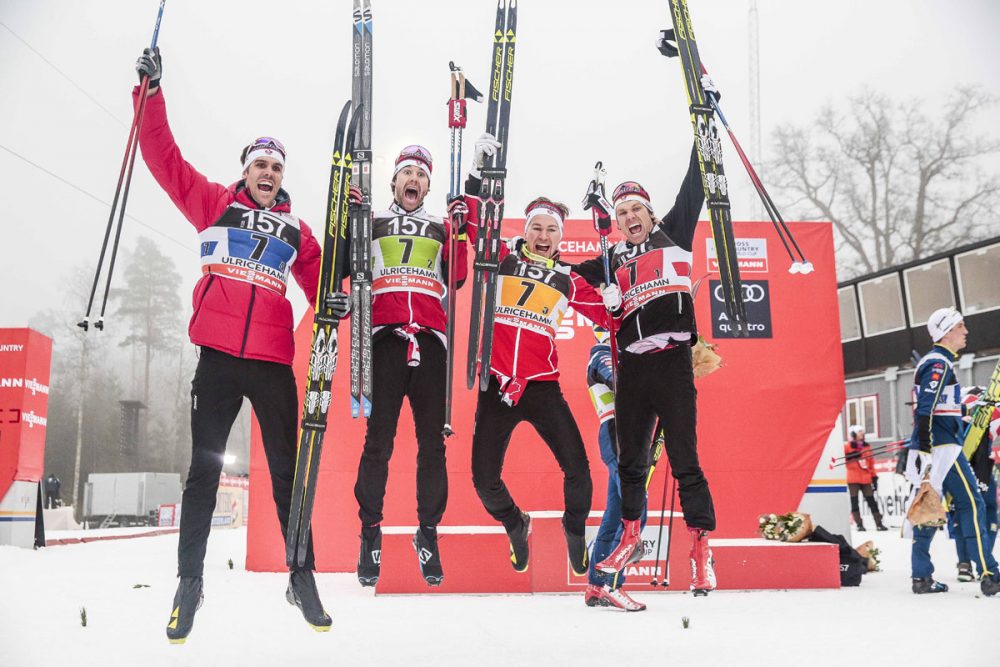
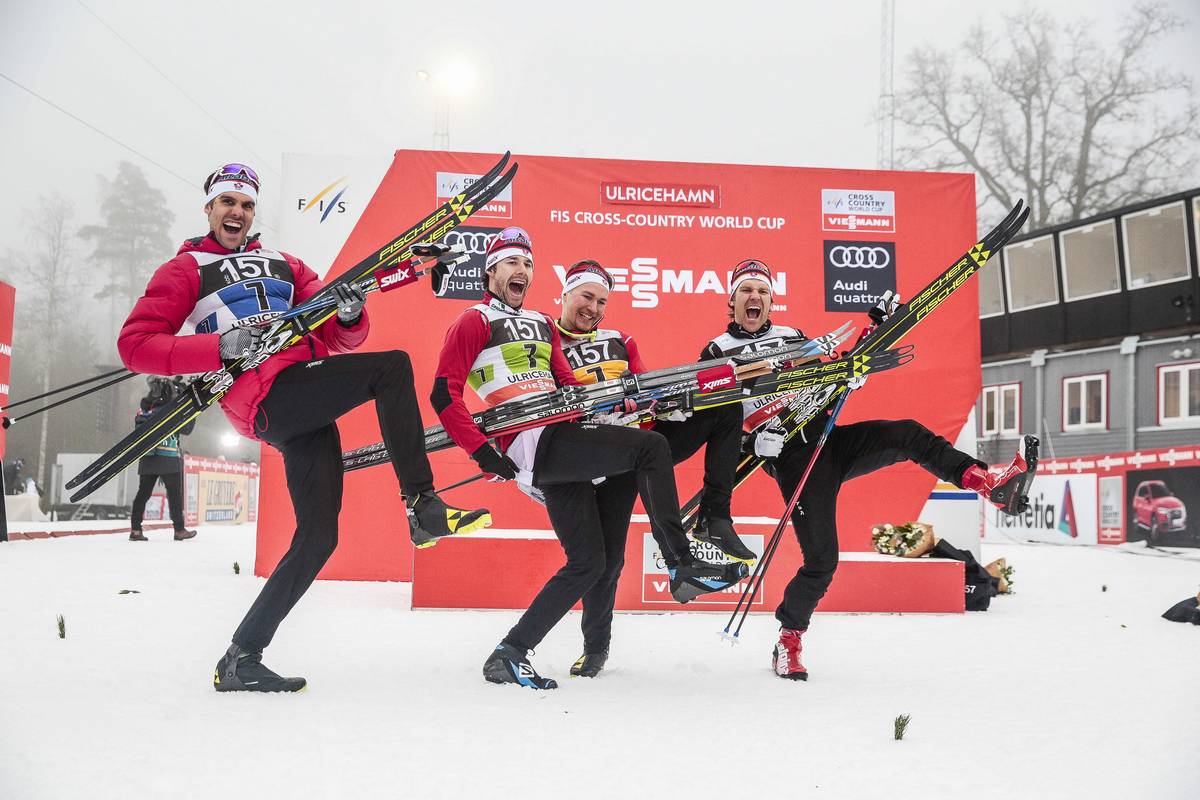
Left to right: Canada’s Len Valjas, Alex Harvey, Knute Johnsgaard, and Alex Harvey after their historic third place finish in the men’s 4 x 7.5-kilometer team relay on Jan. 22, 2017 in Ulricehamn, Sweden. (Photo: Fischer/Nordic Focus)
“They actually weren’t going to start a relay team because they didn’t have a fourth guy,” Johnsgaard said. “I had a meeting with our high-performance director [Thomas Holland] and begged him to send me over there to race that race.”
Holland consented and Johnsgaard flew to Ulricehamn to start in the relay. He arrived a few days before the race and was told he’d ski the third leg (first skate portion) of the relay.
On the day of the relay, Kershaw led off the first classic leg, putting the Canadians in third and just 0.7 seconds out of third at the first exchange. Harvey skied the second classic leg, holding onto the front pack of skiers before tagging to Johnsgaard in fifth, 3.5 seconds back. Despite being a little jet-lagged, Johnsgaard explained having a “weird confidence” that day on the trails.
He maintained his team’s position in the pack through his leg, handing off to Valjas in seventh, just 5 seconds out of first. After a smooth handoff, Valjas stayed streamlined in the group to the finishing stretch, sprinting to the line for third place. The result was historic for Canada. It also secured Johnsgaard’s spot on the 2018 Olympic team the following year.
“That was probably the highlight of my sporting career, that weekend in Sweden, qualifying for the Games there, and making World Cup team history for Canada at the same time,” Johnsgaard said.
The fact that the race pre-qualified him for the Olympics was a surprise to Johnsgaard.
“I always imagined getting a phone call after a stressful weekend at trials or something like that, but instead it was just one of my wax techs telling me over beer that evening, going, ‘Hey, I think you made the Olympic criteria,’ ” Johnsgaard said. “It was a pretty funny way to find out.”
Just over a year later in PyeongChang, Johnsgaard competed in the 15 k freestyle, 30 k skiathlon and 4 x 10 k relay. His best individual result was 69th in the 15 k skate, and he skied the anchor leg of the relay, which placed ninth as Canada’s second-best Olympic relay.
He started 12 individual World Cup races last season, with a top finish of 51st in a skate sprint in Seefeld, Austria.
“Since I started skiing at a young age, the Olympics were the ultimate goal,” Johnsgaard said. “To have finally accomplished that, I guess I feel fulfilled and I don’t really see incentive to keep going. I met my goal that’s all I ever wanted and now I’m moving on to new goals.”
“There has never been a ‘DNF’ next to my name,” he wrote. “I’ve never backed down, never not finished a race without laying it all out on the line. … Exploring my limits has always been something I loved doing. Results are inconsistent and out of your control, giving 100% effort, however, is attainable every time you’re on course.
“The world of sport is cruel in that I was always left wanting more,” he continued. “When you believe anything is possible, then everything less than perfect is not good enough. I always found myself striving for the next step that I could only hope would bring satisfaction. Instead, it brought only desire for greater success, which only got exponentially harder to achieve as I climbed the ladder. The final step was hard for me, and near the end of my career I began to struggle with anxiety and depression. It took so much energy that I didn’t have anything left over for ski races anymore, and I wasn’t happy.
“Now that I’m retired, I’m finally satisfied,” Johnsgaard added. “I’m able to step back and see for the first time this giant mural that I’ve painted, rather than focusing on the many imperfect brush strokes. I feel a cool breeze of fresh air bringing relief with each breath. I’m calm and content.”
***
All of the animals Johnsgaard traps are, in his words, “put to good use” for clothing, etc. In order to spend his winters living off the grid on his family’s trapline, Johnsgaard plans to work for a construction company through the summer and fall. Construction work is nothing new for Johnsgaard. It is also how he funded his skiing career.
“I did have to work a lot to afford to ski race before I was carded,” Johnsgaard explained in an email. “Even with working, I never could have pursued skiing without Cathy Wood of RyanWood Exploration. Cathy anonymously donated enough money for me to go to a training centre after high school and then supported me again in just my last two seasons on the World Cup.”
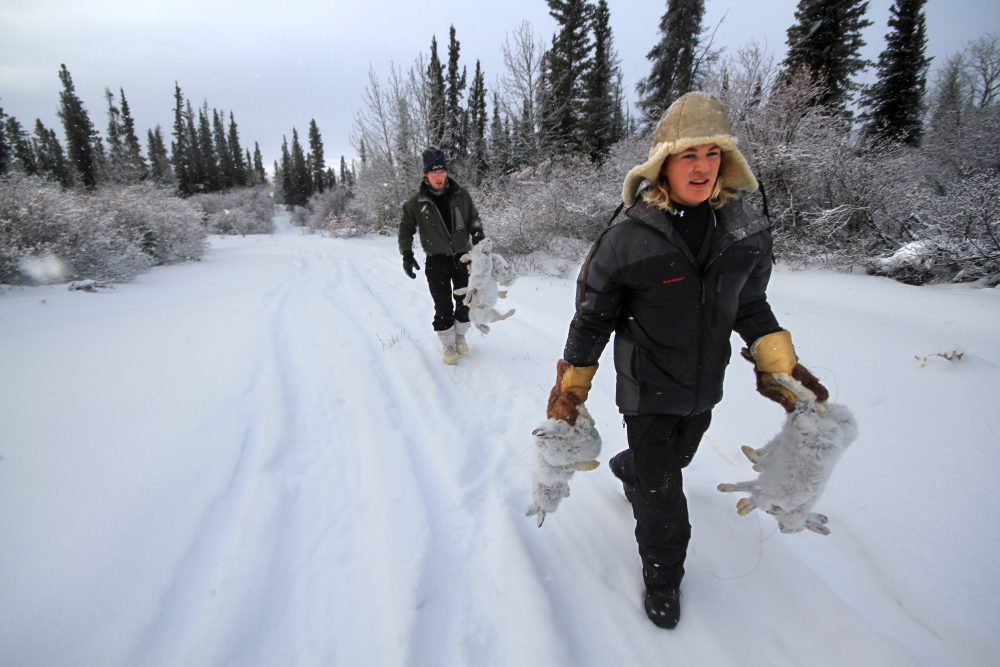
Knute Johnsgaard (front) after checking on rabbit snares on his family’s trapline. (Courtesy photo)
He will continue to organize and run the Father Mouchet Loppet in Old Crow, which he and friend/former YES teammate Colin Abbott helped create. Johnsgaard also hopes to do some coaching with the Whitehorse Cross Country Ski Club. Other than that, his connection to skiing will remain a lifestyle choice, and no longer a career one.
“I’ve always had quite a number of other hobbies and interests, so I’m not at all worried or stressed about what I might do,” Johnsgaard said of his retirement. “I’m just excited for new things, whatever they may be. It’s kind of exciting to be free.”
Johnsgaard is particularly excited about being able to do what he wants, when he wants.
“I hope people understand my decision and I hope that it’s not a question mark of why Knute is retiring at age 25 and he might not even be at his peak yet or this and that,” Johnsgaard continued. “It’s just that I’m satisfied with how far I’ve taken it and I feel fulfilled and I’m excited to do new things.”
Some do wonder whether he might have taken it further. Wadsworth described Johnsgaard as a “physiological talent”, his non-traditional ascent to the World Cup level an attestment in itself.
“He had a lot of natural strength and physical ability, and I think my guess is he would have had a much longer career had he had that upbringing of the traditional cross-country ski training,” Wadsworth said. “But Knute did it his way and for me to say, ‘Oh, he could have been better, had he taken the traditional method,’ that’s not for me to say. That’s purely a speculation on just what I’ve seen.”
For now, the reality is Johnsgaard’s skiing will stay in the Yukon — where he hopes to acquire land and build a home — which is exactly how he wants it.
“I would describe it like getting a wild mustang,” Wadsworth said of working with Johnsgaard. “Wild mustangs are used to running around out in the field and not being told what to do.”
(Note: This article has been updated to reflect that Len Valjas was nominated to the B-team, rather than the A-team as previously stated.)
On Thursday, Cross Country Canada (CCC) announced its national-team nominations for the 2018/2019 season via a press release.
Canada’s Alex Harvey celebrating on the podium after placing second in the World Cup men’s 15 k freestyle mass start in Seefeld, Austria, last season. (Photo: Salomon/NordicFocus)
Notably, the World Cup A-team is made up of one man — Alex Harvey — after three athletes from last year’s World Cup A-team retired (Devon Kershaw, Jess Cockney and Knute Johnsgaard). Graeme Killick, of last season’s World Cup B-team, also retired. Len Valjas was nominated to the B-team, a demotion, he said, that was a result of him ending his season immediately after the PyeongChang Olympics.
“The reasoning is that I … didn’t show up to [the World Cup in] Drammen, is that I didn’t follow what the team said,” Valjas told FasterSkier on May 22. He explained he had a broken spine, which required rest and rehabilitation.
On the women’s side, Dahria Beatty was renominated to the World Cup B-team, while Emily Nishikawa and Olivia Bouffard-Nesbitt were not.
All five of last year’s U25 Team were renominated to the national team, with Cendrine Browne and Julien Locke making the jump to the World Cup B-team, while Katherine Stewart-Jones, Maya MacIsaac-Jones and Gareth Williams were renominated to the U25 Team. Also on the U25 development squad, Antoine Cyr was promoted from the junior national team, and Graham Ritchie earned his first national-team nomination.
The World Cup team will once again be led by co-coaches Ivan Babikov and Louis Bouchard.
On the Para-Nordic side, the World Cup Team grew by one despite the retirement of Chris Klebl. Six athletes and two guides were nominated to the Para-Nordic World Cup Team, while two were renamed to the Development & Prospects Team. Four other athletes round out the team as part of the Prospects Team.
Canada’s Devon Kershaw racing at 2017 World Cup Finals in Quebec City, where he finished 26th in the 15 k freestyle pursuit and 19th for time of day in the last race of the 2016/2017 season. (Photo: John Lazenby/Lazenbyphoto.com)
On April 26, Devon Kershaw posted a photo on social media of Alpina boots hanging on a line. The next day, he spoke on the phone with FasterSkier from his new home in Lillehammer, Norway, after a day of running around outside with his 15-month-old daughter, Asta Isabel.
Kershaw was tired, but in a good way. For the first time in 17 years, he was ready for a new challenge, a new focus and much more time with his daughter and wife, Kristin Størmer Steira, a former standout Norwegian skier.
Three years after Steira left professional cross-country skiing and pursued a career in business, starting with her master’s degree in business management, Kershaw is following suit and headed back to school. The 35-year-old Canadian hung up his boots to quietly announce his retirement after about a month of deliberation.
“I was really keen to keep ski racing, to be honest,” Kershaw said. “I had the motivation to go one more year, and in my head, I wanted to race one more season, but as things progressed in the spring, there were a lot of different factors that just made it seem like, oh man, it doesn’t look like it’s gonna be super realistic at this point.
“I struggled with that, when you feel like you still have more in the tank,” he continued. “But at the same time, it’s a bit of a double-edged sword in the sense that it’s been a fantastic career.”
Kershaw was quick to reflect on his roots as a kid growing up in Sudbury, Ontario, “a mining town with a small but passionate skiing community,” as he put it. He also reiterated how proud he was to represent Canada for 17 consecutive seasons, first as a junior national team skier for two seasons starting in 2001, then as an under-23 national team member in 2003, and finally as a full-fledged World Cup Team member starting in 2004.
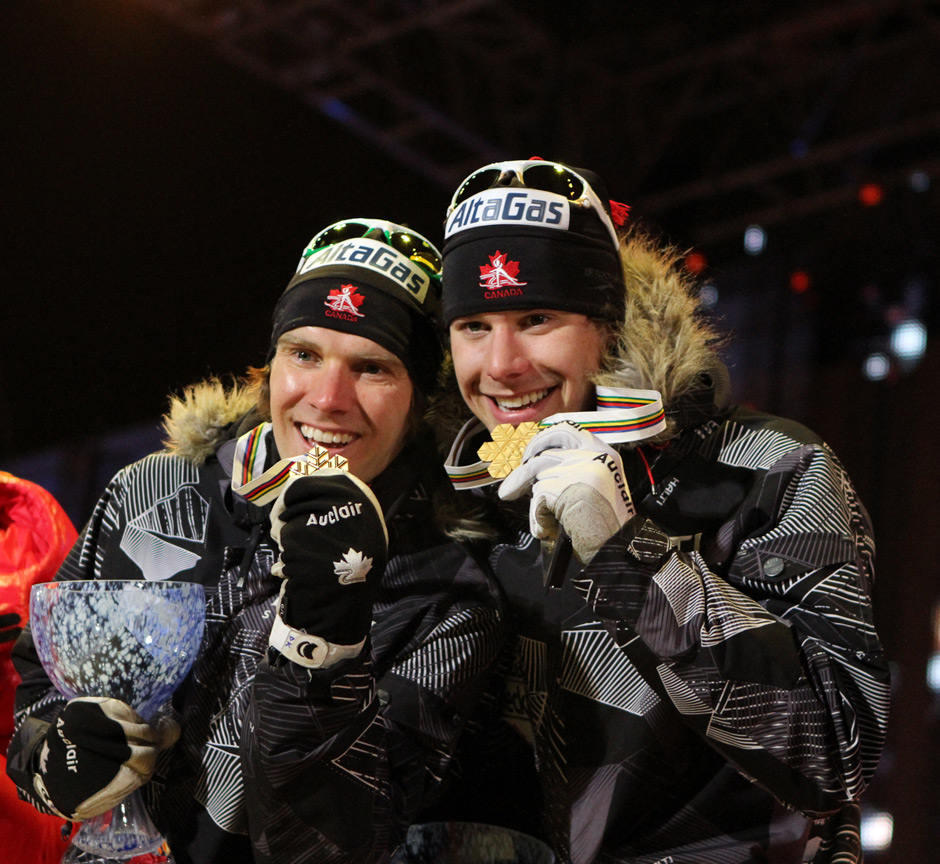
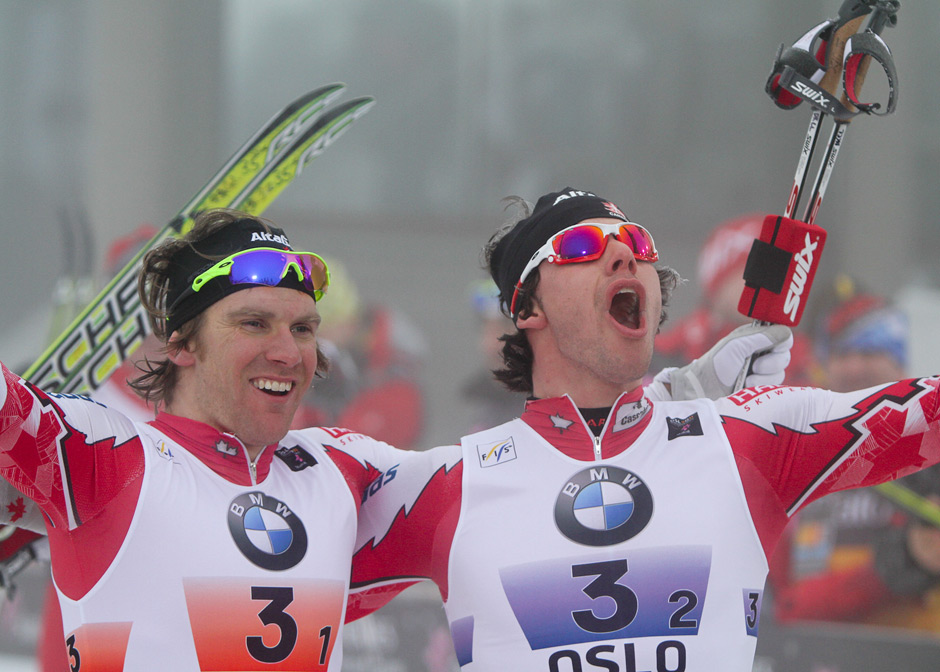
Devon Kershaw (l) and Alex Harvey celebrate their 2011 World Championships gold in Oslo, Norway. (Photo: Fischer/NordicFocus)
His career included three World Cup wins and 14 podiums, and a gold medal at 2011 World Championships with teammate Alex Harvey in the classic team sprint. Kershaw finished the 2011/2012 World Cup season ranked second overall and second in the distance rankings.
When he reflects on those accomplishments, he still has a hard time believing that all happened to him.
“So instead of focusing on being bummed at the situation or a bit frustrated with the state of things in Canadian skiing right now, I have to look back with a smile,” Kershaw said. “I feel just so privileged and grateful to have had the opportunity to be part of a real movement for men’s skiing in Canada.”
Kershaw said he was left with unanswered questions this spring during a transitionary period at Cross Country Canada (CCC). The team’s budget was undetermined, camps were not yet set in stone, and Kershaw said his decision — which he wanted to make by May 1, the start of the new training year — became about energy management.
“Part of managing your energy properly is putting all of your energy and focus into training, and if you’re being pulled with uncertainty or being stressed about uncertainty, that will come back, the World Cup will exploit that,” he said.
According to CCC Chief Executive Officer Shane Pearsall, High Performance Director Thomas Holland had planned to retire this past March, yet has stayed onboard as an advisor until CCC fills the position. Pearsall said the hiring process is still ongoing and will hopefully be wrapped up by next month. He confirmed that CCC has yet to finalize its budget and doesn’t anticipate being able to do so until a government minister signs off on the amount from Own The Podium (OTP), one of its primary funding sources, in July. Pearsall explained that they expect to have a better sense of national-team finances in mid to late June.
Typically, the team’s budget is determined in May, but because of necessary “quad reviews” following the Olympics, which took place before CCC met with OTP, the process was delayed by about a month. Pearsall did not elaborate on how significantly the budget would be decreased from last year, but said, “It’s certainly tighter than last year.”
Kershaw said he needed to pay about $25,000 Canadian dollars in team fees if he wanted to continue racing this year, up from $15,000 last year. That didn’t cover the cost of living, which he figured to be around $55,000 Canadian, for a grand total of $80,000.
“The financial burden is big, and moving forward the financial burden went from big to 100 percent paying for every cost,” Kershaw said. “So all travel, accommodations, everything. … I’ve just been in the sport a long, long time, and from a directional standpoint, I’m not sure we’re moving in a direction that will yield sustainable results at this point in time, but I understand it is difficult when you’re under such financial duress to create a sustainable program. But from a vision standpoint, I think there’s a lot of questions that remain unanswered, and it’s late in April. The fact of the matter is the rest of the world has all of the holes plugged — if they have holes in their boat — because May 1 is the new year of every ski program. And we’re just constantly slow and off the mark with that.”
Budget cuts had been expected as Canada’s World Cup Team missed performance benchmarks throughout last season. The team finished 2017/2018 with just two men scoring World Cup points (top 30) in distance races: Harvey and Kershaw. Two men (Harvey and Julien Locke) scored in World Cup sprints. On the women’s side, Dahria Beatty landed one World Cup sprint top-30 last season, and Cendrine Browne was the top Canadian woman in a distance race with a 27th place for time of day in the last race of the season.
Meanwhile, Alex Harvey led the team with four World Cup podiums, including third overall in the 2018 Tour de Ski, and a top result of fourth place at the 2018 Olympics. He finished his season in fourth in both the Overall and Distance World Cup standings. But Harvey’s results alone weren’t enough to buoy the whole team for another winter.
“Throughout my entire career, it’s almost unfathomable to think that the season ends and that’s the stat line,” Kershaw said of the team’s overall results. “It wasn’t so long ago that we had over 16 World Cup podiums in a season. The truth hurts, as [former Canadian coach] Tor-Arne Hetland once said, but things go in waves and this is the reality that we live in right now.”
Despite the prospect of self-funding, Kershaw didn’t feel pressed into retirement. Several of his teammates have decided to retire as well, including Graeme Killick, Jess Cockney and Knute Johnsgaard, but Kershaw said they weren’t forced, either.
“You can choose to work and you can choose to hustle for money; there are ways to make it,” he said. “No one’s forced into it. I could keep skiing if I wanted to, but I think the stark choice you’re faced with is, maybe perhaps some people are like, I can’t really see a path to international success currently, and that’s what I think is sad…”
‘A dream scenario’
When Kershaw moved to Canmore, Alberta, in 2001 and entered Canada’s elite skiing scene, Cross Country Canada (CCC) was entering a fruitful period. At the 2002 Olympics, Beckie Scott was proclaimed winner of the women’s 10-kilometer pursuit (now called the skiathlon), becoming the first North American woman to win an Olympic gold. At 2005 World Championships, Sara Renner earned a sprint bronze to become the first North American woman to medal at World Championships. Scott and Renner teamed up for silver in the team sprint at the 2006 Olympics in Turin, Italy, where yet another Canadian woman, Chandra Crawford, won the individual skate sprint for Canada’s second-straight gold in as many Winter Olympics. Scott finished that 2005/2006 season ranked second overall in the World Cup, just 16 points behind Norway’s Marit Bjørgen in first.
Devon Kershaw (r) with Graham Nishikawa in 2013. (Photo: Devon Kershaw)
Kershaw made his Olympic debut in 2006.
“Coming into Torino, we were quoted in the newspaper as being like the world’s most anonymous men’s ski team,” he said of the Canadian men’s team that year. “We weren’t really ‘on the map,’ but I’ve just been so grateful and lucky to have such a great group of guys around that really welcomed me in.”
He credited his former roommate and teammate Chris Jeffries as well as other Canadian competitors of his time, including George Grey, Gordon Jewett, Dan Roycroft, Sean Crooks, Dave Nighbor, Phil Widmer, Brent McMurtry, and Graham Nishikawa (who’s still racing), for having a major impact on the formative stages of his career.
“[There were] so many athletes in Canmore that tried hard, wanted it bad, and loved ski racing and training,” Kershaw reflected. “That’s a dream scenario for a young athlete to come into a community like that and be welcomed into that environment.”
Less than a month after the 2006 Olympics, he notched his first World Cup podium by placing third in the Borlänge, Sweden, skate sprint. In doing so, he became the first Canadian male cross-country skier to reach the podium since Pierre Harvey (Alex’s father) in 1988 and the first ever to medal in a World Cup sprint.
“I had no idea who Pierre Harvey was,” Kershaw said of his younger self.
Pierre Harvey had previously won the 1988 Holmenkollen 50 k as well as two other World Cup distance races and the Norwegian Birkebeiner, making him the most successful Canadian male skier before Kershaw.
“He could walk into the room and I would not recognize him,” Kershaw continued. “Even his results, I had heard that he had five World Cup podiums and that seemed pretty cool, but that’s all I knew about him.”
Kershaw’s second World Cup podium came early in the 2006/2007 season in a skate sprint in Munich, Germany. That same day, Crawford — whom he was dating at the time — placed third in the women’s sprint.
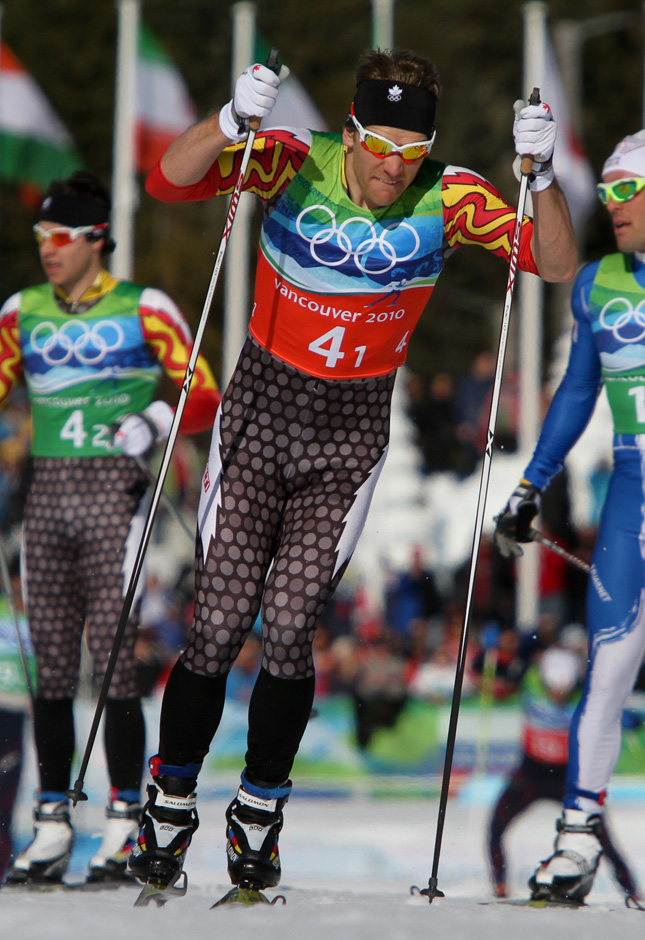
Devon Kershaw after being tagged by his Canadian teammate Alex Harvey (l) in the freestyle team sprint at the 2010 Olympics in Vancouver, B.C. They went on to finish fourth.
At his second Olympics in 2010, Kershaw finished fifth in the 50 k classic mass start for the best individual Olympic result for a Canadian male nordic skier. That record stood until Alex Harvey, who burst onto the World Cup scene in 2008, bested it with a fourth place in the 50 k classic at this year’s Olympics in PyeongChang, South Korea.
Kershaw and Harvey also teamed up to place fourth in the freestyle team sprint at the 2010 Olympics.
Kershaw’s first World Cup win came in a skate sprint during the 2011 Tour de Ski. He finished that Tour in seventh, and the next year, came back to place fourth overall in the 2012 Tour de Ski (TdS). Kershaw started all 12 editions of the TdS, a record he shares with France’s Jean-Marc Gaillard.
Harvey scored his first individual World Cup podium in a 50 k classic in 2009 and won his first World Cup race (a 3.3 k freestyle prologue) at the TdS in 2012.
“Then next thing you know, Alex and I are sharing a podium on some World Cups,” Kershaw reminisced. “Two Canadians on one podium in the World Cup, like, really? And then you win World Championships and I’m on the overall World Cup podium, and then next thing you know, Alex has been on the overall World Cup podium a few times and also now 50 k world champion. It’s crazy. It’s insane. From nothing. From no results. The journey has just been amazing. … I never would’ve thought Canada would, I mean, how could you? We had Pierre Harvey and that’s it in, like, a hundred years of international ass-kicking.”
Kershaw credited his initial World Cup breakthrough as a 23-year-old skier in Borlänge to Dave Wood, Canada’s national-team coach at the time.
“I came into a team with a coach that you could call at midnight. He’d do anything for you,” he said of Wood. “There was no way I would’ve stepped onto the podium in 2006 without him, and Mike Cavaliere, too, my first-year senior, Mike was my coach. We had staff that was just committed to the core for the cause and I’m incredibly grateful for that.”
‘A hell of a season’
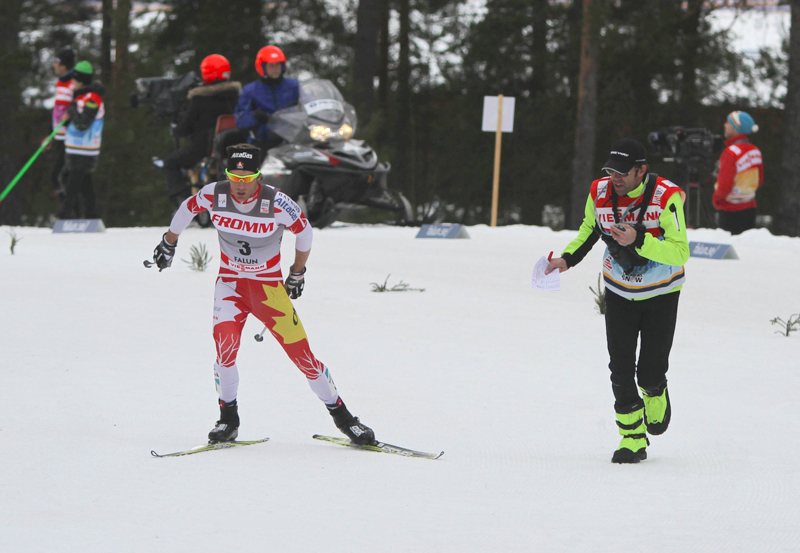
Canadian head coach Justin Wadsworth (r) giving splits to Devon Kershaw at 2012 World Cup Finals in Falun, Sweden.
Of his coaches, Kershaw gave special credit to Justin Wadsworth. A three-time U.S. Olympic cross-country skier who became Canada’s head coach in the spring of 2010, Wadsworth coached Kershaw for five seasons, and the two developed a close friendship.
“When Justin came into the national team, the level of professionalism and excitement and freshness that he brought … I don’t know if you call it luck or happenstance or just the right place, right time,” Kershaw reflected, alluding to his 2011 World Championships gold with Harvey and his 2012 Overall and Distance World Cup podiums. “Justin’s best results as a coach were me and my best results as an athlete were when I was coached by Justin. Talk about an amazing relationship there.”
“The main thing that I really appreciated with Devon, and I think he would say the same thing about me, is that we could be honest with each other and talk about hard things and enjoy the good times when we had them,” Wadsworth said on the phone last week. “… It’s cliche, but when I was talking to Devon the other day about his retirement, it’s not about the medals or the performances or whatever, it’s about your times together on the road.”
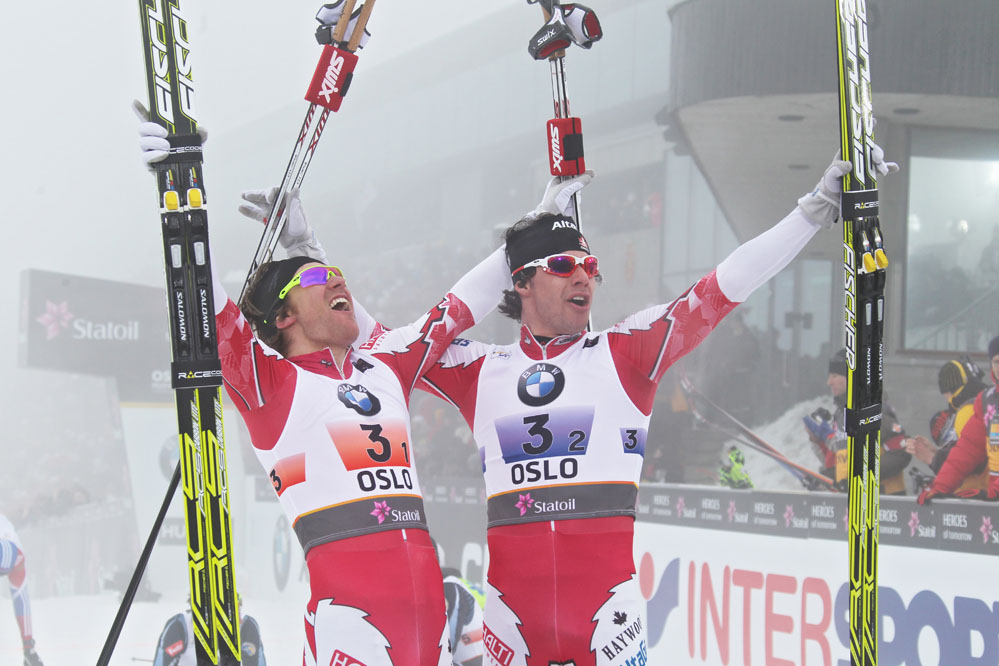
One of Kershaw’s biggest moments came at those 2011 World Championships in Oslo, Norway, where he and Harvey beat out Norway’s Petter Northug and Ola Vigen Hattestad by 0.2 seconds for gold on the Norwegians’ home turf. They had done so after Kershaw lost one of his skis early in the race, Wadsworth pointed out.
“His ski fully came off and he had to put it back on and get back into the race,” Wadsworth said. “Just the whole day was pretty incredible. That was a great, great opportunity for us, and the guys cashed in.”
Devon Kershaw (l) and Alex Harvey with their World Championship gold medals at the 2011 World Championships in Oslo, Norway.
In a difficult-yet-strategic move to conserve for that race, Kershaw and Harvey both sat out the 15 k classic the day before.
“With anybody else running the ship, there’s no way I would’ve trusted that [decision],” Kershaw said of Wadsworth’s call. “But I trusted Justin’s leadership and we went all-in, and the next thing you know we won World Championships. I mean, are you kidding me? How can you get a better start to the next quadrennial? And Justin as a first-year head coach of a national team, that’s gotta go down as maybe the best season ever for a first-year North American coach of a national-team program.”
He and Wadsworth reiterated the crucial foundation that Wood had laid.
“Dave Wood had done a really good job with the athletes leading into that period, mainly focused on building a big base and doing a lot of hours and also doing a lot of time at altitude,” Wadsworth explained. “And when I took over the position, I saw that both Alex and Devon were really primed and had a really good response rate to altitude, and all we had to do was fine tune a little bit of strength training and intensity. I was really excited to work with both those athletes and saw that they had a lot of potential.”
For Kershaw, Wadsworth’s “American swagger … was magic for me,” he said. During the 2011/2012 season alone, he stood on the podium 10 times, with four top-three finishes in seven races at the 2012 Tour de Ski.
“It was a hell of a season for me,” Kershaw said.
‘Best sand-digger ever’
He went on to compete at two more World Championships and two more Olympics. This past season, Kershaw finished in the top 30 in eight World Cup distance races, with a top result of 19th in the 30 k skiathlon in Lillehammer, Norway. While struggling with lung issues, he finished 26th in the 50 k classic at the PyeongChang Olympics.
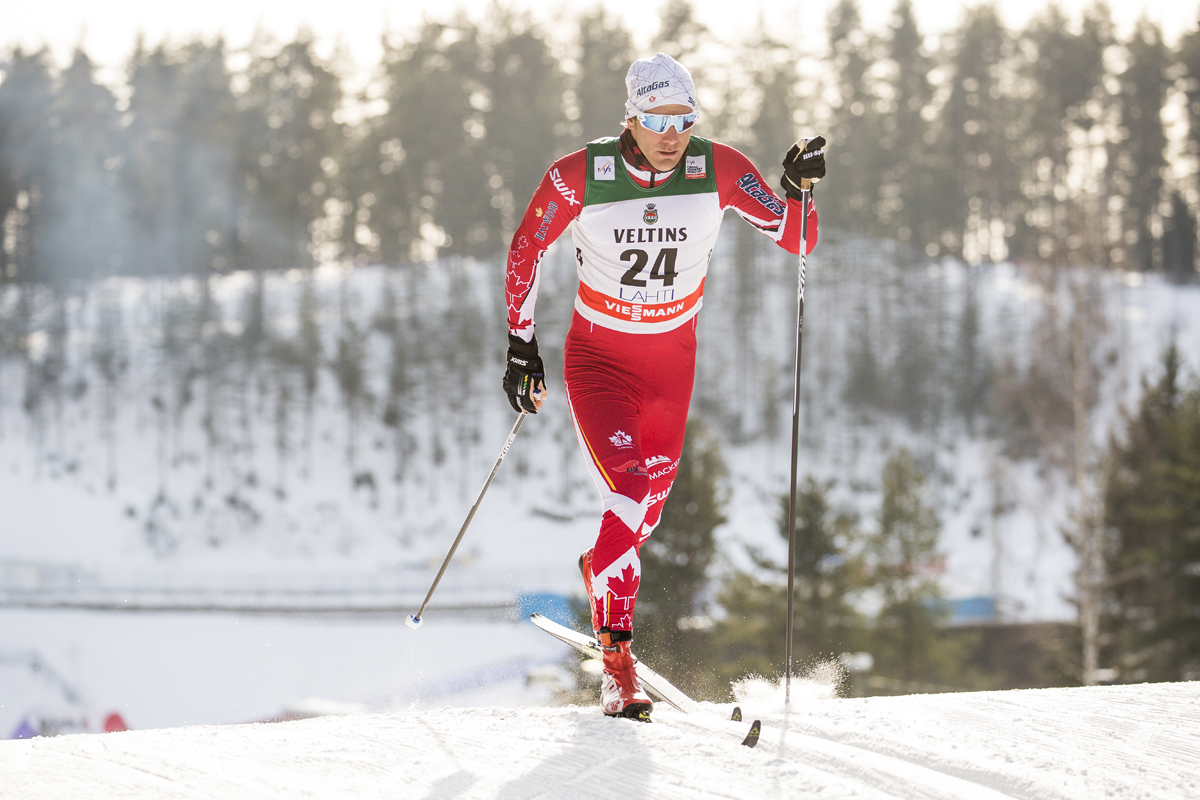
Devon Kershaw racing to 25th in the World Cup 15 k classic this past March in Lahti, Finland. (Photo: Fischer/NordicFocus)
“We worked to get that under control and it was manageable but it never felt good like it felt prior to 2015,” Kershaw said his health over the last three seasons. “In PyeongChang, it was a calamity of bad luck. When we got there it was minus 20 [Celsius], and this makes me sound so soft, because I’m from northern Ontario so you’d think I’d know, but it was really cold. I did some intervals and it aggravated my lungs and it was super windy and dirty and a lot of sand blowing around, and that really flared up my asthma to the point that I was wheezing badly.”
His breathing troubles also affected his sleeping and took most of the two-week Olympics to manage. At one point, he had a chest X-ray to make sure it wasn’t pneumonia.
“It was sporting asthma,” he said. “… It took all the way to the 50 k to kind of get it 70 percent.”
While he noted he was left wanting more from a performance standpoint at both his final Olympics and in his final season, Kershaw also acknowledged that he’s his biggest critic.
“That’s been probably the biggest detriment to my entire career; I’m the best sand-digger ever,” he said. “I am disappointed in the sense that I work really hard and I train hard and I prepare well, and it didn’t go exactly as planned. … When you’ve competed in the top 10 for as many years as I have and on the podium, of course that becomes your bar that you hope to achieve, but at the same time … when you’re in the top 30 in the results page, you’re in the race at least. And I’m proud of the fact that in almost all classic races, not every, but most, I was in the top 30 and ‘in the race’.
“Am I satisfied? In my life I’ll probably never be satisfied, that’s just how it goes,” he added with a laugh. “But am I somewhat proud of maintaining a fairly competitive level? Yeah, absolutely.”
Wadsworth reflected that Kershaw was one of the best athletes he had ever seen, even “physiologically as good as Alex [Harvey]” at the peak of his career.
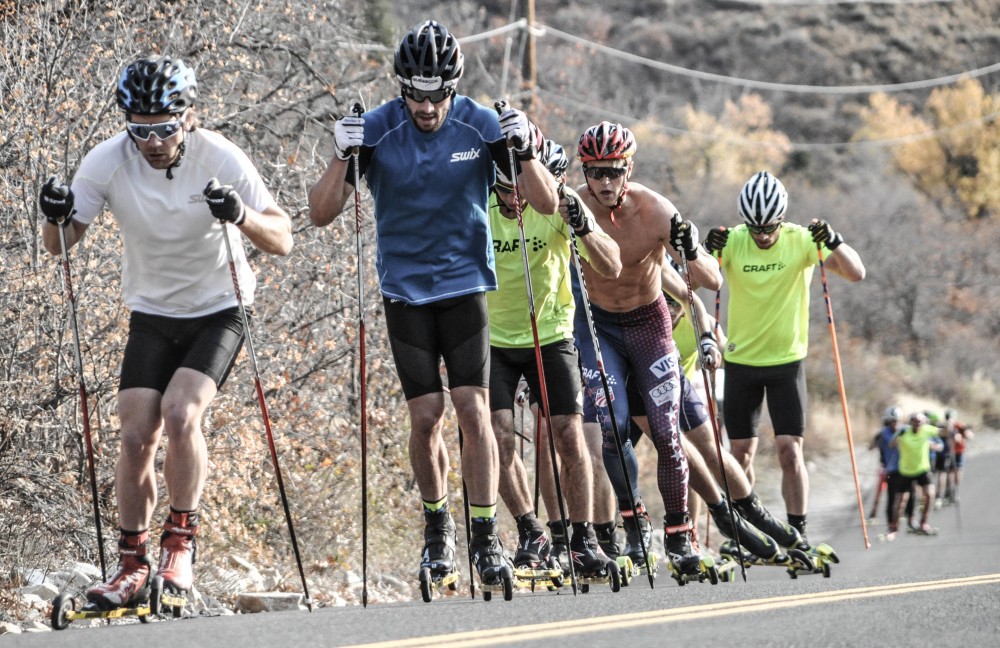
Left to right: Canada’s Devon Kershaw leads his teammate Alex Harvey and U.S. Ski Team members Noah Hoffman, Erik Bjornsen and Simi Hamilton during a Level 3 interval skate session up Snake Creek Canyon in Midway, Utah, during their respective teams’ 2016 training camps in Park City, Utah. (Photo: Matt Whitcomb)
“Devon’s a very intelligent person and sometimes he might’ve overthought things and lacked in confidence, and as a coach that’s really frustrating to see because you know how good they are physically,” Wadsworth said. “And when he was on mentally, too, in training, when he was at his very best, he had total confidence and could destroy anybody in any workout.”
He recalled a hill-bounding workout with the Norwegian team in which Kershaw was literally leaps and bounds ahead of everybody else — even Martin Johnsrud Sundby and Russia’s Ilia Chernousov, who joined the training session.
“He was just shelling everybody,” Wadsworth said. “So when Devon was at his best like that and mentally confident and relaxed, he was a real force of nature. Unfortunately that didn’t always translate into the racing season, but in 2012 he put it all together and had a tremendous year. … If he had the confidence the whole time, he would’ve been almost unbeatable, in my opinion, but it takes the whole package all the time, and he was among the greats there for a while.”
‘Younger, faster, better dog’
And then there was Harvey, another one Kershaw’s of his best friends and longtime roommates.
“I’ve spent more nights in a room with him than my wife or any girlfriend I’ve had,” Kershaw joked. “… He was eager to learn, he chased me for years, he was always a hard worker, too. He trained really hard, he believed in himself, and I still am in total awe of that. I’ve never met anybody as confident as him. It’s too bad that didn’t rub off on me, but that’s been great to be around.”
He likened Harvey’s addition to the team as a family adopting a puppy.
“You know when your parents get a puppy because your dog is 10 years old? He’s kind of slowing down a little bit and then you see that old dog get fired up and run again and jump around and play; that’s me,” Kershaw said. “And I’m so grateful that my owners got a younger, faster, better dog to hang out with because it was so inspiring.”
Several times over the last few years, Kershaw has said that witnessing Harvey make Canadian history has been one of his biggest reasons for staying in the sport.
“He, for sure, has kept me in this probably longer than I should’ve,” Kershaw said. “I just love traveling with him and seeing what he can accomplish and training with him and seeing that professionalism.
“There’s no question he’s the best Canadian skier ever, that’s not even close,” he added. “… I just feel so honored that I got the chance to see it all happen, from his last-year junior when he did his first World Cups and then all the way though I’ve been with him.”
The Canadian men’s relay after placing third in January 2017 in Ulricehamn, Sweden, for Canada’s best-ever World Cup result in the 4 x 7.5 k relay. From left to right: Lenny Valjas, Alex Harvey, Knute Johnsgaard, and Devon Kershaw. (Photo: Salomon/NordicFocus)
In an email, Harvey explained that he and Kershaw first met in the fall of 2005 at a training camp at Sovereign Lake, British Columbia. Harvey was on the junior team and Kershaw a senior, but the whole team stayed at the same hotel.
One morning, Kershaw accidentally took Harvey’s poles from the hotel. Harvey had to track him down on the ski trails to get them back.
“That was the first time I talked to him and to me it’s just perfect because that’s so Devon,” Harvey wrote.
Later that season on March 7, 2006, Kershaw made history with his first podium. That same day, Harvey won his first national title in the 10 k classic at Canada’s senior national championships as a 17-year-old junior.
“I guess our friendship was meant to be before we even knew it!” Harvey wrote.
When the two became teammates, Harvey immediately took to imitating Kershaw, both in training and racing.
“He took me under his wings and he has a big part in the athlete I became today,” Harvey wrote, likening Kershaw to a big brother. “I feel very privileged to have spent all that time with him. I think we became such close friends because we are both very driven athletes and we don’t accept any compromise. We’re both huge fans of our sport, ‘nor-dorks’, so we also love to talk about everything from altitude training to who is seeing who on Tour.”
Kershaw’s decision to retire didn’t surprise Harvey.
“I think it’s a mix of a few things,” Harvey wrote. “… Probably this biggest reason, he has a little girl at home. I know this winter was extremely hard on him. Not seeing Asta Isabel was pure torture, I think I would have done the exact same if I was him.
“I will miss a lot of things about Devon,” he added. “He’s always there to give good advice about everything and anything. He knows so much about all that is going on in the world, probably the most well-read person I know. He’s kinda my news source. I’m still amazed by how indecisive one can be. This brought a lot of laughter throughout the years. I have so many memories from the last 10 years with him. Seeing him dominate the World in 2012 was just amazing but also very eye-opening for me. He raised the bar for all North American skiers that year and I’m very thankful for it.
“We both lived great emotions in high accomplishments and huge disappointments. I’d like to think I helped him get through these upsets and I can say he definitively helped me get through mine. A page turns in the life of Devon Kershaw but knowing the man, I’m not worried about what’s gonna come next.”
Without Kershaw, Killick, Cockney, and Johnsgaard on the men’s team, Harvey acknowledged that next winter will be “very different” for him on the World Cup.
“All these guys are calling it a career and I’m super proud of what all my friends accomplished,” he wrote. “I’m excited to try to help the next generation step it up and fill the shoes of the previous generation. … Also, after 10 years on Tour I’ve made some friends on other teams so I’m not too worried. I’m just excited to step into a bit of a mentor role for our next generation.”
Onto the Next
As for Kershaw, he didn’t rule out coaching future generations of Canadian skiers, but he said he was focused on getting an education first. In just over a week, he’ll start a course that requires 20 hours of classes a week — all in Norwegian — for what he anticipates will take six months. The course is essentially an advanced version of Norwegian as a second language, and foreigners must pass it to pursue a degree in Norway.
After that, Kershaw plans to apply to universities “and hopefully study forever,” he said with a laugh. “Not forever, but study, and I want to stay involved in skiing in any way I can and I want to help the next generation get better.
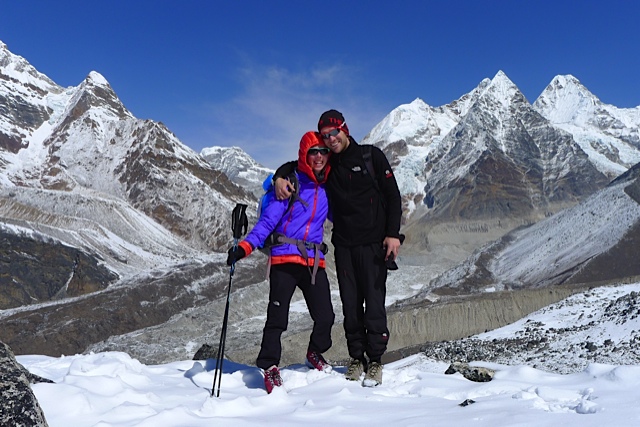
Kristin Størmer Steira (l) and Devon Kershaw during a day hike on one of their acclimatization days. The couple got engaged in 2014 after summiting Mera Peak during a three-week trek in Nepal’s Himalayas. (Photo: Devon Kershaw)
“First things first, I have to get my Norwegian at a level where I can sit through a lecture and write an essay at a decently good level, at least good enough that my wife doesn’t have to rewrite it, she can just correct it,” he explained.
Asked what he’d like to study, Kershaw said medicine, specifically orthopedic surgery, has always intrigued him. (As a junior skier, Kershaw took undergraduate classes at the University of Calgary until 2006, but those credits have since expired.)
“But now I’m 35 and I’m going to have to do all of this in my third language,” he acknowledged. “So for now, I’d say that that’s still my first choice and I’m exploring what it would take.”
If not medicine, he’d like to pursue a degree in “some kind of science physiology, and then in a totally shifted way, if I have a panic attack and be like, ‘Science is too hard after ski racing forever,’ then I am interested in economics and economic theory and business to some degree…”
Regardless of which path he choses, he’ll be doing it in Norway, Kershaw said.
“I don’t mind the challenge. … It’s intimidating in a way, but it’s also really exciting,” he said. “Kristin’s family [who lives in Lillehammer] is just so fantastic and to see how happy my daughter is here, to have her family, to have family around her and everything for the short term, and I hope to be educated in Norway.”
Asked if he’ll jump into any ski races this season, Kershaw was quick to respond, “No.” But he will continue skiing. The beauty of the sport and the struggle, as he put it, is what’s kept him in it so long.
“Imagine just having a singleness, a purpose, a goal that’s just there in your face and then you get to wake up every day and do the things you absolutely love to do,” he said. “… I adore cross-country skiing. I just think it’s such a peaceful, beautiful exercise, and the technique and the flow of it all. … You’re just skiing through the woods peacefully, gliding over snow, over all the terrain you can cover. It’s a beautiful, zen-like endeavor, and I think that’s what’s kept me in it this long. And the people, the Canadian ski community, the world ski community, really. I’ve met so many inspiring people and beautiful people and worked with a lot of absolute experts and I’ve had brilliant teammates and brilliant coaches.”
And because of skiing, he met his wife and started a family in Norway.
“I have a daughter with a woman that I love and respect and am in total awe of every day of my life and without ski racing there’s no way that would’ve ever come to fruition,” he said. “There’s the biggest gift right there, as cliche and Hallmark as that sounds, it’s true.”
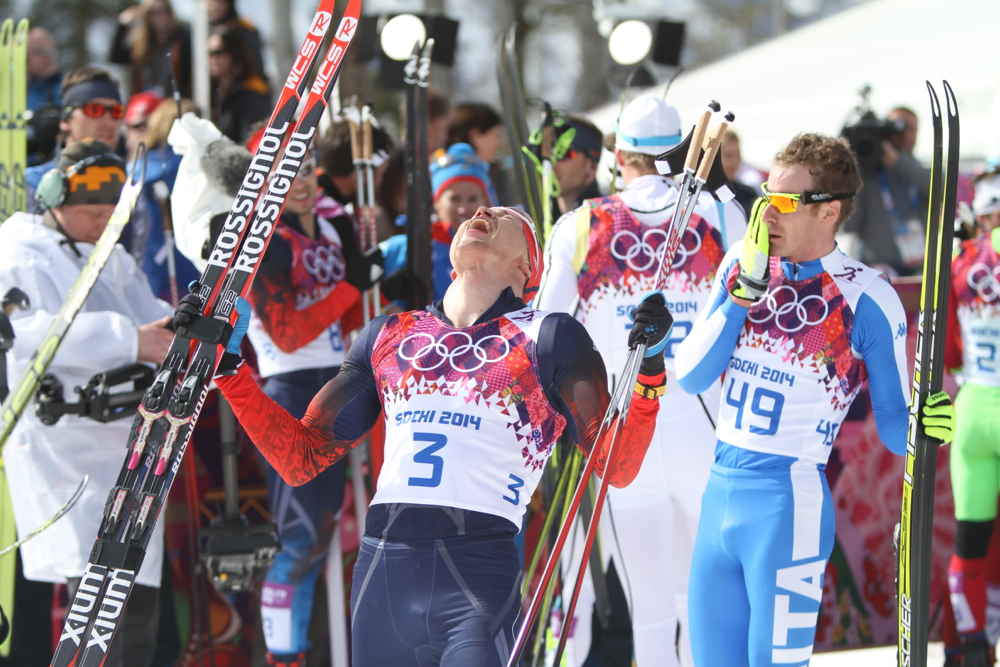
Russia’s Alexander Legkov (3) after winning Olympic gold in the men’s 50 k freestyle mass start at the 2014 Winter Olympics in Sochi, Russia. Russia’s anti-doping director at the time, Grigory Rodchenkov stated that he switched out Legkov’s anti-doping sample for a vial of clean urine collected previously. The International Olympic Committee stripped Legkov of his gold medal and banned him from future Olympics, but the Court of Arbitration for Sport overturned those sanctions in February 2018.
Editor’s Note: The following thoroughly cited opinion piece, prompted by the 2017 ‘Icarus’ documentary, was written by Maks Zechel, a 20-year-old Canadian cross-country skier who spent the 2017/2018 race season training abroad with Team Asker in Norway. Zechel is a regular contributor at FasterSkier, with his ongoing series: “Closing the Gap”.
***
February 23, 2014
Sochi: a home Olympics and the opportunity of a lifetime. Russia, despite being one of the strongest skiing nations in the world, has no individual medals in cross-country skiing leading into the final race of the championships. As the athletes shuffle nervously in the tracks before the 50 k mass start, the pressure on the Russian men can be felt even by me, watching on TV from home.
Putin is in the stands. It’s just a ski race, but how much more than that is at stake?
“The Moscow Laboratory operated, for the protection of doped Russian athletes, within a State-dictated failsafe system” (McLaren 1)
A sunny day, a roaring home crowd. Alexander Legkov is in a world of his own as he absolutely destroys himself over the final climb, skiing with the passion that it takes in all sports to win an Olympic medal. Russian flags waving everywhere, the crowd is absolutely deafening as Legkov adds his first Olympic gold to his already legendary career. Maxim Vylegzhanin and Ilia Chernousov lunge across the line behind him, with Chernousov having given every last bit of himself to outsprint Norway’s Martin Johnsrud Sundby to complete the Russian podium sweep on home soil. A dream come true.
“The Sochi Laboratory operated a unique sample swapping methodology to enable doped Russian athletes to compete at the Games” (McLaren 1)
When you ski with your teammates in front of your friends and family at home, you ski with a fire that is otherwise difficult to find. The presence of those who know you makes you feel guilty if you do not perform to your very best, you are pushed to keep up to those that your mind refuses to admit defeat against, and your own potential reaches new heights when your teammates accomplish something great. There is no cover of anonymity with which to hide the secrets behind your performance, because these people know what it took, and did not take, to get you to where you are.
“A pre-selected group of Russian athletes competing at Sochi were protected by the Sochi sample swapping methodology” (McLaren 67)
Despite the whispers of corruption surrounding Russia’s Olympic team, I cheered for those three skiers, who did the nigh-impossible and pushed their bodies as hard as anyone else to make their country proud. I do not know what exactly went into achieving that medal, but I do know that the incredible display of effort and the tears of happiness falling from Legkov’s face as he was raised onto his teammate’s shoulders, were very real.
“After he became laboratory director, and in furtherance of his responsibility to improve Russian sport performance by covering up doping, Dr. Rodchenkov developed a steroid cocktail optimized to avoid detection” (McLaren 49)
I first dreamt of going to the Olympics when I was 11 years old. This dream sparked an inner drive of mine that has lasted almost a decade, and I like to think that it will never extinguish. Sometimes, I wonder what lights that same flame in children around the world. In most countries, I like to think that many experience moments like mine: a motivation flourished from watching the passion of the Olympics, being inspired by older siblings, or being born with the need to be the first kid through the school doors when the bell rings for recess.
“The steroids were dissolved in alcohol … The solution was then swished in the mouth in order to be absorbed by the bucal membrane and then spit out … the detection window for the steroids in the cocktail would not exceed 3-5 days” (McLaren 49-50)
In parts of the world where fewer children are fortunate enough to make the decision to pursue a sport just because they are inspired, I wonder what brings them to those future championships. Is their talent used out of joy or out of the need to provide for those without the same athletic abilities? Was their talent exploited at a young age as a way for a country to show its dominance? Were they given a choice: to follow their dreams and do what they love by the prescribed method, or to not follow their heart at all?
I think about the lengths that I would go to support my family if they depended on me, and suddenly the way that I pursue sport seems insignificant, a trivial lifestyle “earned” through right of birth. Being born to these opportunities makes it all the more important to not waste them. My great-grandfather used to say, “if you’re going to do something, then you may as well do it right”, and those are words that I attempt to live by. To me, that means clean sport.
But clean sport is now more at risk than it has been in decades. Once an already colossal task of catching individual dirty athletes, we are now facing an extensive doping regime, backed by an entire government.
“[B]y the time of the Olympic Games in London, many of Russia’s top athletes were using the cocktail” (McLaren 51)
When faced with the enormity of the Russian state-sponsored doping system, it is no longer adequate to simply prosecute individual athletes. A large part of the problem when it comes to justly dealing with the system that made it possible for Russian athletes to cheat, is that WADA and the IOC are pitted against the entirety of the Russian government. It is not the USA and Canada versus Russia, or any other country versus Russia; it is two sporting entities, independent of any particular country, against the full power of the Russian government.
“The Ministry of Sport directed, controlled and oversaw the manipulation of athlete’s analytical results or sample swapping, with the active participation and assistance of the FSB [Russian Federal Security Service], CSP [Center of Sports Preparation of National Teams of Russia], and both Moscow and Sochi Laboratories” (McLaren 1)
“… Deputy Minister of Sport, Yuri Nagornykh, was appointed in 2010 by Executive Order of then Prime Minister, Vladimir Putin” (McLaren 10)
The state-run doping program organized for the Sochi Olympics was not just about sport, it was politically motivated, overseen by President Putin himself. This sets Russia apart from previous doping scandals, such as that of the Finnish cross-country ski team in 2001, where doping operations were concentrated to a select number of skiers and their coaches. When the truth was uncovered about their national heroes, Finland, in complete shock, took steps to recover from the international disgrace that its ski team had brought upon them (Andrews). Iivo Niskanen and Krista Pärmäkoski have proven that it is possible for a great skiing nation to recover from such a disaster and win clean, paving the way for the next generation of Finnish skiers.
“ … this Article would prohibit altering identification numbers on a Doping Control form during Testing, breaking the B bottle at the time of B Sample analysis, or altering a Sample by the addition of a foreign substance” (“World Anti-Doping Code” 21)
The situation we see today is different. After the exposure of irrefutable evidence confirming state-sponsored doping and the covering up of doping evidence in Russia, it came as a disappointment to many when the Court of Arbitration for Sport (CAS) annulled the sanctions imposed by the IOC on 28 Russian athletes.
The evidence of coverups and doping are clear, but the CAS ruling was that “the evidence collected was found to be insufficient to establish that an anti-doping rule violation (ADRV) was committed by the athletes concerned” (“Media Release”). The evidence may be adequate to find Russia guilty of state-sponsored doping, but it is not enough to build a case against each individual athlete. This is likely because of the destruction and tampering of drug tests and results by Russian “anti”-doping personnel and Article 10.5.1.2 of the World Anti-Doping Code, which states that, if the “detected Prohibited Substance came from a Contaminated Product, then the period of Ineligibility shall be, at a minimum, a reprimand and no period of Ineligibility, and at a maximum, two years Ineligibility” (“World Anti-Doping Code” 64).
But if the evidence is inadequate, then why are some Russian athletes still facing penalties? Alexander Legkov and Sergey Ustiugov were both unable to compete at the PyeongChang Olympics, but Ustiugov can still race on the World Cup, while Legkov cannot. Evidence against athletes like Legkov proves that they were in some way a part of the state-sponsored doping program, but it is difficult to legitimately sentence them when evidence proving exactly what they have done has been tampered with or destroyed. Athletes like Ustiugov have not been proven to be a part of Russian doping operations, but have violated Article 2.1 of the World Anti-Doping Code through their association with people who are a part of it. This article states that “Athletes and other Persons must not work with coaches, trainers, physicians or other Athlete Support Personnel who are Ineligible on account of an antidoping rule violation … Prohibited association need not involve any form of compensation. (“World Anti-Doping Code” 24).
Sport in Russia will never be fair until Russia takes responsibility for their crimes against clean sport. Whereas Finland bore the weight of what their athletes had done in 2001, and ensured that it would never happen again, the Russian government has more at stake than a few drugged athletes. When doping is politically motivated and backed by the state, I do not think it is possible to solve the issue through sanctions by sporting bodies such as WADA and the IOC alone. Until the Russian government is pushed by other nations to take an interest in ensuring that sports in Russia are clean, the problem can never be completely resolved.
Until substantial action is taken, we will continue to be caught up in a stalemate of “partial blanket bans” and other half-measures. When imposed on a level of command that is too low in the Russian doping system, these actions cannot bring about the outright eradication of doping that we seek. Are sports a high enough priority for entire countries to impose sanctions on the Russian government until they answer for their crimes against clean sport? Or will doping be protected by other political motivations that keep Russia inseparable from the rest of the world? The scope of the Russian government’s involvement in doping is far beyond the reach of traditional sporting sanctions.
“Clean sport is dead” — Jim Walden, lawyer of Dr. Grigory Rodchenkov (Panja and Pérez-Peña).
The sporting world no longer holds its breath in anticipation of change. An uncertain future exists for clean sport, but even more disconcerting is the stagnation in which we now settle. With the anti-doping world left spinning its tires in frustration, where does that leave athletes for whom a future of fair play is too late?
Icarus, 2017 documentary film, debuted Aug. 4, 2017 on Netflix (Photo: Wikipedia)
In his dramatic documentary, Icarus, director Bryan Fogel convinced many sports fans that clean athletics, despite the improvement of anti-doping efforts over the years, is a hopeless pursuit. Fogel’s documentary was key to bringing the extent of systematic doping in Russia into the public eye.
In Icarus, Fogel takes anti-doping research to a personal level: after years of training as a high-level (amateur) cyclist, he spends a full year preparing for the “Haute Route” amateur cycling event, while following a doping program. This was prescribed to him by Dr. Grigory Rodchenkov (the former director of Russia’s Anti-Doping Center, turned whistleblower, who is now under the witness protection program in the U.S.).
Fogel routinely took a cocktail of PEDs (Performance Enhancing Drugs), under the careful guidance of Dr. Rodchenkov, and saw massive improvements in his power output ratings on the bike in less than a year. Having placed 14th in the seven-day Haute Route event the previous year, while racing clean, it seemed clear that Fogel would be a strong contender for the win.
He ended up finishing the unbelievably hard event in a far worse position than when he raced clean. From an athlete’s perspective, this does not surprise me. I understand that there are countless elements involved in producing an incredible athletic performance at a set time and place. Fogel’s reaction was different; visibly depressed, he talked of how sobering it was to realize that, no matter what he did, he could never be as great as his cycling heroes. This is a delusional conclusion, one that is biased by his dreams (influenced by growing up with Lance Armstrong as a hero) of becoming a better cyclist.
In these turbulent times for clean sport, it is important for athletes to remember that there are many aspects to training and competing, aside from other athletes cheating, that they can control. Living in Norway has taught me that there is a lot more to skiing fast than just being fit, and that applies to all sports.
Drugs don’t magically make you a fast skier, just like a high VO2 max score doesn’t make you a competitive World Cup skier. There are many elements to cross-country skiing that have a far bigger effect on a skier’s ability to ski fast than drugs do. If skiing were purely about fitness, aerobic machines like Hans Christer Holund would beat skiers with a lower VO2 max, like Petter Northug and Finn Hågen Krogh, without contest. Divergent technique revolutions, like those brought to us by pioneering skiers such as Petter Northug and Johannes Høsflot Klæbo, show us just how many ways there are to win a ski race.
In his reaction to not becoming a better cyclist even while doping, Bryan Fogel shows what he is: a film director with a remarkable story to tell. As most people would, he takes his failures in sport and attributes them to his personal characteristics; he feels he is simply not good enough at a genetic level. While not everyone will reach their athletic dreams, true failure occurs only when you stop trying after the first attempt. When athletes make changes to their training, it is rare to see dramatic results in the following competition season. Some things will never yield improvements, while other things take a few years of consistent work before they take effect. In the highly competitive world of cross-country skiing in Norway, many skiers go unnoticed down the results list for years, they are seen as average, before suddenly rocketing to incredible new heights seemingly out of nowhere. That is the nature of how training, competition, and life stress the body and mind over a prolonged period of time. To take a one-year snippet of an athlete’s life and make broad conclusions about sport is naive.
An otherwise brave and instructive self-experiment that helped uncover the scope of how doping continues to mar the sporting world uncontestedly, Fogel’s conclusion of his doping experiment sends the wrong message to the audience viewing Icarus. The message he sends is that only extremely gifted humans can become great athletes. This personal look into how his experiences have affected him make his documentary engaging and dramatic, something that the genre normally lacks for your average movie audience. The devastation that Fogel portrays in this realization hits viewers hard and the movie adopts an “apocalyptic” tone from that point on. The worldwide end of clean sport is confirmed with Rodchenkov’s exposé of Russian state-sponsored doping and the footage of him escaping Russia with his life in danger. Icarus uncovers frightening realities that affect the sports we love, but the film also incites new dangers to the culture surrounding sport.
Although accurate in their severity, the events at the end of Icarus doom its audience to pessimism against the current world of sports. This acts as fuel for ungrounded accusations against successful athletes by uninformed viewers. When a complicated issue arises, people quickly try to make sense of it by looking for a distinction between good and evil. By making an issue seem black and white, anyone can have a strong opinion about it, because the choosing of sides is based on your morals. You are either against doping, or you support it. Unfortunately, the issue is not so simple, but this type of inflamed, unschooled “debate” is perfect advertising for a film such as Icarus.
When making conclusions about an issue, it is our duty to question how someone else’s portrayal of events is affecting our opinion and to keep ourselves informed. FasterSkier Editor-at-Large Chelsea Little is an example of the brave reporting and investigating that it takes to keep organizations such as WADA and the IOC held accountable. We owe it to journalists like Chelsea, who sacrifice countless hours of their personal lives to enlighten us about the issues that affect us the most, to simply read their vital research. We must take the facts from the sources available to us, and add our own informed debate to the world of sport, because angry, baseless commentary are what keep humanity from moving forward.
Most Olympic athletes…would favour lifetime bans for doped athletes. IOC President, Thomas Bach, himself an Olympic champion, has publicly indicated a personal preference for life bans, but has correctly noted that the legal order, particularly in relation to human rights issues, will not permit such automatic sanctions, for first offences. Nor does the Code. The IOC itself has lost an appeal before CAS in respect of an IOC rule providing for the automatic exclusion of any doped athletes from Olympic competition in the Olympic Games next following the imposition of even a first doping sanction. (Pound, et al. 63)
It is our responsibility as athletes to represent all of those that have helped us and to lead by example. We can start with the atmosphere that we create amongst our fellow athletes. The culture of discrimination and groundless accusations against clean, Eastern-European athletes, or any successful athlete in endurance sports, has to stop. The “blame game” has some of the same ill-effects on our sport that we are trying to prevent by fighting against doping. Remember how ashamed Canadians felt when Ben Johnson, our “Olympic champion hero”, was caught for doping? Now imagine the irreversible damage that would have been done if he had been falsely accused. By telling young athletes that anyone doing something impressive — something that we could not imagine ourselves doing — is doping, teaches young athletes that no matter how hard they work, they will never become greater than their biggest dreams.
“The problems of the world cannot possibly be solved by skeptics or cynics, whose horizons are limited by the obvious realities. We need men [people] who can dream of things that never were, and ask why not.” — John F. Kennedy (“J.F.K. in Ireland”)
Teach young people to dream outside the realms of what they see as possible, and they will get there via the path you set them.
Athletes have the power to make more of a difference than just complaining about the flaws of their sport. Sports are visually flashy and exciting to an audience, and athletes are celebrated around the world for their raw fight against the limits of the human body. The hero-status of athletes gives them a sphere of influence greater than that of other members of society who work equally hard, or harder, in the goal of helping people.
The playing field of sport will never be equal for every child born on earth, when some athletes fight past obstacles far greater than the trials of sport, just to get to the start line. If we are lucky enough to be living the life of an athlete, it is not enough just to win medals.
Endurance sports may not get the same extent of attention as soccer, football, or basketball, but the popularity of these sports has elevated some athletes to leadership roles from which athletes from smaller sports can learn. Take LeBron James, one of the greatest basketball players of all time, who has recently come under fire for his comments regarding President Trump. Some feel that his place in society is to play basketball and entertain, not to comment on political events, but he has decided that his popularity gives him a greater responsibility than just playing sports:
“I mean too much to society [to ‘shut up and dribble’] … I mean too much to the youth, I mean too much to so many kids that feel like they don’t have a way out and they need someone to help lead them out of the situation they’re in.” — LeBron James (Conway)
As a Canadian, the opportunity that I have to pursue cross country skiing is a selfish privilege. I have the chance to use sport to meet new people, to inspire, and to use my experiences and influences to create a better world around me. Otherwise, I am just a lucky individual, riding on the support of those that I do little to help, enjoying what I have been given and doing little to share my wealth. I work hard at what I do, but to think that I am an inspiration to others simply through my existence would be incredibly pretentious. Athletes can gloat in their athletic prowess, or they can use their abilities to promote the joy of sport, health of body and mind, and the hard work involved in reaching a goal.
Good leadership is to rise and accept challenges even with the possibility of failure. Leaders show their true qualities, and that shows others that they can only achieve success by being their honest selves. Leaders show that there are no shortcuts.
My heart breaks every time that one of my idols is suspected of cheating. It doesn’t hurt because it’s unfair; it hurts because I saw myself in their footsteps, and every time they succeeded, I saw that I could, too. Our dreams scare us because they seem impossible from where we currently stand. When I look at my heroes, I see my future; they are living my dreams, proving them possible. My dreams are crushed when one of my favourite athletes is caught for doping, because that tells me that I am not good enough to be great. Some say that we watch the Olympics to witness the impossible happen, but I watch the Olympics to see the people who started off where I am accomplish the things that seem impossible to me now.
Despite the damning evidence against Russian sport as a whole, I refuse to believe that every Russian athlete is doping for the same reasons that I refuse to believe that the majority of top cross-country skiers are doping. It must be remembered that skiers are people, and the vast majority of people who have grown up surrounded by the positive and welcoming culture that exists in cross-country skiing around the world, do not become cheaters. Even in Norway, where skiing culture is on a much bigger scale than that of North America, it remains a community of people who love being outside year-round, exploring the world around them and the limits of their bodies.
We must keep sport a positive and safe space for people to grow into compassionate citizens of the world. Clean sport isn’t important just so that medals are handed out to the rightful winners; sport must remain possible for real people everywhere, because when doping is left unchecked, sport loses all significance as a tool to inspire, bring people together, and make the world a better place.
March 2, 2011
Alex Harvey (r) and Devon Kershaw (l) celebrating their World Championships gold in 2011 in Oslo.
My heart pounds in my chest. Adrenaline courses through my body as my ungainly 13-year old legs run chaotically down the front steps. The slam of the door behind me pierces the stillness of the heavy evening air, but to my ears the whole world is alive in celebration. The rush of blood in my ears is deafening as I relive the race in my head. Alex passing Hattestad — shushing the crowd across the line –raising his arms in disbelief — Devon and Alex playing air guitar on their skis — walking before the massive crowd to the top step of the podium — WORLD CHAMPIONS! … The excitement settles into a glow that becomes an immovable rock of confidence in my chest. I start to notice where I am, running aimlessly to the top of a grassy hill above the trees. I smile as I look down to where I came from: “Yes”, I think, “I can do it, too.”
***
Works Cited
Andrews, Edmund L. “Olympics; Finland Reels Over Skiers’ Drug Scandal.” New York Times, 13
“John F. Kennedy in Ireland.”, John F. Kennedy: Presidential Library and Museum, www.Jfklibrary.org/Exhibits/Past-Exhibits/JFK-in-Ireland.aspx. Accessed 1 Mar. 2018.
The men’s 15 k freestyle and 2018 World Cup Finals podium, with Russia’s Alexander Bolshunov (c) in first, Canada’s Alex Harvey (l) in second and Switzerland’s Dario Cologna (r) in third. (Photo: Svenska Skidspelen/Instagram)
It is a wrap.
The 2017/2018 World Cup season concluded Sunday in Falun, Sweden with the men’s 15-kilometer freestyle pursuit. The World Cup Finals featured a three-race mini tour with a skate sprint, 15 k class mass start and Sunday’s pursuit.
Russia’s Alexander Bolshunov, a spry 21 year old, began the pursuit with a 38-second lead over second starter, Johannes Høsflot Klæbo of Norway. Emboldened with confidence after winning his first-career World Cup on Saturday, Bolshunov set off on another sunny Sweden day in cruise control. His initial efforts looked smooth and powerful yet lacked the apparent stress of being chased by the likes of Norwegians Martin Johnsrud Sundby and Klæbo, Swiss skier Dario Cologna, and Swede Calle Halfvarsson.
In fact, for a little more than the first kilometer, his closest chase group resembled a nonchalant pack, as if they’d already agreed to let Bolshunov go. With Halfvarsson looking comfortable in front, and Bolshunov’s lead expanding, Sundby came around a little over three minutes into the race and began the hard work of actually preventing the second chase group, which included Canada’s Alex Harvey, from latching on. (Harvey started 18th, 1:16 minutes behind Bolshunov.)
The story up front, Bolshunov’s insurmountable lead, was dramaless. The emergent Russian’s time gaps spoke of hard bursts of speed and a settling chase group’s concern with a second and third place. Bolshunov led by 52.3 seconds at 5.2 k and 1:23.6 minutes at 11.25 k.
Bolshunov enjoyed a solo ski into the finish to win the day in 35:03.3 minutes for his second World Cup win and his first mini-tour victory. Along with his win, Bolshunov ends the season fifth overall in the World Cup standings.
“After trying all season for a win and getting it yesterday, I had a lot of confidence today and I felt strong,” Bolshunov told the International Ski Federation (FIS), according to a press release. “It’s great to win like this at the end of the season. It leaves me with positive feelings heading into the training season.”
The story behind Bolshunov unfolded with more complexity. The 5.2 k checkpoint was the last mark for a seven-skier chase group to stay away from skiers looking to link up from behind. As much as Swedes Halfvarsson and Oskar Svensson, Cologna, Sundby, Italians Francesco De Fabiani and Federico Pellegrino, and Klæbo (who looked gassed) tried in earnest to stay away, a near-constant throttling pace from Harvey brought the lead chase group within sight.
By 7.5 k, the first and second chase groups had merged, ballooning to a sixteen-skier pack. With half the race to go and Bolshunov uncatchable, several racers would test themselves, and the group, as they attempted to split the chasing posse. Sundby gave it a go. Cologna gave a try. Norway’s Hans Christer Holund looked fresh and strong upping the pace. But none could separate themselves or splinter the pack.
Switzerland’s Dario Cologna (9) leads Canada’s Alex Harvey (18) during the men’s 15 k freestyle pursuit at 2018 World Cup Finals in Falun, Sweden. Harvey went on to place second and Cologna third. (Photo: Fischer/NordicFocus)
Harvey was omnipresent — smooth on the climbs, unnerved by any attacks. On the last grind up the infamous Mördarbakken, Harvey pushed over the top to lead a six-skier group that included Cologna and Sundby.
Two minutes out, Cologna gave a burst of hop-skate in a failed break away attempt. Cologna’s effort, however, did stymie the followers enough to allow he and Harvey to accelerate over the top. It came down to the finishing straight to settle the 15 k pursuit score.
Harvey bested the others to place second (+47.1) and skied the fastest time of day in 34:34.3 minutes. Cologna followed just behind in third (+47.5), and Sundby placed fourth (+48.7).
Sunday’s result matches Harvey’s best 2017/2018 result and was his fourth podium of the season. He placed third in the sixth stage of the Tour de Ski (TdS), third overall in the TdS, and was second in the 15 k freestyle mass start in Seefeld, Austria.
“I like these end-of-season tours,” Harvey told FIS. “On the podium now two seasons in a row at World Cup Finals. They are hard though and I am tired. It took some effort to get up to the leaders but I still felt strong and knew I needed to go for it coming into the final kilometer.”
With the conclusion of the season, Harvey ended up fourth in the World Cup standings with 1179 points. The Canadian was 82 points behind Sundby in third overall, after Sundby amassed 1261 points.
The men’s 2017/2018 Overall World Cup podium, with Norway’s Johannes Høsflot Klæbo (c) in first, Switzerland’s Dario Cologna (l) in second, and Norway’s Martin Johnsrud Sundby (r) in third. (Photo: Fischer/NordicFocus)
Although Sunday’s Falun finale was a fade for Klæbo — he placed 25th in the pursuit (+1:45.8) — the season belonged to the 21-year-old Norwegian. He had already clinched his second-consecutive Sprint World Cup Crystal Globe several weeks ago. In Falun on Sunday, Klæbo earned his first Overall World Cup title after winning 11 individual World Cup races this season. He is the sixth Norwegian to win the overall Crystal Globe. He also becomes the youngest overall winner; Sweden’s Gunde Svan was 22 when he won the 1983/1984 season overall.
Cologna placed second in the Overall World Cup with 1290 points and won the Distance World Cup with 698 points (41 points over Sundby in second) and appeared satisfied after the race.
“I think it’s fun to win races,” Cologna said in a translated interview with Swiss broadcaster SRF. “Those are very nice emotions, which I was allowed to experience again this winter. Now I’m surely a bit tired and it’s natural to have a little break, a little holiday.”
It has been a revival year for Cologna: he won the TdS and a gold medal in the Olympic 15 k skate along with several other hallmark victories. On Sunday he was awarded the Distance Crystal Globe, his fourth Distance World Cup title — a new record. (Sundby has won three distance globes.)
“You could say it has been perfect with an Olympic victory, the Tour de Ski and now the small crystal globe,” Cologne reflected to SRF. “Also the win at Holmenkollen [50 k] was a very important and beautiful success. So after two years that have not been so easy to come back from and [when] the big successes were missing and then a couple of races I had to miss myself that was really… If someone had told me that before this season I would instantly have taken/accepted that. And until the end, I was in the fight for the Overall World Cup even if it had already been pretty much decided. But if someone had told me in December that it would be open until the end I wouldn’t have believed it. So it was a great season.
Switzerland’s Dario Cologna with his 2017/2018 Distance World Cup Crystal Globe. (Photo: Fischer/NordicFocus)
Yet the 32-year-old skier, despite solidifying his already storied legacy, told SRF he has no clear intention of retiring.
“The motivation is still there,” Cologna added. “I’ll have to see, next year is Seefeld and that’s almost a World Championship at home for us. That’s three hours from my home. So for that surely the motivation is there to be ready and fight for the medals.”
In the Distance World Cup, Norway’s Holund claimed third with 599 points, just 5 points ahead of Harvey in fourth. France’s Maurice Manificat had been third in the distance standings heading into Sunday, but finished the pursuit in 26th (+2:11.9) and dropped to fifth in the final rankings behind Holund (who moved up from fourth) and Harvey (who moved up from fifth).
Kershaw in the Points Again; Bjornsen with 22nd-Fastest Time
In the pursuit itself, Devon Kershaw was the next-best Canadian outside of Harvey’s podium as he finished in 28th place (+2:21.9).
“I felt pretty good again,” Kershaw said. “I’m not quite strong enough at the start there, so I wasn’t quite strong enough to get back to the group, which is too bad, because they were going slow for a while. But, no, I am satisfied. I mean, another race in the points, so it’s not a bad way to end the season. I was consistent.”
Canada’s Devon Kershaw racing to 74th in the freestyle-sprint qualifier at 2018 World Cup Finals in Falun, Sweden. He went on to finish the mini tour in 28th. (Photo: Fischer/Nordic Focus)
Kershaw still has yet to commit to another World Cup season, but he concludes the year with five consecutive top-30 finishes in distance races. Kershaw also noted he had been a consistent top-30 classic skier.
“I think every classic race except one that I competed in, distance, I was in the points,” Kershaw, 35, said. “I feel proud of that. And since the Olympic 50 k, I’ve been in the top 30 every race I did, so, that’s five or six races now, and it’s just consistent. But again, just lacking that last little bit. But the highlight I think was Alex coming second today from bib 18 so that was phenomenal.”
Also for Canada and in his final career World Cup start, Graeme Killick placed 56th (+4:33). Julian Locke did not start.
For the Americans, Erik Bjornsen moved up from 51st to place 38th (+3:10.4) and skied the 22nd-fastest time of day. Simi Hamilton was 49th (+4:07.8), Scott Patterson 58th (+4:41.5), Patrick Caldwell 59th (+4:41.6), Kevin Bolger 60th (+4:43.5), and David Norris 64th (+5:09.8).
“After yesterday, I was not hoping for much in the final. It was over for results for the Tour,” Bjornsen told FasterSkier on Sunday. “But I went out there it is sunny out it is a good day, so I was just trying to finish off the season with a hard push knowing that the result wasn’t going to be what I was hoping for. But still I just saw the time of day, and 22nd on time of day is a good one. I will see more points for the end of the season.”
Those points bumped Bjornsen into 38th in Distance World Cup list.
“I think it was a step in the right direction,” Bjornsen added. “I still need a few more steps like that before I can fight for podiums.
Bjornsen has made gains this year. And given a moment on Sunday to reflect on his progress, the 26-year-old U.S. Ski Team member recalled several notable examples of his World Cup progression.
“Finishing in the top 30 in most of the races, the majority of them, that was great,” Bjornsen said of his 2017/2018 season. “It makes it feel like you are more in the fight and it is a lot more fun to racing in the top 30. The top 10, I was really excited about that in Seefeld. And qualifying for, I think, five heats this year — all in all pretty happy with it. Still, it has always been my goal to stand on the podium some day. I still think I have a few more steps to get there if I can keep on improving like this last year, maybe there is still a chance.”
The PyeongChang Olympics were a ‘wow’ moment for Patterson. During Saturday’s mass start, Patterson was initially caught in an early race crash and then lost and retrieved a ski. Not the race the upstart skier had hoped for, but not spirit-breaking.
“Better than yesterday — got my skis on today,” Patterson joked after Sunday’s pursuit.
The mishaps from yesterday and Patterson’s ability to put them in context underscore his strong finish to his first full-time World Cup campaign. (Patterson did not contest the TdS as he returned stateside to compete in U.S. nationals.)
“I improved through the season,” Patterson, 26, said of his improved results starting in PyeongChang, where he placed 21st or better in three individual races, including 11th in the 50 k freestyle. “Obviously, Period 1 I didn’t score any points. I was a bit disappointed with that, but I could’ve. I came close a couple times, but I think I regrouped pretty well through nationals. Got sick there, but kind of cleared something out that I had from Period 1, a bit of bronchitis.
“Going into the Olympics, I didn’t really know how I was going to do,” he continued. “I had … first points of the season right before that. So, I think I was on a nice upswing. I had a great Olympics. I mean, could’ve asked for a medal, but I did a lot better than I was expecting, really. And then Holmenkollen was great, too. I feel like right now I’m kind of in 50 k shape instead of 15, but overall I think it was a great season, and got some things to work on for next year, and look forward to coming back and solidly being in the points every race I can.”
Norway’s Marit Bjørgen celebrates her overall win in the last race of 2018 World Cup Finals, the 10 k freestyle pursuit, on Sunday in Falun, Sweden. (Photo: Svenska Skidspelen/Instagram)
FIS Cross Country World Cup Finals (Falun, Sweden): 10/15 k freestyle pursuits
In the last women’s race of the World Cup season, U.S. Ski Team members Jessie Diggins and Sadie Bjornsen made it one they’ll remember for a long, long time as Diggins raced to second in the 10-kilometer freestyle pursuit and Bjornsen outlasted two Norwegians for third. The two finished the World Cup Finals mini tour in second and third, respectively, behind Norway’s Marit Bjørgen who won it in 24:18.9 minutes.
Bjørgen started with a 36-second cushion to her Norwegian teammate Ingvild Flugstad Østberg in second. Diggins started third, 41 seconds back, just ahead of Finland’s Krista Pärmäkoski in fourth (+43.0), based on their cumulative performances over the last two days of the mini tour (skate sprint and 10 k classic mass start).
While Østberg, Diggins and Pärmäkoski formed a chase pack, Diggins dropped them in pursuit of Bjørgen on the first lap. The American continued to push the pace throughout the three-lap race, coming within 16.7 seconds of Bjørgen at the finish.
Meanwhile, during the pursuit, a chase group of five, which included Bjornsen, caught Østberg and Pärmäkoski. The group of seven dwindled to three on the last two climbs, where Bjornsen and Norway’s Astrid Uhrenholdt Jacobsen and Ragnhild Haga broke away in a race for third.
The three were even entering the finishing stretch, where Bjornsen then beat them in a final 100-meter push to the line. Bjornsen claimed third (+1:11.5) for her fourth podium of the season and first in a distance skate race. Haga followed in fourth (+1:12.0) and Jacobsen fifth (+1:12.8), while Pärmäkoski placed sixth (+1:16.2), Sweden’s Charlotte Kalla seventh (+1:17.9), Østberg eighth (+1:19.0), Sweden’s Jonna Sundling ninth (+1:30.5) and Ebba Andersson 10th (+1:44.7).
Bjornsen now has five-career individual World Cup podiums to her name, and this is the first in a skate race longer than 5 k.
Diggins clocked the fastest time of day in 23:54.4, while Haga was second-fastest (+10.7) after starting the race in 17th. Bjørgen’s time ranked third, Jacobsen was fourth-fastest and Bjornsen fifth-fastest.
Diggins’s performance elevated her to second in the Overall World Cup standings, just 40 points behind Norway’s Heidi Weng (who placed 18th in the pursuit) in first for the second-straight year. Østberg slipped to third overall, 22 points behind Diggins. In the Distance World Cup, Weng took the title by 63 points over Østberg in second, while Diggins was another 32 points back in third.
Bjornsen ended up sixth in the Overall World Cup and 10th in the distance standings.
Also for the U.S., Caitlin Patterson raced from 46th at the start to 35th (+3:58.4) with the 22nd-fastest time of day, Sophie Caldwell placed 36th (+4:00.7), Kikkan Randall finished her last World Cup race in 43rd (+4:33.3) with the 29th-fastest time, Rosie Frankowski placed 46th (+4:41.3), Liz Stephen 50th (+4:57.2) in her final World Cup race, Kaitlynn Miller 56th (+6:13.8), and Ida Sargent 57th (+7:06.4).
For Canada, Cendrine Browne picked off 10 places to finish 39th (+4:14.4) with 27th-fastest time of day, Emily Nishikawa finished 48th (+4:43.7), Dahria Beatty 54th (+6:04.3), and Zina Kocher 60th (+9:28.4).
The men’s 15 k freestyle and 2018 World Cup Finals podium, with Russia’s Alexander Bolshunov (c) in first, Canada’s Alex Harvey (l) in second and Switzerland’s Dario Cologna (r) in third. (Photo: Svenska Skidspelen/Instagram)
In the men’s 15 k freestyle pursuit that followed, Russia’s Alexander Bolshunov started 38 seconds clear of Norway’s Johannes Høsflot Klæbo in second, and Sweden’s Calle Halfvarsson and Italy’s Federico Pellegrino headed out together another second later in third and fourth, respectively.
Norway’s Martin Johnsrud Sundby started the race in seventh (+53.0), and Switzerland’s Dario Cologna followed in ninth (+56.0), while Canada’s Alex Harvey started 1:16 back in 18th.
While Bolshunov skied the entire race on his own and won the weekend mini tour in 35:03.3, a number of racers battled for second, with Sundby moving into second in the chase pack, ahead of seven others, less than 2 k in. Several skiers found themselves at the front of that group, including Cologna, Halfvarsson, and even Harvey (with Harvey leading the chase at 9.3 k), while the time gap to Bolshunov grew.
With about 2 k to go, the group was down to six. Harvey attempted an attack, but Cologna matched him. Then, on one of the course’s final climbs, Cologna made his move to get a slight gap, but lost his balance slightly on the downhill, allowing Harvey to catch back up.
With one last uphill to go, Harvey was in the driver’s seat in second, Cologna in third and Sundby in fourth. That order held to the finish, with Harvey claiming second, 47.1 seconds behind Bolshunov, Cologna placing third (+47.5) and Sundby fourth (+48.7). Just behind them, Russia’s Maxim Vylegzhanin crossed in fifth (+50.3), ahead of Norway’s Hans Christer Holund in sixth (+51.7), Halfvarsson in seventh (+54.1), and Norway’s Sjur Røthe in eighth (+54.9). Nearly 10 seconds later, Norway’s Niklas Dyrhaug outlunged two Russians for ninth (+1:04.1): Denis Spitsov in 10th (+1:04.2) and Andrey Larkov in 11th (+1:04.3).
Harvey, who finished the season in fourth in both the Overall and Distance World Cup standings, won the time of day in 34:34.3. Holund had the second-fastest course time, 1 second off Harvey’s time, after starting the race in 22nd.
Harvey’s Canadian teammate Devon Kershaw tallied his fifth-straight distance top 30 in 28th (+2:21.9), after starting 27th, and Graeme Killick finished 56th (+4:33). Julien Locke did not start.
For the U.S., Erik Bjornsen clocked the 22nd-fastest time en route to 38th (+3:10.4), after he started 51st. Simi Hamilton improved 10 places to finish 49th (+4:07.8), Scott Patterson and Paddy Caldwell worked together to move up from 72nd and 73rd, respectively, to 58th (+4:41.5) and 59th (+4:41.6), respectively, at the finish. Kevin Bolger placed 60th (+4:43.5) and David Norris 64th (+5:09.8).
While Klæbo slipped from second to 25th in the pursuit (+1:45.8), the Norwegian still won his first Overall World Cup by 119 points over Cologna in second. Sundby placed third, 29 points out of second and 82 points ahead of Harvey.
Cologna claimed the Distance World Cup Crystal Globe by 41 points over Sundby, and Holund reached the Distance World Cup podium in third, 58 points out of second and just 5 points ahead of Harvey in third. France’s Maurice Manificat had been third heading into the final day of racing, but finished the pursuit in 26th (+2:11.9) and dropped to fifth in the final distance rankings.
In her last race of the season, Susan Dunklee returned to the podium. The American started fourth in Sunday’s 10-kilometer pursuit at the International Biathlon Union (IBU) World Cup in Oslo, then made her way into third by the final shooting stage. Dunklee shot 18-for-20 (1+0+1+0) and finished 29.5 seconds behind the winner, Darya Domracheva of Belarus, who missed two targets as well (1+0+1+0) and finished first in 30:37.4. Slovakia’s Anastasiya Kuzmina started the race in first (ahead of Domracheva in second) and ended up second (+9.2) with four penalties (0+2+2+0).
Canada’s Julia Ransom and Rosanna Crawford finished together in 51st and 52nd, respectively, both 4:52.4 out of first. Ransom had four penalties (0+1+1+2) while Crawford missed five (1+3+1+0). Emma Lunder did not finish.
In the men’s 4 x 7.5 k relay on Sunday, Norway’s team of Lars Helge Birkeland, Henrik L’Abee-Lund, Tarjei Bø, and Johannes Thingnes Bø used just three spare rounds to clean eight shooting stages and took the win in 1:13:13.7 hours. Austria finished 50.3 seconds back in second place, with Dominik Landertinger, Felix Leitner, Simon Eder, and Julian Eberhard, with a total of five spares. Russia’s Maxim Tsvetkov, Anton Babikov, DmitryMalyshko, and Anton Shipulin raced to third (+56.9) with just four total spares.
The U.S. men placed seventh (+2:01.5) with eighth spares, after Lowell Bailey put the team in seventh on the first leg. Sean Doherty skied them up to sixth on the second leg, Tim Burke slipped to 10th on the third leg, and Leif Nordgren posted the seventh-fastest anchor leg to put them in seventh at the finish.
Canada placed 16th (+5:42.4) with Christian Gow, Scott Gow, Brendan Green, and Macx Davies. The team had been in 19th at the final exchange, but Davies skied them up to 16th with the 14th-fastest anchor leg. In all, they used 10 spares.
Russian Alexander Bolshunov celebrates as he wins his first-career World Cup, a 15 k classic mass start, just ahead of Sweden’s Calle Halfvarsson (11) at 2018 World Cup Finals in Falun, Sweden. (Photo: Svenska Skidspelen/Instagram)
Saturday was the second day of World Cup Finals mini tour, held in Falun, Sweden, which conclude the 2017/2018 season. Friday’s first stage began with a skate sprint, while Saturday featured a 15-kilometer classic mass start for the men.
As the season is no longer young, the fitness for some athletes frayed, a mass start could offer the opportunity for some to hide in the pack and others to exploit. On a sunny and cold Saturday in Falun, the leading distance skiers on the World Cup were unable to separate. The terrain was World-Cup hilly, yet the pace was never decisive enough to shatter the field.
That field was 91-skiers full. 182 poles. 182 skis. Churning from the start, only those skiers in the front rows of the start pyramid could pole and stride away unscathed. As is the nature of 91 skiers fighting for classic-track scarcity — the lanes taper down in number — pile-ups are the norm. So while some skiers like U.S. Ski Team members Erik Bjornsen and Scott Patterson lost time in a starting-scrum spill, others were looking for brighter opportunities up front.
Russia’s Alexey Chervotkin (43) and Canada’s Alex Harvey (32) lead another Russian Maxim Vylegzhanin 59), Sweden’s Calle Halfvarsson (11) and Italy’s Francesco De Fabiani (10) up a climb during the men’s 15 k classic mass start at World Cup Finals in Falun, Sweden. (Photo: Fischer/NordicFocus)
From the start the pace was hot. There was Finland’s Iivo Niskanen, Sweden’s Emil Jönsson, Norway’s Johannes Høsflot Klæbo, Martin Johnsrud Sundby, Niklas Dyrhaug, Canada’s Alex Harvey, Kazakhstan’s Alexey Poltoranin, Russians Alexey Chervotkin and Alexander Bolshunov, and Swedes Calle Halfvarsson and Marcus Hellner, all in either a strung-out or condensed formation 3.75 k into the race. Skiers were slowly slipping off the back. But even with the surging up front, the tactics playing out appeared to place a premium on safety in numbers.
Bolshunov surged at 4.5 k to snag the highest-value time bonus. Otherwise, for much of the race, identifying specific skiers was a task in itself. Coming down the hills a third through the race, the top-50 skiers were a sinuous and continuous line separated by 17.7 seconds. At the bottom of climbs, the compressive part of the accordion effect was in play. Skiers in front could push, those behind became a more dense cluster of lycra-clad athletes.
Despite the prevalent pulsing of pace, skiers like Chervotkin and Harvey had their moments of pluckiness. Each paced a long line of skiers through the 9.3 k mark. But clear at this point was that the pattern of this race would be defined by the collective mass of skiers that began the mass start. Yes, time gaps would balloon a bit by the finish, but at 12 k (the second time bonus), a gap of 1.7 seconds separated first through 35th place.
The move that mattered in this race came from the birthday boy, Halfvarsson. According to FasterSkier’s reporter on the ground, the Swedish crowd serenaded Halfvarsson, 29, with a happy birthday rendition prior to the start. Maybe it was birthday stoke, maybe it was an acknowledgment that with age comes fewer opportunities to seize the win, but with one kilometer to go, Halfvarsson ran like Klæbo. Up and over the hill, the Swede forged a small gap on the 30-plus chasers.
Again on the last short incline before the speedy descent into the stadium, Halfvarsson performed a masterful high-step run. Only Bolshunov at this point could suck up near the Swede’s tails. For a moment, rounding into the final straight, it looked like Halfvarsson’s icing on his birthday cake would be a Falun stage win.
The men’s 15 k classic mass start podium at 2018 World Cup Finals in Falun, Sweden, with Russia’s Alexander Bolshunov (c) in first, Sweden’s Calle Halfvarsson (l) in second, and Italy’s Francesco De Fabiani (r) in third. (Photo: FIS World Cup Svenska Skidspelen/Facebook)
Halfvarsson came into the straight out of the tracks. As he zeroed in to begin the double-poling finish, the birthday boy stumbled slightly slotting into the nearest lane. Bolshunov flew by with a supreme double pole and took the win in 36:59.8. Halfvarsson placed second (+1.3), Italy’s Francesco De Fabianithird (+3.1), Poltoranin fourth (+3.7) and Chervotkin fifth (+5.2).
For the 21-year-old Bolshunov, it was his first-career World Cup win. Prior to Saturday’s win, Bolshunov had stood on the podium six times in his first full season on the World Cup. (Bolshunov’s only World Cup start last season was in Drammen, Norway, in March 2017.) Along with Klæbo, also 21, Bolshunov has risen into one of the sport’s top athletes. He claimed three silvers and a bronze medal in PyeongChang. His two individual Olympic medals were a second in the 50 k classic mass start and third in the classic sprint.
“I have had many second and third place finishes this season so I am very happy to finally have a win,” Bolshunov told the International Ski Federation (FIS) after the race. “This feels good. I will do what I can tomorrow for another good result but for now, I will enjoy this win.”
Sunday’s final men’s race of the season and last race of the three-stage mini-tour, will be a 15 k freestyle pursuit. Bolshunov leads the mini-tour standings in first with a total elapsed time of 38:37 minutes. Klæbo, who finished 22nd (+13.6) on Saturday, sits in second (+38.0), while Halfvarsson is third (+39.2).
The Swede took away the positives from the day’s near-win in front of the home crowd.
“I tried today to get a win but it was too much,” Halfvarson told FIS. “Off the final corner, I was really tired. I am still happy with second place. I have been on a podium a few times this season and always third. So at least second place is an improvement even if I didn’t manage the win.”
Canada’s Alex Harvey was the best placed North American in 20th place (+10.7). He’ll begin Sunday’s pursuit in 18th (+1:16.1).
Canada’s Graeme Killick (75) skiing with Sweden’s Jens Burman during the men’s 15 k classic mass start at World Cup Finals in Falun, Sweden. Killick went on to finish 41st. (Photo: Fischer/NordicFocus)
Teammate Devon Kershaw finished 26th (+14.6) for his fourth-straight race in the top 30 (including his 26th-place finish in the Olympic 50 k classic). Graeme Killick placed 41st (+1:13) and Julien Locke was 81st (+3:29) for Canada.
“I felt quite good today,” Kershaw said after the race. “I was a little disappointed with the last kilometer because I was kind of out of position a little bit after Mördarbakken and couldn’t quite get up through traffic, but it’s really close. And a little disappointed to be 26th again; it seems like that’s kind of where I’ve lived all year, but it was a good race for me.”
Kershaw, a 35-year-old staple of the Canadian team, has been seeking a return to top form.
“Just races like today where I feel good and can execute decently well,” Kershaw explained. “To be honest this year I am super motivated after the championship. I’ve [been] having major, major asthma issues at the Olympics and that really really affected me and it took a long time to get a little better, but I felt like by the time I got to Lahti I was feeling quite a bit better. So that really helps, I mean, I can breathe again and I’m feeling good.”
Kershaw is expected to mull over the prospects of continuing his ski career in the coming weeks.
“We’re not sure, I’ll talk to the wife next week [Norwegian former elite skier Kristin Størmer Steira],” Kershaw said of his future plans. “You know there’s a lot of issues right now in Canada so I’ll have to think about it. A lot of guys are saying that they’re gonna call it a day. And I’m not getting any younger, but I still feel quite good, and I mean a race like today shows that I can still compete with the best in the world so that’s motivating, but we’ll definitely have to take some weeks to think about it.”
Nowhere to go: U.S. skiers Erik Bjornsen (bib 57) and Scott Patterson (bib 67) stuck in a pile-up after the start of the men’s 15 k mass start classic at World Cup Finals in Falun, Sweden. (Screenshot: SRF Sport broadcast)
For the U.S., Erik Bjornsen finished 52nd (+1:47.1), Simi Hamilton 62nd (+2:06.4), Kevin Bolger 69th (+2:27.1), David Norris 70th (+2:31.2), Scott Patterson 71st (+2:40.6), Paddy Caldwell 75th (+2:52.7), and Andy Newell 86th (+4:47).
Patterson’s race did not go as planned.
“I was in a big pile-up right at the start,” Patterson told FasterSkier after. “I was the second-to-last one out of the stadium and then the first time up Mördarbakken, my ski fell off. So I skied halfway down, got my ski back on, just turned back around and then just like stupidly chasing the rest of the race. …
“I felt OK,” Patterson added. “[Without] those two stupid things it would have been a good race. But I was so far off and then it was really hard to get back to the pack and then it was like, ‘Well, I can’t get to the pack. I am here with those guys.’ ”
Lately, Patterson, 26, has been a highlight for the U.S. distance skiing prospects. The first-year U.S. Ski Team member notched three individual top-20 results at last month’s Olympics, including 11th in the 50 k classic. Last weekend in Oslo, Norway, Patterson proved that was no fluke, as he placed 16th in a traditionally deep field at the Holmenkollen 50 k skate.
World Cup Finals conclude with 10/15 k freestyle pursuits on Sunday.
— Gabby Naranja, Harald Zimmer and Alex Kochon contributed
The Italian men’s team after Saturday’s 15 k classic mass start at 2018 World Cup Finals in Falun, Sweden, with (from left to right) Federico Pellegrino, Giandomenico Salvadori, Francesco De Fabiani, Maicol Rastelli, and Dietmar Nöckler. (Photo: Fischer/NordicFocus)
The women’s 10 k classic mass start podium at 2018 World Cup Finals in Falun, Sweden, with Finland’s Krista Pärmäkoski (c) in first, Norway’s Marit Bjørgen (l) in second and Ingvild Flugstad Østberg (r) in third. (Photo: FIS World Cup Svenska Skidspelen/Facebook)
FIS Cross Country World Cup Finals (Falun, Sweden): 10/15 k classic mass starts
Day 2 of World Cup Finals in Falun entailed 10- and 15-kilometer classic mass starts on Saturday, and in the first race of the day, Finland’s Krista Pärmäkoski pulled out a thrilling finishing-sprint victory over Norway’s Marit Bjørgen.
After American Jessie Diggins led early in the first 2.5 k loop, Bjørgen set the tone from the front for most of the race. With less than a kilometer to go, Norwegian powered up the final horseshoe-shaped climb in first, with Pärmäkoski and Bjørgen’s Norwegian teammate Ingvild Flugstad Østberg just behind her. The three had dropped the field while lapping through the stadium around the 7.5 k.
While Østberg fell off the pace on that final uphill, Bjørgen accelerated as she took a few quick strides over the top, gaining a few meters on Pärmäkoski as they headed into the descent. The finishing stretch is long in Falun, and Pärmäkoski was able to come on strong just before she and Bjørgen entered the final 100 meters before the finish. There, Pärmäkoski’s double-pole speed not only matched Bjørgen, but beat her, as Pärmäkoski passed her with several meters to go and took the win by 0.2 seconds in 26:00.5 minutes. It was Pärmäkoski’s second win of the season and fourth of her career (including time-of-day pursuit stage wins).
Just behind Pärmäkoski and Bjørgen, who congratulated each other immediately at the finish, Østberg finished 5.1 seconds back in third. Five women fought for fourth place, with Sweden’s Ebba Andersson taking it (+14.5) ahead of Japan’s Masako Ishida in fifth (+14.8), Sweden’s Charlotte Kalla in sixth (+15.2), Austria’s Teresa Stadlober in seventh (+15.4), and Diggins in eighth (+15.5).
Norway’s Astrid Uhrenholdt Jacobsen was the next finisher across the line in ninth (+24.8), then Finland’s Kerttu Niskanen in 10th (+26.2) and American Sadie Bjornsen in 11th (+26.3).
Canada’s Emily Nishikawa was the next North American in 36th (+1:31.1), and she led her teammates Cendrine Browne, who placed 50th (+2:05.7), Dahria Beatty in 61st (+2:46.6) and Zina Kocher in 69th (+6:12).
For the U.S., Sophie Caldwell finished 41st (+1:36.1), Rosie Frankowski 44th (+1:43.7), Caitlin Patterson 47th (+1:54.8), Ida Sargent 52nd (+2:10.2), Liz Stephen 54th (+2:20.0), Kikkan Randall 57th (+2:34.1), and Kaitlynn Miller 64th (+2:50.7). Rosie Brennan did not start.
The men’s 15 k classic mass start podium at 2018 World Cup Finals in Falun, Sweden, with Russia’s Alexander Bolshunov (c) in first, Sweden’s Calle Halfvarsson (l) in second, and Italy’s Francesco de Fabiani (r) in third. (Photo: : FIS World Cup Svenska Skidspelen/Facebook)
In the men’s 15 k classic mass start on Saturday afternoon, Russia’s 21-year-old Alexander Bolshunov notched his first-career World Cup win after reaching the podium seven other times this season (placing third in six of those seven races).
Bolshunov hung in the pack and took the lead at the start of the final lap at 11.25 k, ahead of four of his Russian teammates, Alexey Chervotkin in second, Evgeniy Belov in third, Andrey Larkov in fourth, and Maxim Vylegzhanin in fifth. Behind them, Switzerland’s Dario Cologna skied just ahead of Norway’s Martin Johnsrud Sundby and Canada’s Alex Harvey, who were among 29 skiers within four seconds of first.
While Sweden’s Calle Halfvarsson led the final climb before the stadium, Bolshunov caught him on the downhill and out-double-poled him in the finishing stretch, taking first by 1.3 seconds in 36:59.8. Halfvarsson finished second and Italy’s Francesco de Fabiani scored his second World Cup podium of the season in third (+3.1).
Kazakhstan’s Alexey Poltoranin missed the podium by 0.6 seconds in fourth (+3.7), Chervotkin followed in fifth (+5.2), ahead of Cologna in sixth (+5.6) and Italy’s Federico Pellegrino in seventh (+5.6), after they finished together. Sundby and his Norwegian teammate Niklas Dyrhaug also crossed the line at the same time in eighth (+6.3) and ninth (+6.3), respectively, just 0.1 seconds ahead of another one of their teammates, Sjur Røthe, in 10th (+6.4).
Less than five seconds later, Harvey finished 20th (+10.7), ahead of Norway’s Johannes Høsflot Klæbo in 22nd (+13.6). Klæbo slipped out of contention on the third of four laps, as he dropped from fourth to 22nd in less than two kilometers.
Canada’s Devon Kershaw finished 26th (+14.6) for his fourth-straight race in the top 30 (including his 26th-place finish in the Olympic 50 k classic mass start), Graeme Killick placed 41st (+1:13) and Julien Locke was 81st (+3:29).
Erik Bjornsen was the top American man in 52nd (+1:47.1), Simi Hamilton finished 62nd (+2:06.4), Kevin Bolger was 69th (+2:27.1), David Norris 70th (+2:31.2), Scott Patterson 71st (+2:40.6), Paddy Caldwell 75th (+2:52.7), and Andy Newell 86th (+4:47).
World Cup Finals conclude with 10/15 k freestyle pursuits on Sunday.
France won the International Biathlon Union (IBU) World Cup women’s 4 x 6 k relay to start the day at Holmenkollen, ahead of Germany and Italy, while the Canadian women’s team (Sarah Beaudry, Julia Ransom, Emma Lunder, and Rosanna Crawford) placed 11th and the U.S. (Clare Egan, Susan Dunklee, Joanne Reid, and Emily Dreissigacker) came back from 21st to finish 15th.
In the men’s 12.5 k pursuit that followed, France’s Martin Fourcade won his 10th race at Holmenkollen, putting himself 49 points ahead of Norway’s Johannes Thingnes Bø with three individual races in Tyumen, Russia, remaining. US Biathlon’s Sean Doherty tied his second-best result this season in 17th and his teammate Lowell Bailey raced up to 28th with the 19th-fastest time of day. Leif Nordgren placed 40th and Tim Burke was 47th, while Canada’s Scott Gow finished 51st and Christian Gow was 54th.
Norway’s Johannes Høsflot Klæbo calm and cool as he crosses the line for another sprint win. This time, he won the 1.4 k skate sprint in Falun, Sweden, the last sprint of the World Cup season. (Photo: Svenska Skidspelen/Instagram)
At 21 years old, Johannes Høsflot Klæbo of Norway had already locked up his second-consecutive Sprint World Cup Crystal Globe several weeks ago. A down-to-the-wire, season-ending finale for the sprint globe was out of the question. Klæbo has simply been that good. Out of 11 sprint races this season, Klæbo won the seven out of the nine sprints he contested. He placed second and third, respectively, in the other two. One word to describe it all: dominant.
Russia’s Alexander Bolshunov won Friday’s qualifier in 2:36.23. Klæbo placed second (+0.46). Clearly, the Norwegian’s form was still on after steamrolling since the opening World Cup weekend in Kuusamo, Finland, on Nov. 24.
Beyond settling for second in Friday’s qualifier, Klæbo won the first quarterfinal, the first semifinal and the final. In the final, as he faced off with Italy’s Federico Pellegrino, Sweden’s Oskar Svensson and Teodor Peterson, France’s Lucas Chanavat, and Finland’s Ristomatti Hakola, Klæbo’s tactics would initially appear timeworn but effective.
Here’s how the Norwegian’s earlier tactics played out and eventually caught the spellbound finalists off guard. In Klæbo’s quarterfinal, also featuring Pellegrino, the pack of six skiers kept tight until the course’s final V1 climb. At 1:40 into the race, American Simi Hamilton, who had qualified in 13th (+4.1), came around the pack, pushed over the top and led out the string of skiers. Klæbo sat in fifth place. At 2:02 minutes, Klæbo and the group closed on Hamilton. Pellegrino led around the top of the final corner heading into the finish straight, then it was Hamilton followed by Klæbo. Stepping around the corner, and gliding out, Pellegrino and Klæbo unleashed a fifth-gear free skate and separated themselves from Hamilton. Klæbo and Pellegrino finished first and second, respectively, and Hamilton third. That put Hamilton 14th overall on the day as his time was not fast enough to move on as a lucky loser.
Simi Hamilton (U.S. Ski Team) racing to 13th in the men’s freestyle sprint qualifier at 2018 World Cup Finals in Falun, Sweden. He went on to finish the day in 14th overall. (Photo: Fischer/NordicFocus)
“With Simi, we took an aggressive approach today,” U.S. Ski Team coach Matt Whitcomb told FasterSkier in person after. “We threw him in with Klæbo and Pellegrino in the quarters and thought that he could potentially beat one of those guys and advance, or potentially be a lucky loser.
“He just got too tactical over the top of the last hill, so the lucky losers came from heats down the road,” Whitcomb continued. “And, Simi, unfortunately, ended up going over the hill in first and almost was able to hold it off. It was really impressive that he was able to hang onto third, but not enough for today. When he gets tactical, it tends to not be your lucky loser heat.”
On to the semis. In the first semifinal, Klæbo again allowed others, primarily Bolshunov, to do the pacing work. Bolshunov shot off the start like a starved thoroughbred chasing its first meal. Knowing Klæbo can close, the Russian hammered with a high-turnover tempo no other skiers could match. Bolshunov couldn’t pull away, but he could control for much of the semifinal.
As much as Klæbo can hide, he stalked in the back. Again, on the small hill before the finish, while Bolshunov faded, the Norwegian went. Right on cue Klæbo nailed his finish, outdueling second-place skier Peterson (+0.21), third-place Pellegrino (+0.32), and Ristomatti in fourth (+0.59). Bolshunov finished fifth (+3.10).
Coming into the final, Pellegrino, Hakola, and Peterson had already been schooled in Klæbo’s Falun-sprint scheme during the semi. After watching Bolshunov burn up taking a flyer off the front, that race strategy seemed unwise. But allowing Klæbo to draft in the pack had also proved futile.
Study Klæbo all you want. There’s still much to learn.
Up and over the first indecisive climb during the final, Klæbo paced behind Sweden’s Svensson. Stepping around a corner and into the course’s second hill, only 48 seconds into the race, Klæbo sent it: hop-skate style.
Klæbo’s burst of speed scorched the skiers behind. Initially, the others were caught off guard and failing in their response. Cresting the course’s third hill, Klæbo kept up the furious pace. One minute and 50 seconds in, Klæbo had nearly a thirty-meter gap over a chasing Chanavat.
The win was never in doubt at this point. It was as if Klæbo wanted to include a new chapter in his young career’s book of dominance. On Friday, Klæbo proved he could win a sprint by accelerating with nearly a kilometer to go. There was no fade. There was no catching up from behind. (Klæbo did pull up before the line to celebrate as Pellegrino came flying toward the finish.)
The men’s freestyle sprint podium at 2018 World Cup Finals in Falun, Sweden, with Norway’s Johannes Høsflot Klæbo (c) in first, Italy’s Federico Pellegrino (l) in second and France’s Lucas Chanavat (r) in third. (Photo: Fischer/NordicFocus)
Klæbo won the final in 2:37.03 minutes. Pellegrino was second (+0.39), Chanavat third (+1.76), Ristomatti fourth (+3.26), Svensson fifth (+3.88), Peterson sixth (+6.17). Klæbo earned 50 World Cup points for the win. Heading into the two final World Cup races of the season, a 15 k classic mass start on Saturday and a 15 k skate pursuit Sunday, Klæbo leads the Overall World Cup standings by 272 points over fellow Norwegian Martin Johnsrud Sundby. The winner of the entire weekend will get 200 World Cup points, so it’s safe to say Klæbo has that overall Crystal Globe locked up as well.
“I learned after Lahti that I needed to be away from Pellegrino if there was a long downhill with a fast finish so I attacked on the first climb today in the finals to make sure that I was far enough ahead before the finish,” Klæbo told the International Ski Federation (FIS) after the race. “It’s just been an incredible season with my second sprint globe and the Olympics. But I am focused on also taking home the overall crystal globe and will fight the next two days to make sure I get it.”
Bolger Reaches Quarterfinals
Kevin Bolger (Sun Valley Ski Education Foundation) racing to 50th in the men’s classic sprint qualifier at last week’s World Cup in Drammen, Norway. (Photo: Fischer/NordicFocus)
Along with Hamilton, Kevin Bolger was the only other North American to move onto the heats. In his third-career World Cup sprint, the Sun Valley based skier qualified in 29th and placed 30th overall after finishing sixth in his quarterfinal, 2.21 seconds behind Peterson in first.
In his World Cup debut two weeks ago, Bolger previously placed 11th overall in Lahti’s skate sprint. He went on to finish 50th in Drammen’s classic sprint. Bolger also skied to 52nd in last weekend’s Holmenkollen 50 k skate race.
“Qualifying, I was super excited,” Bolger, 24, told FasterSkier in Falun. “Obviously, it’s super early in these World Cups for me, so just qualifying is insane. Super fired up when that happened and just tried to kind of repeat what I did in Lahti, and didn’t work out, but I felt a little bit tired, maybe shaken out by the 50 k a little bit still, from Holmenkollen.”
Bolger is a recent graduate of the University of Utah and is in his first season as a professional skier. He skis with the Sun Valley Ski Education Foundation in Utah.
“I just came to Sun Valley this year so my coach Chris Mallory changed my tactics coming into sprints,” Bolger said about his early season work on qualifying. “I definitely, mentally and physically, been doing a lot of things differently. And just kind of going in with these World Cups, it’s a lot of pressure to do well. But at the same time, there are no expectations, really, so you just gotta go in with an open mind and hopefully, you don’t want to expect too much. So you just go in and do what you can.”
Whitcomb seemed as stoked as Bolger at his early World Cup success.
“Thrilling to see Bolger qualify in his second skate sprint,” Whitcomb said. “Being two-for-two in skate sprinting this year, in just a short tour with us and so fun to watch his excitement as a rookie, getting in there and mixing it up. I think it’s a unique course and it’s also the end of the long season for him as well, and just didn’t quite have the gear over the last hill, is what it looked like. But he by no means is getting blown out and it’s really exciting for the future.”
Also for the U.S., Erik Bjornsen missed qualifying by five-hundredths of a second in 31st, Andy Newell placed 43rd, Paddy Caldwell was 60th, David Norris 84th, and Scott Patterson 87th.
For Canada, Julien Locke placed 32nd, just 0.06 seconds out of qualifying, Alex Harvey was 34th, Devon Kershaw 74th, and Graeme Killick 81st.
Racing continues Saturday at World Cup Finals with a 15 k classic mass start for the men.
The start of the Holmenkollen World Cup men’s 50 k freestyle mass start on Saturday in Oslo, Norway. (Photo: Fischer/NordicFocus)
OSLO, Norway — Thumping house music. Thousands of raucous fans, who, if not waving Norway’s flag, had their faces painted in their national colors of red, blue and white. If the American Super Bowl translated to cross-country skiing and snow, the Norwegian Holmenkollen is as close as it gets.
Saturday saw the 116th edition of the annual 50-kilometer men’s event, a race that totals roughly6,574 feet of climbing for those who complete it in full. Camped along the course fence, spectators adorned in Mariusgenser sweaters, many withkoozied Carlsbergs in hand, were not crazy for having hauled coolers and chairs through the snowy trailside. All said and done, racers would pass by six times on their way around the famed 8.3-kilometer loop.
Leading through the first 8.3 k, Norwegians Didrik Tønseth and Niklas Dyrhaug set the pace, followed by two Frenchmen: Clement Parisse and the World Cup distance leader, Maurice Manificat. Alex Harvey of Canada, who won last year’s World Championships 50 k, skied 2.3 seconds off the lead pace in 17th.
Eight skiers ahead of Harvey, Switzerland’s Dario Cologna and Norway’s Martin Johnsrud Sundby skied side by side in ninth. With the past two Holmenkollen titles in his name, Sundby was certainly in search of another on Saturday.
Through the next lap, Norway and France continued to push from the front led by Sjur Røthe and Robin Duvillard, respectively. As they passed the 16.6 k mark, a pack of 51 skiers still remained within 21 seconds of one another.
France’s Adrien Backscheider leading the Holmenkollen 50-kilometer freestyle mass start on Saturday in Olso, Norway. (Photo: Logan Hanneman)
France was three-strong in the front on the third lap, with Jules Lapierre, Adrien Backscheider and Manificat taking charge. Sundby and Harvey skied 20 seconds off the Frenchmens’ pace in 17th and 18th, respectively. Seventeen seconds ahead of them was Cologna in 12th. Three laps down, three laps to go and just over an hour of racing complete.
In another lap, France had faded from the front, while Norway subsumed the the lead. At 33.3 k, six of the top ten skiers were Norwegian, with Hans Christer Holund at the helm. Less than a second behind Holund was Sundby in second.
Russia’s Maxim Vylegzhanin followed in third, then Harvey in fourth, Norway’s Simen Hegstad Krüger in fifth, Tønseth in sixth, Norway’s Daniel Stock in seventh, Dyrhaug eighth, American Scott Patterson in ninth, and Sweden’s Daniel Rickardsson in 10th. Only 10 seconds separated first from 17th.
At this point, anyone who had watched the dual-skier showdown in last year’s Holmenkollen — which had broken around the 22 k mark — began to wonder how much longer the 17 skiers in Saturday’s lead pack would stay together.
The answer came with about five kilometers to go. Patterson, who had been skiing in the top six through the fifth lap, locked up with Manificat. The Frenchman dropped off the pace, along with 10 others.
“I was skiing right behind Maurice Manificat and one of the steep sections he just died, and that was right when that lead group pulled away so I missed the move,” said Patterson, a U.S. Ski Team member. “I didn’t quite have a strong enough group to pull back up to the leaders.”
The lead group was reduced to seven by 46 k, with Great Britain’s Andrew Musgrave, Vylegzhanin, Sundby, Cologna, Russia’s Denis Spitsov, Holund, and Røthe all still in the hunt for the podium.
Harvey was in 11th, about 15 seconds behind the lead group and 10 seconds ahead of Patterson in 14th.
“I wanted to see how my skis were doing compared to the other guys,” Harvey reflected, “And then after that just try to see who is looking strong and try to think ahead and think of the last lap, whose going to be a good bet to follow when the moves are going down.”
Norway’s Martin Johnsrud Sundby (r) and Switzerland’s Dario Cologna (4) sprint to the finish of the Holmenkollen 50-kilometer freestyle mass start on Saturday in Olso, Norway. (Photo: Fischer/NordicFocus)
In the last half lap, Musgrave put in a surge to the front. But he was soon swallowed and spit back into seventh. Rounding into the stadium for the final time, all seven remained together, though Sundby and Cologna now skied in the front. The two cornered back toward the final 100 meters and a head-to-head distance sprint finish ensued.
In a photo finish, Cologna outlunged Sundby for the win, before a somewhat silent, predominantly Norwegian-filled stadium. Cologna didn’t seem to mind. The 31 year old tossed his poles to the side, all smiles as he accepted his first 50 k Holmenkollen victory — the ultimate distance race of a given season (outside of the Olympics or World Championships) — in a time of 2:01:48.1 hours.
“It was a suspenseful race, something was always happening even though a large group stayed together for a long time,” Cologna said in an interview with Swiss broadcaster SRF, according to a translation. “Around the bonus sprints there were the most Norwegians so I was a little afraid to get attacked, but I got back fairly quickly. And in the end I felt very well. Maybe I could have risked something already earlier on the long climb, but I trusted in my finish and knew that I would surely have a good opportunity. But I didn’t expect Sundby would be quite as strong, he made my life hard on the last kilometer and then it really became very close, but thankfully it went well.”
The Holmenkollen men’s 50 k freestyle mass start podium on Saturday at the World Cup in Oslo, Norway, with Switzerland’s Dario Cologna (c) in first, Norway’s Martin Johnsrud Sundby (l) in second, and Russia’s Maxim Vylegzhanin (r) in third. (Photo: Fischer/Nordic Focus)
Sundby finished second, one-hundredth of a second behind. The 33 year old has reached the podium in all but one of the Holmenkollen races he’s finished.
“I dreamt about the third in a row here for sure, but I think Dario has also been a few centimeters behind in this race a couple of times, and I think he deserved this one,” Sundby said at the press conference. “I wasn’t good enough in the sprint and Dario seemed to be the stronger one out there today. … I am not disappointed. I am on the podium here in the 50 for my seventh time in a row, so I think that’s OK.”
In his first World Cup race since November of last year, Russia’s 35-year-old Vylegzhanin took the final podium spot in third, 1.1 seconds back from Cologna.
Rounding out the top 10 was Røthe in fourth (+4.2), Spitsov in fifth (+4.4), Holund in sixth (+4.5), Musgrave in seventh (+15.1), Germany’s Florian Notz in eighth (+25.9), Harvey in ninth (+32.4) and Duvillard in 10th (+33.5).
France’s Maurice Manificat (r) leads American Scott Patterson (32) and Canada’s Alex Harvey (5), among others, during the 2018 Holmenkollen 50-kilometer freestyle mass start on Saturday in Olso, Norway. (Photo: Logan Hanneman)
“I felt good, I have been really sick in Lahti, I was on antibiotics up until Thursday, so I really didnt know what to expect heading into today,” Harvey said. “I started back with a very bad result in Drammen, very close to last. So yeah I did not know what to expect but it was good, just missed a little bit on the last 500 meters over the top… but overall it was a good race.”
Following Harvey, Patterson was the second North American across the line, finishing in 16th (+56.3). Saturday was his third time racing at Holmenkollen and first time racing its freestyle format.
“It’s all just about staying relaxed,” Patterson said. “Kind of felt like five pretty easy laps and then one real hard one out there. … Actually I struggled a little bit on the third lap, my skis slowed down quite a bit and was able to switch on the fourth [lap] and then really had some rockets out there.
“I had one quite interesting moment when I was trying to thread the needle and got taken out by a Russian and had a Sweden next to me just somersault over top of me,” Patterson added, referring to a tumble he took in his fourth lap. “But we were able to get up pretty quick and rejoin the group.”
Devon Kershaw leads his Canadian teammate Andy Shields during Saturday’s Holmenkollen 50 k freestyle mass start in Olso, Norway. (Photo: Fischer/NordicFocus)
Canada’s Devon Kershaw finished in 28th (+3:43.6). When the Holmenkollen race veteran was asked why he continued to return to the challenging course, Kershaw, who lives with his family near Oslo, was bare bones in his response.
“After the Olympic 50 k, I promised myself I wouldn’t do a skating 50 k. Two weeks later, here I am. Kershaw said. “But I think the biggest reason for that is that it’s such a magical place to race. And I feel really grateful and honored to be able to race such at such a fabled venue … there is no better place in the world to do a ski race.”
Two more Canadians competed on Saturday, with Graeme Killick placing 34th (+4:55.1) and Andy Shields finishing 47th (+8:13.6).
American Noah Hoffman with his dad after finishing the Holmenkollen 50 k freestyle on Saturday for the final race of his pro skiing career. (Black mask and photo courtesy of Liz Stephen)
Also racing on Saturday for the U.S. was David Norris in 37th (+6:19.7), Paddy Caldwell in 46th (+8:12.3), Noah Hoffman in 51st (+10:27.9), and Kevin Bolger in 52nd (+12:44.2). Simi Hamilton did not finish.
Before crossing the finish line in what would be his final Holmenkollen race, Hoffman pulled to the side of the course to give his father, who was present at Saturday’s race, a hug. Hoffman has been racing the Holmenkollen since 2011.
“The last one of my career so it’s a special one for sure,” Hoffman said of his last career race. “Pretty awesome to have my dad here and Zach [Caldwell] here. It was a little emotional on the last lap, but pretty fun.”
The top finishers in the men’s 20 k freestyle mass start at 2018 NCAA Skiing Championships in Steamboat Springs, Colorado, with Northern Michigan University’s Ian Torchia (c) in first. (Photo: Dartmouth Sports/Clarkson Creative)
NCAA Skiing Championships (Steamboat Springs, Colorado): 15/20 k freestyle mass starts
On the fourth and final day of NCAA Skiing Championships at Howelsen Hill in Steamboat Springs, Katharine Ogden skied to her second-straight national title, Ian Torchia became an NCAA champion and the University of Denver (DU) won its 24th NCAA National Championship.
Dartmouth freshman Katharine Ogden racing to her second-straight victory of the 2018 NCAA Skiing Championships in Steamboat Springs, Colorado. She won Saturday’s 15 k freestyle mass start by more than 38 seconds. (Photo: Dartmouth Sports/Clarkson Creative)
Ogden, a Dartmouth College freshman, raced to a 38.4-second victory in the women’s 15-kilometer mass start, finishing in 43:22.0 minutes for her second win in as many races at 2018 NCAA Championships. She won the 5 k classic on Thursday and with her win on Saturday, she became the first Dartmouth skier in 56 years to win two national titles in the same year, according to a Dartmouth press release.
On the second of three laps, Ogden broke away early with close to 10 k to go. According to the press release, she had a “quick fall” near the end of the second lap, but that didn’t derail her as she had time to grab sunglasses from Dartmouth men’s coach Brayton Osgood and a Dartmouth Lone Pine flag before the finish.
At this year’s championships, Ogden’s two titles are accompanied by victories from Dartmouth men’s alpine skiers Brian McLaughlin (who won the giant slalom) and Tanguy Nef (who won the slalom). This marked only the second time that Dartmouth’s Big Green won four individual titles in a single NCAA Championships; that also occurred 61 years ago.
“Katharine absolutely wanted this one, and she really likes to win,” Dartmouth Director of Skiing and Women’s Nordic Head Coach Cami Thompson Graves said in the press release. “She wasn’t about to let a fall slow her down, she has such a great competitive fire. But she also showed her playful side grabbing Brayton’s glasses and smiling all the way to the finish line!”
Hailey Swirbul of the University of Alaska Anchorage placed second and Linn Eriksen (DU) reached the podium in third (+46.3). Denver had three in the top 10 with Jasmi Joensuu in ninth and Taeler McCrerey in 10th. Also landing in the top 10 for All-American honors were Guro Jordheim of the University of Utah in fourth, Emma Tarbath (Montana State University) in fifth, Petra Hyncicova of the University of Colorado Boulder (CU) in sixth, Christina Rolandsen (CU) in seventh, and Lauren Jortberg (Dartmouth) in eighth.
Torchia, an Northern Michigan University (NMU) junior and U.S. Ski Team Development Team member, became the seventh NCAA champion in NMU Wildcats nordic skiing history, according to an NMU press release. Fredrick Schwenke was the Wildcats’ last nordic champion; he won the 2015 NCAA Championships 20 k classic.
Torchia drew bib 1 for Saturday’s 20 k freestyle mass start and crossed the finish line first in 54:21.0, just 2 seconds ahead of CU’s Alvar Alev. Eivind Kvaale (DU) finished just four seconds back in third, and Denver had three in the top seven with Dag Frode Trollebø in fourth and Lars Hannah in seventh. Darmouth’s Cal Deline placed fifth, Zane Fields of Colby College finished sixth, and the 20 k freestyle’s 2017 NCAA champion Martin Bergström (Utah), who also won Thursday’s 10 k classic, placed eighth. CU’s Petter Reistad and Sondre Bollum finished ninth and 10th, respectively.
In the team standings, Denver beat Colorado by 41 points for the overall win with a total of 604 points between the nordic and alpine events at this year’s championships. Dartmouth placed third, 114.5 points behind Colorado, and Utah was another 63 points back in fourth.
According to a DU press release, Denver has won at least one national championship in each of the last five athletic seasons (skiing: 2013/14, 2015/16, 2017/18; hockey: 2016-17; men’s lacrosse 2014/15), joining only Stanford on the list of schools that have done so in the last five seasons. (Oregon, West Virginia, Penn State, Oklahoma, Ohio State and Florida could potentially join that list later this year.)
“It feels incredible,” said DU head coach Andy LeRoy said in the press release. “I am so happy for all of our athletes, they’ve been training all week and all season and to do it in Steamboat in front of our crowd is special.”
The Holmenkollen men’s 50 k freestyle mass start podium on Saturday at the World Cup in Oslo, Norway, with Switzerland’s Dario Cologna (c) in first, Norway’s Martin Johnsrud Sundby (l) in second, and Russia’s Maxim Vylegzhanin (r) in third. (Photo: FIS Cross Country/Twitter)
FIS Cross Country World Cup (Oslo, Norway): Men’s 50 k freestyle mass start
A four-time Olympic champion, Dario Cologna of Switzerland won his first 50-kilometer World Cup race on Saturday, topping the podium in the famous Holmenkollen 50 k freestyle mass start after outlunging Norway’s Martin Johnsrud Sundby (who won the event last year) for the win in 2:01:48.1. Sundby finished one-hundredth of a second behind for second place, ahead of Russia’s Maxim Vylegzhanin, who was 1.1 seconds back in third in his first World Cup race since November of last year.
The photo finish for first between Switzerland’s Dario Cologna (near) and Norway’s Martin Johnsrud Sundby at the Holmenkollen 50 k freestyle mass start on Saturday in Oslo, Norway. Cologna got it by 0.01 seconds. (Photo: FIS Cross Country/Twitter)
Norway’s Sjur Røthe came out on top in a race for fourth (+4.2), ahead of Russia’s Denis Spitsov in fifth (+4.4) and his Norwegian teammate Hans Christer Holund in sixth (+4.5). Great Britain’s Andrew Musgrave followed in seventh (+15.1), Germany’s Florian Notz placed eighth (+25.9) and Canada’s Alex Harvey finished ninth (+32.4), ahead of France’s Robin Duvillard in 10th (+33.5).
Scott Patterson led the U.S. in 16th (+56.3) coming off an 11th place in the 50 k classic mass start at last month’s Olympics, and Canada’s Devon Kershaw finished in the points in 28th (+3:43.6). Just outside the top 30, Canada’s Graeme Killick finished 34th (+4:55.1).
Also for the U.S, David Norris placed 38th (+6:19.7), Paddy Caldwell was 46th (+8:12.3), Noah Hoffman 49th (+10:27.9), Kevin Bolger 52nd (+12:44.2), and Simi Hamilton did not finish.
Canada’s fourth man in the race, Andy Shields finished 47th (+8:13.6).
Italy’s Lukas Hofer celebrates his team’s win in Saturday’s mixed relay at the IBU World Cup in Kontiolahti, Finland. (Photo: IBU/Biathlonworld)
IBU World Cup (Kontiolahti, Finland): Single mixed relay & mixed relay
(Note: This rundown has been updated to include comments from Christian Gow and Sean Doherty.)
In the last single mixed relay and mixed relay of the International Biathlon Union (IBU) World Cup season, France and Italy came out on top, with France winning the two-person single mixed relay and Italy taking first in the coed mixed relay.
France’s Anaïs Chevalier and Antonin Guigonnat after winning Saturday’s single mixed relay at the IBU World Cup in Kontiolahti, Finland. (Photo: IBU/Biathlonworld)
France’s Anaïs Chevalier and Antonin Guigonnat combined for zero penalties and six spares to finish first in the single mixed relay in 33:29.1 minutes. Guigonnat as the team’s anchor secured the win by just 2.4 seconds over Austria’s Julian Eberhard while Norway’s Johannes Thingnes Bø finished 4.4 seconds back for third.
Chevalier put France in fifth after the first leg, 15.5 seconds behind Ukraine’s Iryna Varvynets in first. Guigonnat used just one spare on his first leg to move them into fourth, 9.2 seconds back while Norway led at the second exchange. On Chevalier’s second leg, she shot clean in both stages to lead through the final exchange, with Ukraine skiing just 6.2 seconds back in second.
On the final leg, Guigonnat used two spares and stayed out of the penalty lap, keeping the team in first through the finish. Eberhard skied the second-fastest course time on that leg to elevate Austria (with Lisa Theresa Hauser) from fourth at the tag to second place at the finish, and Bø skied all the way up from eighth to third place for Norway (with Marte Olsbu) with the fastest course time.
Ukraine’s Artem Tyschenko used just one spare but slipped to fourth with the 11th-ranked course time on that leg, as he finished 10.8 seconds behind Norway.
Behind Russia in fifth and Italy in sixth, Canada placed seventh (+23.8) with Rosanna Crawford and Christian Gow. The duo combined for zero penalties and six spares, and put themselves in third place early in the race. Crawford skied them into third on the first leg, using just two spares and tagging Gow 7.4 seconds out of first.
Gow went on to take the lead after cleaning prone without any spares, and he cleaned standing as well but slipped back to third while Bø took the lead. Gow tagged Crawford in third, 8.9 seconds behind Norway in first.
“I didn’t think too much about being tagged in third,” Gow recalled in an email to FasterSkier. “It was exciting for sure, but I let it fade to the background so that I could focus on my job both on the track and in the range. It was great to leave prone in first place! It was also surprising, but it was a good place to be in.
“My skiing was ok today,” he continued. “It is a really challenging and demanding race format that we don’t get a lot of practice with. I was sick after the Olympic Games and only finally coming around the past couple days. The Sprint race was horrendous for me, so today was much better than that. In the range I just focussed on myself and trusted my shooting. I tried my best not to get caught up in the race going on around me and it worked to my benefit.”
Crawford then slipped to seventh and 21 seconds back with three prone spares, but avoided the penalty lap, and Gow held onto seventh through the finish, using just one spare and skiing the eighth-fastest course time on that leg.
“We are both happy with this result,” Gow wrote. “I think that we are both looking at the 23 second gap to first and thinking that if things had worked out just a bit better we could be there. It can be both exciting and frustrating to be that close to the podium. We know we can do it, it’s just a matter of putting it together on the right day. We are happy with 7th, but hungry for more.”
Susan Dunklee and Lowell Bailey finished 14th for the U.S., 1:13.0 out of first with one penalty and 14 spares. The penalty came on Dunklee’s first leg during her standing stage, after she had cleaned prone without any spares. She tagged Bailey in 14th and he brought them up to 11th, using three spares on that leg, then Dunklee came through the final exchange in 13th after using four spares to clean. Bailey lost one place on the final leg, using four spares but staying out of the penalty lap.
Twenty-six teams competed in the single mixed relay, compared to 23 in the mixed relay that followed.
Team Italia celebrates its win in the IBU World Cup mixed relay on Saturday in Kontiolahti, Finland, with its relay members Dorothea Wierer, Lisa Vittozzi, Dominik Windisch, and Lukas Hofer. (Photo: IBU/Biathlonworld)
In Saturday’s 2 x 6 + 2 x 7.5 k mixed relay, Italy nabbed a 1.5-second victory over Ukraine in 1:15:08.3. Dorothea Wierer, Lisa Vittozzi, Dominik Windisch, and Lukas Hofer — the same Italian team that took bronze in the mixed relay at last month’s Olympics, although in a different order — combined for the win with one penalty and 13 spares.
Ukraine, with Anastasiya Merkushyna, Vita Semerenko, Artem Pryma, and Dmytro Pidruchnyi, had zero penalties and just three spares throughout the whole race. For the second-straight relay on Saturday, Norway placed third (+9.1) with Synnøve Solemdal, Tiril Eckhoff,Henrik L’Abée-Lund, and Tarjei Bø totaling zero penalties and nine spares.
Italy’s lone penalty came in Vittozzi’s second leg, but it didn’t derail the team as it improved from sixth to fifth with Vittozzi, who skied the third-fastest course time on that leg. She tagged Windisch 6.8 seconds out of first, and Windisch, who had anchored the team in the Olympics, took the lead by the final exchange after using two spares to clean. Hofer left the exchange just 3.3 seconds ahead of Norway’s Bø but used just one spare and skied the second-fastest anchor leg to finish first, beating his rivals up Kontiolahti’s infamous climb known as “The Wall”. Ukraine’s Pidruchnyi also shot clean with a single spare and clocked the fastest anchor leg to move his team from fourth to second place. Bø lost one place and finished third after using one spare as well and skiing the third-fastest anchor leg.
Russia followed in fourth, France fifth, Sweden sixth, Germany seventh, Austria eighth, and the U.S. ninth (+2:48.4). The U.S. team, with Clare Egan, Joanne Reid, Tim Burke, and Sean Doherty, had one penalty and 11 spares. Egan cleaned her first prone but had to ski a penalty lap after her standing stage, tagging Reid in 17th, 58.7 seconds out of first.
Reid used three spares on the second leg and moved up to 13th by the second exchange, and Burke used three spares as well to pick off one more place and tag Doherty in 12th. Doherty skied the eighth-fastest anchor leg and used two spares to clean to put the team in ninth at the finish.
“I don’t consider two spares to be anything special, but today it was enough to make up some ground,” Doherty wrote in an email to FasterSkier.”I felt strong skiing, more like myself which is fun even if it’s a little late in the season. We had very good skis which always helps. I have done quite a few laps on this course over the years so the lines and transitions are pretty refined, so that is where I made time on the course.
“I am happy with my leg. I enjoyed my little battle for 9th,” he continued. “I can’t speak too much for the other members of the relay tonight but I think 9th is a solid effort.”
Canada finished 17th (+4:34.9) with Emma Lunder, Julia Ransom, Scott Gow, and Brendan Green combining for one penalty and 13 spares. Lunder put them in 12th at the first exchange and Ransom skied up to 10th, but Scott Gow had a penalty on his standing stage to drop to 16th. Green lost one more place on the last leg despite only requiring two spares.
The men’s 15 k classic podium at the World Cup in Lahti, Finland, with Kazakhstan’s Alexey Poltoranin (c) in first, Russia’s Alexander Bolshunov (l) in second and Finland’s Iivo Niskanen (r) in third. (Photo: Fischer/NordicFocus)
You could call him a specialist. An all-around contender in classic distance races, Alexey Poltoranin of Kazakhstan has proven time and time again that he has the 15-kilometer classic individual start figured out.
On Sunday in Lahti, Finland, he set a new World Cup record by winning his eighth-career 15 k classic (including both individual and mass-start formats). He had previously tied Swedish legend Gunde Svan’s mark of seven with a win in the last 15 k classic contested in Planica, Slovenia.
Three of Poltoranin’s 15 k wins have come this season, and all of his 11 career World Cup victories have been in classic races. Two were of shorter distances: a 5 k classic stage race in 2013 and a classic sprint that same year.
But in the last men’s race of the 2018 Olympics last Saturday in PyeongChang, South Korea — the 50 k classic mass start — the 30-year-old Poltoranin only had about 30 k of full-tilt speed in him. For 29 valiant kilometers, he had stalked Finland’s Iivo Niskanen, who was leading the race.
But then, the wheels started to come off. In less than a kilometer, Poltoranin was passed by Russia’s Alexander Bolshunov and lost more than 10 seconds to Niskanen. By about 33 k, he was no longer able to keep up with Bolshunov as he continued the race in the dreaded position of no man’s land, skiing alone in third. The chase pack eventually caught him with 5 k to go, and he slipped to seventh. He ultimately finished 15th, more than 5 minutes behind Niskanen in first.
But that was over a week ago. By Sunday, Poltoranin was back in familiar territory at a venue he had raced at multiple times in the last 13 years, but never placed better than second at in Lahti.
He started 44th out of 71 in the men’s field and came through each timing point with some of the best, if not the best, splits over the three-lap course. But one man who started behind him was faster at every checkpoint — Bolshunov, wearing bib 64— and as Poltoranin sat in the leader’s seat at the finish, watching the rest of the race unfold, it was the Russian he was likely most nervous about.
Niskanen was looking strong, too, but as the Finnish Olympic champion skied in bib 60, a couple of minutes ahead of Bolshunov, his times were consistently about 5 seconds slower.
When Niskanen finished, he was 20.9 seconds shy of Poltoranin’s time. Then Bolshunov, who had led through the 11.1 k checkpoint where he was almost 7 seconds faster than Poltoranin, came into the stadium, yet ended up 9.1 seconds short of the win.
Poltoranin’s finishing time of 33:11.9 proved unbeatable on Sunday, and he pumped his fist as he realized the win was his.
“It’s great to win again,” Poltoranin told the International Ski Federation (FIS) after, according to a press release. “I won in Planica before the Olympics and this is a much better feeling than last weekend’s result in the Olympic 50 k.”
Bolshunov, who finished second to Niskanen in the Olympic 50 k, 18.7 seconds from the gold medal, placed second again on Sunday.
“I was disappointed after the Olympic 50 k and was a little bit tired but I am happy with how I skied today,” the 21-year-old Bolshunov, who won silver or bronze in all four races he competed in at his first Olympics, told FIS. “Thanks for the service team for great skis. Good to get another podium for Russia.”
Niskanen, 26, was a clear crowd favorite in Lahti, with several fans holding up gigantic cutout photos of his face. While he was an early race leader, Niskanen’s split times were second to Bolshunov from 3.7 k on.
“It was an OK race for me,” Niskanen told FIS. “I have had a busy and emotional week after the gold medal in PyeongChang. I think I have not fully recovered yet. I felt my muscles were quite stiff. It was a very hard race for me. I wanted to finish on the podium and it would have been nice to win in front of the home crowd.”
Note: Poltoranin is currently second in the Distance World Cup standings, 39 points behind France’s Maurice Manificat (who placed 21st on Sunday) in first. Norway’s Martin Johnsrud Sundby (who placed fifth behind teammate Emil Iversen in fourth on Sunday) is just 5 points behind Poltoranin in third in the distance rankings. Sundby is second in the Overall World Cup, 228 points behind his Norwegian teammate Johannes Høsflot Klæbo (who placed seventh on Sunday).
Kershaw in the Points in 25th
Devon Kershaw racing to 25th in the men’s 15 k classic at Sunday’s World Cup in Lahti, Finland. (Photo: Fischer/NordicFocus)
After placing 26th in the Olympic 50 k, Devon Kershaw led four Canadians in Sunday’s 15 k in 25th (+1:43.2). An early starter in bib 24, his split times were relatively consistent throughout the race, ranging from 20th at 1.1 k to 26th with about 4 k to go.
“I was actually really excited for this race,” Kershaw wrote in an email to FasterSkier. “15km classic is my favourite race we do. Also, Lahti was peaking. It was about -10, sunny (I know?! In Finland) and the track conditions were 10/10. When you love classic skiing like I do, the World Cup rarely offers conditions like we had here. I loved it. Motivation-wise, I have never really struggled too badly with that after championships if the calendar has races I enjoy and know I can be good in. With this 15km classic and then a mass start 15km classic in Falun, it makes it easier to keep motivated. Also, racing in the Nordic nations to end the year is always awesome. Good, knowledgeable fans and nice venues. I love it.”
After struggling with “major lung/breathing issues” at the Olympics, Kershaw explained that he felt much better leading into Lahti. He spent a few days after the Olympics at home Norway with his wife Kristin Størmer Steira and their 13-month-old daughter, whom he hadn’t seen in two months.
“I had some tough days for sure with that mentally,” he wrote of his time away from family before and during the Games. “But when I got home and the first time I saw my daughter in 2 months she crawled right up to me with a big smile on her face and knelt there putting her arms in the air (for me to pick her up) – that was the highlight of my winter right there. It has been great to see them again.”
While he was pleased with what he called “a solid race” on Sunday, Kershaw added that he was also disappointed that he didn’t have anyone to ski with and finished within 10 seconds of the top 20.
“But – I skied a very consistent race,” he wrote. “My pace felt like I was moving at the same speed at km 2 as I was at km 14. That’s a nice feeling. And what you strive for if you are alone in an individual start. I was missing that last gear to attack the last lap, but I didn’t die either, and was able to keep my speed, so I am satisfied. When you pace a race like I did – even if it leaves you wanting more – it shows you did do a good job managing your speed alone for 15km. And that feels good.”
Kershaw’s best result so far this season was 19th in the 30 k skiathlon in Lillehammer, Norway. At the Olympics, he competed in three events with a best result of 26th in the 50 k.
“I was massively disappointed with the Olympics,” he continued. “… 25th isn’t anything stellar or fireworks worthy, but it’s in the points and close to a season’s best for me – which is still something I’m looking to accomplish,” Kershaw added.“I have some more chances, mainly in Falun, but I’ll drag my ass around Holmenkollen this coming weekend because I have such a big respect for the race. I hope I can continue to feel good body-wise and have good energy like I feel now. I hope my lungs can continue to slowly get better and if they are better in Falun then they are now then that won’t hurt!”
Also for Canada, Graeme Killick placed 39th (+2:22.9), Julien Locke was 69th (+4:56.6) and Andy Shields 70th (+5:42.1).
Leading the U.S. men was Erik Bjornsen in 32nd (+2:06.6). After clocking the 53rd-ranked split at 1.1 k, Bjornsen sped up throughout the race to come within about eight seconds of the top 30.
Noah Hoffman finished 40th (+2:24.0), Paddy Caldwell was 45th (+2:40.5), Scott Patterson 50th (+2:58.7), Kevin Bolger 54th (+3:09.5), and David Norris 57th (+3:23.5).
With three World Cup stops remaining, the circuit continues in Drammen, Norway, this Wednesday with city classic sprints followed by the Holmenkollen 30/50 k freestyle mass starts next weekend. World Cup Finals will take place the following weekend, March 16-18, in Falun, Sweden.
Krista Pärmäkoski of Finland (center) won her second straight 10 k classic, to the delight of the crowd in Lahti. Natalia Nepryaeva of Russia (left) finished second and Marit Bjørgen of Norway third. (Photo: FIS Cross Country/Twitter)
FIS Cross Country World Cup (Lahti, Finland): 10/15 k classic
Racing at home in Finland, Krista Pärmäkoski picked a good time to collect the second World Cup victory of her career, and again in a 10 k classic. Pärmäkoski’s first win came in the 10 k classic in Planica, Slovenia, earlier this season.
In second was Russia’s Natalia Nepryaeva, who picked up her first World Cup podium. The current U23 standings leader, Nepryaeva’s time was 20.9 seconds slower than Parmakoski. Both she and Marit Bjørgen of Norway, who finished third (+26.7), used a steady pace to reach the podium. At the 5 k split, Heidi Weng of Norway – wearing the yellow bib of the overall World Cup leader – was in second at the halfway point but faded to finish fifth (+43.3), and Kerttu Niskanen of Finland was in third place but she dropped to fourth by the finish, +27.0. Austria’s Teresa Stadlober finished sixth (+52.4).
Sadie Bjornsen placed seventh (+57.6) to lead the American team. Caitlin Patterson was next, just missing the World Cup points in 32nd (+2:02.7). Ida Sargent and Sophie Caldwell finished 40th (+2:21.9) and 42nd (+2:24.2), respectively. Rosie Brennan finished 48th (+3:02.1) and SuperTour leader Kaitlynn Miller placed 51st (+3:09.1).
Liz Stephen of the U.S. Ski Team did not start due to illness.
Canada started only two women: Emily Nishikawa finished 41st (+2:22.2) and Dahria Beatty 44th (+2:40.7).
The men’s 15 k classic podium at the World Cup in Lahti, Finland, with Kazakhstan’s Alexey Poltoranin (c) in first, Russia’s Alexander Bolshunov (l) in second and Finland’s Iivo Niskanen (r) in third. (Photo: FIS Cross Country/Twitter)
In the men’s race that followed, Alexey Poltoranin of Kazakhstan got some redemption after a major bonk in the Olympics 50 k last weekend, winning the 15 k classic individual start in Lahti.
Starting in the middle of the field in bib 44 (out of 71), Poltoranin paced it perfectly, skiing a steady race with some of the top split times and then turning it up another notch over the last several kilometers to take the win in 33:11.9 minutes. His biggest threat was Russia’s Alexander Bolshunov, who started 64th and clocked faster splits at every timing point throughout the three-lap race except the one that mattered most — the finish. There, Bolshunov came up 9.1 seconds short of Poltoranin’s time to place second, and Finland’s Iivo Niskanen — the Olympic 50 k champ — placed third, 20.9 seconds out of first.
Norway took fourth through seventh, with Emil Iversen in fourth (+28.8), Martin Johnsrud Sundby in fifth (+39.9), Niklas Dyrhaug in sixth (+50.1), and Johannes Høsflot Klæbo in seventh (+1:00.3). Russia’s Alexey Chervotkin placed eighth (+1:08.3), Germany’s Thomas Bing was ninth (+1:08.5) and Sweden’s Daniel Rickardsson finished 10th (+1:09.2).
Canada’s Devon Kershaw led the North Americans in 25th (+1:43.2), and Erik Bjornsen was the top American in 32nd (+2:06.6).
Four Canadian men raced, with Graeme Killick placing 39th (+2:22.9), Julien Locke 69th (+4:56.6) and Andy Shields 70th (+5:42.1).
The U.S. was represented by six men, with Noah Hoffman placing 40th (+2:24.0), Paddy Caldwell 45th (+2:40.5), Scott Patterson 50th (+2:58.7), Kevin Bolger 54th (+3:09.5), and David Norris 57th (+3:23.5).
The World Cup picks back up again this Wednesday with classic sprints in downtown Drammen, Norway.