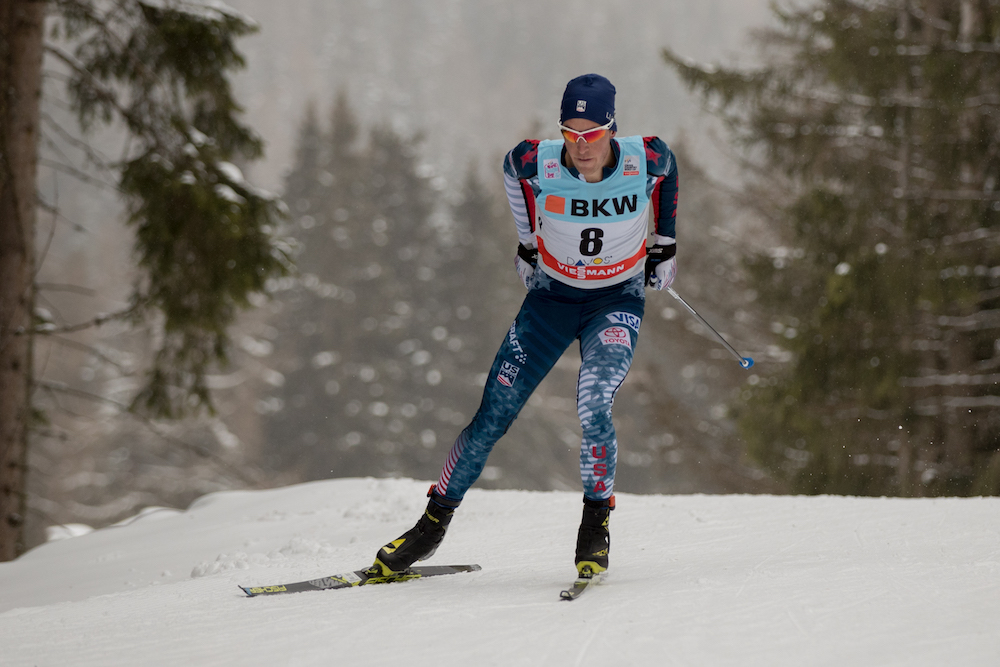
Tag: Devon Kershaw

  • Raising the Bar: Harvey Closes Out Olympics in Fourth in 50 k Classic; Patterson 11th

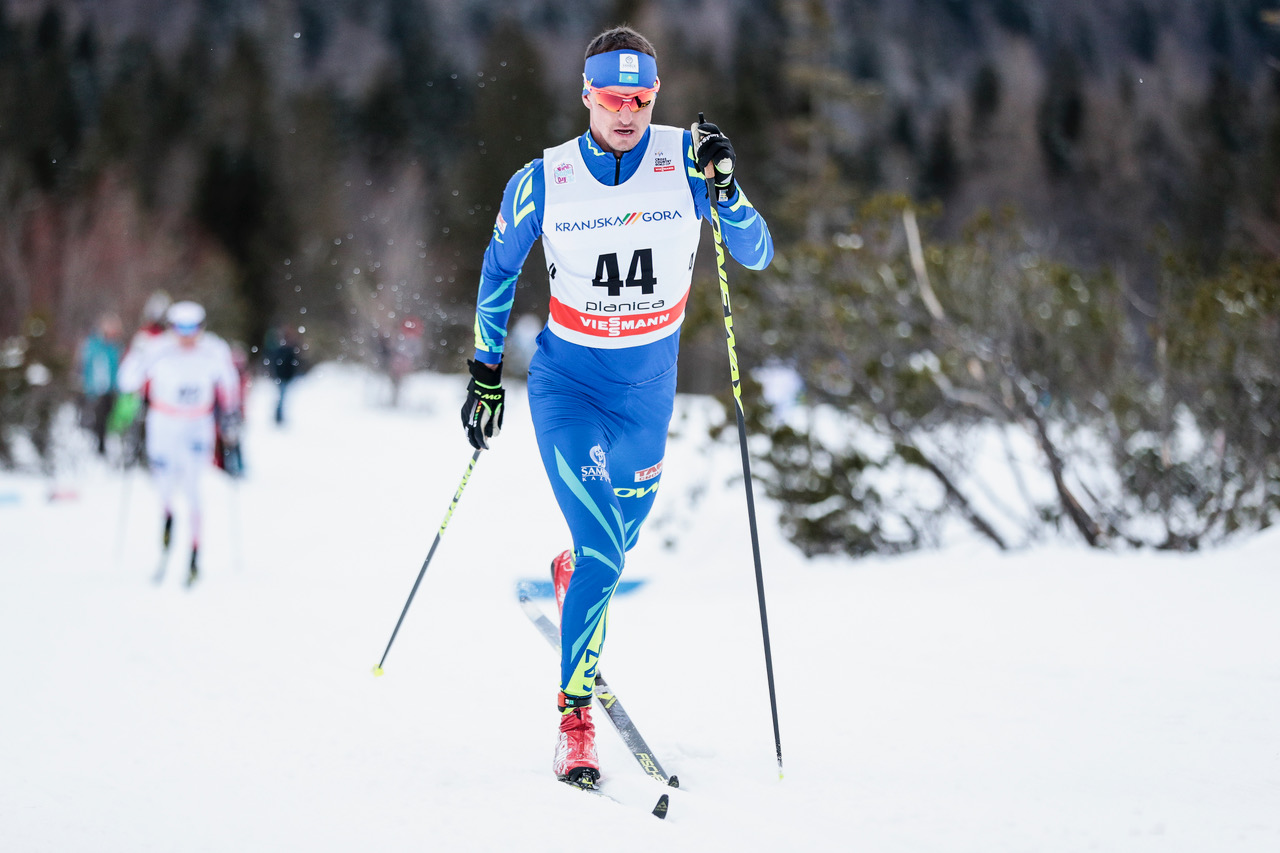
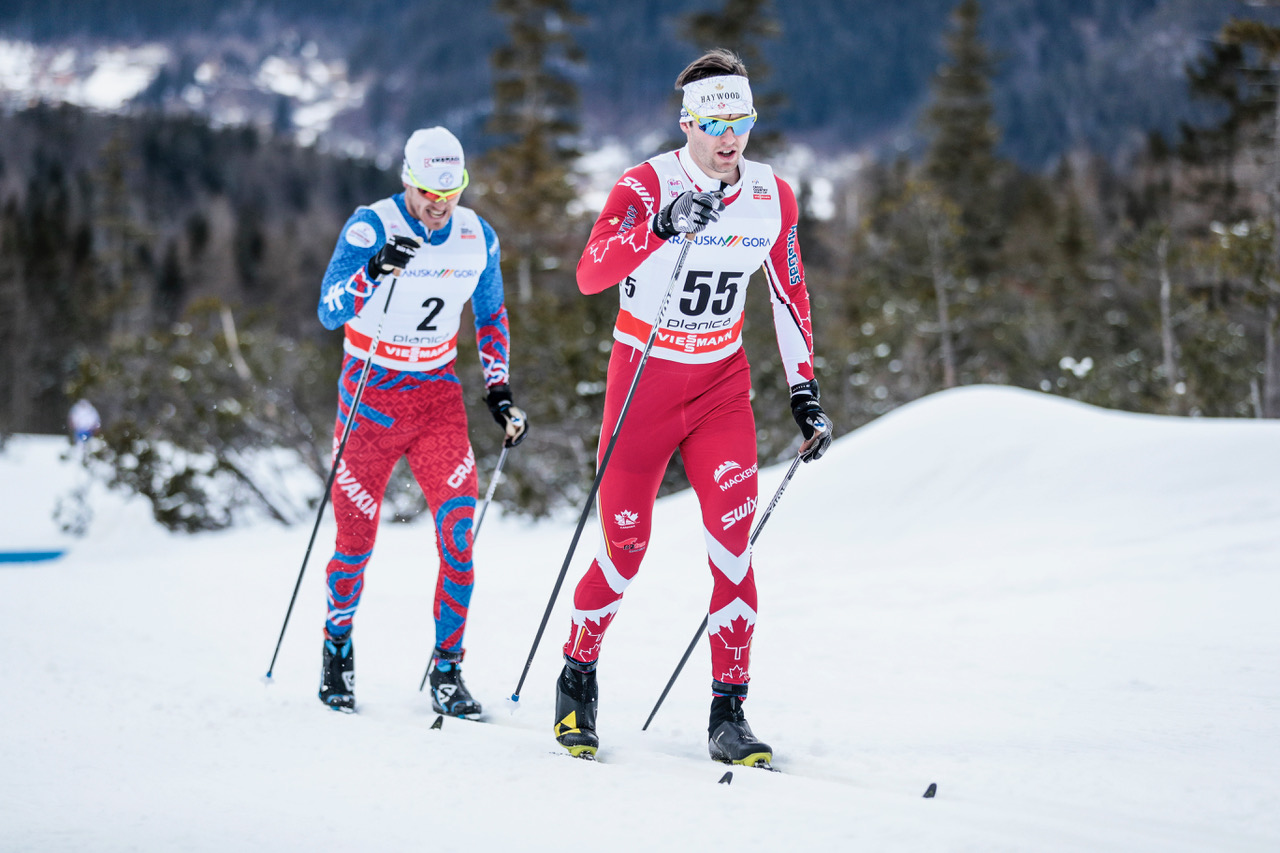
    Alex Harvey (2) follows Kazakhstan’s Alexey Poltoranin (5) at the front of the pack during the during the men’s 50 k classic mass start at the 2018 Pyeongchang Olympics in South Korea (Photo: Flyingpointroad)

    FasterSkier would like to thank Fischer Sport USA, Madshus USA, Concept2, Boulder Nordic Sport, and Swix Sport US for their generous support, which made this coverage possible.

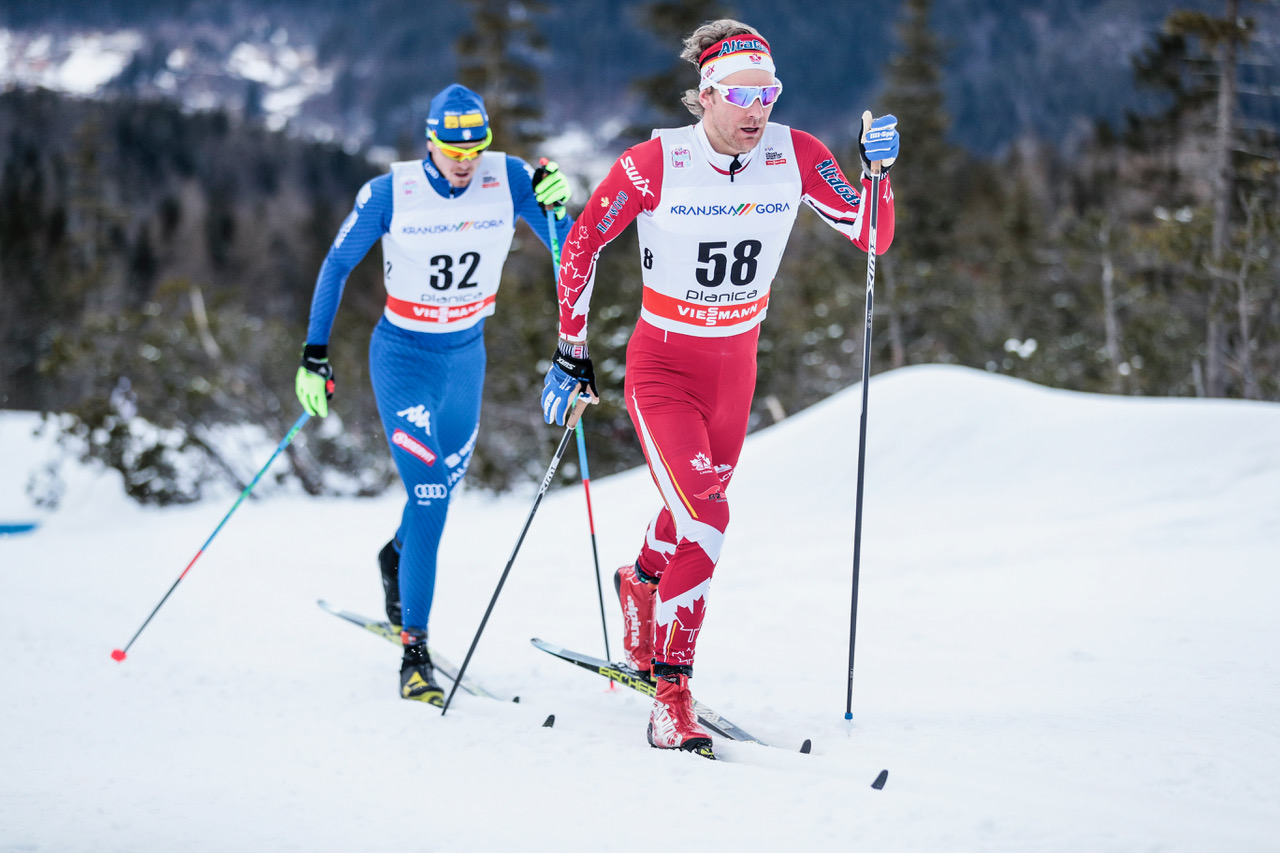
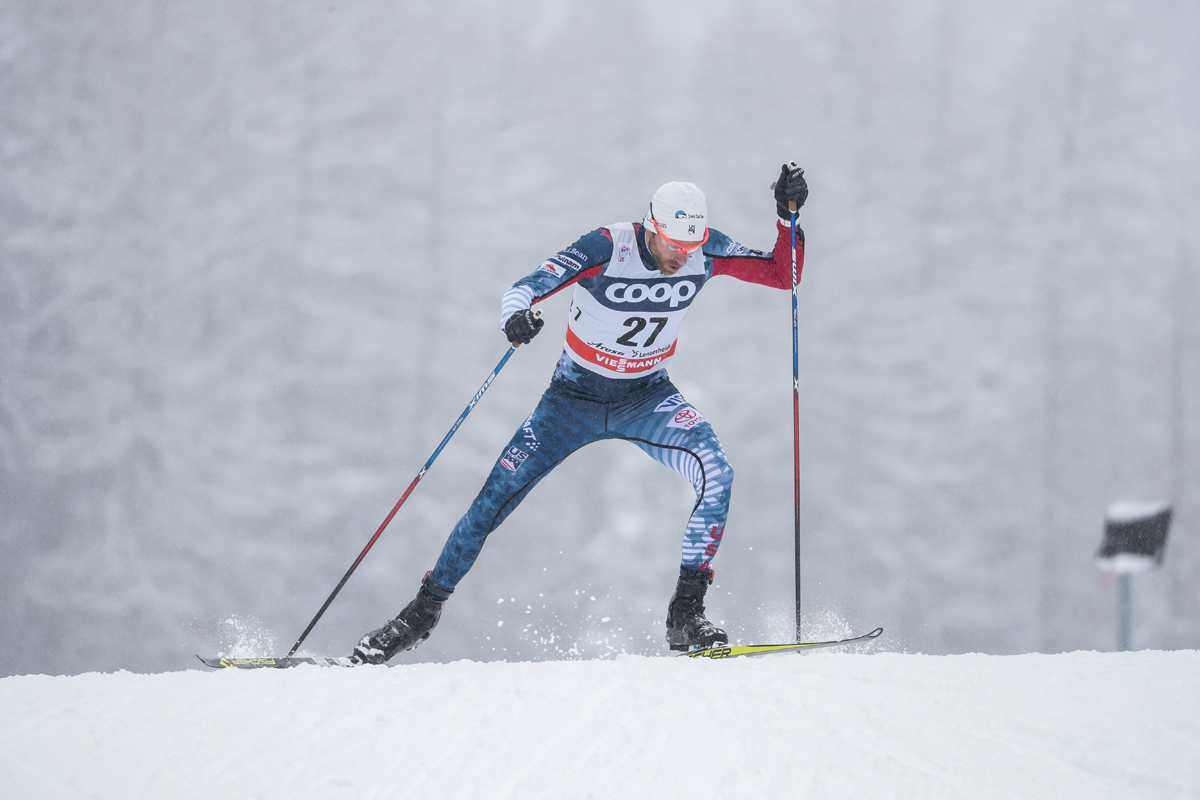
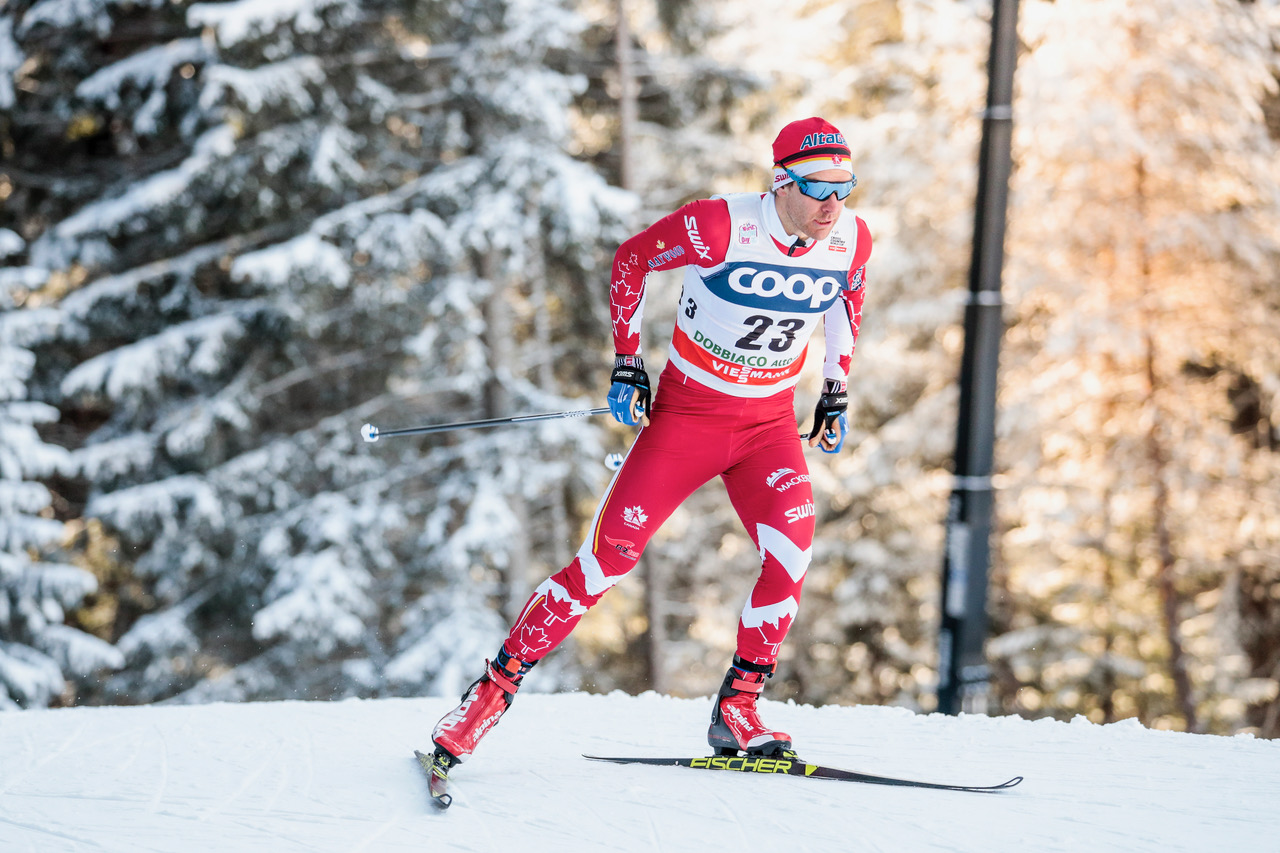
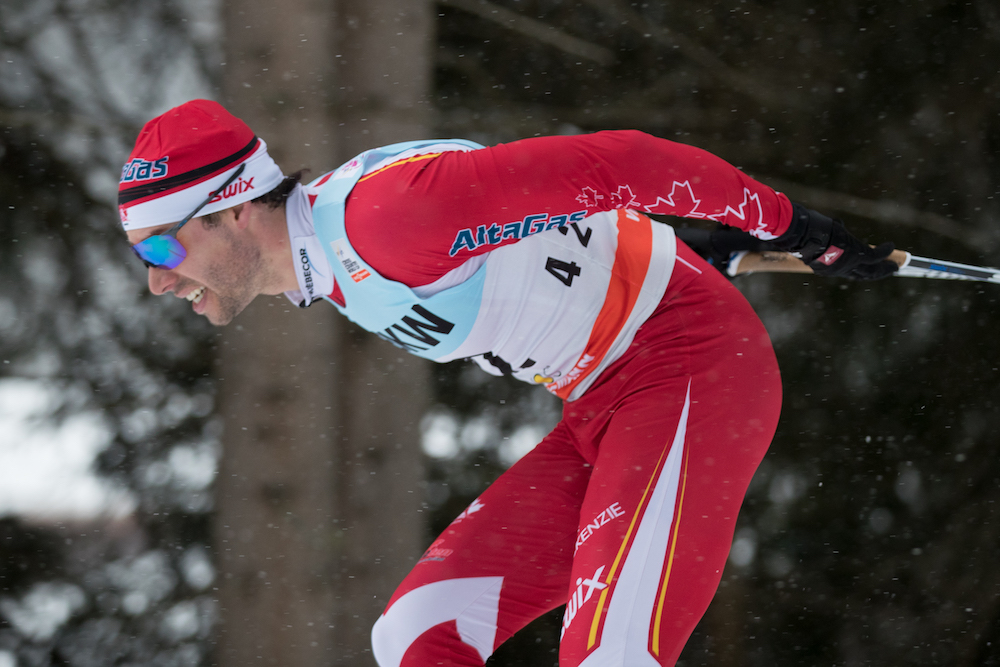
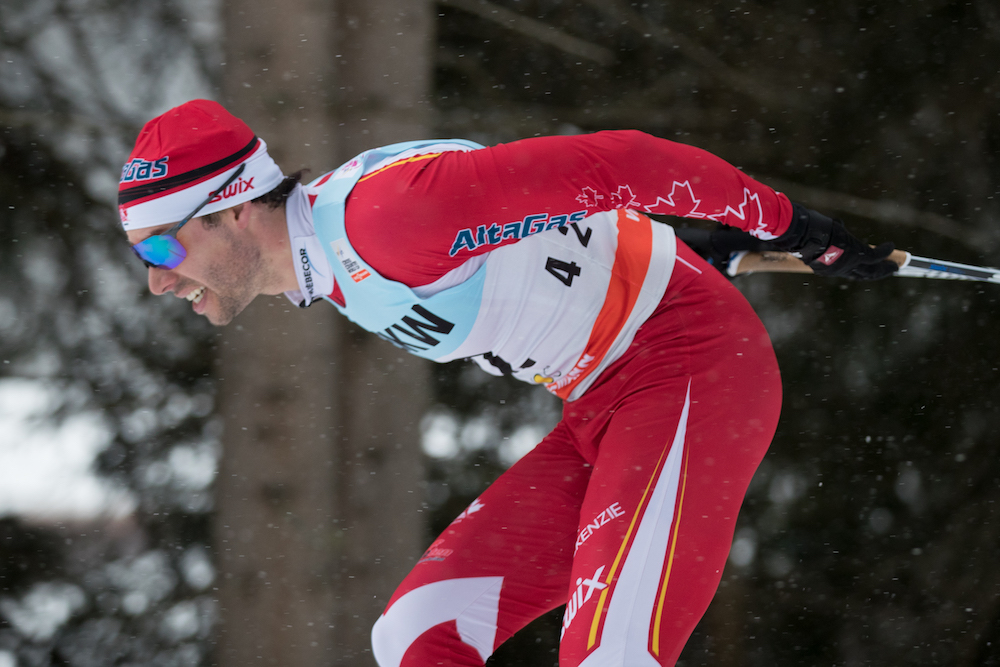
    PYEONGCHANG, South Korea —Not even three kilometers into the men’s 50-kilometer classic mass start on Saturday, Canada’s Devon Kershaw was an S.O.S. skier. The Canadian’s ski pole had snapped and he singlesticked for almost a kilometer before he received another. By the time Kershaw was handed a spare, many of the bibs he started with were striding away; any hope he may have harbored for a podium dashed away with them.

    But in his fourth and final Olympics, the 35-year-old Kershaw will be the first to tell you there were other reasons he committed to four more years of Winter Games preparation following Sochi.

    “I really stuck around to see if I could push Alex [Harvey] — I do push Alex in training — and to see him get an Olympic medal,” Kershaw told FasterSkier in person after Saturday’s race.

    PyeongChang is also, allegedly, Canadian Alex Harvey’s final Olympics. He has stated his plans to retire after the 2019 World Cup Finals in Québec City.

    “I was just so motivated to be around to see the first Olympic medal for men get hung around a [Canadian] neck. That’s what drove me every day,” Kershaw reflected.

    Canadians Devon Kershaw (r) and Graeme Killick during the men’s 50 k at the 2018 Pyeongchang Olympics in South Korea (Photo: Flyingpointroad)

    Coming into the 2018 Winter Games, Harvey, 29, was the favorite for a country that has yet to claim an Olympic medal in men’s cross-country. Harvey’s closest finish until Saturday was seventh in the men’s 15 k freestyle, just 12.5 seconds away from bronze. Earlier in the PyeongChang Games, the Québec native placed eighth in the men’s 30 k skiathlon, and 32nd in the classic sprint. Last year at World Championships in Lahti, Finland, Harvey was crowned the 50 k freestyle mass start world champ

    On Saturday in PyeongChang, while Kershaw waved one half of his ski pole in search of a whole, Harvey hammered away up front in an attempt to earn hardware for Canada.

    Harvey, Russia’s Andrey Larkov, and Norwegians Martin Johnsrud Sundby and Hans Christer Holund, skied in a chase pack behind Finland’s Iivo Niskanen, Kazakhstan’s Alexey Poltoranin and Russia’s Alexander Bolshunov, the three of which had gapped the field around the race’s halfway point.

    For close to 20 k, Harvey, Larkov, Sundby, and Holund appeared to be racing for fourth through seventh place. With less than 8 k to go, the four men began gaining ground on Poltoranin skiing in third.

    “We knew that going with Niskanen is such a hard pace and some of these guys would pay the price later on,” Harvey told FasterSkier of the lead group’s fast pace.

    As Harvey, Larkov and Sundby exchanged leads, the time gap to third shrank from 1 minute and 15 seconds at the 30 k mark to 26 seconds by the 43 k mark. Around 45 k, Poltoranin had slowed to a shuffle and stepped aside to let Larkov, Sundby, Harvey, and Holund pass.

    With 5 k to go, Harvey was visibly working hard. Afterwards, he told reporters he was unabashed about the demands he put on his body.

    “The last laps, my quads were cramping, my biceps, my calves, my stomach, too,” Harvey said. “You just focus on the process, the present, on your technique. If there’s somebody ahead of you, you just focus on his skis; just stay on his tails.”

    Three Norwegians leading the pack, with Hans Christer Holund (3), Emil Iversen (12) and Martin Johnsrud Sundby (4) looking to see if anyone else wants to take a turn up front during the men’s 50 k classic mass start at the 2018 Olympics in PyeongChang, South Korea. Canada’s Alex Harvey is directly behind Iversen. (Photo: FlyingPointRoad)

    Harvey skied within centimeters of Sundby, Larkov and Holund until the final headwall climb. As the four strode up to the hill’s halfway point, Larkov made his move. The Russian put close to three seconds on the Canadian and the Norwegians by the crest of the hill. That gap widened by the time they made their final descent to the stadium.

    Larkov propelled himself into third, 2:37.5 minutes after Niskanen crossed the line first in 2:08:22.1 hours. Second went to Russia’s Bolshunov (+18.7). Harvey sprinted into the finishing stretch with Sundby at his side and outlunged the Norwegian for fourth. All said and done, the Canadian missed a medal by just 6.1 seconds.

    In his final Olympics, Harvey’s emotions were heavy as he approached the press. Given the dark cloud that surrounds the 2014 Games, Harvey weighed in tacitly about Saturday’s 50 k podium, which included two Russians.

    “You want to believe in the new generation of Russians, so you’ve got to give them the benefit of the doubt, for sure,” Harvey said. “It’s so hard to be fourth with two Russians in front. I do believe these younger guys are doing it clean, but with everything we’ve seen … in the back of your mind there’s a bit of doubt.”

    After reflecting on all three of his Winter Olympics, Harvey hoped he and his teammates are a harbinger for Canada’s future cross-country scene (Harvey and Kershaw have been a staple for more than a decade, bringing Canada its best Olympic team result after placing fourth in the 2010 Vancouver team sprint).

    Canada’s Alex Harvey after giving his all in the men’s 50 k classic mass start at the 2018 Olympics in PyeongChang, South Korea. He placed fourth for the best individual Olympic result for a male Canadian cross-country skier. (Photo: FlyingPointRoad)

    “I think with my teammates, Devon [Kershaw], Ivan [Babikov], George [Grey], we were able to raise the bar for men’s cross-country skiing in Canada,” Harvey said. “… To realistically have expectations set for ourselves of believing in the podium, that was never done before, so I think that’s good for the future generations. To believe that it’s possible, to fight for the top ten, top five, week in [and] week out in the World Cup, at the World Championships, at the Olympics. That’s something that I’m really proud of.”

    Harvey’s fourth place now ranks as Canada’s best individual men’s cross-country performance at a Winter Games. The previous best individual result was Kershaw’s fifth in the Vancouver 50 k freestyle. On Saturday, Kershaw was the second Canadian across the line in 26th (+9:27.).

    As both close out their Olympic careers, they seem grounded. Not every Olympic dream has to end with medals. Rather, it’s about reaching the limits they push themselves to, once they are there. 

    “It’s a hard position to end up in,” Harvey said of his fourth place. “But it’s all I had today; there’s no regrets.”

    Patterson 11th for Best U.S. Men’s Result Since 1976

    Just as the U.S. women crushed a decades-old record earlier this week, American Scott Patterson raced to the best individual distance finish for a male U.S. cross-country skier since Bill Koch placed second and sixth at the 1976 Winter Olympics in Innsbruck, Austria. A first-time Olympian, Patterson placed 11th (+4:52.1), 15.2 seconds outside of the top 10 and 31 seconds back from Switzerland’s 15 k gold medalist Dario Cologna in ninth.

    “Early on, I was with that second chase pack just trying to ski relaxed, ski well,” the 26-year-old Patterson said.

    He had been skiing around 20th for the first 20 k, but moved up into 15th by the 23 k mark. In another 2 kilometers, Patterson was up to 13th. He pulled with Germany’s Andreas Katz and Russia’s Denis Spitsov — the 15 k freestyle bronze medalist — eventually dropping both.

    American Scott Patterson (29) racing to 11th in the men’s 50 k classic mass start at the 2018 PyeongChang Olympics in South Korea. In doing so, he tallied the best American men’s result in an individual Olympic cross-country race since Bill Koch placed second and sixth at the 1976 Olympics. (Photo: Flyingpointroad)

    Patterson worked his way past Norway’s Niklas Dyrhaug, Russia’s Alexey Chervotkin, and Poltoranin (who had been in contention for the bronze medal), before ultimately taking 11th.

    “It was exciting for the last 5 k when people were starting to dangle in front of me,” Patterson said. “Probably a couple of k out when I got Dyrhaug, and then coming by Poltoranin, too, who I think was skiing pretty far up there early on there in the race. I just wanted a few more k to get [Norway’s Emil] Iversen and get into the top 10, maybe Cologna, too.”

    The next American finisher on the day was Noah Hoffman in 33rd.

    “Every race has gotten better at these Olympics and I would have loved to have been top 30,” Hoffman, a two-time Olympian, said. “In Sochi I was looking for big results and here I haven’t been close to that and it’s disappointing, but I’ve processed all of that. It’s been four years since I’ve really skied the way that I’ve wanted to and I’m pretty just excited to be here. I’m living up these Games trying to take it all in.”

    American Noah Hoffman during the men’s 50 k classic mass start at the 2018 PyeongChang Olympics in South Korea (Photo: Flyingpointroad)

    Three more North Americans competed in Saturday’s race, with Canada’s Graeme Killick finishing 27th (+10:06.7), American Tyler Kornfield placing 48th (+16:14.4)  and Canada’s Russell Kennedy 49th (+16:54.5).

    Despite getting sick Friday, Killick entered the race and finished with his best performance of the Games.

    “My energy felt pretty decent and I’m really happy with that race,” Killick said. “I had to fight really hard for the last lap, because I had a group coming back on me and I was kind of in no man’s land. I’m really happy I was able to hold them off.”

    The 50 k start was Kornfied’s second race of his first Olympics. Just last month, the 26 year old made his World Cup debut. Reflecting on his recent experiences, Kornfield was perceptive of the idea that racing takes time.

    Canada’s Graeme Killick (48) leading his teammates Russell Kennedy (49) and Devon Kershaw in the men’s 50 k classic at the 2018 Olympics in PyeongChang, South Korea. They went on to place 27th, 49th and 26th, respectively. (Photo: FlyingPointRoad)

    “I didn’t get the opportunity to race the World Cup until this year and a lot of times that got me down, frustrated me and felt like I wasn’t progressing with a lot of the other athletes in the nation and internationally as well,” Kornfield said. “I just had to be patient and know that eventually it’s going to click.

    “It’s been a breakthrough season, but it hasn’t been above and beyond what I’ve done in the past,” he added. “So it’s just being patient and waiting your turn and knowing that it’s going to come, you just need to put your best race you can each day.”

    Kennedy will head to a training camp in Japan, before returning to PyeongChang for the 2018 Winter Paralympics March 9-18 as one of Brian McKeever’s guides for the visually impaired races.

    “I was feeling really good, I just didn’t have it in the end, the last two laps. I blew up pretty hard,” said Kennedy, a 26-year-old first-time Olympian. “It was still fun, and I, you always learn something from a 50 about what your body can do and where the limit is.”

    The final cross-country 2018 Olympic event, the women’s 30 k classic mass start, takes place Sunday.

    Results

  • Saturday Olympic Rundown: Niskanen Takes 50 k in Gutsy Solo Effort, Harvey 4th, Patterson 11th

    Saturday Olympic Rundown: Niskanen Takes 50 k in Gutsy Solo Effort, Harvey 4th, Patterson 11th

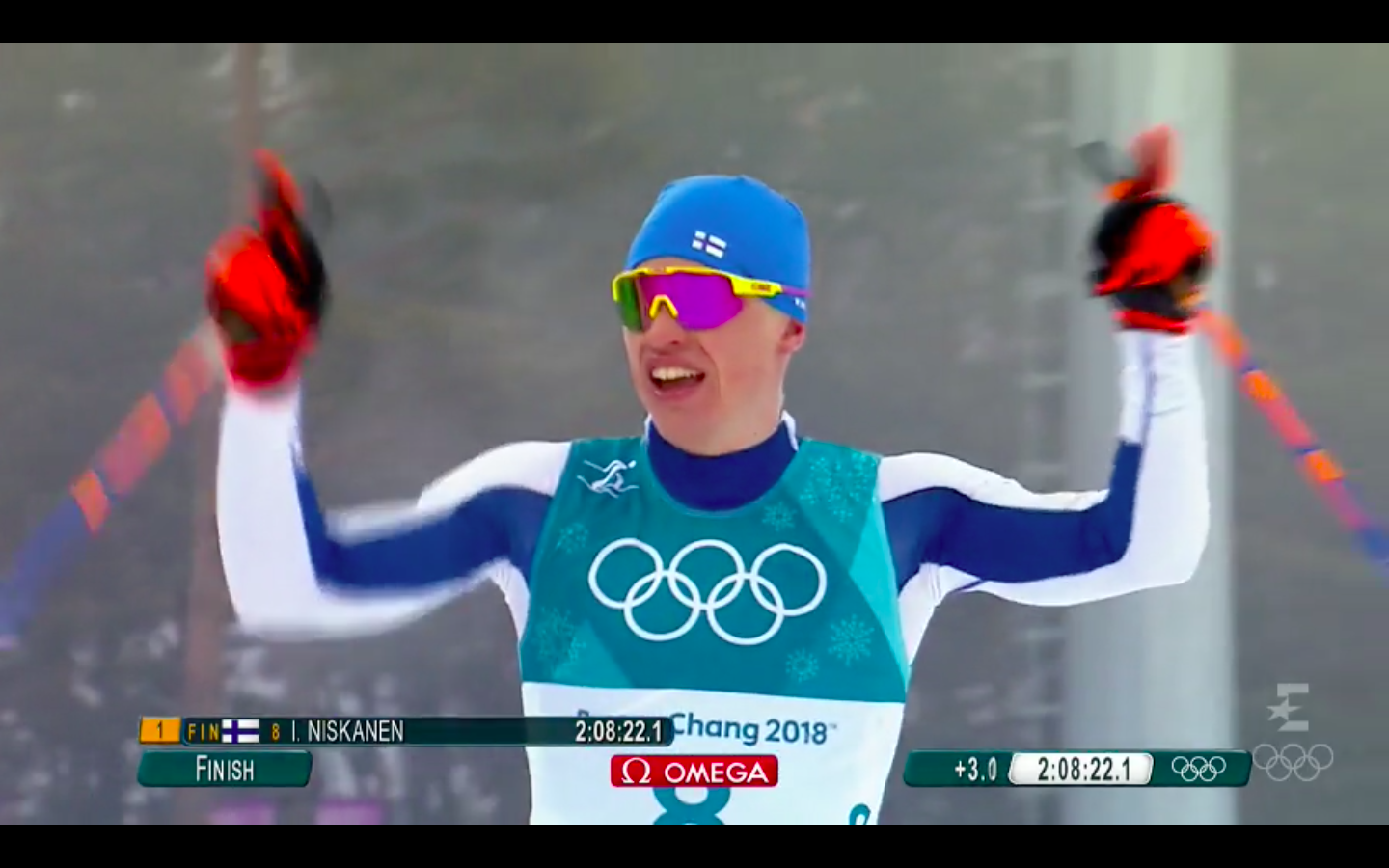
    A very exhausted Iivo Niskanen celebrates his 50 k gold medal crossing the finish line at the 2018 Olympics. (Eurosport screencap)
    A very exhausted Iivo Niskanen of Finland celebrates his 50 k gold medal crossing the finish line at the 2018 Olympics. (Eurosport screencap)

    FasterSkier would like to thank Fischer Sport USAMadshus USAConcept2Boulder Nordic Sport, and Swix Sport US for their generous support, which made this coverage possible.

    ***

    2018 Olympics (PyeongChang, South Korea): Men’s 50 kilometer mass start classic

    International report

    North American report

    Iivo Niskanen earned his gold medal.

    The 26-year-old Finn, skiing in his second Olympics, broke away from a well-credentialed chase pack at the 17-kilometer mark of Saturday’s Olympic 50-kilometer mass start classic race, then skied a courageous race from there to take the gold nearly 90 minutes of racing later.

    He had some company, as Olympic Athlete from Russia Alexander Bolshunov made an equally gutsy move to bridge the gap up to Niskanen by 36 k. But Niskanen used a well-timed surge on the final uphill to come round Bolshunov with 1.1 k to go, and take the convincing win by the finish. Behind him, Olympic Athlete from Russia Andrey Larkov made a similar move on the final hill 2 ½ minutes later to come clear of a chase group and take the bronze.

    But let’s back up. A field of 69 racers began the 50 k classic at 2 p.m. local time under cloudy skies, which ultimately gave way to heavy mist and light snow as the floodlights came on around 3:30 in the afternoon. It was the 23rd running of a race first held at the 1924 Olympics in Chamonix. Boldface names such as Bjørn Dæhlie, Gunde Svan, and Thomas Wassberg are among its historical champions. A Finn had not won this race since Kalevi Hämäläinen in 1960.

    Norwegian Martin Sundby led a 23-racer pack through the end of the second lap, roughly 17 k and 42 minutes into the race. Niskanen was in seventh at this point, 2.5 seconds off the lead.

    Less than a kilometer later, with nearly two-thirds of the race still ahead of him, Niskanen headed to the front. Moving quickly, he soon opened up a small gap over much of the rest of the field. Roughly five minutes later, around the 19-k mark, he began pushing the pace in earnest.

    The field began to spread out almost immediately. Niskanen was closely followed by Alexey Poltoranin of Kazakhstan.

    Niskanen and Poltoranin skied together throughout lap 3, their advantage soon growing to 20 seconds over the chase group. By 26 k, they had a gap of 25 seconds to Bolshunov in third.

    At 27 k, Bolshunov set off on a courageous solo effort to reel in the two athletes in front of him, leaving Sundby to lead the chase group. Seven minutes later, Bolshunov had made up 25 seconds over less than three kilometers; he moved around Poltoranin, and set out to track down Niskanen.

    Finally, at the 36 k mark, after roughly 10 k of solo work, Bolshunov had caught up to Niskanen. The two men skied together throughout the fifth and penultimate lap, Niskanen still in the lead until he finally moved aside, all but forcing Bolshunov to come round him and take the lead.

    Bolshunov led through the second half of lap five, and appeared to be pulling away while Niskanen seemed to be tiring from the solo effort as well as fighting slick skis. As the two came through the stadium for a final time, 42 k into the race, they were over a minute clear of a fading Poltoranin, and more than two minutes up on the Sundby/Alex Harvey/et al. chase group. The final order of the medals was still up in the air, but gold and silver, in some order, seemed very likely to go to the two men in the breakaway.

    Bolshunov led through the stadium the final time, where he did not avail himself of a final ski exchange. Behind him, Niskanen pulled over for new skis. Bolshunov, sensing the Finn’s absence, immediately put in a surge, and gapped Niskanen by roughly 11 seconds early in the final lap. But 8.3 k per lap is a long way, and Niskanen steadily worked to close the gap without panicking. By the 44 k mark, 2.3 k into the final lap and with a full 6 k yet to go, Niskanen had pulled back even with the Olympic Athlete from Russia.

    The two men skied together for the next 4+ kilometers. Bolshunov appeared stronger, and is the better sprinter of the two, but Niskanen had experience. And fresh skis.

    Suddenly, Niskanen went. With 1.1 k to go, going up the final hill for the final time, he surged hard, and immediately opened up a gap of several meters over his rival. Behind him, Bolshunov stood up as he crested the hill, nearly coming to a stop.

    An exultant Niskanen skied in unchallenged, crossing the finish line in a final time of 2:08:22.1. A deflated Bolshunov followed 18.7 seconds later for silver, slamming his pole to the ground as he crossed the finish line.

    Behind them, Poltoranin had been caught midway through the final lap, ultimately fading to finish 15th. Coming into the final uphill it was Sundby, fellow Norwegian Hans Christer Holund, Harvey, and Larkov, four men fighting for one final spot on the podium. Much as Niskanen had done 2 1/2 minutes earlier, Larkov pushed ahead on this hill, opening up a gap that he held all the way to the finish. He took third, 2:37.5 behind Niskanen.

    On the CBC broadcast, former Canadian coach Justin Wadsworth, who had publicly questioned the validity of the Russians’ performance in Sochi soon after the 50 k skate concluded, exclaimed of Larkov, “I’m not sure where he got the power to run up that hill like that.”

    A few seconds later, Harvey outlunged Sundby for fourth, +2:43.6 to +2:43.7. Holund was sixth (+2:50.1), Daniel Rickardsson of Sweden another minute back in seventh (+3:50.4), Czech Martin Jaks eighth (+4:10.5), Switzerland’s Dario Cologna ninth (+4:21.1), and Norwegian Emil Iversen tenth (+4:36.9).

    One spot later, Scott Patterson led the way for the Americans in eleventh (+4:52.1), after consistently skiing in the teens throughout much of the race. It is the best men’s Olympic distance result in generations.

    For the Americans, Noah Hoffman followed in 33rd (+10:42), and Tyler Kornfield was 48th (+16:14.4).

    Harvey’s fourth led the way for Canada. He was followed by Devon Kershaw in 26th (+9:27.3), Graeme Killick one spot back in 27th (+10:06.7), and Russell Kennedy in 49th (+16:54.5).

    The final race at this year’s Winter Olympics is the women’s 30 k classic mass start, tomorrow afternoon local time.

    Results

  • ‘No Regrets’ Canada’s Harvey Races to 7th in Olympic 15 k; Patterson 21st

    Canada’s Alex Harvey racing to seventh in Friday’s 15 k freestyle at the 2018 Olympics in PyeongChang, South Korea. It was his best individual result in his third Olympics. (Photo: FlyingPointRoad)

    FasterSkier would like to thank Fischer Sport USAMadshus USAConcept2Boulder Nordic Sport, and Swix Sport US for their generous support, which made this coverage possible.

    PYEONGCHANG, South Korea —Twelve-point-five seconds. Roughly half the amount of recommended handwashing time to prevent norovirus; a protocol followed by those attending the XXIII Winter Olympic Games. 12.5 seconds. The amount of time between Canada’s Alex Harvey and his first Olympic medal.

    For anyone who has devoted most of their life — at 29 years old, Harvey is in his third Olympics — to one particular goal, it can be devastating if that point isn’t reached. Beyond devastation, complete consumption.

    In cross-country ski racing, that consumption frequently manifests itself in finding seconds, ‘If I had poled harder here, I could have gained ground there…’. Each second is slid under a microscope for exhaustive inspection.

    There’s a sense of risk involved with taking a step back from that magnifying lense.  It can be uncomfortable to objectively look at what could have been versus what the results sheet actually read.

    Regardless of which light the men’s 15-kilometer freestyle race is examined under, only three walked away with medals. Switzerland’s Dario Cologna with gold in a time of 33:43.9, Norway’s Simen Hegstad Krüger with silver, 18.3 seconds behind him, and Denis Spitsov taking the bronze, 23 seconds out of first.

    Harvey had it in his cards to make the podium. A handful of strong performances in the 15 k skate — he recently placed second at the last World Cup before the Olympics, the 15 k freestyle mass start in Seefeld, Austria — pepper the Quebec native’s nordic career.

    The same statistic, however, held true for France’s Maurice Manificat prior to the end of Friday’s race. The Frenchman has finished in the top three of World Cup 15 k freestyle races a number of times. In Friday’s Olympic 15 k, he finished fifth (+27.0).

    The list of other potential podium finishers goes on. Norway’s Martin Johnsrud Sundby, Finland’s Matti Heikkinen, Sweden’s Marcus Hellner. Throughout Friday’s event, Harvey was in the mix. At the halfway point, he was racing in fourth, 1.9 seconds behind third place.

    However, 6 k later, he had dropped back to seventh. Thirty-five seconds out from the win and 12.5 seconds out of third in seventh place was ultimately where he would finish the day. But in a post-race interview with FasterSkier, for Harvey, owning the race outweighed its immediate dissection.

    “There’s no regrets,” Harvey said. “I went out the way I had to go to be on the podium. Just missed it a bit in the end.

    “It’s the same level of competition as we saw at World Championships,” he continued. “We’ve been able to do it at the World Championships so there’s no reason why we can’t do it at the Olympics, but it’s a really competitive, deep field.”

    Canada’s Alex Harvey racing to seventh in Friday’s 15 k freestyle at the 2018 Olympics in PyeongChang, South Korea. (Photo: FlyingPointRoad)

    Last year in Lahti, Finland, Harvey became a world champion in the 50 k freestyle mass start. The finish was his first individual world champs win after he and his Canadian teammate Devon Kershaw won the 2011 World Championships classic team sprint in Oslo, Norway.

    Five days ago, in the 30 k skiathlon that opened men’s cross-country racing at the Games, Harvey placed eighth. He went on to race the individual classic sprint on Tuesday, where he missed qualifying in 32nd.

    “It’s possible to be on the podium…but I need to have a really special day, just like I need to have a special day to win a medal at the World Championship,” Harvey said. “I’ve been lucky enough to have that four or five times over my career, so I know it’s possible.”

    After Harvey, the next-best North American in Friday’s 15 k was American Scott Patterson in 21st (+1:44.1).The 26-year-old Idaho native explained that for the first half of the race, he questioned whether he was even fighting for a top 30.

    Scott Patterson leading the U.S. men’s team in 21st in the 15 k freestyle at the 2018 Olympics in PyeongChang, South Korea. (Photo: FlyingPointRoad)

    “Honestly, I didn’t think that I was racing very well for 7.5 k. I was kind of suffering out there a bit,” Patterson told FasterSkier. “But I think [in the] later laps, I realized I was actually skiing all right and kind of found a little more energy towards the end. I got a good ride off [Norway’s Hans Christer] Holund for maybe a kilometer or so towards the very end, which was good to see.”

    The 15 k is Patterson’s second-career Olympic race after he raced to 18th in the skiathlon last Sunday. When asked what was behind his top performances this week, Patterson’s answer encompassed both physical and mental response. At last months’ U.S. nationals in Anchorage, Alaska, where he grew up and trains, Patterson had been battling residual symptoms of bronchitis, which he said cleared up fairly well in time for the Games. Considering these were his first Olympic races, his expectations for results were not exceptionally high.
    “Probably weird to say, but I feel like the Olympics are pretty low pressure for me,” Patterson said. “Unlike Jessie [Diggins], I’m not expected to win a medal. I’m just kind of out here to put my best foot forward. So I mean, you race in the U.S. and for someone like me, it’s kind of they expect you to win, so you better go and win. Here, if you get 40th everyone forgets. If you get 20th, everyone remembers for a couple of days, happy about it, and then they forget.”

    Canada’s Graeme Killick racing to 38th in the men’s 15 k freestyle at the 2018 Olympics in PyeongChang, South Korea. (Photo: FlyingPointRoad)

    Canada’s Graeme Killick was next on the results sheet in 38th (+2:39.4). At 28 and in his second Olympics, Killick explained that while the skiathlon (where he placed 45th) had left him hurting, Friday’s 15 k progressed much better, a good omen for the yet-to-come men’s 50 k classic mass start — his main focus for the Games.

    “The pursuit [skiathlon] was a real struggle after 5 k. It was kind of 25 k of pain after that, but today I felt better as the race progressed,” Killick explained. “I think that shows that the shape is coming, especially in the longer distances and the 50 k, which is probably my main goal for the Games. So I’m getting some good feelings going into the last races here.”

    American Erik Bjornsen en route to 41st in the men’s 15 k freestyle at the 2018 Olympics in PyeongChang, South Korea. (Photo: FlyingPointRoad)

    Erik Bjornsen, also in his second Olympics, was the second American in 41st (+2:44.7). Though he had entered the race with intent of skiing in the top 20, his body did not respond the way he had hoped.

    “I’m not going to try to pace it for a 50th place finish so I tried to go out as if I was going to ski in the top 20,” Bjornsen, 26, said. “I quickly realized I wasn’t going to be able to do that and I just kind of struggled the last 10 k.

    “Body’s not quite where I’d like it to be,” he added. “That’s the way it goes sometimes.”

    Also for the U.S., Noah Hoffman finished 16.6 seconds behind Bjornsen in 48th (+3:01.3), and Tyler Kornfield placed 74th (+4:34.0) in his first Olympic race.

    Kornfield, who turned 27 last Friday, was picked to start the 15 k in place of U.S. Ski Team Development Team member Paddy Caldwell, who was out sick

    “Paddy has got a low-grade cold, and we are just resting him until we feel like it’s safe we push him,” U.S. coach Matt Whitcomb said on the phone after Friday’s race. “Unfortunately he is probably gonna be out for the relays. … The nice thing about the Olympics is you have this Team USA poly-clinic downstairs, and you can just go get tested for everything. It’s no flu, no norovirus, it’s just a cold.”

    American Tyler Kornfield in his first Olympic race, the 15 k freestyle on Friday in PyeongChang, South Korea. He finished 74th. (Photo: FlyingPointRoad)

    Kornfield said he learned he would start the 15 k a couple of days ago.

    “This kind of was a bit of a surprise,” Kornfield said. “Ever since I found out, I’ve just been trying to stay relaxed, stay in the moment and get ready for a good one.”

    Kornfield is also slated to start the men’s 50 k classic mass start on Feb. 24, but the opportunity to jump into another Olympic distance race prior to that was one that he embraced.

    “I was just trying to not get too worked up, not get too stressed, look around at some of the guys around me and know that they’re some of the best in the world and the best that I can do is go as hard as I can and put my best race forward,” said Kornfield, a Fairbanks, Alaska, native who won this year’s U.S. nationals 30 k classic mass start to help punch his ticket to the Games.

    “I put it all out there and yeah, the result is what it is,” he continued. “I was a bit back, but I went as hard as I could and that was the race plan, and I think I did that.”

    Competing for Canada, Knute Johnsgaard finished 69th (+4:04.6) and Devon Kershaw was 71st (+4:17.6).

    Canada’s Devon Kershaw in the men’s 15 k freestyle at the 2018 Olympics in PyeongChang, South Korea, where he finished 71st. (Photo: FlyingPointRoad)

    For Kershaw, a four-time Olympian, it was his first time finishing outside the top 60.

    “I felt good warming up and everything, but it just wasn’t there at all today and I had no energy whatsoever in my body and was just on the struggle bus the whole way,” he said after. “I made a mistake and went the wrong way in the lap lane, like I went around the back of the stadium when I should’ve cut [through] so that’s like 30-40 seconds extra already that I didn’t need to lose some more so it’s just one of the worst skate races of my career so I’m pretty disappointed.”

    The women’s 4 x 5 k relay is next on the Olympic schedule, starting at 6:30 p.m. Korea time on Saturday (10:30 CET; 4:30 EST). The men’s 4 x 10 k relay will follow on Sunday.
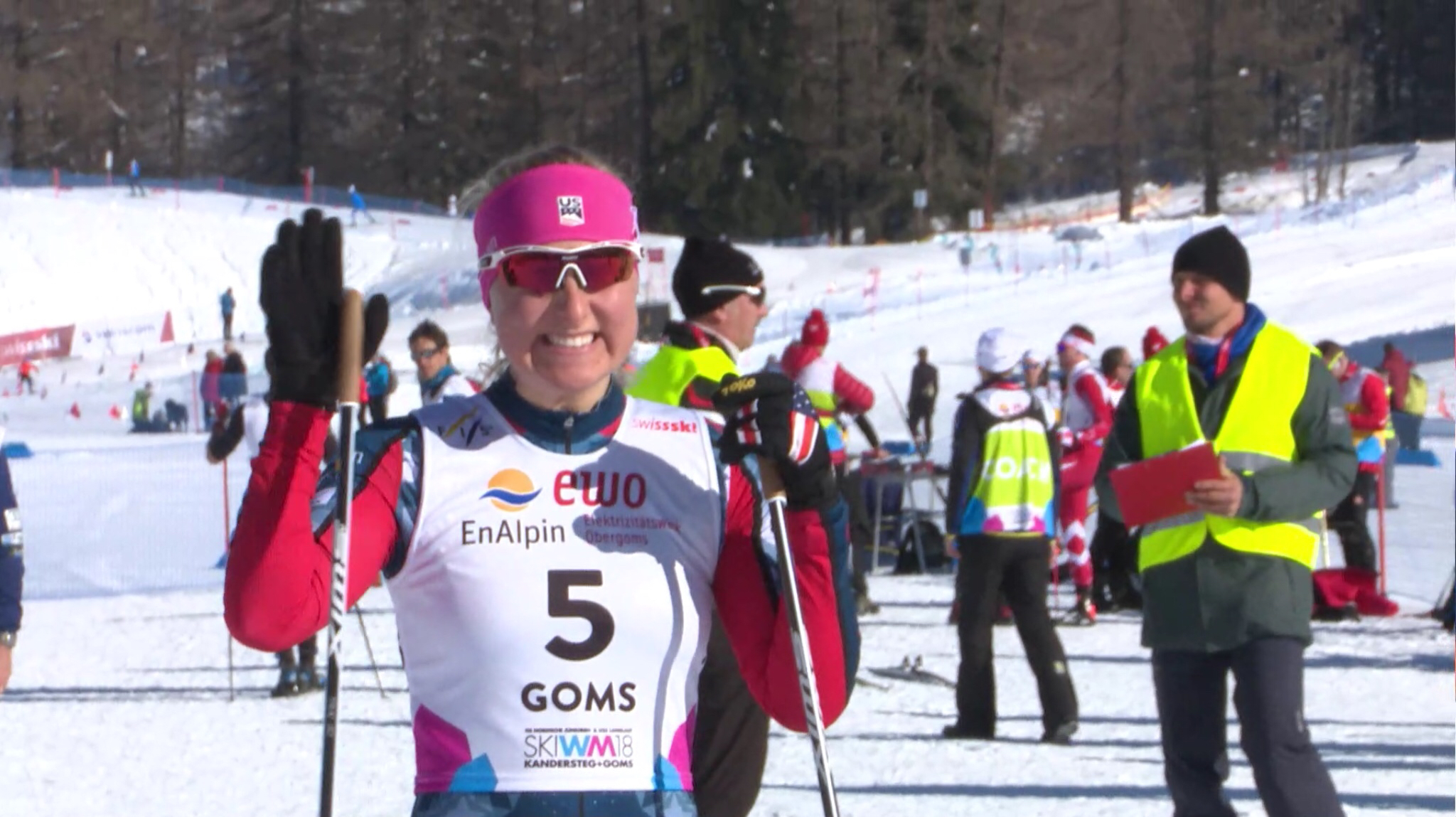
    Women’s relay start lists were posted Friday. The U.S. has entered Sophie Caldwell, Sadie Bjornsen, Kikkan Randall, and Jessie Diggins. For Canada, the women’s relay order is Dahria Beatty, Emily Nishikawa, Cendrine Browne, and Anne-Marie Comeau.

    Results

  • Friday Olympic Rundown: Historic 15 k Gold Three-Peat for Cologna; Harvey 7th, Patterson 21st

    Dario Cologna of Switzerland put his name in (more) Olympic history books today, winning the 15 k skate. (Photo: Flying PointRoad)
    Dario Cologna of Switzerland put his name in (more) Olympic history books today, winning the 15 k skate. (Photo: Flying PointRoad)

    FasterSkier would like to thank Fischer Sport USAMadshus USAConcept2Boulder Nordic Sport, and Swix Sport US for their generous support, which made this coverage possible.

    2018 Winter Olympics (PyeongChang, South Korea): Men’s 10 k freestyle

    International report

    North American report

    Dario Cologna has shown that he meant business this season, winning another Tour de Ski title as well as the last World Cup before the Olympics. But it was still remarkable that he came out and won the 15 k skate today, by a dominant margin of 18.3 seconds over Norway’s Simen Hegstad Krüger. At 31 years old, Switzerland’s Cologna becomes the first man to ever win three 15 k Olympic gold medals in a row. The first came in the freestyle race in Vancouver in 2010, the second in the classic race in Sochi in 2014, and now another gold today.

    “A lot has come together for me today,” Cologna – who was in tears after he finished – said in a postrace interview with Switzerland’s SRF broadcaster, according to a translation. “A lot of hard work behind this. For me to come back this year, and that it now was enough for another Olympic gold, I can hardly describe that… Most of all I wanted to win a medal, and now it’s even a golden one. I have had a lot of successes in the past, so I don’t have to prove anything in that regard, but you do sports for those moments, to win. So of course I am very proud to be able to win a gold medal for Switzerland. An Olympic medal is always a little more special and a little more beautiful than other victories.”

    Simen Hegstad Krueger pushed his way onto another Olympic podium, earning silver in the 15 k skate. (Photo: FlyingPointRoad)
    Simen Hegstad Krueger of Norway (bib 60) pushed his way onto another Olympic podium, earning silver in the 15 k skate. (Photo: FlyingPointRoad)

    Krüger, who is at his very first Olympics, picked up his second medal of the Games after winning the 30 k skiathlon to open the men’s cross-country ski competitions. In third place (+23.0) was 21-year-old Denis Spitsov of Russia, who placed fourth in the 30 k.

    Fourth place went to Norway’s Martin Johnsrud Sundby (+24.9) who was still denied in his quest for individual Olympic gold, and fifth to France’s Maurice Manificat (+27.0). Rounding out the top six was Norway’s Hans Christer Holund (+34.5).

    Canada’s Alex Harvey was in the fight for the medals in the middle of the race, but faded over the final kilometers to end the day seventh (+35.5). Behind him, Graeme Killick finished 38th (+2:39.4), Knute Johnsgaard 69th (+4:04.6), and Devon Kershaw 71st (+4:17.6).

    The United States was led by Scott Patterson in 21st place (+1:44.1). Erik Bjornsen was close behind Patterson in the opening kilometers but slipped to 41st place by the finish (+2:44.7). Noah Hoffman placed 48th (+3:01.3), and Tyler Kornfield 74th (+4:34.0).

    University of Utah alumnus Snorri Einarsson, racing for Iceland, placed 56th (+3:21.7). Dartmouth College alum Tucker Murphy of Bermuda finished 104th (+9:21.8) and Canada-based Kequyen Lam of Portugal 113th (+20:50.2).

    Results

    -Harald Zimmer contributed

    Scott Patterson (U.S. Ski Team/APU) racing to 21st in the 15 k skate at the 2018 Olympics. (Photo: FlyingPointRoad)
    Scott Patterson (U.S. Ski Team/APU) racing to 21st in the 15 k skate at the 2018 Olympics. (Photo: FlyingPointRoad)
  • Krüger Surprises with Skiathlon Gold; Harvey 8th; Patterson 18th

    Norway swept the medals in the first men’s cross-country race of the 2018 Olympics in PyeongChang, South Korea, with Simen Hegstad Krüger (c) taking gold, Martin Johnsrud Sundby (l) silver and Hans Christer Holund (r) bronze. (Photo: FlyingPointRoad)

    FasterSkier would like to thank Fischer Sport USAMadshus USAConcept2Boulder Nordic Sport and Swix Sport US for their generous support, which made this coverage possible.

    PYEONGCHANG, South Korea — First a quick parable every skier has heard: never give up. From coaches, teachers and certainly parents, it’s always the same. Never give up. For those on the receiving end of the timeworn parable, it can sound like the annoying advice of elders; something that only applies in the later years. Easily brushed off words that might apply later, never now.

    Early in the men’s 30 k skiathlon at the 2018 Olympics in PyeongChang, South Korea. (Photo: FlyingPointRoad)

    During Sunday’s blustery and downright frigid 30-kilometer skiathlon, the first men’s cross-country race of the 2018 Olympic Games, that parable came into play not more than fifteen seconds after the start. Sixty-eight skiers shot off the line and merged into the classic ski tracks — the front-row athletes, the likes of Canada’s Alex Harvey, Norwegians Martin Johnsrud Sundby and Johannes Høsflot Klæbo, Switzerland’s Dario Cologna, and Finland’s Iivo Niskanen, skied clean up the first climb.

    Caught up in the striding, double poling and the tumbling was Norway’s 24-year-old Simen Hegstad Krüger, bib 7, waving his arm as he lay prone on the snow. Skier down — broken pole. There really didn’t seem much to it other than it was bib 7. Bib 7 slow to get up, slow to unstrap his mangled pole, slow to get into the tracks and single stick for tens of meters. Bib 7. Krüger.

    Then the coach arrives, the pole becomes functional, the game is on. By then, Niskanen, a renowned classic skier, had accelerated the pace. From the front, the pack was pulled apart like taffy. From the back of the mass of skiers, where Krüger now ventured, a sea of 67 other bib numbers waited to be picked off. Whatever the phrase “never give up” is in Norwegian, it most certainly rattled around in Krüger’s mind.

    “It’s my first-ever Olympic race and it started in the worst possible way,” Krüger said during the post-race press conference. “I just had to try to stay calm and use some time to catch up because I think if I had skied too fast there after my crash, I don’t think I would have any power when I caught up.”

    Let’s ascend from the bottom up on Krüger’s World Cup results pyramid. He has 28 World Cup top-30 results, 12 of which are top 10’s. Of those top 10’s, he has two podiums: a third place in the fifth stage of the 2017 Tour de Ski, the 10 k skate in Toblach, Italy, and another win in Toblach this past December in the 15 k skate.

    Surely this is no spoiler — bib 7 won the Olympic 30 k skiathlon on Sunday in 1:16:20 hours in burley conditions. On top of that, consider this: he’s a first-time Olympian, this was his first Olympic race and first championship gold.

    Let’s get back to Niskanen, who is a no-joke classic skier. Of all his major wins, including Finland’s National Junior Championships (with multiple titles in 2012 and 2013), you have to comb through to find a freestyle win. There are three skate wins, none on the World Cup. And here’s another striking piece of information, according to the International Ski Federation (FIS) database, Niskanen has never won off of Finnish soil except for the 15 k classic at 2014 U23 World Championships in Val di Fiemme, Italy.

    Finland’s Iivo Niskanen leads Switzerland’s Dario Cologna, Canada’s Alex Harvey and several Norwegians during the classic portion of the men’s 30 k skiathlon at the 2018 Olympics in PyeongChang, South Korea. (Photo: FlyingPointRoad)

    PyeongChang is in South Korea, seven time zones from Finland.

    Number crunching in sport is nothing new. Somebody in the Norwegian head-shed must have known Niskanen’s skewed geographic preference.

    Off the Finn went with the skiathlon favorites all in tow. By all accounts, Niskanen set a punchy pace. Nearly through 10 k, the 26 year old owned it. No doubt he knew his chances were slim if he didn’t break the pack and stretch out a solo lead before the transition to 15 k of skate technique. For a bit after 10 k, Sundby took some pulls up front. But in what became a familiar classic leg trend, the 13 skiers, separated by no more than five seconds, zipped down the banked corner before the 15 k mark gear exchange led by none other than Niskanen.

    The Finn had done the job of cutting the lead pack down to a manageable number, but he hadn’t built a gap from which he could nurse a cushion during the skate leg. In being the fox for at least 12 hounds, Niskanen had burned through his high-pace fuel. Fourth out of the transition, 1.3 seconds behind Klæbo in first, he was back in 18th just under 4 k later, 9 seconds out of first. He ultimately finished the skiathlon in 19th place, 1:14.2 minutes behind the winner.

    A quick swap of the skis and the poles and the 21-year-old young gun from Norway, Klæbo, was first through the 15 k time check. Harvey followed next with a tight grouping from first to 13th within 9.5 seconds, tightening pole straps on the run and readying for the skate leg throwdown.

    Norway’s Simen Hegstad Krüger (7) leads Germany’s Lucas Bögl during the skate leg of the men’s 30 k skiathlon on Sunday at the 2018 Olympics in PyeongChang, South Korea. (Photo: FlyingPointRoad)

    Here’s the thing: the 14th skier through the exchange, 15.2 seconds back was Krüger. This athlete was in 67th at 0.88 k, and improved to 57th 1.5 k later. Fast and steady, Krüger would reel in the front group. By 17.25 k, he was within a few seconds of lead.

    “As soon as I changed skis, then suddenly my legs felt great again,” Krüger said at the press conference. “I knew that now all possibilities are open again and just tried to start fresh.”

    The skate leg’s dynamics proved the opposite of the classic. There was no Niskanen-type breaking the wind. At moments it appeared Harvey would surge, or Cologna, or Sundby, or Holund, or Great Britain’s Andrew Musgrave.

    Krüger hung tight, never taking the leadership reins.

    I knew that the skating part is my strongest part and I had to try to save some power the first two laps there and just stay with the group,” Krüger reflected.

    The plot thickened as the k’s ticked off. With the likes of Sundby in the pack, Krüger couldn’t risk a finish-line sprint. In his third Olympics, Sundby is still seeking his first Olympic gold (after taking bronze in the Sochi 30 k skiathlon and silver in the 2010 Vancouver 4 x 5 k relay).

    Before Sundby, 33, could dictate the closing chapter of Sunday’s race, Krüger stung the group with a power surge around 26.25 k and quickly gapped the chasers by 9.1 seconds. A little over a kilometer later, Krüger had opened up a 22.8-second lead.

    “I know that there’s some quite fast skiers in the group, so I knew that my chance was to get rid of them before the finish,” Krüger said of his tactics. “When I got some meters there I had to go for it and don’t look back.”

    Norway’s Simen Hegstad Krüger celebrates after winning gold in the men’s 30 k skiathlon on Sunday at the 2018 Olympics in PyeongChang, South Korea. (Photo: FlyingPointRoad)

    He never looked back. It was an exclamation-point Olympic gold medal win, and he beat Sundby in second by 8 seconds and another Norwegian teammate Hans Christer Holund in third by 9.9 seconds. 

    Although Krüger kept his eyes focused ahead, Sundby said during the press conference that he and Holund were looking around for potential chasers.

    “For sure, we have a really clear team tactics,” Sundby explained of why he and Holund did not attempt to close the gap on Krüger. “If one of us gets seconds from the rest of the pack, the others cannot try to catch him, so me and Hans Christer, I think we were waiting for Alex, Dario, Maurice [Manificat], everybody else to try to catch Simen. I think both of us were a bit surprised that nobody really tried.”

    Both Sundby and Holund acknowledged that when the gap grew to 20 seconds, they felt the team pact to not chase down a potential Norwegian gold medalist had been honored. On the final hill climb before the finish Sundby and Holund went.

    “I don’t think either me or Martin wanted to have Alex or Dario, we didn’t want to sprint with them in the last few hundred meters so when it was like 1 1/2 kilometers [to go], I think [Sundby] said or I said, ‘Now we just go,’ ” Holund said at the press conference. “And we did that in the hill.”

    Sundby settled for silver and Holund bronze, 2.8 seconds clear of Denis Spitsov, representing the Olympics Athletes of Russia, in fourth.

    “For sure, for us it was a bit frustrating, we also wanted to go for the gold for sure,” Sundby said. “But our team tactics was clear today and it’s just amazing that we really pulled this [podium sweep] off.”

    “… Simen is a really strong guy, not just physical but also mental,” said the 28-year-old Holund, also in his Olympic debut. “I think we should give credit to Simen that he was actually daring to break loose on the last lap there. I don’t think many people would have the confidence to do that and that’s why he deserves that gold medal.”

    Norway’s Simen Hegstad Krüger (7) gets a big hug from one of his teammates after he won gold in his first Olympic race, the men’s 30 k skiathlon, on Sunday at the 2018 Winter Games in PyeongChang, South Korea. (Photo: FlyingPointRoad)

    After the race, Krüger acknowledged that he owed some gratitude to his silver and bronze Norwegian teammates.  

    “I think both the guys there on both sides [of me] could’ve gone faster when I got some meters, but they let the others do the work,” noted Krüger. “So I think I owe them a big thanks for not catching up with me when I went for it.”

    Spitsov, 21, also in his first Olympics, finished fourth, ahead of France’s Maurice Manificat in fifth (+14.2), Cologna in sixth (+25.1), Musgrave in seventh (+25.7), and Harvey, who edged Martin Jaks of the Czech Republic, for eighth (+33.4 and +33.8, respectively). Klæbo, one of the pre-race favorites, finished 10th (+43.4).

    Harvey, who had been eyeing the skiathlon, said after the race the best skiers had won.

    Canada’s Alex Harvey (4) leading France’s Jean-Marc Gaillard (9) and Finland’s Iivo Niskanen (8) during the skate leg of the men’s 30 k skiathlon at the 2018 Olympics in PyeongChang, South Korea. Harvey went on to finish eighth. (Photo: FlyingPointRoad)

    “I think the three best guys won today,” Harvey told FasterSkier after. “It was a fair race and they were just stronger than anybody else in the world.”

    Asked about the race’s defining breakaways in the final kilometers, he said he just didn’t have the legs to react.

    “I was feeling good until Sundby and Holund went and then I just couldn’t go,” Harvey said.

    After Harvey’s top 10, the next Canadian across the line was Devon Kershaw in 36th (+3:35.3). Graeme Killick finished 45th (+5:19.6), and Knute Johnsgaard was lapped and did not finish.

    Kershaw noted the high pace during the classic leg curtailed his later-race efforts. 

    I was really shocked that the classic went out as hard as it did,” Kershaw told FasterSkier. “And, after that, you’re in survival mode … It was really, really brutal today. “You know, it wasn’t the coldest day I’ve done, but it was for sure the windiest race I’ve ever competed in. When you’re having a bad day, that wind really tears at your mind, so I struggled.”

    For the U.S., Scott Patterson led the way in 18th (+1:07.5). In his first Olympics, Patterson’s moxy was palpable. The the 26-year-old, first-year U.S. Ski Team member began the skate leg in 27th position, 47.7 seconds behind the leaders.

    U.S. Ski Team member Scott Patterson (c) on his way to 18th place in his first Olympic race, the men’s 30 k skiathlon, at the 2018 Winter Games in PyeongChang, South Korea. (Photo: FlyingPointRoad)

    Immediately as Patterson skated away, his powerful strides were evidence he’d only be picking off spots in the final 15 k.

    “The last couple skiathlons I’ve done it’s been a little bit rough classic,” Patterson told FasterSkier after. “Then you switch to skating and it’s like, ‘OK, now I know what I’m doing’, and it definitely felt like that today.”

    A year ago at the pre-Olympic World Cup in PyeongChang, Patterson finished ninth in the 30 k skiathlon. Besides that result, his best individual World Cup finish was 27th in the 15 k freestyle mass start at the most recent World Cup on Jan. 28 in Seefeld, Austria.

    As he completed the third of four skate laps, Patterson could see Sundby’s lead group 34 seconds ahead of him.

    “Everyone was giving us splits off to that front group and it was like, ‘OK, maybe we can make it, maybe we can make it,’ ” Patterson reflected, smiling. “But then you’re also like, ‘They’re going to start charging real soon.’ So I was kind of optimistic, but also, when you’re leading that pack, it’s like, I want this pack to move up, but I don’t want to be the one making it move up because that’s a lot of work.”

    He credited France’s Jules Lapierre, who finished 15th, and Italy’s Francesco de Fabiani, who placed 20th, for helping to pull the group along.

    “I ended up leading the final sprint hill quite a few times, but [Lapierre] did a lot of work out on the course, which was super helpful…,” Patterson said. “We were able to kind of pull apart our group a bit and pick off a few of the guys struggling from the lead pack, like we got Iivo Niskanen right at the end, which I was pretty psyched about.”

    Erik Bjornsen (U.S. Ski Team) racing to 42nd in the men’s 30 k skiathlon at the 2018 Olympics in PyeongChang, South Korea. (Photo: FlyingPointRoad)

    Also for the U.S., Erik Bjornsen finished 42nd (+4:34.7), Paddy Caldwell 51st (+6:58.1), and Noah Hoffman 54th (+7:08.7).

    “I really enjoy both courses and I think the classic portion was maybe a little trickier with the wind today,” Caldwell said of his race. “I was just telling Reese [Hanneman] that I thought that things were pulling apart more in the classic side. You know, if you lose the group in front of you and then you catch the wind, it gets really tough. I think that the time gaps today are probably going to be quite, quite large because of that, but we had awesome skis on both sides [classic and skate]. I was trying to maintain position in classic and pick off people where I could in skate.”

    In his second Olympics, Hoffman also said the wind played a factor.

    “Honestly, it was gusty and there were sections where you’d come into the wind and just be brought to a dead stop,” Hoffman said. “But overall, it could have been a lot more of a grind because we had this warm spell the last couple days and the snow was quite fast out there. It was an uphill wind in terms of the general direction, and so for the most part the downhills were slower, but still tucking and then the uphills, you got a little bit of a boost … My body wasn’t there today.”

    Olympic cross-country racing continues Tuesday with the men’s and women’s classic sprints.

    Results

  • Sunday Olympic Rundown: Krüger Leads Norwegian Skiathlon Sweep; Peiffer Surprise Winner in Biathlon Sprint

    Norway’s Simen Hegstad Krüger celebrates after winning gold in the men’s 30 k skiathlon on Sunday at the 2018 Olympics in PyeongChang, South Korea. (Photo: FlyingPointRoad)

    FasterSkier would like to thank Fischer Sport USAMadshus USAConcept2Boulder Nordic Sport and Swix Sport US for their generous support, which made this coverage possible.

    ***

    2018 Winter Olympics (PyeongChang, South Korea): Men’s 30 k skiathlon

    Full report

    It was an improbable move: Norway’s Simen Hegsted Krüger attacked a few kilometers from the finish of the men’s 30 k skiathlon, and the rest of the field let him go. Krüger didn’t let up and at one point had a lead of 25 seconds with just about two kilometers to go, all the more impressive because he had crashed just meters into the race and broken a pole, having to then make up 35 to 40 seconds to get back to the lead pack.

    Norwegian teammates Martin Johnsrud Sundby and Hans Christer Holund tried to close the gap to Krüger in the final kilometer, but the 24 year old hung on for a 8-second win. Sundby was second and Holund was third (+9.0) to give Norway a medal sweep.

    Denis Spitsov of the Olympic Athletes of Russia, also in his first Olympics, finished fourth, 12.7 seconds back. Maurice Manificat of France was fifth (+14.2), Dario Cologna of Switzerland sixth (+25.1), Andrew Musgrave of Great Britain seventh (+25.7), and Alex Harvey of Canada edged Martin Jaks of the Czech Republic for eighth (+33.4 and +33.8, respectively). Johannes Høsflot Klæbo of Norway, one of the pre-race favorites, finished 10th (+43.4).

    For the U.S., Scott Patterson led the way in 18th (+1:07.5). Erik Bjornsen finished 42th (+4:34.7), Paddy Caldwell 51st (+6:58.1), and Noah Hoffman 54th (+7:08.7).

    After Harvey’s top-10 finish, the next Canadian across the line was Devon Kershaw in 36th (+3:35.3). Graeme Killick finished 45th (+5:19.6), and Knute Johnsgaard was lapped and did not finish.

    University of Utah alum Snorri Einarsson finished 56th (+7:13.9) in Iceland’s best result in Olympic cross-country skiing since 1994.

    Results

    ***

    Arnd Peiffer on his way to winning the 10 k sprint at Alpensia Biathlon Center today. The German was one of just four men to shoot clean in windy conditions. (Photo: FlyingPointRoad)

    Biathlon: Men’s 10 k sprint

    Full report

    With the race favorites each picking up a bevy of penalties, Germany’s Arnd Peiffer skated to a gold medal in the men’s 10 k sprint on Sunday. Both he and silver medalist Michal Krčmář of the Czech Republic shot clean, and were two of only four men in the field to do so. With that performance, Peiffer — whose lone senior Championship-level individual medal came when he won the World Championships sprint back in 2011 — made Germany two-for-two in biathlon races so far after Laura Dahlmeier’s win in the women’s sprint on Saturday.
    The top of the results sheet was tight, with Krčmář finishing just 4.4 seconds slower than Peiffer. Krčmář only has one World Cup podium to his name, coming last season. Dominik Windisch of Italy finished with the bronze medal (+7.7) despite one missed shot, and edged out Austria’s Julian Eberhard (+8.4) seconds, who also had one penalty.

    Erlend Bjøntegaard of Norway was fifth (+17.4) with two penalties, and Benedikt Doll (+17.6) and Simon Schempp (+21.4) gave Germany an impressive three spots in the top seven.

    Those pre-race favorites? Martin Fourcade of France missed three shots in prone and despite cleaning standing, couldn’t make up enough time on the final loop for a top result. He finished eighth, +22.1. Johannes Thingnes Bø of Norway missed three shots in prone and then another in standing, finishing 31st, +1:12.7.

    For the U.S., Lowell Bailey cleaned prone and then collected one penalty in standing to end the day 33rd (+1:15.6). Tim Burke had four penalties to land 47th (+1:47.5), and Leif Nordgren will join them in Monday’s pursuit after finishing 58th (+2:10.2) with two missed shots. Sean Doherty missed four of his five prone targets and was unable to come back from that blow, finishing 65th (+2:16.4).

    The Canadians also suffered shooting woes. with Nathan Smith able to limit the losses to one penalty and finish 44th (+1:43.5). He is the only team member to make the pursuit. Brothers Scott and Christian Gow missed four and three shots, respectively, to earn the unlucky honor of being the first two men outside the pursuit cutoff in 61st (+2:14.0) and 62nd (+2:14.7). Brendan Green cleaned prone but then missed three shots in standing to finish 82nd (+3:09.2).

    The women’s 10 pursuit and men’s 12.5 k pursuit are set for Monday at 5:10 a.m. and 7 a.m. Eastern Standard Time.

    Results

    Pursuit start lists: WomenMen 

  • Cross Country Canada Names 11 to Olympic Team

    Cross Country Canada Names 11 to Olympic Team

    On Monday, Cross Country Canada announced its 2018 Olympic cross-country ski team for the upcoming Winter Games in PyeongChang, South Korea. The team includes 11 athletes: seven men and four women.

    According to the press release, “each of the 11 athletes met the standard for nomination to the Canadian Olympic Committee under Cross Country Canada’s Internal Nomination Procedures for the 2018 Olympic Games, and in the process form a talented squad replete with veteran leadership and podium potential.”

    “This is a team that has evolved from a group of talented athletes excited to be on the start line into a group of determined high-performers focused, and confident, in their ability to achieve international podium results,” Cross Country Canada (CCC) High Performance Director Tom Holland said in the press release. “Led by our men’s team of Devon, Alex and Lenny over the last two quadrennials, we are in the podium hunt, and will continue to push towards getting Canada back on the Olympic podium at the Nordic venue.”

    As the press release points out, Canada has three Olympic medals in cross-country skiing, starting when Beckie Scott earned the gold medal at the 2002 Salt Lake City Games. She added a silver Olympic medal to her collection in 2006, placing second in the team sprint with Sara Renner. Also in 2006, Chandra Crawford won gold in the Olympic skate sprint in Turin, Italy.

    The athletes nominated are:

    Name (Hometown)

    • Dahria Beatty (Whitehorse, YK)
    • Cendrine Browne (Saint-Jérôme, QC)
    • Jesse Cockney (Yellowknife, NWT)
    • Anne-Marie Comeau (Saint-Ferréol-les-Neiges, QC)
    • Alex Harvey (Saint-Ferréol-les-Neiges, QC)
    • Knute Johnsgaard (Whitehorse, YK)
    • Russell Kennedy (Canmore, AB)
    • Devon Kershaw (Sudbury, ON)
    • Graeme Killick (Fort McMurray, AB)
    • Emily Nishikawa (Whitehorse, YK)
    • Lenny Valjas (Toronto, ON)

    The coaches nominated are:

    Name (Hometown)

    • Ivan Babikov (Canmore, AB)
    • Louis Bouchard (Quebec City, QC)
  • Harvey Second to Cologna in Seefeld 15 k; Bjornsen 9th, Hamilton 12th

    Harvey Second to Cologna in Seefeld 15 k; Bjornsen 9th, Hamilton 12th

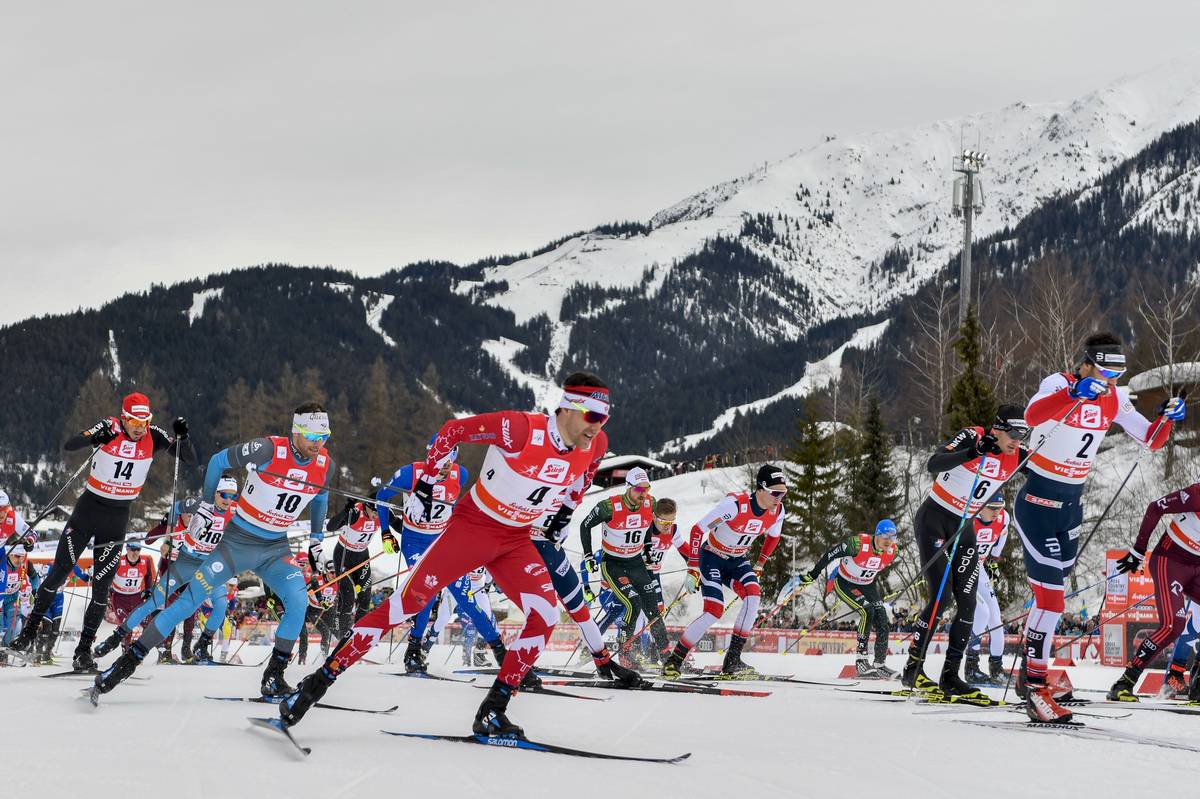
    Early in the men’s 15 k freestyle mass start at the World Cup in Seefeld, Austria, with Canada’s Alex Harvey (4), Switzerland’s Dario Cologna (6) and Norway’s Hans Christer Holund (2) skiing near the front of the pack. (Photo: Salomon/NordicFocus)

    SEEFELD, Austria — A gray sky shadowed over the Tirol ski trails on Sunday. A similarly cool tension built on the course as slightly more than 100 racers warmed up for the mass start of the men’s 15-kilometer freestyle mass start.
    With five minutes to spare, spectators hurried to stake their spot, some carrying steaming-cheese-fondue-filled baguettes from the Le Gruyère cheese tent: Switzerland’s stamp on the Austrian snow.

    For those on site, the Le Gruyère brand would not be the only Swiss name to eventually sweep through the crowd.

    Marked by the announcer, Switzerland’s Dario Cologna was watched and pointed to by many as he made his way to the four-track start lane.

    By the time the Cologna had clipped into his skis, other names had been announced over the mic, including Canada’s Alex Harvey and Norway’s Martin Johnsrud Sundby. Of Sundby’s 22 individual World Cup distance victories, two came in 15 k freestyle races.

    Then there was France’s Maurice Manifcat — standing in this season’s red distance leader’s bib — as well as Russia’s Sergey Ustiugov, who had won six individual World Cup distance races and was seeking another on Sunday in Seefeld.

    At the sound of the gun, it appeared the Russian was claiming the chase for his own. Within the first two minutes of the race, Ustiugov in bib 7 had moved to the front of the pack.

    Following him was Manificat in second, Norway’s Daniel Stock in third, Finland’s Iivo Niskanen in fourth, and three Norwegians: Hans Christer Holund in fifth, Didrik Tønseth in sixth and Sundby in seventh.

    Hanging around ninth position was Harvey. American Erik Bjornsen, who started in bib 30, had put himself in the mix in 16th.

    As the group forged further into the first lap, Ustiugov toyed with the field. He led up the two major climbs on the men’s 3.75 k course. Just before the corner back toward the stadium at the end of Lap 1, he put in a surge and appeared to gain a small gap.

    “Ustigov started really fast,” Harvey told FasterSkier after. “I was like ‘Oh man, maybe he is going to go away from the pack,’ but then it got kind of it a bit more mellow and I was able to reposition myself and from then it was better.” 

    As the group made their descent at the end of the lap, Ustiugov was sucked back in by the rest of the field. Heading into the second of four laps, Manificat, Niskanen, Sundby, Cologna, and Harvey were all hot on the Russian’s heels. Around 4 k as they climbed the first hill once again, Holund came on the attack. He passed Ustiugov to the left and took control of the pace.

    Holund maintained his lead through the next descent and uphill. Manificat held tightly to second and Cologna third. France’s Jean-Marc Gaillard had moved up to fourth. Harvey had lost ground and dropped back to 10th.

    As the racers rounded the turn into their third lap, Holund came through in first. The Norwegian had sunk his teeth — but, it turned out, not deep enough.

    Holund’s Norwegian teammate Simen Hegstad Krüger skied just behind him and shadowed his every move on the climbs and descents of Lap 3. With Krüger, came Cologna, Manificat, and Harvey — around 10 k, the Canadian had maneuvered himself back into fourth.

    By the time the group pressed out for their fourth and final lap, Holund had been swallowed up. Tønseth now had the lead, followed by Ustiugov and Germany’s Thomas Bing. Then came Holund, Cologna and Harvey.

    Just 2 seconds out of first was Bjornsen in 19th with less than 4 k to go.

    As the group began to climb, Austria’s Max Hauke tore to the front, glancing behind him on the way up. By the following downhill, however, he was replaced by Holund and Harvey.

    In another 2 k, Holund was still in the lead, though unable to shake Harvey from the back of his skis, along with Cologna, Gaillard, Sundby, and Tønseth. Bjornsen had passed 10 skiers and was up to ninth, 2.8 seconds out of first.

    The field had barely separated by the final climb and a pack of 10 powered together for the final push. At first it was Tønseth in the lead, but then, halfway up the hill, Cologna made his move.

    The Swiss skier increased in speed and tempo. As he did, so did the crowd’s recognition that the win was about to be won.

    Harvey and Sundby began a mad dash to keep up with the flurry of Cologna’s black suit. But by the time the Swiss skier cornered back toward the stadium for the last time, he was alone. Cologna crossed the finish line first in a time of 31:37.9 minutes.

    The win marks Cologna’s 14th individual World Cup victory and third in the 15 k freestyle discipline, which will be featured at this year’s 2018 Olympic Winter Games (as an individual start) in PyeongChang, South Korea.

    “With the fast pace from the start I wasn’t quite ready for it, but I moved up when I could and knew that the final big hill would be the place to try and win the race,” Cologna said, according to an International Ski Federation (FIS) press release. “It’s good to know that since the Tour de Ski my shape is still at a high level and I’m happy heading into the Olympics.”

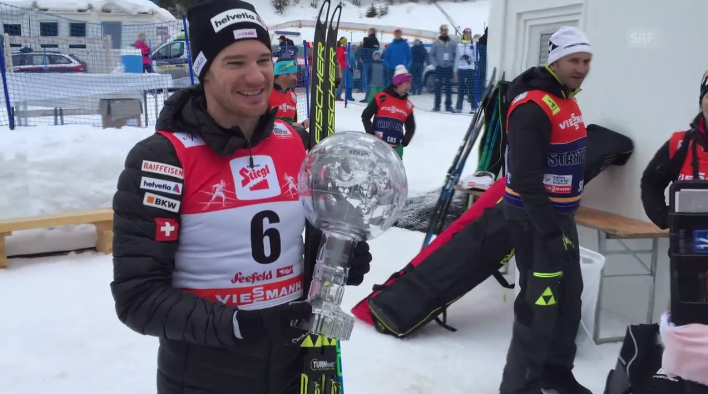
    Switzerland’s Dario Cologna being awarded the 2014/2015 Overall World Cup Crystal Globe on Sunday in Seefeld, Austria. (Screenshot: SRF broadcast)

    Cologna won the 2018 Tour de Ski. On Sunday, he was also retroactively awarded the 2014/2015 Crystal Globe for leading the Overall World Cup season (after Sundby had to return the trophy).

    In the race for second place on Sunday, Harvey took it, 1.4 seconds after Cologna and 1.5 seconds ahead of Sundby in third.

    “I talked with Martin [Sundby] and it is the same with him and everybody, I think mostly the distance skiers,” Harvey said. “Everybody did a lot of training coming up into the weekend so we’re not the most fresh. Still I was surprised I was feeling better and better during the race.”

    Before this weekend, neither Cologna, Harvey nor Sundby had raced a World Cup since the end of the Tour de Ski on Jan. 7.

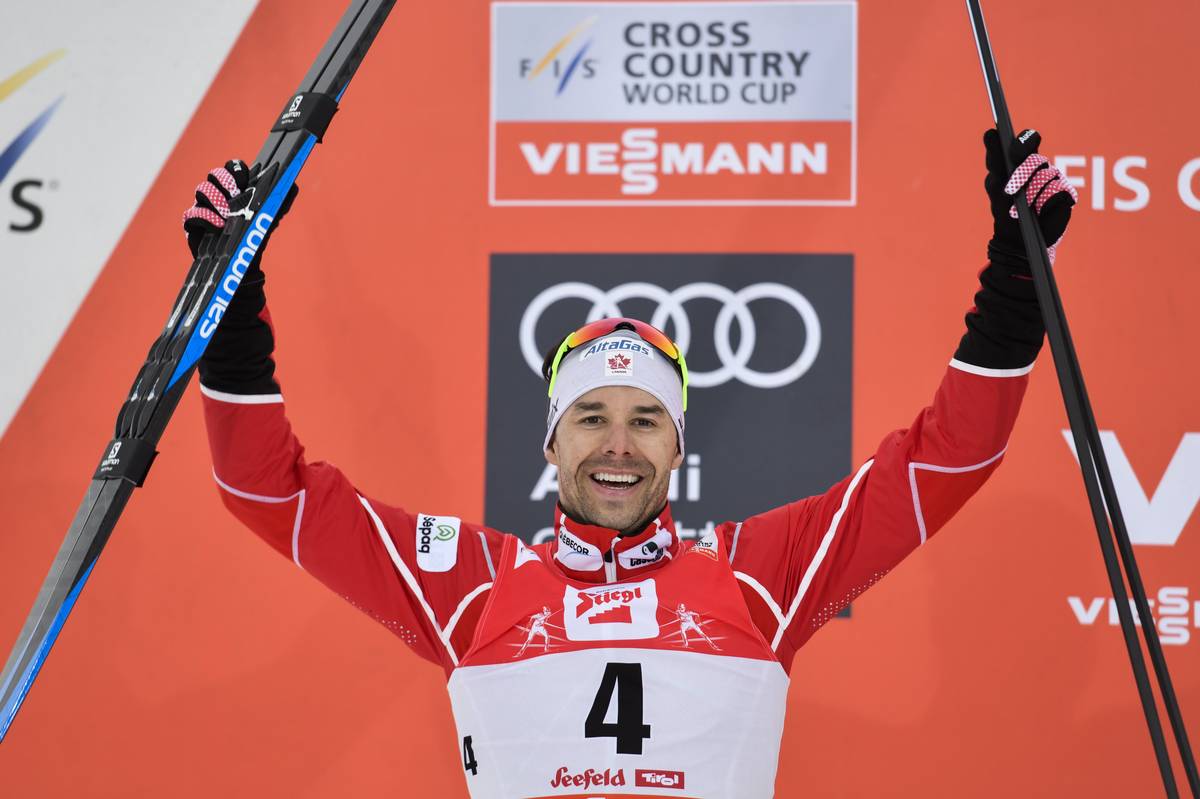
    Canada’s Alex Harvey celebrating on the podium after placing second in the men’s 15 k freestyle mass start in Seefeld, Austria, for his best result of the World Cup season. (Photo: Salomon/NordicFocus)

    “I was in ideal position right behind Dario, I just didn’t have the legs to finish,” Harvey continued.  “But it was still really good.”

    Rounding out the top 10 was Tønseth in fourth (+5.9), Manificat in fifth (+7.5), Krüger, in sixth (+7.7), France’s Clement Parisse in seventh (+8.0), Ustiugov in eighth (+8.4) Bjornsen in ninth (+9.3) and the Czech Republic’s Martin Jaks in 10th (+9.5).

    Bjornsen’s ninth-place finish was just 9.3 seconds out from the win and 6.4 seconds out from third place. It is a personal best for the American and also his first individual World Cup top 10.

    “I actually have had a couple hard weeks of training,” Bjornsen said. “So today is a good sign.”

    Erik Bjornsen (near) racing to a career-best ninth on Sunday in the World Cup men’s 15 k freestyle mass start in Seefeld, Austria. (Photo: Garrott Kuzzy / LumiExperiences.com)

    Despite crashing on the second lap, Bjornsen managed to work his way back up. He had been in 15th through the first lap.

    “I actually had a fall on the second lap and lost like 10 spots,” Bjornsen said. “I had to put in a little surge after that, but for the most part it felt pretty comfortable. … Then [I] went to make some moves on the last lap and it just came pretty easy. It was a boost in confidence to see Simi up there.”

    His U.S. teammate Simi Hamilton also had a strong performance on Sunday, finishing 12th (+12.4) for his best World Cup distance result to date. He has never before scored World Cup points in a distance event.

    “I think the best thing I did was just be really patient early on,” Hamilton said. “I think there was a lot of people trying to get to the front early, which kind of caused a lot of scrambling mix up, poles getting stepped on up front. So I just kind of hung back, and tried to find a hole that I could get in when I could and just try to move up slowly every lap.

    “My skis were unreal, it seemed like every downhill and corner I was just sucking people in,” Hamilton added. “It was like the perfect course for me.”

    The U.S. men had three in the top 30 on Sunday, with American Scott Patterson racing to 27th (+23.4). The finish is Patterson’s fourth individual World Cup performance in the points and his second best World Cup result, after placing ninth in the 30 k skiathlon last year in PyeongChang. On Sunday, he also celebrated his 26th birthday.

    “A good day to get a race in,” Patterson said. “I didn’t feel like I had much for acceleration at the finish, but I was happy the gap was right behind me so I didn’t have to outsprint to many people. It was a solid last race before the Olympics, I am pretty happy with it and going into [the upcoming races] with some confidence.”

    Also scoring World Cup points on Sunday was Canadian Devon Kershaw in 30th (+26.5). His Canadian World Cup teammate, Graeme Killick finished just 0.9 seconds outside the top 30 in 31st (+27.4).

    Canada had four others compete in the 15 k mass start, with Len Valjas in 58th (+1:53.1), Knute Johnsgaard in 82nd (+3:23.1), Bob Thompson in 87th (+4:27.5), and Julien Locke in 92nd (+4:56.9).

    Three more Americans also competed on Sunday, with Paddy Caldwell in 49th (+1:26.2), Ben Lustgarten in 55th (+1:42.7) and Tyler Kornfield in 77th (+3:00.0).

    “I just could not stay in the pack that I wanted to, like, I would be three seconds out of the draft and then having to fight,” Lustgarten said. “But I caught like four or five guys every climb so I was really happy with that.”

    The next stop for many World Cup racers following is PyeongChang for the Winter Olympic Games, with the Opening Ceremony on Feb. 9 and first race on Feb. 10.

    Results

  • Sunday Rundown: Seefeld, Goms, Ridnaun, Craftsbury

    Sunday Rundown: Seefeld, Goms, Ridnaun, Craftsbury

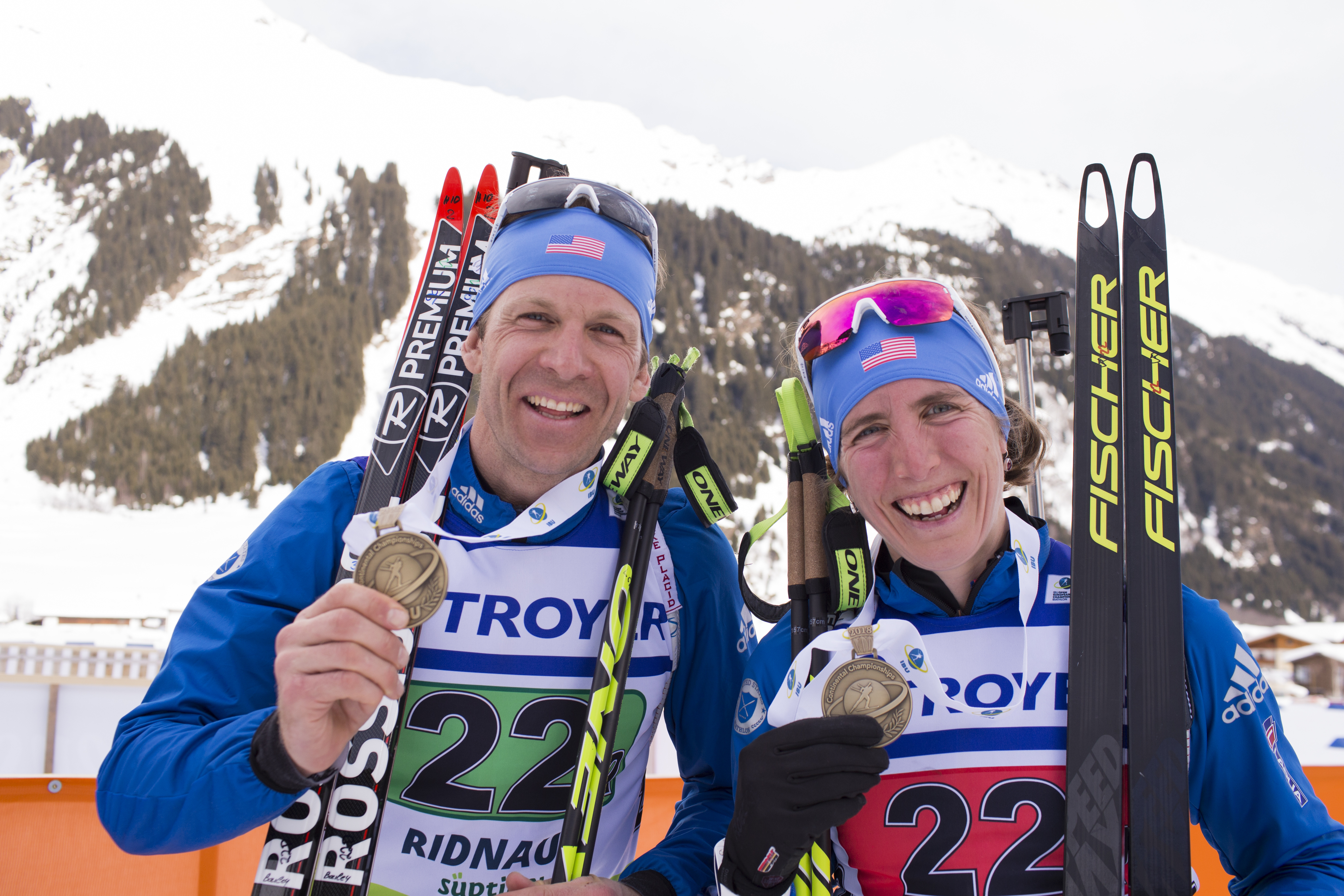
    US Biathlon’s Lowell Bailey (l) and Susan Dunklee after teaming up for bronze in the single mixed relay at 2018 IBU Open European Championships on Sunday in Ridnaun, Italy. (Photo: Manzoni/NordicFocus)

    IBU Open European Championships (Ridnaun-Val Ridanna, Italy): Single mixed & mixed relays

    Susan Dunklee and Lowell Bailey teamed up for the final day of the 2018 International Biathlon Union (IBU) Open European Championships in Ridnaun, Italy, and raced to a bronze medal in the single mixed relay.

    The American duo, both of which earned individual medals at last year’s IBU World Championships, finished just 9.1 seconds out of first, which went to Norway’s Thelka Brun-Lie and Vetle Sjåstad Christiansen. The Norwegians won in 35:39.6 with zero penalties and six spares. They took the lead after Brun-Lie’s second leg, where she cleaned both stages without spares.

    France placed second, 8.6 seconds back, with Julia Simon and Emilien Jacquelin, who combined for no penalties and 11 spares. They led the first half of the race, but slipped to second behind Norway on Simon’s second leg.

    Dunklee put the Americans off in second on her first leg, which she cleaned with a spare in each stage, then they slipped one place to third on Bailey’s first leg, where he cleaned as well and used three spares. In all, they used 10 spares and avoided the penalty loop, and finished half a second out of second place.

    “Over Christmas, we trained a little bit with the French athletes, including Jacquelin,” Bailey said, according to a US Biathlon press release. “So I know that he has quite a fast finish, and I thought I am kind of an old man here, I should maybe try to go harder on the first part of the lap. But he stayed with me all the time and had me in the end.”

    “It was a good opportunity to tune up the race shape, build some confidence and find that sharp feeling heading into the Olympics,” Dunklee told US Biathlon. “The single mixed relay is one of my favorite race formats and today was a blast!”

    Canada’s Sarah Beaudry and Carsen Campbell placed eighth of 24 teams in the single mixed relay, finishing 1:03.6 out of first with just eight spares and zero penalties. In 11th after the first leg, they moved into eighth on Campbell’s first leg, which he cleaned with one spare. Beaudry then cleaned her second leg without any spares, and Campbell anchored them to eighth.

    The U.S. entered a team in the mixed relay that followed, with Chloe Levins, Deedra Irwin, Paul Schommer, and Alex Howe placing 17th (+5:55.5) of 19 teams with no penalties and 12 spares.

    Ukraine won the mixed relay to conclude the championships, with Yuliia Zhuravok, Iryna Varvynets, Artem Pryma, and Dmytro Pidruchnyi combining for zero penalties and six spares and finishing in 1:11:40.1.

    Russia placed second (+11.7) with Victoria Slivko, Anastasia Zagoruiko, Evgeniy Garanichev, and Alexander Loginov combining for zero penalties and nine spares.

    Norway followed in third (+33.2) with Emilie Ågheim Kalkenberg, Kaia Wøien Nicolaisen, Håvard Gutuboe Bogetveit, and Fredrik Gjesbakk combing for no penalties and just four spares.

    Results: Single mixed relayMixed relay

    ***

    U.S. SuperTour (Craftsbury, Vermont): 5/10 k freestyle

    Two Alaska Pacific University (APU) athletes topped the podium on Sunday at the SuperTour in Craftsbury, Vermont, with David Norris winning the men’s 10-kilometer freestyle individual start in 21:54.9 and Becca Rorabaugh topping the women’s 5 k freestyle in 12:06.4.

    Norris won the men’s race by 6 seconds over Canada’s Andy Shields (Lappe Nordic) and Kevin Bolger of the Sun Valley Ski Education Foundation (SVSEF) placed third (+15.8). Kris Freeman (Caldwell Sport) was the third American in fourth overall (+23.7), and three Canadians took fifth through seventh with Michael Somppi (Lappe Nordic) in fifth (+27.9), Evan Palmer-Charrette (NTDC Thunder Bay) in sixth (+37.5) and Scott Hill (Barrie Cross Country) in seventh (+37.6), ahead of Brian Gregg (Team Gregg/LNR/CXC) in eighth (+39.4), Tad Elliott (Ski Club Vail) in ninth (+44.3) and Jack Hegman in 10th (+50.4).

    Rorabaugh won the women’s race by just 2.2 seconds over her APU teammate Rosie Frankowski in second, and Erika Flowers of the Stratton Mountain School (SMS) T2 Team placed third (+4.6). Two Craftsbury Green Racing Project (CGRP) skiers finished fourth and fifth, with Kaitlynn Miller in fourth (+12.1) and Liz Guiney in fifth (+22.5), Kelsey Phinney (SVSEF) was sixth (+25.8), and Canadians Olivia Bouffard-Nesbitt (Rocky Mountain Racers) seventh (+26.4) and Frederique Vezina (Pierre-Harvey National Training Centre) eighth (+36.0). Corey Stock, of the Bridger Ski Foundation (BSF) placed ninth (+39.9), and Felicia Geisor (CXC Team) was 10th (+44.4).

    On Saturday, the Craftsbury Outdoor Center hosted its 37th annual Craftsbury Marathon, with Nils Koons winning the 48 k men’s race in 2:28:51.0 hours and Hannah Dreissigacker winning the 48 k women’s race in 3:01.48.7.

    Results: Men’s 10 k | Women’s 5 k 

    Marathon (non-SuperTour) results

    ***


    Hannah Halvorsen of the U.S. Ski Team and APU on the start line in Ulrichen, Switzerland, after finishing fifth in the sprint qualifier. (FIS screencap)

    FIS Cross Country World Junior Championships (Ulrichen, Switzerland): Freestyle sprints

    Full report

    World Junior Championships kicked off today with freestyle sprints in Ulrichen, Switzerland. Moa Lundgren of Sweden claimed with women’s title by 1.89 seconds over Kristine Stavås Skistad of Norway in the final, with Sweden’s Frida Karlsson finishing third (+1.89).

    Hannah Halvorsen of the United States qualified in fifth place before skiing to second in her quarterfinal heat. Halvorsen hovered around third or fourth place through much of her semifinal and was unable to snipe any spots in the finishing straight, ending up fourth in the heat and eighth on the day.
    Fellow Americans Margaret Gellert and Sofia Shomento also made the quarterfinals, finishing 18th and 23rd, and Canada’s Hannah Mehain wound up 29th on the day.
    The new men’s junior world champion is Tom Mancini of France, who nipped Norway’s Jørgen Lippert by just 0.10 seconds to take the win. Valerie Grond gave the Swiss crowd a thrill by making it all the way to the final and taking home bronze, despite qualifying in just 21st position. The Swiss junior narrowly edged France’s Vincent Buiatti for the final step on the podium.

    Canada’s Graham Ritchie finished second in his quarterfinal after qualifying in 28th position, earning an automatic spot in the semifinals. There he finished sixth (+9.30 behind Mancini), winding up 12th on the day. Teammate Antoine Cyr also made the quarterfinals where he had an impressive crash, slinging off the trail and into the infield, finishing 30th on the day. For the U.S., Gus Schumacher was the lone qualifier for the heats. He finished fourth in his quarterfinal and was just 0.22 seconds away from a “lucky loser” spot in the semifinals. Schumacher finished 19th on the day.

    In the junior women’s race, Hannah Rudd of the United States finished 35th in qualification, +18.15. For Canada, Annika Richardson finished 52nd (+24.09), Catherine Reed-Metayer 56th (+28.25), and Alexandra Racine 69th (+37.27).

    In the junior men’s sprint, Canada’s Reed Godfrey finished a tough 31st, just 0.21 seconds out of making the quarterfinals. Etienne Hebert rounded out the Canadian finishers in 36th place (+11.81) in the qualifier. Canyon Tobin was 41st in qualification for the U.S. (+13.46), followed by Karl Schulz in 54th (+16.90) and Luke Jager in 60th (+18.15).

    Results: men’s qualifier | women’s qualifier | men’s final | women’s final

    ***

    FIS Nordic Combined World Cup (Seefeld, Austria): Individual normal hill/15 k

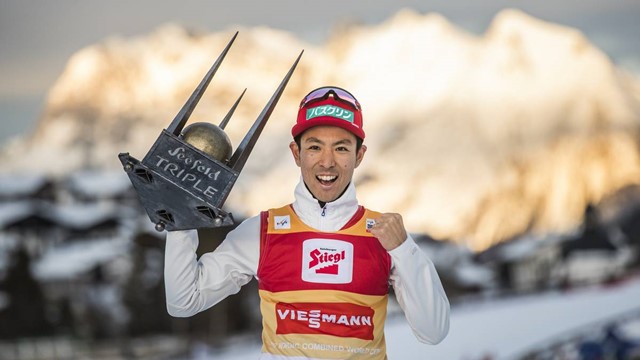
    Japan’s Akito Watabe after winning the 2018 Seefeld Triple Nordic Combined World Cup. He is the only athlete besides Germany’s Eric Frenzel to win the event. (Photo: FIS Nordic Combined)

    On the final day of the Seefeld Triple, Japan’s Akito Watabe completed his sweep of the three-day weekend and Norway’s Jarl Magnus Riiber reached the podium for the third-straight day, placing second. Germany’s Fabian Rießle placed third for his second podium in the last two days.

    Watabe jumped to first on the normal hill and started the 15 k Gundersen 48 seconds ahead of Riiber in second. He went on to win the race by 1:14.9 minutes in 34:58.6, becoming the only man besides Germany’s Eric Frenzel to win the Seefeld Triple in its five-year history.

    After jumping to fifth, Rießle won a photo finish for third (+1:57.9), edging Germany’s Vinzenz Geiger by less than a tenth of a second. Geiger moved up from ninth in the jump to fourth overall (+1:57.9).

    Norway’s Jørgen Graabak followed in fifth (+2:02.4), Frenzel placed sixth (+2:07.4), Norway’s Jan Schmid was seventh (+2:09.8), Finland’s Eero Hirvonen eighth (+2:13.5), Norway’s Espen Andersen ninth (+2:28.0), and Austria’s Mario Seidl 10th (+2:42.1) out of 28 finishers.

    No Americans contested the final day of the Triple, the last World Cup before the 2018 Winter Olympics in PyeongChang, South Korea.

    Results: Jumping | Final

    ***

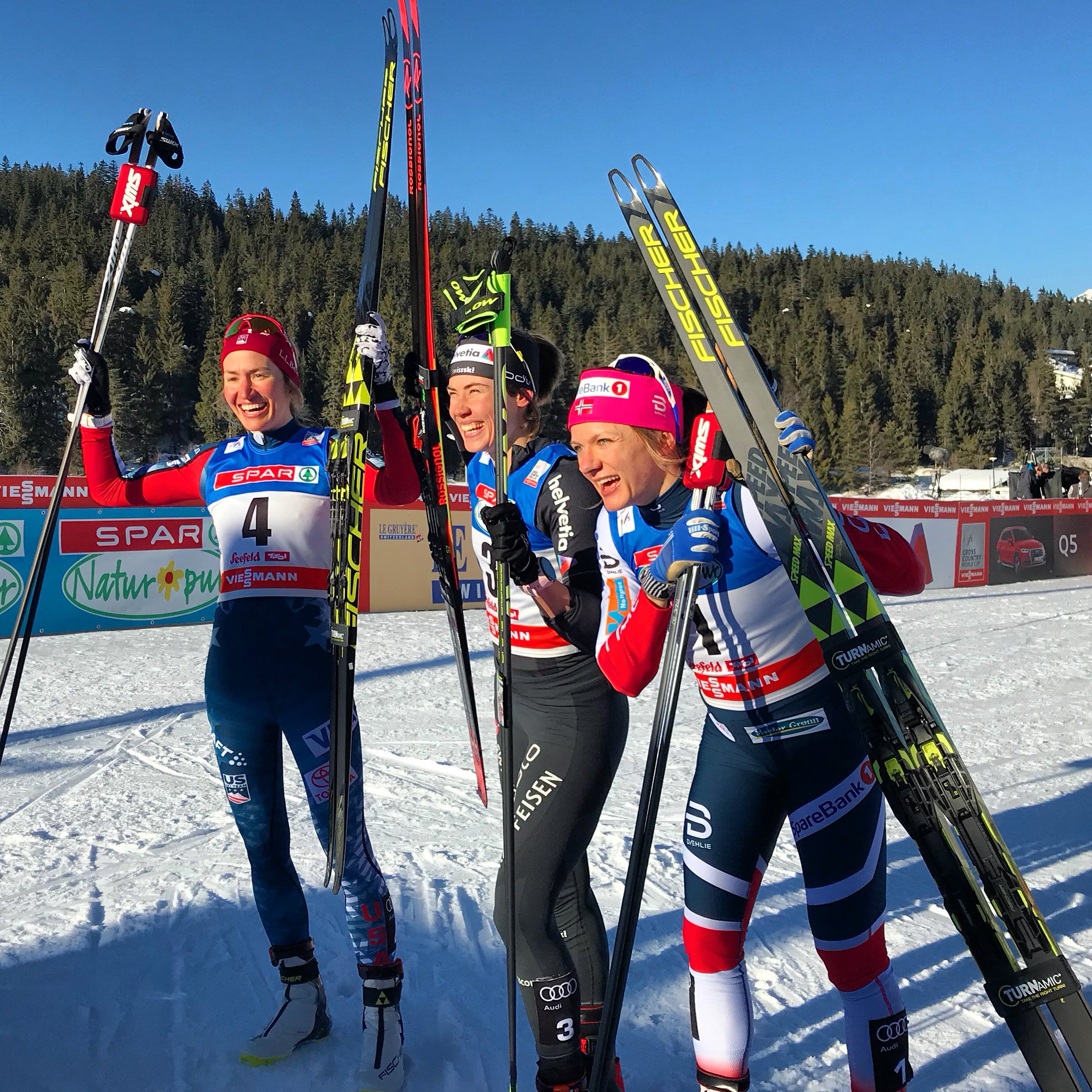
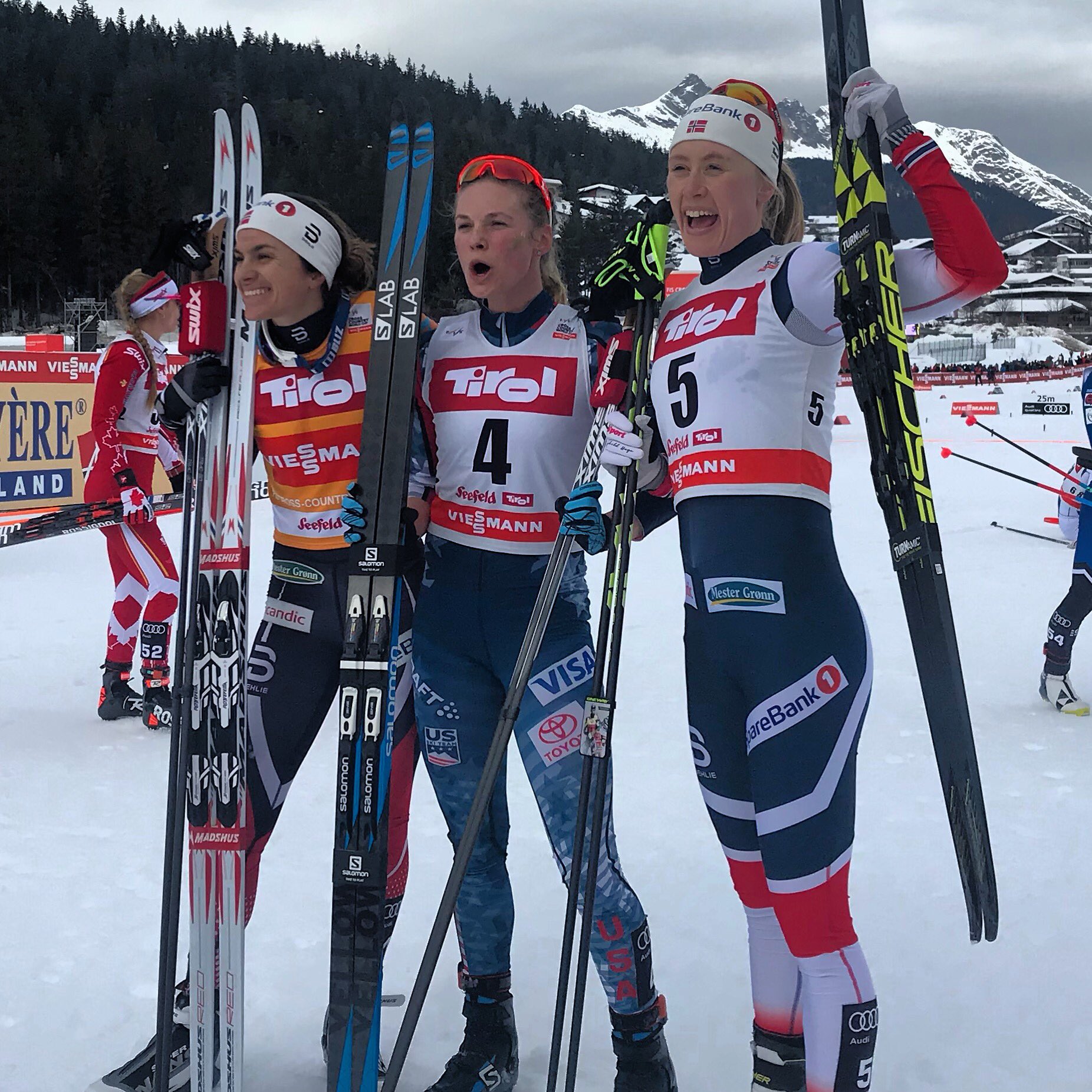
    Jessie Diggins of the U.S. Ski Team (center) celebrates after winning the 10 k mass start freestyle in Seefeld, Austria, over Heidi Weng (left) and Ragnhild Haga of Norway. (Photo: FIS Cross Country/Twitter)

    FIS Cross Country World Cup (Seefeld, Austria): 10/15 k mass start freestyle

    Women’s report

    Men’s report

    In the final World Cup race before the 2018 Olympics, Jessie Diggins achieved the ultimate goal to give herself the utmost confidence heading into PyeongChang — winning the women’s 10-kilometer freestyle mass start at the World Cup in Seefeld, Austria, on Sunday.

    The win was her first of the season and fourth individual victory of her career. Diggins, a 26-year-old U.S. Ski Team member, pulled it off by attacking on a long climb and leaving Norway’s Heidi Weng, Ragnhild Haga and Ingvild Flugstad Østberg chasing. While Diggins was several seconds ahead over the top and all alone on the long descent that followed, Weng and Haga worked to close the gap — and nearly did in the finishing stretch. But Diggins held them off, winning by 0.7 seconds over Weng in second place and 1 second ahead of Haga in third, and threw her fists down in celebration as she crossed the line first in 23:08.5 minutes.

    “I just put my head down and it wasn’t pretty, but I just hammered,” Diggins told the International Ski Federation (FIS) in a televised post-race interview.

    She was the only non-Norwegian in the top five, with Østberg in fourth (+8.7) and Marit Bjørgen in fifth (+16.7). Austria’s Teresa Stadlober placed sixth (+16.9), Norway’s Kari Øyre Slind was seventh (+19.1), and American Sadie Bjornsen placed eighth (+20.5), ahead of Switzerland’s Nathalie von Siebenthal in ninth (+30.3).

    The U.S. had three in the top 15 with Kikkan Randall (U.S. Ski Team) in 14th (+48.5), and two more women in the top 30, with Caitlin Patterson (Craftsbury Green Racing Project) in 23rd (+1:00.7) and Liz Stephen (USST) in 29th (+1:18.2). Rosie Brennan (USST) finished 53rd (+2:26.9).

    Emily Nishikawa led the Canadians in 35th (+1:36.5), followed closely by teammate Cendrine Browne in 37th (+1:36.6). Dahria Beatty finished 45th (+1:58.9).

    Women’s Results

    Dario Cologna of Switzerland (center) won the men’s 15 k skate mass start in Seefeld, Austria, over Alex Harvey of Canada (left) and Martin Johnsrud Sundby of Norway (right). (Photo: FIS Cross Country/Twitter)

    The Olympics are nearing and so Switzerland’s Olympic legend Dario Cologna is ramping up: after winning the Tour de Ski, he took another win in the 15 k mass start skate in Seefeld, Austria, on Sunday.

    With much of the field staying relatively close together until the finish, Cologna nabbed the win by 1.4 seconds over Canada’s Alex Harvey, who took his second podium of the season in addition to also finishing third in the overall Tour de Ski.

    Norway’s Martin Johnsrud Sundby was third (+2.9), then teammate Didrik Tønseth in fourth (+5.9) and France’s Maurice Manificat in sixth (+7.5).

    The U.S. Ski Team’s Erik Bjornsen had a breakthrough day finishing ninth (+9.3), followed by Simi Hamilton in 12th (+12.4). Behind them, Scott Patterson placed 27th (+23.4), then Patrick Caldwell 49th (+1:26.2), Ben Lustgarten 55th (+1:42.7), and Tyler Kornfield 77th (+3:00.0).

    Canada’s Devon Kershaw and Graeme Killick finished 30th (+26.5) and 31st (+27.4), respectively. Len Valjas placed 58th (+1:53.1), Knute Johnsgaard 82nd (+3:23.1), Bob Thompson 87th (+4:27.5), and Julien Locke 92nd (+4:56.9).

    Men’s Results

  • Klæbo Wins Seefeld Skate Sprint; Harvey 8th, Hamilton 9th

    Klæbo Wins Seefeld Skate Sprint; Harvey 8th, Hamilton 9th

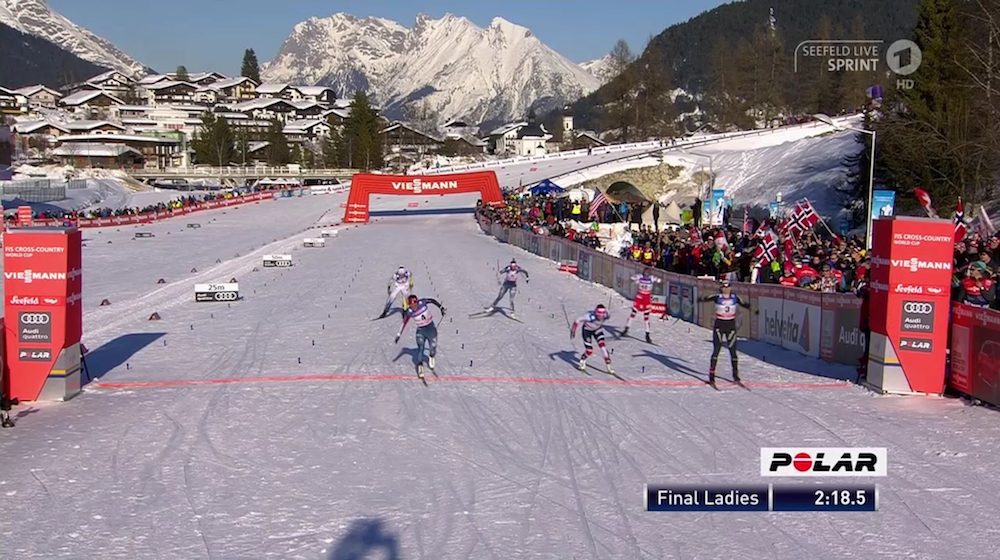
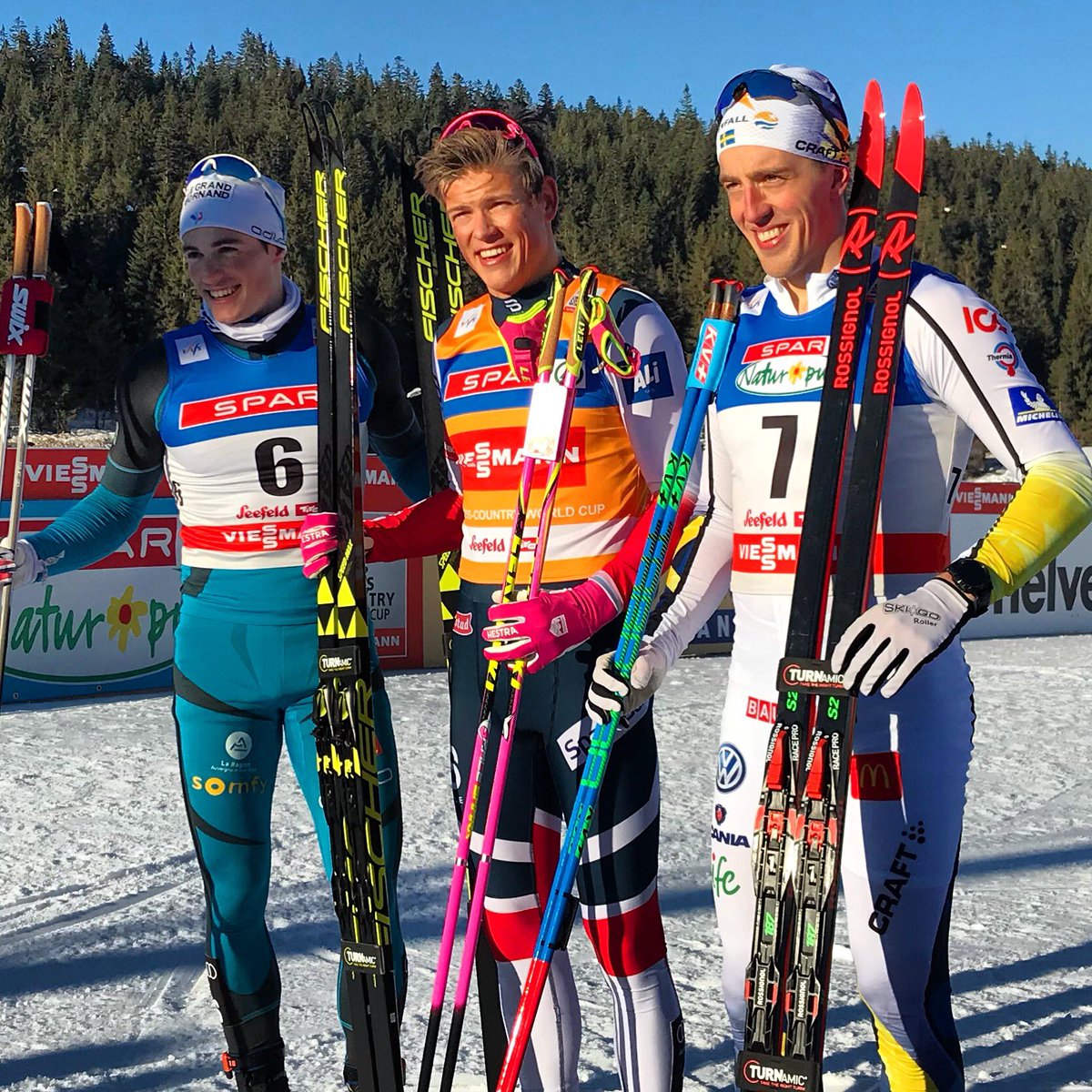
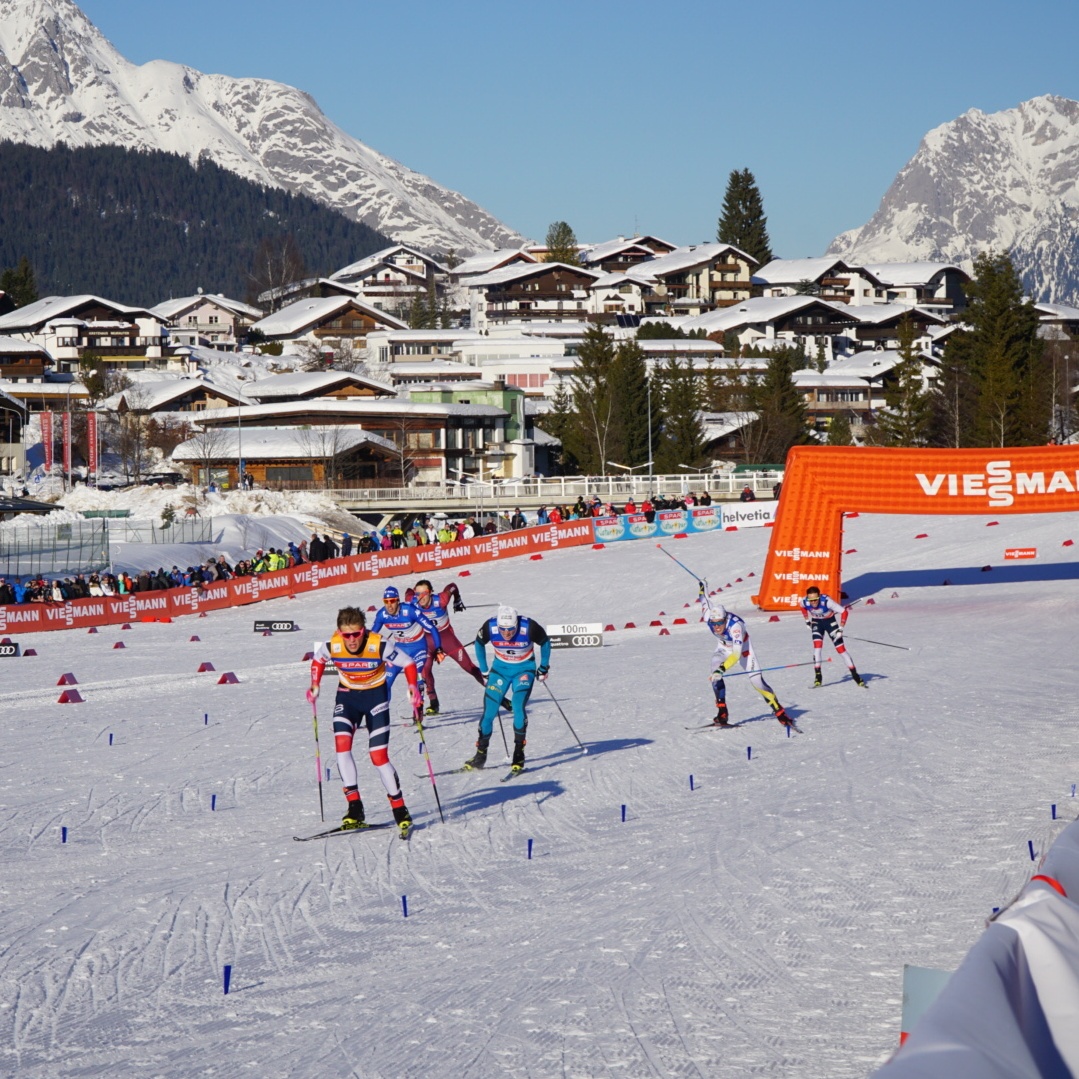
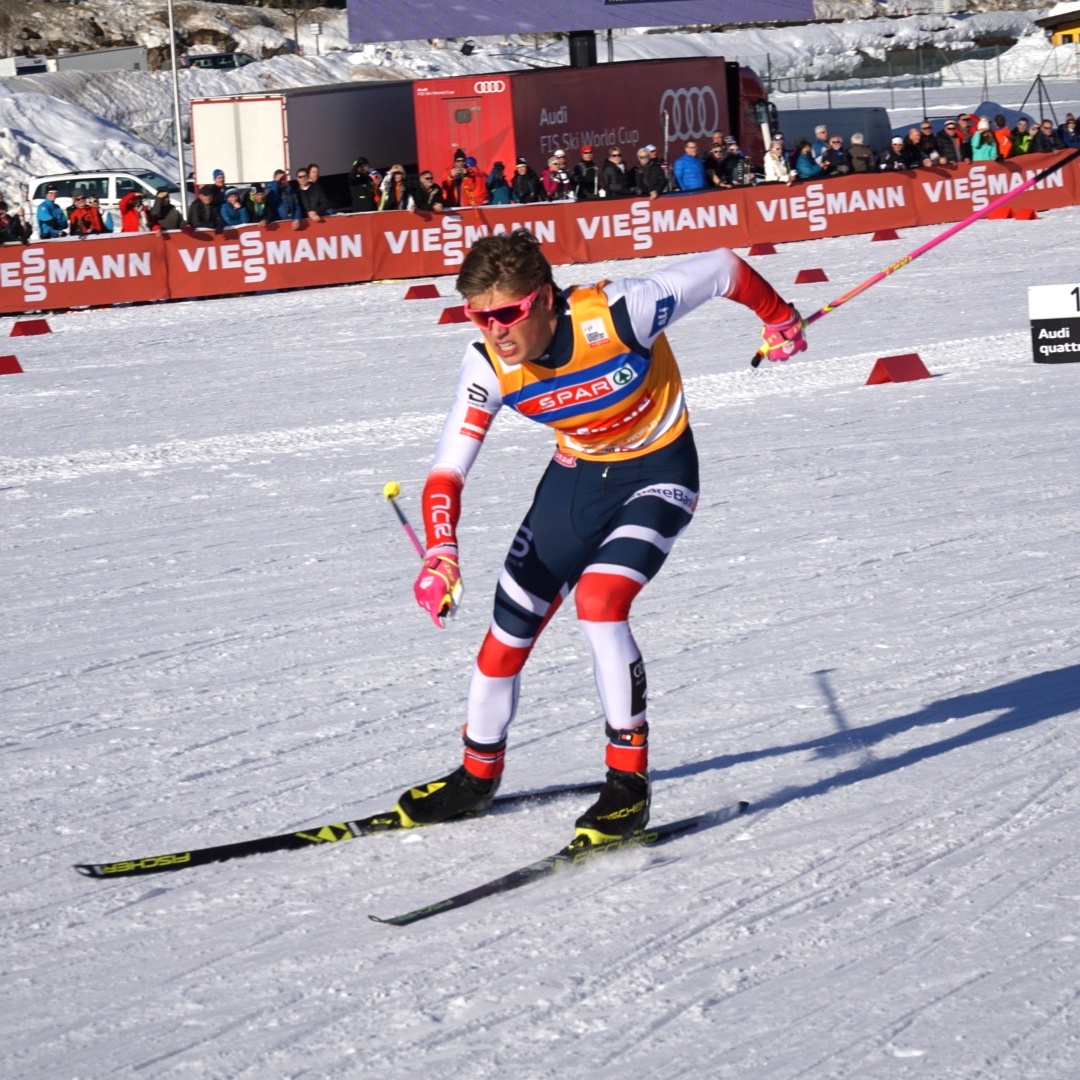
    Off the front and in for the win, Norway’s Johannes Høsflot Klæbo leads down the finishing straight in Seefeld, Austria en route to another win in the men’s 1.4 k freestyle sprint final, ahead of France’s Lucas Chanavat in second and Sweden’s Calle Halfvarsson in third. (Photo: Garrott Kuzzy / LumiExperiences.com)

    There are no brakes for the World Cup until Sunday afternoon in Seefeld, Austria. The Opening Ceremony of the 2018 Winter Olympics is Feb. 9. For the champing-at-the-bit thoroughbreds in Seefeld, Saturday featured the last sprint before the Games: a 1.4-kilometer freestyle sprint.

    If you were thinking the World Cup’s sprint leaders were taking a “taper” weekend in the run-up to PyeongChang, you’d be wrong. Jumping into the mix were overall Sprint World Cup leader Norway’s Johannes Høsflot Klæbo, Italy’s Federico Pellegrino, who’s second in the sprint standings, and Norwegian Emil Iversen, who was third at the time. The list could get exhausting. Let’s just say the heavy hitters of the sprint world came out to play.

    Under Seefeld’s alpine sun, the boldest pattern on the men’s World Cup continued. Klæbo won the qualifier by nearly five seconds, covering the course in 2:46.89 minutes. Pellegrino qualified in second, crossing the line 4.88 seconds slower.

    Norway’s Johannes Høsflot Klæbo racing to the win in his semifinal, which he took by 0.33 seconds over France’s Lucas Chanavat (not shown). Klæbo went on to win the final as well. (Photo: Garrott Kuzzy / LumiExperiences.com)

    Klæbo also took the Seefeld sprint win with a time of 3:02.66 in the final. France’s Lucas Chanavat placed second overall, 0.48 seconds back, Sweden’s Calle Halfvarsson third (+0.97), Pellegrino fourth (+1.06), Russia’s Gleb Retivykh fifth (+1.17), and Iversen sixth (+5.57).

    The winning trend is clear, these races appear to be Klæbo’s to lose. The day marked Klæbo’s sixth World Cup sprint victory of the year and his ninth overall. After Saturday, he has a 205-point lead over Pellegrino in the sprint standings. Chanavat moved up to third, 293 points behind Klæbo and six points ahead of Iversen in fourth.

    “No, I don’t have a plan before I start,” Klæbo told the International Ski Federation (FIS) in a post-race interview. “I just take it step by step, and just try to be in front and to have this control. This was quite fun for me; you have this uphill where no one wants to be in first and into a downhill. It’s something else, but it’s fun.”

    Klæbo-style fun.

    Let’s circle back to Klæbo’s time in the finals: 3:02.66 minutes. Much slower than his rocketing qualifying time. Yet, Klæbo commands respect like Petter Northug did in his prime or Martin Johnsrud Sundby did just a few months ago. Through the quarterfinals, semifinals and finals, it’s clear the men’s field awaits Klæbo’s kill-shot before making any decisive moves in earnest.

    In the first heat, which featured Klæbo, Austria’s Dominik Baldauf shot off the front in what looked like a frenzied attempt to gamble his own fast-twitch-muscle-fiber reputation. Klæbo let him go for about a minute. Midway up the first climb, the group seemed to stall a bit, waiting for the inevitable. Of course, Klæbo went. With a now trademark speed-burst, the 21-year-old Norwegian was up and over the top of the hill. Only Halfvarson was able to catch Klæbo’s tails as the pair finished first and second, with Halfvarsson 0.53 seconds back.

    In Klæbo’s semifinal, slow-the-boss-down tactics played heavy until the first hill again as Halfvarsson and Chavanat controlled the pace. One-two-three it was Halfvarsson, Chavanat, then Klæbo over the top. American Simi Hamilton, who had qualified fifth and placed second in the second quarterfinal to reach the semis, crested the hill in fourth.

    American Simi Hamilton (near) gunning down the final straight with Italy’s Federico Pellegrino in the first men’s semifinal. Pellegrino placed fourth, 0.09 seconds ahead of Hamilton in fifth, and the Italian advanced to the final as a lucky loser. Hamilton did not and finished the day ninth overall. (Photo: Garrott Kuzzy / LumiExperiences.com)

    On the false working flat prior to the course’s second climb, Klæbo simply began to pull away. Looking under his legs passing under the 100-meters-to-go banner, Klæbo’s win was already settled. Chavanat was second (+0.33), Halfvarsson third (+0.52), Pellegrino fourth (+2.52), Hamilton fifth (+2.61) and Poland’s Maciej Staręga sixth (+28.76). While Halfvarsson and Pellegrino advanced to the finals as lucky losers, Hamilton did not.

    Perhaps it is time for the guessing to start. As in, will Klæbo dominate in PyeongChang? Can the 21 year old handle Olympic size pressure? Klæbo keeps his cool. But will the Games see a field ready to play for silver and bronze as they kowtow to Klæbo or a field with steady nerves ready to settle a score in what looks to be the start of a long and storied Olympic career for Klæbo?

    Hamilton was the best-placed American man on Saturday. He clocked the fifth-fastest qualifying time, 6.46 seconds off Klæbo’s top time, then placed second to Pellegrino in his quarterfinal and was fifth in the first semifinal, 2.61 seconds behind Klæbo. Overall, Hamilton ended the day in ninth.

    “I felt like, in the quarters I skied downhill really well, and I was able to get a really good draft and slingshot coming down through the stadium, so I was kind of trying to rely on that again,” Hamilton told FasterSkier in person after the race. “I was just trying to be mid-pack going over the top of the big climb, and the downhill was skiing quite a bit different than it was in my quarter. It was like, much, much icier. I was definitely way more conservative skiing into it, and I just did not ski it very well, and as a result, didn’t carry my speed down through the long straightaway nearly as well as I could have or should have. I knew that Federico and I were fighting for that fourth spot there.”

    Also for the U.S., Erik Bjornsen (U.S. Ski Team) finished 37th in the qualifier, 0.89 seconds out of the top 30 and 11.99 second out of first. Logan Hanneman, of Alaska Pacific University (APU) was 39th (+12.52), Andy Newell (U.S. Ski Team) 42nd (+12.90), Reese Hanneman (APU) 65th (+17.91), and Ben Lustgarten (Craftsbury Green Racing Project) 76th (+21.88).

    Brothers Logan (l) and Reese Hanneman after the World Cup skate sprint in Seefeld, Austria. The two were recently named to the U.S. Olympics cross-country team for PyeongChang, South Korea, next month. (Photo: Garrott Kuzzy / LumiExperiences.com)

    In his second-career World Cup race, Logan Hanneman, 24, left venue wanting more.

    “It was really hard, I don’t quite understand why, but I felt very close to cramping right out of the start,” Hanneman told FasterSkier after. “I think it was a lot of nerves. And then you hit this huge hill right out of the start, and then it hurt quite a bit. Then you have the downhill ripping across [the arena] and your legs just fill up with lactate quite a bit before that last uphill. But it was good. I think I was about the same as last week from out [of the heats], so really close again. I would have really wanted to get in today especially because it’s skating.”

    At last weekend’s classic sprint in Planica, Slovenia, Hanneman placed 35th.

    Alex Harvey was the lone Canadian in the heats and placed eighth overall. In his first World Cup race since placing a historic third overall in the 2018 Tour de Ski, Harvey played perfect tactics in his quarterfinal, holding his big efforts back on course’s first major climb. Toying in sixth initially, his hand unfolded from the back of what he called a “come-from-behind course”.

    Canada’s Alex Harvey during the men’s 1.4 k freestyle sprint at the World Cup in Seefeld, Austria. He finished fourth in his semifinal for eighth overall. (Photo: Salomon/NordicFocus)

    Coming into the final climb, Harvey moved up the outside and gained position.

    “I was trying to see if I could save energy on that first hill and make my way past a couple guys on the downhill and come up that last hill with a lot of speed and still have the energy to makes some moves there,” Harvey said on the phone after.

    In what was the fastest quarterfinals of the day (both lucky losers advanced from Harvey’s heat), the Canadian was able to ski a dicey corner into the final stretch with speed and take the quarterfinal win in 2:29.96 minutes.

    “It worked in the quarter and then in the semi, I think that worked well also but it was just the very final corner before the last hundred meters that didn’t take as well as I should have,” Harvey reflected.

    Iversen settled in and took control of Harvey’s semifinal with a slightly more laid-back pace than Harvey’s quarterfinal, at least initially. Midway through the first hill, Iversen punched into the lead and crested the hill with physics in his favor.

    “It was slow when Emil was in the front,” Harvey noted. “We were basically just walking up that big hill and he didn’t really drill it. He just went hard the last couple of steps over the hill to generate some speed and try to hold his own and it worked well for him. Probably Emil is one of the only guys in the men’s field who can hit the top of a hill first and hold it down a hill because he is both a bit heavier than a few other guys. He is actually a really good downhiller. He can take those corners really well. … He is one of the few guys, but I still think for me and basically anyone else in the field other than him it’s not the best strategy.”

    Canada’s Alex Harvey racing with Switzerland’s Dario Cologna during the men’s 1.4 k skate sprint quarterfinal in Seefeld, Austria. Harvey won that heat by 0.44 seconds over Cologna, and went on to place eighth overall, while Cologna finished the day in 10th. (Photo: Garrott Kuzzy / LumiExperiences.com)

    Iversen won that semifinal, the second one of the day, in 2:56.88 minutes. Harvey finished 0.47 seconds back in fourth, behind Russia’s Retivykh in second and France’s Richard Jouve in third, as he was unable to gain ground in the last hundred-meter stretch.

    Canada’s Len Valjas placed 40th, 12.72 seconds back in the qualifier, after fighting a lingering injury for much of the race season. Valjas injured his back in the gym prior to last season’s World Championships in Lahti, Finland and told FasterSkier he tried to manage the injury and fight off the pain until he re-injured himself this past November.

    “I went home again and pretty much got every test done and they found a herniated disk in T2-3 and below that a cracked vertebrae on T-4 which is the rib that is probably affecting my breathing,” Valjas explained. “It just feels like there is a rubber band around my chest so when it’s flared up and tight it just takes longer to take a deep breath, and I honestly can’t go any higher than [Zone] 3, my body can’t go on any slower breathing. So yesterday was a really bad day, my breathing sucked, I didn’t do any pre-race I just skied slow and got worked on.”

    Valjas went on to say he felt better trying to qualify for Saturday’s heats and plans on taking the next four days off before flying to South Korea for the Olympics.  

    “I just need to manage resting but also I need those hard efforts to get my body ready for racing again. Right now it’s kind of a pain,” Valjas added. “I know that I can ski fast so I am trying to save my one effort for the sprint in Korea. These efforts, I need them, but also at the same time, I need to give some rest.”

    Also for Canada, Julien Locke (Canadian U25 Team) skied to 43rd (+13.31), Knute Johnsgaard (World Cup Team) 51st (+14.74), Bob Thompson (NTDC Thunder Bay) 58th (+16.55), Graeme Killick (World Cup Team) 61st (+17.28), and Devon Kershaw (World Cup Team) 70th (+19.53).

    “I am feeling pretty good, the shape is definitely starting to come around compared to the start of the season for me,” Johnsgaard told FasterSkier after. “But I am also coming off a pretty big kind of training block here in Livigno at high altitude so I am feeling it a little bit, but the plan is to build off that training and hopefully absorb it and be in top shape for the games.  Considering that, it was a great race for me today.”

    Racing continues Sunday in Seefeld with 10/15 k freestyle mass starts.

    Results: Qualifier | Final Sprint World Cup standings

  • Saturday Rundown: Seefeld and Ridnaun

    Saturday Rundown: Seefeld and Ridnaun

    The podium for Day 2 of the Seefeld Triple Nordic Combined World Cup, with Japan’s Akito Watabe in first (c), Germany’s Vinzenz Geiger (l) in second and Norway’s Jarl Magnus Riiber (r) in third. (Photo: FIS Nordic Combined/Twitter)

    FIS Nordic Combined World Cup (Seefeld, Austria): Normal hill/10 k

    Two of the same men from Friday repeated on the podium on Day 2 of the Seefeld Triple Nordic Combined World Cup, with Japan’s Akito Watabe notching his second-straight win on Saturday.

    Norway’s Jarl Magnus Riiber, who finished second on Friday, placed third in Saturday’s individual normal hill/10 k Gundersen, while Germany’s Vinzenz Geiger placed second, more than a minute behind Watabe.

    Watabe jumped to first and started the 10 k with a 25-second head start on Riiber in second. Geiger started seventh, 1:45 minutes back, and rose to second at the finish, 1:05.5 behind Watabe (who won in 23:28.5) and 3.4 seconds ahead of Riiber in third (+1:08.9).

    For the second day in a row, Norway’s Jan Schmid narrowly missed the podium in fourth (+1:14.1), up from fifth after the jump.

    Taylor Fletcher was the lone American competing on Day 2, and he ended up 31st, up 10 places after jumping to 41st. Fletcher started the 10 k race 4:44 out of first then finished 3:52.9 behind Watabe.

    The Seefeld Triple concludes Sunday with the individual normal hill/15 k Gundersen.

    Results: Jumping | Final

    ***

    American Sophie Caldwell (l) and Switzerland’s Laurien van der Graaff (r) tied for first on Saturday in the women’s 1.1 k freestyle sprint final at the World Cup in Seefeld, Austria, while Norway’s Maiken Caspersen Falla placed third. (Screenshot: ARD broadcast)

    FIS Cross Country World Cup (Seefeld, Austria): Freestyle sprints

    Women’s report

    Men’s report

    It doesn’t get any closer than that. On Saturday, American Sophie Caldwell and Switzerland’s Laurien van der Graaff tied for first in the women’s 1.1-kilometer freestyle sprint final at the World Cup in Seefeld, Austria. They both finished within one-hundredth of a second of each other to take the victory — the last sprint before the Olympics — in 2:18.65 minutes.

    Norway’s Maiken Caspersen Falla finished 0.21 seconds later for third place.

    The women’s freestyle sprint podium at Saturday’s World Cup in Seefeld, Austria, with American Sophie Caldwell (l) and Switzerland’s Laurien van der Graaff (c) tying for first and Norway’s Maiken Caspersen Falla (r) placing third. (Photo: FIS Cross Country/Twitter)

    “I broke my pole in the semifinal, then I got really tired,” van der Graaff said in a post-race interview with the International Ski Federation (FIS). “But I still believed I can be with Maiken and Sophie, and that I could catch them in the final was just great.”

    Norway and the U.S. both had two in the final, with Kathrine Rolsted Harsem of Norway placing fourth (+1.34), Sweden’s Linn Sömskar finishing fifth (+1.83) and American Sadie Bjornsen taking sixth (+2.26).

    Falla had raced to first in the qualifying round with a time of 2:21.44, Italy’s Greta Laurent qualified second (+1.43), van der Graaff third (+1.66), Caldwell fourth (+1.84), and Bjornsen fifth (+2.01).

    Van der Graaff then won her quarterfinal and placed third in the first semifinal, 0.77 second behind Caldwell, who won it. Falla was second in that semifinal (+0.16) and van der Graaff advanced as a lucky loser.

    Caldwell and Falla went head to head in every heat, with Falla winning their first quarterfinal by 0.08 seconds over Caldwell in second.

    Bjornsen won her quarterfinal and finished second to Harsem in the second semifinal.

    A third American, Kikkan Randall also qualified for the heats, placing 18th in the qualifier then finishing third in her quarterfinal (1.33 seconds behind Sömskar in first) to end up 14th overall.

    Canada’s Dahria Beatty placed 30th in the qualifier to nab the last spot in the rounds, then finished fourth in her quarterfinal (1.65 seconds behind Laurent in first) for 20th overall.

    For the U.S., Ida Sargent missed qualifying by about half a second in 37th (+8.20), Rosie Brennan finished 42nd (+9.86) and Caitlin Patterson was 52nd (+13.0).

    Also for Canada, Emily Nishikawa finished 51st (+12.68) and Cendrine Browne was 54th (+13.34).

    The men’s 1.4 k freestyle sprint podium at the World Cup in Seefeld, Austria, with Norway’s Johannes Høsflot Klæbo (c) in first, France’s Lucas Chanavat (l) in second and Sweden’s Calle Halfvarsson (r) in third. (Photo: FIS Cross Country/ Twitter)

    The men raced 1.4 k, with Norway’s Johannes Høsflot Klæbo qualifying first in 2:46.89 then winning his quarterfinal and semifinal before putting the hammer down for one last time in the final, finishing first in 3:02.66.

    France’s Lucas Chanavat placed second in the final, 0.48 seconds back, after qualifying sixth, winning his quarterfinal and placing second in the first semifinal (0.33 seconds behind Klæbo). Sweden’s Calle Halfvarsson took the third spot on the podium after finishing 0.97 seconds after Klæbo. Halfvarsson had previously qualified seventh, taken second in his quarterfinal and advanced as a lucky loser in third in the first semifinal (0.52 seconds behind Klæbo).

    Italy’s Federico Pellegrino missed the podium in fourth (+1.06), Russia’s Gleb Retivykh placed fifth (+1.17), and Norway’s Emil Iversen was sixth (+5.57).

    Canada’s Alex Harvey and American Simi Hamilton both made it to the semifinals, where they finished fourth and fifth, respectively, and did not advance to the finals. Harvey had qualified for the rounds in 22nd and won his quarterfinal, then raced in the second semifinal, where he finished fourth, 0.47 seconds behind Iversen in first. That put Harvey eighth overall on the day.

    Hamilton clocked the fifth-fastest qualifying time, 6.46 seconds back from Klæbo’s top time. The U.S. Ski Team member then placed second to Pellegrino in his quarterfinal and was fifth in the first semifinal, 2.61 seconds behind Klæbo. Overall, Hamilton placed ninth.

    Also for the U.S., Erik Bjornsen finished 37th in the qualifier, 0.89 seconds out of the top 30 and 11.99 second out of first, Logan Hanneman was 39th (+12.52), Andy Newell 42nd (+12.90), Reese Hanneman 65th (+17.91), and Ben Lustgarten 76th (+21.88).

    Canada’s Len Valjas placed 40th (+12.72), Julien Locke 43rd (+13.31), Knute Johnsgaard 51st (+14.74), Bob Thompson 58th (+16.55), Graeme Killick 61st (+17.28), and Devon Kershaw 70th (+19.53).

    Results:

    Women’s qualifierWomen’s final 

    Men’s qualifier | Men’s final

    ***

    France’s 22-year-old Chloé Chevalier racing to her second win and third podium of the week in as many individual races at 2018 IBU Open European Championships on Saturday in Ridnaun, Italy. (Photo: IBU/Biathlonworld)

    IBU Open European Championships (Ridnaun-Val Ridanna, Italy): Men’s and women’s pursuits

    France’s Chloé Chevalier picked up her second win and third podium of the week at the International Biathlon Union (IBU) Open European Championships on Saturday in Ridnaun, Italy, winning the women’s 10 k pursuit, while Russia’s Alexander Loginov rose to the top step of the podium in the men’s 12.5 k pursuit on Saturday.

    Chevalier started the women’s pursuit in second, 13 seconds behind Ukraine’s Iryna Varvynets (who won Friday’s sprint and thus started first), and shot clean to take the lead after the third stage — where Varvynets missed one. Chevalier went on to clean the final stage for perfect 20-for-20 shooting and crossed the line first in 29:25.4. Varvynets finished second, 11.0 seconds back after missing a single target in the first standing (0+0+1+0), and France had two on the podium with Julia Simon in third (+43.2). Simon also shot 19-for-20, with her miss coming in the second prone stage (0+1+0+0).

    “Three medals in three races is definitely more than I had expected,” Chevalier, 22, told the event’s organizers on Saturday. “Today I saw that Iryna shoots faster than I, and so I really gave my all in the track. Even if it might not look like it, after the many races in the last few days I am noticing that I am getting more and more tired.”

    American Chloe Levins rose from 59th at the start to 42nd at the finish (+4:11.8), with three clean stages and two misses in the first standing (0+0+2+0). She had the 28th-fastest overall range time and 30th-ranked shooting time.

    In the men’s pursuit, Loginov started first as Friday’s sprint winner Latvia’s Andrejs Rastorgujevs did not start. Loginov held the lead throughout the race despite two misses — one in the first stage and another in the last stage (1+0+0+1) — and secured the win in 32:22.1. Bulgaria’s Krasimir Anev started second, 19 seconds after Loginov, and held his place as well, shooting clean and finishing second, 27.6 second back.

    “I am really happy here in Ridanna and the results reflect that,” Loginov, 25, told organizers. “Not to start in the individual event on Wednesday was the right decision because the last few days had been very demanding with six races in eight days. I am cross with my two errors in the shooting range, but very happy with my performance in the track.”

    Russia had two on the podium with Evgeniy Garanichev in third (+1:10.7) after Garanichev started in bib 19 and overcame three penalties (1+0+2+0) with the fastest overall course time.

    Canada’s Macx Davies started 27th and finished 35th (+4:33.9) with five misses (3+0+2+0), while American Alex Howe rose from 53rd at the start to 43rd (+5:53.5) with five penalties (2+2+1+0).

    The 2018 Open European Championships conclude with the single mixed relay and mixed relay on Sunday. American Susan Dunklee and Lowell Bailey are on the start list for the single mixed relay, Canada’s Carsen Campbell and Sarah Beaudry. For the mixed relay, the U.S. has entered Levins, Maddie Phaneuf, Paul Schommer, and Alex Howe.

    Results: WomenMen

    Start lists: Single mixed relay | Mixed relay

  • Poltoranin Owns Planica 15 k Classic; Klæbo Second

    Poltoranin Owns Planica 15 k Classic; Klæbo Second

    Kazakhstan’s Alexey Poltoranin racing to the win in the men’s 15 k classic at Sunday’s World Cup in Planica, Slovenia. (Photo: Fischer/NordicFocus)

    Sunday’s World Cup 15-kilometer classic in Planica, Slovenia was a coupling of efficiency, power transfer and patience. Three laps of the course on which skiers climbed roughly 650 feet per 5 k cycle required the low-revving thump-thump-thump of a diesel engine and just the right timing for speed bursts to close time gaps.

    Kazakhstan’s Alexey Poltoranin covered the 15 k distance in 36:45.7 and won the race by 13.2 seconds over overall World Cup leader, Norway’s Johannes Høsflot Klæbo. Calle Halfvarsson of Sweden, who did not finish Saturday’s classic sprint after crashing into netting in his quarterfinal, placed third (+42.8) for his second World Cup podium of the season. Emil Iversen of Norway missed out on his second podium of the weekend (he had placed second to Klæbo in the classic sprint) striding to fourth place (+54.7) on Sunday.     

    Norway’s Johannes Høsflot Klæbo finishing the men’s 15 k classic on Sunday at the World Cup in Slovenia. He finished second to Kazakhstan’s Alexey Poltoranin. (Photo: Fischer/NordicFocus)

    This season Klæbo has barnstormed — he’s podiumed in every race entered with the exception of a 10th place in a 15 k skate in Toblach, Italy. He’s won the most World Cup distance races of any skier with three this season. The Klæbo buzz is worthy and justified.

    Yet Sunday marked a historic moment for Poltoranin. He tied the longtime mark at seven wins in the 15 k classic held by Swedish legend Gunde Svan. Klæbo may be center stage, but Poltoranin is no simple supporting actor. Revered as a classic specialist, but proving his all-around capacity by placing fourth in this year’s Tour de Ski (TdS), Poltoranin is not one dimensional.

    As he kicked and strided on Sunday, Poltoranin made clear why he holds the record (15) for 15 k podiums. His tall and muscular frame epitomize clean classic strides that belie the amount of wattage produced.

    Poltoranin was never first through any of the time splits until the finish line. Through 3.9 k, 6.9 k, 8.9 k, and 11.9 k, it was Klæbo with the fastest times. Klæbo began in bib 42, Poltoranin began a minute back as the 44th starter. With the knowledge of Klæbo’s splits, however,  Poltoranin could wait until the final lap to punch the speed.

    At 3.9 k, Poltoranin was 5.5 seconds back with the second-fastest split. By 11.9 k, he was right on par with Klæbo, as 0.3 seconds separated the two skiers. In the next three k, the 30-year-old Poltoranin was able to gain 13.5 seconds on Norway’s 21-year-old for the win.

    Men’s 15 k classic winner in Planica, Slovenia, Kazakhstan’s Alexey Poltoranin flexes his muscle in the leader’s chair. (Photo: Alexey Poltoranin/Instagram)


    Flexing his bicep for the cameras in the leader’s chair, Poltoranin showed, for now, who’s the 15 k classic boss.

    “I am really happy to win,” Poltoranin said, according to an International Ski Federation (FIS) press release. “This is a good course for me and I had very good skis and want to say thank you to my service team.”

    Klæbo, a press-conference regular this season, paid respects to Poltoranin with his comments.

    It was a very hard course,” Klæbo said, according to the release. “I had great skis on the downhills, but was a bit light for kick on the climbs. Polto was so fast from 12 k and I couldn’t match his pace.”

    The World Cup men’s 15 k classic podium on Sunday in Planica, Slovenia, with Kazakhstan’s Alexey Poltoranin (c) in first, Norway’s Johannes Høsflot Klæbo (l) in second, and Sweden’s Calle Halfvarsson (r) in third. (Photo: Fischer/NordicFocus)

    After Sunday’s race, Klæbo leads the World Cup overall with 1012 points, while teammate Martin Johnsrud Sundby, who did not contest the weekend’s races, sits in second with 875 points.

    Scott Patterson (U.S. Ski Team) was the top North American in 43rd (+2:56.2). In his first race back in Europe since racing at U.S. nationals in Anchorage, Alaska, where he won the 15 k freestyle, Patterson told FasterSkier in Planica that he was recovering from a post-national bout with bronchitis.

    “This was kind of building back and see what I could do,” Patterson said. “Didn’t feel great out there, it was a race to build a little experience.”

    Patterson also commented on the nature of the Planica course’s long hills which kicked up gradually.

    “It was a deceptively hard course,” Patterson said. “You never felt like you were going that hard, but it just wore you down over time. You almost want to double pole them, but not really.”

    Patterson said he plans to race in next Sunday’s 15 k freestyle mass start, the last World Cup race before the Olympics, in Seefeld, Austria.

    Ben Lustgarten (Craftsbury Green Racing Project) was the next best American finishing 46th (+3:04.9). Lustgarten earned World Cup starts as the Period 1 SuperTour leader.

    After Sunday’s race, Lustgarten recalled focusing on relaxed skiing and maximizing his effort.

    We all know the hills are long,” he told FasterSkier. “It was a good race. I didn’t feel amazing, to be honest, but I felt like I pushed as hard as I could. And I really worked the technique. I might have lost some time on the transitions and cresting hills because I was so dead. … But I don’t think I could have gone any harder because my whole body was maxed out on the top of the climbs.”

    Also on the American side, Tyler Kornfield (Alaska Pacific University) was 57th (+4:03.7). Andy Newell did not finish.

    “For sure not our best weekend,” U.S. Head Coach Chris Grover told FasterSkier in Planica. “That said, classic weekends are usually our best. But at the same time, I thought some of our skiers looked a little bit flat — probably to be expected, we have some athletes obviously who just got here, some who came out of U.S. nationals, some who are just coming back to skiing after the Tour de Ski. And some of those athletes that are coming from the Tour de Ski are feeling good, like one-hundred percent back, others are ninety percent back, and are not quite there I think. … Also, a few that are getting over some illnesses, and we also have some that are kind of in the middle of a training block to get ready for the Olympics — kind of a mixed bag.”

    Canada’s Devon Kershaw (58) leads Italy’s Dietmar Nöckler in the men’s 15 k classic at the World Cup in Planica, Slovenia. Nöckler went on to place 38th and Kershaw 44th. (Photo: Fischer/NordicFocus)

    But Grover also noted that in the end, the weekend proved positive.

    “A couple of great performances,” Grover added. “Jessie’s fourth yesterday, that is her best classic sprint result of all time. Really cool to see her making that progress. I thought it was a great race yesterday out of Logan Hanneman to be that close to qualification, he just got over here this week from the U.S. Similarly, a really nice qualification out of Tyler Kornfield yesterday. Same deal. Just got over here. Those were some silver linings for sure.”

    Canada’s Devon Kershaw returned to the circuit and placed 44th (+2:57.1), Bob Thompson (NTDC Thunder Bay) was 64th (+5:05.0), and Dominique Moncion-Groulx (Alberta World Cup Academy) was 70th (+6:11.7).

    Racing continues next weekend with a freestyle sprint and 10/15 k freestyle mass start.

    Results

     — Gabby Naranja contributed

    Canada’s Dominique Moncion-Groulx (55) with Slovakia’s Peter Mlynar (2) during the World Cup men’s 15 k classic in Planica, Slovenia. Mlynar went on to place 48th and Moncion-Groulx finished 70th. (Photo: Fischer/NordicFocus)
  • Sunday Rundown: Planica, Chaux-Neuve, Rena, Red Deer

    Sunday Rundown: Planica, Chaux-Neuve, Rena, Red Deer

    Finland’s Krista Pärmäkoski after winning her first non-stage World Cup on Sunday in the women’s 10 k classic in Planica, Slovenia. She bested Sweden’s Charlotte Kalla’s time by 3.6 seconds. (Screenshot: ARD broadcast)

    FIS Cross Country World Cup (Planica, Slovenia): 10/15 k classic

    Women’s report

    Men’s report

    Just when it looked like one of those Charlotte-Kalla days, Finland’s Krista Pärmäkoski swooped in and topped the Swede’s time by 3.6 seconds in the women’s 10-kilometer classic individual start on Sunday for her first-career outright World Cup win.

    Outright meaning non-stage; Pärmäkoski has two World Cup wins to her name for setting the fastest time of day in 2016 pursuit races.

    But Sunday’s 10 k in Slovenia saw her rising to the challenge and besting Charlotte Kalla’s time of 27:12.3, which was at least 39 seconds faster than the first 57 starters. Kalla had started 32nd and beat the previous top time set by Swedish U23 skier Ebba Andersson (bib 28) by 48.6 seconds.

    Austria’s Teresa Stadlober started later in bib 56 and clocked the second-fastest time to Kalla, 39 seconds back.

    But it was Pärmäkoski in bib 58 who beat them all. Even Norway’s Heidi Weng, who started 60th, couldn’t come close, as she finished 33.5 seconds off Pärmäkoski’s winning time for third place. That put Stadlober in fourth and Andersson in fifth at the end of the day.

    Finland’s Kerttu Niskanen placed sixth (+49.4), Norway’s Kari Øyre Slind took seventh (+49.5), Poland’s Justyna Kowalczyk (who’s more of a marathon skier these days) placed eighth (+1:02.1), Norway’s Kathrine Rolsted Harsem (who placed second in Saturday’s classic sprint) finished ninth (+1:03.2), and American Jessie Diggins was 10th (+1:05.4).

    Another American, Caitlin Patterson, of the Craftsbury Green Racing Project (CGRP), broke through with her second-best individual World Cup result in 20th (+1:45.2). (Last year, she finished seventh in the pre-Olympic PyeongChang World Cup 15 k skiathlon in a notably small field.)

    Kikkan Randall (U.S. Ski Team) followed in 23rd (+1:50.4), and her teammates Sophie Caldwell placed 31st (+2:17.2), Liz Stephen 35th (+2:34.9), and Ida Sargent 37th (+2:37.5).

    For the second-straight weekend, no Canadian women competed.

    The World Cup men’s 15 k classic podium on Sunday in Planica, Slovenia, with Kazakhstan’s Alexey Poltoranin (c) in first, Norway’s Johannes Høsflot Klæbo (l) in second, and Sweden’s Calle Halfvarsson (r) in third. (Photo: FIS Cross Country/Twitter)

    In the men’s 15 k classic, Kazakhstan’s Alexey Poltoranin tallied his second win of the season and first in a race against Norway’s Johannes Høsflot Klæbo on Sunday, winning by 13.2 seconds over Klæbo in 36:54.7.

    Poltoranin, 30, started 44th and a minute behind the 21-year-old Klæbo. When Klæbo finished, he bumped Russia’s Ivan Kirillov, also 21, out of the leader’s chair by 43.3 seconds. Then Poltoranin finished 13.2 seconds faster, but Klæbo held onto second when Sweden’s 60th starter, Calle Halfvarsson, finished third (+42.8). It was Halfvarsson’s second podium of the season after placing third in the classic sprint at the November World Cup opener in Kuusamo, Finland. In Saturday’s classic sprint in Slovenia, Halfvarsson qualified second but crashed out of the quarterfinals to finish the day in 30th overall.

    Norway’s Emil Iversen started 66th and ended up fourth (+54.7) and Kirillov scored his first World Cup top 10 in fifth (+56.5). Russia had four in the top 10 with Stanislav Volzhentsev in sixth (+57.8), Andrey Larkov in eighth (+1:02.2) and Andrey Sobakarev in ninth (+1:03.4). Norway’s Mattis Stenshagen finished seventh (+1:00.8) and Finland’s Iivo Niskanen took 10th (+1:10.1).

    Scott Patterson (U.S. Ski Team) was the top North American in 43rd (+2:56.2), Ben Lustgarten (Craftsbury Green Racing Project) finished 46th (+3:04.9) and Tyler Kornfield (Alaska Pacific University) was 57th (+4:03.7). Andy Newell did not finish.

    Canada’s Devon Kershaw returned to the circuit and placed 44th (+2:57.1), Bob Thompson (NTDC Thunder Bay) was 64th (+5:05.0), and Dominique Moncion-Groulx (Alberta World Cup Academy) was 70th (+6:11.7).

    Results: Women| Men

    ***

    Russia’s Stefaniya Nadymova outsprinting Japan’s Ayane Miyazaki at the finish for the win at the inaugural women’s Nordic Combined Continental Cup competition on Saturday in Rena, Norway. (Photo: FIS/Romina Eggert)

    FIS Nordic Combined Continental Cup (Rena, Norway): First-ever women’s competitions

    Fourteen women, including American Gabriella Armstrong, made history this weekend by competing in the first women’s Nordic Combined Continental Cup in Rena, Norway (after the scheduled opener in Jan. 6-7 in Otepää, Estonia, was canceled), with back-to-back days of individual large hill/5-kilometer Gundersen start races.

    On Saturday, Russia’s Stefaniya Nadymova took the win in 16:26.9, just 0.6 seconds ahead of Japan’s Ayane Miyazki in second. Germany’s Jenny Nowak joined them on the podium in third, 16.6 seconds out of first. Armstrong finished 12th (+6:24).

    Nadymova, 23, had kicked off the event by jumping to first in the provisional round, which was used for the jumping results, and began the 5 k with a 10-second head start on Nowak in second place. Miyazaki jumped to third and started 14 seconds back. Armstrong jumped to 14th and started 4:08 out of first.

    On Sunday, 15-year-old Miyazaki took the win in 16:23.2, swapping places with Nadymova, who finished second, 11.7 seconds back. Nowak, also 15, repeated in third, but finished over a minute and 21 seconds back out of first.

    Miyazaki had jumped to first place earlier in the day and started the 5 k with a 20-second cushion to Nadymova in second. Nowak jumped to third and started 1:08 minutes back.

    Armstrong, 19, of the New York Ski Education Foundation, jumped to 11th and finished 11th, 4:26.1 after Miyazaki.

    Several U.S. Nordic Combined men also competed in Rena, with Taylor Fletcher placing fourth in Saturday’s individual large hill/10 k, 2.7 seconds behind Austria’s Thomas Joebstl in first. Fletcher had skied up from 25th and 2:17 back after the jump with the second-fastest course time.

    Also for the U.S., Adam Loomis placed 33rd (+2:30.7) after jumping to 45th with the 12th-fastest course time. Grant Andrews finished 41st (+3:28.7), and Jared Schumate 43rd (+4:10.1).

    Fletcher reached the podium in Sunday’s individual large hill/10 k in third behind two Austrians. After jumping to 19th, he skied the fourth-fastest course time to finish third, 3.7 seconds behind Dominik Terzer in first and 2.7 seconds behind Martin Fritz in second.

    Loomis improved to 29th (+1:40.9), up from 35th in the jump, and Andrews finished 37th (+2:36.4) and Shumate 40th (+2:57.9).

    Results:

    Saturday: Women | Men

    Sunday: Women | Men

    ***

    The men’s large hill/4 x 5 k team event podium on Sunday at the Nordic Combined World Cup in Chaux-Neuve, France, with Norway (c) in first, Germany (l) in second, and Finland (r) in third. (Photo: FIS/NordicFocus)

    FIS Nordic Combined World Cup (Chaux-Neuve, France): Saturday & Sunday

    Four American men competed at the Nordic Combined World Cup this weekend in Chaux-Neuve, France, with three of them racing in Saturday’s individual large hill/10 k Gundersen and all four racing Sunday’s large hill/4 x 5 k team event.

    Norway’s Jan Schmid was the big winner this weekend, racking up an individual win on Saturday and a team victory on Sunday. He won Saturday’s competition after jumping to fourth and starting 27 seconds behind jump leader Akito Watabe of Japan. Schmid worked his way up to first in the 10 k with the third-fastest course time, crossing the line 1.4 seconds ahead of Watabe in 23:32.7.

    Watabe finished second and Finland’s Ilkka Herola placed third (+21.5), just ahead of Austria’s Lukas Klapfer in fourth (+21.8).

    Ben Loomis led USA Nordic in 37th (+2:49), after jumping to 37th, Stephen Schumann finished 45th (+5:17.0) and Ben Berend 46th (+5:22.2).

    On Sunday, Schmid teamed up with Espen Andersen, Jarl Magnus Riiber and Jørgen Graabak to win the 4 x 5 k team event in 47:22.5 by 13.1 seconds. Germany followed in second, with Eric Frenzel, Fabian Rießle, Johannes Rydzek, and Vinzenz Geiger, and Finland placed third (+20.5) with Leevi Mutru, Arttu Maekiaho, Herola, and Eero Hirvonen.

    Norway had led after the jump and started the relay 1:03 minutes ahead of Finland in second. France jumped to third and ended up fourth (+47.4), after being passed by Germany, which had started the relay in fourth.

    Japan placed fifth (+2:50.9), Italy sixth (+3:59.9), Austria seventh (+4:06.8), Poland eighth (+5:22.1), Estonia ninth (+5:52.1), Russia 10th (+6:41.2), and the U.S. (with Schumann, Loomis, Berend, and Jasper Good) 11th (+6:52.4).

    Results: Saturday| Sunday

    ***

    Western Canadian Championships (Red Deer, Alberta): Relays

    Nine men’s teams and six women’s squads contested the open relays on the last day of the NorAm Western Canadian Championships on Sunday in Red Deer, with Ontario’s Team “O” (Scott Hill, Michael Somppi and Andy Shields) winning the men’s 3 x 5 k and Alberta 1 (Annika Hicks, Emma Camicioli and Zina Kocher) winning the women’s 3 x 5 k.

    For Shields and Hicks, it was their second win of the weekend after they won their respective classic mass starts on Saturday.

    Team “O” posted a 19.9-second win over B.C. Storm (Remi Drolet, Tallon Noble and Greg Kilroy), finishing first in 36:22.6. Alberta 5.1 (Sebastien Boehmler-Dandurand, Sam Hendry and Russell Kennedy) placed third (+52.3).

    In the women’s relay, Alberta 1 beat out B.C. Fast, Furious & Freakin’ Awesome (Katie Weaver, Michaela McLean and Kaia Andal) by 2 minutes and 37.8 seconds, winning in 43:17.2. Alberta had two teams on the podium with the Kit Kats (Ember Large, Molly Jane Strum, and Sara McLean) in third (+4:25.8).

    Results

  • Cologna is Back with a TdS Stage Win; Harvey 20th, Bjornsen 27th

    Switzerland’s Dario Cologna after winning the Tour de Ski Stage 2 men’s 15 k classic on Sunday in Lenzerheide, Switzerland, for his first World Cup win since January 2015. (Screenshot: ZDF broadcast)

    Tick-tock. An appropriate intro in a place like Switzerland — a nation and culture known for accurate timepieces and punctuality.

    Depending on how you look at it, for 31-year-old Swiss skier Dario Cologna, one of two things has been on-the-dot: his three year slide in results since winning the 2014/2015 World Cup overall and his battle with both injuries and an ascendant Martin Johnsrud Sundby; Or his rejuvenated Lenzerheide, Switzerland Tour de Ski (TdS) Stage two kick, glide, and pole performance in the 15-kilometer classic individual start on Saturday.  

    In the final 100 meters, the clocked ticked down precious seconds for Cologna as he attempted to keep his grasp on a hair-thin margin over classic ski specialist from Kazakhstan, Alexey Poltoranin. Until Cologna’s appearance near the finish line, Poltoranin looked locked in the leader’s chair.

    But as Cologna came into the home stretch, with the Viessman markers indicating 100m, 75m, 50m and 25m before him, the clock read -13.7 seconds. For Cologna to win. Thirteen point six of those 13.7 seconds could tick off for the Swiss skier to win.    

    As the time passed, it looked physically impossible for Cologna to cover the ground fast enough — the seconds seemingly ran off faster than the meters covered.

    With his toe crossing the line and the Swiss flags waving, Cologna won with a margin of 0.6 seconds over second place skier Poltoranin. For most, a razor-thin time margin for a 15 k race. But in Switzerland, coming in on the good side of a 0.6 second win might as well be an hour cushion— early is early, late is late, and a win is a win.

    Cologna covered the 15 k distance in 35:29.5 minutes, winning the second stage of the 2018 Tour de Ski for his first World Cup victory in three years. Poltoranin placed second (+0.6), and Norway’s Martin Johnsrud Sundby scored his first podium since early December. Sundby placed third, 13.1 seconds out of first.

    “After a sprint, it is always a little harder to get going again,” Cologna told Swiss broadcaster SRF, according to a translation. Cologna placed 14th in the TdS Stage one sprint. That was Cologna’s best sprint result since a 13th in last seasons TdS opening day sprint.

    But I already showed yesterday that I am well on my way, that I could race a good prologue, and today it worked out great,” Cologna continued. “I had good material. And I think I could make a good race towards the finish. It’s amazing, the first victory in Switzerland. I think it’s my 22nd, but the first one at home, which is very beautiful. And after a two-year break, it really is a great satisfaction.”

    The race wasn’t only a contest between Cologna and Poltoranin. With Cologna starting in bib 62 and Poltoranin in bib 27, the time stamps for success had been laid down. Starting six spots back behind Cologna was Russia’s Alexander Bolshunov in bib 68.

    Bolshunov started hot and sustained that pace for the first two laps. On the other hand, Cologna began a bit more tempered, posting the ninth fastest split at 2.5 k. Cologna then throttled up and posted the fastest splits at 6 k, 8.5 k, and 10 k. Those times held up until Bolshunov steamrolled through.

    The Russian U23 skier posted the fastest splits until the finish. Bolshunov began the last lap at 10 k with a 7.4 second lead on Cologna but faded on the final lap to place fourth, 14 seconds behind the winning time.

    “I felt good and I think I paced myself well,” Cologna said in the SRF interview. “In the beginning, I didn’t feel that I was going so fast, but the split times were alright, never far away (off the pace), and in the end, I could really push the tempo again. Especially the long climb out of the stadium, I timed that well and never over-paced there, that worked out perfectly. And surely the equipment was also super until the end.”

    Another Russian U23 skier, Alexey Chervotkin skied to fifth (+16.2). Norway’s Hans Christer Holund was sixth (+21.2), Finland’s Iivo Niskanen seventh (+22.9), Italy’s Francesco De Fabiani eighth (+27.2), Norway’s Didrik Tønseth ninth (+37.1), and Russia’s Sergey Ustiugov 10th (+37.1).

    Despite his 10th place, Ustiugov remains the TdS leader. On Monday’s 15 k freestyle pursuit, Ustiugov will ski off first, followed by Cologna in second (+1.6), while Bolshunov will ski off third, 13.1 seconds behind.

    This position, just behind the leader Ustiugov, appears to suit Cologna heading into stage three.

    “The starting position, I think just one or two seconds back, that is pretty much optimal,” Cologna said to SRF. “Then I can ski with Ustiugov from the start, and I hope we will be fast. That is really ideal. If I was ten seconds ahead that wouldn’t help much, I probably would just get caught quickly. This way, we can work together right from the beginning. It’s going very well so far, and I hope it will continue like that.”

    Cologna is a three-time winner of the TdS — having placed first overall in 2008/2009, 2010/2011 and 2011/2012. Asked by SRF if he felt like he is back to his old form, Cologna expressed hope that the old self is the new self.

    “I hope so! I also had a good feeling at the beginning of the season, always close… but it never fully worked out, and today it didn’t,” Cologna said. “In the finish, the six-tenth of a second were on my side for once. And yeah, I hope I am back.”

    Alex Harvey on his way to 20th place in the Tour de Ski Stage 2 men’s 15 k classic on Sunday in Lenzerheide, Switzerland. (Screenshot: ZDF broadcast)

    Having never left the top-end of the sport is Canada’s, Alex Harvey. After placing seventh in Saturday’s sprint, and coming into Sunday’s race ranked 6th overall in the TdS, Harvey began as the 48th starter. The race did not play out to Harvey’s liking

    “It was just a bad day,” Harvey said according to a Cross Country Canada press release. “The 15 kilometre classic is my weakest event, but I was still expecting something better today. I just have to forget about today and focus on tomorrow.”

    Harvey was 15th, 17th, and 18th at the 6 k, 8.5 k, and 10 k marks respectively. He finished in 20th (+57.9).

    “The beginning was good, but I just didn’t ski well and struggled the rest of the way,” Harvey told Cross Country Canada. “I didn’t blow up or explode. I was just bleeding time the whole way. It is a really hard course with a bit of altitude and I think I lost most of my time on the climbing sections.”

    After Sunday’s race, Harvey slipped from seventh to ninth place in the overall standings. He’ll start Monday’s pursuit 53 seconds behind Ustiugov and 14 seconds back from sixth overall skier Sundby.  

    Canada brought two skiers to the TdS, Harvey, and teammate Devon Kershaw. Kershaw has started all 12 TdS editions.

    “I had the 2nd most starts in stages, but now Jean-Marc Gaillard (FRA) will pass me and I will be 1 or 2 down on Petter (Northug),” Kershaw wrote in an email “ If you look at the stats, it’s incredible that Petter has started and finished 10 Tours, and has been top 4 in all those. That’s amazing. He’s missed here.”

    On Sunday, Kershaw did not start due to illness. According to the skier, early Friday morning, he was “rocked hard” by a stomach illness.

    “Friday I was in bed all day long and could not eat anything except for two pieces of white bread at about 19:00 and about 1L of sport drink… It was agony,” Kershaw emailed.

    “I tried to race on Saturday (in hopes of just getting through the sprint in case I bounced back fast),  but obviously I was completely empty. In the sprint I had no energy and no power whatsoever,” Kershaw explained. “But by Saturday after the race I was eating some “actual” food again, so I was hoping for a miracle today. This 15km classic was a target race of mine when the World Cup calendar came out, so it was hard to let go of. I went up to the stadium, tested my skis, and skied with Ivan some kilometres to judge how I was feeling. The verdict was depressing: I just had zero power in the body, and felt so empty again, so I couldn’t justify starting. Now it’s time to eat as much as I can, and drink a ton to get back feeling normal again.”

    Kershaw now plans on traveling to Davos for some training until Jan. 4. After, Kershaw will begin his Olympic prep with a three week altitude block in Seiser Alm, Italy.

    “With me missing these vital races, I will change my plans a bit and most likely race in Planica, SLO on the 21st weekend,” Kershaw added. “The main thing now is to fill up the tank again. I am so disappointed and sad to miss my favourite event – I love the Tour de Ski and it’s been good to me in the past. Not much I can do now, it was horrible timing to get  a stomach bug, but I should be a-ok in a few days and back on track after taking a decision like this (to stop).”

    On the U.S. side in Saturday’s 15 k classic, Erik Bjornsen led the U.S. men in 27th (+1:22.4). Bjornsen was Sunday’s third starter and as such was in a virtual time-split void.

    “I would prefer to start around the seeded guys, just to have a better idea of where I’m at in the overall, but it was fine to start bib three,” Bjornsen said over Skype. “I started behind two French guys that I kinda followed their results in the past. So it was fun to have a rabbit out there that I really wanted to catch. I got some feedback, but nothing super-useful because it’s hard to give splits to someone who’s starting so far up in the pack. They’re able to give me splits at like 6K when I was finishing, and it sounded like I was in a pretty decent spot so, yeah, I mean, the splits weren’t super-useful today.”

    Erik Bjornsen of the U.S. Ski Team in the Tour de Ski Stage 2 men’s 15 k classic on Sunday in Lenzerheide, Switzerland. Bjornsen placed 27th in the race. (Screenshot: ZDF broadcast)

    This is Bjornsen’s third Tour and being an Olympic year and the possibility that he’ll contest the sprints in Dresden on Jan. 13 and 14, he’s still unsure he’ll race until the Tour’s final stage.

    “I guess finishing this tour is still a little bit up in the air, which, I think, in the past two years, I went into the Tour thinking I would for sure finish,” Bjornsen said. “I guess that’s a little bit of a different mindset going into it. But the approach is still the same, I mean, hopefully, I hope to be competitive every day, work hard at trying to make sure I’m recovered after every race, and prepared for the next one.”

    Bjornsen will begin Monday’s pursuit ranked 25th, 1:46 minutes behind Ustiugov. This time around, it will be a controlled mass start in ways and Bjornsen will have plenty of rabbits to chase. French standout and World Cup distance list leader, Maurice Manificat, starts in bib 24, nine seconds ahead of Bjornsen.

    It should also be noted that Bjornsen is on a distance race roll. He has started five World Cup distance races of seven and scored World Cup points in each. (The top-30 skiers score points.)

    “I’m pretty excited that I’ve actually finished top-30 in every distance race I’ve started this year, so hopefully that’ll be the goal again for tomorrow,” Bjornsen added. “I was definitely hoping for a little better result today–I tend to be a little better classic skier. But, I mean, tomorrow, just kinda hold the position. I haven’t looked at which guys I’m around but I’m sure it’s pretty tight. So hopefully we can have a good group to work with and, yeah, I mean, definitely stay top 30 is the big goal.”

    Other U.S. finishers were Simi Hamilton in 58th (+2:41.8), Andy Newell was 71st (+3:11.5), and Paddy Caldwell 75th (+3:36.2).

    Eighty-five men finished the second stage of the Tour de Ski.

    Results: Men’s 15 k classic | Tour standings (through Stage 2)

    — Harald Zimmer, Andrea Potyondy-Smith, and Alex Kochon contributed

  • Tour de Ski Rundown: Sadie Bjornsen 3rd; Østberg Posts 25-Second Win; Cologna Wins at Home

    Tour de Ski Rundown: Sadie Bjornsen 3rd; Østberg Posts 25-Second Win; Cologna Wins at Home

    The women’s 10 k classic podium at Stage 2 of the 2018 Tour de Ski, with Norway’s Ingvild Flugstad Østberg (c) in first and Heidi Weng (l) in second, and American Sadie Bjornsen (r) in third in Lenzerheide, Switzerland. (Photo: FIS Cross Country/Twitter)

    Tour de Ski Stage 2 (Lenzerheide, Switzerland): 10/15 classic

    Women’s report

    Men’s report

    For the second-straight day of the Tour de Ski, an American landed on the podium, with Sadie Bjornsen placing third in the women’s 10-kilometer classic individual start on Sunday in Lenzerheide.

    For Bjornsen, it was her third individual podium of the season and first in a race longer than 5 k.  She finished behind two Norwegians, Ingvild Flugstad Østberg, who took the win in 26:59.4 minutes, and Heidi Weng, who was 25.7 seconds back in second.

    Bjornsen was 42.2 seconds out of first and 6.7 seconds clear of Finland’s Kerttu Niskanen in fourth (+48.9). Sweden’s Anna Haag placed fifth (+52.6), Germany’s Nicole Fessel finished sixth (+58.2), and the second American in the top 10, Jessie Diggins in seventh (+1:04.4).

    Switzerland’s Nathalie von Siebenthal placed eighth (+1:08.3) on home soil, just ahead of Germany’s Stefanie Böhler in ninth (+1:08.8), and Slovenian U23 skier Anamarija Lampič placed 10th (+1:08.9).

    For Østberg, the win came two seasons after she won her very first distance World Cup race in Lenzerheide. With the win she leads the Tour standings by 32.8 seconds over Weng in second. Diggins is up to third overall (+1:04.9) and will start Monday’s 10 k freestyle pursuit accordingly, 1:05 seconds after Østberg, who will head out of the gate first.

    Bjornsen is fourth overall (+1:15.4), just ahead of Russia’s Natalia Nepryaeva in fifth (+1:17.3) while Niskanen is another 15 seconds back in sixth (+1:32.0), and will start the pursuit with American Sophie Caldwell, who was second in Saturday’s Stage 1 skate sprint and ranks seventh overall (+1:32.0). Caldwell placed 21st on Sunday, 1:40.6 behind Østberg.

    “It’s has been a huge goal of mine to be on the distance podium,” Bjornsen said, according to a FIS press release. “It felt really crazy out there today. At the 6.0 km I got the information I was in 2nd place. I had to ski a lot out of the track. I had to give everything I had in the last 2.5 km. I was little bit disappointed yesterday, I was hoping for more so today feels really great.”

    The U.S. had five in the top 30 with Liz Stephen in 28th (+2:04.8) and Ida Sargent in 30th (+2:06.7). For Stephen, it was her first time in the points (top 30) this season. Rosie Brennan placed 38th (+2:20.5). Kikkan Randall did not start and thus withdrew from the Tour.

    Dario Cologna rose to the challenge on Sunday, winning the second stage of the 2018 Tour de Ski for his first World Cup victory in three years.

    The 31-year-old Swiss skier completed the men’s 15-kilometer classic individual start in 35:29.5 minutes, besting the time of Kazakhstan’s Alexey Poltoranin by 0.6 seconds to win in front of a home crowd in Lenzerheide, Switzerland.

    Cologna started 62nd and sped up as the race progressed, clocking the fastest times from 6 k on. Russia’s Alexander Bolshunov started behind him in bib 68 and topped Cologna’s time at every checkpoint, skiing 7.4 seconds faster than him at 10 k. But over the final 5 k loop, Cologna prevailed and Bolshunov faded, with the Russian U23 skier finishing fourth, 14 seconds off Cologna’s winning time.

    “It’s amazing, the first victory in Switzerland,” Cologna told Swiss broadcaster SRF. “I think it’s my 22nd [World Cup win], but the first one at home, which is very beautiful. And after a two-year break it really is a great satisfaction.”

    Poltoranin started 27th and claimed his second podium of the season and first one of the tour, while Norway’s Martin Johnsrud Sundby scored his first podium since early December. Sundby placed third, 13.1 seconds out of first. Russia had two in the top five with another U23 skier, Alexey Chervotkin in fifth (+16.2). Norway’s Hans Christer Holund was sixth (+21.2), Finland’s Iivo Niskanen seventh (+22.9), Italy’s Francesco De Fabiani eighth (+27.2), Norway’s Didrik Tønseth ninth (+37.1), and Russia’s Sergey Ustiugov 10th (+37.1).

    Canada’s Alex Harvey placed 20th (+57.9) and slipped two places in the overall standings to ninth. Russia’s Sergey Ustiugov, who won yesterday’s Stage 1 skate sprint, still leads the standings while Cologna is up to second, just 1.6 seconds back heading into Monday’s freestyle pursuit in Lenzerheide. Bolshunov is third, 12.7 seconds back, Poltoranin fourth (+22.0), Finland’s Ristomatti Hakola fifth (+27.7), Sundby sixth (+39.1), Niskanen seventh (+46.4), Chervotkin eighth (+49.8), Harvey ninth (+53.8), and Holund 19th (+54.5).

    In Saturday’s 15 k classic, Erik Bjornsen led the U.S. men in 27th (+1:22.4), Simi Hamilton finished 58th (+2:41.8), Andy Newell was 71st (+3:11.5), and Paddy Caldwell 75th (+3:36.2).

    Eighty-five men finished the second stage of the Tour de Ski; Canada’s second man, Devon Kershaw, did not race on Sunday and withdrew from the tour due to illness.

    Results:

    Women’s 10 k classic | Women’s Tour standings (through Stage 2) 

    Men’s 15 k classic | Tour standings (through Stage 2)

    Monday start lists: 

    Women’s 10 k freestyle pursuit | Men’s 15 k freestyle pursuit

  • Ustiugov Sets Stage, Wins Tour-Opening Skate Sprint in Lenzerheide

    Ustiugov Sets Stage, Wins Tour-Opening Skate Sprint in Lenzerheide

    Russia’s Sergey Ustiugov (front) leads American Andy Newell (20), Norway’s Finn Hågen Krogh, Russia’s Andrey Larkov (behind Krogh), and Finland’s Iivo Niskanen in Quarterfinal 1 of the Tour de Ski 1.5-kilometer freestyle sprint on Saturday in Lenzerheide, Switzerland. Krogh won that heat, Ustiugov finished second, Larkov was third, Newell fourth, and Niskanen fifth. Ustiugov went on to win the men’s final while Krogh placed fifth overall. (Photo: Fischer/NordicFocus)

    For Sergey Ustiugov, the Tour de Ski (TdS) is picking up where he left it last year. Last January, the 25-year-old Russian finished 2017 Tour’s final competition as the overall winner, earning his first TdS title over Norway’s Martin Johnsrud Sundby. In this season’s first stop — a freestyle sprint in Lenzerheide, Switzerland — the Russian reclaimed the coveted leader’s bib, earning not only the stage win, but the Tour’s overall lead with six stages remaining.

    “I really wanted to win today to start the Tour strong,” Ustiugov said, according to an International Ski Federation (FIS) press release.

    Ustiugov’s opening day began with his qualifier, which he won after covering the course in a time of 2:58.46 minutes. Italy’s Federico Pellegrino posted the second-fastest qualifying time, 1.08 seconds back from the Russian.

    Ustiugov then advanced to the first quarterfinal, along with his teammate Andrey Larkov, Norway’s Finn Hågen Krogh, Finland’s Iivo Niskanen, Sweden’s Calle Halfvarsson, and American Andy Newell (Newell previously qualified in 20th (+5.94)).

    The six balled together into a tight group from the start, with Krogh setting the pace up front and Ustiugov positioning himself at the back heading into the first climb. Halfway through the hill, Ustiugov surged, moving from sixth to second before cresting the top. The Swede’s skis proved faster, however, and by the first descent, Halfvarsson had surpassed Ustiugov, while Newell tucked into fifth between Niskanen and Larkov.

    At the bottom of the course’s second climb, a misplanted pole brought Halfvarsson down. Just behind him, Newell narrowly quickly maneuvered to the right of the fallen skier’s skis to stay in contact with the leaders.

    By the time Halfvarsson picked himself up, the group had reach the top of that climb and a break was beginning to form. Ustiugov and Krogh cruised in the front while Newell chased in third.

    Heading into the final 100-meter stretch, the battle for the top two spots was on: Krogh, Ustiugov, Newell, Niskanen, and Larkov all in the mix. In the end, it was Krogh and Ustiugov who went 1-2, with the Norwegian besting the Russian by 0.07 seconds.

    Larkov finished third (+0.36) and Newell crossed in fourth, 0.55 seconds behind Krogh. Neither Larkov nor Newell advanced to the semifinals, and Newell ultimately placed 19th on the day.

    American Andy Newell racing the men’s 1.5 k freestyle-sprint qualifier at Stage 1 of the Tour de Ski on Saturday in Lenzerheide, Switzerland. He qualified 20th and went on to finish 19th overall. (Photo: Fischer/Nordic Focus)
    “Despite not a great result today my strength, speed, and fitness are all feeling pretty good at the moment so I’m optimistic about the races to come,” Newell wrote in an email. “Always frustrating when you are feeling better than what the results show but sometimes that is sprint racing.
    “I selected a tough heat on purpose to shoot for the A final but as always the quarters were tight and competitive and I was left wishing I could have made better attacks,” he added. “Stoked for the races to come.”
    From there, Ustiugov left no doubt as to how he wanted to start the 2018 TdS and finish Saturday’s sprint. He and Krogh advanced to the first semifinal, along with Pellegrino, Finland’s Ristomatti Hakola, Russia’s Alexander Bolshunov, and Norway’s Emil Iversen.

    In the semifinal, the Russian again took to the back of the pack for the first half of the course, a calibrated move for a racer who is known to prefer to control the pace from the front. The Russian would wait until just before the course’s second major climb to make a move. Nestled behind Krogh with one downhill left, Ustiugov waited for his chance to charge. It came in the final corner.

    As the group rounded the final turn together, Ustiugov, Pellegrino and Krogh skied side by side, as if their skis were linked together with string.

    In a photo finish, it was Ustiugov who crossed first in the semifinal, 0.04 seconds ahead of Pellegrino, who was just 0.02 seconds ahead of Krogh. The first of the day’s two lucky loser spots went to Krogh, the second went to Hakola in fourth (+1.11).

    Heading into the final, it was Ustiugov, Pellegrino, Hakola, Krogh, Jouve, and another Frenchman, Lucas Chanavat, who had won both his quarterfinal and semifinal after qualifying in third.

    By this time, Ustiugov’s tactic had changed. The cat was out of the bag and he was ready to lead. From the start he raced at the front, and Chanavat positioned to his left as they moved through the first climb. Pulling hard to their right was Pellegrino in third.

    Ustiugov drove the front, pulling the rest of the finalists behind him. By the second climb it became obvious the Russian was ready to get what he came for. He gapped the field, leaving everyone but Pellegrino and Chanavat behind. In the finishing stretch, Ustiugov continued to distance himself from his competitors, finishing first in 2:57.28 while Pellegrino crossed 1 second later in second place and Chanavat finished 2.76 seconds back in third.

    “The result is fine but I had some troubles with my legs today and I think that is from the training period before the start of the Tour,” the 27-year-old Pellegrino said, according to FIS.

    France’s Lucas Chanavat (3) racing to his first individual World Cup podium at Stage 1 of the 2018 Tour de Ski, the men’s skate sprint in Lenzerheide, Switzerland. (Photo: Fischer/NordicFocus)

    For Chanavat, 23, Saturday marked his first individual World Cup podium.

    “I knew the second lap is going to be the most important one,” Chanavat told FIS. “Ustiugov was really strong on the flats but I could keep up with him. I was little bit struggling on the uphill. In the end I was lacking the speed on the home stretch but I am very happy for my first podium.”

    Hakola finished fourth (+5.91), Krogh fifth (+14.39) and Jouve sixth (+21.01). Rounding out the top 10 was Canada’s Alex Harvey in seventh, Switzerland’s Jovian Hediger in eighth, Bolshunov in ninth, and Great Britain’s Andrew Young in 10th.

    Harvey’s seventh place was the top North American finish on Saturday and puts him in seventh in the overall standings. After qualifying 18th (+4.98) he advanced to the fifth quarterfinal. There, he took a lesson from Ustiugov’s book and paced the first half of the course before making his move. It was not until halfway through the second climb that the Canadian made his way from sixth to second, slipping in behind Switzerland’s Roman Furger. By the final descent, Harvey had moved into the front. Waving to the crowd as he crossed first in his heat was Harvey in a time of 2:58.8, 0.56 seconds clear of Young in second place.

    Both Harvey and Young advanced to the second semifinal, where the Canadian finished third, 0.01 seconds behind France’s Jouve, who automatically advanced in second (0.34 behind Chanavat in first). For Harvey (and for Young, who placed fifth in that heat), that was the end of the road. He missed the final by one-hundredth of a second.

    “Body felt great again. I feel like I did 2 mistakes though, first one was when I took the lead heading into the 2nd lap,” Harvey wrote in an email. “I kinda eased up a tiny bit and Chanavat took me by surprise when he launched into the hill, he gapped me instantly. I should have driven it hard as soon as I took the lead.

    “Second mistake was when I was trying to overtake Jouve, I tried to take go by him on the outside right at the bottom on the downhill, and then again in the last corner before the finish,” he continued. “Looking back I should have just chilled behind him in those two corners, not ski the longer way outside and where the snow was a bit slower and the just have a tiny more power for the finishing stretch…0.02s more extra power could have gone a long way.”

    “It’s still very early in the Tour but so far so good,” Harvey concluded. “I have a bit of an advantage on the allrounders, other than Finn and Usti, so that’s nice.”

    Leading the U.S. men was Simi Hamilton, who qualified in 15th and advanced to the second quarterfinal. Out of the start, Hamilton stayed in the back of the pack, pacing off Pellegrino in fifth. Hakola manned the front through the first climb. Heading into the first descent, Hamilton picked off two positions, moving into fourth behind Hakola, Norway’s Sindre Bjørnestad Skar, and France’s Baptiste Gros.

    After a tight corner with Gros, Hamilton edged into third for the course’s flatter V2 section before the second major climb. The group continued uphill, Hakola and Pellegrino now charging up front. Corning into the final stretch, Pellegrino had created enough of a gap to ease into the finish, crossing first 0.35 seconds ahead of Hakola in second and 0.56 seconds ahead of Hamilton in  third. That finish put Hamilton in 15th at the end of the day.

    Two Americans finished in the top 10, with Newell in 19th, and Erik Bjornsen qualified for the heats in 27th and went on to place 25th overall after finishing fifth in his quarterfinal.

    “Andy and Simi were right there in the middle of their heats, but today you just needed to be in a more aggressive position later in the course because the moves that these guys are often able to make weren’t possible today, so they’re a little frustrated I think,” U.S. coach Matt Whitcomb said on the phone. “And I think if we were to go back and do this again, we would ski the middle section of the course very aggressively and just put ourselves in front.”

    Last year, Bjornsen completed the Lenzerheide freestyle sprint qualifier, cooled down and went back to the hotel without racing the heats. He had finished 69th, missing the top 30 necessary to qualify by 5.76 seconds.  

    “I’m not a regular heat skier, so just making the heats is usually my goal going into them,” Bjornsen wrote in an email on Saturday. “Today I was happy to feel strong in the heats and mix it up a bit.”

    To kick off the 2018 TdS, Bjornsen bettered his finish by almost threefold. He qualified in 27th, 6.95 seconds behind Ustiugov, and then faced off with Jouve, Hediger, Bolshunov, Iversen, and Finland’s Martti Jylhä.

    “Hopefully I can get some more practice in them because every time I  feel a little more comfortable,” Bjornsen continued. He is currently 29th in the tour standings, based on adjustments for qualifying time and time bonuses. “Being in 29th is great but it’s really to early to start looking at overall tour position for me. The distance races are usually what start spreading people out.”

    Out of the gate, Bjornsen tracked to the back, skiing in fifth just behind Iversen and Jylhä, while Hediger and Bolshunov commanded the front.

    By the top of the first climb Bjornsen had moved around the inside of Jylhä and up into third. With the cheers of a homecrowd pushing him along, Hediger continued to lead up the second major climb. Bjornsen slightly lost contact in fifth as the group descended toward the finishing stretch, and in the final meters, it was Iversen clinched first, 0.2 seconds ahead of Jouve in second. Bjornsen finished fifth, 0.82 seconds out of first, to end up 25th overall.

    Also racing for the U.S., was Paddy Caldwell who finished the qualifier in 74th. Devon Kershaw, the only other Canadian racing this year’s TdS, placed 86th out of 94 racers on Saturday.

    Results: Qualifier | Final | Tour standings (through Stage 1)

    –Harald Zimmer, Jason Albert, and Andrea Potyondy-Smith

    Russia’s Sergey Ustiugov (c) after winning the first race ot the 2018 Tour de Ski, the men’s 1.5-kilometer freestyle sprint on Saturday in Lenzerheide, Switzerland. Italy’s Federico Pellegrino (l) placed second and France’s Lucas Chanavat (r) finished third. (Photo: Fischer/NordicFocus)
  • Sunday Rundown: Ramsau, Toblach, Annecy, St. Ulrich, Rossland (Updated)

    Sunday Rundown: Ramsau, Toblach, Annecy, St. Ulrich, Rossland (Updated)

    Bryan Fletcher (USA Nordic) jumping to 45th in the Nordic Combined World Cup on Sunday in Ramsau, Austria. In the 10 k that followed, he skied the third-fastest time to finish 14th overall. (Photo: Romina Eggert/USA Nordic Facebook)

    NorAm mini tour (Rossland, B.C.): 10/15 k freestyle pursuits

    Team Gregg ended the Rossland NorAm mini tour with another double win, with American Caitlin Gregg and her husband Brian Gregg winning the 10- and 15-kilometer freestyle pursuits, respectively, at the Black Jack Ski Club trails.

    The women’s 10 k freestyle pursuit podium at the NorAm in Rossland, B.C., with American Caitlin Gregg (c) in first, and Canadians Zina Kocher (l) and Andrea Dupont (r), in second and third, respectively. (Photo: Cross Country Canada)

    Caitlin capped the long weekend with her third-straight win, a 48.28-second victory over former Canadian biathlete Zina Kocher (Foothills Nordic). Caitlin started first and was first across the finish in 29:02.86, while Kocher started ninth and rose to second place for her second-consecutive podium (after placing third in Saturday’s skate sprint). Andrea Dupont (Rocky Mountain Racers) started fourth and finished third (+1:58.35) for her second-straight podium as well (she was second in the skate sprint behind Gregg).

    Lisle Compton of the National Team Development Centre (NTDC) Thunder Bay and Canadian National Junior Team finished fourth overall (+2:07.03), Frederique Vezina of the Pierre-Harvey National Training Centre (CNEPH) was fifth (+2:16.10), and Annika Hicks of the Alberta World Cup Academy (AWCA) sixth (+2:16.51). Laura Leclair (CNEPH) placed seventh, Kaia Andal (Caledonia Nordic) was the top junior in eighth overall, Jaqueline Mourao (Brazil Ski Team) ninth, and Sophie Carrier-Laforte (Skinouk) 10th.

    Brian, who won the Rossland men’s 10 k classic on Friday, also started Sunday’s 15 k freestyle pursuit first and finished in that position in 38:43.93. Andy Shields (Lappe Nordic) raced to second overall, 7.65 seconds back, after starting fourth, and Jack Carlyle (AWCA) reached the podium in third (+8.75) after starting 10th.

    Evan Palmer-Charrette (NTDC Thunder Bay) ended the weekend in fourth (+17.68), Philippe Boucher (CNEPH) was fifth (+19.02), Brian McKeever (Canadian Para-Nordic Ski Team) sixth (+22.16), Michael Somppi (AWCA) seventh (+34.62), Alexis Dumas (CNEPH) eighth (+52.78), Bob Thompson (NTDC Thunder Bay) ninth (+54.76), and Julien Locke (Black Jack/Canadian U25 Team) 10th (+1:04.46).

    Results

    ***

    FIS Nordic Combined World Cup (Ramsau, Austria): Saturday & Sunday individual competitions

    Bryan Fletcher (USA Nordic) notched seventh in the Nordic Combined World Cup this weekend in Ramsau, Austria, for his best result since January 2016. (Photo: USA Nordic/Facebook)

    After a bye week, the Nordic Combined World Cup resumed in Ramsau am Dachstein, Austria, with back-to-back individual normal hill/10-kilometer Gundersen starts on Saturday and Sunday.

    On Saturday, American Bryan Fletcher posted his best individual result in nearly two years in seventh place, 32.6 seconds behind German winner Eric Frenzel.

    Saturday’s individual competition on Ramsau’s 98-meter hill started out with Japan’s Taihei Kato going farthest in the jump portion, the Czech Republic’s Tomas Portyk jumping to second, and Frenzel jumping to third. Fletcher tied Japan’s Yoshito Watabe for 28th and the two started the 10 k race 1:02 minutes back accordingly.

    While Frenzel picked off two places to finish first in 24:05.8 minutes, Fletcher moved up 21 spots to seventh place with the second-fastest course time of 23:48.4.

    Germany had two on the podium with Fabian Rießle just 0.7 seconds back in second place, and Norway’s Jan Schmid finished third, 8.1 seconds behind Frenzel.

    On Sunday, Rießle climbed to the top step on the podium, winning the weekend’s second normal hill/10 k in 26:12.5.

    Norway’s Jørgen Graabak led after the jump portion, yet ultimately finished sixth, 9.8 seconds behind Rießle.

    Rießle jumped to ninth and started 18 seconds out of first, then took the win on the four-lap course by just 0.3 seconds over Italy’s Alessandro Pittin. The Italian notched second place after starting 36th based on his jump and racing the fastest 10 k time in 25:00.8.

    Finland’s Eero Hirvonen finished third (+1.5) after starting 10th, and Schmid was another 2 seconds back in fourth (+3.5) after jumping to seventh. Frenzel did not start.

    Three Americans qualified for Sunday’s competition. Fletcher jumped to 45th and started 1:30 back, yet rose to 14th (+43.7) with the third-fastest course time. His younger brother Taylor Fletcher skied the second-fastest course time to finish 34th (+2:01.6), up 24 places after jumping to 58th. Adam Loomis finished 52nd (+4:38.6) after jumping to 59th.

    The U.S. Nordic Combined team is headed back to the states to prepare for U.S. Olympic trials later this month, according to the USA Nordic Facebook page.

    Results: Saturday | Sunday

    ***

    FIS Cross Country World Cup (Toblach, Italy): 10/15 k classic pursuits

    Norway’s Johannes Høsflot Klæbo after winning the men’s 15 k classic pursuit for his seventh World Cup win of the season on Sunday in Toblach, Italy. With win No. 7, he has the most wins before the new year in FIS Cross Country World Cup history. (Photo: FIS Cross Country/Twitter)

    Women’s report

    Men’s report

    If you thought Johannes Høsflot Klæbo was out, think again. After placing 10th in the men’s 15-kilometer freestyle on Saturday in Toblach, the 21-year-old Norwegian raced to his seventh victory of the season in the men’s 15 k pursuit on Sunday.

    In doing so, Klæbo broke the record for the most World Cup wins before the New Year: he’s tallied seven in the last eight races he’s contested.

    On Sunday, he started 10th, 36 seconds behind his Norwegian teammate Simen Hegstad Krüger, who won the 15 k freestyle and started first. Klæbo had worked his way up to third by 11.4 k, and at the finish, he edged Russia’s Sergey Ustiugov by 1.9 seconds for the win in 33:31.1 minutes.

    Ustiugov, who started fifth, claimed second, and Kazakhstan’s Alexey Poltoranin rose from 14th to third place (+4.5), ahead of Russia’s Alexander Bessmertnykh in fourth (+9.7), Finland’s Matti Heikkinen in fifth (+9.8), France’s Maurice Manificat in sixth (+10.7), Norway’s Hans Christer Holund in seventh (+11.1), Switzerland’s Dario Cologna in eighth (+11.8), Canada’s Alex Harvey in ninth (+16.3), and Krüger in 10th (+24.0). Norway’s defending Overall and Distance World Cup champion, Martin Johnsrud Sundby placed 11th (+34.4) after starting 20th based on his result on Saturday.

    Erik Bjornsen once again led the U.S. men, racing from 29th at the start to 26th (+1:43.1). Scott Patterson improved from 42nd to 39th (+2:37.2), Paddy Caldwell moved up from 52nd to 44th (+2:57.7), and Noah Hoffman slipped to 49th (+3:01.7) after starting 40th.

    Canada’s Devon Kershaw moved up five places to 33rd (+2:02.8), Graeme Killick finished 50th (+3:42.0), Russell Kennedy 66th (+5:05.8), and Knute Johnsgaard moved up six places to finish 76th (+6:20.8).

    The all-Norwegian women’s 10 k classic pursuit podium on Sunday at the World Cup in Toblach, Italy, with Marit Bjørgen (c) in first, Ingvild Flugstad Østberg (l) in second and Heidi Weng (r) in third. (Photo: FIS Cross Country/Twitter)

    In the women’s 10 k classic pursuit earlier in the day in Toblach, Norway’s Marit Bjørgen overcame a 22-second starting deficit to take the win by just 0.3 seconds over her teammates Ingvild Flugstad Østberg in second. It was an all-Norwegian podium with Heidi Weng in third (+0.8).

    Bjørgen started fifth, 22 seconds behind Swedish race leader Charlotte Kalla, based on their results in Saturday’s 10 k freestyle individual start. By the 6.4 k checkpoint, Bjørgen led a pack of four other Norwegians and Kalla — all within 1.4 seconds of first. At 8.5 k, Bjørgen led Østberg in second and Weng in third, while another Norwegian Astrid Uhrenholdt Jacobsen skied another eight seconds back with teammate Ragnhild Haga in fourth and fifth, respectively. By that point, Kalla was skiing alone, another 11.7 seconds in sixth, while American Jessie Diggins led a group 25 seconds behind Kalla in sixth.

    Ultimately, Bjørgen finished first in 25:19.3 and formed an all-Norwegian podium with Østberg and Weng, Jacobsen placed fourth, 21.5 seconds out of first and 20.7 seconds behind Weng in third.

    Haga was fifth (+31.8), Kalla sixth (+41.9), Diggins seventh (+53.7), Russia’s Natalia Nepryaeva eighth (+54.2), American Sadie Bjornsen ninth (+55.2), and Austria’s Teresa Stadlober 10th (+55.6) in a photo finish with Finland’s Kerttu Niskanen, who placed 11th (+55.6).

    For the U.S. Ski Team, Diggins and Bjornsen retained their starting positions of seventh and ninth, respectively, while Rosie Brennan started 19th and finished 25th (+2:14.6). Chelsea Holmes (Alaska Pacific University) finished 39th (+3:03.8) and Liz Stephen (USST) finished 48th (+4:05.2).

    Canada’s Emily Nishikawa placed 53rd (+4:14.5), Dahria Beatty finished 63rd (+5:44.7), Cendrine Browne 66th (+5:57.7), and Katherine Stewart-Jones 70th (+7:31.5).

    Results: Women Men

    ***

    IBU World Cup (Annecy, France): Women’s and men’s mass starts

    Women’s report

    Men’s report

    France’s Justine Braisaz won her first International Biathlon Union (IBU) World Cup race of the season on Sunday at home in Annecy, France, topping the women’s 12.5 k mass start by 11.2 seconds in 37:19.4.

    While Braisaz shot 19-for-20 (0+0+1+0), Iryna Kryuko of Belarus cleaned the four-stage race for second place, her first World Cup podium. Germany’s Laura Dahlmeier, who won Saturday’s 10 k pursuit, placed third (+19.9) with two penalties (0+1+0+1).

    Two North Americans qualified for the selective mass start, with Susan Dunklee (US Biathlon) racing to 20th (+1:16.3) with three misses (1+0+1+1), and Emma Lunder (Biathlon Canada) placing 28th (+2:21.4) with a single penalty (1+0+0+0).

    In the men’s 15 k mass start that followed, France’s Martin Fourcade finally got the win he was looking for, shooting clean and beating his main rival Johannes Thingnes Bø of Norway by 3.9 seconds. Fourcade crossed the finish line first in 36:30.3, Bø settled for second after skiing two early penalty loops (2+0+0+0) and Germany’s Erik Lesser tallied his second podium in Annecy (after placing third in the sprint) in third place again (+6.2) with clean shooting.

    Two Americans and a Canadian qualified for the mass start, with US Biathlon’s Lowell Bailey leading them in 23rd (+2:22.4) with three penalties, Sean Doherty following in 24th (+2:52.5) with four misses, and Biathlon Canada’s Scott Gow finishing 26th (+4:05.4) with five penalties.

    Results: Women| Men

    ***

    OPA Cup (St. Ulrich, Austria): 10/15 k freestyle pursuits

    On the final day of Alpen Cup (a.k.a. OPA Cup) racing in St. Ulrich, Ida Sargent of the U.S. Ski Team (USST) scored her third-straight top five with a fifth place in the women’s 10 k freestyle mass start. She previously placed third in the skate sprint and 5 k classic on Friday and Saturday.

    Germany’s Julia Belger won the women’s mass start on Sunday in 28:33.6, while Saturday’s 5 k winner, Elena Soboleva of Russia placed second (+0.7). Russia had two on the podium with Mariya Istomina in third (+6.4). Germany’s Elisabeth Schicho finished fourth (+15.8), just ahead of Sargent in fifth (+15.9).

    Germany’s Antonia Fräbel placed sixth (+17.1), followed by American Sophie Caldwell in seventh (+17.9). The USST had three in the top 10 with Julia Kern in 10th (+41.9), out of 60 finishers.

    In the men’s 15 k freestyle mass start, Beda Klee of Switzerland took the win in 37:14.6, 2.4 seconds ahead of Germany’s Thomas Bing in second. Six-time Olympian Sergey Dolidovich of Belarus reached the podium in third (+4.5).

    The U.S. had two men in the race, with Simi Hamilton finishing 14th, 16 seconds out of first, and Andy Newell finishing 71st (+2:25.2) out of 118.

    Results: WomenMen

  • Saturday Rundown: Annecy, Toblach, St. Ulrich, Rossland (Updated)

    Saturday Rundown: Annecy, Toblach, St. Ulrich, Rossland (Updated)

    The photo finish for first in the men’s skate sprint final on Saturday at the NorAm in Rossland, B.C., with Julien Locke (near) outstretching Evan Palmer-Charette for first, and Julian Smith (r) taking third third ahead of Bob Thompson (yellow NorAm leader’s bib). (Photo: CCC/Twitter)

    NorAm Mini Tour (Rossland, B.C.): Freestyle sprints

    On Day 2 of NorAm racing in Rossland, British Columbia, Julien Locke, of the Black Jack Ski Club and Canadian National U25 Team, won the men’s 1.4-kilometer freestyle sprint final on his home trails by just one-hundredth of a second over Evan Palmer-Charrette, of the National Team Development Centre (NTDC) Thunder Bay, in 2:38.13. NTDC Thunder Bay had two on the podium with Julian Smith in third, 0.4 seconds behind Locke.

    Locke started the day by qualifying second, just 0.06 seconds behind Bob Thompson (NTDC Thunder Bay), who won the qualifier in 2:39.49. Locke went on to finish second to Thompson in the first quarterfinal, then won the second semifinal while Thompson won the first semi.

    In the final, Locke tallied his first NorAm win of the season, while Thompson, last weekend’s classic-sprint winner at Sovereign Lake, placed fourth (+0.43), missing the podium by three-hundredths of a second. Andy Shields (Lappe Nordic) finished fifth (+1.78) and Sebastien Boehmler-Dandurand (Canmore Nordic/Stefan Kuhn HP Team) sixth (+5.21) in the men’s final.

    Also on Saturday, American Caitlin Gregg (Team Gregg/Loppet Nordic Racing) racked up her second-straight win in Rossland (after topping Friday’s 5 k classic), winning the women’s 1.4 k skate-sprint final in 3:03.36. Canada’s Andrea Dupont (Rocky Mountain Racers) finished 2.5 seconds later for second place and Zina Kocher (Foothills Nordic) scored her first podium of the season in third (+3.53).

    Dupont won the women’s qualifier in 3:07.68, and Gregg qualified second, 0.87 seconds back. Dupont went on to win the first quarterfinal and first semifinal, while Gregg won her quarterfinal and semifinal as well. (Gregg’s quarterfinal had four racers, compared to five in Dupont’s quarterfinal, as only 21 women competed in the senior women’s heats.)

    Also in the final, Laura Leclair, of the Centre National d’Excellence Pierre Harvey/Pierre-Harvey National Training Centre (CNEPH), finished fourth (+6.11), Maya MacIsaac-Jones (U25 Team) was fifth (+6.31) and Sophie Carrier-Laforte (Skinouk) sixth (+8.57).

    Results: Heats | Qualifier

    ***

    OPA Cup (St. Ulrich, Austria): 5/15 k classic

    On the second day of Alpen Cup (a.k.a. OPA Cup) racing in St. Ulrich, Ida Sargent of the U.S. Ski Team (USST) finished third in the women’s 5 k classic behind two Russians, Elena Soboleva and Natalia Matveeva, respectively.

    Soboleva took the win in the individual-start race in 14:25.8, and Matveeva was 12.5 seconds back for second place. Just like Matveeva, Sargent reached the podium for the second-straight race in third (+18.1), after placing third in the freestyle sprint on Friday (Matveeva finished second in the sprint).

    Germany’s Antonia Fräbel finished fourth (+21.0) and American Sophie Caldwell (USST), who won the sprint the day before, placed fifth (+22.7). The other USST member in the race, Julia Kern finished 15th (+53.5).

    The men raced a 15 k classic, with France’s Alexis Jeannerod taking the win in 38:45.6. Germany’s Thomas Wick was 4.7 seconds back in second, and Russia’s Gleb Retivykh placed third (+11.3). The lone American man racing, Andy Newell (USST) finished 36th (+2:07.1) out of 125 finishers.

    The three-day OPA Cup weekend in St. Ulrich wraps up Sunday with 10/15 k freestyle mass starts.

    Results: Women| Men

    https://www.instagram.com/p/Bcxx2GhlDfv/?taken-by=juliakernski

    ***

    IBU World Cup (Annecy, France): Women’s and men’s pursuits

    Susan Dunklee (US Biathlon) after placing sixth and reaching the flower ceremony in the women’s 10 k pursuit at the IBU World Cup on Saturday in Annecy, France. After starting 10th, sixth stands as a season-best for Dunklee. (Photo: Glen Crawford)

    Women’s race report

    Men’s race report

    Germany’s Laura Dalhmeier captured her first win of the season, preventing Slovakia’s Anastasia Kuzmina from her third-straight win, and American Susan Dunklee raced to a season-best sixth in the women’s 10-kilometer pursuit on Saturday in Annecy-Le Grand Bornand, France.

    Canada’s Emma Lunder achieved a career-best 18th after starting 34th, and her teammate Julia Ransom placed 27th after starting 39th.

    In the men’s 12.5 k pursuit that followed, Norway’s Johannes Thingnes Bø started first, shot clean and fended off his competition to rack up his fourth-straight victory — winning by more than a minute.

    And for the second-straight race, France’s Martin Fourcade finished second, this time 1:01.4 minutes behind Bø, who crossed the line first in 32:52.1. Fourcade had to ski two penalty laps later in the race (0+0+1+1), while Russia’s Anton Shipulin, who started sixth and had a single miss (0+0+0+1), rose to third place (+1:10.5).

    American Lowell Bailey shot clean to race up to 14th (+2:13.9) after starting 35th. His US Biathlon teammate Tim Burke finished 26th (+3:03.1) with three penalties (1+0+1+1), after starting 10th.

    Canada’s Scott Gow finished a second later for 27th (+3:04.1) after starting 16th and skiing four penalty laps (1+0+1+2). His brother Christian Gow moved up one spot to 29th (+3:06.6) after starting 30th and shooting 19-for-20 (1+0+0+0).

    The U.S. had four men in the pursuit, with Sean Doherty placing 30th (+3:07.0) with three penalties after starting 17th.

    Leif Nordgren improved to 48th (+4:54.9), up from 56th, despite three misses.

    ***

    FIS Cross Country World Cup (Toblach, Italy): 10/15 k freestyle

    Women’s report

    Men’s report

    The men’s 15 k freestyle podium at the Toblach World Cup in Italy, with Norway’s Simen Hegstad Krüger (c) scoring his first World Cup victory in first place, last weekend’s winner Maurice Manificat (l) of France in second, and Great Britain’s Andrew Musgrave (r) in third. (Photo: FIS Cross Country/Twitter)

    In the men’s 15 k freestyle on Saturday in Toblach, 24-year-old Simen Hegstad Krüger achieved his first individual World Cup victory in 29:58.8 minutes, and was joined on the podium by France’s Maurice Manificat in second (+10.6) and Great Britain’s Andrew Musgrave in third (+11.5).

    Canadian World Cup Team member Alex Harvey missed the podium by 2.5 seconds in fourth place (+14.0), tying his best result of the season after finishing Ruka Triple mini tour in fourth place late last month in Kuusamo, Finland.

    Russia’s Sergey Ustiugov followed in fifth, Norway’s Finn Hågen Krogh was sixth and Hans Christer Holund seventh, Finland’s Matti Heikkinen eighth, Switzerland’s Toni Livers ninth, and notably, Norway’s Johannes Høsflot Klæbo — who hasn’t lost a race all season (he sat out last weekend’s 15 k skate in Davos, Switzerland) — was 10th.

    Erik Bjornsen of the U.S. Ski Team (USST) was the lone American in the points (top 30) in 29th (+1:09.6), Noah Hoffman finished 40th (+1:24.5), Scott Patterson (USST) was 42nd (+1:29.4), and Paddy Caldwell (USST) 53rd (+1:50.0)

    For Canada, Devon Kershaw (World Cup Team) placed 38th (+1:22.1), Graeme Killick (World Cup Team) was 49th (+1:47.8), Russell Kennedy (Team R.A.D.) 60th (+2:13.2), and Knute Johnsgaard (World Cup Team) 85th (+3:28.3).

    The women’s 10 k freestyle podium on Saturday at the World Cup in Toblach, Italy, with Sweden’s Charlotte Kalla (c) in first, and Norway’s Ragnhild Haga (l) and Heidi Weng (r) in second and third, respectively. (Photo: FIS Cross Country/Twitter)

    In the women’s 10 k freestyle individual start in Toblach, Sweden’s Charlotte Kalla tallied her third win of the season in 22:40.1 minutes, ahead of five Norwegians and American Jessie Diggins.

    Norway’s Ragnhild Haga was 5.8 seconds shy of Kalla’s time for second place, and her teammate Heidi Weng was another 8 seconds back in third (+13.8).

    Norway occupied second through sixth place, with Astrid Uhrenholdt Jacobsen in fourth (+17.9), Marit Bjørgen in fifth (+22.6) and Ingvild Flugstad Østberg in sixth (+29.3). Diggins led the U.S. Ski Team (USST) in seventh (+40.5), with Finland’s Kerttu Niskanen close behind in eighth (+43.5) and the second U.S. woman in the top 10, Sadie Bjornsen, another 0.4 seconds back in ninth (+43.9).

    The USST had three in the top 20 with Rosie Brennan placing 19th (+1:15.2) for her second-straight top-20 result (following a 17th place in last weekend’s 10 k freestyle in Davos, Switzerland). Chelsea Holmes (Alaska Pacific University) finished 36th and Liz Stephen (USST) was 47th.

    Emily Nishikawa (Canadian World Cup Team) led her team in 51st, Cendrine Browne (Canadian U25 Team) followed in 55th, Dahria Beatty (World Cup Team) was 69th, and Katherine Stewart-Jones (U25 Team) 77th.

    Results: Women | Men

  • Krüger Tallies First World Cup Win in Toblach; Harvey 4th; Klæbo 10th

    Krüger Tallies First World Cup Win in Toblach; Harvey 4th; Klæbo 10th

    The men’s 15 k freestyle podium at the Toblach World Cup in Italy, with Norway’s Simen Hegstad Krüger (c) scoring his first World Cup victory, last weekend’s winner Maurice Manificat (l) of France in second, and Great Britain’s Andrew Musgrave (r) in third. (Photo: FIS Cross Country/Twitter)

    The first time Simen Hegstad Krüger stood atop a World Cup podium, it was last season in the company of three teammates, after Team Norway won the men’s relay in Ulricehamn, Sweden.

    An individual podium win had remained elusive to the 24-year-old Norwegian for the past four World Cup seasons. Over the course of his professional cross-country career, Krüger had recorded two top-three results: his relay podium and a third place in the 10-kilometer freestyle stage of the 2017 Tour de Ski in Toblach, Italy.

    On Saturday, that statistic changed. Once again in Toblach, Krüger raced to his first individual World Cup win with the fastest time in the men’s 15 k freestyle. He covered the three-lap course in 29:58.8 minutes, besting second-place finisher Maurice Manificat of France by 10.6 seconds.

    “It’s great to finally win a World Cup race,” Krüger said, according to an International Ski Federation (FIS) press release. “I have been fourth twice this season. I thought my shape was good and I was hoping for a good performance and hopefully a podium, but to be first today, it’s absolutely amazing.”

    With 30-second intervals separating racers at the start, the race was a solo affair for most, particularly for the starters in the second half of the field, including Krüger in bib 66 (out of 90).

    Manificat, wearing the red bib of the Distance World Cup leader after winning last weekend’s 15 k skate in Davos, Switzerland, started 70th and also skied solo for most of the race, closing in on Krüger, but not enough to take the win.

    “I congratulate Simen on the win, it was just great what he delivered today,” Manificat said, according to FIS. “I am very happy with the second place. It is a confirmation of my good shape, which I have had since the beginning of the season.”

    In third, 11.5 seconds back from Krüger and 1.1 seconds out of second place, was Great Britain’s Andrew Musgrave, earning what he described as his “first proper World Cup podium.”

    “All the previous ones were for the fastest times in pursuit competitions,” Musgrave told FIS, referring to his stage win in a 25 k freestyle pursuit in Toblach in 2015 and his second-fastest time of day in the 15 k freestyle pursuit at 2017 World Cup Finals in Quebec. “I knew I could ski fast here. Today, everything fell in the right place. I am in a good shape and I was skiing well. My classic has not been great this year, but I am in a good position. I hope for another good result.”

    Finishing just 2.5 seconds off the podium on Saturday was Canada’s Alex Harvey in fourth. Though happy with his race, Harvey indicated the finish left him hungry for more.

    “I thought it was a great race,” Harvey said on the phone after. “For sure coming so close to the podium, sometimes you would rather be in sixth or fifth. Fourth is always a bit frustrating, it leaves you wanting more, but I think it’s good moving forward,”

    In Sunday’s pursuit, Harvey will start 2 seconds after Musgrave and 14 seconds after Krüger in first. Russia’s Sergey Ustiugov, who finished fifth on Saturday, will head out of the gate 5 seconds after Harvey.

    “I have been the hunter a lot before, so I know these guys are going to be coming hard,” Harvey said, referring to the starters behind him.

    Norway’s Johannes Høsflot Klæbo racing to 10th in the men’s 15 k freestyle at the World Cup in Toblach, Italy. (Photo: Fischer/Nordic Focus)

    After Ustiugov, who was 18.9 seconds back in fifth, Norway’s Finn Hågen Krogh placed sixth (+23.8) and Hans Christer Holund finished seventh (+25.9). Finland’s Matti Heikkinen was eighth (+27.3), Switzerland’s Toni Livers ninth (+35.0), and the current overall World Cup leader who hadn’t lost a race until Saturday, Norway’s Johannes Høsflot Klæbo 10th (+35.2).

    “I think [Manificat and Ustiugov], those two guys are probably going to be the ones pushing the most early on to try to stay away from Klæbo especially,” Harvey predicted. “[Manificat] has had [the top] time of the day a lot in this type of event, so it will be interesting to see.”

    Leading up to Saturday’s race, Klæbo had won every competition he’d entered this season. With his 10th place finish, he maintained his position as the overall World Cup leader by 250 points over Russia’s Alexander Bolshunov in second overall. Bolshunov did not race Saturday in Toblach.  

    Bjornsen 29th for U.S.

    While several U.S. Ski Team (USST) sprinters opted to race this weekend’s OPA Cup in St. Ulrich, Austria, the distance skiers stayed on the World Cup circuit in Toblach. Erik Bjornsen led the latter contingent in 29th, finishing 1:09.6 minutes back from Krüger. Despite the 15 k freestyle individual start being his “least favorite race”, Bjornsen said he was “psyched” to be in the top 30.

    “I feel like I had a good start and then was able to hang on for the last 7 k or so. I was pretty happy with that,” Bjornsen said on the phone. “I took the last weekend off hoping to have some more energy for this weekend, and so I was shooting for a top-30 finish to be within a reasonable distance of the top 20 going into my favorite race, the 20 k classic.”

    On Sunday, he’ll start 1:10 back and within 12 seconds of 20th.

    “I am excited for tomorrow and feel like I am in a decent spot to move up,” Bjornsen said. “There are for sure some skaters in front of me that I think should be pretty easy to pass, but then of course there are some strong guys behind me. So hopefully we can get a good crew of guys that are willing to work hard and move up the field.”

    Canada’s Devon Kershaw racing to 38th in the men’s 15 k freestyle at the World Cup in Toblach, Italy.(Photo: Fischer/Nordic Focus)

    Also racing for the U.S., Noah Hoffman finished 40th (+1:24.5), Scott Patterson was 42nd (+1:29.4), and Paddy Caldwell was 53rd (+1:50.0).

    A total of five Canadians competed, with Devon Kershaw placing 38th (+1:22.1), Graeme Killick in 49th (+1:47.8), Russell Kennedy in 60th (+2:13.2), and Knute Johnsgaard in 85th (+3:28.3).

    Results | Overall World Cup standingsPursuit start list

  • Manificat Thrives in Davos 15 k Skate; Harvey Steady in 10th

    Manificat Thrives in Davos 15 k Skate; Harvey Steady in 10th

    France’s Maurice Manificat (c) after winning the World Cup men’s 15-kilometer freestyle on Sunday in Davos, Switzerland. He finished ahead of Russians Sergey Ustiugov (l) and Alexander Bolshunov in second and third, respectively. (Photo: FIS Cross-Country/Twitter)

    There’s always a bit of pomp and circumstance in Davos, Switzerland, where you’re as likely to spot a world banker, posh fur coat or World Cup skiers taking center stage. With a brisk wind, clouds descending from the Alps, and light snowfall on Sunday, it was 15-kilometer freestyle time in Davos.

    With an interval-start format and the traditional three laps of the course that essentially climbs to 3.3 k then descends through forest to the valley floor — a solid but tempered start, sustainable pacing, and big lungs in the 5,120-foot altitude of Davos are critical.

    If you parse the data, France’s Maurice Manificat shows up in Davos. Before Sunday, Manificat and Norway’s venerable Bjørn Erlend Dæhlie shared the honor of most Davos podiums with four apiece. 

    After Sunday’s race, Manificat now stands alone on the top step. The Frenchman won the 15 k skate in 33:56.2 minutes for his fifth-career Davos podium and his ninth World Cup victory. Manificat shares the title for most distance World Cup wins for France at nine with countryman Vincent Vittoz. Before Sunday, Manificat’s best finish in a Davos 15 k (skate or classic) was third place in 2009. He’s placed second twice and has one victory in 30 k skate races in Davos.  

    Russia took the next two steps on Sunday’s podium. Sergey Ustiugov finished second, exactly 4 seconds off Manificat’s winning time, and Alexander Bolshunov was 14.6 seconds back in third.

    Post-Davos, Norway’s Johannes Høsflot Klæbo leads the World Cup overall with 626 points. (Klæbo won Saturday’s skate sprint and opted to sit out Sunday’s race.) Bolshunov remains second overall with 402 points. Norway’s Martin Johnsrud Sundby sits in third with 339 points. Sundby placed 20th on Sunday. 

    In what amounts to a race of truth —  to poach from the ranks of cycling journalism — the interval-start format sends skiers off in 30-second increments. Early starters are lucky if they can tag onto a fresh-legged seeded skier as they lap through at the 5 or 10 k mark. But in essence, this Davos 15 k skate remains a hold-the-pedal-down, time-trial-style sufferfest.

    Manificat was dialed from the start. Early on it was his race to let fade away or grasp with an oxygen-deprived grip.

    “I am really happy. It was a tight race for sure,” Manificat told FasterSkier in Davos. “It is more comfortable when you have 10 or 15, 20 seconds ahead of the field. But for the suspense and for the public watching the race there is more excitement.”

    Despite his admitted fear that his lead would fade, Manificat kept a race-leading pace.

    “I was really afraid because I was eight seconds ahead, then five, then four, then two seconds,” Manificat said. “I know Ustiugov has a strong finish. But when I saw four seconds and green, I say, ‘Ahh yes!’”

    With the climb to the top and speed-down format of the race course, the descent is no place to cede time. It’s a working downhill.

    “It was an exciting race, but for me, I thought I could fight to the end,” Manificat noted. “The end of the race is crucial. The long downhill you have to be active all along the track. It is really important to be active. I felt I could do it.”

    During his interview, Manificat explained his pleasure with the win since the 15 k freestyle will be contested at the upcoming 2018 Olympics in PyeongChang, South Korea.

    “I am happy because it is a format of the Olympic Games and it is my goal so I am happy to win,” Manificat said.

    The best placed North American skier was Canada’s Alex Harvey in 10th place, 1:01.1 minutes out of first. Like Manificat, Harvey has more long-range goals for the season: each race an incremental part of peaking for the Games.

    Canada’s Alex Harvey racing to 10th in the World Cup men’s 15 k freestyle on Sunday in Davos, Switzerland. (Photo: Reese Brown / U.S. Ski & Snowboard)

    Harvey’s 10th-place finish on Sunday is his best distance result in Davos. He was 12th in the 30 k skate there in 2016. The Canadian skier, however, feels he is never his best at altitude.

    “I was good … I mean, I always struggle at altitude, but I think I’m gonna be just outside the top 10 so, yeah, it’s good,” Harvey said in the Davos mixed-zone before all the skiers had finished. “It’s all I have here, but it was a good race.”

    For Harvey, the pacing strategy focused on accelerating on the last lap.

    “I was thinking about the last lap, and I think I was about to move well in the rankings on my last lap,” Harvey explained. “So that was the plan. … I mean, you gotta think about your last lap –whether it’s a 10 k or a 15 k, like, you gotta be strong on the last lap.”

    Harvey played that strategy well. He was in 15th at the five and 10 k mark but moved up to 13th at 13.2 k, and 10th by the finish.

    Before moving onto the other North American finishers, it’s worth noting the importance of this race for U.S. Ski Team (USST) Olympic qualification. Race formats on the World Cup that are featured in the 2018 Olympics are an opportunity for automatic qualification with a top-eight result. In other words, place in the top eight on Sunday’s 15 k skate, and you’ve punched your ticket to South Korea.

    Although at altitude, the race did have that added selection criteria weight. No U.S. skiers met that criteria today.

    According to the selection-criteria document, “Athletes ranking in the top-50 in the distance World Cup standings or the top-50 in the Sprint World Cup standings as of January 15, 2018, shall be selected to the team.”

    The season is still extremely early; only four distance races have been contested on the World Cup. Seven distance races remain before Jan. 15 (including the final Alpe Cermis final climb of the Tour de Ski).

    After Sunday’s race, USST member Erik Bjornsen (who sat out Sunday’s event) is ranked 37th, teammate Paddy Caldwell 41st, and Noah Hoffman 58th. USST distance skier Scott Patterson has not skied into the points this season.

    Paddy Caldwell (U.S. Ski Team) racing to 41st in the World Cup men’s 15 k freestyle on Sunday in Davos, Switzerland. (Photo: Reese Brown / U.S. Ski & Snowboard)

    Caldwell was the best placed American on Sunday in 41st (+1:50.2). Sunday’s 15 k marked Caldwell’s 10th career World Cup. New to the U.S. Ski Team B-team this year, he’s still in learning mode when it comes to course pacing in places like Davos.

    I think it was pretty good,” Caldwell told FasterSkier about holding his race pace.

    “I felt like I wasn’t totally on it, the last lap. Legs were starting to go and it’s a really funky course with the pacing. I think you have to punch it in the right spots, and I was having a hard time figuring out where I could redline and where not to. So I think that’s a bit of a learning process, but I think overall the pacing was good.”

    Caldwell said he’ll finish Period 1 of the World Cup, and spend the holidays in Seefeld, Austria. Otherwise, his race schedule is yet to be determined.

    Hoffman placed 48th (+2:05.5) and Patterson 88th (+3:46.2). Andy Newell did not finish, and Simi Hamilton did not start.

    According to USST Head Coach Chris Grover, Erik Bjornsen planned on sitting out Sunday’s race as he preps for next weekend’s two distance events.  

    Canadian World Cup Team member Graeme Killick, who placed 59th (+2:27.8), gave some insight into how he has mapped out the season and how to place Davos in perspective.

    “The goal is to kind of build into the training camp for the Olympics, and then just have the best races there that I can,” Killick said. “As long as the happens, and the best race of the year are at the Games, I think, I’ll be happy with that.”

    Canada’s Devon Kershaw placed 44th (+1:59.8), Russell Kennedy 68th (+2:43.4), and Julien Locke in 94th (+4:27.5). Knute Johnsgaard did not start.

    Racing continues in Toblach, Italy, next Saturday with more 10/15 k skate individual starts and 10/15 k classic pursuits on Sunday.

    Results