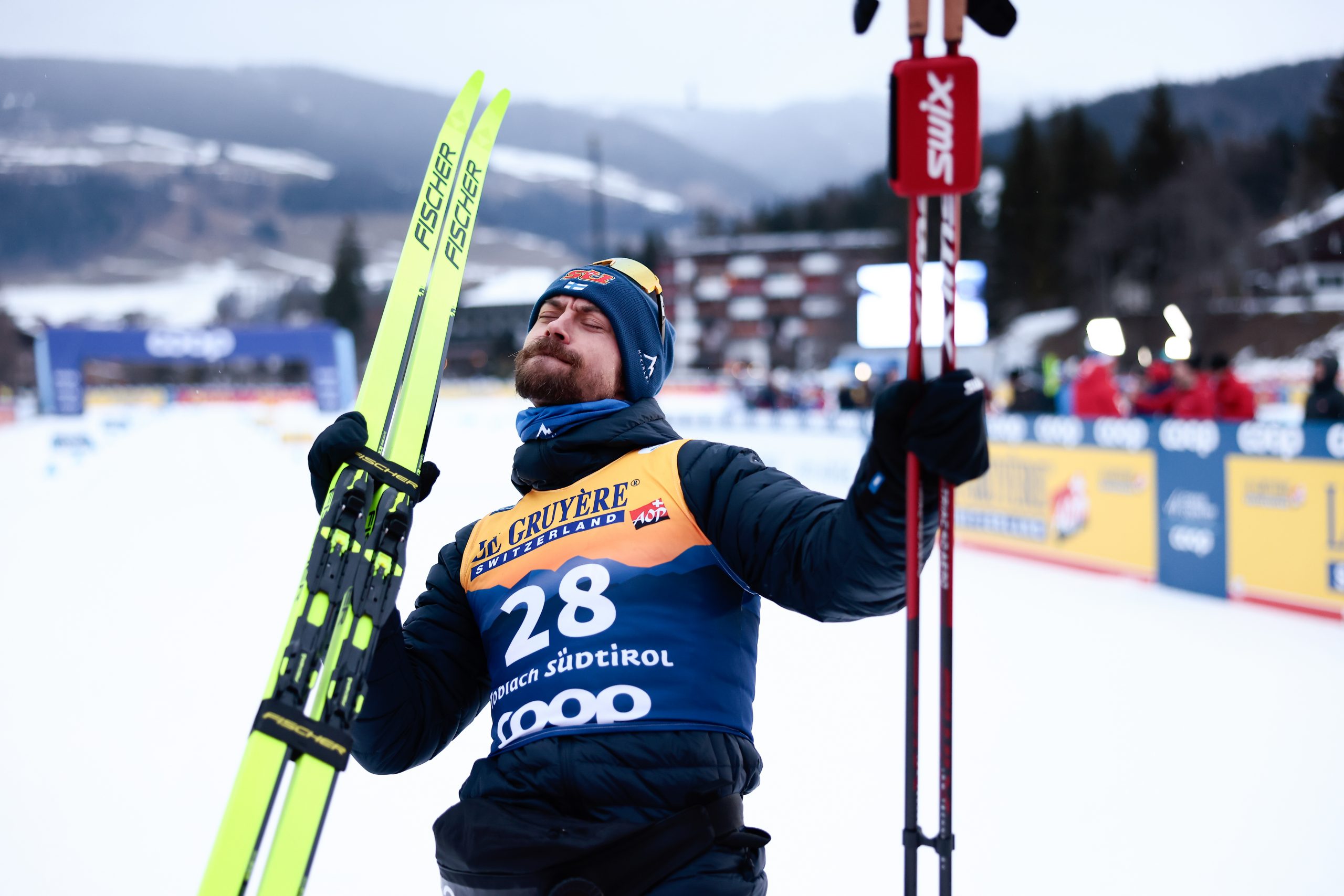
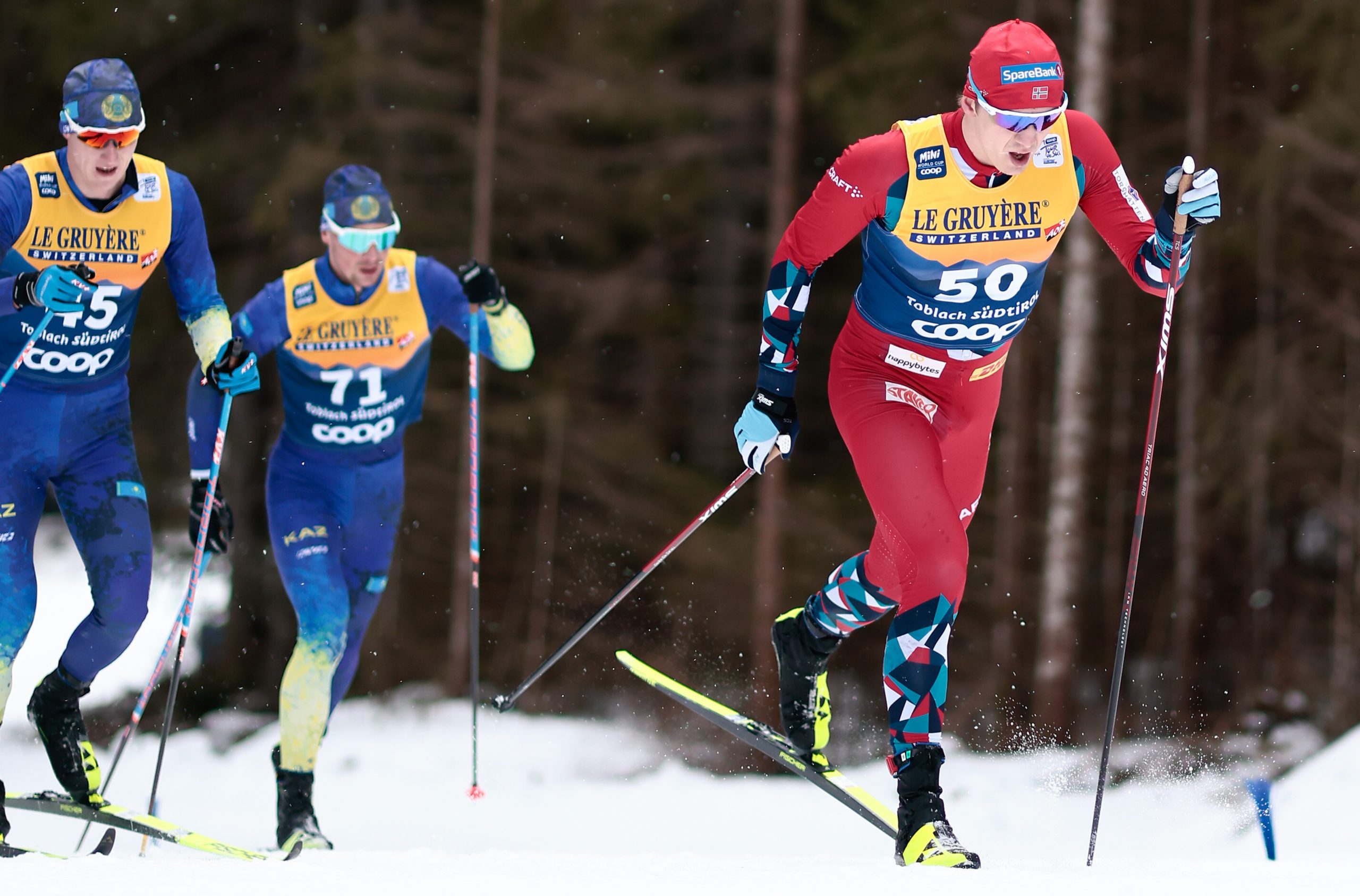
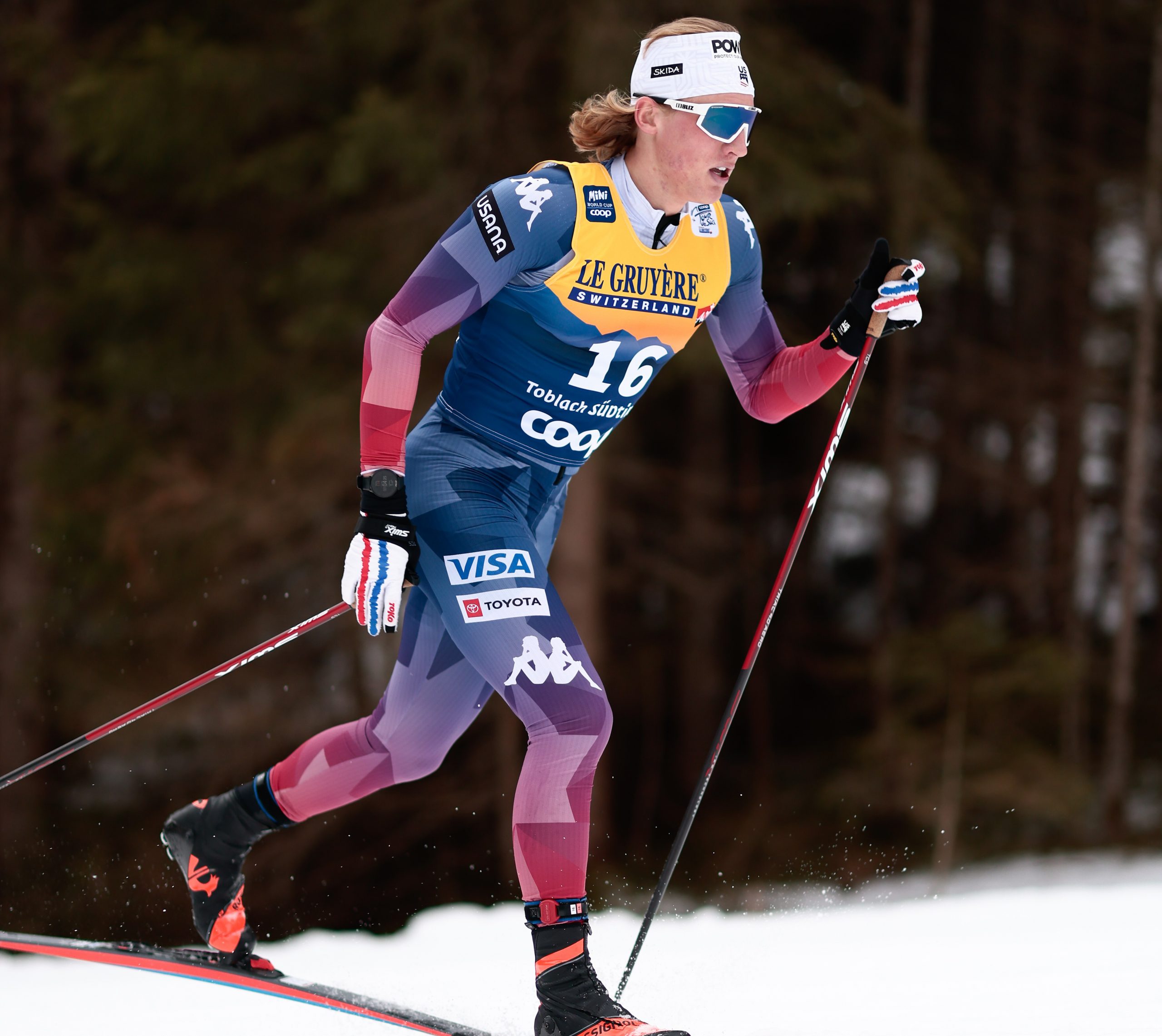
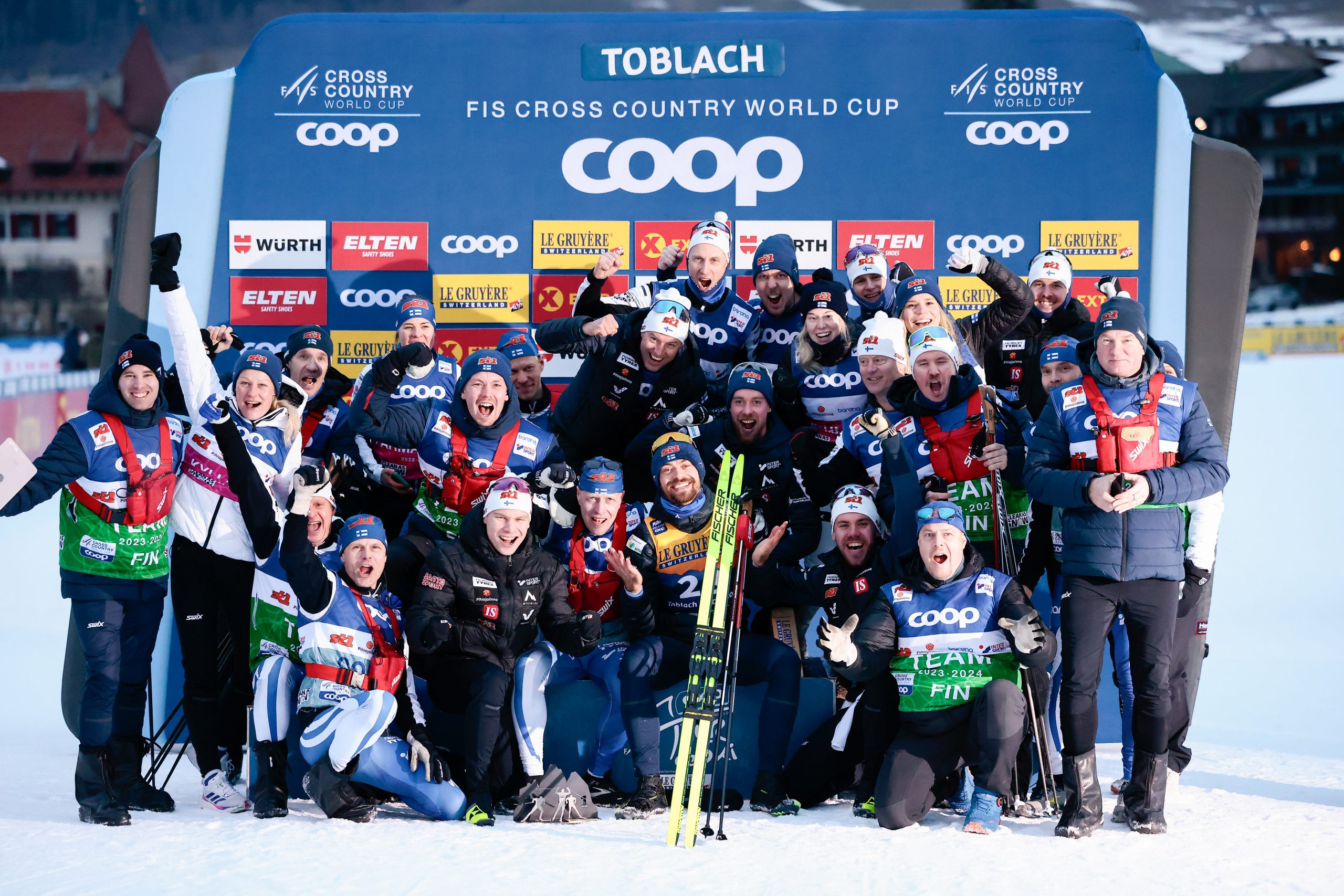
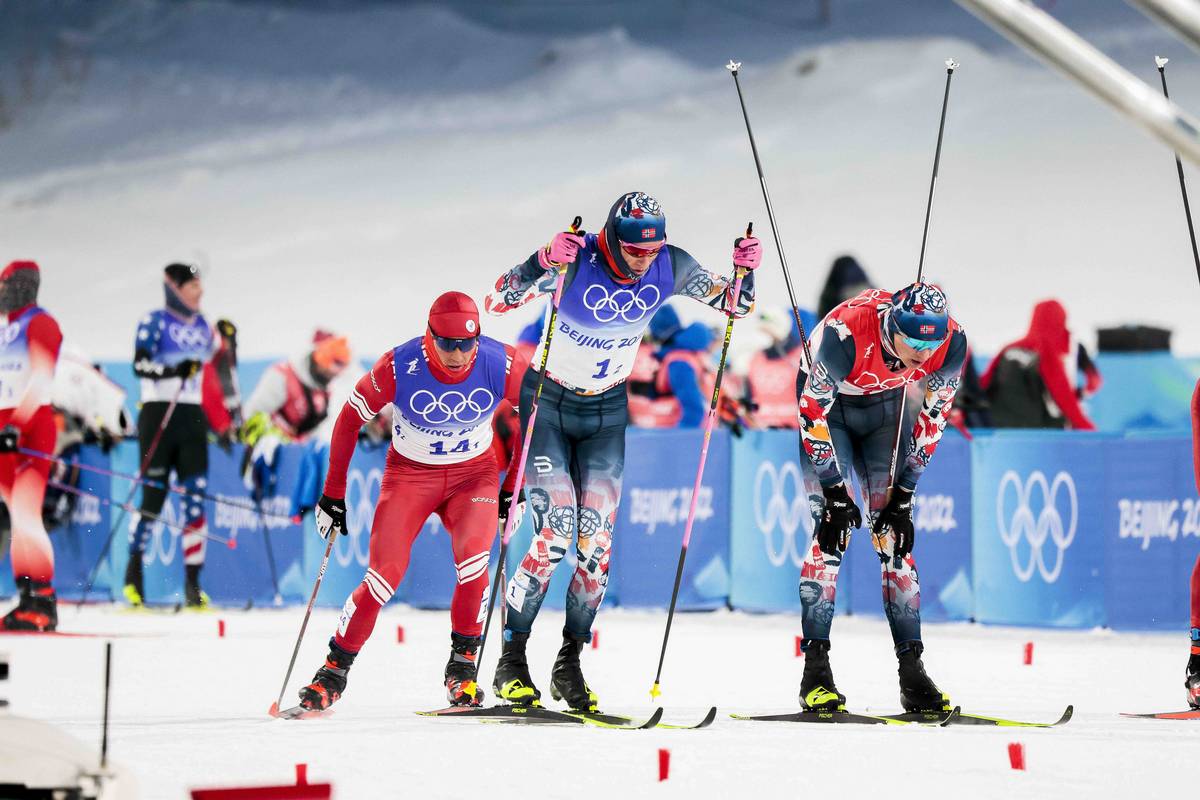
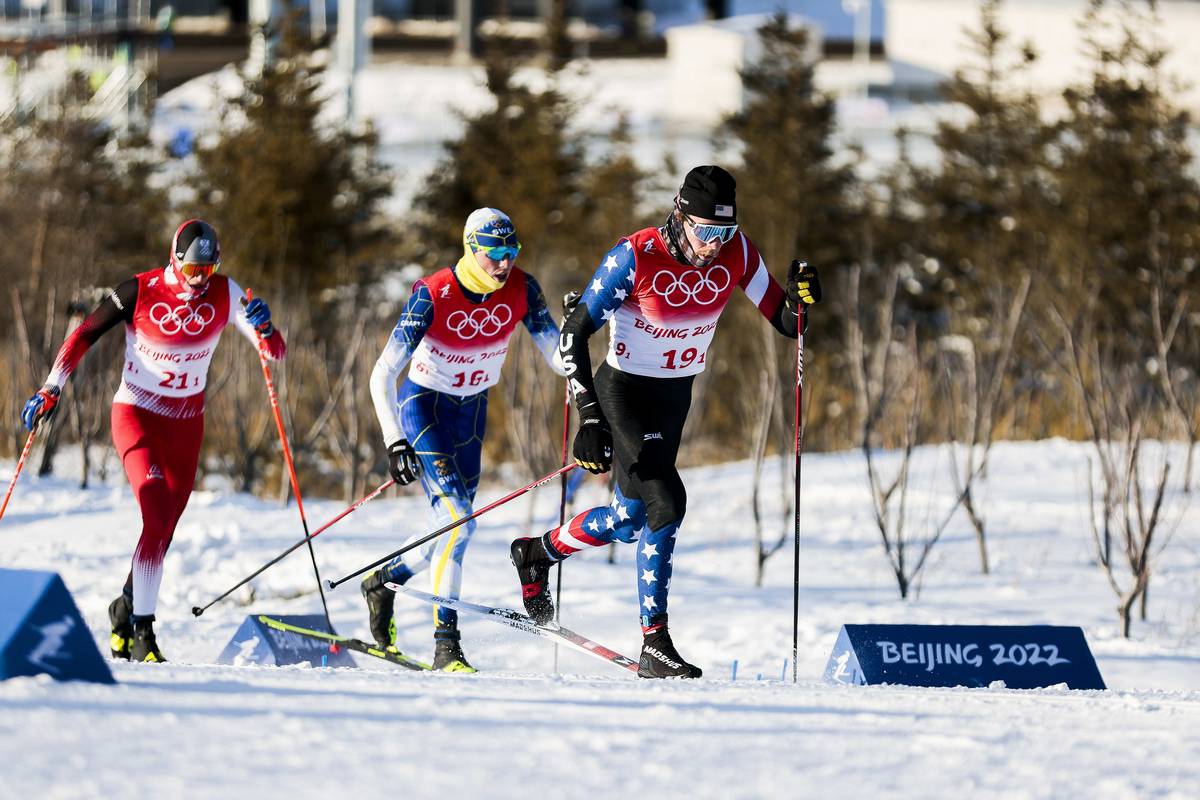
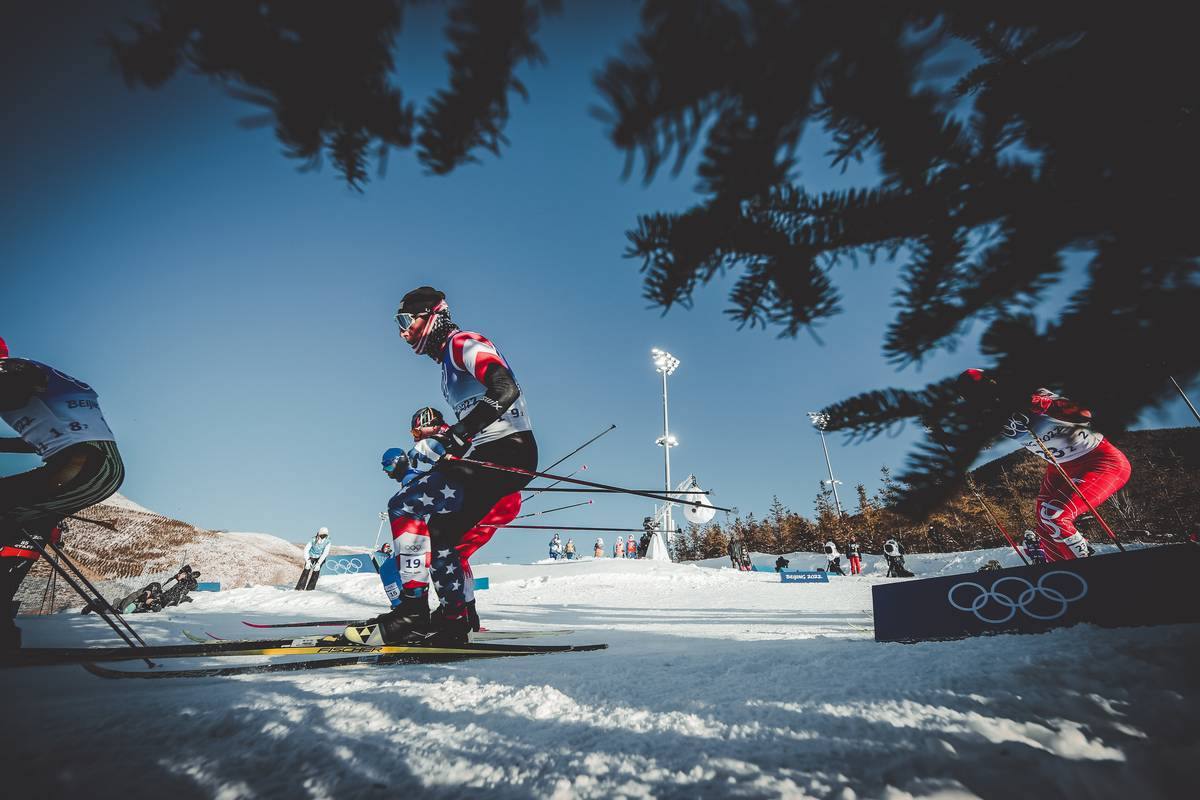
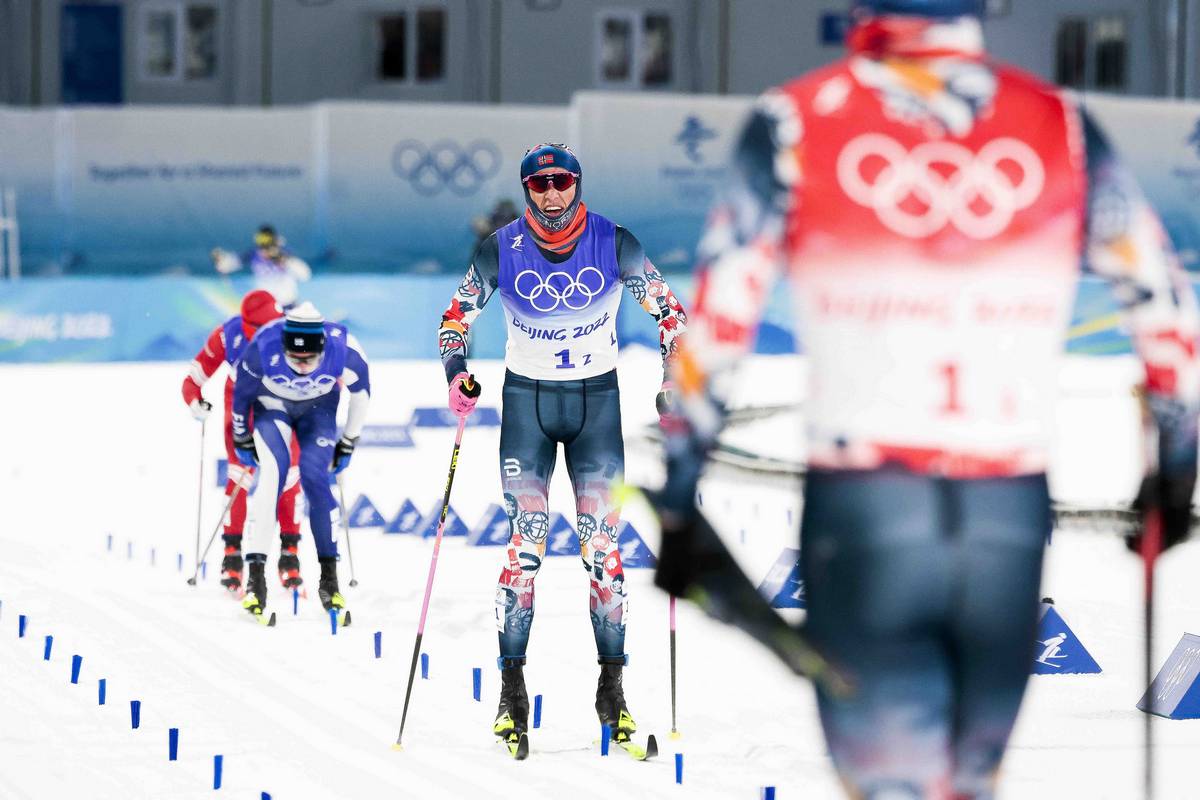
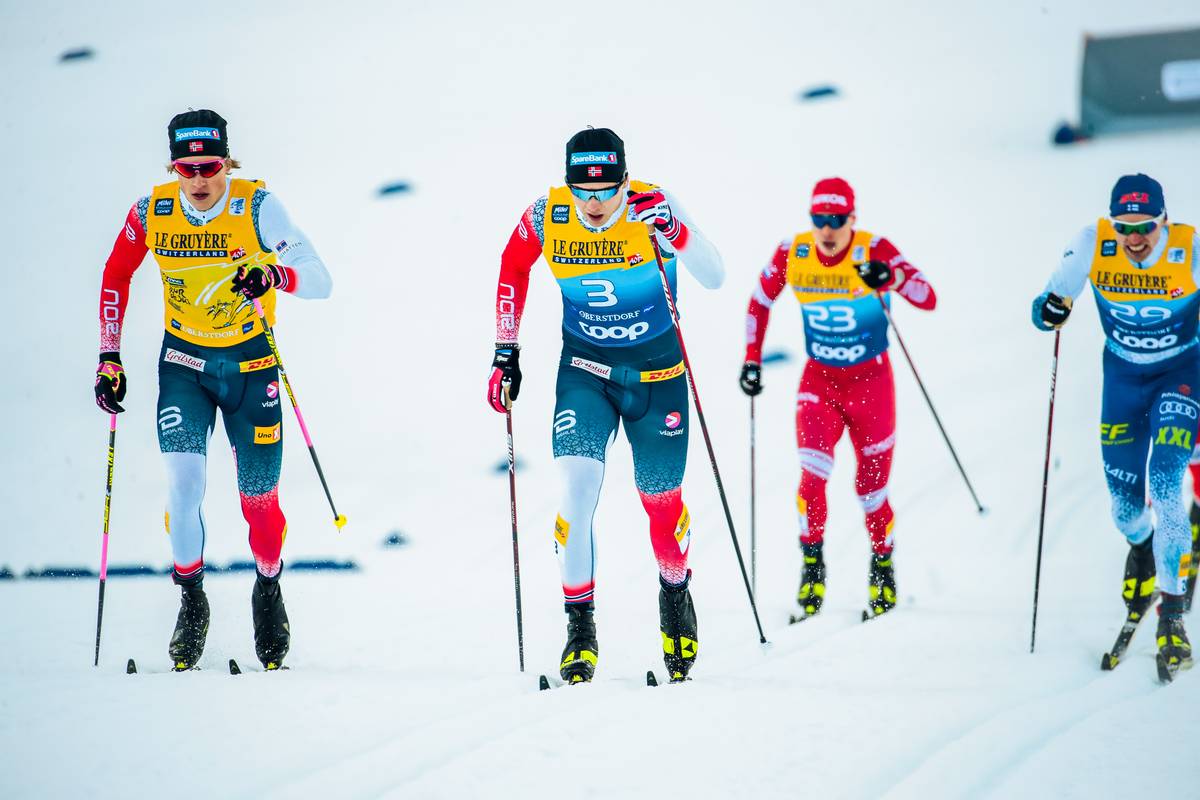
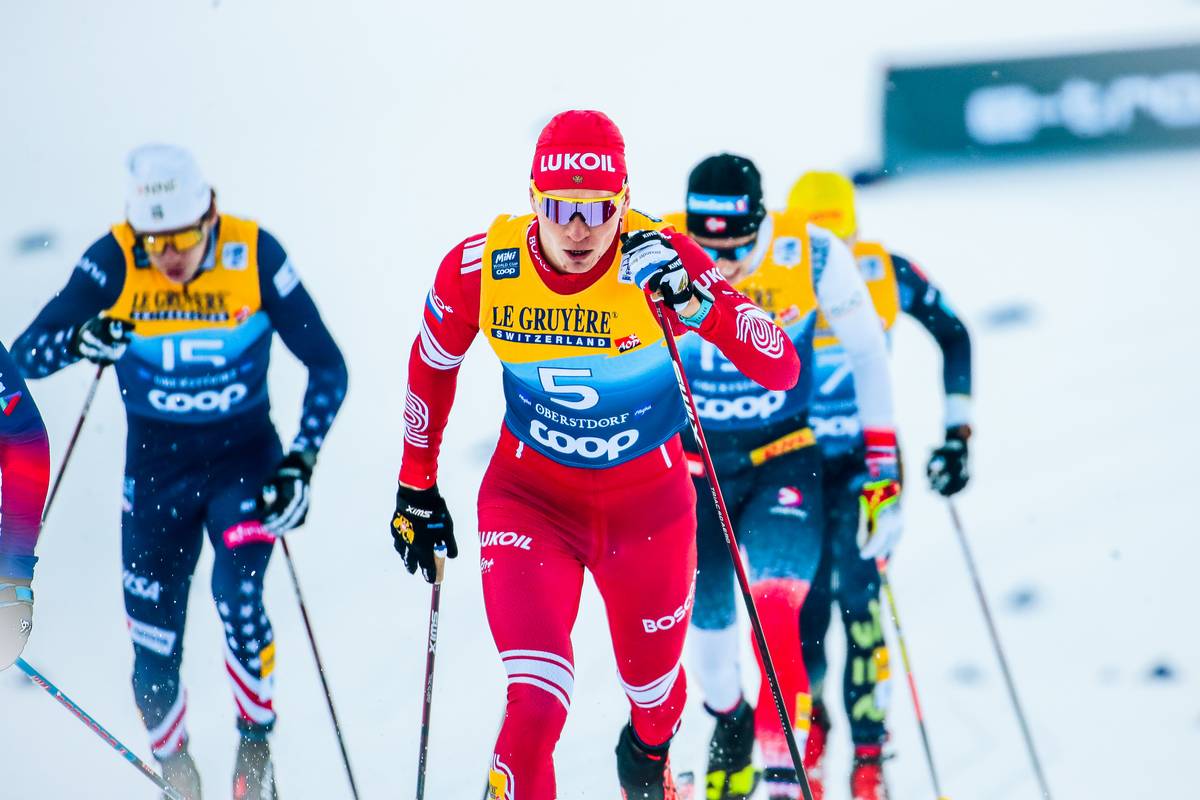
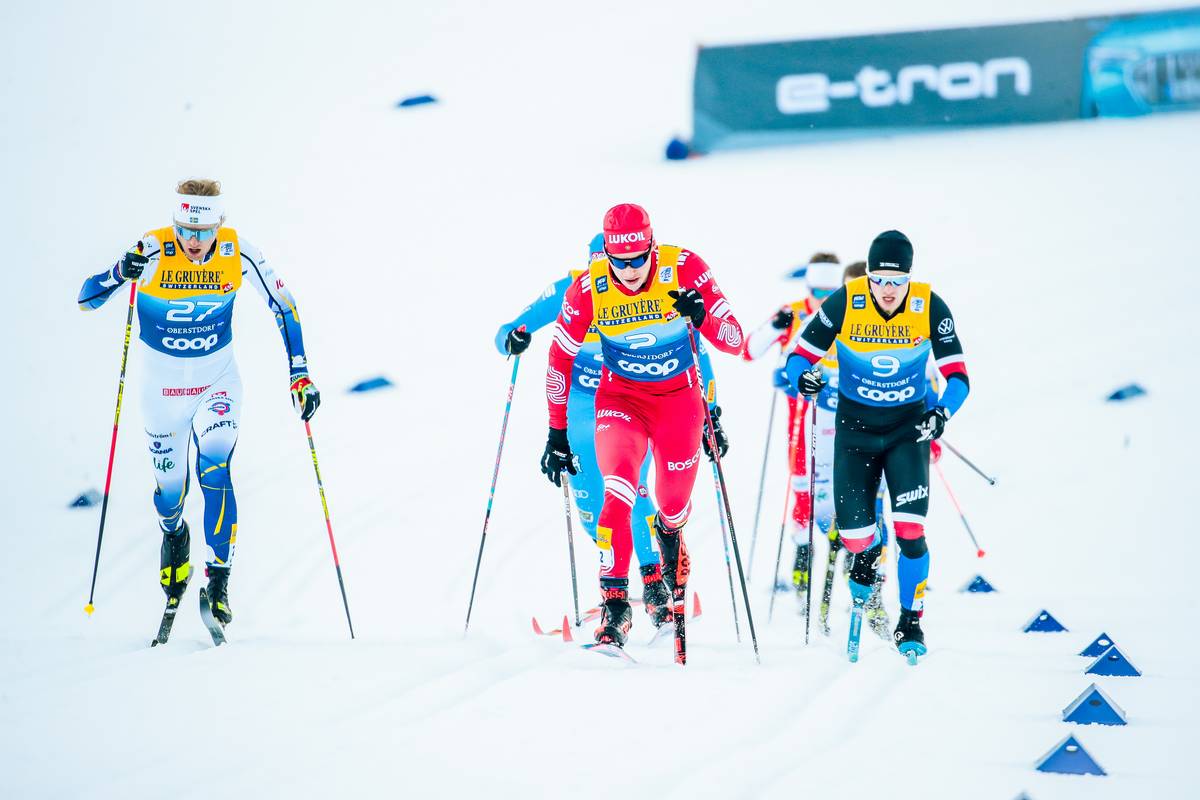
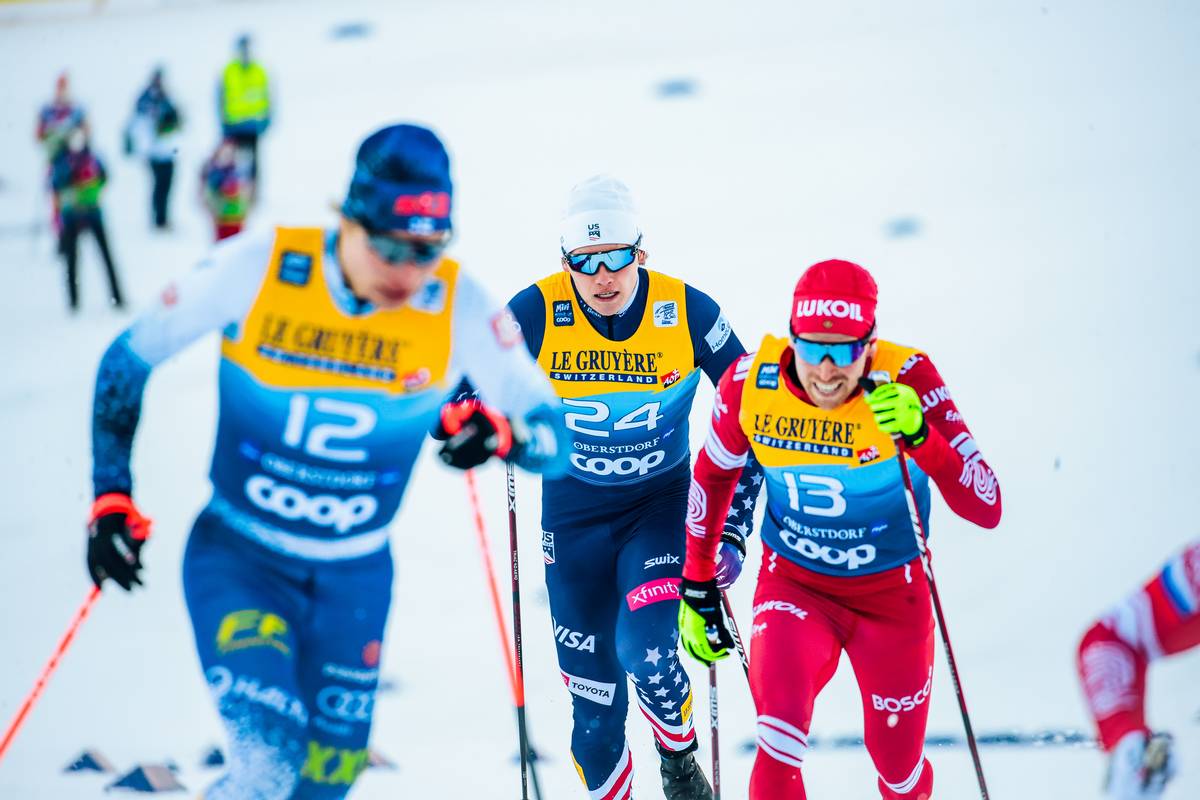
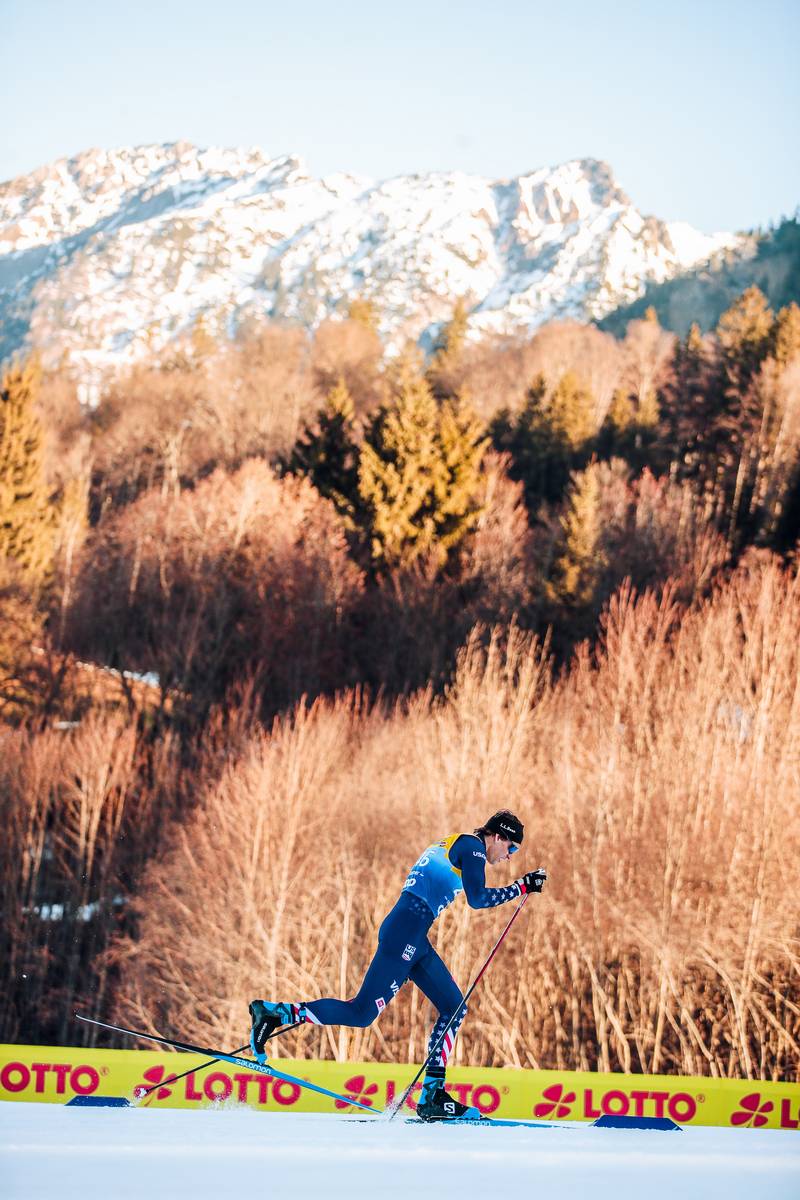
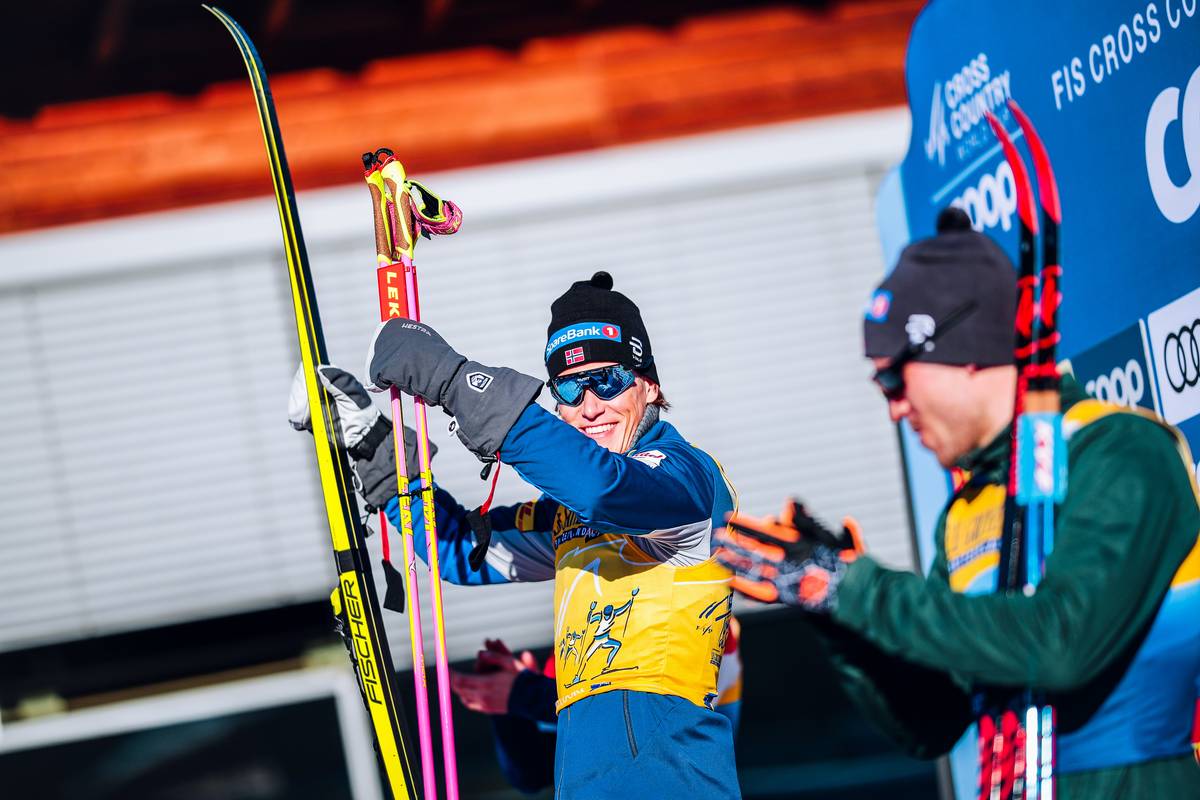
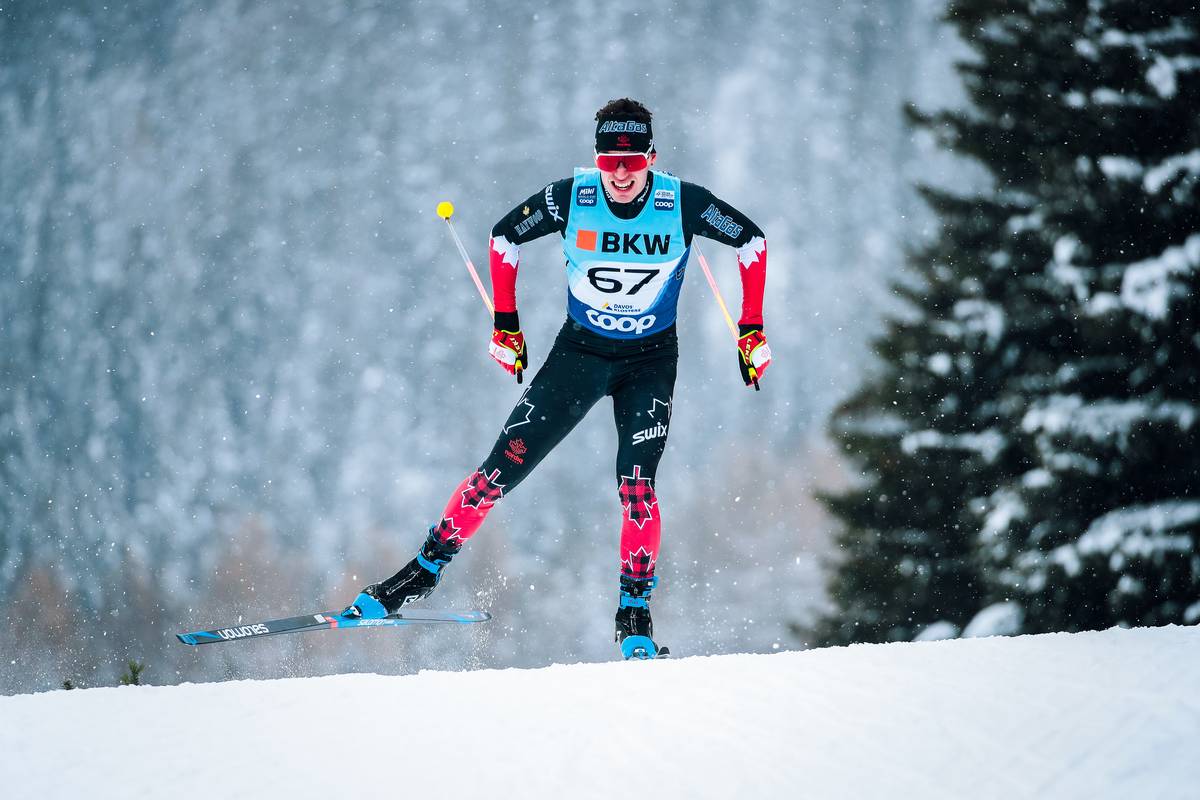
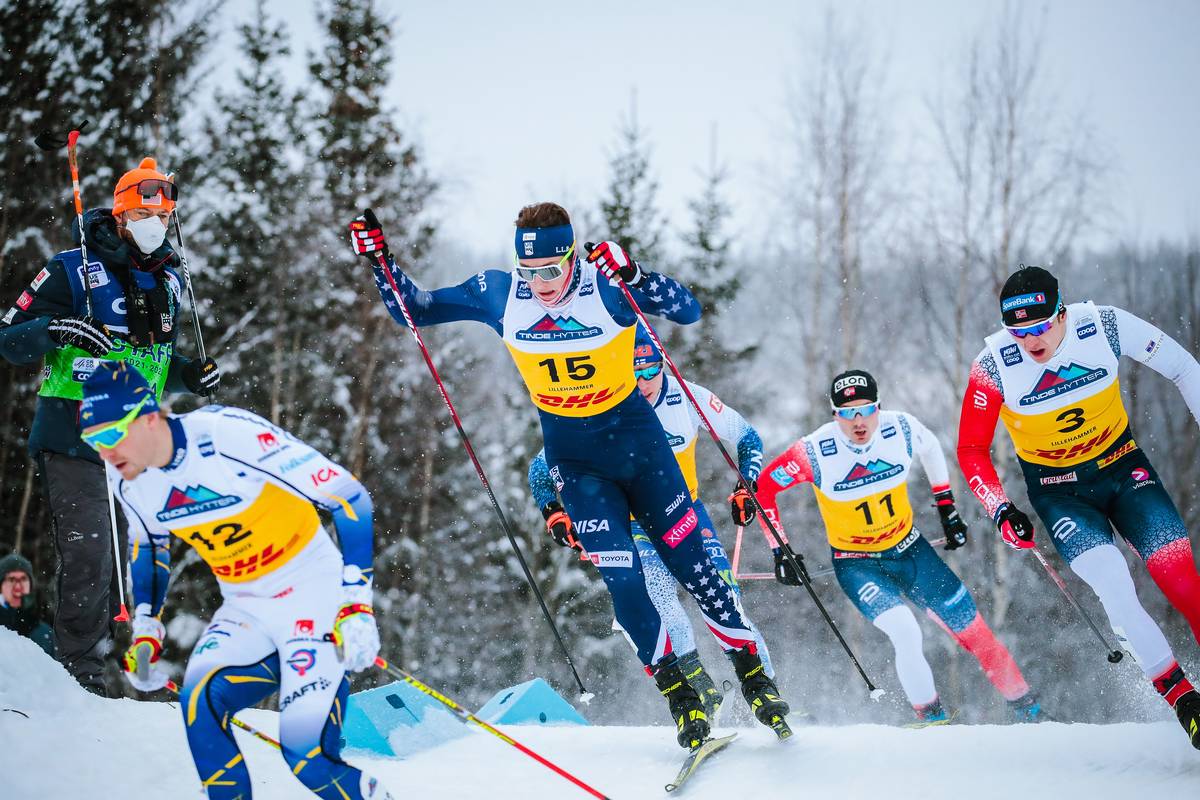
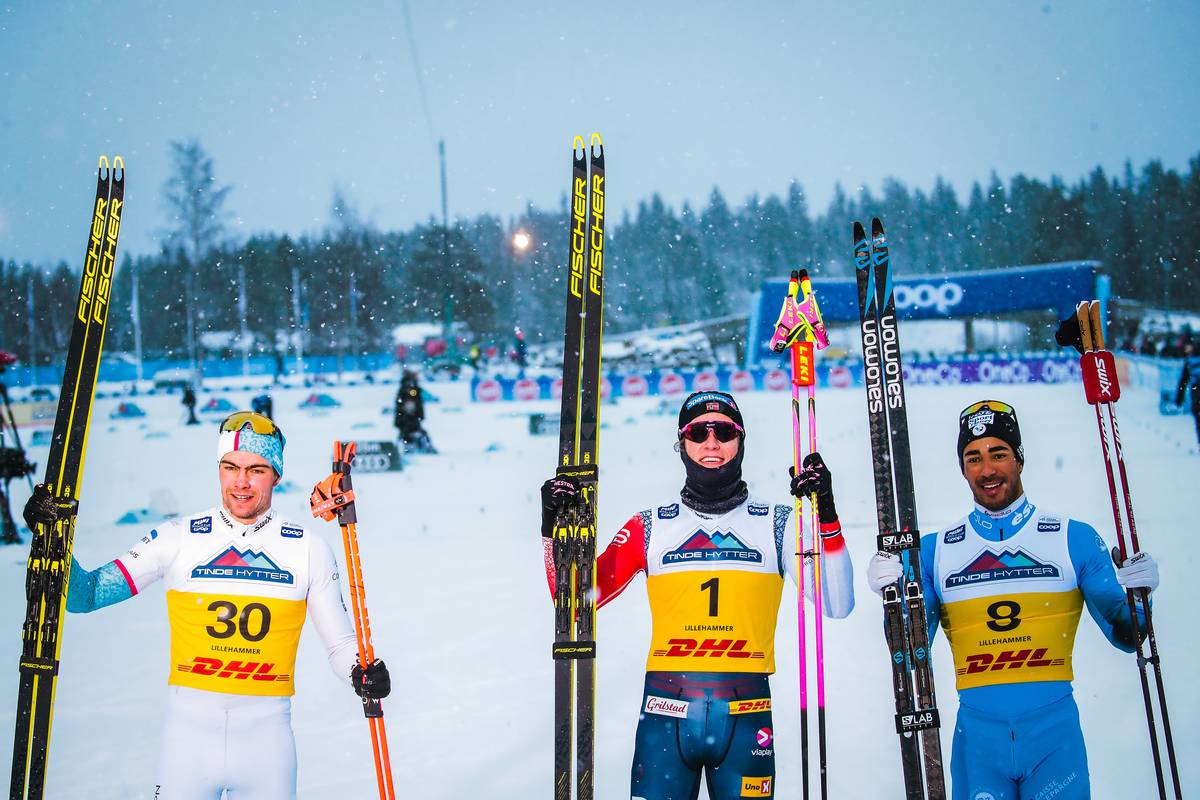
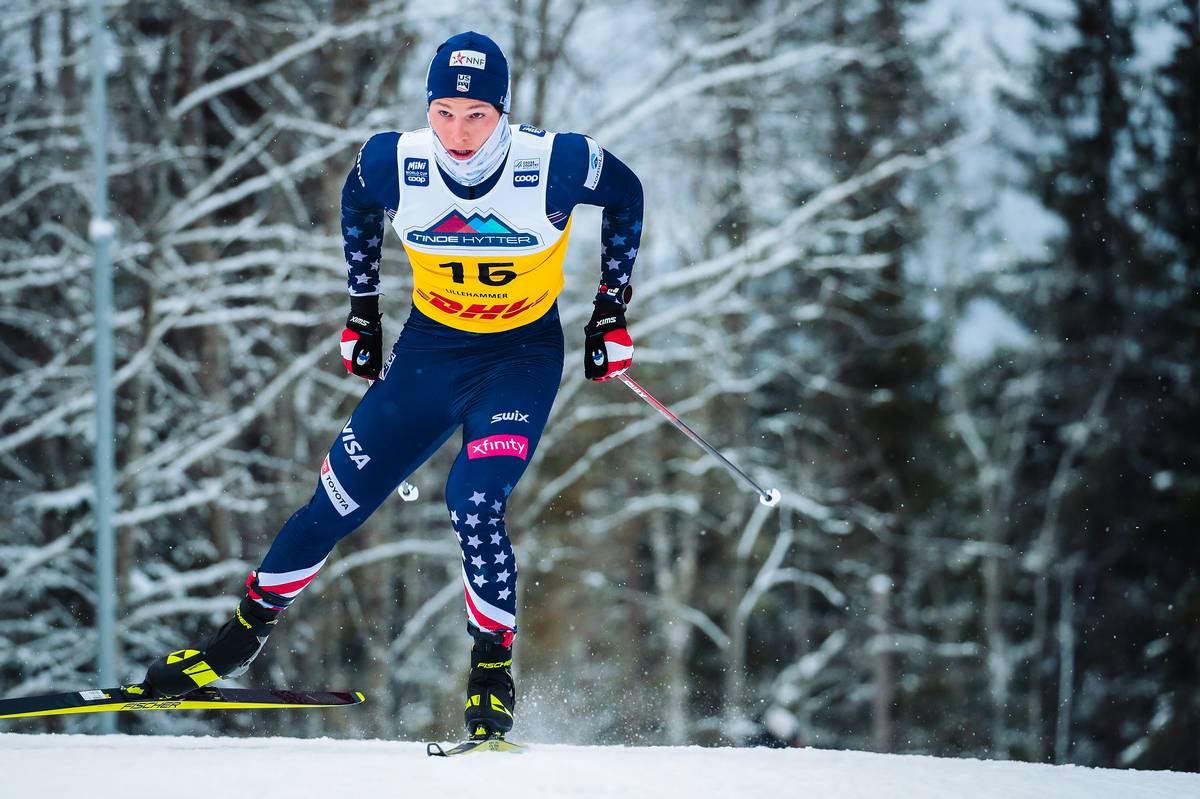
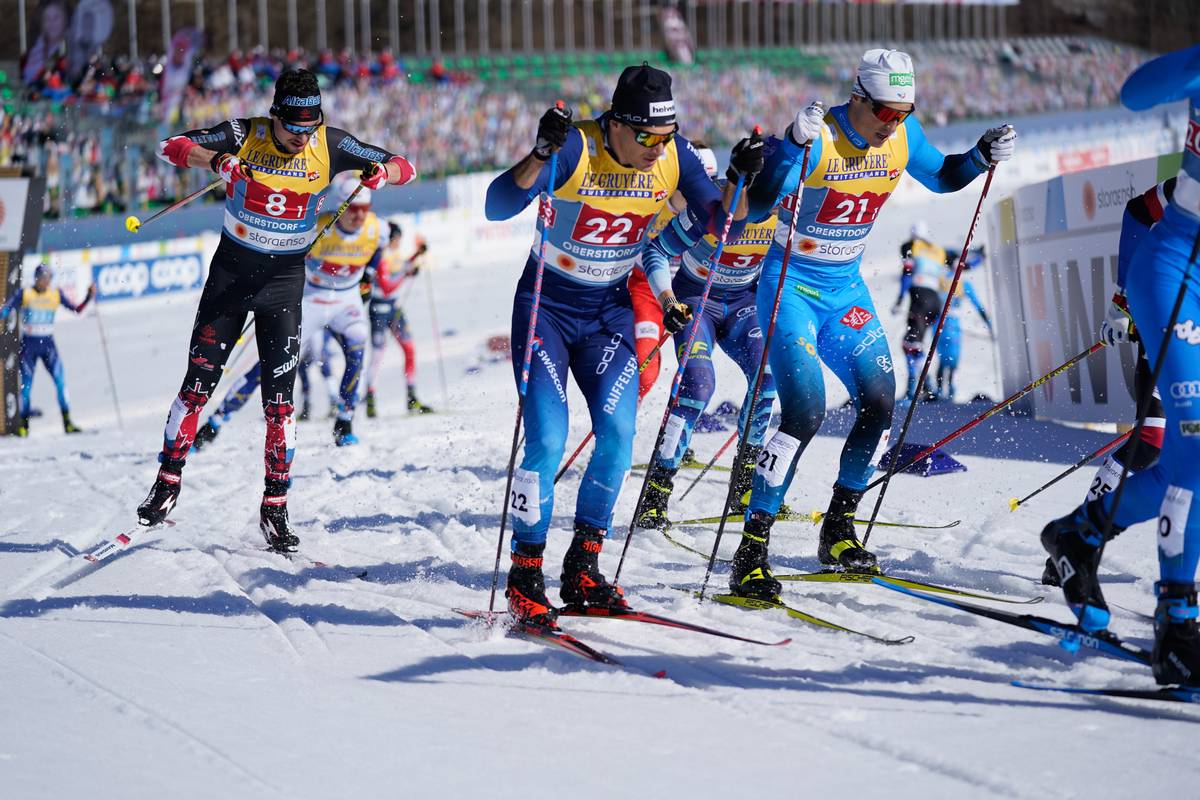
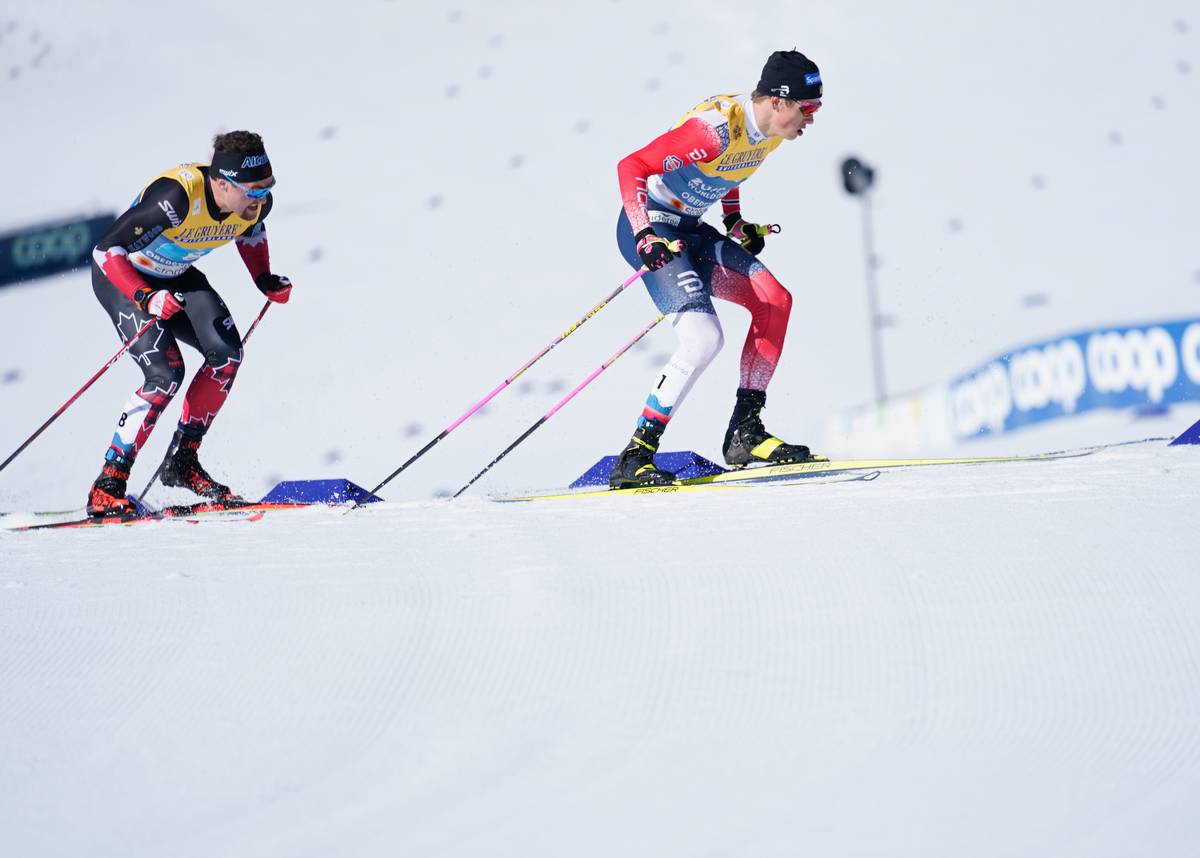
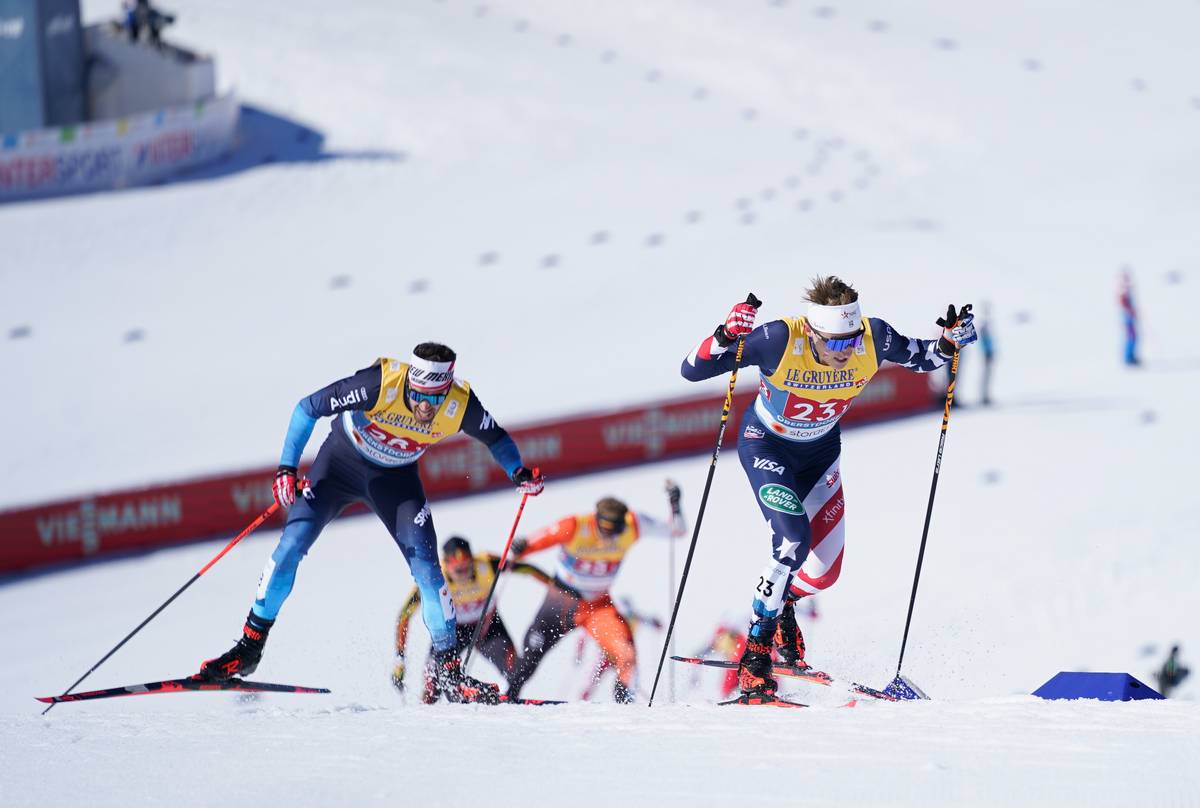
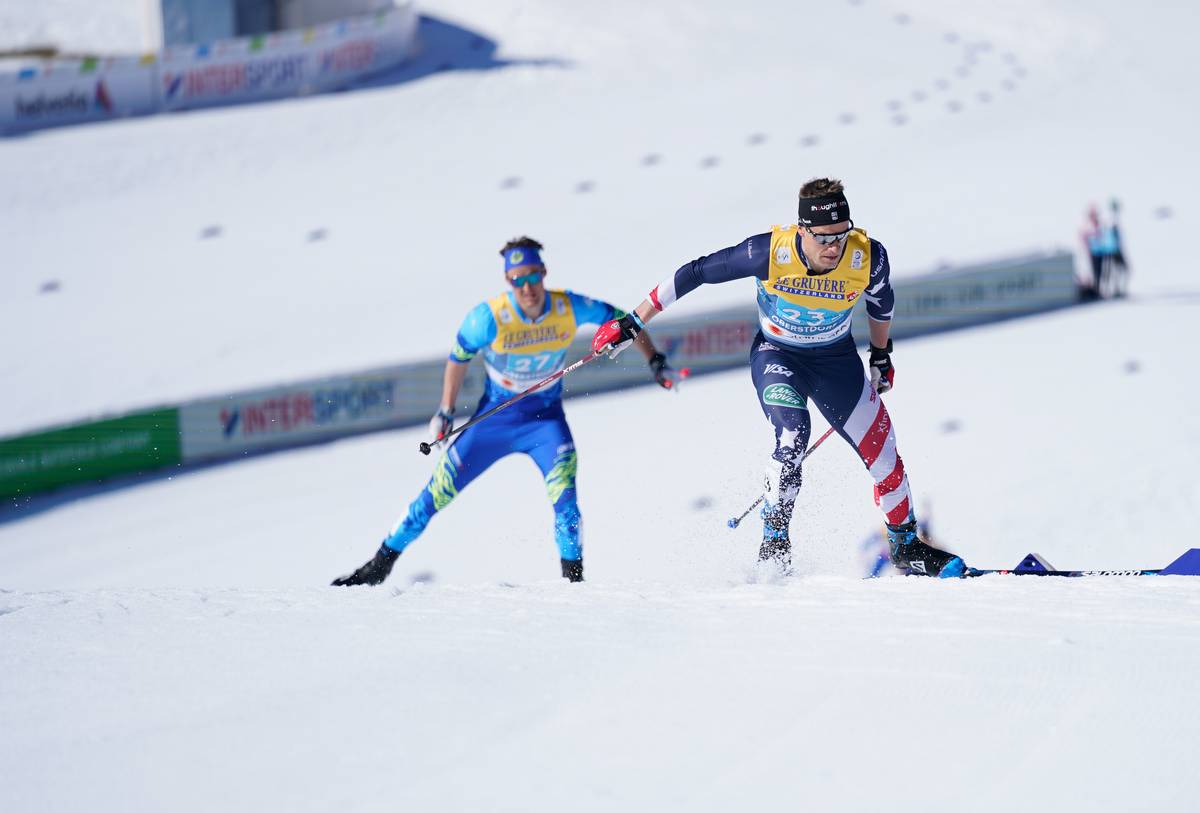
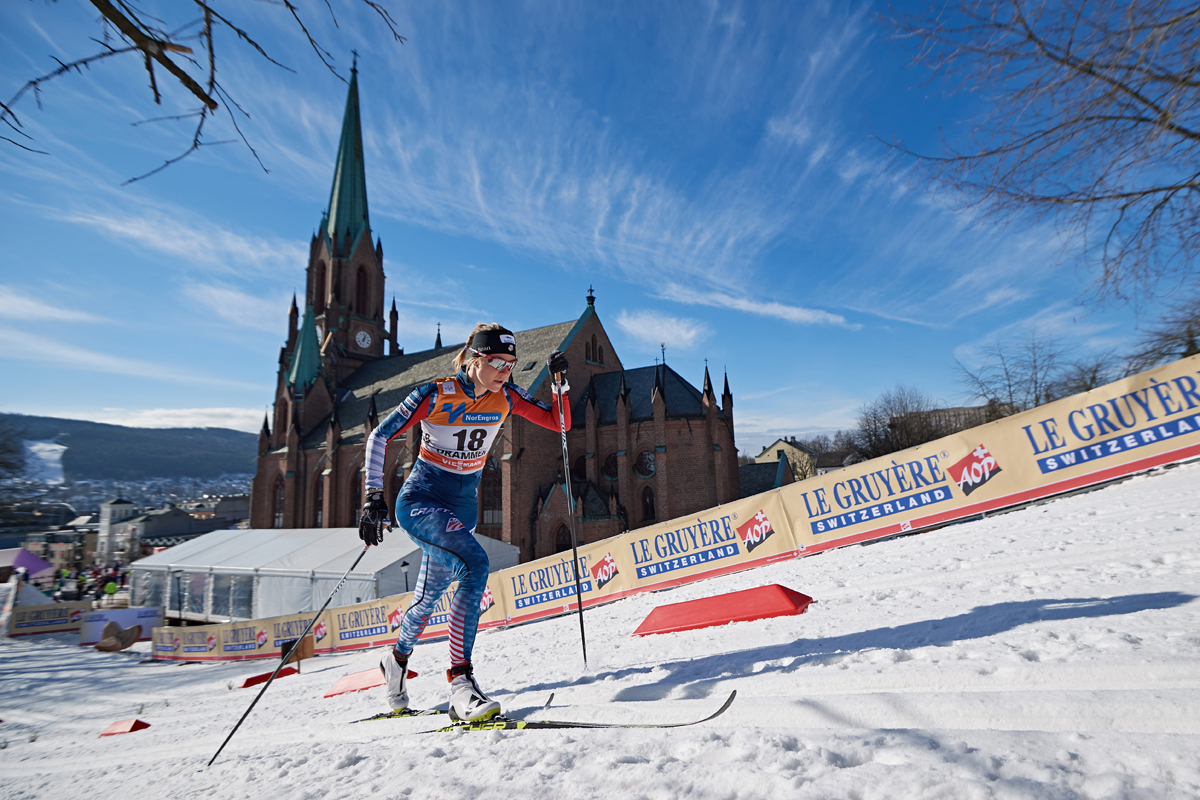
American star Gus Schumacher joins us from Switzerland to break down the first three stages of the 2024 Tour de Ski. And Devon gives us the goods on Norway’s social event of the year: Therese Johaug’s wedding.
Send us your questions and feedback: devon@fasterskier.com and nat@fasterskier.com. We’ll be back in a couple days.
This coverage is made possible through the generous support of Marty and Kathy Hall and A Hall Mark of Excellence Award. To learn more about A Hall Mark of Excellence Award, or to learn how you can support FasterSkier’s coverage, please contact info@fasterskier.com.
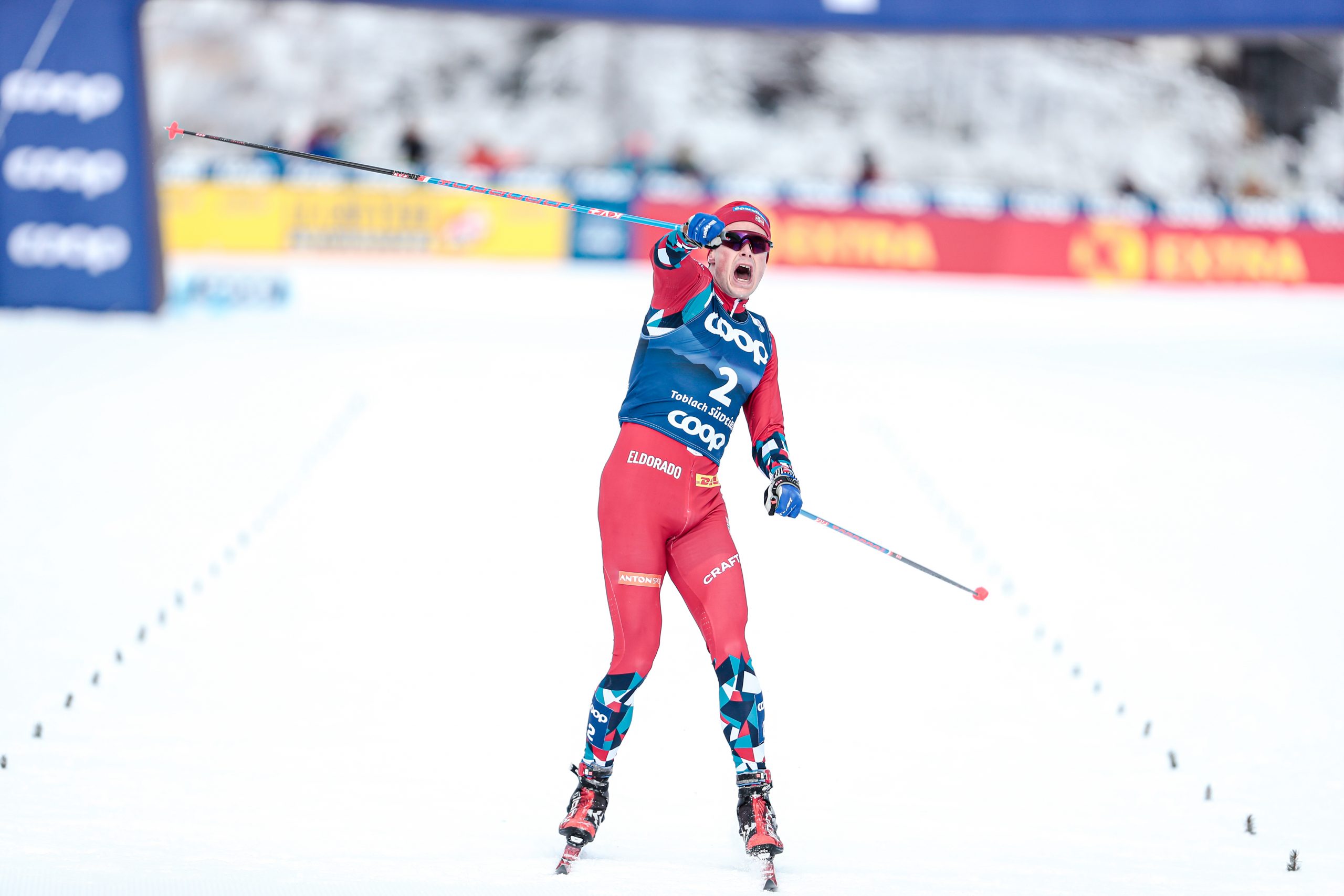
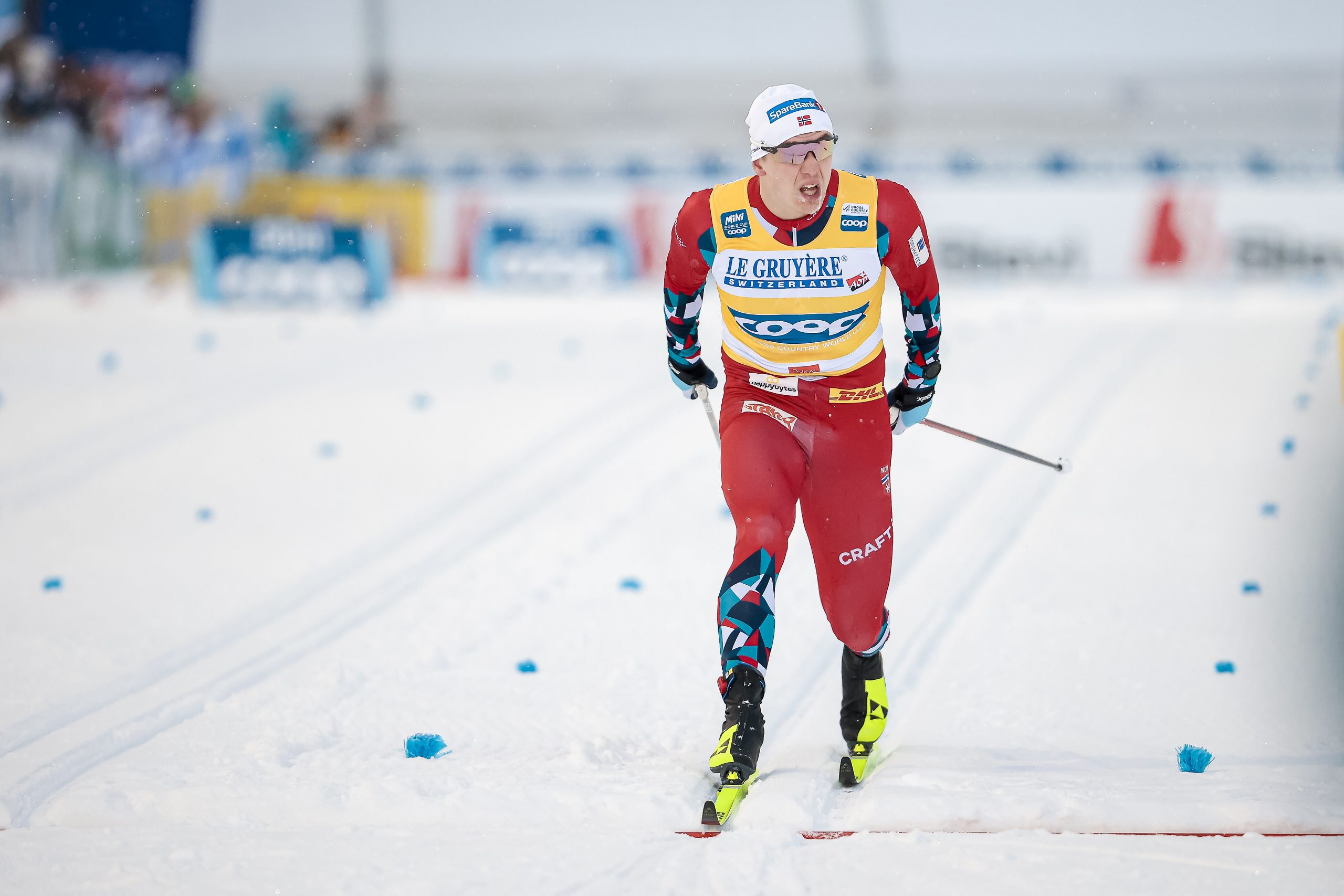
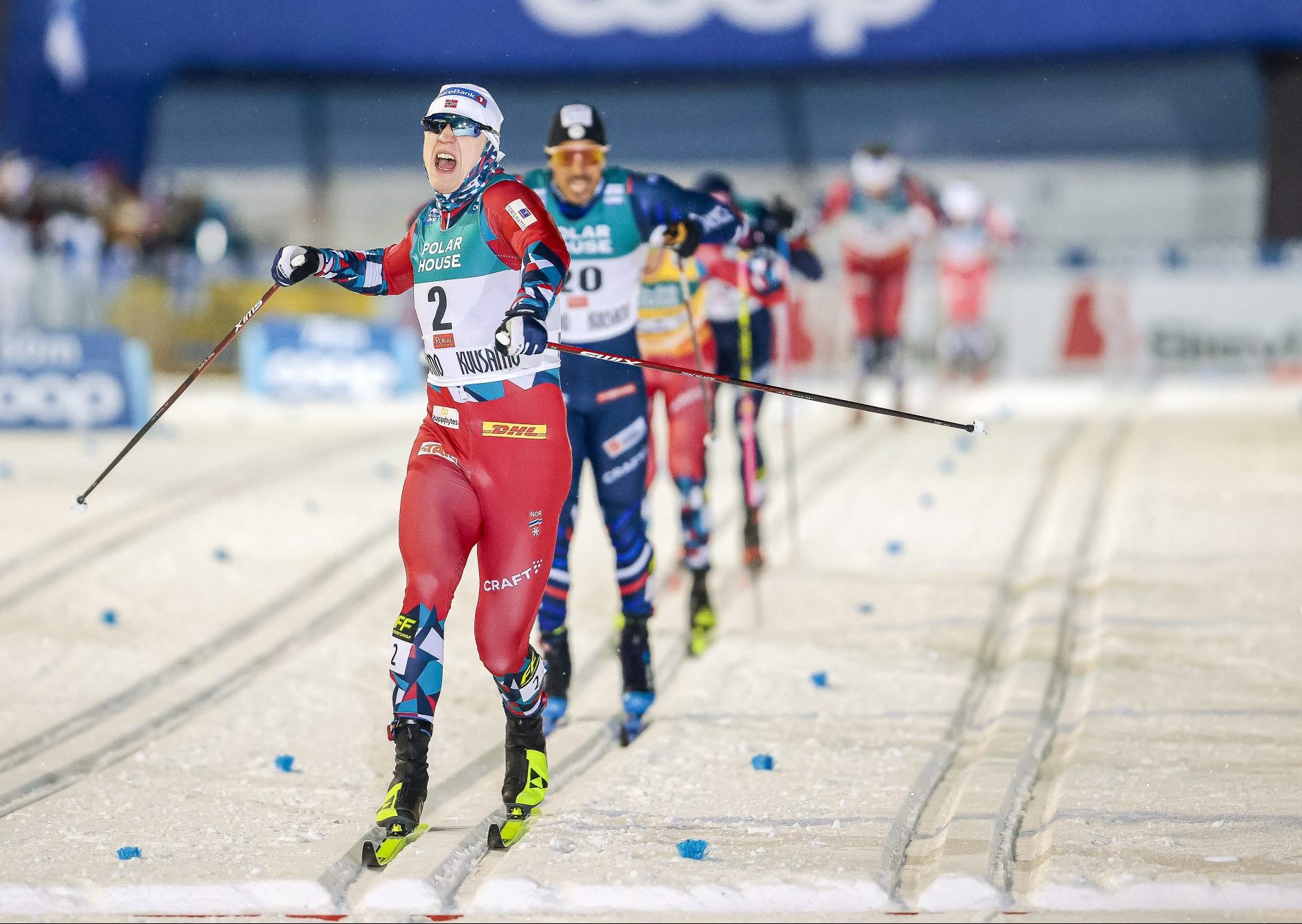
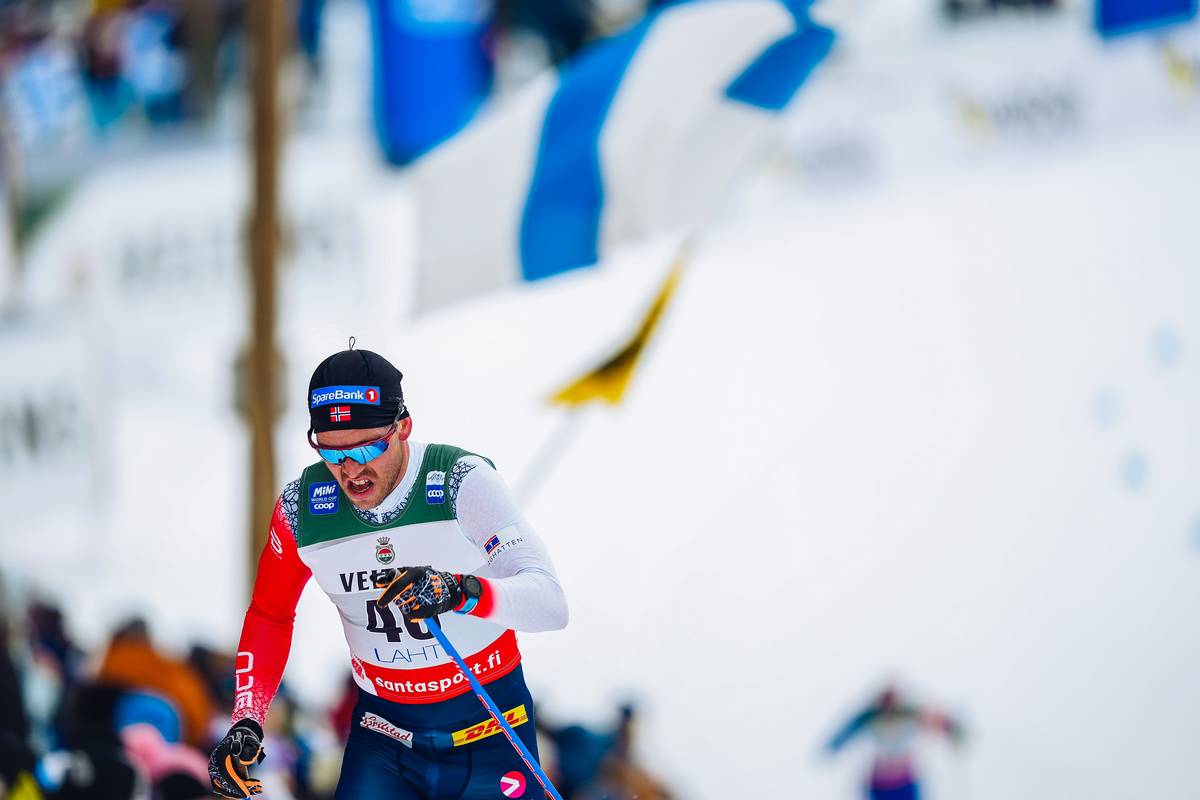
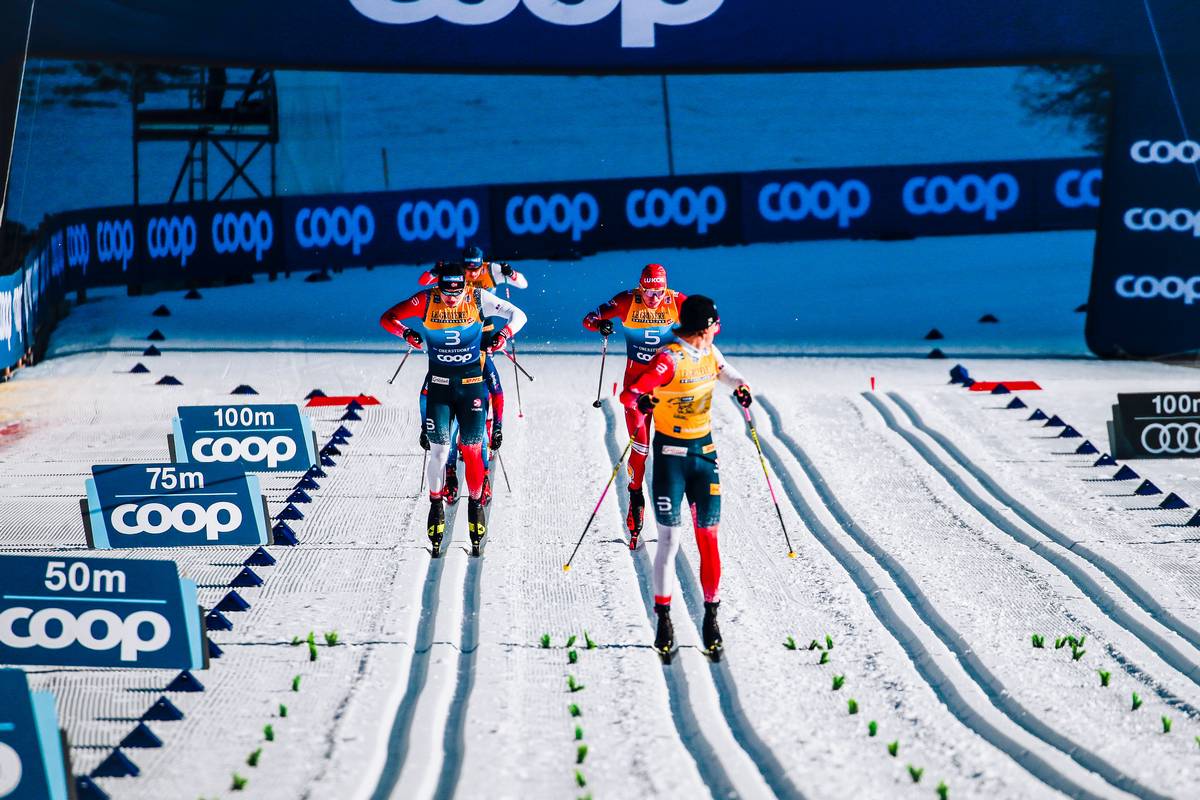
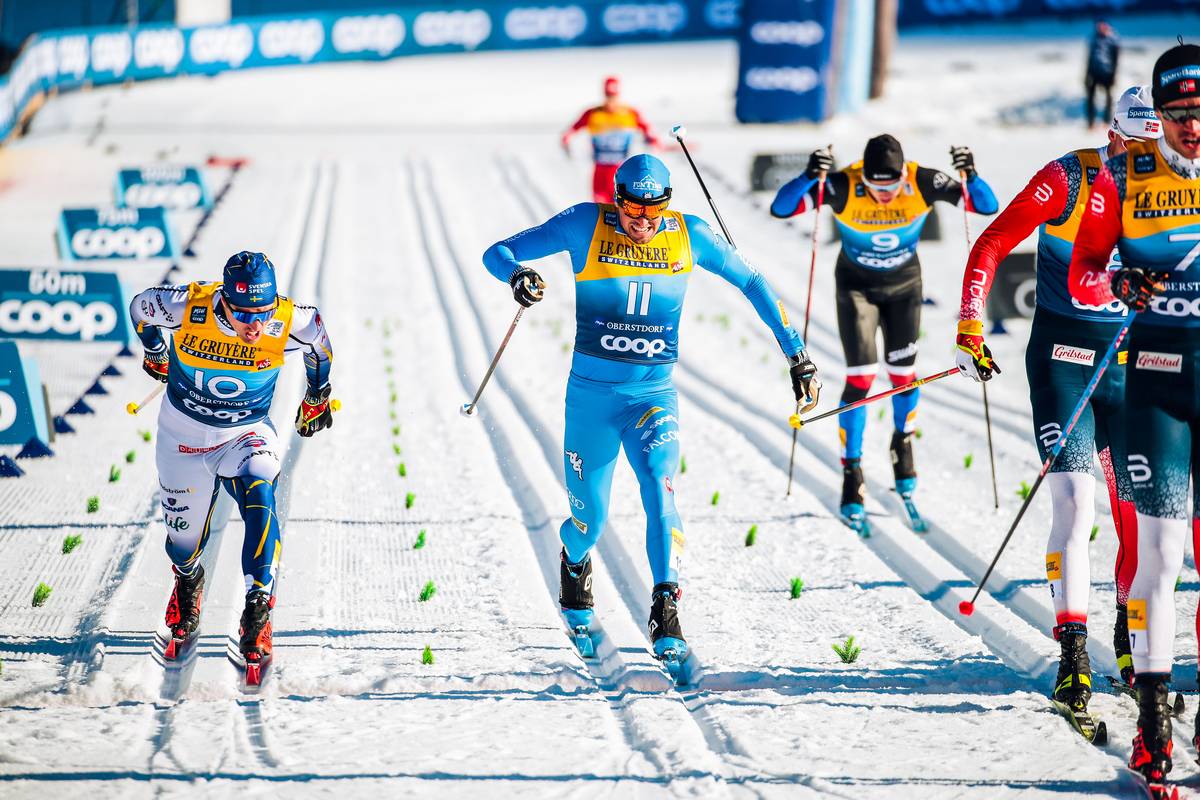
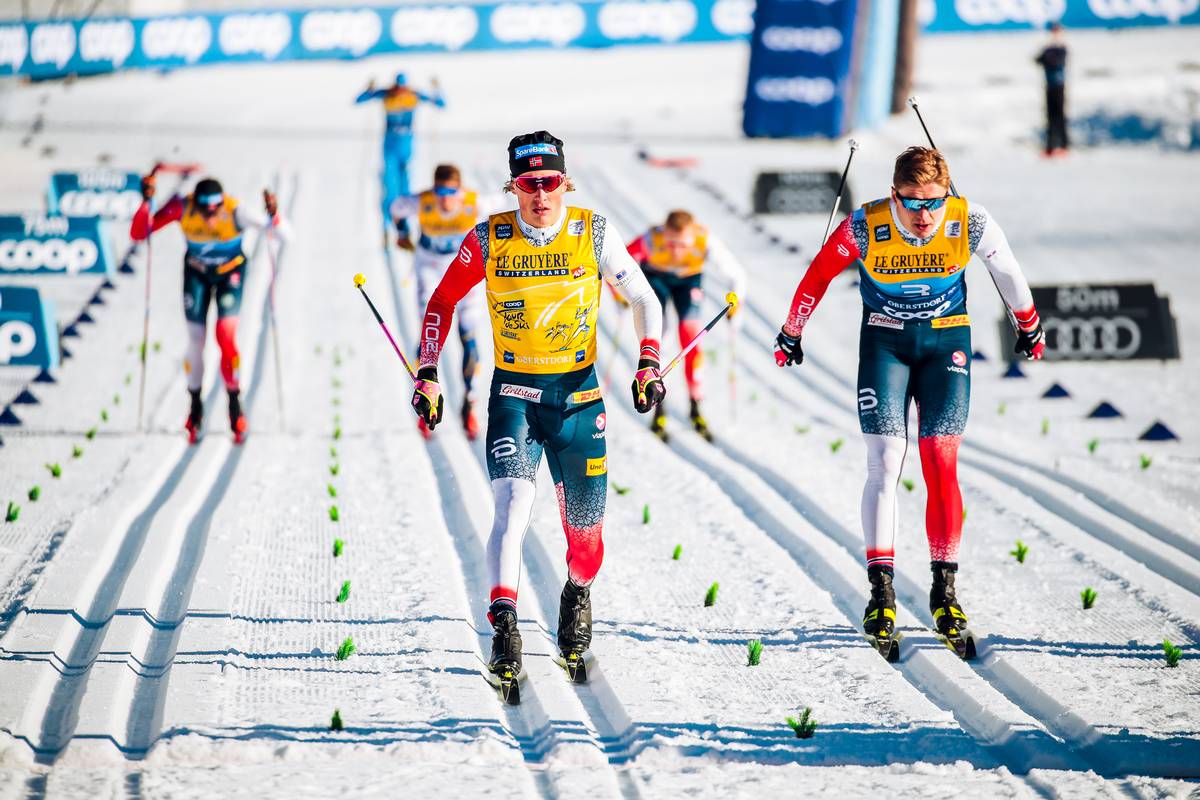
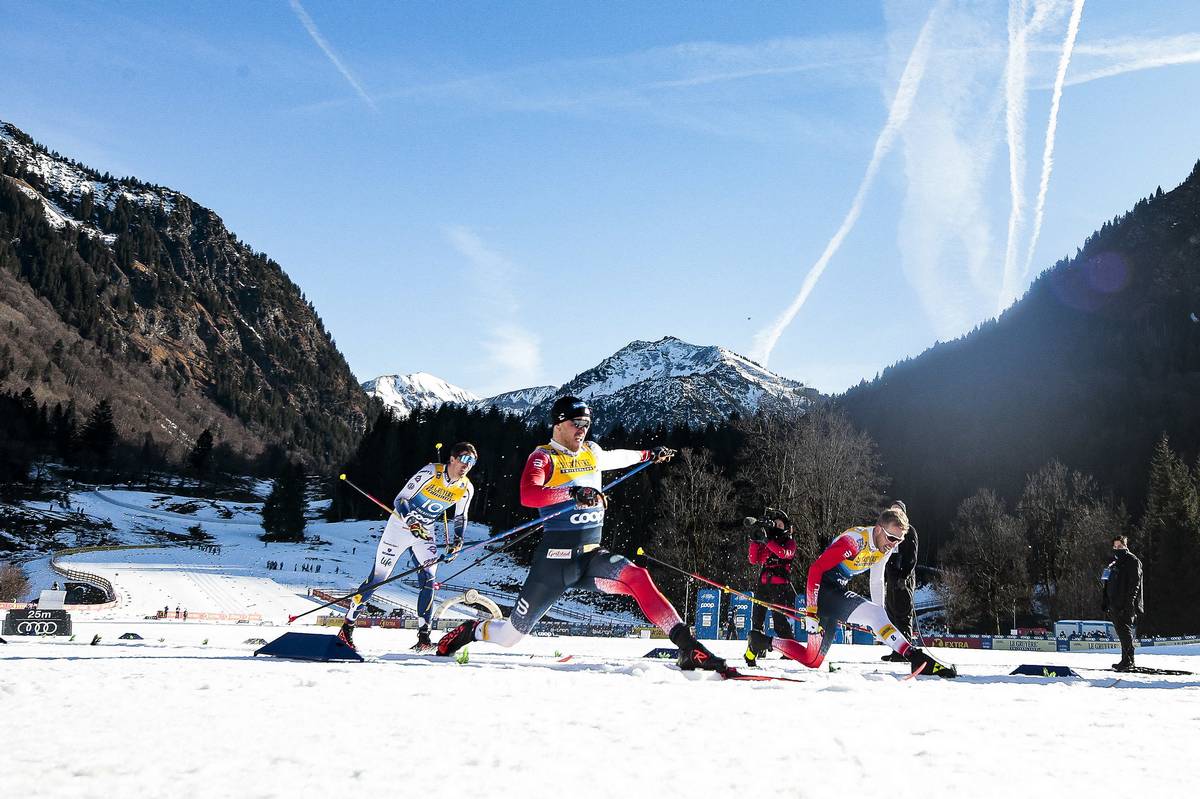
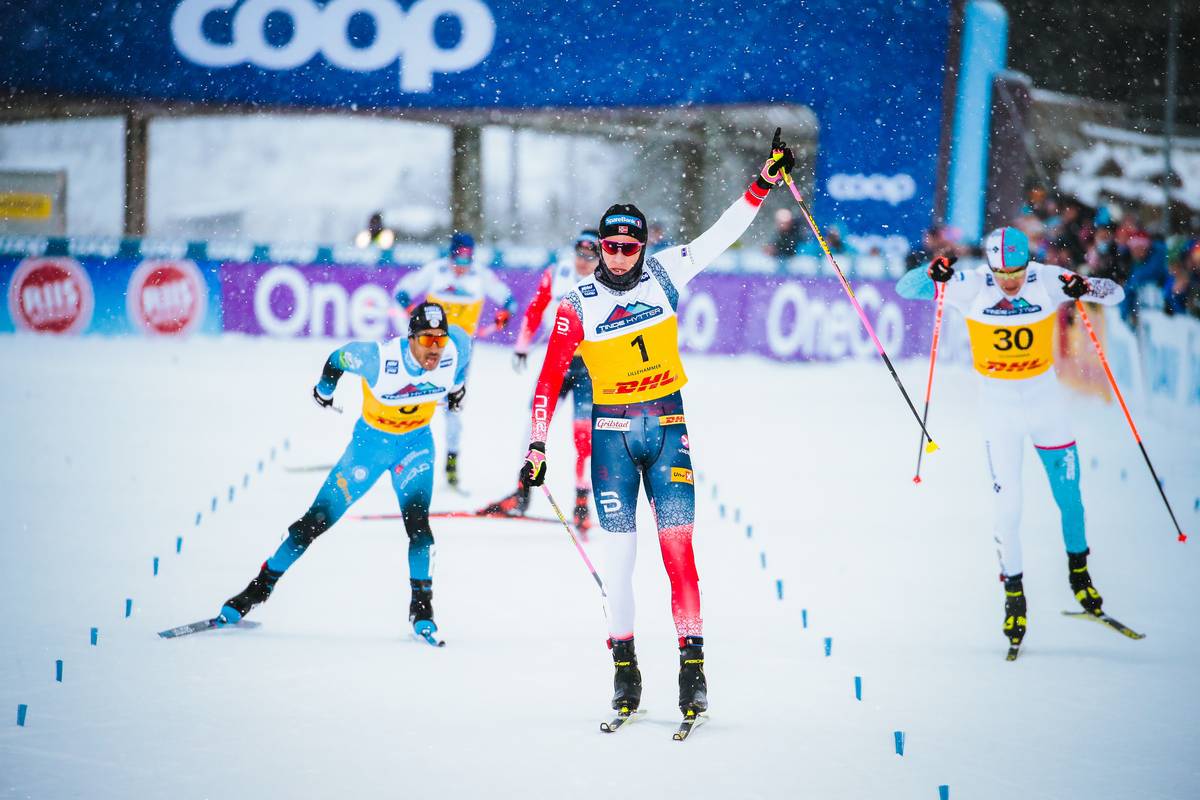
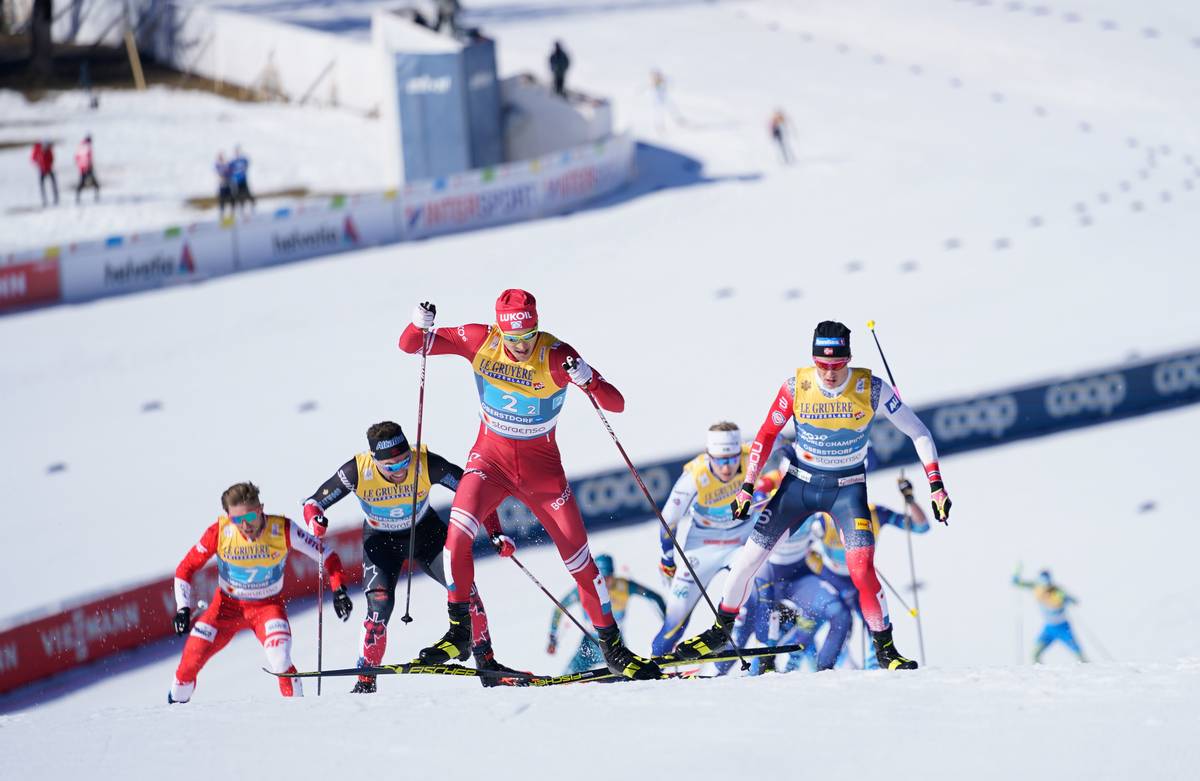
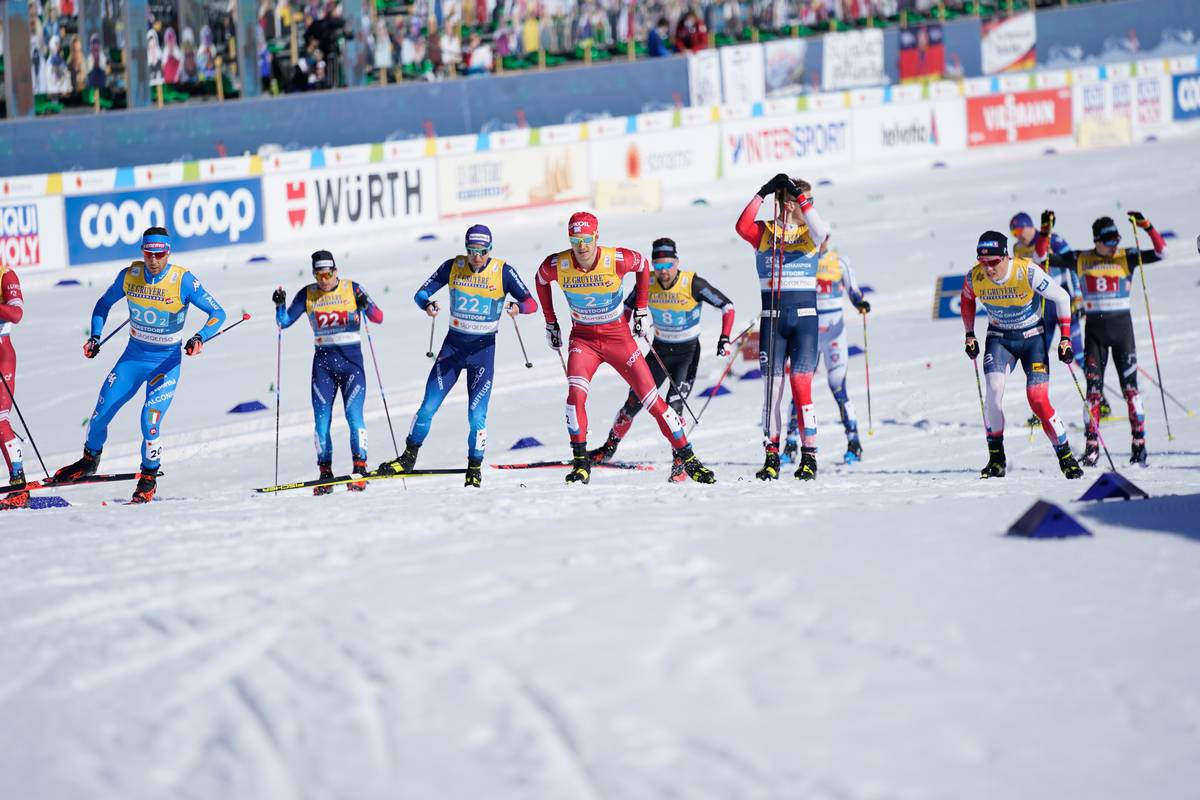
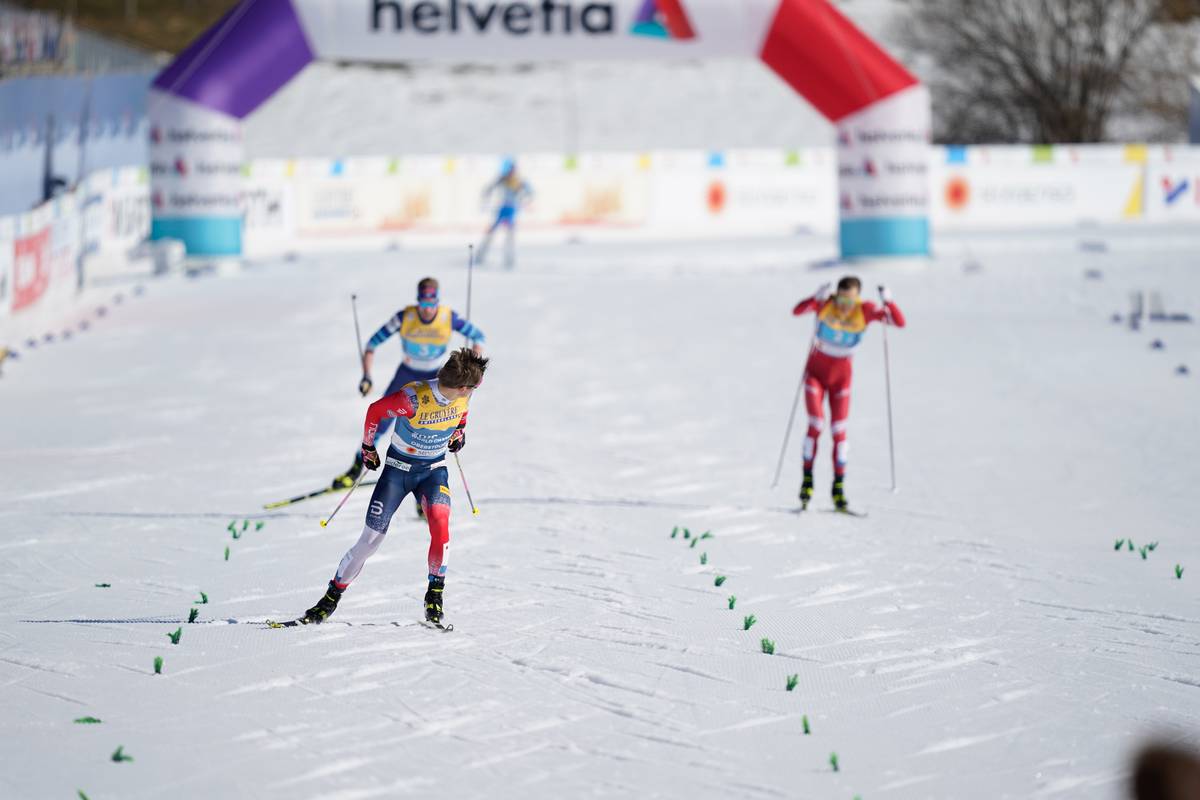
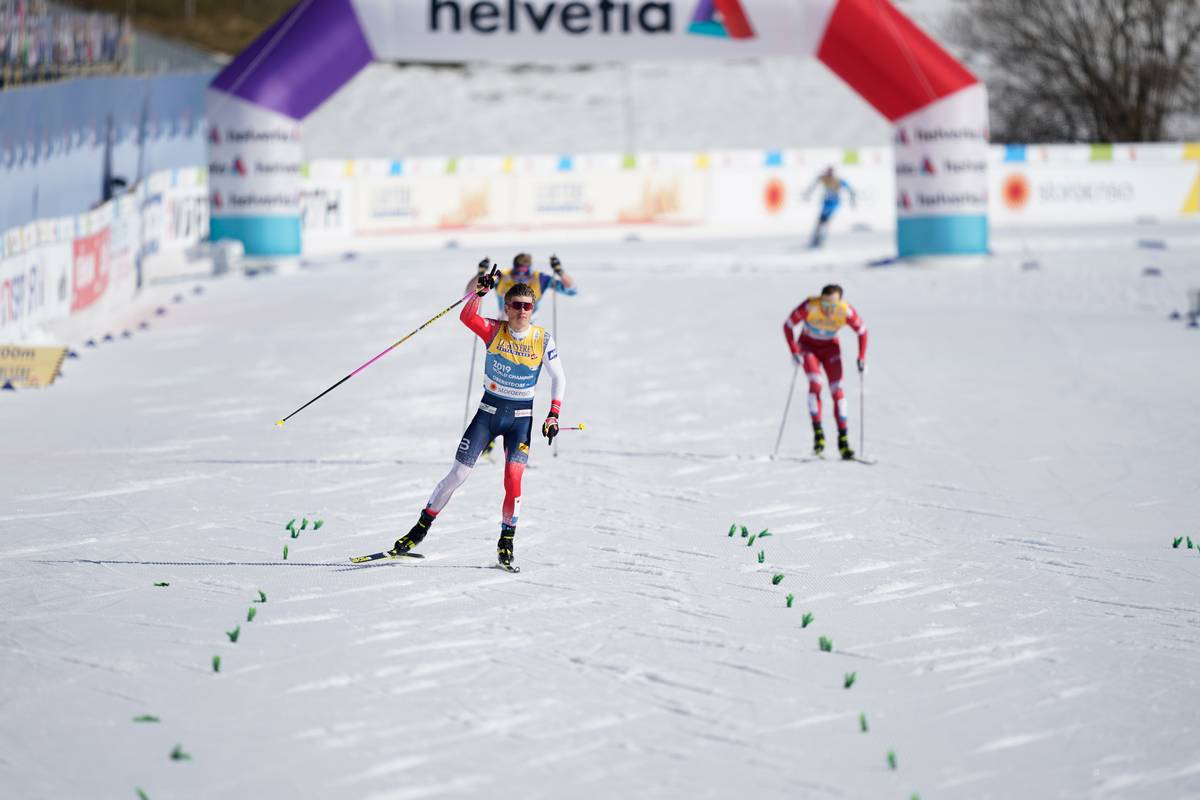
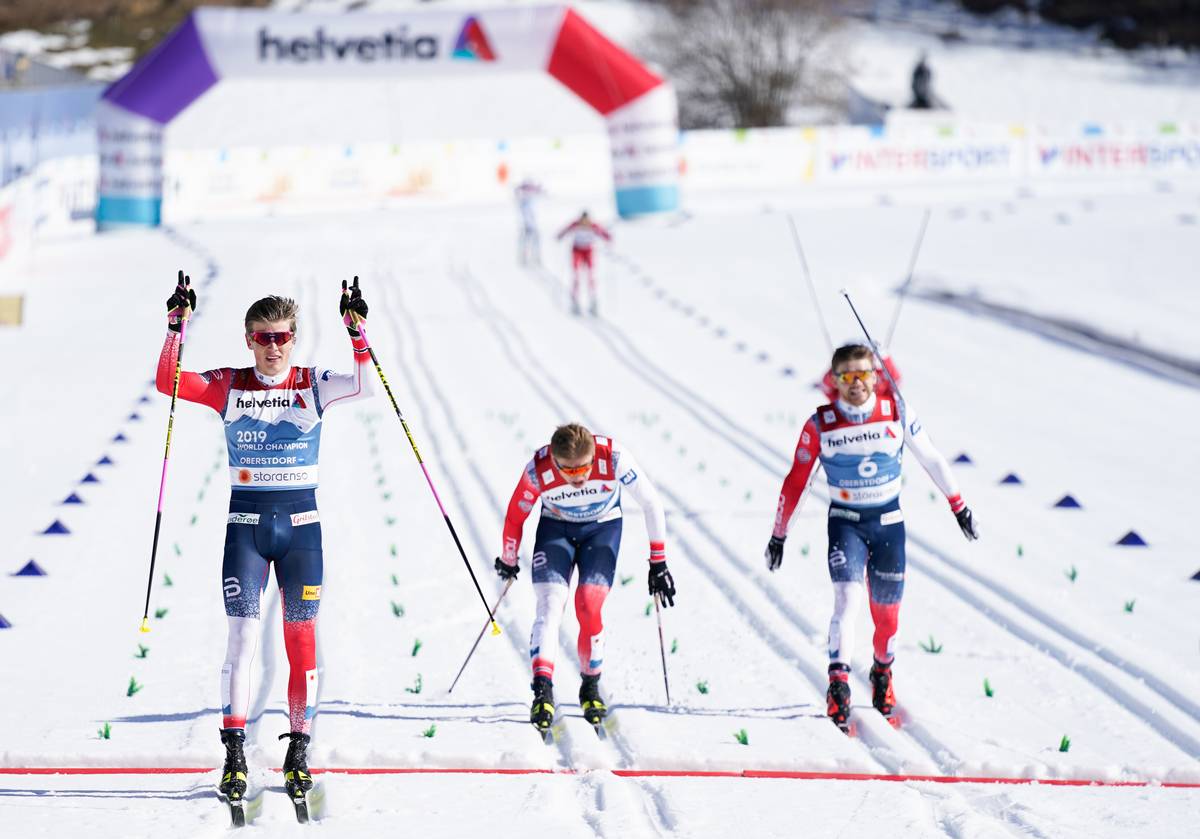
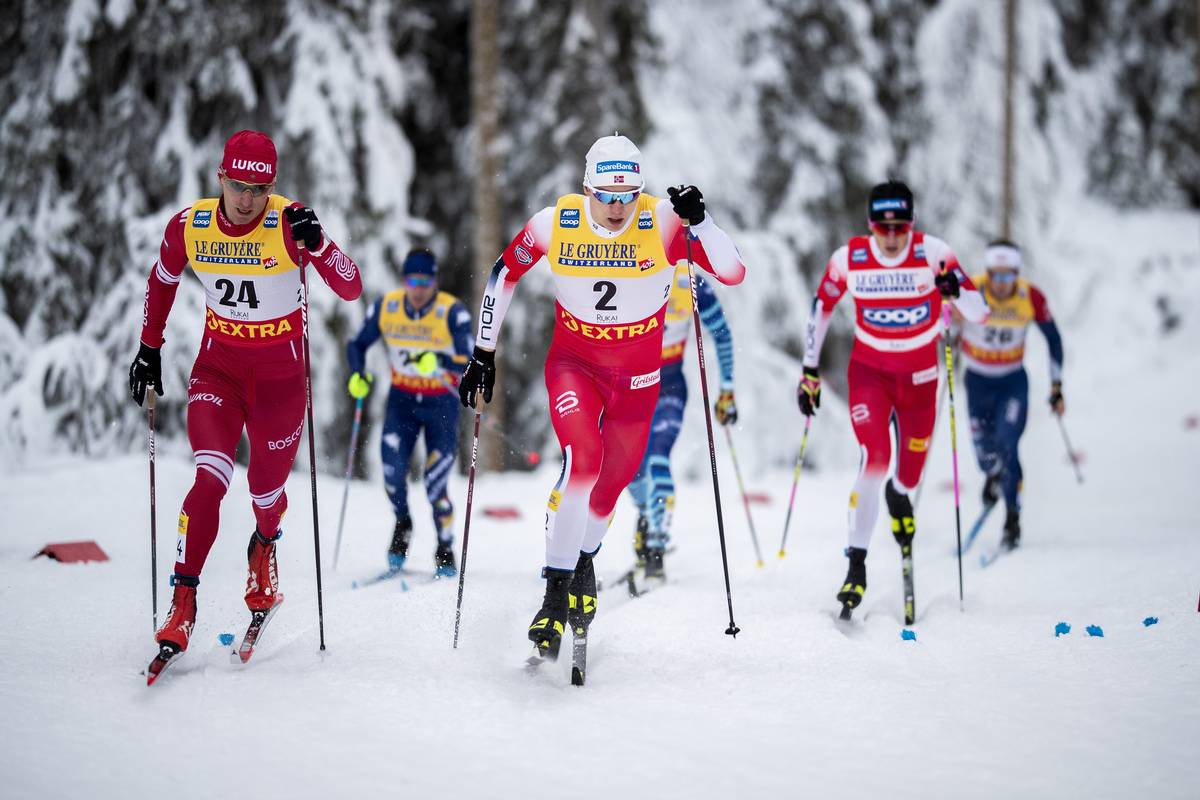
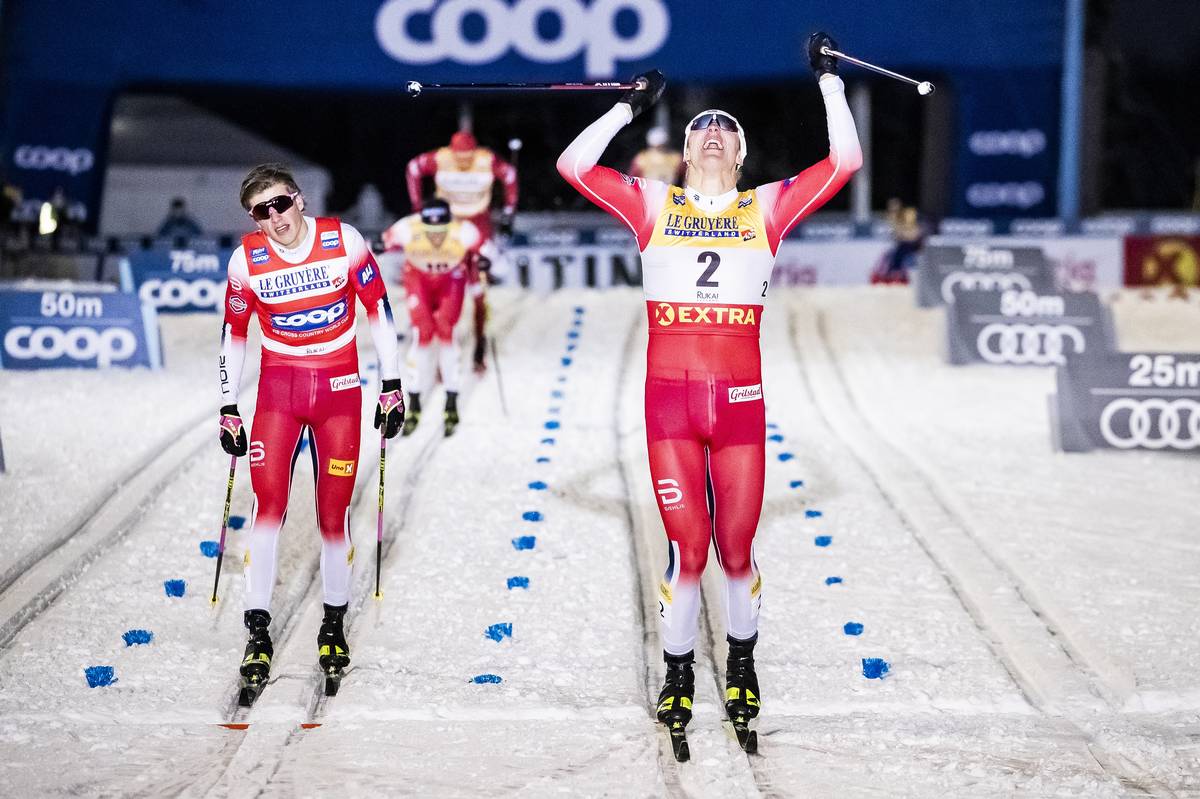
Status quo restored: Harald Oestberg Amundsen (NOR) dominates the 20 k Freestyle Pursuit—and moves into the overall lead—in the 2024 Tour de Ski in Toblach, Italy. (Photo: Modica/NordicFocus)
Pursuit racing is kind of weird—giving an additional head start to those already in the lead, while asking other racers to chase those who have already proven to be faster. It can seem like a bit of a set-up . . . one that Norway was entirely happy to benefit from on the third day of Tour de Ski racing from Toblach, Italy.
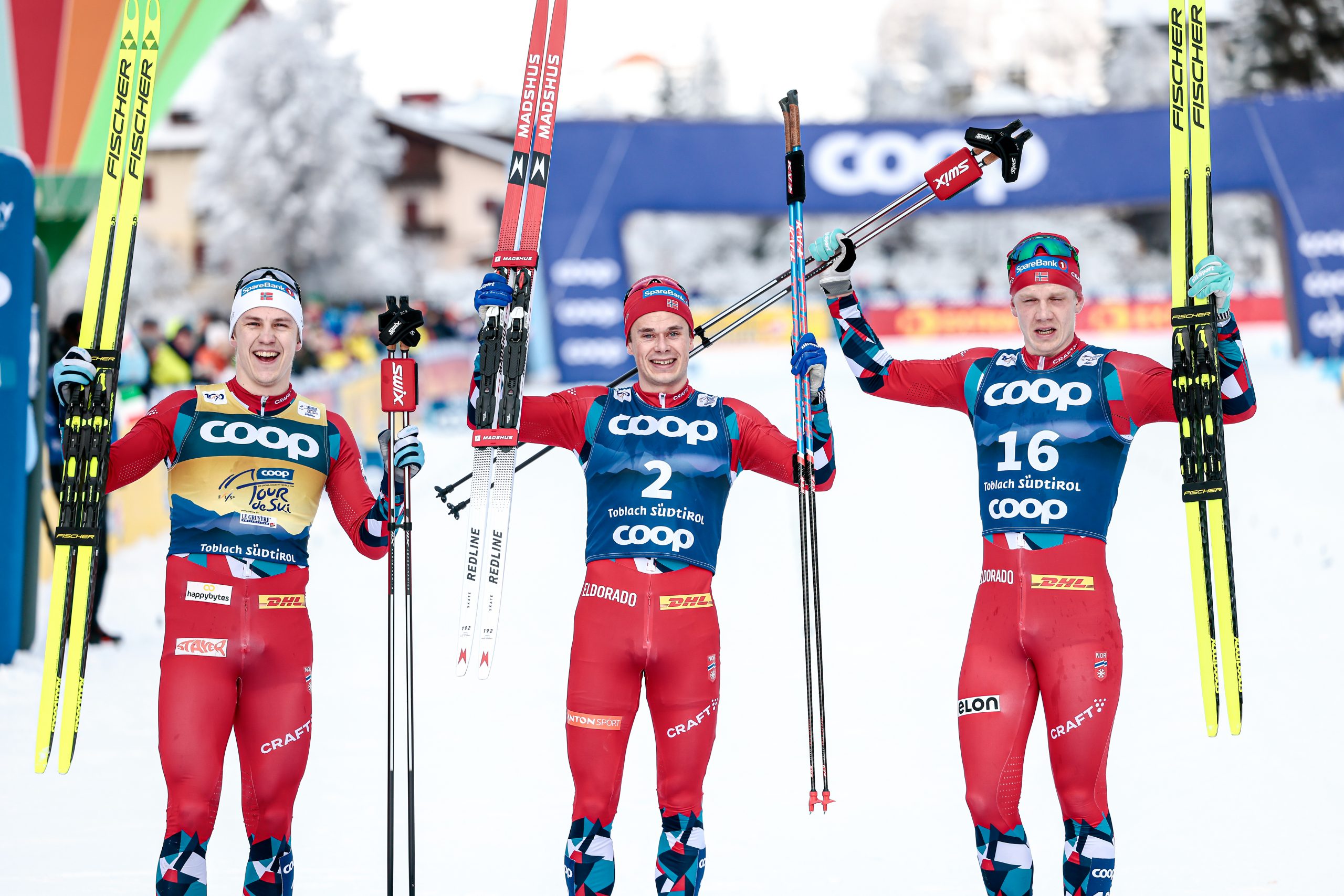
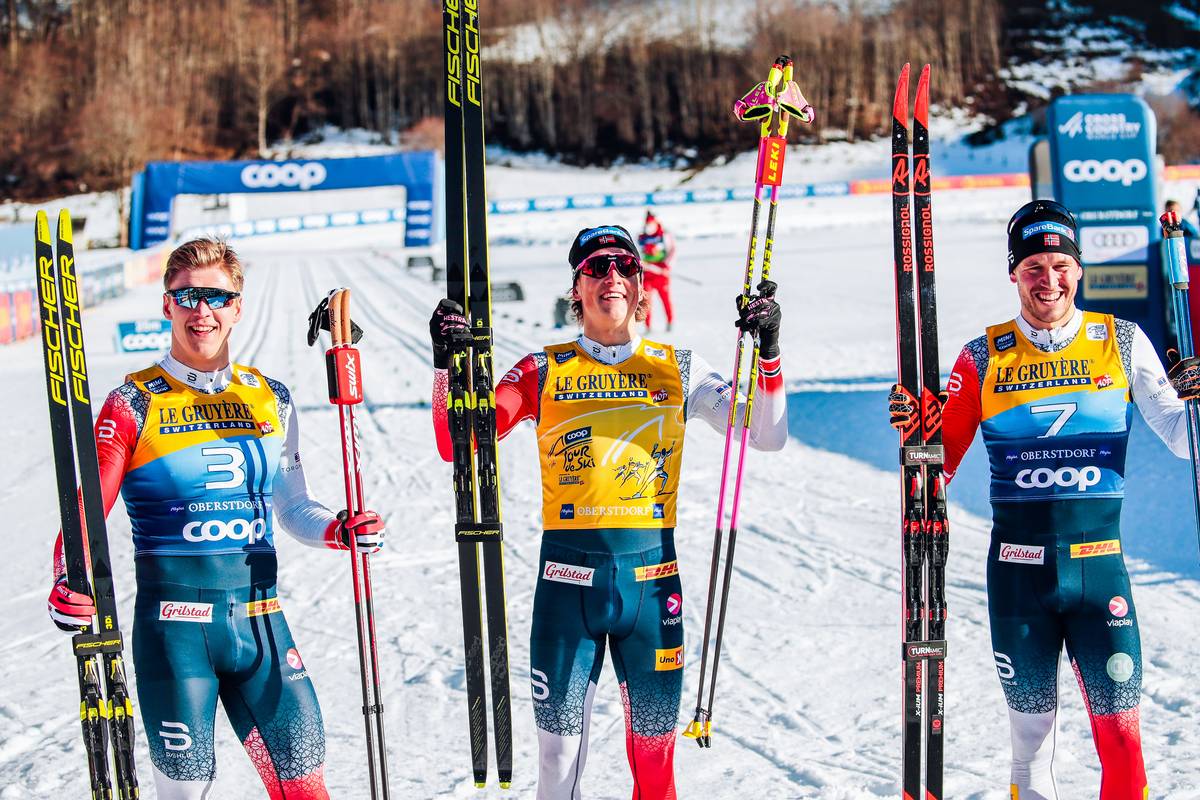
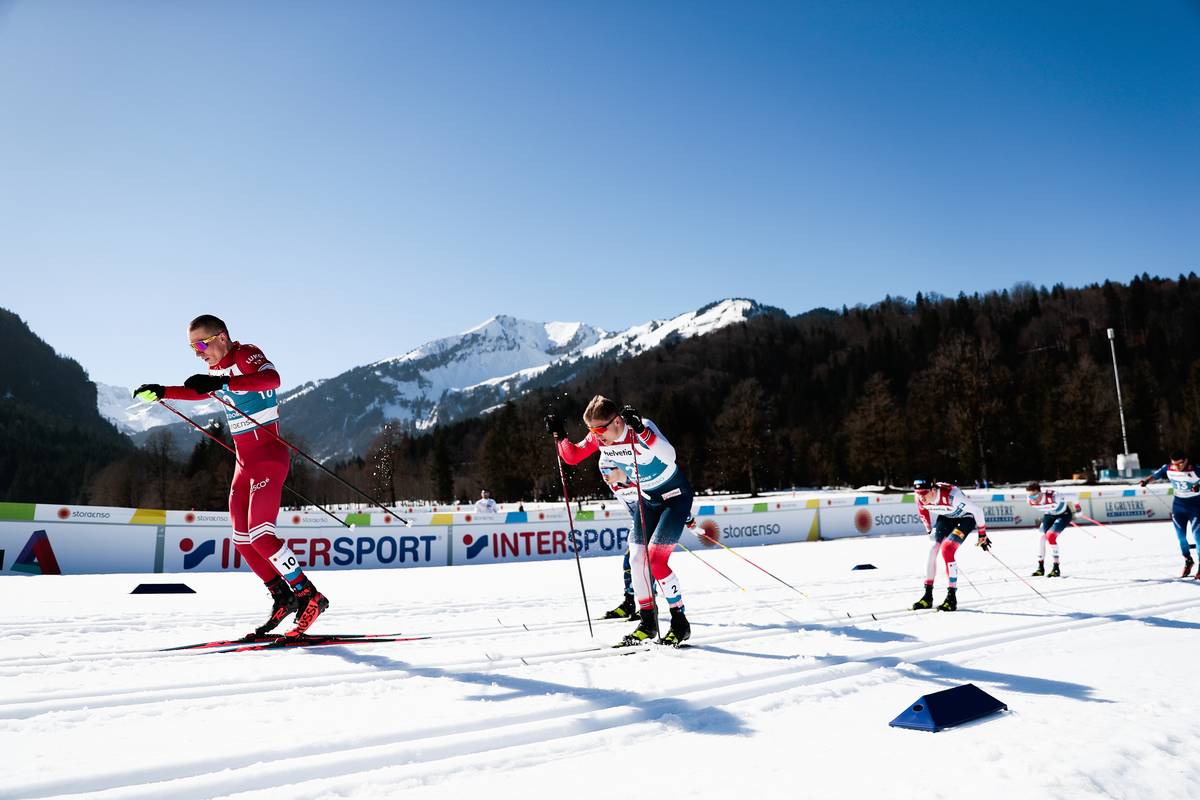
It must make Norway a bit nervous to endure a start like this one at the 2024 Tour de Ski: shut out of individual World Cup race podiums for the first time in recent memory. But, eventually, races get longer, the abilities of the distance skiers allow them to shake off the pluck and daring of over-reaching sprinters, and the status quo is re-established. After what appeared to be a few days of equitable, good-natured, highly entertaining, multi-national competitive ski-mayhem, Norway once again emerged at the front. The Tour de Ski returned to earth with a display of Norwegian dominance in the 20 k Freestyle Pursuit, and the state of affairs in the Men’s World Cup field returned to normal. Harald Oestberg Amundsen (NOR) entered the 2024 Tour de Ski as the prohibitive favorite for the overall title. On the first day of the new year, Amundsen lived up to those predictions with his commanding victory in the 20 k Freestyle Pursuit. He was followed across the finish line by a game Erik Valnes (NOR), and their countryman Jan Thomas Jenssen (NOR).
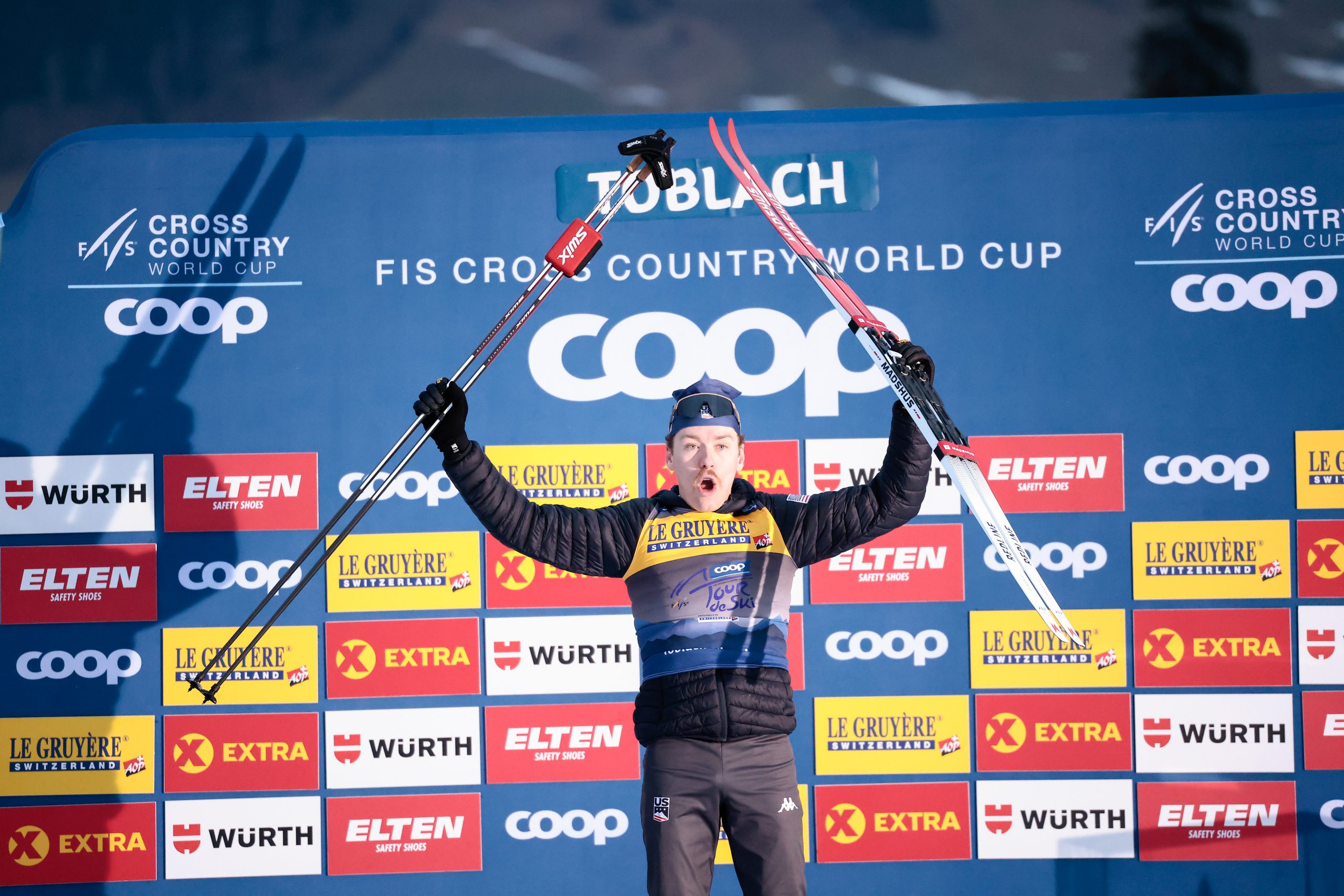
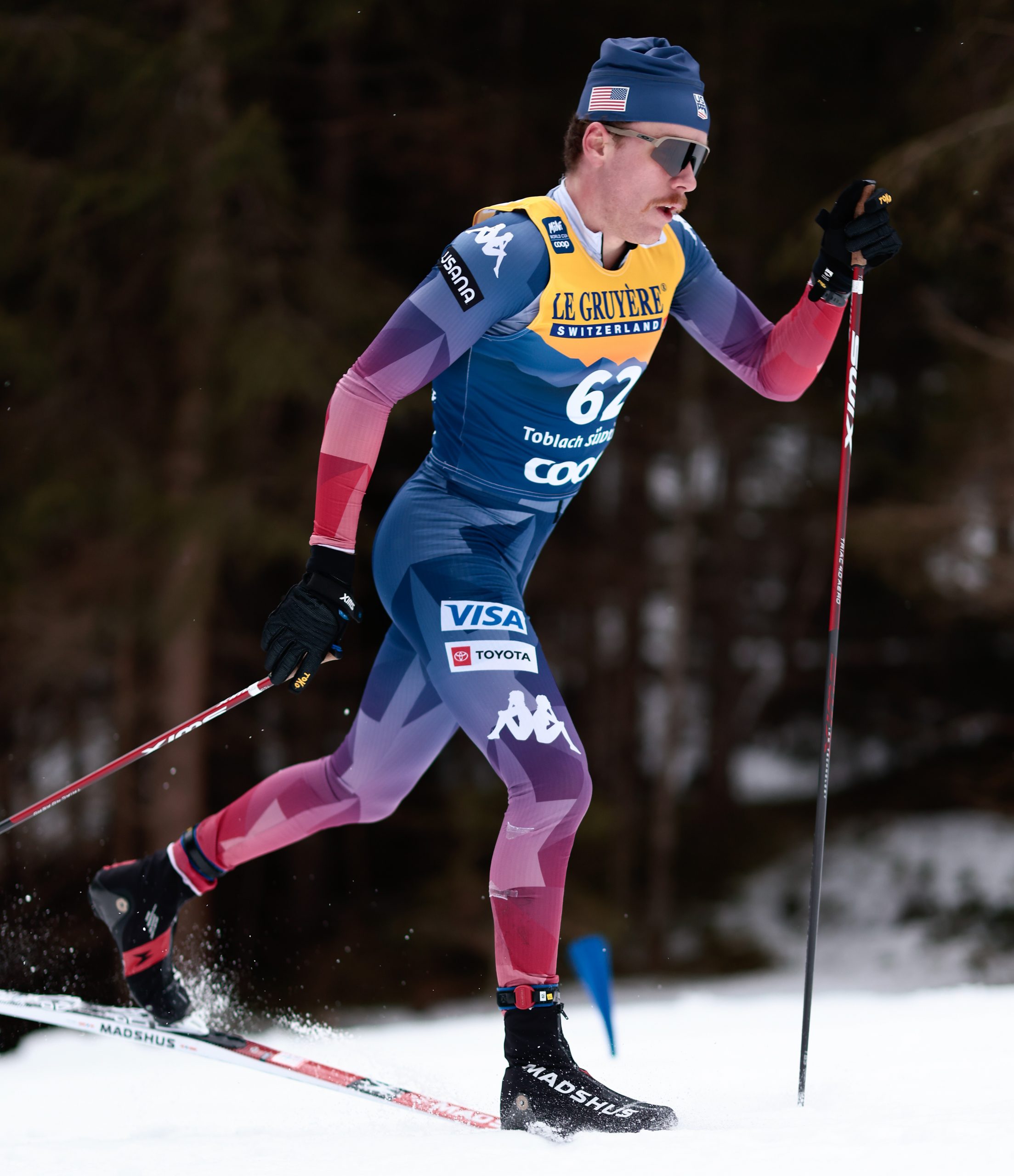
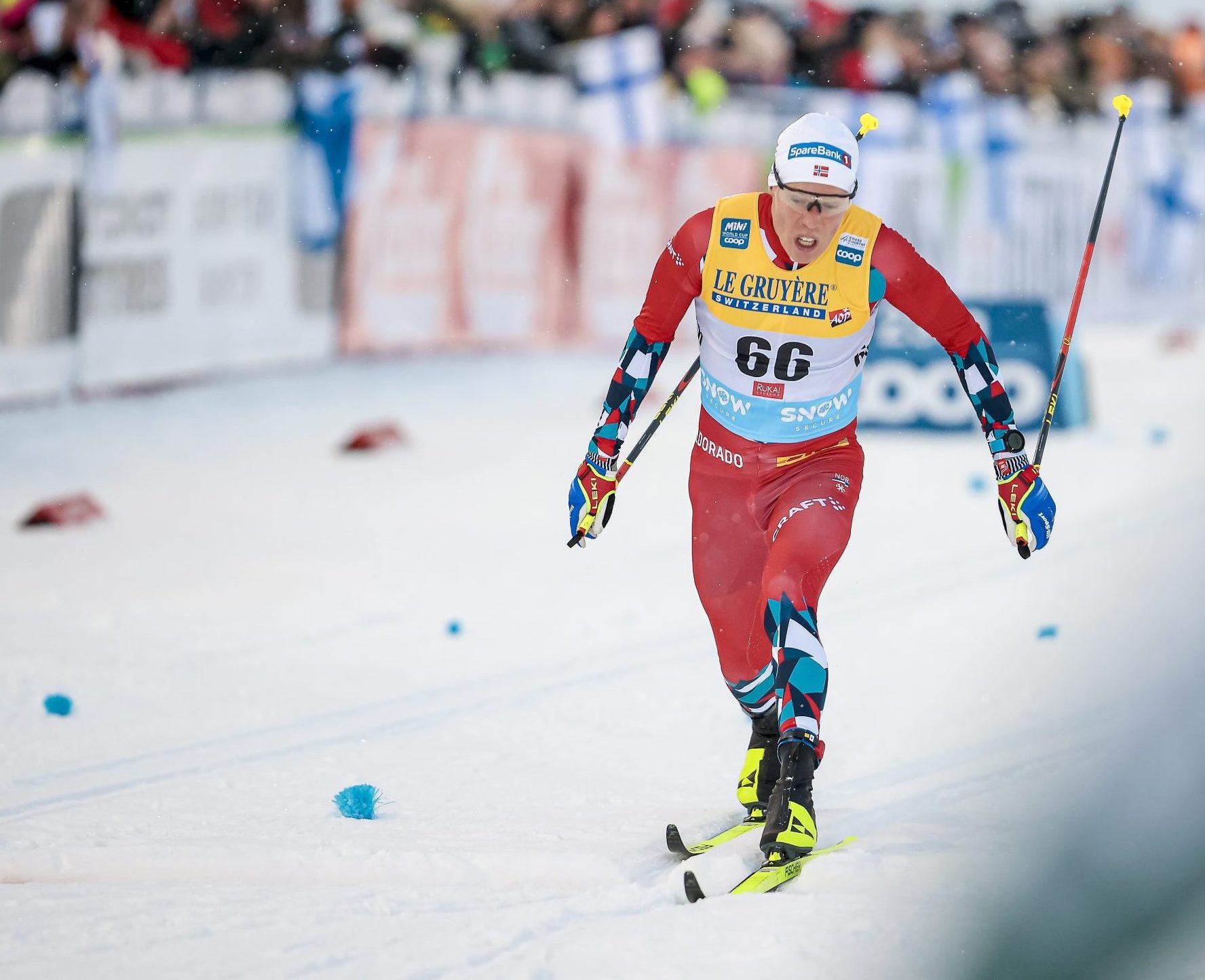
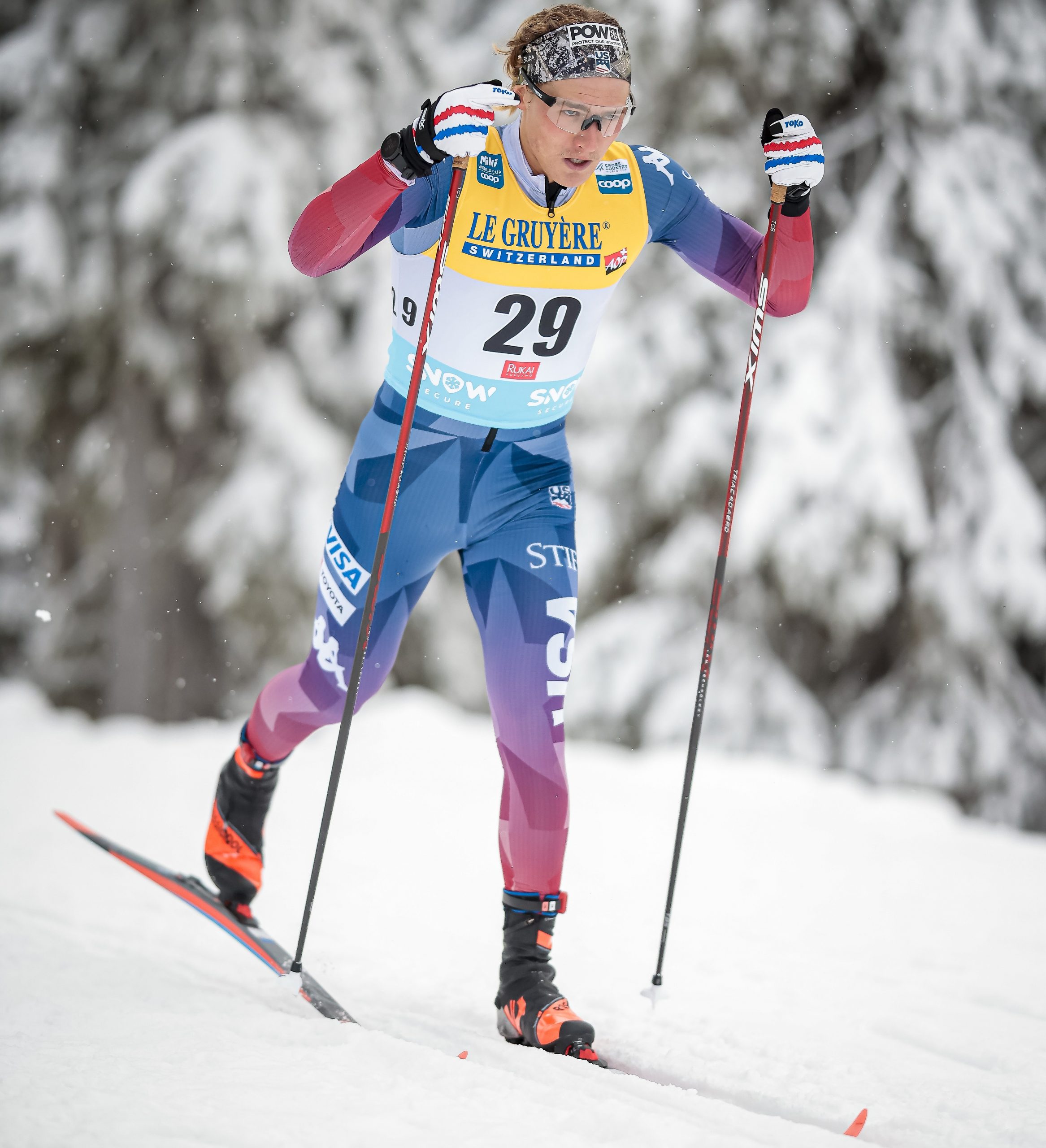
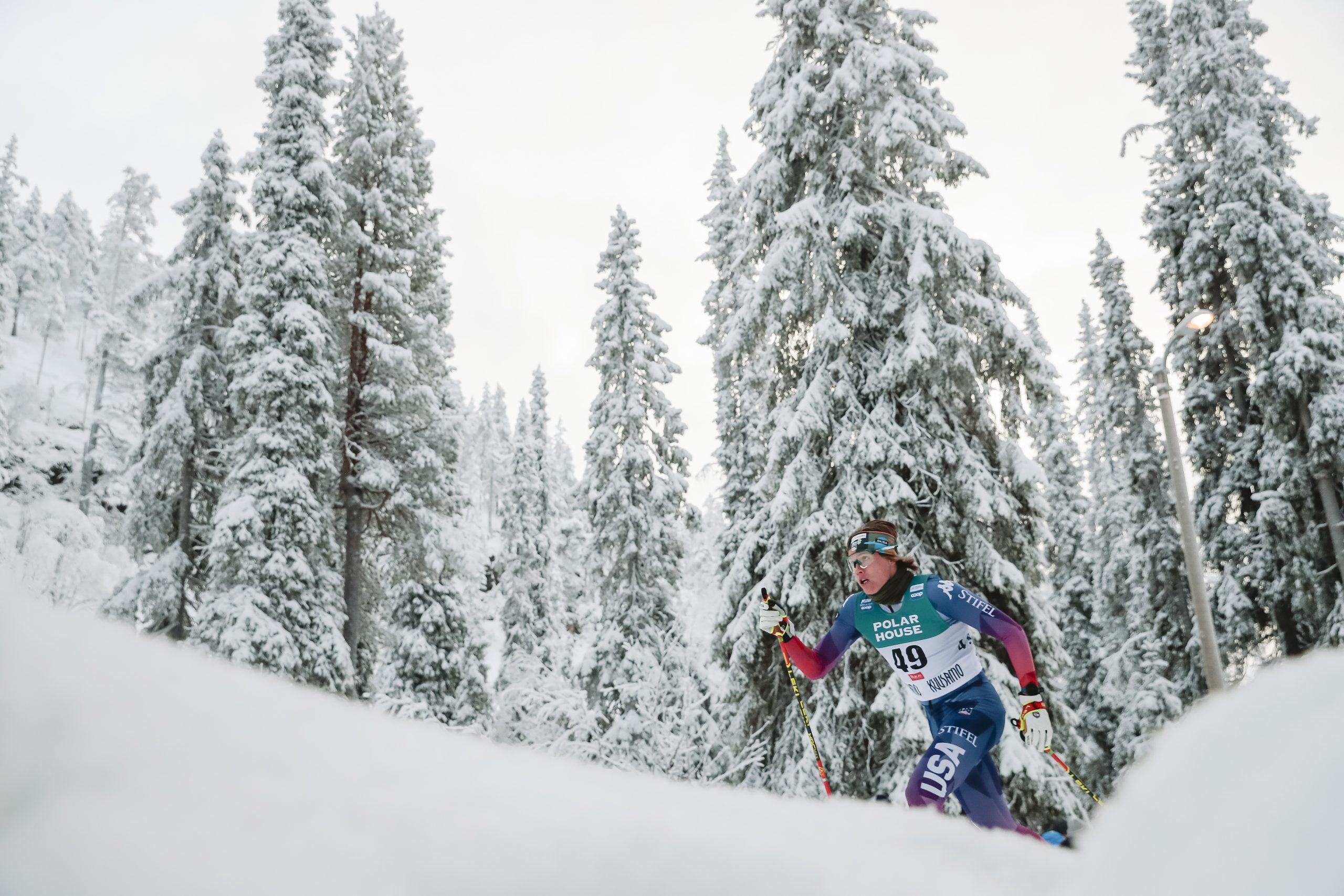
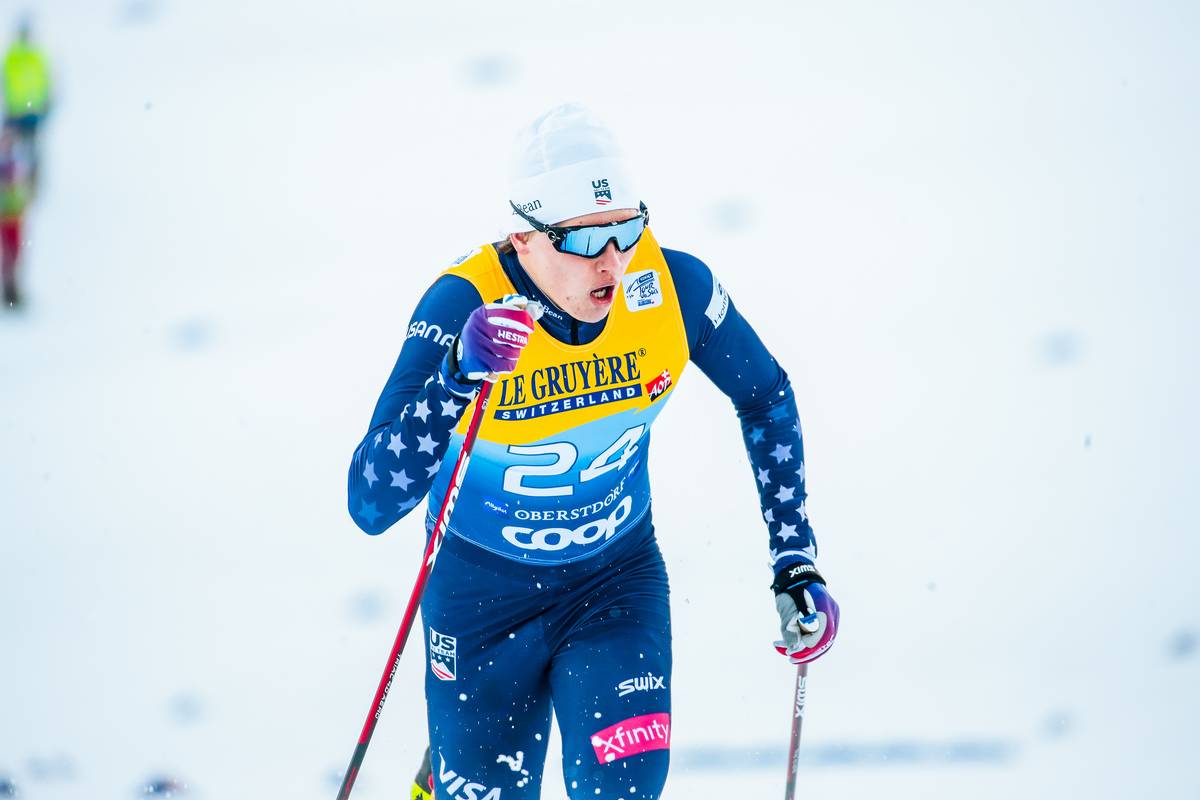
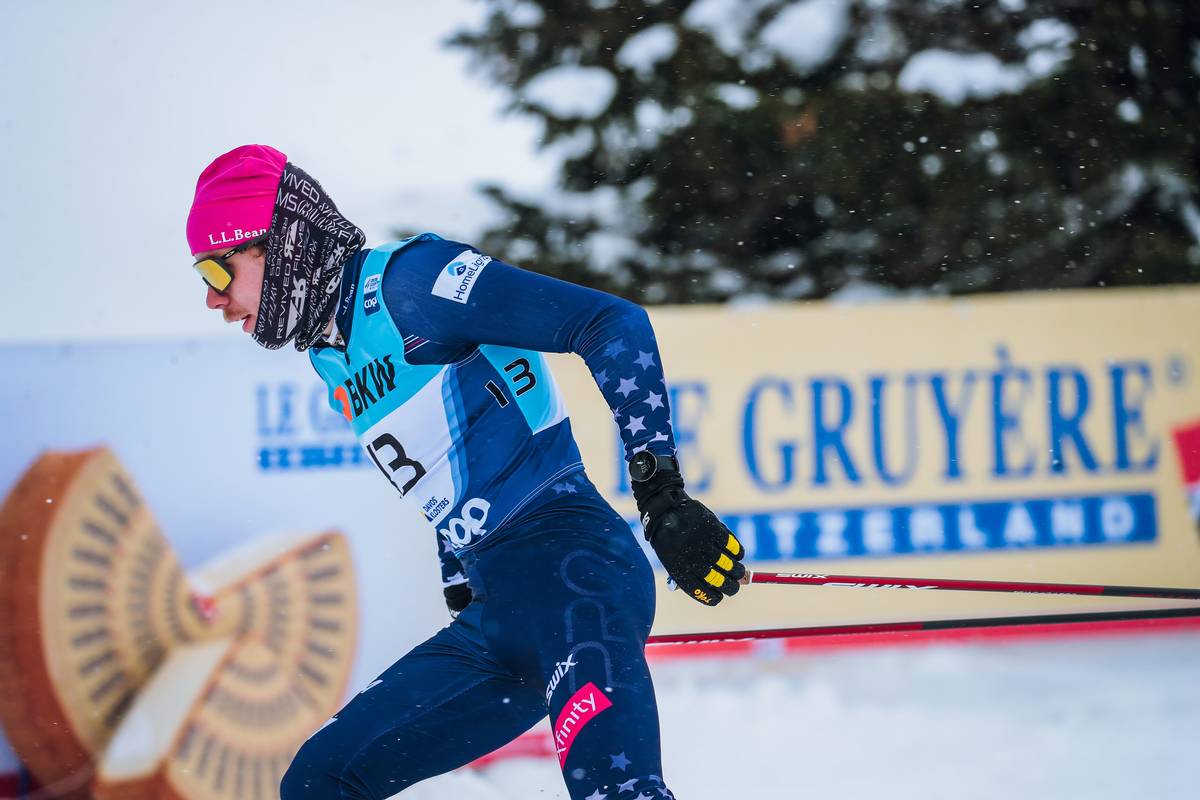
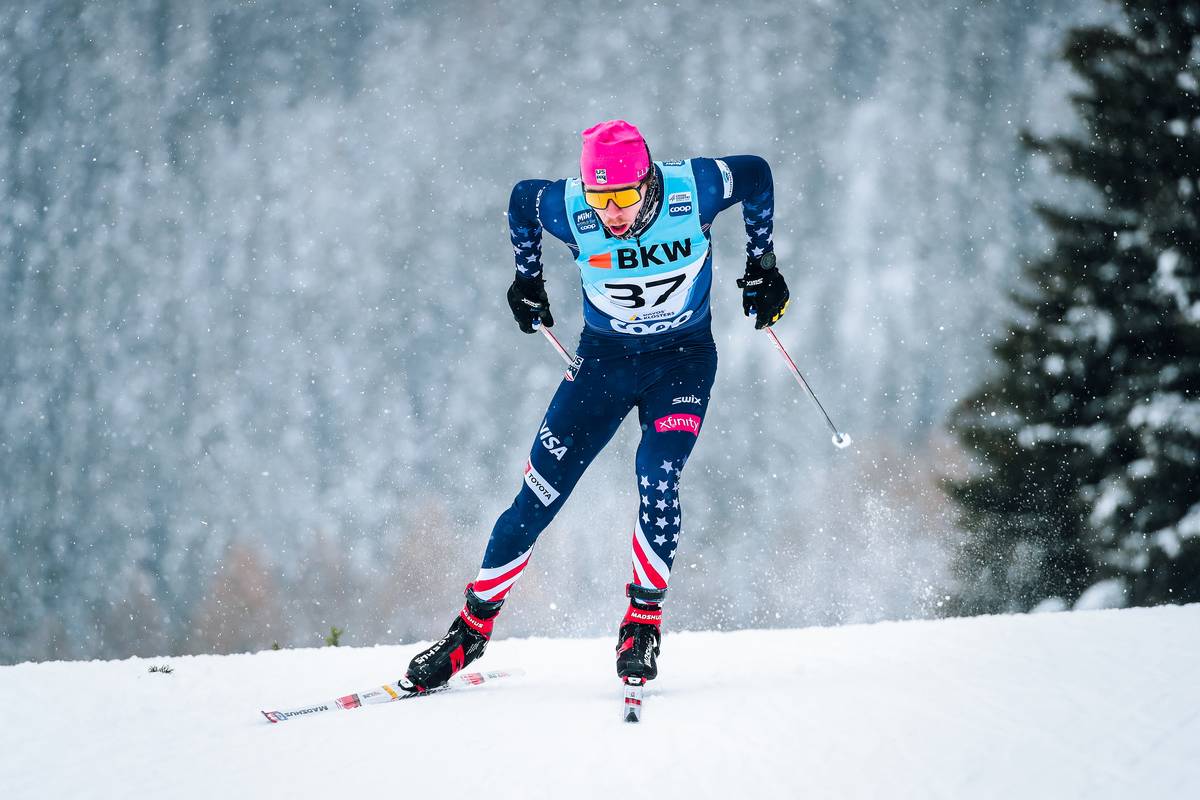
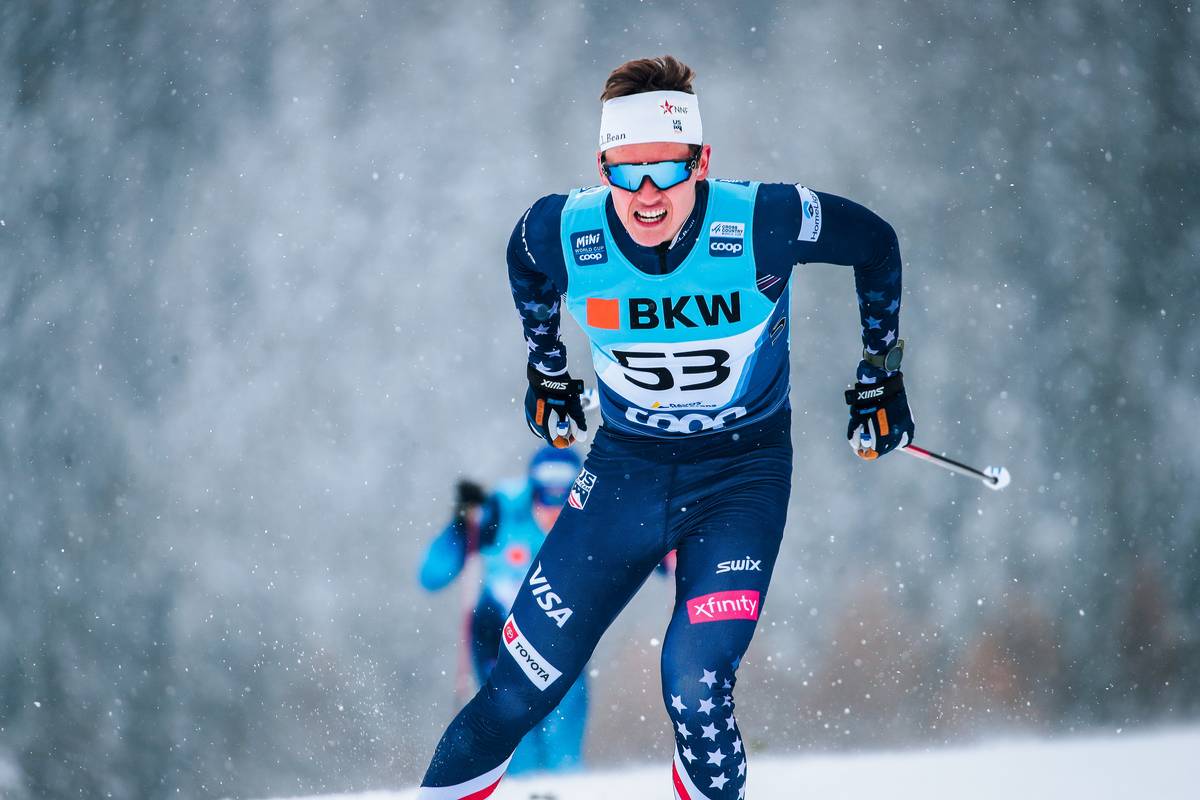
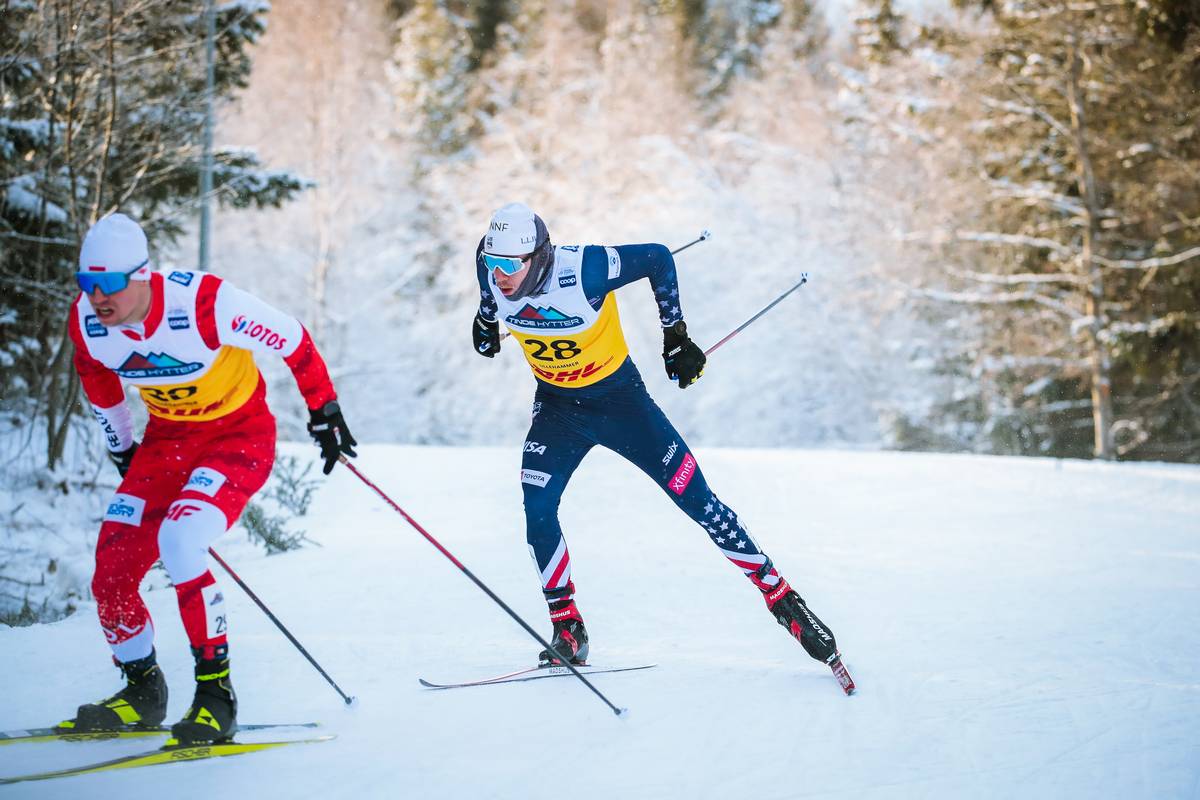
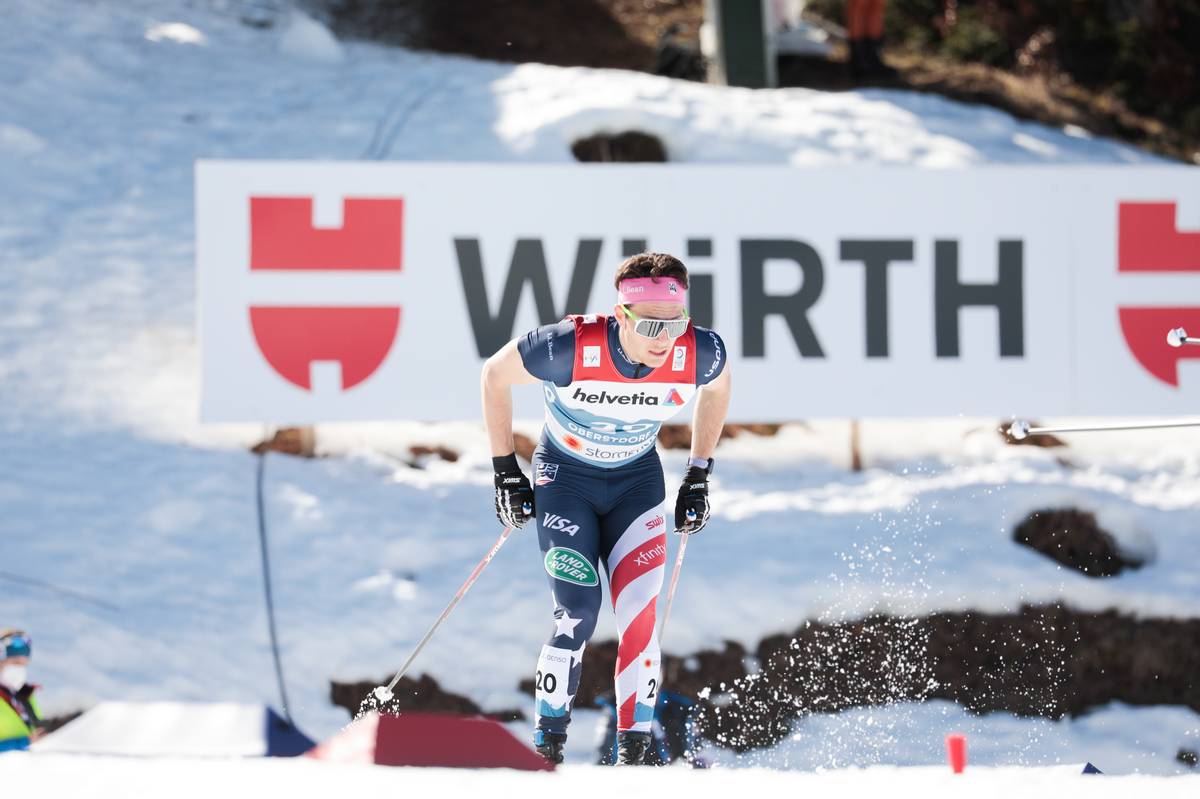
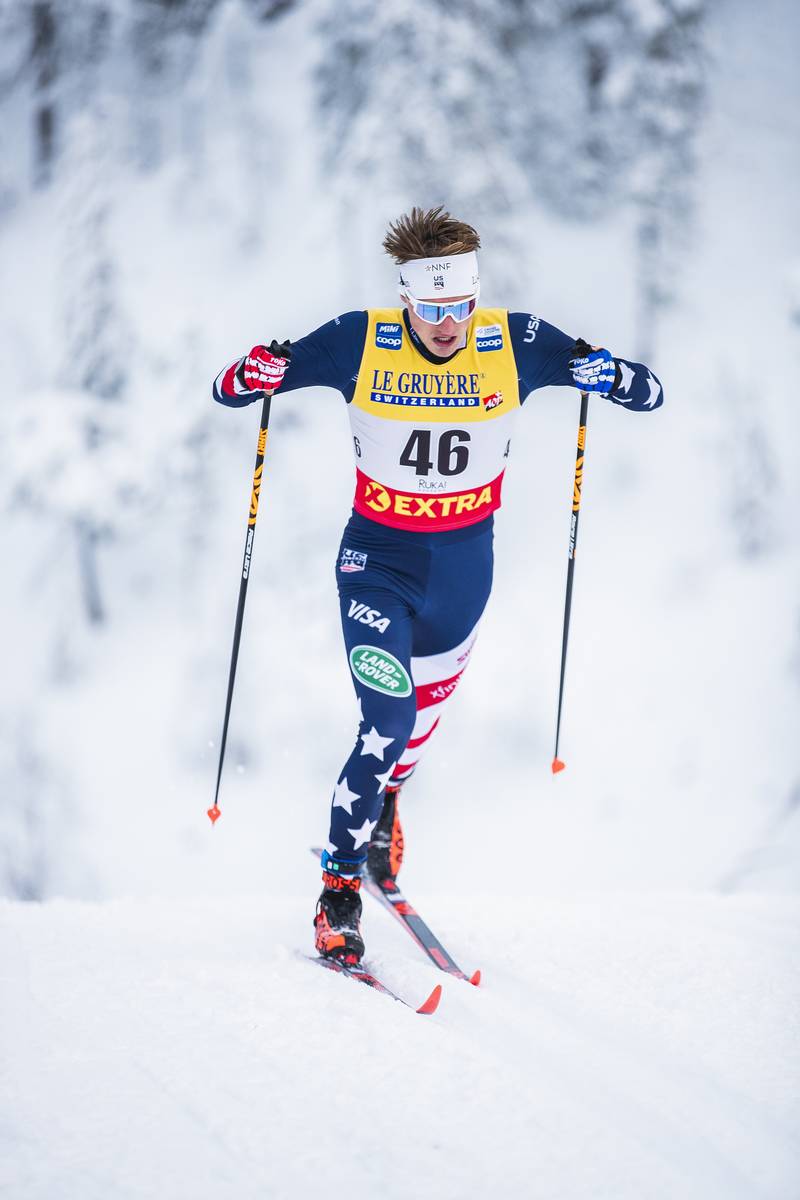
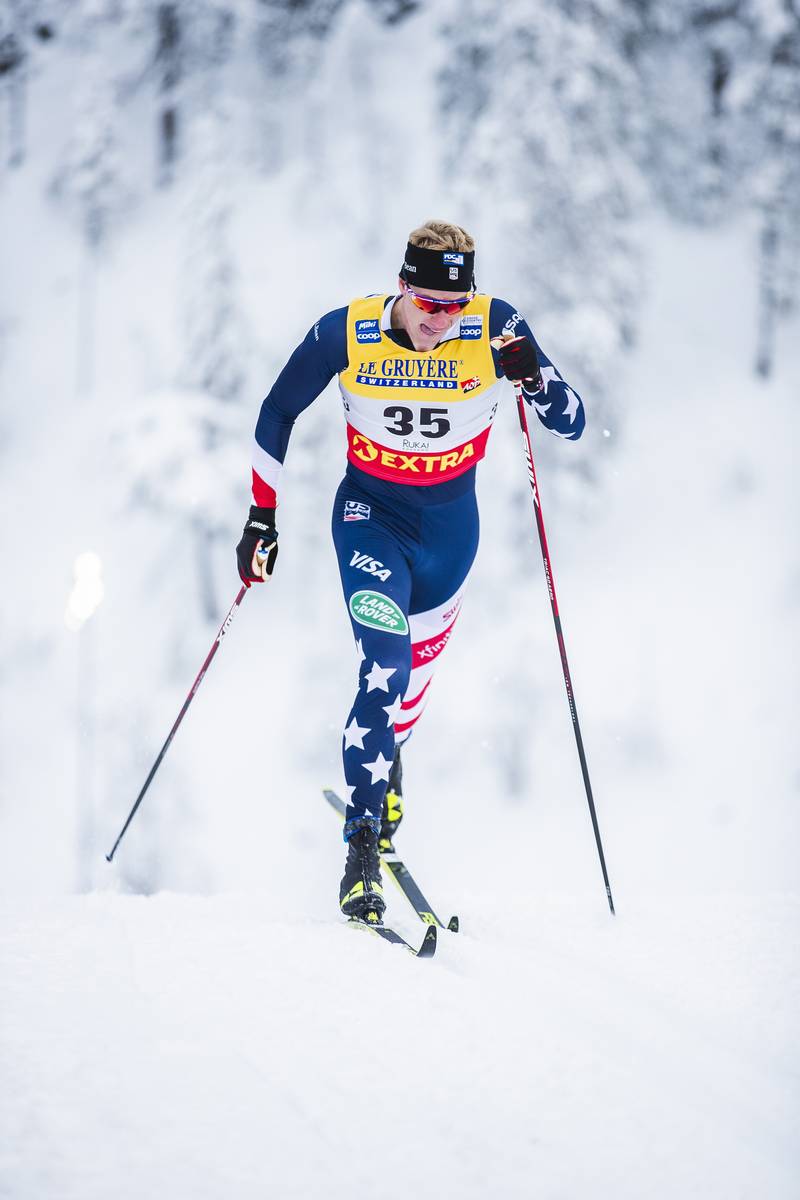
American, Gus Schumacher, raced courageously and intelligently throughout the day, remaining in the primary chase group to finish tenth, a performance that places him tenth in TDS Overall standings, as well. Other American finishers included Scott Patterson in 28th, Ben Ogden 33rd, Zanden McMullen 48th, Kevin Bolger 66th.
For Canada, Antoine Cyr continues a string of fine performances in 19th, followed by Olivier Leveille 58th, and Julien Locke 79th.
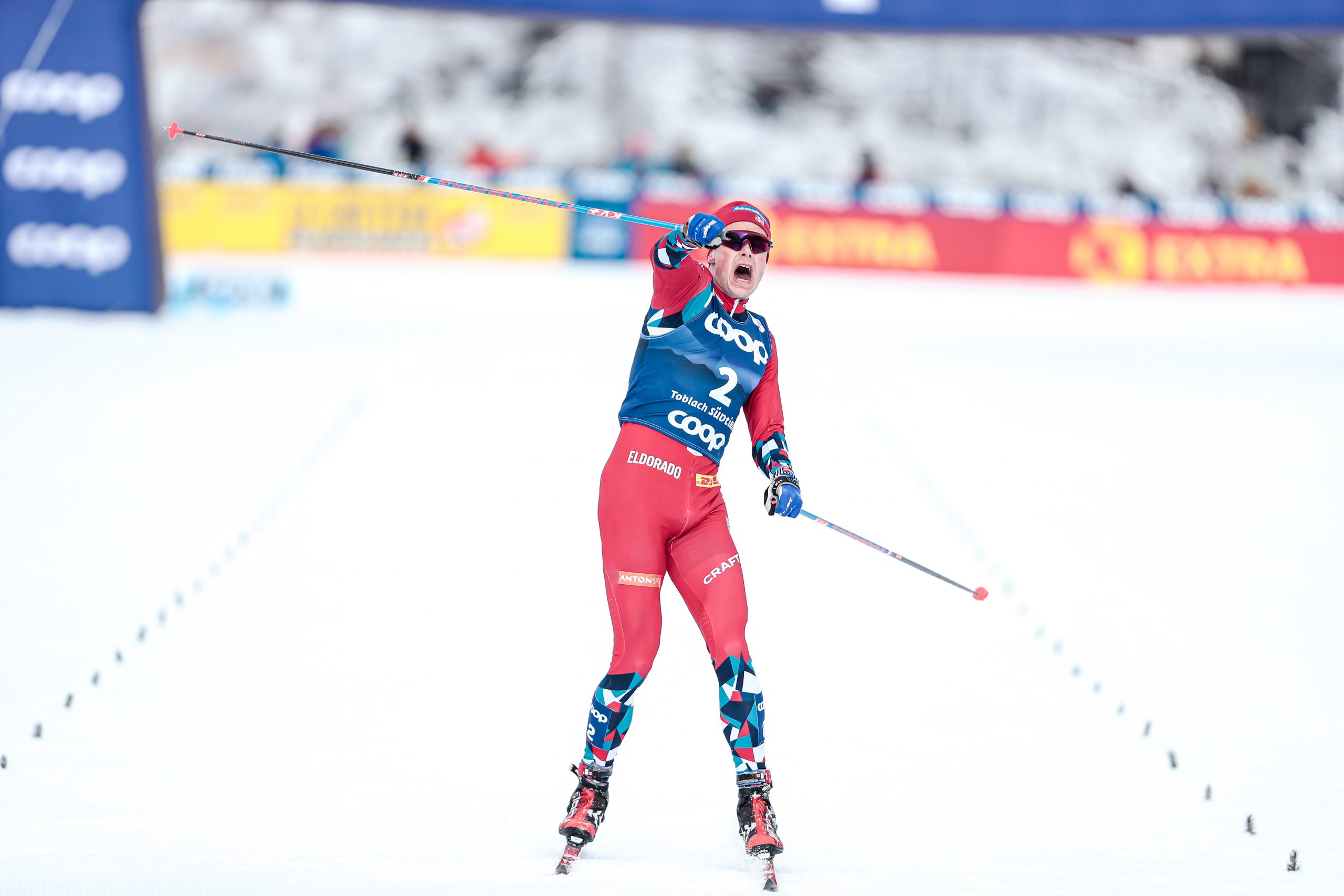
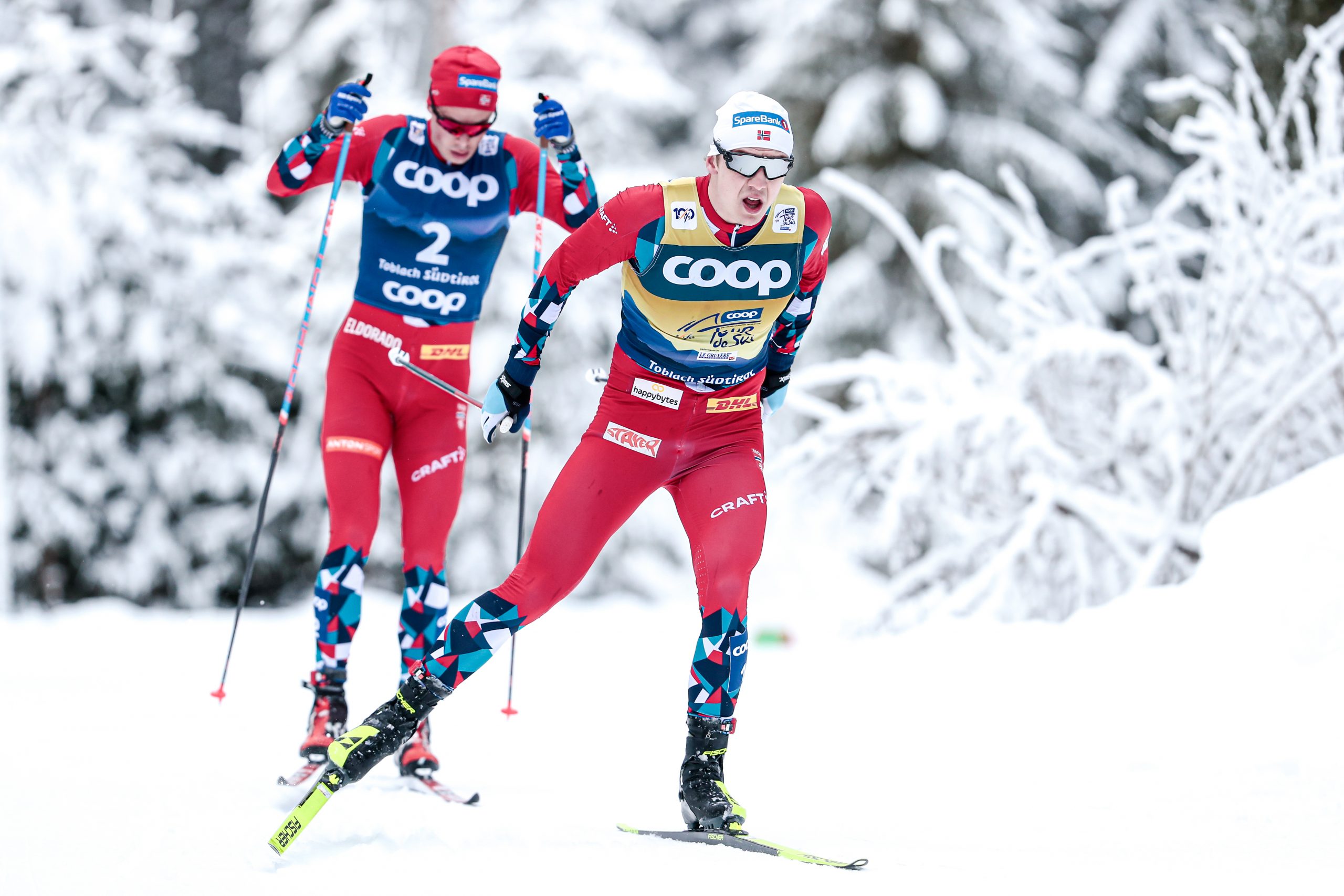
Tour de Ski leader at the beginning of the day’s 20 k Freestyle Pursuit, Erik Valnes (NOR) helped to make the pace for the pair of leaders. Ultimately, he was overcome by his countryman, Harald Oestberg Amundsen, who took the race win and the overall lead in the Tour de Ski standings. (Photo: Modica/NordicFocus)
Men’s 20 k Freestyle Pursuit
Ski racing is not always what it seems. The 20 k Pursuit contested in Toblach was actually 22 kilometers in length—five laps of 4.4 kilometers each—on a course that many competitors consider “easier” than the typical World Cup distance course.
Tour leader at the beginning of the day, Valnes was first to start, followed only four seconds later by his countryman, Harald Oestberg Amundsen. Ben Ogden (USA) started third, 28 seconds behind the leader. Perttu Hyvarinen (FIN) started fourth, followed by Lauri Vuorinen (FIN). Those five represented the top of the overall standings at the beginning of the race. The end of the race would see numerous changes . . .
The two leaders started relatively close to one another; most of the other early-starting racers were separated from each other by gaps of 20 seconds or more. Chasers would have a difficult time grouping up unless early starters slowed intentionally. The top two Norwegians quickly paired up while Ogden was left alone to either chase, or sit up and wait for help to arrive from behind. By the end of the first kilometer, Hyvarinen had come forward: Ogden would have company.
Bonus Points were offered for the fastest skiers to cross the checkpoint at .7 k. Mika Vermuelen (SUI) captured the winner’s 15 points, ahead of Henrik Doennestad (NOR). The inclusion of mid-race Bonus Points is an action-inspiring strategy on the part of race organizers—much like mid-race “Primes” offered in bicycle racing. It’s the system organizers have devised to play on the relative greed of individual riders, coercing them to sprint in the middle of the race (sometimes a disastrous tactical decision) for money or points. The idea of including a Bonus Points sprint within Toblach’s TDS Pursuit was to encourage skiers to start out fast instead of sitting up to wait for later-starting skiers to form a racing group. Ogden didn’t fall for it: he and Hyvarinen maintained a steady, conservative pace—ignoring the chance to race for additional points—until they were finally enveloped by the main chase group at the five kilometer mark.
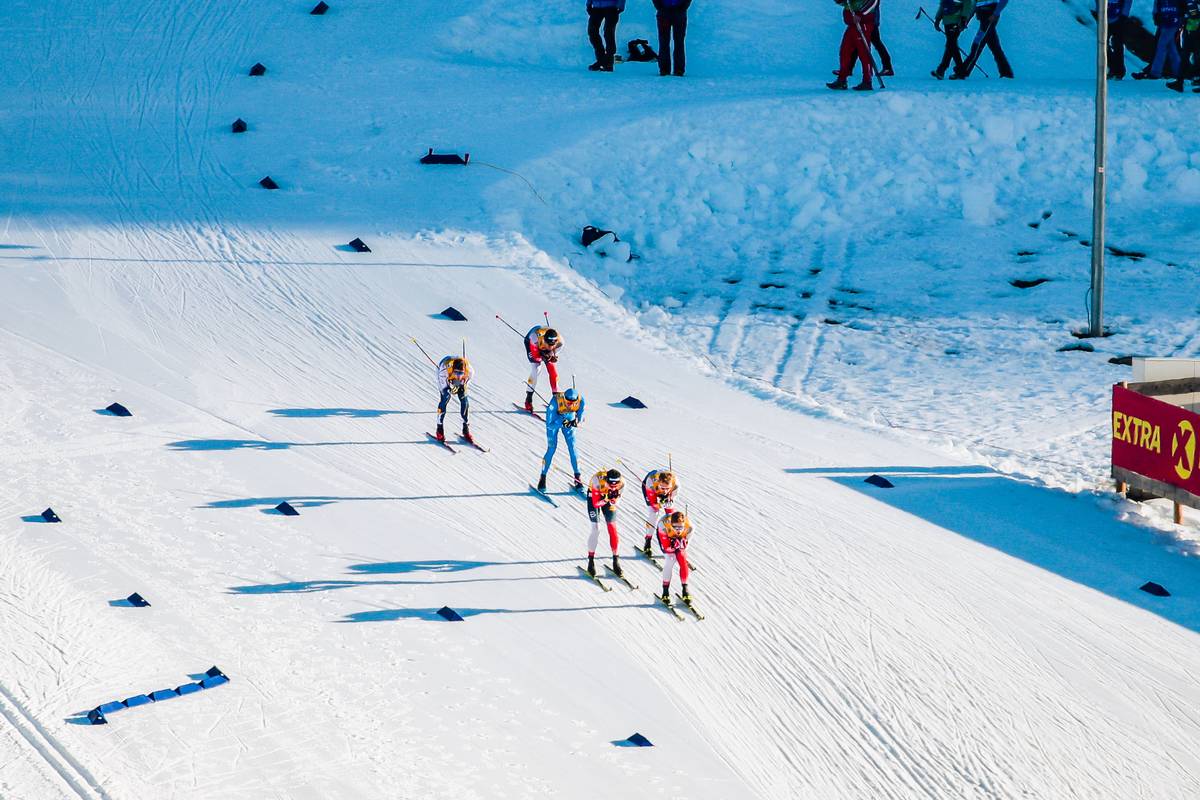
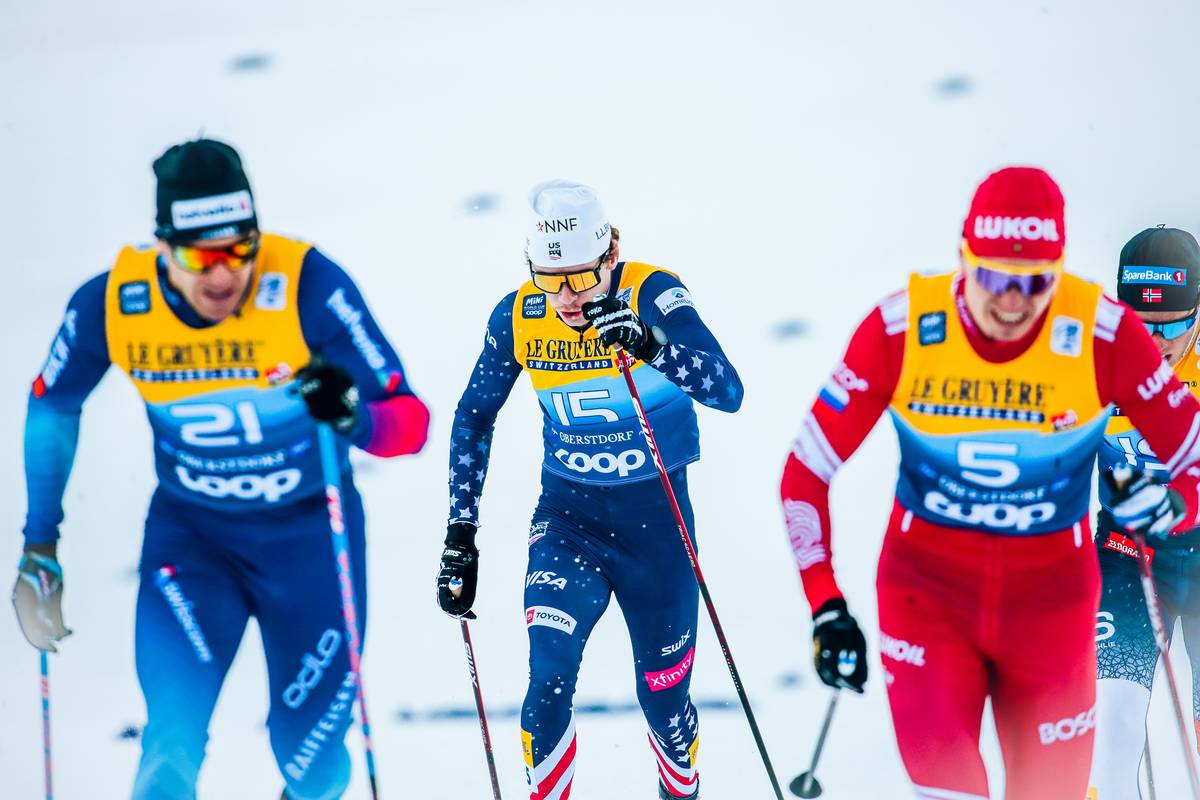
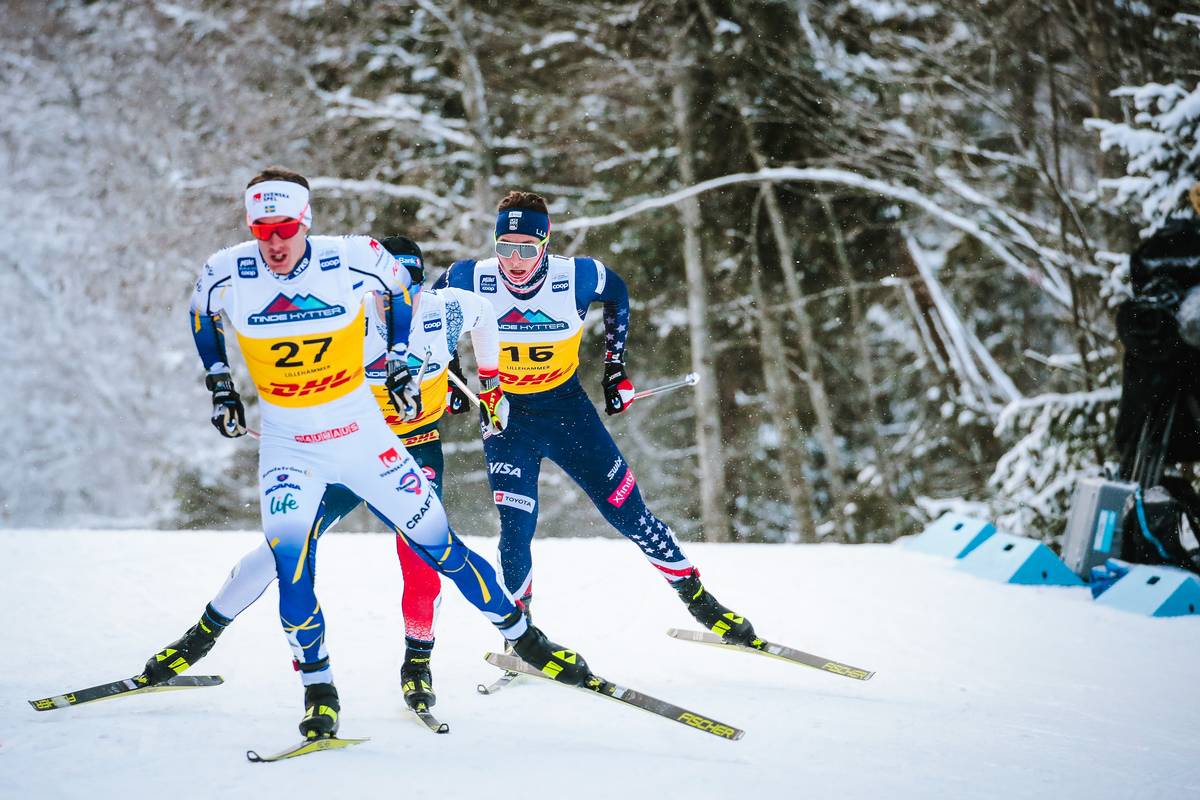
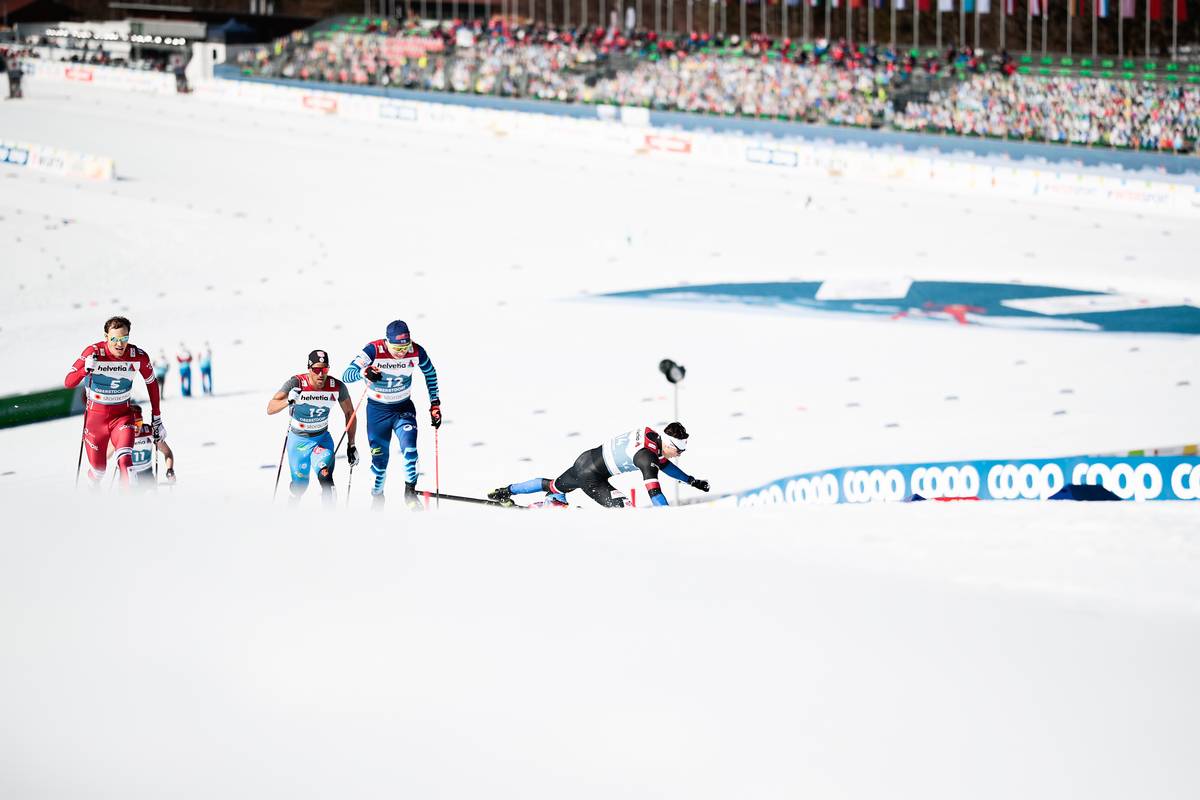
Schumacher had started in a closely-packed group of starters who quickly formed the day’s main chase group, one that would grow to include William Poromaa (SWE), Jens Burman (SWE), Martin Loewstroem Nyenget (NOR), Beda Klee (SUI), Jules Chappaz (FRA), Hugo Lapalus (FRA), Friedrich Moch (GER), and Federico Pellegrino (ITA). As Ogden and Hyvarinen gradually faded back to this group, the two leaders simply stormed away.
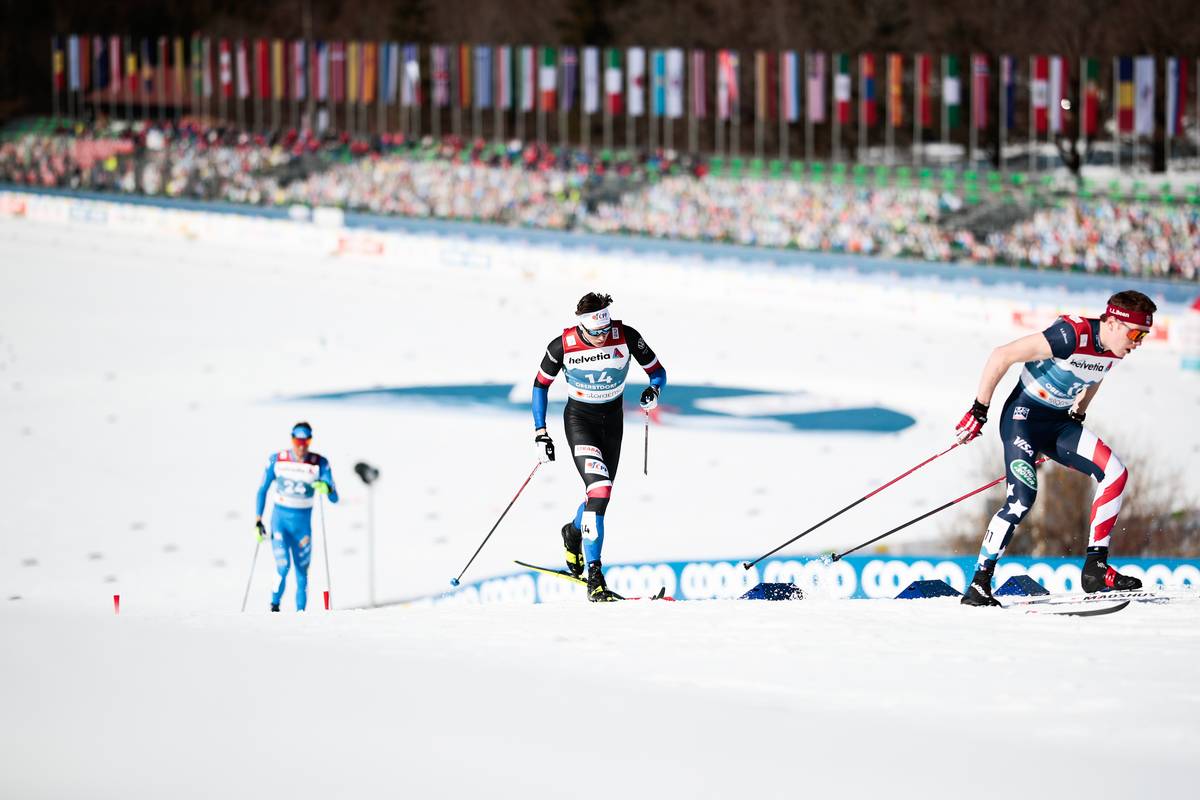
Moch seemed determined to press forward in pursuit of the leaders—and Nyenget and Lapalus came forward to add to the torrid pace—but most others in the chase group seemed content to race those around them. Rather than work as a cohesive group, the chase group began to unravel. The French sprinter, Chappaz was quickly gapped and left behind. Ogden suffered a similar fate not much later while Schumacher continued to vie for position within the eleven-man chase group.
After the second of five laps, Amundsen had firmly established himself as the pace-maker while Valnes began visibly to struggle. Near the race’s halfway point, there was a moment when it seemed that the second chase group could catch the first chase. But Nyenget forged to the head of the front group, and they gradually pulled away from the other chasers. It seemed that no one wanted Paal Golberg (NOR) (who was in the second chase group) to come back into contention. All this went on while Amundsen and Valnes continued to maintain a gap of more than a minute.
At 15 k, Amundsen used the main uphill to distance Valnes. Raising the tempo—and the pace—Amundsen skied clear, creating a gap that grew quickly to more than ten seconds. Amundsen was gone, leaving Valnes to consider damage control, though he still enjoyed a cushion of over a minute to the group of chasers.
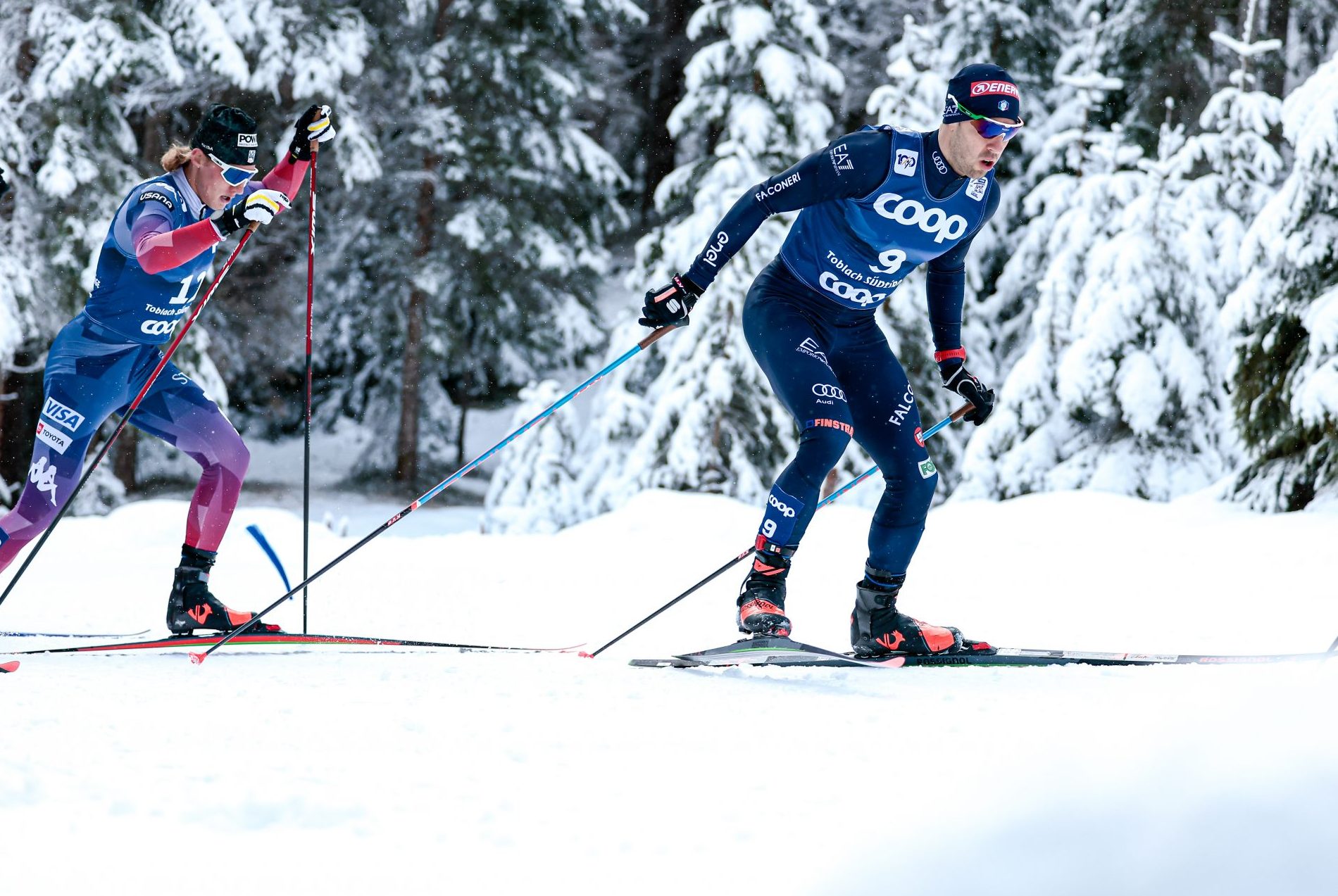
Late in the race, Gus Schumacher (USA) and Federico Pellegrino ((ITA) were forced to work hard to maintain contact with the chase group. Those courageous efforts paid off with top ten finishes for both. (Photo: NordicFocus)
Midway through the final lap, Moch returned to the business end of the chase, initiating a pace (supported by Lapalus and Poromaa) that spread out the group and forced Schumacher and Pellegrino to chase hard to remain in contact. They managed to remain in contact, allowing them to sprint for a top ten finish.
“My mentality was to smooth out the effort in the end,” said Schumacher. “I was right on the limit near the top of the main climb where we got left behind. I also knew from the beginning of the race that I was able to ski fast on the rest of the course, so I kept some energy by letting the gap open, and thankfully they didn’t seem to have too much gas left either, so we were able to get back by the bottom of the course.”
Amundsen powered across the finish line alone, some 32 seconds ahead of a game but exhausted Valnes. The other contending Norwegians stormed to the front of the chase group up the final hill—Nyenget followed by Jenssen. Jenssen would come forward to grab third (just over a minute behind the winner), followed closely by Poromaa and Nyenget. Schumacher would hold on for tenth, just behind Pellegrino. The bodies of exhausted skiers lay strewn about the finish area as the racers showed the extraordinary strain of pack racing at this level.
Norway one, two, and three on the podium—Norway one, two, and three in the overall standings. At a certain point in Cinderella’s fairytale, the spell wears off: her coach turns back into a pumpkin, leaving her stranded on the road side wearing shabby, soot-stained clothes, and minus one glass slipper. It was fun to have been a beautiful princess for a while, but it seems tremendously difficult to keep it up. Just ask Ogden, Hyvarinen, and Vuorinen. Five more races lie ahead in the 2024 the Tour de Ski, and Gus Schumacher may still be racing in search of an elusive glass slipper. We’ll wait to see how this fairytale plays out.
Tour de Ski Stage 3, 20 k Freestyle Pursuit RESULTS
In Time of day RESULTS it was Jenssen with the day’s fastest racing time, followed by Henrik Doennestad (NOR) , and Lapalus. Schumacher’s finishing time proved to be the sixth fastest of the day.
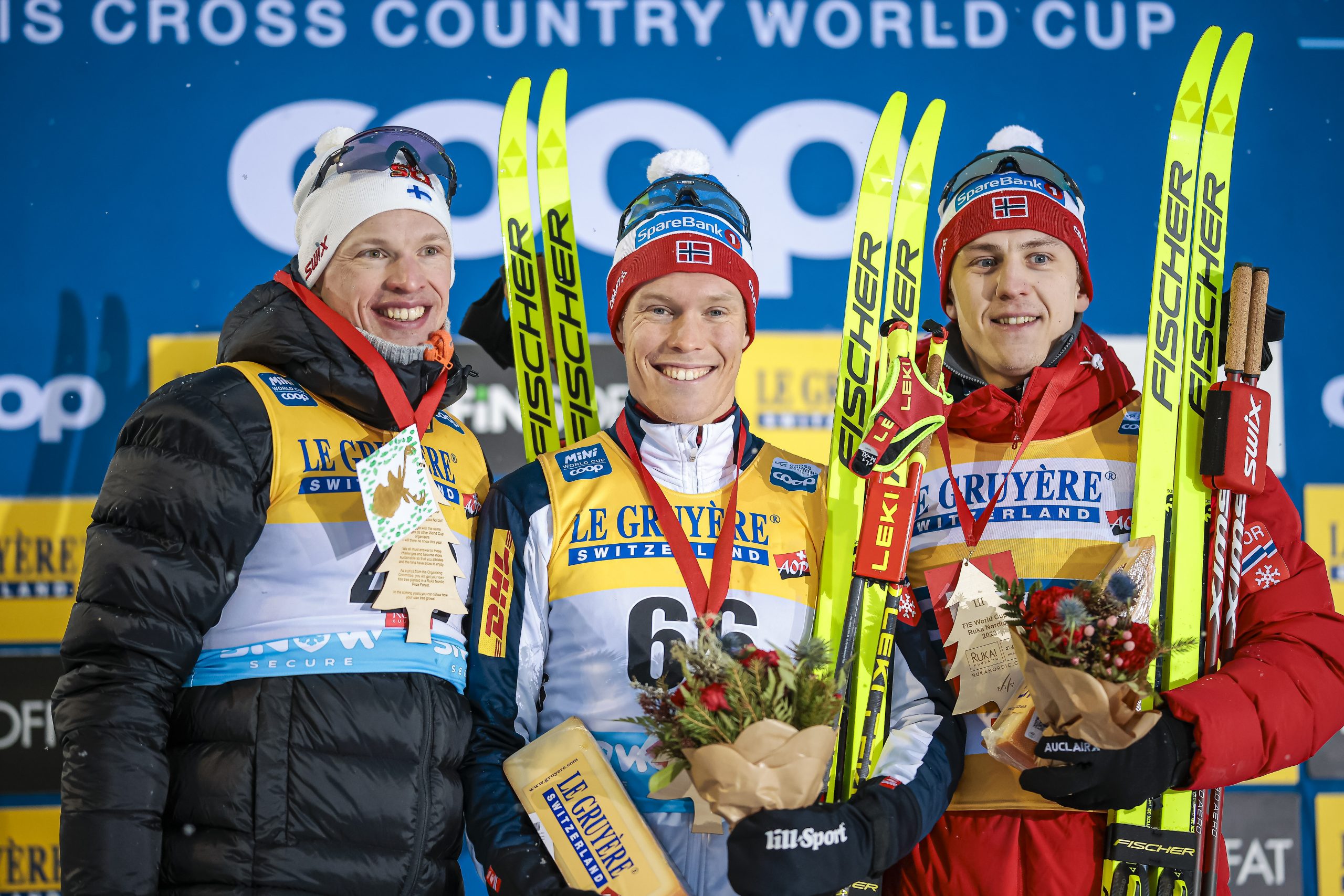
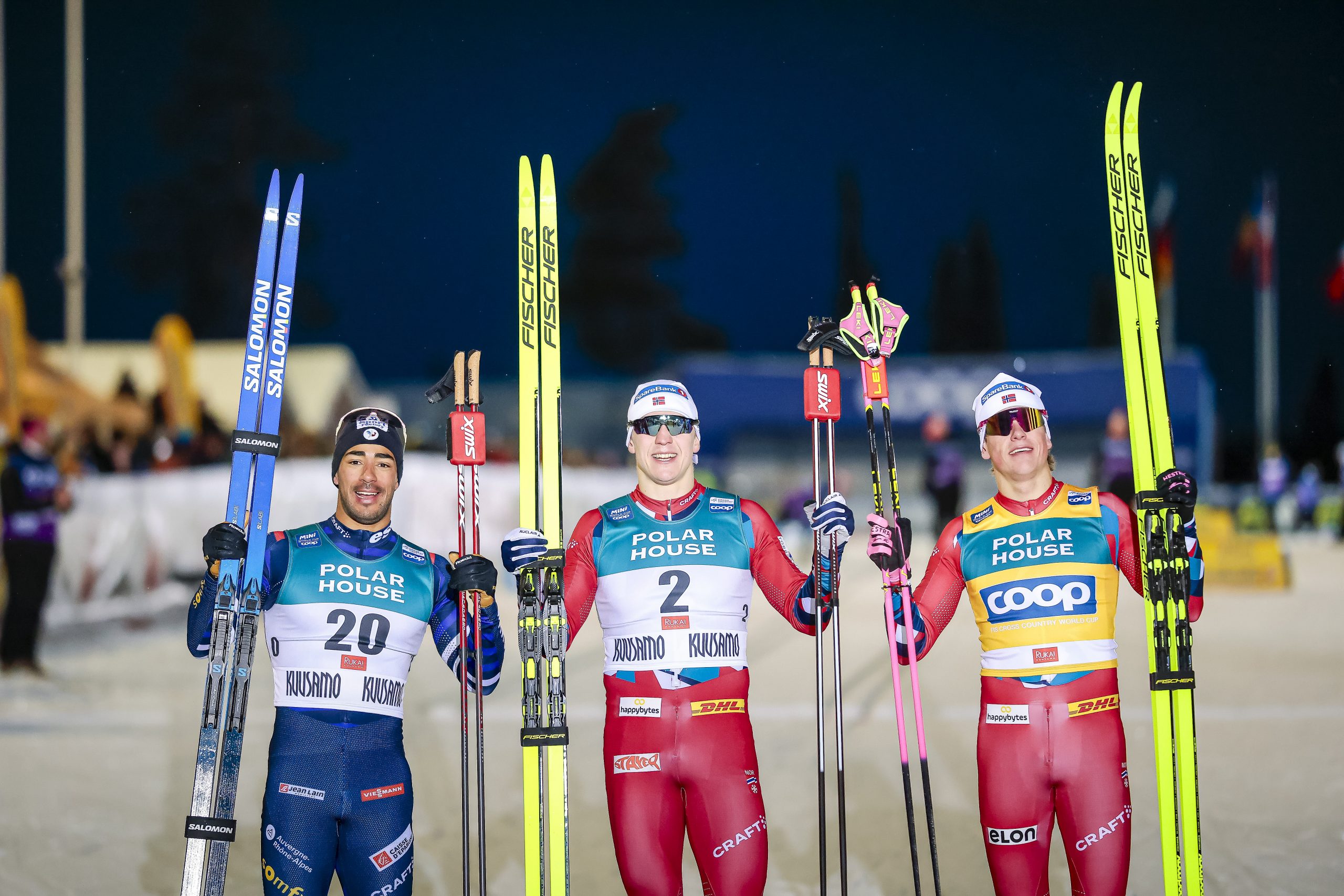
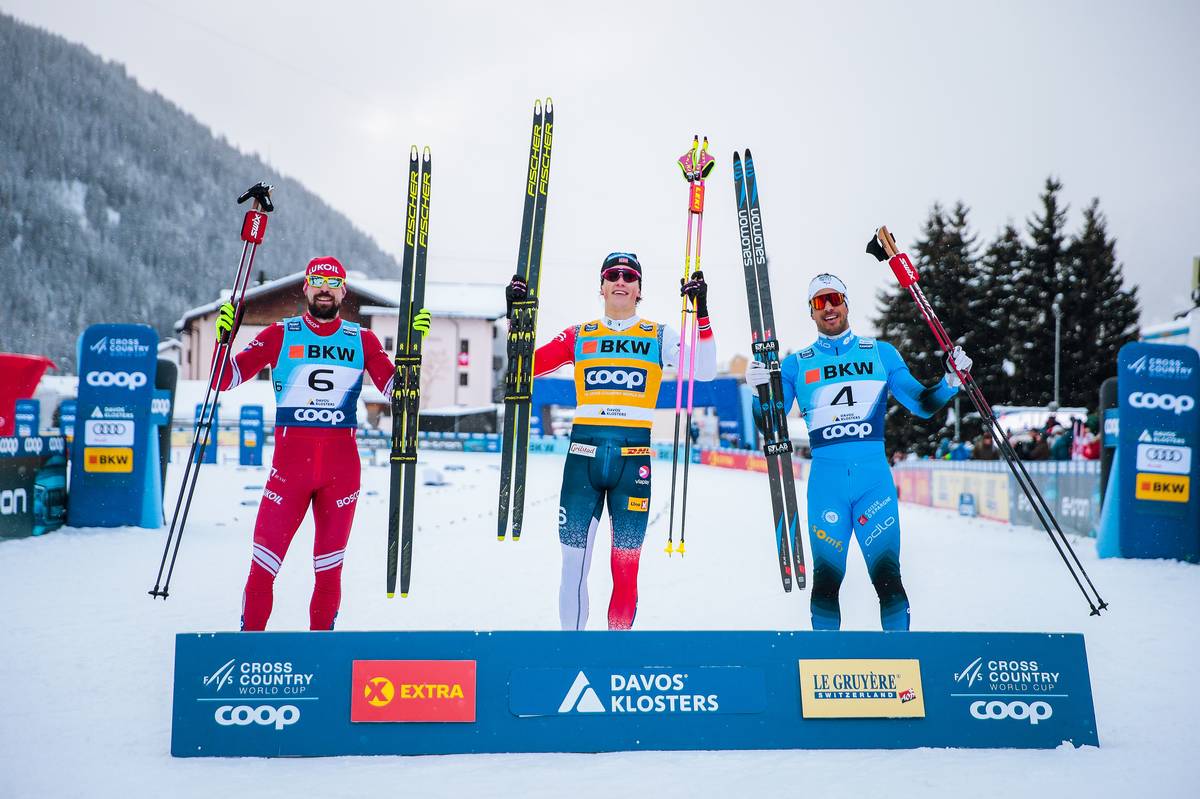
Norway returns to the podium in the Tour de Ski 20 k Freestyle Pursuit. Erik Valnes (NOR), Harald Oestberg Amundsen (NOR), Jan Thomas Jenssen (NOR), (l-r). (Photo: Modica/NordicFocus)
This coverage is made possible through the generous support of Marty and Kathy Hall and A Hall Mark of Excellence Award. To learn more about A Hall Mark of Excellence Award, or to learn how you can support FasterSkier’s coverage, please contact info@fasterskier.com.
Ben Ogden (USA) had a lot to celebrate today. He finished ninth in today’s 10 k Classic, kept his third overall position in the TDS, and took the lead in the points race. He literally did a backflip off the podium. (Photo: NordicFocus)
On Day Two of the Tour de Ski (TDS) in Toblach, Italy, the world had a chance to see what the realignment of the men’s cross-country ski world could look like, and whether it would withstand the concerted efforts of Norway to reclaim its place at the sport’s summit. The new TDS leaders would be tested by the 10 k Classic Individual Start. With many of the favorite pre-race contenders sidelined by illness, it was a chance for other skiers to take to the spotlight, or for yesterday’s winners to try and remain in it. In the men’s race, the TDS leaders were shockingly two Frenchmen and an American. Lucas Chanavat (FRA) sat in first, followed by Jules Chappaz (FRA), and Ben Ogden (USA).
But, after only one day of racing, it was way too early to proclaim that the giant of men’s racing— Norway—had been felled. Norwegians were still the current favorites to take the title: Erik Valnes (NOR) sat in fourth place, only 17 seconds behind the leader, and Harald Oestberg Amundsen (NOR) was fifth, 20 seconds back. The usually reliable Paal Golberg (NOR) was 24th at the start of the day. So, no tears for Norway as they still had plenty of horsepower under the hood.
For Chanavat to stay in the lead, he would have to beat the odds by doing something he hasn’t done at the international level since he was a junior skier ten years ago: have a strong performance in a distance Classic race. History—and the odds—were against him.
When one scans the TDF men’s standings, there aren’t any names jumping out as overwhelming favorites. Valnes is as close as it comes. It is as wide open a tour as there might have ever been, and it is yielding some of the most exciting racing that fans have seen in years. At the end of the day of racing, traditional order had not been fully re-established as the 32 year old Finnish veteran, Perttu Hyvarinen, rose to this occasion and took an unexpected win. Valnes finished second, and Amundsen was third. As expected, Chanavat and Chappaz were unable to maintain their positions, finishing 89th and 48th respectively.
By finishing ninth, Ben Ogden (USA) was able to stay in third place in the TDS standings. (Photo: NordicFocus)
But the day brought more good news for team USA: Ben Ogden finished ninth, which was enough to keep him in third place overall in the TDS standings. The Americans also had an excellent performance turned in by Gus Schumacher who finished 15th. Other American finishers were Scott Patterson 40th, Zanden McMullen 50th, and Kevin Bolger 72nd.
The top Canadian was Antoine Cyr who had a strong day finishing 19th. The next best Canadian was Oliver Leveille in 57th, followed by Julien Locke in 88th.
It was a career best day and shocking victory for Perttu Hyvarinen (FIN), who captured his first podium in World Cup racing by taking the victory. (Photo: NordicFocus)
Men’s 10 k Classic Individual Start
The men’s race started late today—3:00 local time—which meant that by the time skiers took to the course temperatures had warmed to a little above freezing; the trickiest range for Classic skiing. But the temperatures didn’t turn out to be an obstacle for the American squad. “I would have imagined it to be a tricky day to find kick,” said Ogden. “But to be honest, the wax techs today killed it and not one ski I tested kicked badly and none of them were particularly draggy. So major cheers to them for making it easy.”
Antoine Cyr (CAN) had his moment amongst the early starters taking the best time among skiers on the course at the 1.7 kilometer mark, but he was soon displaced at three kilometers by Hyvarinen. It was an omen of the breakthrough day which was about to unfold for the Finn.
Amundsen was among the first of the pre-race favorites to take the course, and at the 1.7 kilometer time check he had the fastest time of skiers on the course. When Valnes came through shortly after, he was tied with his countryman Amundsen. But, by the time they reached the 2.3 kilometer time check both the Norwegians had dropped to third and fourth. This was due to the fact that when Ben Ogden (USA) skied through the 1.7 kilometer time-check, he became the new leader on the course, ahead of Valnes and Amundsen by over two seconds. And, Ogden was still in the lead at the 2.3 kilometer mark without any strong challengers behind him. Being in the lead also allowed him to capture TDS Bonus points handed out the 2.1 kilometer mark.
Ogden dropped to third place by the three kilometer mark, tied with Valnes. Could lightning strike for the American two days in a row? It was a tall order, and by the half-way mark Ogden had slipped to eighth, some 18 seconds behind the lead, but still only 14 seconds from Valnes. Ogden had extra time in his pocket based upon time bonuses he acquired in yesterday’s sprints, so he was still looking strong in the overall standings. It was a tricky course to maintain consistent pacing on. “I think that with it being a slightly more double pole focused course than usual it was just tempting to go very hard out of the start,” Ogden said. “That being said, the downhills didn’t end up being particularly restful and the ‘smaller’ hills felt pretty big once you were racing.”
Perttu Hyvarinen (FIN) might have been as surprised as anyone by today’s victory over the best in the world. (Photo: NordicFocus)
The early finishing mark was set by Hyvarinen who has never stepped onto a World Cup podium. Even so, he turned in a very strong time, over 27 seconds ahead of the next best finishers on the course at the time he finished. As skiers with fancier pedigrees crossed the finish, Hyvarinen’s time—to the astonishment of spectators— continued to hold up. One by one, the best skiers in the world came through; Hyvarinen’s time continued to hold.
The best in the world continued to finish with Hyvarinen continuing to hold the lead. When Amundsen finished, he was in second, but an astounding seventeen seconds behind the Finn. Then came Valnes; and he too was unable to displace Hyvarinen. One by one all of the top ranked skiers finished, and all of them fell short of Hyvarinen’s time. It was beginning to be a storybook day for Finland.
Try as he might Erik Valnes (NOR) was unable to dislodge Perttu Hyvarinen (FIN) from the top of the podium. (Photo: NordicFocus)
At eight kilometers, Ogden was hanging tough in sixth place; 28 seconds off Hyvarinen’s time, but more importantly only fourteen seconds behind Amundsen. As Ogden pushed toward the finish he double poled intensely, but the clock showed that he continued to lose time. When he crossed the finish line he was ninth, 46 seconds from the lead, but only 30 seconds behind Valnes. It was good enough to keep Ogden in third place overall in the Tour de Ski.
It was a career day for Hyvarinen, and his teammates were clearly thrilled for him. After 110 starts he not only found the podium but conquered the top spot. It was yet another feel good story in a TDS where conventional wisdom has been challenged. After the race he praised his service team for giving him good skis. He seemed to take the surprise victory in stride noting that there wouldn’t be any big celebrations, though he clearly enjoyed showering his team with champagne after his victory.
Gus Schumacher (USA) also had an excellent day for team USA. He finished 15th and that moved him into 12th in the TDS standings. (Photo: NordicFocus)
Somewhat hidden by Hyvarinen’s surprise victory and Ogden’s performance was a fantastic day for Gus Schumacher (USA), who finished 15th. His performance was good enough to move him into 12th in the overall TDS standings, exactly one minute behind Ogden. Schumacher is still feeling good after today’s efforts. “[I’m] not crazy tired yet,” Schumacher told FasterSkier. “[I’m] pretty psyched to feel like my skiing is just going solid lately, so looking forward to the rest of it.”
Impact on Tour Standings
When the racing had finished, the old order was partially restored with Norway taking the lead in the TDS: Valnes in first, Amundsen second. But American Ben Ogden disrupted the list of Scandinavians in the top and remained in third place. Norway had been restored to the top of the results list in the TDS, but still had not found the top of the podium for the day’s race, and for his surprise efforts, Hyvarinen landed in fourth place overall. No matter how you looked at it, it was still a day full of disruption to World Cup skiing with a little known Finn taking the race and an American man sitting third in the overall TDS standings. It was a pleasant surprise on which to end the year. Ogden acknowledged as much when he was asked if before the TDS began he had ever imagined himself this high in the rankings? “No,” he replied. “I sincerely did not imagine I would be third in the Tour at any point. I’m proud to be there and excited to keep fighting and see what the future holds.”
But there was even more good news for team USA, Ogden was also leading in the points chase. He was clearly very pleased with this outcome as he literally did a backflip from the top of the podium at the end of the flower ceremony.
It was a day team Finland will long remember when Perttu Hyvarinen (FIN) stepped up to fill the void left by Iivo Niskanen’s (FIN) illness to take the victory. (Photo: NordicFocus)
Damn. What a weekend for the U.S. Ski Team, with three podiums in three days of racing at the World Cup opener in Finland.
Erik Bråten, a Norwegian who coaches the Swiss ski team, joins Devon and Nat to recap and share his experiences across a range of international ski cultures. Send us questions, feedback and anti-vax screeds to: devon@fasterskier.com and nat@fasterskier.com — we’ve already got some questions stacking up for a mailbag episode in a few weeks. We’ll be back in a few days after the next World Cup weekend in Sweden.
This coverage is made possible through the generous support of Marty and Kathy Hall and A Hall Mark of Excellence Award. Learn more about A Hall Mark of Excellence Award—or about supporting FasterSkier coverage—by contacting info@fasterskier.com.
Martin Loewstroem Nyenget (NOR) took first in the men’s World Cup 10 k Classic individual start, crushing the hopes of the Finnish crowd. (Photo: NordicFocus)
Day Two of the 2023-2024 FIS World Cup season showcased the individual start 10 k Classic race in Ruka, Finland. The Finn’s were chomping at the bit for an opportunity to break the Norwegian men’s stranglehold on distance racing: last year a Norwegian won every men’s distance event, a trend the Finn’s desperately wished to end on their home turf. A classic race on home ground seemed like the perfect opportunity to break Norway’s winning streak; however—in a result that brought heartbreak to the Finnish crowd—Norway was able to cling to its distance supremacy as Martin Loewstroem Nyenget (NOR) defeated hometown favorite and classic technique master, Iivo Niskanen (FIN), by 2.9 seconds. Norway rounded out the podium with Erik Valnes finishing third.
For the USA, Gus Schumacher was the top finisher placing 22nd. He was followed by Ben Ogden 39th, Scott Patterson 53rd, Luke Jager 56th, Zanden McMullen 58th, John Steel Hagenbuch 66th, and Zak Ketterson 71st.
For Canada, Antoine Cyr was the top finisher coming in 27th. He was followed by Xavier McKeever 35th, Olivier Leveille 40th, and Leo Grandbois 65th.
Iivo Niskanen (FIN) was inspired by the home crowd’s cheering, but was nipped at the finish line by Martin Nyenget (NOR). A classic race on home turf was a great opportunity for Finland to break Norway’s distance winning streak, but it was not to be. (Photo: NordicFocus)
The Finnish crowd cheered on their native son, erupting every time Niskanen charged up a hill. In a stirring moment, the crowd chanted “Iivo-Iivo” as he dashed across the finish line. U.S. team coach Matt Whitcomb was able to hear the cheering and commented to FasterSkier that “it’s deafening, the Finns are so proud of him, and all of their racers, they explode when a Finn comes by.” And, for a while, it looked like it was going to be a storybook ending as Niskanen—having a fairly low start number—occupied the leader’s chair for a long time. He held a comfortable lead over all later finishers, though the hometown crowd began to appear nervous after Nyenget surpassed Niskanen’s split time at the five kilometer mark by three tenths of a second. At the 6.1 kilometer mark, Nyenget expanded his lead to 2.4 seconds. After that, it was nip and tuck between Niskanen and Nyenget as the Norwegian skier was only one second ahead at the 8.1 kilometer mark. The hometown crowd still held out hope for their man as Nyenget approached the finish. But, as he came into the stadium, Nyenget was met with stunned silence from the Finnish crowd that saw Finnish victory slipping away. That silence was music to Nyenget’s ears as he gave a final lunge and was able to nip Niskanen by 2.9 seconds.
In a rare display of emotion, Niskanen, watching at the finish line slammed his poles into the snow in disgust as he saw Nyenget displace him from the leader’s chair. Niskanen then quickly stomped off from the stadium area and headed out of view. Nyenget walked away with his second World Cup victory and sixth podium finish. He commented on hearing “Iivo…Iivo” throughout the race, and admitted after the race that he was “inspired to have beaten Iivo.”
While all eyes were focused on the battle for first, Erik Valnes (NOR) was able to sneak into third (further punctuating his World Cup Sprint victory only the day before). (Photo: NordicFocus)
The Ruka course tested not only racers stamina but their ski handling abilities as well: a speed of 45 mph (72.7 kph) was obtained by race winner Nyenget on a downhill. Whitcomb remarked to FasterSkier that while the speeds are high, it’s not a high risk situation. “Today wasn’t the fastest day for conditions,” Whitcomb said. “We’ve had speeds over 50 MPH on this downhill. It’s reasonably straight…it can be easily navigated in an interval race.”
Team USA was pleased with Schumacher cracking the top 25. “It’s great to see Gus coming back into the form that we know he’s capable of,” Whitcomb commented. “Gus has made some big changes to his training plan over the last year.” Whitcomb observed that, “one of the biggest changes was figuring out ways to absorb volume better. He’s cut back a little on his overall volume, and we’re seeing him absorb training better.” Whitcomb also praised Schumacher for the way he paced the race, steadily moving up in the standings as the race progressed.
The U.S. coaching staff was pleased with Gus Schumacher’s (USA) 22nd place performance, indicating the success of significant changes to his training plan. (Photo: NordicFocus)
“I felt a little weird today,” Schumacher commented after the race. “The first race is hard in the sense that your body isn’t used to staying at the limit, but I was happy with my pacing and finding my limit at the end of the race. The skis were really good and helped the technique stay together, which is really important in this course. Looking at the results, this is my best individual Ruka start, so that’s good to see and super motivating. As for looking forward, I feel like my classic and striding technique has improved, and I’m excited to work on that. Once racing starts to feel more natural, I’m excited to dig more into technique with my coach, Kristen Bourne.”
Today was also a chance for Norway’s Johannes Hoesflot Klaebo to establish firm footing in the distance crystal globe race, in which he finished second last year behind countryman, Paal Golberg. It would also be an opportunity for a shot at redemption of a sort for Klaebo after finishing third in yesterday’s sprint race. Speculation swirled that Klaebo was still feeling the effects of a positive COVID 19 test in early November. That speculation seemed to be confirmed when Klaebo’s struggles continued on the race course, and he was unable to turn things around from yesterday. He made a charge at the eight kilometer mark and moved into fourth. But he faded in the final kilometers and finished 14th. It’s a bit of a stretch to claim a skier is struggling when they finish in the top 20, but expectations are always so high for Klaebo that anything less than a podium is disappointing.
For a while it looked like perennial crowd favorite Andrew Musgrave (GBR) was going to find the podium, but he faded slightly in the closing kilometers to finish fifth. (Photo: NordicFocus)
An ignominious form of history was also made in Ruka: for the first time, a skier was not permitted to start a race due to skis testing positive for fluoro compounds. Ukraine’s Mischenko Oleh was not permitted to start under FIS (International Ski Federation) rule ICR 351 which defines the penalties for bringing fluorinated skis to the start of a race. Oleh’s disqualification brings to light a potential problem with the new rule: teams with limited resources may not be able to perform the extensive remediation necessary to clean all the fluoro molecules from their skis and equipment. As U.S. Coach Matt Whitcomb outlined to FasterSkier yesterday, the amount of time and effort to clean fluoros is extensive. “I know the amount of time we have spent cleaning our infrastructure has been immense,” Whitcomb commented to FasterSkier after today’s race. “Not everybody has the time to do that, not everyone has the resources for that.” How lower-resourced teams will be able to comply with the new rules is yet to be determined. “There will be a learning curve,” said Whitcomb.
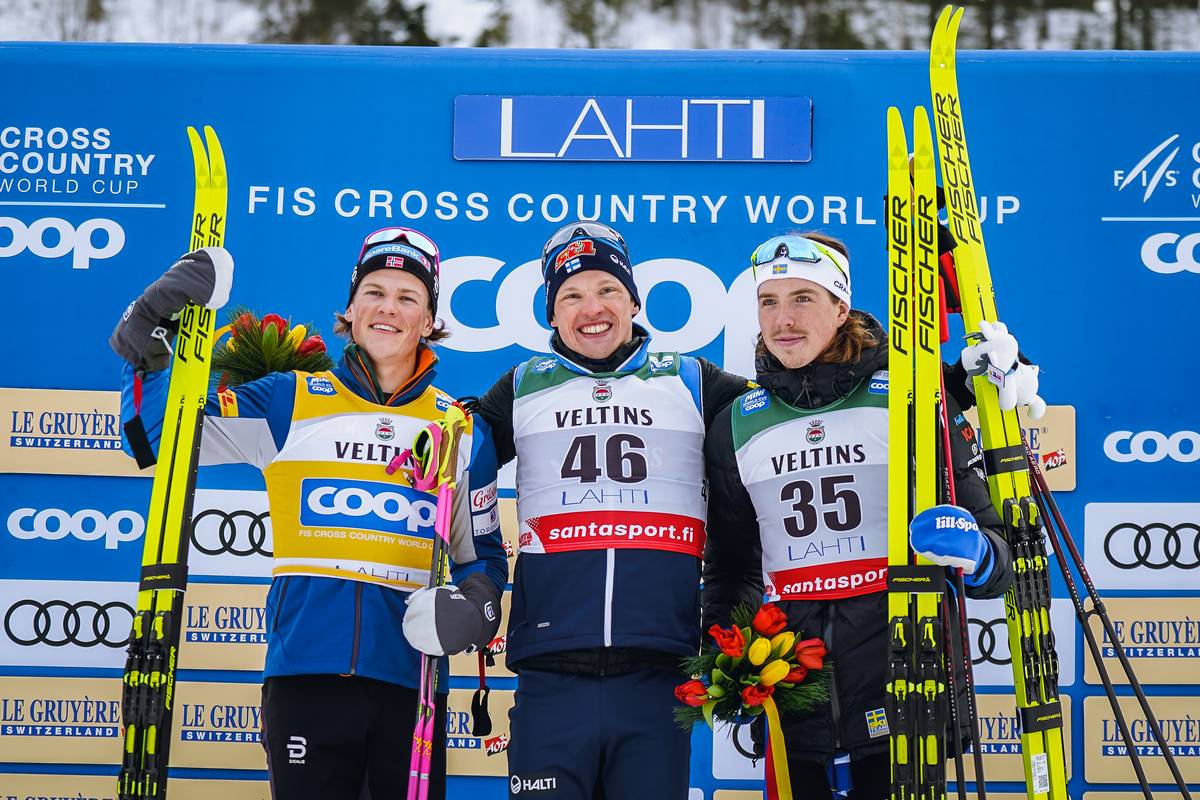
Iivo Niskanen (FIN), Martin Loewstroem Nyenget (NOR), Erik Valnes (NOR), (l-r) celebrate reaching the podium of the FIS World Cup 10 k Classic in Ruka, Finland. (Photo: NordicFocus)
This coverage is made possible through the generous support of Marty and Kathy Hall and A Hall Mark of Excellence Award. To learn more about A Hall Mark of Excellence Award, or to learn how you can support FasterSkier’s coverage, please contact info@fasterskier.com.
Erik Valnes (NOR) celebrates at the finish line in Ruka, Finland ahead of Federico Pellegrino (ITA) and Johannes Hoesflot Klaebo (NOR). (Photo: Modica/NordicFocus)
FasterSkier begins its coverage of the 2023-2024 FIS World Cup with the first day of competition from Ruka, Finland. A cold day offered consistent conditions for this Classic Sprint. Even so, Norway advanced seven (!) skiers through to the sprint semifinals.
In qualifying at the beginning of the day’s events, 2023 World Cup Sprint and Overall champion, Johannes Hoesflot Klaebo, qualified an uncharacteristic fourth. It had been announced earlier that Klaebo had suffered a bout of sickness (possibly even Covid) in the week prior to the Ruka World Cup, so his dominance remained in question. Any such questions ultimately proved prophetic as Klaebo suffered one of the few sprint defeats of his extraordinary career. Erik Valnes (NOR) claimed his career-second victory in a classic sprint, followed by Richard Jouve (FRA) in second, and Klaebo in third.
Among Americans, Ben Ogden and JC Schonmaker qualified eighth and ninth, respectively, less than three seconds behind the top qualifier, Marcus Grate (SWE). Ogden would finish the day in 11th, with Schoonmaker finishing 22nd.
Canadian qualifiers included Graham Ritchie (19th) and Antoine Cyr (21st). At the end of the day’s racing, Ritchie would finish 23rd, and Cyr 24th.
Winter conditions offered excellent early-season racing in Ruka, Finland. Luke Jager (USA) strides up the final hill in qualifying. (Photo: Modica/NordicFocus)
No team demonstrated a distinct ski advantage in the quarterfinal heats, though many of the top skiers did seem to enjoy the best glide. Klaebo coasted to the win in the first quarterfinal (nearly five seconds faster than his own qualifying time) ahead of countryman Erik Valnes (NOR) and Jules Chapaz (FRA).
Even Northug (NOR) had to work extraordinarily hard to advance out of his quarterfinal behind heat winner, Lauri Vuorinen (FIN). Top qualifier, Grate, tangled briefly with Northug on a tight corner. A stumble—and broken pole—ended Grate’s day.
Ogden cruised through his quarterfinal ahead of Ansgar Evensen (NOR) and Paal Golberg (NOR). Cyr finished fifth in that same quarterfinal, ahead of an uncharacteristically flat Lucas Chanavat (FRA)
Schoonmaker finished fifth in his quarterfinal behind heat winner Federico Pellegrino (ITA) and runner-up, Richard Jouve (FRA) who both showed good form and easy speed.
“It’s definitely always a bit shocking at the start of the season to get used to the speed,” Schoonmaker said. “I think just racing more prepares you for the speed of things so getting the first one done and doing a bit of calibrating for the next one feels good.”
Men’s Sprint Semifinals
Ogden lined up in semifinal one alongside the Norwegians—Klaebo, Northug, Valnes, Amundsen—and Lauri Vuorinen (FIN). His sometime-tactic utilized in numerous sprints last year (a hyper-speed scramble to test the semifinal fields of numerous World Cup Sprints) was not on display today, as Ogden tucked in behind the red Norwegian wall. Klaebo cruised easily to the front of the semifinal field (ahead of Valnes), while Ogden’s kick wax seemed lacking on the final uphill. He faded to fifth in the heat, and would finish the day in 11th.
“Today I was happy in the quarterfinals with saving energy and being able to kick over the top of the hill,” Ogden said. “But I wish I had been a little bit more assertive in my position, and had a bit more of a plan going into the semifinal.”
“I took a different tactical route today. It’s always hard to determine if its smarter to try and sit in the back and save energy, or to get to the the front and stay out of trouble. Today in the quarterfinal I decided to try and save energy, and it worked out great so I tried again in the semi. There I paid the price and was caught in a few little stumbles, lane changing antics. I unfortunately didn’t have the strength to get back in contact after that stuff. Generally, I was happy to go in with a different tactical plan and execute with reasonable success.”
Pellegrino showed perfect wax and refined fitness in dominating the second semifinal ahead of Jouve.
Men’s Sprint Final
If Sweden dominated the Women’s Sprint in Ruka (with four skiers in the Women’s final), then the Norwegian men’s team demonstrated its own level of dominance in the Men’s Sprint with a final field in which four Norwegians (Klaebo, Jennsen, Evensen, Valnes) faced Pellegrino and Jouve. Klaebo’s fine skis delivered him to the front on the downhills, though he decided to mark Valnes and Jouve on the other working sections of the course. Klaebo got clogged up behind Valnes and Jouve at the bottom of the late-course uphill, and he never managed to recover his speed on the crucial slope. Valnes showed his fitness as he strided away from Jouve, while Klaebo managed to hold off Pellegrino for the final podium spot.
World Cup coverage from Ruka continues on Saturday with the Men’s and Women’s 10 k Interval Start, followed by Sunday’s 20 k Mass Start.
Richard Jouve (FRA), Erik Valnes (NOR), Johannes Hoesflot Klaebo (NOR), (l-r) – FIS world cup cross-country, individual sprint, Ruka, Finland. (Photo: Modica/NordicFocus)
We’re off. The 2023-2024 winter kicks off with season opening races across Scandinavia, and the World Cup launches next week.
Devon and Nat go old-school, no guests to recap a bevy of interesting results so far. Send us your comments, questions and criticisms: devon@fasterskier.com and nat@fasterskier.com. We’ll be back next week.
This is the end. Of the 2023 racing season. Devon and Nat go without guests and are here to take you through the last three events of the winter in Lahti, Finland. And we cover a couple of retirement announcements from U.S. skiers.
We’re taking a little break after this but, we promise: We won’t leave you hanging for the whole off-season. Stay tuned for more regular episodes over the course of the spring and summer, and we’ll be back in a few weeks for a 2023 season recap. Tell us your favorite memories from this year — get at us at devon@fasterskier.com and nat@fasterskier.com.
World Championships is looming; Devon and Nat return to cover three days of racing — and two podiums from Jessie Diggins — in Toblach, Italy. We’ll finally get to the mailbag episode next week, so send in your questions if you’ve got ’em: devon@fasterskier.com and nat@fasterskier.com.
Jessie Diggins races in Toblach last weekend. (Photo: NordicFocus)
Corresponding with a social media post from Johannes Høsflot Klæbo, the Norwegian news outlet NRK reported yesterday that each of the men’s national team sprinters who competed in Lahti last weekend has tested positive for COVID-19. Head sprint coach Arild Monsen told NRK that Håvard Solås Taugbøl was the first to test positive on Monday, followed by Erik Valnes, Pål Golberg, Sindre Bjørnestad Skar and Johannes Høsflot Klæbo on Tuesday. According to Trondheim regional newspaper Adresseavisen, the final Norwegian sprinter who raced in Lahti, Even Northug, has also been affected.
Johannes Høsflot Klæbo (NOR) takes the win in Lahti’s freestyle sprint ahead of Lucas Chanavat (FRA) and Sindre Bjørnestad Skar (NOR). (Photo: NordicFocus)
“It must have occurred in and around the stay in Lahti,” Monsen explained to NRK. “Håvard was the one who noticed symptoms on Monday. The others have little or no symptoms.”
Given the proximity to the upcoming sprint races in Drammen, Norway, Monsen indicated that these men would not be attending the competitions.
“What happens after that, we just have to look at. It’s boiling in many fields in the world now. This is smaller than other things, even though it is [disappointing] for those they concern,” Monsen continued.
At this time, no other athletes from the Norwegian program who attended the competitions in Lahti have tested positive. While the transmission link between the sprinters is clear, some athletes participated in both sprint and distance races, including Klæbo, who won the freestyle sprint and took second in the 15 k classic.
The men’s 15 k classic podium in Lahti: Iivo Niskanen (FIN) took the win in his signature event, ahead of Johannes Høsflot Klæbo (NOR) and William Poromaa (SWE). (Photo: NordicFocus)
Team doctor Øystein Andersen indicated to NRK that the original source of the outbreak remains unknown.
“It’s hard to say [how this began],” Andersen said. “Everyone came from their own bubbles before this race, after they returned home from the Olympics. We must now first map out whether there are more [positive cases] and conduct infection tracking, so that we avoid more infection.”
As the World Cup Finals slated for March 18-20th currently remain listed as “canceled” on the FIS calendar, it is unclear whether these athletes will be able to compete on the World Cup again this season.
Klæbo told NRK that “most indications are that the season is over,” however, the loss of competition would not significantly impact his season outcome. Klæbo currently leads the World Cup overall standings by nearly 500 points over Russia’s Alexander Bolshunov, who is also unable to compete as FIS banned athletes from Russia and Belarus from competition for the remainder of the season. The next closest athlete to Klæbo is Finland’s Iivo Niskanen, who sits nearly 800 points back with limited scoring opportunities remaining. As the Falun World Cups feature a mixed relay and team sprint, this leaves two sprints and two distance races, worth 100 World Cup points each, currently confirmed on the FIS calendar.
If World Cup Finals are held at an alternate venue, athletes could score a maximum of 50 points per day, with the opportunity for up to 200 bonus points should they win the three-day mini-tour.
This still leaves fewer than 800 points on the table, and as such, it looks like Klæbo will win the overall World Cup regardless of whether he competes again this season.
Klæbo also leads the World Cup sprint standings with a 210 point lead over Richard Jouve, and is 237 points of third-ranked Lucas Chanavat, both of France. Classic sprint events are scheduled for Drammen on Thursday, followed by another classic sprint in Falun on Friday, March 11th. If World Cup Finals take place, there will be a third sprint opportunity there, raced freestyle. This leaves 200 points available without the World Cup finals, and 250 including them.
Norway’s Pål Golberg tested positive for COVID following the weekend of World Cup racing in Lahti. (Photo: NordicFocus)
“There is nothing to do but take it easy,” Pål Golberg said to NRK. “It’s [disappointing] that it’s coming now, but we can be very happy that we managed to avoid more infection in the camp before the Olympics when people became infected in Seiser Alm.”
On what is next, Golberg continued, “If I do not develop symptoms, it may be relevant to go to Falun next weekend. And then there are many [domestic] races over the late winter. Then we will see if it is worth it.”
On February 26th, the Norwegian Ski Association (NSA) released a statement indicating that in light of the nation’s recent invasion of the Ukraine, Russian participation was not welcome at the upcoming World Cup sprint races in Dramman or the storied Holmenkollen distance races outside of Oslo. In addition to these cross country events, Norway is scheduled to host competitions in alpine, nordic combined, and ski jumping, including the World Ski Flying Championships in Vikersund.
A press release shared by Norwegian news source NRK stated: “The board of the Norwegian Ski Association has today discussed the situation related to Russia’s invasion of Ukraine, and how this affects the upcoming World Cup races and the world championship in Norway. The Norwegian Ski Association’s message to Russia and Russian athletes is crystal clear; We do not want their participation!”
NSA president Erik Røste told NRK that a request had been made to the International Ski Federation (FIS) to officially bar the Russian program from participating, but as of Saturday, FIS had not taken action to comply with the request, instead pointing to the official cancellation of remaining FIS events held in Russia.
“The attack on the Ukrainian people and the great suffering we see pictures of now, the sport can not remain passive and be neutral,” Røste said of the request. “Therefore, the board of the Norwegian Ski Association was clear that this must have consequences beyond what has already been decided. Therefore, we will send a clear and distinct signal to FIS that we do not want Russia and Russian athletes to participate in competitions in Norway in the coming weeks.”
Ultimately, it is up to the board of FIS whether Russia will be allowed to compete in the remainder of World Cup events. A response NRK received via email today stated:
“The FIS board has been clear in its approach to Russian athletes in all FIS competitions. To ensure fair and inclusive competitions at all FIS events, national federations and local organizers should not exclude athletes on the grounds of gender, race, nationality or sexual orientation.”
Alexander Bolshunov (RUS) wins the 2020 Holmenkollen 50 k in the fog, ahead of Norway’s Simen Hegstad Krüger. (Photo: NordicFocus)
As such, no Russian athletes or coaches have been denied entry to Norway, and Stefan Marx, the general manager of Holmenkollen ski festival, indicated there is little more that the organizers can do to prevent Russian participation in the events.
“We must let them participate,” Marx said to NRK. “Those who FIS and the Norwegian Ski Association say must be allowed to participate. We do not have the authority to refuse anyone to participate, but we have supported the Ski Association and the Sports Association’s position. It is up to FIS or the authorities to decide, but we are clear in our support for the Ski Association’s proposal that Russian athletes are not wanted due to violations of international law that have been committed.”
After flying from Helsinki following the Lahti World Cup races, Russian teams have begun to arrive in Norway. When pressed by the media upon his arrival, World Cup distance leader and favorite for the upcoming 50 k classic at the Holmenkollen, Alexander Bolshunov chose to remain silent. NRK did, however, receive comments from multiple Russian coaches, including head coach Marcus Cramer who felt that sport and politics should be kept separate.
“What do sports and athletes have to do with this situation? It’s really tough. I just get sad that the Norwegian association thinks like that. We really have a good communication between us. With everyone who works there. It’s sad to hear this, especially when they take it to the press and not us first,” said Cramer.
Another Russian coach, Jegor Sorin, who had been working at the Junior/U23 World Championships in Lygna, NOR and planned to join the Russian team in Oslo, echoed that Russian athletes should not be held accountable for the
“I am very upset that the Norwegian association wants this,” Sorin told NRK. “I can understand that no one wants to travel to Tyumen for the World Cup, but I do not know what happens to us… We are Russian athletes. We are here, we are not in any war. We are athletes, not soldiers. Maybe they think we have weapons. We want peace and for me this is very strange.”
Alexander Bolshuonv is photographed with his four Olympic medals from the 2022 Games, with one event remaining. He would leave the Games with three gold medals, and a total of nine Olympic medals including those won in 2018. (Photo: NordicFocus)
Though the Russian coaches focused on a separation between sport and politics, others have pointed out the direct ties between sporting success and military recognition. Used as an example, Bolshunov and Denis Spitsov were promoted to the rank of captain in Russia’s National Guard in recognition of their success during the 2022 Olympics. Bolshunov, who has earned a medal in each of his nine Olympic appearances, including three gold medals in Beijing, received additional honors in the form of the Alexander Nevsky Order, given in recognition of “special service for the fatherland.”
FIS cross-country committee leader, Vegard Ulvang told NRK, “Russian athletes are [military] officers. This makes the symbolic value [of their participation] even greater.”
A similar statement was made by Global Athlete representative and former U.S. Ski Team athlete Noah Hoffman.
“While I feel for the individual athletes, all Russian skiers should be banned from the FIS Cross Country World Cup for the rest of the season,” Hoffman tweeted. “Their results are used to drum up nationalism and bolster the Russian State. Allowing them to compete aids Russia. #StandWithUkraine.”
Ulvang is urging a stronger response from the Norwegian Ski Federation, suggesting that they relinquish the FIS World Cup status of the events at the Holmenkollen in order to gain the authority to prohibit Russian participation.
Jan Petter Saltvedt, a Sports Commentator for NRK described Ulvang’s statements as a “moral ultimatum.”
“Ulvang demands an open rebellion from NSF against his own superiors,” Saltvedt said. “And he should get it. Vegard Ulvang puts so much pressure on the Norwegian Ski Association that they can not help but act… At the same time, he expresses a very strong and clear criticism of FIS, where he himself is one of the powerful committee leaders, but still does not feel he is heard at all.”
Norwegian athletes who have been asked for comment have given mixed responses, often acknowledging the complexity of the issue and whether the athletes themselves should be at fault for government decisions.
Among those with a clear stance, Erik Valnes spoke of disallowing Russian participation. “There is a heavy symbolism in it. It would send a signal. Since [Bolshunov] is [a captain of the Russian National Guard], they have already mixed sports and politics in a way. It is difficult. It is a great pity that it will be like that.”
Erik Vales and Johannes Høsflot Klæbo earn gold in the classic team sprint during the 2022 Beijing Games. (Photo: NordicFocus)
Johannes Høsflot Klæbo also spoke in support of the NSA urging FIS to remove Russian athletes from competition.
“As an athlete, you want the best to start. We train all year to compete and then you want the best to participate,” Klæbo said to NRK. “At the same time, I support the attitude of the ski association now. There is no doubt about what is happening in Ukraine, and Russia must be condemned. I strongly condemn it and I think it is good that the association takes a stand.”
Therese Johaug acknowledged that athletes may not have direct involvement in the military actions of Russia, speaking instead to their role in representing their country through sport.
“I feel sorry for the athletes, first and foremost, I understand that they have nothing to do with this,” Therese Johaug told NRK after narrowly winning Lahti’s 10 k classic over Russian Natalia Nepryaeva. “But on the other hand, I think it is completely wrong. They front their country and the flag both on the chest and on the forehead. And that a country should also ravage the sports arena and fight for victories and front their country in the situation we are in – I think that is completely wrong.”
Therese Johaug voices her thoughts on Russian World Cup participation following her win in Lahti’s 10 k classic. (Photo: NordicFocus)
The stance is not unanimous amongst the Norwegian team. Sindre Bjørnestad Skar, who took third in Lahti’s freestyle sprint, spoke to the unfairness for Russian athletes.
“Of course, I am 100 percent against everything that is happening between Russia and Ukraine now. It is completely inconceivable. But then I also do not think that the fact that they have a Russian passport, means that they should be punished and deprived of the opportunity to do their job. In a way, I think that is a bit unfair too,” Skar told NRK.
For the time being, no further changes in Russian participation have been reported. FasterSkier will continue to follow this story as it evolves over the next few days. World Cup classic sprint races are currently scheduled in Drammen Thursday, with the women’s 30 k mass start classic in Oslo happening Saturday March 5th, followed by the men’s 50 k on Sunday.
This World Cup coverage is made possible through the generous support of Marty and Kathy Hall and the A Hall Mark of Excellence Award. To learn more about A Hall Mark of Excellence Award or to learn how you can support FasterSkier’s coverage please contact info@fasterskier.com.
The team sprint: it’s the youngest event on the Olympic program, having been contested only since the 2006 Torino Games. The event has since become a marquee event in the sport of cross country skiing.
Holding it up as a marquee event, of course, is easier to say coming from the United States. If you tuned into the NBC broadcast, you got the delight of hearing 2018 team sprint gold medalist Kikkan Randall analyze the race where she won the US’s only gold medal in cross country skiing, while her teammate from that race, Jessie Diggins, worked to repeat the Olympic medal feat.
Yes, the team sprint was that race, and we could all revel in that memory as it played out in Zhangjiakou, China on Wednesday.
Competitors surrounded by the colors of the sunset. (Photo: NordicFocus)
Beyond that, though, no other event exemplifies the nuances involved in modern skiing like the team sprint. This is an event that pairs the specialists with the even-more specialized, and has an err of a nordic nerd’s daydream to the team-selection possibilities that arise from doing so.
What if you lined up the two athletes who single-handedly changed a generation of skiers together under one flag? Well, they’d turn out to win gold in Pyeongchang 2018, like when Johannes Høsflot Klæbo and Martin Johnsrud Sundy were paired as team Norway. What if you repeated when Finland won gold in Sochi 2014, but this time Iivo Niskanen, who was then seemingly untouchable as a classic skier? Well, that one offers a bridge to what played out in Beijing 2022.
Of course, hypotheticals joined up with storylines that didn’t need to be posed as a question today too. For the US men, this was the crystallized moment where one generation was handed off to another. Call to mind the US Olympic team sprint team anytime in the last eight years and it was the steadfast duo of Simi Hamilton and Erik Bjornsen. These men, now retired, were sixth in the team sprint in both the 2014 Olympics in Sochi and the 2018 Games in PyeongChang. Then, this morning, it was Ben Ogden and JC Schoonmaker, both born in 2000.
The (frozen) fresh-faces of American skiing. Teammates Ben Ogden and JC Schoonmaker after completing the Team Sprint on Wednesday in Beijing. (Photo: Nat Hertz)
The two made up a pairing that was more pure-sprint oriented than most of the competitors that were most closely watched going into today. The strategy for a few of the top teams, in particular, the Russian Olympic Committee and Finland, seemed to be pairing their top-class distance skier with a sprinting specialist.
For the course in Beijing, it was a good strategy on paper. The 1.5-kilometer course, last seen in the individual sprint last week, had one tactical pressure point going into a downhill when it was raced as a single lap. When it was raced in a burst of three per skier with little rest in between, however, just how much the long, semi-gradual, uphills on this course made skiers work moved to the forefront. In the team sprint, having a skier who could stay with a sustained attack through multiple legs was an appealing prospect, especially when it was meant to set up for a punchy last climb that would no doubt give way to a mad dash for the finish.
For two teams, Norway and the Russian Olympic Committee (ROC), that mad dash had been setting up since the first World Cup of the season, when 22-year-old Alexander Terentev (ROC) out-dueled sprint superstar Johannes Høsflot Klæbo (NOR) to challenge the latter’s classic sprinting dominance.
Johannes Høsflot Klæbo (NOR) accelerates out of the exchange zone after receiving a tag from teammate Erik Valnes, followed by Alexander Bolshunov (ROC) on his way to tag teammate Alexander Terentev. (Photo: NordicFocus)
They would both ski the anchor legs on their teams. Klæbo was paired with fellow sprinter Erik Valnes to make team Norway, while Terentev was paired with 30 k skiathlon gold medalist Alexander Bolshunov to make team ROC. Finland joined the intrigue, sending out 15 k classic gold medalist Iivo Niskanen in the first leg paired with the World Cup’s perennial “oh, that’s right he’s a great sprinter too!” Joni Maki as an anchor.
As such, the teams in the final skied the first and second legs could roughly be divided into: leg 1 – the distance skiers and long-burn sprinters, and leg 2 – classic sprinting’s very best.
The US had qualified for the final as the second lucky loser, finishing a messy semi-final that saw Ben Ogden break a pole and recover to finish 6th place (+4.43 off of heat winners Italy’s mark of 20:06.99).
“It was a hard semi-final, ours was fast and everyone was pushing. [The pole break] was one of many places where we used more energy than we had to today.” said Ogden in post-race interview with FasterSkier in the mixed zone.
But as Ogden went out in the final, he seemed to settle in and leave the troubles of that semi-final behind. He looked comfortable in a pack that had settled on jockeying for position in the early part of the race, moving up to 4th place through the first exchange.
Ben Ogden (USA) strides early in the the team sprint. (Photo: NordicFocus)
The men’s field going out relatively slowly could be attributed to Norway’s Valnes. He seemed to comprehend that with his team as a pre-race favorite, the eyes of the pack were on the “What is that?” pattern of his suit. Valnes looked to lead the pack so-as only to try and lull it into complacency. It was a strategy that made sense, knowing he would be tagging off to the current fastest human on skis in a drag race, Klæbo.
Alexander Bolshunov, though, called Valnes out on his bluff, making sure to pick up the pace just enough so that the pack would have to work throughout its first leg.
So began the stalemate that would last for much of the early legs of the race. In the first exchange to the anchor-legs, Klæbo showed outward signs of his strength, and his desire to keep the pace right in the sweet spot where he could shoot around them in the end. JC Schoonmaker, meanwhile, remained placed right off the leaders, in the pack, moving through the course.
The second showing of leg 1, including Valnes, Bolshunov, Niskanen, and Ogden saw Bolshunov push on the initial climb out of the stadium. Valnes covered the move, before the pack came together in the final climb into the stadium. The pressure, and the speed, had increased. Ben Ogden, though, had kept up with the pack, and came through the half-way mark with the Americans in 7th place (+4.4).
Johannes Høsflot Klæbo (NOR), Richard Jouve (FRA), and Joni Maki (FIN) face off in the classic team sprint during the 2022 Olympic Winter Games. (Photo: NordicFocus)
In their second laps, a lead group that included Terentev, Klæbo, Maki, and Schoonmaker, the pack began to take shape. The decisive move didn’t come from any of those skier’s mentioned, though, but instead from a familiar agitator in sprint heats on the World Cup. Moving up from behind the leaders, France’s Richard Jouve powered to the front of the pack on the first uphill, but was quickly matched by both Terentev and Klæbo. The duo, as they approached the downhill, put in a burst of speed that hadn’t been seen on the course up to that point, and it was all it took for the pack to begin to thin.
This was the move that saw the young American team begin to lose contact with the lead group. Schoonmaker later said that “the downhills felt tighter and more aggressive than some other World Cup sprints.”
The Americans slipped to 9th place, and remained there for the rest of the day despite the early efforts of the duo to stay locked in and pushing all the way through.
JC Schoonmaker races the classic team sprint final during the 2022 Olympic Winter Games. (Photo: NordicFocus)
Meanwhile, at the front, the exchange to the final lap of the odd-leg skiers found Bolshunov once again putting in an attack on the uphill that led out of the stadium. The move indicated that the ROC had faith in the young Terentev as the anchor, but that chancing it with Klæbo still on deck was not the preferred option. Valnes took the ROC strategy off the table anyway, letting out a blistering counter-attack that showed his own strength and served to further separate the pack. When they came into the final climb into the stadium for the last exchange, it was just Norway, the ROC, and Finland who were in contention for the gold medal.
Finland, in fact, was the first to the exchange. That came courtesy of Niskanen, who evaded the front of the pack for much of his race. The 15 k classic champion unleashed his diagonal stride on his final climb of the day, with both efficiency and power that exemplify optimal technique.
The last lap, then, looked like a three-way pack of Finland, Norway, and the ROC, and, not far back and putting together an outstanding day, Canada (+9.7). The team of Graham Ritchie and Antoine Cyr had put in an unexpected and auspicious effort for the whole world to see.
Johannes Høsflot Klæbo (NOR) leads the way to the line, with Joni Maki (FIN) and Alexander Terentev (ROC) behind for second and third. (Photo: NordicFocus)
Still, the skiers to face off for medals remained; Joni Maki (FIN), Johannes Høsflot Klæbo (NOR), Alexander Terentev (ROC).
The front three remained tight throughout the final lap. The pace was fast, but not fast enough to shake the familiar feeling that we’d been here, on this 1.5 k course, before, and it was a stage for which one player was ready to take the lead role: Klæbo.
On the last hill, Klæbo went, and proved again that he was both a master of the art of sprint racing, and still indisputably its best practitioner. He, and Norway, would repeat as gold medalists in the team sprint in a time of 19:22.99.
Johannes Høsflot Klæbo celebrates team sprint gold with teammate Erik Valnes. (Photo: NordicFocus)
In comments to the press after, Klæbo said of repeating as a gold medalist, “I’m really proud, it’s special to do this together as a team. We won the team sprint in 2018, and doing it in a different way now, different style, with a different person, it’s special.”
Behind him, Joni Maki made a late effort to pull in front of Terentev and deliver Finland, and his teammate Iivo Niskanen, back to the medal ceremony that they last attended for the team sprint in 2014 by finishing second (+2.46). Terentev finished third (+4.29), ensuring that the ROC (or, for these purposes, the Olympic delegation formerly known as Russia) continued its streak of never having finished outside of the medals in the team sprint at an Olympic Games.
Graham Ritchie (CAN) double-poles toward the finish of the men’s team sprint. (Photo: NordicFocus)
Sweden pulled back to fourth place (+15.06), and the surprise of the day was the young Canadian team of Ritchie and Cyr, both 23 years old, finishing in fifth place (+22.31). The Americans held the gap to +1:05.08, and finished in ninth.
Ogden and Schoonmaker came away feeling optimistic on their first go-around at the Olympic team sprint, saying “It’s good. With some experience, we can be a lot better.”
Ben Ogden (USA) and James Clinton Schoonmaker (USA) at the finish of the team sprint. (Photo: NordicFocus)
“Some more training under our belts will be a big game changer for us,” Schoonmaker continued, “[because] we’ve done zero team sprints [like this] with 3 laps. This is our first time skiing a real team sprint.”
Through its pushes-and-pulls, posturing and performances, the team sprint again proved to be a thrilling highlight of skiing. And with it completed, and a pair of gutsy performances turned in, it is possible to turn a glint of our attention today towards what the two young North American teams will do four years from now in Cortina, Italy. Really, it is just too easy to go there already, and let the Olympic dreams run wild.
That of course though, would be premature. There’s as old-school a race as they come left in Beijing on Saturday, when the 50 k freestyle will be revived on the Olympic stage. The final men’s event promises to be as pleasant a distraction from future thoughts as there is in the world of skiing. So let’s enjoy.
Finland, Norway and the Russian Olympic Committee on the men’s team sprint podium. (Photo: NordicFocus)
This World Cup coverage is made possible through the generous support of Marty and Kathy Hall and the A Hall Mark of Excellence Award. To learn more about A Hall Mark of Excellence Award or to learn how you can support FasterSkier’s coverage please contact info@fasterskier.com.
As we begin Stage 4 of the Tour de Ski, the first classic sprint since the opening race of the season in Ruka, Finland on November 26th, we look back to the last time athletes raced the event on the tracks in Oberstdorf, Germany.
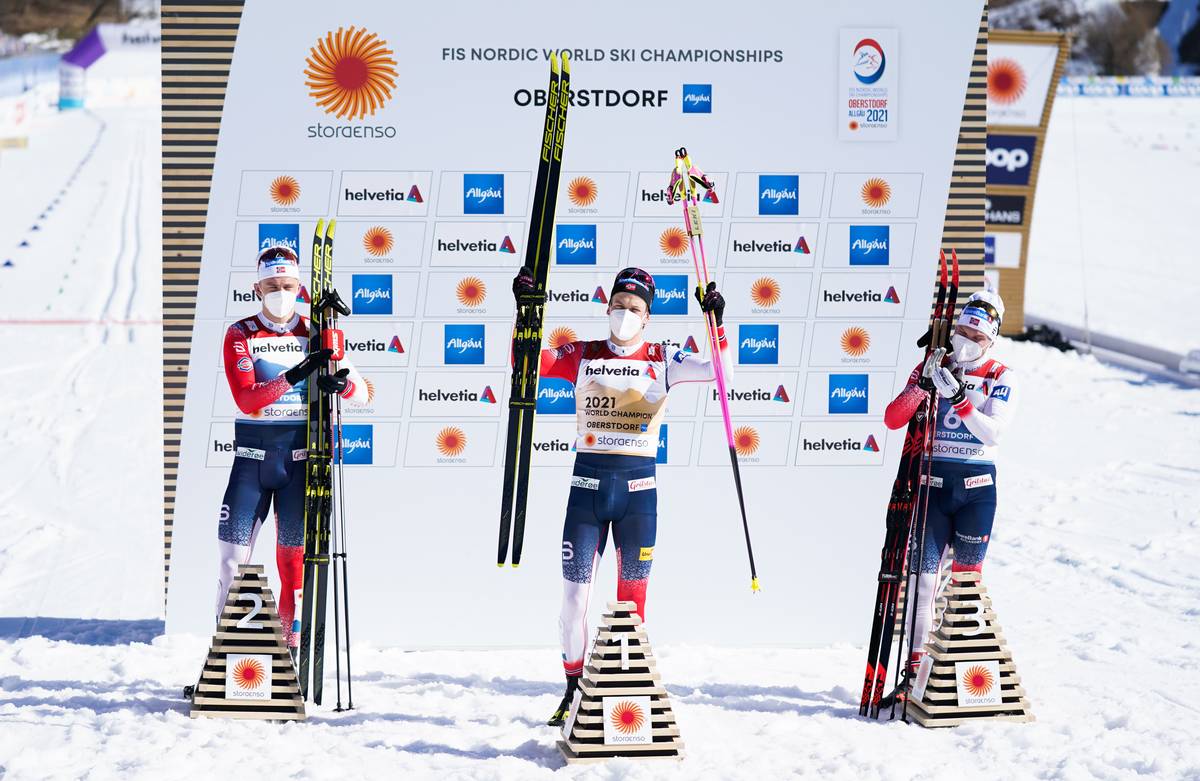
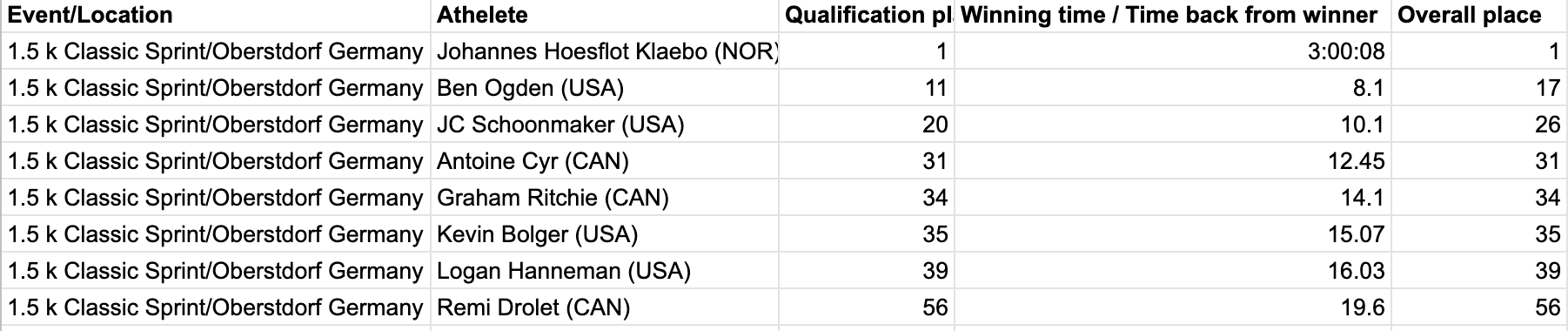
During the2021 World Championships, Johannes Høsflot Klæbo (NOR) took command of the gold medal from the qualifier on a 1.5-kilometer course seemingly designed for his racing style. A quick double pole start from the stadium leads to a long steady first climb where he skied long, strong, and steady, usually in second or third position. After a winding descent, athletes encounter a second short but steep climb of roughly 18 vertical meters, where Klæbo would begin his signature run. Stomping his way to the lead as he crested the top of the climb, stepping around a left-hand curve, and dropping into a tuck on the final descent leading into the stadium, Klæbo was repeatedly in position to advance through each round comfortably, eventually winning the final by several ski lengths. (Video highlights here.)
Alexander Terentev races to second place in qualification during Stage 4 of the Tour de Ski in Oberstdorf. (Photo: NordicFocus)
Winning today’s qualifier in 2:55.78, Klæbo looked to be on track for a repeat victory in Oberstdorf, however, it is worth noting that he did not win the aforementioned other classic sprint this season. In Ruka, it was 22-year-old Alexander Terentev who took hold of the event in qualification and looked to, well, out-Klæbo Klæbo throughout the heats. We saw familiar tactics with a power move on the final climb, paired with impressive acceleration over the final meters to capture the win, but this time, the athlete employing these tactics was in a Russian race suit. While Klæbo has won each of the sprints he has entered since, with Terentev eliminated in the semis, Stage 4 would be a rematch both were eyeing.
Setting the stage, Terentev was second in qualification, +1.5 behind Klæbo, with Erik Valnes (NOR) in third (+2.37), Federico Pellegrino 4th (+3.53), and Alexander Bolshunov 5th (+3.61). Ben Ogden was the top American qualifier today, finishing 15th (+8.08), while Luke Jager finished 24th (+10.83). The American selected heats two and five, respectively.
Johannes Høsflot Klæbo and Erik Valnes take the lead in the final climb of the quarterfinal, with Ivan Yakimushkin (bib 23) and Iivo Niskanen (bib 29) chasing. (Photo: NordicFocus)
In the first wave of the quarterfinal, Finland’s Iivo Niskanen, winner of the Stage 2 15k classic, pushed the pace heading up the first climb, perhaps looking to ensure an opportunity for a fast rather than tactical heat, knowing he was up against Valnes and Klæbo and likely would only have the opportunity to advance as lucky loser. However, the Norwegians, unphased, chose not to respond, waiting patiently mid-pack to use the same tactic described at World Champs. In the second climb, both created enough room to look as if they had begun their cooldown as they skied through the finish lanes, with Klæbo addigng a lackadaisical boot slide at the line that put him just ahead of his teammate. Behind them, Niskanen and Ivan Yakimushkin (RUS) sprinted to the line to chase the clock, with the Russian finishing ahead of the Finn. However, their times did not hold up through subsequent rounds and their day had ended.
Alexander Bolshunov leads the quarter final during Stage 4 of the Tour de Ski, with Ben Ogden racing in bib 15. (Photo: NordicFocus)
In the second heat of the quarters, Ogden lined up alongside Bolshunov, who took control out of the gate. Staying in the pack through the first climb, Ogden found himself in fifth as athletes exited the second and began descending toward the stadium. In the final curves, Ogden couldn’t quite maintain the position needed to contend for a spot as lucky loser, finishing 5th in a fast heat, +1.52 behind Bolshunov.
Terentev looked as though his day might be over before he could face Klæbo head-to-head. Federico Pellegrino (ITA) stepped on his pole as lanes decreased in the opening stretch, causing it to snap. Terentev calmly accepted a replacement, steadily working his way back into the mix. Running out of the tracks in the final climb, Terentev accelerated around the left-hand curve and into the downhill in the lead, continuing through the finish for the win ahead of Mikal Novak (CZE) to advance comfortably.
Alexander Terentev leads his quarterfinal during Stage 4 of the Tour de Ski in Oberstdorf. (Photo: NordicFocus)
In the fifth heat of the quarters, Jager maintained contact with the pack through the first climb, but found himself off the back as he left the second. Jager’s legs wobbled as he found his footing in the descent. Perhaps too flooded to ski as aggressively as was needed to put himself in contention for higher placement, he crossed the line sixth in the heat, +6.88 behind the winner.
Luke Jager raced in the fifth quarterfinal during Stage 4 of the Tour de Ski in Oberstdorf. (Photo: NordicFocus)
On we go to the semifinals.
In a stacked first heat, Bolshunov and Terentev set the pace at the front heading up the first climb. Striding metronomically, they held Valnes and Klæbo temporarily at bay. As the men charged into the final climb, Klæbo advanced at a run up the outside, rounding the left hand bend with Terentev at the front before beginning the sweeping downhill side by side.
Terentev began to move across the track behind Klæbo, looking to finding a line that might be optimal for using the Norwegian’s draft to slingshot into the final lanes at high speed. Not waiting long enough, Terentev caught his tips on the Norwegian’s tails, losing his footing and crashing with a slide into the v-boards. No chance to recover what was lost, Terentev stood up, taking a defeated swing at the ground with his pole, before slowly continuing through the final meters to the finish, now well off the back.
As the two had created a small gap to their chasers, Valnes and Bolshunov navigated around the crash easily, racing to the line for second and third. Pulling ahead with his double pole, Valnes snagged second with Bolshunov less than half a second back, hoping for a lucky loser spot in the final.
With a comfortable lead, Johannes Høsflot Klæbo looks over his shoulder as Erik Valnes and Alexander Bolshunov race to the line in the semifinal. (Photo: NordicFocus)
Terentev later received verbal warning for a classical technique infraction.
In the second and less-eventful semi, Pål Golberg and Even Northug attempted to take control of the race in the final climb, but they remained matched by Italy’s Francesco De Fabiani and Sweden’s Calle Halfvarsson as they crested the top. Goldberg picked up the most speed in the descent, accelerating out of the final curve with a sizable gap to his three chasers. Laying off the gas before the line, Goldberg took the win ahead of Northug, who left De Fabiani and Halfvarsson fighting for lucky loser spots on his tails.
Calle Halfvarsson and Fracesco de Fabiani take it to the line in the semifinal. (Photo: NordicFocus)
De Fabiani and Halfvarsson crossed in a photo finish, both just 0.02 seconds ahead of Bolshunov’s mark, allowing them both to advance to the final and ending the Russian’s day.
With four Norwegians in the final, they were guaranteed at least one spot on the podium.
Norway were 1-2-3 coming out of the first climb, with Klæbo sitting in second position. Doublepoling into the next climb, Klæbo matched Valnes as the two ran at the front, Klæbo out of track and Valnes in the inside lane.
Johannes Høsflot Klæbo leads into the final descent in the last round of the Stage 4 classic sprint in Oberstdorf. (Photo: NordicFocus)
Klæbo accelerated into the curve at the top stepping in front of Valnes and leading him into the downhill. Klæbo powered into the final stretch still in the lead, with Valnes a ski length back but closing fast with a strong doublepole. Valnes changed lanes, knowing it was his only opportunity if he wanted to try for a win, but there was not enough real estate left and this cost him speed as they came to the line. No time to celebrate this time, Klæbo pushed his boot over the finish to stop the clock at 2:54.77, roughly 3.5 seconds faster than any other rounded, with Valnes 0.3 seconds back for second place.
Johannes Høsflot Klæbo takes the win in Stage 4 ahead of teammate Erik Valnes, while Pål Golberg, Even Northug, and Calle Halfvarsson fight for the final spot on the podium behind. (Photo: NordicFocus)
Behind the duo, the remaining two Norwegians sprinted to the line for a photo finish, with Goldberg edging out Northug for third by just 0.02 seconds. Halfvarsson, still in contention for the podium in the final stretch, crossed 0.5 seconds behind the Norwegians to end his day in 5th, while De Fabiani seemed to have accepted his fate, crossing the line casually +11.71 behind Klæbo.
Determining third place, Pål Golberg (center) edges out Even Northug, wit hCalle Halfvarsson just off the mark in fifth. (Photo: NordicFocus)
Another all-Norway classic sprint podium in Oberstdorf, and a second consecutive win for Klæbo.
“It’s amazing to start a new year with a victory and also to have two of my best friends coming onto the podium as well,” Klæbo told FIS at the finish. “I am really satisfied with today’s race, and also to start, hopefully, a good new year.”
After four races in five days, Klæbo was asked whether Tour fatigue had begun to set in.
“For sure, I am getting a little bit tired, but still, when the weather is like this and the conditions are pretty nice, it gives you a lot of energy. So it’s just trying to push hard, looking forward to a rest day tomorrow, and trying to push hard in the last two legs.”
The all-Norwegian men’s podium after Stage 4 of the Tour de Ski: Johannes Høsflot Klæbo took his fourth win of the Tour ahead of Erik Valnes in second and Pål Golberg in third. (Photo: NordicFocus)
After the final results were determined, Ogden ended his day in 22nd.
“I took the qualifier out really hot, hoping to be in the top 3 in qualification,” Ogden told U.S. Ski & Snowboard cross country communications manager Tom Horrocks at the finish. “I was a little flooded at the end, but not the end of the world. I chose heat 2, which is not always what I do, so I tried something different, and I think I skied well in the heat. It’s been a lot of racing for me early, so I’m a little tired, and wasn’t the smartest out there… but I’d say I’m learning a lot and making progress, so one day I’ll put it together.”
Full audio clip with Ben Ogden, interviewed by Tom Horrocks.
Ben Ogden races in heat 2 of the quarterfinals in Oberstdorf. (Photo: NordicFocus)
It was Jager’s second time qualifying for the rounds in a classic sprint, and his second-best overall World Cup result. Jager was 18th in the opening classic sprint in Ruka, and finished 27th today.
“I was trying to be competitive, in second, third, or fourth, somewhere where I could potentially get in a draft and have a good finish, hopefully,” Jager told Horrocks post-race. “It didn’t work out that way… Hindsight is 20/20, so maybe I wish I had picked a different lane and just gotten out and ran earlier, but at the end of the day, the pace was just really, really fast. I was and am, chronically and acutely, pretty tired right now, so I just didn’t really have it and wasn’t as aggressive as I should have been going over the top. I like to think if I had another shot in that exact same position, I could make fourth or fifth, but an objective qualification in that [heat] probably wasn’t going to happen for me today.”
Luke Jager races to 27th in Stage 4 of the Tour de Ski in Oberstdorf. (Photo: NordicFocus)
Looking to the bright side, Jager expressed how grateful he has been to have had excellent skis in every race he’s competed this season, which provides confidence even on the days when the body doesn’t want to cooperate. At 21-years-old, Jager’s career is still nascent, and it’s easy to understand how progress at this level may not be linear.
“I’m super thankful for the opportunity [to race on the World Cup this season]… It feels often like it’s one step forward, four steps backward over here, just because it’s so brutal. The last month, especially, has been pretty tough and pretty demoralizing at times for me. I’m going home today, so it’s pretty nice to end with a glimmer of hope for what is to come. It’s the real deal. Sometimes it’s easy to forget that because so many Americans are doing well, but it’s pretty damn hard over here.”
Full audio clip with Luke Jager, interviewed by Tom Horrocks.
Kevin Bolger races to 33rd in qualification during Stage 4 of the Tour de Ski in Oberstdorf. (Photo: NordicFocus)
Outside the Top-30, Kevin Bolger and Zak Ketterson were just shy of making the heats, finishing 33rd (+13.10) and 34th (+13.39), less than a second off the time needed to advance. Logan Hanneman was also a near-miss, finishing 37th (+14.08). Gus Schumacher rounded out the American starters in 45th (+16.51) of 73 starters.
Looking at the overall Tour de Ski standings with four of six stages complete, Johannes Høsflot Klæbo tops the list for both cumulative time and points after winning three of four events. By time, he sits 1:03 ahead of teammate Pål Golberg and 1:19 ahead of Alexander Bolshunov. With a 15k mass start classic and 10k freestyle hill climb to go, Klæbo is in good standing, but cannot be complacent, as the hill climb, in particular, has historically favored Bolshunov.
By points, which favor sprint stages and intermediate sprints in distance races, Klæbo leads with 81 points ahead of Erik Valnes, who holds 50, and Goldberg with 41.
After a rest and travel day, racing continues Monday in Val di Fiemme, Italy.
With three wins in four stages, Johannes Høsflot Klæbo leads the overall Tour de Ski standings by both cumulative time and points. (Photo: NordicFocus)
This World Cup coverage is made possible through the generous support of Marty and Kathy Hall and the A Hall Mark of Excellence Award. To learn more about A Hall Mark of Excellence Award or to learn how you can support FasterSkier’s coverage please contact info@fasterskier.com.
Three weeks in, the World Cup swings to the picturesque Alpen valley which holds Davos, Switzerland. As may be hinted by the towering mountains surrounding the glacial valley, Davos sits roughly a mile high in elevation, making this the first high-altitude stop of the World Cup season. Most seasons, that simply means less available oxygen for the athletes to consume, adding a variable that might shake up what is expected on the results sheet.
However, with less than two months to go until the start of the 2022 Winter Olympics, performance at altitude might carry additional weight. According to FIS, the cross country course at the Kuyangshu Nordic Center near Zhangjiakou, China tops out at 1,800 meters, just under 6,000 feet, in elevation. By concentration of available oxygen per volume, that translates to a deficit of roughly 4% relative to competition at sea level. Altitude is its own beast, and it is not always as simple as adjusting pace when it comes to optimizing performance as an athlete.
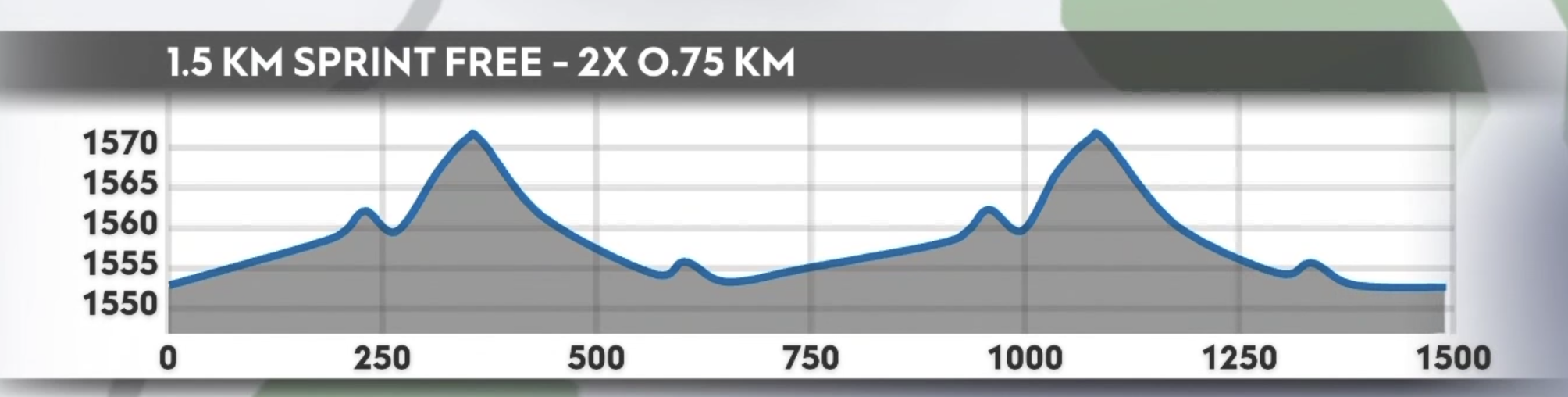
Altitude and rugged mountain backdrop aside, the sprint course in Davos sits on the valley floor, making it relatively flat compared to other venues. The maximum climb on the two-lap 1.5-kilometer course is just 12 meters; 30 meters or more is needed to meet the criteria of an A-Climb by FIS homologation standards.
The elevation profile of the two-lap 1.5k sprint course in Davos, SUI. (Photo: FIS Broadcast)
Taking command in the qualifier, Norway’s Johannes Høsflot Klæbo set the fastest time of 2:24.16. Lucas Chanavat of France was second in the qualifier (+1.51) followed closely by Federico Pellegrino of Italy, whose name we have not yet seen in the final. That said, Pellegrino had history in his favor when it comes to freestyle sprints on Swiss snow.
Coming into the weekend, he had won three freestyle sprints in Davos, including last year, along with two wins in the freestyle sprint stage of the Tour de Ski in Val Müstair, SUI a couple of weeks later. Pellegrino has also won multiple times in Cogne, Italy, at a similar elevation, and has shown prowess on flat courses, including the city sprint in Dresden, Germany.
Federico Pellegrino (ITA) races to third in qualification in Davos. (Photo: NordicFocus)
The Italian’s stats in Davos are only matched by Klæbo, who also has three wins at the venue. Today was the tie breaker. Who would take home a fourth wooden sled for his collection?
On the American front, Ben Ogden was the only athlete who qualified for the rounds today. Ogden skied to 13th (+2.87) and raced in heat five of the quarterfinals.
The storyline of Pellegrino versus Klæbo was decided before the two could line up to face each other head to head. Klæbo advanced smoothly from the first heat, however, Pellegrino was knocked out in his quarterfinal shortly thereafter.
Italy’s Federico Pellegrino pushes the pace during his quarterfinal of the freestyle sprint in Davos. (Photo: NordicFocus)
In heat two, Pellegrino took the lead in the second lap, hopskating up the primary climb and powering over the top just ahead of Norway’s Håvard Solås Taugbøl and Richard Jouve of France. Holding his position at the front as the men pushed around the final curve, Pellegrino was matched by the surging men as they each held their own finish lane while sprinting to the line. Jouve had the fastest acceleration, gaining the advantage as the three men threw their boots for a photo finish. Jouve took the heat, with Taugbøl 0.12 seconds behind, leaving Pellegrino third (+0.2) Unfortunately for the Italian, the tactical heat was too slow for him to advance to the semis.
In Ogden’s quarter, two Swiss men, Jovian Hediger and Valerio Grond, pulled from the front through the first lap. As the men hit the primary climb in the second lap, Russia’s Alexander Terentev, who won the opening sprint in Ruka, accelerated up the left side of the course, cresting the hill with the two Swiss men, creating a spicy final turn into the stadium. Grond caught a ski tip on his teammate’s tails, causing him to lose speed in the turn, but all of the men stayed upright.
Ben Ogden (Bib 13) races into the semifinal from a tight heat of the quarters. (Photo: NordicFocus)
Terentev led in the final straight, but Ogden and Sweden’s Anton Persson, who had maintained contact throughout the heat, were rapidly gaining ground on the Swiss skiers. Coming to the line four across, the men slid over the finish, Persson in second (+0.37), followed by Grond (+0.44), and Ogden (+0.53), with Hediger just behind in fifth (+0.74). Though it was the final heat of the quarters, it ended up being the fastest, allowing both Grond and Ogden to advance to the semifinals. Hediger (SUI) could be seen swatting the ground with his pole at the finish upon seeing his result.
In the first heat of the semis, Ogden lined up with three Norwegians, Klæbo, Taugbøl, and Erik Valnes. The heat also contained Jouve, and Russia’s Sergey Ustiugov, who had challenged Klæbo in the quarters.
Ustiugov takes the lead in the semifinal in Davos. Note Ben Ogden in contact wearing bib 13. (Photo: NordicFocus)
As the pace accelerated in the final lap, Ustiugov took to the front again, this time seeming to want a larger margin over Klæbo as they headed into the final turn and straightaway. Though the Russian led into this turn, Klæbo was able to slingshot around the outside, earning a clear lane to the finish. The Russian was on his right, with Valnes on the other side. Perhaps too confident for his own good, Klæbo stood up before the line, coasting across with a boot kick that looked like an afterthought.
Erik Valnes (NOR), Sergey Ustiugov (RUS), Johannes Klaebo (NOR), (l-r) (Photo: NordicFocus)
With five men still tight around him, this allowed Ustiugov to take the win, while an accelerating Jouve tried to throw his boot along Klæbo’s left side, from within the same lane, just 0.14 seconds behind the Norwegian. With multiple athletes vying for limited real estate at the finish, Klæbo had his tails skied over, sending him abruptly onto the ground just after he crossed the line.
Valnes was fourth in the heat, followed closely by Taugbøl; these first five men were spread by only 0.58 seconds in total. Ogden, who had lost contact in the second lap, held on for sixth in the heat (+7.28).
While still tight, the second heat of the semis had a clear winner, Chanavat of France. Behind him was Even Northug of Norway, followed by Terentev, whose time was not fast enough for a lucky loser spot in the final.
The pace was pedestrian as the first lap of the final progressed, the athletes seemingly biding their time and conserving energy for a tactical second lap. Mirroring the first two rounds of racing, Ustiugov made a big push in the second time up the climb as the men powered uphill with impressive tempo. But again, as they headed downhill and around the final right-hand curve, it was Klæbo on the Russian’s tails, shooting around the outside and into the center lane as he cruised to the finish for a commanding victory.
This time waiting to celebrate until he was over the line, Klæbo took home his fourth win on the tracks in Davos. Ustiugov held pace for second (+0.87), followed by Jouve in third (+1.23).
Johannes Høsflot Klæbo takes the win in Davos, while Sergey Ustiugov and Richard Jouve accelerate to second and third. (Photo: NordicFocus)
Off the podium, Valnes was fourth in the final (+1.31), followed after a gap by Northug in fifth (+3.74) and Chanavat in sixth (+7.95).
“It was an amazing day,” Klæbo told FIS at the finish. “I think it was really, really fun to race out there. I was a little bit skeptical because of the weather before we started today, but I think the conditions are really really good and it was a fair fight, which was really nice.”
The men’s podium of the freestyle sprint in Davos. Johannes Høsflot Klæbo (NOR) took his fourth win at the venue, ahead of Sergey Ustiugov (RUS) and Richard Jouve (FRA). (Photo: NordicFocus)
It was a blustery day with light snow peppering the athletes throughout the rounds, a contrast to the sun and blue sky we often expect from the venue. Klæbo also shared that he will have an extended stay in Davos, putting in some additional time and training at altitude.
“I’m going to be here now until the 22nd of December, so I have a few more days left here, and it’s beautiful now, and I see that the weather is going to be much better next week, so I’m looking forward to some nice weeks here.”
After the final standings were firmed up, it was concluded that Ogden finished his day in 12th.
Ben Ogden races into the semis in Davos. (Photo: NordicFocus)
“Today was a lot of fun,” wrote Ogden in a post-race email. “For the qualifier, I knew it was going to be hard but there was a good amount of rest out there so I wasn’t afraid to pretty much pin it out from the start ,which thankfully worked out well. I was definitely slower the second time up the hill but was able to push hard over the top and get into the finish without anything catastrophic happening. I was surprised and happy to qualify in 13th.
“In the quarter final, I figured it was going to be fast because all of us qualified so close to each other. I learned on the first lap that my skis were very fast, so when the other guys got a little gap on me over the top of the hill on the second lap, I was still hopeful. Then they made the critical mistake of sliding the first bit of the last corner, and because I was a touch behind I could step around it and set myself up well for the final straight. I bet it wasn’t pretty, but it was just enough to get me into the semi finals for the first time! Really pumped with this. I always figured I would first advance [into the semifinals] in classic, but things came together today so that was awesome.”
Ben Ogden puts together a career-best finish in Davos, ending his day in 12th. (Photo: NordicFocus)
“I did, however, learn that there is a reason all the fast guys pack into quarter final 1 and 2 when I finished and learned that I had just over 10 minutes before my semi final…” Ogden continued. “The guys in the semi final were damn strong, but I was pumped to stay in it for a bit and push all the way to the finish. One step at a time! Fun stuff out there and cheers to my wax tech (the famous Jason Cork) and all the wax techs for awesome skis!”
Luke Jager skis to 41st in the qualification round in Davos. (Photo: NordicFocus)
Outside the heats, JC Schoonmaker was second for the Americans, finishing 41st (+6.73) in qualification, less than 1.5 seconds off the time needed to compete in the rounds. Logan Hanneman was 44th (+6.99), followed by Luke Jager in 50th (+7.93), Kevin Bolger in 51st (+8.28), and Gus Schumacher in 65th (+10.48).
Here is a post-race interview with U.S. Ski Team Head Coach Matt Whitcomb with insights into the altitude and conditions on course, along with individual feedback on the men and women who raced today. Whitcomb also comments on the string of victories earned by Bolger’s girlfriend, Swedish champion Maja Dahlqvist.
Racing for Canada, Antoine Cyr skied to 36th in qualification (+6.43), followed by Graham Ritchie in 45th (+7.02).
Antoine Cyr leads the Canadian men, skiing to 36th in the qualifier. (Photo: NordicFocus)
The men’s freestyle sprint podium in Lillehammer: Johannes Høsflot Klæbo takes the win ahead of teammate Thomas Helland Larsen and France’s Richard Jouve. (Photo: NordicFocus)
This World Cup coverage is made possible through the generous support of Marty and Kathy Hall and the A Hall Mark of Excellence Award. To learn more about A Hall Mark of Excellence Award or to learn how you can support FasterSkier’s coverage please contact info@fasterskier.com.
Last weekend in Ruka, a new season of World Cup racing came in like a lion. Right off the bat, there were so many storylines to follow. Here, we’ll focus on those in the men’s sprint.
The international cover story was the big upset: 22-year-old Alexander Terentev of Russia beat Norwegian sprint-champion Johannes Høsflot Klæbo, who has more World Cup sprint wins than any other athlete in the field. Even more entertaining: Terentev matched Klæbo’s signature run, which he typically employs to drop his competitors on a final climb, accelerating to the finish in a league of his own. Klæbo’s tactic failed. He was matched at the top of the final climb with a few hundred meters to go, and Terentev was strongest in the final stretch. This made one thing certain: Klæbo would be ready to throw down in his home country as the World Cup swung to Lillehammer.
As evidence, Klæbo won the qualifier with a nearly two-second lead ahead of the next athlete, Lucas Chanavat of France, with Terentev nearly three seconds back in fifth.
The FasterSkier cover story last weekend was the three American men – JC Schoonmaker, Ben Ogden, and Luke Jager – who qualified and finished in the top-20, led by Schoonmaker in 7th. The Americans proved they were fit, and ready for the tight and aggressive style of World Cup sprinting. Hope abounds as these men, along with those who fell just outside the top-30, showed they were capable of results that mirrored those of the women’s team, which has received the majority of the media attention over the last several seasons.
JC Schoonmaker is the top-American qualifier for the second weekend in a row. Schoonmaker qualified in 15th today in Lillehammer. (Photo: NordicFocus)
Today during the 1.6-kilometer freestyle sprint in Lillehammer, the Americans showed that last weekend was not a fluke. Three men qualified for the heats, led by Schoonmaker in 15th (+5.61). Kevin Bolger was 24th in qualification (+6.25), followed by Ben Ogden in 28th (+6.63).
As the sprint featured in the 2022 Olympic program will also be freestyle, these events will be especially in focus as we move through the World Cup season. For the Americans, an athlete finishing in the top-8 (final results, not qualification) has met the objective criteria for team selection, essentially punching their ticket to Beijing.
In the quarterfinals, Bolger raced in the stacked first heat along with the top-3 qualifiers, Klæbo, Chanavat, and Erik Valnes (NOR). For the first two minutes of racing, Bolger sat confidently on the Norwegian’s tails, keeping enough contact with the leaders to vie for a lucky loser spot in the final stretch. Despite rounding the final bend in fifth, Boger skied his way into fourth, in a photo finish with Chanavat. Given the depth of his heat, Bolger ended up with a fairly comfortable lock on a spot in the final as one of two lucky losers.
Klæbo won this round comfortably, followed by fellow Norwegian, Thomas Helland Larsen.
Ogden raced in heat two, where he was not able to keep himself in contention with the leaders. Ogden skied to sixth in the heat, which was won by Håvard Solås Taugbøl and Richard Jouve in a photo finish.
Ben Ogden stays in contact with the pack during the quarterfinal of the freestyle sprint in Lillehammer. (Photo: NordicFocus)
Perhaps surprising given his legacy in skate sprints, Italy’s Federico Pellegrino was also knocked out in the second heat of the quarters. Pellegrino had qualified in 19th, and finished the semi together with Jouve and Taugbøl, but was ultimately not fast enough for the lucky loser spot.
Racing in heat five with stars and stripes on his suit, buff, and gloves, Schoonmaker tactically skied his way into the semis. The American was tucked into the leaders’ draft on early downhills, moving up on the final climb at roughly the two-minute mark. Here, Schoonmaker challenged the men at the front as they headed into the final hairpin before the closing straightaway. Coming to the line with Gleb Retivykh (RUS) and Sindre Bjørnestad Skar (NOR), Schoonmaker threw his boot forward to clinch second place in the heat, automatically advancing to the next round.
JC Schoonmaker skis his way into the semis during the quarterfinal of the freestyle sprint in Lillehammer. (Photo: NordicFocus)
Guaranteed a top-12 finish, Schoonmaker was one step closer to his Olympic goal, and would race in the semi-final in back-to-back sprint races. Without a deep dive into the stats here, let’s just say: it’s been a minute since an American has done that. And he’s only 21.
The semis were half-Norwegian: four in the first heat with Bolger, and two in the second heat with Schoonmaker.
Bolger skied in the middle of the pack during the opening kilometer of his semi, again marking the leaders and staying in good position for the final push. Rounding the bend into the stadium, Bolger ended up just off pace at the back of the pack as Klæbo led the way to the finish with enough room to stand up before gliding across the line.
While Klæbo was comfortable in his position, the three men heading to the line on his tails were not. Again in a photo finish, Taugbøl and Jouve fought for the second spot, with Larsen alongside. Taugbøl edged out the Frenchman in the boot slide, with Larsen setting a fast time in fourth, awaiting results from the second round to determine lucky losers. Bolger finished the round in sixth.
Kevin Bolger marks Johannes Høsflot Klæbo during the semifinal in Lillehammer. France’s Lucas Chanavat races on the left in bib 2. (Photo: NordicFocus)
The second semifinal was a nail biter. With numerous lead changes and a spread of just 0.5 seconds at the finish, it was anyone’s game. Schoonmaker again looked confident pushing the pace, staying in the mix with leaders throughout the meat of the course. Rounding the bend and heading into the final straightaway, he was in excellent position on the tails of Sweden’s Marcus Grate.
Charging down the final straight, Grate and Finland’s Lauri Vuorinen pulled ahead slightly as the remaining four men remained matched. These men went 1-2, while the remainder of the field crossed the line a ski length behind in a four-way photo finish. Ultimately, the order was determined to be: Alexander Bolshunov, Erik Valnes, Finn Hågen Krogh, then Schoonmaker, all separated by 0.1 seconds.
To the line, JC Schoonmaker fights for millimeters, crossing in a four-way photo finish in the semifinal. Marcus Grate (Bib 12) holds the lead. (Photo: NordicFocus)
Take a moment to let the names of the men finishing around Schoonmaker sink in.
As fat flakes began to fall, the athletes kept their warm-up layers on until the two-minute warning, springing up and down and running sprints to stay warm and sharp for the final go. On home turf, the closing round was half-Norwegian, with Klæbo, Taugbøl in their national team suits and Larsen racing in his leopard-print club suit.
Leaving nothing to chance, Klæbo held his ground near the front of the pack, tucking in Grate’s draft in the early downhills, and putting his foot on the gas as the men headed up the final climb with less than a minute of racing to go. Pulling ahead as they headed into the straightaway, Klæbo looked like he was on cruise control, powering through the first half in V2, before looking over his shoulder, then raising his arms in celebration as he cruised across the line alone for the win in 2:52.48.
Redemption: Johannes Høsflot Klæbo takes the win in the opening sprint stage of Lillehammer’s mini tour. Norway’s Thomas Helland Larsen (Bib 30) edged out France’s Richard Jouve for second and third, respectively. (Photo: NordicFocus)
A couple of ski lengths behind him, Larsen and Jouve fought to the line for the final podium spots. The Norwegian pulled ahead as he slid across the line for second (+0.58), with Jouve just behind for third (+0.78).
“It was a really tough race today, and it’s been quite a week from last week,” Klæbo told FIS at the finish line. “I’m really satisfied to cross the finish line first, and it was a special day.”
Commenting on the new course used today in Lillehammer, which, at roughly 1.6k, was nearly 200 meters longer than the previous one, Klæbo spoke favorably of the change.
“I think it’s really cool that we have changed the tracks a little bit. It’s something different and I think they have done an amazing job here to make this happen, and to also have this nice track. So I’m really satisfied.”
Johannes Høsflot Klæbo congratulates countryman Thomas Helland Larsen after the two went 1-2 in Lillehammer’s freestyle sprint. (Photo: NordicFocus)
Rounding out the top-six, Taugbøl took fourth (+1.68), ahead of Vuorinen in fifth (+4.43) and Grate in sixth (+20.73).
Once the final round was settled, it was concluded that Schoonmaker ended his day in 11th, followed by Bolger. Ogden ended his day in 30th. None of the Americans would hit the Olympic qualification standard today, but it remains clear that they are well within reach.
After returning to their hotel down in town, Schoonmaker provided the following feedback on his pacing and strategy today relative to last weekend in Ruka:
“This course was a lot longer than Ruka, so I had to think a lot more about pacing especially in the qualifier. I tried to take it out fairly conservative so I could finish strong on the last section. In the heats, I actually had a pretty similar strategy to Ruka of trying to relax in the pack for as long as possible before trying to push to the front in the end. I tried to pick a heat that had guys who were closest to my time in the qualifier so that I would be able to hang in the pack easier than if I had chosen quarterfinal #1 with all the top qualifiers. I felt like I followed the plan well and was really happy with the way I skied.”
Remarking on his day and racing in the semis on back-to-back weekends, Schoonmaker gave a very process-oriented response.
“It was an awesome experience to race against so many big names and to feel like I was in the mix. I wish I had had a little bit more to give in the end of that semi to move on but still really happy with it. I’m pumped to have made semis twice in a row now because each time I get past the quarters, I’m doubling my heat experience and getting a step closer to making the final.”
In his post-race email, Bolger explained that he found the course used today in Lillehammer to be “really cool, really fun, and very hard.”
“I think it allowed a lot of good spectating, and I think coming into the weekend we all thought it was going to be an easier course, but we all soon found out that it it was a very challenging course — very physically demanding, and a lot of work… its also nice to do something new, instead of the same courses all the time.”
On his approach to the day and heat selection, “It was a bit scary picking heat 1 for my quarterfinal,” Bolger wrote. “I did something similar back at world champs in Seefeld, but I knew if i could put together a good race that I could compete with those guys, and talking with [Chris] Grover, we both decided it could be a great heat to get into the semis either by qualifying out right or as a lucky loser.”
He added that he would have preferred the second semifinal heat, but this was out of his hands.
“Tactically though, not much changes [with heat selection], especially on a course like today where I don’t think there were so many tactics. I just wanted to ski big and own my space, I was lucky enough to take the back of Klæbo and follow him for a while, which was brutal but great. Also, I think having killer skis played a big factor in today and helped me advance as far as I did so a huge shout out to our wax crew and my tech Oleg!”
Last weekend, in Ruka, Bolger qualified in 57th, well outside the heats. He explained that he was “searching for more this weekend”, while recognizing that racing in Norway, which allows the home country to enter additional athletes, would make it an even harder job. He equated it to narrowing the Top-30 down to a Top-15 in terms of the density of fast times and percent back needed for qualification today.
“Coming here and putting together a really strong day and having a high result definitely boosts my confidence in myself and my training,” Bolger continued. “But it is just one race. t+There is a lot of racing to be done yet and I’m just looking forward to the opportunity to get in another good race next weekend in Davos and to hopefully have an even better day! Lastly, I think how this men’s team is vibing together and how we are all feeding off each other’s success — I owe a lot to them. Being out there today in the heats with Ben and JC gives me a lot of extra fighting strength. We all believe in each other and and get each other super hyped. I think that helps a lot on a sprint day!”
There were several near-misses outside the top-30, including Luke Jager, who was just 0.7 seconds off the time (2:52.31) needed for qualification in 33rd.
Just missing the top-30, Luke Jager skis to 33rd in the qualifying round of Lillehammer’s freestyle sprint. (Photo: NordicFocus)
Gus Schumacher qualified in 41st, just over a second out of the heats, followed closely by Canada’s Russell Kennedy and Graham Ritchie in 42nd and 43rd, respectively.
Rounding out the North American men’s squad, Logan Hanneman (USA) finished 45th, with Olivier Levielle (CAN) 48th, and Antoine Cyr (CAN) 56th.
In a post-race interview, Matt Whitcomb shared insights into the new course in Lillehammer, as well as how athletes selected their tactics for the two-lap course, his perspective on the men’s racing, and a detailed explanation of why qualification for the heats in World Cup sprinting is a unique skill that athletes need to hone.
Leading the way for Canada, Russell Kennedy skis to 42nd in the qualifying round of Lillehammer’s freestyle sprint. (Photo: NordicFocus)
Greeting teammate Erik Valnes at the finish, Johannes Høsflot Klæbo helps Norway to gold in the team sprint. As Klæbo’s bib makes apparent – this makes it back-to-back team sprint titles. (Photo: NordicFocus)
This World Championship coverage is made possible through the generous support of Marty and Kathy Hall and their A Hall Mark of Excellence Award. To learn more about A Hall Mark of Excellence Award or to learn how you can support FasterSkier’s coverage please contact info@fasterskier.com.
The firepower was evident on the start line. Norway, Russia, France, Italy, and six other teams paired for the team sprint Sunday at the 2021 Oberstdorf, Germany World Championships. Revving at the start for Norway were Erik Valnes and Johannes Høsflot Klæbo, with Alexander Bolshunov and Gleb Retivykh for Russia. Two teams in a freestyle team sprint with a seemingly endless list of scores to settle.
With a wide-angle view of the blue sky and mountainscape, the setting was dreamy if not trending on too warm for the start of the team sprint. At this level of racing with F1 engine fine-tuning and horsepower – the initial pacing and gamesmanship wasn’t exactly horse and buggyesque, but certainly not close to redline speed. The real jazz in this team sprint, which amounted to a total of 7.2 k of skate sprinting with each athlete racing three laps total, came around the 6:40 mark.
Erik Valnes (NOR), Alexander Bolshunov (RSF), (l-r) during the chess match portion of the World Championship team sprint. (Photo: NordicFocus)
Bolshunov and Valnes were rolling for their respective teams. Up the course’s decisive hill, Bolshunov hop-skated and V1’d to separate himself from Valnes, Francesco de Fabiana of Italy, France’s Lucas Chanavat, and Ristomatti Hakola of Finland. The shake-up from Bolshunov was enough to have what appeared to be everlasting relevance in this narrative. It turns out, the move almost stuck.
Gleb Retivykh (RSF), Johannes Høsflot Klæbo (NOR), (l-r) cresting a hill during the men’s team sprint final. (Photo: NordicFocus)
Retivykh, one of the planet’s best skate sprinters, pulsed away with a two-second lead at the third exchange over Norway. Italy (+2.5), France (+2.8), and Finland (+3.2) were close behind. As far as prescient strategies go, the burst of speed from Bolshunov and cushion of time gifted his partner seemed a lucid move on many levels. It kept the Russians out of traffic. And it kept hope alive for a Russian gold when the stars, and in fact, the entire universe was aligned in this truth: No skier besides maybe his partner, Valnes, currently door-slams a final climb and descent into a finishing straight like Klæbo.
There were more pulses of speed from Bolshunov on his final turn of the screw during his final lap. Camera angles and stopwatches aside, the Russians appeared ready to bite down on real gold rather than see their efforts stymied on the final lap in an effort for fool’s gold. Retivyk took a 4.3-second lead at 6 k into the last 1.2 k to finish the race. Klæbo had his target ahead in Retivyk, with Joni Mäki skating off 5.1 seconds back. France and Italy, at that point and time, barring a spill upfront, were no longer podium threats at +9.9 and +10.0 seconds behind, respectively.
The tag zone chaos. (Photo: NordicFocus)
At 13:00 into the race, on that last lap, Retivyk V2d 15 meters ahead of Klæbo and Mäki. At the base of the first rolling climb, with no evident uptick in effort, Klæbo (with Mäki in his draft) began to close in. On the long glide-out, Klæbo’s slick skinny skis did the work: Norway and Finland were locked onto Russia at 13:40.
At 14:08, despite the race officially not run its course, was over. Klæbo moved around Retivyk and put on a technical and profound display of high-turnover uphill precision. Around the left 180-degree corner atop the hill, Klæbo had 20 meters on Retivyk and Mäki.
Down the straight, with what looked like 40 and maybe 50 meters of real estate between himself and second and third place, Klæbo let up, soaked in the stoke, and won for Norway in 15:01.74. Finland was second (+1.68), and Russia third (+2.09).
Looking back at his chasers, Johannes Høsflot Klæbo skis the final meters toward gold in the team sprint. (Photo: NordicFocus)
With room to relax and take it in, Johannes Høsflot Klæbo anchors Norway’s gold medal team sprint. (Photo: NordicFocus)
“It means so much to me, yah, to be World Champions,” Valnes told FIS after the race. “It is an amazing feeling and it is amazing to be a team with Johannes. I am really happy, I have been nervous for this day.”
For Klæbo, this makes it back-to-back World Championship team sprint gold medals. He won in 2019 in Seefeld, Austria’s classic team sprint with Emil Iversen. The duo outpaced Bolshunov and Retivyk in that race too, when Russia placed second overall.
“It is amazing,” Klæbo told FIS. “I think it was also a tough semifinal today with really hard conditions and it was really high speed and then the sun started burning a little bit and the conditions got a little bit heavier so it was perfect for us. I felt really strong today and Valnes did a very good job there so it was an amazing feeling. Like I said, to be World Champions together is the best feeling.”
Klæbo is also the 2018 Olympic team sprint champion with Martin Johnsrud Sundby.
The men’s team sprint podium in Oberstdorf: Norway took home the victory ahead of Finland and Russia. (Photo: NordicFocus)
Canada was the lone North American team represented in the men’s final. Antoine Cyr and Graham Ritchie placed fourth in semifinal A, which was won by Norway in a tight finish – the top four teams were within 0.61 seconds. (Due to the warm weather in Oberstdorf, race officials changed the ruling yesterday to allow the top four teams in each semifinal to advance plus the two additional fastest teams overall. Before the rule change, the top two teams from each semi, and the next six fastest teams by time, considering both semis, were slated to advance.)
In the final, Canada, fueled by the two twenty-two-year-old skiers, crossed the line in a photo finish with Sweden to place seventh, 0.4 seconds behind Sweden and 17.06 seconds off Norway’s winning time.
“This race is good for both of us,” said Cyr to Nordiq Canada. “Graham has proven he is a good distance skier and is a wicked sprinter. I also enjoy being in the heats sprinting like today, so it is a good mix for us.”
Antoine Cyr (CAN), Jovian Hediger (SUI), Lucas Chanavat (FRA), (l-r) doing the men’s first team sprint semi-final. (Photo: NordicFocus)
“This is eye opening and very cool for us to have Canada right there in the mix,” said Ritchie, to Nordiq Canada. “It hasn’t sunk in yet really, but we have the confidence and thought we could do it. It is pretty cool.”
Graham Ritchie (CAN), locking on to Johannes Høsflot Klæbo (NOR), (l-r). (Photo: NordicFocus)
For the U.S., on a team representing two generations of cross-country skiing, Simi Hamilton and Gus Schumacher were eliminated in semi-final B and placed 14th overall. In their semi, Schumacher appeared to ski away on the fourth tag a fraction before being tagged by Hamilton. He snow-plowed as he sensed Hamilton had not reached him before the end of the tag zone. As he checked speed, Switzerland’s Jovian Hediger crashed into Schumacher. Schumacher righted himself and circled back to Hamilton for the tag.
The U.S. skied to seventh in that semi, 15.56 seconds off the pace of Italy’s winning time. This was Schumacher’s first World Championship appearance and by most accounts, the last team sprint for the veteran Hamilton.
Gus Schumacher (USA) racing in semi-final B of the men’s team sprint on Sunday. (Photo: NordicFocus)
Reflecting on the race, the twenty-year-old Schumacher noted that championships racing on the senior level was a growth opportunity. “I think we can chill out a little bit more in the sort of clustery-spots and rely more on good skiing,” Schumacher told the U.S. Ski Team after the race. “I think I was a little bit unsure of how good the skiing needed to be and put a lot of pressure on the tactics and the bumper-car aspect of it. But, I mean, we skied pretty well. But there was a bobble that cost it all.”
Asked what he would take away from the experience, Schumacher was matter-of-fact about the experience and moving forward. “I think just the way I approach most races and just be more relaxed and looking to enjoy it and whatever happens, happens, is a good approach to these races too even if they are not necessarily conducive to chill skiing.”
“It was amazing,” Schumacher added about teaming up with Hamilton. “I felt a lot of pressure because it is his last World Champs and his last team sprint. We knew that we had a lot of potential. I was really proud to have this start and give him my all. I think I did my best, but I made a mistake.”
Simi Hamilton (USA) racing in Sunday’s second semi during the team spring semis. (Photo: NordicFocus)
For his part, as Hamilton ruminated on the day, he was clear about honoring the big picture of team culture and putting the day’s events in perspective. Below are Hamilton’s comments as told to the U.S. Ski Team’s Tom Horrocks:
It is one of those days where going into it felt awesome. We were psyched, our training has been amazing not just Gus and I, the whole men’s team we are clicking in a way that I don’t think I have ever seen this men’s team click before.
All that contributes to just feeling really prepared and psyched for a race like this. And, we did everything we could, you know it is a team sprinting is, I would put sprinting in general, in its own category when it comes to chaos and things that can go wrong and things that can happen. Team sprinting has its own category in that level of chaos.
Especially championship events like this where there is in the men’s semis there are up to 20 teams or something like that. It is always chaos and you see really changing conditions, so the tag zone is getting slower, a corner is getting sloppier, and it just, yeah it was one of those things we mistimed our tag, it wasn’t Gus’s fault because the tag zone had been much faster, even the previous leg…so you get into this mindset of going when you think you should be going, but it is hard to adapt to the change, for how much slower it is.
I think he just went a little early, and we missed that tag at the very end of the zone, the jury is always going to see that, that you are going to miss the tag, so we decided that we wanted to just stop and get back in the zone and tag, that’s is when things kind of really took a turn for the worse.
But, it doesn’t change all that stuff leading up to today. You know, this probably being my last team sprint and last sprint effort ever, obviously I wanted to ski with Gus in the final and possibly win that elusive medal at World Champs. But you, know, I have been thinking about it for the last hour skiing out with Gus and it is like it is just as important for me to feel like what I did today to get onto this team and be able to race with Gus, that is going to contribute to him winning medals in the future with this group of guys coming up. To me, that is just as important as me potentially winning a medal. I am still so grateful and humbled to be a part of this team and be able to race with Gus and train with Gus and all the other guys, and so it doesn’t change how I felt about the day at all. We are both fit. We are still hungry and fortunately, I think we get a few more racing opportunities coming up this week so we are going to make the most of that and enjoy the sunshine.”
Dense pacsk skiing during the men’s second semifinal in Oberstdorf. (Photo: NordicFocus)
Norsk triple. Johannes Høsflot Klæbo (left) raises his hands in victory as Valnes (middle) and Taugbøl (right) lunge for the line. (Photo: NordicFocus)
This World Championship coverage is made possible through the generous support of Marty and Kathy Hall and their A Hall Mark of Excellence Award. To learn more about A Hall Mark of Excellence Award or to learn how you can support FasterSkier’s coverage please contact info@fasterskier.com.
Against the backdrop of hundreds of cardboard cut-out fans, the men battled for the first medals of the 2021 World Championships in Oberstdorf, Germany. Despite warming temperatures, conditions were firm and fast for the 1.5 k classic sprint, likely due to the application of salt to help with freezing. The course featured three climbs with the last being the most significant and sustained.
A smiling Klæbo after being the first athlete to complete back-to-back sprint victories at World Championships. (Photo: NordicFocus)
From start to finish, the day belonged to Johannes Høsflot Klæbo who won the qualifier in a time of 3:00:08 and took his second consecutive sprint World Championships gold medal, becoming the first male athlete in history to repeat back to back sprint golds, winning the final in a time of 3:01.30.
As in the women’s race, the final hill proved to be the decisive factor throughout the quarterfinals and into the remaining rounds. The hill was no stride-fest, but instead a full-on sprint-run. Competing in Heat 1, Norwegians Erik Valnes and Klæbo easily gapped their competitors on the climb and advanced with ease.
The eventual 1-2 skiers charging. Valnes (bib 2) and Klæbo (left). (Photo: NordicFocus)Valnes (bib 2) and Klæbo (left) lead over the crest of the hill in their quarter-final heat. (Photo: NordicFocus)
Racing in Heat 2 was J.C. Schoonmaker for the United States who qualified in 20th position. Schoonmaker came in 6th in his heat to finish 26th overall. After the race, Schoonmaker said, “I did not feel my best today but it was a solid result I think for my first World Champs, and I think I can walk away, I learned a lot and I think I am happy with it. But definitely saw it going better and I hoped it was going to go better. But, yeah I think it was overall still good.”
A sleeve-less JC Schoonmaker (USA) racing through warm temps in the quarter-final rounds. (Photo: NordicFocus)
His teammate, Ben Ogden, qualified in 11th position and raced in the fifth quarterfinal. Ascending the final climb in that heat, Francesco De Fabiani of Italy found himself caught in the slush and went down, taking Cerny Ondrej of the Czech Republic down with him.
Ondrej Cerny (CZE) taking the stumble. (Photo: NordicFocus)Ogden was able to move around the crash and capitalize. (Photo: NordicFocus)
Ogden ended up fourth after a solid fight in his quarterfinal and 17th overall. In a post-race interview, Ogden said about his day, “It was good in general. The qualifier was really good. I was happy to be able to feel fast in that. And then in the heats were a little tricky, as they often are. Just remembering that this is only my second heat so far this year since World Juniors last year. I have a lot to learn and that was my first ever World Cup level heat. So, yeah, I am really excited with the whole day, and we will be looking forward to the skiathlon in a few days”
In the semi-final rounds, once again Klæbo and Valnes went one-two in the first semi. Given this was the faster semi, Alexander Bolshunov (representing the Russian Ski Federation at these championships) and Oskar Svensson of Sweden, also advanced from this heat as lucky losers. Coming from the second semi-final was Håvard Solås Taugboel of Norway and Sergey Ustiugov (RSF) who bested the likes of skate sprint legend Federico Pellegrino and steady sprint finalist Gleb Retivykh to advance to the final.
Bolshunov (RSF) and Valnes race against a picturesque backdrop through the sprint rounds (Photo: Nordic Focus)
Preparing for one last round, the three Norwegians, two Russians, and lone Swede took their start positions, having shed hats and layers as the temperatures and efforts increased. Steady through the first part of the course, again the final climb marked a crucial moment. Taking the inside lane Klæbo stomped his way up the hill using his trademark technique. However, it was his teammate Valnes who was first over the crest. As they descended into the stadium Klæbo shot to the outside and took off. Valnes was left to fend-off his teammate Taugboel to secure second place while bronze went to Taugboel, making it a Norwegian triple.
Triple Norwegian podium for the first championship event of 2021 (Photo: NordicFocus)
Speaking to FIS after the race Klæbo said, “I don’t know what to say. I’ve been so nervous the last couple of days. It’s been a really strange season with not so many competitions and I think we made some decisions that weren’t so good when we were sitting at home watching the Tour de Ski, but today it feels great and is a dream come true.” When asked about the conditions he replied, “I think it was a really tough day, the conditions were really good today, I think it was the right decision to salt it yesterday. It’s really hard out there when it’s so warm, and you are losing a lot of energy.”
Klæbo congratulates a tired teammate, Valnes, after they finish 1-2 in the classic sprint. (Photo: NordicFocus)
Klæbo came out of his first World Championships in 2019 with three gold medals after winning the individual sprint as well as the team sprint and relay event with teammates. After this victory on Thursday it seems like he is well on his way to another successful championship. For his teammate Valnes, this is his first time competing at World Championships. Valnes has made one other podium appearance this season when he won the classic sprint at the season opener in Ruka, Finland. This is also the first time at World Championships for Taugboel who has had three individual World Cup podiums throughout his career, all in sprint events.
Valnes after placing second in the classic sprint (Photo: Nordic Focus)
Racing continues on Saturday with a 30 k skiathlon.
This World Cup coverage is made possible through the generous support of Marty and Kathy Hall and their A Hall Mark of Excellence Award. To learn more about A Hall Mark of Excellence Award or to learn how you can support FasterSkier’s coverage please contact info@fasterskier.com.
Johannes Høsflot Klæbo (NOR), Erik Valnes (NOR), Evgeniy Belov (RUS), (r-l) in the first quarterfinal of the 2020 Ruka World Cup classic sprint.
At roughly two minutes into the men’s final of the 1.4-kilometer classic sprint in Ruka, Finland, the race broke apart. On a notoriously steep and taxing hill, Norway’s Johannes Høsflot Klæbo has literally run away from would-be chasers in the past. Not so much this year.
Klæbo Klæboed. But so too did his Norwegian teammate Erik Valnes. Simply put, Valnes out Klæboed Klæbo on the hill, then maintained a svereal meter gap to win down the stretch in 2:59.56. He pipped the second place Klæbo by 0.61 seconds. The twenty-four-year-old Valnes won the World Cup’s opening race for his first individual World Cup victory. Emil Iversen, another member of Norway’s stacked men’s team, placed third for his eighth career sprint podium.
Last season’s overall World Cup winner, Russia’s Alexander Bolshunov was fourth. Norway’s Håvard Solås Taugbøl skied to fifth, and Switzerland’s Jovian Hediger sixth.
https://www.youtube.com/watch?v=y0O3CzfhH54
Klæbo and Valnes were paired in the first quarterfinal and first semi. Valnes placed second in both heats, initially by 0.19 seconds, then by an eye-blink in their semi: just 0.03 seconds. What could have been a deferential move in the final, being happy with a second-place to the reigning sprint king, Valnes did not relent in the final. Valnes crossed the line arms raised, while Klæbo slid across shoulders dropped, in an unfamiliar second place. Last season, on his way to capturing the sprint globe, Klæbo won eight individual sprints including the opening sprint in Ruka.
Johannes Høsflot Klæbo could not catch Erik Valnes down the stretch. (Photo: NordicFocus)
“This victory means everything to me right now, Valnes told the International Ski Federation after the race. “I tried all my life to be the best that I can and having this World Cup victory is the best thing I could ask for. I learned a lot (from Johannes) as he is the best sprinter of all times and I am happy to be with him on the team. It is very special to beat him on a track like this.”
The Americans did not qualify for the heats. Yet, according to Matt Whitcomb, U.S. Ski Team Head Coach, two twenty-year-olds in Ruka were standouts. JC Schoonmaker placed 35th overall, while Gus Schumacher, in his first European World Cup start, placed 43rd.
Post-Race Interview with JC Schoonmaker
“Very exciting for those two today,” remarked Whitcomb. “So a 35th in Ruka, one of the premier classic sprints of every year, that’s a really exciting result. … and to have Gus come out of the bottom of the course just charging into the last climb, finishing in the [low forties], that is exactly where we need those guys to be right now.”
Post-Race Interview with Gus Schumacher
Gus Schumacher racing to 43rd on the day – 2020 Ruka, Finland classic sprint. (Photo: NordicFocus)
Logan Hanneman was the next best-placed U.S. skier in 46th, followed by Simi Hamilton in 50th, Kevin Bolger in 58th, and Scott Patterson in 78th.
Post-race interview with U.S. Ski Team Head Coach Matt Whitcomb discussing the men’s performances.
Racing continues tomorrow for the men with a 15 k classic.
The sinuous Lysebotn Opp rollerski course. (Photo: Blink 2020 screenshot)
Times are what they are. Precautions are the name of the game. This year’s Blink Festival in Norway played to a reduced field and limited spectators due to COVID precautions. Some races, as will be noted, included modified race rules to limit close contact between athletes.
Lysebotn Opp – 06/08
The Lysebotn Opp is perhaps the marquee event. It features lovely fjord views and a grueling 7.5-kilometer uphill skate switchbacking up a mountainside. In normal years, the Lysebotn Opp is a mass start event. This year, however, it was an individual start affair.
Therese Johaug won the women’s event in 33:11 minutes. Heidi Weng placed second (+00:34), and Helene Marie Fossesholm was third (+02:20). All three skiers are from Norway with Johaug and Weng seasoned veterans with Fossesholm an upstart 19 year old relatively new to the elite level scene. Fossesholm won two individual golds at the 2020 Junior Worlds winning both the 5 k classic and the 15 k mass start skate. According to FIS, she has competed in three World Cups and notched a fifth place in last season’s 10 k mass start skate in Falun.
For the men, Norway’s Simen Hegstad Krüger won in 29:25. Hans Christer Holund was third (+01:02), and Håvard Moseby third (+01:21). Moseby, the relative unknown on the podium is 21 and placed third in the 2020 U23 Worlds 30 k mass start skate.
Therese Johaug (bib 28) winning the 2020 Lysebotn Opp. (Photo: 2020 Blink Festival FB page)
Skate Sprint – 07/08
The second day of cross-country racing featured a skate sprint. For those used to larger fields and six-skier-deep heats, things looked a bit different. This was head-to-head racing, two racers per heat, as skiers advanced to the finals. Racers were required to remain in their respective lanes throughout the race which resulted in no drafting.
Norwegian sprinter Maiken Caspersen Falla won the day with Mathilde Skjærdalen Myhrvold placing second overall. Myhrvold lost the final by 1.4 seconds. Myhrvold is 22 years old and has raced two World Cups, both in Norway.
Kristine Stavås Skistad (21) placed third overall. She lost to Falla in the second semi in a photo-finish.
Johannes Høsflot Klæbo did as he does: win sprints. The star of the show placed first in the final, 1.5 seconds in front of second place GjøranTefre. At 25, Tefre raced nine World Cups last year with his best result an eighth place in Oberstdorf’s classic sprint. Klæbo has won the last four World Cup sprint titles. Erik Valnes placed third overall. He lost out to Tefre in the second semi by 0.1 seconds.
In the individual start 10 k classic, run on a 2.5 k closed loop, Tiril Udnes Weng won in 24:57.9 minutes. Fossesholm raced to second place, 3.9 seconds back, with Johaug in third (+12.1).
Klæbo took the crown in the men’s 15 k classic over a field that featured some of Norway’s top distance talent. He won in 35:08.9, just 0.2 seconds ahead of Moseby, who was second overall in the Lysebotn Opp. Daniel Stock was third (+2.1).
If you are looking for more, as in the view-from-the-comfort-of-home experience, Norwegian broadcaster NRK has archived the 2020 Blink Festival races. You can find a menu of races here.
Perhaps unsurprisingly, the Norwegian men showed up on form for today’s freestyle sprints in Konnerud, just outside the city of Drammen. As the venue was used for the Norwegian National championship at the end of January, most of the team has already had a dress rehearsal racing on the windy course.
Johannes Høsflot Klæbo of Norway, where he is found most often: winning down the stretch. (Photo: NordicFocus)
It seems that Johannes Høsflot Klæbo, who sat out the national championships, did not need a dress rehearsal. He won the qualifier by a margin of nearly four seconds, continuing easily through the rounds to win the overall. This is Klæbo’s eighth sprint win of the season, matching last year’s record, and his 14th career World Cup freestyle sprint victory, the most of any male athlete.
Racing in the final with Klæbo were four of his teammates: Håvard Solås Taugbøl, Eirik Brandsdal, Sindre Bjørnestad Skar, and Erik Valnes, each of whom also raced in the national championship final on January 31st (and finished in a very similar order). Interrupting the all-Norwegian field was Alexander Bolshunov of Russia.
In the final, Klæbo hovered in the middle of the pack marking his teammates, with Taugbøl in the lead. When Brandsdal took control on the primary climb of the course, Klæbo swung outside of the group to move into second before tucking into the last downhill. As they passed under the arch and headed into the final straightaway, Klæbo engaged his unmatchable top gear, with Taugbøl and Brandsdal chasing.
After crossing in a photo finish, Taugbøl was deemed second (+0.65) — a World Cup career best individual result — with Brandsdal third (+0.69). Skar took fourth (+0.94), followed by Bolshunov in fifth (+1.92) and Valnes a late arriving sixth (+12.79).
Simi Hamilton (bib 24) during his quarterfinal in Konnerud. (Photo: NordicFocus)
Simi Hamilton was the only American sprinter racing in Konnerud. He qualified in 24th and raced in the fourth heat of the quarterfinals, where he finished fifth, ending his day ranked the same in the overall as in his qualifier.
The looping sprint course around the ol’ church in Drammen, Norway will have to wait another year, or at least until sufficient snow: the iconic city sprint was moved to Konnerud due to insuffient snow in Drammen. Winter, please, pretty please, return to places such as Drammen.
Powering home for the Konnerud win: Jonna Sundling of Sweden. (Photo: NordicFocus)
Although deep in Norway, but not so far from Sweden as the planes fly, Sweden took the win and third place in the World Cup’s relocated 1.2 k skate sprint in Konnerud. Jonna Sundling won the final in 2:38.41 — a toe and perhaps the tail of a ski ahead of Switzerland’s Nadine Faehndrich in second (+0.24). It was a photo finish for second through fourth. Linn Svahn, a U23 skier forgoing those championships, placed third (+0.39). Norway’s U23 Kristine Stavaas Skistad was fourth (+0.97), Sweden’s Maja Dahlqvist placed fifth (+5.70), and Anamarija Lampic of Slovenia sixth (+26.04).
Sundling powered down the final sraight outpacing Faehndrich in the final 100 meters. Sundling advanced to the finals as a lucky loser in the semis.
Sadie Bjornsen (bib 4) during her quarterfinal heat in Konnerud. (Photo: NordicFocus)
Sadie Bjornsen of the U.S. was the top American in 16th overall. Bjornsen qualified in fourth, 1.2seconds behind the top qualifier, Katja Visnar of Slovenia. Bjornsen placed fourth in the second quarterfinal and did not advance.
Jessie Diggins was the only other American to qualify.After qualifying in 12th , she placed sixth in the first quarterfinal, to end her day ranked 27th. Also for the U.S., Kaitlynn Miller placed 50th, and Becca Rorabaugh 54th.
Jessie Diggins sprinting in Konnerud. (Photo: NordicFocus)
Of note, Swedish sprinter, Hanna Falk, who suffered a back injust prior to the season, started her first World Cup of the year. She finished in 30th.
Racing continues Saturday with the women’s 30 k classic mass start. The men race a 50 k in Oslo on Sunday.