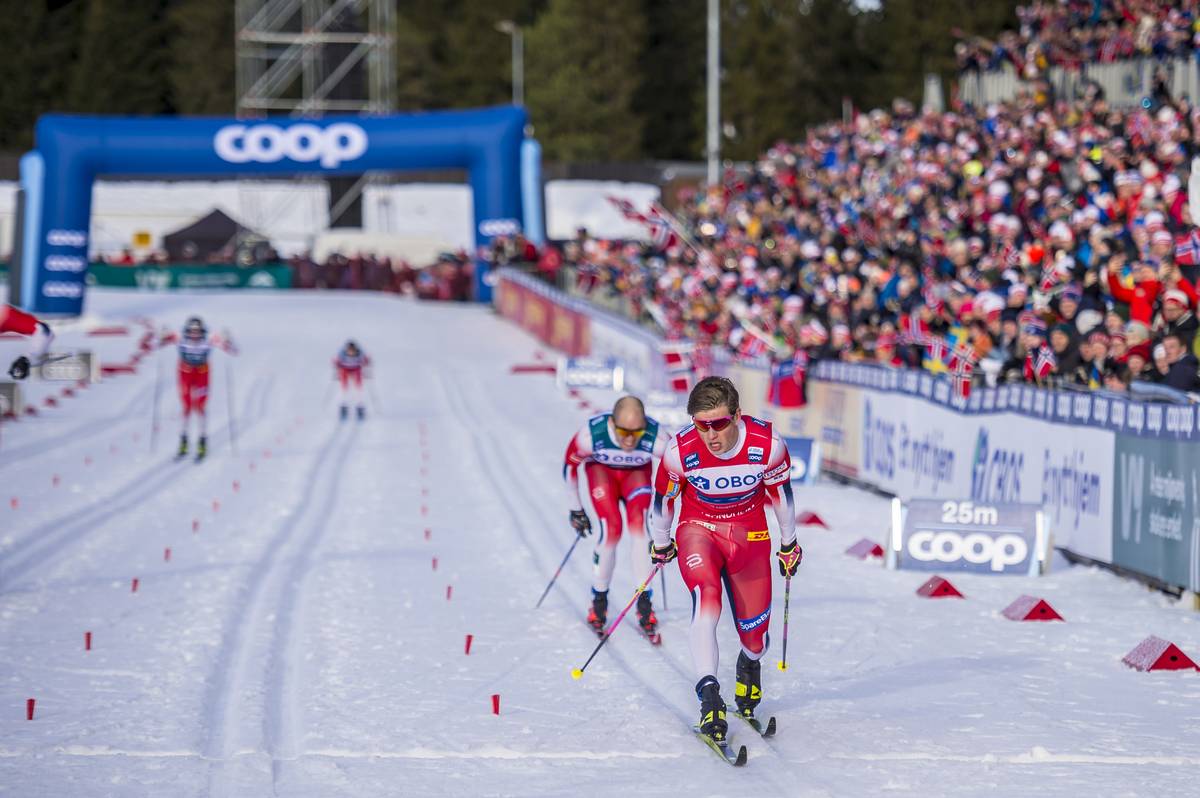
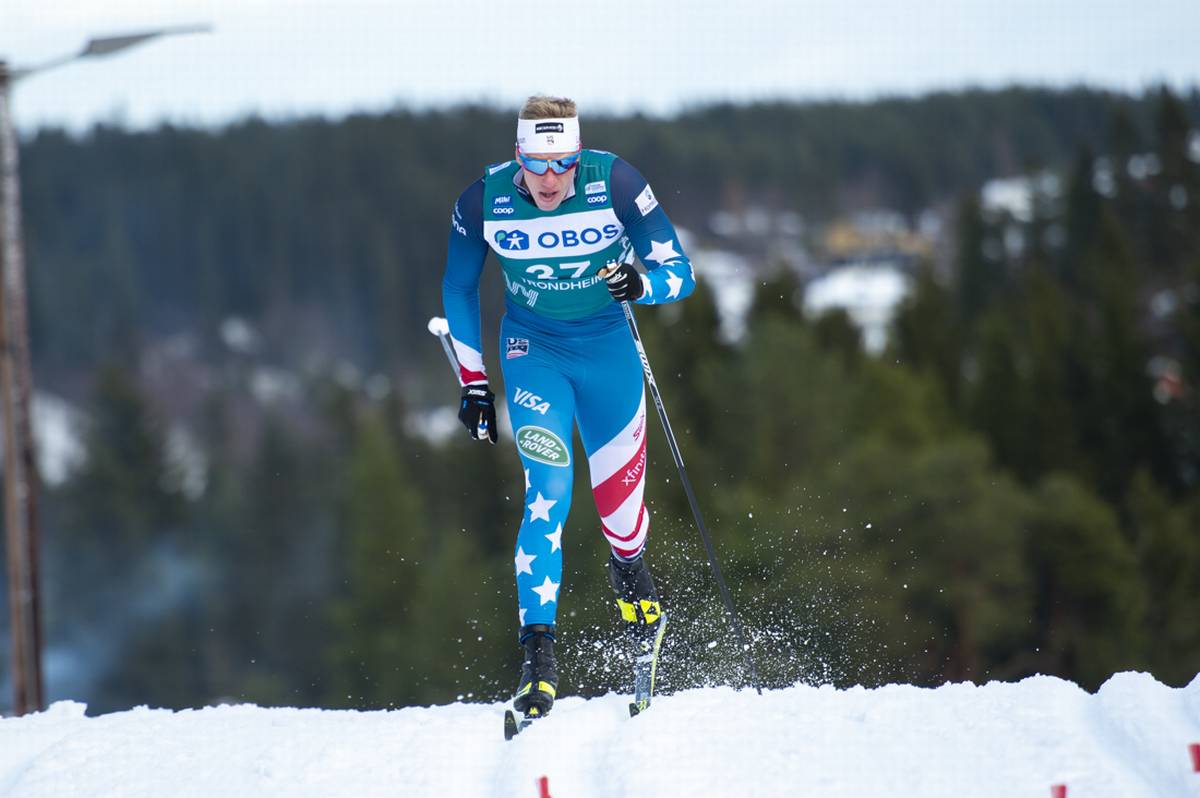
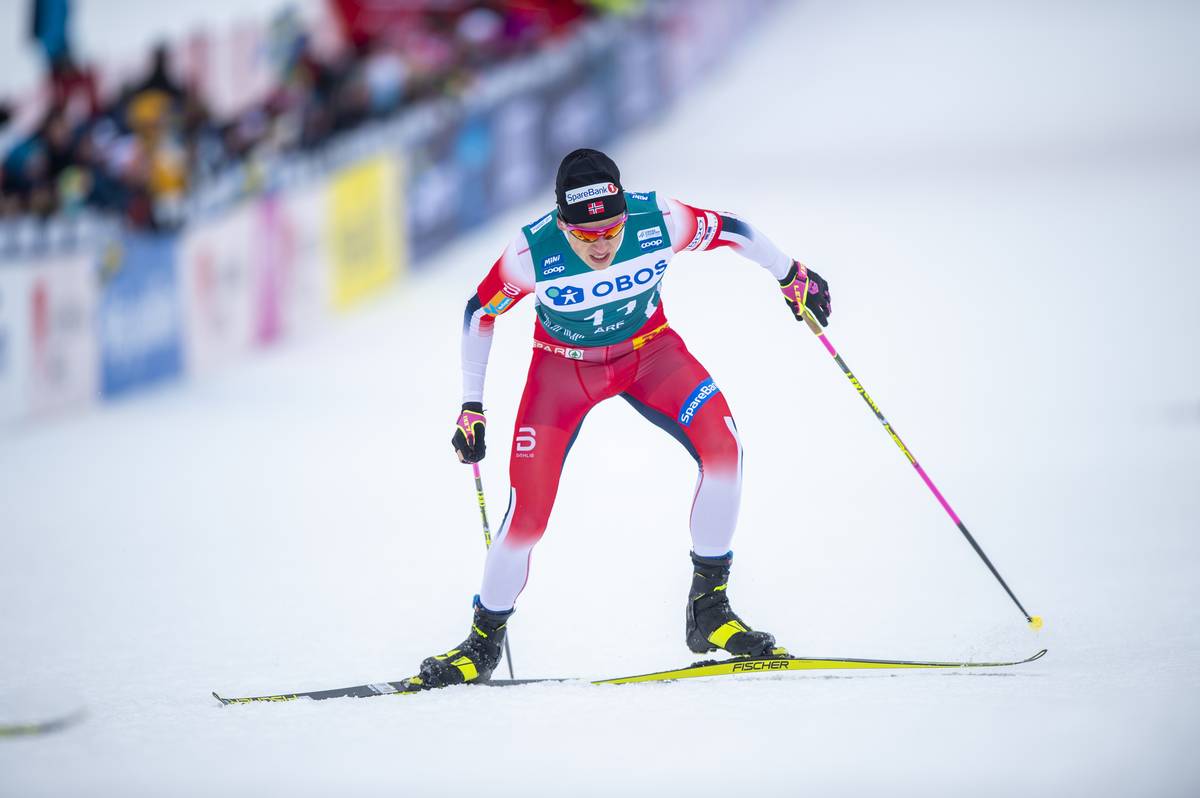
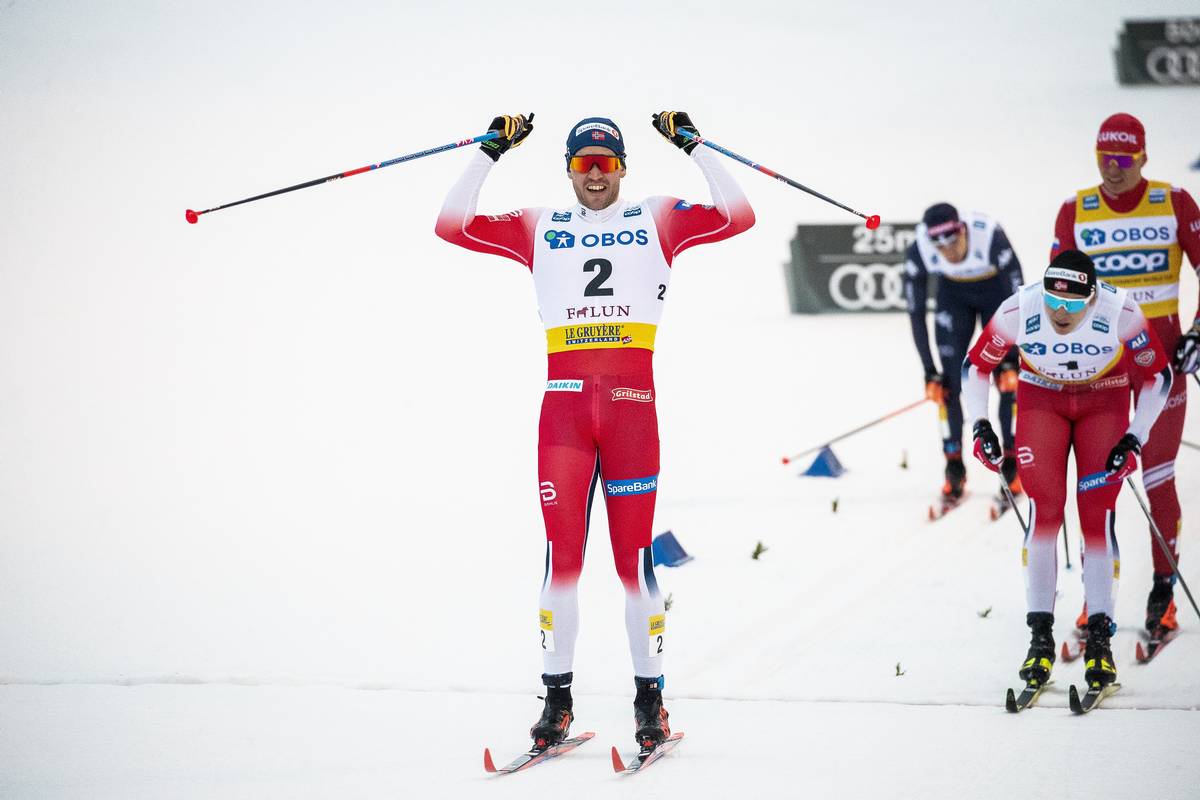
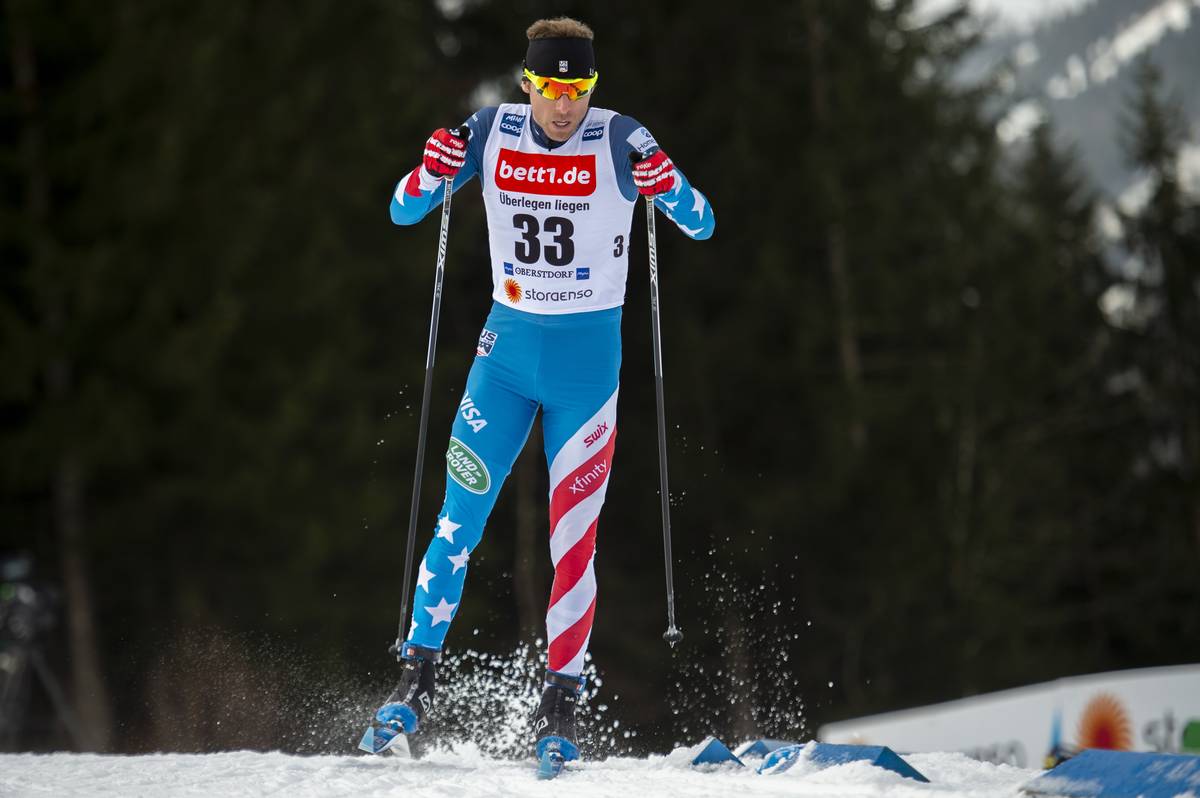
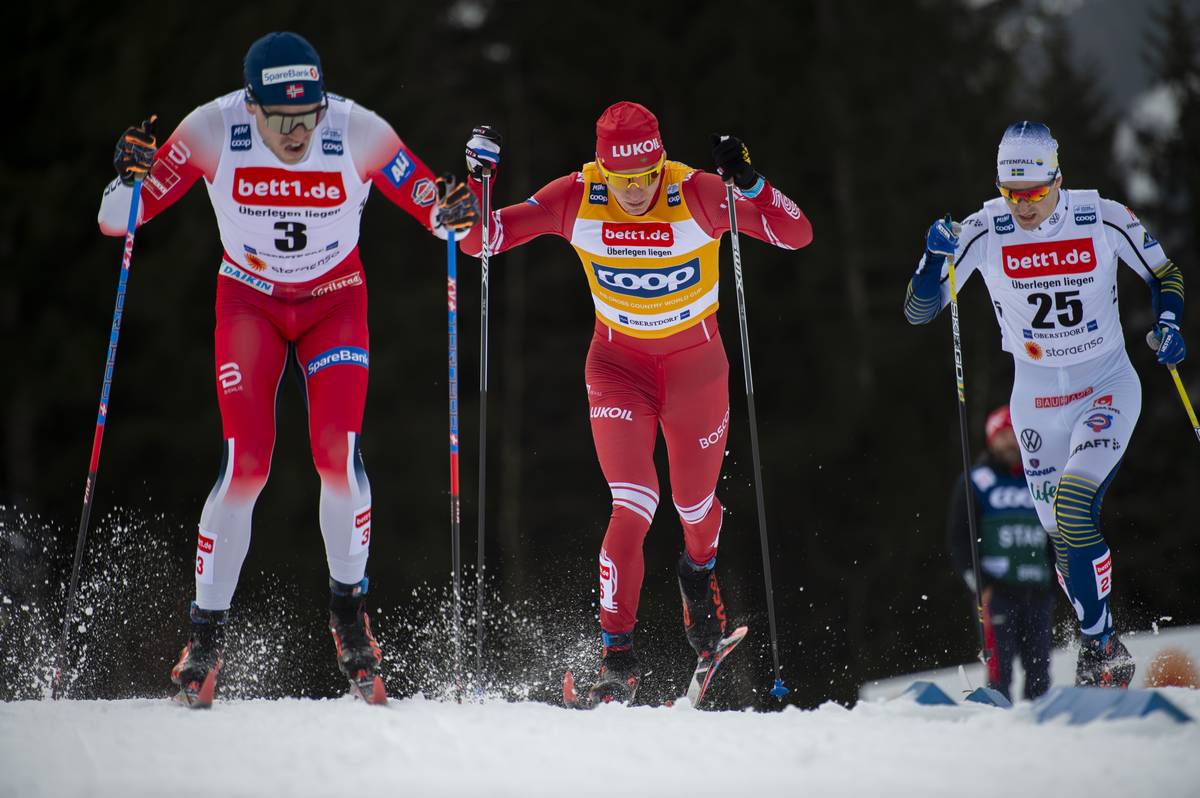
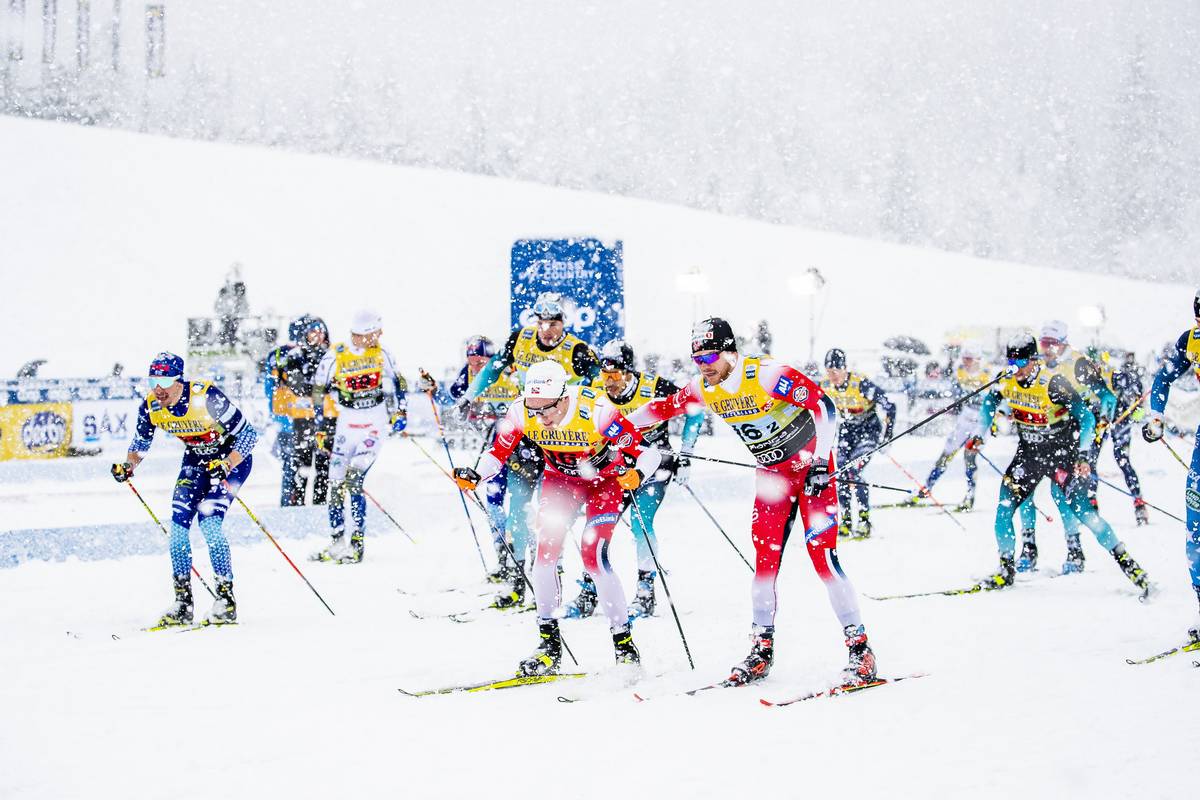
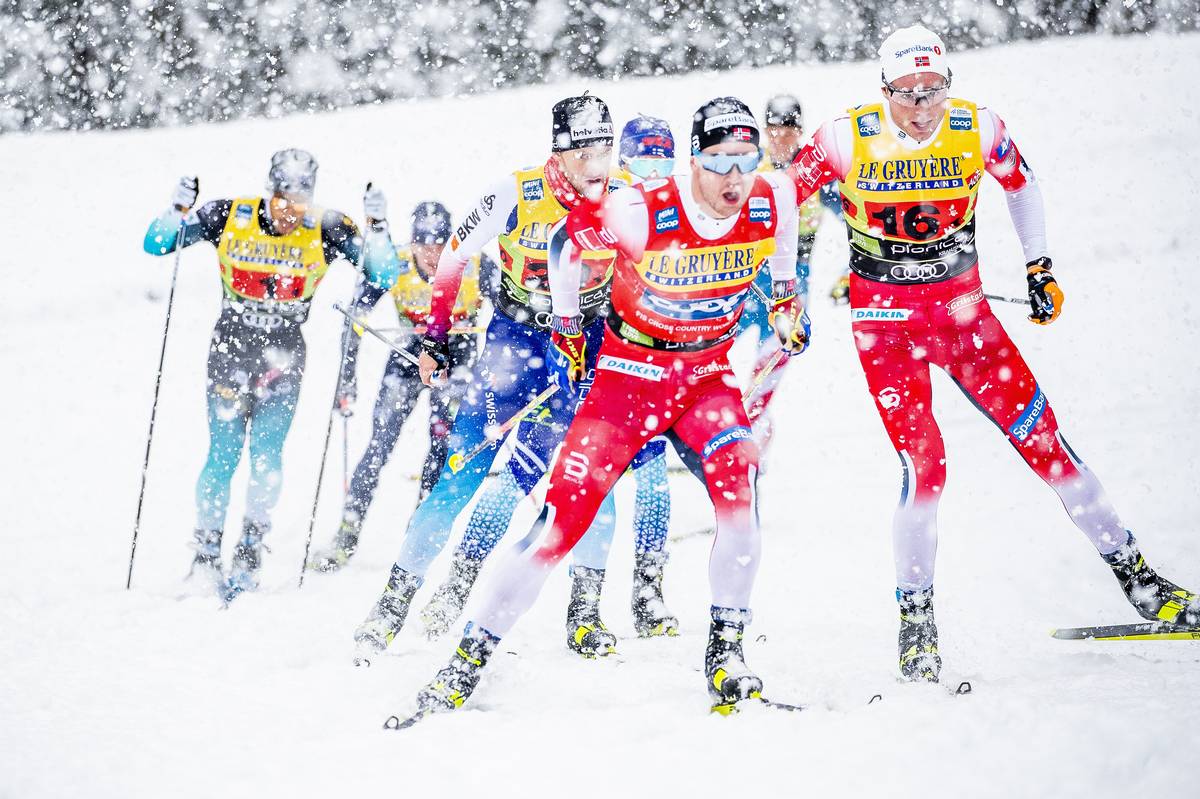
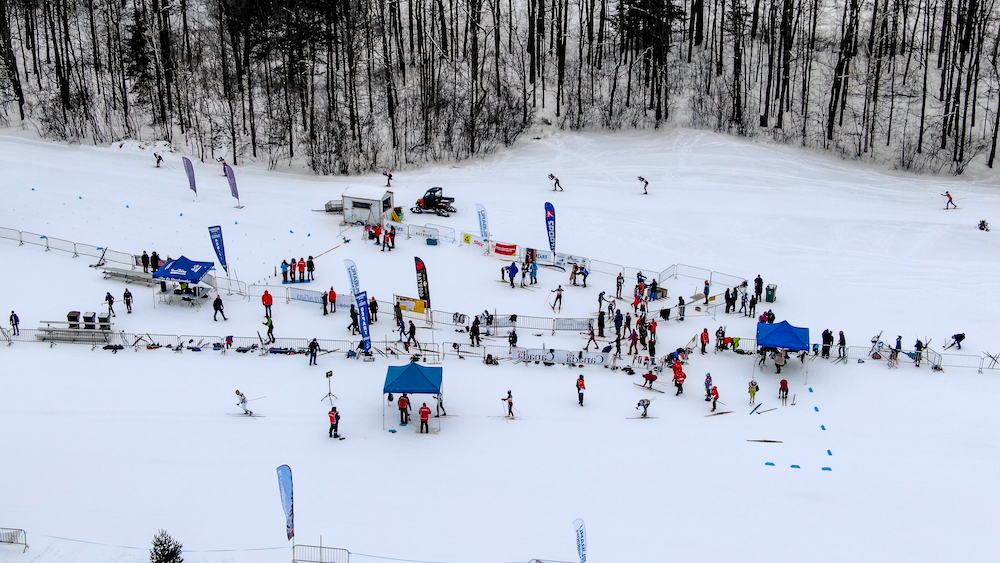
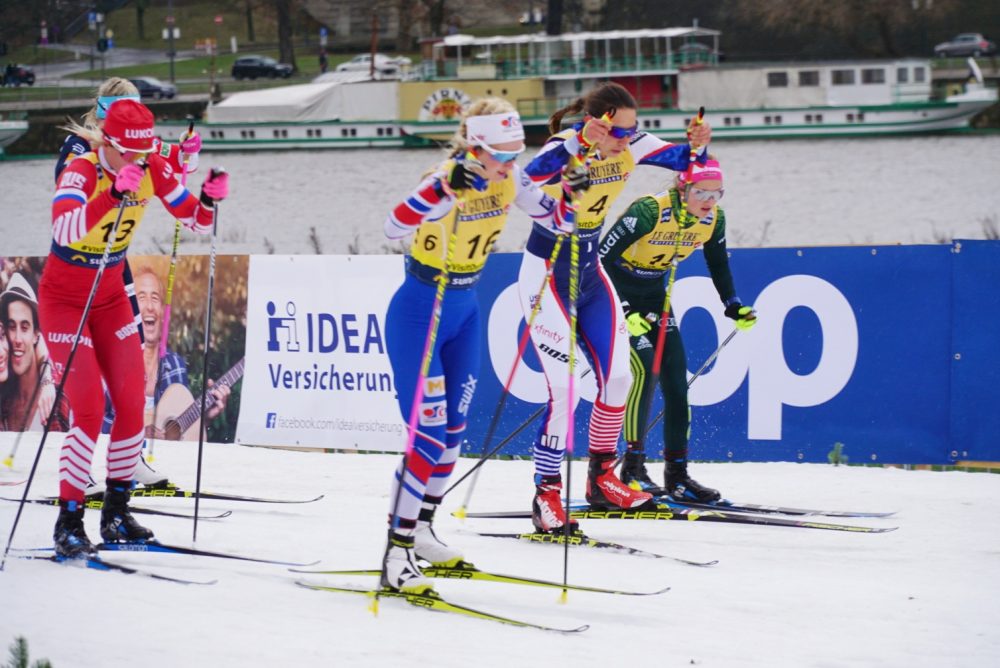
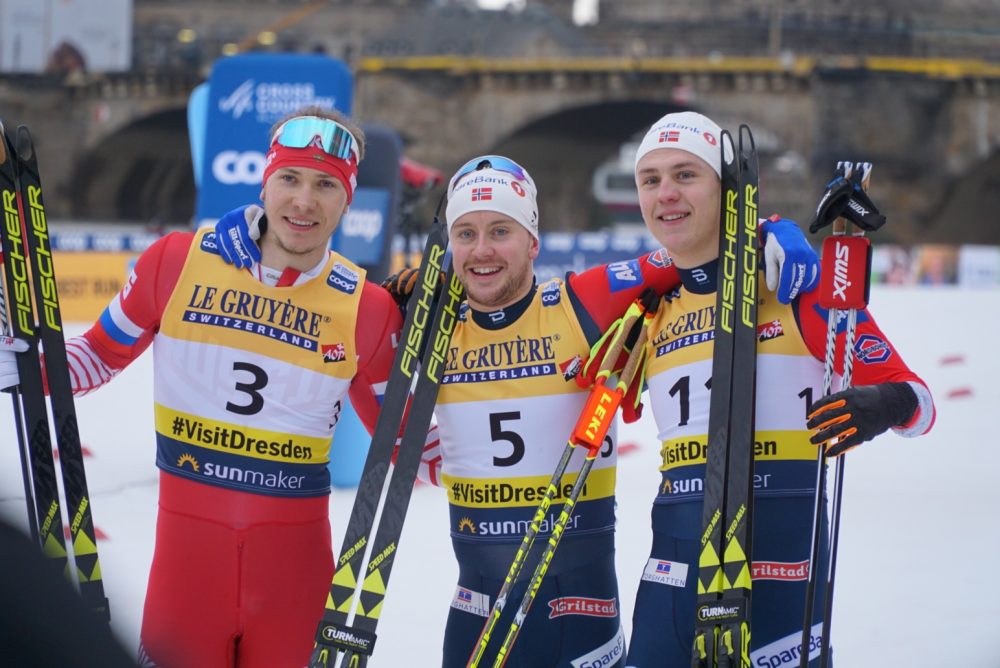
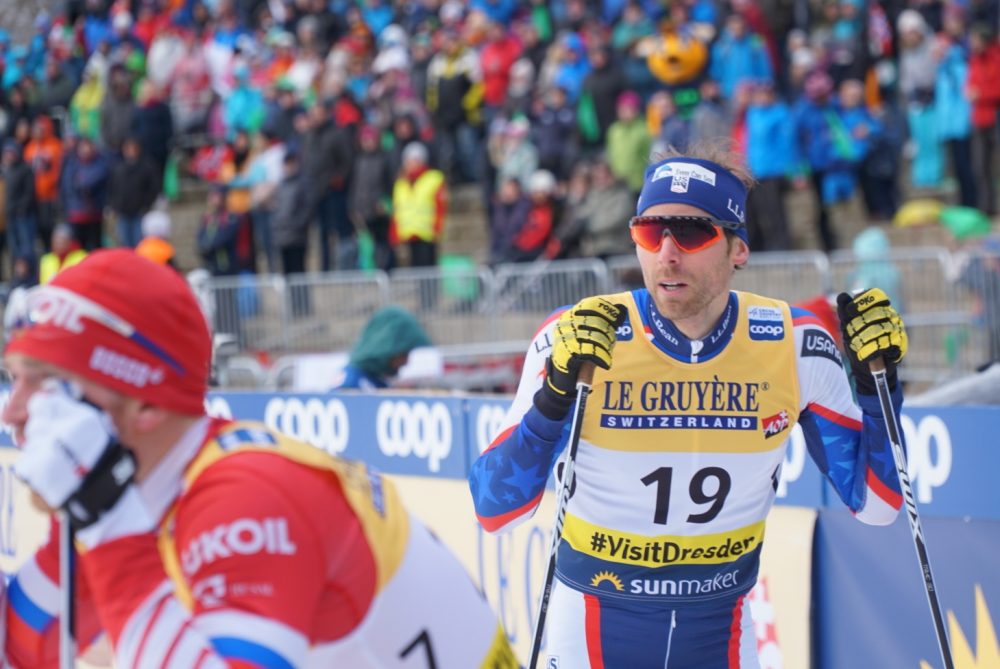
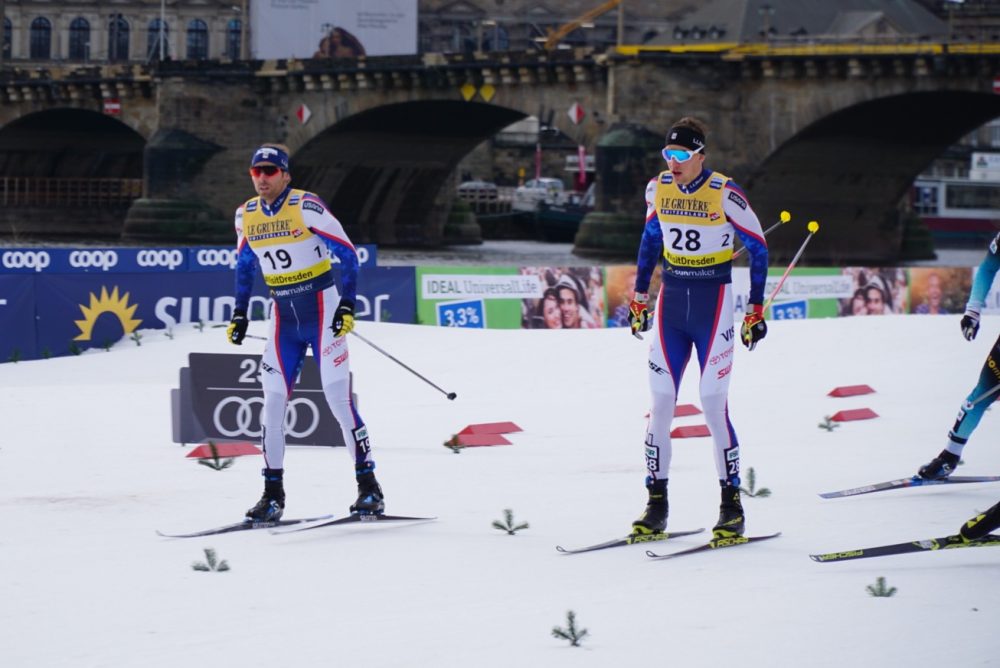
Norway’s Johannes Høsflot Klæbo crossing the line first for the last time of the day on Saturday to win the men’s 1.5 k classic sprint final, Stage 5 of the Ski Tour 2020, ahead of his teammate Pål Golberg, in his hometown of Trondheim, Norway. (Photo: NordicFocus)
Takeaways from Stage 5 (of 6) of the Ski Tour 2020? Alexander Bolshunov no longer has his minute-plus cushion to Pål Golberg in the overall, and Johannes Høsflot Klæbo is rounding into G.O.A.T. (Greatest-Of-All-Time) form.
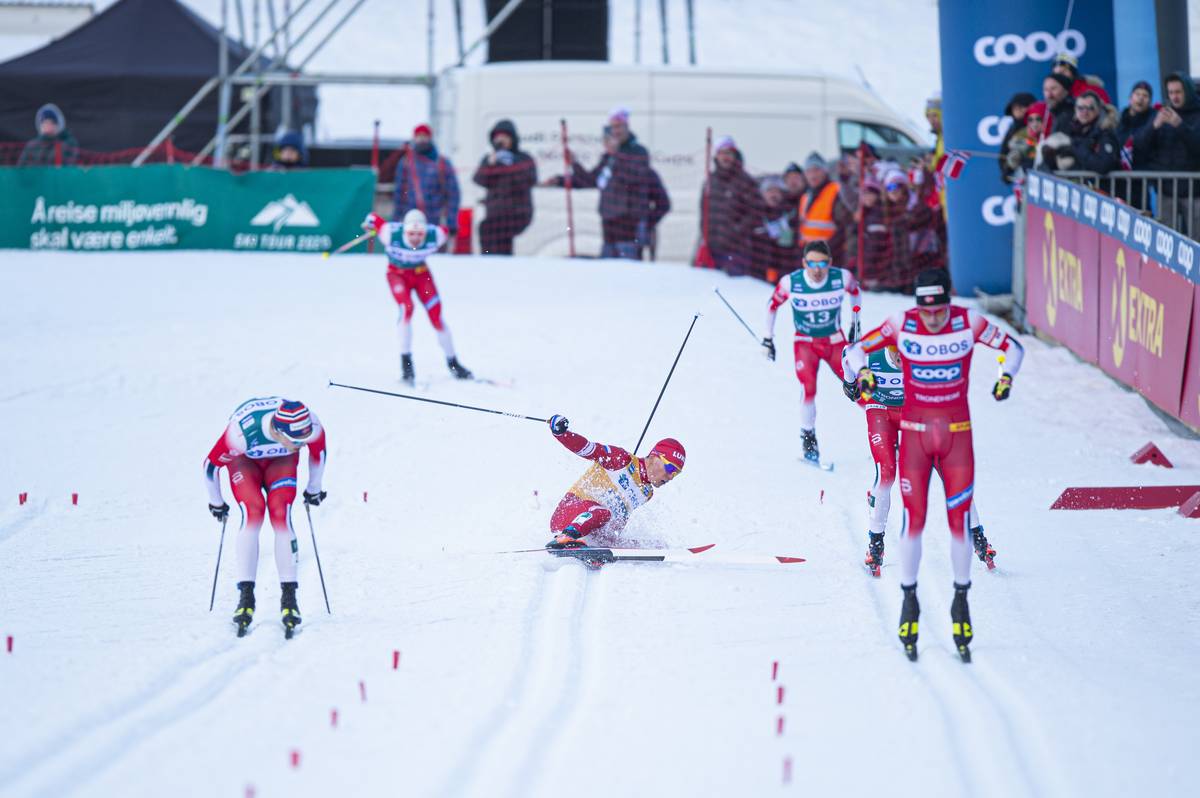
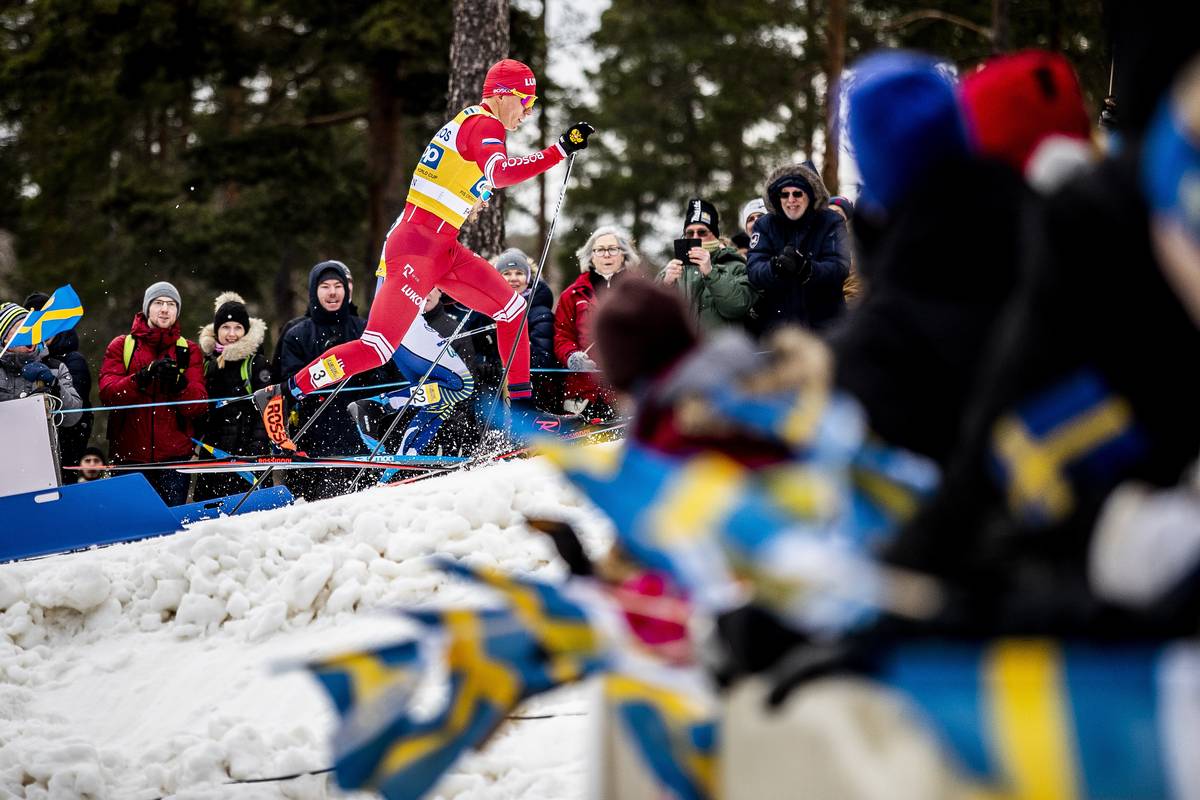
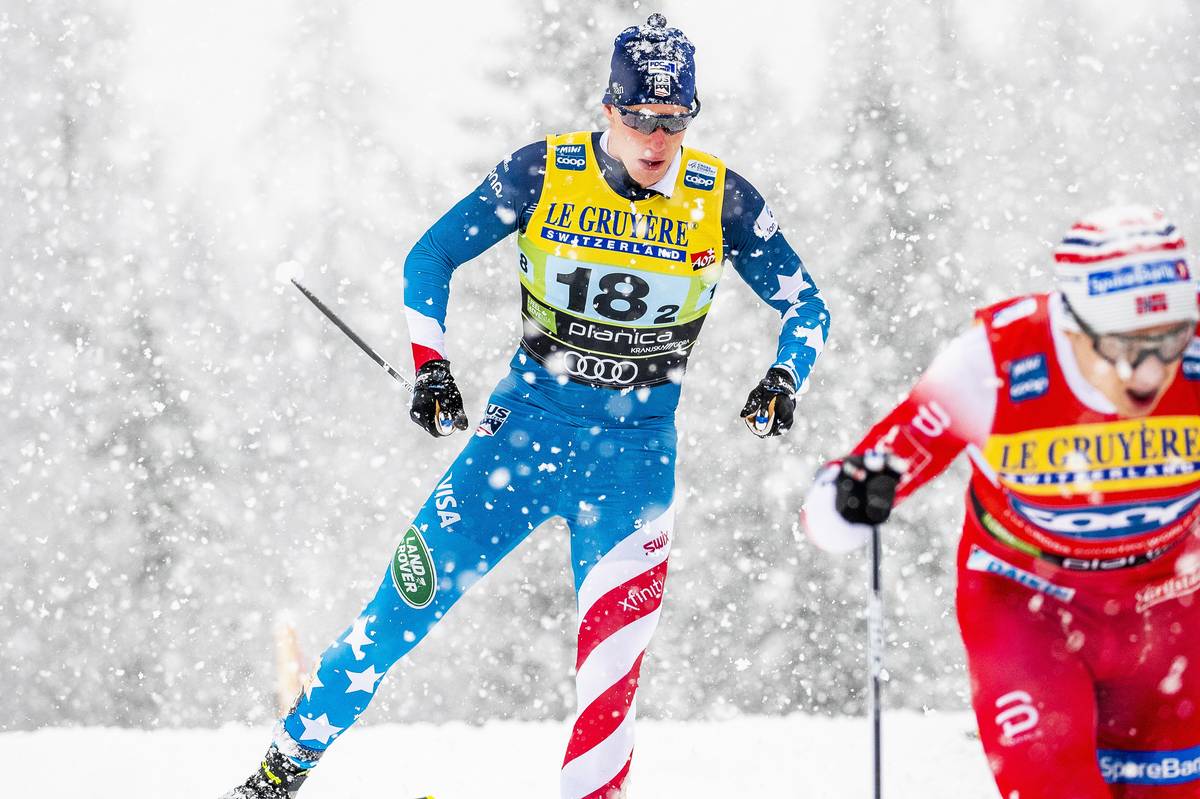
The 23-year-old Bolshunov, a Russian powerhouse who won the Tour de Ski last month, ranks first in the overall World Cup standings, and has landed on the podium in four out of five races so far this month (before Saturday’s classic sprint), crashed and burned in Saturday’s semifinal. He took himself out while switching tracks with 100 meters to go, clipping his left leg with his right ski and falling out of contention (from fourth to sixth) in the finishing straight. That was the end of his day, and his 1:05-minute lead in the Tour standings was reduced to 34 seconds on Golberg, who kept himself in prime position by finishing second to Klæbo in the final.
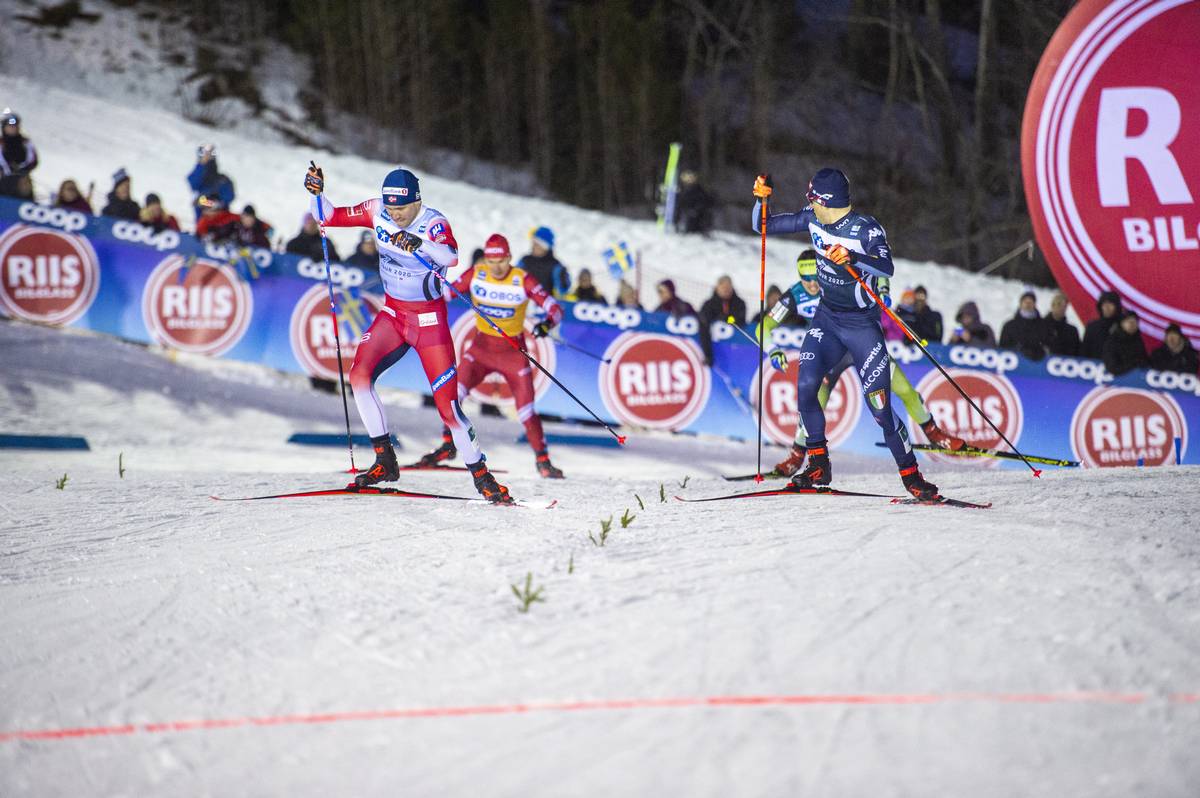
Russia’s Alexander Bolshunov (center) takes an untimely tumble with 100 meters to go in the first men’s semifinal of the 1.5 k classic sprint at the Ski Tour 2020 on Saturday in Trondheim, Norway. Up front, Norway’s Johannes Høsflot Klæbo (r) skis to first in the heat. (Photo: NordicFocus)
Then there was Klæbo, also 23, second in the overall World Cup standings and a Norwegian celebrity in his hometown of Trondheim, who did what he does best — dominate a sprint race — in front of a slew of familiar faces. He had never won a race at home in Trondheim before, and he did so Saturday in the men’s 1.5-kilometer classic sprint for his 14th straight World Cup individual win and 49th World Cup podium.
“I’ve been dreaming about this since I knew we were coming here,” Klæbo said of his latest victory in a post-race interview with the International Ski Federation (FIS) on Saturday. “So to be able to win here is just amazing, and I’m really proud to be able to win here today.”
He started the day by winning the qualifier by more than 2 seconds (over fellow Norwegian Erik Valnes +2.42 in second), and later advanced comfortably out of the quarterfinals and semifinals to the final. In the first quarterfinal, Klæbo cruised to second place behind Golberg, after Golberg set the pace up front for the bulk of the nearly 3-minute race, before decisively winning his semifinal (after passing Golberg on the last climb) by 1.2 seconds.
That semifinal saw five Norwegians — Klæbo, Golberg, Valnes, Finn Hågen Krogh, and Simen Hegstad Krüger — pinned against Bolshunov. They finished in that order after Bolshunov, who had qualified fourth and advanced in second behind Valnes in their quarterfinal, went down in front of the stands while Krogh and Krüger passed him by. Klæbo, who had the luxury and time to ease way off before the finish line, moved on to the final along with Golberg, Valnes, and Krogh. Bolshunov, who crossed the line nearly 17 seconds after Klæbo, did not, and he ended his day in 12th.
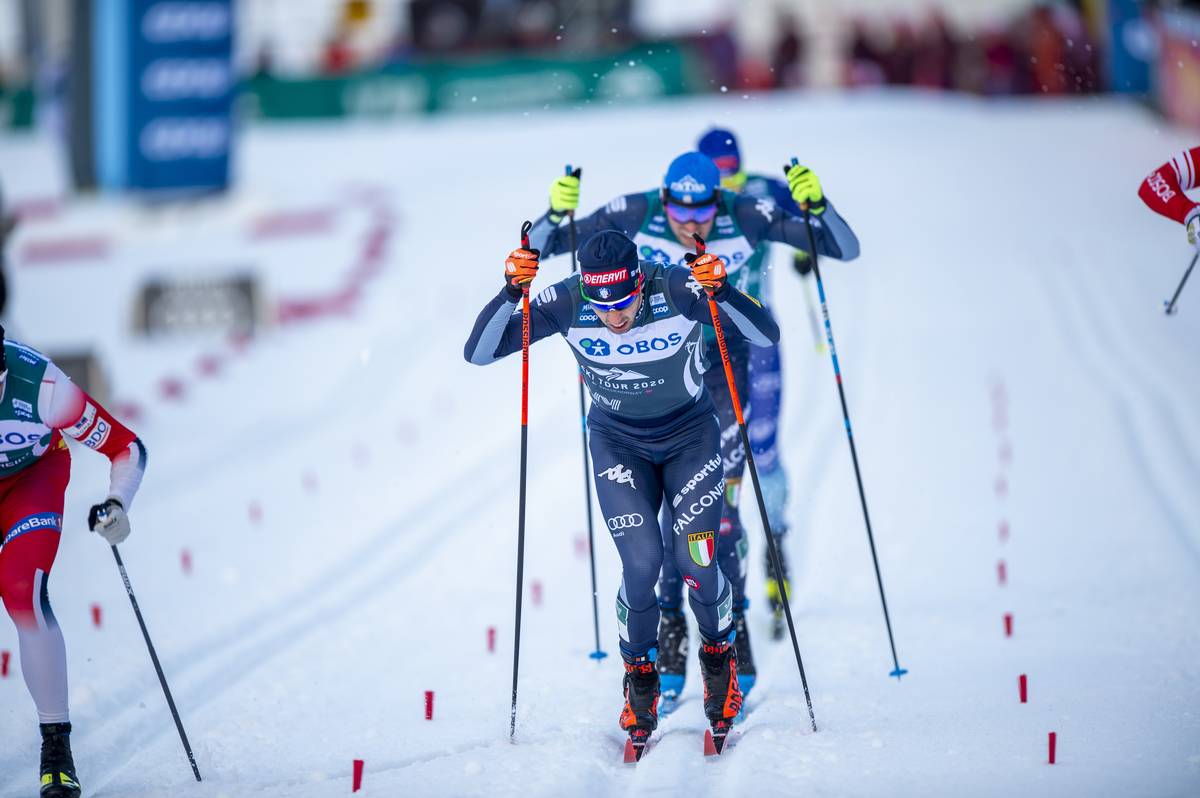
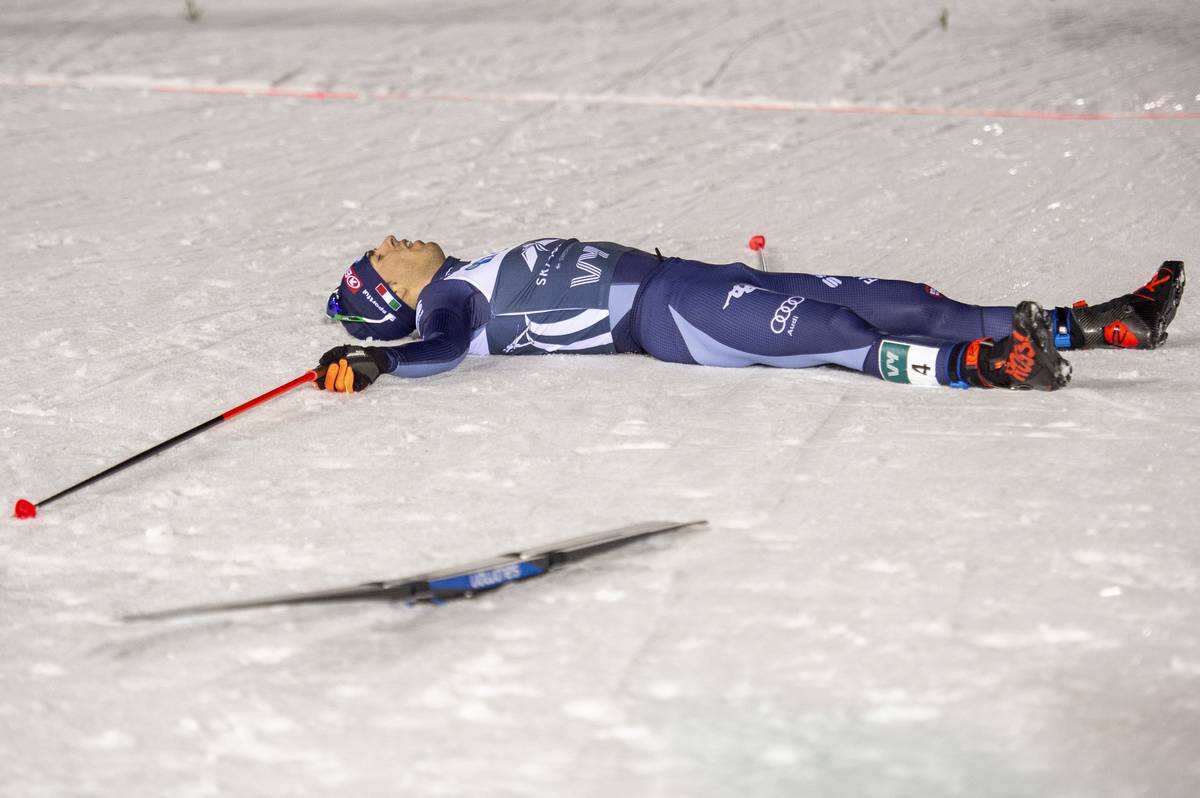
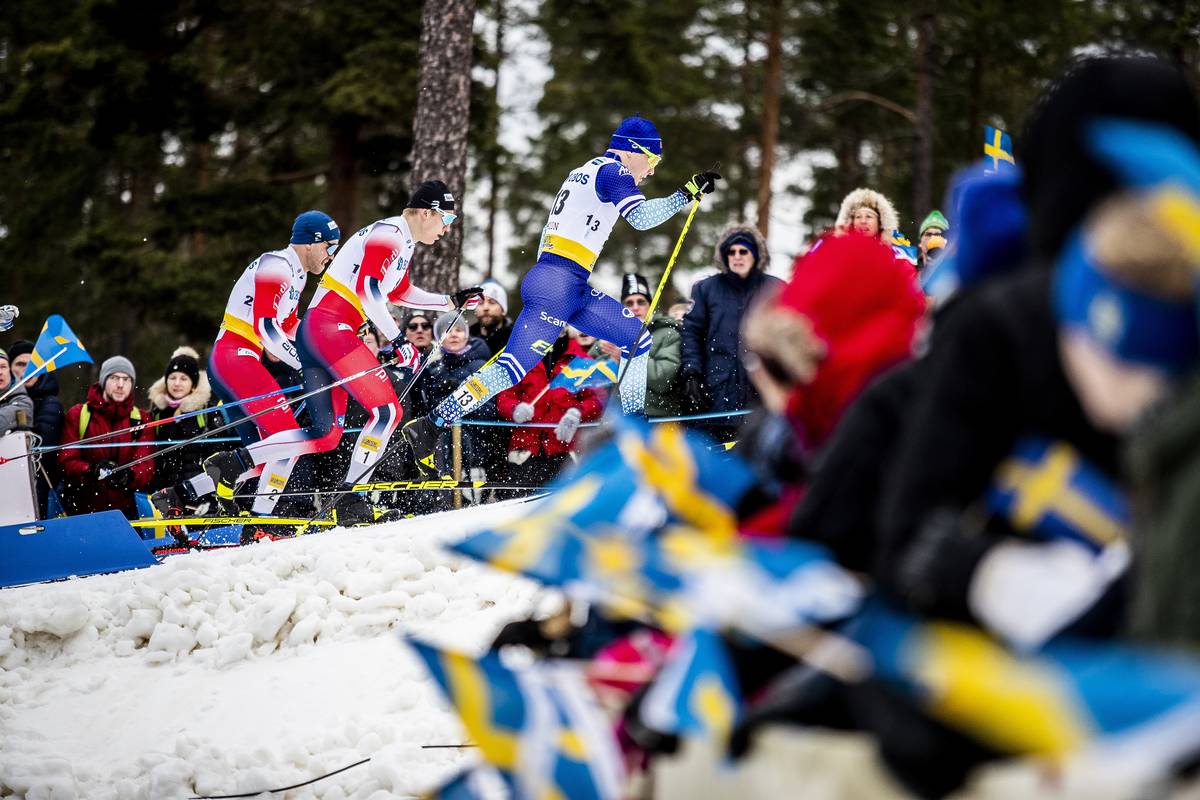
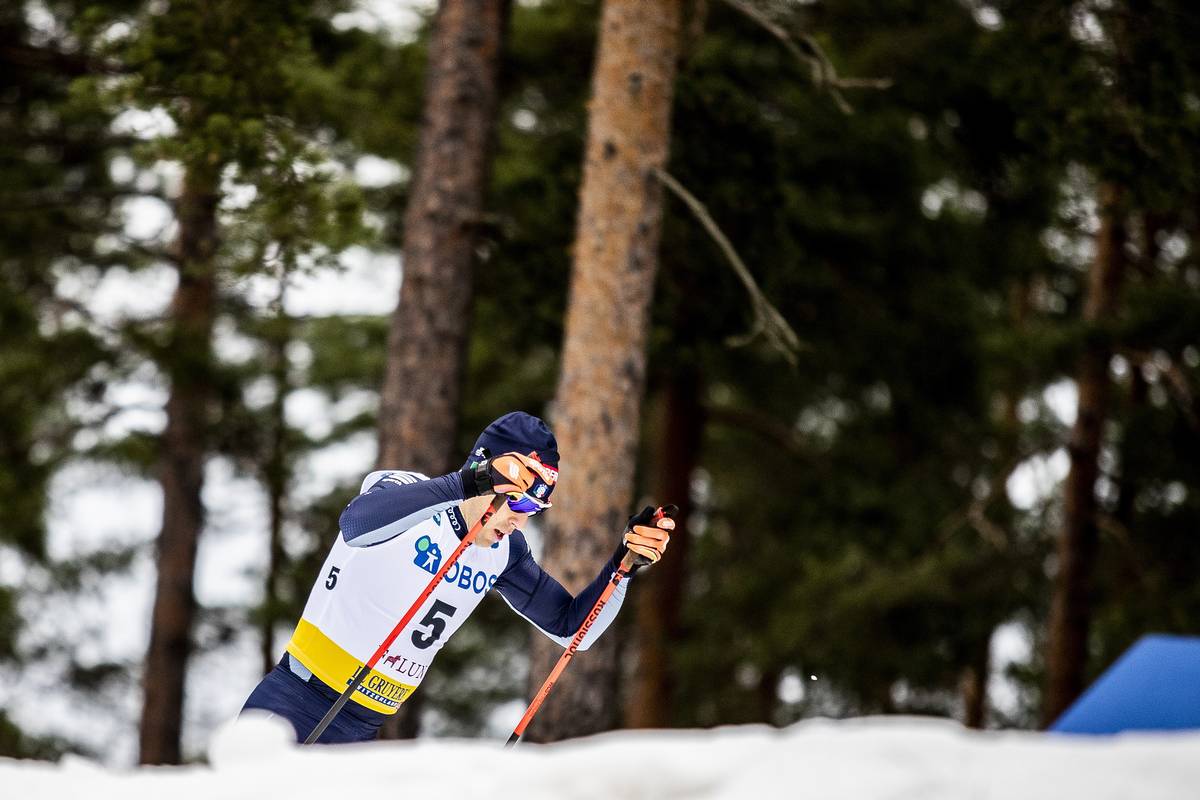
Powering up in Trondheim: Federico Pellegrino of Italy, followed by teammate Francesco de Fabiani . (Photo: NordicFocus)
The second semifinal was more diverse with two Italians — Federico Pellegrino and Francesco de Fabiani — going head to head with Norway’s Emil Iversen, Russia’s Gleb Retivykh, Finland’s Lauri Vuorinen, and Sweden’s Johan Haeggström. Wet snow that had begun in the later men’s quarterfinals had mostly stopped falling, and the sun began to poke through on the +3 Celsius afternoon.
On an early climb, Haeggström fell to his knees and broke his pole while skiing at the back of the pack. He quickly received a replacement, but wasn’t able to regain contact with the group while Pellegrino took charge up front. Despite leading into the stadium, Pellegrino lost some steam in the finishing stretch while Iversen came from behind to cross the line first, 0.3 seconds ahead of Pellegrino and 0.6 seconds ahead of Retivykh. Iversen and Pellegrino advanced to a nearly all-Norwegian final, with five men in red against the Italian in dark blue.
From there, it was another Klæbo jam sesh as the local hero set the tone in the final. Valnes initially led up the first climb while Klæbo, Golberg and Iversen followed closely. By the next uphill, Klæbo used his ferocious double pole to outmatch his teammates, who were still striding. Meanwhile, Pellegrino fell off the pace and into sixth. Klæbo kept the lead for the rest of the race, getting a gap on Valnes and Golberg on the descent into the stadium before running away with the win in 2:52:07. Golberg placed second, 1.2 seconds back, Valnes third (+1.6), Iversen fourth (+5.79), while Krogh, who also faded when Klæbo kicked into high gear, pulled some theatrics at the line and stalled before crossing 18.91 seconds back. Pellegrino finished last for sixth on the day, 22.78 behind Klæbo. That secured Klæbo’s spot as the men’s sprint champion for the Ski Tour 2020, while Pellegrino placed second, 13 points back, and Golberg was third, another 26 points back.
“It was an amazing day for us Norwegians,” Klæbo told FIS. “We had really good skis today, and I think we have done something right. It was a really fun race, and I think it’s an amazing to see how many people that actually come here and cheer for us. It’s something we really appreciate.”
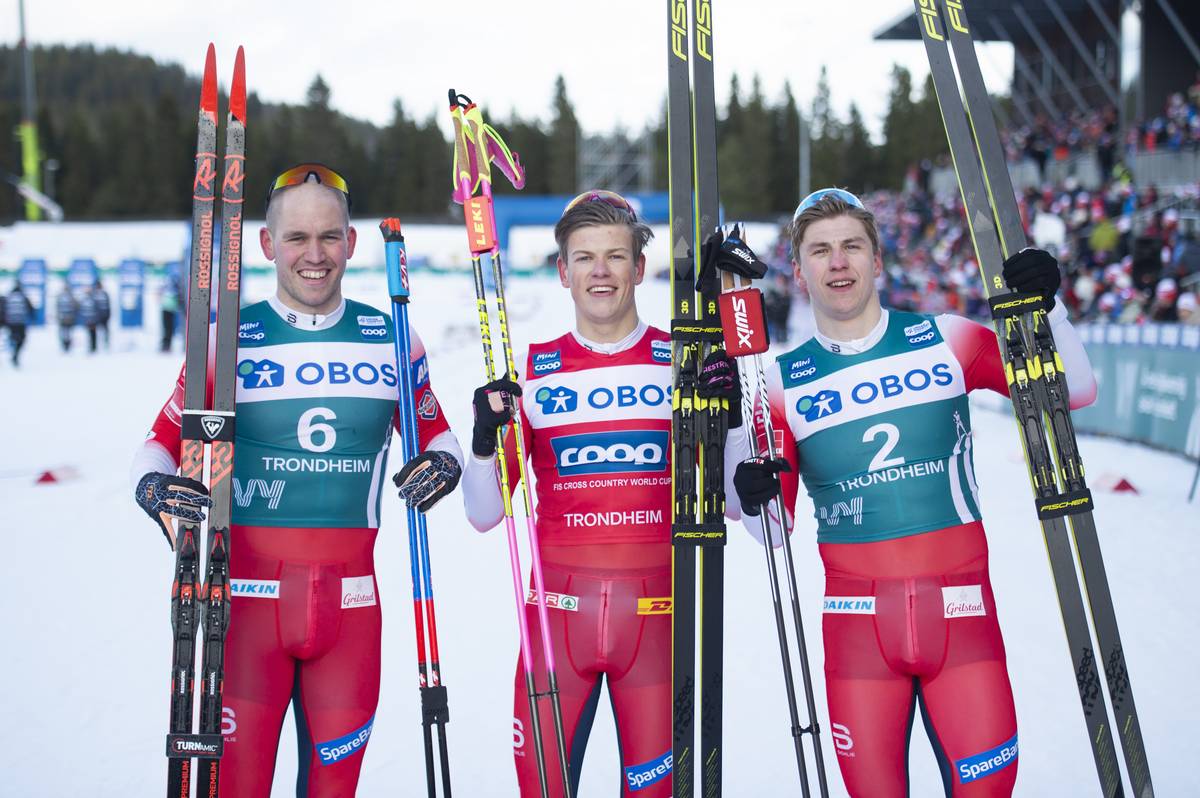
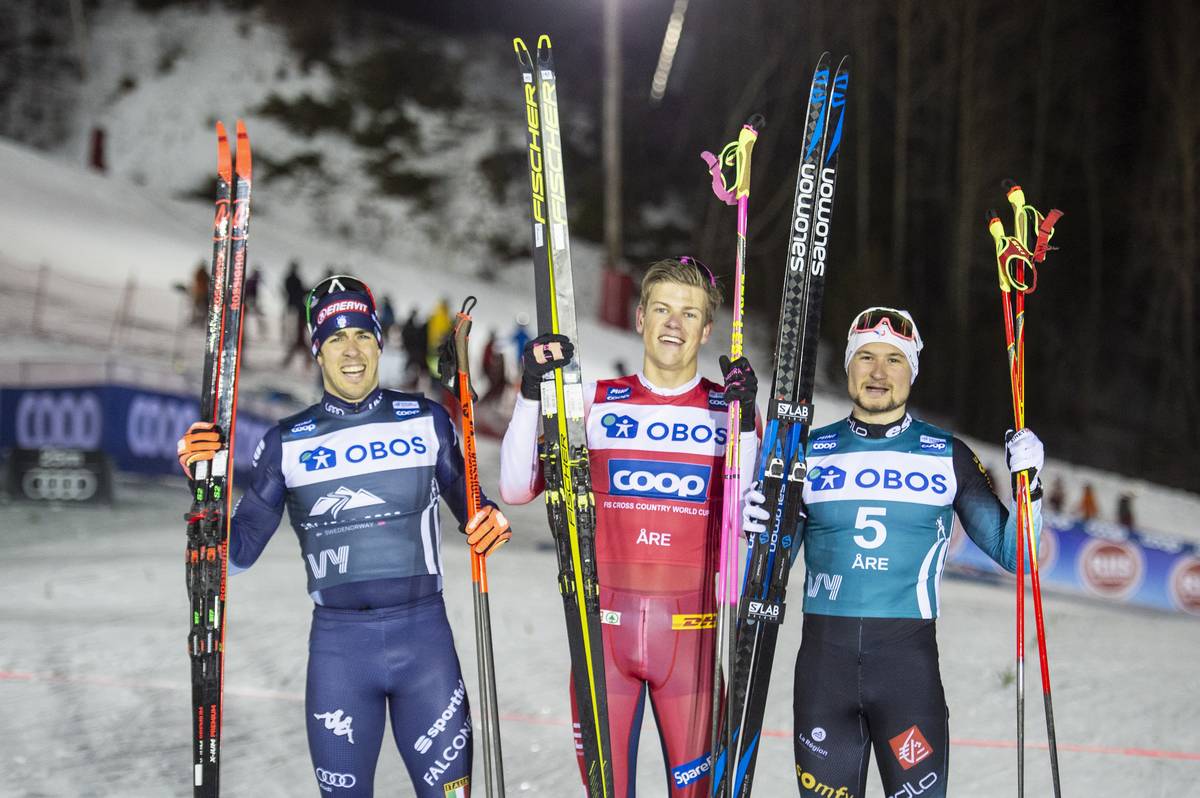
The all-Norwegian, Ski Tour 2020 Stage 5 men’s 1.5 k classic sprint podium on Saturday in Trondheim, Norway, with Johannes Høsflot Klæbo (c) in first, Pål Golberg (l) in second and Erik Valnes (r) in third. (Photo: NordicFocus)
In the overall Tour standings, Klæbo is up to sixth (+2:00.0) with one race — a 30 k classic pursuit — remaining on Sunday. Golberg will start 34 seconds behind Bolshunov, while Krogh in third overall will start just over a minute later (+1:35), ahead of Sjur Røthe (+1:40) and Martin Løwstrøm Nyenget (+1:46), also from Norway. In fact, eight of the top 10 men in the overall Tour standings are Norwegian. The other two are Russian: Bolshunov and Andrey Melnichenko (9th place).
American Logan Hanneman (APU) racing to 34th in the men’s 1.5 k classic sprint qualifier at Stage 5 of the Ski Tour 2020 in Trondheim, Norway. (Photo: NordicFocus)
No North Americans qualified for the heats on Saturday, with Alaska Pacific University skier Logan Hanneman coming closest in 34th, 0.9 seconds out of 30th and 14.38 seconds behind Klæbo. Fellow American Kevin Bolger placed 48th (+17.28) while Canada’s Russell Kennedy followed in 49th (+17.43) in the qualifier. American Ben Lustgarten finished 57th (+18.81) while Canada’s Alexis Dumas, Evan Palmer-Charrette and Ricardo Izquierdo-Bernier placed 59th (+19.6), 61st (+20.54) and 62nd (+20.74), respectively. American David Norris was 69th (+23.81), while Simi Hamilton did not start and is thus out of the Tour.
According to U.S. Ski Team coach Matt Whitcomb, Hamilton and Bolger have mild head colds, and Bolger and Hanneman, who rank 64th and 71st, respectively, out of 73 still in the Tour, will not start Sunday’s final stage.
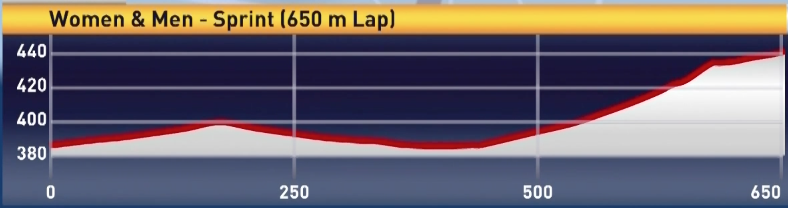
Let’s explain. The format was basic, a freestyle sprint. Otherwise, that’s where sprints as we know it ended. The 0.66-kilometer course shot off from the start up a gradual V2-able climb. It then rounded a left-hander where athletes descended what looked like a salted banked turn found in a X-Games terrain park. Down to the course’s bottom zoomed the skiers. Then things turned skyward. The course ascended a mini-Alpe Cermis lasting around one-minute for the men, to the finish atop the climb. The climb was the defining characteristic of the terrain: athletes suffered up a downhill ski slope gaining roughly 60 meters in altitude before the finish line. Calling the final ascent punchy would be an understatement. Grinding. Grueling. Leg-cement-inducing is more appropriate.
The Åre sprint hill climb in profile. (Photo: Screenshot FIS Broadcast)
Perhaps a sprint sideshow? That could be argued. But hosting an event at the base of the Swedish National Alpine hill with amenities for fans, of which there were plenty, and bountiful options for climbing terrain, we’ll let others debate the merits of hosting a climb-fest sprint.
Johannes Høsflot Klæbo of Norway in Åre, Sweden on his way to winning Stage 3 of the Ski Tour 2020. (Photo: NordicFocus)
But some things haven’t changed: Johannes Høsflot Klæbo qualified in first covering the course in 1:49.64. That’s right, a quick and snappy 0.66 k, despite the big vert. Klæbo continues to deal with broken fingers and a thus far lackluster Ski Tour 2020. He placed 31st in Stage 1 and 25th in Stage 2. He came into Stage 3 ranked 25th overall in the Ski Tour, 2:05 behind the leader, Norway’s Stage 2 winner, Pål Golberg.
For his part, Golberg laid down the second-fastest time in qualification, 2.58 seconds back. Alexander Bolshunov of Russia, by all measures the pre-Ski Tour favorite, qualified in 23rd (+8.59).
Pål Golberg of Norway and Italy’s Federico Pellegrino into the finish. (Photo: NordicFocus)
In the second semifinal, rounding the corner on the first and notably mild climb, Italy’s Federico Pellegrino took the inside line over the top. In bib 11, Norway’s Simen Hegstad Krüger came through in second, followed closely by Bolshunov who had advanced as a lucky loser.
Krüger took an aggressive line and cut off the advancing Russian. As this transpired, Krüger tumbled as their skis crossed. Bolshunov continued with Krüger going between his legs. Bolshunov now sat in fifth as he crested the hill. Krüger snapped a pole and grabbed a spare just prior to the descent. (He eventually received a yellow card for his cut-off move.)
Golberg won the semi, with Pellegrino in second. Bolshunov never recovered and placed fourth, 1.92 seconds behind Golberg. Bolshunov finished the day in eighth after being eliminated.
Although 8th on the day, Russia’s Alexander Bolshunov sits second overall in the Ski Tour 2020 after three stages. (Photo: NordicFocus)
Outside of the peculiar course, a stumble here and there, Klæbo and his astounding pull away acceleration in the final was the story. He advanced by winning the first quarterfinal and the first semi. He won that semi by only 0.52 seconds over France’s Jay Renaud. What became evident was that Klæbo was holding back and had not dialed his tactics.
In the final that featured Klæbo, Pellegrino, Renaud, Golberg, Lucas Chanavat of France, and Norway’s Erik Valnes the charade was over.
Chanavat led into the final climb with Pellegrino off to his right, a meter back, with Klæbo shadowing on the other side. Then Pellegrino upped the pace and pulled ahead with Klæbo settling into his draft. Chanavat took charge of the climbing lane to the left. For a moment, Klæbo must have been inhaling extra oxygen, as he fell slightly back.
But as the trio passed under the red sponsor arch, Klæbo shot off. For every single V1 cycle Pellegrino completed, Klæbo threw in two hop-skates. As he rounded to the left atop the climb, Klæbo looked back on a 20-meter gap. “Mamma mia” they must have been saying in Italy.
Italy’s Pellegrino: totally spent. He placed second overall in the Stage 3 Ski Tour 2020 sprint. (Photo: NordicFocus)
Klæbo won the final in 2:02.63. Pellegrino was second (+2.39), and Renaud third (+3.70). Golberg was fourth (+14.46), Chanavat fifth (+26:39), and Valnes sixth (+1:05.62).
Time to chill at the finish: Johannes Høsflot Klæbo of Norway. (Photo: NordicFocus)
“It was a real suffer-fest,” Klæbo told FIS after the race. “It was a lot of fun. At the end I was just trying to push all out. I turned my head on the last climb and it was a huge gap. … It was good to get the confidence again and fight for the podium. … At the end, I was just trying to push all out. I turned my head on the last climb and it was a huge gap. In the end, it was really fun.”
For the U.S. Simi Hamilton was the lone North American who advanced into the heats qualifying in 17th (+7.12). Hamilton skied to third (+2.27) in the second quarterfinal which was won by Russia’s Denis Spitsov in 2:04.14. The Aspen, Colorado native placed 14th in the final standings. (Below we have included an extended post-race interview with Hamilton. In the interview Hamilton discussed his injuries, and his return to racing World Cup sprints.)
The U.S. Ski Team’s Simi Hamilton in Åre, Sweden. (Photo: NordicFocus)
Post-race interview with Simi Hamilton
In his return to World Cup sprinting, Simi Hamilton skis to 14th overall on Stage 3. (Photo: NordicFocus)
Logan Hanneman placed 45th on the stage, Kevin Bolger 60th, David Norris 65th, and Ben Lustgarten 81st.
Post-race interview with U.S. World Cup Coach Matt Whitcomb
For Canada, Russell Kennedy finished in 73rd, Evan Palmer-Charrette 75th, Alexis Dumas 76th, and Ricardo Izquierdo-Bernier 78th.
Erik Valnes of Norway (bib 1) and teammate Pål Golberg (bib 2), and Lauri Vuorinen of Finland, (l-r) during the quarterfinals of the classic sprint in Falun, Sweden. (Photo: NordicFocus)
Thousands of spectators, slate skies, and a manmade loop of snow laid down in the otherwise green-brown Falun, Sweden ski stadium greeted the World Cup on Saturday. After a weekend hiatus last week, racers contested a 1.4-kilometer classic sprint in one of Sweden’s skiing epicenters.
The main World Cup sprint star, Johannes Høsflot Klæbo, was absent. The twenty-three-year-old Klæbo broke two fingers last week. According to Norwegian broadcaster NRK, he will be reevaluated on Feb. 13. The fingers were broken while Klæbo and a group of friends were using a “boxing machine”. The game involved hitting a padded area that measures the force of impact. Klæbo’s gloved hand slipped off the pad and struck a hard surface adjacent to the pad.
Although considered a lock in classic sprints, Klæbo has won nine of the last 10 World Cup classic sprints — including five in a row — this would be a day for another skier to claim the win on a course featuring two significant climbs and twisting banked turns on the descents.
Erik Valnes of Norway notched the fastest qualifying time in 2:51:15, followed by teammate Pål Golberg 0.26 seconds back. Overall World Cup leader, Russia’s Alexander Bolshunov (23), the person who could pad his overall World Cup lead with Klæbo out, qualified in third (+0.51).
Alexander Bolshunov charging during the classic sprint in Faklun., Sweden. (Photo: NordicFocus)
In the quarterfinals, it looked like the yellow overall leader’s bib had instilled special powers on Bolshunov. He won the third heat in 2:53.47. Although in a different lineup with five other skiers creating the context, Italy’s Federico Pellegrino won the second quarterfinal in a markedly slower time of 2:59.23.
The first semifinal featured Pellegrino, Bolshunov, Golberg, and Valnes as the main contenders. As the semi to watch, Bolshunov was the thoroughbred out of the gates. He led the double pole army of six over the top of the first hill as he began to string out the field. He then led the classic-run up the second climb, with Pellegrino, Valnes, and Golberg following in order over the top.
Again, Bolshunov hung on over the top with three other skiers towed along. Pellegrino eventually grabbed the lead on the final climb as he moved ahead of Bolshunov. Pellegrino won the speedy semi in 2:50.41, with Bolshunov in second (+0.10), Golberg in third (+0.40), and Valnes in fourth (+1.64). Golberg and Valnes would advance to the final as lucky losers.
Federico Pellegrino during the classic sprint in Falun, Sweden. Pellegrino placed fourth overall. (Photo: NordicFocus)
Bolshunov blazed ahead in the final. His double poling was peerless. His tempo up the first major climb was a mirror of his semi where he was first over the top and forced others to gap up.
On the second climb at 1:45, Bolshunov crested the hill in first with the others chasing. On the descent, with a long glide out lasting nearly 12 seconds, Bolshunov was caught as the leading foursome ran into the final hill before the finish.
Golberg led the charge followed by Valnes with Bolshunov and Pellegrino trailing a few meters back in third and fourth.
Downt the line it was Golberg for the win in 2:51.83. Valnes was second (+0.52), Bolshunov third (+0.92), and Pellegrino fourth (+2.40). Norway’s Håvard Solås Taugbøl placed fifth (+9.74), and Sweden’s Teodor Petterspon sixth (+49.48).
“My feeling was good today but I had a really tough semi final,” Golberg told FIS after the race. “So I expected the final to be tough as well so my tactic was to follow Alexander Bolshunov and fortunately I ended up with a bit more power. We had five Rossignol skis in the finals so something was definitely right today.”
Pål Golberg (NOR) for the classic sprint win in Falun, Sweden. (Photo: NordicFocus)
Bolshunov, who leads the overall with no threat from Klæbo in the near future, he was disappointed with his day. “I am not too happy with today’s result as I was expecting more of myself,” Bolshunov told FIS. “But something did not work out as I was not able to speed up more and go away from my opponents and therefore it would have been good for me if there would have been one more heat so that I could have pulled everything out or maybe if the course would have been longer, then I might have pulled it off.”
No North American men qualified for the heats. Canada’s Bob Thompson was the top North American in 43rd. Alexis Dumas placed 62nd and Ricardo Izquierdo-Bernier 64th.
Logan Hannaman (APU) and Kevin Bolger (USST), finished 52nd and 53rd, respectively. Ben Saxton (SMST2) raced to 55th.
According to U.S. World Cup Coach Matt Whitcomb, Simi Hamilton is recovering from a back injury and will miss this weekend of World Cup racing.
Post-race interview with U.S. World Cup Coach Matt Whitcomb
“There is no painting any way other than what it is, it was just a bad day,” said Whitcomb.
Bob Thompson of Canada during the Falun, Sweden classic sprint qualifier. (Photo: NordicFocus)
Logan Hanneman of the U.S. during the Falun, Sweden classic sprint qualifier. (Photo: NordicFocus)
Kevin Bolger of the U.S. during the Falun, Sweden classic sprint qualifier. (Photo: NordicFocus)
Britain’s Andrew Young qualified for the heats which was a career first in a classic sprint. He placed 19th overall.
The men’s classic sprint podium from Falun, Sweden: Erik Valnes (NOR) in second, Pål Golberg (NOR) first, and Alexander Bolshunov (RUS) third, (l-r). (Photo: NordicFocus)
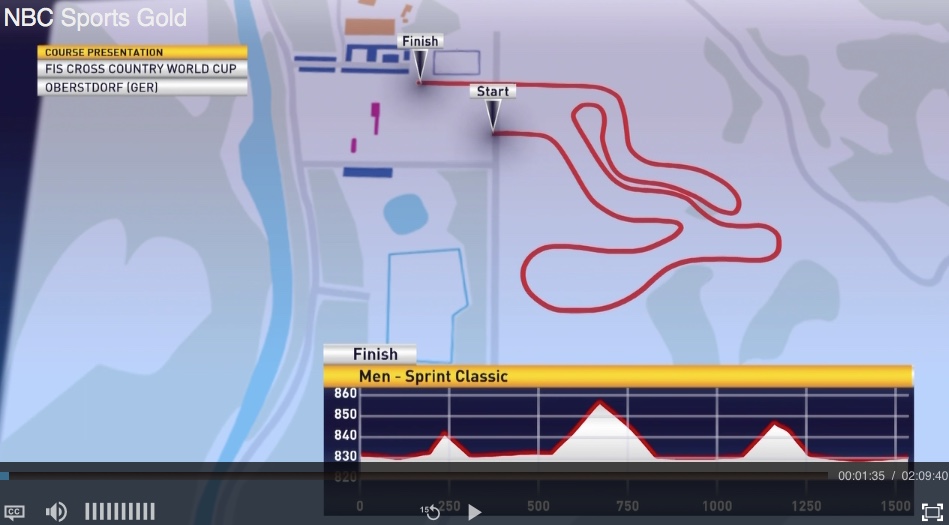
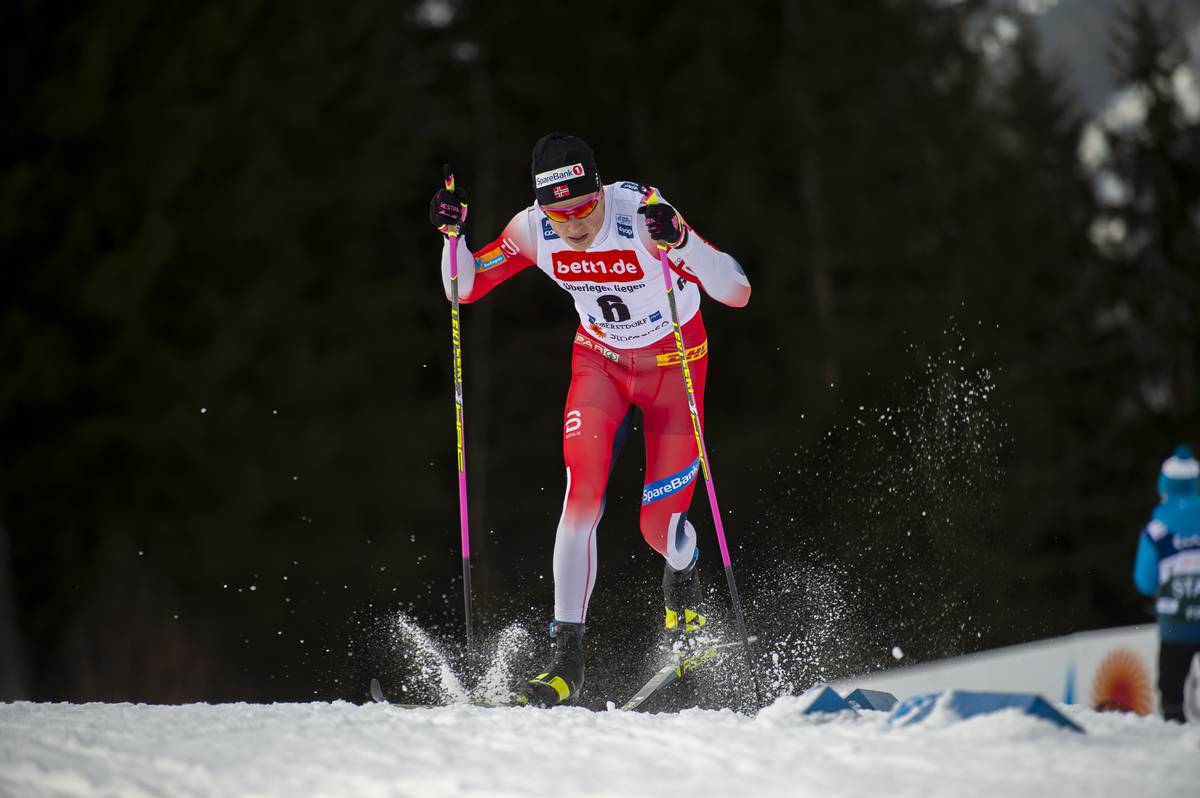
Sunday’s men’s 1.5-kilometer classic sprint course in Oberstdorf, Germany deserves some recognition. Site of the 2021 FIS Nordic Ski World Championships, racers were offered a glimpse into how the world’s foremost sprinter, Johannes Høsflot Klæbo of Norway, would navigate it’s kicker climbs, steep descents, and roughly three minute and thirty-second effort.
The sprint course offered three distinct climbs, one at 0.2 k, the largest at 0.52 k, and the third starting at 1.1 k. The descents mirrored the inclines of the ascents and offered little respite or recovery for skiers near their engine’s redline.
We are focusing on Klæbo, despite the other twenty-nine skiers in the heats, because he was simply a master of pacing, a master of conserving energy on the three-climb course, and freakish in his ability to run away from his five competitors in the final.
Klæbo qualified in first. The margin back to Erik Valnes of Norway in second was 2.72 seconds. Pål Golberg, the third-fastest qualifier was 5.03 seconds back. There were big-time gaps back to the field of qualifiers.
Johannes Høsflot Klæbo crushing the men’s sprint qualifier in Oberstdorf, Germany. (Photo: NordicFocus)
Valnes and Klæbo opted for the first quarterfinal. It was here that Klæbo played his tactical hand. He was in no hurry on this endurance sprint course to move to the front and pull others along in his wake. Klæbo sat in fourth on the second hill as Valnes was the heat’s workhorse. Klæbo appeared relaxed, not itching to move to the front. Klæbo moved to third around 2:00 minutes as they crested the course’s highpoint. The third hill, as most sprinters appeared on fumes, is where Valnes and Klæbo pulled ahead. Over the top, the duo glided into a 20-meter lead. Down the stretch, Valnes poled ahead for the quarterfinal win as Klæbo pulled up, stopped poling several meters before the finish — as if he were checking out for a lunch break.
The third hill would be Klæbo’s charm.
Along with Valnes in the first semifinal were Italy’s Federico Pellegrino (4th qualifier), Golberg, Håvard Solås Taugbøl also of Norway (5th qualifier), and Russia’s Sergey Ardashev. This would be the semifinal to watch.
Again, Klæbo played the conservation of energy tactic. Up the second climb, Golberg, Taugbøl, Valnes, and Pellegrino strode four across with Klæbo lurking a meter back. The second hill was in the rearview mirror around the two-minute mark. It’s approximately another twenty seconds of descent and working flat before the next decisive climb.
As the skiers approached the base at 2:26, Klæbo and Valnes ramped up – they pulled away as they ski-ran up and over the top. Klæbo had been sitting behind Valnes, sucking up in his draft into the final straight. There, Klæbo pulled around his teammate for the semifinal win.
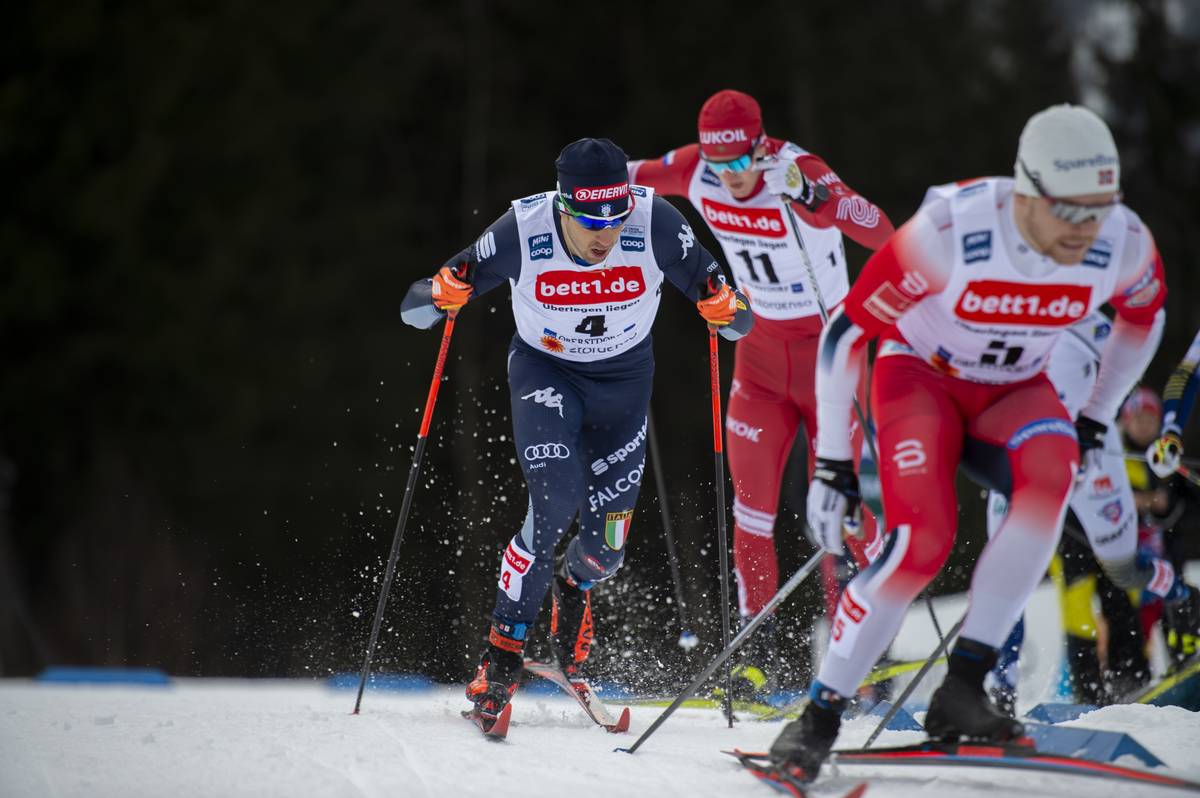
Federico Pellegrino of Italy pushing over the top in the Oberstdorf, Germany classic sprint. (Photo: NordicFocus)
The final featured Klæbo, Valnes, Golberg, Pellegrino, and Oskar Svensson of Sweden and Russia’s Gleb Retivykh. Really, for Klæbo, this was essentially a rematch of his semi.
Again, Klæbo was cautious from the start. There was no real earnestness to shoot to the front. His show would come later. There was only patience from an athlete who knew he could pounce late in the game.
Pellegrino, on the second climb, began to accelerate. He ran outside the tracks in what looked less like a decisive move, and more a burst to position himself tactically in front over the top. For his part, Klæbo matched Pellegrino and strode up alongside the Italian.
At 2:35 at the base of the final climb, Klæbo unleashed. It was textbook Klæbo-running. He was gone with a near 20 meter gap over the top. By the finish line, Klæbo looked to put 10 more meters on his competition as he won in 3:29.46. Golberg was second (+1.99), Valnes third (+2.37), and Pellegrino fourth (+3:06).
In yesterday’s 30 k skiathlon, Klæbo registered a rare DNF (did not finish) as he pulled from the competition.
“I think the sprint was much better than the 30 k yesterday,” Klæbo told FIS after the race. “Yesterday was a really terrible day and today was a bit better. In the end, it was really cool to win here. Yah, I think my shape isn’t the best but I am really happy to find the win here and to have the Norwegian guys here.
“I think it was a really good decision yesterday to jump off after 15 k I think, it was really nice to fight for a win today. And for sure I am really looking for the World Championship here next year.”
Johannes Høsflot Klæbo of Norway cruising in for the Oberstdorf, Germany classic sprint win. (Photo: NordicFocus)
Hands up for the win: Johannes Høsflot Klæbo makes it 5 for 5 for sprints this season. (Photo: NordicFocus)
What was clear after today was that Klæbo had mastered the course. Anything can happen in a year. And anything can go down in a sprint – broken poles, clipped skis, or slide out on a corner. This much was true exiting Oberstdorf: it will be Klæbo’s race to lose at the 2021 World Championships.
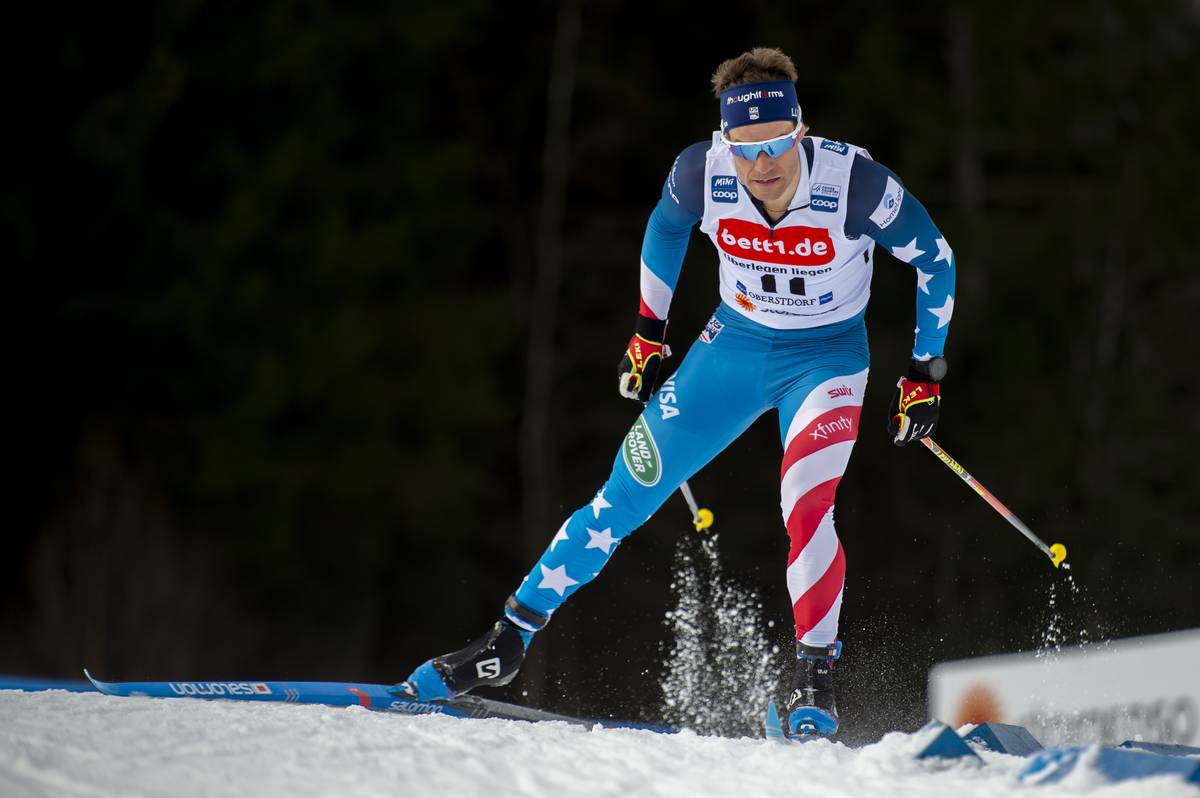
It was a down day for the American men. No skiers qualified for the heats. Simi Hamilton placed 32nd overall and was +15.94 in qualification. Andy Newell was 41st (+17.48), Tyler Kornfield 55th (+20.88), and Noel Keeffe 64th (+25.33).
Simi Hamilton during the Oberstdorf, Germany classic sprint qualifier. (Photo: NordicFocus)
Andy Newell during the sprint qualifier in Oberstdorf, Germany. (Photo: NordicFocus)
For Canada, Bob Thompson placed 54th and was +20.14 in the qualifier, Paul Grall-Johnson was 58th (+21.74), and Graham Ritchie 61st (+22.92).
World Cup Standings Shakedown
Coming out of Oberstdorf on the men’s side, Russia’s Alexander Bolshunov remains in command. In first overall with 1457 points, Bolshunov has a 235 point lead on second place Klæbo for the overall lead. Sunday, Bolshunov earned 36 World Cup points after placing seventh overall, Klæbo earned 100 points for the sprint win. If you are keeping score at home, you will note 140 points for Bolshunov’s win in Saturday’s 30 k skiathlon. On yesterday’s course, racers had four opportunities to score bonus points – Bolshunov snatched up 40 of them during the race.
Alexander Bolshunov of Russia in the yellow bib. He leads the overall World Cup. He placed 7th on Sunday’s classic sprint in Oberstdorf, Germany. (Photo: NordicFocus)
Klæbo leads the sprint overall with 350 points. This was Klæbo’s fifth sprint win of the season. He has won every sprint entered thus far. He skipped the skate sprints in Planica, Slovenia and Dresden, Germany.
The World Cup takes a break next weekend and restarts in Falun, Sweden with a classic sprint on February 8.
All Norway in the men’s classic sprint podium in Oberstdorf, Germany: Pål Golberg in second, Johannes Hoesflot Klaebo first, and Erik Valnes third. (Photo: NordicFocus)
The men’s podium of the freestyle team sprint in Planica, Slovenia. The Norway I team of Sindre Bjørnestad Skar and Erik Valnes took the win over the Norway II and Finland teams. (Photo: NordicFocus)
From under the umbrella to inside the snow globe. Fat flakes were falling in Planica, Slovenia at the start of the freestyle team sprint. A painful mix of speed and endurance, each team member skied three 1.2-kilometer laps for a total of 7.2 k. Comprising the victorious Norway I team, Sindre Bjørnestad Skar and Erik Valnes stopped the clock at 16:54.52. Fellow countrymen Håvard Solås Taugbøl and Gjøren Tefre took the Norway II team to second place (+1.29) followed by the Finnish team of Ristomatti Hakola and Joni Mæki in third (+1.43).
Coming into the third exchange at the halfway mark of the race, the pack of athletes included all ten teams, no one able to break apart the masses in the slow conditions. A variety of teams including Norway, Finland, and France took turns trying to create a gap, but wasting energy too early in the slow snowy conditions risked hazard.
The Norway II team of Håvard Solås Taugbøl and Gjøren Tefre tag off in a tight field during the freestyle team sprint in Planica, Slovenia. (Photo: NordicFocus)
By the fourth exchange, there was no longer time to wait. Skar of Norway I pushed by Tefre of Norway II began to surge. He quickly created a small gap to all but Richard Jouve of France and Hakola of Finland I who went with the leaders in red.
Though the density was lowered, the spread of the top eight teams was less than nine seconds as they made the final exchange. Having mingled with the leaders throughout, the American duo of Kevin Bolger and Logan Hanneman sat in fifth, less than three seconds back on the Norwegians.
Densely packed inside a snow globe, Norway pushes toward a 1-2 sweep in the freestyle team sprint in Planica, Slovenia. (Photo: NordicFocus)
Winding up the energy in the final leg, Norway again made a push to break apart the field. Allowing them to lead to the climb at halfway, then working his way around the outside, yesterday’s sprint champion Chavanat made a go at the lead. Cresting the hill, Chavanat’s V2 was outmatched by two men in red jump-skating as though indefatigable even after 3.5 k’s of sprinting.
Valnes exploded off the front, leaving the threesome of Tefre, Mæki, and Chavanat duking it out to a close finish. Bobbling as he crossed into an opening, Tefre tangled skis with Mæki, but both men lost little momentum as they headed into the final straightaway.
Perhaps spent from his attempt to lead, Chavanat’s tempo could not match the others and he was overtaken in the final meters. Tefre slid his boot over the line just ahead of Mæki, leaving the French team 0.07 seconds off the podium.
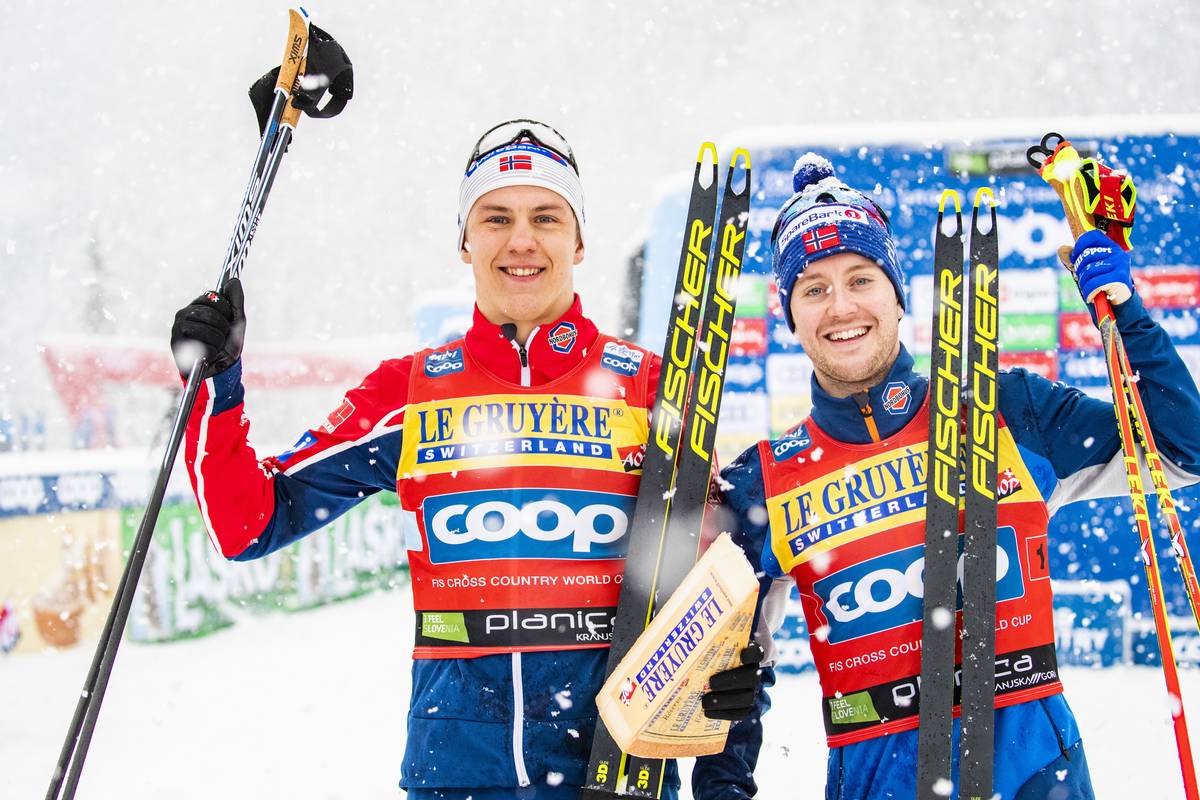
The Norway I team of Sindre Bjørnestad Skar and Erik Valnes took home the cheese at the freestyle team sprint in snowy Planica, Slovenia. (Photo: NordicFocus)
“It was a challenging day [for conditions], just as yesterday,” Skar told FIS at the finish line. “But it’s the same for everyone so you just have to deal with it and do your best.”
He explained how the wet falling snow affected tactics and how the race unfolded for the Norway I team.
“It was so close and then with this weather it is almost impossible to go alone in the front. I tried the last half, but it was difficult, but we had to try and Erik was the best guy at the finish.”
Kevin Bolger accelerates out of the exchange during the freestyle team sprint in Planica, Slovenia. (Photo: NordicFocus)
After losing contact with the leaders in the final lap, the Americans held on for 7th place (+21.19).
In a post-race call, Whitcomb explains that the team of Bolger and Hanneman was not finalized until the morning, when original anchor Simi Hamilton, who took 12th in the rain yesterday, was forced to withdraw after coming down with a cold. Because of the adjustment, the team lost their start position in the semifinal and began at the back of the field. The men finished eighth in the fast first round, from which the top three teams went on to be the top three teams in the final. The Americans advanced to the final with the last lucky loser spot.
Post-race interview with Matt Whitcomb on the men’s team sprint.
Kevin Bolger (second from left) keeps the USA team in contact during the freestyle team sprint in Planica, Slovenia. (Photo: NordicFocus)
“Logan and I had the weather on our side today!” wrote Bolger in an email. “I was skiing well but punched it to the front of my semi-final on the second lap and got a bit flooded from that. Luckily, Logan skied really well on his final lap to bring us into qualifying contention!
“The Final felt a lot better,” he continued. “I skied a lot more conservatively and tactically better and am happy with how I moved forward. I was a bit surprised when Logan came into the Tag zone leading but was ready to head out and give it my all for the last lap!”
Logan Hanneman stays in the mix behind Norway during the freestyle team sprint in Planica, Slovenia. (Photo: NordicFocus)
At 26-year-old, Sun Valley native Kevin Bolger is in the midst of his third season of World Cup starts, landing inside the top-30 on eight occasions. Hanneman, who hails from Fairbanks, AK, has much less experience on the World Cup. Whitcomb explains how weekends like this one, where many of the all-arounders are resting for the Tour de Ski, consequently narrowing the field and improving the odds of sprinters like Hanneman who are often on the cusp of qualifying for the rounds.
Post-race interview with Matt Whitcomb on Logan Hanneman’s development on the World Cup.
“The final was just nuts,” wrote Hanneman in an email about his day. “It was snowing so hard. The pace was much more pedestrian than the semi final. I found myself with an open lane up the last hill of my second lap, and made what I thought was a low energy move up into the lead… turns out it was all adrenaline because come my last lap I was dying. But Kevin skied great during the whole final, and we were able get beat some teams in the final. Very happy with the day for sure!”
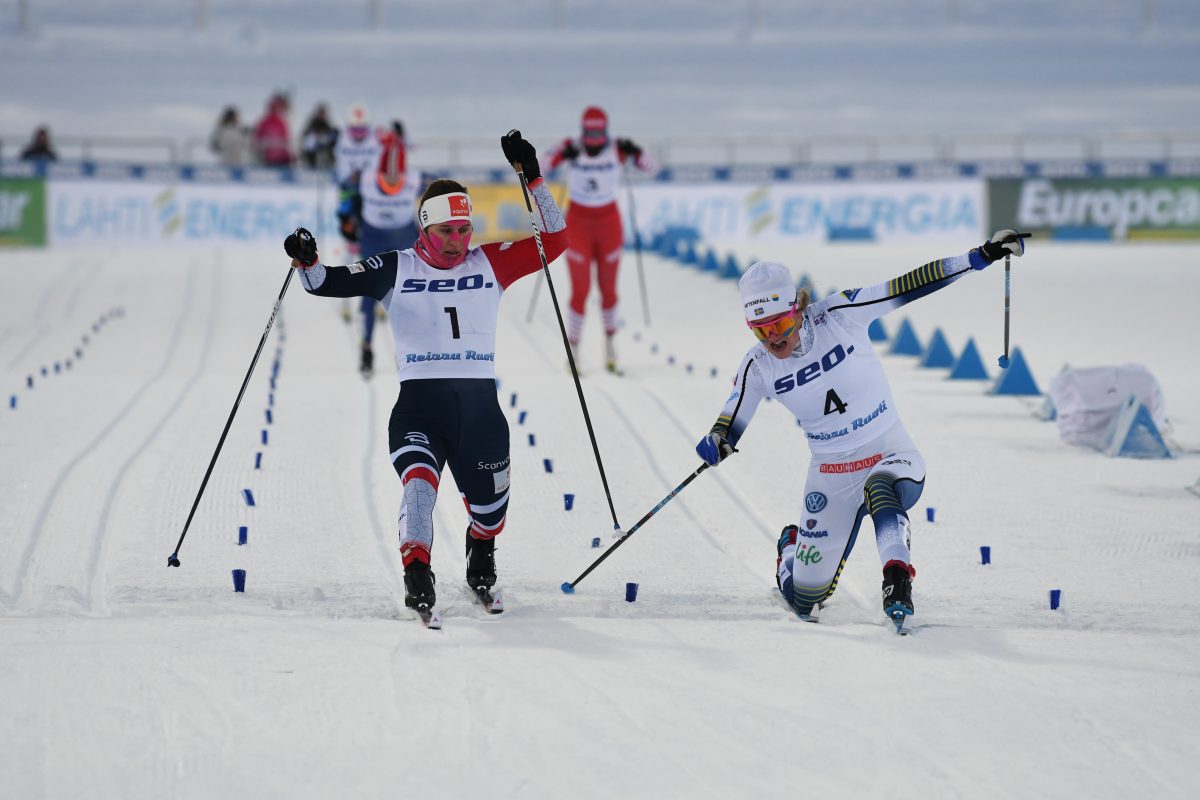
Moa Lundgren of Sweden out lunges Norway’s Tiril Udnes Weng for the win during the U23 World championship 1.4 k classic sprint in Lahti, Finland. (Photo: Doug Stephen)
FIS Junior World Ski Championhips U23 1.4 k/1.6 k Classic Sprint
Monday, the second day of racing at the 2019 Junior World Ski Championships in Lahti, Finland the U23 women raced a 1.4-kilometer classic sprint.
Norway’s Tiril Udnes Weng set the standard in qualification. Her 3:26.52 minute time placed her in bib 1 for the heats.
Three U.S. skiers qualified for the heats. Julia Kern qualified in 16th (+9.09), Hannah Halvorsen 24th (+11.89), and Hailey Swirbul 25th (+12.31). The fourth U.S. entrant, Evelina Sutro placed 37th overall.
“Though it wasn’t a perfect day for the U23s, it was exciting to establish a baseline from which we can improve,” Swirbul emailed. “We were in the mix during the quarterfinals, and I think our team gave a good effort today but is left wanting more. Personally, I thought I had a good day. I felt good, had good skis, and raced to my strengths the best I could. I’m excited to see how this team and I progress over the next few years to keep moving up and up in the U23 division!”
Halvorsen skied in the second heat where she placed fifth (+2.39) behind heat winner Moa Lundgren. Lundgren posted a 3:24.60 finishing time in the heat and ultimately placed first overall. Halvorsen ranked 23rd in the final standings.
Swirbul and Kern were grouped in the third heat where they finished fifth and sixth respectively. France’s Delphine Claudel won the heat in 3:27.16, Swirbul was 1.31 seconds back, Kern 3.24.
Swirbul placed 24th overall, Kern 27th.
“It was a really cold day out there racing at the legal limit of -4F,” Kern emailed. “It was not the day I dreamed of, but I am looking forward to more races to come this week. I caught the tip of my ski on someone’s pole cornering the first 180 and took a fall. I was able to jump back up on my feet and hammer to catch up, but that energy cost me early on that I did not have cresting the last hill. It was really fun to get to race side by side with Hailey in the heat!”
For Canada, Sadie White finished 35th, Marie Corriveau 38th, Hannah Mehain 49th, and Natalie Hynes 55th.
Lundgren, who was the fourth fastest qualifier, won the women’s final in 3:18.33, only 0.05 seconds ahead of Weng in second. Russia’s Aida Bayazitova took third (+3.78). Anastasia Kirillova of Belarus was fourth (+4.12), Norway’s Amalie Haakonsen fifth (+7.75), and Johanna Hagstroem sixth (+37.54).
After racing on a slightly bigger World Cup stage, Valnes showed no nerves as he clean-sweeped the heats and the final which he won in 3:21.14 minutes. Russia’s Sergey Ardashev placed second (+1.38) and Norway’s Joachim Aurland third (+2.00).
In fourth place was Russia’s Ivan Yakimushkin (+2.59), Norway’s Sivert Wiig in fifth (+7.31), and Sweden’s Marcus Grate sixth (+15.53).
Canada placed three athletes in the heats after Ritchie Graham qualified in 19th (+12.32), Julian Smith 22nd (+13.39), and Antoine Cyr 24th (+13.84). Teammate Gareth Williams finished 52nd overall.
For the U.S., Peter Holmes advanced to the heats after qualifying in 20th (+13.05). Daniel Streinz placed 41st overall, Hunter Wonders 56th, and Braden Becker 63rd.
“It was a good day out in Lahti, sunny skies but brutally cold,” emailed Holmes. “The Junior’s performance the previous day amped me up and made me excited to race. I had a solid qualifier and was feeling very good in the quarter final. I was positioned well throughout the race, but unfortunately got tangled up with another skier in my heat on the last downhill and went down. It’s a bummer, especially at U23s, but that’s racing.”
No North Americans advanced beyond the quarterfinals. Holmes placed sixth in the first quarterfinal to conclude his day ranked 27th in the final standings.
Cyr was fourth in the second heat and placed 20th overall.
Smith and Graham were fourth and sixth respectively in heat four. Smith ranked 19th overall, Graham 26th.
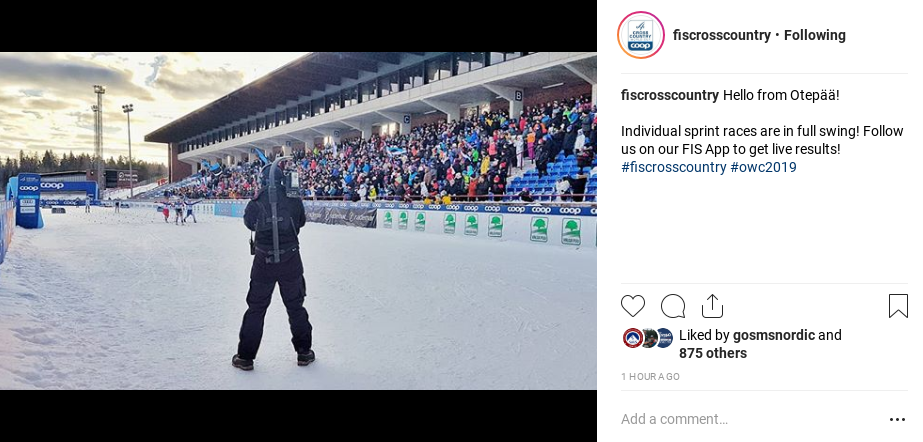
It’s on and it’s over — the World Cup classic sprints in Otepää, Estonia. (Photo: @fiscrosscountry Instagram screenshot)
FIS World Cup Otepää, Estonia 1.3 k / 1.6 Classic Sprint
Starting the day’s performance benchmarks off was Stina Nilsson of Sweden with the fastest qualifier in the women’s 1.3-kilometer classic sprint in Otepää on Saturday. She stopped the clock in 3:07.62 minutes.
The U.S. Ski Team’s (USST) Jessie Diggins was the top-qualifying North American in 18th (+5.37). Sadie Bjornsen (USST) qualified 20th (+5.71), and Ida Sargent 27th (+8.38).
On a course rewarding patience and technical skiing know how, Norway’s Maiken Caspersen Falla won the overall in 3:05:16 minutes. Russia’s Natalia Nepryaeva placed second (+1.40), and Maja Dahlqvist of Sweden third (+5.78). Also from Sweden, Jonna Sundling, who fell at around the 1:30 mark in the final, placed fourth (+8.12), with Slovenia’s Katja Visnar fifth (+23.22).
Nilsson placed second to Falla in the first semi-final, but did not start the final. Nilsson had won the last four World Cup sprints, all in skate, coming into Otepää.
Bjornsen looked strong in the fifth heat, yet stepping around the right hand turn before the final straight she fell taking out several other skiers. Bjornsen was given a yellow card for obstruction. She ended up 22nd overall.
Diggins placed second to Falla in the second heat to advance to the first semi. She was eliminated after finishing in sixth (+3.68). Diggins placed 12th overall.
Sargent finished third in the third heat, to place 15th overall.
U.S. athlete Rosie Brennan (APU) finished 45th (+15.81).
Dahria Beatty (CNST) was the only Canadian entered. She placed 44th overall (+15.79)
Norway’s Johannes Høsflot Klæbo was the fastest qualifier for the men in the 1.6 k classic sprint with a time of 3:21.99 minutes.
The young Norwegian seems on form as he swept his heat, semi, and final on his way to the win. Klæbo won the final in 3:20.05 minutes. Alexander Bolshunov of Russia, the only non-Norwegian in the final, was second (+1.51), and Pål Golberg third (+2.53). Rounding out the final three spots in the final were Eirik Brandsdal in fourth (+2.57), Mattis Stenshagen in fifth (+7.69), and Erik Valnes in sixth (+11.99).
For the U.S., Erik Bjornsen (USST) was the fastest qualifying North American in 23rd (+8.2), Andy Newell (SMS T2) 26th (+8.75).
Bjornsen was knocked out of the rounds after placing fifth in the second heat. He placed 24th overall. Newell ended up third in the first heat, 2.99 seconds in back of Klæbo. Newell, in his second World Cup sprint of the season, placed 15th in the final standings.
Kevin Bolger (USST) finished in 41st (13.13), Ben Saxton (SMS T2) 44th (+14.16), and Ben Lustgarten (CGRP)63rd (+23.04).
For Canada, Lenny Valjas (CNST) was 43rd (+13.61), and Bob Thompson 51st (+15.96).
Day two of the NorAm weekend was interval start classic, with very cold conditions delaying the start and simplifying the ski preparations.
Katherine Stewart-Jones (CNST) topped her Friday 2nd place with a clear win in the 10km, finishing in 28:51.6 with the fastest time on all three laps. Cendrine Browne (CNST) was second at 30.8 behind. Zoë Williams (Nakkertok) was third at 1:53.5, just pulling clear of Frédérique Vézina (CNEPH) by 3.1 seconds with a fast final lap.
In the men’s 15km, Scott Hill (Hardwood) bounced back from a slow start to the season with a well-timed victory to join Stewart-Jones on the World Championships team. Hill was fastest on the last three of four 3.75km laps to win in 36:59.7, 9.0 seconds ahead of a fading Russell Kennedy (Team R.A.D.). Graham Nishikawa (CPNST), here training for his role as Brian McKeever‘s guide, held onto third at 38.0 seconds, just 3.2 seconds ahead of a fast finishing Dominique Moncion-Groulx (Nakkertok).
There are two more automatic selections for World Championship available on Sunday in the mass start skate races (20km for women, 30km for men). With cold temperatures and heavy overnight snow predicted, it should be an exciting end to the weekend.
The teams from France, Norway and Germany claimed the positions at the top of the podium on Saturday in the women’s 4 x 6-kilometer relay in Ruhpolding, Germany, cheered on by over avid 25,000 fans lining the course.
France with Julia Simon, Anaïs Bescond, Justine Braisaz and Anaïs Chevalier stayed in the top group all race mainly due to the best shooting performance of the day, at times with a lead of over half a minute. On the anchor leg, Chevalier defended her narrow lead through three loops and two shooting stages to the finish line in a time of 1:09:27.7 hours, with no penalty and just four spares. According to an IBU press release, it was their first win since 1994 at this venue with a long tradition on the biathlon competition calendar, which has undergone a slight redesign for this season to add stands and make a downhill section less tricky.
Behind the French women, Norway with a team comprised of the reactivated veteran Synnøve Solemdal, Ingrid Landmark Tandrevold, Tiril Eckhoff and anchor Marte Olsbu Røiseland was second, with Røiseland narrowing the gap to Chevalier on the final loop from 21 to seconds but not quite catching up to finish 11.5 seconds back (with no penalty and seven spare rounds). The home team from Germany with Vanessa Hinz, Laura Dahlmeier, Franziska Preuss and Denise Herrmann was third, after the fast Herrmann was unable to catch the leaders when she needed all three spares in the final shooting to clear her targets (+23.4, with no penalty and nine spares).
Over a minute behind the podium finishers, the fourth team crossing the line were the 2018 PyeongChang Olympic relay silver medalists from Sweden around anchor Hanna Öberg (+1:29, with no penalty and nine spares).
For the North American teams it was a race with many ups and downs.
Canada began the race with Sarah Beaudry, who moved the team as high as sixth thanks to a clean shooting performance in her standing shooting stage after she had required two spares in prone. She then lost time to the top teams on the track to exchange in 13th position (+54.5 sec). Emma Lunder then managed to bring the team back up to sixth position but she also needed two spares in prone and followed that up with a clean standing stage, tagging off in seventh place right behind Sweden (individually her leg was the fifth-fastest). Megan Bankes kept up with the teams around her on the course and slightly improved to fifth position less than a minute back, but then missed two targets in her standing stage and could not clean with her spares. She skied a single penalty lap (0+1, 1+3). She tagged anchor Rosanna Crawford in 10th position (+2:14), who then herself added a penalty in her prone stage.
At the site of her podium finish a year ago and coming off a 27th place in the sprint earlier this week, the Canadian team leader then needed two spares in the standing stage and ultimately came to the finish in 12th position (+3:01.6), with two penalties and 13 spare shots for the team.
For US Biathlon, Clare Egan began the race and recorded a clean prone stage to move the team up all the way to third position coming into the standing shooting stage despite a broken pole. She then missed three targets and ran out of spares and skied two penalty laps.
That set the team back quite far, exchanging in 19th position (+1:26.6). Susan Dunklee needed four spares in her shooting stages but avoided another penalty (0+1, 0+3) to exchange in 12th position (+1:47.3).
Rounding out the team after being called back up to the World Cup from the second-tier IBU Cup following solid performances in Duszniki Zdroj, Poland, Joanne Reid only needed one spare in each of her shooting stages (0+1, 0+1) to tag off in 15th position. In her second time anchoring a relay this season, Deedra Irwin – who had recorded her first clean shooting performance in a race in Poland a week ago – then required all her spares to clear her targets in the prone shooting before achieving another clean standing shooting stage. She crossed the line in 16th position, 4:06.0 back, with two penalties and 12 spare shots for the team.
Races in Ruhpolding conclude on Sunday with mass starts for the women and men. US Biathlon’s Sean Doherty is scheduled to be lone North American starter for the elite men’s field (though Canada’s Christian Gow would be the next one up from a reserve list in case of an illness), while Egan and Dunklee are qualified for the women.
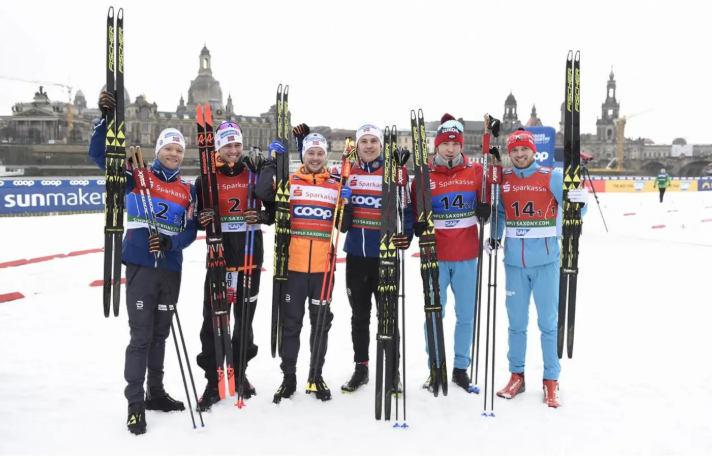
The men’s team sprint podium from the Dresden, Germany World Cup team sprint: From left to right, Norway II in second, Norway I first, and Russia I third. (Photo: fis-ski.com screenshot)
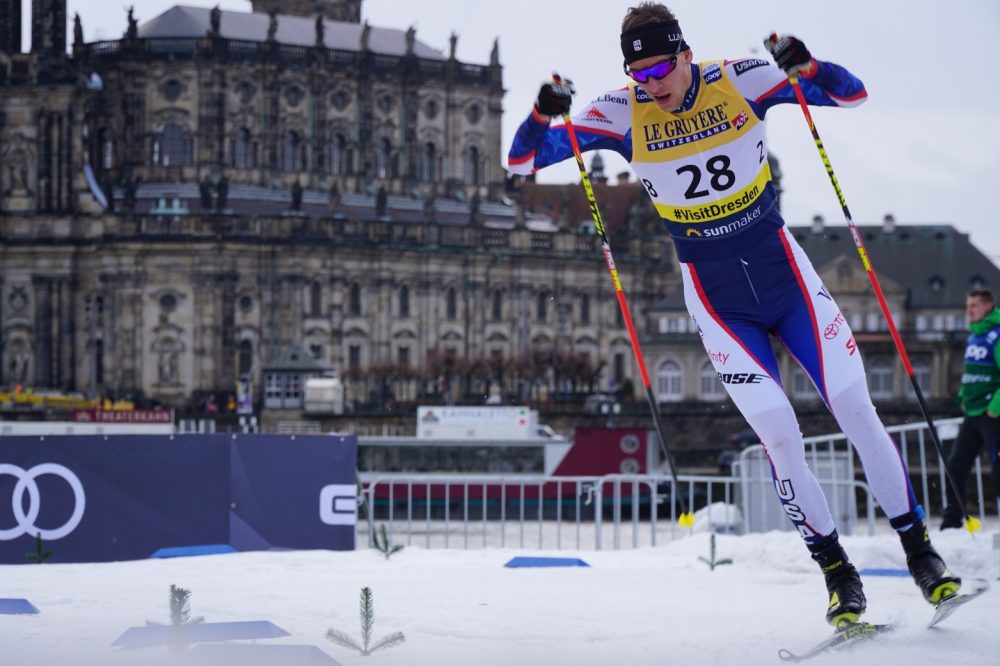
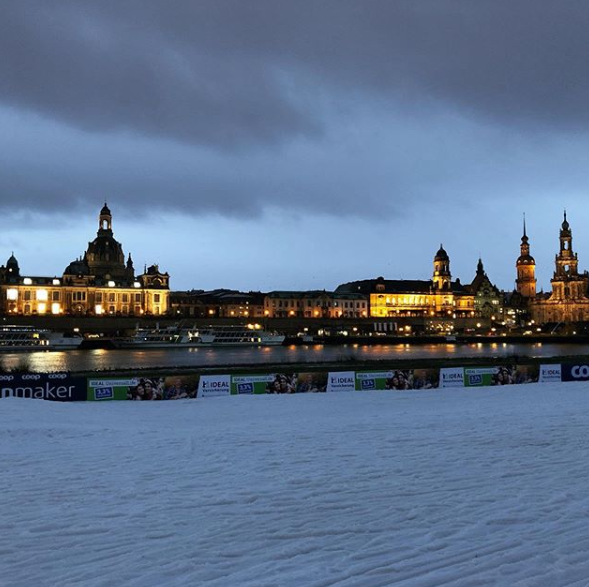
A strip of imported snow along the Elbe river, iconic architectural reminders of old-world Europe’s city-scape in Dresden, Germany, Lycra, speedy skiers, and teams of two: all the ingredients for the men’s 1.6-kilometer freestyle team sprint.
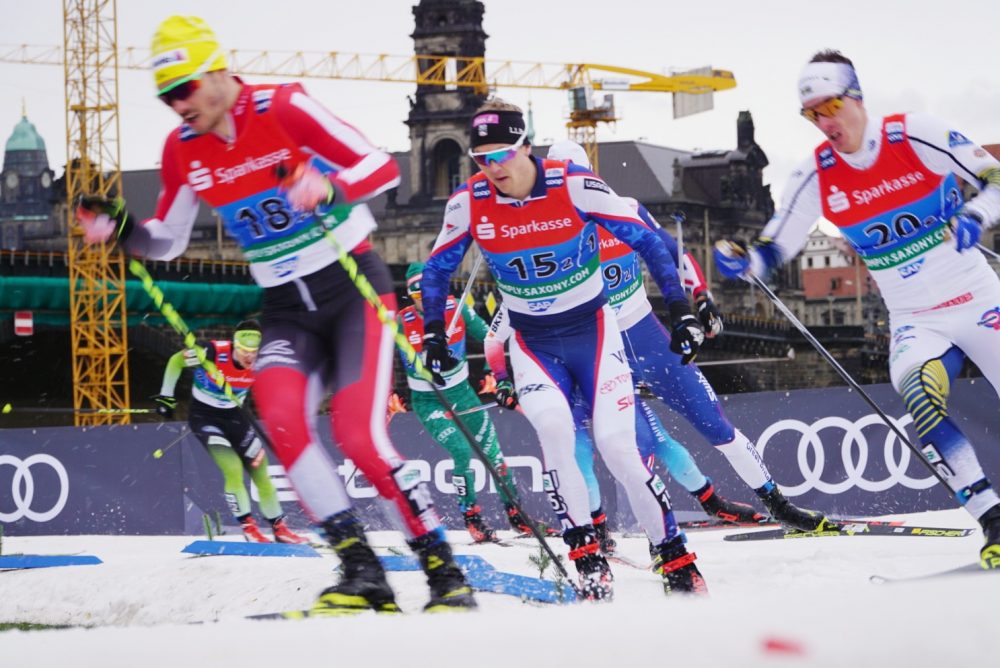
With tight pack skiing a function of the the relatively flat Dresden ski loop, the ten teams in the final attempted to play stay-out-of-trouble-skiing for the six total laps. But with a crowded tag area and tight corners where skiers abruptly bled speed, mix ups and tumbles occasionally picked skiers out of the front scrum.
Coming into the final tag, 8 k into the race, the top-seven teams came through the time check all within 2.63 seconds of one another.
Norway II, Italy I, Russia II, Norway I, France I, Russia I, and Great Britain sped through with the remaining three teams in the finals, Switzerland I, Austria I, and Australia I within closing distance to the leaders.
Intermittently contracting and spreading out, no decisive moves to splinter the group materialized until the last lap.
In the team sprint, it’s not simply the fastest one or two lap skier who prevails — each athlete, during their three respective legs (each leg consisted of three laps), was required to mentally focus and push the boundaries of their aerobic and anaerobic engines for 4.8 k total.
On that last lap, the pull away move was simple enough.
Leading much of the final k was Norway I’s Sindre Bjørnestad Skar, the winner of Saturday’s skate sprint in Dresden. Skar kept out trouble, positioning himself at the front. He then shifted into a sixth or seventh gear no other skier could match.
Up to the point Skar began to channel his reserve of booster-fuel, it appeared it could have been one of several teams across the line first. But approximately 4.6 k into Skar’s pathway to the finish line, his top effort was simply too much. he was on another level of endurance-sprint fitness as he closed out the win.
Skar along with his teammate Erik Valnes won the final in 22:38.72 minutes.
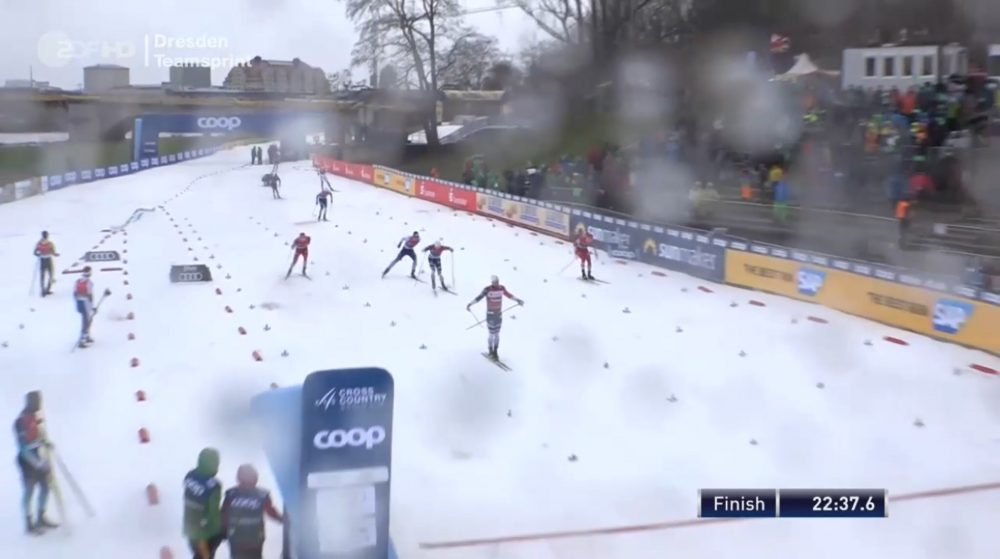
Sindre Bjørnestad Skar in front to finish first for Norway I during the Dresden, Germany World Cup team sprint on Sunday. (Photo: ZDF screenshot)
But behind Skar, a four team whirlwind charged down together on the finish. A photo-finish captured the moment to decide the final standings. In second (+0.75) was Norway II’s Pål Golberg and Eirik Brandsdal, Russia I’s Artem Maltsev and Gleb Retivykh third (+0.80).
Fourth place, 1.01 seconds back, went to Roland Schaad and Jovian Hediger of Switzerland. Russia II’s Andrey Krasnov and Alexander Terentev were fifth (+1.04).
Great Britains’s James Clugnet and Andrew Young placed sixth (+3.17).
Right in the middle of the the finishing lane mix, possibly fighting for podium scraps was Italy’s Federico Pellegrino. He appeared to catch his tip on another skiers ski-tail and took a spill. He and teammate Dietmar Nöckler placed 10th in the 10 team final. The Italian duo won last season’s team sprint in Dresden.
Canada’s Bob Thompson and Len Valjas placed seventh (+2.46) in the first semi-final and did not advance to the final. It was the same fate for the only U.S. team entered in the men’s team sprint. Andy Newell and Erik Bjornsen placed 10th (+3.66) in the second semi, and failed to make the finals.
Canada placed 15th in the final standings, the U.S. 19th.
In bib 15, the U.S. Ski Team’s Erik Bjornsen navigates the crowds during Dresden, Germany’s team sprint on Sunday. (Photo: Garrott Kuzzy)
Racing in bib 4 for the U.S., Julia Kern keeps pace in the women’s team sprint during the Dresden, Germany World Cup on Sunday. (Photo: Garrott Kuzzy).
FIS World Cup Dresden, Germany 6 x 1.6 k Freestyle Team Sprint
The first World Cup team sprint of the season was run amidst drizzle and the Dresden, Germany city-scape as the women raced a total of six 1.6-kilometer laps.
Round and round on the looping course, the pace was a mix of tactically subdued speeds with sustained bursts of energy to break the pack.
After all the speed changes and exchanges with one athlete tagging off to the next, it came down to a 1.11 second difference between first place Sweden I and the three closet teams chasing from behind that ended in a photo finish.
Sweden I’s Stina Nilsson and Maja Dahlqvist won in a time of 24:02.5 minutes. Sweden II’s Ida Ingemarsdotter and Jonna Sundling placed second (+1.11), and Norway I, with Eide Mari and Maiken Caspersen Falla in third (+1.11).
U.S. I, featuring Julia Kern and Sophie Caldwell placed fourth (+1.11) after the photo finish was reviewed.
The U.S. entered a second team, consisting of Ida Sargent and Hannah Halvorsen. That duo contested the first semi-final, the same semi as U.S. I, but did not advance after placing fourth (+5.44). The top-three teams from each semi advance to the final, along with the next four fastest teams which are the combined “lucky losers”. Today, the second semi was the faster of the two. The four lucky loser team advancing to the final all originated from the second semi.
In the men’s 6 x 1.6 k skate team sprint race, Norway I and Norway II took the top two podium spots.
In a lunge at the line, Norway I’s Erik Valnes and Sindre Bjørnestad Skar won the final in 22:38.72 minutes. Pål Golberg and Eirik Brandsdal of Norway II placed second (+0.75) and Russia I’s Artem Maltsev and Gleb Retivykh third (+0.80).
Canada’s Bob Thompson and Len Valjas placed seventh (+2.46) in the first semi-final and did not advance to the final. It was the same fate for the only U.S. team entered in the men’s team sprint. Andy Newell and Erik Bjornsen placed 10th (+3.66) in the second semi, and failed to make the finals.
Canada placed 15th in the final standings, the U.S. 19th.
IBU World Cup Oberhof, Germany 4 x 6 k / 4 x 7.5 k Relay
In the women’s 4 x 6 k relay, Russia placed first in a time of 1:18:46.4 hours. Evgeniya Pavlova, Margarita Vasileva, Larisa Kuklina, and Ekaterina Yurlova-Percht made up the team that used eight spares on their way to the win.
Germany placed second (+33.5) with two penalty loops and 10 spare rounds. Karolin Horchler, Franziska Hildebrand, Franziska Preuss, and Denise Hermann comprised Germany’s second place team that had two penalties while using 10 spares. The Czech Republic’s Lucie Charvatova, Veronika Vitkova, Marketa Davidova, and Eva Puskarcikova placed third (+36.7) with 1 penalty loop and six spares.
The top spot for the podium came down to the final leg, when Yurlova-Percht pulled out the win when Hermann skied two penalty loops. The Russian used three spares but escaped with no penalties to take the lead out of the shooting range on the final ski loop.
Susan Dunklee, Clare Egan, Joanne Reid, and Emily Dreissigacker all represented the U.S. and placed 12th (+5:35.8) while skiing five penalty loops and using 16 spares.
Canada’s Sarah Beaudry, Emma Lunder, Megan Bankes, and Rosanna Crawford finished in 13th (+5:58.8) with four penalty loops and 15 spares.
Russian also claimed the men’s relay, winning in a time of 1:20:54.3 hours. The winning team of Maxim Tsvetkov, Evgeniy Garanichev, Dmitry Malyshko, and Alexander Loginov skied no penalty laps and used six spares on their way to victory.
Antonin Guigonnat, Simon Desthieux, Quentin Fillon Maillet, and Martin Fourcade raced for France. The French team placed second (+1:01.1) while skiing a single penalty lap and using eight spares.
Austria’s Tobias Eberhard, Simon Eder, Dominik Landertinger and Julian Eberhard placed third (+2:18.6) with one penalty lap and using seven spares.
Canada’s Scott Gow, Christian Gow, Jules Burnotte, and Brendan Green and the U.S. team of Leif Nordgren, Sean Doherty, Travis Cooper, and Max Durtschi were eventually lapped. Neither team was given an official finishing time.
Canada was ranked 18th in the final standings, the U.S. 19th.
For both relays today, the snowy weather and tough course conditions made for a strenuous day of shooting and skiing.
Norwegian Sindre Bjørnestad Skar (c) after taking first in the men’s 1.6-kilometer freestyle race on Saturday. Russia’s Gleb Retivykh placed second, while Norway’s and Erik Valnes placed third. (Photo: Garrott Kuzzy /LumiExperiences.com)
The white ribbon of snow created a stark contrast to the green grass and gothic architecture along the bank of the River Elbe for the second year of city sprints in Dresden, Germany. As is typical in these events, the 1.6-kilometer out and back course was predominantly flat with a few short hill punches and a 180-degree hairpin turn at the halfway mark, where the race seemed to truly begin. The nature of the course challenged skiers as there was little opportunity for recovery, and as always, a small margin for error.
Last year in Dresden, Italy’s Frederico Pellegrino upset a seemingly unbeatable Johannes Høsflot Klæbo in the men’s sprint, going on to win back-to-back the next day in the team sprint as well. This Saturday, after he won the qualifier in a time of 3:21.12, the question quickly became whether or not Pellegrino would remain king of the track in Dresden.
Heading into his quarterfinal, Pellegrino appeared to employ the same patient tactics which paid off for him in 2018. The Italian skied calmly in the middle of the pack for the first half of the course, moving slowly ahead after the hairpin. Coming into the final hill just before the finishing lanes, Pellegrino surged to take the lead, stepping on the ski of Frenchman Baptiste Gros as he passed by. Holding onto the lead, Pellegrino crossed the quarterfinal in first ahead of Norway’s Pål Golberg in second.
Due to the hangup with Pellegrino, Gros staggered, losing momentum, but stayed on his feet heading down to the final stretch, crossing the quarterfinal in third. More excitement ensued as the two Russians in the heat, Alexander Terentev and Andrey Krasnov, caught their skis on the pine boughs that were used to line the course and mark out the lanes and crashed in the final meters before the line.
It was ruled that the hang up caused by Pellegrino was an obstruction, earning him a yellow card and relegating him to last in his heat. He finished the day in 30th position.
With Pellegrino out of the running and Klæbo sitting out the races in Dresden to recover from his overall win in the Tour de Ski, focus shifted toward Sindre Bjørnestad Skar and Erik Valnes of Norway, Lucas Chavanat, who took third in last year’s Dresden city sprint, Baptiste Gros, and Richard Jouve of France, and Gleb Retivykh of Russia, all of whom are ranked highly on the overall sprint World Cup standings.
In the first and fastest heat of the semifinals, Skar and Retivykh jockeyed for the lead throughout the race, Skar punching ahead on the final hill, but Retivykh bested him in the final meters with a time of 3:32.58, just 0.14 seconds ahead of the Norwegian. Both Jouve (+0.20) and Gros (+0.53) advanced as lucky losers. Everyone in the first heat skied a faster time than the skiers in the second wave. Advancing from the second semifinal was Valnes (3:37.72) and Chavanat (+0.15).
As the men faced off in the final, it was anyone’s game through the first half. Rounding a turn late in the race, Gros caught his ski on a V-board lining the course causing him to fall, taking Chavanat down with him. Left standing, Skar and Retivykh again dueled for position, eager to be first to the top of the final roller. Skar attacked at this seemingly pivotal spot, positioning himself just ahead of Retivykh. The Russian fought back, not willing to relinquish the victory until the very end when Skar threw his foot forward for the win with a time of 3:25.94.
Retivykh finished just 0.11 seconds behind, followed by Valnes (+2.83) in third. Jouve cruised through the finish in fourth (+11.22) followed by the two Frenchman, Chavanat in fifth (+21.94) and Gros in sixth (+23.93).
Skar is now ranked second in the overall World Cup sprint standings.
“It feels good to be the winner today,” Skar told the International Ski Federation (FIS). “It is my fourth final this year and I’ve been number four, and number five, and number six, so to be on the top now today, that’s a very good feeling.”
Despite the man-made snow and warm and wet weather leading into the race, the event coordinators were able to produce a solid and fast track for the athletes.
“Yesterday was unbelievably sugary and was 8 inches deep by the end of the testing period,” Matt Whitcomb told FasterSkier in a call. “Today they were able to take advantage of salting because it had gotten warmer and it had rained a little bit so that added moisture which allowed the salt to react with the snow an make for a very hard surface.”
“I think the conditions of the track were very good,” Skar told FIS. “But of course with the headwind up to the U-turn, it is hard to be in the front and it’s a lot of tactics, but that’s the same for everyone so you just have to go with it and try to be up there.”
Andy Newell placed 25th in Saturday’s 1.6-kilometer freestyle sprint in Dresden, Germany, his first World Cup race since last season. (Photo: Garrott Kuzzy /LumiExperiences.com)
In his return to World Cup skiing after racing the domestic circuit, American Andy Newell qualified in 19th (+5.58) and ultimately ended the day in 25th. The second North American to finish in the top 30 on Saturday, Kevin Bolger (USST), qualified in 28th (+6.76) and finished in 29th overall.
Both Bolger and Newell raced in the third quarterfinal, along with Jouve, Norwegians Eirik Brandsdal and Gjøran Tefre and Russia’s Artem Maltsev. Jouve won the quarterfinal in a time of 3:28.24, while Newell crossed in fifth (+1.31), and Bolger sixth (+1.45). ending the day in 25th and 29th respectively.
Americans Andy Newell (l) and Kevin Bolger after their quarterfinal in the men’s 1.6-kilometer freestyle sprint in Dresden, Germany. (Photo: Garrott Kuzzy /LumiExperiences.com)
“We had Simi Hamilton get sick on Thursday, which was disappointing because he’s been feeling great, qualifying really fast, ready for big results,” said Whitcomb. “But, we decided to bench him this weekend, so it was awesome to have Andy jump in as a replacement and qualify for the rounds with Kevin Bolger. Putting two guys in there, having only started four wasn’t too bad for us.”
“It feels good to be back,” Newell said during a phone conversation. “You know, your first World Cup of the year, you don’t know what to expect. I was hoping to do a little bit better than I did today. It’s always hard to jump on a plane and come over and race, but I think it was a good start.
American Kevin Bolger during the qualifier for the men’s 1.6-kilometer freestyle sprint in Dresden, Germany, his first World Cup race since last season. (Photo: Garrott Kuzzy /LumiExperiences.com)
“I think we had good skis and I felt pretty good in qualification and I felt like I did what I needed to do to get to a good position,” Newell continued. “Then I think I maybe forgot how aggressive it is in the last 200-meters here compared to some other races. I remember last year I was taken by surprise by how much contact and how much jostling goes on up and over the last little bump and into the lanes. I think I was caught by surprise again this year. Even though I was in a great place with good energy, I just ended up getting ping-ponged around a little bit.
“On the World Cup here you can’t give anybody an inch,” he continued. “They’ll take advantage of that because the competition is so tight. So I think that’s kind of where I messed up today, but it’s good to check in and see how the speed is going and see what I need to work on if I am going to come back over and race later in the year.”
The final American in the race, Erik Bjornsen, finished in 33rd in the qualifying round (+7.43). Simi Hamilton did not start due to illness.
For Canada, Bob Thompson placed 32nd overall, Lenny Valjas 47th (+9.55).
Dresden, Germany looking good for the city sprints. (Photo: @skiweltcupdresden Instagram screenshot)
FIS World Cup Dresden, Germany 1.6 k Freestyle Sprint
The city of Dresden resting alongside the River Elbe hosted a 1.6-kilometer freestyle sprint for the second year running.
Hannah Falk of Sweden, last year’s sprint winner in Dresden, won the qualifier in a time of 3:41.85 minutes. The U.S. Ski Team’s (USST) Sophie Caldwell was the second fastest qualifier (+0.49), with Falk’s teammate, Stina Nilsson, qualifying in third (+0.80).
Canada’s Dahria Beatty placed 20th (+8.72) in qualification, while Julia Kern (USST D-Team) in her first European based World Cup qualified in 23rd (+10.84).
Both Beatty and Kern were eliminated in the first heat which was won by Nilsson in 3:43.87. Beatty placed third (+1.18), Kern fourth (+1.25).
Beatty ended the day in 16th place overall, Kern 19th.
Caldwell advanced to the finals where she finished in fifth place, 2.61 seconds behind the day’s sprint winner Nilsson. Nilsson won the final in 3:48.49 minutes. It was an all Sweden podium as Maja Dahlqvist placed second (+0.24) and Jonna Sundling third (+0.54).
No other North American women advanced to the heats.
Hannah Halvorsen (USST D-Team) racing in her first World Cup placed 35th overall. Ida Sargent (USST) placed 38th, first time World Cup participant Hailey Swirbul (USST D-Team) 41st.
For the men, Italy’s Federico Pellegrino qualified first in 3:21.12 minutes. Britain’s Andrew Young was second fastest (+0.47), and Gleb Retivykh third (+1.27).
In his return to World Cup skiing after racing the domestic circuit, American Andy Newell was the highest ranked North American in qualification, placing 19th (+5.58). Kevin Bolger (USST) qualified in 28th (+6.76).
Newell and Bolger both raced the third heat where they were eliminated from the rounds. Newell placed fifth (+1.31), Bolger sixth (+1.45) in the third heat, which was won by Richard Jouve of France in 3:28:24.
In the final standings, Newell ranked 25th, Bolger 29th overall.
The race was won by Norway’s Sindre Bjørnestad Skar in 3:25.95 minutes. Retivykh placed second (+0.11), and Erik Valnes of Norway third (+2.83).
Erik Bjornsen (USST) finished in 33rd (+7.43), Simi Hamilton (USST) did not start due to illness.
For Canada, Bob Thompson placed 32nd overall, Lenny Valjas 47th (+9.55).
IBU World Cup Oberhof, Germany 10 k / 12.5 k Pursuit
In the women’s pursuit Lisa Vittozzi of Italy, who was the first skier off today as she won Thursday’s sprint, also won the 10 k pursuit in a time of 32:32.9 minutes. Vittozzi had two penalties (0+1+1+0) on her way to the win.
Anastasiya Kuzmina of Slovakia was second with four penalties (2+1+1+0), 14.5 seconds back. Kuzmina was the seventh starter, and began the race 30 seconds behind Vittozzi. Anaïs Chevalier of France place third (+27.9, 2+1+2+0). Chevalier was the second starter, beginning with a five second deficit.
Susan Dunklee of the US Biathlon Team had a season best result, placing seventh overall (+1:01.2). Dunklee was the 10th starter, setting off 41 seconds back. Dunklee had five penalties (2+1+1+1) on her way to seventh place.
Also for the U.S., Clare Egan, who place 13th in the sprint, fell back to 33rd in the pursuit after skiing seven penalty laps.
For Canada, Emma Lunders placed 39th (+3:31.4) with six penalties on her day. Rosanna Crawford placed 52nd (+5:23.4) also with six penalties.
In the men’s pursuit, Norway’s Johannes Thingnes Bø claimed the win in a time of 34:29.8 after three missed shots (0+1+1+1).
Arnd Peiffer of Germany place second on Saturday, finishing 15.1 seconds back from Bø after one penalty (1+0+0+0). Italy’s Lucas Hofer snagged the third and final podium, finishing 15.8 seconds behind the winner after shooting clean.
Two North Americans competed on Saturday, with American Sean Doherty finishing in 18th (+2:29.9) after skiing two penalties (2+0+0+0). Canadian Christian Gow also skied into the top 30, finishing in 27th (+2:57.4). Gow had two misses (1+0+0+1).
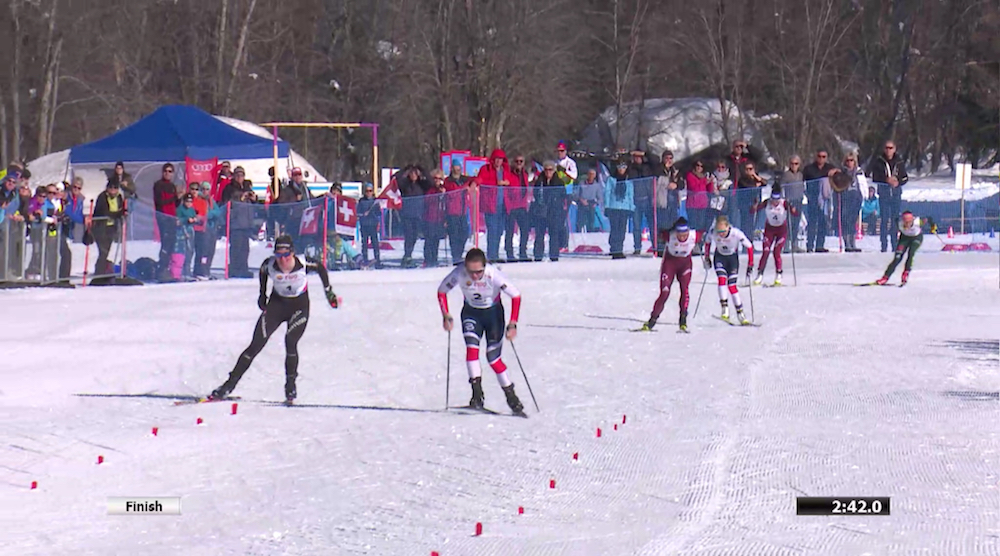
Norway’s Tiril Udnes Weng (second from l) and Switzerland’s Nadine Fähndrich (l) battle for first down the finishing stretch of the women’s final for the gold medal in the U23 World Championships skate sprint in Goms, Switzerland. Weng won it by eight-hundredths of a second. (Screenshot: Swiss Ski livestream)
(This article has been updated to include comments from Canada’s Laura Leclair, Katherine Stewart-Jones and Maya MacIsaac-Jones, as well as American Julia Kern.)
U23 World Championships (Goms, Switzerland): Freestyle sprints
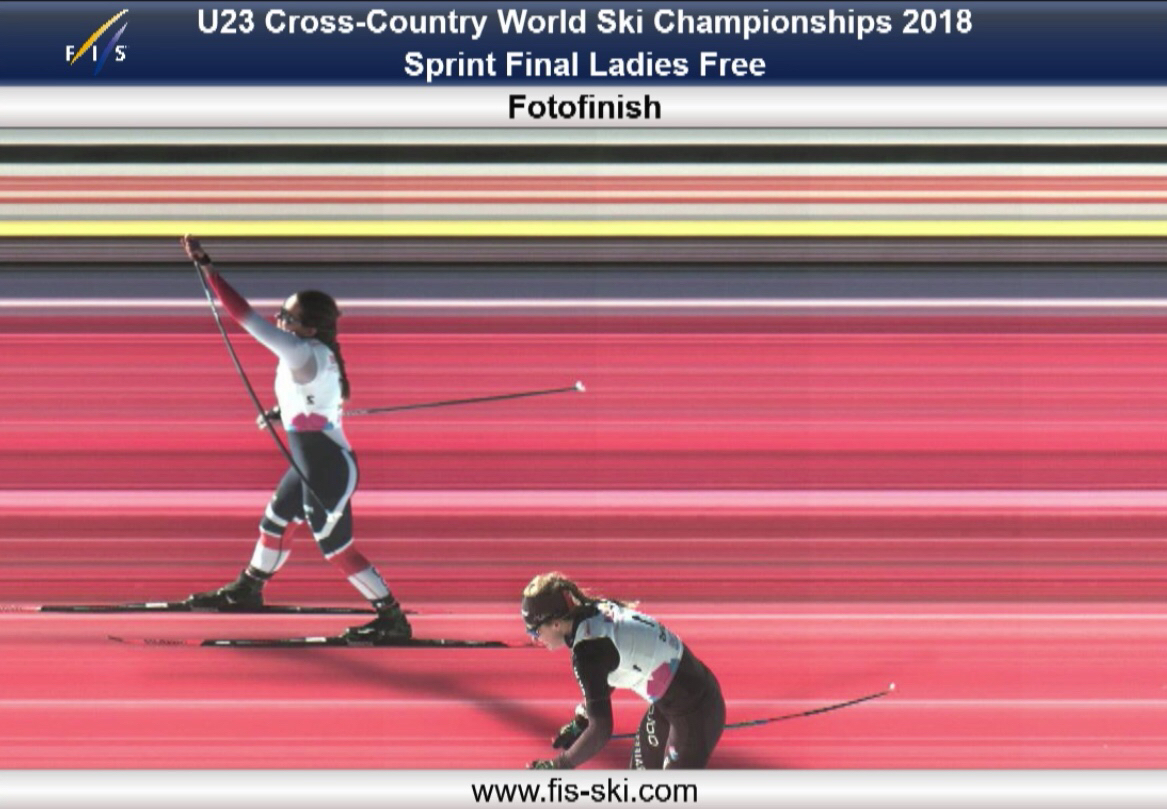
On the first day of U23 World Championships racing in Goms, Switzerland, Norway’s Tiril Udnes Weng tallied her first individual world title in the women’s 1.2-kilometer freestyle sprint, winning the A-final in 2:50.24 minutes, just 0.08 seconds ahead of Swiss World Cup regular Nadine Fähndrich in second. Another World Cup skier, Natalia Nepryaeva of Russia finished third, 4.78 seconds out of first.
Weng, 21, is no stranger to World Cups, either. Just two days ago, she qualified 11th in the World Cup skate sprint in Seefeld, Austria, and went on to place 17th overall.
On Monday, she qualified second, 0.2 seconds off Fähndrich’s top qualifying time of 3:03.51. Weng then placed second to Nepryaeva in the fourth quarterfinal, a heat that included Canadians Maya MacIsaac-Jones and Katherine Stewart-Jones, both of the Canadian National U25 Team. While Sweden’s Moa Olsson finished third in that quarterfinal and advanced as a lucky loser based on time, the two Canadians did not. MacIsaac-Jones had previously qualified in 19th and Stewart-Jones in 22nd. Overall, MacIsaac-Jones placed 18th and Stewart-Jones was 23rd on the day.
In an email, MacIsaac-Jones explained her goal had been to make the semifinals.
“My strategy was to stick behind the top two girls, and hang on as best I could,” she wrote of her quarterfinal. “As Canadians we tend to be pretty good at downhilling, so I tried to use that to my advantage. I wasn’t quite able to stick with the top girls over the crest of the big hill, but I was happy to be fairly competitive in the heat overall!”
Still, the top 20 was her best result in her fourth trip to Junior/U23 Worlds.
“I’m disappointed of course to have missed out on making the semi-final, but I feel I did the best I could with what my body had on the day so I’m happy with that,” she continued. “It was of course exciting to get my first top-20 , but also disappointing because I felt like my body wasn’t moving as well as it was at trials a few weeks ago (I got sick right after arriving in Europe which probably didn’t help with that).”
For Stewart-Jones, this marks her fifth Junior/U23 World Championships.
“Over the years I have learned that it’s just another race, and that I don’t need to treat it any differently,” she wrote in an email on Tuesday. “Coming into te race I knew that I was in the best shape I’ve been all year, but I also had only done one skate sprint qualifier and no heats) this year so I wasn’t sure what to expect.”
Her goal had been to reach the semifinals and finish in the top 12.
“I am happy with how I skied the qualifier. The quarterfinal was tough,” Stewart-Jones wrote. “My teammate Maya and I ended up being in a really fast heat. I felt like I skied well technically but I don’t think I skied it how I needed to to have a chance of moving on. I tried holding on to the top 2 girls over the top of the first hill and ended up losing time on the second… I think it would have made more sense to lay back a bit over the top of the first to save some gas for the end.”
Stewart-Jones as well as MacIsaac-Jones came incredibly close to making Canada’s 2018 Olympic team based on their results at NorAm trials earlier this month.
“Overall, I am happy with how the body feels but disappointed with how I skied tactically,” Stewart-Jones wrote. “Not making the Olympic team was definitely more frustrating than it was disappointing. The whole ordeal was a bit exhausting, with first missing out on the 4th spot by less than a second and then being 12th on the list of [11] quota spots, it was really as close as it gets. I’m doing my best to fuel that frustration into positive energy so that I can perform at my best here. I am really looking forward to the next 2 races!!”
Norway’s Tiril Udnes Weng (l) and Switzerland’s Nadine Fähndrich in a photo finish for first in the women’s freestyle sprint final at U23 World Championships on Monday in Goms, Switzerland. Weng won it by eight-hundredths of a second. (Screenshot: Swiss Ski livestream)
Fähndrich won both her quarterfinal and semifinal leading up to the final, and Weng won the second semifinal by 0.59 seconds over Nepryaeva. In the final, Weng had the edge.
“I dream about winning, that’s the goal of my season,” Weng said during a post-race interview in the arena. “So it felt good to win.”
Three Canadians made the heats, with Laura Leclair of the Pierre-Harvey National Training Centre (CNEPH) qualifying in 26th then placing third in her quarterfinal, 2.75 seconds behind German winner Nadine Herrmann. That put Leclair 15th overall on the day in her first U23 World Championships race.
“As it is my first time at Worlds and my first year in a big category (U23) I was coming here for experience,” Leclair wrote in an email on Tuesday. “Experience to ski internationally, in Europe and against the best. Of course, I was hoping to perform but I never anticipated a top 15.
“Since I was seeded 30th, I was a little skeptical of making it through the qualifier,” she continued. “Qualifying 26th was a very exciting moment.”
In her quarterfinal, she said the pace didn’t pick up until about halfway up a long uphill out of the start, a climb that lasted for about a minute and a half.
“I was in a strong position (4th) but it was hard to make my way to the top,” Leclair wrote. “At the top of the big hill, a girl broke a pole and I was able to pass her and push over the hill into the downhill in order to come closer to the two girls in front. The last uphill felt like it was just give or take. Obviously, I chose the give option and gave it all I had into the finish. My heat wasn’t one of the fastest so I wasn’t a lucky loser but I am very happy of how I skied that course.
“This season has been full [of] surprise,” she concluded. “Just qualifying for Worlds in Canada was one! I am very happy that all my efforts and my dedication to the sport are paying off. For the rest of the week, I want to have some strong races, especially in the skiathlon and maybe surprise myself again.”
Two Americans qualified in the top 30 as well, with Lauren Jortberg (Dartmouth Ski Team) in 14th and Julia Kern (U.S. Ski Team/Dartmouth/Stratton Mountain School T2 Team) in 21st. Jortberg went on to finish fifth in her quarterfinal, 7.28 seconds behind German winner Pia Fink, and Kern finished sixth in Fähndrich’s quarterfinal, 22.28 seconds out of first. Overall, Jortberg placed 22nd and Kern was 27th.
In an email, Jortberg, who competed at U23 World Championships last year at Soldier Hollow in Midway, Utah, explained her goal was to qualify for the heats.
“I honestly had no idea what to expect in Goms this year because Soldier Hollow felt just like US Nationals and the Super Junior National Qualifiers I’d been going to for the past ten years,” Jortberg, a Dartmouth College sophomore, wrote on Monday. “Obviously the competitors from all over the world was different, but was easy to visualize what is going to be like. The venues are similar in many ways because there are very few trees making it very open and a great spectators course.
“A big difference between Goms and Soldier Hollow is the little towns everywhere,” she continued. “The first ski we did here, we skied through the roads and through a town. There are ski trails everywhere here, we could even ski from the venue to the hotel (which is pretty far)! For the ski courses, I think Goms is one of the most challenging ski courses I’ve ever raced on. There are huge climbs are incredibly technical downhills! Its a one of the most exciting places I’ve ever raced, I love it so much.”
As for her racing on Monday, she wrote that she was “really psyched because I felt really strong and smooth in the qualifier! I was a bit bummed because I had to scrub a fair amount of speed skiing behind a girl I caught on the really technical downhill. The heats were really fun!! I had a great starting position and skied really smooth up the big climb. Then I took a very gutsy move on the downhill to sling shot into first place on the inside corner around the downhill turn. Unfortunately right after that I got caught up in a tangle on the last climb, and then I lost contact with the lead group. I was bummed to get caught up in a tangle, but it was really cool to be able to ski with these girls!”
Overall, Jortberg described the day as “pretty incredible.”
“My motto has always been that sprints are funny because ‘anything can happen’ for the good and bad!” she added. “I’m pretty excited for the rest of the week of racing even though this race was my main target. These courses play really strongly to my strengths so it should be fun to see what I can do!”
Kern explained in an email that she’s been sick for the past month so her main goal was to start Monday’s race. But for a long time leading up to this race, she had envisioned a top 10.
“Regardless of how I was feeling, one of my goals was to ski with good technique because that is something you can always control,” Kern wrote. “I was pretty content with my qualifier, given being sick. Skiing out there today, I had no idea if I would surprise myself and my illness wouldn’t impact my skiing or if I was just going to feel absolutely terrible. I was happy with how I placed given how I felt.”
In the heats, she wanted to stay in contact with leaders up the course’s big climb, then try to “drop the hammer on the downhill and last uphill.”
“However, my quarterfinal did not play out that way,” she wrote. “The pace was hot from the start, with bib #1 [Fähndrich] gunning from the start. I stuck with the heat until part way up the first climb, where I started to lose the leaders. I did not feel good and I had no energy so I was not able to hold the pace of the other competitors. I had considered not doing the heats because I felt pretty wiped after the qualifier, but the competitor inside me couldn’t just walk away from my favorite thing—sprint heats.
“Given my current health state, I feel okay about my day, but I am obviously bummed because this was the race I was looking forward to most this season,” Kern added. “I am looking forward to getting healthy in time to race the 10k classic, or at the very least the skiathlon!”
Also for the U.S., Lydia Blanchet missed qualifying by 0.32 seconds in 32nd, as did Canada’s Sophie Carrier-Laforte, who was 3.68 seconds out of the top 30 in 34th. American Nicole Schneider finished 44th.
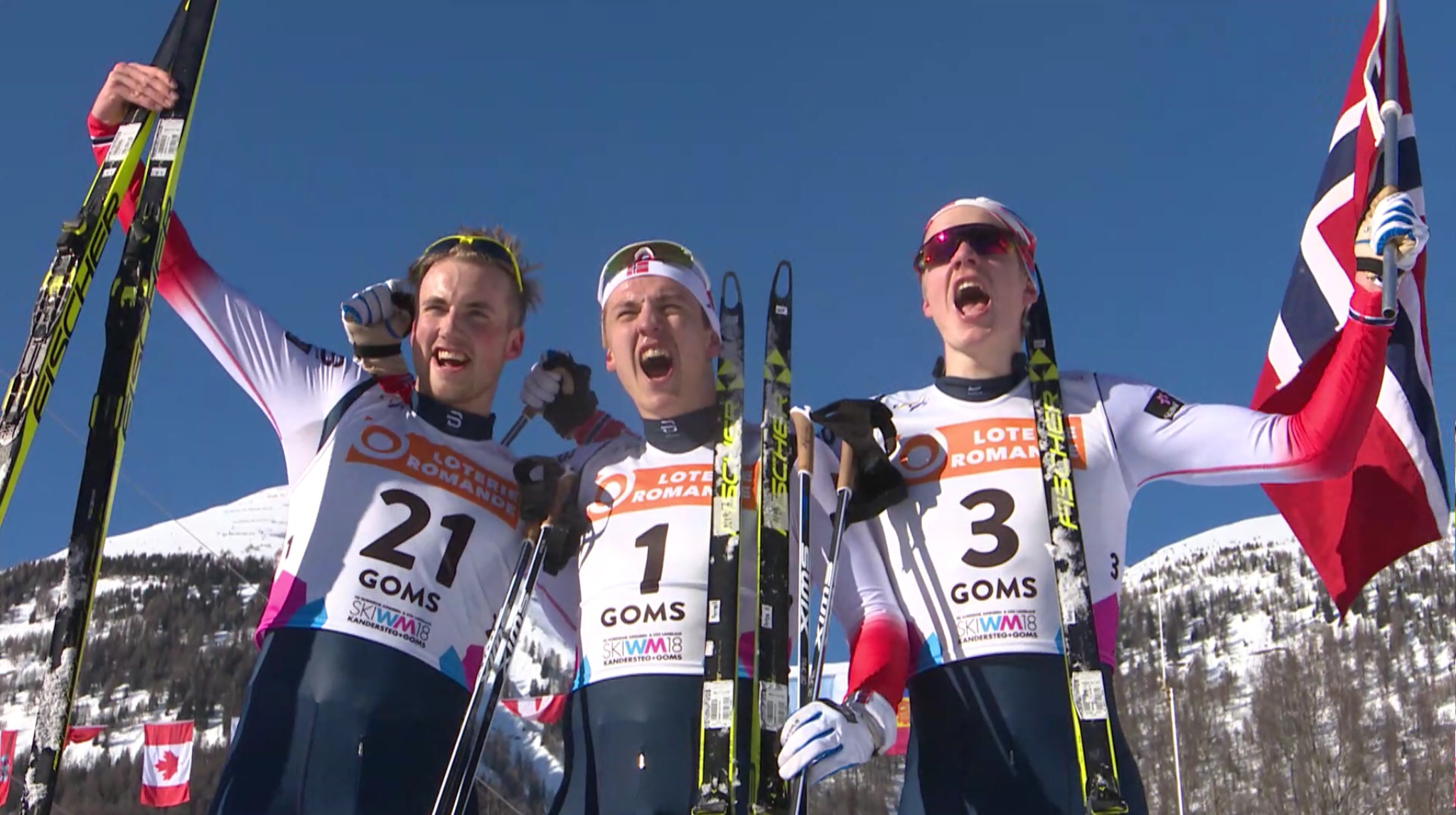
The all-Norwegian men’s freestyle sprint podium on Monday at U23 World Championships in Goms, Switzerland, with Erik Valnes (c) in first, Jan Thomas Jenssen (l) in second and Even Northug (r) in third. (Screenshot: Swiss Ski livestream)
In the men’s 1.5 k skate sprint on Monday, Norway swept the men’s podium, with Erik Valnes winning his first World Championships medal in 2:56.38, Jan Thomas Jenssen finishing 0.24 seconds back in second, and Even Northug placing third (+6.34).
For the 21-year-old Valnes, this marked his first U23 World Championships (or Junior Worlds for that matter). He’s competed in two World Cup sprints this season, placing 22nd in the skate sprint earlier this month in Dresden, Germany, and 27th in a classic sprint in December in Lillehammer, Norway.
Valnes started Monday by winning the qualifying round in 3:00.18, by 0.77 seconds over Sweden’s Anton Persson, then won his quarterfinal and semifinal, both by nearly half a second, before besting his fellow Norwegians in the final.
“Fun to take the gold medal at the end,” Valnes said during a televised in-arena interview after the final. “It was my biggest goal this year, so it means a lot, of course. A gold medal is always good to have.”
No North American men qualified for the heats. Canada’s Ricardo Izquierdo-Bernier placed 40th, Antoine Briand was 41st, Philippe Boucher 42nd, and Olivier Hamel 60th.
For the U.S., Bill Harmeyer finished 46th, Andrew Egger was 47th, Thomas O’Harra 64th, and Zak Ketterson 65th.