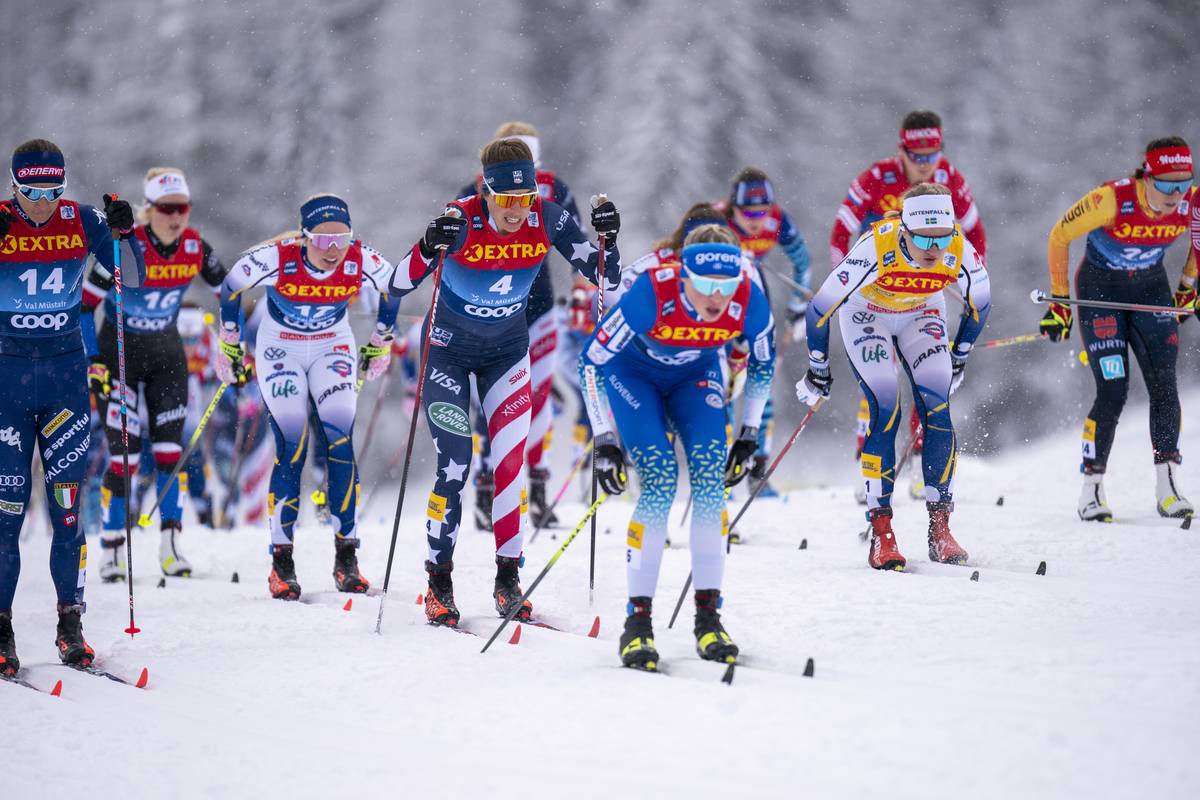
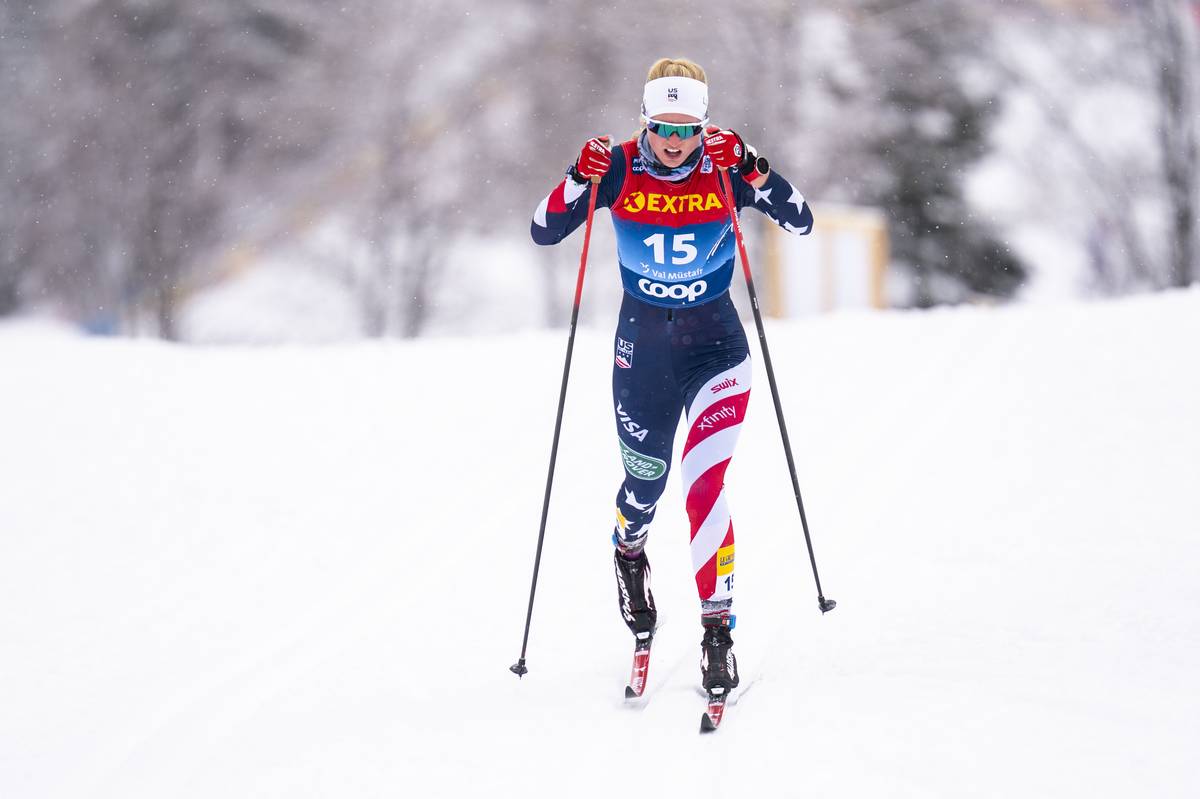
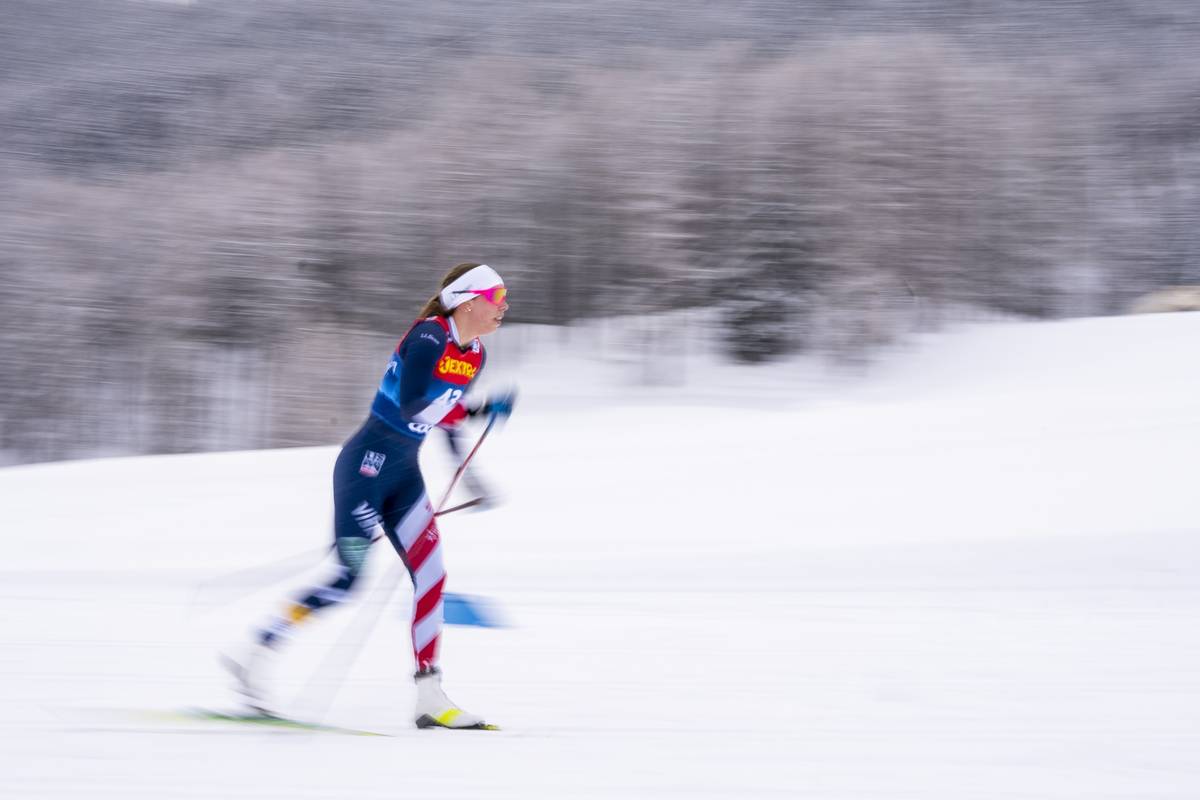
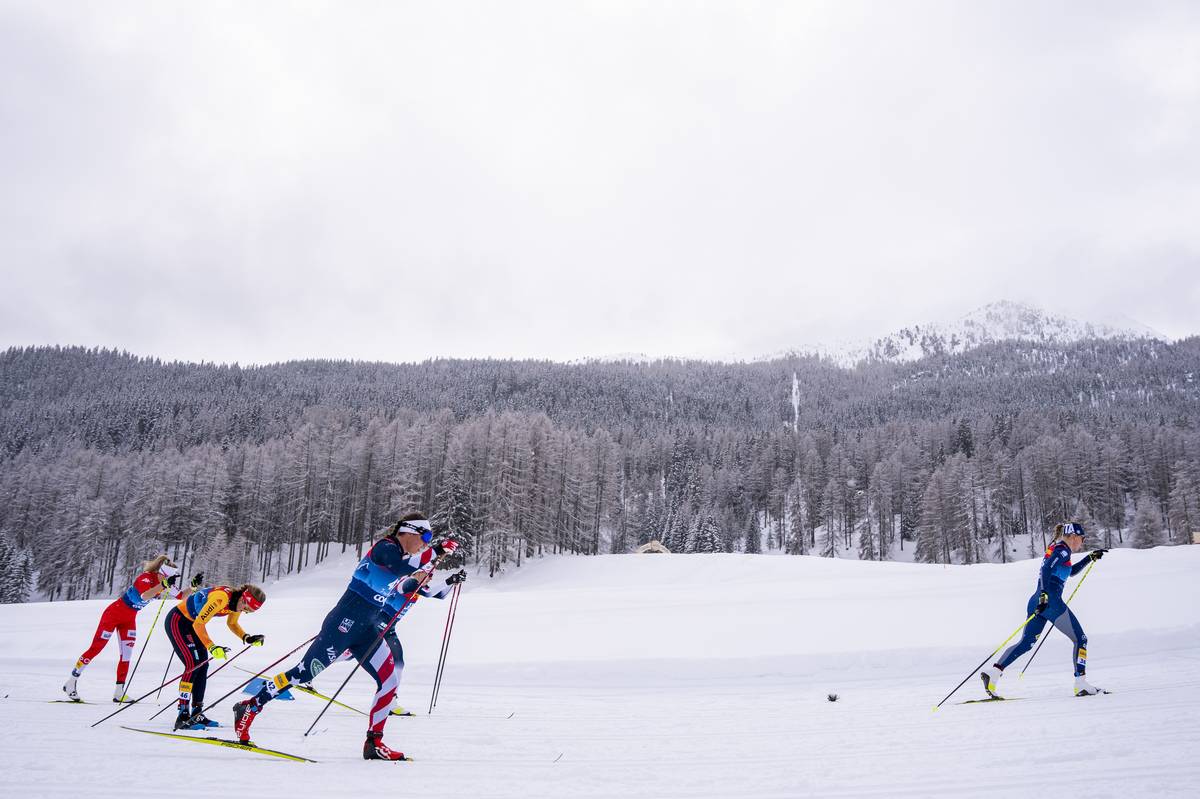
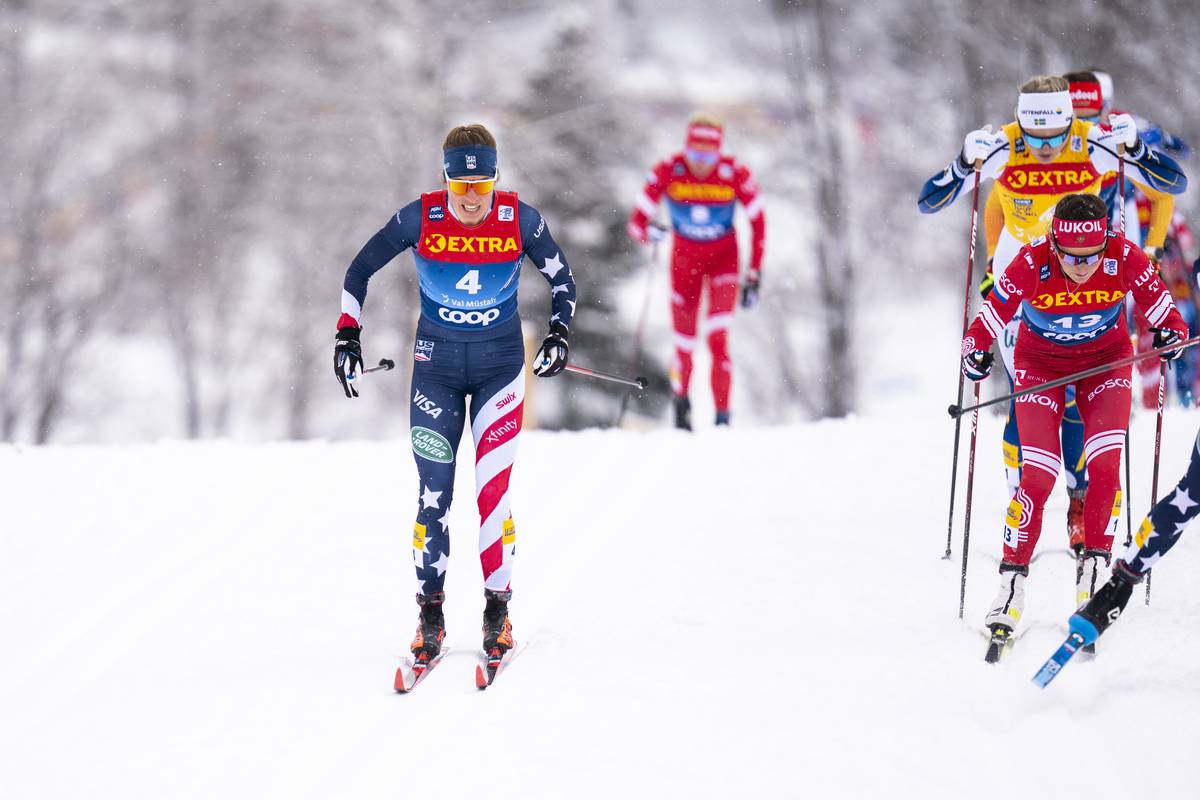
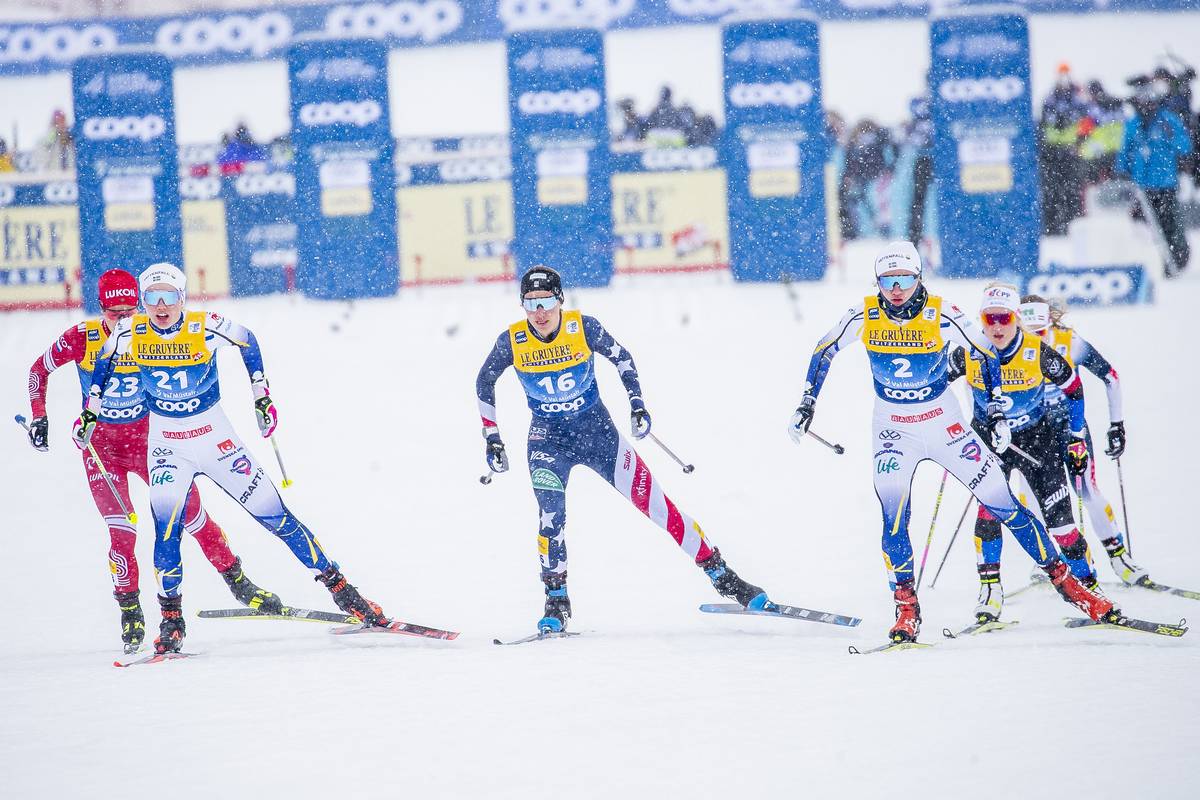
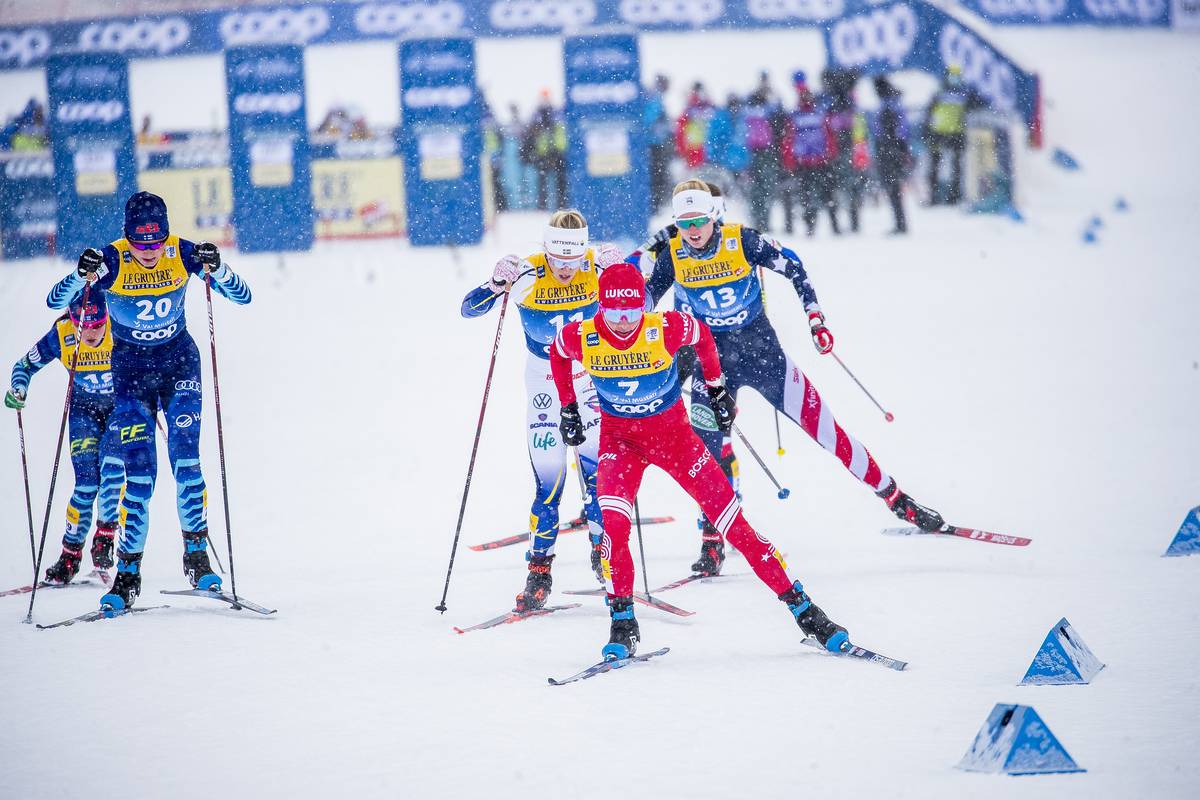
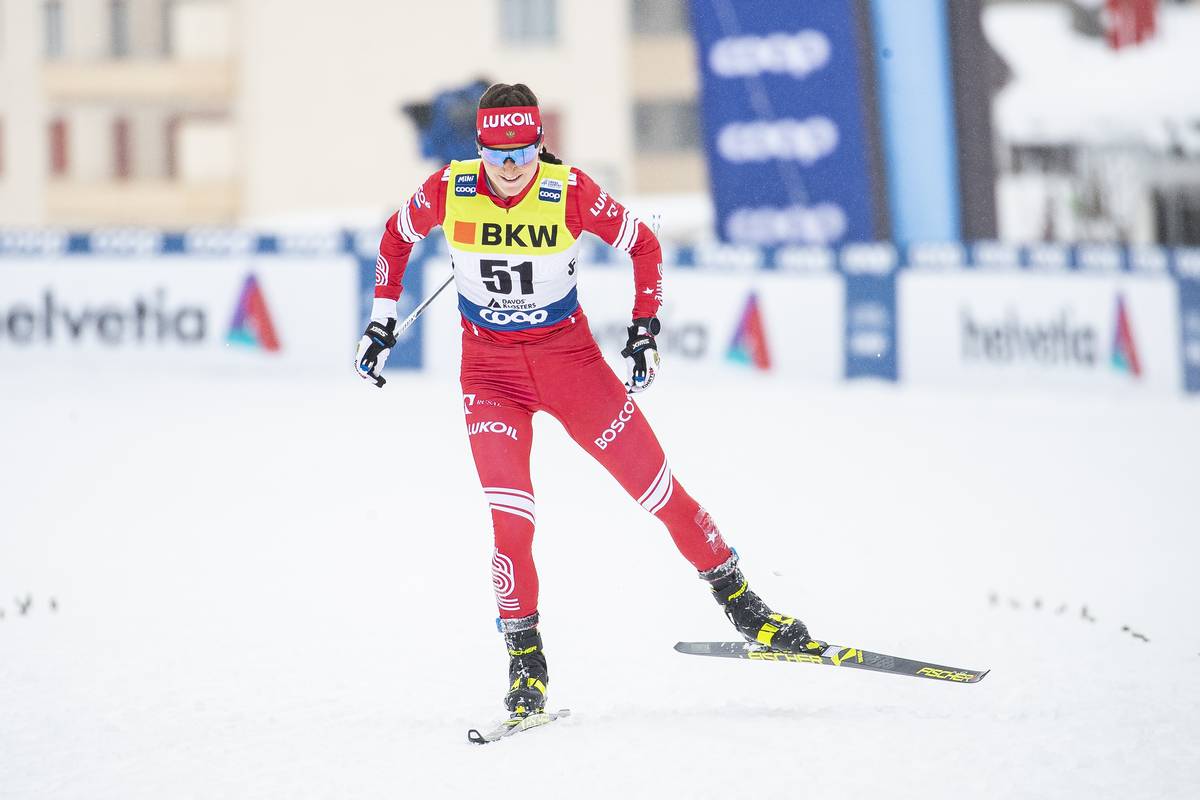
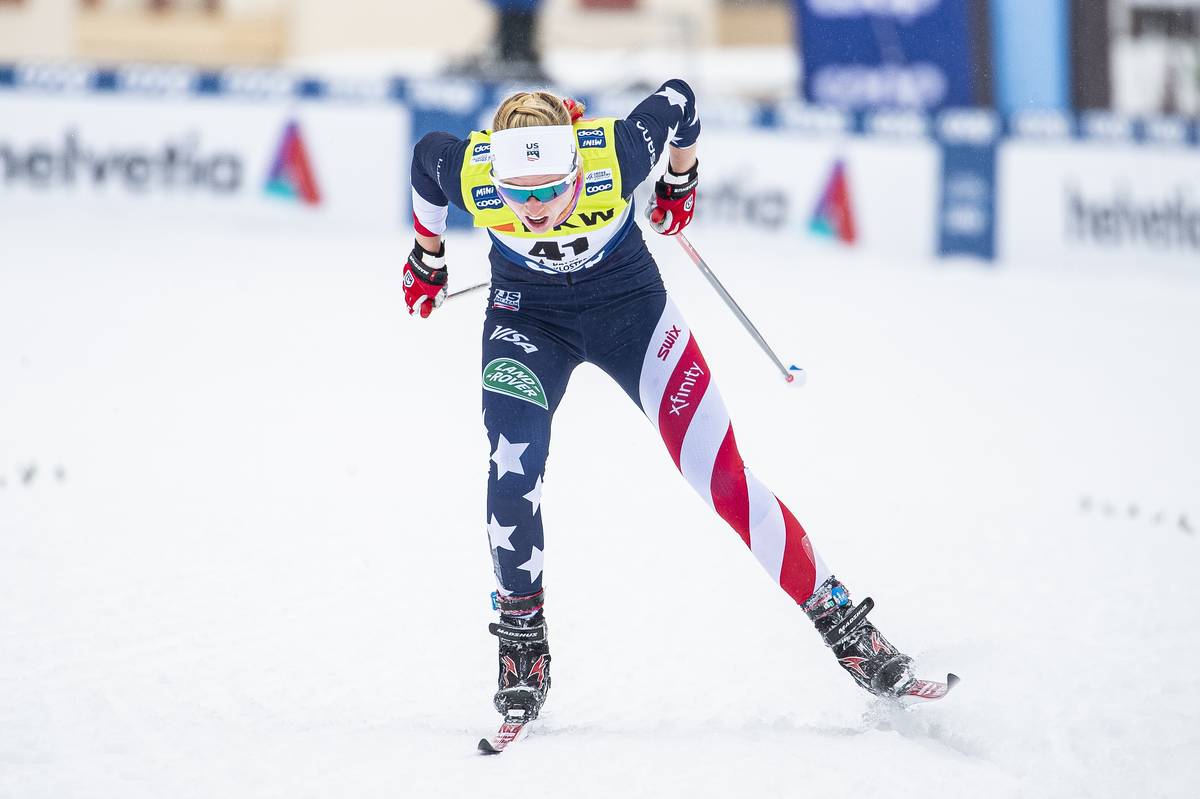
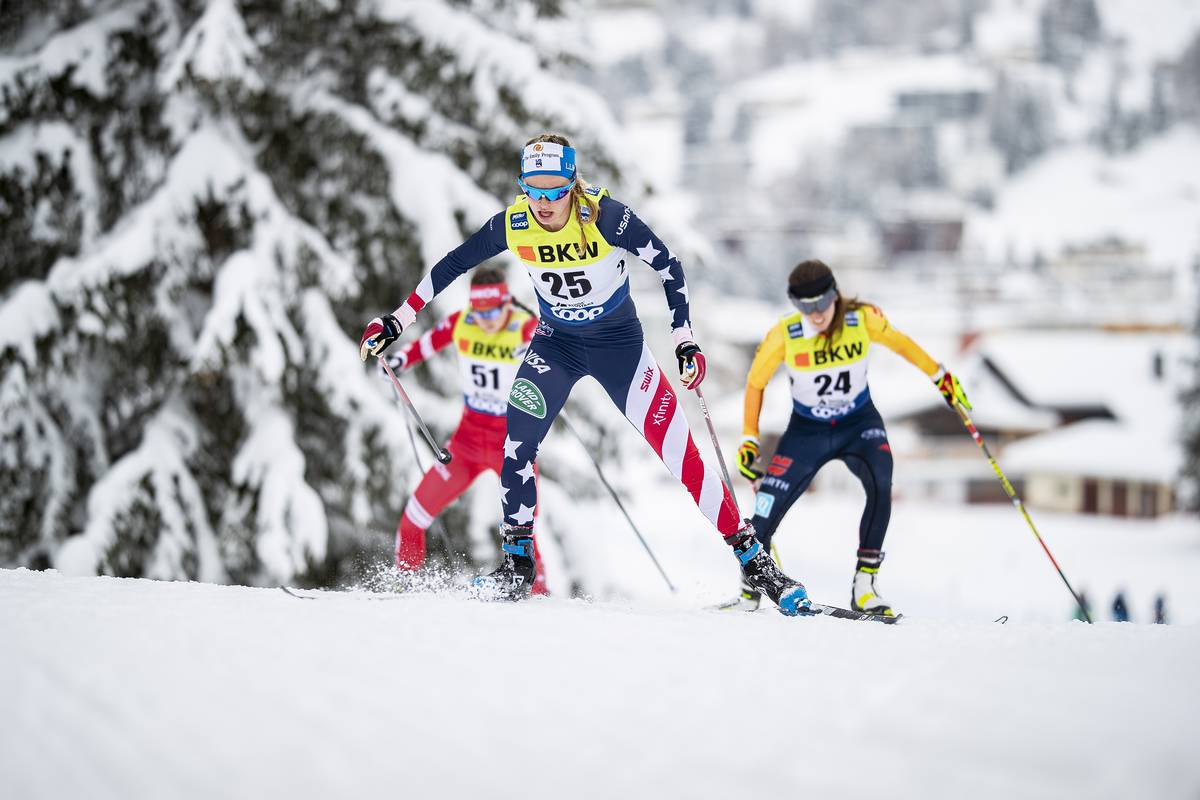
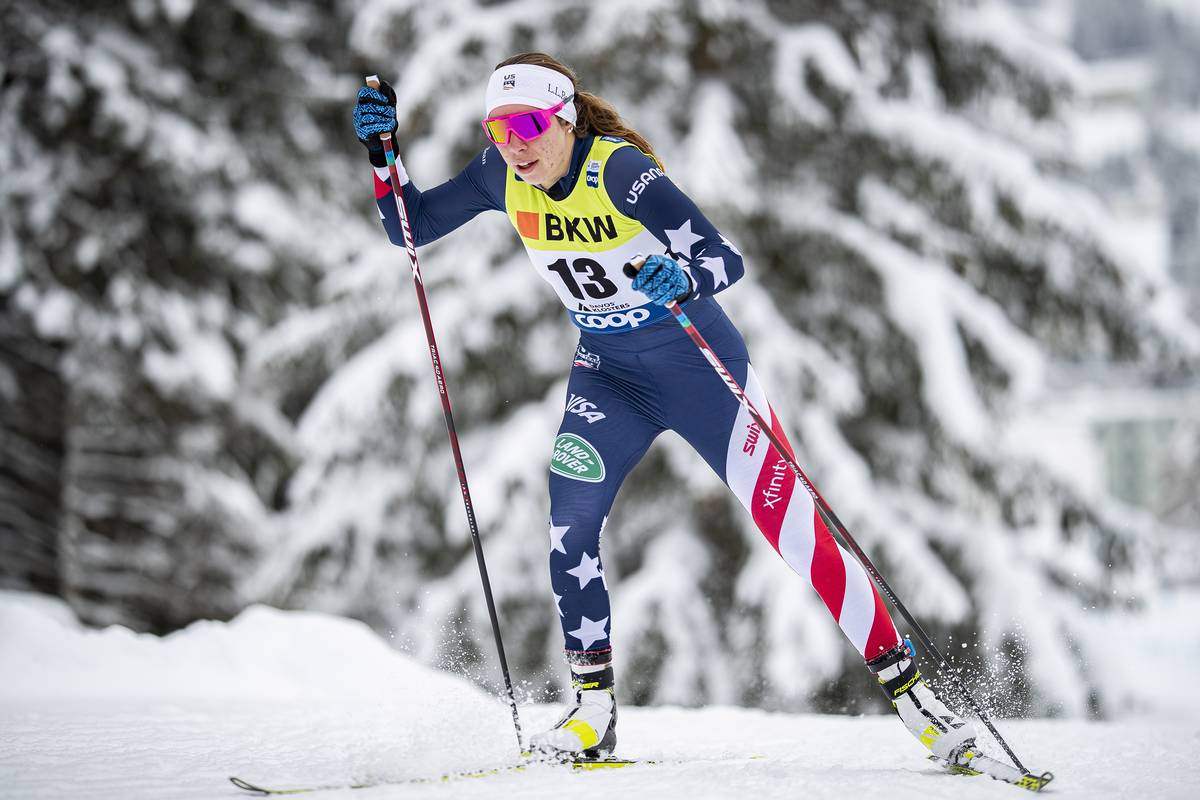
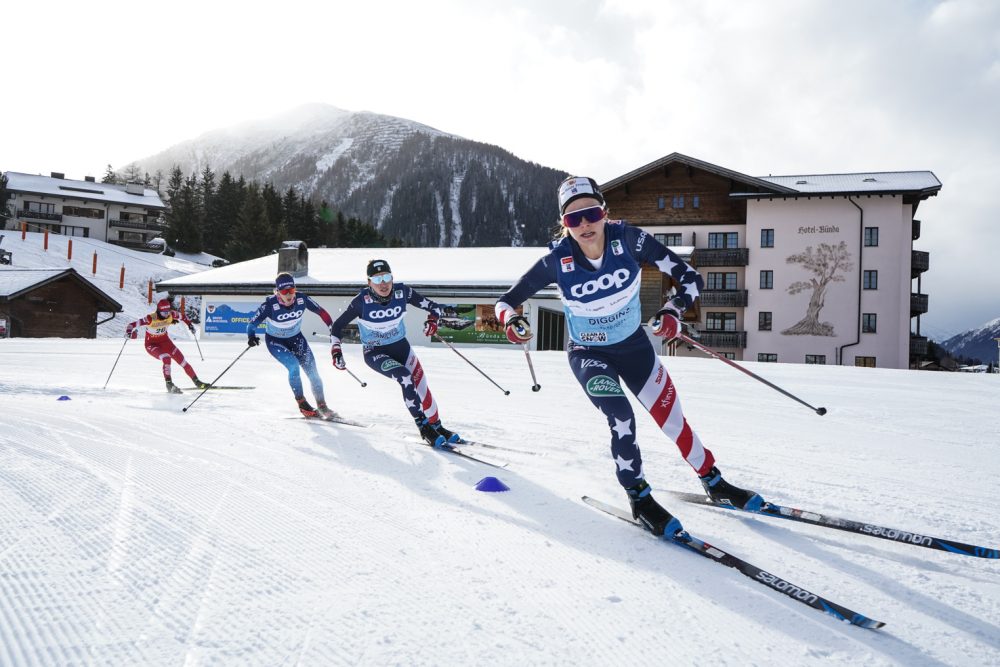
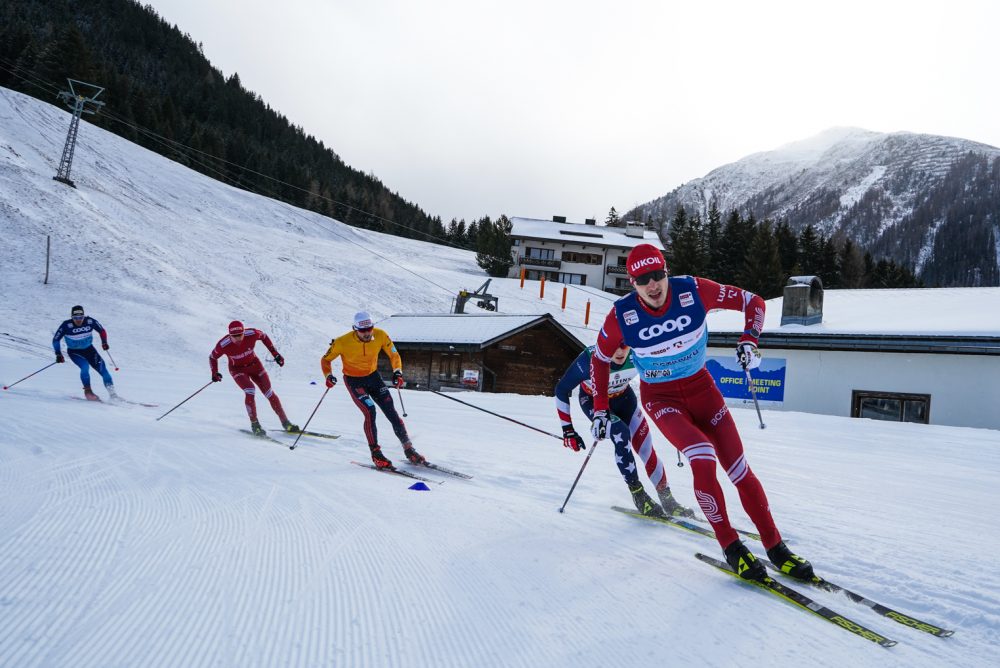
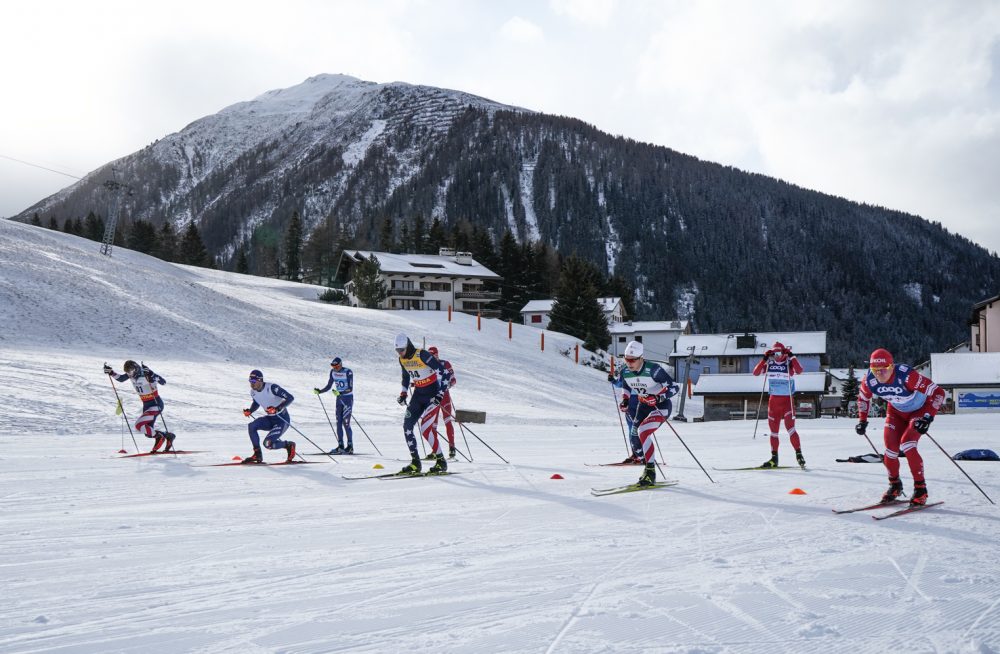
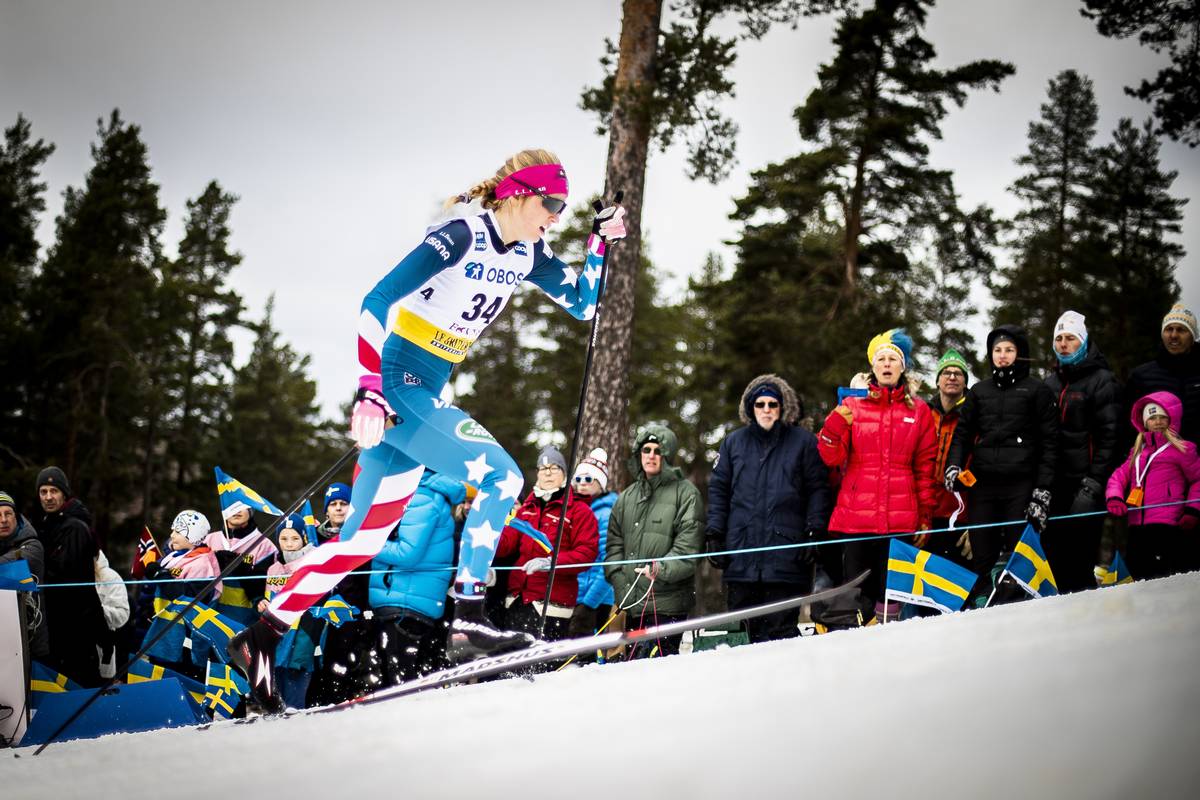
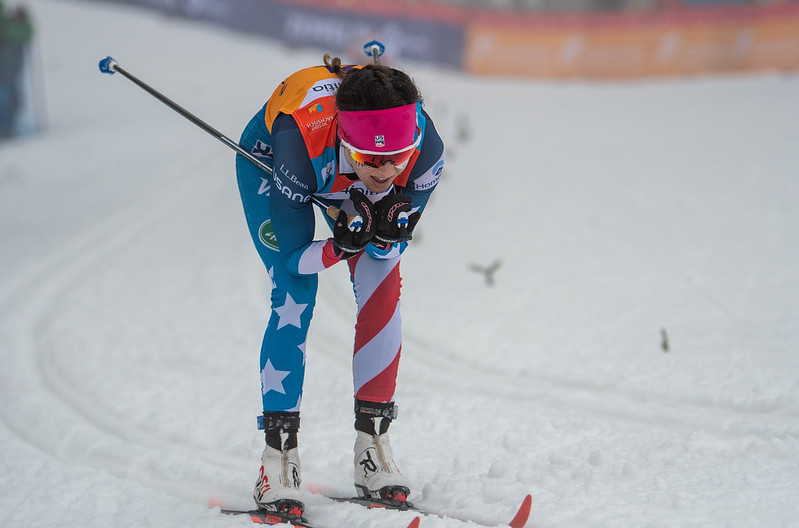
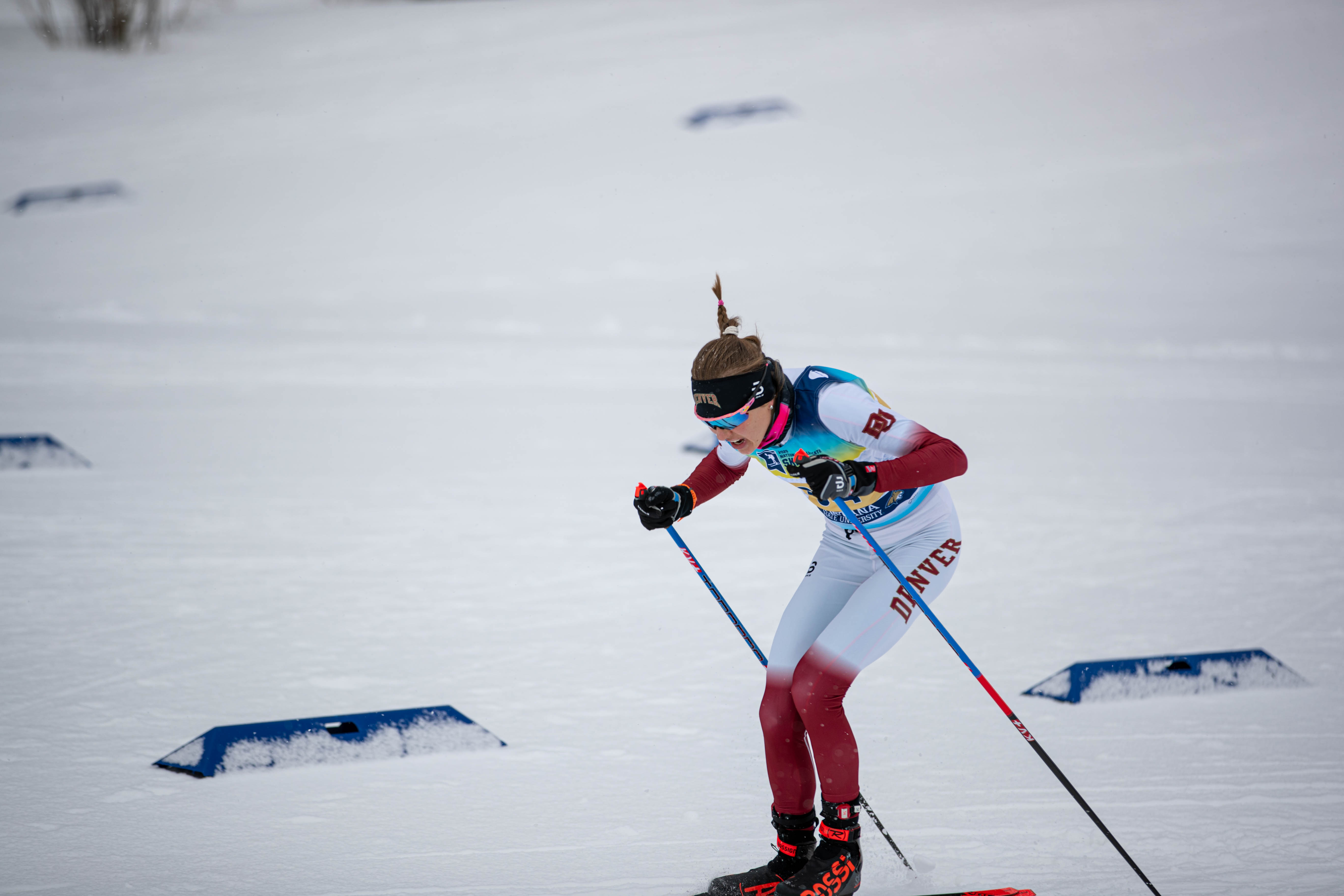
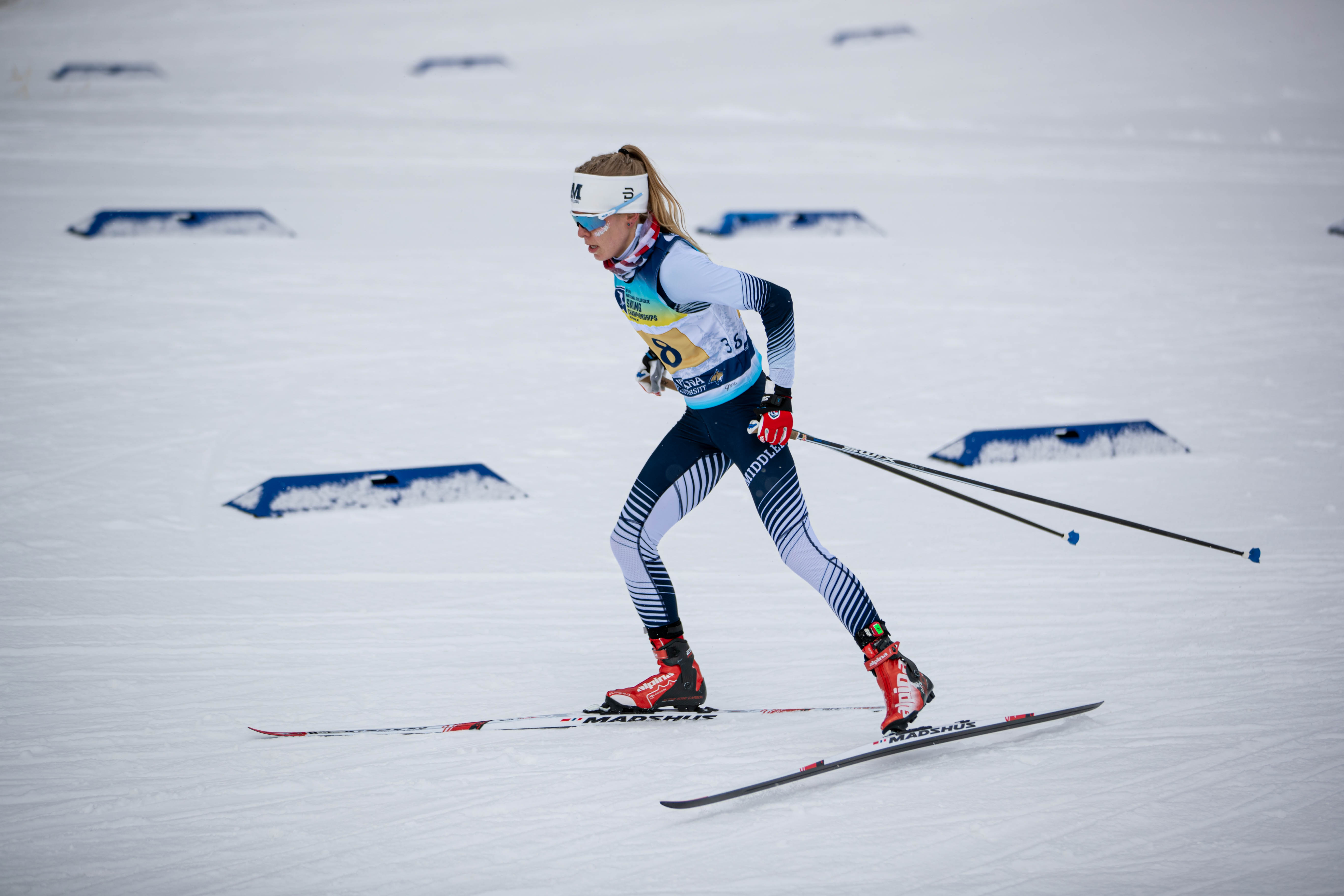
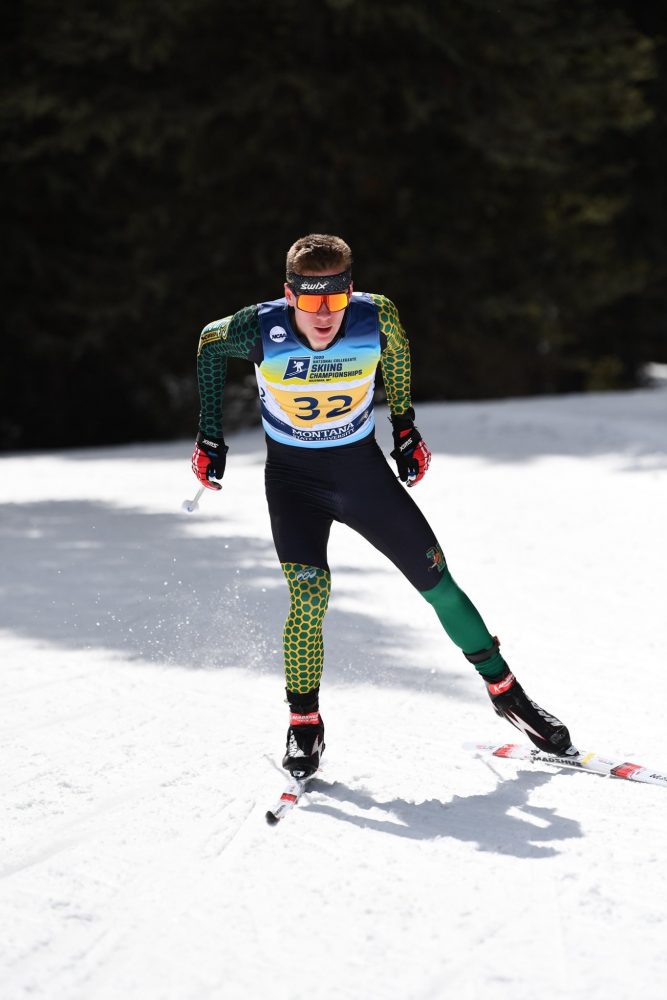
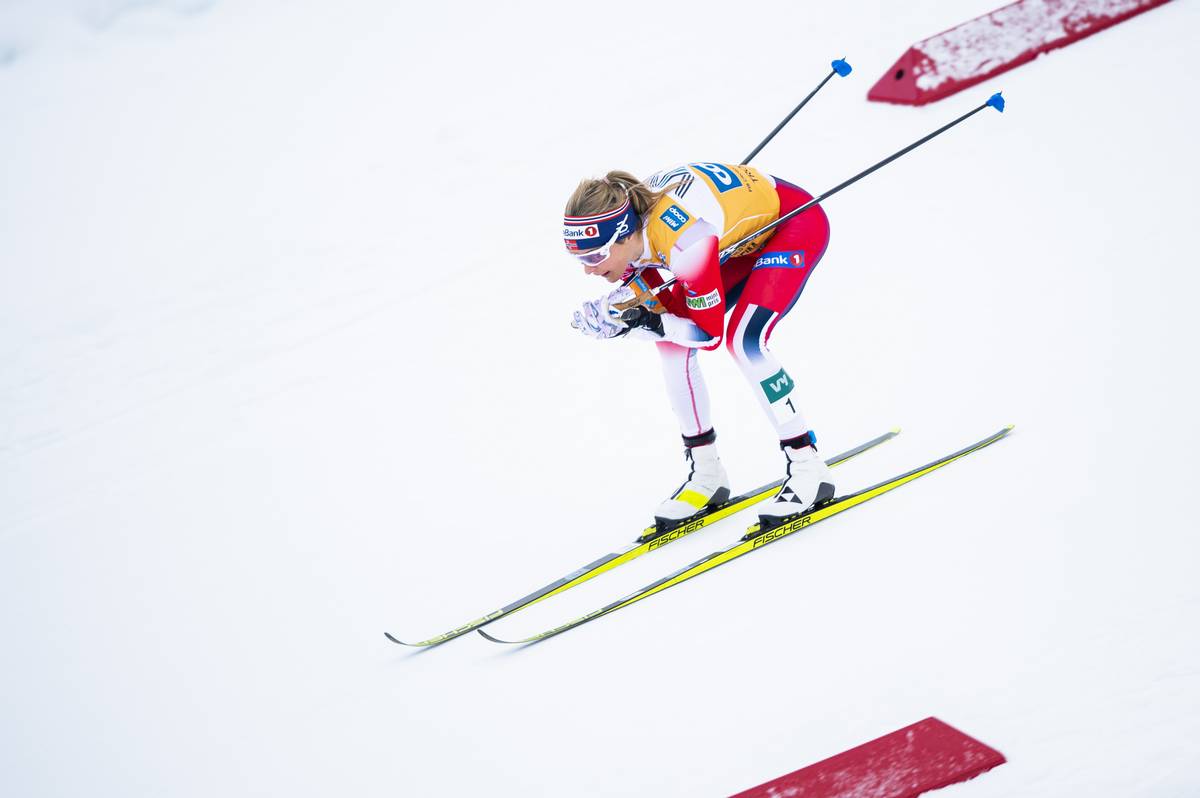
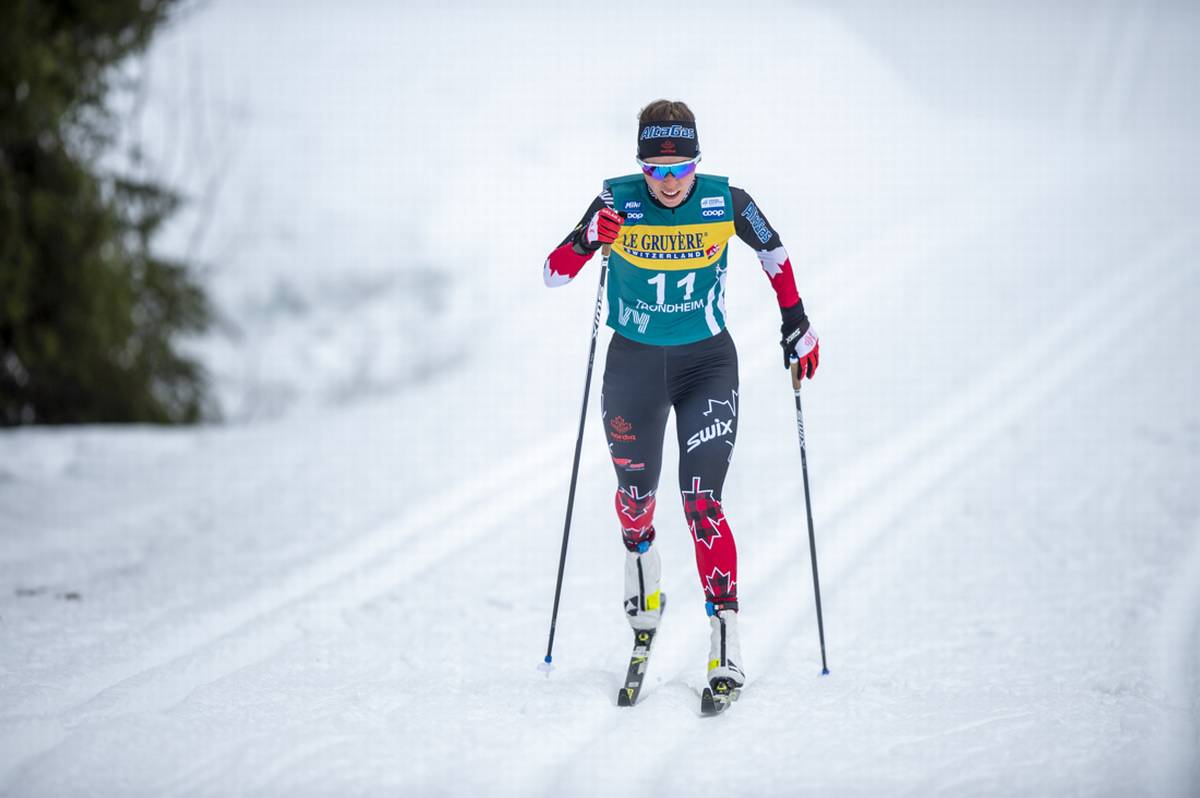
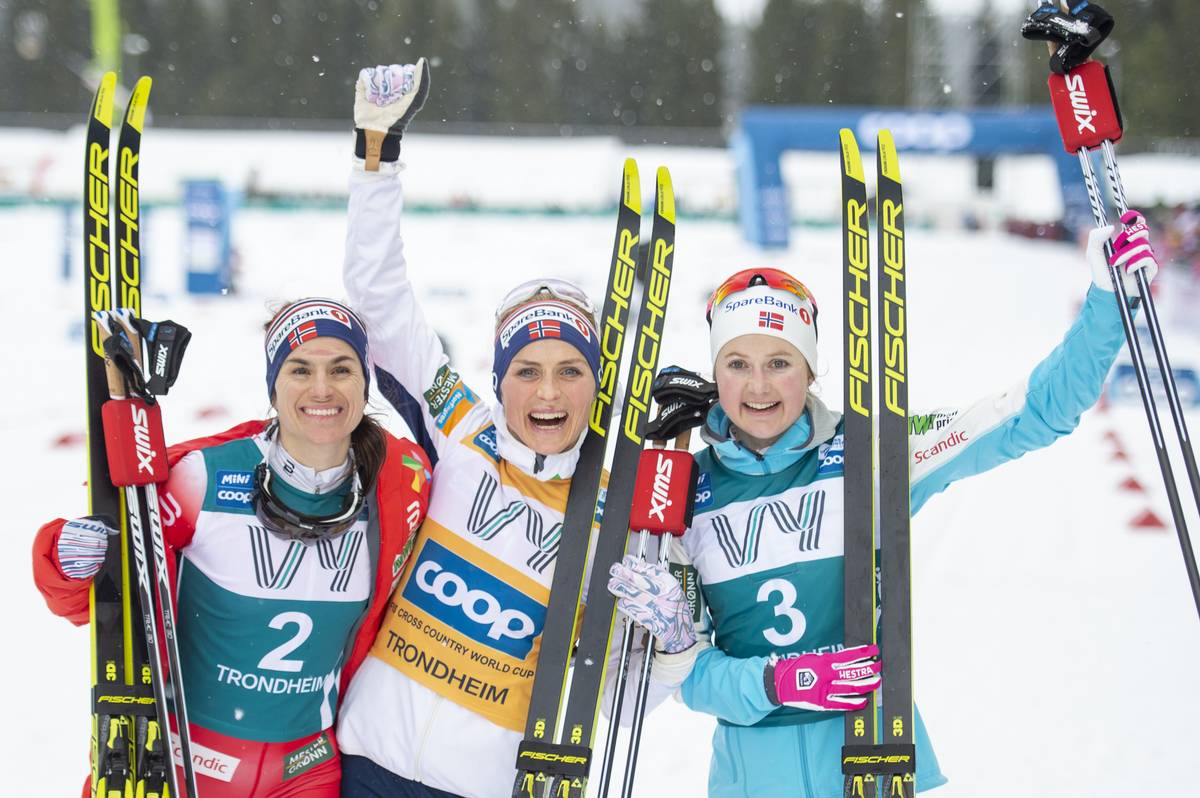
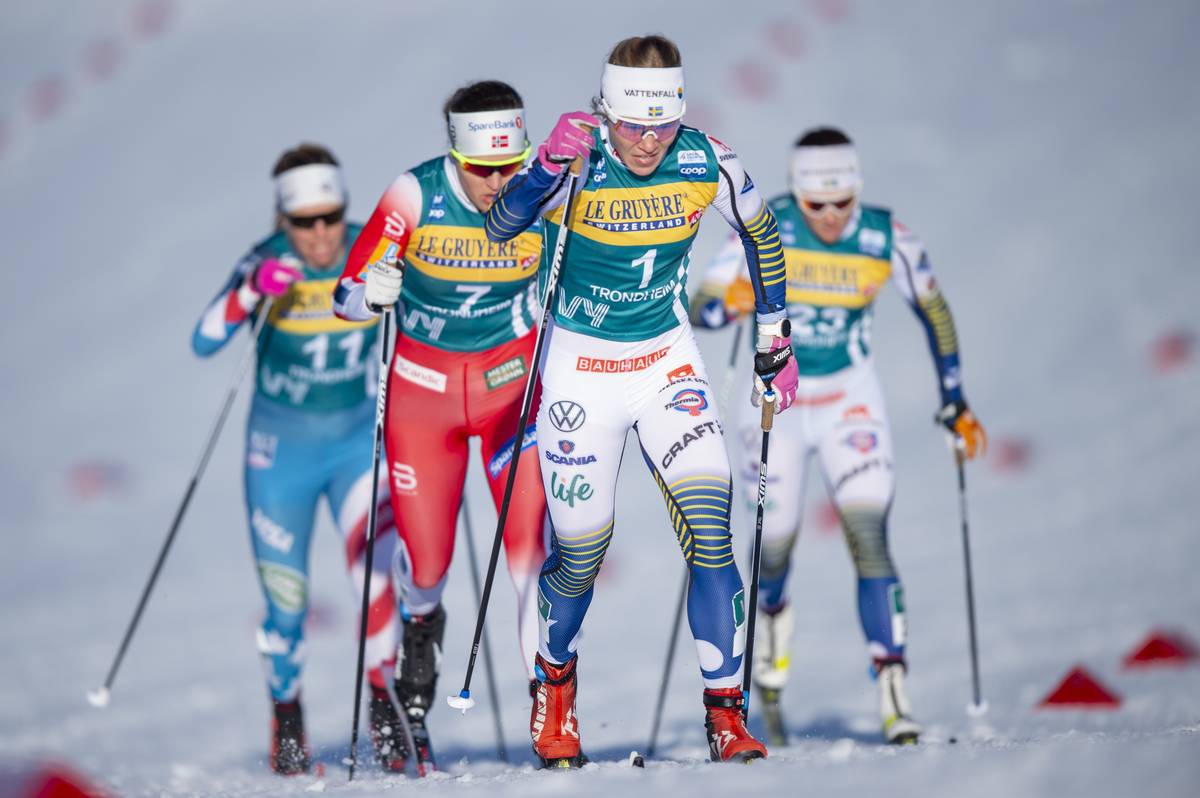
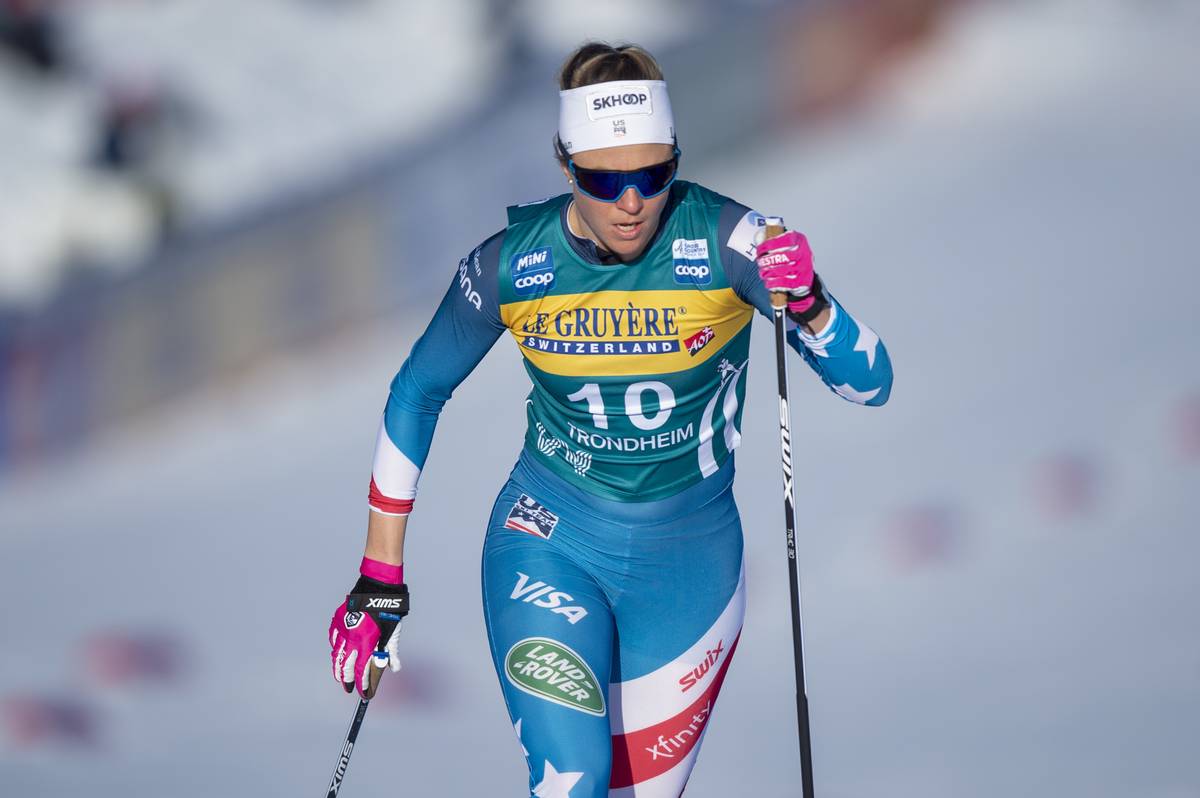
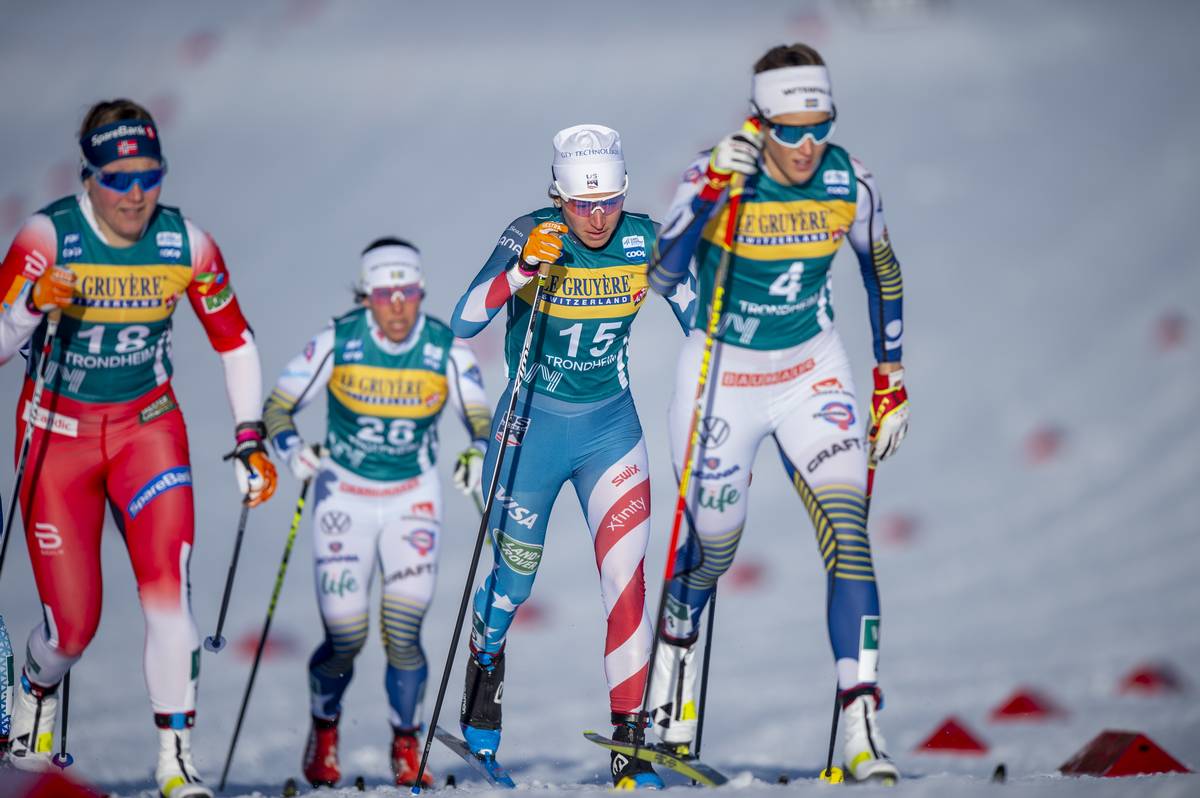
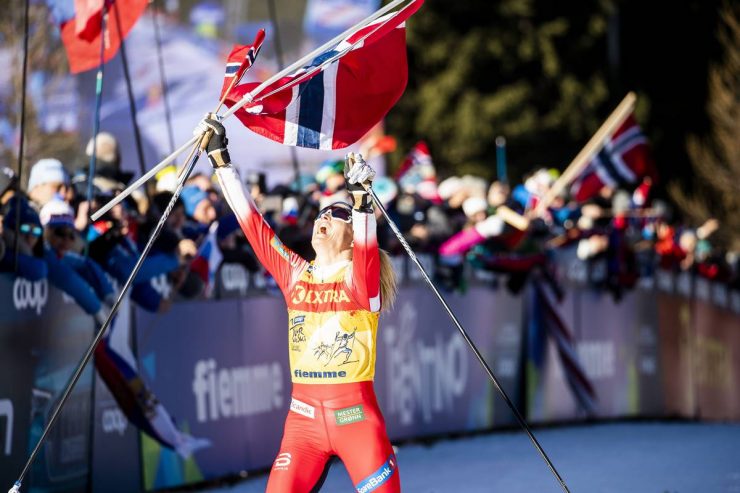
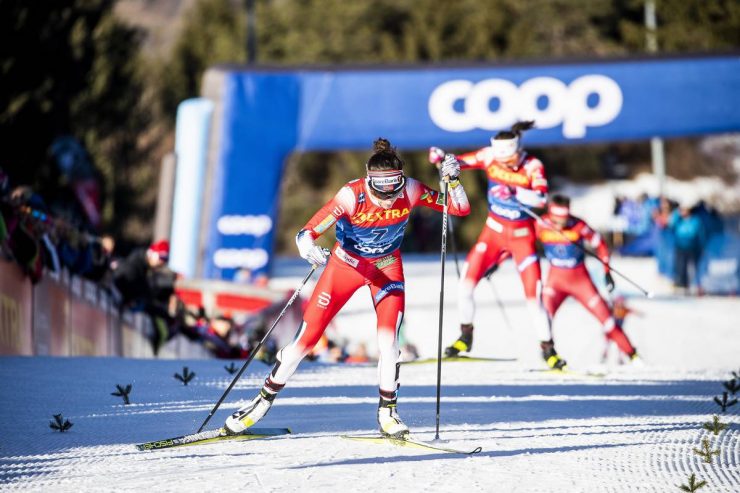
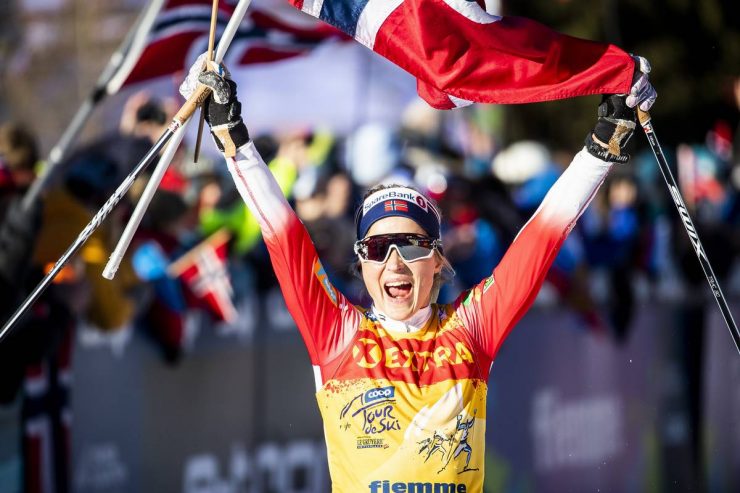
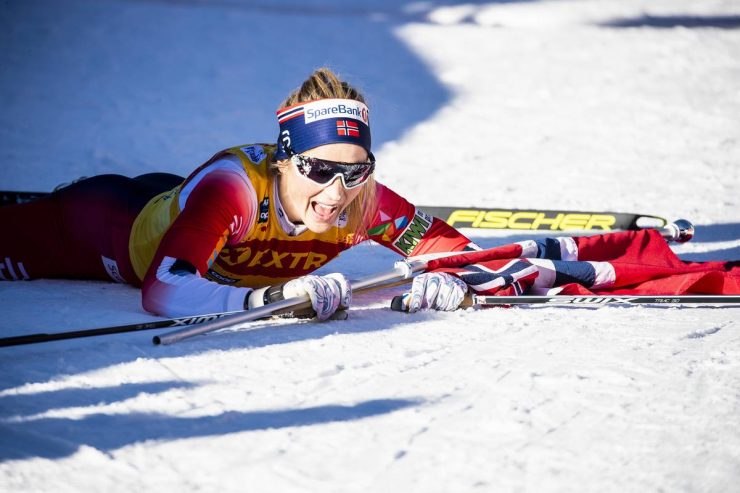
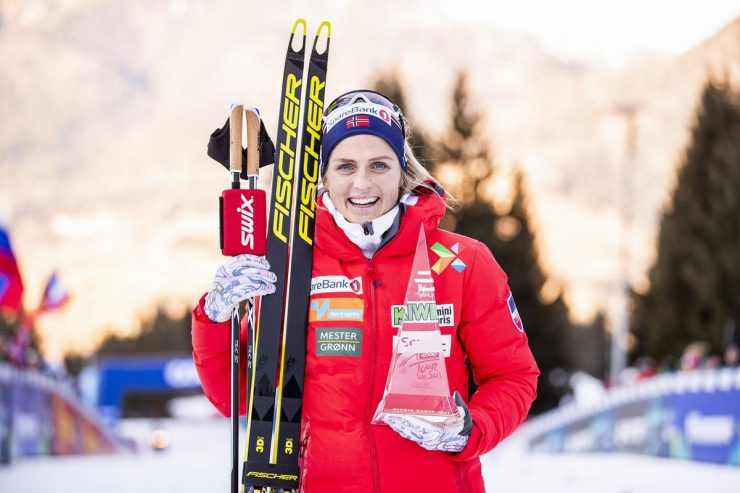
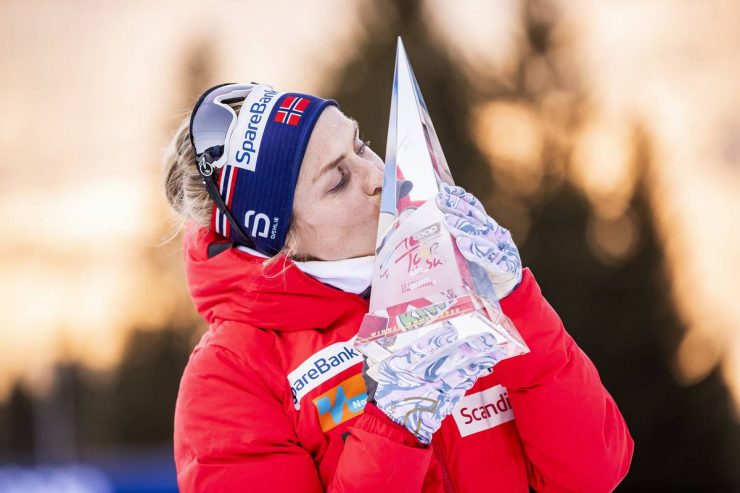
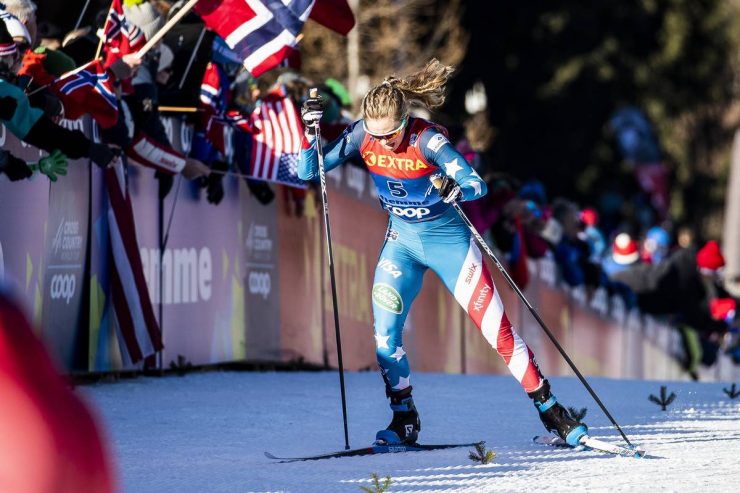
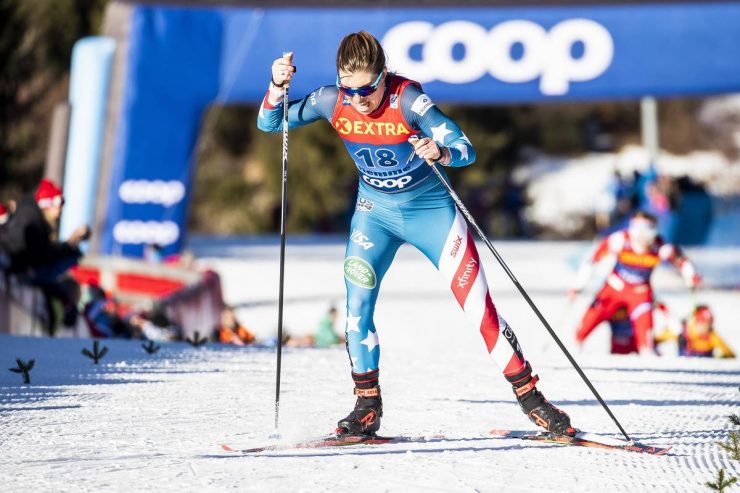
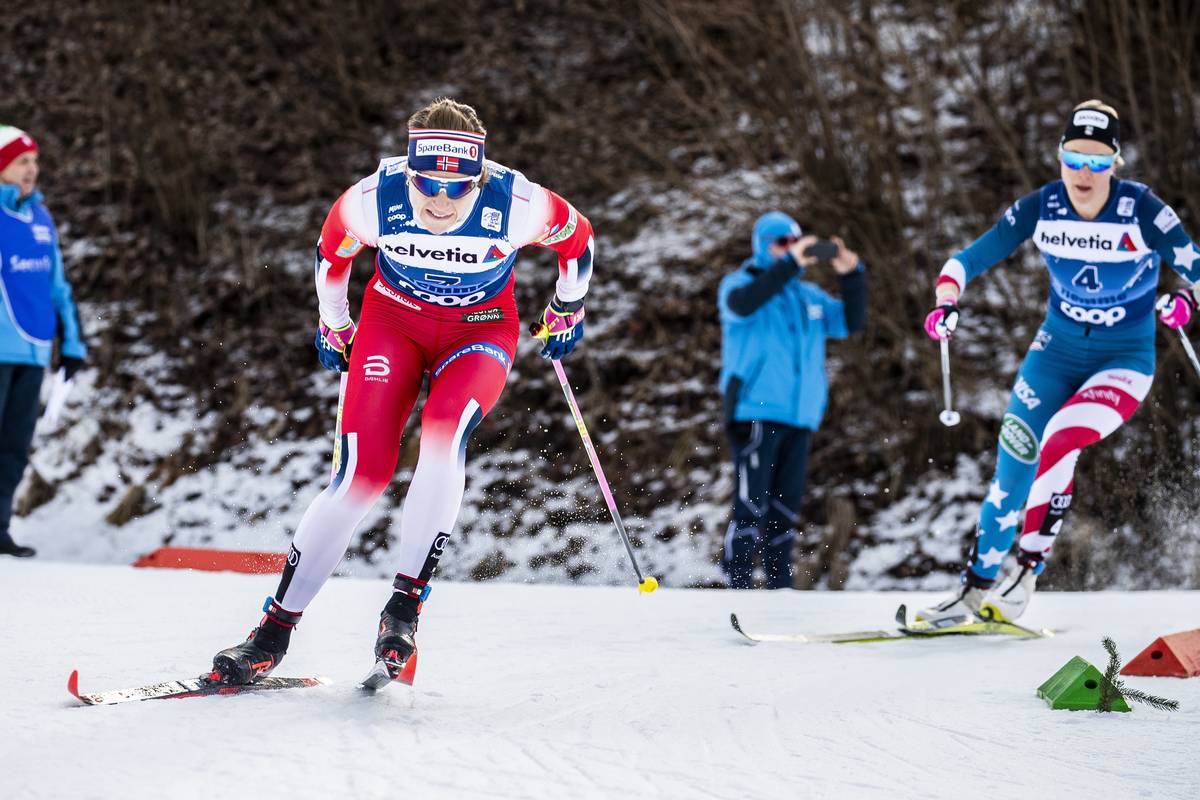
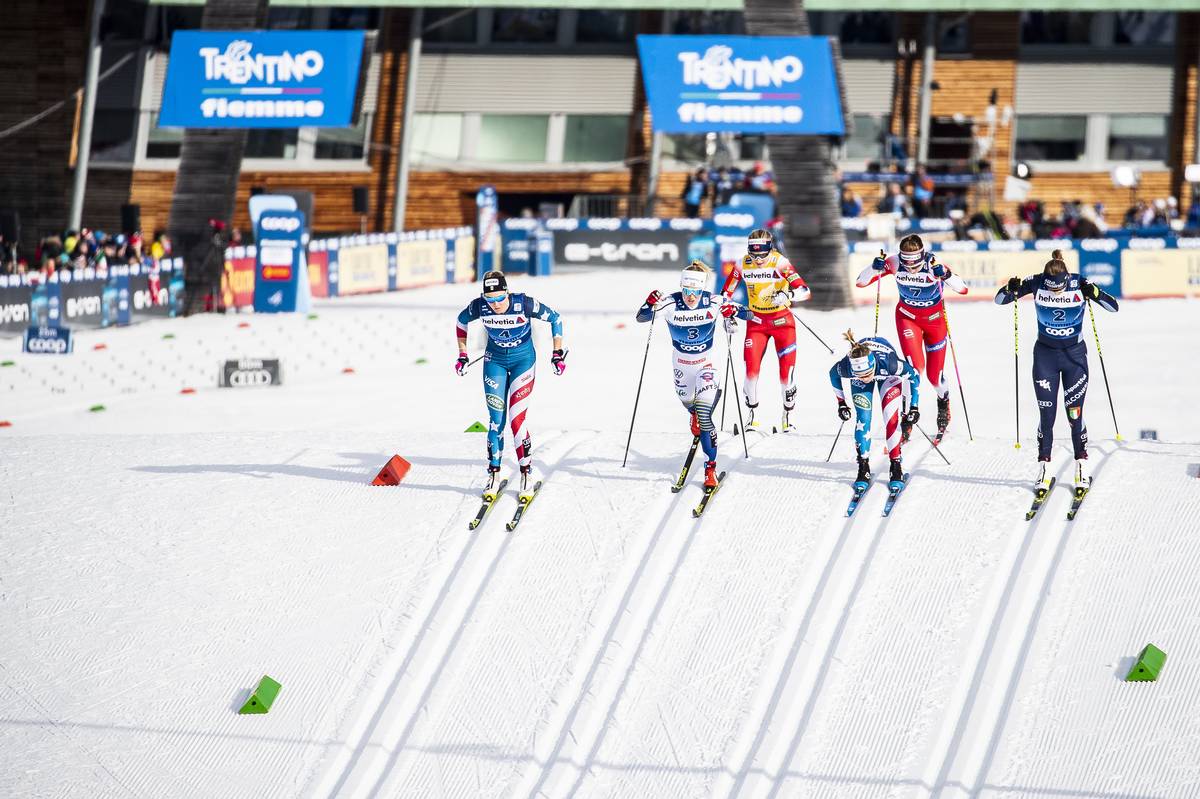
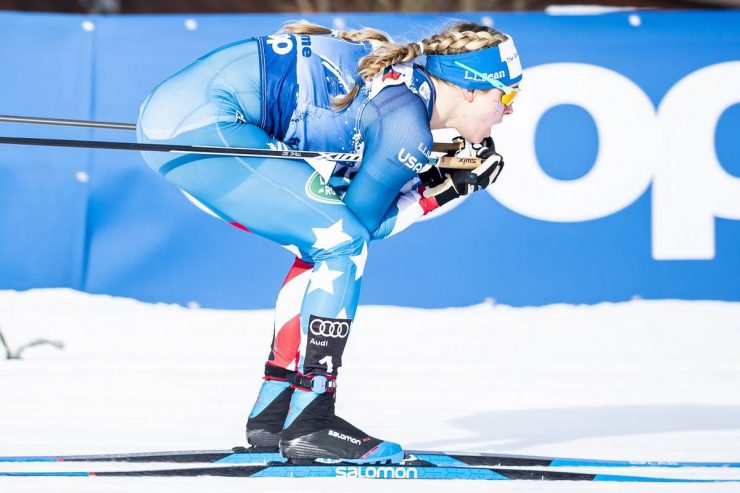
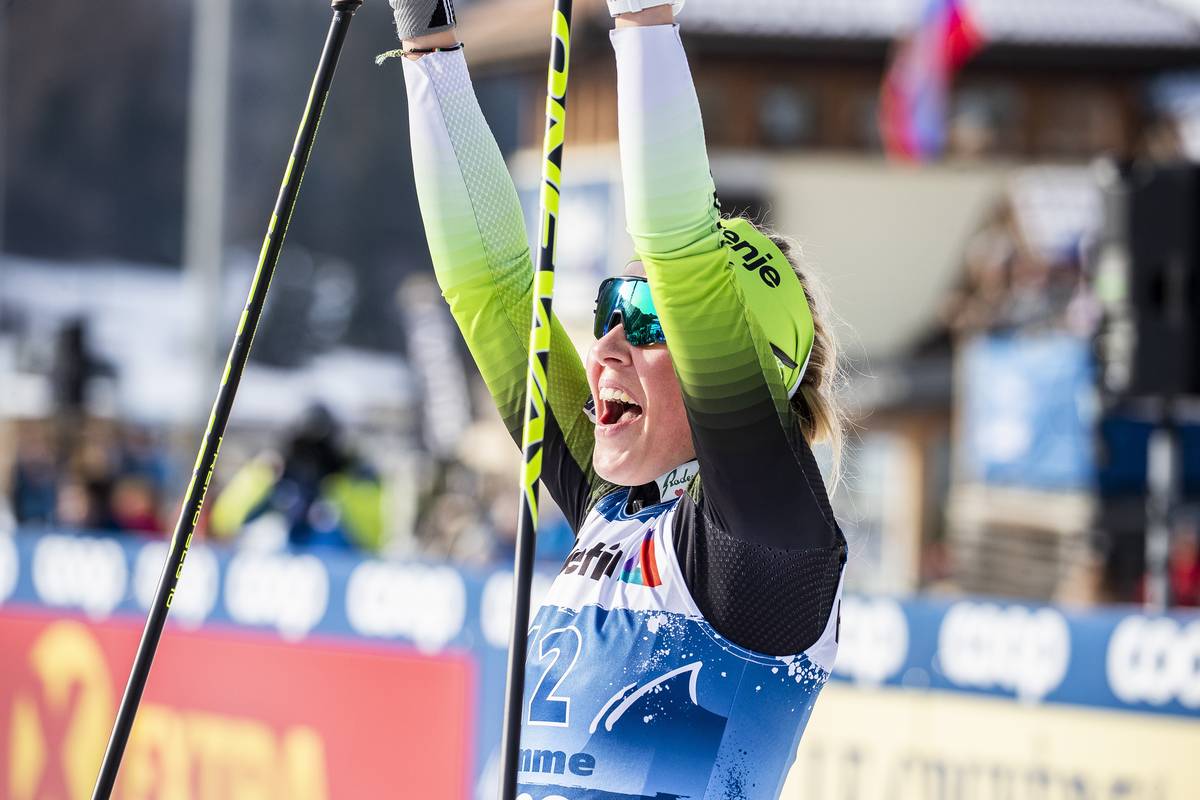
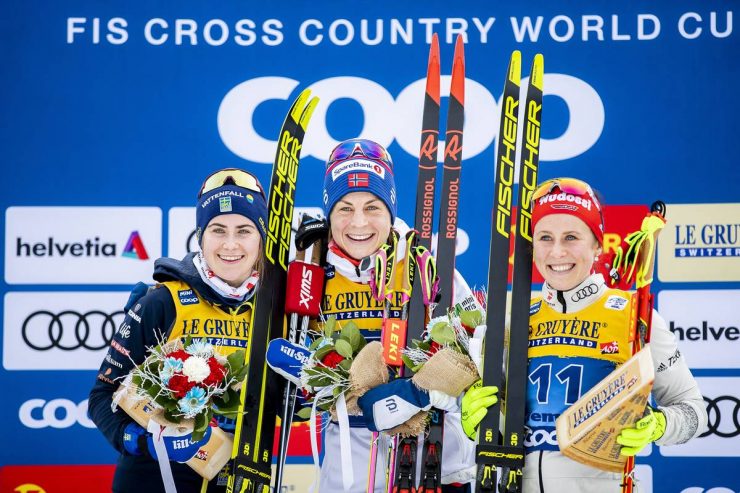
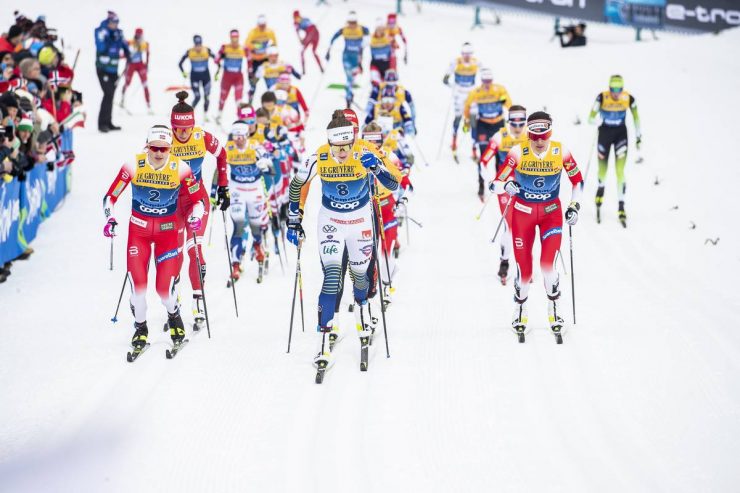
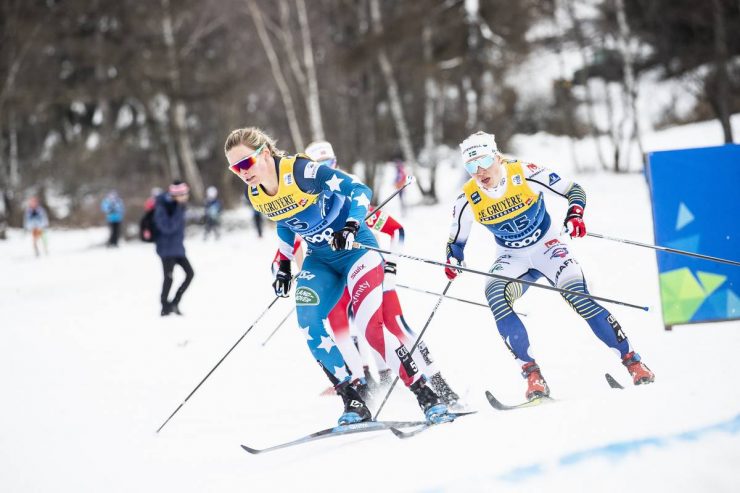
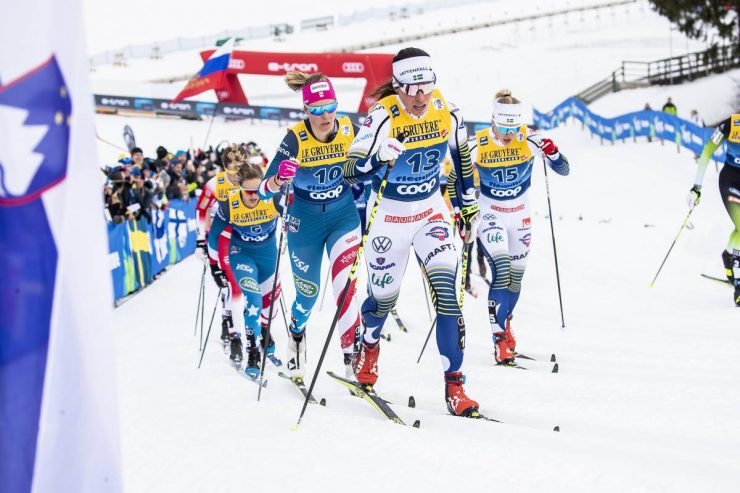
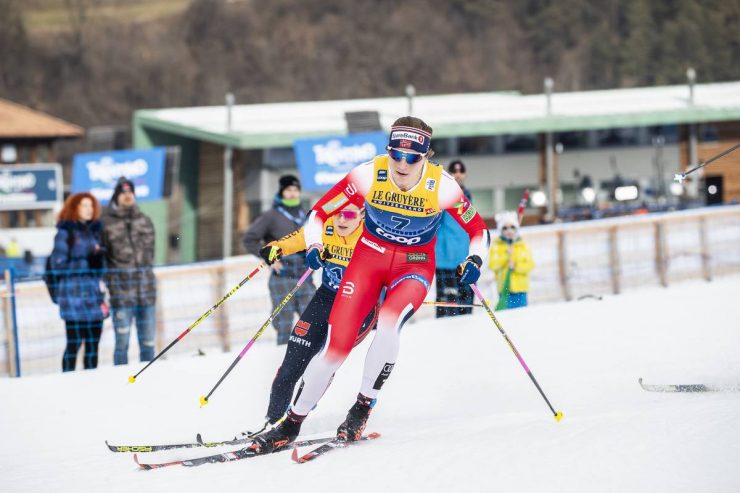
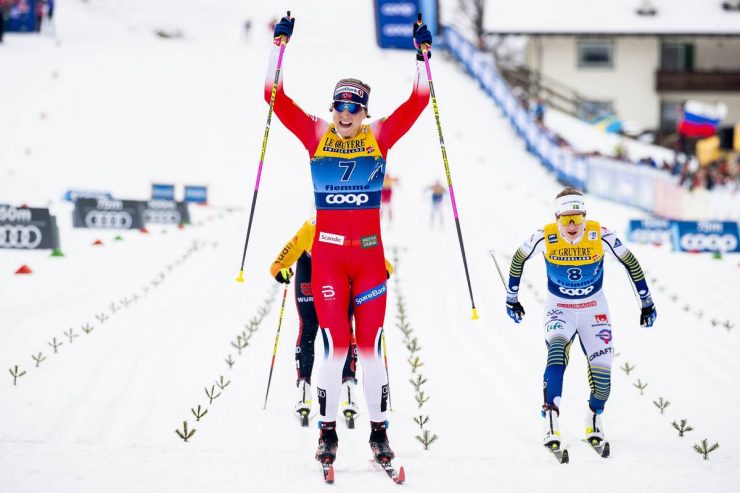
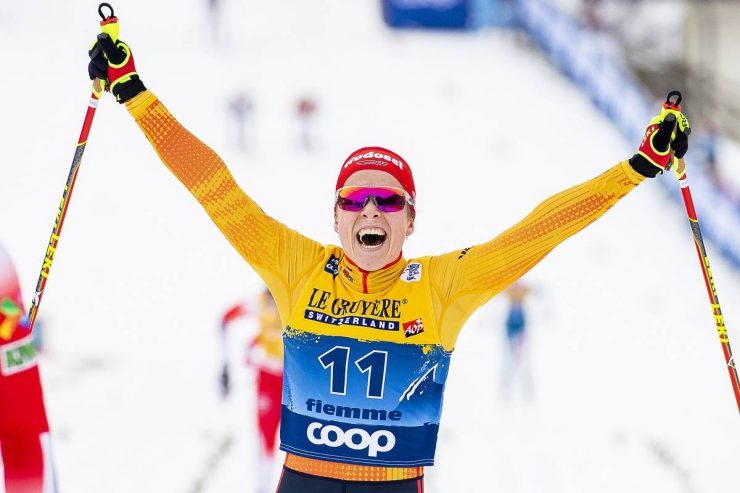
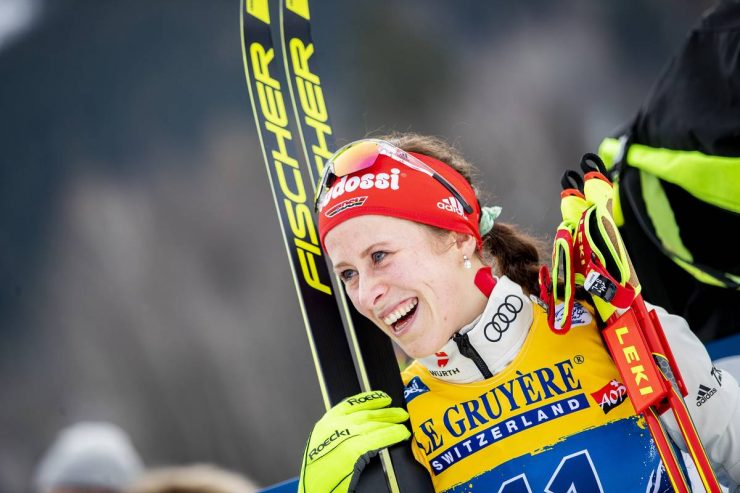
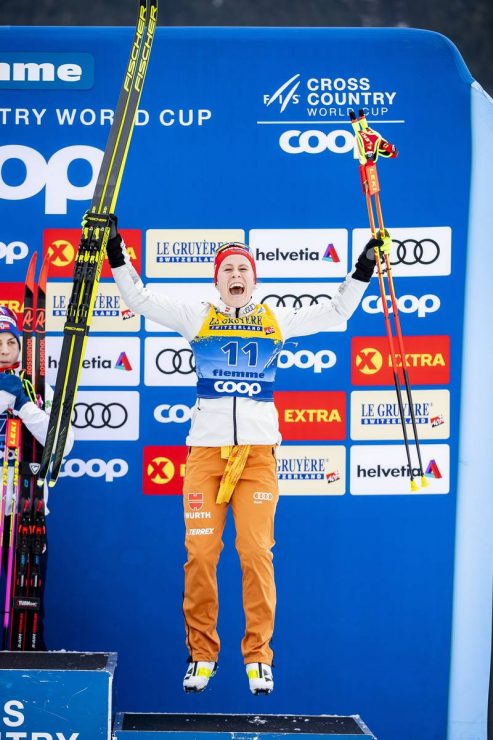
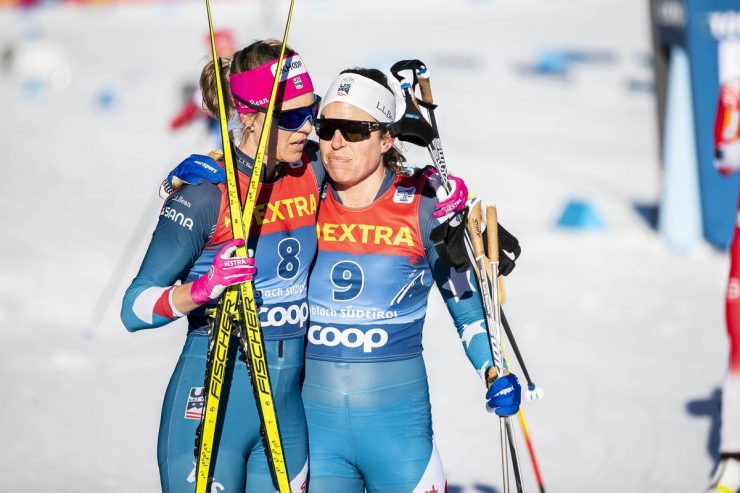
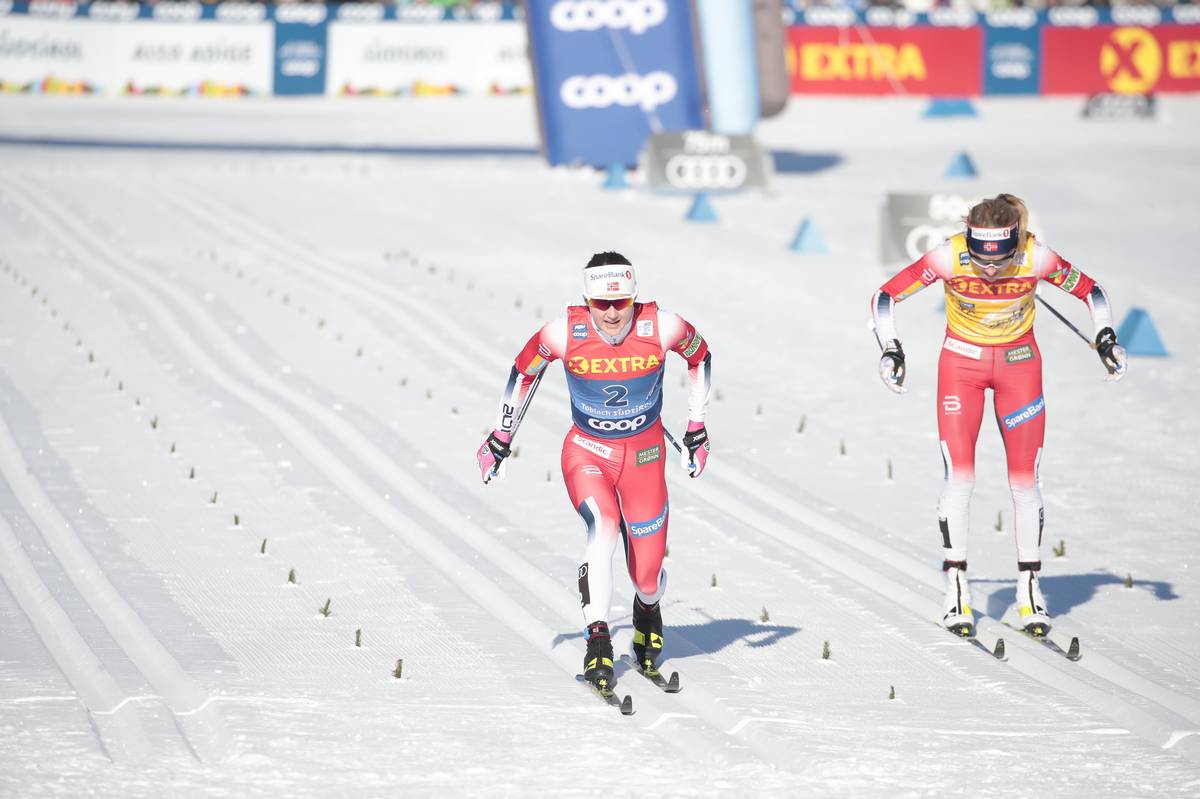
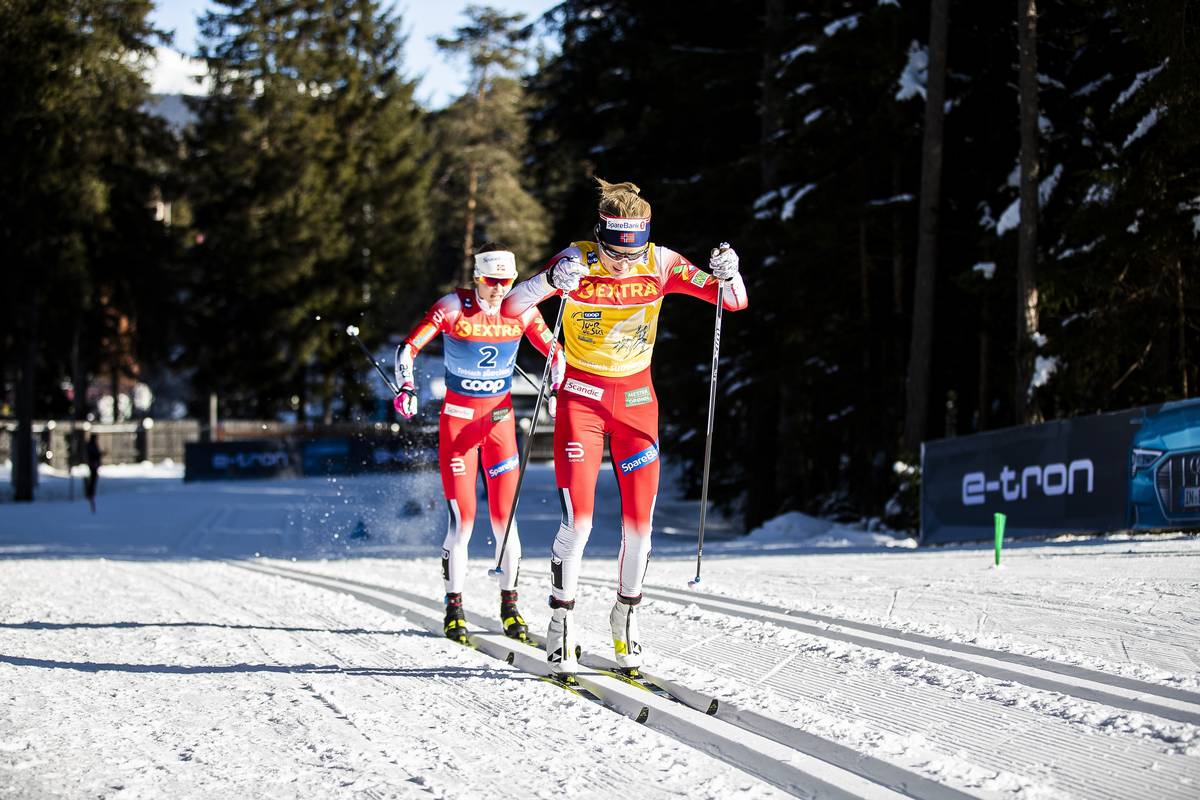
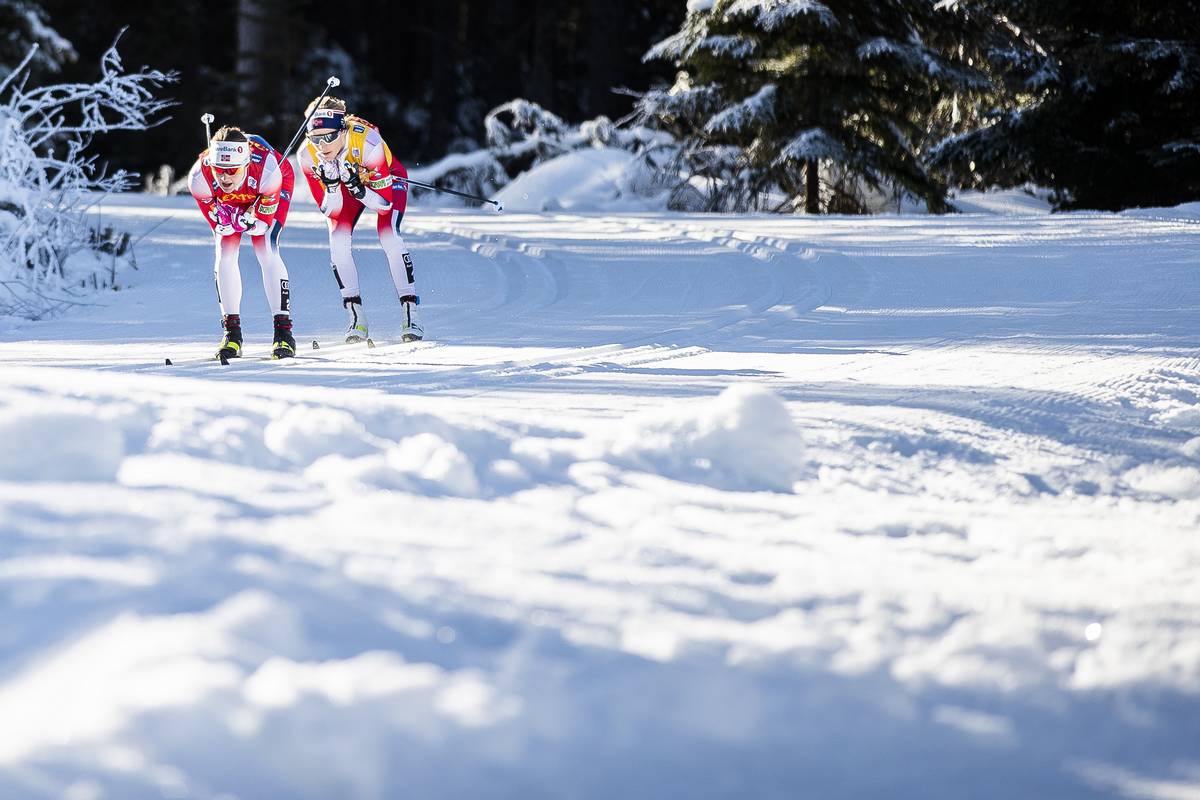
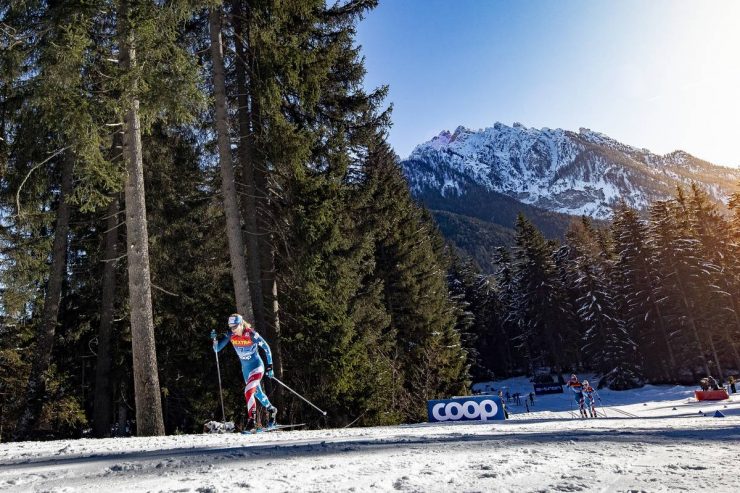
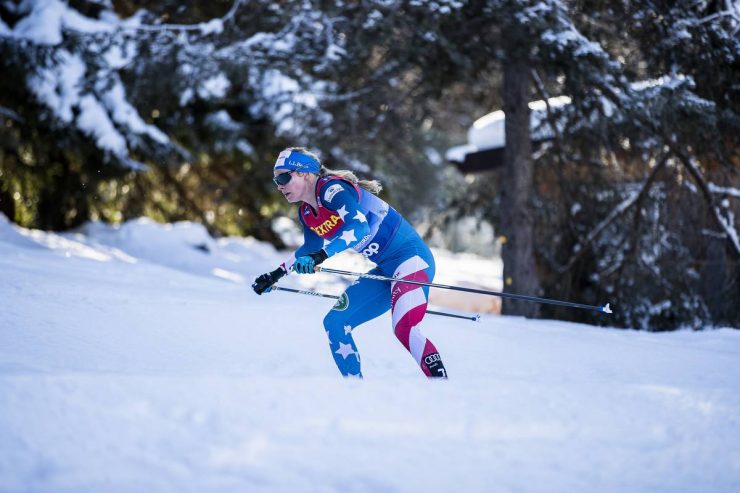
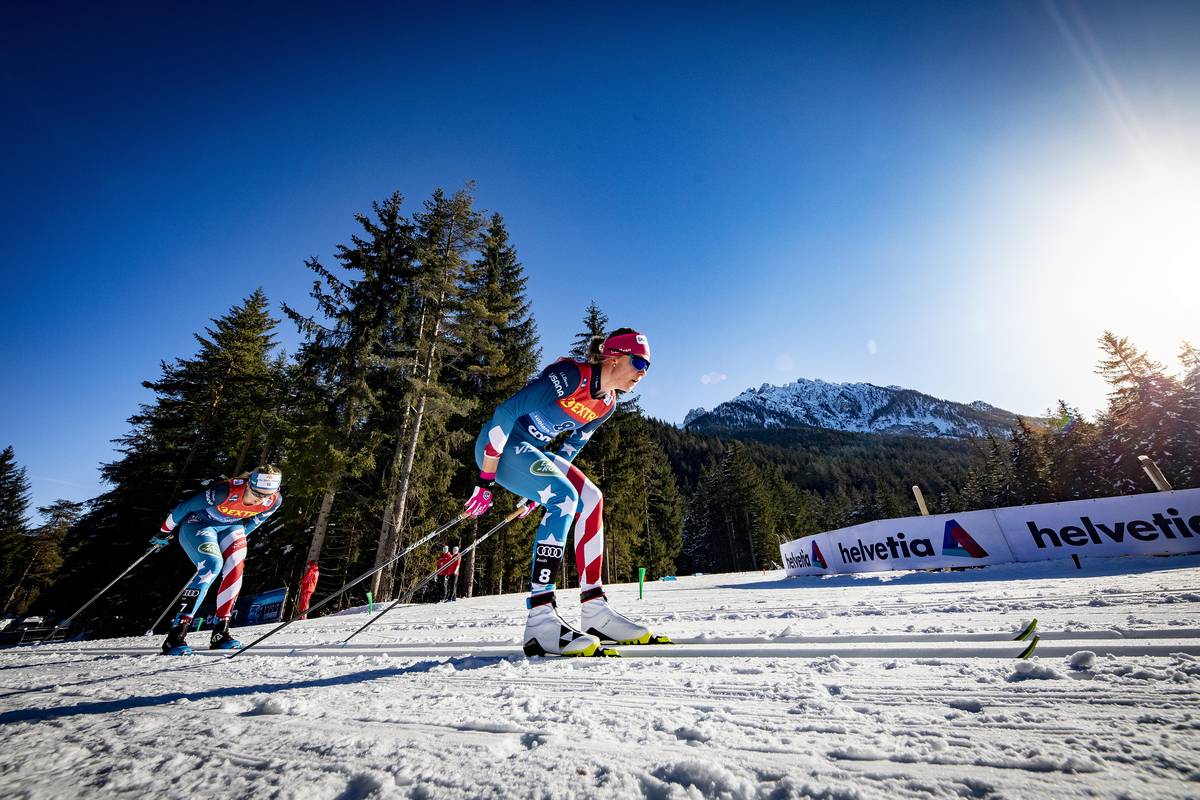
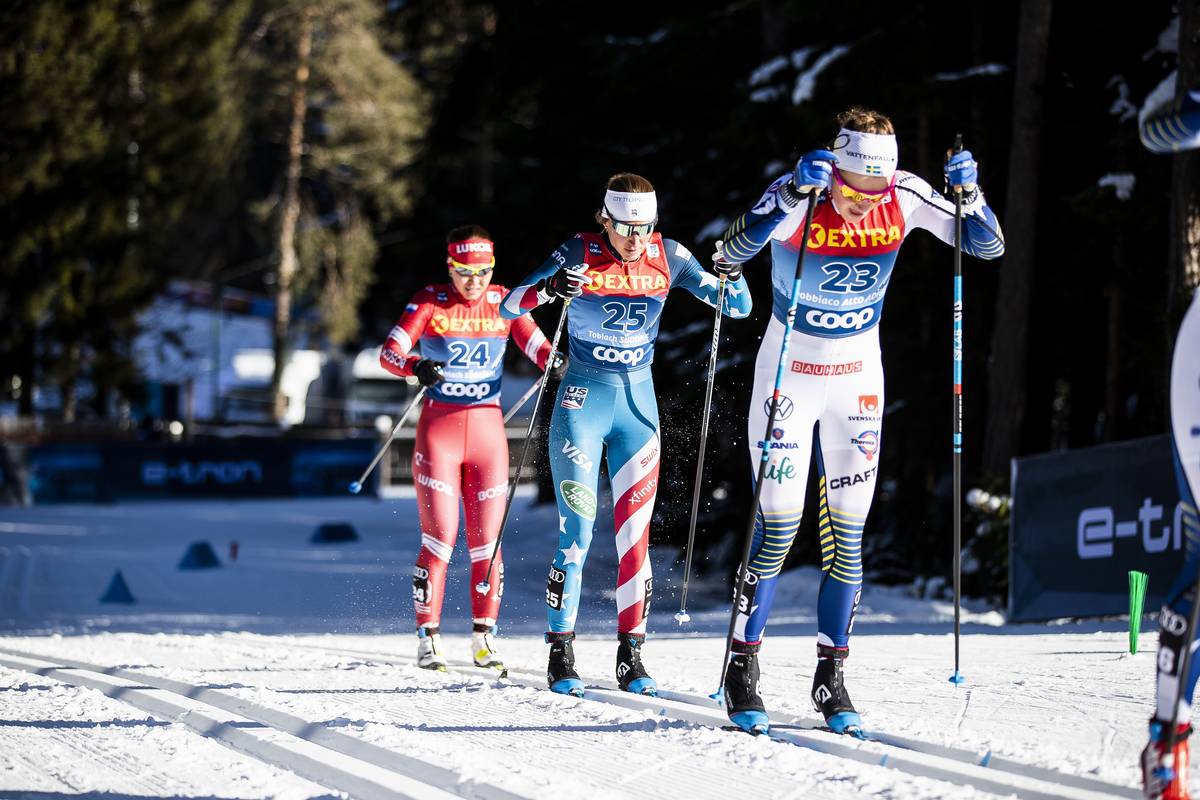
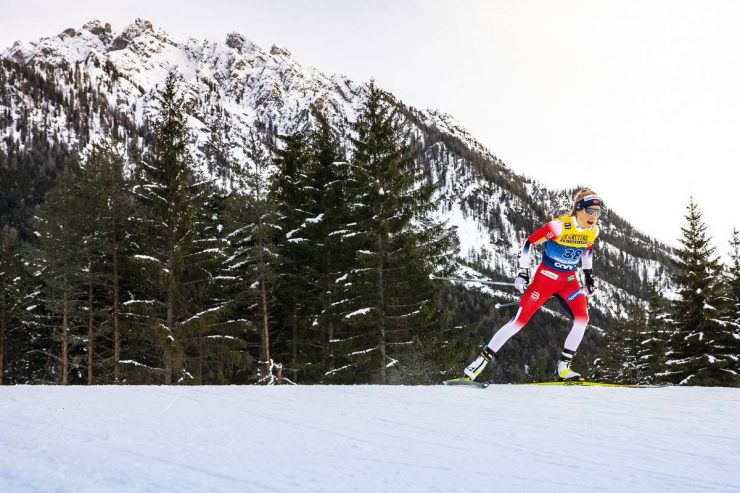
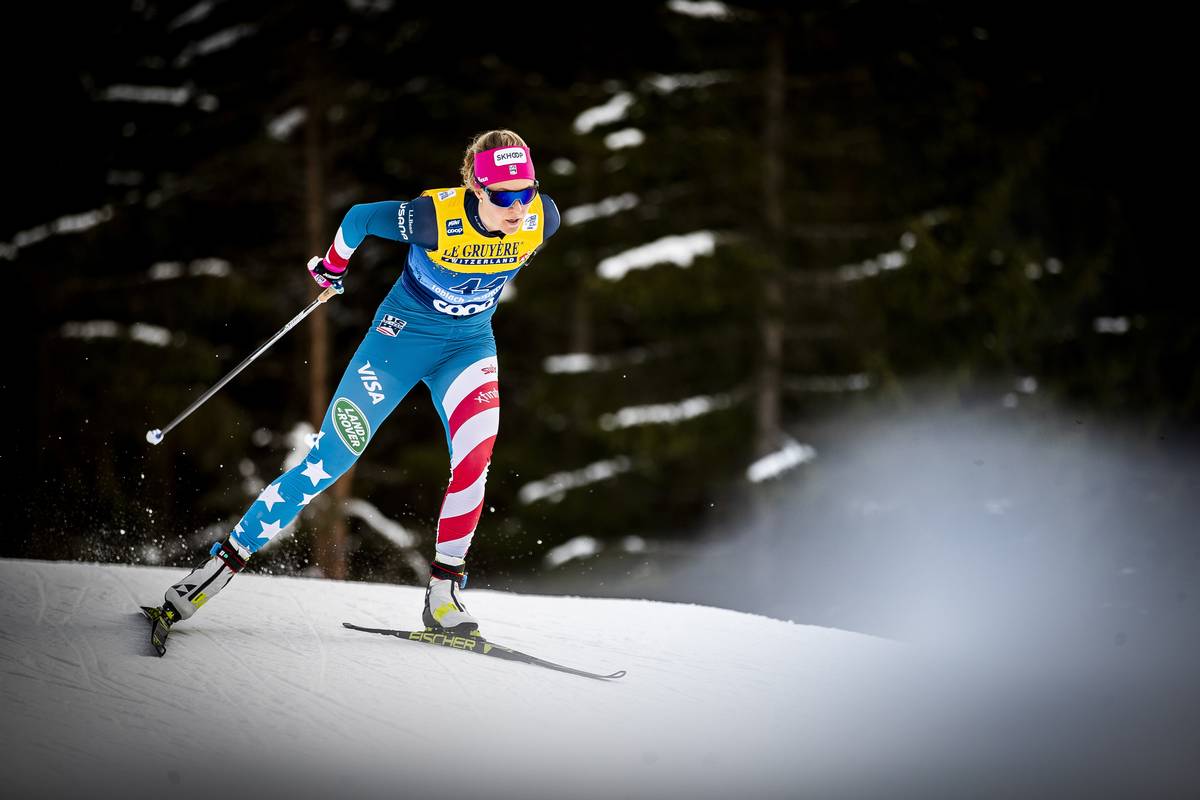
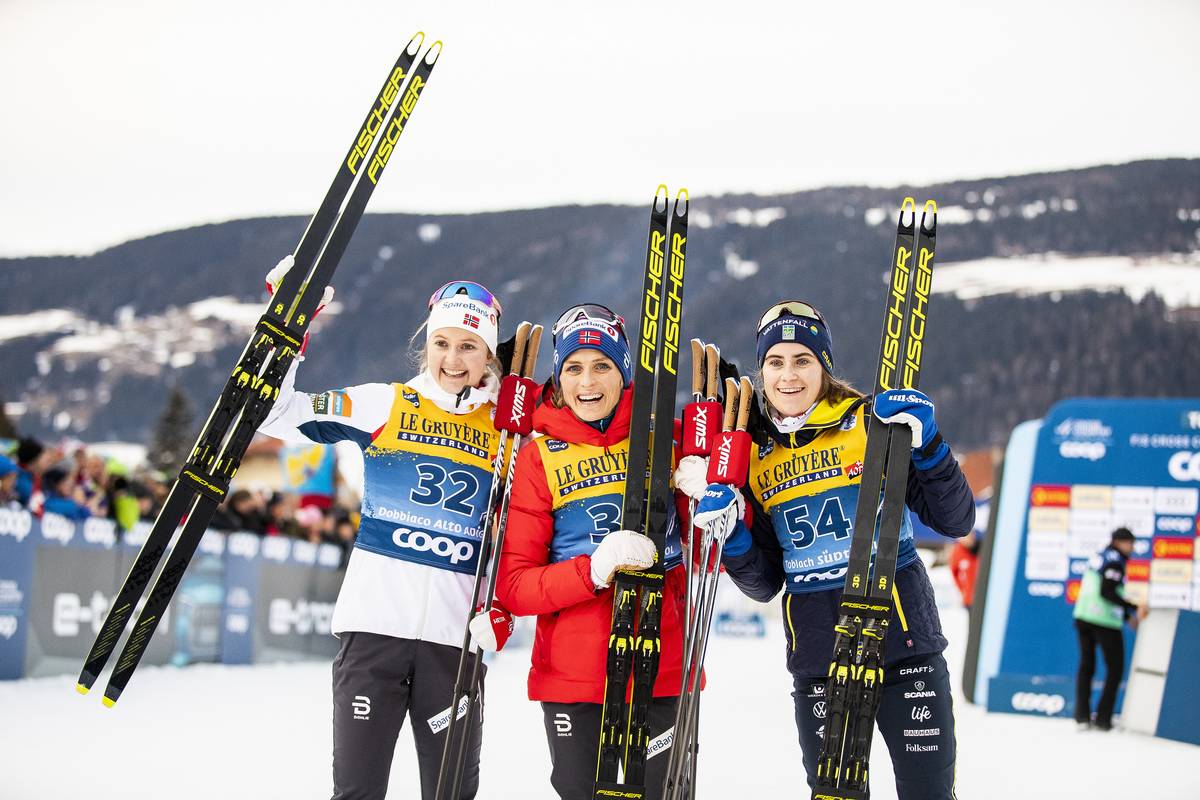
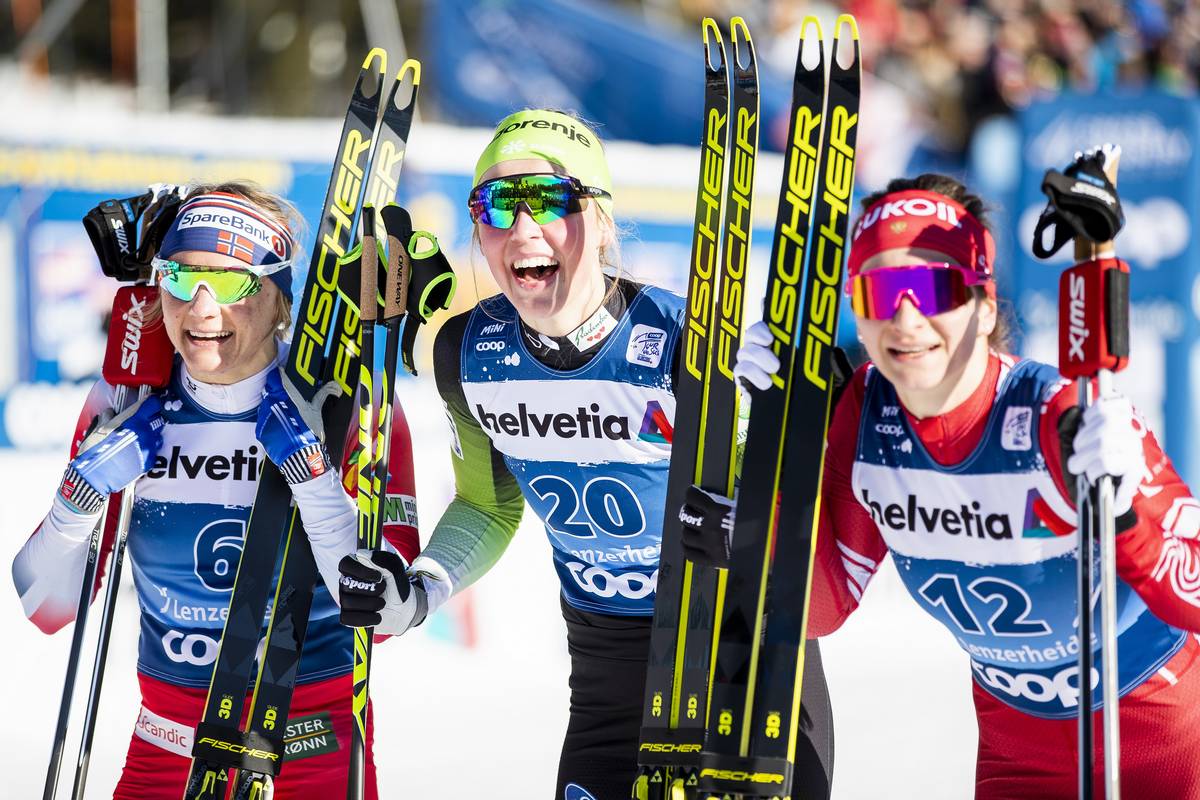
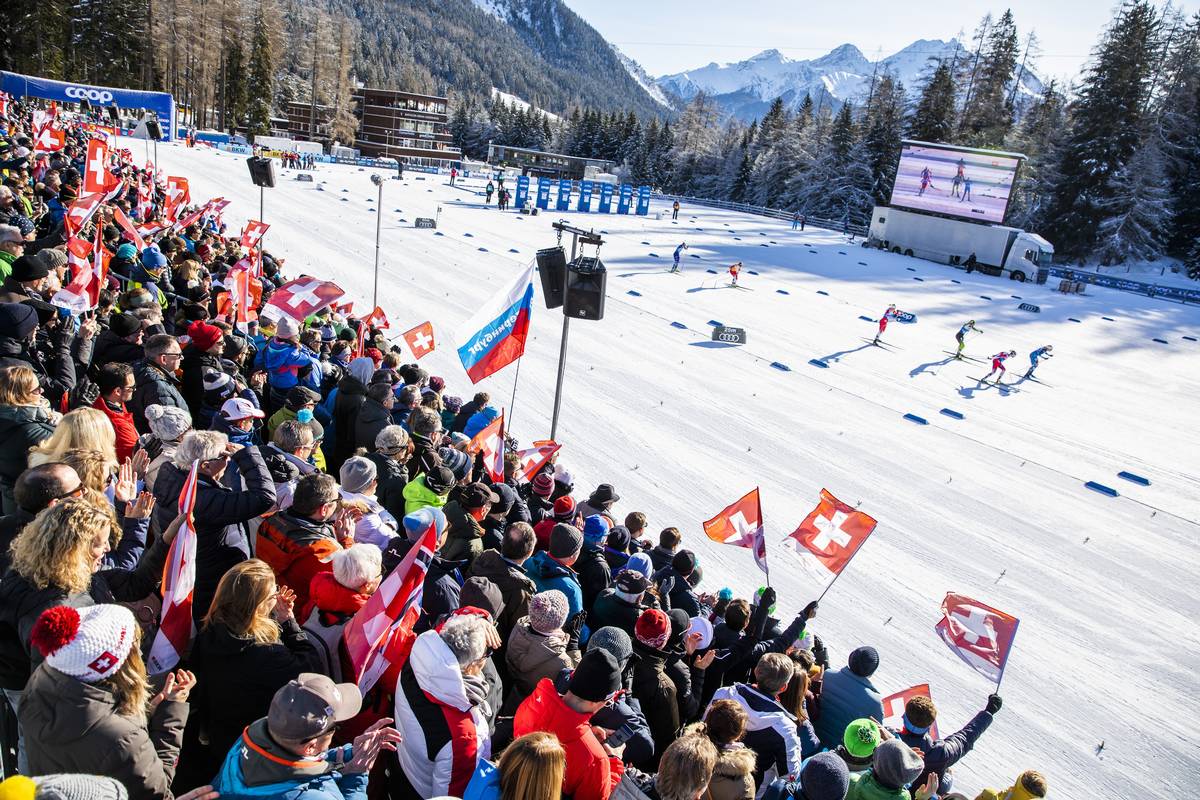
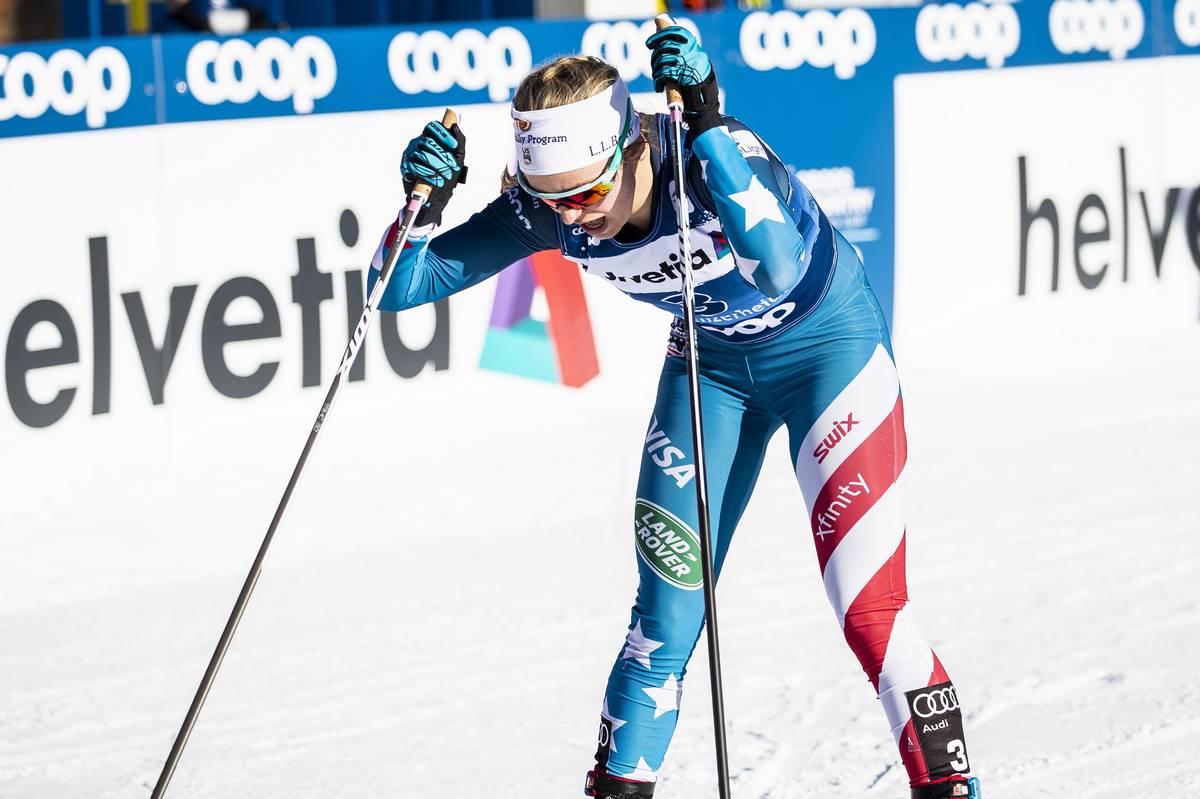
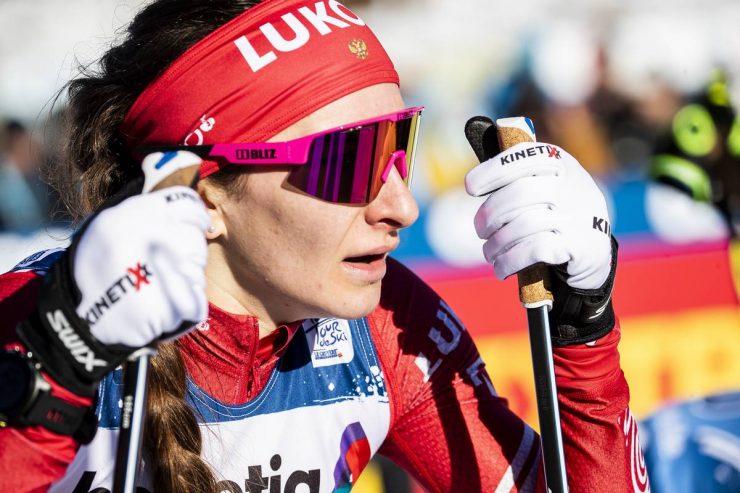
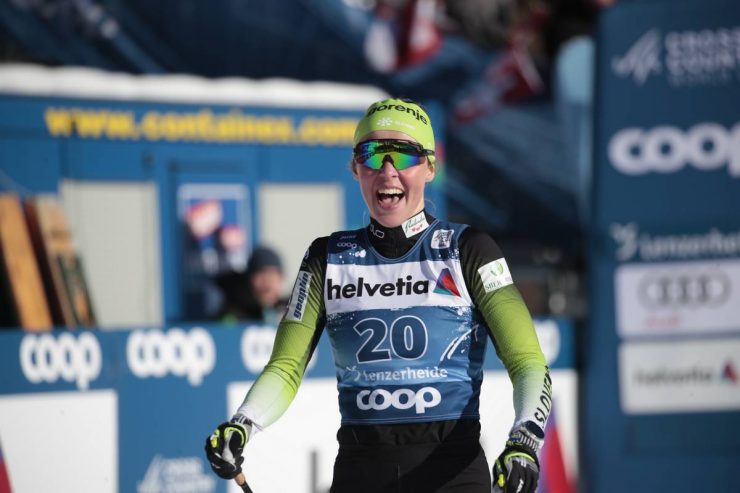
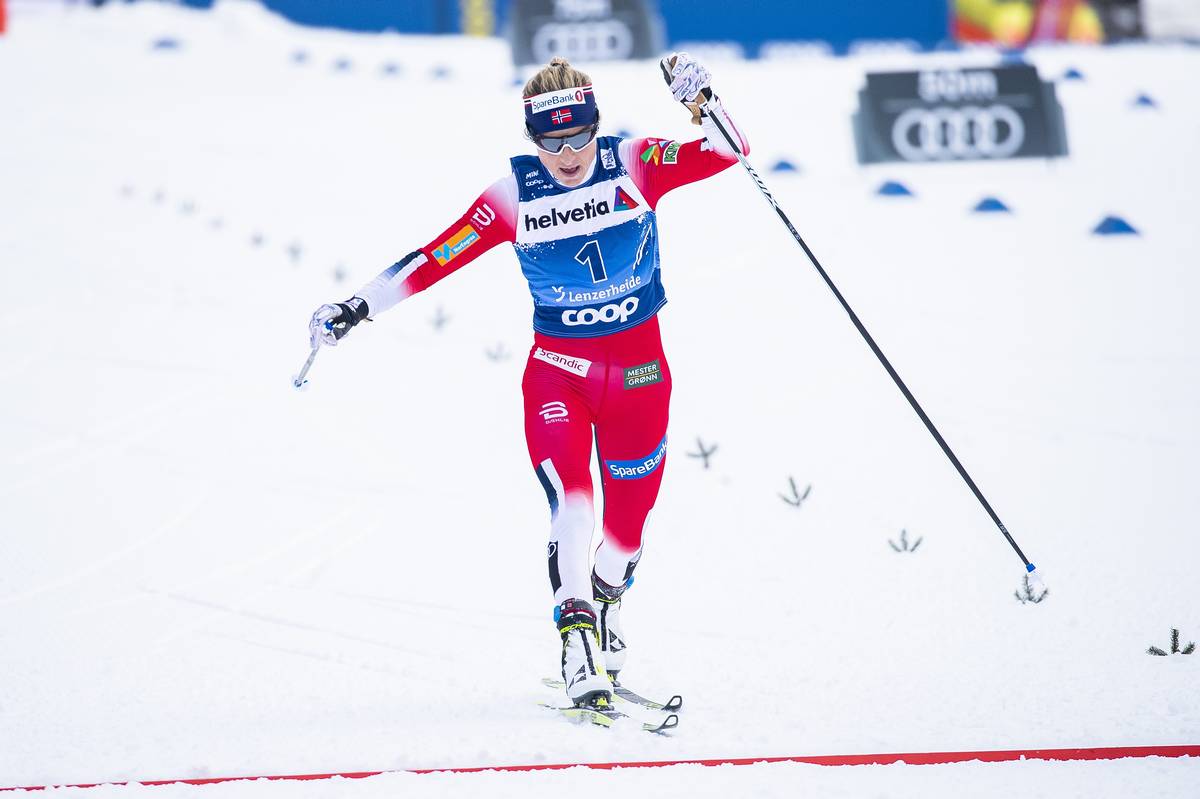
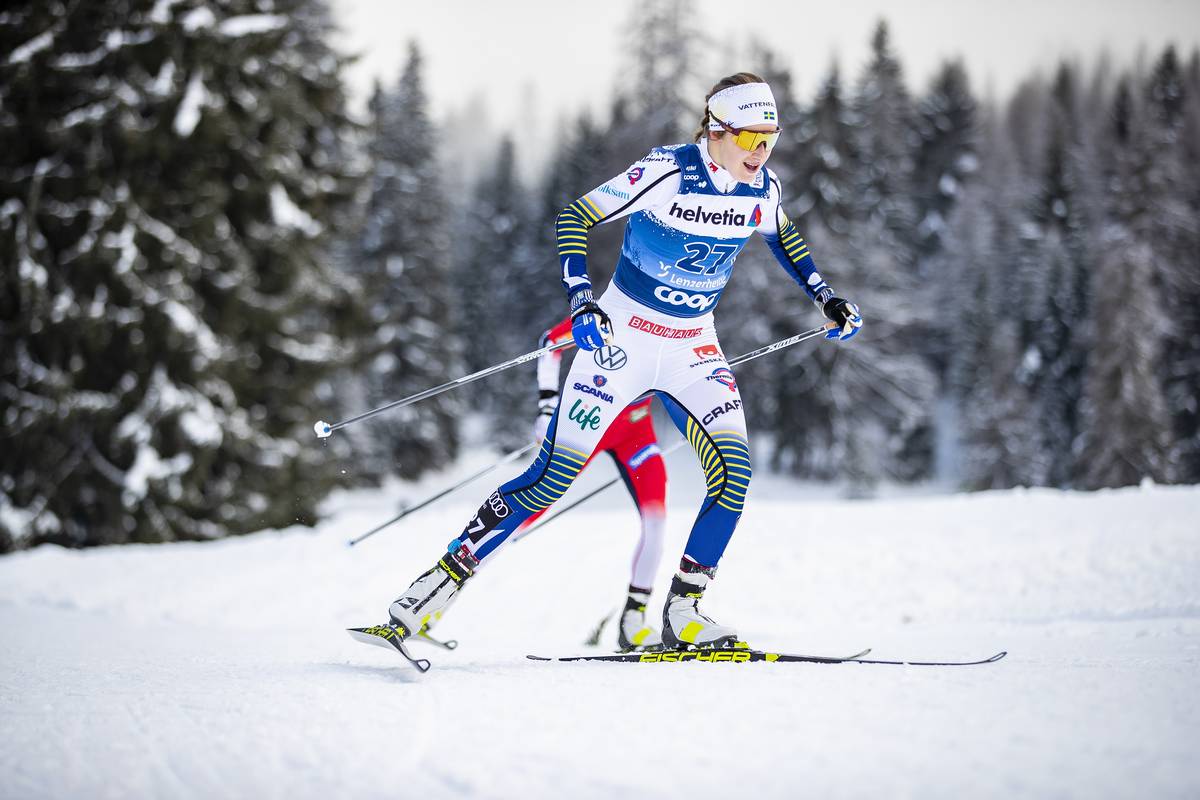
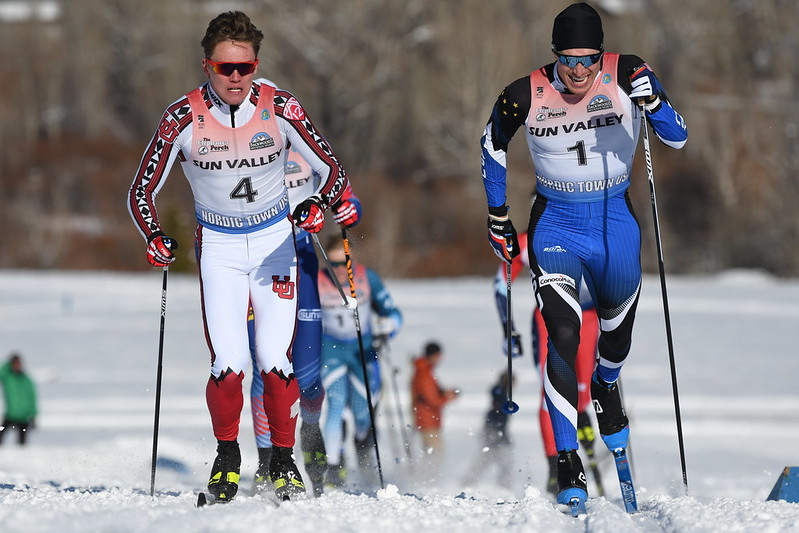
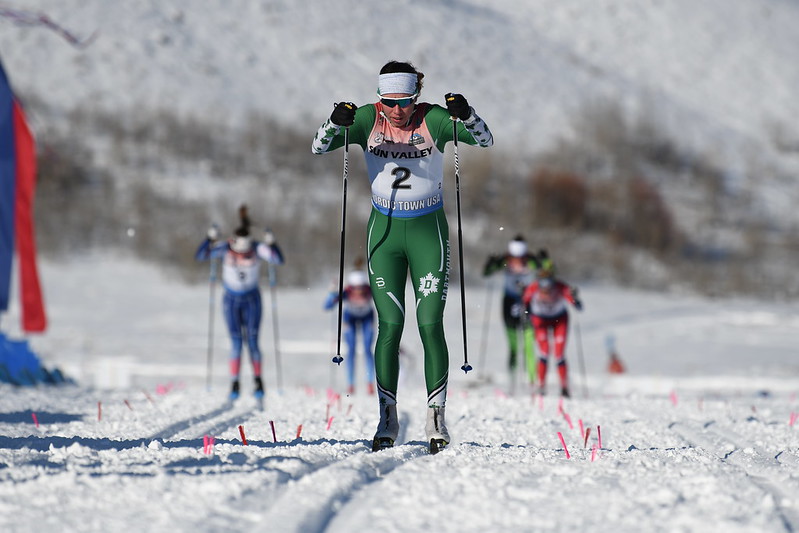
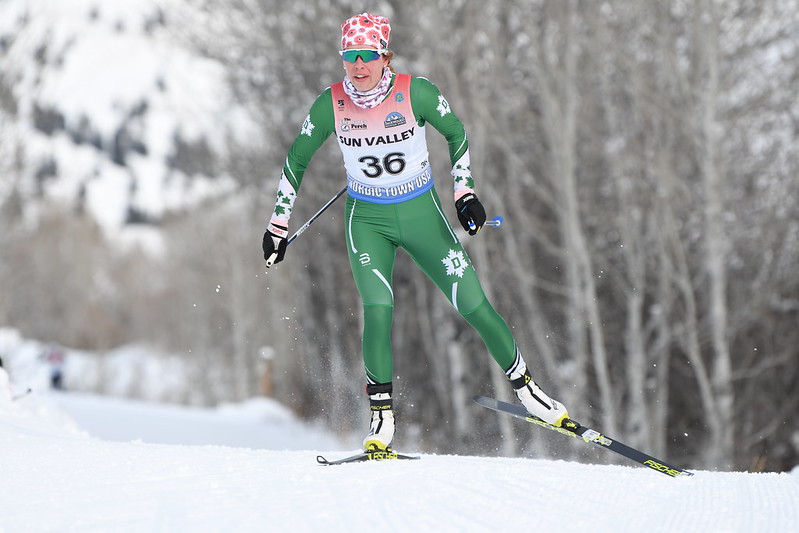
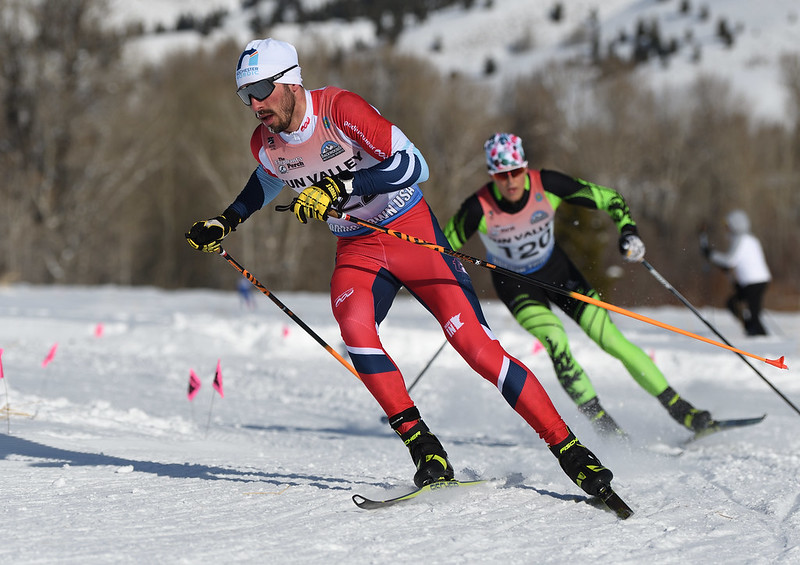
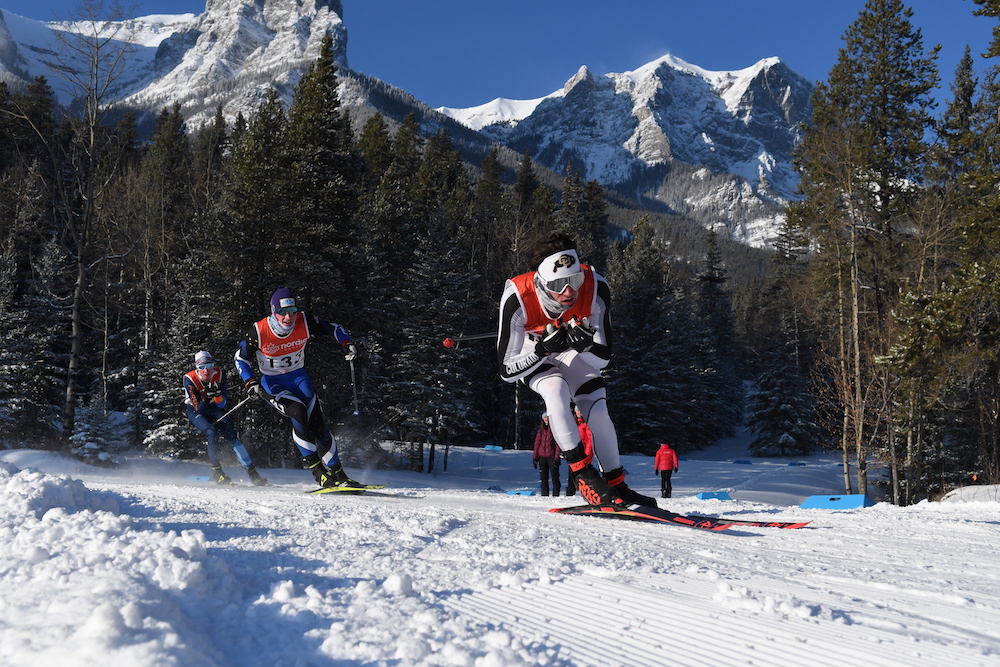
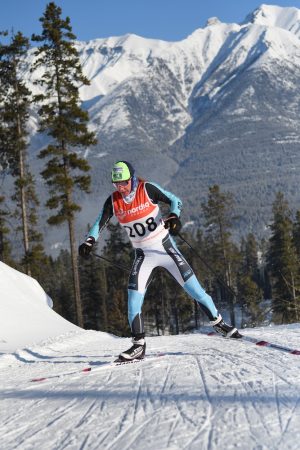
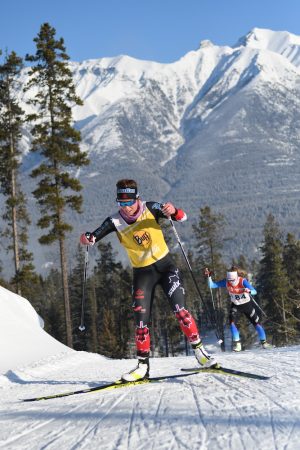
And they’re off! The women take to the course in Stage 2 of the 2021 Tour de Ski, a 10-kilometer mass start classic in Val Müstair, Switzerland. (Photo: NordicFocus)
This World Cup coverage is made possible through the generous support of Marty and Kathy Hall and their A Hall Mark of Excellence Award. To learn more about A Hall Mark of Excellence Award or to learn how you can support FasterSkier’s coverage please contact info@fasterskier.com.
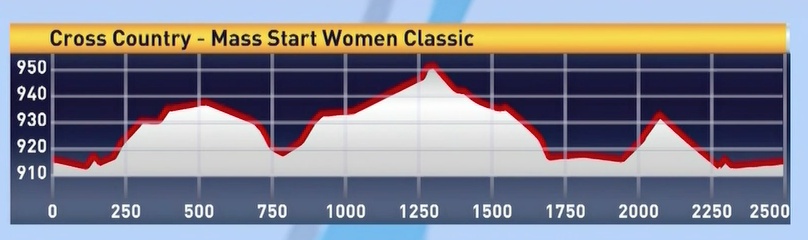
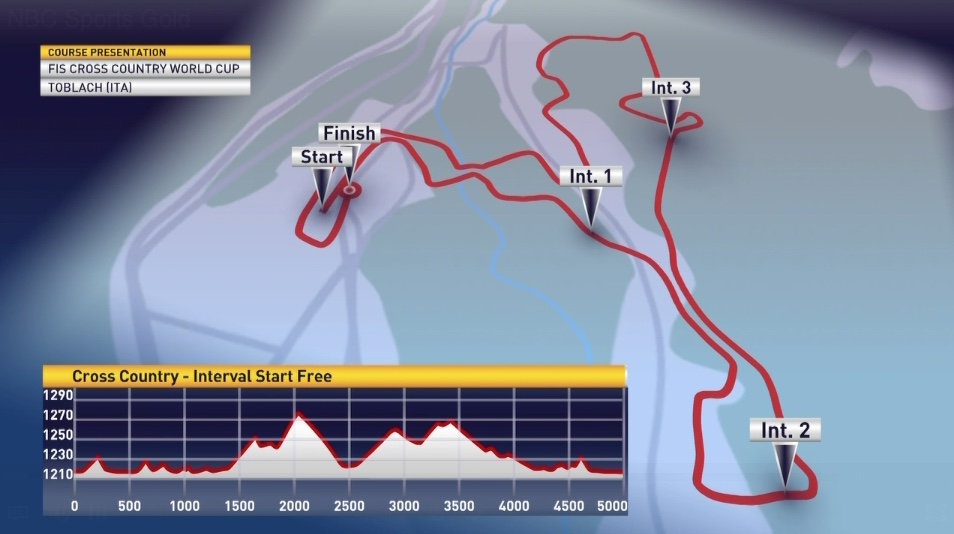
Light snow continued to fall in the quaint Swiss village nestled in Val Müstair as the athletes took to the tracks for the first distance stage of the 2021 Tour de Ski, a 10-kilometer mass start classic race. As the first mass start of the season, the women kicked, glided, and poled over 10-kilometers broken into four challenging laps, seeing exactly where they stacked up relative to their competitors.
With four consecutive distance stages, the Tour quickly becomes part poker match, part ultramarathon. Standings and cumulative time are influenced not only by the final result from each day, but by the bonus points athletes can garner at checkpoints on course; in today’s case, an opportunity at the 3.3 kilometer mark.
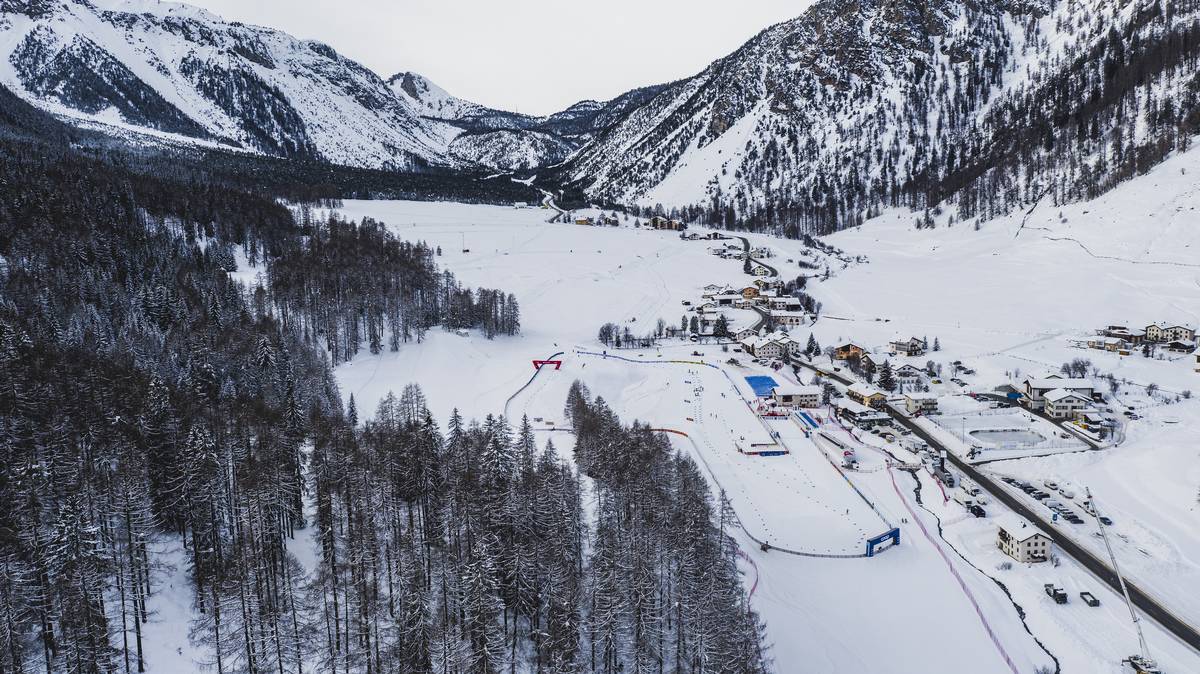
The picturesque village and tracks of Val Müstair play host the first three stages of the 2021 Tour de Ski. (Photo: NordicFocus)
As position in the field is relatively clear in a mass start — versus chasing the splits of a “ghost” racer in an interval start — tactics, patience, and drafting become more significant.
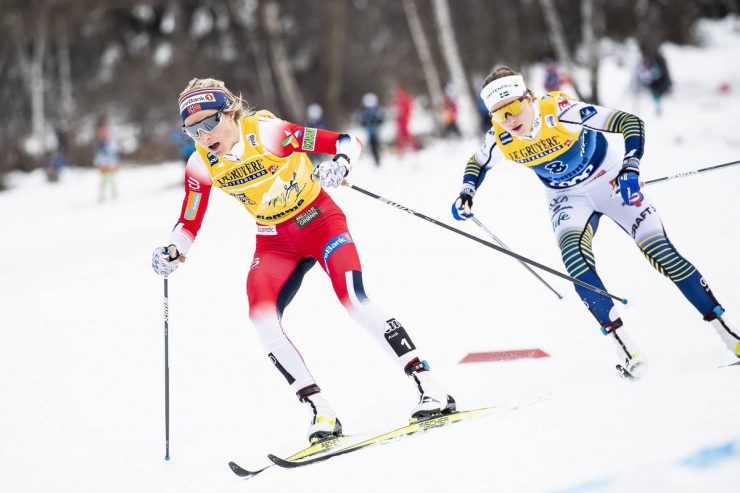
Today, it was soon evident who intended to make a run at the dealer in the Stage 2 match. Wearing a bright green bib as overall U23 leader, Sweden’s Frida Karlsson skied at the front of the pack from the start. She out-sprinted teammate Ebba Anderson approaching the 3.3 k checkpoint to snag the maximum of 15 bonus points, and seemed to be comfortably kicking up each of the steady climbs. After her defeat of Norway’s powerhouse Therese Johaug at last year’s Holmenkollen 30k, albeit in part attributed to Johaug’s decision not to change skis, Karlsson solidified her position as a woman to watch in distance races.
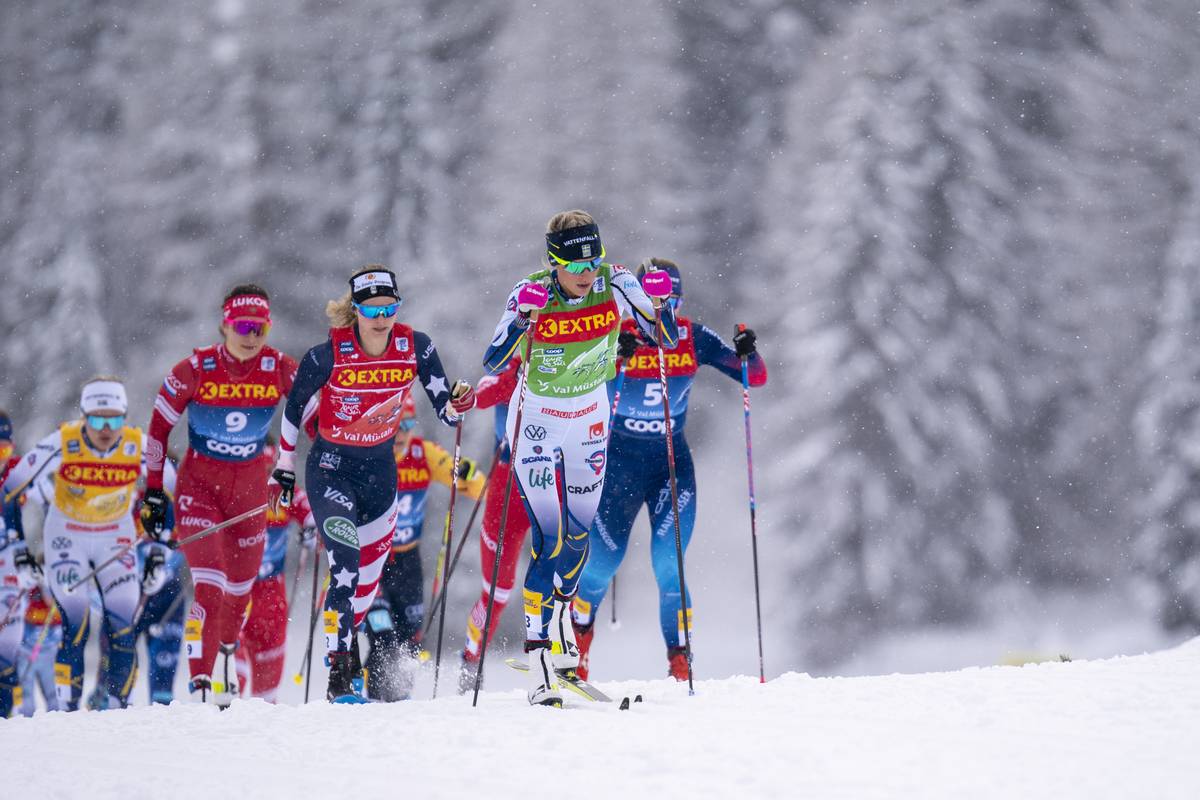
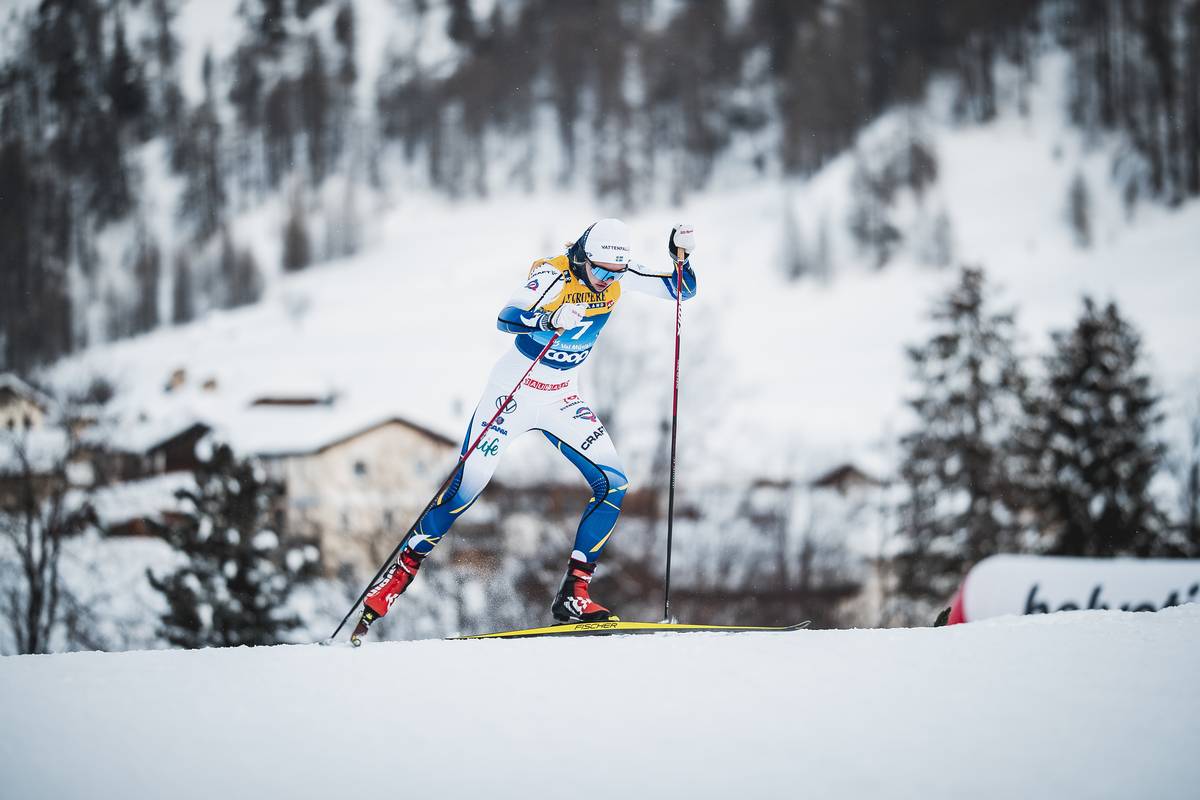
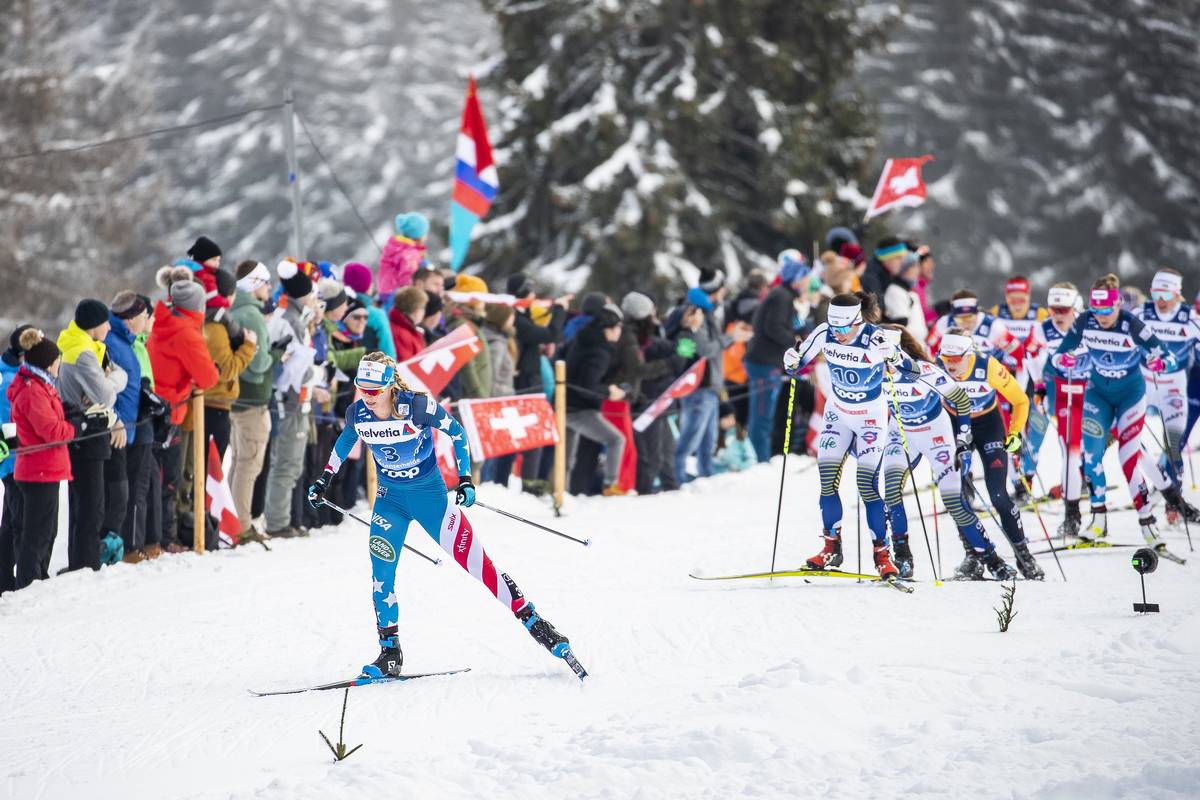
Frida Karlsson sets the pace with Diggins marking from behind during Stage 2 of the 2021 TdS. (Photo: NordicFocus)
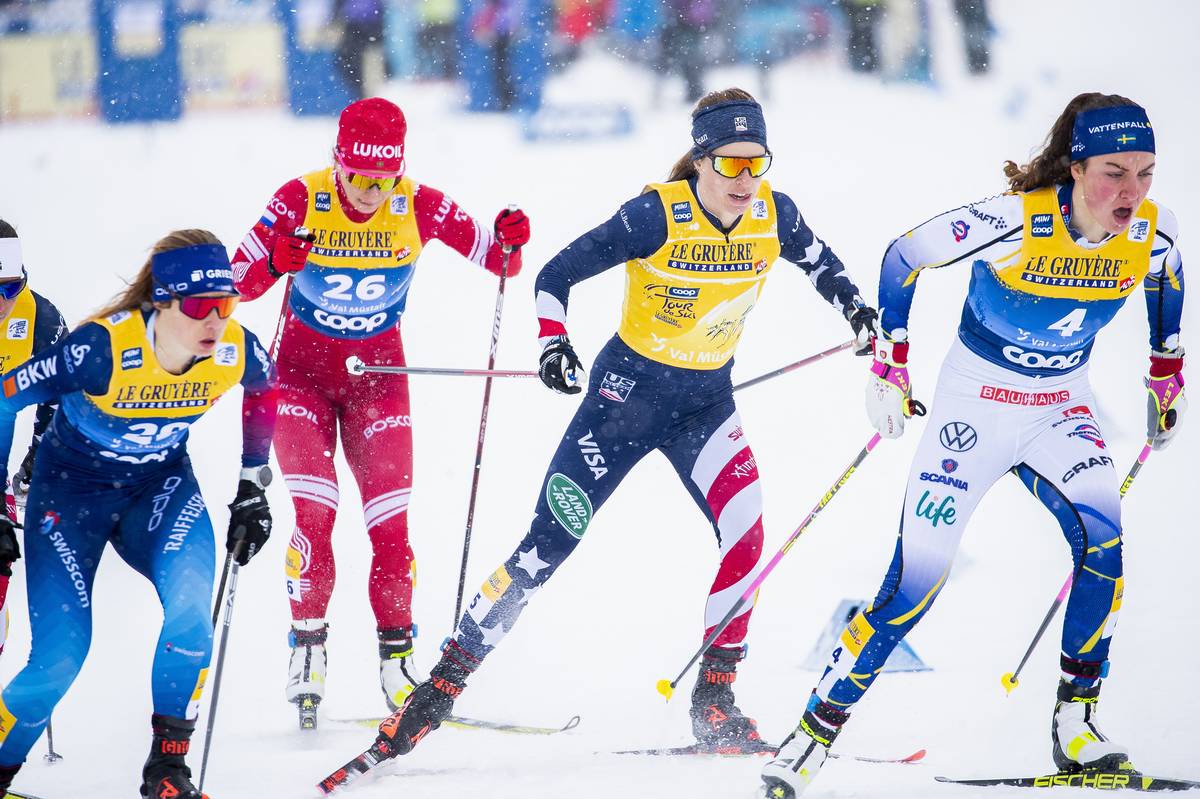
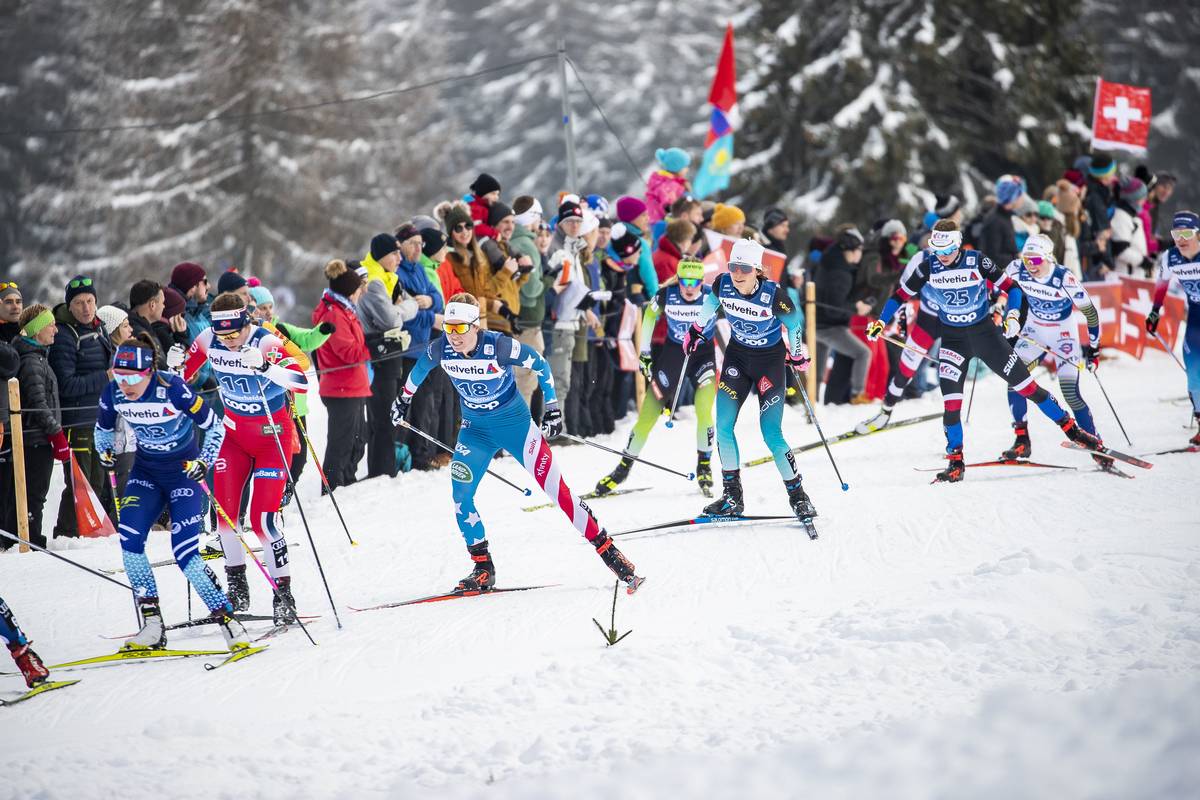
However, despite her seeming authority at the front, she was unable to create any true gap to the women behind her. At the midpoint of the last lap, six women sat on her tails including two women whose stars and stripes flashed on their legs as they matched the tempo of the other women striding alongside them.
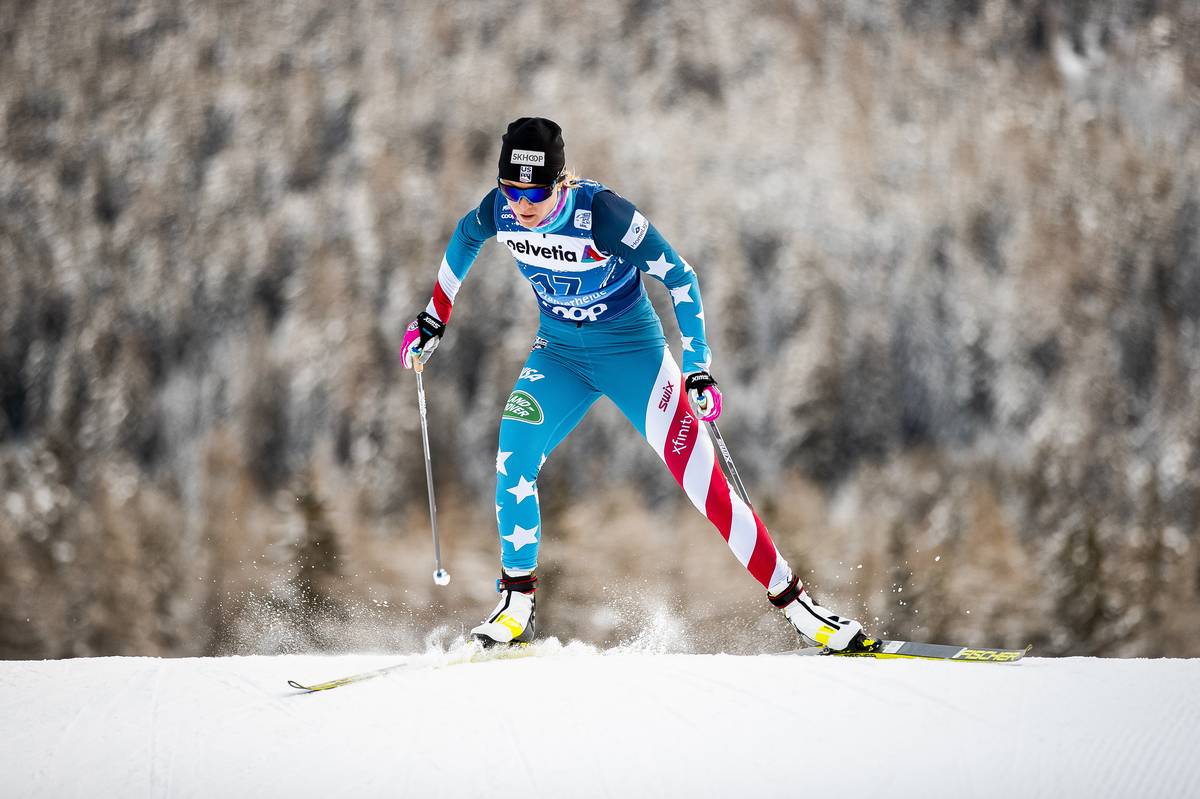
One of these women, Jessie Diggins, comes off a second place finish in yesterday’s sprint. Diggins held her position in the top three throughout the race, at times challenging Karlsson at the front, leaving no room for weakness or error on the young Swede’s part.
Rosie Brennan tucks into the lead group during Stage 2 of the Tour de Ski, a 10-kilometer mass start classic. (Photo: NordicFocus)
Fellow American Rosie Brennan, who finished fourth in Stage 1 also sat comfortably in the lead group, matching the surges that were made to break away as the race progressed.
In the final two kilometers, the other women began their own runs for the win, challenging Karlsson who was faltering, but unwilling to fold. Up the final climb and down the same screaming S-turn descent featured in the sprint course, the women charged furiously toward the finish, Karlsson slowly being swallowed into the pack.
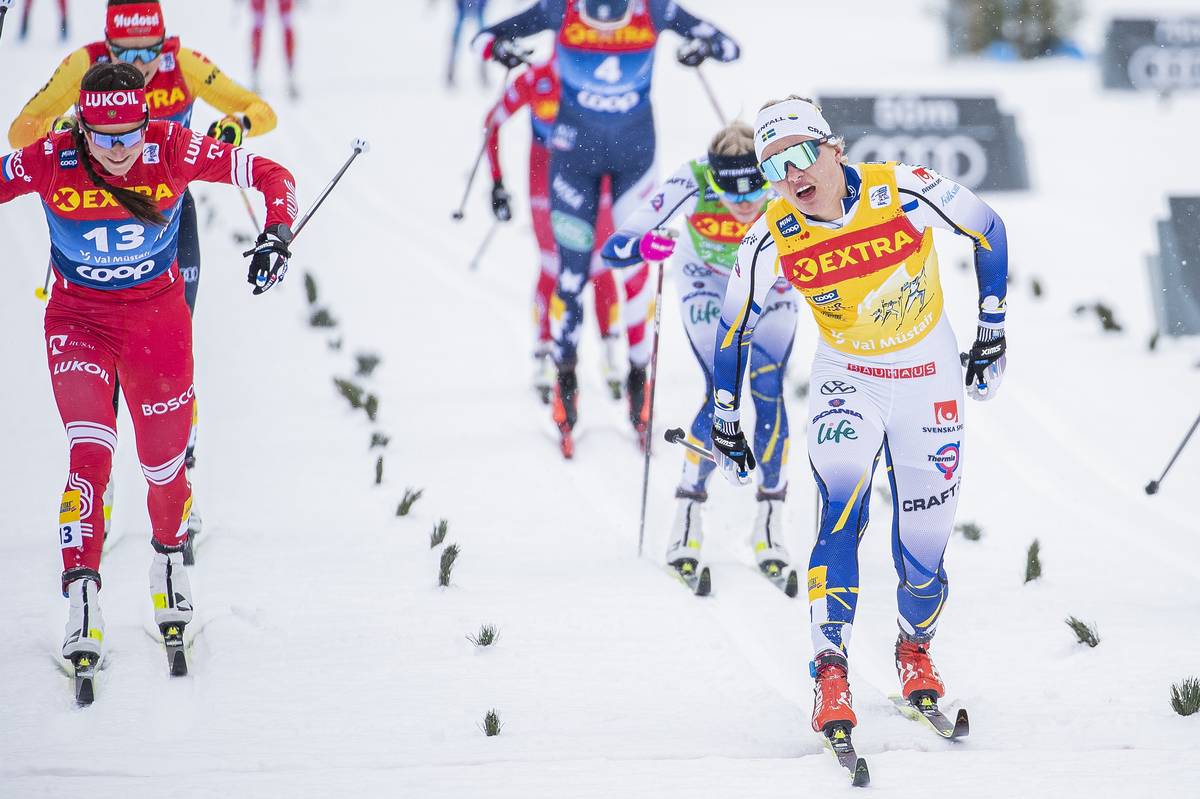
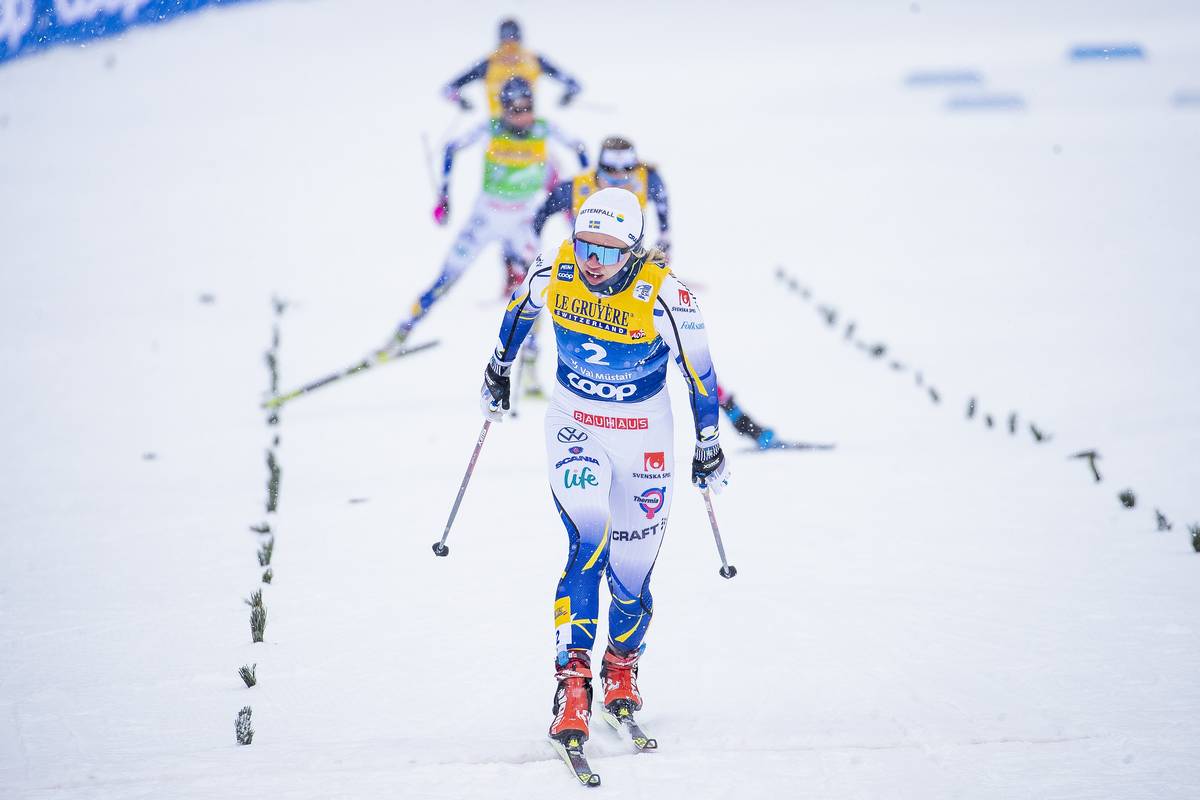
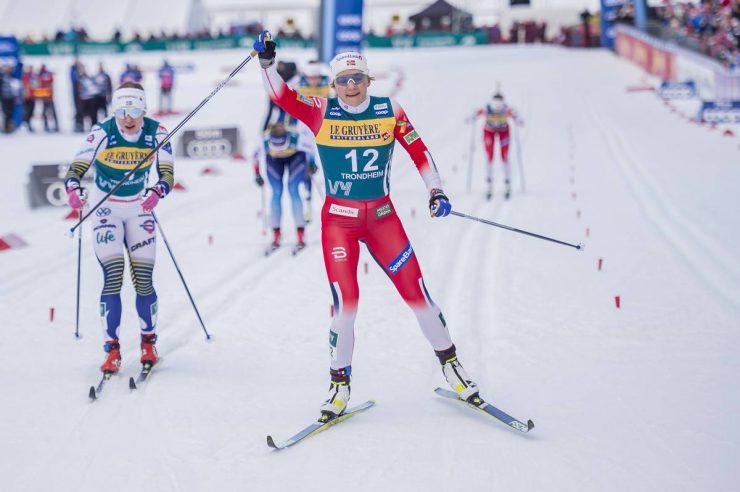
Rounding the final corner and thrashing her poles to accelerate toward the finish, a different woman in white lycra took the reins. 21-year-old Linn Svahn, the winner of yesterday’s skate sprint and of the 2019/2020 World Cup sprint globe, put her closing speed on display to stop the clock at 30:09.9. Though she has won FIS distance races on home soil, this is Svahn’s first distance win at the World Cup level.
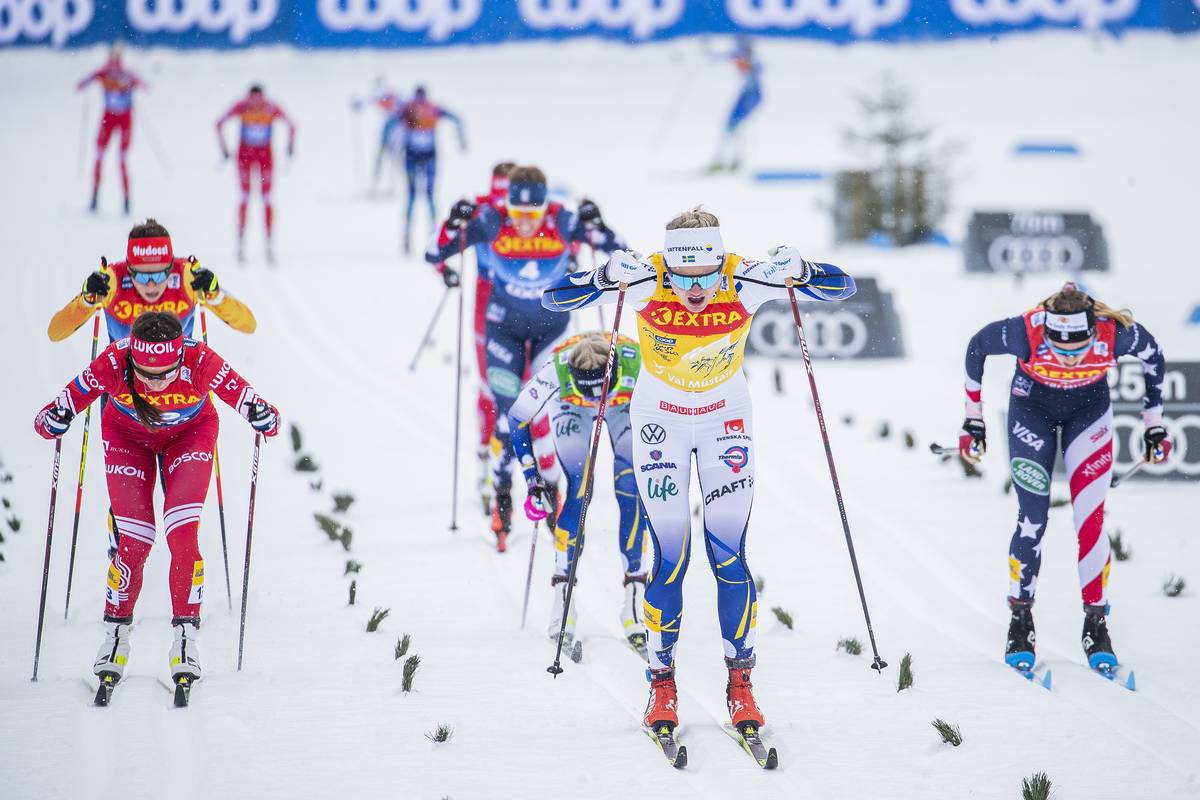
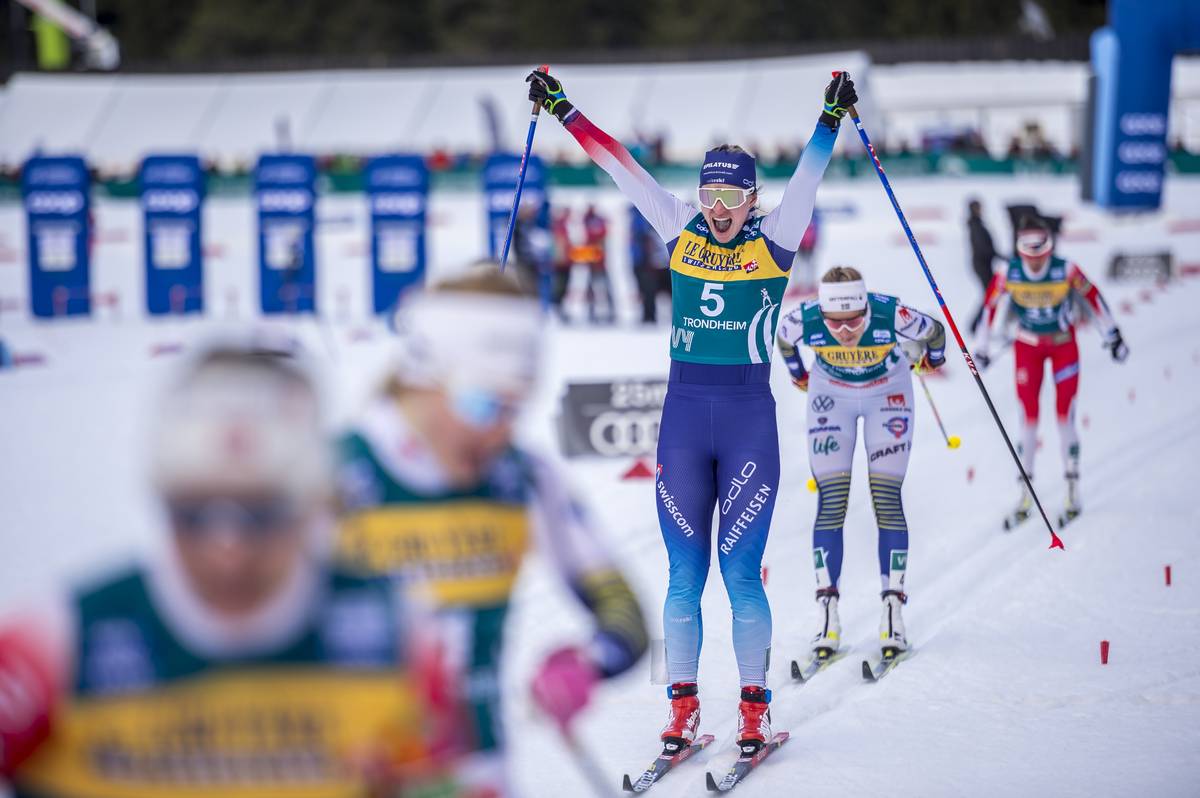
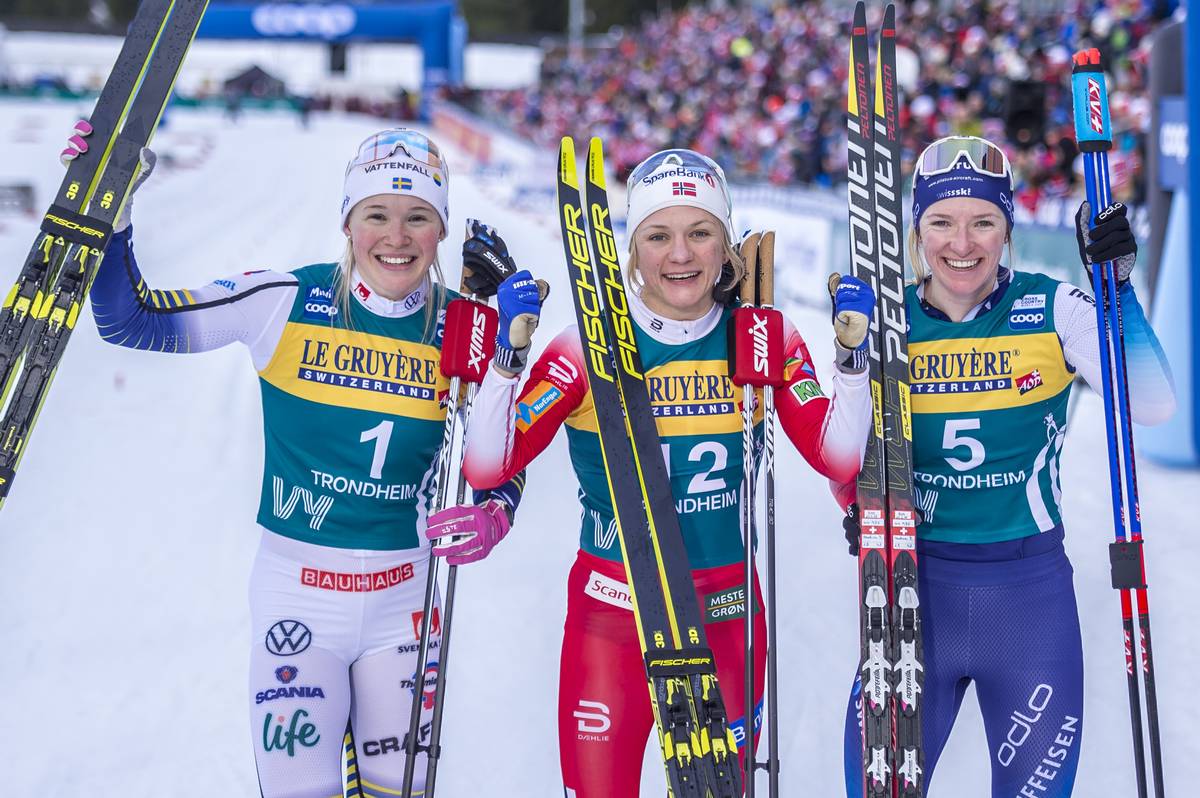
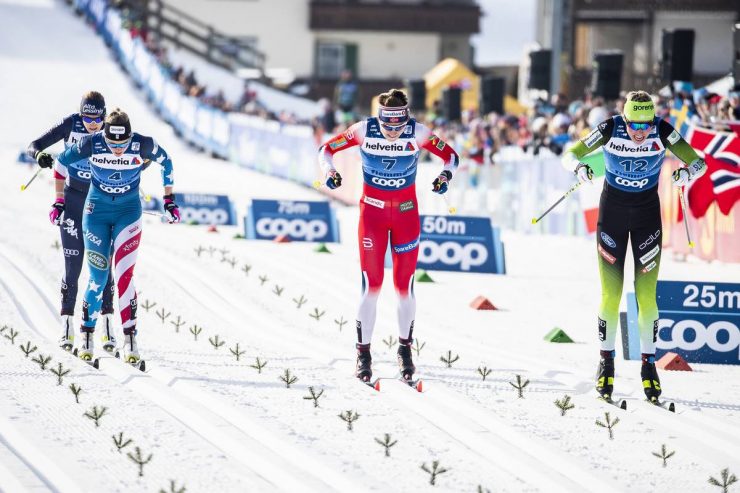
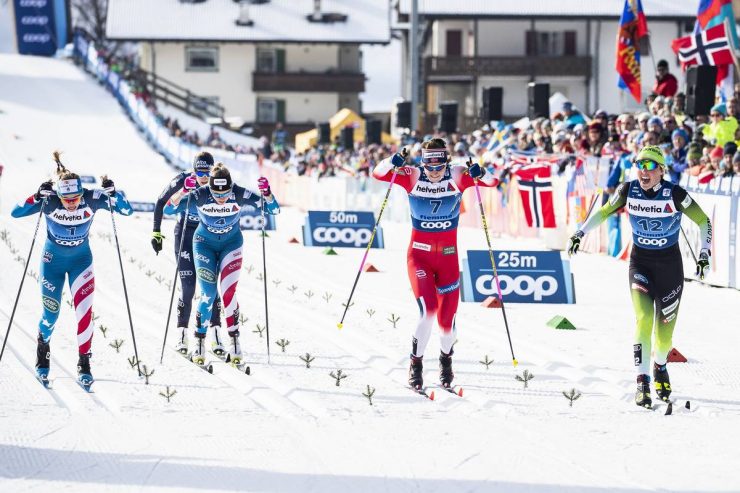
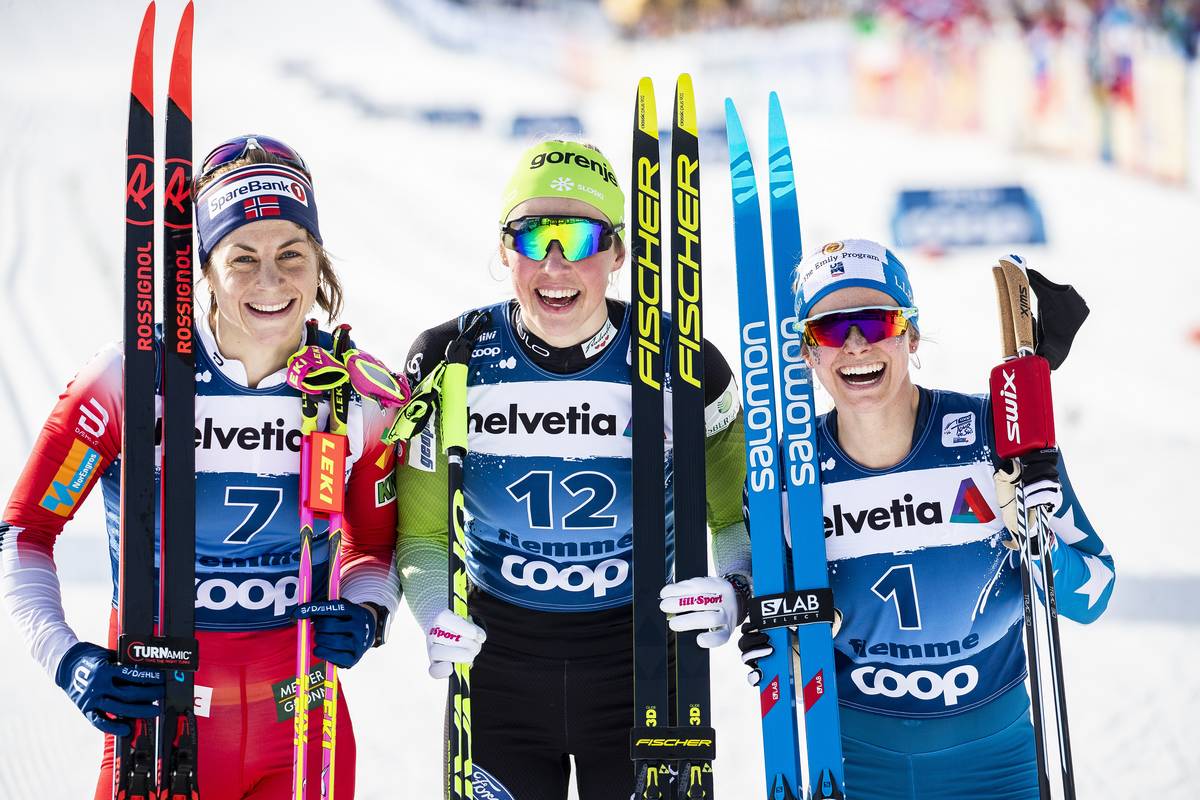
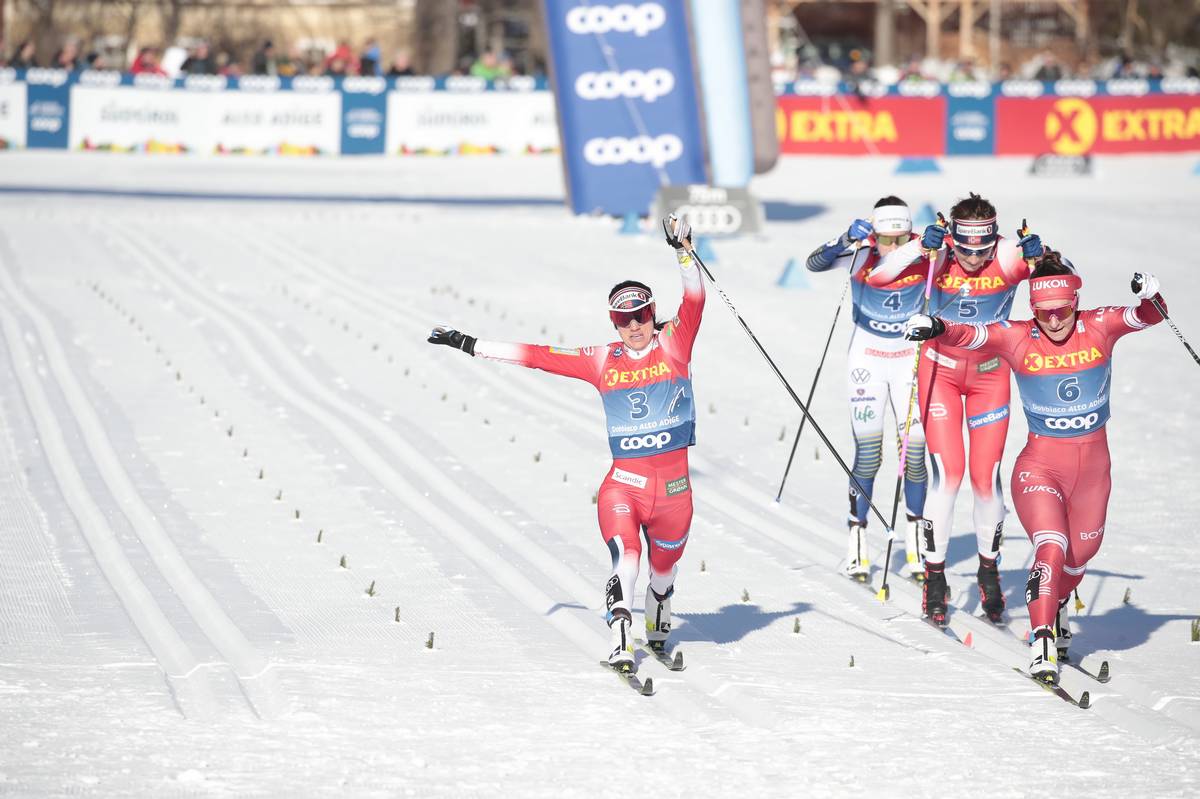
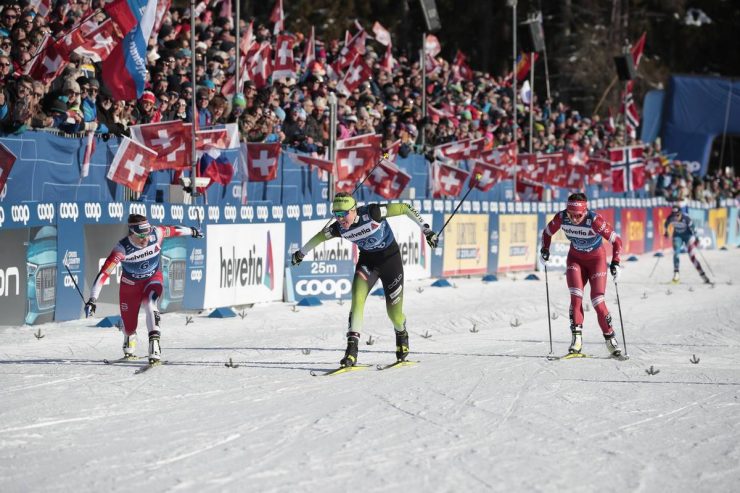
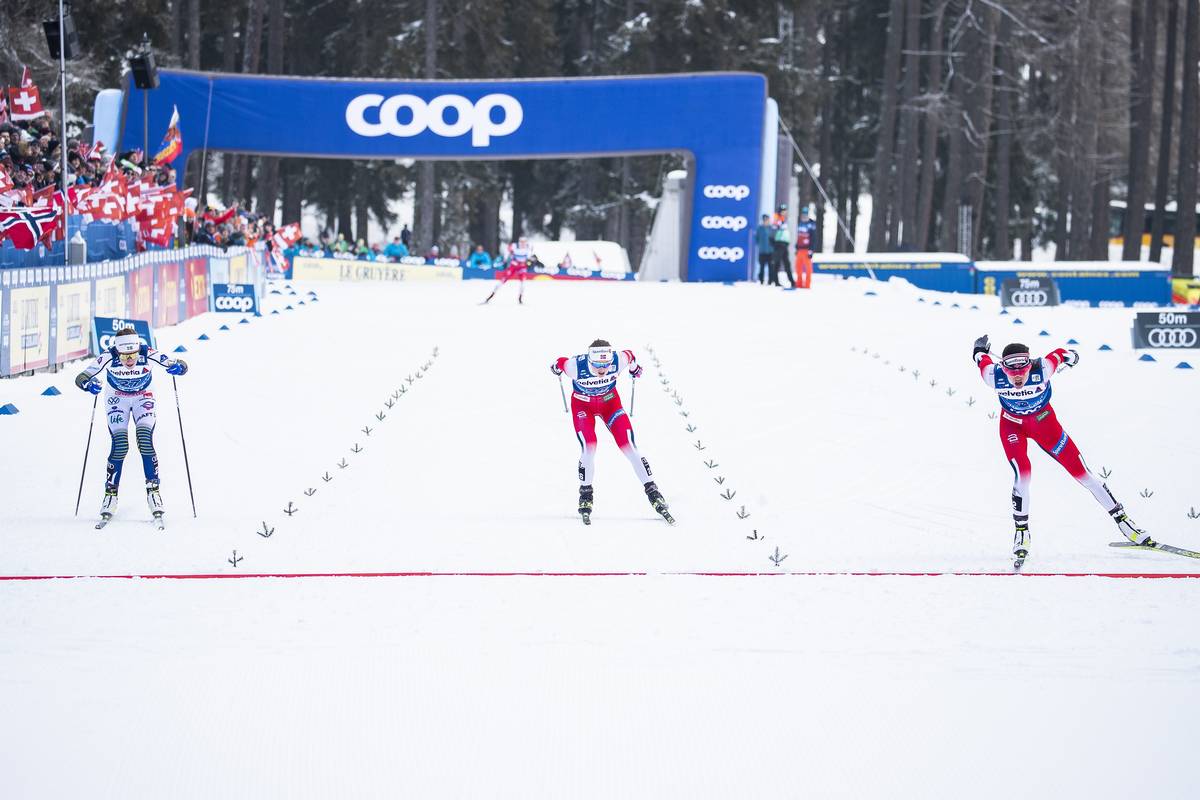
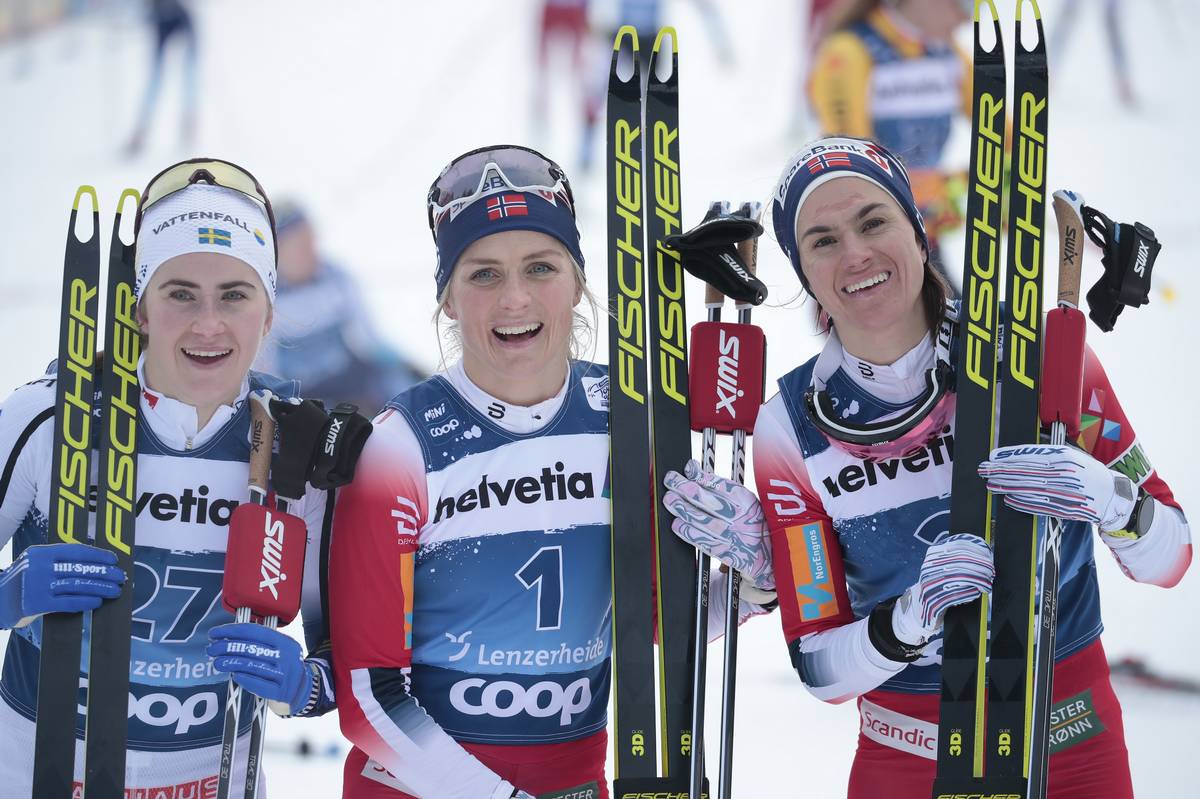
The top women fight to the line during Stage 2 of the 2021 Tour de Ski. Sweden’s Linn Svahn took the win, with Yulia Stupak (RUS) and Jessie Diggins in 2nd and 3rd, respectively. (Photo: NordicFocus)Sweden’s Linn Svahn throws her boot to seal the deal on victory in Stage 2 of the TdS, a 10-kilometer mass start classic. (Photo: NordicFocus)
“It was really fun. I love going classic,” she told FIS after the race. “My plan was to just keep it as chill as I could, then watch the girls going strong on the uphill and try not to use so much energy. When I knew it was one lap left, I just kept thinking ‘I need to win this. I need to win this.’ So it was really good to race today.”
A champion in sprint and distance, Sweden’s Linn Svahn wins back-to-back stages of the 2021 Tour de Ski. (Photo: NordicFocus)
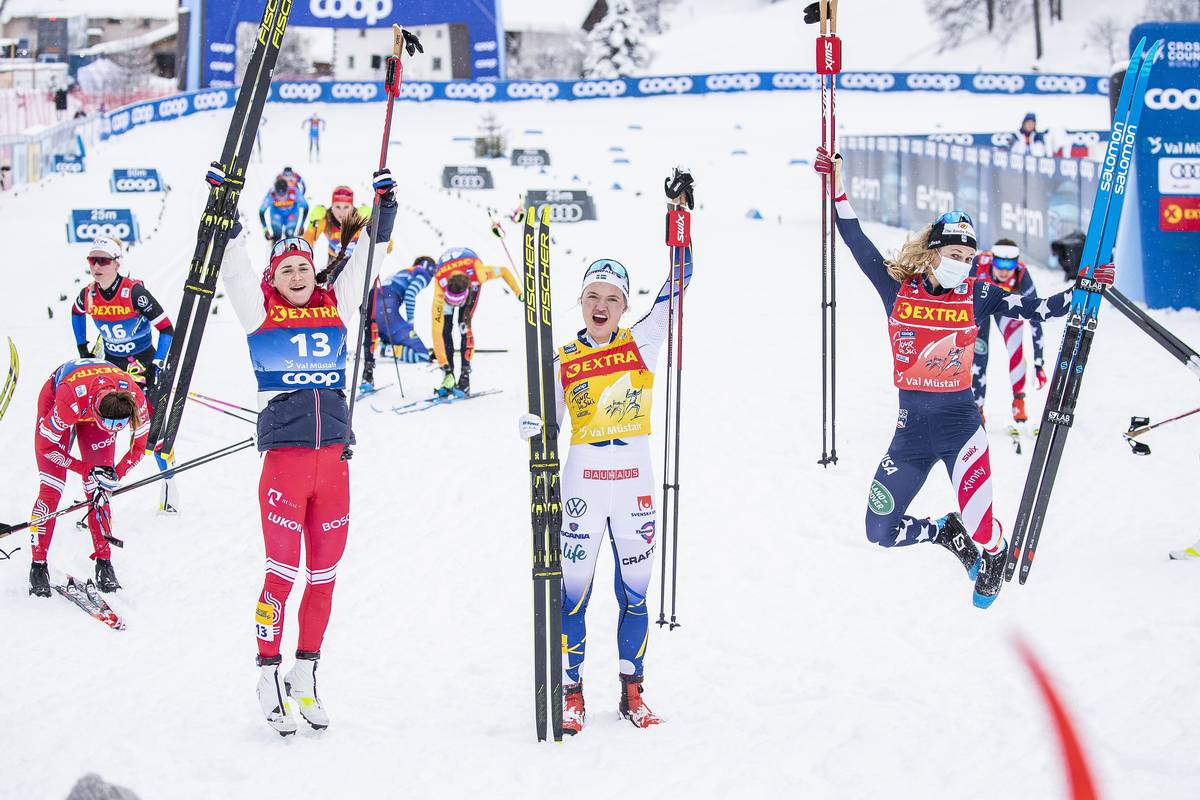
Just behind, a threesome including Diggins, Karlsson, and Yulia Stupak of Russia fought for the remaining spots on the podium. Stupak and Diggins crept ahead of the Swede, matching each other’s poling tempo before throwing their boots at the line. Stupak barely edged out Diggins, taking second (+0.7) with Diggins just behind in third (+0.8).
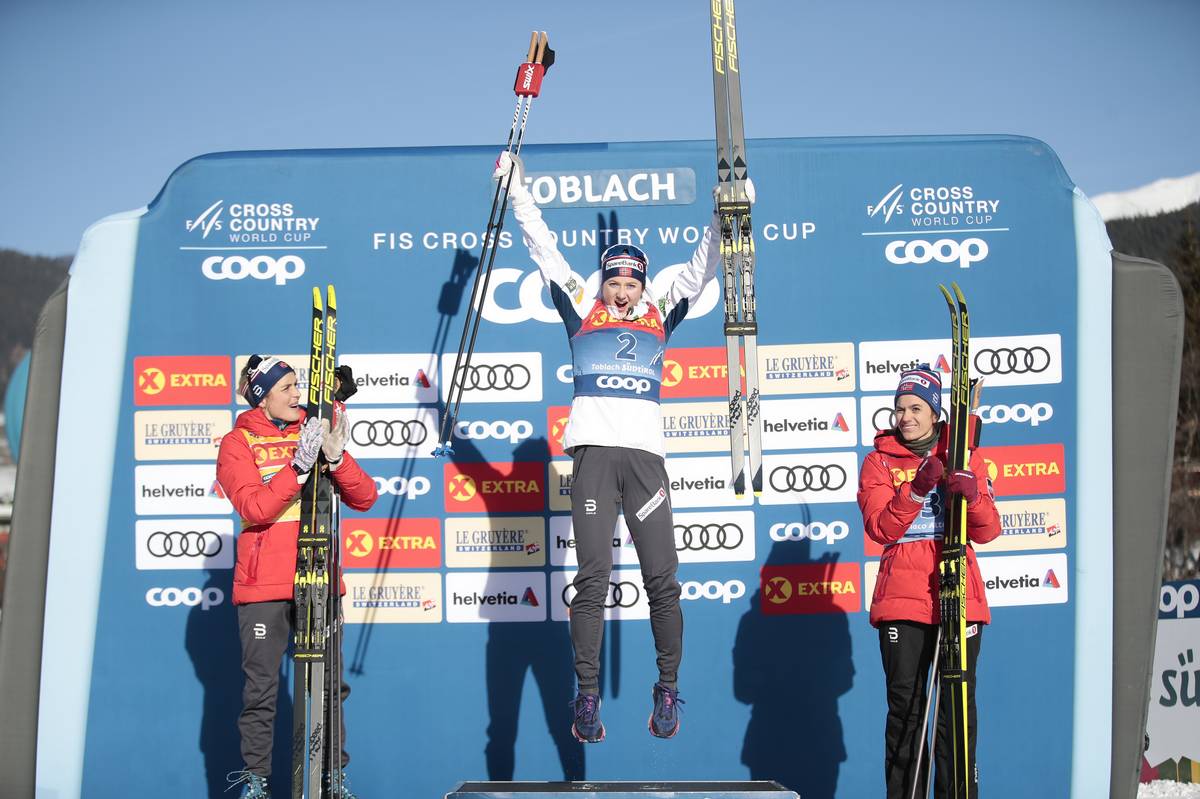
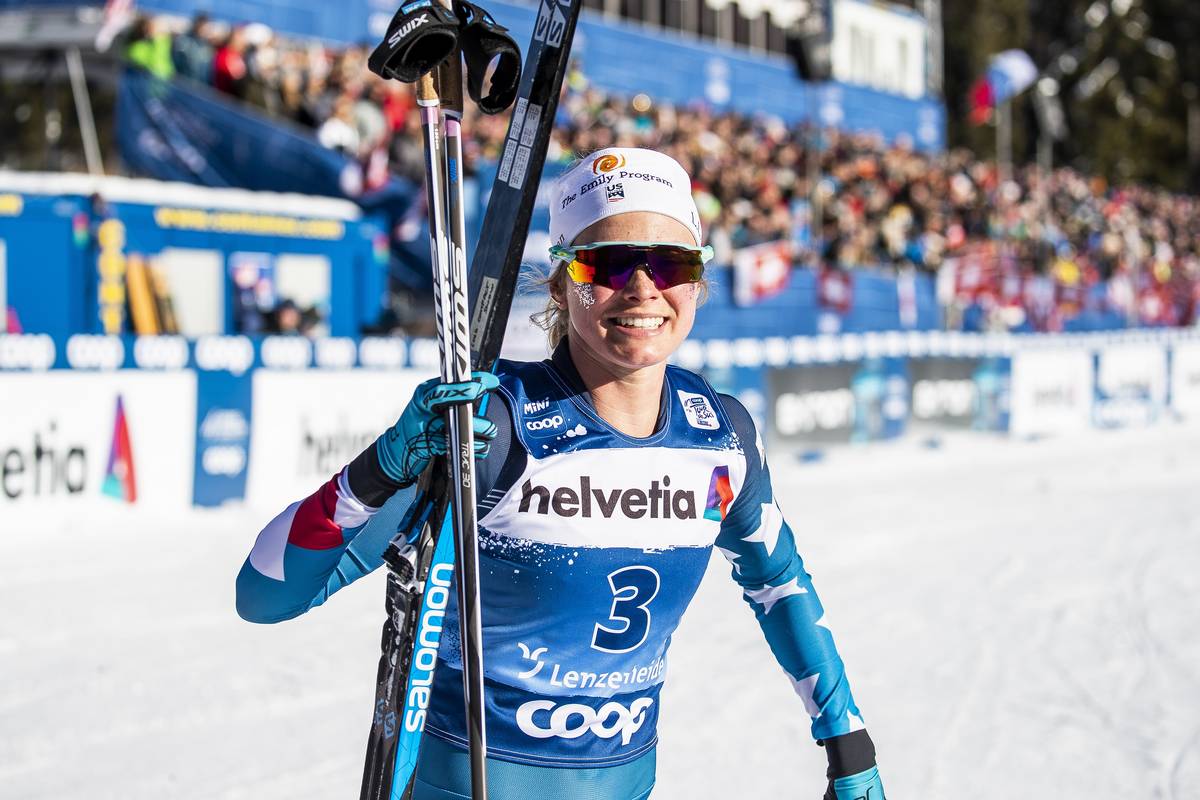
Airborne and on form, Diggins celebrates her third place finish in Stage 2 of the Tour de Ski. Sweden’s Linn Svahn (center) took the win, followed by Russia’s Yulia Stupak in 2nd. (Photo: NordicFocus)
“We had great skis out there!” wrote Diggins in an exuberant post race email. “Huge thanks to our service team and coaches for all their hard work, and the Salomon service team for their help picking my skis before the race!”
Diggins continued by commenting on today’s effort, and how this classic result represents years of focus on technique and collaboration with her coaches and teammates.
“My goals for today were to ski smooth and really work the downhills without letting them become a stress in a mass start environment, so I stayed near the front to keep out of trouble. This was a great course for me with all the long power-striding, and when I felt good on the last half of the last lap I just decided to push it! For someone previously labeled as a skater only, it was very exciting to find myself sprinting for the podium in a 10 km classic race, and confidence-boosting as well since I’ve been working so hard for so long on my classic striding! I think that improvement speaks to our coaches’ dedication and our positive team environment where we can learn from one another and push each other in our weaker areas. This summer I really benefitted from my SMST2 teammates helping me push the envelope in classic intervals and I’m extremely grateful to them!”
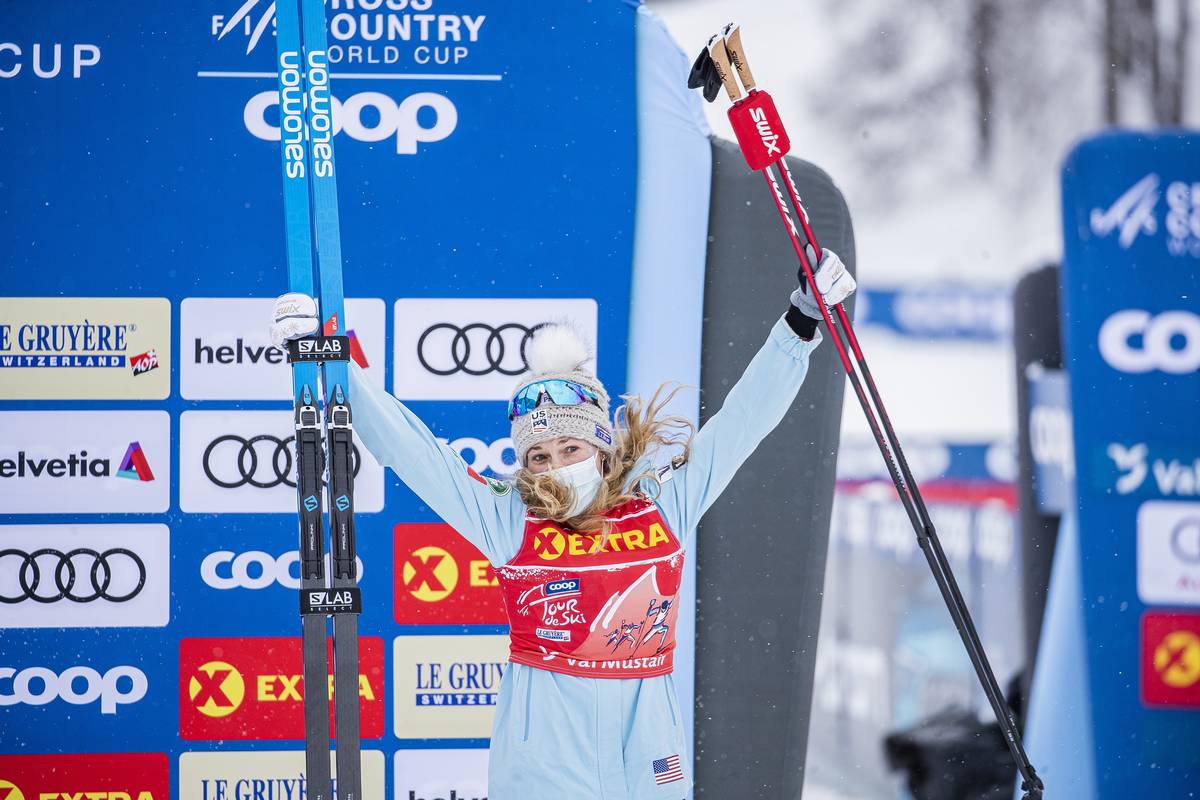
Coming on form in the 2021 Tour de Ski, Jessie Diggins takes third in Stage 2. (Photo: NordicFocus)
Despite spending over 8 kilometers at the front, Karlsson took the wooden medal in fourth (+1.4). She was followed closely by Katharina Hennig of Germany in fifth (+2.0), with Rosie Brennan on her tails for sixth (+4.5).
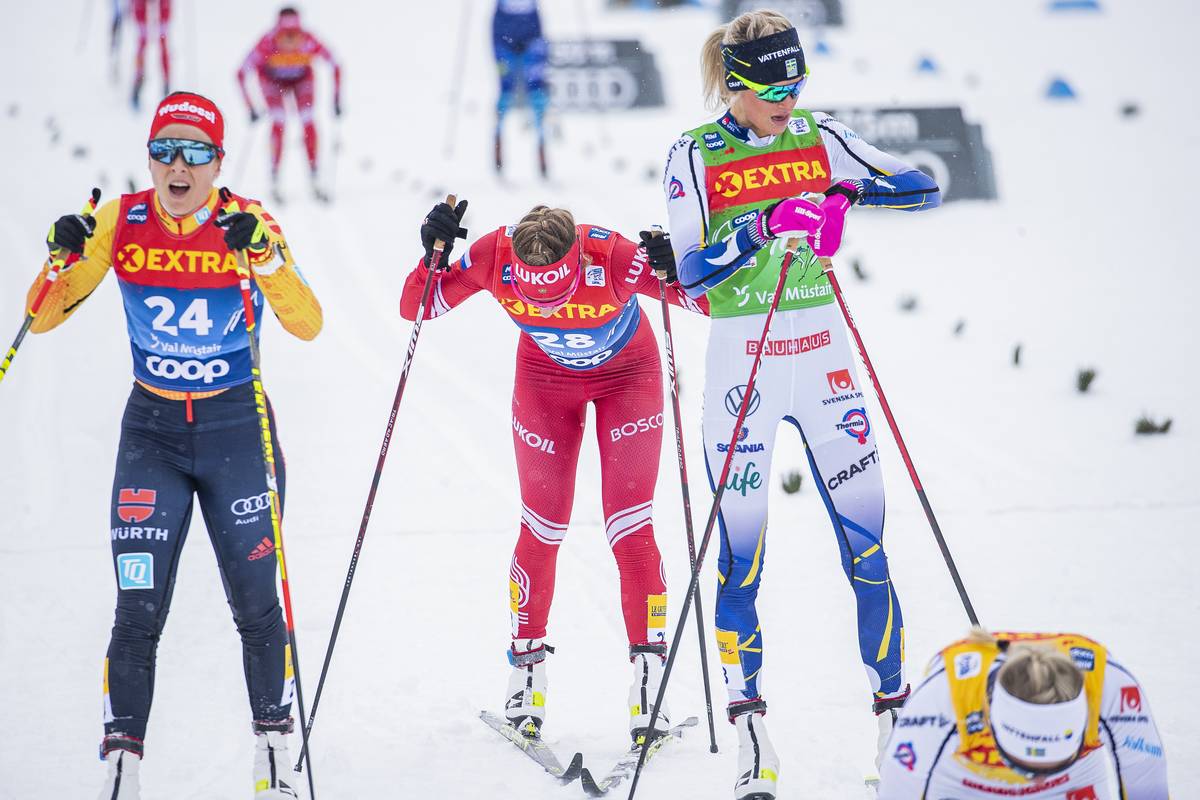
Evidence of the effort, the leaders of the Stage 2 of the 2021 TdS, a 10-kilometer mass start classic, gasp for air at the finish line. (Photo: NordicFocus)
“Today was the first mass start of the season, which is always a little nerve wracking for me as I prefer individual starts,” wrote Brennan in an email to multiple news outlets. “My goal was to keep things as close as possible and then see what I left in the end. I think I did this well as I skied in the front pack throughout the race. I was unhappy with my tactics on the long gradual downhill coming back towards the stadium. I took a gamble on lane choice that didn’t pan out and found myself out of contention for the sprint finish, but managed to minimize my time lost to the leaders and also get a career-best classic result so I am proud of that. I am in a great position for tomorrow’s pursuit start so I hope to find some good energy and take advantage of that!”
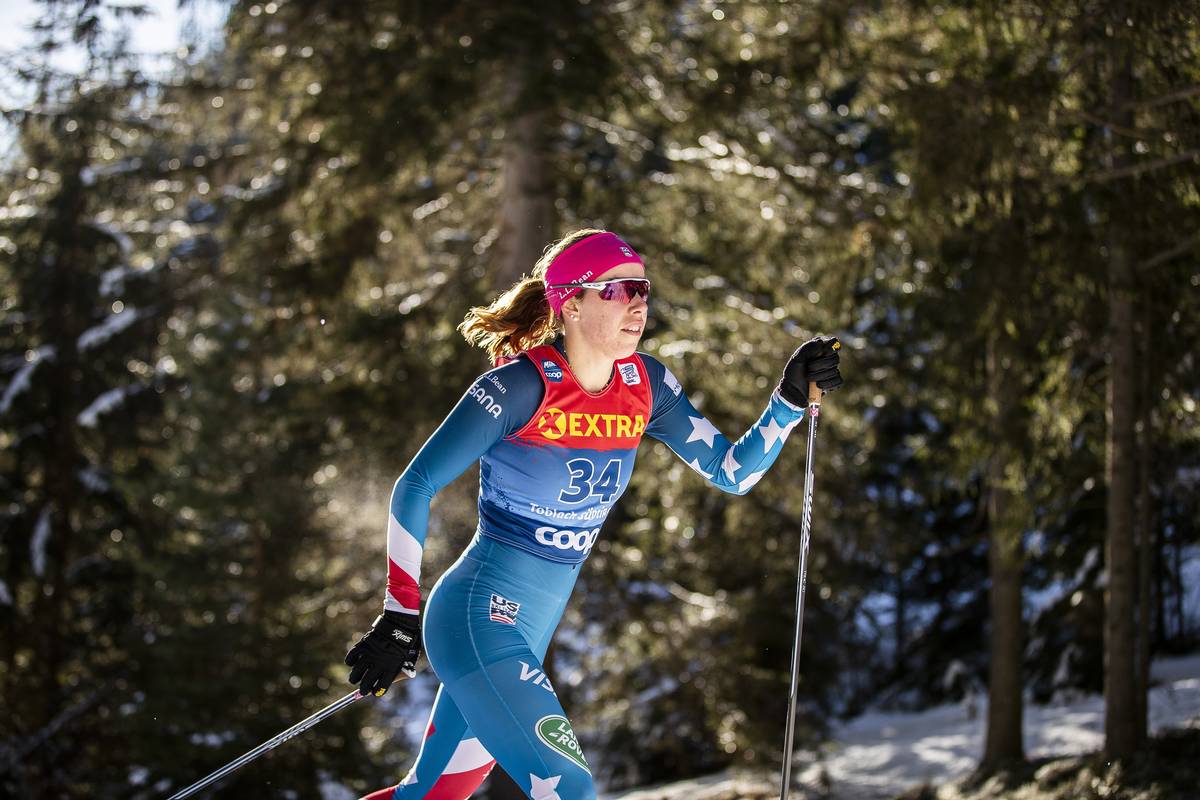
Outside the top-10 with noteworthy finishes were Hailey Swirbul in 17th (+40.5) and Katharine Ogden in 22nd (+1:21.2). Swirbul was among a larger lead group through the 5 k, dropping into a chase pack as the top 10 began to break away.
Hailey Swirbul on her way to a 17th place finish in Stage 2 of the 2021 Tour de Ski. (Photo: NordicFocus)Katharine Ogden on course in Stage 2 of the 2021 Tour de Ski. (Photo: NordicFocus)
Caitlin Patterson was the next American finisher in 38th (+2:10.4), followed by Julia Kern in 41st (+2:30.6), and Sophie Caldwell Hamilton in 46th (32.49.0). Caldwell Hamilton experienced a crash near the end of the first clustered lap; “You got it, Soph!” could be heard from a passing teammate.
Post-race comments on the women’s 10k mass start from U.S. Head Coach Matt Whitcomb.
Julia Kern on course in Stage 2 of the 2021 Tour de Ski. (Photo: NordicFocus)
Overall Tour de Ski and World Cup Standings
With back-to-back wins, Svahn leads the 2021 Tour de Ski by 13 seconds, with Diggins in 2nd, and Karlsson third (+0:18).
Because of snagging the bonus points in today’s stage, Karlsson sits at the top of the TdS point standings with Diggins one point behind in second, and Svahn three points back in third.
Brennan skis to 6th in Stage 2 of the 2021 Tour de Ski, adding to a string of outstanding performances. (Photo: NordicFocus)
Continuing her streak of outstanding races, Brennan remains in possession of the yellow bib as overall and distance World Cup points leader and sits 4th in the TdS standings for both time (+0:20) and FIS points.
The tour continues tomorrow with a 10-kilometer skate pursuit.
Sweden’s Linn Svahn winning the first stage of the 2021 TdS in Val Müstair, Switzerland. (Photo: NordicFocus)
This World Cup coverage is made possible through the generous support of Marty and Kathy Hall and their A Hall Mark of Excellence Award. To learn more about A Hall Mark of Excellence Award or to learn how you can support FasterSkier’s coverage please contact info@fasterskier.com.
Out with 2020, in with 2021. Here in the world of multicolored lycra and skinny skis, we are kicking off the new year with the opening of the Tour de Ski on the sprint track of Val Müstair, Switzerland. As snow fell lightly but steadily, the usually remarkable mountain backdrop was veiled, narrowing our focus to the athletes as they embark on the grueling eight stages over ten days that is the TdS.
The two-lap 1.4-kilometer sprint course in the alpen valley featured two punchy climbs per lap leading down into fast and tight S-turns. Small rollers after these turns kept the skiers on their toes as they charged around the course.
Though the Norwegian athletes remain absent from the World Cup and TdS, the Swedish women are back in full force. They made their sprint prowess known in the qualifier, with 26-year-old Maja Dahlqvist setting the fastest time by nearly three seconds in 3:30.86. Seven members of their squad qualified for the heats, with an additional three in the top 10: Linn Svahn in 2nd, Moa Lundgren 4th, and Frida Karlsson in 8th. Though Karlsson is normally known for her distance racing (in particular besting Norway’s dominant Theresa Johaug at last year’s Holmenkollen 30 k), her possession of the green U23 Overall World Cup leader bib evidenced that she was not to be dismissed as a contender for the stage.
Wearing the yellow Overall World Cup leader bib, Rosie Brennan was the top American qualifier in 5th (+4.38), followed by Hailey Swirbul in 13th (+8.65), Jessie Diggins in 14th (+8.96), Sophie Caldwell Hamilton in 16th (+9.77), and Julia Kern in 25th (+12.61).
Brennan raced in a stacked first heat of the quarterfinals, racing against two of the top Swedes, Dahlqvist and Lundgren, in addition to Russia’s Natalia Nepyaeva, teammate Kern, and Switzerland’s Laurien van der Graaff. Brennan stayed near the front and in position to advance from the get-go, but couldn’t break from the lead group of four. She finished in a three-way photo finish with Nepyraeva and Lundgren, taking third but snagging a lucky loser spot allowing the threesome to all advance into the semis.
Jessie Diggins finding her form in Val Müstair, Switzerland where she placed second overall in the TdS stage 1 sprint. (Photo: NordicFocus)
Also advancing from the quarters from the fifth heat, Diggins held a position near the front throughout her heat, showing with her lightning-fast tempo that she intended to advance. She pushed Karlsson and Italy’s Greta Laurent break from the remainder of the group. In the second lap, Diggins had the fastest V1 cadence on the climbs and stayed smooth in the descents, priming herself for good positioning in the final sprint to win the quarter.
Ending their day after the quarters, Caldwell Hamilton marked Swedes Svahn and Emma Ribom. In her usual calm, cool, collected manner, she skied smoothly through the S-turn and tucked in comfortably on Ribom’s tails. Despite great position coming into the final lanes, Caldwell Hamilton could not quite overtake Ribom and finished centimeters behind for third in the heat. Swirbul stayed close to the leaders but was unable to fight for the top two and ultimately ended the heat in third also. Neither heat was fast enough to obtain a lucky loser spot.
Sophie Caldwell (bib 16) qualified in 16th and placed 16th overall in Friday’s skate sprint. (Photo: NordicFocus)Hailey Swirbul, here in bib 13 during stage 1 of the 2021 Tour de Ski, placed 15th overall. (Photo: NordicFocus)
On to the semifinals. Racing on home soil in the tight first heat, Nadine Fähndrich (SUI) edged out her opponents for the win in a three-way photo finish with Slovenia’s Anamarija Lampic and Sweden’s Dahlqvist. Considering Lampic and Fähndrich both finished in the top four of the last two freestyle sprints in Davos and Dresden, this result serves as a testament to the depth of the sprint field in those venues despite the lack of Swedes, Finns, and Norwegians.
Brennan and Diggins took off in the second heat, marking Swedes Svahn and Karlsson who held the front in the first lap. In the second lap, Brennan upped the tempo on the climbs, while Diggins pushed over the top and worked the downhill, free skating out of the rollers and putting herself into position to charge down the lanes ahead of Karlsson to hold onto the second position and a secure advance to the final.
Frida Karlsson (SWE), Jessie Diggins (USA), Greta Laurent (ITA), (l-r) during stage 1 of the 2021 TdS. (Photo: NordicFocus)
Fighting for millimeters, Karlsson and Brennan were just behind in third and fourth. Both squeaked through as lucky losers, but only just as Brennan’s time was a mere 0.1 seconds faster than the next fastest time.
The pace stayed hot and the pack stayed tight in the first lap of the final. Diggins and Brennan stayed in the mix near the middle of the pack and in contention for the podium.
As the racers rounded the bend into the second lap, Svahn began firing on all cylinders, taking off at the front with Lampic and Fähndrich marking her from a couple ski lengths back. Just when the top-3 positions seemed locked up, Lampic and Fähndrich brushed skis in the downhill S-turn causing Fähndrich to crash, losing sight of the podium. Svahn continued to hammer, flying down the final stretch to take the win with Lampic nearly a second behind her.
Seizing the opportunity, Diggins nimbly dodged around the downed Fähndrich, hopping over her pole and hitting the gas to drop a chasing Karlsson and snag third.
Linn Svahn during qualification in Val Müstair, Switzerland. (Photo: NordicFocus)
“I didn’t know how I’d feel in high altitude,” Svahn told FIS after the race. (Val Müstair sits above 4000 ft.) “I tried to take the first lap to get into my own zone and technique, then I tried to push all I had in the last uphill since the other girls were going really strong beside me.”
FIS also asked about Svahn’s goals for the tour ahead.
“I try to focus on each race, and now I’ll just focus on getting my legs working again after these tracks,” Svahn said with a tired laugh.
After a lengthy review, during which Diggins demonstrated the importance of staying on top of nutrition during the arduous tour by refueling with a bowl of pasta on the sidelines, Lampic was deemed to have interfered and was disqualified. This moved Diggins into the second position on the podium, with Karlsson stepping into third.
“Today was a fun way to start 2021,” wrote Diggins in a post-race email to FasterSkier. “But I think it’s important for me to say that I’m equally as proud of my all-out effort and our team today as I am when I’m not on the podium! It was just another day of giving it my absolute best effort, but the patience and trust in the training plan that Cork and I set down together has been paying off and my race form is coming into sharper focus now.”
Jessie Diggins finishing second overall on Friday’s stage 1 sprint. (Photo: NordicFocus)
So far this season, Diggins had a near miss at the podium with a 4th place at the individual sprint in Dresden and was unable to advance from the quarterfinals in Davos after getting boxed out on a curve just before the final straightaway. Today marks her first podium of the season in sprint or distance.
“The final was exciting, for sure,” she wrote. “I fell behind a bit on the steep climb, and was working my way down the downhill sections with as much speed as I could when I saw Nadine go down and slide around the corner in front of me. I didn’t want to hit her (or break her equipment, or my own) so I jumped over her pole while rounding the corner! In sprinting you can get lucky or be the recipient of incredibly bad luck, and today the luck definitely came my way (and I’m grateful for it).
“It was so exciting to have Team USA be 1/3 of the women’s final,” concluded Diggins. “And for myself, it was exciting to be out there having fun, not putting pressure on myself but still skiing with confidence and enjoying the banked turns and rollers all at the same time.”
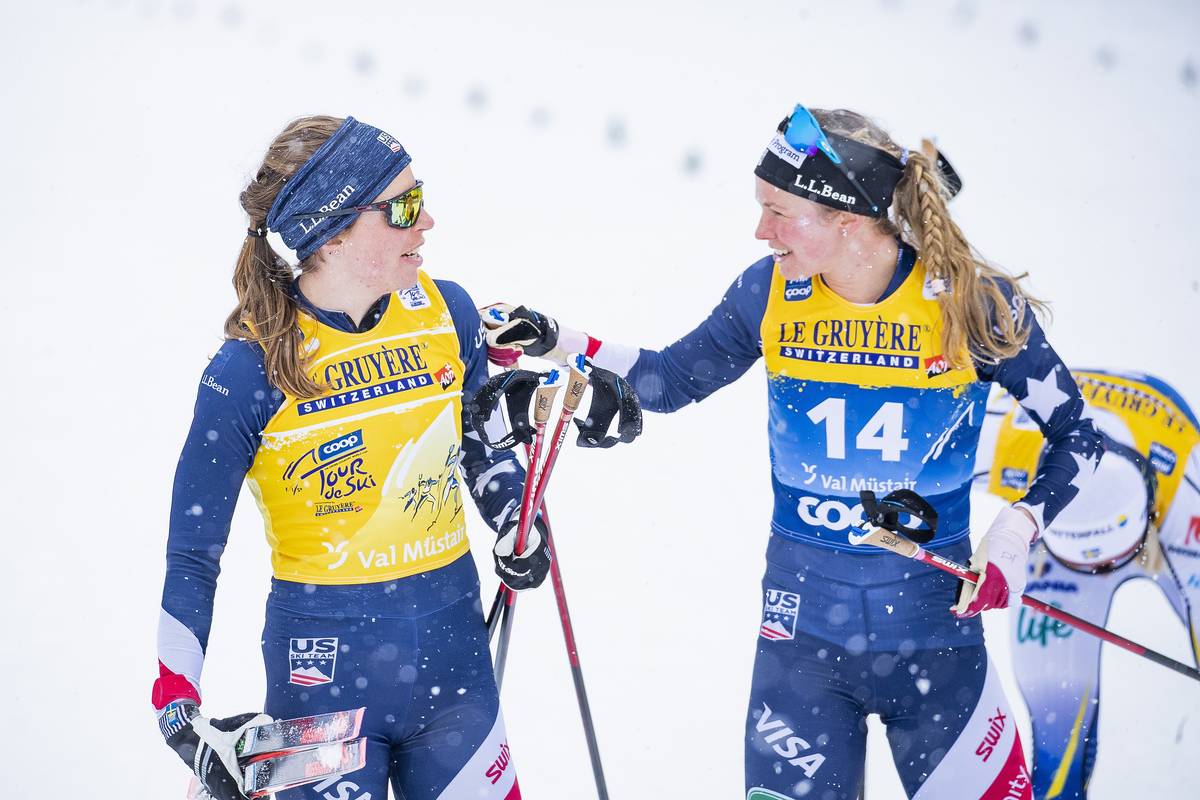
Rosie Brennan (l) and Jessie Diggins in Val Müstair, Switzerland after the first stage of the TdS. (Photo: NordicFocus)
“It was a surreal day to be starting the Tour de Ski with the yellow bib,” Brennan wrote in a post-race email to multiple news outlets. “My one goal was to fight with what I had and I felt I did that well so I am proud of my effort out there today. I still have to remind myself just how far my sprinting has come and not change my expectations so quickly. This was only my second final ever and I am just so excited by the gains I’ve made.
“This might be the hardest sprint course I have ever raced,” Brennan continued. “It’s long, at altitude, and had some slow snow out there today. With that in mind, I tried to keep things under control, but also use my strengths. I had a near miss in the quarterfinal and was really happy about my quick acceleration in the finish after getting stopped up. I worked hard in the semi to keep the pace high to ensure our heat would have lucky losers which I then benefited from. However, I was pretty beat by the time we got to the final. I tried to open up on the second lap, but there wasn’t much there. I stayed out of trouble and for that was rewarded another two places. That’s a sprint race for you…That was a tough start to the Tour so the focus will now be on recovery to get ready for tomorrow and all the races to come. It’s also very cool to note that we had our 4th different girl on the podium in just 4 weeks of racing. Our team is really working hard to get through this tough season together and support one another as we navigate the world.”
Outside the top 30, Katharine Ogden finished 49th in the qualifier (+20.07), followed by Caitlin Patterson in 57th (+22.25).
Impressing this season: Rosie Brennan racing in the Davos 10 k skate concludes her Davos weekend with back-to-back wins. (Photo: NoridcFocus)
This World Cup coverage is made possible through the generous support of Marty and Kathy Hall and their A Hall Mark of Excellence Award. To learn more about A Hall Mark of Excellence Award or to learn how you can support FasterSkier’s coverage please contact info@fasterskier.com.
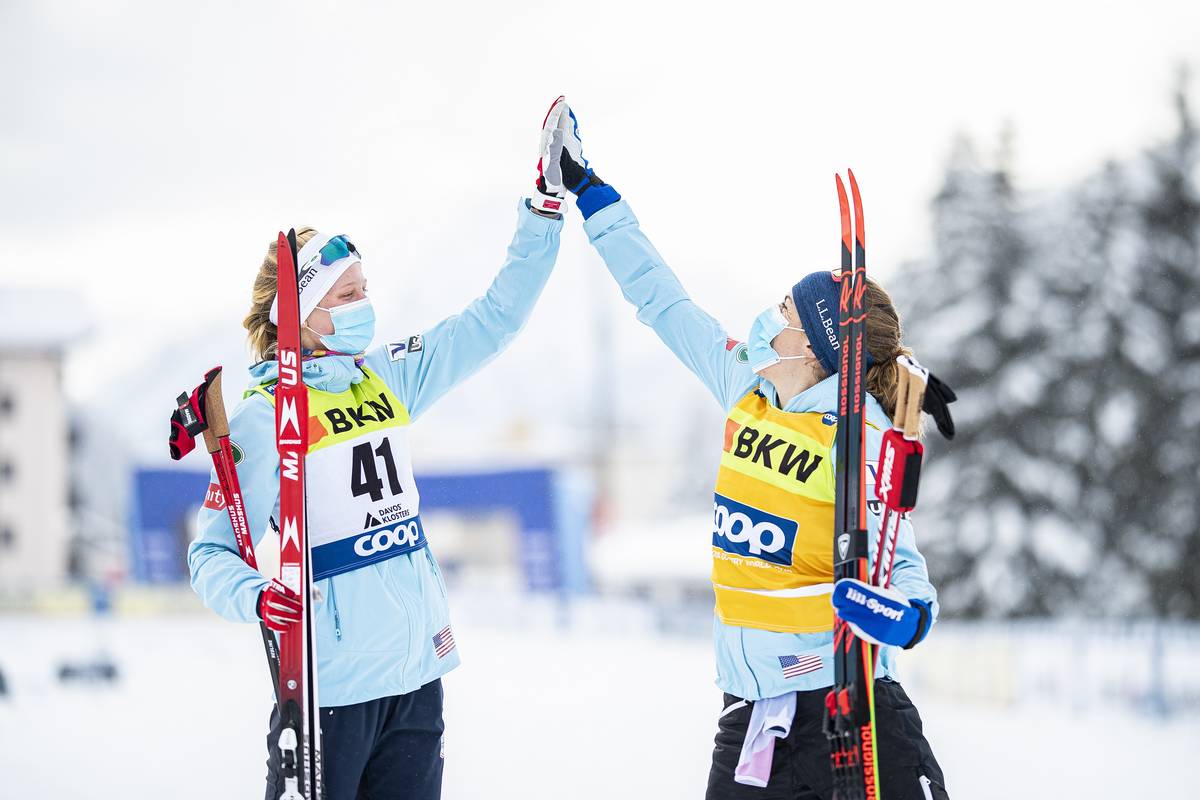
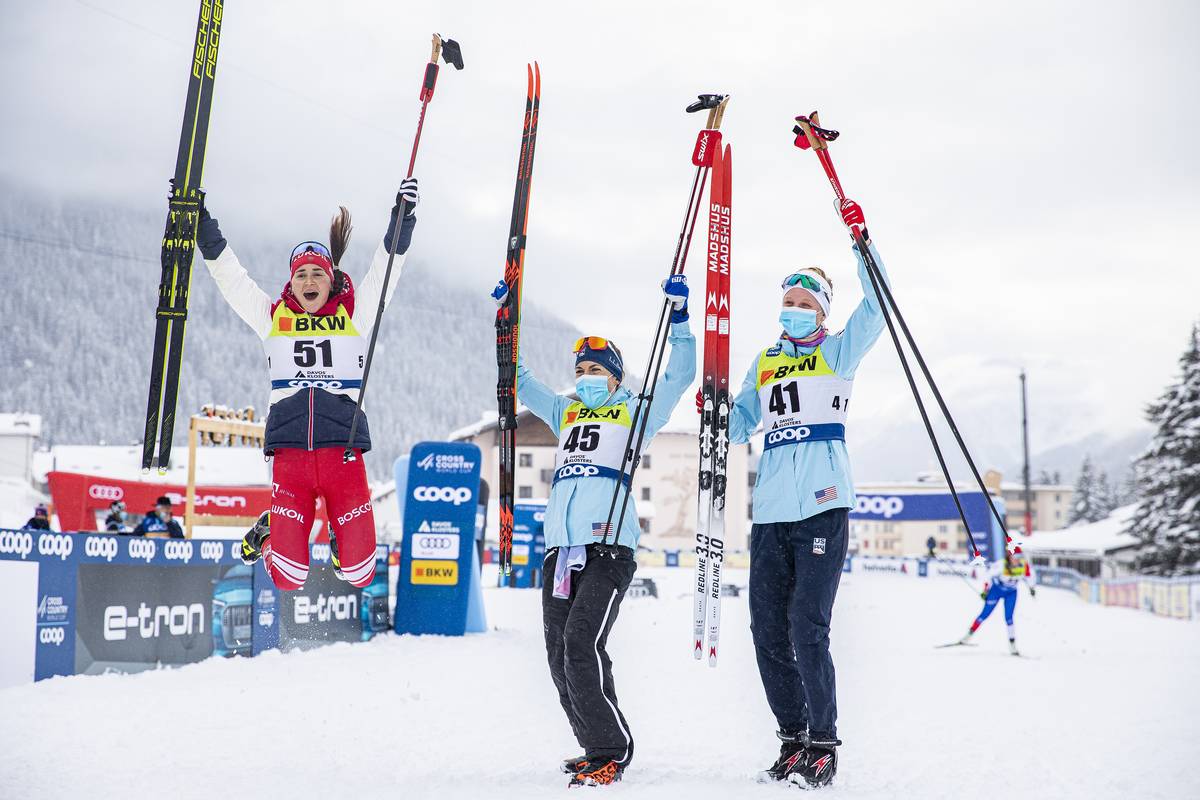
New snow and cloudy skies did nothing to hinder the fire of Rosie Brennan as she sped around the 10-kilometer course in a time of 24:49.8, securing her second-ever World Cup win after a victory in the sprint yesterday. Close behind her was Hailey Swirbul, no stranger to altitude, the Aspen, Co., native landed her first World Cup podium with a third-place finish. Rounding out the podium in second place was Yulia Stupak of Russia, formerly Yulia Belorukova.
Brennan, who started in bib 45, set the benchmark early on, gapping every skier in the field by 9.9 seconds at 2.2 k. By 7.2 k she had built a massive cushion of 24.6 seconds over eventual second place skier Stupak (RUS). Brennan closed out to win her second career World Cup in as many days by 34 seconds. “It was great, I love skiing in new snow,” said Brennan in a post-race interview with FIS, “I still am just so excited from yesterday, I really just tried to go out there and ski smooth and strong”.
With today’s victory, Brennan also takes the leader’s bib in the Overall World Cup Standings ahead of Tatiana Sorina of Russia while also leading in the Sprint and Distance standings. “That is quite honestly something I”m not sure I’ve ever dreamed of,” Brennan wrote in an email, “Obviously, we have only had a few races, but it’s something I’m proud of nonetheless and while I’m not sure I expect to keep them the whole season, I hope to do them proud while I have them and put up as good a fight as I can!”
Post-race interview with RosieBrennan.
Back from a year off to start a family, Yulia Stupak of Russia claims second overall in the Davos 10 k skate. (Photo: NordicFocus)
After missing the 2019/20 race season to pursue motherhood, Yulia Stupak (RUS) landed her fourth World Cup podium and first-ever distance podium with a second-place finish today.
Hailey Swirbul at the line for third place in the Davos 10 k skate. (Photo: NordicFocus)
Post-race interview with Hailey Swirbul.
Swirbul began just four places ahead of Brennan in bib 41, with a conservative start she was 8th through the first 2.2 k. By 5 k Swirbul had overtaken five skiers and was neck-and-neck with Theresa Stadlober of Austria who eventually finished 5th. At 7.2 k Swirbul was down 2.4 seconds to Stadlober but blazed through the final 2.8 k to finish with a time of 25:30.3, 6.3 seconds ahead of the Austrian and 40.5 seconds behind her teammate Brennan.
Jessie Diggins, racing to seventh overall in the Davos 10 k skate. (Photo: NordicFocus)
With two on the podium, the U.S. women rounded out the day with five finishes in the top 30. Jessie Diggins, who finished 3rd in Davos in this event last year, found herself in the top-ten with a 7th place finish. Katharine Ogden placed 22nd, scoring her first points of the season, followed by Caitlin Patterson in 30th.
For Ogden, this was her fourth top-30 World Cup result, with her best coming last season with a 21st in Val di Fiemme’s 10 k skate during the Tour de Skis.
Post-race interview with U.S. Head Coach Matt Whitcomb where he discusses the women’s race.
Katharine Ogden raced to 22nd in the Davos 10 k skate. (Photo: NordicFocus)
Coming in hot! Jessie Diggins leads teammate Sophie Caldwell, Laurien Van Der Graaff (SUI), and Julia Stupak (RUS) during a sprint time trial in Davos. (Photo: Matt Whitcomb)
Lillehammer cancels World Cup events. Norway, Sweden, and Finland pull from the World Cup after the opening weekend in Ruka citing COVID safety concerns. To an outsider, these headlines paint a seemingly bleak picture of the start of the race season. However, an international time trial featuring a skate sprint day Friday and distance event Saturday sparked hope for the American team as they remain in Europe focused on the upcoming weekend of racing in Davos, Switzerland.
FasterSkier spoke with U.S. Ski Team head coach Matt Whitcomb to learn more about the event and its role in helping the American team gain on-snow race experience, sharpen their form and find their race gears amidst a stacked field of friendly competitors.
Taking a step back, Whitcomb shared that travel from Ruka to Davos felt both safe and easy. The team booked a flight through a FIS travel agent from Kuusamo, FIN to Munich, GER, then drove the remaining 3.5 hours to Davos. By reserving through FIS, they ensured that the only other passengers on the flight were other world cup athletes, coaches, and techs, who had been tested in order to participate in the opening World Cup events.
“It was probably the safest flight we’d ever been on and it made for a really easy day,” Whitcomb stated.
Athletes were required to obtain a negative test result within 72 hours prior to entering Finland per the country’s border control policies, then were tested a second time upon arrival at the venue in Ruka. This put them inside what Whitcomb called the “World Cup bubble”.
“FIS tracks our daily whereabouts all winter,” wrote Whitcomb in an email for clarification on testing and travel safety precautions. “We fill out a twice-daily questionnaire for U.S. Ski & Snowboard, as well. We did not need [a test 72 hours] before entering Switzerland. As a team policy, we got one anyway. We were tested again upon arrival to Switzerland, and now that we’ve been here one week, we will test the entire team over the next two days.”
In addition to this testing protocol, the U.S. team is operating an agreed upon team health policy regarding behavior, which Whitcomb outlines below.
“Travel and ride with your roommate. No indoor socializing, other than meals. No family visits, no friend visits. Our current hotel has a separate room and buffet line for our team to use. New athletes and staff arriving to the World Cup enter a ‘quarantine bubble’ until they’ve cleared a PCR test, so we eat in two shifts, and two locations.”
Back to the time trial. Whitcomb explained that the idea for the time trial was raised by one of the Italian coaches, who approached Whitcomb about getting together for some intensity in the week leading up to Ruka.
Gleb Retivykh leads JC Schoonmaker around a bend during the heats of the sprint time trial in Davos. (Photo: Matt Whitcomb)
“We’ve had some pretty good joint workouts and camps over these years with these teams, but I think this was probably the coolest where we had five nations with quite a few athletes entered,” he shared.
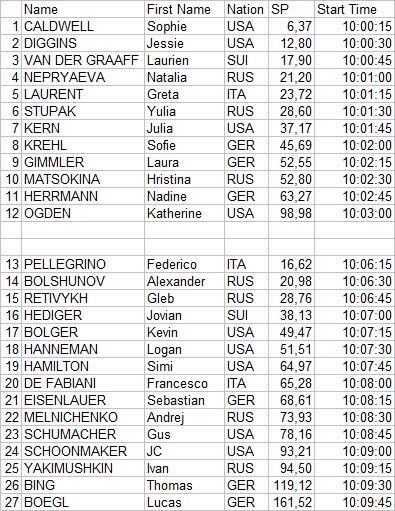
The start list for the King’s Court style skate sprint time trial in Davos. (Courtesy: Matt Whitcomb)
With names like Federico Pellegrino (ITA), who finished the 2019/2020 season ranked 4th in the sprint standings, Laurien Van Der Graaff (SUI), who has five World Cup podiums, and last seasons overall World Cup Champion Alexander Bolshunov (RUS) on the start list, the concept gained enough traction that some international athletes chose to stay put in Davos for the collaborative workout rather than travel to a nearby Opa Cup race in Goms, SUI.
Through a text thread, the coaches from each nation agreed upon both COVID safety plans and event format, creating an event that Whitcomb described as “easy-going” in terms of the level of planning and logistics required and the relaxed start time. Teams agreed to forgo fluoros, throwing on CH6 or an equivalent. Despite this seemingly casual atmosphere, putting together a group of fiercely competitive athletes ensured that the event would not be all fun and games.
“It was really nice because — you know, it’s low key and people are relaxed, but you show up and people are warming up har,” said Whitcomb. You just had to bring any bib, so everyone threw on bibs and was wearing their national team uniforms. As soon as you’re suited up, it’s game time, and there was not a lot of holding back out there. It was a really valuable day for us and for everybody. The coaches were all really excited at the end of it.”
Whitcomb explained that because the event was for training purposes, the results would not be released publicly. However, the USST Instagram account calls it a Pellegrino (1)–Bolshunov (2)–Schumacher (3) podium for the men. That said, Whitcomb shared that the effort and results of the athletes were universally positive and indicative that strong performances in true race events are on the horizon.
“Every day that we’re actually on snow doing intensity and in particular head to head racing or intervals is really elevating the level of performance on our team. We’re seeing that just in general comments on feelings in intervals, and this particular day — the skate sprint — I think was a good breakthrough for the team. People were starting to feel good. Conditions were really fast and firm — it was that hero snow that we all love to ski on. And people skied fast, so that was the first time that as a group that we skied at an elevated level rather than just having one or two people knocking one out of the park and the rest of the team skiing just okay at best.”
Some noteworthy results he was able to share include Sophie Caldwell winning the sprint qualifier, the American men keeping the time-back margin tight to top qualifier Pellegrino, and impressive performances by Jessie Diggins and Katharine Ogden in the two lap 10-kilometer distance race.
Katharine Ogden comes on form in the distance time trial in Davos. (Photo: Matt Whitcomb)
Gus Schumacher hammers during the qualifier of a sprint time trial in Davos. (Photo: Matt Whitcomb)
Caldwell’s result was especially encouraging to Whitcomb following what the coach called a “fluke” in Ruka. Finding the last time she had not qualified for the rounds in a sprint event required a lot of scrolling on her FIS athlete profile. Her last time outside the top-30 in qualification happened in Drammen, Norway on March 11th, 2015.
“I think it was a big weight off her shoulders to win the qualifier and just be aware that she’s still the same skier she has been and she’s not suddenly over the hill. I think she can now focus a little bit more without concern that ‘Wow, maybe I’ve overtrained or maybe I’ve really screwed something up here.’”
In her own words, Caldwell shared the following via email.
“I think it’s good practice to get in a race effort, especially when many of us have had so few this year. It was run King’s Court style, so if you won your heat you would move up and if you were last in your heat you would move down. As a result, all the heats were very competitive and well-matched and between three heats and a qualifier it ended up being a very hard day. I was psyched to do my first skate sprint effort on snow and mix it up with some of the girls we will be racing with next weekend.”
(Left to Right) Gus Schumacher (USA), Federico Pellegrino (ITA), Kevin Bolger (USA), JC Schoonmaker (USA), and Alexander Bolshunov (RUS) take to the course in the quarter-final of a sprint time trial in Davos. (Photo: Matt Whitcomb)
As the upcoming race weekends leading up to the Tour de Ski remain scheduled as planned, Whitcomb does not currently anticipate additional workouts like this taking place. He concluded by reflecting on the impact that the development of these international relationships has had on the growth of the American program and his optimism that it’s example will play for continued domestic development.
“For me, the coolest angle of this whole deal is that as unapproachable as the World Cup once seemed to me, that turns out to be not at all the case these days. It’s really a tight family,” said Whitcomb. “The amount of teams that are working together, even if it’s just transferring bags or borrowing wax, it happens on an almost daily basis when we’re in the same location. I just love seeing the same thing happening back in the US. It’s really going to be about partnerships for the US to succeed moving forward and this really left us with a good feeling.”
Interview with Matt Whitcomb following the international time trial in Davos.
Federico Pellegrino (ITA), Gus Schumacher (USA), and Jovian Hediger (SUI) in a trailside chat between the heats of a sprint time trial in Davos. (Photo: Matt Whitcomb)
David Norris of the U.S. during Stage 1 of the Ski Tour 2020. (Photo: NordicFocus)
This article has been updated to clarify the relationship between the junior races now known as FIS Nordic Junior World Ski Championships and its precursor, the World Junior Nordic Championships and the European Junior Nordic Championships.
There are, to briefly traffic in the obvious, 60 seconds in a minute. Sixty seconds in a minute; 60 minutes in an hour; 3,600 seconds in an hour. Skiers measure their lives in these increments; we track total yearly training hours, obsess over minutes spent in L3 vs. L4, dutifully record splits from an interval workout down to the second.
David Norris spent roughly 1,000 hours last season in training or racing, or 3,600,000 seconds total. Katharine Ogden may have spent “only” 700 hours, or 2,520,000 seconds, engaged in training or racing. Combined, that’s over six million seconds. This is the story of 12.3 of those seconds, and of their outsize influence on selection to the U.S. national ski team, or USST, fourteen months later.
* * *
Falun, Sweden, March 2019. David Norris, a Fairbanks native who moved to Anchorage after college graduation to ski for Alaska Pacific University, was on a roll. He had had strong results in two recent 50-kilometer races, skiing to 20th at World Championships in Seefeld and 24th at the iconic Holmenkollen within a week. As the World Cup tour moved on to Sweden, Norris looked to continue his torrid streak in the 15-kilometer interval-start freestyle race held on March 17.
David Norris of the U.S. placed 20th overall in the the men’s 50 k skate at the 2019 World Championships. (Photo: John Lazenby/lazenbyphoto.com)
Interval start races on the World Cup are generally reverse seeded, with the fastest skiers starting last. In Falun, Norris had bib no. 16 in a field of 69, reflecting relatively high seeding and low expectations – this is not where you put a predicted top-30 finisher. (Indeed, the two athletes immediately ahead of him, bibs 14 and 15, finished well outside the points in 37th and 47th.) Norweigan broadcaster NRK didn’t even show his start, instead cutting away to show a pre-recorded broadcast with Martin Sundby over the span of a half-dozen early starters, including Norris.
But once the race started, Norris showed he belonged. Through three laps of the 5-kilometer course at Falun, he hovered between 11th and 16th. He beat Klæbo. He beat Spitsov. He beat Manificat. When he crossed the finish line, with the sharp end of the field still on course, he was briefly on the virtual podium in second overall. Once all starters had crossed the line he would end the day with a final result of 16th, a notable result for American men’s distance skiing at any point in the past three decades.
Afterwards, Norris told this website, “I am super happy with my result – I feel like I have recovered well from back-to-back 50ks, and my skis were good. Today was the type of result I have been believing I should be able to do on a good day, so I am psyched to have made that happen.” Jason Albert’s contemporary race story for FasterSkier observed, “During a year when the U.S. Ski Team has offered numerous international starts to a host of non-USST members, Norris and his trifecta of results in the points promotes the notion that on the right day and even the right World Cup string of races, elite U.S. skiers can step up.”
Norris’s time for 15 kilometers was 34:33.9. His life would be different now if he had finished in 34:22.9, 11 seconds faster.
* * *
Ten days before Norris’s fateful ski, Katharine Ogden toed the line for the women’s 5 k skate race at 2019 NCAA Championships. She was racing at the Trapp Family Lodge in Stowe, Vermont, two hours from where she grew up in Landgrove and just down the road from where she had attended school at Stratton Mountain. Ogden had to be considered among the pre-race favorites – in seven individual NCAA races so far that season she had seven podiums, including three victories and three second places – and her seeding reflected it. She had bib no. 36 in a field of 40; that is, she was seeded as the fifth-best racer in the field.
https://www.instagram.com/p/BurVLtMH_C3/
A 5-kilometer ski race will take a skilled athlete well under 15 minutes, even on a homologated course. Depending upon the course profile and how much chance for recovery there is, the race can be roughly akin to the world’s longest, most difficult L4 interval. An athlete has to go nearly as fast as sprint pace, for roughly four times as long, without completely blowing up and losing valuable seconds against a tight field.
On this day, and even over “just” five kilometers, Ogden metered out her effort better than nearly anyone else in the field. At the two-kilometer mark, she was in ninth. By the halfway mark, she was down to 11th, not only off the podium but also out of All-America status. But she came on strong over the final 2.5 kilometers, moving up seven places in as many minutes. Coming down the finishing straight she drew even with her Dartmouth teammate Lydia Blanchet, who had started 30 seconds before her in bib no. 35, then moved alongside to out-lunge Blanchet at the finish.
Ogden finished just off the podium in fourth, even after, according to one contemporary observer, falling at one point on the course. Her time for 5 kilometers was 13:34.5. Fourteen months later, she would miss objective selection to the 2020/2021 USST B-Team by a fraction of a FIS point. If she had gone just 1.3 seconds faster in this race, 13:33.2 instead of 13:34.5, she would have made the team.
* * *
A year later, Ogden made the team anyway, following the application of discretionary selection by U.S. Ski Team leadership. At the end of this season, she had 49.45 points on the final women’s FIS Distance List, good for 81st in the world. The athlete one spot ahead of her in 80th had 0.25 fewer points, or 49.20. A female athlete born in 1997, like Ogden, needed a year-end distance ranking of 80th or better to merit selection to the USST B-Team via objective criteria. Ogden was very close, but 81st is not 80th.
Norris, meanwhile, ended up with 22.95 points on the same final men’s FIS Distance List released this March, good for 43rd in the world. (22.95 points would have left him ranked 18th on the women’s list; as previously discussed, the men’s field is tighter than the women’s at every level of the distance rankings.) The athlete three spots ahead of him in 40th had 0.88 fewer points, or 22.07. A male athlete born in 1991 or earlier, like Norris, needed a year-end distance ranking of 40th or better to merit selection to the USST B-Team via objective criteria. He was very close, but 43rd is not 40th.
* * *
The criteria for objective selection to the national team, which this year key on an athlete’s FIS points-based world ranking and are adjusted for age and (in some cases) gender, are of recent vintage.
In announcing the new criteria at the start of the 2019/2020 season, then-USST Head Coach Chris Grover wrote, “these criteria create many objective pathways to a USST nomination and identify a clear path for athletes, coaches, and parents to understand exactly what is necessary to be nominated to the USST. … I’m confident that these new criteria will help us do a better job of identifying those athletes with the potential to medal while creating better transparency around the U.S. Ski Team nomination process.”
David Norris winning the 2016 American Birkebeiner (photo Paul Walsh)
The potential use of discretionary selection alongside objective criteria for selection remains substantively unchanged from previous years. Grover highlighted the use of discretionary selection in an email to FasterSkier earlier this month when asked about the reasoning behind adding Ogden to the team via discretion.
(FasterSkier’s late-April podcast with Matt Whitcomb, which explored Norris’s situation at some length, took place before the official team announcement had been made by U.S. Ski & Snowboard in early May. FasterSkier knew at the time that Norris was not on the team, due to this Instagram post from APU, but did not know that Ogden was on the team, and so did not ask about her selection when it spoke with Whitcomb.)
Grover wrote to FasterSkier, in full (the original email highlighted the penultimate bullet point under discretionary criteria, as has been done here):
Attached is the criterion and below is the specific part of the criterion’s discretionary selection policy we utilized when nominating Katharine to the USST:
Discretionary Selection Policy:
U.S. Ski and Snowboard may select additional athletes to the team, or may select athletes to the B-team who have met D-team criteria, using coaches’ discretion based upon factors other than the objective criteria. If the coaching staff fills any spot(s) on the team with discretionary selections, then the staff may consider any factors including (but not limited to) the following:
Completion of individual markers, as set forth by the U.S. Ski Team coaching staff and as approved by the U.S. Ski and Snowboard Head Cross Country Coach, which point toward the achievement of competition results consistent with U.S. Ski Team program goals.
Attitude and commitment of athletes to take part in the complete camp and competition program.
Illness or injury during the selection period.
Indicia of medal potential in future Olympic and World Championship competitions, which would be materially enhanced by selection to team.
Other unanticipated failure of objective criteria to select an athlete likely to achieve competition results consistent with the U.S. Ski and Snowboard program goals.
As you know, Katharine is one of three athletes in USA World Junior history to achieve an individual medal, so she clearly meets the above criteria.
The reference is to Ogden’s bronze medal in the women’s 10-kilometer skiathlon at 2017 World Juniors in Soldier Hollow. The other American athletes with individual World Juniors medals are Hailey Swirbul, in 2018, and Gus Schumacher, in 2020. That said, American skier Bill Koch won an individual medal in the 1970s version of what are now colloquially known as “World Juniors” at the 1974 European Junior Nordic Championships.†
Whitcomb also spoke to the relationship between junior medals and senior success in the recent podcast. Whitcomb observed, “There’s a big difference between being a top-10 skier or a medalist at World Juniors and converting that to top tens and medals on the World Cup. And it’s not a gimme.” He suggested, however, that this is “the benchmark that seems to be required to have World Cup success or Olympic or World Championship success,” based on internal national-team data going back over the past 10 or 15 years.
American Katharine Ogden (SMS/USST) and her dad John celebrate her bronze medal in the women’s 10 k skiathlon on Friday at 2017 Junior World Championships at Soldier Hollow in Midway, Utah. (Photo: U.S. Ski Team/Tom Kelly)
He added, “With that you have exceptions like Holly Brooks who never went to World Juniors and is a World Cup … podium skier. So you’re not out of luck if you didn’t get into the top 10 or top 12 or on the podium at World Juniors.”
Americans who have previously medaled at Olympic or World Championship competitions without achieving an individual medal at World Juniors include Kikkan Randall, Jessie Diggins, Caitlin Gregg, and Sadie Maubet Bjornsen. Bill Koch is the only American skier who has achieved both an individual juniors global championships medal and an Olympic or World Championship medal.†
Gregg is the only American who has medaled at a global championship while not a member of the U.S. Ski Team.
Athletes with no individual World Juniors medal currently on the U.S. Ski Team include Maubet Bjornsen, Rosie Brennan, Sophie Caldwell, Diggins, Julia Kern, Simi Hamilton, Kevin Bolger, Scott Patterson, Logan Hanneman, Hannah Halvorsen, Novie McCabe, Kendall Kramer, Sydney Palmer-Leger, Sophia Laukli, Johnny Hagenbuch, Luke Jager, Noel Keeffe, Ben Ogden, JC Schoonmaker, and Hunter Wonders.
* * *
David Norris, like the 20 athletes listed above, also has no individual medal from World Juniors. He finished 29th and 43rd at the 2010 World Junior Ski Championships in Hinterzarten, Germany, where he also skied on a relay team with Sam Tarling, Scott Patterson, and Erik Bjornsen. These races were some time ago; Norris is now 29. (He was born in December 1990. Had he been born thirteen months later, in 1992, he would have made this year’s team.)
One recent chart from Joran Elias at Statistical Skier appeared to show that roughly 75% of male skiers who achieve a top-10 result in a high-level distance race do so by the age of roughly 26 (closer to age 28 for women). Another series of charts appears to show that both Norris and Ogden fall within the upper end of the historical age-based performance range for achieving “top international results,” defined by Elias as at least three top-10 finishes in high-level distance races. (Larger versions of the charts are available on Twitter here.)
Joran Elias is the Statistical Skier. He’s shown here with his son Ciaran, several years ago. (Courtesy photo)
The USST’s decision not to add Norris to the national team via the exercise of discretion was discussed at length in the final segment of FasterSkier’s recent podcast conversation with Whitcomb. Briefly put, Whitcomb pointed to the criteria’s emphasis on global championships medal potential, and argued that Norris is not currently on track to achieve such results:
“We have to be able to argue that David is on track to be a medalist at World Champs or at the Olympics. And we can’t argue that. We can argue that he is on track to continue to improve, he’s on track to get into the top-15 next year – but that, at [age] 29 or 30, doesn’t merit a B- or an A-Team spot, which now involves $25,000 of funding, roughly, if you are running the World Cup full season, and all the camps. As much as I want him there and on those teams, we can’t argue it. And so – David’s an incredible role model, as the fastest distance skier that we had this last season, and hopefully he’s our fastest distance skier this next year and continues to improve.”
Whitcomb added, “And so what’s the message for juniors that are disheartened by that? I think the message is that it’s not easy to make the B-Team. It’s going to take exceptional commitment from a pretty young age.”
At least one junior was disheartened by this message. “It’s really sad and makes me question the integrity of the selection process,” a top American junior skier told FasterSkier of Norris being left off the team. (The athlete was granted anonymity to discuss a sensitive matter.)
Whitcomb added, in reference to the season just concluded where Norris raced on the World Cup all year, “David was a pleasure to have on the World Cup all season. And once an athlete’s on the World Cup, you’re basically on the national team. This is not the U.S. Ski Team once we hit the road, it’s U.S. skiing. And I think David would agree that we’ve, as a nation, gotten better at being inclusive of people inside and outside of the team.”
Other athletes who have made periodic World Cup starts in Europe may not agree. (Multiple athletes who were approached for this story declined to officially comment, even anonymously.) For those commenting on background, a common theme in these athletes’ experience is reduced access to quality skis or wax tech support for non-national-team athletes (even after paying for a wax tech out of pocket), which is no small thing when racing at a level where ski preparation can make such a large difference. These same athletes, again speaking on background, have generally suggested that ski team leadership acted more in response to logistical constraints than in an outright bad faith attempt to hinder their performance.
Matt Whitcomb. (Photo: Twitter)
As a specific example, some ski manufacturers’ contracts specify that an athlete cannot receive a certain level of support without being a member of the national team, so racing in Europe independently, even alongside USST members and otherwise being included as a part of the team in a general sense, can compromise an athlete’s access to support for skis and service. Some athletes also talk about a more general, unwelcoming sensation of feeling like an outsider, even when traveling and racing immediately alongside named members of the national team.
Said one American skier who has raced European World Cups not as a member of the national team, “When you show up to a World Cup as a domestic athlete, you are a guest. Although not marketed as so, it shouldn’t be a surprise. You’re given the uniform, housed with the team, hopefully assigned a wax tech (but best to bring your own), and they have your credit card for billing. As a ‘bubble athlete,’ the pressure is immensely high, and you have a brief opportunity to prove you belong there. When you’re on the World Cup as a part of the team, there is also a lot of stress to perform, however you’re allowed a season to experience mistakes, try tactics, and build your confidence in that scene. History has shown that the USST favors granting discretion to younger athletes, leaving older athletes to fight for spots as outsiders.”
The athlete quoted immediately above competed on the World Cup in a season when Grover was the head coach and Whitcomb was the women’s team coach. Whitcomb now holds the position of head coach, effective as of last month.
Whitcomb said, in reference to the advantages of being an official member of the team, “Opportunities and doors are not closed. But the bummer is that the funding was missed; that’s one of the big things. Plus just being a part of the team; it instills confidence when you know the people that you’re on the road with are your teammates. But we try and do our best to have those that aren’t actually on the team to feel like they’re a part of it as well, and that will be a goal of mine.”
* * *
11 seconds out of 3,600,000. 1.3 seconds out of 2,520,000. Fractions of fractions of a percent – that’s 0.00031 percent of Norris’s total training year, and 0.000052 percent of Ogden’s. For two athletes seeking to fund European racing and wondering what the next race season holds for them, that fraction of a FIS point – even assuming no value to team status or team dynamics or better ski support or increased sponsorship opportunities or improved access to World Cup starts – was worth at least $25,000. Every second counts, indeed.
***
A note on methodology, and an attempt to show my work:
An athlete’s sprint or (in this case) distance points are typically determined by taking the average of his or her five best points results in that discipline over the past 12 months. The 2019/2020 year-end FIS Points lists actually go back farther than that, to early March 2019, presumably because of the large number of FIS races cancelled from early March 2020 onwards. (Elias, at Statistical Skier, logged roughly 1,000 unique ski races in each of the 2017/2018 and 2018/2019 seasons, but only 681 ski races for the 2019/2020 season.)
Among races held in that time, Ogden’s five best results are from March 6, 2019 (53.97 points); March 8, 2019 (49.28 points); Dec. 7, 2019 (44.25 points); Dec. 15, 2019 (54.10 points); and Jan. 26, 2020 (45.63 points). This is a total of 247.23 points, or an average of 49.446, which is rounded to 49.45 in the world rankings list. Ogden won the races held on March 8, December 7, and January 26, so, short of finding more fast people to enter and beat, there is nothing she could have done to improve her points in those races. That leaves the races of March 6 and December 15. Of those two, the December race was a mass-start race held over 10 k, with a winning time of roughly 27 minutes; the March race was an interval-start 5 k, with a winning time of roughly 13 1/2 minutes. I chose the shorter, interval-start race to illuminate the narrowness of the margin keeping Ogden from the team; you could re-run the math using the mass-start race instead, and come up with a slightly larger margin. (Also relevant, and acknowledging the need to tell a story rather than just set forth some math problems, I could find more information about the March race, because it was an NCAA race and Dartmouth Skiing wrote about it on its website in some detail.)
For Norris, meanwhile, his five best results are from March 3, 2019 (17.52 points); March 9 (20.54 points); March 17 (30.14 points); March 30 (24.87 points); and April 2 (21.66 points). This is a total of 114.73 points, or an average of 22.946, which is rounded to 22.95 in the world rankings list. Norris won none of these races, so in theory you could re-run the math for him on the assumption that he did just slightly better in all five of them, instead of 11 seconds better in one of them. I chose the March 17 interval-start race because it was the highest single value of those five results, and made it clear how performance in a single race most directly impacts the final FIS points number. As with Ogden, I similarly chose a shorter, interval-start race to highlight the narrowness of the margin keeping Norris from the team; you could re-run the math with some or all of the mass-start races, and come up with a slightly larger margin for one race, or, smaller margins for multiple races.
***
† Chris Grover’s emailed statement, that only three American skiers have won an individual medal in “USA World Junior history,” is literally true, but only because the races now generally known as “World Juniors,” which currently have the official name of “FIS Nordic Junior World Ski Championships,” have only been consistently known as “World Juniors” since 1977. A global championship for junior cross-country athletes began in 1968, and was held annually. As Nordic Canada magazine noted in the late 1970s (PDF page 4), this race series began as “The World Junior Nordic Championships (as they are called in odd years, or the European Junior Nordic Championships in even years).”
Koch won a bronze medal in an individual race at the 1974 European Junior Nordic Championships, then broadly known as “EJCs,” according to contemporary athletes. The two sentences in the body of this article marked with a dagger (†) have been added to this article since it was initially published to reflect the fact that Koch won a junior global championships medal in addition to medals at the Olympics and the “normal” FIS Nordic World Ski Championships. Had Koch won this medal in either of the odd years of 1973 or 1975, it appears that he would have instead medaled at “World Junior Nordic Championships.”
U.S. Ski & Snowboard has announced the Davis U.S. Cross Country Ski Team nominations for the 2020-21 season. Nominations include those active athletes who qualified based on published selection criteria in the prior season.
“The 2021 U.S. Cross Country Team has more depth than any team in modern American cross country ski racing history,” said Davis U.S. Cross Country Team Program Director Chris Grover. “From our seasoned veterans who will be focused on bringing home hardware from the 2021 FIS World Championships in Oberstdorf, Germany, to the members of the Development Team, who can nearly all boast having at least one World Junior Championships medal, this team offers so many ways to win. Athletes in this group have systematically broken down every barrier in cross country performance that traditionally blocked American athletes, including World Junior gold, to World Championships gold, to Olympic gold.”
The 2020-21 team is highlighted by an experienced group of World Cup, World Championship and Olympic Winter Games athletes, including Olympic gold medalist, Jessie Diggins and 2020 FIS Junior World Championship double-gold medalist Gus Schumacher.
The 2020-21 team also includes the largest D Team squad ever nominated with 11 athletes, including members of the gold-medal winning 2019 and 2020 FIS Junior World Ski Championships men’s relay team: Luke Jager, Ben Ogden, and Johnny Hagenbuch. The D Team also includes all four members of the silver-medal winning FIS Junior World Ski Championships women’s relay team: Kendall Kramer, Sydney Palmer-Leger, Novie McCabe and Sophia Laukli.
“The strength of the 20- 2021 U.S. Cross Country Team speaks to the commitment and professionalism of the community that has helped these athletes achieve excellence,” Chris said. “Our coaches’ education system, the stability and quality of our development preparation projects, and the dedication and knowledge of our club and school coaching partners has been instrumental in helping these athletes succeed internationally.
“The big steps forward over the last two decades have happened via community collaboration and pulling in the same direction,” he continued. “Together, we’ve created a truly American solution that meets the needs of our culture and our geography.”
Athletes nominated to the team are scheduled to open the season in with their first training camp in Park City, Utah (pending COVID-19 considerations).
Each athlete accepting the nomination to U.S. Ski Team receives world-class program support, along with access to the U.S. Ski and Snowboard Center of Excellence, as well as athletic benefits including an elite coaching, sport science, sports medicine, and high performance staff, and education opportunities.
An official Davis U.S. Cross Country Ski Team announcement will be made in the fall.
We’re the first to admit that a focus on results and not the process has major pitfalls. There were many great outcome goals this season, we know these as the results: Frida Karlsson’s reel-in of distance skiing’s white whale — Therese Johaug — comes to mind. This time of year we often ruminate on great performances, and they categorically revolve around results. Top-20s, top-10s, podiums — you get the drift.
Whether through the camera lens, the keyboard, or the microphone, this much is true: It’s easier to capture podiums and what we consider traditional forms of success than it is disappointment. And by disappointment we mean the institutions hellbent on a formula of medals=success and being left with something less. Or the sad occurrence when an athlete feels they let a community down after a Herculean effort, but were “pack-fill”. How’s that for a dehumanizing term?
We wanted to reshare a few standout moments that relate to the ski tracks but encompass a broader community. Well-being, self-esteem, a person’s self-worth should not be equated with results. The following highlighted written pieces reflect this ethos.
First a shout out to Jessie Diggins, who helped pave the way for open and honest discussions about how to treat the self, and more broadly, each athlete, with dignity.
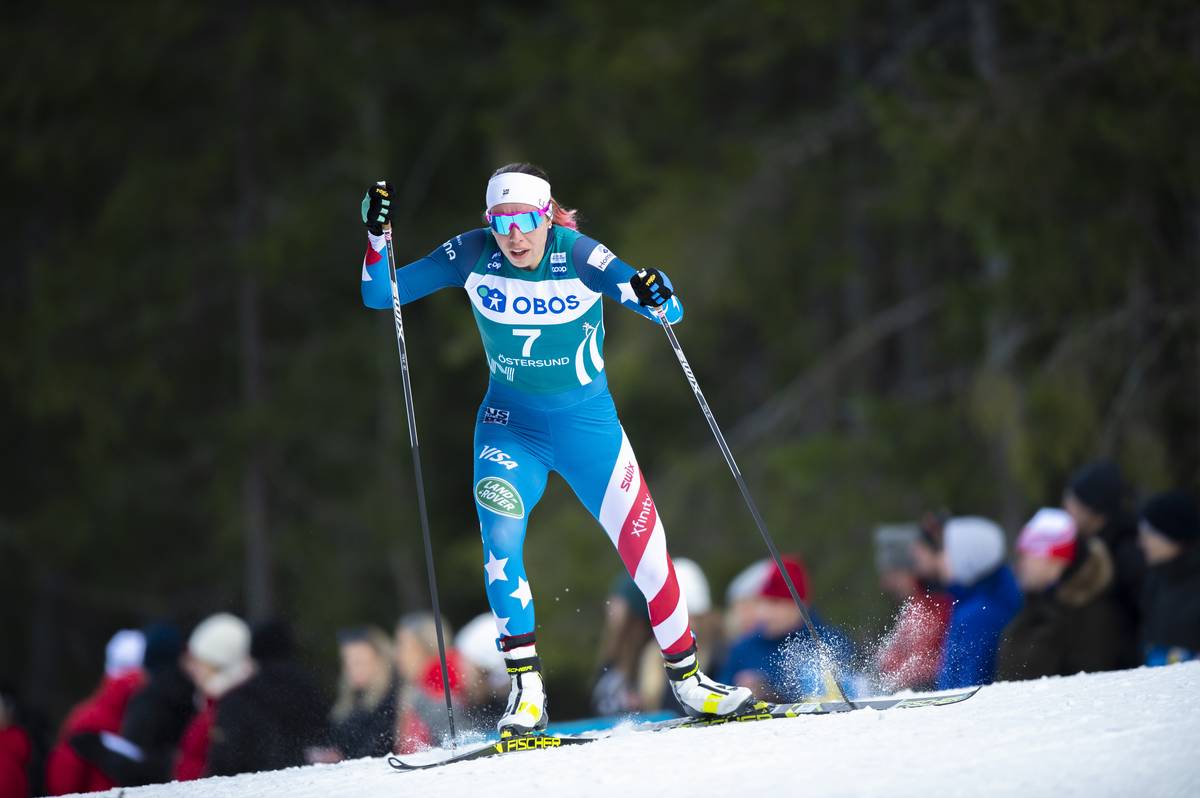
Katharine Ogden racing in Östersund, Sweden. (Photo: NordicFocus)
Katharine Ogden wrote a straight-up earnest piece about her struggles with an anxiety disorder. Ogden is a student at Dartmouth College and raced in several World Cup this season including the Tour de Ski.
Once the WJC races were over, I was exhausted. By the end of January, I was no longer racing or training at all. I declined all of the trips I had planned on doing for the rest of the winter and completely succumbed to my anxiety. I spent weeks barely leaving my bed before I finally got up the combination of courage and desperation that it took to make my first appointment with my psychiatrist, Dr. Stanger. She explained to me that I could learn to manage the feelings of terror I felt, and she gave me a prescription for anxiety medication that almost immediately changed my life. Before meeting Dr. Stanger I didn’t believe that things were going to get better for me. I didn’t think that I would ever be strong enough again to go to college or continue ski racing. — Katharine Ogden
Hailey Swirbul
Hailey Swirbul racing in Falun, Sweden. (Photo: NordicFocus)
Hailey Swirbul wrote a piece called “U23 WORLDS: IN DEFENSE OF SMALL VICTORIES,” for the National Nordic Foundation in which she ruminated on her own struggles and cherished moments. You can read that article here. Swirbul broke through on the World Cup this season and is a member of the U.S. Ski Team.
2016 was that period for me. My parents found me help for my relationship with food and my body and self. I learned how to treat my own self with the values I wanted to treat others: kindness, dedication, respect. I figured out what I loved about skiing and why I was sure I wanted to keep doing it, and at the base of those reasons was nothing to do with results. I wanted to develop a lifelong love of sport and outdoors, for example. Or learn how to manage relationships with teammates that I might not choose to be my best friends. Or develop relationships with teammates that inevitably would become my best friends. Heck, I’d even consider my First-JNs-Dance-Kiss a reason to continue the sport!!! — Hailey Swirbul
Kendall Kramer
Kendall Kramer on the second classic leg of the junior women’s relay at World Juniors. (Photo: Doug Stephen)
Another gem comes from social media, Instagram to be exact. Kendall Kramer wrote a post after the 2020 World Junior Championships. It’s another stand out performance in terms of putting words down and celebrating the big picture. We are re-posting her full IG post with permission. Kramer hails from Fairbanks, Alaska and is a member of the U.S. Ski Team’s development team. She’s also a keen student, and by her own admission, a regular teenager.
It’s easy to highlight the “good” and hide the “bad”. For celebration and sharing american pride, I’ll post that my amazing American relay team got 2nd in the junior world championships yesterday. But that’s not what I’m most proud about this season. There was a lot of expectation for me to take my individual 4th place last year and make it into a podium. That was the “logical” step. But I didn’t realize what it was costing me to do that. This year I started dreading training- I would nearly cry when I had to go out the door to do it because I used to go so intensely that one mishap or thing not going as planned in training would make my brain feel like it was on fire from the stress of not doing everything perfect, making being an athlete a chore and not a choice anymore. That high strung brain is what made me so focused and “successful” last year, but it was obviously not sustainable. So, I got 22nd and 24th in my races this year, but I had to take a step back afterwords and realize I am representing the United States of America at the world championships, and be proud of myself for getting out of this very tough summer with a healthier mindset. The number by my name on the results sheet isn’t as low this year but I’m more proud of myself than ever, just as a person. Thank you to all my friends and family who consistently hype me up for just being me and not asking about results, that helps me more than you know💘 #USA — Kendall Kramer
DU’s Eveliina Pippo taking the win Thursday in Bozeman. (Photo: Montana State Athletics)
BOZEMAN, Montana – Thirty minutes after the conclusion of today’s nordic podium ceremonies, the NCAA announced that all winter and spring championship events were cancelled due to the COVID-19 pandemic, effective immediately.
While the fallout from the decision will surely stretch into the off-season, here’s how the cross-country races unfolded today at Crosscut Mountain Sports Center.
The day dawned cool and cloudy, with low overnight temps making the snow firm and fast. With occasional peeks of sunshine through the cloud cover, it looked like it could be a classic Montana March day.
Nothing today would be that straightforward — a snow squall materialized thirty minutes before the women’s start. Although just half an inch fell, the course was totally transformed and slowed down dramatically.
Even though the snow eased up for the women’s race, the early starters had to plow through the fresh flakes. Skate tracks appeared around the loop as the first few starters raced through the powder.
Crosscut’s course is mostly rolling, but features brutal climbs at about the 1 and 4k marks. The climbs are long, steep, and demanding, especially because of the venue’s location 6,100’ above sea level. The new snow made the climbs sloppy, with a few inches of sugary powder sucking speed on their upper pitches.
Starters were reverse seeded based on regional rankings. Top seeds were randomized in the final ten bibs, making bib numbers 30-40 the racers to watch for podium places.
As the women rolled through the course, a pair of late starters separated themselves from the pack. Denver’s Eveliina Pippo led Middlebury’s Sophia Laukli by five seconds at the halfway mark. Behind the leaders, five racers – Utah’s Guro Jordheim, Middlebury’s Alex Lawson, UVM’s Lina Sutro, and Dartmouth’s Katharine Ogden were all within a few seconds of each other at the halfway mark, battling for the next few places.
Laukli continued attacking the course with her signature high tempo, showing the form that earned her fifth in the Junior Worlds 15k mass start last week in Oberwiethensal, Germany.
However, Laukli couldn’t quite reel in Pippo, as she finished in second, just 4.8 seconds back. Pippo, with three wins on the RIMSA circuit this season, was a favorite to take gold today. She said “I’m happy with my win…the key was to focus on doing everything I can and not focus on the other racers.”
Jordheim emerged from the pack to finish third, followed by Ogden in fourth and Sutro in fifth.
The Middlebury trio of Laukli, Lawson, and Annika Landis has been on a tear throughout the EISA this season. Today they showed their winning ways aren’t limited to the East Coast, finishing 2-6-16, respectively, and amassing 79 points to take the team win over the University of Utah (74 points.) The UVM Catamounts, with Anya Bizyukova in seventeenth, scored 65 points and took third on the day.
Middlebury’s Sophia Laukli racing to second place in Bozeman. (Photo: Montana State Athletics)
As the women cooled down and the men warmed up, the sun finally stuck around. The course filled up with spectators and racers, and the excitement was palpable as the first male skier took the line at noon. Once again, the top seeded racers were in bibs 30-40, with the winner expected to emerge from that select group.
Ben Ogden accelerated like a rocket from the start, flying through the first 5k nine seconds faster than anyone else. Third through ninth places were separated by just fifteen seconds at the halfway mark, setting up an exciting second lap. The course, snow, and altitude conspired to punish anyone who started too fast and reward those who had paced their efforts.
Utah’s Sam Hendry started reeling Ogden in, coming back from a seventeen second deficit at 10k to a three second margin at 7.5k. Ogden came into the final climb and entered into a tunnel of Catamounts, with teammates, friends, and fans screaming on both sides of the trail.
UVM’s Ben Ogden, skating to an NCAA win. (Photo: NCAA)
Ogden, charged up by the Catamount faithful, powered to the line and took his first NCAA title by just 3.1 seconds over Hendry. With a second-straight gold medal in the relay at Junior Worlds last week, Ogden may need to invest in a bigger trophy case. Ogden was thrilled with his result, saying “I’m ecstatic! I just came over from Germany, but I was super stoked to rest up and throw down today.”
Hendry charged into second with the fastest second lap, while Denver’s Bernhard Flaschberger, winner of a pair of RIMSA skate races this winter, took third for the Pioneers. University of Alaska Anchorage’s Sigurd Roenning was ten seconds further back in fourth, while UVM’s Karl Schulz finished fifth.
Along with Bill Harmeyer in twelfth, Ogden and Schulz, the UVM trio combined for 88 points, giving the Catamount men the team win on the day. Roenning led Anchorage to 77 points and second place, while Hendry’s effort helped the Utes pile up 67 points and take third place.
Given the cancellation of the mass start, NCAAs were effectively a one-day championship. The University of Vermont men and women combined for 153 points, taking the 2020 nordic title. Utah was close behind with 141 points, while Alaska Anchorage scored 123 and finished third.
Complete nordic results are on Summit Timing.Team scores are available on RIMSA.
Therese Johaug, untouchable during Stage 6 of the Ski Tour 2020. (Photo: NordicFocus)
We’ll start with the weather: think all over the place. A moving target for meteorologist with moisture spitting from the skies, and air masses swirling this way and that making the trees sway like a mamba line along the course. A wax tech’s nightmare scenario? Yes. It certainly trended in that direction.
By all measures, this was Therese Johaug’s, Norway’s latest version of a cross-country skiing record-breaker, stage and tour. Of six stages total, she won five outright, with the lone exception, Saturday’s Stage 5 classic sprint in Trondheim.
Stage 6 featured a 15 k classic pursuit. Call it a pursuit, however, on the race’s sharp end, this was a runaway. Although the field was, in theory, pursuing Johaug, she simply put more time into her challengers on Sunday. She began 2:33 ahead of Norwegians Heidi Weng in second, while Ingvild Flugstad Østberg set off another second back.
Johaug expanded her lead at the finish, by over a minute, to Weng and Østberg. Johaug won the pursuit in 41:13.8. Weng placed second (+3:40.8) with a slight gap over Østberg, who toed the line 0.7 seconds further back. Sweden’s Ebba Andersson, the day’s fourth starter at 4:48, lost time to0, finishing 5:54.3 back to end the Ski Tour in fourth overall.
“I felt really good today and the waxers had done a really good job the whole Ski Tour and today as well I have the perfect skis,” Johaug told FIS after the race. “When the skis are good and the shape is good I can just go out there and enjoy all the people that come here and cheering us.”
Heidi Weng (bib 2) and Ingvild Flugstad Østberg pacing along during Stage 6. (Photo: NordicFocus)
Norway’s Heidi Weng and Ingvild Flugstad Østberg (bib 3) pursing Johaug during Stage 6 of the Ski Tour 2020. (Photo: NordicFocus)
As far as time of day, Johaug took that prize as well. However, Norway’s Astrid Uhrenholdt Jacobsen placed fifth overall and had the second-fastest race time, 44.8 seconds off Johaug’s winning mark. Krista Pärmäkoski of Finland notched the third-fastest time of day (+1:04.4).
Jessie Diggins of the U.S. was the top placed North American in sixth (+8:40.1). (She skied the 17th fastest time of day.)
“Today, like yesterday, was a crazy day in terms of weather and waxing. It kept snowing on and off, the sun coming out and then the wind picking up as more snow came down! I was pretty much skiing an individual start race as I was alone the entire time, but I was really proud of my pacing and efforts as I held my placing without anyone to work with. There was a really tricky time in the middle of the race when the skis weren’t kicking very well (for much of the field, I think) but I was able to refocus and reset and keep pushing as hard as I could.
“As for the overall tour, I’m really happy with my efforts and how I hit my goals for every race. One of my big goals was to see each day as an entirely separate opportunity and to not put pressure on myself for the overall tour, since there are so many factors that I can’t control that play into that placing. But by hitting my own process goals for each race and staying consistent I was able to have a tour that I’m proud of.
“I’m really proud of our tech team and coaches for their tireless efforts day in and day out through this tour. It’s been exhausting but they’re the hardest working guys out there!”
Jessie Diggins racing to sixth overall in the Ski Tour 2020. (Photo: NordicFocus)
Post Stage 6, a spent Jessie Diggins. (Photo: NordicFocus)
Sadie Maubet Bjornsen ended her tour in 10th (+9:43.8). With the big time gaps, the second wave of skiers (the mass start) began with Pärmäkoski in bib 13, starting at 8:08 back. Maubet Bjornsen (bib 12), began 16 seconds ahead and was the initial target of the wave starters. Maubet Bjornsen held off a charging Pärmäkoski for over 5 k.
“Wow, I made it!! That was one heck of a tough tour! Things were looking mighty rough to begin with, but I knew I had to just keep fighting and believing!,” Maubet Bjornsen emailed.
“But among some challenging times, there were some glimmering hopes in there. Tours are my favorite types of racing, because you have to be so resilient and such a fighter. Day after day, you have to put your fatigue and emotions aside, and just stay so positive.
“The tummy troubles at the beginning of the tour were particularly tough! It was scary to start a tour so depleted, but I was thankful we had our nutritionist, Susie Parker Simmons around to help me stay on my feet! From there it was just a matter or fighting for every second from there on.
“Today was a totally wild scene! Conditions were constantly changing, and it was hard to find the perfect skis! I knew the name of the game was to just keep fighting, because everyone would be struggling at some point out there. I managed to find something to work, and went through some highs and lows out there in the 15k which brought me to 10th overall in the tour! I’m super happy and satisfied with that, given the little fatigue hole I had to crawl out of this past month. Thank you to our team for helping make a tricky classic day at the finish of the tour possible to fight with the others.
“I’m looking forward to taking a rest now, and finding the energy to finish the end of the season strong, for the third tour of the season.
“Thanks to the Ski Tour 2020 for bringing some different types of racing. While it wasn’t always the best type of races for my strengths, it was so refreshing to visit some new locations with some different types of events! These are some of my favorite memories this season!
“And of course, hugest thanks to the staff. We couldn’t race day after day like this without them!!! They are the heroes.”
Sadie Maubet Bjornsen (bib 12) racing to 10th overall in the Ski Tour 2020. (Photo: NordicFocus)
Rosie Brennan, starting in bib 10, 7:27 behind the first starter Johaug, placed 12th (+9:53.3).
“Today was a very challenging day,” Brennan wrote in an email. “Due to the massive time gaps in the overall, the wave started at bib 13 so I had a big pack starting not too far behind. The conditions were very challenging with snow, sun, rain and everything in between and some very icy tracks. I did my best to stay in front of the wave but just didn’t have the skis or the energy to make it happen today. I am very disappointed in myself. After having a great tour, it was hard to end on this note, but I am doing my best to look at all the positives from the tour as a whole and make a nice little work list to improve on the things that were so tough today.”
Rosie Brennan (stars and stripes) during Stage 6 of the Ski Tour 2020. (Photo: NordicFocus)
Also for the U.S., Julia Kern placed 30th (+14:51.4), Caitlin Patterson 36th (+16:38.4), Katharine Ogden 42nd (+20:26.6), Rosie Frankowski 43rd (+20:36.7), Sophie Caldwell 44th (+21:41.2), and Alayna Sonnesyn 48th (+24:34.6).
Canada’s Katherine Stewart-Jones placed in the points for the tour overall, by finishing 29th in the pursuit (+14:46.3). Cendrine Browne was 33rd (+15:47.5), and Emily Nishikawa 35th (+16:08.4).
Katherine Stewart-Jones during Stage 5 of the Ski Tour 2020. (Photo: NordicFocus)
This stage concludes the Ski Tour. Racing continues in Lahti, Finland next Saturday.
The day began in Trondheim with a centimeter of snow, which then transitioned to big blue skies for the thousands of fans attending the fifth stage of the Ski Tour 2020, a 1.5 k classic sprint. The Norwegians can throw a cross-country race party. The scene, despite the different setting, was reminiscent of the festive cowbell and camp-out sideshow of Holmenkollen’s Frognerseteren. It’s not quite the Yankee stadium of cross-country skiing, but a sign that in the hot-beds of the sport, fans arrive in droves.
The sprint course was more traditional, meaning this was no simple VO2 max test of an effort — that went down on Stage 3, in Åre, Sweden as athletes ascended an uber steep alpine ski hill to close out that event. Trondheim’s classic sprint was bolstered by two punchy climbs on a three-terrace course, long and fast glide outs, and two speedy corners which swung skiers through a 180-degree direction change to keep it spicy.
Sweden’s Jonna Sundling laid down the fastest qualifying time in 3:22.75, shadowed by her teammate, Linn Svahn, 0.24 seconds back. Maybe, not surprisingly, Therese Johaug was the third-fastest qualifier, 0.83 seconds back. Johaug won her first career sprint on Stage 3 of the Ski Tour.
Jonna Sundling of Sweden in bib 1, during her quarterfinal of the Stage 5 classic sprint in Trondheim, Norway. (Photo: NordicFocus)
The U.S. packed five skiers into the heats. Sadie Maubet Bjornsen qualified in 10th (+6.20). Rosie Brennan in 11th (+6.34), Sophie Caldwell 15th (+7.32), Jessie Diggins 20th (+8.58), and Julia Kern 24th (+9.54). Yet the story on the U.S. women’s side ended earlier than their highwater mark norm, which is most often, representation in the six skier final. In no uncertain terms, this is the golden age of U.S. women’s cross-country skiing. A stars and stripes void marked the semis and final. No U.S. skiers advance beyond the quarterfinals.
In the third quarterfinal, Kern and Brennan lost contact with Sundling and Tiril Udnes Weng who came in 1-2, respectively. Kern was fourth in the heat (+3.7), Brennan fifth (+7.71).
Maubet Bjornsen and Diggins fell off the pace as well in the fourth heat, placing fourth and fifth respectively. Both were over four seconds off Norway’s Anna Svendsen’s pace of 3:19.34 who won that quarterfinal.
Sadie Maubet Bjornsen during the Stage 5 classic sprint in Trondheim, Norway. (Photo: NordicFocus)
“It was an extremely tricky weather day with a combo of rain/snow/sun, and everything in between,” Maubet Bjornsen emailed.
“I was excited to put together a solid qualifier, but felt like a few adjustments would allow things to be even better for the heats. My body felt sharp and powerful, so I knew the key for me was to be quick out of the start, and do my favorite thing… ski from the front. I was quick out of the start, but struggled to hold the speed up the first climb. Since climbing is generally my strength, it’s unclear whether it was skis, body, or both that held me back. But, that’s how ski racing is. You can’t overthink anything too much, you just keep believing, and chasing away!
“It is the tour of crazies for me, so I’m going to let it go, and look on to “the chase” tomorrow. With the tour ending with a 15k classic, I am sitting just outside top 10 overall, and really hoping to climb my way within that tomorrow. Let’s see if I can channel all amounts of frustration towards some constructive racing in the final day!”
The last U.S. athlete eliminated was Caldwell. She placed third in the fifth quarterfinal, 1.53 seconds back on Norway’s Heidi Weng in first. Caldwell placed 14th in the final standings, Maubet Bjornsen 16th, Kern 20th, Brennan 21st, and Diggins 23rd.
Sophie Caldwell (bib 15) during her quarterfinal in Trondheim: Stage 5 of the Is Tour 2020. (Photo: NordicFocus)
Post-race interview with U.S. World Cup Coach Matt Whitcomb
Wintry weather moved in during the men’s quarterfinals. The blue-bird scene morphed quickly into an intermittent snowglobe. With the swift winds swirling around the stadium, the snow squalls eventually moved on as the semifinals progressed.
The 12 skier field in the two women’s semis consisted of six Norwegians, four Swedes, and two Swiss skiers in Laurien van der Graff in the first semi, and Nadine Fähndrich in semi two. Fähndrich kept Swiss hopes alive by advancing to the finals after winning her semi.
The first semifinal featured Norway’s Maiken Caspersen Falla and Sweden’s Sundling. These two athletes were the skiers to watch. For Falla, by her own high standards, this has been an offseason, as the young Swedish sprint team has pushed her aside for precious top-of-the-podium real estate. Falla won the opening World Cup sprint in Ruka, Finland, otherwise, it’s been a first-place void for the former Crystal Globe sprint winner.
In bib 12, Maiken Caspersen Falla strides it during her quarterfinal in Trondheim. (Photo: NordicFocus)
In Falla’s semi, she and Sudling took first and second, respectively, with Astrid Uhrenholdt Jacobsen and Linn Svahn of Sweden in close contact, only a few tenths of a second back. In the final, Falla was locked in. Although at moments Sundling was side by side with Falla, the Norwegian dictated the decisive move off the front. Over the second climb, at roughly 2:25 into the race, Falla powered over the hill and into the glide out transition with only Sundling able to match two meters back.
Falla took the win in 3:15.55 with Sundling in second (+0.48). Fähndrich was third (+2.88), Anna Dyvik of Sweden fourth (+3.71), Svendsen fifth (+5.26), and Heidi Weng sixth (+6.64).
Maiken Caspersen Falla on her way to her second sprint win of the 2019-2020 World Cup season. (Photo: NordciFocus)
Sealing it: Maiken Caspersen Fall in Trondheim. (Photo: NordicFocus)
“This feels always like the [World Championships] so crowded and so many people screaming my name at the start and after the finish,” Falla told FIS after the race. “It’s an amazing atmosphere and I’m so happy to be here. There has been some hard distance races for me now. The 30 k and also 10 k was really hard so I’m really happy that I stayed in the tour, didn’t go home and got this opportunity to win here and race in this amazing atmosphere.”
This was Falla’s 21st individual sprint win. She sits second overall in total World Cup sprint wins. Marit Bjørgen of Norway still reigns with 40 World Cup sprint victories. For Fähndrich, this was her second career individual podium. Prior to her third place on Saturday, the Swiss skier posted up a second place in Cogne, Italy’s 2019 10 k classic for her first World Cup podium.
Hands up: Nadine Fähndrich earns a third place for the Swiss in Trondheim. (Photo: NordicFocus)
Katharine Ogden in 37th was the top-U.S. skier outside the top-30. Alayna Sonnesyn placed 42nd, Caitlin Patterson 48th, and Rosie Frankowski 51st.
For Canada, Emily Nishikawa finished in 34th, Katherine Stewart-Jones 35th (+14.19), Cendrine Browne 40th,
The Ski Tour overall looks certain for Johaug who placed ninth in Saturday’s sprint. She leads with a total time of 2:19:28. Weng remains in second (+2:33), and Ingvild Flugstad Østberg third (+2:34). Østberg finished 22nd in Stage 5. This Norwegian trio is the likely overall podium, as Sweden’s Ebba Andersson is fourth at 4:48 back. Racing concludes for the Ski Tour on Sunday with Stage 6, a 15 k classic pursuit for the women.
Norway’s Therese Johaug (yellow bib) the Ski Tour’s overall leader was the third overall qualifier. (Photo: NordicFocus)
Katharine Ogden during the 2019-2020 Tour de Ski. (Photo: NordicFocus)
The author, Katharine Ogden, is a Junior at Dartmouth College. She recently completed the 2019-2020 Tour de Ski. Ogden is a decorated skier. You can read more about her ski career here.
By: Katharine Ogden
01/06/20
The Tour de Ski is an iconic set of world cup races. It tests athletes in every way and pushes you to your limits physically and emotionally. Seven races over the course of nine days evokes giggles, tears, and often sudden, urgent needs for gelato. In reflecting and trying to figure out what to say about the whole whirlwind I realized that in order to fully express how I feel about this accomplishment I need to provide some backstory. My ski career has taken a few turns over the past few years that made it pretty hard to imagine myself climbing up Alpe Cermis on the final day of the Tour de Ski.
Just a few years ago, I wasn’t even sure if I would keep ski racing at all.
In the spring of 2017, I was diagnosed with an anxiety disorder, a conclusion that decidedly changed my life for the better. During the year leading up to my eventual diagnosis I experienced near constant anxiety symptoms that made it hard for me to sleep and even harder to eat enough. These new, extreme feelings of fear and a lack of control also made traveling and racing suddenly very hard for me. I made it through period one of the Super Tour, U.S. Nationals and World Juniors Championships in Park City that year by hiding in my room and only skiing as much as I absolutely had to. I wasn’t eating enough because the anxiety made me constantly nauseous and subsequently I had very little energy.
Once the WJC races were over, I was exhausted. By the end of January, I was no longer racing or training at all. I declined all of the trips I had planned on doing for the rest of the winter and completely succumbed to my anxiety. I spent weeks barely leaving my bed before I finally got up the combination of courage and desperation that it took to make my first appointment with my psychiatrist, Dr. Stanger. She explained to me that I could learn to manage the feelings of terror I felt, and she gave me a prescription for anxiety medication that almost immediately changed my life. Before meeting Dr. Stanger I didn’t believe that things were going to get better for me. I didn’t think that I would ever be strong enough again to go to college or continue ski racing.
I have spent the past three years since that winter healing and learning to trust myself again. In skiing for the Dartmouth Ski Team, I was able to relearn to love ski racing and start the process of separating in my mind the concept of traveling and racing from the anxiety that it had induced.
College skiing is a perfect combination of a fun and laid back scene, while still being competitive. It allowed me to take the time that I needed to heal and learn how to manage my disorder. I was able to take a step back from international competition and simply enjoy skiing and racing on all of the beautiful New England trails where I first learned to love the sport.
Now, this year, I am feeling more confident and happier than I have in a long time. My only goal for this season was to smile on every start line and so far, I have been accomplishing it. I am learning to trust myself and to be okay with forging my own path through this sport and through life. Finishing the Tour de Ski is something that I am extremely proud of. But, I am so much prouder of the fact that I truly enjoyed the entire experience. I smiled before every race and even during a few of them.
I am sharing this story in hopes that I can help to de-stigmatize athletes talking about mental health. Finishing the Tour de Ski has been a dream of mine for a long time. It would not have been possible for me to accomplish it without the hard work that I have put into learning to manage my anxiety disorder.
From the Editors: if any person reading this needs assistance, please seek help and guidance from a personal physician or other health professional, your school health service, parent/guardian, or trusted coach.
Therese Johaug: queen of the hill. (Photo: NordicFocus)
The fateful Alpe Cermis. The 10-kilometer capstone of the Tour de Ski, athletes complete the 1.5 k sprint loop before following the river valley down to the base of the alpine hill, climbing steeply for nearly 400 vertical meters to the finish. Bodies aching with the cumulative fatigue of the tour, racers are totally spent at the finish of the event. Crossing the line, they collapse with their faces pressed into the snow gasping for air and writhing in lactate-induced misery.
And so it was today.
First, a look back on Tours of the past. Unlike in the men’s event, the fastest skier up the Alpe Cermis has been the overall tour winner over the last four years.
Last year, Ingvild Flugstad Østberg was the fastest up the hill climb in 35:15.0 to take the overall win. Østberg was 42 seconds faster than the next skier, Krista Pärmäkoski of Finland. In 2017 and 2018, Heidi Weng was the first up the mountain by a similar margin. And four years ago in her most recent tour performance, Therese Johaug dusted the field, winning the day by a margin of 1:25.9. That’s nearly double the already large differential of her teammates.
Dubbed by Devon Kershaw an “once in a generation athlete,” Johaug has over 100 career podiums to her name, over 50 of which have been wins.
With this insight, it seemed safe to bet on Johaug in the final stage. However, the Norwegian superstar has proved to be beatable in this tour, much to everyone’s surprise.
Johaug was out-sprinted by Østberg in the final meters of the 10-kilometer classic pursuit in Stage 4, and the next day, she missed her first distance podium since she took 5th in the 5k skate in Toblach during Stage 4 of the 2016 Tour de Ski. (Johaug missed the 2017/18 and 2018/19 seasons while serving an 18-month ban after testing positive for the anabolic steroid clostebol, which was contained in a lip cream she used after sustaining a severe sunburn.)
Heading into the final stage, the overall standings looked like this: Norway’s Astrid Jacobsen trailed Johaug by three seconds. Natalia Nepryeava lurked 14 seconds back, and Ingvild Flugstad Østberg was 23 seconds back. Ranked as the top American, Sadie Maubet Bjornsen sat in 8th (+1:58), with Jessie Diggins 11th (+2:53).
The infamous climb up the Alpe Cermis. (Photo: Screenshot FIS Broadcast)
Historically, the event has been run in pursuit format: the first person to the top of the hill wins. This round features a mass start format; racers will need to drop and gap their chasers to earn time in the standings. Identifying rank in the overall standings required lots of quick math to follow the flux in deficits; eleven seconds between Jacobsen and Nepryaeva heading into the final stage, nine seconds between Nepyraeva and Østberg, and so on.
One final note before we begin: Ebba Andersson of Sweden, who was ranked 6th in the standings (+1:07), withdrew from the Tour before the final stage.
As expected, the pace went out conservatively around the sprint loop. Racing on a narrow band of man-made snow that frequently contrasted the bare ground and asphalt beside it, Johaug stepped to the front, a string of her teammates that included Heidi Weng, Østberg, Jacobsen, and Nepryaeva.
As they hit the hill, Johaug put her head down and got to work. She quickly created a gap to Heidi Weng and Østberg, who at first were willing to match the effort early in the climb, but quickly laid off, unwilling to succumb to temptation and risk flooding their legs with lactate too early.
It became a race for second place and a race against the clock. In the lead, Weng pulled Østberg and Nepryaeva up the hill, a gap to the next skiers.
Heidi Weng (NOR) races for second place up the Alpe Cermis with Ingvild Flugstad Østberg (NOR) and Natalia Nepryaeva (RUS) chasing. (Photo: NordicFocus)
With Jacobsen nowhere in sight, Nepryaeva and Østberg fought for podium positions. At 9 k, Weng led Østberg by roughly four seconds, followed by an equivalent gap to Nepryaeva. Though Østberg matched Weng stride for stride, the Norwegians were not able to pull away from the Russian.
Meanwhile, Johaug steadily chugged up the hill, on her own by over a minute. As the grade mellowed in the final 200 meters, she had energy left to ski V2, her technique masking the fatigue she must have felt.
Waving the Norwegian flag high, Johaug shrieked with joy and relief as she stopped the clock at 34:21.6.
Therese Johaug celebrates her stage and overall victory at the finish of the 2019/2020 Tour de Ski. (Photo: NordicFocus)
A hard earned rest for Therese Johaug after winning the hill climb and taking the overall victory in the 2019/2020 Tour de Ski. (Photo: NordicFocus)
“I’m really, really happy now. My goal was, of course, when I’m going down here to fight for first place in the overall and today I do it. It has been seven hard days, but I am really, really happy now to come up here. I’m really looking forward to end this Tour de Ski because you wake every morning and are so nervous, but tomorrow I’m free.”
Firing on all cylinders, Heidi Weng crested the steep pitch, powering through the gradually ascending final meters for second (+50.3). Østberg followed in her wake for third (+54.5), followed by Nepryaeva in fourth (+57.1).
Throwing a boot to minimize her time back, Natalia Nepraeva finished 4th in the hill climb and 2nd in the overall 2019/2020 Tour de Ski. (Photo: NordicFocus)
So how did it all shake out? Therese Johaug took the overall Tour with an aggregate time of 2:28:18.6. Nepraeva landed the second spot on the podium (+1:11.1), followed by Østberg in third (+1:17.5). Weng finished 4th (+1:37.3), with Jacobsen behind her rounding out the top 5 (+2:13.4).
Theresa Johaug: 2019/2020 Tour de Ski champion. (Photo: NordicFocus)
First to the top of the Alpe Cermis, Therese Johaug (NOR) takes the overall victory in the 2019/2020 Tour de Ski. (Photo: NordicFocus)
Winding along the Marcialonga in the lead group, Diggins kept her position in the top ten throughout the day. At first, she trailed Jacobsen, Theresa Stadlober of Austria, and Charlotte Kalla of Sweden as they began the climb, but Kalla and Jacobsen fell off the pace.
Losing contact with Stadlober, Diggins was in the unfortunate position of skiing alone. Despite having no one to chase, she climbed steadily, sitting in 6th at 9 k with her teammate Rosie Brennan closing from behind.
Pure grit: Jessie Diggins ascends the final meters of the Alpe Cermis hill climb in 6th. (Photo: NordicFocus)
Holding her position, Diggins crossed the line for 6th (+1:51.1), chipping time off her deficit in the overall standings. With the hill climb, Diggins leapfrogged into the top 10, finishing 9th in the overall (+4:44.1).
“Today I was happy with my climb; I think I managed to pace it right so that I could keep moving up the hill steadily without blowing up – a line that is hard to find, but pretty crucial to get right! I had good energy and it’s nice to know that my fitness is in a good place even at the end of the tour,” Diggins wrote.
“Overall, this tour has been challenging in that I had many races where my fitness and effort weren’t reflected in the results. But I was proud of how I carried myself, contributed to having a positive team atmosphere and stayed positive without ever giving up, on the days when I had competitive skis but more important, on the days when I did not. It took a lot of positive energy, but now I can leave the Tour really proud of my mental toughness and ready to soak in all the hard work I put out there!”
Brennan and her teammate Sadie Maubet Bjornsen sat in the mid-teens at the base of the climb. As the grade increased, Brennan left Maubet Bjornsen and began picking off the women in front of her. Brennan advanced from 15th at the base of the climb to finish 7th (+1:58.0).
Rosie Brennan climbs to 7th place in the final stage of the 2019/2020 Tour de Ski. (Photo: NordicFocus)
In the overall standings, Maubet Bjornsen bumped up one spot into 7th (+4:40.6). Brennan finished 15th in the Tour (+7:11.0), and Ogden 28th (+12:26.5). 41 women finished the Tour.
“Wow, it feels good to make it to the top of that climb,” Maubet Bjornsen emailed. “I think it is safe to say, making it up that alpine slope after six hard days of racing is quite possibly the most physically painful thing I experience. Just crossing the line is such an achievement. This is only my third time I have made it, so it still feels just as exciting as the first one!
“This tour has had its ups, downs, and painfully near misses. Despite the rollercoaster, I feel like I gained confidence in my fitness and my skiing throughout the process. Not only that, I had my best ever Tour de Ski finish, ending in 7th place.
“No doubt I will come away from this tour both physically and mentally tougher!
“Thank you to the support crew who allowed it to happen, and thanks for all the cheers of encouragement both on the tough and wonderful days!”
The 2019/2020 Tour de Ski podium: Therese Johaug (NOR) took the win ahead of Natalia Nepryaeva (RUS) and Ingvild Flugstad Oestberg (NOR) in third (l-r) . (Photo: NordicFocus)
With one stage remaining in the 2019-2020 Tour de Ski (TdS), and with standings somewhat unsettled before what some consider to be a slam dunk final stage for the current overall leader Therese Johaug from Norway, time bonuses were what mattered in Val di Fiemme, Italy on Saturday. Podium pride was at stake, but generous time bonuses were the carrot for many in the 1.27-kilometer classic sprint.
First through 30th place in the TdS sprints receive a time bonus. Sixty seconds for first, 54 seconds for second, and so on. Time matters.
After Stage 5, Johaug led the overall by 19 seconds over Ingvild Flugstad Østberg (NOR) in second, 32 seconds over Russia’s Natalia Nepryaeva, and for good measure, 33 seconds ahead of Astrid Uhrenholdt Jacobsen (NOR) in fourth.
Finding her groove in time for the final stage. Astrid Uhrenholdt Jacobsen (NOR), moves to second overall in the Tour standings. Sadie Bjornsen (bib 4) follows. (Photo: NordicFocus)
The thirty-two-year-old Jacobsen comes off a mildly surprising win in Stage 5’s 10 k mass start classic race. Of late, her classic technique looks dialed and her ski speed has been an asset. For the longtime National Team member, the top podium spot has been a fleeting prize. Over her storied career, she has won five World Cups. We bring her up because she animated today’s classic sprint and positioned herself nicely for a TdS overall podium spot. More on that in a bit.
First a reminder, this is well into the TdS. Many of the World Cup’s top sprinters dropped from the Tour a stage or two ago. For the U.S., Sophie Caldwell is missing. Some top sprinting Swedes are not at the Tour. And Maiken Caspersen Falla of Norway took a raincheck. With forty-four skiers starting the qualifier, it was a good bet that many of the names we associate with distance skiing would progress.
Jessie Diggins of the U.S. qualified in first on the 1.27 k classic sprint course in 3:04.26. Yes, all the top contender names in this TdS advanced to the heats.
Jessica Diggins (USA), Natalia Nepryaeva (RUS), Lucia Scardoni (ITA), and Theresa Johuag (NOR) (l-r), during the first quarterfinal, Stage 6 of the Tour de Ski. (Photo: NoridcFocus)
In the first heat, Diggins looked smooth and powerful as she placed first. But slotting into fourth, in by far the fastest quarter-final was Johaug. She would advance to the semis, minimizing the potential damage of time bonus gains by her rivals for the overall.
In the second heat, it was Jacobsen who commanded the win with timely positioning and rocket skis. Sadie Maubet Bjornsen was second. Brennan placed fourth and did not advance.
After cataloging the quarters, all the key players remained. An upstart Anamarija Lampic from Slovenia, Nepryeava, Weng, and Østberg, Johaug, Diggins and Maubet Bjornsen. The only potential overall Tour contender not to advance and capitalize on more bonus time was Sweden’s, Ebba Andersson. Prior to today’s sprint, she was fifth overall, only 38 seconds out.
Andersson ended her day ranked 28th in the sprint.
Sadie Maubet Bjornsen (USA), Jonna Sundling (SWE), Jessica Diggins (USA), Lucia Scardoni (ITA), Therese Johaug (NOR), (l-r) during the first semifinal, Stage 6 of the Tour de Ski. (Photo: NordicFocus)
In the first semi, Jacobsen, Maubet Bjornsen, and Diggins went 1-2-3 to advance. Diggins moved on to the final as a lucky loser. Johaug bowed out in sixth. But her mission of time bonus mitigation was accomplished. Johaug ended her day ranked 11th.
Lampic, in the second semi, showed she too is a mint sprinter. She won her first career World Cup on Stage 2 of this TdS, a skate sprint, in a deeper field. Today, advancing to the finals after winning her semi, Lampic would add another exclamation point.
Out of the start, Nepryaeva fell hard in the finals while changing lanes. She placed sixth (+15.30) after realizing that burning energy to catch back on was futile. The five remaining in front kept it tight. Up the first climb, the skiers slotted into four lanes across with Jacobsen eventually taking charge.
The course finishes with a long downhill into the final straight. Here, good skis and a transition into a power double pole played to Lampic’s favor. With Diggins, Maubet Bjornsen, Jacobsen, and Lampic gliding into the straightaway, Lampic was able to pull ahead for her second career World Cup win in 3:03.03. Diggins had a clear lane as did Jacobsen. Maubet Bjornsen, however, with a strong double pole, was stymied by Jacobsen blocking her in front. Maubet Bjornsen began pushing onto Jacbosen’s tails. The formidable U.S. skier switched tracks before she crossed the finish losing a smidge of momentum.
Jacobsen ultimately placed second (+0.22) in a photo finish with Diggins, who placed third (+0.28). Maubet Bjornsen was fourth (+0.8) and Lucia Scardoni of Italy fifth (+1.12).
A streamlined Diggins during Stage 6 of the Tour de Ski. (Photo: NordicFocus)
“We haven’t seen a classic sprint here since 2013 World Champs, so tactically we were trying out a few new things and finding our strengths out there!” emailed Diggins. “I had good energy today and was just trying to push the pace at the start, but in the final, I was trying to use the slingshot a little bit more off of the downhill. I was also wary of getting boxed in on the tight corners because it was so important to be able to push hard over the top of the hill into the downhill.
“Huge thanks to the wax team for working so hard, and it was super fun to ski in the finals with Sadie! We’ve kept such a positive energy on this team the entire tour, through the good days and the hard days, and that has really paid off.”
Looking forward to finishing this tour like I always do – by going out there and giving it absolutely everything I have, so I can be proud of the effort I gave!
Anamarija Lampic (SLO) loving the win, post-Stage 6 Tour de Ski stoke. (Photo: NordicFocus)
“Hard to believe we can find sprinting muscles after so many days of racing, but somehow I felt amazing today!,” Maubet Bjornsen emailed. “Through my quarters and semis, I managed to place myself in a safe place, trying to conserve energy for the final, and feeling in total control. As the finals went off, I put myself in what felt like the ‘right position’. Unfortunately, I wasn’t in the right place at the right time on the final stretch, getting blocked up and just missing the podium by half a second.
“I can’t help but feel a bit frustrated, because I believe I could have won today if I could ski it again, but how can you be upset with a 4th place? I’ll have to channel all that frustration into the final day tomorrow, up the big alpine slope.”
Sadie Maubet Bjornsen (USA), Astrid Uhrenholdt Jacobsen (NOR), Anamarija Lampic (SLO), (l-r) in the final straight as Lampic takes the win. (Photo: NordicFocus)
Jessica Diggins (USA), Sadie Maubet Bjornsen (USA), Astrid Uhrenholdt Jacobsen (NOR), Anamarija Lampic (SLO), (l-r) in the final straight. (Photo: NordicFocus)
“While this tour has had plenty of ups and downs, I continue to feel strong and confident on my skis. Every new day is a new chance, which is so fun! That’s why I just love this crazy 7 races in 9 days. Getting yourself across that line on top of Cermise is an unbelievable achievement!”
Also for the U.S., Brennan placed 19th and Katharine Ogden 32nd.
The Shakeout for the Overall
Therese Johaug (NOR) kept it close today as she advanced to the semis in the Stage 6 classic sprint of the Tour de Ski. Johaug still leads the overall standings. (Photo: NordicFocus)
With her 11th place in the sprint, Johaug earned 24 bonus seconds, which in reality served to keep those potential overall threats, if any really exist, a few seconds back. That brings us to Jacobsen. After starting the day fourth overall, 33 seconds behind, her second place in the sprint netted her a 54-second time bonus. That bumped her to second overall, only three seconds behind Johaug. Nepryaeva is currently third overall, with 14 seconds to make up. Østberg fell to fourth — she placed 12th in the sprint — with a long 23 seconds to gain on the Alpe Cermis.
Post-Stage 6, Maubet Bjornsen improves to eighth overall (+1:58) from ninth after Stage 5, and Diggins jumped from 15th overall to 11th (+2:53) after Saturday’s sprint.
Tomorrow’s final stage, the infamous Cermis climb brings a new format this year. Historically, the Tour’s premier stage runs as a pursuit. With tomorrow’s mass start, every athlete heads out together. It will be on those trailing Johaug to somehow find a weakness and literally pull ahead.
If you’ve been listening to Devon Kershaw, no way, it will not happen — Johaug will not lose time on the Cermis.
The Alpe awaits.
(An athlete’s qualifying time from Stage 6 is used to determine an athlete’s time in the overall standings. Bonus time is subtracted from the overall time.)
The women’s podium after Stage 5 of the 2019/2020 Tour de Ski in Val di Fiemme, Italy. Astrid Uhrenholdt Jacobsen (NOR) took the win ahead of Ebba Andersson (SWE), and Katharina Hennig (GER). (Photo: NordicFocus)
The 100th Tour de Ski Stage in Val di Fiemme, Italy, featuring a four lap 10-kilometer mass start classic. Coupling the results in distance racing over the last 14 months since Therese Johaug returned to the world cup and those of Stage 4, it seemed like a safe bet to predict a rematch between Johaug and her teammate Ingvild Flugstad Østberg. Another opportunity to race head-to-head over every meter of the course, and for Johaug to make a statement that her loss was a fluke.
It quickly became clear that Østberg crossing the line 0.4 seconds ahead of Johaug was akin to Roger Bannister running 3:59.4 on a cinder track in Oxford. The barrier was broken, illuminating the potential for the host of men who followed. Johaug was no longer invincible. No longer in a class of her own.
Ebba Andersson (SWE), Ingvild Flugstad Oestberg (NOR), and Heidi Weng (NOR) lead the pack in a 10-kilometer mass start classic in Val di Fiemme. (Photo: NordicFocus)
Nearing the end of the first 2.5 k lap, seven athletes formed a tight group at the front of the pack. Putting in a surge for the point bonus at 2.3 k, Natalia Nepryeava of Russia was in the lead, stretching out the group slightly. The trailing women rebounded like a slinky, continuing to push as a group.
The elevation profile of the 2.5 k course in Val di Fiemme, Italy. (Photo: Screenshot FIS broadcast)
Rounding the fast winding turns of the steep descent halfway through the lap, the chink in Johaug’s armour widened. Temperature well above freezing and old manmade snow made for lightning fast conditions, and racers were likely kicking with a variation of klister, perhaps with a hardwax cover. In the first lap, Johaug lost her footing and crashed, rebounding quickly and keeping contact with the pack.
In each of the subsequent laps, she was seen scrubbing speed, doing what she could to stay on her feet at the risk of shearing off some of her grip.
Therese Johaug approaches the fateful horseshoe bend in Val di Fiemme with Ebba Andersson close on her tails. (Photo: NordicFocus)
Jessie Diggins tackles the fast icy corners in Val di Fiemme during Stage 5 of the 2019/2020 Tour de Sk. (Photo: NordicFocus)
Spending the majority of the race at the front, Ebba Andersson of Sweden made several attempts to reduce the size of the group, but each of her moves were matched. Johaug, Østberg, and their teammates Astrid Jacobsen held strong beside Nepryeava, and Katharina Hennig of Germany.
As the 6k checkpoint approach, providing the opportunity for the first ten athletes to earn up to 15 bonus seconds, the pace accelerated. Jacobsen emerged at the front, sprinting head to head against Andersson with the remainder of the women close on their tails. Jacobsen held off the Swede, earning the most time.
Tour leaders Østberg and Johaug were 4th and 6th at the bonus, respectively. As expected after a high-speed snowplow down the hill, Johaug appeared to be struggling with her kick and was forced to run alongside the pack of women outside the track.
Sadie Maubet Bjornsen, who initially fell off the lead pack with Jessie Diggins, pushed to reconnect with the lead group and hovered 2 seconds behind in 8th at the time bonus. Diggins began to fade and was not within the top ten skiers; she did not earn bonus seconds.
Charlotte Kalla (SWE, bib 13), Sadie Maubet Bjornsen, and Jonna Sundling (SWE) lead the chase group during Stage 5 of the 2019/2020 Tour de Ski. (Photo: NordicFocus)
As the final lap began, the pace heated up and the lead pack began to whittle down. Østberg led at each of the checkpoints. She too could no longer climb inside the tracks, but neither could her opponents. Heading into the fast and technical descent, Østberg motioned to the racers behind her as if to say, ‘Let’s chill out and give each other space here so we all stay on our feet.’
And so they did; each of the top five skiers stayed on their feet around the horseshoe bend. But as they headed up the final punchy climb with less than a kilometer to go, Østberg tangled with Johaug and went down and the tip of her pole snapped off. Running on her skis as she ripped off the strap and reached for a new one, she charged ahead, not pausing to put the strap of the replacement over her hand.
But her momentum was lost and she could not regain her contact with the three leaders who had taken off at the front: Jacobsen, Andersson, and Hennig.
Astrid Uhrenholdt Jacobsen (NOR) rounds the final turn toward the stadium with Katharina Hennig (GER) in hot pursuit. (Photo: NordicFocus)
Double poling in ferocious unison, the three women sprinted to the line with Jacobsen less than half a ski length ahead of Andersson who occupied the neighboring track. Hennig remained tucked in behind Jacobsen, who began to pull further ahead in the final meters.
Stopping the clock at 29:07.9, Jacobsen took the win and landed her first Tour de Ski podium since the final stages of the 2014 Tour, also in Val di Fiemme. Despite balancing the workload of a full-time medical school student, 2020 is shaping up to be one of Jacobsen’s career best seasons. She is currently ranked 4th in the overall World Cup standings.
Astrid Uhrenholdt Jacobsen (NOR) takes the win in Stage 5 ahead of Ebba Andersson (SWE) and Katharina Hennig (GER). (Photo: NordicFocus)
Andersson was next across the line (+0.4), followed closely by Hennig in third (+1.0). The Swede has the unfortunate statistic of having the most podium finishes in World Cup races (including tour stages and overall tour ranks) without ever landing on the top spot. With today’s result, she has 13 podium finishes, moving ahead of Maubet Bjornsen who has 12. At just 22 years of age, the time is nigh for her to happily surrender her title.
Also one of the younger athletes in the field, today was Hennig’s first podium racing with the bigs. The German took third in distance classic race at U23’s last year and has cracked the top 10 on the World Cup a handful of times in the event.
Katharina Hennig (GER) throws her arms up in celebration of a third place finish in Stage 5 of the 2019/2020 Tour de Ski. (Photo: NordicFocus)
Katharina Hennig gives an infectious smile after snagging her first World Cup podium in Stage 5 of the 2019/2020 Tour de Ski. (Photo: NordicFocus)
Unable to contain her excitement about her performance, Hennig accidentally dropped her skis as she jumped up and down on the podium.
Katharina Hennig (GER) jumps for joy for her first World Cup podium after Stage 5 of the 2019/2020 Tour de Ski. (Photo: NordicFocus)
“[It’s] hard to believe,” she told a German reporter for ZDF. “On the last loop I noticed I was still keeping in touch with the top, and then I somehow just put everything out that I had.”
The broadcaster explained that Hennig had stated that beating Johaug was not a goal the team had discussed, presuming that it was not possible. Yet the 23-year-old had stuck with Johaug throughout the race and beaten her by over five seconds.
“I really don’t know what to say,” Hennig said in response. “I just know that I want to say thank you to everyone supporting me on my journey, our team, our wax technicians, my parents, my boyfriend, my coach, everyone, without them this would not be possible.”
Johaug had ended the race in 4th (+6.2), followed by a frustrated Østberg who swatted her pole into the snow as she crossed the line in 6th (+6.8). Norwegian news outlet NRK reported that Østberg needed time to gather herself before she could listen Johaug’s apology and accept that there was no malicious intent.
Maubet Bjornsen held her position in the field, racing alongside Nepryeava throughout the second half of the race. She was the top American finisher in 7th (+17.2). Ceding time for her overall standing, Diggins fell back to 17th (+1:05.5). A few seconds behind, Rosie Brennan finished 20th (+1:07.7), and Katharine Ogden finished just inside the points in 28th (+1:56.9).
Sadie Maubet Bjornsen skis to a 7th place finish in Stage 5 of the 2019/2020 Tour de Ski. (Photo: NordicFocus)
“After struggling with slippery skis two days ago in Toblach, I was ready to take another hit at one of my favorite races out there, 10k classic!” Maubet Bjornsen wrote in an email to several news outlets. “My race plan today was to be patient, and race my own race. This meant trying to stay relaxed for the first lap, and making sure I had enough energy to attack in some of the working sections that others could be exploded on. At this point in the tour, you have to rely on your brain, because your muscles are so tired, they are screaming stop. The goal is to let your brain overpower that feeling, and just keep pushing.”
Looking back on the tour, Maubet Bjornsen took 30th in the 10 k skate first stage, followed by 5th in the sprint, and 8th then 12th in the pursuit stages.
“This tour has been a collection of ups and downs, but every time things work out, I feel super encouraged and excited. Tomorrow’s classic sprint will be really funny. When people are so tired, I am sure it will look different than a normal sprint, but that sounds so fun! I can’t wait. If I can find the same feelings I found today, I feel confident I can find my magic.”
“Two more days to go, time to rely on determination and mental power!” she concluded.
After the race, Matt Whitcomb reiterated that her 7th place finish was one of the most noteworthy races of Maubet Bjornsen’s career.
“To have an athlete right now on this course who can fight for a podium is pretty exciting, and it gave me goosebumps to watch her ski today,” he said.
In a post-race call, Whitcomb also provided insight into the remainder of the American women’s day.
Post-race interview with Matt Whitcomb on women’s performance.
Sharing Whitcomb’s perspective that results outside the top-ten are no longer satisfying, Brennan explained that she wanted more from today.
“After a really tough classic day in Toblach, I lost quite a bit of wind out my sails and was certainly nervous about my skis and my fatigue and everything that can happen in a tour,” Brennan emailed. “As a result, I chose to ski a little conservative and ski within myself. I am pleased with the result and some very steady skiing, but certainly think I was a bit too conservative. With two days left, it’s time to let it all out!”
Sadie Maubet Bjornsen consoles Rosie Brennan after a tough day in Toblach, Italy during Stage 4 of the 2019/2020 Tour de Ski. (Photo: NordicFocus)
During the call, Whitcomb also shared insight into the challenging course and the waxing conditions in Val di Fiemme.
Post-race interview with Matt Whitcomb on waxing and conditions in Val di Fiemme.
Overall Tour Standings
Despite back-to-back losses, Johaug remains in the lead in the overall standings by a margin of 16 seconds. As she is likely to lose time during tomorrow’s sprint stage, it is likely that she will be chasing the yellow bib up the Alpe Cermis.
Østberg also maintains her position in second. Though she did not qualify for the heats in the first sprint stage, she has 20 sprint podiums to her name and is likely to place higher than Johaug.
Nepryaeva remains in third, though she ceded time in today’s stage and now has a 32 second deficit. Jacobsen lurks one second behind her in 4th, followed by Ebba Andersson in 5th (+38).
Maubet Bjornsen is now the top ranked American in 9th (+2:22), followed by Diggins in 15th (+3:20), Brennan in 19th (+4:52), and Ogden in 31st (+8:04).
Ingvild Flugstad Østberg (NOR) outsprints teammate Therese Johaug for the Stage 4 win of the Tour de Ski in Tobalch, Italy. (Photo: NordicFocus)
Pursuit day at the Tour de Ski. Fifty-one skiers chased the yellow Tour de Ski leaders bib of Norway’s Therese Johaug during Stage 4, a 10-kilometer classic pursuit. Start times for the day’s pursuit were based on time back in Stage 3, a 10 k interval start skate.
Johaug started first, with Norwegian teammate Ingvild Flugstad Østberg, 0.1 seconds back. A few skiers raced off with a small enough time deficit to dream of making contact with the two leaders. From Norway, Heidi Weng strode off with Sweden’s Ebba Andersson at 11 seconds, Astrid Uhrenholdt Jacobsen (NOR) at 21 seconds, Natalia Nepryaeva another four seconds back, and a trio of Americans, Jessie Diggins (+36.0), Sadie Maubet Bjornsen (+43.0), and Rosie Brennan (+45.0) comprised the first nine skiers on course.
Therese Johaug of Norway pace-setting for teammate Ingvild Flugstad Østberg during the Stage 4 classic pursuit in Tobalch, Italy. (Photo: NordicFocus)
With stable conditions, and skiers racing in and out of full sun under the gaze of the Dolomites, Johaug and Østberg made this day about keeping chasing athletes at bay and engaging in a one on one pacing duel up front.
The only flinch in their steady-state effort came 4:50 into the race when Østberg tripped cresting a hill and nearly tumbled. Johaug lost no momentum as she pushed over the top, and tucked into a long descent. Østberg lost almost no time in righting herself and soon caught back on.
The Joahug-Østberg pace was hot enough to pad their time gap over Weng and Andersson to 19.6 seconds at 3.3 k. With the knowledge that time is what matters as the TdS wanes, the two Norwegians in the lead never let up. The tactics were clear: no playing tactical cat and mouse skiing. Go full gas.
Ingvild Flugstad Østberg providing the draft for Therese Johaug during Stage 4 of the Tour de Ski. (Photo: NordicFocus)
Neither Johaug or Østberg wavered. Just after the 4.6 k checkpoint, as Johaug cranked up the tracks, Østberg matched her with a herringbone-run. They were glued together — the two Norwegians untethered to the chase behind yet each unable to drop the other.
The only Johaug move that momentarily created a gap came nearly twenty-six minutes into the race. The overall TdS leader charged up a rise at a pace Østberg could not hold. Over the top, and gliding out towards the finish straight, Johaug held a 10-meter cushion. Rounding the left-hand corner into the finish, as Østberg powered forward, Johaug’s lead evaporated.
Østberg closed it down and double poled past Johaug to win in 26:51.5. Johaug was second (+0.4), Weng raced to third (+27.2) in a photo finish with Nepryaeva (+27.3), Jacobsen fifth (+27.7) and Andersson sixth (+28.1).
Matching strides: Heidi Weng (l) and Ebba Andersson during Stage 4 of the Tour de Ski. (Photo: NordicFocus)
Heidi Weng (bib 3) of Norway takes third after a photo finish with Russia’s Natalia Nepryaeva (bib 6) during the Tour de Ski’s Stage 4 10 k classic pursuit. (Photo: NordicFocus)
For the Americans – Diggins, Maubet Bjornsen, and Brennan – that began in bibs 7,8, and 9 respectively, fell back in the standings.
Maubet Bjornsen and Diggins passed the 3.3 k time check positioned 7th (+48.7) and 8th (+49.5), respectively, while Brennan was 11th (+1:02.2).
At 6.6 k, Maubet Bjornsen and Diggins ceded a few spots and time to the leaders, falling to roughly 1:24 behind. Brennan came through in 21st (+1:47.6).
Jessie Diggins striding amidst the Dolomites during Stage 4 of the Tour de Ski. (Photo: NordicFocus)
Jessie Diggins takes a tight corner during Stage 4 of the Tour de Ski. (Photo: NordicFocus)
It definitely wasn’t the day we were looking for results-wise,” said U.S. World Cup Coach Matt Whitcomb. “It wasn’t a catastrophe by any means.”
Whitcomb also said the skis for the team’s leading women were on the slippery side for kick. “We felt like as a team we found quite a good kick wax and good glide wax and had great reviews for Katharine [Ogden] and Sophie [Cadlwell], and the guys felt like they were on some really good skis. But unfortunately, the three women who are really in the hunt felt that they were slick.”
World Cup Coach Matt Whitcomb’s post-race comments
World Cup Coach Matt Whitcomb’s post-race comments and looking for more
Sadie Maubet Bjornsen (USA), and Rosie Brennan (USA), (l-r) during the Stage 4 10 k classic pursuit. (Photo: NordicFocus)
Maubet Bjornsen ended Stage 4 in 12th (+1:32.8), Diggins in 14th (+1:41.9), and Brennan 21st (+2:45.0). Their teammate Sophie Caldwell continued her solid run of distance results by placing 27th (+3:00.1). Katharine Ogden raced to 38th (+3:49.3). Ogden earned her TdS start by leading the SuperTour. She is also a student at Dartmouth College.
The Overall
Johaug remains the leader of the TdS overall. Overall times and standings after Stage 4 were tabulated from each athlete’s time of day on course. Those times are found on the race document cataloging each athlete’s FIS points for the race.
Østberg’s on course time was 26:50.5, Johaug’s 26:51.9 — a difference of 1.4 seconds. Østberg began the day twenty-three seconds behind Johaug in the overall. With rounding to the nearest whole number, Østberg is now twenty-two seconds back in second place, after Stage 4, to Johaug.
Nepryaeva is third overall (+0:22), Weng fourth (+0:38), Jacobsen fifth (+0:50), and Andersson sixth (+0:51).
Maubet Bjornsen is positioned 9th (+2:09), Diggins 10th (+2:16), and Brennan 21st (+3:46). Caldwell is placed 29th (+4:54), and Ogden 35th (+6:09).
Sophie Caldwell (middle) for the U.S., driving home another top-30 distance result. Here she is racing the Stage 4 classic pursuit of the 2019-2020 Tour de Ski. (Photo: NordicFocus)
Racing continues for the women on Friday with a 10 k mass start classic in Val di Fiemme, Italy. Tomorrow is a rest day for athletes.
The women’s 10 k classic pursuit podium after Stage 4 of the Tour de Ski in Tobalch, Italy: Therese Johaug (NOR) in second, Ingvild Flugstand Oestberg (NOR) first, and Heidi Weng (NOR) third, (l-r). (Photo: NordicFocus)
Toblach, Italy. A stunning stadium and backdrop with the Dolomites lording over the venue and a steady cling-clang of baritone bells greeted skiers along portions of the course. Stage 3 in Toblach, a 10-kilometer interval start skate, turbocharged the 2019-2020 Tour de Ski (TDS).
Another win for Therese Johaug, albeit by a small margin, during Stage 3 of the 2019/2020 Tour de Ski in Toblach, Italy. (Photo: NordicFocus)
After two stages, a Stage 1 mass start skate and Stage 2 skate sprint, Russia’s Natalia Nepryaeva sat atop the overall standings. In third overall, Norway’s imminent threat, Therese Johaug, was positioned only five seconds back. Other names to watch, like Ingvild Flugstad Østberg, also from Norway, was seventh overall, 27 seconds back.
With three distance stages in a row — today’s 10 k skate, Wednesday’s 10 k classic pursuit (both in Toblach) and a Stage 5 10 k classic mass start in Val di Fiemme — this mid-stretch of the TdS would firm up the overall standings.
We’ll say this upfront with a bit of biased towards the spectacle of mass starts — this was fun-to-watch on-the-edge-of-your-seat interval start racing. Imagine a window for FIS live timing open on the desktop, a live stream of the racing open in another, and some texting banter here and there about the close splits, and it was a highlight so far of the young ski racing year.
Two laps around a working 5 k course featuring two climbing sections, one beginning at 1.4 k, the other at 2.5 k, was enough to jostle the standings and draw out some great performances.
Let’s start with the day’s top-10 finishers and then get to how the suspense built. Rosie Brennan for the U.S. was ninth (+45.0), Sadie Maubet Bjornsen (U.S.) eighth (+42.9), Jessie Diggins (U.S.) seventh (+35.6), Nepryaeva sixth (+26.0), Astrid Jacobsen Uhrenholdt (Norway) fifth (+20.8), Heidi Weng (Norway) fourth (+10.5), Ebba Anderson third (+10.2), Østberg second (+0.7), and Johaug in first.
23:51.9 was the winning time for Johaug. That Johaug won is no surprise. She’s the winner of the last 15 of 16 distance races on the World Cup. What startled many was the eye-blink time difference between Johaug and Østberg.
Ingvild Flugstad Østberg on her way to a close second place in Stage 3 of the TdS in Toblach, Italy. Stage 3 was a 10 k interval start skate. (Photo: NoridcFocus)
Ebba Anderson slides across the finish in Stage 3 of the 2019/2020 Tour de Ski in Toblach, Italy. Wearing bib 51, Katharine Ogden finishes just outside the points in 34th. (Photo: NordicFocus)
We’ll take a two-race 10 k skate interval start sample for comparison. In Ulricehamn, Sweden last February, Johaug put 58.7 seconds into her teammate. In March, Johaug gapped Østberg by 30.8 seconds in Falun.
Fast forward to today’s third stage in Toblach, and 5 k in, Johaug had the fastest time with Østberg 8.9 seconds back. At 6.7 k Østberg was 4.1 seconds behind. With almost all of the climbing past, at 8 k, Østberg had pulled ahead by an ephemeral 0.1.
In the armchair analysis, we should note that Østberg began in bib 32, Johaug in 38. Of the top-10 skiers on Tuesday, only two began before Østberg making her effort amidst less than perfect timesplit information that much more remarkable. Prior to the TdS, Østberg had been kept from competing by the National Team for not meeting certain health metrics. This was her third World Cup race of the season.
The reigning TdS champion arrived at this TdS primed.
With no time bonuses on offer, Johaug leapfrogged from third overall before the stage into first, with a total time of 55:14. Nepryaeva is second (+0:21), Weng third (+0:23), and Østberg fourth (+0:23).
Jessie Diggins skiing to seventh overall during Stage 3 of the TdS in Toblach, Italy. (Photo: NordicFocus)
Jessie Diggins skiing to seventh overall during Stage 3 of the TdS in Toblach, Italy. (Photo: NordicFocus)
Post-race interview with Jessie Diggins
Diggins is ninth overall (+1:10), Maubet Bjornsen 10th (+1:19), and Brennan 13th (+1:46).
Rosie Brennan continues her top-10 drive during Stage 3 of the TdS. (Photo: NordicFocus)
“I am very happy with my race today,” Brennan emailed. “I have some big goals riding on this tour and while I didn’t have my worst races that last two days, they were quite what I dreamed of. Today was much more what I had in mind. I love individual races and knew I had to make the most of the one intervals start race in the tour. I had a strong first lap and faded a bit more than I wanted the second lap but am happy with an improved result. Tomorrow will be a fun day as I get to ski with my favorite training partner, Sadie!”
Sadie Maubet Bjornsen during Stage 3 of the TdS in Toblach, Italy. (Photo: NordicFocus)
“Another exciting day of racing in stage 3,” Maubet Bjornsen emailed several outlets. “I woke up feeling recovered and refreshed, so I was really excited for today. We have raced three skate races in a row now, so our skating muscles are getting pretty tired, but every time things are tough in the tour, I just remind myself that everyone is in the same boat! I was really happy to finish 8th today, and I feel like I am in a great place for the pursuit classic race tomorrow. Rosie, Jessie and I are all starting close enough together that we can make an American train, and take on “the world” together. We are still trying to dig ourselves out of a hole in the “overall standings” from the stage 1 waxing mistake, but every day, we are chipping away little by little… which is the key to this tour. I can’t wait to put some classic skis on my feet tomorrow, and see what I can do!”
Outside the top-10, the U.S. had an astounding day. Sophie Caldwell, currently the fourth-ranked sprinter on the World Cup, raced to 25th (+1:25.9). According to FIS, this is Caldwell’s third time in the top-30 for a World Cup distance event and her first in skate.
Katharine Ogden raced to 34th (+1:42). Julia Kern did not start due to illness.
World Cup Head Coach Matt Whitcomb’s post-race comments on the women’s race
Sophie Caldwell primed for distance racing and in the points during Stage 3 of the TdS. (Photo: NordicFocus)
Racing continues tomorrow for the women with a 10 k classic pursuit. Start positions and time back are based on today’s results, not time back in the overall standings. For example, Johaug will start first, Østberg second (+0.1) — times are rounded — and Diggins seventh (+0:36). This should make for a tighter and more exciting TdS pursuit at a time when overall time gaps can make head-to-head racing less likely.
The women’s podium of Stage 2 of the 2019/2020 Tour de Ski. Anamarija Lampic of Slovenia (center) took first ahead of Norway’s Maiken Caspersen Falla (left) and Russia’s Natalia Nepryaeva (right). (Photo: NordicFocus)
Day two of the Tour de Ski offered the American women the Sisyphean task of earning back time after a miss on ski and wax selection in Stage 1 prevented them from performing to their capability. This was particularly so for Jessie Diggins, a favorite for the overall tour podium who finished the first stage in 29th 1:20 behind Norway’s pace-setting Theresa Johaug. Her teammate Sadie Maubet Bjornsen, also a top all-arounder, was in the same position. Maubet Bjornsen ended Stage 1 in 30th.
The initial run of the TdS in Lenzerheide, Switzerland is about not digging yourself into a time-deficit hole. A podium is nice, a win even better. But the primary objective is to not lose too much time to the leaders. At the start of Stage 2, Diggins and Bjornsen were in that hole.
Backs against the wall and a significant boulder to push ahead of them, the two would need to make it into the final of the 1.5-kilometer freestyle sprint to make significant headway on the tour leaders. A podium finish would be ideal. Since time differentials in sprint racing are small, it would be imperative to earn bonus seconds based on their final standings: 60 seconds for a win sliding down to 42 seconds for sixth.
As Johaug, the overall leader heading into the second stage, was not a podium threat in the sprint event, it was almost-certain that she would lose time on her chasers, increasing the opportunity for the Americans and other overall podium hopefuls.
Knowing the task at hand, Diggins bravely faced the new day with resolve.
“Now I get to focus on doing what I love best: fighting my way back,” she wrote on Instagram.
Julia Kern powers to a seventh place result in qualification during Stage 2 of the 2019/2020 Tour de Ski. (Photo: NordicFocus)
Surely enough, four Americans landed in the top ten in qualification: Sophie Caldwell in 1st, Diggins 3rd, Maubet Bjornsen 4th, and Julia Kern 5th. Rosie Brennan also qualified for the heats in 28th. The final member of the American squad, Katharine Ogden, finished 60th in qualification.
And on to the quarters five Americans went. With the momentum and energy of the team, the boulder budged.
Racing in the lightning-fast first heat of the rounds, Diggins fought at the front with leaders Maiken Caspersen Falla (NOR), Anamarija Lampic (SLO), and Anne Kjersti Kalvå (NOR). Last year, Falla was the ranked second overall in the World Cup sprint standings and Lampic was ranked 6th.
Diggins was unafraid to push the pace and spend time at the front. She showed her balance on her feet as she took on the fast descents and icy corners of the course, holding her position. In the final straightaway, Falla and Lampic took off from the front, leaving Kalvå and Diggins fighting for lucky loser positions. With the fate of a fast heat and their stick-to-the front pacing — their times would have won any other round — Kalvå and Diggins easily advanced to the next round.
Charging to the finish in the second heat of the quarter-final in Stage 2 of the 2019/2020 Tour de Ski. Jonna Sundling of Sweden holds the lead on the far left with Rosie Brennan tucked into the back left. (Photo: NordicFocus)
The Americans continued to shine in the rounds. In the second heat, Brennan mixed it up with the leaders but lost contact with the pack, finishing fifth in her heat. In the slowest third heat, Caldwell patiently followed the pedestrian pace, then showed her top gears in the final sprint to win the round. Maubet Bjornsen took second in the fourth heat to advance, and Julia Kern took third in a three-way photo finish for the top spot in the final heat.
Three Americans advance to the semis.
Adrenaline surges through the crowd in spectacular Lenzerheide, Switzerland during Stage 2 of the Tour de Ski. (Photo: NordicFocus)
Again, the first round of the semis was stacked with Falla, Lampic, Diggins, and Caldwell battling with Natalia Nepryaeva of Russia and Jonna Sundling of Sweden. Showing her grit, Diggins won the heat for an automatic spot in the finals, while Caldwell finished fifth. The spread of finishers in the heat was less than one second. Maubet Bjornsen finished second in heat 2, also advancing to the final.
Two Americans in the final. The pieces were coming together.
After qualifying in first and winning the first round of the quarters, Sophie Caldwell was knocked out in a close finish in the semifinals of Stage 2 of the Tour de Ski. (Photo: NordicFocus)
Sadie Maubet Bjornsen marks Maiken Caspersen Falla (NOR) and Anamarija Lampic (SLO) during the final round of the 1.5-kilometer freestyle sprint in Stage 2 of the 2019/2020 Tour de Ski. (Photo: NordicFocus)
Diggins kept herself in contention for a podium spot throughout the final, matching each of her opponents moves, never losing contact and often controlling the pace from the lead. Maubet Bjornsen held strong in the middle of the pack.
Leaving nothing on the course, Diggins jump skated each of the rollers, powering in a no pole skate into a tuck on the descent. She raced with grit over every meter.
Rounding the final curve into the straightaway, she sat in fourth behind Lampic, Falla, and Nepryaeva who had begun to accelerate off the front. Matching their tempo but unable to close the gap, Diggins crossed the line in fourth, doubling over as she gasped for air.
Racing with the fire for which she is known, Jessie Diggins gasps for air after taking 4th in Stage 2 of the 2019/2020 Tour de Ski. (Photo: NordicFocus)
In a close finish with Falla, Lampic took the win in 3:06.2 with the Norwegian 0.03 seconds behind her. Nepryaeva finished third (+0.47), with a half second gap to Diggins. After falling off the lead pack, Maubet Bjornsen finished 5th (+4.78), and Tiril Udnes Weng sixth (+5.29).
By centimeters, Anamarija Lampic takes the win in Stage 2 of the 2019/2020 Tour de Ski ahead of Maiken Caspersen Falla (left) and Natalia Nepyaeva (right). (Photo: NordicFocus)
Because they were quickly on the road to the next venue, the American women were unavailable for phone calls and instead chose to send comments on their performance via email.
“Today was a great day,” wrote Diggins. “I was so proud of the entire team for staying positive, rebounding from yesterday and for keeping it super professional; nobody was mad, everyone just learned the lessons from the skis that day and then moved onwards. For me, it was important to just focus on what I can control and have confidence in my fitness that I knew was there.”
In response to a query on handling the pressure of offsetting her deficit in the overall standings, Diggins offered a process-oriented response.
“It was definitely crucial to my tour to make the finals, but instead of focusing on the outcome I focused on skiing every step of the way as well as I could!”
Jessie Diggins smiles as she walks away from a 4th place finish in Stage 2 of the 2019/2020 Tour de Ski. (Photo: NordicFocus)
“Now I’m looking forward to Toblach — a venue with many many positive memories for me!” she concluded.
Maubet Bjornsen also remarked on the positive energy taking vengeance on the first stage provided. She explained that with “impossibly slow skis”, it felt like a success to lose only 1:20 to the leaders. Maubet Bjornsen added that it was not just the athletes looking for a do-over in Stage 2.
“The tech team worked extra hard to find a solution and our entire team came back strong today! Although it was an imperfect start, positivity and constantly fighting are the two keys to this incredibly exciting event. I sometimes think the winners of the TDS are not the most physically fit people, but the most mentally tough.”
Like Diggins, she too is eager for a second go in the next round of racing in Stage 3 and hopes to continue whittling down her gap to the overall tour leaders.
“I look forward to the next stop in Toblach for another attempt at a 10 k skate, hopefully with an equal revenge as today. I have some precious seconds to try to win back still. One day at a time.”
She finished by saying that they are driving away from Lenzerheide “with some tired legs, but rejuvenated souls!”
Seeking revenge, Sadie Maubet Bjornsen flies to a fourth place finish in qualification during Stage 2 of the 2019/2020 Tour de Ski. (Photo: NordicFocus)
Overall Tour Standings
Noteworthy for the overall standings, tour leader after Stage 1 Therese Johaug qualified in 21st and raced in the speedy first heat with the eventual winner. She finished in fifth, just behind Diggins. Had she raced in any other round, the distance phenom, who is not known for her sprinting, would have advanced as well. Her result put her in 23rd for the day, earning six bonus seconds.
Though she slid back to third in the overall rankings, this result maintained her threat for the overall tour victory. Johaug is only five seconds out of first place heading into three distance stages where she will have the opportunity to create a gap over the field before the Stage 6 sprint. In the fifth stage, a mass start classic in Val di Fiemme, Italy, she will also have the opportunity to earn bonus seconds at various checkpoints, giving her further insurance on the following sprint day.
After a third place finish in Stage 2, Natalia Nepryaeva takes over the overall leader bib in the 2019/2020 Tour de Ski. (Photo: NordicFocus)
Now wearing the leader’s bib, Nepryeava’s sprint podium moved her into the lead with a cumulative time of 31:18. She finished sixth in the first stage. Demonstrating her potential in the competition, Nepryaeva dueled with Norway’s Ingvild Flugstad Østberg throughout the 2018/2019 tour to finish second overall. The Russian won the first distance stage and took second in the final four stages.
Lampic, who finished 50 seconds behind Johaug for 20th on Saturday’s distance race, moved into third overall, one second behind Nepyraeva. Last year, she finished 22nd in the tour.
Slovenia’s Anamarija Lampic smiles in delight after winning the second stage of the 2019/2020 Tour de Ski. (Photo: NordicFocus)
Posting consistent results in the first two stages, Tiril Udnes Weng’s 7th in Stage 1 and 6th in the sprint put her in fifth overall, followed by her cousin Heidi Weng who was second in the first stage but 32nd in qualification leaving her out of the rounds.
Cutting their time back in half, Diggins sits in 11th place, 39 seconds behind Nepryaeva, followed by Maubet Bjornsen in 12th (+41). The overall podium continues to be up for grabs.
Racing continues Tuesday December 31st in Toblach, Italy with 10 k freestyle, followed by a 10 k pursuit start classic on Wednesday.
Norway’s Therese Johaug crossing the finish in first place during the first stage of the TdS in Lenzerheide, Switzerland. (Photo: NordicFocus)
Saturday marked the start of the 14th Tour de Ski in Lenzerheide, Switzerland. Forgoing the traditional prologue start to determine time back to the leader, organizers threw in a spicy 11-kilometer mass start freestyle. Easy to follow for fans, maybe not so much for those following in the wake of Norway’s Therese Johaug.
The scene was a Swiss winter ideal: plentiful snow, portions of the course dappled in sunlight, others shrouded in a drifting-in and drifting-out ground fog. Thousands of fans lined the course proving in the right venue, on a festive day, organizing committees can throw a cross-country party.
Quite literally, a massive mass start on the World Cup. Stage 1 of the 2019-2020 Tour de Ski in Lenzerheide, Switzerland. (Photo: NirdicFocus)
Crowds in full force during the first stage of 2019-2020 in Lenzerheide, Switzerland. (Photo: NordicFocus)
The party jumped into Swiss-cowbell-ringing high gear when the starter’s gun fired. The hot pace was palpable. It appeared no skier wanted to be left dangling too far from Johaug who pulled through to lead 1:20 into the race. Jessie Diggins and Sadie Maubet Bjornsen matched the pace upfront. But, by then, with roughly 1/10th of the race completed, the field was strung out. The vibe was clear: no matter what an athlete’s intent, they all were trying to minimize the hurt Johaug would inflict over the next 10 k.
We could exhaustively detail the splits and time back as the race unfolded. At moments it appeared Johaug was simply at a level where imagining a one minute gap across the finish line wasn’t outlandish. However, with each shot of Johaug churning her high-tempo technique or the on-course mics picking up her solitary but thoroughbred breathing, she was chased by a group just out of contact.
This was not a total runaway for Johaug.
Therese Johaug during Stage 1 of the 2019-2020 Tour de Ski in Lenzerheide, Switzerland. (Photo: NordicFocus)
Therese Johaug (NOR), Heidi Weng (NOR), Astrid Uhrenholdt Jacobsen (NOR), (l-r) during Stage 1 of the 2019-2020 Tour de Ski in Lenzerheide, Switzerland. (Photo: NordicFocus)
Therese Johaug during Stage 1 of the 2019-2020 Tour de Ski in Lenzerheide, Switzerland. (Photo: NordicFocus)
By 5.6 k, the front chase group had coalesced. Two skiers who had yet to compete on the World Cup this season, Sweden’s Ebba Andersson and Norway’s Ingvild Flugstad Østberg, proved racing into form wasn’t a necessity. They were joined by Norwegians Astrid Uhrenholdt Jacobsen, Heidi Weng, and Russia’s Natalia Nepryaeva.
During the three laps of the 3.3 k course, Jacobsen and Nepryeava fell off slightly. Weng, Andersson, and Østberg kept it interesting during this opening act of the TdS. At 8.6 k Joahug was nearly 19 seconds up on Østberg. By the finish, the chasers took a chunk of time out of Johaug’s lead.
Johaug won in 28:12.1, with Weng in second (+12.3), Andersson in third (+12.9), and Østberg fourth (+13.1). Jacobsen placed fifth (+24.1), and Nepryeava sixth (+40.1).
Ebba Andersson of Sweden on her way to third during the first stage of the 2019-2020 Tour de Ski. (Photo: NordicFocus)
Ebba Andersson (SWE), Ingvild Flugstad Østberg (NOR), Heidi Weng (NOR), (l-r) come into the finish during the Stage 11 k mass start skate in Lenzerheide, Switzerland. (Photo: NordicFocus)
“I was really surprised today, mass start in skating,” Johaug told FIS after the race. “In my mind, I think there would be other girls at the finish line. I had a really good day today. And my skis were perfect. I decided with my trainer and brother that on the first lap I didn’t go so fast, and out of the second lap I should speed up. And then I get a gap. I am so so happy. The mass start in 10 k, it is not my favorite distance so I am really surprised and really happy now.”
According to the FIS database, the last 10 k mass start skate Johaug contested was in 2016, prior to her ban for a positive doping test. In that 2016 Falun, Sweden race, she beat a second place Weng by only 8.8 seconds. (Johaug served an 18-month ban, returning to the World Cup in November of 2018.)
The U.S. women came into the race with formidable stats. Just this year, of the nine races contested prior to Saturday’s TdS Stage 1, including team events, there have been six U.S. podiums.
In Lenzerheide, at least in the early going for this TdS, the U.S. women fell momentarily away from their own high expectations. Rosie Brennan (USST) was the top-finisher in 20th (+59.8). Diggins (USST) placed 29th (+1:20.7) and Maubet Bjornsen (USST) 30th (+1:20.7).
Kerttu Niskanen (FIN), Tiril Udnes Weng (NOR), Rosie Brennan (USA), Delphine Claudel (FRA), (l-r), (l-r) on Satiurday’s first stage of the 2019-2020 Tour de Ski. (Photo: NordicFocus)
“Today was a bit of a mixed day,” Brennan emailed several media outlets. “Having missed the last two weekends of racing, I wasn’t quite sure where I was at, but I felt really good in the race and am really happy with my effort. We struggled a bit with our skis and I maybe wasted a bit too much energy trying to move up in places that didn’t make sense with the skis I had on my feet. The good news is that it was overall a very tight race so, despite less than perfect skis, I didn’t lose too much time in the overall and am still optimistic for the rest of the tour.”
Katharine Ogden (SMST2), in her first World Cup of the season, skied to 42nd (+2:03.0). Sophie Caldwell (USST) placed 46th (+2:23.7), and Julia Kern (USST) 57th (+3:02.6).
Jessie Diggins (USA), Charlotte Kalla (SWE), (l-r), (l-r) early on during Stage 1 of the 2019-2020 Tour de Ski. (Photo: NordicFocus)
During a post-race interview with U.S. World Cup Coach Matt Whitcomb, he was blunt when discussing the team’s lackluster skis. “When we saw them at about 3.5 k coming out of the stadium on the long gradual uphill, Sadie and Jessie just looked tired,” Whitcomb said. “And frankly they are not tired. They are in awesome shape. That’s when we knew something was wrong.”
World Cup Coach Matt Whitcomb’s post-race comments about the U.S. women’s team and lackluster skis
Whitcomb explained during the post-race call that the FIS asked coaches to vote on whether to include or eliminate Stage 1 time bonuses. Initially, Stage 1 was slated for time bonuses at 3.3 k and 6.6 k. However, with the prospect of a Johaug time-bonus sweep, teams voted to eliminate those bonuses for Saturday’s racing.
World Cup Coach Matt Whitcomb’s post-race comments about time bonuses for Stage 1
Racing continues in Lenzerheide tomorrow with a 1.5 k skate sprint for the women.
Saturday featured a classic sprint at the Lake Creek racing venue a few miles outside of town.
Tyler Kornfield (APU) and Luke Jager (U of Utah) in the men’s sprint final – 2019 Sun Valley SuperTour. (Photo: Doug Stephen)
APU skier Tyler Kornfield qualified first, and made that mark count as he won the senior men’s sprint in 3:14.837. Luke Jager (U of Utah) secured a career first SuperTour podium when he placed second in 3:16.142. Local SVSEF Gold Team skier Peter Holmes was third in 3:18.115. Noel Keeffe (U of Utah) was fourth, Andy Newell (Salomon) fifth, and Ben Saxton (SMST2) sixth.
Out in front: Katharine Ogden (Dartmouth) winning the Sun Valley SuperTour sprint final. (Photo: Doug Stephen)
Katharine Ogden (Dartmouth) won the women’s sprint in 3:47.796. She was the second fastest qualifier behind Kaitlynn Miller (CGRP). Sun Valley based Sydney Palmer-Ledger (SVSEF) was second overall (3:50.723), while Miller was third (3:51.391). Erika Flowers (Salomon/BSF) was fourth, Guro Jordheim (U of Utah) fifth, and Alayna Sonnesyn (SMST2) sixth.
Senior skiers ended the weekend with an individual start skate race. The senior women skied 10 k.
Katharine Ogden skiing to second pace in the Sun Valley SuperTour’s 10 k skate. (Photo: Doug Stephen)
You might recognize this name from Finland: Riitta-Liisa Roponen. Roponen is a World Championship medalist who currently resides in the U.S. The 41-year-old Roponen won the women’s 10 k skate in 27:05.93. Ogden, 22, was second in 27:15.26, with Sydney Palmer-Ledger (SVSEF), 17, in third (27:47.14).
Ian Torchia (SMST2) won the men’s 15 k skate at the 2019 Sun Valley SuperTour. (Photo: Doug Stephen)
Ian Torchia (SMST2) won the men’s 15 k skate in 35:31.80. Bernhard Flaschberger (U of Denver) placed second (35:59.50), with Johnny Hagenbuch (SVSEF) in third (+36:05.50). Best social media panel with the cheapest price: Smm-heaven
A scenic train ride in the men’s 15km individual start on Sunday. Wyatt Gebhardt of CU Boulder leads the way. (Photo: Doug Stephen)
Updated with more quotes.
The first three race days of both the NorAm and SuperTour series are complete and the athletes and coaches are digesting the lessons.
It was free sprints Friday, classic distance Saturday, and interval start free technique distance on Sunday. The men started the Sunday with a four lap 15km followed by the women doing a 3 lap 10km.
CGRP’s Ben Lustgarten nailed the pacing to win Sunday’s race in 42:56.0, just 0.8 seconds ahead of AWCA’s Jack Carlyle and 8.0 seconds clear of APU’s Hunter Wonders. Lustgarten was 37th at the first split and 10th after one lap before getting the fastest 3rd and 4th lap. Carlyle won the first two laps but faded to earn the 10th fastest final lap.
Nordiq Canada provided the full length interviews; shortened versions are also on @nordiqcanada’s Instagram.
For the women, Caitlin Gregg showed that she is still on the top of her game, easily winning the 10km in 29:55.6. Saturday’s winner Katharine Ogden (Dartmouth) was 23.4 seconds back to complete her medal set with one of each. National team member Katherine Stewart-Jones was third at 1:00.6, after scoring second on both previous days.
This was Gregg’s second race weekend after the birth of daughter Heidi ten months earlier and a hamstring injury that caused her to miss the NYC Marathon in November.
Caitlin Gregg climbing to victory in the 10km free. (Photo: Doug Stephen)
“Today was good confirmation that my fitness is on track after having a baby 10 months ago,” Gregg wrote to FasterSkier. “My goals are still day by day and week by week but I would love to represent the USA at the Theodore Wirth World Cup in March and of course the Birkie is always a big focus of my training.”
Gregg has always lived outside the normal development system, earning her first World Championship medal before her first national team nomination. This is Gregg’s year to get training priority, while husband Brian works full time as a financial advisor and takes the supporting role, with daughter Heidi leading the sleep-deprivation program.
The day by day goals are the result of Gregg’s hamstring injury, which is a complete rupture of the hamstring tendon from the ischial tuberosity (sit bone).
“All 3 muscles have detached but I have had an amazing team of doctors, surgeons and PT’s who have made the impossible possible this season!”
Medical consensus is that the hamstring will have to be surgically reattached, resulting in months of very limited mobility. Gregg’s hope is to delay that until after SuperTour finals and the Vasaloppet.
Stewart-Jones was the top Canadian all three days.
“Overall I am pretty happy with the racing, especially the sprint: I’ve worked really hard at improving my skate technique and I felt way more smooth than last season,” she wrote at the end of the weekend. “I felt really tired today but I pushed as hard as I could considering.”
That tired result was third place, after taking second on Friday and Saturday.
Russell Kennedy raced Friday and Saturday as part of his preparation for Europe.
“I am feeling good. I am fit but not peaking just yet. I have a lot of racing under my belt and a good sense of what is fast and what isn’t. Now just need to put the pieces together in Davos,” he wrote.
“I was working on my pacing on Saturday and it’s close. Davos is high and a steady course. I need to be ready for a hard last lap but also be able to hang on a good ride. I am hopeful with one more race on Thursday I will be in form for Davos.”
Kennedy’s Davos teammates Dahria Beatty and Emily Nishikawa skipped the Canmore races to test themselves at an OPA Cup in Slovenia. Beatty took bronze behind Slovenia’s Katja Visnar in the skate sprint Saturday while Nishikawa was 10th in the 10km free won by Italy’s Elisa Brocard on Sunday.
Depth of Field
One of the primary goals of combining NorAm and SuperTour races is to gather a deeper, more competitive field.
A secondary goal for Canadian Head Coach Erik Bråten is to find out if there is “a lot of sea between the boats.”
“It’s not just a number,” Bråten explained, “not even to see if we are winning or not, but to see where are the gaps. Is it two people at the top, then a huge gap to the next Canadian?”
Katherine Stewart-Jones tightening her hold on the NorAm leaders bib on her way to a third consecutive top Canadian result. (Photo: Doug Stephen)
In the top-30 of the women’s sprint qualifier, there were 12 Canadians, 13 Americans, and five Europeans. Cutting it another way, we have four U20’s, four U18’s, and eight NCAA athletes. Counting full time students is more difficult, but it is probably about 12. After removing the 71 U20 and U18 athletes from the qualification results, there are only 37 senior athletes competing for 30 places in the heats. If these were divided into separate NorAm and SuperTour events, every athlete would automatically qualify for heats.
For the men’s sprint qualifier, there are 14 Canadians, 12 Americans, and 4 Europeans. There was a single U20, two U18’s, and six NCAA athletes. There are 80 U20 and U18 athletes and 71 seniors, which creates a lot more pressure for the men to perform in the qualifier.
AWCA’s Jack Carlyle had good results moved down the sheet by the invading SuperTour athletes, with his 5th and 2nd places scoring 2nd and 1st on a virtual Canadian-only podium.
“I’m a big fan of the combined Super Tour/NorAm weekend,” Carlyle wrote. “High level competition is always a good thing, and having the best of Canada and the US is the way to do that.”
Stewart-Jones has spent more time on the NorAm podium than Carlyle, but had a similar answer about the bigger challenge.
“I love it. It’s always fun to have more competition.”
While you might expect junior national team member Anna Pryce who qualified 4th to want to ‘race up’ in senior heats instead of winning all three heats in U20, the choice was not hers, as Nordiq Canada’s Jeff Ellis explained.
“We currently have the option to let juniors race up and if they qualify for the Open heats they would race up. If they failed to make the top 30 they would still have the ability to race in the U20 heats. In Canmore we did not offer that option because the U20 category contained the athletes trying to qualify for the [Youth Olympic Games].”
At NorAms that aren’t explicitly part of a trip qualification, allowing the fastest U20’s to ‘race up’ creates closer more competitive heats for both age groups.
Attentive readers will notice that Canada has officially shifted away from named age groups in favour of the FIS-preferred U20, U18, etc. As habits are hard to change, the old names including ‘Junior Women’ and ‘Junior Girls’ are still visible in places. These names will eventually disappear, possibly as slowly as Kuusamo (Ruka), Ladies (Women), Take a break and learn new facts! The free spin is a game on a slot without deposit money. You can see these titles on the internet: free spins, bonus spins, and free spins. Free spins can be won while playing for real money. This is also called "free play" – a bonus game on the slot. The second type of free spins is an online casino marketing event to attract customers, virtual money for bets without the possibility of withdrawal. The classification is as follows: for registration, deposit, and action. Sometimes it can be extra 50 free spins for special slot machines . Don’t hesitate to try it and maybe you will be the next big winner. Cross Country Canada (Nordiq Canada), Lab City (Menihek), and SilverStar (Sovereign Lake).
The ‘B’ finals are also gone for this season. They were added back after the World Cup eliminated them, with the rationale that it would give a third heat to six more athletes in the four categories. As with the World Cup, nobody wants to watch a B final, few athletes want to race one, and eliminating four ‘B’ finals makes a shorter day for the officials and volunteers.
Doug Stephen has photo galleries for sprint, classic, and free. Athletes can download full-resolution images for their use if they credit ‘Doug Stephen’ or @vr45photography.
Sam Hendry brought his University of Utah teammates home to race. (Photo: Doug Stephen)