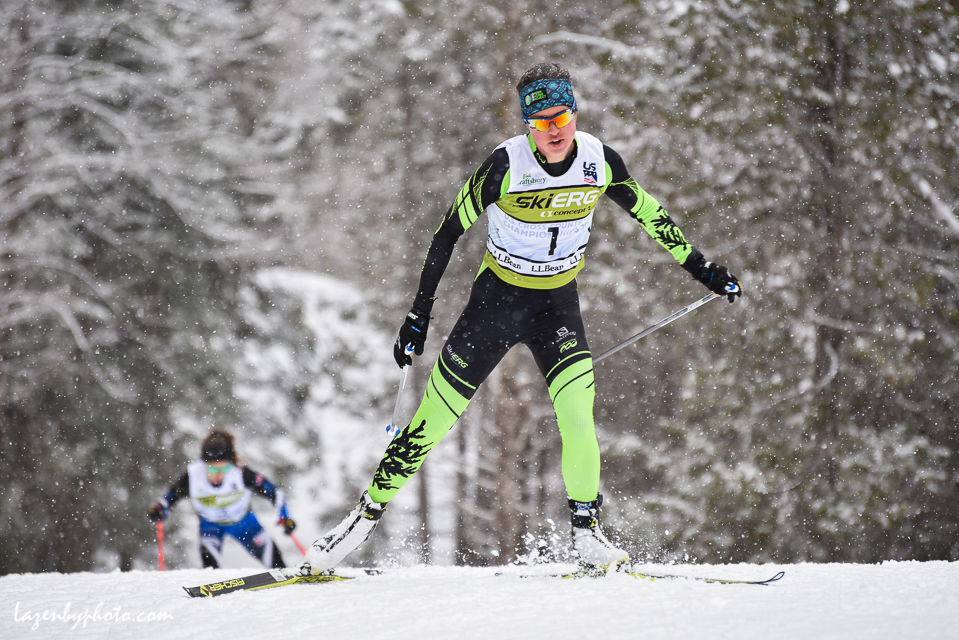
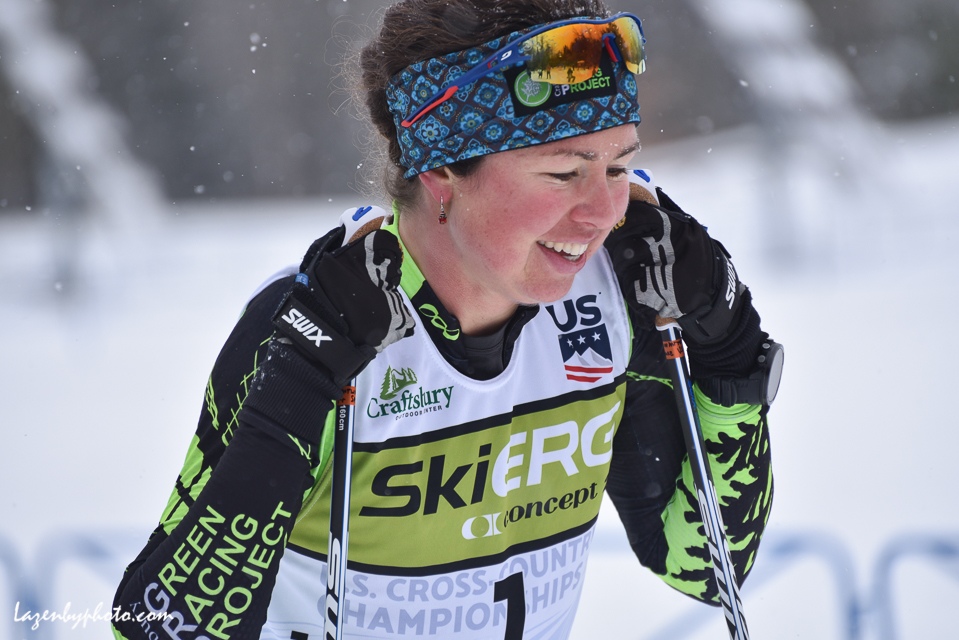
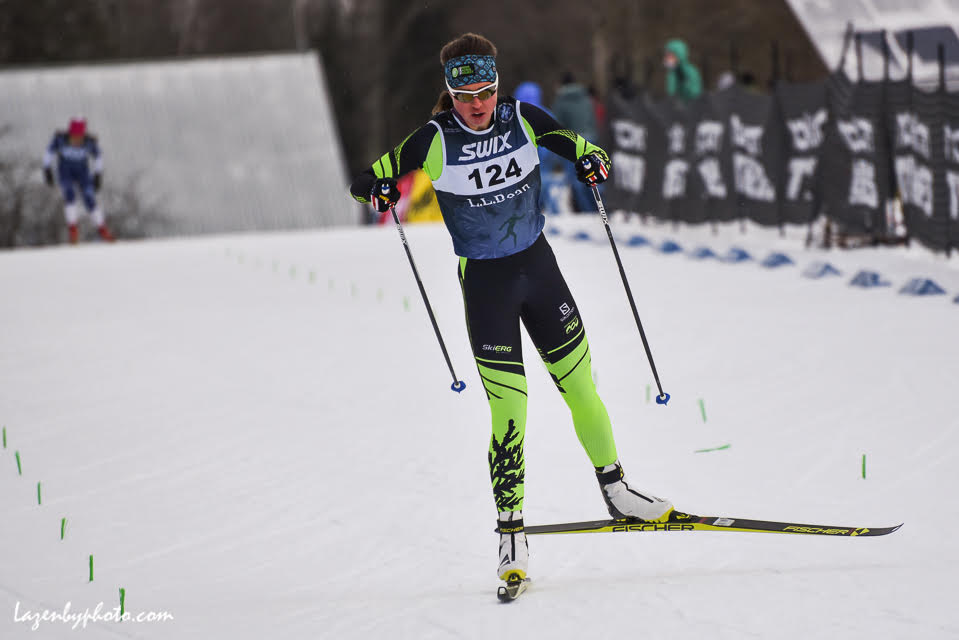
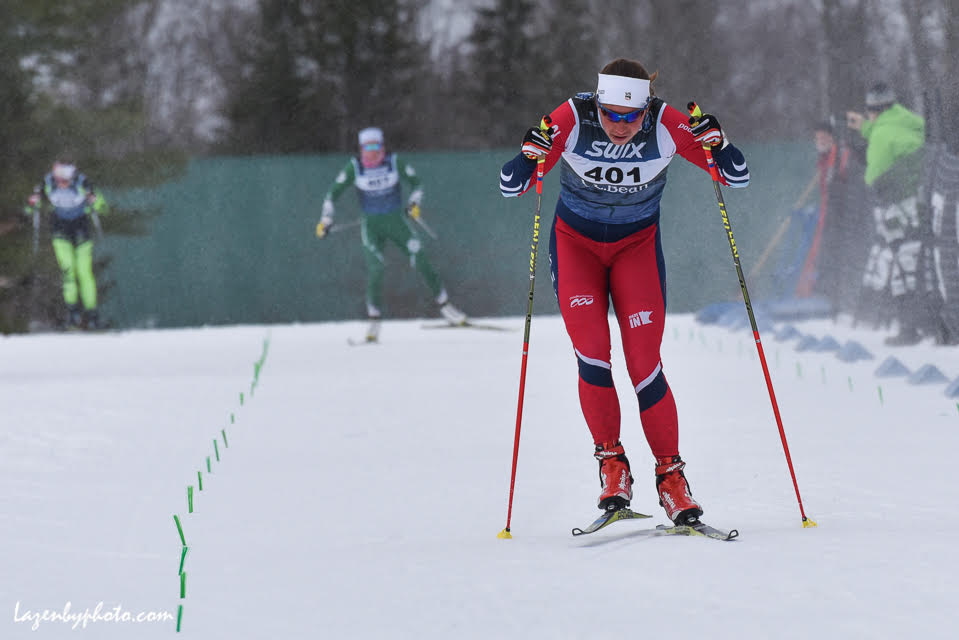
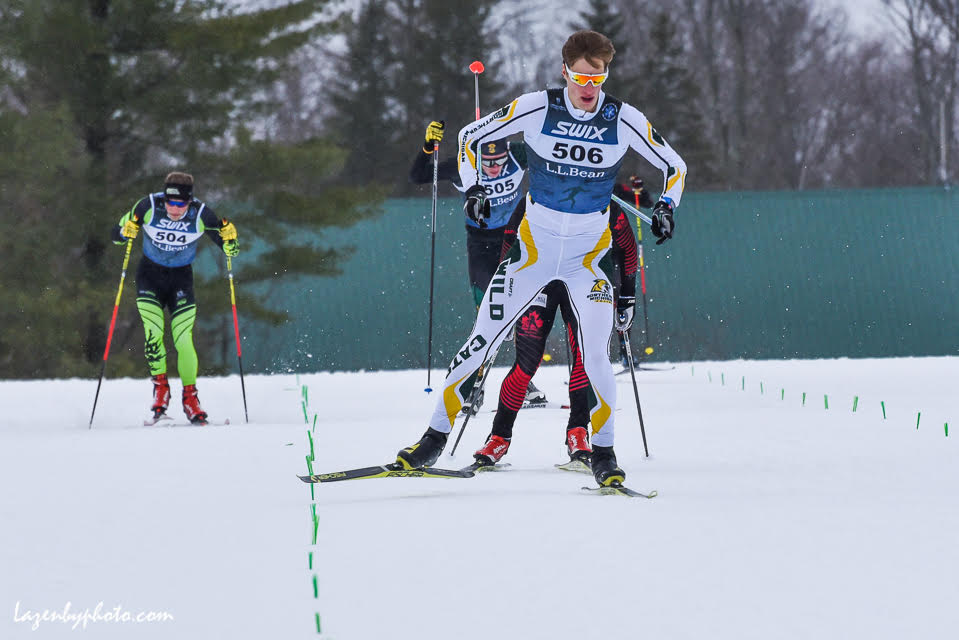
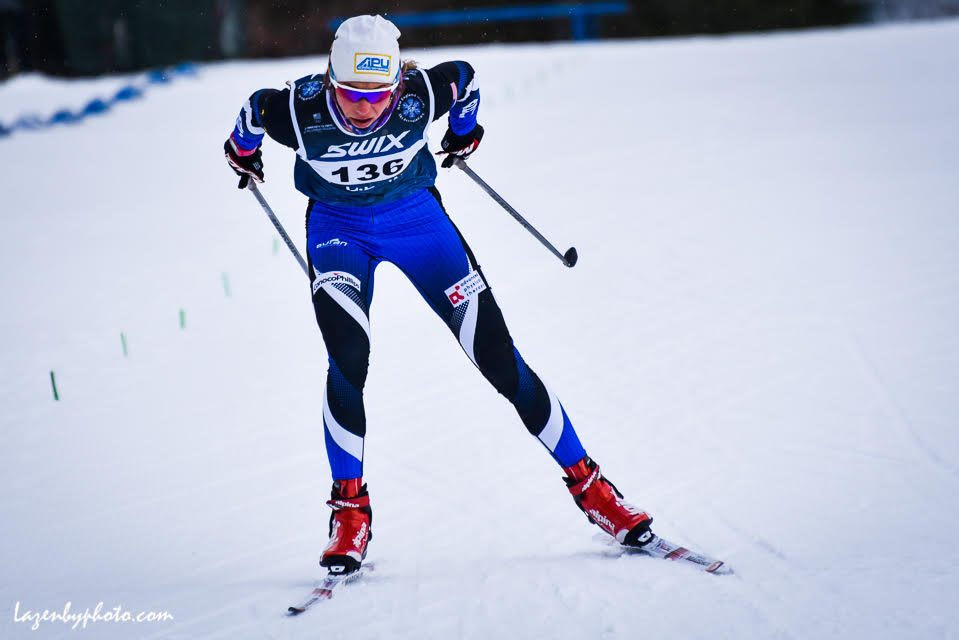
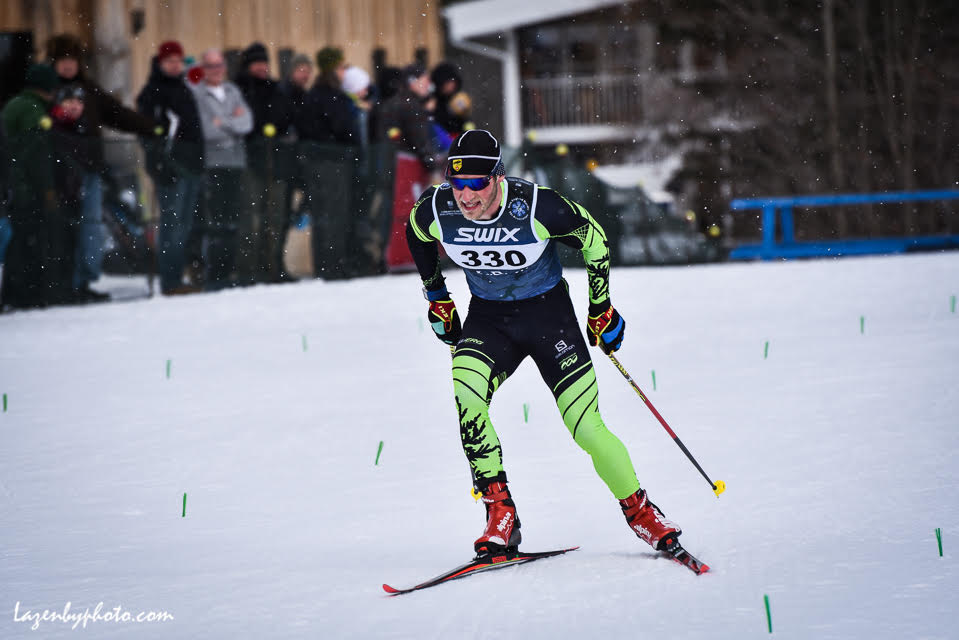
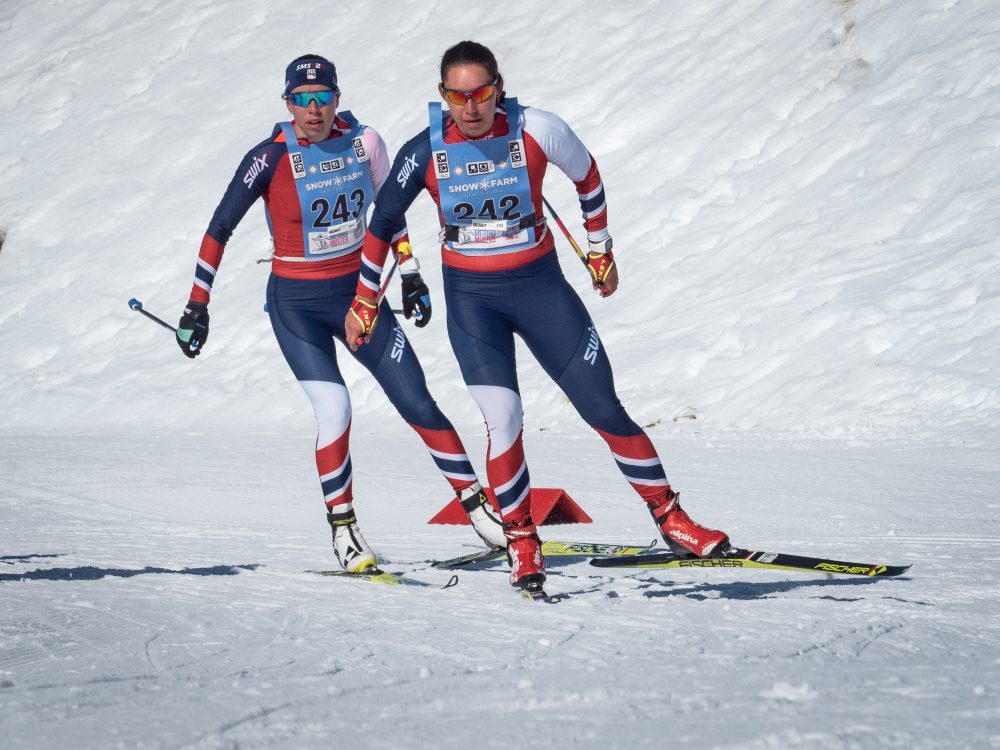
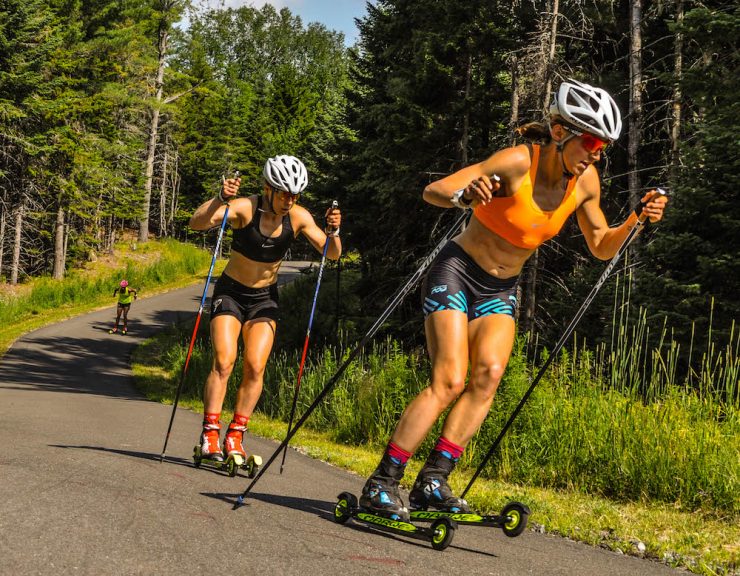
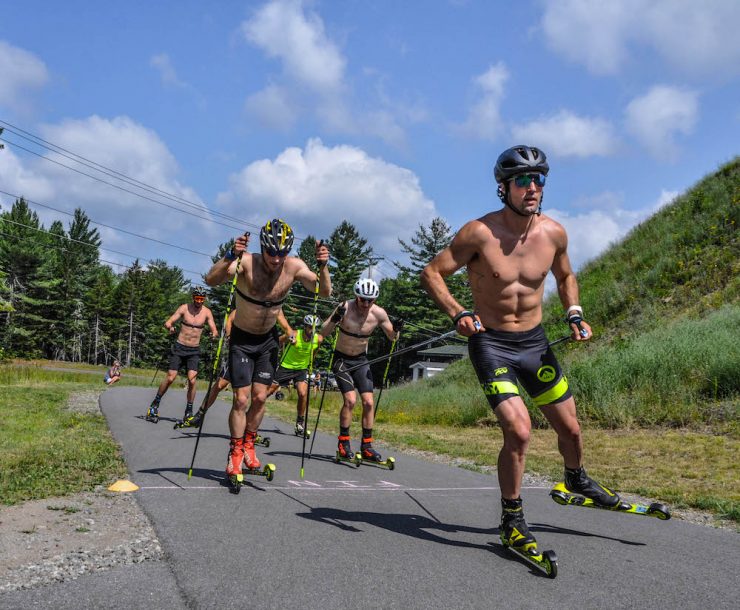
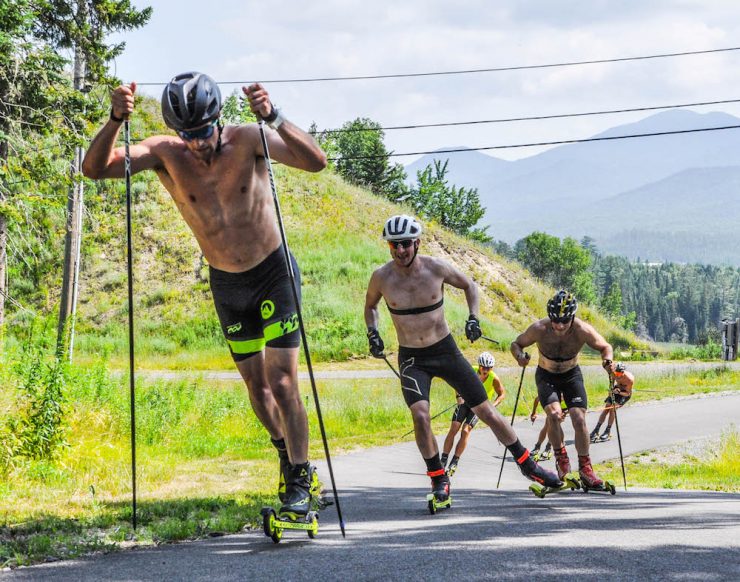
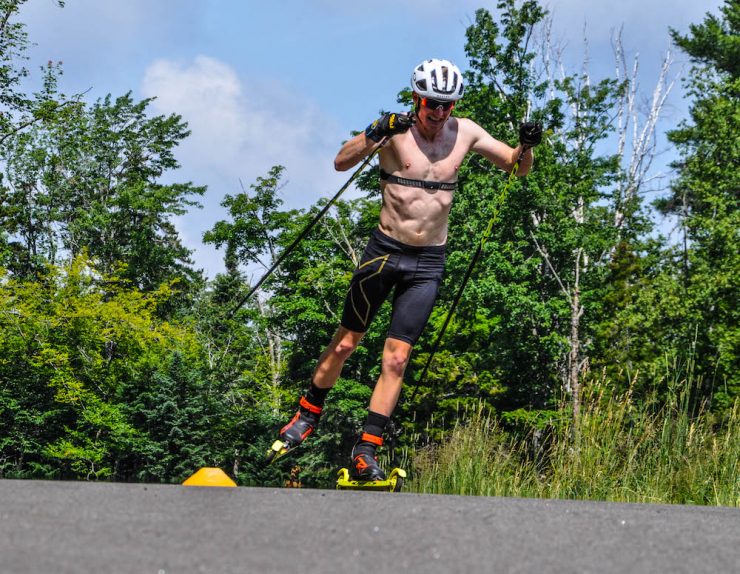
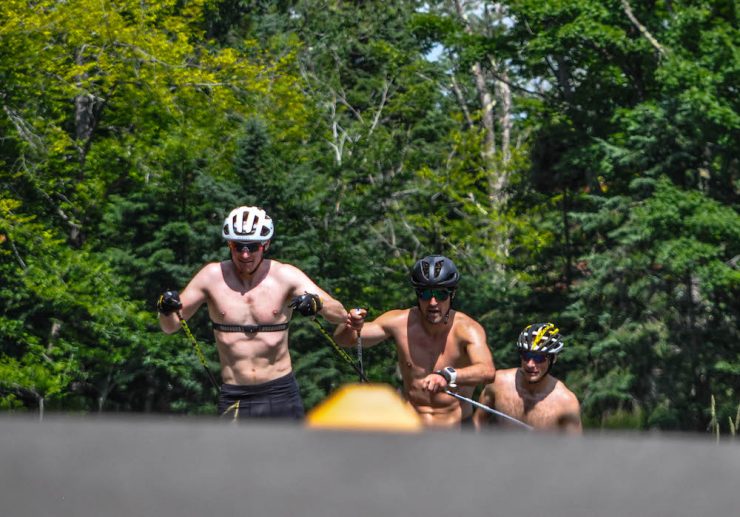
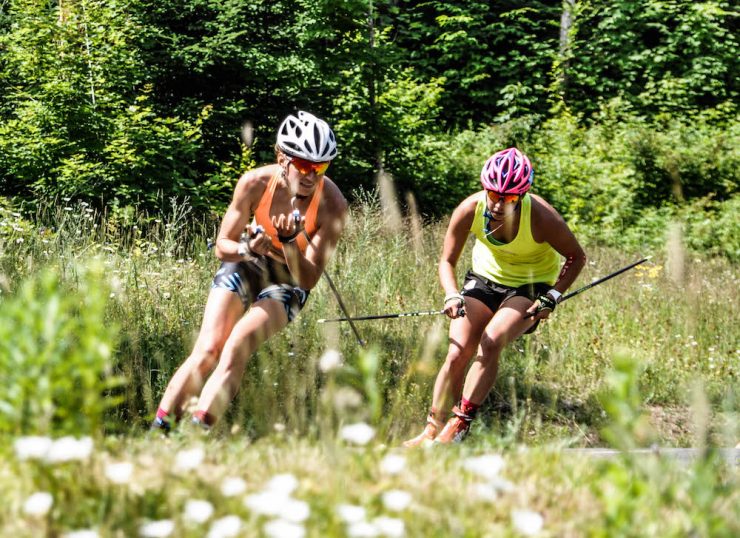
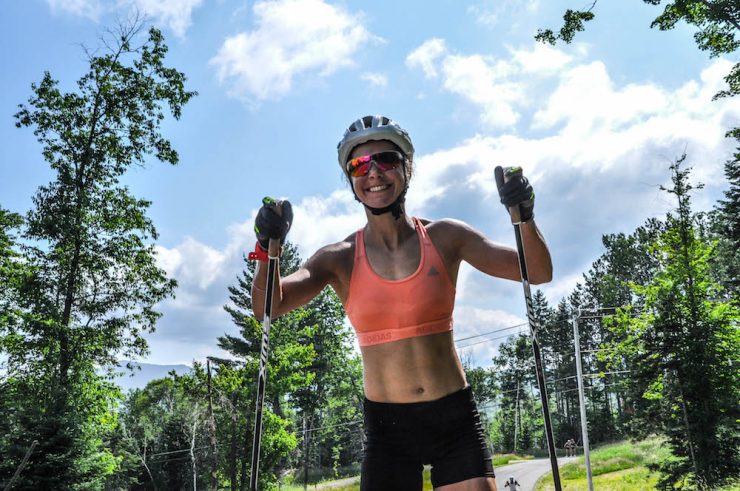
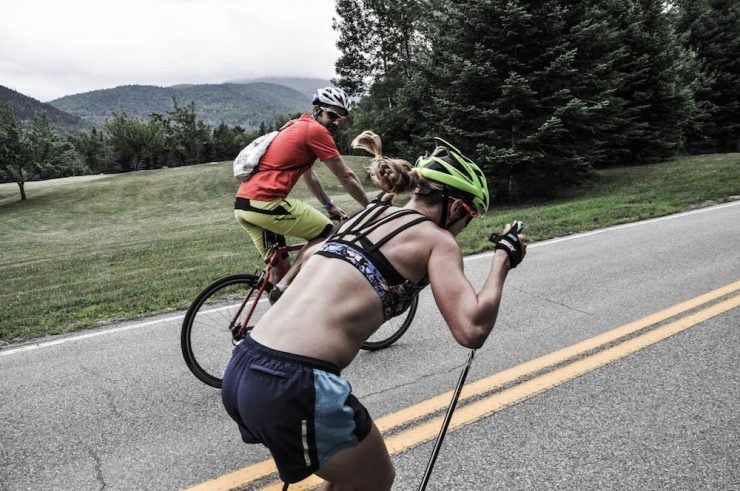
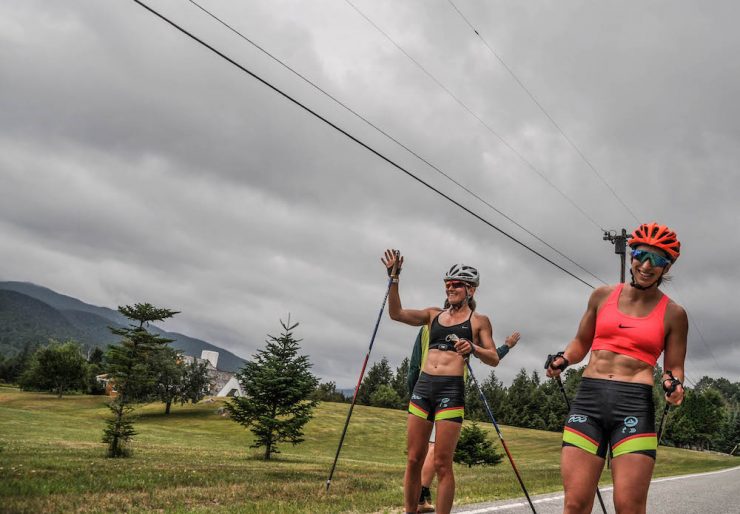
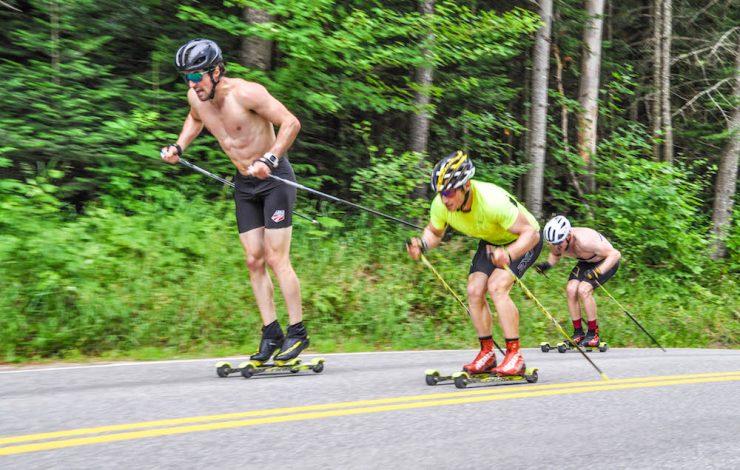
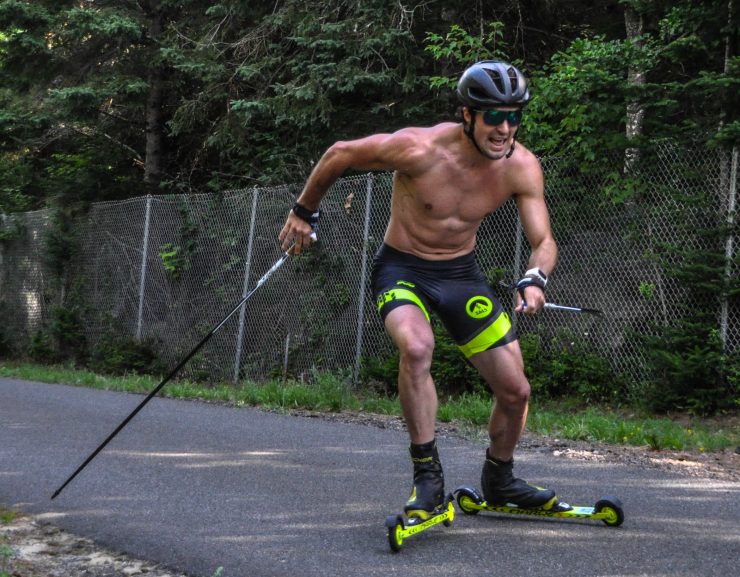
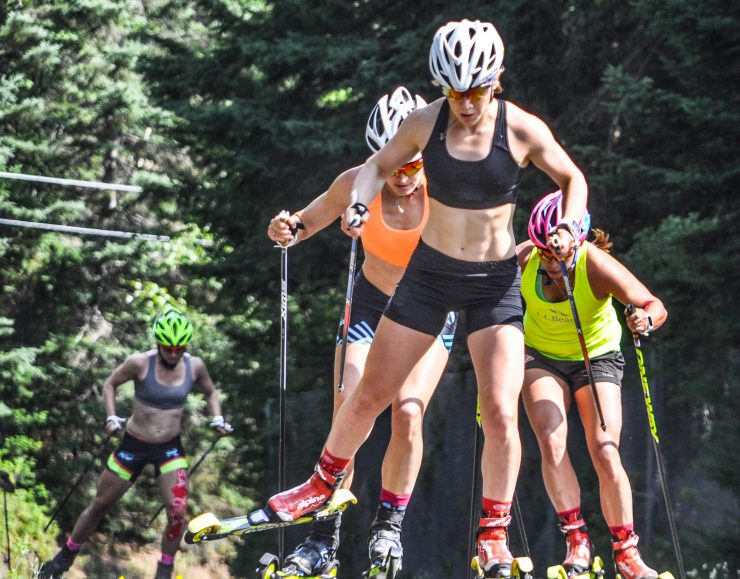
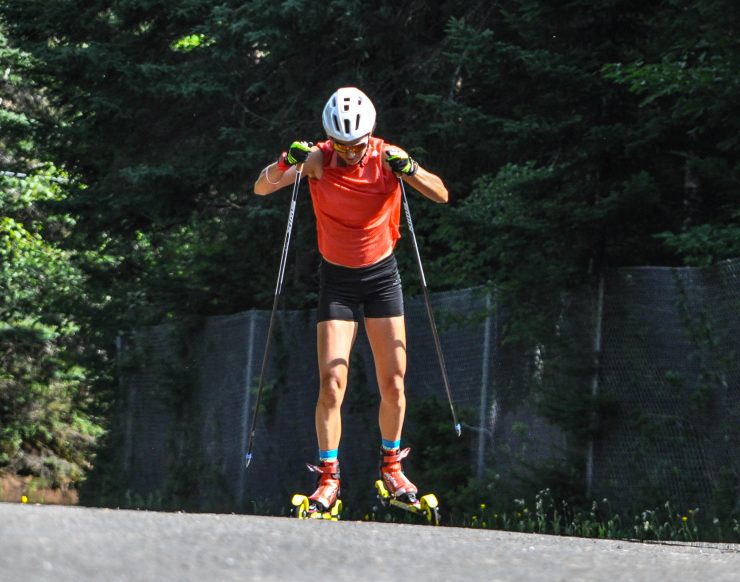
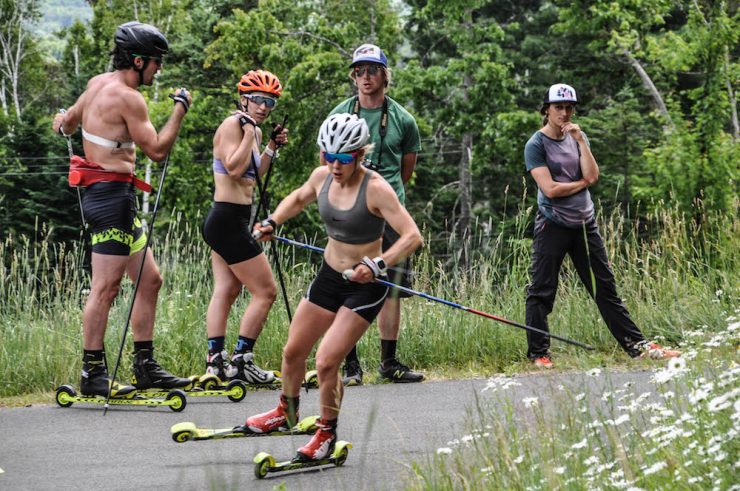
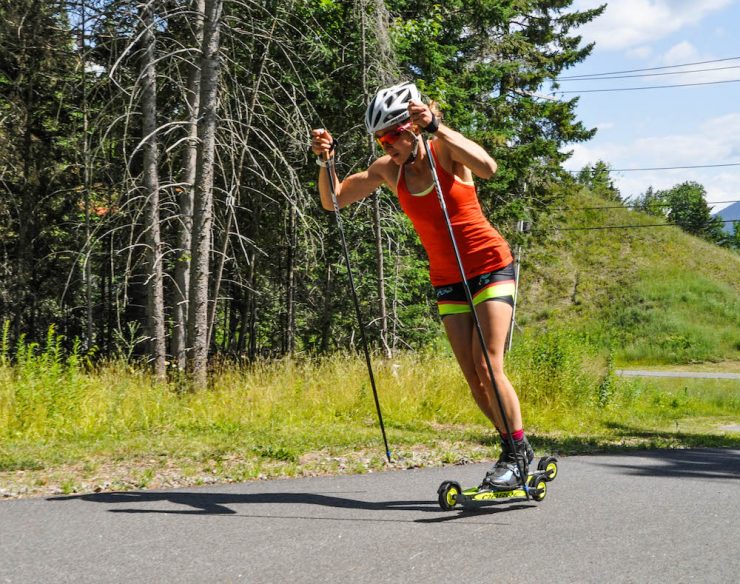
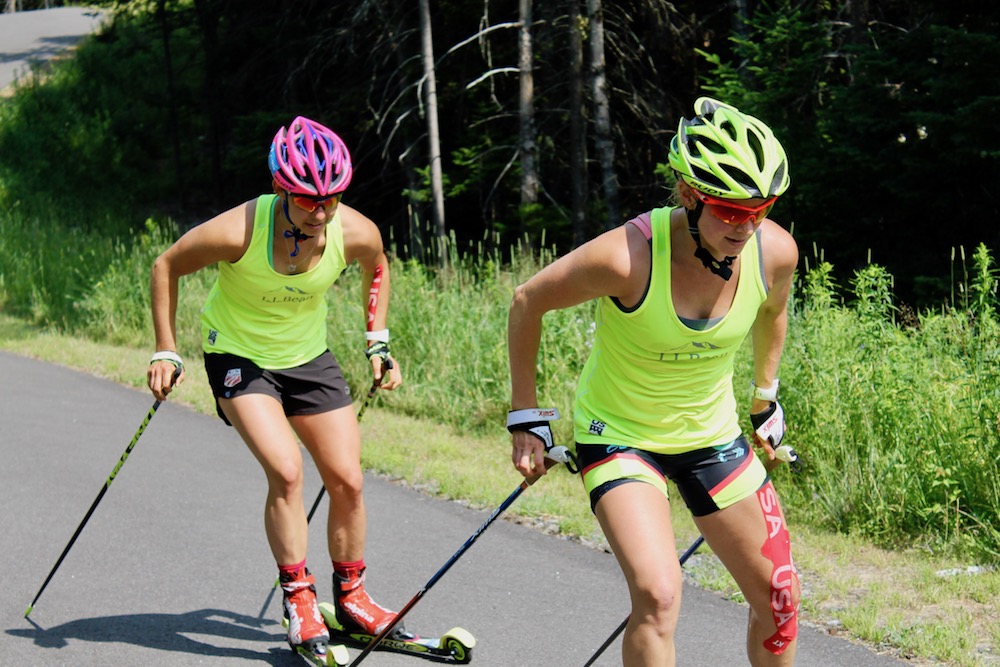
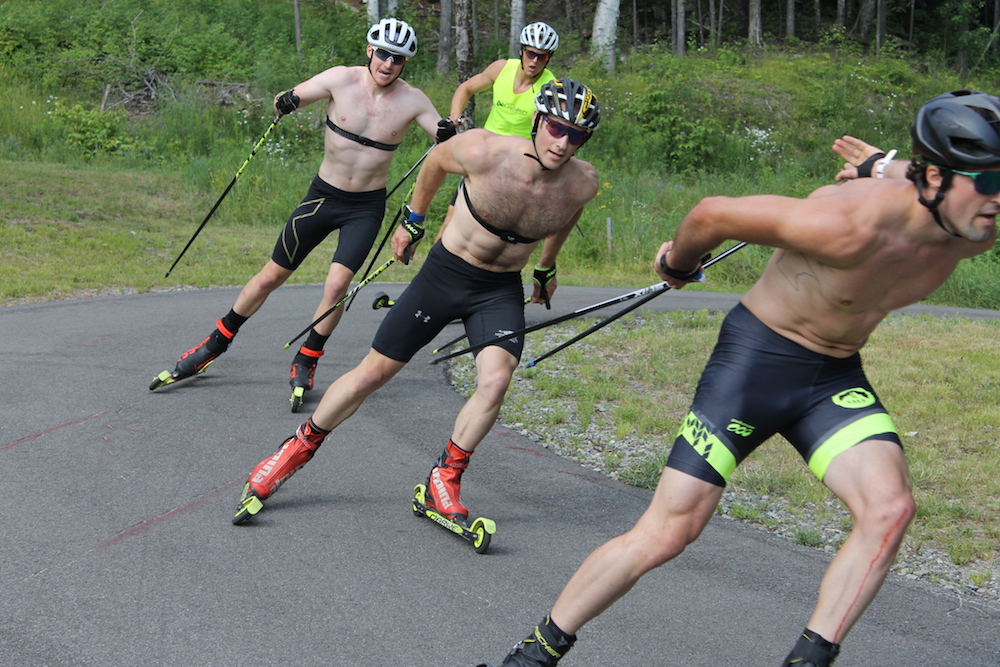
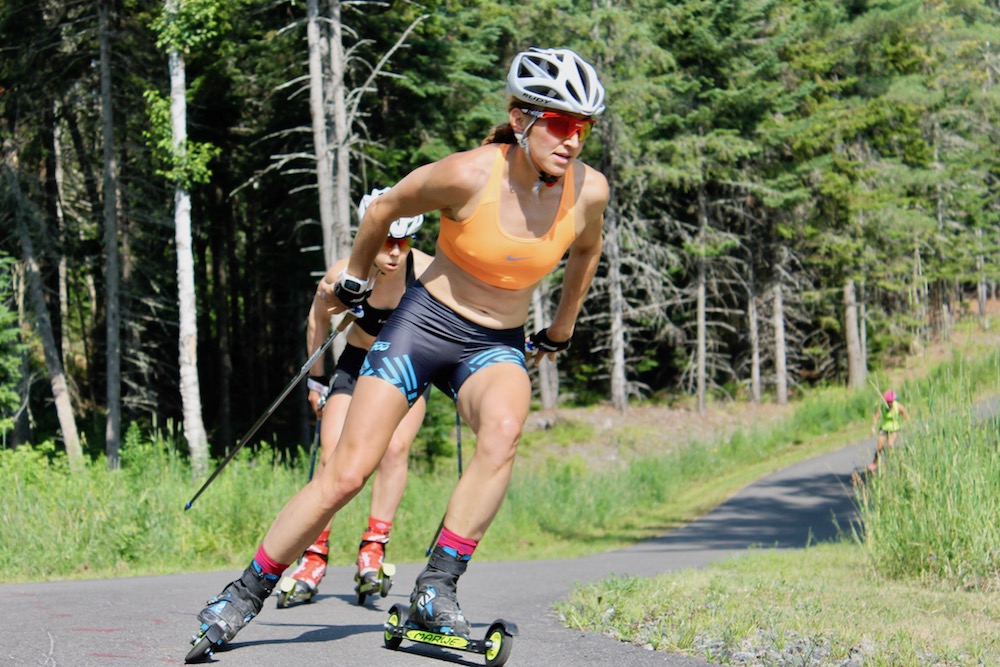
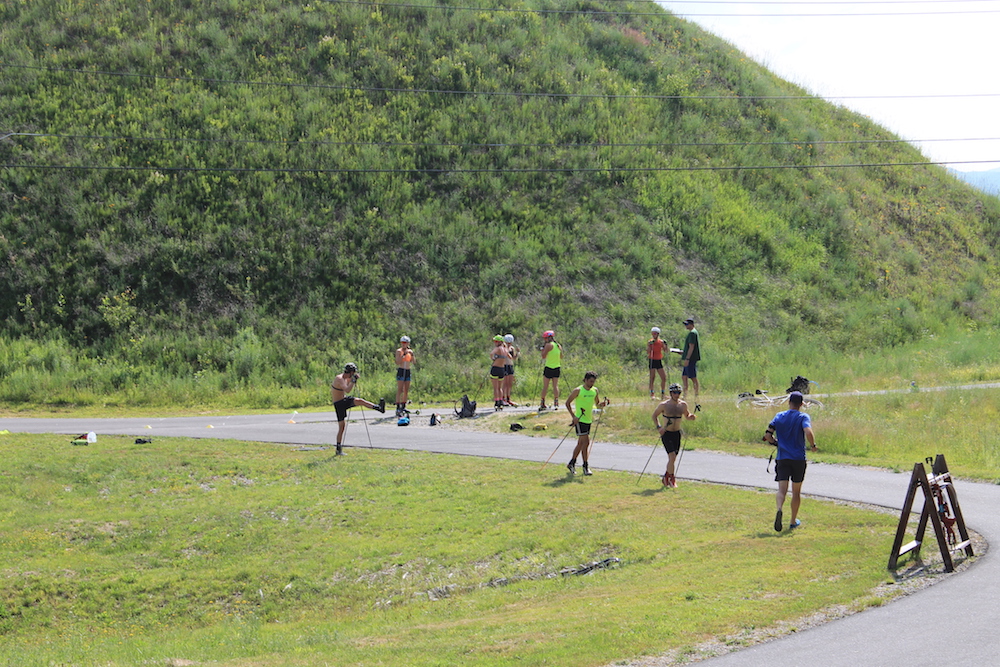
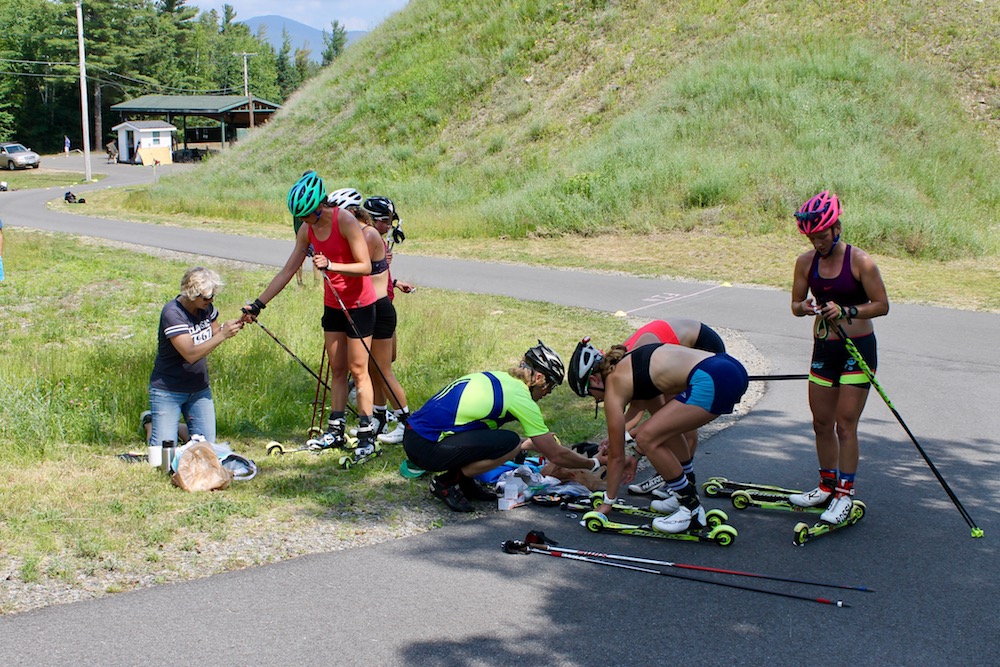
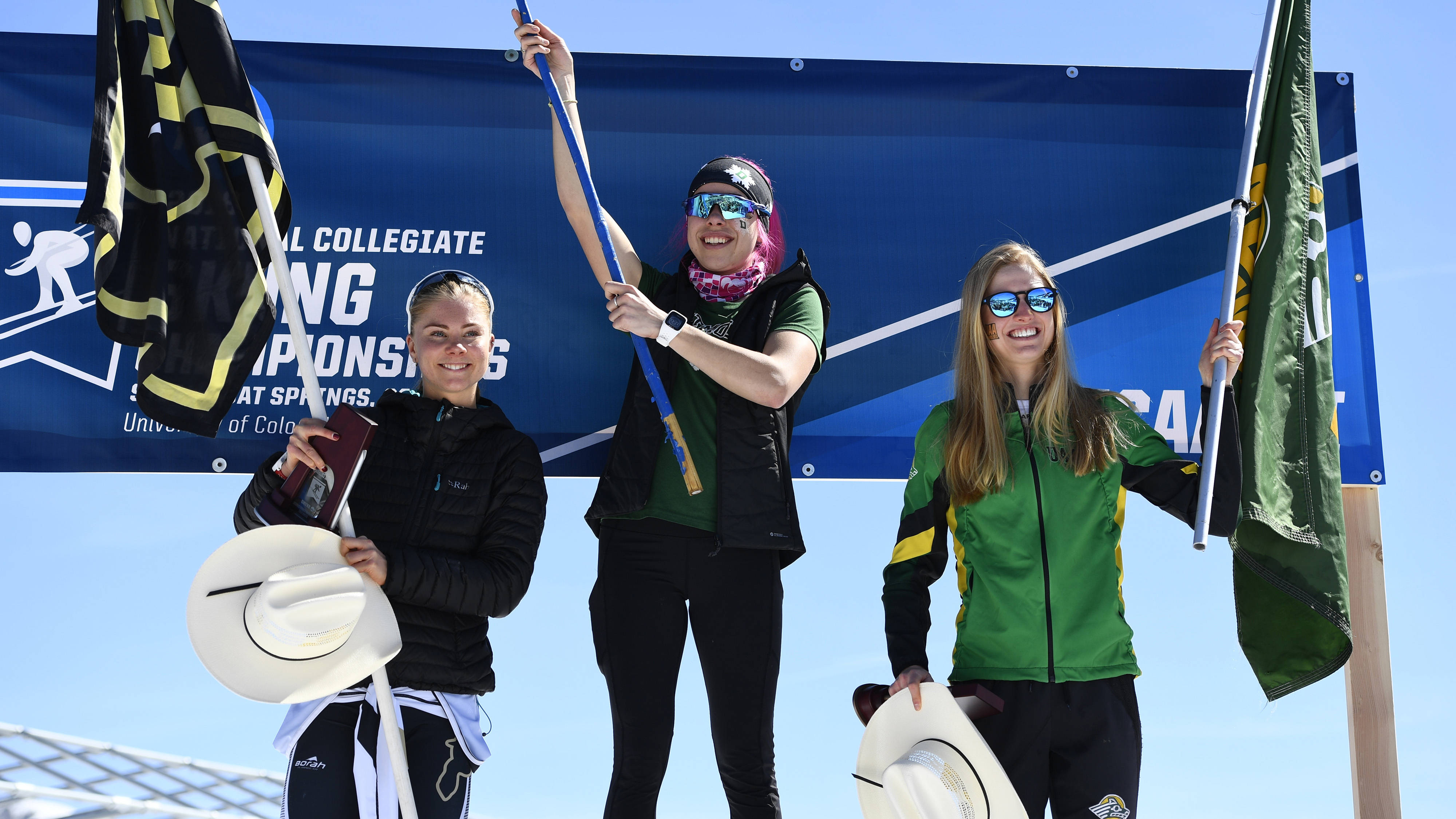
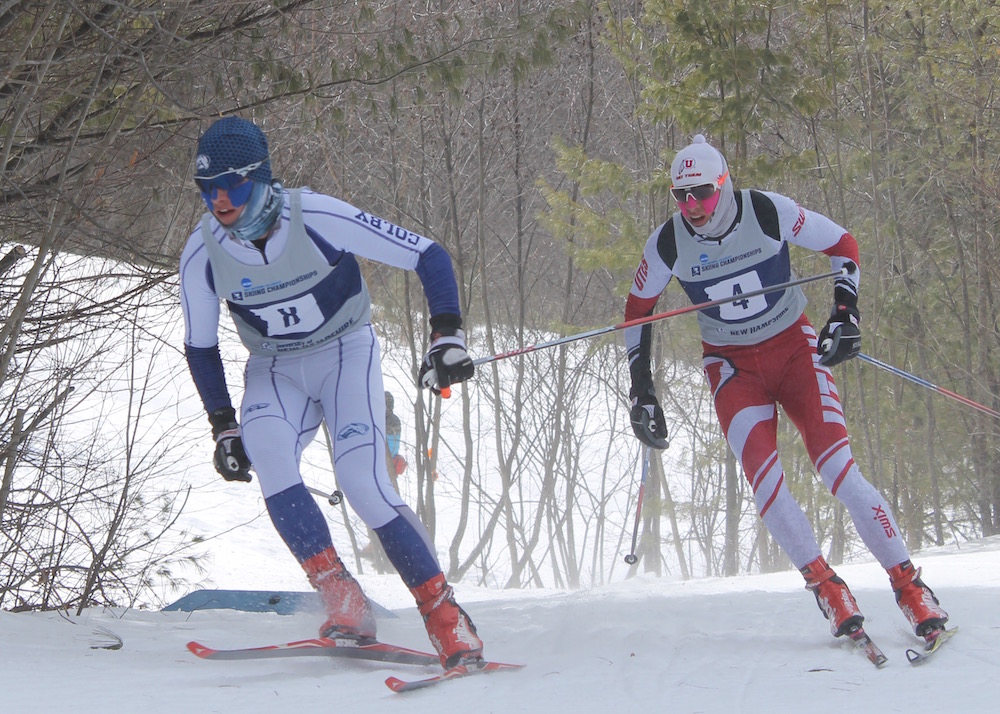
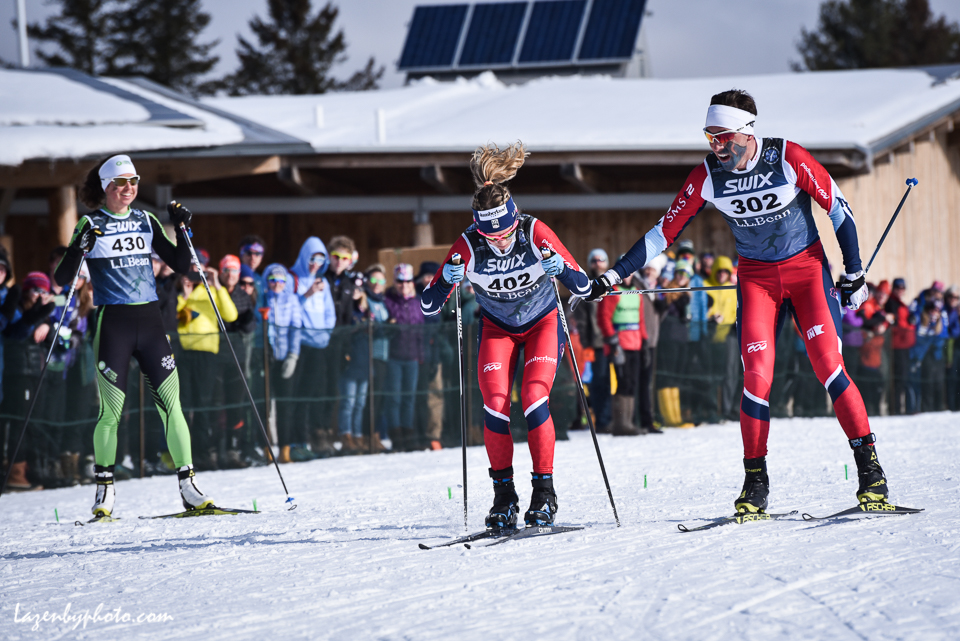
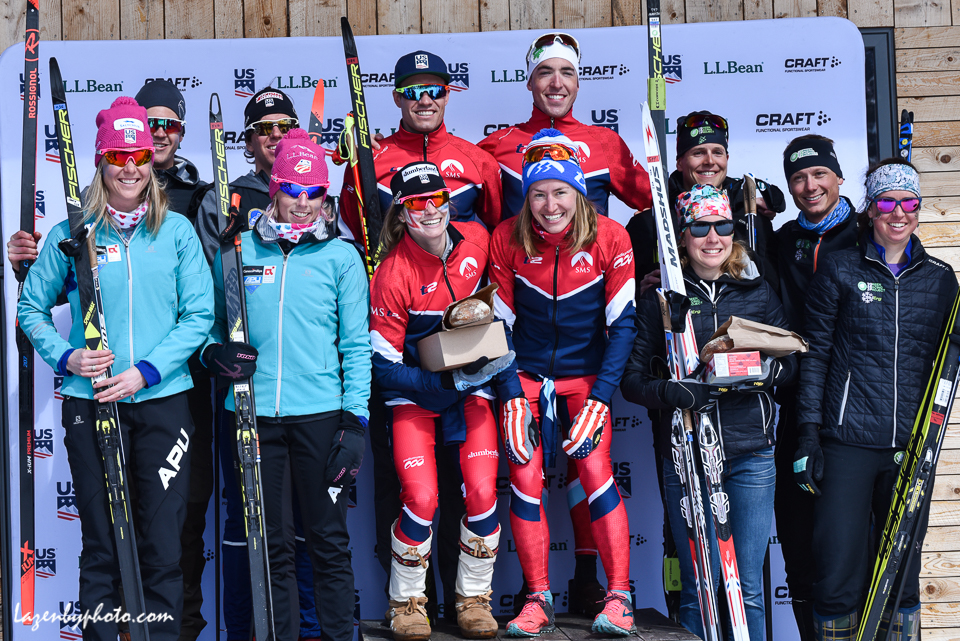
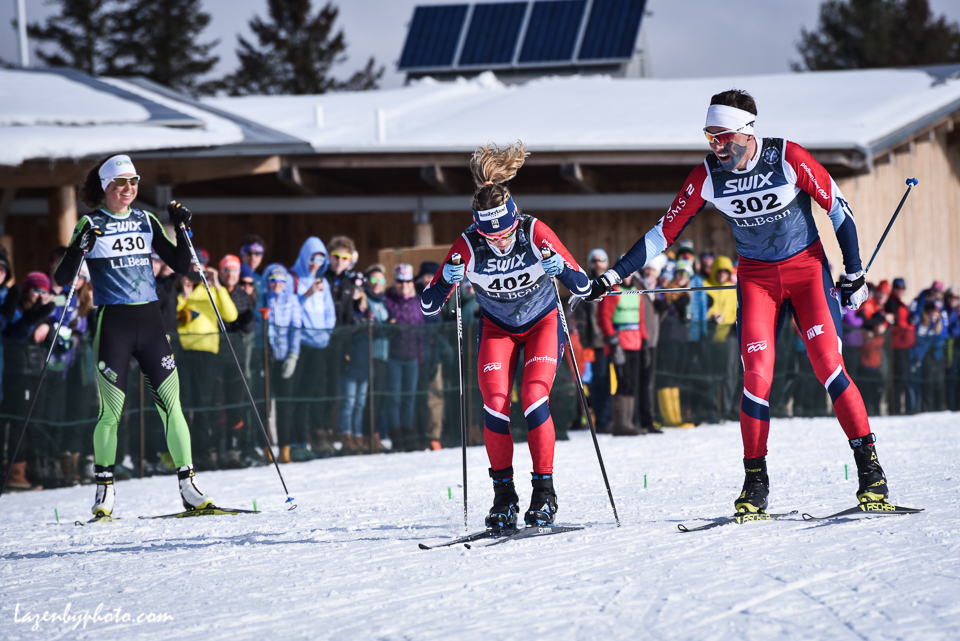
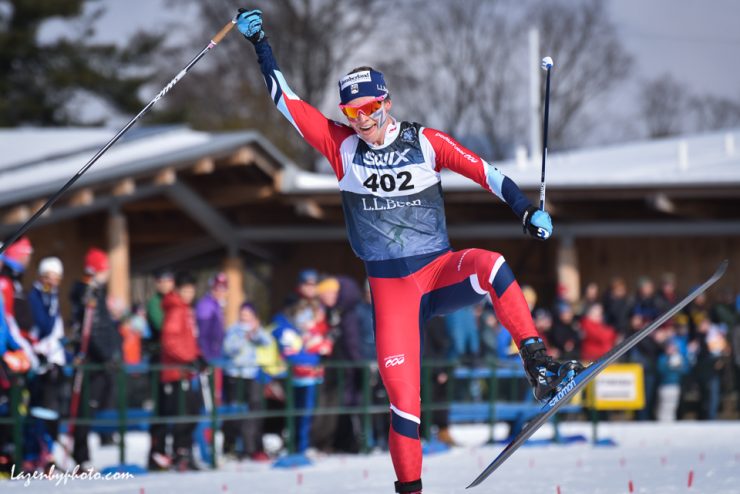
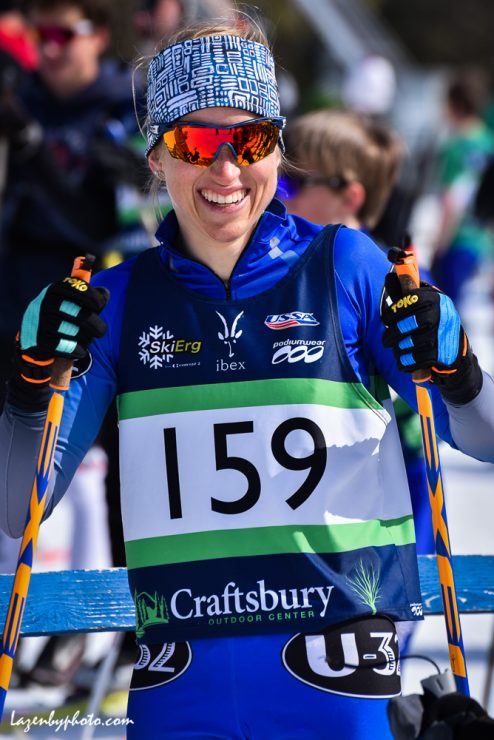
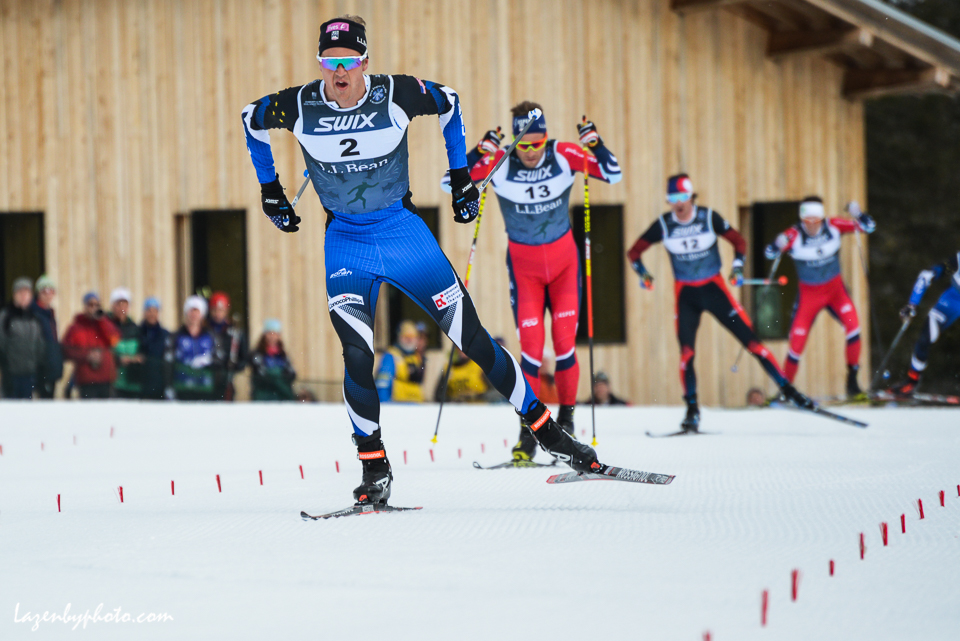
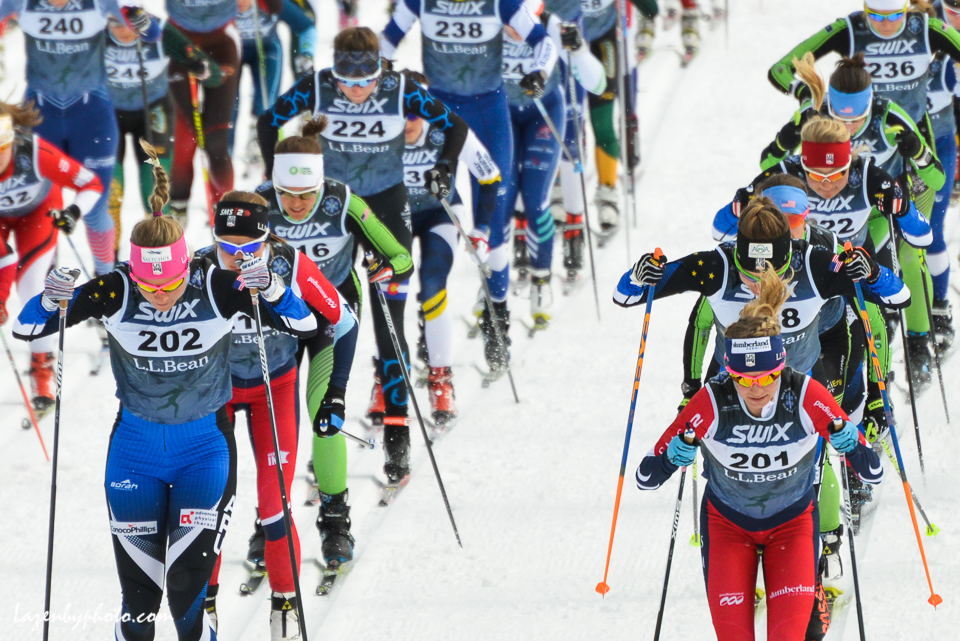
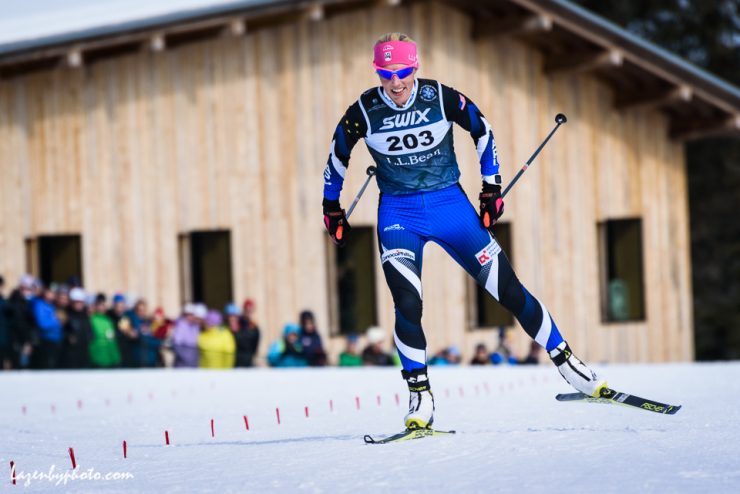
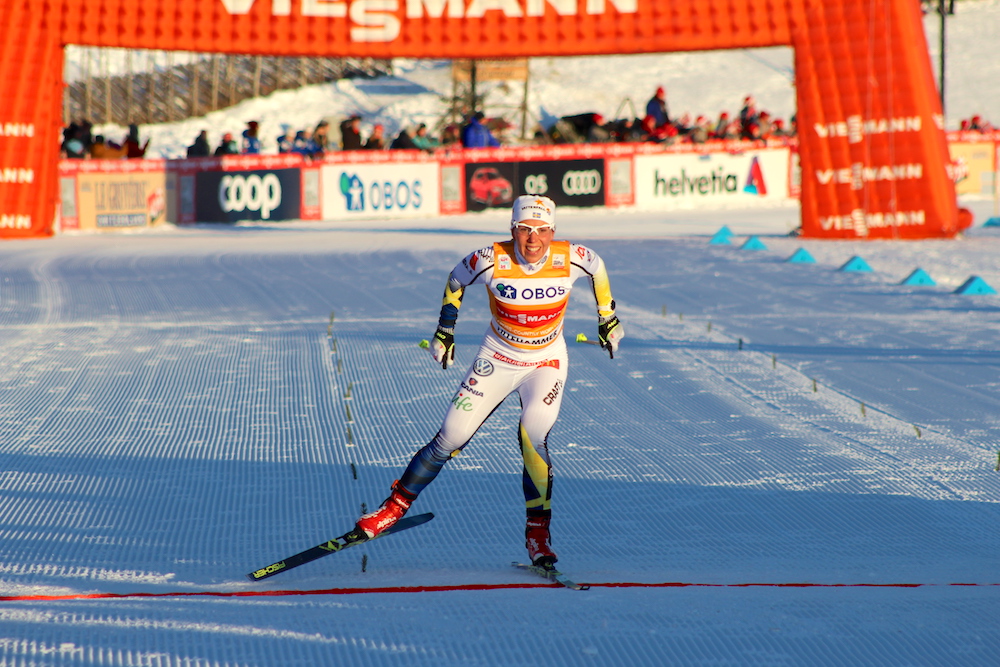
Katherine Stewart-Jones powering to another second place in the 5km classic. (Photo: Doug Stephen)
Day two of the first NorAm and SuperTour weekend was interval start classic, with 10km for the men and 5km for the women.
The US SuperTour athletes took the chance to show their depth today, packing the top ten of the open categories.
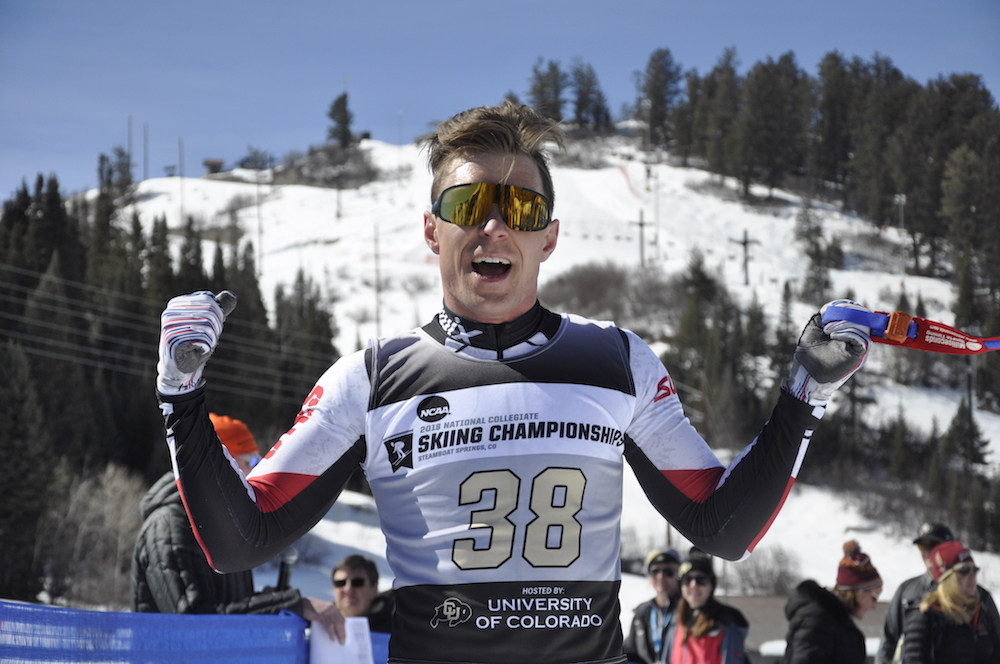
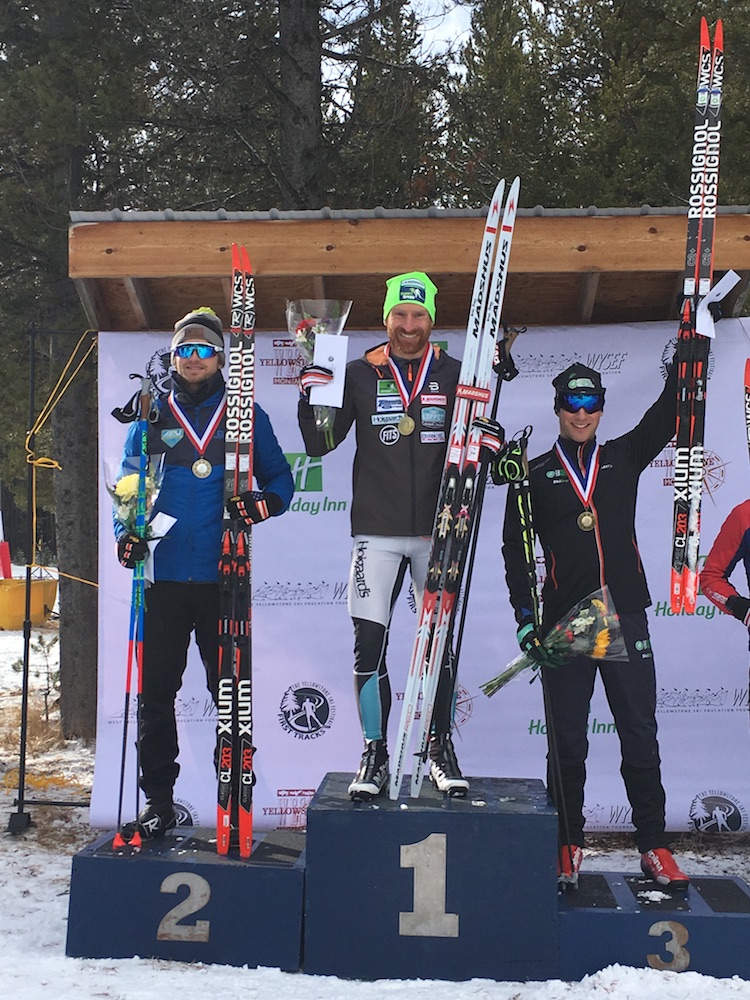
The 154 men raced first, with the U.S. Ski Team’s Zak Ketterson winning comfortably in 27:33.1. National team member Antoine Cyr was second at 15.0 back, followed by CGRP’s Ben Lustgarten at 20.4 seconds.
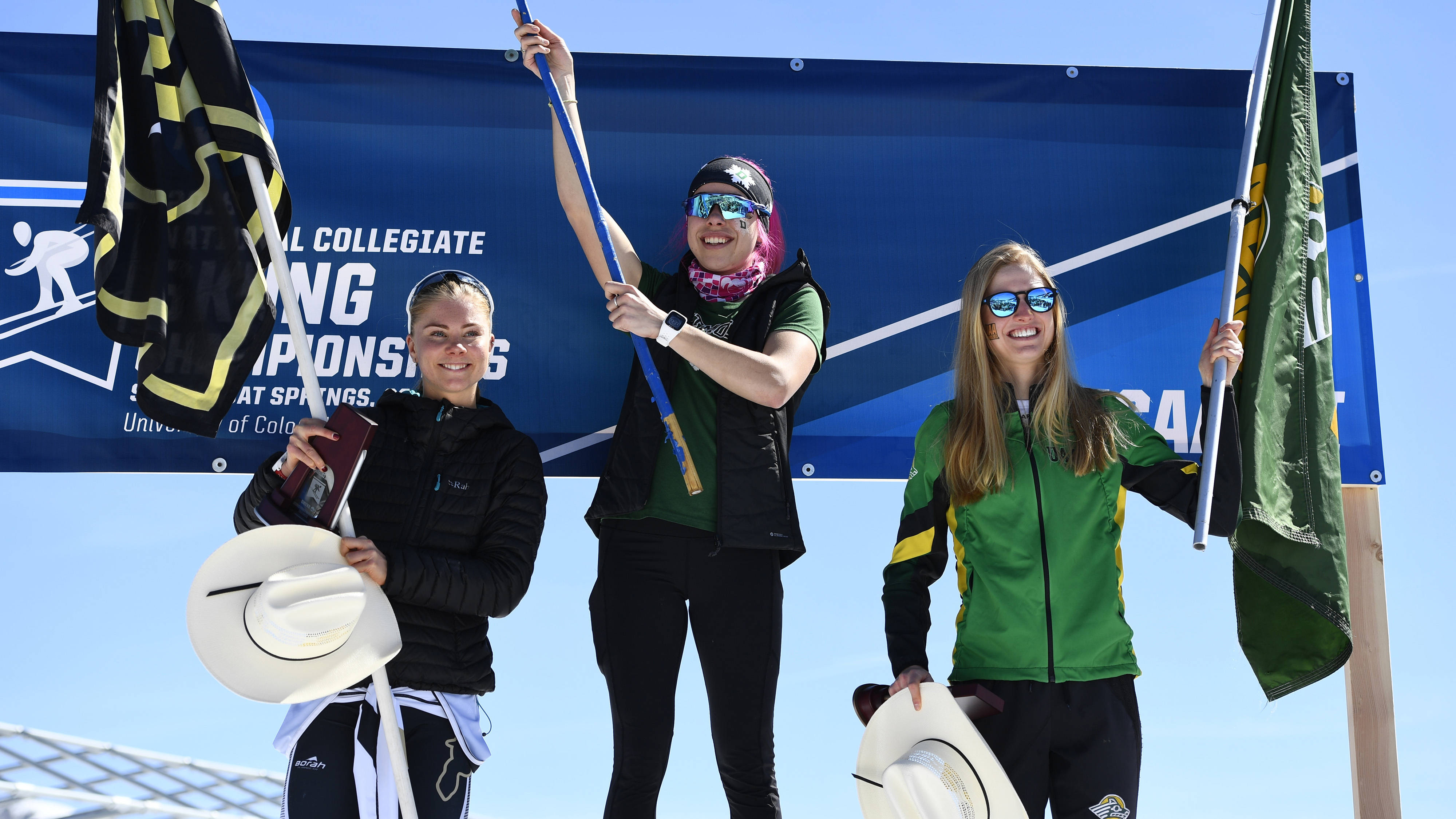
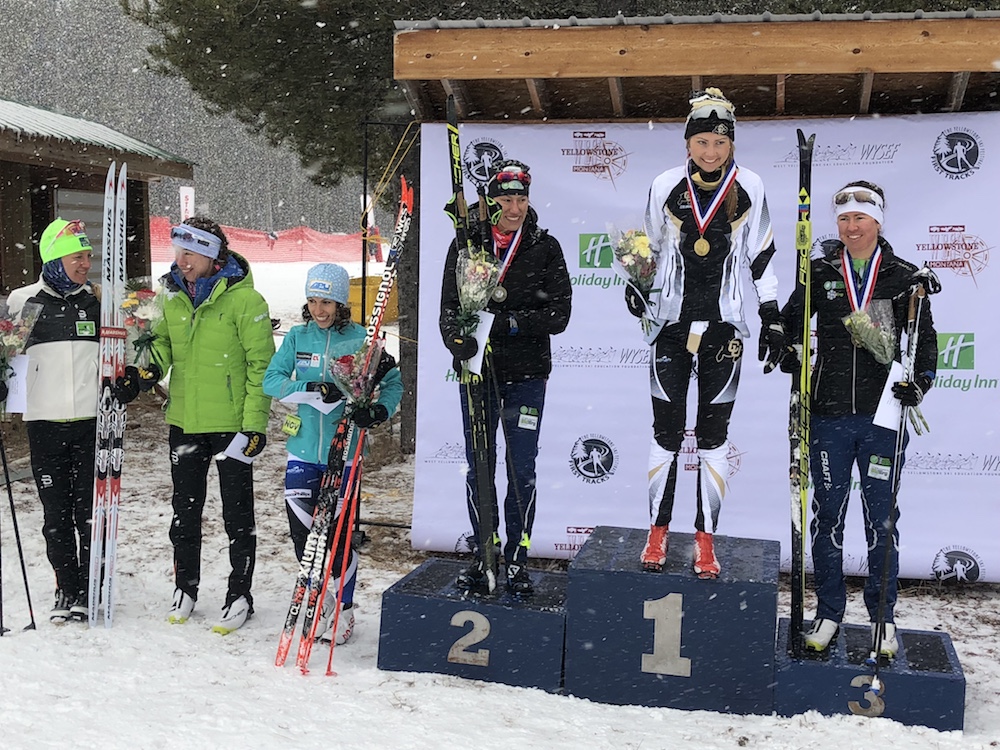
Dartmouth’s Katharine Ogden won the 5km in 14:58.1, 19.7 seconds ahead of national team member Katherine Stewart-Jones and 36.5 seconds ahead of Sun Valley’s junior Sydney Palmer-Leger. 119 women finished today.
While the open categories got the headlines, they aren’t the only people racing. In a throwback to 2009, Tasha Betcherman beat out Olympic medallist Sara Renner in the masters women’s 10km. In total, 33 masters and 268 younger athletes raced today, for a total of 578 finishers.
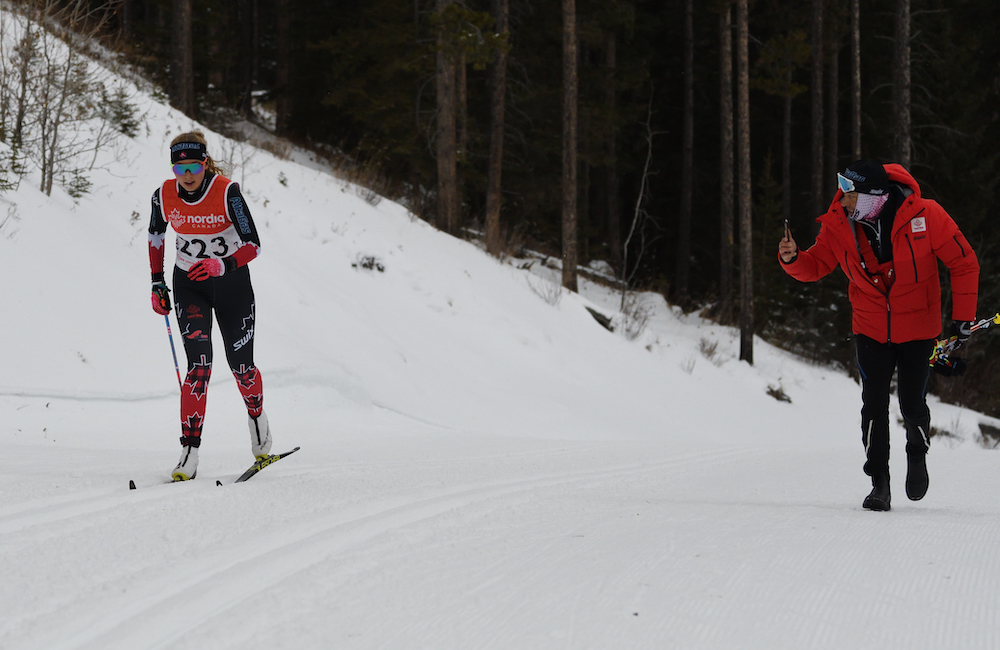
National team’s Natalie Wilkie attacks a climb while coach Robin McKeever shoots video. (Photo: Doug Stephen)
Mexico crowned the second ever national champion, with Jonathon Moreno taking the title in 41:25.7, 1:47.5 ahead of yesterday’s winner, Rodrigo Rangel Fernandez.
Rangel Fernandez was excited by the progress Mexico is making, throwing down a challenge to Johannes Høsflot Klæbo.
Full results for the weekend are on zone4, including live timing again for Sunday. The timers included separate climb results for Saturday; Canmore is the head office of the Zone4 timing company, and once again they added some detail that isn’t usually included at this level of racing.
Doug Stephen’s gallery has 162 full-res photos today.
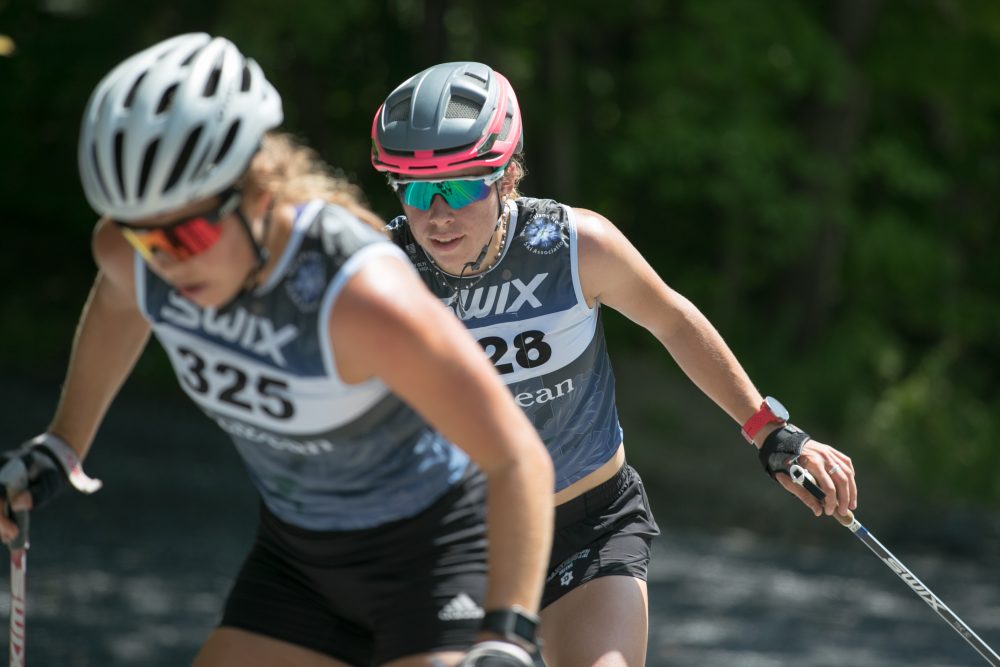
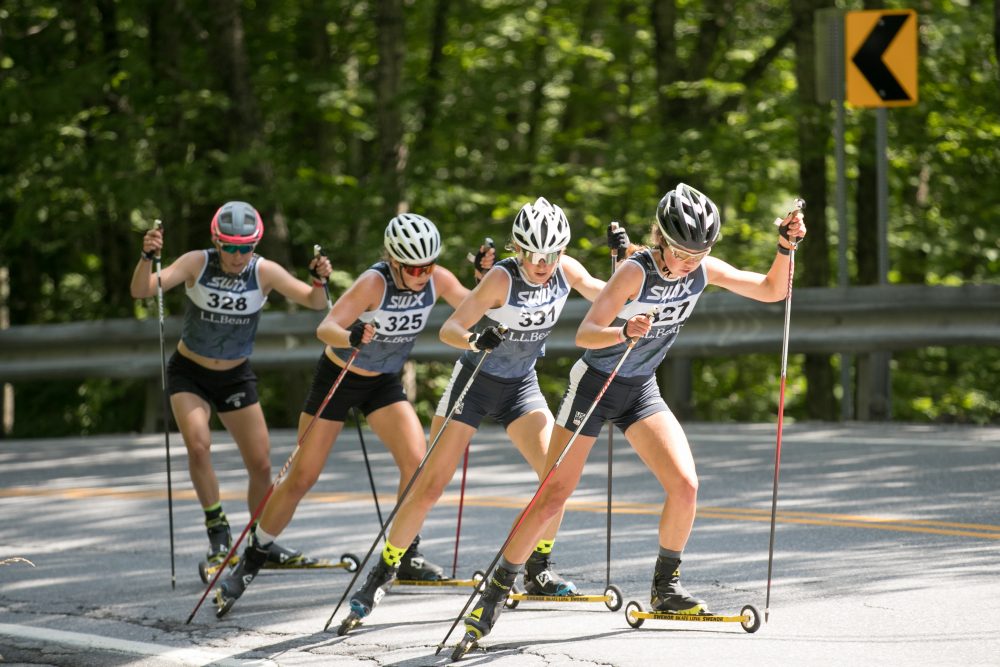
Katharine Ogden (bib 328), Evelina Sutro (bib 325) during the 2019 App Gap Challenge. (Photo: Reese Brown – xcski.org)
National team naming for American cross-country skiing tends to roughly correspond to the overall rhythm of the training year. Team nominations come out in May; World Cup Period I starts are (at least these days) announced in June; American professional skiers then know where they stand early in the summer, and can plan out their training and racing seasons accordingly. So far, so good. A total of twenty athletes were named to the U.S. Cross-Country Ski Team, or USST, for the 2019/2020 season in early May. June 11 brought a formal announcement of the official starters and alternates for the first seven World Cup races in November and December, a mix of national-team members you would expect (Jessie Diggins, Erik Bjornsen, etc.) and non-national-team skiers who may have garnered more World Cup points or lower FIS points last year than you realized (Andy Newell, David Norris, Kelsey Phinney, etc.). And everyone moved into summer training with this in mind.
But before we get too excited for the current crop of USST members, it’s worth taking a quick look back at who’s no longer on the team: Ian Torchia, now 23, aged out of being on the D-Team; Katharine Ogden no longer meets age-graded D-Team criteria by dint of being ranked “only” 123rd in the world on the last FIS Distance List; Ida Sargent retired after seven seasons on the national team to become a teacher at GMVS; and Paddy Caldwell retired after five seasons on the national team to work in the renewable energy sector.
FasterSkier previously profiled Sargent’s career and retirement plans earlier this spring. In this series, FasterSkier catches up with the other three athletes not currently on the national team to find out what’s next for them. First up, Katharine Ogden, universally known as KO.
KO answered questions via email earlier this summer. Her responses have been reprinted verbatim. FasterSkier’s email questions have been expanded and rewritten somewhat from what was originally asked, to provide better narrative and context for this article.
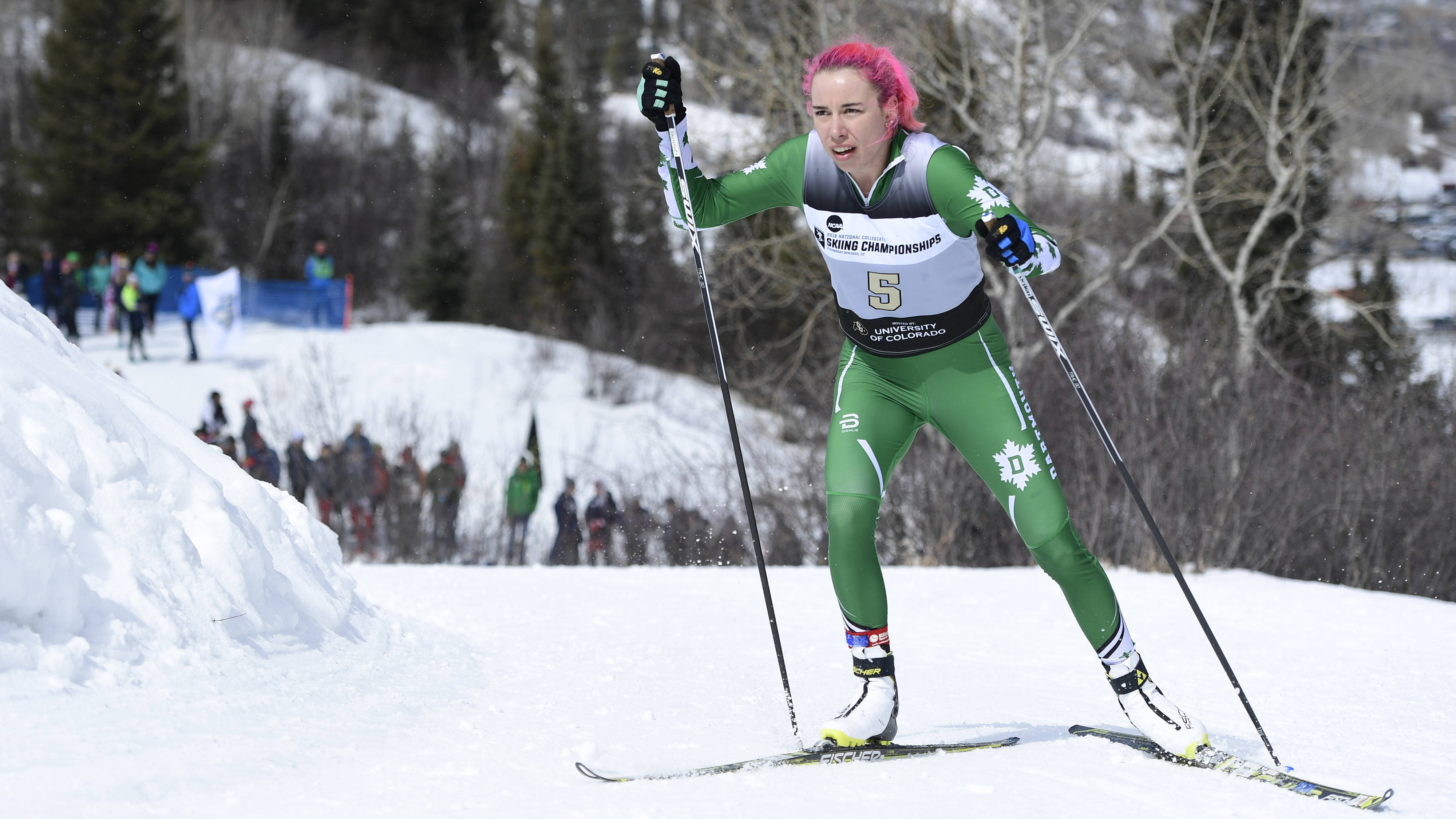
KO has had a successful college ski career so far, to put it mildly. As a freshman, she won both the 5-kilometer classic race and the 15 k freestyle at 2018 NCAA Championships, taking the first of those by a staggering 46.9 seconds over 5 k. As a sophomore, she defended her title in the classic race at 2019 NCAAs, then finished “only” fourth in the skate race for her worst finish yet in four NCAA Championship races. (The fourth place at NCAAs marked the only time Ogden was off the podium in ten college races last season. She is undefeated in her last eight individual NCAA classic races, going back to early last season.) She was FasterSkier’s women’s collegiate skier of the year in 2018, and has garnered multiple awards from Dartmouth Athletics, the United States Collegiate Ski and Snowboard Association (USCSA), and the Eastern Intercollegiate Ski Ski Association (EISA).
Ogden is nonetheless asked whether collegiate skiing is working well for her at this stage in her life and career, and if so, why. She wrote:
“Skiing at Dartmouth is working really well for me at this stage. It is very important to me to get an undergraduate degree and Dartmouth is an amazing school with lots of opportunities. I am pursuing a degree in Psychology focusing on adolescent development with a minor in education and I have a goal of working in the field of education. This is something that I am passionate about and I am incredibly lucky to have the opportunity to pursue this path at Dartmouth. On top of that, skiing for the Dartmouth ski team is the most fun I have ever had pursuing the sport. My teammates are talented, motivated and inspiring and I am fortunate to get to train and compete alongside all of them.”
KO is currently a junior, one of ten women nordic skiers on the Dartmouth Ski Team. She is asked whether she foresees two more years of collegiate skiing, and if she knows what comes after that. Here’s Ogden: “In the next few years my priorities lie with the Dartmouth team and with finishing school. After that I have no idea what I will do. After graduation I will of course remain connected to the sport whether by racing professionally or by skiing on the side while I pursue teaching certification. The next two years will be telling as to my trajectory in the sport and I honestly have no idea what the years following will look like for me.” pirties nuoma
Finally, and back to the point of this article, KO is informed that she ranked 123rd in the world on the final FIS distance list from the 2018/2019 season, which is hardly “bad” but also, in light of her 1997 birth year, placed her 23 spots back from a top-100 ranking that would have qualified her for continued membership on the USST D-Team.
Ogden is asked how much attention, if any, she gave to her FIS points throughout the race season, and how much effect, if any, not being on the D-Team will have on her day-to-day training going into this winter.
“All of this ranking information is news to me,” her candid response begins. “I have never in my career paid any attention to FIS rankings or points and this year was not an exception. When I compete I focus on the competition itself and on doing my best no matter what the race is or what is on the line. In my opinion, spending the season eyeballing rankings lists takes every scrap of joy and fun away from the sport that I love.”
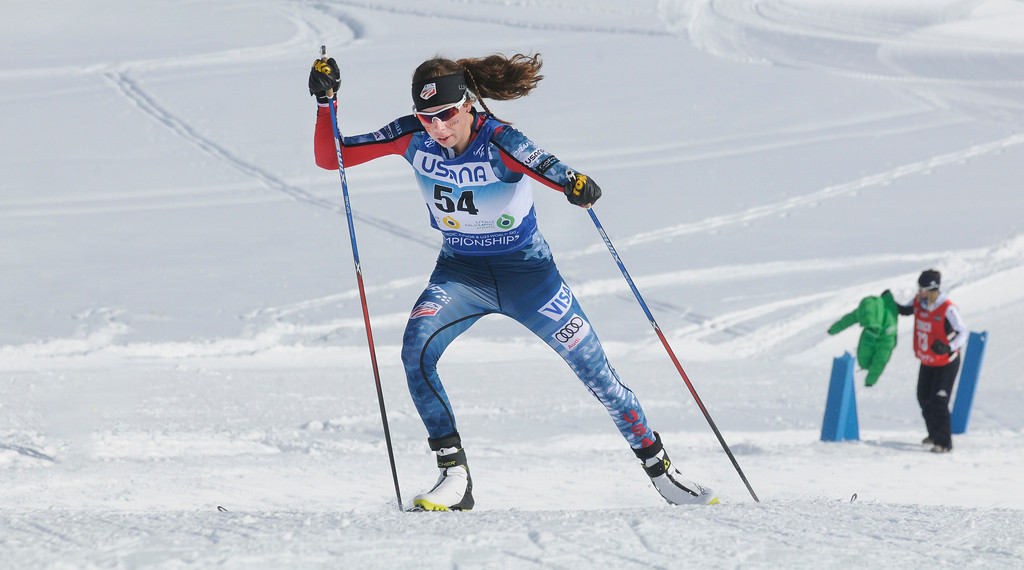
Katharine Ogden (SMS/USST) charges to fifth in the 2017 women’s 5k freestyle at the USANA FIS Junior Nordic World Championships. (U.S. Ski Team – Tom Kelly)
Ogden continues, “Being on the Development team for the last few years was an honor and an experience that I will always be thankful for. I met and became close with some incredible people and role models and benefited from world class coaching. That being said, at this point in my career, I am not poised to gain much from national team status because my plan the past two years and for the next two going forward is to prioritize my classes and competing for Dartmouth over international racing and national team camps. On top of that I receive incredible support from the SMS T2 team that complements my position on the Dartmouth ski team rather than competing with it. Being on the development team came with many obvious plus sides but at this point in my life I need more flexibility to pursue non-skiing interests and priorities. I will miss being a part of such an incredible group of women but right now this is the best scenario for me.”
KO’s 2019/2020 EISA collegiate racing season begins with the Harvard Carnival in mid-January on the ski trails at Dublin School, a private prep school in southern New Hampshire that claims it was the first high school in the world to have a FIS-certified homologated ski trail on its campus, although fellow New Hampshire private school Proctor Academy also has a legitimate claim to that title.
From right to left: Caitlin Patterson, Sophie Caldwell, Evelina Sutro, and Katharine Ogden during the skate portion of the 2019 App Gap Challenge. (Photo: Reese Brown – xcski.org)
On a bright, hot Saturday, Simi Hamilton (SMS T2/USST) and Katharine Ogden (Dartmouth/SMS T2) won the NENSA App Gap Challenge in Fayston, VT. Hamilton finished the race in 26:10 minutes, 26 seconds shy of Kyle Bratrud’s record-setting win last year. Ben Lustgarten of the Craftsbury Green Racing Project (CGRP) raced to second, 12 seconds back at 26:22. CGRP teammate Adam Martin followed in third place at 26:37.
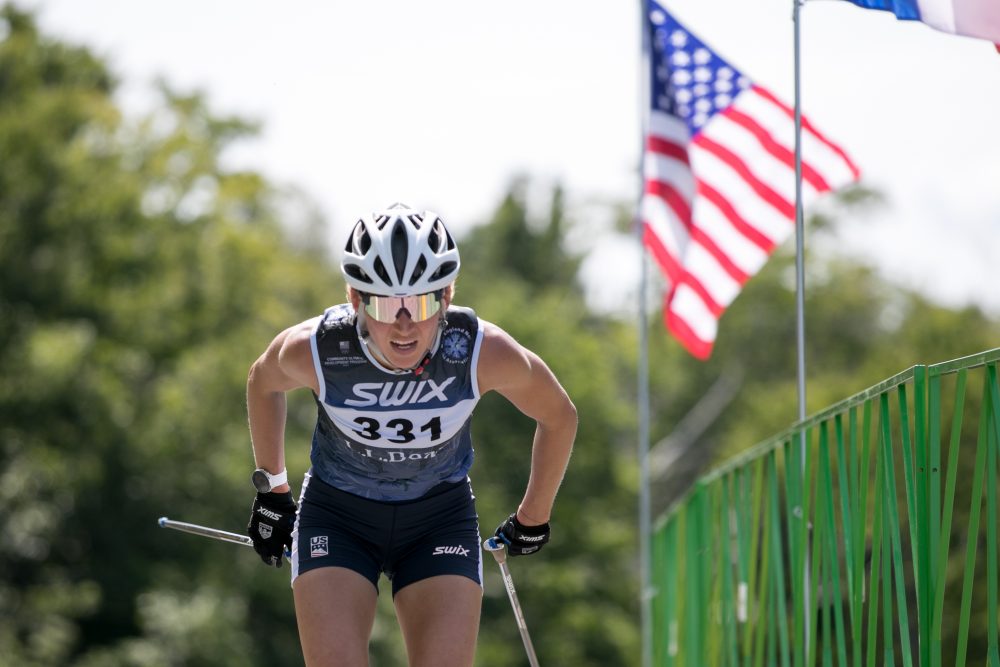
Ogden won in 32:15, with Sophie Caldwell (SMS T2/USST) finishing 21 seconds back in 32:36. CGRP’s Caitlin Patterson was third at 32:48.
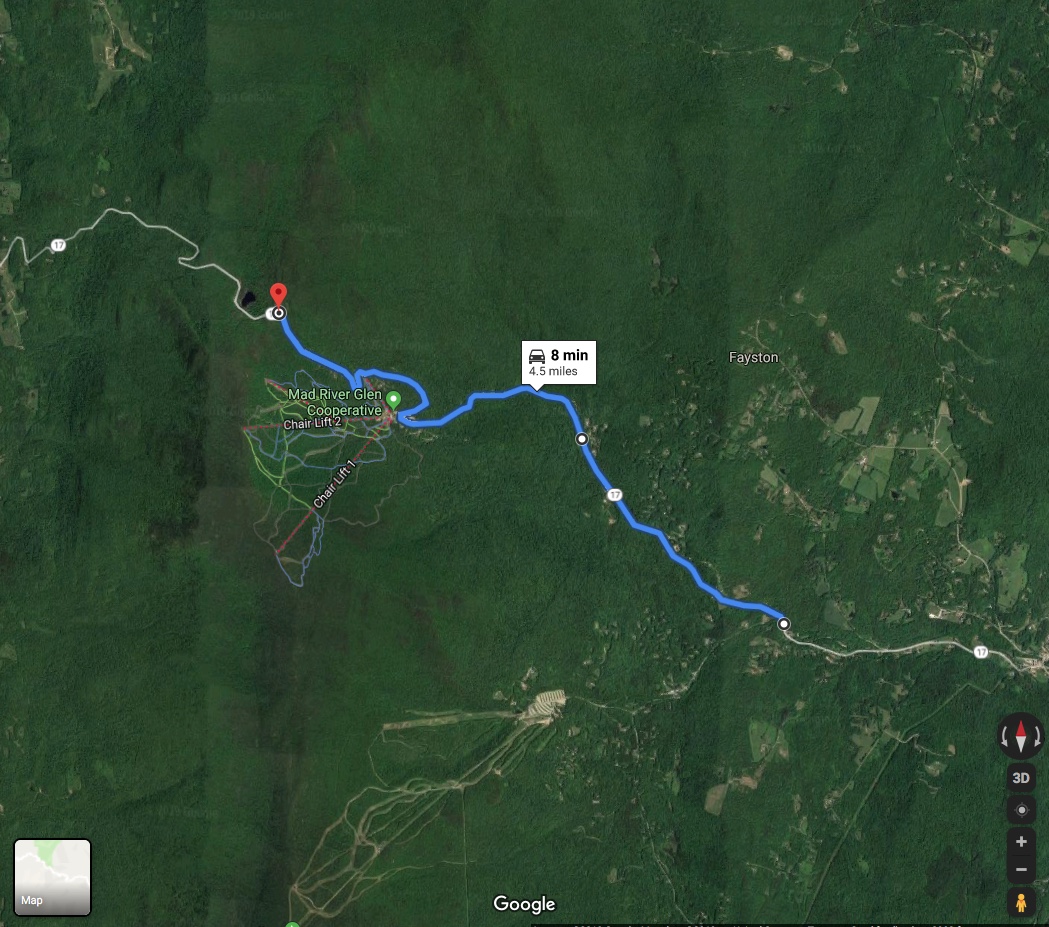
The App Gap is a rollerski skiathlon with a twist. Instead of beginning with a classic leg, the race starts with freestyle. At the Mad River Glen alpine area, approximately 5 k from the long course start, athletes change over to classic gear for the push to the finish.
NENSA App Gap Challenge course. The finish is marked by the red pin.
In the past, the race distance was set at 7.25 k for men and 5 k for women. According to Justin Beckwith, the New England Nordic Ski Association (NENSA) competition director, coaches requested a longer course for their athletes. Thus, 17 women, including all the racers above, raced the longer 7.25 k course. Ogden’s time is the new women’s course record for the long course. Junior women skied the 5 k distance.
Working with local municipalities, Beckwith was able to get the westbound lane of Vermont State Route 17 closed for the race. The early kilometers have a fairly relaxed profile. As the skiers approach Mad River Glen, the road pitches up, with sections at thirteen and fifteen percent grade.
“This was my first time skiing up App Gap,” Hamilton said after the race. “I’ve been up a few times on my bike, so I know the road a little bit. I wanted to conserve energy down on the flats, kind of see how hard everyone else was going to ski, and just stay relaxed on the climb. These kinds of races tend to be either really good for me or really bad. I just wanted to see what I could do, and it turned out OK.”
The skate to classic format suited Hamilton.
“Today it was pretty nice to be able to classic the upper section of the hill,” Hamilton said. “It gets so steep at the top that if you classic skied the bottom and then skated, it would really work your legs. It’s pretty nice today that we got to skate first and then classic.”
With his European race schedule many months away, Hamilton was able to use the App Gap race as a low consequence fitness barometer.
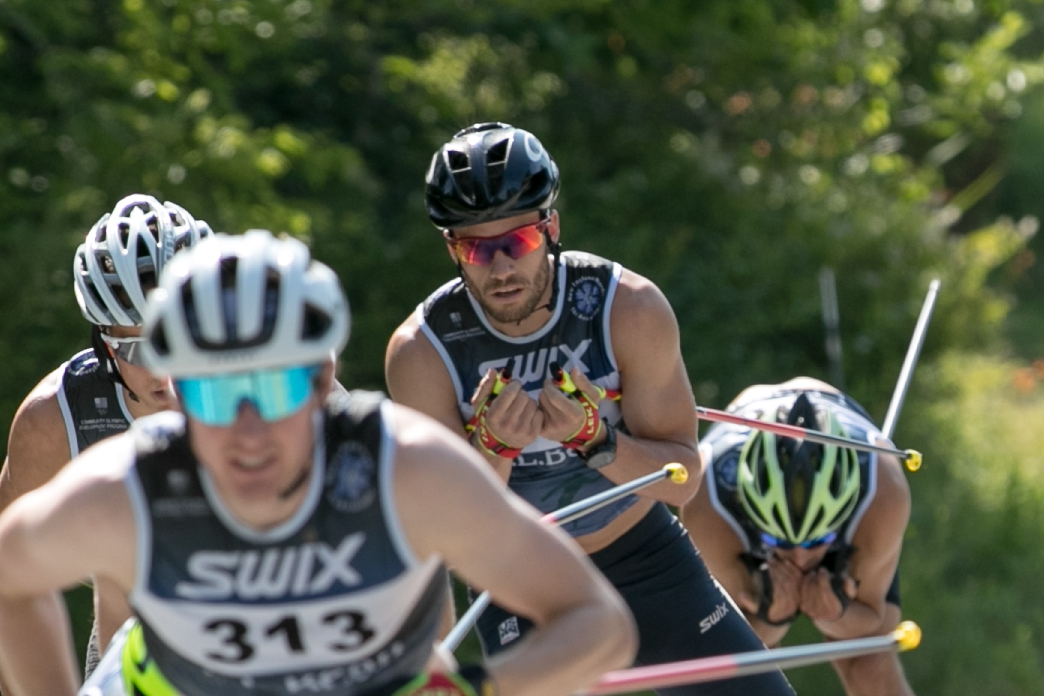
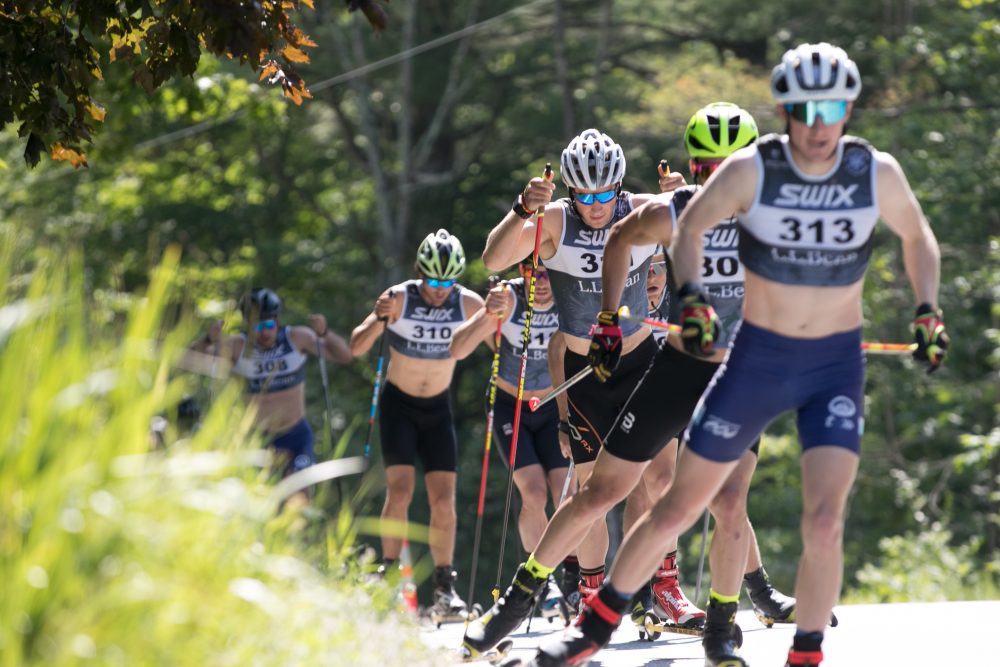
Simi Hamilton bib 312 followed by fourth place finisher Akeo Maifeld-Carucci. (Photo: Reese Brown – xcski.org)
“You never know how your body’s going to feel at this time of year because we haven’t really been doing a lot of hard intervals to get ready for this kind of effort,” said Hamilton. “At the same time, it’s really good to put a race bib on and revisit those feelings of really trying to go hard. It’s a race in August, it’s awesome to feel great, but it’s not the end of the world if you don’t.” The world of online betting is becoming more and more popular every day, not only in Poland but also all over the world. Sports betting is especially current during big championships, tournaments or matches of famous football teams! Bookmaker bets – soccer or other sports really give a lot of fun, because thanks to them you can not only increase your interest in the sport or football team, but also to win big money! Yes, yes, modern sports betting for many players is not just a pleasant hobby, but the whole art, thanks to which they successfully earn millions of zlotys a month watching their favorite matches!
For Lustgarten, App Gap came at the end of the first week of a two-week block of hard training.
“It went pretty well today!” Lustgarten emailed. “I didn’t feel amazing during the warm up from the hard week of training, so I wanted to draft the leaders and just see what happened. The skate leg got tough near the transition with all the climbing. My V2 wasn’t as strong as it usually feels so I switched to V1 earlier and more often than I would have liked. But I managed to maintain contact with Adam and Simi through the exchange. I felt like I could relax in my kick double pole and tried to ski smooth and long. I felt ok and took the lead for a bit but then Simi pulled up next to me and I knew I was in trouble. We had maybe 500m to go and he picked up the pace and at the 200 m to go sign he did a nice little acceleration and dropped me. I didn’t have any other gears left. It was a solid effort
The men’s front group on the skate leg. From Right to left: Kyle Bratrud, Ian Torchia, Ben Lustgarten, Adam martin, Simi Hamilton, Akeo Maifrld Carucci, and Ben Saxton. (Photo: Reese Brown – xcski.org)
“We have had [App Gap] on the schedule for a while. It fits in well to our schedule to add a nice hard effort that is more maximal instead of longer L3 that we do during the summer. I have a mountain bike race tomorrow as well so this weekend is pretty challenging but it’s a nice mix to the standard training routine.”
Asked about her day, Ogden said, “I’ve just been doing some solid training this summer, and it’s fun to get out and train and race and hang out with all the people I don’t see in the summer. It’s cool to hang out with [CGRP] a little bit, see my SMS T2 teammates – I don’t see them too much because I’m in Hanover, New Hampshire. I didn’t have a plan [for the race], I wanted to have some fun. … I tend to do well on a lot of race efforts,” Ogden added. “It’s always good for me to get out there and get going a little bit. I’ve been doing some bike racing this summer. Definitely not the last intensity of the year.”
Katharine Ogden (bib 328) and Evelina Sutro (bib 325) during the 2019 App Gap Challenge. (Photo: Reese Brown – xcski.org)
Caldwell’s App Gap experience provided an opportunity to synch her top gear efforts with the terrain best suiting her. The Vermont based skier was the fourth ranked sprinter on last season’s World Cup.
“Uphill races are generally not my strength,” Caldwell emailed. “My goal was to hang on for as long as possible and to try to conserve energy. I quickly realized that my strengths relative to the pack were the more gradual sections where I could double pole kick or V2, so I tried to save a little energy there and then match KO and Caitlin on the uphills. Caitlin led the entire skate section and then KO put in a surge on the classic that I tried to match and we took some turns leading there before she pulled away. It was a very hard effort and a nice test of fitness. I don’t read into rollerski races too much in the summer, but I was psyched with how today went!”
Sophie Caldwell during the 2019 App Gap Challenge. (Photo: Reese Brown – xcski.org)
Hilary McNamee, the third-place finisher in the women’s open division is also the head coach at Ford Sayre. She said that about half of her racers came to App Gap. She sees the day as an opportunity for her athletes to remain connected to race day sensations and environment.
“It’s a hard effort that we train through,” McNamee said. “It’s more about putting on a bib. In the summer, if you’re not hopping into local races, you lose that feeling of putting on a bib, and getting nervous, and going through the warm-up process, and finding the race zone. For us, it’s about staying in touch with racing. To have it be our nordic community hosting the race is an added bonus. These are the people we’re going to see in a couple of months on snow, and it’s that excitement around our sport, that’s the biggest piece for me.”
The organizational guru, NENSA’s Justin Beckwith (yellow vest). (Photo: Reese Brown – xcski.org)
Years ago, the App Gap was the low-key culmination of a summer camp at Green Mountain Valley School (GMVS) when Beckwith coached at there. After a hiatus when the App Gap race lapsed, it returned when Beckwith became New England Nordic Ski Association’s (NENSA) competition director.
In 2017, the first year that NENSA organized the App Gap event, there were 57 finishers. That total bumped to 119 last year. This year’s App Gap featured 167 finishers.
“It all comes down to the action we have in our clubs right now,” Beckwith said. “It’s the vision we’re trying to promote.”
Beckwith credited clubs from beyond the local area buying into the event, saying that this was the first year Stratton Mountain School junior athletes had competed.
“The elite skiers love it,” Beckwith said. “We had four of the top-10 overall ranked male and female skiers in the U.S. here this year. That’s really inspiring for the kids.”
The women’s 20 k skate podium at the 2019 U.S. Cross-Country Nationals at Craftsbury, VT. From left to right, Jessica Yeaton (APU/Australian National Team) in third, Caitlin Patterson (CGRP) first, and Rosie Frankowski (APU) second. (Photo: John Lazenby)
Another distance race at U.S. Cross-Country Nationals in Craftsbury, Vermont and another win for Caitlin Patterson of the Craftsbury Green Racing Project.
Count them up: eight U.S. national championships for the twenty eight year old. And in as many days at her home course, Patterson has further solidified both her legacy and the fact she is the distance racer to watch and match as the start gun fires.
On Thursday of last week, Patterson opened U.S. nationals with a win in the 10 k classic. Today, in a time of 59.23.1 minutes, ticking off k after k, Patterson won the women’s 20 k skate mass start.
“For the first [5 k] lap Rosie Frankowski and I traded off the lead a little bit,” Patterson told FasterSkier in Craftsbury. “She was leading the climbs and I was leading the downhills, but I could already feel it stretching on the downs. On the second lap when I pulled away on Kirby’s downhill heading towards like about 3 k into the loop, then the climbing was fairly good too, I just decided to keep charging and pull away. I skied a lot of the race by myself.”
By 10 k, Patterson had eeked out a lead over Frankowski (APU), coming through the mid-race time check in 29:34.1. Frankowski came through 14.5 seconds later.
Caitlin Patterson during the 2019 20 k skate at U.S, nationals in Craftsbury, VT. (Photo: John Lazenby)
“I was getting some splits that it was stretching, but Frankie is definitely a really strong climber so I didn’t want to let up,” Patterson said. “I needed to keep myself moving on those uphills. I was moving along well and pushing the pace but also feeling like I was fairly confident that I was going to be able to hold it.”
“It was hard from the gun honestly, the plan I kind of had was to just go as hard as I could and make it so it wasn’t a giant group because I don’t like skiing in a giant group,” Frankowski told FasterSkier. “I knew that breaking Caitlin would be really difficult to do and the only place I could probably do it was on steep uphills.”
For the first 10 k, from Frankowski’s perspective, she attempted to execute her plan of attacking on the hills. Patterson could not be broken.
“I tried to take some uphills and punch them,” Frankowski explained. “It didn’t really work. So the last 10 k I was on the solo train just like dying.”
Catching glimpses of Patterson from time to time up ahead, Frankowski knew she wasn’t bleeding massive time to the eventual winner. Conversely, she understood skiers like Jessica Yeaton, an APU training mate, were seeking to link up from the back.
“I could hear them getting cheered for,” Frankowski recalled. “And then on the last 5k my leg cramped up on the big uphill and I was like ‘oh my god’ I just have to try and finish. It was hard to motivate. I was trying my best, it was a hard head game for 10 k.”
Frankowski was never caught, and her “head game” ended with a second place and a finishing time of 1:00:03 hours.
Yeaton, who skied the later part of her race with Hailey Swirbul (APU) and Evelina Sutro (UVM), was able to distance herself and take third overall, 6.7 seconds behind Frankowski.
“It was really hard work out there, the first lap I went out hard and then died a little,” Yeaton said. “So I’m really happy I was able to hang on and pull up third place in the end because there was a lot of fighting for position in the middle of the race.”
Yeaton also placed second overall in Thursday’s 10 k classic. She is an Australian national, as a result, Swirbul, the day’s fourth place skier, took third on the American podium.
“It was really fun, my first 20 k but I have done a lot of 15s,” Swirbul said. “It was familiar territory in that way. But it was really a lot of highs and lows. The pace went out hot and stayed hot I think the whole time, for me at least. But it was really cool to be able to ski with teammates like Jess.”
Caitlin Paterson (CGRP), post-2O k skate, post-U.S, national championship win. (Photo: John Lazenby)
Sutro was fifth overall, Erika Flowers (Salomon) sixth, Alayna Sonnesyn (SMS T2) seventh, Canada’s Cendrine Brown (PHTC) eighth, Katharine Ogden (Dartmouth) ninth, and Kaitlynn Miller (CGRP) tenth.
Racing continues at U.S. nationals with a skate sprint on Tuesday.
Caitlin Patterson (CGRP) on her way to winning Saturday’s 5 k skate – part of the weekend’s Eastern Cup racing in Craftsbury, Vermont. (Photo: John Lazenby)
Over the weekend in Craftsbury, Vermont the first Eastern Cup series went down. On Saturday skiers raced a 1.6-kilometer freestyle sprint. On Sunday the women raced a 5 k skate, the men 10 k.
Julia Kern (SMS T2/USST) won the women’s sprint during Saturday’s NENSA Eastern Cup. (Photo: John Lazenby)
In the women’s sprint qualifier, Julia Kern (SMS T2) skied the fastest time of 3:12.97 minutes. Ida Sargent (USST/CGRP) was the second fastest qualifier, with Jessica Yeaton (APU) in third.
In the heats, Kern won the final, with Yeaton placing second. The day’s seventh fastest qualifier, Katharine Ogden (SMS T2/Dartmouth) finished in third. (Sargent pulled from the competition to rest for the upcoming World Cups.)
Daniel Streinz from Northern Michigan University winning the men’s sprint during Saturday’s NENSA Eastern Cup. (Photo: John Lazenby)
In the men’s sprint, Bill Harmeyer (University of Vermont) skied the fastest qualifier in 2:54.05 minutes. University of Colorado’s Alvar Johannes Alev was the second fastest qualifier, while Canada’s Nicolas Beaulieu (Orford) was third.
Daniel Streinz (NMU), the day’s sixth fastest qualifier won the final. Ninth fastest qualifier Antoine Briand (CNEPH) of Canada was second, with Harmeyer in third.
Ben Lustgarten (CGRP) winner of the men’s 10 k skate n Sunday — during the first Eastern Cup of the season.
For the men in the 10 k skate, Ben Lustgarten (CGRP) placed first in a time of 23:20.7 minutes. Although making the claim on Instagram he is not coming out of retirement, Kris Freeman (Caldwell Sport) was second in 23:430 minutes, and Zane Fields (Colby) was third in 23:46.9.
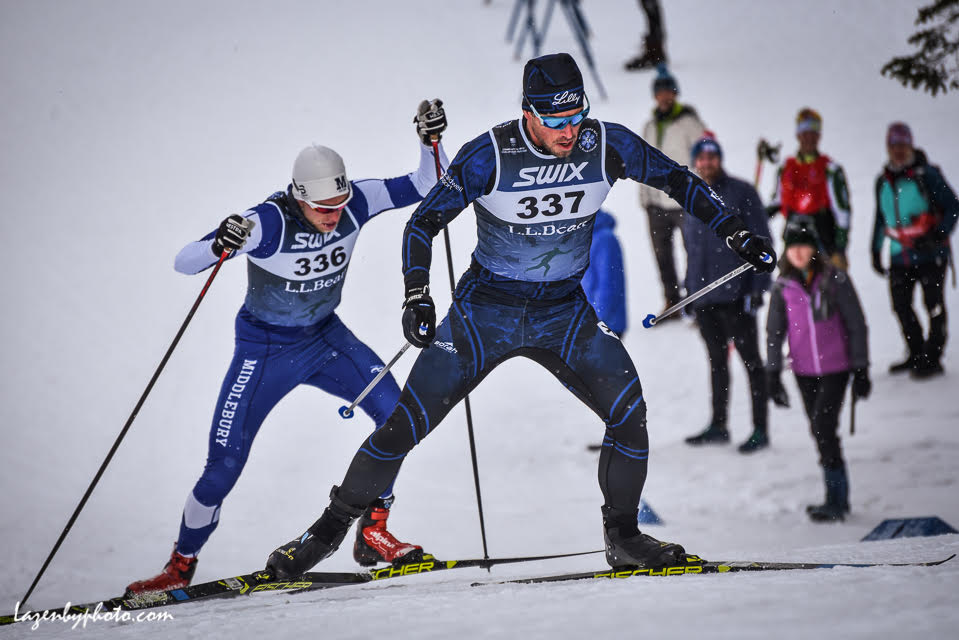
Kris Freeman (bib 337) during the men’s 10 k skate in Craftsbury, Vermont — part of the weekend’s Eastern Cup Racing. Freeman placed second. In bib 336, Sam Wood (Middlebury College) trails Freeman on his way to 10th overall. (Photo: John Lazenby)
World Cup and USST skier Ida Sargent, home for the holidays and the Tour de Ski break, high fives a BKL lollipopper after the lollipop run. NENSA Eastern Cup. (Photo: John Lazenby)
Young and old are welcome at the NENSA Eastern Cups. (Photo: John Lazenby)
Some of the young skiers at the NENSA Eastern Cup in Craftsbury, Vermont. Young and old are welcome at the NENSA Eastern Cups. (Photo: John Lazenby)
Nordic ski announcer Peter Graves (Photo: John Lazenby)
Men’s sprint podium: L-R: Bill Harmeyer, UVM, 3rd; Daniel Streinz, Northern Michigan U, first; Antoine Briand, Centre Nordic Pierre Harvey (Quebec), 2nd. sprint, NENSA Eastern Cup. (Photo: John Lazenby)
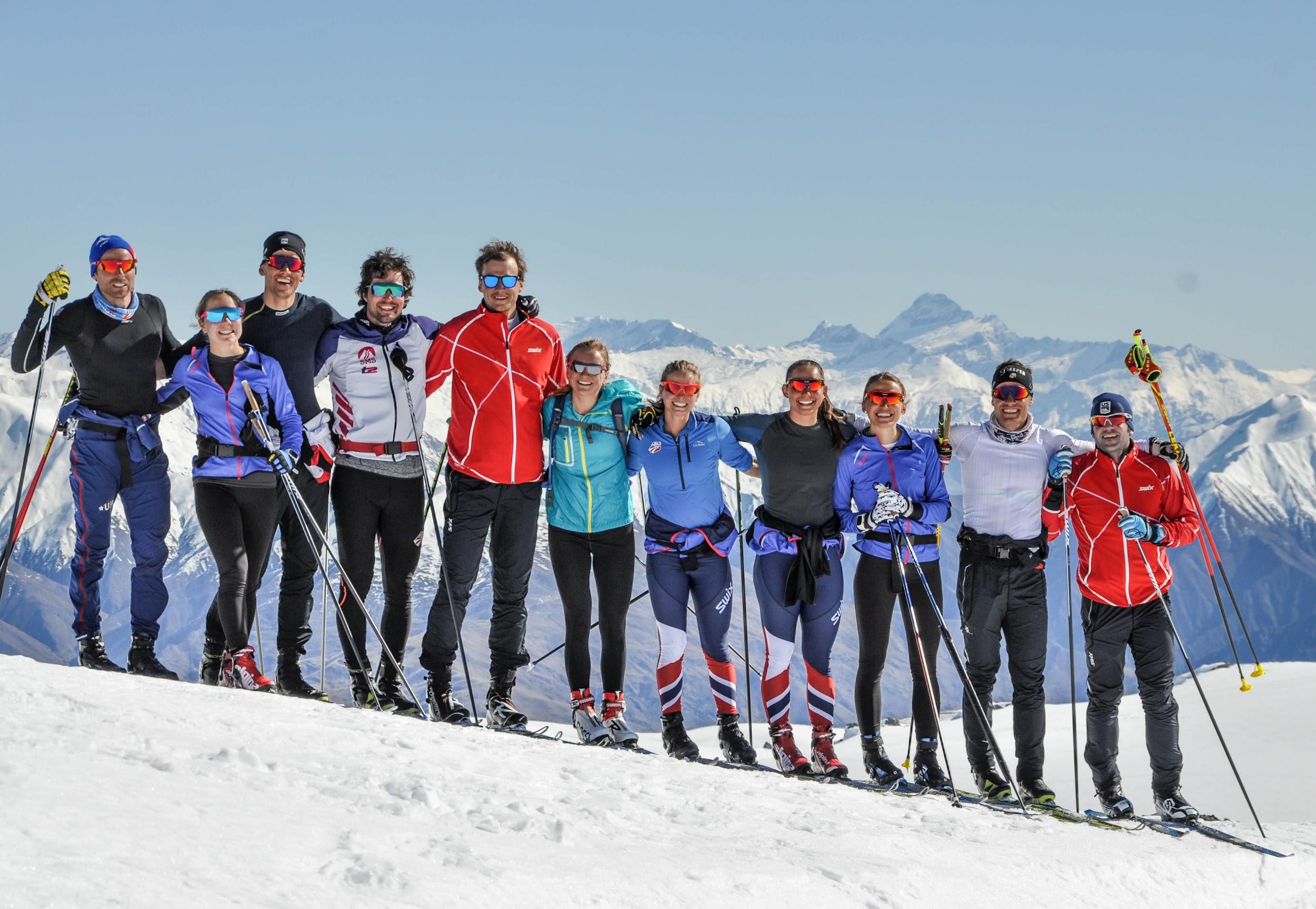
2018 U.S. Ski Team camp at the Snow Farm in New Zealand, with author Alayna Sonnesyn (teal jacket) in the middle of the group shot. (Photo: Matt Whitcomb)
The following was written by Alayna Sonnesyn, a new member of the Stratton Mountain School (SMS) T2 Team who graduated from the University of Vermont (UVM) this past spring.
Originally from Plymouth, Minnesota, Sonnesyn, 22, raced on the UVM Ski Team for four years and qualified for four NCAA Skiing Championships teams. She placed second and third in two races at 2017 NCAA Championships, and in her senior season, won the first five Eastern Intercollegiate Ski Association (EISA) races and went on to reach the podium in 10 out of 11 EISA races. Sonnesyn expressed an interest in exploring the dilemma many of the nation’s top skiing talents face out of high school: whether to attend college or get an early jump on a pro-racing career. She plans to post this two-part series on her blog as well.
***
For the first time in 17 years I will not be going back to school this fall. Saying that out loud is more daunting than I had anticipated. For the most part, the classmates that I graduated with can say that they are “going to grad school,” “starting a new job,” or “taking a year off to travel,” but I still don’t know where I lie. I am not taking any classes this year, I am not working anywhere consistently, and I am doing more than just traveling to explore, I’m traveling to race!
I am wrapping up a three-week training camp in New Zealand with the SMS, Craftsbury, and US Ski Team. When I walked through customs I had to write down my reason for visiting New Zealand: Was I a student? Was I visiting a family or friend? Was I working? What was my job? In the rush of the moment and due to habit, I wrote that I was still a student and continued on my way. I later had a few reflections; I still haven’t reached the point yet where I can say I have a job. I don’t have a salary and there are no company benefits. Yet, I work 24/7 toward my job — my job is ski racing. But why is this so hard for me to admit to myself? Is it because, for my entire life, I’ve been a student? What if I hadn’t taken this route? How do others make this decision?
National Training Group (NTG), summer 2013, in Park City, Utah.
Racing throughout high school, I was given a number of perspectives about picking skiing versus school. My friends were all preparing to go to college and I always assumed I would go to college, too. My parents and older sister went to school, why wouldn’t I go as well? But then I thought about skiing. I never had the most outstanding results in high school (never qualified to race internationally), but I was good enough to qualify for regional and national level camps like REG, NEG and NTG. I traveled to these camps and trained with other high-level athletes, getting more and more motivated by each skier or coach that I met. Then the thought came to me… what if I didn’t go to college? I could focus on training, make those vital steps toward international racing, and continue along the “pipeline” that so many Olympians had followed. Maybe I would make bigger jumps and improve my skiing exponentially? I was entering the unknown and I was unsure how to pick the right choice for me. Looking back on this four years later, I realize that I was far from alone in this predicament.
I have since had the opportunity to talk to a wide variety of skiers and competitors and have learned so much that I wish I knew in high school. It’s OK to be confused. It’s OK to make your own path. Every athlete is in a different situation, comes from diverse athletic and academic backgrounds, and has various goals that they hope to achieve post-high school.
“I’ve always believed that the most important thing to remember when discussing the decision to go to school or not (or when to go to school) is that is it a completely individual decision and the right decision for one person might not be the right decision for the next.” — Sophie Caldwell
Personally, I finally decided that taking a gap year might be too big of a jump for me. I wasn’t ready to focus on skiing and I had a lot of goals for myself academically. I decided to attend the University of Vermont and upon reflection, can admit that this was one of the best decisions of my life. Similarly, SMS teammate, Kelsey Phinney, went from high school in Boulder, Colorado, directly to Middlebury College.
“The reason I chose Middlebury College was simple: I went to visit and I was ready to unpack and stay for good. I loved the people, the area, the ski team, and the classes I sat in on.” — Kelsey Phinney
Carnival love, with Kelsey Phinney (top) and Katie Feldman.
Kelsey and I both fell in love with our schools from the start and knew we were where we belonged. We took these college experiences as learning opportunities; maybe we wouldn’t have been ready to jump right into the professional circuit but we both determined this was the right path for us.
“I loved the experiences I had on the Carnival circuit. Both good and bad times taught me a lot about life and skiing, and I felt like the balance of school and sport made me better at both,” Kelsey reflects.
Similarly, Sophie Caldwell had her mind made up without the need to hesitate over a gap year or jumping into full-time skiing.
“I chose to go to college right out of high school, and it was something I had always known I wanted to do. I knew there was a good chance I wanted to ski professionally at some point in my life, but when I was 18, I wasn’t ready to 100% commit to skiing,” Sophie, a Dartmouth graduate, explains.
With academic goals in mind and the confidence to pursue skiing in the long run, sometimes there’s no need to question it. Going directly to college might challenge you more than you think and it might make you question what you’re doing. The balance of school and skiing is great, but it’s TOUGH! At least you worked through those challenges and figured out where you want to be though.
“I definitely had my ups and downs throughout college and at times I considered not pursuing skiing after college, but by the time I entered my senior spring, I knew I wanted to give skiing professionally a shot and knew it was because it was what I wanted to do, not what I had to do,” Sophie notes.
Over the course of four years, we were able to say goodbye to our homes, grow into adults and develop as skiers, allowing a much smoother transition into the professional racing circuit post-college. This decision to go right to college made sense for Kelsey, Sophie and me — it was simple; but I recognize that this choice isn’t as straightforward for everyone.
***
“I loved my time at Burke and wasn’t quite ready to leave. I also didn’t know where I wanted to go to college as part of me wanted to go out west while part of me wanted to stay closer to home.” — Ida Sargent
The conflict of picking a school, a place we are willing to spend at least four years of our lives at, can be intimidating to anyone. Taking a year off to think and explore what motivates you once the structure of school is taken out of the picture can be extremely vital to one’s skiing longevity. Other times, this year off can be done to test out what skiing professionally is actually like.
“I wanted to test out whether I could do only professional skiing.” — Katharine Ogden
A feat that might sound easy to accomplish — ski, eat, sleep, repeat — can’t be THAT hard! But what happens when you suddenly put all of your time and energy into one goal?
“Ironically, my gap year did not turn out even close to how I had planned or imagined!” reflects Julia Kern.
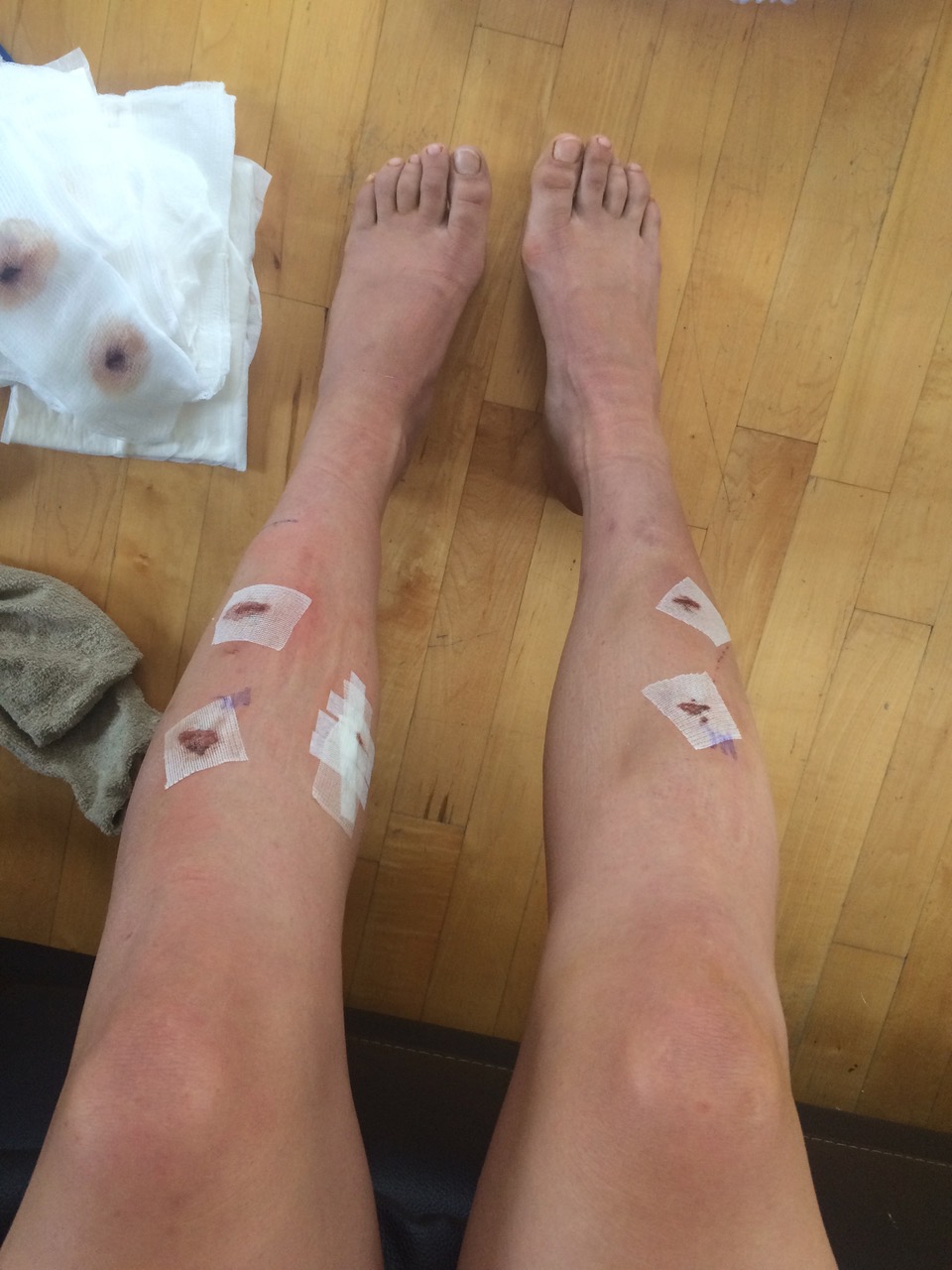
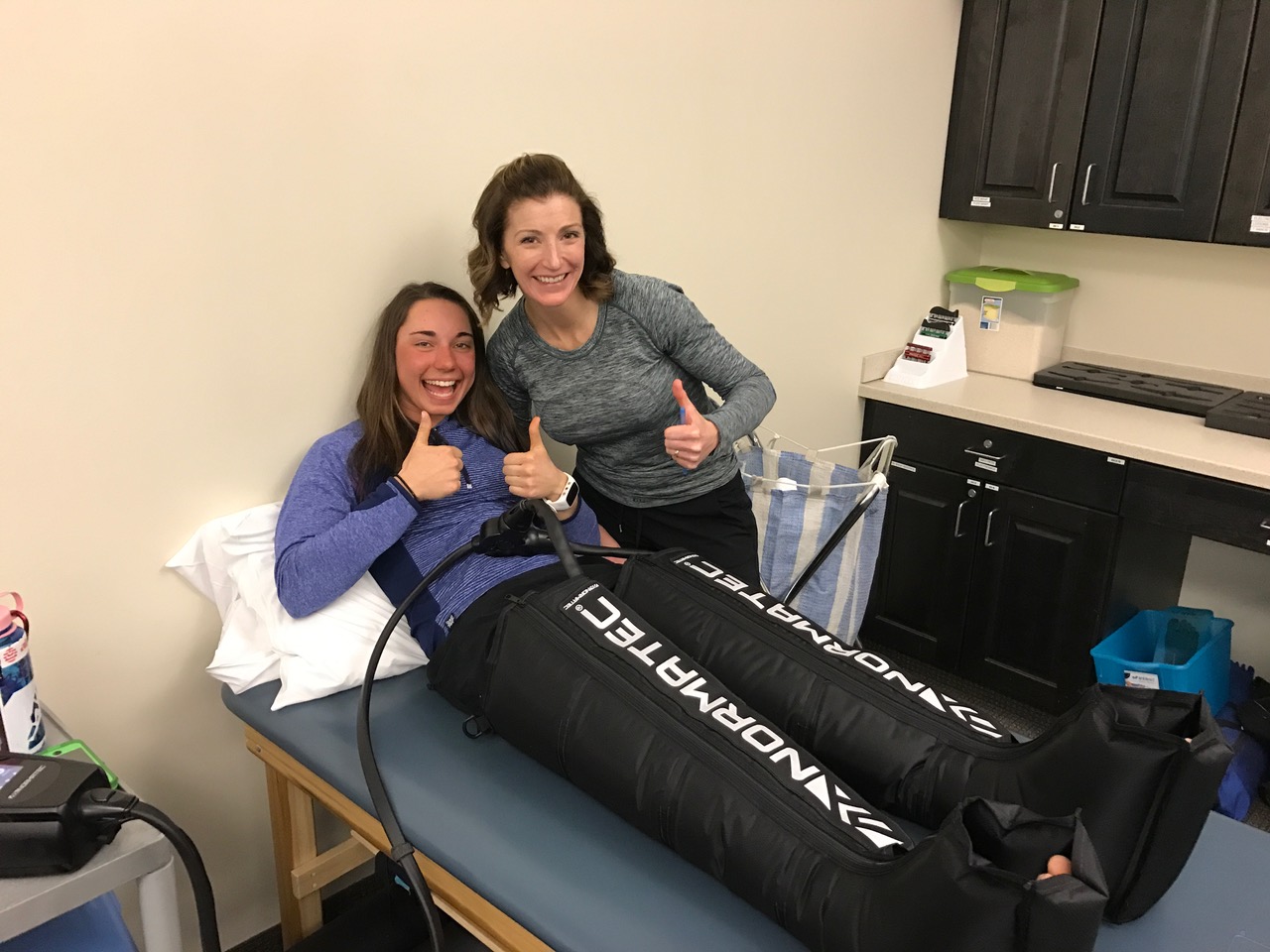
Julia Kern with swollen legs after surgery, requiring A LOT of physical therapy during the summer.
After facing an early summer surgery for compartment syndrome and then an untimely back injury in the fall, Julia notes that her gap year was extremely tough with plenty of lows and setbacks.
Ida Sargent offers, “My PG year was a bit of a disappointment as I wasn’t as happy as I was expecting and I also didn’t feel like I made as big of a jump with my results as I had hoped.”
“I think in hindsight it was a good philosophy but I think I approached it wrong. I didn’t do a good job securing other things to do besides training and was thus pretty bored, which led to me putting a lot of stress on skiing and racing,” says Katharine Ogden.
Maybe taking a gap year isn’t as easy as it sounds? Coming face-to-face with this type of ski-focused intensity as an 18 year old can be challenging.
“It showed me how much I really wanted to go to college,” offers Katharine.
It can also be validating, as it can prove to oneself where they really belong at that point in their life.
“It made me realize that I wasn’t ready to ski full time and I still needed balance in my life,” reflects Ida.
What might be the most beneficial aspect of taking a gap year are the lessons you learn throughout. How to deal with the pressure, free time, potential obstacles, and how to respond when you’re suddenly put in an unfamiliar situation.
“My gap year turned out to be far from ideal from a training/fitness standpoint, but I became very in tune with my body, learned how my body responds to training, became mentally tougher, and learned that I love the skiing lifestyle (even if it is tough sometimes) and that I want to ski at the highest level possible,” says Julia.
Some things you just can’t learn in a classroom.
Julia Kern (on table) still smiling!Julia Kern taking the time to think about something other than skiing during her gap year. (Photo: Julia Kern) How to pass the time away, when you have so much of it. (Photo: Julia Kern)
After taking a gap year to figure out what skiing was like full-time; Ida, Katharine, and Julia attended Dartmouth College (via various routes):
Ida states, “I started by going to school full time and I raced for Dartmouth for three years and then made the National team so I took my senior winter off to race for the USST and then I went back for a spring term my fifth year.”
“One year in [as a traditional student], I am very happy at Dartmouth and racing the collegiate circuit last year reignited my love for the sport,” adds Katharine.
While Julia contributes, “I chose Dartmouth because I wasn’t sure what skiing and school balance I wanted to have, but I did know that I wanted to be able to take terms off to race internationally.”
Regardless of which Dartmouth plan they followed, all three skiers seem to have enjoyed the choices they made. Whether taking a gap year is or isn’t part of your plan, the most important takeaway is that you should TAKE SOMETHING AWAY! Learn something new about yourself, about skiing, or about classes you want to study.
So what about other options for pursuing a ski career? Jessie Diggins and Andy Newell both chose to skip college and go straight into skiing. Stay tuned for my next post when I’ll include input from both of them as well as what U.S. Ski Team coach Matt Whitcomb has to say on this topic.
Julia Kern leads Katharine Ogden, her fellow Stratton Mountain School (SMS) and U.S. Ski Team development team member, during the Snow Farm’s 21 k Snow Rake at the 2018 Merino Muster in Wanaka, New Zealand. (Photo: Garrick Cameron)
Note: This article has been updated to include comments from Simi Hamilton of the U.S. Ski Team (USST) and Stratton Mountain School (SMS) T2 Team, and Kevin Bolger of the USST and Sun Valley Ski Education Foundation.
***
It’s that time of year again where several members of the U.S. Ski Team, along with top-level skiers from the Craftsbury Green Racing Project (CGRP) and Stratton Mountain School (SMS) T2 Team are training at the Snow Farm above the town of Wanaka, New Zealand.
The on-snow volume camp, which featured multiple days of racing, started Aug. 20 and continues through Sept. 10, and includes U.S. Ski Team (USST) athletes Jessie Diggins, Ida Sargent, Sophie Caldwell, Katharine Ogden, Julia Kern, Simi Hamilton, Kevin Bolger, and Paddy Caldwell, and coaches Matt Whitcomb, Jason Cork and Gus Kaeding.
According to Sophie Caldwell, conditions have been “amazing” for the duration of camp so far. “New Zealand had a great snow year and we’ve been lucky to have sunny days almost every day,” she wrote in an email to FasterSkier.
Japan’s Tomoka Satou (446) leads American Jessie Diggins (428) and others up a climb during the Merino Muster 42 k skate race on Sept. 1 at the Snow Farm in Wanaka, New Zealand. (Photo: Garrick Cameron)
Diggins called it the annual trip one of her “all-time favorite camps because the living at the Snow Farm is great, the food is outstanding, and you can step out the door right onto the 65+ km of trails!” she wrote in an email.
“I love having the chance to work on my on-snow technique for three solid weeks because that’s when I get to really see progress and make some changes in my striding,” Diggins wrote.
Apart from logging kilometers on snow and soaking up the vitamin D, the team has also spent time trail running in Wanaka.
“The highlight [of the camp] will probably be a crust cruise we go on in the next few days, but since we haven’t done that yet, some highlights so far are an awesome distance run down in Wanaka, and pretty much every day of bluebird skiing we’ve had up here!” Caldwell wrote.
The camp also coincided with the Merino Muster, a 42 k freestyle marathon that is part of the Worldloppet series, and the Winter Games NZ, which doubled as the Australia/New Zealand Cup FIS races and included three days of nordic racing this year at the Snow Farm: a 5/10 k freestyle individual start, a freestyle sprint, and a 10/15 k classic mass start..
Diggins finished a minute and 21 seconds faster than the second-place woman, Aurelie Dabudyk of France, while Hamilton edged Craftsbury skier Adam Martin by 3 seconds for the overall win.
“The day of the Merino Muster was gorgeous and sunny, with fast conditions,” Diggins wrote. “I loved getting the chance to race a long race, and starting with the men as one big field is really exciting! I hope to get to race the 42km race every year. Huge thanks to the volunteers and organizers for making it such a fun day.”
Crossing the finish line in 1:52:34 hours, Diggins placed sixth overall. Dabudyk was eighth overall and Alayna Sonnesyn (SMST2) was the third woman, 11th overall, 5:30 behind Diggins.
Meanwhile, Hamilton finished in 1:39:46, beating his time of 1:40:33 from last year’s race. Martin followed 3 seconds later, while Kyle Bratrud (SMST2) finished 24 seconds after from Hamilton in third, followed by Tomoka Satou of Japan in fourth (+45.0).
“The Merino Muster is always an awesome race,” Hamilton wrote in an email. “It actually lends itself to the type of intensity we are still mostly focused on in August/late September because the terrain and snow conditions usually make for a really good chance to get in about 1.5 hours of level 3 effort followed by a few minutes of really hard skiing in the last km before the finish. It’s a very rolling course and if you ski it in a pack with people switching leads it’s basically impossible to go much harder than level 3.”
Also on Saturday, Americans also took the top spots in the 21 k Snow Rake. Ben Saxton (SMST2) ran away with the overall win by more than 12 minutes in 47:48, while Paralympic sit skier Dan Cnossen placed second (+1:12:13) nine seconds ahead of Petr Sykora of the Czech Republic in third (+1:12:22).
Ogden was the fastest woman and second overall with a time of 50:29. Her SMS and USST teammate Kern finished 56 seconds later as the second woman, and Elizabeth Martin of the University of New Hampshire (UNH) followed in third, 7 minutes and 30 seconds behind Ogden.
With about 300 participants between three different races at the Merino Muster, Hamilton described the atmosphere as “super fun and light.”
“But the grooming always rocks and it’s just a really fun course to ski,” he added. “I think that in this day and age of social media being so huge and cross-country skiing gaining more attention in the US and world-wide, we’ll start to see more and more people showing up for the marathon. I feel like in the last few years alone their has been noticeably more attention and attendance each year. The quality of skiing is a small part of the race atmosphere here… New Zealand’s south island is one of the most beautiful parts of the world and the culture is so welcoming and comfortable.”
Many of the American skiers in New Zealand also competed in the Winter Games NZ races this week.
“The New Zealand Winter Games are also a huge opportunity to get back into racing mode and test out all the technique work we’ve been putting in so far!” Diggins wrote. “And if you know me, you know how much I adore 5km individual skate races, and we no longer get to do those on the World Cup. So I’m so grateful to the Snow Farm and race organizers for keeping such a fun and hard, fast race alive! I forgot how much it can hurt to go so hard for 5km, but it was fun to really get that lung burn back for the first time since last winter.”
Three days after her marathon win, Diggins won the 5 k skate at the Snow Farm in 15:02.6. The U.S. swept the top five with Sophie Caldwell finishing 10.5 seconds back in second place, Caitlin Patterson (CGRP) in third (+16.7), Sargent (USST/CGRP) in fourth (+1:02.6), and Kelsey Phinney (SMST2) in fifth (+1:16.6) out of eight women.
Kyle Bratrud (SMST2) gets a feed from U.S. Ski Team coach Jason Cork during the 2018 Merino Muster 42 k skate race at the Snow Farm in Wanaka, New Zealand. He finished third behind two other Americans. (Photo: Garrick Cameron)
In the men’s 10 k skate on Tuesday, Bratrud took the win in 27:48.1, 21 seconds clear of Kaichi Naruse of Japan in second, while Craftsbury’s Ben Lustgarten and Martin (CGRP) followed in fourth (+23.0) and fifth (+44.0), respectively. Eight men competed.
Wednesday featured 1.1 k skate sprints, which saw Sophie Caldwell take the win in a field of 10 women, ahead of Sargent in second and Phinney in third.
“The sprint was a short and tactical race that was awesome practice for what’s to come this winter,” Caldwell wrote. “It was really fun toeing the line with my USST and SMS training partners. On one hand, that final could have been any day of summer training, but it also could be a World Cup heat! It’s pretty cool to be pushed by so many strong training partners and friends and we were psyched to throw on a bib and put in a race effort.”
In the men’s final, Bolger landed the top spot on the podium, ahead of Saxton in second and Satou in third. Eleven men competed in the sprint.
“I really enjoy these early session races it gives us as races a chance to get in the mindset and practice real race strategy,” Bolger wrote in an email. “I wanted to go out there test myself, I approached every round like a final and attacked from the start getting out in front and leading into the finish, and was very happy to end the day on top, especially after a long camp down here with the US crew.
“… Coming down here and having a good result in the sprint is of course a huge confidence booster heading into the September/ October training months, but there is still a ton of preparation to be done,” he added.
On the final day of Winter Games NZ racing, Diggins continued her undefeated streak (after skipping the sprint), winning the 10 k classic mass start, while Patterson placed second and Sargent placed third. Saxton picked up his second win of the week, while Martin took second and Lustgarten third.
Complete results will be posted once they’re available.
“We have been incredibly lucky with weather and conditions this year,” Hamilton noted. “Usually, when you’re here at the Snow Farm for 3 weeks in the winter, you’re bound to get an extended period of really nasty weather and wind. But this year we’ve basically had sunshine and cold night time temps every single day, making for amazing skiing for pretty much 3 weeks straight. There is about 40-50 km of trails to ski when everything is groomed, so it’s essentially impossible to get bored. The highlight of our camp every year is a big crust ski up to and around Mt. Pisa. We are planning on getting out tomorrow [Friday, Sept. 7] because the crust hasn’t been great yet while we’ve been here, but conditions for tomorrow look promising. But even when we can’t get out for a huge adventure like that, it’s just one of the best and most fun places in the world to train.”
Members of the U.S. men’s ski team on a mid-overdistance run on top of the Roc Cornafion above Villard-de-Lans, France. (Photo: Chris Grover)
This month, the U.S. Cross Country Ski Team (USST) held dryland camps simultaneously, about 6,000 kilometers away from each other, in Lake Placid, N.Y., and Villard-de-Lans, France. Five of the eight women on the team attended the camp from July 11-20 in Lake Placid, which, up until a couple of years ago, was a September staple on the USST calendar. Meanwhile, four of the team’s men trained together in the picturesque, mountainous region of southeast France from July 9-18.
Who was where? In Lake Placid, USST A-team athletes Jessie Diggins, Sophie Caldwell and Ida Sargent worked out alongside development (‘D’) team members Julia Kern and Katharine Ogden, as well as several others from their respective clubs and Stefani Böhler of the German National Team. Outside of camps, the five USST women spend most of the offseason training with their respective Vermont-based programs; Diggins, Caldwell, Kern, and Ogden are all on the Stratton Mountain School (SMS) Elite Team, and Sargent trains with the Craftsbury Green Racing Project (CGRP).
The other three women on the national team — Sadie Bjornsen, Hannah Halvorsen and Hailey Swirbul — are based in Anchorage, Alaska, where they train with Alaska Pacific University (APU) and have multiple opportunities to ski on snow on nearby Eagle Glacier.
“Getting participation in a country as large as ours is always a challenge,” U.S. coach Matt Whitcomb told FasterSkier in Lake Placid. “… But the Alaskans have gone out of their way to give us adequate representation at these camps. They work really hard to, when they’re present, be very present.
“It’s not so much an APU or Alaska issue, it’s a distance issue,” he continued. “We can fight it as hard as we want, but we’re going to be running into a wall because it’s hard to get from upstate New York to Anchorage or Fairbanks; it’s a long ways. We do our best. We try to identify which camps the whole team will be present at, and while we’d love to be able to get together five or six times a year like the Norwegians do every four weeks for eight days, it’s not the reality for us. Our club system is the key for us, and APU is doing a great job with or without the Ski Team at a camp up there, and you have all these other clubs now running their programs like mini national teams. If we can have more of those, that’s how we’ll get better.”
In France, Erik Bjornsen (fresh off his wedding there), Simi Hamilton, Ian Torchia, and Paddy Caldwell trained under the guidance of head coach Chris Grover. Two of the team’s B-team members, Scott Patterson and Kevin Bolger, did not make the trip; Patterson has been rehabbing a fractured toe in Anchorage and Bolger is currently training in Norway.
From Aug. 20 to Sept. 10, half of the team plans to train on snow in New Zealand (Diggins, Sargent, Kern, Ogden, Hamilton, Bolger, and Sophie and Paddy Caldwell) with three coaches: Whitcomb, Jason Cork and Gus Kaeding. Then from Oct. 8-21, most of the 16-athlete squad will meet up for a final dryland camp in Park City, Utah, before revving up for another World Cup season.
Here are some photos from the two mid-summer camps, courtesy of the U.S. Ski Team:
Members of the U.S. men’s ski team on a mid-overdistance run on top of the Roc Cornafion above Villard-de-Lans, France. (Photo: Chris Grover)
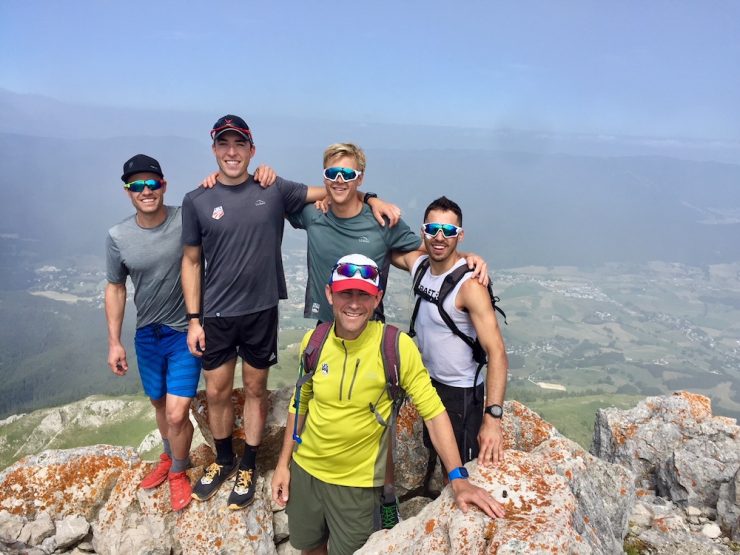
From left to right: Simi Hamilton, Paddy Caldwell, Erik Bjornsen, coach Chris Grover, and Ian Torchia of the U.S. Ski Team during a mid-overdistance run on top of the Roc Cornafion above Villard-de-Lans, France. (Photo: Chris Grover)
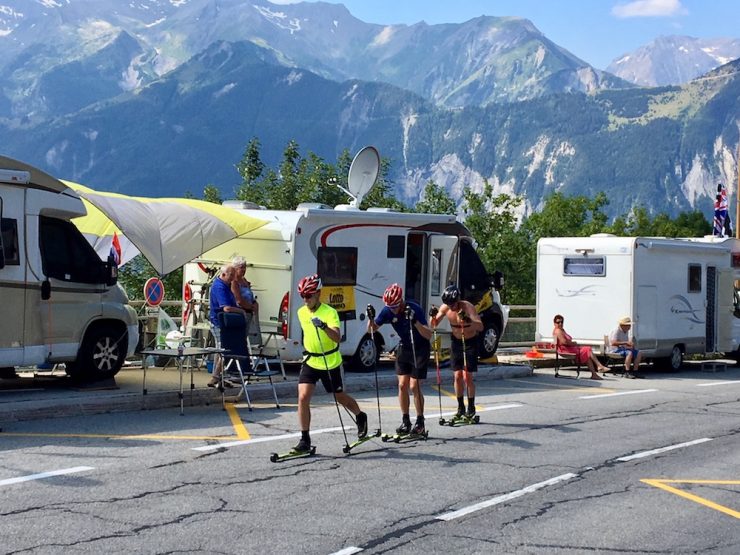
Members of the U.S. men’s ski team rollerskiing up l’Alpe d’Huez in France. (Photo: Chris Grover)
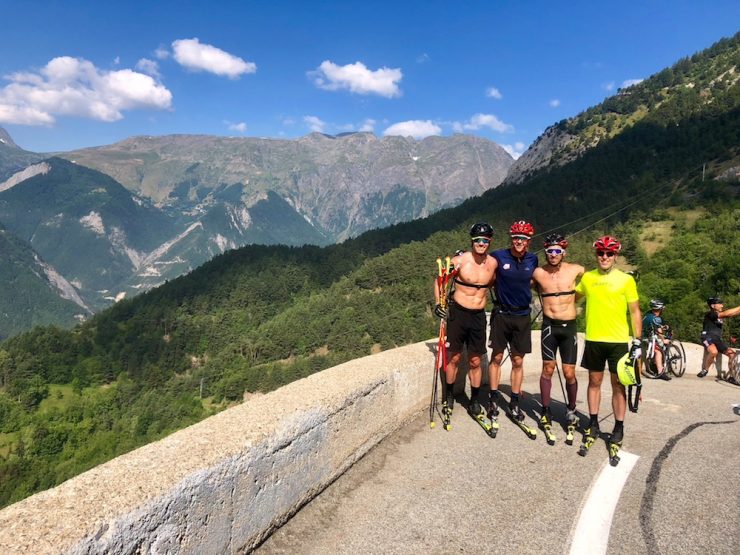
From l to r: Simi Hamilton, Erik Bjornsen, Ian Torchia, and Paddy Caldwell of the U.S. men’s team during a 2018 rollerski up l’Alpe d’Huez in France. (Photo: Chris Grover)
“The Villard-de-Lans camp was excellent, and the men came away from camp mentally charged for the next period of training, although certainly needing some physical rest,” Grover summarized in an email.
French national-team member Adrien Backscheider, who lives part time in the area, joined a few of their workouts. Grover explained their training included five “high-quality sessions” during the 10-day camp, all held on the rollerski loop in Corrençon-en-Vercors: a classic speed session, a skate speed session, a Level 3 classic workout, a Level 4 skate workout, and a classic team sprint simulation. The remaining sessions were either distance, over-distance or strength.
“We had 2 classic roll + run combo workouts in the mountains, including skiing up l’Alpe d’Huez two days prior to the Tour de France stage and then hiking/running up the mountain from the village to create a 4 hour/6000 vertical feet workout,” Grover wrote. “We are very grateful to all the people we met in the Villard-de-Lans area for welcoming, supporting, and taking care of us.”
Sophie Caldwell (r) leads USST teammate Ida Sargent during a team-sprint training session at the Olympic Jumping Complex in Lake Placid, N.Y. (Photo: Matt Whitcomb)
Ben Saxton of the SMS Elite Team leads a sprint interval session at the Olympic Jumping Complex in Lake Placid, N.Y. (Photo: Matt Whitcomb)
Stratton’s Ben Saxton (l) and Kyle Bratrud lead Craftsbury’s Ben Lustgarten (third from r) during a sprint session at the Olympic Jumping Complex in Lake Placid, N.Y. (Photo: Matt Whitcomb)
Ben Saxton (SMS Elite Team) during a rollerski sprint session at the Olympic Jumping Complex in Lake Placid, N.Y. (Photo: Matt Whitcomb)
Kyle Bratrud (SMS Elite Team) testing his skate-sprinting speed at a national-team camp in Lake Placid, N.Y. (Photo: Matt Whitcomb)
Kyle Bratrud leads Ben Saxton and Ben Lustgarten during a rollerski sprint session at the Olympic Jumping Complex in Lake Placid, N.Y. (Photo: Matt Whitcomb)
Sophie Caldwell (l) and Julia Kern round a corner during a team-sprint workout at the Olympic Jumping Complex in Lake Placid, N.Y. (Photo: Matt Whitcomb)
Stefani “Steffi” Böhler at the U.S. Ski Team women’s camp in Lake Placid, N.Y. (Photo: Matt Whitcomb)
Jessie Diggins with coach Jason Cork during a rollerski in Lake Placid, N.Y. (Photo: Matt Whitcomb)
Stratton teammates Sophie Caldwell (l) and Kelsey Phinney during a rollerski at the U.S. Ski Team women’s camp in Lake Placid, N.Y. (Photo: Matt Whitcomb)
Ben Saxton leads Ben Lustgarten and Kyle Bratrud during a rollerski in Lake Placid, N.Y. (Photo: Matt Whitcomb)
Julia Kern (Stratton Mountain School/U.S. Ski Team) rollerskiing in Lake Placid, N.Y. (Photo: Matt Whitcomb)
Ben Saxton (SMS Elite Team) rollerskiing in Lake Placid, N.Y. (Photo: Matt Whitcomb)
Ida Sargent leading the pack up a climb at the Olympic Jumping Complex in Lake Placid, N.Y. (Photo: Matt Whitcomb)
Germany’s Steffi Böhler during a rollerski workout at the Olympic Jumping Complex in Lake Placid, N.Y. (Photo: Matt Whitcomb)
Ida Sargent (Craftsbury Green Racing Project/USST) rounds a corner at the Olympic Jumping Complex in Lake Placid, N.Y. (Photo: Matt Whitcomb)
Sophie Caldwell (Stratton Mountain School/USST) rollerskiing at the Olympic Jumping Complex in Lake Placid, N.Y. (Photo: Matt Whitcomb)
Rollerskiing roadside at the U.S. Ski Team women’s camp in Lake Placid, N.Y. (Photo: Matt Whitcomb)
Rollerskiing roadside at the U.S. Ski Team women’s camp in Lake Placid, N.Y. (Photo: Matt Whitcomb)
U.S. Ski Team women’s camp rollerski route in Lake Placid, N.Y. (Photo: Matt Whitcomb)
U.S. Ski Team women’s camp / Lake Placid, N.Y. (Photo: Matt Whitcomb)
Group shot at the U.S. Ski Team’s July camp in Lake Placid, N.Y. (Photo: Matt Whitcomb)
“Being sea level, we can do more of an effective intensity camp, which this is a semi-intensity focused camp here,” Whitcomb said of the USST’s 2018 Lake Placid camp. “It’s only 2,000 feet here. The running is really great here and the mountains, you get these great Adirondack peaks all over 4,000 feet. The roads in upstate New York are hardly used and the pavement is fantastic. It’s really great rollerskiing out here.”
From left to right: Katharine Ogden, Julia Kern, Ida Sargent, Caitlin Patterson and Kelsey Phinney navigate the tag zone during a freestyle team-sprint rollerski workout at the U.S. Ski Team women’s camp on July 15 in Lake Placid, N.Y.
LAKE PLACID, N.Y. — This past Sunday, July 15, FasterSkier visited the U.S. women’s cross-country team in Lake Placid, where the team has been holding a dryland camp since July 11. Most all of the team’s top athletes are there — sans those that train with Alaska Pacific University (they’ll largely stick to Anchorage and nearby Eagle Glacier for summer training) — for a “semi-intensity focused” camp that will last through Friday, July 20. Their training has included everything from rollerski speed work to ski walking/bounding, over-distance trail running/hiking and point-to-point distance rollerskiing. And they’ve held several workouts with the US Biathlon team, which is based in Lake Placid.
Meanwhile, four members of the U.S. men’s team (Erik Bjornsen, Simi Hamilton, Ian Torchia, and Paddy Caldwell) have been in Villard-de-Lans, France, for a camp following the wedding of Bjornsen and Marine Dusser. Their overseas training, which has also included some “incredible trail/mountain running,” as head coach Chris Grover explained, wraps up today.
“The weather has been fantastic so far; warm and dry during the days and cool at night,” Grover wrote in an email on July 9, the first full day of camp.
Ben Saxton, of the Stratton Mountain School (SMS) T2 Team, leads the men’s rollerski-sprint workout out of the start, with Ben Lustgarten (Craftsbury Green Racing Project) and Kyle Bratrud (SMST2) closest behind on July 15 in Lake Placid, N.Y.
In Lake Placid on Sunday, it was a warm yet breezy day for a freestyle team sprint, with temperatures reaching the 80s by late morning. Asked how many times a year the U.S. team practices team sprints, complete with each member of a two-person team racing three laps apiece, U.S. coach Matt Whitcomb said they did so about twice a year: once in mid-summer and again in October.
(On the World Cup circuit, team sprints are only held a couple of times each winter. This coming winter, a freestyle team sprint — the event Kikkan Randall and Jessie Diggins won at the 2018 Olympics — is on the schedule at 2019 World Championships in Seefeld, Austria.)
“We’ll do a formal team sprint like this a couple times a year,” Whitcomb said. “It’s obviously a huge opportunity for us with the sprint depth that we have, for both men and women, and it’s just a fun way to have a super-hard workout in a camp environment.”
Jessie Diggins (r) and Julia Kern during recovery time between the semifinal and final of their team-sprint session on July 15 at the Olympic Jumping Complex in Lake Placid.
Sunday’s training group included 11 women, including Diggins, Sophie Caldwell, Ida Sargent, Julia Kern, and Katharine Ogden from the U.S. Ski Team, and several others from the Craftsbury and Stratton programs, and six men (Ben Saxton, Ben Lustgarten, Akeo Maifeld-Carucci, Kyle Bratrud, Adam Martin, and Karl Schulz). The course, which was held on the Olympic Jumping Complex rollerski loop, was about 1.3 kilometers for the women and 1.7 k for the men (taking about 3 minutes per lap for the women and 3:40 for the men).
“Goal number 1 is to keep it safe and make sure we’re not having needless injuries, checking the equipment and making sure the athletes’ bindings are all working … ,” Whitcomb said. Sunglasses and helmets were mandatory. “And then secondly, just creating an environment that gives them a perception by the time they hit winter or the first team sprint on the World Cup that they’ve done this. When you feel that you’ve had experience, even if it’s because of a workout in July and one in October, you can draw a lot of confidence from that. While it is just a total 20 minutes of ‘on’ time today, it has much greater value than just that.”
“When you feel that you’ve had experience, even if it’s because of a workout in July and one in October, you can draw a lot of confidence from that.” — Matt Whitcomb, U.S. Ski Team coach
Athletes were selectively partnered in an effort to make for a “stimulating event”, Whitcomb explained. At times, they were instructed to leave the tag zone early before their teammate arrived to make for a more competitive event. The workout started with a semifinal round of head-to-head racing, followed by about a half-hour break, then finals. Due to lower numbers, the men did not compete as teams and instead raced each lap together, then took about an equal amount of rest before the second and third intervals.
Ben Saxton (r) leads Ben Lustgarten, Kyle Bratrud and Adam Martin during a team-sprint workout on July 15 at the Olympic Jumping Complex in Lake Placid, N.Y.
For coaches and athletes wanting to replicate this workout, Whitcomb said you don’t have to have a ton of athletes and a car-free, challenging rollerski loop like the one at the Olympic Jumping Complex.
“Some days you only have three athletes and you might just have a one-mile strip of road that works and you can’t do a loop,” he said.
The U.S. team has held similar team-sprint sessions with just five or six women.
“We’ll just run it like an interval session,” he said. “We simulate it and you even have a tag zone, but you don’t have a teammate. We might simulate a race situation where somebody’s partner broke a pole and we’ll make them wait for five extra seconds or something like that.”
On a point-to-point course, it might take a little more time to get back to the start, “but it gives the athletes what you’re looking for,” Whitcomb said.
Sophie Caldwell leads Ida Sargent at the front of the pack during a team-sprint training session on July 15 in Lake Placid, N.Y.
He also recommended getting creative and having fun with the workout.
“Sometimes the ladies are making decisions on their own; they’ve got a good idea of what makes a great workout,” Whitcomb said. “There were a couple times where our PA, start-finish guy, Gus [Kaeding], who was also our creativity manager today, came up with some interesting situations, like somebody had slow skis that lap so [their partner] had to wait a little bit. For the men, they were running it more interval-style where they sent Kyle [Bratrud] out as a rabbit for Ben [Saxton] and Ben [Lustgarten] to chase down and that made it really exciting and stimulating for them.”
The workout takes close to two hours to complete so plan the start time accordingly. The U.S. coaches moved the start of the women’s final up slightly to try to beat the heat.
“In hindsight we probably would have started a little bit earlier,” Whitcomb said. “It’s hot out here today and it’s something you have to watch out for in the summer. If it’s excessively hot, we won’t run this workout because you start to lose the benefit. … But today was reaching 80 and happened to be humid, but it was manageable.”
Coaches also took lactate readings of all participating athletes immediately after they finished their final laps of both the semifinals and finals.
Team sprint start times (as outlined by the U.S. Ski Team for its July 15 workout. These changed slightly during the session):
9:30 a.m. Men’s semifinal (3 laps of 1.7 k with about 4 minutes of rest in between)
10 a.m. Women’s semifinal (3 laps of 1.3 k with about 3 minutes of rest in between)
10:30 a.m. Men’s final (Same format as men’s semifinal)
11:00 a.m. Women’s final (Same format as women’s semifinal)
The U.S. women’s and men’s teams also have upcoming training camps planned for New Zealand (three weeks in late August/early September) and Park City, Utah, in October.
Athletes staying loose during team-sprint day at the Olympic Jumping Complex in Lake Placid, N.Y.Craftsbury Green Racing Project Head Coach Pepa Miloucheva (l) and Stratton Mountain School T2 Team Head Coach Pat O’Brien (center) assist athletes with lactate testing after the U.S. Ski Team’s rollerski team sprint on July 15 in Lake Placid, N.Y.
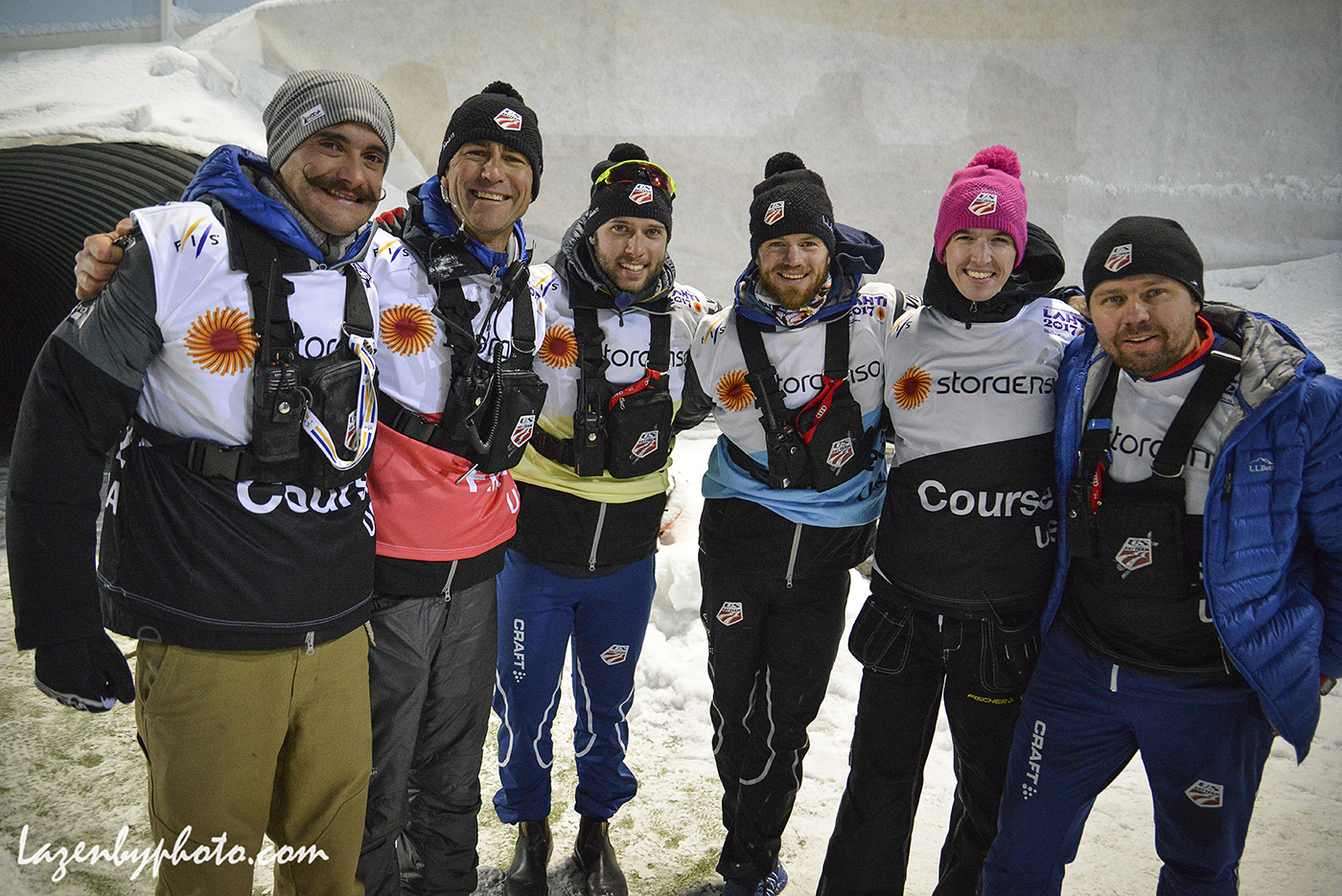
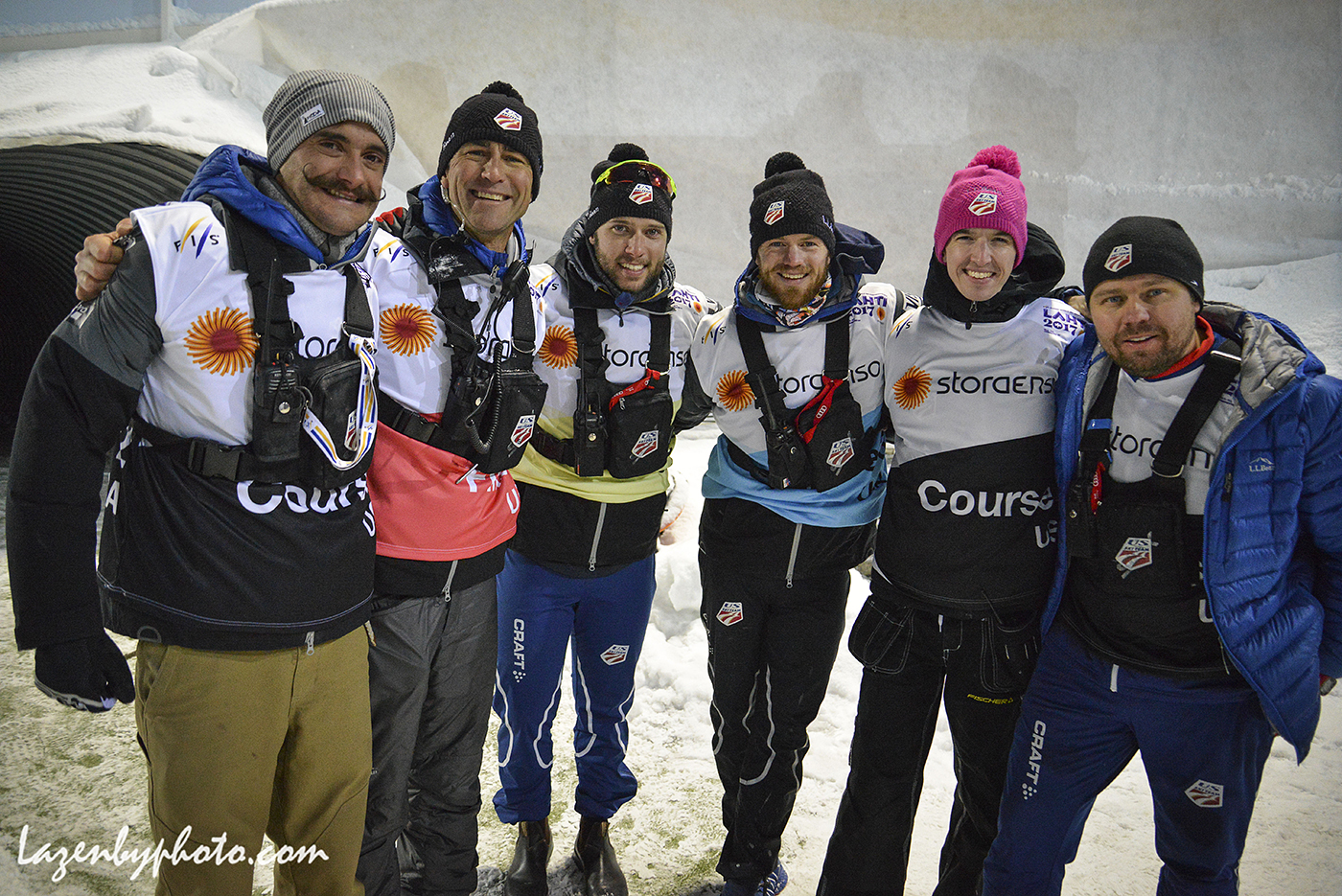
U.S. support staff after their team’s double podium in the women’s freestyle sprint at 2017 Nordic World Championships in Lahti, Finland. (From left to right) J.P. Laurin, Chris Grover, Tim Baucom, Andrew Morehouse, Patrick Moore, and Oleg Ragilo. (Photo: John Lazenby/Lazenbyphoto.com)
BEND, Oregon — Late last month, FasterSkier reached out to U.S. Ski Team (USST) Head Coach Chris Grover to discuss the team’s recent nominations.
The original range of topics was fairly narrow, the new iteration of the USST athletes and staff. Grover, however, ventured into the realm of how the USST will be modifying its criteria for team selection before the start of the 2018/2019 competition season. The criteria Grover discussed in the following Q & A, conducted over the phone on May 22, dealt with future USST nominations: not championship-team selection criteria. In other words, the rewritten criteria he discussed will have to do with the objective benchmarks an athlete must meet to be named to the USST D-team, B-team, and A-team, respectively. Beyond the objective criteria, Grover noted that coach’s discretion will remain an instrument of some future team nominations.
FasterSkier: OK, let’s jump in and discuss the U.S. Ski Team’s A-team roster.
Chris Grover: First of all, let me say one thing that we have been working on now for perhaps eight months, is trying to create new selection criteria to the U.S. Ski Team. And Gus Kaeding, who is a new staff member for us, someone that we just hired in the last few weeks, who came out of business school last year after coaching before that. He has actually been crunching the data for us. He took a bunch of statistics courses when he was in business school. So he kind of volunteered to come and start helping us try to figure out how to make a much more objective selection criteria. As you know, right now we have criteria where it is often about 50/50 in terms of athletes who make the objective criteria and athletes that are selected through discretion. And our goal is to create selection criteria for the 2019/2020 season that we put in place this summer, or at least before the ski season begins when the selection criteria would start. It is much more objective. It shows pathways not only at the very high end and not only in terms of a junior worlds medal but all along the different potential ages and potential athletes.
So that is coming together. We are still working on it. It will probably be tied to an athlete’s world rank at different ages, but our goal is to take a lot of the guesswork out of future selections. We couldn’t have put it in place this year because the selection criteria was already published as of last year and we cannot retroactively go back once the selection period is opened and apply new criteria. We can only apply it in years moving forward, but I am really excited to get to a point where the guesswork for athletes and coaches, for parents, is taken out of it. And ideally those people can look at criteria before a ski season and go, “If I do this, then I will be nominated to the U.S. Ski Team.” That said, I envision that there will always be discretionary picks that we make. There will always be people for whatever reason that come on late in the season.
Like, for example, their world ranks doesn’t mesh with what their current potential is. They have outstanding results that for whatever reason we didn’t see coming. So I envision that there will be discretionary selections going forward, but our goal is to make it so that there are many fewer discretionary selections and it is much more objective and clear-cut. I am excited to put something in place and something that we will be pushing out to the team hopefully later this summer or the very early fall at the latest.
A U.S. Ski Team selection is different than say a championship selection. It won’t go to, let’s say, a committee like our U.S. Ski and Snowboard cross-country committee. We will probably push it around to some athletes reps but it won’t go to a greater community. Because at the end of the day, this is the U.S. Ski Team and it is not necessarily the same as qualifying for World Juniors or the U23 or the World Cup or the World Championships. It is a little bit of a different deal. And the selection, basically, it needs to reflect the goals of the organization. And the goals of the organization are to win medals at the highest levels in the sport.
That didn’t answer your question. The question was something about the A-team.
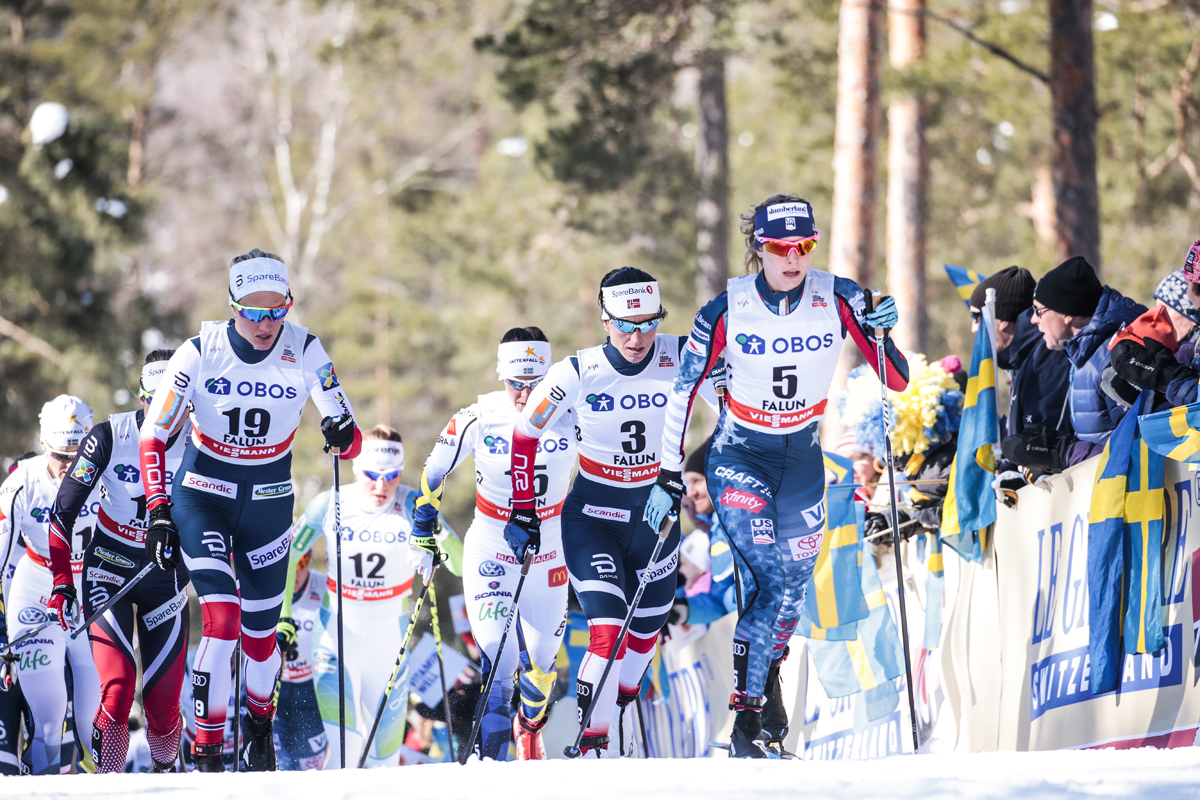
American Jessie Diggins (5) leading the pack up an early climb with Norway’s Kathrine Rolsted Harsem and Marit Bjørgen just behind during the women’s 10 k classic mass start at 2018 World Cup Finals in Falun, Sweden. (Photo: Fischer/NordicFocus)
FS: Back to the A-team. It’s quite impressive as it stands. An Olympic gold medalist in Jessie Diggins, third overall ranked World Cup women’s sprinter Sophie Caldwell, sixth-ranked overall skier Sadie Bjornsen, highly ranked sprinter Ida Sargent, and one dude, Simi Hamilton, who was 17th in the final World Cup sprint rankings.
CG: So the A-team athletes. That is objective. They make the team based on being top 30 in the world in either sprint or distance. They were all clear A-team selections based on the team nomination criteria. I am not quite sure yet if we will keep that exact standard going forward. We may. We also are really diving into this new data and seeing what we can find out. So, all those athletes qualify objectively. And then, the only other athlete that qualified objectively was Hailey Swirbul because she was an individual medalist two times over at World Junior Championships.
FS: Let’s jump to the D-team then. Some renominations. There’s Ian Torchia, Julia Kern, Hannah Halvorsen and Katharine Ogden. Then the newest members — Hailey Swirbul, Ben Ogden, and Gus Schumacher. Seven total. Is this the largest D-team you have had for awhile?
CG: For sure the largest D-team in at least in the past decade. And really, I mean, obviously, we are very excited because the results, just World Junior results alone, with this group of athletes has surpassed any group of athletes that we have ever had come through the ranks of the U.S. Ski Team.
These D-team results for many of these athletes are better than those of any of our A-teamers ever were able to accomplish at the World Junior Championships. And obviously, we have gone from 2016 at World Juniors having never had a medal at the World Junior Championships to now having five medals as a nation. So it is a super exciting step forward. We are really excited to have all these new faces as part of the team.
And this is why we have hired Gus Kaeding. He has been hired as a D-team coach specifically to help nurture and shepherd this group of athletes through the next few years of their development.
FS: Does Bryan Fish’s job change? Does the job description change as it relates to these specific athletes?
CG: Absolutely. The challenge that we had is that for Bryan, for one coach to effectively manage seven athletes at a high level is pretty daunting as it is. Bryan has so many other tasks already, including basically creating all the materials for our coaches education and then implementing the clinics and certification conferences as well as running all of our development summer camp opportunities REG, NEG, NTG … assisting at the U16 elite camp and then also trying to coordinate efforts between the NNF and what we are doing and the American Birkie Foundation, which is coming on as a supporter as well. And then winter trips and what he is doing to oversee the Super Tour, it was just too much. It was too much for one person to handle and we needed some help. And the greatest need with all these incoming younger athletes was certainly with the D-team squad.
FS: I believe this is Ian Torchia’s third year on the D-Team.
CG: That sounds right to me.
FS: Do you normally have a sort of “statute of limitations” on D-Team membership?
CG: Yeah, we really should. In Ian’s case, he had mono the year before last and then kind of was coming back this year and a little bit inconsistent with results. But I think that challenge that you just alluded to really speaks to why we need different selection criteria, why we need more objective selection criteria. Because athletes at some point should be moving. Either they are moving off the D-team or they are moving up to the B-team or moving up to the A-team. But they have to have movement after a few years. And the same goes for B-team athletes, but it is really unclear. I mean, right now, we don’t have any sort of clarity as to what those markers might be. And so that is why it is critical for us to figure a more concrete pathway for athletes so that they know the expectation. So you know, Ian, I would expect with his age he is probably going to have to be on the B-team next year if he is going to continue to be on the national team. So I am hoping with these new criteria that we create and define that pathway or at least define the expectations, I should say.
FS: So the new criteria, those expectations as they relate to the D-team, would have be to SuperTour-specific unless these athletes have start rights because they have earned them?
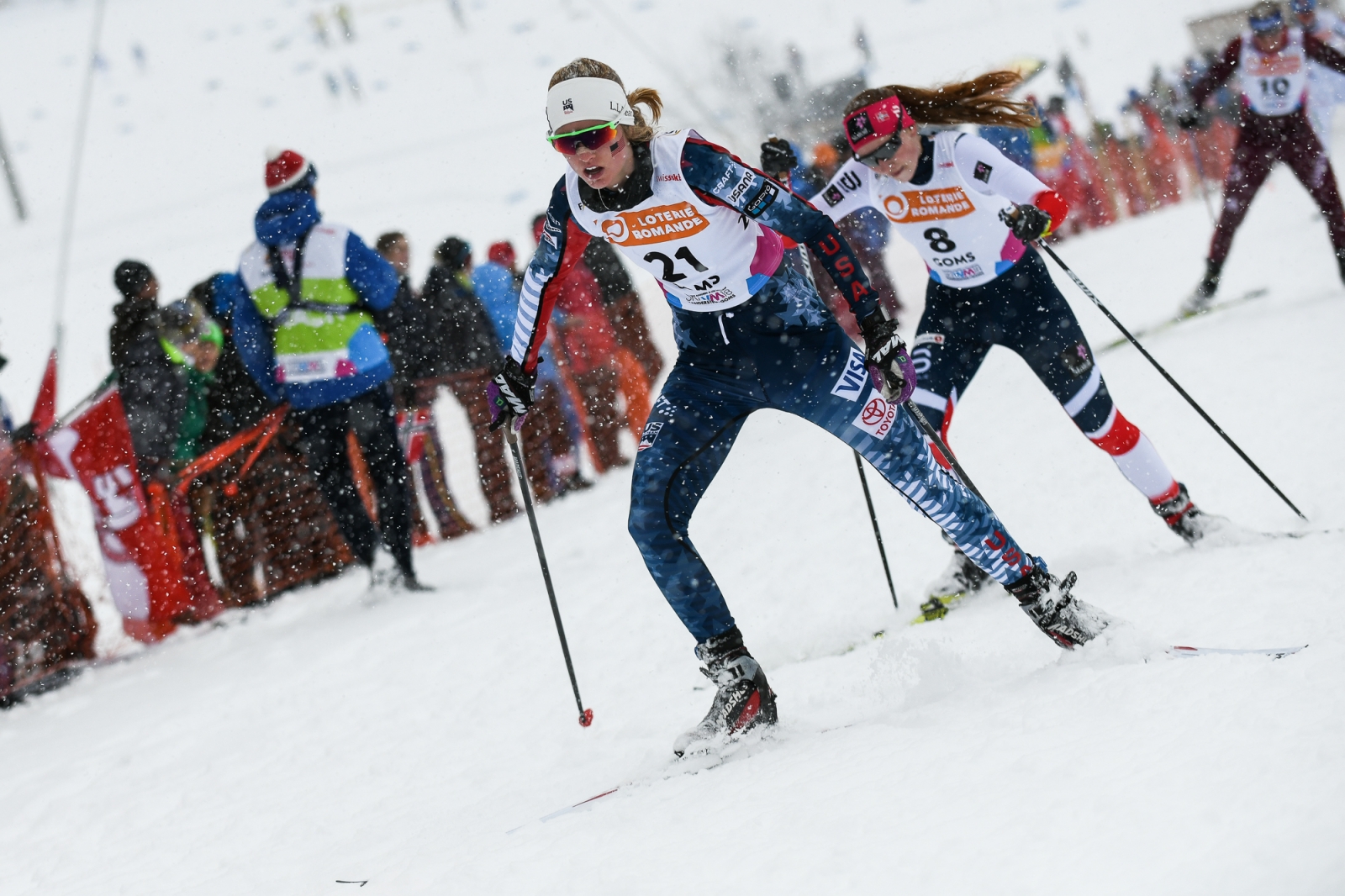
American Hailey Swirbul (University of Alaska Anchorage) leads Norway’s Lone Johansen up a climb during the second half of the women’s 10 k skiathlon at 2018 Junior World Championships in Goms, Switzerland. Swirbul placed third for her second individual podium of the championships. (Photo: JWSC2018.ch)
CG: I think that is why we are really looking at world rank for athletes. This is probably the most helpful thing as opposed to how they did on SuperTour, how they did on World Cup, how they did at the U23 World Championships, what happens at the NCAA Championships. That is the challenge for us, especially in North America being somewhat removed from where a lot of the racing is happening, a lot of the international racing obviously being in Europe. That is the challenge. World rank is going to help us identify that picture in a more meaningful way.
FS: Does that mean a reliance on FIS points?
CG: The difference is between using straight-up FIS points and world rank is that with FIS points, you can have very low FIS points but there could be one hundred people packed in there between you and zero FIS points. But with world rank, it gives us a finite amount of people that are below you or above you.
FS: So then as I am understanding the world ranking, this is then some sort of proprietary ranking that you will have?
CG: The way Gus has approached this, is that he is taking a look at every medalist at the Olympics and the World Championships in the past ten years. He has retraced the development path of those medalists. We are including not only those that have medaled in individual events but those who have medaled in team events. And then retracing kind of what their pathway is. And then perhaps we are going to give a plus-minus, a little 80th-percentile type adjustment to it, that allows for some leeway for an athlete. For example, coming from North America where maybe the pathway is slightly different than it is for European athletes. What we are basically trying to identify are the pathways for an athlete to win an Olympic medal or a World Championship medal and clarifying where you need to be. What are the markers at different ages? And that will help guide as to what the right world rank is for a given athlete to make the team.
And yes, there are always going to be a few outliers. That is why still need some discretion built in there. Once we have selection criteria in place then an athlete will be able to identify what their world ranking is and know how they fit into that selection or don’t fit into it.
FS: Anything more about the D-team that we should chat about?
CG: I don’t think any additional comments on the D-team. We are just excited to have such a talented group. There are lots of other athletes we have been looking very closely at who we anticipate as potential D-team members in the next year, but I wanted to see them basically make another small step forward before some sort of team nomination was implemented. That is where this new selection criteria is really going to help us out. Right now, it is selecting athletes via discretion and it is a judgment call on every one of these guys. That is not ideal from our perspective and it is not ideal from the athletes’ perspective.
FS: On to the B-team. Rosie Brennan was obviously not renominated. So it’s status quo with Erik Bjornsen, Paddy Caldwell, and Scott Patterson with the lone new addition of Kevin Bolger.
CG: With Rosie, we did not renominate her simply because she had been on that B-team position for awhile and hadn’t been making the step forward, hadn’t been making the objective criteria. That said, none of the guys made the objective criteria, either. But that is kind of normal of a B-team athlete, and that’s the challenge. That is where the main challenge is for us — to be able to identify those athletes especially when they are post-U23 athletes but they aren’t quite skiing consistent top-30 on World Cup — and be able to identify which athletes are still on the path to making forward progress. We named the others on discretion: Erik, Scott and Paddy because they were making forward progress on the World Cup. And then Kevin obviously had one of the best entrances to the World Cup of any U.S. athlete in history. So he really showed up and he did exactly what he needs to do to demonstrate that he absolutely has a ton of potential.
That was an easier call for us. The questions with the B-team and discretionary choices go back to why we need to create a new selection criteria.
FS: It’s within an athlete’s right to advocate for themselves. Did you get any pushback in terms of Rosie not meeting objective criteria?
CG: I’d say Rosie was very magnanimous about the decision and very professional about the decision. And for Rosie, and just like any of these athletes who kind of fall on the edge of making objective criteria, we absolutely still believe in them. They are invited to camps. We want to be able to work with them. They are going to be invited to competitions. We are going to be inviting many athletes to come and ski and fill World Cup start spots. So we want to be able to provide an opportunity for these athletes and Rosie is absolutely no exception. She is one of our best distance skiers in the country. We want to find opportunities to help her improve and make a step forward and we need to create an objective selection criteria that identifies that pathway and what the demands are better for athletes like her.
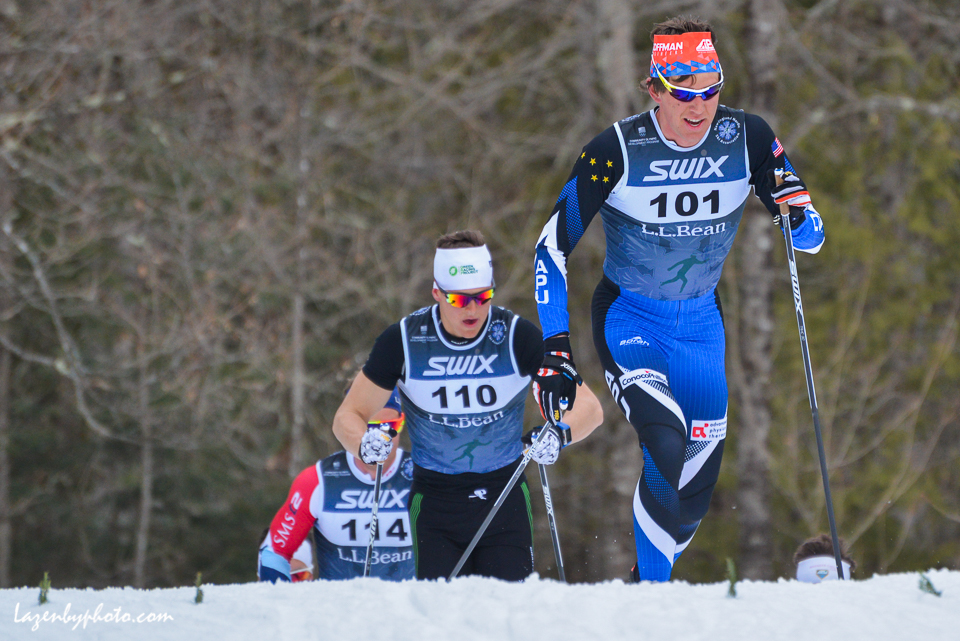
Scott Patterson (101) leads Adam Martin (110), Simi Hamilton (114) and others during the men’s 50 k classic mass start at 2018 U.S. Distance Nationals in Craftsbury, Vt. (Photo: John Lazenby/Lazenbyphoto.com)
FS: Looking at the athletes on the B-team, Scott Patterson obviously had a killer Olympics and a great Holmenkollen 50 k. Was that in the forefront of your mind with regards to his renomination to the B-team?
CG: Yeah, and he had a pretty rough start to the year. According to him, he had a pretty serious setback in the middle of the summer around an ultrarunning race that he was doing in Montana. And it really set him back and he struggled during World Cup Period 1. He seemed to come into his form during the Olympics. Scott actually skied quite well in the spring. Unfortunately, in the first distance race of the World Cup Finals, he and Erik both went down and they struggled to recover in a high-paced race in Falun. But I think Scott is definitely beginning to demonstrate what his potential was from the Olympics onward.
FS: Paddy Caldwell had some impressive time-of-day pursuit results early on in the season.
CG: He, unfortunately, got sick at one point during the Tour de Ski and he got sick during the Olympics. He definitely had some setbacks. But, overall, he skied quite well for a young athlete, the youngest of the group — being his first full year of World Cup. He would need to take a step forward this next year. Now he has a year under his belt. Now he is going to have to start scoring some points and those points are going to need to come from events that are beyond simply having a fast time of day split in a pursuit. But, that is going to be the step I am guessing in order to get whatever world rank he is going to need for this new selection criteria. That is what it is going to take.
FS: I believe Paddy is not here in Bend. That said, Paddy decided to remain in Europe and compete in and finish the Tour de Ski. Does it look like he would do the full complement of the Tour de Ski again?
CG: I am not sure. It is a real challenge around the Tour de Ski versus U.S. nationals. Because we have a selection criteria, although we have not implemented a new selection criteria, and we have not created the new selection criteria yet for the World Championships in Seefeld. But we have had a selection criteria for the last two years which has, obviously, two pathways: one being U.S. National Championships and SuperTour and the other being World Cup, including the Tour de Ski.
That makes it a real challenge. For those athletes that are on World Cup during Period 1, it makes it really hard to decide whether they should go back to U.S. nationals to qualify or whether they should go to the Tour de Ski. We are going to be encouraging probably anyone who is not really skiing well during World Cup Period 1, to go back to U.S. nationals and race at U.S. nationals and try to create a very robust selection process at U.S. nationals.
So you are right, Paddy is not here in Bend, he is doing finals at Dartmouth right now. So we have not had a chance to talk through those scenarios quite yet. One thing that for sure we are going to change about the selection criteria, and this is something to discuss with the community at the Cross Country Committee meetings in Park City, is that we are going to remove the final stage of the Tour de Ski from the championships selection period for distance athletes, and for sprinters as well. The distance period for selection will close on the day prior to the final climb. That has been a point of contention, as you know, within the community. Are we selecting the right athletes by having athletes who are racing uphill in skate? From my personal perspective, the athletes who have done well in that are the athletes that you want on a major championship team. They are aerobic engine skaters. But it is no problem from my perspective to remove that stage and hopefully remove some of the contentious feelings about that particular event.
So I don’t know exactly what [Paddy’s] plan will be yet. U.S. nationals versus a Tour de Ski. I think for a lot of these athletes, including him, we are going to see how people are skiing during Period 1 and whether it makes sense to ski the Tour de Ski or whether it makes sense to go back to U.S. nationals.
FS: Does that mean the USST will establish real concrete criteria as to whether or not someone would come back to U.S. nationals or remain on the World Cup?
CG: No. That is really challenging. If you create concrete criteria or something like that, then it probably needs to be blind to the athlete’s age and experience, but should it really be the same for an athlete who is 22 years old versus an athlete who is 34 years old? I don’t think it ever should. I think it is always important that there is some sort of coach’s discretion that is left that can contribute to making that decision because a younger athlete who might have ten or twelve years of World Cup ahead of them certainly can benefit perhaps from that experience more than an older athlete who might at the end of their career.
I think the heartache in the community comes when people think that we are looking at that decision as in prior to having qualified for the major championships instead of long-term development. And I can tell you from our staff perspective when we are making decisions like that, we are looking at two things. One: can the athlete contribute to outstanding results on World Cup? In this case, begin the Tour de Ski immediately? And second: is this athlete a U.S. athlete that we are trying to really develop for the future who would very much benefit from having this stage and experience and experience at these particular venues at this time?
CG: If he had raced the end of the Tour de Ski, had he raced those last couple of distances races, he may have made the B-team criteria. But one of his biggest goals for last season was to represent the U.S. in the team sprint in PyeongChang and to fight for a medal, so he was very focused on that. And that is why he stopped the Tour de Ski when he did, in order to get ready to race in Dresden. That was the one team sprint on the calendar last year. So he wanted to have the experience. Just from the aerobic as well as anaerobic and the tactical side of that as well. That was his real focus last year. And team sprint, for some of our key men, will continue to be one thing that we absolutely target and it probably remains one of our best chances at a medal.
FS: You are obviously still here. The assumption might have been that at the end of an Olympic cycle, a very successful cycle, that perhaps you would step down. Can you talk about your decision-making process to remain with the U.S. Ski Team?
CG: First of all. We are extremely lucky to have the staff that we have and one that has been as effective as they have been and as loyal as they have been. That goes not only for the coaching staff but also for our service team staff and also for so many of the volunteer providers that we utilize every year.
We have a handful of docs, PT’s, massage therapist — all of who we go back to year after year and ask for weeks and weeks of their time away from work, away from their paying work, away from family, and we ask them to volunteer their time and they keep coming back. We are incredibly lucky to have a staff that we have been able to retain. For Matt [Whitcomb], he came on in 2006, so I think he is going into his 13th year with the team. Jason [Cork] and Bryan [Fish] both came on the year right after 2010, I want to say 2011-2012, somewhere in that range. We have had a lot of longevity. Oleg Ragilo, who is our head technician, is back and he has been, I don’t know how many years he has been with the team, quite a few. He has been with us twice actually.
Also, Jean-Pascal Laurin, Tim Baucom, and Andrew Morehouse, all of those guys are returning. We do have one change on the service team. And that is that Marek Sander, who had been Kikkan [Randall’s] and Andy [Newell’s] tech, has decided to go back to Estonian biathlon which is where he came from when we hired him. Instead, we are hiring Eli Brown. Eli, people will know, he’s a former head coach of the University of Utah, but has been somebody that has been volunteering his time at least the last three major championships plus some World Cup racing for us as a technician.
And so we have just hired him to replace Marek as one of our technicians. So our staff is quite similar, obviously, we brought on Gus as well.
From left to right: Coach Matt Whitcomb with Sadie Bjornsen and Sophie Caldwell in Seefeld, Austria, last winter. (Photo: Garrott Kuzzy / LumiExperiences.com)
The other change that we are going to have, it’s a little bit of a job title change for Matt. Obviously, Matt has been our women’s coach. This year we have him in place to work with both men and women. So that Jason Cork, Matt and myself all basically work as a team with all of the World Cup athletes. We felt like we needed to change some of our setup in order to accommodate the needs of the team. We had some veterans that retired last year. When you have a smaller quote-unquote, “core”, at least the U.S. Ski Team on the World Cup level, we need to be more versatile in terms of helping and being able to help both men and women on a daily basis. And be more versatile with what our job requirements and our job titles are.
So we have some small changes there, but in general, we are really lucky to have everyone coming back. I think in terms of my own continued work with the national team, I will most likely continue until my family says stop and or until I don’t feel like the athletes are getting what they need out of my leadership. So, either one of those two things will be my cue to step down.
FS: For example, Jason Cork is out there testing skis with Jessie Diggins prior to races. I understand why she is a huge investment and the return on investment is important to the team, too. I understand why she might get a lot of resources. And it sounds like Matt is Simi’s coach and that has been going on for a year plus maybe. That said, as things might look from say Cork, Matt, and you redefining roles, how might that look different on the ground during race day?”
CG: It won’t look so different. Like you just alluded to, we are a smaller team. Well, I should say, we are starting to be a fairly big team. We are a smaller ski nation in terms of what our total imprint is on the World Cup and what our budget is perhaps, at least compared to our biggest competitors. Because our budget is so small compared to a Norway or a Russia, everybody, as you know, on our staff tends to do everything. And that is why job titles don’t always really make the most sense. We can give ourselves a title, but everybody ends up once in awhile cleaning some klister at the end of the day. That is just part of the nature of our program. So someone like Jason, he is spending a lot of time in the wax truck. Not only actually helping Jessie but as a key part of our service team as someone who helps Oleg with the overall organization of what we are doing on a daily basis. So someone like Jason is going to be in the wax truck quite a bit. And then also have coaching duties. Matt will be in the wax truck quite a bit less and have a lot more on the coaching duty side. I am going to have a lot of logistical work on a daily basis as well as a lot of staff management and athlete management type task, as well as some coaching duties.
But it is pretty hard to define those more specifically. They definitely change from day to day and week to week. The three of us are trying to basically cover all bases at that World Cup level.
On Thursday, U.S. Ski & Snowboard released its roster for its 2018/2019 national cross-country team nominations, and the list includes five returning A-team members (four women and one man), an all-male B-team, and seven athletes on the D (development) team.
Kevin Bolger (Sun Valley Ski Education Foundation) during his debut World Cup race weekend in Lahti, Finland, last March. There, he placed 11th in the freestyle sprint and 54th in the 15 k classic. (Photo: Fischer/NordicFocus)
Simi Hamilton leads the men’s team as its lone A-team member, while Sadie Bjornsen, Sophie Caldwell, Jessie Diggins, and Ida Sargent are all back on the A-team. The B-team includes three returners — Erik Bjornsen, Paddy Caldwell and Scott Patterson — as well as 25-year-old rookie Kevin Bolger, out of the Sun Valley Ski Education Foundation (SVSEF), who was named to the team after some breakthrough World Cup results last season.
All four of last year’s D-team were renominated, namely 2018 NCAA champions Katharine Ogden (who swept both races at the collegiate championships) and Ian Torchia, Julia Kern and Hannah Halvorsen. Joining them are three athletes who broke through at 2018 Junior World Championships: Hailey Swirbul, Ben Ogden and Gus Schumacher.
Seven of the 16 nominees train with the Stratton Mountain School (SMS) in Vermont. Six others are based out of Anchorage, Alaska; five train with Alaska Pacific University (APU) while the 17-year-old Schumacher hails from the Alaska Winter Stars. The Craftsbury Green Racing Project has one athlete on the team (Sargent), as does SVSEF (Bolger). Torchia is entering his senior season at Northern Michigan University.
Here’s the U.S. Cross Country Ski Team’s nomination list. The team will be officially named this fall.
U.S. Ski Team2018-19 Cross Country Nominations (Hometown; Club; Birthdate)
A TEAM Men
Simi Hamilton (Aspen, Colo.; Stratton Mountain School Elite Team; 5/14/87)
Women
Sadie Bjornsen (Winthrop, Wash.; Alaska Pacific University Nordic Center; 11/21/89)
Sophie Caldwell (Peru, Vt.; Stratton Mountain School Elite Team; 3/22/90)
Jessie Diggins (Afton, Minn.; Stratton Mountain School Elite Team; 8/26/91)
Ida Sargent (Orleans, Vt.; Craftsbury Green Racing Project; 1/25/88)
B TEAM Men
Erik Bjornsen (Winthrop, Wash.; Alaska Pacific University Nordic Center; 7/14/91)
Kevin Bolger (Minocqua, Wisc.; Sun Valley Ski Education Foundation; 4/11/93)
Patrick Caldwell (Lyme, N.H.; Stratton Mountain School Elite Team; 2/18/94)
Scott Patterson (Anchorage, Alaska; Alaska Pacific University Nordic Center; 1/28/92)
D TEAM Men
Ben Ogden (Landgrove, Vt.; Stratton Mountain School; 2/13/00)
Gus Schumacher (Anchorage, Alaska; Alaska Winter Stars; 7/25/00)
Ian Torchia (Rochester, Minn.; Northern Michigan University; 3/8/96)
Women
Hannah Halvorsen (Truckee, Calif.; Alaska Pacific University Nordic Center; 2/19/98)
Julia Kern (Waltham, Mass.; Stratton Mountain School Elite Team; 9/12/97)
Katharine Ogden (Landgrove, Vt.; Stratton Mountain School; 11/17/97)
Hailey Swirbul (Aspen, Colo.; Alaska Pacific University Nordic Center; 7/10/98)
Katharine Ogden (left) and Ian Torchia (right) are FasterSkier’s 2018 Collegiate Skiers of the Year. (Photos: Dartmouth Sports/Clarkson Creative & XTS Photography)
With the 2017/2018 season officially in the rearview, FasterSkier is excited to unveil its annual award winners for this past winter. Votes stem from the FS staff, scattered across the U.S., Canada, and Europe, and while not scientific, they are intended to reflect a broader sense of the season in review. This set of honors goes to outstanding college athletes in cross-country skiing.
***
Katharine Ogden, Dartmouth College
Katharine Ogden skiing fast doesn’t exactly surprise anyone. A medalist in both individual and relay events at last year’s World Junior Championships, the Stratton Mountain alum and U.S. Ski Team “D” team member won half of the women’s races on the Eastern Intercollegiate Ski Association schedule this season, including the final three individual races of the year.
But when the Dartmouth skier swept both races at NCAA Championships, first winning the 5 k classic by a stunning 46.9 seconds, then taking the 15 k skate by 38.4 seconds, that was something else.
The women’s 5 k classic podium at 2018 NCAA Skiing Championships in Steamboat Springs, Colorado, with Dartmouth’s Katharine Ogden (c) in first, Colorado’s Anne Siri Lervik (l) in second, and University of Alaska Anchorage’s Hailey Swirbul (r) in third. (Photo: Clarkson Creative/DartmouthSports.com)
“I was definitely a little stressed because I didn’t know if I could hold that pace or if they would catch up to me, and it’s usually kind of a sketchy strategy to be skiing by yourself, so I kind of knew that in the back of my mind too,” Ogden told The Dartmouth of her mid-race decision to make a move after the 5 k mark of the mass start, when it then turned out that nobody went with her.
The last time an American topped both women’s races at NCAA Championships was a decade ago, and though both 2007 titles were taken by a Lindsey, they weren’t the same one: Lindsey Williams and Lindsey Weir, both of Northern Michigan University.
It wasn’t since 1990 and 1991, when Laura Wilson of UVM swept NCAA’s, that the same American woman had won both races.
“Katharine absolutely wanted this one, and she really likes to win,” said Cami Thompson Graves, the Dartmouth Director of Skiing and women’s Nordic head coach, in a press release after Ogden’s second title. “She wasn’t about to let a fall slow her down, she has such a great competitive fire.”
Despite Dartmouth’s strong history of women’s skiing – alums Sophie Caldwell, Ida Sargent, Rosie Brennan, and Susan Dunklee competed in the 2018 Olympics alone, with many more alums at previous Games – Ogden was actually the first female Big Green cross-country skier to take an NCAA title.
“One day I would love to be one of the Dartmouth alums racing in the Olympics,” she said in a Dartmouth press release. “A lot of the reason I decided to come here for school had to do with growing up with Sophie Caldwell and seeing what a positive experience she had at Dartmouth.”
Ian Torchia, Northern Michigan University
Likewise, Ian Torchia has been a top junior athlete for the U.S. for some time now. By the time he went to NCAA Championships, he had already been to U23 World Championships, where his 27th- and 32nd-place finishes were the top American results in the 30 k skiathlon and 15 k classic, respectively.
Although he is enrolled at Northern Michigan University and trains there with the team, college racing was not his number one goal this season. Torchia won a 15 k skate NorAm in Sovereign Lake, British Columbia, early in the season in pursuit of those higher goals.
The men’s 15 k freestyle podium on Day 2 of the NorAm opening weekend at Sovereign Lake near Vernon, B.C., with Ian Torchia (NMU/USST D-Team) in first, Jack Hegman (SVSEF) in second, Brian McKeever (Canadian Para-Nordic Team) in third, Kevin Bolger (SVSEF) in fourth (far left), and Adam Martin (Craftsbury GRP) in fifth (far right). (Photo: Peggy Hung)
“My main goal for the season was to have a strong start to the season so I could qualify for U23s and the Olympics,” Torchia wrote in an email last week. “Competing in Yellowstone and Silver Star was a first for me, and coming into Nationals in the first spot on the Olympic qualifying list was exciting and nerve-wracking. Unfortunately, I had some sub-par racing at Nationals and missed the Olympics but qualified for U23s. I was definitely satisfied with the efforts I put in at U23s, but not with my execution and results. Finishing barely in the top 30 was not was I was hoping for but racing alongside guys who have gotten top-10’s on the World Cup was definitely motivating and gave me a real idea of where I need to be and what I need to do to get there.”
Coming back from Europe, he had to re-tool and had a solid training camp in Steamboat Springs before NCAA’s.
There, he finished fifth in the 10 k classic, the top American 46.2 seconds behind race winner Martin Bergström of Utah.
And in the 20 k skate mass start, he took his first NCAA title, holding off Alvar Alev of the University of Colorado by just two seconds, with Eivind Kvaale of Denver University another two seconds back.
“The first two laps of the race were very slow and it took patience to follow Coach Sten [Fjeldheim]’s plan of not leading,” Torchia wrote. “The Denver guys led it out on lap three and started gradually pushing the pace. On the final lap, people started throwing down and I was able to cover moves until 2.5 k to go when I gradually pulled the trigger. Alvar Alev from Colorado went on the final uphill and I was able to hang with him into the 2 k downhill. Coming into the final downhill he slingshotted by me but I was able to overtake him before the final turn and sprint faster than I’ve ever sprinted before for the win! I am not known as a sprinter on our team, so I was definitely nervous with a big group around me. But Sten has always told me that a sea level distance guy can outsprint an altitude sprinter, as training at lower elevation is beneficial to speed training.”
Torchia was the first American in three years to stand atop the NCAA podium; the last guy to do it was U.S. Ski Team teammate Patrick Caldwell in 2015. University of Alaska Anchorage’s Hailey Swirbul said that the international flavor of college racing is fantastic and helps her prepare for international competition and to be a better skier.
But to win NCAA’s as an American is still a perk.
“I definitely did not think about it before the race, but after it was pretty cool to think about the rarity of American winners,” Torchia wrote. “Fun to share it with my buddy Paddy Caldwell!”
Honorable Mention: Zane Fields, Colby College
Colby’s Zane Fields (left) racing at NCAA Championships last season. This season, he became the school’s first cross-country skiing All-American.
And on the men’s side in the East, one of the biggest revelations was the Colby squad. Andrew Egger qualified for U23’s and finished 47th in the sprint there, the second American. (“To be honest, making the U-23 World Championship team wasn’t really on my radar when I decided to go to Alaska [for U.S. Nationals]… That said, my goal standing on the start line of the sprints was to win,” Egger told the Colby sports department.)
On the college circuit, though, it wasn’t Egger who was making Colby history. Zane Fields demolished carnival after carnival, sweeping all five skate races before also winning the final classic race of the eastern season. At NCAA’s, the Colby junior finished sixth in the 20 k skate.
It was the best season-long tally by any Colby skier ever, and that final race made him Colby’s first male All-American in cr0ss-country skiing.
“This season has been a dream,” Fields said in a Colby press release after the 20 k. “If you had told me two months ago that things would unfold the way they did, I wouldn’t have believed you. While the sport is an individual one, I have the greatest coaches and team supporting me through every race.”
As a team, the Colby men finished third in two races this season behind Fields, and had a number of fourth- and fifth-place finishes.
“This has been the most fun year of skiing I have ever had,” Fields said in the press release. “The season is one that certainly makes the 500-plus hours of training and sacrifices worth it. I’m excited to see what my team and I can accomplish next year.”
Honorable Mention: Alayna Sonnesyn, University of Vermont
Those half of the EISA carnival races that Katharine Ogden didn’t win? They went to UVM’s Alayna Sonnesyn, who dominated the first half of the season and won three skate races and two classic races.
Sonnesyn also had a stellar U.S. Nationals earlier in the season, finishing eighth in the skate sprint and sixth in the 20 k classic; all but one of the skiers ahead of her in that race (winner Hedda Baangman of Sweden) went to the Olympics.
The mixed relay podium on Sunday at 2018 SuperTour Finals in Craftsbury, Vt., with Stratton (center: Simi Hamilton, Paddy Caldwell, Jessie Diggins, and Sophie Caldwell) in first, APU (left: Erik Bjornsen, Scott Patterson, Sadie Bjornsen, and Kikkan Randall) in second, and Craftsbury (right: Adam Martin, Alex Howe, Ida Sargent, and Caitlin Patterson) in third. (Photo: John Lazenby/Lazenbyphoto.com)
2018 U.S. SuperTour Finals (Craftsbury, Vermont): Mixed relays
For the second-straight year at the SuperTour’s season-ending Spring Series, the Stratton Mountain School (SMS) T2 Team won the mixed relay, with three of the four athletes who raced on last year’s 4 x 5-kilometer mixed relay squad.
Simi Hamilton, Sophie Caldwell, Paddy Caldwell, and Jessie Diggins combined for the win on Sunday in Craftsbury, tagging off in that order, with Diggins crossing the finish line first for the third-straight day. Diggins is undefeated in three races so far at Spring Series, after winning Friday’s classic sprint and Saturday’s 10 k freestyle mass start. The women’s 30 k classic mass start remains on Tuesday, followed by the men’s 50 k classic mass start on Wednesday.
Diggins and her Stratton teammates beat the Alaska Pacific University (APU) first team by 13.2 seconds at the line with a time of 53:43.2. The co-ed mixed relay has been held at SuperTour Finals for the last five years, and APU won the first three editions of the race from 2014 to 2016. Stratton won last year in Fairbanks, Alaska, with Ben Saxton, Hamilton, Caldwell, and Diggins.
APU led most of Sunday’s race, with Erik Bjornsen starting them off. He came through the first exchange in first place, just 0.2 seconds ahead of Hamilton in second. Behind them, Adam Martin of the Craftsbury Green Racing Project tagged in third, 0.8 seconds out of first.
Paddy Caldwell (302) tags his Stratton Mountain School (SMS) T2 Team teammate Jessie Diggins (402) in second, while Craftsbury’s Caitlin Patterson (430) looks on, at the final exchange of the mixed relay at 2018 SuperTour Finals in Craftsbury, Vt. Diggins went on to anchor Stratton to first place. (Photo: John Lazenby/Lazenbyphoto.com)
Sadie Bjornsen then extended APU’s lead to 7.3 seconds over Stratton’s Sophie Caldwell in second. Behind them, Craftsbury’s Ida Sargent came through the second exchange in 10.3 seconds back in third.
APU’s Scott Patterson went on to hold off Stratton’s Paddy Caldwell on the third leg, tagging 3.5 seconds ahead in first. Diggins came up big for Stratton on the anchor leg, passing APU’s Kikkan Randall to secure the win.
Craftsbury held its third-place position during the second half of the race with Alex Howe and Caitlin Patterson to finish third, 56.2 seconds behind Stratton. More than a minute later, APU 2 (Tyler Kornfield, Rosie Brennan, Logan Hanneman, and Rosie Frankowski) crossed in fourth (+2:04). Stratton’s second team (Saxton, Julia Kern, Andy Newell, and Erika Newell) placed fifth (+2:47.3), APU 3 (Reese Hanneman, Becca Rorabaugh, Eric Packer, Hannah Halvorsen) sixth, Dartmouth Ski Team (Luke Brown, Katharine Ogden, Gavin McEwen, Abigail Drach) seventh, Northern Michigan University (Zak Ketterson, Vivian Hett, Ian Torchia, Nicole Schneider) eighth, Middlebury College (Peter Wolter, Cate Brams, Adam Luban, Katie Feldman) ninth, and US Biathlon (Russell Currier, Clare Egan, Raleigh Goessling, Susan Dunklee) 10th.
Thirty-one “official” teams and eight “unofficial” teams competed, with NMU/CSS/NYSEF leading the unofficial teams with a time of 1:00:01.9 (which ranked 19th overall).
Racers have the day off Monday before the women’s 30 k and men’s 50 k classic mass starts (part of U.S. Distance Nationals) on Tuesday and Wednesday, starting at 9 a.m. EDT. Watch the races live on the SuperTour live stream.
Martin racing in Craftsbury’s Green and Black (R), leading in the mixed relay at 2018 Super Tour Finals, just ahead of APU’s Erik Bjornsen (L), in Craftsbury, Vt. (Photo: John Lazenby/Lazenbyphoto.com)
Sadie Bjornsen (l) tags APU teammate Scott Patterson in first at the second exchange of the mixed relay at 2018 SuperTour Finals in Craftsbury, Vt. (Photo: John Lazenby/Lazenbyphoto.com)
Sophie Caldwell (l) about to tag Stratton teammate Paddy Caldwell in second at the second exchange of the mixed relay at 2018 SuperTour Finals in Craftsbury, Vt. (Photo: John Lazenby/Lazenbyphoto.com)
Scott Patterson (301) tags his APU teammate Kikkan Randall (401) in first, while Stratton’s Jessie Diggins (l) waits to be tagged in second place, at the last exchange of mixed relay at 2018 SuperTour Finals in Craftsbury, Vt. (Photo: John Lazenby/Lazenbyphoto.com)
Alex Howe (r) tags his Craftsbury teammate Caitlin Patterson (l) in third at the final exchange of the mixed relay at 2018 SuperTour Finals in Craftsbury, Vt. (Photo: John Lazenby/Lazenbyphoto.com)
Jessie Diggins anchoring the SMST2 Team to the win in the mixed relay at 2018 SuperTour Finals in Craftsbury, Vt. (Photo: John Lazenby/Lazenbyphoto.com)
Jessie Diggins celebrates as she anchors the SMST2 Team to the mixed-relay win at 2018 SuperTour Finals in Craftsbury, Vt. (Photo: John Lazenby/Lazenbyphoto.com)
Jessie Diggins about to celebrate with teammates after anchoring the SMST2 Team to the mixed-relay win at 2018 SuperTour Finals in Craftsbury, Vt. (Photo: John Lazenby/Lazenbyphoto.com)
Caitlin Patterson anchoring the Craftsbury Green Racing Project team to third in the mixed relay at 2018 SuperTour Finals in Craftsbury, Vt. (Photo: John Lazenby/Lazenbyphoto.com)
Stratton Mountain School (SMS) T2 Team members and 2018 SuperTour Finals mixed-relay racers: (from left to right) Andy Newell, Annie Hart, Sophie Caldwell, Jessie Diggins, Erika Newell, Simi Hamilton, Ben Saxton, and Julia Kern. (Photo: John Lazenby/Lazenbyphoto.com)
A musically inclined Stratton Mountain School supporter at the mixed relay at 2018 SuperTour Finals in Craftsbury, Vt. (Photo: John Lazenby/Lazenbyphoto.com)
Bridger Ski Foundation teammates Andrew Meyer (r) and Corey Stock (l) during the final exchange of the mixed relay at 2018 SuperTour Finals in Craftsbury, Vt. Stock anchored the team to 17th. (Photo: John Lazenby/Lazenbyphoto.com)
Cambridge Sports Union skiers during an exchange at the mixed relay at 2018 SuperTour Finals in Craftsbury, Vt. (Photo: John Lazenby/Lazenbyphoto.com)
Retiring World Cup skier Liz Stephen raced the mixed relay with an unofficial team from her high school in East Montpelier, Vt., at 2018 SuperTour Finals in Craftsbury, Vt. They called themselves “U-32 High School”. (Photo: John Lazenby/Lazenbyphoto.com)
A team made up of NENSA, Onion River Nordic and Montpelier club athletes at the mixed relay at 2018 SuperTour Finals in Craftsbury, Vt. (Photo: John Lazenby/Lazenbyphoto.com)
Erik Bjornsen (2) of Alaska Pacific University and the U.S. Ski Team (USST) leads Simi Hamilton (13), of the Stratton Mountain School T2 Team and USST, and Tad Elliott (12), of Ski Club Vail toward the finish of the men’s 15 k freestyle mass start at 2018 SuperTour Finals in Craftsbury, Vt. (Photo: John Lazenby/Lazenbyphoto.com)
2018 U.S. SuperTour Finals (Craftsbury, Vermont): 10/15 k freestyle mass starts
Jessie Diggins won her second-straight race in as many days at 2018 SuperTour Finals and Erik Bjornsen pulled out a victory in the men’s 15-kilometer freestyle mass start on Saturday in Craftsbury.
Jessie Diggins (201) and Sadie Bjornsen (202) lead the women’s 10 k freestyle mass start at 2018 SuperTour Finals in Craftsbury, Vt. (Photo: John Lazenby/Lazenbyphoto.com)
Diggins, of the Stratton Mountain School (SMS) T2 Team and U.S. Ski Team (USST), won the women’s 10 k freestyle mass start in 25:56.0 minutes, just 1.2 seconds ahead of her USST teammate Sadie Bjornsen of Alaska Pacific University (APU) in second. The duo dropped the pack and battled to the line, while Kikkan Randall (APU/USST) skied on her own to third place, 12.6 seconds behind Diggins.
APU took three of the top four with Rosie Frankowski finishing 43.7 seconds back in fourth. Caitlin Patterson of the Craftsbury Green Racing Project (CGRP) followed in fifth (+1:02.2), and Sophie Caldwell (SMST2/USST) took sixth less than one-tenth of a second ahead of her Stratton teammate Katharine Ogden (Dartmouth College/SMS/USST Development Team) in seventh (+1:10.4). US Biathlon’s Susan Dunklee (CGRP) placed eighth (+1:19.4), Julia Kern (SMST2/USST D-team) finished ninth (+1:26.0), and Erika Flowers (SMST2), who competed at last weekend’s Norwegian Birkebeiner, placed 10th (+1:37.0).
In the men’s mass start, Bjornsen (APU/USST) and Simi Hamilton (SMST2/USST) went head to head down the finishing stretch for first, which Bjornsen took in 35:08.1. Hamilton finished 1.5 seconds back in second place, while Tad Elliott (Ski Club Vail) followed three seconds later in third (+4.6).
According to live timing, Paddy Caldwell (SMST2/USST) edged his fellow national-team member Scott Patterson (APU/USST) by less than one-tenth of a second for fourth place (+6.5). Brian Gregg of Central Cross Country (CXC), Team Gregg and Loppet Nordic Racing placed sixth (+30.4), David Norris (APU) finished seventh (+52.1), Jack Hegman of the Sun Valley Ski Education Foundation (SVSEF) eighth (+55.3), Adam Martin (CGRP) ninth (+56.2), and Eric Packer (APU) 10th (+59.8).
Spring Series continues Sunday with mixed relays at 9 a.m. EDT at the Craftsbury Outdoor Center.
Jessie Diggins (201) leads her U.S. Ski Team teammate Sadie Bjornsen and the rest of the women’s field in the 10 k freestyle mass start at 2018 SuperTour Finals in Craftsbury, Vt. (Photo: John Lazenby/Lazenbyphoto.com)
Jessie Diggins (SMST2/U.S. Ski Team) pushing to the line for the win in the women’s 10 k freestyle mass start at 2018 SuperTour Finals in Craftsbury, Vt. (Photo: John Lazenby/Lazenbyphoto.com)
Jessie Diggins (201) winning the women’s 10 k freestyle mass start, just ahead of Sadie Bjornsen (202) in second, at 2018 SuperTour Finals in Craftsbury, Vt. Kikkan Randall (background) placed third. (Photo: John Lazenby/Lazenbyphoto.com)
Kikkan Randall (APU/USST) racing to third in the 10 k freestyle mass start at 2018 SuperTour Finals in Craftsbury, Vt. (Photo: John Lazenby/Lazenbyphoto.com)
Kikkan Randall (l) and Jessie Diggins embrace after the finish of the women’s 10 k freestyle mass start on March 24 at 2018 SuperTour Finals in Craftsbury, Vt. Diggins won and Randall placed third. That was Randall’s second-to-last race before retiring from skiing. (Photo: John Lazenby/Lazenbyphoto.com)
Liz Stephen (U.S. Ski Team) racing to 12th in the women’s 10 k freestyle mass start at 2018 SuperTour Finals in Craftsbury, Vt. (Photo: John Lazenby/Lazenbyphoto.com)
Liz Stephen (U.S. Ski Team) having some fun at 2018 SuperTour Finals in Craftsbury, Vt. She finished 12th in the 10 k freestyle mass start. (Photo: John Lazenby/Lazenbyphoto.com)
U.S. Ski Team member Liz Stephen (yellow bib) during a photo opp at 2018 SuperTour Finals in Craftsbury, Vt. (Photo: John Lazenby/Lazenbyphoto.com)
Scott Patterson (1) leads his APU and U.S. Ski Team teammate Erik Bjornsen and the rest of the men’s field in Saturday’s 15 k freestyle mass start at 2018 SuperTour Finals in Craftsbury, Vt. (Photo: John Lazenby/Lazenbyphoto.com)
Scott Patterson (1) leads his APU and U.S. Ski Team teammate Erik Bjornsen and the rest of the men’s field in Saturday’s 15 k freestyle mass start at 2018 SuperTour Finals in Craftsbury, Vt. (Photo: John Lazenby/Lazenbyphoto.com)
The men’s 15 k freestyle mass start top six at 2018 SuperTour Finals in Craftsbury, Vt., with (from left to right) Brian Gregg in sixth, Paddy Caldwell in fourth, Simi Hamilton in second, Erik Bjornsen in first, Tad Elliott in third, and Scott Patterson in fifth. (Photo: John Lazenby/Lazenbyphoto.com)
Olympians Sadie Maubet Bjornsen, Jessie Diggins, and Kikkan Randall representing their club teams at the 2018 Super Tour Finals. (Photo: John Lazenby/Lazenbyphoto.com)
From left to right, Kikkan Randall, Bill Koch and Jessie Diggins, the U.S.A.’s three Olympic medalists in cross-country skiing at 2018 SuperTour Finals in Craftsbury, Vt. (Photo: John Lazenby/Lazenbyphoto.com)
Kikkan Randall (c) with young fans and her Olympic gold medal after the 10 k freestyle mass start at 2018 SuperTour Finals in Craftsbury, Vt. (Photo: John Lazenby/Lazenbyphoto.com)
The top finishers in the men’s 20 k freestyle mass start at 2018 NCAA Skiing Championships in Steamboat Springs, Colorado, with Northern Michigan University’s Ian Torchia (c) in first. (Photo: Dartmouth Sports/Clarkson Creative)
NCAA Skiing Championships (Steamboat Springs, Colorado): 15/20 k freestyle mass starts
On the fourth and final day of NCAA Skiing Championships at Howelsen Hill in Steamboat Springs, Katharine Ogden skied to her second-straight national title, Ian Torchia became an NCAA champion and the University of Denver (DU) won its 24th NCAA National Championship.
Dartmouth freshman Katharine Ogden racing to her second-straight victory of the 2018 NCAA Skiing Championships in Steamboat Springs, Colorado. She won Saturday’s 15 k freestyle mass start by more than 38 seconds. (Photo: Dartmouth Sports/Clarkson Creative)
Ogden, a Dartmouth College freshman, raced to a 38.4-second victory in the women’s 15-kilometer mass start, finishing in 43:22.0 minutes for her second win in as many races at 2018 NCAA Championships. She won the 5 k classic on Thursday and with her win on Saturday, she became the first Dartmouth skier in 56 years to win two national titles in the same year, according to a Dartmouth press release.
On the second of three laps, Ogden broke away early with close to 10 k to go. According to the press release, she had a “quick fall” near the end of the second lap, but that didn’t derail her as she had time to grab sunglasses from Dartmouth men’s coach Brayton Osgood and a Dartmouth Lone Pine flag before the finish.
At this year’s championships, Ogden’s two titles are accompanied by victories from Dartmouth men’s alpine skiers Brian McLaughlin (who won the giant slalom) and Tanguy Nef (who won the slalom). This marked only the second time that Dartmouth’s Big Green won four individual titles in a single NCAA Championships; that also occurred 61 years ago.
“Katharine absolutely wanted this one, and she really likes to win,” Dartmouth Director of Skiing and Women’s Nordic Head Coach Cami Thompson Graves said in the press release. “She wasn’t about to let a fall slow her down, she has such a great competitive fire. But she also showed her playful side grabbing Brayton’s glasses and smiling all the way to the finish line!”
Hailey Swirbul of the University of Alaska Anchorage placed second and Linn Eriksen (DU) reached the podium in third (+46.3). Denver had three in the top 10 with Jasmi Joensuu in ninth and Taeler McCrerey in 10th. Also landing in the top 10 for All-American honors were Guro Jordheim of the University of Utah in fourth, Emma Tarbath (Montana State University) in fifth, Petra Hyncicova of the University of Colorado Boulder (CU) in sixth, Christina Rolandsen (CU) in seventh, and Lauren Jortberg (Dartmouth) in eighth.
Torchia, an Northern Michigan University (NMU) junior and U.S. Ski Team Development Team member, became the seventh NCAA champion in NMU Wildcats nordic skiing history, according to an NMU press release. Fredrick Schwenke was the Wildcats’ last nordic champion; he won the 2015 NCAA Championships 20 k classic.
Torchia drew bib 1 for Saturday’s 20 k freestyle mass start and crossed the finish line first in 54:21.0, just 2 seconds ahead of CU’s Alvar Alev. Eivind Kvaale (DU) finished just four seconds back in third, and Denver had three in the top seven with Dag Frode Trollebø in fourth and Lars Hannah in seventh. Darmouth’s Cal Deline placed fifth, Zane Fields of Colby College finished sixth, and the 20 k freestyle’s 2017 NCAA champion Martin Bergström (Utah), who also won Thursday’s 10 k classic, placed eighth. CU’s Petter Reistad and Sondre Bollum finished ninth and 10th, respectively.
In the team standings, Denver beat Colorado by 41 points for the overall win with a total of 604 points between the nordic and alpine events at this year’s championships. Dartmouth placed third, 114.5 points behind Colorado, and Utah was another 63 points back in fourth.
According to a DU press release, Denver has won at least one national championship in each of the last five athletic seasons (skiing: 2013/14, 2015/16, 2017/18; hockey: 2016-17; men’s lacrosse 2014/15), joining only Stanford on the list of schools that have done so in the last five seasons. (Oregon, West Virginia, Penn State, Oklahoma, Ohio State and Florida could potentially join that list later this year.)
“It feels incredible,” said DU head coach Andy LeRoy said in the press release. “I am so happy for all of our athletes, they’ve been training all week and all season and to do it in Steamboat in front of our crowd is special.”
The Holmenkollen men’s 50 k freestyle mass start podium on Saturday at the World Cup in Oslo, Norway, with Switzerland’s Dario Cologna (c) in first, Norway’s Martin Johnsrud Sundby (l) in second, and Russia’s Maxim Vylegzhanin (r) in third. (Photo: FIS Cross Country/Twitter)
FIS Cross Country World Cup (Oslo, Norway): Men’s 50 k freestyle mass start
A four-time Olympic champion, Dario Cologna of Switzerland won his first 50-kilometer World Cup race on Saturday, topping the podium in the famous Holmenkollen 50 k freestyle mass start after outlunging Norway’s Martin Johnsrud Sundby (who won the event last year) for the win in 2:01:48.1. Sundby finished one-hundredth of a second behind for second place, ahead of Russia’s Maxim Vylegzhanin, who was 1.1 seconds back in third in his first World Cup race since November of last year.
The photo finish for first between Switzerland’s Dario Cologna (near) and Norway’s Martin Johnsrud Sundby at the Holmenkollen 50 k freestyle mass start on Saturday in Oslo, Norway. Cologna got it by 0.01 seconds. (Photo: FIS Cross Country/Twitter)
Norway’s Sjur Røthe came out on top in a race for fourth (+4.2), ahead of Russia’s Denis Spitsov in fifth (+4.4) and his Norwegian teammate Hans Christer Holund in sixth (+4.5). Great Britain’s Andrew Musgrave followed in seventh (+15.1), Germany’s Florian Notz placed eighth (+25.9) and Canada’s Alex Harvey finished ninth (+32.4), ahead of France’s Robin Duvillard in 10th (+33.5).
Scott Patterson led the U.S. in 16th (+56.3) coming off an 11th place in the 50 k classic mass start at last month’s Olympics, and Canada’s Devon Kershaw finished in the points in 28th (+3:43.6). Just outside the top 30, Canada’s Graeme Killick finished 34th (+4:55.1).
Also for the U.S, David Norris placed 38th (+6:19.7), Paddy Caldwell was 46th (+8:12.3), Noah Hoffman 49th (+10:27.9), Kevin Bolger 52nd (+12:44.2), and Simi Hamilton did not finish.
Canada’s fourth man in the race, Andy Shields finished 47th (+8:13.6).
Italy’s Lukas Hofer celebrates his team’s win in Saturday’s mixed relay at the IBU World Cup in Kontiolahti, Finland. (Photo: IBU/Biathlonworld)
IBU World Cup (Kontiolahti, Finland): Single mixed relay & mixed relay
(Note: This rundown has been updated to include comments from Christian Gow and Sean Doherty.)
In the last single mixed relay and mixed relay of the International Biathlon Union (IBU) World Cup season, France and Italy came out on top, with France winning the two-person single mixed relay and Italy taking first in the coed mixed relay.
France’s Anaïs Chevalier and Antonin Guigonnat after winning Saturday’s single mixed relay at the IBU World Cup in Kontiolahti, Finland. (Photo: IBU/Biathlonworld)
France’s Anaïs Chevalier and Antonin Guigonnat combined for zero penalties and six spares to finish first in the single mixed relay in 33:29.1 minutes. Guigonnat as the team’s anchor secured the win by just 2.4 seconds over Austria’s Julian Eberhard while Norway’s Johannes Thingnes Bø finished 4.4 seconds back for third.
Chevalier put France in fifth after the first leg, 15.5 seconds behind Ukraine’s Iryna Varvynets in first. Guigonnat used just one spare on his first leg to move them into fourth, 9.2 seconds back while Norway led at the second exchange. On Chevalier’s second leg, she shot clean in both stages to lead through the final exchange, with Ukraine skiing just 6.2 seconds back in second.
On the final leg, Guigonnat used two spares and stayed out of the penalty lap, keeping the team in first through the finish. Eberhard skied the second-fastest course time on that leg to elevate Austria (with Lisa Theresa Hauser) from fourth at the tag to second place at the finish, and Bø skied all the way up from eighth to third place for Norway (with Marte Olsbu) with the fastest course time.
Ukraine’s Artem Tyschenko used just one spare but slipped to fourth with the 11th-ranked course time on that leg, as he finished 10.8 seconds behind Norway.
Behind Russia in fifth and Italy in sixth, Canada placed seventh (+23.8) with Rosanna Crawford and Christian Gow. The duo combined for zero penalties and six spares, and put themselves in third place early in the race. Crawford skied them into third on the first leg, using just two spares and tagging Gow 7.4 seconds out of first.
Gow went on to take the lead after cleaning prone without any spares, and he cleaned standing as well but slipped back to third while Bø took the lead. Gow tagged Crawford in third, 8.9 seconds behind Norway in first.
“I didn’t think too much about being tagged in third,” Gow recalled in an email to FasterSkier. “It was exciting for sure, but I let it fade to the background so that I could focus on my job both on the track and in the range. It was great to leave prone in first place! It was also surprising, but it was a good place to be in.
“My skiing was ok today,” he continued. “It is a really challenging and demanding race format that we don’t get a lot of practice with. I was sick after the Olympic Games and only finally coming around the past couple days. The Sprint race was horrendous for me, so today was much better than that. In the range I just focussed on myself and trusted my shooting. I tried my best not to get caught up in the race going on around me and it worked to my benefit.”
Crawford then slipped to seventh and 21 seconds back with three prone spares, but avoided the penalty lap, and Gow held onto seventh through the finish, using just one spare and skiing the eighth-fastest course time on that leg.
“We are both happy with this result,” Gow wrote. “I think that we are both looking at the 23 second gap to first and thinking that if things had worked out just a bit better we could be there. It can be both exciting and frustrating to be that close to the podium. We know we can do it, it’s just a matter of putting it together on the right day. We are happy with 7th, but hungry for more.”
Susan Dunklee and Lowell Bailey finished 14th for the U.S., 1:13.0 out of first with one penalty and 14 spares. The penalty came on Dunklee’s first leg during her standing stage, after she had cleaned prone without any spares. She tagged Bailey in 14th and he brought them up to 11th, using three spares on that leg, then Dunklee came through the final exchange in 13th after using four spares to clean. Bailey lost one place on the final leg, using four spares but staying out of the penalty lap.
Twenty-six teams competed in the single mixed relay, compared to 23 in the mixed relay that followed.
Team Italia celebrates its win in the IBU World Cup mixed relay on Saturday in Kontiolahti, Finland, with its relay members Dorothea Wierer, Lisa Vittozzi, Dominik Windisch, and Lukas Hofer. (Photo: IBU/Biathlonworld)
In Saturday’s 2 x 6 + 2 x 7.5 k mixed relay, Italy nabbed a 1.5-second victory over Ukraine in 1:15:08.3. Dorothea Wierer, Lisa Vittozzi, Dominik Windisch, and Lukas Hofer — the same Italian team that took bronze in the mixed relay at last month’s Olympics, although in a different order — combined for the win with one penalty and 13 spares.
Ukraine, with Anastasiya Merkushyna, Vita Semerenko, Artem Pryma, and Dmytro Pidruchnyi, had zero penalties and just three spares throughout the whole race. For the second-straight relay on Saturday, Norway placed third (+9.1) with Synnøve Solemdal, Tiril Eckhoff,Henrik L’Abée-Lund, and Tarjei Bø totaling zero penalties and nine spares.
Italy’s lone penalty came in Vittozzi’s second leg, but it didn’t derail the team as it improved from sixth to fifth with Vittozzi, who skied the third-fastest course time on that leg. She tagged Windisch 6.8 seconds out of first, and Windisch, who had anchored the team in the Olympics, took the lead by the final exchange after using two spares to clean. Hofer left the exchange just 3.3 seconds ahead of Norway’s Bø but used just one spare and skied the second-fastest anchor leg to finish first, beating his rivals up Kontiolahti’s infamous climb known as “The Wall”. Ukraine’s Pidruchnyi also shot clean with a single spare and clocked the fastest anchor leg to move his team from fourth to second place. Bø lost one place and finished third after using one spare as well and skiing the third-fastest anchor leg.
Russia followed in fourth, France fifth, Sweden sixth, Germany seventh, Austria eighth, and the U.S. ninth (+2:48.4). The U.S. team, with Clare Egan, Joanne Reid, Tim Burke, and Sean Doherty, had one penalty and 11 spares. Egan cleaned her first prone but had to ski a penalty lap after her standing stage, tagging Reid in 17th, 58.7 seconds out of first.
Reid used three spares on the second leg and moved up to 13th by the second exchange, and Burke used three spares as well to pick off one more place and tag Doherty in 12th. Doherty skied the eighth-fastest anchor leg and used two spares to clean to put the team in ninth at the finish.
“I don’t consider two spares to be anything special, but today it was enough to make up some ground,” Doherty wrote in an email to FasterSkier.”I felt strong skiing, more like myself which is fun even if it’s a little late in the season. We had very good skis which always helps. I have done quite a few laps on this course over the years so the lines and transitions are pretty refined, so that is where I made time on the course.
“I am happy with my leg. I enjoyed my little battle for 9th,” he continued. “I can’t speak too much for the other members of the relay tonight but I think 9th is a solid effort.”
Canada finished 17th (+4:34.9) with Emma Lunder, Julia Ransom, Scott Gow, and Brendan Green combining for one penalty and 13 spares. Lunder put them in 12th at the first exchange and Ransom skied up to 10th, but Scott Gow had a penalty on his standing stage to drop to 16th. Green lost one more place on the last leg despite only requiring two spares.
The women’s 5 k classic podium at 2018 NCAA Skiing Championships in Steamboat Springs, Colorado, with Dartmouth’s Katharine Ogden (c) in first, Colorado’s Anne Siri Lervik (l) in second, and University of Alaska Anchorage’s Hailey Swirbul (r) in third. (Photo: Clarkson Creative/DartmouthSports.com)
On the first day of NCAA Skiing Championships at Howelsen Hill in Steamboat Springs, Dartmouth College freshman Katharine Ogden and University of Utah senior Martin Bergström were crowned champions in the women’s 5-kilometer and men’s 10 k classic races, respectively.
“There isn’t much more to say about Katharine’s performance today other than she absolutely crushed it!” said Dartmouth Director of Skiing and Women’s Nordic Head Coach Cami Thompson Graves, according to the Dartmouth press release. “It was such a treat to watch her perform so well.”
Martin Bergström (University of Utah) after winning his third-straight NCAA Skiing Championships title with a win in the 10 k classic on Thursday in Steamboat Springs, Colorado. (Photo: University of Utah)
CU, this year’s NCAA Championships host, had three women in the top 11 with last year’s classic champion Petra Hyncicova placing sixth and Christina Rolandsen finishing 11th.
The CU Buffs took the lead in the team standings on Thursday by nine points over the University of Denver (DU). Utah is currently 41 points back in third, Dartmouth moved up to fourth, and the University of Vermont, which led after Wednesday’s Day 1 alpine races, slipped to fifth.
In the men’s race, Bergström, who won both races at last year’s NCAA Championships, posted an 8.5-second victory over CU’s Petter Reistad with a winning time of 27:37.1. Dag Frode Trollebø of DU placed third (+14.7) ahead of his DU teammate Eivind Kvaale in fourth (+38.9). On his 22nd birthday, Ian Torchia, of Northern Michigan University and the U.S. Ski Team Development Team, was the top American finisher in fifth (+46.2).
Alpine slalom races will take place on Friday, while NCAA Championships will conclude with 15/20 k freestyle mass starts on Saturday.
IBU World Cup (Kontiolahti, Finland): Men’s 10 k sprint
First, a little geography lesson. Kontiolahti, Finland, is only about 100 kilometers from the Russian border, so most of the International Biathlon Union (IBU) World Cup (and World Championships) events held there attract a mostly Russian crowd.
The men’s 10 k sprint podium at the IBU World Cup in Kontiolahti, Finland, with Russia’s Anton Shipulin (c) in first, Latvia’s Andrejs Rastorgujevs (l) in second, France’s Quentin Fillon Maillet (r) in third. (Photo: IBU/Biathlonworld)
And here’s a little more background: Russia’s Anton Shipulin showed up for Thursday’s IBU World Cup in Kontiolahti raring to go after having been barred from last month’s Winter Olympics in PyeongChang, South Korea.
So Shipulin hadn’t raced since Jan. 21 in Antholz, Italy. The International Olympic Committee’s decision to ban him from the 2018 Games went public on Jan. 23.
Back in action in Kontiolahti, in front of Russian fans, Shipulin delivered a 5.8-second win in the men’s 10-kilometer sprint, shooting clean and finishing in 23:51.6. It was the 31 year old’s third non-relay podium of the season and first World Cup win of 2017/2018, and he did so on a relatively moderate evening by Kontiolahti standards (at -6 degrees Celsius, or 21 Fahrenheit) with a “stiff breeze” on the range, according to an IBU press release.
“I felt very good on the tracks and shooting and today it was enough to win,” Shipulin told the IBU. “I am very happy about this … all of the Russian fans gave me a lot of support on the tracks.”
Latvia’s Andrejs Rastorgujevs tied his career best in second place, after shooting a perfect 10-for-10 as well. He acknowledged his mom and women in general after the race.
“This is very important for my team,” Rastorgujevs told the IBU. “I would also like to congratulate all of the ladies and especially my mom on International Women’s Day.”
France’s Quentin Fillon Maillet also shot clean to place third (+17.3) for his third non-relay World Cup podium of the season.
Fillon Maillet was one of the earliest starters in bib 6 yet held off Norway’s Johannes Thingnes Bø, the 30th starter, by 1.7 seconds for the last spot on the podium. Bø had been a race leader after cleaning prone but missed two standing targets (0+2) to slip out of contention and into fourth at the finish (+19.0).
Germany’s Olympic sprint champion, Arnd Peiffer placed fifth (+27.4) with one miss (0+1), and France’s Simon Desthieux finished sixth (+28.3) with one prone penalty (1+0), and Germany took seventh and eighth with Erik Lesser (+30.6; one penalty) and Simon Schempp (+32.0; two penalties), respectively. Italy had two in the top 10 with Lukas Hofer in ninth (+35.2; one penalty) and Dominik Windisch in 10th (+38.3; one penalty).
Lowell Bailey of the U.S. posted his best sprint result of the season in 16th (+48.4) after cleaning prone and missing one standing target (0+1). After starting 22nd, he recorded the 13th- and 14th-fastest overall shooting and range times, respectively, and 23rd-ranked course time.
After the Olympics, Bailey returned home to Lake Placid, N.Y., for a brief training block. Despite a hefty amount of travel over the last week and a half, he explained in an email that he felt good in his first race back.
“I felt better than I have for most of the season. Sometimes that can happen. I guess that’s the part of the unpredictability of biathlon,” Bailey wrote of Thursday’s race. “The conditions were great today; hard tracks and calm winds on the range. There was a bit of wind, but compared to the three weeks in South Korea, it seemed pretty tame.
“Shooting felt solid today,” he added. “That missed shot in standing was sooo close, but not close enough!”
Overall, Bailey stated that he was happy with his performance and looking forward to the rest of the races in Kontiolahti.
Leif Nordgren (US Biathlon) raced to 17th for his best result in three seasons on Thursday in the men’s 10 k sprint at the IBU World Cup in Kontiolahti, Finland. (Photo: USBA/NordicFocus)
His teammate Leif Nordgren finished just one place behind him in 17th (+49.9) for his best result in three years. A later starter in bib 55, Nordgren also cleaned prone and missed one standing (0+1) with the fifth-fastest shooting time and seventh-fastest range time. Overall, his course time ranked 28th out of 100 finishers. Nordgren’s individual career best on the World Cup is 16th in a sprint in February 2015. He has finished 17th three times; the last time was in a pursuit in March 2015.
Brendan Green shot clean to lead the Canadian team in 34th (+1:29.5). American Sean Doherty followed in 35th (+1:29.7) with three penalties (1+2), and Tim Burke placed 38th (+1:36.1) for the U.S., also with three misses (1+2).
In his World Cup debut, American Alex Howe finished 68th (+2:23.1) with two misses (1+1).
Canada’s Christian Gow finished 79th (+2:47.4) with two penalties (1+1), and Scott Gow was 86th (+3:01.7) with three misses (1+2).
This year’s Kontiolahti World Cup does not include a pursuit race. The women’s 7.5 k sprint is scheduled for Friday at 11:45 a.m. EST in Kontiolahti, and the single mixed relay and mixed relay will follow on Saturday. Racing in Kontiolahti will conclude with men’s and women’s mass starts.
The SuperTour women’s 10 k classic mass start podium on Sunday in West Yellowstone, Montana, with Hedda Bångman (second from r) of the University of Colorado Boulder in first, and Craftsbury’s Kaitlynn Miller (third from r) and Caitlin Patterson (r) in second and third, respectively. From left: Caitlin Gregg in sixth, Katharine Ogden in fifth and Rosie Frankowski in fourth were also recognized at the flower ceremony. (Photo: FBD)
US SuperTour (West Yellowstone, Montana): 10/15 k classic mass starts
The second day of SuperTour racing took place as originally planned at the Rendezvous Ski Trails in West Yellowstone, with 22-year-old Hedda Bångman, of the University of Colorado Boulder (CU), and 33-year-old Brian Gregg (Team Gregg) winning the women’s 10-kilometer and men’s 15 k classic mass starts, respectively, on Sunday.
The men’s 15 k classic mass start SuperTour podium on Sunday in West Yellowstone, Montana,with Brian Gregg (c) of Team Gregg in first, David Norris (l) of APU in second, and Ben Lustgarten (CGRP) in third. (Photo: FBD)
Bångman, a Swedish freshman on the CU Ski Team, won the women’s race in 30:24.8, just ahead of two Craftsbury Green Racing Project (CGRP) skiers Kaitlynn Miller and Caitlin Patterson. While Miller placed second (+1.3) and Patterson was third (+3.4),
Rosie Frankowski of Alaska Pacific University (APU) finished another 10 seconds later in fourth (+13.5), and Katharine Ogden of the Stratton Mountain School (SMS) was fifth (+17.2). Caitlin Gregg (Team Gregg) followed in sixth, Felicia Gesior (CXC Team) was seventh, Anne Siri Lervik (CU) eighth, Erika Flowers (SMS Elite Team) ninth, and Corey Stock of the Bridger Ski Foundation (BSF) 10th.
In the men’s race, Brian Gregg pulled out a 1.9-second win over David Norris (APU), crossing the line first in 41:30.3. Ben Lustgarten (CGRP) reached the podium for the second-straight day (after placing second in Saturday’s skate sprint) in third (+4.6). Kyle Bratrud (CXC Team) finished fourth (+10.9) and Kris Freeman (Caldwell Sport) was fifth (+12.6). Tad Elliott (Ski & Snowboard Club Vail) followed in sixth, Eric Packer (APU) seventh, Ian Torchia (Northern Michigan University/U.S. Ski Team D-Team) eighth, Hunter Wonders (APU) ninth, and Martin Bergström (University of Utah Ski) 10th.
Sweden’s Charlotte Kalla winning the women’s 15 k skiathlon on Sunday at the Lillehammer World Cup in Norway. (Photo: Henrik Hunnes)
Sweden’s Charlotte Kalla pulled out another dominant distance performance on Week 2 of the World Cup, racing to a 19.7-second win in the women’s 15-kilometer skiathlon on Sunday, ahead of three Norwegians and American Jessie Diggins.
Kalla led at the halfway point of the skiathlon when skiers transitioned from classic to skate, just ahead of Norway’s Heidi Weng in second. The two had broken away around 4 k into the classic leg and put more than 20 seconds into the rest of the field by the transition, when Diggins came through 21.6 seconds back in third, leading a large chase group with Finland’s Krista Parmakoski, Norway’s Marit Bjørgen, Austria’s Teresa Stadlober, Norway’s Kathrine Rolsted Harsem, Finland’s Kerttu Niskanen, Norway’s Ragnhild Haga, and Switzerland’s Nathalie von Siebenthal, respectively.
While Kalla and Weng continued to trade the lead over the next 5 1/2 kilometers or so, by the 13.65 k marker, Kalla had dropped Weng, with 12 seconds between the two, while the chasers remained 29 seconds behind Kalla.
Over the next 1.2 k, that time gap grew to 20 seconds and 46 seconds, respectively, and Kalla skied off to her second win of the season in 42:24.7 minutes.
Weng placed second, 19.7 seconds back, and Haga claimed third (+43.6), after skiing alone for the last 4 k of the race. Bjørgen finished just ahead of Diggins for fourth (+54.3) and fifth (+57.0), respectively, and Stadlober was sixth (+1:04.9), Parmakoski seventh (+1:07.8), Norway’s Ingvild Flugstad Østberg eighth, Russia’s Natalia Nepryaeva ninth (+1:27.8), and Sadie Bjornsen 10th (+1:32.6).
Four Americans finished scored points in the top 30, with Kikkan Randall placing 16th (+2:06.5) and Rosie Brennan 29th (+3:07.7). Liz Stephen finished 36th (+3:25.7), Chelsea Holmes was 38th (+3:39.6) and Ida Sargent 55th (+6:41.1).
Cendrine Browne of the Canadian National U25 Team led Canada in 45th (+4:37.3), and Emily Nishikawa followed in 49th (+5:00.1). Katherine Stewart-Jones did not finish.
Klæbo Outlasts Sundby; Harvey 6th
A gassed Johannes Høsflot Klæbo (yellow bib) holding off fellow Norwegian Martin Johnsrud Sundby (r) for the win on Sunday in the men’s 30 k skiathlon at the Lillehammer World Cup in Norway. (Photo: Henrik Hunnes)
In the men’s 30 k skiathlon that followed, Norway’s Johannes Høsflot Klæbo made it a five-peat, proving himself once again unbeatable, this time in the first multi-discipline distance race of the season.
Klæbo outlasted [edit: rocketed past] teammate Martin Johnsrud Sundby to beat him by 1.3 seconds for his fifth-straight win in 1:16:47.1, and Norway swept the top four with Hans Christer Holund in third (+6.8) and Simen Hegstad Krüger in fourth (+10.9).
France’s Maurice Manificat followed closely in fifth (+11.3) and Canada’s Alex Harvey was next in sixth (+13.1), ahead of Finland’s Iivo Niskanen in seventh (+16.2), and Russia’s Alexey Chervotkin, Sergey Ustiugov and Alexander Bolshunov in eighth (+37.7), ninth (+42.2) and 10th (+59.6), respectively.
Klæbo skied patiently in the pack for essentially the entire race. For instance, at 11 k he sat back in 18th, just seven seconds from Canada’s Devon Kershaw in the lead.
One kilometer later, Klæbo remained 5 seconds back in 13th while Kershaw was 8 seconds back in 16th.
At the ski exchange at 15 k, Niskanen led Sundby and Italy’s Francesco de Fabiani and a total of 10 men within three seconds of first. Klæbo clocked through 5 seconds back in 13th, just ahead of Harvey in 14th (+5.3). Sixteen men remained within six seconds and striking distance of first. Kershaw in 18th had fallen off the pace and was 36 seconds back at the transition, just behind Russia’s Andrey Larkov.
While Harvey continued to ski around third place during the first 5 kilometers of the skate leg, Klæbo worked his way closer to the front and led at 22.5 k. By then, the lead group had dwindled to six within two seconds of first. Harvey remained in fourth.
Over the next 7.5 k, the lead changed several times, with Klæbo hovering near the tail end of the group. With about 200 meters to go, however, it was down to Sundby and Klæbo, with the former leading by 2 seconds (and Holund skiing seven seconds back in third). Klæbo ultimately had the most finishing kick to take the win by 1.3 seconds over Sundby, while Holund crossed 6.8 seconds later for third.
Canada had two in the top 20 with Kershaw in 19th (+2:59.7). Last year’s NorAm winner Russell Kennedy (Team R.A.D.) placed 53rd (+7:30.7), and Canadian World Cup Team members Graeme Killick and Knute Johnsgaard finished 54th (+7:41.3) and 60th (+9:49), respectively.
Two U.S. men landed in the points with Erik Bjornsen (U.S. Ski Team) in 20th (+2:59.9; just 0.2 seconds behind Kershaw) and Noah Hoffman in 28th (+3:37.8). Scott Patterson finished 36th (+4:56.1) and Paddy Caldwell was 56th (+7:43).
— International Biathlon Union (@biathlonworld) December 3, 2017
France’s Martin Fourcade overcame an early penalty and his No. 2 starting position to take the men’s 12.5 k pursuit win on Sunday, 40.8 seconds clear of anyone with 19-for-20 shooting (1+0+0+0).
Fourcade started 1 second behind Saturday’s sprint winner, Norway’s Tarjei Bø, and took control of the race after cleaning the second shooting stage. Bø missed one on the first prone stage then five more later in the race (1+0+3+2) to slip to 19th (+1:49.5) while Slovenia’s Jakov Fak raced up from 10th to second, 40.8 seconds behind Fourcade, with two penalties (1+0+0+1). Just behind him, France’s Quentin Fillon Maillet took third (+42.1) with identical shooting after Fillon Maillet started 12th and skied with Fak for most of the race.
France’s Martin Fourcade (l) and Quentin Fillon Maillet after placing first and third, respectively, in the IBU World Cup men’s 12.5 k pursuit on Sunday in Lillehammer, Norway. (Photo: IBU/biathlonworld)
None of the 58 finishers cleaned the four-stage race. American Lowell Bailey improved from 22nd to 17th (+1:40.2) with two misses (0+1+0+1). Canada’s Christian Gow achieved a career best in 21st (+2:04.6), up from starting 26th, after shooting 19-for-20 (0+0+1+0).
Also for Canada, Nathan Smith slipped from 24th at the start to 42nd (+3:19.2, three penalties), Scott Gow finished 50th (+4:10.9; six penalties) after starting 16th, and Brendan Green placed 51st (+4:18.6; five penalties).
One other American qualified in the sprint top 60 for the pursuit, with Tim Burke finishing 48th (+3:52.7; four misses).
In the women’s 10 k pursuit earlier in the day, Germany’s Denise Herrmann tallied her second-straight win (and the second win of her IBU World Cup career). She started first and successfully held of France’s Justine Braisaz, who started 15 seconds behind her in second place, by 25.8 seconds. While Herrmann missed two on her third shooting (0+0+2+0), Braisaz was one of three women in the field to clean (0+0+0+0).
Norway’s Marte Olsbu raced up from seventh to third place (+48.0) with two penalties (0+1+0+1).
Canada’s Julia Ransom placed 23rd (+2:48.1), up from 29th at the start, with two misses (0+0+1+1). Two of her teammates also qualified for the pursuit, with Rosanna Crawford finishing 52nd (+5:25.1) with six penalties (0+3+1+2). In her first World Cup pursuit, Megan Bankes completed three shooting stages before being lapped (3+1+1).
No American women qualified for the pursuit.
With the conclusion of the first IBU World Cup in Östersund, the circuit moves to Hochfilzen, Austria, where racing kicks off again Friday, Dec. 8, with men’s and women’s sprints.
The PyeongChang venue as seen in February 2017. PyeongChang, South Korea, will host the 2018 Olympic Games this coming February. (Photo: FIS Cross Country/Twitter)
Note: This is the first of a multiple-part series on the 2018 Winter Olympic selection criteria for the U.S. cross-country ski team. A parallel piece compares the cross-country team’s criteria with other U.S. winter sports.
***
Friday, July 7, will mark seven months to go until the Opening Ceremony for the 2018 Winter Olympics in PyeongChang, South Korea. As athletes across the country ramp up their commitment in this Olympic year, and #roadtopyeongchang trends across various social media platforms, FasterSkier takes a look at the recently released selection criteria and procedures for nomination to the U.S. Olympic team.
Briefly put, what does it take to get to PyeongChang? And what factors will U.S. Ski Team (USST) coaches and (newly rebranded) U.S. Ski & Snowboard leaders apply in deciding who will be wearing red, white and blue next February?
In this article, FasterSkier first breaks down the criteria themselves, then summarizes a recent interview with USST Head Coach Chris Grover about why these criteria were chosen and how they should work.
Inside the criteria: World Cup performance, discretion and potential domestic picks
The criteria themselves are little changed from the standards used to pick the American team for the last two international championship events, World Champs in Falun in 2015 and Lahti in 2017. First comes objective qualification via performance on the World Cup. Second comes the potential use of discretionary picks. Third, if any spots are left over, the highest-ranking athlete on a domestic points list may, but does not have to, be nominated to the team.
As for the overall size of the U.S. team, a maximum of 12 male or 12 female athletes may be nominated, with a final team quota of probably 17 to 20 athletes to be determined closer to the Olympics themselves. (This is up from a total team quota of 17 in 2014, though ultimately only 14 athletes were named for Sochi, and the extra three American spots were redistributed to other nations.)
The U.S. may enter up to four athletes in a single race at the Olympics. The six cross-country events in PyeongChang will be a skiathlon (15 kilometers for women and 30 k for men), individual classic sprint, freestyle team sprint, 10/15 k skate interval start, 4 x 5 k or 4 x 10 k mixed technique relay (classic, classic, skate, skate), and 30/50 k classic mass start.
As for the criteria themselves for making the U.S. Olympic team: In order:
Objective qualification via World Cup results
Athletes who have achieved a top-eight finish in one of five specific races, or who have a top-50 ranking on either the World Cup sprint or distance list midway through Period II, will be named to the team.
Most precisely, “Any eligible athlete that posts a top-8 individual final World Cup result during the selection period [Nov. 23, 2017, through Jan. 15, 2018] in the following events will be selected to the Team: Sprint C, individual start 10/15 km F, and 15/30 km Skiathlon.”
Looking to the schedule for the 2017/2018 World Cup season, classic sprints will be held on Nov. 24, in Ruka, Finland; Dec. 2, in Lillehammer, Norway; and Jan. 3 in Oberstdorf, Germany (as part of the Tour de Ski). A 10/15 k freestyle individual start will be held in Davos, Switzerland, on Dec. 10. The only skiathlon on the 2017/2018 World Cup calendar will be held in Lillehammer on Dec. 3. Any athlete posting a top-eight final result in one of those five races will be named to the Olympic team.
(The 10/15 k skate pursuits on the schedule don’t count for top-eight purposes – it’s only Olympic formats that are used for qualification. And the 10/15 k skate race in PyeongChang is an interval-start race, not a pursuit.)
So that’s high finishes in individual races. As for cumulative performance across multiple races, “Athletes ranking in the top-50 in the distance World Cup standings or the top-50 in the Sprint World Cup standings as of January 15, 2018 shall be selected to the team.” Jan. 15 marks roughly the midway point of the World Cup calendar. By that point, 18 World Cup races will have been held.
U.S. Ski Team member Sadie Bjornsen racing in the women’s 15 k skiathlon at the 2014 Winter Olympics in Sochi, Russia. Bjornsen is a veteran member of the national team heading into another Olympic year.
As of the comparable point in the 2016/2017 season, shortly after the Tour de Ski, USST members Sadie Bjornsen, Rosie Brennan, Sophie Caldwell, Jessie Diggins, Simi Hamilton, Noah Hoffman, Andy Newell, Kikkan Randall, Ida Sargent, and Liz Stephen had top-50 rankings in either or both disciplines.
A maximum of five athletes per gender may be selected based on their Sprint World Cup rankings. Tiebreaking procedures come into play at that point if necessary, generally based on an athlete’s single best finish in a sprint race.
Discretionary selection
Spots on the U.S. Olympic team will presumably remain open after the application of the objective criterion of World Cup performance. In that case, “the USSA Cross Country Head Coach may use discretion … to determine team nominations” for additional spots on the Olympic team.
Grover would at that point recommend additional athletes to a three-person committee, composed of U.S. Ski & Snowboard President Tiger Shaw, Executive Vice President of Athletics Luke Bodensteiner, and athlete representative Rosie Brennan.
If Brennan stands exposed to a potential conflict of interest from discretionary selection (that is, through no fault of her own, she “stands to benefit privately from a decision made by the Selection Committee,” as would happen if she had not qualified objectively and were being considered for discretionary selection), then she would be directed not to engage in any conduct “meant to unduly influence” the selection committee regarding her potential selection to the Olympic team.
Grover is then directed to consider any of (a) “outstanding competition results” from both this season and last season, (b) “Recent positive direction or trend of competition results indicating a potential for Olympic success,” or (c) “Indication of medal potential in future Olympic or World Championship competition (such as international age group results and rankings) that would be materially enhanced by selection to the team.”
U.S. Ski & Snowboard was not required to make discretion a means of selection to the team. It also has the discretion not to use discretion at all; as the document states, Grover may use discretion to determine additional team nominations, but does not have to.
Domestic selection. Maybe.
If there are any spots remaining on the team after applying criteria (1) and (2), U.S. Ski & Snowboard may consider the highest-ranked domestic athlete, one per gender. But it technically doesn’t have to.
(There is some ambiguity within the selection document itself as to whether more than one team spot could be filled via a domestic ranking list. On the one hand, selection criterion 3 uses the plural when it talks about “any remaining positions,” and “those positions may be filled.” On the other hand, it also mentions “the athlete with the highest rank on the 2018 Olympic Winter Games Selection List,” and both “athlete” and “rank” are in the singular. In practice, Grover clarified in a recent phone interview that the national team is potentially open to bringing more than one skier per gender, pointing out that four men and two women were brought to Lahti off the domestic rankings list.)
The 2018 Olympic Winter Games Selection List, as with the comparable list for 2017 World Champs in Lahti, is essentially the “normal” 2017/2018 SuperTour points list, plus substantial bonus points for 2018 U.S. National Championships. An athlete’s best two finishes in a single discipline (sprint or distance, not skate or classic) will be counted.
The SuperTour point totals system, and bonus points for podium finishes at 2018 U.S. nationals, appear to be precisely the same as those used last winter for Lahti. That is, first through third at the December SuperTour races will be worth 30, 25, and 21 points, respectively. The addition of nationals-only bonus points means that first through third in the four races in Anchorage count for 45, 35, and 26 points, respectively. When an athlete’s best two finishes are counted, a second and third at U.S. nationals (61 points) would be worth more than two firsts (60 points) at “normal” SuperTour races.
For this reason, in last year’spreview for 2017 U.S. nationals, FasterSkier quoted longtime racer Kris Freeman as stating that “the allocation of bonus points to Nationals essentially makes the remainder of the SuperTours irrelevant. Nationals is now World Champ and Olympic Trials which is fine, but let’s call them what they are.”
The math is the same this season as last season. This season, U.S. nationals start in Anchorage on Jan. 3, 2018. The four races there will be a skate sprint, classic sprint, 10/15 k skate interval start, and 20/30 k classic mass start.
Discretion and selection to international championship events
The appropriate role of discretion when selecting athletes for a World Ski Championships or Olympic team is a subject of recurring interest for fans and supporters of American cross-country skiing, and has frequently arisen on this site.
For example, here’s USST Women’s Coach Matt Whitcomb in an interview with FasterSkier in July 2016, answering the question, “Is it fair to say that making discretionary picks is one of the harder parts of your job as a coach?” Whitcomb replied, “For sure. We love not to do it. But in any criteria, discretion can often be one of the most important pieces. We really envy these Olympic Trials [for the American track and field athletes for the 2016 Rio Olympics] that we’re watching right now, where the top three go and fourth is either an alternate or they don’t go, and it’s just much more objective.”
And here’s Grover in January 2017, slightly ahead of the naming of the U.S. team for Lahti: “The real key thing is that, at the bottom of the selection, we followed the selection criteria. That’s key. Discretion really belongs to be used at the top, for those athletes who have a chance to come over and have big races at World Championships, and by big races I mean someone who can go on the podium, or the top five, top 10, or top 15. Look for some selections from USA, but I wouldn’t look for a lot of discretion at the end of the day.”
Or here’s Grover in January 2014, discussing why he and the rest of U.S. team leadership abjured discretion completely in taking Brian Gregg to Sochi but not Matt Liebsch, when only 0.04 points separated the two on the domestic men’s distance list: “We really tried to apply the selection criteria in the most fair way possible.That becomes, for sure, a challenge, especially on the men’s side when you get down to the sixth, seventh, eighth guys, you’re really splitting hairs because the FIS points are so close at that point. Because they were so close we opted not to use discretion. It really wasn’t a fair way to do it.”
(As things played out in Sochi, USSA selected 14 athletes out of a total possible quota of 17. Grover explained at the time, shortly after selections were made and before the Olympics began, that they had only intended to bring those athletes whom they planned on starting in races. “With seven women and seven men, we have our start positions filled,” Grover told FasterSkier before the Games. “Seven and seven was the magic number for us.” Liebsch is reported to have considered legal action to gain a spot on the U.S. team for Sochi, but found that that it was “too late” for him to do so. In Sochi a few weeks later, U.S. athlete Torin Koos did not start the 50 k skate race, a race format in which Liebsch had previously won at the American Birkebeiner.)
The U.S. Ski Team’s views on discretion
Grover, the longtime USST head coach, is aware that people feel strongly about the substance and application of selection criteria for U.S. championship teams. “I think overall I’d say people get a little bit mired up and tied up with selection criteria, and whether it’s fair or not, or how this potentially sees them falling within that criteria,” Grover told FasterSkier in a recent phone interview.
But Grover has a simple message for domestic athletes hoping to go to PyeongChang: “All you need to do is to ski fast, you need to go out there and win races, or to reach podiums. And if you can do that, your chances of being selected to the team are quite good.”
The current criteria are “better than ever, more fair than ever,” Grover continued. “I think [it] gives athletes the most direct path possible to a major championship team.”
Grover urged domestic athletes not to obsess over the apparent prioritization of discretion over domestic race results as a means of picking the Olympic team. Addressing a hypothetical non-national team member, he said, “As as an athlete domestically, don’t get hung up in the order that those things come down in the selection criteria. Discretion has to be next, because a discretionary athlete that’s picked needs to be picked because they are a top athlete who should be on the team, who has somehow been missed by the selection criteria.
“So that’s the placement it has to be,” he continued. “And that’s consistent with selection criteria across different disciplines, in different sports. So that’s just the way that the procedure needs to work. But it doesn’t mean that a large number of discretionary athletes will necessarily be selected prior to the domestic field.”
The statements that discretion “has” to have this status, and that this is “consistent with … different sports,” are not necessarily correct. As reported today in another article on FasterSkier, discretion plays a less prominent role in every other U.S. Ski & Snowboard sport.
Grover also underscored that the use of discretion within American skiing pales in comparison to its role in Norway or Russia.
“We’re competing against teams that are using 100-percent discretion to name their teams,” Grover emphasized. “So in the U.S., we have kind of the most democratic, objective, fair, I guess you could say – other nations, our Scandinavian peers, might call this an American system that we use for selecting athletes. It’s very cut-and-dried.”
The four countries that Grover mentioned by name in his interview as the Americans’ main competition – Norway, Sweden, Finland, and Russia – all finished ahead of the U.S. in the final Nations Cup standings for the 2016/2017 World Cup season.
Grover also stressed that U.S. Ski & Snowboard used only one discretionary pick for the Lahti roster, taking USST athlete Erik Bjornsen. “And the reason that we used one discretionary spot to select Erik was because he basically fell between the two criteria. He didn’t quite make the top-50 in the world standard because he had gotten sick during the selection process, and he wasn’t home domestically to race in the races domestically, but I think very few people out there would argue that that wasn’t a good use or a smart use of one discretionary spot.”
Grover further stressed that the team had used, as he initially put it, “zero discretion” when selecting athletes for Falun World Championships in 2015. (In a subsequent email to FasterSkier, Grover clarified that “We used zero discretion in the original selection of 16 athletes (8 men and 8 women) to the Falun Team, but we did add Ben [Saxton] at a later date via discretion after he finished 6th in the sprint at U23 Champs.”)
Writing criteria for the top vs. the bottom
Grover cited the decision to bring Erik Bjornsen to Lahti as an exemplary use of discretion, underscoring that Bjornsen was a skilled athlete who “had some of the very best individual results there” among American skiers.
“So that is absolutely our intention,” Grover continued, “it has been our intention, and it will be our intention going forward, is that we use discretion on the rare case where there’s an injury, or an illness, with a top athlete, and/or the criteria fail to select someone that I think most everyone would agree should be there representing the United States.”
At world champs in Lahti in 2017, Bjornsen finished 18th in the 15 k classic and teamed up with Simi Hamilton to finish fifth in the team sprint. At world champs in Falun in 2015, Saxton finished 54th in classic sprint qualifying, roughly nine seconds from making the heats.
While Grover is confident that discretion is most appropriately used for a top-performing U.S. athlete, he acknowledged some issues regarding the final athletes selected (or not selected) to a team.
Summarizing his discussion with domestic senior club coaches about the selection criteria used for Lahti, and any potential changes before PyeongChang, Grover said, “All the responses I got back were positive, people were like, Yeah, it worked well. It’s never perfect at the bottom, but I don’t really see any way to improve it.”
Indeed, he noted, the U.S. Ski & Snowboard working group “struggled with” how to select “athletes at the bottom of the selection, and make it as fair as possible. And what you come up with at the end is, in the end there’s no real perfect way to do it, and there’s going to be challenges to the way that any selection criteria works at the very bottom of the selection.”
Current success vs. preparing for the future
Another issue surrounding selection is the question of current competitiveness vs. taking a young athlete to a “practice” Olympics just for the experience – that is, is the Olympics for development or for podiums. In 2014, for example, regarding the recently named team for Sochi, Grover said, “The Olympics is the pinnacle of the performance or competition pipeline.”
Development occurs at many lower levels, Grover noted (Europa Cups, World Juniors, etc.), but “It does not and should not come at the World Championships or the Olympics. … It’s not a development trip; it’s a competition trip at the very highest level.”
Similarly, earlier this year Grover explained that junior skier Katharine Ogden (a.k.a. “KO”) was not selected for Lahti on the grounds that “athletes should first aim to be successful at – in the age group that they’re competing against. So for KO, that means World Juniors, and being successful at World Juniors.”
The third prong of discretionary selection for the current Olympic team, “Indication of medal potential in future Olympic or World Championship competition (such as international age group results and rankings) that would be materially enhanced by selection to the team,”may be said to go against these principles.
But Grover explained that this “future medal potential” path to discretionary selection is rarely if ever used, even when the Olympic team is selected with an eye to current podium potential.
“We haven’t used it that way,” Grover said. “Obviously the language is there if we were to choose to use it, but in the past we really have not used it that way, and I don’t anticipate using it going forward into this season. … We want … the fastest skiers on the start line in Korea, and those are the ones that we’re gonna be selecting.”
Different standards for men and women?
An additional issue in selecting American skiers is that the women are currently, proportionally speaking, faster than the men – that is, the U.S. women, as a team, have recently tended to achieve better results within the women’s World Cup field than the U.S. men do within the men’s World Cup field.
It is also true that the international men’s field is more top-heavy than the women’s field, across the course of a single World Cup season, meaning that a greater number of World Cup points is needed to crack the top-50 of a discipline ranking.
Perhaps for these reasons, multiple athletes have confirmed to FasterSkier the substance of a suggestion made at a recent athletes’ meeting at the season-ending 2017 U.S. Distance Nationals in Fairbanks: That the selection criteria should be made more challenging on the women’s side, such as by making the objective cutoff there be a top-40 or even a top-30 discipline ranking rather than top-50.
“I understand where the person who asked that question, where kind of they’re coming from” Grover told FasterSkier, when asked generally if there had ever been discussions about making the objective criteria different between the genders.
“They’re referring to the fact that there’s greater depth on the men’s side … there’s a lot more men ranked – that have FIS points that are say 30 and under, versus the number of women perhaps that have 30 FIS points or less.”
But, Grover continued, “top results are top results at the end of the day. And there’s three medals that are handed out, for men and for women. And if that means that selecting an athlete who ends up to be, say, 46th in the top, in terms of the top 50 in a discipline list by the middle of January, that athlete might be closer to contributing to a top result or a podium than one of the guys.”
For this reason, Grover questioned the aims served by this suggestion. “Is the end objective for that person just to provide more opportunities for men to come over and be 50th place at the Olympics? Because if that is the objective, then I don’t think it’s worthwhile pursuing. What we’re trying to do is have top results … to really compete. And that means selecting those athletes who are the closest to the top placings.”
Freeman also argued that it was illogical to use a non-championship event for selection to the USST, “whose primary stated goal is to win medals. … Is racing up a hill at the end of a nine-day tour really a fair way to determine who goes to the World Championships or Olympics?”
Grover’s stance is that it’s more difficult to finish in the overall top 30 of the Tour de Ski than reach the podium at U.S. nationals. Due to recent changes in FIS rules that will allow more pure sprinters to start the 2017/2018 Tour de Ski without counting against their nation’s start quota, he foresees a greater number of finishers in this year’s Tour.
“I would anticipate that this year you’re going to have much better numbers of athletes that are actually finishing the Tour,” he said, “and so the standard there won’t be quite as ‘easy,’ quote-unquote. It’s not necessarily easy, but won’t be as easy as it was this last year.
“Is it easier to score points, even at the end of a Tour de Ski if you can survive it, versus to have a podium at U.S. nationals, given that a bunch of the top USA athletes are doing the Tour de Ski at the same time?” he asked. “I would still guess that it’s easier to reach the podium at U.S. nationals, and thereby that would make it an easier path for an athlete to make the Olympic team.”
FasterSkier has separately addressed Freeman’s argument regarding the “access problem” of obtaining Tour or World Cup start rights in the first place. FasterSkier has also considered the approach used by the US Biathlon Association, which makes it “not a foregone conclusion” that athletes receiving World Cup starts will necessarily make the Olympics.
The bottom line
“At the end of the day,” Grover concluded, “I would anticipate that we’ll be able to bring the athletes that we want to bring so that we can fill every potential start spot at the Games. … We will fill every start at the Olympics.”
Grover and U.S. Ski & Snowboard intend to do so by making sure “that we capture any athlete who can reach the podium, any athlete who can reach the top five, the top 10, the top 15. That’s the absolute critical element, is that we give ourselves the best chance to be successful.”
And Grover believes that the current criteria are “the best way to do that.” We “were trying to create a more equitable, more concrete, easier to understand and visualize path for domestic athletes, racing SuperTour, to qualify for a major championship team,” Grover said. The result, he concludes, is “better than ever, more fair than ever. … So, you know, I feel good, I feel really good about the criteria, I feel like we got the most fair criteria for the Olympic selection that we’ve had, and I’m excited to see how it turns out.”
— Jason Albert and Chelsea Little contributed reporting
***
Stay tuned for more on this topic, including an article on American athletes’ reaction to the Olympic selection criteria and how they feel the exercise of discretion has affected them and U.S. skiing. And be sure to read about the role of discretion across other U.S. Ski & Snowboard sports, particularly biathlon.
On Wednesday, the U.S. Ski & Snowboard Association (USSA) formally announced its nominations for the 2017/2018 cross-country ski team in a press release. Most notably, Noah Hoffman was not renominated, Scott Patterson was named to the B-team, where he’s joined by Patrick “Paddy” Caldwell, who made the jump up from D-team status.
“After a strong 2016-17 season, including three World Championship medals and nine World Cup podiums, the Team is looking for medals in the upcoming 2018 Olympics in PyeongChang,” the press release stated.
“Each athlete accepting the nomination to U.S. Ski Team receives world class program support, along with access to the U.S. Ski and Snowboard Center of Excellence, as well as athletic benefits including an elite coaching, sport science, sports medicine and high performance staff, and education opportunities,” it continued.
Note that these are nominations rather than a set-in-stone team.
“An official team announcement will be made in the fall,” the release added.
FasterSkier will follow up on the selections. In the meantime, here is a look at the selection criteria and the nomination breakdown below:
A TEAM
Men
Simi Hamilton (Aspen, CO; Stratton Mountain School Elite Team; 5/14/87)
Andrew Newell (Shaftsbury, VT; Stratton Mountain School Elite Team; 11/30/83)
Women
Sadie Bjornsen (Winthrop, WA; Alaska Pacific University Nordic Center; 11/21/89)
Sophie Caldwell (Peru, VT; Stratton Mountain School Elite Team; 3/22/90)
Jessie Diggins (Afton, MN; Stratton Mountain School Elite Team; 8/26/91)
Kikkan Randall (Anchorage, AK; Alaska Pacific University Nordic Center; 12/31/82)
Ida Sargent (Orleans, VT; Craftsbury Green Racing Project; 1/25/88)
Liz Stephen (East Montpelier, VT; Burke Mountain Academy; 1/12/87)
B TEAM
Men
Erik Bjornsen (Winthrop, WA; Alaska Pacific University Nordic Center; 7/14/91)
Patrick Caldwell (Lyme, NH; Stratton Mountain School Elite Team; 2/18/94)
Scott Patterson (Anchorage, AK; Alaska Pacific University Nordic Center; 1/28/92)
Women
Rosie Brennan (Park City, UT; Alaska Pacific University Nordic Center; 12/2/88)
D TEAM
Men
Ian Torchia (Rochester, MN; Northern Michigan University; 3/8/96)
Happy May! With the start of a new training year, FasterSkier scanned social media for a sense of how nordic skiers kicked off Day 1 (and the days before) of the 2017/2018 season.
Kikkan Randall of the U.S. Ski Team (USST) and Alaska Pacific University (APU) “sneaking in some secret Mom training” while pushing her son Breck on April 30:
https://www.instagram.com/p/BTigusJDgKY/?hl=en
No spring snow for Noah Hoffman (USST/Ski & Snowboard Club Vail). Instead, he spent his first day of the new training season “slot canyoning” in the Subway at Zion National Park in Hurricane, Utah:
https://www.instagram.com/p/BTkZTYtDmnF/?hl=en
U.S. Ski Team members and Vermonters Andy Newell, Liz Stephen and Ida Sargent stood with Bernie Sanders in front of the Vermont State House in Montpelier for the People’s Climate March on April 29:
Dahria Beatty, of Canada’s U25 Team and Alberta World Cup Academy (AWCA), spent the weekend at Bysprinten in Mosjøen, Norway, where she placed fourth behind some World Cup regulars:
https://www.instagram.com/p/BThSuMWlbNz/
Certain U.S. national-team members made the trip to L.A. last week for a photoshoot for NBC Olympics:
Nothing like a backcountry skin up and ski down to get spring going. Newell (USST/SMS Elite Team) did just that last week in Bozeman, Mont., the hometown of his fiancée and Stratton Mountain School (SMS) teammate, Erika Flowers:
Also enjoying Montana’s backcountry, Caitlin Patterson (Craftsbury Green Racing Project):
https://www.instagram.com/p/BTh–yJBUYj/
Getting strong in the spring doesn’t always mean hitting the gym. Katharine Ogden (SMS/USST) got in an “alternative strength workout” in the Green Mountain Rock Climbing Center in Rutland, Vt., on April 20:
Some of us just aren’t ready for spring. Erik Bjornsen (USST/APU), newly engaged to Marine Dusser, pedaled his way to snow by bike as seen here on April 19 with the backdrop of the North Cascades National Park in Mazama, Wash:
https://www.instagram.com/p/BTDYF96Dreu/?hl=en
We’re not really sure what NARP Fest is, but it looks fun (and incredibly funny). Biathlon Canada’s Sarah Beaudry was crowned champion at this year’s event at Mount Shark in Alberta:
https://www.instagram.com/p/BTUFDqsFv5f/
Knute Johnsgaard (Canadian U25 Team/AWCA) got in some crust skiing last week in White Pass, just north of the U.S./Canadian border in British Columbia:
https://www.instagram.com/p/BTNW0xTFwng/
Who says an Easter egg hunt doesn’t count as training? Ian Torchia (Northern Michigan University/USST) put on his game face and running shoes for a family holiday egg hunt on April 16 in Rochester, Minn.:
https://www.instagram.com/p/BS9gKvdDRe9/?hl=en
Friends. Bikes. Good food. That’s the path to happiness for Julia Kern (SMS/USST) as seen on the Kingdom Trails in East Burke, Vt.:
Reese Hanneman (APU)got his sweat on during a game of racquetball at the Alaska Club fitness center:
https://www.instagram.com/p/BThpK3gFClE/?hl=en
Last season’s overall SuperTour leader Scott Patterson (APU) soaked up the scenery and the stellarbackcountry skiing in Alaska’s Chugach Mountains:
https://www.instagram.com/p/BTh7zGvFntR/?hl=en
A few final k’s before the spring thaw: that’s how Sadie Bjornsen (USST/APU) and some of her APU teammates enjoyed the outdoors in Glen Alps in Chugach State Park, just outside Anchorage, last week:
https://www.instagram.com/p/BTcUkkuAXO3/?hl=en
US Biathlon’s Leif Nordgren recently took to the trails with his pup to hike Lyon Mountain in New York’s Adirondacks: