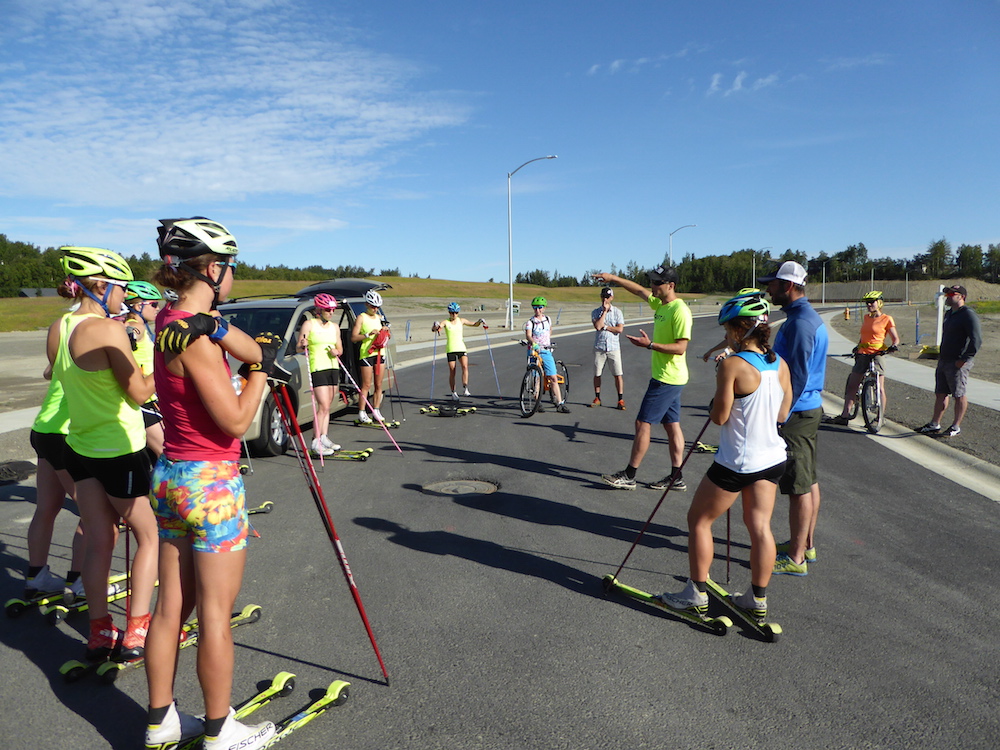
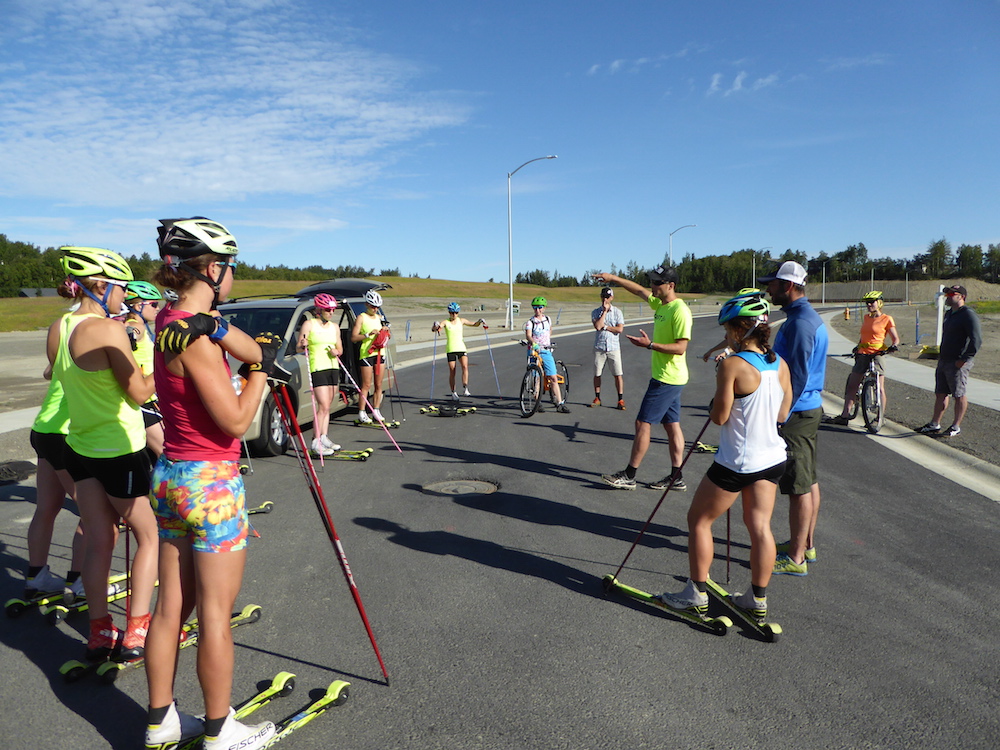
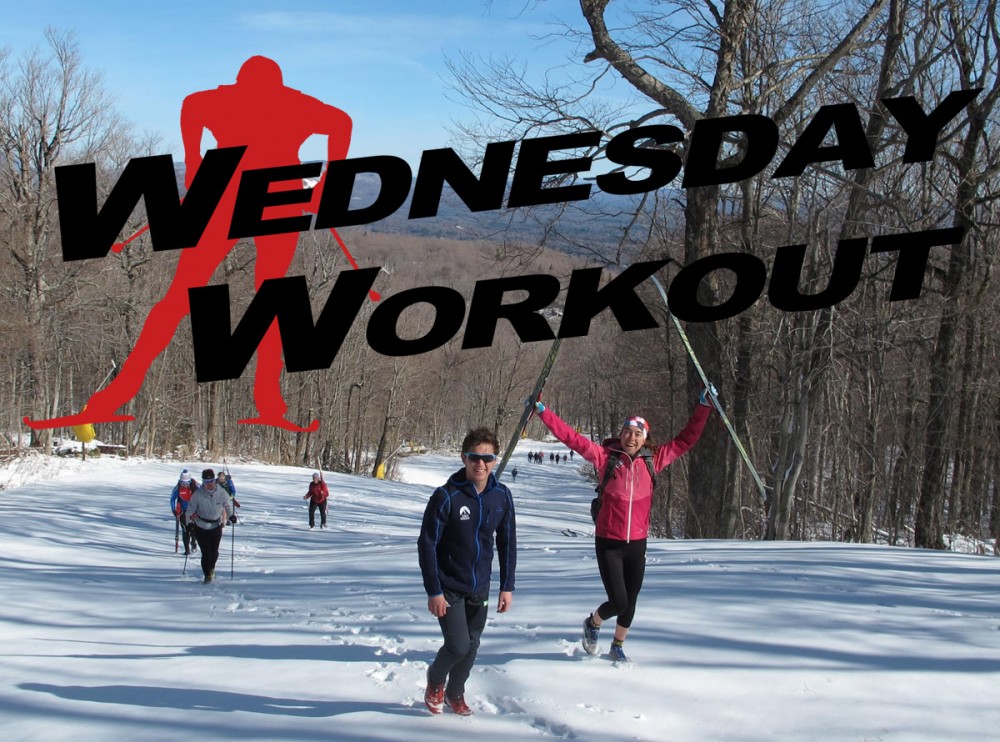
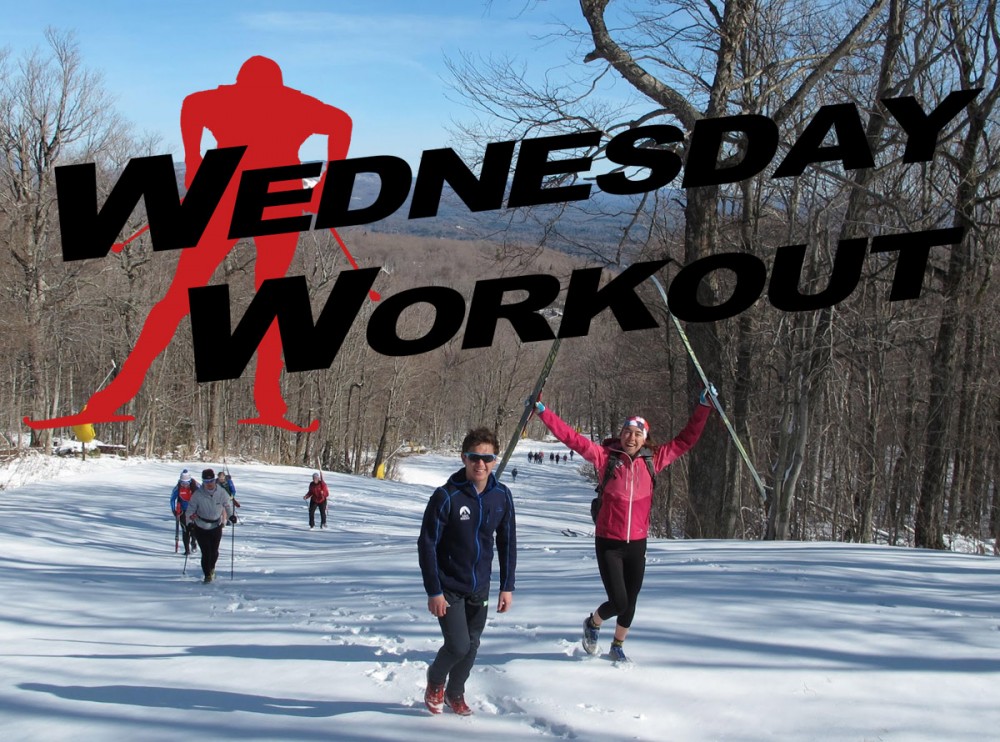
Matt Whitcomb (in yellow shirt and black ballcap) explains the day’s workout to a joint USST-APU training group on July 9 in Anchorage, Alaska.
ANCHORAGE, Alaska — Earlier this month, the U.S. Ski Team and its coaches came to Alaska for a two-week training camp, starting with one week of dryland training and then one week on snow at Eagle Glacier. Before heading up to the glacier, FasterSkier caught up with U.S. Ski Team (USST) Women’s Coach Matt Whitcomb for a brief in-person interview about the national team and their World Championships aspirations following a rollerski workout during the first half of camp.
FasterSkier:So this is a World Championships year. I know that U.S. Ski Team Head Coach Chris Grover previously told FasterSkier that an announced program goal is two medals in Lahti. Do you have anything to add to that, and can you speak to some of the races where the team might be expecting success?
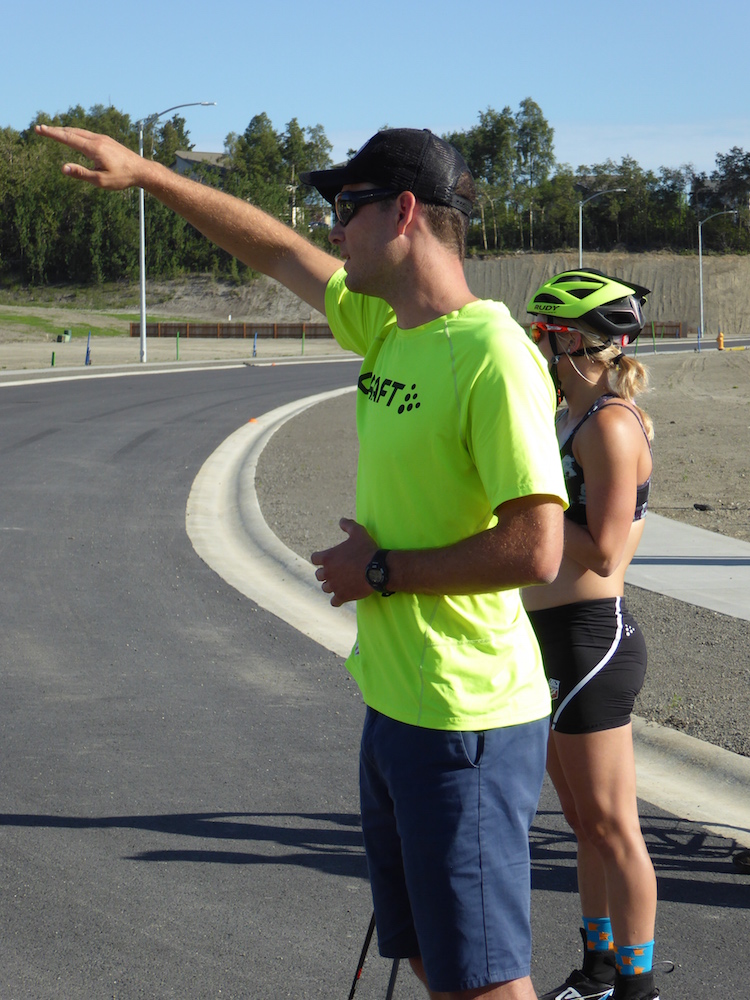
Matt Whitcomb (pointing) explaining the day’s workout to a joint USST-APU training group, including U.S. Ski Team member Jessie Diggins (behind) on July 9 in Anchorage, Alaska.
Matt Whitcomb:You know, all of our planning in the spring revolves around winning medals at the major championships of the year. So without overemphasizing our goals, we have in place what we feel are two realistic goals of two medals. We are more than happy to walk away with five. We will be disappointed with less [than two]. So we feel like, as a program, we are good enough so that two medals is an appropriate reach, and in many events, we have opportunities.
Our highest strike rates for medal opportunities are certainly in both sprints [Note: Whitcomb clarified to explain he meant both genders in men’s and women’s team and individual sprints] as well as in the women’s 4 x 5 [kilometer] relay, but you also have the women’s 30 k, the women’s skiathlon, and we’re happy to be surprised in any of the other events.
FS: You mentioned the skiathlon – from a domestic perspective, did you notice that there is going to be a skiathlon in the SuperTour this year [to be hosted by the Fairbanks Nordic Ski Club during Spring Series], and what role does that have for athlete development in this country?
MW: [laughs] Leave it to John Estle [of Fairbanks] to be able to organize one of the more high-maintenance events. But in no way am I surprised; we’re just very thankful. It’s often that at the junior and even U23 level when we go internationally, that we’re scrambling last-minute to find skiathlon boots, or to teach athletes how to load an exchange zone and what the rules are. So we’ll consider this just a quick dose of education for our entire community, and I think it’s going to have a big effect. It’s going to be a really fun event – not for his volunteers, but we thank them.
FS: Jessie Diggins spent a week in Norway in June at a Norwegian national team training camp. What does that say not only about Jessie as a skier, but also about the strength of this program?
MW: Yeah, it’s a good question. First and foremost, not anybody is going to be accepted to a Norwegian camp, and that’s to really understate that. Jessie’s season and her attitude and her overall personality have a lot to do with it. So the first credit goes to her.
But the next credit goes to, really, Norway. On the back of their old waxing bus, it says, “Sharing the knowledge and the experience” – that’s what they put right on their most prominent vehicle. And they have become such a huge asset to our program. Their coaches are our friends; we know all their athletes; they’re friends with our athletes; we interface at the World Cup. And they truly do want to help us. And so when we asked if Jessie could join a camp, they said, “let me talk with the girls” – make sure their team was okay with it – and then got back to us with some options. And we were so impressed by it.
But I think it’s also a strong testament to our nation, and our program as a good partner to Norway as well. We’ve had Astrid [Jacobsen] at a camp, we’ve had Celine [Brun-Lie] at camps – we are happy to help in any way we can while on the World Cup.
Granted, a program like Norway needs very little. But it’s a multi-tiered reason that this is something that’s possible, that’s put a guy like [Andy] Newell in Norway right now, training with top-level athletes, and has put Liz [Stephen] and Kikkan [Randall] at multiple Norwegian National Team camps, where their coaches are spending time out of their day to discuss video with our athletes. It’s invaluable for us.
And I should say that Jessie had a phenomenal experience.
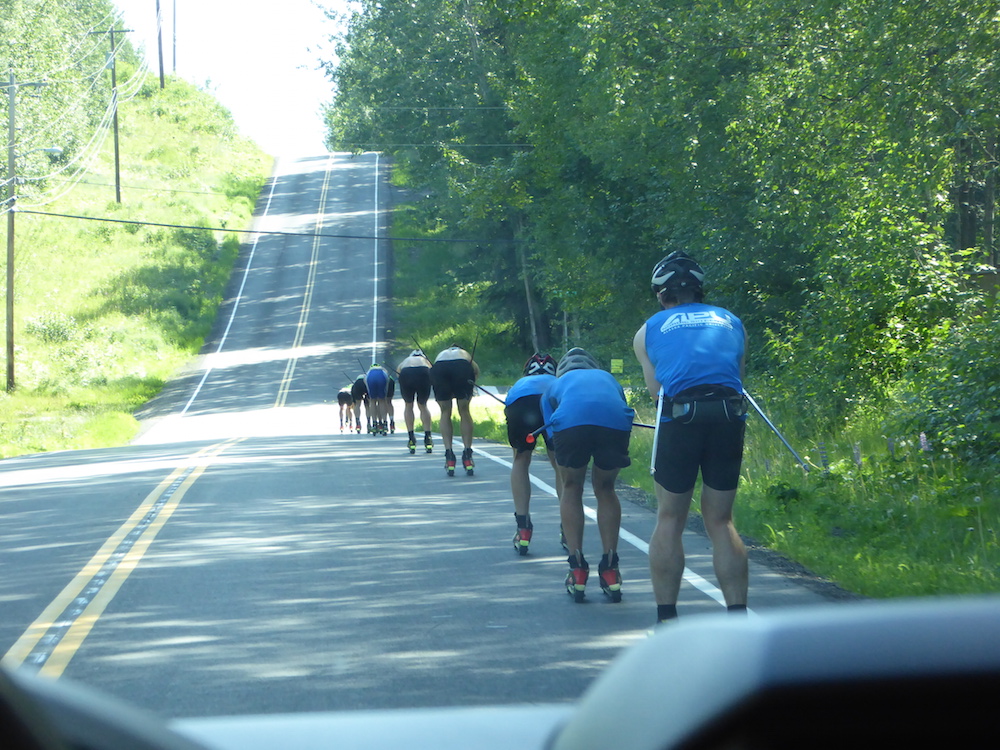
Matt Whitcomb says, “Hashtag #vanlife” — view from the van, transporting USST coaches and media, during a joint USST-APU training camp on July 9 in Anchorage, Alaska.
FS: We can feel like we generally know what to expect by now from the veteran women’s team members. What can you tell us about the three youngest members of the team: Hannah Halvorsen, Katharine Ogden and Julia Kern?
MW: Really exciting to have a new member of our D-team this year in Hannah Halvorsen out of Truckee, California. We’ve begun working with her coach, Martin Benes, and their program [Sugar Bowl Academy] more closely in the last year or two and are very impressed with them. So that’s exciting to have some input from California these days.
She’s a bright girl, she’s funny, she loves team, she’s very quickly friends with everybody on the team. And she’s going to really complete this sort of what is a D-team squad now, with KO [Katharine Ogden], Julia [Kern], and Hannah, as well as Ian Torchia. So that’s really exciting.
And with those three women, we can expect anything from podiums at World Juniors to something in the twenties or thirties could even be considered a solid race. We’re not looking to rush any results out of these women. What we’ve told them and their programs, their club programs, is that we want to exercise extreme patience. We have high confidence that these three athletes are some of the emerging stars that we feel like can mature into very successful World Cup athletes. And if that means having success at World Juniors, that’s great, U23s, that’s great, but we want it ultimately to be that these three women fill some of the shoes that will eventually retire.
FS: With regard to other specific athletes, can you say anything about what it’s meant to have Kikkan back with the team?
MW: It’s been so great to have Kikkan’s energy back and physical presence. In many ways, it just never left. She took some time out for pregnancy, and now we’re meeting her baby at an actual camp, and she’s training with us again. And it has just injected everybody with a high dose of energy again, so that’s really fun.
To have Hannah join us at the lower ranks of the team, and Kikkan return at the upper end, has just created a great bookend for us to launch this season.
FS: Chris Grover recently explained that the World Champs selection criteria have been changed. I think it’s a fair summary to say that skiing well in Period 4 of last season is no longer as important, and that skiing well in Period 1 of this season is now more important. Accepting that premise for the moment, do you see that affecting your athletes’ preparation? How do you think the athletes feel about that – maybe especially the athletes on the bubble either way?
MW: It’s definitely a criterion that focuses more on how athletes are skiing closer to the Championships. It’s a very important concept, I think, that from what I can tell the entire ski community is behind.
From a World Cup perspective, we have a couple different options. Athletes can race through Period 1, and they need to be within a certain standard on the World Cup. [For objective criteria: either a top-eight result in most of the individual races from Period 1, the Tour de Ski or the sprint weekend following the Tour de Ski, or a top-50 ranking in either the Sprint or Distance standings on Jan. 16, 2017.] And if they are close to but not in that going into the Tour de Ski, they need to make a pretty important decision. And that is whether or not to go back to U.S. championships and qualify domestically, or to take a chance and go with what they know and qualify in the Tour de Ski, and the sprint weekend after the Tour de Ski in Toblach. And so there are a great number of options both domestically and internationally on the World Cup, that I think we feel is as fair as can be.
FS: Is it fair to say that making discretionary picks is one of the harder parts of your job as a coach?
MW: For sure. We love not to do it. But in any criteria, discretion can often be one of the most important pieces. We really envy these Olympic Trials [for American track and field athletes for the 2016 Rio Olympics] that we’re watching right now, where the top three go and fourth is either an alternate or they don’t go, and it’s just much more objective.
FS: You’ve been very gracious with your time – anything else you want to add or wish I’d asked before we wrap up?
MW: With athletes training over 800 and 900 hours a year, we have good confidence that we’re training as well and in some cases better than our competitors who are best in the world. The trick is to differentiate our training from our competitors’, and to make our 900 hours more effective than their 900 hours. And our team over the last several years has begun working more and more closely with individual sports psychologists as well as individual club coaches and national team coaches to become the mentally toughest team on the World Cup. And that is something we work hard to be. It is something that we feel can differentiate our 900 hours or our 800 hours from their 900 or 800.
For the second installment of “What Elite Skiers Eat for Breakfast“, we asked Stratton Mountain School (SMS) athletes to share a photo of a typical breakfast for a weekday training day and describe what they eat. Here’s what they told us:
“When I have time, I like to make breakfast burritos filled with rice, eggs, Cabot cheese, baby spinach, and top it all with bbq sauce. It’s a good way to get a lot of carbs, and depending on the number of eggs a fair amount of protein as well. I know that bbq sauce isn’t for everyone but I would highly recommend introducing it to your breakfast lineup.”
“Big bowl of plain greek yogurt topped with banana and a mix of berries or other fresh fruit plus granola (my favorites are Elizabeth’s pumpkin fig and Ezekiel cinnamon raisin) and cinnamon. I always finish with a side of peanut butter toast (crunchy peanut butter!) topped with hemp seeds and a big french press for coffee plus some water if I am being a good athlete :)”
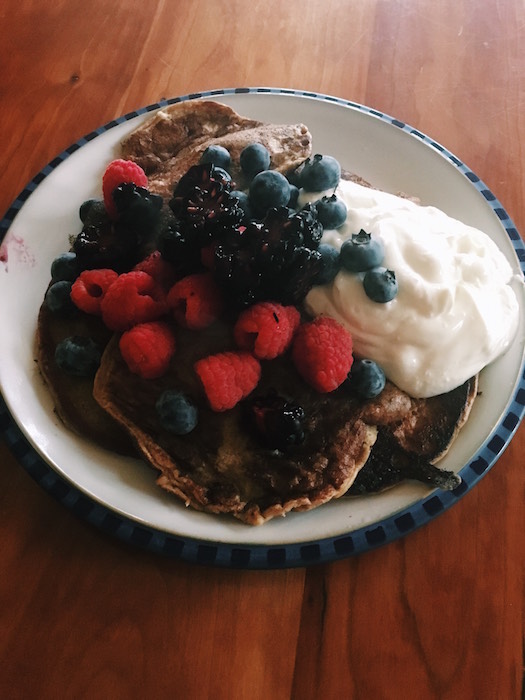
“I definitely try and keep things interesting (there is nothing worse than a breakfast burn out) but one of my favorites is some high protein homemade pancakes topped with all the fruit in the fridge (as local as I can find it) and a big scoop of Greek yogurt. And coffee — lots of coffee.”
“This is a smoothie bowl (mango, strawberry banana with yogurt) topped with granola, sliced banana, yogurt drizzle and honey drizzle.”
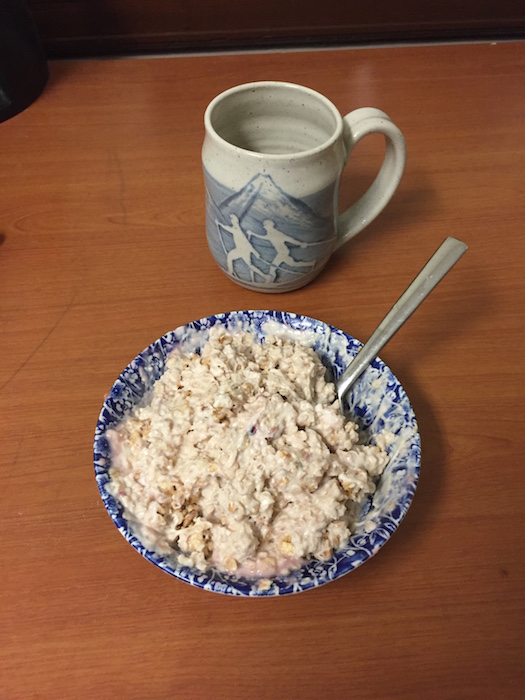
“I like a strong black coffee in my owl mug (the mug is an important part of my breakfast routine) and oats with berries, yogurt, nuts and honey.”
“English muffins with peanut butter, banana, and honey is a standard go to.”
“Then I typically mix it up with some kind of cereal and yogurt. If I can use home made gernola, that’s the best. On rest days when we have more time I’m the go-to pancake guy at the SMS house.”
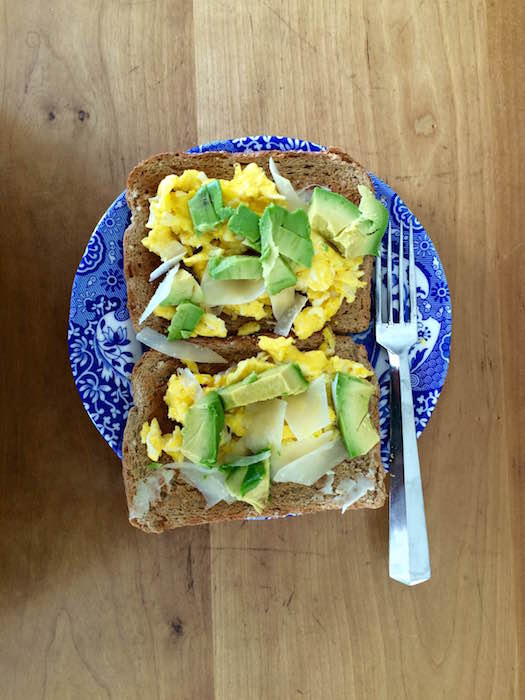
“My breakfast varies depending on the day and what we have for food in our kitchen, but one of my favorite easy breakfasts is buttered toast, scrambled eggs, cheese, avocado, and salt!”
“First: Coffee. Then a large bowl (or two) of: steel cut oats, greek yogurt, crunchy peanut butter, homemade raspberry jam, cereal of choice (usually granola or Kashi) – when available add blueberries and/or banana.”
“My go-to breakfast would be plain greek yogurt with granola and lots of fruit such as blueberries, raspberries, strawberries, bananas and pineapple. I also like to add a touch of honey :)”
“I’m not too much of a breakfast guy if I’m training early. I definitely don’t enjoy the feeling of having a stomach full of eggs and bacon when I head out for a hard interval session or long OD. Most of the time, I just make myself a bowl of granola with Greek yogurt, almond milk, and some fresh fruit (usually either blueberries, strawberries, or a banana). Most days I’ll drink 2 cups of black coffee, but on days when I’m training a bit later in the day I’ll make some green tea. And I usually compliment everything with a glass of orange juice.” On off days, he sleeps in a bit and might make eggs, pancakes or waffles. While with his girlfriend and teammate Sophie Caldwell in her hometown of Peru, Vt., they’ll head to the local general store, “JJ Hapgood’s, for a breakfast sandwich (English muffin with an egg, local bacon, and local cheddar) and a cup of coffee.”
Which elite nordic team (in the U.S., Canada or elsewhere) would you like to hear from next for our breakfast series? Leave your recommendations in the comments section below!
The U.S. Cross Country Ski Team has announced its nominations for the 2016-17 season. Nominations include those active athletes who qualified based on published selection criteria in the prior season.
Each athlete accepting the nomination to U.S. Cross Country Ski Team receives world class program support, along with access to the USSA Center of Excellence, as well as athletic benefits including an elite coaching, sport science, sports medicine and high performance staff, and education opportunities.
An official team announcement will be made in the fall.
U.S. Cross Country Ski Team 2016-17 Team Nominations
A Team Men
Simi Hamilton (Aspen, CO; SMS T2; 5/14/87)
Andrew Newell (Shaftsbury, VT; SMS T2; 11/30/83)
Women
Sadie Bjornsen (Winthrop, WA; Alaska Pacific University Nordic Center; 11/21/89)
Sophie Caldwell (Peru, VT; SMS T2; 3/22/90)
Jessie Diggins (Afton, MN; SMS T2; 8/26/91)
Kikkan Randall (Anchorage, AK; Alaska Pacific University Nordic Center; 12/31/82)
Ida Sargent (Orleans, VT; Craftsbury Green Racing Project; 1/25/88)
Liz Stephen (East Montpelier, VT; Burke Mountain Academy; 1/12/87)
B Team Men
Erik Bjornsen (Winthrop, WA; Alaska Pacific University Nordic Center; 7/14/91)
Noah Hoffman (Aspen, CO; Ski and Snowboard Club Vail; 8/1/89)
Women
Rosie Brennan (Anchorage, AK; Alaska Pacific University Nordic Center; 12/2/88)
D Team Men
Patrick Caldwell (Lyme, NH; SMS T2; 2/18/94)
Ian Torchia (Rochester, MN; Northern Michigan University; 3/8/96)
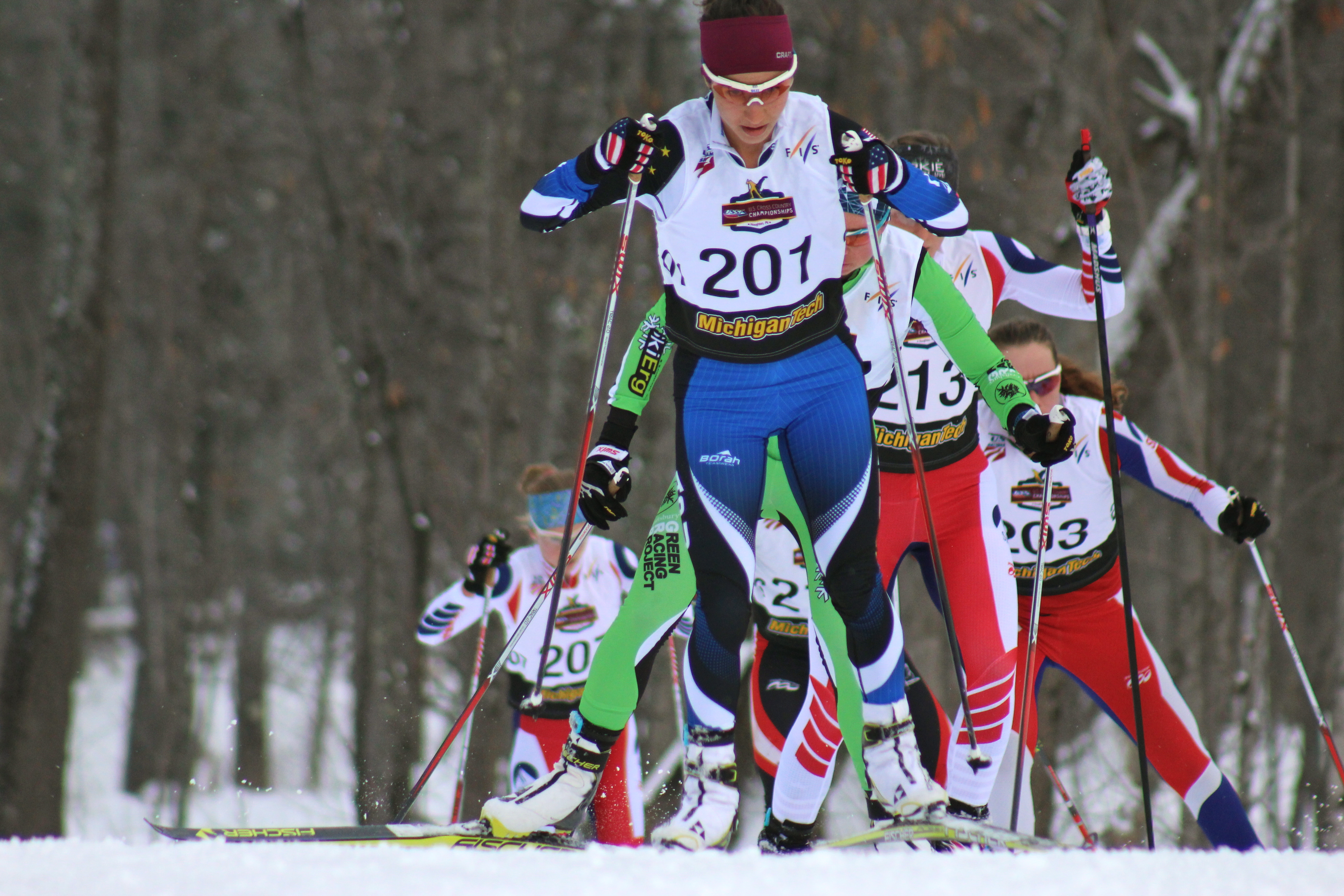
Katherine Ogden of the Stratton Mountain School and USST waves to the crowds during a hike-and-shred workout up and down the local ski hill. (Photo: Sverre Caldwell)
Perspective is a good thing. Maintaining it is tough in endurance sports where training plans and hours logged are emphasized. It’s a numeric puzzle, a physiological puzzle and a psychological puzzle. All that requires basic fun from time to time.
Katherine Ogden, 18, hails from Landgrove, Vt. FasterSkier’s two-time Junior of the Year, Ogden is a day student at the Stratton Mountain School and was named to the U.S. Ski Team development squad last season. Asked about her favorite spring workout to keep it fun and real, she says find a mountain.
“The basic plan is we start at the bottom of a ski mountain (for us it’s Stratton Mountain) wearing running shoes and carrying a backpack containing ski boots. we then try to strap our skis to the backpack for the hike up,” Ogden wrote in an email. “We then hike up the mountain which usually takes around 30-45 minutes for Stratton. This is generally level one unless you are a very enthusiastic hiker.”
Ogden recommends packing skate boots for the descent. Although on alpine ski trails, the descent requires good ankle support and places a premium on fear control and gear integrity — those pricey poles are easy to snap.
“What ensues is a harrowing adventure of norpineing (nordic alpine),” she explained. “This workout is good for the spring because it’s not very taxing training wise but it’s a lot of fun and a good way to work on agility and downhill confidence.”
The Workout:
– Find your local ski hill, preferably one closed for the season or at least void of gravity slaves.
– Wear comfy shoes. For the Stratton Mountain School crew we are talking sneakers.
– Defy gravity by hiking up. It’s a Level 1 workout so it’s OK to talk and laugh. (Stratton Mountain’s summit reaches 3,785 in elevation and sports a proud vertical gain, which ultimately becomes a 2,000-foot drop.)
– Swap out sneakers, lace up skate boots, lock into bindings.
– Descend and grin … not always in that order.
Time: depends on the vertical gain and snow conditions upon descent. Allow for extra time if presented with breakable crust.
The training backstory
At only 18 and a senior in high school, Ogden is coming off a breakthrough season. She won the season-opening 10-kilometer freestyle at the SuperTour in West Yellowstone, Mont. Her results earned her a spot representing the U.S. at the Ski Tour Canada, where she posted the 15th fastest time in the final stage, the 10 k classic pursuit in Canmore, Alberta, for 36th overall.
Patrick O’Brien, head coach of the Stratton Mountain School (SMS) T2 elite team, says Ogden’s training is not unique.
“Katharine’s training is not anything different from what the rest of the students in the program do. The difference is she came in as an eighth grader so there is continuity,” he said. “And basically she is on track for about I think about 500 hours this year, as a high school senior which is not abnormally high.
“The important thing to understand is that is that there is continuity year to year with the train there is an incremental increase in hours and the load that she has,” O’Brien continued. “It’s easy to say OK, this keeps you on track with where you need to be developmentally and it’s easy to monitor. If you add a hundred hours to someone’s training and then they don’t ski well, you don’t know if that’s because they are overtrained, or the jump was wrong. It puts you into a pattern that you don’t know how to respond from there.”
Sverre Caldwell, Stratton’s nordic director, is no stranger to talented skiers and managing their progression. (He’s the father of U.S. Ski Team A-team member Sophie Caldwell.) He began working with Ogden in eighth grade.
“For eighth graders, we just have them train as a group and see how they react to it and not really on a plan,” Sverre Caldwell said. “We see what they can take and really go by feel. She could train a lot without getting too tired, so in ninth grade she got a plan.”
He recalls that plan being around 400 hours. Ogden tolerated the load and skied well. That lead to a slight increase in hours the next year.
“We tweak everyone, but I think our training is kind of conservative,” he explained. “I don’t want to push anyone too hard and have them blow up. It’s all just built on let’s start here and if that goes well then we can take the next step up and take the next step up. It’s patience. I believe to be a really good skier you have to train eight or ten years , you better enjoy it and you better just progress along and learn as much as you can.”
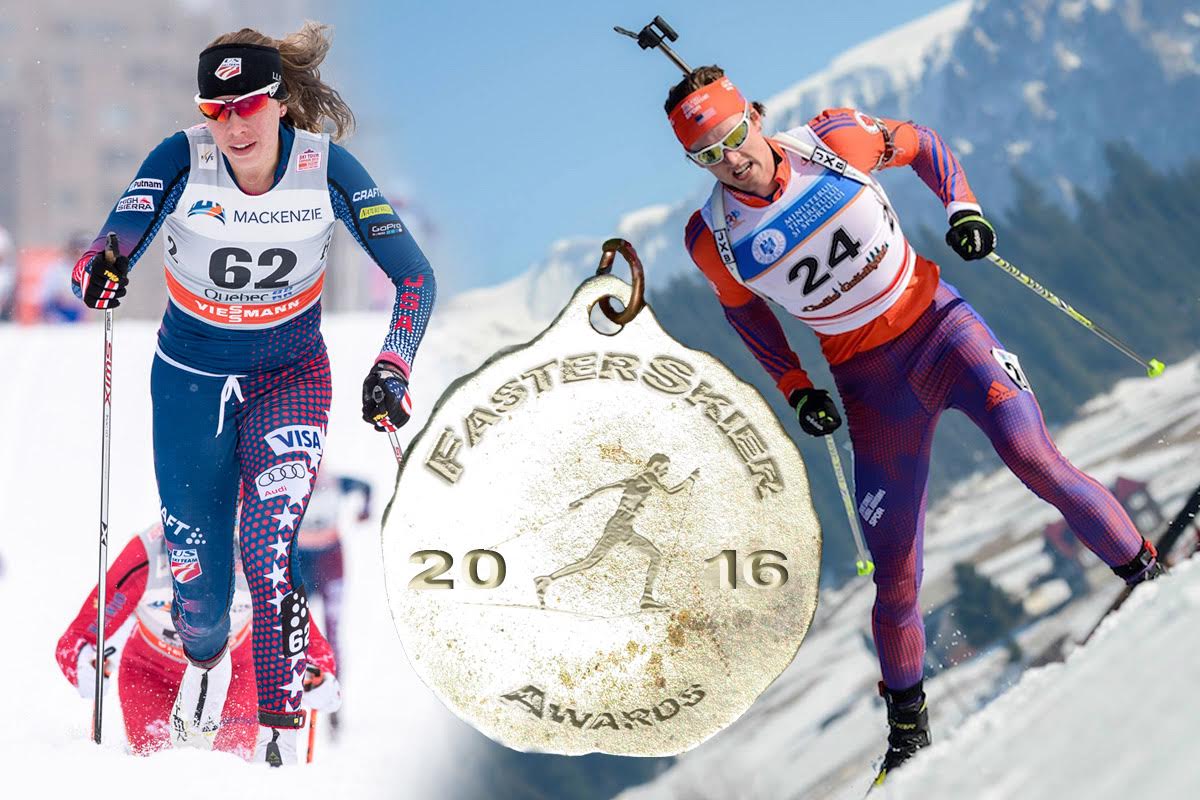
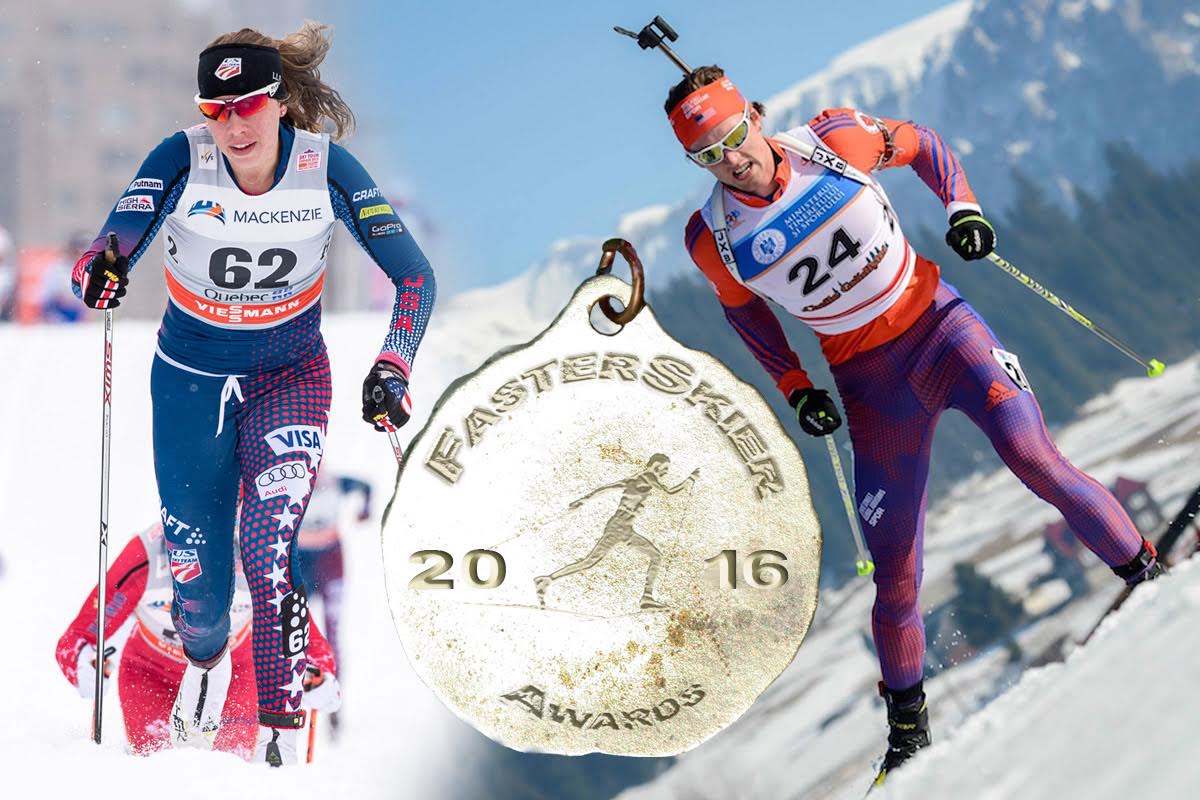
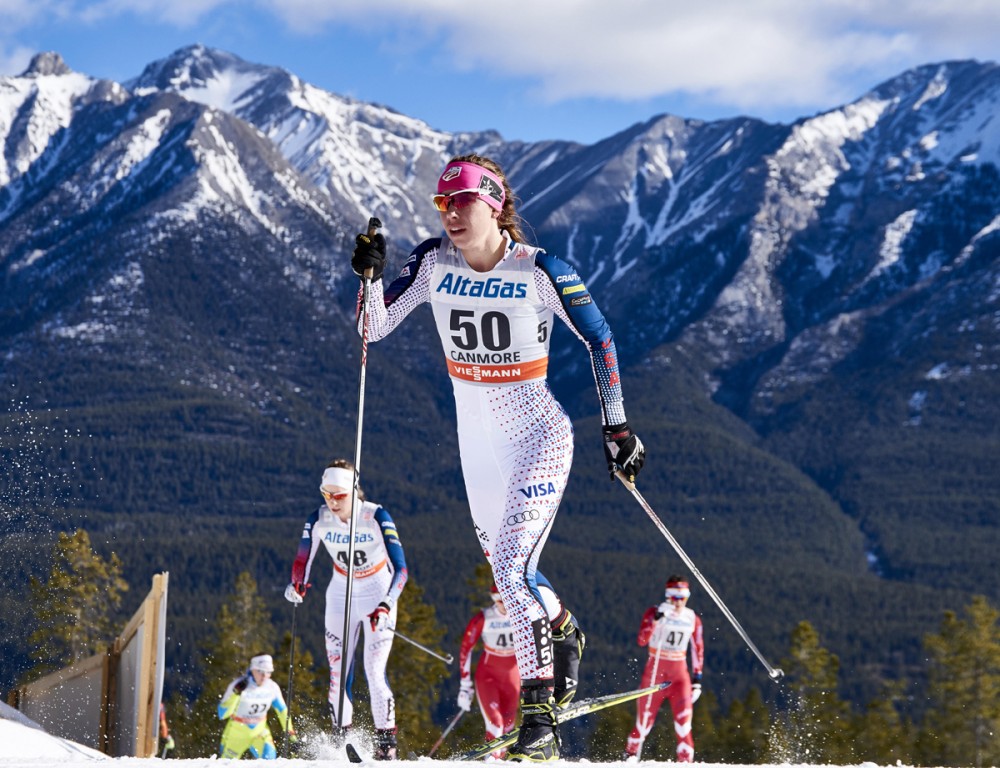
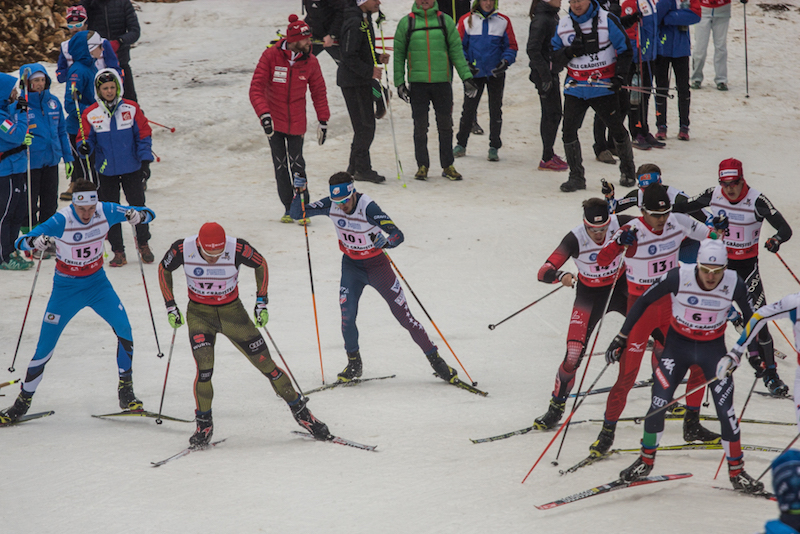
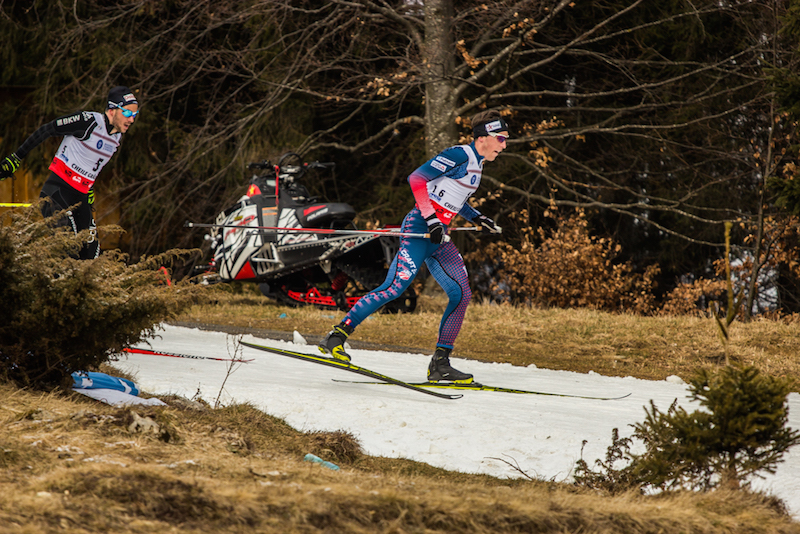
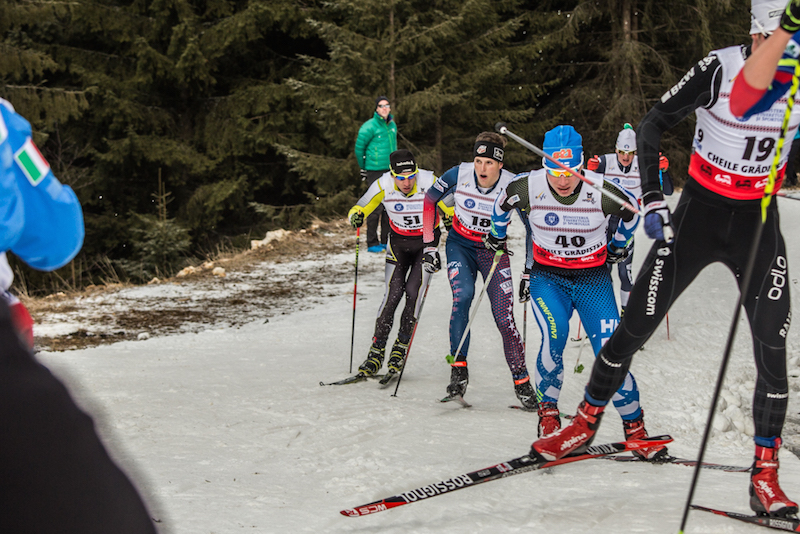
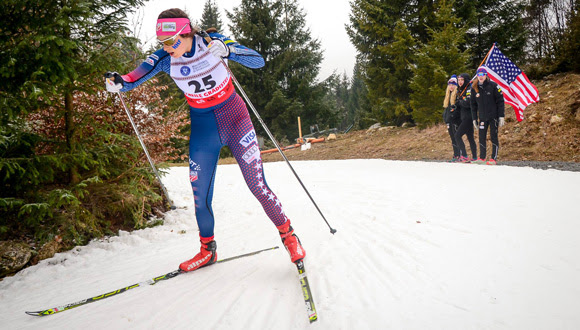
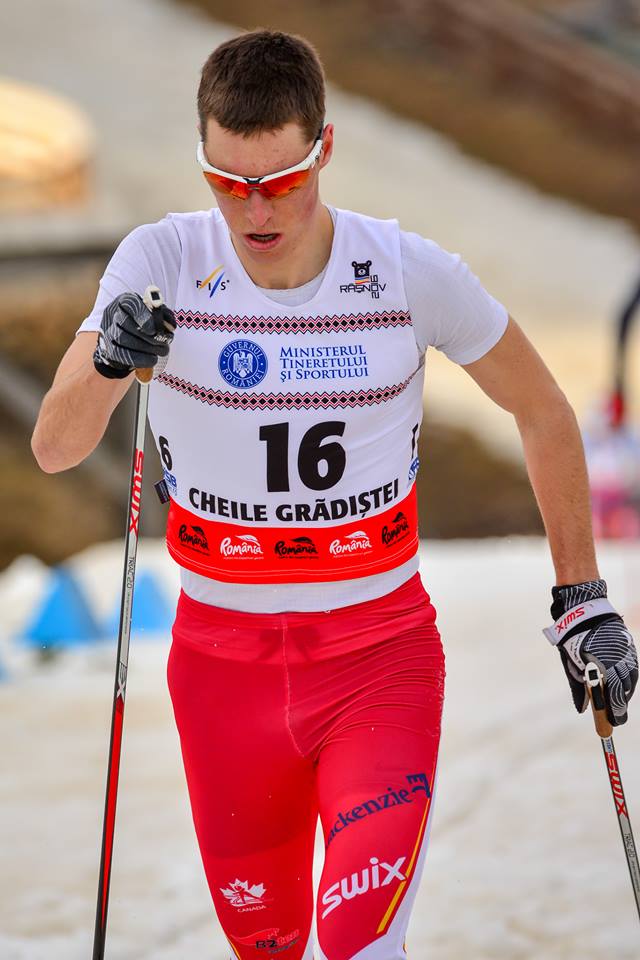
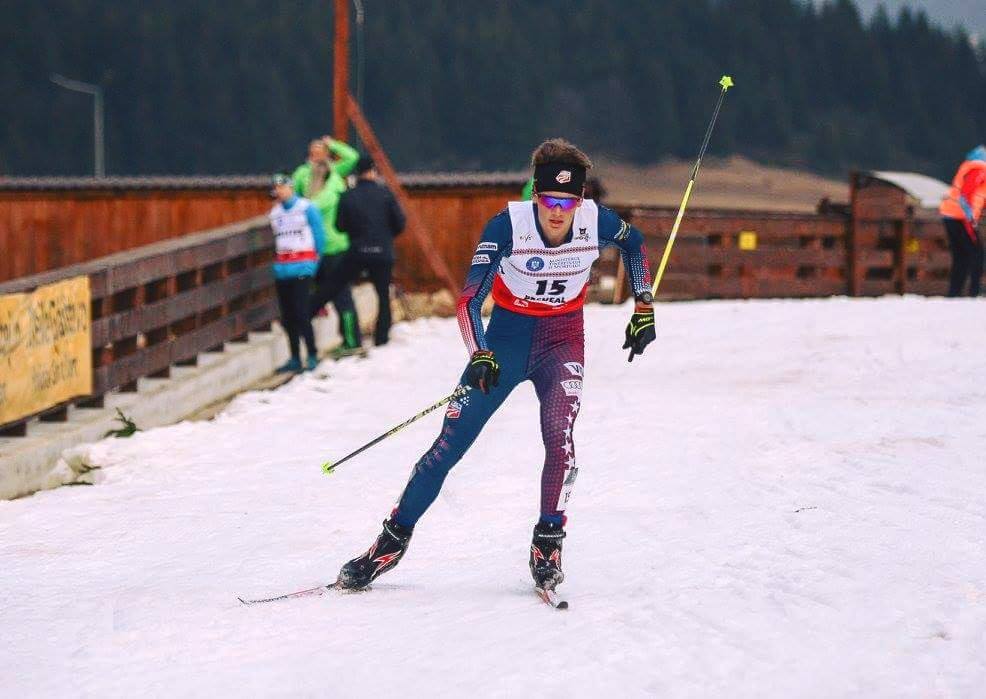
Katharine Ogden (l) of the Stratton Mountain School and U.S. Ski Team (seen racing in Montreal during the second World Cup stage of the Ski Tour Canada) and US Biathlon’s Sean Doherty (racing at 2016 IBU Junior World Championships in Cheile Gradistei, Romania) are FasterSkier’s Junior Skiers of 2016. (Photos: Flying Point Road & IBU YJWCH Cheile Gradistei 2016/Facebook)
With the 2015/2016 season officially in the rearview, FasterSkier is excited to unveil its annual award winners for this past winter. Votes stem from the FS staff, scattered across the U.S. and Canada, and while not scientific, they are intended to reflect a broader sense of the season in review.
***
Sean Doherty, US Biathlon
Pardon if you’ve heard this one before: Sean Doherty, from Center Conway, N.H., is the best U.S. junior biathlete of all time.
The 20 year old proved it yet again this season, picking up another full collection of medals – bronze in the individual, silver in the sprint and gold in the pursuit – at Junior World Championships in Cheile Gradistei, Romania.
Sean Doherty on his way to securing a nearly 30-second win in Sunday’s pursuit at 2016 IBU Junior World Championships in Cheile Gradistei, Romania.
But Doherty went one better: he became the winningest young biathlete of all time, period. The gold medal was his 10th at Youth and Junior World Championships over the course of his career, a feat unmatched in the competitive world of biathlon; the ninth, silver in the sprint, was actually the one that gave him the record.
“I didn’t know I had done it until a good ways after the [sprint] race,” Doherty said in a phone interview from Romania. “I was in the press conference [and a reporter] asked the question, and I didn’t know until that point that I had set a new record.”
But that’s not the only thing her was up to this winter. Doherty continued to make his way as a reliable performer on the World Cup circuit, earning three top-20 finishes including 13th in the sprint on “home” turf in Presque Isle, Maine.
And he anchored the U.S. men’s team to eighth in the World Championships relay in Oslo, Norway – as well as to sixth-place finishes in Ruhpolding, Germany, and Antholz, Italy, and a fifth-place finish in Presque Isle during the regular season.
Coming off a career-best 13th in the sprint, Sean Doherty (US Biathlon) placed 20th in the men’s pursuit at the IBU World Cup in Presque Isle, Maine. (Photo: USBA/NordicFocus)
Doherty has now finished out his junior career, and will be on a diet of straight World Cups next season. His growth into a senior biathlete is one of the things that keeps the men’s team hungry and positive, supplementing the results of longtime veterans Lowell Bailey and Tim Burke, and fellow former top junior Leif Nordgren.
“In the men’s field right now, it’s so strong,” Bailey explained at World Championships. “Every team has a stacked team, it seems like. But I think we’ve put together a really competitive team. We have four guys who are routinely in the points. So on a good day we can be right there. The results have shown that we have improved every year. We’re hoping to build on that, and anything can happen.”
Katharine Ogden, U.S. Ski Team/Stratton Mountain School
Ogden, too, won FasterSkier’s junior of the year accolades last season. But she just kept right on going in 2016.
Starting with the first SuperTours of the season in West Yellowstone, Montana, Ogden put the senior field on notice when she won the 10 k skate by 1.8 seconds over Alaska Pacific University’s Chelsea Holmes.
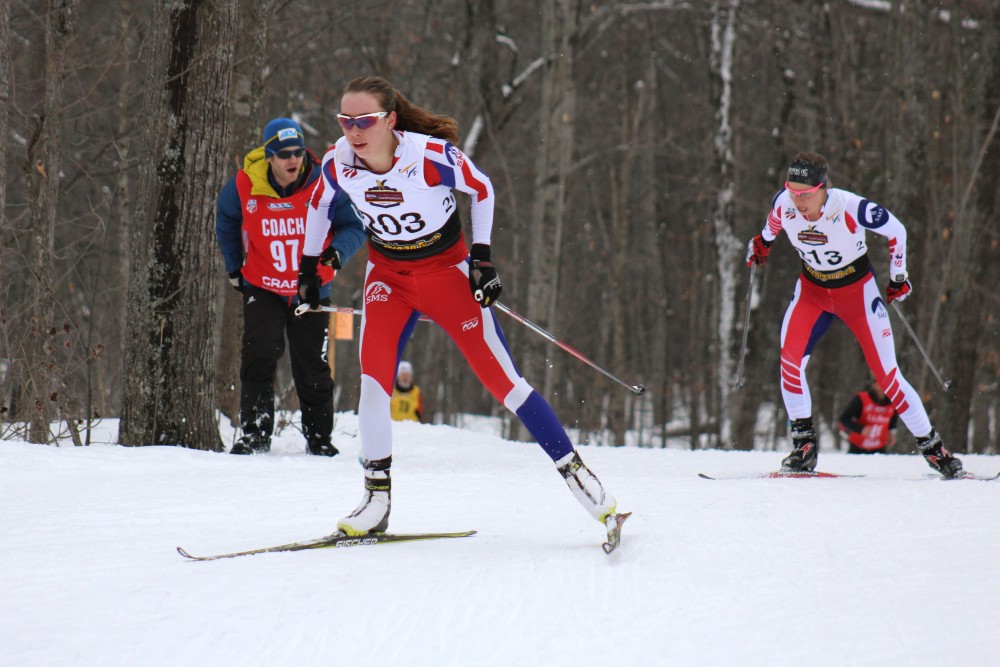
Katharine Ogden of the Stratton Mountain School and U.S. Ski Team races to a fourth place finish overall (+1:05.1) in the women’s 15 k classic individual start at U.S. nationals in Houghton, Mich. (Photo: Christopher Schmidt)
Then it was on to U.S. nationals, where Ogden was fourth in the 10 k classic, third in the 20 k skate mass start, and eighth in the classic sprint.
Always positive, Ogden says that she’s enjoying being able to hang with the senior women.
“It was awesome skiing with Caitlin [Patterson], Chelsea [Holmes], and Anne Hart,” Ogden said after the U.S. nationals mass start. “Just being able to ski behind them is so nice for me, I can really learn a lot from them and catch a ride on the downhills.”
Ogden finished 13th in both of her individual starts at Junior World Championships, and earned start rights at the Ski Tour Canada. At the end of the eight-stage World Cup series she stood 36th, the seventh American.
“It was pretty intimidating in the beginning but I guess I’m kind of getting used to it,” she said.
Americans Katharine Ogden (front) and Annie Hart (l) during the women’s 15 k skiathlon in Canmore, Alberta, part of the World Cup Ski Tour Canada. (Photo: Fischer/NordicFocus)
Norway’s Therese Johaug was happy to be done with the eight-stage Ski Tour Canada on Saturday, March 12. She won the Tour title along with the Overall and Distance World Cup Crystal Globes. (Photo: Fischer/Nordic Focus)
CANMORE, Alberta — After eight races in 12 days, the final day of the Ski Tour Canada last Saturday brought both extreme exhaustion and feelings of completion for the 14 Americans (10 women, four men) and 12 Canadians (seven men, five women) who made it to the culminating finish of the season-ending World Cups.
Here is some of the best from the North Americans who made it to the last two stages (the Stage 7 freestyle individual start and Stage 8 classic pursuit):
Canada’s Emily Nishikawa racing to 35th in the women’s 10 k freestyle at Stage 7 of the Ski Tour Canada in Canmore, Alberta. She went on to lead the Canadian women in 37th overall in the Tour. (Photo: Fischer/NordicFocus)
“It was initially very overwhelming, but once I got the hang of how things go on race day, it was really fun to be out racing with so many fast women.” — Kaitlynn Miller (Craftsbury Green Racing Project), 41st overall
“I’ve never done anything like this before. It is a test of will because you are either traveling or seeing the course … It is so different, I was so glad I had a chance to do this in a place like Canada where there are so many supporters. It was fun, I’m stoked it is over but it was actually really fun.” — Jennie Bender (Bridger Ski Foundation), 48th overall
“It was pretty intimidating in the beginning but I guess I’m kind of getting used to it.” — Katharine Ogden (Stratton Mountain School/USST D-team), 36th overall
On how the body held up:
“Before the race, I felt really nauseous and pale and I thought, ‘I should go drink some water.’ … I did not think today was going to go well at all. I was thinking best-case scenario would be finishing. I don’t know, I never know what my body is going to do, but my back felt good and I skied with a group, which was freaking awesome.” — Bender
2016 Ski Tour Canada finishers:
CANADA:
5. Alex Harvey
14. Ivan Babikov
16. Devon Kershaw
27. Graeme Killick
37. Emily Nishikawa
40. Cendrine Browne
43. Kevin Sandau
44. Olivia Bouffard-Nesbitt
47. Annika Hicks
49. Maya MacIsaac-Jones
49. Michael Somppi
50. Russell Kennedy
USA
5. Jessie Diggins
11. Sadie Bjornsen
24. Rosie Brennan
31. Chelsea Holmes
33. Caitlin Gregg
34. Ida Sargent
34. Noah Hoffman
36. Katharine Ogden
41. Kaitlynn Miller
42. Erik Bjornsen
43. Anne Hart
46. Scott Patterson
48. Jennie Bender
51 Tad Elliott
“I broke my finger about two weeks ago right before the Birkie but I felt solid there. When I start to get tired, my immune push-back starts flaring up and I was dealing with that a bit in the beginning of the tour and didn’t know how I would fare with all this hard racing. Honestly, I thought about pulling the plug after the first half, I was really suffering. But they said, ‘Go West, it is where you are from and the sunshine will do you well, stay relaxed and just enjoy ski racing.’ That is what I tried to do today and things have been coming around fast so it is kinda nice to feel that way.” — Tad Elliott (Ski & Snowboard Club Vail), after placing 41st in the 15 k freestyle at Stage 7 (he went on to finish 51st overall in the Tour)
“I just had to focus on the process and just ski as well as I could and I think I did that. I didn’t have much energy to work with so I had to make due with what I had. I skied as well as I could and just focused on technique.” — Emily Nishikawa (Canadian Senior Development Team), after placing 35th in 10 k freestyle at Stage 7 (she went on to place 37th overall in the Tour)
“The season is wearing on me. I’ve been traveling a lot and racing a lot this year and haven’t had time to do any volume training and I think that is showing, my body has nothing left to give.” — Michael Somppi (NDC Thunder Bay), after placing 50th in the 15 k freestyle at Stage 7 (he placed 49th overall in the Tour)
On finishing:
“Everyone was so awesome, I am glad I made it to the end. I’m stoked. Finished my first tour, I can’t complain.” — Russell Kennedy (Canmore Nordic), 50th overall
“My goal was just to finish without getting lapped and I achieved that so I am really pumped to have finished the Tour. … I learned that my fitness is good enough to make it through all these races, but it needs to get better in order to improve.” — Jessica Yeaton (Australian national team and Alaska Pacific University), 46th overall
“I raced it for myself. I didn’t have any expectations for today and I, 100 percent, wanted to race my own race. I crossed the finish line happy with my effort and that is all I wanted.” — Olivia Bouffard-Nesbitt (Canadian Senior Development Team), after placing 42nd in 10 k freestyle at Stage 7 (she went on to place 44th overall in the Tour)
“It is my first interval start on the World Cup ever. It was fun to kind of ski my own race, but Johaug just blew by me on the wall of course.” — Annika Hicks (Canmore Nordic) after placing 48th in the 10 k freestyle at Stage 7 (she went on to place 47th overall in the Tour)
“Honestly, I thought about pulling the plug after the first half, I was really suffering. But they said, ‘Go West, it is where you are from and the sunshine will do you well.’ ” — Tad Elliott, of Durango, Colorado
On highs and lows:
“There was definitely highs and lows. Racing this much is pretty taxing physically and emotionally, but every day I was training or racing I was thinking about how ‘effing’ awesome this is to do at home. It is something I might not be able to do it again, but I hope I will. It is such as privilege and every time I thought about it I was so thankful to be here.” — Bouffard-Nesbitt
“I got passed by both Therese and Heidi [in the 10 k freestyle], which was great, and I was like, ‘Holy sh*t!’ … Actually, proud moment of the race: I skied behind Therese on the downhill and she snowplowed and I did not so I was beating her on the downhill. But yeah, they climb like fiends. I don’t think I have the ability to go that tempo, being twice as big as both of them.” — Bender
“It is great if you can pick up a good ride, but today I had Sundby blow past me. You want that ride that is just a bit too fast, not one that is killing you.” — Scott Patterson (APU), after placing 47th in 15 k freestyle (he went on to place 46th overall in the Tour)
“I tried to ski with Maurice [Manificat] out there but then kinda exploded. I knew you follow Maurice it brings you to a top 20, within sight brings me to a top 30. I wasn’t able to accomplish that today, but to feel this good after all the health issues I’ve gone through recently is a sign of good things to come.” — Elliott after placing 41st in the 15 k freestyle at Stage 7
On takeaways from the Tour:
Canada’s Michael Somppi racing to 50th in the men’s 15k skate in Canmore, Alberta. He went on to place 49th overall in the Tour. (Photo: Fischer/Nordic Focus)
“I definitely feel like I have the endurance for long events like this — that is one of my strong suits. I seem to recover well. I mean, I am exhausted now, but I’ve still been getting out of bed and excited to race. I was racing pretty well on the domestic circuit, but it is just so different. I learned so much in the five distance races … In mass start races, you have to be aggressive and fight for those spots early on. I’m noticing my redline that I am comfortable skiing at in domestic races; the pace is different here.” — Kevin Sandau (Alberta World Cup Academy), 43rd overall
“I think it’s really just essential to getting us used to the World Cup atmosphere and no longer just feeling super nervous as you get to the start line. Making it more part of just any other race that you are able to focus more on the procedure of the race and feel the speed that these ladies race at and try to even just stay with it for five or 10 seconds through the race just gives you that little glimpse of where you need to be.” — Dahria Beatty (Alberta World Cup Academy/Canadian U23 Development Team) , 44th after Stage 7, (did not race Stage 8 due to a sore back)
“One of the big things is seeing just how hard all the women race at every race. In the NorAm circuit, we all ski hard but the World Cup is at a whole different level. These women go as hard as they can from the start until they collapse at the end. I think just being able to see just how hard they push shows me just how hard I need to be working and how hard I have to push to ski at this level.” — Maya MacIsaac-Jones (Rocky Mountain Racers), 49th overall in the Tour
“… The maturity and strength these guys have, it was good for me to see. I know the work I need to do in the summer and I am motivated to do it.” — Elliott
On future plans:
“Continue to train hard. I’ll stay at the centre next year and continue to try and improve. Also, keep working on the sprints.” — Sophie Carrier-Laforte (Pierre-Harvey National Training Centre), after placing 52nd in the 10 k freestyle at Stage 7 (she did not race Stage 8)
“I’ve been patient and I have had a long-term plan all the way through so I can see into my career now, but the support of a good coach is to keep that lid on. After Spring Series, I’m taking six weeks. I just ordered some Oakley golf gear, ordered some clubs from Wilson — I’m going to enjoy some golf and some warm weather and some mountain biking with my brother and come June maybe I’ll think about dusting off the rollerskis.” — Elliott
Video:Inside the Fence - Coming to North America
Ever wonder what European athletes think about coming to North America? Inside the Fence takes a look at the impressions from World Cup athletes participating in Ski Tour Canada
Posted by FIS Cross-Country Skiing on Thursday, March 10, 2016
Jessie Diggins (U.S. Ski Team) racing to fifth in the overall 2016 Ski Tour Canada with the third-fastest time of day in the women’s 10 k classic pursuit at the eighth and final stage of the tour in Canmore, Alberta. (Photo: Peggy Hung)
CANMORE, Alberta — It’s not always the ability to break through that builds the bridge to betterment, but the recognition that a breakthrough is possible.
That’s what the U.S. women realized as each consecutive athlete — rookies and veterans alike — concluded the final stage of the Ski Tour Canada (STC) with the women’s 10-kilometer classic pursuit on Saturday.
“My personal highlight is watching athletes who have never been in the points, like Katharine Ogden and Chelsea Holmes, ski their way in there,” said U.S. Ski Team (USST) Women’s Coach Matt Whitcomb said after the race.
Six American women scored World Cup points on Saturday, according to their actual time on course. World Cup regulars, Jessie Diggins led the team with the third-fastest time, Sadie Bjornsen skied 12th fastest and Rosie Brennan was 14th fastest. A first-year member of the USST D-team, 18-year-old Ogden (Stratton Mountain School) posted the 15th-fastest time, Holmes (Alaska Pacific University) had the 28th-fastest time, Caitlin Gregg (USST/Team Gregg) nabbed the 29th-fastest time.
“It almost brings tears to my eyes because it is the bridge to Jessie Diggins,” Whitcomb said. “A club athlete has a hard time picturing themselves skiing as fast as Jessie Diggins, but they perhaps can picture themselves skiing as fast as someone whose in the top five in a SuperTour and then suddenly they work their way into the points.”
For Whitcomb and the U.S. women, the final stage of the STC marks a watershed moment for future performances like those of Diggins.
While Diggins has strung together a solid STC — including her fifth-place finish the 10 k classic pursuit on Saturday for fifth overall in the Tour — and has often led the women’s team during the season, she considers herself just another beat to the American melody.
“I don’t feel like you can point to one person as leading the team because we’re all a piece of the puzzle,” Diggins said afterward. “We need everyone together to make it work. So I don’t see myself as leading the team, I see myself as being the team cheerleader. And that’s my role and I’m really proud to be in that role.”
“I don’t see myself as leading the team, I see myself as being the team cheerleader … I’m really proud to be in that role.” — Jessie Diggins, top U.S. woman in fifth overall in 2016 Ski Tour Canada
For the 24-year-old native of Afton, Minn., true leadership comes in all forms. Even though she toed the start line of Saturday’s race nervous and with a sore throat, she treated the eighth race day of the Tour just like any other: smiles and skis set to go.
“I was definitely feeling a lot of pressure coming into today,” Diggins said. “I knew Krista [Parmakoski of Finland] was going to catch me so I just thought, ski with her, we would trade leads, we’d try to hopefully make up time together and then hopefully hang on.”
Starting seven seconds behind Diggins, Parmakoski caught Diggins on the second of three laps and the two remained together by the final climb before looping back into the stadium. Diggins latched onto the Parmakoski, and both overtook Norway’s Astrid Uhrenholdt Jacobsen as they headed through the stadium around 6.6 k to start their final lap.
“I actually had no idea,” Diggins said of catching Jacobsen, who started fourth, 1:22 ahead of Diggins. “I was just trying to stay with Krista.”
Parmakoski pulled Diggins through their final lap together, crossing in fourth and fifth respectively. Parmakoski had the fastest time of the day in 33:41.8. Diggins finished with the third-fastest time, 18.9 seconds off of Parmakoski and 18.3 seconds behind Norway’s Therese Johaug, who posted the second-fastest time en route to the overall victory.
“To have an athlete in the top five after eight stages is truly a remarkable result that we are very proud of and I know Jessie is too,” Whitcomb said of Diggins. “I’m very encouraged with the way this tour ended.”
With three in the overall top 30 for Saturday’s pursuit and six in the top 30 for the fastest course times, the Americans have plenty to be encouraged by coming off of the Tour.
“I mean it makes me believe that I have the fitness and the strength to do this,” Brennan said after finishing the Tour in 24th overall. “I’m happy to feel like I have the fitness to compete on the circuit and hopefully move up as I learn little things here and there.”
Brennan who started in the pursuit in a wave with 11th through 50th place, 6:30 behind the leader, Norway’s Heidi Weng, skied behind Bjornsen — who led the massive wave out in 11th — during the first lap.
Heading into the major first climb of the second lap, Brennan moved the front and drew a few athletes, including Bjornsen up the hill past Sweden’s Charlotte Kalla.
“I was feeling good and I looked up and I saw Kalla up there and so I just thought, if I go next to Sadie she’s going to start going,” Brennan said. “We caught Kalla and I think that hopefully gave Sadie a little extra to fight for.”
Buttressing the USST women’s belief in themselves is their belief in their teammates and team.
“We’re teammates,” Brennan said. “I just thought if I can give her a little bit then that’s going to be worth a lot for us.”
And Bjornsen? The help from Brennan was crucial as she finished 11th in the Tour. Kalla finished less than a second back in 12th.
“I was working hard every uphill,” Bjornsen said “Everyone is so tired right now. It’s just a matter of using your brain, it’s not about your muscles anymore.”
The rest of the women remained grateful to finish the Tour and World Cup season on a high note.
“I love this,” Gregg said after. “I love the suffering, I love the victories, I love every part of it. It’s a complicated puzzle, in a way, to have everything align. You have so much respect for the athletes who do it day in and day out on the top of the podium and the you get a podium yourself and you really start to appreciate how fortunate we are just to be doing this.”
“It’s a complicated puzzle, in a way, to have everything align.” — Caitlin Gregg, 33rd in the overall Ski Tour Canada and 29th on the day in Saturday’s 10 k classic pursuit
Holmes, who finished in 31st overall on Saturday, echoed Gregg’s sentiment.
“I’ve learned more in the last two weeks of racing then I could have hope to do in a year,” 29-year-old Holmes said. “I feel very grateful that I’ve had this opportunity.”
Also competing for the U.S. women’s squad in the 10 k pursuit was Ida Sargent in 34th overall, Ogden in 36th, Kaitlynn Miller in 41st, Anne Hart in 43rd, and Jennie Bender in 48th.
Johaug Achieves Season Dream, with STC Overall and Two Crystal Globes
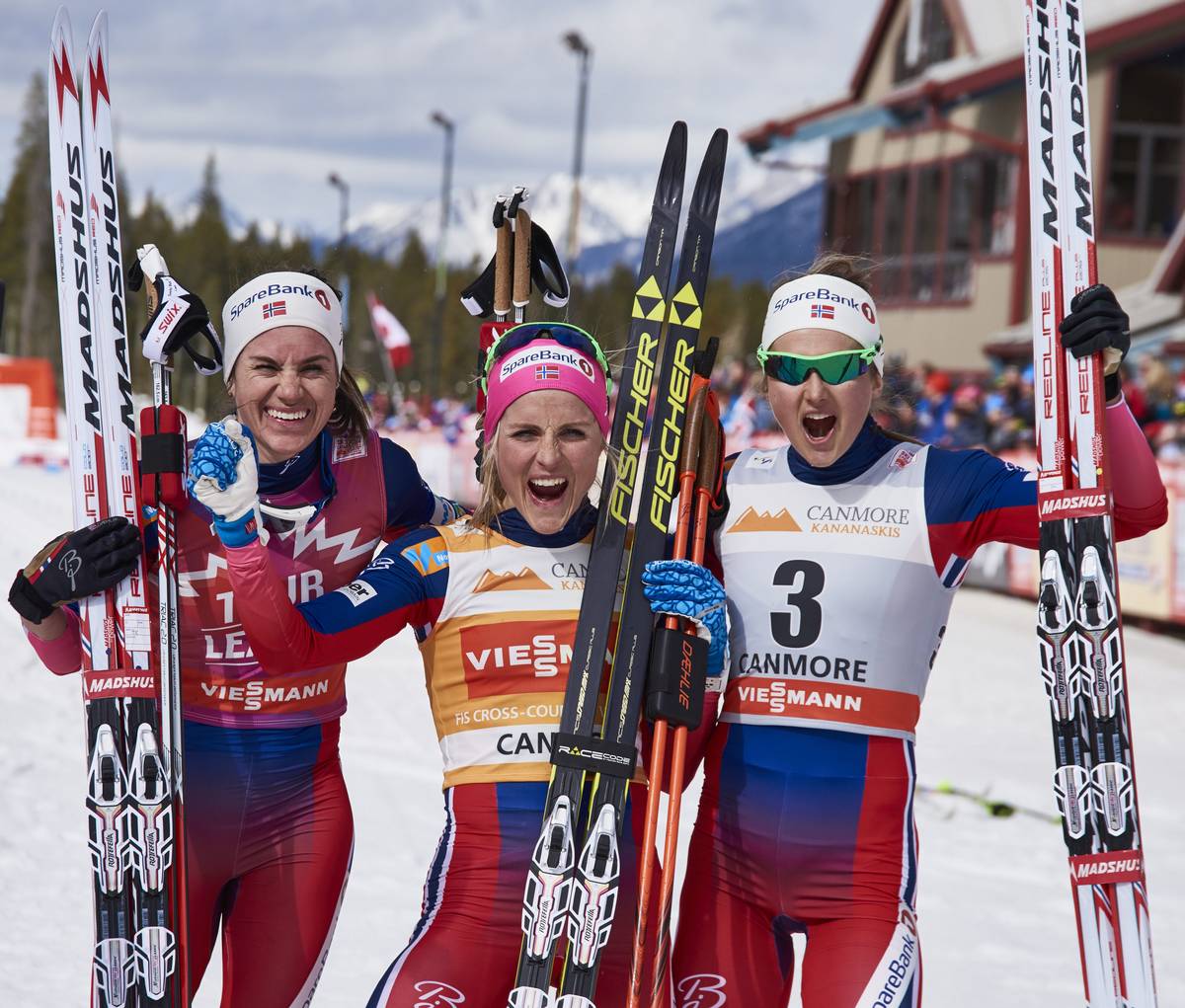
The all-Norwegian women’s Ski Tour Canada final podium, with Therese Johaug (c) in first, Heidi Weng (l) in second and Ingvild Flugstad Østberg (r) in third. (Photo: Madshus/NordicFocus)
When Norway’s Therese Johaug wins, she wants it to count.
After starting 30 seconds behind the tour leader, Weng, Johaug cranked out the first 3 k and caught onto the back of Weng by the final climb before lapping in the stadium.
As the pair double poled through the stadium and back into the lap’s first major climb, Johaug ratcheted past Weng to reclaim the lead for good.
“For me, I think this victory is bigger than the Tour de Ski because I not have a hill in the end here,” Johaug said during an in-person interview, referring to the final hill climb of the annual the Tour de Ski in Val di Fiemme, Italy.
Johaug finished in the STC pursuit in 34:12.4, more than a minute ahead of Weng, who placed second (+1:07.8), yet 0.6 seconds behind fastest course time of the day set by Parmakoski in fourth.
With her final victory, Johaug managed to accomplish in a season what no other woman has before: 17 individual World Cup wins as well as the Overall and Distance World Cup crowns. This is her second overall World Cup Crystal Globe.
“The whole season has been a dream,” Johaug told NRK. “It’s a bit sad that the season is over, even if it is good.”
Finishing the day in second place and second overall in the STC, was the previous tour leader, Weng.
“I’m pretty disappointed,” Weng said, according to a Langrenn press release. “It was incredibly hard to ski today.”
Completing the all-Norwegian podium was Ingvild Flugstad Østberg in third (+2:13.3).
“This was a battle from start to finish,” Østberg told Langrenn, after starting 1:25 behind in third. “I’m just happy to reach the finish and clear third place.”
CANMORE, Alberta — Craving more photos from the 2016 Ski Tour Canada? Here’s another batch highlighting the women’s event from Stage 7, the 10-kilometer freestyle individual start. The event took place on Friday at the Canmore Nordic Centre, with Norway’s Ingvild Flugstad Østberg running away with the win by 23 seconds. Tour leader, Heidi Weng of Norway finished in second while Finland’s Krista Parmakoski rounded out the podium in third.
American Anne Hart leads the start of the women’s10 k freestyle at Stage 7 of the Ski Tour Canada in Canmore, Alberta. (Photo: Fischer/NordicFocus)
Norway’s Maiken Caspersen Falla racing to 18th overall in the women’s10 k freestyle at Stage 7 of the Ski Tour Canada in Canmore, Alberta. (Photo: Fischer/NordicFocus)
U.S. ski team member, Sadie Bjornsen racing to a 17th overall in the women’s10 k freestyle at Stage 7 of the Ski Tour Canada in Canmore, Alberta. (Photo: Fischer/NordicFocus)
USA’s Chelsea Holmes skiing to a World Cup best result (22nd overall) during the women’s 10 k skate in Canmore, Alberta.
USA’s Caitlin Gregg, and Italy’s Giulia Stuerz, (l-r) during the women’s 10km , Canmore, Alberta. (Photo: Madshus/NordicFocus)
U.S. ski team member Ida Sargent racing during the women’s 10 k freestyle at Stage 7 of the Ski Tour Canada in Canmore, Alberta.
Norway’s Heidi Weng racing to second in the women’s 10 k freestyle at Stage 7 of the Ski Tour Canada in Canmore, Alberta. Here she’s seen leading Canadians Cendrine Browne (4) and Annika Hicks (31). (Photo: Madshus/NordicFocus)
American Katharine Ogden crests a hill during the women’s10 k freestyle at Stage 7 of the Ski Tour Canada in Canmore, Alberta. (Photo: Fischer/NordicFocus)
American Rosie Brennan racing to a 31st overall women’s 10 k freestyle at Stage 7 of the Ski Tour Canada in Canmore, Alberta.
Norway’s Ingvild Flugstad Østberg leads Slovenia’s Alenka Cebasek during the women’s 10 k freestyle at Stage 7 of the Ski Tour Canada in Canmore, Alberta. Østberg went on to win the stage by 23 seconds over her teammate Heidi Weng. (Photo: Madshus/NordicFocus)
Norway’s Ingvild Flugstad Østberg leads Slovenia’s Alenka Cebasek during the women’s 10 k freestyle at Stage 7 of the Ski Tour Canada in Canmore, Alberta. Østberg went on to win the stage by 23 seconds over her teammate Heidi Weng. (Photo: Madshus/NordicFocus)
Canada’s Emily Nishikawa racing to 35th in the women’s 10 k freestyle at Stage 7 of the Ski Tour Canada in Canmore, Alberta. She went on to lead the Canadian women in 37th overall in the Tour. (Photo: Fischer/NordicFocus)
U.S. ski team member Jessie Diggins races to an overall 5th pace in the women’s 10 k freestyle at Stage 7 of the Ski Tour Canada in Canmore, Alberta.
Norway’s Therese Johaug (r) leading U.S. skier Jennie Bender during the women’s 10 k freestyle at Stage 7 of the Ski Tour Canada in Canmore, Alberta.
Finland’s Krista Parmakoski racing to a third place overall in the women’s 10 k freestyle at Stage 7 of the Ski Tour Canada in Canmore, Alberta. (Photo: Madshus/NordicFocus)
Norway’s Invild Flugstad Østberg (r) being interviewed by FIS’s Jeff Ellis after she won the women’s 10 k freestyle at Stage 7 of the Ski Tour Canada in Canmore, Alberta. (Photo: Madshus/NordicFocus)
Race winner Ingvild Flugstad Østberg of Norway (center) with Norwegian teammate, Heidi Weng in second (l) and Finland’s Krista Parmakoski in third, stand on top of the podium for the women’s 10 k freestyle at Stage 7 of the Ski Tour Canada in Canmore, Alberta. (Photo: Madshus/NordicFocus)
Finland’s Krista Parmakoski (r) broke up an all-Norwegian sweep of Friday’s 10 k freestyle podium, placing third behind Norwegian winner Ingvild Flugstad Østberg (c), and runner-up Heidi Weng (l) also from Norway, in Stage 7 of the Ski Tour Canada in Canmore, Alberta. (Photo: Madshus/NordicFocus)
The opening ceremony at the 2016 Ski Tour Canada, held at the Grand Hall of the Canadian Museum of History in Hull, Quebec, just across the Ottawa River from Ottawa and a block for the sprint venue at Jacques Cartier Park. The evening included aboriginal dancers, Canadian Mounties, the introduction of athletes, and various speakers in front of a filled hall. (Photo: John Lazenby/Lazenbyphoto.com)
(Photo: John Lazenby/Lazenbyphoto.com)
(Photo: John Lazenby/Lazenbyphoto.com)
(Photo: John Lazenby/Lazenbyphoto.com)
(Photo: John Lazenby/Lazenbyphoto.com)
(Photo: John Lazenby/Lazenbyphoto.com)
(Photo: John Lazenby/Lazenbyphoto.com)
(Photo: John Lazenby/Lazenbyphoto.com)
With 49 North Americans competing at the Ski Tour Canada (26 Canadians and 23 Americans), there were a ton of tales to be told after the first two stages in Gatineau and Montreal, Quebec, respectively. FasterSkier did its best to check in with most of the North American racers.
Check out some of the best of our post-race interviews from Day 1 and 2 below (and a guide to team affiliations at bottom*).
For more on the top North American finishers, read our race reports:
“Being able to race in front of a home crowd and going around the course twice and hearing my name, like, left, right and center was pretty crazy. It was definitely just an incredible experience.” — Alannah MacLean (NDC Thunder Bay), after finishing 63rd in Gatineau sprint
“It was the loudest race I’ve ever done. It was crazy to hear all the noise. It was motivating.” — Olivia Bouffard-Nesbitt (CNST), 49th in sprint
“It was just really amazing to be at home and have so many people watching.” — Katharine Stewart-Jones (NDC Thunder Bay and originally from Nakkertok), 68th in sprint
“It’s really exciting because I get to race in front of my friends and family, which doesn’t happen very often, so that’s great to hear my name when I’m racing.” — Cendrine Browne (CNEPH/CNST), 55th in sprint
“It was an amazing atmosphere. So many people cheering, and I felt a little distracted…” — Dahria Beatty (AWCA/CNST), 45th in sprint
“The ambiance was pretty good and helped me a lot to do a good race.” — Simon Lapointe (Skinouk), 82nd in classic mass start
“Racing in front of a home crowd and just having so many fans out cheering for us is really special.” — Emily Nishikawa (CNST), 66th in sprint
“At every corner, at every point of the course there was a roar. It’s surreal racing in front of the home crowd. Looking to the crowd, and recognizing so many faces that are there to support you.” — Mark Rajack(Trinidad & Tobago/XC Ottawa), 86th in the sprint
“It’s just so great that we have such great volunteers and the organizing committees of all these places are really, ah, it’s fantastic.” — Devon Kershaw (Canadian World Cup Team), 50th in the sprint
“Having this many races here at home is a nice advantage for us, not having the jet-lag and [such]. It’s pretty special being able to race in front of the home crowd.” — Graeme Killick (CNST), 76th in the sprint
“Just tons of people cheering your name, and just cheering for Canada, so it’s really fun to be at home.” — Len Valjas (Canadian World Cup Team), 37th in the sprint
Americans:
Katharine Ogden (SMS/USST) racing to 59th in the women’s 10.5 k classic mass start in Montreal, Quebec, at the second stage of the Ski Tour Canada. (Photo: Flyingpointroad.com/NNF)
“It was exhilarating.” — Katharine Ogden (SMS/USST), 62nd in sprint
“It’s nice that people are speaking English and we can use our phones. There’s a lot more comfort involved than being over in like Finland or somewhere.” — Tad Elliott (SSCV), 81st in sprint
“The crowd is awesome. There’s so many Americans out here and it’s something special.” — Noah Hoffman (SSCV/USST), 74th in sprint
“Everything here is awesome. The fans are amazing, like half of them are from the U.S. I think, and the other half are from Canada so it’s pretty awesome to be here.” — Liz Stephen (USST), 59th in sprint
“I grew up in Vermont so it’s not that far. It really helps. It makes everything feel more comfortable. Any taste of home on the trail is amazing.” — Jennie Bender (BSF), 51st in classic mass start
“There were a lot of people cheering for us. A lot of Americans, a lot of Canadians. … Hope for even bigger crowds for the rest of the tour.” — Scott Patterson (APU), 75th in sprint
“It was awesome. You hear your name everywhere.” — Dakota Blackhorse-von Jess (Bend Endurance Academy), 54th in the sprint
Bonus: Great Britain
“There were a few people cheering me on, that was nice.” — Andrew Musgrave, 44th in sprint
What can you say about this opportunity?
“These are my first World Cups so I’m just going out here and learning as much as I possibly can and seeing what the next level of skiing is.” — MacLean, 64th in classic mass start
“It’s a really good team atmosphere. Everyone’s really stoked to have the opportunity to do these races in Canada.” — Michael Somppi (NDC Thunder Bay), 68th in sprint
“To have 12 girls here is just incredible. It’s really important for our women’s program.” — Nishikawa
“To have such a huge girls team is so awesome. I don’t think it’s ever been this big, and we’re all super supportive of each other. I think it’ll be a super-fun Tour.” — Annika Hicks (Canmore Nordic), 71st in sprint
“I’m racing against people that are four years older and have lots more experience than me so I’m here for more experience.” — Marie Corriveau (CNEPH/Canadian National Junior Team), 67th in sprint
“This is my first tour of World Cups, my first World Cups ever. So really every race is kind of a new adventure.” — Annie Hart (SMST2), 61st in classic mass start
How are you feeling?
Caitlin Gregg (Team Gregg/U.S. Ski Team) training on the course in Quebec City. (Photo: John Lazenby/Lazenbyphoto.com)
“I’m feeling really good. I have a ton of energy and I can tell that I want to just keep going and going and going, kind of that long-distance kind of style racing.” — Caitlin Gregg (Team Gregg/USST), 47th in classic mass start
“I’ve been getting over a chest cold after the last World Cup [in Falun]. I don’t know why, it was just a terrible recovery. I’ve been able to ski the last week, but I’ve only done two intensities and they both really sucked. So, all things considered, the lungs held up OK with the temperature, but I was just missing a bit of a snap.” — Valjas, after sprint
“I had a bit of issues with my back seizing. I’ve been struggling with that my last couple races.” — MacLean, 64th in classic mass start
“I had a couple crashes out there, broke a pole and my back seized on the second lap after the first crash. The first lap went really well actually, and I was right up there in the group and I felt like I was skiing well. After the tucking section, I came into the second lap and stood up and just, bam, my back completely seized. The last two laps were a real struggle.” — Beatty, 65th in classic mass start
“I don’t know what was going on, I was just so tired by the top [of the course]. …The body was doing something weird to me today.” — Andy Shields (NDC Thunder Bay), 76th in classic mass start
“I took a few spills, which sent me back a bit, but I felt good so I’m happy with that.” — Russell Kennedy (Canmore Nordic), 74th in classic mass start
What was your strategy?
“I took a lot of energy from the crowd and I just went out as hard as possible.” — MacLean, after sprint
“I really tried to stay composed. Everyone was rushing at the start. I kept my eyes opened, stayed on my skis and skied relaxed… Though I fell in the first lap like many others.” — Browne, 48th in classic mass start
“I just really wanted to survive it, you know, not get lapped. As silly as that seems, setting the bar pretty low, I haven’t had great classic races this year so it was a concern in the back of my mind and I’m happy to have survived. … I raced the first 3 k as if it was a 3 k race. I was kind of racing for my life out there, trying to get up as far up into the field as I could, as soon as I could to avoid crashes and bottlenecks and it worked.” — Bouffard-Nesbitt, 53rd in classic mass start
“I started really far back because I fell in the sprint … so it was just a matter of, let’s see how many spots I can move up, and I think I got about twenty so that was good.” — Bender, after the mass start
What were the course and conditions like in Montreal?
Kaitlynn Miller (Craftsbury Green Racing Project) on a cold training day in Quebec City on Thursday before the third stage of the Ski Tour Canada. (Photo: John Lazenby/Lazenbyphoto.com)
“It was a really technical course. The downhills were really icy and really hard to stay on your feet at some points, especially after some of the grueling uphills. I managed to stay upright and it was a success in that sense, but I wasn’t able to hang onto the group for as long as I would’ve liked.” — Knute Johnsgaard (CNST), 69th in classic mass start
“I started pretty far back. I was seeded 75th and I noticed right up the first hill that I was in dead last. I’m thinking, ‘Oh man, something didn’t go right with that start.’ It was kind of a weird course with sharp downhills that got skidded to ice so it just scraped off all your wax and then it was like, herringbone and double pole, herringbone and double pole.” — Patterson, 55th in classic mass start
“The downhills were very icy and very sketchy. Some of the most sketchy downhills I’ve had in a race. It was very icy around the turns and we were just all doing our best to stay on our feet and try not to get in any pileups.” — Eric Packer (APU), 67th in classic mass start
“It was a tough day. I think the conditions made the course and the race even more challenging. But it’s always a learning experience for me, only my second World Cup today so I’ll take what I can get.” — Jenn Jackson (NDC Thunder Bay), 63rd in the classic mass start
“I really enjoyed the course and just the energy of everyone cheering. My family and friends were there to watch so it was really fun.” — Kaitlynn Miller (CGRP), 39th in classic mass start
What are your goals for the Tour?
“I think all the Canadian girls are searching for those top 30s, and if a few of us can get it that’s gonna be great.” — Andrea Dupont (RMR), 56th in the sprint
“Definitely trying to stay in the competition every race. … My goal is really a top 30, and I hope to get it one of these races.” — Beatty
What race are you most looking forward to?
“Very excited about having two 15 k skates.” — Brian Gregg (Team Gregg), 83rd in sprint
“The pursuit in Canmore. It’s a course I know pretty well, and I had some great races on the exact course like for trials and other events. So I’m really excited to race the pursuit.” — Killick
“I’m excited to go back to Quebec, but I’m really looking forward to Canmore. For me that’s home. That’s a home venue.” — Blackhorse-von Jess (of Bend, Oregon)
“The classic sprint in Canmore. That suits me, that is my best event I think.” — Bob Thompson (NDC Thunder Bay), 52nd in sprint
“I think each event presents it’s own learning experiences and challenges, but a classic sprint in Canmore — I really enjoyed the classic sprint in Canmore on the NorAms — so hopefully we can have some good races there.” — Jackson, 58th in sprint
“Just getting to ski a lot of World Cups is a pretty awesome opportunity. Definitely looking forward to more of the distance races.” — Ogden
“I’m quite looking forward to the skiathlon in Canmore, but there’s going to be a lot of good stages, good crowd here, so I think all of the stages will be fun if the crowd is good the whole way.” — Musgrave, after the sprint
“The other athletes here worked their entire lives to be here. I literally started [skiing] three years ago and I just showed up. So my goal here is to come here and do justice to the sport and not erode the validity and integrity of the sport that these athletes worked so hard to create.” — Rajack, after the sprint
Also:
We missed NorAm leader Kevin Sandau (AWCA), but this video he made before the Ski Tour Canada sums up a lot (click here to view on YouTube)
*Guide to North American teams:
Canada:
– AWCA: Alberta World Cup Academy
– CNEPH: Pierre-Harvey National Training Centre (Centre National D’entraînement Pierre Harvey)
– CNST: Canadian National Senior Team
– NDC Thunder Bay: Thunder Bay National Development Centre
– RMR: Rocky Mountain Racers
USA:
– APU: Alaska Pacific University
– BSF: Bridger Ski Foundation
– CGRP: Craftsbury Green Racing Project
– SMS: Stratton Mountain School
– SMST2: Stratton Mountain School T2 Team (elite team)
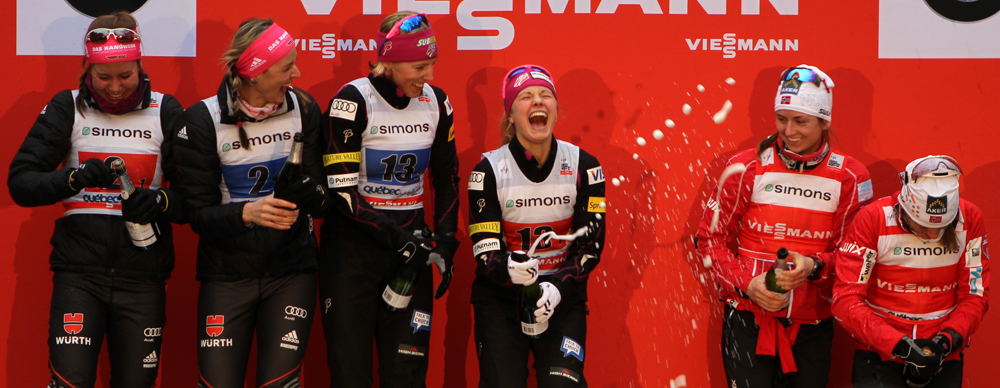
Jessie Diggins (center, laughing) pops some champagne as she and U.S. teammate Kikkan Randall (third from left) topped the podium in the freestyle team sprint at the 2012 World Cup in Quebec City. Germany’s Hanna Kolb and Denise Herrmann placed second (l) and Norwegians Celine Brun-Lie and Maiken Caspersen Falla finished third (r).
(Note: This article has been updated to mention that Caitlin Patterson will not be competing in the Ski Tour Canada because of illness.)
The U.S. will be well represented at the Ski Tour Canada (STC) with a roster of 24 athletes, the U.S. Ski Team officially announced Sunday. The list includes World Cup regulars as well as top Nation’s Group skiers who rank at the top of the domestic U.S. SuperTour standings. The selections were made based on a combination of criteria and discretion.
U.S. Women’s STC Team
Sadie Bjornsen: Alaska Pacific University (APU)/U.S. Ski Team (USST)
Sophie Caldwell: Stratton Mountain School (SMS) T2/USST
Jessie Diggins: SMST2/USST
Ida Sargent: Craftsbury Green Racing Project (CGRP)/USST
*Note: Caitlin Patterson explained in an email to FasterSkier on Monday that she will not be taking part in the Tour. According to U.S. head coach Chris Grover, she canceled this morning and her start is non-transferable because she is the SuperTour (Continental Cup) leader.
“I was looking forward to it so much, but I caught a nasty cold late last week that I haven’t been able to shake off in time,” wrote Patterson, the two-time national champion in both distance races this year. “And so as painful as it was, I had to realize that I was not healthy enough to start the races and therefore did not travel to Canada.”
Of the 13 women, 10 have competed in World Cup races this season. Chelsea Holmes and Patterson earned mid-season World Cup starts after strong early season SuperTour performances. Caitlin Gregg began her season on the World Cup but returned home after the Tour de Ski and recently claimed her fourth Birkie title.
Newcomers to the squad include Katherine Ogden, Anne Hart and Kaitlynn Miller. Ogden led the U.S, contingent at U23 Junior World Championships, finishing 13th in both distance races. She also posted consistent top-10 SuperTour results, highlighted by an early season win at the 10-kilometer freestyle in West Yellowstone, Mont. Hart claimed a pair of runner-up finishes at U.S. nationals in both the classic and freestyle sprints and her first SuperTour win in the 5 k freestyle in Craftsbury, Vt., earlier this month. Miller broke through earlier this season, winning the classic sprint and placing second in the women’s 10 k classic at U.S. nationals.
U.S. Men
Simi Hamilton: SMST2/USST
Andy Newell: SMST2/USST
Erik Bjornsen: APU/USST
Noah Hoffman: Ski and Snowboard Club Vail (SSCV)/USST
Matt Liebsch: Gear West
Eric Packer: APU/
Scott Patterson: APU
Brian Gregg: Loppet Nordic Racing/Team Gregg
Reese Hanneman: APU
Dakota Blackhorse-von Jess: Bend Endurance Academy
Tad Elliott: SSCV
For the men, eight of the 11 athletes have competed in a World Cup this season. Reese Hanneman, Scott Patterson and Dakota Blackhorse-von Jess earned mid-season World Cup starts. Brian Gregg raced the 30 k freestyle at the World Cup in Davos, Switzerland, after his early-season win in West Yellowstone. Matt Liebsch, Tad Elliott and Eric Packer will be making their first World Cup appearances for the 2015/2016 season.
The national 30 k freestyle champion, Elliott recently placed second in the 10 k at the Craftsbury SuperTour and 10th at the American Birkebeiner. Packer stands as the overall SuperTour leader after consistent strong performances highlighted by a classic sprint victory at U.S. nationals. After posting two top-10 results at nationals and a runner-up finish to Brian Gregg in West Yellowstone, Matt Liebsch was the next man in line after Adam Martin, who declined his STC spot, in the SuperTour distance standings.
Spectators at the 2012 World Cup in Quebec City. The last time the World Cup came to North America, races took place in Quebec City and Canmore in December 2012.
Since World Cup racing is rarely held on this side of the Atlantic, the STC offers a unique opportunity for athletes and fans in North America. With no Olympic Games or World Championships this season, the eight-stage tour will be the culminating event of the 2015/2016 World Cup season.
The STC includes eight races between four venues. The tour will start in Gatineau on Tuesday with a freestyle sprint before athletes travel 200 kilometers east for classic mass starts on Wednesday in Montreal. The next two stages are located 250 k northeast as Quebec City hosts a freestyle sprint and a freestyle pursuit on Friday and Saturday. The final four races will be held across the country in Canmore, Alberta, with classic sprints, skiathlons, freestyle individual starts, and finally, classic pursuits to close the tour.
Races will be broadcast live for cable/satellite subscribers on NBC Sports Live Extra, according the the schedule below. All times are Eastern Standard Time.
Tuesday, March 1: Gatineau
1:45 p.m. – Men’s and women’s freestyle sprint
Wednesday, March 2: Montreal
12:00 p.m. – Women’s 13 k classic mass start
2:30 p.m. – Men’s 20 k classic mass start
Friday, March 4: Quebec City
3:30 p.m. – Men’s and women’s freestyle sprint
Saturday, March 5: Quebec City
3:00 p.m. – Women’s 10 k freestyle pursuit
4:00 p.m. – Men’s 15 k freestyle pursuit
Tuesday, March 8: Canmore
3:00 p.m. – Men’s and women’s classic sprint
Wednesday, March 9: Canmore
12:00 p.m. – Women’s 15 k skiathlon
2:30 p.m. – Men’s 30 k skiathlon
Friday, March 11: Canmore
11:45 a.m. – Women’s 10 k freestyle interval start
3:00 p.m. – Men’s 15 k freestyle interval start
Saturday, March 12: Canmore
3:00 p.m. – Women’s 10 k classic pursuit
4:00 p.m. – Men’s 15 k classic pursuit
Paddy Caldwell (Dartmouth/SMS/USST) racing to 21st in the men’s 15 k freestyle at U23 World Championships in Rasnov, Romania. (Photo: Logan Hanneman)
(Note: This article has been updated to include comments from Jasper Good, a U.S. Nordic Combined skier, and Annika Taylor, a California native who races for Great Britain.)
Twelfth, 13th, 15th. Those were the top results three Americans posted in Thursday’s competitions — between nordic combined and cross-country — at U23/Junior World Championships in Rasnov, Romania.
Jasper Good (U.S. Nordic Combined) racing to 11th in the normal hill/10 k individual competition at 2016 Junior World Championships in Rasnov, Romania. (Courtesy photo)
Jasper Good, a 19-year-old nordic-combined skier from Steamboat Springs, Colo., raced to 12th in the normal hill/5-kilometer Gundersen, finishing 1:13.3 behind winner Thomas Portyk of the Czech Republic, after starting 1:20 back. Portyk improved from second in the jump to win by 5.1 seconds in 11:01.5 minutes. Germany’s Terence Weber placed second and Estonia’s Kristjan Ilves, the jump leader, finished third (+5.4).
Good jumped to 14th then raced the seventh-fastest 5 k to climb to 12th. On Tuesday at junior worlds, he recorded his career best in his fourth World Championships: 11th in the normal hill/10 k.
“I wanted to put myself in the fight for a top 10 finish and I did that both days so to some degree I am happy with that,” Good wrote in an email on Sunday after the competitions. “Although I really wanted to break the top 10 I am happy as I was able to put two consistent competitions together. Both days were what I would call an accurate portrayal of my average level. I am happy that my average had me finishing in the top 15 on both days but a little disappointed I wasn’t able to have a slightly above average day to get me into the top 10.”
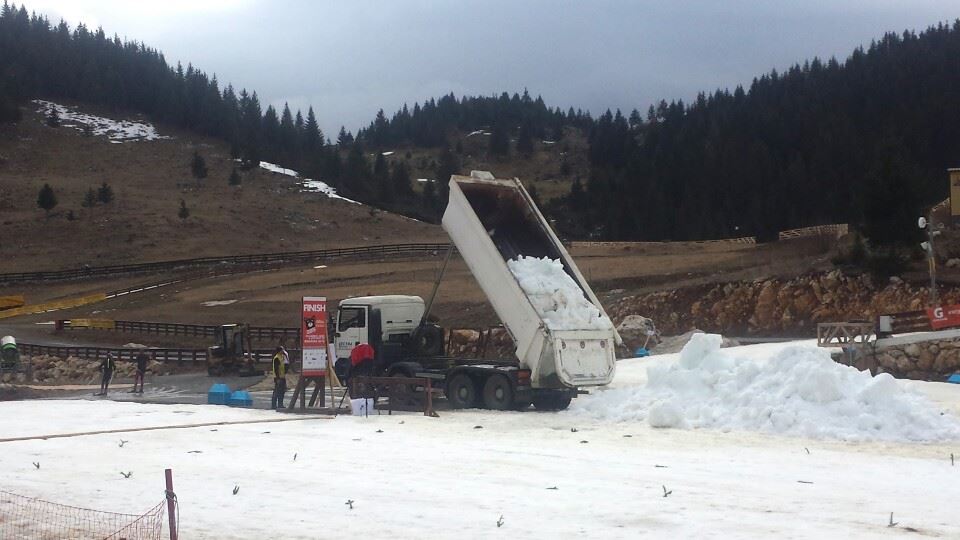
“With all of the challenges we were faced with this week between lack of snow, wind on the jump hill, and an excessive amount of schedule changes I am happy I was still able to move past it and perform when it mattered,” he continued.
Americans (from left to right) Ben Loomis, Stephen Schumann, coach Martin Bayer, Jared Shumate, and Jasper Good after an individual competition at 2016 Nordic Combined Junior World Championships. Not pictured: Koby Vargas. (Photo: Jasper Good)
In the normal hill/4 x 5 k team event on Friday, Good and fellow Americans Jared Shumate, Stephen Schumann and Ben Loomis placed sixth, about 5 1/2 minutes behind the Austrian winners. According to Good, that was his team-best result at junior worlds.
“I think the fact that our team event rank has been improving every year I have been on the team is a huge testament to the potential coming up in US Nordic Combined!” Good wrote.
He planned to finish the season with two more weekends of Continental Cup competitions.
In Thursday’s individual nordic-combined competition, three Americans followed Good with Koby Vargas in 32nd, Schumann in 38th and Shumate in 44th.
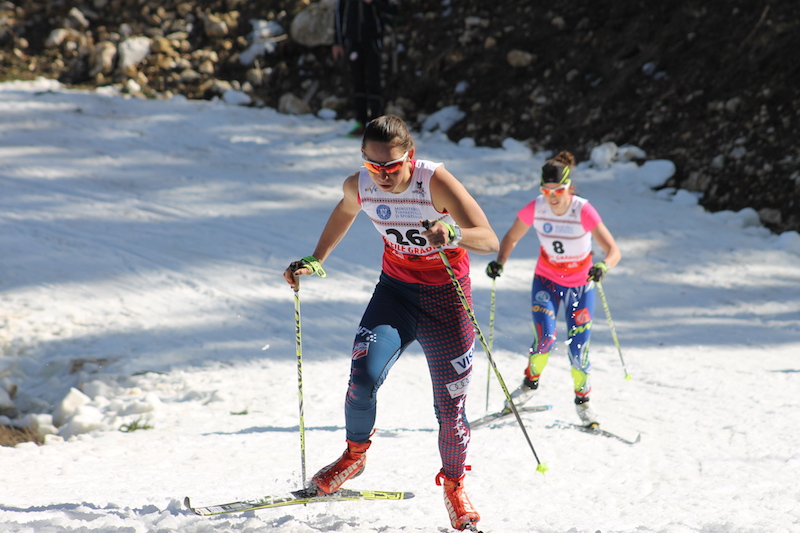
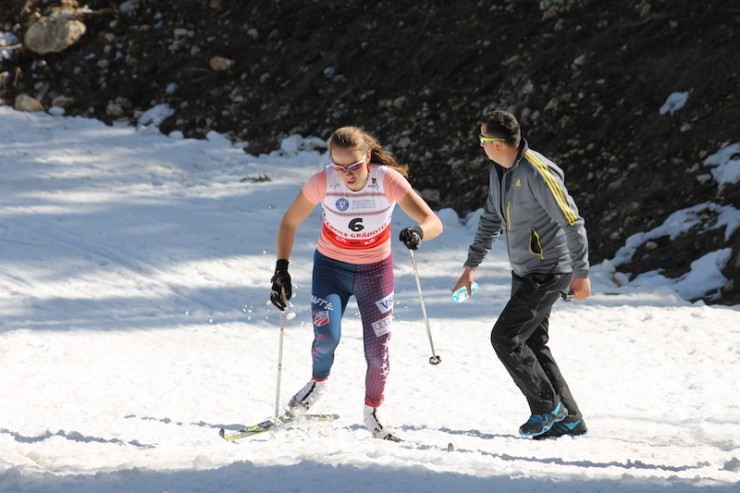
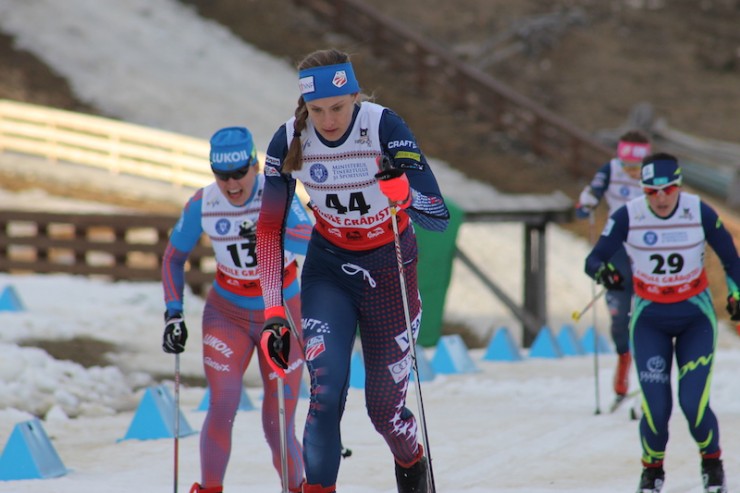
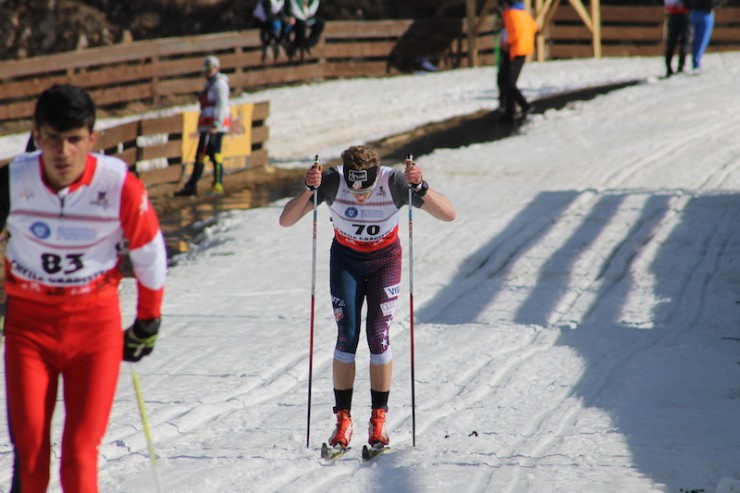
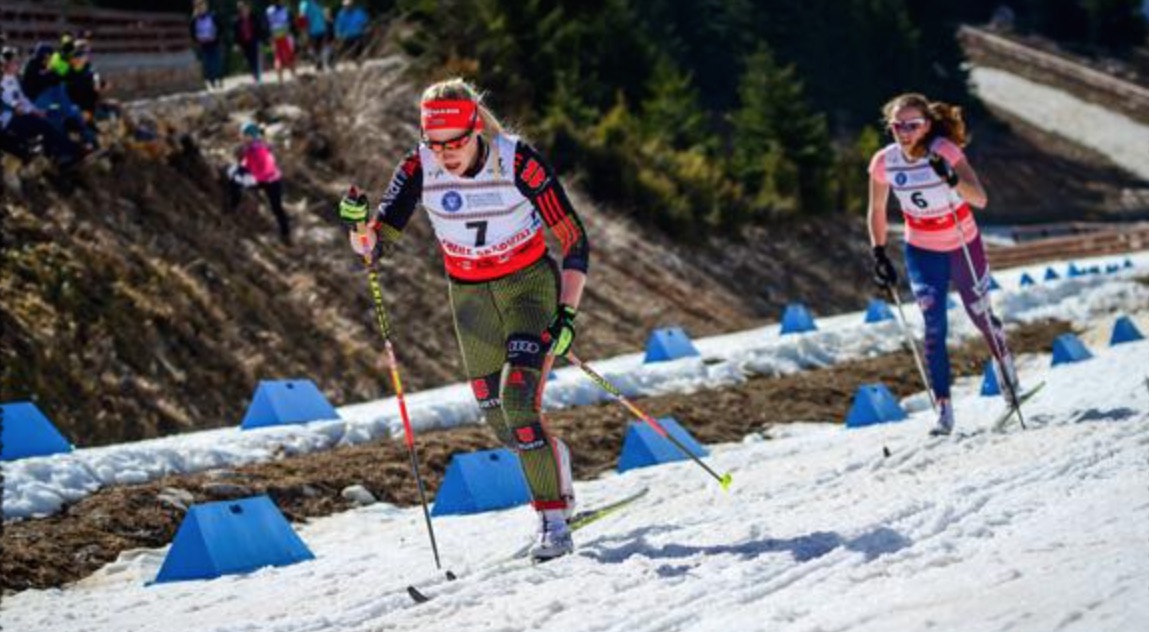
Friday also marked the last day of individual cross-country racing as well, Katharine Ogden of the Stratton Mountain School (SMS) and U.S. Ski Team (USST) finished 13th in the junior women’s 10 k freestyle individual start, two days after placing 13th in the 5 k classic. On Thursday, Ogden finished 1:11.4 behind Ebba Andersson of Sweden, the winner in 23:29.8.
Andersson won the 10 k skate (originally scheduled as a skiathlon, but changed before the championships because of low snow) by 29 seconds, ahead of Germany’s Katharina Hennig in second and 32.2 seconds ahead of Norway’s Tiril Udnes Weng in third. The fifth starter, Andersson consistently clocked the fastest splits in the four-lap race. Ogden started sixth and posted times that ranked within the top 15 for most of the race.
“The conditions were fast and icy with a little corn snow built up in some places,” Ogden explained in an email.
The course had frozen overnight, giving it a much different feel than the slow slush athletes had previously raced in this week.
“I struggle a little in faster conditions like that which is why I was focusing on really skiing bigger and getting more power as opposed to my usual fast tempo skiing,” the 18-year-old Vermont native continued. “I had high expectations going into this race and I was initially a little disappointed with how it went result wise. However, I am really psyched that I fought it out and raced as hard as I could in conditions that did not favor my strengths.”
“Katharine Ogden had an awesome day and was consistent in her race today as well as in the results,” USST Development Coach and trip leader Bryan Fishtold USSA. “She did a great job holding on to her place throughout the race.”
Also making the top 30 in the junior women’s race, Vivian Hett of Northern Michigan University (NMU) placed 30th (+2:06.3) for her career best in two world championships.
“My goal coming into the competition was to better my results from last year,” Hett, 19, wrote in an email. “I felt like last year didn’t do a great showing of the skier I would like to be and I feel as if I have improved that this year.”
In Rasnov, she achieved her first top 30 after placing 36th in the classic sprint at 2015 junior worlds in Almaty, Kazakhstan.
“My main focus today was to pace the race correctly,” Hett explained. “Being from sea level, I like to consider Romania at altitude even though it’s not very high up. We’re at about 3500ft at the race venue and I knew that if I went out too hard, I could possibly burn up. With that being said, it was my goal to ski the first lap smoothly and go from there.”
At the race’s halfway point, her split time ranked 23rd. By 7.5 k, Hett’s time was 25th fastest and she ended up 30th.
“The second half of the race was tough but I kept getting splits that I was in the mid 20s and that kept me firing,” she wrote. “I’m very happy with my results. It’s the best I’ve done at Junior Worlds and it makes all the summer and fall training worth it!”
Also representing the U.S. in the junior women’s race, two other NMU skiers Nicole Schneider and Sarah Bezdicek placed 40th and 46th, respectively.
Canada’s Hannah Mehain finished 54th, Natalie Hynes was 56th and Sadie White 59th.
In the 4 x 2.5 k freestyle relay on Friday, the U.S. junior women raced to eighth, 1:07.3 behind the Swedish winners, and Canada, with two athletes out sick, was unable to field a full team and did not finish.
Julia Kern (SMS/USST) started first for the U.S., putting the team in 12th at the first exchange, 15.3 seconds behind Russia in first.
“Julia had an awesome leg until she tangled with an Italian girl and fell,” Ogden explained in an email on Friday. “She gained back a bit of time but still tagged off in 12th place.”
Ogden raced the fifth-fastest second leg to improve to seventh, 16.4 seconds behind Sweden in first by the second exchange.
“I made up most of the places that I got by utilizing a quick V1 up some of the steeper pitches,” Ogden wrote.
Hett lost one position on the third leg and tagged off in eighth, 45 seconds behind Sweden, and Bezdicek kept the team in eighth through the finish, crossing the line 30 seconds after Italy in seventh.
“Our team was happy with our result,” Ogden explained. “It would have been awesome to have seen what would have happened if Julia hadn’t fallen but then again that’s totally just a part of the game and it happens.”
Sweden won the final race of the championships, with Emma Ribom, Elina Rönnlund, Andersson, and Jenny Solin, in 22:30.7. Norway was just 0.6 seconds away from gold in second place, and Russia finished third, 10.2 seconds behind.
Mehain skied the first leg for Canada, tagging Hynes in ninth, 10.6 seconds behind the leaders. Hynes then came through the second exchange in 12th before the team had to pull out of the race without two more athletes.
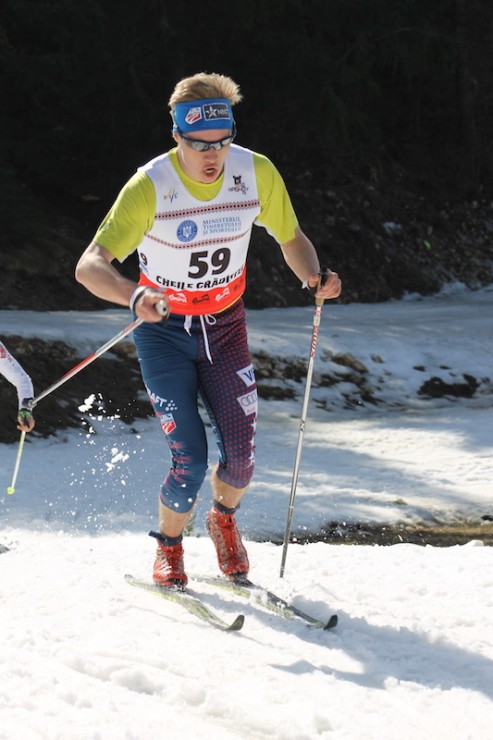
In the junior men’s 15 k freestyle on Thursday, Ian Torchia, another NMU Wildcat, raced to 15th for his best result of the week. In two Junior World Championships, it was his second-best individual result after placing 11th in the 20 k skiathlon last year in Almaty.
Ian Torchia (10) racing the first leg of the junior men’s 4 x 5 k relay at Junior World Championships on Friday in Rasnov, Romania. (Photo: Logan Hanneman)
“Coming into the week I had high goals and after the disappointment of 43rd in the [10 k] classic race I threw that race in the toilet and refocused for the skate,” Torchia wrote in an email.
“My strategy was to try and start out hard but I was missing a little pop today so I was lucky to get a ride off the eventual 6th place Russian Ivan Krillov,” he added. “I stayed on him thanks to my fast boards waxed by Justin Beckwith and the hard working tech crew. After he peeled off for his finish I gave it all I had in the last lap and held onto 15th.”
Torchia finished 1:24.2 behind the winner, Ivan Yakimushkin of Russia, who completed the six-lap race in 31:19.1. Yakimushkin won by 12.2 seconds over Norway’s Mattis Stenshagen in second place, and Russia’s Denis Spitsov was 29.2 seconds back in third.
“I was happy with my performance today as the icy fast power course with short steep climbs did not play to my strengths,” Torchia wrote. “I was originally disappointed with all the changes from a skiathlon to a 20k mass start to a 15k individual start but as a team we all adjusted and dealt with the ‘interesting’ conditions for all the races this week.”
According to Fish, “Ian Torchia did an excellent job in pacing his race and moving up,” he told USSA. “He kept charging hard throughout the race and eventually was able to move all the way up to 15th place, in a very competitive field.”
Joey Foster led Canada in 33rd, 2:22.5 behind the winner, for his best result in his debut junior worlds. Also for Canada, Philippe Boucher placed 39th, Ryan Jackson was 57th and Antoine Blais 61st.
Racing for the U.S., Cully Brown placed 41st, Zak Ketterson was 60th and Leo Hipp 74th.
Norway trounced the junior men’s 4 x 5 k relay on Friday by 47.7 seconds, winning in 43:07.5 with Stenshagen, Vebjørn Hegdal, Jan Thomas Jenssen, and Johannes Høsflot Klæbo.
Russia took silver and France earned bronze, 1:18.2 behind Norway.
Ian Torchia (c) in bib 10 racing the opening “scramble” leg for the U.S. junior men in Friday’s 4 x 5 k relay at Junior World Championships in Rasnov, Russia. The U.S. placed 11th. (Photo: Logan Hanneman)
The U.S. placed 11th (+3:21.5) with Torchia, Brown, Henry Harmeyer, and Ketterson. Canada finished 15th (+4:29.1) with Boucher, Foster, Blais, and Jackson.
“Scrambling for the relay tomorrow on such a narrow course is going to be hectic,” Torchia predicted on Thursday, adding he was “looking forward to mixing it up with the best.”
He tagged the U.S. in ninth after skiing the first leg, 12 seconds behind Norway in first. Brown held that position but slipped 57.4 seconds behind the leaders (Russia) by the second exchange. Harmeyer lost two places by the final exchange, tagging in 11th and 2:21.8 out of first, and Ketterson remained in 11th through the finish.
Canada opened with Boucher racing to 17th by the first exchange (+1:04.6), then Foster held that position and tagged Blais 2:04.5 out of first. Blais raced the 11th-fastest third leg to bring his team to 15th by the final exchange (+3:10.7) and Jackson kept them in 15th, about 30 seconds away from either 14th or 16th.
In the U23 men’s 15 k freestyle, Paddy Caldwell led the U.S. in 21st and Adam Martin placed 29th for the second-consecutive top 30’s for both Americans.
Caldwell, of the Dartmouth and Stratton ski teams, as well as the USST D-team, finished 1:34.2 behind the winner for his best result of the week.
Norway’s Simen Hegstad Krueger won it in 31:13.3, while France took second and third with Clement Parisse (+13.3) and Alexandre Pouye (+32.8), respectively.
“Today’s race was my main focus for the week,” Caldwell, 22, wrote in an email. “I had awesome skis out there — big thanks to all the wax techs for getting amazing skis. I did not feel as good as I had hoped out there today, my legs felt heavy and I couldn’t keep the distance pace that I usually aim for. With that the wheels started to come off the last few laps and I fell back quite a bit. I wanted to be up in that top five/ top ten spot but didn’t have it today.”
Paddy Caldwell (Dartmouth/SMS/USST) racing to 21st in the men’s 15 k freestyle at U23 World Championships in Rasnov, Romania. (Photo: Logan Hanneman)
After posting the sixth-fastest split at 2.5 k, Caldwell’s time stood up as the 12th fastest at 7.5 k, and by 12.5 k, he was down to 20th.
“He went out strong in the beginning and lost a little bit of time in the end, but he still showed a lot of promise in a very deep U23 field,” Fish told USSA.
Caldwell’s career best at a U23 or junior world championship was 10th in the 20 k skiathlon two years ago in Val di Fiemme, Italy. That was at junior worlds; last year at U23’s in Almaty, he placed 15th in the 15 k freestyle and 20th in the 30 k skiathlon.
Looking ahead to the rest of the season, Caldwell wrote that he’s “Not entirely sure what the rest of the season holds! But I am looking forward to spring series and whatever races I have between now and then!”
On Friday, Matt Liebsch announced that he had earned the final men’s spot for the U.S. at the Ski Tour Canada (STC) — the season-ending World Cups from March 1-12. U.S. Ski Team Head Coach Chris Grover previously explained in an email that either Liebsch or an outstanding performer at U23’s would earn that final spot.
American Adam Martin (second from left in bib 18) of Northern Michigan University racing to 29th in the men’s 15 k freestyle at U23 World Championships in Rasnov, Romania. (Photo: Logan Hanneman)
For Martin, who declined the U.S. team’s offer to compete at STC (instead choosing to focus on NCAA Championships in two weeks), he left U23 World Championships “quite satisfied,” as he considered classic skiing to be his strength.
“I started more aggressively than Tuesday,” Martin wrote on Thursday. “Fortunately, an Italian who was on his first lap caught me on my second lap, and I skied with him until the finish. This helped me dig deeper I think.”
He finished 2:01.6 behind the winner and one-tenth of a second out of 28th.
“Leaving the championships I’m optimistic,” Martin, 21, wrote. “I would really like to qualify again next year and race [at U23 World Championships] in Soldier Hollow.”
In his first world championships, Canada’s Jack Carlyle cracked the top 40 in 32nd (+2:10.4). Also for Canada, Alexis Dumas placed 38th, Scott James Hill was 42nd and Angus Foster finished 72nd.
Akeo Maifeld-Carucci of the Bridger Ski Foundation placed 39th for the U.S. and Kyle Bratrud (CXC) was 43rd.
American Heather Mooney racing to 42nd in the women’s 10 k freestyle at the U23 World Championships on Thursday in Rasnov, Romania. (Photo: FIS)
In the U23 women’s 10 k freestyle, Germany’s Victoria Carl claimed gold by in 23:14.1, 18.9 seconds ahead of Slovenia’s silver medalist Lea Einfalt and 27.1 seconds ahead of Russia’s Anastasia Sedova in third.
A California native and dual citizen of Great Britain, Annika Taylor (Sugar Bowl Academy Elite Team) achieved her first top 30 in two U23 World Championships, placing 30th, 2:06.8 behind the winner.
Taylor, 22, has spent most of the season racing World Cups for Great Britain. She led the British team in Rasnov, with Sarah Hale finishing 40th in Thursday’s 10 k skate. Earlier in the week, Taylor finished 34th in the 10 k classic and 36th in the freestyle sprint.
“I was really looking for a top-20 result at these championships, so I was left wanting more at the end of the week,” Taylor wrote in an email. “At the [World Cup] races in Falun, my body felt really good, most likely indicating a bit of a peak in performance, which then left me tired in the training week leading up to Romania. Although I didn’t achieve my results-based goal for the championships, I still had a few personal ‘wins’ of the week, including racing my 24th race of the 15-16 ski season, marking 4.5 months on the ski-traveling road, and seeing friends from the EISA carnival circuit!
“After 4 years at UNH focusing only on distance racing, this year has been a ‘relearning how to sprint’ year, and I’m excited to get to race a few sprints at the Tour of Canada!” she continued. “I’m also planning on racing Supertour Finals in Craftsbury (as long as my body keeps going after racing 8 races at the T of C).”
Canada’s Frédérique Vézina finished 35th (+2:35.6) for her best result of the week. Americans Felicia Gesior and Kelsey Phinney placed 38th and 39th, respectively, and Heather Mooney was 42nd and Kristen Bourne 44th for the U.S.
Canada occupied 45th through 47th, with Kendra Murray, Alannah Maclean and Sophie Carrier-Laforte, respectively.
“Overall, Romania was a positive and unique experience,” Taylor wrote. “I had so many laughs with my British teammates, shared plenty of hugs with Heather and Kelsey, played with stray dogs, visited Dracula’s castle, and even got a slight face-tan!”
On Saturday, most of the athletes planned to leave Romania. Ogden is headed to Ottawa, Canada, to compete in the eight-stage STC.
“Romania was an awesome experience and I think that I will definitely remember the stunning views of the Transylvanian alps,” Ogden reflected. “And I’ll probably remember all the crazy schedule changes and the heroic effort of the organizing committee to pull off this even with barely any snow.”
Simen Krueger won the men’s 15 k freestyle at 2016 U23 World Championships in Rasnov, Romania. (Photo: FIS)
Canada’s Antoine Blais (41) and Philippe Boucher (30) racing in a group with Norway’s Thomas Jan Jenssen (19), Italy’s Mikael Abram (8) and France’s Jules Lapierre during the men’s 15 k freestyle at Junior World Championships in Rasnov, Romania. (Photo: FIS)
Canada’s Jack Carlyle racing to 32nd in the men’s 15 k freestyle at U23 World Championships in Rasnov, Romania. (Photo: FIS)
Romania’s Florini Pripici leads Canada’s Angus Foster during the men’s 15 k freestyle at U23 World Championships in Rasnov, Romania. Foster placed 72nd. (Photo: FIS)
American Paddy Caldwell leads Switzerland’s Jason Rueesch during the men’s 15 k freestyle at U23 World Championships in Rasnov, Romania. Caldwell finished 21st. (Photo: FIS)
Bird’s eye view of the race course with Adam Martin, of the U.S., in bib 18. He placed 29th in the men’s 15 k freestyle at U23 World Championships in Rasnov, Romania. (Photo: FIS)
Kyle Bratrud (USA) racing to 43rd in the men’s 15 k at U23 World Championships in Rasnov, Romania. (Photo: FIS)
Kyle Bratrud of the U.S. leads a French athlete during the men’s 15 k freestyle at U23 World Championships in Rasnov, Romania. (Photo: FIS)
Italy’s Sebastiano Pellegrin leads American Kyle Bratrud into the finish of the men’s 15 k freestyle at U23 World Championships in Rasnov, Romania. (Photo: FIS)
Katharine Ogden (SMS/USST) racing to 13th in the 5 k classic at Junior World Championships in Rasnov, Romania. (Photo: Pete Leonard)
Julia Kern (SMS/USST) racing to 18th in the 5 k classic at Junior World Championships in Rasnov, Romania. (Photo: Pete Leonard)
Adam Martin (NMU) racing to a American-leading 23rd in men’s 15 k classic at 2016 U23 World Championships in Rasnov, Romania. (Photo: Pete Leonard)
Kyle Bratrud (CXC) racing to 29th in the men’s 15 k classic at U23 World Championships in Rasnov, Romania. (Photo: Pete Leonard)
Cully Brown racing to 35th in the men’s 10 k classic at Junior World Championships in Rasnov, Romania. (Photo: Pete Leonard)
Kristen Bourne racing to 40th in the women’s 10 k classic at U23 World Championships in Rasnov, Romania. (Photo: Pete Leonard)
Felicia Gesior racing to 41st in the women’s 10 k classic at U23 World Championships in Rasnov, Romania. (Photo: Pete Leonard)
Ian Torchia racing in the men’s 10 k classic at Junior World Championships in Rasnov, Romania. He placed 43rd and went on to notch 15th in the 15 k freestyle there. (Photo: Pete Leonard)
Henry Harmeyer racing to 65th in the men’s 10 k classic at Junior World Championships in Rasnov, Romania. (Photo: Pete Leonard)
Katharine Ogden didn’t worry too much about the slush at Junior World Championships on Tuesday. She tested her skis once, remained confident in her kick and resolved to “hammer the whole thing” because 5 kilometers is pretty short, the 18-year-old Stratton Mountain School and U.S. Ski Team D-team member explained in an email.
“I didn’t notice too much of a change in the conditions between laps, although by my second lap I’m not sure I would have noticed much, it was definitely a sufferfest out there,” she wrote.
Ogden raced to 13th in the 5 k classic individual start on the second day of U23/Junior World Championships in Rasnov, Romania, leading the U.S. team on a classic distance day with temperatures in the mid-to-upper 50 degrees Fahrenheit.
American Katharine Ogden (6), of the Stratton Mountain School and U.S. Ski Team, chases Germany’s Antonia Fraebel during the junior women’s 5 k classic at the Junior World Championships on Tuesday in Rasnov, Romania. (Photo: FIS Nordic JWSC & U23 WSC)
The sixth starter, Ogden finished 56.8 seconds behind the winner Marte Mæhlum Johansen of Norway, who completed the two-lap race in 15:34. In Ogden’s second junior world championships, the result was her third best after placing sixth in the 10 k skiathlon and 11th in the 5 k freestyle last year in Almaty, Kazakhstan.
“I’m psyched about my race and I’m hoping to carry the momentum into the skate 10k which is a much better event for me,” she wrote of Thursday’s race. “I’m mostly focused on the skate race here.”
When asked how Rasnov compares to Almaty, Ogden explained they are “pretty similar in some ways but completely different in others.
“Almaty was a huge industrial city while Rasnov is a small rural mountain town,” she wrote. “The low snow has been common to both venues, however the situation is much worse here in Romania. It’s pretty awesome that we get the opportunity to travel to these crazy places and race because neither place is one that I would ordinarily get to experience.”
Finishing 21.2 second off her teammate’s pace and 1:18 behind the winner, Julia Kern (SMS/USST) notched her second-straight top 20 in as many races at this year’s junior worlds.
Kern finished 18th, and like Ogden, whose time ranked 18th at the halfway point, Kern sped up on her second lap to improve from the 24th-fastest split at 2.5 k.
“Honestly, my plan was to feel it out as I went along because when I saw the first starters lap, they looked like they were in a lot of pain and that it was super slow and grueling,” Kern wrote in an email. “I also had talked with my coach Matt Boobar about water ‘feeds’, where he would dump cold water on me while I was racing so I could cool off a little. I found the cold water helped me cool off a little in the heat.”
She started the race 26th out of almost 80 junior women and felt the conditions were likely similar for everyone: “hot, wet, slow, and slushy,” she wrote.
“Quickly after I had started out, my body set into a pace automatically that was appropriate,” Kern explained. “Is was so slow out there that it was really hard to go significantly faster without wasting a lot of energy; it was almost like the speed you were going was hard to change. … I definitely didn’t feel like I was having a good race just by how slow I was skiing, but I guess the results showed otherwise.”
Her goal had been a top 25, so 18th place exceeded that.
“I am very happy with my result today and pleasantly surprised!” she added. “The coaches had done a great job giving splits out on course, but I knew that when they said I was top 20, there were plenty of fast girls still behind me. It is hard to tell how I feel about the actual race because I don’t think it felt good for anyone; it was all about who could fight through the pain the fastest.”
Finishing 5.3 seconds behind the winner, Norway’s Lotta Udnes Weng placed second for the second-straight day and Germany’s Antonia Fraebel took third (+10.7).
Canada’s Hannah Mehain racing to 44th in the women 5 k classic on Tuesday at Junior World Championships in Rasnov, Romania. (Photo: FIS Nordic JWSC & U23 WSC 2016/Facebook)
Canada’s Marie Corriveau placed 37th, 2:04.8 behind the winner, and explained in an email that she found it difficult to push hard in the slushy conditions.
“I am not used to skiing in those conditions,” Corriveau, of the Pierre-Harvey National Training Centre in Quebec City, wrote. “I know it was the same for everybody, but usually I take advantage because of my good technique, but today it was almost impossible to ski well.
“I am not feeling bad [about] my race, because i know I gave everything!” she added. “For sure, I would expect better for a 5km classic, but with the circumstances, I am pretty happy with this 37th place!”
Behind her, Canada’s Hannah Mehain placed 44th, Natalie Hynes was 58th and Sadie White 62nd. For the U.S., Vivian Hett placed 48th, and Leah Lange was 52nd.
Three Americans in the U23 men’s 15 k classic finished in the top 30, with Adam Martin of Northern Michigan University leading the way in 23rd. Paddy Caldwell (Dartmouth/SMS/USST) placed 27th and Kyle Bratrud (CXC) was 29th.
Unlike the junior women, who raced two laps, the men rounded the 2.5 k loop six times. A few men opted to double pole on skate skis and two of them, including Canada’s Julien Locke, were disqualified for violating classic technique.
“Preparing for this race presented some challenges I haven’t encountered before,” Martin, who previously raced at 2014 Junior World Championships in Val di Fiemme, Italy, wrote in an email. “To preserve snow, race organizers only allowed athletes to ski in short time periods on Sunday and Monday. I don’t think this affected me as I was able to pick my skis and execute the intervals I had planned, but it was definitely something new.”
A bird’s eye view of the race course at U23/Junior World Championships in Rasnov, Romania. (Photo: FIS Nordic JWSC & U23 WSC 2016/Facebook)
The 21st starter out of approximately 70, Martin recalled the snow feeling significantly slower on his third lap.
“I usually make an effort to start very hard, but considering the conditions, my focus was more on being relaxed at the beginning,” he explained. “I am happy with that strategy because it didn’t take long to feel the effort.”
Considering this was his personal best at a world championships, after placing 26th in the 10 k classic at 2014 junior worlds, Martin wrote that it felt great to improve.
“But to be honest it’s hard for me to celebrate too much when there are 22 guys beating me by up to three minutes at the event,” he added after finishing 3:02.2 behind the winner, Jens Burman of Sweden, who took gold in 40:02.
Russia’s Alexey Chervotkin was 26.8 seconds back in second place, and Norway’s Mikael Gunnulfsen placed third (+36.6).
In an email to FasterSkier, U.S. Ski Team Chris Grover recently explained that Martin had turned down World Cup starts for the Ski Tour Canada. In his place, there is one opening on the men’s roster that can be filled with an “outstanding performance” at U23 World Championships.
“As a collegiate skier … I think in some sense NCAAs is my only obligation each year for NMU,” Martin wrote of his decision to decline the spot. “Furthermore, I think I have some improvements I need to make especially in sprinting before I am ready to race a World Cup. Finally, I’m very excited to race some fast guys at NCAAs in a few weeks; I think they will be very high quality competitions.”
Finishing 25.2 seconds back from Martin on Tuesday, Caldwell placed 27th (+3:27.4) in his second U23 World Championships (after placing 15th in the 15 k freestyle and 20th in the 30 k skiathlon in Almaty last year). He started 19th and hung in the top 30 throughout his six laps.
Also in his second appearance at U23 worlds, Bratrud, in bib 22, notched his second-career top 30 after placing 19th in the 15 k freestyle last year. On Tuesday, he finished 3:46.1 back after posting faster splits earlier in the race.
Canada’s Scott James Hill racing to 36th in the men’s 15 k classic at U23 World Championships in Rasnov, Romania. (Photo: FIS Nordic JWSC & U23 WSC 2016/Facebook)
“The race course today was pretty insane,” Bratrud wrote. “Originally it resembled Eagle glacier [in Alaska] which had me pretty stoked but as the race went on it broke down pretty bad. I’m not sure I have ever raced in conditions like that. Definitely an experience. Maybe the longest 15k I have ever done, at least feeling wise.
“I have been targeting these races my whole season so I was definitely disappointed with my result, but all things considered I am not super worried,” the 23-year-old Minnesota native added. “I didn’t feel great warming up and I generally don’t classic well in these type of conditions nor have I raced on them this year or more then a handful of times in my entire career. The wax techs worked extremely hard to give us great skis in these extremely challenging conditions. I am really looking forward to the skate race and the races moving forward [this season] in Germany and Italy.”
About 16 seconds outside the top 30, Canada’s Scott James Hill placed 36th (+4:03.3), Jack Carlyle was 42nd, and Alexis Dumas finished 53rd.
American Logan Hanneman was 55th, coming off 15th place in the freestyle sprint on Monday. He started 53rd, the latest of the North Americans aside from Locke, of Canada, who started 59th but was disqualified for skating.
In the junior men’s 10 k classic, Norway’s Johannes Høsflot Klæbo claimed his second-straight gold in 28:57.8. Coming off three medals at the Youth Olympic Games, South Korea’s Magnus Kim (who is half Norwegian) placed second, 11.2 seconds back, and Finland’s Lauri Lepisto earned bronze (+25.4).
American Cully Brown finished 35th (+2:01.9), Ian Torchia was 43rd, Thomas O’Harra 54th, and Henry Harmeyer 65th for the U.S.
Ryan Jackson was the top Canadian in 46th, followed by Antoine Blais in 52nd, Joey Foster in 56th, and Philippe Boucher in 67th.
In the U23 women’s 10 k classic, Heather Mooney, a former Middlebury skier, was the top American in 38th (+4:27), just ahead of Canada’s Frédérique Vezina in 39th (+4:31).
Russia’s Anastasia Sedova won gold in 28:49.4, while Germany’s Victoria Carl finished 13.1 seconds back in second, and Petra Novakova of the Czech Republic was third (+17).
Also for the U.S., Kristen Bourne placed 40th, Felicia Gesior was 42nd, and Kelsey Phinney 44th.
Canada’s Kendra Murray finished between Gesior and Phinney in 43rd, Jenn Jackson was 45th and Sophie Carrier-Laforte was 46th.
Jasper Good (U.S. Nordic Combined) racing to a career-best 11th in his fourth Junior World Championships on Tuesday in Rasnov, Romania. (Photo: Romina Eggert/Facebook)
Also on Tuesday, 19-year-old Jasper Good raced to 11th for U.S. Nordic Combined in the normal hill/10 k Gundersen. In his fourth Junior World Championships, it was his first individual top 20.
Fifteenth on the hill, he posted the 13th-fastest ski time to finish 11th, 3:48.9 behind the winner, Austria’s Bernhard Flaschberger. Germany’s Vinzenz Geiger crossed the line nearly a minute later in second (+59.6). Germany’s Terence Weber held onto third (+1:08.5) by three-tenths of a second over Eero Hirvonen of Finland in fourth.
“This year’s World Junior Championships are full of schedule changes and an extreme lack of snow here in Rasnov,” Good wrote on his Facebook page. “We were able to get the first individual competition off yesterday and I had a career best finish of 11th place! I didn’t ski my best race, but I was able to move up from 15th after jumping! I’m happy with this and excited to improve in the next competition! “
Also for the U.S., Stephen Schumann placed 31st, Jared Shumate was 37th and Koby Vargas 44th.
Racing continues Thursday with the cross-country 10/15 k freestyle individual starts, replacing the skiathlons. Friday’s junior relays have been shortened to 4 x 2.5 k for the women (and remain 4 x 5 k for the men), and Wednesday’s nordic combined event was postponed.
Nordic combined has two remaining competitions: the normal hill/5 k on Thursday and normal hill/4 x 5 k team event on Friday.
Organizers unload snow onto the course Wednesday during the off-day at U23/Junior World Championships in Rasnov, Romania. (Photo: FIS Nordic JWSC & U23 WSC 2016/Facebook)
One of many Alex Harvey cheering sections at the Canadian World Cup in Quebec City, which took place Dec. 7-8, 2012. The World Cup is returning to Quebec City and Canmore, Alberta, for the first time in four years early next month, with Ski Tour Canada stages also planned for Gatineau and Montreal.
The Ski Tour Canada starts on March 1 and we have a good idea of who will be on the start line for the two North American teams. As Canada is hosting the new World Cup tour, both Canada and the U.S. get an increased quota on top of the normal (larger) tour quota.
Canada planned to select 12 women and 14 men, and the U.S. can take up to 13 women and 11 men. With roughly 175 international athletes expected to start the eight-stage tour on March 1 in Gatineau, Quebec, the 50 North Americans will play a big role in the event.
Canada
Canadian World Cup Team members Alex Harvey (17) and Ivan Babikov (8) racing at the last World Cup in Canmore, Alberta, in December 2012.
Canada has chosen not to use discretionary picks and is using an entirely rule-based selection system. To oversimplify it, skiers with top-30 finishes this season on the World Cup are automatically selected, as are the Continental Cup (NorAm) leaders in overall, sprint and distance. The remaining places are chosen using a series of ranked rules using CPL (Canadian Points List) points, which are a variant of the FIS points list. World Cup races, U23 World Championships, and Continental Cup events from November to Feb. 21 all count towards the CPL rankings used.
The provisional selections are based on results up to Feb. 17, changes are possible from Western Canadian Championships this weekend in Prince George, B.C, and U23 World Championships next week in Rasnov, Romania.
The selection rules are a bit complicated and there is a defined selection order, making it difficult to be mathematically certain how much this could change before Feb. 22. More detail is available on the Cross Country Canada (CCC) website. The athlete order below is from CCC, but it doesn’t appear to be ranking order.
For the women, it is fairly likely that only one name will change, but there could be significant shuffling of the selection reasons, including the partially funded spot as NorAm overall leader.
For the men, the selection situation is more fluid, with more changes likely. As of Feb. 18, the provisional selection was:
Name
Affiliation
Selection Reason
Alex Harvey
NST/CNEPH
WC top 30
Devon Kershaw
NST
WC top 30
Ivan Babikov
NST
WC top 30
Lenny Valjas
NST
WC top 30
Graeme Killick
NDST
WC top 30
Kevin Sandau
AWCA
NorAm overall leader
Andy Shields
CNEPH
NorAm distance leader
Julien Locke
Black Jack
NorAm sprint leader
Knute Johnsgaard
NDST/AWCA
CPLS1
Brian McKeever
Para-Nordic ST
CPLD2
Russell Kennedy
Canmore
4C1
Colin Abbott
Whitehorse
4C2
Michael Somppi
NDC Thunder Bay
CPLD1
Jess Cockney
NDST/CNEPH
CPLS2
It is likely that only a few names will change based on the CPL, but there are at least five athletes that could find their way in.
Most of the World Cup team and some of the development team will be doing an elevation camp in the Lake Louise area. Ivan Babikov is doing the American Birkebeiner as final preparation. A number of athletes will race at Westerns this weekend, either to defend their selection, gain selection, or final intensity before STC.
Daria Beatty, Olivia Bouffard-Nesbitt and Kevin Sandau will race the first two days at Westerns and return to Canmore, Alberta, on Sunday. Carrier-Laforte, Jackson, Locke, Maclean, and Vezina all chose to attend U23’s in Romania, with a training stop in Austria on the way. Johnsgaard is choosing to train instead of race as his final preparation, as he did on the European B tour in January.
“The plan is to skip the Lahti World Cups this coming weekend,” Kershaw wrote in an email earlier this week from his home in Canmore. “The plan now is to train at altitude between Lake Louise, Canmore and up at a lodge up above Canmore [Engadine Lodge] for 10 days and then have some days at home here in Canmore before flying back to Ottawa two days before the whole SkiTour Canada begins!”
None of the Canadians planned to race in Lahti this weekend.
USA
The American team used a combination of discretion and criteria to select athletes, with only one spot still open.
Name
Affiliation
Selection Reason
Jessie Diggins
USST/SMST2
Top-30 Sprint and Distance World Cup
Sadie Bjornsen
USST/APU
Top-30 Sprint and Distance World Cup
Sophie Caldwell
USST/SMST2
Top-30 Sprint World Cup
Ida Sargent
USST/CGRP
Top-30 Sprint World Cup
Liz Stephen
USST
Top-30 Distance World Cup
Caitlin Gregg
USST/Team Gregg
Discretion
Anne Hart
SMST2
Discretion
Caitlin Patterson
CGRP
SuperTour Overall Leader
Chelsea Holmes
APU
Distance Leader 2 after Nationals
Katharine Ogden
SMS/USST
Distance Leader 3 after Nationals
Jennie Bender
BSF
Sprint Leader 1 after Nationals
Kaitlynn Miller
CGRP
Sprint Leader 2 after Nationals
Rosie Brennan
USST/APU
Objective Crit. (WC Points Jan. 16-Feb. 21)
U.S. Ski Team Head Coach Chris Grover explained the selections in an email.
“Adam Martin was the 3rd man on the distance list post Nationals but has declined his start spot due to the conflict with NCAAs,” he wrote of the Northern Michigan University junior. “We have left one position open on the men’s side for an outstanding performance at the U23 Champs. If we don’t have that, Matt Liebsch will be the next athlete named via the post-Nationals ST Distance CAN-Selection list. We’ll make a decision on the 25th (last day in Rasnov).”
Name
Affiliation
Selection Reason
Simi Hamilton
USST/SMST2
Top-30 Sprint World Cup
Andy Newell
USST/SMST2
Top-30 Sprint World Cup
Erik Bjornsen
USST/APU
Discretion
Noah Hoffman
USST/SSCV
Discretion
???
Discretion
Eric Packer
APU
SuperTour Overall Leader
Scott Patterson
APU
Distance Leader 1 after Nationals
Brian Gregg
Team Gregg
Distance Leader 2 after Nationals
Reese Hanneman
APU
Sprint Leader 1 after Nationals
Dakota Blackhorse-von Jess
BEA
Sprint Leader 2 after Nationals
Tad Elliott
SSCV
Distance Leader 4 after Nationals
Of the U.S. Ski Team members, Andy Newell, Liz Stephen, Rosie Brennan, and Caitlin Gregg returned to the U.S. early, skipping the Lahti World Cup, to prepare for the tour.
“Many of the sprinters will travel home on Sunday from Helsinki,” Grover explained of the rest of the team in Lahti. “Those doing the skiathlon will travel home on Monday. For the Alaskans, most will go to New England (Craftsbury) rather than going back to AK in a short window.”
Cost Estimates
The Continental Cup (NorAm or SuperTour) leaders have a quota spot, with accommodation and some costs covered by the organizing committee. Red Group members get the same cost reduction and most have additional financial support from their respective national team.
For the rest of the nation’s group skiers, at least in Canada, the costs have been estimated by CCC. Note that this information was published in November and was subject to change. U.S. dollars reflects the conversion rate.
Item
Note
Original currency cost
$ CDN
$ US
Mandatory FIS charter flight, Montreal to Calgary
Athletes will be transported from Quebec City to airport.
895 euro
$1362
$995
FIS food and accommodation
This is 14 days, optional in Canmore only.
125 swiss francs
$173/night
$126/night
Waxing
Canadian team price
$30 CDN/race
$240
$176
Shipping classic skis from Montreal to Canmore
Both Quebec City races are freestyle
$35 CDN
$35
$26
Total for Canmore residents
Only 7 nights food and accom.
$2848
Total for non-Canmore residents
$4059
$2961
Flight to Ottawa
varies by athlete
Flight from Canmore
Or location where the athlete leaves the tour.
varies by athlete
If an athlete drops out of the tour, through elimination, illness or disqualification, they pay their own way home from the last location they raced and will not be refunded for food and accommodation.
Two weeks out from the event, there was still some uncertainty on final costs and support levels for individual Canadian skiers.
“We didn’t receive any information yet,” Browne wrote in an email on Wednesday. “I think it will be pretty expensive though. But if I’m still noram leader after Westerns it’ll be less expensive for me.”
“We got a quote from the CCC administrator yesterday that the Eastern part of the Tour — including accommodation, the charter flight, and all race service fees will be just over $2000,” Jenn Jackson wrote on Friday. “Most people will be staying with friends and family in Canmore to reduce costs, but if not it’ll be about another $1000.”
“The fee does not, however, include the costs of travelling to Ottawa for the start of the Tour or back home from Canmore after – so another several hundred dollars there…” Jackson added.
In an email, Colin Abbott, of Whitehorse, explained that he will skip Westerns despite not knowing for sure whether he had qualified.
“I decided that in order to be rested for the tour I needed to take a break after Easterns,” he wrote. “I will race the tour if I qualify, hopefully I can survive the whole thing! Final costs are likely to be $3000-$4000 but haven’t been finalized yet.“
“My guess is between $2500 to $3000,” Alberta World Cup Academy Head Coach Chris Jeffries wrote of the total cost. “Western athletes in Canmore do not have to stay in the race hotel.”
HOUGHTON, Mich. — Three days of racing at U.S. Cross Country Championships on the Michigan Tech Trails down and just one more to go with the 1.5-kilometer classic sprint taking place on Saturday. Check out the following photo gallery featuring some of the top moment’s from Thursday’s 20 and 30 k freestyle mass starts.
Photo: Tad Elliott of Ski and Snowboard Club Vail crosses the line in first for the men’s 30 k freestyle mass start on Thursday at U.S. nationals in Houghton, Mich. (Photo: Christopher Schmidt)
Photo: Early on in the of the men’s 30 k freestyle mass start on Thursday at U.S. nationals in Houghton, Mich. (Photo: Christopher Schmidt)
Photo: (right to left) Matt Liebsch of Gear West/Salomon leads Kevin Sandau of the Alberta World Cup Academy and Brian Gregg of Team Gregg/Madshus early in the men’s 30 k freestyle mass start on Thursday at U.S. nationals in Houghton, Mich. Gregg went on to finish second overall, while Sandau took seventh, Liebsch eighth. (Photo: Christopher Schmidt)
Photo: (right to left) Canada’s NDC Thunder Bay athlete Michael Somppi crests the top of a hill in first, ahead of Brian Gregg of Team Gregg/Madshus, Northern Michigan University’s Adam Martin, and Alaska Pacific University’s Scott Patterson, during the first lap of the men’s 30 k freestyle mass start in Houghton, Mich. Somppi went on to finish third overall, Gregg second, Martin fourth, and Patterson fifth. (Photo: Christopher Schmidt)
Photo: Racers (left to right) Kyle Bratrud of CXC, followed by Northern Michigan University’s Adam Martin and teammate Jake Brown, along with Team Freebird’s Kris Freeman chasing a break away group of Brian Gregg (Team Gregg/Madshus) (not shown), Tad Elliot (Ski and Snowboard Club Vail) (not shown), and Kevin Sandau (AWCA) (not shown) half-way throught the second lap of the men’s 20 k freestyle mass start race on Thursday at U.S. nationals in Houghton, Mich. Bratrud went on to place tenth overall, Martin fourth, Brown sixth, and Freeman ninth.
Photo: The front pack (right to left) led by Team Freebird’s Kris Freeman, Ski and Snowboard Club Vail’s Tad Elliot, Alaska Pacific University’s Scott Patterson, Northern Michigan University skier Adam Martin, and Gear West/Salomon skier Matt Liebsch during the third lap of the men’s 30 k mass start at U.S. nationals in Houghton, Mich. Elliot eventually surpassed Freeman and took the overall win. Patterson claimed fifth, Martin fourth, Liebsch eighth, and Freeman ninth.
Photo: (left to right) Kris Freeman of Team Freebird leads Tad Elliot of Ski and Snowboard Club Vail, Alaska Pacific Universit skier Scott Patterson, CXC skier Kyle Bratrud, Canadian NDC Thunder Bay athlete Michael Somppi, and Gear West/Salomon skier Matt Liebsch during the men’s 30 k freestyle mass start on Thursday at U.S. nationals in Houghton, Mich. Tad eventually took first, Freeman ninth, Patterson fifth, an Somppi third, Bratrud tenth, and Liebsch eighth. (Photo: Christopher Schmidt)
Photo: Tad Elliott of Ski and Snowboard Club Vail takes charge and and the overall win of the men’s 30 k freestyle mass start on Thursday at U.S. nationals in Houghton, Michigan. (Photo: Christopher Schmidt)
Photo: Racers (left to right) Adam Martin of Norther Michigan University, teammate Jake Brown, Alaska Pacific University skier Scott Patterson, and Canadian NDC Thunder Bay skier Michael Somppi battle it our for third during the final 150-meters of the men’s 30 k freestyle mass start race on Thursday at U.S. nationals in Houghton, Mich. Somppi eventually overtook Martin for the third place spot overall. Martin placed fourth, Patterson fifth, and Brown sixth.
Photo: Racers take off out of the stadium during the women’s 20 k freestyle mass start on Thursday at U.S. nationals in Houghton, Mich. (Photo: Christopher Schmidt)
Photo: A lead pack develops early on with (right to left) Craftsbury Green Racing Project’s Caitlin Patterson, Stratton Mountain School skiers Anne Hart and Katharine Ogden, Alaska Pacific University’s Chelsea Holmes, and Boulder Nordic Junior Racing Team coach, Eliska Hajkova during the women’s 20 k mass start on Thursday at U.S. nationals in Houghton, Mich. (Photo: Christopher Schmidt)
Photo: (left to right) Alaska Pacific University skier Chelsea Holmes heads the front group of racers, including Craftsbury Green Racing Project skier Caitlin Patterson, Stratton Mountain School skiers Anne Hart and Katharine Ogden, Boulder Nordic Junior Racing Team coach Eliska Hajkova, and SMST2 skier Erika Flowers during the women’s 20 k freestyle mass start on Thursday at U.S. nationals in Houghton, Mich. Patterson later surpassed Holmes for the overall win. Holmes took second, Ogden third, Hart fourth, Flowers fifth, and Hajkova sixth.
Photo: Alaska Pacific University skier Becca Rorabaugh (l) and Middlebury College racer Kelsey Phinney racing to an eighth and seventh place respectively during the women’s 20 k freestyle mass start on Thursday at U.S. nationals in Houghton, Mich.
Photo: Kaitlynn Miller of the Craftsbury Green Racing Project follows Sun Valley Ski Education Foundation skier Mary Rose during the second lap of the woomen’s 20 k freestyle mass start on Thursday at U.S. nationals in Houghton, Mich. Miller went on to place tenth overall.
Photo: (left to right) Alaska Pacific skier Chelsea Holmes skiing in front of Stratton Mountain skier Katharine Ogden and SMST2 teammate Anne Hart, as well as Craftsbury Green Racing Project skier Caitlin Patterson during the women’s 20 k freestyle mass start on Thursday at U.S. nationals in Houghton, Mich. (Photo: Christopher Schmidt)
Photo: Caitlin Patterson of the Craftsbury Green Racing project races to another championship title during the women’s 20 k freestyle mass start on Thursday at U.S. nationals in Houghton, Mich.
Photo: Stratton Mountain Skier Katherine Ogden raced to a third overall finish in the women’s 20 k freestyle mass start on Thursday at U.S. nationals in Houghton, Mich. (Photo: Christopher Schmidt)
Photo: Erika Flowers skiing for Stratton Mountain School crossed the finish line in fifth after the women’s 20 k freestyle mass start on Thursday at U.S. nationals in Houghton, Mich. Flowers was the third SMST2 female skier to cross the line in the top five, behind teammate Anne Hart who took fourth and Katharine Ogden who placed third (not shown).
Photo: Boulder Nordic Junior Racing Team coach, Eliska Hajkova racing the final 100-meters to finish sixth overall in the women’s 20 k freestyle mass start on Thursday at U.S. nationals in Houghton, Mich.
Canadian Olivia Bouffard-Nesbit of the Alberta World Cup Academy races to a ninth place finish during the women’s 20 k freestyle mass start at 2016 U.S. National Championships in Houghton, Michigan. (Photo: Christopher Schmidt)
Caitlin Patterson of the Craftsbury Green Racing Project trailing Chelsea Holmes of Alaska Pacific University with 200-meters to go in the women’s 20 k freestyle mass start on Thursday at U.S. nationals in Houghton, Mich. Patterson took the overall win in 1:01.03.5. Holmes placed second overall, 4 seconds behind Patterson.
HOUGHTON, Mich. — While most of the top skiers lined up for the start of the women’s 20-kilometer freestyle mass start at U.S. Cross Country Championships, including eventual winner Caitlin Patterson, logged numerous hours of training during the past year, at least one who finished in the top 10 claimed she has not.
“I have three jobs, so I basically don’t train,” said Eliska Hajkova, assistant coach of the Boulder Nordic Junior Racing Team, after placing sixth in the freestyle distance race on Thursday at the Michigan Tech Trails. “I just coach and do everything the juniors do.”
Hajkova, originally from the Czech Republic, added, “And you know, they’re great. They have the spirit, they have the will to go, they have everything in front of them, and it powers me.”
Still, the lineup Hajkova and many other competitors faced in the 20 k, like Patterson of the Craftsbury Green Racing Project (CGRP) and Chelsea Holmes of Alaska Pacific University (APU) to name a few, presented a challenge.
With these powerhouses in front and hungry racers like Hajkova close behind, the women’s field charged the course, Holmes heading the herd out of the mass start.
“At the low point in the course, around 5 k the first time around, pretty much everyone was together,” Holmes recalled in a post-race phone interview. “When we came out of the low point, Caitlin [Patterson] and Anne Hart took the front for a little bit. But mostly, I was in front.”
Chelsea Holmes (201) leads a train with Caitlin Patterson (202), Anne Hart (213), Katharine Ogden (203), and Eliska Hajkova and Erika Flowers (not shown) heading towards the lap lane during the women’s 20 k freestyle mass start on Thursday at U.S. nationals in Houghton, Mich. Patterson went on to win in 1:01.03.5.
As Holmes settled back into the front for the next climb, the pace quickened and a lead group began to develop.
“I could every once in a while see the pack behind us dwindling, and people dropping off little by little,” Patterson said.
As racers began to string out on 10 k course, the lead pack quickly became five women: Patterson, Holmes, Katharine Ogden of the Stratton Mountain School (SMS) and Anne Hart of Stratton’s elite T2 Team, and Hajkova.
By the time the five arrived at the 8 k mark, Erika Flowers, Hart’s SMST2 teammate, had caught up.
“My goal was to start really hard and try and not get pushed to the back, then conserve throughout the first lap,” Flowers explained. “It actually broke up quite a bit more quickly than I would have expected and I got dropped a little bit.”
With a pull from the front, Flowers hunted down the chase pack and latched onto Hajkova.
“Eliska and I were skiing together in the second lap, and we kept going back and forth,” Flowers said.
As the women rounded into their second 10 k lap, the race became a push through pain for some. Four women broke away: Patterson, Hart, Ogden, and Holmes.
“In the second lap the [top four] dropped me so hard because I was going all out from the beginning,” Hajkova said. She stuck with Flowers for the rest of the second lap.
“During the first lap I was feeling fairly smooth and relaxed and I thought people around me were working a little harder,” Patterson recalled. “But then there was one point early in the second lap when I almost got gapped. I came over the top of the hill at 3 k [on the course] probably, five or six seconds behind the other three.”
Knowing the potential for the group to get away from her, Patterson quickly maneuvered into a tuck after cresting the hill.
“My skis were absolutely amazing,” Patterson said. “I caught all the way back up and was even almost ahead of them by the downhill.”
Patterson led the group descent toward the hairpin turn. However, by the time the group reached the climb, Holmes was taking charge up front.
Chelsea Holmes (APU) drives the front pack of women during the women’s 20 k freestyle mass start on Thursday at U.S. nationals in Houghton, Mich.
“Chelsea was leading a lot of the race so I definitely commend her on that,” Patterson said. “I tried to lead some, but I was getting tired and just found it more efficient to ski behind. Katharine and Anne were skiing behind almost the whole time, too.”
In her second 20 k race ever, 18-year-old Ogden, who raced to third overall, found following to be her ideal positioning.
“It was awesome skiing with Caitlin , Chelsea, and Anne Hart,” Ogden said. “Just being able to ski behind them is so nice for me, I can really learn a lot from them and catch a ride on the downhills.”
The four raced together until the final 1 k, where a battle between Holmes, Hart and Patterson began to take shape.
“As we were coming up that last one k of the course, Anne got into the front,” Patterson explained. “Chelsea and I both tried to go around her a few times and then Chelsea succeeded and put a little gap on me, but I never gave up and there was just enough time for me to power through.”
With 200 meters to the finish, Holmes remained in front of Patterson. Ogden, who had passed Hart, raced not far behind in third.
Patterson then moved to the right of Holmes as the two — both originally from near Anchorage, Alaska (Holmes grew up in Girdwood) — approached the last 100-meter stretch to the finish.
In a final punch, Patterson took the win, 4 seconds ahead of Holmes, in 1:01.03.5.
“It’s such a hard finish,” Patterson said. “I felt like I was definitely hurting, yet I’d had the opportunity to race it similarly in the skate sprint the other day, and my legs were burning and dying so much worse in the sprint so … I knew I could do it.”
After Holmes, three Stratton women crossed the with Ogden in third (7.8 seconds behind Patterson), Hart in fourth (+16.5), and Flowers finishing 59 seconds later in fifth.
“It’s a good confidence builder. They skied with maturity,” said SMST2 coach Patrick O’Brien. “They started out well and knew that gaps were going to happen on that course and that they were positioning themselves in the right place. I really can’t ask for more.”
Ogden said she plans to finish out nationals with the classic sprint on Saturday, then head back to the East Coast for a few SuperTour races before flying to Romania for Junior World Championships.
Both Hart and Flowers will also stick around for the sprints, though Flowers’s immediate plans after U.S. nationals diverge from staying at home.
“I’m actually going over to Europe — I’m going to go see Andy, which will be awesome,” she said. Flowers is dating U.S. Ski Team member Andy Newell.
Stratton’s Katharine Ogden (l) and Anne Hart (r) head towards the finish of the women’s 20 k freestyle mass start on Thursday at U.S. nationals in Houghton, Mich. Ogden placed third overall (+7.8) and Hart was fourth (+16.5).
“So I’ll be on the ‘U.S.A cheer squad’ next weekend [at the World Cup] in Slovenia,” she said.
Patterson may also travel to Europe, anticipating a World Cup start.
“I think I can say it’s fairly certain I will get a World Cup spot for Period 3 now,” she said, regarding her point accumulation after three races at U.S. nationals. She won Sunday’s 10 k classic individual start for her first-career national title, then placed third in the freestyle sprint on Monday.
In all, Patterson has five career podiums at nationals, three of which came this week.
While Patterson will also stay for Saturday’s sprint, a few athletes and coaches have other obligations, school being one of them.
“We have to go home because the kids have to go to school. They’ve already missed a week,” Hajkova said, referring to her junior athletes.
Kelsey Phinney, a senior at Middlebury College who raced to a solid seventh, 21 seconds behind Hajkova, will return to the East Coast for the start of the college race season.
“Seeing as it’s my last college season, most of my big races are yet to come, so coming here was just to do a little racing and have fun,” Phinney said. “I really wanted to be top ten in a distance race this week. Without putting too much pressure on myself, I felt that with the right day and good legs I could definitely do that.”
One more off day remains before the 1.5 k classic sprints on Saturday.
SUN VALLEY, Idaho — With the conclusion of the second weekend of SuperTour races in Sun Valley, here’s a collection of race photos we couldn’t fit into the original race recaps.
(From left to right) Deedra Irwin (SVSEF) and Veronika Mayerhofer (University of Utah) out in front during the women’s SuperTour 1.3 k classic sprint Saturday in Sun Valley, Idaho. (Photo credit: Hank Dart)
(Left to right): Chelsea Holmes (APU), Kaitlynn Miller (CGRP), Caitlin Patterson (CGRP), Becca Rorabaugh (APU), and Veronika Mayerhofer (University of Utah) during the women’s SuperTour 1.3 k classic sprint final Saturday in Sun Valley Idaho. Rorabaugh went on to finish first in 3:48.6, Miller second (+1.01), Patterson third (+1.3) , Mayerhofer fourth (+3.76), Holmes fifth (+4.01) and Hannah Halvorsen (Sugar Bowl Ski Academy) (not shown) in sixth (+23.2). (Photo credit: Hank Dart)
Kaitlynn Miller (CGRP) (r) leads Deedra Irwin (SVSEF) (l) and rest of her semi-final Veronika Mayerhofer (University of Utah), Becca Rorabaugh (APU), Katharine Ogden (SMST2/USST) and Rosie Frankowski (APU) during the women’s SuperTour 1.3 k classic sprint on Saturday in Sun Valley, Idaho. Miller advanced to the final and finished second over all, just 1.01 seconds behind race winner Rorabaugh. Mayerhofer also advanced to the final where she finished fourth overall (+3.76). (Photo credit: Hank Dart)
Left to right: Dakota Blackhorse-von Jess (Bend Endurance), Kevin Bolger (University of Utah), Tad Elliot (SCV), David Norris (APU), Ben Saxton (SMST2), and Thomas O’Hara (APU) during the men’s SuperTour 1.3 k classic sprint on Saturday in Sun Valley, Idaho. Blackhorse-von Jess went on to win the overall final event in 3:00.45. (Photo credit: Bryan Fish)
Right to left: Miles Havlick (SVSEF) leads Scott Patterson (APU), Alex Howe (CGRP), Logan Hanneman (APU), and Lex Treinen (APU) during the third quarter final of the men’s SuperTour 1.3 k classic sprint on Saturday in Sun Valley, Idaho. (Photo credit: Bryan Fish)
Left to right: Ben Lustgarten (SVSEF), Matt Gelso (SVSEF), Niklas Persson (University of Utah) , and Tyler Kornfield (APU) (behind Persson) racing during their quarter final of the men’s SuperTour 1.3 k classic sprint on Saturday in Sun Valley. Persson and Kornfield advanced all the way to the final, where Kornfield placed third overall (+4.11) and Persson in fifth (+9.06). (Photo credit: Hank Dart)
Left to right: Tyler Korfield (APU), Logan Hanneman (APU), Reese Hanneman (APU), Niklas Persson (University of Utah) and Petter Reistad (University of Colorado-Boulder) battle it out Saturday during their semi-final of the men’s SuperTour 1.3 k classic sprint in Sun Valley, Idaho. Reese Hanneman, Kornfield, Reistad, and Persson all advanced to the final. (Photo credit: Hank Dart)
Dakota Blackhorse-von Jess (center) wins the men’s SuperTour 1.3 k classic sprint on Saturday in Sun Valley Idaho. Reese Hanneman (APU) (l) finished second (+1.13), Tyler Kornfield (APU) (far right) in third (+4.11) and Eric Packer (APU) in fourth (+6.02).
Left to right: Josefin Nilsson (University of Utah), Sloan Storey (University of Utah), Julia Kern (SMST2/USST) and Becca Rorabaugh (APU) navigate a downhill turn during the women’s 10 k classic mass start on Sunday in Sun Valley Idaho. Rorabaugh went on to place second overall (+9.7). (Photo credit: Hank Dart)
Chelsea Holmes (APU) leads Caitlin Patterson (CGRP) during the women’s SuperTour 10 k classic mass start on Sunday in Sun Valley, Idaho. Holmes won the race in a time of 31:29.0. Patterson went on to finish third overall, 16.3 seconds back from Holmes.
Left to right: Kaitlynn Miller (CGRP) leads Veronika Mayerhofer (University of Utah), Rosie Frankowski (APU), and Katharine Ogden (SMST2/USST) downhill back into the coach’s climb during the women’s SuperTour 10 k classic mass start on Sunday in Sun Valley, Idaho. Miller placed sixth overall (+54.6), Mayerhofer fourth (+43.0), Frankowski fifth (+54.4), and Ogden seventh (+1:08.6). (Photo credit: Hank Dart)
Right to left: Veronika Mayerhofer (University of Utah) strides up the coach’s climb while Katharine Ogden (SMST2/USST), and Rosie Frankowski (APU) stay hot on her heels during the women’s SuperTour 10 k classic mass start on Sunday in Sun Valley, Idaho. Mayerhofer went on to finish fourth overall (+43.0), Ogden seventh (1:08.6), and Frankowski fifth (54.4).
Becca Rorabaugh (APU) charges to a second place finish overall, 9.7 seconds behind the race winner Chelsea Holmes (APU) during the women’s SuperTour 10 k classic mass start on Sunday in Sun Valley, Idaho.
Chelsea Holmes (APU) in front of Caitlin Patterson (CGRP) during one of the downhills in the women’s SuperTour 10 k classic mass start on Sunday in Sun Valley Idaho. Holmes took first place overall, Patterson third (+16.3). (Photo credit: Hank Dart)
The start of the men’s SuperTour 15 k classic mass start on Sunday in Sun Valley, Idaho. (Photo credit: Hank Dart)
The men skiing their first lap of the men’s SuperTour 15 k classic mass start on Sunday in Sun Valley, Idaho. (Photo credit: Hank Dart)
Left to right: David Norris (APU) follows Miles Havlick (SVSEF) as does Ben Lustgarten (SVSEF), and Mads Strøm (University of Colorado-Boulder) during the men’s SuperTour 15 k classic mass start on Sunday in Sun Valley, Idaho. (Photo credit: Hank Dart)
(Left to right): Ben Lustgarten (SVSEF), Reese Hanneman (APU), David Norris (APU), Lex Treinen (APU), and Rogan Brown (SVSEF) during the men’s SuperTour 15 k classic mass start on Sunday in Sun Valley, Idaho. Treinen finished third overall (+1:00.7), Norris seventh (+1:08.8), and Lustgarten ninth (+1:26.8). (Photo credit: Hank Dart)
Scott Patterson striding to the win in the men’s SuperTour 15 k classic mass start on Sunday in Sun Valley, Idaho.
(Right to left): Kyle Bratrud (CXC) leads Eric Packer (APU), Lex Treinen (APU) and Ben Lustgarten (SVSEF) during lap three of the men’s SuperTour 15 k classic mass start race on Sunday in Sun Valley, Idaho. Bratrud went on to finish fifth overall, (+1:01.9), Packer third, (+33.9), Treinen fourth, (+1:00.7) and Lustgarten ninth (+1:26.8).
Mads Strøm (University of Colorado-Boulder) (l) finishes second overall (+31.6) ahead of third place Eric Packer (APU) (+33.9) during the men’s SuperTour 15 k classic mass start on Sunday in Sun Valley Idaho.
SUN VALLEY, Idaho — U.S. Ski Team rookies and Stratton Mountain School teammates Julia Kern and Katharine Ogden (last weekend’s SuperTour 10 kilometer freestyle race winner) sat down with FasterSkier this week to discuss their summer training with the U.S. Ski Team (USST) and how they are feeling coming into the race season.
Kern also provided a unique preview of the 1.3-kilometer course that will be used for Saturday’s SuperTour classic sprint at the Lake Creek trails in Sun Valley.
WEST YELLOWSTONE, Mont. — The Yellowstone Ski Festival in West Yellowstone, Mont. came to a close last Saturday, Nov. 28, but the action from the first SuperTour races of the season lives on in the following highlight photos.
Jennie Bender (Bridger Ski Foundation) gets ready to gun it during the women’s SuperTour 1.3 k sprint qualifier on Nov. 27 in West Yellowstone, Mont. Bender went on to win the qualifier in 2:59.3, and eventually the final as well in 2:50.51. (Photo: Ian Harvey/Toko)
Hannah Halvorsen (Sugar Bowl Academy) racing to third during qualifying for the women’s SuperTour 1.3 k freestyle sprint in November 2015 in West Yellowstone, Mont. Halvorsen went on to edge out AWCA’s Dahria Beatty for second place overall, 4.31 seconds behind race winner, Jennie Bender.
Canada’s Dahria Beatty (Alberta World Cup Academy/U23 National Development Team) leads (from r to l) Annie Hart (SMST2), Annie Pokorny (SMST2) and Deedra Irwin (SVSEF) during their quarterfinal in the women’s SuperTour 1.3 k freestyle sprint in West Yellowstone, Mont. Beatty went on to place third in the final, 5.06 seconds back from race winner Bender (not shown).
Jennie Bender (BSF) dominated the women’s SuperTour 1.3 k freestyle sprint straight from the qualifier through to the final in West Yellowstone, Mont. She’s shown winning the final here.
(From l to r) Canada’s Dahria Beatty (Alberta World Cup Academy/U23 National Development Team) and Chelsea Holmes (APU) battle it out with Hannah Halvorsen (Sugar Bowl Academy) for the podium behind Jennie Bender (not shown) in the women’s final on Nov. 27 in West Yellowstone, Mont. Halvorsen went on to place second, 4.31 seconds after Bender. Beatty took third, (+4.56), University of Colorado-Boulder’s Petra Hyncincova (back left) took fifth (+6.6) and MSU’s Cambria McDermott came in sixth (+6.65).
Reese Hanneman (APU) waits in anticipation to start the men’s SuperTour 1.3 k freestyle sprint on Nov. 27 in West Yellowstone, Mont. (Photo: Ian Harvey/Toko)
Dakota Blackhorse-von Jess (Bend Endurance Academy) during qualifying at the men’s SuperTour 1.3 k freestyle sprint on Nov. 27 in West Yellowstone, Mont. Blackhorse-von Jess advanced all the way to the final where he placed third, 1.89 seconds back from race winner, Logan Hanneman (APU). (Photo: Ian Harvey/Toko).
APU’s Logan Hanneman (r) wins the men’s SuperTour 1.3 k freestyle sprint final over older brother Reese Hanneman (APU) by 0.53 seconds on Nov. 27 in West Yellowstone, Mont. (Photo: Ian Harvey/Toko)
The Hanneman brothers Reese (l) and Logan hug after taking the top two spots on the podium in the men’s SuperTour 1.3 k freestyle sprint final on Nov. 27 in West Yellowstone Mont. Logan won and Reese placed second, 0.53 seconds behind his younger brother.
Mads Strøm of the University of Colorado-Boulder (r) leads Brian Gregg (Team Gregg/Madshus) during the men’s SuperTour 15 k freestyle race in West Yellowstone, Mont.
Brian Gregg after winning the men’s SuperTour 15 k freestyle individual start race on Nov. 28 in West Yellowstone, Mont.
Matt Liebsch (Gear West/Salomon) finished second overall in the men’s SuperTour 15 k freestyle race on Nov. 28 in West Yellowstone, Mont. He was 5.5 seconds behind his training partner and friend, Brian Gregg (not shown).
Scott Patterson leads APU teammate Tyler Kornfield during the men’s SuperTour 15 k freestyle on Nov. 28 in West Yellowstone, Mont. Patterson finished third overall, 13.3 seconds back from race winner Brian Gregg (not shown). (Photo: Ian Harvey/Toko)
Scott Patterson (APU) leads Oscar Friedman (Dartmouth) and others during the men’s SuperTour 15 k freestyle race on Nov. 28 in West Yellowston, Mont. Patterson went on to take third overall; Friedman was 13th.
Canadians Kevin Sandau (Alberta World Cup Academy) (l) and Knute Johnsgaard (Whitehorse/AWCA) race to fifth and sixth, respectively during the men’s SuperTour 15 k freestyle race on Nov. 28 in West Yellowstone, Mont. Tad Elliott (Ski and Snowboard Vail) placed 15th overall.
Ben Lustgarten (SVSEF) (r) races to seventh in the men’s SuperTour 15 k freestyle on Nov. 28 in West Yellowstone, Mont. Lex Treinen (APU) went on to place 10th overall.
Rogan Brown (SVSEF) starting his second lap of the men’s SuperTour 15 k freestyle on Nov. 28 in West Yellowstone, where he went on to place eighth overall. (Photo: Ian Harvey/Toko)
Matt Gelso (SVSEF) leads Eric Packer (APU) and Nick Hendrickson (University of Utah) during the men’s SuperTour 15 k freestyle race on Nov. 28 in West Yellowstone, Mont. Gelso went on to finish ninth.
Katharine Ogden during her first lap of the 10 k course during the women’s SuperTour 10 k freestyle race on Saturday in West Yellowstone, Mont. Ogden carried her momentum through to the finish and placed first overall.
Chelsea Holmes (APU) (r) races to a second place finish in the women’s SuperTour 10 k freestyle individual start on Saturday in West Yellowstone, Mont. Sloan Storey (l) chases her down to place 10th overall.
Emilie Cedervaern (University of New Mexico) during the first lap of the women’s SuperTour 10 k freestyle race in West Yellowstone, Mont. Cedervaern finished third, 35.6 seconds back from winner Katharine Ogden (not shown).
Jennie Bender (BSF) races to fourth in the women’s SuperTour 15 k freestyle race on Nov. 28, a day after winning the women’s SuperTour 1.3 k freestyle sprint in West Yellowstone, Mont. (Photo: Ian Harvey/Toko)
(From r to l) University of Utah skiers Veronika Mayerhofer, Sloan Storey and Josefin Nilsson get a team train going, while Annika Landis (SVSEF) and Katharine Ogden (SMST2/USST) set their sights on the pack. Ogden went on to win the individual start, Mayerhofer placed fifth (+45.2) and was Storey 10th (+1.01).
Caitlin Patterson (CGRP) racing to sixth in the women’s SuperTour 10 k freestyle race on Nov. 28 in West Yellowstone, Mont. (Photo: Ian Harvey/Toko)
Rosie Frankowski (APU) leads Annie Hart (SMST2) during the second lap of the women’s SuperTour 10 k freestyle race on Nov. 28 in West Yellowstone, Mont. Frankowski placed seventh, and Hart was 14th. (Photo: Ian Harvey/Toko)
Nathan Smith and Rosanna Crawford celebrate their second-place finish in the World Cup single mixed relay in Ostersund, Sweden. (Photo: Fischer/NordicFocus)
In the first race of the International Biathlon Union (IBU) World Cup season, Rosanna Crawford and Nathan Smith reached the podium, placing second in the single mixed relay in Östersund, Sweden. Three seasons after the event was introduced, Crawford and Smith made history for Canada on Sunday. It was Canada’s first relay podium, and it was also Crawford’s first time in the top three at the World Cup.
“It feels amazing,” Crawford said. “I feel so lucky to share the podium with my teammate who I’ve trained with for so long.”
On the same day, Canada’s four-person mixed relay — Julia Ransom, Zina Kocher, Scott Gow, and Brendan Green — finished ninth for Biathlon Canada’s best result in the event in four years. The U.S. placed 10th with Susan Dunklee, Annelies Cook, Leif Nordgren, and Lowell Bailey.
Meanwhile, some 1,000 kilometers north in Kuusamo, Finland, the International Ski Federation (FIS) Cross Country World Cup season kicked off with the Ruka Triple last Friday. In the classic sprint that day, U.S. Ski Team veteran Andy Newell rocketed to fourth, his best World Cup result in three seasons, and his teammate Ida Sargent placed seventh in the women’s sprint.
On Saturday, Canadian Alex Harvey placed second in the 10 k freestyle for his first-ever podium before Christmas. In the women’s 5 k freestyle, Americans Sadie Bjornsen and Jessie Diggins took 14th and 16th, respectively, to put themselves in 11th and 19th overall going into the final pursuit.
The first Nordic Combined World Cup of the season in Kuusamo was ultimately canceled after a string of postponements due to wind. They’ll start the season next weekend in Lillehammer, Norway.
Katharine Ogden (SMS/USST) racing to her first SuperTour win in Saturday’s 10 k freestyle individual start at the West Yellowstone SuperTour in Montana. She beat Chelsea Holmes (APU) by 1.8 seconds.
WEST YELLOWSTONE, Mont. — Katharine Ogden, or KO as she’s known to many of her friends on the SuperTour circuit, used patience, pacing and tactics to deliver a knock-out punch to the rest of the women’s field in the first distance SuperTour race of the 2015/2016 season.
Cold temperatures persisted in West Yellowstone, the annual site of the season-opening SuperTour races, but despite a one-hour start delay to let temperatures rise, the competition heated up quickly. The course for the women’s 10-kilometer freestyle individual start was flatter than many that the SuperTour regulars face throughout the season, but because they also offer fewer opportunities to glide on downhills, courses with less climbing aren’t always easier. Saturday’s race utilized a 5 k loop in near-perfect, cold conditions.
As a concession to the cold, racers started at 15-second intervals, and after about 20 B-seeded skiers through, the elite women in the field started out on the course.
Chelsea Holmes (APU) led most the women’s SuperTour 10 k freestyle on Saturday in West Yellowstone, Mont. She ultimately finished second to U.S. Ski Team rookie Katharine Ogden, who had been sitting in third or fourth for much the race.
Chelsea Holmes of Alaska Pacific University (APU), certainly one of the favorites heading into the day, was one of the first A-seeds to start.
“I was psyched on the late start – I love a long morning,” Holmes said in a post-race interview. “My skis were great, the techs worked really hard and did an amazing job, but honestly, I was rather terrified in my warmup. I just felt smashed.”
An experienced competitor, Holmes, 28, didn’t let that get to her.
“I don’t think that how you feel in warmup is always an indication of how your race is going to go, so I just tried to keep that in mind,” she said.
However, as one of the first A-seeds on the course, Holmes didn’t get a lot of feedback regarding her position in comparison to others.
“I tried not to let it affect me, I was going as hard as I could, and honestly, I don’t know if those splits would have made any difference,” she said. “I was focused on my race plan and not really thinking about what was happening behind me.”
Holmes is often a fast starter, and Saturday was no exception. She had a strong lead at 5 k, and at the 7.5 k mark, she was still some 22 seconds ahead of Ogden, according to splits from coaches on course.
A U.S. Ski Team rookie, Ogden of the Stratton Mountain School (SMS) started 15 seconds behind Holmes. In the same distance opener last year, Ogden, who turned 18 earlier this month, placed second in West Yellowstone.
Going into Saturday’s race, she said she was “feeling pretty nervous but trying not to think about it … I had a lot of expectations, partly because I had a pretty good day last year on this course.”
Emilie Cedervaern (University of New Mexico) placed third in Saturday’s SuperTour 10 k freestyle in West Yellowstone, Mont., 35.6 seconds behind winner Katharine Ogden (not shown).
After a good warmup, and feeling that her “skis were really fast,” she set out behind Holmes and 15 seconds ahead of of eventual third-place finisher, Emilie Cedervaern of the University of New Mexico.
“My first lap was pretty slow actually,” Ogden said. “That wasn’t part of my race plan, but it happens to me pretty often. … I was pretty psyched because I was starting behind Chelsea Holmes, and she’s really fast. It was awesome to be able to get a glimpse of her now and then and think ‘OK, this is a good race because she hasn’t completely dropped me!’ ”
As the race progressed, Ogden continued to ski well, but didn’t pose an obvious threat.
“Emilie actually passed me at one point,” Ogden reflected, “but I managed to pass her back.”
At the 7.5 k mark, with just 2.5 k left to go, on-course splits indicated that Ogden was still some 20 seconds down to Holmes, skiing in third or fourth place. In those last few kilometers, however, she found another gear.
“I was getting myself back into a position where I could see Chelsea again, and at the bottom of the last hill, my coach Matt Boobar told me that I was only four seconds down. I thought, ‘OK, maybe I can catch up.”
She did. At the finish, Ogden clocked 27:07 minutes, beating Holmes’ time by 1.8 seconds.
As the A-seed skiers continued to roll in to the finish, it became apparent that Holmes and Ogden had outpaced the rest of the field. When final results were posted, the up-and-comer Ogden had eked out the victory and Cedervaern held on for third, 35.6 seconds behind Ogden. It was her first SuperTour win and third podium.
Despite narrowly missing the win, Holmes, who placed fourth in Friday’s sprint, called it a “very successful start to the race season.”
In a text message after the race, Cedervaern wrote that she was generally happy with her race despite feeling “tired and slow” between 5 and 7 k. “Other than that I thought it went very well!” she wrote.
Six-and-a-half seconds off the podium, Jennie Bender, who won Friday’s freestyle sprint, placed fourth (+42.1). The Bridger Ski Foundation skier finished 3.1 seconds ahead of the University of Utah’s Veronika Mayerhofer in fifth (+45.2), and Caitlin Patterson (Craftsbury Green Racing Project) was sixth (+52.4).
Seventh through ninth were separated by half a second, with APU’s Rosie Frankowski in seventh (+53.4), Eliska Hajkova, a Boulder Nordic Junior Racing Team coach, in eighth (+53.6), and Becca Rorabaugh (APU) in ninth (+53.9). Utah’s Sloan Storey rounded out the top 10 in 10th (+1:01).
The SuperTour’s next stop is in Sun Valley, Idaho, for next weekend’s classic sprint and distance races.
About the Author: Travis followed up a somewhat undistinguished competitive career with the University of Colorado with coaching positions in Steamboat, Boise, and most recently as the Gold Team Coach in Sun Valley. As of 2011, he works with middle school skiers, including his own two boys, and sells second homes to dot-com millionaires in Nordic Town USA: Sun Valley, Idaho.