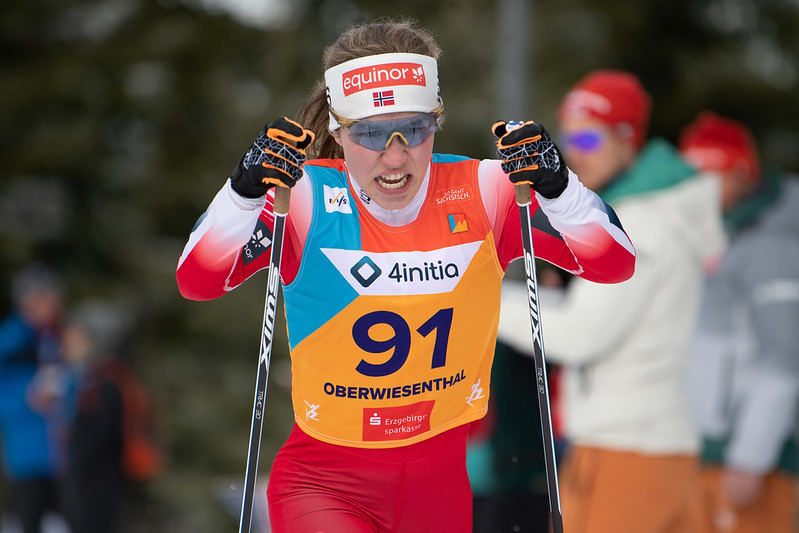
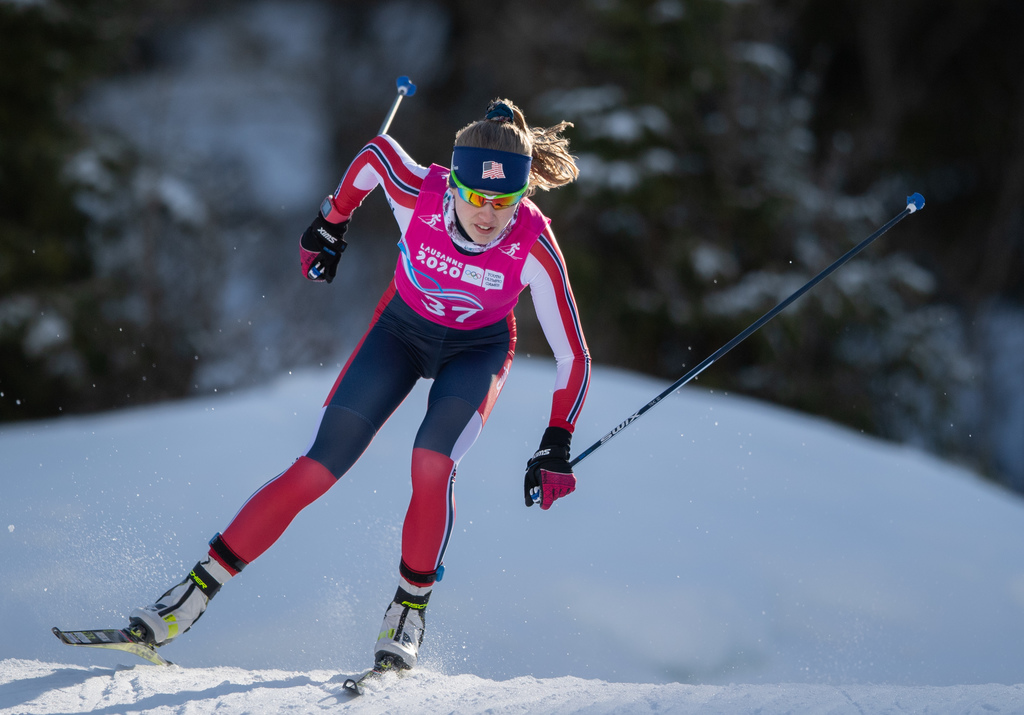
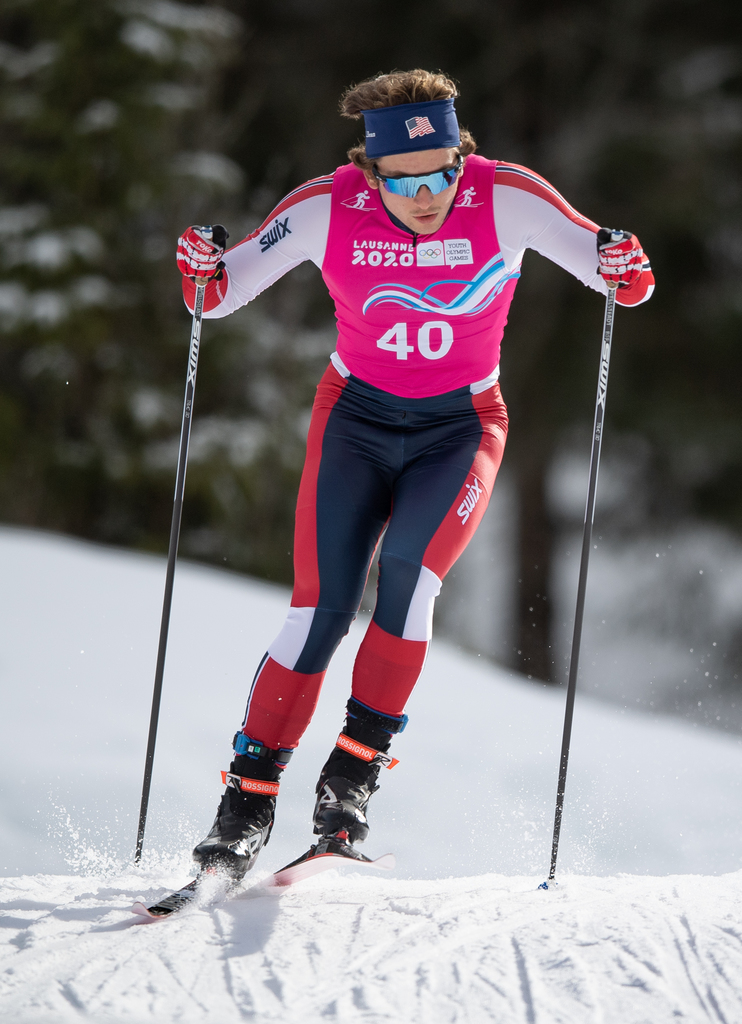
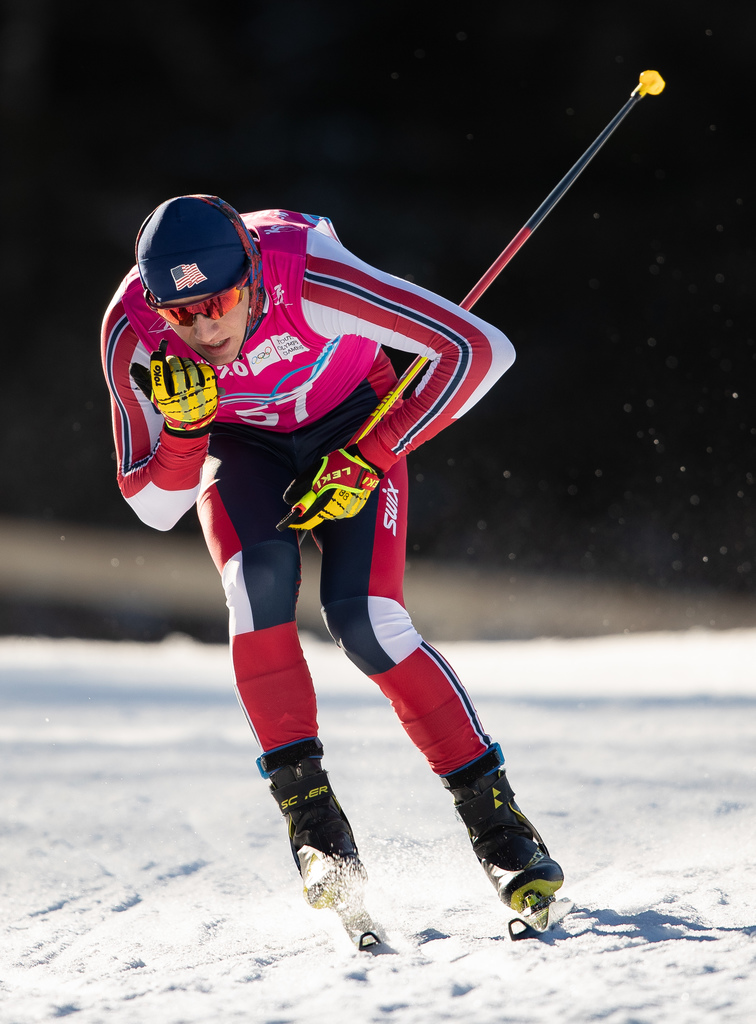
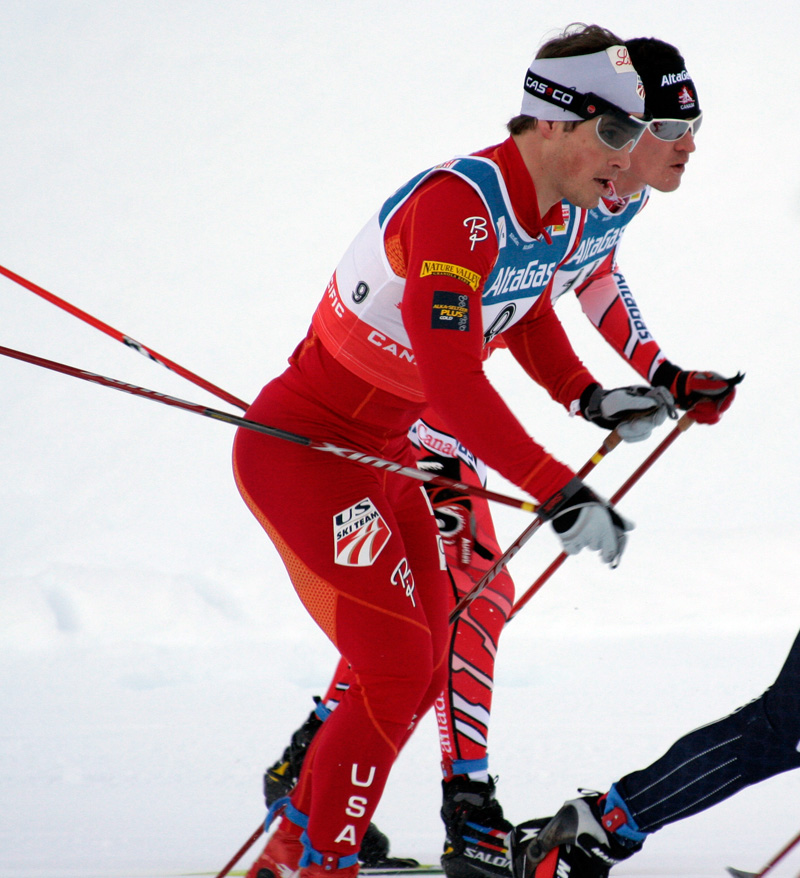
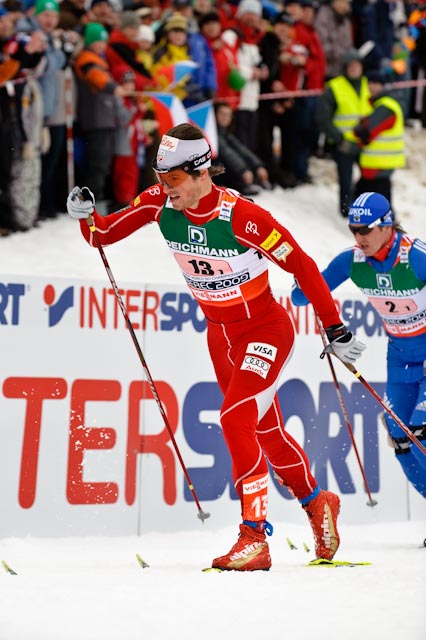
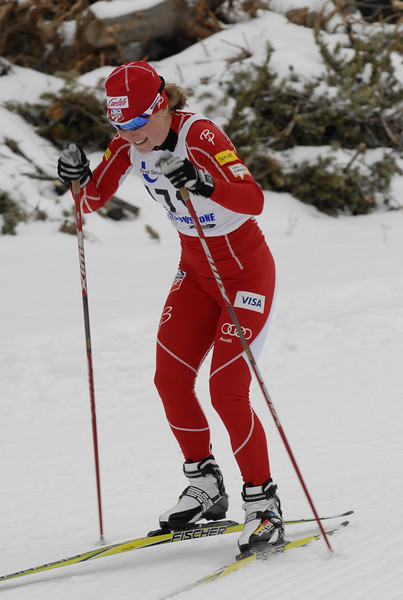
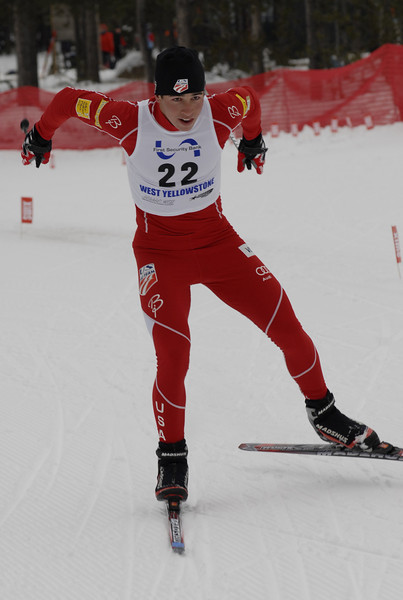
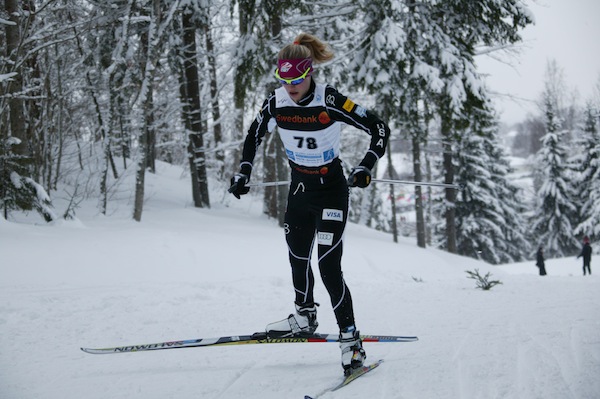
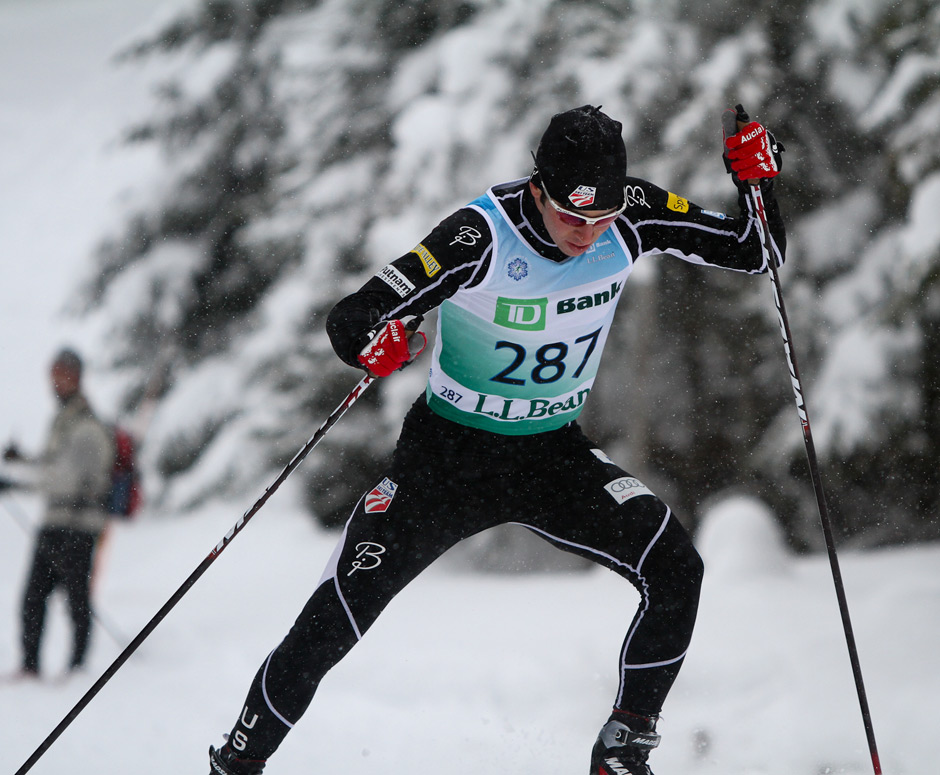
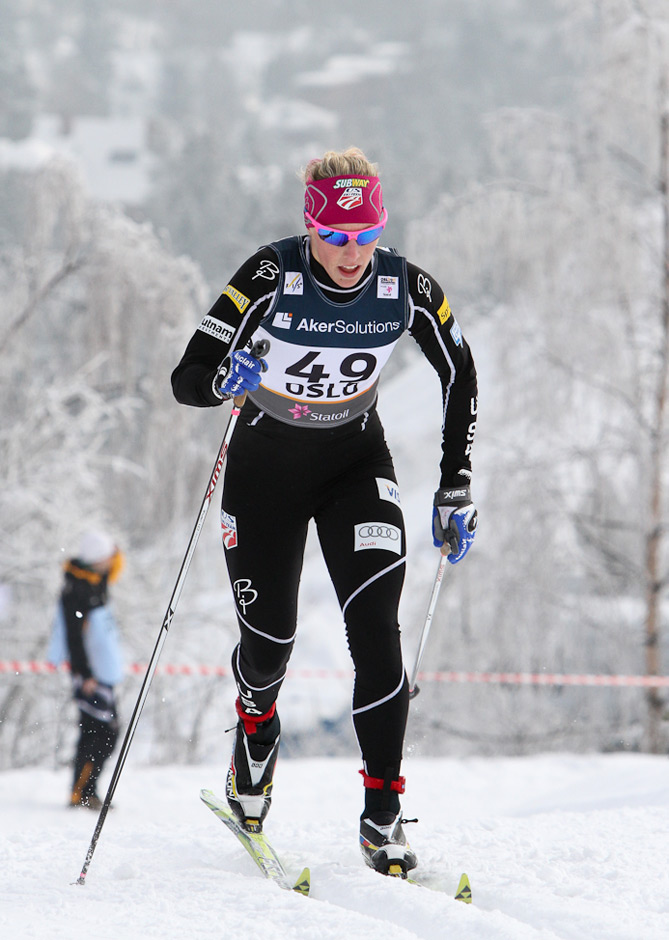
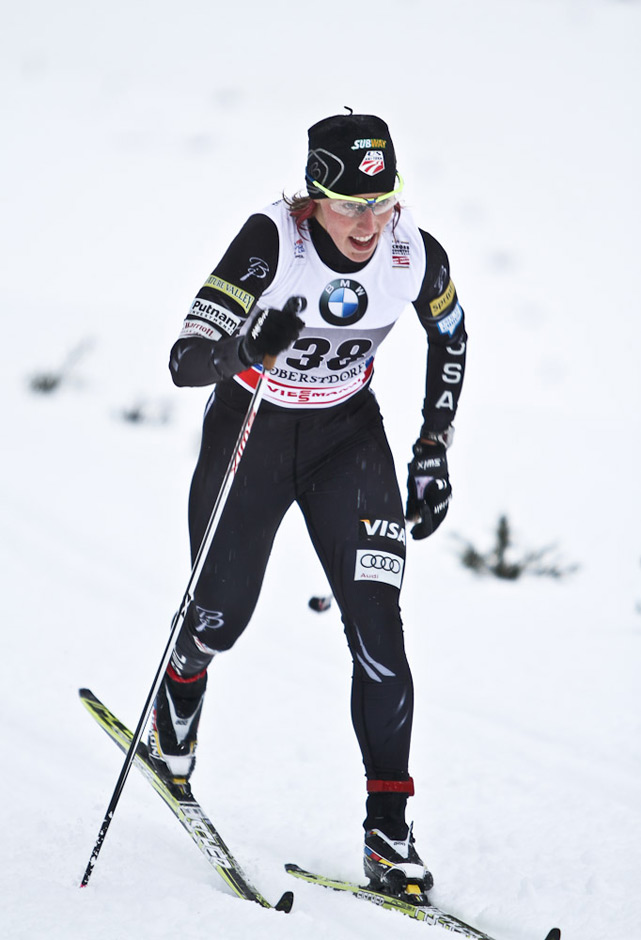
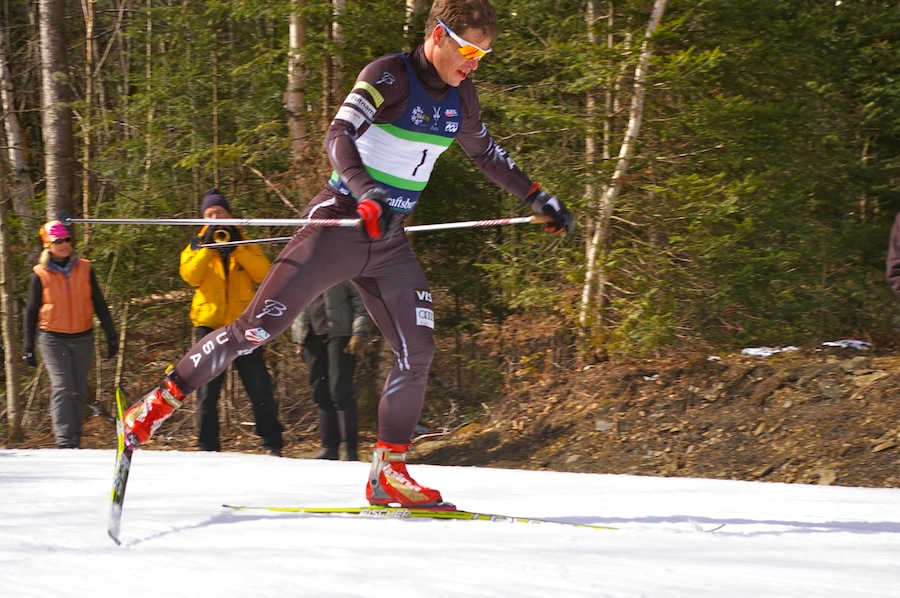
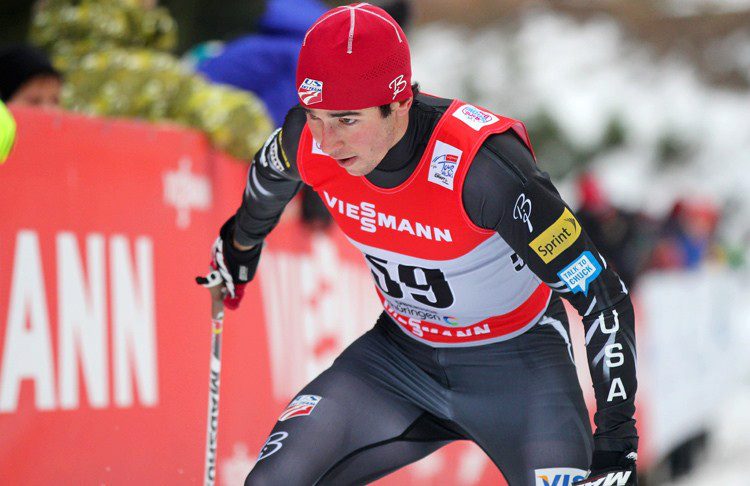
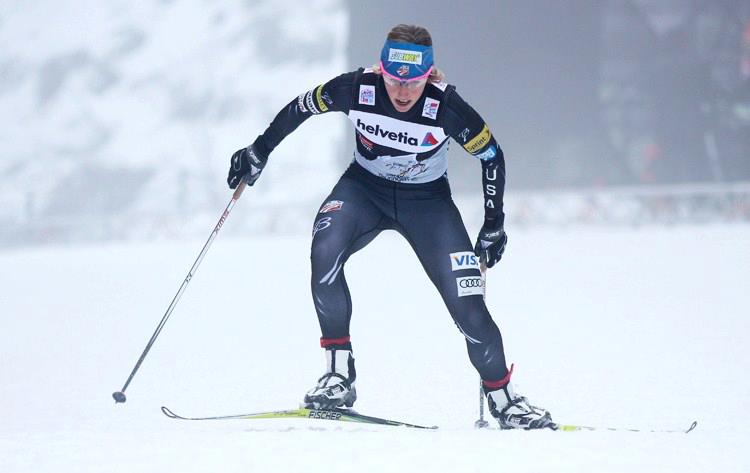
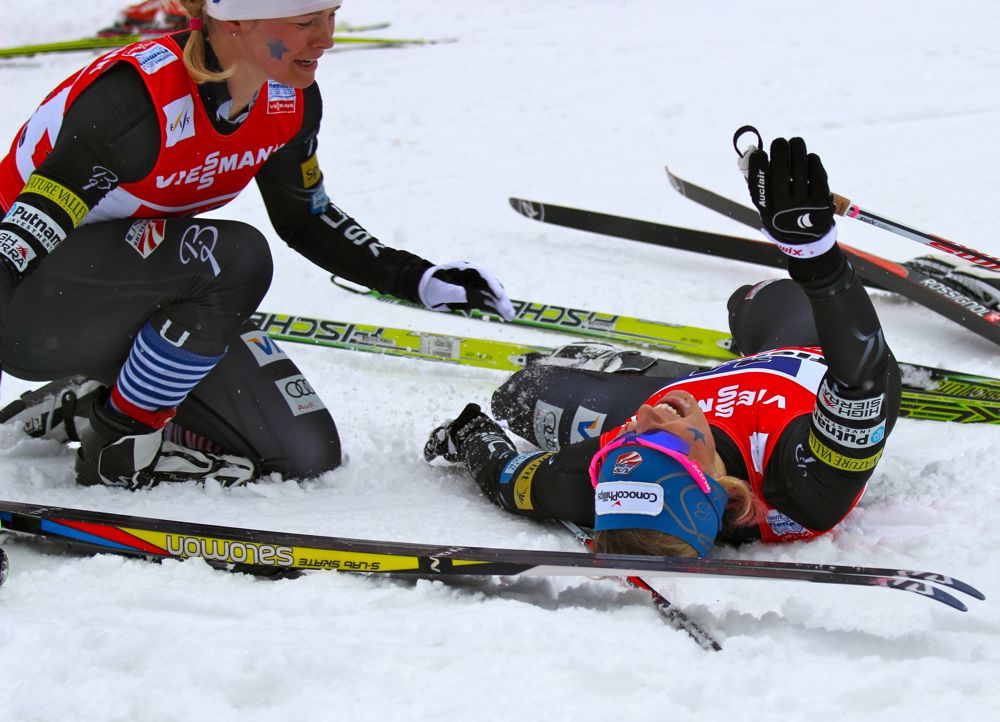
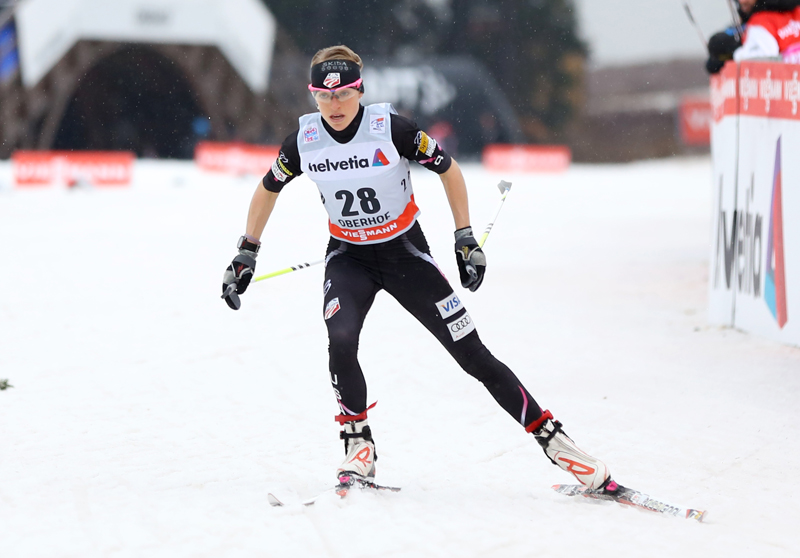
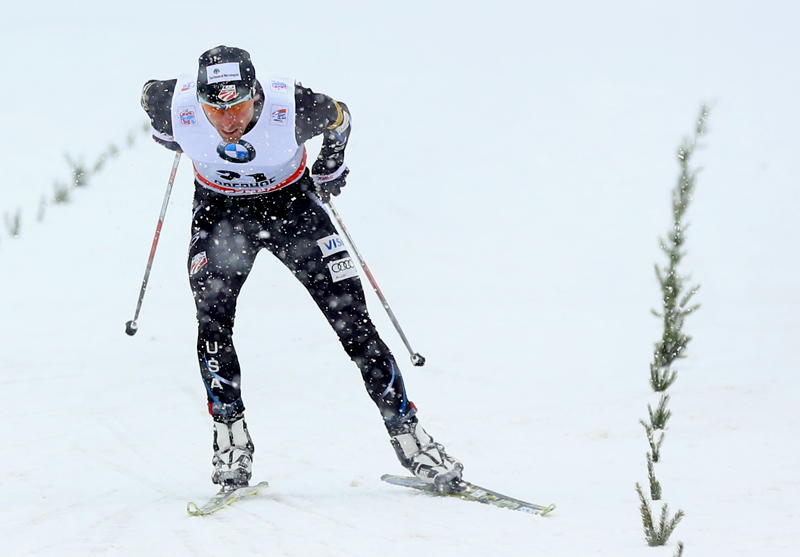
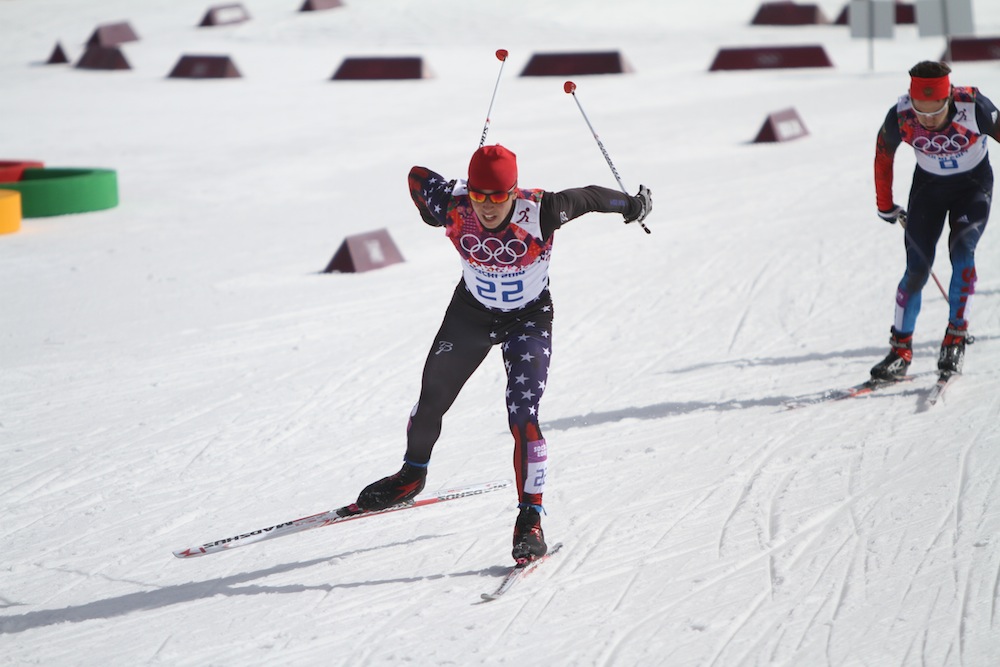
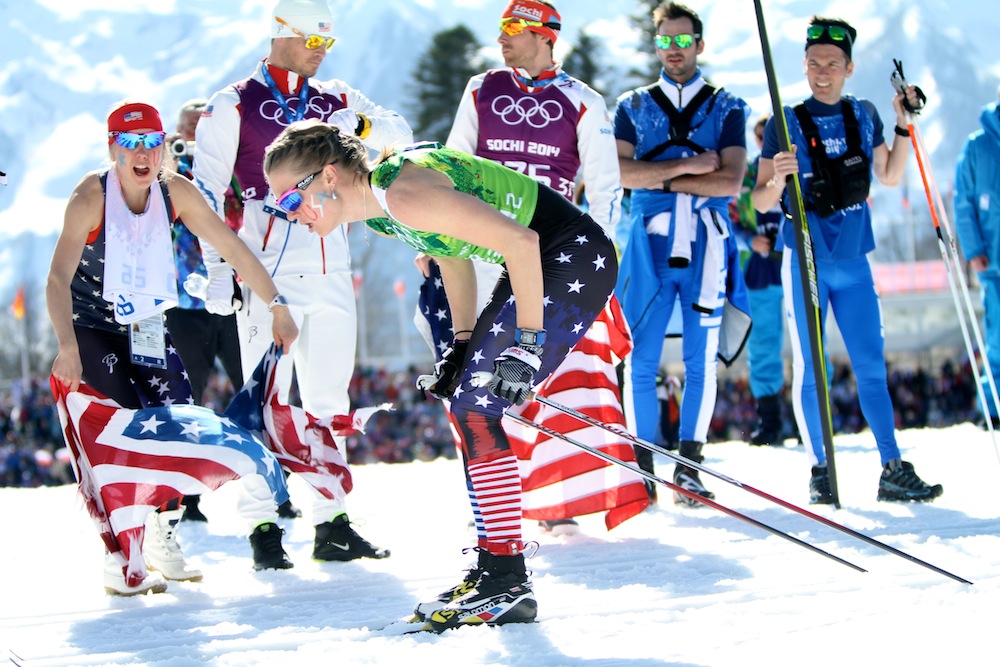
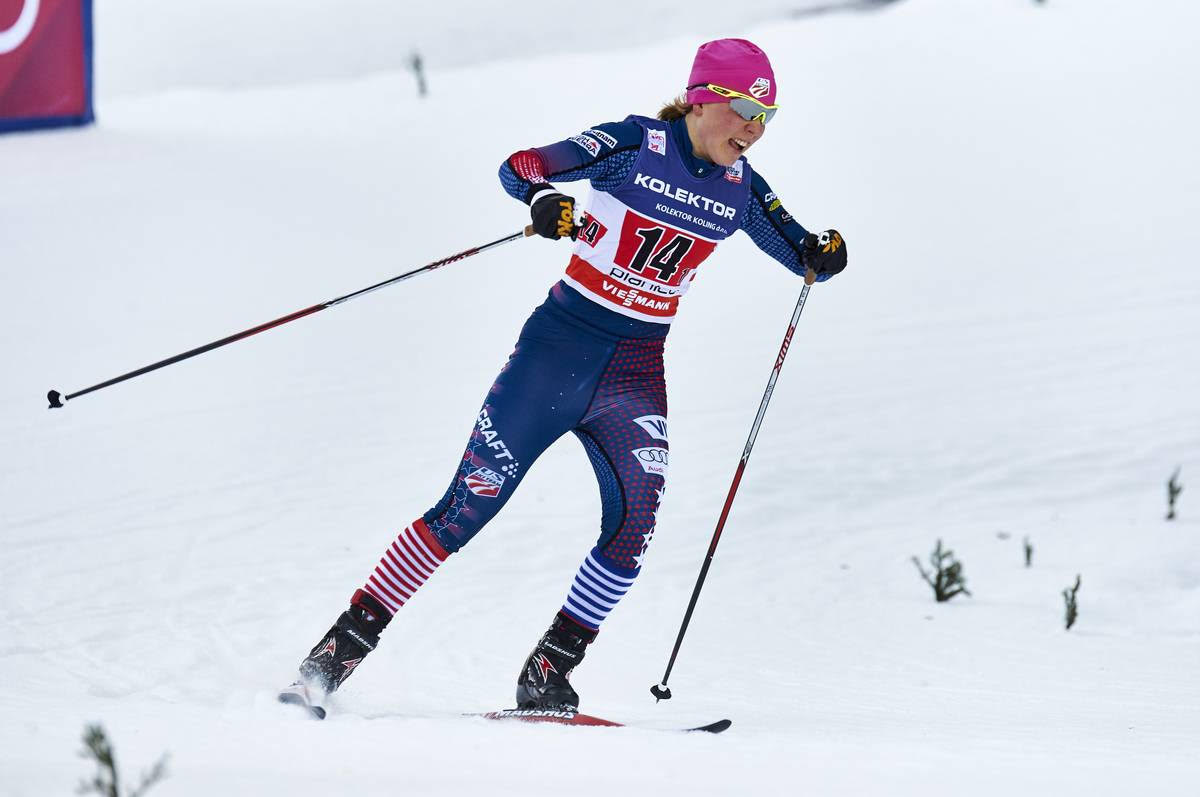
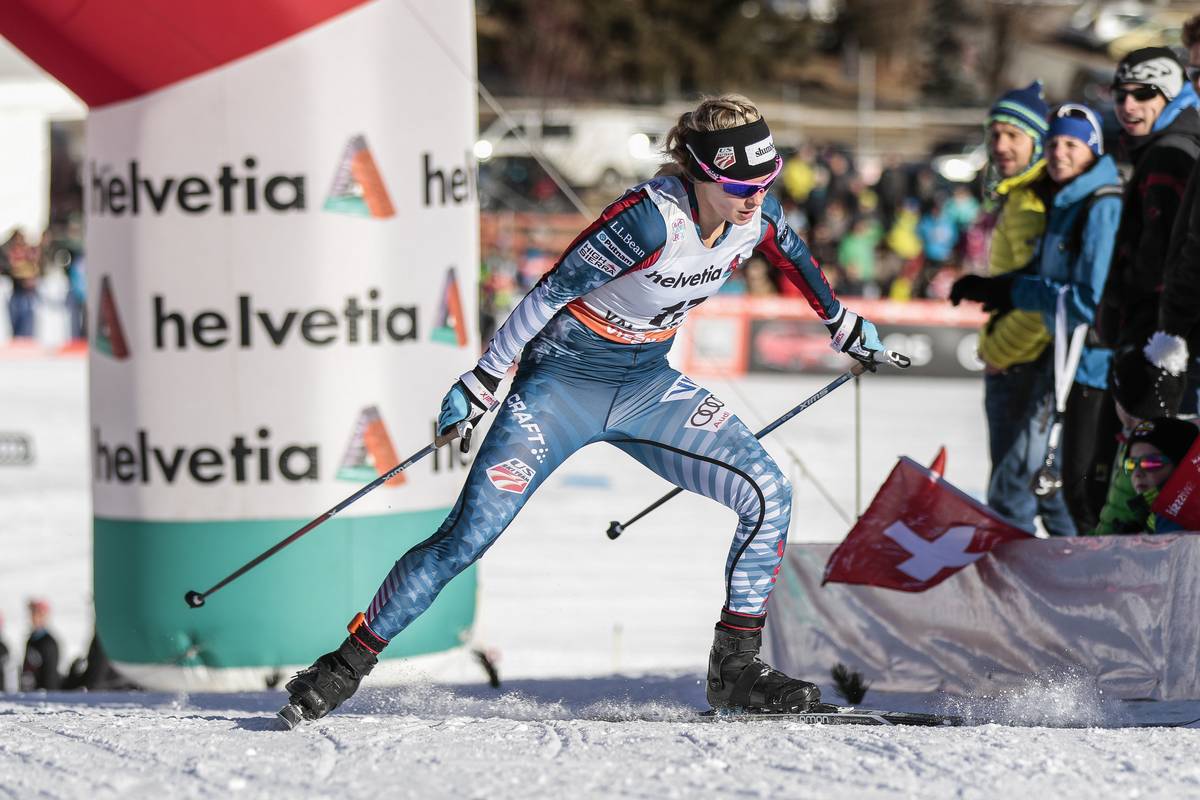
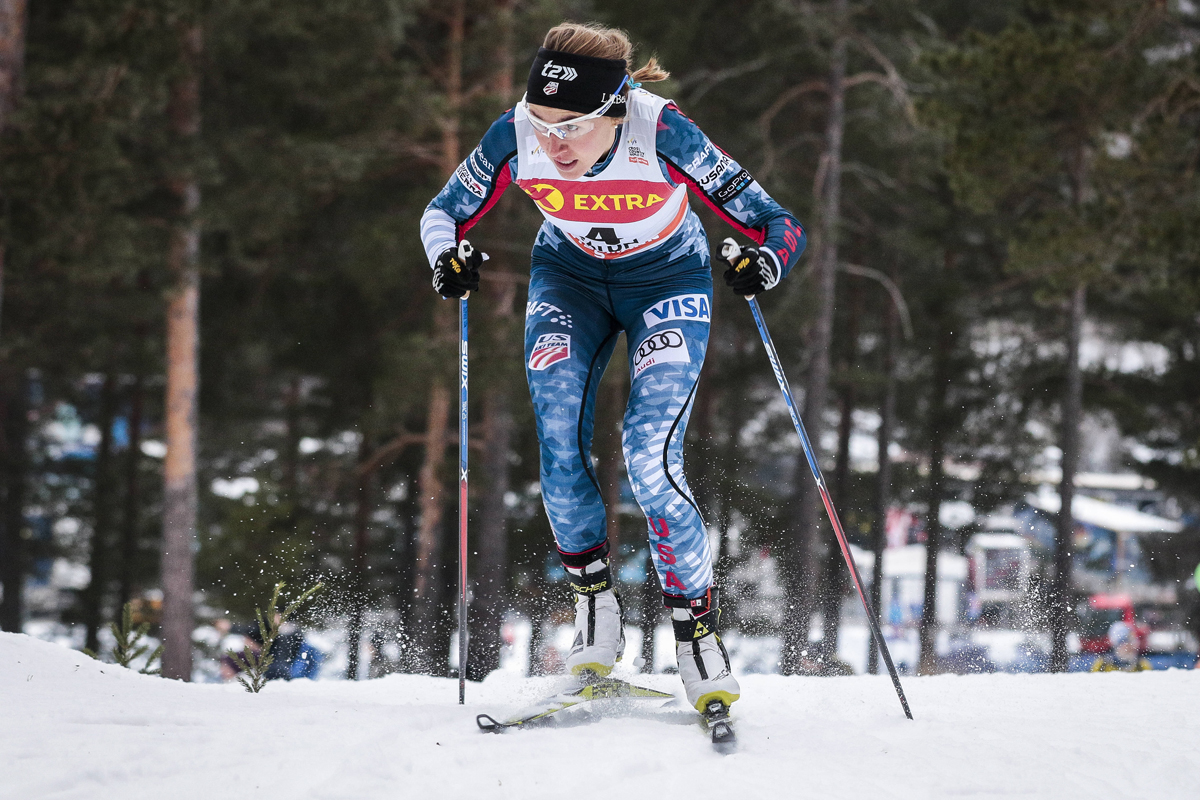
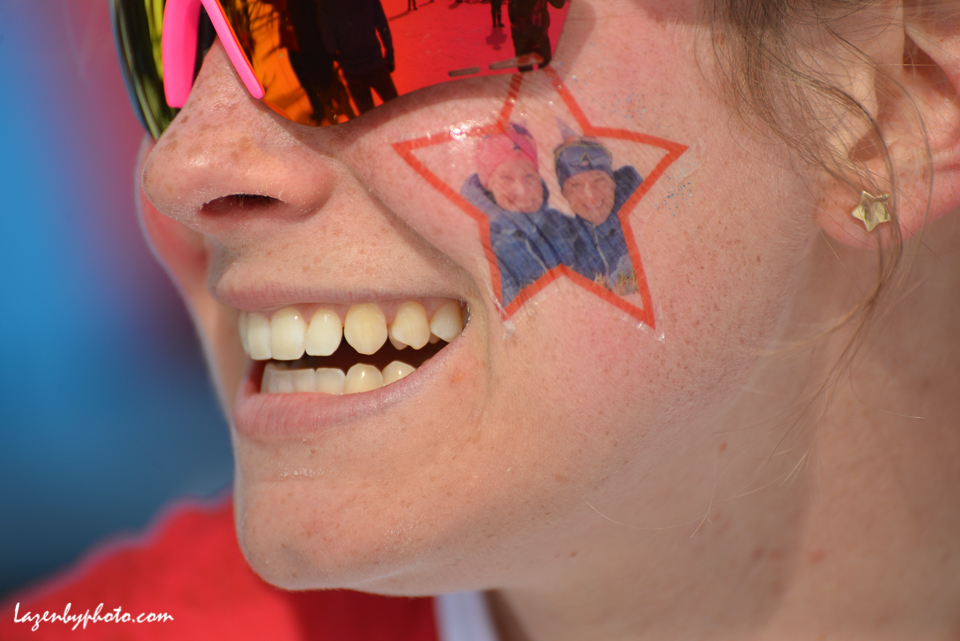
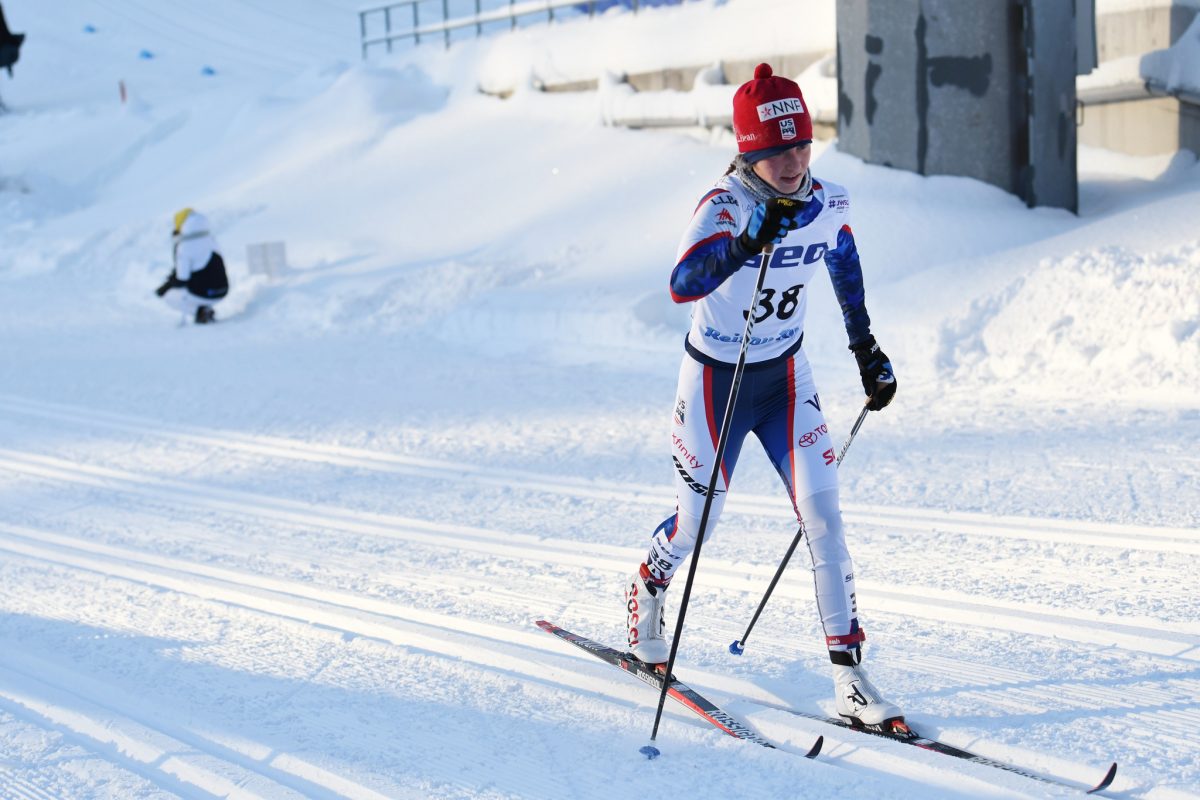
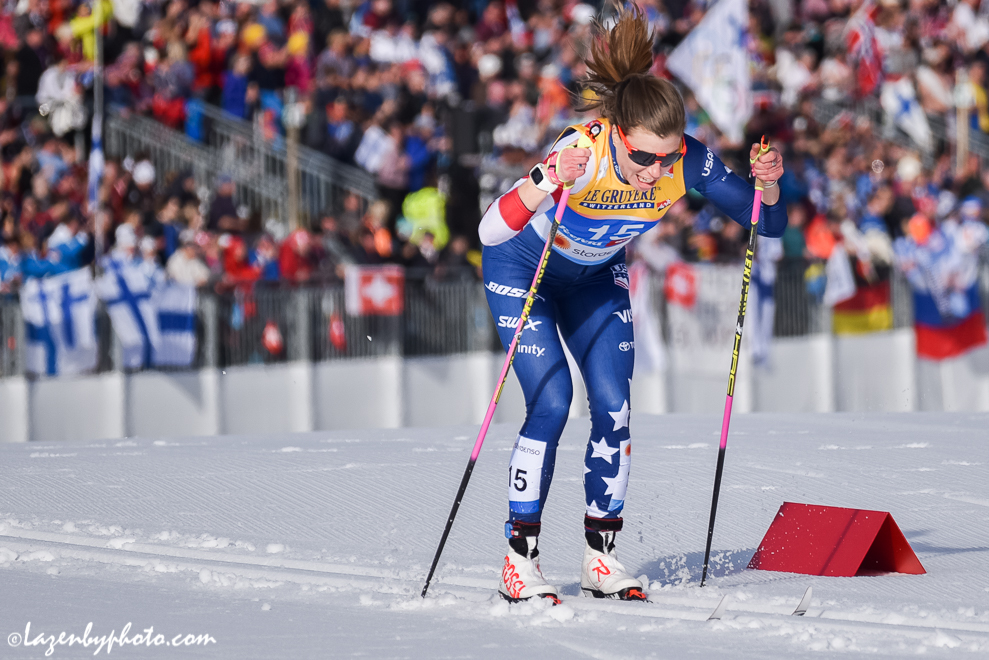
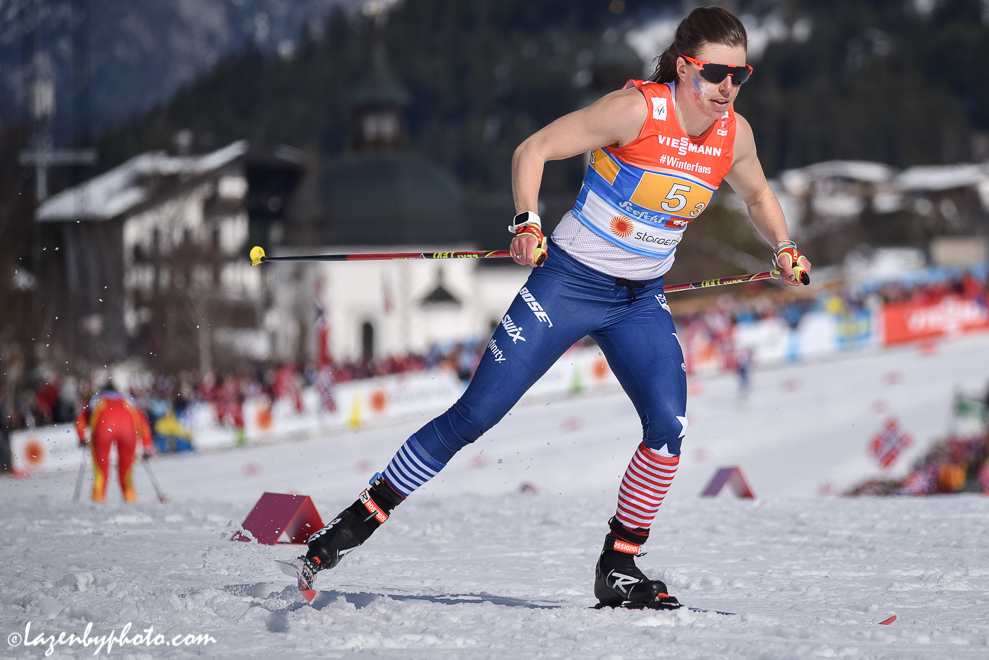
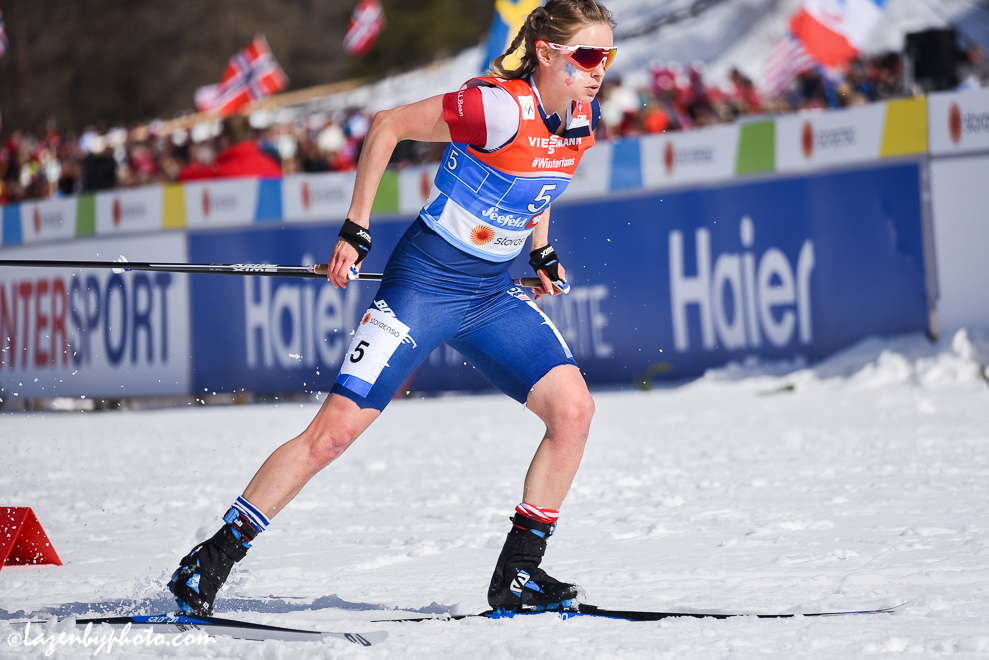
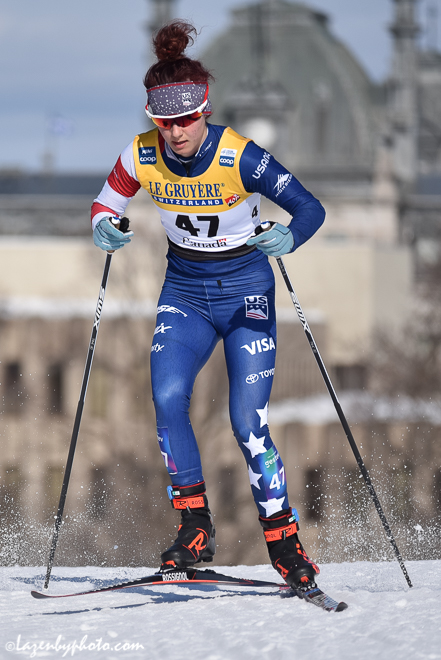
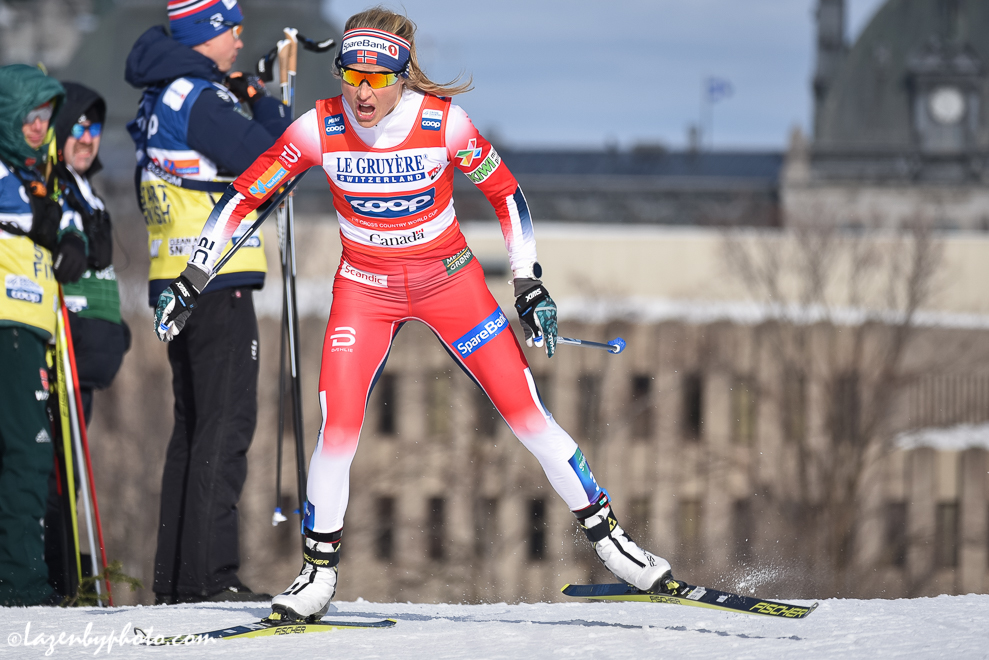
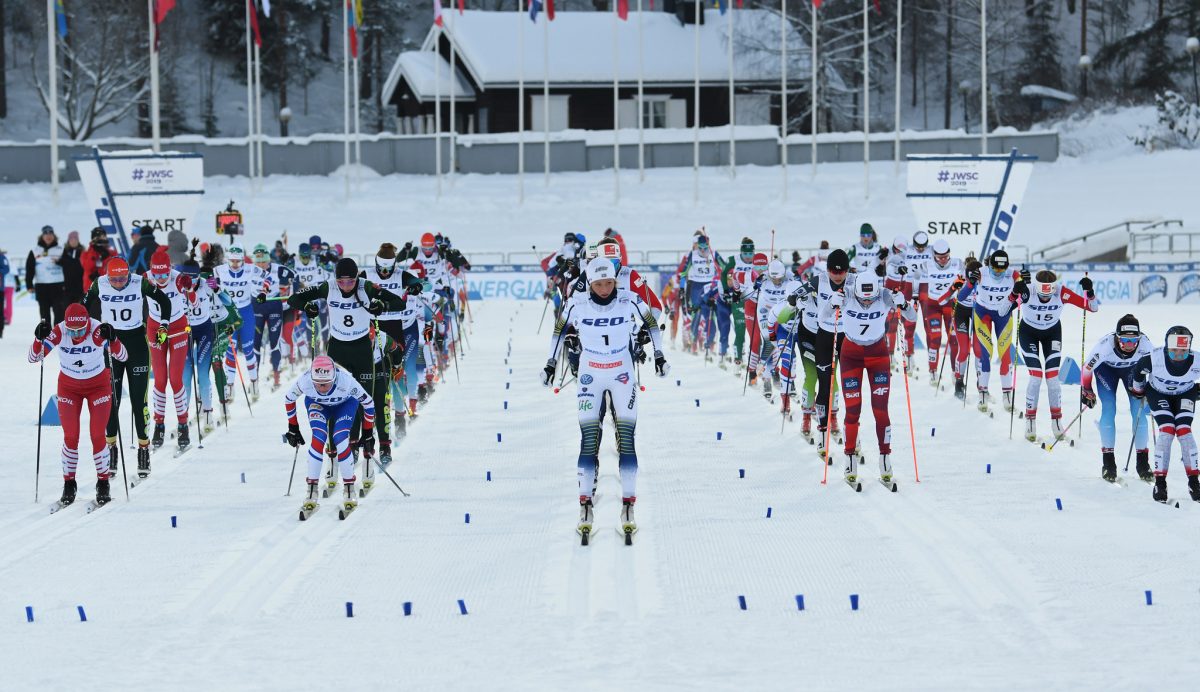
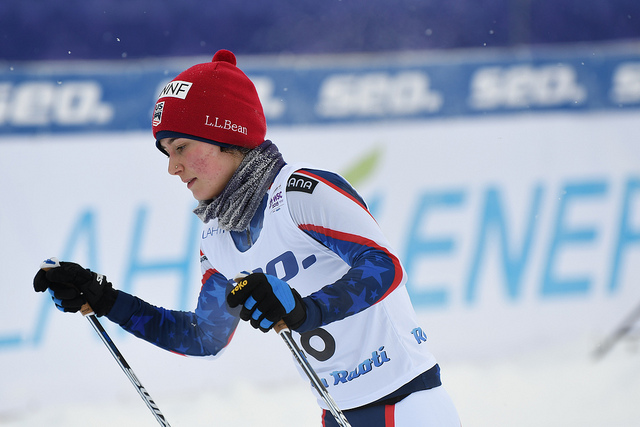
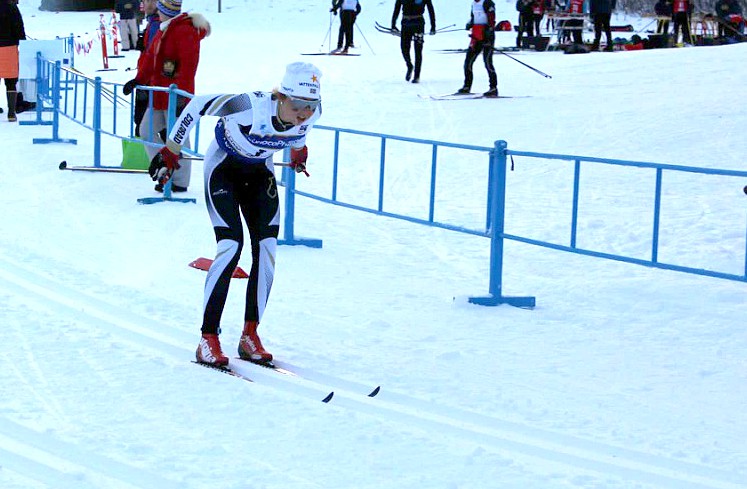
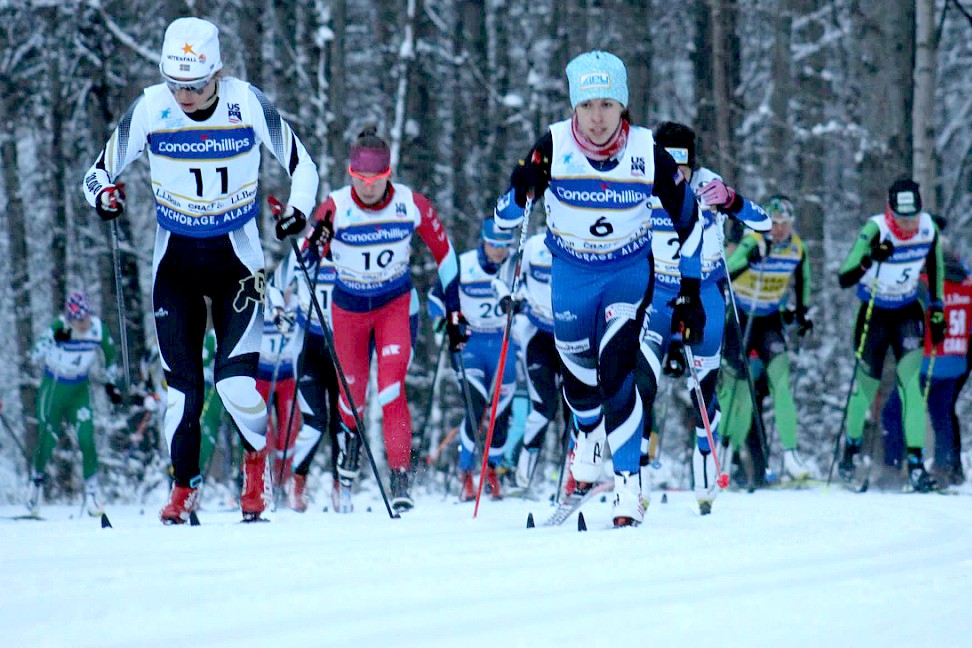
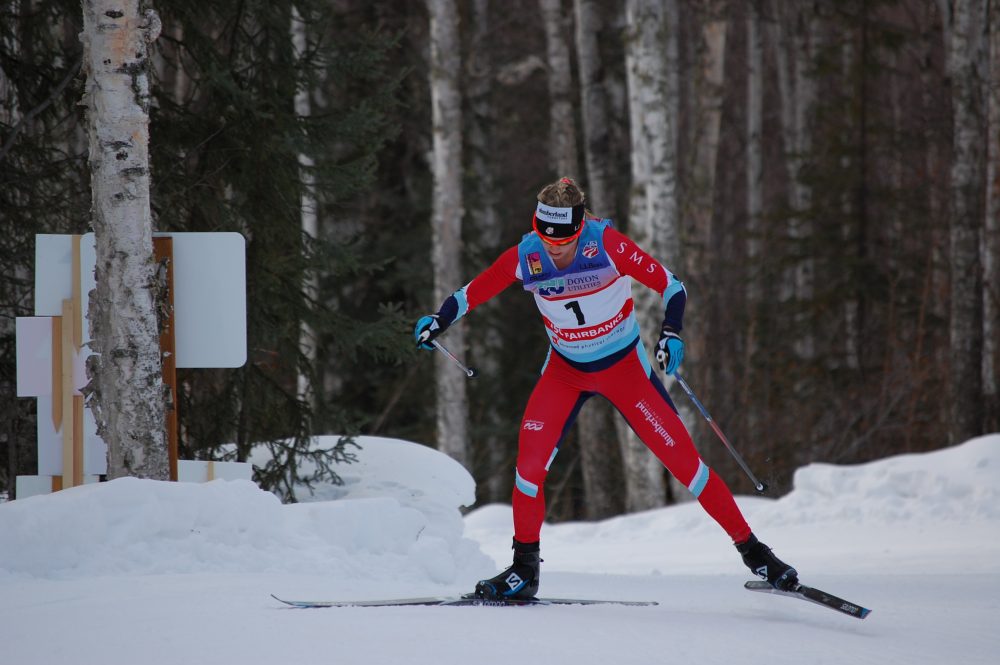
Norway’s Helene Marie Fossesholm, pace-perfect, during the women’s 5 k classic at the 2020 Junior World Championships. (Photo: Doug Stephen)
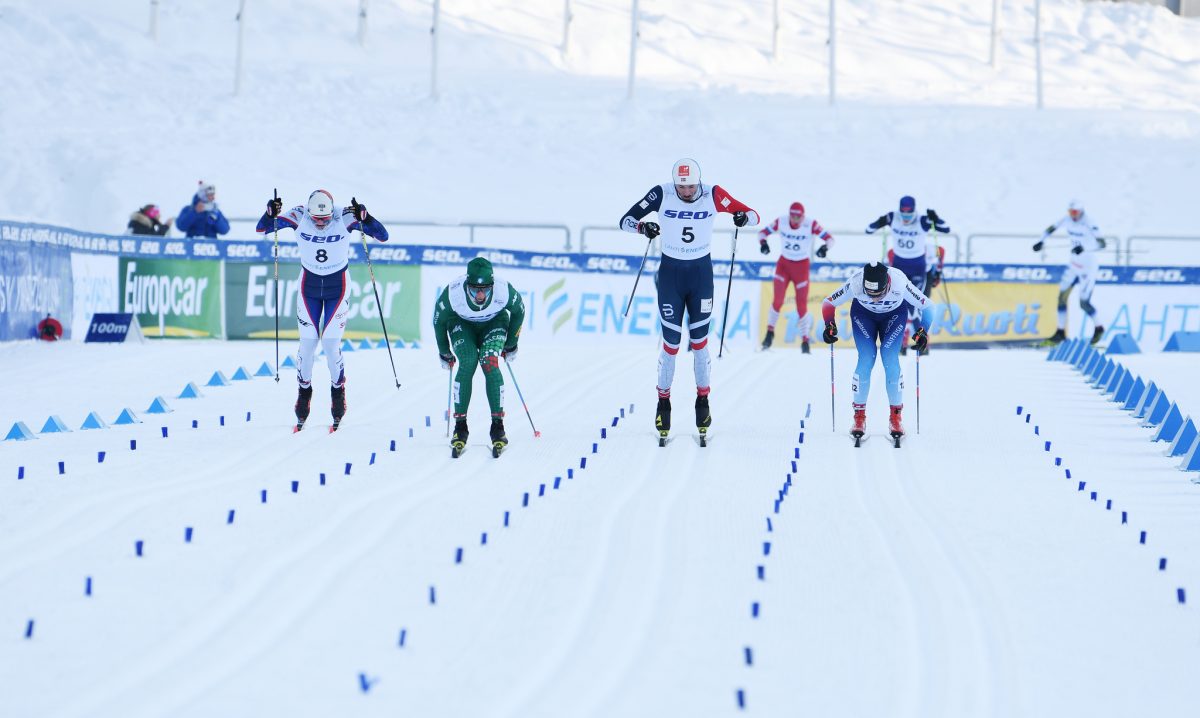
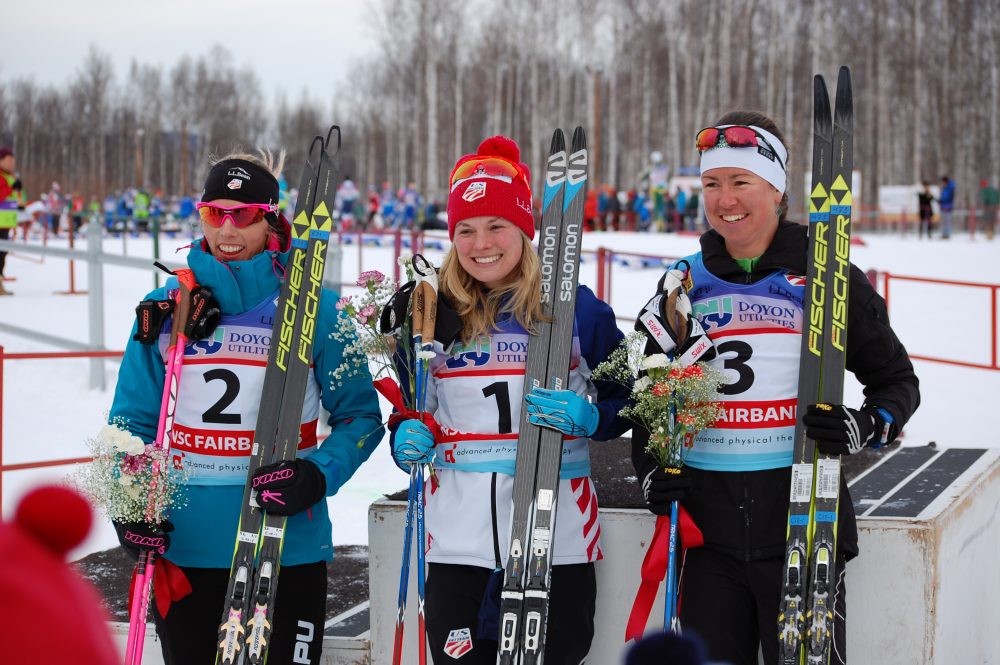
Monday’s World Junior’s 5 k classic in Oberwiesenthal, Germany was won by Norway’s Helene Marie Fossesholm in 13:49.1 minutes. Germany’s Lisa Lohmann placed second (+15.7), and Izabela Marcisz of Poland was third (+28.1).
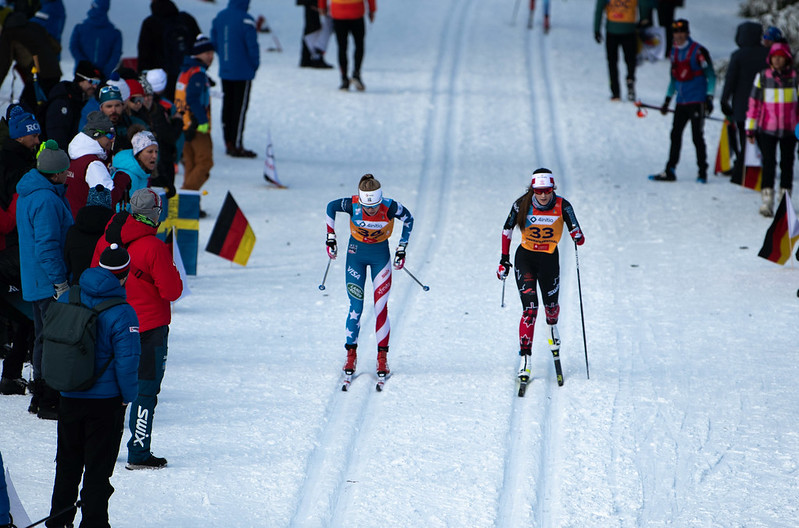
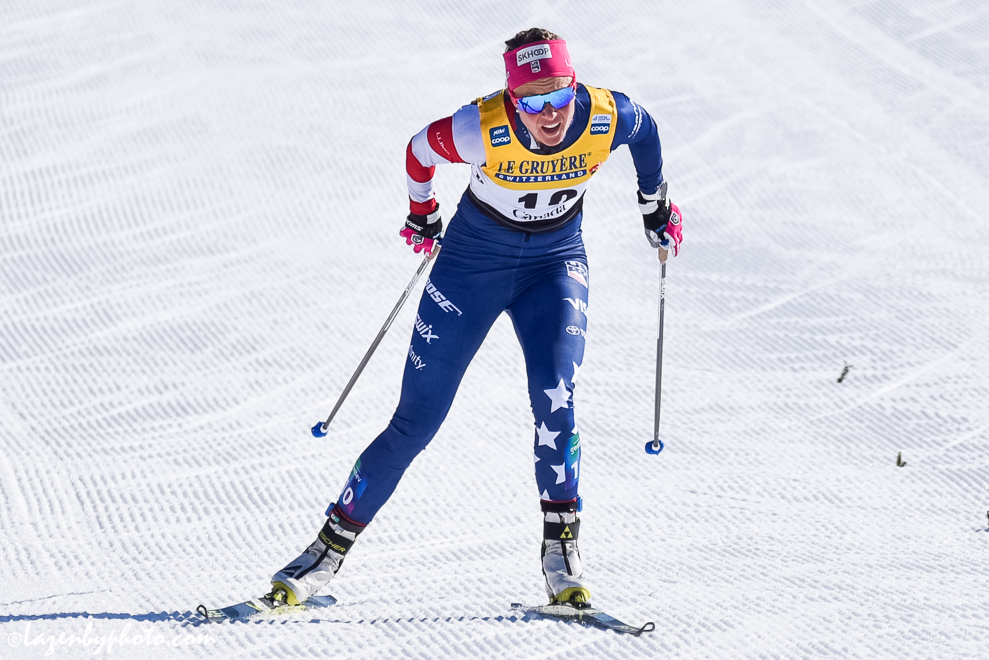
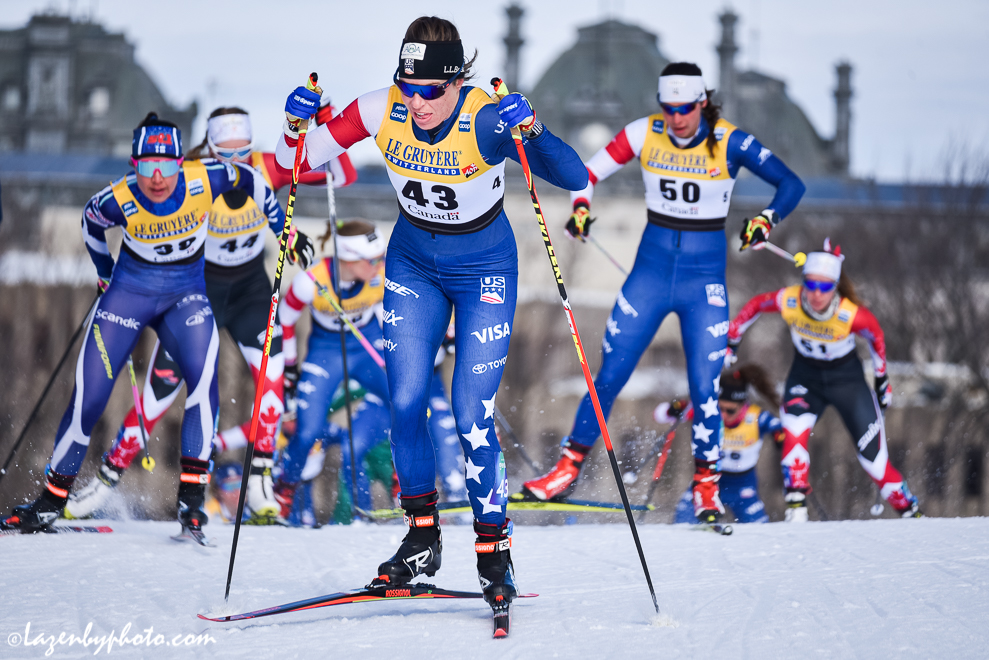
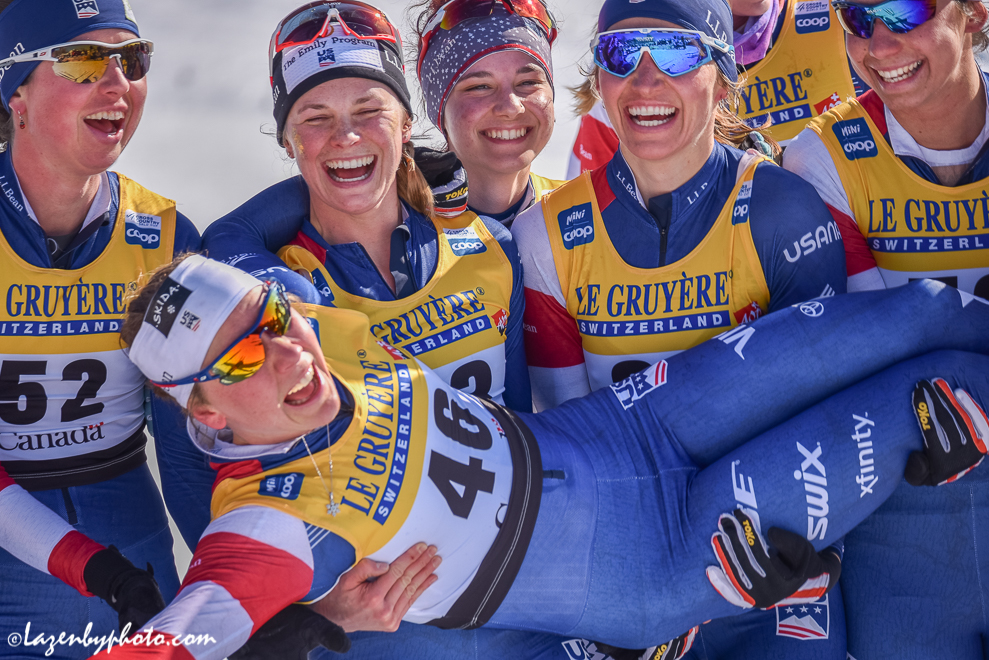
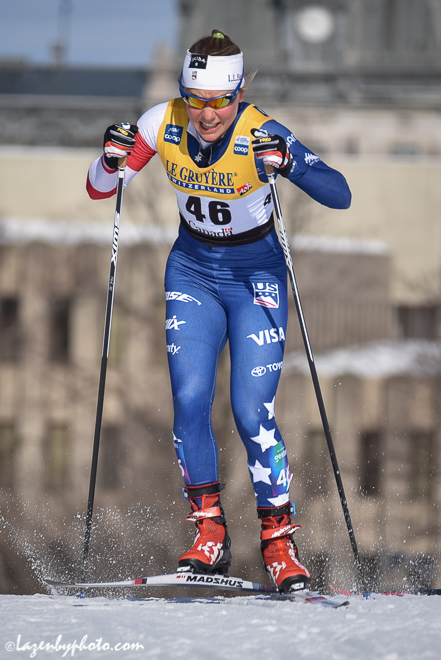
Sophia Laukli (Middlebury) was the top North American in 13th (+51.6). She was followed by teammates Kendall Kramer (Nordic Ski Club of Fairbanks) in 22nd (+58.4), Sydney Palmer-Leger (SVSEF) 43rd (+1:31.6), and Mara McCollor (Minneapolis Ski Club) 60th (+2:23).
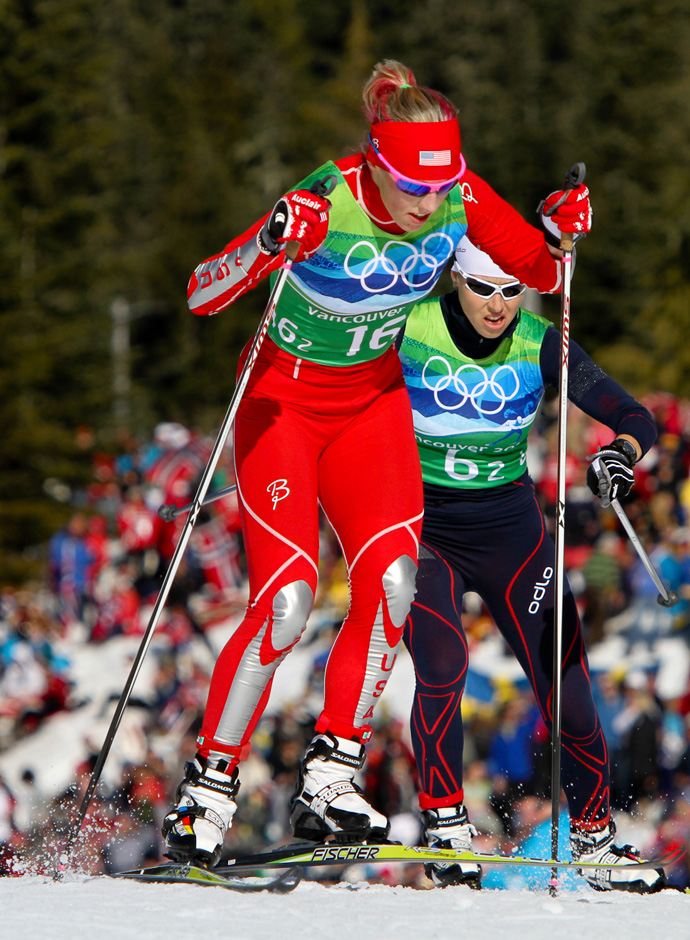
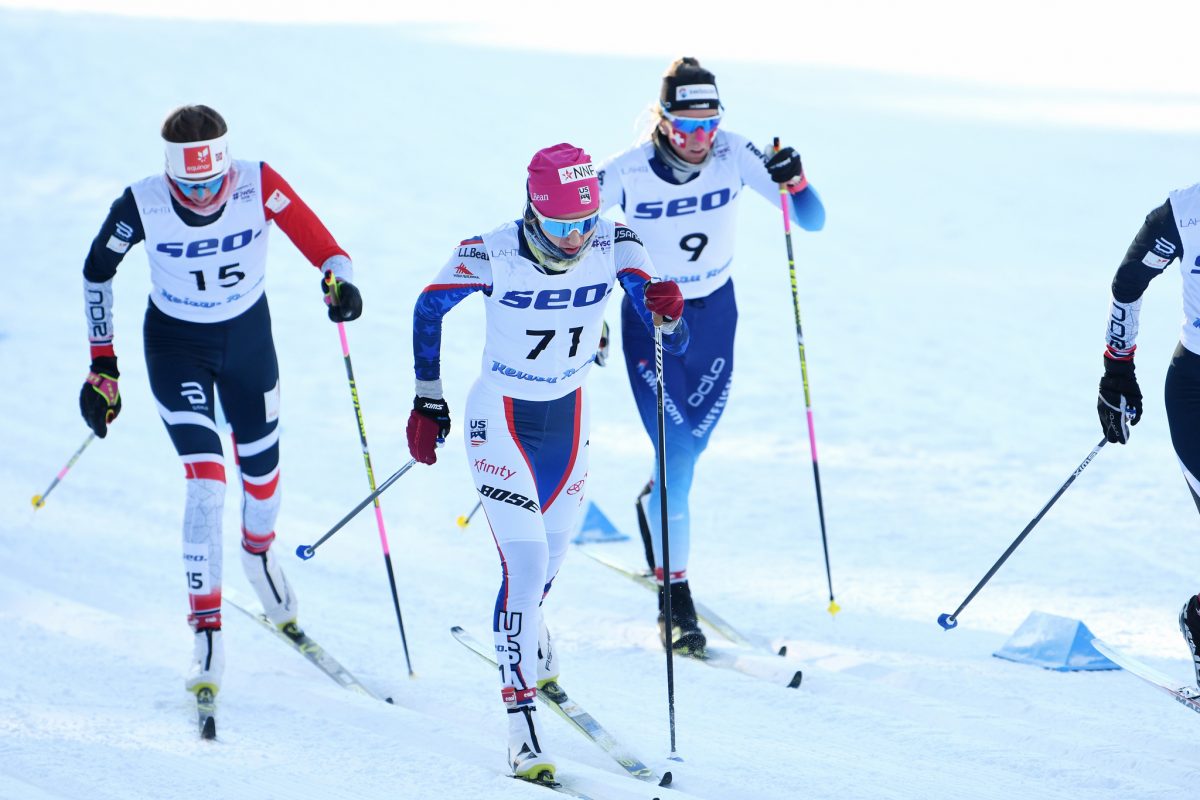
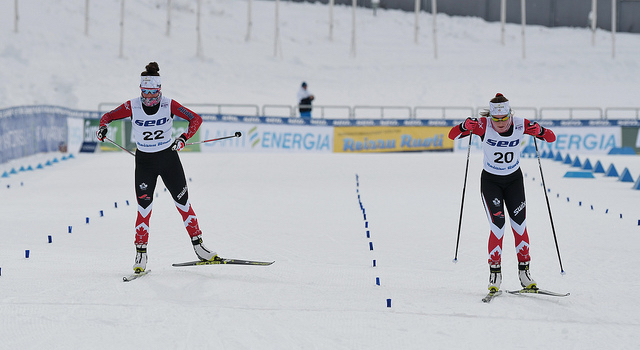
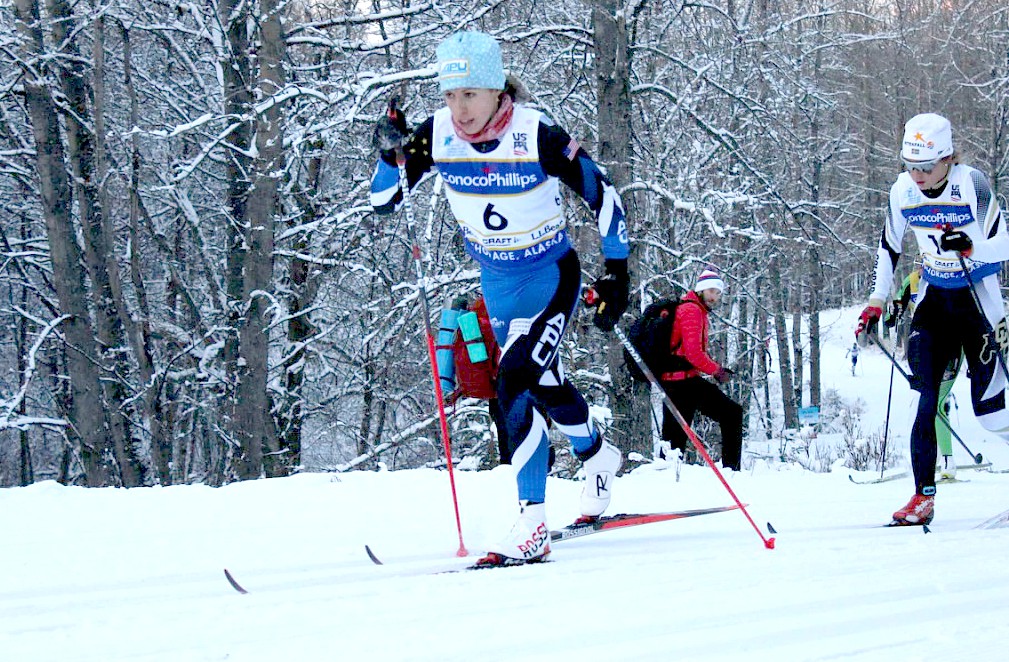
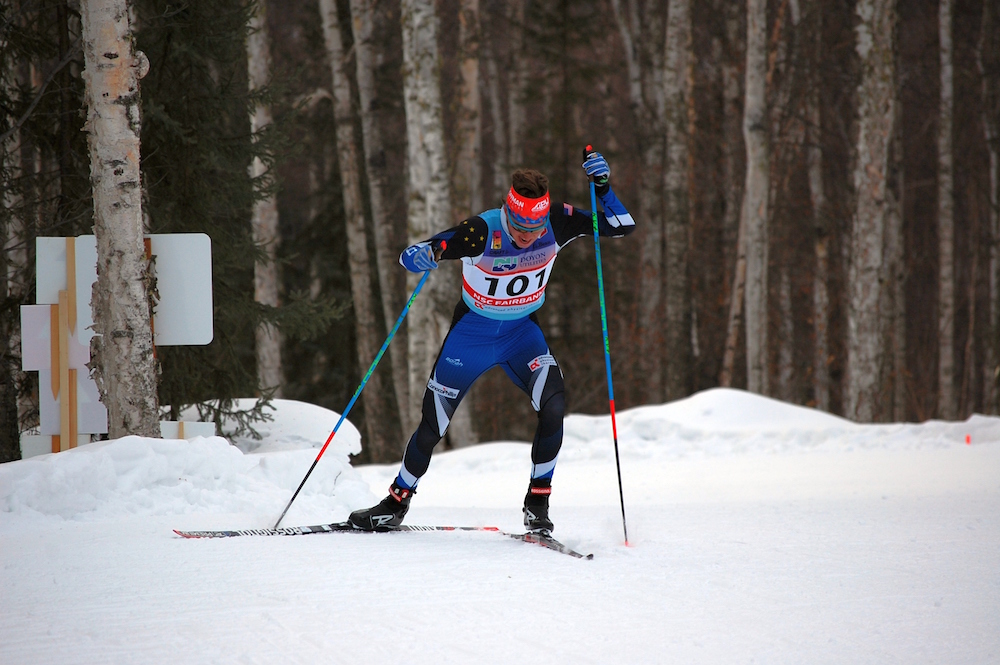
Sophia Laukli (U.S.) and Jasmine Drolet during the 5 k classic at 2020 Junior Worlds. (Photo: Doug Stephen)
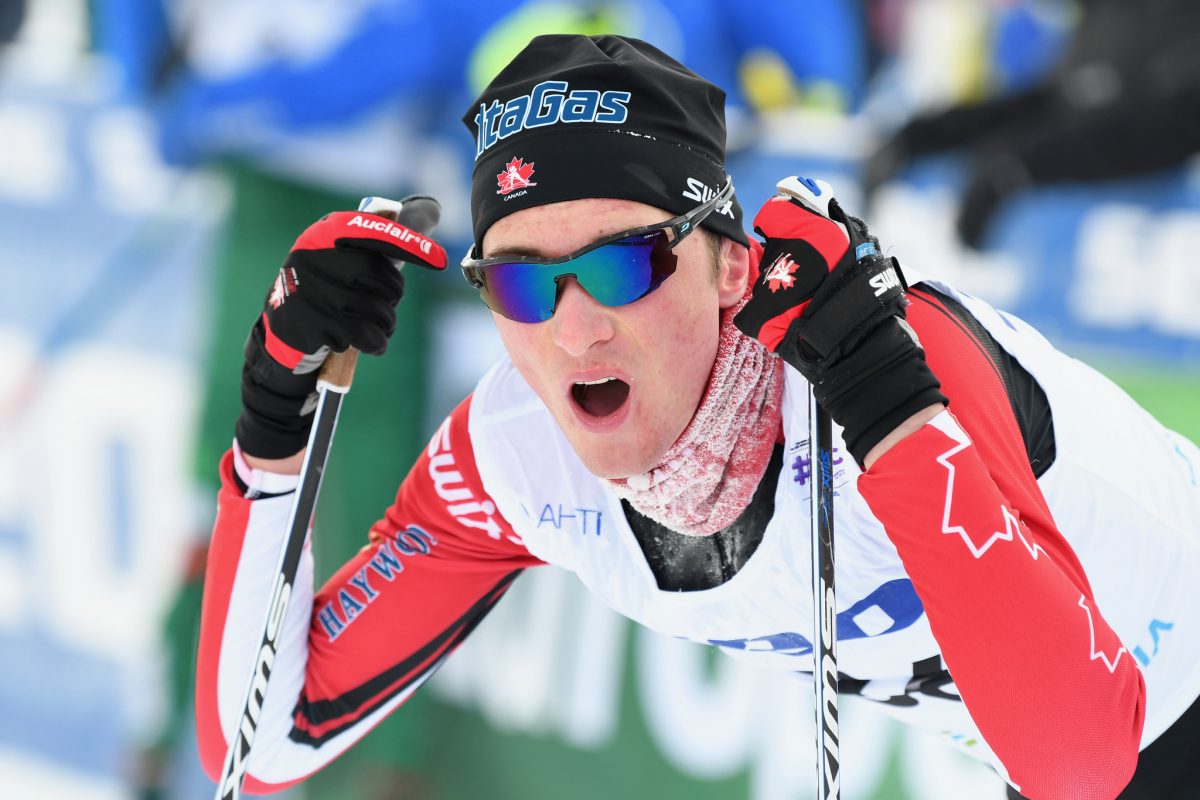
Jasmine Drolet (Black Jack Ski Club) was the top Canadian in 32nd (+1:18.6). Molly Miller (Black Jack Ski Club) 47th (+1:41.5), Benita Peiffer (Whistler Nordic) 49th (+1:48.8), and Liliane Gagnon (Skibec Nordique)50th (+1:50.5).
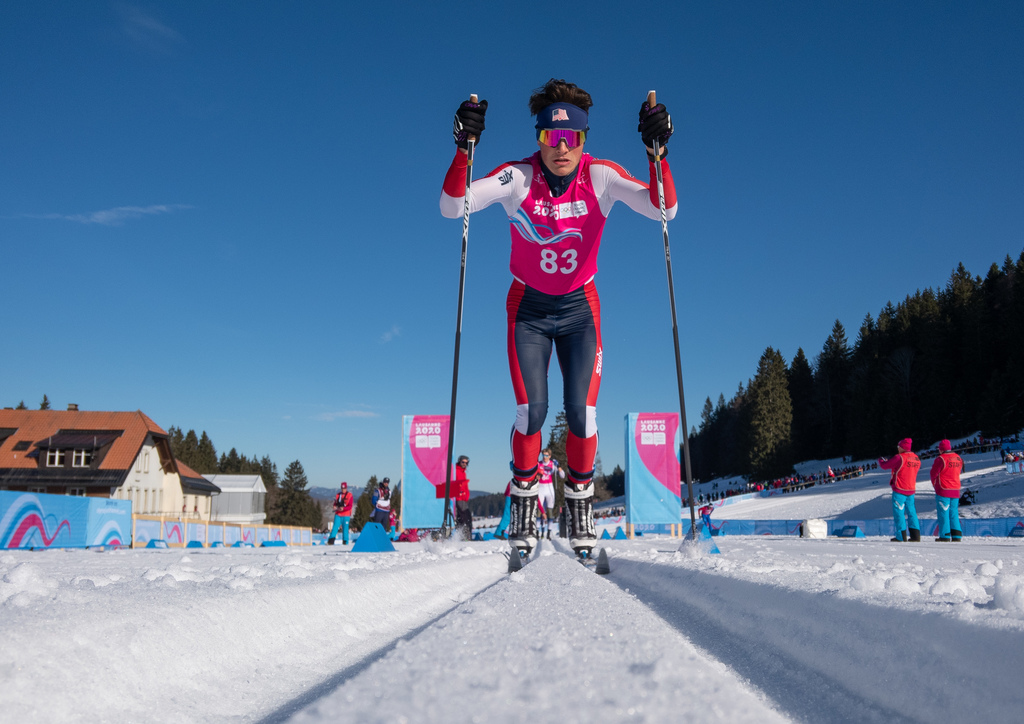
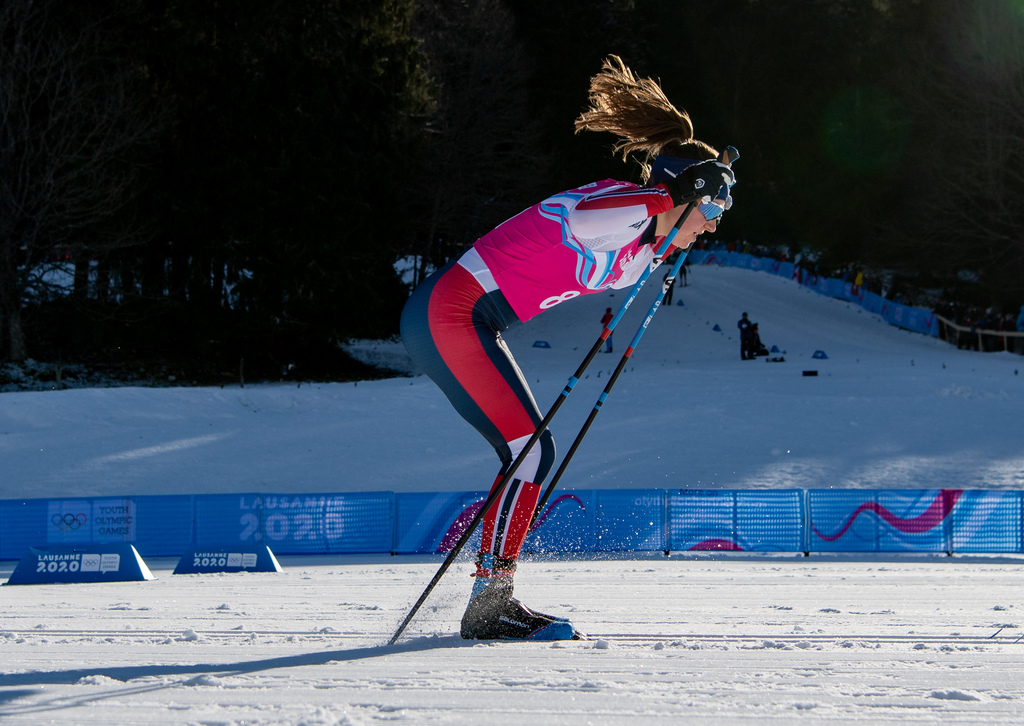
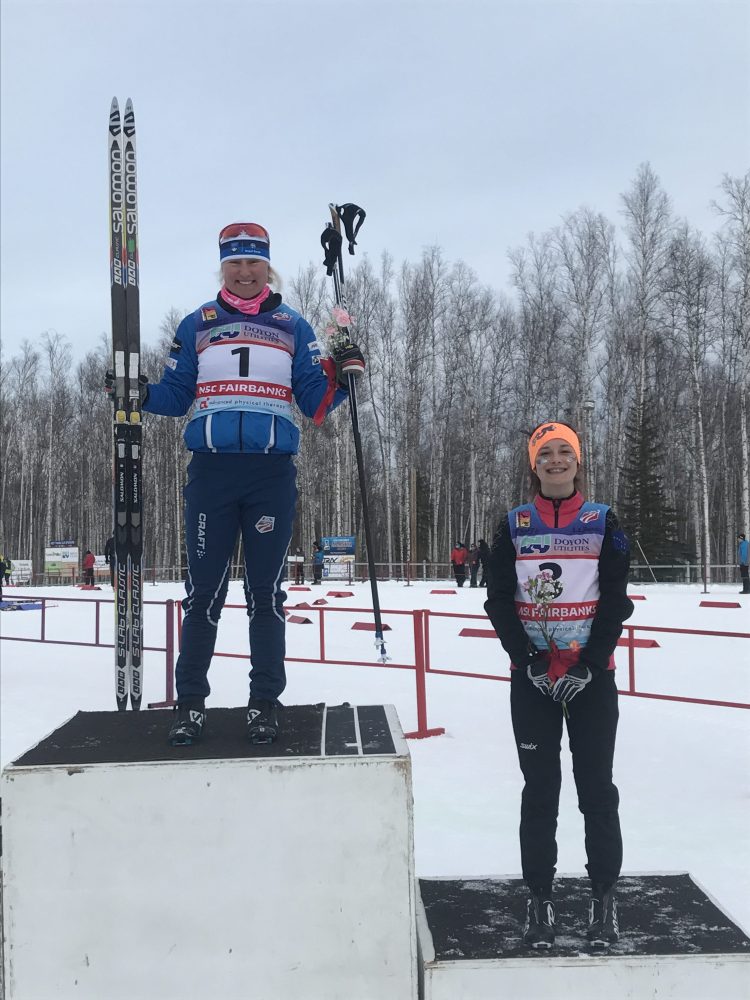
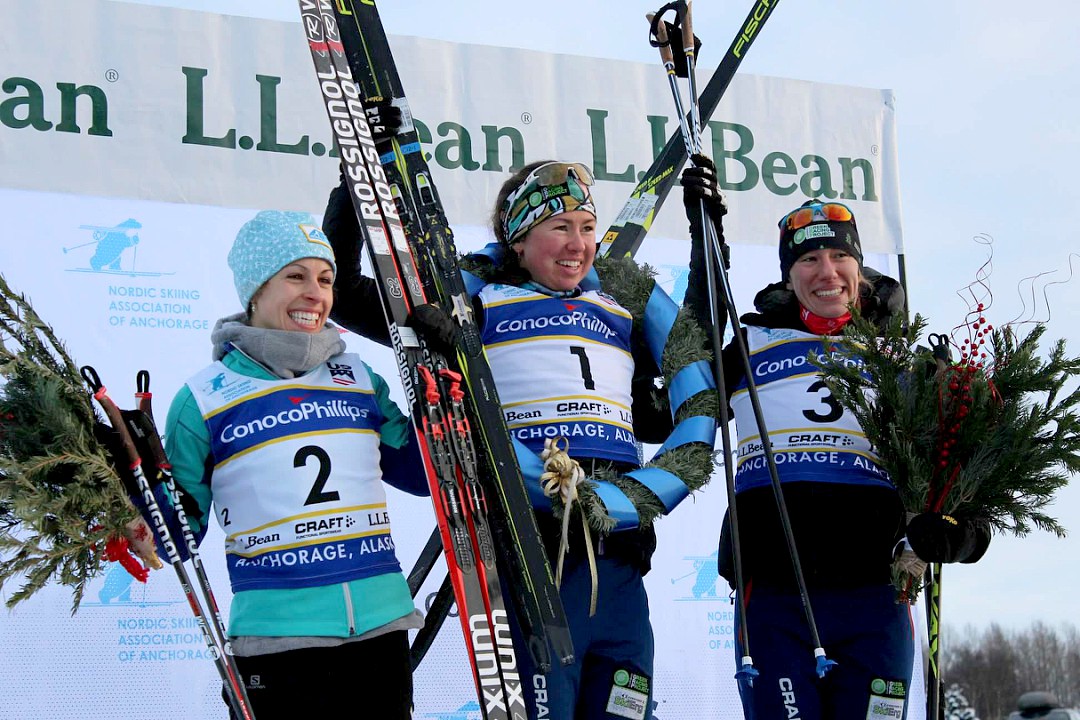
The news coming out of Lausanne, Switzerland this week was reaffirming for competitive U.S. skiing: at the Winter Youth Olympics two American junior skiers podiumed and one had a near miss in fourth. Kendall Kramer, out of Fairbanks, Alaska placed third (+20.6) in the 5 k individual classic while Sydney Palmer-Leger of Sun Valley, Idaho was fourth (+27.6). Will Koch of Peru, Vermont placed third in the 10 k individual classic.
The results speak of individual drive, community support, and a U.S. pipeline rife with talent.
U.S. skier Kendall Kramer during the cross free at the 2020 Winter Youth Olympic Games, Lausanne, Switzerland. (Photo: OIS/Chloe Knott)
These performances came down earlier this week. But here at FasterSkier, we have been discussing how we cover juniors in the sport for several weeks. The key component for us is balancing news with respecting the nature of teenagers in a high pressure sport.
Just take a moment at races with live timing and vibrant cell coverage or Wi-Fi, and you’ll see parents, athletes, and coaches often glued to their phones. Live timing is perhaps as scalpel-like as it comes. It’s easy to get caught up in a game where the result is the story.
Juniors are not professional athletes. In the case of disappointment, in the case of feeling too much pressure, what support systems are in place for junior athletes? We’ve been thinking about the answers to these questions.
We all know these teens are more than their results.
We know “Son of Legend” has a name — that would be Will Koch. And he has his own narrative that is his to tell. The story in Lausanne was beautiful. The legend Bill Koch, the only male American to win an individual Olympic medal (1976 Winter Games 30 k silver), is on hand to watch his son Will achieve his own goals. It’s a dream narrative. A proud moment for both.
Will Koch (USA) during the 10 k classic at the 2020 Youth Olympic Games in Lausanne, Switzerland. Koch placed third in the event. (Photo: OIS/Joel Marklund)
Let’s reflect. While covering the sport at FasterSkier, we hear many stories. Most prominent, and frankly the easiest to relay, are those falling into the tidy box of a podium result. Who doesn’t love that? The harder ones, and we hear about these as well, are those of athletes falling through the pipeline’s cracks for some reason or another. Maybe the gift of DNA didn’t align precisely. Maybe the athlete struggled with the social-emotional aspects of a high pressure medals-matter environment. It is complex. As we were reminded in a group phone conversation yesterday on the topic of juniors, “success early does not guarantee success late”.
Sydney Palmer-Leger of the U.S. during the 5 k classic at the 2020 Winter Youth Olympic Games, Lausanne, Switzerland. (Photo: OIS/Joel Marklund.)
Imagine for a moment a teenager in this high stakes game we call sport? That’s what we have been trying to do. Sometimes the outcome here at FasterSkier will be less than perfect. But we are and have been thinking about how we effectively cover junior athletes. The results in Lausanne just made it more acute.
Which reminds us to celebrate Kramer, Ledger-Palmer, and Koch. And to celebrate Nina Seemann, Brian Bushey, and Kai Mittelsteadt who also represented the U.S. in Lausanne.
Nina Seemann of the U.S.competes in the women’s skate cross at the 2020 Winter Youth Olympic Games, Lausanne, Switzerland. (Photo: OIS/Joel Marklund)
Kai Mittelsteadt of the U.S. during the men’s cross qualification the 2020 Winter Youth Olympic Games, Lausanne, Switzerland. (Photo: OIS/Joel Marklund)
Brian Bushey during the skate sprint at the 2020 Winter Youth Olympic Games, Lausanne, Switzerland. (Photo: OIS/Dylan Burns)
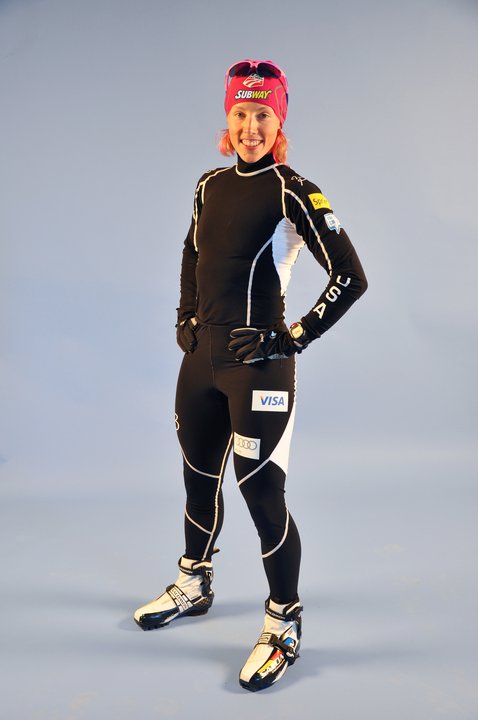
From October 2010: Kikkan Randall modeling the U.S. Ski Team suit for the 2010-2011 season. Photo courtesy of the U.S. Ski and Snowboard Association.
A national team uniform for cross-country skiing has to do a lot of things. At the most utilitarian level, it has to wick sweat and aid performance while an athlete pursues one of the world’s most demanding sports at temperatures between –4 F and 40, in steady snow or driving rain or anything in between. At the functional level, it has to let spectators and coaches identify where their athlete is out on the course, while distinguishing them from athletes from other countries. And at the symbolic level, it lets the athlete know that he or she is competing on behalf of their country, for everything that that means. Ask a skier who has represented the United States in international competition what it meant to them to pull on a national uniform for the first time. They’ll probably be able to tell you.
(And if they ever forget, this detailing from Craft and L.L. Bean on the American uniforms, ca. 2015/2016, is there to remind them. “You are representing the United States of America,” a slogan intones, above a martial-looking eagle, with a U.S. Ski Team master mark for its aegis, gripping an olive branch (?) in its dexter claw and a skis and ski poles fasces in its sinister. “Pretty fun to be representing an American brand with our American uniforms!,” wrote Sadie Bjornsen in a blog post describing the uniforming process.)
For whatever reason, the period roughly one decade ago represented the highwater mark for domestic and global coverage of ski uniforms on this website. There was “US Ski Team Brings Suit Consistency,” from Jan. 2009 (lede: “After years of a remarkable level of wardrobe schizophrenia, the US Ski Team has ushered in a new era of racing suit consistency that should make it easier to follow our favorite US athletes on the race course.”); “The costume disciplinarian speaks: Is it better to look good than to ski fast?” from July 2009; “The Best and Worst (Suits) of the Olympics,” from Feb. 2010; and “USST Goes Black for 2010-2011,” from Oct. 2010 (lede: “In the sport of cross-country skiing, most people would agree that competing with New Zealand is probably smarter than picking a fight with Norway.”).
So it seems to have been nearly 10 years since the last sustained attention to the uniforms of the Davis U.S. Cross Country National Team Program (néeU.S. Ski Team). To fill that gap, FasterSkier hereby presents A Visual History of the United States Ski Team National Team Uniform, 2008–2019.
(Why 2008 for the starting point? Mostly for the simple logistical reason that the image library in the current FasterSkier content management system, WordPress, only goes back to 2008, so this article can be written while using only images that FasterSkier may legitimately post on this site. To go back to closer to the start of this century would require a lot of external links to Getty Images and not that many photos to actually look at on this website. That said, this piece from 2009 has a nice visual roundup of the plethora of different USST designs worn from 2006–2008, which takes you back two more years. Before that, well, just imagine Kikkan Randall and a lot of other skiers you probably haven’t thought about for a while — Wendy Wagner, anyone? Rebecca Dussault? Sarah Konrad? — wearing various iterations of early-aughts red and black.)
2008/2009 World Cup season: Red
January 2009: No question who is from the US here… Kikkan Randall in the women’s Team Sprint in Whistler
January 2009: Kris Freeman preferred the orange to silver in the men’s pursuit
As a contemporary uniform article explained, “There are currently two suit variations being used by US Ski Team athletes, and athletes racing for the US in international events. They are so similar, that for practical purposes (identifying US skiers in a race) they may as well be the same. Both suits are predominantly red, with one version having patches of orange, and the other silver.” Both were manufactured by Norwegian company Bjørn Dæhlie.
There appears to have been no change to the basic World Cup design for the 2009 World Championships in Liberec, Czech Republic:
Freeman at the 2009 World Championships in Liberec. (Photo: Swix Sport)
2009/2010: Still red Bjørn Dæhlie
November 2009: Tazlina Mannix (APU, USST) racing in West Yellowstone.
November 2009: A very young Noah Hoffman (USST) racing to 3rd in a distance race in West Yellowstone.
Honorable mention, domestic suits division:
November 2009: This is a very orange suit. Kevin Hochtl (Rossignol) – 32nd – leads Anders Haugen (APU) – 7th – to the finish in a West Yellowstone race.
November 2009: This is one hell of an ibex. Chris Cook (Steinbock Racing) – 12th – sporting the new Steinbock Racing uniform
2010 Winter Olympics, Vancouver: Red and silver
For the Olympics, the Americans appear to have taken their World Cup template – Bjørn Dæhlie suit, largely red – but have changed it by, inter alia, lightening the shade of red, adding “USA” on the right arm and left leg, adding silver accents, and of course removing all sponsor logos. Kikkan, already skiing in her third Olympics, coordinated with a red headband, red gloves, and her famous pink highlights. Andy Newell went with the red hat (he may not have had a choice), but was otherwise somewhat less vermilion.
Feb. 2010: Kikkan RandallFeb. 2010: Andy Newell on the big climb during the men’s 4 x 10 k relay.
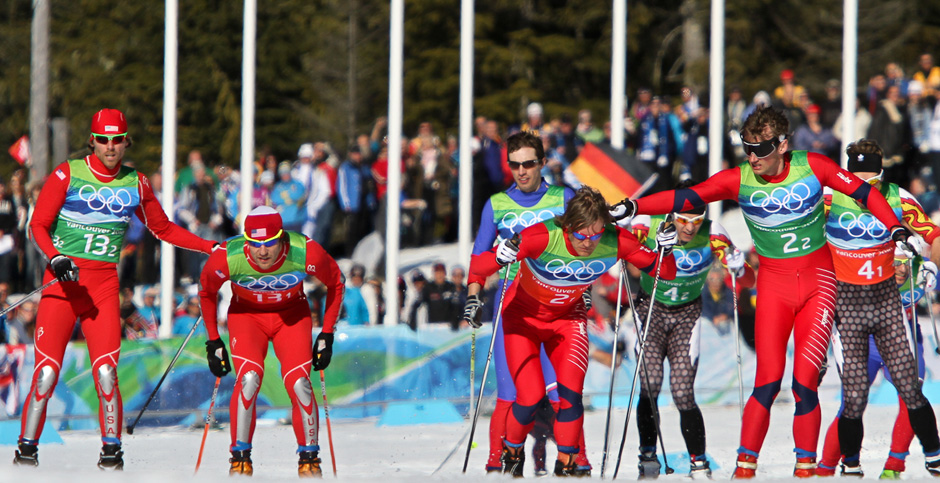
There was a lot of red in Vancouver. For example, here’s Andy Newell (far left, bib no. 13-2) tagging Korin Koos for the U.S. in the team sprint, while Petter Northug (far right, bib no. 2-2) tags Øystein Pettersen (middle right, bib no. 2-1) for Norway. (An entire standalone article could likely be written on the Canadians’ infamous kit (bib no. 4, back right).)
Newell tags Koos (left) and Northug tags Pettersen (right) at the 2010 Vancoulver Olympics.
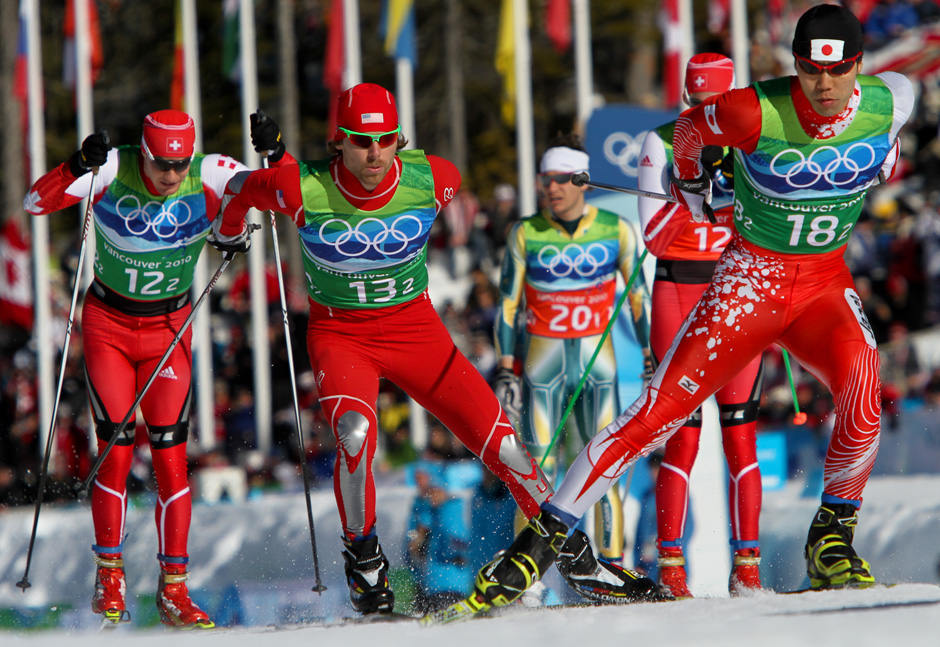
Or here’s Newell in the middle, between Switzerland’s Dario Cologna (bib no. 12) and Yuichi Onda of Japan (bib no. 18):
Newell in the semis of the skate sprint: 2010 Vancouver Olympics.
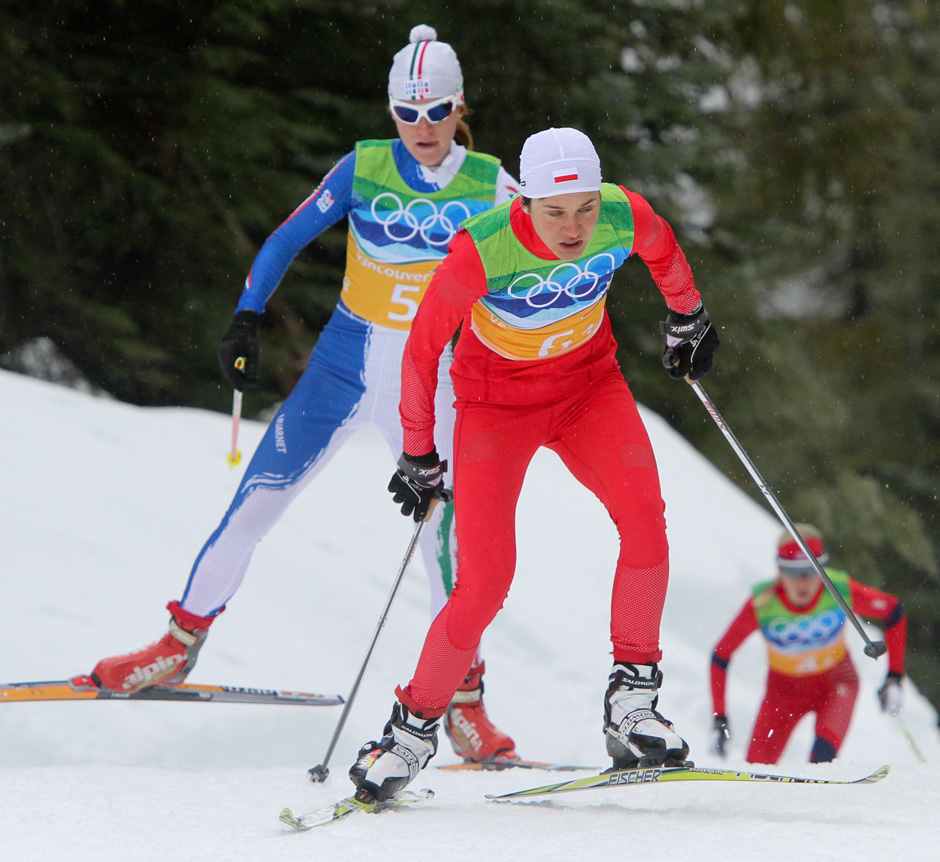
Finally, Poland (shown here: Sylwia Jaśkowiec, bib no. 6) was just red:
Poland 2, 2010 Vancouver Olympics.
2010/2011: The black era begins
Perhaps as a natural reaction to the dominance of a single color across multiple nations, the U.S. made a significant shift for the 2010/2011 World Cup season: black. The color does not appear on the national flag or in other common American iconography, but it is certainly distinctive. Bjørn Dæhlie remained the suit manufacturer.
Or, as then-FasterSkier reporter Nat Herz wrote in fall 2010, “After any number of years of being drowned out by a sea of Norwegian crimson, U.S. Ski and Snowboard Association Nordic Director John Farra said that the USST will be ‘distinctly not red’ for the 2010-2011 season—including at World Championships in Oslo. ‘We went in a very different direction, in part from our experience in Oslo, where they [Norway] have a nation’s group of ten, and we can barely see our athletes in the group,’ he said.”
January 2011: A 21-year-old Sadie Bjornsen races to 17th at U23 World Championships in Otepää, Estonia.
January 2011: Jessie Diggins, then aged 19, races to 7th at Junior World Championships in Otepää.
January 2011: Noah Hoffman at a SuperTour race in Lake Placid.
February 2011: No change for World Champs: Kikkan Randall racing at 2011 World Championships in Oslo.
2011/2012: Still black Bjørn Dæhlie
December 2011: Kikkan Randall sprinting during the Tour de Ski.
March 2012: Kris Freeman (SSCV/USST) on his way to claiming the US Distance Nationals 50 k freestyle title on Saturday morning in Craftsbury.
2012/2013: Still black
December 2012: Noah Hoffman in the Tour de Ski.
December 2012: Kikkan Randall blasting to victory in the Tour de Ski opening prologue on Saturday. She skied to 14th in the pursuit on Sunday and is leading the U.S. women in the Tour de Ski standings after two stages. Photo: Marcel Hilger.
February 2013: Diggins and Randall won gold in the team sprint at 2013 World Championships in Val di Fiemme, Italy, which was awesome, but, for purposes of this article, mostly relevant for the addition of the epochal relay socks but otherwise no change to the standard World Cup uniform.
2013/2014: Yup, still black
December 2013: Liz Stephen (U.S. Ski Team) on her way to 34th in Saturday’s 3 k freestyle prologue at the first stage of the Tour de Ski in Oberhof, Germany. (Photo: Marcel Hilger)
December 2013: Andy Newell (U.S. Ski Team) qualified 12th and finished 10th overall in Sunday’s freestyle sprint. (Photo: Marcel Hilger)
2014 Winter Olympics, Sochi: Stars and stripes
The 2014 Winter Olympics, in Sochi, Russia, were known at the time for Kikkan Randall’s disappointing result in the individual skate sprint, and after the fact for the revelation that Russia was engaged in a massive state-sponsored doping scheme and cover-up. They were also significant for a change in uniforms: stars and stripes on the right arm and left leg, and a large “USA” on the right leg. The left arm was relatively plain. Also, several of the U.S. women drew attention for racing sleeveless in warm temperatures. Bjørn Dæhlie continued to be the brand logo featured on the upper right quad. (Pictured below: Noah Hoffman, in a solo race, and Sadie Bjornsen, in the women’s relay.)
2014/2015: Stars and stripes redux
Athletes took to the trails next season with a slightly modified version of the recent Olympics uniform: Larger stars on the left upper quad, with a deeper blue background. The stripes on the left leg became more pronounced and stretched farther up the race suit, to above the knee. Also, once the non-commercial period of the Olympics had passed, there was space for sponsor patches on the arms and legs.
December 2014: Caitlin Gregg (Team Gregg) skiing to 56th place in the Davos World Cup 10 k classic, Dec. 13. (Photo: Toko)
USST’s Sadie Bjornsen racing to 29th in the Davos World Cup 10 freestyle, Dec. 20, 2014. (Photo: Fischer/Nordic Focus)
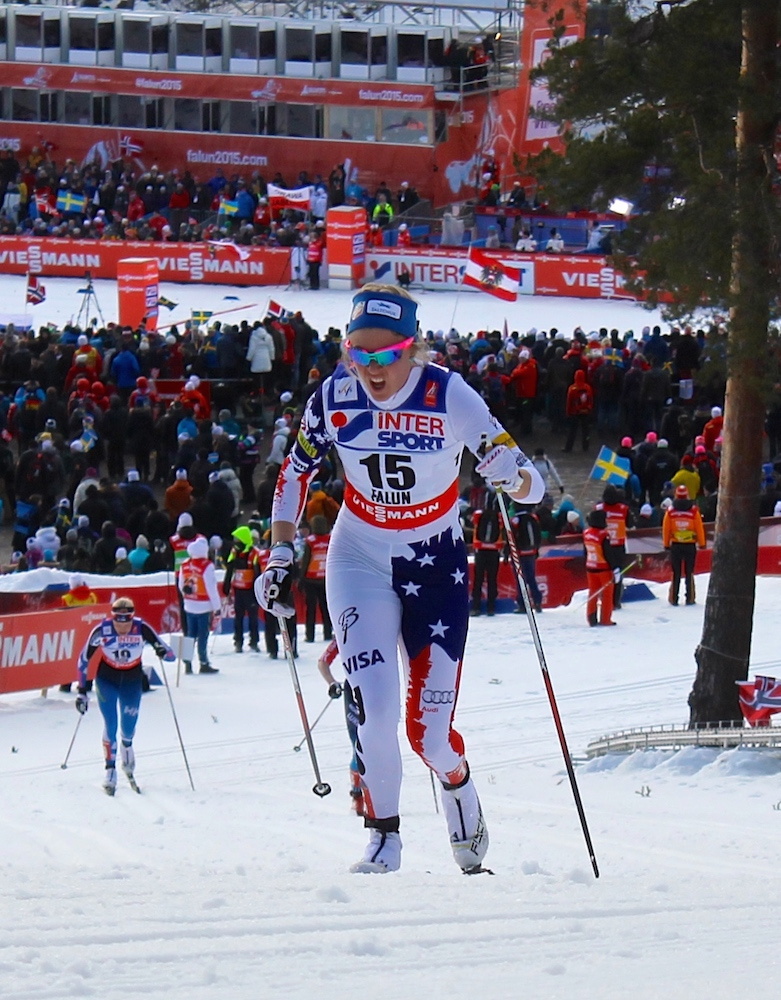
World Championships, in Falun, Sweden, brought a mostly-white version of the uniform, helpful for the warm temperatures and soupy conditions that characterized many of the races. Here’s Sadie Bjornsen in Falun in February 2015:
2015/2016: Red, white, and blue
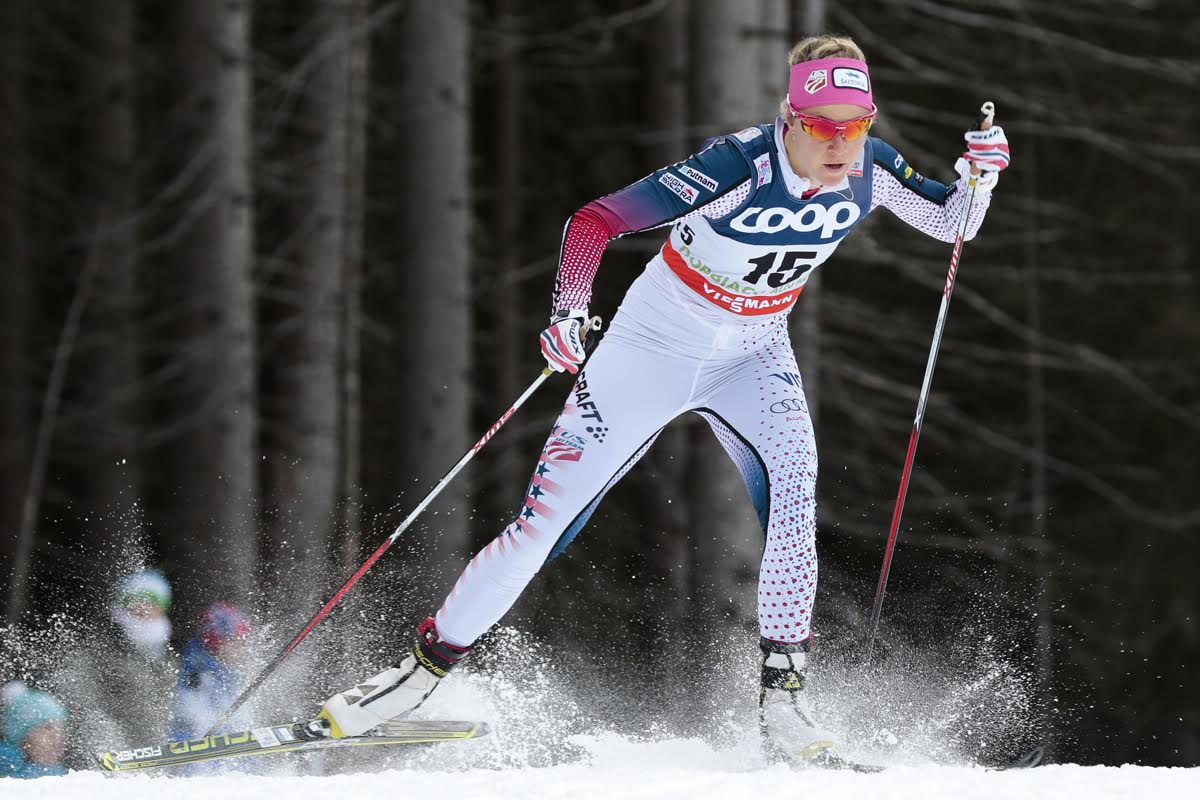
By fall 2015, the move away from black, and towards red, white, and blue, was complete. Athletes now had the option of being attired in a predominantly white color scheme, which would aid in preventing overheating on warm days, while thankfully solving the transparency issues that had plagued recent all-white suits for Sweden or Italy. An alternate version had roughly the same patterning, but with blue as the primary color. Notably, the Americans also moved to a race suit manufactured by the Swedish company Craft for the first time in this survey.
December 2015: Sadie Bjornsen (U.S. Ski Team) racing to her best-ever sprint qualifier in sixth at the World Cup freestyle sprint in Toblach, Italy. She went on to make the semifinals and place 10th overall. (Photo: Fischer/NordicFocus)
December 2015: Simi Hamilton (U.S. Ski Team) racing to his first non-stage World Cup podium on Saturday in Toblach, Italy, where he placed second in the freestyle sprint. (Photo: Fischer/NordicFocus)
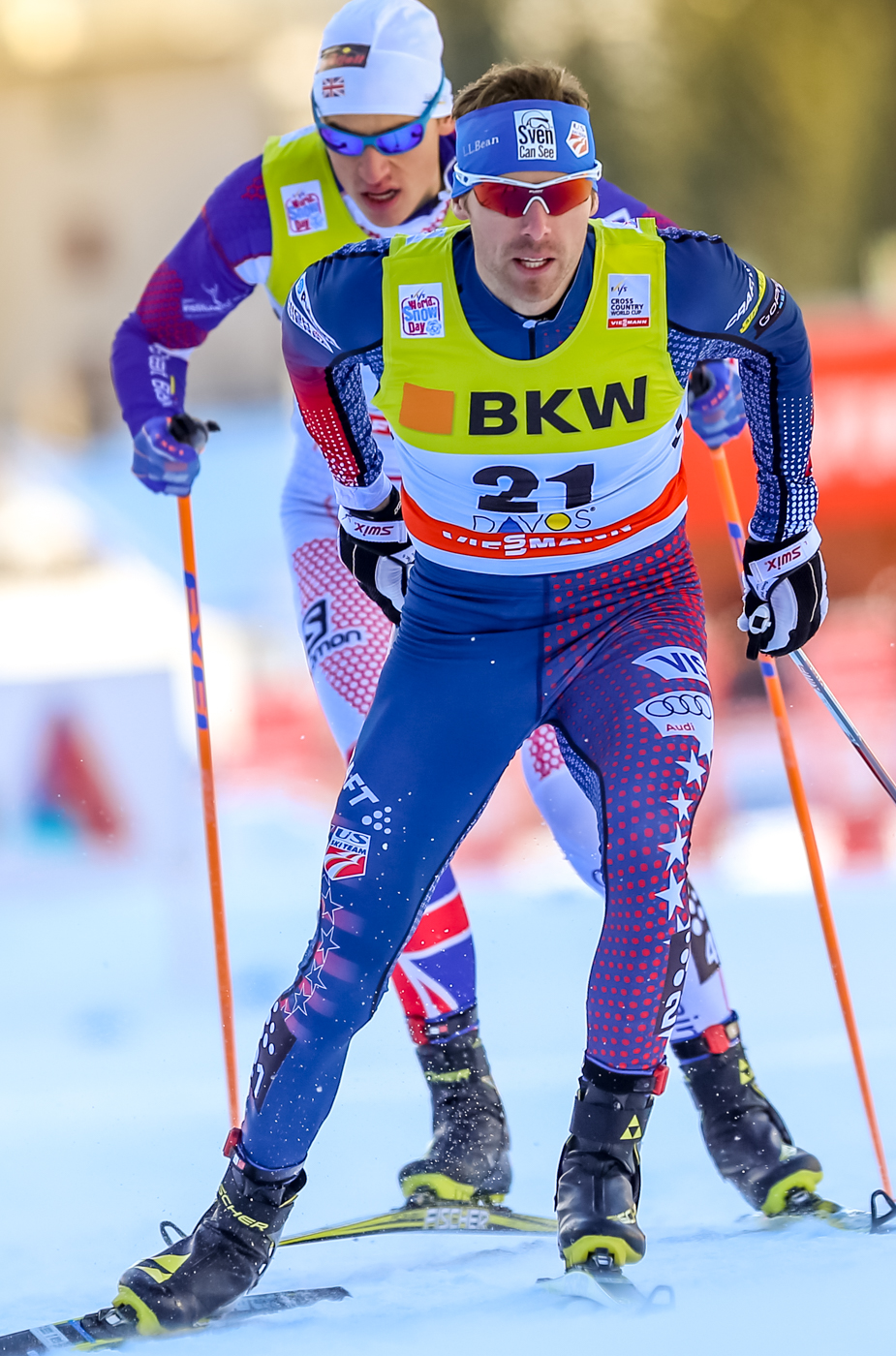
December 2015: American Andy Newell (r) and Great Britain’s Andrew Young (c) trail Norway’s Håvard Solås Taugbøl (2) in the quarterfinal at the Davos World Cup freestyle sprint on Sunday in Switzerland. Taugbøl won the heat, Young placed third, and Newell was fifth after missing out on a photo finish for fourth. Newell finished the day 23rd overall. (Photo: Marcel Hilger)
January 2016: Ida Sargent (U.S. Ski Team) teamed up with Sophie Caldwell (not shown) to place fifth in the 6 x 1.2 k freestyle team sprint at the World Cup in Planica, Slovenia. (Photo: Madshus/NordicFocus)
Honorable mention: Trending towards “purple cobras” for American biathlon but not there yet.
American Claire Waichler started 58th and finished 33rd in the youth women’s pursuit on Sunday at IBU Youth/Junior World Championships in Cheile Gradistei, Romania. (Photo: IBU YJWCH Cheile Gradistei 2016/Facebook)
2016/2017: More red, white, and blue
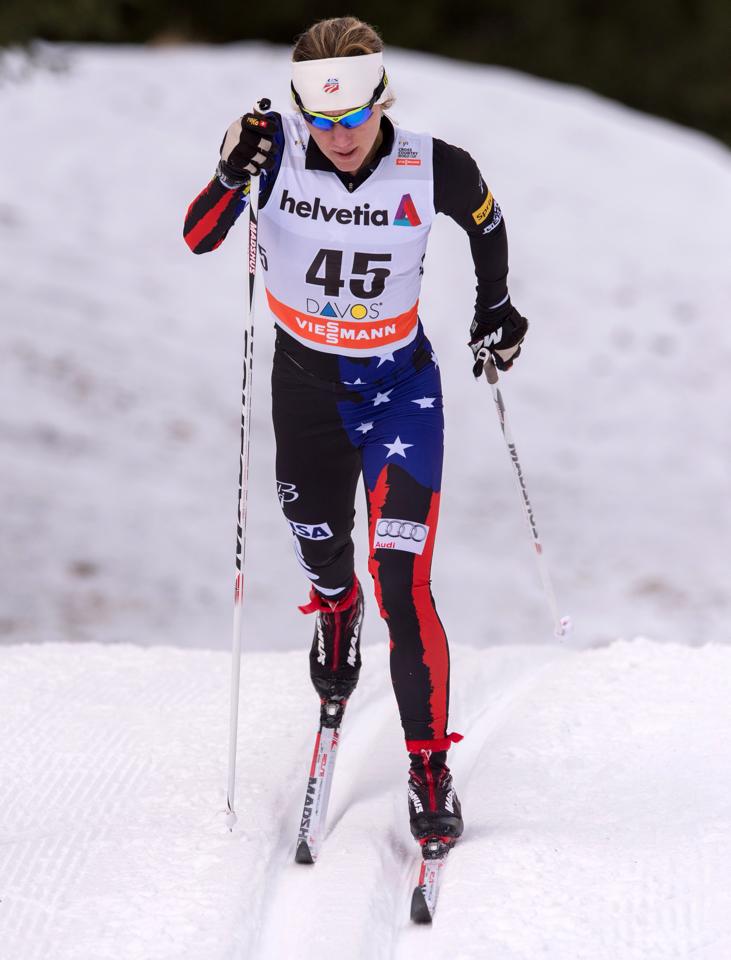
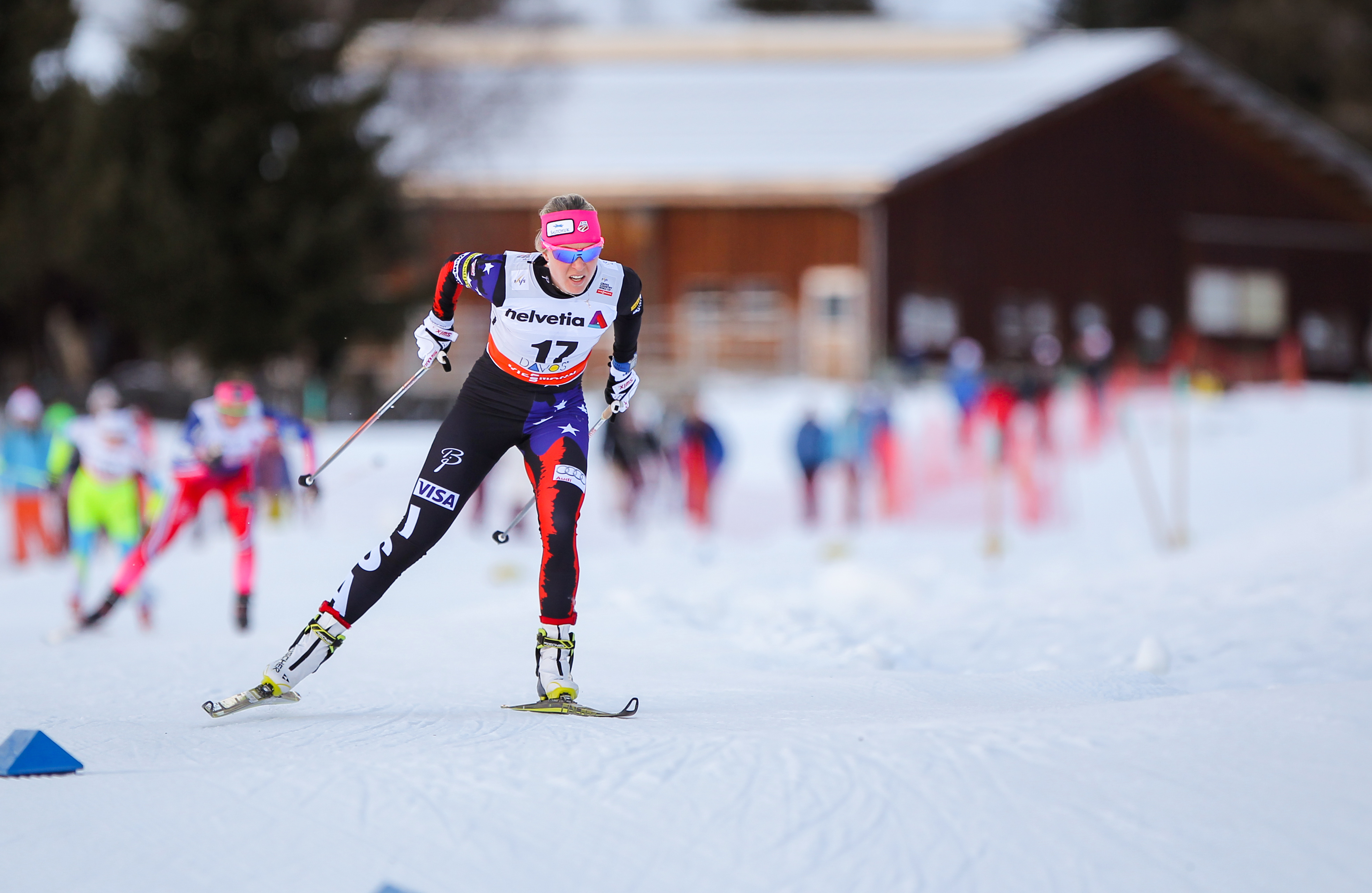
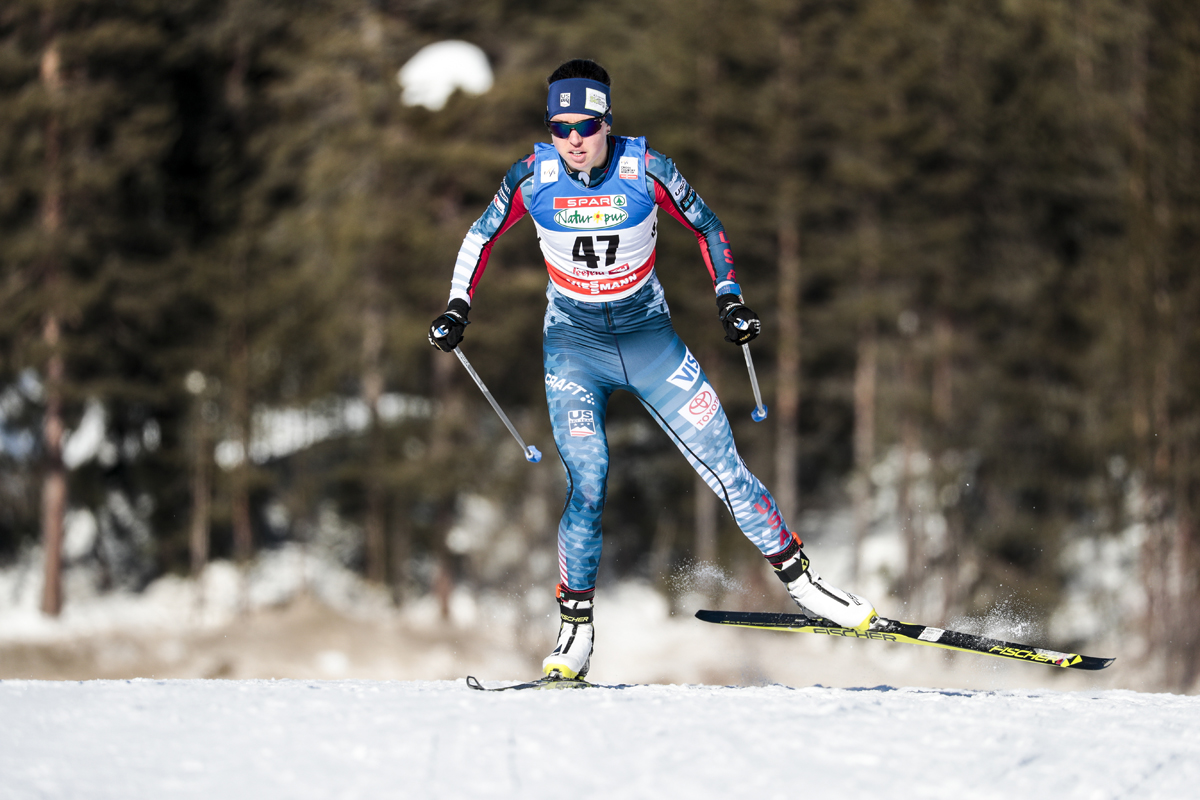
An interpretation of red, white, and blue, still on a Craft suit, remained in place for the 2016/2017 World Cup season, which was marked within the team by Randall and her husband, Jeff Ellis, traveling the European race circuit with a newborn in tow. The changes to the USST uniform were less dramatic than Randall’s familial status: Still red, white, and blue, though now with blue as the dominant color. The entire left leg, and the bottom half of the right leg, had markings, somewhere between subtle striations and full-on stripes, that evoked the stripes of the American flag. (Let’s put aside for the moment the fact that the stripes on the actual flag are white and red, not white and blue.) The pattern was repeated on the lower right arm. An understated evocation of blue or white stars marked both lower legs, with more pronounced stars scattered around the bottom of the torso (possibly the top as well, but nearly all of one’s torso is typically covered by the standard race bib). The left arm and left leg both proclaimed “USA” in red lettering.
The vehicular logo on the legs remained that of Audi, as it had been since the start of this history.
There appears to have been no change for the 2017 World Championships. At least to the uniforms; on the race course, the Americans won an unprecedented three medals.
December 2016: Jessie Diggins (U.S. Ski Team) racing to ninth in Saturday’s 1.5 k freestyle sprint qualifier in Val Müstair, Switzerland. Diggins went on to place sixth in the final. (Photo: Salomon/NordicFocus)
January 2017: Sophie Caldwell (U.S. Ski Team) racing to third in the qualifier of Saturday’s 1.4 k freestyle sprint in Falun, Sweden. She went on to finish 16th overall (Photo: Fischer/NordicFocus)
February 2017: Kikkan Randall (U.S. Ski Team) racing to 26th in the women’s 10-kilometer classic individual start at the 2017 Nordic World Championships on Tuesday in Lahti, Finland (Photo: John Lazenby/Lazenbyphoto.com)
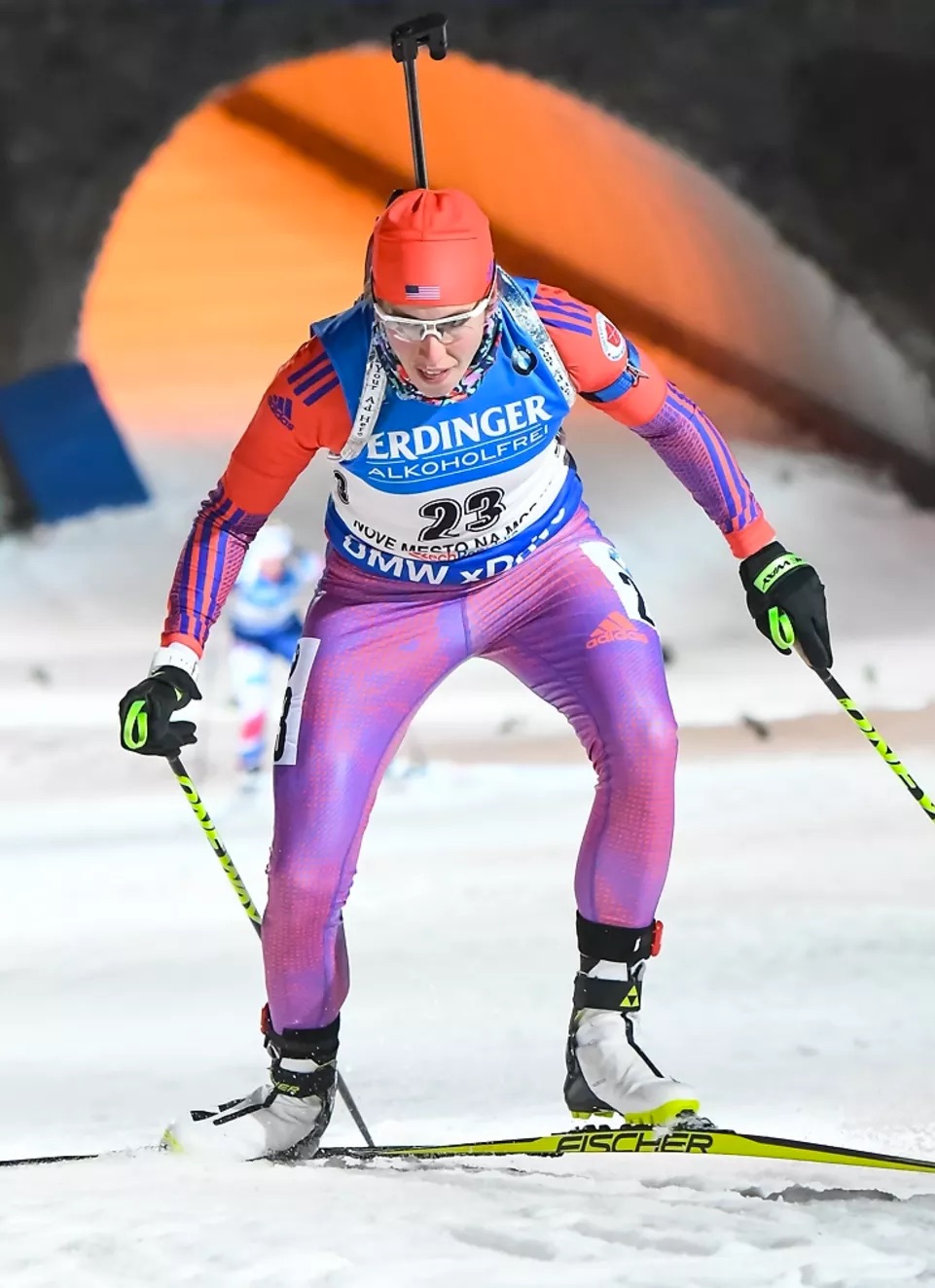
Meanwhile, biathlon saw the advent of the beloved “purple cobras” era:
US Biathlon’s Susan Dunklee on her way to finishing third in the women’s sprint at the IBU World Cup in Nove Mesto, Czech Republic. It was the third podium of her career. (Photo: IBU)
2017/2018: Red, white, and blue redux
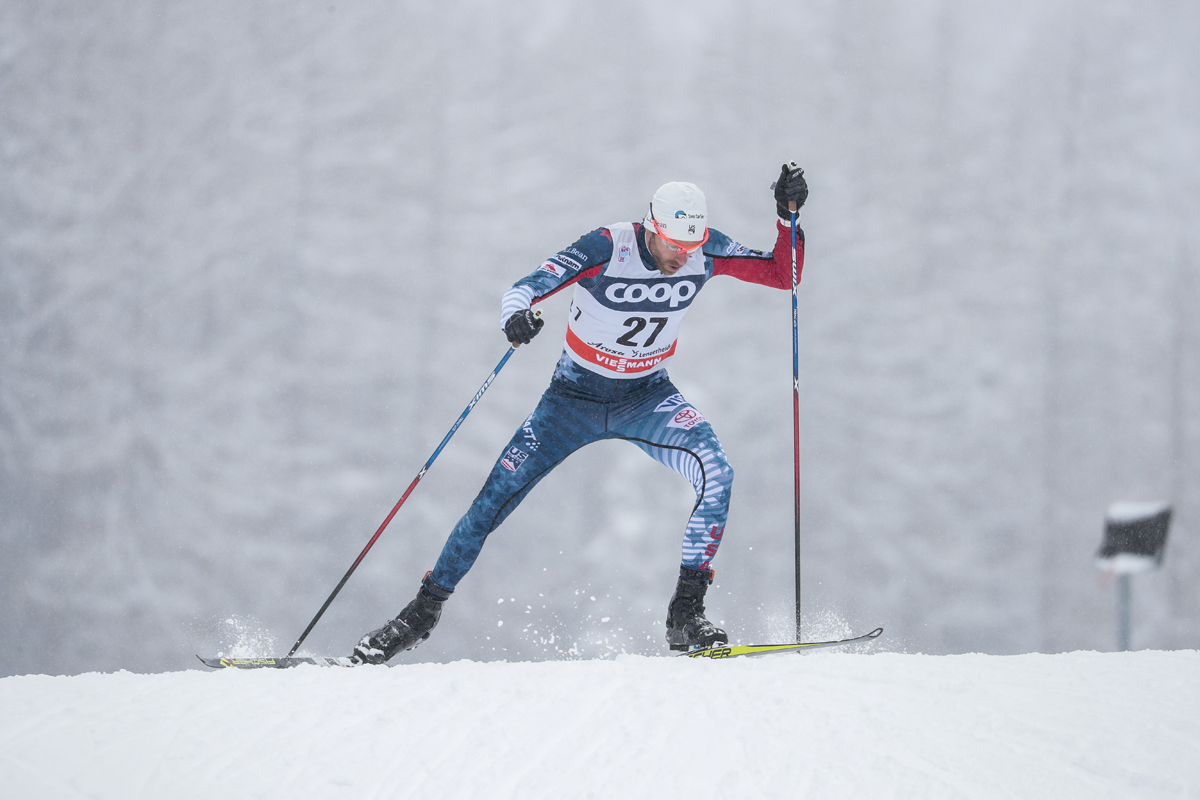
There appears to have been no change for the 2017/2018 World Cup season: still red, white, and blue, but mostly blue, on a Craft suit. The most notable change may have been to the car sponsor… for the first time since at least the scope of this article, a Toyota logo was on the leg, not Audi. Nichts ist unmöglich (“Nothing is impossible”), as the company’s European slogan proclaims.
American Andy Newell racing the men’s 1.5 k freestyle-sprint qualifier at Stage 1 of the Tour de Ski on Saturday in Lenzerheide, Switzerland. He qualified 20th and went on to finish 19th overall. (Photo: Fischer/Nordic Focus)
Caitlin Patterson (Craftsbury Green Racing Project) racing to 52nd in the freestyle sprint qualifier at the last World Cup on Jan. 27 in Seefeld, Austria. The next day, she placed 23rd in the 10 k freestyle mass start. (Photo: Fischer/NordicFocus)
2018 Winter Olympics, Pyeonchang: Red, white, and blue, and a lot of stripes
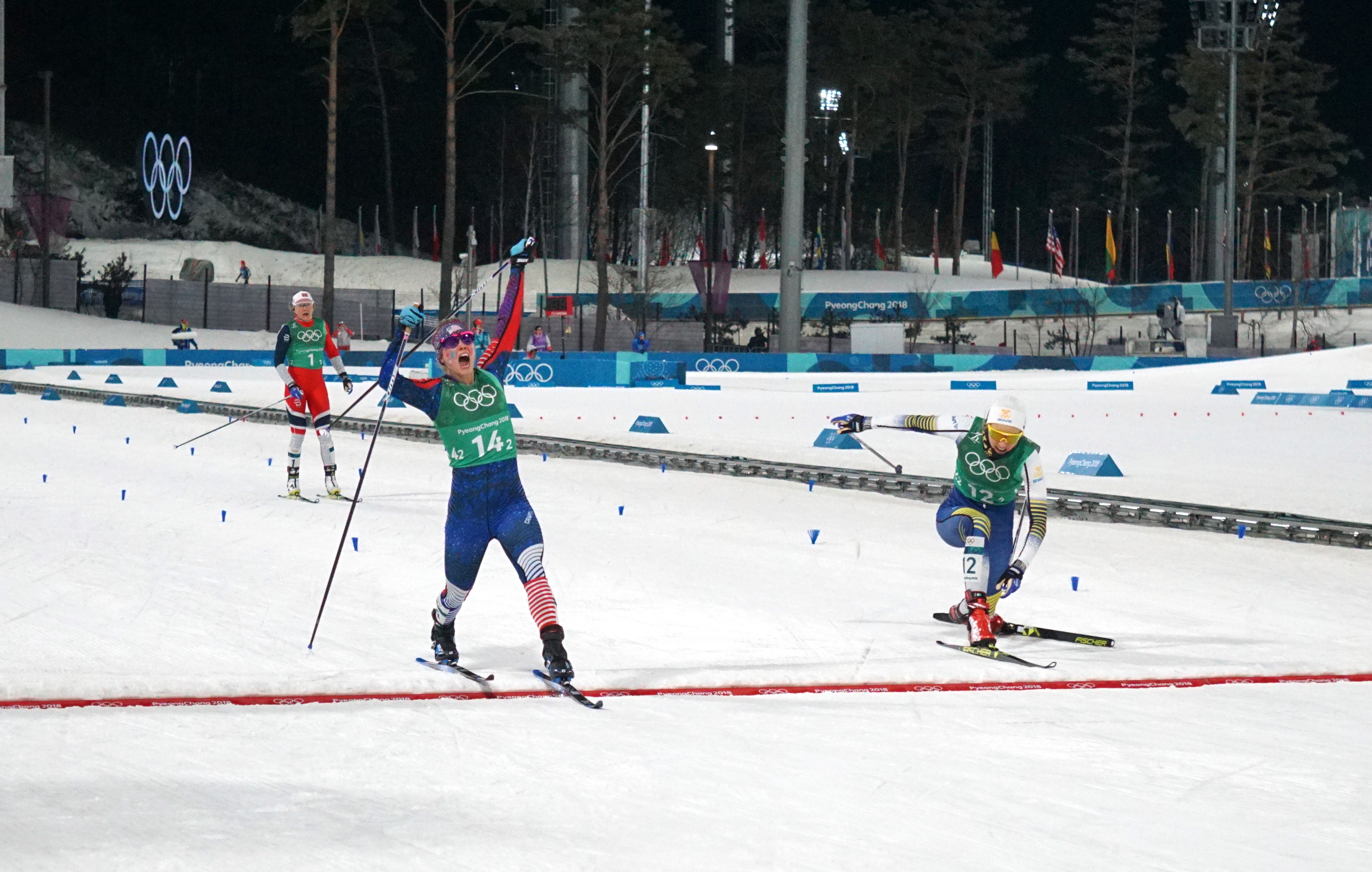
There is a somewhat famous picture from the 2018 Winter Olympics that you may already be familiar with. In the picture, Jessie Diggins, on the lefthand side of the frame, stretches her left foot across the finish line to secure an historic Olympic gold medal for the United States. Her left arm mirrors the gesture, punching the air above her in what is presumably an instinctual counterbalance to the lunge but also appears, in a frozen moment in time, to be a triumphant fist-pump. In the middle, her face is rent in a rictus of exertion and triumph. On the righthand side of the frame, Stina Nilsson of Sweden lunges as well, 0.19 seconds behind Diggins. Mute V-boards and still flags fill in the background of the image, as Maiken Caspersen Falla of Norway appears to stand up and stop skiing in order to watch the finish unfold.
It was a few seconds before 7:16 p.m. in Pyeongchang, 4:16 a.m. in Afton, Minnesota, and 1:16 a.m. in Anchorage, Alaska. If you’re reading this website, you may remember where you were at that moment.
February 2018: Jessie Diggins (14) edges Sweden’s Stina Nilsson (r) for gold, while Norway’s Maiken Caspersen Falla (far left) races to bronze, in the women’s freestyle team sprint final at the 2018 Olympics in PyeongChang, South Korea. (Photo: Noah Hoffman)
But let’s talk about the uniform. Another Craft product, the dominant impression is once again blue; in the photo above, taken at whatever distance from the finish Noah Hoffman was allowed to stand while there was a race on, there is a whole lot of blue approaching the finish line between the American suit and the Swedish one. Some white stripes are visible around the knee of Diggins’s suit, trending down the lower leg, though they are soon subsumed by The Relay Socks.
On closer inspection, however (see next picture, below), there are a lot of stripes going on in this uniform. The entire legs are striped, with stronger white stripes on the sides of the torso fading to fainter stripes at the top of the leg. The knees have white stripes on a blue background, with the width of the white stripes gradually decreasing and the extent of the blue interstices gradually increasing across the course of the knee. As shown in more detail here, the patterning gives way to thin red stripes against a blue background, on the lower right leg, and a bold white “USA,” on the lower left.
The right arm has white splotches, potentially stellar in nature, against a blue background. The left arm has red and white stripes to midway down the biceps, which then transition to blue and red stripes.
The torso has a subtle blue and black patterning perhaps best described as “Swedish forest camo.”
Finally, although it is not apparent in either picture, “USA” was written in white letters against a blue background on both the right arm and lower left leg, as shown in the images available here (lettering on arm) and here (lettering on leg).
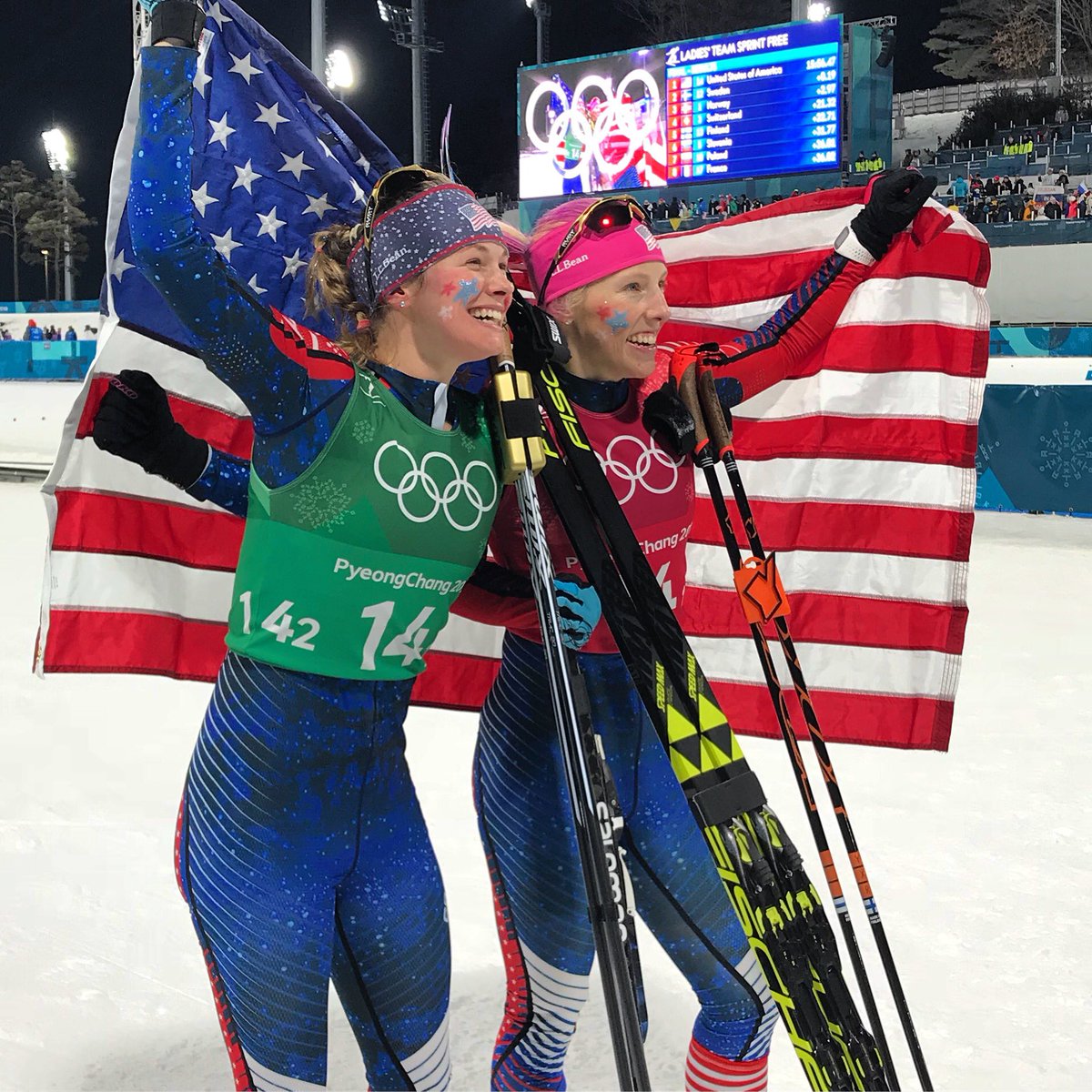
February 2018: Jessie Diggins (l) and Kikkan Randall soak up their win in the women’s freestyle team sprint on Wednesday at the 2018 Olympics in PyeongChang, South Korea. (Photo: FIS Cross Country/Twitter)
Here is another fine picture of Diggins and Randall from the evening of February 21, 2018. This one does not show the famous American relay socks, but does show the equally renowned facepaint and glitter. As Diggins has written, in what is both a pro-glitter cri de cœur and “a brief message for [the] high school officials” who harshed on her glitter as a junior racer, “Putting on glitter before my race is a salute to the little girl who just wants to ‘go super speed!!!’ It’s a promise to myself that I will race my absolute hardest that day. It’s a ritual that gets me in the right mindset to get out of the start gate and give it everything I have. It’s harmless, doesn’t negatively impact anyone, but to me it’s a huge part of my race morning. . . . And on relay days? Oh man. I get so excited about relay days. I get to paint the flag, ‘USA’ and stars on the faces of my teammates, and one of them will paint it on me as well. Then I put glitter over everything! It’s a special time when everyone is nervous, and excited, to be representing our country and we get together early in the morning to help each other get ready and deal with our pre-race nerves. It’s a little bit like our special striped relay socks…it’s part of what we do, as a team.”
End of the 2017/2018 season: Farewell tour
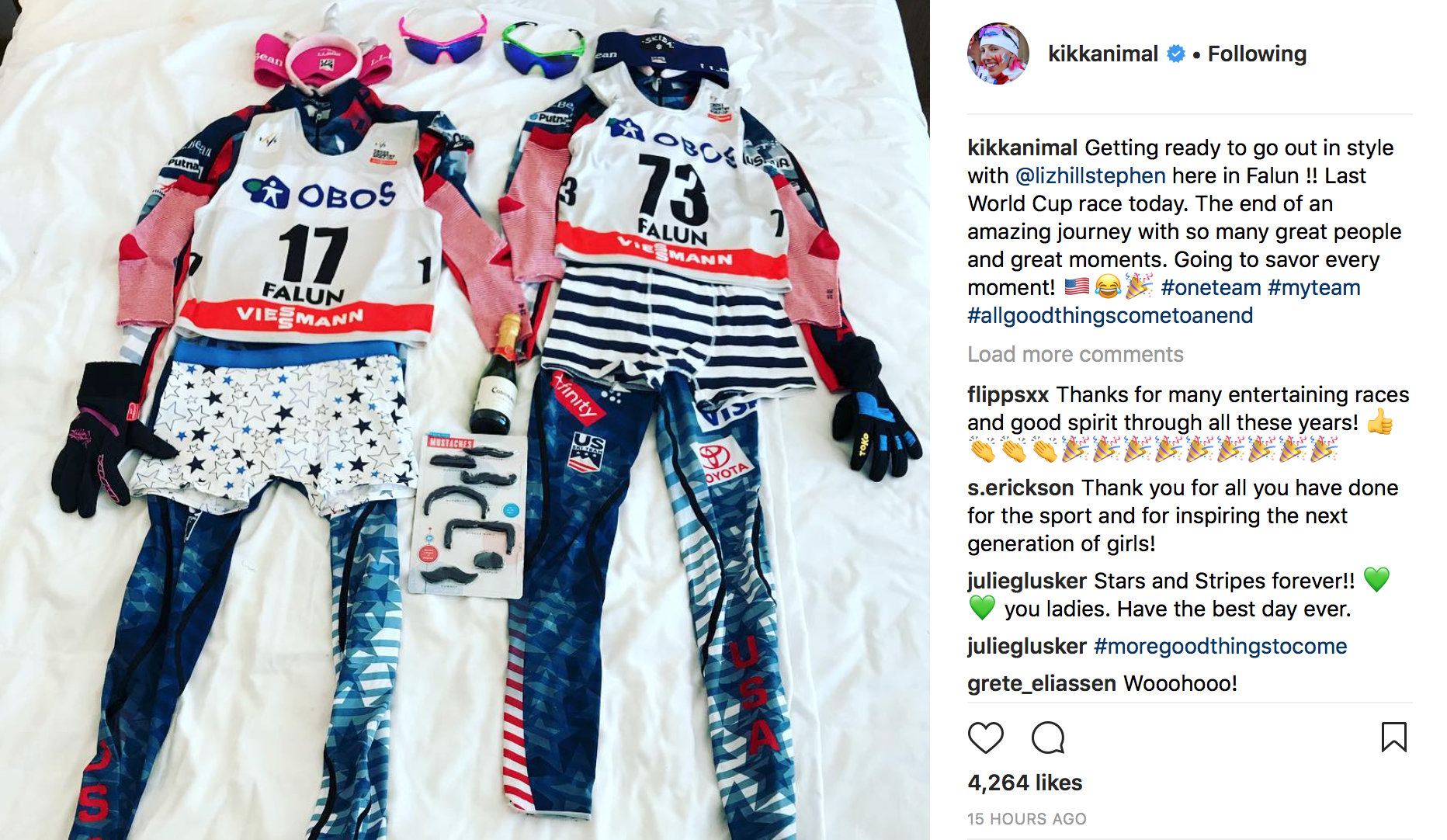
Honorable mention for the 2017/2018 season, World Cup edition: Randall and Liz Stephen’s outfits for their final World Cup race (standard Craft base, but with a whole lot of flair):
March 2018: The last-race outfits worn by Kikkan Randall and Liz Stephen for Sunday’s World Cup Finals pursuit. (Photo: Kikkan Randall/Instagram)
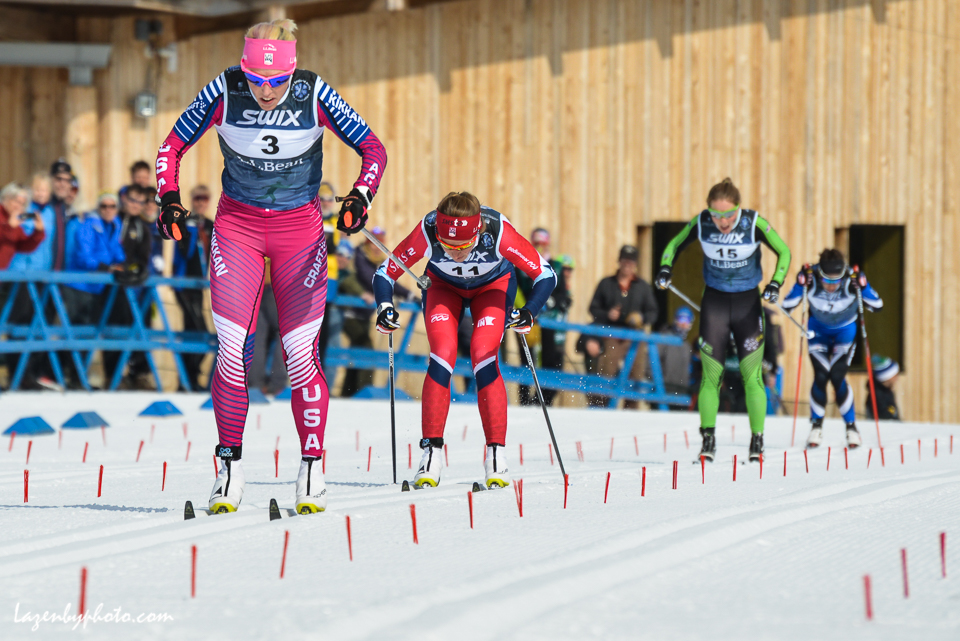
Honorable mention, domestic edition: Randall’s bespoke pink and blue Craft USST/APU suit (essentially the Olympics suit but with different patterning) that she wore for her final race as a professional skier, at Spring Series in Craftsbury. The suit said “USA” on the right arm and left leg, “APU” (for Alaska Pacific University, her club team of 19 years) on the left arm, and “Kikkan” on the left arm and right upper leg.
March 2018: Kikkan Randall (3) racing for third place in the women’s 30 k classic mass start at 2018 U.S. Distance Nationals in Craftsbury, Vt., ahead of Sophie Caldwell (second from l), Ida Sargent (second from r), and Rosie Frankowski (r). (Photo: John Lazenby/Lazenbyphoto.com)
Honorable mention, face paint edition: This remarkable evocation of Randall and Stephen on Diggins’s left cheek at Spring Series.
March 2018: Jessie Diggins with a photo of her retiring U.S. Ski Team teammates Kikkan Randall and Liz Stephen on her cheek at 2018 U.S. Distance Nationals in Craftsbury, Vt. (Photo: John Lazenby/Lazenbyphoto.com)
2018/2019: Red, white, and blue, but with larger color blocks. Also, a move to Swix.
Randall retired. Stephen retired. Randall got breast cancer. Randall was treated for breast cancer. Diggins worked hard to — successfully — bring a World Cup ski race to Minneapolis. And the Americans kept racing in red, white, and blue, albeit now with a move from Craft to Swix for the suit manufacturer. This year’s interpretation of the theme brought a shift to white as the dominant color, with blue through the torso and upper legs, as well as on the arms. Red was the least-pronounced color this year, limited to accents alongside the larger blocks of blue.
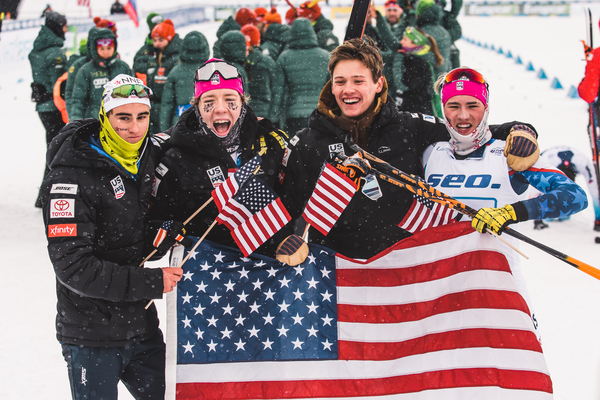
While the Americans continued their perhaps now-accustomed success at the World Cup level, American juniors served notice at World Juniors that they were a force to be reckoned with, taking a gold in the men’s relay, a fourth in the women’s relay, two fourths in classic distance races, and multiple other top-tens. Here are two shots from a frigid Lahti:
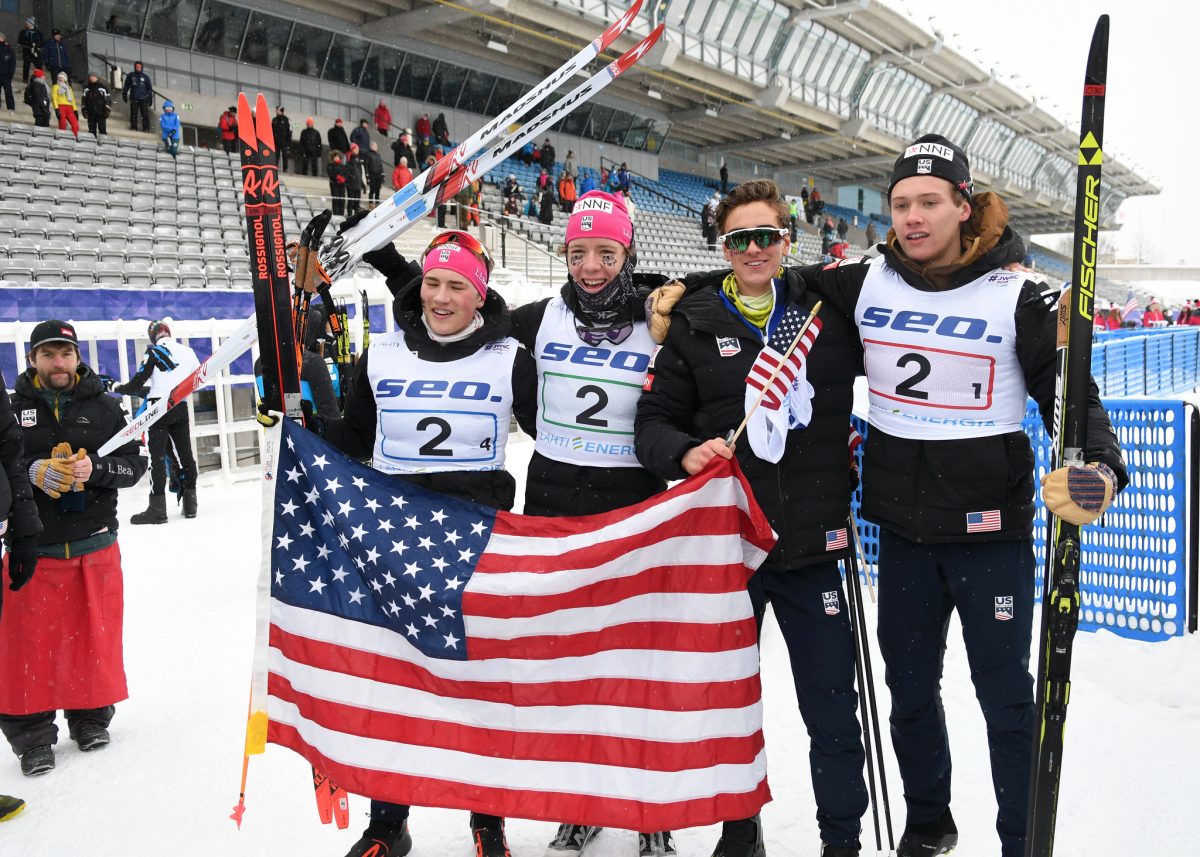
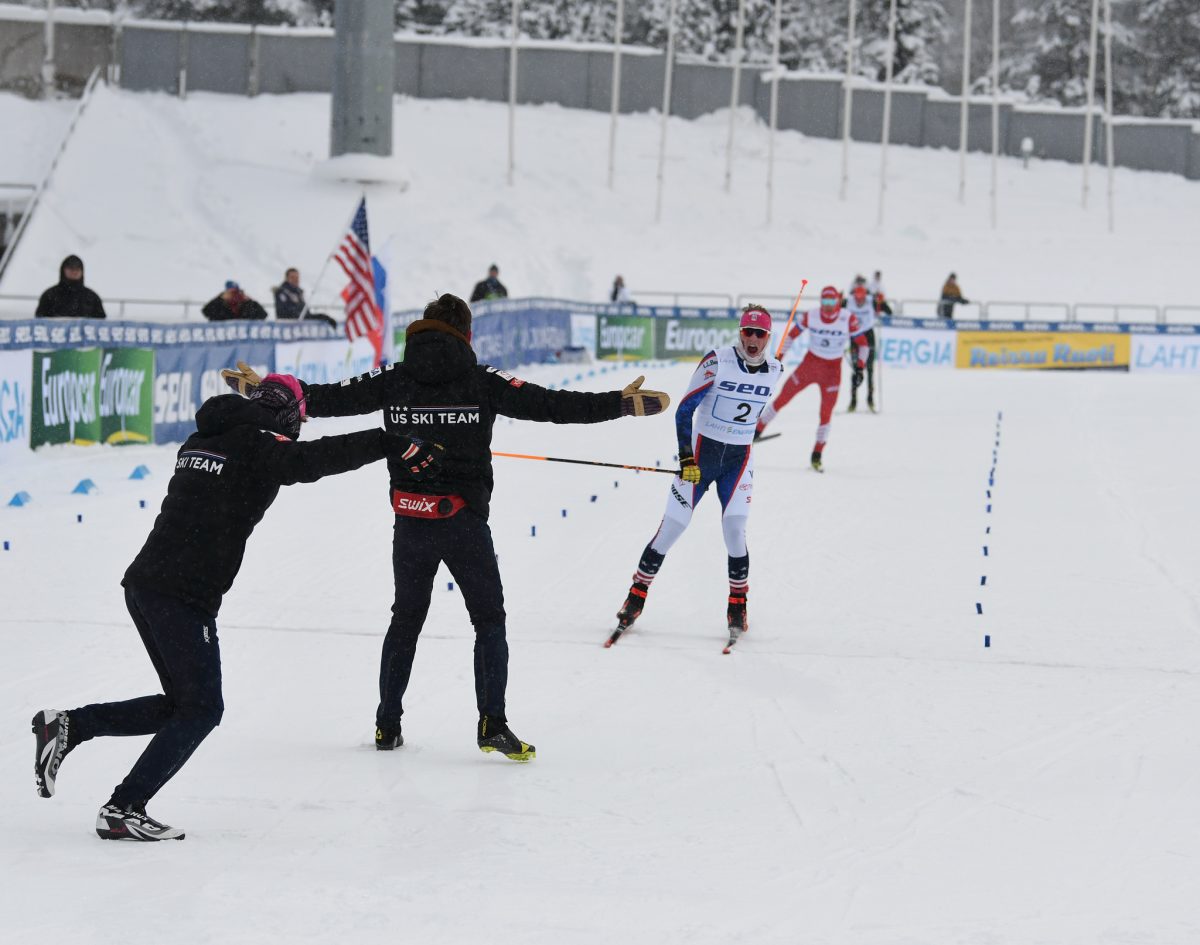
January 2019: Luke Jager (middle left, hands in air) after tagging off to Ben Ogden (bib 2, middle right, pink hat) in the U20 men’s 4 x 5 k relay at Junior Worlds in Lahti, Finland. (Photo: Doug Stephen)
January 2019: Kendall Kramer on her way to fourth place in the U20 15 k classic mass start at World Juniors in Lahti, Finland. (Photo: Doug Stephen)
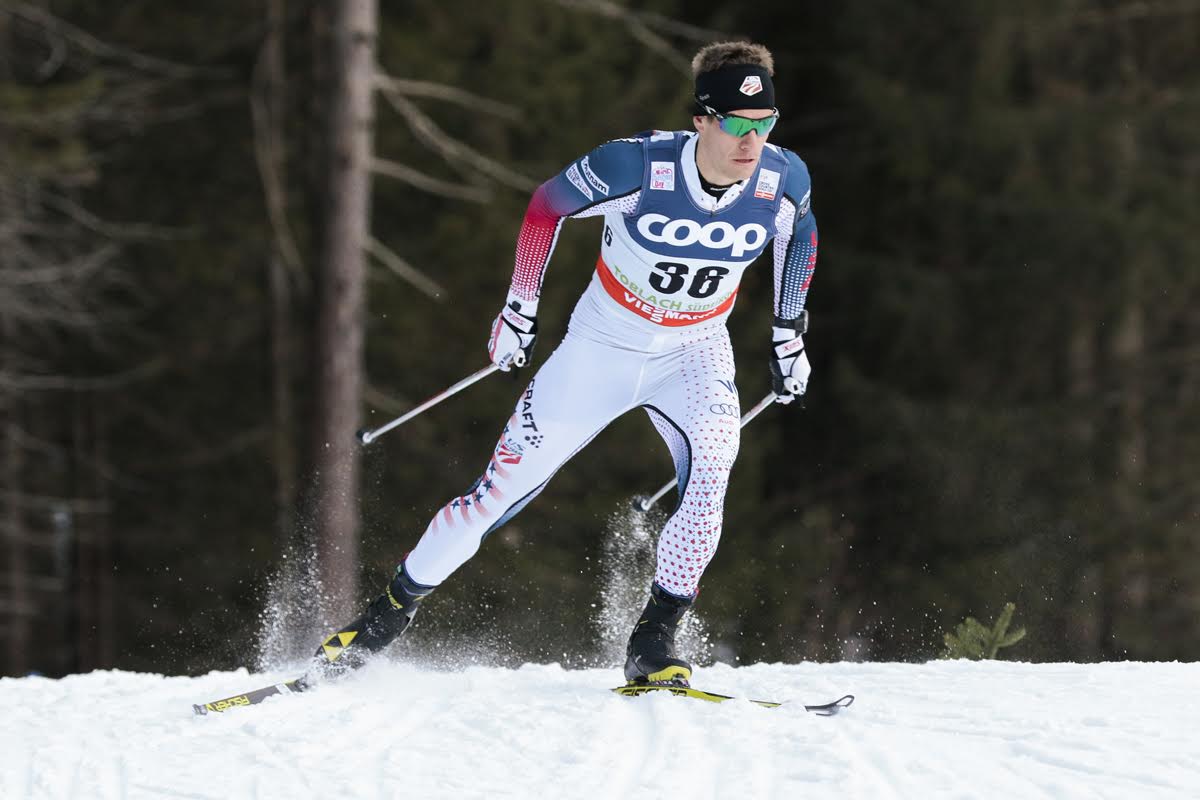
Back to the World Cup (where senior athletes wore the same uniform shown above on the juniors for the regular season), 2019 World Championships, in Seefeld, Austria, brought something new. The dominant hue in the race suit was now blue instead of white, and the large color blocks of the 2018/2019 World Cup regular season were gone. White stars were added to the lower left leg, making the evocation of the American flag far more apparent. Red and white stripes, on the right arm, continued the vexillological theme. While the four sponsor logos on the legs remained the same (Bose, Xfinity, Visa, and Toyota), the Swix logo shifted from the lowest position on the left leg to the middle position on the right.
A Swix press release about the new suits advised: “Featuring bold stars and sharp American colors, the focus was on visibility in mass start events and an iconic look.”
February 2019: Rosie Brennan races in Seefeld.
Honorable mention: Bare arms and cutoffs. It was hot in Seefeld. Like, over 50° F hot. Erik Bjornsen raced the 15 k classic with nothing underneath his race bib (sun’s out…), attire typically befitting Eagle Glacier in July more so than Austria in February. Brennan raced the relay with only a t-shirt on top, and no gloves. And Jessie Diggins drew widespread attention for her DIY cutoff look for the relay (which still featured the iconic relay socks, albeit rolled down so they wouldn’t counteract the shorts by covering most of her lower leg).
As Diggins later wrote on her blog a month after World Champs: “Let me start by saying this; no, I was not cold racing in shorts and short sleeves, yes, you should try it sometime, and yes, it was refreshing to have the cold slush hitting my legs! Somehow, the sight of me racing in a short suit was more interesting and befuddling to most reporters than the actual race itself. Clearly, they haven’t ever experienced a Minnesota cold snap. Now THAT is cold weather! … Honestly, it’s hard to describe the amount of distress overheating puts me in, but let me put it this way; racing is already one of the most painful things you can do. If I have to deal with being incredibly uncomfortable, dizzy, and feeling my body start to shut down because I’m way too hot, it becomes even harder to continue pushing my body to the limit, because it’s already that much closer to the limit! And besides, everyone needed the laughs by the time we got to the end of the races.”
Erik Bjornsen of the U.S. skiing to 17th overall during the 15 k classic at the 2019 World Championships in Seefeld, Austria. (Photo: John Lazenby/lazenbyphoto.com)
Rosie Brennan of the U.S. during the third leg of the 2019 World Championship 4 x 5 k relay in Seefeld, Austria. (Photo: John Lazenby/lazenbyphoto.com)
Custom race suit for Jessie Diggins of the U.S. She anchored the fifth place U.S. team during the 2019 World Championship 4 x 5 k relay in Seefeld, Austria. (Photo: John Lazenby/lazenbyphoto.com)
2019/2020: Candy cane stripes!
Finally, the start of this season brought the dawn of what has variously been called the “candy cane stripes” or “barber pole stripes” suit (#wellactually a barber’s pole historically has alternating red and blue stripes, not just red stripes as on the current U.S. suit). The left leg features red and white stripes, in a color-appropriate rendition of the American flag. The right leg has white stars on a blue background, again in patterning true to the actual flag. The stars are repeated on the left arm, and the stripes are briefly evoked on the right.
The car sponsor has once again changed, this time to Land Rover.
Here’s Kelley Roche, Soft Goods Product Manager for Swix Sport US, explaining the backstory for this year’s suit design in an email to FasterSkier: “Swix worked with Garen Riedel who owns his own design firm, Riedel Creative in New York. Garen worked closely with the athletes to design a suit that graphically works and they were excited to compete in. The goal is to design a suit that you can pick out of the pack and immediately and know it is a US athlete! This is important for the fan but really important for the coaches who support the athlete during the race. We ended up going with an asymmetric design, a continuation of the Seefeld suit design from 2019 and a retro reference to some of the suits of old, leveraging the iconic and patriotic American flag color palette with a slight color fade across the body.”
Roche added that the suit itself is made out of mesh, which in addition to being flexible and breathable “acts likedimples on a golf ball, balancing the lift and drag of the athlete.”
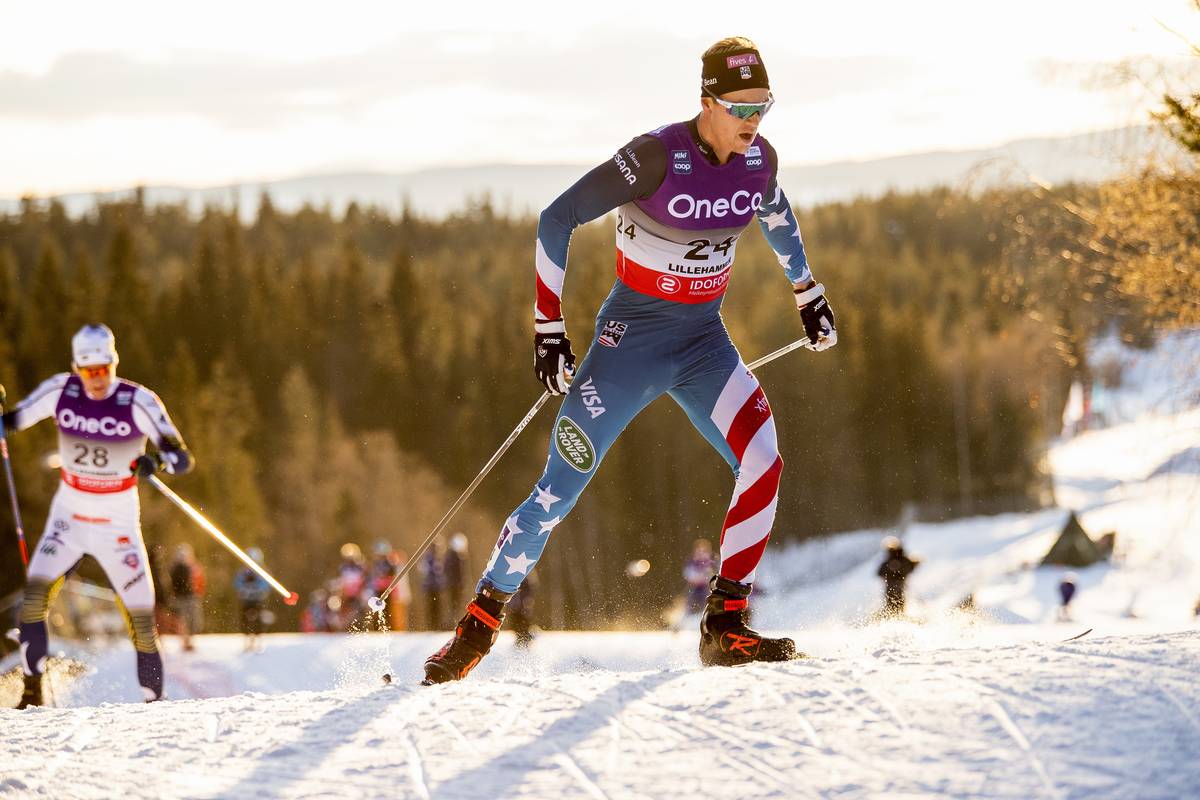
December 2019: Erik Bjornsen during the skate leg of the 2019 30 k skiathlon in Lillehammer, Norway. (Photo: NordicFocus)
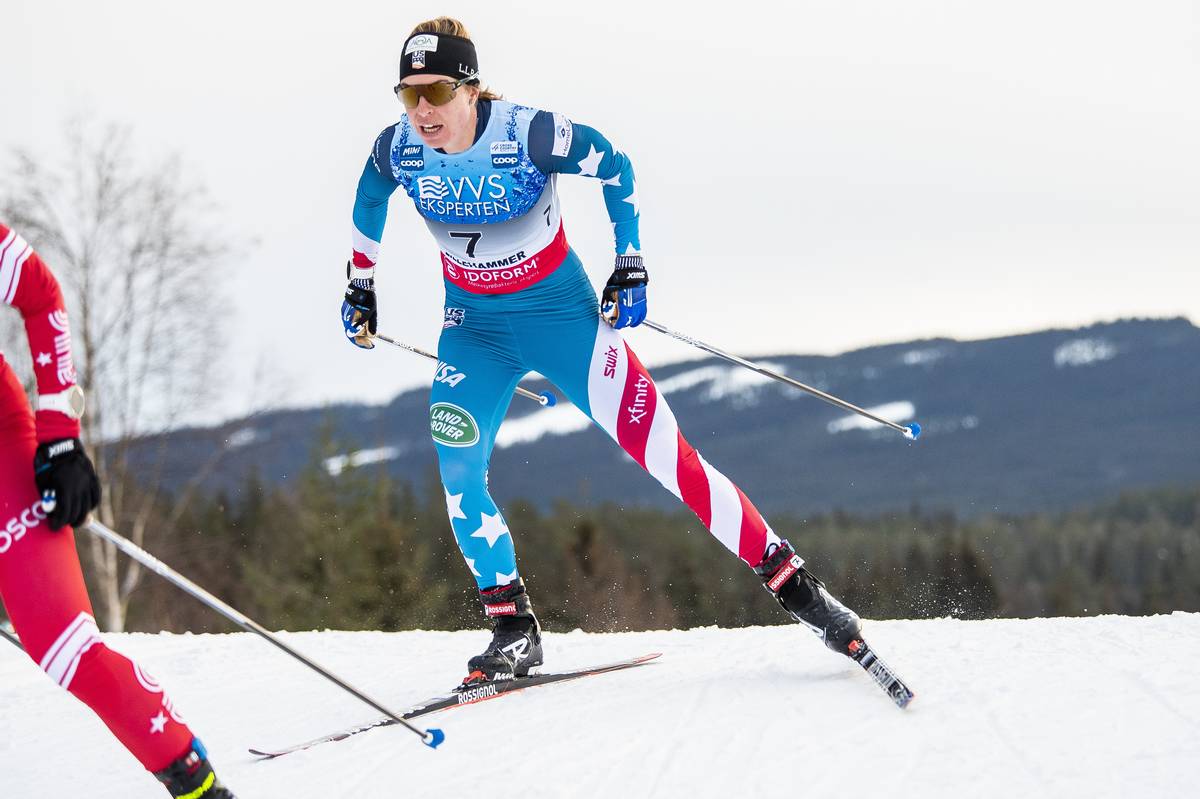
December 2019: Lillehammer, Norway (NOR): Rosie Brennan (USA). (Photo: NordicFocus)
If you have read this far: For one, congratulations. For another, there is a wealth of historical material available in the FasterSkier archives. If you would have any interest in future compilations with a different focus — American biathlon, say, or best and worst of domestic American race suits over the past decade — please comment below, or email the author directly: gavin (at) fasterskier (dot) com. Thanks, and thanks for reading.
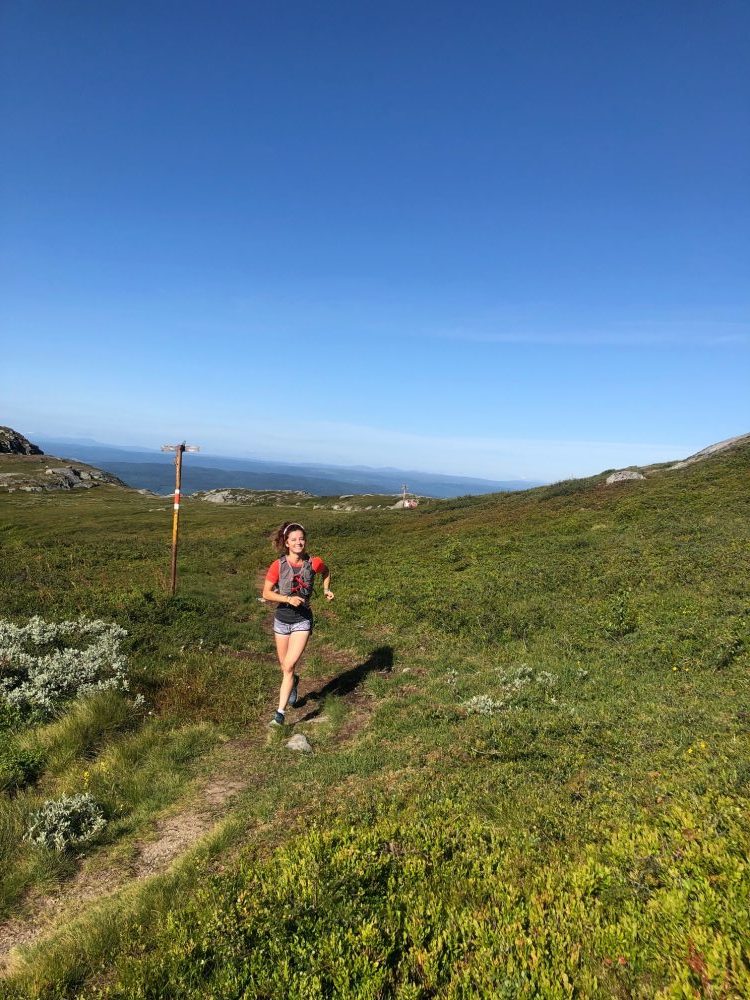
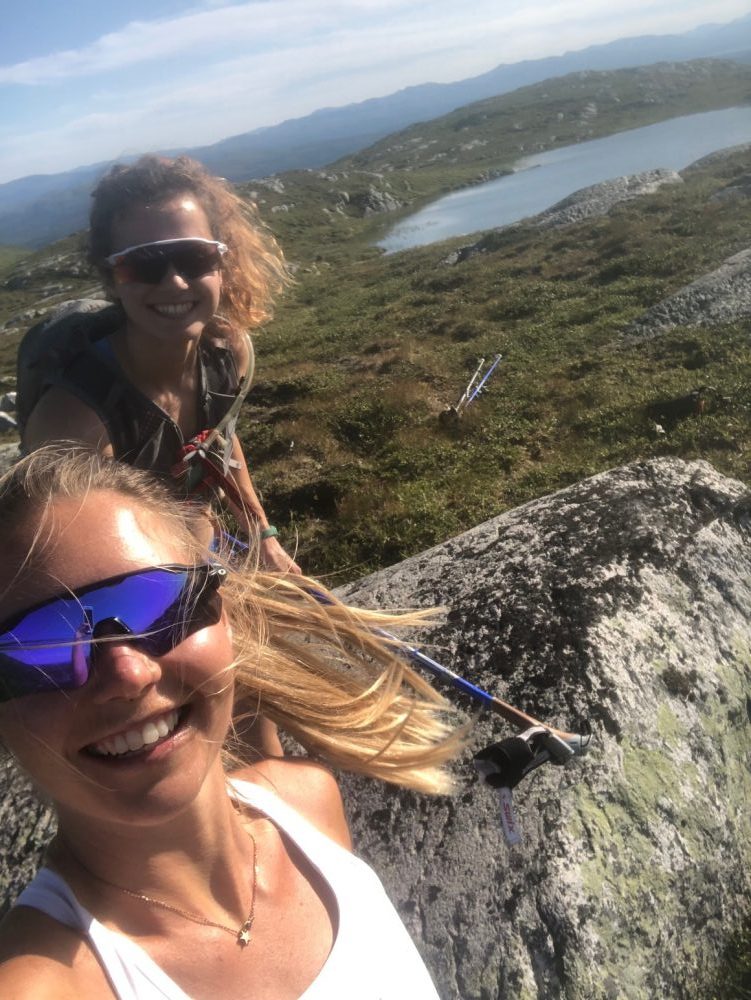
Kendall Kramer running in Sweden in summer 2019. (Photo: Courtesy Kendall Kramer)
It’s no secret that skiers spend a lot of time running as part of their ski training. And even if it’s not their “real” sport, some of them become quite good at it. Hence Scott Patterson wins Alaska’s Crow Pass Crossing backcountry marathon six times (and counting), Erika Flowers takes the victory in The Rut 50k in Montana, or Therese Johaug runs a 10km on the track in 32:20.86 to win the 10,000m at the Norwegian National Championships for track and field. In her first time on a track in 11 years. While wearing normal running shoes as opposed to track spikes.
In this news roundup, FasterSkier surveys three skiers doing well in their “other” sport.
Kendall Kramer takes third Alaska state xc championship, Mt. SAC individual title
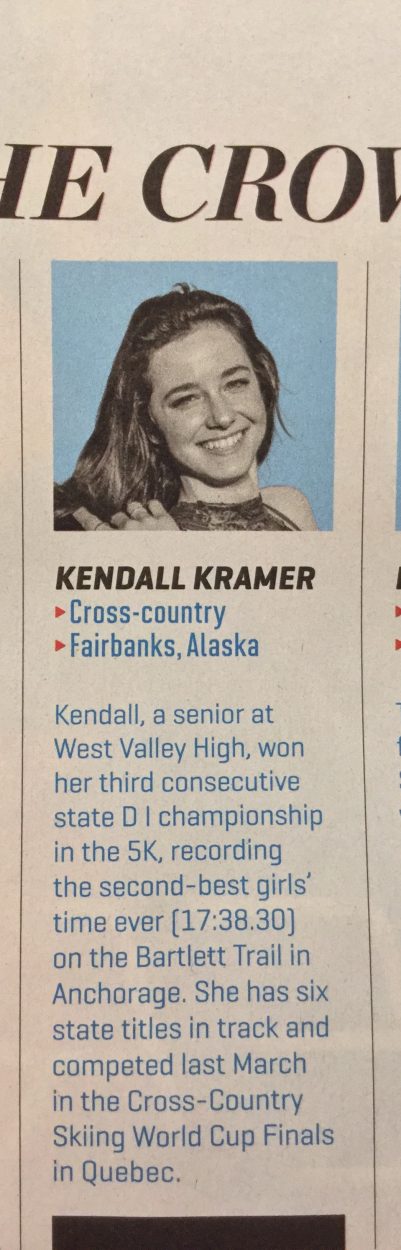
Kendall Kramer is featured in the “Faces in the Crowd” section of the Oct. 21-28, 2019, issue of Sports Illustrated.
Earlier this month, Kendall Kramer, a senior at West Valley High School in Fairbanks, Alaska, captured her third consecutive Alaska high school cross-country running title. On a perfect day for running, with temperatures in the 40s and yellow leaves on the trees, Kramer led a field of 81 Division I (large schools) athletes off the starting line at Bartlett High School in northeast Anchorage on October 5. She was leading at 1km in, leading by more at 2km, and had no one in sight by the halfway mark. She ultimately took the win by 32 seconds over Sadie Tuckwood of Juneau–Douglas High School.
Kramer’s time, 17:38.3, marked the second-fastest girls time ever on a hilly course used for the Alaska state xc championships since the early 2000s, behind only the 17:06 clocked by Allie Ostrander in 2014. Ostrander went on to win three consecutive NCAA steeplechase titles for Boise State, represented America at the 2019 World Track and Field Championships in Qatar, and now runs professionally for Brooks.
Kramer, 17, spoke eloquently with FasterSkier this summer about her own future, including both career plans and the balance between her two sports of running and skiing. Following her win at Bartlett, she more recently told the Anchorage Daily News, “You can be such an amazing athlete [at cross-country running] just by working out an hour and a half a day, and with just your shoes.”
The win marked Kramer’s eleventh individual Alaska state high school championship, including three cross-country running titles, two cross-country skiing titles, and the 1,600m/3,200m double at all of the 2017, 2018, and 2019 state track and field championships. Other three-time cross-country running state champions include Olympic skiers Kikkan Randall and Betsy Haines.
Three weeks later, Kramer was continuing her winning ways at the Mt. SAC Cross Country Invitational in Walnut, California, which bills itself as “The world’s largest cross country invitational” and has been held annually since 1948. Running in difficult conditions – hot with the threat of wildfire smoke – Kramer covered the 2.93-mile course in 17:36 to destroy a competitive field and take the win in the Girls D–III/IV/V Individual Sweepstakes race by 34 seconds.
Kikkan Randall will be among the roughly 50,000 athletes toeing the starting line on Staten Island Sunday morning for the 2019 New York City Marathon. Among the sizeable field, she will be the rare runner plausibly targeting a sub-3-hour finish for her first marathon. Among the sub-3 finishers who also have an Olympic gold medal, and/or who were only recently finished with chemotherapy this time last year, and/or who were still receiving infusions through July of this year following radiation, Randall presumably stands alone.
As reported by NBC Sports, Randall had planned to compete in last year’s race before her diagnosis of Stage 2 breast cancer, and the accompanying treatment, complicated her plans. She traveled to New York City anyway, and watched former USST Liz Stephen finish the 2018 race in 2:58:40. Randall will be wearing an Aktiv Against Cancer charity bib alongside Stephen and Ida Sargent. Also in the field, Brian Gregg will also be racing, through not affiliated with Aktiv.
Randall was included in a recent Runner’s World piece, “Celebrities Running the 2019 NYC Marathon.” Randall was the only athlete for whom a recent race time was mentioned, as well as the only celebrity on the list whom this reporter had heard of.
Randall has raised over $10,000 for AKTIV Against Cancer, a group that “works to ensure physical activity will become an integral part of cancer treatment” with which she had been associated even before her diagnosis, through the sale of “It’s Going to be OK” socks from her website.
Adam Martin runs 14:34 for road 5k
https://www.instagram.com/p/B4K9hJ1JuH4/
The headline pretty much says it all – Saturday morning, Adam Martintook first place in the Great Bay 5k in Stratham, New Hampshire, with a blistering time of 14:34. (The course is described on the race website as “mostly downhill” and “wicked fast.”) Martin, who skis domestically for Craftsbury Green Racing Project, will be starting in two distance races in Period I of the 2019/2020 World Cup season, in Lillehammer and Davos.
Kendall Kramer on her way to fourth place in the U20 15 k classic mass start at World Juniors in Lahti, Finland. (Photo: Doug Stephen)
As the title suggests, catching up with Kendall Kramer is no small task. The 17-year-old (as of late June) caught the attention of the cross-country world this past winter with stunning and consistent performances at Lahti, Finland’s Junior World Ski Championships. Although we’re about to rattle off some 2018-2019 results, to be clear this is no athlete who defines themselves solely by the metric of finish rank. That will come across in the interview below.
4th at World Juniors in the 15 k classic
15th at World Juniors in the 5 k skate
4th at World Juniors as part of the 4 x 3.3 k relay along with Mara McCollor, Sydney Palmer-Ledger, and Novie McCabe.
A clean sweep of the U-18 races at Junior Nationals
She finished 51st overall at Québec, Canada’s World Cup finals.
And she can run. Kramer is a two-time Alaska state champ in cross-country running and has notched six state titles in track for Fairbanks’ West Valley High School. She is also a top student at her high school.
Kramer has spent the last few weeks running and dryland training in Sweden. During her time there, she entered the Ulvang Kvartsmaraton, a 13.5 k mountain running race in Åre, Sweden, where she placed second among a field of 159 competitors. We spoke with Kramer over the phone on August 7. By know, she is back in the north country of Fairbanks.
FasterSkier: It is often articulated to runners that cross-country skiing will develop too much bulk on the upper body. Conversely, dual-sport athletes often hear that running season goes too long into the fall season. Have you heard those types of comments despite the fact that you are successful in both sports?
Kendall Kramer:So those things have been said to me since freshman year since I began getting competitive in skiing. They say cross-country running races go too late into the season too close to ski season, the national cross-country running races are in November and December.
They are like, ‘if you are in running shape you are not going to have the build for skiing or your technique is going to get off,’ or stuff like that. I have had to ignore both my ski coaches and running coaches, not to pick on one or the other.
FS: How are you balancing the two sports?
KK: I think if I am in running season or in the middle of my hard training for the ski season and I am training with my running group, it is awesome because it gets my mind off of it. When I am running, I am training with other people who don’t know anything about skiing and it is really refreshing from talking about skiing all the time.
The then that gets me excited for ski season — an excitement that might be hindering if I was really grinding and training the whole time for one or the other the whole time.
And so what I find, for now, is that when I am training for running while I am also ski training, I make a point of doing running practice every day because I love it and I love the team. But I will rollerski home from practice, or I will do strength after practice.
On the weekends if I don’t have a running race, I will do super long rollerskis to get time in on that. Running, for me, I think it is just great training. I have been doing more of it as the years have gone on, even though more and more people are telling me to specialize. I think running helps a lot with speed and just pure endurance. It is just shorter workouts that you cannot really get from skiing.
FS: Seventeen and a lot on your plate. How do your parents counsel you as you try to balance all of this?
KK: My dad went to college for track and field, my mom has never skied a day in her life. They are taking the long-term approach: they did not let me go to the Bend ski camp because they don’t want me to dive head first into all these U.S. Ski Team activities because I have so many more years to do it. They want to keep me where my age is. I know I have been progressing rapidly every year, so they settle me and I may protest it, but in the end, it is what is best for me.
They also advised me on if I wanted to do skiing year round freshman year. Because before I did cross-country running and skiing and realized that I could do both and have success in both, I just wanted to ski. I thought you couldn’t do both well. But my parents did not sign me up for my club ski team that fall because they wanted me to try out cross-country running. I was really mad at them but, it turned out great.
Kendall Kramer running in Sweden. (Photo: Courtesy Kendall Kramer)
FS: OK, before we get to what you have been up to in Sweden, what does the rest of the summer look like for you?
KK: I head back to Alaska next week and will do some training in Fairbanks with my ski group FXC. It is an awesome training group, and I would be fine staying with them the entire summer and Alasdair Tutt is an amazing coach. He is coaching at a ski school in Davos next year, this is his last week as our coach. I want to head right back home and get the last bit of coaching I can from him.
And then, cross-country running starts. The first race is in like 20 days and the state cross country running race is on October first. Then I am traveling down to California for a cross-country running race.
FS: You will be a senior this year and you are also a member of the U.S. Ski Team Development Team. What are your thoughts about the semi-distant future?
KK: There is definitely a lot of pressure to commit to something in the next three months. It turns out I want something completely different at the end of this year than I wanted at the beginning of the year. At the beginning of my junior year, after high school, I wanted to do the whole forgo college thing until I get sick of skiing. But at the end the year I wanted to go to college really badly because I figured out what profession I want to pursue, and that is going to take like 8 years of schooling. I am really excited to start that profession, and I am definitely going to college next year.
I don’t think I could be a full time skier. I definitely need something else going on. I just don’t think I could have only one thing going for me. So I think that the best education that I can get is probably my priority next year.
And NCAAs are pretty controlling and that is kind of putting me off. So I might do the Becca Rorabaugh thing, which is the quarter system and going a quarter at a time. I would like to do a four year school. I am not really going to take a gap year either.
FS: Since you mentioned it, what are you interested in pursuing professionally?
KK: Psychotherapy — like being a therapist and someone who sits down in the office and you work things out. That takes a lot of schooling, a doctorate, and it takes a lot of job shadowing and an apprenticeship. That licensing process can take as much as six years of schooling and one to two years of internship.
FS: That is very specific. What piqued your interest in that?
KK: I think it is super necessary and needed. Especially in this sport where there is a surface layer. And there’s a lot of mental stuff going on underneath that isn’t, cannot really, be talked about in interviews or the newspapers don’t cover them. There is just a lot of mental battling, especially in sport and I know a ton of my friends have to get sport psychology. I get that provided for free being on the U.S. Ski Team. So I am getting some sport psychology work and I think it all starts with how your mind is doing and if it is cluttered then everything is going to be a mess. If it is clear and you can focus on one thing, then things will drastically change, I think.
It is really needed in everybody’s life whether they are an athlete or anything else. I don’t think I will go into sport psychology because I just hear so much of those issues in regular life. I think I would love to get another human perspective on other issues beyond sport psych.
In sport, there’s a lot of focus on physical abilities. But those are nothing if someone is silently burned out in their mind or they cannot push themselves anymore in a race. Or they are just struggling and nobody is talking to them about anything but their athletics or their external issues and stuff like that.
Kendall Kramer (rear) along with her host, Hedda Bångman in Sweden. (Photo: courtesy Kendall Kramer)
FS: OK, we are catching up with you while you are in Sweden. What are you up to there?
KK: I am staying with the Bångman family near Östersund — one of the sisters is Hedda who skis at CU Boulder, and there are Evelina who is twenty-seven and Tilde. Tilde is my age and got multiple top 10s at junior worlds. I’m training some with the Offerdal Ski Club. It was really good. It was so different from any training I had done in the U.S., just everything they do is at a much faster pace. And their intervals, they don’t do as many intervals but they do them so much faster.
Another thing is that the coaches also don’t come along on all their training sections, they just let them free. Well, they explain what they need to be doing, but then let them free. All of the athletes are so motivated and they know exactly what to do first of all and second of all they want to do even more even without the coach watching them. It is really cool to see.
FS: Why do you think the athletes get more latitude?
KK: I think because there is such a culture surrounding success in sport and sport as a lifestyle. It seems people in the country really believe that and it is easier to just get out the door and motivate yourself independently because there is such hype and respect around sports in general.
FS: Can you talk about the speed of their training — what does that look like and mean for you?
KK: For example, I think they don’t really mind so much about levels, I am not seeing anyone wear heart rate monitors as much as in the US. I haven’ t seen anyone wear a heart rate monitor yet. When they are doing intervals they are very competitive. They are going to go as fast as they can for that entire duration, even if it is just a short workout. When they are going easy they are going a lot easier than we do in my experience in America.
Maybe sometimes in America, we are trying to overcompensate: that if we go slow we are going to train our bodies to go slowly. But really it is just saving your body for having higher quality intervals and that is what I have noticed here. They can go so much faster and go more of a race pace when they actually need to.
FS: Are any of them surprised to hear about the success of the Americans at World Juniors?
KK: They have a pretty high standard for American skiers. I brought up the boys relay at Junior Worlds because I assume that everyone knows about that, yeah they were not surprised. I got a few comments about how they were glad they had won because Norway needs to stop getting so used to it. They told me if it is going to be an international sport then they are glad a World Cup is coming to the U.S. this year. They want the sport to be international and not so centered in Scandinavia.
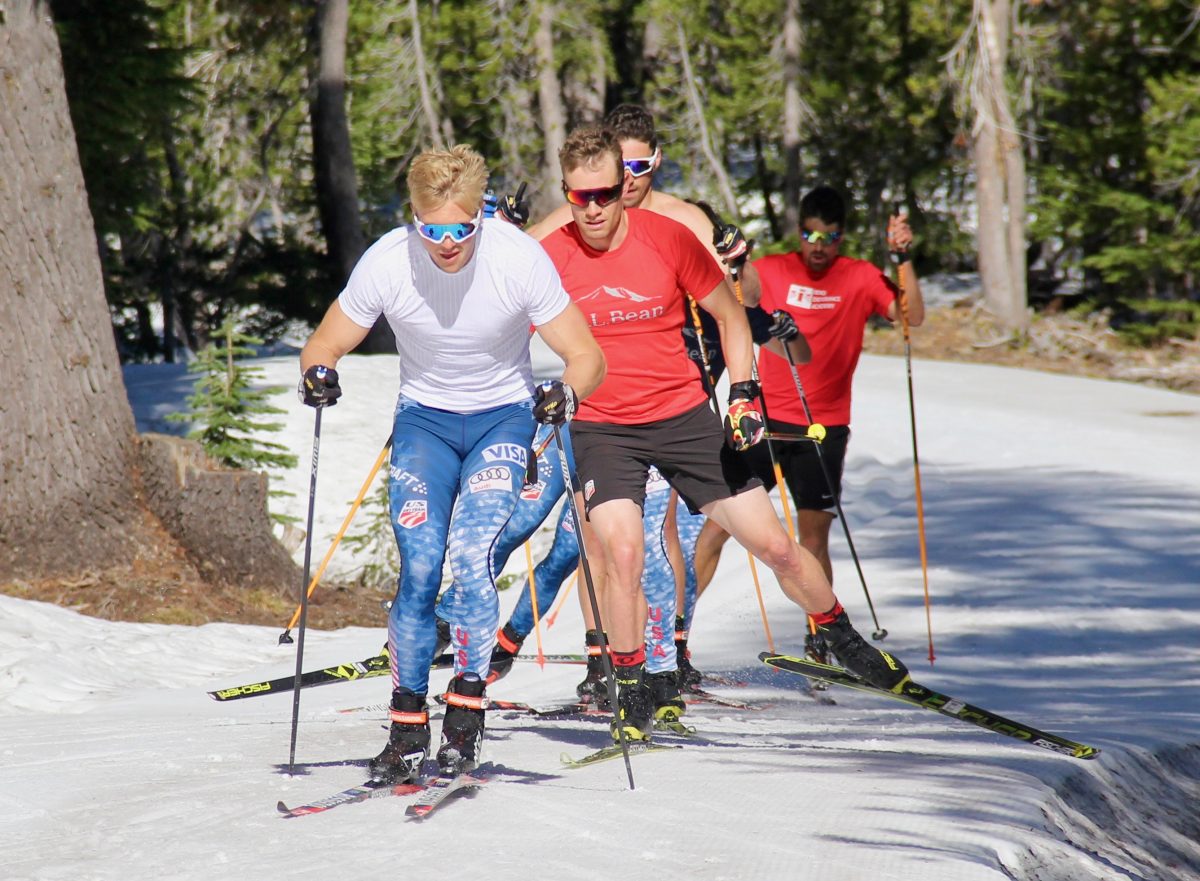
Erik Bjornsen, Simi Hamilton, Ian Torchia, Scott Patterson, and Akeo Maifeld-Carucci at the 2018 Bend on-snow camp. (Photo: Bryan Fish)
It’s late May. Athletes are a month into official training for the 2019/2020 season. Here’s some recent news of note from the domestic and international nordic ski world.
German cyclist confesses to doping following Seefeld sting
The police action in Seefeld, Austria, at the time of the 2019 World Championships that led to the arrest of several athletes and this remarkable and candid interview with Estonian skier Karel Tammjärv has led to another athlete leaving their sport. Former German pro cyclist Danilo Hondo was removed from his position as a national team coach with the Swiss Cycling Federation, after allegedly being named by German doctor Mark Schmidt as one of Schmidt’s doping clients during a custodial interrogation by Austrian police, Cycling News reported earlier this month. The article reports that Hondo paid Schmidt 30,000 Euros a year for his services. Hondo initially denied his involvement with Schmidt, but later confessed in an interview with German broadcaster ARD, Cycling News reports. He was dismissed from his coaching position soon after.
Maddie Phaneuf and mental health among endurance athletes
In a recent blog post, American biathlete Maddie Phaneuf writes candidly and publicly about her struggles with mental health after an untimely illness left her unable to race at the 2018 Winter Olympics in Pyeongchang.
“It took me nearly a year to figure out I was dealing with something much bigger and harder for me to handle on my own,” Phaneuf writes, “and that I needed to seek professional help from a therapist. Little did I know that I was experiencing Post Traumatic Stress Disorder from my experience at the Olympics. It’s hard for me to even write that because I’m afraid people will doubt it’s legitimacy. When we learn about PTSD we usually tie it with war veterans, so it’s not common for people to associate PTSD with athletes.”
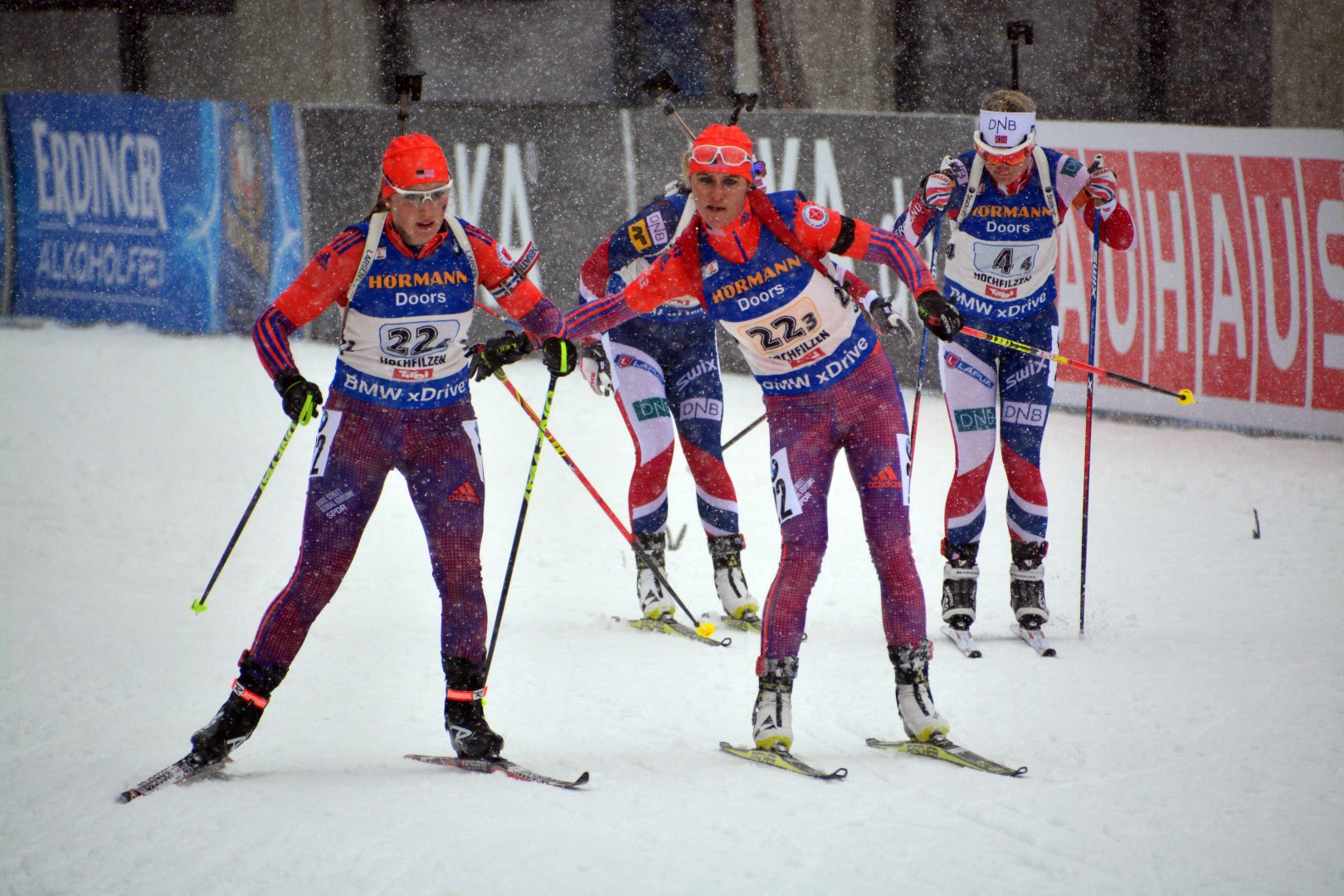
Joanne Reid (r) tagging U.S. teammate Maddie Phaneuf in 12th during the final exchange of the women’s 4 x 6 k relay on at the 2017 IBU World Championships in Hochfilzen, Austria. (Photo: Glen Crawford)
Phaneuf nonetheless sets forth many common symptoms of PTSD, and explains how her experience at the Olympics left her exhibiting nearly all of them.
Phaneuf concludes, “I hope this post helps break the stigma of mental illnesses within the athletic community, and opens peoples eyes in tackling that hardest step: asking for help.”
(Canadian skier Maks Zechel sounded similar notes in a piece for FasterSkier written in January 2018, writing, “This past April, I decided to face my mental health issues that I had always known existed, but never understood or recognized for what they were. What an awkward thing to talk about, mental health, but it shouldn’t be. Our minds have to be taken care of with the same attention that we give our bodies through training and recovery. It doesn’t matter what it is that makes you begin to acknowledge your difficulties, but it has to be done; it is grossly underestimated just how permanent unchecked mental health issues can be. I didn’t acknowledge my health issues because I cared about my health, but I did care that it was starting to affect the way I raced, and although not the most important reason, it was enough to motivate me to work on my mental ‘fitness.’” Zechel added, “Not everyone wants to talk about their mental health issues, but many need to.”)
Jessie Diggins hosts “Meet the D-Team”
All three levels of the U.S. national team – the A-Team, B-Team, and D-Team – recently convened in Bend, Oregon, for an on-snow spring camp. This gave the athletes the chance to rack up the kilometers skiing in the morning, and the miles running or mountain biking in the afternoon. It also gave Jessie Diggins the chance to work on her whimsical interview skills. In a series of Instagram video posts, Diggins checks in with the entire D-Team save Kendall Kramer. For more on Johnny Hagenbuch’s favorite kind of dinosaur, Novie McCabe’s favorite flavor of gum, Ben Ogden’s lifetime cumulative skateboards built, and other important news of the day, check out Diggins’s Instagram page. Part I is here, Part II here, and Part III here.
Kendall Kramer collects ninth and tenth state high school championships
The only D-Team skier not present in Bend was Kramer, whose junior year at Fairbanks’s West Valley High School ended during the camp. By staying home Kramer was able to add to her collection of Alaska state high school championships, when she won both the 1,600 and 3,200 at last weekend’s state track and field championships at Machetanz Field in Palmer, Alaska, the Anchorage Daily News reported. Kramer clocked 4:56.15 to take the metric mile and 10:27.18 to win the longer race, in both cases taking the win over Anchorage skier Ava Earl.
Kendall Kramer from Fairbanks, Alaska during the women’s 10 k skate pursuit at 2019 World Cup Finals. (Photo: John Lazenby/lazenby photo)
Kramer’s ten (and counting; she still has her senior year ahead of her) Alaska high school individual championships include the 2018 and 2019 Skimeister award for lowest combined time at the cross-country skiing state meet, the 2017 and 2018 state cross-country running titles, and the 1,600/3,200 double at all of the 2017, 2018, and 2019 state track and field championships. On the track, Kramer has lowered her time in the 1,600 from 5:14.80 to 4:56.15 since 2017, and from 11:04.47 down to 10:27.18 for the 3,200.
U.S. Ski & Snowboard awards
Earlier this month, U.S. Ski & Snowboardnamed its athletes and coaches of the year, with official awards presented at the U.S. Ski & Snowboard Congress in Park City on May 16. Awards for nordic and nordic combined skiers and coaches were as follows, as quoted from a USSA press release:
Athletes of the year, nordic: Junior Worlds Men’s Relay Team: “In a storybook ending to a very successful Junior World Championships, the men’s 4x10k [sic] relay team took gold – the first ever gold won by the USA at the FIS Junior World Cross Country Ski Championships. Three of the four athletes had set the stage a year earlier winning silver.” The team was Johnny Hagenbuch (Ketchum, Idaho/SVSEF), Luke Jager (Anchorage/APU), Ben Ogden (Landgrove, Vt./SMS), and Gus Schumacher (Anchorage/Alaska Winter Stars).
Athlete of the year, Ski Jumping/Nordic Combined: Tara Geraghty-Moats: “Nordic combined skier Tara Geraghty-Moats (W. Fairlee, Vt.) played a vital role in the rapidly-growing women’s nordic combined international field, winning 10 Continental Cups and taking the season title in a year where the international field more than doubled. Geraghty-Moats also took the U.S. title and landed a berth as a special ski jumper on the U.S World Championship Team. As an athlete advocate, she served an important pioneering role with women’s nordic combined which will join the World Championships in 2021.”
International coach of the year, nordic: Jan Buron, Alaska Winter Stars: “A veteran club coach, Jan Buron of the Alaska Winter Stars program has developed many top athletes. This past season his work with junior skier Gus Schumacher, whom he has coached for the athlete’s entire career, led to the USA winning gold in the men’s relay at the Junior World Championships.”
International coach of the year, ski jumping/nordic combined: Jan Druzina, Junior/Continental Cup Ski Jumping Coach: “Jan Druzina came to USA Nordic as a Junior Team and Continental Cup coach for men’s ski jumping a year ago. Since then, he has visited every club to speak with coaches and parents, working together to build a strong junior program. The result was a definitive step up this year with Andrew Urlaub and Patrick Gasienica qualifying for their first World Championships and Urlaub taking a top-30 at Junior Worlds plus three top-30 Continental Cups.”
Domestic coach of the year, nordic: Alasdair Tutt, Nordic Ski Club of Fairbanks: “Kendall Kramer, coached by Alasdair Tutt, was 4th in the 15km mass start classic in her first time at Junior World Ski Championships. Kendall will also represent USA at the 2020 Youth Olympic Games.”
North American Junior Cross-Country Performance of the Year
Lahti, Finland U20 4 x 5 k World Champions: From left to right, Gus Schumacher, Ben Ogden, Johnny Hagenbuch, and Luke Jager. (Photo: Doug Stephen)
With the 2018/2019 season officially in the rearview, FasterSkier is running a series of articles highlighting some of the players and performances from the season. This honor goes to the most outstanding North American junior cross-country performance.
Lahti, Finland became a winter playground – in a Formula One kind of way- for America’s upstart junior skiers. Solid performances during the World Junior Ski Championships landed numerous skiers on the U.S. Ski Team’s Development team. (That story to follow next week.)
The obvious place to start is with this quartet: Luke Jager, Ben Ogden, Johnny Hagenbuch, and Gus Schumacher. This lineup took the men’s 4 x 5-kilometer relay win. With several articles already minted on their fine performance, we’ll forego the redundancy. Let’s just say these young men skied with poise and steel as they positioned themselves at the front of the race and in most instances dictated the outcome rather than respond defensively. This was no miracle on snow. It was a deserved result for the athletes and the considerable effort of their respective communities and a U.S. Ski Team culture espousing confidence.
Gus Schumacher and the U.S. team in for the win during the U20 men’s 4 x 5 k relay at Junior Worlds in Lahti, Finland. (Photo: Doug Stephen)
If for some reason you have not watched this race and crust cruising is no longer a possibility, then link here for your viewing guide.
This is also the place to mention the performance of the U20 U.S. women. Mara McCollor, Kendall Kramer, Sydney Palmer-Leger and Novie McCabe placed fourth in the 4 x 3.3 k relay. With the youngest team in the field, these skiers finished 40.5 seconds out of first and 6.9 seconds off the podium’s third step. That third place team, Sweden, had ringer Frida Karlsson ski the second classic leg – her time of 8:48 nearly beat out both her teammate’s skate leg splits which were 8:49.2 and 8:46.3 respectively. (We digress and it was cold snow.)
Kendall Kramer on her way to fourth place in the U20 15 k classic mass start at World Juniors in Lahti, Finland. (Photo: Doug Stephen)
Individually, Kramer placed fourth in the 15 k mass start classic in Lahti, McCabe 10th. In the 5 k skate, Kramer skied to 15th, and Palmer-Ledger 20th.
For the U20 men, Schumacher placed fourth in the 30 k mass start classic, Ogden 10th. (Canada’s Remi Drolet finished seventh in the 30 k mass start classic.)
In the 10 k skate, Schumacher scored a sixth place. On classic sprint day, Ogden was eighth, while Noel Keeffe placed 12th, and Schumacher 16th.
Moving on to the U23 women, Hailey Swirbul placed 10th in the 15 k mass start classic, Julia Kern 16th. Kern also placed 12th in the 10 k skate.
This is not an exhaustive list or discussion of World Junior/U23 results. It remains a recognition of some fine collective U.S. performances with a definite nod to the U20 men’s 4 x 5 k relay team for the junior performance of the year.
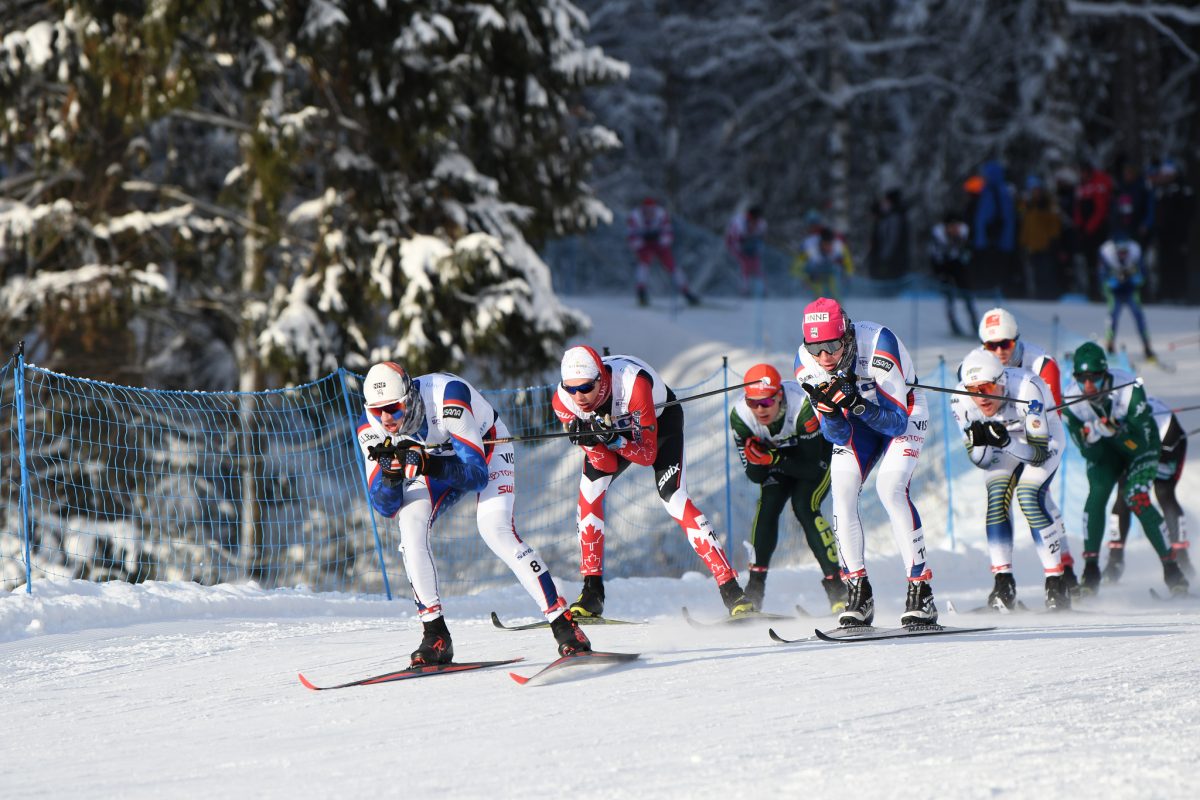
Gus Schumacher leading the pack with teammate Ben Ogden (pink hat) in the draft — during the U20 30 k classic mass start at World Juniors in Lahti, Finland. (Photo: Doug Stephen)
With the 2018/2019 season officially in the rearview, FasterSkier is running a series of articles highlighting some of the players and performances from the season. This year, the junior skier of the year is Gus Schumacher.
Perhaps it is a testament to the steady growth of U.S. developmental programming or perhaps it is a trickle down effect as Americans see more success on the World Cup level; one thing is clear when you consider the depth of the current field of junior skiers, the future looks bright. Choosing just one athlete to recognize as Junior Skier of the Year was not an easy decision, but the outstanding achievements of Gus Schumacher in 2019 make the 18-year-old USST D-Team member from Anchorage, AK a worthy recipient.
The U20 World Juniors 4 x 5 k relay first place team from the U.S, (l-r) Luke Jager, Ben Ogden, Johnny Hagenbuch, and Gus Schumacher. (Photo: JWSC2019 / Mikaela Takala)
While his performance anchoring the gold medal U20 men’s relay team at Junior Worlds in Lahti was likely the most dramatic and noteworthy result Schumacher earned this season, his achievements extend much further. In fact, there was a major highlight for the Alaska Winter Stars standout each month.
In January’s Senior National Championships, Schumacher took 7th in the 15-kilometer individual start freestyle, 5th in the freestyle sprint, and 4th in the 30 k mass start classic amongst a field of senior men vying for World Cup starts and a spot on the team at World Championships. His results made him the top junior athlete in each race, except for the skate sprint where Noel Keefe took 3rd.
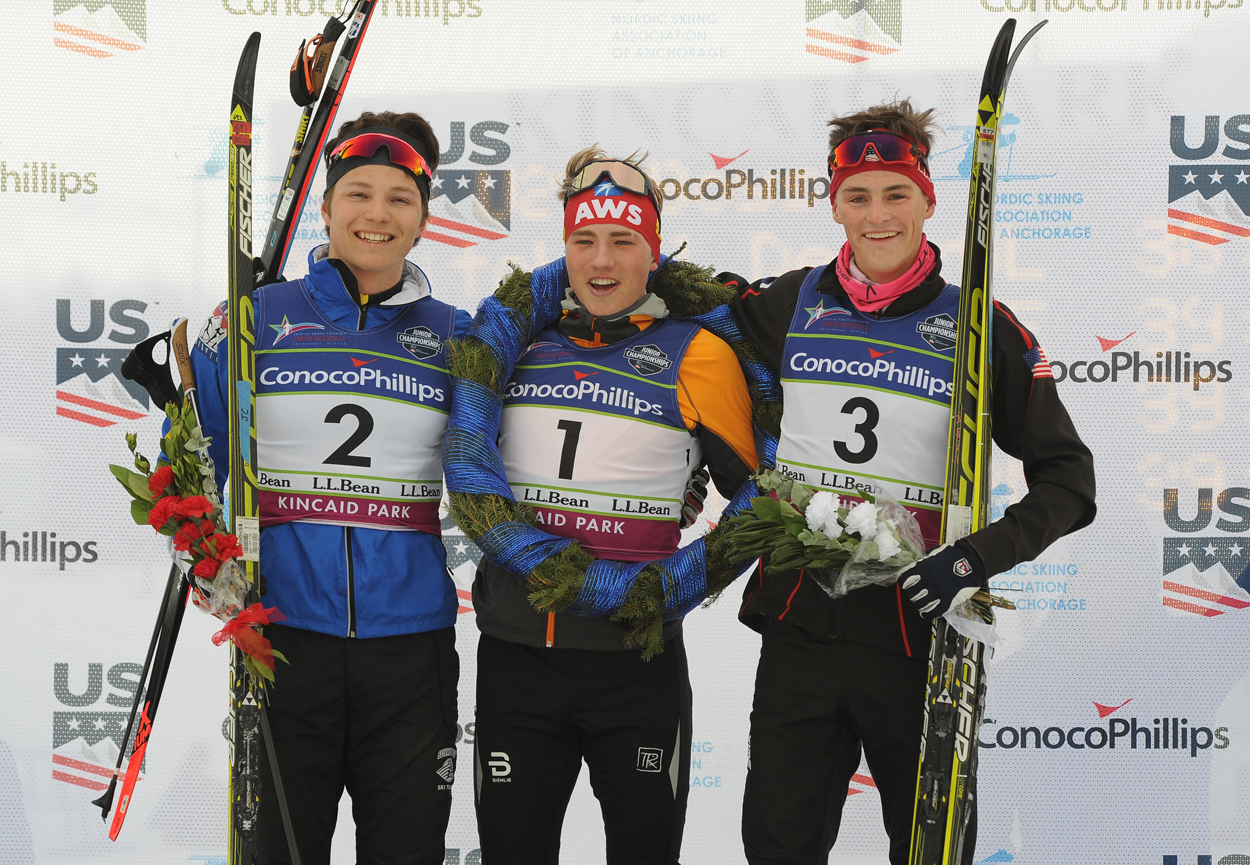
Gus Schumacher (Alaska Winter Stars/Team Alaska), center, won the U20 men’s 15K classic mass start race Friday at the 2019 U.S. Ski & Snowboard Cross Country Junior National Championships at Kincaid Park. J.C. Schoonmaker (UAA-Auburn Ski Club/Far West), left, was second, followed by Cameron Wolfe (Ski and Snowboard Club Vail/Rocky Mountain), right. The win gave Schumacher a three-race sweep of the 2019 JN individual events. (Photo: Michael Dinneen)
In March, Schumacher swept Junior Nationals on home turf in Anchorage. Not only did he win each event and anchor the winning relay, but his victories in both distance races, a 10 k skate and a 15 k classic, were won by a margin of roughly a minute each. Because of his results at U.S. Nationals and World Juniors, Schumacher earned his first starts on the World Cup during the final races in Québec City later in the month.
Finally, as the season wound down and April began, Schumacher wrapped up a fantastic season at Super Tour Finals in Presque Isle, ME. He took 8th overall in the freestyle sprint and landed himself on the podium with Simi Hamilton and Erik Bjornsen by taking 3rd in the 15 k classic. While skiing with the lead pack of 50 k racers, Schumacher also cruised to victory in the junior 30 k skate.
The men’s podium for the 15-kilometer mass start classic during the Super Tour Finals in Presque Isle, ME. Erik Bjornsen (USST/APU; center) took the win ahead of Simi Hamilton (USST/SMST2; left) and Gus Schumacher (USST-D/APU; left). (Photo: U.S. Ski & Snowboard – Reese Brown)
Before we wrap this up, we want to give a shout out to Kendall Kramer of Fairbanks who also swept Junior Nationals for U18 women. Kramer was also the top American in the 15 k classic at World Juniors with a 4th place finish, and ended her season in Québec with her first World Cup race starts at just 16-years-old. With results like these, she’ll certainly be in the running for this award in the coming years.
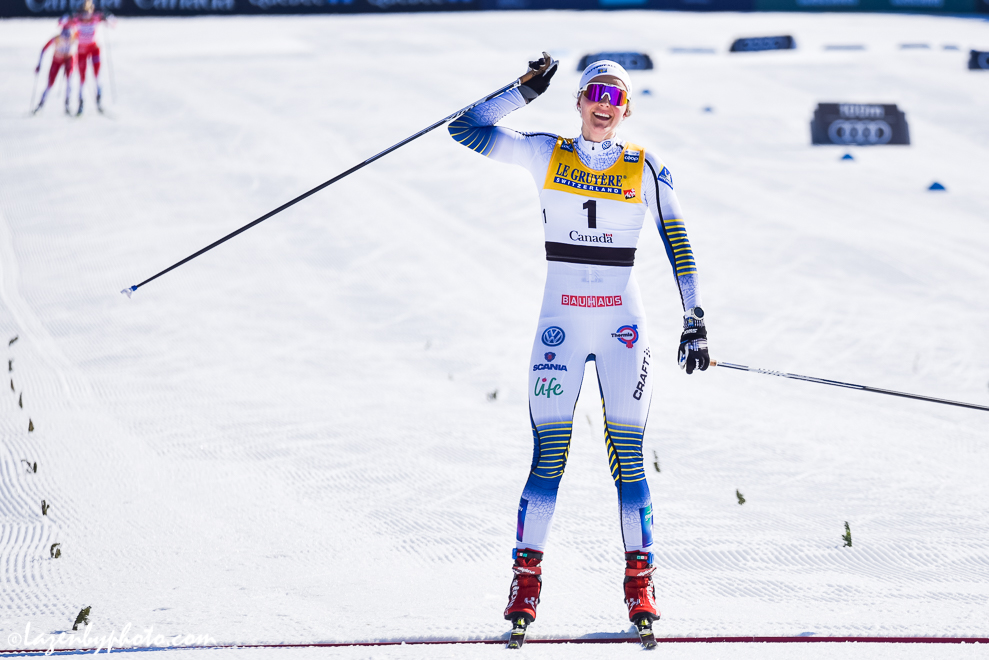
Stina Nilsson of Sweden taking the overall win in Québec City. Here she is crossing the line first in the 10 k skate pursuit. (Photo: John Lazenby/lazenbyphoto.com)
It was beginning to seem as though it could not be done, and then it happened. Norway’s Therese Johaug did not stand atop the podium after the 10-kilometer classic first stage of the women’s pursuit in Québec City. Sprint champion Stina Nilsson did. Not only that, but the bonus seconds garnered from Nilsson’s win in Friday’s skate sprint allowed her to enter the course for the final leg of the week’s three-race series with a margin that seemed as though it might be insurmountable over her nearest competitors. She started the 10-k freestyle pursuit 33 seconds ahead of Norway’s Ingvild Flugstad Østberg who took eighth in the sprint and third in the 10 k classic, and 49 seconds ahead of Johaug, who took 25th in the sprint and after a double pole battle that she could not win, finished only 0.2 seconds behind Nilsson.
When it was her turn, Johaug charged onto the course like a hungry cheetah in pursuit of a Swedish gazelle on the city’s Plains of Abraham. She was simply attacking the course with the unmatched tempo and fire that earned her a perfect record in regular season distance races. On a relatively flat course and hard packed fast conditions, she could not delay her chase; she needed to begin making up time as soon as she pushed through the start gate. At the front, Nilsson skied smoothly, remaining calm and collected despite knowing she was a target for the two skiers in red who were slowly reeling her in.
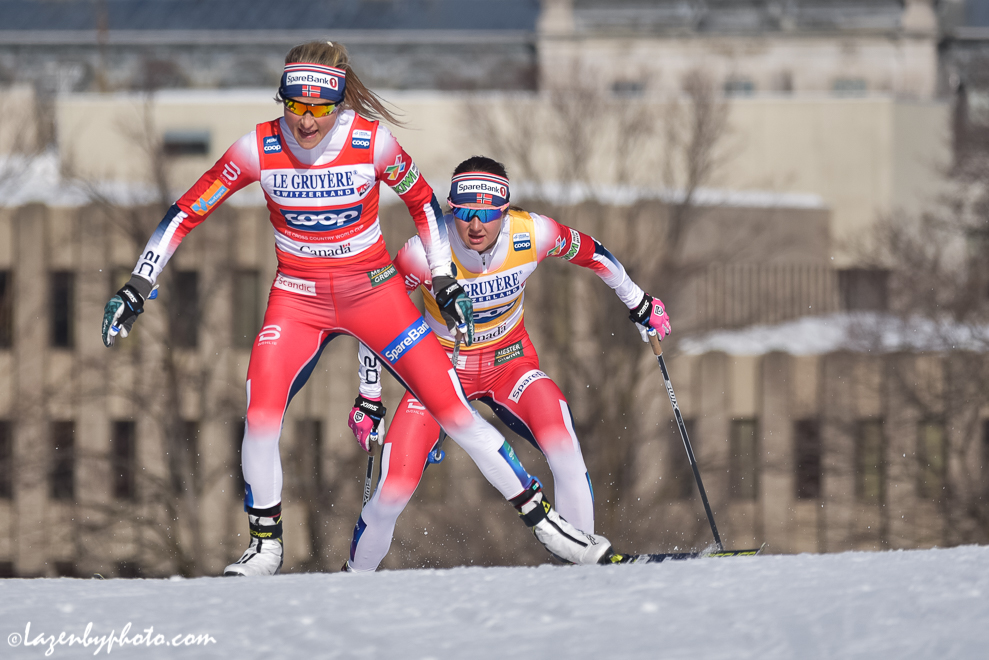
Norway’s Therese Johaug (front) and Ingvild Flugstad Østberg on the chase during the Québec City 10 k skate pursuit. (Photo: John Lazenby/lazenbyphoto.com)
By the 2.4 k checkpoint, Johaug had made up nearly 13 seconds of her deficit. By 5 k, she caught Østberg and remained tucked into her draft as the two continued to gain time on Nilsson. But as the finish line neared, it became clear that the Swede was not going to roll over for the Norwegians. In the final three kilometers, Østberg and Johaug could no longer make up significant ground and remained about 20 seconds behind Nilsson’s graceful and powerful V2.
With less than 1k to go, Nilsson crested the hill by the stone Martello gun tower and headed for the stadium. The Norwegians were lurking not far behind as she rounded the corner past the cannon and no pole skated down the hill before climbing over the final roller. But they were quickly running out of real estate in their chase.
When she arrived at the stadium, she looked back and smiled. The gazelle was safe. She stood up and gave a wave, then continued to ski with purpose and joy to the hairpin turn before the final 100 meters where she savored her hard earned sweep of the World Cup Final tour. Nilsson looked both relieved and proud as she crossed the line, stopping the clock at 23:55.1. Never laying off the gas, Johaug slid through the finish 12.9 seconds behind, followed by Østberg in third (+15.1).
Stina Nilsson of Sweden solo and in front during the Québec City 10 k skate pursuit. (Photo: John Lazenby/lazenbyphoto.com)
“It was really good,” Nilsson told the International Ski Federation (FIS) after the race. “I expected them to catch me quite fast, but when they didn’t I felt like, ‘okay, then I just keep going on with this speed’. It was really nice to be able to enjoy the last 100 meters because it is not so often that I can do that. So, it was really nice.”
The Swede has been well suited for the track in Québec, and though she was skiing alone, Nilsson never felt that way, as cheering spectators lined the majority of the course.
“I really like the course here, as I said yesterday,” she told FasterSkier in the mixed zone. “And the crowd was almost everywhere, so I was never alone even though I never had any [competitors] ahead of me.”
Her clean sweep of the tour was not the first time she has seen success in Canada. She also won the freestyle sprint there in both 2016 and 2017.
“Before this weekend, I had two victories here, and now I have five, so I really like Québec,” she laughed.
With Russia’s Natalia Nepryaeva far behind in 12th (+1:53.0), Østberg also breathed a sigh of relief as she officially became the overall winner of the World Cup season. She led by only a small margin entering the tour, and as Nepryaeva experienced first hand after a crash and broken pole in the classic stage, anything can happen in the finals. Her younger self might have been in disbelief of this title, as she could not imagine herself at the level of her teammates who became champions before her.
“It’s hard to describe actually,” she told FIS about her emotions after the race. “I think I never could have dreamt about fighting for this jersey for some years ago, I saw Marit and Therese fighting for it and I was like, ‘Oh my god, they have the yellow jersey.’ And this year, I managed to fight for it, and the last races I’ve been tough both physically and mentally, and fight between me and Nepryaeve. Today, when I managed to finish on the podium in the tour and can say that I’m the winner of the overall world cup, it’s an unbelievable feeling.”
Norway’s Therese Johaug during the Québec City 10 k skate pursuit. (Photo: John Lazenby/lazenbyphoto.com)
Though she did not catch Nilsson, Johaug skied the fastest time of the day, adding to her heavy purse of FIS points. Her second place finish Saturday did not make a dent in the lead she had over the rest of the women in the distance standings; she was essentially in possession of the distance globe before the final tour started. Even without competing in the Tour de Ski, Johaug’s string of nine victories, coupled with her results this weekend amassed 956 points, 139 more than Østberg who took second. She also finished the season ranked third in the overall despite only entering one sprint event on Friday.
“I’m so happy,” she told FasterSkier. “I cannot believe that I am been so good shape the whole time and coming back after two years out and have these results that I have. So I’m really happy.”
The American women were unable to crack the top 10 in the overall tour standings, but four of them were able to place within the top-30 in the Winner of the Day results. Sadie Bjornsen was the overall top ranked skier finishing 11th (+1:45.4) with the 13th fastest time on the course.
Sadie Bjornsen of the U.S. Ski Team coming into place 11th during the Québec City 10 k skate pursuit. (Photo: John Lazenby/lazenbyphoto.com)
With her usual spark and never-give-up positive attitude, Jessie Diggins moved ahead nine places to finish 14th overall (+1:53.6).
“That was a really fun way to end the season,” Diggins told FasterSkier in the mixed zone. “Skating is always so fun because you can go as hard as you want to go, and it was really fun to be able to have the tools I needed to be able to use what energy my body had. So that was just very satisfying. I got to go so hard and dig deep, and it was just really fun to ski up and ski the way I know I can ski. So yeah, it’s just always fun to end your season on a good race.”
And it was a good race. Diggins powered through the course to ski the 4th fastest time of the day behind Johaug, Krista Pärmäkoski of Finland, and Ebba Andersson of Sweden.
“I was just going after time of day,” she explained. “I wasn’t really worried about where I place in the overall, I just wanted to put together the best race that I could.”
Rosie Brennan (bib 43) and Julia Kern (bib 50) during the Québec City 10 k skate pursuit. (Photo: John Lazenby/lazenbyphoto.com)
Rosie Brennan moved from 43rd to 39th by skiing the 28th fastest time of day (+4:41.8), and Julia Kern moved ahead seven spots to finish 43rd with the 30th fastest time (+5:23.7).
While Brennan had hoped for more from this weekend, she is proud of her race today.
“This is way better than yesterday,” she told FasterSkier. “It still wasn’t like… I had hoped to be fighting a little higher in the overall tour, but it was good to at least feel strong today and have some fight in there, so yeah, it was good.”
Brennan added insight into the tour format and race conditions during the final series in Quebec.
“It was a little bit wild,” she admitted. “We had a lot of gnarly conditions, so it’s been kind of a game of survival, which is in some ways fun but also hard because there’s so many things out of your control. So it’s maybe hard to get your storybook ending of the year. But it’s fun to be somewhere where we have so many fans. So that helps make up for all the crazy conditions we’ve had.”
Austria’s Terese Stadlober (bib 29) leading the U.S. Ski Team’s Sophie Caldwell (bib 31) during the Québec City 10 k skate pursuit. (Photo: John Lazenby/lazenbyphoto.com)
Also for the U.S., Sophie Caldwell finished 36th (+4:05.1), Hailey Swirbul 41st (+5:06.2), Caitlin Patterson 46th (+6:11.4), Katherine Ogden 47th (+6:13.9), Ida Sargent 48th (+6:21.9), Kendall Kramer 51st (+6:31.4), Kaitlynn Miller 52nd (+6:44.7), Hannah Halvorsen 58th (+8:24.3), Becca Rorabaugh 59th (+8:44.1), and Alayna Sonnesyn 68th (+11:02.3).
Kendall Kramer from Fairbanks, Alaska during the women’s 10 k skate pursuit on Sunday. (Photo: John Lazenby/lazenbyphoto.com)
Today’s race will be the last of Sargent’s career. The bio of the 31-year-old Craftsbury Green Racing Project member includes a long list of top 30 finishes from as far back as 2012. She competed in two Olympics, Sochi and PyeongChang, and stood on the podium three times during her career. As her hometown of Barton, VT is only three hours from Québec City, she was able to ski her final race with plenty of family and friends cheering her on. FasterSkier did not hear from Sargent after her finish, but after skiing together for seven years as USST A-Team members, Diggins shared her thoughts on Sargent’s retirement.
“She’s had an incredible career,” said Diggins, “but beyond that she’s just a really caring teammate and she’s always down for a laugh. It’s hard to have somebody who, you know… we joined the team at the same time, so we’ve been on the team together the entire time. It’s hard to see someone retire, but I know that she’s going to do amazing things in her next career and I’m just so happy for her that she got this beautiful wonderful day in front of so many home fans to have her last race. What a special experience. And it was fun to spray her with champagne,” she laughed.
Ida Sargent (bib 46) retired from World Cup racing after Sunday’s race. (Photo:John Lazenby/lazenbyphoto.com)
Since the finals were held in Canada, the U.S. was given the opportunity to enter more athletes in the races. This gave several younger athletes, including 16-year-old Kramer of Fairbanks, AK, the opportunity to experience their first World Cup race.
“It’s just amazing,” she shared regarding her experience. “This is probably the most spectators that have called out my name like ever before. It was just super amazing. This is one of the first times I’ve been hearing anything from the crowd,” she continued. “Usually I’m just in my zone racing, but now I can hear what everyone is saying and it’s all just really really fun.”
After her first season on the USST D-Team, Swirbul is walking away with a slew of positive results, including a 10th place finish in the 15 k classic at the U23 World Ski Championships in Lahti.
The Basalt, CO native said cheerfully that she is “ready for some rest and recovery and to train hard all summer and fall and do it again next year.”
Hailey Swirbul of the USST D-Team, during Sunday’s race. (Photo: John Lazenby/lazenbyphoto.com)
Emily Nishikawa was Canada’s top finisher. She began as the 37th skier and placed 31st (+3:53.9).
“I had a blast racing today,” Nishikawa told FasterSkier. “I felt really strong and I’m really happy with the way I skied today.”
The next two fastest were Katherine Stewart-Jones who finished 44th (+5:27.2) followed by Dahria Beatty in 45th (+5:47.7).
– Peggy Shin, Gerry Furseth and Kelsey Dickinson contributed
Ben Ogden (left foreground) and Luke Jager (right foreground) await the arrival of teammate Gus Schumacher (center background) in the U20 men’s relay at Junior World Championships in Lahti, Finland, in January 2019. (photo: JWSC2019 FIS broadcast screenshot)
Last Saturday, the American women placed fourth in the U20 relay at 2019 World Junior Ski Championships. In any other year before 2017 this result would probably be headline news; considering that the Americans had the youngest team in the race (you can compare athlete birthdates from the women’s race here if you really want to get into the minutiae), this may well be headline news next year, or the year after that, when the same athletes are potentially contending for the podium.
But a couple hours later, the U20 men went out and won their race, taking home a historic relay gold and deservedly garnering most of the headlines for the weekend.
Both races started in the middle of the night for most of this continent, and a daily viewing pass cost 9 Euros. You could be forgiven for not having woken up to watch it live. If you didn’t, or even if you did and you’d like to see it again, below are full replays of each race, courtesy of what appears to be a Russian YouTube user. (The same user also uploaded full broadcasts of the U20 women’s 5-kilometer freestyle interval start, U20 men’s and women’s classic sprint, and U23 men’s and women’s classic sprint if you’re looking for more.)
Here are time stamps for the start of each leg in both races, as well as a few choice moments from the end of the men’s race (all times are in reference to a point on the YouTube video, not the time on the live timing race clock, which is a few minutes behind the video timestamp):
3:57, the race begins, with Luke Jager skiing the scramble leg
15:37, first exchange: Jager tags off to Ben Ogden in first place
27:23, second exchange: Ogden tags off to Johnny Hagenbuch in first place
38:32, third exchange: Hagenbuch tags off to Gus Schumacher in third place, 2.0 seconds out of first
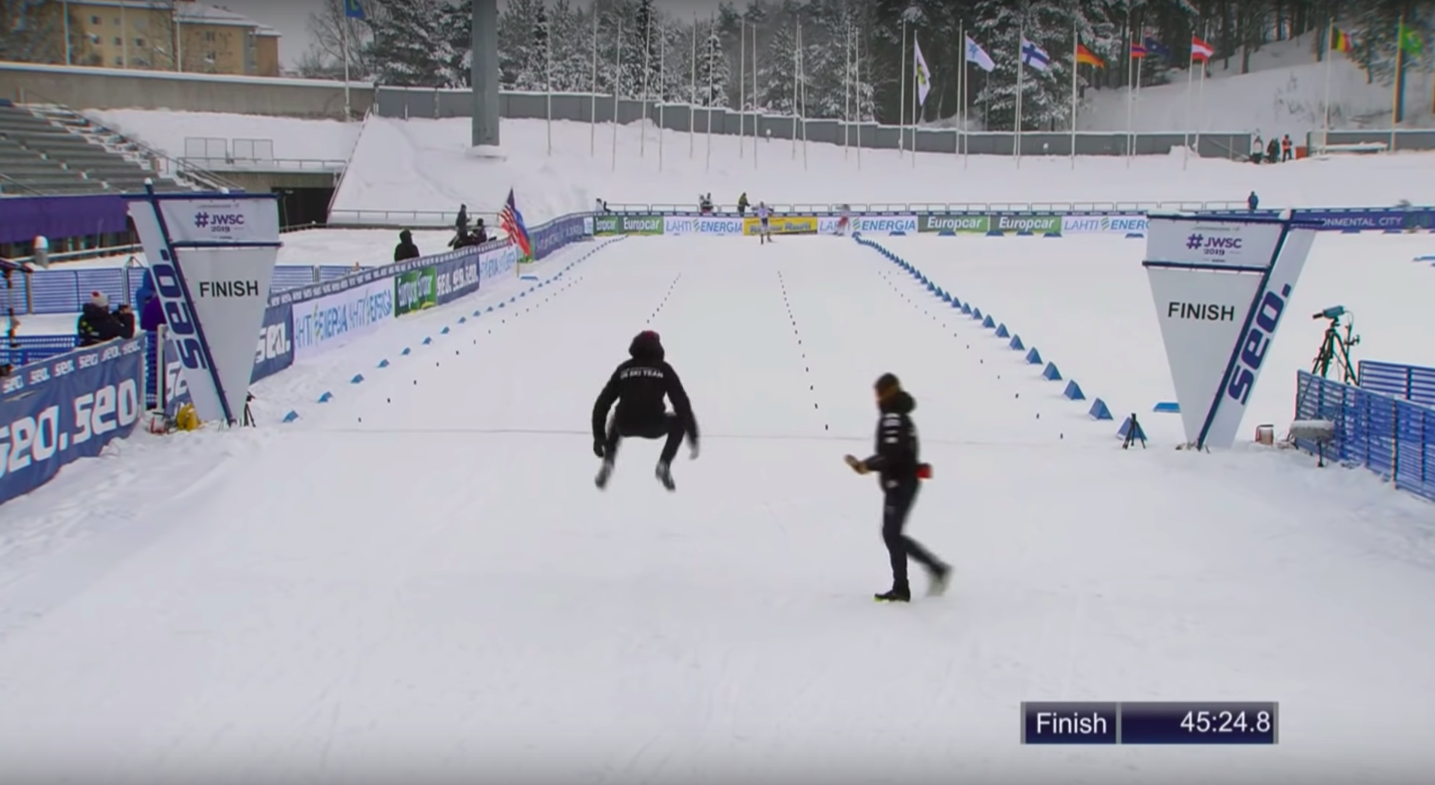
43:40, Schumacher and Germany go to the front and start pushing the pace, Schumacher visibly elevating as he V2s up a hill to cover Germany’s attack
46:08, with roughly a kilometer to go, the camera cuts to the Americans waiting in the stadium, cheering on Schumacher. “Team U.S. is cheering,” says the announcer. “But I have to say that Team U.S. is always cheering. It doesn’t matter if they win, or if they are number five or number six; they always have great team spirit up and running.” (Jessie Diggins said in response to this remark from the broadcast, in an ephemeral Instagram video, “that’s right.” If you were following social media on Saturday, you would have noticed basically the entire U.S. Ski Team assembled for watch parties to cheer on the U20 men and women, several of them doing so in advance of their World Cup freestyle races in Ulricehamn later that day.)
46:39, it’s Germany – America – Russia at the top of the penultimate hill, with a visibly tired Russia digging deep with labored technique but nonetheless staying with Schumacher
47:30, it’s now America – Germany – Russia by the bottom of the hill
Schumacher unleashes a devastating jumpskate … . The Finnish announcer exults, in slightly broken but endearing English, “And look at Schumacher bouncing! Schumacher is bouncing like maniac!”
47:50, approaching the top of the final uphill, Schumacher unleashes a devastating jumpskate, creating the separation from Russia and Germany that he will carry all the way to the finish. The Finnish announcer exults, in slightly broken but endearing English, “And look at Schumacher bouncing! Schumacher is bouncing like maniac!”
47:57, there are literally as many USST jackets on course here as there are representatives from all other nations combined. Several Americans sprint to follow Schumacher over and around the crest of the hill, waving flags and screaming their heads off.
49:22, camera angle straight down the finishing stretch, with Schumacher narrowly but inexorably leading in Alexander Terentev of Russia. A meter past the finish line, Ogden is jumping 3 feet off the ground while Jager applauds.
49:32, Schumacher crosses the line in first. Ogden and Jager tackle/hug him.
The U20 World Juniors 4 x 5 k relay first place team from the U.S, (l-r) Johnny Hagenbuch, Ben Ogden, Luke Jager, and Gus Schumacher. (Photo: JWSC2019 / Mikaela Takala)
2019 U23 World Ski Championships in Lahti, Finland 4 x 3 k and 4x 5 k relay
In a historic first for the U.S., the U20 men’s team won the 4 x 5-kilometer relay today in Lahti, Finland at the 2019 World Junior Ski Championships. Luke Jager skied the first classic leg for the U.S., Ben Ogden skied the second classic, Johnny Hagenbuch skied the first initial skate leg and Gus Schumacher raced the anchor leg.
The foursome won in a time of 45:34.7 minutes, and beat second-place Russia by 3.8 seconds.
Russia’s team was comprised of Egor Trefilov, Andrey Kuznetsov, Yaroslav Egoshin, and Alexander Terentev.
Germany’s team of Jakob Milz, Florian Knopf, Anian Sossau, and Friedrich Moch took third finishing 6.3 seconds behind.
For Canada, Remi Drolet , Sam Hendry, Xavier McKeever, and Thomas Stephen skied to 11th (+2:29.7).
In the 4 x 3.3 k U20 women’s race, Norway’s Kristin Austgulen Fosnaes, Astrid Stav, Helene Marie Fossesholm, and Kristine Stavås Skistad won at the line in 35:24.7 minutes.
Russia’s Anastasia Faleeva, Kristina Kuskova, Veronika Stepanova, and Anna Grukhvina were a close second, stopping the clock 1.0 seconds back.
Louise Lindström, Frida Karlsson, Tilde Baangman, and Lin Svahn for Sweden placed third (+33.3).
The U.S. team of Mara McCollor, Kendall Kramer, Sydney Palmer-Leger and Novie McCabe skied to fourth place, 40.5 seconds back.
For Canada, Anne-Marie Petitclerc, Jasmine Drolet, Anna Pryce, and Molly Miller placed 11th, 3:01.4 minutes behind.
FIS Cross Country World Cup Ulricehamn, Sweden 10/15 k freestyle
In what is his skiing canvas, the 15 k freestyle, France’s thirty-two-year-old Maurice Manificat won his first World Cup of the season in Ulricehamn, Sweden today in 34:55.4 minutes. It was a tight race in that Norway’s Simen Hegstad Krüger Simen Hegstad Krüger who placed second finished 1.1 seconds back. Teammate Didrik Tønseth was third (+8.7).
Canada’s Alex Harvey was the best placed North American in ninth (+31.4). Lenny Valjas skied to 57th (+2:32.1), and Bob Thompson 77th (+4:16.6).
For the U.S., Scott Patterson finished 35th (+1:26.5), David Norris 53rd (+2:11.3), Ben Lustgarten 64th (+3:04.7).
Norway’s Therese Johaug kept her distance win streak alive at eight wins in eight starts on the World Cup this season. She won the women’s 10 k skate race in 25:48.2 minutes, with teammate Astrid Uhrenholdt Jacobsen in second, 22.8 seconds back. Third place went to Sweden’s Ebba Andersson, 24.9 seconds behind.
The U.S. Ski Team’s Jessie Diggins skied to fourth place (+38.3), while teammate Sadie Bjornsen was 15th (+1:25.1). Caitlin Paterson (CGRP) had her best World Cup result of the season, skiing to 23rd (+1:49.9). Rosie Brennan (APU) placed 28th (+2:03.2), and Rosie Frankowski 42nd (+2:28.0).
Dahria Beatty was the only Canadian entered. She finished 56th (+3:54.7).
In the women’s 10 k pursuit, Italy’s Dorothea Wierer won in a time of 29:20.1 after skiing two penalties (1+0+0+1). Second place went to Germany’s Laura Dahlmeier, who finished 6.0 seconds after Wierer after one missed shot (0+0+1+0). Saturday’s third place went to another Italian, Lisa Vittozzi, who finished 16.2 seconds behind the winner after tying Wierer’s shooting score.
Clare Egan led the way for the U.S., racing to 11th (+1:31.9) after skiing two penalties (0+0+0+2).
“I’m really happy with my race today,” Egan wrote in an email. “The wind and altitude are always a challenge here, but I took my time on the range and capitalized on the fast glide of my skis to save energy on course. I made a costly and dumb mistake on my last shot but still came away with my second-best career result. I’ll take what I learned from today and go for it again tomorrow in the mass start! Can’t wait!”
Joanna Reid was the next American to finish, placing 29th (+2:55.2) after three missed shots (1+0+0+2).
For Canada, Rosanna Crawford finished 34th (+3:30.8) after skiing five penalties (2+1+1+1) and her teammate Megan Bankes finished 39th (+3:37.1) with five misses (1+0+3+1). Also skiing for Canada, Sarah Beaudry placed 46th (+5:07.5), also with five penalties (4+0+1+0).
In the men’s 12.5 k pursuit, Norway’s Johannes Thingnes Bø
won in a time of 31:33.7 after skiing three penalties (1+1+0+1). France’s Antonin Guigonnat raced to second place, 34.8 seconds behind with one missed shot (0+0+1+0). The third and final podium spot on Saturday went to France’s Quentin Fillon Maillet, who skied two penalties (1+0+0+1) and finished 40.6 seconds back from the winning time.
Sean Doherty for the U.S. placed 47th (+4:39.1, 3+2+1+0). Jake Brown was lapped and was not given an official time.
For Canada, Jules Burnotte skied to 54th (+5:42.8, 1+3+1+1), and Scott Gow 55th (+6:39.7, 4+0+2+3).
Canada’s Antoine Briand (CNEPH) was the fastest qualifier on the day in 3:14.71 minutes and won the men’s final. Dominique Moncion-Groulx (Nakkertok) placed second in the final, with Ben Saxton (SMS T2) in third.
Saxton was the second fastest qualifier, with Oliver Hamel (CNEPH) third fastest.
For the women, Sophie Caldwell (USST/SMS T2) scorched the qualifier in 3:40.44 minutes with Jessica Yeaton (APU/Australian National Team) qualifying in second (3:50.49). Dartmouth’s Katharine Ogden qualified third (3:51.79).
Caldwell went on to win the final in 3:37.06, with Yeaton in second and Kelsey Phinney (SMS T2) in third.
Gus Schumacher leading the pack with teammate Ben Ogden (pink hat) and Canada’s Sam Hendry (left) in the draft — during the U20 30 k classic mass start at World Juniors in Lahti, Finland. (Photo: Doug Stephen)
The mass start classic races for the U20 athletes at the 2019 World Junior World Ski Championships dawned on another crisp, bordering on a frigid day in Lahti, Finland. A scroll through the results makes clear the day was strong for North Americans as the U20 men raced a 30-kilometer classic mass start, the women a 15 k classic mass start.
In the men’s race, the six laps around the 5 k course which climbed a total of 193 meters each circuit, the top-15 skiers were separated by 17 seconds at the finish. The tight front-pack racing meant there were moments when the U.S. sported four skiers pacing the sharp end of the race.
Gus Schumacher skiing for the U.S. placed fourth in a four-skier sprint at the line to finish 0.7 seconds behind the winner Luca DelFabbro of Italy. Del Fabbro won in a time of 1:15:16.7 hours. Norway’s Haavard Moseby placed second (+0.4), and Switzerland’s Cyril Faehndrich third (+0.5).
On the far left, Gus Schumacher in the podium mix down the stretch in the U20 30 k classic mass start at World Juniors in Lahti, Finland. (Photo: Doug Stephen)
Canada’s Remi Drolet skied to seventh overall 6.4 seconds back.
“Going into the race, the strategy was to stay relaxed and save as much energy as possible over the thirty kilometres,” Drolet emailed. “The plan was to get near the front, avoid mishaps, and be ready for when the speed increased and the pack was strung out.”
Actualizing the strategy in terms of mishaps was another story on Drolet’s journey to seventh place.
“Overall, I am very happy with how I skied today,” Drolet continued. “I executed my plan quite well and was able to stay calm and ski well even when I was involved in a collision and lost both of my skis. I had a lot of fun out there, and it was incredible to race against the best juniors in the world in some of the best conditions for classic skiing.
“Going into the championships and into this race, I was really hoping to achieve a top 10 result. In the first two races, I had decent results but was not quite there. It was encouraging, however, that I was improving everyday, and the second half of the skate race was quite good for me. I also knew that the 30-kilometre classic race would likely be my best, and I showed up to the start line ready to leave everything I had out on the track. It certainly felt great when I crossed the finish line knowing I had achieved this goal!”
Canada’s Remi Drolet after his seventh place in the U20 30 k classic mass start at World Juniors in Lahti, Finland. (Photo: Doug Stephen)
For the U.S., Ben Ogden finished 10th (+9.0), Luke Jager 13th (+14.9), and Johnny Hagenbuch 17th (+25.6).
Sam Hendry of Canada raced to 20th (+44.6), Tom Stephen, at sixteen years old placed, 23rd (+1:07.3), and Pierrick Sarthou 46th (+6:32.2).
Start of the U20 Worlds 15 k classic mass start in Lahti, Finland. The winner Frida Karlsson is in bib 1. (Photo: Doug Stephen)
Sweden’s nineteen-year-old Frida Karlsson won the U20 women’s 15 k classic mass start race in a time of 40:45.3 minutes. Helene Marie Fossesholm of Norway was second (+52.1), and Finland’s Anita Korva was third (+58.1).
This was Karlsson’s second win of these championships after taking the U20 5 k skate race on Tuesday. Karlsson was also the fastest qualifier in last Sunday’s classic sprint – she placed fifth overall.
Kendall Kramer, a sixteen-year-old U18 skier for the U.S. was the top-North American in the U20 women’s race placing fourth (+1:30.7).
In perhaps the most earnest and down-to-earth post-race comment FasterSkier has received to date (Kendell’s comments were handwritten), the sixteen year old from Fairbanks, AK. explained the 15 k mass start was a new venture which suited her skiing style.
“This was my first 15 k I’ve ever done so going into the race I was extremely clueless and nervous about feeds, how aggressive the Scandos would be, how to race etc… but I think the slip-free kick job the techs gave me and my knack for throwing elbows and maintaining my spot which really aided me staying out of trouble early on, which set me up for a comfortable position to ride my 4th place into the finish,” Kendall wrote about her race experience.
Kendall Kramer on her way to fourth place in the U20 15 k classic mass start at World Juniors in Lahti, Finland. (Photo: Doug Stephen)
Kramer’s keen eye during the race played into her in-the-moment decision making when it came to how to ski the course.
“It was all hills and with the slow snow the flats weren’t even flats. I mostly decided to how to take every part of the course by seeing how the older girls in front of me reacted to it,” wrote Kendall.
U.S. teammate Novie McCabe at 17 years old is a U18 skier skiing up at these Junior Worlds. McCabe finished 10th (+2:19.0) after starting the day in bib 71, way back in the pack of seventy starters. (One skier did not start.)
“Starting in the back was definitely a bit of a challenge,” McCabe told FasterSkier in the mixed zone. “I thought of it as I had to be patient for sure at the start. But it was also better than I thought it would be going up that first hill. I was able to hop in the outside and get up right out of the start and seeing more numbers in the 30s and 40’s and so I was like ‘oh, that wasn’t that bad’. I kept on trying to work my up and trying to stay calm and patient. There were a few crashes and some of the front girls came back. I ended up skiing in a group with one of the girls who ended up crashing and I tried to hang with her.
The U20 women’s 15 k classic mass start at the Junior World Championships in Lahti, Finland. Way way back, bib 71, that’s Novie McCabe. (Photo: Doug Stephen)
“The group got smaller and I knew it was sixth through 12th I think, and I just tried to hang in there. My skis were really fast and I had really good kick so that was really helpful. I just tried to hang in there on the hills and get the best rest that I could. Then on the last part I was trying to hang with the girl ahead of me and I ended up crashing on the last corner, but it was really quick and I just tried to hop up and tuck in behind the ninth-place girl, and ended up hanging in there and finishing 10, it as a really fun race.”
Novie McCabe (bib 71) on her way to 10th place in the U20 15 k classic mass start at World Juniors in Lahti, Finland. (Photo: Doug Stephen)
For the U.S., Mara McCollor finished 24th (+3:58.3), and Sophie Mazzoni 48th (+6:19.9).
Jasmine Drolet was the top Canadian finisher in 36th (+4:51.4), followed by Anne-Marie Petitclerc in 40th (+5:07.6), and Anna Pryce in 46th (+6:07.2).
Gus Schumacher skiing to sixth place in the U20 10 k skate during the 2019 Junior Worlds in Lahti, Finland. (Photo: Doug Stephen).
FIS Junior World Ski Championships Lahti, Finland 5 k/10k Freestyle Interval Start
Tuesday in Lahti, Finland was as Finland should be: squeaky-snow-cold and cross-country ski racing on offer.
Eighteen-year-old Gus Schumacher broke through for the U.S. and placed sixth overall in the U20 men’s 10-kilometer freestyle. Schumacher was the 95th starter of 102 finishers on the day. His sixth place finish was consistent with his 1.1k, 5k, and 6.6k splits where he was ranked 5th, 6th, and 7th respectively. Schumacher stopped the clock in 23:19.3 minutes, 44.4 seconds behind the winning mark.
The Lahti championships are Schumacher’s second Junior Worlds. His sixth place is his best individual result. He was part of the second place 4 x 5 k U20 relay last year in Goms, Switzerland.
“I was most nervous about hitting it right and doing the right pacing and making sure I can have the best race that know I can,” Schumacher told FasterSkier over the phone. “I approached it as just a new race almost. We have done a fair amount of watching old world cups and world championships that were on the exact same courses here. It was definitely hard to reflect on that because none of them were exactly 10 k. And obviously those athletes are quite a bit stronger than we are. And the snow is different.”
Schumacher extracted what he needed from the videos. Imprinted in his mind before his 10 k start were enough visuals to quell the nerves and provide a path to fast clean skiing.
“We watched that and I felt like I got an idea for what the body movements looked like of those guys,” Schumacher said. “I thought about how that would feel for me and I thought about the other middle distance skate races I have done this year –which is actually a fair amount between early season time trials.”
Schumacher executed his plan. He dialed back the initial effort, stayed in control, and systematically revved the engine.
“I went out and tried for at least the first five minutes to go a little easier, because I think that is the high risk time, the very beginning,” said Schumacher. “I tried to go out and keep it consistent and as I started to get into it, I started to ramp it up a little more and really try to make the most of the recovery. Which wasn’t a lot, but enough that I could put my head in between my knees on the downhill and I could tell myself that 15 seconds of high speed downhill is helping me. And I could get my breath down a little bit and I was ready for the next hill.”
His run at the podium came up just 17 seconds short. But with his plan executed, the Anchorage based skier had no regrets when reflecting on Tuesday’s race effort.
“I definitely wanted to be top-10, but I felt like and still feel like a medal is in sight,” Schumacher said. At 18, he still has one more year of eligibility in the U20 ranks.
“For sure satisfied with this race, it felt like a good result and it was one of my better races. And I am happy with how it played out and also thinking about how I can hit the 30 k and do the most I can do.”
France’s Jules Chappaz won the race in a time of 22:34.9 after skiing the fastest splits at 5 k and 6.1 k. Sunday’s classic sprint winner, Russia’s Alexander Terentev, placed second (+21.0), and Norway’s Iver Tildheim Andersen in third (+27.2).
Canada placed two skiers in the top-31. Remi Drolet finished in 20th (+1:14), Samuel Gary Hendry 21st (+1:15.9), Thomas Stephen 31st (+1:36.8). Xavier McKeever skied to 44th (+2:04.6).
For the U.S., Zanden McMullen placed 32nd (+1:40.6), Johnny Hagenbuch 34th (+1:46.3), and Noel Keeffe 58th (+2:45.7).
Sweden’s Frida Karlsson winning the U20 5 k skate at Junior World Ski Championships in Lahti, Finland. (Photo: Doug Stephen)
Sweden’s Frida Karlsson won the U20 5 k skate in 12:50.6 minutes. Norway’s Helene Marie Fossesholm placed second 11 seconds back, with Finland’s Anita Korva in third (+19.8).
“It was fun to ski today. I just wanted to have my revenge”, Karlsson told race organizers after the race. Karlsson had qualified first on Sunday’s U20 classic sprint but placed fifth in the overall.
U.S. skier Kendall Kramer post U20 5 k skate at Junior World Ski Championships in Lahti, Finland. (Photo: Doug Stephen)
The best placed North American was U.S. skier Kendall Kramer who finished in 15th (+55.6) place. Also for the U.S., Sydney Palmer-Leger was 20th (+1:04.9), Novie McCabe 29th (+1:20.8), and Waverly Gebhardt 65th (+2:28.8).
Canada’s Anna Pryce (bib 22) and Jasmine Drolet (bib 20) finishing the U20 5 k skate at Junior World Ski Championships in Lahti, Finland. (Photo: Doug Stephen)
Anna Pryce was the top Canadian in 43rd (+1:36.5). Teammates Molly Miller skied to 50th (+1:52.9), Isobel Hendry 58th (+1:57.1), and Jasmine Drolet 67th (+2:35.7).
The Chugach Mountains and a winter sunrise, seen in this file photo view from the parking lot at Government Peak Recreation Area, Palmer, Alaska, in February 2018. (photo: Gavin Kentch)
Note: FasterSkier is accepting submissions for regional race reports, including for juniors racing. If you would like to see a particular race circuit covered and have the writer with the will to do it, please have them email info@fasterskier.com. Be sure to include a link to results, and preferably a few original race photos with proper credits.
GOVERNMENT PEAK RECREATION AREA, outside Palmer, Alaska — On a day that had a decidedly old school feel, one of the state’s newest racing venues took center stage, as Government Peak Recreation Area successfully hosted the opening Besh Cup races of the 2018/2019 Junior Nationals qualifying series this past weekend on less than a week’s notice.
Saturday morning saw U18 boys and up cover 15 kilometers, on a hilly two-lap course; U18 girls and up raced 10 k, on an even hillier two-lap course. It was classic technique, it was interval start, it was cold, and the trees were draped with fresh snow. It felt like a World Cup race circa 1990.
Senior women Hailey Swirbul, Rosie Frankowski, and Lydia Blanchet. (photo: courtesy CCAK)
The comparison isn’t totally bathetic, given the overall leaderboards for Saturday’s races: Rosie Frankowski, Hailey Swirbul, and Kendall Kramer for the women, and Gus Schumacher, Luke Jager, and Hunter Wonders for the men. That’s an Olympian and a three-time World Juniors medalist for the women, and three-fourths of this spring’s breakthrough World Juniors silver medal relay team for the men. Oh, plus the 16-year-old Kramer, who was third in the junior women’s 5 k classic mass start at 2018 U.S. Cross Country Championships and who may have a pretty bright future in this sport herself.
Saturday: distance classic races
Male racers set out at 11 a.m. Saturday morning from the compact stadium at Government Peak Recreation Area (GPRA), a labor of love by the Mat-Su Ski Club and the Palmer and Wasilla ski community over the past ten years. They headed out on a course that is a poor man’s Davos distance course, with consistent climbs and V2-able false flats for the first two-thirds of the loop, giving way to a working downhill and a sharp drop back to the stadium. Or to just below the stadium, actually; the course ends with a grueling B-climb immediately before the finish (see next picture, below right). The obvious challenge is to pace the uphills easily enough the first time to ski the downhills and flats efficiently, then do the same thing a second time in lap
After roughly 80 racers had covered two 7.5 k laps in the day’s first race, leaving the stadium at 30-second intervals, it was Schumacher who had done this most efficiently, covering 15 k in 43:23.11. Jager (+12.36) and Wonders (+26.53) made up the overall podium. The top three senior athletes were Wonders, Logan Hanneman (fourth overall), and Tyler Kornfield (fifth).
The top three U20 racers on the day were Schumacher, Jager, and Ti Donaldson, who was seventh overall. Leading the U18 racers were Zanden McMullen (15th overall), Everett Cason (16th), and Max Germain (19th). 50-year-old Adam Verrier, a 1994 Olympian, was the top Master in 47th. Behind Schumacher, who skis for Alaska Winter Stars, in first, Alaska Pacific University (APU) showed its depth by putting six skiers in the top 10 and 10 in the top 16.
Part of the final climb leading back up to the stadium at the end of the Government Peak comp loop, seen in this file photo view from November 1, 2018. (photo: Gavin Kentch)
The day’s second race saw 43 women, age U18 and up, take on two laps of the Davos-lite 5 k course described above. Two laps of 5 k at Government Peak is in many ways harder than two laps of 7.5 k, as the longer course adds 2.5 kilometers of gently rolling terrain near the end of the homologated (or perhaps homologation-pending) 5 k course. The 5 k course has no such recovery intermezzo, and the final climb of the first lap segues into the first climb of the second lap for a difficult extended climb with negligible recovery.
After two laps and 10 k classic, the day’s last starter, Rosie Frankowski, posted the fastest time, finishing in 32:28.01. (While snow conditions are obviously extremely variable from one venue and race to the next, making time comparisons unreliable, and Frankowski did not have World Cup skiers in front of her to chase on Saturday, the fact that Frankowski has previously skied a World Cup 10 k classic in 27:44, on a homologated course in Falun with 365 meters of total climb, suggests that the new Government Peak comp loop deserves respect.)
Frankowski’s APU teammate, Hailey Swirbul, was second on Saturday, 22.39 seconds back. Kramer (+1:42.15) was third, ahead of a top-10 otherwise composed of skiers from the University of Alaska Anchorage and local Dartmouth College skiers home for winter break.
The top three senior athletes were Frankowski, Swirbul, and Lydia Blanchet, who was fourth overall. The U20 podium was Jenna Difolco (seventh overall), Molly Gellert (17th), and Maggie Meeds (23rd). Somewhat ahead of them were the three fastest U18 skiers: Kramer, Adrianna Proffitt (11th), and Ivy Eski (14th). M4 skier Alison Arians, in 18th, was the top Master.
U16 girls Katey Houser, Marit Flora, and Victoria Bassette. (photo: courtesy CCAK)
Next out on the course were 51 U14 and U16 boys, who did a single lap of the comp loop. U16 skier Aaron Maves, like Frankowski before him, lived up to his top seeding, finishing one lap in 16:35.99. Second and third went to Konrad Renner (+18.99) and Eli Merrill (+36.83), also both U16 athletes. The top U14 skiers in this race were Skyler Amy (22nd overall), Murphy Kimball (23rd), and Aven Elsberg (26th).
Moments later came the start for the first of 49 U14 and U16 girls, as organizers efficiently put roughly 250 total athletes out on course at a venue that is a one-hour drive from Anchorage and sees a mid-December sunrise some time after 10 a.m. U14/U16 girls likewise did one lap of the 5 k comp loop.
Quincy Donley had the highest seed and final start position for this race, but 5 k later it was penultimate starter Marit Flora who took the victory. Flora finished in 18:23.47. Donley was 22.78 seconds back in second. Meredith Schwartz (+48.59) was third.
All three podium finishers were U16 girls. The top three U14 finishers in the race were Heidi Schumacher (12th overall), Sammy Legate (15th), and Zarah Laker-Morris (24th).
Sunday: distance freestyle races
After the U12, U10, and U08 skiers finished up the first day’s races, and the afternoon’s sunset time of 3:33 p.m. threatened, volunteers took down the course, coaches packed up waxing equipment, and tired racers began the trek back to Anchorage homes or Mat-Su hotel rooms. The first volunteers were officially on site by 7:30 a.m. Sunday morning to assist with parking, although doubtless some people had returned to the venue by long before then.
Day two of racing brought some differences – freestyle instead of classic, shorter distances, and slightly warmer temperatures – but more repeat podium finishers than not across the day’s races.
The first division on course was again U18 boys/U20/Seniors/Masters men, this time with 78 starters going out at 15 seconds apart. Sunday’s skate race was 10 k freestyle interval start, twice around the 5 k comp loop (precisely the same as the senior women’s 10 k classic the day before). The top three overall were unchanged from Saturday’s 15 k classic: Gus Schumacher, then Jager, then Wonders, the World Juniors silver-medal relay team united once more. Schumacher’s time on Sunday was 26:17.07. Jager (+15.56) and Wonders (+42.74) were the only other two athletes to break 27 minutes on the hilly course.
U16 boys Josh Baurick, Konrad Renner, and Aaron Maves. (photo: courtesy CCAK)
The U20 leaders on Sunday were again Schumacher, Jager, and Donaldson, who was fourth overall. The senior podium was Wonders (third overall), Thomas O’Harra (fifth), and Forrest Mahlen (sixth). Best times for U18 skiers went to McMullen (seventh), Cason (11th), and Germain (16th), precisely the same U18 podium as in the 15 k classic. Much as on Saturday, behind Alaska Winter Stars skier Schumacher in first, APU placed seven athletes in the top 10.
The first Master, among eight Masters finishers on Sunday, was M1 skier Cody Priest, 30, a former skier and runner at the University of Alaska Fairbanks, in 25th overall.
Soon after the last of the Senior men collapsed across the finish line, the first of the U16 boys headed out for one lap of the 5 k course. (All races on both days were interval-start.) First on Sunday was Renner (15:21.27), improving on his second-place finish from the day before. Josh Baurick (+9.17) was second, with Maves (+17.20) staying on the podium but moving down to third after his victory on Saturday.
Next up were 43 U18 girls/U20/Seniors/Masters women. Neither Frankowski nor Swirbul raced on Sunday, but their APU teammate Jessica Yeaton, who skis domestically with APU but competes internationally for her native Australia, did after not racing on Saturday. Yeaton was seeded third in the 5 k skate but ended up first, covering one 5 k lap in 14:47.25. Kramer (+26.15) moved up to second overall on Sunday, with Emma Tarbath (+46.32) third, barely a second ahead of Lydia Blanchet in fourth. Anna Darnell was the fifth and final woman to break 16 minutes on the hilly course.
The senior women’s podium was Yeaton, Tarbath, and Blanchet. The top three U20 finishers were Jenna Difolco (seventh overall), Molly Gellert (ninth), and Emma Jerome (21st). The top three U18 finishers were, again, Kramer (also second overall), then Ivy Eski in eleventh overall, barely ahead of Annika Hanestad in twelfth. Arians (15th) was again the first Master.
U14 boys were the next race out on the course. Sunday brought a 3.75 k skate, on a course that covered most of the 5 k comp loop used throughout the weekend, but elided one major climb and the only rolling section from the top part of the course. The technique and the distance were different, but the U14 podium was precisely the same as on Saturday: Amy (13:29.76), then Kimball (+2.05), then Elsberg (+7.19).
Finally, U14 and U16 girls headed out on the same 3.75 k loop. Marit Flora took her second victory of the weekend by a substantial margin, finishing in 12:13.98. Katey Houser (+30.59) and Victoria Bassette (+32.64) collected their first podia of the weekend.
The overall podium was again all U16 racers. The U14 leaders were Legate (tenth overall), Heidi Schumacher (16th), and Nora Hulse (24th).
Reflecting the depth of skiing in southcentral Alaska, the roughly 250 entrants for the weekend’s races included a healthy six former Olympians (Rosie Frankowski, Logan Hanneman, Tyler Kornfield, Adam Verrier, Casey Wright, and Jess Yeaton) and four World Juniors medalists (Gus Schumacher, Luke Jager, Hailey Swirbul, and Hunter Wonders), as well as additional senior national championship podium finishers, most of the rest of the APU Elite Team, a dozen or more NCAA skiers, and scads of past Team Alaska Junior National members.
Both races were FIS races, as well as certified for National Rankings List purposes by U.S. Ski & Snowboard. FasterSkier unofficially calculates the USSA penalty at a healthy 41.99 points for the men’s distance races.
Thoughts on the weekend
Two common themes emerged after talking with a handful of the weekend’s podium finishers: One, these races are a good introduction to the season and to bigger races still ahead. And two, the new Government Peak courses are great. But hard.
As two-time U18 champion Zanden McMullen told FasterSkier Sunday afternoon, “Yesterday I was definitely hurting in the race, but I was proud to come out on top. I definitely felt a lot better today. I’m pretty happy going into the season, where I am; I still have a little work to do before Senior Nationals, but I’m super excited.”
U20 men Luke Jager, Gus Schumacher, and Ti Donaldson. (photo: courtesy CCAK)
Two-time overall champion Gus Schumacher expressed similar sentiments, telling FasterSkier, “I wanted to use [these races] to get into racing more, and get some more races under my belt, so I felt better at the bigger races. But obviously, to get into good racing shape, you want to be trying to race as best you can, so that was kind of the goal, to be able to start getting my racing speed to its top level.”
Schumacher, who is undefeated in five local races this year, including the Race to the Outhouse #1 hill climb at Hatcher Pass the preceding weekend and a sprint and distance race in Fairbanks in the Alaska Nordic Cup in early December, described his current shape as “pretty good.” He elaborated that he plans to add some more intensity soon, but thinks that he is “coming into my race form, and it looks pretty good. Good to have these fast boys around me to push me every day.”
Schumacher plans to do some trials with Alaska Winter Stars, possibly collaborating with APU, before flying to Craftsbury on December 29th for senior nationals.
Two-time U18 champion (and double overall podium finisher) Kendall Kramer sounded similar notes, but was somewhat more introspective when asked what her weekend results told her about her current fitness and the upcoming race season.
“I got invited to a lot of national camps this summer,” Kramer said to FasterSkier, “and I think being exposed to so many different training groups and training styles – I really diversified how I trained this year, and so I’m happy that it’s working out for me. It’s less stressful, and I’m putting less pressure on myself.”
Kramer, who had never previously raced at Government Peak, described the new courses as “really, really tough.” She seemed to recognize that the course profile was advantageous to her, while stopping short of actually saying that she had enjoyed them when asked if she had liked the courses: “I mean, yes, being super small and light and getting up hills – I wouldn’t pick this venue, necessarily. But I think it was good for me.”
Ivy Eski, who claimed a pair of U18 podium finishes on the weekend, was more effusive.
“I love it,” she told FasterSkier. “It was really fun. I definitely want to race here again. The courses are amazing.”
Eski also praised the “really good snow and super good grooming,” calling it “overall really a great weekend.”
U18 boys Everett Cason, Zanden McMullen, and Maxime Germain. (photo: courtesy CCAK)
And McMullen, who had also never raced at this venue, similarly said of the new courses, “They’re tough, but I like them. You definitely have to be on top of it to be able to push it and go fast.”
Are they as hard as a nationals course? he was asked. “I definitely think they could be,” said McMullen, who has raced throughout the U.S. as well as in Finland. “Because if you don’t ski it correctly, you could be hurting.”
* * *
The overall success of the weekend is noteworthy only in light of two facts: That the Mat-Su Ski Club had never hosted an event at this level before, and that it did so on less than a week’s notice, as poor trail conditions throughout southcentral Alaska forced governing body Cross Country Alaska (CCAK) to have a series of competition committee meetings and teleconferences during the week of December 3 to decide where in the state to send 250 athletes and their parents for a weekend of racing. (Anchorage and Fairbanks are a six-hour drive apart, nearly the twice amount of daylight in Fairbanks in mid-December; the decision to move a race weekend is not made lightly.)
On Sunday evening, December 9, CCAK announced the decision of the Competition Committee to have the opening Besh Cup weekend at the Government Peak ski trails. Six days later, skiers were pouring into the carefully managed, not-really-large-enough parking lot for the weekend’s first race, with overflow parking stretching hundreds of yards down one side of the access road. Notwithstanding the venue’s youth and the Mat-Su Ski Club’s relative inexperience, all races on both days appear to have gone flawlessly. (Full disclosure, this reporter contributes money to Mat-Su Ski Club for grooming each year, but was not otherwise involved in organizing or supporting these races save for paying an entry fee for both days to race as a Masters athlete.)
Senior men Logan Hanneman, Hunter Wonders, and Tyler Kornfield. (photo: courtesy CCAK)
Next up
Besh Cup racing for Team Alaska selection continues with two more weekends of racing, currently scheduled for Soldotna on January 19-20, 2019, and Fairbanks on February 2-3. There are traditionally two interval-start distance races, two mass start distance races, and two sprint races throughout the six-race Besh Cup series, three races each of skate and classic. CCAK will announce future race details in advance of upcoming race weekends, after atypically starting the season with two consecutive interval-start distance races due to the last-minute move to Government Peak.
2019 Junior Nationals will be held at Kincaid Park in Anchorage from March 9-17, 2019. Recent snowfall has brought the trails there from, as CCAK recently described them, “ice/grass rinks” to skiable within the past week (that is, after the decision was made to move the races).
While relatively warm temperatures hindered the Nordic Skiing Association of Anchorage (NSAA)’s ability to make snow through the early winter, leading to NSAA running the snowmaking system for only 48 hours through November 28, the snowmaking system did survive the 7.0 earthquake of November 30 unscathed, NSAA Business Manager Erin Beam told FasterSkier in an early-December email. “NSAA has tested it since the earthquake, and there are no apparent damages or problems,” she wrote at the time. “It’s certainly incredible it wasn’t worse.” NSAA has made some snow at Kincaid within the past week or so, in addition to grooming the natural snow on most trails.
The 91st annual Mount Marathon Race, one of the oldest footraces in the country, once more descended on the small town of Seward, Alaska, on July 4. Crowds estimated at up to 30,000 perennially throng to the waterfront community, population less than 3,000, to watch racers push themselves up a steep mountain and hurl themselves back down. At the end of the day, a pair of Alaska Pacific University (APU) skiers, Jessica Yeaton and David Norris, had picked up victories in the quintessentially Alaskan race.
Women’s Race: Jessica Yeaton Wins After Frankowski Backs Off on Downhill
The couple that trains together, wins together. Yeaton and Norris have dated for some time. They traveled down to the race together, they went out fishing the day before together, and they previewed the course together. And they’ll be going back to Anchorage with a pair of trophies together.
After Norris took a dramatic victory in the men’s race Wednesday morning (see below for men’s race recap), Yeaton matched him in the women’s race in the afternoon. Racing in the marquee afternoon time slot, Yeaton led a field of roughly 270 women off the starting line at 2 p.m. The women’s reward for racing in the afternoon this year (the men’s and women’s race alternate the prime-time afternoon slot) was temperatures even warmer than this morning, although thankfully a light breeze had picked up.
After roughly four minutes of gradual uphill through the streets of Seward, Yeaton, 26, was among the five-person lead pack to the base of the climb. By shortly into the climb, APU teammate Rosie Frankowski, also 26, was first, with Yeaton close behind. At the mid-point uphill time check, it was Frankowski, then Yeaton (+16 seconds), with Najeeby Quinn third over a minute back.
Frankowski and Yeaton continued to stretch their lead as the race climbed out of a humidity choked tunnel of vegetation and onto the stark shale rocks of the mountain’s upper half.
The two APU skiers and race rookies (Frankowski earned her entry spot by winning the Government Peak hill climb in early June, Yeaton by winning the Bird Ridge hill climb in mid-June) were both climbing fast and moving well, although they were a study in contrasts on the live television broadcast. The compact Frankowski climbed the hill the way Marit Bjørgen had skied the Olympic 30 k, attacking the hill with each step as she leaned into the steep climb. “You can almost hear her feet hitting the ground with each stride,” veteran Mount Marathon racer-turned-color commentator Clint McCool marveled on the broadcast, praising the redoubtable power of Frankowski’s lower body.
Behind her, the more lithe Yeaton seemed to float upward with an ease that belied the effort of climbing the 47-degree slope. While Frankowski’s high turnover remained the same throughout the climb, Yeaton even broke into a few brief running strides on the “flats.”
Frankowski crossed the timing mat at the turnaround in a (staggeringly fast) unofficial time of 37:06. Yeaton was 29 seconds back in 37:35. The time back to Quinn in third (39:13), let alone Christy Marvin in fourth (39:56) or Denali Foldager-Strabel (40:33) in fifth, seemed significant if not insurmountable.
But that’s why you run the race. Frankowski then took a meandering and suboptimal line onto the snowfield that begins the precipitous descent. In fact, she bypassed the snowfield entirely, running around its rocky edge for several hundred vertical feet.
“I train with Rosie every day and she was not stoked about the downhill,” Yeaton said in a post-race interview with the Anchorage Daily News (ADN). “So she was like, ‘I’m gonna take this [other] route.”
Frankowski told the ADN she wanted to didn’t want to risk getting injured on the downhill.
“This is fun, but my primary sport — I’m not going to ruin it,” Frankowski said.
By the time Frankowski reached the bottom of the snowfield, Yeaton had come flying past her, opening up a lead she would not relinquish. Quinn had passed her as well.
Yeaton ran smoothly all the way to the bottom, going from the turnaround point to the finish line in under 14 minutes. (Her pre-race preview with Norris may have been helpful: “You just do a front flip here,” Norris calmly advises the camera in one of Yeaton’s recent Instagram videos as he demonstrates a flip down a small cliff approaching the bottom of the climb. “It’s easier in the race with the adrenaline.”) Despite the effort, Yeaton looked calm and in control running down Main Street, ultimately taking the victory in an unofficial time of 51:30.
Yeaton’s overall time ranks ninth all-time in a race first contested by women in 1963.
Frankowski’s unofficial uphill split of 37:06 ranks third all-time among uphill marks, behind only pro runner Emelie Forsberg and two-time NCAA steeplechase champion Allie Ostrander, who has a track 5 k PR of 15:22 and finished eighth in the 2016 U.S. Olympic Trials in this event. Yeaton’s 37:35 uphill would be sixth among Mount Marathon climbs.
About that uphill: Elevation profile of Mount Marathon course, from an athlete (Jeff Levin) who finished 58th out of 306 men in 2017. Note the 35- to 45-minute pace per mile for much of the climb. (Photo: Strava screenshot)
Behind Yeaton, there was ample movement in the standings. Frankowski would ultimately post the day’s 91st-ranked downhill, alongside the fastest uphill, to finish seventh overall. Foldager-Strabel, fifth at the turnaround, would drop an all-time record 11:27 downhill (prior record: 11:31, Forsberg, in 2015) en route to finishing second overall in 52:00, barely ahead of a charging Marvin who took third in 52:04. Fourth overall was Quinn, who had been as high as second during parts of the downhill but was either injured or cramped up severely during the latter half of the descent. And fifth overall was Boulder resident Hannah LaFleur, who had been in sixth at the halfway point.
Also of note, former FasterSkier contributor Aubrey Smith was 11th. And former champion Holly Brooks, less than one year removed from giving birth to twins, was 19th, while wearing a microphone and providing live commentary to the broadcast team along the way. (“Can I sneak by on the left? Thanks,” she was at one point heard to exclaim on air.)
An ebullient Yeaton spoke with KTVA Channel 11 at the finish. “I was just, like, trying to hold them off the whole way” down, she said of her race strategy for the descent in reference to her pursuers.
“The heat was horrible,” Yeaton said of the day’s conditions. “But there were so many people out there with water, I probably got 30 different things of ice and water on my head. It made it so much better. I couldn’t do it without all the people on the mountain.”
Men’s Race: David Norris Holds Off Max King
Norris did it again.
The 27-year-old APU skier came into Wednesday’s race, the 91st running of an event first held in 1915 that is among the oldest footraces in this country, as the course record holder at Mount Marathon. He had set a course record at the uphill-only Bird Ridge hill climb last month. Meanwhile, defending champion and APU teammate Scott Patterson was out of this race with a toe injury. Previous Mount Marathon course record-holder Eric Strabel was out with a stress fracture. As the ADN wrote in its preview of the men’s race, Norris had “a target on his back.”
https://www.instagram.com/p/Bk0qm_PBiLa/
Despite the pressure that comes with being the widely acclaimed favorite in a race variously described as “Alaska’s Olympics” or “Alaska’s Super Bowl,” Norris delivered.
He set a torrid pace off the starting line following the 11 a.m. start, charging toward the base of the peak that rises immediately above the seaside town of Seward, Alaska. Close behind was Max King, 38, a professional runner from Bend, Oregon.
https://www.instagram.com/p/Bk0wF3OlmHS/
King has been described as “the most versatile runner in the country,” with a race résumé that ranges from two top-20s at the U.S. Olympic Marathon Trials (where he ran a 2:14 and a 2:17) to sixth in the steeplechase at the U.S. trials to strong finishes while racing around the world as a sponsored athlete, in distances ranging from a vertical kilometer to 100-mile ultramarathons.
Norris hit the base of the climb first, with King not far behind. Norris went through the mid-mountain uphill split in 21:01, with King 34 seconds back. Adam Jensen, 37, an Anchorage dentist, was at that point third in 22:08. Fifth (22:32) was 18-year-old Luke Jager, another APU skier, making his debut in the senior race this year after winning the junior race three times in a row from 2015–2017.
Norris reached the turnaround point in 31:37, according to this reporter’s unofficial split, with King roughly 30 seconds behind him.
Norris was still in the lead, but he looked rough. He climbed up the steep shale face of the upper mountain with a ragged tempo. He was hunched over, with his hands on his quads, unable to run or even power hike with with the upright posture that he prefers. (“Hiking is fine and maybe even better on certain pitches, but forcing yourself back into a running stride as soon as the terrain allows is crucial,” Norris previously told FasterSkier about his approach to climbing.) He stumbled repeatedly, and took the turns wide. He accepted water from everyone who offered it. He was covering the climb roughly 1 minute slower than he had when he set the course record in 2016, and he looked far worse doing it.
Behind him, King looked fresh and smooth. He was running where Norris was walking. He was upright where Norris was hunched over. He was moving hands-free where Norris was dabbing the rock. He was eschewing water where Norris had guzzled it. On the live broadcast, color commentator Clint McCool surmised that King had pushed Norris fast off the line in an attempt to blunt some of Norris’s climbing prowess, and that it had largely succeeded.
But then the two men started going downhill. Norris took a better line onto and off of the steeply pitched snowfield that begins the precipitous descent. He looked rough running down the mountain below that, but so did King. By the time Norris hit the sweeping expanses of shale down the mountain’s flank, he was flying. He cleared multiple technical stretches (“the three problems,” three small waterfalls) with ease.
When Norris came off the mountain and within sight of tens of thousands of fans in town, his lead was still around 30 seconds, according to unofficial splits taken off the broadcast. He gave back some of that on the remaining 0.6 miles of pavement running down to the finish line, as he slowed slightly to high-five the assembled hordes and King put his 2:14 marathon speed to work. Indeed, King’s downhill split was 12 seconds faster than Norris’s.
https://www.instagram.com/p/Bk0oo0th0H7/
But Norris had a gap, and he kept it to the finish to close out a gutsy race. When he crossed the finish line – which is itself outside of a bar, commemorating the race’s bar-bet origins – he was the most famous athlete in Alaska for the second time in three years.
Third in this year’s race was Adam Jensen, over three minutes out of second. Matt Shryock was fourth. Benjamin Marvin edged Jager by three seconds for fifth.
Norris “pushed the early part of the race, like way harder than last year,” he told local television station KTVA Channel 11 in a live interview after the race, “trying to put pressure on Max.”
“Coming down,” Norris continued, “my legs were way more tired than two years ago,” largely proving McCool’s surmise correct.
Looking to the future, Norris promised to keep coming back. “I would love to mainly keep getting my own uphill record,” Norris said of his future race strategy, “and then just survive the downhill.”
Norris’s uphill record of 30:35 remains safe for another year. (Behind him on that list: pro runner Rickey Gates (31:26), pro runner Kílian Jornet (31:27), Anchorage attorney and father Jim Shine (31:29), and APU teammate and Olympian Scott Patterson (31:40).)
Norris’s overall time of an unofficial 42:13 for 2018 places him third on the all-time list, behind only his course-record 41:26 from 2016 and Jornet’s 41:48 from 2017.
King, who finished in an unofficial 42:33, now ranks fourth on that all-time list. Competing in his first Mount Marathon, he had nothing but praise for the Alaska tradition and spectacle.
“It is unbelievable up there,” King told KTVA at the finish. “I got here, I’ve been intimidated and scared the entire week of this mountain. … This race, it was awesome to be able to experience that.”
He will “absolutely” be back, King said. “This is awesome; I love it here. The mountains are fantastic, there’s tons of things to run.”
For his victory, Norris collected a small trophy and large bragging rights. Other than free lifetime entry into future races, there is no cash prize associated with Mount Marathon. The race has one of the deepest fields in the country on the merits (consider that Gates was only 12th in this year’s race, and Jornet and pro runner Emelie Forsberg are believed to be the only non-Alaskans to ever win the race), certainly one of the deepest anywhere for a bragging rights-only event.
Juniors Race: Michael Connelly, Kendall Kramer Prevail
In the day’s first race, junior boys and girls raced together, starting at 9 a.m. under humanely still relatively cool conditions. First place went to Michael Connelly, 16, a rising star from Chugiak who had finished in the top-10 overall of every mountain race he had done this year. Connelly was sixth last year in the junior race. This was his first boys title; APU skier Luke Jager, now 18 and aged out of the junior race, had won the race the last three years.
Second place was Ali Papillon, 13, who had spent much of the first part of the summer in Colorado. Papillon was described by the ADN as 4-foot-5 and 70 pounds following his third-place finish in 2017, and appeared only slightly taller this year. Third place was claimed by Gavin Block, 16, of Palmer, who was second among junior boys last year. Block runs and skis for Colony High School.
The junior women’s 7.5 k classic podium on Monday at SuperTour Finals in Fairbanks, Alaska, in March 2017, with Hannah Halvorsen (Sugar Bowl Academy/USST D-team) in first and Kendall Kramer (Nordic Ski Club of Fairbanks/FXC) in third. (Photo: Reader submission)
A few minutes behind Block in the co-ed mass start race, Fairbanks skier and runner Kendall Kramer, 16, was the first girl across the finish line. Kramer was third in the 5-kilometer classic mass start race at 2018 U.S. nationals in Anchorage. It was Kramer’s first Mount Marathon title.
Aubrey LeClair, 17, of Anchorage and Katey Houser, 14, of Palmer, also both skiers, rounded out the junior girls podium in second and third. LeClair skis and runs for West High School, and trains with the APU junior team. She was the women’s winner in the season-opening Race to the Outhouse ski race in early November 2017. Houser earned multiple medals in cross-country ski events at the 2018 Arctic Winter Games in Northwest Territories.
“According to folklore, the tradition of the Mount Marathon Race began when two sourdoughs argued about the possibility of climbing and descending the mountain in less than an hour. ‘Impossible’ one said. To settle the argument, and the resulting wager, a race was held, with the loser to furnish drinks for the crowd. At the same time, enterprising merchants put up a suit of clothes and other attractions for the winner and proposed the race take place on a holiday – why not the 4th of July? The optimistic sourdough lost his bet. The winning racer took one hour and two minutes.”
The race was first formally contested in 1915, with a winning time of 1:02:02. There were no races held in the early 1920s, the mid-1930s, and for one year during World War II. The race has been held every year since 1943, always on the fourth of July. 2018 marks the 91st running of the race.
The first official women finishers were in 1963, nine years before women were officially allowed in the Boston Marathon and 21 years before women were allowed to race distances over 1,500 meters at the Summer Olympics.
Notable past Mount Marathon champions who were also skiers include, in reverse chronological order, Holly Brooks, Kikkan Randall, Nina Kemppel, Lynn Galanes, and Betsy Haines (Randall’s aunt). Notable male Mount Marathon champions who were also skiers include Scott Patterson, David Norris, Eric Strabel, Trond Flagstad, Toby Schwörer, Todd Boonstra, Bill Spencer, Jim Renkert, Tom Besh, and Sven Johanson. Kílian Jornet, who won in 2015 and held the course record before David Norris happened, may merit honorable mention as a ski mountaineer.
The race’s course description page reassures racers, “Mount Marathon is not quite as steep as has been previously reported. The true steepness – from the base of the mountain to the lip of the mountain just before the turnaround rock – averages 34 degrees. That figure was calculated using GPS data from several racers. Excluding the road approach, the vertical gain is about 2,675 feet in 0.9 miles.”
King, a professional runner who has raced all over the world for nearly twenty years, told McCool that he “had never raced anything so steep, and had never come down anything so fast,” according to McCool’s comments on the broadcast.
Outside magazine has called Mount Marathon “the toughest 5k on the planet.” It is undeniably the most famous footrace in Alaska, and the second most famous athletic event anywhere in the state, behind only the Iditarod Trail Sled Dog Race. It has grown from its humble origins to a yearly spectacle that is covered by helicopter and drone and broadcast live on local network television, as well as online (tune in to ktva.com next July 4 for the 2019 race, or this week for an archived replay of 2018).
The top-three Americans in the women’s 20 k classic mass start on Sunday at 2018 U.S. nationals in Anchorage, Alaska, with Caitlin Patterson (1) of the Craftsbury Green Racing Project (CGRP) in first, Rosie Frankowski of APU (l) in second, and Kaitlynn Miller (r) of CRGP in third.
ANCHORAGE, Alaska — It turns out that Caitlin Patterson does have a weakness: Swedes. The 27-year-old Craftsbury Green Racing Project (CGRP) skier was denied her first outright victory of the week when she crossed the finish line second to Hedda Bångman, a former member of Sweden’s U23 National Team who now skis for the University of Colorado Boulder (CU), in the women’s 20-kilometer classic mass start at the 2018 U.S. Cross Country Championships on Sunday morning at Kincaid Park. But as the first American, Patterson captured her third national title in as many races.
Rosie Frankowski, of Alaska Pacific University (APU), was the third athlete across the line and second American. She was followed by Jessica Yeaton, who competes domestically for APU, but is an American-Australian dual citizen and competes internationally for Australia. Kaitlynn Miller, also of CGRP, was the fifth athlete across the line to round out the domestic national championship podium.
Bångman crossed the finish line of the four-lap, technically 22-kilometer course in 1 hour, 55.3 seconds, 15.9 seconds clear of Patterson in second. It was the first time all day that Bångman had enjoyed such an edge.
CU’s Hedda Bångman on her way to win the women’s 20 k classic mass start at 2018 U.S. Cross Country Championships on Sunday in Anchorage, Alaska.
The field of 42 skiers left the Kincaid Stadium at 10 a.m. on another perfect race day, the temperature around 16 degrees Fahrenheit and an approaching sunrise about to reveal mountains shimmering in all directions.
Wednesday’s fresh snow had allowed race organizers to come up with a compromise between the snowmaking loop and the full International Ski Federation (FIS) distance courses, a 5.44-k loop that began with an A-climb up Elliott’s Climb, descended most of the way back to the stadium, covered all the hills on the snowmaking loop, then traversed the 1.5 k Lekisch Loop before finishing in the stadium. The hills on the course were relatively front-loaded, with the single largest climb coming in the start of the loop and smaller (but still steep) hills over the final four-plus kilometers. The final kilometer was predominantly downhill from the high point of the 1.5 k Lekisch into the finish.
Snow coverage off of the manmade loops appeared to be good to very good, albeit with a relatively abrasive and icy base in the bottom of the tracks.
The first time up Elliott’s, Frankowski led a large group of 30-plus women (effectively the entire field) up to the top of the A-climb roughly 1.3 k into the race. She was closely followed by APU’s Chelsea Holmes to her left, and Bångman and Miller to her right.
The second time up Elliott’s, little had changed. Frankowski led a group of 10 women, with Bångman, Yeaton, and Holmes immediately behind her, and Patterson a few strides farther back.
The third time up Elliott’s, it was yet again Frankowski in the lead, followed yet again by Bångman, Yeaton and Holmes, with Patterson yet again appearing to lag back slightly on the uphill.
“Rosie Frankowski definitely deserves a shout-out for leading the train a whole lot out there and really pushing the pace,” Patterson told FasterSkier in a finish-line interview.
Four kilometers later, the athletes lapped through the stadium a final time as they headed out on their fourth loop. At this point, Frankowski, Bångman and Patterson, in that order, were still within one second of each other, with Yeaton around seven seconds back in fourth and Miller in fifth 12 seconds behind Yeaton.
APU’s Rosie Frankowski (6) and CU’s Hedda Bångman (11) leading the charge up Elliott’s Hill in the women’s 20k classic mass start at the 2018 U.S. Cross Country Championships in Anchorage, Alaska.
If the lead pack was going to avoid a three-woman sprint to the finish, something was going to have to give. And the final time up Elliott’s, it did.
“The fourth lap is where it really splintered apart,” Patterson said. “At the top of Elliott’s, that last really kicker hill, the herringbone hill.”
At that point, Patterson, who grew up in Anchorage, recounted that Bångman had “really good skis, like stay-in-the-track that whole way up good. All the rest of us were running outside [the tracks] flailing around a bit, so she gapped us there. And she skis the downhills very well, so she closed a gap there across the World Cup [start area] flat out there, and we never closed that down. Frankie and I were chasing her on Rollercoaster, but I think she held her gap about the same from there all the way to the finish.”
As Bångman, 22, told FasterSkier after the race, “I didn’t have a plan before [the race], but I knew I was the strongest. So when we went out on the last lap, then I realized, ‘I can really make this race.’ So in the first hill on the last lap, I started to push harder, and then I left the others behind me. And then it was just to push as hard as I can to the finish line.”
By the time the three-woman lead pack came around the edge of the stadium again, midway through their final lap, Bångman had a significant lead, roughly 12 seconds. She stretched it to 15.9 seconds by the finish, finally allowing herself to slow slightly, look around, and celebrate in the final meters before crossing the finish line.
Behind her, a battle for top American was shaping up between Frankowski, who had never stood on a national championships podium, and Patterson, who had been there twice already this week.
Coming through the edge of the stadium, Patterson held a lead of two to three seconds over Frankowski as the two of them approached the wall-like climb up the Gong Hill for the final time. Patterson began heading up on the left side of the trail, Frankowski a few meters behind her on the right, herringboning with stunning alacrity for being 20 kilometers into a 22-kilometer race.
Then Frankowski caught a pole tip on her ski and fell into the sugar snow on the uphill. It took her several seconds to get up. While she extricated herself, Patterson skied away and up and over the top of the Gong Hill.
“The real cool thing that came out of that fall,” Frankowski told FasterSkier after, “was that I actually had my pole stuck under my ski, and I had to literally think, ‘Relax, and figure this out and stand up.’ While in the past I would have been so frantic I probably would have dropped more places than I did.”
“So I basically was just trying to get up,” recalled Frankowski, a 26-year-old Minneapolis native. “And when I got up someone yelled, ‘Don’t give up.’ And immediately I felt like, well, I am going to try to catch Caitlin, and if I could I would, but I didn’t. She is so strong right now; I tried and got close, but I didn’t do it.”
Frankowski’s travails were news to Patterson when told about this after the race.
“I had no idea,” Patterson said of her fall. “But that makes sense because it confused me because I was certain that as I ran up on the wall on the left side I was certain that there was someone just by me on the right side. But then I could hear on the downhill that there was no one close and then people were cheering for her 10 meters back, so I didn’t see that during the race.”
Frankowski’s fall came midway through the last lap, roughly 2.1 kilometers before the end of the race. After giving chase over the Lekisch Loop, she made up roughly the time she had lost in the fall before running out of real estate, crossing the finish line 3.7 seconds after Patterson for third overall and second American.
Rosie Frankowski (APU) leads CU’s Hedda Bångman (11) up Elliott’s Hill in the women’s 20 k classic mass start at the 2018 U.S. Cross Country Championships in Anchorage, Alaska.
Yeaton, 26, who was born in Perth, Australia, and moved to Alaska at age 12, skied into the finish alone 24 seconds later for fourth overall. Miller followed another 29 seconds later for fifth overall and third American. Alayna Sonnesyn, a University of Vermont junior, was the second college skier and second U23 skier in the top six.
“I felt so strong today,” said overall first-place finisher Bångman. “It was a so-good race, I’m so happy. My skis were perfect, and my body felt so good.”
Patterson is now three-for-three for national titles this week, but this one didn’t come easy.
“I am pretty excited about this third one, but it was the toughest of them all,” she said.
“It was a real struggle to hang with the people who were pushing the pace today,” she added, crediting Frankowski for her work at the front.
“I know especially how I am racing right now that I just need to hang on and the end can be good, and it was fairly good today,” Patterson added. “So I am really happy with the national title.”
Patterson said that she had opted to prioritize glide over kick on Sunday in light of the course profile, “because I feel like a lot of those walls are steep enough where I would be running anyway.”
“I probably erred a little too much on the glide side,” she continued. “Which is my fault with some testing … so I was herringboning like every single one of those technique zones, every kind of big hill, just had to keep moving. And luckily because the skis were so fast and I know these downhills so well, I was able to catch up on a lot of the downhills when I did get gapped on several uphills, almost every lap.”
Each lap featured three of the technique zones that Patterson had mentioned, in which doublepoling was forbidden. For the Anchorage readers, or anyone else familiar with the Kincaid trails, one was at the top of Elliott’s Climb; one was at the southern end of Dark Alley, approaching the lower tunnel; and one was the entire climb up to the Gong Hill from the north/back side of the snowmaking loop just a few hundred meters later.
(There had been a fourth zone marked during Saturday’s course preview, Patterson recounted, in the first uphill on the Lekisch Loop, which features a stair-step climb with a slight saddle or depression between the two steps. “There was a technique zone that they tried to put there,” she said, “and it literally had a downhill in it, but luckily the coaches protested that and they took it out.”)
After 22 k of skiing and 12 careful trips through each technique zone, Frankowski finished 3.7 seconds behind Patterson. It was the first national championships podium of her career.
Her sole strategy coming into the start of the race had been to “push every uphill,” Frankowski explained. “I have raced at Kincaid enough to know that you recover at every single downhill, and so for someone who doesn’t have a sprint at the end, I needed the pace to be hot at the beginning. So right when we started, immediately out of the start I realized that our skis were incredibly fast, and honestly comparable to or better than anyone else’s in the field, and so I felt, well I am going to doublepole as much as I can and then every downhill, especially the ones I struggle on, just tuck behind and try to be relax and know that I can catch back up.”
Craftsbury skier Caitlin Patterson (l) with APU’s Chelsea Holmes during the the women’s 20 k classic mass start at the 2018 U.S. Cross Country Championships in Anchorage, Alaska.
Frankowski made clear that, like Patterson, she had gone thin to win when it came to choosing how much kick wax she wanted. “The course here,” she said, “except for maybe Elliott’s, all these hills are running hills so you really had to Klæbo it up or herringbone and just know that you are not going to have perfect striding today, and if you do, your skis are going to be too slow through the stadium to be in the mix.”
Frankowski, whose public social media profile frequently features paeans to the consumption of Thai food, also clarified, “I would say the key to success is that last night I had Tom Yum soup and Pad Thai for dinner, and lots of cookies, so I think that helped also.”
Fellow APU skier Yeaton was the fourth skier across the finish line, 24.5 seconds behind Frankowski and 44.1 seconds back from Bångman.
Yeaton pulled no punches when asked if she had been expecting this result.
“No,” she said. “Not even close. Nowhere in the ballpark. … I was hoping, like on a great day, maybe I’d get top 10. I never thought I’d get fourth.”
Yeaton’s fourth wrapped up a strong week of domestic racing for the Australian-American dual national, who is known more as a sprinter rather than a distance skier. Indeed, her next races will be Dresden, Germany, to compete for Australia at next weekend’s sprint-centric World Cup stop. Yeaton is presumptively qualified for the Australian Olympic Team in the latest FIS Olympic Points List simulation.
29.4 seconds behind Yeaton came Craftsbury’s Miller in fifth overall, but the third American across the line after Patterson and Frankowski. She had been “in contact with the lead group until about the third lap when a gap formed on Elliott’s [Climb] that I was unable to bridge,” Miller wrote in an email to FasterSkier after the race.
“I’m very pleased with my race and it was very exciting to see my teammate, Caitlin Patterson, place second,” she added. “I was very impressed with the 5k course that the organizers put together for the event. It was a fun course to race on.”
Sunday marked Miller’s fifth time on a national championships podium, and second in this week, following a second on the American podium in Friday’s freestyle sprint.
Sonnesyn filled out the rest of the top six. The 21-year-old Vermont college skier identifies as a distance skier and had been hoping for a better result in Wednesday’s 10 k skate, she told FasterSkier at the finish.
“I was excited for that, but unfortunately I didn’t have the race I was hoping for,” Sonnesyn said. “But I came back with a really strong sprint, which kind of surprised me. And I was feeling so great that I came into this race today pretty confident. So I was excited for it this morning, and I’m really happy with the way it went.”
Hannah Halvorsen Wins Junior Race
While junior women (U20 skiers and under) raced alongside the senior/master field in Wednesday’s 10 k freestyle individual start, Sunday saw the juniors get their own starting time and course for the 5-kilometer classic mass start race. One lap, 92 starters, 5.5 kilometers, go!
Before long, a pileup ensued. But “I only heard about it from quite a few girls,” junior winner Hannah Halvorsen, of APU and the U.S. Ski Team, told FasterSkier after. “I was right in front of it; I got lucky.”
Halvorsen, 19, covered the one-lap course in 15:07.8. Second place went to Hailey Swirbul, a University of Alaska Anchorage sophomore, 10.4 seconds back.
Third place on the all-Alaska podium went to an athlete with four years’ less experience and one fewer Junior World Championships medal to her name, U16 athlete Kendall Kramer. Kramer, who finished 4.4 seconds behind Swirbul, skis for the Nordic Ski Club of Fairbanks/Fairbanks XC (NSCF-FXC), as well as West Valley High School. She had competed in only one other FIS race in her life before this week.
Halvorsen was second on the junior girls podium in Wednesday’s distance skate race, and third overall among American women in Friday’s sprint race. Swirbul was the top junior woman on Wednesday and reached the quarterfinals of the senior women’s sprint on Friday.
Halvorsen had high praise for Sunday’s race course: “Super-fun course, up and down, kind of rolling,” she said. “Good places to find speed and carry momentum, time to rest and do different transitions. Just, like, a fun course.”
It probably doesn’t hurt that she won. “It felt good,” said Halvorsen, who grew up in Truckee, California. “I was tired this morning, but it doesn’t really matter how you feel, you just get out there and go for it. I had really good skis, really good support; my dad’s here, my brother’s here. It’s a beautiful day to be racing; really fun racing out there.”
— Gabby Naranja and Ian Tovell contributed reporting
The Alaska REG participants near the start of the Hatcher Pass Road climb during their final session of the 2017 Alaska REG camp, held July 12-16 in Anchorage and Palmer. (Photo: Alasdair Tutt)
The following Regional Elite Group (REG) camp recap was submitted by NSCF-FXC Interim Head Coach Alasdair Tutt. FasterSkier encourages coaches and athletes from any regional offseason camps (dryland or on-snow, in the U.S., Canada or abroad) to submit their own recaps and photos to info@fasterskier.com. The Western and Eastern REG camps took place last month in Utah and Vermont, respectively.
***
On July 12, 16 athletes gathered at Hillside Ski Area in Anchorage for the 2017 Alaska REG camp, kicking off five days of testing and training. The first day was in Anchorage before heading north to Palmer for the remainder of the camp.
The camp was led by U.S. Ski Team Development Coach Bryan Fish who was joined over the week by Ja Dorris and Stan Carrick of Alaska Nordic Racing (ANR), Eric Strabel and Sam Sterling of Alaska Pacific University (APU), Jan Buron of Alaska Winter Stars (AWS), and Alasdair Tutt of Nordic Ski Club of Fairbanks – Fairbanks XC (NSCF-FXC).
Addison Gibson (ANR) on course during the agility time trial where she posted the fastest time of the day. (Photo: Bryan Fish)
The first test was the infamous Gasline time-trial uphill run, a regular test for the Anchorage-based teams and previous REG camps. The course saw the athletes wind up beside an alpine run before appearing out onto the road overlooking the sea. The fastest times were set by Ti Donaldson and Kendall Kramer, both of the NSCF-FXC program. That afternoon, athletes were led through a strength workout by Bryan at the Alaska Pacific University gym.
Day 2 brought the agility test at Colony Middle School in Palmer and with it some of the more exciting and competitive testing of the camp. The fastest combined times (best two of three) were set by Addison Gibson (ANR) and Donaldson.
That afternoon, our grand plans for bounding drills were mostly foundered by a huge lightning storm that came in over Hatcher Pass that had us running back to the cabin to find a river where the lawn had once been, now occupied by a moose cow and two calves.
It was game on for some head-to-head double pole sprints just below the Government Peak Recreation Area trails in Fishhook, Alaska. Athletes raced in a king’s court format both up and downhill. (Photo: Alasdair Tutt)
On the third day, we had much better luck with our weather and a double-pole time trial was on the menu as our final test of the camp. Over a 970-meter course on Mountain Trails Road, the athletes were sent to chase down their best performances leading to three athletes being separated by only one second each. The best times were again set by Kramer and Donaldson of Fairbanks. That afternoon we braved the growing afternoon traffic with a rollerski up Hatcher Pass Road with some technique work at key points along the road.
Some highlights of the remainder of the camp were: an over-distance workout on the Reed Lakes Trail, where athletes were fortunate enough to avoid several brown bears in the vicinity who were harassing hikers (or being harassed), a critical viewing of the new Spiderman movie in which we decided Spiderman exhibited a great example of how the Central Governor Theory could be applied in a superhero scenario, and a final day classic rollerski up the Hatcher Pass Road.
Four REG skiers at Upper Reed Lake in the Hatcher Pass area during an over-distance workout on the second-to-last day of the 2017 Alaska REG camp earlier this month. (Photo: Alasdair Tutt)
Jessie Diggins (Stratton Mountain School Elite Team/U.S. Ski Team) with no chasers in sight during the women’s 15 k skiathlon on Monday at 2017 SuperTour Finals in Fairbanks, Alaska. She won by nearly two minutes. (Photo: Max Kaufman)
U.S. SuperTour Finals (Fairbanks, Alaska): Women’s and men’s skiathlons
The first day of racing was skiathlon day at the 2017 U.S. SuperTour Finals, also referred to as Spring Series, in Fairbanks, Alaska. It marked the first time in eight years since a skiathlon was held at the SuperTour level in Fairbanks.
The women’s 15-kilometer skiathlon (7.5 k classic + 7.5 k freestyle) was dominated by Jessie Diggins of the Stratton Mountain School (SMS) Elite Team and U.S. Ski Team (USST). Diggins crossed the line in 42:17.1 minutes for the win at the Birch Hill Recreation Area trails.
During the classic leg, it was clear Diggins was on form and in the zone with her striding.
“Classic skiing is something for me that is still a work in progress,” Diggins said on the phone post-race. “I think even with a World Championship medal in a classic event, it is still one of those things for me I am always going to feel like I am trying to fix it, always trying to work on it, which is good.”
Diggins has done her work and couldn’t be contained from the start. “It was a fun surprise to feel technically good in that classic leg and having good skis really helped with that,” Diggins added. “It was just fun to be like, ‘Hey I can do this classic thing. I am not only a skater.’ ”
The women’s top spot was never in doubt for Diggins after the ski exchange — the closest Diggins-chaser beginning the skate portion, and nearly a minute back, was Kikkan Randall of Alaska Pacific University (APU) and the USST. She was followed out of the stadium by a group of five skiers within 10 seconds that included Kaitlynn Miller and Caitlin Patterson, both of the Craftsbury Green Racing Project (CGRP), Chelsea Holmes and Australian Jessica Yeaton of APU, and Liz Stephen of Burke Mountain Academy/USST. At that point, the race for third was wide open.
The women’s 2017 U.S. SuperTour Finals skiathlon podium on Monday in Fairbanks, Alaska, with Kikkan Randall (l) in second, Jessie Diggins (c) first, and Caitlin Patterson (r) third. (Photo: Max Kaufman)
7.5 k of skating later, the chasers reordered and shook out; Randall placed second overall (+1:52.9), Patterson third (+2:09.1). Holmes missed the podium by 1.6 seconds in fourth, and Stephen lost some ground on the skate and finished fifth (+2:19.8).
“I think part of the reason I felt great today was I just really relaxed and was just looking to have a good time out there,” Diggins said. “I was like, ‘I am going to pace my own race and ski the way I want to ski.’ I didn’t have any real concrete race plan, I just went out and wanted to see what happens.”
The men raced a 22.5 k skiathlon (11.25 k classic + 11.25 k skate), and until the race’s midpoint when classic were swapped out for skate skis, ten skiers were within five seconds of one another.
Scott Patterson (APU) after breaking away from the field in the skate portion of Monday’s 22.5 k skiathlon at SuperTour Finals in Fairbanks, Alaska. He went on to win by 24.3 seconds. (Photo: Max Kaufman)
The eventual winner, Scott Patterson (APU) was the clear pacesetter beginning the skate leg. Looming in his midst seconds back after the transition were the likes of David Norris (APU), Ben Lustgarten (CGRP), Tyler Kornfield (APU), Paddy Caldwell (SMS Elite/USST D-team)and Tad Elliottand Kris Freeman of Ski & Snowboard Club Vail.
“When we came through the transition there was a little separation that formed,” Patterson wrote in an email. “David Norris, Eric Packer, and I got through quite quick and were able to create a slight gap. I knew I could use that gap. I learned in Korea earlier this year, that I can charge right from the transition while some people take a little time to get going. Also skating has always been my stronger technique. I used that knowledge to build a lead as quickly as I could and never look back.”
Patterson’s lead stretched on the skate leg. He claimed the win in 59:17.6 minutes, 24.3 seconds ahead of Caldwell in second and 26.8 seconds ahead of Elliott in third. Lustgarten finished 14 seconds off the podium in fourth (+40.8), about 8 seconds ahead of Adam Martin of Northern Michigan University (NMU) in fifth (+48.9), while Norris and Freeman followed in sixth (+54.8) and seventh (+55.2), respectively.
The men’s 2017 U.S. SuperTour Finals skiathlon podium on Monday in Fairbanks, Alaska, with Paddy Caldwell (l) in second, Scott Patterson (c) first, and Tad Elliott (r) third. (Photo: Max Kaufman)
The Junior women contested a 7.5 k classic race. Hannah Halvorsen (Sugar Bowl Academy/USST D-team) skied to first place in 24:00.6 minutes. Nicole Schneider (NMU) skied to second (+30.8), and 14-year-old Fairbanks local Kendall Kramer (Nordic Ski Club of Fairbanks/FXC) placed third (+36.3)
Like the junior women, the junior men raced a single-technique race. Hunter Wonders (APU) won the 11.25 k classic race in 31:44.9 minutes. Luke Jager (APU) was second (+25.8), and Canyon Tobin (APU) finished third (+1:05.2).
Racing continues Wednesday with freestyle sprints.
APU swept the junior men’s podium in the 11.25 k classic on Monday at SuperTour Finals in Fairbanks, Alaska, with Hunter Wonders (c) in first, Luke Jager (l) second, and Canyon Tobin (r) third. (Photo: Max Kaufman)The junior women’s 7.5 k classic podium on Monday at SuperTour Finals in Fairbanks, Alaska, with Hannah Halvorsen (Sugar Bowl Academy/USST D-team) in first and Kendall Kramer (Nordic Ski Club of Fairbanks/FXC) in third. Second-place finisher Nicole Schneider (NMU) was not present for podium ceremony. (Photo: Reader submission)
The women’s 7.5 k sprint podium on Friday at the IBU World Cup in Kontiolahti, Finland, with Norway’s Tiril Eckhoff (c) in first, Germany’s Laura Dahlmeier (l) in second, and Belarus’s Darya Domracheva (r) in third. (Photo: IBU)
IBU World Cup (Kontiolahti, Finland): Men’s & women’s sprints
[UPDATED] Fifth place is becoming a habit for US Biathlon’s Susan Dunklee, who shot 9/10 on Friday (1+0) and finished 34.9 seconds out of first for her third fifth-place result in the last three individual races.
Twice at last week’s International Biathlon Union (IBU) World Cup in PyeongChang, South Korea, Dunklee placed fifth: first in the sprint and again in the pursuit. She ended her racing there with the U.S. women’s relay, which placed 14th.
Back at it again on Friday in the women’s 7.5-kilometer sprint in Kontiolahti, Finland, Dunklee placed fifth behind Norwegian winner Tiril Eckhoff, who shot clean (0+0) and finished in 19:18.4 minutes.
Germany’s Laura Dahlmeier started in bib 27, immediately after Eckhoff (bib 26) and ended up 18.3 seconds shot of the Norwegian’s time for second place (+18.3) with one standing penalty (0+1). Darya Domracheva of Belarus started 32nd and shot clean to notch third (+20.4) for her second podium of the season (including a silver medal in the IBU World Championships pursuit).
The last starter in bib 94, Russia’s Daria Virolaynen shot clean and claimed fourth (+34.8), bumping Dunklee, the 33rd starter who initially finished fourth, by one-tenth of a second to fifth.
All three of the U.S. women that raced on Friday finished in the top 60 to qualify for Saturday’s pursuit, with Joanne Reid taking 55th (+1:59.7) with clean shooting, and Clare Egan 59th (+2:07.4) with three standing penalties (0+3).
Two Canadians qualified as well, with Emma Lunder in 56th (+2:02.8) with one miss (1+0) and Julia Ransom making the cut in 60th (+2:08.0) with one penalty (1+0) as well.
In her first World Cup start, Canada’s 19-year-old Megan Bankes — coming off a gold medal at IBU Junior World Championships in Slovenia — placed 78th (+2:56.9) with three penalties (2+1).
***
The men’s 10 k sprint podium at Friday’s World Cup in Kontiolahti, Finland, with France’s Martin Fourcade (c) in first, the Czech Republic’s Ondřej Moravec (l) in second and Norway’s Emil Hegle Svendsen (r) in third. (Photo: IBU)
Lucky No. 13. That’s how many World Cup wins France’s Martin Fourcade has accumulated this season, including his victory in the men’s 10 k sprint in Kontiolahti.
Thirteen wins puts him ahead of Norway’s Ole Einar Bjørndalen for the most wins in a single season, and Fourcade topped Friday’s race by just 0.6 seconds over the Czech Republic’s Ondřej Moravec in second place. (Bjørndalen finished about 30 seconds back in eighth.)
Fourcade started 38th, after Moravec in bib 24, and had to ski a penalty lap after missing one in his standing shooting, but was able to top Moravec’s time by fractions of a second in 22:17.0 minutes.
Moravec shot clean to reach the podium in second, along with Norway’s Emil Hegle Svendsen, who hit all 10 targets as well to place third (+9.4).
One of the earliest starters in bib 3, Norway’s Johannes Thingnes Bø hit all of his targets and was the race leader until Svendsen finished 2.7 seconds faster than him. Bø ultimately ended up fourth, and Germany’s Arnd Peiffer, the fourth man in the top five to clean, placed fifth (+22.3).
After eight straight races of placing in the top 10, Lowell Bailey finished 16th on Friday, 1:01.1 behind Fourcade despite clean shooting.
Three Americans qualified for Saturday’s pursuit, with Leif Nordgren in 43rd (+1:36.8) with two penalties (1+1) and Sean Doherty 44th (+1:38.5) with one standing miss (0+1).
Paul Schommer finished 84th (+3:02.5) with three misses (2+1).
Two Canadians shot clean and qualified for the pursuit: Brendan Green in 45th (+1:41.4) and Christian Gow in 50th (+1:55.0). Scott Gow missed the top 60 in 67th (+2:21.9) with two penalties (1+1).
USSA Cross Country Junior Championships (Lake Placid, N.Y.): 5/10/15 k classic individual starts
The U20 men’s 15 k classic podium on Friday at 2017 U.S. Junior Nationals in Lake Placid, N.Y., with Hunter Wonders (c) of Alaska Pacific University (APUNSC) in first, Peter Wolter (l) of the Sun Valley Ski Education Foundation (SVSEF) in second, and Canada’s Étienne Hébert (r), of Montériski in third. (Photo: India Harvey)
[UPDATED] On the third day of racing at U.S. Junior Nationals at the Olympic Jumping Complex in Lake Placid, N.Y., Julia Kern, representing New England and the Stratton Mountain School (SMS), completed her sweep of the U20 women’s races, winning Friday’s 10-kilometer classic individual start by 1 minute and 30.5 seconds in 32:32.3 minutes. (Kern had previously won the U20 women’s 5 k freestyle and classic sprint at Junior Nationals this week.)
Intermountain’s Leah Lange (University of Utah) joined her on the podium on Friday in second place, and the Midwest’s Hannah Rudd (Loppet Nordic Racing) tallied third place (+1:38.6).
The U20 women’s 10 k classic podium at 2017 U.S. Junior Nationals in Lake Placid, N.Y., with Julia Kern (c) of SMS in first, Leah Lange (l) University of Utah in second, and Hannah Rudd (r) of Loppet Nordic Racing in third. (Photo: India Harvey)
In the U20 men’s 15 k, Alaska’s Hunter Wonders, of Alaska Pacific University (APUNSC), finished 37 seconds ahead of anyone else in 45:15.7. Intermountain’s Peter Wolter, of the Sun Valley Ski Education Foundation (SVSEF) took second (+37.1), and Canada’s Étienne Hébert (Montériski) placed third for the second time in three races, 49.1 seconds behind Wonders. Daniel Streinz (New England/Mountain Endurance) was the third American in fourth overall (+1:00.7).
Coming of two-second place performances this week, Intermountain’s Sydney Palmer-Leger, of the Park City Nordic Ski Club (PCNSC) raced to first in the U16 girls’ 5 k in 16:42.1, 16.3 seconds ahead of Alaska’s Kendall Kramer (Nordic Ski Club of Fairbanks-FXC) in second. Novie McCabe (Pacific Northwest/Methow Valley Nordic Ski Educational Foundation), reached the podium in third (+21.9).
The U16 girls’ 5 k classic podium on Friday at U.S. Junior Nationals in Lake Placid, N.Y., with Sydney Palmer-Leger (c) of PCNSC in first, Kendall Kramer (l) of NSCF-FXC in second, and Novie McCabe (r) of the Methow Valley Nordic Ski Educational Foundation in third. (Photo: India Harvey)
A runner-up earlier in the week in the freestyle individual start, Intermountain’s Johnny Hagenbuch (SVSEF) took the win in the snowiest race of the day — the U16 boys’ 5 k — finishing just 2.5 seconds ahead of Alaska’s runner-up George Cvancara (Alaska Nordic Racing) in 15:06.8 in the closest race of the day. Intermountain had two on the podium with Skylar Patten (PCNSC) in third (+3.8).
The U16 boys’ 5 k classic podium on Friday at U.S. Junior Nationals in Lake Placid, N.Y., with Johnny Hagenbuch (c) of SVSEF in first, George Cvancara (l) of ANR in second, and Skylar Patten (r) of PCNSC in third. (Photo: India Harvey)
In the U18 boys’ 10 k, New England’s Ben Ogden (SMS) pulled out an 11.7-second victory to deny Alaska’s Gus Schumacher (Alaska Winter Stars) of his third-straight win of the week. Ogden finished first in 29:36.5, Schumacher took second for his third-consecutive podium, and Alaska’s Luke Jager (APUNSC) placed third (+29.2) for his second podium in three races.
In the U18 girls’ 10 k classic, Intermountain’s Anna Gibson (Jackson Hole Ski Club) took the win for her second-straight podium in 33:59.7, 6.9 seconds ahead of Rocky Mountain’s Ezra Smith (Summit Nordic Ski Club), who notched her second podium of the week as well, in second. Mara McCollor (Midwest/Wayzata Nordic Team) also scored a podium in third (+11.2).
Jenna DiFolco (c) of FXC, Abby Amick of APU (l), and Addison Gibson of ANR (r) on the podium for the U18 girls division of the Besh Cup 5 k skate race in Fairbanks, Alaska, Feb. 4, 2017.
FAIRBANKS, Alaska — Alaska Airlines operates roughly 10 flights a day between Anchorage and Fairbanks. Last Friday morning many of those flights were packed with skiers, and ski bags piled up at baggage claim in Fairbanks, as Anchorage skiers streamed north for the final weekend of Besh Cup racing to select Alaska’s representatives to next month’s Junior Nationals in Lake Placid, N.Y. Two days later many of those same skiers returned south with plans to fly all the way to Lake Placid, where Team Alaska will have roughly equal representation from the state’s two largest cities.
The 2016/2017 Besh Cup series concluded with a pair of distance races at Birch Hill ski area: freestyle interval start on Saturday, classic mass start on Sunday. The weather for both days was Fairbanks at its mid-winter best, clear and sunny and relatively warm. Cold powder and hard glide waxes were de rigueur.
(The emphasis here is on relatively, as national FasterSkier readers might find Saturday’s race-time temperature of 10 degrees Fahrenheit, or Sunday’s reading of 2 degrees, objectively not all that warm. But it was -16 degrees at the airport on Sunday – Birch Hill’s elevated location on a hill above town often keeps it significantly warmer than the low-lying areas of central Fairbanks where official temperature readings are taken – and it is forecast to be -35 degrees in Fairbanks by later this week. So, relatively warm.)
The first race on Saturday was the boys 10-kilometer freestyle individual start for racers in the U18 division and older, 45 starters in all. The overall podium on Saturday was U18 skier Ti Donaldson of the Nordic Ski Club Fairbanks racing team (FXC), Senior skier Cody Priest of Alaska Nordic Racing (ANR), and U18 skier Josiah Alverts (ANR).
Among U20 men, FXC skier Benjamin Koenig was first, leading his teammate Logan Mowry in second and Dax Cvancara of ANR in third.
The U18 boys division, which saw two of the top-three overall finishers, had Donaldson in first, Alverts in second, and APU skier Tristan Wiese in third.
U16 boys raced a 5 k skate individual start, covering one lap of the blue course that 10 k skiers completed twice. Eli Hermanson of Alaska Winter Stars (AWS) led the all-Anchorage-area podium in the 5 k, followed by George Cvancara of ANR and Zanden McMullen of APU.
Finally, the U14 boys raced a 1 k skate ski-cross event, with jumps, gates, slaloms, and other technical challenges. The event is a crowd favorite that, race organizers wrote, “helps develop skiers’ abilities to ski in a ‘pack’ along with developing technical skills.” (It may also soon be coming to a race series near you! Here is an example from the 2016 Youth Olympic Games in Lillehammer.) In another Anchorage-area sweep, Aaron Maves of APU took the A-Final, followed by Rudy Schumacher of AWS and Konrad Renner from ANR.
On the girls side, a field of 57 racers (U16 and older) contested a 5 k skate individual start. At the end of one lap around the blue course, APU skier Maggie York took the overall victory by 40 seconds over FXC skier Jenna DiFolco, with Kendall Kramer (FXC) another 14 seconds back.
York also topped the U20 podium. She was followed there by Alyeska Daniels and Lupua Oba, both of FXC.
DiFolco, second overall, was first among U18 girls. Second in this division was Abby Amick of APU, with ANR’s Addison Gibson third.
U16 girls took third through fifth overall in the combined U16/U18/U20/Masters field for the 5 k (there were no Senior skiers in the race). Locals Kendall Kramer and Kaya Ratzlaff of FXC led this division, with Annika Hanestad (ANR) third.
U14 girls also raced a 1 k ski cross. First here was Quincy Donley of AWS, continuing her winning ways from the Anchorage and Soldotna Besh Cup weekends. She was followed across the finish line of the A-Final by Marit Flora of APU and Katey Houser of ANR.
Ti Donaldson of FXC (r) and Josiah Alverts of ANR (l) on the podium for the U18 boys division of the Besh Cup 10 k skate race in Fairbanks, Alaska, Feb. 4, 2017.
Saturday’s overall winner for the boys race, U18 skier Ti Donaldson, was racing on home turf. “I’ve had a few wins [in the Besh Cup series] in the past,” Donaldson told FasterSkier in an in-person interview following the race. “Most of them have been in Fairbanks. I’m from here, so definitely a home-field advantage.”
Donaldson came in expecting a “brutal” race, based on his knowledge of the course and his time previewing it. “But I knew it would be pretty fast conditions,” he continued – “it was nice and hard, and it wasn’t too cold. So I was pretty excited to see how it would go, and really just wanted to work the transitions and stay strong on the climbs, and crest over. So I stuck to that plan, and it worked out pretty well.”
Donaldson was looking forward to 2017 Junior Nationals in March.
“I’d be thrilled with a top-five finish,” Donaldson said of his goals for next month. “Two years ago, when I was racing the same kids, I placed fourth in a race, and so I’d like to repeat that result. That would be a good goal of mine.”
Jenna DiFolco, the U18 girls winner and second-place overall skier, was also racing at home. She credited “my FXC coaches” for waxing her winning skis, and had hot cereal for breakfast, with raisins and dried cranberries, at home before heading out to Birch Hill.
The race was “really fun,” DiFolco recounted in an in-person interview. “Warming up, I didn’t feel so good, I was feeling kind of tired, maybe I’d overdone it this week. And then I expected this course to be really hard, because there are so many hills. And it was definitely, like, it was a rough course. But it went a lot better than I expected it to.”
DiFolco described her strategy for racing a one-lap 5 k course with nearly constant climbing or descending: “The first part is mostly downhill, so I kind of just started out like a sprint almost, because I knew I’d be able to recover on the downhill. And the first couple of hills I was just trying to keep it light, keep it relaxed, and then really start hammering up South Tower [the high point of the course], because I got a big break after that. And then the last two hills are basically just hard, really hard.”
Looking ahead to Lake Placid, DiFolco said that she was “hoping to get a couple top-10 finishes.” She added, “A big dream, it’d be a big stretch, but I’m hoping to get, like, a podium would be really, really cool. But top 15, top 10 would be awesome.”
Sunday saw classic mass starts instead of freestyle individual starts, and temperatures around 10 degrees colder, but otherwise it was more of the same. Seven of eight age-group winners from Saturday picked up a second victory on Sunday, as a pair of distance races rewarded skiers who were consistent in both techniques. (The first two weekends had featured one sprint and one distance race apiece, leading to greater variability in the podium finishers.)
Sunday’s classic race also rewarded skiers who were good at traditional classic skiing, in light of the relatively slow snow and the impressive elevation change of a Birch Hill race course.
The trails at Birch Hill are built on the side of, well, a hill (also, there are birch trees). The courses used for this weekend’s races were marked by an impressive Height Difference (the elevation change between the lowest and highest points on the course) of 89 meters within a 5-kilometer course. The World Cup skiathlon race that was contested in South Korea the same weekend, on the trails that will be used for the 2018 Winter Olympics in PyeongChang, featured height differences of only 58 and 41 meters on the two skiathlon courses.
In fact, a height difference of 89 meters is a greater elevation spread than was present on most of the traditional World Cup courses this season, including in Davos (84m), Lillehammer (74m), Falun (69m), and Ulricehamn (57m). That said, some of those courses had more average climb per kilometer than the Birch Hill 5 k course. But only some of them. This may help explain why the winning time for a 10 k skate on Saturday was 29:22 for the men, and 16:15 for 5 k for the women, in a race with some of the top junior skiers in the country. (Winning times for Sunday’s 10 k classic races were 32:17 and 37:53.)
Coaches compete in the final ski-cross heat of the day, the coaches’ race, on Feb. 4 in Fairbanks, Alaska. Racers include Galen Johnston (129), Eric Strabel (125), Anson Moxness (126), and Pete Leonard (101). (Courtesy photo)
APU Devo and Master Coach Galen Johnston shared his thoughts on the effects of such a course profile after spending the weekend watching his athletes race up and down these hills. “One of the best parts of the weekend was to see how the combination of slow snow and lots of strideable sustained climbing put the focus of the [classic] races on striding and fitness rather than simply double pole strength,” Johnston wrote to FasterSkier on Monday.
“Courses designed like this can keep striding a viable, and even necessary part of classic skiing,” Johnston continued by email. “Birch Hill has some of the most progressive course designs that I’ve seen and it’s paying off. Skiers ski differently than they did even 10 years ago, and it’s really neat to see a course that can accommodate and challenge that change in style without turning things into an unskiable death march. Estle is keeping people very honest, but still allowing for ample fun,” Johnston concluded in reference to longtime Fairbanks race director and ski-course designer (and former U.S. Ski Team coach) John Estle.
On Sunday the best strider was DiFolco, who took first place in the 10 k classic mass start race by 19 seconds over Saturday’s winner York. Third overall was ANR skier Heidi Booher (ANR), another 23 seconds back.
York was again first in the U20 women division. The rest of the podium was also unchanged from Saturday, with Daniels in second and Oba in third.
DiFolco was again first among U18 girls. Second on Sunday was Booher, with Emma Nelson of ANR third.
There was a substantial drop-off in distance from U18 girls to U16 girls, with the latter group racing not 10 k but a 3 k classic mass start. First after just under 10 chaotic minutes was Kramer again, edging out her FXC teammate Ratzlaff by 0.7 seconds. Tjarn Bross rounded out the all-FXC podium in third.
U14 girls raced the same 3 k course as the U16 girls. And after 11 to 12 minutes of racing, it was precisely the same U14 girls podium as on Saturday: Donley, Flora, and Houser.
On the boys side, U18/U20/Senior/Masters skiers raced a 10 k classic mass start on the same course as the girls. First overall was Lukash Platil (officially unaffiliated, but listed on the University of Alaska Fairbanks (UAF) ski team roster), followed by Donaldson of FXC and Wiese of APU.
Platil was also first in the Senior men’s division. He was followed there by Kenny Brewer (now unaffiliated, formerly of UAF) and Matt Muffoletto (The Other Guys).
Among the U20 men, Koenig picked up his second first place of the weekend, and Mowry his second second place. Hamish Wolfe (APU) was third.
Donaldson and Wiese led the U18 boys. They were followed by Alverts, as the age group podium remained largely unchanged from Saturday.
The U16 boys raced a 3 k classic mass start. This was the only age group to see a new winner on Sunday, as Cvancara moved up from second the day before to nudge Hermanson down a step on the podium. Everett Cason of APU was third.
And the U14 boys (also 3 k classic) were again an all-Anchorage affair: Maves once again in first, Rowan Morse (APU) in second, and Schumacher in third.
Later Sunday afternoon a crowd gathered in the Birch Hill Recreation Center, ignoring Super Bowl LI then in progress, for the naming of Team Alaska for this year’s Junior Nationals (JNs).
The Besh Cup Trophy, photographed in Fairbanks, Alaska, in February 2017.
Cross Country Alaska also awarded the Besh Cup Trophy, given to the U18 or U20 skier with the greatest number of JN qualifying points across all six races combined. This year’s winners were Josiah Alverts for the boys and Jenna DiFolco for the girls. Their names will be added to a trophy, Stanley Cup-style, that includes on its plinth recognizable names from American skiing such as David Norris, Becca Rorabaugh, Reese Hanneman, Andy Liebner, Zach Hall, Eric Strabel, Kate Pearson, and Rob Whitney.
While winning the Besh Cup Trophy is undeniably prestigious, it also necessarily rewards the best skier who was in Alaska all winter for the races, as opposed to competing Outside or internationally. For example, among U18/U20 girls, you may have heard that the University of Alaska Anchorage’s Hailey Swirbul was racing in Soldier Hollow, while Molly Gellert was on the Scandinavian Cup trip in Norway.
DiFolco graciously acknowledged as much, telling FasterSkier on Sunday soon after receiving the trophy, “I think some of the fastest skiers are not here, because they pre-qualified [for JNs] and they went on big trips.” But DiFolco still skied the races and earned the results, including two firsts and two seconds in the final four races of the series.
“It’s pretty cool,” DiFolco said of the season-long honor. “I never would have really expected this to happen a year ago. … I’m pretty proud of it. I’m happy with it.”
Shortly after the awards ceremony ended the migration began to repeat itself in reverse, as out-of-town skiers loaded up cars in the Birch Hill parking lot for the 7-hour drive south to Anchorage or paraded ski bags through the Fairbanks airport. The flight home for Anchorage skiers was marked by ski hats, team jackets, and quiet chatter, as athletes talked about next month’s trip to the East Coast and parents fretted about missed school days and makeup work.
Junior Nationals begin in Lake Placid in early March. The first race is a 5/10 k freestyle individual start on March 6.
FasterSkier is seeking contributions (written, photography or videography) from regional race circuits across North America. Please email info@fasterskier.com if interested.