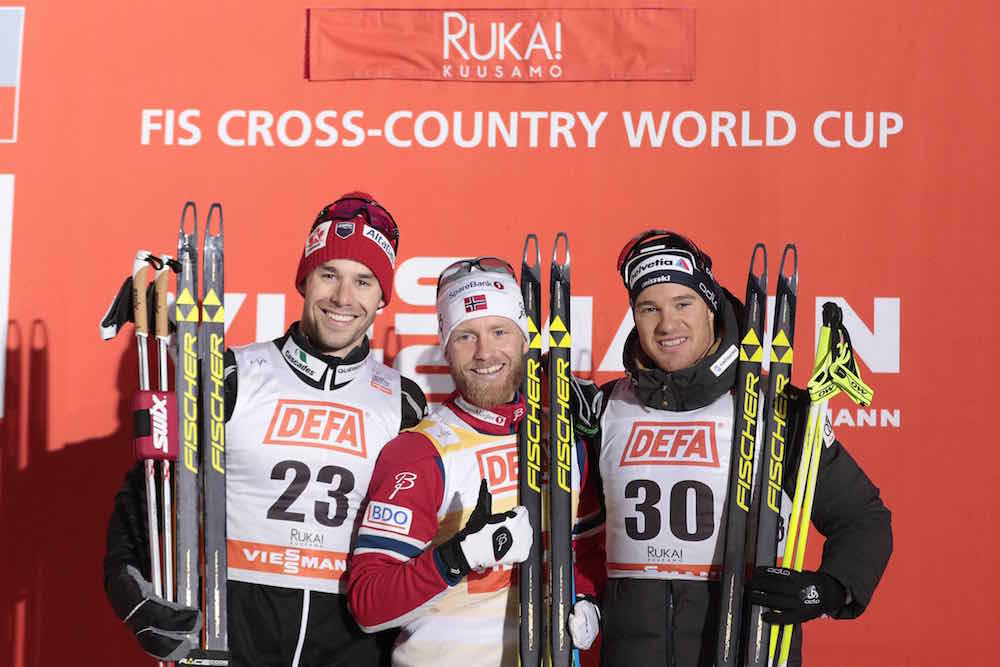
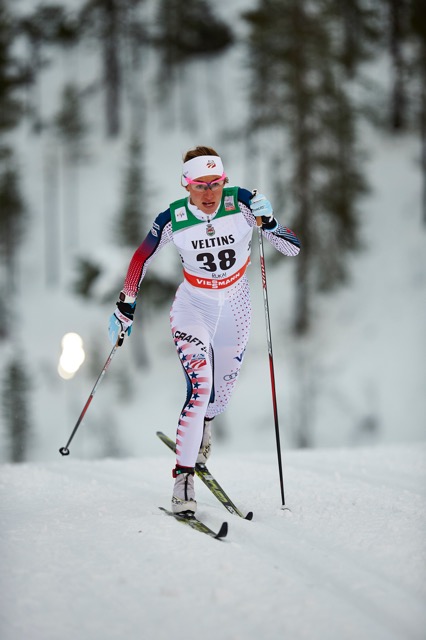
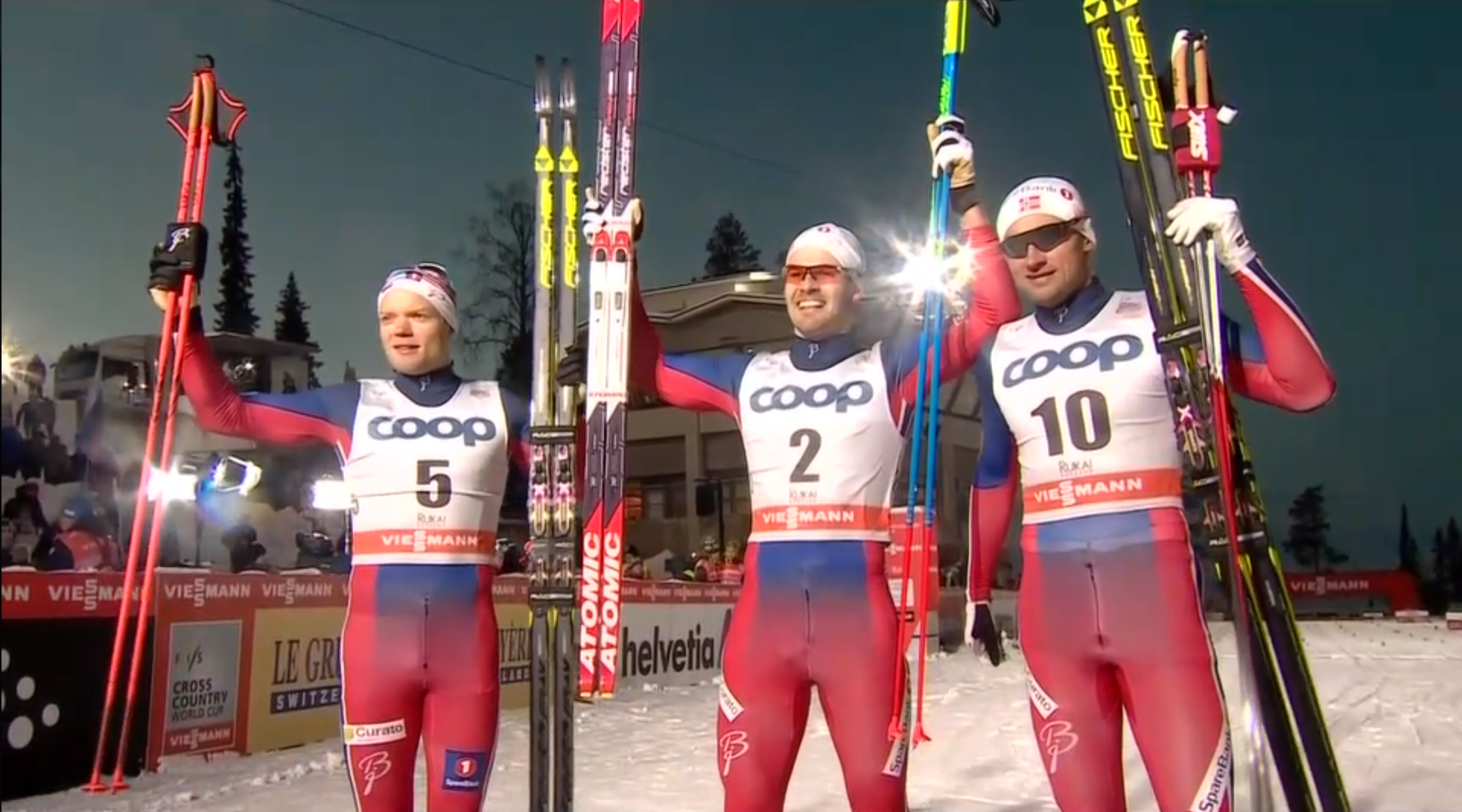
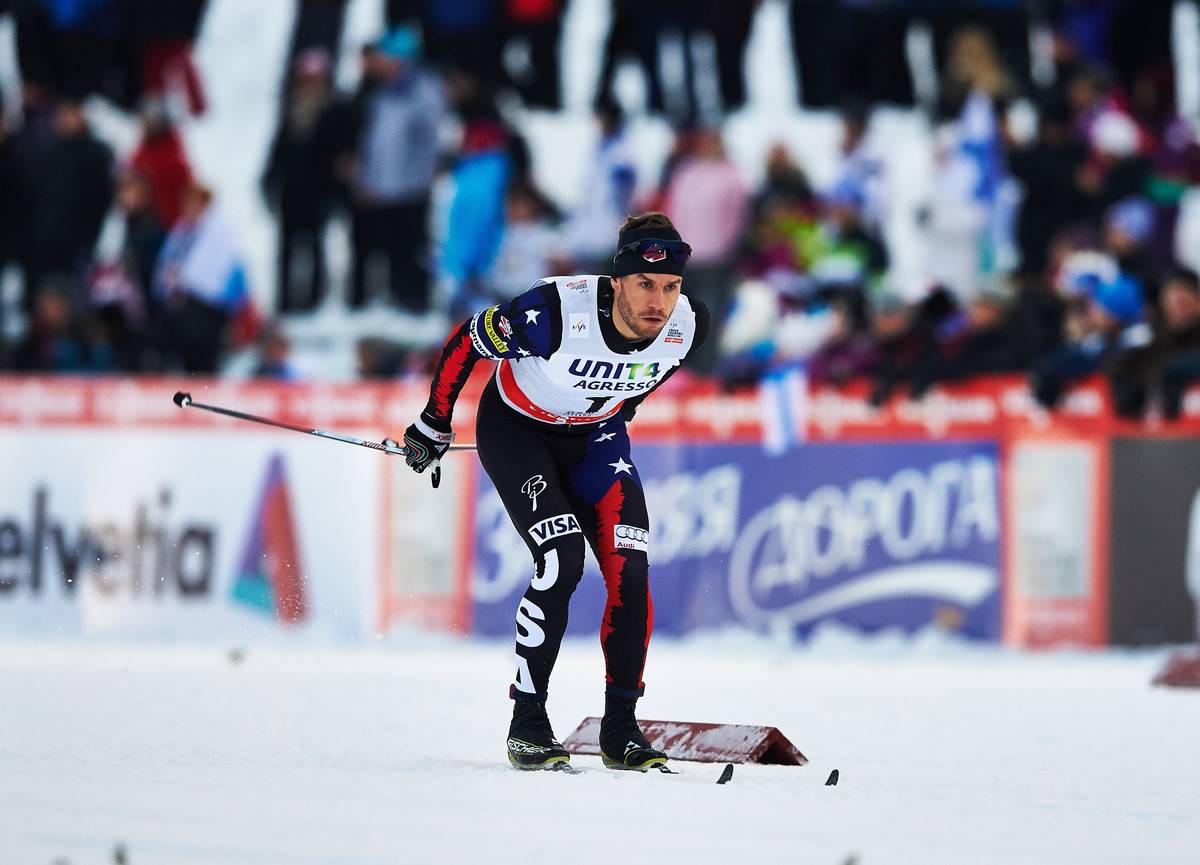
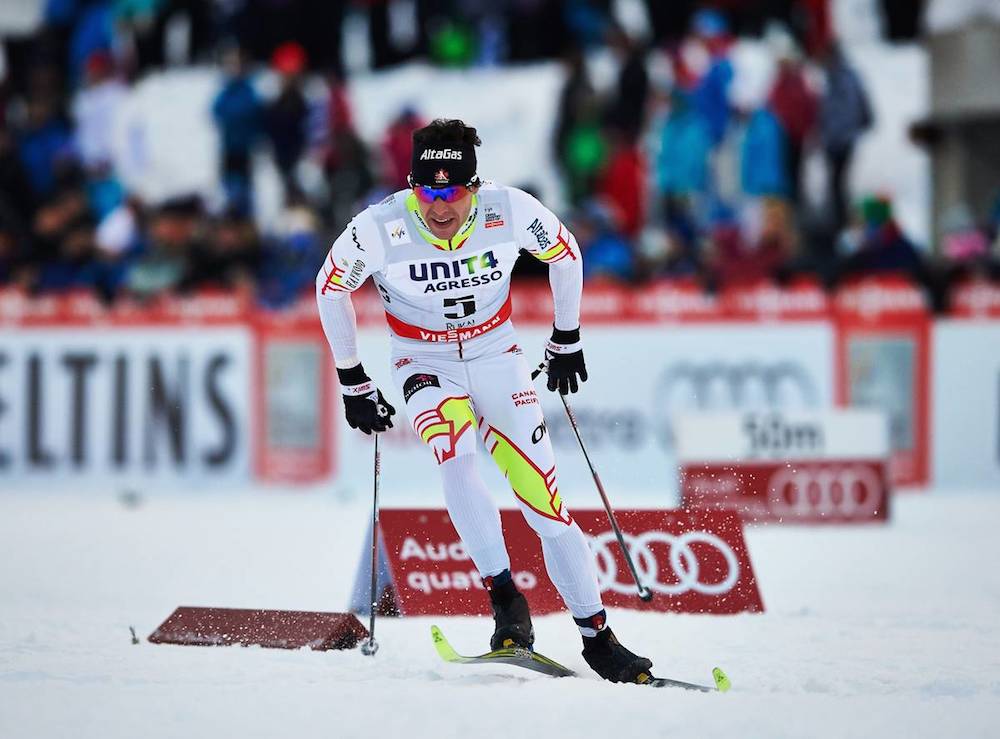
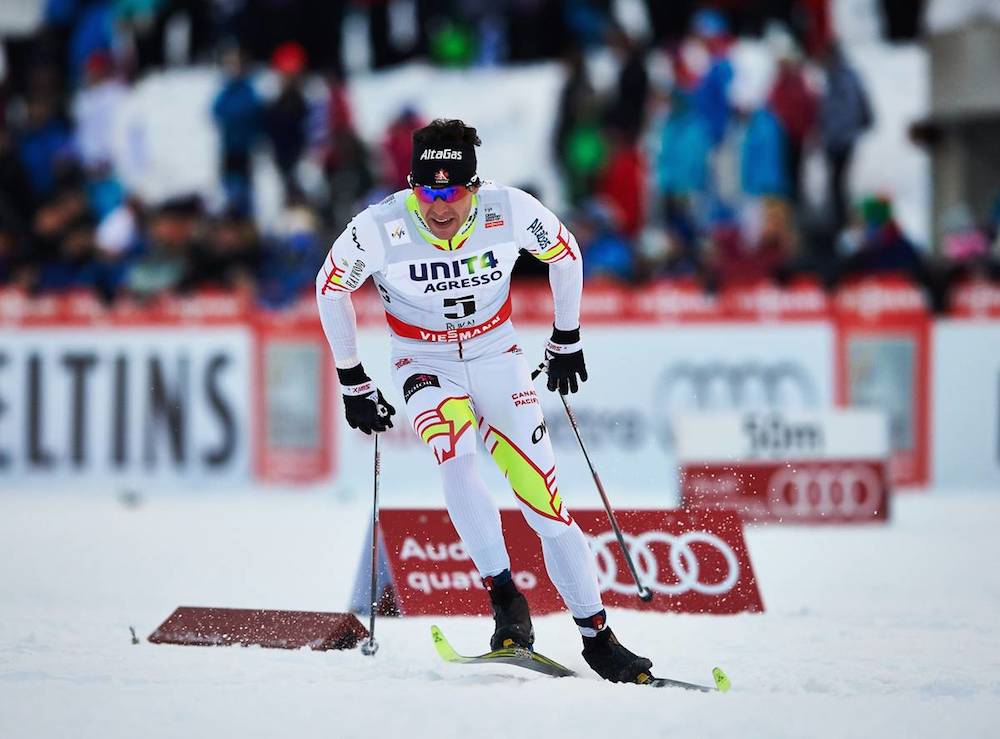
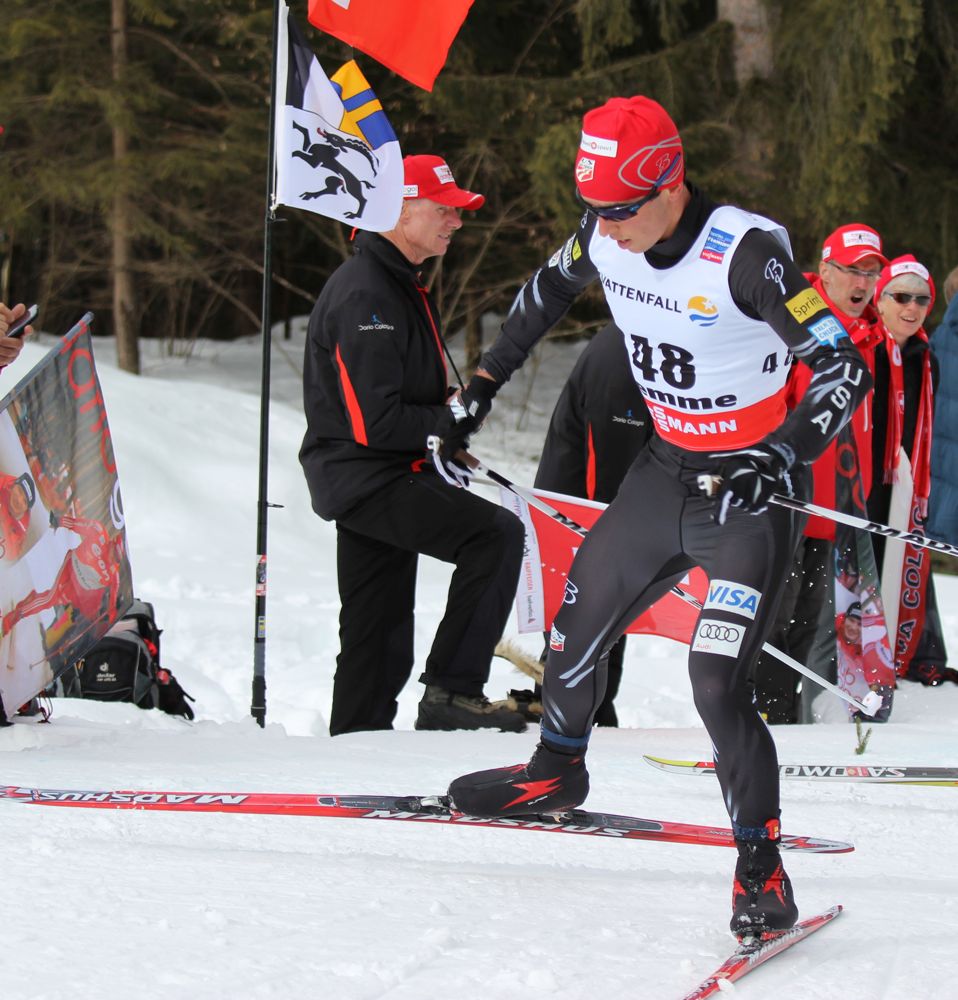
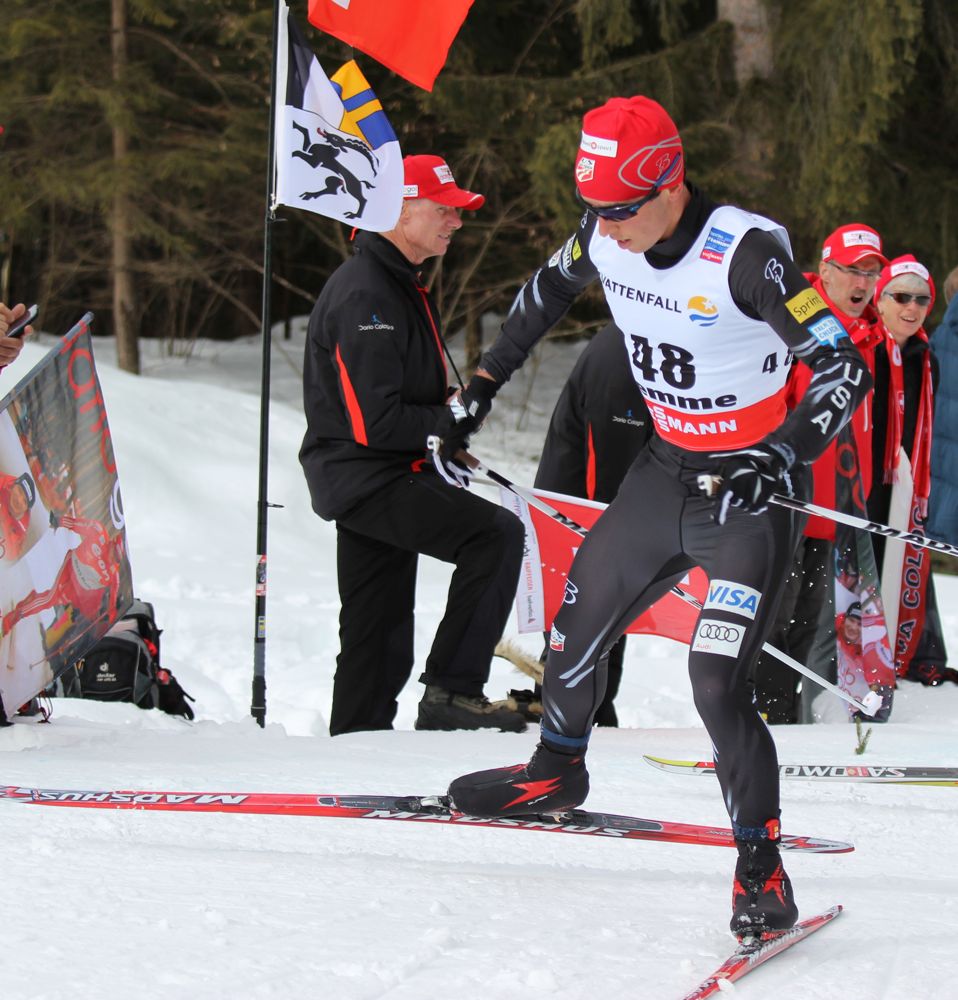
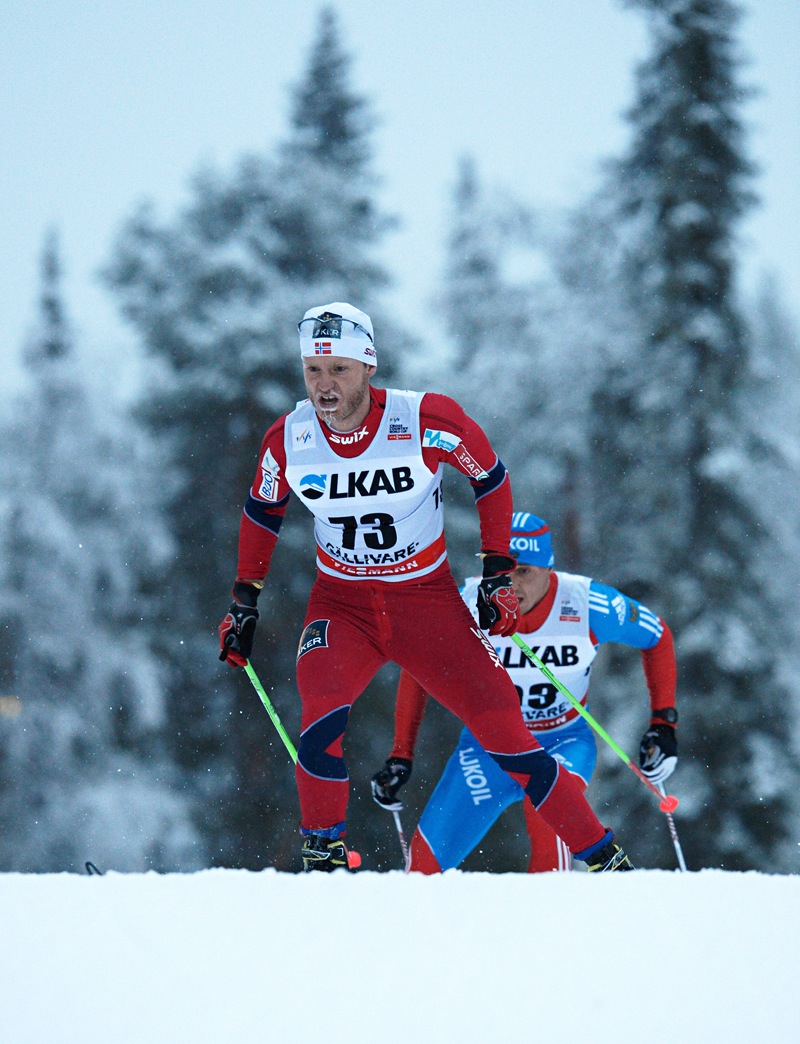
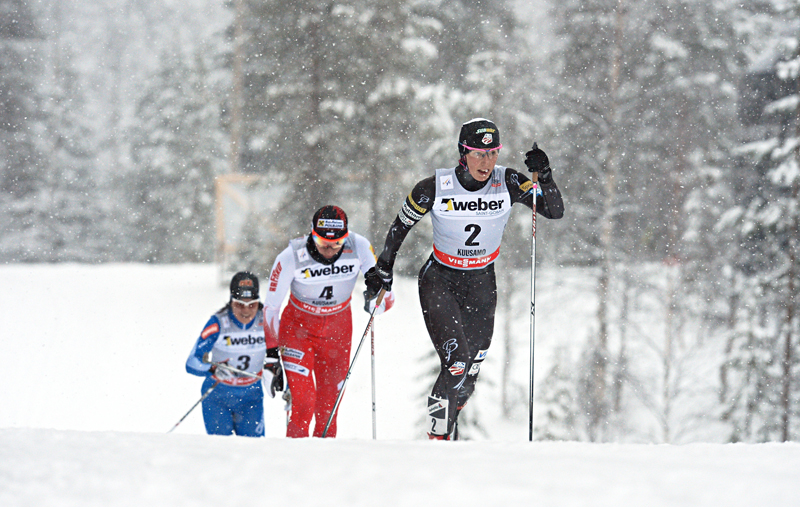
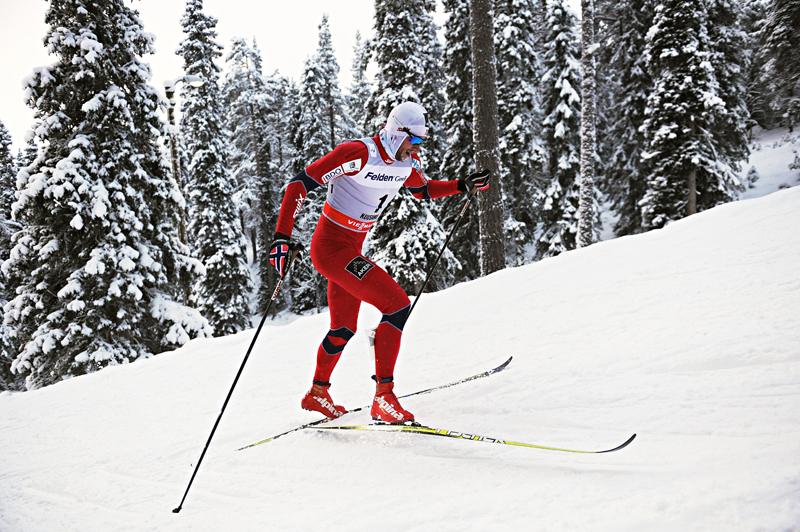
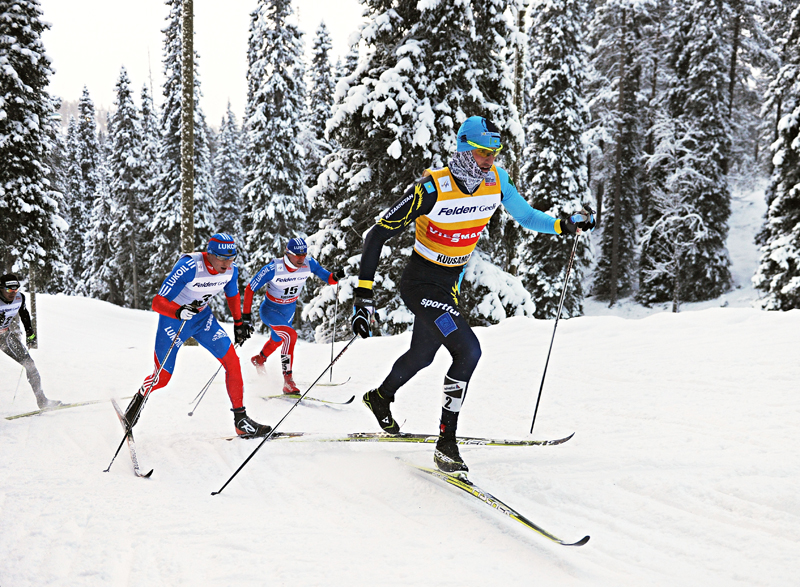
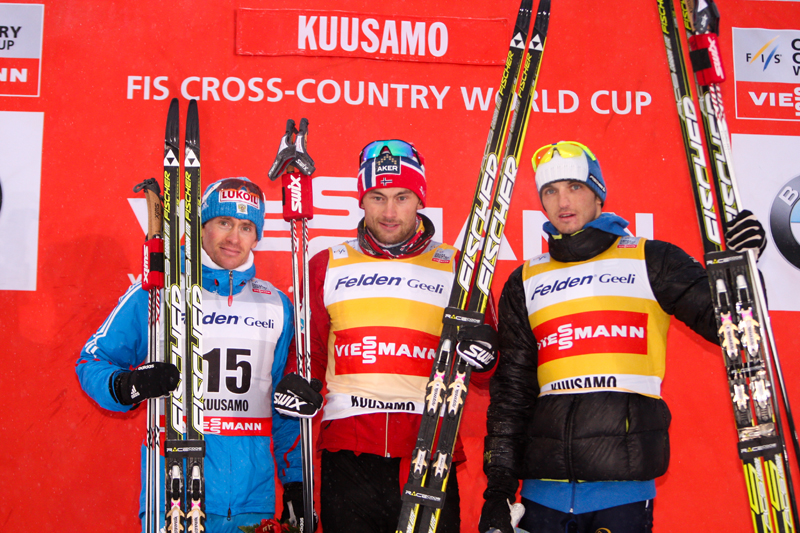
Canadian Alex Harvey (l) placed second in Saturday’s 10 k freestyle at the World Cup in Kuusamo, Finland, to share the podium with Norwegian winner Martin Johnsrud Sundby (c) and Switzerland’s Dario Cologna (r) in third. (Photo: CCC/NordicFocus)
(Note: This brief recap of the men’s 10 k freestyle race at the Kuusamo World Cup on Saturday was published before a full article about Alex Harvey and his second-place finish. For a more detailed account of Harvey’s race, click here.)
The Canadians have said it before, and they’ll probably say it again: they don’t expect much before Christmas — specifically, results-wise during Period 1 on the World Cup.
That’s why Alex Harvey’s podium on Saturday in the second race of the World Cup season, the 10-kilometer freestyle, came as a pretty big surprise for the 27-year-old Canadian World Cup Team member.
This spring, Harvey had surgery on his iliac arteries in both his legs in hopes of remedying a longtime blood-flow issue that affected his skiing, mostly while skating up hills. Before the surgery, he skipped hill-climb freestyle events like the final climb of the Tour de Ski. This year, he was hoping he wouldn’t have to.
After placing second in Saturday’s skate race in Kuusamo, Finland, one of the most brutal courses on the World Cup circuit, he’s feeling good about his chances.
“It is my first podium ever before the Christmas,” Harvey told FIS after the race, in which he finished 11.2 seconds behind Norway’s Martin Johnsrud Sundby, who won in 21:05.5 and moved into first in the Ruka mini tour. In Friday’s classic sprint, Harvey missed qualifying in 47th.
“Ruka was not the best for me because of the steep uphills. It is a good sign of recovery to be on the podium,” Harvey added. “My skis were working very well. I had to push a lot with my legs because the snow was soft.”
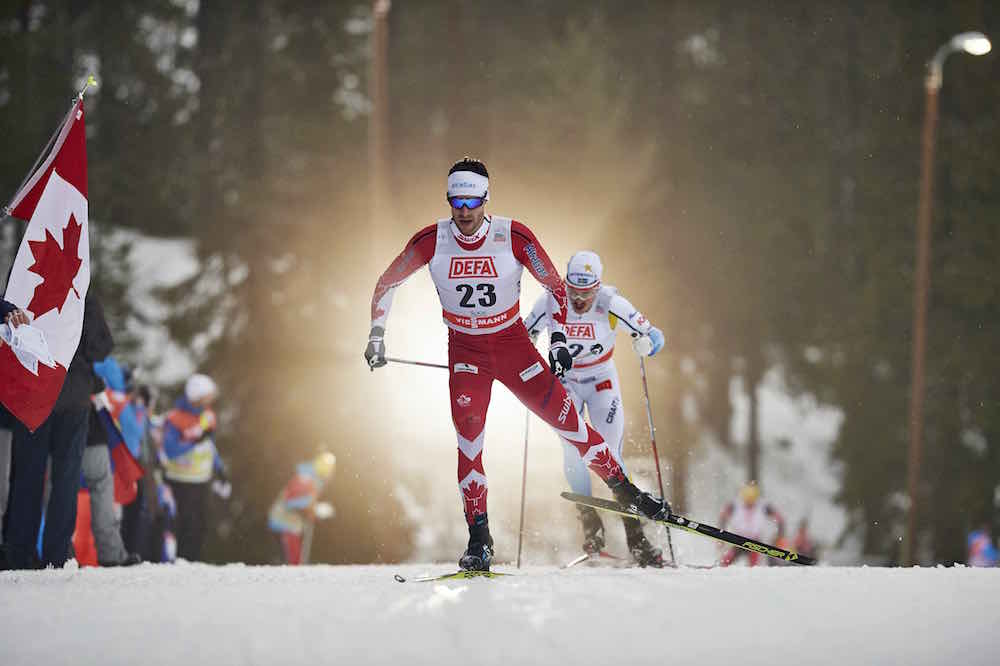
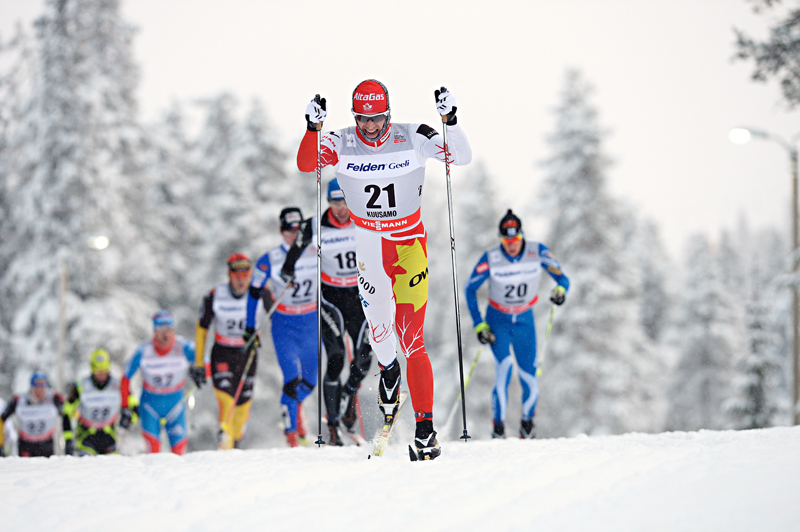
Alex Harvey racing to second in the men’s 10 k freestyle on Saturday at the Ruka World Cup in Kuusamo, Finland. (Photo: CCC/NordicFocus)
The 23rd starter, Harvey originally bumped Norway’s Anders Gløersen out of the leader’s chair, finishing 3.4 seconds ahead of him. Switzerland’s Dario Cologna started 30th and came within 0.4 seconds of Harvey, but finished second to him at the time.
Until Sundby came charging into the finish in bib 54, Harvey enjoyed the hot seat. He sat back, appeared relaxed, then stood up to welcome his challenger into the finish. Sundby consistently clocked faster times through each checkpoint on the course, and around 8 k, he was nearly 17 seconds ahead of Harvey (who’s time ranked fourth behind Sweden’s Martin Johansson and Cologna, respectively).
While Harvey’s final two kilometers kept him in contention for the podium, he anticipated well ahead of time that Sundby was going to take the win. He walked over to Sundby in the finish pen, and as the defending overall World Cup champion gasped for air, Harvey congratulated him. “You still got it,” he said.
With the win, Sundby, who placed 14th in Friday’s classic sprint, moves into first in the Ruka tour standings with one race to go: the 15 k classic pursuit on Sunday. He has a 13.8-second lead on Norwegian teammate Finn Hågen Krogh, and is 19.4 seconds ahead of Gløersen in third after Gløersen placed fourth on Saturday.
Johansson placed fifth in the 10 k, and Krogh tied Russia’s Alexander Legkov for sixth.
“I reckon I have some seconds [to play with] tomorrow; you have to prepare mentally for doing that,” Sundby said of his lead going into the final race. “But hopefully I will have a good game tomorrow and a nice end to the tour.”
Petter Northug, who was third on Friday and 16th on Saturday, will head out of the gate fourth, 24 seconds behind Sundby, and Cologna and Harvey will follow in fifth and sixth, 1 second later.
He explained he would try to work with Cologna to pick off the places.
“It is going to be a big fight,” Harvey said in a Cross Country Canada press release. “We will have to see how we wake up in the morning. We have all had two days of racing. I’ll ski as hard as I can tomorrow and hopefully get off to a good race.”
“Before the first World Cups you never know where you [stand],” Cologna told FIS. “I wanted to keep the steady pace, but it was not always easy. Towards the end of the race I lost some time. Alex was very fast today.”
Also in the men’s race, Canadian Devon Kershaw placed 24th. His teammates Ivan Babikov placed 52nd, Graeme Killick 57th, Michael Somppi 93rd, Len Valjas 95th, and Jess Cockney 101st of 111 finishers.
Simi Hamilton was 49th for the U.S., Erik Bjornsen was 54th, Noah Hoffman 58th, Andy Newell 85th, and Kris Freeman finished 88th after falling and breaking his pole.
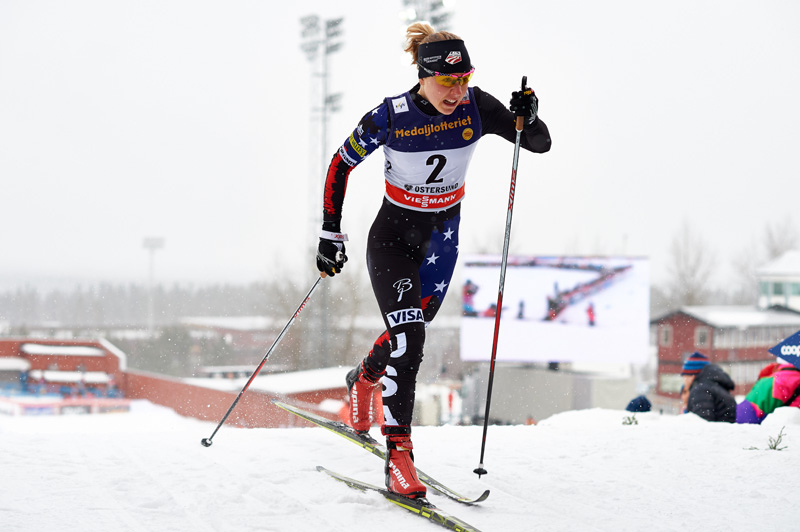
Ida Sargent of the U.S. Ski Team racing last season in a classic-sprint qualifier at the World Cup in Ostersund, Sweden. She placed 41st and did not make the heats. On Friday, Sargent placed seventh in the first World Cup of the season: the Ruka classic sprint in Kuusamo, Finland. (Photo: Fischer/NordicFocus)
With the sun barely peeking over the horizon in northern Finland, the 2015/2016 World Cup kicked off Friday morning with the Ruka Triple mini-tour in Kuusamo.
For the U.S. women, four of seven racers in the 1.4-kilometer classic sprint made the top 30 to qualify for the heats, with Sadie Bjornsen in 18th, Sophie Caldwell in 27th, Jessie Diggins in 29th, and Ida Sargent in 30th.
That’s why the story of Sargent finishing seventh, one spot shy of the final, is a good one.
At the top of the final results, Norway’s Maiken Caspersen Falla took the win in 2:58.23, after lunging at the line to beat Sweden’s Stina Nilsson in second (+0.26). Norway occupied two of the three podium places, Ragnhild Haga 1.08 seconds behind Falla in third. Another Norwegian, Invild Flugstad Østberg was fourth (+2.85), Sweden’s Ida Ingemarsdotter was fifth (+5.89), and the fourth Norwegian in the stacked final, Heidi Weng was sixth (+7.83).
Sargent, who advanced as a lucky loser out of her quarterfinal in third (behind Falla and Østberg, respectively), narrowly missed the final after placing third again in her semifinal. She finished 0.61 seconds behind Weng, the semifinal winner, and less than four-tenths of a second behind Ingemarsdotter, who advanced in second.
Bjornsen also raced in that semifinal after winning her quarterfinal in a photo finish with Sweden’s Evelina Settlin. In the semi, Bjornsen was sixth, 8.61 seconds behind Weng, which put her 12th overall on the day. Caldwell and Diggins both placed fifth in their quarterfinals and did not advance for 23rd and 25th overall, respectively.
In a phone interview after the race, U.S. women’s coach Matt Whitcomb reflected that going into this weekend, the team wanted more than a tepid start to the season.
“I’m really happy with the day; we started the season last year with a good race here from Ida,” he said, referring to Sargent’s career-best fifth in the Kuusamo classic sprint. “But in general, as a team, the first couple of weekends were more of a soft launch. We didn’t like it, the fans didn’t like it, the athletes didn’t like it. So our team cheer last night was ‘fast start.’ ”
For Sargent, perhaps the qualifier wasn’t the fast start she was hoping for, but the 27-year-old classic sprint specialist squeaked into the heats by 0.1 seconds just days after recovering from a nasty cold. (Sargent skipped last weekend’s pre-World Cup tuneup in Gällivare, Sweden, due to illness.)
Asked about expectations coming into the World Cup opener, Sargent said in a post-race phone interview that she was realistic.
“I just wasn’t really sure what to expect. I got healthy in time, but [Thursday] was my first training day again, and the first day I did intensity,” she said. “I just did a lap of the course, Level 3, and felt horrible. So I just tried not to have any expectations and just get the season going and do everything I could on that day and bring everything that I had today.”
As the last skier to qualify for the quarterfinals, Sargent took a breath, and settled into visualizing a successful run. “When I was 30th, I was like, ‘Well, that’s great!’” she said. “For me that was as good as winning the qualifier. It was just like making it through, and I knew I had a fresh start.”
No stranger to Ruka-sprinting success, Sargent says her results there have more to do with the course profile than the time of year. The sprint course features two climbs, the second of which leads up to the stadium home stretch and can extinguish a skier’s best effort. That hill, the spot where most of the day’s races were decided, was something of an asset for Sargent.
“This is a course that I love,” she said. “I think it’s the course. I like striding a lot. And this one has big hill to stride up. It just works well for me having the steep hills to stride up. I’m kind of as a smaller sprinter. I do well on hillier courses.”
In Sargent’s quarterfinal heat, she tried to ski in control and time the last hill. There, she began charging as the incline steepened.
“It was really fun to be right in there with those girls who are frequently on the podium and feel like I was going head-to-head with them,” she said. “Even when I finished and was in the finish area, Maiken Caspersen Falla says to me like, ‘I think you’ll be fine. I think we went fast enough,’ or something like that. And as it turned out it was like an insanely fast heat.”
Turns out, it was fast. Sargent qualified as a lucky loser, moving into the semifinals.
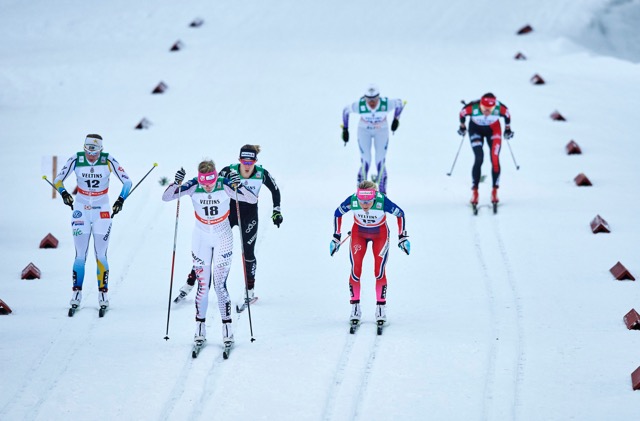
U.S. Ski Team member Sadie Bjornsen (second from left in white) races to win her quarterfinal. On the first day of the World Cup season and Ruka Triple mini tour, she finished 12th overall after placing sixth in her semifinal. (Photo: Fischer/NordicFocus)
For the U.S. women, the other highlight was Bjornsen.
Like Sargent, she also missed last week’s races due to illness.
“The funny thing here, those are the two athletes that were sick last week in Gällivare,” Whitcomb said. “And it just is one to remember … that a sickness one week does not mean bad results the next week. … When you get sick, one thing that happens is you recover a little bit.”
But sickness obviously isn’t a cure-all.
“When you are sick, the confidence can be shattered somewhat quickly,” Bjornsen said after Friday’s race on the phone. “So yeah, I would say the confidence sort of came back yesterday and today.”
Bjornsen skied steadily and with intent, coming from behind to hold off and out-double-pole Settlin to win her quarterfinal. For the third time in her World Cup career, she moved on to the semis.
And for most of her semifinal, while racing alongside Sargent, she stayed in the mix.
Bjornsen’s race derailed as she strided up the make-or-break final hill. She chose a glazed track far to the right.
“It got really slippery and I didn’t have the knowledge to jump out of the track and run up the side,” Bjornsen said. In the track, her skis iced slightly and she slipped and fell.
Yet even that mishap became a take-away moment for the emerging all-arounder.
“Unfortunately, I kind of iced on the top and fell over and had to pick myself back up with the most flooded legs in the world. I was disappointed in how the semifinals went because I felt like I wanted to win that one,” she said. “It was a great lesson because you just have so much to learn every time you sprint race. And now I realize it doesn’t hurt to jump out the track and make a decision like that.”
While Bjornsen righted herself atop the hill, Sargent charged ahead. At the top of the climb, the course arcs left into a final double-pole finishing stretch. There, Sargent pulled ahead of Norway’s Katherine Rolsted Harsem to move into third and pushed for second, but came up just short.
“It was a little frustrating to just miss out on the finals,” she said. “It was kind of like a lunge with those other girls for second and third but I think Ida Ingemarsdotter and I have had lunged in the past three or four years here and kind of go back and forth with who wins it.”
Ingemarsdotter has the height advantage of the two Idas: at 5-foot-9, she is five inches taller than Sargent.
Regardless, after finishing seventh on the day, Sargent left wanting more.
Sophie Caldwell (U.S. Ski Team) during the women’s 1.4 k classic-sprint qualifier in Kuusamo, Finland. She qualified for the first time in Kuusamo in 27th and went on to place 23rd overall. (Photo: Fischer/NordicFocus)
For Diggins, she wanted just a bit more track. Coming off wins in both Gällivare races last weekend, Diggins left her quarterfinal race chomping for just 20 more feet of straightaway before the finish. Despite not advancing into the semis, Diggins wrote in an email that her outlook remains positive.
“I was really, really happy with today’s race. It was the first time I’ve ever made the heats in a [World Cup] classic sprint, and I’ve been working so hard to improve my classic technique that it feels so good to see it all pay off!” she wrote.
In the Gällivare classic sprint, a International Ski Federation (FIS) race, Caldwell placed second to stand on the podium with Diggins. A week later, her World Cup season debut also ended in quarterfinals, but like her teammates, Caldwell’s lasting impression is a good one.
“I think last week’s race was a positive indicator of where my fitness and sprinting is right now, so I used it as a boost of confidence going into the sprint today,” Caldwell wrote in an email. “I was happy with the day. It was the first time I’ve qualified in Kuusamo and left me hungry for more.”
Overall standings for the U.S. women in the Ruka mini tour are as follows: Sargent is seventh, Bjornsen 12th, Caldwell 23rd, Diggins 25th, Rosie Brennan 42nd, Caitlin Gregg 81st, and Liz Stephen 84th.
With two distance races remaining, none of the women are out of the picture.
“These tours are really fun because you can come from 90th place on the first day and up inside of the top 15 by the last day,” Whitcomb said. It’s always the goal to have three good-or-better races, but like any sport, you can kind of drop a race and put together two great ones and so end up with a good final result.”
Racing will continue for the women on Saturday with a 5 k freestyle individual start.
Lenny Valjas (second from l, in red) heads out of the start of his quarterfinal during Friday’s 1.4 k classic sprint at the Ruka World Cup in Kuusamo, Finland. He placed fifth in his heat for 22nd overall in the sprint. He currently ranks 25th in the mini tour.
(Note: Based on two different formats of results on the FIS website, there was some discrepancy over whether Valjas placed 22nd or 25th. This article has been amended to show that he placed 22nd based on the PDF version of the final results.)
There are a couple reasons the cross-country World Cup starts in Kuusamo, Finland, each year. For one, it’s almost a sure-bet for snow in November. It’s also really, really hard.
“After training in North America all summer, this is the first chance that we have to compare against European athletes,” Canadian World Cup sprinter Lenny Valjas said on the phone after Friday’s 1.4-kilometer classic sprint — the first race of the World Cup season held annually in Kuusamo.
It’s also the first of a three-day mini tour, the Ruka Triple, and on Friday, Valjas was the lone Canadian to qualify and ended up 22nd on the day.
He was one of eight Canadians to race: after him, Alex Harvey missed qualifying in 47th, Jess Cockney was 65th, Devon Kershaw was 88th, Ivan Babikov 96th, last year’s NorAm leader Michael Somppi 97th, and Graeme Killick 103rd of 115 men. In the women’s sprint, Emily Nishikawa finished 58th of 86.
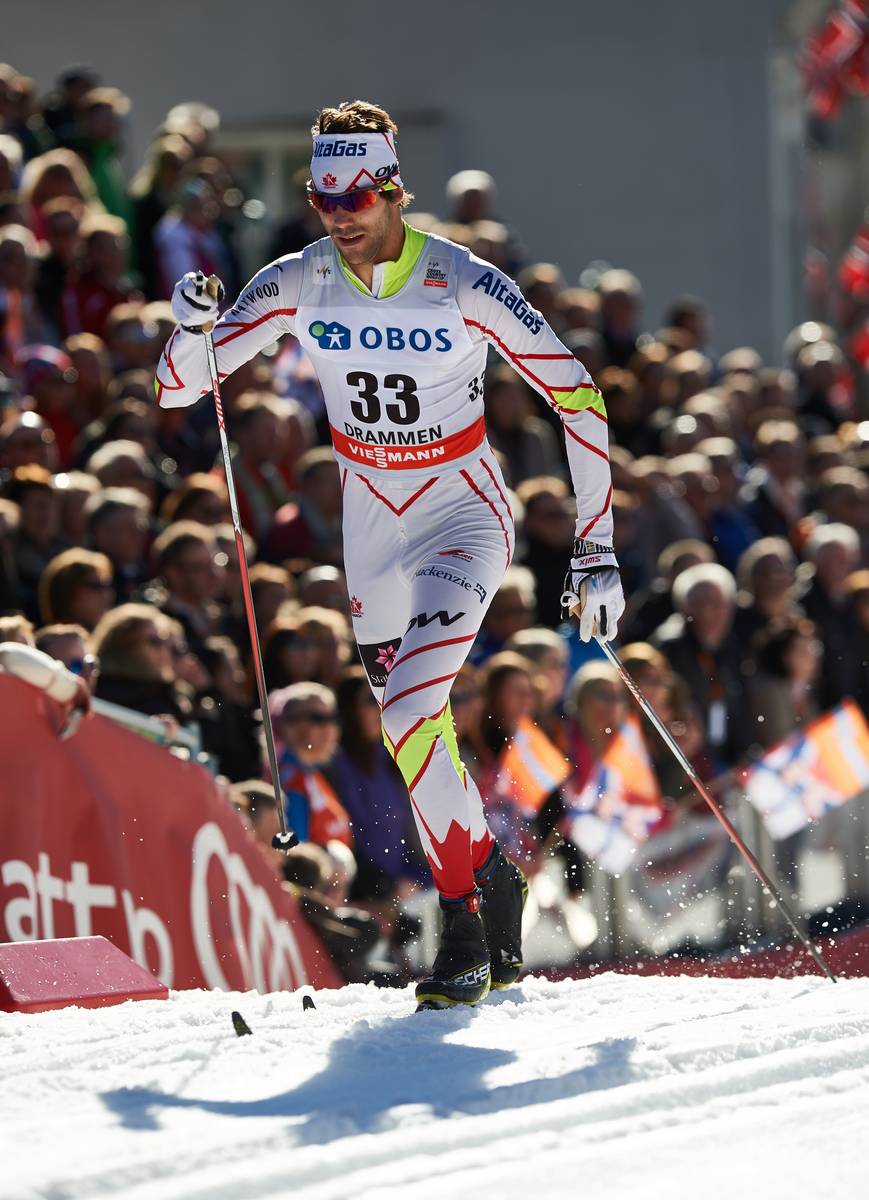
Canada’s Lenny Valjas during of the World Cup classic-sprint qualifier in Drammen, Norway. Valjas qualified 19th and placed 14th overall. (Photo: Fischer/Nordic Focus)
According to Canadian Head Coach Justin Wadsworth, with temperatures right around freezing, waxing difficulties were a factor in some of his athletes’ results.
“We went for a little more grip, which seemed to work for the most part, though there was a bit of icing up in the qualifier,” Wadsworth said.
Some skiers used klister and some went on hairies, U.S. Ski Team member Andy Newell explained. He went for a klister-covered wax and ended up fourth overall.
Valjas said he thought the Canadians has “the best grip of all nations.” The trouble was, they had to deal with hard, icy track, four centimeters of west snow from the night before, and windy, changing conditions throughout the day.
“Today’s goal was just to qualify and to make it into the points. There was no huge expectations,” he explained, adding that specific results are always a bit of an unknown at this point in the season.
He qualified in 22nd, 8.32 seconds behind Norway’s Pål Golberg, who won the qualifier in 2:32.62. In the quarterfinal, Valjas placed fifth, 4.61 seconds behind the winner of his heat, Norway’s Petter Northug. Northug went on to finish third in the final. Also in their quarterfinal, Sweden’s Teodor Peterson placed second (+0.2) and France’s Baptiste Gros was 0.52 seconds back in third.
“Len’s skis seemed to be slow in his quarterfinal,” Wadsworth observed.
Valjas said his race strategy included being quick off the start, staying in the middle of the pack and hammering up the last hill in order to advance to the semis. A quick start was essential.
“For me, it is difficult to pass from the back to the front,” he said.
On a downhill, he slipped from third to last, which may have been due to trouble with glide.
For Valjas, the Kuusamo course has been both “terrible and amazing,” he said. Slick conditions made it more difficult than usual, he said, with tracks that were “broken and wide, especially the downhill corners, which were icy and hard to get an edge on, just super sketchy.”
With the option to pick his quarterfinal heat, Valjas chose to race with Northug, figuring Northug would set a slower pace. Northug’s quarterfinal win ended up being the second slowest (Italy’s Federico Pellegrino was slower en route to the win), but that meant Valjas needed to be first or second behind him to advance to the semifinals.
While that didn’t happen and his race ended there, Valjas wasn’t too concerned. He said he was confident his form would progress according to plan. After dealing with injuries the last two seasons, he’s happy to be qualifying in the first place.
As for the rest of the weekend, Valjas will race the 10 k skate and 15 k classic pursuit “as long as I remain in good contention throughout the weekend,” he said.
According to Wadsworth, the rest of the Canadians also felt good on Friday, despite not having the quantitative results. Harvey was reported as feeling good, “but just not as sharp” at this point in the season, Wadsworth said. He added that Kershaw was frustrated with his skis as they seemed to be icing up on the hills.
Nishikawa told Wadsworth she felt good, “which is the main thing, as she’s a distance racer,” he said. He remained confident for Sunday’s overall mini-tour finishes as his athletes “don’t always perform well at this stage in the season, especially on a classic course like this,” he said.
“Ideally we would want a better start [to the season], but it is what it is, we have to be patient and we’re focusing on the positives for now,” he added.
All of the Canadians were expected to race in all three events this weekend, and Nishikawa will remain the lone women’s starter.
“We’d love to start more women in Kuusamo, but our funding is limited and only people who have been in the top 30 will be starting this [World Cup] period #1,” Wadsworth explained in an email. “However, we do have a trip racing WC period #2 where there are more women (4) selected then men (1) (as is the case with our development team that was named this year).”
Expanding on this, he said Knute Johnsgaard and four women from the national-development team (Olivia Bouffard-Nesbitt, Cendrine Browne, Dahria Beatty, Katherine Stewart-Jones) will race Period 2 World Cups in Slovenia and the Czech Republic. Nishikawa will also be part of that trip, while the Tour de Ski participants will be chosen based on World Cup points in Period 1.
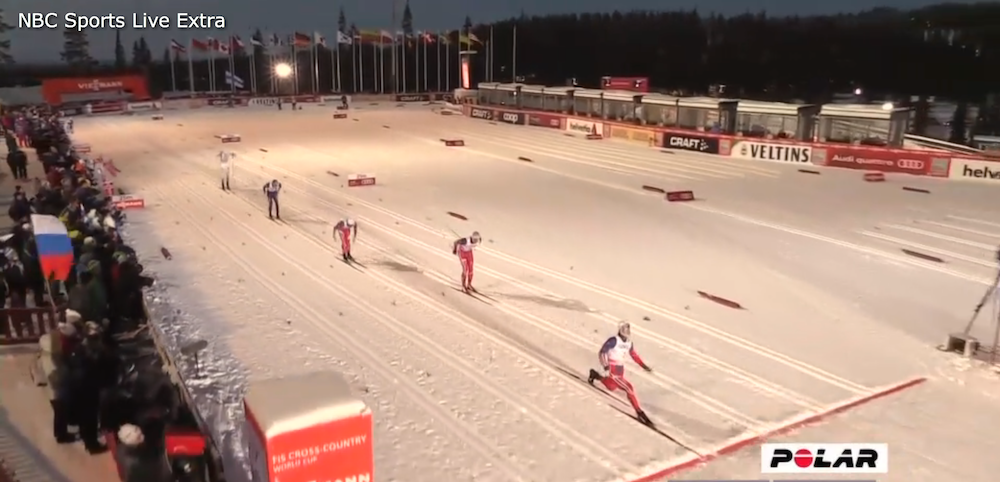
Norway’s Sondre Turvoll Fossli, 22, crosses the line first for his first World Cup victory in the first World Cup of the 2015/2016 season in Kuusamo, Finland. His teammates Eirik Brandsdal (second from r) and Petter Northug (third from r) placed second and third, and American Andy Newell (second from l) was fourth in the first of the three-day Ruka mini tour.
A quick glance of the men’s final results in Friday’s classic sprint — the season-opening World Cup in Kuusamo, Finland — reveal the same old story: a Norwegian podium sweep.
But look closer. At age 22, Sondre Turvoll Fossli won his first World Cup and American Andy Newell placed fourth for his best World Cup result since he finished fourth in a classic sprint three seasons ago in Davos, Switzerland.
While Fossli took charge and won the 1.4-kilometer sprint final in 2:33.07, ahead of fellow Norwegian World Cup sprinter Eirik Brandsdal in second (+1.03) and all-around skier Petter Northug in third (+1.65), Newell was 1.11 seconds off the podium in fourth.
The all-Norwegian men’s Ruka classic sprint podium on Friday in Kuusamo, Finland, with winner Sondre Turvoll Fossli (c), runner-up Eirik Brandsdal (l) and Petter Northug in third.
The 31-year-old U.S. Ski Team sprinter reached the final by the slimmest of margins as a lucky loser two times over. In a photo finish for third in his quarterfinal, Newell ended up 0.03 seconds behind Russia’s Alexey Petukhov. Yet both advanced to the semifinals based on time.
Then, in the first semifinal, against Fossli, Brandsdal, Sweden’s Emil Jönsson, Russia’s Nikita Kriukov, and Finland’s Matias Strandvall, Newell nipped Jönsson for third — another photo finish separated by 0.03 seconds. Both Newell and Jönsson advanced to the final as lucky losers behind Fossli and Brandsdal, who placed first and second in that heat.
In the final, Fossli pushed the pace early and initially led with Sweden’s Teodor Peterson. By the final hill — an infamously tough climb back up to the Ruka stadium — Fossli was in a league of his own, ahead of the field and charging for the win.
At the bottom of the climb, Newell followed Fossli in second with Brandsdal and Northug closing on him from behind. They passed him along the long ascent to the top, and Newell hung on for fourth, finishing about a second ahead of Peterson in fifth. Jönsson placed sixth, 22 seconds behind the winner.
“I think Kuusamo is one of the toughest sprints of the season,” Newell told FasterSkier in a phone interview after the race. “So I know if I can have a shot at the podium here I can have a shot at the podium any race this year, and I’m excited about that.”
After the finish, Fossli, who learned Monday that he would race the opening sprint in place of Ola Vigen Hattestad, gleamed over his first World Cup victory. Hattestad and his girlfriend, Slovenian skier Katja Višnar, welcomed the birth of their first child earlier this week, according to FIS.
“It was great, third last year and first place now,” Fossli told FIS after his stage win on Friday. At this same venue last year, he placed third in the Ruka classic sprint, behind Brandsdal and Northug, respectively. “I’m really happy and I hope I will stay there.”
Stay tuned for complete report, along with a recap of the U.S. women’s finishes, led by Ida Sargent in seventh.
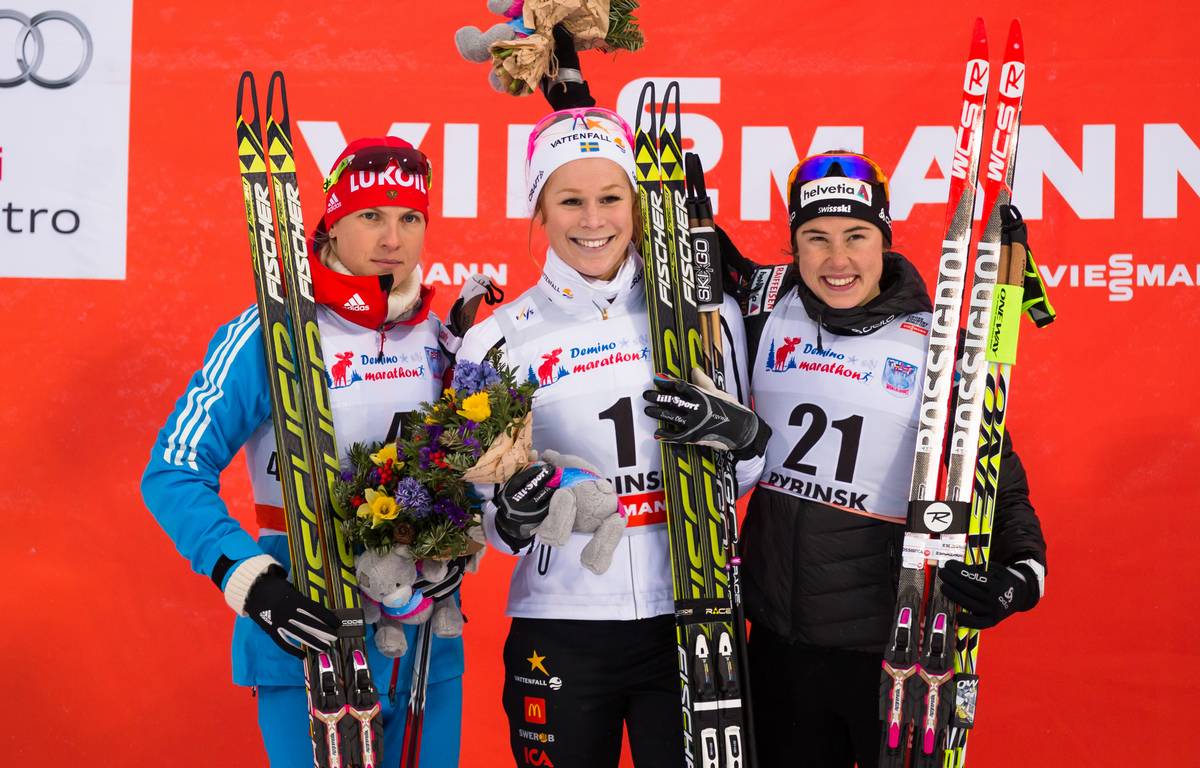
Russia’s Natalia Matveeva (l) on the podium last season at a World Cup skate sprint in Rybinsk, Russia, with Swedish winner Jennie Öberg and Switzerland’s Laurien van der Graaff in third. On Sunday in Beitostølen, Norway, Matveeva won a FIS classic sprint after Norway’s Maiken Caspersen Falla (not pictured) was disqualified. (Photo: Fischer/NordicFocus)
For the second time this weekend, a Norwegian skier was disqualified from an International Ski Federation (FIS) race in Beitostølen, Norway, and missed out on a victory because of it.
Despite a strong opening to Sunday’s 1.2-kilometer classic sprint, in which she won the qualifier by 2.22 seconds over Norwegian teammate Ingvild Flugstad Østberg and topped every heat thereafter, Maiken Caspersen Falla was ultimately at the hands of the jury by the end of the final.
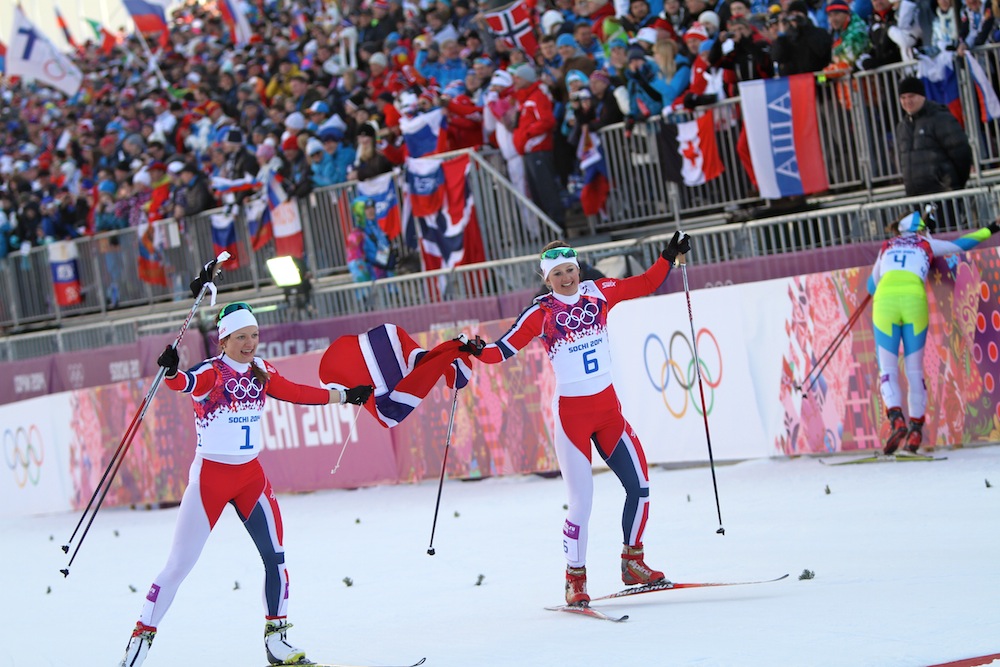
Norwegian teammates and friends Maiken Caspersen Falla (l) and Ingvild Flugstad Østberg celebrate gold and silver, respectively, at the 2014 Olympic skate sprint in Sochi, Russia.
Facing off against Østberg, Russia’s 22-year-old Polina Kovaleva — who was third in the qualifier (6.44 seconds behind Falla) — another Russian Natalia Matveeva, and two more teammates, Astrid Uhrenholdt Jacobsen and Barbro Kvåle, the 25-year-old Falla ran into trouble in the final when she moved to change tracks on a technical turn.
Due to the sharpness of the turn and traffic around her, Falla explained she had no choice but to ski over her good friend Østberg’s skis.
“I saw that I [cut off] Ingvild in the bend, but what else could I have done?” Falla said in a post-race interview with Langrenn, according to a translation. “I was either running up the back of Astrid or into Ingvild.”
While she finished first in the final, Falla was ultimately relegated to last because of the move. She didn’t regret her decision, telling NRK, “I would do it again, because I did not have anywhere else to go.”
She added that the DQ should give her some added fuel moving forward, especially two weeks out from the World Cup opener in Kuusamo, Finland.
“It’s too bad to be disqualified” she told Langrenn. “It was one of best races I’ve done in three or four years. Ican use this as extra motivation when I go [to the] World Cup.”
With Falla out, the women’s sprint victory went to the second racer across the line: Russia’s 29-year-old Matveeva, who finished second in both her quarterfinal and semifinal. Skisport.ru noted classic isn’t usually Matveeva’s strength. In 2007, she won a World Cup skate sprint in Duesseldorf, Germany, and last season, she reached the World Cup podium for the first time in three years when she placed second in a skate sprint in Rybinsk, Russia.
Despite the mishap with Falla, Østberg was two-tenths of a second from the win on Sunday, finishing just behind Matveeva in second. After reaching the final as a lucky loser from her semifinal, Jacobsen led out of the start, but slipped back on the climbs and ended up 2.9 seconds back in third. Kovaleva placed fourth (+8.3) and Kvåle was fifth (+12.1). The winner of last year’s classic sprint in Beitostølen, Kvåle, 23, was a lucky loser twice over, narrowly advancing from both the quarterfinals and semifinals with fast-enough times.
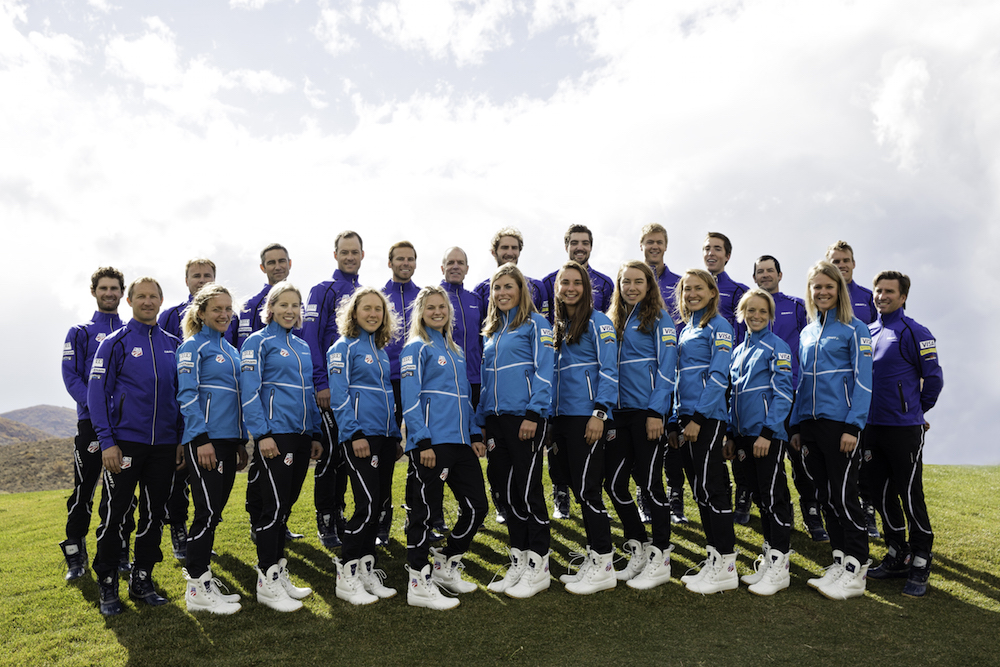
The 2015/2016 U.S. Nordic Ski and Nordic Combined teams during a team photo shoot in their new uniforms on Monday, Oct. 19, in Park City, Utah. (Photo: U.S. Ski Team)
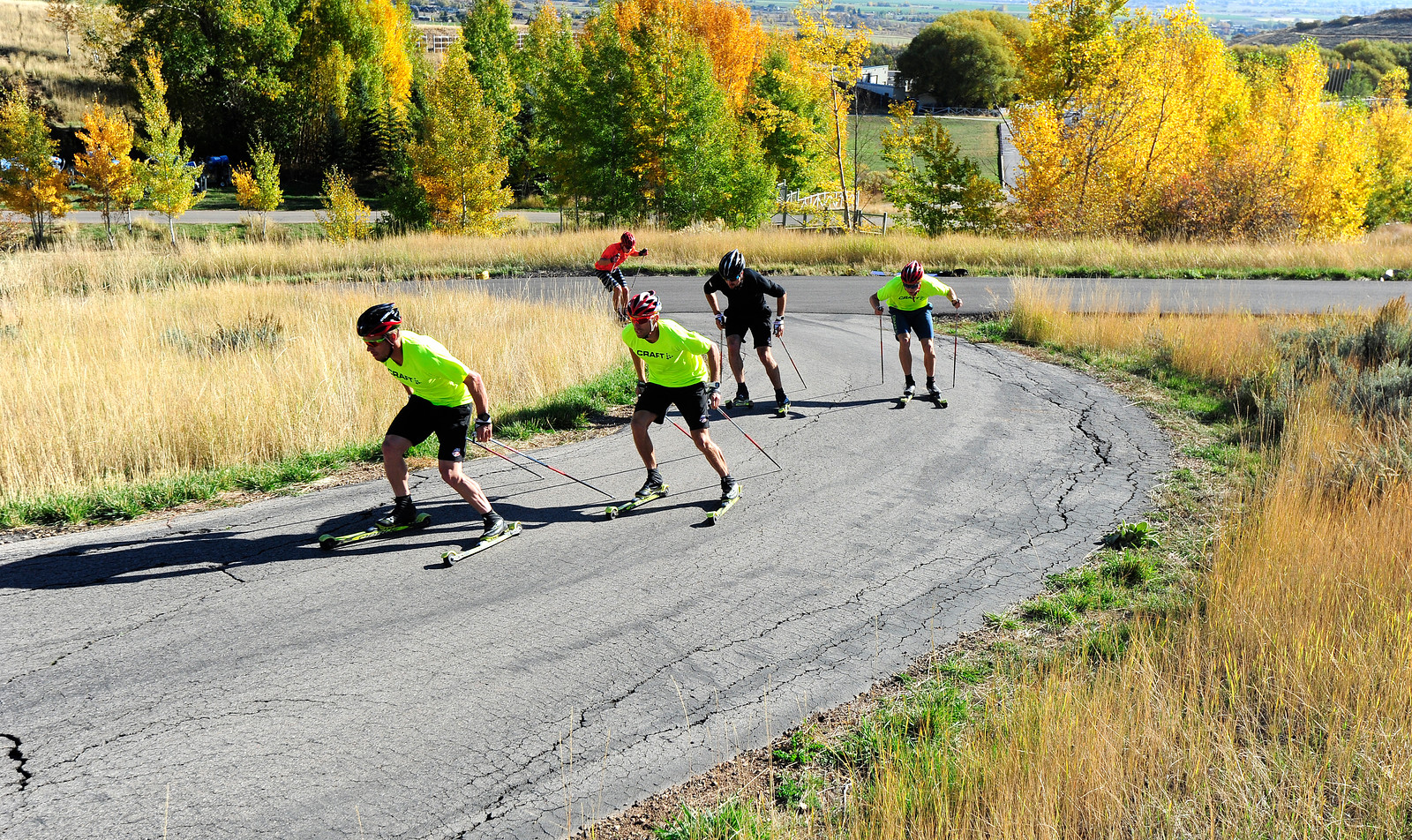
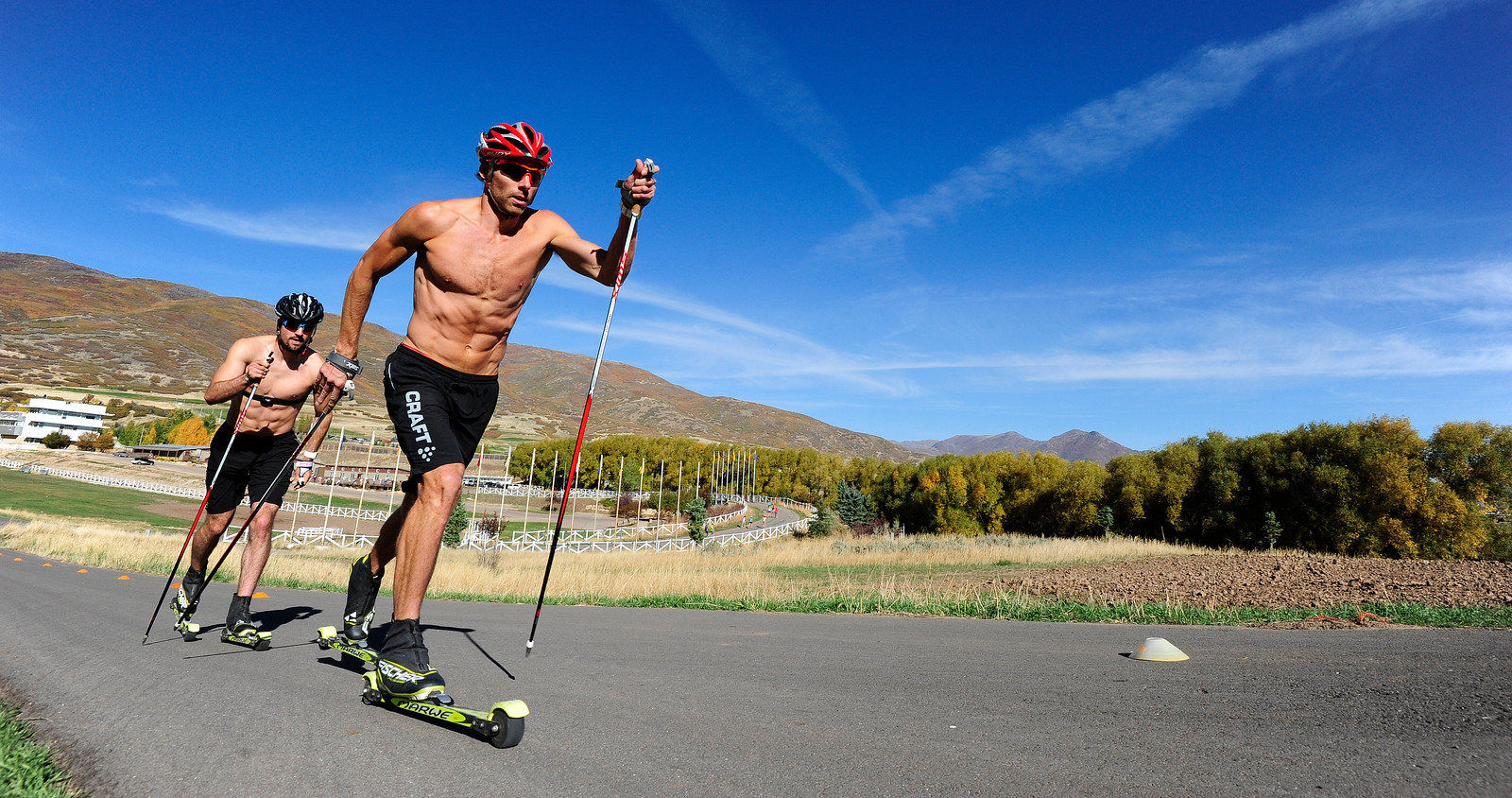
Over the last two weeks, the U.S. Ski Team and many of the nation’s top skiers have been hitting the hardtop and trails around Park City, Utah, intent on getting in quality training sessions at altitude before heading off to on-snow camps. The area’s consistent fall weather and training opportunities, including the rollerski loop at Soldier Hollow, make this camp an annual team staple.
Many of the country’s most competitive nordic skiers outside the U.S. Ski Team (USST) are also in Park City, drawn there by the opportunity to train with the team before it heads to Europe for the start of the World Cup in late November.
USST Head Coach Chris Grover estimated there were slightly more than 30 athletes at the camp, with all 16 national-team members, plus skiers from the National Training Group, Alaska Pacific University (APU), the Sun Valley Ski Education Foundation (SVSEF) Gold Team, Stratton Mountain School (SMS) T2 Team, and the Craftsbury Green Racing Project. On the phone earlier this week, Grover expressed excitement about a, “nice mix of some younger guys and some veterans, and top club athletes and the national team.”
The U.S. Ski Team trains on the Olympic trails during its annual fall camp at Soldier Hollow in Midway, Utah. (Photo: U.S. Ski Team/Tom Kelly)
Although this is a national-team camp, guest athletes are invited to attend the high-intensity workouts as well as the long, over-distance sessions when the venue safely allows them to do so, Grover explained.
During the first week of camp the focus has been on threshold, some testing and speed workouts, and something called “The Double Pole Project.” Grover described this as a pre-workout video session meant to aid in transferring the athletes’ work in the weight room to lower abdominal engagement in their double-pole technique. Stemming from a plan shared at the World Cup coaches’ seminar in Trondheim, Norway, in late August, the team integrated this into their camp with hopes of seeing this strength technique come through this winter.
After the initial week of mellow, acclimatization-based workouts and technique focus, the second week of training included more intensity. On Tuesday, Grover highlighted that morning’s 6 x 4-minute ski bounding session as one that got both athletes and coaches excited. Whether it was the sun beaming down or the lower elevation training site in Salt Lake City, the first full-group, high-intensity workout of the camp went off without a hitch, he said. It also provided a preview of the intensity coming at the end of camp: a three-day rollerski mini tour starting on Sunday.
U.S Ski Team members Andy Newell and Ben Saxton training in mid-October on the Olympic trails at Soldier Hollow in Midway, Utah. (Photo: U.S. Ski Team/Tom Kelly)
In the past, the USST ended its Park City camps with rollerski time trials. This season, without a World Championships or Olympics, and with over half the the World Cup races being tour-stage events (19 to be exact), Grover and his staff decided to shift from race simulations to stage events.
“We’ve definitely put an emphasis on practicing not only how to manage energy from day to day, but how to recover optimally from each session,” Grover said.
The team saw some success at Norway’s Toppidrettsveka mini tour this summer, with Liz Stephen and Noah Hoffman placing third in the hill climb, but also encountered bad luck with broken poles and several crashes in the last stage of that tour, Grover said. These are the types of mishaps he’s hoping the tour simulations will minimize in races this winter.
The mini tour will start this Sunday, Oct. 25 with a freestyle sprint, followed by a shorter classic mass start on Monday, and ending with a longer freestyle pursuit on Tuesday.
The national team also unveiled its new uniforms this week. L.L. Bean and Craft signed as the team’s clothing sponsors this spring and revealed the new suits and warmups with the team on Monday in Park City. Grover explained the shift to L.L. Bean and Craft as one that’s been “excellent” because it provides a “…uniform that is totally unique to the USA.” He also believes the team will benefit from the wide range of pieces available through these larger companies.
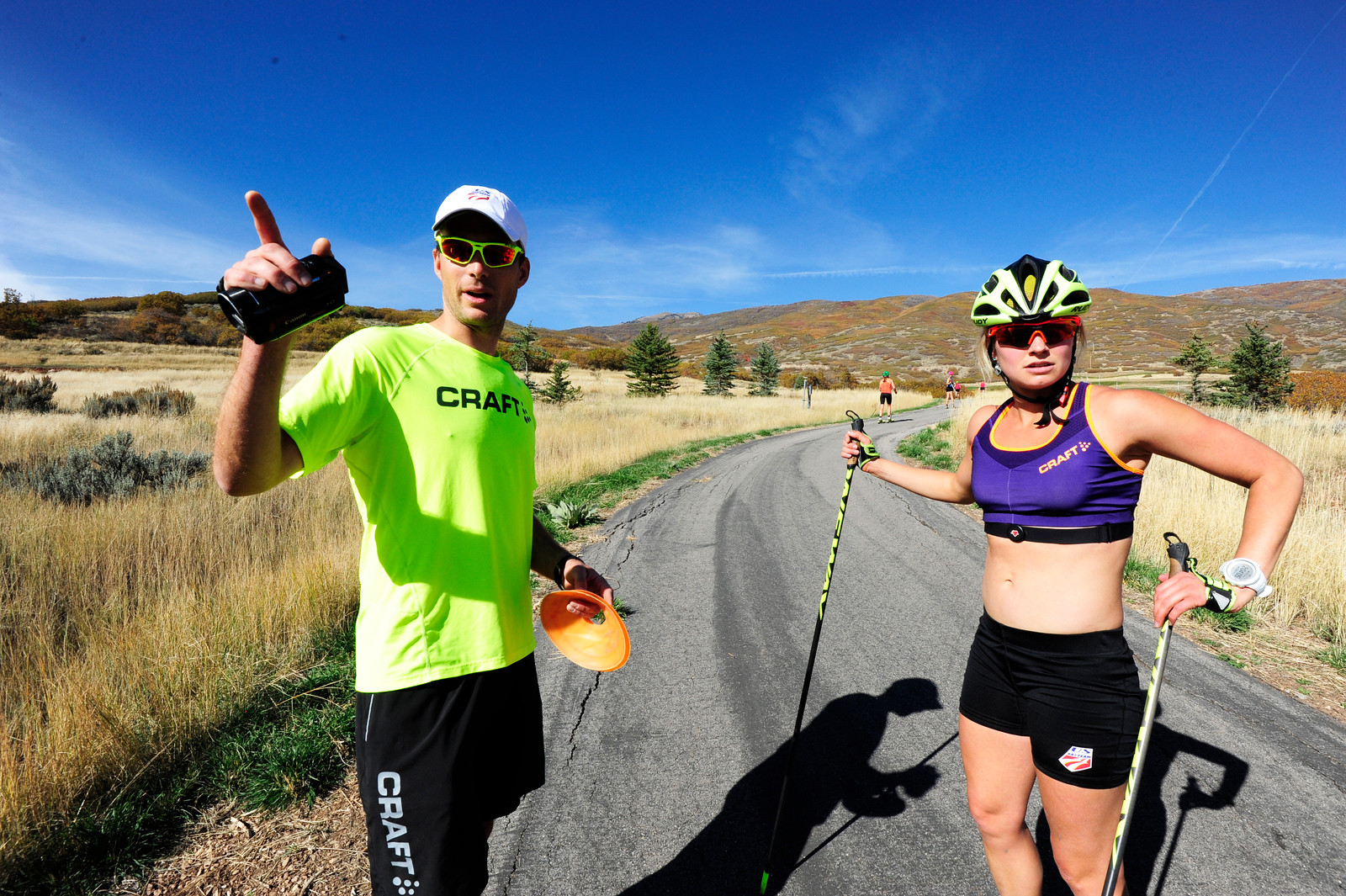
U.S. women’s coach Matt Whitcomb works with Jessie Diggins during rollerski training at the U.S. Ski Team’s annual fall camp at Soldier Hollow in Midway, Utah. (Photo: U.S. Ski Team/Tom Kelly)
The first World Cup is a little more than a month away in Kuusamo, Finland, and aside from D-team rookie Julia Kern rebounding from a slight back injury, the team is healthy, Grover said. Erik Bjornsen has resumed training at full capacity after surgery on his hand and a knee injury earlier this summer.
Team veteran Kikkan Randall recently announced her pregnancy and will be missing this season as a result. Grover was fully supportive, acknowledging her pregnancy as one of Randall’s long-term goals. The timing also worked nicely without a World Championships or Olympics this season. While Randall has been training with the team in Park City, she has scaled back her intensity and shifted toward over-distance and technique training, Grover explained.
Without a major championship on the World Cup calendar this season and a North American tour — the Ski Tour Canada — in its place, domestic competition for the additional start spots is something many U.S. and Canadian athletes are looking forward to. Per the “national quota” regulations of the World Cup, the U.S. will be able to start five additional men and five additional women for the entire Ski Tour Canada, for a total of up to 24 racers.
While Grover said the upcoming mini tour in Park City would not decide those spots, he explained the coaches were using this week’s training sessions to note the fitness of non-national team athletes. However, on-snow results will ultimately determine who receives those Canadian World Cup starts. More on the 2015/2016 World Cup Team selection criteria here.
After wrapping up the mini tour on Tuesday, the USST will leave Utah on Wednesday. Several clubs will head directly to Canmore, Alberta, for an on-snow camp at Frozen Thunder, while others, like APU and its USST members, will head back to Alaska in hopes of getting on snow as well.
The USST will reconvene Nov. 13 to fly to Gällivare, Sweden, where they’ll hold a camp and compete in a couple FIS races before traveling to Kuusamo for the World Cup openers.
***
About the Author: New to the FasterSkier team, Jeremy has been involved in many facets of the ski community since he began ditching middle school to go skiing. When not daydreaming of the Birkie, he finds time to explore the fishing and trail-running opportunities of his new home, Seattle, Wash.
Ida Sargent racing to a career-best fifth in the classic sprint at the World Cup opener last Saturday in Kuusamo, Finland. She placed 51st in the 10 k classic the next day. (Photo: Fischer/Nordic Focus)
Ruka and West came and went like the went, but the biathletes are just getting things going in Östersund, Sweden. The 2014/2015 International Biathlon Union (IBU) World Cup season kicked off Sunday with the mixed relay, where the U.S. pulled out its best performance in the last several years in seventh.
And Susan Dunklee, Annelies Cook, Tim Burke, and Lowell Bailey were just 17 seconds off fourth.
“I don’t remember our exact place here last year, but we definitely weren’t that close to a podium finish,” Burke said. “We were in it all the way until the end. It gives us good confidence going forward.”
The men get after it again in Östersund on Wednesday in the 20-kilometer individual race, starting at 17:15 CET (11:15 a.m. EST). The women’s 15 k individual will be held Thursday at the same time.
But before we launch into more biathlon, then more cross-country World Cup in Lillehammer, Norway (with three days of action Friday through Sunday) and SuperTour stop No. 2 in Bozeman, Mont., here’s what happened in the last week — starting with West Yellowstone on Friday, Nov. 28.
Dakota Blackhorse-von Jess holds off Mads Strøm during the A-final of the SuperTour men’s skate sprint in West Yellowstone, Mont. (Photo: Toko)
Things got a little stalled on Day 1 at the Rendezvous Trails with timing, but at the end of the day, Dakota Blackhorse-von Jess and Alysson Marshall emerged as the definite winners.
“West Yellowstone’s a hard place,” Blackhorse-von Jess said of the early-season race, after edging the University of Colorado’s Mads Strøm by 0.9 seconds in the men’s skate sprint. “I’m tired, everybody’s tired.”
Then there were two Canadian women that dominated the women’s sprint: Marshall in first and Heidi Widmer in second, teammates on the Alberta World Cup Academy and Canadian National Development Team. Marshall won the 1.5 k final by a boot length.
Day 2 saw Rosie Brennan outlast 17-year-old Katharine Ogden in the women’s 10 k individual start, and the win meant everything to her after facing some tough times this summer. In the men’s 15 k, Matt Gelso put himself in contention for domestic World Cup starts in just over a month with a nearly 10-second win over Brian Gregg.
The International Ski Federation (FIS) Cross-Country and Nordic Combined World Cup seasons also got rolling last weekend at the Ruka venue in Kuusamo, Finland. There, Ida Sargent was the biggest thing going for North America after a career-best fifth in the classic sprint — the U.S. Ski Team’s first race of the season. The next day, Sadie Bjornsen skied to 17th to lead the Americans in the opening 10 and 15 k distance races.
“Finland loves Ida Sargent and I know that Ida loves Finland!” former U.S. Ski Team member Holly Brooks wrote on Facebook. “So impressed w/ @sadzarue who skis fast & studies hard! Currently presenting senior thesis while racing WC in NOR!”
Alex Harvey put down two top-15 performances for Canada, including seventh in the 15 k classic, and teammate Devon Kershaw wasn’t far behind him in 14th on Sunday. Canadian development-team member Emily Nishikawa struck a career-best World Cup result in Europe, placing 38th in the 10 k.
Noah Hoffman did not finish a race for the first time in his career after crashing hard off the trail and into a fence with slightly less than 2 k remaining in the 15 k. After seeking immediate medical attention, he learned he broke his fibula, according his blog post, and headed home to the U.S. on Monday for further evaluation.
Also in Ruka, the NoCo guys got after it in the large-hill individual competition and team sprint, where Bryan Fletcher led the U.S. in 17th on Day 1 and was 13th with brother Taylor Fletcher on Sunday.
In case you didn’t thoroughly check out the eBlast where I explained about the new JetStream 2.0 and HelX 2.0 products, here is a link where you can read and learn about them. They are fantastic!
Photos from the World Cup Opener in Ruka, Finland
Erik Bjornsen on the big screen
Reese Hanneman at the start
Ida Sargent on her way to an excellent 5th place
Reese
Erik
Ida
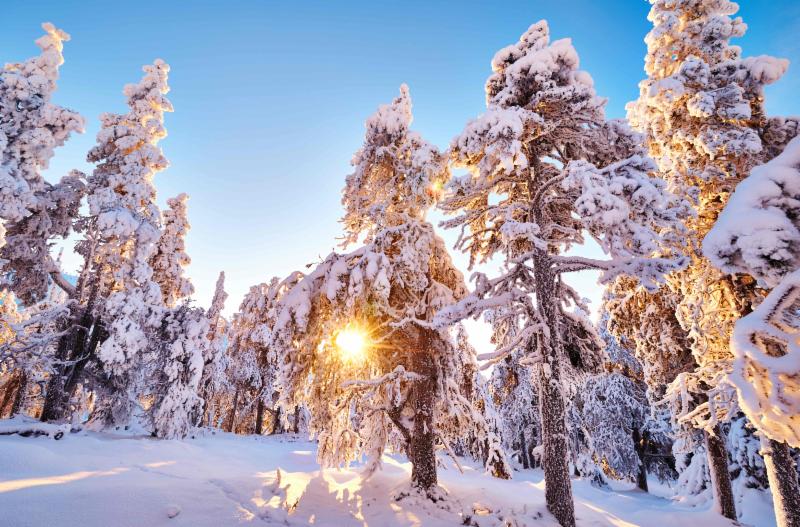
Sun shining through the trees
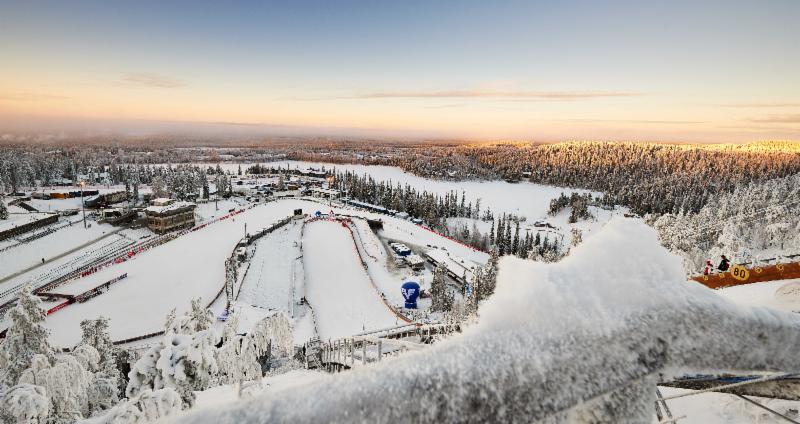
The stadium from above
West Yellowstone
I think everyone would agree that this was a great West Yellowstone week with great skiing, trees full of snow, and lots of camaraderie. One thing happened on Saturday that was interesting though. Strong winds preceded the cold front which arrived Saturday. These winds which came from the west brought with them copious amounts of dust from the potato fields just west of the Yellowstone Plateau. When the front hit, it started to snow (grauppel snow which is kind of like little Styrofoam balls). What was odd though was that the new falling snow was brown, really brown, not at all white and far less white than the old melted snow that it was falling on. Locals call this Spud Dust. It didn’t change the wax recommendation or seem to slow skis down after a bit of skiing like the volcanic ash that fell there in March of I think 2001 which really slowed skis down after a few kms.
Spud Dust on the Toko car and on the surface of the snow. Underneath it was clean. There wasn’t much dust blowing around in the air visible, it seemed to be embedded in the falling snow.
Images of the West Yellowstone SuperTour Races
Chelsea Holmes 2nd place 10k Skate
Matt Gelso winner of the 15k Skate
Dakota Blackhorse-von Jess winner of the Skate Sprint
Dakota in the prologue
Rosie Brennan winner of the 10k Skate
Brian Gregg 2nd place 15k Skate
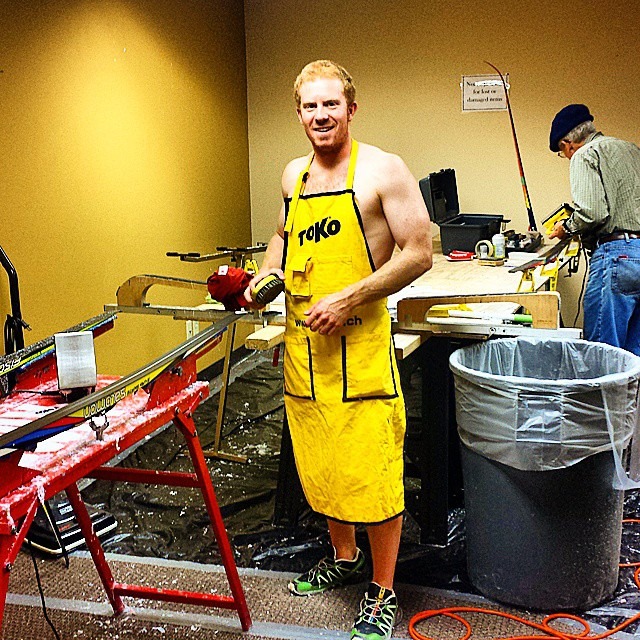
Matt Gelso putting the sizzle back in waxing
Matt on the finishing stretch with coach Colin Rodgers encouraging
You can see how much personal preference plays in glove selection. The models Thermo Plus, Classic, and Profi are quite different in their weights (from warmest to least warm), but were all well represented in all events. Same as in Ruka, Finland at the World Cup.
The snow was very “greasy” in West Yellowstone which creates perfect conditions for HelX. the HelX 2.0 waxes are outstanding! They have nothing in common with the HelX waxes from the 5 years previous. They are more similar to the old HelX Warm and Cold in that they are super durable and fast and definitely appropriate for distance Cross Country ski racing! We are very happy about these new waxes. For more information on how to apply, click on the link at the top of this page.
Toko US Facebook Contest
Toko US has started a promotion on its Facebook page where questions are asked and the first correct recipient receives a prize. Questions range from Toko trivia to “where was this photo taken”? Like Toko US today to have some fun and win some prizes!This contest will run all winter! Note: there is a Toko worldwide fb page which is quite good, but the contestwill be on the Toko US site.
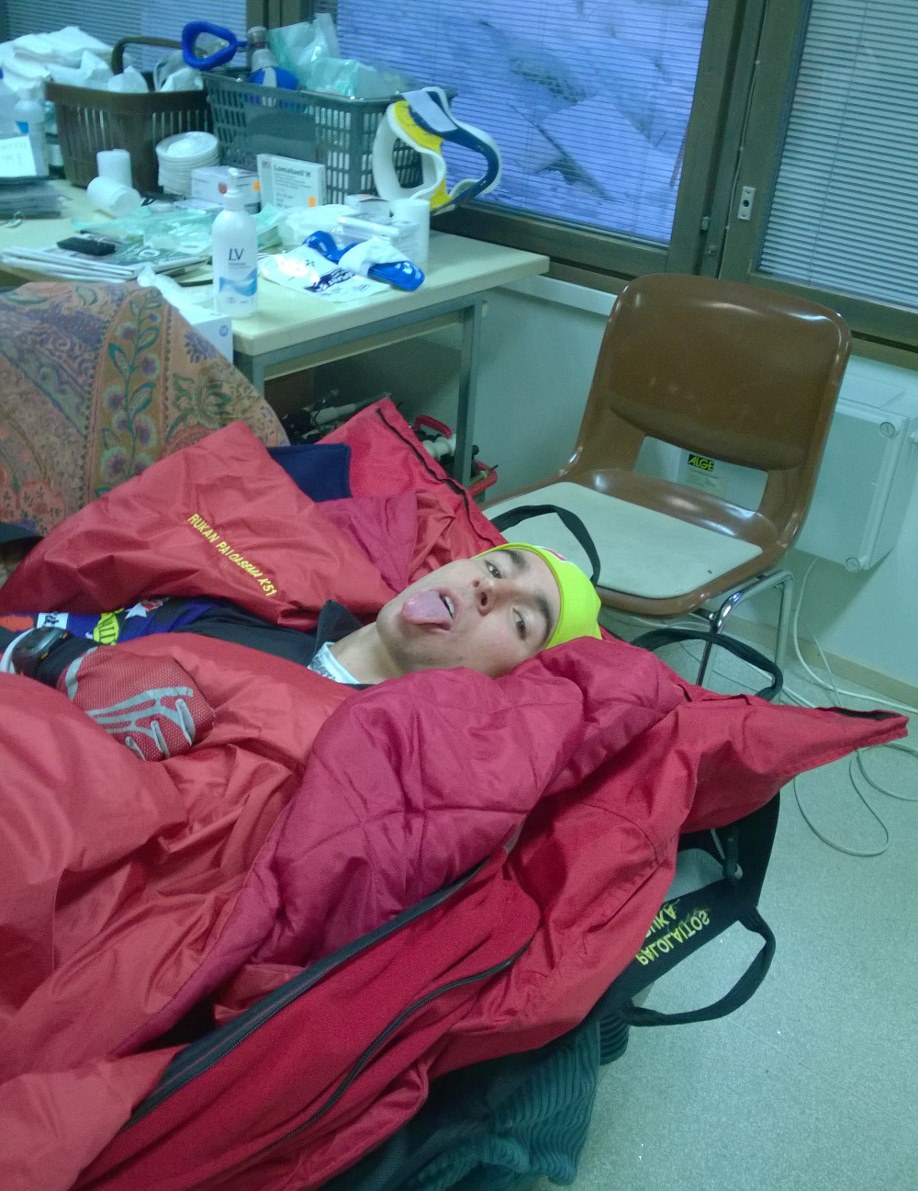
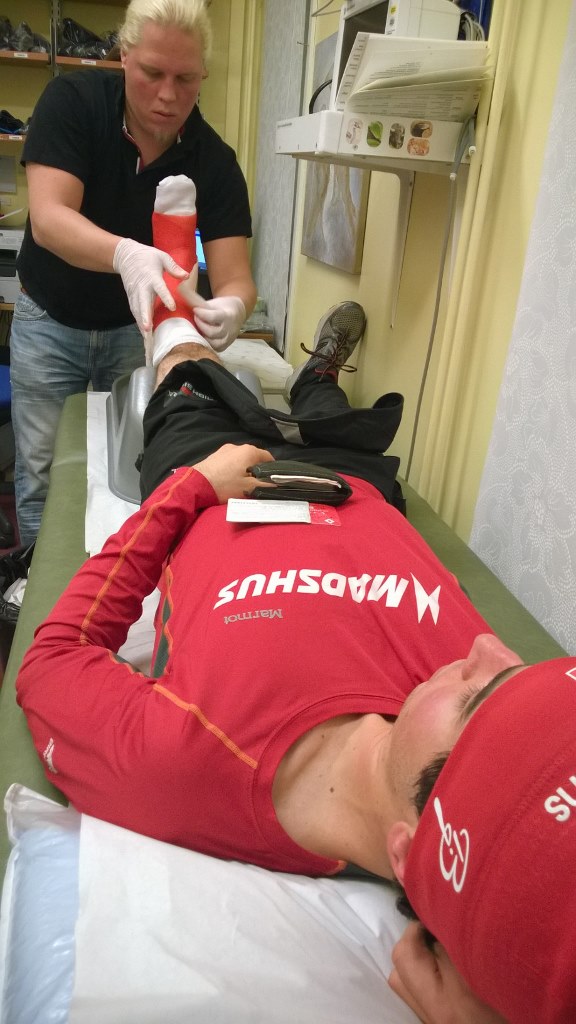
Noah Hoffman on Sunday at the Ruka clinic in Kuusamo, Finland, after breaking his fibula in the 15 k classic. He and physical therapist Peter Dickinson waited in the clinic for an ambulance to take them to a nearby medical center for X-rays. “We were only going half a kilometer and I thought the ambulance was overkill,” Hoffman wrote on his blog. (Photo: Peter Dickinson via NoahHoffman.com)
Never fail, on Monday afternoon during a flight from Frankfurt to Denver, Noah Hoffman blogged. And not just any quick update, almost a whopping 2,000 words.
The U.S. Ski Team’s top male distance skier emerged from a one-day online hiatus to explain exactly what happened Sunday in Kuusamo, Finland, where he fell hard with slightly less than 2 kilometers left and did not finish a World Cup race for the first time in his career.
Hoffman explained he aimed to start the 15 k classic — the first distance race of the season — conservatively, and he settled after the first kilometer. Waiting patiently to get a ride, he saw his opportunity with Norway’s Pål Golberg, who went on to place ninth, after the first lap around 5 k. As Hoffman accelerated to catch him up the big climb and did so about halfway up, he found shortly after that the effort was too much, too soon.
“For several kilometers I had to focus on being smooth and recovering. I lost a ton of time,” Hoffman wrote on his blog on Monday.
At the end of the second lap, Finland’s eventual third-place finisher Sami Jauhojärvi caught Hoffman. He saw that as another opportunity and stayed with Jauhojärvi around the stadium and up the big climb, but “just like the lap before, the effort was too much for me. He dropped me and I was blown,” Hoffman wrote. “I was suffering for the rest of the race. I was not skiing fast. At the 13.1 kilometer split station, which was right before I crashed, I was in 52nd place, not where I want to be.”
Hoffman went down on a sharp-righthand corner at the bottom of a fast downhill. He expected it to be icy and wasn’t intimidated by it and didn’t think it would be a problem. When he crashed on his third lap, no one was near him and he explained he wasn’t trying to be aggressive. If anything, he wondered if he should have tried to carry more speed through the turn.
“I’m not sure exactly what happened. I slid on the ice, went into the snowy berm, lost control and slammed into the fence,” he wrote.
What he thought was his right ski snapped in half as it hit the solid paper or plastic lining the bottom half of the fence. The top part was made of alpine netting. His other leg punched through the solid material and was tweaked with his left ski still in the fence. He kept sliding and injured his knee and ankle.
“I knew almost immediately that I was hurt,” Hoffman recalled. “I got up and glided about a hundred meters down the trail. I needed to get out of the way of other racers and I needed to get to some people who could help me.
“I couldn’t put any weight on my left leg,” he continued. “I knew I couldn’t finish the race, which is significant because I’ve never previously dropped out of a race. I’m bummed that I had to end that streak yesterday.”
A photo of Hoffman’s X-ray taken by Peter Dickinson. “It didn’t turn out super well but you can see the fracture in the fibula behind the tibia, at least that’s what I’m told,” Hoffman wrote on his blog. (Photo: Peter Dickinson via NoahHoffman.com)
Hoffman’s blog post was titled, “Broken Fibula,” and he included an X-ray taken at a medical center near Ruka venue, which showed a fracture in his fibula behind the tibia (shin bone), “at least that’s what I’m told,” he wrote.
“The plan then immediately became for me to get back to the U.S. as fast as possible,” he continued. “There wasn’t really any discussion about it, and I didn’t have any say in the matter. They put me in a hard cast for the travel.”
Hoffman and the U.S. team’s physical therapist, Peter Dickinson, who accompanied him to the clinic, took a taxi 300 meters to their condo “because Pete wouldn’t let me crutch down the icy stairs and hill,” he explained.
“Things happened really fast once I got back to the condo. I got on the phone with the U.S. Ski Team travel agent to try to re-book my ticket,” he wrote.
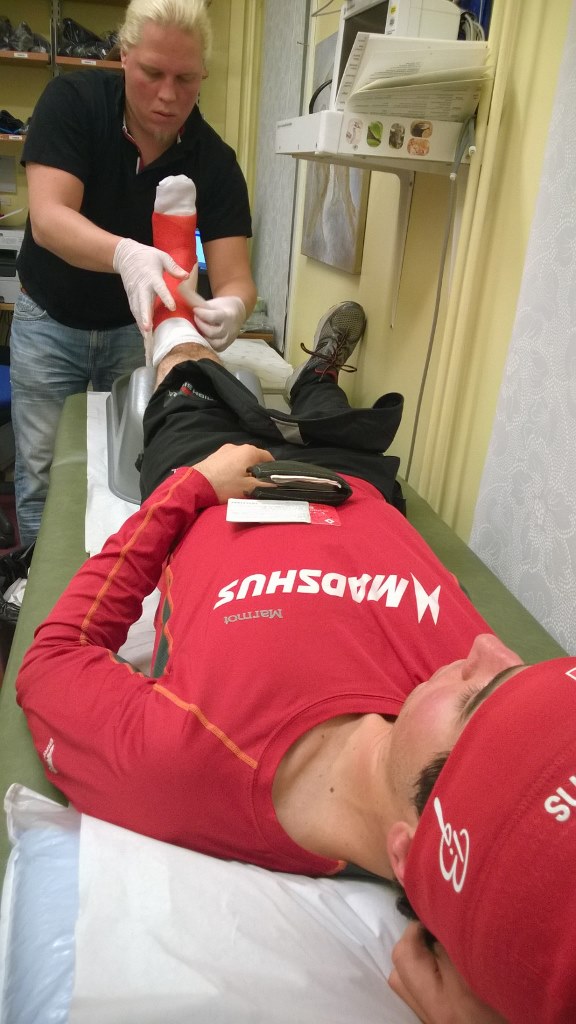
Hoffman getting a hard cast on his left leg for travel. (Photo: NoahHoffman.com)
His previously scheduled return was after the Tour de Ski in early January, departing from Munich and arriving in Hartford, Conn. Last night, he wanted to leave northern Finland for Denver on the earliest flight. Unable to re-book, he found the cheapest option was buying a new ticket for $1,000 dollars. But there weren’t any seats available in most of the airports near Kuusamo.
“When we kept striking out I started doing some research on my own and amazingly found an award ticket option through United but on partner airlines out of Lulea, Sweden,” Hoffman wrote. “The only ticket available was in business class for 70,000 miles. Luckily I had that many miles available and it sounded better to me to spend them than paying $1,000, so I purchased it at 6 O’clock last night. The flight was at 6:20 this morning. Lulea is 5 hours from Kuusamo.”
From there, two of the team’s wax techs JP Laurin and Oleg Ragilo drove him to Luleå. They were headed there anyway with a cargo van full of skis en route to Lillehammer before next weekend’s World Cup. Hoffman squeezed up front with them in the three-person bench seat.
“Oleg and Jp were ready to depart before I even booked the flight and I hadn’t packed, eaten dinner or showered. Also, my leg was quite painful,” he wrote. “Luckily I have incredible teammates. They did everything for me. I took a washcloth bath while Simi and Ida packed my duffel bag and Liz made me four peanut butter and jelly sandwiches for dinner. I got out of the condo in less than 15 minutes.
“As we took off on the long drive I had to make a ton of phone calls, organizing things at home. I talked to my coaches and parents, started the process of setting up doctor’s appointments and organized transport with [my girlfriend] Emilia for when I land in Denver,” he added. “The drive was long and monotonous on snow covered roads.”
But they got to Luleå at midnight, 1 a.m. Kuusamo time. Hoffman wrote he slept fairly well despite keeping his leg elevated.
“I made it to the airport without issue, although crutching while rolling a duffel is a challenge,” he wrote.
At the airport, Scandinavian Airlines couldn’t find his ticket number. Hoffman spent a half hour on the phone with United sorting it out and almost missed his flight.
“Since then the travel has gone very smoothly,” he added. “I’m ashamed to say I’ve been getting pushed around airports in a wheelchair.”
Once airborne, he enjoyed business class and his first time with internet access in a trans-Atlantic flight.
Hoffman is currently on blood thinners and Aspirin to reduce the risk of a blood clot. After flying into Denver, he was headed to Breckenridge, Colo., Monday evening and hoped to see a specialist at The Steadman Clinic in Vail on Tuesday.
“Then I can start making plans for my recovery and my return to racing,” he wrote.
“Because I haven’t posted anything, I didn’t know anybody knew about my crash yesterday,” Hoffman noted. “Apparently I was wrong. I just turned on my computer for the first time, and I’m overwhelmed by the number of get well messages. I feel incredibly lucky to have so much support! Thank you all.”
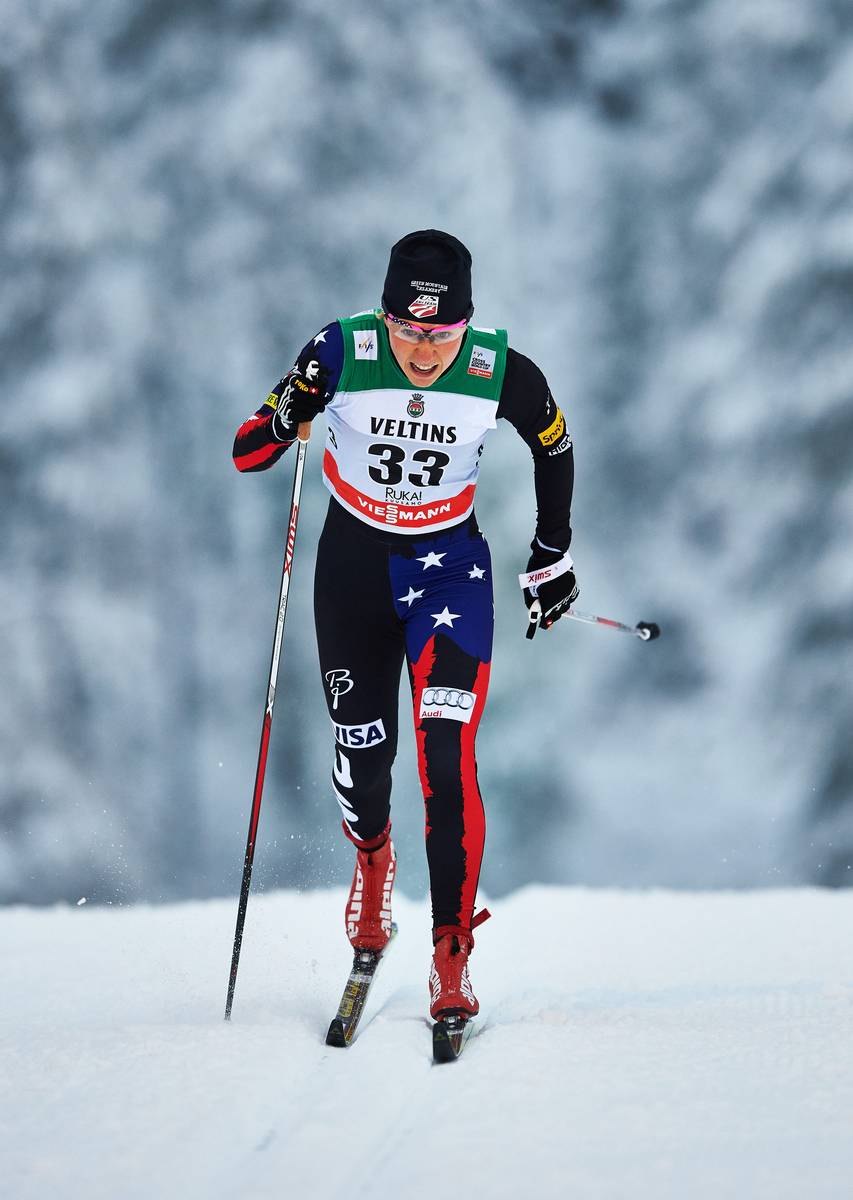
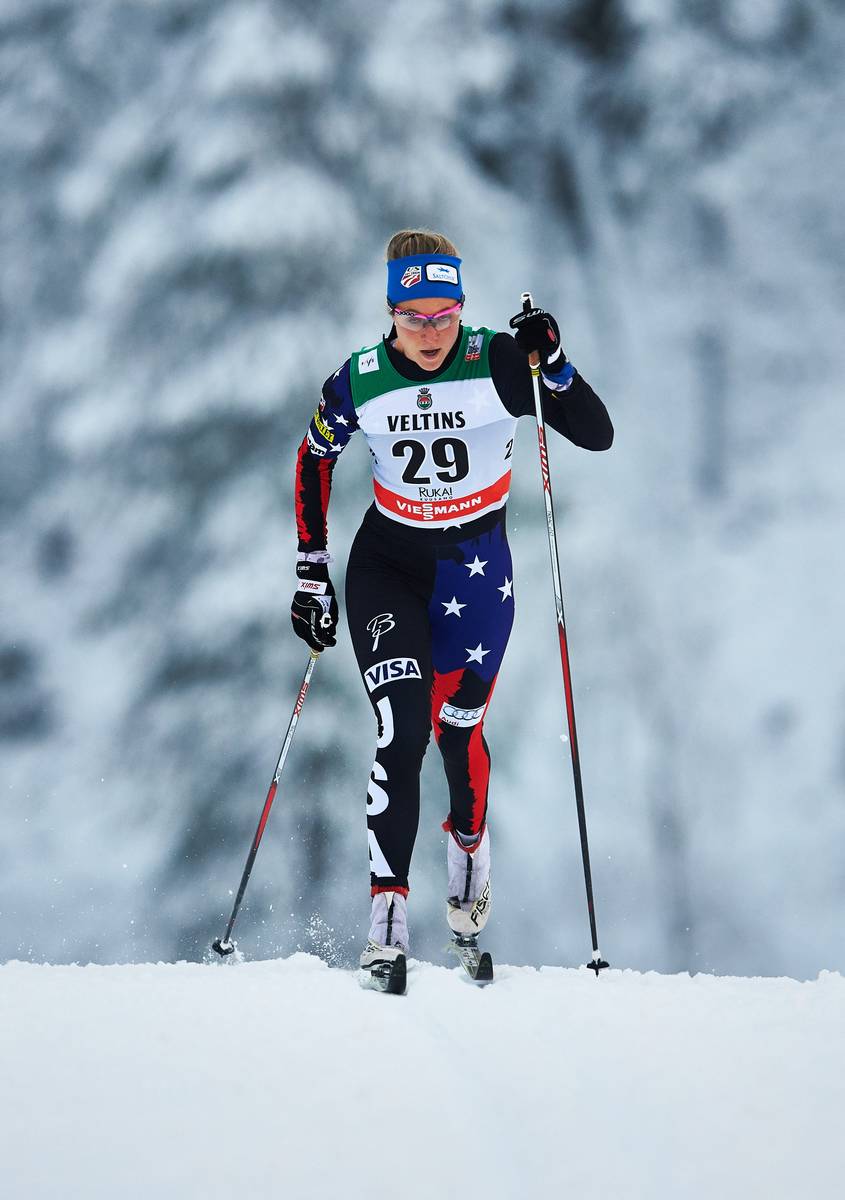
Sadie Bjornsen (U.S. Ski Team) racing to 29th in the World Cup classic sprint on Saturday in Kuusamo, Finland. On Sunday, she placed 17th in the 10 k classic to lead the U.S. (Photo: Fischer/Nordic Focus)
Sadie Bjornsen very specifically stated that she didn’t wanted to start the season as hot as in year’s past, like last year when she was seventh in the 5-kilometer classic in Kuusamo, Finland.
On Saturday, the 25-year-old U.S. Ski Team member made it into the points and the quarterfinals of Kuusamo’s classic sprint in 29th, which she said at the time was on par with how she hoped to perform in the first race of the season.
Imagine how she felt after placing 17th in Sunday’s 10 k classic.
“Sometimes how you did in the past can dictate how you feel about a result on a specific venue,” Bjornsen said on the phone after Sunday’s race. “So it would be easy to be like, ‘Oh, I got seventh last year. I wish that I did better.’ But I was actually just as satisfied today as I was one year ago. You just have different goals each year.”
Bjornsen finished 1:53.6 minutes behind the winner, Norway’s Therese Johaug, and about 29 seconds out of the top 10. She had the best American result of the day, followed by Jessie Diggins in 39th (+2:50), Ida Sargent in 51st, and her brother Erik Bjornsen in 52nd in the men’s 15 k classic.
Liz Stephen placed 55th in her first race of 2014/2015, Kikkan Randall was 57th, and for the men, Simi Hamilton finished 69th, Reese Hanneman was 82nd and Andy Newell 83rd on his birthday.
And while Bjornsen said she had a good race, in which she started faster than usual and left it all on the line on the women’s two-lap course, she didn’t consider it overly special.
“When you’re having spectacular races, you don’t notice that it’s hurting, but today was one of those days that I really did notice that it was really hurting,” she said with a laugh. “Normally, I have a tendency to have a kick at the end, and today I was just very exhausted and I didn’t have that extra gear. That’s maybe the difference between a good race and a spectacular race, but that’s often the feeling at the beginning of the season anyway.”
“When you’re having spectacular races, you don’t notice that it’s hurting, but today was one of those days that I really did notice that it was really hurting.” — Sadie Bjornsen, top American finisher in 17th on Sunday in the first World Cup distance race of the season
The 35th starter out of 77 women, she didn’t have much to work with in terms of splits, but that ended up helping her.
“When you’re out there not really knowing what’s going on, then you just rely on your own pacing,” she said. “I generally start slow and speed up, and today I was generally just excited because it was the first distance race, so I started I think harder than I normally do.”
She jumped out to the 21st-fastest time by 3.1 k, and by the halfway point, Bjornsen was up into 17th — a position she held until the finish.
“I think more impressive than last year’s race was the fact that she just looked good today and she was able to slip in the top 20,” U.S. Women’s Coach Matt Whitcomb said. “[We’re] entering the season maybe a little bit more softly than we have in the past, and it has played out a little bit that way, but for Sadie to just lay down a solid race and be in the top 20 is incredible. I think it speaks a lot to where she can go this year.”
Bjornsen noted that the race felt much harder than it did in Kuusamo last year, but that was because she had more races behind her at this point last season. This was only her second this year.
“Last year, I came into the beginning of the season with some more time trials under my belt and in a different sort of a fitness place, and this year I tried to not come in quite as hot early on,” she said. “So I was quite happy with today.”
Jessie Diggins in the Frozen Thunder classic sprint on Oct. 24 in Canmore, Alberta. That was her first unofficial race of the season; this weekend, she kicked off the 2014/2015 World Cup season with her team in Kuusamo, Finland. (Photo: Angus Cockney)
Whitcomb pointed out that Diggins also had a “very solid race” for the first classic-distance outing of the year.
“My race was OK, but not great…about how I thought I’d be feeling right about now!” Diggins wrote in an email. “I’m putting in a fairly large training week as a goal of mine is to be skiing faster later in the season and not coming into the races too hot.”
She explained that she didn’t pace her 10 k to perfection after getting too excited and catching her 30-second woman, Slovena’s Nika Razinger, who started just ahead of her, around 2.5 k.
“I paid for it later! Good lesson to learn,” Diggins wrote. “But my skis were good and I didn’t fall on the sketchy corner, so with my track record that’s actually a pretty awesome thing!”
She crashed in Saturday’s sprint qualifier and finished 64th, and fell in last year’s Kuusamo sprint qualifier as well.
“Matt joked, with my rate of falling down during the sprint yesterday I should have fallen 9 times out there today, but I improved a lot with no falls at all!” she added.
Diggins reflected that her technique on the gradual climbs had improved since last season, but she made a few mistakes on the steepest hills.
“Everyone was hopping out of the tracks and herringboning, and I tried to stay in the tracks too long because I have a pretty inefficient herringbone,” she explained. “So I was kind of stalling out and wasting energy out there! But overall, it was a great ‘training race’ and good to get the first distance race out of the way, learn some things about pacing again and get in a really hard effort.”
Sargent, who finished a career-best fifth in Saturday’s sprint, wrote in an email that she was very excited after that race and looked forward to the first distance race.
“I was hoping for a top 30 result but I was pretty far from that but that’s okay,” she wrote. “I was tired from yesterday and felt really flat. … After [Saturday’s] race, I know my fitness is good so I’m not too worried … I haven’t done a 10km since last winter so I wasn’t totally ready for today.”
Ida Sargent racing to a career-best fifth in Saturday’s classic sprint at the World Cup opener in Kuusamo, Finland. She placed 51st in the 10 k classic the next day. (Photo: Fischer/Nordic Focus)
Whitcomb observed that Sargent was simply tired, and Stephen and Randall were “well off their mark” after struggling on the climbs and herringboning to get up them.
“That’s not something that we necessarily worry about,” he said. “The results certainly weren’t where we can be. In Toblach [Italy] last year, I think we had five girls in the top [22], and today we were messing around in the 50s a little bit, and that’s fine. We had some athletes feeling pretty good.”
Like he alluded to, Randall wasn’t one of them.
“Unfortunately I wasn’t quite able to capitalize on the momentum from yesterday’s classic sprint and had a tough day in the 10km classic this morning,” Randall wrote in an email on Sunday. She finished 16th in Saturday’s sprint.
“I attempted to start aggressively but already within the first few kilometers I could feel the fire wasn’t quite there,” she added. “I struggled to kick up the climbs and wasn’t very satisfied with my technical skiing. I like the course here in Ruka but wasn’t able to take full advantage of the terrain like I have in past races here.”
According to Whitcomb, the wax wasn’t necessarily the problem for Randall.
“It was tricky snow and I heard Kikkan say she had good grip on her skis, she was just struggling to make them work,” he said. “It was still slightly unstable snow today. It wasn’t that hero skiing out there, which is what you hope for with Kuusamo because the courses are so hard anyways.”
While Randall summed up her weekend as a “mixed bag to start the season,” she explained she was glad to see Bjornsen, her Alaska Pacific University (APU) teammate, have a solid race.
“I owe my teammates for brightening my spirits after the race,” Randall continued. “I am encouraged by the feelings in yesterday’s sprint, but can tell my distance form still has a ways to go.”
“The results certainly weren’t where we can be. In Toblach last year, I think we had five girls in the top [22], and today we were messing around in the 50s a little bit, and that’s fine.” — U.S. Ski Team Women’s Coach Matt Whitcomb after Sunday’s 10- and 15-kilometer World Cup classic races
Erik Bjornsen Leads U.S. Men
Erik Bjornsen, the top American man in 52nd, started 13th of 96 men and posted one of the slowest times through the 3.1 k checkpoint.
“I guess I was a little gun shy this morning,” he wrote in an email, explaining that he purposely started extra conservatively after blowing up in a U.S. Ski Team time trial last weekend in Muonio, Finland. “It’s all about finding the sweet spot, I thinking I’m narrowing down on it. I haven’t done much racing in the last six months and the body feels a lot different then the last time I raced.”
Regardless, he was able to push hard on Sunday and recover on the downhills.
“Last year I made the easy mistake of training way to hard in November and this year I tried to be a little more conservative,” Bjornsen wrote, adding he felt fortunate to start the season in Europe. “I want to make the most of all the [World Cup] starts I get. Coming into it I knew that these first two World Cup weekends were going to be some of the hardest for me. Not only are they in Scandinavia, which means lots of fast national group skiers, but I also tend to start off the season a little slow.”
Simi Hamilton racing to 16th in the Kuusamo classic sprint, the first race of the 2014/2015 season. The next day, he placed 69th in the 15 k classic. (Photo: Fischer/Nordic Focus)
The conditions in Kuusamo were a bit tough for him, and he found himself running outside the tracks and double poling hard to make up time on Sunday.
“I was surprised with the race feelings the last couple of days,” he added. “The body has felt pretty good even though it has been a little flat the last couple weeks. I can tell that the fitness gains I made this summer are going to pay off.”
Also a rookie at starting the season in Europe, Hanneman, the 2013/2014 SuperTour winner, explained he was mostly excited rather than nervous for Kuusamo.
“Usually, it takes me a couple of races at the start of every season, even last year, to really get going, just because of the way I train,” Hanneman, also an APU skier, wrote in an email. “So I guess there might have been a tiny bit of that, just knowing that the consequences of not being peaked can be huge on the World Cup.”
“I was being caught on the monster climb as we approached this downhill by a couple A seed guys including a Finn,” Hanneman explained. “The crowd was going nuts for him, and then when we started sending it down the downhill, he started yelling at me from behind and I wasn’t sure what side he wanted me to go on. I didn’t make across the trail it to the best line, which is riding the powder berm, so I just washed out on the crazy ice on the inside.
“Ruka is insane; this is my first time here,” he added. “I think people in the US who haven’t seen World Cup courses really misunderstand how hard they are; I know I did before I started racing them. The climbs here are so big, and especially so steep, there’s really nothing like them in the US. And that goes for the downhills too. Any time people say downhills in the US are too fast or too technical, I’m like… “No…” These ones here are so, so fast. TV doesn’t do them justice at all.”
One position and 2.7 seconds back in 83rd, Newell described his race as “pretty awful.”
“I really try not to be negative but there wasn’t a whole lot of positive things for me to take away from this race,” he wrote in an email. “Maybe it’s not the course for me but I always struggle with kick here and was doing a ton of slow [herringbone] out there today.”
His fitness felt good, he added, but he didn’t feel like he’d shown it in his first two World Cup races.
“I think in the future I’ll need to re-think my strategy in preparing for these races or just skip them altogether and focus on starting the season on the 2nd or 3rd weekend,” Newell wrote.
On Sunday night, even without teammate Hoffman, who was on his way to the airport 400 kilometers away to seek treatment in the U.S. for his lower-leg injury, the Americans celebrated Newell’s 31st birthday with reindeer pizza. On Monday afternoon, they planned to fly to Norway to prepare for next weekend’s mini tour in Lillehammer.
***
Notes: Caitlin Gregg was listed as a DNS (did not start) after waking up Sunday morning and deciding to take the day off racing.
“I am racing a little more strategically this year,” she wrote in an email. “I wasn’t feeling like I was going to be fighting for World Cup points this morning when I woke up so I decided to save my energy for next weekend’s skate races! At this level, feeling a little ‘off’ can put you waaay back in the results!
“The only way I will make World Championships is if I score World Cup points in this first period,” she added. “So I am really being careful with my energy and race decisions. I am happy to report that my decision not to race didn’t take a start spot from anyone else, just let me get in another solid day of training before next weekend!”
Alex Harvey (Canadian World Cup Team) racing to 14th in Saturday’s classic sprint at the World Cup opener in Kuusamo, Finland. (Photo: Fischer/Nordic Focus)
Alex Harvey made it clear heading into the World Cup opening weekend in Kuusamo, Finland, that he had one main goal — to ski into the points. That meant the top 30, which he checked off on Saturday after placing 14th in the classic sprint. On Sunday, the 26-year-old Canadian came out with a similar attitude and ended up seventh in the 15-kilometer classic, 27.8 seconds behind the winner, Iivo Niskanen of Finland.
Aim low, finish high? Not exactly. Harvey was simply being realistic.
“Any time I start a race, I want to be on the podium obviously,” Harvey said on the phone after Sunday’s race. “But I know at the same time that I have no podium in my life before Christmas.”
In Kuusamo, he had achieved as high as seventh three years ago in the 15 k classic pursuit, when the race was part of the Ruka Triple mini tour. That same year in 2011, he placed fifth in a 15 k skate in a tuneup FIS race the weekend before in Sjusjøen, and in 2010, he was ninth in Kuusamo’s skate sprint. But other than those results, Harvey said he historically has struggled to find his speed early in the season.
Last year at the Ruka Triple, he was 38th in the classic sprint, 30th in the 10 k classic and 48th in the 15 k freestyle pursuit for 42nd overall. So yeah, seventh and 14th this time around was welcome improvement.
“I was just really trying to be in the points, get things going, like, start the engine, and get some good feelings on skis,” he said. “After the sprint, I knew the speed was there, usually that’s the biggest issue for me, so I knew with the speed being there, my guess would’ve been probably a top 20, top 15, like after [Saturday], so that exceeded a bit my expectations.”
Harvey started toward the back of the pack — 88th of 96 men — and by the 8.1 k checkpoint, he was into the top 10.
“I actually tried to start a bit harder than normal,” he said, after posting the 14th-fastest time though 3.1 k. “I’ve been working on that for four years now. I know I can have one of the best last 5 k compared to anybody else, but it’s always on the first 5 k that I seem to lose a lot of time.”
He said 14th early on was, “pretty much as good as it gets. After that I was able to slowly make my way up the field, and I was able to have a really solid last lap.”
At the finish, Harvey was sixth, only to be bumped one place by eventual-second-place finisher Martin Johnsrud Sundby of Norway. Last season, Sundby topped everyone for the Overall World Cup crown, and Harvey finished 2013/2014 out with a career-best third overall.
Devon Kershaw at the Frozen Thunder classic sprint on Oct. 24 in Canmore, Alberta. After placing 57th in Saturday’s sprint in Kuusamo, Finland, he shaved his beard. (Photo: Angus Cockney)
Kershaw Up to 14th
Another Canadian well up into the points on Sunday was Devon Kershaw, who was 57th in the sprint qualifier the day before after struggling a bit with grippy skis. Kershaw finished 14th, 42.1 seconds back from the winner, in what he called his favorite race: the 15 k classic.
But Kuusamo has never been an easy place to start: last season, he was 77th in the sprint, 64th in the 10 k classic and 65th overall after the 15 k pursuit. In 2012, he finished the mini tour a much-better 22nd, and his best result before that was eighth in the 2011 15 k classic pursuit.
The course itself is widely considered one of the most brutal on the World Cup (although Canadian World Cup coach Tor-Arne Hetland said there are no easy courses on the circuit), and on Sunday, racers had to tackle three massive hills each lap.
On top of that, Kershaw noted that North Americans, which typically have a season-long World Cup team in place at the start of the season, have to compete with Europeans vying for a spot on their respective nations’ World Championships teams every weekend.
“It seems like Period 1 is always very difficult because the big teams are vying for spots … They can’t afford to put the focus on later in the season like I’ve been able to do my whole career as a Canadian,” he said. “So it’s a very difficult course, coupled with guys that are very well prepared. It’s always a hard place to be. If you’re a little bit off in Kuusamo, it looks worse than it is maybe.”
Fortunately, he was firing on “normal” cylinders on Sunday.
“I’ve made some significant changes in my training and been feeling really good about the preparations we’ve been doing and been feeling good in workouts, but you know, it doesn’t mean much if you can’t deliver with a race,” Kershaw said with a laugh. “To ski smooth and have a really solid race, it feels really good, and it’s just confirmation that I made the right changes, at least I believe I did, and we’ll just have to see moving forward. Not feeling amazing, amazing on the steep terrain, but it’s very rare that I ever have. It was very good compared to the last couple years.”
He added that he was most pleased with his first and last laps, and said he “fell asleep a little bit” on some of the steeper climbs in the middle. Starting 50th, he finished sixth and dropped to 14th, but he expected that.
“The splits didn’t really tell me a whole lot today … like, 28 of the best distance skiers in the world were behind me,” Kershaw said. “But I knew of course getting splits like that meant I was starting faster like I wanted and I had good snap.”
His 3.1 k time ranked ninth fastest at the end of the day, and he hovered around 24th at 8.1 k and was back up to 13th with 2 k to go.
“The flatter sections, the double-poling sections and the gradual sections, in my whole career that’s where I’ve been the strongest,” he explained. “I was feeling right back to normal on that terrain and the steeper hills, the first hill, I’ve still got work to do [there]. I felt like my technique was slipping a bit on that terrain, but my skis were very good today and I was super happy with what the boys put together for me. We did a good job testing [skis] after [Saturday] so we adjusted really well.”
Ivan Babikov (Canadian World Cup Team) finished 57th, and Graeme Killick (Canadian Development B-Team) was 71st.
Another national-development-team skier, Emily Nishikawa notched her best World Cup result in Europe, placing 38th in the women’s 10 k classic. Two years ago in Canmore, Alberta, where she lives and trains with the Alberta World Cup Academy, she placed 34th in the World Cup skiathlon.
“I was really happy with my race today!” Nishikawa wrote in an email. “I started out a little slower, that was the plan, to really ramp it up in the 2nd half, and I was able to do that.”
Skiing around 60th for the first half of the race, she jumped to 40th by 8.1 k and closed for 38th, 2:43.9 minutes behind Norwegian winner Therese Johaug.
Emily Nishikawa racing in Stockholm last March. (Photo: Fischer/Nordic Focus)
“I caught some great rides from [Finland’s] Aino Kaisa Saarinen, and [Poland’s] Justyna Kowalczyk [who ended up fourth],” Nishikawa wrote. “I was really happy to hang on to Justyna for the last 4 km. I lost a few seconds to her on the last climb into the stadium, but I was really happy with the way I skied.
“I am really looking to build off this great start to the season,” she added. “I know I can get into the top 30, I was close today, and that really motivates me for the next race.”
After the first World Cup weekend in his first season with the team, Hetland was generally impressed.
“For Emily, a personal best in the World Cup, that’s a good start for her,” he said on the phone Sunday. “That she could ski together with Aino Kaisa Saarinen, with Kowalczyk on the track, that’s a good race for her. For the boys, of course the results from Alex have been very good and also the 15 k from Devon today was also good.”
“Ivan was a little bit under his best level in the race today, but he will be improving to the next weekend,” Hetland added.
Babikov posted the 45th-fastest time at 3.1 k, and by 8.1 k, he was up to 37th.
“In the start he lost a little bit time and then he had a good part in the middle and was climbing on the result list,” Hetland observed. “But on the last hill, he broke a pole and lost a little bit of time. He would have been somewhere between 29 and 45th if that didn’t happen. He will be better when he gets some more races.”
Looking at the rest of the team, Hetland said Valjas, who missed qualifying in the sprint in 39th, was close to the heats, but not quite fast enough. “But it’s easy,” he said. “Also I think [Killick] will need some more races on this level before he’s on his best level, and he will get new chances on the next weekend.”
Canada’s other male development skier in Europe, Jess Cockney raced at the Norwegian Cup this weekend, placing 13th in the classic sprint and 39th in the 10 k classic. Perianne Jones (Development B-team) was 48th in the women’s sprint.
“I think it’s good racing, but there is potential for racing faster so we will keep on working hard,” Hetland added. “Now we have to reset and preparing for Lillehammer and then we will do as good as possible there.”
Kershaw said it’s been helpful to talk with Hetland about realistic expectations and not get too wrapped up in past results — or overall finishes, like when he ended up second in the 2011/2012 World Cup.
“I feel the funniest thing with skiing, or even with anything, is you’re kind of, or I tend to, compare myself to the best I’ve ever been — and the best I’ve ever been was the best in the world,” Kershaw said with a laugh. “It’s so unfair because the last few years, I’ve been off that mark. I’ve been talking a lot with T.A. about that, just to build through the season and not get down on myself and really focus on the process.”
“What the past [was] is not so important,” Hetland said. “We’re racing now and what is the slogan this year? ‘This is our time.’ So we are concentrating on the races this year and we will try to improve for each weekend now. The races have been very good and the team has been performing well. Of course there is somebody that is happy with the results and some that are not so happy.”
Therese Johaug celebrates her dominant performance in Sunday’s 10 k classic in Kuusamo, Finland, which she won by more than 42 seconds over Norwegian teammate Marit Bjørgen.
In the opening distance race of the World Cup season, Therese Johaug of Norway dominated from the start and walked away with her first-ever World Cup win in a 10-kilometer classic.
From the moment Johaug, 26, set out on the course during Sunday’s race in Kuusamo, Finland, it was clear that the rest of the women’s field would be racing for second. Even the ever-dominant Marit Bjørgen of Norway, who was coming off a win in the 1.4 k classic sprint the day before, knew that Johaug was going to win.
“I knew after four kilometers that Therese was 25 seconds ahead and I understood I would be fighting for second place,” Bjørgen told FIS after finishing second, 42.2 seconds back from Johaug, who won in 25:47.2. “I was pushing as much as I could to take second place.”
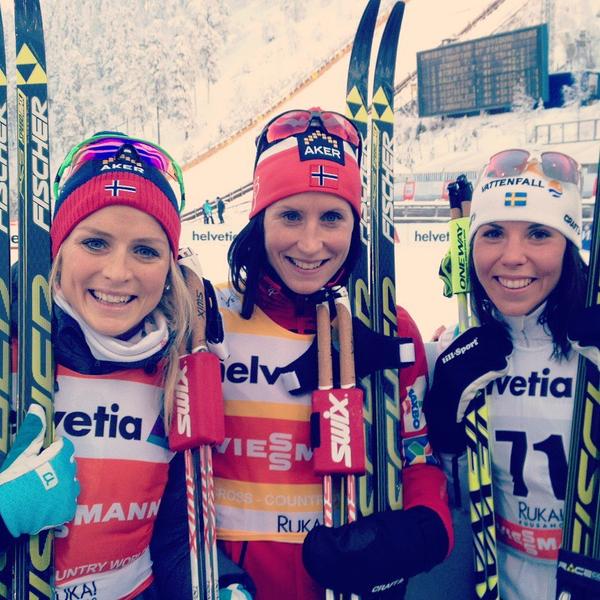
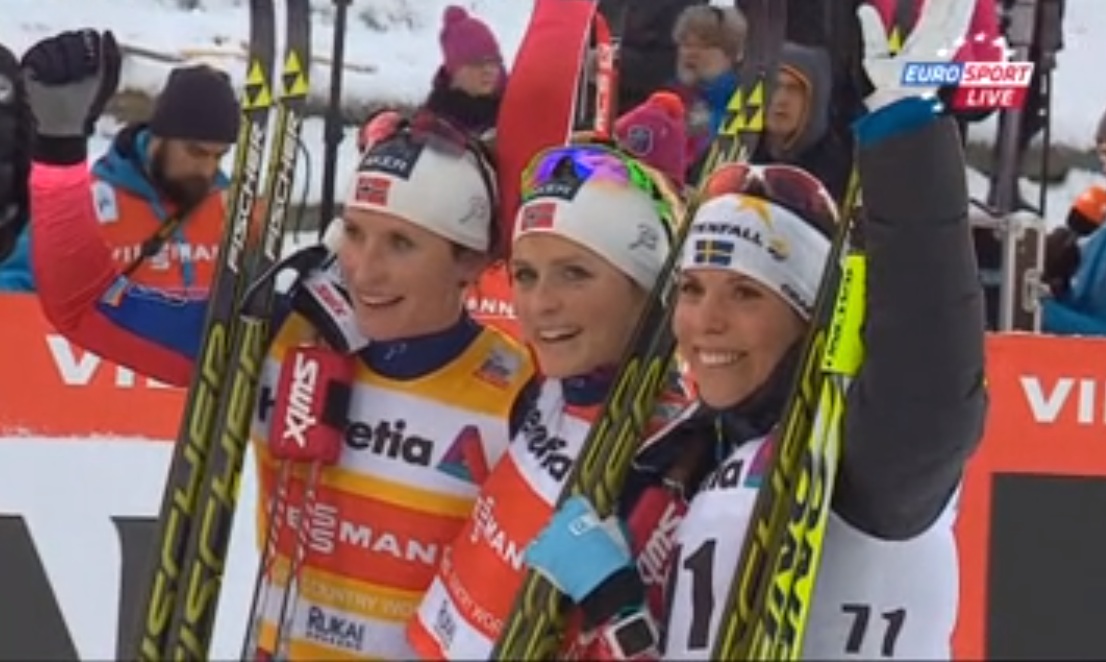
The women’s 10 k classic podium on Sunday in Kuusamo, Finland: with winner Therese Johaug (l), runner-up Marit Bjørgen (c) and Charlotte Kalla in third. (Photo: FIS Cross Country/Twitter)
A two-time winner of the Kuusamo 10 k classic in 2005 and 2007 (the last time it was held was 2008), Bjørgen, who started last of 77 women, appeared to ski a very controlled-and-tactical race. She passed through the 3.1 k checkpoint in fourth behind Johaug in the lead, Poland’s Justyna Kowalczyk in second, and Sweden’s Charlotte Kalla in third.
At each subsequent time check, Bjørgen moved up in the rankings. She was in third at the halfway point and slid into second by 8.1 k, but only by a razor-thin margin of one-tenth of a second over eventual third-place finisher Kalla (+44.1).
Rounding the final bend, Bjørgen put in a hard kick and barely bested Kalla, finishing 1.9 seconds ahead of the her.
Bjørgen was the overall victor in last year’s “Ruka Triple” in Kuusamo. This year, there were just two races — both of which counted for full World Cup points. Bjørgen’s win on Saturday put her in the overall World Cup leader’s bib for 2014/2015, and she remained 70 points ahead of Johaug after Sunday.
Last year, a 5 k classic was held on Day 2, when Kowalczyk took the win, Bjørgen placed second and Johaug finished third.
On Sunday, Kowalczyk was consistently in second for the first half of the race. However, by 8.1 k, she had faded and slipped to fourth where she would ultimately finish.
“I thought that the gap will be more… It hurt, but it’s a good position [for the start of the season],” she wrote in on Facebook, according to a translation.
“I knew after four kilometers that … I would be fighting for second place.” — Marit Bjørgen, 2nd in Sunday’s 10 k classic after Norwegian teammate Therese Johaug
Knowing Johaug and how pumped she was about Sunday’s 10 k, Norwegian Woman’s Head Coach Egil Kristiansen worried she might start too hard.
“I noticed that she was very excited after Saturday’s sprint … I was almost afraid that she would open too hard,” Kristiansen told Langrenn.com, according to a translation. “The skis were good, technique set and everything was correct. I cannot remember the last [time] there was such a victory margin. A fantastic race.”
“I am really happy now because this is my first victory in [a 10 k] classic,” Johaug told FIS afterward. “I’ve never been to the top of the podium in this race [until] today.”
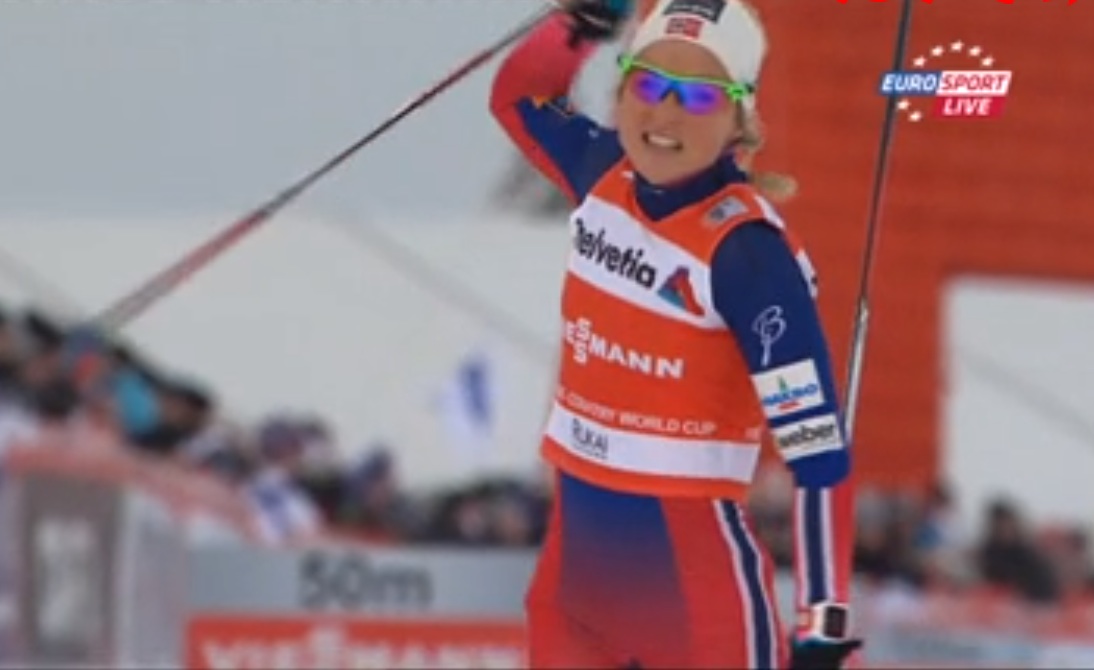
Approaching the finish, Johaug appeared fatigued, but continued to attack until the end. About a meter before the finish, she pumped her right fist into the air and let out a scream before collapsing her hands to her knees after the finish. She had essentially just won it — even with Bjørgen — still on course, she gave herself the liberty of a small celebration as her foot crossed the line.
“I think I’ve never been so good classical ever, especially in kick-double-pole,” Johaug told NRK. “I heard 20 seconds, then 30 and 40 … ‘This is your victory,’ I told myself.”
Bjørgen (l), Johaug (c) and Kalla get together after the women’s 10 k classic on Sunday, the first World Cup distance race of the season in Kuusamo, Finland.
Kalla, who did not compete in Saturday’s sprint race but swept three FIS races in Bruksvallarna the weekend before, had a stellar performance, nearly holding off Bjørgen. She told FIS after the race that she spent a lot of time working on her classic technique.
“I am very satisfied with the third place,” Kalla said. “I felt very good last week at the national opening and I’m glad I could keep the good shape to Ruka. I tried to do my very best today.”
Kristiansen had some praise for the 27-year-old Swede: “Charlotte’s strong and we knew in advance,” he told Espressen.se. “It’s good for us that we have two ahead of her.”
Norway took three of the top five, with Ingvild Flugstad Østberg in fifth, putting her third in the overall World Cup standings. Russia’s Yulia Tchekaleva finished sixth, Krista Parmakoski was the top Finnish woman in seventh, Norway’s Heidi Weng was eighth, Austria’s Katerina Smutna ninth, and Finland’s Kerttu Niskanen 10th.
With the opening weekend behind the World Cup athletes, they will move onto Lillehammer, Norway, for a three-day series next weekend, including freestyle sprints on Friday, 5/10 k freestyle races on Saturday, and 10/15 k classic pursuits on Sunday.
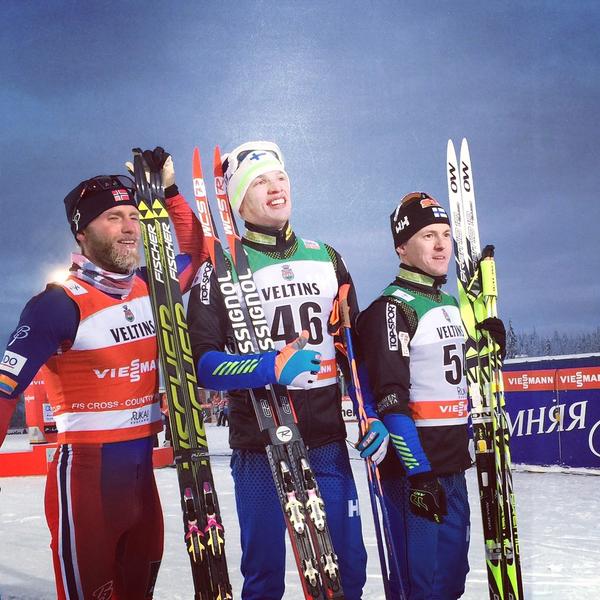
The men’s 15 k classic podium in the first World Cup distance race of the season on Sunday in Kuusamo, Finland: with Finland’s Iivo Niskanen (c) in first and Sami Jauhojärvi (r) in third, and Norway’s Martin Johnsrud Sundby in second. (Photo: FIS Cross Country/Twitter)
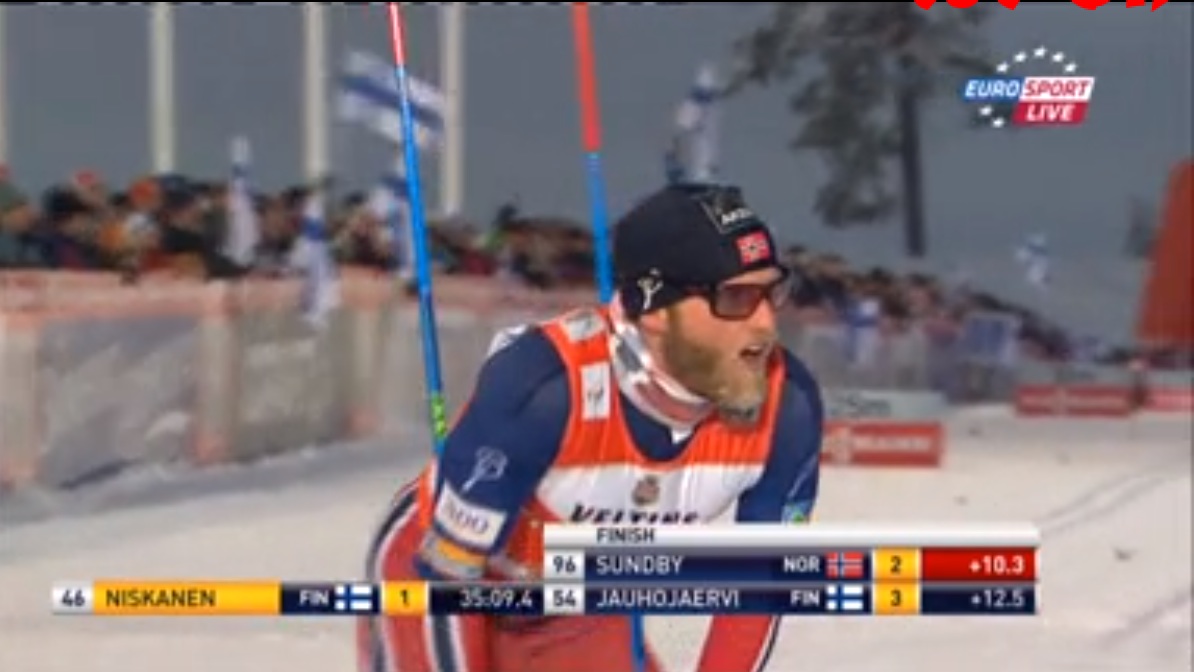
Iivo Niskanen appeared itchy in the leader’s chair on Sunday, after finishing with the fastest time of the day through 46 racers in the men’s 15-kilometer classic sprint — the first distance race of the 2014/2015 season.
Itchy, anxious, whatever you want to call it, but happy.
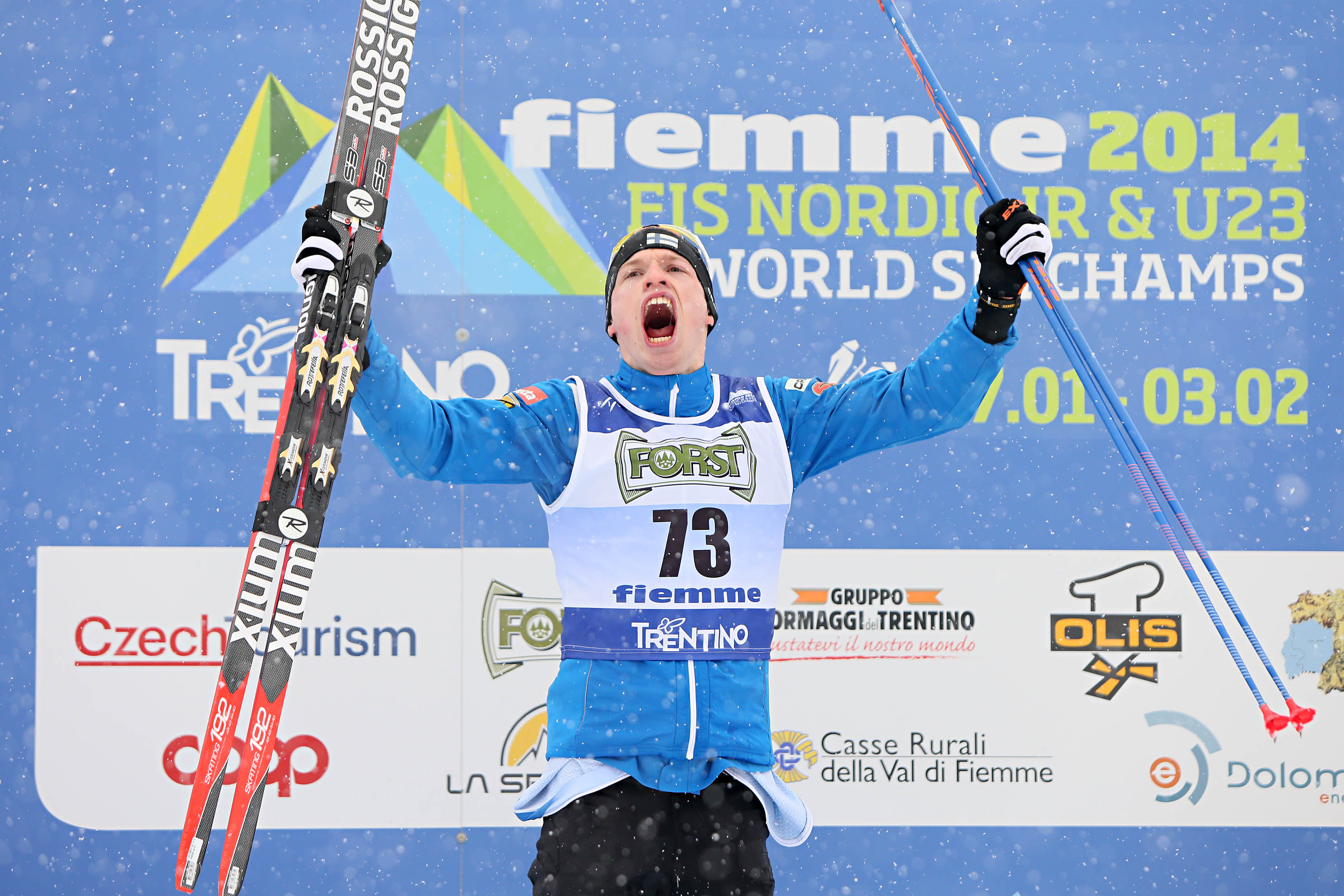
Iivo Niskanen (FIN) celebrating his win in the 15 k classic at the 2014 U23 World Championships in Val di Fiemme, Italy. (Photo: Fiemme 2014)
The 22-year-old Finnish A-team member, defending U23 World Championships 15 k classic champion and younger brother of Kerttu Niskanen, had never been on a World Cup podium before.
He won gold in the 2014 Olympic classic team sprint with teammate Sami Jauhojärvi, but individually, this was a big deal.
Fourteen men raced for Finland on Sunday in front of Ruka’s packed stadium in Kuusamo, Finland, but the man of the hour was Niskanen. The 33-year-old veteran Jauhojärvi wasn’t far behind him — 12.5 seconds at the finish — and ended up on the podium, too, but Niskanen soaked up the most crowd love and blew the most kisses after the race was over.
Moments before he officially won it in 35:09.4 — by 10.3 seconds over Norway’s Martin Johnsrud Sundby — Niskanen jumped out of the cushiony chair and got ready to run like crazy down the finishing stretch.
“It’s amazing that this [victory] came in front of a home audience,” Niskanen told the Ilta-Sanomat, according to a translation. “I just realized a little boy’s dream. Thanks to the military forces. We have two men on the podium; it is a fine specimen of a job well done.”
Niskanen started early in the seeded group, 46th of 96 men, and consistently clocked the fastest times through each passing checkpoint about every 1.5 kilometers. That’s impressive enough for a U23 in his first full-time World Cup season, but Niskanen’s times held up as more than 30 other races passed through.
Maxim Vylegzhanin skating the Russian 4 x 10 men’s relay to silver in the 2014 Olympics in Sochi, Russia.
By the time Russia’s Maxim Vylegzhanin in bib 82 hit the 1.4 k marker, Niskanen had his match. The 32-year-old Vylegzhanin came through the checkpoint 2 seconds faster than Niskanen, and by 3.1 k, he remained 1.5 seconds ahead.
A third of the way through at 5 k, Niskanen had the edge over the Russian by 4.3 seconds, followed by Jauhojärvi, Sweden’s Daniel Richardsson, Sundby, Sweden’s Lars Nelson, and Russia’s Sergey Turyshev, respectively.
By 6.4 k, Niskanen and Vylegzhanin were dead even, 8.8 seconds ahead of Jauhojärvi. One-and-a-half kilometers later, Niskanen had a 7.1-second cushion as Vylegzhanin began to fade.
Jauhojärvi was still third fastest through that checkpoint, 9.7 seconds back, and Norway’s Niklas Dyrhaug was up to fourth after a conservative start.
Dyrhaug, who started 30th, took his position in the leader’s chair after finishing in 35:22, 28.5 seconds faster then previous leader Francesco De Fabiani of Italy. The Norwegian would stay there until Niskanen bested his time by 12.6 seconds.
At the 10 k mark, both Niskanen and Jauhojärvi were faster then Vylegzhanin, and it seemed first and second was possible for Finland. But there were still more competitive racers to come, including Sundby, the reigning overall World Cup champion.
Niskanen had nearly 15 seconds on Jauhojärvi at 11.4 k, and Vylegzhanin was 14.8 seconds back in third. The Russian slipped to eighth by 13.1 k, and Sundby slipped momentarily on what looked like slightly slick skis — or maybe he was just getting tired on Kuusamo’s relentless three-lap course.
With less than two kilometers to go, Sundby was up to second regardless, 14 seconds behind Niskanen. Jauhojärvi was another 1.5 seconds back in third.
Niskanen sat grinning from ear to ear under the lights in the Ruka stadium. As Sundby hoofed up the final climb, grimacing through a thick beard and big sunglasses, it was fairly evident he wasn’t going to touch the young Finn. Sundby put on a strong finishing kick around a Russian at the finish, and secured second, 2.2 seconds ahead of Jauhojärvi in third.
Sundby finishing and looking up to confirm he placed second in Sunday’s World Cup 15 k classic in Kuusamo, Finland.
“It is lovely to get on the podium, although I wanted to win,” Sundby said to NRK, according to a translation. “I was basically shot against Iivo.”
While he said he was “not flying on skis yet,” he hoped it would come with time.
“My ultimate goal is to be in my best shape in Falun,” he told FIS.
Sundby bumped fellow Norwegian Dyrhaug to fourth, just one-tenth of a second off the podium. But he wasn’t too upset.
“I am very, very happy to be back in top form,” Dyrhaug told NRK. “I’ve had two tough years, so it’s good to know that the body is working again.”
Standing on the podium with him for the first time in a World Cup since 2010, Jauhojärvi said he felt like he skied smoothly, but he wasn’t completely satisfied.
“I heard from Norwegian split times that Niklas [Dyrhaug] was in the lead,” Jauhojärvi told FIS. “He was skiing behind me so I had to speed up in the last kilometers. I did not feel strong and fast today, but I had extremely good skis.”
Niskanen, who became Finland’s first male to win in Ruka in 19 races there, said both his grip and glide were perfect.
An exhausted Iivo Niskanen at the finish of Sunday’s 15 k classic in Kuusamo, Finland, which he won for his first World Cup podium.
Walking through the mixed zone, Finnish coach Magnar Dalen yelled to journalists, “Watch out for that boy there! He is a cross-country Messi!” referring to the Argentine soccer great.
“I was an amazing day; I had to be smart,” Niskanen told NRK. “I have done many races here and knew I had to turn down the pace two notches on the hills and makes it up [on other parts of the course].
“It was really noisy along the course,” he said to FIS. “Before the race I thought I could be in top six. I tried to improve the summer training and I seem to have done a good job. It was pretty nice that my family could be here today with me.”
“It was impressive,” said Petter Northug, who placed 23rd and 1:02.7 back, to NRK. “Niskanen looks like he has risen.”
Vylegzhanin tied Didrik Tønseth for 11th, 37.5 seconds behind Niskanen. Russia’s top skier, Alexander Bessmertnykh finished fifth, Calle Halfvarsson of Sweden was sixth, Canada’s Alex Harvey seventh, Simen Håkon Østensen eighth, Pål Golberg ninth, and Finland’s Matti Heikkinen 10th.
Turyshev ended up 25th, four seconds behind Switzerland’s Dario Cologna in 24th (+1:05.2).
“Iiiiivoooo!! Unbelievable!!!” Kerttu Niskanen tweeted after Sunday’s race.
Note: Two men did not finish Sunday: American Noah Hoffman and Poland’s Maciej Starega, who stopped somewhere after 3.1 k. Hoffman crashed hard on an icy downhill about 1 k before the finish and was taken off the course in a stretcher.
According to U.S. Ski Team coach Matt Whitcomb, Hoffman “sustained a lower left leg injury today and will be headed home to the US as soon as possible for further evaluation. He will fly home either Monday or Tuesday. The World Cup organizers and medical personnel in Kuusamo / Ruka, as well as our US Ski team medical staff member Peter Dickenson handled the situation very well.”
Alex Harvey (CAN) during men’s pursuit in Kuusamo, Finland, two years ago. Today he finished 14th in the World Cup sprint. Photo: Fischer/Nordic Focus.
Coming from lightly-attended FIS races in Gällivare, Sweden, last weekend, the Canadian national team knew that the World Cup openers would be a little bit tougher.
“I’m not shocked and am never shocked anymore to see just how close it is on the World Cup,” Devon Kershaw wrote in an e-mail to FasterSkier after placing 57th in the classic sprint in Kuusamo, Finland. “It’s not my first rodeo, and I know that it’s a really tight game – especially a really fast course like Kuusamo. There’s no room for errors – even for sprint specialists – and everything needs to be firing these days to get through and then from there the differences are even tighter to move through the rounds.”
Canada only started four skiers, one woman and three men. None are first-timers: all have been on the World Cup for several seasons, and all have stood on the podium in either team or individual events.
But only one, Alex Harvey, was able to start the season off with the jet packs turned to “on”. Harvey made the quarterfinals but was stopped there. Perianne Jones finished 48th in the women’s race, while Lenny Valjas narrowly missed qualifying in 39th in the men’s race.
Harvey 14th, Undone by Iced Skis
Harvey started off the day by qualifying in 17th place, which he seemed pleased with. He was placed into a tough quarterfinal with fourth-seeded Timo André Bakken of Norway and Norwegian superstar Petter Northug, as well as Andy Newell of the United States. In the end, the two Norwegians advanced and Harvey won a photo finish for third with Anssi Pentsinen of Finland.
His time wasn’t quite fast enough to make it to the semifinals as a lucky loser, so he ended his day in 14th place.
“I’m happy with 14th, it’s my – last year my first top-15 came at the Tour de Ski, now it’s is a month earlier, so it’s good,” Harvey told FasterSkier.
What hung him up was icy skis coming over the top of the last hill. Team Canada was on klister and Harvey described his skis “jamming”, which made him lose his balance and a valuable jump at a crucial point in the race.
“Over the top like our [his and Newell’s] skis had iced a little bit and we kinda both lost balance and that’s when I lost contact with the two or three leaders,” Harvey said. “I was able to come back after that with one of them, but in those conditions you just really have to ski like, always glide a little bit in between each step. Because if you just run your klister grabs too much snow then you cannot jump over the top.”
Harvey noted that many other competitors seemed to have this problem at the crux of the course, including the Swedes and Poland’s Justyna Kowalczyk. The Norwegians – who dominated the day – seemed to have perfect glide.
“I think the Norwegians had better skis, but the rest, other dudes were able to still move through with skis that I would say were the exact same as mine,” Harvey explained. “So I kind of lost balance when it jammed, and I wasn’t cautious enough on the climb, but I was happy with my skis. They were fast enough and I had enough kick on the hill. I just kind of lost balance when it jammed a little bit, and then that was kinda it for the top two.”
He also managed to find some humor in sharing the situation with Newell.
“It’s like a pretty funny the situation, like the guy next to you jammed and then actually, well I didn’t fall, but I got launched into the other track, the left track, then stumbled again and changed tracks again, I looked like a deer on a frozen lake,” he said.
The good news, though, is that Harvey feels fit. He’s psyched up for tomorrow’s 15 k classic.
“I like distance racing a bit better, so it’s gonna be fun,” he said. “Yeah, so the body felt good today, had good skis and felt good at the end of the heat so looking forward to tomorrow for sure. And it’s gonna be good to start the season with two strong results.”
Still Revving Up for Rest of Team
After last week’s races in Gällivare, Valjas said that he was finally feeling like his usual self after a disastrous season last year that saw knee surgery go bad and then illness derail him at the Olympics. He wasn’t quite as thrilled with today’s result in Kuusamo, but finishing less than two seconds out of the heats while feeling subpar wasn’t the worst thing, he said.
“I felt flat today, not nearly as good as last week,” Valjas wrote in an e-mail. “I had a really easy week this week because I felt run down and didn’t want to get sick so I took training really easy. I’ll get some more intensity and speed this week and will be back. Happy that I wasn’t too far back time wise today.”
Jones was perhaps the least happy of the team, finishing over four seconds out of the heats.
“Yeah today was not the best for me,” she wrote. “It was a combination of a number of things. I really struggled with the conditions today, and wasn’t able to ski well at all. I feel good though, so I’m looking forward to next weekend, and optimistic. It’s not the best way to start the season, but it’s a start.”
Kershaw was disappointed not to make the heats, and said that he struggled with the skis even more than Harvey, having to step out of the tracks on part of the uphill.
But like the rest of the team, he was able to find some reasons not to call the missed opportunity a disaster.
“If you look historically at how I do in the classic sprint here in Kuusamo, as rough as 57th looks on the results sheet – many years when I’ve had great seasons I’ve been around there,” he wrote. “It’s a hard course for me to figure out I guess, and with some icing happening on top of that – it wasn’t good enough to make the heats today. Fitness-wise, I actually feel like things are ticking along nicely. I have been training a lot, and I know that it takes some easier (i.e. lower hours + more hard intensity and/or races) time to get that snap back. I am happy with the training I’ve done and now I just need to be patient, do everything I can everyday, and in time I’m sure it’ll be there.”
U.S. Ski Team member Noah Hoffman climbing during the 15 k freestyle individual start at 2013 World Championships in Val di Fiemme, Italy, where he finished a career-best 15th. On Sunday at the 2013/2014 World Cup opener in Kuusamo, Finland, Hoffman had the race of his life with the fastest 15 k pursuit time for ninth overall.
Continuing with our series on pointless knowledge about professional North American racers, we bring you some insight on Noah Hoffman, who posted the fastest 15 k freestyle pursuit time on the opening World Cup in Kuusamo, Finland. Das Hoff.
Athlete: Noah Hoffman
Team: U.S. Ski Team (sixth season); Ski & Snowboard Club Vail/Team HomeGrown
Age: 24
Hometown: Aspen, Colo.
7 Things:
Noah Hoffman enjoying a homemade raw-egg smoothie. (Courtesy photo)
I can’t stand olives.
I want to live in a big city, maybe Manhattan. I want to live somewhere that I don’t have to own a car.
I love taking public transit.
I have unusually large hands.
My pinkie finger on my right hand has an extra crease so it looks like I have an extra knuckle.
Martin Johnsrud Sundby (NOR) on his way to capturing the men’s 15km skate title in Gaellivare (SWE) in 2012. Photo: Nordic Focus/Fischer.
Martin Johnsrud Sundby (NOR) held off Russians Maxim Vylegzhanin and Alexander Legkov in the homestretch to claim victory in the Ruka Triple mini-tour.
The Norwegian responded to a ferocious attack by Legkov with just two kilometers to go before making his own move on the final climb. Both Legkov and Vylegzhanin kept pace, but Sundby held the all-important pole-position into the hairpin turn at the back of the stadium, setting up well for the final 75 meter sprint to the finish.
An excellent closer, Vylegzhanin came on strong, overtaking his teammate before running out of snow and his chance for the win.
On another frigid day in Finland, racers contested a 15km freestyle pursuit, the first time the final day of this three race set was held in the skate technique since 2011.
With new rules in place that cut stage race sprint bonus seconds in half, the field was tightly packed entering the final race. Another skier hit the course on average every two seconds, and 30th place was just 57 seconds off the lead.
Top seed, Eldar Roenning (NOR), a self-admitted poor skater did not start, leaving Dmitriy Japarov (RUS) in the pole position.
The lead pack quickly formed with sprinters and weaker skaters falling off the back in the first of six 2.5k laps. By the 5k mark, the top contenders had formed up, with Legkov, Sundby, and another Norwegian, Chris Andre Jespersen working at the front.
Legkov could be seen testing his competition, and in a prescient moment, attacked early and hard on the steepest climb of the loop early in the third lap. He immediately backed off, but the 2013 Tour de Ski Champion was clearly serving notice that he would be a force for the remainder of the day.
As the group approached the halfway mark, Frenchmen Maurice Manificat and Jean Marc Gaillard joined up, following Swedish stat Marcus Hellner. The trio had come up from the mid-twenties at the start, knocking roughly 50 seconds off their starting deficit.
Just behind, two more men were battling to gain contact with the leaders. American Noah Hoffman, starting 1:02 down in bib 38 made contact just before the lap, as did Petter Northug (NOR).
Wile the two latched on at similar times, they did so with varying levels of energy. Hoffman looked relaxed and strong as he settled into the pack, while Northug, clearly not in top form barely managed to maintain contact right at the back of the leaders.
Northug, who has struggled with illness this fall, started 13th, 30 seconds down, and right in front of Legkov. He could not ride up with the Russian early, and it appeared unlikely that Northug, winner of this event last year, would be able to defend his title.
While jockeying continued, Sundby and Legkov continued to do most of the work at the front, both continuing to look strong. Hoffman climbed as high as third, but a tactical error entering the fast downhill on the third lap, dropped him to the pack of the pack, and out of position for the final loop.
The pace raised and fell as different skiers probed for weakness. Legkov accelerated several times, only to back off again.
Unsurprisingly, when the race hit the steep climb with just over a kilometer to go, he reprised his attack from the second lap, this time showing no mercy. Sundby and Vylegzhanin responded, and within a few hundred meters, held a lead of 7.5 seconds.
The podium had been decided, it was just a question of the order.
The trio continued to pull away through the gradual terrain before Sundby made his move on the sprint hill up to the stadium. Jumping completely off the snow with each powerful V1 stride, he initially appeared to be moving away.
But Legkov would not be sprung and pulled up, nearly fully abreast of the Norwegian, Vylegzhanin locked in just behind.
Sundby did not get lear, but he earned the front spot into the tight hairpin at the back of the stadium, giving him first step into the homestretch.
He needed that small boost, as Vylegzhanin, one of the few men who has bested a top-from Northug in a final distance sprint, came charing up over the short homestretch.
The Russian got by Legkov, and most likely would have passed Sundby had the finish line arrived.
Sundby told FIS after the race that he worked hard in the summer on his finish sprint, training with his brother to improve his speed. The work clearly paid off and Sundby was clearly thrilled with the start to his season.
“This was beautiful,” he said with a broad grin in the finish area, after exclaiming “It is too cold here…”
Sundby won his first World CUp race here in Kuusamo 5 years ago – a 15k classic. He has experienced significant ups and downs in his career, including struggles with asthma and a cardiac arrhythmia in 2011.
He told Norwegian broadcaster NRK that his is not the biggest talent, but he is “sick-stubborn.”
He continued “when I decide to try to achieve something, it’s blood, sweat and tears to get it.It is my strength, that I do not give up.”
Legkov, despite slipping to third, was also happy with his performance. “My shape has been good, and the result today gave me confidence for the next moths,” he told FIS. He is looking to defend his Tour de Ski title and of course, focus on the Olympics in his home country.
Manificat, who was stuck at the back of the lead group when Legkov broke, did his best to bridge up. He never had a chance, but was clear in fourth holding off the young Sergey Ustiugov (RUS).
Hoffman crossed in 9th, posting the fastest time of the day, 7.5 seconds ahead of Manificat.
Northug completely lost contact with the lead group at the break, and came in just ahead of the first chase group to take 13th.
Results
Of Note:
– Lukas Bauer (CZE), winner of the 10k classic on Saturday, battled in the lead pack, despite being significantly weaker in skating. He ended up 11th.
– Hellner had the 3rd fastest time of the day.
– Johannes Duerr (AUT) was 4th on the day, skiing from 54th to 18th.
– Russia placed four in the top-10 and seven in the top-30.
– Norwegian sprinter Paal Golberg, a surprising 4th in the classic, slipped to 23rd in the final standings.
– Another Norwegian sprinter, Ole Vigen Hattestad, who earned his first ever World Cup distance points in the 10k, placing 20th, did not fare as well in the skate. He slipped from a start position of 9th down to 50th.
It was a second day of excellent racing for up-and-comer Sadie Bjornsen at the Ruka Triple in Kuusamo, Finland. She placed seventh overall in the 5K classic sprint, 29 seconds behind World Cup Leader Justyna Kowalczyk of Poland.
While Bjornsen is healthy and feeling, said she didn’t not expect to finish where she did.
“5K classic is certainly my favorite race and Kuusamo has always been a little bit challenging” Bjornsen said. “I raced here 2 years ago and I really struggled on these super steep hills.”
Bjornsen has suffered from chronic injury for the last two seasons. But this year, she says she’s finally starting to feel like she’s in race form.
“The fall has been the first time I’ve been able to do bounding and running in nearly two years, so I think that’s definitely helped with my classic skiing,” she said. “I came into the season with my legs a little bit more fit than usual and last weekend was a good test race and so that definitely helped my confidence.” She called her race result “a nice little treat” for the opening weekend of the World Cup season.
Behind her, was defending World Champion and teammate Kikkan Randall who finished the race in 15th place.
Bjornsen said Randall is a constant reminder of what it means to be patient. “Every girl on our team is just done so many incredible results in the past two years and so it’s really nice to join alongside them and feel like I’m making these jumps in performance, and I too can race at a high level. Kikkan has so much experience.”
Bjornsen says Randall’s silver medal finish on Friday shows just how far experience can take an athlete. “I had a great qualifier, but I don’t have enough experience yet to do so well in heats and it’s just amazing to watch her and be like ‘ok. that’s where I want to go.’ It’s just like every race is one more experience. It’s hard to feel like I’m not a beginner here,” Bjornsen said of the World Cup. “Every race I’m like ‘Woah, I gained so much experience just from that race.’ I’m sure that’s how everybody on the World Cup feels but it’s exciting to get to come over and spend a whole season – this winter will be the first full season that I will spend over here.”
But Bjornsen’s strong finish in the 5K may prove she’s no rookie when it comes to strategy. “I got a split at 3K and I think I was maybe 10th at that point and I was at the front of all the fast people,” she said. “So, I was like ‘Oh no, there’s a lot of people coming. Hide!’ “ Bjornsen said that’s when she decided to turn up the heat. “It would have been easy to take a rest on this flat part where you actually had to keep hammering, so that split was awesome to have then,” said Bjornsen. Then I came through with 1K to go and Jesse [Diggins] was standing there like ‘Oh my God! You’re in 6th place, this is incredible!’ so I was like ok, if Jesse is freaking out, this must be a good race.’ “ she said.
“But I didn’t know it would still stand with everyone behind me. So, at the beginning I was in my own race and at the end I was racing for what I knew was around me.”
But USST Head Coach Chris Grover didn’t seem to surprised by the result. “She just skiing with great energy and she’s really benefitting from being healthy and being able to train more normally this year,” he said. “This has really allowed her to really demonstrate what her fitness is. It’s really exciting to see her kind of starting to realize her potential.”
Grover said he was very pleased with how Bjornsen paced the race. “It’s key to pace this course pretty well, just because it’s got such big hills at the end of it, in the second half of it, that if you’ve gone out a little too hard you can really lose a lot of time,” he said. “So, she just paced it really well. She was in the mix from the get-go and right around those women she was skiing with last week in Norway,” Grover said.
Other American women struggled Saturday. Holly Brooks was frustrated after a lack-luster performance. “I was one of the earlier starters and I did have some decent splits,” she said. “[But] I came down where there’s a pretty technical corner on the course and I skied it really well and I was coming out of it and coming out a of a little bit of a step turn and I don’t know, my ski just caught on the powder or something, but I took my fall quota for the year,” she laughed.
Brooks made light of her spill, saying it’s good to get it out of the way early in the race season. “Exactly!” she joked. “It was like slow motion but happened really fast and I think as I was falling, I was yelling ‘No!’
She placed 53rd overall in the race, and wasn’t the only American skier to take a spill. According to USST Head Coach Chris Grover, Diggins also fell, placing 40th overall. While Sadie Bjornsen is feeling confident in her fitness level, Holly Brooks says she still has plenty of work to do. “This year, I feel like it’s taking me a little bit longer to ski into race fitness,” Books explained. “Which is a little frustrating in that this is the year that I plan on racing fewer times, so part of me feels like I don’t have as long. I can’t afford to take too long to get into race fitness because I’m only over here for three World Cup weekends and then I’m planning on going home [to Alaska] for a little bit of a training camp, so I’m hoping to get up to speed here starting tomorrow.”
With a third day of racing still ahead, Grover says he’s positive the American women will continue to climb in the standings.
“The 10K skate is traditionally one of the strongest races for our women’s team,” Grover told FasterSkier. “So, I think you’ll see a lot of our women really moving up through that field. I think it’s exciting. We’re gonna finish on a high note,” he said.
Grover predicts a big move from Liz Stephen. “Liz is going to be coming from pretty far back,” he said, “but she’s gonna have a lot of people to move through for sure. I expect to see her really move up.” Grover had predictions for other women as well. “I think Kikkan could have a huge race tomorrow, so I think the majority of our women are going to be climbing the results,” Grover said.
He also has high hopes for Diggins and Brooks.
Brooks said she was looking forward to “forming a USA train on the 10K freestyle course Sunday. “It’s a pretty crazy course. You know, four loops of 2.5k and it’s kind of like a yo-yo, you go up and down, you go up, you come down and it’s gonna be really busy out there,” she said. “I think there are gone be some really good trains of people and I know Diggs is starting just ahead of me and Liz is a little bit behind me and we’re all good skaters.”
Bjornsen is also looking forward to it. “Holly was telling me Kikkan and I start 7th and 8th with only 3 seconds apart, so you know, distance skating has been one of my weaker areas,” she admitted. “But I’ve been working on that a lot this summer and fall and I’m looking forward to trying to see if I can make improvements there too. I don’t have expectations. I just want to do better. It’s going to be fun and also intimidating starting up there, but it will be fun. I’m really looking forward to it,” she said.
Kikkan Randall (USA) leads Justyna Kowalczyk (POL) and Krista Lahteenmaki (FIN), during the 2012 women’s pursuit on the final day of the Kuusamo (FIN) mini-tour. (Photo: Fischer/Nordic Focus)
Kikkan Randall (USA) earned her first World Cup skate sprint podium back in 2007. Seven years and 16 more freestyle top-three results, as well as a World Championships silver, Randall made the same ascent in the classic version of her marquee event.
Starting the day in the red bib of the Sprint Cup leader, a ranking she topped in 2013, Randall told FasterSkier: “I want to represent well, to be one of the best sprinters in the world, so to be able to do it equally in skate and classic has what I have been working toward for a long time. It feels good to make it come true.”
Reigning World Cup Champion Justyna Kowalczyk (POL) was the only woman to best Randall, starting her title defense in fine form. She overtook early leader and eventual third place finisher Denise Herrmann (GER) in the finals, while holding off the hard-charging American.
Kowalczyk qualified eighth, over two seconds behind the fastest woman, rival Marit Bjoergen (NOR). But the Pole had the last laugh, dominating the heats while Bjoergen was knocked out in the quarterfinals.
Herrmann led the finals early, opening a gap of nearly ten meters at times, but with the lone large climb at the end of the short loop, early position mattered little as long as skiers maintained contacted.
For Randall, however, doing just that became a challenge when Celine Brun-Lie (NOR) poled her own ski and went down.
Randall, trailing the Norwegian, was able to “skirt around,” but found herself off the back.
“I really had to fight hard to keep contact with the group and just tried to stay calm and keep skiing relaxed,” Randall said. “And then when we got into the big hill, I just really found a good gear and was able to run up with good energy.”
Herrmann began to falter halfway up the climb as the pitch steepened. Kowalczyk, arguably the best high angle classic climber on the circuit, came speeding by. Looking smoother, Randall also closed, and even appeared to make up ground on the now-leading Kowalczyk.
The German started slipping as the crest approached, leaving the tracks and barely staying in front of Evgenia Shapovalova (RUS).
Over the top the pack was spread, Kowalczyk clear in front, and Randall in good position. Sporting a strong double pole, she held a gap into the final hairpin in the stadium, and accelerated down the homestretch for her first classic sprint podium.
When asked if she expected a podium finish, Randall laughed and said, “I had a feeling that things were in a good place. I had a good training yesterday with the team. I was feeling like I could have a good go today. I wasn’t exactly thinking of a podium, but I was 4th here two years ago so I knew that on a good day it could be a possibility.”
U.S. Ski Team (USST) Head Coach Chris Grover attributes Randall’s success to her ever-increasing fitness, but also her track craft, a critical element of sprint racing.
“In the last few years she has really come into her overall form in terms of strength, her aerobic fitness, her anaerobic fitness, but also her tactical knowledge is just unsurpassed,” Grover told FasterSkier.
He pointed to Brun-Lie’s crash today, as well as similar fall by the same athlete last week in the Beitostolen FIS sprint.
“She [Randall] has avoided that crash and avoided the athlete that has gone down and gone on to reach the podium,” Grover continued. “Less experienced athletes don’t see it coming, don’t react that quickly, don’t have the skills to react that fast.”
Last year Randall entered the season coming off an injury that hampered her preparation. With the ability to train freely, she was able to do more running and bounding, elements that she said helped her classic sprinting.
Overall she said she has been getting more and more consistent in the technique, and while she points to steeper climbs and a powerful finish as strong points, the ability to compete in all stages of the short event have allowed Randall to climb the ranks.
Those who have followed Randall’s impressive career will no doubt be aware of the interesting dichotomy of her sprint and distance/classic and skate. While she excelled in skate sprinting, her top results in the longer distances initially came in classic, an oddity that Randall herself could not explain.
“It was almost a little bit puzzling for a while,” she said. “I am not really sure what happened — all of a sudden the distance skating got better and now the classic sprinting is getting stronger. I think it is a little bit of technique and body position and your body just adapts different strengths over the years and years of training. And now it is cool to have that complete package.”
Grover was unsurprised to see his star set a new personal best. With some impressive classic results last year, including fourth in this same event, and the fastest classic leg of the day in a Gallivare relay where the U.S. placed third, Randall showed the coach a glimpse of the future.
It was “just a matter of time” before she ended up where she is today, Grover said.
USST Women’s Coach Matt Whitcomb was even more direct.
“Kikkan is our textbook example of what we want every nordic athlete in the U.S. to believe: it just takes time, patience, hard work and great programming [at the club level],” Whitcomb said.
“So while today was her first podium in classic sprinting, no of course this was not a surprise,” he continued. “She is Kikkan Randall and this is a really difficult sprint course where even World Cup athletes are fading throughout the rounds — where Kikkan is just getting stronger and stronger.”
Perfect Conditions and a Straightforward Course
According to Randall, firm snow and cold temperatures made for “really great classic conditions.” The Alaska native was unbothered by the frigid temperatures and had plenty of experience on the Kuusamo sprint course.
Grover counts at least eight starts for the U.S. veteran, and while there have been a few changes over the years, the big downhill out of the start and the final climb and hairpin in the stadium have remained constant.
He described the loop as “really straightforward,” noting the lack of twists and turns.
“There is very little contact out there,” Grover said. “There is almost never any broken equipment. People tend to fall down just because they hit an icy spot, but it is probably one of the least tactical sprints that we do.”
But that does not negate Randall’s savvy. Sprint racing can turn on the dime, course aside, and Randall has proved herself one of the all-time best.
“She has that sixth sense now in terms in how to stay out of trouble,” Grover explained. “You know you see that with the veteran sprinters, but you don’t see that with our younger crew, who often are qualifying fast, but don’t know how to progress through a quarterfinal…It often takes some time to get that awareness. About how to stay out of trouble how to see the open lane.
“She’s pro, man, she knows how to ski it.”
A Strong Start
After seven months of hard training, but few “no doubt” benchmarks, Randall was thrilled to start the season with a standout performance.
“You can kind of have a general feeling that things are going pretty well … but it is very anxious by the time you get to the race season,” she said, adding that there is an extra boost of confidence when she sees “Everything is on track.”
That leaves her in strong position heading into Saturday’s 5k classic, an event she describes as “an enigma for me.”
Sometimes it can go well, sometimes not. But she will be starting at the back of the field and able to receive good splits.
“It is 5 k so just have to go out there and ski really hard,” she said. “If I can have the same skis I had today and the feelings, I think it can be a good race.”
Further down the line await the big focus of the season — the 2014 Olympic Games in Sochi, Russia.
At this point, Randall is the favorite in the individual skate sprint, but now the U.S. has to be considered a medal threat in the team sprint, an event the Americans claimed gold in at the 2013 World Championships, albeit in the freestyle technique.
Two of Randall’s potential partners, Ida Sargent and Sadie Bjornsen, had strong days, serving notice that the switch to classic technique may not be an issue.
Bjornsen turned heads with her third place qualification time, and Sargent just missed advancing out the quarterfinals, bounced by eventual winner Kowalczyk, and Ida Ingemarsdotter (SWE), who also appeared in the finals.
“I really think that if we show up in Sochi feeling good and that we get the skis right on that day we can be in the hunt for a medal,” Randall said.
Regardless, Randall has already secured her place in history with a list of achievements that grew longer today.
This was not missed by Whitcomb, who recognizes what a special time this is for U.S. skiing and how Randall stacks up over time.
“She is someone we are going to be talking about for a hundred years and this is when she is shining.”
The International Ski Federation (FIS) tweeted this photo of the ski jump in Kuusamo, Finland, with the caption “Winter Wonderland.” US Nordic Combined member Bryan Fletcher wrote on his blog it was just that: “Despite rumors of little snow in Kuusamo, by the time we arrived there was plenty of snow, cold conditions and great jumping.”
Since arriving in Lillehammer, Norway, a few weeks ago, the US Nordic Combined Team has been seeking big things. Well, maybe not right off the bat, but any professional athlete wants good results.
Bryan Fletcher, 26, led the effort by continuing to improve his, placing 14th in the individual large-hill competition Saturday and ninth with brother Taylor in the team event Sunday. That was up from Bryan’s results in Lillehammer, where he was 22nd in the penalty race and 38th in the preceding normal-hill competition.
This weekend, the Fletchers were the lone Americans to qualify for Saturday after Friday’s provisional jumping round . Bryan ranked eighth on the large hill and Taylor squeaked by in 47th to make the top-50 standard. Billy Demong was 51st in the provisional round and Todd Lodwick was last in 61st.
“Not what I was expecting today on the hill,” Lodwick tweeted on Friday, nearly a week after leading the U.S. in 24th in Lillehammer Nov. 24. “As one might say, only up from here!!! Keeping my head up …”
On Saturday, Bryan ranked 11th on the hill while Taylor was disqualified because of his equipment. Bryan went on to post the 13th-fastest ski time for an overall finish of 14th, 33 seconds behind winner Jason Lamy Chappuis of France.
“I kicked of the weekend by having the longest jump in the first round of official training,” Bryan wrote on his blog Monday. “I followed that up with two more solid jumps and placed 8th in the provisional comp. This brought my confidence up and I was ready to go for real the next day.
“Saturday we were fortunate to have decent conditions on the hill and I was able to keep my jumping alive by placing 11th,” he added. “Going into the XC I was a little nervous seeing as last weekend was not my most spectacular racing by any means. After the first lap I found myself fighting for the podium, feeling good like my normal self. I gave it a valiant effort but was unsuccessful in staying with the group. I finished a respectable 14th place. I had the 13th fastest time though which shows that the shape is coming.”
Excited to team up with his brother in Sunday’s two-man event, the two put themselves in ninth after the jump.
“The snow was a major factor on Sunday, many of the teams struggled with the jumping portion,” Bryan wrote. “Taylor stepped up huge in his jumping and that was a big factor in our placing.”
In the race, in which teammates alternate laps, the Fletchers were gunning for the top six until the second to last lap.
“Once we lost contact with the group 9th place was our clear placement,” Bryan explained. “However both Tay and I came into the day with no expectations and to be honest we were surprised to even be in the hunt. There is still a lot of work to be done but at least we know we are on the right track.”
On Monday, the US Nordic Combined men were flying back to Park City, Utah, where they’ll spend a week training before heading to the World Cup in Ramsau, Austria, Dec. 15-16. (they are skipping next weekend’s World Cup in Erzurum, Turkey).
“I am excited to continue the momentum [in Ramsau],” Bryan wrote. “Hopefully combine some solid jump results with races just like the first day in Kuusamo.”
Petter Northug (NOR) on his way to his first victory of this year’s Ruka Triple mini tour on Sunday in the 15 k classic pursuit in Kuusamo, Finland. It was the only one that really mattered. Photo: Fischer/Nordic Focus.
Petter Northug couldn’t stand to see it happen again. For the past two days, he had finished second to Russians – first Nikita Kriukov in the classic sprint, then Alexander Legkov in the 10-kilometer individual skate. Both times, the Norwegian favorite knew exactly what was on the line and sprinted hard to cross it.
Both times, he lost.
That must’ve been one of the only things on Northug’s mind Sunday in the 15 k classic pursuit, which he started with a 40-second lead.
Within the first kilometer, he had extended it to nearly 50 seconds over Kazakhstan’s Alexey Poltoranin, who started second. Legkov went out of the gate third, 53 seconds after Northug, and led the quickly formed chase group around 2.5 k.
At that point, nearly 15 men strung together to form an attack, but they didn’t make up much ground until nearly 9 k. With six kilometers (two laps) to go by the 10 k mark, Northug visibly picked up his tempo. Thirty-six seconds wasn’t quite enough time between him and the others, and if he lost it, he could drop from first to near 20th. That would be worse than placing second to a Russian again.
Northug’s lead dwindled to 25 seconds by 11.4 k, and halfway through the last lap, it was down to 12.8 seconds. Poltoranin forged ahead with the last-ditch attack, and Northug responded with his characteristic double pole. He looked around once, and that was enough.
Northug (1) tries to fend of the chase pack in the final kilometers of the Kuusamo World Cup 15 k classic pursuit on Sunday. He won by 1.2 seconds.
“I felt like I had robbed 50,000 euros in a suitcase and that I had 100,000 police after me,” he told NRK. He could amass nearly that much if he won Sunday.
Charging hardest up the last hill, Maxim Vylegzhanin of Russia whisked by Poltoranin as well as Dario Cologna, who had moved up considerably after starting 1:12 back. Vylegzhanin nearly caught Northug at the crest, and in a classic game of cat and mouse, Northug got away on the downhill. After skiing humbly in the pack until the last lap, Vylegzhanin came close again around the final curve into the stadium.
Yet on the last day of the Ruka Triple mini tour, it was Northug who was fastest. He forged ahead in the final sprint, beating Vylegzhanin by 1.4 seconds in 41:38.3. Poltoranin was third (+3.4) and Cologna placed fourth (+7.8).
“This is one of the toughest I’ve experienced,” Northug told TV2.no, according to a translation. “I don’t think I’ve ever fought so hard for a win before.”
Knowing how difficult it would be to ski alone for six laps, he aimed to find his own pace for the first four.
“I knew the group behind me would speed up,” he told FIS reporters. “I was preparing myself for the finish. I had little bit left for the last 150 meters.”
Not much, though. In the finish area, a Norwegian coach had to lift the collapsed Northug off the ground.
“I worked myself mentally on the last lap,” Northug said to NRK . “I was so tired. It was just painful.”
The race tested all the top contenders, including Vylegzhanin, who notched his seventh World Cup podium after hanging behind teammates Dmitriy Japarov and Legkov for much of the race. Japarov and Poltoranin combined to share most of the load up front, and when Japarov fell around 12.5 k, Legkov looked to be Russia’s best chance.
Alexey Poltoranin (KAZ), Alexander Legkov (RUS) and Maxim Vylegzhanin (RUS) chase Northug during the men’s pursuit in Kuusamo (FIN). Photo: Fischer/Nordic Focus.
“After three days of competition it was very tough for me today,” Vylegzhanin told FIS. “I did everything that I could. I found a good place in the chasing group. I am very happy about the podium. I hope I will carry on the shape to the Tour de Ski and World Ski Championships.”
After falling behind Vylegzhanin in the final stretch, Poltoranin said he was spent.
“After the sprint on Friday I was very tired,” Poltoranin said of his fifth-place result. Then, he placed 15th in Saturday’s 10 k skate.
“The free technique competition was not good for me,” he added. “However, today I felt very good. I had fast skis also [and] I prefer classical technique.”
Northug took the overall World Cup lead ahead of Poltoranin. Rounding out the top 10 in Sunday’s pursuit and Ruka Triple standings, Russia’s Ilia Chernousov placed fifth (+21.1), Martin Johnsrud Sundby (NOR) was sixth (+22.4), Legkov finished seventh (+24.5), and Japarov was eighth (+24.6). Emil Joensson (SWE) placed ninth and Evgeniy Belov (RUS) took 10th.
Just 30 seconds separated the top nine, and the top 15 finished within 45 seconds of Northug.
Maxim Vylegzhanin (RUS), Petter Northug (NOR) and Alexey Poltoranin (KAZ) gather on the podium following the Kuusamo (FIN) mini-tour. Photo: Fischer/Nordic Focus.