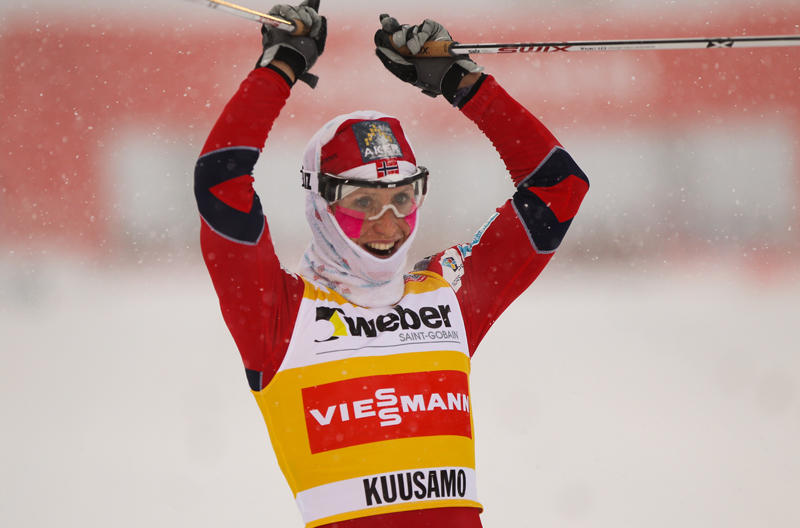
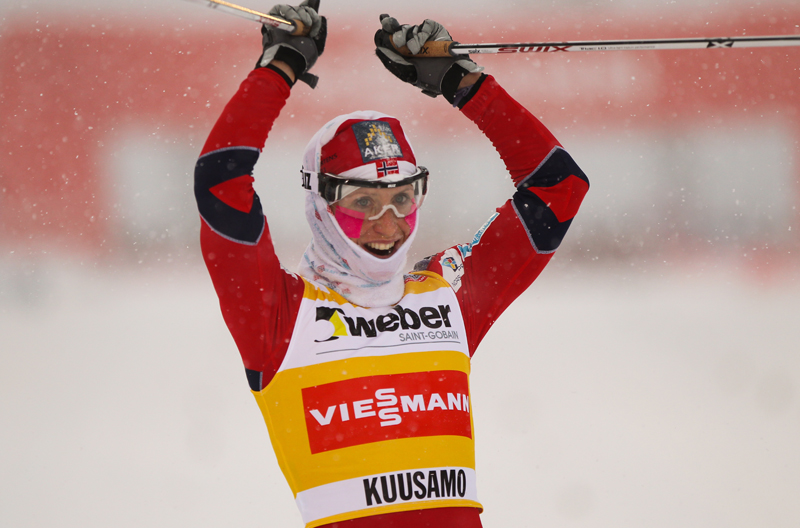
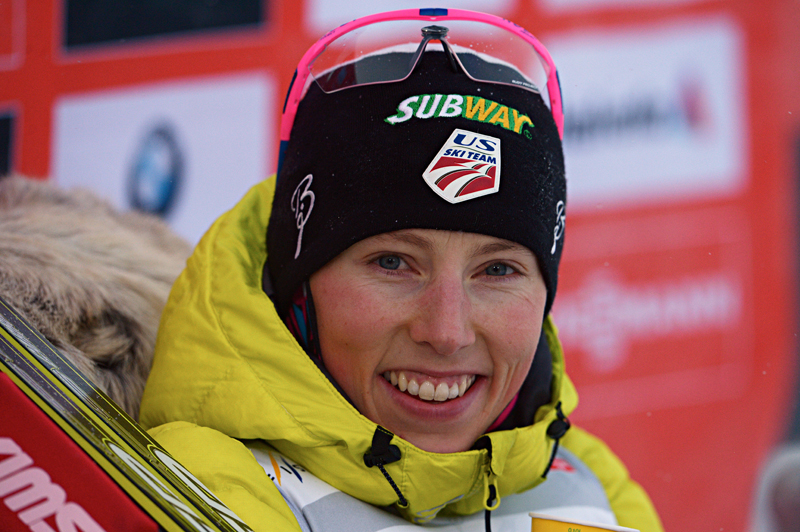
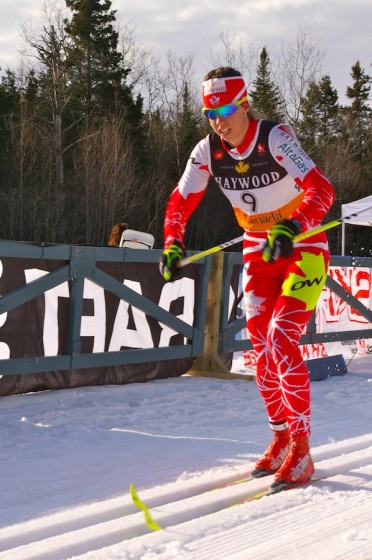
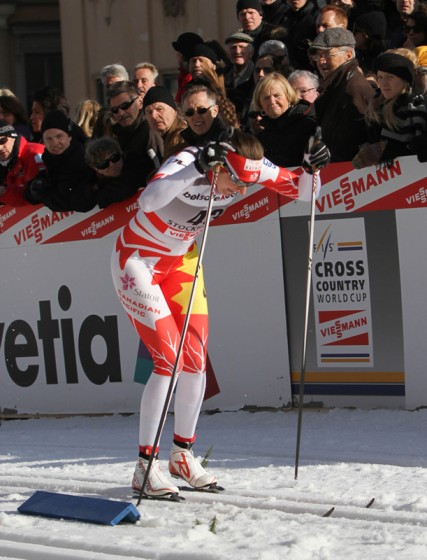
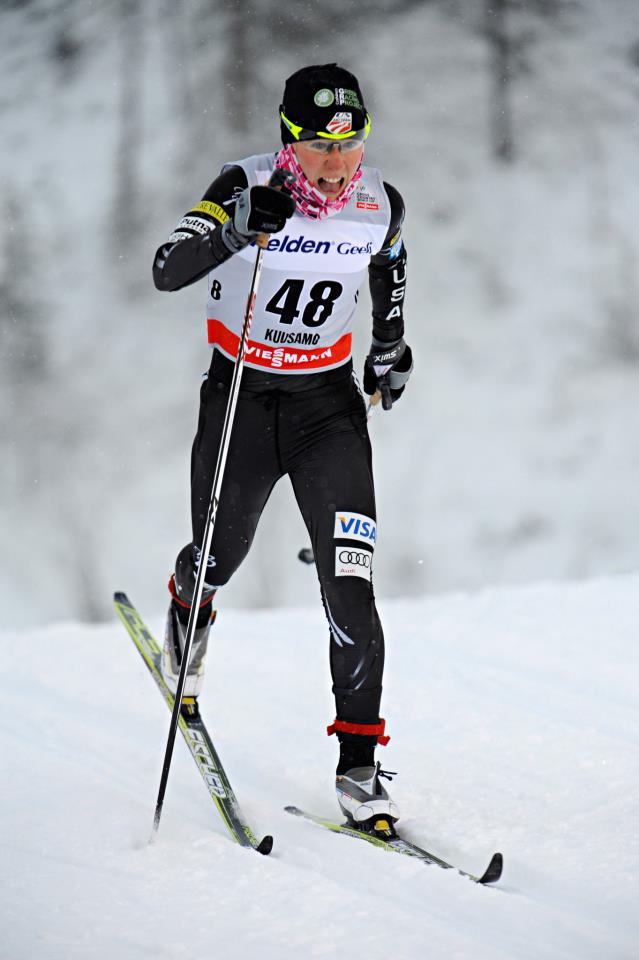
Marit Bjørgen (NOR) after winning the Kuusamo World Cup 10 k classic pursuit by a minute and 21 seconds for the Ruka Trip mini-tour title on Sunday in Kuusamo, Finland. Photo: Fischer/Nordic Focus.
As far at the television coverage showed, it didn’t look like Marit Bjørgen ever looked back on Sunday in Kuusamo, Finland. It would’ve been pointless to do so; Norway’s defending World Cup champion was always more than a minute ahead and the white-out conditions made the visibility near zero.
Starting first in the 10-kilometer classic pursuit – the culminating race of the Ruka Triple mini tour, with full World Cup points and 5,000 Swiss francs ($5,400 dollars) on the line – Bjørgen had nearly a minute to play with off the line. Kikkan Randall of the U.S. started next, 53 seconds back, and Finland’s Krista Lahteenmaki went out third (+0:59).
However, it was the next couple starters that formed the most contentious chase group within the first few kilometers, with Justyna Kowalczyk of Poland in bib 4 leading Norwegians Heidi Weng and Therese Johaug, who started fifth and seventh, respectively. (Yulia Tchekaleva of Russia did not start sixth, traveling instead to Canada in preparation for the Quebec World Cup sprints next week.)
Randall settled in behind the group and after losing contact before 4 k, worked with Lahteenmaki to try to gain back some ground on the front four. Bjørgen remained out of reach throughout the race with Kowalczyk, Weng and Johaug narrowing the gap to a minute and 14 seconds before the halfway point.
They reeled her in by about the same margin by 6.4 k, but with one lap to go, Bjørgen made up a few more seconds despite an increasingly difficult workload in the snow-covered tracks.
Justyna Kowalczyk (POL) enters the stadium and strides to second in Kuusamo 10 k classic pursuit.
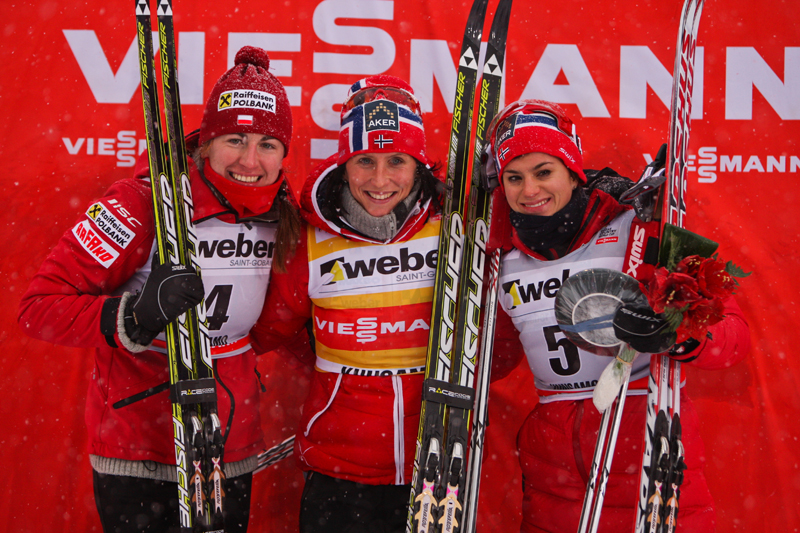
In the end, the 32-year-old Bjørgen won the fourth-straight individual World Cup race of the season; yep, every single one. She swept the mini tour, with victories in the classic sprint, 5 k freestyle and classic pursuit, winning the latter in 31:19.4. Kowalczyk pulled off second place, 1:21.4 back. Weng surged up the last hill past Johaug to challenge Kowalczyk, but settled for third (+1:23.9). Johaug was fourth (+1:34.1) with the second-fastest time of the day, 8.1 seconds behind oBjørgen.
Randall broke away from Lahteenmaki around 6.4 k to make a run for the chase group. She managed to stay ahead by at least a few seconds and ultimately finished fifth (+2:24.8) while Lahteenmaki placed sixth (+2:33.1). At the finish, all eyes were on Bjørgen, whom Randall had predicted would take an army of efforts to defeat.
“Maybe we can work together and try to reel Marit back in,” Randall said after Saturday’s 5 k, where she was second. “She’s definitely strong right now … so it’s gonna be fun and hard.”
Hard was probably the best description of it on a cold afternoon near the Arctic Circle with temperatures around -9 degrees Celsius (15.8 Fahrenheit) and snow falling heavier throughout the women’s race.
“Another incredible day for me,” Bjørgen told NTB, according to a translation. “I concentrated on doing well technically, and it went fast as I had done throughout the weekend. This was one of my best weekends in Kuusamo ever.”
She won the Kuusamo mini-tour title last year as well, and given a 53-second lead from the start, Bjørgen was confident she could keep it.
“I knew I had to focus on [myself to] succeed,” she told Eurosport.Onet.pl. “Right at the start I heard that my advantage has increased … [and] I felt that I was able to get the best time of the day. In the second part of the distance the snow was falling very strong, however, this is a winter sport and you have to compete in such an environment. I have a big advantage when the conditions do not really matter.”
For overall World Cup runner-up Kowalczyk, it was her first podium of the season.
“It was a good race,” Kowalczyk told NRK. “The shape is good and the skis were good. There is a lot of hard work, but it’s better than a week ago. My form is getting better every start. Maybe I come in the same form as Marit.”
Bjørgen, for one, is worried that it might be too much too soon.
“I hope that the form did not come too soon,” she told Eurosport. “I’m going to leave a couple of starts in order to better prepare for the Tour de Ski and World Cup.”
Bjørgen and Johaug planned to skip the Canada World Cups in preparation for the Tour de Ski and second period. According to Norwegian coach Vidar Løfsus, the rest of the women’s team will be there, including seventh- and eighth-place finishers Vibeke Skofterud and Kristin Stoermer Steira.
“I will go home now and then train two weeks at high altitude in [Italy’s] Seiser Alm to get ready for the Tour de Ski,” Bjørgen said.
U.S. Ski Team veteran Kikkan Randall enjoying the leaders chair in the Kuusamo Ruka Triple World Cup 5 k individual freestyle. Randall ultimately placed second to Marit Bjørgen (NOR) for a career-best distance result. (Photo: Fischer/Nordic Focus)
That mountain bike ride from Park City, Utah, to the top of Guardsman Pass in October wasn’t exactly fun for Kikkan Randall. Sure, it was probably beautiful reaching altitudes around 9,700 feet and all, but it wasn’t skiing.
A stress fracture in her foot paired with an Achilles injury kept Randall from doing much of anything ski-specific for much of September and October. She dutifully sought alternatives to the U.S. Ski Team (USST) camp in Park City and while at home in Anchorage, Alaska, but man, all that time in the saddle and swimming got old quick.
That’s exactly why Randall’s doing so well now, a week after reentering the racing scene. While it’s only the second World Cup weekend of the season, it’s also some of the most time the USST veteran and defending world sprint champion has spent going hard on skis.
Randall used the fresh feeling to her advantage Saturday, finishing second to reigning overall World Cup champ Marit Bjørgen of Norway in the 5-kilometer individual freestyle in Kuusamo, Finland. The very last to start, Bjørgen posted the fastest time of the day in 12:02.9, but it was Randall who sat in the leader’s chair for a good chunk of the race before that.
In the end, Randall was 22.7 seconds off Bjørgen’s mark, good enough for second and a career-best distance result. On Friday, the 29-year-old star from Alaska Pacific University (APU) had finished 10th in the classic sprint, the first of three races in the Ruka Triple mini tour. With one more on Sunday – a 10 k classic pursuit with full World Cup points on the line – Randall sat second to Bjørgen. That’s not a bad place to be considering Randall wasn’t sure she’d be able to race these first World cups of the season two months ago.
“To be honest coming into the season I didn’t really know what to be confident about,” Randall said with a laugh after Saturday’s race. “I know that at least I had done the best job I could continuing to train in the modes I was able to, but coming over to Europe, I felt so far away from being in race shape. … Last weekend was kind of a surprise.”
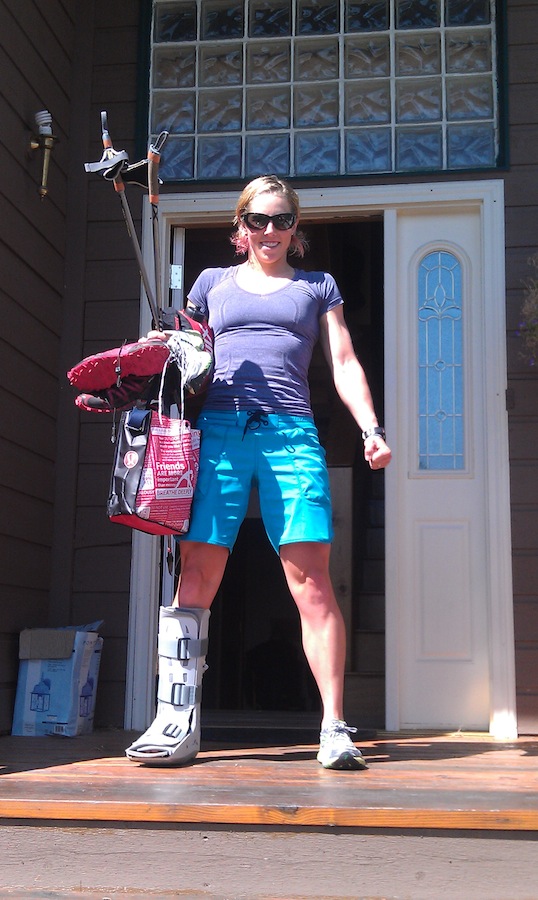
Randall donning a walking boot while healing stress reaction, which turned out to be a fracture, on her right foot this fall. She trained at 50 percent without skiing or running for five weeks. (Courtesy photo)
However, Saturday wasn’t. Randall knew she built a sturdy volume base throughout the summer and was about 10 hours ahead of schedule when August rolled around. Then, at an overseas camp in Sweden, she and USST women’s coach Matt Whitcomb came to the conclusion that her injuries weren’t getting any better and it was time to let them heal.
After consulting specialists in Vail, Colo., Randall literally switched gears, stepping off the rollerskis, onto the bike and into the pool for much of the next two months. She worked on climbing – with 1 ½- to two-hour sessions on the mountain bike – and double poling and even developed strength in the pool. By the end of October, she figured she had lost 40 to 50 hours of training, but as it turns out, that might not have been a bad thing.
“I guess high volume isn’t the only answer. I think maybe my body needed a little break to absorb everything,” she said “It’s worked out. I don’t think we actually saw it coming, but I think the good sign is that we haven’t done a lot of really high-end work, which means I can still continue to sharpen my race gears both for distance and for sprint, and that’s a really good place to be at this point in the season.”
While searching for that even higher gear, Randall’s loving every second of it.
“My joy for skiing is really high,” she said. “Spending all that time on the bike and in the pool when training was just hard and unsatisfying, now I’m so grateful to be out here and I’m happy to say racing is fun. It’s hard, but it’s fun.”
Randall said she flushed out some feelings of flatness in Friday’s sprint and was able to ski a consistent race from start to finish on Saturday. She had aimed to stay light on her feet and powerful on the flats, and to her surprise, had something left in the last kilometer.
“I got midway up that last climb, I heard that I was maybe a second or two in the lead, and that was all I was focused on,” she said. “It’s always fun to sit in the leader’s chair.”
Ahead of her, Yulia Tchekaleva of Russia was the current leader and Norwegians Therese Johaug and Heidi Weng ranked second and third, respectively. Even if she beat them, Randall had to bargain for a great race from Bjørgen, who started 20 spots behind her, so she continued to push.
Tchekaleva ended up third behind Randall, and the Norwegians swept fourth through eighth (Johaug was fourth, Weng fifth, Vibeke Skofterud sixth, Kristen Stoermer Steira seventh and Martin Ek Hagen eighth). Nicole Fessel (GER) placed ninth and Krista Lahteenmaki (FIN) took 10th just ahead of Justyna Kowalczyk (POL) in 11th.
Just as Randall put her head down for the win, several of her teammates achieved personal bests or close to it as well. Jessie Diggins finished 12th, about 21 seconds off the podium and 46.2 seconds behind Bjørgen. Liz Stephen notched 13th (+47.1) for her best-ever World Cup result (with the exception of the Tour de Ski final climb last season), and Holly Brooks was the fourth U.S. woman in the top 20 in 18th.
“Three PR’s on the day,” Stephen wrote in an email, referring to Noah Hoffman’s career-best 19th in the men’s 10 k. “We are all fired up tonight.”
Their game plan had been to take risks, she explained.
“The course is mighty hard here in Kuusamo, but a 5k is so short that the strategy was to go out hard, ski the tops of the climbs hard and recover as much as possible on the fast downhills,” Stephen wrote. “Blowing up is not out of the question in a 5k, but going too easy is not a good option either because there is never an extra second to blow in such a short race (unless you are Bjorgen, of course, and then you have 22 seconds to play with!)”
According to Whitcomb, the team had a meeting Friday night to lay it all out.
“The strategy was to be a bit violent out there,” he said. “Have a really hard warmup and not waste a single minute of that course on being conservative or focusing too much on your pace. It is one of those courses where you have to take a chance at pushing your limits and hope your limits are absorbed by the body that day. If they are, you end up doing really well.”
He was pleased with the how aggressively the U.S. women raced, but wasn’t surprised with their results.
“I was counting on strong performances from a lot of people today,” Whitcomb said. “I thought that was pretty likely to happen with so many people healthy and so many good results in the tank already and just good-looking workouts this week.
“And so it was perhaps our best day ever in a distance race,” he added. “Hoffman’s 19th and four other top 20’s from the women. … It just looked right out there.”
Diggins wrote in an email that she started hard, but seeing how fast the course was, she wished she had gone even harder.
“It’s interesting since you have to charge each uphill and know that on the long and fast downhill your body will recover,” Diggins added. “It’s hard to trust your lactate buffering system sometimes but the coaches were telling us to take a chance and I’m glad we did!”
Brooks had “nothing but good thoughts headed into the 5k” after having a breakthrough performance in the same race last year in 28th.
“I didn’t feel that I could get in my ‘top gear’ in the race today so considering, I’m really, really happy with 18th place,” she wrote. “I think that it says a lot that I can have a good/medium race and still finish top 20! Expectations have changed slightly but I know that I’ll have good races, mediocre races, and just plain bad races.”
***
Among the other North American women racing Saturday, Canadian Dasha Gaiazova placed 40th (+1:16.9), about nine seconds out of the top 30 for one of her best 5 k World Cup results.
“It was a hard race from the beginning all the way to the very end and I am happy I was able to put in a good effort,” Gaiazova wrote in an email. “The strategy was just about grinding at those massive Kuusamo hills, so not much drama there.”
Ida Sargent of the U.S. was 49th (+1:24.9) slightly better than her result in the same race last year (where she was 52nd). Also for Canada, Chandra Crawford was 64th (+1:39.2) and Alysson Marshall ranked 81st (+1:54.0).
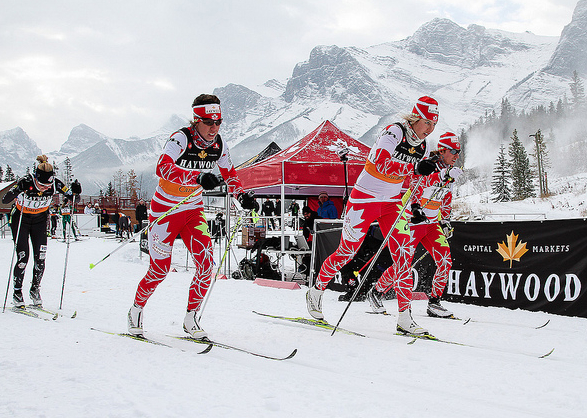
Canadian National Ski Team members Perianne Jones (second from left) and Chandra Crawford (second from right) go head-to-head in a Frozen Thunder time trial in late October. Crawford won by a toe, but Jones took top honors in the first World Cup of the season on Friday at the 1.4 k classic sprint in Kuusamo, Finland. (CCC photo)
There’s an old saying that transcends sports: ‘Be aggressive,’ and for extra emphasis: ‘B-E aggressive.’ Well, maybe that’s a Jock Jam, but either way, it got into the heads of Canadian Ski Team members Perianne Jones and Dasha Gaiazova on Friday in Kuusamo, Finland.
The two gave their all in the 1.4-kilometer World Cup classic sprint on the opening day of the Ruka Triple mini tour, which includes two more sets of races (a 5- and 10-kilometer freestyle on Saturday, and 10/15 k classic pursuit on Sunday). Both shorter-distance specialists, it was their time to get after it in the first sprint of the season.
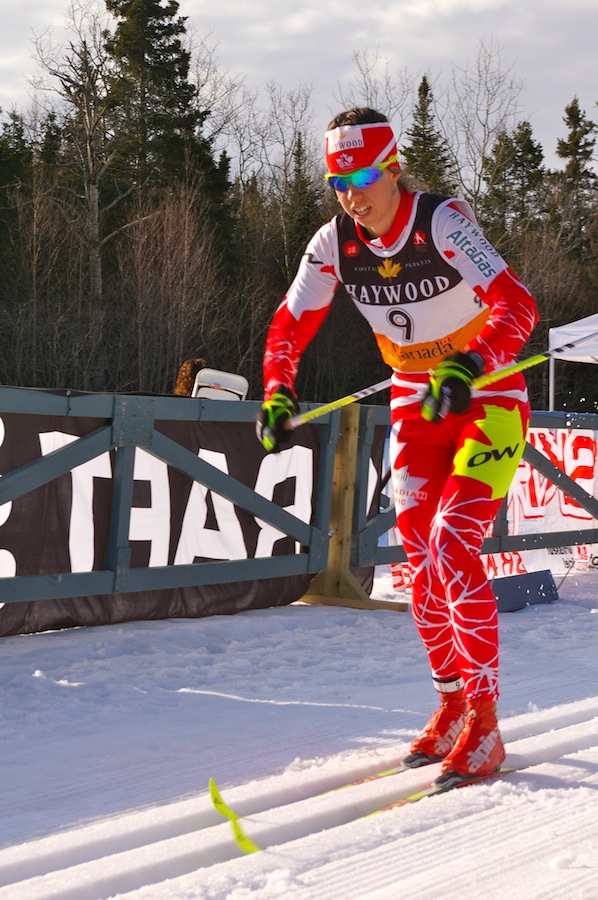
Jones out of the start of the women’s 5 k classic race at Canadian Ski Nationals last March.
Jones led the charge, tying her career best of 12th after advancing to the semifinals. Gaiazova placed 14th overall, narrowly missing a lucky-loser bid for the semis.
After qualifying in 20th, Jones didn’t let brand names like Justyna Kowalczyk (POL) and Heidi Weng (NOR) overrun the quarterfinal. From the start, she tucked in behind the Norwegian leaders, including Ingvild Flugstad Oestberg, and hung on while Kowalczyk – a race favorite – charged forward for the win. Jones outlunged Weng for second and moved onto the semi.
“I got in behind Kowalczyk on the last big climb because I figured she’d win the heat, and I just double-poled like mad to the finish,” Jones said in a Cross Country Canada press release.
Four quarterfinals later, Gaiazova burst out of the start to the front, then settled in behind Finland’s Anne Kylloenen, who would go on to place fourth in the final. American Ida Sargent worked her way into the mix and Gaiazova followed as the two overtook Therese Johaug (NOR) to finish second and third in the heat, respectively. For Sargent, it was a sure way of getting to the semis while Gaiazova, who previously qualified in 18th, had to rely on her time to get her through. She ended up just short of advancing and settled for 14th.
Not long after, Jones went for it again in the semifinal, trailing Kowalczyk and Kikkan Randall (USA) up the first gradual hill. There, she lost her balance on an icy corner and fell out of contention behind the pack, which included eventual semifinal and final winner Marit Bjørgen (NOR).
While making it as far as possible – ultimately to the podium – is always the goal, both Jones and Gaiazova were pleased with their efforts.
“Kuusamo has been a dark place for me in the past,” Jones said. “I’ve never really been good here so I’m really happy with today.”
Previously, the 27-year-old’s best result in Kuusamo was 51st in a 1.2 k classic sprint. This year, the International Ski Federation (FIS) decided to lengthen many of the women’s sprints to match the men’s distances. Friday was one of the first times it did so with the 1.4 k distance, which seemed to work for Jones.
Head coach Justin Wadsworth said on the phone that the longer sprint on a challenging course was certainly a good indicator of Jones and Gaiazova’s fitness.
“That last uphill is really tough,” he said. “I mean it’s hard just when you’re testing skis or whatever going around it. It’s hard to get up.”
Jones credited her skis – prepared by her husband and wax tech Joel Jaques – to much of her success, especially on the downhills. In her third time placing a personal best of 12th in a World Cup sprint, she said she’s ready to make the next step.
“I do feel now is the time for me to start to peak and I think that is the reason we are doing a lot more intensity than usual,” she said. “I was a little worried that I wouldn’t see the results, but it is nice to see the training pay off today.”
Dasha Gaiazova on the World Cup circuit last March.
In an email, Gaiazova wrote that she felt fit and confident for the first half of her quarterfinal, but made a costly mistake at the bottom of the second hill “being too nice and letting a competitor jump in a track ahead of me, thus boxing myself in for the main uphill,” she wrote.
“I wish I was more aggressive at that moment and didn’t let her in because then I would have had my own track and could have skied with a longer and more comfortable stride, as opposed to trying to match Johaug’s frantic pace and wasting energy skiing behind her,” Gaiazova continued. “Once I learn how to race aggressively for the whole duration of the race, there is no stopping me!”
About 2 ½ seconds back from qualifying in the top 30, Canadian Chandra Crawford wrote in an email that she expected more.
“Thought I’d get a better one but I’ve been pushing the training a bit since arriving in Europe to prepare for the Canadian races,” Crawford wrote. “Now I’ll do a bit more resting and fire up some sprint leg feeling for Canada.”
Last season’s NorAm winner who earned early World Cup starts this year, Alysson Marshall was one spot back in 38th in the prelim.
“I was really disappointed not to qualify, but I was close to the top-30 and I feel like I’m bouncing back from last weekend,” she said of the World Cup opener in Gällivare, Sweden. “I felt good in the qualifier but slipped a few times on the climbs and lost momentum … I was happy with my energy and I know where I lost time so I will hopefully improve for the next sprint!”
The Canadians perhaps most accustomed to the limelight, Alex Harvey, Lenny Valjas and Devon Kershaw failed to make the rounds in the men’s 1.4 k sprint. Harvey ranked 46th in the qualifier, Valjas was 53rd and Kershaw placed 62nd.
“They just don’t have the snap right now,” Wadsworth said. “Same way they’re been feeling, just kind of flat. It shouldn’t be a problem. That’ll come back and I know their fitness is there. Of course you’d like to have good results today, but it is what it is so you just can’t fight it.”
That’s where aggression meets patience.
“It appears these last years that I just lack snap, power and speed these first few weeks of the season,” Kershaw wrote in an email. “Simple as that. It’s discouraging, frustrating – but looking at my past – and knowing how well I can ski when everything comes together, I just really have to believe in what I’ve done this entire training season and be patient.”
Harvey wrote that he “felt fine warming up, not stellar, but confident I would make the top 30. In the race I didn’t feel that bad, but I noticed that every pole plant was a bit less powerful than usual. … It’s a good reminder than were all human and it will make me appreciate even more the feeling of skiing fast when I do, hopefully!”
Perhaps the most disappointed was Valjas, who said his hand injury was the least of his problems on Friday.
“The cast did its job perfectly,” he wrote, referring to the healing bone near his pinky finger. “I don’t really know what happened out there today, I thought I felt fine. I chose to ski on skis that had way too little grip, which forced me to herringbone up the last hill. You can’t expect to qualify when you cant climb all of the hills on course. … Not happy about my performance today, I am actually looking forward to the distance races coming up to blow off some steam and get ready for Quebec.”
The World Cup sprints in downtown Quebec City in exactly a week will be a highlight for the entire team, which will travel home for the event. Going into it, Wadsworth said results like Jones and Gaiazova’s were especially important.
“They worked hard and it’s really nice to get them in there and get some confidence going heading into Canada,” he said.
Ida Sargent (CGRP/USST) en route to a personal-best ninth in the Kuusamo World Cup 1.4 k classic sprint on Friday. (USSA photo: www.facebook.com/USSA.nordic)
Talk about depth. Last weekend, four U.S. women made history capturing third in the 4×5-kilometer relay in Gällivare, Sweden. On Friday, the lone US Ski Team (USST) female in Europe who didn’t race the team event was raring to go in Kuusamo, Finland.
Ida Sargent of the Craftsbury Green Racing Project came out with a renewed-and-focused fire in the 1.4-kilometer classic sprint, the first of three World Cup races in the Kuusamo mini tour this week. Known as a strong sprinter, her personal best in a preliminary round before Friday was 26th in last season’s Moscow World Cup skate sprint. She shattered that in Kuusamo.
Sargent, 24, led her U.S. teammates in the first sprint qualifier of the World Cup season under the lights on a chilly -12 degree Celsius (10 degree Fahrenheit) evening. She finished 13th to advance to the quarterfinals along with reigning World Cup sprint champion Kikkan Randall in 16th.
While some might have predicted Sargent would go on to achieve great things then, there’s a lot that can happen in sprints. Ask Randall.
For the next two heats, Sargent put herself in positions to stay alive, jolting from sixth to second behind Finland’s Anne Kylloenen to make the semifinals. In the second semi, she jumped up to third before the final grueling climb, and after losing some ground on the descent, fought hard for fourth in the deceivingly uphill stretch into the stadium.
Krista Lahteenmaki (FIN) ultimately edged Sargent in a double-pole showdown to the finish, nabbing the lucky loser spot and advancing to the final. Sargent settled for fifth in the heat and ninth overall – not bad for a career best that topped her 12th place in Moscow last season. Her previous best in a World Cup classic sprint was 29th.
“It’s tough being so close to the final but I’m still incredibly happy with the day,” Sargent wrote in an email. “It was a really fun day and I can’t stop smiling!”
Meanwhile, Randall also advanced to the semifinals after taking second to Slovenian Katja Višnar in the quarterfinals. In the semi, she strided alongside leaders Marit Bjørgen of Norway (the eventual overall winner) and Poland’s Justyna Kowalczyk ahead of the pack on the final climb. Soon after, she ran out of steam and finished fifth for 10th overall.
It wasn’t exactly the result Randall envisioned, but it was solid considering. After logging a great pre-race workout Thursday, Randall said on the phone that she didn’t feel as well as she’d hoped on Friday.
“I just felt a little flat out there and didn’t feel like I could kick into my sprint race gear,” she said. “I think the silver lining for me is on a bad day, I used to not even qualify, and today I didn’t bring my best, but was still a top ten.”
What’s even better was that Sargent was in there, too, Randall said.
“It was a great day for us, I mean two in the top 10 is an incredible result,” Randall added. “Really psyched with the way Ida skied today. She really came on strong there every time coming up the hill.”
That was what separated racers who were having a great day from the ones that weren’t. Bjørgen repeatedly attacked the final steep climb, and even when she struggled there in the semifinal, she found a way to gain some ground in the stadium.
“The Kuusamo course really tests the fitness of an athlete,” U.S. women’s coach Matt Whitcomb said. “It’s an incredibly strong finish with a very difficult hill followed by a long, hard false flat, and for athletes to do well here means that they are in great shape.”
Case in point: Sargent, who recorded her previous best on an even longer 1.5 k course.
“It was definitely a career-breakthrough kind of day for Ida that we’ve known has been in the cards for a long time,” Whitcomb said. “But actually seeing her hit that top-10 mark will give her all kinds of new confidence.”
For Sargent, getting there took tons of grit and work. Whitcomb laughed as he recalled what she said after the quarterfinal. She couldn’t decide which lane to be in and bounced around “five or six times” as a result, he said
“She kept getting boxed around, boxed out a little bit and just realized she needed to settle down, that she felt great and there was 35 seconds of climbing time where she knew she could make moves,” he said. “Once she settled down she found her open lane and was able to move up the pack.”
Sargent wrote that she was so excited after the qualifier that she didn’t have any expectations for the heats. Knowing her strengths in climbing and confident in her double-pole improvements, she aimed to stay calm throughout and “go for it” on the big hill.
That worked great in the quarterfinal, as she accelerated over the top and put herself in second at the finish. However, in the semifinal Sargent explained she was boxed out at the bottom and didn’t have her own track, which caused her to slow down and seek one.
“I wasn’t able to go for it as much on the uphill and then Lahteenmaki was just stronger double poling into the finish,” she wrote. “I think if I had a better track on the uphill I could have stayed at the front on the uphill and then maybe made the final … [but] I’m feeling good and excited to be here. We had awesome skis today and there is so much motivation and inspiration being on this team especially after the amazing weekend in Gällivare.”
The rest of the U.S. women recorded personal bests or close to it for a classic sprint (Jessie Diggins was 33rd, Holly Brooks 40th and Liz Stephen 68th), leaving Whitcomb pleased with the overall results.
“It’s a great day for us to put two girls and two guys into the rounds,” he said, referring to Simi Hamilton and Andy Newell, who placed 24th and 27th, respectively. “Also, really encouraged by Jessie finishing 33rd, just a half second out of qualification in what is generally not her strong event. There were a lot of great signs today and I think we’re going to see a whole lot from Andy and Simi in these sprint events. These guys are just starting to get going.”
In an email, Hamilton wrote that his goal had been to qualify, which he did in 29th. However, he hadn’t slept well the night before and felt his energy was flat throughout the day.
“I never feel great when it’s this cold, but I fought hard in my quarter and just didn’t have the zip I needed on the final long climb into the stadium,” Hamilton wrote after finishing fifth in his heat. “I’m happy with today, although skiing past the quarters would have made me much happier. I knew going into the day that it would was going to take everything I had to have a respectable race.”
The course didn’t exactly play to his strengths, he explained, and after having strep throat this time last season, he hadn’t raced in Kuusamo in two years.
“It’s a tough course for me,” he added. “There’s not a lot of technical skiing and a lot of the race rests on being light up that final climb. I am much better on courses that involve technical skiing and rolling terrain where I can use my weight to my advantage.”
Newell qualified ahead of Hamilton in 21st, and on his 28th birthday, was lucky to do so.
“In the qualification round I got super lucky because I almost went down after the first climb,” Newell wrote in an email. “There was a bit of ice before the downhill and my skis completely crossed and I don’t know how I didn’t fall but I managed to stay up despite losing a little time.”
In his quarterfinal, Newell was initially third behind Sweden’s Emil Joensson and Calle Halfvarsson, who went on to finish first and third, respectively, in the heat. All was going well until he and China’s Qinghai Sun “had a few close calls,” Newell wrote. “We were banging into each other a lot for some reason.”
Nonetheless, he was in a good position heading into the last climb, but didn’t have the kick he needed to keep up with Joensson and Norway’s Petter Northug, who was second in the heat. Newell came through in sixth.
“It’s a bummer to slip on this course and I had a few bad ones and then just wasn’t able to run the hill the way I normally can,” Newell added. “I’ve been feeling great, definitely feeling a lot better than what the results from today will show. It’s just the first sprint of the year and it’s only half points here so I’m not too concerned. Just looking forward to doing some more sprinting soon.”
Whitcomb reiterated this how early in the season it was and what Period 1 entailed.
“We are doing our best to ski fast each weekend, but we are also doing our best to maintain training volumes, good quality workouts,” Whitcomb said. “It’s possible we overreached just a little bit with regards to training [this week], but at the same time that’s what we’re training to maintain this time of year. Ultimately we’re gunning for Val di Fiemme [World Championships].”
Despite recovering well from two third-place results last weekend, Randall said she felt the effects of a hard strength workout on Tuesday.
“I think maybe that was a little hard, maybe flattened out my fast-twitch muscles a little bit, but overall I think it was a pretty solid week,” Randall said.
***
Extras
Diggins (33rd) on missing qualifying by just over ½ a second:
“Considering classic sprinting is something I’m still working on, I’m pretty psyched on today,” she wrote in an email. “I broke the course down into parts and skied each part as well as I could. I didn’t ski the last climb as well as I did in race prep however – I think I got too nervous – and that’s where I lost the most time. If I could do it again I know what I’d fix … and I get to do it again next year and the next ten years! :)”
Brooks (40th):
“My race was slightly mediocre, neither good or bad,” she wrote in an email. “The last big climb into the stadium frustrates me a bit because I feel like I always ski it better in practice and the warm up. Oh well, such is life. I have a few things to work on and that keeps it interesting! I’m really looking forward to the next two days. Saturday’s 5k skate race was my breakthrough last year so I’m crossing my fingers for another good one!”
Stephen (68th):
“Today was probably the best Kuusamo classic sprint I’ve ever had so that was good, but I’m psyched for the rest of the weekend,” she said on the phone. “I’ve skied the main uphill better every single time I’ve skied it, except for today. I think I was having a pretty good sprint until the big hill today. I couldn’t quite nail it, but the courses are awesome and they’re really good for people that are in really good shape so hopefully that bodes well for our team.”
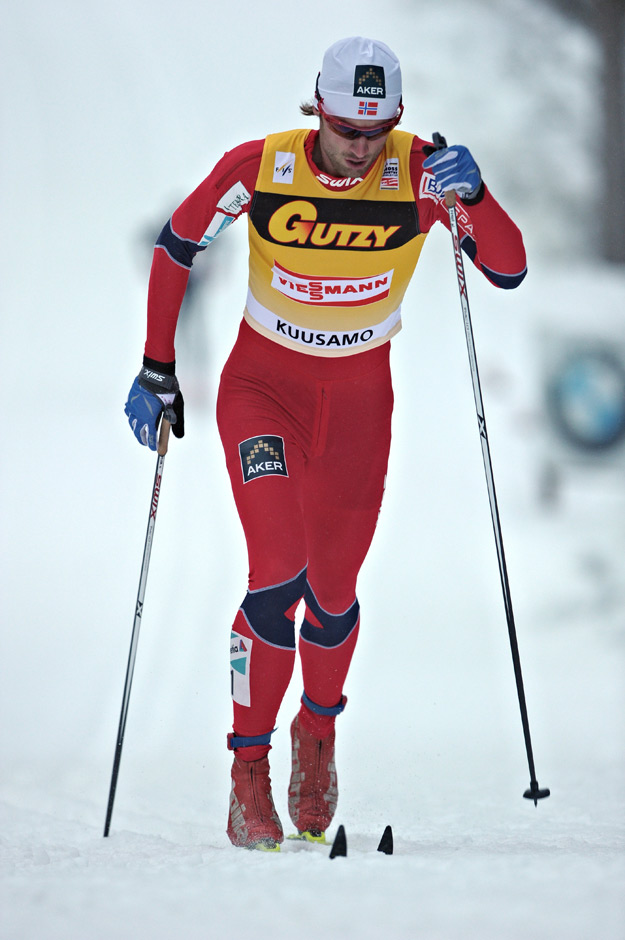
The scene has played out so many times before — Petter Northug (NOR) biding his time in a pack, staying comfortably out of trouble, then throwing down a crushing move, usually on a steep climb and executed with ferocious tempo, to open a gap and set up-for the homestretch.
The script can vary somewhat — the main alternative includes a ridiculous double pole finish to conquer all challengers in the final 100 meters. When Northug is on, while the stage and supporting actors may change, the denouement is usually the same.
Petter Northug (NOR) striding to victory in last year’s Kuusamo Mini-Tour (Photo: Fischer/NordicFocus)
The last time Northug lost out in a final sprint to the line? Two yeas ago in La Clusaz, France.
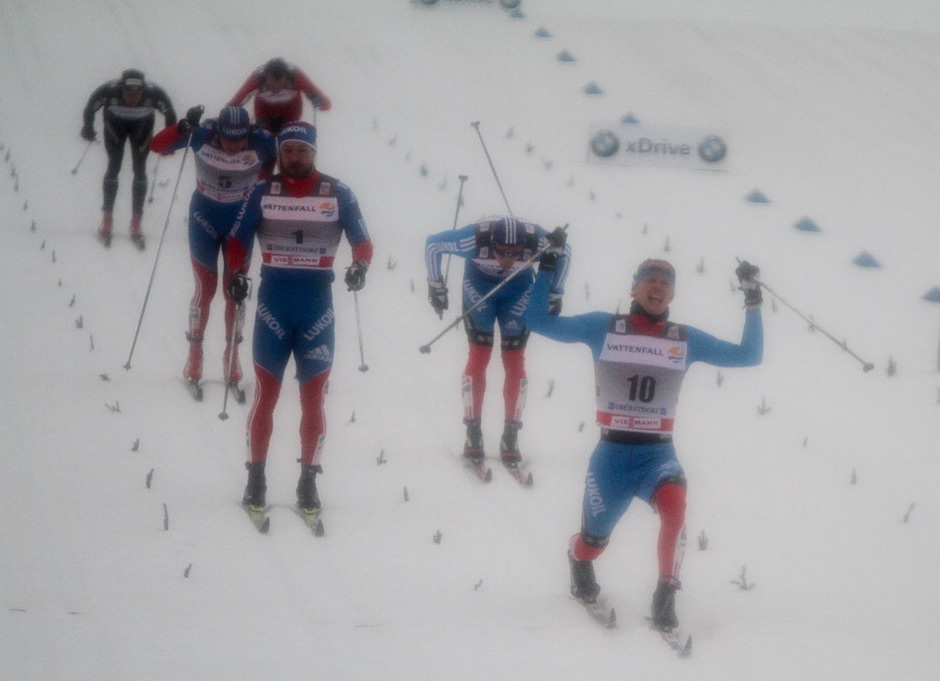
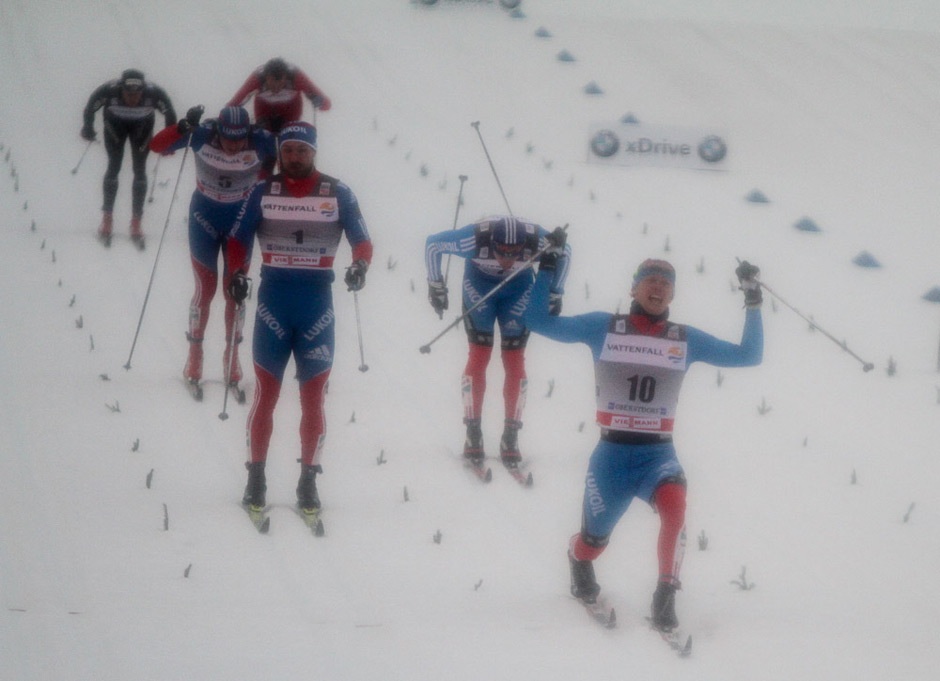
On the first day of the annual Ruka Triple in Kuusamo, Finland, however, Nikita Kriukov (RUS) decided it was time for a rewrite.
On a now familiar classic sprint course, under cold and dark northern skies, Kriukov beat Northug at his own game.
The defending Olympic Champion in this event, the Russian watched as Northug easily advanced out of the both his earlier heats by attacking on the steep and lengthy final hill up to the stadium.
In the quarters, Emil Joensson (SWE) bested the Norwegian, but with the top two advancing, this was of little consequence. Joensson may be one of the few men on the circuit who employs a quicker classic stride than Northug on the steep terrain, and the two met again in the semis.
After tangling with Gleb Retivykh (RUS) on an early downhill corner, Joensson found himself out of the race, and the event was Northug’s to lose. He took the semis with ease, coasting across the line casually looking over his shoulder at the rest of the heat, setting up the final showdown.
Exiting the stadium in last in the final, Northug began making his way to the front on the smaller climb midway through the course. He slipped by teammate Eirik Brandsdal to move into third place behind Kriukov and Dmitry Japarov (RUS).
The two Russians, pushing the pace, had opened up a solid ten meters as they headed across the flat toward the last climb. Northug visibly shifted gears extending into a version of his finish double pole and cut the lead in half by the base of the hill.
He did not pause, and as the terrain necessitated a switch to striding, he sped by. Japarov never had a chance. Halfway up, in an effort to keep pace, he missed several kicks and was instantly out of the running.
Kriukov, however, aware of Northug’s climbing prowess responded. He couldn’t stay right on the Norwegian’s tails, but limited the damage to just a few meters.
The Kuusamo sprint course features a hard 180-degree turn at the back of the stadium, entering the homestretch. This turn tends to compress the field, and Kriukov regained contact through the corner.
Northug still held the edge, but Kriukov’s quill was sharp and he put pen to parchment with authority, looking to scribe an ending both Chekov and Vaelbe would find pleasing.
Kriukov in his last World Cup victory — 2012 Tour de Ski
The pair accelerated to top speed, Kriukov inching up on Northug, but for a moment, appearing too slow and too late to close the gap.
Down to 50 meters, Kriukov found another gear, strongly and smoothly erasing the final meter and powering by. Northug attempted to respond, his body stretching upward and forward at a seemingly impossible angle, his technique losing any semblance of crispness as he tried to eke out just a few more watts.
The effort was in vain and Kriukov had a new final act, relegating Northug to the role of fading aristocracy, at least for one day.
The Russian was elated at the finish, celebrating at a level the seemed disproportionate for the holder of Olympic gold. But Kriukov, despite three times cracking the top-10 in the Sprint Cup, had just two previous World Cup victories, and was not going to miss an opportunity to savor this one.
Back down the course, Japarov was unable to hold off a hard-charging Brandsdal for third. Alexey Poltaranin (KAZ), always a force in early-season races, placed 5th, with Kalle Lasilla (FIN) representing the home team in 6th.
Despite the “loss,” Northug is in strong position in the mini-tour. Primary rivals Dario Cologna (SUI), Alexander Legkov (RUS) and Marcus Hellner (SWE) all failed to qualify for the heats, while sprinters Kriukov and Brandsdal, among others, are withdrawing from the competition to travel to Canada.
At the post-race press-conference, all three men on the podium expressed satisfaction with their respective races.
Kriukov obviously couldn’t have hoped for more, while Brandsdal recognized the two ahead of him were the better skiers on the day.
“The two guys ahead of me were stronger,” Brandsdal said. “I think I got the best out of the day.”
Northug pointed to the bonus seconds earned as the biggest positive, noting that while he felt strong he couldn’t find “the right flow” at the end.
Racing continues on Saturday with a 10km individual start skate race. The mini-tour concludes on Sunday with a 10km classic pursuit.
– All five of Alexey Poltaranin’s World Cup podiums have come in November and December, including two in Kuusamo.
– According to FIS, Kriukov has yet to officially win a World Cup race. All three of his podiums have come in Tour events, which FIS does count as normal World Cup races.
– Russia placed four skiers in the top-12 and Norway had six in the top thirty.
– Sami Jauhojärvi (FIN) a home team favorite, advanced to the semifinals. Strong on the climb, he struggled in the double pole finish and was eliminated. He was third in this race back in 2010, the last time he stood on a World Cup podium.
– Norwegian Oystein Petersen crashed in the quarterfinals and placed 30th. At the airport to fly to Canada in preparation for next weekend’s World Cups, Petersen tweeted, “After a shitty day it is just perfect that the flight to Helsinki departing at 22.35 is delayed by an hour… #myday…”
– Joensson looked in top form, qualifying 1st and winning his quarterfinal. It was hard to see who was at fault in his crash, but it appears Retivkyh may have stepped on the Swede’s ski.
A decidedly mixed weekend for the North Americans, something we’re used to by now I suppose. I suppose that Kikkan Randall and Alex Harvey were the main bright spots, as well as Len Valjas’s excellent sprint race.
Let’s start with some of the American women:
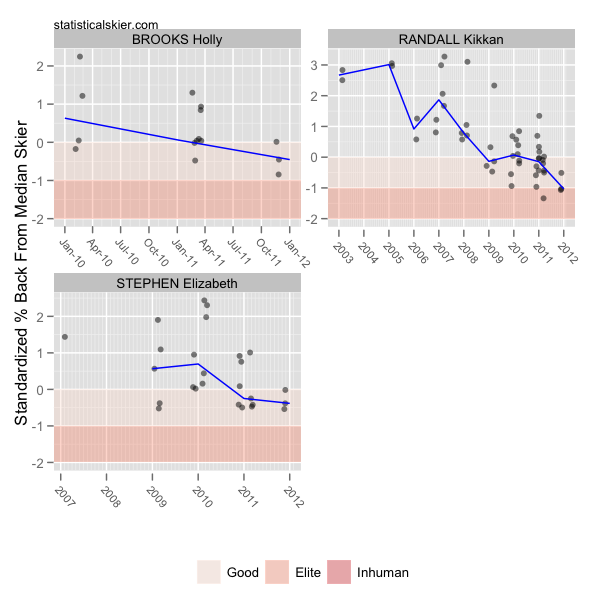
Kikkan really has started quite strong in distance races. Many Americans noticed the strong races that Holly Brooks had as well, and as you can see they are clearly a step in the right direction for her. Liz Stephen also had some strong races, but I’d caution that they don’t (yet) suggest a significant improvement over last year. Certainly, even just consistently skiing this well would be excellent progress as well.
I’ve talked a fair bit about how if Kikkan Randall is going to be competitive in the WC sprint overall she’s going to need to improve her classic skiing. I wasn’t just making that up either:
Traditionally, her gap between classic and freestyle sprints has been significant, which is why the classic Kuusamo sprint (circled in blue) is such a promising sign. Now apparently Marit Bjørgen is skipping both Dusseldorf and Rogla to focus on the Tour de Ski; both weekends include freestyle sprints. That’s a pretty huge concession in sprint points, in my opinion. This strikes me as a huge opportunity for Randall, if attending these races was part of her plan anyway.
The American men didn’t have quite as promising results, sadly:
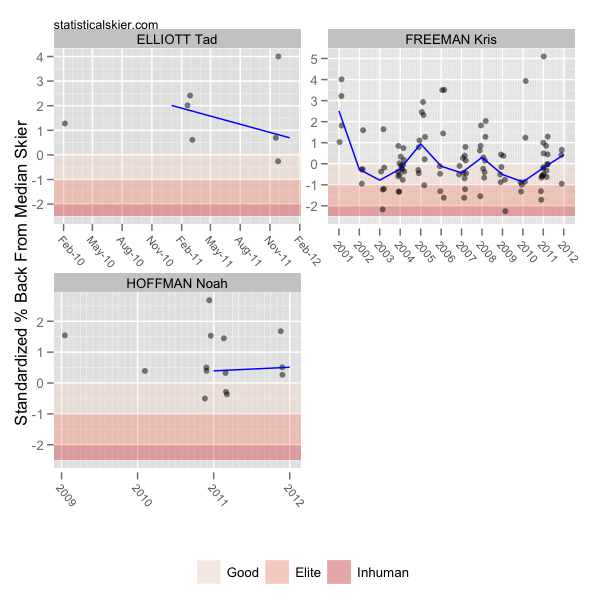
Tad Elliott’s results certainly show some improvement. Hoffman’s distance results haven’t been spectacular, and Freeman has gotten off to a bit of a slow start as well. Not much to say here except that hopefully a few starts under their belts will loosen them up.
As for the Canadian men:
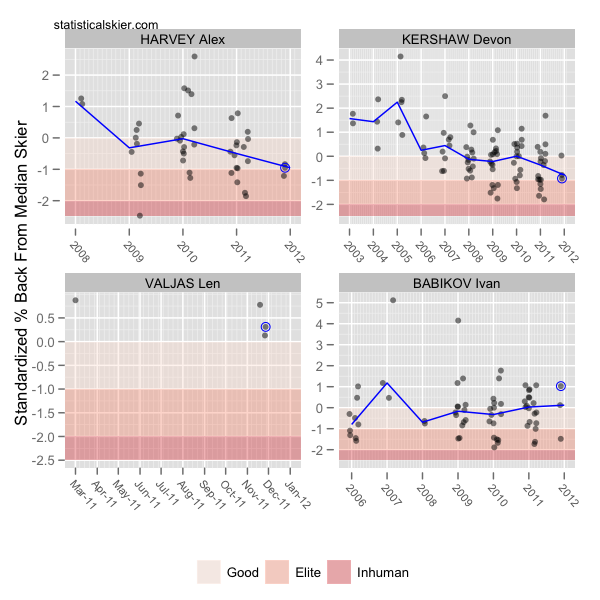
I’ve circled Sunday’s classic pursuit stage in blue, which I’ll come back to in a moment. Devon Kershaw clearly wanted more from this weekend, but calling his results bad is mostly a reflection of how high the expectations have become around him. You can see that last season he had a clump of fantastic results and a clump of pretty bad results. So far, he’s been more or less in the middle.
I circled the classic stage to point out that while both Harvey and Kershaw had strong results, they were by no means unusually good results. This is a good sign, I think.
I still feel like I’m not giving Len Valjas much attention, but he’s still done few enough races that his graphs look a little superfluous. Let’s just say that he had an awesome result in the sprint and leave it at that.
With three straight days of racing in the only the second weekend of the World Cup, there were plenty of comments to go around. Here’s a look at what didn’t make it into the Ruka-Triple recaps from Kuusamo, Finland.
(Note: It’s pretty heavy on the men’s side, especially with the Canadians, probably because they were chatty about their performances on Sunday.)
On why athletes shouldn’t get too worked up about sub-par performances:
“If you really put too much emphasis and weight on these races you can get burned,” said Justin Wadsworth, head coach of the Canadian national cross-country ski team. “And OK, Northug wins, he wins. To get really good results, you need to peak a little bit; not just peak, but fine-tune it. I think our big goal of the year is still the Tour de Ski and the overall World Cup.”
Petter Northug (NOR) striding to victory in Kuusamo Mini-Tour (Photo: Fischer/NordicFocus)
“I wasn’t a happy camper for a long time … I was probably pretty miserable to be around, no that’s not true, our team’s great,” said Canadian Devon Kershaw after placing 20th overall, a weekend-best, in Sunday’s pursuit. “I wouldn’t call it a great race, but it was solid for sure.”
Teammate Chandra Crawford tweeted on Sunday: “Did what I could and went all out, finished the Ruka triple in 54th but stayed positive and pushed it the whole way. #goingforit”
“Perianne (Jones) … definitely she’s had a good summer of training, she just overanalyzed her racing in the sprints and just missed (qualifying) by a couple seconds,” said Canadian coach Eric de Nys. “If you have one bad day, it doesn’t dictate the rest of your season.”
“The result this weekend wasn’t what I was looking for but the season is still young and I’m still getting into the swing of things,” said American Andy Newell, who finished 72nd overall. “As a team we’re still off to a great start … it’s so much more fun to have a big group of US racers on the World Cup so we can always feed of each others’ success.”
“I was tempted to lie and said I crashed but the fact is those boys are fast.” — U.S. skier Tad Elliott, on finishing 122nd in Friday’s sprint.
“Goal (is to) move up, why not? (The pursuit is) a classic race. I don’t ski that sticky stuff on the bottoms of my skis well. I have worked on it and will give it hell.” — Elliott before Sunday’s 15 k classic pursit, in which he was 95th.
On keeping their heads straight:
“Team is in good spirits. The ladies are wrecking shop. So that’s fun for team (morale). The attitude is good and happy we get to get out of the dark Monday.” — Elliott.
“The team is doing great. We are all super excited for our women’s team and their success!” — Noah Hoffman, USST.
“I’m pretty easygoing, especially around race time. I knew what I had to do, try to catch a ride and stay with as many guys as I could (in the pursuit). I wasn’t feeling too much pressure, just ski my own race and it ended up OK.” — Lenny Valjas, CCC
“Lenny is just such a chilled out guy and has an amazing attitude 365 days a year.” — Kershaw.
On Kuusamo’s course and conditions:
“The course is very difficult with a massive amount of steep hills.” — Kris Freeman, USST.
“(Saturday) it was wet (raining/humid) and insanely windy out there as well — for an individual start, those are tough conditions to ski through — especially if you end up not seeing anyone out there.” — Kershaw.
“I’m looking forward to the 15km (Sunday). It is a much harder course — should be a blast.” — Graham Nishikawa (CAN) before the pursuit, in which he finished 81st.
“Everybody dealt with changing conditions (Saturday). I think the race was very fair, a hard course, and well organized.” — Hoffman.
On pre-race routines:
“I woke up late (Saturday around 9:30 a.m.), go for a short 10-15 min “wake up” run/walk … I eat, and other than that it’s a pretty chill scene. I lay around a bit, put my feet up, play some guitar, listen to music. … I’ve been trying to warm up a little longer/harder too than usual.” — Kershaw.
On why Sunday’s pursuit suited Canada’s Alex Harvey (11th) and Devon Kershaw (20th):
Note: They posted the seventh- and eighth-fastest 15 k times in the classic race, respectively.
“They’re both good classic skiers … when they get in a classic race where it’s a mass start or kind of group situation, they’re both very savvy and they ski very well in those situations. (Earlier in the year) when we saw the schedule had gotten changed to classic on the last day, we were all pretty excited.” — Wadsworth.
Kershaw tweeted on Sunday: “Good confirmation today that I’m not a complete bum. Laps 4 & 5 we pretty rough after a fast start, but definitely satisfied #finally”
On pacing in the jam-packed pursuit:
“Guys were just going bananas, like, really, really hard pace and you have to try to ski as smooth as you can and you can’t die. If you die it’s game over, and I kind of died. I had a bit of a half-die in there for a couple laps.” — Kershaw, 20th overall.
“You need to just start really fast from the gun … it might screw up your pacing a bit, but if you’re able to catch a couple guys, like 10 of 15 seconds ahead of you, then you can just sit on them and it gets easier. I was trying to do that, but the problem is, the guys that you’re trying to catch are 10 seconds ahead of you and are also trying to catch other guys 10 seconds ahead of them.” — Harvey, 11th overall.
On leaving it all out on the course:
“At the end, Devon was asking me if I was OK. I was really pale. When we went back into the wax room, I was just sitting on the chair, having a recovery drink, and our two coaches were wondering if I was OK, if I was going to pass out. I got really beat (Sunday), but I think it was good to finish the weekend like that.” — Harvey.
On Team Canada cutting it close after Sunday’s pursuit:
Note: The men’s race finished at about 1:45 p.m. in Kuusamo, then the athletes had to cool down before the bus left at 3:30 for the airport (they flew to Helsinki that evening).
“I don’t know what was harder, the race or packing the bus in time to get to the airport. … It’s pretty crazy what we can get done after a race. It’s pretty frantic.” — Eric de Nys.
On leaving the darkness of northern Finland:
Note: The Canadians were headed to Italy to train at altitude.
“Thinking about the Tour de Ski, because it’s coming fairly fast already, so just get some altitude in, some good weather, get our psychology up to 100 percent because after the first couple weekends of training in Scandinavia in November, it’s so dark. It’s pretty hard on the head.” — Harvey
Drew Goldsack tweeted on Sunday: “Now: Helsinki, FIN. Tomorrow: Zurich and on to Davos, SUI! #GetMeToTheSun”
“Kuusamo is a nice place to spend a couple of days, but we are all looking forward to the sunshine of the Alps.” — Hoffman.
Doogiski over at NordicXplained asked how Pentsinen’s 4.3 second win in qualification on Friday stacks up historically. Quite impressively, it turns out.
That’s the second largest qualifying round winning margin for the men’s field in WC, OWG or WSC races. The only larger one was almost 10 years ago, with a 4.7 second victory by Björn Lind in a freestyle sprint in Germany in December of 2001. So we’re reaching back to the very beginning years of sprinting here.
Ola Vigen Hattestad came close to this once last season, winning qualification by 3.86 seconds.
A winning margin greater than 4 seconds in qualifying has happened more often with the women: six times. And it’s basically a who’s who of dominant female skiers over the past decade: Skari, Neumannova, Bjørgen (twice), Kowalczyk and Majdic. Skari’s is particularly absurd. She won qualifying in a WC sprint in Italy way back in the day (December 2001 again) by 8.4 seconds! It was classic, so maybe waxing was an issue, or maybe Skari was just that fast. Interestingly, the woman she beat that day be 8.4 seconds was Petra Majdic.
More generally, the typical winning margin in qualification is just under a second for the men and about 1.5 seconds for the women.
Marit Bjørgen
And how is Bjørgen faring so far this year?
She’s certainly still winning everything in sight, but she’s not really faster than last year. Although, that’s not surprising, since “regression to the mean” would lead us to believe that she’s regress a least a little this season.
Assorted Men
A few of the men who had strong weekends:
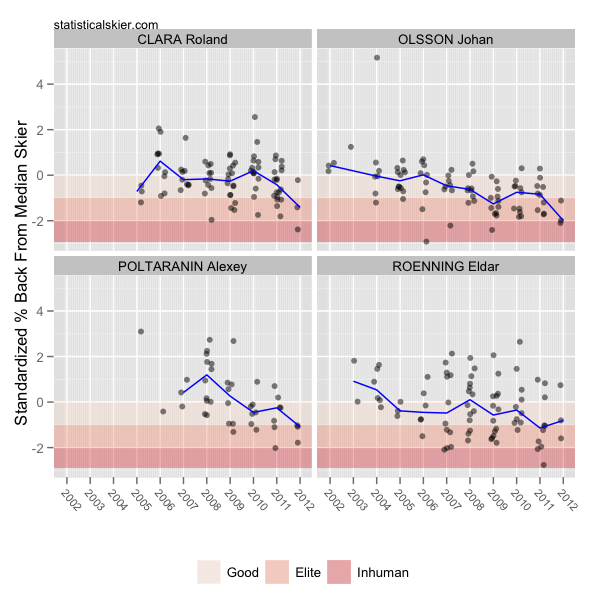
Eldar Rønning ended up doing very well in the overall mini-tour thanks to some very strong classic skiing on the last day. But overall, his skiing hasn’t been out of this world, and might even be a bit of a step back from last season. Remember that overall tour placings are heavily dependent on the specific events. In this case, strong classic skiers had a lot more space to make up ground, and so the overall tour may have favored classic specialists somewhat. If the techniques had been reversed, Rønning may not have fared so well.
On the other hand, Clara, Olsson and Poltaranin have all skied somewhat better so far this season overall. It’s particularly exciting to see from a guy I think a lot of people didn’t have on their radar (Clara), an older skier coming off a few bad-ish seasons (Olsson) and a guy from a “different” country (Poltaranin).
I plan to talk about sprint heat times when I can, but FIS messed up the heat times royally (at least, the times that are available online), so not this week. Maybe next time. I’ll have words about the North Americans on Wednesday…
As part of the promotion for their new complete line of nordic equipment, OneWay pulled into the cross-country World Cup this weekend in Kuusamo, Finland with their new service and promotional truck – complete with an are for skiers to see and touch their new products as well as a large area for their service team to work.
Ivan Babikov (CAN) races in Oslo, Norway, last January. Photo by Laiho/NordicFocus.
For most of the 119 starters in the men’s 10 k freestyle, Saturday’s race was hardly a walk in the park. That is, unless you like to go out in windy, misty, rainy, sleety and snowy conditions and enjoy encroaching darkness. And if you love long, steep hills — three per lap to be exact — the course in Kuusamo, Finland, was for you.
Fortunately, the conditions on the second day of the Ruka Triple mini-tour were the same for everybody. Miserable.
Tad Elliott, who finished 46th, had one of the more upbeat attitudes about the race — and even he went inside to watch his American teammates finish the staggered start on TV.
“It was good out there,” Elliott wrote in an email to FasterSkier after clocking the second-best U.S. finish after Kris Freeman (24th). “Not too many factors affecting my race. I just had to go out early. Real early.”
On Friday, Elliott finished 122nd in the classic sprint. That result put him in bib No. 3 for Saturday’s 10 k skate — a race that suited him better. The early starting spot was difficult to overcome regardless.
“No worries,” the 23-year-old Elliott wrote. “I put myself there. I knew I would go out early, hopefully not that early but it’s a skate race … Enjoyed it out there. I had fun.”
Fun wasn’t the word most North Americans used to describe their races on Saturday, especially not U.S. veteran skier Andy Newell. He finished 100th, 2 minutes and 40.1 seconds behind Norwegian winner Petter Northug.
“Today was a bit of a disaster for me,” Newell wrote in an email. “My legs felt really fatigued on a lot of the climbing today.”
He started near the back of the pack, directly in front of Northug, which almost gave him too much time to warm up.
“(I) ended up going on a ski that didn’t have nearly enough structure,” Newell wrote. “So I was skiing with suction cups on my feet.”
He was looking ahead to Sunday for a better result, as were the rest of his teammates. Freeman said he was in a good position after placing 24th on Saturday (+1:29.8). That put him 34th overall, about 13 seconds out of 20th.
In Saturday’s race, Freeman acknowledged he could have skied better. After 10th-place finisher Lukas Bauer (CZE) passed him on Freeman’s second lap (it was Bauer’s first), Freeman stayed with him for 2 kilometers, but “blew up and skied slowly to the finish.”
As for Sunday, Freeman stressed the importance of kick in the distance classic race.
“Starting in 32nd, it’s probably not realistic to hope for more than 15th, but that does not mean I wont try,” he wrote in an email.
The top Canadian in Saturday’s race, Ivan Babikov intended to push for a top overall place as well. He was 16th in the 10 k, which was his best early-season result and came despite “missing some snap on the uphills,” he wrote in an email.
He compensated by pushing harder on the flats and bumped himself up to 20th in the Ruka Triple standings (after placing 100th in Friday’s sprint).
“I’m very happy with my result (Saturday),” Babikov wrote. “I think I paced it well, wasn’t as fast in the beginning but it let me push hard in the 2nd lap.”
Babikov’s time of 22:40.9 (+51.8) narrowly bested that of Russian Evgeniy Belov (+52.0), who ranks ninth in the mini-tour standings.
For the 15 k classic pursuit on Sunday, Babikov aimed to finish in the top 30. At the same time, he knew the race would be packed and be like a mass start because of the narrow time differences between athletes.
“It’ll be very busy and tight out there,” Babikov said. “I think the best for me would be just to stay calm and work the pack.”
Several North-American competitors said the 15-k course (six 2.5-k loops) was especially challenging, which could suit Babikov’s strengths.
“The bulldog can climb, that’s for sure,” teammate Devon Kershaw wrote in an email.
Kershaw was the third-fastest Canadian on Saturday in 32nd, after Babikov and Alex Harvey (27th). Harvey wrote in an email that he was disappointed with his finish after struggling on the hills.
“The course here is super hard,” Harvey wrote. “Definitely not the best course for me, but I thought I could be better than that.”
“With a good day and good skis” on Sunday, Harvey hoped for an overall top-10 finish in the mini-tour. After two days of racing, he ranked 24th.
Kershaw planned to keep pushing and hoped his body would cooperate. In Saturday’s 10 k, he wasn’t happy with finishing 1:13.7 behind Northug. He narrowly missed scoring World Cup points in 32nd.
“I fought hard, and I’m happy I did that — but the feelings out there were agony,” Kershaw wrote. “I feel beat down and all I’ve done is a spring qualifier and a 10 km … We aren’t here looking to squeak into the points, or just be outside them (in my case).”
If all goes well on Sunday, Kershaw wrote he could move from 37th into the top 20 overall.
“But the front of the race looks quite out of touch for me at this point,” he wrote. “I guess I’ll just have to pray for a huge snow storm or something … I’ll just get out there and get after it.”
Teammate Lenny Valjas, who was fifth in Friday’s sprint, was the highest-ranked Canadian heading into the men’s final day of competition in 17th overall. He finished 55th (+1:42.1) on Saturday, noting that his body was tired from Friday’s hard effort. He gave the 10 k his all anyway and entered the stadium looking completely exhausted.
“This is the toughest distance course I have ever raced,” Valjas wrote in an email. “Tomorrow’s race will be a fun one, everyone is feeling tired after today.”
Canada’s Graham Nishikawa finished ahead of him in 48th (+1:32.6), which Nishikawa wrote was “a step in the right direction” after a slow start to the season.
American skier Noah Hoffman cited similar improvement after placing 68th (+1:53.9). Kevin Sandau (CAN) was 69th and Lars Flora (USA) was 86th.
“I am looking forward to tomorrow,” Hoffman said. “There will be great opportunities to move up in the field and there should be a lot of people to ski around. … (It) should be a fun race.”
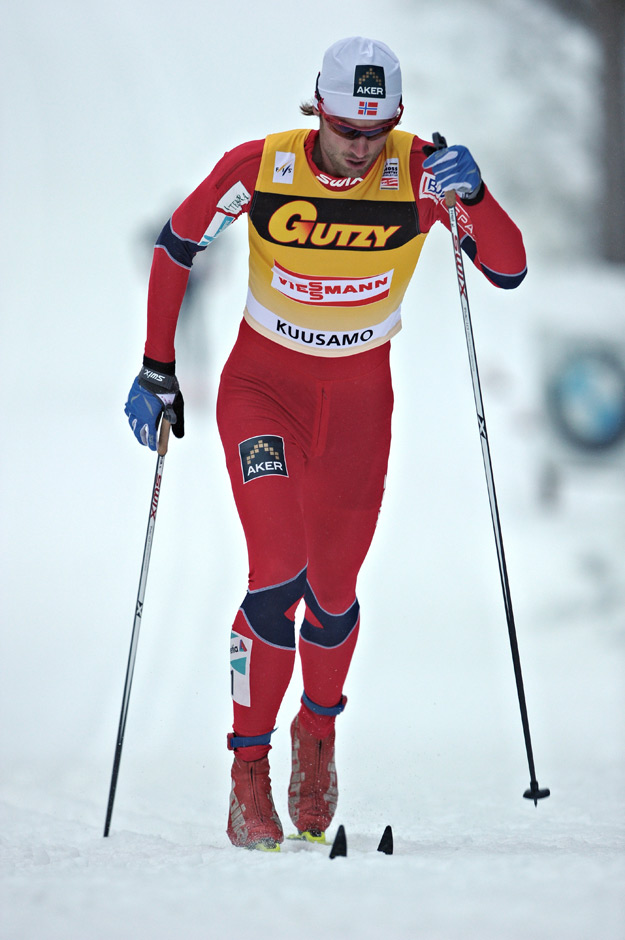
Norway's Petter Northug competing at the 2011 World Championships in Oslo, Norway. Photo by Geir Olsen/NSF
Roland Clara had been second before. On Saturday in Kuusamo, Finland, the Italian looked pretty comfortable in the leader’s chair, bundled in a blanket and flashing a genuine smile. But the men’s 10 k freestyle race on the second day of the Ruka Triple mini-tour was only halfway through.
With individual starts staggering the finishes, Clara could see his seat wasn’t permanent. With every checkpoint — 3.1, 6.4 and 8.1 k — his challengers closed in. Of the remaining men on the course, Norway’s Petter Northug was most threatening.
After a steady start, the defending World Champion recorded the fastest time at 6.4 k. He was 11 seconds faster than any of the 100 or so men that started before him and reached that point.
As Northug crossed the finish and collapsed into an exhausted heap, Clara relinquished his spot. He nearly achieved his first World Cup victory, but it wasn’t his day. After Northug finished 16th in Friday’s 1.4-k sprints, the champion reclaimed the No. 1 spot — both on the podium and in the World Cup standings.
“I was tired at the end, but I managed to keep all the way,” Northug told NRK. “The plan was to attack. I tried to go out hard and finish hard. I think it was the key today.”
Clara ended up second, 23.8 seconds off Northug’s winning time of 21:49.1. Starting nearly 40 bibs after Clara, Maurice Manificat (FRA) initially endangered his lead, setting a new best time at 6.4 k. Clara’s late push helped him stay on top, and Manificat finished 6.3 seconds behind him.
Positioned in third after Northug (+30.1), Manificat awaited the result of Dario Cologna (SUI). At the halfway point, Cologna only trailed Northug by 6 seconds.
By 6.4 k, Cologna was 11 seconds behind the eventual winner, but on par for a podium finish. In the end, Cologna was 1.6 seconds slower than Manificat and finished fourth (+31.7). Manificat was happy with the podium and relieved he wasn’t the only one who felt the wrath of the challenging course, which was intensified by strong winds.
“I got a bit tired at the end,” Manificat told FIS Ski. “Luckily, Dario Cologna also got tired and I could keep the third place.”
Clara, who was third last weekend in the 15 k freestyle in Sjusjoen, was also pleased with his early World Cup performances.
The men's podium at last weekend's 15 k freestyle in Sjusjoen, Norway (left to right): Petter Northug (NOR), Johan Olsson (SWE) and Roland Clara (ITA). Photo:Fischer/NordicFocus.
“Two races, two podiums,” he told FIS Ski. “It’s incredible for me to be in the podium all the time. Tomorrow I will give my best and try to make the gap closer.”
Clara currently sits in third in the World Cup standings with 106 points after Northug (145 points) and Sweden’s Johan Olsson (132).
A win in Sunday’s 15 k classic pursuit would guarantee Northug, the World Cup and Ruka Triple leader, the overall mini-tour victory and 200 World Cup points.
A year ago, Northug wasn’t even a player in the three-day Ruka Triple. He sat out Kuusamo’s early-season competition because of illness. After Saturday’s race, he is well on his way to claiming another World Cup victory with an 11.8-second lead on Cologna (SUI) and 41.4 on Alexander Legkov (RUS).
“Tomorrow, around 120 athletes will hunt me,” Northug said to FIS Ski. “I will try to keep the same shape for the whole season. After the Tour de Ski, we will see who will fight for the World Cup.”
Other top contenders for the Ruka Triple crown include Clara (+47.8), Manificat (+48.3), and Olsson (+51.9). Marcus Hellner (SWE) is seventh in the stage standings, and Chris Andre Jespersen (NOR) moved to eighth with a fifth-place finish on Saturday.
Rounding out the top 10, Russia’s Evgeniy Belov was ninth in the mini-tour standings and David Hofer (ITA) was 59 seconds behind Northug in 10th. After illness kept Lukas Bauer (CZE) from competing until this weekend, he finished 10th Saturday to move up to 11th overall.
The top North Americans in the stage standings were Canada’s Lenny Valjas (17th, +1:08.2) and Ivan Babikov (20th, +1:16.4). While Valjas isn’t known for his distance races, Babikov is — along with teammate Alex Harvey, who currently ranks 24th after two days of races.
Kikkan Randall (L) and Holly Brooks racing in the women's 30 k skate at the 2011 World Championships in Oslo.
Editor’s Note: There has been significant confusion regarding results for today’s World Cup races. The FIS website lists overall standings for the three-race mini-tour. Kikkan Randall is 5th in those standings, and finished 12th in today’s 5km freestyle.
There are, Kikkan Randall concedes, downsides to success. But they’re pretty miniscule.
For one, the American skier’s expectations have been raised since notching her first-ever distance top ten in Sjusjøen, Norway last weekend, and then skiing to fourth place in the classic sprint in Kuusamo, Finland yesterday.
In today’s 5 k freestyle World Cup, the second stage of the “Ruka Triple” in Kuusamo, Randall skied to twelfth place, 35 seconds behind winner Marit Bjørgen of Norway. Last year, she probably would have been elated with the result. But now?
“I was hoping for a little better- in the top ten,” Randall wrote in an e-mail to FasterSkier.
“My expectations have certainly changed based on the results from the past two weekends. Now that I know I can race in the top ten, that is where I will be aiming for each race. I definitely went into the 5 k today wanting to lay down a top-ten worthy effort, so I was a little disappointed to be just outside.”
But high expectations are a very small price to pay, and Randall was still thrilled with her performance in Kuusamo today – especially since her legs were heavy and she didn’t have her best energy.
“This ranks as one of my top three distance World Cup results, so I am pretty satisfied,” she said. “I did ski competitively right in there, only a few seconds out of the top ten.”
Thanks to her success in yesterday’s sprint, Randall was one of the last starters of the day. She started thirty seconds in front of Charlotte Kalla of Sweden, who is one of the best skiers in the world at any distance and an especially strong skater. While Kalla was breathing down Randall’s neck over the last half of the race, the American couldn’t tell – and Kalla never actually caught her.
“Knowing Kalla was starting thirty seconds behind me was a little extra motivation for sure,” Randall said. “[But] I was focusing on my own race. I knew that if I skied well I could stay ahead of her.”
The twelfth-place finish has been part of a steady improvement in Randall’s distance skiing. The trend is especially noticeable compared to past results from this same race, which Randall has been contesting for six years now. In 2006, she finished 68th in a 10 k classic race. By 2009, she was inside the top twenty, notching 18th in the same race, and last year she stepped up to 17th in the 5 k classic.
Teammate Liz Stephen, who finished 28th, said in an interview that Randall’s results validate the team’s entire approach and lifestyle.
“You look at someone like Kikkan, and she’s been doing this for ten years,” Stephen said. “And she’s just now – I mean, last year of course she had great results – but she’s just now starting to be a contender every day.
“And we just have to be patient, I think. Everyone wants success now, today, but it doesn’t happen that way. So it’s really exciting for us to see that the really consistent, hard work she’s put in year after year is paying off. And I think it will for everybody.”
Randall noted that becoming an overall contender had been a long-term goal.
“It’s nice to start seeing some solid progress towards that goal,” she told FasterSkier. “It will be fun to go into every event now feeling competitive.”
While Randall’s results are the most spectacular – on the small scale, she will be starting tomorrow’s pursuit in fifth position, and on the large scale she is doing things that no American woman has ever done, collecting results that no American woman has ever collected – the rest of the American team is also more solid than it has ever been.
Holly Brooks, who is not a U.S. Ski Team member but is competing on the World Cup thanks to being last year’s SuperTour leader, had her best-ever international finish, placing 17th. She was only 6.5 seconds behind her APU teammate, Randall.
“Today’s result gives me the confidence that will help carry me through Christmas and the rest of my time here in Europe,” Brooks wrote in an e-mail. “I wasn’t all that far from the top ten which also shows that on a good day, anything can happen.”
Brooks needed to rebound after a frustrating classic sprint yesterday which saw her finish 70th. Today, she said, she focused on going hard and making up for what she called “yesterday’s debacle.”
Brooks started just behind Astrid Jacobsen of Norway, who skied an aggressive race and held the lead until Justyna Kowalczyk of Poland crossed the line 61 starters later. Brooks knew that Jacobsen was having a good race, and tried to use it as added motivation.
“Astrid Jacobsen had a tough day yesterday too and started ahead of me so I assumed that she was the race leader,” she said. “It was a safe assumption seeing that she maintained her seat in the leader’s chair for quite some time. One of these days I’m going to sit in that chair too!”
Stephen was the next U.S. skier on the results sheet. Like Brooks, she had trouble in the sprint and had finished 85th. As a result, she was one of the very first starters and actually had the winning time until Jacobsen finished eleven bibs later.
Stephen said that the short, 5 k distance was tough for her, and that she didn’t feel like she had all of her speed in her legs yet. It was, she laughed, longer than a sprint – so that was a bonus.
U.S. Ski team rookie Sadie Bjornsen started thirty seconds ahead of Marthe Kristoffersen of Norway, which turned out to be a huge benefit.
“I knew that Marthe was going to pass me at some point so from the gun, I felt like I was running from the big bad wolf,” she wrote in an e-mail. “She passed me at a good time, because I knew there was only about 1.5 k left, and I was just going to hang on for dear life.”
The plan worked. Bjornsen stuck to the Norwegian like glue, losing only three seconds in the last 1500 meters. Kristoffersen placed eighth, one of the best finishes of her career, while Bjornsen ended up 37th.
“This is the most exciting part about skiing in Europe,” Bjornsen said. “You get to ski around some of the fastest skiers in the world… skating with steep uphills is my least favorite type of race, so today I went out there to play and see what I could pull off.”
With Ida Sargent finishing 47th, the women truly had one of their best days ever in World Cup action.
“We’ve got a really good vibe going on the women’s team right now that stems back from Oslo World Champs last February,” Randall said. “I think we can all see what is possible now. We work together in the off-season and push each other, and now we are seeing the positive results of that in our racing.”
Both Stephen and Randall pointed out how far the American women’s team had come in the last decade. The first year that Randall traveled to Kuusamo, she was the only woman.
“Now [we have] three in the top 30 and almost four,” she said.
Stephen agreed, saying that having so many good performances motivates everyone.
“To have five in the top fifty and three in the top thirty, that’s awesome,” Stephen said. “It’s good to have some momentum behind us. If there’s only two of you on the [World Cup], then there’s always the chance that both of you are going to have a bad day. But with a team like this, somebody’s always going to have a good day. There’s a lot of really exciting and positive stuff going on.”
The women mentioned two more sources of motivation. Stephen thanked the U.S. community for their support, saying that she got e-mails after every race from fans who woke up before dawn to watch the races online.
And according to Randall, the team’s fanbase was no longer limited to one side of the Atlantic.
“The fans on the sidelines are adopting us a little bit and cheering louder for USA,” she said.
Marit Bjørgen racing in Norway in 2009. Photo, Geir Olsen.
Nobody was surprised to see Marit Bjørgen atop the leaderboard after the second stage of the Ruka Triple in Kuusamo, Finland today.
The Norwegian star was the last to start, thanks to her win in the classic sprint yesterday, and had all the information she needed to beat her competitors – not that she needed it. Over just five fast kilometers, Bjørgen racked up a sizeable lead and cruised across the finish. It was a stark contrast to the earlier finishers, who had sprinted for all they were worth and collapsed immediately.
The refreshing thing about Bjørgen, though, is that even if she dials it back in the last hundred meters and still wins by more than ten seconds, she’s humble and gracious, smiling and raising her arms as she crosses the finish line for each win.
In comments to the press, the star – who picked up her 50th World Cup win with the victory – attributed her performance to good skis from the Norwegian wax techs. She also said that the final stage of the triple, a classic pursuit, would be difficult because “the other girls are getting stronger and stronger all the time, and they’ll try attack me but l just do my best and see the results after finish line.”
That’s a pretty notable lack of swagger coming from a woman who is literally entering uncharted territory: she recently passed Bjørn Dæhli and taken the all-time win record. Bjørgen doesn’t seem to be slowing down, and will likely further obliterate Dæhli’s tally by the end of 2012. After that, who knows how many more wins she will rack up, but one thing is for sure: nobody will touch her record, whatever it is, for years and years. Especially if they can’t get a single win as long as she’s competing.
With Bjørgen holding the top step of the podium hostage, a number of other talented women are left fighting for the remains. Charlotte Kalla of Sweden and Vibeke Skofterud of Norway finished second and third, repeating the podium that fans have seen in each of the World Cup races so far this season.
“I could get used to being on podium,” Skofterud joked to the press.
The 31-year-old has added two distance podiums to a collection that was previously quite small; the last time she collected a top-three finish in a World Cup that wasn’t a sprint or a relay was here in Kuusamo two years ago.
“It’s strong, it’s fun and it’s really well-deserved,” Bjørgen said of her teammate’s finish today when talking with NRK, the Norwegian state television station.
But despite the winner’s kind words, Skofterud indicated that she didn’t want Bjørgen to get too comfortable at the top. She’s willing to go as far as working with non-Norwegians in an attempt to take her down in the pursuit tomorrow.
“We have to work together with Kalla to chase Bjørgen,” she said.
A Resurgent Jacobsen
Jacobsen (L) with Maiken Caspersen Falla after finishing third in the team sprint at 2011 World Championships.
Her teammate Astrid Uhrenholdt Jacobsen – who won the World Championships sprint back in 2007 as a twenty-year-old – was the story of the day and sat in the leaders chair for the majority of the race, ultimately winding up sixth, 27 seconds behind Bjørgen.
Jacobsen was plagued by injuries in 2007 and then suffered from a horrific biking accident in 2009; she’s also a medical school student, something that would seem crazy in the U.S. but is completely unheard of in Norway. Jacobsen had some strong performances last season, including tenth overall in the Tour de Ski, a bronze medal in the sprint at World Championships, and a fifth place overall finish at World Cup Finals.
At the end of the season, she considered leaving the sport – but then decided to stay through the next Olympic cycle, focusing this year on the Tour de Ski and the overall World Cup rankings, where she hopes to finish in the top three.
But Jacobsen finished 12th in the 10 k in Sjusjøen and 74th in yesterday’s sprint. As part of an incredibly dominant Norwegian women’s team, her results didn’t cut the mustard and people wondered whether she was devoting too much time to her medical studies and not enough to skiing.
That changed today. The seventeenth starter, Jacobsen floated up the steep hills of the Kuusamo course with fluidity and a high tempo. At the 3.1 k timecheck, she demolished the previous lead time, which had belonged to Liz Stephen of the U.S.
It took another 61 starters for anyone to be able to beat her time, and while they tried, the television cameras kept panning to Jacobsen happily ensconced in the leader’s chair, actually looking rather bored.
Other Notable Performances
Therese Johaug of Norway finished fourth, just one second away from the podium.
2011 World Cup overall winner Justyna Kowalczyk of Poland finished fifth, and didn’t have the form she has shown in some past competitions. While it probably didn’t keep her off the podium, she had a tough time in the last few hundred meters – she needed to pass Canada’s Dasha Gaiazova, but tried to take the inside line around a corner and couldn’t squeeze through. She didn’t appear to have tracked Gaiazova, so it’s not clear that the Canadian did anything wrong, but Kowalczyk’s poor strategy may have cost her a few seconds.
Riika Sarasoja-Lilja of Finland finished seventh, her second-best World Cup performance to date and her first distance top-ten.
22-year-old Norwegian Marthe Kristoffersen also had one of her best World Cup races to date, finishing eighth, just ahead of teammate Kristin Størmer Steira.
After the Nor-Am mini-tour in Rossland, British Columbia, last weekend, racers from both sides of the border raved about the event as an exciting change of pace where all racers – sprinters and distance skiers alike – have a fair chance to fight for the overall title. Contributing to the positive reviews was the excellent job that the organizers and volunteers put down to make it fun, fair and entertaining.
Stefan Kuhn (Canmore Nordic) takes the victory over fellow Canadian Drew Goldsack (Rocky Mountain Racers). Photo: Rob Whitney.
“I love the mini-tour – fun to watch and great to ski in. It adds a lot of excitement for us racers and a great challenge as well. I don’t know if you can do anything much better. The Rossland ski community had done a great job organizing and made a 3-day race series go very smoothly and was lots of fun,” Stefan Kuhn (NTS) said in an email to FasterSkier. The overall men’s tour winner also thought the sprints were factored fairly into the overall results.
“You get a 60-second bonus if you win and down from there, and that is a lot,” Kuhn said.
The overall women’s winner, Jessie Diggins (CXC) also enjoyed the format.
“I think the mini-tour was really fun. The way it was set up made the last day pretty exciting since you knew exactly where you were in terms of the overall tour standings during the race,” Diggins said in an email to FasterSkier.
On the World Cup, some European racers have complained that a mini-tour is not worth the effort for sprint specialists. That was not an issue for the Nor-Am racers that FasterSkier spoke with. If anything, Diggins thinks the sprints may have been weighted a little too heavily, though it was not a problem for her.
“Because the 5km skate was so fast, the girls who weren’t sprinters weren’t given as much of a chance for the overall tour,” Diggins said.
Good mix of sprint and distance
“I really enjoyed the mini-tour format. I think it’s a great way to give both sprinters and distance skiers a chance to mix it up together,” Drew Goldsack (NTS) said in an email to FasterSkier. Going into the event, Goldsack was a bit concerned about the sprints being given too much emphasis. But in practice, he thought the concept worked out fairly for all.
“On paper I thought that the sprint was maybe weighted too heavily but…it actually worked out perfectly. I think it was partly due to the fact that we had distance skiers sprinting better than usual and sprinters skiing distance better than usual, but it worked out well and made for some exciting racing.”
Goldsack, who was third overall, had one single complaint.
“The only thing I’d like to see better is the prize money; it seemed a little chincey for three hard days of racing. $700.00 for the win isn’t bad, but $400.00 for second and $250.00 for third place seems a bit low to me,” Goldsack said.
Great format but keep it reasonable
Brooks racing in Rossland (Photo: Rob Whitney)
Holly Brooks (APUNSC) thinks the mini-tour format is both entertaining and fair, especially on the Nor-Am circuit where there are fewer specialists than on the World Cup. She also thinks the bonuses for the sprints helped even out any discrepancies.
“Especially in the women’s field, the sprinters and the distance racers are the same people anyway, and the bonuses awarded for the sprints were huge, so I think the format was fair. I think on the World Cup there is more of a difference because the racers are more specialized,” Brooks said to FasterSkier.
“We train so hard all year and make so many sacrifices. We train to race, and this is it. For me, this was a good intensity block before nationals. There were good interesting courses, and you have to be really versatile with this format that includes sprint, skate and classic,” Brooks said, but added that she doesn’t want organizers to go bananas with the concept just because the first one was a hit.
“I hope they keep mixing it into the schedule, but I wouldn’t like to see all race weekends turn into mini-tours,” Brooks said, noting that one or two of them per year could be a reasonable amount.
“Mini-tours are hard on both racers and organizers. There are more logistics and it’s easy to make mistakes, and it makes it complicated for everyone,” she said.
Just a good, hard weekend
“Overall I think the mini-tour format is really good. I wished they had them at the start of my career. I have always enjoyed racing different formats and distances,” Lars Flora (APUNSC) said. The only thing he would like more of was hills, even on the last day.
“The time bonuses seem to play out fairly between sprint and distance racing. The only thing I would change is adding a hill climb at the end of Sunday’s race. It would have been fun to finish with a classic hill climb,” Flora said.
Caitlin Compton (CXC) also thoroughly enjoyed the Rossland experience, both for the variety and for the rigor. For Compton, the mini-tour was also an opportunity to test her own limits.
“I knew that Saturday’s 5K skate would be my better event, but I also wanted to see how my fitness was through the entire weekend. I was pleased to find that my energy and quickness was still there (on Sunday), if not higher than the days before,” Compton said, noting that Diggins had reserves nobody else could match.
Mixed feelings on the World Cup
US Ski Team’s Kikkan Randall, who is on the FIS Athlete Commission for cross-country skiing, said in an interview with FasterSkier earlier this season that she has mixed feelings about the mini-tour concept. On one hand, Randall likes the idea of cross-country capitalizing on the increased TV-viewership that comes with these tour type events. On the flip side, Randall is concerned that by adding the overall time component and with each individual stage only worth half World Cup points, the sprint race is being devalued. She is also skeptical to adding a longer event weekend to the early World Cup season.
“I also feel that with an already packed ‘Period I’ racing schedule, it is better to have two races instead of three this early in the year to allow for a little more training during the week and thus better longevity through the season,” Randall said.
Among the Norwegians, some of the sprinters left Kuusamo after the opening sprint event of the “Tour de Opening” in November. Ola Vigen Hattestad and Kuusamo sprint winner John Kristian Dahl were among those who left early. Dahl dislikes the mini-tour, and was happy to explain why.
“We get more points for regular WC sprint races than we do here, there is a packed schedule with a lot of races before the end of the year, and we have important races in Düsseldorf (GER) already next weekend. To do three races here takes an incredible toll (on the racers), and it seems a little oddly placed,” Dahl said to the Norwegian TV station NRK.
The mini-tour in Kuusamo consisted of three competitions. Sprint on Friday, individual start classic on Saturday and pursuit/handicap start skate on Sunday. Only the overall winners will be listed as World Cup winners for the event. The sprint winners were awarded only 50 points compared to the normal 100 points.
“It’s no secret that the mini-tour robs some of the status from the sprinters. For me as a sprint specialist, this is not great,” said Ola Vigen Hattestad.
According to Vegard Ulvang, the Cross-Country Committee Chairman, this year the mini-tour is a test-event and it will be evaluated in the spring as to whether to make the Kuusamo “Tour de Opening” a permanent part of the World Cup calendar.
As for the Nor-Am mini-tour, it seems like the athletes are giving the format a thumbs up, at least after the Rossland experience last weekend.
Aside from some frozen toes and fingers (temps still between -17 and -14 most of the time), the action in Kuusamo just keeps getting better (though photos are somewhat limited). Bjorgen continues her lead with a second win today while Cologna took over the top spot for the men (the top two Norweigian men did not compete today). A total of 15 athletes who started the tour did not compete today an will not continue tomorrow. The USA had some solid performances today, and looks fit. Check out http://www.nordicopening.com/en/ and http://www.fis-ski.com/uk/disciplines/cross-country/results.html for results.
Tomorrow will wrap up the Kuusamo mini tour with women’s 10km and men’s 15km skate (pursuit format based off of the sprint and today’s classic race). It should be an exciting end to a fantastic weekend of world class racing.
Ahvo caught up with the US ski team for a couple of quick interviews before the races today.
Randy Gibbs
Chris Grover
Ahvo also got some video out on the course, but the connection today is being finicky and slow, so uploading will happen tomorrow along with our final report from the north.
The Nordic world is focused on Kuusamo, Finland, this weekend. In addition to the cross-country World Cup taking place, the first Nordic Combined World Cup is taking happening in the same location.
Bryan Fletcher led the American contingent with a strong ski, moving himself four spots up on the result lists after finishing 22nd in the jumping competition Saturday. Fletcher started 1 minute 20 seconds behind the leader, only a second behind Mikko Kokslien (NOR), who ended up second overall. Fletcher went right to work from the get-go, and picked off a couple of spots in just the first quarter of the race. He was able to pluck off two more spots in the final kilometer of the race to earn himself 18th place.
“I was able to jump more like I had been jumping in training, which landed me in 22nd after the jumping,” Fletcher said to FasterSkier after the race. “I was able to ski strong and ski my own race without pushing it too hard and blowing up,” he said, explaining that he was happy with a top 20 result.
“Kuusamo was a tough place to start the season, cold weather and a large hill, with an even tougher course make it a really challenging opener for the season,” Fletcher said, noting that the cold added more trouble.
“The cold can really screw up your routines on the jump hill and on the race course. The weather was very, very cold and the humidity didn’t help. Everyone was freezing during and after the race. Because it so cold you tend to try to stay in a warm place as long as possible, however this can make you late for your jumps or the race and then jumping into the comp can be hectic,” Fletcher explained, adding that two hours after the race, his fingers were still tingling.
“I hope it is a breakthrough for him,” U.S. Nordic Combined Team head coach Dave Jarrett said to www.usskiteam.com.
“It’s a step in the build to 2014 where we need to have more different guys doing this more often. It starts with top 30s, then top 20s,” Jarrett continued. “But we need to keep it in perspective. It is his best result but we have higher expectations.”
Billy Demong jumped 111 meters to start the cross-country in 38th place, which Jarrett suspects is partly an equipment issue. Demong worked himself up two spots to finish in 36th but that doesn’t concern Jarrett too much at this point.
“With more and more jumps leading into Oslo [World Championships], he’ll have plenty of time to dial things in. That’s the focus for Bill this season,” Jarrett said.
Taylor Fletcher was 36th after the jumping with a distance of 115 meters, but dropped to 39th after the cross-country. Brett Camerota did not start the cross-country after a tough start on the hill.
Day for breakthroughs
It was the day for breakthroughs in Finland; Mikko Kokslien (NOR) was 21st after the jumping but skied into second place. Kokslien was narrowly beaten by Felix Gottwald (AUT), who won the competition after skiing from 26th to 1st place over the 10K course, only passing Kokslien on the last kilometer. Jason Lamy Chappuis (FRA), who earned himself a 15-second head start after soaring 140 meters in the jumping, ended up in third place.
Kokslien, who started 1:19 behind and lead the race for parts of the course, said he doesn’t know what to feel, losing first place by 7.5 seconds at the finish.
“I don’t know what I was thinking. This is a new situation for me. I thought the Austrian was a little ways back, but then suddenly he was right there,” Kokslien said to Norwegian television station NRK
“This was wicked good. I’ve worked so hard for so many years,” Kokslien said to NRK.
This is Kokslien’s best international result, and the Norwegian coaches consider it a breakthrough for the 25-year-old.
Francois Braud (FRA) was second after the jumping, but finished the cross-country in 16th place. Wilhelm Denifl (AUT) was third after the jumping but finished 11th overall.
More work
“Overall I am happy with my results in Kuusamo, however I know I can still do better,” Fletcher said. “The whole team is looking ahead to Lillehammer and hoping to post some solid results there. Our team knows we can be at the top and the group of guys here can definitely put it together, it’s just a matter of time,” Fletcher said.
And while Jarrett is excited about Bryan Fletcher’s break into the top 20, he is looking at the performance as a whole and seeing that there are plenty of things to work on. The crew now heads to Lillehammer (NOR) for a pair of World Cup races next weekend, and then to Ramsau (AUT) the weekend after, and looks to build on the season opener in Finland.
“Collectively we’re not skiing on par,” said Jarrett. “We come into a long block of racing now. If the plan goes as we’re hoping they’ll ski stronger in Lillehammer next weekend and be in good shape for Ramsau the following weekend.”
Kris Freeman racing in Muonio, Finland, earlier in November.
Kris Freeman wasn’t quite able to match his teammate Andy Newell’s result from yesterday – but he came pretty close.
Freeman, of the U.S. Ski Team (USST), finished seventh in the 10 k classic in Kuusamo, Finland on Saturday, just 0.3 seconds out of sixth. Newell, who had finished sixth in the sprint yesterday, finished 89th, slipping to 42nd place overall in the mini-tour standings.
Meanwhile, Canada’s Alex Harvey finished 17th, moving up to fourth place in the overall standings. His teammate Devon Kershaw finished 22nd and is sitting in 16th overall.
Freeman trailed the winner on the day, Dario Cologna (SUI) by 24 seconds. Cologna’s performance moved him up to third place in the overall mini-tour standings, behind Emil Joensson of Sweden and Alexey Poltoranin of Kazakhstan. After a strong start, Joenssen, a strong sprinter, held the fastest time at 5 k, but lost almost 25 seconds to Cologna on the second lap.
“I’m very satisfied winning a classical race,” Cologna told FIS. “I’m definitely hunting Emil tomorrow being 9 seconds behind, it’s going to be exciting in the last 5 kilometers. It seems like these mini tours fit me, as I like to have the chance to compete in different races and the fact that I still have the chance to win the triple tour tomorrow.”
Alexander Legkov of Russia was second, 6.7 seconds back, followed by Daniel Rickardsson of Sweden. Rickardsson is having a great start to his season – he finished third in the 15 k skate race in Gallivare last weekend.
For the North Americans, Freeman was the story of the day, establishing a quick time early on, due to his lackluster sprint result on Friday. The U.S. Ski Team’s Continental Cup duo of Noah Hoffman and Simi Hamilton finished 66th and 73rd respectively. For the Canadians, Brent McMurtry and Stefan Kuhn finished 69th and 71st, followed by George Grey in 79th and Ivan Babikov in 83rd. Continental Cup leader Chris Cook finished 104th, while Canada’s Lenny Valjas didn’t start.
Freeman told FasterSkier that he had a slow start, but ended up with a negative split by twenty seconds on a great second lap.
“I still need to practice pacing the 10 k a little bit,” he said.
Because start position for today’s race was based off of yesterday’s sprint results, Freeman was starting in an unusual place in the order. But he said that it actually worked well.
“These tours are a little funny – I had a great start position in the sprint race that I hadn’t earned, and then I got a kind of crappy position today that I hadn’t earned either. But it was all right, because I had both Tobias Angerer [GER] and Lukas Bauer [CZE] as a gauge who had started in front of me, so I was getting some okay splits.”
Freeman will be the thirteenth starter in tomorrow’s pursuit race. Joensson will have a fifty-second head start on him, but many other contenders are closer – he is part of a group of eleven skiers who will start within ten seconds of each other.
“I’m right around a bunch of really great guys,” he said. “There’s a couple of weaker guys in front of us who hopefully we will ski down, and I’m just going to go out and try to ski my own race. The course is so hard that I don’t really see there being that much advantage coming from a draft – it’s either straight up or straight down. So I’m going to take it the way I like to.”
As for the Canadian team, tomorrow is shaping up to be an exciting day. Both Harvey and Kershaw have the opportunity to create excellent results in based on their current overall standings. Head Coach Justin Wadsworth said that they knew coming in that the two men would ski strongly, but that they are in some ways exceeding expectations.
“We knew that if they just had solid races, which they did today, [they would do well] – I mean, it was a good race for Alex. I think it was an okay race for Devon. But they both had solid results which combined with the sprint race put them in the hunt.”
For Harvey, Wadsworth said that the key to success tomorrow would be not getting excited and going out too hard.
“It’s a little gap up to Dario,” he said. “It’s better to wait for Daniel Rickardsson and maybe Legkov to catch him. I’ve given him the advice to start fast and smooth and to wait for the guys to catch up, and then go with them. I think both of those guys are going to be willing to do a lot of the work, for sure Legkov will, so it’s a good opportunity for Alex to not panic out of the start and just hop in and ski behind those guys nice and smooth, and kind of see where the race unfolds from there.”
Kershaw will face a very different race scenario. He will be starting at the back of Kris Freeman’s group of skiers, and Wadworth said he wouldn’t have time to relax out of the start.
“He’s got to start kind of fast to make sure… with two seconds up to Kris Freeman, he can start out pretty fast out of the stadium and go down the first downhill and hopefully group up with everyone. You can’t go out too conservative, because there is a little bit of a gap behind him, and you just want to protect that a little bit.
“Those skiers, they won’t work together as a group I don’t think,” he continued. “Not to catch people. But there might be someone out of those ten people who is having a really good day, and might do a lot of the work and drag some guys up. That’s going to be just really interesting to watch.”
Andy Newell (USA) racing in the rounds in Kuusamo, Finland, on Friday. Photo: Pete Vordenberg/NCCSEF.
The Kuusamo mini-tour opened with a bang for the North American contingent, as both Andy Newell and Alex Harvey skied into the top ten for the first time this season.
Newell, who had a lackluster 15k in Gallivare last weekend but a strong opening relay leg for the United States, qualified in eighth position and ultimately finished sixth after making the A-Final.
Harvey had a mediocre weekend in Gallivare, finishing 34th in the skate race – not a disappointing result, but clearly not his best – and turning in one of the Canadians’ better relay legs. But today, he qualified in ninth position, and held his place through the heats.
For both men, today’s sprint was clearly a major improvement.
Finland had a great day in the qualification round, taking three of the top four spots. Niklas Colliander had the fastest time on the day. His position as the top qualifier was by far the best performance in his career so far – he has made the quarterfinals in several World Cups, but has only made it into the semifinals once.
Colliander was followed by Sami Jauhojaervi, who had a disappointing season last year but appears to be back on track. Estonian Kein Einaste finished third and Finland’s Matias Strandvall fourth.
Newell said that his qualification round was “pretty normal”, and that he can usually qualify in good position.
He was only 0.6 seconds in front of Harvey. The Canadians had a great day, with Lenny Valjas qualifying 19th, Stefan Kuhn 26th, and Devon Kershaw the last lucky man to sneak into the heats in 30th place.
Once the heats got rolling, the standings were shaken up quite a bit. Colliander was unable to hold his position, finishing last in his heat and 26th overall. In fact, only one Finn skied in the A-Final with Newell – Jauhojaervi. He finished third behind John Kristian Dahl of Norway and Alexei Poltoranin of Kazakhstan.
Newell was the lone North American to make the A-Final, and he called his 6th-place performance “embarrassing”. He trailed going up the first hill and was never able to get back in the mix.
“The semifinals were much tougher [than the quarterfinals],” he said. “I really had to fight for the line… That heat definitely took a lot out of me. All in all I think the day was a little bit of a disappointment just with the way the final went, so I’m not feeling great about the performance.”
Newell had only fifteen minutes between his semifinal and final, and said that when he was in the start for the final he felt confident. It was only after the gun went off and he hit the first hill that the wheels came off.
Alex Harvey had the next best day for the North Americans. After qualifying in ninth position, he skied well in the quarterfinals and semifinals, finishing ninth overall. For Harvey, this was an encouraging result.
“Normally he’s a slower starter at the beginning of the season,” Canadian Head Coach Justin Wadsworth told FasterSkier. “So he’s in a really good position for the rest of the season. He’s definitely brought himself up a whole ‘nother notch from last year, so far.”
Harvey’s teammate Devon Kershaw agreed. “What is exciting is Alex. To be 9th in a classic sprint for him is amazing. The last time he qualified in the top 20 was Trondheim and we all saw what he did in the distance race the following day (he was 3rd). He’s going to be amazing this weekend I think. He’s in great shape, and seeing him today was unreal. Should be exciting.”
Kershaw didn’t have too shabby of a day himself. He qualified in 30th, the last man to be included in the quarterfinals.
“I was pleasantly surprised to see my name in 30th – but at the same time a bit disappointed because 30th isn’t exactly lighting it up or anything,” he said. “I have never qualified in 30th, plenty of times between 31st-35th – and let me tell you, it’s an awesome feeling to sneak in. But that feeling quickly subsides when you realize that there were 29 dudes faster than you in qualification – and you have to square off against all of them soon enough.”
For Kershaw, that turned out to be easier than he thought. With some luck, he finished third in his heat, beating half of the skiers who had qualified ahead of him.
“Like every classic sprint of my life, I was slow out of the start. I tried to move up on the first hill but got semi-tangled/boxed out by Jens Eriksson [of Sweden] and soon found myself in 6th – by a lot. I picked a garbage track and that coupled with a sluggish body – I didn’t climb the hill very well either, but I felt much better skiing over the top of it and started to bring the dudes back. Then, I got lucky as Dario Cologna fell – and I felt good in the double poling finish to pick off another guy to finish 3rd in my heat.”
As Wadsworth pointed out, it doesn’t matter where you qualify, as long as you do qualify. Dahl, the day’s winner, had qualified in 27th – only three spots ahead of Kershaw.
Overall, putting four men in the heats was a definite success for the Canadians. Wadsworth was enthusiastic about many of the performances, saying that sending Valjas, Kuhn, and the rest of the Continental Cup squad to Rovaniemi last weekend was the right choice for them. Instead of sitting around in Gallivare, they gained confidence in some races, which clearly paid off.
He was excited, too, about the Canadians’ prospects in the mini-tour.
“Especially for Alex and Devon, this is the perfect format because those guys can skate, they can sprint, they can do 30 k, whatever. If I look at the top 20 guys, I think that Alex and Devon are in a really great position to ski solid and be there for the hunt at the end…. most of the guys in front of Devon, except for Alex and Jauhojaervi, are sprinters. And even guys like Ivan Babikov, he can be there if it was a little bit longer – but for him starting off with classic sprinting is not the best. But I think the mini-tour format suits us well.”
Valjas and Kuhn ended up 29th and 30th on the day after finishing sixth in their respective heats. The rest of the Canadians trailed significantly: Brent McMurtry finished 50th, followed by George Grey in 84th and Ivan Babikov in 109th.
For the Americans, Newell had the only really solid result of the day. Simi Hamilton finished 67th, followed by Kris Freeman in 87th and Noah Hoffman in 120th. Hamilton has been struggling with an IT-band injury, and Hoffman isn’t much of a sprinter. Still, all is not lost for the weekend – Freeman could move up a lot in the distance races, as could Hoffman.
Newell said that he was tired after spending four hours on the snow today, but that he still felt good going into tomorrow’s classic race.
“I think a 10 k classic could be a good race for me. Also, we get some bonus seconds, I’m not sure how many I got but it was probably 35 or 40 bonus seconds, so that helps. Hopefully I’ll recover well tonight and then we’ll see what happens tomorrow. I’m still learning a bit on the distance side of things.”
Andy Newell and Kein Einaste (EST) – Quarter Finals.
The race action started today at 10:45 this morning with ladies sprint followed immediately by the men. Today’s format included a qualification round from which the top 30 are distributed into 5 heats of 6 skiers. The top 2 skiers from each skier and the next two fastest skiers advance to the semi-finals. From the semi-finals, the top two skiers from each heat and two lucky losers advance to the final.
The weather remains close to perfect with -14C today and dry snow. It is a bit on the windy side though, so while Nordic combined was able to complete their competition today, the ski jumpers’ competition has been cancelled for tonight.
Newell had a good day, check out the official results and official news from:
For some videos from Ahvo’s vantage point, check out the following youtube links:
Kris Freeman
Swedish Skier
Andy Newell
Marit Bjorgen
Andy Newell – SemiFinal
On a non-skiing related note, I met Santa Claus and Mrs. Claus at the finish line. They actually have FIS accreditation! Proof that Santa is from Finland (Korvatunturi) and that he’s the real deal. (Finally!!)
Kuusamo, Finland – “It is hard not to be upset but in reality we are here with a new group of guys competing full time on World Cup. It is going to take some time to build them up to 2014,” U.S. Nordic Combined Team head coach Dave Jarrett said to FasterSkier.
Bryan Fletcher was the top American after the jumping, where he finished 35th. Taylor Fletcher was 38th after the jumping, Brett Camerotta was 40th and Bill Demong was 45th. Demong worked his way up to 32nd in the cross-country, while Taylor Fletcher advanced three spots, from 38th to 35th. Bryan Fletcher fell two spots, from 35th to 37th. All are capable of better performances, Jarrett said.
Jason Lamy Chappuis (FRA) won Friday’s World Cup opener, finishing in 28:33.5, Eric Frenzel (GER) was second (28:40.1) and Mario Stecher (AUT) was third (28:45.2).
Trying to see the silver lining in the situation, Jarrett pointed out that he has a young team that needs experience.
“The new group is ahead of Billy and Johnny’s curve for their age and need to be mixing it up on WC more often,” Jarrett said. “The Fletchers have only been in top 30 once in the winter in their careers, and today they were 35th and 37th in a full strength World Cup field. Neither competed up to their training level, and they know that,” Jarrett said, noting that the World Cup opener featured plenty of challenges. Windy jumping combined with cold temperatures made it hard for the athletes on both the hill and on the course.
“The conditions were difficult on the hill and you needed to be mentally tough and just go for it. It is going to take time. If they can consistently be in the points, working their way up, we will be satisfied,” Jarrett said.
For Billy Demong, the result list from the first World Cup tells only part of the story, Jarrett said.
“Billy is a bit off, but is closer than today showed. He is looking forward to tomorrow and [next week’s] competitions in Lillehammer, too.”
Camerotta did not start the cross-country after finishing 40th in the jumping. He has his work cut out for him in the coming weeks.
“Brett is struggling on this hill, but knows he needs to be better on the hill to start the race,” Jarrett said.
Overall, the results from the first competition of the season leave room for improvement and simply stepping up to the task. Jarrett said he is glad to have the first race under their belt, and now the team needs to look ahead to the rest of the season.
“The results today, in both jumping and cross-country, were not where the boys are in training, but training is training and now we need to execute in the competition. It is good to get the first competition finished, and see where we are and what we need to do,” Jarrett said.
“At this point, we are here with some new talent, and we will be happy with solid performances in the points and for sure, top 20. As far as Billy goes, he has been on a good trajectory since September, and we are working towards Oslo in February. He is certainly capable of winning on any given day. His jumping is becoming more and more consistent, so we will see how it goes today,” Jarrett said.