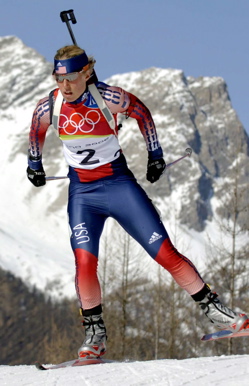
ALTENBERG, Germany — The first phase of the U.S. Olympic Biathlon Team selection began today in Altenberg. U.S. biathletes competing in Altenburg are vying for two open spots on the Men’s Olympic Team and three spots on the Women’s Olympic Team. Trials began today with a time-trial Sprint race which was contested between the U.S. athletes, and was scored using percent-back – a formula in which the three top times are averaged together to get a base score. Race conditions were ideal for biathlon, with no wind and clear blue skies.
Lowell Bailey – US Biathlon
In the Men’s competition, Lowell Bailey (Lake Placid, NY) was able to overcome two penalties to beat Zach Hall (Nikiski, AK) by 9 seconds. Hall had a perfect day on the range and took second place, 23 seconds ahead of Leif Nordgren (Marine, MN), who had one penalty.
On the Women’s side Sara Studebaker (Boise, ID) missed one target and posted a blistering pace to win by 23 seconds over Laura Spector (Lenox, MA), who had a perfect day on the range. Tracy (Barnes) Colliander (Fort Kent, ME), with one miss, was 1 minute 20 seconds off Studebaker’s pace for third. “We had perfect conditions both overall and on the track.
The organizers prepared everything for us so we could have our trials despite the ongoing training for the IBU Cup”, said Bernd Eisenbichler U.S. Biathlon’s high performance director. “Everyone had the same conditions which is really important in a decisive race like that!. What really impressed both the coaches and me was the strong shooting of most of the athletes. Given the fact that these are really important races for them, they pulled it together just fine. The pressure must have been quite high but nevertheless we saw a lot of clean shootings today.” U.S. Olympic Biathlon Trials Results – Day One:
MEN POINTS Bailey 100.86 Hall 100.29 Nordgren 98.85 Roberts 98.60 Shepard 95.58 Patzolt 93.95
Racing continues with the start of the IBU Continental Cup on Saturday, Jan. 9 at 4am (EST). The U.S. biathletes will keep their two best scores and the top man and the top two women will be nominated to the U.S Team and the final athletes for each team nominated by the staff. The U.S. Olympic Committee will announce announce the team on Monday January 11, 2010. For today’s race results. Live race data from the Altenberg races will be available here.
The IBU Continental Cup , which is the final phase of the U.S. Olympic Biathlon Team selection begins on Thursday, January 7th in Altenberg. U.S. biathletes competing in Altenberg are vying for two available spots on the Men’s Team and three spots on the Women’s Team.
The roster of athletes competing in Altenberg includes: 2006 Olympian Lowell Bailey (Lake Placid, NY), 2006 Olympian Lanny Barnes (Durango, Co), 2006 Olympian Tracy (Barnes) Colliander (Durango, Co), BethAnn Chamberlain (Presque Isle, ME), Susan Dunklee (Barton, VT), Zachary Hall (Nikiski, AK), Leif Nordgren (Marine, MN), Kevin Patzoldt (Grand Rapids, MN), Wynn Roberts (Battle Lake, MN), Walt Shepard (Yarmouth, ME), Laura Spector (Lenox, MA), and Sara Studebaker (Boise, ID).
Trials begin with a time-trial Sprint race on Thursday Jan. 7, which will be contested between the U.S. athletes, and will be scored using percent-back – a formula in which the three top times are averaged together to get a base score.
Racing continues with the start of the IBU Continental Cup on Saturday. The U.S. biathletes will keep their two best scores and the top man and the top two women will be nominated to the U.S Team and the final athletes for each team nominated by the staff. The U.S. Olympic Committee will announce announce the team on Monday January 11, 2010.
Live race data from the Altenberg races will be available here.
FasterSkier was able to catch up with some of the athletes vying for these remaining US Biathlon Olympic spots as they traveled to Europe and begin their final preparation for the trials.
Tracy Barnes, photo: USBA
Tracy Barnes
FS: When did you travel to Europe?
TB: I traveled to Europe on Christmas Day.
FS: What was your schedule like once you got to Europe?
TB: The first stop in Europe was the Schalke Biathlon World Team Challenge which took place in the famous Schalke Soccer Stadium in Germany. I was to be “coach” to Lanny, my sister, who was to compete in the event. There were over 50,000 screaming fans in attendance in the biggest soccer stadium in Germany. Lanny was paired with teammate Jay Hakkinen to take on the top athletes in the world in a duel of exciting fast paced skiing and head to head nerve-racking shooting. The jammed packed night of spectacles and shows are centered around several biathlon events, but also put on an impressive display of indoor fireworks, concerts from famous german singers, and a celebrity biathlon race where German celebrities take a shot at biathlon in a shortened course. It is one of the most coveted and most exciting biathlon races. To get an invitation to the event is a huge honor. Both Jay and Lanny put on an impressive performance for the 50,000+ people.
The first event was a strictly shooting. All the women lined up behind the firing points and waited as the entire stadium erupted in a countdown to the start of the shootout! It was a format of four shootings, each athlete shot 5 shots per shooting, if there were any misses, you could single load extra rounds until you hit all your targets and moved on to the next shooting stage. The athletes shot prone (laying down), then standing, then prone, then standing to finish. It was head to head with the best women in the world. As it started each athletes shots were met with cheers for hits and huge boo’s for misses. It was definitely a adrenaline pumping, nerve racking shootout that had many of the top athletes shaking with nerves even before the start. Lanny had one miss in her first stage, but quickly hit it with an extra round. She quickly moved through her next stages with no misses and was first in the last standing stage. The announcer kept shouting her name over and over again as she hit all five of her final targets and finished in first place!
From there the top three women and top three men competed in another shootout! Jay Hakkinen from the US was also first in his shootout. In that shootout both Lanny and Jay shot well, but finished 4th (Lanny) and 5th (Jay). Both were still excited with the result that got them excited for the next event.
The next event was a Mass start race. The format was as follows women would start behind the shooting points, the crowd would countdown and start the race. The women would race to the shooting mats, shoot prone and then take off on a 1km loop that wound around the stadium and outside before coming back in to the shooting range. If any athletes had a missed shot in that shooting stage, they would ski a short penalty loop just outside the range. After the loop skied, the athlete would then shoot again prone (ski penalty loops if necessary) and then tag off to their male partner. The man would then ski the 1km loop then shoot prone, tagging off to the woman, who would ski then shoot standing. The alternating would then continue until each athlete had completed a ski loop-prone, ski loop-standing, ski loop-prone, ski loop-standing stage. The only difference between the men and the women is the women started with a shooting and the men ended with an extra loop skiing after their last standing stage to the finish.
The race started out really well for the Americans, after the countdown from the crowd, Lanny quickly cleaned her first shooting and was out of the stadium in first place. She quickly skied that loop, shot here second prone, cleaning again and tagged off to her teammate Jay in first. The duo fought hard and moved slowly to second after a few missed shots, but faltered in the end with to many misses and finished the race in 10th.
The next race, the one that really counted for the crowning of the World Team challenge Champions was the pursuit. It started off of your results from the mass start. Jay and Lanny started 45 seconds back from first place. They fought really hard to gain back the time lost and ended up with the second fastest split time. They passes several teams in front of them and had their best finish ever at the World Team challenge in 6th place. Despite not winning the event both athletes were happy with the outcome having won one of the shooting competitions and having great running and shooting in the second of the two races. Overall it was a huge success with the announcers buzzing over the loudspeaker about his excitement with the Americans result.
After Schalke, Lanny and I traveled to Altenberg to train and prepare for the upcomng Olymipc Trials.
FS: What are you working on now in training? Shooting and skiing.
TB: After having spent more than a month apart from my competative training partner (Lanny), my shooting had gotten slow and inconsistent. She is always constantly pushing me in the shooting trainning as she always shoots faster than me and without her there to push me my shooting had gotten slow and sloppy. So, i’ve spent the last week with some serious- all out, head-to-head shooting and skiing. It’s so much fun to have that kind of competition in training!
FS: What are your major goals for the season?
TB: Was your goal to make these races in Europe or have you had your eyes on the Olympics all along? My goal has always been to make the Olympic Team, but also to improve on my results from the last Olympics. I have always had lofty goals and dreams and I will be fighting hard towards those this season! Last year I was ranked 7th overall in shooting percentage for the year on the World Cup and I hope to improve upon that this year.
FS: What do you think you will have to do to secure one of the remaining spots on the Olympic Team?
TB: Shoot how I normally shoot, be healthy, and fight hard!
FS: What will a typical week look like for you between these races in Europe? What do you focus on? Training, rest, etc..
Most of the time we travel each week to a different race or venue or country. So, during travel you do our best to stay healthy and get in a bit of volume when you can and intensity before the races.
FS: Obviously you are all competing against each other for a limit number of spots remaining on the Olympic team. Do you think there will be a strong sense of team or will this be every biathlete for themselves?
TB: Not sure, we’ll see. I’m sure everyone will be fighting for themselves. This is an Olympic Trials and it is always a dog fight. Everyone has worked hard to get to this point and they all have similar goals and aspirations. Olympic trials are not a pretty thing. It’s a lot of pressure and a lot is riding on it.
FS: If you are not selected to the Olympics what will the rest of the season look like for you?
TB: There are some Europa Cups and then some North American Cup Races back in the states.
Laura Spector (photo: Sgt Kusupski, National Guard Biathlon)
Laura Spector
FS: When did you travel to Europe?
LS: I flew over on Dec 27, arrived Dec 28.
FS: What was your schedule like once you got to Europe? Races, training, travel, etc..
LS: I’ll spend a week training in Ruhpolding, GER first. There is a small group of us here on our own to spend a low-stress week adjusting to the time change, overcoming jetlag, and training on snow at a biathlon range.
FS: What are you working on now in training? Shooting and skiing.
LS: In shooting I’m primarily working on consistency. We’re not introducing anything new now because there isn’t really enough time before the next races. I’m just trying to shoot like I did at trials…no rushing, taking only the good shots. In skiing I’m still and forever working on technique. I’m trying to lengthen my glide and increase the power in each movement. We do a type of training called TSS (technique-specific strength) that’s very helpful.
FS: What are your major goals for the season? Was your goal to make these races in Europe or have you had your eyes on the Olympics all along?
LS: My major goal for the season is to make the Olympic team, because I’ve been on the past two World Championship teams. I feel like the bar is set there, but I also have time in my career to do this again so I’m not banking everything on this event.
FS: What do you think you will have to do to secure one of the remaining spots on the Olympic Team?
LS: It will take a combination of really good shooting and great skiing. The group of women we have here is very competitive amongst itself, so you can’t expect to get by with anything less.
FS: What will a typical week look like for you between these races in Europe? What do you focus on? Training, rest, etc..
LS: In between the races we typically have a travel day, then a day of easy training to get used to the new range and competition venue, and then a day of intervals before the races. We usually maintain the same number of sessions as we have all year, even if the second session is only a short jog in the afternoon.
FS: Which aspects of your career thus far has best prepared you for taking this next step towards the Olympics and bigger competitions? College, National Championships, World Championships, Training, etc..
LS: I think the many experiences I have had working with different coaches will prepare me well for bigger competitions. Every coach offers something different, and every coach has an area of expertise. I’ve received a lot of input from all different coaches and I’ll be successful when I’m able to put all of that together and then decide what kind of advice and training plan works best for me.
FS: Obviously you are all competing against each other for a limit number of spots remaining on the Olympic team. Do you think there will be a strong sense of team or will this be every biathlete for themselves?
LS: Of course, we are very competitive with each other but we also bond very well and have learned to tolerate each other’s pre-race, race, and post-race habits. Everyone wants to see the best athletes go to Vancouver, but everyone also wants to be a part of that team.
FS: If you are not selected to the Olympics what will the rest of the season look like for you?
LS: Those who aren’t selected to the Olympics will go to the next IBU Cup in Nove Mesto, CZE and then return home. They will compete against the biathletes who did not go to Europe for a spot on the U26 European Championship team in Estonia.
Leif Nordgren (USBA)
Leif Nordgren
FS: When did you travel to Europe?
LN: My training partner Wynn and I left on sunday the 27th to travel to Italy. Here in Antholz (sight of the biathlon world cup at the end of the month) we have had a little training camp with a few members of the A team for the past few days. Sunday morning after training Wynn and I will pack up the van and drive north up to Altenbeg, Germany which is where the rest of our Olympic trials will take place next week.
FS: What is your schedule like once you get there? Races, training, travel, etc..
LN: Training here in Italy for the first week, the in Altenberg we race on the 8th, 10th, and 11th of January. I’ve never raced up in Altenberg before so I’m excited to race. Also I haven’t done many international races since December of last year. Its always a good experience to race in a large competitive international field.
FS: What are you working on now in training?
LN: Armin Auchentaller who is the shooting coach for the National A team lives here in Antholz, Italy. I am taking this opportunity with him to tune up some things in my shooting, and make sure I am ready to go for the races next week. I do not have the best opportunties at home to shoot, so sometimes I tend to build up bad tendencies when I am away from a shooting coach for a long period of time.
FS: What are your major goals for the season? Was your goal to make these races in Europe or have you had your eyes on the Olympics all along?
LN: Yes it is a major goal of mine to make the Olympics this season. However in biathlon I’m still a junior. So even if I don’t make the Olympic team there are still many opportunities for racing. There are a few more IBU cups as well as maybe a start in a Wrold Cup or two. Then there are always Jr Worlds which take place in Torsby Sweden this year in the end of January. If I end up racing in any of these other races I still have some pretty big goals. But for me since I am still pretty young when it comes to biathlon, mostly it is about experience for upcoming seasons!
FS: What do you think you will have to do to secure one of the remaining spots on the Olympic Team?
LN: Ski fast, and shoot straight. Or at least faster and straighter than the other guys!
FS: What will a typical week look like for you between these races in Europe? What do you focus on? Training, rest, etc..
LN: Mostly to keep in shape for any racing that I’ll be doing. I try to be pretty in tune with my body when it comes to training. If I’m feeling a little tired mid season I don’t hesitate to rest. Most of the training now days is just staying on good form in between competition weekends.
FS: Which aspects of your career thus far has best prepared you for taking this next step towards the Olympics and bigger competitions? College, National Championships, World Championships, Training, etc..
LN: For me, I chose to go into full time training straight out of High School. As far as biathlon is concerned, that’s the best decision I’ve ever made. With out school to worry about, and potentially spend to much time on, its given me the opportunity to focus 100% on my training year round. I feel like I’ve made a lot of big jumps in the last few years, but there is still plenty of work to be done. I try not to get to hyped up for these bigger races. I just remind myself that this is what I’m trained to do. Don’t get me wrong, I still have bad races, I’m not a machine. But a bad race for me is a learning experience, something to look at, and make sure I never do that again.
FS: Obviously you are all competing against each other for a limit number of spots remaining on the Olympic team. Do you think there will be a strong sense of team or will this be every biathlete for themselves?
LN: I think on the guys team we are all pretty close together. We all train together plenty throughout the summer. Thats gives us time to get to know eachother pretty well. Yes, we all would like to make the team as individuals, but we’re still a team working towards the same goal… Taking down the Europeans!
FS: If you are not selected to the Olympics what will the rest of the season look like for you?
LN: I will possibly have a World Cup start, as well as Jr World Champs in Sweden. The later in Feb there are the European Championships. Possibly after that I’d come back to finish off the season in North America!
Wynn Roberts
FS: When did you travel to Europe?
WR: I left for europe on the 27th with Leif Nordgren.
FS: What was your schedule like once you got to Europe? Races, training, travel, etc..
WR: We had a week of training in Antholz Italy. Then we traveled to Altenberg, Germany for a time trial and the two europa cup races which will be used for the team selection.
FS: What are you working on now in training?
WR: For the first week of our trip we worked on our base training to help build after the last series of races. Then we had some harder shorter intenisty workouts leading up to trials.
FS: What are your major goals for the season? Was your goal to make these races in Europe or have you had your eyes on the Olympics all along?
WR: My major goals are racing expierences I was really hoping to make it this far. Anything else will just be frosting on the cake.
FS: What do you think you will have to do to secure one of the remaining spots on the Olympic Team?
WR: Biathlon is different from cross country skiing in terms of focus.
FS: What will a typical week look like for you between these races in Europe? What do you focus on? Training, rest, etc..
WR: Skiing is simple You focus on technique in skiing, racing, waxing, and tactic. In biathlon you have all of those and then you double it with shooting and your mental awareness, plus 20,000 people cheering when you’re shooting. So I would say thats what you are focusing on, its a major difference from the US or Canada where you have 100 spectators.
FS: Obviously you are all competing against each other for a limit number of spots remaining on the Olympic team. Do you think there will be a strong sense of team or will this be every biathlete for themselves?
WR: I can’t speak for the womens team, but the team moral on the mens team is good. We are all good friends and when we’re racing we’re seroius and when we’re not we’re great friends. I would be happy if anyone of the guys makes the team or has a great race over seas. We look at biathlon as a whole and all try to help build the sport.
FS: If you are not selected to the Olympics what will the rest of the season look like for you?
WR: If I don’t make the Olympic team and am sent back to the US I will focus on the Finlandia, Mora, Birkie, Senior distance nats, and then biathlon nats.
Thanks to great volunteers that blew snow over the 2.5 km course at Mt. Itasca, the 2010 Team Trials got underway today. While the course was not as difficult as the 3.5 km loop, it was challenging enough for the USBA to evaluate the racing.
In the men’s 10 km sprint competition it was National B Team member Mark Johnson skiing away from the field in a time of 26:20. In the women’s 7.5 km sprint race USBA Development Team member Jen Wygant took the win in a time of 23:44.
In the women’s race, Wygant relied on the best shooting race of her two year biathlon career to ski to the 16 second victory over Susan Dunklee (USBA), with Laura Spector (USBA) rounding out the top three another 15 seconds back in 24:15.
“My skiing felt good and will hopefully get stronger as my leg speed gets better,” said Wygant. “The course was hard packed, but not my favorite terrain with the steep climbs. I typically like the more gradual stuff.” Wygant, who only had two misses shooting today remarked, “hopefully the whole field can step it up because that is what it is going to take to compete on the World Cup and that is our goal.”
As Spector elaborates on in her FasterSkier blog she had a very solid race in third despite spending some time in theEmergency Room last night. “I’m surprisingly relaxed, which is good because it helps me keep a cool head on the range and my stomach jitters in check. Despite being a little low in energy, I skied the race as hard as I could and finished third with 3 total misses at 98.95 percent back, about 30 seconds.
“What I’m most pleased with about today was my ability to transition to race mode so quickly and attack the race in spite of all that could have distracted me or discouraged me from skiing fast.”
In the men’s race, Johnson skied to a 23 second victory over Wynn Roberts (USBA), while Zachary Hall (USBA) took the final position on the podium another 8 seconds back.
Johnson’s goal was to stick to the basics. “During the time leading up to today’s race, I really wanted to keep things simple. This being the first trials race of the season (i.e. big time nerves), and really my first race on snow against a lot of the competition, I sought to stay away from trying anything out of the ordinary–simply keep all of the same procedures as in my training.
“Overall, I’m very satisfied with my performance today. In the ski loops, I felt on top of my game, and on the shooting range I took my time, but it proved beneficial seeing as I hit my goal of 90% shooting. After the race, I found out from my coach Vladimir that my shooting was a bit more on the edge than hoped. Several shots were near misses. My only miss on the day came as my final shot standing.”
Everyone that FasterSkier talked with after the race voiced the same warm thank you to all of the volunteers that made this race possible. Johnson’s words best sum up what was felt by all those attending. “I also want to give a big thank you to the volunteers here at Mt. Itasca. Many of them have had several sleepless nights in preparing the tracks with man-made snow. A thousand thanks!”
As for the USBA’s decision to issue a “same wax” protocol for the Team Trials, Upham told FasterSkier that “about a month ago they had a conference call to discuss the matter.”
Ultimately it came down to a matter of fairness and the USBA wanting to be able to compare the racers on an equal playing field whether they were members of the USBA or of a club. As a coach Upham likes the idea even more as it allows him “to focus on the athletes mental preparation for the race” instead of spending all of his time waxing skis.
Pointing out that in biathlon they also have to spend time zeroing their guns, and, as Upham stated, “if I had to aid with that as well as test skis, I would be running around all frantic. They have been doing this for years at the junior level and the USBA did not want to feel like they should send one of the techs over from Europe because we want them to stay to help over there.”
Today’s cold conditions made the waxing easy as temperatures were below 0ºF over night. As Upham said, “today worked out well with everyone on the same page.” When asked what they would have done had the temperature been warmer he remarked “we will be using high-flouro paraffin waxes, but no powders.”
The only issue that is yet to be resolved for this race series is what to do about structure. “Everyone has similar grinds on their skis, but if we need to use a structure tool we will discuss what to do at that time. We all are working in the same wax room, so we will make a group decision.”
While it is “way too early to discuss who is looking good for picking the Olympic Team” said Upham, the plan is to hold five races at Mt. Itasca weather permitting. Of those the USBA will look at each athlete’s best three races to determine the 3 or 4 men and women that the they will bring over to Europe to race against the World Cup Team.
While “Jay Hakkinen and Tim Burke have already pre-qualified based on their performances at the last two World Championships, everyone else will have to slug it out at those races in Europe to determine the final Olympic spots,” concluded Upham.
Tomorrow’s race should prove very exciting as it is a mass start, something we do not see very often domestically. With two prone, followed by two standing stops in the range the action should be tight. As Upham stated, “in a mass start it is hard not to be aware of what the guy next to you is doing in the range because you can hear what is happening with each of his shots. On the course you will know exactly where you are the entire race, especially when you come out of the 150 meter penalty lap, which should take about 25 seconds.”
“Tomorrow is going to be a good fight, the great thing about this group of girls is that anyone can win on any given day,” said Wygant. Stay tuned tomorrow for more action from Mt. Itasca and see who best handled the pressure.
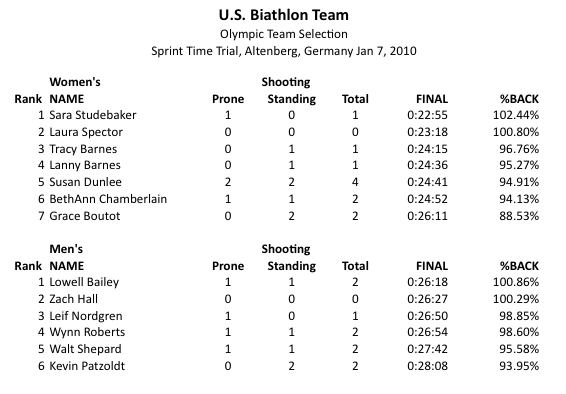

 MEN POINTS Bailey 100.86 Hall 100.29 Nordgren 98.85 Roberts 98.60 Shepard 95.58 Patzolt 93.95