Tag: Scott Perras

  • So Close for Canada with 9th- and 11th-Place Relay Finishes

    So Close for Canada with 9th- and 11th-Place Relay Finishes

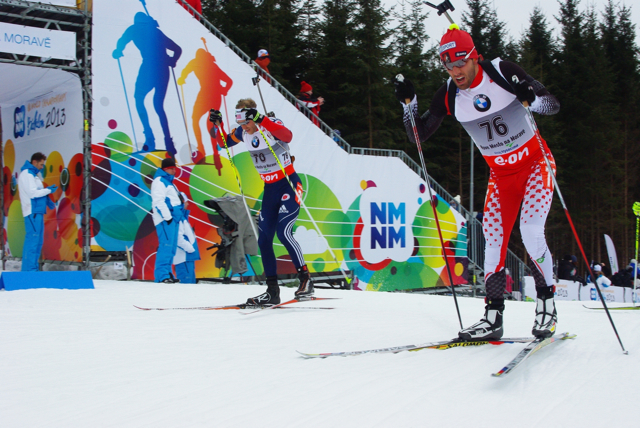
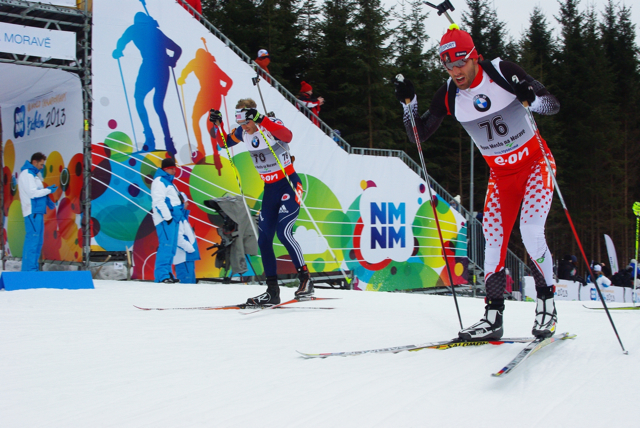
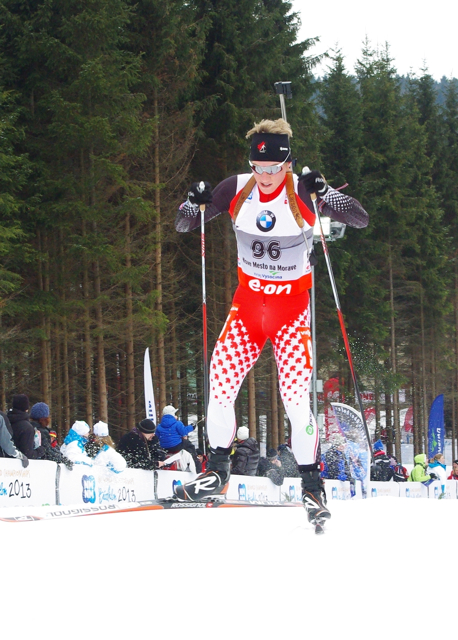
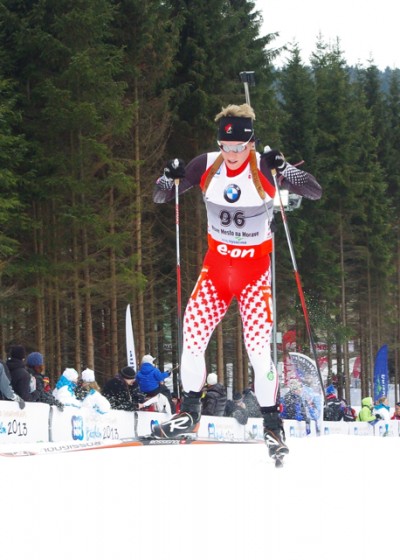
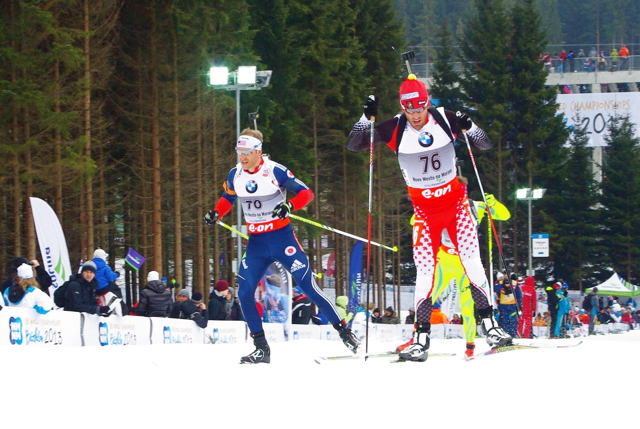
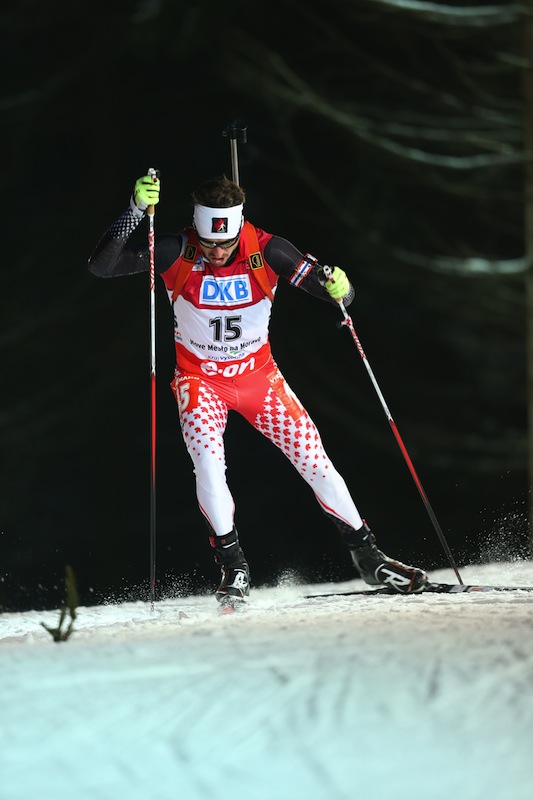
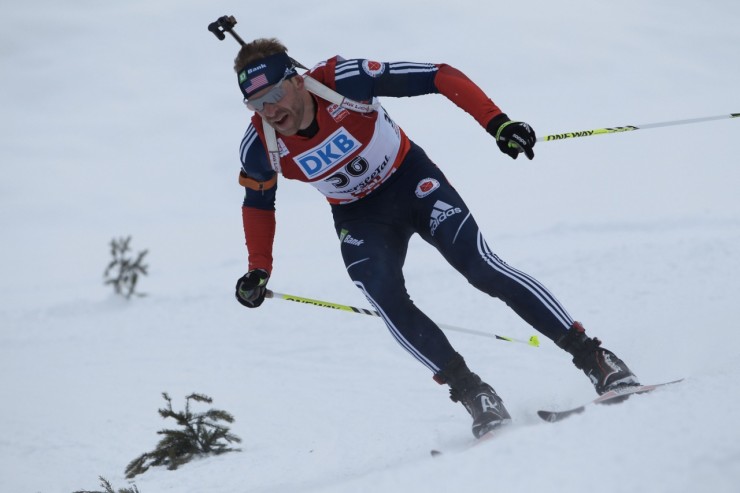
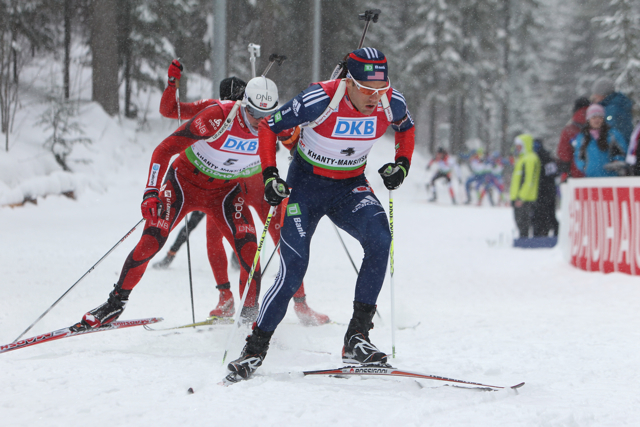
    Scott Perras in the lead pack with Ole Einar Bjørndalen (NOR) and a lot of freshly falling snow.
    Scott Perras in the lead pack with Ole Einar Bjørndalen (NOR) and a lot of freshly falling snow.


    HOCHFILZEN, Austria – For the Canadian biathlon team, today’s men’s and women’s relays offered a tantalizing glimpse of what is possible.

    The women’s team was as high as sixth and seventh place at times in the relay, including after the second-to-last shooting – and that was despite a penalty loop and three spare rounds by Megan Imrie in the second leg. That definitely hadn’t gone according to plan.
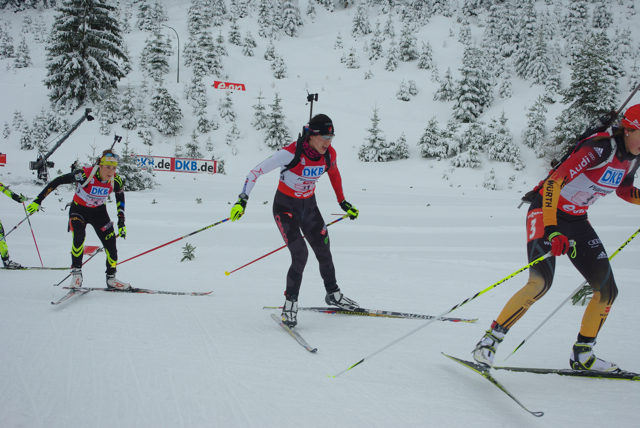
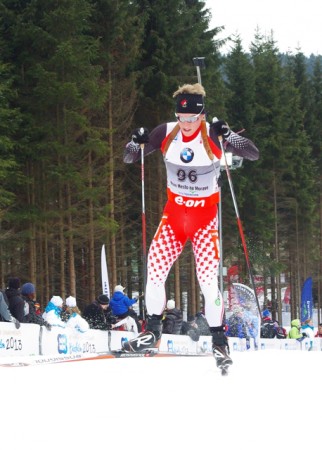
    Rosanna Crawford in the pack with Franziska Preuss (GER) and Marie Laure Brunet (FRA) on leg one.
    Rosanna Crawford in the pack with Franziska Preuss (GER) and Marie Laure Brunet (FRA) on leg one.

    “If we can all just use one spare round each, it will be great,” Rosanna Crawford said after finishing the leadoff leg in tenth place, just 19.9 seconds off the lead.

    It was a strong opening for Crawford, who also placed 17th in the sprint yesterday.

    “My plan was to go off super aggressive and really try to get to the start of the pack, because it’s so narrow here that if you get to the back you can easily lose 30 seconds without it even really being your fault,” she said. “So I was happy with my start. Bummed about my one miss in prone, but stoked to finally clean my standing.”

    Ultimately, Zina Kocher had a disastrous final shooting stage, racking up two more penalty loops in standing. That dropped her to 12th place, although she passed one team by the finish to end up 11th.

    It wasn’t a good way to end the relay, yet there were plenty of positives – the Canadians were just 10 seconds from the top 10, the distance of one spare round or half a penalty loop. Kocher, despite her shooting woes, skied the fifth-fastest anchor leg. Megan Heinicke was cool under pressure and cleaned both her shooting stages with no spare rounds on the third leg, gaining the team valuable spots.

    In the men’s race, Canada had an even more stellar start. Jean Philippe Le Guellec used a single spare round to tag off in eighth, 23 seconds out of the lead, and then Scott Perras used the same shooting to move into fourth by the halfway point of the relay race. When he tagged off to Brendan Green, Canada was just six seconds from the lead.

    “I didn’t even realize I was up there until partway through the last lap, when I looked up the hill and was like, wow, there’s really nobody farther up,” he said. “I was desperate to take the top three, but I got cut off a couple of times on the last lap and that just zapped any energy I had.”
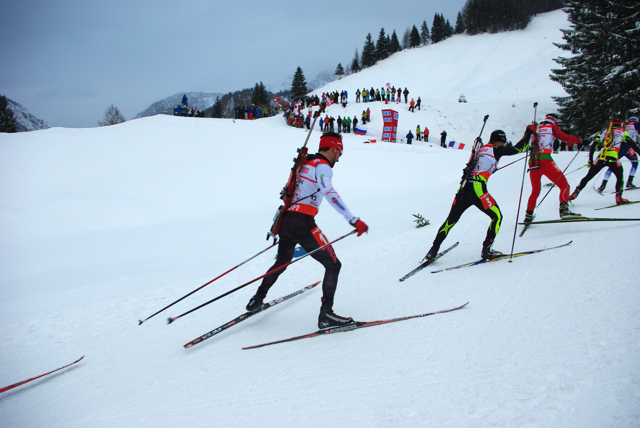
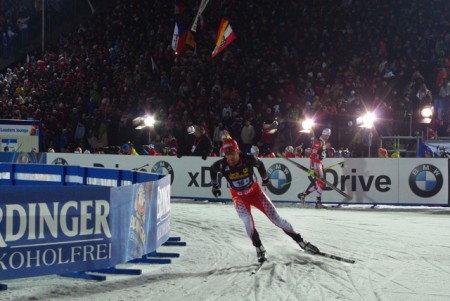
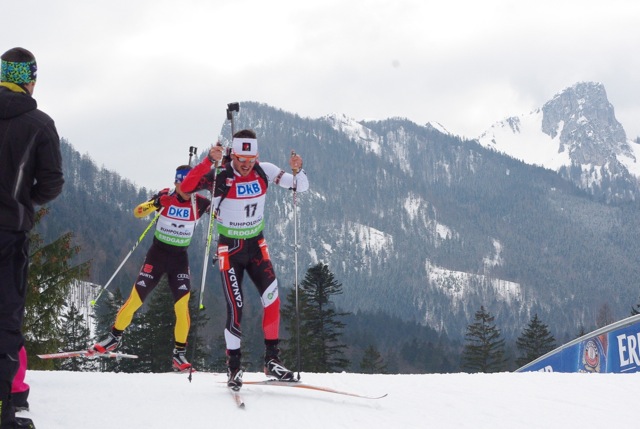
    JP Le Guellec in the train going up a long grinding hill on leg 1.
    JP Le Guellec in the train going up a long grinding hill on leg 1.

    Since Canada only has three quota spots for individual racing on the World Cup this season, Perras took a strategic rest to try to allow his teammates Green and Nathan Smith to finish their Olympic qualification, which he has already done (it didn’t quite work). This being his only start of the weekend, he had a little extra motivation to fly.

    “It’s the only bit of excitement I get to have all week, so I think I had a little bit of extra [power],” he said. “Even today I was trying to get the boys going, like, guys, this is my only chance for excitement this week! … ’d prefer to have a race in the body, even if it is the day before. Especially with conditions like this, it’s kind of the first time I’ve skied on [falling snow] this year.”

    As Perras tried to get his team into the top three – he had the fifth-fastest ski time of racers on his leg, impressive especially considering how Ole Einar Bjørndalen put the pedal to the metal and broke up the field with his aggressive pace – he faced off against that new snow. Hochfilzen already has a fairly narrow course with lots of twisting corners, and the weather didn’t make it any easier to pass.

    “When I tried to make two passes, I have small baskets on and they just punched through,” he said. “It’s okay, you just get back in the group, but I did have to yell at someone.”

    When Green took over, he kept the team in a good spot through prone, but then accrued a penalty loop in standing. Anchor leg Smith took over in 12th place, and was able to move the team up to ninth with perfect shooting. He finished the race in a pack with Simon Hallenbarter of Switzerland, Leif Nordgren of the United States, and Lukas Hofer of Italy.

    “I didn’t know the Swiss guy behind us,” Smith said. “I could hear someone behind me, but I couldn’t tell who. He went for it, and had a little more than Leif and I, so I kind of lost it on that last hill. But I started to recover coming down, and then I had a pretty good sprint to the finish. It was hard.”

    The ninth place finish was still strong for Canada, which has had just three other top-ten men’s relay results in the last decade.

    “Unfortunately Brendan got a little choke in his standing, but other than that it was probably one of our best relays ever. And the finish was really close from third, so with one less penalty loop or whatever, we could have moved up a lot.”
    Results: men / women

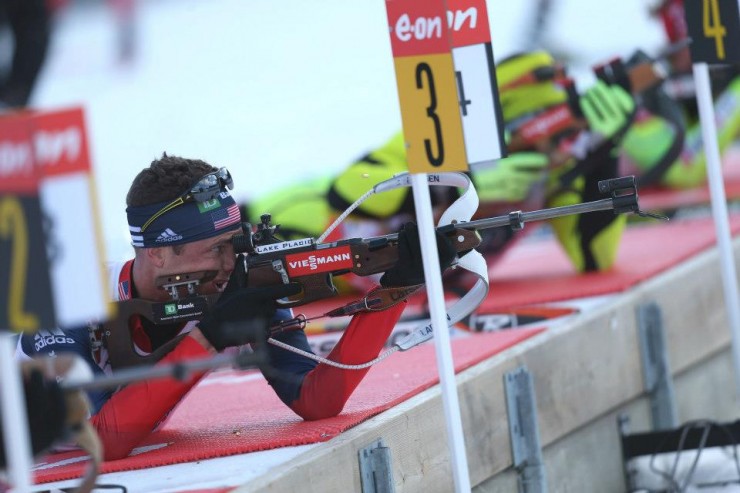
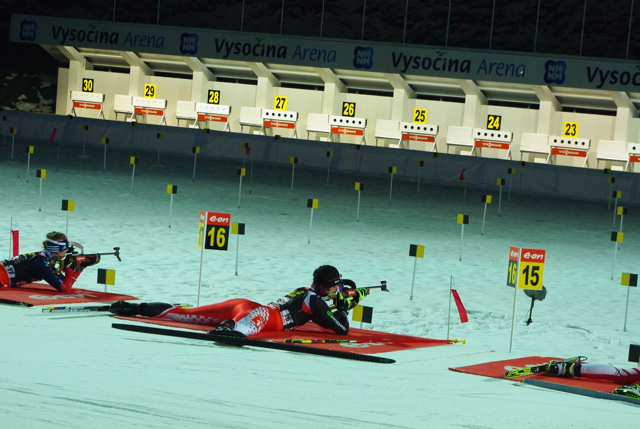
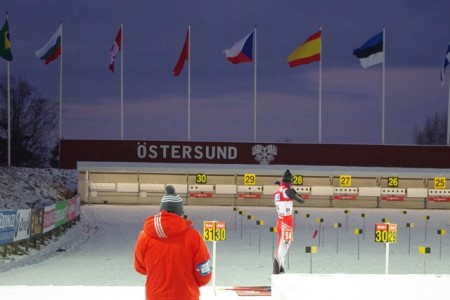
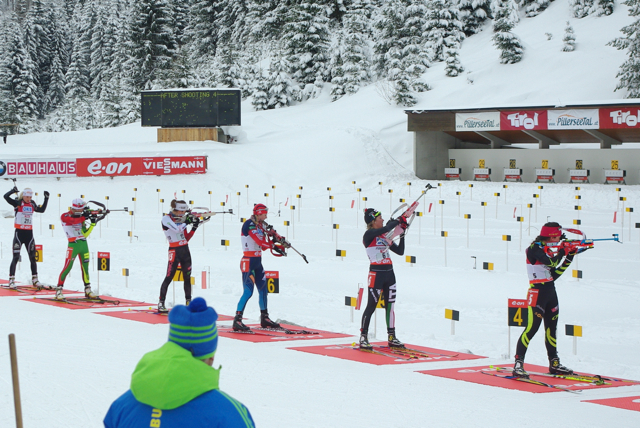
    Megan Imrie (3rd from left) on the shooting range.
    Megan Imrie (3rd from left) on the shooting range.
  • Fourcade Capitalizes on Lindström’s Crash to Take Second Win; Burke Third in Östersund World Cup 10 k Sprint

    Fourcade Capitalizes on Lindström’s Crash to Take Second Win; Burke Third in Östersund World Cup 10 k Sprint

    IBU world cup biathlon, sprint men, Oestersund (SWE)
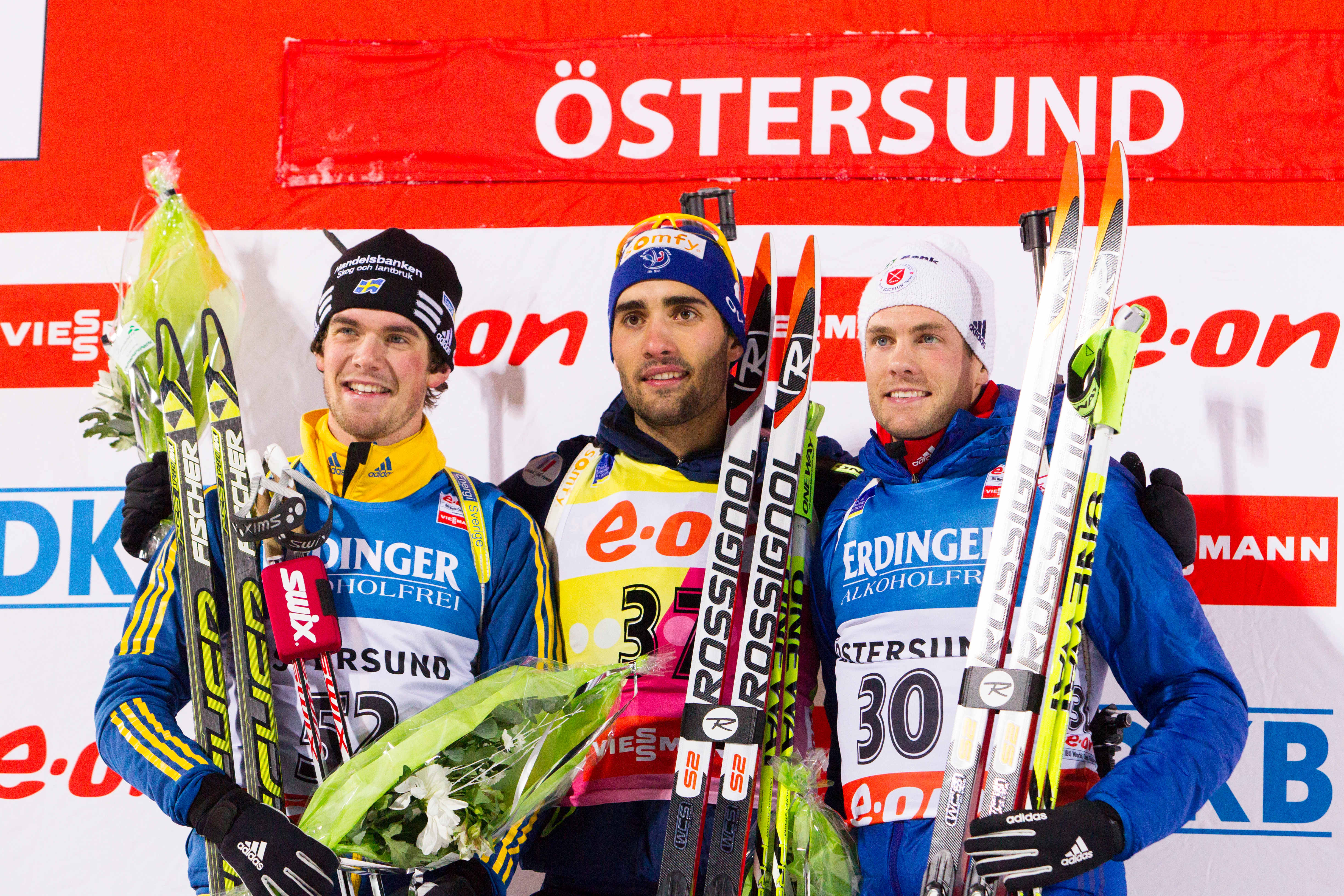
    The podium in today’s World Cup biathlon 10 k sprint. From the left: Sweden’s Fredrik Lindstroem, France’s Martin Fourcade, and American Tim Burke. (Photo: US Biathlon/Nordic Focus)

    Conditions deteriorated today for racing in Östersund, Sweden, with a consistent wind that made shooting difficult and fresh snow that slowed the tracks.  Sweden’s Fredrik Lindström was undeterred by the wind, shooting perfectly, but crashed just over a kilometer from the finish line and was passed by Frenchman Martin Fourcade, wearing the yellow jersey from his victory in Thursday’s 20 k individual race. Fourcade had picked up one penalty in the standing stage, but finished with the win in 25:56 while Lindström was 6.5 seconds behind following his crash.  American Tim Burke also shot perfectly, but his early-season legs could not match those of Fourcade and Lindström and finished 31.3 seconds behind Fourcade, for a total time of 26:27.

    For his part, Fourcade admitted some disappointment about winning due to Lindström’s crash: “we both know [Lindström] would have won if he had not fallen,” he said in a press conference, which can be seen on the International Biathlon Union’s website. He also admitted the importance of clean shooting: “we both know that sometimes you can get away with some mistakes, but shooting clean is the best way to be safe.”

    Lindström’s rifle reportedly broke when he crashed, which will present a challenge in tomorrow’s race.

    “I’m not so good with tools, so I’ll have to ask some friends for help [fixing it],” he said to Swedish TV4. “I am a bit concerned for the rifle. There may be some glue … I can’t put on my shoulder. The entire rear end is gone. I have to get into that stuff, otherwise it will be difficult to shoot.”

    IBU world cup biathlon, sprint men, Oestersund (SWE)
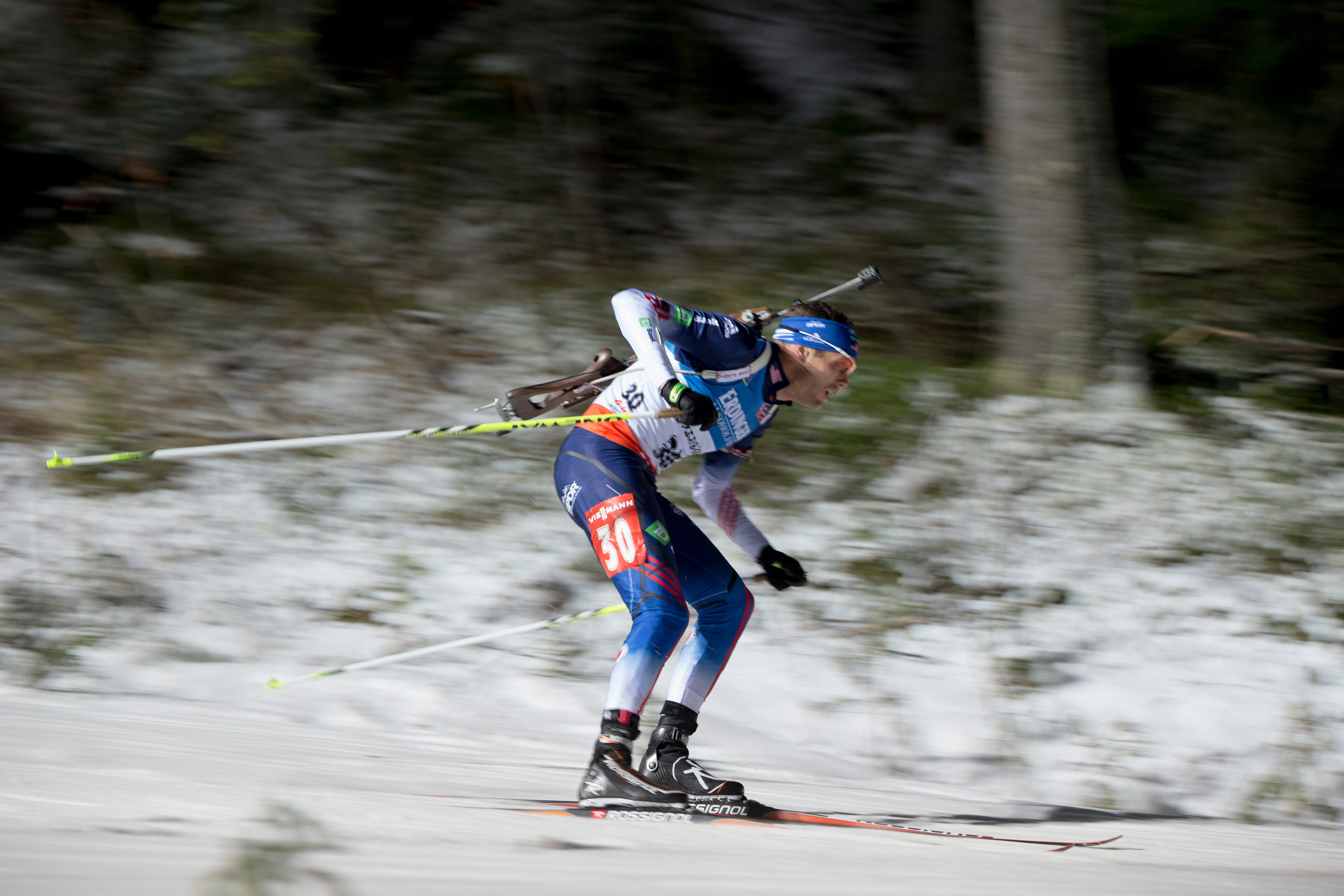
    Tim Burke skis his way onto the podium in today’s 10 k sprint in Ostersund (Photo: US Biathlon/Nordic Focus)

    For his part, Burke was surprised with his podium finish due to what he describes as poor ski fitness.

    “We really planned on working into the season this year so I know I am not in perfect skiing shape,” he wrote in an email to FasterSkier. “The best part about my race today was surely the shooting. I was able to follow through with the things I have been working on in training, so I am very happy about that. After leaving standing shooting I thought I would have a chance for a top 10 finish with how I was feeling on the ski course. I think a few more races will go a long way in getting my skiing back to the level I was at last year.  Now I am looking forward to an exciting pursuit tomorrow!”

    Indeed, if Burke’s fitness is really lacking, then perhaps he can deliver big things this season:

    “I feel like this year I reached a new level with my skiing in training.  I know that my skiing today was far from what I am capable of when I am in top form.  I am confident that my fitness will continue to improve with more racing, but the others may improve as well!  The trick will be having a race where I combine my shooting from today with my best ski performance. ”

    Lowell Bailey contributed to a solid day of racing for the United States with a 14th place finish, coming in at 27:02.6 with one penalty in prone, 1:06.6 behind first-place Fourcade.  The first Canadian finisher was Scott Perras, coming in 34th in 27:38.8, also with one penalty in prone.

    “I have struggled with jet lag since coming to Sweden and just couldn’t shift into the gear necessary for good race results,” Perras wrote in an email to FasterSkier. “I knew the 20 k individual race would help me; I needed to get in that hard effort and then I had a day to absorb it.  Unfortunately my hands froze in the race even though the temps were mild, this cost me time and possibly accuracy in prone shooting.”

    “Hopefully my body continues to come around,” he added.

    Rounding out the North American skiers were American Leif Nordgren who was 41st in 27:52.6, followed by Canadian Nathan Smith coming in 45th in 28:05, both with one penalty in prone.  In 87th place was American Jeremy Teela, in 29:49.3 who had a disappointing four penalites in the standing stage after cleaning prone, and 89th place American Sean Doherty in 29:53.6 with three total penalties.

    It was a particularly disappointing day for Canadian JP Le Guellec, who finished in 69th place with a time of 28:54.7 today after an impressive 4th place finish in Thursday’s 20 k individual race.

    “We had calm wind during zero-time (the period allocated for adjusting the rifles pre-race),” Le Guellec explained in an email sent to FasterSkier, “my ski shape wasn’t very good, and on top of that the wind picked up drastically when I came in prone. I tried shading the target to compensate for the wind, but it wasn’t enough and I still missed two targets. I got thrown around in standing as well with another two accumulated misses.”

    “Having no wind in zero time and having it come up in the race happens throughout a season,” Le Guellec continued, “it’s always frustrating when what you do doesn’t work. But the worst is that I won’t be racing in tomorrow pursuit since I was not in the top 60.”

    “Fuel for World Cup 2 in Hochfilzen,” he added.

    Burke will have a chance to snag another podium tomorrow in the 12.5 k pursuit, where Lindström might also have the chance to avenge his crash and overtake Fourcade.

    Jean Guillaume Beatrix of France tied his career-best finish in fourth place, while World Cup podium stalwarts Arnd Peiffer of Germany and Evgeniy Ustyugov of Russia were fifth and sixth and will be in the mix for the lead tomorrow.

    Results

  • Canada Picks 15 Biathletes for European Tour; Olympic Spots Up for Grabs

    Canada Picks 15 Biathletes for European Tour; Olympic Spots Up for Grabs

    Scott Perras (right) competing at 2013 World Championships; he topped Canadian trials rankings in Canmore this week.
    Scott Perras (right) competing at 2013 World Championships; he topped Canadian trials rankings in Canmore this week.

    On Tuesday, Jean Philippe Le Guellec, Scott Perras, Zina Kocher, and Rosanna Crawford will get on a plane a fly to Sweden. This they knew: the four Canadian biathletes are already qualified for the upcoming Olympics in Sochi, and have the luxury of knowing that they’ll start their seasons on the World Cup next weekend.

    But after trials races in Canmore on Thursday and Friday, 11 more athletes learned that they’d be leaving even sooner. Five women and six men will start their seasons on the second-tier IBU Cup, which, for two women and one man, will be a stepping stone to the World Cup a week later.

    The group is a mix of national team athletes, development team athletes, and even juniors. And, says Biathlon Canada High Performance Director Chris Lindsay, they’re probably going to put down some good results. He was impressed by what he saw over the last two days, and in a great mood when FasterSkier talked with him on Friday afternoon.

    “It was a great opportunity to see some great early-season racing for my guys,” Lindsay said. “They were able to pull out some results that were maybe not perfect, but were good indicators of the overall quality of the training that’s happening and the continuing improvement of the program overall. I’ve been watching all these athletes for the last month here on the early snow, because we’ve been on snow for a full month as of today.”

    While the goal for this first period of racing is certainly to have strong results at the World Cup level – Lindsay would like to see multiple top-30 finishes – it’s also important for Olympic qualification. That’s possible through World Cup results, by either two top-16 results or three top-30 results. Brendan Green, Megan Imrie, and Megan Heinicke, all starting on the IBU Cup, each only need one more top-30 to achieve their Olympic qualification, while Scott Gow needs two top-30s.

    But Green and Gow are going to have to fight it out just for the chance to compete on the World Cup, and best not only each other but Nathan Smith, Marc-Andre Bedard, Macx Davies, and Scott’s younger brother Christian Gow. Canada only has three quota spots for men’s World Cup racing.

    “It certainly looks to us like we have four or five male athletes who are more than capable of having World Cup results in the top 30,” Lindsay explained. “We’re in an unfortunate situation where because we have limited start spots on the World Cup, so that we cannot just throw all of them there and have them fight it out.”

    Because the IBU Cup and World Cup tours swing in geographically different directions this year, Lindsay says it’s unlikely that athletes will be switched between the two circuits once the World Cup begins. That means that it’s highly probable that the men’s Olympic team will not be filled by the time the Christmas break rolls around. In that case, any remaining athletes that have met IBU standards – basically, the same standards that must be achieved to race on he World Cup – will have a trials series at home.

    The same goes for the women, should Imrie and Heinicke fail to complete their qualification on the World Cup. Audrey Vaillancourt, Claude Godbout, and Julia Ransom have the chance to steal a World Cup spot from Imrie or Heinicke based on results from the first IBU Cup races.

    “The results of IBU Cup 1 are not the only factor in who gets the World Cup spots, but you’re not going to be able to just barf a race out there,” Lindsay said. “You’re going to have to be the first or second Canadian. And we want to see a good result against the field – if everyone comes in around the top 60, that’s not what we’re looking for. We’re expecting people to do extremely well at that IBU Cup.”

    Because if you can’t do well at the IBU Cup, then how are you going to do well at the Olympics? And so despite the chance to have a strong opening to the World Cup season, those goals take a backseat for the team in favor of prepping their athletes as well as possible for the Olympics – and to get selected for them.

    “We’ve been trying our best to make sure that the athletes are completely aware of the situation the team finds itself in, and that they need to be on the selfish side,” Lindsay said. “If they feel that their best opportunity to make the Games is on the World Cup, then we’ll support them. If they feel that their best opportunity to make the Games is to come home early [to prepare for the Christmas trials races] then we will support that as well. We don’t want to put someone in a situation where they felt that they had to be part of the team at a certain World Cup because the team needed them, but yet that wasn’t the right choice for them. We have a strong philosophy that if we have athletes who are able to achieve their individual performance goals, then the performance of the team will rise too.”

    National team and senior athletes certainly acquitted themselves well in the trials races. In Thursday’s sprint, Kocher and Crawford were the second and third women, behind Slovakian and 2010 Olympic gold medalist Anastasiya Kuzmina. Perras was second behind Nathan Smith, a 2012 World Championships team member, and Green was third. It was a turnaround for Perras, who had a tough summer and missed the “A” team’s recent on-snow trip to Ramsau, Austria.

    But other athletes asserted themselves, too. Lindsay pointed to Sarah Beaudry, a junior who finished second in the trials rankings behind Godbout; she is a reserve for the trip. Carsen Campbell, a young biathlete from Prince Edward Island, was second in Friday’s sprint, behind Perras. The performances by these and other juniors bode well for Canada’s chances at this years World Youth and Junior Championships in Presque Isle, Maine, which Linday called “almost a home championships.”

    And on the veterans side, Robin Clegg, who represented Canada at three Olympics, came out of retirement to rank second in the trials behind Perras. Like Beaudry, he is on the reserve list for the European tour.

    “Robin has been doing some semi-professional bike racing in the last two years, and he has come out of retirement to make a push – and I would say a pretty strong push – to qualify for the Olympics,” Lindsay said. “He is training with a local club, so he has no national team support, but I have had several conversations with him about it in the last few months… having him there is great, because it is more competition and it makes everyone faster. In the end, whoever qualifies for the Olympics – whether it’s a young junior who comes out of nowhere, or if it’s Robin – they will be faster the more people we have training and competing.”

    World Cup Team

    Rosanna Crawford

    Zina Kocher

    Jean Philippe Le Guellec

    Scott Perras

    IBU Cup Team

    Marc-André Bédard
    Macx Davies

    Claude Godbout

    Christian Gow

    Scott Gow

    Brendan Green

    Megan Heinicke

    Megan Imrie
    Julia Ransom
    Nathan Smith
    Audrey Vaillancourt
  • Canada Off-Form in Sochi, But Knows What to Work On

    Canada Off-Form in Sochi, But Knows What to Work On

    Scott Gow, here competing at World Championships last month, had the best Canadian performance in Sochi.
    Scott Gow, here competing at World Championships last month, had the best Canadian performance in Sochi.

    For Canada’s biathlon team, the past weekend’s races in Sochi weren’t exactly how you might hope to baptize a new Olympic course.

    “Bummer day?? More like weekend!” Jean Philippe Le Guellec wrote in reponse to questions from FasterSkier. “There are no painful questions, just straight facts.”

    And here are the facts: Le Guellec had a pretty miserable time, finishing 77th in the individual race and 52nd in the sprint. Canada placed 15th in the relay, where Le Guellec struggled in the leadoff leg, requiring five spare rounds. The Canadian men failed to score points in any race; Scott Gow’s 49th-place result was best in the sprint, while none of the team made the top 60 in the individual.

    (Unlike Le Guellec and Perras, Gow told FasterSkier that he was “very happy” with his races, especially with clean shooting in the sprint: “My shooting let me down in the individual, but it came back into form for the next two races.”)

    The women didn’t fare much better. The high point was likely the relay, where they raced to a very respectable tenth-place finish. In the individual, Megan Heinicke didn’t start and Rosanna Crawford didn’t finish; Megan Imrie’s 57th place was better than any of the team’s results in the sprint.

    Le Guellec admitted that the team just does not have the form that earned him his first World Cup win earlier this year, or a string of career bests for Scott Perras and Crawford.

    “The weekend was a complete drag,” he said after finishing 52nd in the sprint despite clean shooting. “I don’t know where my ski shape went, but it was not with me on the skis! There’s simply nothing to add there.”

    The Quebec native added that he had been sick in Oslo, and perhaps was still recovering. He hoped that by the World Cup finale, he’d be back to skiing a bit faster.

    Perras was similarly frustrated, saying that he was “definitely not happy” with his races. He thought that the team’s yearly plan just hasn’t allowed them to be fast this late in the season.

    “I have felt decent here, but like Oslo the skiing wasn’t my best,” he wrote in an e-mail. “We trained hard and put in a high amount of high intensity early this year, and I think we came into the season all cylinders firing. I think we are just in a bit of a lag and it should get better but I might run out of time.”

    The relay, which Perras anchored, was a particularly tough pill to swallow.

    “I think there are two times this year people really wanted to be on – World Championships and the pre-Olympic World Cup,” he wrote. “But with sub par skiing and shooting I am left disappointed. I was really disappointed after the relay today that I couldn’t catch Belarus, whom we are currently in a fight with for top 15 Nations Cup.”

    With just three races to go, Canada is ranked 16th in the Nations Cup, just 42 points behind Belarus (a World Cup win is worth 60 points). Making up the margin in Khanty-Mansiysk, where racing starts on Thursday, is doable, but the team will have to find their ski legs to make it happen.

    The incentive is definitely there: currently allowed just three starters per World Cup, moving into the top 15 would mean gaining a quota spot. Having three starters is tough for a number of reasons: it’s hard to score the points needed to move up, and it often means not fielding a relay team, unless someone can be recruited from a different nearby competition.

    But among the cheerful aspects of the weekend was the fact that, at last, the Canadian men were traveling with more than a full team. In a bid to win back some points, they brought four men, with Kurtis Wenzel competing in his very first World Cup as the third leg of the relay. He acquitted himself well, using just one spare round.

    “We had to push hard to get a fourth man out here,” Le Guellec said. “Since we generally miss Oberhof, and a relay, it’s really hard for us to stay in that top 15 benchmark given the tough competition. So missing the relay here on top of that was unthinkable.”

    Plus, there was another guest: Brendan Green, who along with Le Guellec led the team last season, but has been out for more than a year with a difficult recovery from a herniated disc. Green was in no shape to race, but he came along to see the venue anyway.

    “B-man was out here to get his own glimpse of the venue and tracks,” Le Guellec said. “It was honestly overwhelming to see him on skis and really good to see him out and about!”

    The recon Green was performing serves the same purpose as the test races: to learn what to tweak in the next year of training in order to be the best at the Olympics. For Le Guellec, the course previews were both a bit intimidating, and a bit familiar.

    “I definitely have my work cut out for me given the profile of the course,” he said. “It resembles Valcartier a whole lot, but I haven’t trained at home in the winter for close to a decade. Two weeks for Christmas doesn’t count!”

    Perras, though, more or less liked the courses.

    “I like the venue – the views are amazing and I live in Canmore,” he said. “The trails are hard and I like it that way. But the downhills are a bit much. I like to see a course where you have to use your head to win and you need to be in shape, without having to worry that someone is going to take you out.”

    So perhaps being bold, brave, and a good downhiller are a few notes that the racers will tuck away to remember while they’re training.

    With specific goals to work on now that he’s seen the venue, Le Guellec won’t let the bad results keep him down for long. After all, he’s been through this before.

    “The weekend doesn’t affect my confidence for next year,” he said. “We’re in a whole other part of the season right now, so this is not how it’s going to go down next year. The same thing happened before Vancouver: it didn’t go so well at the World Cup the year before. Then 2010 rolled around.”

    He was referring, of course, to his sixth, 11th, and 13th-place performances at the last Olympics. He doesn’t see any reason that can’t happen again – or something even better.

    Perras agreed.

    “I certainly haven’t lost any motivation and feel that I know what I need to accomplish this training season to make sure next year is my best,” he wrote. “The Canadian team isn’t done with Sochi. I feel next year is going to be the peak of many of my teammates’ careers in biathlon.”


  • Fourcade Takes Victory Back From Bø; Russia’s Young Gun Loginov Impresses with First Podium

    Fourcade Takes Victory Back From Bø; Russia’s Young Gun Loginov Impresses with First Podium

    Tim Burke on the range during the pursuit race in Oslo. The American climbed from 32nd to 15th while racking up the ninth-fastest course time. Photo: USBA/NordicFocus.
    Tim Burke on the range during the pursuit race in Oslo. The American climbed from 32nd to 15th while racking up the ninth-fastest course time. Photo: USBA/NordicFocus.

    In his attempts to emulate Petter Northug, Martin Fourcade resorts to showboating – often at the expense of his competitors. His cocky attitude on the trails has only grown in the last season, as he has won more World Cups and again topped the overall standings.

    But in Oslo today, Fourcade chose to express himself in a different way, offering spectators something they probably couldn’t have imagined. After all, it’s not so often that you get a high-five from the race winner – during the race.

    After leaving the range for the final time with a 58-second lead, Fourcade could afford to loaf around the trails if he wanted to, but he also spent that extra time getting some unique interaction with fans. As he skied down the backstretch – before climbing up and over the back of the range and dropping down into the finishing straightaway – he slowed up to high-five anyone lucky enough to be standing in the front row.

    Winning Norwegian hearts and minds? Probably not – but at least it’s a better try.

    After the race, Fourcade even met the King Harald V, who was on hand at Holmenkollen to watch the races. There, he pulled a trick more like something Northug might devise to taunt a rival country.

    “I gave my French skis to the King of Norway,” Fourcade said in the press conference.

    But he was still gracious, and showed that he did appreciate the occasion.

    Fourcade racing at World Championships last month.
    Fourcade racing at World Championships last month.

    “Meeting the king was really cool,” he admitted. “I met him a few years ago in 2010, when I had my first win at Holmenkollen, but I really wanted to win here again. So it was cool.”

    For the first two laps of the 12.5 k pursuit, Fourcade was neck and neck with Norway’s Tarjei Bø, who had won the sprint by just 0.1 seconds over the Frenchman. But on the second shooting stage Bø missed two shots to Fourcade’s one, and from that point out, it was all Fourcade.

    “Today I felt Martin was stronger than me,” Bø said in the press conference. “Not a little bit stronger; he is much stronger than me. I was just lucky to win second…. the King came on the wrong day this weekend.”

    Fourcade clearly had plenty of time to think about things, as he was skiing all alone for the final 7.5 kilometers of the race and had the range to himself as well. That took a lot of pressure off. Despite the wind – which was not quite as bad for the men as it had been for the women – Fourcade shot very quickly on his last stage. He ended up missing one of the shots, but it didn’t matter.

    “I knew I could miss two shots and still win before the last standing,” he said. “It was not relaxing, but it was good. I think you needed some luck to win, but it wasn’t about luck today – I shot much better in harder wind conditions, and I think that was the key of my success.”

    Third place went to Alexandr Loginov of Russia, who started fifth and then climbed to third after cleaning the first stage. With three penalties total, he never again dropped lower than fifth, and put in an impressive last lap to demolish Arnd Peiffer of Germany.

    What makes that all the more impressive is that this is Loginov’s first weekend of World Cup racing. He just turned 21, and rounded out his junior career with two gold medals at World Juniors earlier this winter; last week, he swept the junior races at Open European Championships.

    Russia is hardly hurting for talent on the men’s side, but the team decided to rest much of its “A” squad and Loginov, as well as fellow top junior Maxim Tsvetkov, got the nods to start. After placing eighth in the sprint, Tsvetkov dropped to 37th in the pursuit.

    Regardless, though, the pair might be earning more starts in the future. After crossing the line, Loginov was positively beaming as he shook hands and congratulated Fourcade and Bø. It was clear that the experience of meeting two of the sport’s biggest stars, much less sharing the podium with them, was a dream come true.

    “I never thought of that,” he said though a translator in the press conference, still smiling. “I was far away in my dreams – my goal was to get to the World Cup and fight with the best sportsmen in the world. I wanted to be on the podium, but in my dreams I didn’t think I’d be going against these athletes twice in a row. I don’t know what to say – I’m so full of emotion.”

    At World Junior Championships, Loginov, Tsvetkov, and Bø’s younger brother Johannes Thingnes Bø were so clearly in a league of their own; in the pursuit, for instance, the fourth-place finisher was almost a minute off the podium. Now, those juniors can know that those guys they raced against really are among the best in the world, not just for juniors, but for biathletes.

    After Peiffer, Loginov’s older teammate Alexei Volkov claimed fifth, followed by Simon Eder of Austria and Fredrik Lindstrom of Sweden.

    U.S. racer Tim Burke made an impressive jump from 32nd after the sprint up to fifteenth; his three penalties were good given the windy conditions, but matched by quite a few other racers. He skied the ninth-fastest course time and said that he has felt good all week, so he has high hopes for the mass start on Sunday.

    As for the shooting, he had no specific strategy – but managed to work things out as he went along.

    “I knew it was going to more of a lottery because it would go from blowing super hard to almost nothing in a minute,” he wrote in an e-mail to FasterSkier. “It’s always tricky to know if you should wait out the wind or just go for it, but I think with today’s conditions it was smarter to take your time because the wind was not consistent.”

    Lowell Bailey climbed from 50th to 34th despite five penalties, while Russell Currier and Leif Nordgren finished 47th and 48th with six and seven.

    For Canada, Scott Perras matched Burke’s shooting and raced from 60th up to 42nd. He was particularly fast on the standing shooting, where in each trip to the range he was the second-quickest man in the field to get his five shots off.

    “The choice was easy for me today, adjust and just try to shoot,” he explained. “I started 60th so knew I wasn’t moving back…. it could be ok one minute and terrible the next. I clicked my sights every direction and aimed off when I didn’t think it was enough.  I was happy and lucky to have hit 9/10 prone.”

    Results


  • Canada Sets Championship Relay Mark, U.S. Left Looking for More

    Canada Sets Championship Relay Mark, U.S. Left Looking for More

    Just under a minute separated the Canadian and U.S. relay teams in the men’s 4×7.5km event at the IBU World Championships. And those 60 seconds meant more than just four places in the standings, loaded as they were with expectations and history.

    The Canadians skied to a championship best-ever result of 8th, less than a second out of 7th and 15 seconds from 6th.

    “It was a great day for us and a solid team effort,” Canadian scramble skier JP LeGuellec wrote to FasterSkier in an email, noting that the team’s previous top championship relay finish was a 10th at the Vancouver Olympics in 2010.

    The U.S. on the other hand, 12th out of the 29 teams, was not satisfied.

    “With this same team we had a 5th place earlier in the year so we were definitely hoping for more today,” veteran Tim Burke (USA) wrote in a post-race email. “But that’s just the way biathlon goes sometimes.”

    LeGuellec started the Canadians off strong, tagging to Scott Gow in 8th, after using two spare rounds to clean his ten targets.

    Gow struggled somewhat on the track, posting the 18th best time. That combined with three spares on the range dropped the team to 14th. But Nathan Smith started moving back up through the field. He shot the best of the quartet, needing just a single spare in prone.

    Not just accurate, Smith was fast on the range as well, with the 2nd quickest shooting of the leg. He moved all the way up to 7th at the final tag.

    Scott Perras (r) and Lowell Bailey (l) racing earlier in the World Championships.
    Scott Perras (r) and Lowell Bailey (l) racing earlier in the World Championships.

    Scott Perras took over and cleaned prone the first time through the range.  He needed all three spares in standing, but avoided the penalty loop and then threw down the second fastest closing lap of the anchor leg.

    “I had to give it my all on the final lap,” Perras told FasterSkier. “On the final climb which is pretty gradual and normally one skate I just offsetted with the fastest tempo I could manage.”

    With an extremely tight race for second and third up ahead, Perras’ time was all the more impressive.

    “I felt good on the skis today, I could go when I wanted and relax when I needed to,” Perras explained.

    Like LeGuellec, Perras was pleased with the result.

    “A top eight is big for us and I knew it,” Perras said, describing his mindset headed out for his leg. “I thought about the job my teammates did and drew motivation from that.”

    Top relay results are extremely challenging because everyone needs to have a strong day. Finishing off such a performance brings added pressure.

    “When you are anchor and your team tags over to you in a good position you do your best to close the deal… it’s something I enjoy but its also something that comes with a lot of responsibility,” Perras said.

    Both LeGuellec and Perras, while pleased, are hungry for more and see potential in the current team.

    LeGuellec pointed to cutting back on spare rounds. While it was good to avoid the penalty loop, the spares “represent a lot of time spent on the range.”

    “We only need some time to take it to the next level, we all know that JP [LeGuellec] is World Class…and we are getting stronger,” Perras said.

    For now, the team can enjoy the fruits of their labor. World Championships are done for all but LeGuellec, the lone Canadian man to qualify for Sunday’s mass start competition.

    “We are very happy, we know we can do better but when you consider the other relays we have produced this year this is by far the best,” Perras concluded.

    Burke’s sentiments ran somewhat differently in regards to the U.S.

    It was hardly a terrible day, but disappointing nonetheless.

    “No one had a bad race, but besides Russ [third leg skier Russell Currier], no one really put it together.  I feel like we all skied well but we just had too many extra rounds compared to the top teams,” Burke said.

    Lowell Bailey stayed with the leaders through the first shooting, but after using three rounds on standing, he dropped off the pace.

    Burke was solid, skiing fast, but was unspectacular on the range just two days after winning a silver medal.

    He needed a total of four spares, though he tagged to Currier in 8th.

    Currier shot well, using just a single spare, but still dropped spots, slipping down to 11th.

    Leif Nordgren took over for the final leg, and like Burke totaled four spare rounds.

    Both Burke and Bailey have one more shot as both will race the mass start.

  • LeGuellec Paces Canada in 10th, Canucks Put Three in Top 31

    LeGuellec Paces Canada in 10th, Canucks Put Three in Top 31

    J.P. LeGuellec finished 10th overall in the 20 k individual at World Championships on Thursday to lead the Canadians. Photo: Nordic Focus/Biathlon Canada.
    J.P. LeGuellec finished 10th overall in the 20 k individual at World Championships on Thursday to lead the Canadians. Photo: Nordic Focus/Biathlon Canada.

    American Tim Burke stole the North American spotlight at World Championships in the 20 k individual on Thursday, but Canada’s Jean Phillippe LeGuellec had a respectable showing of his own about a minute back. The Canuck finished tenth overall to lead his team in Nové Město na Moravě, Czech Republic, with one penalty in the final stage and crossed the line 1:48 behind Martin Fourcade’s (FRA) top mark. LeGuellec was “pretty happy” with the outcome considering his ski form was not what he wanted it to be.

    “Unfortunately I didn’t feel all that great on my skis today,” he wrote in an email. “I realized this with the very first climb and alarms went off. My tactic quickly shifted to being able to shoot clean and fast. Crunching down on time in the range would help compensate slightly for the time lost on the tracks.”

    LeGuellec posted a first-lap course time that ranked in the 50s, but thanks to shooting clean, and quickly (the third-fastest in the field), he left the range in 24th after the first stage. With only one error in total for the rest of the race LeGuellec saved what could have been a worse result, but he still wondered what could have been had he felt better on his skis.

    “Considering the ski shape today, I’m happy with the race I pulled off,” he said. “But also disappointed considering an average ski time in the individual would have helped me climb higher in the top 10. But it’s definitely a good result if I look at the ups and downs of this season.”

    Scott Perras finished next for the Canadians in 26th, 3:20 back with two errors. Like LeGuellec he had hoped to feel faster on the track, but reasoned that he did what he could in the 20 k with what he had.

    “It’s important to me that I am able to perform at the biggest event of the season and I wasn’t able to do that in the sprint,” Perras said. “I am happy with today but not satisfied if that makes sense, my skiing slipped a little bit for these World Championships and that is a tough thing to accept but once I did I was able to focus on what I could do to get the most out of [it].”

    Scott Gow finished 31st for the Canucks in 31st, 3:36 back with one error, and Nathan Smith took 63rd with three errors (+6:41).

    On a team level Perras noted that the Canadians had one of their best days ever on Thursday, shooting 91% as a group.

    “I am super proud of our team today,” he said. “We pulled ourselves into the top 15 overall ranking and probably had one of our best days as a team at World Championships.”

    Results.


  • Le Guellec Leads Canada in Sprint; Gow Shines in First World Championships Appearance

    Le Guellec Leads Canada in Sprint; Gow Shines in First World Championships Appearance

    Scott Perras (right) and Lowell Bailey (USA, left) attack the course's first climb in Saturday's sprint.
    Scott Perras (right) and Lowell Bailey (USA, left) attack the course’s first climb in Saturday’s sprint.


    NOVÉ MĚSTO NA MORAVĚ, Czech Republic – Things in Saturday’s sprint races didn’t exactly go as planned for Canada’s traditional top scorers.

    “I have no idea what happened,” Rosanna Crawford told FasterSkier after finishing 77th with three penalties. “My shooting has abandoned me. I don’t know what’s going on. It was the same wind as my zero, so I’m sure I just pulled the shots. I felt a lot better. It would have been a good race if it weren’t for the shooting. But that’s the way it goes in biathlon, you’ve got to do both.”

    She was narrowly edged by teammate Zina Kocher, who placed 74th with four penalties. In fact, the only Canadian woman to qualify for the pursuit was Megan Heinicke, who squeaked in with a 54th-place finish and two penalties.

    Things were only a bit better for the men, with Jean Philippe Le Guellec left frustrated after missing three shots; he said he had “mixed feelings” as he skied well enough to place 36th, better than he would have expected from that performance on the range.

    “It’s really disappointing in that respect, but skiing was awesome, so I guess as far as preparation for here and preparation for next year, it will just be a question of working on the shooting,” Le Guellec said.

    Like Crawford, he didn’t really know where he had gone wrong – which is never a good feeling.

    “It was a little more windy then at zero, so I kind of compensated instead of correcting, but I guess I didn’t shade enough with my first round in prone,” he explained. “But then I hit my next four. Then in standing I opted to go on the earlier lanes, just to stay out of the wind, but then I went and missed two anyway. So I don’t know, maybe it was too soon after the ski effort.”

    Scott Gow.
    Scott Gow.

    Scott Perras and Nathan Smith missed the pursuit in finishing 66th and 73rd; instead the youngest member of the team, Scott Gow, will join Le Guellec after placing 45th.

    “I’m super excited,” said Gow, who is competing at his first World Championships. “This was more or less my ultimate goal for the season, to move from the IBU Cup to getting that World Cup spot and then hopefully to World Championships, so overall, I’m happy I made it and happy to have a good race. It doesn’t get much better than that.”

    Gow doesn’t even have much World Cup experience, so being in the deafening roar of the stadium seems pretty foreign. He’s been trying not to think about the added pressure – which clearly worked today.

    “I try to just pretend that it’s like racing at home, but it’s a little overwhelming at times,” he admitted. “I don’t know how I did it. I just came out to training and to race like, don’t think about it, don’t think about it, don’t think about it. Don’t worry about the crowds or the enormous amount of people or any of that stuff. It has paid off so far.”

    Like Gow, Audrey Vaillancourt is completely new to the hubbub of World Championships. She only started racing the World Cup after Christmas.

    “It’s really a shock,” she said. “It’s huge, the difference. It’s so much faster here. You have to be strong and have really good shooting to do well here. It’s a big step.”

    Vaillancourt finished 83rd; although she had been “really hoping” to make the pursuit, she said she couldn’t claim to have had a bad race.

    “The caliber is so high here,” she said. “My goal this year was to be here, so I’m just really glad I made it.”

    She hopes to refocus for the individual, where she thinks she has a better shot.

    “The individual is really a different race,” she said. “Anything can happen. I’m really looking forward to it – my shooting has been really good since Christmas, only today in standing I’m not sure what happened. But it will be fine again.”

    Also hoping to improve in the individual will be Perras, who when he talked to FasterSkier was on the bubble of making the pursuit. He ultimately ended up just outside the 60-man cutoff. He said that after a “pretty rough” mixed relay, he felt much better on his skis, and that the pre-Championships training camp had prepared him well.

    “It’s always tricky because I find I ski a lot better off of volume, but there wasn’t exactly a lot of time to get in volume,” he said. “So we focused on intensity and had some good time trials. The conditions for the time trials were pretty tough, so it was good practice for here.”

    Before he takes a crack at the individual, though, his three teammates will get to race the pursuits. Le Guellec may have had his best chance at a medal in the sprint, a format that he won earlier this year at the Ostersund World Cup – but despite that prior success, he said he hadn’t put that much more pressure on himself.

    “I came out today and just wanted to do my thing, and it’s unfortunate that no matter the tactics I used in the range it didn’t pay off at all, so that’s really disappointing, but that’s how it goes,” he said.

    He has made friends with the difficult courses here, so anything could happen in the pursuit.

    “I love the course,” he said. “It reminds me of home – it’s a grunt, it’s a hard course, but at the same time it has a nice flow to it. You work hard for it. It’s fun.

    Results: men / women

  • Canadians Adjust to Venue, World Champs Atmosphere with 15th in Mixed Relay

    Canadians Adjust to Venue, World Champs Atmosphere with 15th in Mixed Relay

    Rosanna Crawford on the range during the mixed relay on Thursday. It is the first World Championships for the Canmore native.
    Rosanna Crawford on the range during the mixed relay on Thursday. It is the first World Championships for the Canmore native.

    NOVÉ MĚSTO NA MORAVĚ, Czech Republic – For the Canadian team, just being in the stadium at World Championships for yesterday’s mixed relay felt pretty good.

    Take Rosanna Crawford, the scramble leg skier for Canada. With her breakout season – she finished 12th in a World Cup sprint in Pokljuka, Slovenia, earlier this year – it’s easy to forget that the whole World Championships experience is new for her.

    “It’s pretty crazy,” she told FasterSkier, practically shouting over the din of the 27,000 spectators who were cheering as the second-leg women shot on the range. “This is my first World Champs and I’m pretty stoked to be here. It’s an amazing crowd – I can’t believe how many people are here. It’s so cool.”

    While Crawford said the craziness didn’t get to her too much and she was able to focus, things still didn’t go as smoothly as she would have liked. On her best days, Crawford is nearly perfect on the range. On Thursday, she relied on two spares in prone and one in standing to knock down all her targets.

    “That is too many for me,” she said. “I think I might have come in a bit too hard on my prone, and not hard enough on my zero. Sometimes that pushes my shots high… So hopefully the other guys can have a better shooting day than I did.”

    Nevertheless, there were plus sides to her performance: despite the errors she tagged off in 11th place, just over a minute behind Tora Berger of Norway. That isn’t a bad spot for the Canadians, and Crawford felt good on her skis.

    “Skiing was definitely way better than Ruhpolding and Antholz,” she said, referring to the January races where her ski speed was not up to par with her earlier strong results.

    Megan Heinicke took over and improved slightly on Crawford’s shooting, using only two spare rounds total rather than three. But she was stymied on the trails, skiing the 19th-fastest time of her leg and dropping to 14th. From there, Jean Philippe Le Guellec took over. Although he shot the same as Heinicke and skied better, he wasn’t able to gain any spots.

    Still, like Crawford, he felt that the relay was a positive way to kick of World Championships.

    “It’s good to be back at World Championships, being healthy,” said the Canadian, who this season is finally getting over the long-lasting effects of mono. “I think that’s the main thing. For the rest, we did preparation, and we’ll see how it goes during the week, but I think we’ve done all we can do for now. It’s just to ski hard and shoot.”

    Scott Perras embarks on the anchor leg of the mixed relay.
    Scott Perras embarks on the anchor leg of the mixed relay.

    As he watched the video screen to see how anchor leg Scott Perras was doing, Le Guellec said that he thought the relay would turn out to be “an okay race, but nothing phenomenal.”

    For his part, he was relatively happy, and said that it was good to test out the courses, which he knew would present challenges throughout the week.

    “It’s a really, really, really hard course,” Le Guellec told FasterSkier. “It’s just right out of the range you’re going up for quite a while. You don’t have a lot of recovery once you get to the top – you have a small horseshoe which goes down, but you’re not really recovering because you need to turn a lot, so the recovery is pretty hard. Then you’re going up again for another 30 or 40 seconds.”

    And as for how to handle that level of difficulty? His strategy seemed to have worked so far.

    “It’s very demanding but I paced myself,” Le Guellec said. “You really have to. It’s a fun course though.”

    Perras ended up using one spare in each stage, and despite strong skiing dropped to 15th; more than any mistake on his part, that was perhaps due to a charging Fredrik Lindström of Sweden, who was frustrated to receive the tag in 15th and skied the fifth-fastest anchor leg to pass Canada and move up a spot.

    15th is still an improvement on Canada’s result from last year’s World Championships, where Zina Kocher, Megan Imrie, Le Guellec, and Nathan Smith finished 18th.

    Results


  • Perras Collects First Top-Ten, Gow 29th for Canada in Ruhpolding Sprint

    Perras Collects First Top-Ten, Gow 29th for Canada in Ruhpolding Sprint

    Scott Perras (CAN) warms up to the cheers of the spectators at World Championships last year in Ruhpolding; today on the same course, he notched his first top-ten.
    Scott Perras (CAN) warms up to the cheers of the spectators at World Championships last year in Ruhpolding; today on the same course, he notched his first top-ten.

    The Canadian biathlon team isn’t known for chasing points, and that couldn’t have been more apparent last weekend in Oberhof, Germany, when they sent only a skeleton crew to the first World Cups of the new year. It’s a tactic they have used in the pass to give their athletes more time at home in North America; as several pointed out, now that they’re back in Europe, they’ll stay there until mid-March at the earliest. That’s a long time.

    “It was never the plan for the team to go to Oberhof,” Scott Gow told FasterSkier. “JP [Le Guellec] and Zina [Kocher] went because they were chasing points, and the plan for everyone else was to stay home, put in a good training block, and try to be as ready as possible for the tour. Also, this tour is going to last until at least after Sochi, so to have an extra week home before a very long tour is nice.”

    While that almost certainly cost Canada some Nations Cup points, especially since two relays were featured in Oberhof, it’s seeming like the right decision now, as both Gow and Scott Perras notched career-best results in the sprint in Ruhpolding, Germany today. Gow placed 29th, his first time in the points; Perras was tenth, his first time in top ten.

    While Gow thought that being able to do a volume block at home over Christmas helped him out today, Perras wasn’t so sure. He as more concerned about maintaining fitness and a good base, which is tough to do during the season.

    “When you are on the World Cup it is hard to log a ton of volume hours,” Perras wrote in an e-mail. “Volume hours are not for everyone but they are for me, I did my best to log some solid volume so that I could be fast in February and beyond.”

    Spending a few weeks in Canmore did give him an advantage today, however, and it came from having similar conditions and a solid gameplan. Perras had the 31st-fastest course time and Gow the 37th; but Perras timed his work perfectly, moving from 21st up to tenth between the final shooting and the finish.

    “The conditions were tough today, pretty slow and challenging,” Perras wrote, referring to the fresh snow that had fallen all day but luckily stopped before the men raced. “I was kind of happy with this because Canmore was cold and slow over Christmas so I was used to it. We did a race right before coming to Ruhpolding and it was slower in Canmore. I knew that it was going to be a long race and that I should leave something for the end.”

    Perras was able to ski with Simon Schempp of Germany for the beginning of the race, while Gow caught a ride with a French racer near the end. Skiing fast was important, and both men said that having people to ski with helped.

    But in Ruhpolding, shooting cleanly is also incredibly important. The venue often sees a high number of clean sheets, meaning that there’s less room for error.

    “Often in Ruhpolding you have to shoot clean, it’s a downhill approach the the range and there isn’t a breath of wind,” Perras explained. “My zero on my rifle has been the same since the first training day here. These two factors add up to a range where people are going to shoot well and do it fast.”

    While both men shot clean, Perras succeeded particularly well at this, and it’s what helped him climb into the top ranks; while he was just eight seconds faster than Gow on the trails, he made up time on the range.

    After sitting in the top 20 after a clean prone stage, Jean Philippe Le Guellec accumulated two penalties in standing and dropped down to 41st by the finish.

    “Thats why I missed two today!” he joked on Twitter. “… my first name isn’t Scott.”

    Along with Le Guellec’s win earlier this season, the first for a Canadian man on the World Cup, the team seems to be on the upswing despite the loss of Brendan Green for the season due to back injuries. While it’s easy to look at each performance separately, everyone involved insisted that the success is a team effort started years before – perhaps even with Le Guellec’s sixth-place finish at the Olympics in Vancouver.

    “I think our success as a team started last year when JP and Brendan started to really break through,” Gow said. “We all took that as motivation to better ourselves, and that added focus has translated into some great results for everyone. It’s also a huge confidence boost which helps the whole team train and perform better.”

    “We have a decent group and everyone has some strengths to bring to the game,” Perras agreed. “We started to strengthen our weaknesses by trying to match our teammates strengths. Like I told Brendan earlier this year, iron sharpens iron.”

    But he was particularly appreciative to have not only Green and Le Guellec as teammates, but also younger teammates like Gow, who has only competed in a handful of World Cup competitions.

    “Gow, he is the future of Biathlon Canada,” Perras wrote. “He is only 22 and pushes me everyday. Sometimes I look over at him training and think about how much ahead of me he is when I was 22.”

    And like the fact that the Canadians don’t chase Nations Cup points, they also don’t push their up-and-coming talent too hard, at least not if they can help it. While Gow has been a top prospect for some time now, he is still racing frequently on the IBU Cup, the tier just below the World Cup.

    “I started on the IBU Cup because the rest of the team was preselected for the World Cup,” Gow explained. “I started off the season with a top 6 on the IBU Cup and ended the World Cup in Pokljuka. I’m happy I did the IBU Cups first because it gave me the confidence I needed to perform well on the World Cup, that I may not have had had I gone straight to Ostersund.”

    Indeed, last season he did so well in early-season trials races that he made the trip to Ostersund for the opening World Cups. But once there, he placed 80th in the sprint. This year, he’s better prepared and hitting his stride in the middle of the season.

    “The coaches have been pleased with my results, so I was asked to stay on the World Cup and I have improved on my personal best with a top 30,” he wrote.

    With his performance, Perras qualified for the mass start tomorrow. Limited to 30 athletes including the top 25 in the total score and the next five best racers from the earlier part of the weekend, it’s tough to get into, and Perras has never done so before. He’ll be the lone Canadian contesting the race, which starts at 9:30 EST and can be streamed live for free from the IBU’s biathlonworld website.

    Lowell Bailey led the U.S. in 26th place with clean shooting; Jay Hakkinen also shot clean to place 54th, while Russell Currier had four penalties for 80th place and Leif Nordgren five penalties for 86th.

    results

  • Despite Missing ‘Top Gear,’ Burke Notches Fourth in Pokljuka Sprint

    Despite Missing ‘Top Gear,’ Burke Notches Fourth in Pokljuka Sprint

    Tim Burke (USA) shot clean to finish a season-best fourth place finish in the 10 k sprint in Pokljuka, Slovenia, on Thursday. Photo: Nordic Focus/USBA.

    Last week in Hochfilzen, Austria, the American men said they were easing into the season in order to build to what really mattered: World Championships. Lowell Bailey was tenth in the puruit and Tim Burke was 23rd — results they were satisfied with in light of their more important winter-long goals.

    Tim Burke (USA). Photo: Nordic Focus/USBA.

    On Thursday in Pokljuka, Slovenia, Burke turned in a fourth-place finish in the 10 k sprint behind winner Jakov Fak (SLO). If this is “easing” into the season, one has to wonder what full force will look like down the road. The performance is Burke’s best of the winter thus far and came at the same venue where he first put on the yellow leader’s bib in 2009.

    “I have had some of my best races here in the past and the course suits me very well so I knew today could be a good opportunity,” Burke said of his expectations prior to Thursday.

    “Of course it would have been nice to get on the podium but I really did everything that I could out there today so I am happy with that.”

    Remarkably, Burke says he still hasn’t hit peak form. Prior to leaving the line he wasn’t sure whether his energy level would be enough for an outstanding performance.

    “I have struggled a bit during the last few races with my form,” he wrote in an email. “Even today I was still missing my top gear. I skied a steady race but I just could not really pick it up on the last loop like I wanted.”

    Burke had the twelfth-fastest overall course time on Thursday, but his race was made on the range. He shot perfectly, prone and standing, and was very efficient, posting the eighth-fastest composite range time. It was no small task, as blustery wind made steady shooting difficult.

    “The difference today for me was on the shooting range,” Burke said. “The conditions were a little tricky with some gusty wind so I was very happy to go clean with fast shooting. My goal today on the shooting range was to be aggressive. Since I have not been feeling 100% on the skis, I can’t afford to give away 15 seconds in shooting time. So today I tried to push the pace a little with the shooting and it worked out.”

    U.S. Biathlon Head Coach Per Nilsson said the Pokljuka course suits Burke’s skiing strengths well, and that overall Burke executed the 10 k perfectly — “pacing of the skiing was good, and shooting just like a normal training.”

    “I am really impressed how he carried through all parameters of the race,” Nilsson added. “Everybody [on] the team is really happy and [today] will get us a boost for the rest of the week.”


    Bailey Rallies Through Toe Fracture, Finishes in the Points

    Lowell Bailey, the next American to finish behind Burke, finished 36th (+1:38.6) in spite of fracturing his toe this week. He missed two shots, both in the standing position, and skied the 50th-best overall course time.

    All things considered, Bailey was simply happy he could put on a bib. The fracture caused him a “dull pain” in his toe that he tried to minimize on Thursday by not using it to balance on the outside of his foot.

    “I’m happy that I was able to race. Period. I have to keep the thought that I was sitting in a doctor’s office two days ago and wondering if I could salvage anything out of this race series,” Bailey wrote in an email.

    Through the first stage Bailey was still within reach of the top 20, only 19 seconds off the leaders, and might have held on had he not missed two targets the second time around.

    “I was right in there today until the second stage,” he said. “I’m frustrated that I threw away a great opportunity by missing two, but given the circumstances, I’ll take a few World Cup points and head for the pursuit.”

    Bailey needed to score points on Thursday in order to have a chance at a starting spot in the first mass-start of the season on Sunday; only the top 25 men on the World Cup after Saturday’s pursuit automatically get to race. After his 36th in the sprint Bailey is ranked 29th overall, 14 points out of 25th.

    “It looks like I need a pretty good result on Saturday in order to get into the mass start. But, I’ll take the five World Cup points and prepare for Saturday!” he said.

    After Bailey, Russell Currier and Jay Hakkinen were the last two Americans in 89th and 92nd, respectively.

    Scott Perras led the Canadian squad in 34th (+1:33.0), shooting clean on lap one but missing two targets in the second stage. Scott Gow (CAN) was 50th (+1:54.9) and Jean Philippe LeGuellec (CAN) struggled in 83rd.

    Results.

  • Bailey’s Tenth Headlines North American Performances in Hochfilzen; Crawford and Heinicke Top-30 for Canadian Women

    Bailey’s Tenth Headlines North American Performances in Hochfilzen; Crawford and Heinicke Top-30 for Canadian Women

    Lowell Bailey climbed through the pursuit field in Hochfilzen today, missing a single shot and moving from 36th into the top ten for his best result of the season so far. Photo: USBA/NordicFocus.

    Although it was part of the U.S. biathlon team’s plan in the early season to focus on training and build toward World Championships, not worrying too much about the first races, it never feels good to flounder. And after a sensational start to the previous season, Lowell Bailey was perhaps one of those most wishfully thinking that he might start improving.

    Today in Hochfilzen, Austria, it was mission accomplished, as Bailey turned 36th in the sprint into a tenth-place finish in the 12.5 k pursuit.

    “A much better day for me today,” Bailey wrote in an e-mail he sent to several news sources. “I went into the race with the plan to be aggressive on the shooting range and to try and ski within my level at the moment. I was able to work into the race and after two clean prone stages I found myself up in the top twenty-five.”

    In last week’s pursuit in Östersund, Sweden, Bailey faced a similar challenge – moving up through a large chunk of the field. In that race, he faltered on the range and after gaining a good position at the halfway point, slipped back into the 20’s. In fact, that has been a pattern for the American over the last several seasons.

    “The third stage was a bit windy and I think alot of the guys I was around missed so that by the time I came in for the final standing stage, I was in 13th and within sight of the top ten,” Bailey wrote. “It’s interesting because pretty much the exact same thing happened in the pursuit here last year. Except last year, I missed two in my final stage and fell out of the top fifteen. Today the targets went down and I left the range in eighth.”

    He was ultimately unable to hold that position, losing ground to Dominik Landertinger of Austria and Evgeny Ustyugov of Russia on the final 2.5 k loop; those two were on a mission, and wowed the spectators with a sprint for eighth place. Nonetheless, Bailey was able to hold on to the top ten and turn in his best performance of the young season. He was buoyed by a surprising amount of fan support, he said: “The crowds are awesome here – a lot of enthusiastic USA fans! Surprising to see so far from home!”

    To those around him, shooting clean in the final stage was a big accomplishment and hopefully signals that he can overcome the patterns of the past.

    “It was really exciting to see him clean the last standing,” U.S. Biathlon Association President Max Cobb wrote in an e-mail to FasterSkier. “That’s something he’s been working really hard to be able to do. You can ski off a miss early in the race, but if you miss in the last stage there is just not enough skiing left to be able to catch up in the last loop and everyone goes all out to finish the race.”

    Overall, Bailey said it was nice to be back on track, and getting toward race shape instead of just recovering from hard training sessions.

    “’I’m happy with the race and glad to have bounced back from a disappointing sprint,” he wrote. “I’m really looking forward to the relay tomorrow.”

    Tim Burke did not have the same luck in the later rounds of the range, missing four shots in total of which three came in the final two stages. After starting 22nd, he was unable to move into the top-20 and finished 23rd. The third U.S. starter, Russell Currier, gained a few spots to move from 57th up to 52nd.

    Meanwhile, Canada’s Jean Philippe Le Guellec took an opposite trajectory to Bailey’s. After finishing tenth in the sprint and shooting clean through two stages, the race got “odd,” he told FasterSkier.

    “For one, my skis were not great and I ended up being passed a whole lot throughout the race, which was very frustrating,” he wrote in an e-mail. “As much as I felt good today, it felt like everyone was on steroids. Everything derailed even more with my epic three misses standing. I was the last on the range and ended up being the wind blocker. That on top of having to work extra hard to try to even keep up to the field ended up costing in standing. On the second bout I missed my third and jerked the trigger for the fourth round, which went off (over the targets).”

    Despite having “not a very satisfying day,” there were a few good moments for the Canadian. On the third lap, he was in a pack led by Martin Fourcade of France and Ole Einar Bjørndalen of Norway. When asked whether the pace of those stars was what led to his problems in standing shooting, Le Guellec replied that they did not.

    “Paradoxically, the lap with Martin and Ole was my most enjoyable,” he said. “These guys are so smooth, it’s a pleasure to ski behind skiers like that.”

    After a rough November, Le Guellec’s teammate Scott Perras turned in a career-best 25th-place performance in the sprint yesterday. Today, he was unable to hold his position in the sprint, where he was undone by poor shooting. Without a single clean stage and after accumulating six penalties in total, Perras slipped to 43rd.

    It was unlikely to dampen his confidence too much, though.

    “For sure JP’s win [last weekend] sparked some momentum, so I’m just jumping on the band wagon and having fun doing my part,” he wrote in an e-mail Saturday morning. “When you are training with guys like Brendan [Green] and JP and can keep up, you know you should be in the ball park come winter. A huge difference so far this year has been shooting speed and accuracy. Training with Nathan [Smith] and JP who are so quick and often accurate, I knew I had to get there and I put the time in. Come the end of March we will see if it all paid off.”

    More Canadian Success in Women’s Pursuit

    After a huge personal best in the sprint, Rosanna Crawford told FasterSkier that she was nervous going into the pursuit with bib 24. She knew she was in for a different experience.

    As it turned out, it was a better experience.

    “Today was by far the most fun I’ve had racing!” Crawford told FasterSkier in an e-mail. “I’ve never really done a pursuit where there were people around me, I was always fighting for last place, so this was great to be able to ski with a pack and move up.”

    With just three misses after twenty shots, Crawford was able to stay in 25th place, for the second top-30 finish of her career. There was a tight moment after she missed two shots in the first prone stage – never the way a biathlete wants to start a race – but she later regained her confidence.

    “I did have the fastest prone time, and my misses were just splitters, so I made sure to be calm and take it one shot at a time for the next prone,” she said. “Standing was good and I was happy to shoot clean on my last bout.”

    Megan Heinicke joined Crawford by skiing all the way from 57th up to 29th, on the merit of a single penalty. Heinicke only matched that result once last season, at World Championships. All in all, it was a confidence-building day for the team.

    “I feel like this weekend has shown me I can be in the top 30 and with even better shooting I can maybe crack the top 20,” Crawford wrote.

    For the Americans, Sara Studebaker moved from 58th up to 47th with three penalties, a major improvement as, like Bailey and Burke, she seems to be settling into the routine of racing after a tough start in Östersund. Susan Dunklee started in 31st position and was clean through two rounds, but missed a disastrous seven of her last ten shots.

    Dunklee posted a short poem on her facebook and twitter pages:

    Pursuit today started out quite well;
    But the standing targets I could not fell.
    Clean! Clean! Three… Four…
    Tomorrow hoping for a little more.

    International race reports: men / women

  • Le Guellec 10th in Hochfilzen Sprint; Career-Best Breakthroughs by Crawford, Perras Boost Canada

    Le Guellec 10th in Hochfilzen Sprint; Career-Best Breakthroughs by Crawford, Perras Boost Canada

    Jean Philippe Le Guellec of Canada racing in Sweden last weekend.

    When Canadian biathlete Jean Philippe Le Guellec stood on the starting line of the 10 k sprint in Hochfilzen, Austria, today, two things were different than usual.

    For one, he was in the red bib, signifying that he was the World Cup points leader in the discipline. That’s a first for a Canadian man.

    And secondly, he had a bad case of the nerves.

    “It was totally related to last week’s performance,” Le Guellec told FasterSkier in an e-mail. “At any stage, for any athlete, I think it’s safe to say that when you reach personal best performances, you always want to be able to back it up in the following event, thus confirming to yourself it wasn’t just a fluke performance. So my nervousness was definitely in line with: ‘OK, let’s see if I can back that race and repeat something worthy.’”

    Luckily, once he left the starthouse he was able to focus on the race and ditch the nerves. Le Guellec missed a single shot and skied the 18th-fastest course time, good for tenth place on the day.

    So, in response to the question he had been asking himself: “I’m very happy that that was today’s case… I’m totally happy with following up last week with a top 10.”

    Hochfilzen definitely didn’t feel the same as last week’s races in Östersund, Sweden, Le Guellec said; for one thing, there’s snow everywhere, and not of the saved or man-made variety. Despite slower snow, the clear skies made it a perfect day for racing, and Le Guellec reported that he had fast skis. There was only a bit of wind on the range, which he almost mastered. But not quite.

    “It was slightly windy on my standing, so my rifle was being pushed a little,” he wrote. “In an effort to compensate for the wind, I ended up overcompensating and missing in the left quadrant. I’m still happy with 9/10 though. Like [French Olympic champion] Vincent Jay said after the race when we spoke: ‘you can’t clean all the time!’ … although it’s always the goal for sure!”

    It was also a good day for teammate Scott Perras, who missed a single shot in standing and finished 25th, a career-best. Nathan Smith, however, didn’t fare as well, placing 73rd with four penalties. While he missed making the cut for the pursuit, Perras and Le Guellec are fired up.

    “Focus for tomorrow will be the hunt, which will be totally enjoyable once again given such a tight field! To be continued…” wrote Le Guellec.

    For the Americans, Tim Burke placed 22nd, Lowell Bailey 36th, and Russell Currier 56th; Jay Hakkinen and Leif Nordgren missed the pursuit, placing 67th and 81st.

    * * *

    Rosanna Crawford (CAN) on the range in Ostersund last weekend.

    A few hours later in the women’s 7.5 k sprint, Rosanna Crawford not only joined Perras in collecting a career-best finish, but one-upped him by placing 24th.

    “I was hoping for some good shooting because last week was pretty bad, for me, so I knew that was going to be key today,” Crawford told FasterSkier in a skype interview. “My prone had definitely come full circle since Östersund and my training had been really good, shooting-wise.”

    The single penalty, coming in standing, helped her achieve the result, which put her a minute and 19 seconds behind winner Darya Domracheva of Belarus. It was a huge breakthrough for the Canmore-based biathlete, who is a 2010 Olympian but has been bouncing on and off the World Cup.

    “I think my best result before this was a 51st,” she said. “There were the World Cups in Maine where I was 46th, but there were only [ten more] women so I don’t really count those results… It’s pretty exciting to finally crack that. Top 40 had been my goal at the beginning of the summer, and then at the end of the summer after testing I thought maybe I could make my goal the top 30. It’s a pretty big weight off my shoulders to know that hopefully this will become a reoccurrence.”

    After “spending ten years of my life training for biathlon,” as Crawford says, she was due for a breakthrough.

    “Are we surprised?” Biathlon Canada High Performance Director Chris Lindsay wrote in an e-mail. “Not entirely. Rosanna has been on a very impressive upward trend for the past two years. In our regular testing, in the field and the lab, she has been improving very quickly. We are beginning to see her potential. She has always been a fantastic shooter but now the speed is increasing and we see no evidence of her reaching a limit.”

    Matthias Ahrens, the head coach of the national team, agreed.

    “In my opinion the main improvements happened in all her summer training, partially to great commitment to all the training prescribed, being highly motivated and wanting to know how to improve in every aspect,” Ahrens told FasterSkier. “The other reason is great improvements in upper body strength and ski technique. But as she has good biathlon shooting faculties, when everything comes together a performance like today becomes reality.”

    While Crawford has historically been a very strong shooter in IBU Cup and national championships races, she has struggled to put that into practice on the World Cup, which had been the main thing holding her back.

    “It seems to me that I can always shoot really well to make teams, and at trials and the end of the season, but even last season the first three World Cups were awful, I was shooting 60 and 70 percent,” she explained. “I was worried that trend was going to happen again. So maybe it’s just that little bit of more pressure that there is on the World Cup.”

    For this weekend’s competition, she took a page out of Le Guellec’s book and focused on the process, not how she’d stack up a the end of the day.

    “After seeing my ski speed in the individual, I saw that with some good shooting I could have a good result,” Crawford said. “I think I got a little bit ahead of myself last week, and then this week it was a lot more not focusing on results and just focusing on my shooting and my skiing, and that will get the result I want. Not dreaming of the top thirty!”

    For tomorrow’s pursuit race, Crawford admitted that she was nervous; many of the women who will be starting around her had more penalties in the sprint, but skied faster. She knows that she’ll have to try to stay calm on her skis and relay on good, fast shooting to gain spots on the range.

    But with the momentum the Canadian team has going right now, there’s no reason not to be optimistic.

    “When people start doing well, the rest of the team can just sort of build off of each other,” she said. “A lot of us, we train together every day, so if you see them doing well, you know that you’ve done the same training, you’ve shot on the same range, so we should all be able to be up there.

    So it was pretty exciting with JP’s result and Zina’s tenth last week,” she concluded. “And JP getting to start with the red bib today made me start my race with a nice big smile on my face.”

    Megan Imrie and Megan Heinicke will join her in the pursuit after placing 56th and 57th today, while Zina Kocher was undone by shooting errors and wound up 73rd with five penalties.

    For the Americans, Susan Dunklee notched a much-improved 31st place finish, and Sara Studebaker will join her in the pursuit  – and perhaps work with the Canadians – after placing 58th today. Annelies Cook just missed the cut in 63rd, and Lanny Barnes placed 71st.

    International race reports

  • Kocher’s Top-Ten Continues Canada’s Roll; Perras, Crawford Also Qualify for Pursuit

    Kocher’s Top-Ten Continues Canada’s Roll; Perras, Crawford Also Qualify for Pursuit

    Zina Kocher (CAN) leads Andrea Henkel (GER) up one of the last climbs before the stadium in Saturday’s 7.5 k sprint, where Henkel placed fifth and Kocher tenth.

    ÖSTERSUND, Sweden – After watching teammate Jean Philippe Le Guellec win Canada’s first World Cup earlier in the afternoon, Zina Kocher had her work cut out for her to stay on task for her own 7.5 k sprint.

    “It was so exciting,” she told FasterSkier. “It took me actually a long time before my race to just calm down, because we were so excited. We watched the flower ceremony, and I was so pumped up that I forgot that I had to focus for my own race. It was incredibly exciting this morning, to watch that.”

    But she managed to get her focus back, make it to the start line, and shoot 90 percent in despite some windy conditions, and notch her first top-ten finish of the season: tenth place, 43.6 seconds behind Tora Berger of Norway.

    “It was a windy day, and I knew that if I had nine for ten then it could be a good day,” she said at the finish. “I took a long time in shooting to make it happen. But that’s okay, it’s better than skiing an extra 25 seconds around the penalty lap.”

    Rosanna Crawford also had a strong race, placing 54th for the fourth-best World Cup result of her career. Often a sharpshooter, Crawford achieved her result despite three misses.

    “Great day on the skis today but once again too many mistakes in the range, 3 misses and 54th, but starting the pursuit tomorrow!” she tweeted after the race.

    Canada’s third starter in the women’s race, Megan Imrie, was unable to keep the momentum from Le Guellec’s performance, and finished 79th with three penalties, all coming in standing. It was clearly a disappointing result for Imrie, who struggled with the wind in that last shooting stage.

    “It was just the standing – it was pretty windy out there,” she told FasterSkier. “My strategy was to get in the range, and get out of the range. So I could have handled one less miss, or two, but I did what I could to just be quick, and I know there were a lot of misses today.”

    The silver lining was that she was happy with her skiing.

    “It was definitely the best one so far,” she said of the sprint race. “My skiing has still been pretty sluggish from all the training we did this fall, but today’s skiing felt pretty good. We upped the training hours and intensity a lot this year, so I’m kind of waiting for my body to catch up. By the time February rolls around, I should be fine.”

    Kocher agreed – it wasn’t one of her fastest skis, but she was confident that she could keep improving.

    “It’s a good start,” she said of the races so far. “I’m feeling a little bit tired still from the training this fall. I think the next two weeks my ski speed will feel better. I did [increase my training], just because it’s a pre-Olympic year, so we just wanted to make sure I had a really good base going into the Olympic training year. World Championships is the bigger goal [for this season]. And it’s getting over jetlag, too – this week can be a bit tricky.”

    In today’s pursuit, Kocher will start less than 30 seconds out of podium position. She told FasterSkier this fall that one of her goals for the season was to get back on the World Cup podium for the first time since 2006.

    In the men’s race, Scott Perras continued his strong opening to this season, placing 45th with two misses. Going into the pursuits, he’s about two penalties out of the top twenty.

    “I think it went pretty good,” Perras told FasterSkier after the race. “Two penalties is probably decent in this type of conditions, but that means that there were some opportunities out there. The relay and the individual were both 90 percent shooting, then 80 today, so I was hoping for another 90.”

    Perras, an early starter, said that he would like to stay in the points (top 40), which didn’t happen. But he has a good chance to climb up in the pursuit.

    Nathan Smith was denied that chance, landing in arguably the worst position after a sprint: 61st place, 1.7 seconds out of the pursuit.


  • Fourcade Picks Up Where He Left Off; Wins Biathlon World Cup Opener

    Fourcade Picks Up Where He Left Off; Wins Biathlon World Cup Opener

    Martin Fourcade (FRA) missed just one shot on the first standing prone en route to a 12.3-second victory on Wednesday in at the first biathlon World Cup of the season in Ostersund, Sweden.

    “Sometimes you go down in order to go higher.”

    That’s what Martin Fourcade, the defending biathlon World Cup champion from France, told FasterSkier after finishing 48th in a cross-country World Cup race on Saturday.

    He had finished more than a minute and a half behind Norwegian winner Martin Johnsrud Sundby in the men’s 15 k freestyle in Gällivare, Sweden. Not exactly what he’d hoped for, but he picked himself up and sat out Sunday’s mixed relay – the first official biathlon World Cup race of the season – to prepare for Wednesday.

    This time last year in Östersund, Sweden, Fourcade won the men’s 20-kilometer individual start by nearly two minutes. How do you top that?

    For starters, he’d have to win the first World Cup of the season again in the same place. And sometimes a closer race with a flair for the dramatic is more interesting anyways.

    As the crowd “oohed” and “ahhed” over several favorites as they entered the range, Fourcade gave them something to gasp about. After missing just one shot on the first standing stage, he paused his typical rapid fire before his last shot on the fourth and final stage. One breath and then he executed, shooting 19-for-20 and finishing with a time of 50:44.7.

    After starting near the front of the pack in bib 15, Fourcade waited near the finish for a several minutes as other top contenders rolled through. In the end, the effort was good enough with the next-closest finisher Dominik Landertinger of Austria placing second, 12.3 seconds back. It wasn’t the 1:54.3-minute margin Fourcade won by last year over Michal Slesingr (CZE), but he’d take it.

    After two cross-country races in the last 10 days (the first of which he placed sixth in a FIS 15 k skate race, just 25 seconds behind Norwegian winner Petter Northug in Beitostolen, Norway), Fourcade said he was not his best shape. He took that into account Wednesday.

    “I was able to shoot slowly today and not push so hard on the tracks,” Fourcade told IBU reporters on Wednesday. “I was confident with my shooting today.”

    “I had some bad moments after the cross-country. I did not shoot and was tired,” he added. “I am a better athlete than last year. I was not so fast on the skis, but I was a better biathlete today with shooting and skiing.”

    The runner-up with one missed shot on the second stage as well, Landertinger came on strong toward the finish, rising from 22nd to seventh between the second and third loops. After the fourth loop with one more to go, he ranked third and shot clean to bump an earlier finisher, Emil Hegle Svendsen (NOR), down to at least third. Starting nearly 40 bibs later, Germany’s Erik Lesser continued to pick off his competitors and shot clean to finish a career-best third, 21.7 seconds behind Fourcade.

    Erik Lesser (GER) after notching a career-best third at the IBU World Cup opener on Wednesday in Ostersund, Sweden.

    After collapsing at the finish, Lesser seemed a bit shocked about his result.

    “Top twenty was my goal, but this is better,” he told reporters. “I am just a small guy from Germany who made it to the podium. … I knew I had to be good on the shooting range, so on the last standing I tried to be cool like Martin and Landi and shot zero.”

    Svendsen placed fourth (+37.1) with two penalties – amounting for a total loss of two minutes – and Russia’s Evgeny Ustyugov was fifth with two penalties (+1:01.3). Ustyugov initially led out of the first prone stage, but Svendsen followed him into the range and shot clean to capture the lead. Meanwhile, Fourcade was just a second back.

    In the first standing stage, Carl Johan Bergman (SWE) continued his clean-shooting streak, and Fourcade dropped to 15th. Svendsen suffered a big blow when he missed twice and was dealt two minutes of penalties, while Ondrej Moravec (CZE) cruised through three clean stages before missing two shots on the last. He ended up 14th and Bergman missed three shots between the last two stages to place 18th.

    Fans cheered loudly as late starter Austrian Fritz Pinter entered the stadium to place sixth with one penalty (+1:06.1), and Erlend Bjoentegaard (NOR) and Krasimir Anev (BUL) placed seventh and eighth, respectively, with one miss apiece. Russia’s Anton Shipulin had three penalties yet pulled off ninth, and Jarkko Kauppinen (FIN) shot clean for 10th.

    Perras Leads North Americans

    Canadian Scott Perras had the best result among North Americans, finishing 32nd (+3:04) with two penalties on the first and second standing stages. The performance ranked among the top of his career in individual races, rivaling a 31st he tallied two seasons ago at a 20 k in Pokljuka, Slovenia. At one point, he was 27th after the third loop on Wednesday, but a final penalty minute cost him.

    Perras had hoped for a top 30 going into the race, he explained in an email. “I enjoy the challenge of the Individual race and there are only two more this season,” he wrote. “I hope that I can start these and collect something a little more sizeable than 9 WC points. I am not satisfied with the skiing but feel it will improve as the season progresses.”

    He was happy with his shooting so far this year after having worked hard to improve it.

    “I love the moment when you enter the range with good shooting up to that point, this is where the next big challenge is in a race,” Perras wrote. “It’s what we train for. I executed well but left one target standing, more training and those type of experiences will be what allows me to perform on demand in moments like that.”

    Trailing Perras by 2.7 seconds in 33rd, Tim Burke (USA) appeared to be running in fifth after cleaning the final shooting stage. However, after starting early in bib No. 8, his fourth-place rank at the finish gradually slipped away. He shot 17-for-20 with two misses on the first standing stage and another on the second prone, adding three minutes to his time for a cumulative of 3:06.7 seconds behind Fourcade.

    “Going into today I had zero expectations,” Burke wrote in an email. “I have been sick for the majority of our pre season camp here in Sweden so I have not been able to do any hard training. I had no idea how my body would react for this hard effort so I was actually pretty happy with my skiing.”

    He came down with a chest cold soon after arriving in Sweden two weeks ago. On Wednesday, he explained he was finally feeling better and his cough was going away. Considering the circumstances, he felt like he had a decent race “except for my shooting times,” he wrote.

    “In the last standing I jammed a round and had to come out of position to load the rifle. With the times so close today, I could not afford this mistake,” Burke explained. “Going into this weekend, I am confident that the skiing will only get better so I am definitely hopeful for a good result in the sprint.”

    U.S. teammate Lowell Bailey placed 37th with three penalties – one on each of the last three stages – and was 3:14.4 back. After placing ninth in the 20 k individual race there last year, he wrote in an email that he tried to forgo expectations and had planned to approach the season “less aggressively this year, with the hopes of increasing the ski speed as the season progresses.

    “I had a great year of training and I’m confident with my plan going into the season,” Bailey wrote. “Although I wasn’t as high up on the result list as last year, I’m happy with the result.  I was competitive on both the ski course and the shooting range and this is the most important thing to take away from today.
    “The other thing to remember is that one penalty today, especially in the two and three penalty area, made a huge difference in the results,” he added. “But that is the nature of the Individual race, and the sport of biathlon generally!”
    Canada’s Nathan Smith missed three shots for 55th (+4:40.7), and teammate Jean-Philippe Le Guellec went from hovering in the top 10, then top 20, to falling to 62nd with four penalties (two on each standing stage).

    Of the Americans, Jay Hakkinen tied for 63rd with one penalty (+5:12.1), Leif Nordgren had four penalties for 75th and Russell Currier was 89th with eight misses.

    Results

  • North American Men Not At Their Best in Khanty Pursuit, But Find Value Looking Towards Future

    North American Men Not At Their Best in Khanty Pursuit, But Find Value Looking Towards Future

    Tim Burke leading Emil Hegle Svendsen and Tarjei Bø of Norway early in the race. Photo: NordicFocus/USBA.

    Both the U.S. and Canada had high hopes and lots of opportunities in Khanty-Mansiysk, Russia, but for the men competing in the 12.5 k pursuit Saturday, most of those possibilities didn’t materialize.

    For the U.S., Tim Burke started with bib number four after a season-best finish in the sprint on Friday. He missed a shot in the first stage, and then one in each of the next two, and hovered around tenth position. But after missing two in the final bout, Burke slipped to 21st, more than two and a half minutes behind winner Martin Fourcade of France.

    Jay Hakkinen. Photo: NordicFocus/USBA.

    Lowell Bailey and Jay Hakkinen started with bibs 19 and 20, and didn’t have much better luck. Bailey missed three shots in the first stage and dropped to 45th. He managed to regroup, however, and cleaned the rest of the race, finishing 26th.

    Hakkinen had two penalties in each prone stage, and never recovered, ultimately falling to 40th.

    “I ended the race with a symbolic World Cup point, so I think of it as a lucky penny for the next training season,” Hakkinen told FasterSkier.

    The final U.S. starter, Russell Currier, left the gate in 37th. He started off strong, cleaning prone and moving into the top 30, and seemed to be on a good trajectory – but then missed five shots in the next three stages, and he, too, lost his spot, winding up 48th.

    “Today was not a great race,” Currier wrote in an e-mail. “My legs were tired, skis were questionable, and the excess snow changed up the style a lot.”
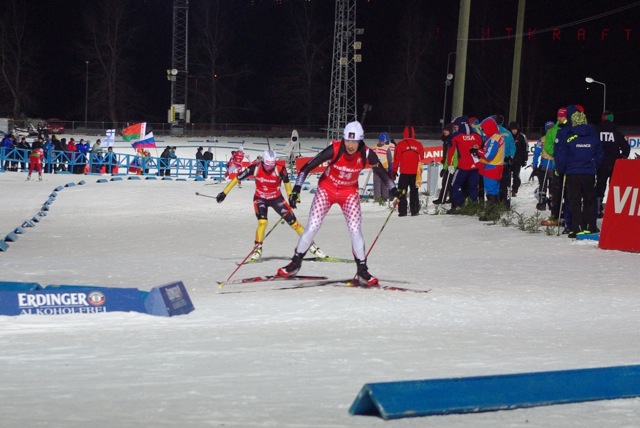
    There was one other issue too, an error that doesn’t show up on the result sheet.

    Currier. Photo: NordicFocus/USBA.

    “The results have me with five misses,” Currier explained. “Unfortunately I didn’t see my last target in standing go down and thought I had two penalties in the final stage and ended up doing an extra penalty loop. It was frustrating, but it wouldn’t have made much of a difference.”

    Overall, it was a bit of a deflating day for the U.S. But both Hakkinen and Currier said they were keeping their heads high.

    “Today was simply not our day, which biathlon is notorious for,” Hakkinen said. “Overall, I see great potential and as long as we keep the work-hard mentality we will get the results we want.”

    For Currier, the week has been an exercise in reasonable expectations, starting with the sprint.

    “I sure would have liked to have hit my last target standing, but the last loop was fast enough to get me into the points,” he said of that effort. “So in the end I decided I was pleased with it.”

    Overall, he wasn’t letting the somewhat frustrating results in Khanty dampen his spirits too much.

    “I didn’t make my goal of competing in the mass start and today wasn’t the best ending note, but I didn’t even need this weekend’s racing to justify this as my most successful season yet,” Currier wrote. “So, I’m still glad just to be here and to gain the extra racing experience at the World Cup level.”

    * * *

    For top Canadian Jean Philippe Le Guellec, things couldn’t have gone much more poorly: he started in eighth after an excellent sprint race yesterday, but fell all the way to 47th with seven penalties. Nothing, he said, seemed to go right.

    “If everything was on point yesterday, I guess the only thing that was on point today were my skis,” he lamented. “My ski shape was absent… it seems to be the trend for me this season every time there is a set of back to back races. Conditions today didn’t help much either. It snowed all day, a fine powedery snow that mixes in the present snow and makes for slow conditions compared to yesterday. My shooting was obviously not on par either.”

    Le Guellec racing at World Championships.

    While conditions were tricky enough that only two competitors cleaned, they weren’t too complicated either, and Le Guellec was still unsure where he had gone wrong.

    “I don’t know why [I missed], the shooting conditions were fine, and I wasn’t coming in the range like a mad dog either – I couldn’t have if I wanted too!” he told FasterSkier. “So it beats me as to what happened there. Concentration wasn’t excellent, and that’s pretty much all I can explain.”

    Luckily, despite the disappointment, Le Guellec was able to look at the big picture.

    “Bah, for sure it’s not as much fun when you have such a drastic drop,” he said. “But it’s no reason to be bitter, after all, we practice sport for a living, how much do we actually have to whine about?”

    Luckily for Canada, the day was redeemed by Scott Perras, who moved from 41st up to 33rd, and Nathan Smith, who improved from 46th to 38th.

    As Le Guellec had noted yesterday, the team seemed to have lackluster skiing at World Championships, but improved this week.

    “I think I missed the optimal prep for Ruhpolding, and World Championships sadly just ended up being good prep for here,” Perras told FasterSkier.

    Today, he shot superbly, missing only two targets out of 20, which allowed him to rise through the field.

    “This week I really just focused on the shooting, and followed a similar shooting plan to World Championships, which paid off today,” he said.

    Nathan Smith leading Scott Perras at World Championships.

    Smith matched that shooting, allowing for his own surge upwards.

    “Skiing was fairly good but not my best,” Smith wrote in an e-mail. “I’m very happy with my shooting despite losing some valuable time because of a frozen sight and double eject in the last standing bout. Missing the very last shot always hurts a bit too.”

    After a sprint in which he “started way too hard and died a painful death,” Smith used more even pacing in the pursuit and ended up happy with the result. It was especially encouraging since he came down with a cold the day of the individual race in Ruhpolding, and had been disappointed with his last race there.

    Like Currier, both Perras and Smith looked at the big picture and saw the Khanty-Mansiysk races as building blocks, rather than imperfect ends to their seasons.

    “Unfortunately none of my races have really been at the same level as Canmore,” said Smith, who won three IBU Cup competitions on home turf earlier this season. “It would’ve been nice to pop off a few more races like that, but overall I’m still satisfied with the end of my season. I’ve made my biggest performance gains ever this year.”

    Perras agreed.

    “I am not upset about the sprint, but I missed a really good opportunity and next year I hope to bring a maturity that will allow me to capitalize on these opportunities,” he said.

    Full results

  • Skiing, Shooting Woes Combine In Disappointing Day for Canadian Men

    Skiing, Shooting Woes Combine In Disappointing Day for Canadian Men

    Jean Phillipe Le Guellec leads Michael Greis of Germany during the individual race.

    RUHPOLDING, Germany – As has been the case so many times this week, the Canadian men’s team was simply not satisfied after the 20 k World Championships individual on Tuesday.

    “The course was nice,” Jean Phillipe Le Guellec told FasterSkier, struggling to find some positive notes from the race.

    His performance, he said, was not one of them.

    “My shooting was just – there was nothing I could do,” he lamented. “You can’t come in too hard to the range, it’s impossible to do because you have that long downhill. There was no wind. It was easy conditions. I have no excuse, I have no idea what the hell happened. They just didn’t go down.”

    Le Guellec, who finished 14th in the sprint, usually paces the Canadian team – and without partner in crime Brendan Green, the squad has relied on him more than ever this week for strong results.

    But in the individual, where errors are penalized by a minute of added time rather than a 150 meter penalty loop, Le Guellec missed six shots over four stages. He didn’t have a single clean five-target bout.

    That dropped the Shannon, Quebec, native to 71st, the last of the Canadian men.

    Instead of Le Guellec, the team was led by Scott Perras, who missed three shots and placed 45th.

    “It was definitely my best race so far, mostly because of the shooting,” Perras told FasterSkier. “I got to ski around a lot of good guys, so that definitely helped me out in the early part. My form is not quite where I want it to be still. I don’t know why.”

    After finishing in the top 30 in a pair of sprints earlier this season, including in Oslo just three weeks ago, Perras had high expectations that he was peaking for World Championships. But he placed 50th in the sprint and 54th in the pursuit, and has felt sluggish all week.

    “In between Christmas and now I felt good,” he said. “It was nice, and then here, it’s just rough during the days even when I’m not skiing. The skiing is actually better than the other 23 hours of the day. I was just hoping for more.”

    Nathan Smith finished 61st and Marc-Andre Bedard 69th with four penalties apiece.

    For Le Guellec, even though the race was a disappointment, he was perhaps not as frustrated as he might have been in other years. At the end of last season, Le Guellec came down with mononucleosis and missed several months of training.

    “Coming into the season I had no expectations whatsoever,” he explained. “I had to take two months off after the season, and then obviously you get sort of de-trained in a way. After that I was doing zone one and I was going like 180 [beats per minute heart rate]! I was going bonkers.

    “So I’m happy with the season,” Le Guellec concluded. “My Worlds started strong, but they ended with a – I wouldn’t say a bad note, but I was hoping for better. Right now I only have half the training load that most people had for the last year, so we’ll see. The relay is on Friday, and I’ll try to have fun then and just enjoy the rest of them.”

    Full results

    Race Report

  • Canada’s Le Guellec, Kocher Finish 26th in World Champs Pursuits; Team’s Seven Starters Have Mixed Success

    Canada’s Le Guellec, Kocher Finish 26th in World Champs Pursuits; Team’s Seven Starters Have Mixed Success

    Canada's Megan Imrie (2nd from left) was already attacking on the first hill out of the stadium.

    RUHPOLDING, Germany – Two Canadians had high hopes for Sunday’s pursuit: Jean Phillipe Le Guellec was 14th after Saturday’s World Championship sprint, and teammate Zina Kocher 18th. They were poised, it seemed, to have career-best finishes.

    Le Guellec had never finished in the top ten at World Championships, but started just 12 seconds outside it on Sunday. Kocher was shooting for a top-16, which would have guaranteed her funding through Athletics Canada for the next season.

    Bjorn Ferry (SWE), Le Guellec, and Dominik Landertinger (AUT).

    But neither of them hit the mark, and both ended up 26th at the end of the day.

    Le Guellec later wrote in an e-mail that he “wasn’t in such a good mood” after his 12.5 k, four-stage race.

    “Looking at results, obviously I stumped down quite a bit,” he said. “The race was going ok until the last shooting basically.”

    Le Guellec started off strong, cleaning his first stage and moving into the top ten, where he skied with Lowell Bailey of the U.S. and Andreas Birnbacher and Simon Schempp of Germany. Even after missing a shot in the second stage, he dropped no lower than 11th, and was back into ninth after a clean third stage.

    But in the last stage, he missed two shots. Le Guellec’s ski speed also didn’t do him any favors – he said after the sprint, too, that he had felt slow – and rather than regaining places on the final loop, he lost them.

    “I came out of the penalty loop in 17th,” he explained. “The last lap was no different [than the others], and I got passed by seven guys in the last kilometer of the race. I had nothing in the tank to fight back and dropped to 26th.”

    The Canadian, who placed 11th in this event at the 2010 Olympics, was very frustrated with his skiing; his course time was just the 38th-fastest of the day, and with only a single athlete (Roland Lessing of Estonia) cleaning the race, his solid shooting could have gained him more spots.

    “My skis were fast once again, but my ski shape was not great, and it’s not like the sprint where I felt not so good but actually did decent,” Le Guellec lamented. “I was getting passed by trains on all laps. With only a day of rest before the individual, I’m hoping my form will be better.”

    Kocher (r) and Poland's Krystyna Palka in their first standing bout.

    Kocher faced an opposite problem in her 10 k pursuit. Starting 18th, she immediately missed two shots and dropped to 27th.

    “Right off the bat, it had me a little bit off my game from the get-go,” she told FasterSkier in an interview at the finish line. “At the beginning I kept it easy, that was kind of my plan, just to draft and come in sure of myself. It didn’t quite work out when I missed two.”

    Kocher had discussed earlier the difficulty of dealing with the 16th-place requirement, and she said that after her initial errors, some of the pressure actually disappeared. After cleaning the second stage, she skied in the low twenties, and it seemed that with half the race still remaining, she might reach her goal after all.

    “When I was around 20th, I was like, ‘okay, I’m back in the game,’” Kocher said.

    But she struggled in standing, missing one and two shots in the two stages, and wound up, just like Le Guellec, in 26th.

    “I guess it was just a really hard race,” she said. “On that last standing I was getting pretty shaky. It was pretty hard work skiing today. So it’s not what I wanted, I really wanted 85 or 90% shooting, and that would have put me in that top 16 for sure.”

    Now, both racers are left looking forward to the longer, four-stage individual races which will be held Tuesday and Wednesday. His next race would be a challenge, Le Guellec admitted, especially in the deep, soft snow that has characterized the competitions so far.

    “The 20 k course is very demanding, and this is without taking conditions into account,” he wrote.

    Kocher was more positive, and pointed out that with two top-thirty finishes, she was in good shape to snag a position in the exclusive mass start race.

    “I’m psyched for the individual, and now I might have a good chance for the mass start,” she said.

    The Rest of the Canucks

    Megan Heinicke and Italy's Michela Ponza approaching the range.

    Team Canada started the day on Sunday with lots of opportunities – they had put a total of three women and four men in the pursuit out of four possible starters in each race in the sprint. The rest of the team had started much lower down the results sheet, but there potential to move up.

    Of the remaining starters, Megan Imrie and Megan Heinicke both gained at least ten places, with Imrie advancing from 51st to 39th and Heinicke from 52nd to 42nd.

    Imrie used strong shooting to make her move, only missing a single shot and gradually picking up a few places in each loop. Her racing earned her World Cup points, which are awarded to the top 40, for just the sixth time this season.

    Heinicke just barely missed that cutoff, but had a strong race as well, cleaning both prone stages and then missing a single shot in each standing stage.

    In the men’s race, Nathan Smith started 45th and after going zero-one in prone had moved up to the low 30s. But in his first standing stage, he had difficulty with the wind and missed three shots, dropping back down further than his starting position. He missed a single shot in the final stage and finished 43rd.

    Nathan Smith leading Scott Perras around the penalty loop.

    “Even the [stage] where I hit four, it was a hard four to hit,” Smith said of the standing stages. “It wasn’t easy. Maybe I should go a little bit easier into the range – I went a little bit too hard on the last large hill because I was trying to stay with guys.”

    Despite the frustration of his shooting, Smith told FasterSkier that he thought his skiing had improved from Saturday, and that it was good to have head-to-head competition and better peers on the trails, compared to the sprint where he was seeded with mostly slower skiers.

    “It was fun,” Smith said. “Especially on the flat part, there was some headwind, so it was a lot easier to stay behind someone. I think I only got to do that one lap – sometimes I had to pull the guys. But you could tell that there was a big difference.”

    Scott Perras started 50th and ended 54th on the back of six penalties, while Marc-Andre Bedard moved up from 55th to 52nd.

    Bedard said the race was “rough, but fun,” and that his four penalties were not enough to gain spots at this level of competition.

    “The fastest skiers are already up front,” he explained. “So to climb up from far behind – if you’re top 30, that’s good for moving around, but if you’re in the back, like 50s, to climb up then the others in front have to do very badly, because usually on the World Cup nobody shoots under 80%.”

    Like Le Guellec, Bedard said his skiing could use some work – but he wasn’t completely discouraged about his prospects for the individual race.

    “The skiing was not so strong, so I really concentrated on my shooting,” he said. “That pace was good for the individual, but a little too slow for the pursuit.”

    Full men’s and women’s results

    Men’s and women’s race reports

    Marc-Andre Bedard in action.


  • Canadians Tie Best-Ever Relay Finish with 7th; Rare Synergy as Both North American Teams Top-10

    Canadians Tie Best-Ever Relay Finish with 7th; Rare Synergy as Both North American Teams Top-10

    Jay Hakkinen skis through a corridor of fans while moving the U.S. from 18th up to 12th during the second leg of the World Cup relay in Antholz-Anterselva, Italy. Photo: NordicFocus/USBA.

    At the front of the race, Sunday’s World Cup men’s relay in Antholz-Anterselva was not especially exciting.

    Although the time gaps weren’t huge, there were few lead changes: after the first handoff, France took the lead and never looked back, remaining there for the rest of the race. After that point, Germany sat in second, Austria in third, and Russia in fourth: at each exchange, despite the intervening 7.5 kilometers, the scene was the same.

    A bit further back, however, the North American teams had a more interesting time.

    Brendan Green led things off for the Canadians, and he wasn’t in top form; Biathlon Canada reported that he was “under the weather.”

    “A hard day at the office for me – racing sick is never fun,” Green tweeted after the race to explain his split.

    The top-ranked Canuck used five spare rounds – almost half of the team’s total tally – to clean his ten targets, but thanks to the special rules that allow the extra bullets during relays, he managed to avoid skiing the penalty loop. Green also chalked up the fifth-fastest course time. He tagged off in 13th, roughly a minute behind the leaders.

    From there, the Canadians shot upwards, eventually reaching seventh place, tying their best-ever World Cup finish.

    The pivotal effort came from Jean Phillipe Le Guellec, who used only a single spare round and actually made up time on the leaders during the second leg.

    “JP did his thing and put the ball in our court,” teammate Scott Perras told FasterSkier.

    It was in his court in particular: as the third-leg racer, Perras took the tag from Le Guellec and was faced with the challenge of staying inside the top ten. While his ski time was competitive, Perras was unable to excel on the shooting range, using a total of four spare rounds and skiing the team’s only penalty loop.

    “I struggled in the prone and took a penalty loop, which hurts even more now,” Perras said, imagining what the team could have achieved with better shooting.

    By the time he tagged off, the Canadians had dropped one spot to ninth. Finally, Nathan Smith took over, and took the responsibility of turning a good result into a great one.

    Smith had just been promoted to the World Cup after racing on the IBU Cup earlier this season. There, he had collected a podium finish, a rarity for North Americans; in that sense, he had the experience to ski towards the front of the race.

    And even though the World Cup is much more competitive, Smith delivered. Like Le Guellec, he used only one spare round to drop his ten targets, maintained the same gap to the leaders, and moved up two spots to seventh.

    “[The result] matches the team’s personal best,” Perras said. “Seventh is awesome. We will take the positives from this one: considering everything, it’s a great result and I would not be surprised if results like this start to become regular.”

    Hakkinen working hard to make up ground. Photo: NordicFocus/USBA.

    The U.S. team joined the Canadians in the top ten, which in itself was historic; the two countries have not had simultaneous top-ten relay finishes in at least the last five years. For the Americans, the result was both encouraging and disappointing; like the Canadians, they racked up eleven spare rounds, which is too many to be competitive at the very top of the field.

    Lowell Bailey led off for the U.S. and had an uncharacteristically error-filled standing stage, using all three spare rounds and still skiing two penalty loops. He left the team in 18th – like Canada, not where it wanted to be.

    “Today was not my day in standing,” Bailey told FasterSkier. “My leg was going great until four misses with the first five shots in standing! I ended up with two loops and more than a minute behind the leaders. It was definitely a sub-par performance from my side.”

    Luckily, Jay Hakkinen and Tim Burke each turned in strong races, moving the U.S. up to 12th and then 8th. Hakkinen missed a single shot, which he easily remedied using a spare round.

    “I was happy with my leg, especially since it was high risk shooting in order to work my way forward,” he wrote in an e-mail. “I worked very hard this week on my skiing and shooting, and it helps my confidence going into the short break to have a good race.”

    Burke didn’t do quite as well on the range, using three spare rounds in standing, but had the fourth-fastest ski time among all third-leg racers was able to catapult his way past several more teams.

    Finally, habitual anchor skier Leif Nordgren took the tag and in doing so returned to action after a two-week break from the World Cup. That hiatus could explain that he was slightly off his game; usually a sharp shooter, Nordgren used four spare rounds.

    Bailey was still pleased with the youngest team member’s performance.

    “Leif, who hadn’t had an opportunity to race here yet, put down a solid anchor leg and kept us in tenth place,” he said.

    Nordgren anchoring the U.S. Photo: NordicFocus/USBA.

    And despite the ups and downs, Hakkinen said that the team was happy with their effort.

    “The relay showed our teams strength and potential, and a few of our weaknesses,” he explained, saying that they now had plenty to work on as the World Cup adjourns for two weeks.

    For Hakkinen, he’s look for a gain – even a small one – in his ski times when competitions resume in Oslo, Noway in February.

    “ Over the next week I will be with the team altitude training,” he wrote. “Looking
    towards Oslo, my top priority is to make the mass start. I have now been on two reserve lists, and in the last mass start they took two reserves but I was the third. Therefore, I hope to step up a level in the next World Cups.”

    full results

    Lowell Bailey follows Norway's Ole Einar Bjorndalen during the first leg of the relay. Photo: NordicFocus/USBA.
  • (Updated) Lindstrom Picks Up First Victory; With 12th Place, Burke Earns Mass Start Spot the Hard Way

    (Updated) Lindstrom Picks Up First Victory; With 12th Place, Burke Earns Mass Start Spot the Hard Way

    Russell Currier (USA) skiing to 43rd place. Photo: NordicFocus/USBA.

    The Swedish biathlon team has had to adjust to several surprise announcements in the last year. In the spring star coach Wolfgang Pichler left to lead the Russians. In the summer, 2006 Olympic gold medalist Anna Carin Zidek decided to retire. In the fall, Mattias Nilsson was forced to leave competitive sports after being diagnosed with a leaky heart valve.

    None of it was good news – but as soon as the started, the tide turned. Nilsson’s sister, Anna Maria, made the World Cup podium for the first time. Carl Johan Bergman won his first World Cup, and then won another.

    On Friday, the team had another nice surprise: 22-year-old Fredrik Lindstrom won the 10 k sprint in Antholz-Anterselva, Italy. The lanky Swede is in the midst of just his third full season on the World Cup; he has already finished in the top ten several times and turned in strong relay performances, including fourth place in both the Olympics and 2011 World Championships.

    But today was different.

    “I had a great feeling today!” he exclaimed in a press conference. “My shape was very good and I performed well on the shooting range. It was an amazing feeling.”

    Lindstrom credited his success in part to training with Bergman and Olympic gold medalist Bjorn Ferry, saying that “they challenge you every day.”

    His win came in impressive fashion. With good conditions, most of the top men cleaned the prone shooting stage, and the excitement happened in the second half of the race. While his splits had been close to the lead the whole race, in the beginning he had trailed Arnd Peiffer of Germany. Both started with late bibs, Lindstrom 75 and Peiffer 81. They each cleaned in prone, and Peiffer held an 11-second lead.

    Lindstrom cleaned standing as well and sped to the finish. It was too much for Peiffer to match, however, and the German bonked, turning in the 33rd-fastest closing lap and eventually finishing 27 seconds behind the Swede, good for fifth place.

    Second went to Evgeniy Garanichev of Russia, who did the opposite of Peiffer and moved from fourth to second after skiing the fastest closing lap in the field. Earlier this season, Garanichev was racing on the IBU Cup circuit, and despite his success in Antholz didn’t seem certain that he’d stay on the Russian “A” team.

    “I have not had a World Cup start very often because we have many good athletes on our team,” he told the press. “I am not a star. I just do my job.”

    Martin Fourcade of France finished third and took the yellow overall leader’s bib from Emil Hegle Svendsen of Norway, who had a rare bad day on both the range and the trails and finished 23rd.

    Burke. Photo: NordicFocus/USBA.

    American Tim Burke continued the “up” part of his up-and-down season, placing 12th with two penalties. He had the 11th-fastest ski time, and with two penalties in standing ended up just three seconds out of the top ten.

    It’s the second 12th-place finish for Burke this season, and he has also finished 9th and 11th. Despite these performances, his bad days have been out of the World Cup points, and today’s result brought his World Cup ranking up to 30th. It also earned him a spot in Saturday’s mass start.

    The 30 positions in a mass start are divvyed up in two ways: the first 25 go to the top athletes in the World Cup rankings. Then, the final five are allotted to the next best performers in the preceding sprint.

    Burke’s teammate Lowell Bailey, who finished 36th today, made mass start through the first option. Based on top-ten performances earlier this season, he’s ranked 15th in the overall standings. Burke, however, was left to make the race the second way.

    “Earning points the hard way today in Antholz,” Burke tweeted after the race. “I would give a lot to get those last two shots back.”

    Jay Hakkinen also scored World Cup points, cleaning both shooting stages to finish 22nd.

    “It was important for me to return to solid shooting after having some standing misses in the past races, and I fought hard for every shot, especially the last one where my legs where shaking,” he told FasterSkier. “It was a bit heartbreaking to be just 5 seconds away from directly qualifying for the Mass Start, but that is biathlon.”

    Hakkinen is an alternate for the mass start. The final American, Russell Currier, placed 43rd with two penalties.

    The Canadians also put three men in the World Cup points. Jean-Phillipe Le Guellec, Scott Perras, and Brendan Green finished 27th, 29th, and 34th.

    For Le Guellec and Green, who have finished in the top ten and twenty this season, the results were run-of-the-mill; they racked up two and three penalties, respectively. But for Perras, the top-30 finish was a career best – and by far the strongest result of the season.

    “Finally is right,” he wrote in response to an e-mail from FasterSkier. “If I was to sum it up in one word that would be it.”

    In the pre-Christmas campaign, Perras had failed to break into the top 60, which was frustrating because he had made good progress the year before.

    “For one reason or another I struggled,” he said. “It was tough. there was a point when I didn’t know if I needed rest or training, but I chose training.”

    His gamble worked.

    “I came back to Europe feeling like a new man,” he said.

    In last weekend’s races in Nove Mesto, Czech Republic, Perras finished in the mid-40s – an improvement, but still not what he had been hoping for. Then, he suffered another setback when his rifle stock broke. U.S. shooting coach Armin Auchentaller, however, was able to find a cabinetmaker to repair the stock, which Perras tested out in official training. Luckily, both he and the rifle are back in action.

    With multiple top-30 performances on Friday, both the U.S. and Canada could put together strong relays this weekend, although the North American squads haven’t had stellar results in team events so far this season.

    Perras and his teammates were excited – in their own way.

    “I think we are psyched for the relay, but we aren’t really a group that gets psyched,” he said. “We just enjoy the moment.”

    Full results