Tag: Scott Perras

  • American Men Unable to Capitalize on Sprint Success, Burke Leads with 16th in Nove Mesto Pursuit

    American Men Unable to Capitalize on Sprint Success, Burke Leads with 16th in Nove Mesto Pursuit

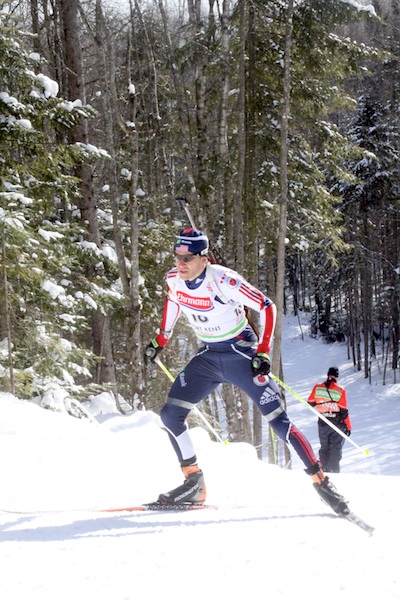
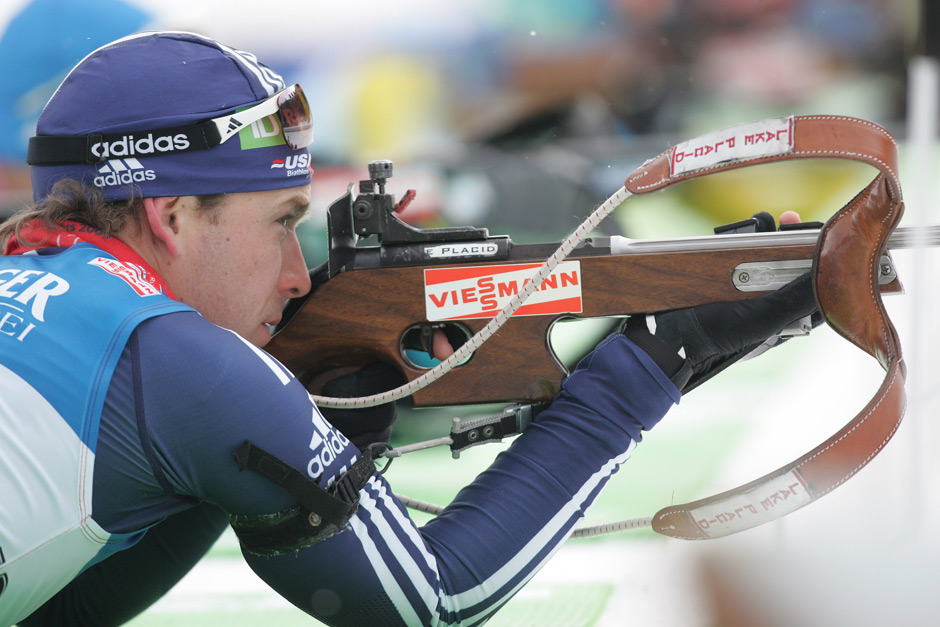
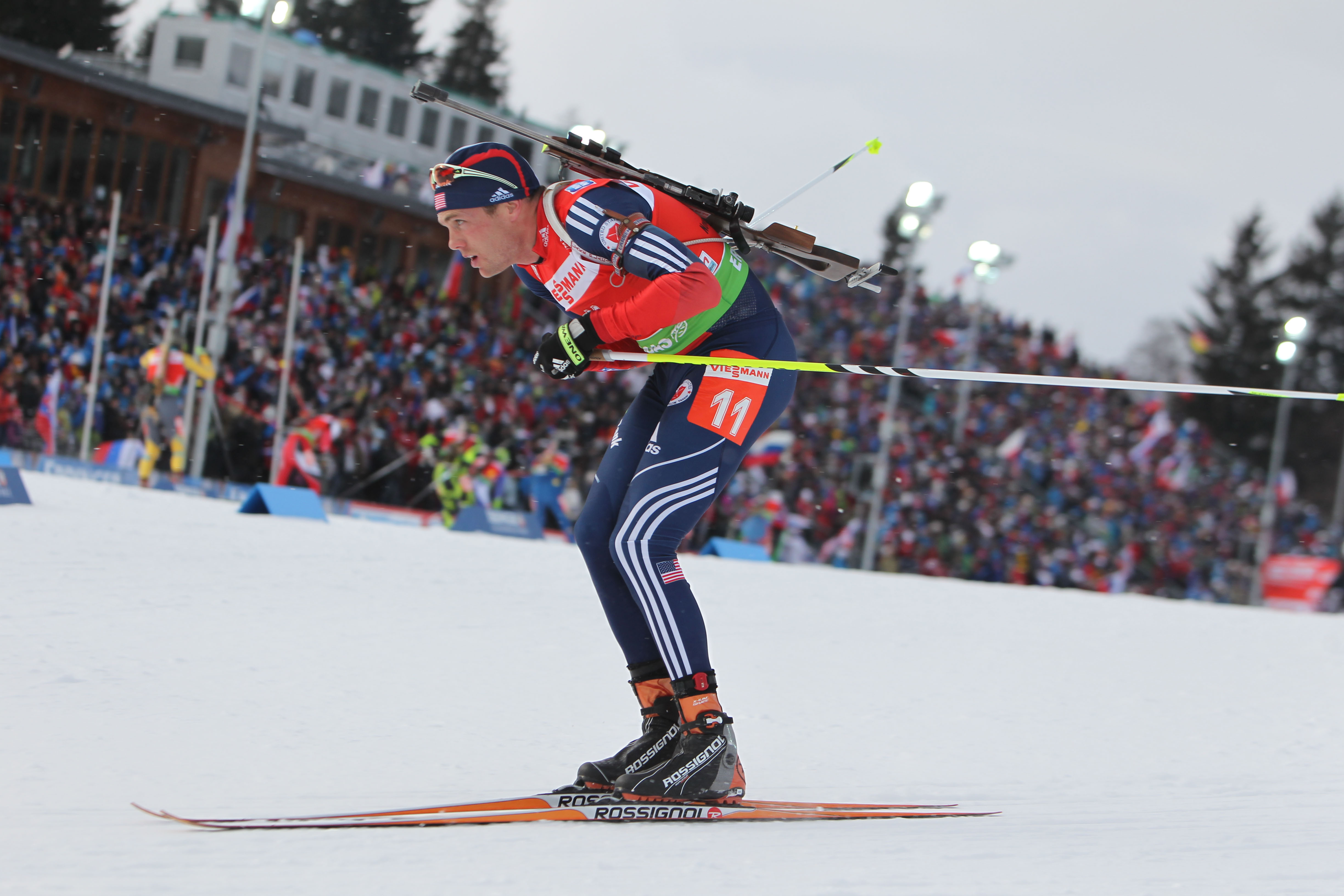
    Tim Burke led the U.S. team in Nove Mesto today. Photo: NordicFocus/USBA.

    With the U.S. men’s team notching their best day ever in Saturday’s sprint, hopes were high that the team could place athletes in the top ten or even the top five in today’s pursuit.

    But although the Americans were frequently close, they couldn’t pull it off. After starting with bib 6, Russell Currier missed a shot in the first prone stage which dropped him to 12th; and while Tim Burke, starting with bib 11, was able to clean both prone stages and move into the top ten, penalties in the standing stages dropped him back out of it.

    Burke finished 16th, leading the American team.

    “I was very happy with my skiing today but I just could not quite get the shooting together for the last two stages,” he wrote in an e-mail to FasterSkier. “I felt comfortable and I thought I was taking good shots but the targets just would not fall.”

    He was able to stay in the top 20 despite five penalties thanks to his skiing: Burke notched the ninth-fastest time over the 12.5 k course. He missed a block of training in the spring and early summer after getting surgery for compartment syndrome, but at this point in the season it’s not slowing him down.

    “I feel like I am getting stronger on the skis with every race now so I am really looking forward to next week,” he said. “Hopefully I can finally combine a good ski race with solid shooting.”

    Bailey was just two places and seven second behind his teammate. He had three penalties, and moved from 21st up to 18th.

    “The shooting was again extremely challenging today, especially in standing, so I was happy to end the day with only three misses,” he told FasterSkier.

    Hakkinen on the hunt. Photo: NordicFocus/USBA.

    Jay Hakkinen, too, improved several places; after cleaning both prone stages and moving from 31st to 20th at the race’s halfway point, he lost his touch in the standing stages and missed two shots in each of them. Still, he finished 27th.

    That left Currier – the one who’d had the best shot at the top five, and who even after the initial penalty had seemed set to finish in the top 20. With a single missed shot in each prone stage and two more in the initial standing stage, he sat in 17th place. He was also skiing fast – at the end of the day, he owned the 13th-fastest course time.

    “Prone was decent and ski speed was great,” Currier told FasterSkier. “The wax techs really nailed it today.”

    Currier was ultimately done in by the wind, however, which roughly doubled in speed during final shooting stage, right when athletes’ legs begin to be particularly shaky and shooting becomes the most difficult. Currier missed four shots.

    “The wind was an issue,” Currier said. “Consistent wind isn’t the best, but it’s manageable. It’s the random gusts that make it impossible to deal with. That’s more or less what I had in the last standing stage.”

    After 600 meters of penalty loops, Currier tumbled to the mid-30s. Though he had an extra half-kilometer of skiing in his legs, he still attacked the final loop and skied into 35th place. As he crossed the finish line, he made frustrated gestures at the cameras.

    A few hours later, though, he was able to see his performance in a more positive light.

    Currier in one of the prone stages. Photo: NordicFocus/USBA.

    “Even though today was not a great race, it was not too much of a bad race either when you break it down,” he said.

    Overall, his results from his first weekend of World Cup racing this season leave him enthusiastic.

    “The original goal for the season was two top 40’s,” he explained. “Technically I can cross that one off the list now. I would really like to stay in the points from here on out just to prove that Saturday’s result was not a fluke of any sorts. This week’s race series proves that everything is on good pace. If I play my cards right it could be a very good season.”

    Hopefully, the men can continue to work together. At various points in today’s race, Burke and Currier, Bailey and Currier, and Burke and Bailey were together.

    “It was fun to be around both Russell and Lowell during the race today,” Burke said. “I think this helps give the race a more relaxed feel because it seems more like practice.”

    Bailey agreed.

    “It was great to have all the guys in it to the end today,” he said. “It was almost like one of our team time trials!”

    Mixed Results for Canadians

    After starting in 32nd and 35th positions, Canadians Brendan Green and Jean-Phillipe Le Guellec saw their races take opposite trajectories.

    For Green, the pursuit went pretty much as planned. He missed only a single shot over four stages and slowly crept up to 20th place.

    “The wind definitely still made a strong presence, but I took my time in the range, made sure my standing set up was solid, and thankfully ended the day with just one penalty,” he told FasterSkier.

    While he was pleased with what he called a “pretty good day”, the usually speedy Canadian said that he hasn’t felt his best. That was illustrated by his ski time, which was the 31st-fastest today.

    “I found the racing a little tougher on the whole,” he said of the pursuit. “I felt a little flat and more tired skiing today, but thankfully my shooting kept me in the game.”

    The same could not be said of Le Guellec, who missed six shots and did not finish the race. While several athletes shot just as poorly – Currier, for example, as well as last year’s overall World Cup leader Tarjei Bø of Norway – they had the luxury of starting with higher bib numbers, so even with many penalties they were still skiing in the mix.

    After Le Guellec’s missed shots, he was well out of the top 40, and decided to drop from the race instead of completing the final loop.

    The final Canadian starter, Scott Perras, started with bib 45, missed six shots, and dropped to 47th.

    Despite the team’s up-and-down fortunes and the difficult conditions here in Nove Mesto – which is a new addition to the World Cup schedule – Green said he had enjoyed his stay.

    “When the weather cooperates I like the venue here,” he told FasterSkier. “The course is solid and the fans are awesome! All in all I’m quite happy with my week of racing.”
    Full results


  • Even After Losing Photo Finish to Italy, U.S. Notches Best-Ever World Champs Relay Finish

    Even After Losing Photo Finish to Italy, U.S. Notches Best-Ever World Champs Relay Finish

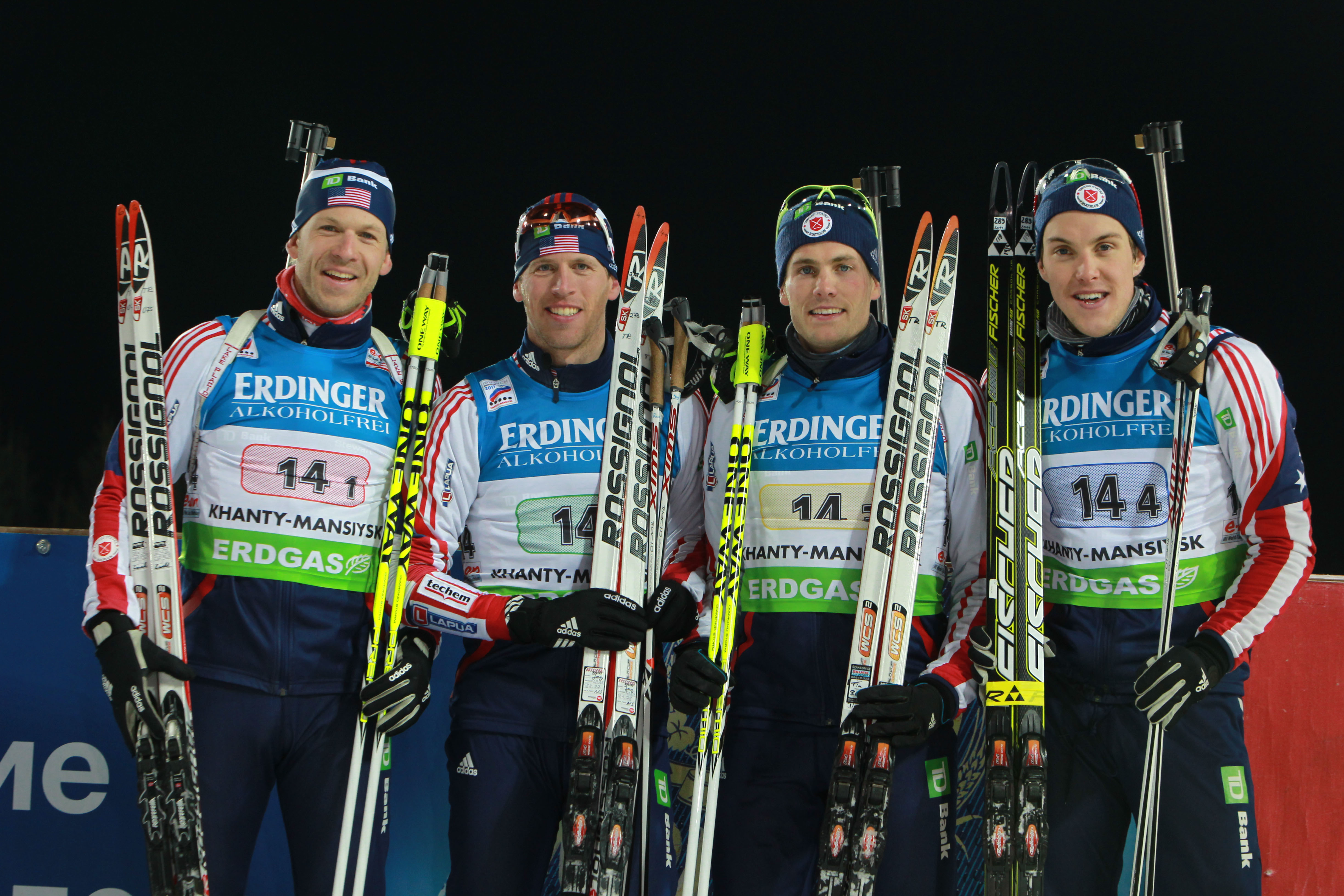
    The U.S. team: Lowell Bailey, Jay Hakkinen, Tim Burke, Leif Nordgren. Photo: nordicfocus.com courtesy of USBA

    Was U.S. biathlon head coach Per Nilsson enthusiastic about his team’s relay finish at World Championships on today?

    “BEST EVER!” he wrote in an e-mail on Friday evening. “[It’s] fun to show that we have a team that can fight on the highest level in the world.”

    While the entire team had a strong performance in Khanty-Mansiysk, Russia, on Friday – leadoff skier Lowell Bailey tagged off in fifth place – Leif Nordgren was again the hero, skiing the fastest anchor leg and passing Olympic medalists Michael Greis of Germany and Christoph Sumann of Austria en route to a photo finish for fifth place.

    In the end, Nordgren came up short – he finished just two hundredths of a second behind Markus Windisch of Italy, and the U.S. had to be content with sixth.

    Not that they had a hard time doing that.

    Nordgren's photo finish. Courtesy of USBA.

    “We have had better World Cup finishes, but it’s the best World Championships finish ever for the men’s relay!” wrote an ecstatic Max Cobb, President and CEO of the U.S. Biathlon Association.

    In addition to finishing higher than any other U.S. team in history, the Americans were a mere ten seconds away from the podium, surely the closest they’ve ever come to earning a team medal.

    Lowell Bailey started out the historic day for the U.S. It was a hectic mass start, with at least three crashes or tangles in the first kilometer. Then on the second loop, Bailey broke a pole.

    Despite using three spare rounds – a number which in most relays would have been hugely detrimental – Bailey handed off in fifth place. His success was in part thanks to his third-fastest ski time of all the scramble skiers, but also because a number of other teams struggled on the range as well – of the twenty-two teams which finished, only eight used fewer than three spare rounds on the first leg.

    When Jay Hakkinen took over, he used three spare rounds in prone. Once again, this would usually be the death knell for a U.S. (or any other) relay, but today, the team only dropped to eighth. Over the rest of the leg, Hakkinen was able to claw his way back into seventh, only forty seconds behind the leader.

    Next up for the U.S., Tim Burke turned in the fourth-fastest last loop; in combination with his two spare rounds in standing, the team dropped back to eighth, just over a minute behind Norway and Germany.

    Nordgren was the U.S. anchor, and all eyes were on the 21-year-old, who had been having an exceptional World Championships so far. With two top-thirty finishes, he was the only American qualified for the mass start the next day.

    After the prone shooting, Nordgren had used two spares – a painful pair, after missing his one remaining target with the first spare and having to try again. The same thing happened in standing, and the U.S. was sitting in eighth place still.

    “I missed my first extra in both prone and standing,” Nordgren told FasterSkier. “Of course it’s a bummer, and a little frustrating, but you just have to put that behind you and focus on the next shot. There’s really no time to think about it.”

    Instead of thinking, he put in a furious charge over the last 2.5 kilometers.

    “Leaving the range, I was in eighth place, right behind Austria and a few seconds down from Germany,” he said. “Italy was about 18 seconds ahead. I wasn’t quite sure what to do, I didn’t even know what place I was in so I just pushed a little and caught up to Germany and decided to wait. I skied with him for almost the entire last loop.”

    Burke. Photo: nordicfocus.com courtesy of USBA. More photos below the article.

    Nilsson was proud of his youngest athlete.

    “Leif took down Greis and Sumann on the last loop and was amazing,” he said.

    But Nordgren wasn’t done yet.

    “Going into the final uphill was the first time I even saw the Italian. He looked like he was hurting, so I went for it. I made a big push and caught him about 100 meters before the finish. But I made my sprint for the line just a little late, and it came a little faster than I anticipated.”

    In the end, he was two hundredths of a second behind Windisch, in what Cobb said was the closest finish on the World Cup this season.

    “We actually finished sixth, [but] they put us in fifth for a couple of minutes after the finish,” Nordgren said. “Then I guess they took a closer look at the photo and bumped us back. That’s alright though, we’ll survive. I’ve never been in a photo finish before so that was really cool! To come up on the losing side is a bummer of course, but its just a race, there will be more.”

    While Nordgren’s performance was the highlight of the day, it took four solid legs to get him to where he finished: the best U.S. result at World Championships, ever.

    The U.S. also placed sixth in the relay at the 1972 Olympics.

    Canadians Solid in 11th

    While the Canadians have had better races, their eleventh-place finish was still deemed a success.

    “As a whole, this was a very good performance,” said third-leg skier Jean-Phillipe Leguellec. “It was a very tight relay today and each of our legs were in the heat of the action. We ended up using only six spare rounds, and finished 1:36 behind the leading team… Even the relay where we came in seventh, two years ago, we were 4:30 back and did a penalty loop! I guess that just shows exactly how different one race can be to another and how much shooting can change everything.”

    The team put in a steady effort, with Brendan Green, Scott Perras, and Leguellec handing off after each of the first three legs in ninth place.

    Green in particular had some excitement on the trails, as he scrambled in the hectic mass start.

    “That seems to be how the relay starts more or less typically are,” he told FasterSkier of the chaos. “I think because the bigger climbs weren’t until the last third of the loop, the pack was able to stay a little tighter than normal which resulted in more broken poles and mix ups than usual.”

    Green had one of the slowest shooting times in the prone stage, but said that it was all part of the plan.

    “The two previous races of the Championships for myself did not go well at all, so I was really focused on today and wanted to finish the week off with a solid performance,” he explained. “I’ve been struggling in the range lately with my prone shooting, so today I needed to take my time in the range for the first bout of shooting and be sure of my shots. My slow prone meant I had to play catch up, but I was confident in my standing and was able to shoot clean and catch back up.”

    Perras used two spare rounds in prone, but then cleaned standing with no extra shots.

    “We were the closest we had ever been to the leaders in a World Cup relay so to do this at a World Championships is great,” he said in a Biathlon Canada press release. “Being 10th at the Olympics and 11th at Worlds shows we can be with the best on a good day.”

    Leguellec used one spare round and Nathan Smith two, dropping the team to 11th place.

    Overall, the Canadians tied for the fewest number of spare rounds of any team in the field, something that everyone was proud of.

    “As a team we shot very well which was exactly what we needed to do as a couple of the guys on the team aren’t feeling 100% at the moment,” Green said. “This way we were able to stay in the game the whole race. It was an exciting race from start to finish for us, with the time gap being tight for a relay, so all in all I think the team had fun out there and we are satisfied where we finished.”

    Leguellec agreed.

    “All in all we’re very happy with how our World Championships ended. It was a very satisfying team effort today and we can now move on to finishing the season.”

    Full results

    Bailey, leading Italy in leg one, ironically enough. Photo: nordicfocus.com courtesy of USBA.
    Bailey heading through the stadium. Photo: nordicfocus.com courtesy of USBA.
  • Where the Heck is Khanty-Mansiysk?

    Where the Heck is Khanty-Mansiysk?

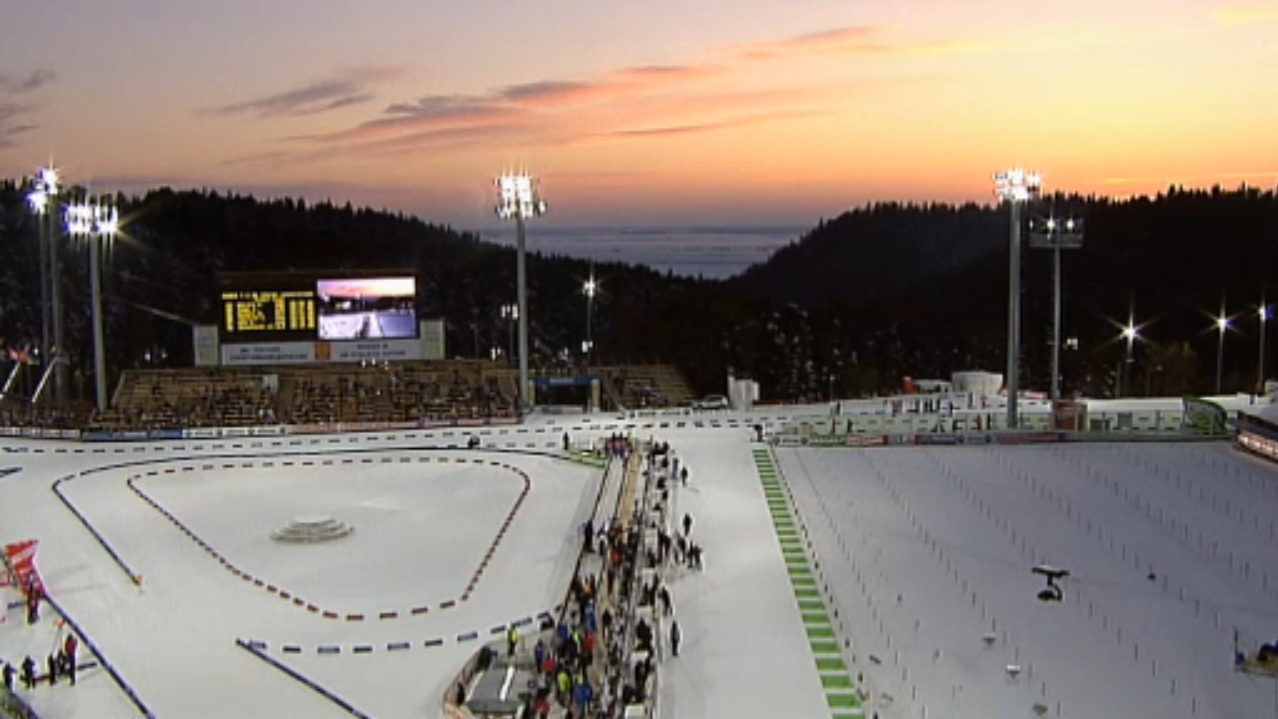
    The stadium in Khanty-Mansiysk, Russia.

    The world’s best skiers are getting the experience of a lifetime in Oslo, competing in skiing’s ancestral homeland and getting cheered by a hundred thousand fans.

    The world’s best biathletes? They’re having a cultural experience too – in Siberia.

    World Championships are currently being held in Khanty-Mansiysk, Russia, a town of 70,000 inhabitants situated almost 2,000 miles east of St. Petersburg. The International Biathlon Union charters flights from Oslo and Munich to transport athletes and service members because the local airport is only served by two airlines and travel is difficult.

    Before leaving the U.S., Annelies Cook said that she thought the trip would be “quite an adventure”, and she turned out to be right.

    “Khanty-Mansiysk is a pretty interesting place,” her teammate Sara Studebaker told FasterSkier on Thursday. “It’s definitely unlike any other World Cup venue.”

    The village originally dates from at least the seventeenth century, when the Russians attacked the native khan (leader) and took over Khanty. The town’s modern era began in 1930, when it was established as an administrative center and re-named. Despite being in the middle of nowhere, the region’s oil wealth has poured into Khanty-Mansiysk, and in the last several years there has been much more development. A 900-foot skyscraper is even being built downtown. But the region hasn’t forgotten its past, and an estimated 12,000 people still speak the native Khanty language, which is most closely related to Hungarian.

    Russian fans.

    “The town itself has these crazy landmarks of buildings, churches with gold roofs and arches,” said Canadian biathlete Scott Perras. “Then across the street are houses with fences patched together with tin and houses looking ready to fall down. I wish I could go in these houses to see was they traditionally look like inside.”

    Even though it isn’t easy to get to, plenty of fans hit up the races in Khanty-Mansiysk. In 2007, it was estimated that 65,000 tourists attended the World Cup finals, almost doubling the population of the city. So far this year, however, the stands have not been packed; it was estimated that only 5,000 people attended the sprint races on Saturday.

    “I expected like 20,000 people since the Russian fans are so passionate,” top Norwegian biathlete Tarjei Boe told IBU News. “I am not sure what the problem is but I want big crowds cheering. It helps us and the Russian athletes. Maybe the organizers should give away some free tickets.”

    Unlike in Oslo, where the Holmenkollen spectators cheer for every athlete as if they are winning, the Khanty fans are fickle – so Boe might change his mind if the crowd gets bigger and rowdier.

    “They don’t have the same attitude that the fans in Maine had,” Perras explained. “They often cheer only for Russia and can even cheer when some of the top Norwegians miss. But for me personally today was the most cheering I have had from the fans in Russia, I think they like the look of pain on a face.”

    U.S. biathlete Leif Nordgren wasn’t impressed, and focused more on the races than the spectators.

    “I haven’t actually paid to much attention to the fans,” he said. “I have no idea how many showed up for the races yesterday. I know there are a lot and they go crazy for the Russians.”

    Magdalen Neuner (GER) prepared for a cold race.

    The other defining characteristic of the Khanty-Mansiysk venue is of course the cold. The average temperature over the course of a year is -1.1 degrees Celsius. While temperatures as low as -49 Celsius have been recorded, the average low in March is “only” -14. While racing, the majority of athletes cover their faces with protective tape, and the service technicians have to adjust perfectly to the cold, dry snow.

    It doesn’t stop the fans, though: 5,000 people attended the opening ceremonies, even though it was -20 Celsius. Apparently the laser light show, dancers, traditional costumes, and reindeer were a big enough draw to outweigh the cold.

    “The venue is great- because of the cold it always allows for fair conditions to all of the competitors,” Perras said, taking the extreme conditions as a positive rather than a negative.

    He elaborated a bit more on the challenges of the course and stadium.

    “The course has a flatter profile but is very tough because the downhills are pretty gentle and you must work all of the time,” Perras said. “The range is tricky as seen today by everyone that watched the [sprint]- it comes right after the largest climb on the course and then you have to have the ability to fight the wind despite still trying to recover from the climb.”

    While it remains to be seen how the course profile works for the U.S. and Canadian biathletes, at least a few of the world’s best find it ideal. After winning the men’s sprint, Germany’s Arnd Pfeiffer told IBU News that the trails suited him.

    “I like the tracks here; they do not have such high climbs,” he said. “I can do a lot of 1/1 technique and I like that. I feel very good here. Every time I come here, I have a good feeling and that helps.”

    Studebaker said that the U.S. team had spent time adjusting to their unusual circumstances.

    “There’s a huge military presence, which is extremely strange for us,” she wrote in an e-mail. “Lots of security checks and specific protocol for our rifles and ammo. You definitely have to change up your normal routine a bit to fit in with all the extra stuff, but it’s working out well for us so far… We haven’t ventured too far in to town, but so far have had only good interactions with the people here.”

    One last challenge: the food, which Nordgren described as “not so awesome”.

    “The food is different,” Perras said. “Everything is layered in butter or lard- sometimes the pastries are the healthiest choice.”

    German fans will do anything for their biathletes – they'll even fly to Siberia.
  • Mixed Results for N. American Men in Fort Kent; Perras Hits Career Best

    Mixed Results for N. American Men in Fort Kent; Perras Hits Career Best

    Canadian Scott Perras racing on Thursday in the sprint in Fort Kent.

    Fort Kent is only 50 miles from Presque Isle, but competitors in the biathlon World Cups were greeted with an entirely different environment when the circuit picked up and moved northward on Monday.

    Swirling winds and grinding courses were the challenges in Presque Isle; frigid temperatures and one massive hill welcomed athletes in Fort Kent.

    On the Canadian and American teams, members hail from locations across the entire continent—from Lake Placid and Quebec to Alberta and Alaska—so it makes sense that the shift in conditions would lead to a shuffling in results.

    After being led all last week by Lowell Bailey (USA) in Presque Isle, it was Scott Perras (CAN) taking over the mantle of top North American biathlete in the 10 k sprint in Fort Kent.

    Skiing through temperatures that struggled to break zero degrees Fahrenheit, Perras missed just one shot over two stages to race to 30st place—the best World Cup result of his career.

    Bailey followed in 31st, with two penalties, with Jean Philippe Leguellec in 36th, with two misses. After skipping last weekend’s races to recover from an illness, American Tim Burke was 47th; he hit his first seven shots before crumbling and missing his last three.

    “The first time I missed, I knew I missed just a little bit on the right,” he said afterwards. “The last two shots felt really good—I was just shocked.”

    American Lowell Bailey in action.

    With a massive hill just 250 meters out of the start, the 3.3-kilometer Fort Kent sprint loop was every bit as difficult as anticipated, Bailey said. He called the initial climb possibly “the biggest hill I’ve ever seen on a biathlon course.”

    “It’s one of those climbs where you get to where normally you would finish a climb, and you look up and you’re only halfway,” he said. “It’s brutal—there’s nothing else to say about it.”

    The temperature was three degrees at the start of the race, which made the going even tougher. So tough, in fact, that American Jeremy Teela—like Burke, dealing with sickness—elected not to start the race after completing his warm-up.

    Normally, Teela’s scratch would have opened up a spot for another American to compete, and the team indeed had selected an alternate—23-year-old Russell Currier, who hails from nearby Stockholm.

    Currier had been informed by U.S. team staff that he’d have the day off if he didn’t hear anything before 9:40, with the race starting at 11:30. But Teela’s decision came so late that the Americans were unable to reach Currier after trying his home and cell phone, and the start spot went unused.

    “That was a pity for him, for sure; he would have loved to race here,” said Per Nilsson, the head coach of the American team—noting that next time, he would have the alternate on site. “This is unique—I’ve never been [where] somebody’s called in [so] close.”

    Despite a home crowd that didn’t hit estimates – a rough tally pegged the number of spectators at no more than 500 – the Americans still qualified all four of their starters for Saturday’s pursuit, led by Bailey.

    While his 31st place was respectable, Bailey still couldn’t hide his frustration at his result in Fort Kent—especially after notching a 16th in the pursuit in Presque Isle last week.

    The race came down to a miss on Bailey’s final shot of the day, which could have cost him as many as 10 places.

    “I went for it, and it would have been nice to hit that,” he said. “I think I just got ahead of myself, mentally. I was sort of leaving the range before I took that last shot, I think.”

    While Perras’s result was only one spot better than Bailey’s, the Canadian had a little more to be excited about.

    In the sprint in Presque Isle last week, Perras was a discouraging 61st out of 72 starters, even though he racked up just two penalties—not a good sign leading into World Championships in March.

    On Thursday, though, Perras’s shooting was even better—he had just one miss—and more crucially, his ski speed was competitive. He had the 37th-fastest course time out of 71 starters—24 spots better than in Presque Isle—including a final lap that was the 15th-best.

    Afterwards, Perras said that he is slowly getting out of some volume training that he did the week before Presque Isle, in Canmore.

    “It was a lot of slow stuff. To get everything firing again takes some pretty hard workouts,” he said.

    After hitting 31st-place twice over the course of his career, Thursday was the first time that Perras had cracked the top 30.

    “Finally, it’s three-zero,” he said.

    Burke, meanwhile, will have to wait a little longer for his form. He said he finished his last round of antibiotics Thursday morning, and the sprint in Fort Kent was his first World Cup since competing in Italy three weeks ago. His speed on skis was not where it normally is—close to the top 10—but Burke was optimistic that he could be ready in time for World Championships.

    “For sure, I’m pretty far behind right now—I haven’t had really hard training in three weeks,” he said. However, he added, “I feel like [in] another three weeks, I can get there pretty quick.”

    Link to full results.

  • Rupholding Courses, New for 2012 World Champs, Get Rave Reviews

    Rupholding Courses, New for 2012 World Champs, Get Rave Reviews

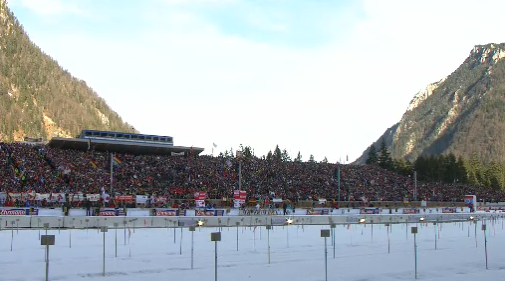
    The new stadium in Ruhpolding, Germany, has a great view of the shooting range.

    When the small town of Ruhpolding, Germany, bid to host biathlon’s 2012 World Championships, they knew they had their work cut out for them.

    “Preparations for the World Champs 2012 start now,” said Mayor Claus Pichler in August 2008 when Ruhpolding won the bid. “I got plenty of feedback from the delegates at the IBU Congress.”

    And they have been busy ever since, completely renovating and reconfiguring the area’s stadium as well as giving the trails a facelift. All of the work was unveiled last weekend when Ruhpolding hosted the fifth weekend of IBU World Cup racing.

    Swedish head coach Wolfgang Pichler – a Ruhpolding native and Claus’s brother – was proud of the changes which had been made.

    “I think the stadium here is the best in the world,” he told IBU News this weekend. “Our goal was to make big progress; if you look at everything, the tracks and buildings . . . you will see that this is a step forward for our sport.”

    If so many upgrades were needed, why was Ruhpolding chosen at all? Mayor Pichler had a few ideas. He hypothesized that the selection committee knew that the town of just over 6,000 would pull out all the stops to host an amazing event.

    “Ruhpolding and biathlon are more or less the same,” Pichler told IBU news last week. “We have done so much to develop this sport. It is not an exaggeration to say that Ruhpolding is the cradle of modern biathlon and the sport is deep in my heart. I would like our home town to remain that cradle for the future; we will contribute our part so that biathlon remains the winter sport number one all over the world.”

    With the caveat that a number of women complained about the difficulty of one of the downhills – Helena Ekholm of Sweden even said that she “really hated” it – most of the athletes seemed to like the new courses. Here’s a roundup of reactions from the World Cup field, beginning with North America’s best biathletes and finishing with international stars.

    Jeremy Teela (USA)

    “The new venue is very nice – there are lots upgrades for the spectators,” the three-time Olympian told FasterSkier. “The range moved a little left and back it seems. The courses have become a little harder, with some down hills that are more technical, which takes away from the recovery you’d normally get. I would highly recommend coming to watch next years World Champs; the atmosphere in Germany for biathlon is like no other.”

    Laura Spector (USA)

    “I am a fan of this course because climbing tends to be one of my strengths and there are a number of long, steep hills,” America’s top female biathlete said in an e-mail. “The downhills are tricky and I’ve skied them many times over the course of the week to get more comfortable, but it also depends on the weather and snow conditions. I think it’s a great choice of venue because so many biathlon fans attend the races here.”

    Tim Burke (USA)

    “Competing here in Ruhpolding is definitely very exciting with all of the fans,” last year’s early-season World Cup overall leader told FasterSkier. “They had 89,000 total fans for the week, which creates an incredible atmosphere. Unfortunately, the course here at Ruhpolding is by far my least favorite course on the World Cup. You almost never have to work for more than 30 seconds before you get a break. It is basically jump skating up a steep hill then resting over and over again. I will definitely have to make some changes to my training if I want to compete for a top spot next year at World Championships.”

    Scott Perras (CAN)

    “The new course is pretty good; actually I like it a lot,” Perras said in an e-mail. “It still has the difficulty of the old course, but with better flow so it is all around more enjoyable. The uphills are still covered with fans but they are not as close as in previous years; it seems they widened the trails and with many of the trails being two-way, it’s not as intimate as before, when you would grind up steep climbs and you could feel the breath of the fans.

    “The most disappointing thing about Ruhpolding is that the weather is never consistent and rarely fair for the entire field. Even though they sell over 100,000 tickets a weekend I would rather see solid winter conditions and less fans. That being said, the organizing committee really is on the ball with salting the course and everything turned out well [this weekend].”

    Magdalena Neuner (GER)

    “It took us a few days to get acquainted with the new courses,” the two-time Olympic gold medalist told IBU News. “We were pretty critical in the beginning about the very hard downhill. But it depends a lot on the conditions with the weather. I am basically pretty happy that the most dangerous parts will not be that difficult next year for the World Championships. Nevertheless I think the stadium is very nice for both the athletes and fans.”

    Emil Hegle Svendsen (NOR)

    “It is an amazing stadium,” the Olympic gold medalist and current second-place man in the overall standings said in a press conference. “I think it is for sure one of the best. Most important for the athletes the tracks are good and wide . . . they have built something amazing and I am really looking forward to the World Championships here next year. I think it is going to be something very special.”

    Andrea Henkel (GER)

    “[The downhills] were for me a little bit too tough,” the 2007 overall World Cup winner said in a video blog from Ruhpolding. “I made it very safe from loop to loop and on each loop got more afraid… the new stadium is very well-planned, I think. They have a huge gym with lots of bikes for warming up and cooling down, which was good yesterday [when it was pouring rain]. The track is fine, everything is very hard, which is good for me on the uphills but it is maybe a little too hard on the downhills. Maybe they will change it before the World Championships next year.”

    The Ruhpolding venue is nestled in the Alps.
  • Two Canadian Biathletes in Top-20 in World Cup Sprint – Updated

    Two Canadian Biathletes in Top-20 in World Cup Sprint – Updated

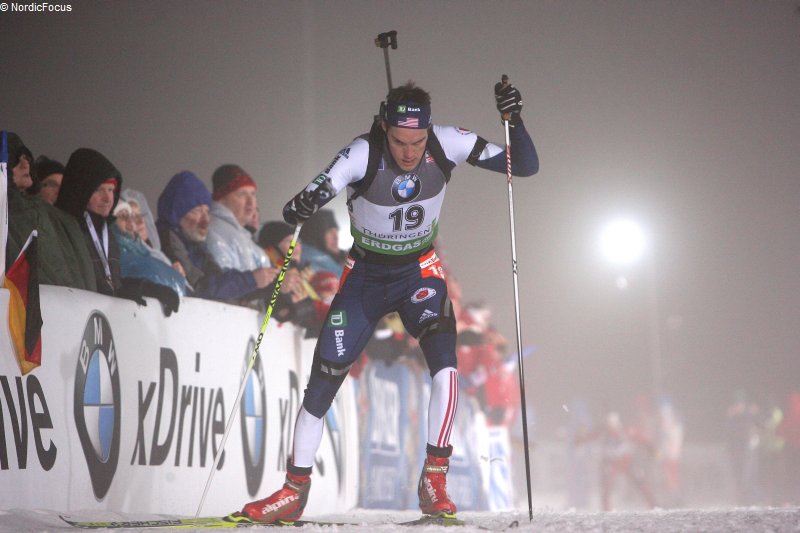
    Leif Nordgren (USA) racing through the fog in the men's sprint. Photo: nordicfocus.com courtesy of USBA.

    Oberhof, Germany, has been kind to the Canadian biathlon team so far this year.

    After the men finished 11th in the relay on Wednesday, they had a banner day on Friday with finishes of 14th, 16th, and 34th from Brendan Green, Jean-Phillipe Leguellec, and Scott Perras.

    With a mass start competition coming up on Sunday, the team is feeling good.

    “With Brendan’s 14th place, we both managed to squeeze in the mass start race this Sunday,” Leguellec said in an e-mail.

    “This is a historical first for Canada to have two men in the mass start. The selection criteria changed this year, which allowed us to get in. The mass start used to be only for the top 30 athletes in the general ranking. Now, the first 25 are pre-selected with five open spots to the next five athletes in the race before any given mass start. So Brendan and I [snagged] the 4th and 5th spots, and we get to start!”

    Leguellec was among the leaders early in the race after shooting clean in prone, but missed two shots in standing to fall back a few places. He wasn’t alone in his struggles on the range: only four men shot clean over two stages.

    “In both stages, the range was pretty foggy,” Leguellec said. “It was at the point where, through my sight, I could not see the targets very well, so I pretty much had to guess where they were and had to lend an ear to hear them fall or hear my miss.

    “My ski shape was on point,” he continued. “It’s nice to feel good on the boards again… All in all, I’m very happy with my 16th place. I seem to be getting back on track and turning the page over the rough first tour ending before Christmas.”

    Green shot one better than his teammate, missing one shot in prone and cleaning the standing stage. At the end of the day, he beat his more decorated countryman by eight seconds and two places. His result tied his best-ever World Cup performance, matching a finish from Antholz, Italy last season.

    “I was decent on the skis, but the shooting really came together today despite the conditions,” Green said in a Biathlon Canada press release. “I have been pretty tired coming out of the last training block so I wasn’t sure what to expect, but I shot well today and it was a good result.”

    And Perras had his fourth-best career result. He managed the foggy conditions well, missing one shot in each shooting stage.

    Mar-Andre Bedard, freshly promoted from the IBU Cup squad, finished 72nd with five penalties.

    For the Americans, the change in mass start format was less positive.

    Tim Burke is ranked in the top 30, so under the previous guidelines, he would have started the race on Sunday. But with the new rules, he is not ranked highly enough to get an automatic start slot, and his 31st-place finish today didn’t get him in, either.

    “I am very frustrated that I will not be in the mass start even though I am ranked in the top 30 overall,” he told FasterSkier. “I feel like I have the fitness to have a top result now, but hopefully my time will come.”

    Nevertheless, he was pleased with his race, despite missing three shots in prone and one in standing.

    “I was very happy with my performance today,” Burke said. “This was probably the best performance that I have had this season. Unfortunately, the race was somewhat of a lottery with huge clouds of fog rolling through the shooting range at times. I could not see anything when I came in for prone. I was actually very happy to hit two targets, considering that I would shoot when I saw a shade of darkness.”

    Lowell Bailey was next for the U.S. His four penalties presented a challenge, and he finished 52nd. Leif Nordgren missed as many shots in prone alone, and one more in standing, and finished 66th.

    Norway’s Tarjei Boe missed only one shot over the entire race and collected a 16-second win over Arnd Pfeiffer of Germany; it was his third individual victory of the season, and Boe will retain the yellow overall leader’s bib after this weekend.

    “Everyone asked me about the fog after the race today,” he told IBU News. “I really did not notice it so much in standing, shooting on lane thirty. In prone, the targets were gray but I could see them. I took two breaths between each prone shot so my brain could concentrate better. It was a bit slower than normal, but was a good tactic today.”

    Racing continues on Saturday with the women’s sprint.

    Full results

  • In Return To Form, Ferry Wins World Cup Sprint; Neuner Tops for Women – Updated

    In the World Cup sprints in Pokljuka, Slovenia on Saturday, two athletes took their first wins of the season. But while they hadn’t been atop the podium in Ostersund, Sweden, or in Hochfilzen, Austria, their strong performances weren’t entirely surprising: both Bjorn Ferry (SWE) and Magdalena Neuner (GER) were gold medalists at the Vancouver Olympics last year.

    Canadians led the North American contingent in both the men’s and women’s races.

    Bjorn Ferry (SWE) en route to a gold medal performance at the Vancouver Olympics.

    Men

    When FasterSkier talked to Swedish biathlete Bjorn Ferry in Muonio, Finland, earlier this season, he said that one of his goals was to win the overall World Cup.

    So far this season, it had seemed like that goal was pretty far out of reach. On Thursday, he finished 61st in the individual race in Pokljuka, Slovenia, which was his worst result so far; he was 11th in the sprint in Hochfilzen, Austria, and moved up to tenth in the pursuit. Those were the only races in which he even cracked the top 20.

    Not so good for an overall World Cup contender.

    But in Pokljuka on Saturday, Ferry reminded the biathlon world that he was, in fact, a reigning Olympic champion, and eked out a five second victory over Tarjei Boe of Norway in the 10 k sprint race.

    Ferry told IBU News that he knew he was fit, but had struggled this season nonetheless.

    “This week, it was like I took another step,” he said. “One level better. It is now fluid and I do not have to push so hard. The individual was actually my best skiing performance of the year. I just missed eight targets; it was bad shooting. But today I held it together and hit the targets. It was a bit slow, but clean.”

    While shooting clean definitely helped, ten other athletes hit all the targets in the two-stage sprint race, so it was his skiing that guaranteed him the win. Ferry had the fifth-fastest course time, and all of the faster skiers missed at least one target.

    It was a close race for the podium, with Boe only five seconds behind Ferry, and Michael Greiss of Germany another three seconds behind Boe. Greiss led after the standing stage, but Ferry’s skiing moved him into the win three kilometers later.

    For Boe, a second-place finish was almost as sweet as a win. When the World Cup continues after the Christmas break, he will wear the overall yellow leader bib.

    “I never thought before the season that I would have the yellow bib,” he told IBU News. “I thought there was a good chance that I would win a race or two, but this is something else.”

    For the North Americans, a pair of Canadians led the way. Brendan Green and Scott Perras finished 29th and 30th – excellent results for each of them.

    In the end the result was good, but I am slightly disappointed with my final shooting,” Perras told FasterSkier in an e-mail. “I managed to shoot clean in prone which is always the way to start a race. And I was prepared for the standing stage – there was not too much physiological stress. I didn’t even think it was good race so I wasn’t even nervous. I just got on my trigger too quickly and missed my first shot… so there was some mistakes that cost me some serious positions. I have to get comfortable with being in a good position so that I can capitalize.”

    Tim Burke led the way for the U.S. team in 35th place, followed by Lowell Bailey and Leif Nordgren in 68th and 69th.

    Women

    Magdalena Neuner (GER) at the Vancouver Olympics.

    Neuner, last year’s overall World Cup champion, hasn’t shown her typical dominance so far this season. After skipping the Ostersund World Cups, she helped the Germans to a relay victory in Hochfilzen, but didn’t hit the podium in any of the individual races.

    Today, though, was a different story. Neuner missed two shots in standing, but was skiing so fast that it didn’t matter. Her teammate Miriam Gossner had the second-fastest ski time of the day – just over three seconds back – but missed three shots. So despite her shooting errors, Neuner was able to ski to a solid eleven second victory over Anastasiya Kuzmina of Slovakia.

    “It was a great day for me,” Neuner told IBU News. “I had two mistakes on the shooting range and did not think about winning. It is a very nice Christmas present for me.”

    Unlike Ferry, Neuner isn’t focusing on the overall World Cup. Because of the races she missed in Ostersund and her lack of podium finishes in Hochfilzen, she says it is out of the realm of possibility.

    “I think Kaisa [Makarainen, of Finland] is very, very good this year,” she said. “I lost three races and now it will be very difficult for me. I am looking forward to the battle for the title a little bit, but more about the World Championships. It is important and after that we will see.”

    Makarainen finished in a tie for third today. She and Olga Zaitseva of Russia had identical times, exactly 17 seconds behind Neuner. Ties are not uncommon in biathlon, but a tie at the top of the field is less common than one further down the results sheet, where racers are packed in more closely.

    Makarainen will keep the yellow overall leader’s bib moving into the next weekend of World Cups, and has the position locked down after having two wins, two second-place finishes, and two third-place finishes in the first three weekends of racing.

    For the North Americans, Zina Kocher of Canada finally raced to her potential today, finishing 17th. So far, she had only finished in the top 60 once, racing to 49th place in the very first race of the season in Ostersund. Kocher finished last season ranked 31st in the overall World Cup standings, and owns one of Canada’s only World Cup medals in the last decade, so for her the result meant getting back on track.

    Sara Studebaker led the Americans in 58th place.

    “Today was a little rough on skis for me,” she told FasterSkier in an e-mail. “I didn’t feel great right from the start and knew it was going to be a tough race to get into. I was really happy with my shooting though – it wasn’t too tough on the range for me today and I was happy to come away with only two penalties.

    “I think I’m still figuring some things out with my training and this much racing right now,” she continued. “This is only my second year on the World Cup circuit, and it takes some time to figure out how best to prepare. So while today wasn’t my best day, I’m learning a lot from just being here and that’s invaluable.”

    Annelies Cook, in her very first World Cup race, was just 0.4 seconds behind Studebaker in 59th place.

    “It was really special for me to finally race a World Cup,” she told FasterSkier. “The race was solid. I was happy to hit a few more targets and did my best on the tracks. It was a tough course, especially because of new snow that made things slower. It’s a totally different ball game from the IBU Cup – the amount of people, staff, racers, and the organization. But I guess in the end, it is still just racing, so that stays the same.”

    If there had been a pursuit after the sprint, Cook would have made the cutoff (only the top 60 from a sprint start the pursuit), no small feat for her first World Cup.

    “It would have been really sweet to do a pursuit. I felt a little stiff skiing and maybe a second day of racing would have helped that!”

    Racing continues on Sunday with a mixed relay.

  • Norwegian Men Are Human After All; Mesotitsch Gets Third World Cup Win

    For the first time this season, someone who wasn’t Norwegian stood atop the men’s World Cup biathlon podium.

    After six straight races of Norwegian dominance, the spell was broken in Pokljuka, Slovenia on Thursday. The top Norwegian finisher, Tarjei Boe, didn’t even make the top ten.

    But Norway’s loss was Austria’s gain, as Daniel Mesotitsch picked up his third career World Cup victory, by almost a minute over Benjamin Weger of Switzerland. Sergui Sednev of Ukraine finished third.

    After two shooting stages, it appeared that the Austrians were in control – Chrisoph Sumann and Simon Eder were sitting in first and second. But after that pair made errors in their later shooting stages, it was their less-famous teammate who was able to ski to the win.

    Mesotitsch started off slowly, finishing the first lap in 57th place. But after a miss in the first prone stage, he shot clean, and his ski times improved as well.

    While Mesotitsch is Austrian, not Slovenian, he said that he was still helped by a sort of home course advantage today.

    “I live just 35 minutes from here, the first exit into Austria,” he told IBU News. “So when we have home training weeks, many times I come over here when the Slovenian team is here and train. So I am very familiar with this shooting range and the tracks.

    “The crowds were very supportive of me today, especially when I was shooting,” he added. “I think the organizers have done a very good job with this venue; they continue to improve here every year.”

    Weger was the big surprise on the podium – his previous best World Cup finish was 17th in Khanty Mansiysk, Russia.

    It wasn’t a good day for the Americans. Lowell Bailey led the team with a 48th-place finish. His five misses represented the best shooting on the team; Russell Currier missed ten en route to 88th place. The wind definitely proved to be challenging, and not a single man in the field shot clean, but the Americans seemed to struggle more than most.

    “For the men we had a rough day again,” said head coach Per Nilsson. “For the moment we don’t hit enough targets to be competitive on this level. It’s clear that we underperform compared to each athlete’s capacity. In the team we know what level we are capable of and it’s far away from this. Our biggest goal for the season is the World Championships in Russia, so we have three months to work on this.”

    Tim Burke appeared to be off to a good start today, but missed an astonishing four shots in his second shooting stage. That mistake more or less removed him from contention for the rest of the race – and he didn’t do himself any favors by missing two shots in each of the last two stages. His 65th-place performance was by far the weakest for him all season.

    Nevertheless, his ski time was the 7th-fastest all day, so if Burke can get his shooting together, he is definitely capable of matching his success from last year.

    Unlike their southern neighbors, the Canadians did have a few bright spots on the results sheet, with Brendan Green finishing 21st and Scott Perras 31st. The results were the best of the season for the pair.

    Perras started from bib 103, and was a surprise addition to the first page of results at the end of the race.

    “I would never chose a later start position but it seems that I have excelled from that position before,” he told FasterSkier in an e-mail. “The best part of starting late is that when you cross the line there is no one or not many that can bump you down in the results.”

    Perras knew that the wind could be a factor, so he adjusted his strategy accordingly.

    “I was prepared to take my time in the range if necessary. I didn’t care about much other then hitting the targets, and you can see this in my shooting time, which was over 40 seconds slower then my fastest shooting teammate, Nathan Smith. I was happy that I put down all of the prone targets because those are probably going to be where the wind can get you the worst.

    “In my final standing, I knew there were some good opportunities for a great result. That is basically what I aim for in a 20 k – get to the final stage with a good chance. It’s exciting and that is the challenge I want.”

    The World Cup continues in Slovenia on Saturday with men’s and women’s sprints.

  • Perras, Spector Prevail in First Race of Low-Snow Biathlon Trials

    With only a 1.2 k race loop and no penalty loop, the United States Biathlon Association (USBA) faced some major challenges in Canmore, Alberta, on the first day of senior trials racing on Tuesday.

    The stakes were high: top finishers from the race series will be able to join Sara Studebaker, Tim Burke, Jeremy Teela, and Leif Nordgren at early-season World Cups in Europe. But the race organizers got creative and and ultimately pulled off a successful – if unorthodox – sprint race, assigning 23 seconds per

    Laura Spector

    missed shot for women and 22 for men, based on the time it typically takes athletes to ski a penalty loop.

    At the end of the day, athletes had to wait to see their results, since the order of finish didn’t take hits and misses into account. After the shooting scores were tallied and time penalties applied, Laura Spector had bested the women’s field by 36 seconds, with Canadian Scott Perras taking a 37-second victory over the rest of the men.

    Spector had one of the fastest ski times of the day – her finish in 22:39 tied her with teammate Haley Johnson, and trailed only Canada’s Meagan Imrie. But it was Spector’s clean shooting that scored her the win over fellow USBA B-team member Susan Dunklee, who missed one shot in the standing stage. With two misses, Imrie finished third, and was the first Canadian.

    The Canadian team was joining their American counterparts for a friendly competition, but there’s nothing on the line for the Canucks: their trials were held on rollerskis earlier this fall. So for Imrie, the victory over teammates Melanie Schultz and Zina Kocher, who finished eight and ninth, was only symbolic.

    But for the Americans, every place and every second counted. After the podium was complete, Anneliese Cook finished fourth – the first non-national team member in the rankings. She was followed by Lanny Barnes and Haley Johnson, both members of the B-team, and then Tracy Barnes, who is also competing on her own. The women generally shot well, with Spector and both Barnes sisters shooting clean, and only Johnson struggling on the range; she missed one prone shot and two standing.

    In the men’s race, Perras also used clean shooting to help him to a victory. He had the third-fastest ski time, behind the U.S. national team duo of Russell Currier and Lowell Bailey. But both Americans missed three targets, and finished second and third, respectively.

    Patrick Cote of Canada shot clean and finished fourth. He was followed by Bill Bowler, an independent American biathlete, and Zach Hall, who is on the USBA’s B-team.

    Racing was originally scheduled to continue on Wednesday, but USBA decided to hold off and postpone the next competition until Thursday, in hopes of Canmore receiving more snow.

  • Burke Stays Hot in Slovenia, 14th in World Cup Biathlon 20km

    Burke Stays Hot in Slovenia, 14th in World Cup Biathlon 20km

    Tim Burke on the range this morning (Photo: Nordic Focus/USBA)
    Tim Burke on the range this morning (Photo: Nordic Focus/USBA)

    Pokljuka, Slovenia – Tim Burke (USA) continues to be a force on the World Cup Biathlon circuit, turning in his 5th consecutive top-20 finish.

    Burke skied very well, posting the 3rd fastest ski time of the day, but he was kept off the podium by his shooting.  In the 20km individual, biathletes do not ski a penalty loop for misses, but are instead assessed a one minute penalty.  Only one skier ahead of Burke had the same 3 misses – Frode Andersen (NOR) who finished 7th.

    Two misses and Burke would have been 4th.  One miss and we would have won.

    Still, it was another solid day for the top American, who finished on the podium twice two weeks ago.  Today he was 1:45 behind winner Christoph Sumann (AUT).

    Simon Fourcade (FRA) was 2nd, +14.2, and Alexander Os (NOR) 3rd, +30.7.

    Scott Perras led the Canadian team in 32nd, setting a career-best in his first World Cup start of the season.

    “It feels great especially to justify the coaches decision to bring me up here and race,” said Perras, whose goal was to get into the top-30. I really wanted to get into the top-30 but I really didn’t have the next three seconds left in me.”

    Perras missed just two shots in his four bouts of shooting while enjoying a nearly perfect day.

    “I was very comfortable in my mind. I was telling myself to take care of the little things without getting nervous,” said Perras. “Everything was completely technical today and I was in the moment. Hopefully I can keep the ball rolling during the weekend.”

    Perras’ previous best finish was a 43rd last year in Austria.

    Lowell Bailey (USA) was 36th, missing three shots, and finishing 18 seconds out of the points, for his top finish of the year.

    Jeremy Teela and Kevin Patzoldt were 51st and 100th respectively for the US.

    Men’s 20km Individual – Complete Results

    Lowell Bailey (USA) finished 36th (Photo: Nordic Focus/USBA)
    Lowell Bailey (USA) finished 36th (Photo: Nordic Focus/USBA)