The U.S. Ski Team’s Liz Stephen was in Sun Valley for the last few days, attending the national championship in the 30 k classic and the SuperTour Finals. But she wasn’t racing: instead, she was limited by a foot injury to cheering from the side of the trail.
For the past month and a half, Stephen has been enduring severe pain while training and racing, stemming from inflammation in her heels near a bony enlargement called Haglund’s deformity. Fixing it will require another few weeks of recovery, or even surgery.
The problem is a serious one, according to her coach, Matt Whitcomb. But someone with Stephen’s training background, he added, should not have problems being prepared for the next year.
“She’s got such a good training base right now, and she’s coming off a pretty successful season,” he said. “I’m not concerned at all.”
In an interview on Monday, Stephen said that she has had the deformities on her heels for “forever.”
Only recently did they start causing her severe pain, beginning just before the U.S. Ski Team’s pre-World Championships camp in Norway in early March.
The deformities—essentially small bumps on the back of Stephen’s heels—aren’t painful in and of themselves, she said. It’s only when something, like a tight-fitting ski boot, is pushing on them.
“The problem is the pressure on it,” Stephen said. “If there’s no pressure, it doesn’t bother me at all.”
Through the World Championships in Oslo in late March and early February, Stephen attempted to simply ignore the pain, trying to take care of the problem with physical therapy. She said she asked her coaches and other people not to talk about it, “because it’s bad, it’s not going to get better, I don’t want to think about it.”
But after finishing her last race at Worlds, she had had enough.
“I just dealt with it the best I could, pushed through it, and then, after the 30 k in Oslo, I tried to ski the next day, and all of a sudden my mind, like, was over it, and I couldn’t do it any more,” she said.
There were questions as to whether she’d have to skip the next weekend of racing in Finland, Whitcomb said, but Stephen, along with another U.S. Ski Team coach, Pete Vordenberg, found a cobbler to help modify her boots.
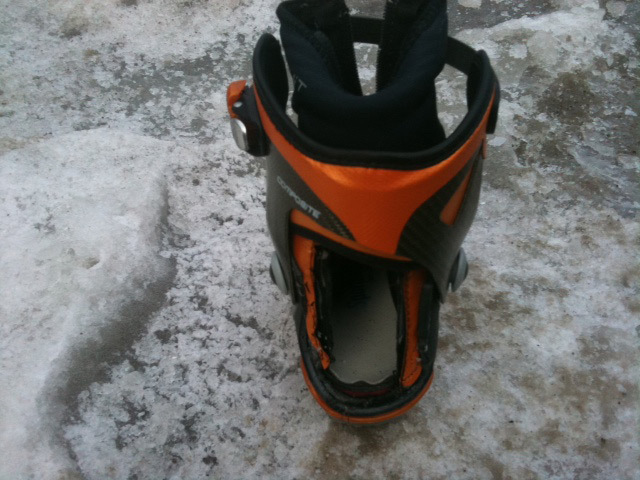
She ended up racing in Lahti with huge chunks cut out of the heels of her Rossignols, and the backs of her feet fully exposed to the air. It was an innovative solution, but one that ended up being a temporary fix, because the plantar fasciitis she suffered from last season flared up again.

“With the cut-out boot, there was no support left, and those issues were coming back to bother me,” she said.
The boot solution was essentially the end of the road for Stephen’s season—now, she’s faced with two choices.
She can either have surgery, or hope that a program of rest and recovery for part of the spring, combined with custom-fitting boots, will be enough to fix the problem. She’ll make the call in just over a month, in consultation with U.S. Ski and Snowboard Association medical staff, after having seen three different specialists.
Her preferred option is to avoid surgery, and wait for the current inflammation to subside—which will likely take another five weeks—then try to find some custom footwear that will allow her to train without aggravating it.
In the mean time, she said, she can do any activity that doesn’t cause her pain, which, with some cut-out footwear, will be “most things.”
Surgery, Stephen said, is an option if that doesn’t work. It would be arthroscopic, and she’d have it on both feet, even though her right is less sore.
After doctors shaved off the bone, she’d be in a cast, laid up, for 12 days, with a three-month wait before she could make a recovery to running, and full activity.
If Stephen is forced to have it—and she said she’s doing everything she can not to—the surgery is certainly an undertaking. But at least, she added, it’s a good season to have the procedure done, since there are no big events like the Olympics and World Championships.
In the mean time, Stephen elected to skip the racing this week, to allow her foot to recover more quickly so that she can make her decision on surgery in the next month or so, rather than in late May. Her primary concern at this point, she said, is next season, and the season after, rather than SuperTour Finals.
By skipping the races, it will be a full month between the last time Stephen put anything whatsoever on her heel, and the timing of her final specialist visit, in April, she said.
“It would have been easy to jump in the Sun Valley races, and perhaps do quite well,” Whitcomb said. “But I think the recovery would begin the moment the races ended. She’s a couple weeks ahead of where she might have been, otherwise.”
Without the races, Whitcomb said, training hasn’t been much of a problem, because it’s the time of year for Stephen to scale back, anyway. He said her program is currently one strength workout and four creative, easy distance sessions each week, like double-poling on an erg machine, or on a stationary bicycle or in a swimming pool.
“She’s just doing the normal post-winter recovery block that she generally goes through,” he said.
In the mean time, she has been watching the races trailside in Sun Valley, in a flamboyant one-piece snowsuit, and helping out her high school alma mater, Burke Mountain Academy, as well as the organization Fast and Female.
“If you know her, you know that she’s quite bummed, but she hides it really well,” Whitcomb said. “I think it’s helping her pass the time until all these doctor’s appointments have concluded, but she’s doing fine—she’s staying on top of her game.”
Skipping the competitions has been “super-hard,” Stephen said, though it was still nice to be in town.
“It’s definitely a good time of year for that,” she said. “I’m bummed I can’t be more a part of it, but I’m glad I’m here.”


Leave a Reply
You must be logged in to post a comment.