This article was made possible through the generous support of our voluntary subscribers. If you would like to see more articles like this one, please support FasterSkier with a voluntary subscription.
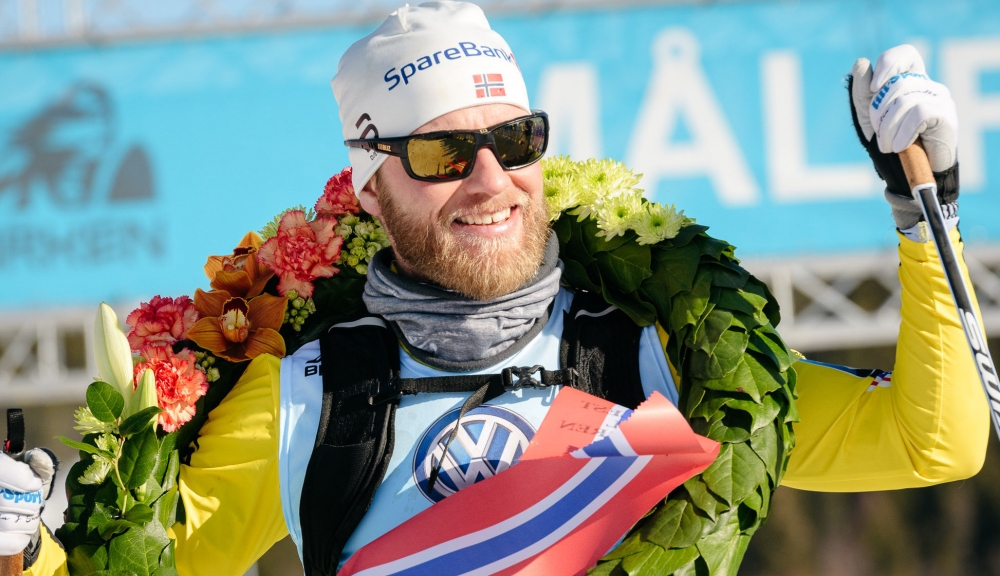
Norway’s Martin Johnsrud Sundby. Good guy? Or bad sport? He served a suspension for failed doping tests, surrendering his 2015 World Cup Crystal Globe. The lines separating those who cheat from those who play fair regularly get blurred. (Photo: Ski Classics)
“A thing worth having is a thing worth cheating for.” So said the inimitable and irascible vaudeville and film comic, W. C. Fields. We can assume his statement was made in jest . . . sort of. What we do know is that plenty of athletes have been known to cheat. From Lance Armstrong to Ben Johnson, athletes have shown that they’re willing to go to great lengths—and to stretch the rules to the breaking point—in order to gain a competitive edge. FasterSkier’s series of articles entitled “Bad Sports” is a reminder that, sometimes, those cheating athletes are stars in our favorite endurance sports, including cross-country skiing.
Olympic drug-cheating has been around since 1904, when Thomas Hicks was revived and bolstered during the Olympic marathon by his trainers’ administrations of strychnine . . . thereby becoming the first athlete disqualified from the modern Olympic Games for having used performance-enhancing drugs. While strychnine (in 1904, a widely-available rat poison) may no longer be the drug of choice, the temptation to cheat is still sufficiently enticing to those who would pad their odds in pursuit of Olympic glory. All forms of muscle builders, recovery agents, stimulants, pain killers, and oxygen transfer enablers have been experimented with by numerous generations of eager athletic guinea pigs. It’ a long-standing athletic tradition; one nobody is very proud of.
Back when sport was used as a substitute for politics (during the era when Soviet and East German sport governing bodies would do nearly anything to win), state-sponsored doping programs created and distributed performance enhancing drugs (PEDs) combined with complex and lurid strategies for beating detection. It’s come to light that most Soviet strategies involved creative ways to beat the testing procedures, while East German programs concentrated on secretly creating performance enhancing substances and doping agents so new that they had not yet been declared illegal. And those nefarious strategies weren’t limited to the devious sport-behemouths of the Eastern Bloc, either. When organizations and teams and athletes have felt the pressure to perform in front of hometown crowds, they have often resorted to measures that tested the limits of the rules. As an example, the coaches of the 1984 US Olympic Cycling Team made systematic and team-administered “blood doping” available to American athletes. While it’s well known that the most notable medalists on that team did not avail themselves of this questionable strategy, it’s also well documented that certain notable medalists did. The loophole at the time was that blood doping was still little-understood (and could not be effectively tested for); therefore, it was not technically against the rules. Since then, the IOC has altered the rules, essentially outlawing any attempt to gain an unfair advantage (even if the strategy employed might later be proven to have offered no advantage at all . . . like rat poison in 1904).
Recently, the International Biathlon Union (IBU) settled the case of accused Russian biathlete, Evgeny Ustyogov (not to be confused with notable Russian cross country skier, Sergei Ustiugov). It was a decision more than ten years in the making, the conclusion of a long series of appeals, and a re-confirmation of decisions handed down by the IBU’s Anti-Doping Hearing Panel and the Court of Arbitration for Sport (CAS). Abnormalities recorded in Ustygov’s Athlete Biological Passport indicated the use of a performance enhancer, ultimately resulting in disqualification, suspension, and reallocation of his medals from the 2010 and 2014 Olympic Games.
In the tennis world, current Men’s French Open finalist, Jannik Sinner, faced a doping investigation—and three month suspension—earlier this season. In March 2025, he twice tested positive for clostebol, a banned anabolic steroid. The investigation attributed that substance to an ingredient in a spray utilized by his physiotherapist, and found that Sinner bore “no fault or negligence” for those positive tests. Still, Sinner received a three month suspension . . . fortunately for Sinner, that suspension fit neatly between Grand Slam tournament events. Ironic, then, that Therese Johaug made nearly identical claims when she tested positive for a banned substance (attributed to ingredients in a lip balm provided to her by a team physio), but her suspension cost her two years, and a shot at Olympic history.
It’s always a conundrum: whom to believe? Whom to penalize? And to what degree? Even athletes who successfully defend their assertions that they were unaware of the infraction—or that they were victims of unknown ingredients in foods or supplements they ingested—have found themselves penalized. It’s kind of fair: they may have derived a performance benefit from the substance, so their successes should not be allowed to stand. It’s also kind of unfair: they never knowingly did anything wrong, never attempted to cheat the system. Still, they may find themselves with disqualifications and suspensions. And then there are those who cheated knowingly and got caught, high profile athletes like numerous Olympic champions and multiple Tour de France winners. Even in 2025, the skiing world was shocked to learn of the discovery of systematic cheating (via the altering of uniforms) undertaken by five Norwegian ski jumpers, their coaches, and numerous team officials at the FIS World Championships in Trondheim.
In the final analysis, W. C. Fields’ words have proven prophetic: these things that are worth having, it seems that they have been worth cheating for. And with another Olympic season about to begin, the stakes will be higher than ever.
“Worth cheating for.” The inimitable W. C. Fields.
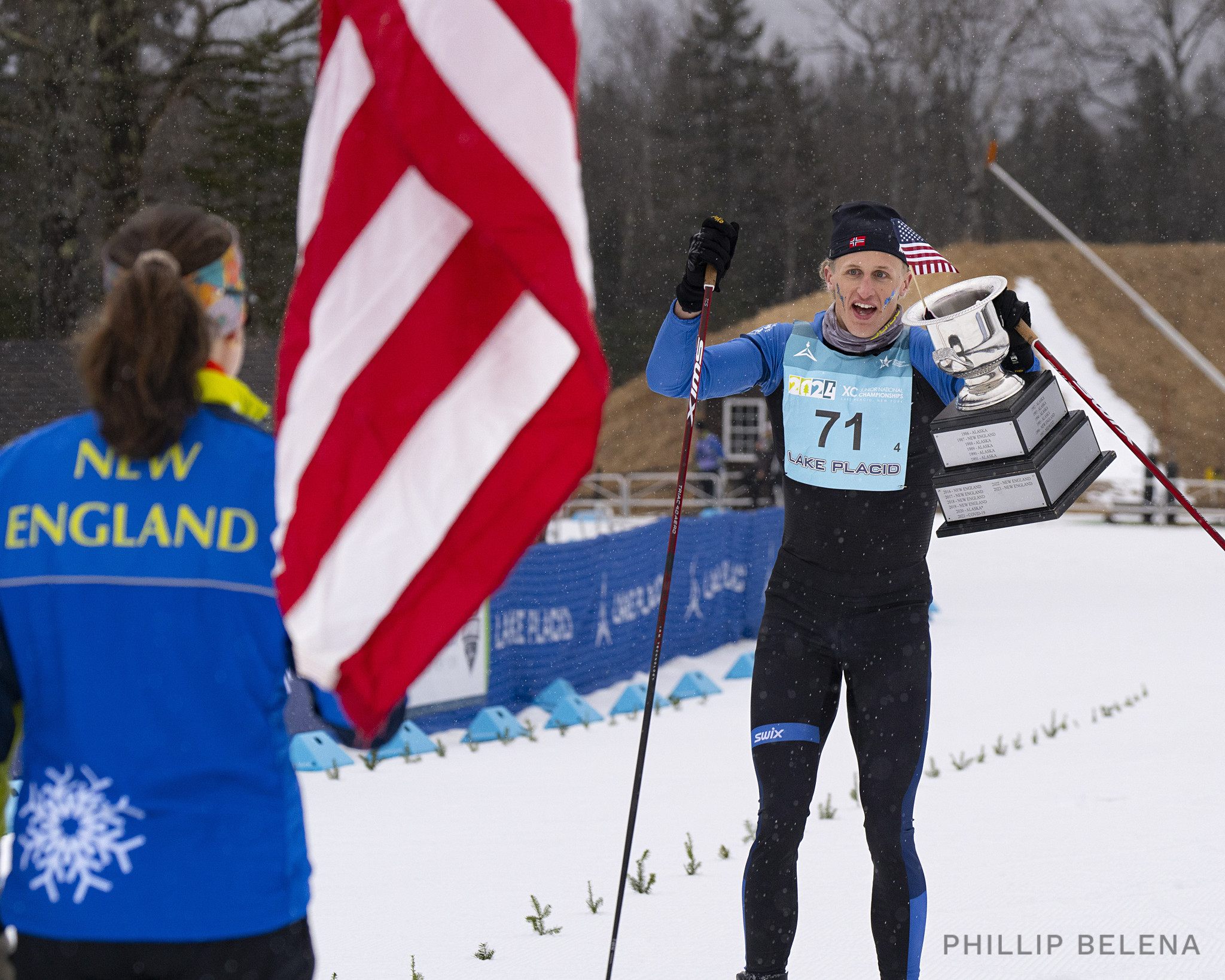
New England’s Fin Bailey (SMST2 / University of Vermont) crosses the line, Alaska Cup in hand, to win the U20 Team Relay at Junior Nationals in Lake Placid, New York. (Photo: Lake Placid Organizing Committee/Phillip Belena)
The U.S. Cross Country Junior National Championships—originally known as the Junior Nationals, then called the Junior Olympics for a stretch, and now again the Junior Nationals—were first held in 1965 in Bend, Oregon. Those early events included all ski disciplines: cross-country, alpine, ski jumping, and nordic combined. They were hosted at venues that could accommodate the full spectrum of competitive skiing.
In digging into history, I found it surprisingly difficult to track down hard dates and specific changes. So, instead of presenting a definitive historical timeline, I’m going to share what I’ve seen and experienced over the years.
Early Days and the Shift to Cross-Country
The last Junior Nationals to include all disciplines took place in 1969 in Girdwood, Alaska. Starting in 1970 and through the later part of that decade, cross-country and nordic combined events continued together, but the overall focus began to shift toward cross-country skiing.
Between 1965 and 1975, there were no age group classifications at Junior Nationals. Based on my recollection, eligibility extended to what we’d now call the J1 age group. There was no Older Junior (OJ) category yet.
Somewhere in the late 1970s to early 1980s, age groups were formally introduced: OJ, J1, J2. More recently, those categories were replaced by U20, U18, and U16, aligning with FIS international standards. Other than changes in the format of the competition events, themselves, the structure of Junior Nationals has remained fairly consistent for the last couple of decades.
Geographical make-up of each division competing at Junior Nationals. (Photo: US Ski and Snowboard)
Divisions and Participation
Athletes now compete as part of one of ten regional divisions, with each allowed to bring up to 25 male and 25 female skiers across the U16, U18, and U20 categories. Some athletes may pre-qualify through national rankings or international results, which allows them to compete beyond the division quota.
Current Divisions
Alaska
Far West (CA, NV, HI)
Great Lakes (MI, WI, KY, IN, OH)
High Plains (WY, Eastern MT, ND, SD)
Intermountain (ID, MT, UT, Western WY)
Mid-Atlantic (NY, NJ, PA, DE, WV, MD, DC)
Midwest (IA, MN, IL, MO)
New England (MA, ME, NH, VT)
Pacific Northwest (OR, WA, Western ID)
Rocky Mountain (CO, NM)
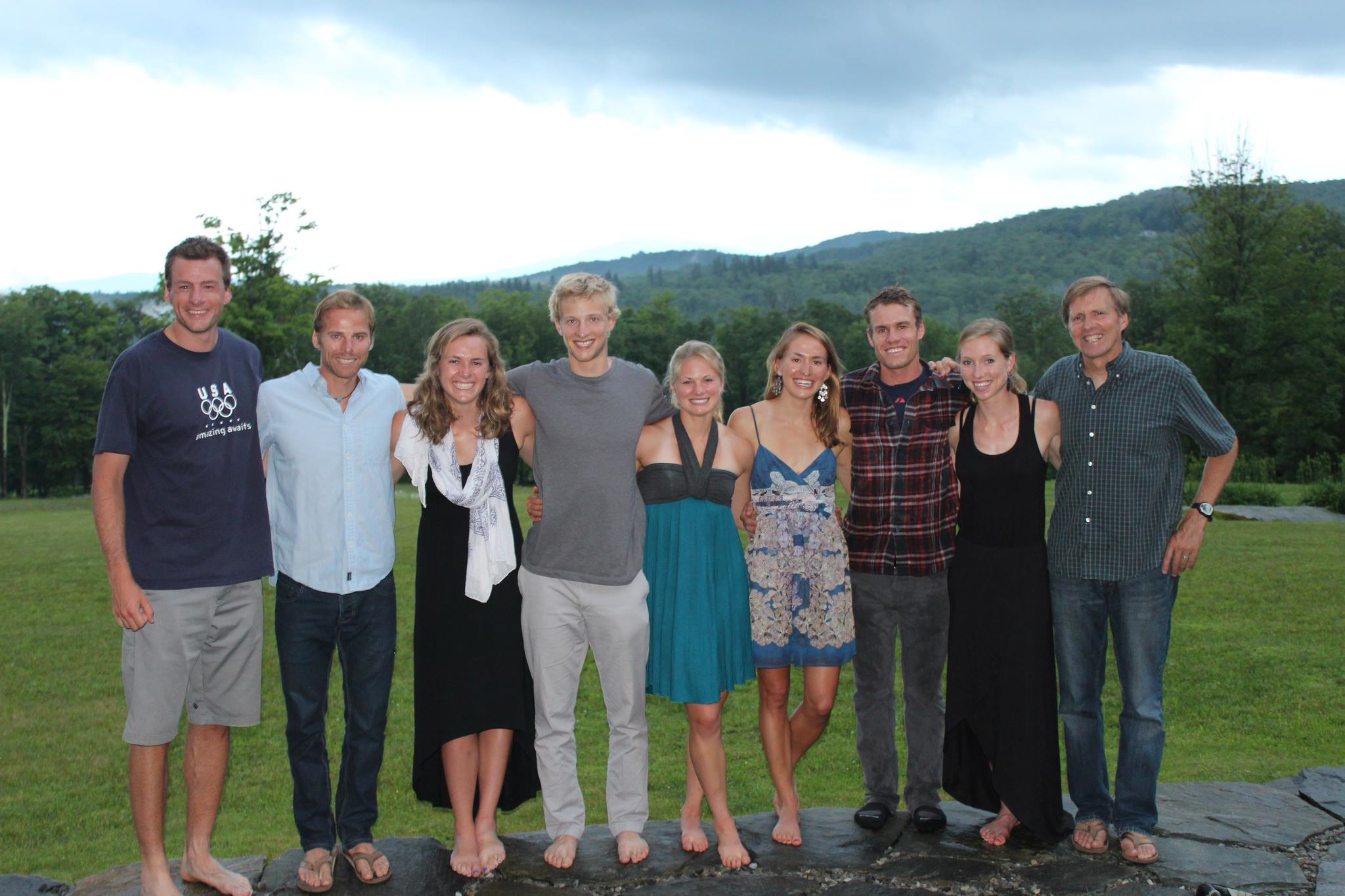
Sverre Caldwell (far right) with the 2013/2014 Stratton Mountain School T2 Team (from left to right): Head coach Gus Kaeding, Andy Newell, Annie Pokorny, Eric Packer, Jessie Diggins, Sophie Caldwell, Simi Hamilton, Erika Flowers. (Photo: Annie Hart)
The Ongoing Debate
There’s been no shortage of conversations about Junior Nationals over the years. Topics have ranged from the inclusion of the U16 category, to the rising costs of participation, to the event’s role in the development pipeline. There’s also been discussion about whether the event should be managed more by divisions or clubs, and whether the U20 category still fits the purpose of the event.
Back in the early to mid-1990s, I spent four years working with Sverre Caldwell at Stratton Mountain School. Even then, discussions around J2 (now U16) participation were front and center. Around that same time, John Caldwell helped launch NENSA (New England Nordic Ski Association). I was an original NENSA Board Member, which made youth development a key priority. One of NENSA’s early initiatives was the creation of the New England Junior Festival—intended, eventually, to provide an alternative to Junior Nationals for the J2 age group.
That shift never materialized. The deeply entrenched belief in the value of Junior Nationals as a key part of athlete development won out.
Why Revisit the History?
I’m sharing this history because it helps illustrate just how much the program has—and hasn’t—changed in the past 60 years. Some people believe it hasn’t evolved enough to keep pace with the times or to support broader participation. Others are convinced that “This is the way we’ve always done it, and it works.” In my view, neither is entirely true.
In my earlier piece, “What’s the Hurry?”, I argued that our current system identifies and prioritizes talent far too early. We are selecting athletes at the U16 level and younger, despite a large body of research showing that it’s nearly impossible to accurately predict which athletes will succeed at the senior level. Early selection risks pushing kids out of the sport who might develop later.
Cost, Pressure, and the Case for Change
The financial burden of Junior Nationals is another serious issue. If a skier qualifies as a first-year U16, they could potentially attend six championships. Just the travel and participation costs over that period could exceed $20,000—and that doesn’t include:
Club coaching fees
Equipment
Travel to qualifiers
When you add everything up, you’re looking at a potential $150,000 investment during a skier’s junior years. That’s not sustainable or accessible for many families.
Beyond cost, there are other concerns. Is it appropriate for 14- and 15-year-olds to be competing alongside 18- and 19-year-olds? Is there a clear and valid developmental rationale for putting U16s on a national stage?
In some regions, the answer may be no. Early selection and high-stakes competition at young ages may actually be contributing to dropout rates in older age groups.
Time to Rethink the Model
It’s time—long past time—to reconsider how we structure Junior Nationals. We’ve had the same essential age group model for over 45 years, but we now have decades of experience and research to suggest it needs to change.
My Recommendation
Remove U16s from the Junior National Program.
Instead, focus on:
Local and divisional development
Age-appropriate regional events
Creating fun, inclusive, and positive experiences
At those younger ages, our goal should be to get kids into the sport, keep them in, and help them build the skills and mindset they need for a lifetime of skiing—whether or not they go on to elite competition.
In talking with peers and colleagues in the Scandinavian and Central European countries countries, asking for their views on this topic and what occurs in their country, we received the following responses from Trond and Knut Nystad.
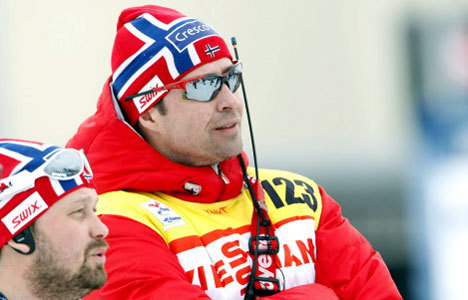
Trond Nystad, coach of the Norwegian men’s cross-country ski team at the Sochi Olympics.
Trond Nystad
In my mind it makes no sense to select young skiers to travel to nationals for a lot of reasons.
Travel takes up a lot of time and is very expensive.
Since there is such a large variation in biological age, you will end up selecting skiers who are biological advanced and the true talents are left at home discouraged and with no self confidence. Most countries in middle Europe starts the selection/de-selection process too early. The ones who were not selected quit, and the ones who were selected quit when they loose the “biological advantage.”
Young skiers from parents with a larger income have better/more equipment, leading to a selection of the ones that “have” as supposed to looking at long term potential.
When young skiers are “rewarded” with a trip to nationals they might get satisfied early and loose the long term drive.
No correlation between success U16 and long term success in endurance sports.
Money can be more effectively used by organizing a local race series where athletes get to compete in a lot more events.
Young athletes would benefit more from mastering skills needed in sports (and life) instead of being focused on selection races and results.
Knut Nystad, Norway’s former waxing czar. Photo, Langrenn.com.
Knut Nystad (comments edited to key bullet points)
In Norway there is a separate championship for the U16.
Cost of attending is an issue, but the clubs take the majority of the cost, leaving only a minor part for each participant to pay. For the athletes that cannot afford it – most clubs have “need based” funds that ensure that everyone can participate.
Norway is a small country, hence traveling cannot be compared to the US. Does it make sense to have a championship for this age group? Maybe, maybe not.
For the sake of identifying talents you clearly do not need a U16 championships. We know that it is not a race that give any clear indication of talent, nor does it identify who will prosper and develop into international top level skiers. Many of the absolute best Norwegian skiers were way down on the results at this age (including Klæbo).
At this age there are some many factors that come into play – exposure age (how long have they trained), biological age (early/late puberty), equipment, wax, early specialization vs multi sport focus, parents, training group, quality of coaching +++ It is an unfair competition.
What about asking what motivates the athletes to continue develop? Truth is that young athletes are motivated by different things.
In my mind, the best way to identify talents, is by motivating as many as possible to have fun, be challenged, and keep on racing for as many years as possible.
So what is the correct strategy/answer? The one that motivates more athletes to stay longer in the sport. Does this mean yes or no to a U16 championship? This is for you to answer based on what is appropriate to get the sport of skiing in the US to prosper.
Closing Thoughts
Junior Nationals have served the sport well in many ways. But we have to recognize when a system, even one we may be emotionally attached to, is no longer serving all athletes effectively. If we truly care about developing strong, healthy, resilient skiers—for sport and for life—then we need to be willing to adapt. While Norway and Sweden have championship events for U16’s it doesn’t mean it is necessary or optimal for the U.S, given the size of the country, the cost, the culture, and the level of participation.
Let’s build a system that works for more kids, not fewer. That starts by taking a hard look at who we’re serving, and how we’re defining success.
This article was made possible through the generous support of our voluntary subscribers. If you would like to see more articles like this one, please support FasterSkier with a voluntary subscription.
Whenever there’s a Classic race, Iivo Niskanen (FIN) is certain to be in contention. (Photo: NordicFocus)
When it comes to the Olympics, every skiing nation may dream of winning the relay, but every skier dreams of winning the 50 k. It’s the race with history; it’s the race with bragging rights. Even more so when it’s raced in Classic technique . . . as it will be in the Olympic Winter Games in 2026.
Men’s 50 k
One of the greatest, most strategic, and most successful skiers of all time—Petter Northug—scolded his Norwegian countrymen after the Skiathlon at the 2025 FIS World Championships in Trondheim, Norway. He accused them, he exposed them, he shamed them. Not for what they had done, but for what (in his opinion) they had failed to do: they had failed to put Johannes Hoesflot Klaebo on the ropes. Klaebo is a sprinter, the greatest ever in the sport of cross-country skiing (greater, even, than Northug, who built his own sprint reputation by sitting in during mass start races, and stealing victories at the very end). When Northug says that the other skiers need to attack Klaebo relentlessly, he knows what he’s talking about. And the situation faced by all other skiers in the 50 k Classic Mass Start is starkly simple: either drop Klaebo well before the finishing straightaway, or he wins.
Iivo Niskanen is likely to be the difference-maker. time and again he’s proven himself to be the dominant Classic skier of this generation. If Niskanen shows up healthy, he can potentially ski away from anyone—but he’ll definitely receive a spirited chase from Klaebo, from Harald Oestberg Amundsen, from Martin Loewstroem Nygenet, and from any Russians that the organizers allow into the Games.
In the absence of Norway’s Therese Johaug, Ebba Andersson (SWE) and her teammate Frida Karlsson (SWE) have the ability to dominate the 50 k: NordicFocus)
Women’s 50 k
With the recent announcement of Therese Johaug’s retirement, the nature of the women’s 50 k Classic Mass Start just became a race of a different sort. True, it may still be a speed-fest driven by the pace of Frida Karlsson, or Ebba Andersson, or Kerttu Niskanen. Or it may be a sit-in-and-sprint strategy employed by the likes of Jonna Sundling or Jessie Diggins. One way or another, it’s certain to be exciting racing. What it won’t be—strategically—is simple and straightforward as it would’ve been if Johaug were in the field on race day. If Johaug were in the race, she’d go straight to the front, and punish anyone who followed her. It might’ve worked (as it did so often in her long and illustrious career), or it might not have worked (as it didn’t at the 2025 World Championships in Trondheim). But now that Johaug has sailed off into a well-earned retirement, the dynamics of the race will be delivered by someone else. It’s kind of wonderful that we don’t yet know who that will be . . .
Astrid Oeyre Slind (NOR) is the most experienced marathon skier in the field; she would seem to be logical contender. She’s a fearless racer, and quite adept in Classic technique. Teresa Stadlober (AUT) may ski among the leaders, but she may lack the finishing speed to win it all. Jessie Diggins (USA) may go with the pace of the lead group, but her presence in there would likely result in an even higher pace (as the field would certainly work hard to drop her). And she’s nowhere near as adept at Classic technique as she is at Skating.
The 50 k is the concluding marathon of the 2026 Olympic Winter Games, a closely contested mass-start event in which team tactics are most likely to be employed. But that’s only if the “teams” decide to work together for the benefit of only one of their stars. Norwegian skiers (both men and women) have rarely shown each other such generosity . . . which may open the door for Swedes and Russians to steal the glory of the Olympic 50 k Classic.
For much of the last 30 years, the late Dr Jim Stray-Gundersen and I have been studying how we quantify training load. In the mid-90s, we met Dr. Erik Bannister at the American College of Sports Medicine (ACSM) Conference in Orlando, Florida. Dr Bannister developed the Training Impulse (TRIMP) system, which is still used today as part of many online training platforms. While the system is not perfect, it provides a better measure of training load than hours, mileage, or pace/power. In all my coaching work, I use TRIMPs as the primary metric to quantify the training loads and plan for progression of training.
JC Schoonmaker and Luke Jager training in Anchorage, Alaska. (Photo: Brinkema Brothers)
Progressive overload appears to be a common theme in endurance training. But what is progressive overload? Despite many thousands of papers and articles related to progressive overload in endurance training on academic and coaching websites, I have found little to no research that specifically addresses the role of progressive overload—or ramp rate—in a structured, evidence-based way for endurance athletes. A general Google search reveals a multitude of articles explaining the theory of progressive overload, but few, if any, studies that scientifically validate its practical application in endurance sport.
Let me be clear: I do not question the need to increase training loads over years of athletic development. The evidence supports that long-term progressive training is necessary. What I do question is how we approach load distribution across a training year. Over my 50+ years of involvement in high-level training, the principle of overload has always been present. But we need to ask ourselves:
What exactly is “overload?”
How is it measured?
And if we can define and measure it, is it truly effective?
Supercompensation Theory
This discussion also overlaps with the Supercompensation Theory, another widely accepted concept that, like progressive overload, lacks robust research. In my experience, progressive overload often leads to overtraining rather than performance gains. Rather than thinking about the theory of progressive overload or Supercompensation we ought to think of training as a compounding effect on fitness. In other words the consistency of well executed training sessions is most important.
What Load Are We Increasing?
The first question is: What type of load are we trying to progress?
Is it speed, pace, or power (external load)?
Is it internal physiological strain (e.g., O2 utilization, energy metabolism, heart rate, perceived exertion)?
Is it time or distance spent training?
The second question: Is increasing the load actually necessary to stimulate adaptation, or can consistent training yield gains through chronic exposure to stimulus? And third: If progressive overload is valid, how do we determine when and how to increase load—through volume, intensity, frequency, or something else?
Most coaches base progression on hours trained or distance covered. But those alone fail to define true training loads because they omit intensity, pace, or power—an essential component. The question I pose is: If training is working as planned, the speed/pace or power we can maintain at a given intensity should consistently improve. Is that not the ideal way to increase the load and fitness?
TRIMP and Load Monitoring
For the purpose of this discussion, I will use TRIMP (Training Impulse) as a reference. While TRIMP has a known bias toward duration over intensity, it still offers a consistent comparative metric. However, even TRIMP doesn’t fully capture external load (e.g., power output).
Take this example: if I ride my bike for two hours a day, 5–6 days a week, over three months, will my fitness plateau? Experience says no. In fact, I’ve observed that optimal acute training loads should hover around 1.2 times an athlete’s current chronic load, with weekly ranges from 0.9 to 1.2. Loads exceeding this often hinder adaptation. A recent paper by Sandbakken from Norway suggests a very similar loading pattern. Of course, there will be races and peak sessions that occasionally fall outside this range, but most training should stay within it.
Dispelling the Myth of “Replicating the Event”
Some believe that to prepare for long endurances event, we must replicate its demands in training. But as Inigo San Millán has stated, training just above baseline lactate levels saturates the mitochondria and stimulates adaptation effectively. This means we are stressing that energy system maximally improvements can occur without massive load increases, what I call the compounding effect of training.
The SMST2 squad led by Jessie Diggins pushes the pace in a double pole interval workout during a fall 2019 training camp in Lake Placid, NY. (Photo: Matt Whitcomb)
Sustainable Progression Over Aggressive Ramping
This is not to minimize volume; we know it must increase over years to maximize potential. However, the rate of increase must be sustainable. Traditional models often ramp from, say, 50–60 hours/month in May to 100–120 hours/month in November—expecting a magical performance gain in racing season. This assumes each month provides sufficient adaptation to support the next. My experience says otherwise. The performance gains were often unsustainable and unpredictable.
Let’s consider a typical monthly ramp of 50 hours:
Week 1: 11.25 hours
Week 2: 13.25 hours
Week 3: 15.25 hours
Week 4 (recovery): 10.25 hours
This assumes athletes can adapt weekly to rising loads—something I strongly question. While the body adapts quickly to an appropriate load, that doesn’t mean it can adapt to increased loads every seven days.
Real-World Data: A More Effective Model
I’ve observed many athletes, especially skiers, push ramp rates aggressively—often at camps. They train 30–40% more load than usual. But based on HRV data, by the time they recover from these camps, much of the benefit is lost. This will be especially problematic for junior skiers who have not yet had the years of aerobic training and the ability to adapt to these big loads is a serious challenge.
In contrast, consider the case of a successful master’s cross-country skier:
Training load increased from 500 to 600 TRIMP/week over a full year (~20% increase).
That equates to ~10 TRIMP per week, or just 8 minutes of easy training or 2 minutes of high-intensity work—virtually nothing.
Yet their performance and testing data steadily improved throughout the season.
In the following year, this athlete started at 600 TRIMP/week and progressed to 700–750 TRIMP/week, building on last year’s base. Because recovery was well managed, no long offseason break was needed. HRV data (RMSSD) stayed in a tight normal range throughout the season, except for two brief illness-related dips—indicating effective recovery and adaptation.
I’ve observed this same pattern in cross-country skiers, national champion mountain bikers, and high-level triathletes.
Johannes Klæbo and Kevin Bolger rollerski together during an easy workout Saturday, September 16, 2023, in Park City. (Nathaniel Herz/FasterSkier)
Elite-Level Patterns
This trend is supported by data from elite Scandinavian cross-country skiers. These athletes train 80–100 hours per month with very small month-to-month variation. The goal for most skiers is to have 100-120 high intensity sessions per year. So, the high-intensity sessions are a consistent part of the plan, with total training load increases coming primarily from slight upticks in intensity—not volume.
Conclusion
Based on what I’ve experienced and observed, I question the necessity of aggressive ramp rates, especially in terms of volume and distance. With effective training, performance improves in pace, speed, or power at a gradual rate. That itself represents a form of ramping—but one that’s based on output, not input, and one that’s sustainable.
Alone and unchallenged, as she raced for much of her stellar career. Norway’s Therese Johaug. (Photo: Thibaut/NordicFocus)
According to stories released today by the Associated Press, Norwegian cross-country skiing legend, Therese Johaug, has announced her retirement. Only a day after FasterSkier postulated whether or not Johaug was still considering another run at the Olympic Games (which would’ve been her fourth Olympics), she took a new direction—announcing that she wants to be fully devoted to her young family—and stepped out from under one of the brightest Nordic skiing spotlights that the sport has ever known.
Johaug is an athlete who reinvented her sport—not unlike Dick Fosbury who re-crafted the technique of high jump, or Bob Beamon whose outlandish world record in the Olympic long jump in Mexico City set a standard that lasted for generations. Johaug’s signature technique was a counter-example to the slow-and-powerful technique of cross-country skiers who went before her. Her staccato tempo, her relentless racing drive, and her apparent resistance to “pacing” herself set a standard for those who came after her: particularly Jessie Diggins and Frida Karlsson, two of the modern skiers who now dominate World Cup and World Championship racing. Johaug’s racing was flat out, full speed, catch-me-if-you-can. And for years there was no one who could even come close. She is immortalized through Olympic Gold, through World Cup Crystal, through Tour de Ski triumphs, and through World Championship excellence. And our sport is not likely to see another one like her.
Norway’s great champion, Therese Johaug. There will never be another skier like her. (Photo: NordicFocus)
FasterSkier is happy to thank Therese Johaug for her loyalty to our sport, and her devotion to skiing excellence. When the 2025-2026 season gets started, it will be just a little bit less of a stellar show for the absence of one star in particular: Therese Johaug.
Therese Johaug celebrates her final race race at the Holmenkollen, winning the 30 k classic exactly eleven years after taking her first individual World Championship gold on these tracks. (Photo: NordicFocus)
This article was made possible through the generous support of our voluntary subscribers. If you would like to see more articles like this one, please support FasterSkier with a voluntary subscription.
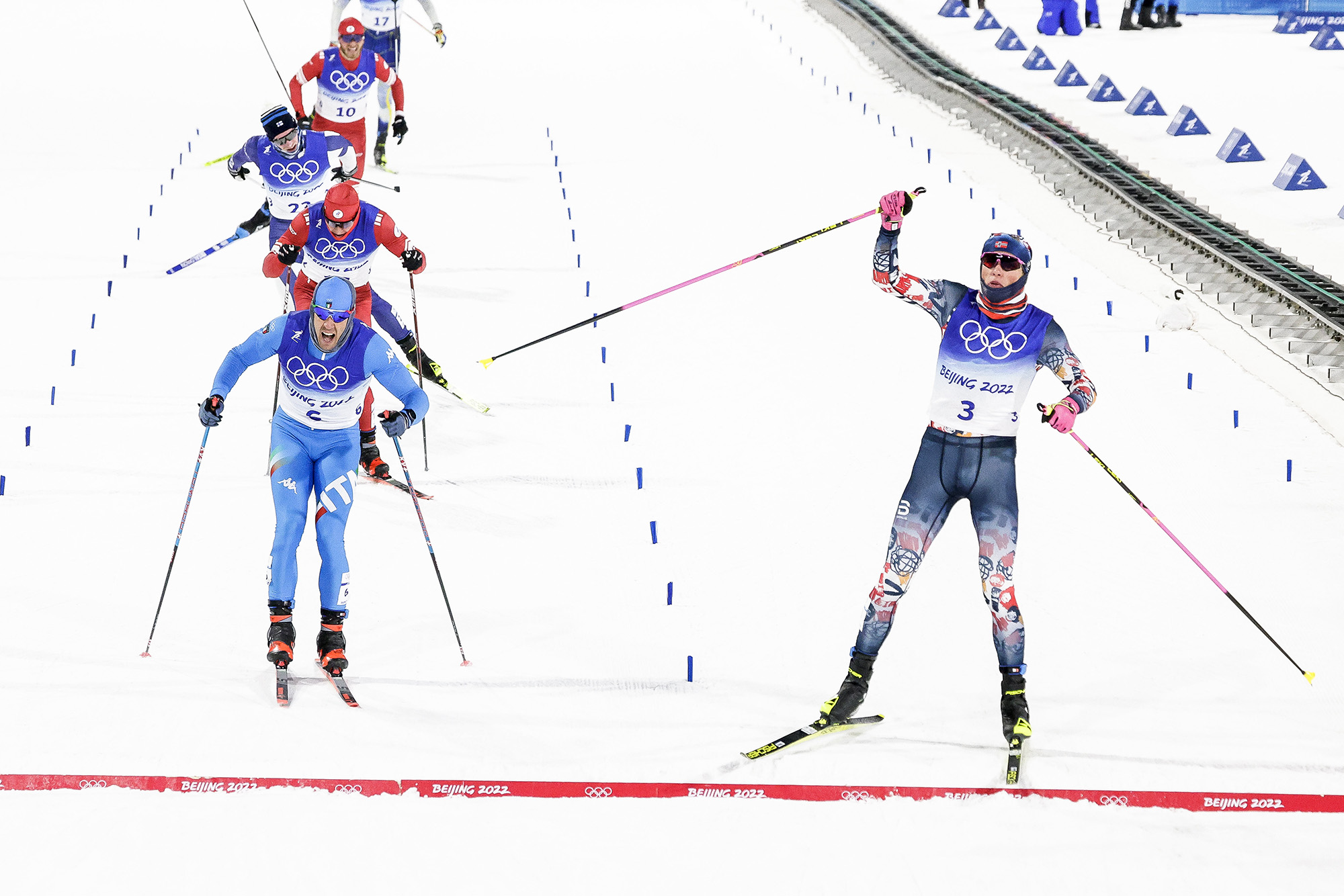
Therese Johaug (NOR) claimed three individual gold medals at Beijing’s 2022 Olympic Winter Games. (Photo: NordicFocus)
Therese Johaug’s Olympic dilemma is fairly straightforward. It’s this: why bother? She’s done everything there is to do in the sport of cross-country skiing—World Cup Crystal Globes (which she certainly won’t chase in 2026), Tour de Ski (which she probably won’t enter in 2026), World Championship glory (though 2025’s fistful of silver medals was not the result she’d hoped for), Olympic Medals (which she’s likely to win more of in 2026, but not enough to become the winningest skier ever). There’s just not much more for Johaug to win in 2026.
Johaug’s retirement has been put on hold—for the moment, at least—and she hasn’t yet announced her Olympic intentions. They’re holding a spot for her on Team Norway. They should: she’s one of the most successful, most talented, most dominant cross-country skiers of all time. She’s a shoe-in for Olympic medals in 2026. Among her Norwegian teammates, only Astrid Oeyre Slind seems capable of challenging Johaug in distance events.
Frida Karlsson (SWE) seized the 50 k Freestyle Mass Start at the 2025 World Champioships on a day when everyone else—including Therese Johaug (NOR)—was stymied by challenging conditions. Will Johaug race another year to prove that she, herself, has always been the strongest? (Photo: Thibaut/NordicFocus)
What is her goal, anyway? What does she have to gain by coming back for yet another Olympic Games? She can’t surpass Marit Bjoergen’s historic total of Olympic medals (not without continuing on to 2030, anyway). And she certainly can’t get back the Olympic opportunities lost during her suspension in 2018. Hasn’t she already won basically everything there is to win for a cross-country skier specializing in distance races? She won the Olympic Team Relay in 2010. She swept the distance races in 2022 (30 k Mass Start, 15 k Skiathlon, 10 k Interval Start). Maybe Johaug still sees the potential to win all of her individual Olympic events in Val di Fiemme: Skiathlon, 10 k Freestyle, 50 k Classic. Or perhaps Johaug just loves to train and ski. Regardless of her reasons, one thing certainly remains true: she’s still one of the very best in the world, still one of the very best of all time. And the Olympic races will be better, more exciting, and more consequential if she’s racing them. If she decides to race . . .
Beijing demonstrated the sort of Olympic dominance that Therese Johaug (NOR) could’ve understandably expected. (Photo: NordicFocus)
It seems Johaug may have one remaining goal in mind: win the Olympic 50 k Classic in order to soothe the sting of having been defeated in the 50 k at the 2025 World Championships in Trondheim. If she’d won the World Championship 50 k, she probably would’ve retired on the spot. But with that goal having been left unrealized in 2025, maybe Johaug needs more. She’s been World Cup Champion in both Overall (three times) and Distance (five times) classifications, but if she has her sights set on Olympic victories, she’s unlikely to care much about scheduling enough World Cup races to claim another Crystal Globe. After a career in which she has amassed 160 World Cup podium performances, she’s not likely to prioritize rounding up a few more.
Should she come back one more time? Should she risk another year of effort and training for a goal that may continue to prove elusive? Should she undertake another season of separation from her young daughter? She loves to race, she lives to compete, and her endurance—and her ability to recover—are legendary. If there’s an historic medal to be awarded in 2026, it won’t be a surprise to see Therese Johaug being one of those who shows up to vie for it.
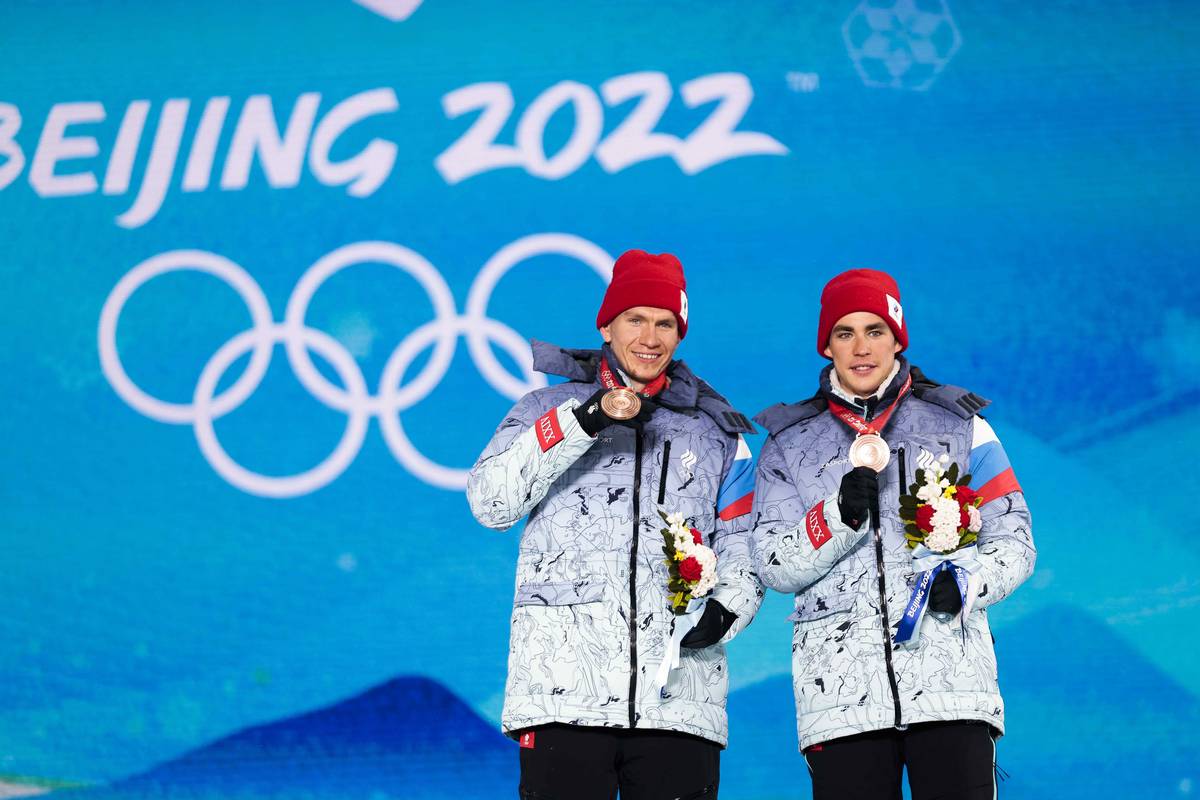
Alexander Bolshunov and Alexander Terentev took home bronze medals in the classic team sprint during the 2022 Beijing Olympic Winter Games. At present, no one knows whether they’ll be back in 2026 at all. (Photo: NordicFocus)
In all FasterSkier’s recent mentions, suppositions, and explanations regarding Olympic races scheduled to be staged in 2026, one factor has repeatedly been highlighted: the potential for all such predictions to be overturned by the presence of athletes from Russia. The most recent statements from the International Olympic Committee (IOC) report that no such decision has been made yet (though that could literally change at any moment). For the time being, Russian athletes remain banned from competing in any international races sanctioned by the International Ski Federation (FIS)—and that includes the Olympics.
Is this Russia’s Olympic dilemma? Or the IOC’s Russia dilemma? The IOC defers to international sport governing bodies to decide whether or not Russian athletes will be allowed to compete in Milano-Cortina 2026. That’s why fans will see Russian figure skaters in the Olympics (allowed by the International Skating Union) but not Russian biathletes (banned by the International Biathlon Union). The IOC has recently expressed a desire for Russian cross-country skiers to be allowed to compete in the Olympic Winter Games of Milano-Cortina (kind of a public hint to the decision-makers at FIS). Thus far, FIS has been dragging its feet . . .
Other sports’ governing bodies have already weighed in. In Ice hockey, Russian athletes remain banned from all international and Olympic competitions. Russian biathletes remain banned as well. Certain Russian figure skaters (limited to one man and one woman) have been approved to compete at the 2026 Olympics, though not in the team event. And the Olympic participation of any Russian athlete is to be allowed only within conditions stipulated in the IOC’s list of caveats and provisos: no Russian flag, no Russian anthem, no Russian colors (though Russian skiers definitely wore red in Beijing’s Olympic events four years ago). Evidently, Russians won’t be welcomed to march in the Opening Ceremonies. There’s also a suggestion that Russian athletes may not be allowed to compete in relays or team events. Most notably, any Russian athletes who are shown to have voiced support for Russia’s involvement in its war on Ukraine—or who are associated with Russian military forces—would not be welcome to compete.
Head of the Russian Ski Federation, Yelena Valbe (herself a seven-time Olympic medalist), has been openly enthusiastic in her support of Putin, and has consistently—and publicly—denied any Russian aggression in Ukraine. Her position—a publicly and repeatedly stated one—may be enough for the FIS to exclude Russian athletes. The Russian athletes, themselves, seem to remain optimistic.
“We will compete at the 2026 Olympics,” Alexander Bolshunov (RUS) recently stated. “Everything has its time. Mark my words.”
Sergey Ustiugov has stated that he does not think he would even qualify for the Russian selection. He predicts that he has grown to old, and that up-and-coming skiers are simply too fast.
Alexander Terentev (who shared the bronze medal with Bolshunov in the Team Sprint in 2022, and claimed another bronze in the Individual Sprint) has kept a very low profile (at least in the Western media) ever since Russian athletes were banned. He appears to have won a national championship in 2024, but no other international results are readily available.
Natalia Nepryaeva has reportedly continued to compete in Russia, but it remains to be seen if that level of competition has been sufficient to maintain the sharpness that once won her the Tour de Ski and the Overall World Cup.
Veronika Stepanova (a member of Russia’s gold-medal wining relay team in 2022) was openly supportive of Putin’s war in Ukraine from the very beginning. She was also loudly critical of the FIS decision to ban Russian participation in the first place.
As for Bolshunov—the triple gold medalist from Beijing who has repeatedly demonstrated the ability to undo the expected coronation of Norwegian superstars—he may have a difficult time convincing FIS to allow him to compete, especially after his appearance on stage at a government-sponsored rally supporting the war in Ukraine. Like other athletes on the stage that day, there was no mistaking the “Z” logo on his event-provided jacket, a reference to the Z painted on Russian tanks that rolled across the border into Ukraine. And the IOC has made it clear that they will accept no participants who have voiced support for the invasion of Ukraine.
If Russian skiers do show up for the Olympic Winter Games in Milano-Cortina, the races will be better: more competitive, more tactics, more strategies, more top-end speed. In short, everything we like about ski racing. Whats to be decided, then, is whether or not FIS is willing to undo some of the measures that the organization has undertaken in support of Ukraine, in support of the idea of fair competition among peaceful nations, and in support of true sportsmanship (the spirt of which is central to the Olympic oath). Letting the Russian athletes back into the Olympic Games is a wonderful, open-hearted idea. It’s also a terrible, cynically opportunistic idea. But the very same can be said of keeping those athletes out of the Games.
Years ago, the Russian Olympic Committee was banned from participating in the Olympics as a result of Russia’s having systematically cheated in Olympic competitions (and having gotten caught red-handed after the Russian-hosted Olympics in Sochi). That was enough to get them banned for a while, but the IOC still allowed “clean” Russian athletes to compete. Now, the debate rages on account of Russia’s having invaded neighboring Ukraine (for the second time in recent memory). The Olympic Committee seems to feel “The Russian Government invaded a neighboring country. Why punish the athletes?” It’s a fair question. But so is this one: “The Russian Government invaded a neighboring country. Why reward its athletes?”
A lot of people (including a significant number of international competitors and coaches) don’t want the Russians to be at these 2026 Olympics. But plenty of other people (including a significant number of international competitors and coaches) do want the Russians to be there. The so-called (and oft-cited) “Olympic Truce” is really a thing of the ancient past: modern nations are unlikely to stop wars or make peace just because a bunch of skiing, skating, and sledding events are scheduled. It would be nice if the ethics and philosophies behind the founding of the Modern Olympic Games were a thing that the world could live by . . . but they’re not.
Announcements will undoubtedly be coming soon. As Bolshunov, himself, said, “Everything has its time.”
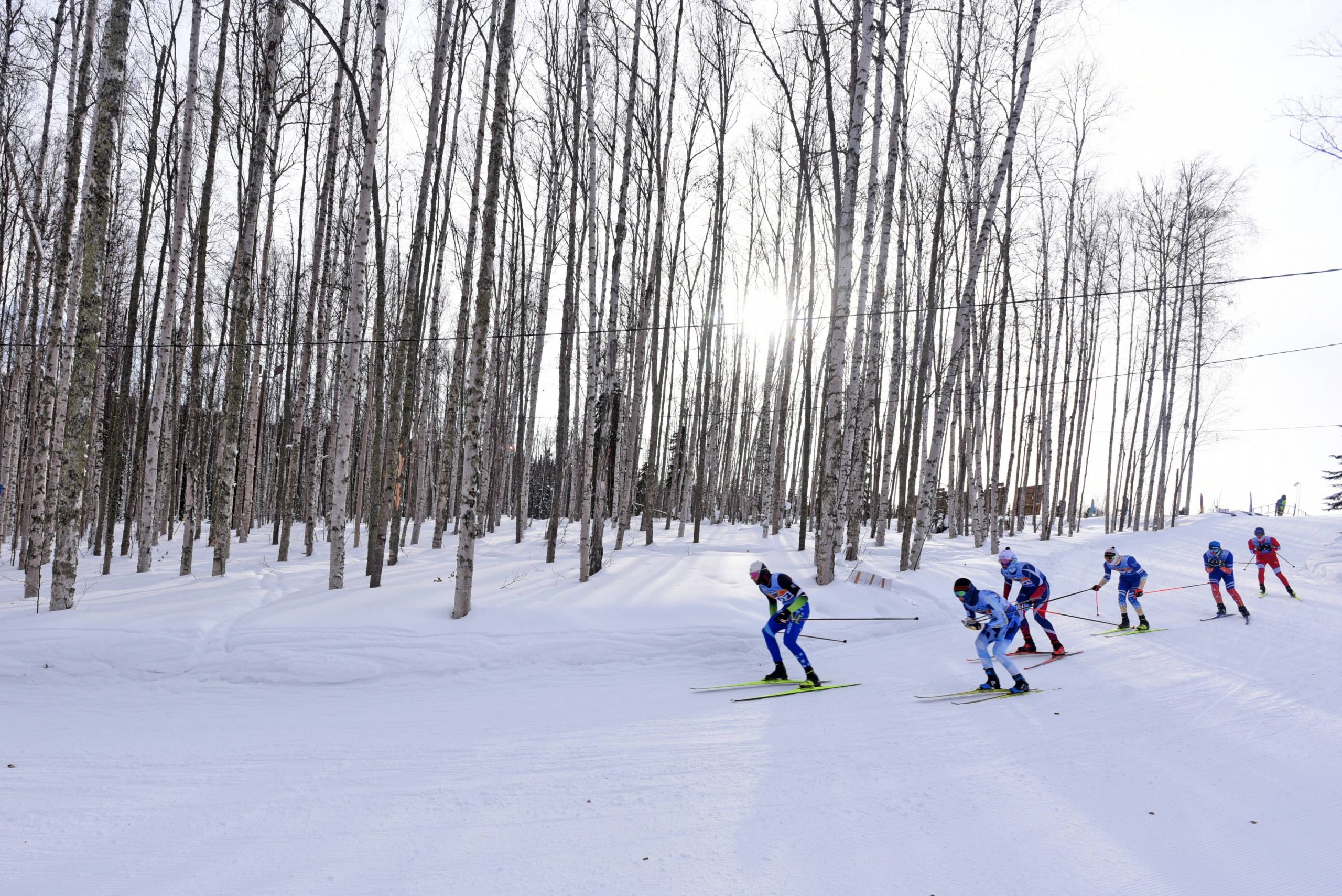
Arctic temps and Birch Hill: Racers tuck into a downhill during Junior Nationals in Fairbanks, Alaska in 2023. (Photo: Courtesy Eric Engman)
In many endurance sports in the U.S.—including cross-country skiing—there seems to be a desire to identify standout U16 athletes as future stars. USSS, team programs, and coaches often respond by elevating their competition opportunities and increasing their training beyond what their physiological development can realistically support. In my early years as a coach, I certainly fell into this thought-trap.
What’s missing from this approach is a fundamental reality: in my 35 years of coaching in the U.S., the sporting landscape is littered with once-promising 13-, 14-, and 15-year-old athletes who burned out or failed to progress due to premature overexposure and pressure. In my coaching experience from Vermont to Alaska, and finally in Colorado, it seems to be the same. We also need to consider that, at least here in Colorado, we are seeing a big drop in USSS Junior National Qualifier race participation. I wonder if this could be because others are seeing the same thing.
Call it burnout, overtraining, excessive expectations, or premature specialization; the pattern is clear. These athletes rarely go on to outperform their age-group peers at the national level, much less the international level, as mature athletes.
Recently, my social media feed has been full of discussions on why countries like Norway—despite a small population—dominate international sports. Common explanations include snow availability, an abundance of ski trails, and a strong skiing culture. Yet these don’t explain Norway’s dominance in non-ski sports such as track and field, cycling, triathlon, and soccer.
Norway’s Kristian Blummenfelt won the gold medal in the triathlon at the Tokyo Olympics in 2021. Blummenfelt went on to win the 2021 Ironman World Championship and the 70.3 Ironman World Championship in 2022 and remains one of the top triathletes in the world today.
What Norway does have is a national system grounded in clear, developmentally appropriate guidelines. Clubs follow a consistent, proven pathway that avoids emphasizing performance at young ages. In skiing, athletes aren’t allowed to “ski up” in age categories. International race opportunities are strictly age restricted. Unlike in the U.S., 15-year-olds aren’t registered for FIS races in Norway, Sweden, Finland, or most other European countries. Why? Because these nations recognize that pushing performance too early is not developmentally sound and getting FIS points at a young age is irrelevant.
Yet in the U.S., I’ve seen repeated efforts by coaches and parents to promote young athletes to older age groups under the justification that “they’re good enough” or they might make Junior Nationals. More often than not, this approach backfires sooner or later.
For example, a U.S. coach was praised in the local press for having the top-ranked skier in the world (by FIS points) for the athlete’s birth year—just 15 years old at the time. In reality there were only a couple of 15-year-olds in the FIS system. This can create unnecessary hype and pressure. It also wasn’t true in context. Most skiing nations don’t encourage FIS licenses for U16 athletes, so the rankings is misleading.
The Scandinavian Model: Patience and Progress
Scandinavian countries don’t emphasize results at U16 or younger levels. Instead, they focus on:
Enjoyment of the sport
Skill development
Psychological growth
Learning how to train and race
Long-term progression
In some regions or division in the U.S. JNQ races, U16, U18, and U20 women all competed in a seeded individual start. Sometimes U16 athletes do very well compared to the older age groups. That’s a remarkable accomplishment in the moment—but is it ideal long-term? To me it sets unrealistic comparisons, not to mention perhaps too long a distance of their races.
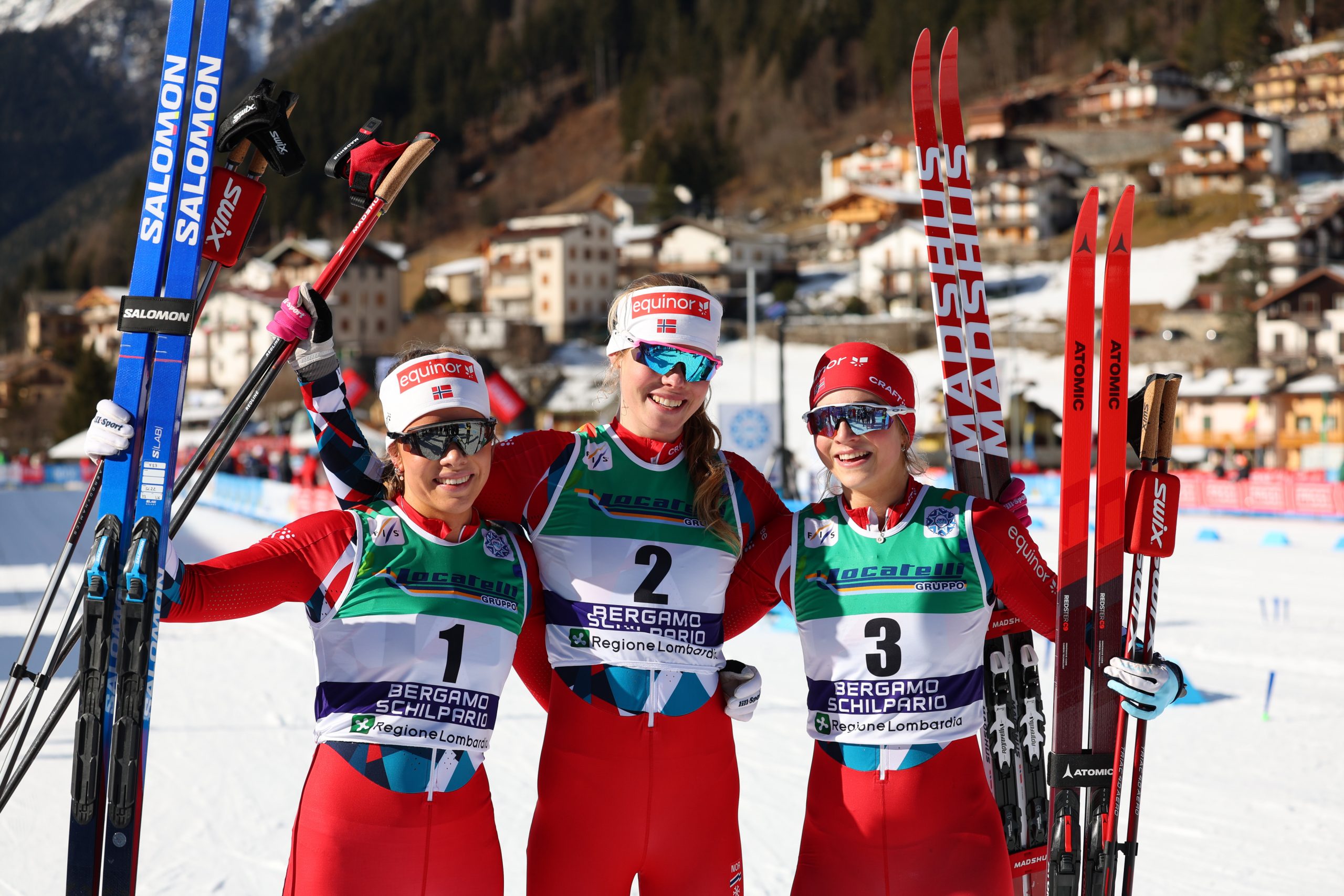
The Norwegian women swept the sprint podium in the junior race at World Juniors in 2025. (Photo: Newspower.it)
Older athletes in that race were once top performers at the same age, but they’ve since experienced puberty, physical changes, injury, mental fatigue, and life stress. Pitting them all together in one field may expose young athletes to unrealistic benchmarks and unhealthy expectations.
The common defense is, “It’s good exposure” or “It’s still age-ranked.” But the question remains: Where is the developmental benefit? In my opinion, that conversation is long overdue.
The Consequences of Rushing Performance
Here are just a few concerns:
Early success doesn’t predict long-term performance.
Many early standouts are later surpassed by peers who develop more gradually.
Training loads often exceed what’s appropriate.
Competing against older athletes drives younger ones to train more than their growing bodies and training background can handle.
Success creates pressure to sustain it.
Athletes and coaches ramp up intensity and volume to “keep up,” which can lead to fatigue and stagnation.
There is no scientific basis for high-volume training at a young age.
On the contrary, early overtraining may limit future physiological potential.
Even if you disagree with the details I have shared, most coaches will agree on this: keeping athletes in the sport in a sustainable way is key. Many promising athletes burn out in high school and never make it to collegiate skiing. Some peak at 15, only then to fade out by 18.
At a recent U.S. National Mountain Bike Championships, I listened to two 14-year-olds:
“I’ve been training 17 hours a week for the past three weeks, and now I’m dead—I can’t race.”
“I did 25 hours a week for two months and now I’m too tired to perform.”
This mindset—more is better—is widespread. Coaches and athletes often overlook whether the training is appropriate for the athlete’s development. In these cases, both could have improved with far less training. Before I get labeled as old school or overly concerned, lets just say increasing the training load over years is necessary and at an elite level a very high training load is necessary. But that all comes over years.
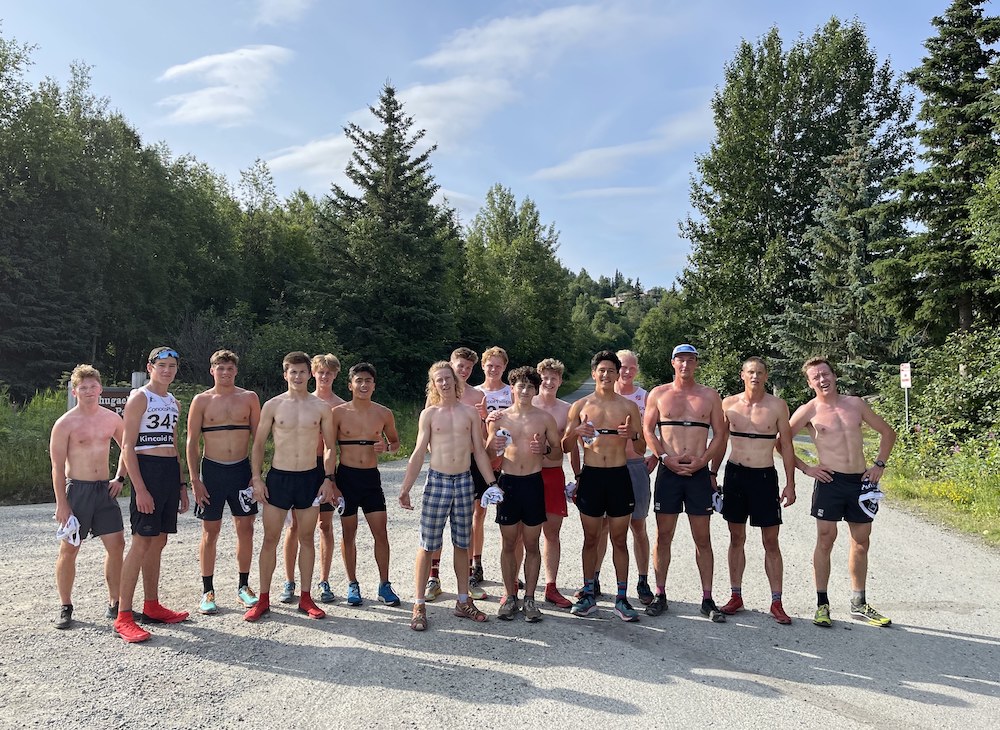
The junior boys pose after completing the Gasline Time Trial at Alaska REG camp, Anchorage, Alaska, July 2021. (photo: Greta Anderson)
A Smarter, Slower Path
Yes, athletes need to train hard, race, and learn the mechanics of their sport. But that must be done within the context of:
What’s developmentally appropriate
What the athlete can emotionally and physically handle
What aligns with long-term athletic progression
Theories like the 10,000-hour rule and “10-year development” are just that—theories, not science. What we know is that real development takes time: years of skill-building, strength training, endurance work, and competition. The best systems minimize setbacks, avoid burnout, and foster improvement year over year.
Conclusion
We need a clearer national direction:
Age-appropriate development standards
Balanced training volumes with the level of development of the athlete
Long-term thinking about athletic success
From my experience, most athletes need to be held back, not pushed forward. The goal is not immediate success, but sustained development. That’s how we build athletes who thrive—not just at 15, but at 20 and 25 and beyond.
This article was made possible through the generous support of our voluntary subscribers. If you would like to see more articles like this one, please support FasterSkier with a voluntary subscription.
Johannes Høsflot Klæbo (NOR) is the skier you want to have on your team when it comes to the Olympic Team Sprint. (Photo: NordicFocus)
Track and Field’s Sprint Relay is a full-throttle dash of 4 x 100 meters transporting a sometimes-slippery baton around a single lap of the 400 meter track. True sprinters only, please. Track Cycling’s Team Sprint is a one kilometer max effort in which three cyclists team up to ride the quickest time, usually with each rider racing a third of a kilometer, dropping off the final rider (who has been sitting in the draft all along) with a short sprint-distance to go. It’s a race that is over in a flash. The same format is used in long track speedskating’s team sprint. All those formats produce a race that’s over in well under a minute.
Cross-country skiing’s Team Sprint is none of those things . . . and it’s never as simple as lining up a team’s best sprinters and letting speed rule the day. Skiing’s Team Sprint has evolved into a race that is not at all what its name implies—true, it’s a “sprint,” but it’s endurance (and each athlete’s ability to recover) that will determine which sprinters actually arrive at the finish line in positions of contention.
The reigning Olympic Sprint champion from 2022, Jonna Sundling (SWE) will likely be the key to Sweden’s success in the 2026 Olympic Team Sprint. (Photo: NordicFocus)
Women’s Team Sprint
With each team Sprint competitor completing three top speed 1.2+ kilometer loops (with only a few minutes of recovery between each effort), the Team Sprint is actually an endurance event, so the Americans have a chance. Julia Kern ended 2025 on World Cup and World Championship high notes in both Sprint and Distance events. If her form holds in 2026, she should be able to hold her own in the Team Sprint field, handing off to Jessie Diggins for a closely contested anchor leg. But the Americans (and everyone else) will need to find a way to deal with Jonna Sundling (SWE) who has evolved into not only the dominant sprinter in the world (reigning World and Olympic champion), but also one of the most capable racers in middle distances. No other sprinter has her speed, and she’ll be nearly impossible to drop. The only weakness in Sundling’s profile is that she typically insists on racing from the front. If Sundling exhausts herself in trying to drop Diggins, then the finish line could be reminiscent of 2018’s Diggins/Randall victory in Pyeongchang.
Norway has regularly been a contender in this event in the past, but they really don’t have a sprinter who can successfully contend with Sundling—not after three exhausting legs of the Team Sprint, anyway. Finland’s team selection will be difficult since their top sprinter—Jasmi Joensu—could be fast in the finish, but is also entirely vulnerable during the earlier legs where endurance will be at a premium. Switzerland has a fast finisher—Nadine Faehndrich—who also has shown great abilities in distance events. And Germany is always capable of beating the odds in relay events. With a finisher like Victoria Carl, they could definitely be a factor.
Team Sprint partners for quite a few seasons (and reigning World Champions), Erik Valnes and Johannes Høsflot Klæbo will be a likely pairing—and an odds-on favorite—in the 2026 Olympic Team Sprint. (Photo: NordicFocus)
Men’s team Sprint
If Team Sprinting were like a playground basketball game, then Johannes Hoesflot Klaebo (NOR) would be the first one picked. You want Klaebo on your Team Sprint roster . . . then all you need to do is hold position for the first five legs of the event, and turn Klaebo loose in the anchor leg. If Klaebo’s position is level with anyone else, he almost certainly wins. If Klaebo is given a lead, then he can ease up, grab a Norwegian flag, and coast across the line. Klaebo’s fine form in 2025 even suggests that Klaebo could trail by a bit entering the anchor leg, and still chase anyone down for the win (especially since the anchor leg is almost always another sprinter, not a distance skier). The odds favor Norway. The only question is who will share that gold medal with Klaebo? Maybe Erik Valnes, who has been such a reliable partner for Klaebo in the past? He’ll be pretty well rested, since the Norwegian team is likely to save him for this event (rather than exhausting him in distance races). Maybe Harald Oestberg Amundsen? He’s a truly solid sprinter (with plenty of World Cup Sprint podiums on his résumé) who also happens to be perhaps the strongest distance skier in the field. If Klaebo’s partner’s job is as simple as “dont’ get dropped,” then pairing with Amundsen could be the obvious solution.
Alexander Bolshunov may well become the unknown quantity in Olympic events in 2026. (Photo: NordicFocus)
The only real challenge to Klaebo’s coronation might come from Russia, and a team that could include Alexander Bolshunov skiing the anchor leg. Bolshunov is unafraid of Klaebo, and might be one of the few sprinters in the field who is also capable of dropping Klaebo on the more challenging sections of the Sprint course. If he gets a gap on the final leg, then Bolshunov might be able to hold on across the finish line. But Bolshunov and his Russian teammates need to be allowed into the Games, first . . .
Jim Galanes, a legend in American cross-country skiing, will begin contributing articles, commentary, and analysis for FasterSkier. Galanes offers coaching services through his business, EPOC Performance Training. (Courtesy photo)
Coach, competitor, correspondent, commentator—Jim Galanes has spent a lifetime on cross country skis, always serving as a keen observer of our sport. A three-time Olympian in both Cross-Country and Nordic Combined, Jim has tested the theories, initiated the instruction, assessed the results. Now, FasterSkier is thrilled to announce that Jim joins our staff of writers and contributors, adding his unique and time-tested insights to the editorial offerings of this publication.
FasterSkier recently sat down with Jim to discuss his insights—and his hopes—for the sport of cross-country skiing.
Jim Galanes—“Over the last couple years, I’ve begun to feel a responsibility to involve myself in some of these issues around Junior development,” said Galanes. “For too long, we’ve not been willing to have productive discussions on those issues. It’s time . . .”
A three-time Olympian with a long and distinguished international racing résumé, Jim Galanes feels that communication and open dialogue can improve the development of skiers at all levels. (Courtesy photo)
FS—What are the issues you think that are important to consider in junior development right now?
Jim Galanes—The biggest issue I see is this: skier development needs to take place slowly. This goes back to my first days in coaching when I certainly made mistakes. We found talented kids at 13, 14, 15 years old, and we tried to rush them along. So now we have a long track record of burning out or losing a lot of these talented, eager kids.
Between my 30 years in Alaska and time in New England, I see a common theme. I tried to count them; I think I got up to around 100 athletes that I identified who were we’re kind of tagged as “the next great thing” at 13, 14, 15 years old. Maybe only one or two of them really survived in the sport.
FS—How do you think the other athletes might’ve been better served, programmatically? What mistakes do you think might’ve been made?
Jim Galanes—Well, I can only base it on what I’ve done and what I’ve seen. I think when you get somebody with talent, they’re often 13 or 14 years old. They’re typically really motivated, and they end up training with the older age groups. I think they just get pushed along, and their bodies (or their minds) aren’t ready for that type of training. They end up washing out; their best years are really U16. Maybe they make it a year or two into the U18 age group, but eventually their peers catch up with them. Ultimately, most of them quit skiing and move on.
FS—How much of that do you think is a natural progression and how much of it do you think is systematic? Sometimes, you’re dealing with a young skier and they’re just physically more mature than their peers. And as you say, their peers eventually catch up. How much of that skier fading from the sport is just the disappointment of being caught, and how much of it do you think it is a systematic failure?
Jim Galanes—I think a lot of it is a systematic failure. From what I’ve witnessed, we have an innate desire to accelerate their training and their development. I’ve seen it here in Colorado over the last decade that I’ve been here. Just in our county, alone, I can identify plenty of young skiers who dominated the U16 age groups, but they really couldn’t even go on and ski in college.
I’d made those mistakes when I was just getting into coaching. I coached a few other kids in Alaska, and even with the best intentions, we were doing things at 13, 14 years old that we just shouldn’t have been doing: too much distance, too much high intensity training, not enough focus on just having fun and skiing technically well. I think that that initial phase of their development was just too much.
Specialization isn’t a bad thing in and of itself. It’s just how you how you approach it and some kids at 13-14 might be ready to. I still see it written up that athletes need so many hours (of specific nordic training) to be successful. And you gotta start those hours when you’re 13 14 years old. That’s a damaging philosophy: I downplay the hours approach the training a lot because I think it’s it’s a trap. What we’re looking for is to improve fitness and build from where the athlete is not trying to throw them into 500 hours at 14 or 15 years old just because that’s what it says on some chart. And I always tell people “An hour’s not an hour.” Measuring training by hours is only legitimate if the athlete has total control over their own intensity. And coaching 13 14 year-olds, we find that they don’t have training zones. They don’t have intensity control. Coaches advise Level 1, Level 2, and young athletes simply blow right through. I’ve done a lot of work over that particular issue in the last 10 or 15 years, and through a lot of athletes I’ve worked with. I start digging in into their training and I see things like 75 % 80% of their workouts they hit “threshold” (not a term I like using very often, but one that describes the problem). And they maintain those higher intensities all the time, just cranking it out. I don’t think we’re teaching kids how to train! My Focus on the sport these days is I’ve got athletes from 14 years old up to 80 years old, and I think a lot of times with training we miss the mark and don’t play the long game.
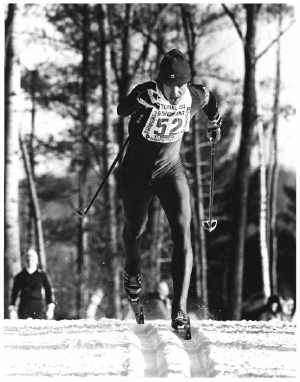
Galanes back in his own racing days, blazing the trails at Telemark, Wisconsin. (Courtesy photo)
FS—And skiing at world class levels has definitely become a long game, with the careers of professional skiers extending well into their 30’s. Do you think that young athletes habitually over-intensifying their training runs counter to the controlled environment that top athletes are following today?
Jim Galanes—I look back at my own training and the days that I should’ve been going low intensity. I would go in the mountains up in Alaska and run for four or five hours at significantly too high intensity, and doing it chronically! What we experienced was a brief period—two to three weeks in early December—when we’d go to the early races and excellent and then we’d be crap for four or five or six weeks. I think Bill Koch was probably the only one who was smarter than the rest of us when it came to that. Just the way we trained led to very inconsistent or unpredictable performance. I think now we know that long range performance requires better control in the implementation of workouts, and better nutrition, and better recovery, and better understanding. I think the training process hasn’t changed that much, but the understanding of how to do it has improved a lot.
FS—How do you think your perspective as a lifetime participant and contributor and observer of the sport? There’s a perspective gained by someone—like yourself—who has watched the sport from your angle. How would you describe that? Where is the value in listening to those who molded the sport in an earlier era?
Jim Galanes—You know, I’m sure a lot of people would wish I just go away and stop talking, but I think what I experienced both as an athlete and in my early years of coaching is really framed how I think now. Whether it’s in social media poster or personal communication, I always tell people that more isn’t always better. I’m kind of anti-volume: what’s important in creating training volume is how we build up to that volume and how we manage it over the long game.
And that that that’s the biggest hurdle I’ve seen with coaching juniors. I can go back to when I was at Stratton Mountain School in the 90’s, or when I started the Goal 2002 APU program in Anchorage. Those were the things we were really trying to do for these young athletes so that they could go out and train at that level, and have it be productive training.
For me, the best training is learning good technique and really refining it. I tell people it took me 10 years to really learn how to ski efficiently and effectively. We need to teach young skiers good ski technique across the intensity domain; it’s really important that they learn they can ski with the proper movements and sound technique at that low intensity. You know, I honestly don’t know how other coaches are approaching it. Regardless, I feel like this is one of the shortcomings in American skiing in spite of mandating educational requirements for ski coaches. I don’t think we have a good handle on sharing information in this country
FS—Well, writing for FasterSkier may become a way to do that. And, fortunately, yours is a name that people should know and respect. They should appreciate that yours is a perspective that’s valid. You’re not someone who’s an unknown quantity and there’s a good reason for the community to listen to and consider what you have to say. So I think this is a great opportunity to do that.
Jim Galanes—I mean, hopefully we can create a dialogue; that’s a good thing. I think that’s what we need in sports. In the 80’s, when Torbjorn Karlsson first came to the US to coach the US ski team, he started showing me all this information that (Norwegian coaches) were sharing back then. That was kind of the bread and butter information that US skiers had, and good results eventually followed. Then Nikolai Anikin came to the country with the Soviet methods, and John Underwood came back from master’s degree work in Finland with the Finnish approach. But we still don’t have a good mechanism in this country to share information! In Summit County, Colorado, we started having kind of weekly coaches’ coffee once every two weeks just to talk about stuff. What are we learning? What are we seeing? What are we thinking we could do differently or should be done differently? I think that’s where the true learning comes from.
The first American World Cup, Telemark Wisconsin, December 1978. Jim Galanes is third row, sixth from left. (Courtesy photo)
FS—Does it sometimes seem like the American system is holding back information, or enforcing a kind of coaching indoctrination around watered-down or over-simplified philosophies?
Jim Galanes—Well, I know more about how the Norwegians the Swedes the Finns design their programs than I know about the US Ski Team. I’ve got friends and coaching friends in all those Scandinavian countries, and we openly discuss what they’re doing, what works, what didn’t work, and what comes next. I’m familiar with how those countries are training and what their philosophies are because I engage in discussions with those countries. I haven’t found the US system to be nearly as open. Maybe that’s because I haven’t shelled out the money to go through the American coaches’ education system. I don’t know, I feel like that that kind of information ought to be free and available. We should be talking about it all the time, not just at occasional coaching seminars where we watch PowerPoint presentations and roller ski around a parking lot.
I’ve written a lot about our sport—and tried to have discussions in person and in social media—and a lot of the time I haven’t presented it in the best way. It can be received as, “There goes Jim again, telling people what they ought to be doing.” When my real motivation is “Let’s talk about these issues, shoot holes in my arguments, demonstrate to me where I’m wrong or where my reasoning is flawed.” That sort of interaction helps us all learn because we have these dialogues about opposing points of view. And I think that’s the best coaches’ education. I’ve learned more by sitting with my old friends, having conversations, having them challenge my understanding of physiology and forcing me to learn.
FS—Obviously, multiple and diverse voices could add to those discussions if logical venues can be found to voice them. So it’ll be great to have your input and your voice added to FasterSkier. I’m sure that our readers are gonna love it.
Jim Galanes—Well, we’ll find out! At least we’ll know that we’re all talking about a sport we love.
U.S. Ski & Snowboard officially nominates 21 athletes to the 2025-26 Stifel U.S. Cross Country Ski Team roster. The team is nominated based on pre-determined selection criteria.
The U.S. Ski & Snowboard Team announces its teams in two phases: nomination and acceptance. The athletes are formally nominated to the Stifel U.S. Cross Country Ski Team in May. Pending their acceptance of the nomination and adherence to the team expectations outlined in the team criteria, athletes will be officially announced to the team in September 2025.
Julia Kern and Jessie Diggins hope to carry their success into the 2025/26 season. (Photo: NordicFocus)
As the team heads into an Olympic season, the A Team is led by athletes like three-time Olympic medalist and seven-time World Championship medalist Jessie Diggins, two-time World Championship medalist Julia Kern and two-time Olympian Rosie Brennan. Olympians Gus Schumacher and Ben Ogden, who both claimed their second World Cup podiums this season, alongside Olympians JC Schoonmaker and dual-sport athlete Sophia Laukli, will also return to the A Team for the upcoming season.
New faces include Kate Oldham, who made her World Cup debut in 2024-25 and secured several top-30 results and a trip to the World Championships, Lucas Wilmot, a University of Utah ski team athlete, and Tabor Greenberg, the 2024 Youth Olympic Games skate sprint bronze medalist.
The 2025-26 FIS Cross Country World Cup calendar will be confirmed by the International Ski Federation in June 2025, including the official announcement of the Stifel World Finals at the end of the season in Lake Placid, New York.
An official Stifel U.S. Cross Country Ski Team announcement will be made in the early fall.
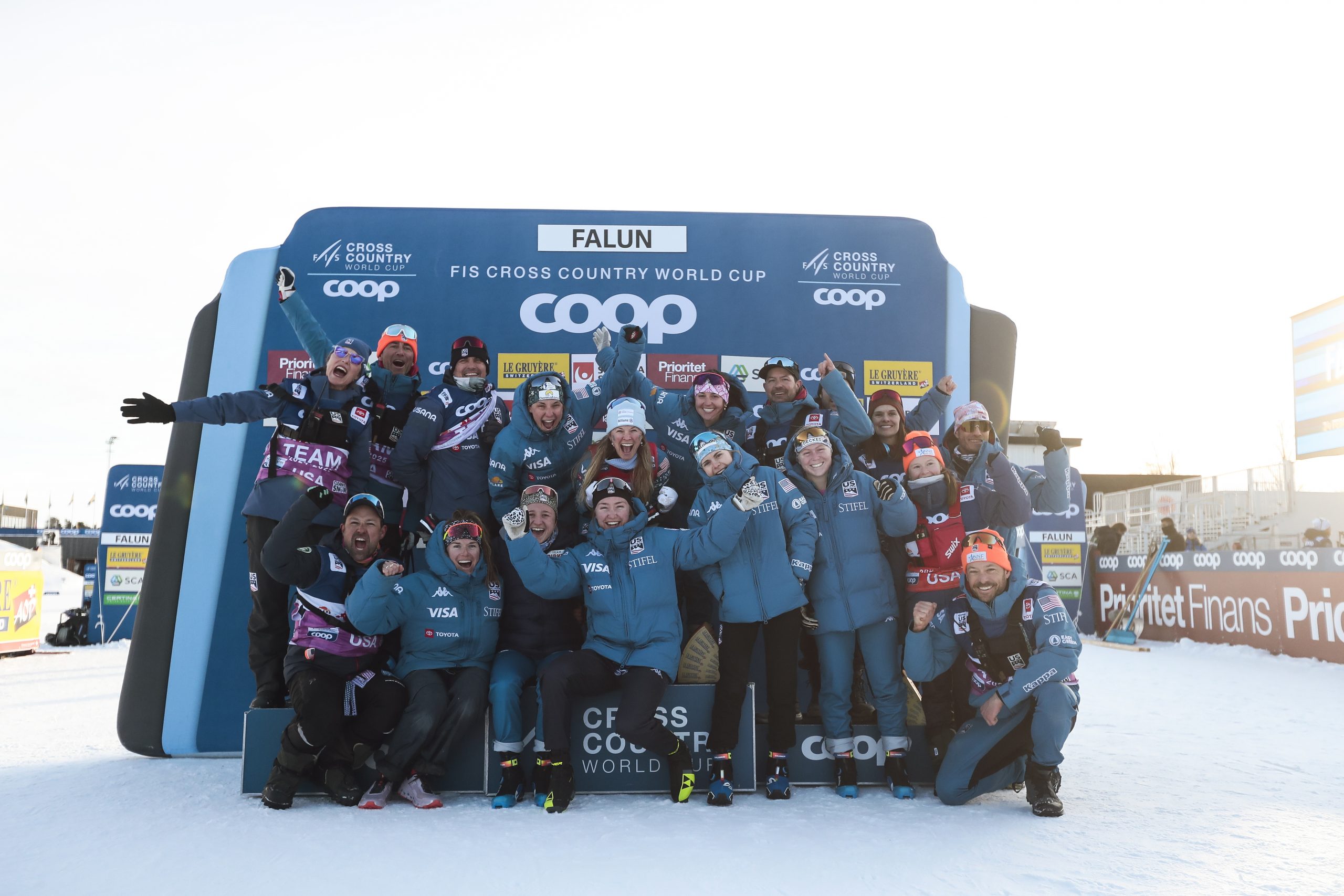
The American Women, coaches and wax techs celebrate in Falun, Sweden. (Photo: NordicFocus)
2025-26 Stifel U.S. Cross Country Ski Team Nominations
This article was made possible through the generous support of our voluntary subscribers. If you would like to see more articles like this one, please support FasterSkier with a voluntary subscription.
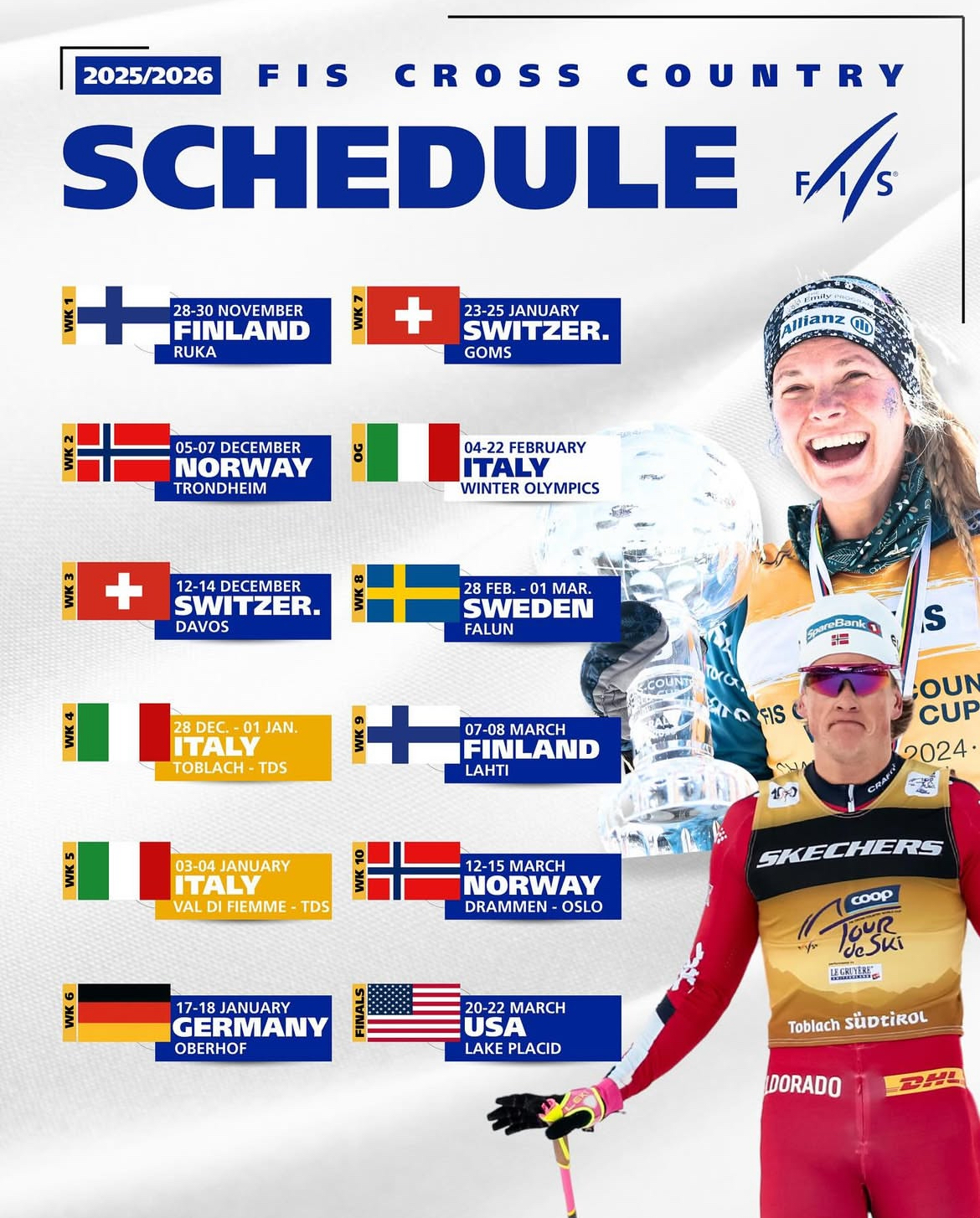
The International Ski Federation (FIS) recently announced its World Cup schedule for 2025-2026. The questions that announcement inpsires are these: does it really matter, and will skiers actually show up? It’s an Olympic year, after all . . . it’s hard for athletes to prioritize anything else.
Cross country skiing is an endurance sport, but even the sport’s brightest stars do not possess endurance in unlimited quantities. In order to win on the most important occasions, they need to rest. In 2026, that will create a dilemma for the FIS World Cup: can these races and point totals—and these Crystal Globes—remain important in a season when the thing that guarantees athletic immortality is Olympic gold? With most skiers prioritizing Olympic opportunities, will anyone in the field bother to care about the World Cup?
Back in 2025, different athletes played it different ways . . .
Different skiers approached 2025’s pre-World Championships season in different ways. Ebba Andersson (SWE), Heidi Weng (NOR), Jonna Sundling (SWE), Therese Johaug (NOR) arrived in Trondheim with differing levels of freshness, speed, and fatigue. (Photo: Modica/NordicFocus)
In preparation for the World Championships in Trondheim, Therese Johaug (NOR) stayed at home and just trained in the weeks before the big races. True, she raced the Tour de Ski (and event should’ve won—and did). But then she just went home, spending her days training and looking forward to what she hoped would be the crowning glory of her long and glorious career. Her strategy worked pretty well, but not nearly as well as she needed it to (lots of medals, just none of them gold). She may have entered the World Championships just a little flat, or she may have been stymied by the slow conditions of the slushy, sea level tracks in Trondheim. Or it may be that an aging Johaug is simply no longer able to dominate skiers like Ebba Andersson, Jonna Sundling, and Frida Karlsson. Whatever the reason, Johaug’s World Championships were far from the success she had hoped for. Ironically, Johaug was razor-sharp just one week later in the World Cup finale in Finland where she skied away from the field in the 50 k (albeit in the absence of Karlsson).
After her first victory of the season, Frida Karlsson (SWE) all but disappeared from the World Cup tour. She re-emerged in time to take the historic World Championship victory in the 50 k in Trondheim. (Photo: Modica/NordicFocus)
Frida Karlsson (SWE) won the first race of the World Cup season in commanding fashion (easily besting Johaug in the first race of her comeback), then Karlsson all but disappeared from the World Cup scene. “She’s recovering,” reports told us, suggesting that lingering injuries were preventing her from contesting World Cup events. Maybe it was true, maybe it was only partly true. Either way, she rested up for the entire season—leaving World Cup glory to other points-chasers—and showed up fresh in Trondheim where she looked perfectly unbeatable in the 50 k (spoiling another of Johaug’s comeback opportunities).
Johannes Hoesflot Klaebo (NOR) played it all a bit differently: while he got sick in the middle of the World Cup season and went home to recuperate, Klaebo returned to World cup events after regaining his health. Fortunately for Klaebo, the timing of his recovery allowed him to return to competition before the week of the World Championships. Klaebo’s results speak loudly for the success of his preparation—six races, six gold medals, skiing immortality. Even in the crowded World Championship race schedule, no one else stood a chance that week in Trondheim.
Among Americans at the World Championships in Trondheim, Julia Kern (USA) may have fared the best, earning a career-best fifth place finish in the Freestyle Sprint. (Photo: Modica/NordicFocus)
The American skiers seemed to race it all in 2025—even through injury and illness—leaving them flat when the World Championships came around. American stars seem often to enter World Cup competitions for one very simple reason: the Americans almost never go home. Americans ski more World Cup races than the Norwegians or Swedes who, when they get the sniffles, jet quickly home to Oslo or Trondheim or Stockholm. When Austrian, German, Italian, French, and Swiss skiers start feeling overtrained, they steer their cars onto highways that take them home in a few short hours. European skiers can pretty much come and go from the World Cup tour as they please. Thousands of commercial-flight miles from home (in Vermont, in Minnesota, in Alaska), the Americans are in for the long haul. Living out of duffel bags, sleeping in hotels or crowded team houses, foreign foods and supplements, unfamiliar medical personnel: when it comes to the World Cup tour, Team USA is a road show while European teams are weekend visitors. That means that American skiers are on nearly every starting line, and in position to collect points nearly every weekend. It allows American skiers to climb the rankings, but may leave them exhausted on those all-important days when singular prizes are handed out.
With the Olympics being staged in February of 2026, it’s likely that fans will see skiers picking and choosing their World Cup starts, and making competitive plans that duck and weave through the World Cup season in hopes of being speediest when Olympic races begin in Val di Fiemme.
2025/2026 FIS World Cup Cross-Country
Period 1
Ruka, Finland
28/11: 10km Interval Start Classic
29/11: Sprint Classic
30/11: 20km Mass Start Freestyle
This article was made possible through the generous support of our voluntary subscribers. If you would like to see more articles like this one, please support FasterSkier with a voluntary subscription.
Ebba Andersson (SWE), Frida Karlsson (SWE), Emma Ribom (SWE), Jonna Sundling (SWE) comprised the team that dominated the relay at the World Championships in Trondheim, 2025. (Photo: Modica/NordicFocus)
With the Norwegian men and Swedish women so likely to dominate the relays, these should be the least surprising races on the Olympic cross-country skiing schedule. But Olympic relays have a long history of not turning out the way that fans, experts, and odds-makers predict. An untimely fall, a broken pole, the wrong wax decision, and the pre-race script flies out the window. That’s what has the potential to make the 2026 Olympic relays so exciting. Favorites routinely get beat; dark horses often run away with victories; technologies falter; strategies fail. And much can change during the race, itself.
It’s the Olympic Games, and national pride will be on the line. Johannes Hoesflot Klaebo (NOR) will be skiing the anchor leg, but and Federico Pellegrino (ITA) will be skiing in front of his countrymen. Anything can happen. (Photo: Nordic Focus)
Men’s Relay
Italy is racing at home (in Val di Fiemme) with a team that is known to run on emotion and pride. Ever since Italy nipped Norway for the gold medal in 1994 at Lillehammer, this has been a hotly contested relay rivalry. Italy is not a pre-race favorite, but Italy’s favorite sons would love nothing better than to deliver a victory in front of their countrymen.
France fields a team of mercurial ski-stars capable of beating any team in the race. They’ll have the ability to push the pace, and to tuck in and sprint. If Norway falters, France could win it all.
And Russia (if they are allowed to field a team) is the defending champion in both the Men’s and Women’s relays from Beijing 2022. None of the other contenders have raced a relay against the Russians since Beijing. It’s truly challenging to know what to expect, other than the Russians race hard and that they will have a great sprinter—presumably Bolshunov—to scorch the anchor leg.
As for Norway, that team’s biggest challenge is likely to be deciding how to choose the members of the Men’s Relay. One thing’s for certain: Klaebo is likely to occupy the anchor leg. And if his teammates are able to deliver him into the lead pack with only the anchor leg remaining, he will be very difficult to beat.
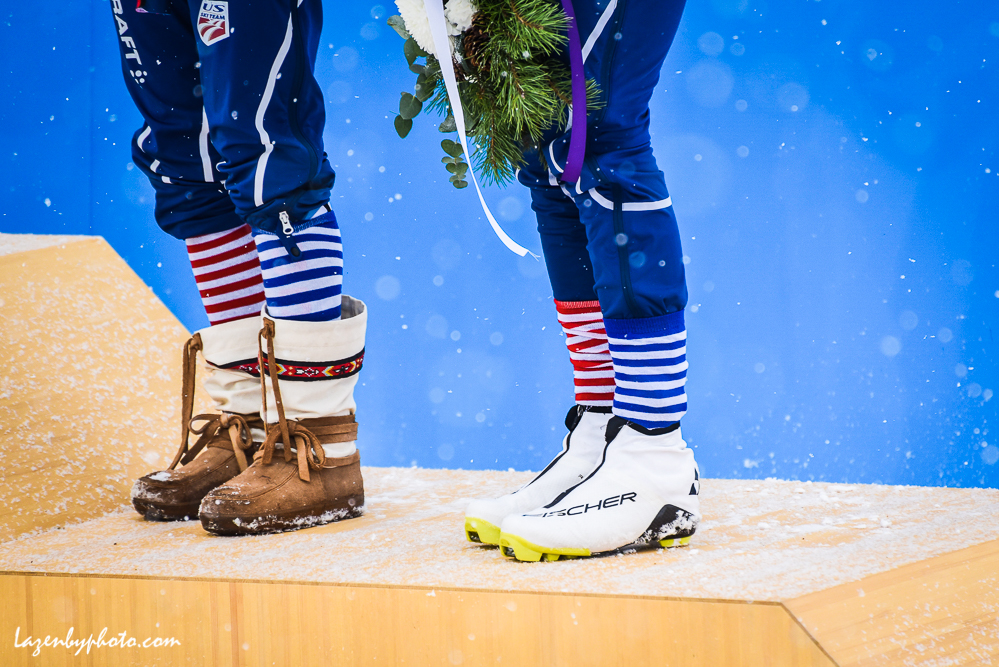
Team USA’s lucky relay socks have taken them to the podium a few times in the past, but the odds may be against them in 2026. (Photo: LazenbyPhoto)
Women’s Relay
It should be easy for coaches to pick the legs for Sweden’s relay: after her performance in the relay at the World Championships in Trondheim (where she made up an enormous deficit on the anchor leg to claim the championship), Jonna Sundling should be the anchor. In Trondheim, she proved that almost no lead is large enough to keep her from the gold medal. And Team Sweden will also have three other world class skiers (presumably Ebba Andersson, Frida Karlsson, and Maja Dahlqvist) to put Sundling in position for the win.
As was the case in the Men’s Relay, Russia (if they’re allowed to enter) represents an unknown quantity. If she returns to Olympic competition in similar form to what she displayed when Russia left the World Cup tour, Natalya Neprayeva would be one of the fastest in the field. And her team may be capable of pushing the pace that could otherwise undo the other contenders.
The USA has prioritized relay events in recent seasons. If mid-race situations play to their favor, Julia Kern, Rosie Brennan, Sophia Laukli, and Jessia Diggins might be able to contend with the fast pace of the first three legs. And Diggins has a nose for the finish line and the guts to finish off even the most unlikely sprint. Just ask Stina Nilsson, the Swedish World Sprint Champion who found herself outsprinted by a young Jessie Diggins for Olympic gold in 2018.
Team Norway fields a team that finds its job made far more complicated by the presence of Sundling in Sweden’s anchor leg. The Norwegian team is likely to include Therese Johaug, Astrid Oeyre Slind, and Heidi Weng. But Norway really doesn’t have an anchor leg skier who can rival the speed—and the sprint finish—of Sundling.
And at least two teams—Finland and Switzerland—have shown a terrific ability to hit the ski preparation just right on otherwise tricky waxing days. Relays have so many moving parts—the wax, the strategy, the crowd, the course, the place in Olympic scheduling—and offer these unique opportunities for athletic glory and national pride. One of our favorite things about cross-country skiing is that the athletes, themselves, prioritize the relay—the team effort, the team accomplishment—over the results in all other individual races. Fans often feel the same, and we’ll be thrilled to watch the way things play out at the Olympic Winter Games of 2026.
This article was made possible through the generous support of our voluntary subscribers. If you would like to see more articles like this one, please support FasterSkier with a voluntary subscription.
Johannes Høsflot Klæbo (NOR) has the potential for six medals in the Olympic Winter Games of Milano-Cortina, a feat that would tie him for the second most medals of any Winter Olympic athlete. (Photo: NordicFocus)
Johannes Hoesflot Klaebo faces a bizarre dilemma of the sort experienced only by stars and legends: either he authors another miracle in 2026—making lightning strike a second time—or he disappoints the whole sporting world. Those are Klaebo’s options as he looks forward to the Olympic Winter Games in February of 2026. After performances like the ones he delivered last season in Trondheim’s World Championships—six races, six gold medals—his options are being reduced to either miracles or disappointments. It’s particularly ironic that Klaebo could spend two weeks at the Olympic venue in Val di Fiemme, win three gold medals (Classic Sprint, Team Sprint, and Team Relay) as he is heavily favored to do, and still go home a failure in the eyes of journalists, fans, and countrymen. Well, once you win everything, everyone expects you to always win everything. No pressure, Johannes . . .
A year ago—as he looked forward to a season that would culminate in the World Championships in his hometown of Trondheim—one of Klaebo’s primary goals may have been to silence critics who pointed to his repeated failures to win distance races at major championships. Well, in Trondheim, he won the 20 k Skiathlon (with ease), then the 10 k Classic (in the absence of Finland’s Iivo Niskanen), then the 50 k (again, with ease). Just for good measure, he also won each of the events that he was absolutely expected to win (Freestyle Sprint, Team Sprint, and Team Relay). Critics were silenced, indeed. And Klaebo found himself hailed as the “best ever” in the sport of cross-country skiing. But what sort of encore is available after a performance like that? Only to do it all again . . . everything else falls short.
In Trondheim, Johannes Hoesflot Klaebo (NOR) made cross-country skiing history. In 2026, the only way his Olympic campaign may be considered a total success is if he does it again. (Photo: Modica/NordicFocus)
Other notable athletes have successfully faced similarly historic Olympic challenges/opportunities. Entering the Olympic Games of Munich in 1972, it was predicted that Mark Spitz would win seven gold medals: he did. In Beijing 2008, Michael Phelps was expected to win eight gold medals: he did. The 1980 Olympic Winter Games of Lake Placid, delivered a five gold medal performance from Eric Heiden (victories that experts had predicted). Perhaps it’s Heiden, the American speedskater, whose situation is most similar to Klaebo’s. Heiden was a media sensation. He appeared on the cover of Time magazine; he graced the cover of Sports Illustrated. Heiden had barely lost a race in two years, including winning the All Around World Championship and Sprint World Championships for three years in a row while repeatedly winning all four races at each championship. Everyone expected Heiden to win five gold medals—that was every single gold medal that was available in Olympic speedskating in 1980—covering every distance from the 500 meter sprint to the 10,000 meter marathon. The uniform sponsor of Heiden’s US Speedskating Team even went so far as to provide gold racing suits for the Olympic Winter Games in Lake Placid.
Eric Heiden in 1980. Even Heiden’s magazine covers are now collectors’ items.
Heiden had already proven himself capable of sweeping all the races. He’d done it before. Klaebo has too. But there is a subtle difference. Heiden ruled his sport during an era when training was still basically instinctive (unlike the scientific, closely-monitored training systems employed by Klaebo’s rivals in their desire to topple him from the podium). 1980’s training programs were old-fashioned suffer-fests in which those athletes most able to withstand the stresses of training (and over-training) were those who succeeded. No one checked pulses, no one referred to lactate levels, no one ever considered that they might over-train. They all just went hard every day. Heiden’s Coach, Dianne Holum (herself an Olympic Champion) freely distributed Heiden’s training program to his rivals. Perhaps it was an act of simple collegiality in a small and friendly sport. Or perhaps she just wasn’t worried that anyone else could do what Heiden could do. As it turns out, they all tried to copy Heiden and it backfired. When the 1980 Olympics began, Heiden’s rivals were exhausted, over-trained, athletically flat. Heiden himself, was typically blasé about the situation. On the morning of the 10,000 meter (his fifth event), with Olympic immortality on the line, he overslept, choked down a bowl of corn flakes, dashed to the rink, and set a world record. No one was really gunning for Heiden: he already had them all beat. Klaebo’s situation is different: everyone is gunning for him.
Johannes Høsflot Klæbo (NOR) striding to his second medal of the 2022 Beijing Olympic games, winning bronze in the 15 k Classic. (Photo: NordicFocus)
Klaebo is perched atop his sport at a time when cross-country skiing has never been more competitive. Even so, he spent the 2025 season winning at will, racking up victories, medals, and championships like there was almost no one else in the field. Certainly his Sprint dominance is unchallenged. In Trondheim, he proved equally invulnerable in distance races. In 2026, the Olympic Winter Games will give him a chance to re-assert that dominance. Spitz did it; Phelps did it; Heiden did it. And the media will say Klaebo can do it. Only two things are certain: he will try, and we will watch. If all goes well for Klaebo, then history will mark the moments.
Signing up for a Master’s B race at U.S. Biathlon Nationals sounded like a fun idea when I was at my computer, a safe 2,259 miles from Bozeman, chatting with my sister on the phone. Chloe would be competing at Nationals, her final races of the season. I hadn’t seen her since she left for the World Cup in December. It was as simple as her saying, “You should do the Master’s race.” And suddenly, I had needlessly complicated what could have been a sunny vacation away from my usual responsibilities of parenting two toddlers.
Unlike Chloe, I’m not a biathlete. I did a few biathlon camps as a teenager, but ultimately chose to focus on Nordic skiing. My sister became a biathlete, so I’ve been around the sport, traveling to some of her races, yelling at the Eurosport feed at all hours of the night and early morning. But I haven’t personally shot in quite a while. I did a citizen’s race in 2018 where they mercifully had the rifles waiting for us at the range, and we shot on standing targets for prone (4.5 inches instead of the usual 1.77 inches). I would find no such luxuries in Bozeman.
The author’s sister, Chloe Levins (USA) competing on IBU World Cup in Nove Mesto na Morave (CZE) this past March. (Photo: NordicFocus)
Unlike Chloe, I’m also not exactly in shape. I raced Nordic in college, but the combination of working life and mom life has not led me to have the same capabilities I had on skis as a 22-year-old. My world revolves around wandering through the woods looking for salamanders, cooking noodles, and writing. Hammering intervals, I do not.
So, when I arrived at the Official Training at U.S. Biathlon Nationals, I wasn’t feeling exactly confident.
I was surprised to find that the basics had stuck with me. I’d gotten a refresher in rifle safety. My thumb clicked along, loading ammo into magazines. I put the cuff on my bicep and remembered its tightness. After a few sequences of skiing into the range and shooting on paper, there was fluidity to my motions: Taking the rifle off, setting up to the target, and finding it in the sights. Smooth trigger, I tried to make my mantra. Rifle back on my shoulders, poles on as I ski out. The cadence of events has a nice rhythm. I fell into it more easily than expected.
We zeroed, and I hit three prone on my first try. I’ve got this. My default for wild optimism taking over instantly. Standing was a different story. In prone, the rifle’s sling hooked to you via the cuff, your body lying still thanks to the support it receives from the ground, you feel incredibly stable. There is motion, of course, as you breathe and your heart beats against your ribcage. But the targets remain within the sights. I felt like I had a chance of hitting every target. Standing up, there’s so little support. Your legs shake as they try to hold steady, opening or closing your shoulders an inch makes the targets suddenly disappear from view. A breeze you otherwise probably wouldn’t notice becomes detrimental to your hopes of staying still and hitting a target.
As I ticked through the standing targets in practice, they got harder and harder to hit, because I became more and more unsteady. Inhale and that little black circle slides out of your sights. Exhale and it should come back in. But you’ve shifted your body an unnoticeable amount and suddenly it’s gone. Instead of waiting for the moment that feels perfect in prone and smoothly pulling the trigger, I was hoping for the target to come into view and pulling the trigger quickly, knowing it was going to disappear again in a second. Jerky trigger motion is not how you hit targets.
“I’m going to have to shoot as fast as I can in standing, it’s only getting worse the longer I stand here,” I said to Chloe. She fed me tips to add stability. Lock out your legs so your bones are holding you up, not your muscles. Drive your left elbow into your left hip bone, use it like a shelf. Feel like you’re pulling your right hand back into your right shoulder.
The tips helped, but there wasn’t much that could be done the day before the race. Standing was going to be another exercise in wild optimism.
“Let’s go ski the course,” Chloe offered. “You can put the rifle on the rack if you don’t want to ski with it.”
This was one area I felt prepared for. Compared to my 28-pound two-year-old who I’d skied with in a backpack over the winter, the eight-pound rifle wasn’t much of an issue.
Keely Levins ready to go at US Biathlon Nationals.
We headed out. I gave the penalty loop a leery glance, knowing I’d be seeing it the next day.
Chloe said, catching me staring, “The skiers coming out have the right of way.”
I thought about my future self skiing around and around in shame as my family and friends watched the livestream from the East Coast. I sure do know how to pick a vacation.
It was classic springtime skiing in the West. Firm and fast in the morning, and slowly breaking down into sugar as the sun beat on it. I couldn’t help but smile as I gulped in air on the climbs. The sun and altitude brought me back to being a teenager, racing in Junior Nationals out west. I hoped I could find some inspiration in the memory of once being in shape.
We ran into biathletes from Chloe’s world and explained what I was doing on trail, not on the sidelines.
“I think I’m going to ask if they’ll let her shoot on all standing targets,” Chloe said to one.
“No way! I came all the way out here. I’m doing it,” I retorted, knowing that standing targets were definitely more appropriate for my current skill level, or lack thereof.
“I love this, you’re just going to send it,” one said.
And send it, I did.
The morning of the race, I got to the venue far before my fellow Masters B competitors. Chloe was my ride, and the real races happened first. I ventured up into the course, finding a spot where I could run from a major climb to a perch that looked over the range. I hollered at the top of my lungs as my little sister won her first National Championship.
I ate a bar, slurped a Gu I found in my backpack, nervously peed for what felt like the 58th time, and went to get my rifle checked. And by my rifle, I mean Chloe’s rifle. I was also wearing her sunglasses, her shirt, using her skis, and her poles. I had my own boots, but they were brand new. I’d had to order NNN boots to be able to use Chloe’s skis; I’ve been skiing on my SNS college gear.
Chloe stood behind the scope, zeroing for me.
“Ok, try again!” She chirped. That meant I’d shot all over the paper. I hadn’t even shot well enough to create a group that we could zero from. Awesome.
My next five shots made a better group, so she said. She moved my sight a couple clicks for me. Or, she’d lied and pretended I’d shot a nice group, trying to boost my confidence. Either was fine by me.
I skied out on the warmup loop, considered doing pickups, did one and thought better of doing any more. I stopped by the potties for the 59th time.
The nerves and altitude combined for a queasy lightheadedness as I stood in the starting area. Chloe was giving me some last-minute tips; I could barely hear her. Why was I doing this? Why did I think I could do this? Am I going to throw up? I might throw up. I came out of my fog to hear her say:
“And if anything goes wrong with the rifle, raise your hand and a marshal will come over and help you,” she said.
She wished me luck and I was alone to toe the line. And do a biathlon race for some reason that I could no longer remember.
The timer counted down, the sharpness of adrenaline felt familiar. Maybe this would be fun.
During the first climb, I felt the rush of lactic acid flood my legs. Which was unfortunate, because the first climb was about 200 meters into the race. Control yourself.
You take a more conservative approach in biathlon, to make sure your legs aren’t quaking while you’re trying to shoot, and that your mind is functional as you enter the range, not lost somewhere in the deep recesses of the pain cave. Despite my best efforts as a young skier, my race strategy usually boiled down to: Go out hard and hold on. This would not serve me well in biathlon, nor at altitude. I tried to ski smooth, in control, and felt better than I thought I should.
I came into the range and tapered, lifted my sunglasses to let my eyes adjust to the bright sun, and took deep, intentional breaths. I dropped to my knees on the shooting mat, bruised from yesterday’s practice. Unshouldered the rifle, popped in a clip, laid down, hooked the rifle’s sling to my cuff, looked into my rear sight, and saw no targets. Just a gray, hazy blur.
What?
My mind raced. Was I so out of shape that I couldn’t see clearly? That was certainly possible. I picked my head up and looked around. Nope, my eyes worked. I looked through the rifle again. Blurry still.
What is happening?
Precious time was ticking by. I was lying down, but it felt like my heart rate was increasing.
I should’ve left the range by now.
I pulled my head up again and looked down the length of the barrel. I’d left the snow covers open while skiing, but I hadn’t fallen. There shouldn’t be snow anywhere. I couldn’t see any.
A marshall. I could call a marshal. I raised my hand, popped the clip out, and the marshall looked at my rifle.
“Something’s wrong, I can’t see the targets, it’s so blurry,” I blurted out. My body was itching. I needed to get back on the course and ski.
“I don’t see any,” he said. But he blew a hard breath on the sight, and handed it back to me.
I got back in position.
Targets!
I could see.
I shot quickly, frustrated, was jerky with my trigger finger, and sadly not at all surprised when I left the range having only hit one.
So much wasted time. And now more to be wasted in the penalty loop.
Around and around I went. The course was slow, but the penalty loop was harder. Sitting in full sun, getting a lot of traffic, it was thick sugar I was fighting to push through. When you’re skiing that many laps around a penalty loop, I found, your mind starts to play tricks on you. Is this my second? Or third? I started chanting the number lap in my head as I skied. The last thing I needed was a time penalty added on for skiing the wrong number of loops. I’d penalized myself enough at the range already.
Leaving the penalty loop, finally, I didn’t care much for race strategy anymore. My fury at that fleck of snow and how quickly I’d let it unravel my prone stage fueled my next lap.
Chloe was cheering on the biggest climb, “Was the bolt stuck?”
“Snow in the sight!” I grunted as I climbed.
“The leader is only 30 seconds up on you, go get her!”
Why was I getting splits in a Master’s B – not even the Master’s A – race? Why was I loving it?
I leaned into the hill and pushed over the top of it.
I came into the range once again and set up to shoot standing. I watched the sight dance around the targets. I tried to take deeper, slower breaths, anything to make everything feel steadier. Target, pull trigger, miss. No problem. I wasn’t going to clean. The next target came into view and I pulled again. Miss. Ok, next target. Miss. No! This one, I’ve got. Two breaths and pull, miss. I will not leave this range with no hits. I closed my eyes, filled my lungs with air, let it out, and opened my eyes. I hooked my elbow hard into my hip, adding to my bruises. I pulled the butt of the rifle into my right shoulder and waited for the target to show up in my sight.
Hit.
You’d have thought I was the one who’d just won Nationals.
The joy was short-lived, as the penalty loop I’d gotten to know so well was waiting for me again. I got through my laps and took to the course. I passed some people, and was quickly humbled by the juniors who appeared to be floating atop the corn. My legs had little left, the same went for my lungs, as I crossed the finish line.
Recovered, I collected my second-place chocolates.
“If you didn’t have that sight issue, you would’ve won it,” Chloe said as we piled into our Wrangler, the perfect rental car for the week.
“I know,” I said.
“That’s biathlon,” she said. “It’s unpredictable, that’s part of what makes it so addicting.”
We turned up the music, rolled down the windows, and drove down the mountain.
That night when I went to bed, I felt… altitude sickness. But I also felt a bit of pride for putting myself on the line, and invigorated from having a day so different from so many others. I got on a plane back to reality the next morning. Vacation was over.
This article was made possible through the generous support of our voluntary subscribers. If you would like to see more articles like this one, please support FasterSkier with a voluntary subscription.
Jessie Diggins (USA) has built an entire career that will reach its peak at the Olympic 10 k Interval Start. (Photo: Modica/NordicFocus)
In an earlier era of our sport, all Nordic ski races were interval start events; every distance at every championship, individual skiers racing against the clock, disappearing into the woods on a single sinuous track, returning to a finish line after the challenging completion of an appointed distance. That kind of racing was a test of courage and discipline, of fitness and grit. It was pure, and simple, and true. Cyclists call such time-trials the “race of truth,” a term both descriptive and appropriate. But, in cross-country skiing, the format proved poor for spectating, weak for television broadcasts, not as exciting as watching racers competing shoulder to shoulder. Predictably, the modern Olympic cross-country skiing schedule includes only one interval start race, all the rest being some form of mass start. Only one race of truth remains—the 10 k.
Diggins will absolutely give it her all at the 2026 Olympic Winter Games in Milano-Cortina. (Photo: NordicFocus)
Women’s 10 k Freestyle Interval Start
This is the one Jessie can win . . . but any athlete who hopes to win Olympic gold will need to ski the race of their lives. That’s because everyone who lines up for this race has been pointing toward this race for their entire athletic life. This is the day they’ve trained for, and peaked for, and tapered for. This is the day they’ve sacrifice for, the day they’ve dreamed of. At the end of this day, someone will be awarded Olympic immortality and a medal of gold. Everybody in this race wants this . . . and if desire and determination provided the only measures of worthiness, then Diggins could certainly win. But those are not the only factors affecting the outcome of the Olympic 10 k.
Frida Karlsson (SWE), Ebba Andersson (SWE), and the immortal Therese Johaug (NOR) will have circled this day on their calendar months ago. Their entire year of training will have been planned and designed and refined to bring them to such levels of performance and fitness that they’ve never heretofore achieved. The 10 k will be a race of the very best cross country skiers at their very best. And these are not the only contenders: Heidi Weng (NOR) has been conducting a slow-motion, multiple-season comeback, one that has often taken her onto World Cup podiums. She’s been preparing for the opportnity to return to the very top. Natalya Neprayeva (RUS) may be returning form her nation’s competitive suspension. And Jonna sundling (NOR) showed in 2025 that she possesses perhaps the greatest sustainable speed of any of the racers in the field. If she paces it perfectly, Sundling could race away with gold in the 10 k.
In 2025, Harald Oestberg Amundsen (NOR) demonstrated both dominance and control with his victory in Cogne’s World Cup 10 k Freestyle. (Photo: Vanzetta/NordicFocus)
Men’s 10 k Freestyle Interval Start
Nobody knows whose gonna win this one; there are simply too many good skiers, too many variables, too much that remains unknown, too much at stake. Sure, Johannes Hoesflot Klaebo is a favorite (maybe the favorite), but he could also finish behind all of his own countrymen, not to mention the potential of an as-yet-unannounced team of redemption-seeking Russians (but don’t call them “Russians;” they don’t ski for Russia).
Norway recently announced its Men’s team for 2025-2026. Perennial contenders—Erik Valnes, Even Northug, Harald Oestberg Amundsen, Simen Hegstad Krueger, Martin Loewstroem Nyenget, and Klaebo—fill Norway’s roster: Recently added to that already formidable team were Iver Tildheim Andersen, Andreas Fjorden Ree, Oskar Opstad Vike, and Ansgar Evensen. How do you even pick the entrants for a 10 k Freestyle Interval Start race out of a roster like that?
And the short, explosive nature of a 10 k puts other racers into contention. Edvin Anger (SWE), Ben Ogden (USA), Gus Schumacher (USA), and Italy’s favorite son, Federico Pellegrino (ITA), will all have much to say about the outcome of the Olympic 10 k. And if Alexander Bolshunov (RUS) returns to Olympic competition, then this field will feel the pressure of his influence, as well. The key is likely to be pacing: too fast at the start, and skiers will blow up; too slow at the start, and skiers will not have time to catch those who choose to go fast early and are able to hang on. It’s such a complicated little race, but one capable of reminding spectators just how exciting an Interval Start race can be.
The podium of the 10-kilometer freestyle in Davos, Switzerland snaps a selfie. (Photo: NordicFocus)
This article was made possible through the generous support of our voluntary subscribers. If you would like to see more articles like this one, please support FasterSkier with a voluntary subscription.
We’ve grown accustomed to seeing Jessie Diggins (USA) on the podium. Fans hope that the 2026 Olympic races in Val di Fiemme may provide even more opportunities. (Photo: NordicFocus)
In 2025, Jessie Diggins won the World Cup overall title for a third time—and for the second year in a row. How can such a terrific achievement end up creating a dilemma? Here’s how . . .
American media has numerous and gaping blind spots when it comes to winter sports. Skiing, skating, bobsled, luge, skeleton, biathlon, ski jumping, Nordic combined: Olympic and World Cup competitions are typically dominated by European sports-powers. And in coverage of those events, American sports journalists are notorious for not doing enough homework. They are overly simplistic in their understanding of winter sport events, seeming to assume that all events are the same, and that whomever wins one will win them all. American sportswriters often fail to consider race distance, event technique, conditions, equipment, and seasonality; factors that weigh heavily on the results in any cross-country skiing event. They just figure that skis are skis, and whomever is the best skier will win everything.
In taking on such a narrow focus, the American media—and, by association, American viewers—creates a unique dilemma for Jessie Diggins in their expectations for her Olympic performances. She’s three-time Overall World Cup Champion and three-time Olympic medalist. She is a truly accomplished cross-country skier. What those accomplishments decidedly do not prove is that Diggins is the best skier in the world (in the simplistic, pigeon-holing way that the American media would prefer). She’s absolutely one of the very best, but she’s definitely not the only one (as Diggins, herself, would be quick to remind us). When it comes to consideration of specific races on certain days, Diggins is likely to be considered a solid gold-medal favorite in only one Olympic event: the 10 k Freestyle Interval Start (an event she has regularly won on the World Cup circuit over the past few seasons). Even in this, her best event, Diggins is only one of the significant favorites. Therese Johaug (NOR), Jonna Sundling (SWE), Frida Karlsson (SWE), Ebba Andersson (SWE)—are all excellent skaters, and all are entirely capable of running away with the 10 k in Val di Fiemme. There are many contenders in these Women’s events, and that’s before the Russians even show up. Diggins can certainly win this race. On the other hand, the talents and heroics of other contenders could also result in Diggins finishing well off the podium. If that were to happen, the media would certainly express disappointment. That’s the dilemma that the media creates for Jessie Diggins.
Jessie Diggins (USA) has worked for years to refine her Classic technique, but her best chances for Olympic medals will probably come in Freestyle events. (Photo: NordicFocus)
In other races, Diggins has the potential to pop onto the podium—perhaps even to win a mass-start event—but this particular Olympic schedule is not structured in Diggins’ favor. In 2026, the Sprint will be a mass start event, but it’s Classic. The 50 k is a mass start event, but it’s Classic. Another chance for a Diggins medal exists in the Team Sprint, a Freestyle event in which she is likely to pair with teammate, Julia Kern, who showed such excellent form at the end of the 2025 season. The problem is that the American sports-media will trumpet the fact that America is home to the three-time World Cup Overall champion . . . a title that suggests (to the un-initiated) that such a champion should be capable of medaling in any event. Maybe even win them all! Three medals? Four medals? Five? Of course such results are possible, but it’s also a distinct unkindness to the athlete to suggest that we should expect such largess, to manufacture a situation in which we’ll be disappointed with anything less.
Jessie Diggins is the most accomplished cross-country skier who has ever worn the USA uniform. She races with unmatched intensity, and has refined both her fitness and her technique to degrees that make her a contender in virtually every event (as she has repeatedly proven). She follows the directions of an experienced team of coaches and technicians who remain firmly and expertly committed to her performance. And she has shown that she has the ability to win under even the brightest spotlights. The Olympic races in Val di Fiemme will be a chance for her to shine once more. Our hope is that American fans will be smart enough, and appreciative enough, and loyal enough to cheer her loudly, to praise her performances, and to join in the singing of the anthem whenever fitness and form and grit and luck produce the opportunity. When it does happen, it will likely be Jessie Diggins who has provided the opportunity for us.
This article was made possible through the generous support of our voluntary subscribers. If you would like to see more articles like this one, please support FasterSkier with a voluntary subscription.
Jonna Sundling (SWE) is the reigning World Champion and Olympic Champion. If anyone can challenger her in the Olympic Classic Sprint in Val di Fiemme, it’ll probably be her own teammates. (Photo: Modica/NordicFocus)
Fast-forward to February 10, 2026—Val di Fiemme, Italy.
Day 2 of the Olympic Cross Country schedule is a Classic Sprint, with medals being awarded in both men’s and women’s events on the same day. That means this Classic Sprint takes place after two days of rest for the women (following the 2 x 10 k Skiathlon), and one day of rest for the men’s field. In a normal World Cup weekend schedule, neither the men nor the women would usually be entering Day 2 with any extra rest after races on Day 1, so the Olympic rest-schedule is actually quite a luxury. And these are some of the world’s best endurance athletes; they should all be pretty well recovered. Even so, qualifying will be nerve wracking, and racing in the heats is liable to get wild.
Johannes Hoesflot Klaebo (NOR) dominates Nordic Sprinting in a way that is unrivaled by any other athlete in any other sport. (Photo: Modica/NordicFocus)
Men’s Classic Sprint
Klaebo is expected to win. Why wouldn’t he? He didn’t lose a Sprint competition all last season. Even on those occasions when others thought they’d found an advantage, a strategy, a chink in his armor, still Klaebo managed to win . . . with style, with ease, with room to spare. It’s just amazing that one athlete can so dominate all the best competitors in their sport. And perhaps no athlete competing today in any sport displays the same level of dominance that Klaebo enjoys in Nordic Sprinting. But the upset is certainly coming, isn’t it? He’s bound to have an off day sooner or later, right? Someone’s going to figure out the secret to beating him eventually, won’t they?
Edvin Anger (SWE) thought he had it figured out last season, winning a World Cup Classic Sprint when Klaebo was home sick in Norway. Anger even had the audacity to crow about that win, going so far as to suggest that he, himself, would’ve won even if Klaebo had been entered. Two weeks later, Klaebo rose from his sick bed and stuffed Anger into the back seat where he belonged: no “I told you so” from Klaebo, no bat-flipping at the finish line, no gloating in the post-race press conference . . . but Klaebo’s point was made loud and clear. He’s far from ready to surrender his Sprint crown, no matter what some Swedish upstart my say, think, or wish.
Among other contenders, Federico Pellegrino (ITA) could thrill the Italian crowd with a podium performance, and no one in the field has more experience. This Olympic Games will certainly be Pellegrino’s swan song; he’d love to leave Cortina having delivered a treasure for the host nation.
The French will send their best, but even those fine sprinters (Richard Jouve, Lucas Chanavat, Jules Chappaz) have never shown they understand the secret to unlocking the Klaebo puzzle. Ben Ogden (USA) has sought ways and strategies to better contest with Klaebo, but he has not yet shown that he possesses the flat-out speed or the late-heat endurance to make it happen. On the other hand, if the Russians show up, things could be different. They’ve never demonstrated any shyness about rubbing elbows in the tight confines of a Sprint course. It’s not a team endorsing dirty tactics, it’s just a team following the philosophy that “rubbing is racing.” And when quarters get close, even the most elegant skiers can find themselves getting stepped on.
The infamous kiss blown by Kristine Stavaas Skistad to her Swedish rivals at a World Cup finish line in 2024. The rivalry seems sure to be re-ignited at the 2026 Olympic Winter Games in Milano-Cortina. (Photo: NordicFocus)
Women’s Classic Sprint
Sweden has built a roster of the world’s best Nordic Sprinters, challenged consistently by only Kristine Stavaas Skistad (NOR). Among the Swedes in contention for the Sprint gold medal are former World Cup Champion, Linn Svahn; multiple World and Olympic medalist, Maja Dahlqvist; World Cup Sprint event winner, Johanna Hagstroem; and reigning World and Olympic Sprint Champion, Jonna Sundling who finished 2025 in possession of the greatest speed, the flashiest sprint, and the most tenacious mass-start racing tactics of any skier on the World Cup tour.
Jasmi Joensuu (FIN) is the 2025 World Cup Sprint Champion, but she advanced to only one Sprint final in all of last season. She’s likely to qualify high in the rankings, but unless her summer of training and her chosen selection of tactics results in some marked changes, she is not expected to be a factor in Cortina. Nadine Faehndrich (SUI) on the other hand, is always a factor. She races intelligently, she has good speed, and maintains excellent fitness. If Sweden were to stumble, Faehndrich could conceivably take it all.
Jessie Diggins claimed Olympic bronze in the Freestyle Sprint in Zhangjiakou. (Photo: NordicFocus)
Jessie Diggins delivered a wonderful revelation with a bronze medal in Beijing’s Freestyle Sprint in 2022, but she has not regularly been a factor in Sprint finals since then. Since Beijing, her best chances in Sprints have seemed to come in those Sprints where her rivals are hindered by exhaustion from recent races (like in stage-race format of the Tour de Ski). The Olympic schedule offers two days of rest after the Skiathlon (the first race of the Olympic schedule), so most of Diggins’ rivals will be fresh; therefore, she might be reluctant to employ the tactic that she has used with great success, blasting through Sprint semifinals in order to earn at least a lucky loser slot to advance to finals. At the Olympics, Diggins may be reluctant to commit so much to an event that is less likely to deliver a medal. On the other hand, Jessie Diggins rarely seems reluctant to commit . . .
This article was made possible through the generous support of our voluntary subscribers. If you would like to see more articles like this one, please support FasterSkier with a voluntary subscription.
Everybody will be fresh on Day 1 of the Olympic Cross Country schedule; the racing is likely to be fast and furious. The 16-day Olympic schedule is more spread out than last season’s 10-day World Championship schedule. Athletes will have the benefit of more rest and recovery between events, meaning even more athletes will compete in each event. It also means that those contenders likely to be competing in every event (like Johannes Hoesflot Klaebo and Jessie Diggins) will be just a bit fresher on race day. If anything, the broader schedule levels the playing field a bit, but there will still be some picking and choosing among events entered by certain specialists and opportunists. Those strategies and decisions begin on Day 1 with the Olympic Skiathlon.
The 2 x 10 k Skiathlon is a new Olympic distance (formerly 2 x 15 k for men, 2 x 7.5 k for women), but one to which competitors should be accustomed by now. They’ve raced it at recent World Championships, and the 10 k distance is one which both women and men have raced many times in World Cup events. It’s a set of familiar distances and strategies, but the men’s and women’s races are likely to be decidedly different. The 2 x 10 k Skiathlon is a mass start event, one that’s likely to see Johannes Hoesflot Klaebo (NOR) sitting in and sprinting at the finish line; in the women’s race, Therese Johaug (NOR) is certain to go from the gun. Two races on the same day, and they’re likely to resemble each other not at all. Unless the Russians show up . . .
Johannes Hoesflot Klaebo (NOR) may find it nearly impossible to match his six-gold-medal performance from 2025’s World Championships, a quest that begins with the 2 x 10 k Skiathlon on the first day of Olympic cross country competition in Cortina. (Photo: Modica/NordicFocus)
Men’s Skiathlon
In 2022 in Beijing’s Skiathlon, gold medalist, Alexander Bolshunov, and his Russian teammates pushed the pace to the degree that Norwegian stars couldn’t control the race . . . and Klaebo simply got dropped. If anyone wants to beat Klaebo, that’s the strategy that must be employed. If the Russians are lined up at the Skiathlon starting line, that’s certainly the strategy they’ll employ again. After the 2025 World Championships in Trondheim, outspoken Norwegian ski-commentator, Petter Northug, loudly criticized his countrymen for failing to drive the pace during mass start races, blaming Norwegian contenders for effectively allowing Klaebo to sit in and sprint to gold. At the Olympics in Cortina, one year after Northug’s public admonishment, those same Norwegian contenders may try a go-for-broke strategy. If the Russians arrive at the Olympic Games in racing form, there will be plenty of skiers willing to risk it all. But Klaebo looked pretty darn fit last season—like the field would not have been able to drop him no matter how hard they tried. In Cortina, if they fail to drop Klaebo, then he wins. Simple as that . . .
Those most likely to upset the Olympic plans of Johannes Hoesflot Klaebo are his own Norwegian teammates: Simen Hegstad Krueger (NOR), Martin Loewstroem Nyenget (NOR) and Harald Oestberg Amundsen (NOR). (Photo: NordicFocus)
Iivo Niskanen (FIN) earned a bronze medal in the Olympic Skiathlon four years ago in Beijing, but his best chance for a medal in Cortina lies in the 50 k Classic. It’s possible that Niskanen may sit out the Skiathlon so that he’ll remain fresh while the Norwegians and Russians wear themselves out attacking Klaebo. Harald Oestberg Amundsen (NOR) will definitely be entered in the Skiathlon: he can win from the front or in a sprint. Erik Valnes (NOR) is probably out: Norway will be saving him for Sprint and Team Sprint events. Martin Loewstroem Nyenget (NOR) and Simen Hegstad Krueger (NOR) are likely to contend, but neither of them has a chance unless they get rid of Klaebo. Klaebo will race everything, and Bolshunov will go wherever Klaebo goes.
Four years ago, Johaug dominated the women’s Olympic Skiathlon, simply skiing away to the win ahead of Finland’s Kerttu Niskanen (silver) and Krista Parmakoski (bronze). Much has changed since then, including Johaug’s two year retirement during which she gave birth to her daughter and launched a fashion empire. One thing remains the same, though: Johaug is still the one with the obvious race strategy, and going from the gun is certainly the only way she can win (in a sprint finish, Johaug beats nobody). While 2022 was a race against Finland’s best, 2026 will be a year when Johaug’s main rivals are likely to wear Swedish colors. Ebba Andersson (SWE) and Frida Karlsson (SWE) appear capable of matching Johaug’s pace. And if the field manages to rein in Johaug—approaching the finish line with a group of contenders still intact—then Sweden is likely to take that victory on the wings of World and Olympic Sprint Champion, Jonna Sundling. If it comes down to a sprint, nobody beats Sundling. On the other hand, Sweden might save Sundling for other races rather than risking exhausting her on the very first day of Olympic competition.
Frida Karlsson (SWE), Ebba Andersson (SWE) are likely to be the primary challengers to the anticipated breakaway efforts of Therese Johaug (NOR). (Photo: NordicFocus)
Jessie Diggins (USA) has a fighting chance in any mass start event (in 2022, she won silver in 30 k Mass Start Freestyle, and bronze in Freestyle Sprint). But if Diggins shows up flat, if her skis are slow, or if someone else (Johaug, Karlsson, Sundling, Andersson) shows up hot, then Diggins will have a tough time making her way onto the Skiathlon podium.
During the ancient Olympics, the Greeks practiced ékécheiria: an Olympic truce, a temporary peace during which wars would pause, combatants would lay down their arms, and athletes competed peacefully and nobly in Olympic contests. The Olympic Games would literally stop wars, the violence and aggression and acrimony of the battlefield replaced with the spirit of the Games. We’re reminded of that notable history during every modern Olympic broadcast, and we’re certain to be reminded of it countless times during the Games in Milano-Cortina in 2026. What broadcasters never seem to disclose is that after those ancient Games concluded—after the Olympic Truce expired—all the soldiers and armies and nation states went right back to waging war again. Whether during times of antiquity or during the modern day, the Olympic Games aren’t as much of a “peace” as they are a “pause,” a time when athletes and nations attempt to live up to the Olympic spirit, requiring “mutual understanding with a spirit of friendship, solidarity and fair play.” It’s also a truce that’s supported by the commercialization of an enterprise and the potential profits from its staging, so much so that sporting events temporarily take precedent over geopolitical aggressions and military invasions. That’s an exceptional reflection of the value of the Olympic Games, but it’s never proven to be much of a lasting solution. Nevertheless, the International Olympic Committee continues to see itself as a peace maker, persisting in sentiments espoused by outgoing IOC President, Thomas Bach, that the Olympics should involve “building bridges, never erecting walls.”
Now, a new IOC head has been elected—Kirsty Coventry—the first woman elected to this role. Coventry identifies Bach as her mentor, seeming to suggest that she will support policies allowing the Olympics to once again host Russian athletes. Historically, traditionally, and fundamentally, that’s what the Olympics are supposed to do . . .
The International Olympic committee (IOC) and the International Ski Federation (FIS) are reportedly reconsidering their existing bans of Russian and Belarusian athletes from international competitions. Current proposals suggest that Russian and Belarusian athletes may be allowed to compete as Independent Neutral Athletes (AIN), representing no nation. They wouldn’t march in Opening Ceremonies, they wouldn’t wear a national uniform. If they win a gold medal, they’ll stand on the podium under an Olympic flag while some as-yet-undisclosed “neutral music” (rather than a national anthem) would be played.
Russia’s recent Olympic involvement has been a rocky road, indeed. Russia had already been exposed for systematic cheating during the Olympic Winter Games in Sochi. Following that team-wide, government-sponsored doping scandal, Russia had already endured a multi-year ban from Olympic competition during which select Russian athletes had been allowed to compete as independent participants. Then came the invasion of Ukraine, and the IOC (and FIS) finally found a rationale that would allow them to kick out the Russians, entirely. But is that really legitimate a reason? Olympic history and philosophy suggests no, as the tradition of the Olympic Truce would seem to indicate. But the modern Olympics have not been part of any Olympic truce. Olympic Games were canceled due to World War I, and again during World War II. That was when the whole world was at war; there was just no stopping the conflicts that involved so many nations, even for an Olympic Truce. So, it seems there have been multiple exceptions to Olympic foundational rules. Even the seemingly egalitarian aims of the Ancient Olympics did not seem to guarantee participation in sport as a human right . . . at least not for women, who were barred from competition. The same exclusions were suffered by non-Greeks, professionals, blasphemers, and convicted criminals. Ironically, it’s the blasphemers category that still seems to be in play: the IOC has suggested that Russian and Belarusian athletes may be allowed into the Olympics Games of Milano-Cortina, except for those athletes who have voiced support for the Russian invasion of Ukraine. If a Russian athlete spoke out in favor of the war (including statements made, re-posted, and/or “liked” in social media), then they’re out. The same goes for athletes who may be enlisted in the armed forces of those countries. That makes Olympic qualification an especially difficult needle to thread for Russian athletes, many of whom make their living by their positions in the Russian military (a virtual governmental sponsorship). Former Olympic and World Cup champion, Alexander Bolshunov, for one, is enlisted in the Russian National Guard.
Alexander Bolshunov (ROC) won the men’s 30 k Skiathlon in Zhangjiakou during Beijing’s Olympic Winter Games, 2022. (Photo: NordicFocus)
Bolshunov already owns nine Olympic medals (three of them gold). Eight World Championship medals (even though Russia has been excluded from the last two World Championship events in 2023 and 2025). Bolshunov has been World Cup overall champion twice (2020 and 2021), and Distance champion three times (2019, 2020, 2021). Bolshunov was present at a number of European races (though not World Cup events) during the 2024-2025 season, though his performances suggested he was having a tough time brushing off the rust of two years of World Cup exile. He managed to win one marathon event, but his other races were far from stellar performances, including a dramatic fall just before one finish line that concluded in Bolshunov removing his skis and walking dejectedly across the finish line. Despite his recent unspirited performances, Bolshunov must be considered a prime contender for medals in Milano-Cortina, if they let him into the Games.
Natalia Nepryaeva (ROC) competing as a member of the Russian Olympic Committee during the Olympic Winter Games in beijing, 2022. (Photo: NordicFocus)
Bolshunov’s Russian teammate, Natalya (Nepryaeva) Terentyeva, also finds herself affected by decisions and policies being considered by the IOC. Terentyeva owns four Olympic medals, three World Championship medals, a Tour de Ski title, and an Overall World Cup title that she won in 2022, despite having been excluded from the final two races of that World Cup season due to Russia’s invasion of Ukraine, leaving us to wonder if Terentyaeva ever actually received the Crystal Globe and/or the prize money associated with it?
The Olympic Charter’s Fundamental Principles make it plain that: “The practice of sport is a human right. Every individual must have access to the practice of sport, without discrimination of any kind in respect of internationally recognised human rights.” Consequently—and even in those sports where international sports governing bodies (like those of figure skating, bobsled, speedskating, and cross country skiing) have banned Russian participation—it appears likely that athletes from Russia (and Belarus) will likely toe Olympic starting lines in Milano-Cortina in February of 2026. That’s likely to change the story, and the racing, and the results . . . while the philosophy behind it all attempts to remain true to a hard-to-live-up-to philosophy.