Joe Davies has notched multiple top-20 World Cup finishes representing Great Britain. The 24-year-old takes us through his compelling backstory, starting with his childhood in British Columbia through racing on the American college circuit.
The Olympic season is nearing, and we’ll hear from a few more athletes before it kicks off. Got anyone you want to hear from? Drop us a line with your requests and feedback: devon[at]fasterskier.com and nat[at]fasterskier.com. We’ll be back soon.
At the World Championships last winter, a slushy, rutted corner near the finish line became a proving ground for precision and poise. The turn was taking down skiers all week — an icy edge here, a soft patch there — the kind of technical trap that can shake even the most seasoned racers.
On the U.S. team’s final course preview, Jessie Diggins, Julia Kern, Rosie Brennan, and newcomer Kate Oldham took turns testing different lines. It was part of their customary pre-race ritual — playful, low-stakes, but essential.
“And you know,” Kern recalls, “when we do race prep, we make sure anyone who wants can join. I think those moments are really cool. Like this year, Kate [Oldham] at World Champs — we did race prep together, Jessie, her, and I, and maybe Rosie too. We were practicing that final corner because it was so slushy and tricky, and Kate ended up being the best one out of all of us in that corner.”
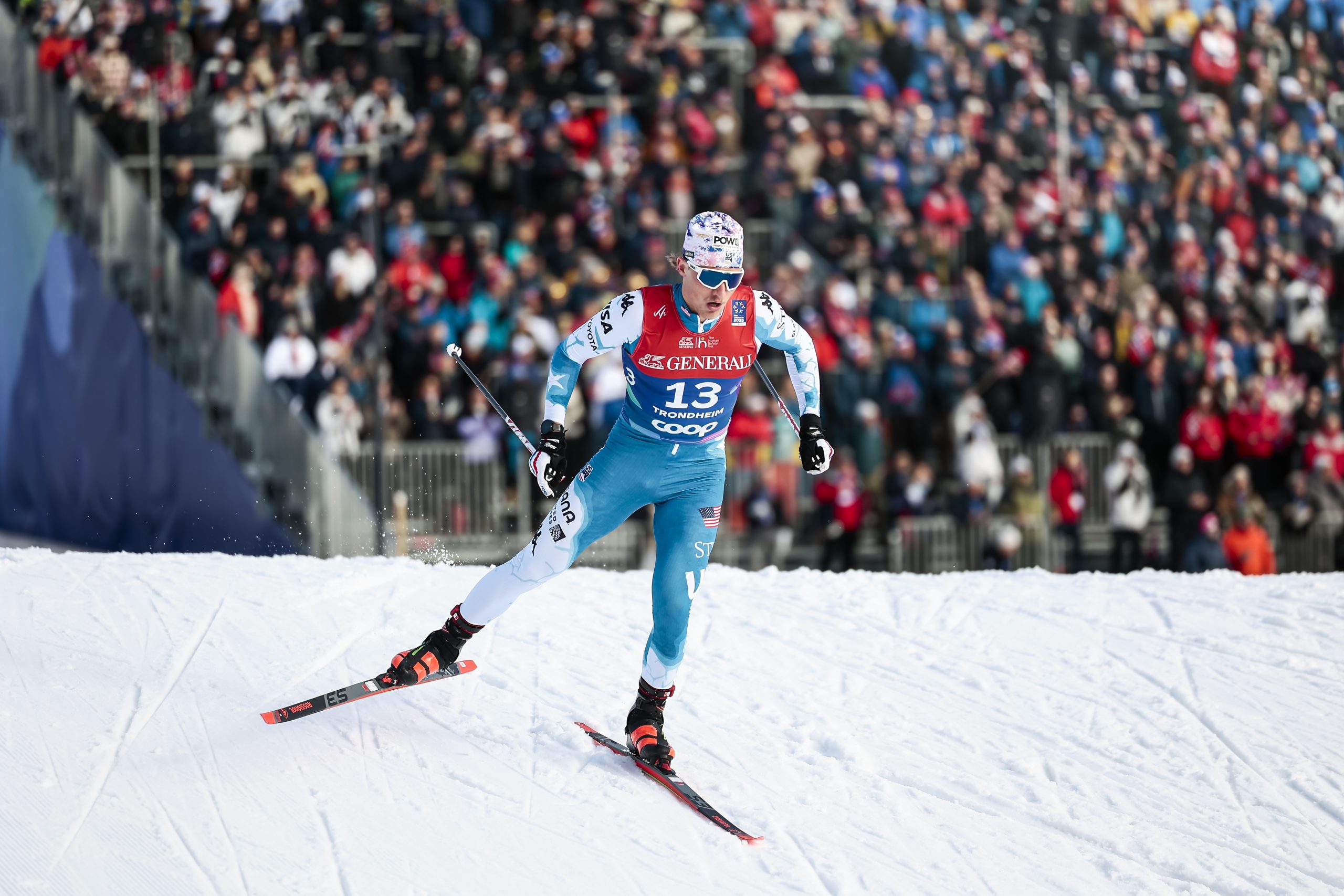
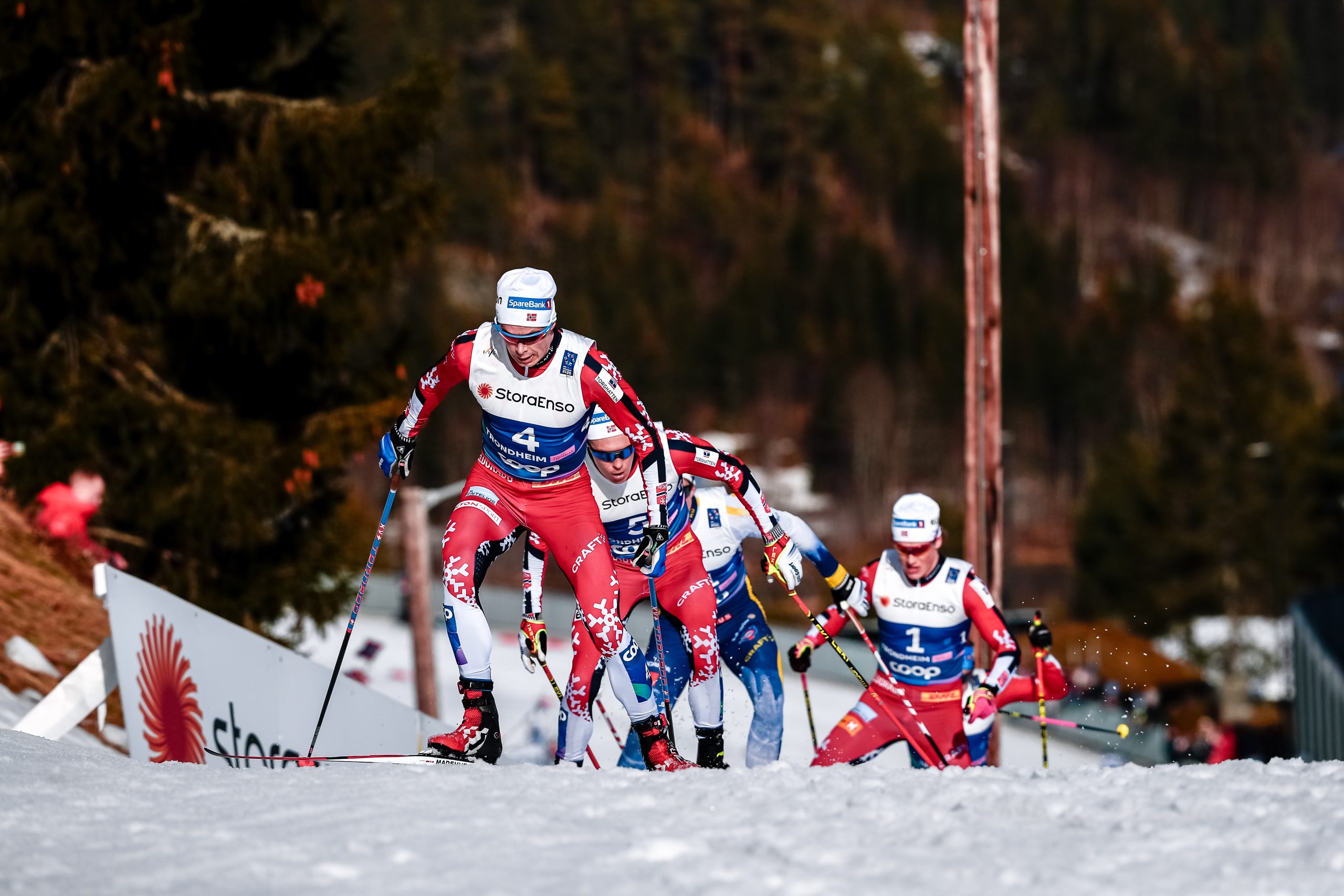
Kate Oldham (USA) during the Individual Sprint at the FIS Cross-Country Ski Championships in Trondheim (NOR) last season. (Photo: Modica/NordicFocus)
It was a small moment, but it spoke volumes — the rookie demonstrating to her mentors not through bravado but through calm instinct and feel. For Oldham, it was proof that she belonged.
“Pre-race days are really fun,” she says. “It’s a time to try stuff out in a low-stakes way. You don’t necessarily want to be experimenting once the heats start, so we’ll trade off who goes in front and see how different approaches work. That corner was taking people down left and right — and none of them were Americans, so that was cool.”
For the team, it was just one corner on one course. For Oldham, it was the quiet confirmation that her precision and poise could stand alongside the best in the world — that she could carve her own line through the sport.
From Carbondale to the World
Oldham, who was recently named to the U.S. Ski Team, grew up in Carbondale, Colorado. In this mountain town, Nordic skiing runs through the community as naturally as snowmelt through the Roaring Fork Valley. “My parents just introduced me to it as a little kid,” she recalls. “We played sharks and minnows on skis.” She skied with the Aspen Valley Ski Club (AVSC) development team, more for fun than ambition—until a trip to West Yellowstone changed everything.
Her dad was helping the high-school team with meals, and Kate got to tag along. “I thought they were the coolest kids ever,” she laughs. “I got a little taste of what it was like to train more seriously—but in a really low-stress way. I could ski when I wanted to, hang out with my dad when I didn’t. I just started liking it more and more.”
By freshman year, she had joined AVSC’s National Comp Team, with coach August Teague guiding her progression. “He had a big hand in shaping my love for training and the structure that cross-country skiing brings to your life,” she says. “I love being able to map things out and plan.”
Teague’s wife, Kara LaPoint, became another key influence. “She’s a pro triathlete and just a really badass person,” Oldham says. “We love training together when I’m home.” From the AVSC coaches to her parents to the national-team staff she works with now, Oldham has always been surrounded by people who bring joy and perspective to the grind of elite sport. “The whole community fuels my fire,” she says.
Oldham recharging back home with good friend Kara LaPoint. (Photo: Courtesy Photo)
The College Shift
Oldham began her college career at Middlebury but transferred to Montana State after two semesters, drawn by the environment and energy of Bozeman. She completed a degree in environmental studies with a minor in sustainability. “I absolutely loved MSU,” she says. “Being in Bozeman just fit me.”
The NCAA circuit gave her a crash course in balancing intensity and independence. “It’s extremely competitive now—good skiers in every region,” she says. “You’re racing against Scandinavians, Europeans, all kinds of strong athletes. It’s a great way to get better.”
Equally valuable was learning to juggle priorities. “That balance between school, life, and skiing teaches you communication and time management,” she says. “It’s the same skill set you need later, navigating different coaches and support staff.”
Oldham’s affection for the Bobcats remains strong. “I’m still really close with the team. Sometimes I’ll text my old coach, Sam Benzing—’Hey, do you remember what we were doing at this time last year?‘ They’re always willing to help, and I’m super grateful for that.”
Oldham celebrates making First Team All-American at the 2024 NCAA Championship. (Photo: Courtesy Photo)
A Pro’s Life in Bozeman
When she graduated, Oldham decided to stay in Bozeman and train with Andy Newell and the Bridger Ski Foundation. “Andy’s a great mix of laid-back and professional,“she says. “He’s flexible with what I want to do but still really on top of things.”
Without classes or side jobs, Oldham has ramped up her training—but carefully. “We’ve been cognizant not to make big changes when what I’ve been doing has been working,“she says. “There’s already a lot of change in an Olympic year. I wanted to keep what I could the same.”
Her days follow a rhythm familiar to many full-time athletes: morning training, lunch, laptop chores, a second session, and quiet evenings. “I like to have a routine, but I also adjust based on life,“she says. “That’s a good skill, especially once you’re on the World Cup. Travel, fatigue, sickness—you have to be adaptable.”
This summer included a mix of Bozeman training and U.S. Ski Team camps. “It’s nice to get new perspectives, new venues, and then come home for family time,“she says. “I love riding my bike, hanging out with my family—just that balance.”
Oldham’s focus on recovery is equally pragmatic. “A lot of my body care happens in the gym—PT and strength work. Tschana [Schiller], our strength coach, does a great job keeping us balanced and mostly injury-free,“she says. “Then it’s good food, good sleep, and time to unwind. It’s simple, but it adds up.”
Oldham and BSF teammate Emma Albrecht. (Photo: Courtesy Photo)
Lessons from the Veterans
One of the most significant changes this past year was joining a national team full of skiers she grew up watching on TV. “It’s wild,“she admits. “They’re all so different in great ways. Seeing them up close, you realize—they’re real pros. It’s their job. But they’re also incredibly humble and welcoming.”
She has learned as much from how Diggins, Kern, and Brennan think about training as from what they do. “They all pay close attention to what they need on a given day,“Oldham says. “At a camp, they might all have slightly different plans. Not because they’re doing something special, but because they know what works for them. They balance that with the team sessions so everyone gets what they need.”
It’s a lesson she wishes she’d known earlier. “Even though it’s scary sometimes, it’s okay to be confident in yourself and your plan,“she says. “Doing what you need is a huge asset. Trusting yourself can be hard, but it’s worth it.”
That self-trust carries into her goals for the season. “Obviously, I’d love to make the Olympic team,“she says. “That would be an incredible experience. But I’d also be really happy with some top-30s on the World Cup.”
After spending time with Kate, it quickly becomes apparent that she is cooler than most of us. (Photo: Courtesy Photo)
More importantly, she wants to manage the grind. “I learned a lot last year, and I’m still figuring out what I need to stay happy and motivated through a long season of travel,“she says. “That’s a big process goal—dialing in what works for me.”
She’s also been working on how she handles the inevitable rough patches. “My tendency can be to isolate when something goes wrong,“she says. “But I’m learning to use my support team. There are people who want to help, and when I let them in, they always have a great perspective. Sometimes it’s just someone saying, ‘What did you learn today?‘That can shift the whole mindset.”
Looking Ahead
Oldham envisions a long career—but only if she keeps loving it. “I want to love skiing forever,“she says. “As long as my body’s healthy and I’m enjoying it, I’ll keep going. But not at the expense of that joy.”
Her advice to the younger version of herself, and to the next generation coming up through AVSC, is simple. “Don’t count yourself out,“she says. “So much can happen in a race that you don’t expect. Sticking with it is the only way to find out. Enjoy it, and pay attention to the relationships you build along the way—they’re what you take with you.”
Kate and her father, Nelson, out on a hike. (Photo: Courtesy Photo)
The Roots That Keep Her Grounded
When she’s not training or racing, Oldham gravitates back to Carbondale, where her family’s restaurant—Dos Gringos Burritos—is about to turn twenty-five. She’s been part of it since before she can remember. “I’ve been around it my whole life,“she says. “It’s a pretty important staple in our town, and my parents are huge role models for me.”
Working at the restaurant keeps her connected to real life. “The service industry teaches you a lot,“she says. “Everyone should do it once—how to deal with people, how to work hard behind the scenes. It grounds you.”
Her go-to order? “The summer salad wrap,“she says instantly. “But after twenty-three years of hanging around the place, you have to keep it fresh.”
Outside the restaurant, she finds calm in the same things that shaped her childhood: horses, bikes, and the Colorado mountains. “I grew up around horses and hope to return to that life after skiing,“she says. “Being outside, cooking, baking—it’s all part of keeping balance.”
That balance, she’s learning, is the fundamental foundation of confidence. It’s not just about speed through a corner or times on a results sheet—it’s about knowing where you came from and who you are when the racing stops.
Oldham loves getting outside, especially on horses. (Photo: Courtesy Photo)
Love Stories Like This? Help Keep Them Coming.
Feature interviews like this one take time, access, and care to produce. If you value thoughtful storytelling and independent ski journalism, please consider becoming a Voluntary Subscriber. Your support directly fuels the work we do to cover the people, places, and moments that make our sport special.
Gus Schumacher (USA) has refined his own training program as a system of quality, consistency, and recovery. Stepping away from the headlong pursuit of training volume has made him a podium threat on the World Cup circuit. (Photo: Modica/NordicFocus)
We read it again and again in studies, articles, and coaching posts: “Training volume is the best predictor of performance.” It’s one of the most consistent findings in exercise science, appearing across endurance sports for decades, and in national training systems.
But the statement is often repeated without understanding what it really means, or more importantly what it doesn’t.
One reason this line gets repeated so often is that “train more” is an easy message to sell. It fits neatly into data-driven platforms, social media posts, and even national team frameworks that favor measurable progress over nuanced development.
Volume Dominates the Data, Not Necessarily the Adaptation
The rise of Strava and similar platforms has given researchers massive data sets, for example, on marathon runners, where the only reliable metric is mileage. And sure enough, those logging the most miles perform the best.
That finding isn’t wrong, but it’s incomplete. These platforms don’t accurately capture the content of training, intensity distribution, recovery, or technique work, only volume. So, when all you can measure is mileage, it’s no surprise the data says more is better.
The truth is simpler: training volume shows up as the strongest predictor because it’s the largest part of most athletes’ training, not because it’s the most important. When 80% or more of total training time is endurance work, volume will naturally correlate with performance. That’s statistics, not physiology.
Studies Measure What’s Easy, Not What’s Important
Volume dominates literature because it’s easy to measure. Hours and distance are clean, consistent numbers, simple to record, compare, and analyze.
What’s harder to quantify are the things that often matter more:
Movement economy and technical precision
Motor-unit recruitment and neuromuscular function
Density and Implementation of high intensity training and recovery between sessions
Psychological and hormonal readiness
Because these are complex and often subjective, researchers default to what they can measure reliably: hours or mileage trained.
That doesn’t make volume unimportant, it just means most studies are constrained by the available data and the methods, not revealing a deep truth about training.
Sophia Laukli’s practice of competing in both winter and summer seasons has been a careful combination of quality and timing. She has managed to succeed in both sports by avoiding overdoing it in either discipline. (Photo: Golden Trail/World Series)
Once Volume Is Similar, Quality and Organization Decide Outcomes
It’s obvious that someone training 800–900 hours per year will outperform someone training 200. But that comparison tells us little about how performance differences emerge within similar training groups.
Among national-level athletes logging roughly the same volume, success depends on:
Organization of training — how the year is structured, how load progresses, and how recovery is managed.
Quality of intensity training— the metabolic, neuromuscular, and technical precision of each session.
Adaptation capacity — recovery ability, nutrition, and environmental context.
In cross-country skiing, we often hear that athletes must reach “X” number of hours by a certain age to be on track. There’s some truth to that, high volume is a prerequisite for success in endurance sports, but at the same time overemphasizing it at the wrong time can lead to burnout and stagnation.
Think of two athletes training for 850 hours. Athlete A spends much of that time repeating familiar distance sessions, always a bit fatigued, never truly sharp. Athlete B structures training with clear intensity targets, technique feedback, and recovery monitoring and control. The total hours are identical, but the adaptation pathways, and the long-term outcomes are completely different.
Volume Is Necessary, but Not Sufficient
High training volume is essential for developing endurance capacity , building capillary density, mitochondrial biogenesis, and aerobic durability. But it’s not exclusive in doing so. High-intensity work also develops these same systems and complements volume by refining muscle fiber and motor unit recruitment, along with physiological functions of maximal oxygen delivery and energy production.
Endurance volume defines how much quality training an athlete can sustain, not how fast they’ll improve. Beyond a certain point, adding more hours yields diminishing returns, or worse, leads to energy deficiency (REDS) and suppressed adaptation.
Volume is the gateway to high performance, but not the differentiator among elites.
Developmental Perspective: How Volume Evolves
Mature athletes don’t keep increasing volume, at some point they can’t train more, they use stable volume to support adaptation to higher intensity and skill development. From a long-term athlete development standpoint, the critical demand isn’t accumulating hours it’s learning how to manage increasing load without maladaptive consequences. For juniors, especially, overemphasizing volume too early often replaces skill and capacity development with chronic fatigue. That doesn’t build champions; it builds survivors.
The following chart represents about 17 years of Marit Bjorgen training in a published study by Guro Strøm Solli, Øyvind Sandbakk. Over the years her training volume moved from 500-950 hours. The average intensity distribution was 92% Low Intensity training, 3% moderate intensity and 5% High Intensity. It is often suggested that the high intensity training at 5% of the total volume is a low total volume. I would say that the load from that proportion is about 3 or more times greater than the similar volume of endurance work. The total high intensity workout are about 100-120 per year, so in my view a big proportion.
Bjoergen’s training volume increased by about 90% over 15 years, which illustrates training volume progress over years, a decade or more. But also, it is important to note there were years with different training implementation, for example where they tried block versus traditional implementation of high intensity training, where the volume did not increase. So, while some may see this increase in volume as the prime driver, I see relatively high loads of high intensity training, and in the long term we often see 2-3 and even as many as 5 years of pretty stable volumes yet performance was still improving.
Capacity to Absorb and Adapt
Ultimately, training volume acts as a proxy for something deeper: adaptive capacity. Athletes who can handle more total work, physically, mentally, and logistically, tend to reach higher levels.
Not because more is better, but because their physiology, psychology, and environment allow them to sustain consistent, productive training year after year.
That consistency, the compounding effect, of well-absorbed work, is what predicts long-term success. The best athletes aren’t those who train the most, but those who train the most effectively, without breaking down.
What Coaches and Athletes Should Take Away
Volume matters — in context.
It’s the framework that allows high-quality work to be absorbed, not the goal itself.
Measure what truly matters.
Hours are easy. Quality, precision of implementation, and recovery are what count.
Recognize diminishing returns.
The right dose is the one you can adapt to, not the one that looks impressive in a training log.
Track quality, high intensity training and recovery as seriously as quantity.
Technique, economy, and consistency matter more than another 50 hours per year.
Individualize the load.
Two athletes can handle the same volume very differently depending on background, age, training background and level of performance.
The Bottom Line
When you read that “training volume is the biggest determinant of success,” interpret it as:
“Successful athletes tend to train a lot because years of consistent training allow them to handle the work required for success.”
But don’t mistake correlation for causation.
Training volume dominates on paper because it’s the biggest piece of the training pie, not because it’s the most critical ingredient. What separates great athletes from good ones isn’t who logs the most hours, but who uses those hours most effectively. The challenge for coaches isn’t deciding whether volume matters, it does, it’s deciding how to integrate it intelligently. The best programs build athletes who can handle more because they’ve adapted to what they have done, mastered recovery, technique, and trained at a consistent manageable level, not because they’ve chased an arbitrary number.
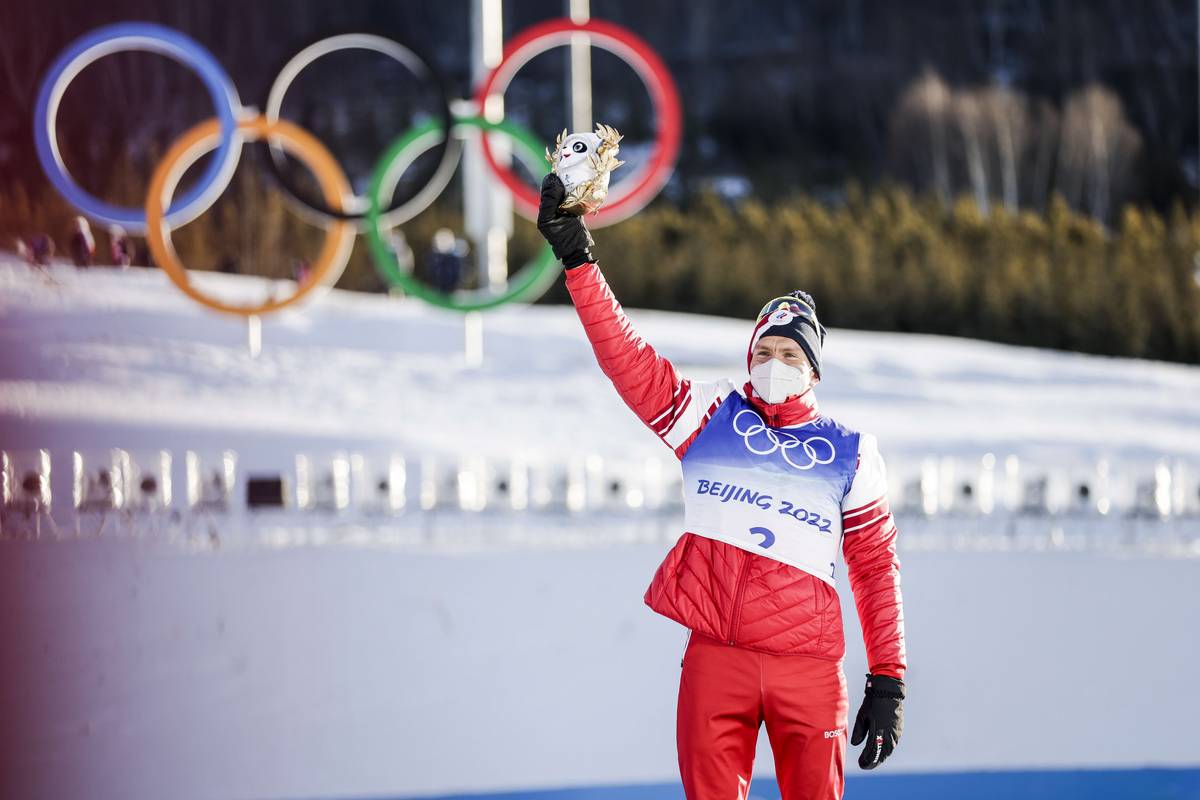
Alexander Bolshunov (RUS) won the men’s 30 k skiathlon in Zhangjiakou. FIS’ recent announcements exclude him (and all other athletes from Russia and Belarus) from qualifying for a return to the Olympic stage in Milan-Cortina. (Photo: NordicFocus)
It’s a funny time we live in . . . one in which many of us struggle with harboring multiple opinions on particular topics (especially political ones). That’s me when it comes to whether or not Russian and Belarusian athletes should be allowed to enter the Olympic Games . . . multiple opinions make sense, and no easy or straightforward decisions seem likely. One thing’s for sure: when it comes to those decisions, someone’s going to be very unhappy.
On October 21, the International Ski Federation (FIS) announced a ruling in which they barred Russian and Belarusian athletes (whether as neutral individuals or as representatives of the national governing body) from competing in upcoming FIS events—events that constitute qualifying opportunities for the 2026 Olympic Winter Games. Since the athletes in question had already been banned from competition since the beginning of Russia’s war on Ukraine, that means that no Russian or Belarusian athletes would have been able to participate in any earlier qualifying events (like the 2025 World Championships). Therefore—since Olympic qualification runs through events sanctioned by FIS—it appears that no Russians will be allowed to compete in the Olympic in 2026. Law suits will be soon to follow, and additional bendings of rules may be considered . . . but, for now, the Russians are out.
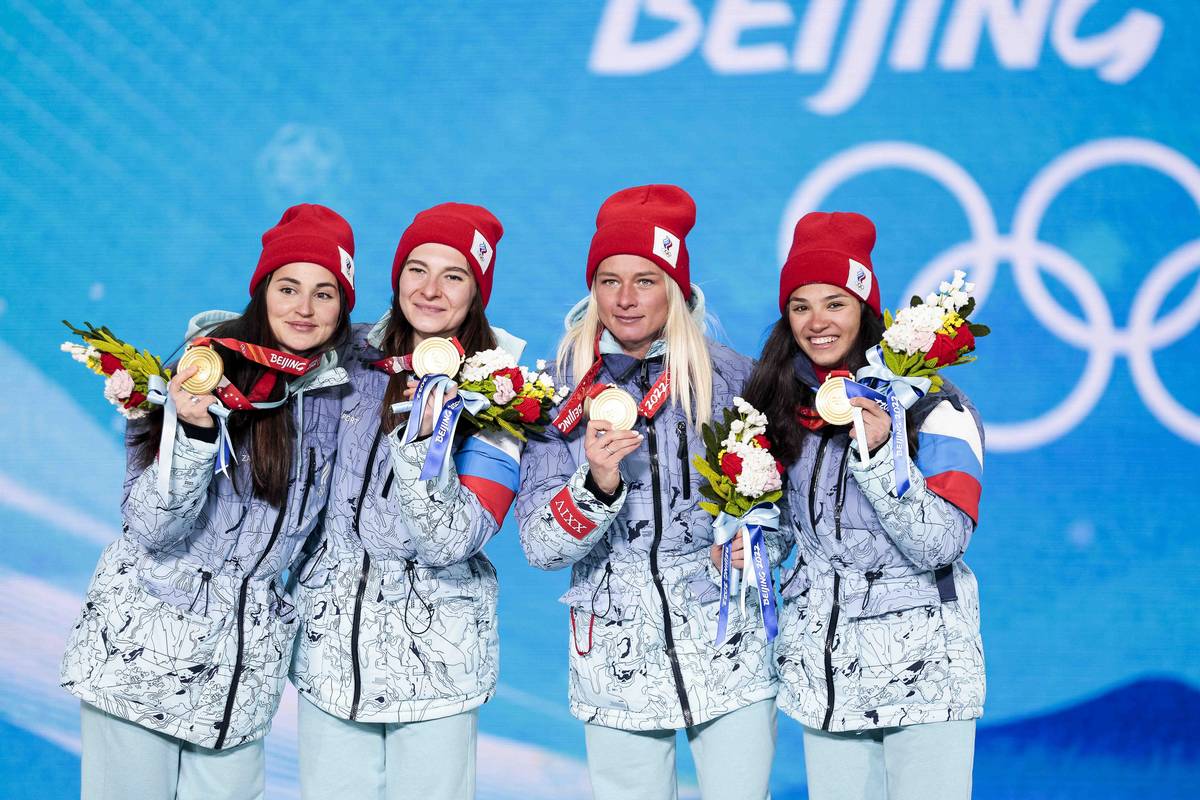
The women representing the Russian Olympic Committee won gold in the 4 x 5 k relay in the 2022 Olympics. From left to right, Yulia Stupak, Natalia Nepryaeva, Tatiana Sorina, and Veronika Stepanova. Recent FIS announcements make it a near-impossibility for them to defend that medal in Milan-Cortina. (Photo: NordicFocus)
What’s right and just about that?
Russia is waging an aggressive war on another sovereign nation. FIS has decided that they will not allow the participation of Russian athletes while their government persists in this criminal action. Skiing is doing its part to try to stop a war . . . I get that.
And what’s wrong and unjust about that?
The Olympic Charter declares that participation in sport is a human right; therefore, the IOC insists that all athletes be allowed to compete regardless of political interference or nationality. In the case of those who hope to prevent Russian and Belarusian athletes from competing in the Olympics, the Olympic Charter is an inconvenient and pesky little document . . . but one that the IOC, itself, is in no position to ignore. FIS has the right (and the responsibility) to establish qualification requirements for those athletes who may go on to compete in the Olympics, but FIS has no right to establish those qualification criteria in defiance of the Olympic Charter. FIS may have announced their decision, but the discussion—and the fight—may not be over yet.
Artificial Intelligence Weighs In
I don’t often resort to the use of AI, but in this case I wanted to see what the broader world (and the computer brain) really thinks about the opinions of the International Olympic Committee (IOC), and the Olympic Charter under which it operates. Here’s what the computer-generated intelligence reported to me (AI generated text will appear in Italics, while Author’s opinions will appear in bold):
Right to compete and non-discrimination
The Olympic Charter states that sport is a human right and that every individual must have the possibility of practicing it without any discrimination.
Here’s the author’s opinion: If “sport is a human right,” then it’s gonna be pretty difficult to prevent any individual human from participating. When it comes to Olympic eligibility, that simple wording is likely to have implications on the participation of even more athletes than just those from Russia and Belarus.
This includes protection against discrimination based on race, color, sex, sexual orientation, language, religion, political or other opinion, national or social origin, property, or birth.
Here’s the author’s opinion: Is FIS discriminating against Russian and Belarusian athletes? It would appear so. The Olympic Charter claims to protect against such discrimination, though how (and if) the IOC intends to affect such protections is still to be revealed.
The IOC and the World Olympians Association (WOA) have strongly reiterated this principle, especially when political tensions threaten to prevent athletes from competing.
Here’s the author’s opinion: Russia’s war on Ukraine is an example of “political tensions” played out to the nth degree.
Athletes should not be held responsible for the actions of their governments.
Here’s the author’s opinion: Russia invaded Ukraine, and Belarus supports Russia. While any number of Russian athletes may have expressed their support for the invasion, certainly those same athletes are not “responsible for the actions of their governments.”
Specific eligibility and rules
Athletes must be eligible according to the rules set by their respective International Federation (IF).
Here’s the author’s opinion: When it comes to “specific eligibility,” FIS has set certain rules (as is their responsibility as a sport governing body under the IOC). FIS’ latest announcement would seem to make it impossible for Russian and Belarusian athletes to participate in the Olympic Games (since none of those athletes will have been entered in any FIS qualifying events).
Specific eligibility rules are applied, such as those related to sex characteristics, which are complex and may require athletes to meet certain criteria to compete in specific categories.
Here’s the author’s opinion: The most recent FIS decision regarding Russian and Belarusian athletes doesn’t seem to have much to do with “eligibility rules . . . related to sex characteristics,” though that’s certainly an argument that should be considered for other athletes who have been barred from Olympic competition. In other words, the right to compete can’t be a human right if certain humans are barred from competing. It’s a touchy subject, but one that’s fairly clearly spelled out in the Olympic Charter. If the IOC (or its sport governing bodies) wants things to be different, then they need to go through the process of amending the Charter.
The International Olympic Committee (IOC) supports the participation of any athlete who has qualified and met the eligibility criteria established by their IF.
Here’s the author’s opinion: Yep . . . but if FIS has acted in violation of the Olympic Charter, then the IOC is compelled to overrule FIS.
Protection of the right to compete
The IOC works to protect the right of all eligible athletes to access international competitions without discrimination by host countries.
Here’s the author’s opinion: Host countries don’t seem to b pertinent in the discussion of FIS recent decision . . . though it may have been a different story when similar decisions were made regarding last season’s World Championships in Trondheim, Norway.
The IOC has taken action in cases where athletes have been denied entry or access to competitions for political reasons.
Here’s the author’s opinion: It sounds like discussions and considerations of the issue may not yet be concluded, and that the recent FIS ruling may not represent the final word. If IOC determines that the FIS decision was one made “for political reasons,” then don’t be too surprised if the IOC decides to allow the participation of Russian and Belarusian athletes. Ironically, the IOC may ultimately allow the participation of Russian and Belarusion athletes for reasons that are mostly “political.”
Ultimately, the IOC is committed to ensuring that sport remains a neutral space and that athletes are not punished or excluded due to political decisions.
Here’s the author’s opinion: FIS is punishing Russian and Belarusian athletes in order to exert pressure on Russia and Belarus (to be fair, much of the world is hoping to exert pressure on Russia and Belarus); therefore, it seems like those athletes are being excluded for political reasons. If that is determined to be the case, then the IOC will need to do something more than simply rubber stamp the decision that FIS announced on October 21st.
There are many weeks between now and the Opening Ceremonies of the 2026 Olympic Winter Games . . . but there’s really not much time left for courts and organizations and governing bodies to consider the question at hand. Many who read the recent FIS decision consider the case to be closed. I’m not so sure . . .
When Lucas Wilmot sits down after morning intervals, there’s no long nap or lazy lunch ahead. “This fall, it’s kind of all back-to-back—training in the morning, then eating, then class, then trying to eat and train again, and then do homework,” he says. “It’s tight.”
That understatement is classic Wilmot: composed, analytical, quietly focused. At just 19, the Jackson, Wyoming-raised skier is already juggling NCAA racing for the University of Utah, kinesiology labs that might soon shift toward biology, and a new badge of honor—fresh membership on the U.S. Ski Team.
Lucas Wilmot was keeping it fun from the very beginning. (Photo: Courtesy Photo)
From Jackson to Utah: A Small-Town Start
Wilmot’s story starts, like so many in American skiing, with a local club, a hand-me-down pair of skis, and a family that encouraged movement. “I kind of started with my parents—they just put me in skiing in elementary school,” he recalls. “Back then, it was all about hanging out with friends and not really racing.”
That changed in middle school, when the sport shifted from pastime to passion. “It took a turn where I started to take training more seriously and be more race-focused,” he says. “I remember looking forward to the trips, doing well in races, and having the older guys on the team as idols. Seeing how big and fast they were—I always thought that was really cool.”
His sister, two years older, was both chauffeur and role model. “She was skiing too—she’s still skiing now at Bates,” he adds. “I started summer training with the older crew in Jackson when I was one of the youngest guys. My sister could drive. I couldn’t. So I’d just spend my time training with the older guys.”
The big breakthrough came as a sophomore. “Minneapolis Junior Nationals was another big turning point,” Wilmot says. “I had three top tens there, and I never expected anything like that. That was when I realized, if I actually put in the time and effort, I can see results that impress even myself.”
Lucas Wilmot (#230 – far right) starting to get serious about his skiing racing at a Junior National Qualifier as a U14. (Photo: Courtesy Photo)
“Welcome to the U.S. Ski Team”
If Minneapolis was the first turning point, Soldier Hollow was the second. “I got third in the classic 10K at Senior Nationals,“ Wilmot recalls. “That was kind of a big whoa moment—a big jump up. Will (Wicherski), my coach from Jackson, came up to me and said, ‘Do you know where you are?‘ I said no, and he said, ‘You’re in third.‘I was just kind of shocked and caught by surprise.”
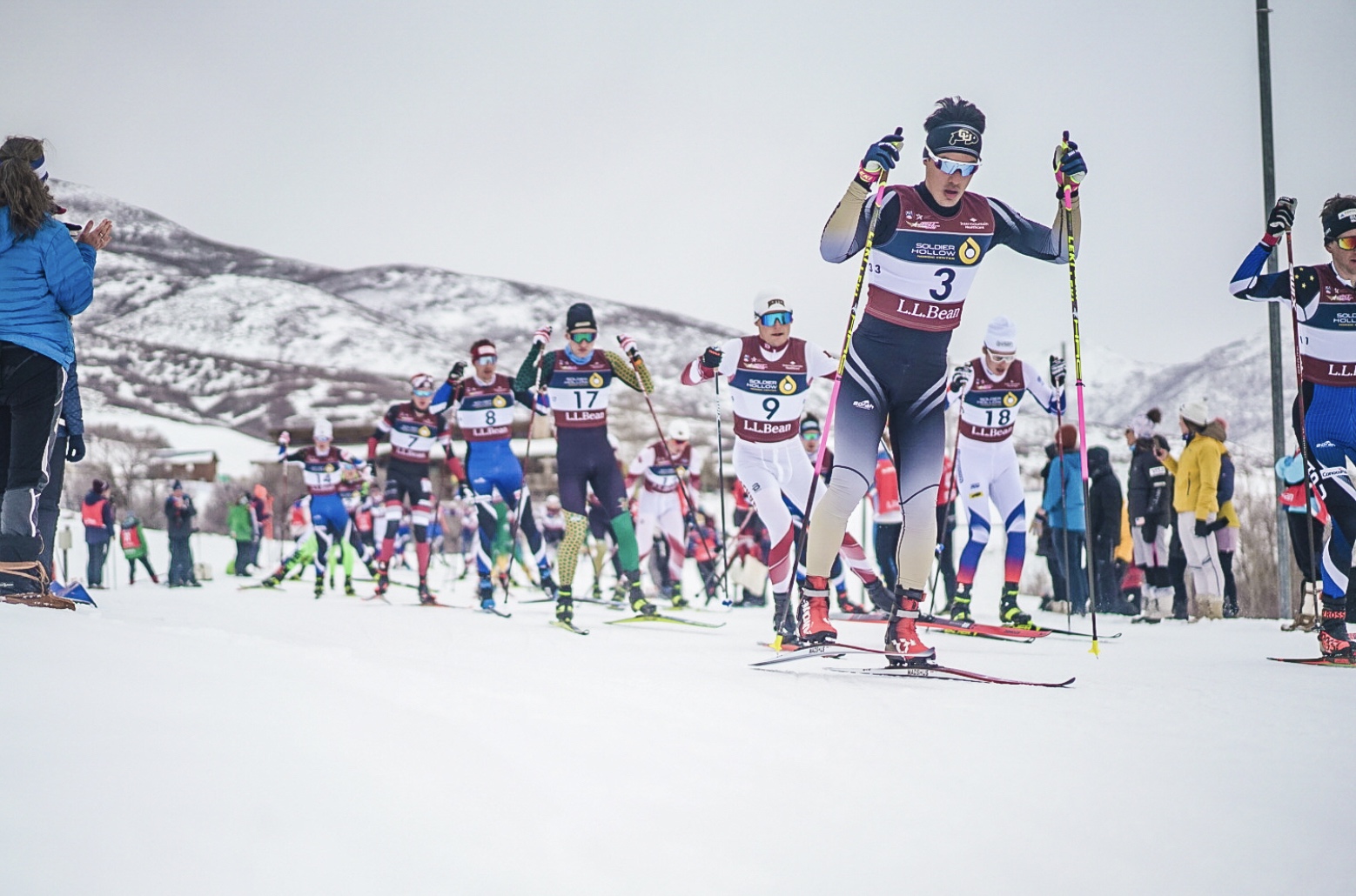
That race qualified him for Junior Worlds, where another top result changed everything. “They released the requirements—it was a Junior Worlds Top 10,“ he says. “When I had the ninth place in Schilpario, Italy, in the skate 10K, I kind of knew I’d made the team. Right after the race, Brian Fish walked by and said, ‘Welcome to the U.S. Ski Team.’“
Wilmot laughs at the memory. “It was at the wax cabin or something. I kind of knew that day. My parents and sister were there, so it was nice to tell them in person,“ he says. “But I didn’t want to be loud about it. I told my parents, like, this isn’t official, but it’s looking like I might be nominated.”
Now, being able to put on the U.S. suit still feels surreal. “I definitely feel pretty lucky,“ he says. “It’s a lot of people’s dream to do that, and it was one of mine. I feel super lucky, and it’s an honor. When I have the U.S. suit on, maybe I’ll go reach out to someone I’ve never met before—they’re all kind of like teammates to me.”
Lucas Wilmot (UU), Murphy Kimball (UAA) and Tabor Greenberg (UVM) this past spring at the USST’s annual Bend camp. (Photo: Courtesy Photo)
Structured but Flexible
Last season Wilmot logged around 500 hours of training; this year he’s targeting about 600. But he’s adamant that numbers aren’t everything.
“I’m definitely not the number grinder. I just try to keep it fun—never do too much, always quality. It’s kind of my mindset: always having quality in the time you’re training. Make sure it’s worth your time to be there.”
He recalls finishing a long over-distance session in Park City camp and realizing more minutes would add nothing.
“I was thinking I could do another 30 minutes, but I’d just be walking. It’s not really how much is that gonna do for me? If it’s not quality, if I’m not putting all my effort in, then I’m not getting the most out of it.”
That approach—precision over volume—mirrors his team’s philosophy. “Pierre (the Utah coach) kind of switched it to more professional training,“ he explains. “Every training has a specific outcome goal to it… You’re not just doing it to do it. There’s a reason why, and it’s all part of a broader plan and structured schedule.”
A Day Measured in Minutes
In Utah’s mountain light, mornings start early—Wilmot trains, refuels, and hustles to class. “I like to think ahead and plan out as much as I can,“ he says. “School is my priority, and how can I get it done efficiently so I can rest well. I try to go to bed as early as I can and know that training in the morning is kind of also a priority.”
The key, he’s learned, is organization—a skill honed on long travel days in high-school racing.
“Being on trips for skiing taught me that if I get it done ahead of time—get all my schoolwork done or just know that when I have spare time, I should try to get ahead or catch up on school—that’s what I think about all the time.”
Even with 600 training hours, he squeezes recovery in where he can. “It’s a hard balance between having training in the morning as a priority or staying ahead on work,“ he admits. “But I think I learned well… just to plan ahead.”
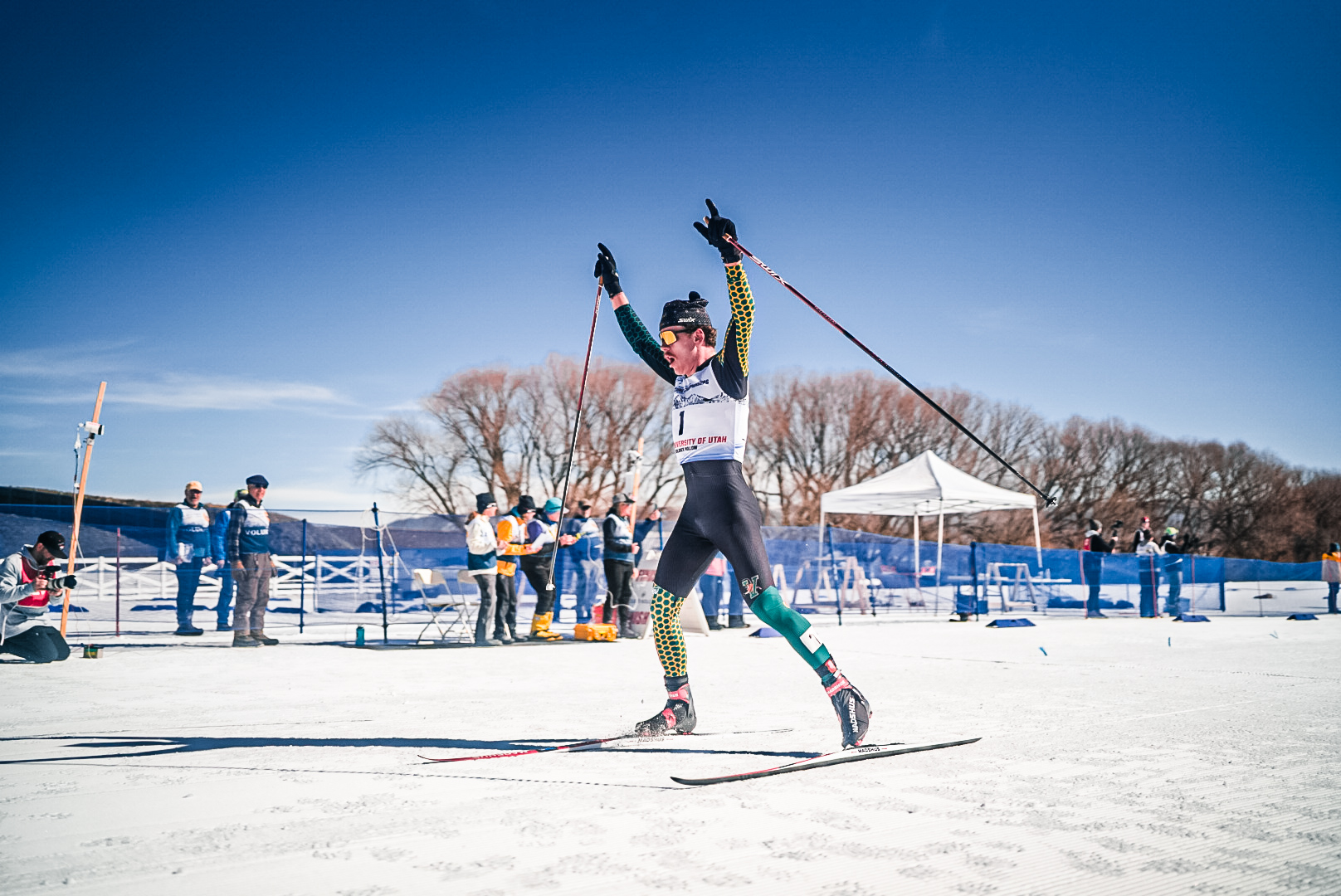
Wilmot during the 7.5-kilometer classic interval start last spring at the U.S. Ski and Snowboard Cross-Country Junior National Championships in Soldier Hollow, Utah. With a time of 23:12.4 second, Wilmot won his first Junior National title in his fourth appearance. (Photo: Drew Palmer Leger/Courtesy Photo)
Fueling the Machine
This semester, recovery and nutrition have become new focal points.
“This fall I was kind of struggling with recovery after the morning session and my class schedule,“ he says. “So one of the things I’m trying to do more of is focus on nutrition right after—that’ll allow me to make it through the long school day and then also recover well. That’ll help me get energy for the training and races.”
Breakfast sets the tone: “Usually a banana, an everything bagel with butter, and maybe a little bit of yogurt… kind of got a little something of everything. It’s pretty yummy.”
The science-minded athlete is applying classroom theory to real life. His kinesiology background gives him a deeper understanding of performance—how recovery, fueling, and training stress interconnect. “I’m keeping on the science track,“ he says. “Right now I’m doing kinesiology, but maybe switching to biology or another science-related thing. Not sure yet.”
Keeping It Fun
For Wilmot, joy isn’t optional—it’s essential. “I just love hanging out with all the buddies, training with friends. Definitely makes it go by a lot faster,“ he says. “It’s pretty fun just to crack jokes a lot and mess around, too… You don’t always have to be serious at training.”
That balance between intensity and levity keeps burnout at bay. Whether it’s running mountain ridgelines or laughing through rollerski sessions, he believes camaraderie fuels consistency. “Sometimes there are places not to focus,“ he laughs, “and just have a good time.”
Fun with friends is Lucas Wilmot’s core principle. (Photo: Courtesy Photo)
The Process of Progress
Beyond coursework and results sheets, Wilmot’s compass points toward steady growth. “I’d hope to make the NCAA team for the University of Utah this year,“ he says. “That’s going to be pretty challenging… but I hope to have more stabilized results and less fluctuation.”
He defines progress through small, controllable actions:
“In skiing, just being as efficient as I can. If I’m in a race and I feel uncomfortable, I try to find where I’m comfortable and not make myself too jittery. Being comfortable in your own way during a race—knowing how to race your races—is important for me.”
When he talks about the future, Wilmot’s tone shifts slightly—equal parts excitement and realism. “Within the next four-year span, there’s a good chance the progress track may take me to that level,“ he says, thinking ahead to the Milano-Cortina Olympics. “If I stick with it, that would be an insane experience and something very special.”
Wilmot skiing with Murphy Kimball (UAA/Alaska Winter Stars) on Eagle Glacier this past summer during the US Alaska camp. (Photo: Courtesy Photo)
A Learner at Heart
Among the national-team veterans, Wilmot sees himself as a student first. “I kind of see myself as a little follower,“ he admits with a grin. “Everyone’s just a little more experienced than I am. I feel like I don’t have much, so I think of myself as a learner and a listener—someone who tries to take everything I can from them.”
But even the learner can lift a team. “I love being the guy that gets someone to smile,“ he adds. “And make them laugh. I love doing that.”
That mix of humility and humor is why teammates have quickly embraced him. He’s not loud, but he’s steady—the kind of athlete who brings calm to chaos, whether it’s a high-stakes interval session or a late-night study grind.
Looking Ahead
Wilmot’s path has never been about a single breakthrough; it’s about accumulation—hours, credits, lessons. “I kind of never saw myself being where I would be right now,“ he reflects. “It goes back to the open-doors thing—I was just following what was happening, putting in the work, and seeing what opportunities it led me to.”
That approach—disciplined but flexible—may be his greatest strength. Between lecture halls and ski trails, he’s learning to find balance. And every dawn run, every late-night homework session, is another quiet step toward the next start line.
“It’s a good, hard balance,“ he says, smiling. “But that’s kind of what I signed up for.”
Love Stories Like This? Help Keep Them Coming.
Feature interviews like this one take time, access, and care to produce. If you value thoughtful storytelling and independent ski journalism, please consider becoming a Voluntary Subscriber. Your support directly fuels the work we do to cover the people, places, and moments that make our sport special.
The first time you meet Patrick Weaver, you might not realize you’re talking to one of the most quietly influential coaches in American skiing. There’s no bravado, no self-promotion. Just an easy Vermont calm — a man who measures his words the same way his athletes measure their training: carefully, purposefully, with feel.
On a fall morning, the UVM Nordic team threads through the mist at the Craftsbury Outdoor Center, the quiet hum of rollerskis against asphalt echoing in the distance. Weaver watches from the side, hands in his jacket pockets, hat pulled low. He doesn’t bark instructions. He doesn’t need to. The rhythm of his teams speaks for itself.
Wilmington, Vermont’s Sophomore Luke Rizio. (Photo: Philip Belena/EISA)
“I always say it’s not the individuals that make the team fast — it’s the team that makes the individuals fast,” he says. “Once they believe that, the motivation takes care of itself.”
For nearly twenty years, that philosophy has shaped the University of Vermont into one of the most respected programs in NCAA skiing — not through hype or heavy recruiting, but through a culture of trust, humility, and balance.
Lessons in Motion
Weaver’s path to coaching wasn’t linear. It’s more like a relay through decades of ski mentors who left their fingerprints on his philosophy.
“I never had one coach through my whole career,” he says. “There were a lot of influential people — high school, Stratton, college, the national team. I just learned to take things from each of them.”
He spent a post-graduate year at Stratton Mountain School under Sverre Caldwell before skiing for Cory Schwartz at UNH — a relationship that would define his sense of what a team could feel like.
“Cory was probably the most influential,” he says. “The way he ran that program — it was a family. I took that with me when I came to UVM.”
After college, Weaver worked under a rotating cast of national and international coaches: Gordon Lange, Christer Skog, Sten Fjeldheim, Torbjørn Karlsen. Each brought a different rhythm to training. The mosaic of ideas shaped the adaptable style he’s known for today.
“There’s not one way to coach,” Weaver says. “And because of my background, I’m not a ‘my way or the highway’ coach. I’ve seen too many ways that work.”
Patrick Weaver racing in the 15 k Classic at the 2002 Olympics in Soldier Hollow, Utah. Weaver finished in 16th place. (Photo: UNH Ski Team)
The Season He Cut His Hours
In 2002, the year of his second Olympics, Weaver did something radical. He trained less.
After years of logging 800-plus-hour seasons, he realized the grind was killing his joy. So he cut down to 600 hours — just one session a day, mornings only.
“I was kind of burned out,” he says. “I’d dread the afternoon workouts. I loved the sport, but I wasn’t feeling good anymore. When I stopped doing the PM sessions, I felt better — I started looking forward to training again.”
It’s a story he still tells his athletes, not as dogma but as permission. Permission to rest. Permission to find balance.
“I’m never afraid to tell an athlete to train less,” he says. “Sometimes that’s the thing that gets them going faster.”
That season became a turning point — not just in Weaver’s career, but in his view of what performance really means. It was the seed of a coaching style rooted not in metrics, but in intuition.
Ben Ogden celebrates after sweeping the 2022 NCAA Championships in Midway, Utah. Ogden became 1 of only 4 skiers (alongside US Ski Team teammates Novie McCabe and Sophia Laukli) to win an NCAA Championship and represent the US at the Olympics in the same season. (Photo: Tobias Albrigtsen / @untraceableg)
Coaching Ben Ogden — and the Art of Listening
If Weaver’s name is not immediately known outside the NCAA world, it should be. One of his former athletes — UVM graduate Ben Ogden — is now one of the most dynamic racers on the World Cup circuit. Their partnership, built over seven years, is the epitome of Weaver’s coaching DNA: patient, collaborative, and deeply human.
“I’m not Ben’s day-to-day coach,” he explains. “He’s got great people at Stratton and the U.S. Ski Team. But we talk — a lot. Strategy, planning, recovery, the big picture. And it’s never me saying, ‘Do this.’ We talk it through and find what makes sense logically.”
That logic isn’t written in a spreadsheet. There are no lactate meters, no elaborate testing protocols.
“We’re very unscientific,” Weaver says with a grin. “Ben appreciates the go-with-the-flow training plan. It’s all feel-based. If it feels good, we go with it.”
The two share what they call the “Gus Workout” — a set of smooth, fast intervals inspired by Gus Schumacher. “It’s not about killing yourself,” Weaver says. “It’s about moving fast with good technique.”
It’s fitting that one of America’s most promising World Cup athletes traces his development back to a coach who believes that skiing, at its best, is about rhythm and relationship more than data and drive.
The UVM Way
Weaver took over the Catamount program with a straightforward goal: strip away the clutter.
“When I first got here, I just explored,” he says. “I found training venues close to campus — trails and loops that were right here. We stopped driving hours to ski. It simplified everything and gave athletes more time to recover.”
That ethos — local, focused, efficient — defines UVM’s identity. Training isn’t glamorous, but it’s deliberate. The team atmosphere is close-knit, even familial. “There’s nothing special about UVM,” Weaver jokes, “and that’s what makes it special.”
He points to the campus support network — trainers, nutritionists, sports psychologists, and strength coaches all under one roof — as one of the program’s hidden advantages. “It’s on par with professional teams,” he says. “The athletes can see everyone they need in one day.”
That infrastructure helps athletes stay healthy, grounded, and balanced — which, for Weaver, is the real key to longevity.
“We’ve had international athletes come in liking skiing, and they leave loving it,” he says. “That’s when I know we’ve done something right.”
Junior Owen Young (Anchorage, Alaska) and Sophomore Fin Bailey (Peru, Vermont). (Photo: Phillip Belena/EISA)
Through Change and Uncertainty
Weaver has been around long enough to see college skiing evolve from a regional stepping stone to a legitimate World Cup pipeline. He’s also watched it collide with new realities: NIL money, early recruitment, the escalating costs of youth development.
“When I was at UNH, I was training 500 hours a year and thought that was a lot,” he says. “Now I’ve got athletes training 700 or 800 hours — and managing school on top of it.”
That dedication, he says, is a sign of progress — but also a warning.
“Kids are training more and more at a younger age,” he says. “Sometimes it worries me. Are they doing it because they want to, or because they’re being told to?”
He worries, too, about the economic side. The college landscape, reshaped by NIL and revenue sharing, could make Olympic sports harder to sustain.
“We’re fundraising to pay athletes while big schools make $200 million a year off TV deals,” Weaver says. “It’s hard to see how that’s sustainable.”
He laughs softly when asked what NCAA skiing looks like fifteen years from now. “I hope we’re still here,” he says. “I really do.”
The Long Game
If the world of college skiing is shifting underfoot, Weaver’s motivation remains rooted in something simple: people. Every year brings a new roster, a new set of personalities, a new chance to start fresh.
“You do something long enough, it’s hard to stay motivated,” he admits. “But each fall I get new athletes, new relationships. First-year students I barely know become seniors I can’t believe are leaving. That cycle keeps it exciting.”
He pauses, then adds, almost to himself:
“Maybe that’s what success really is — watching them fall in love with skiing all over again.”
UVM Sophomore Rose Horning from Leadville, Colorado. (Photo: Phillip Belena/EISA)
Vermont’s Quiet Legacy
Weaver doesn’t measure his legacy in NCAA titles or Olympic appearances, though UVM has had plenty of both. He measures it in the quiet mornings at Craftsbury, Jericho, or Sleepy Hollow, where athletes rediscover why they started skiing in the first place.
He doesn’t see himself as a gatekeeper of results but as a caretaker of culture — one that prizes simplicity, joy, and belonging in a sport that often forgets how to slow down.
In a world obsessed with metrics, Weaver’s story is a reminder: sometimes the best architectures of success are invisible — built in the space between workouts, in trust, and in the quiet confidence that skiing, at its best, should always be fun.
“The best thing I can do,” he says, “is help people love the sport.”
Coach Weaver chats with his first-year from St. Paul, MN, Hanna Koch. (Photo: Philip Belena/EISA)
This article was made possible through the generous support of our voluntary subscribers. If you would like to see more articles like this one, please support FasterSkier with a voluntary subscription.
The men’s 30k mass start free during the 2022 U.S. Cross Country Championships in Soldier Hollow. (Photo: Tobias Albrigtsen / @untraceableg)
I’ve been curious for a long time about participation trends in cross-country skiing and what direction the data might point. Ideally, I’d like to see longitudinal data over 10-20 years, but that kind of dataset doesn’t appear to be publicly available. Still, there are several metrics we can look at, participation in popular citizen races, involvement in youth programs, and USSS competitive memberships, that together may paint a picture of where the sport stands.
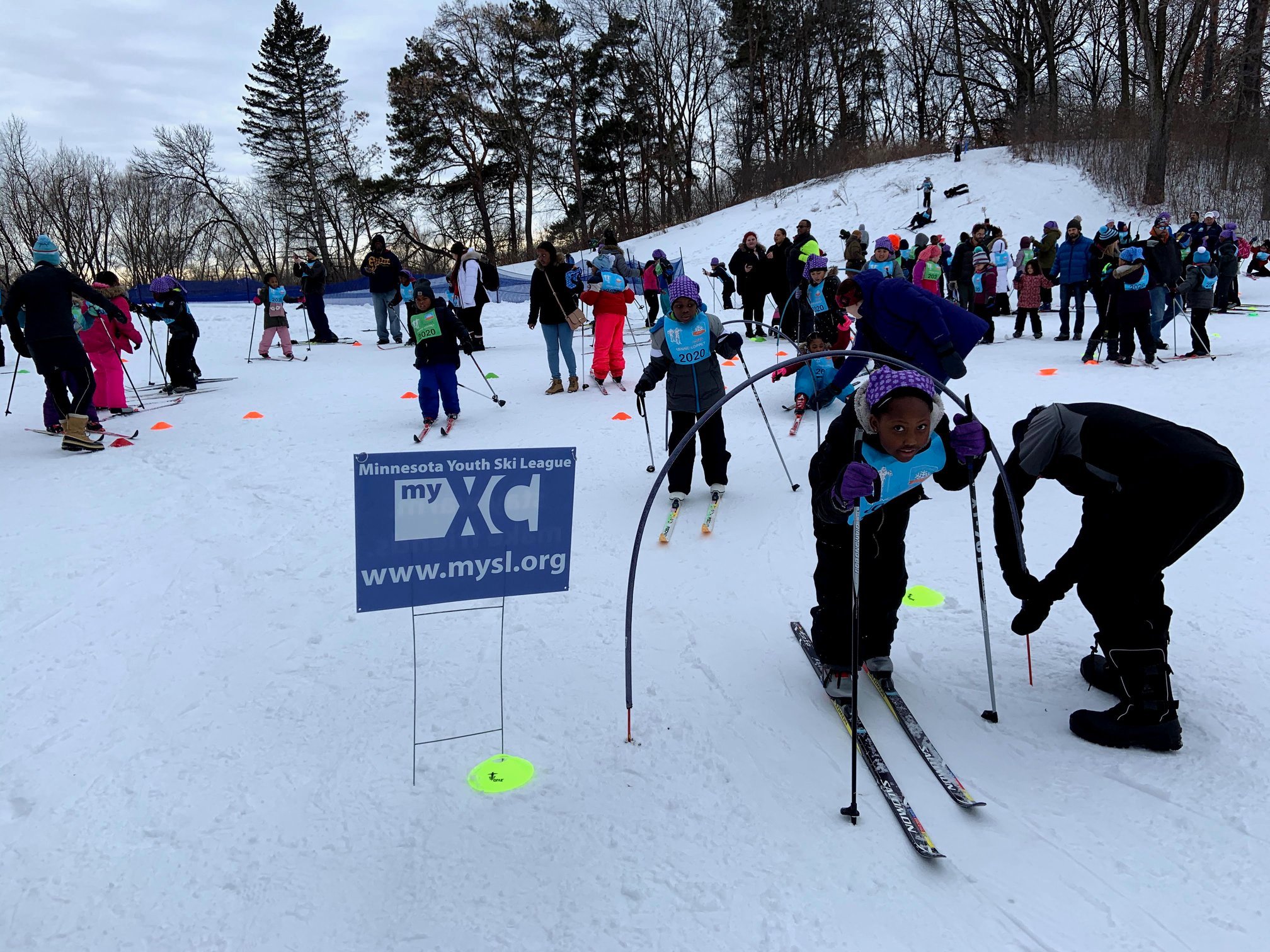
A 2021 article in FasterSkier noted that the Minnesota Youth Ski League had over 4,000 participants, suggesting growth and enthusiasm at the grassroots level. Yet, that growth doesn’t seem to be carrying over into USSS racing participation. At least from the perspective that there about two times as many youth skiing in the Minnesota Youth Ski program than there are junior members in USSS from the U16-U20 age groups.
The table I compiled, from the USSS website for the 2024–2025 season, includes membership numbers for U16, U18, and U20 competitive skiers. These figures represent registered members, not necessarily those who actually raced. For example, in the Rocky Mountain Division (RMD), there are 192 registered athletes, but actual participation in the eight Junior National Qualifiers (JNQs) ranged between 82 and 115 athletes across those three age groups.
Looking at the big picture, there are 2,119 competitive junior members nationwide in these three age groups. For comparison, the Colorado High School Mountain Bike League reports roughly 1,000 racers, while an estimated 14,000 high school mountain bikers compete nationwide. High school cross country skiing, by contrast, has around 6,500 athletes across the U.S. Clearly, other sports are attracting larger numbers. Comparing participation across sports, particularly at the high school level, can be useful context when we talk about growth, accessibility, and retention.
A region-by-region comparison is also revealing. The East and Central regions have by far the most licensed competitors. Junior Nationals in March of 2025 at Soldier Hollow is reported to have had 434 athletes competing, about 20% of the total registered juniors. Interestingly, Alaska, Intermountain, and New England are the regions regularly in contention for the Alaska Cup. That suggests that team performance isn’t necessarily linked to the total number of licensed athletes in a region. Within those top-performing regions, participation trends also differ: Intermountain shows a steady decline through the age groups, while Alaska and the East see participation increase as athletes move up. Note- the influx of college athletes into eastern schools probably accounts for at least some of that growth.
Taking a closer look at RMN Division where I live and work in the sport, over the past three seasons, we’ve seen about a 5% decrease in participation. I wouldn’t claim that this represents a national trend, since I haven’t been able to access comparable data from other divisions. Still, it’s worth noting that within our region, participation tends to drop as athletes progress through the age groups, and again as the season goes on and qualification for Junior Nationals becomes less likely. Whether or not that trend is statistically significant, it’s meaningful in practical terms.
This kind of data, and more of it, should be used to evaluate our programs and objectives, both regionally and nationally. It can help shape priorities around participation, retention, and opportunity. As I’ve written before in FasterSkier, I believe our greatest opportunity lies in increasing participation, keeping athletes in the sport longer, and expanding access. Not just from a performance perspective but also from a need to address social and cultural values.
Right now, junior cross-country skiing in the U.S. is largely managed at the divisional level by regional affiliates. At least in RMD, the primary focus is on hosting four weekends (eight races) of JNQ competition, selecting the Junior Nationals team, and implementing waxing policies, with almost no attention given to how we might grow participation, reduce costs, or better develop athletes. I believe the data illustrates the potential need and opportunity for substantial growth.
A Norwegian friend and former University of Wyoming athlete recently said something that has stuck with me:
“More inclusion and access will drive social togetherness, and results will follow. In my club, Kjelsås, our profile was: ‘As many as possible, as long as possible.’ We became one of the largest clubs and junior teams in Norway, and in 2023 Kjelsås won both the men’s and women’s relay at the Norwegian Senior Nationals. All eight skiers had been members of Kjelsås since they were six or seven years old. I agree completely. There are many more reasons to promote inclusion and access in cross country skiing than medals or championships — but it’s worth noting that those often follow, too.”
This World Cup coverage is made possible through the generous support of Marty and Kathy Hall and A Hall Mark of Excellence Award. To learn more about A Hall Mark of Excellence Award or to learn how you can support FasterSkier’s coverage please contact info@fasterskier.com.
Gus Schumacher and J.C. Schoonmaker on Eagle Glacier last month. (Photo: Matt Whitcomb)
When Gus Schumacher talks about training these days, he sounds more like a craftsman than a workhorse. There’s less emphasis on grinding and more on rhythm — on knowing when to push and when to back off. “I think I’ve just gotten better at kind of knowing what is worth my energy,” he says. “Every day matters a lot, but every day doesn’t have to be as hard or as perfect as the schedule would beg.”
At 25 years old, Schumacher is entering his athletic prime with a perspective that feels both grounded and ambitious. A native of Anchorage, Alaska, he’s already made history: in 2020, he became the first American male to win an individual gold medal at the FIS Junior World Cross-Country Championships, and in 2024, he captured his first World Cup victory — a breakthrough 10 k Freestyle win in Minneapolis that electrified the home crowd and made him the youngest American man ever to win a World Cup distance race and the first U.S. man to win a distance World Cup event since Bill Koch in 1983.
Those milestones bookend a journey defined not by burnout or obsession, but by evolution. Schumacher has traded maximum volume for sustainable excellence, chasing consistency instead of chaos.
From Peaks and Valleys to a Smoother Rhythm
Three years ago, Schumacher’s training logs told a story of wild swings — massive weeks followed by deep recovery troughs. “In the past, I was probably in the 90-hour range (total training hours for a four-week block) pretty frequently,” he says. “Now it’s more in the lower 80s … my balance was more like 20, 23, 35, 10 to 12 hours a week … and now it’s 18, 21, 25, 15, 16 … just a smoother process.”
It’s a subtle but meaningful shift: fewer rest days, less volatility, and a steadier tempo. “I don’t take as many off days, either,” he adds. “When I was younger … it was helpful to have those big stimulus days. But as I’m older … if I do a really big day, it’s maybe harder on me.”
The old model — massive stimulus followed by deep rest — has given way to something more balanced. “I want to feel good most of the time, not just occasionally amazing and then wrecked for days,” he says. “It’s more of a steady hum than a spike.”
Off into the Alaskan wilderness. (Photo: Rudy Schumacher)
Consistency Over Carnage
One of the most evident signs of Schumacher’s maturity is his decision to stop “thrashing” himself in pursuit of arbitrary numbers. “In the past, I would come to a priority day and it would be super hard … and I’d still want to hit an hours goal, cramming training into places where it maybe wasn’t appropriate,” he says. “Now … I’m less inclined to do that and more inclined to just drop an afternoon session and not worry that much about the two-hour hit on weekly volume.”
He’s also embraced a more intuitive recovery model. “The feel comes before those things,” Schumacher says of his data tracking. “Sometimes I’ll feel a little off … and then a day or two later the HRV (Heart Rate Variability) will come down … so the first feelings while you’re training are important.”
Over time, that awareness has become central to how he navigates fatigue. “HRV is objective, but sometimes it’s low because of other things,” he explains. “It’s good to recognize why you might feel a certain way and how to change that.”
Utah Camp and a Smooth Summer
When we spoke, Schumacher was three days into a two-week U.S. Ski Team camp in Utah, training alongside his APU teammates JC Schoonmaker, Luke Jager, Zanden McMullen, and Michael Earnhart. “We’re on our third day of National Team camp,” he said. “It’s great energy here.”
That steady energy mirrors his summer. After illness derailed his 2024 training for nearly six weeks, this year brought the opposite: uninterrupted rhythm. “Last year I was sick for six weeks in August and September, and this year it’s been going really smoothly,” he says. “My health has been super good … I’ve been doing a lot more breathwork … and that’s helped quite a bit.”
The contrast is stark — and instructive. For Schumacher, staying healthy through the summer is no longer just luck; it’s the product of restraint, awareness, and self-trust.
Gus Schumacher with his girlfriend, Olivia Carrier, enjoying the Alaskan view during a workout. (Photo: Amy Schumacher)
Hard Work, Soft Edges
Even as he’s refined his volume and recovery, Schumacher hasn’t softened his competitive edge — just redirected it. “Not a lot of days to really redline it,” he says. “In the summer … I just don’t feel like it’s that worth it. … I’ve definitely stayed away from having a full session that’s just full power.”
He describes one workout — 10 × 1-minute efforts — as emblematic of his current philosophy. “It’s not about dying at the end of each rep,” he explains. “The first one we did, I felt super good and did sort of go ballistic … and I was fried in the afternoon and for a day or two.”
The lesson? “When you feel really good, holding back a little bit … because that good feeling is not necessarily gonna come through in the recovery,” he says. “To get the stimulus from a 10 × 1-minute workout, you don’t need to be on your hands and knees. Having an interval or two where you really push is good … but it shouldn’t be always.”
Fueling with Intention
Schumacher’s fueling strategy mirrors his training philosophy: steady, structured, and practical. “I probably do 30 to 60 grams an hour for two-to-three-hour workouts,” he says. “Our races aren’t really long enough to be super dependent on that … but in training it’s really important just to keep the glycogen stores up.”
For long races, he’s methodical. “During a 50 k, I’ll definitely go for at least 60 grams an hour … I’ve done even 90 for 50 k’s,” he says. And sprint days have their own rhythm: “I’ll do a gel after I do my warm-up intensity … eat a solid meal after the qualifier … and definitely gel before the quarters … and then one in between everything.”
Spear fishing. (Photo: Alex Lee)
Season Goals and the Long View
This fall marks Schumacher’s sixth full World Cup season. He’ll depart for Europe on November 18, with an eye toward the Skiathlon, Team Sprint, and 10 k Skate as his primary Olympic events. “Those are probably my big three,” he says.
He’s also keeping perspective on success. “There are a lot of ways to be successful,” Schumacher says. “To go and be healthy would be a big success … it’d be really cool to ski well for the people who’ve already planned on being there.”
And the reward. (Photo: Olivia Carrier)
That balance — ambition without anxiety — defines his approach. “I’ve definitely got my mind on a medal at the Olympics,” he admits, “but that doesn’t define success for me. Being in the top 10 overall would be cool … but I’m sort of not loving defining it too much. … I just want to be executing as well as I can and keeping healthy and cool-headed.”
After the Tour de Ski, Schumacher plans a 10-day reset at home in Alaska before returning to Europe for altitude training and the final push to the Olympics. “Getting away from the madness for a bit,” he says, “makes me hungrier when I come back.”
Learning to Flow
“I want to keep going as long as it feels reasonable,” Schumacher says when asked about his future. “The next phase is learning more about how my mind and body are at their best. What makes my mind happy is often what makes my body feel good too.”
That mindset — introspective, curious, and confident — underscores everything he’s building toward. “I feel like I’m learning myself more every year,” he says. “Everything gets easier, but I keep getting faster … better at getting into flow state.”
He pauses, then adds: “There are more times now where I just feel like I’m doing a workout that’s hard or long, and I’m able to really relax and enjoy it. I’m excited to bring that to racing.”
Is Gus looking at flow state? (Photo: Olivia Carrier)
Advice for the Next Generation
When asked what he’d tell younger skiers chasing their own dreams, Schumacher smiles. “A big part is just going through the motions and making the mistakes,” he says. “To do that, you have to be happy and enjoying it — having good friends around and making sure it’s not just every day you show up dreading how hard it’s going to be.”
He insists that skiing well starts with loving the process. “The day-in, day-out is not that painful or difficult,” he says. “If you’re doing it right … it should be enjoyable pretty much all the time.”
And perhaps his most mature insight: “Not every day has to be perfect … those bumpy days … that’s what leads to the good days down the road.”
Toward Flow & Beyond
Gus Schumacher’s transformation is not a retreat from ambition — it’s its maturation. At 25, he has already built a resume many would envy: Junior World gold, a landmark World Cup win, and upward movement in the World Cup standings. But he now embraces an athletic philosophy that values rhythm over rupture, feeling over forced, and resilience over recklessness.
“Those best days happen when you’re just kind of there for the game … to keep that going … to enjoy it … and not lose track of these times before they’re gone,” he says.
It’s a voice of calm in a sport often defined by extremes. Whether or not the Olympic hardware arrives, Schumacher’s style — grounded, evolving, and rooted in joy — already feels like a victory.
For Gus Schumacher, exploring the mountains of Alaska isn’t training, it’s a lifestyle. (Photo: Gus Schumacher)
When Trond Nystad talks about Norway’s athletic success, he doesn’t start with medals or podiums. He begins with children — specifically, children who love to play.
“The model of Norwegian sport,” he says, “is to have as many kids as possible, for as long as possible, and try to make them as good as possible.” That simple mantra, lived out in ski clubs from Tromsø to Trondheim, is what he believes keeps Norway at the top of the endurance-sport world.
“It’s about being a champion of the world, not a world champion,” Nystad explains. “The focus is on learning, mastering things, having fun — not on winning.”
Trond Nystad (Photo: NordicFocus)
A System That Lives Its Values
Nystad has coached at nearly every level — from college programs at Northern Michigan University and the University of Denver to national teams in the U.S., Germany, Austria, Switzerland, and Norway. He’s seen systems that thrive and systems that sputter. What sets Norway apart, he says, isn’t a secret training formula but the culture that surrounds young athletes.
“In Norway, the principles of long-term athlete development — the LTAD model — are lived, not just written,” he says.
“In some places, LTAD is a document. In Norwegian clubs, it’s a way of life. Coaches and parents make sure kids master skills, become independent, and most importantly, have fun.”
That lived philosophy keeps kids skiing, running, and playing far longer than in most countries. “Every country that has success over a longer period of time has figured out how to lure kids into sport and keep them there,” he says. “If you have a lot of kids and you teach them a lot of skills, they’ll be driven and have fun. Then it’s easy to talk about high-level training later — because you start with the right foundation.”
The U.S. Comparison: Knowledge Is Not the Issue
Nystad has deep respect for the American coaching scene — he spent years building programs here and still closely follows U.S. skiing. “The U.S. has a lot of really good coaches,” he says. “Sometimes the issue isn’t knowledge. It’s that cross-country skiing doesn’t attract as many kids because it has to compete with other sports.”
The challenge, he believes, is not to clone Norway’s system but to borrow its spirit. “We need more skiers, and we need to take care of them,” he says. “Make sure they have so much fun developing that they don’t want to quit.”
That message — that development is not linear, and that joy is a strategic asset — could resonate in American junior clubs. “If you have fun and learn mastery,” Nystad says, “success will come. But if you chase results too early, you lose too many kids.”
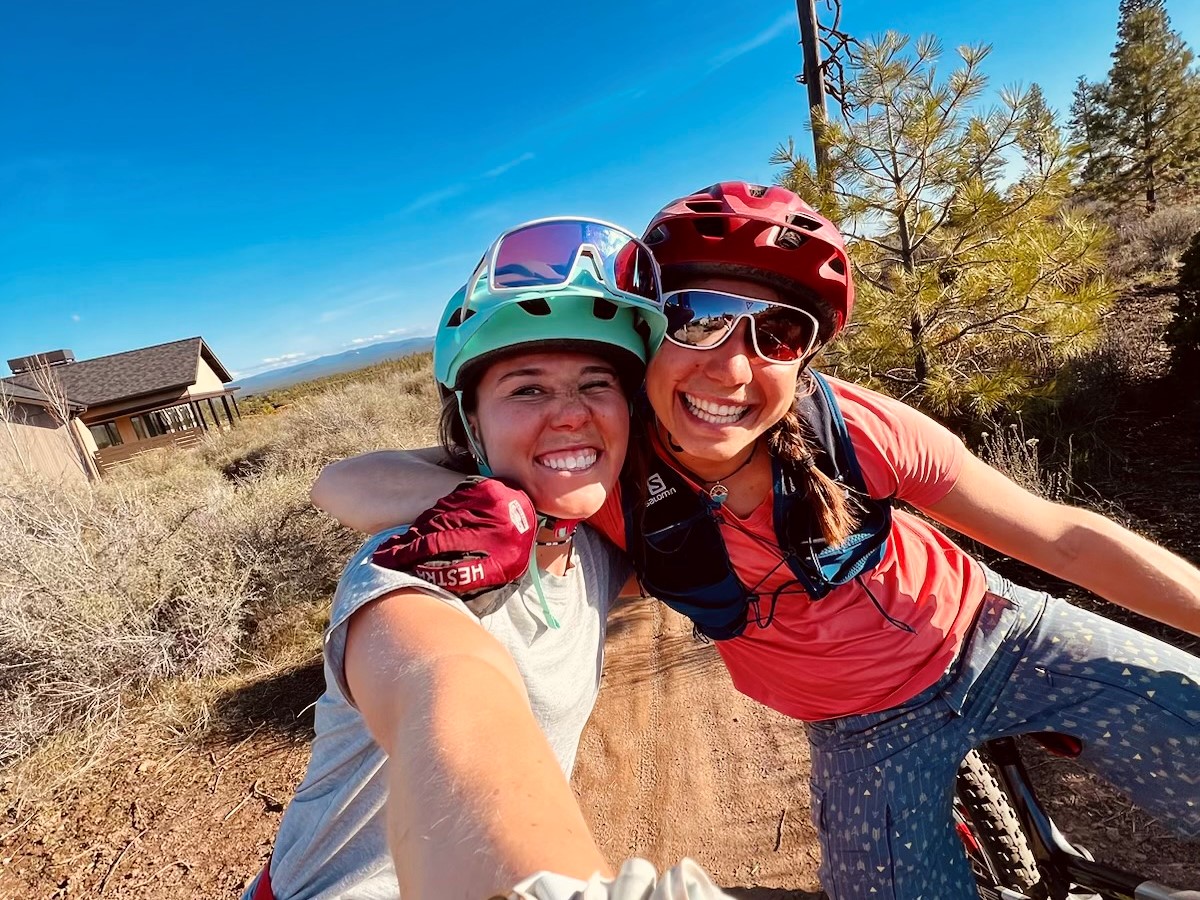
Like many elite skiers, Lauren Jortberg and Julia Kern enjoy mountain biking opportunities for a change of pace. (Photo: Julia Kern)
Against Early Specialization
Asked when Norwegian athletes begin to specialize, Nystad laughs gently. “Focus and specialization are a little bit mutually exclusive,” he says. “You can be focused and still do more than one sport.”
Most Norwegian kids, he explains, play several sports until age 15 or 16 — sometimes even longer. “When they’re 18 or 19, they might focus on one main sport and keep a couple on the side — running and skiing, for example, or cycling and skiing,” he says. “It’s part of the culture. People are active.”
The danger, he warns, comes from well-meaning adults. “A lot of parents try to self-realize through their kids,” he says.
“They want them to specialize early, to do everything right. In the end, the kids are sick of it, have no fun, and they quit.”
His takeaway is simple: “Kids are not miniature adults. They’re kids. Let them be kids as long as it makes sense. Life gets serious soon enough.”
Adam Witkowski poses with his parents after unexpectedly racing a World Cup in Minneapolis in 2024. (Nathaniel Herz/FasterSkier)
The Role of Parents: Mentors, Not Managers
Nystad, as a father himself, knows firsthand how difficult it is to strike that balance of knowing when it is time to commit. “Sixteen is just a number,” he says. Some sixteen-year-olds are grown up; they can form their own opinions and take ownership. Others can barely wipe their own ass,” he says with a laugh.
“But in the end, the kids have to decide for themselves. It has to be something that’s rewarding for them. Our job as parents is to support them — to help them make fewer mistakes, to be mentors along the way.”
That mentoring role — guiding but not controlling — is something Nystad sees as critical for the next generation of athletes. “We’re supposed to help them realize their dreams and develop,” he says. “Not to live our dreams through them.”
“Keep It Simple”: Trust the Body, Not the Gadgets
In an era dominated by data, GPS, and lactate meters, Nystad is refreshingly old-school. He’s not anti-science — he’s trained with and coached some of the world’s most analytically minded teams — but he cautions against what he calls “numbing the senses.”
“The reason to measure is to understand,” he says. “You measure to confirm your subjective feelings — not to replace them.”
“If you’re tired, you sleep. If you’re hungry, you eat. If you’re thirsty, you drink. Those are subjective feelings — and they’re more important than any data you can measure,” he explains.
“Most devices today are not 100 percent correct. Your body usually is.”
For Nystad, training success comes from continuity, not complexity. “The KISS principle applies — keep it simple,” he says. “In endurance sports, you have to train with continuity for a long time and be patient. Don’t screw things up. Control gives continuity, and continuity is everything.”
Fun as a Foundation for Longevity
Nystad lights up when the conversation turns to lifelong sport. “If sport or physical activity makes us happy, we’ll prioritize it,” he says. “Talking about training doesn’t make you better — actually doing it does.”
He encourages athletes — elite or recreational — to reframe movement as a privilege, not a chore. “We should appreciate every day we get to move,” he says.
“It means we’re healthy, we have the time, we can afford the equipment. That’s a luxury we need to appreciate more.”
For parents juggling work and family, his advice is pragmatic: “Maybe it’s better to go for a one-hour run first, and then drink your beer and watch Netflix,” he says with a grin. “It’s just about organizing your day so you get your little quick fix of physical activity.”
The Norwegian Definition of Success
For someone who’s coached Olympic medalists, Nystad’s definition of success has nothing to do with results. “I can’t even remember what happened last winter,” he admits. “Success has nothing to do with medals or wins. I’m happy as a coach when the athletes are happy — when they’ve developed as athletes and as human beings.”
He sees coaching as a human project as much as an athletic one. “I always try to build teams where people work together, respect each other, and do their best. That’s success. If we treat each other well and do the job the best way we can, we’ll reach our potential. Reaching your potential — as a human or as an athlete — that’s success.”
It’s a deeply Norwegian sentiment, one echoed across their sports system: the process matters more than the podium.
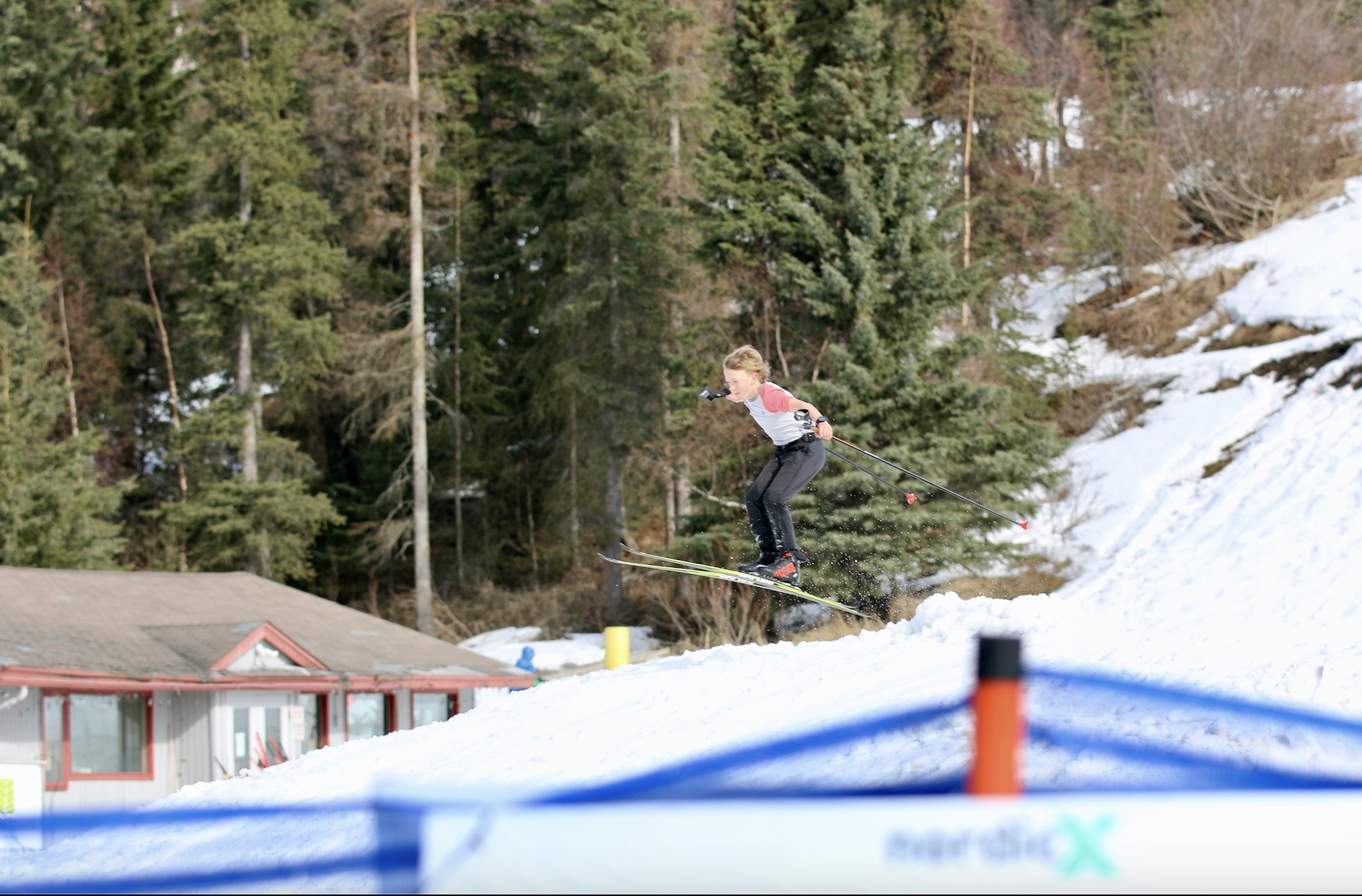
One of many kids enjoying the features on the course and in the Kiddie Cross terrain park at NordicX in 2022. (Photo: Eric Maurer / NordicX)
Lessons for U.S. Clubs and Coaches
Nystad believes that U.S. programs can apply these lessons without mimicking Norway wholesale. “The principles are the same,” he says. “It’s about creating an environment where kids master things, have fun, and stay in sports longer.”
That may mean rethinking what “development” looks like. “Most of the time, we lose more than we win,” he says. “So it’s okay to have a bad race or a bad day. Focus on skill development and mastery — even when things aren’t going well. If it’s fun, and you keep mastering skills, success will come.”
He also urges patience from young athletes. “A big mistake is intensity control,” he says. “They go too fast on the easy sessions and too fast on the hard sessions. They believe ‘no pain, no gain,’ but endurance sport doesn’t work like that. The best athletes are the ones who train a lot — and train smart.”
Technique, Mastery, and Play
Skiing, Nystad reminds us, is as much art as science. “Especially in skiing, which is such a technical sport, the quality lies in doing things right — not just going hard,” he says. “I see so many people skiing with music in their ears, talking, doing all kinds of things, instead of focusing on perfecting technique.”
He encourages athletes to “play” with movement: “No one tells us how to do it. We can choose the way that fits our body and our strength,” he explains. “If more people would play with technique, be conscious of their technical and pacing choices, the outcome would be better for most people.”
Astrid Oeyre Slind (NOR) on her way to a second-place finish in Cogne, Italy. (Photo: NordicFocus)
The Lifelong Athlete Mindset
At 55, Nystad continues to coach, ski, and move daily — not out of obligation, but joy. “If you train right, take care of yourself physically, mentally, nutritionally — and have a blast doing it — there’s no limit to how long you can be good,” he says.
“The moment you start thinking it’s a sacrifice, or that it’s boring — that’s when your career starts to end.”
He cites examples like Hilde Gjørum, who earned her first Olympic medal at 43, and Astrid Øyre Slind, who made her first Norwegian World Championships team at 34 and won her first World Cup at 37. “There are lots of stories like that,” he says. “Everyone can keep getting better — if you love what you do.”
Looking Ahead: A Sustainable Future
Nystad’s final reflections return to sustainability — both of snow and of sport. “Obviously, we’ll have issues with snow,” he says. “Snow storage and snow farming are becoming normal in Europe, and that will change the sport. But cross-country skiing will survive. It’s a great sport — full-body, low-injury, healthy.”
The real challenge, he believes, is getting people to participate. “We need to sell it for all it’s worth and get more people involved,” he says. “If we can bring more people into skiing — kids, families, anyone — the rest will take care of itself.”
The Takeaway: “Master the World”
For Nystad, the essence of sport is not the stopwatch, but the spirit. “The focus,” he repeats, “is on mastering the world — being a champion of the world, not a world champion.”
It’s a mindset that turns every trail into a classroom, every race into a chance to learn. And perhaps that’s the real secret behind Norway’s golden age of endurance: a culture where success isn’t measured in medals, but in how many people can’t wait to clip into their skis again tomorrow.
Trond Nystad, the coach of the Norwegian men’s cross-country ski team, takes questions from the media after the relay at the Sochi Olympics.
Guys, the Olympic season is upon us. Athletes are getting into the sharp end of the dry-land season and waiting for snow to fall; Devon and Nat have awakened from summer hibernation and have launched the new season of the podcast. This year’s will be like nothing you’ve seen before, except with similar amounts of questionable audio production, perfunctory efforts to avoid using profanity and unkept promises of future guests.
In all seriousness, we’re excited to be back for a big year. In this episode, we check in with Vermonter Ben Ogden, a bona fide American Olympic medal hopeful at age 25. Ben catches us up on his summer training, his Olympic vibe and his World Cup facial hair hot takes.
Comments? Complaints? Guest requests? You know where to find us: devon@fasterskier.com and nat@fasterskier.com. Stay tuned.
On October 4, amid a crisp autumn morning at the trailhead near Cable, Wisconsin, around a hundred skiers, family members, and supporters gathered to witness the unveiling of two life-size bronze statues celebrating the trail designers of the American Birkebeiner, Sven Wiik and Marty Hall.
Half a century after their work laid the foundation of what has grown into the United States’ premier cross-country ski marathon, the Birkie community paused to remember the minds behind the trail.
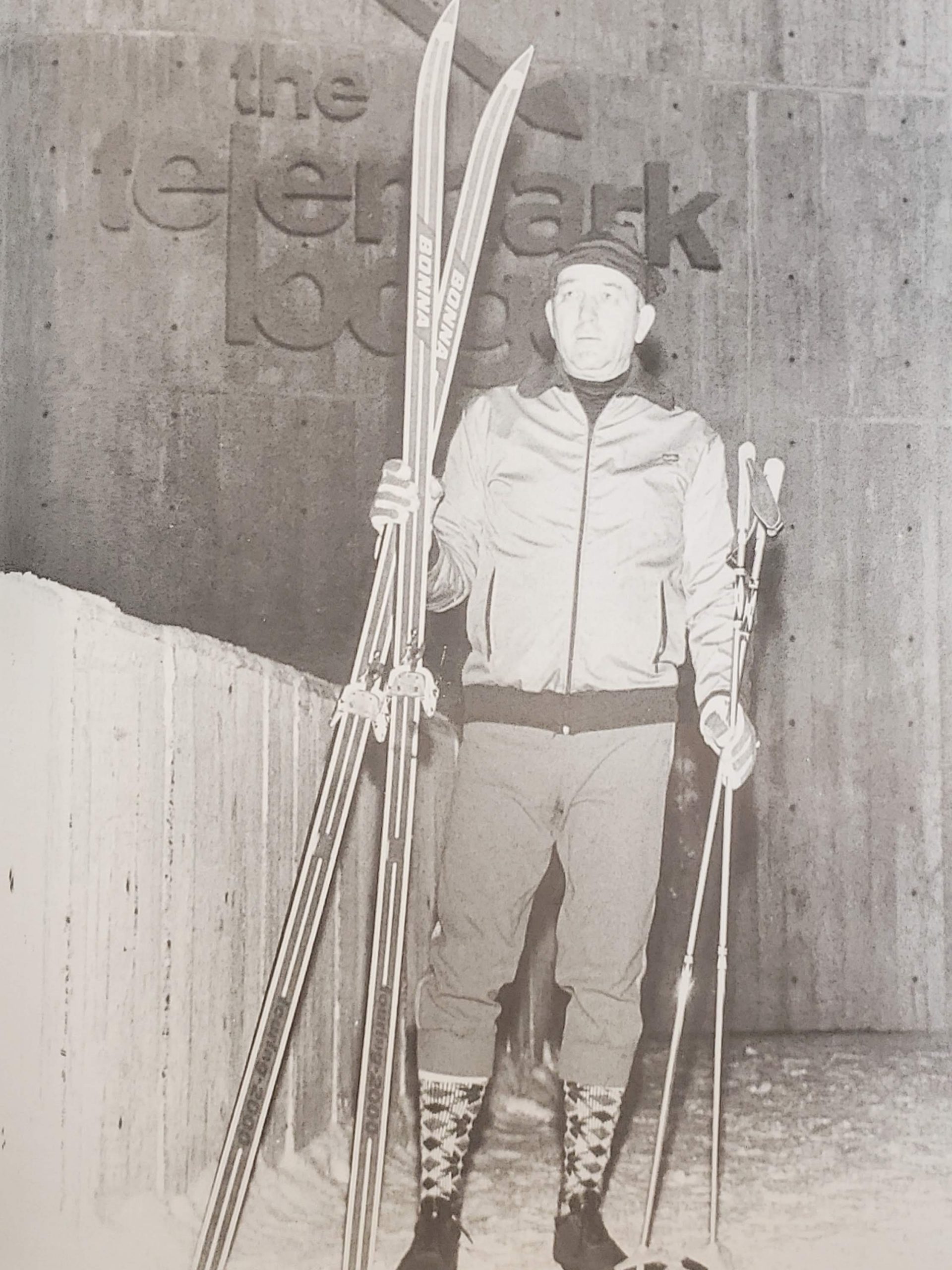
Tony Wise in 1972 outside of the old Telemark Lodge in Cable, Wisconsin. (Photo: Telemark Education Foundation).
From Vision to Reality
The story begins with Tony Wise, owner of Telemark Lodge, who conceived a 50-kilometer cross-country ski route linking Cable to Hayward. In 1975 and 1976, he recruited trail designers Sven Wiik and Marty Hall to bring that vision to life as an enduring path through Wisconsin’s North Woods.
Over the years, the Birkie Trail became more than a race course: it became a symbol, a training ground, and a pilgrimage for recreational and competitive Nordic skiers alike.It’s estimated that over one million people have used the trail since its inception.
Ben Popp, Executive Director of the American Birkebeiner Ski Foundation, offered a fitting tribute at the dedication:
“These two gentlemen turned Tony Wise’s vision into reality. They designed a trail that has helped define the Birkebeiner and has meant so much to generations of skiers.”
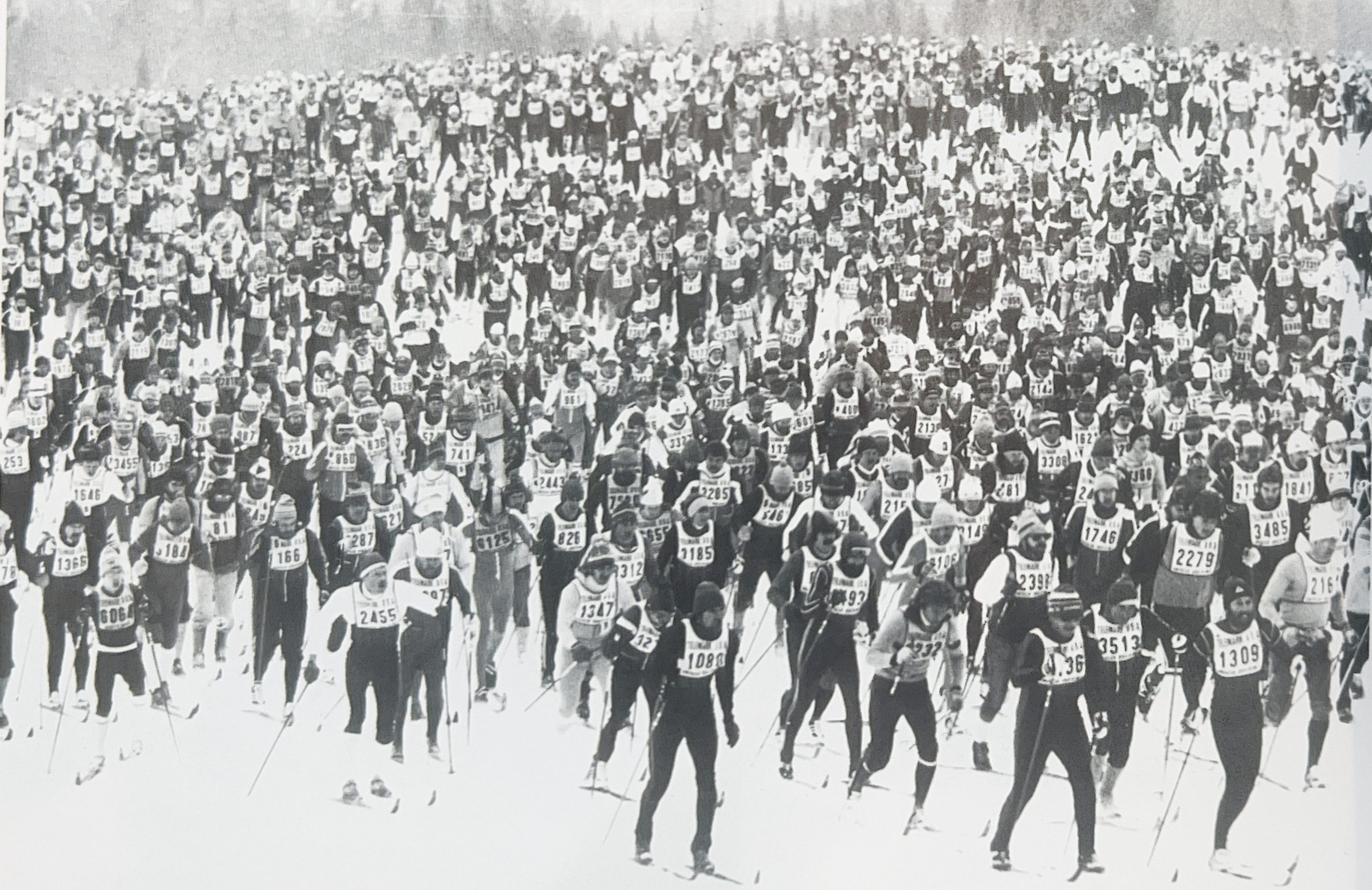
American Birkebeiner VIII in 1981, when the race began by cresting the top of Mt. Telemark. (Photo: American Birkebeiner Ski Foundation)
Lives Cast in Bronze
At the unveiling, Birgitta Wiik (daughter of Sven) and Kathy Hall (widow of Marty) each pulled draping cloths to reveal the statues. Birgitta was joined by Sven’s wife, Birthe, and granddaughter, Kajsa, while Kathy stood with the other family around Marty’s likeness.
Wiik’s statue shows him striding, saw in hand, cutting a path through the woods — a visual nod to the physical act of trail carving. Marty Hall’s statue depicts him with arms crossed, a posture that reflects both his coaching life and his role in trail-building (with trail-marking tools nearby).
Birgitta Wiik unveils the statue of her father, Sven Wiik, as American Birkebeiner Executive Director Ben Popp looks on.
During the dedication, Birgitta spoke to her father’s character and legacy:
“We remember Sven not only as being a trail designer but also as a beloved coach, mentor, and an inspirational figure who dedicated his life to igniting a passion for skiing …”
Meanwhile, Kathy Hall recounted how Marty’s connection with Tony Wise dated back to the spring of 1976, when Marty’s U.S. Olympic team practiced at Telemark and forged a partnership that led him to return to help finish the Birkie trail layout.
The family of Marty Hall gathers at his statue, including his wife, Kathy Hall, to the right of the statue.
Sven Wiik passed away in 2016; Marty Hall died in February 2025.
Legacy, Community, and What’s Next
The statues sit side by side, separated by plaques that highlight each man’s contributions. A third plaque is dedicated to the broader history of the Birkie Trail.
Jerome Poling, historian and author of America’s Greatest Ski Marathon (forthcoming), delivered remarks at the ceremony, framing the trail’s creation as a turning point in American ski racing. He reminded attendees that in 1975, only 324 skiers entered the Birkie; today it routinely draws over 10,000 participants — a growth narrative inseparable from the trail itself.
Also featured in the ceremony were longtime Birkie figures:
Ernie St. Germaine, the only skier to have completed 50 Birkebeiners, offered an Ojibwe blessing.
Don Quinn, coached by Wiik, and Olympic athletes coached by Hall, such as Alison Bradley and Doug Peterson, spoke about the men’s influence.
Frances Wise, daughter of Tony Wise, joined to reflect on the lodge’s place in Birkie lore.
Posing with the Sven Wiik statue are, from left: Don Quinn, who was coached by Wiik in college; Birgitta Wiik, Sven’s daughter; Birthe Wiik, Sven’s wife; and Kajsa Wiik-Lindgren, Wiik’s granddaughter.
The statues were realized through collaboration among the families and the Birkie Foundation. They were sculpted by Milwaukee artist Tom Holleran and cast by Vanguard Sculpture Services, also in Milwaukee. Holleran invested months into refining the likenesses and the postures to tell not just who these men were, but what they represented.
Fundraising is currently underway to erect a third statue — this one dedicated to Tony Wise — to be located near the former Telemark Lodge site, now known as Mt. Telemark Village (the lodge was razed in 2021).
Artist Tom Holleran of Milwaukee stands with the Marty Hall statue. Holleran created both statues.
Why It Matters to the Nordic Community
For the community of cross-country skiers and racers, the unveiling is more than commemorative. It is an affirmation of roots. While races, circuits, and gear evolve, the trail itself remains the backbone of the Birkie. Recognizing the creators of that backbone is a way to affirm history, continuity, and the values that have shaped it.
For future generations — kids who grow up stringing glide wax, college racers chasing time splits, retirees chasing fresh tracks — seeing Wiik and Hall immortalized in bronze grounds the sport in narrative and personality, reminding us that ski trails are more than lines on a map; they are legacies shaped by people.
If you stand at the trailhead and look up the hill, you don’t just see the snow-groomed path ahead — you know the vision and sweat it took to produce it.
Over the years, I have often been asked to review training programs for junior athletes. Most of the time, these requests come when an athlete is underperforming, showing signs of overtraining, or failing to make anticipated steps in competition. Unfortunately, these situations occur far more often than we might think.
In fact, I have reviewed at least a dozen similar cases in recent years, where athletes share the same training and performance profile: high motivation, heavy training loads, and stagnating results. What follows is one such example, based on my review of a U16 athlete’s training. While each athlete is unique, the themes are remarkably consistent.
FIS World Junior Ski Championships (Photo: FIS World Junior Ski Championships Media)
Context and Background
The athlete in question was 15 years old during the period reviewed (May–August). Their maximum heart rate had been measured at 211 beats per minute. At this stage of development, the focus should have been on building a broad aerobic foundation, developing strength, fostering technical skill, and maintaining enjoyment of training.
Instead, the training program reflected a very different emphasis, while the training plans may have been well considered, the implementation of training may not be well observed or monitored. The result of the training was focused heavily on high-intensity efforts, with insufficient, almost nonexistent, volume of basic endurance training.
Training Planning Issues
The coach set training objectives, but absent was oversight to ensure workouts were properly designed or executed. As a result, the athlete accumulated an excessive load of hard sessions without the necessary balance of recovery and endurance work.
A two-week block revealed the following issues:
Too many intensity sessions: Five hard workouts in a two-week period is simply too much for a U16 athlete.
Excessive workout loads: Sessions such as 3 × 5 km at race pace and 6 × 6-minute uphill bounding were far too demanding for this age and stage.
Inadequate between strength sessions: Scheduling strength training on both Saturday and Monday left inadequate recovery time between sessions.
Lack of aerobic base work: Even during a designated “intensity week,” there was little true endurance training. Hikes and other aerobic sessions, given the terrain and execution, often turned into very high intensity efforts.
The result was a program tilted almost entirely toward high-intensity stress, with virtually no low-intensity base training to support adaptation.
Training Implementation Problems
The implementation data confirmed these concerns. In endurance sessions, the athlete routinely sustained heart rates in the range of 183–190 bpm (86–90% of max HR) for 60- and 30-minute time frame. When we assessed the high intensity sessions and races the sustained heart rates for example in a five-kilometer race or time trial, or specific interval session closely matched the heart rates in this chart for similar durations. So, in a five-minute interval we would see 190-195 heart rate and the same as we see within the typical endurance training session as shown in the chart. In the following chart the training zones are not set correctly. The chart is provided to illustrate the time duration heart rates.
In other words, the athlete’s so-called “endurance training” was performed at the same intensity as their racing efforts. Nearly every training session pushed them toward maximal values, leaving no room for proper endurance training and effective adaptation or recovery.
This is a common pattern among juniors without a strong aerobic background: everything is done too hard, which undermines aerobic development.
Establishing Proper Training Zones
To better illustrate, I established training zones for this athlete using their maximum HR of 211. The following training zones I assigned demonstrate the mismatch between intended training and actual execution:
The data showed that the athlete completed nearly all endurance sessions at L3–L4 intensities or higher, rather than in L1 where most of their development should have occurred.
Key Takeaways
Too Much Intensity: U16 athletes cannot handle frequent race-pace or VO2max training without compromising recovery and long-term development. No more than 1-2 high intensity sessions per week.
Insufficient Aerobic Base: Basic endurance work is the most important training at this stage, yet it was almost entirely absent.
Lack of Monitoring: Setting training zone “objectives” is meaningless without proper monitoring and feedback to ensure sessions are executed correctly.
Mismatch of Effort and Purpose: Endurance training performed at race intensities blurs the line between training and racing, preventing the athlete from ever truly building aerobic fitness.
Conclusion
In my experience this case is not an isolated incident, it reflects a broader challenge in junior endurance training. Left to their own devices most young athletes train too hard due to insufficient aerobic development. They simply bypass the low intensity, aerobic zone. Even if the training plans suggest proper training objectives the individual implementation may match the intent of the workout. As coaches, we should monitor what the athletes actually did for training to match it against the intent and desired adaptation from the training. The coaches role is to create a foundation for long-term development by prioritizing learning how to training effectively, skill development, aerobic development, and the proper balance of training stimulus.
When snow begins to dust the Rockies and frost settles into New England, North America’s ski community usually shifts into high gear with optimism. But as the 2025–26 ski season approaches—one poised to crescendo with the Winter Olympics in Milan-Cortina—a double economic hit is reshaping the industry: U.S. tariffs on European sporting goods and a weakened U.S. dollar against the euro. Together, they are raising prices, complicating supply chains, and threatening accessibility in a sport already navigating slim margins.
A Perfect Storm: Tariffs Meet a Weak Dollar
In August 2025, U.S. officials announced a sweeping 15% tariff on European sporting goods, encompassing a wide range of products, from bicycles to skis. For cross-country skiing, nearly every major brand is affected: Fischer and Atomic (Austria), Salomon and Rossignol (France), Madshus and Swix (Norway).
At the same time, the value of the U.S. dollar has weakened relative to the euro. In practice, this means that European brands invoicing in euros are already charging more before tariffs are added. Importers now face what retailers call a “double tax”: currency pressure first, followed by tariffs.
“It’s not just the 15% tariff,” says Nathan Schultz, owner of Boulder Nordic Sport (BNS), which operates stores in Colorado and Maine. “When you add in the weaker dollar, it’s closer to a 25% increase on the goods we bring in from Europe. That’s a big deal for shops, teams, and families trying to keep skiing affordable.”
In addition to a 15% tariff, importers are also faced with navigating a roughly 10% reduction in the value of the US dollar compared to the Euro since the beginning of the year.
Retail Price Shock
The most visible effect of these economic headwinds will be at the cash register. Industry analysts estimate that retail prices for skis, boots, and poles could climb 10–20% this season.
A racing ski that cost $750 last winter could now exceed $850, while entry-level packages—once reliably in the $400–$500 range for high school athletes—may cross into territory that forces parents to think twice.
Junior clubs and college programs, often purchasing equipment in bulk, face an even heavier burden. A 15% hike on 40 pairs of skis adds thousands in unbudgeted expenses, straining already tight development budgets.
Importing in a Shifting Marketplace
As both a retailer and importer of Holmenkol and Rode wax, Schultz has felt these challenges firsthand. Initially, tariffs were expected to be 10%, so BNS priced accordingly. When the finalized 15% tariffs hit, Schultz decided not to reprice mid-stream, absorbing about 5% of the increase himself.
“We ate that extra hit for now,” he explains. “But it’s not sustainable forever. There will have to be more price increases unless something changes.”
Brand-Level Challenges
For ski brands, the new trade environment is a strategic headache. North America has long been considered a key growth market, buoyed by Olympic visibility and U.S. athletes such as Jessie Diggins, Rosie Brennan, Julia Kern, Sophia Laukli, Gus Schumacher, and Ben Ogden.
“North America is a showcase market,” said one brand manager. “Having athletes win on the World Cup while using our skis matters—but so does making sure local clubs and young skiers can actually afford them. Tariffs and exchange rates put us in a bind.”
Some companies may absorb part of the increase, but margins are already thin. Others could delay or scale back product launches. A new boot line slated initially for 2025 may be postponed until 2026, when pricing pressure is (hopefully) less severe.
(Photo: NordicFocus)
Tariff Burden by Brand
While most European brands face similar baseline tariffs, differences in origin create slight variations in exposure.
Fischer and Atomic (Austria): ~15% baseline tariff.
Salomon and Rossignol (France): ~15%.
Madshus and Swix (Norway): ~17% estimated, reflecting Norway’s non-EU status and potential reciprocal adjustments.
Retail Complexity: More Labor, More Headaches
Beyond costs, the logistics of managing inventories are increasingly complicated.
“We have 25,000 SKUs between bike and ski,” Schultz notes. “Every brand is handling this differently. Some have had two price increases already, while others have hadnone. It’s a lot of extra labor just tracking what’s going on.”
Even smaller suppliers face hurdles. Boutique companies like Guru Wax or Air Trim Masks often ship just a few boxes via UPS. But new customs procedures mean all goods are routed through central hubs, adding delays and expense. “Instead of a straightforward shipment to Denver, everything gets bottlenecked,” Schultz says.
Barriers to Entry: The Impact on Families and Clubs
Relative to sports like alpine skiing or hockey, cross-country skiing remains relatively inexpensive. But those margins matter. “When kids need both a skate and classic setup, it’s already a big ask,” Schultz points out. “Add 10 to 25% more on top, and suddenly the sport is out of reach for more families.”
High school and junior programs, many of which rely on bulk gear purchases, are especially vulnerable. “If equipment becomes too expensive, it risks shrinking the base at a time when we should be growing participation,” warns Mount Greylock High School coach Hilary Greene.
The busy scenes of a Minnesota Youth Ski League practice. (Photo: Minnesota Youth Ski League).
Historical Parallels
This isn’t the first time global economics have intersected with Nordic skiing. In the early 2000s, rising costs prompted several companies to relocate their production from Western Europe to Eastern Europe and Asia. More recently, the ban on fluorocarbon wax has required significant R&D investment, squeezing brands that were already operating on thin margins.
For Schultz, the tariffs feel uniquely discouraging: “At the start of COVID, we thought we were doomed. But it turned into a boom because people rediscovered the outdoors. This is the opposite—it just depresses the market.”
Looking Ahead: The Olympic Test
The timing could hardly be worse. With the 2026 Winter Olympics in Italy just months away, the industry had been bracing for a surge in interest and participation.
“There’s always an Olympic bump,” Schultz says. “But if starter packages cost hundreds more, will families still make the leap? Rising prices could blunt that momentum.”
Some retailers are adapting by delaying orders, expanding consignment programs, or promoting non-European goods. Industry groups, such as Snowsports Industries America (SIA), are lobbying U.S. trade officials for relief. Brands, meanwhile, are weighing long-term strategies like currency hedging, North American assembly, or collaborative lobbying.
Ski brands have a long history of using the Olympic platform to showcase innovations and new products. (Photo: NordicFocus)
The Outlook: Uncertainty Meets Opportunity
The following 18 months will test the resilience of the U.S. cross-country ski industry. Tariffs and currency fluctuations threaten to disrupt what should otherwise be a banner Olympic cycle. Yet history shows that Nordic skiing is an adaptable sport, built on perseverance through tough conditions.
“Skiing is resilient,” Schultz reflects. “People love it, and once they’re hooked, they’ll find a way. Our job is to keep it as accessible as possible, even in tough times. If we do that, the sport will weather this too.”
This article was made possible through the generous support of our voluntary subscribers. If you would like to see more articles like this one, please support FasterSkier with a voluntary subscription.
World-class athletes don’t rely on innate talent alone. Instead, they reach the top by engaging in purposeful practice, training that is focused, structured, and feedback-driven.( Photo: Modica/NordicFocus)
As I was re-reading “Peak” by Anders Ericsson and Robert Pool, the quoted paragraph caught my attention. (I most often read my books multiple times as with each reading I tend to find more learning.)
“A 2012 study of tennis players looked at the success and rankings of junior tennis players, that is, younger players who are working and competing to become professionals and compared that with their success after turning pro. There was no relationship. If differences in innate talent were playing a role in determining the best professional tennis players, you’d think those differences would have been noticeable during their junior tennis years as well, but they were not.”
I referenced the study cited to be sure that the conclusion of the study is accurately represented by the author. The theme of this book is that excellent performance is primarily the result of deliberate practice/training, and less so on some perception of innate talent. Another key concept in the book is that at young ages, those exposed to a particular endeavor, sports, music arts, whatever, will initially develop fast and be ahead of their peers, but that initial level of performance does not necessarily correlate to high performance as the athletes age.
Key Athletic Takeaways from “Peak”
Ericsson emphasizes that world-class athletes don’t rely on innate talent alone. Instead, they reach the top by engaging in purposeful practice, training that is focused, structured, and feedback-driven. The takeaway for athletes is that deliberate, high-quality training sessions matter more than simply putting in hours.
Elite performers, whether in sport or music, build detailed mental visualizations/representations of the skill required. For athletes, this means an internal model of proper technique, pacing, or strategy. These visuals allow them to anticipate outcomes, make quick adjustments, and refine performance under pressure.
No athlete reaches the top without effective coaching. Ericsson stresses that coaches who design specific pathways to develop skills, identify errors, and push athletes slightly beyond their current limits are key to unlocking higher levels of performance. Feedback loops are essential.
While the “10,000 hour rule” became popular, Peak clarifies that it’s not about the number of hours, it’s about the quality of those hours. Athletes improve most when training at the optimal level for their current fitness and skills, not by simply repeating routines.
The book highlights that the human body and brain are far more adaptable than we tend to believe. Many “limits” in sport (endurance, speed, technique ) are not fixed physiological or neuromuscular barriers but can be pushed beyond what is currently possible with proper training and mindset.
Ericsson notes that elite athletes distinguish themselves by maintaining motivation over the long haul. They embrace discomfort, sustain focus, and find ways to stay engaged even when progress feels slow.
These concepts highlight what I believe are critical to developing both athletic and life skills so everyone can more fully develop their potential. There are multiple goals and outcomes in sports. For a very few international excellences maybe one outcome, competing in college is another possible level of sports performance, but for many the process of training and exploring one’s potential is valuable outcome but for most participation in lifelong sport for health and fitness is an ideal outcome. Sports should provide many opportunities to excel and develop skills, not just athletic skills, that can be carried out through life.
Perceived early talent is not destiny . . . Team Norway dominates much of international Junior racing, though few of those dominant juniors will go on to repeat their earlier successes in World Cup events. (Photo: Newspower.it)
I have been writing and speaking about this issue as it relates to talent identification in endurance sports and in skiing for many years. As I shared in one of my early articles for FasterSkier, “What’s the Hurry?” I believe that identifying or selecting talent at the U16 specifically and less so, but still at the U18 age groups, is not likely selecting all the athletes who will continue to develop and improve as a senior athlete at the international level.
Some may reasonably point to individual athletes who were all successful as elite skiers and were successful as U16s and younger. True enough, but this does not mean those who were overlooked at that stage lacked the potential to become equal, or even superior performers as seniors. The truth is, we simply do not know. What we do know is that sport development would be more effective if it were more inclusive, less about early selection, and more focused on giving a broader pool of young athletes access to deliberate training and practice.
Peak reminds us that perceived early talent is not destiny. With purposeful practice, effective coaching, and long-term commitment, athletes at every level can achieve far beyond what they once believed possible. This perspective challenges us, as coaches, athletes, and sport organizations, to rethink how we identify, nurture, and sustain talent across the full arc of development. Together, these themes illustrate that sport development should emphasize inclusive opportunities, long-term training, and skill progression, not just early selection of “talent.”
For many high school cross-country ski racers, fall is filled with soccer practices or long cross-country runs. These sports build endurance, speed, and competitiveness—but skiing requires an additional set of skills. Transitioning from fall sports to ski season means making smart adjustments so athletes don’t just carry fitness into the winter but arrive with ski-specific readiness.
We spoke with several EISA coaches about what young skiers should focus on as the leaves fall and the snow approaches.
Bates College skiers getting after some dryland training.
Keep the Aerobic Engine Running
Soccer and cross-country running already provide a strong foundation in aerobic training. However, once the fall season hits full swing, many athletes cut back drastically on their training volume—a mistake that coaches caution against.
“The key is consistency and a little bit of planning,” says Annika Martell, recently appointed Nordic Head Coach at St. Michael’s College. “The huge and random sessions in October and November might not provide as much value as consistent roller skiing or running, where it fits in the athletes’ weekly schedule. Athletes who stay in a rhythm will transition to snow much more smoothly.”
Maintaining three to five aerobic sessions per week helps ensure that all the hard-earned fall fitness carries seamlessly into ski season.
Build Ski-Specific Strength
Running and soccer strengthen the legs, but skiing relies heavily on upper-body power and core stability. Coaches recommend carving out at least two sessions per week for ski-specific strength training.
“Adding focused strength sessions to your training gives the multisport athlete the best opportunity for success in each season,” says Steve Monsulick, former Bates College runner and skier and now Head Nordic Coach at Williams College. “Creating workouts that include upper body, core, and lower body exercises will pay off huge when winter rolls around.”
Even short sessions—such as 20 minutes of core work or a mix of push-ups, pull-ups, and lunges—can make a significant difference. Strength not only enhances ski performance but also helps prevent injuries as the season progresses.
Julia Kern prioritizes strength year-round. (Photo: Julia Kern)
Sharpen Balance and Agility
Skiing is not done on a flat, predictable surface—it’s about efficiency on slippery, changing terrain. Balance and agility drills prepare athletes for that challenge.
Simple routines, such as single-leg squats, side-to-side hops, or time spent on a slackline or wobble board, can sharpen coordination.
“Balance and body awareness are fundamental to success on skis,” explains Shane MacDowell, Head Nordic Coach at the University of New Hampshire. “For athletes to maximize their balance, they must understand how their body feels and moves through space.”
MacDowell notes that skiing balance begins in the feet and ankles. Proper ankle flexion and weight distribution allow athletes to channel energy efficiently into the ski, creating what he calls “free speed”—momentum generated when pressure transfers smoothly through the foot and into the ski between kicks or strides—the result: a more powerful glide and fluid, efficient technique.
A balancing exercise on what Bill Pierce calls the balance or air pillow.
Dial in Technique Before the Snow
Dryland training is the perfect time to refine technique. Even one rollerski session a week helps athletes practice timing, pole use, and weight transfer. Bounding uphill with poles on grass is another effective way to mimic skiing motion.
“We’ve all heard that it takes 10,000 repetitions to engrain a habit; ski technique is no different,” says MacDowell. “It’s much more beneficial to work on technique and engrain good habits over the summer and fall so your body is ready once race season comes.”
Julia Kern heading out on a rollerski in South Burlington, VT with a summer training group. (Photo: Julia Kern)
Prioritize Recovery
Finally, coaches emphasize recovery—something often overlooked by busy high school athletes balancing sports, school, and social lives.
“High schoolers don’t always think about recovery year-round,” Martell says. “Racing fast in February doesn’t mean just prioritizing sleep the night before the big race; October sleep and recovery also matter to keep the body sharp.”
Foam rolling, stretching, and good nutrition all support recovery as new muscle groups are stressed. Because skiing demands far more upper-body engagement than soccer or running, arriving rested and healthy helps prevent early-season soreness from becoming setbacks.
The Bottom Line
Fall sports give ski racers a big head start: strong aerobic engines, powerful legs, and sharp competitive instincts. But skiing rewards those who also train ski-specific strength, balance, technique, and recovery.
As Monsulick puts it:
“You can’t just run your way into ski season. At the higher levels, skiing is a year-round sport that requires a focus on strength throughout the year. Athletes who make these additions while participating in other sports will be well-positioned for success come January.”
With the first snow just around the corner, now is the time to bridge the gap—so when the tracks are set, skiers are ready to glide right into them.
This article was made possible through the generous support of our voluntary subscribers. If you would like to see more articles like this one, please support FasterSkier with a voluntary subscription.
About two years ago, I started asking myself if we could define training zones in a better way. Since then, I’ve looked at just about every model out there. From a metabolic perspective, the 3-zone models tries to anchor the zones on metabolic events. But at best those metabolic points are difficult to accurately identify. Then you have 5- and 7-zone systems. Which is best? Which is most accurate? Honestly, the best answer is: none of them. Every model has limitations.
Some systems set zones based on max heart rate. Others use lactate. Others use gas exchange, often in combination with heart rate. The critical point is not which method you use to define zones, but how you actually implement and apply them in training. Zones are simply bins from which we can assign workouts and then assess the efficacy of those workouts. They are no hard and fast physiological markers.
Take the published paper from the Aker Dæhlie Team in Norway. They laid out a slightly different zone model than what we usually see from Norway. Given the popularity of “Zone 2 training” these days, it’s worth looking closely at how proponents of any system define and use their zones.
In their framework, Zone 1 and Zone 2 overlap significantly in lactate terms: Zone 1 <1.5 mmol, Zone 2 = 1–2 mmol. The associated heart rate ranges are consistent with most published zone models. The implication here is important: lactate is highly variable and differs across individuals. Their “Zone 2” does not align with how many people think of Zone 2, it’s closer to what I would call a classic endurance training zone, not to exceed 70–75% of max heart rate. And because lactate values can swing day-to-day, they’re not a hard anchor for training zones.
The authors themselves caution against overvaluing this range. Their description of Zone 2 is telling:
“Zone 2: Semi-hard long sessions with a heart rate ~140–155 bpm and lactate up to 2 mmol/L. This training costs more than it is worth and should therefore not be prioritized. I2 can work for learning and automating technique. Cost vs. benefit must be considered. Typical duration: 1–3 hours continuous.”
Zones 3–5 in their system are close to common definitions, though their Zone 3 sits a bit lower than usual. Keep in mind, this is a long-distance focused team. World Cup skiers may operate with different zone definitions or simply do more of their quality work in Zone 4.
For context, compare this to the zone structure used in Marit Bjørgen’s training during her most successful years, as published in a detailed study. Her low-intensity zone sat at 67–75% of max heart rate, which aligns with what we’d expect. But her mid-intensity zone (MIT) didn’t start until 89–92% of max HR—leaving a gap of about 30 beats between LIT and MIT. That looks very different from the Aker Dæhlie model.
Both systems are good theoretical models, but here’s my take: endurance training above 75% of max HR usually isn’t worth the cost, especially when implemented in relatively long session. Recovery demands increase, adaptation slows, and readiness for the next hard session is delayed. In yet another commonly published model, based on maximum heart rate and lactate levels, very similar to the Aker Dæhlie model, they place Zone 2 at 72-80%, while some may place VT1 around 80% of max HR, in my experience, that’s not where it falls for most athletes.
We like to think of zones as hard and fast. I’ve been guilty of this myself. But in reality, they’re not. Zones are simply tools to help ensure a specific adaptation. What matters is understanding the range of metabolic and neuromuscular benefits at different intensities—and then using zones to guide training toward effective outcomes.
The following chart presented by Steven Seiler based on data from the Norwegian Olympiatoppen illustrates the range of possible adaptations and the scale of the adaptation at different intensities. So it is important to understand that adaptation to training functions on a continuum and fits with my belief that these concepts of threshold(s) is fundamentally flawed.
My Advice
Interrogate definitions. When reading or listening to others, ask what their training zones are based on. If you’re not speaking the same language, you can’t apply their ideas.
Pick what makes sense. If you use lactate, you need frequent spot checks to understand daily variation.
Validate new tools. Respiration, lactate, RPE, muscle oxygen, and other technologies are useful only if you confirm consistency and reliability.
Don’t chase trends. Learn from proven methods. Assess emerging science carefully. Staying current doesn’t mean jumping on every social-media fad.
Be clear with terminology. Scientists and coaches often use the same terms to mean very different things.
Focus on meaningful tests. A few well-chosen tests that produce actionable data are better than endless numbers.
Remember simplicity. For most athletes, probably everyone, percent of max heart rate is as solid a method as any for setting training zones.
This article was made possible through the generous support of our voluntary subscribers. If you would like to see more articles like this one, please support FasterSkier with a voluntary subscription.
Sophia Laukli (far left) has made her mark in the endurance sports world. Training for the events in which she specializes has become a mixture of science, intuition, and discipline. (Photo: NordicFocus)
Over the past few years, I’ve been studying the work of Herman Pontzer, PhD, whose research in human energetics challenges long-held paradigms of how endurance athletes adapt to training. For decades, endurance training theory was based on the principle of cumulative energy expenditure: train more, eat more, adapt more, and perform better. Pontzer’s Constrained Total Energy Expenditure (TEE) model calls this theory into question.
His concept suggests: the body does not endlessly increase energy production with ever increasing physical activity. Instead, total daily energy expenditure adapts by reallocating energy away from other physiological systems. For endurance athletes, this represents a paradigm shift with direct implications for health, optimal training load, recovery, and long-term adaptation.
While we await further research, the compelling research from Pontzer should give us pause to reconsider how we approach training athletes at all levels.
The Constrained Energy Model: Key Components
Pontzer breaks down energy use into three primary categories:
Basal Metabolic Rate (BMR): energy required for basic functions such as cellular repair, recovery, and adaptation.
Physical Activity Energy Expenditure (PAEE): the energy cost of exercise.
Thermic Effect of Food (TEF): energy required for digestion and metabolism.
Pontzer expresses Constrained Total Energy Expenditure (TEE) as multiples of BMR to make meaningful comparisons across individuals and populations. For a point of reference, in my experience most endurance athletes should target BMR multipliers in the 1.7-2.0 TEE multiplier range
Population/ Activity Level
TEE Multiplier (TEE ÷ BMR)
Notes
Sedentary
1.4–1.6
Desk job, little structured activity
Moderately active
1.7–2.0
Regular exercise, recreational athletes
Hunter-gatherers (Hadza)
2.0
High activity, but within sustainable range
Endurance athletes (highly trained)
2.2–2.5+ (Temporarily)
Heavy training blocks or racing periods
Tour de France ride
3.5–4.5 (short-term)
Only sustainable for weeks, not year-round
Constrained ceiling (long-term sustainable limit)
~2.5
Beyond this, the body compensates by reducing other functions and create health consequences. (immune, reproductive, endocrine)
Even extremely active groups like the Hadza tribe who Pontzer initially studied, or ultra-endurance athletes rarely exceed ~2.5× BMR over the long term. Short-term spikes above this ceiling are possible, but the body compensates by down-regulating other functions—immune, hormonal, and reproductive—to stay within limits.
For example, Tour de France riders may reach 3.5–4.5× BMR during the race, but their long-term average settles back into the 2–2.5× range. After the Tour, riders require extended recovery to normalize immune and endocrine function, evidence of the physiological “borrowing” predicted by the constrained model.
Why It Matters for Endurance Athletes
Limits to “More is Better”
The TEE model suggests that beyond a certain point, piling on more training volume does not yield proportionally greater adaptation. Excessive energy demand forces trade-offs: suppressed endocrine and immune function, impaired recovery, stagnation, or maladaptation.
Athletes may look “fit but fragile”: capable of high short-term performance but prone to illness, overtraining, or injury in the long run.
A specific example
A 16-year-old girl, 5’5’’ and 130 lb has a BMR of ~1380 kcal/day. Assuming a high level of activity and a 2.2 TEE multiplier, the TEE is about 3036 kcals per day. Subtracting the BMR leaves a maximum of 1650 Kcals per day for training and other energy expenditures.
Using a conservative estimate of all training energy expenditure the available energy amounts to about 11-12-hours per week of endurance training and perhaps an hour less if there is a high intensity component. That is the very highest energy expenditure this female athlete can maintain, adapt to training, and remain healthy. Any training load above has to be repaid in the short term and is not sustainable for other than brief periods,from a health, adaptation, or performance perspective. To be clear, training more than a dozen hours per week is probably not optimal for this athlete. From what I have seen over the last 20 years, the HRV data supports this conclusion.
For endurance athletes
For reference in our assessments using Firstbeat Technology, low intensity training, Level 1 will require 8-10 Kcals per minute, Moderate Intensity Training Level 3, 12-14 kcals per minute, and High Intensity Training Level 4, 15-18 kcals per minute. Of course, individual expenditures will vary depending on the athlete’s efficiency and fitness.
Training consistently beyond at TEE of 2.5 BMR, often means hidden physiological costs: menstrual dysfunction, chronic inflammation, suppressed immunity, and poor recovery.
The TEE model provides the mechanistic ceiling: humans rarely sustain >2.5× BMR without consequences.
RED-S documents the clinical outcomes: the health and performance impairments seen when athletes operate beyond this ceiling.
For endurance athletes and coaches, the overlap is clear, respecting the constrained energy ceiling is central to preventing RED-S. Sustainable performance requires balancing workload with recovery, nutrition, and life stress to avoid the silent drift into energy deficiency.
Recovery as a Competitive Advantage
If high training loads divert energy from critical systems, then recovery is not optional, it’s essential. Sleep, nutrition, low-intensity activity, and genuine rest are the practices that restore compromised systems and sustain adaptation.
In this light, moderate but consistent training paired with high-quality recovery may prove more effective long term than chronic high-volume training with poor recovery.
Individual Variability
The constrained ceiling is not the same for everyone. Age, sex, metabolic rate, training history, and life stressors all shift the point where trade-offs occur.
Young, hormonally robust male athletes may tolerate higher loads.
Female athletes with low energy availability may reach the ceiling much sooner.
This underscores the importance of individualized monitoring tools, HRV, menstrual cycle tracking, or biomarker testing, to gauge stress and recovery.
Implications for Periodization
Pontzer’s work provides a biological basis for adaptive periodization: alternating blocks of high training stress with recovery phases. This aligns with polarized or pyramidal models already used successfully by many elite endurance athletes.
Also Important, “life stress” also counts toward the energy budget. Academic, work, or family stress draws from the same pool as training, reinforcing the need to coach the whole athlete, not just their training log.
Practical Application
How coaches and athletes can integrate Pontzer’s framework:
Estimate BMR – use predictive equations like Mifflin–St Jeor, or ideally indirect calorimetry.
Track TEE – wearable tech (Garmin, WHOOP, Firstbeat) offers estimates; research uses doubly-labeled water.
Calculate TEE/BMR – monitor when ratios exceed ~2.3–2.5 for multiple days.
Adjust Training – treat sustained values above the ceiling as a warning sign of overtraining risk and an opportunity to prioritize recovery.
Conclusion: Smarter Training Within Limits
The constrained energy model forces us to rethink the long-held belief that more training always equals more adaptation. The body operates within a finite energy budget. Of course, we have not covered the importance of fueling and nutrition which is emerging as well. Sustainable performance depends not only on the training load and stimulus but also on respecting the body’s ability to remain healthy and in energy balance.
Pontzer’s research validates what many experienced coaches and athletes have long understood, the science and art of endurance training lies not in endlessly pushing, but in balancing stimulus with recovery. In the space between effort and adaptation lies the true craft, and science, of coaching.
This article was made possible through the generous support of our voluntary subscribers. If you would like to see more articles like this one, please support FasterSkier with a voluntary subscription.
BSF’s Nicholas Michaud during a V02max test at the MSU MSL in mid-November, 2015.
In the mid-90s, I began doing extensive lactate testing with the athletes I coached. For about ten years, I collected data before eventually abandoning the practice. Why? Because the results raised more questions than answers. Lactate values varied greatly from day to day, and the readings from a ramp protocol looked nothing like what we saw during sustained training efforts.
Across physiology and coaching circles, opinions on lactate testing range widely. Unfortunately, many discussions use misleading or inconsistent terminology. Often, the training prescriptions are reasonable, but the definitions and explanations create confusion.
The Elusive “Threshold”
Take the commonly referenced lactate/anaerobic threshold. There are 15–20 different ways to define it. None identify a true metabolic threshold; they are simply points along a curve—like trying to find a corner in a circle.
Some say it’s the highest sustainable effort for an hour.
Others describe it as the point where lactate accumulates faster than it can be cleared.
Still others fix it to a percentage of max HR (85–90%), a 4 mmol point, or 1 mmol above baseline.
These are all arbitrary markers, not metabolic breakpoints. While threshold concepts correlate with performance, that correlation doesn’t prove that “threshold training” itself is uniquely effective. In fact, there is little consensus that training at threshold meaningfully shifts threshold upward. Research more strongly supports that higher intensity training increases fractional utilization of VO₂max.
An Example
The following graphic was shared by a prominent coach in Boulder Colorado. This is a typical lactate profile of an elite athlete. What we see is probably a good diagnostic tool for improved aerobic efficiency. In this case very high-power outputs with very low lactate. We can also see a clear point of increase in baseline lactate above the initial levels. Otherwise, it is not possible to identify any other thresholds. Read that, any lactate above 1.5 mm is increase in a linear fashion and it is not possible to identify another threshold unless one uses an arbitrary measure like 1 mm above the first increase in lactate at 3.1mm, ~415watts and 160 heart rate, or the 4 mm point, at 440 watts, and a heart rate of ~168.
What Ramp Tests Really Show
Ramp protocols often produce neat curvilinear graphs with clear “LT1” and “LT2.” But real-world tests rarely look so clean. Lactate begins to rise from LT1 onward and increases progressively. Defining LT2 as the point where production exceeds clearance is flawed, since lactate is always being produced, even at very aerobic intensities.
The reality: there is no single metabolic breakpoint separating the moderate and severe domains. Lactate curves from ramp tests are exponential. What we often want to see in them is not a threshold but the Maximal Lactate Steady State (MLSS) the highest intensity at which lactate remains stable for a set time (typically 30–60 minutes). Research shows MLSS can occur anywhere from 2.5 to 8 mmol, depending on the athlete.
Misinterpreting Threshold Proxies
FTP (1-hour power): A valuable performance marker, but not a metabolic transition.
% of Max HR: Sometimes aligns with “threshold,” sometimes not. For well-trained athletes, 90% of max HR may equate to ~95% of VO₂max, so is that threshold training or VO₂max training?
The stronger evidence suggests that in the high-intensity domain, the greater the fractional utilization of VO₂max, the greater the training effect. Training at 90–95% VO₂max may be more impactful than hovering at 80–90%.
Context Matters: Double Threshold and Elite Practices
The much-discussed Norwegian double-threshold model is worth contextualizing. These athletes already have years of high-level training. Double-threshold sessions are an additive base-phase tool, not a replacement for hard work. Once in competition periods, they still perform 2–3 sessions weekly at race intensity. Extrapolating this model to all athletes, especially younger ones, is misguided.
Using Lactate Testing Wisely
I don’t believe lactate testing is useless. When understood properly, it can:
Track aerobic fitness adaptations (e.g., a flatter early curve, downward/rightward shifts).
Help set ceilings on training intensity.
Diagnose whether an athlete needs more low-intensity development.
But context is critical. Day-to-day variability is high, and training/racing demands differ. For events under an hour, athletes can sustain efforts well above any supposed threshold. Lactate or ventilation “breakpoints” don’t define these performances.
The Takeaway
There is no single, universal lactate threshold.
Metrics like FTP, % of max HR, or 4 mmol points are useful heuristics but not metabolic anchors.
MLSS is closer to what we seek, but even that depends on time frames and event demands.
Adaptations should be judged by performance needs, not by chasing arbitrary points on a curve.
In short: lactate testing can provide insight, but it is not a map to a mythical threshold. The real work lies in matching training to the adaptations needed for performance.
This article was made possible through the generous support of our voluntary subscribers. If you would like to see more articles like this one, please support FasterSkier with a voluntary subscription.
Jessie Diggins races the Keys to the Castle Rollerski Race in Lake Placid. (Photo: Matt Whitcomb)
We live in the information age where a tremendous amount of training information is available. When it comes to that information, much of it is biased, hyped, or stripped of context for each athlete’s individual physiology. New trends come and go, often pushed more by those selling the concepts than by what we know works from decades of experience and historical perspective.
The Foundation of Training
To plan effective training, we need to start with a realistic assessment of the athlete: fitness, strengths, weaknesses, lifestyle, and goals. Endurance sports depend on multiple components:
Physiological – aerobic pathways, oxygen transport, mitochondrial content and function, fiber recruitment, efficiency, and aerobic capacity.
Neuromuscular – maximal strength, power, endurance strength, motor unit recruitment, speed, skill, and technique.
Psychological – lifestyle, goals, focus, commitment, and recovery.
Nutrition – macronutrient composition, fueling, hydration, training and race nutrition.
A well-rounded program addresses all of these. Narrow approaches that fixate on one method—Zone 2, FTP, Critical Power, double threshold, sweet spot, sprint intervals, lactate threshold—miss the bigger picture. The reality is: all aspects of endurance training belong in the program most of the time, with shifting emphasis depending on the athlete and the goals.
Cutting Through the Noise
The evidence is consistent: endurance performance is built primarily on low-intensity aerobic training, supplemented with higher-intensity work as appropriate for the athlete’s level and objectives.
Younger athletes often benefit from VO₂max training to build aerobic capacity.
Mature athletes may balance VO₂max and maximal lactate steady state work.
Long-distance specialists may rely heavily on steady-state, threshold-oriented intensity.
Strength, endurance strength, speed, power, and technical training must also be programmed in, not just aerobic conditioning.
Trends like Zone 2 or double threshold training have their place, but we can’t let the swinging pendulum blind us to what has consistently worked. Even the definitions themselves are suspect, “Zone 2” means something different to almost everyone, and lactate thresholds are defined in dozens of ways, often with flawed testing protocols. Interpretation errors are rampant, and influencers either downplay the value of hard training or suggest it shouldn’t happen until years of base training are complete. Neither extreme is supported by experience or results.
The Role of Hard Training
Most coaches default to a metabolic lens, but endurance sport also requires speed and force. To improve the aerobic system, you must move faster. That requires:
Greater fast-force production.
Increased motor unit recruitment.
training fast-twitch fibers to behave more oxidatively.
Zone 2 work, alone, produces minimal gains in force or neuromuscular function. The forces are simply too low to stimulate meaningful improvement beyond very long-duration events.
The lead Elite Women’s field at the 2024 Schutzenski Festival at Soldier Hollow, Utah.
Personal Example
Coming back from long COVID, a year and a half ago, I did 35 endurance sessions in 45 days, with a peak Firstbeat load of ~750 TRIMP. For me, this was a pretty big load of training. The result was clear aerobic improvement: ERG power at low intensity rose from 75–80 watts to 125 watts, and outdoor average speed improved from 13.5 to 15 mph. But neuromuscular capacity lagged, I couldn’t push and sustain higher outputs.
Over several bike erg workouts, I did several three-minute power builds. That exposed the gap: heart rate stayed low, but my legs were fried after three sets. Months of aerobic work hadn’t improved my ability to go harder. Yet, after just a couple of harder workouts, I was able to ride nearly 8 minutes faster over 30 miles, not from metabolic change, but from neuromuscular recruitment. Note the initial gains of this approach a neural, and without continued hard work, that gain would fade back to baseline.
Adaptations from High-Intensity Training
The specific benefits of properly dosed intensity include:
Central adaptations – increased cardiac output and oxygen delivery.
Peripheral adaptations – more motor units engaged, increased aerobic enzymes, improved fiber recruitment, better mitochondrial function.
Strength adaptations – higher force production capacity.
Buffering adaptations – improved handling of acidosis.
Efficiency adaptations – higher fractional utilization of aerobic capacity.
My advice: consider current science and trends, but don’t lose focus on what we know is important from your personal experience. And remember that training is multifaceted; there are multiple adaptations to training we need to consider.
This article was made possible through the generous support of our voluntary subscribers. If you would like to see more articles like this one, please support FasterSkier with a voluntary subscription.
NENSA athletes rollerskiing in Craftsbury, Vt.. (Photo: Chris City)
“Starting out, it is difficult to train at L1–2. The unfit blows right through just shuffling on the flats. Any insight on how the rank novice can gain enough fitness to begin varying the level of effort?”
Submitted by a FasterSkier reader, this is the million-dollar question for both young junior athletes and adults new to structured training. It’s a common challenge coaches have wrestled with for years. I have tried multiple solutions to this issue many times in the last decades. There isn’t one simple answer, because the barriers to controlled low-intensity training come from multiple physiological and mechanical factors.
In general, there are three elements to address:
Metabolic capacity — the aerobic system’s ability to deliver oxygen to the mitochondria for energy production.
Strength — the ability of the muscles to generate enough force without excessive, relative, cost.
Technique and movement patterns — the efficiency of applying force in the specific sport.
Metabolic Development
The aerobic system takes time and consistency to develop. Capillary density, mitochondrial content, and aerobic enzyme activity all increase gradually with repeated exposure to low-intensity work. However, low intensity work alone will not lead to improvement as the force output will almost always be too low to improve the ability in increase the rate of force production.
For the novice, this often means going slower than feels natural, sometimes slower than 65% of max heart rate, and certainly below the first ventilatory threshold (where breathing begins to noticeably change). If intensity drifts higher, glycolytic energy pathways engauge to meet demand. While glycolysis doesn’t “shut down” aerobic metabolism, it does shift the balance toward faster but less sustainable energy, and away from the steady-state aerobic development we’re targeting.
The only real solution here is patience, go easy, keep intensity low, and gradually extend the duration of workouts. Over time, this steady stimulus expands aerobic capacity and makes it easier to stay in the right zone.
A strength session at a Park City, Utah training camp. (Photo: Reese Brown)
Strength and Endurance Strength
For many novices, the difficulty isn’t just metabolic, it’s mechanical. Moving the body forward at a given pace requires a baseline of strength. If the muscles aren’t strong enough, the relative cost of each stride or push-off is high, driving up heart rate and perceived exertion even at slow speeds.
Improving strength lowers the cardiovascular cost of submaximal work. This includes:
General strength: foundational resistance training, general strength, and targeted exercises to build capacity for force development.
Endurance strength: strengthening the specific movement patterns of skiing, running, or cycling so that more motor units and muscle fibers share the load. This reduces the energy cost of each movement, improves economy, and makes it possible to train at low intensity.
Practical examples:
Uphill hiking or ski walking with poles, 1–2 times per week, sometimes a weighted pack might be incorporated.
Short repeats (60–90 sec) at low intensity with BFR bands, which accelerate local endurance strength gains.
Cycling with low cadence and high resistance, keeping effort aerobic.
These methods are more effective in the dryland (summer and fall) phase, since on snow it’s difficult to create enough resistance or muscle recruitment without moving into higher intensities.
Initial strength gains happen quickly, often within days, thanks to neuromuscular improvements and better motor unit recruitment. But sustaining and consolidating those gains requires consistent work over weeks to months.
As an example: I recently added two steep uphill hikes (1.6 miles, 1,300 feet gain) spaced three to four days apart, with normal aerobic training in between. After just those two sessions, I noticed running pace on the same trails improved by about a minute per mile at the same intensity. These early changes are real, but largely neural. True structural adaptation still requires ongoing work.
Technique and Neuromuscular Efficiency
Strength and aerobic capacity provide the foundation, but technique determines how efficiently those capacities are applied. Stronger athletes generally show better motor unit recruitment, more coordinated firing, and smoother movement patterns. This reduces wasted motion, improves economy, and allows sustaining higher speeds at lower energy cost.
Eastern REG athletes out for a rollerski (Photo: NENSA)
Putting It Together
Progress for novices follows a clear order:
Build the aerobic system with consistent, very easy training.
Add strength and endurance strength to lower the cost of movement.
Refine technique and efficiency so that force is applied effectively.
Layer in speed and intervals once you can sustain true low-intensity for the full duration of a workout.
Strength alone doesn’t increase VO₂max in the way that high-volume aerobic training or intervals do. But it provides the support system that makes VO₂max training possible and more effective. Think of the relationship this way:
Force production: Stronger muscles generate the same force at a lower relative energy cost.
Economy: At a given submaximal speed, oxygen cost drops, allowing longer training sessions without accumulating fatigue.
Capacity for VO₂max training: Once strength and economy are in place, athletes can tolerate the intensities (>90% VO₂max) required for central cardiovascular adaptations without fatiguing prematurely in the muscles.
Final Word
For the rank novice, the “can’t go easy” problem isn’t solved overnight. It requires building the aerobic base, raising strength to lower the cost of movement, and refining techniques for efficiency. Initially, these three elements of training should be done with equal focus in order to bring the athlete along most effectively. Done consistently, these steps create the conditions for true low-intensity training, and, eventually, the fitness to vary effort levels across the full range from L1 to VO₂max.