Deep into this winter’s Walkabout de Northern Italy, we’re wearing a little thin, but Devon rallies just before midnight to recap stages three and four. We’ll have a wrap-up after the final climb.
You can reach us at devon[at]fasterskier.com and nat[at]fasterskier.com. We appreciate all the feedback we’ve been getting — happy new year!
Love episodes like this? Help keep them coming.
Feature stories like this one take time, access, and care to produce. If you value thoughtful storytelling and independent ski journalism, please consider becoming a Voluntary Subscriber. Your support directly fuels the work we do to cover the people, places, and moments that make our sport special.
This coverage is made possible through the generous support of Marty and Kathy Hall and A Hall Mark of Excellence Award. To learn more about A Hall Mark of Excellence Award, or to learn how you can support FasterSkier’s coverage, please contact info@fasterskier.com.
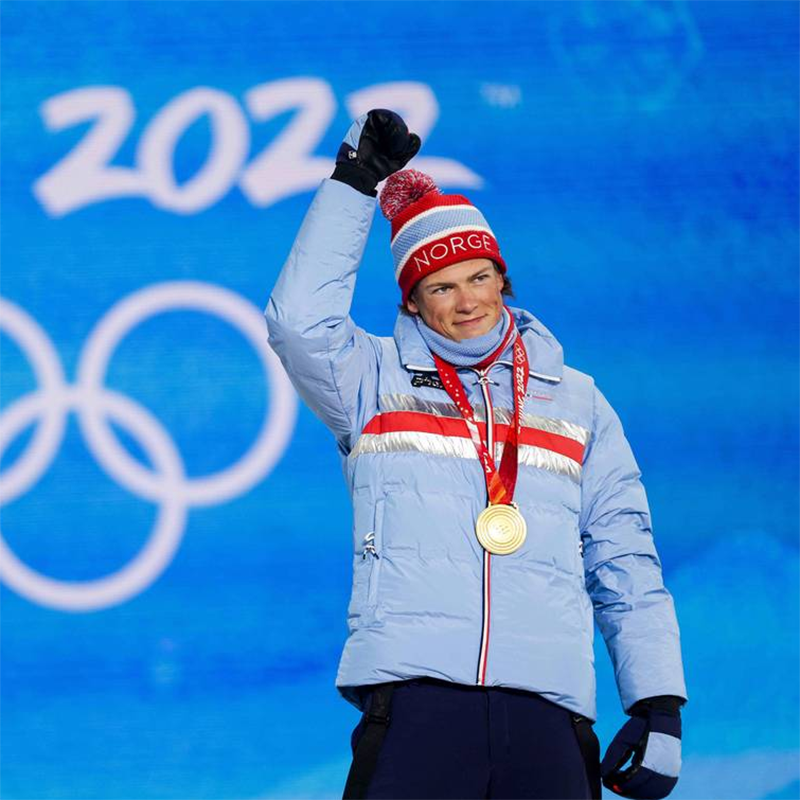
Johannes Hoesflot Klaebo (NOR) paced the Tour de Ski 20 K Classic in Toblach (ITA) to perfection. (Photo: Vanzetta/NordicFocus)
By mid-morning in Toblach, the cold had settled into the valley in that particular Dolomite way—dry, bright, and unforgiving. The stadium clock read 10:30 a.m., the tracks were hard-packed, and the Tour de Ski—never gentle, always exacting—had reached a moment where patience mattered as much as power. Stage 4’s men’s 20-kilometer classic pursuit would not be decided by theatrics. It would be decided by discipline.
From the first push out of the starting line, Johannes Høsflot Klæbo made that clear.
The Norwegian leader skied as if tethered to an internal metronome, clicking off splits that barely wavered across five laps of the 4-kilometer loop. Behind him, the race congealed into a dense, minute-long chase—ambitious but realistic, orderly but never comfortable. Inside that group, Gus Schumacher did what pursuit racing rewards: work when it mattered, wait when it didn’t, and finish inside the race rather than on its margins.
Johannes Hoesflot Klaebo (NOR) on his way to first place on the 20 K Classic Pursuit. (Photo: Vanzetta/NordicFocus)
Klæbo’s Quiet Authority
Klæbo entered the day with the yellow bib and skied as though intent on keeping it uncontested. At 4 kilometers, he led in 9:11.8; at 8 kilometers, 18:23.4; at 12, 27:34.6; and at 16, 36:53.3—the first three splits almost exact to the tenth. He crossed the line in 46:01.7, never once letting the chase compress to a threatening distance.
Second place belonged to Mattis Stenshagen (+51.1), who skied the most assertive race of those behind Klæbo and briefly tested the cohesion of the chase on the fourth lap’s long climb. Third went to Edvin Anger (+59.8), tied on time with Italy’s Federico Pellegrino, whose classic form looked as efficient as it did economical. Emil Iversen finished fifth (+1:00.2), matching Schumacher stride for stride to the line.
That minute—barely more than a breath in Tour de Ski terms—defined the race.
Gus Schumacher (USA) did much of the work early to bring the chase into one pack behind Klaebo. (Photo: Vanzetta/NordicFocus)
Schumacher in the Middle of It
Schumacher finished sixth, also +1:00.2, part of the decisive chase that refused to fracture even as the course repeatedly asked for answers. The result came less than 24 hours after his 5 k freestyle win in Toblach, and the transition—emotionally and physically—was not trivial.
“It was a little bit tough, honestly,” Schumacher said. “This pursuit started at 10:30 a.m., and I haven’t woken up before eight in probably a month because all our races have been so late. … I definitely enjoyed the win, but the focus was to refocus right away. It’s another new day, and this race was really important for the Tour.”
Inside the race, Schumacher was not hiding. He described closing the gap to Iversen after the early climbs and doing much of the work that consolidated the group—an effort he acknowledged with pride. “I did most of that work, which I’m actually pretty proud of,” he said. What he didn’t do was overreach. “I wasn’t trying to catch Klæbo or anything,” Schumacher added. “Even though some of the guys might have been thinking that.”
The fourth lap told the story. Stenshagen pressed hard on the long climb out of the stadium, stretching the elastic just enough to test resolve. Schumacher bent but didn’t break. Over the top, the group exhaled. The fifth lap came fast—but not frantic—and Schumacher found himself boxed in late, a tactical note he filed away rather than lamented.
“With the overall standings so tight, I don’t think it’s worth thinking about it too much,” he said. “I’m sitting in third right now, and top ten is definitely still the goal. … Everyone from second through ninth is so close that it really comes down to focusing day by day.”
That may be the most Tour de Ski answer of all.
Gus Schumacher (USA), Emil Iversen (NOR), Edvin Anger (SWE), and Lars Heggen (NOR) worked together to prevent Klaebo from extending his lead. (Photo: Vanzetta/NordicFocus)
A Chase by Committee
Behind Schumacher, the chase’s cohesion owed as much to restraint as to strength. Lars Heggen (seventh, +1:00.3) and Benjamin Moser (eighth, +1:00.8) rounded out a group that included Harald Østberg Amundsen (ninth, +1:03.1). No one bridged to Klæbo; no one detonated the pack behind. The race’s geometry stayed intact.
That stability mattered in a Norwegian context. With Olympic selection pressure already humming and only a few men’s spots still unsettled, Toblach functioned as both race and audition. Stenshagen’s second place was emphatic. The Tour does not reward one-off brilliance. It rewards survivability.
Ben Ogden (USA) finding his classic distance form. (Photo: Vanzetta/NordicFocus)
The Americans: Process Over Panic
Further back, the pursuit revealed its less visible truths. Ben Ogden finished 29th (+3:03.3), a result that reads well on paper and even better when you hear how he raced it.
“The biggest challenge is always the start,” Ogden said. “For me, it was about trying to pace the race properly, even when people were moving ahead of me early. … I started with a pack, then a bunch of them dropped me, and I just kind of let that happen, knowing I’d be able to catch some of them later—which I did.”
That in-and-out rhythm—sometimes lonely, sometimes crowded—is pursuit racing in the middle of the field. Ogden framed it honestly. “Racing in a tight group is obviously more fun,” he said, “but you really have to pace yourself and try not to lose unnecessary time in a Tour, especially when you’re already a little tired.”
For Zak Ketterson, who started deep in the order, the early kilometers were chaos by design. He finished 42nd (+3:55.1), but the route there mattered.
“The wave is really challenging, especially starting in bib 70,” Ketterson said. “Five or six seconds have already passed before I even reach the start line. The first two laps were chaos, and I was just trying to stay relaxed and avoid trouble.”
He did move forward—damage control after a Stage 2 crash that had already cost him minutes. “It was nice to move up a lot today,” Ketterson said, “but the classic sprint on Stage 5 is definitely the main focus now.”
Ketterson also addressed the jury’s written reprimand for use of a banned technique in a marked stride zone—a penalty that did not disqualify him but appears in the official record. “The technique violation came from double poling in a stride zone,” he explained. “I changed tracks to pass someone, and the motion of doing that ended up being a double pole.”
For Zak Ketterson (USA), the Tour de Ski hasn’t exactly gone as he had hoped, but today in the pursuit, he showed his form from earlier in the season. (Photo: Vanzetta/NordicFocus)
When the Day Turns on a Ski
Kevin Bolger finished 51st (+4:18.6), a result shaped by circumstance rather than strategy. Bolger had been patient by design, content to let early red-lining pass him by before advancing after lap two. Then a ski broke.
“I like to settle in, and then after lap two start working my way up the field,” Bolger said. “I was just about to do that today when someone merged into my track and broke my ski, which cost me close to a minute. That was pretty disappointing.”
Before that moment, his choices had been sound. Toblach’s two main climbs invite early commitment to kick wax, and Bolger leaned into it. “It was an easy choice to really feel the kick wax early,” he said. “The skis were feeling great, and I was really excited about how I was going to start moving up the field.”
Bolger’s broader view was measured, almost cheerful in its realism. “This Tour isn’t quite as massive as some of the past ones,” he said. “It’s about gaining confidence and fitness, as long as you’re able to absorb it after the Tour.” Olympic energy is present, he acknowledged, but not consuming. “At the end of the day, I’m just trying to race fast.”
J.C. Schoonmaker placed 56th (+4:42.7), while Jack Young finished 80th (+8:07.2), both navigating a day where patience was mandatory, and opportunities were earned in inches rather than meters.
Andrew Musgrave (GBR) and Antoine Cyr (CAN), (l-r) moving up through the field together. (Photo: Vanzetta/NordicFocus)
Canada: Trials Done, Work Ongoing
Canada’s men arrived in Toblach with their Olympic trials already behind them and the Tour serving a different purpose. Antoine Cyr led the way in 13th (+1:54.5), with Thomas Stephen 28th (+3:02.6) and Xavier McKeever 30th (+3:08.1). The emphasis now is accumulation—fitness, familiarity, resilience—rather than immediate results.
Context at the Margins
The Tour de Ski has a way of narrowing options without warning. On Thursday morning, one Norwegian men’s Olympic hopeful, Oskar Opstad Vike, withdrew close to start time, a reminder that the margins between readiness and retreat are thin, especially in an Olympic year. Toblach did not create that pressure; it merely revealed it.
Mattis Stenshagen (NOR) was excited when he crossed the finish line as if he knew he had shown the Norwegian Olympic selectors enough to make the team. (Photo: Modica/NordicFocus)
What the Splits Say
A look at the time checks explains why the race felt so controlled. Klæbo’s advantage barely fluctuated. The chase group’s gaps among themselves were measured in seconds—Schumacher, Iversen, Anger, and Pellegrino trading fractional advantages without a decisive rupture. Further back, time losses accrued not in dramatic collapses but in quiet inefficiencies: a missed pack, a broken ski, a moment of over-enthusiasm.
The course profile—five laps, 137 meters of total climb—rewards restraint. Toblach does not forgive impatience.
A broken ski for Kevin Bolger (USA) didn’t prevent him from showing his form in Toblach (ITA). (Photo: Vanzetta/NordicFocus)
Looking Ahead
Stage 4 did not reshuffle the Tour so much as clarify it. Klæbo remains the reference. The men chasing him know exactly how much ground they have—and how little room there is to gamble it away. Schumacher’s position near the top of the standings is real, earned through effort and discretion. Behind him, athletes like Ogden, Ketterson, and Bolger are racing a Tour that asks for perspective as much as speed.
Val di Fiemme awaits with its own demands and, this year, Olympic resonance. But Toblach offered a simpler lesson. In a pursuit, the clock is visible; the choices are not. The best skiers make the hard ones look easy—and the easy ones count.
Fastest Skiers on the Day – Men (Top 15, Net Time Only)
This ranking removes pursuit start gaps and shows who skied the fastest 20 km classic on Stage 4.
Day Rank
Athlete
Nation
Net Time
1
Edvin Anger
SWE
45:39.5
2
Simen Hegstad Krüger
NOR
45:44.0
3
Federico Pellegrino
ITA
45:45.5
4
Mattis Stenshagen
NOR
45:51.8
5
Emil Iversen
NOR
45:51.9
6
Gus Schumacher
USA
45:52.9
7
Truls Gisselman
SWE
45:58.5
8
Antoine Cyr
CAN
45:59.2
9
Hugo Lapalus
FRA
46:00.5
10
Johannes Høsflot Klæbo
NOR
46:01.7
11
Benjamin Moser
AUT
46:03.5
12
Savelii Korostelev
AIN
46:04.5
13
Harald Østberg Amundsen
NOR
46:07.8
14
Andrew Musgrave
GBR
46:13.6
15
Lars Heggen
NOR
46:17.0
Net time calculated as finish time minus individual pursuit start offset.
Places 3-7 where this close for Federico Pellegrino (ITA), Edvin Anger (SWE), Gus Schumacher (USA), Emil Iversen (NOR), (l-r) after 20 K in Toblach (ITA). (Photo: Modica/NordicFocus)
Love Stories Like This? Help Keep Them Coming.
Feature stories like this one take time, access, and care to produce. If you value thoughtful storytelling and independent ski journalism, please consider becoming a Voluntary Subscriber. Your support directly fuels the work we do to cover the people, places, and moments that make our sport special.
This coverage is made possible through the generous support of Marty and Kathy Hall and A Hall Mark of Excellence Award. To learn more about A Hall Mark of Excellence Award, or to learn how you can support FasterSkier’s coverage, please contact info@fasterskier.com.
Jessie Diggins (USA) has delivered dominant race performances in the past, but few compare to the flawless performance she delivered in the 20 k Classic Pursuit, Stage 4 of the 2025-2026 Tour de Ski. (Photo: Vanzetta/NordicFocus)
During her long and illustrious career, Jessie Diggins has won eight World Cup races in Toblach, a record of success that began with her very first World Cup win, a 5 k Freestyle event in 2016. Well, today was the final Toblach race of Diggins’ World Cup journey. She didn’t waist the opportunity.
“Honestly, it’s like the year of dreams coming true,” said Diggins. “I feel like I’m leaving a little piece of my heart here in Toblach.”
There will be even more memories of Diggins preserved in Toblach, as race organizers announced the naming of a bridge in her honor. “This venue is so special to me, and it means so much,” said Diggins. “A place of so many memories since my first Tour in 2012, I think! It special to be honored in that way.”
Diggins capped her Toblach career—and solidified her lead in the 2025-2026 Tour de Ski—with a resounding victory in the 20 k Classic Pursuit. Starting the day with a lead of over a minute, she expanded that advantage to finish the day with a cushion of more than 90 seconds. Behind her in the standings lurk Moa Ilar (SWE) and Teresa Stadlober (AUT). But with only two stages remaining (a Val di fiemme’s Classic Sprint and the final climb up Alpe Cermis), Diggins hold on the Tour de ski title seems secure. But securing that lead was in no way easy: Diggins had to work hard to gain that time on a day when other skiers may have had advantages—and the ability to team up—in their pursuit of Diggins who skied that long distance alone.
“It was a long race, a lonely race,” said Diggins. “But I was thinking of someone special to our team the whole time. Every Tour I’ve ever done, there’s always one day where I feel like this is the day where you have to be so gritty. If you want to win the Tour, you have to make it happen, now, today. I went in with that mindset; sometimes I don’t like how it feels, that much pressure, but I know I will perform well under it.”
Perform well, she has . . . and perform well, she did. Diggins loneliness was the result of her continued dominance throughout the 2025-2026 Tour de Ski. She has led since the second stage, and continued adding to her lead with each passing kilometer of the 20 k Classic Pursuit.
Jessie Diggins (USA) was alone at the front for the entire racing day. She had plenty of energy, and plenty to think about on her way to a victory in the Tour de Ski Stage 4. (Photo: Vanzetta/NordicFocus)
Fast Skis and Perfect Fitness
For many World Cup cross-country skiers, the 20 k Classic Pursuit is the highlight of the Tour de Ski. It’s the one event that feels most like cross-country skiing as they imagine it—measured efforts over a long course in Classic stride and glide. It’s actually a race concealed within the parameters of a Pursuit format. Starting positions are determined by advantages in Tour de Ski standings, so the leader of the Tour starts first.
Diggins anticipated this being a day where her advantage would be 50 seconds over her closest competitor, Astrid Oeyre Slind (NOR). But it was announced just before race time that Slind had taken ill and would not start the event. That expanded Diggins’ lead to a minute over Moa Ilar (SWE), 1:11 over Maia Dahlqvist (SWE) and 1:14 over Teresa Stadlober (AUT). A minute is a long time; double the gap that normally exists in an interval start race. Diggins double-poled away from the other starters and disappeared up the trail before anyone else was allowed onto the course. Behind her, narrowly gapped start times suggested that it was quite possible for Stadlober, Ilar, and Dahlqvist to group up in pursuit of Diggins. And 20 kilometers is a long way to defend a lead against three chasers, especially with the variables of waxing that always complicates Classic ski races.
The sixth place starting slot also stood empty, as Emma Ribom (SWE) was a non-starter. Ilar, Dahlqvist, and Stadlober would not be expecting any more help to come up from behind.
Teresa Stadlober (AUT) skied in the company of Maia Dahlqvist for the first half of the race, but was later to move forward to challenge Moa Ilar (SWE) at the finish line. (Photo: Vanzetta/NordicFocus)
The Toblach 20 k Pursuit was contested over five laps of four kilometers each. At the the end of the first four kilometer lap, Diggins showed that she had been wasting no time. Her lead had grown an additional 15+ seconds over all her closest rivals. Ilar, Stadlober, and Dahlqvist were eventually able to work as a group, but they were not proving capable of reducing Diggins’ lead. Behind them, a large chase group formed led by Kerttu Niskanen (FIN), Frida Karlsson (SWE), Ebba Andersson (SWE), and Heidi Weng (NOR). Also present in that group was the Sprint specialist, Jasmi Joensuu (FIN) who showed a tremendous grit and discipline as she fought to hold her position in a chase group comprised of the world’s strongest Distance skiers.
Moa Ilar (SWE) and Teresa Stadlober (AUT) would finish second and third after working together in pursuit of Diggins. Even their best efforts saw Diggins expanding her lead. (Photo: Modica/NordicFocus)
Behind Diggins, the race continued to change with the dynamic makeup of various chasing groups. Stadlober eventually dropped Dahlqvist, and was able to ski forward to Ilar.
Diggins completed the 20 k distance in 52:14.8. That’s just flying, especially when it’s considered that Diggins was all alone all day—no parallel pace makers, and only two splits per four kilometer lap—while all her rivals had help and company in chase groups along the way. Andersson definitely emerged as most in-form of the chasers, regularly leading her group in pursuit of Ilar and Stadlober.
Diggins would cross the line with an advantage of 1:35 seconds over Ilar and Stadlober. They were followed by an ecstatic Joensuu, Weng, Niskanen, and Johanna Matintalo (FIN). Weng steady progression through the Pursuit pack delivered the fastest time of the day, two seconds ahead of Diggins.
Julia Kern (USA) delivered one of the day’s most vibrant race efforts, moving up from her 32nd starting position to finish the day 18th. Her finishing time was 12th fastest on the day. (Photo: Vanzetta/NordicFocus)
Julia Kern (USA) had one of the best days of any skier in the field, moving up from 32nd up to 18th, while continuing to show that her endurance trajectory is both tremendous and timely. She appears primed to team with Diggins in a medal-contending Team Sprint duo when that Olympic event is staged in a few weeks in Val di Fiemme.
“Today was definitely a step in the right direction,” said Kern. “I wanted to make sure going into the Games that have good Sprint and Distance form, especially for the Team Sprint, I think you need both of that. So today was really encouraging. I was in a big pack, and at the end, it really came down to a finishing sprint. And so I was in that moment thinking, ‘This is practice for when I’m really tired in the sprint, and I gotta go.’”
Is it now time to start projecting how current levels of fitness and performance may develop as stories in Milano-Cortina? Like she did in the 10 k interval start a few days earlier, Karlsson spent the second half of today’s 20 k Pursuit going backwards, losing time at all the later checkpoints. Likewise, the other Distance contenders—Andersson, Niskanen, Ilar, Weng—really don’t look all that sharp, not compared to Diggins, anyway. Well, when is that sharpness going to arrive? There’s a break in the racing schedule in the week following the Tour de ski, but it’s only another 40 days before the first Olympic events get started in Val di Fiemme.
And what about Diggins? Is she spending all her best fitness now? Is there a chance that this is the fastest she will go this season and that she might find herself a bit flat when the Olympics begin? Time will tell . . . but when Jessie Diggins is flying this high, and loving racing this much, there’s every reason to believe she can keep it going.
Diggins now holds the lead in the Overall World Cup, the Distance World Cup, and the Tour de Ski. With only two Tour events remaining in Val di Fiemme—a Classic Sprint and the final climb up Alpe Cermis—Diggins looks all but certain to add a third win in the Tour de Ski to her résumé. And she leaves a bridge with her name on it in Toblach, as well.
Fastest Skiers on the Day – Women (Top 15, Net Time Only)
This ranking removes pursuit start gaps and shows who skied the fastest 20 km classic on Stage 4.
Day Rank
Athlete
Nation
Net Time
1
Heidi Weng
NOR
52:12.8
2
Jessie Diggins
USA
52:14.8
3
Ebba Andersson
SWE
52:23.7
4
Julie Bjervig Drivenes
NOR
52:28.0
5
Johanna Matintalo
FIN
52:28.3
6
Jasmi Joensuu
FIN
52:31.1
7
Kerttu Niskanen
FIN
52:34.1
8
Teresa Stadlober
AUT
52:36.3
9
Moa Ilar
SWE
52:50.0
10
Frida Karlsson
SWE
53:05.3
11
Pia Fink
GER
53:07.4
12
Julia Kern
USA
53:08.1
13
Vilma Nissinen
FIN
53:09.4
14
Caterina Ganz
ITA
53:10.1
15
Nora Sanness
NOR
53:12.6
Net time is calculated as finish time minus the individual pursuit start offset.
Smiles in Toblach. Moa Ilar (SWE), Jessie Diggins (USA), Teresa Stadlober (AUT) on the podium of the 20 k classic Pursuit in the 2025-2026 tour de Ski. (Photo: Modica/NordicFocus.)
Love Stories Like This? Help Keep Them Coming.
Feature stories like this one take time, access, and care to produce. If you value thoughtful storytelling and independent ski journalism, please consider becoming a Voluntary Subscriber. Your support directly fuels the work we do to cover the people, places, and moments that make our sport special.
This coverage is made possible through the generous support of Marty and Kathy Hall and A Hall Mark of Excellence Award. To learn more about A Hall Mark of Excellence Award, or to learn how you can support FasterSkier’s coverage, please contact info@fasterskier.com.
Jessie Diggins (USA) was once the best in the world at racing the 5 k distance. She still is . . . (Photo: -Vanzetta/NordicFocus)
At one point early in her career, Jessie Diggins (USA) had become the pre-eminent World Cup racer at the 5 k Freestyle. She was fast, she could endure bucket-loads of lactate, and she could suffer like nobody’s business: perfect for the demands of the 5 k. Today’s result makes it look like she’s probably still the best at this distance, though it’s a race that’s hardly ever contested anymore in international racing. Diggins probably had it in her mind that she could post a win—if her heat was strong, if their strategy was sound, if everyone did their job, and if her 5 k skills remained intact. In the end, it was the speed of Diggins’ heat—and the intensity with which she led it—that made the difference, as all the podium places were claimed by that heat. Diggins first, Ebba Ribom (SWE) second, Moa Ilar (SWE) third, Leonie Perry (FRA) fourth, and Alison Mackie (CAN) fifth.
Diggins is a gamer; it was no surprise to see her embracing this new race format even before racing had begun. “It was just five k,” Diggins remarked” . . . “You’re going to gain or lose ten seconds.” In typical Jessie Diggins fashion, her perspective on the day seemed to be It’s a ski race. Let’s all just have fun!
Inventing an Event . . .
It’s a race . . . they’re filling World Cup podiums and delivering World Cup points and awarding event prize money. The field would be taking it seriously, even though a majority of the racers probably didn’t know what to make of it.
A recent press release claimed that this 5 k Mass Start format was “introduced to boost excitement.” Well, if our sport is in such dire need of a boost in excitement, then we should try to do something about that. What other format innovations could boost excitement? Perhaps the notion of full-contact Nordic racing—pads, helmets, a penalty box, the occasional dropping of the gloves. Maybe we should consider adding “Sharks and Minnows” to the roster of Olympic, World Cup, and World Championship events? How about a jump? Some aerials? A little air-time? Recent Eastern Cup Sprint races (a Junior Nationals qualifying event) conducted at New Hampshire’s Holderness School included a jump at the top of a small downhill slope. A few of the best skiers hit the jump well, and looked good doing it. The majority of skiers looked shaky, apprehensive, terrified. And a predictable number of racers ended their day splayed at the bottom of the hill as their rivals sped up the trail. At least it made for good spectating—and I suppose that was the point. Imagine how much better it could have been if we’d incorporated a hoop of fire on the jump, as well?
“My plan is to survive the 5 k,” said Astrid Oeyre Slind (NOR) the winner of yesterday’s 10 k classic event. “I think that will be a fun, but maybe a little bit chaotic, race.”
Tour organizers seem to think that adding novelty events is just what Nordic skiing needs to be more exciting for its viewing audience. The 5 k Mass Start Heat also adds the benefit of potentially re-shuffling the deck so that lesser skiers get a chance to shine. Certainly that’s exciting for fans of those lesser skiers. But for the true contenders, that’s gotta be incredibly frustrating, especially when World Cup points and potential Olympic qualifications are on the line.
Katherine Sauerbrey (GER), Nadja Kaelin (SUI), and Helen Hoffmann (GER) lead the pack in Heat 1 of the 5 k Mass Start in Toblach. (Photo: Vanzetta/NordicFocus)
Heat 1—11:15.7
In pre-race start-lists, FIS described today’s event as taking place in four heats of 20 skiers per heat. The composition of those heats selected skiers from multiple seeded groups (a few fast skiers, a few middle skiers, a few skiers from the tail end of the field) to fill out the heats in a relatively fair fashion. Intermediate Sprint bonuses were offered for both the Sprinters and the Climbers. The rest would be settled on the race course. Somebody say 1, 2, 3, go . . .
Rydzek led out Heat 1, taking the Sprint points at a line across the trail atop Toblach’s arch-shaped building. Thereafter, Frida Karlsson and Moa Lundgren committed to setting the pace. But at the crucial point in Heat 1, the surprising attacks came from Switzerland’s Kaelin sisters (Nadija and Marina), and Germany’s Helen Hoffman and Katherine Sauerbrey. If the overall Tour contenders needed this to be a fast heat, then their decision to leave the pace-making to lesser-known Swiss and German skiers may not have been the most effective strategy.
Nadia Kaelin would hold on for the heat win in 11:15.7. Behind her, regular contenders struggled to remain in contention: Jasmi Joensuu (FIN) in 8th place, Frida Karlsson (SWE) 13th, Coletta Rydzek (GER) 16th, Johanna Hagstroem (SWE) 18th.
“We saw a lot of surprises in these competitions,” said on-air commentator, Chad Salmela. “A lot of names that we didn’t necessarily expect to see at the top of the order.” You can say that again, Chad . . .
Astrid Oeyre Slind (NOR) made as much pace as she could, leading Kristin Austgulen Fosnaes (NOR) and Julia Kern (USA), both of whom would finish the day in teh top ten. But Slind’s pace would prove no match for Diggins. (Photo: Vanzetta/NordicFocus. Every downloaded picture is fee-liable.
Heat 2—11:01.0
The second heat included contenders like Astrid Oeyre Slind (NOR), Maia Dahlqvist (SWE), Kertuu Niskanen (FIN), Kristin Austgulen Fosnaes (NOR), Heidi Weng (NOR), and Julia Kern (USA). After a little bit of early speed provided by the logical contenders, the pace making was taken over by Julie Pierrel (FRA) and Pia Fink (GER). Time was slipping away for the overall contenders trapped in the languid pace of Heat 2 as the Sprint bonus points line passed with the leaders trailing Heat 1 by three seconds. The contenders could try charging to the front to take over the pace, but such a lactate-ploouted effort might ruin them for days to come. Well, Slind ain’t scared of a little lactic aid; she stormed to the front at the halfway mark followed by Fosnaes, Weng, Fink, and Kern.
Kern’s potential in upcoming Olympic events rests solidly on her probable pairing with Diggins in the Team Sprint. Kern’s job in that event will be simple: don’t get dropped. If her performance in today’s Heat 2 is any indication, her current level of fitness is preparing her well for that challenge. She went to the front (a bit too early), but was overtaken at the finish line by Dahlqvist. They were followed by Slind, Fink, and Austgulen-Fosnaes. The finishing time was considerably faster than Heat 1, but they’d need to wait to see what times later heats would produce.
Eva Ingebrigtsen (NOR) kept the pace high in Heat 3. Diggins benefited from that pace, and launched forward to expand upon it. (Photo: Vanzetta/NordicFocus)
Heat 3—10:51.2
Diggins was joined in Heat 3 by the remaining Swedish contenders—Moa Ilar, Emma Ribom, and Ebba Andersson—though Diggins’ pre-race conversations with Norway’s Ingrid Bergene Aabrekk and Eva Ingebritsen made it seem like she’d be relying on other recruited allies to keep the pace high. Diggins could be seen talking up the strategy of the day—volunteering to start fast, but intending for others to come forward to cycle through at the front. Obviously, she was hoping the heat would be a fast one. The strategy may have been markedly different for Tour Sprint Leader, Kristine Stavaas Skistad, who was probably intending to sit at the back and stay out of trouble. Skistad may have been the wearer of the Sprint Leader’s jersey, but the likelihood of Skistad being the final winner of that distinction (awarded at the end of the Tour de Ski atop the Alpe Cermis) is extremely low. She just wanted to make it to the next Sprint stage where she hoped to claim another World Cup win.
True to her original intent, Diggins flew off the starting line. Diggins was racing her last-ever World Cup 5 k Mass Start Heat race in Toblach (in Diggins’ farewell season, everything identifies as a “last-ever”), but if Diggins was relying on someone else to help with the pace-making, she’d need to let someone else lead. The Swedes volunteered as Diggins settled back into the pack for a moment of precious recovery. It may be just that—her ability to recover—that makes Diggins such a threat in mass-start racing. The rest of the field would do well to remember that when mass-start races (the Skiathlon and the 50 k) are run during the Olympics of Milano-Cortina.
Canada celebrated the fifth place finish of Alison Mackie (CAN), just the sort of celebration FIS may have had in mind when they added the 5 k Mass Start Heat to the Tour de Ski schedule. (Photo: Modica/NordicFocus)
Just as she’d been instructed to do, Ingebritsen led through the Sprint bonus line. While Diggins’ start had been lightning fast, the pace of Heat 3 had begun fading by this point, no longer the fastest at the Sprint bonus. Ingebritsen had done the job that Diggins had proposed before the race. Now it was time for Diggins to take over again. She did so with authority, racing through the Climbers’ bonus points and flying down the descent toward the finish. Diggins was just magnificent today. She set the early pace, she set the pace in the middle of the heat, and she totally dropped everyone else on the final uphill to post a finishing time a full nine seconds faster than any other heat. She was followed across the line by Ribom, Ilar, and by tremendous efforts from Leonie Perry (FRA) in fourth and Alison Mackie (CAN) in fifth.
“I love it!” Diggins could be heard exclaiming to Ingebritsen in the finish area after the heat concluded. “You gotta do it, and you went for it. I love it!” Diggins’ strategy had worked . .. and it was nice that she also said “Thank you” to Ingebritsen.
At the tail end of Heat 3—a minute and a half behind the leaders—Skistad out-sprinted Aleksandra Kolodziej of Poland to avoid being the last one across the finish line.
Heat 4 would prove to be a slow heat. Any pace or progress Teresa Stadlober (AUT) needed she was forced to create on her own. (Photo: (Modica/NordicFocus)
Heat 4—11:13.6
Stadlober drew the short straw, and a starting position in a weak heat. Stadlober is no sprinter, but she has proven to be both cagey and capable as a racer in mass start events. Though she was joined in Heat 4 by Nadine Faehndrich (SUI), Julie Bjervig Drivenes (NOR), and Karoline Simpson-Larsen (NOR), none of them really appeared poised to pull Stadlober to a finishing time that could rival Diggins’ performance in Heat 3.
Drivenes led out the pace, followed by Faehndrich and Stadlober. But early checkpoints revealed that their efforts already placed them outside the top 20 compared to earlier heats. Gina del Rio (AND) led through the Sprint bonus, and continued on beyond the line. But del Rio’s pace was not what was needed for the contenders languishing in Heat 4 to make up time. Knowing her Olympic potential is on the line in every event, Simpson-Larsen went to the front. But her prospects were not bright: she was volunteering to race alone and un-assisted for the rest of the distance. Ultimately, Stadlober re-took the lead and powered across the finish line one second ahead of Simpson-Larsen. Imagine Stadlober’s disappointment when it was announced that all her work and all her effort resulted in her placing no better than 17th (22 seconds slower than the. winner)?
On-air commentator, Kikkan Randall remarked on the “intrigue” created by this format, one in which the finishing time is what matters, but in which each skier will either benefit from, or be victimized by, the pace of their heat. For any number of today’s participants, that seems to me to be less a source of intrigue, and more a source of consternation. Regardless, Diggins was without doubt the skier who was most able, most prepared, and most intentionally poised to capitalize on today’s circumstances. Ultimately, Diggins added 11 seconds to her Tour de Ski lead over Slind, a margin that now stands at 50 seconds. That could certainly prove significant when the course turns upward on the final climb up Alpe Cermis.
In the end, it appeared that Diggins and Slind were the only two contenders who understood how things could work today. They both drove the pace as hard as they could, they both proved their fitness and their mettle, and they finished with a distance between them that might not have been much different if today’s race had been conducted in interval start format. Other skiers jumped in and delivered great results, and that is truly wonderful for them, for their fans, and for the event organizers. Maybe old curmudgeons like me, too, will come to love this event in the future. Regardless, I’ll be betting on Jessie Diggins if ever this event is run again.
“It was fun to feel that excitement with other friends and countries on the World Cup,” Diggins recalled. “I think that was an unexpected delight of the format.”
Racing Continues—and the Alpe awaits
Tomorrow in the Tour de Ski will see the staging of the second odd event in a row—the 20 k Pursuit—a race that gives a head start to those who are already leading, and rewards them (with World Cup victories!) for winning a race in which they were given a head start. Don’t get me started . . .
Heat 3 takes it all: Emma Ribom (SWE), Jessie Diggins (USA), Moa Ilar (SWE) on the podium after the Tour de Ski 5 k Mass Start Heat. (Photo: Modica/NordicFocus)
This coverage is made possible through the generous support of Marty and Kathy Hall and A Hall Mark of Excellence Award. To learn more about A Hall Mark of Excellence Award, or to learn how you can support FasterSkier’s coverage, please contact info@fasterskier.com.
Gus Schumacher (USA) and the rest of Heat 2 climb over Toblach’s iconic feature during the 5 K Freestyle. (Photo: Modica/NordicFocus)
The Tour de Ski has always asked skiers to live with imperfect information. You race hard when you’re tired. You make decisions based on feelings and instincts, while coaches are screaming ‘splits.’ You tell yourself the only honest thing in a stage race: don’t do anything you can’t recover from tomorrow.
On Wednesday, the Tour leaned fully into that uncertainty — and then amplified it.
Stage 3, a 5-kilometer freestyle, arrived with a new wrapper: four separate mass-start heats, each sent off at a different time, with final standings determined only after all heats were complete and all times were combined. The spectacle was real — a small parade of high-speed skating races rather than one long pageant — but the competitive implications were sharper than the format’s novelty suggested. Skiers weren’t simply racing the men next to them. They were racing an invisible standard set by athletes they couldn’t see, in heats that could be slower or faster for reasons that had nothing to do with any one skier’s fitness.
If that sounds like chaos, it wasn’t. Not for Gus Schumacher.
Schumacher (USA) didn’t treat the new format as a novelty or a gamble. He treated it like a solvable problem — and in doing so, he won the stage in 9:35.4, claiming the second World Cup victory of his career and stamping his authority on a Tour de Ski day that felt, at times, like a controlled experiment.
Behind Schumacher, Austria’s Benjamin Moser was second (+0.2), and Norway’s Lars Heggen — the U23 skier who helped turn Schumacher’s heat into a metronome — was third (+0.6).
And here is the detail that will define how this stage is remembered: the top seven overall finishers all started in the same second heat, the heat that began at 11:48:45. In a race decided on aggregate time, that start time became a kind of gravitational center — the heat where cooperation, pace, and intention converged into the day’s fastest runway.
Ben Ogden (USA), JC Schoonmaker (USA), Remi Drolet (CAN), and others follow Johannes Hoesflot Klaebo (NOR) during the third heat of the 5 K Freestyle. (Photo: Modica/NordicFocus)
The Format: Four Races, One Result — and a Quiet Incentive to Collaborate
The four start times — 11:30:00, 11:48:45, 12:07:30, and 12:26:15 — didn’t just separate the field. They separated narratives. In one heat, the pace would be relentless and communal; in another, it might be cagey, tactical, or simply a touch less urgent. In a normal mass start, you can afford to be patient. In a normal 5K interval start, you can measure yourself against the clock. On this day, you had to do both — without complete visibility into either.
U.S. head coach Matt Whitcomb framed it simply: the 5K has been absent from the World Cup menu for long enough that today was “unknown territory,” and athletes had to be ready to adapt. “Nobody really knew what to expect,” he said — not because the course was mysterious, but because the format forced a different kind of decision-making.
Whitcomb also emphasized that heat assignments weren’t random theater. They were determined by overall Tour standings after two stages, via a snake-draw system written into the rules — in other words, the groups were structured, and the group you landed in mattered.
That mattered most in the heat Schumacher found himself in — and, crucially, in the way he decided to race it.
Gus Schumacher (USA) leads Heat 2 during Stage 3 of the Tour de Ski in Toblach (ITA). (Photo: Vanzetta/NordicFocus)
Heat 2 Becomes the Day’s Engine
By the time Schumacher’s heat went off at 11:48:45, the day already had shape: one race had happened, a set of times had been posted, and the Tour’s new experiment had revealed its first truth — you could win your heat and still lose the stage.
Schumacher and his heat-mates didn’t merely acknowledge that truth. They embraced it.
“I think my heat-mates and I realized that having a fast heat was the biggest picture,” Schumacher said afterward. “I was prepared to be 10th in the heat if it meant we were fast.”
That sentence — prepared to be 10th if it meant we were fast — is the kind of thing athletes say when they’re not racing for ego. It’s what they say when they’re racing for an outcome.
Schumacher described how the plan became practical: “We were able to trade leads also with Ben Moser’s help and keep the pace fast without too much effort before the hills, then actually continued to work together even better than I thought we would from there into the finish.”
Whitcomb confirmed the same dynamic from the outside: Schumacher “reached out to Lars Hagen and Ben Moser and came up with a plan,” and the result was “well orchestrated trading off of the lead,” the kind of collaboration you don’t often hear described so plainly in a World Cup race. In a typical mass start, you hide. In a typical interval start, you suffer alone. In this format, the fastest solution was neither — it was to share the work early and arrive at the decisive sections with enough fuel to race, not just survive.
And the split data makes the story legible.
At 1.7 km, Schumacher hit 2:54.2. Moser was 2:54.4. Heggen was even quicker at 2:53.5. The heat was not strolling into the race; it was setting terms.
At 2.7 km, Schumacher reached 4:59.6, and the heat’s front remained dense and alive. By 3.1 km, Schumacher was at 6:16.4 — still close enough to the line that the stage would be won in the last two kilometers, but far enough out that the wrong decision on the climb would show up in the final time like a bruise.
Schumacher’s last 1.9 km — from 3.1 km to the finish — was the sharpest of the podium trio, and among the best in the field. He closed in 3:19.0, a finish that wasn’t just a sprint, but a controlled acceleration from a high baseline.
This is what it looked like in practice: a heat that refused to turn into a chess match. A group that made the race fast enough to matter. And a skier — Schumacher — who could do the work and still finish.
Gus Schumacher (USA) and Benjamin Moser (AUT) lead other Stage 3 top finishers to the line in Toblach (ITA). (Photo: Modica/NordicFocus)
The Podium: Schumacher Leads, Moser Hangs, Heggen Announces Himself
Schumacher’s stage win — 9:35.4 — put him at the center of the day’s story, but the day’s podium also revealed how perfectly the format could reward the right combination of collaboration and individual capacity.
Moser (AUT), second at 9:35.6, was integral to the heat’s pace-making. Heggen (NOR), third at 9:36.0, wasn’t a passenger either — he was part of the mechanism.
Schumacher was explicit about what the format rewarded him for. “Sometimes I feel like a jack of all trades and a master of none,” he said, “but high-speed skating with an element of required distance capacity is a place where I can excel. I think Minneapolis had that too.”
It’s the kind of description that links two very different wins — one on home snow in Minneapolis in a 10K Freestyle Interval Start, the other here, in a four-heat 5K puzzle — without pretending they are the same. What connects them, Schumacher suggested, is the ability to ski fast in a way that isn’t fragile: pace you can sustain, not just ignite.
“I’ve been feeling good, but I’m still building momentum,” he said. “Today definitely helped.”
Benjamin Moser (AUT), Gus Schumacher (USA), Mattis Stenshagen (NOR), (l-r) worked together to claim the podium of the 5 K Freestyle. (Photo: Vanzetta/NordicFocus)
Where the Race Was Won: The Climb, the Urge to Go Early, and the Last Kilometer
If Heat 2 was the engine, the course still demanded decisions — and it punished some of them.
J.C. Schoonmaker (USA), who would finish 29th, described the mental load of the format in a way that felt honest rather than polished. “The new format just changed the way I thought about things because I felt I needed to be prepared for lots of different scenarios,” he said. “I probably haven’t done a 5K since high school… I was just trying to be ready for whatever came and be ready to react to it.”
Schoonmaker pinpointed the moment that mattered: “On the big climb, I sensed that things were starting to stretch out a bit, so that was where I decided I needed to make a move. It was a bit early in hindsight because our heat ended up staying together, and I got pretty tired in the very end and lost some positions.”
That’s the stage’s second truth: in a format like this, you can race aggressively and still end up punished by the math. An early move that might win you your heat can also drain the last 400 meters you need to protect your time — the thing that actually counts.
Ben Ogden (USA), 20th, offered the same theme from a different angle. He admitted he didn’t dictate his heat’s tempo — and that, in hindsight, he wished he had done more when he felt capable.
“I didn’t really dictate the pacing in my heat,” Ogden said. “I let Klaebo and Stenshagen really dictate the pacing, and I just held on as best I could.”
Then the key sentence — the one that tells you how easy it was, in this format, to race the wrong race: “It’s hard to remember that it’s sort of us versus them a little bit in that race format rather than just trying to win your group.”
Ogden noted that his heat’s final kilometer became a bit of a one-man chore: “Pellegrino led for most of the last K… down through the corners and stuff. I think it would have been better if we’d been trading off leads.”
In other words, the format quietly rewards heats that turn into rotating pacelines and punishes heats that turn into sprints for pride.
Schumacher’s heat was a paceline that never forgot the clock.
Ben Ogden (USA) and Johannes Hoesflot Klaebo (NOR), (l-r) leading Heat 3 of the 5 K Freestyle in Toblach, Italy. (Photo: Vanzetta/NordicFocus)
The Americans: A Day of Depth Under a Day of Headlines
Schumacher’s win was the headline, but the U.S. team’s men didn’t only deliver a winner. They delivered a set of performances that made the result feel like something sturdier than a single bright point.
Here’s where the Americans landed on the day:
1st: Gus Schumacher (USA) — 9:35.4
20th: Ben Ogden (USA) — 9:45.4
29th: J.C. Schoonmaker (USA) — 9:46.2
41st: Zak Ketterson (USA) — 9:48.9
42nd: Jack Young (USA) — 9:49.1
79th: Kevin Bolger (USA) — 10:08.9
Whitcomb framed the broader men’s story as an execution day — athletes moving up within their heats and carrying out their plans — and in a stage race, that matters. You can’t win a Tour de Ski on one beautiful moment if you give it away everywhere else. You win it by repeatedly doing things that don’t make headlines: staying attached, eating enough, recovering enough, skiing smoothly when you’re cooked.
Schoonmaker, in particular, gave a clear explanation of how the heat system changed the burden of responsibility. “For someone like me, the group I was in played a big part in my result,” he said. “As someone with not a ton of distance prowess, I didn’t have much responsibility to lead, so I was able to sit in the back and wait.”
Then, without making excuses, he told the truth about the dependency built into the format: “That basically made it so my overall time was in the hands of the top guys — but with that being said, it also does take fitness to stay with them.”
It’s a nuanced defense of the format — and also a subtle admission that it can be cruel. It can make your best decision feel like passivity. It can make your best fitness feel like waiting.
Schoonmaker ended with the line the sport’s decision-makers will want to hear: “It’s a cool balance of tactics and fitness, sprinting and distance, and I hope they keep this format around.”
Johannes Hoesflot Klaebo (NOR) was the fastest in Heat 3, but that was only good enough for 12th place overall on the day. (Photo: Modica/NordicFocus)
Norway: The Pressure Cooker Is Always On
Norway, as ever, arrived in Toblach with depth so thick it looks almost unfair from the outside — and with selection pressure that turns every race into a referendum.
Johannes Høsflot Klæbo (NOR) finished 12th in 9:44.0, a day when his 12th place looked strange even when the format explained it. Emil Iversen (NOR) was 8th in 9:42.5. Harald Østberg Amundsen (NOR) finished 17th in 9:44.7. Andreas Fjorden Ree (NOR) was 9th in 9:42.6.
But the real Norwegian story at the sharp end was Heggen — third — and the way his podium was tied to a heat that chose to cooperate rather than conserve. In the Olympic year, Norway’s selection picture isn’t just about who can win on a given day. It’s about who can be trusted to perform across formats, courses, and chaos — and this format delivered chaos with a stopwatch.
If you are a coach trying to build a roster for Milano-Cortina, you probably liked what you saw from athletes who could do the work and still finish — athletes who could be generous early and ruthless late. That’s not a ski cliché. It’s a trait.
Antoine Cyr (CAN) led the way for the Canadian men on a strong day in Toblach (ITA). (Photo: Vanzetta/NordicFocus)
Canada: After Trials, Into the Fire — and Right on the Doorstep of the Top 10
Canada came into the Tour de Ski after holding Olympic trials at home — a different rhythm than many of their European rivals — and Stage 3 gave the Canadian men a tidy set of results that will matter both psychologically and practically.
Antoine Cyr (CAN) led the Canadians in 11th (9:43.8), with Xavier McKeever (CAN) 13th (9:44.2) and Max Hollmann (CAN) 14th (9:44.3).
In a race where the top seven all came from one heat, those placements have extra weight: they suggest Canada wasn’t simply lucky with a draw. They were close enough to the best to make the math uncomfortable. They were within seconds — the kind of seconds that, in a Tour, can turn into minutes if you don’t recover, and can turn into opportunity if you do.
And because this format was so dependent on heat tempo, these results also reinforce a quieter Canadian strength: the ability to race within a fast-moving group and stay composed enough to cash it in at the end.
Benjamin Moser (AUT), Gus Schumacher (USA), Lars Heggen (NOR), (l-r) celebrate the podium in Toblach (ITA). (Photo: Modica/NordicFocus)
A Stage That Felt Like a Debate About the Sport — and a Race That Still Had to Be Won
The Tour de Ski has always been, in some sense, a referendum. It’s a referendum on endurance. On recovery. On whether your season has enough structure to survive a week of high heart rates and thin margins.
This stage was something else too: a referendum on presentation. On whether cross-country skiing can be made to feel urgent to people who don’t already love it.
FIS itself framed Stage 3 as a premiere — the first Heat Mass Start event of its kind at the World Cup level — and pointed directly to fan engagement as a key motivation for the format shift.
Whitcomb put it less diplomatically in his own way: in his view, whether the format stays should be determined by what fans think, because “what the fans think dictates whether or not the sport survives in some regards.” He described traditional, interval starts as difficult for casual viewers — not because the racing isn’t real, but because it can be hard to feel the tension without context.
Wednesday’s format was designed to create tension. You could see the effort. You could see the decisions. You could see the finish. And then you had to wait — which is its own kind of tension — to learn what it meant.
But none of that changes the simplest truth of Stage 3: Schumacher still had to win it.
He had to be strong enough to take pulls. Smart enough to strategize and invest in cooperation. Calm enough to accept a plan that might have left him “10th in the heat” if the math demanded it. And then, at the end, he had to be fast in the most old-fashioned way — a finish that doesn’t care about format innovation, that doesn’t care about start times, that doesn’t care about how clever you were at 1.7 kilometers.
It cares only about what you have left when the line is close enough to hurt.
Three nations working together, one shared podium for Benjamin Moser (AUT), Gus Schumacher (USA), Lars Heggen (NOR), (l-r) in Toblach (ITA). (Photo: Modica/NordicFocus)
The Tour Moves On — and the Final ‘Hill’ Looms
Schumacher, already looking forward, kept his gaze where Tour de Ski veterans always keep it: on what the next stage demands.
“Those time gaps are tight,” he said. “I’ll keep taking it day by day and especially try to ski well tomorrow and keep in mind how important that hill climb will be.”
That’s the Tour in one sentence: tight gaps, day by day, and a hill that doesn’t care how good you felt yesterday.
The new 5K heat format gave the Tour a jolt of spectacle, yes — but it also gave us something more interesting: a day that rewarded not only fitness, but the willingness to race in a way that made sense for the structure of the event.
Schumacher understood it. His heat executed it. The numbers validated it.
And now the Tour moves on with the usual debts: tired legs, shifting standings, and the knowledge that in a stage race, the best days are never purely celebrations. They are also investments — and the bill always comes due tomorrow.
Feature stories like this one take time, access, and care to produce. If you value thoughtful storytelling and independent ski journalism, please consider becoming a Voluntary Subscriber. Your support directly fuels the work we do to cover the people, places, and moments that make our sport special.
Devon and Nat bring you more podcast content from stages one and two of the Tour de Ski, which is proving to be a further headache for those responsible for selecting Norway’s Olympic team. We’ll be back after the next two stages. Thanks for your support.
Keep the questions and feedback coming; also, we’ve gotten surprisingly little hate mail this year…just saying. Reach us at devon[at]fasterskier.com and nat[at]fasterskier.com.
Love Stories Like This? Help Keep Them Coming.
Feature stories like this one take time, access, and care to produce. If you value thoughtful storytelling and independent ski journalism, please consider becoming a Voluntary Subscriber. Your support directly fuels the work we do to cover the people, places, and moments that make our sport special.
This coverage is made possible through the generous support of Marty and Kathy Hall and A Hall Mark of Excellence Award. To learn more about A Hall Mark of Excellence Award, or to learn how you can support FasterSkier’s coverage, please contact info@fasterskier.com.
While the rest of Norway’s women’s team struggled to find form, Astrid Oeyre Slind (NOR) dominated the Tour de Ski 10 k Classic in Toblach. (Photo: Vanzetta/NordicFocus)
The Tour de Ski seems originally to have been designed to reward the efforts and abilities of the best all-around skiers. If that’s truly the case, then it comes as no surprise when Jessie Diggins is naturally one of the skiers who rises to the top of Tour standings. All-around skier, indeed: she’s a fearsome sprinter (she won a gold medal in the Olympc Team Sprint, afterall), a true force at 10 k races (whether Freestyle or Classic), a tactically-savvy mass-start racer, and a gutsy climber. There are a lot of great skiers entered in the Tour de Ski field, but none of them possess an overall package that compares to the one Diggins has developed during her career.
And when we speak of Diggins’ career as a phenomenon that has “developed,” we truly mean it. Perhaps more than any other skier, Diggins has transformed herself from a skier-with-potential at the beginning of her career, to the every-event-contender whom we watch today. Do we all remember when a youthful Jessie Diggins was an up-and-coming Sprinter who was often foiled by her own recklessness and/or awkwardness? Can we all recall when Diggins only real chance at World Class performance in a Distance race was in the now nearly-extinct 5 k distance? Well, that’s not the same Jessie Diggins who’s racing today . . .
Continuing to improve when you’re already so near the top is no small feat. Jessie Diggins (USA) has spent an entire career developing and progressing as an athlete and a skier. Nowhere is that more evident than in her prowess as a contender in the 10 k Classic Interval Start. (Photo: Vanzetta/NordicFocus)
The day began in Toblach with the Tour de Ski lead resting on the shoulders of Sprint specialist, Kristine Stavaas Skistad. Skistad was not expected to end the 10 k Classic Interval Start still in possession of the leader’s jersey, which would pass on to Jessie Diggins (USA) following her third place performance. Diggins was preceded in today’s results by 10 k winner, Astrid Oeyre Slind (NOR), and runner up Teresa Stadlober (AUT) in a race that saw many other Tour contenders falter. Going into today’s race, much would’ve been expected of Distance skiing stars like Sweden’s Frida Karlsson, Ebba Andersson, and Moa Ilar. Likewise, Norway’s roster included stars of its own like Heidi Weng and the revelation of Davos, Karoline Simpson,Larsen. However, all those skiers turned in middling—or athletically ill-conceived—performances resulting in a Tour de Ski field that really only involves two main contenders for the overall crown: Diggins and Slind.
Diggins was not expected to linger behind the Tour’s early leaders: Sprint specialists, Kristine Stavaas Skistad (NOR), and Coletta Ryddzek (GER), and she donned the leader’s bib soon after the conclusion of the day’s racing. Heading into tomorrow’s rest day, Diggins’ new lead—after the Tour’s first Distance event—will afford her a considerable cushion when racing re-commences on Wednesday.
Canadian skiers were largely absent from Period 1 World Cup events while they competed back home in Canada for Olympic Team selections. Now that their Olympic roster has been established, Team Canada is back in the mix. Alison Mackie finished today’s 10 k ranked 34th, followed by Jasmine Drolet 43rd, Liliane Gagnon 57th, Olivia Bouffard Nesbitt 75th. The only other American still entered in the Tour de Ski—Julia Kern—finished the day in 41st.
When asked about her freshly evident prowess as a Classic skier, Diggins was smilingly circumspect. “I still love skating more,” Diggins laughed. “But, when it all comes together, and you have awesome skis like I had today (thanks to our team), it is super fun to just be power-striding out there. I really like this course because a lot of it is this beautiful power-striding. And to me, that is a fun Classic course!”
Ever since a disastrous wrong-turn cost her an Olympic medal in 2018, Teresa Stadlober (AUT) has remained a sentimental fan favorite. Her performance in Toblach’s 10 k Classic Interval Start showed that she may contend for medals once again in Milano-Cortina. (Photo: Vanzetta/NordicFocus)
Karlsson Flies, and Burns
Karlsson went out hot, stretching to an eight second advantage over Slind by 2.1 kilometer mark. Karlsson’s done that before, and it’s worked in the past, but later splits would show that Karlsson’s blazing start had been impetuous, and her advantages established early on were rapidly being stripped away. At five kilometers, it was Slind who had established a gap of five seconds over Stadlober, followed seven seconds later by Karlsson. Slind was charging, Stadlober was chasing, Karlsson was fading.And Digins hadn’t even started yet . . .
Tour leader, Skistad, lost a full minute in the first two kilometers . . . but her job wasn’t to contend in today’s 10 k; it was to survive until the staging of the next Sprint event. She did this pretty well, finishing 62nd on the day, less than three minutes behind the leader.
Fast out of the start, but fading noticeably by the two kilometer mark, Frida Karlsson (SWE) seems yet to have found her her form in the Tour de Ski. (Photo: Vanzetta/NordicFocus)
Karlsson had thrown down a blazing start, bu at the two kilometer mark, Karlsson’s wheels fell off. Slind began eating into her lead, then establishing a commanding lead of her own. The race turnaround was so striking that Slind managed to catch Karlsson (who had started 30 seconds earlier) around the the 8 kilometer mark.
When Diggins took to the course, she opened conservatively, trailing Slind by two seconds at the first time check. Five seconds behind by 1.7 kilometers. Four seconds at 2.1 kilometers.
When Slind crossed the finish line, she posted a seven second advantage over the courageous Stadlober. Only a few contenders remained out on the course, and Slind settled into the leader’s chair to witness their progress. Except for Slind and Stadlober, the other Distance specialists struggled to prove their pedigrees. Karlsson faded throughout the day to finish 35 seconds behind Slind. Ilar trailed the leader by 41 seconds, with Weng ending the day 48 seconds behind. Andersson followed 53 seconds behind, well out of contention. The revelation of Davos—Karoline Simpson-Larsen—finished the day in 14th place, trailing by nearly a minute.
Jessie Diggins (USA) celebrates her third-place performance in Toblach’s 10 k Classic Interval Start. Her steady, career-long progression to the top of every event—including today’s Classic interval start— is a rarity in the world of cross-country skiing. (Photo: Vanzetta/NordicFocus)raining through these races?
On-air commentators surmised that Team Sweden might be “training through” these races, describing a situation in which those skiers may not yet have cut back on training at all, sacrificing their potential in these races in order to delay their ultimate taper toward Olympic events of Milano-Cortina. Maybe they’re training through (that would be bold), maybe they’re not . . .
“I think every athlete approaches it differently,” Diggins said. “For me, I back down slightly right before the Tour because I need to have enough energy to hit each race really hard in order for the training load of the Tour, itself, to really punch through.”
After the completion of Tour de Ski Stage 2, Diggins maintains a healthy 39 second lead over Slind, 45 seconds over Rydzek. Diggins’ other primary rivals are farther back: Ilar at :53, Karlsson at 1:22, Weng at 1:33, Andersson at 1:41. Those are big gaps, and deficits that will be difficult for distance specialists to make up in what is already the shortest Tour de Ski ever staged. If Slind is to catch Diggins, she’ll need to whittle away at Diggins lead in upcoming distance races, post a career-best result in the upcoming Classic Sprint (she’s entirely capable of that), and dust the field up Alpe Dermis. Slind is the kind of skier who can do all that . . . but she’s not likely to receive Diggins’ willing cooperation along the way.
“Yesterday (after the Sprint competition) I was really tired in the evening, ” Diggins admitted. “But, I knew we weren’t going to race until (3pm) in the afternoon. I was like, ‘Sweet, I have basically 24 hours to recover (followed by) a day off!’ . . . There’s some fatigue, but when you’re in really good fitness you can bounce back enough that the day off in the Tour should be enough.”
“You literally never know how you’re goin to feel, day to day,” said Diggins. “That’s the beauty and the frustration of the Tour: we only really control just so much, and you do what you can with what you have.”
A rest day is on the Tour de Ski schedule Tuesday, followed on Wednesday by the 5 k Mass Start (to be conducted in heats). The World Cup has never seen such a race before, and it’s thought that almost anything can happen. Tune in Wednesday . . .
This coverage is made possible through the generous support of Marty and Kathy Hall and A Hall Mark of Excellence Award. To learn more about A Hall Mark of Excellence Award, or to learn how you can support FasterSkier’s coverage, please contact info@fasterskier.com.
Mattis Stenshagen (NOR) took stage two of the Tour de Ski in Toblach (ITA). (Photo: Vanzetta/NordicFocus)
By the time the final seeded skier pushed through the finishing straight in Toblach, the race had already revealed what interval starts always do best: not who looks fastest, but who stays fastest when no one is there to help.
On a clear, cold Monday morning in northern Italy, the men’s Tour de Ski distance competition began in earnest with a 10-kilometer classic interval start — a race that rewards patience, punishes impatience, and exposes any weakness in pacing, technique, or timing. For some, it was a statement. For others, a warning. For nearly everyone, it was a reminder that the Tour de Ski is less a series of races than a slow accumulation of consequences.
At the front of the field, Mattis Stenshagen (NOR) delivered the cleanest distance race of his World Cup career, leading from the opening checkpoint to the finish and winning Stage 2 in 22:11.0. Behind him, familiar names followed — Johannes Høsflot Klæbo and Emil Iversen — but the day belonged to the skier who never wavered, never overreached, and never gave back time once he took it.
Mattis Stenshagen (NOR) led wire to wire in the 10 K Interval Start Classic. (Photo: Vanzetta/NordicFocus)
A Classic Race, Skied Classically
From the opening 2.1-kilometer split, Stenshagen established a rhythm that no one else matched. His early advantage was not explosive, but it was decisive: a smooth, efficient tempo that translated into the fastest time at every checkpoint — 2.1 km, 3.0 km, 5.0 km, 6.7 km, 8.0 km — and ultimately at the finish.
Behind him, the race for the podium unfolded with more complexity.
Klæbo, starting later with the gold Tour de Ski leader’s bib, skied conservatively through the opening kilometers, conceding small amounts of time before gradually tightening the gap. His second-half splits were among the fastest in the field, but by then Stenshagen’s advantage was already established. Klæbo finished 8.9 seconds back, a strong result that preserved his overall lead without demanding unnecessary risk.
Iversen followed a similar arc — controlled early, assertive late — but never quite bridged the gap to Klæbo, finishing third at +10.1. Behind the podium, the field compressed quickly, with Iivo Niskanen, Edvin Anger, Erik Valnes, and Harald Østberg Amundsen all skiing within seconds of one another through the middle splits before settling into their final placings.
It was the kind of race that rewards experience — and punishes even small mistakes.
Johannes Hoesflot Klaebo (NOR) kept close to the lead on the day and preserved his Tour de Ski lead. (Photo: Modica/NordicFocus)
Norwegian Depth, Olympic Stakes
If the Tour de Ski is often described as a test of endurance, for the Norwegian men it is also something else entirely: an extended job interview.
With the Olympic Games returning to Italy in February, every race carries an added layer of pressure. The margins between selection and omission are thin, and performances like Stenshagen’s matter not just for podiums, but for perception. Beating Klæbo, Iversen, Valnes, and Amundsen head-to-head in a classic interval start sends a message — especially when it is done decisively.
Emil Iversen (NOR) continued making his case for one of the valuable Norwegian Olympic team spots. (Photo: Vanzetta/NordicFocus)
The depth of the Norwegian field was evident throughout the top ten, but Stage 2 clarified one thing early in the Tour: no spot is guaranteed beyond Klæbo, and even he is racing with calculation rather than abandon.
Gus Schumacher (USA) led the American men in the 10 K Classic Interval Start in Toblach (ITA). (Photo: Vanzetta/NordicFocus)
Schumacher Leads the Americans on a Complicated Day
For the U.S. men, the day unfolded with a mix of promise and frustration — a pattern that became clear as the split times accumulated.
Gus Schumacher emerged as the top American finisher, placing 17th, just under 50 seconds back. His race was defined by steadiness rather than volatility, with consistent splits that kept him in contact with the top 20 throughout the day. In a Tour de Ski that rewards durability as much as peak form, Schumacher’s result positioned him solidly in both the stage results and the overall standings.
Still, Schumacher felt there was more on the table.
“The pacing wasn’t amazing,” he said. “It was close to the race I expected, but it could have been a bit better with a little more energy over the last two or three kilometers.”
Part of that equation came down to ski feel — specifically, kick wax that required more effort than anticipated.
“I think my kick was slightly slipperier than I expected based on how it felt in testing,” Schumacher said. “Having to work for the kick more than I planned on the second lap tilted the scales of my pacing a bit. Overall, it was a solid day, but some small changes could have made a big difference.”
Rather than holding back, Schumacher said he plans to continue racing the Tour aggressively, while being deliberate about recovery away from the course.
“This year’s Tour doesn’t feel too hard, so managing load isn’t really on my mind during the races,” he said. “Outside of racing, I’m trying to give myself a lot of quiet time, but I don’t feel any reason to hold back in my efforts.”
His goals for the Tour strike a careful balance between ambition and pragmatism.
“I want to end up top 10, but most of all I want to finish,” Schumacher said. “A lot of my focus is on doing everything i can to avoid getting sick.”
Zak Ketterson (USA) was sharp early during the 10 K Classic in Toblach (ITA). (Photo: Vanzetta/NordicFocus)
Zak Ketterson’s Race Changes in an Instant
Through more than seven kilometers, Zak Ketterson was skiing the way he had during the first part of the season.
His early splits placed him firmly in contention for a top-15 finish, and as he crested the final significant climb with just one uphill remaining, the trajectory of his race appeared set. Then, in an instant, it wasn’t.
“This race was going really well for me up until I crashed on a really high-speed downhill at about 7.3 kilometers,” Ketterson said. “I was fighting for a top-15 finish and had just one uphill left to go.”
The fall itself was only the beginning.
Zak Ketterson (USA) continued his form from November and December through most of the race before a crash changed his day. (Photo: Vanzetta/NordicFocus)
“After I got up, my muscles got insanely stiff, and I felt really dizzy and disoriented,” he said. “I honestly thought about DNF’ing at that point and was just in survival mode to the finish.”
The split data tells the story clearly: a sharp loss of time between the 7.1- and 8.0-kilometer checkpoints, followed by a fight simply to reach the line. Ketterson finished well outside his early-race position, but his performance before the crash suggested a level of classic skiing that bodes well for the remainder of the Tour and beyond.
“I’m feeling okay now — I don’t think I injured anything, but I’ll see how things feel over the rest of the day,” he said. “My shape feels good, so hopefully I’m back in the fight on Stage 3.”
Ben Ogden (USA) looked strong early in Toblach (ITA). (Photo: Modica/NordicFocus)
Ogden’s Setback Comes Early
For Ben Ogden, the defining moment came much earlier in the race.
Based on the split times, Ogden’s momentum shifted between the 3- and 5-kilometer checkpoints, where a promising early pace gave way to a sudden loss of time. The cause was broken equipment — and a prolonged scramble to find a usable replacement.
“I broke a pole right around three kilometers — maybe a little before,” Ogden said. “After that, I was kind of swapping poles until I finally got one that was the right side and the right length, which was a bummer.”
What followed was an unusually long stretch of improvisation in the middle of a World Cup race.
“I was swapping poles for probably two and a half kilometers,” he said. “I think I swapped four times — from an Italian coach, to a Swiss coach, to an American coach, and then finally to one of my own spare poles that was the right height and side.”
Ogden eventually crossed the line in 46th, a result that understated how well he felt he was skiing before the incident — and how difficult it was to mentally reset afterward.
Ben Ogden (USA) crosses the line in Toblach (ITA) with a trail of random poles scattered throughout the course behind him. (Photo: Vanzetta/NordicFocus)
“It was hard to get back into it mentally,” he said. “But I felt like I skied pretty well over the last couple of kilometers, so I was happy with that. I definitely wish I could have put together the race I felt capable of.”
From a Tour de Ski perspective, the lost time was costly. But Ogden emphasized that his broader season goals remain intact.
“My biggest goals this year aren’t in the Tour,” he said. “I still feel like I can take steps toward my big goals this year and feel good about that. These tours can change really quick. I’ve been in the top five in the Tour, and then after one race, I’ve been 40th, so maybe the same will happen in the opposite, but, yeah. Definitely just keep my eye on my main goals this year and trying to stay positive and keep fighting.”
Antoine Cyr (CAN) during his second World Cup race this season. (Photo: Modica/NordicFocus)
A Canadian Return to the World Cup
Stage 2 also marked a quiet but meaningful milestone for the Canadian men, who arrived in Toblach for their first World Cup races of the season after holding Olympic trials in Canada before Christmas.
Antoine Cyr led the Canadian contingent with a solid performance just outside the top 20, while teammates followed in behind. For a group using the Tour de Ski as both a competitive platform and a form-building block toward February, the results offered a baseline — not definitive answers, but a starting point.
Johannes Hoesflot Klaebo (NOR), Mattis Stenshagen (NOR), Emil Iversen (NOR), (l-r) take the podium of the 10 K Classic in Toblach (ITA). (Photo: Vanzetta/NordicFocus)
The Long View of the Tour
The Tour de Ski rarely reveals its winner on the first distance day. Instead, it reveals tendencies: who overreaches, who fades late, who absorbs pressure, and who survives adversity without letting it define the week.
In Toblach, Stenshagen showed he could control a race from the front. Klæbo showed he could defend without exposing himself. Others — Ketterson among them — showed flashes of form that mattered more than a single line in the results.
By the time the Tour leaves Toblach for Val di Fiemme, the standings will shift again. Fatigue will accumulate. Risks will sharpen. And the races will begin to resemble not just World Cups, but rehearsals.
In Italy, on familiar snow, the men are already practicing for something larger.
Feature stories like this one take time, access, and care to produce. If you value thoughtful storytelling and independent ski journalism, please consider becoming a Voluntary Subscriber. Your support directly fuels the work we do to cover the people, places, and moments that make our sport special.
This coverage is made possible through the generous support of Marty and Kathy Hall and A Hall Mark of Excellence Award. To learn more about A Hall Mark of Excellence Award, or to learn how you can support FasterSkier’s coverage, please contact info@fasterskier.com.
There are a few places on the World Cup where the season feels less like a sequence of starts and finishes and more like a ritual you can set your watch to: the same narrow corridors beneath the grandstands; the same short walk from team cabins to the stadium; the same tight, bright track of manmade snow that appears, every winter, like a stage rolled into position and locked down.
Toblach is one of those places. It’s the kind of venue that doesn’t pretend to be bigger than it is — it just asks the same question, every year, in the same language: how fast can you be when the course gives you almost no time to hide?
This morning, the 2025/26 Tour de Ski began with the women’s freestyle sprint, a race that always comes with two overlapping truths. A sprint is never “just” a sprint — not here, not at the start of a stage race where bonuses and gaps become the first draft of the story. But it’s also only one day, one set of corners, one final straight — and the Tour is long enough to punish anyone who burns too bright too soon.
Jessie Diggins (USA) got her day, and the 2025/26 Tour de Ski started with the fourth fastest qualification time in Toblach (ITA). (Photo: Vanzetta/NordicFocus)
That tension, between urgency and patience, between ambition and survival, is the Tour’s true terrain. And it sat quietly in the background as Jessie Diggins (USA) moved through the day with the sharpness of an athlete who understands both ends of it: the risk of crashing, and the privilege of simply being healthy enough to race.
“I heard my parents and my sister cheering out there, which was honestly the highlight,” Diggins said after the race. “It was super cool to have them here… and it makes me feel really grateful to just be healthy and happy getting to do this.”
A year ago, Toblach was where Diggins reintroduced herself to the Tour with a Stage 1 win — the freestyle sprint victory that helped build momentum through the opening weekend. This time, she left the opening day with a different kind of result — fourth on the day — but the same sense of presence: speed returning, race sharpness arriving, and an athlete looking forward rather than backward.
“It’s fun to feel like my speed is coming and the race sharpness is starting to come into place,” Diggins said. “I’m just excited for one last Tour de Ski.”
If Diggins’ day carried the emotional warmth of family and the perspective of recovery, Kristine Stavås Skistad (NOR) delivered the cold, clean headline: she won Stage 1, taking the freestyle sprint final in 2:49.79.
Behind her: Coletta Rydzek (GER) was second at +0.24, and Maja Dahlqvist (SWE) third at +0.35. Diggins finished 4th, and a fallen-then-recovered Johanna Hagström (SWE) took 5th, with Mathilde Myhrvold (NOR) in 6th.
It was a podium that felt both familiar and new — familiar in the way Skistad’s pure speed has come to define the top end of women’s sprinting, new in the way Rydzek’s second-place finish confirmed that her qualifier wasn’t an outlier, and that her winter has real teeth.
Johanna Hagstroem (SWE) set the fastest qualification time in the opening stage of the Tour. (Photo: Vanzetta/NordicFocus)
Qualification: Hagström Fastest, the Field Compressed Behind Her
The sprint day began with a qualifier that set the tone: quick, aggressive, and tightly packed — the sort of time trial where a couple of seconds is an ocean at the front, but a blink is the difference between a comfortable seed and a dangerous heat.
Hagström (SWE) led qualification in 2:47.58, with Rydzek (GER) second in 2:49.58, Jasmi Joensuu (FIN) third in 2:49.83, and Diggins (USA) fourth in 2:49.87.
Skistad qualified sixth (2:50.76), Dahlqvist seventeenth (2:53.82), and Kern (USA) slipped into the brackets in fifteenth at 2:53.72.
It was a seed list that made the day’s central tactical question obvious: how much could a skier trust raw speed, and how much would the course demand positioning — especially in a Tour setting, where the stakes extend beyond a single podium?
Julia Kern (USA) comes to the line in her quarterfinals in fourth to end her day. (Photo: Modica/NordicFocus)
Quarterfinals: Kern’s Heat Choice, and a Course That Punishes the Back Row
For Julia Kern, the quarterfinals were the part of the day where intention was clear — and execution, by her own description, wasn’t.
“My plan was to get out fast and try to be towards the front, and that didn’t happen,” Kern said. “The reality of this course is it’s really hard to ski it from the back, and I just wasn’t fully able to execute that today.”
Kern’s strategy included a choice that makes sense to anyone who has watched sprint brackets long enough: don’t just pick a heat — pick the kind of heat you believe will let you race your best race.
“I had chosen Jessie’s heat with intention since I wanted to go for a faster heat,” Kern explained, “and since this course is really tactical and challenging, I think I found that would be a better, safer avenue.”
But sprint logic is ruthless: the “safer” choice can disappear the moment you miss the start. Kern tried to move when the course offered openings, but she couldn’t climb far enough forward when it mattered.
“I tried to make my moves in the places where there were windows,” she said, “but given it was a fast heat, it wasn’t quite enough.”
On the official final classification, Kern landed 17th overall, eliminated in the quarterfinals.
With a second-place finish, Coletta Rydzek (GER) had a banner day in Toblach (ITA). (Photo: Vanzetta/NordicFocus)
Semifinals: Rydzek Confirms Her Day, Hagström Survives the Chaos
By the time the day tightened into the semifinals, the sprint began to look like what Toblach always becomes: a contest of who can hold speed while protecting their line.
Rydzek’s afternoon had the feeling of an athlete who believed in her own pace — not tentative, not reactive. She advanced and ultimately delivered the biggest Tour moment of her career to date, finishing second overall behind Skistad.
Hagström’s path was more complicated. She had the fastest qualifier in the field, but sprint days are not won in the qualifier — and the final is where the Tour can turn hard. Hagström ultimately finished fifth, but not before being caught up in the kind of chaos that made Diggins’ remarks about health and perspective feel less like a sidebar and more like the core truth of sprinting inside a stage race.
“My heart goes out because it sucks when people get hurt,” Diggins said. “Especially in the Tour, I just feel really grateful and lucky to be healthy.”
Coletta Rydzek (GER), Jessie Diggins (USA), Maja Dahlqvist (SWE), and Kristine Stavaas Skistad (NOR) (l-r) come down the home stretch in the finals in Toblach (ITA). (Photo: Modica/NordicFocus)
The Final: Skistad Wins, Diggins Takes Fourth, and the Tour Begins to Choose Its Shape
The final itself was a clean statement from Kristine Stavås Skistad: no ambiguity, no waiting, no letting the course decide for her. She won the day in 2:49.79, with Coletta Rydzek +0.24 and Maja Dahlqvist +0.35.
Jessie Diggins finished fourth — the kind of result that doesn’t read like a victory but plays like one in a Tour de Ski context, especially for an athlete who has often built her strongest stage-race outcomes through consistency, recovery, and an ability to stay upright when others can’t.
Mathilde Myhrvold (NOR) in the finish area after dislocating her shoulder in a crash during the final. (Photo: Modica/NordicFocus)
The final, however, was not without consequence. Norwegian sprinter Mathilde Myhrvold crashed heavily in the closing downhill and was later diagnosed with a dislocated shoulder. She was transported to a local hospital for evaluation and has since withdrawn from the remainder of the Tour de Ski — a sobering reminder of how quickly a sprint final can turn, and how narrow the margin is between racing on and being forced to stop.
It was against that backdrop that Diggins’ comments about perspective and health carried extra weight.
“My heart goes out because it sucks when people get hurt,” Diggins said. “Especially in the Tour, I just feel really grateful and lucky to be healthy.”
That sense of perspective wasn’t abstract. Diggins pointed to how differently her body feels compared to last season, recalling a moment earlier this winter when she realized she could finally jog comfortably again after a severe foot injury last year.
“It just puts everything in perspective,” she said. “It makes me feel really grateful to just be healthy and happy and getting to do this.”
In a Tour de Ski that arrives midway through the season — and on Italian snow that doubles as an Olympic rehearsal — moments like that are not side notes. They are reminders of what the Tour ultimately measures: not just speed, but durability, judgment, and the ability to keep showing up the next morning.
Maja Dahlqvist (SWE) follows Kristine Stavaas Skistad (NOR), (l-r) to the finish line. (Photo: Modica/NordicFocus)
The Broader Context: A Reset After Period 1, and Italy as an Olympic Rehearsal
This year’s Tour carries a second narrative that’s impossible to ignore: its geography. Italy is not just the Tour’s setting — it’s the Olympic setting, too. When the Tour moves on from Toblach to Val di Fiemme for the second half, every corner and every climb will, in some way, be a rehearsal for February.
In that sense, the Tour is both a competition and a calibration — and the break after the first three World Cup weekends has become part of how athletes manage that balance.
Kern’s version of that break turned unexpectedly harsh.
“My plan was to absorb some of the races and then get some good training… but unfortunately, I got food poisoning and spent a lot of my break just trying to get back on my feet and fuel up before the Tour,” she said. “So I ended up being a lot more chill than I intended.”
Diggins’ break, in contrast, is framed through gratitude — gratitude sharpened by memory. She described going for a jog and realizing how different her body feels compared to last season, when she said she “literally tore my foot in half from the inside out.” That comparison — brutal, vivid, and honest — makes her “one last Tour” line land with more weight.
And that’s the thing about the Tour de Ski, especially in an Olympic season: it doesn’t just measure who is fastest today. It measures who can keep answering the same question — again and again — while the season tightens around them.
Jessie Diggins (USA) coming to the finish line during the semifinals. (Photo: Modica/NordicFocus)
Context and Continuity: Diggins, Toblach, and the Shape of a Tour
Toblach has been a meaningful marker in Diggins’ Tour de Ski story. One year ago, she opened the Tour here by winning the Stage 1 freestyle sprint, announcing both form and intent at the very start of the week. This time, she left the same course with a fourth-place finish — quieter on paper, but still a strong opening in the language of stage racing, and one that fits the way Diggins has often built her best Tours: steadily, deliberately, and with an eye on what comes next rather than what has just passed.
That perspective matters given how recently she stood on the Tour’s overall podium. In the 2024/25 Tour de Ski, Diggins finished third overall, behind Therese Johaug (NOR) and Astrid Øyre Slind (NOR) — a result that underscores her continued relevance not just as a sprinter or a distance skier, but as a true stage racer.
Seen through that lens, Diggins’ “final Tour” is not a farewell tour built on nostalgia, but a continuation of a competitive throughline. She arrives this season not drifting away from the center of the sport, but still firmly inside it, trying to shape one more January into something that serves a much larger goal — an Olympic February, on Italian snow, in the same venue where this Tour moves to after Toblach.
Jessie Diggins (USA)and Johanna Hagstroem (SWE), (l-r) embrace after the finals in Toblach (ITA). (Photo: Modica/NordicFocus)
What Comes Next
Stage 1 is always the loudest opening paragraph: the one with the sharpest edges, the most bodies, the highest risk.
But the Tour isn’t written in one paragraph. It’s written in accumulation — in seconds gained, seconds saved, and seconds not lost to a crash or a bad day.
Skistad has the first win. Rydzek has the first confirmation. Dahlqvist has the first podium. Diggins has a fourth place that reads, in her voice, like something sturdier: speed returning, sharpness arriving, and the quiet confidence of an athlete who knows that the Tour’s real story begins tomorrow.
And Kern — knocked out early, honest about the cost of a poor start on a course like this, and candid about a disrupted training block — has the kind of clarity that can be useful inside a stage race: not for excuses, but for recalibration.
“The goal was to be as forward as possible,” she said. “I just wasn’t fully able to execute that today.”
The Tour gives chances to execute again. It always does.
Coletta Rydzek (GER), Kristine Stavaas Skistad (NOR), and Maja Dahlqvist (SWE), (l-r) share the podium of the opening stage of the 2025/26 Tour de Ski in Toblach (ITA). (Photo: Modica/NordicFocus)
Love Stories Like This? Help Keep Them Coming.
Feature stories like this one take time, access, and care to produce. If you value thoughtful storytelling and independent ski journalism, please consider becoming a Voluntary Subscriber. Your support directly fuels the work we do to cover the people, places, and moments that make our sport special.
Coletta Rydzek (GER), Kristine Stavaas Skistad (NOR), and Maja Dahlqvist (SWE), (l-r) share the podium of the opening stage of the 2025/26 Tour de Ski in Toblach (ITA). (Photo: Vanzetta/NordicFocus)
This coverage is made possible through the generous support of Marty and Kathy Hall and A Hall Mark of Excellence Award. To learn more about A Hall Mark of Excellence Award, or to learn how you can support FasterSkier’s coverage, please contact info@fasterskier.com.
World Cup Sprinting can be a bit of a blur, but it’s typically easy to spot Johannes Hoesflot Klaebo (NOR) in his yellow World Cup leader’s bib. As many expected, Klaebo would finish the day with the win in Toblach. Photo: Vanzetta/NordicFocus)
Federico Pellegrino (ITA) has been a longtime rival, but always in silver medal position. Erik Valnes (NOR) has been a consistent challenger, but only found his way to the front once. Alexander Bolshunov (RUS) snatched an opportunistic Sprint win in Ruka a few years ago, but Bolshunov’s career seems to have ended with Russia’s ban from World Cup competition. Edvin Anger (SWE) declared himself the heir apparent, but he’s never been able to prove it. And Lucas Chanavat built a career on latching his ski tips to tails of Johannes Hoesflot Klaebo (NOR). One time—just two weeks ago in Davos—Chanavat managed to finish in front. But it was more an aberration than a changing of the guard.
If Klaebo needed a wake-up call, he got one in Davos where he failed to advance beyond a World Cup Sprint quarterfinal for only the second time in his unbelievable career. And the only other time he failed to advance? That was in his very first World cup start all those years ago in 2015. Since that inauspicious debut, he’s been all but unbeatable. It’s not exactly been an uninterrupted string of wins, but it has been a long and unprecedented display of dominance that appeared likely to continue through the Olympic Winter Games next month in Val di Fiemme. It appeared likely until two weeks ago in Davos, that is . . .
In Davos, it wasn’t as though any single skier managed to solve, undo, and finally dethrone Klaebo. But Klaebo’s unbelievable string of World Cup Sprint wins ended, nonetheless. He got uncharacteristically boxed in during his quarterfinal, slipped (and nearly fell) in the final turn before the finish, and found himself fourth in the heat and 17th on the day—not exactly Klaebo-like finishing numbers. Just like that, the amazing Klaebo-streak had ended.
In Toblach this morning, it appeared that Klaebo had shaken off the dust of his Davos failure, and was prepared to reassert himself in World Cup Sprinting. He made sure to ski at the front, setting a fast pace in both his quarterfinal and semifinal but in a manner that did not show his true dominance. In the final, he rocketed away from his rivals on the final uphill, and coasted across the line unchallenged by his podium mates, Lars Heggen (NOR) and Oskar Oppstad Vike (NOR). That’s the tactic we recognize; that’s the result we expect.
Lucas Chanavat (FRA) took the win two weeks ago in Davos. He appeared less sharp in Toblach, finish the day in fifth. (Photo: Vanzetta/NordicFocus)
Sprint Heats
It began as a big day for the Americans with four skiers qualifying for the heats. The day’s second fastest qualifier, Schumacher would advance into the semifinal, ultimately finishing 11th. Ben Ogden would finish the day 13th, Kevin Bolger 15th, Jack Young 19th.
Schumacher advanced into the semifinal by driving the pace in his heat. He was joined at the front by Benjamin Moser (AUT) who added to the pace , and managing to gap perennial challenger, Erik Valnes (NOR) in the process. Schumacher held on for second in the heat, good enough to advance to the semifinal. Valnes would find himself dodging fallen skiers on the final uphill, and would finish behind Schumacher in third (though not fast enough to advance as a lucky loser).
Ogden and Young both chose the third quarterfinal heat, where they would find themselves lined up alongside Harald Oestberg Amundsen (NOR) and Valerio Grond (SUI). The heat was led out quickly by eventual winners Grond and Amundsen. Ogden and Young worked gamely to match the leaders’ pace, ultimately finishing third and fourth in the heat. their times were not fast enough to claim lucky loser positions.
Like his American teammates, Bolger found himself outside the advancing standard, finishing his quarterfinal heat a closely contested fourth.
Klaebo has been beaten in Sprints before—often due to his own carelessness. He was beaten straight-up by Erik Valnes (NOR) in Ruka a couple of years ago, and he was famously pipped at the line by Alexander Bolshunov (RUS). But to see Klaebo flushed out of a quarterfinal, fans will need to flip results pages back through the years all the way to Klaebo’s very first World Cup start. Rarely has the World Cup field seen Klaebo running scared, but in the quarterfinal in Val di Fiemme he appeared to be leaving nothing to chance. Klaebo led from the gun, powering up every uphill, and easily keeping all his rivals at bay.
Sprint Semifinals
Klaebo, Chanavat, Anger, Pellegrino, Valerio Grond (SUI), and Janik Riebli (SUI) lined up in a star-studded semifinal. Klaebo shot forward to control the pace, Pellegrino settled into the middle, Chanavat trailed. Klaebo would lead through the line, but did not show enough speed to definitively drop Grond and Chanavat who followed him across the line.
The second semifinal was defined by the presence of four Norwegian race suits, led out by Ansgar Evenson. Schumacher found himself left behind at the start; he would bide his time at the rear of the pack, looking for an opening that never materialized. From a crowd of Norwegians vying at the front, Vike and Heggen emerged to advance to the final.
Johannes Hoesflot Klaebo (NOR) reasserted his dominance in Toblach during Stage 1 of the 2026 tour de Ski. (Photo: Modica/NordicFocus)
Sprint Final
Klaebo, Grond, Heggen, Chanavat, Riebli, and Heggen, and Vike lined up at the start of the Sprint final. Klaebo went straight to the front—perhaps reluctant to let himself fall into contact with lesser mortals in the middle of the pack. Chanavat dropped straight to the rear, seemingly eschewing his follow-Klaebo tactics from so many heats and finals past. Chanavat would drive forward on the uphill, to which Klaebo responded with a strong acceleration that served to keep Vike in his place. On the final uphill, the skiing world returned to normal—Klaebo streaked away, establishing a gap he would hold easily through the finish. His unmatchable effort gapped Vike, and snapped the string to Chanavat who would fade to fifth. Klaebo was back atop the podium again, followed by Heggen and Vike.
Though it’s not very often that Klaebo shows his cards—or his emotions—it was apparent that he raced today harboring unwelcome memories of his recent failure in Davos.
“I’ve been thinking about this race now the whole Christmas,” said Klaebo in post-race interviews. “It’s good to finally be back on the top again.”
Two weeks ago, Klaebo’s defeat in Davos felt more like a blip than a changing of the guard. In Toblach, today, Klaebo proved he still has the speed, and the tactics, and the pedigree to dominate World Cup Sprinting.
Steps in the right direction: Lars Heggen (NOR) and Oskar Opstad Vike (NOR) edge dcloser to Olympic selection with their podium performances in today’s World Cup Freestyle Sprint in Toblach. (Photo: Modica/NordicFocus)
Love Stories Like This? Help Keep Them Coming.
Feature stories like this one take time, access, and care to produce. If you value thoughtful storytelling and independent ski journalism, please consider becoming a Voluntary Subscriber. Your support directly fuels the work we do to cover the people, places, and moments that make our sport special.
It’s time for the Tour de Ski, which really is just a northern Italy promenade this year — no races in Switzerland or Germany. Nonetheless, we’re excited for some fun storylines and to follow along with you this year. Here’s a quick preview.
Questions? Comments? Hit us up at devon[at]fasterskier.com and nat[at]fasterskier.com. For those of you who have become voluntary FasterSkier supporters, we’re really grateful.
Love Stories Like This? Help Keep Them Coming.
Feature stories like this one take time, access, and care to produce. If you value thoughtful storytelling and independent ski journalism, please consider becoming a Voluntary Subscriber. Your support directly fuels the work we do to cover the people, places, and moments that make our sport special.
Rosie Fordham grew up in Sydney and has taken perhaps one of the most unconventional routes to a professional cross-country skiing career. She takes us on a tour of her epic Alaska training sessions and her sans-plumbing Fairbanks cabin.
Devon is still off for Christmas, but he’ll back back soon for a Tour de Ski preview. Reach us with feedback, ideas and hate mail at devon[at]fasterskier.com and nat[at]fasterskier.com. Thanks for listening, and for your support.
This article was made possible through the generous support of our voluntary subscribers. If you would like to see more articles like this one,please support FasterSkier with a voluntary subscription.
Kris Freeman (bib 337) racing in 2018 during the men’s 10 k skate in Craftsbury, Vermont. Freeman placed second. (Photo: John Lazenby)
A few weeks ago, I sat down with Kris Freeman expecting a fairly general conversation about his skiing career. What I got instead was a clear-eyed, detailed account of two decades inside U.S. men’s distance skiing, performances, missed opportunities, technical evolution, and the political forces that shape outcomes well before race day.Kris has a lot to say, and it took me weeks to digest it all and to think carefully about how to share it in a way that serves the community rather than reopens old wounds. What follows isn’t an indictment, and it isn’t revisionist history. It’s a performance case study. And it still matters.
A Career That Deserves Context
Kris Freeman is arguably the best U.S. men’s distance skier of all time. That statement tends to make people uncomfortable, usually because it forces a harder conversation about performance ceilings, opportunity, and what “success” has actually looked like for American men in distance skiing.
Over a 20-year international career (1998–2018), Kris accumulated:
154 World Cup starts.
Top-10 World Cup finishes in 2004, 2007, 2008, 2010, 2011, and 2013.
U23 World Champion (2003), 30 km classic.
Two 4th-place finishes at World Championships (2003, 2009), 15 km classic.
17 U.S. National Championships (2000–2015) across classic, skate, skiathlon, and 50 km events.
Eight World Championship teams (2001–2015).
Four Olympic appearances (2002, 2006, 2010, 2014).
He managed Type 1 diabetes from age 19 onward, an invisible but constant performance variable affecting training, recovery, and race execution. Kris will be the first to tell you his Olympic results never reflected what he believed he was capable of. He’s not bitter about that. He’s honest. But honesty cuts both ways.
Photo: The front pack (right to left) led by Team Freebird’s Kris Freeman, Ski and Snowboard Club Vail’s Tad Elliott, Alaska Pacific University’s Scott Patterson, Northern Michigan University skier Adam Martin, and Gear West/Salomon skier Matt Liebsch during the third lap of the men’s 30 k mass start at U.S. nationals in Houghton, Mich. Elliot eventually surpassed Freeman and took the overall win. Patterson claimed fifth, Martin fourth, Liebsch eighth, and Freeman ninth.
Early Success Wasn’t an Accident
Kris’ international breakthrough in the early 2000s wasn’t built on freak physiology. It was built on technique. In 2003, he won the U23 World Championship 30 km classic and finished 4th in the senior World Championships 15 km classic. That wasn’t a fluke. It was a signal. For a brief window, an American male distance skier was ahead of the technical curve. Perhaps comparable to Bill Koch in the 70’s and 80’s.
His classic skiing stood out:
Shorter, quicker stride cycles
More upright posture
Strong core engagement
Early ski transfer instead of prolonged glide
Aggressive kick double pole used as a true weapon
As trail preparation firmed up and skis improved, the sport quietly began rewarding constant propulsion over passive glide. Kris’s skiing aligned with that shift earlier than most. He didn’t copy it. He felt his way into it.
The Peak
Kris considers 2009–2011 his peak, physiologically and technically. His 4th place at the 2009 World Championships confirmed he still belonged at the very top of classic distance racing.
But the sport didn’t stop evolving. Between 2011 and 2013, classic technique shifted decisively:
Kick double pole largely disappeared
Pure double pole became heavier, shorter, more vertical
Arm action tightened closer to the torso
Athletes began double poling terrain that once required diagonal stride
Kris remembers watching Dario Cologna double pole up a climb in 2012. His first reaction was dismissal. His second was reality: Cologna skied away! That moment mattered, not because of the result, but because it exposed a decision point. Early in his career, Kris experimented freely. Later, he became more conservative. Instead of asking what do I need to add? he found himself asking why should I change? That’s a subtle shift. And at the top, it’s costly.
Once his technical “weapon” became standard across the field, he lost his margin. Without a compensating physiological edge, he was suddenly just another very good skier. Being technically innovative once does not buy permanent relevance.
Kris Freeman during the 4 x 10 k relay at 2009 World Championships in Liberec, Czech Republic. (Photo: Swix Sport)
Selection, Discretion, and the Vanishing Veteran(s)
Performance decline is real. Kris doesn’t argue that. What he questions is how the system responds to athletes in decline, especially those still capable of contributing. From 2011 onward, selection criteria shifted frequently:
Discretionary language replaced objective thresholds.
“Medal potential” became a moving target.
Funding and team placement often didn’t align.
Athletes were asked to plan careers around criteria that changed mid-cycle.
At the first national team camp in spring 2011 (Bend, Oregon), athletes were asked to articulate long-term goals for the 2014 Sochi Olympics. On the men’s side, two athletes believed medals in sprint events were realistic. Kris, having lived through the weight of such goals, was hesitant. The coaching staff suggested targeting a medal in the 4 × 10 km relay, after previously telling athletes from 2007 through 2010 not to prioritize relays because they were not “medal events.” The expectation shifted from why bother? To we’re medaling in a single Olympic cycle.
Kris looked around the room and saw a goal disconnected from the actual personnel and performance depth. He suggested pushing that goal to 2018. The response, by his account, was belittlement and anger.
In 2013, Kris ranked 52nd on the World Ranking List, 50th among distance skiers, and was the second-highest-ranked skier in the world not supported by a national team. Shortly after winning the U.S. 50 km title, he was told the staff could no longer say he had “medal potential.” That phrase—medal potential—ended everything.
By the 2014 Olympics, selection leaned heavily on year-round FIS points, favoring those embedded on the World Cup and penalizing athletes who prioritized preparation over points chasing. Kris qualified anyway. Two U.S. men’s distance start spots went unused. By 2016–2017, the picture was clearer. He was declining, but still competitive domestically. He accepted missing World Championship selection when the criteria were clear. That didn’t bother him.
What bothered him was what came next.
In 2016, there were still ten U.S. men around or over 30 racing hard domestically. Today, there are essentially none, unless they’re already embedded on the World Cup. Late-twenties athletes disappear not because they can’t ski, but because the system makes sustained relevance nearly impossible without full embedding.
That’s not a development pipeline. That’s a funnel.
Kris Freeman racing to 11th in the SuperTour classic sprint qualifier on Feb. 26, 2018 in Craftsbury, Vermont. He went on to place fourth in the final, and two days later, he placed fourth in the 10 k freestyle. (Photo: John Lazenby/Lazenbyphoto.com)
Why This Still Matters
This isn’t about nostalgia. And it isn’t about re-litigating old decisions. It’s about understanding how performance emerges and how easily it can be constrained by systems that confuse control with progress. Kris Freeman’s career highlights several uncomfortable truths:
Technique is a moving target, not a solved problem
Early innovation requires continual reinvention
Discretion without consistency erodes trust and performance
When veterans disappear entirely, it’s rarely accidental
Kris doesn’t claim he deserved more medals. He claims he deserved a system that aligned standards, support, and reality more honestly. That’s a fair request. And it’s one the next generation will quietly pay for if we ignore it.
A Final Observation
In my view, age-based selection criteria should never be used. The fastest skiers should be selected period. Why? Because we are demonstrably terrible at predicting who will be good when they’re young, and equally bad at recognizing who may still improve later. I think we can take a look at the up and comers today and see how difficult it is to succeed in the sport and how it is even more difficult to predict who! If medal potential were applied honestly, we’d have a national team of one or two athletes, not a roster.
Fast skiers are what we should be supporting.
Discretionary selection is more than tricky, it’s fraught with bias at best. In my view, it should only apply to athletes who have already demonstrated consistent world-class performance, meaning repeated top-10 World Cup results. Otherwise, selection should be straightforward: take the best skiers.
Kris’s point about the disappearance of men over 30 still racing in the U.S. is especially telling. If we don’t have a pathway to keep older athletes in the sport, we’ve lost our investment in the development process. Age-based selection isn’t just short-sighted, it’s discriminatory to athletes who may be every bit as fast, or faster, than their younger counterparts.
Those athletes also matter for another reason: they model longevity, professionalism, and what a full career can look like.
And that, too, is part of performance.
Love Stories Like This? Help Keep Them Coming.
Feature interviews like this one take time, access, and care to produce. If you value thoughtful storytelling and independent ski journalism, please consider becoming a Voluntary Subscriber. Your support directly fuels the work we do to cover the people, places, and moments that make our sport special.
After growing up in the Twin Cities, Zak Ketterson embarked on an experiment this past year, moving to Oslo and training with a Norwegian team. The decision paid off with a top-10 on the World Cup. With Devon focused on family during the Christmas season, Nat caught up with Zak to hear about training, racing and how he covers his financial obligations as a non-U.S. Ski Team athlete.
Speaking of financial obligations: We’re really trying to pump up our fundraising with just over one month before Nat heads to the Olympics — an event we’re really looking forward to but one that also comes with significant expense. You can become a voluntary member at here. If you’re already a member, thank you.
We’ll be back soon. Reach us at devon[at]fasterskier.com and nat[at]fasterskier.com. Thanks for listening.
Sivert Guttorm Bakken (NOR) racing the IBU World Cup Biathlon mass start in Annecy-Le Grand Bornand (FRA) on December 21st, 2025. (Photo: Thibaut/NordicFocus)
New details have emerged in the investigation into the death of Norwegian biathlete Sivert Guttorm Bakken, who was found dead in his hotel room in Lavazè, Italy, on December 24. Bakken was 27 years old and had previously been regarded as one of Norway’s most promising biathletes.
According to Langrenn.com, Italian authorities discovered Bakken wearing an altitude-training mask when they arrived at the scene. The information has been confirmed by Italian police and communicated to the Norwegian Biathlon Federation.
The federation emphasized that the presence of the mask raises questions but does not yet provide answers. Officials have stated that they do not know how long the mask had been in use, where it was obtained, or whether it had any connection to the cause of death. An autopsy is scheduled to determine the official circumstances, and authorities have urged caution while the investigation continues.
Sivert Guttorm Bakken (NOR) racing the IBU World Cup Biathlon Pursuit in Annecy-Le Grand Bornand (FRA) on December 20th, 2025. (Photo: Thibaut/NordicFocus)
Altitude—or hypoxic—training masks are sometimes used by endurance athletes to restrict airflow and increase breathing resistance. They are marketed as tools to simulate high-altitude conditions. However, sports science research has consistently shown that such masks do not replicate the physiological effects of true altitude exposure, such as reduced oxygen availability in the blood. Instead, they primarily increase the work of breathing, and their benefits—and risks—remain debated within the endurance sports community.
Norwegian Biathlon Federation representatives described the situation as deeply tragic and asked for restraint and respect for Bakken’s family and loved ones as more information becomes available. Crisis support resources have been made available to athletes, staff, and those close to Bakken.
Further updates are expected after the forensic investigation is completed.
Sivert Guttorm Bakken (NOR) racing the IBU World Cup Biathlon Sprint in Oestersund (SWE) on December 6th, 2025. (Photo: Nordnes/NordicFocus)
Savelii Korostelev is one of three Individual Neutral Athletes (AINs) currently competing in FIS World Cup events with the intention of qualifying for the Olympic Winter Games in Milano-Cortina. (Photo: Modica/NordicFocus)
Russian and Belarusian cross-country skiers are back in the mix to qualify for the Olympic Winter Games in 2026. Does anyone else sense an elephant in the room? And are we all talking about the same elephant?
The recently overturned FIS ban on Russian and Belarusian athletes was about Russia’s war on Ukraine. Not every sport in the athletic world banned the involvement of those athletes, but the International Ski Federation (FIS) was quick and decisive in its initial rulings: no Russians, no Belarusians, not as long as this invasion lasts. Now—in accordance with the wishes of the IOC—FIS has been compelled to open the entries for FIS sanctioned events to allow the participation of Individual Neutral Athletes (AINs) from both Russia and Belarus. Thus far, the total number of athletes taking advantage of this opportunity (and/or qualifying for this opportunity) in World Cup cross-country events has been three. And while those three possess impressive athletic pedigrees, they have yet to be factors in events they’ve entered. The Russians returned, the sky hasn’t fallen, the war in Ukraine goes on. People remain in a huff over their participation, but I don’t think it’s the war in Ukraine that we’re all mad about . . .
Sure, there’s a military/imperial elephant in the room—Russian athletes returning to international competition even as the war in Ukraine goes on. But it’s the age-old doping elephant that occupies a larger space in our metaphorical room. By that we mean that no one could seriously trust the Russian ski team, the Russian coaches, the Russian officials, the Russian government. These are organizations and individuals who have spent decades cheating on a large and systematically organized scale. FasterSkier has repeatedly reported the facts pertaining to the FIS banning of Russian and Belarusian athletes. We have also reported on our interpretation of language in both FIS and IOC charter documents that seem to imply (quite plainly and with very little wiggle room) that athletes should never be banned from competition for political reasons. The Court of Arbitration for Sport agreed with that assessment (and with the appeal filed by Russian governing bodies and athletes). So, the Russians (some Russians) are back in.
Skiers from Russia have not been allowed to compete internationally since the spring of 2022 (when Russia invaded Ukraine). Since that time, those athletes have continued to train, to prepare, and to compete . . . though they have not done so under the scrutiny of unbiased international watchdog groups like the World Anti-Doping Agency (WADA). True, the Russian athletes have been subjected to occasional drug testing, but only by the same organization that had supervised and undertaken the drug testing during the infamous Olympic Winter Games in Sochi where so many Russian athletes, coaches, and officials had been found to have been involved in an outrageous top-down doping scandal. In investigations that followed those Sochi Olympics, it was revealed that Russian administrators, Russian coaches, the Russian Anti-Doping Agency (RUSADA), and the FSB (Russian Secret/State Police) were involved in a sophisticated (though brutally simple) scheme to evade IOC scrutiny and avoid detection of performance enhancing drugs that had been systematically provided to—and utilized by—Russian athletes. We remember the scandal where Russian Olympic organizers had constructed a secret room adjacent to the space in which urine samples were stored after being collected from athletes (and prior to testing). A hole in the wall allowed a Russian collaborator to pass vials of Russian athletes’ urine through to the secret room where they were opened, emptied, rinsed, replaced with “clean” urine, and re-sealed (a neat trick, considering the considerable trouble IOC had gone through to create tamper-proof lids). It was an audacious and brazen plan—one that started at the top of Russian sport governing bodies and the Russian government. The end result was that 43 Russian athletes were banned from Olympic competition for life, while 13 of those also saw their Olympic medals stripped. Additional suspensions and sanctions followed, including Russia being banned (temporarily, with conditions) from further Olympic competition.
Well, today our sport enters a situation in which Russian cross-country skiers have been absent from World Cup, World Championships, and all other FIS sanctioned international competitions since 2022. And the Russian program is one that has been known to institute, organize, supervise, and undertake illicit team-wide doping efforts in the past. The organization that took advantage of the outrageous doping scheme during the 2014 Olympics in Sochi is the very same organization that runs Russian cross-country skiing today. Isn’t there a reason for the rest of the constantly-tested field to be justifiably concerned?
This is a national sport program that’s been so dirty for so very long . . . why should they be trusted now? Wait, you say; those athletes will be tested whenever they compete in FIS and/or Olympic competitions, right? If they’re doping, they’ll be caught, won’t they? That depends . . .
Dariya Nepryaeva (AIN) is one of the athletes from Russia who—justly or unjustly—will have her name mentioned whenever discussion of Russian participation in the Olympics arises. (Photo: Modica/NordicFocus)
Doping in the Long Run
It’s been suggested that there are long-term benefits to the use of certain performance enhancing drugs, benefits that continue to enhance athletic performances long after the use of those supplements has been discontinued. So here’s my thing: If there were an evil-empire sport-colossus intent on dominating endurance events in some future Olympics, their best strategy would seem to be withdrawing their athletes from sufficiently-monitored international competitions for a few seasons, pumping them up with all manner of otherwise-restricted PED’s (in a closed environment free of drug testing and organizational scrutiny), weaning those athletes off the drugs early enough to have all remnants flushed from athletes’ systems (thereby avoiding detection in subsequent testing), and turning those athletes loose on the competition at the highest-profile moment. That way, those athletes could benefit from artificially-enhanced athletic qualities while still passing as “clean.” That’s how a set of well-organized cheaters could get it done, anyway.
Here’s what I think I believe:
Performance-enhancing drugs work—they make athletes faster, stronger, and better able to endure.
Certain performance-enhancing drugs have long-term effects that continue providing performance benefits even after athletes stop using them.
Evidence of certain performance-enhancing drugs can be thoroughly flushed from an athlete’s system, rendering undetectable any earlier use of those drugs.
What we’ve seen in the past has been state-sponsored cheating from the sport organizations of nations that so value the propaganda benefits of Olympic success. It happened in the Olympics of Sochi, and it had happened during many seasons prior. The governing bodies who were caught red-handed are still the governing bodies administering Russian Olympic sport, and the government of Russia is still the same one (still under the same leader) that green-lighted the whole scheme in the first place. What, really, has changed? And why should the rest of the world believe that it won’t happen again?
If Russia was so systematic and unapologetic in their cheating before—and if their athletes are still allowed to return to Olympic competition—why should we believe they aren’t cheating again? There’s plenty of pressure from the Russian government to produce results following Russia’s return from exile, and no one has been watching what they do behind the curtain. I mean, if I were running a state-sponsored athletic system that had been banned from competing internationally for a few years—and if the drug-testing to be conducted during that ban was the responsibility of my national governing body and my government—wouldn’t I think about cheating again? After all, many of the performance-enhancing drugs that I might administer to our top athletes would have made them bigger, stronger, faster . . . while any evidence of their use would have been flushed cleanly from their systems long before any independent testing agency arrived to test the athletes. If FIS threw us out of competitions for a while (and no one was watching what we did during that enforced hiatus), why not use the un-monitored time to make ourselves better? What better way to exact our revenge on FIS, on the IOC, on the entire Kingdom of Norway when we return?
Savelii Korostelev (AIN) competing in the recent FIS World Cup 10km in Davos. (Photo: Vanzetta/NordicFocus)
Preferential Treatment?
What makes the current Russian issue even harder to swallow is that Russian athletes seem to be receiving preferential treatment, though some bending of WADA’s rules might not be entirely unexpected given the looming deadline of FIS/Olympic qualifying events. The “Anti-Doping Agency Management System” (ADAMS) employed by WADA creates a set of automated records pertaining to athlete drug testing (especially with regard to the whereabouts of athletes that must be regularly recorded and updated for the purpose of unannounced drug testing). One of the stipulations of the ADAMS system is that no athlete may be re-admitted to competition until at least six months of ADAMS data (and subsequent drug testing) is made available. This standard stymied the recent comeback efforts of notable Norwegian athletes, Marit Bjoergen and Petter Northug, who both hoped to exit retirement to enter mass start marathon events. Those particular events being sanctioned by FIS would have required that Bjoergen’s and Northug’s un-retirements be preceded by the six-month ADAMS standard. Neither skier had announced their intentions to WADA early enough, so they couldn’t be allowed to enter those competitions. Bummer for them, but rules are rules . . .
Except when they’re not . . . unlike the standards that were applied to Northug and Bjoergen, Russian athletes (those returning to FIS and IOC competitions as AINs) received an almost immediate pass-through from WADA. Their return to competition was preceded by only a few weeks of notice, with their prior drug testing protocols having been conducted by organizations in Russia (the same organizations that organized the comprehensive drug cheating scheme in Sochi). FIS, you’ll forgive us if we harbor certain suspicions . . .
Much of the attention in the sport of Nordic Skiing will be paid to the prospects and the results of former Junior World Champion, Saveliy Korostelev, who spent the last two season skiing through the entire Russian field in all domestic races while also using nearly every event to beat up on former Olympic champion, Alexander Bolshunov. But even Korostelev might meet with additional scrutiny as he approaches Milano-Cortina. Recent articles describe Korostelev’s connections to the Russian military (through his mother, an officer in the Russian military and, herself, a medalist in Vancouver, 2010), a distinction that could render him ineligible for AIN status.
Keep your eyes open for elephants in the room . . .
Biathlete Olga Vilukhina with Russian President Vladimir Putin on February 24, 2014, after the closing of the 2014 Olympics in Sochi. Vilukhina was one of many Russian athletes whose Socki results were nullified, whose medals were stripped, and who received a lifetime ban from Olympic competition (though parts of those penalties were later overturned after CAS review). (Photo: www.kremlin.ru/Creative Commons)
Finals week has a way of compressing time. Days shrink into problem sets and exams; nights stretch just long enough to make sleep negotiable. When Jack Lange logged onto Zoom from Hanover in late November, he was finishing his senior fall at Dartmouth, a mechanical engineering major balancing equations while packing for a training block at Silver Star. The snow out west wasn’t cooperating. Races were being reformatted. Nothing felt settled.
That uncertainty didn’t seem to bother him much.
“We’re wrapping up school right now and then heading to Silver Star next Tuesday,” Lange said. “Hopefully, the snow conditions there improve a little bit.”
It was a measured answer—calm, almost deliberately so. Over the next hour, that calm would reveal itself not as indifference, but as something learned the hard way.
Young Jack Lange skiing in a New England BKL race. (Photo: Heidi Lange)
A kid who wasn’t supposed to be good at this
Lange grew up in Vermont’s Upper Valley, skiing out of Green Woodlands and the Ford Sayre Bill Koch League. It was the kind of childhood that feels almost mythic now: full-moon skis to a cabin, hot chocolate on a frozen pond, friends everywhere.
“I’ve always just made sure that that’s the thing that comes first,” he said. “Getting outside and enjoying being outside and enjoying pushing myself and having fun.”
He played everything. Soccer, where he was very aware he wasn’t the best. Swimming, where he gravitated toward breaststroke. Cross-country running. Mountain biking. For a while, he did both alpine and Nordic skiing, until a choice had to be made.
“My sister was doing more Nordic and more of my friends were on the Nordic,” he said. “So I just went with Nordic.”
Lange and friends meeting Jessie Diggins and Sophie Caldwell Hamilton at the Quebec World Cup. (Photo: Heidi Lange)
It wasn’t a natural fit at first. Lange remembers being the odd kid out on relay day—the one paired with a skier from another team because the numbers didn’t work.
“I wasn’t good at it,” he said simply.
What hooked him wasn’t speed. It was curiosity.
“I really like the amount that you can learn from being out in training,” he said. “Not even structured training—just being outside and having fun. I really enjoy the process of figuring out how hard I can push myself.”
By freshman year of high school, something shifted. He trained more. He paid attention. And suddenly the results were better than expected.
“That was kind of the confidence boost that launched me into, like, ‘Oh, this is something I can do.’”
2019 Junior National Championships in Alaska. Lange finished in fifth place with Dartmouth teammate Wally Magill in first. (Photo: Heidi Lange)
The pressure builds—and breaks
Lange’s junior years were uneven. Seasons were disrupted. Races were canceled. One winter meant nine consecutive weekends racing at Craftsbury, all interval starts—an exercise in patience for someone who loved head-to-head competition.
“I love mass starts,” he said. “I love racing next to people. Mind games and competitiveness.”
By his senior year, he had narrowed his focus to Junior Nationals. The goal was simple: qualify. Nothing more.
When he arrived at the 2019 Junior National Championships in Alaska, he was the last skier to qualify from New England. He started near the back in the 5-kilometer skate race at Kincaid Park.
“My goal for the entire season was to make JN’s,” he said. “And I was there, and I was like, I’m in Alaska. This is kind of crazy.”
Mid-race, a coach called out a split.
“One of the New England coaches is like, ‘You’re like three seconds out of top ten,’” Lange recalled. “And I was like, that’s pretty funny.”
He kept skiing. He finished fifth.
“That was way, way beyond where I ever could have expected to be.”
There’s a photo from that day—Lange among a group of skiers who would later become familiar names on the U.S. Ski Team. At the time, it felt surreal. In hindsight, it was clear it wasn’t the performance itself that mattered most, but the conditions under which it happened: no expectations, no fear.
That lesson wouldn’t fully sink in until later.
Lange with his parents, Heidi and Greg. (Photo: courtesy photo)
Dartmouth, and the weight of wanting it too much
Lange chose Dartmouth largely because it felt right. He wanted engineering. He liked the people. He trusted the coach.
“Brayton [Osgood] is such an amazing coach to work with,” Lange said. “He’s never the guy to show up and be like, ‘This is what you’re doing.’ He’s super approachable. He really wants us to find our spot in the sport.”
At Dartmouth, skiing wasn’t isolated from the rest of life—it was embedded within it. That integration became most visible during the most stressful week of the year: NCAAs, which overlap directly with finals.
“My freshman year, that finals week with NCAAs was kind of a dark time,” Lange said. “I was close to tears on the start line of the 20k race. Just so much pressure, so overwhelmed.”
He remembers warming up briefly, then stopping.
“I skied like fifteen minutes in the warm-up and just put my skis down,” he said. “I was completely broken.”
A kilometer into the race, he was in dead last.
And then something shifted.
“I saw Brayton on the side of the trail,” Lange said. “And I was like, you know—I don’t need to take this so seriously. I can show up, do my best at everything, and give 100 percent effort. If I do that, it’s gonna come through.”
It did. That race became one of his best of the season.
Dartmouth Ski Team (Photo: courtesy photo)
The things that make it lighter
The story of Dartmouth skiing is often told through tradition—green suits, first-years with mohawks, time trials. Lange points to different details.
There’s a sauna in the locker room.
“That’s a prime spot to get to know the team,” he said. “We rip this on all the time.”
There’s also life beyond skiing. Every non-freshman on the men’s team is in a fraternity. Lange lives in the Zeta Psi house with teammates and classmates—engineers, computer scientists, people whose lives orbit entirely different centers.
“I’m surrounded by a ton of people who have no clue what skiing means to me,” he said. “And that’s been a really huge part of being at Dartmouth.”
His best season, he said, came immediately after pledging.
“It taught me how to not put as much pressure on myself,” Lange said. “How to make this a sustainable thing that I could really enjoy.”
That balance—academic, athletic, social—isn’t accidental.
“None of the three would be as good without the others,” he said.
Lange’s favorite race: Prospect relay with Cam Wolfe and Cooper Camp. (Photo: Heidi Lange)
“You can’t live nervous”
Lange keeps a training log. He trains consistently. He admits he’s overcooked himself before. What he doesn’t do is chase numbers obsessively.
“I don’t think I’ve ever had an hour’s target that I’m trying to hit,” he said. “I’ve just trained for the enjoyment of it.”
There was a time, early on, when outside voices crept in.
“I was getting a lot of people saying, ‘You’re training too much. You’re doing this wrong,’” he said. “I got a little worked up about it and a little nervous.”
He paused.
“You can’t live nervous.”
It’s the line that keeps resurfacing, whether he’s talking about high school racing, college pressure, or the future beyond Dartmouth.
“I think anyone who’s in high school, middle school—just go out there because you enjoy it,” he said. “You’re gonna have crappy days. But if you go out there every day and just have a good time, and surround yourself with people you like to be around, things will work out.”
That philosophy shapes how he defines success now. Lange talks about team first. About racing in a green suit. About showing up energized.
“The guys here are here for the right reasons,” he said. “They’re skiing because they really enjoy skiing. That’s super energizing.”
Lange with his long time coach and mentor, Dennis Donahue. (Photo: Heidi Lange)
A quiet kind of confidence
Ask Lange where he sees himself years down the road, and he doesn’t reach for outcomes. He talks about process.
“The process of showing up every day,” he said. “How can I be the best athlete I can be today? That’s the most rewarding thing.”
Skiing, he believes, has taught him how to live—how to work, how to recover, how to stay curious.
“Wherever I am fifteen years from now,” he said, “all of the lessons that I’ve learned are still going to be extremely relevant and important.”
For now, there are finals to finish and skis to pack. The snow will either come or it won’t. The races will sort themselves out.
Lange will keep doing what he’s learned to do best: show up, stay loose, and ski without fear.
Because speed, he’s learned, is hard to find when you’re holding your breath.
Love Stories Like This? Help Keep Them Coming.
Feature stories like this one take time, access, and care to produce. If you value thoughtful storytelling and independent ski journalism, please consider becoming a Voluntary Subscriber. Your support directly fuels the work we do to cover the people, places, and moments that make our sport special.
He’ll be there . . . Norway’s Johannes Høsflot Klæbo. (Photo: NordicFocus)
It’s like a Norwegian Hunger Games, like a Scandinavian Lord of the Flies, like Nordic skiing’s version of Survival of the Fittest. Norway just announced eight members (5 men, 3 women) of its Olympic Team for Milano-Cortina. Those eight are in, while the committee has the opportunity to choose eight more skiers (3 men, 5 women) in weeks to come. Those already chosen can relax a bit, get back to training, stop worrying about what they might need to prove in the Tour de Ski. For all the other would-be Norwegian Olympians, the highest pressure—and the hardest racing—starts now. Prove your worth in the exhausting Tour de Ski, and you might be chosen for the Olympics . . . though you might find yourself too physically exhausted and mentally spent to ski like a hero when Olympic events get going in Val di Fiemme. That’s the dilemma: it’s an old-school, winner-take-all qualification strategy that seems a bit strange to have been instituted by ski-dominant Norway. But Norway is a nation that’s likely to sweep many of the individual Olympic podiums in cross-country skiing—especially in the men’s field—regardless of which Norwegians are nominated to the Olympic Team. The selection committee can pretty much do whatever it wants, and things will still turn out just fine.
In January, I’ll be attending the US Speedskating Olympic Trials in West Allis, Wisconsin. It’s like a family reunion for me, a bit of a walk down memory lane: I competed in those Trials numerous times (though never achieving the desired result) and coached numerous athletes to success on many other winner-take-all days. The holding of an actual Olympic Trials always seemed like a fair, but brutal, enterprise. Fair in that team selection processes were plain and simple—top four skaters in each distance earn the right to march into the Olympic stadium, to wear USA on their chest, to compete in an Olympic Games. Do well at the Trials, go to the Olympics. Pretty straightforward.
Years later, Olympic selections have become more subjective—certain athletes must be protected in the process. The stars and potential medalists in Americn speedskating (Jordan Stoltz, Brittany Bowe, Erin Jackson, and members of USA’s world-record Team Pursuit team) will still be competing at the Olympic Trials, but their results will matter less since they’ll already have achieved protected status earned through last season’s performances and/or early season brilliance on the World Cup circuit. There are spots on the team that can still be won at the Trials, but those spots will be claimed by skaters who are less likely to contend for medals in Milano-Cortina. The potential medalists are protected in the process (I’m all for that), and there are opportunities for dreams to come true for others who skate the race of their lives at just the right moment on just the right day (and I love that). It’s an old-fashioned way of doing things . . . one that definitely limits the ultimate Olympic potential of athletes forced to run this qualification gauntlet. That’s why it seems so strange that Norway is utilizing a similar system to select the remaining spots on its Olympic cross-country roster.
Kristine Stavaas Skistad (NOR) will be a medal favorite in the Olympic Classic Sprint in Val di Fiemme. (Photo: Modica/NordicFocus)
Eight athletes have already been named to the Norwegian Olympic Team:
Men
Harald Østberg Amundsen, Asker Ski Club
Einar Hedegart, Inderøy IL
Johannes Høsflot Klæbo, Byåsen IL
Martin Løwstrøm Nyenget, Lillehammer Ski Club
Erik Valnes, Bardufoss and the surrounding area IF
Women
Kristine Stavås Skistad, Konnerud IL
Astrid Øyre Slind, Oppdal IL
Heidi Weng, IL in BUL
The winner of the last two Men’s World Cup individual races—Einar Hedegart—is in. The winner of the most recent Women’s World Cup individual race—Karoline Simpson-Larsen—not yet. That’s kind of crazy: she’s the only Norwegian woman with a win this season in a World Cup distance race, though the selection committee suggests she’s not yet proven enough to warrant a place on the Olympic Team. Norwegian Sprinter, Skistad, has stood on top of a World Cup Sprint podium this season, and she’s been given a spot on the team—granted, Skistad has been a dominant sprinter on the international scene for a couple of seasons, especially in Classic Sprints (which is the format in which the Olympic Sprint will be conducted). We understand making Skistad an early announcement for the Olympic Team. What we don’t understand is the early announcement that leaves Larsen off of it. Now Larsen will be forced to fight her way through the exhausting Tour de Ski in order to claim her spot. Unfortunately, she might leave her Olympic potential strewn along the course that climbs up Alpe Cermis.
Karoline Simpson-Larsen (NOR) won the most recent Women’s World Cup event—Davos’ 10 k Freestyle Interval Start. Somehow, that wasn’t good enough to earn an early selection to Norway;s Olympic Team. (Photo: Modica/NordicFocus)
How ironic is it that a team with the potential to secure medals from any individual member of their team has decided to protect only the top few, while forcing the remaining medal contenders to swim with sharks and battle to exhaustion through the often-debilitating Tour de Ski (which many fans continue to wish would not be staged during Olympic and World Championship seasons)? Team Norway has the ability to pick five more women, and three more men. The remaining contenders will be expected to race it out in the Tour de Ski. With that in mind, the Tour de Ski entries have been announced. Klaebo, Amundsen, and Valnes are set to compete. Evidently, either they’re each still coveting World Cup Crystal Globes (in addition to Olympic medals), or they just don’t think the Tour de Ski will be all that taxing. It seems like a heady roll of the dice, but they’re big boys: I hope they know what they’re doing. They’ll be joined in this multi-day endurance slugfest by Simen Hegstad Kruger, Mattis Stenshagen, Emil Iversen, Iver Tildheim Anderson, Oskar Opstad Vike, Lars Heggen, and Ansgar Evensen—all hoping to prove that they deserve one of the few remaining spots on Team Norway.
Einar Hedegart (NOR) winning the World Cup 10 k Interval Start Freestyle in Davos. With two dominant wins in this World Cup season, he’s already been named to the Norwegian Olympic Team. (Photo: Vanzetta/NordicFocus)
Having already been named to the Olympic Team, Nyenget and Hedegart won’t compete in the Tour de Ski—kicking back in their newly-distributed Olympic uniforms, comfortably watching while every else scrambles for the few remaining prizes. Such is the depth of Norwegian supremacy that a number of legitimate medal contenders weren’t even selected to compete for a spot on the team. The Tour de Ski offers limited entries: Even Northug and Andreas Fjorden Ree didn’t make the cut. They’ll sit at home where their World cup medals hang on the wall, wondering how circumstances transpired in such weird ways that they weren’t even allowed to compete.
In the Women’s Tour de Ski field, all three Norwegians who were recently named to the Olympic Team are entered (including Skistad, who will likely drop out after the second Sprint day). With regard to selections affecting the women’s team, Norway will choose the remaining five Olympic spots from among Kristine Austgulen Fosnaes, Julie Myhre, Mathilde Myhrvold, Lotta Udnes Weng, Eva Ingebritsen, Ingrid Bergene Aabrekk, and Julie Bjervig Drivenes. Five Women’s Olympic Team spots are still to be named, meaning two of the ten Norwegians entered in the Tour de Ski will see their Olympic dreams end on Alpe Cermis. For other consistent World Cup performers, their Olympic quest is over: Nora Saness, Ane Appelkvist Stenseth, Anne Kjersti Kalvaa, and Tiril Udnes Weng have not even been offered spots in the Tour de Ski, as the committee underestimates their chances of performing at medal-winning levels in Olympic events in Val di Fiemme. They’ll stay home and watch.
Norway’s selection process is a bit of a throwback. As a long-ago athlete who once chased Olympic dreams on the windswept backstretch of an ice oval in suburban Milwaukee, I kind of love that. But for the many Olympic medal contenders among Norway’s crop of cross-country skiers, it must be terrifying. One way or another, Norway is likely to collect many medals from the Olympic podiums of Milano-Cortina. It remains to be seen which Norwegian heroes will be wearing those medals on the flight home.
Climate activist and author Bill McKibben joins the show this week to recap some surprising results in Davos, including standout performances from a pair of Vermonters.
We’re hoping to land some interviews before the Tour de Ski kicks off, and we’ll be back with more recaps once racing resumes. Reach us at devon[at]fasterskier.com and nat[at]fasterskier.com.
This coverage is made possible through the generous support of Marty and Kathy Hall and A Hall Mark of Excellence Award. To learn more about A Hall Mark of Excellence Award, or to learn how you can support FasterSkier’s coverage, please contact info@fasterskier.com.
Karoline Simpson-Larsen (NOR) took her first World Cup victory in Davos’ 10 k Freestyle, likely securing her spot on the Norwegian Olympic Team. (Photo: Vanzetta/NordicFocus)
Many world-class athletes spend season after season diligently training, preparing, imagining, rehearsing for opportunities that never come. Advancing in World Cup standings is extraordinarily difficult: training is not enough, technical refinement is not enough, determination is not enough. Commentators and ski-pundits make much of the results of Junior World Championship medalists as though those podium performances are signs of future dominance in the senior ranks: they’re not. The senior level of the World Cup circuit is a talent show of the highest degree, and there is no “age category” for competitors to hide behind. All the best are here, all the best stay here for years at a time, and none of those winners willingly make room for newcomers. Success at this level must be wrestled from the stubborn grasp of strong-willed champions. Ultimately, hard work is vital to eventual success, but that eventual success also requires patience, and good fortune, and opportunity. Those who will succeed need to be ready when those opportunities arise. Today, in Davos, opportunity arose . . .
It’s so important at this point in the World Cup season for skiing’s brightest stars to remain healthy and fresh, and Davos’ high-altitude venue is the sort that can steal both health and freshness from any skier. Racing these stressful events at elevations over 5500 feet definitely shuffles the results—those who hit the uphills too hard find themselves with insufficient time to recover on the downhills. Lots of blow-ups among skiers on Davos’ thin-aired race course. Not only is the racing difficult, but the post-race recovery is difficult as well with many racers going home exhausted or sick. And December is no time to be sick. With the Olympics less than two months away—and with this being a season in which the stars are mostly prioritizing Olympic results over World Cup standings—many stars elected to stay home from Davos, thus setting the stage for today’s 10 k race to shine a spotlight on the efforts of those who usually fill understudy roles. Today in Davos there was no Jonna Sundling (SWE), no Ebba Andersson (SWE), no Frida Karlsson (SWE), no Heidi Weng (NOR). Jessie Diggins (USA) doesn’t take many days off, and she would toe the starting line in Davos. But after skiing every single event in Period 1, she may have been at a little less than her best. Moa Ilar (SWE) has stood on the World Cup podium already this season, but her efforts are often overshadowed by her teammates Sundling, Anderson, and Karlsson. Likewise, Astrid Oeyre Slind (NOR) has delivered multiple podium performances in this young season, but she’s still recovering from an Achilles tendon injury. It’s not known if she is fully back to form. It was a day for understudies to grab the spotlight. And grab it they did, as Karoline Simpson-Larsen (NOR) skied away with the win, followed two seconds later by Ilar and Slind.
With her fifth place finish in the 10 k Freestyle in Davos, Jessie Diggins (USA) continued to show that she will be a medal contender in every Olympic event. (Photo: Modica/NordicFocus)
Diggins did not shy from the fight, delivering an impressive fifth place finish in the 10 k, and continuing to show that she’ll be a medal contender in all individual events in Milano-Cortina. She was followed in the standing by her Americn teammates: Lucinda Anderson was 25th, Julia Kern 30th, Alayna Sonnesyn 33rd, Kendall Kramer 44th, Kate Oldham 56th. Sophia Laukli announced last week that she is delaying the continuation of her World Cup season. Rosie Brennan has been forced to deal with health and performance issues of her own in recent months. She would start the 10 k in Davos, but would fail to finish. Canadian, Katherine Stewart-Jones, continued to be the sole Canadian representative in World Cup Period 1. She would finish 28th.
Also notable in this week’s list of Davos’ understudies was the performance of Maia Dahlqvist (SWE). Her fourth place finish continues to show her abilities in both sprint and distance racing, and today’s performance likely established as the favorite to team with Jonna Sundling in the Olympic Team Sprint. If that’s the team that Sweden fields in Val di Fiemme, they’ll be hard to beat.
Davos’ World Cup events were also notable for the return to competition of Individual Neutral Athletes (AINs) from Russia and Belarus. Clad in a very non-Russian purple and aqua race suit, Dariya Nepraeva—a Junior World Championship gold medalist in 2022, and the fast-skiing little sister of former World Cup champion, Natalya Nepraeva—had ranked an inauspicious (and nearly invisible) 39th after Saturday’s Freestyle Sprint qualifying. Russian athletes are back on the World Cup course, and Nepraeva would deliver a solid result, finishing the day in 20th.
Karoline Simpson-Larsen (NOR) took advantage of the absence of some of skiing’s brightest stars to step into a spotlight of her own. Her victory in Davos’ 10 k Frestyle Interval start likely also secured her spot on Norway’s Olympic Team for Milano-Cortina. (Photo: Modica/NordicFocus)
10 k Freestyle
FIS World Cup Period 1 is quite a test: three straight weeks of three races/weekend. And the conclusion of each weekend has been a 10 k. Whether Freestyle or Classic, ten kilometers is a challenging distance over which to compete. Davos version offered two laps over a five kilometer course, the low-point of which sits at a breathtaking altitude of 5400 feet. The 10 k Freestyle Interval Start will be an Olympic event when those Winter Games take place in Val di Fiemme. Though not quite as high as Davos, Val di Fiemme will represent altitude challenges of its own. Davos would seem to be an excellent venue for this pre-Olympic dress rehearsal.
Diggins came through early checkpoints even with Ilar, two seconds behind Slind, and in the company of the latest French revelation, Leonie Perry. Diggins would finish fifth on the day, maintaining her lead in the World Cup standings but leaving some question as to her ultimate desire to claim another Crystal Globe (as the season progresses, don’t be too surprised if Diggins skips some races—and eschews World Cup points—in favor of Olympic preparedness). Fans usually think of Diggins as the strongest contender in any 10 k event. Today, though, was one for fresh arms and rested legs, and Diggins (like many in the field) found herself feeling less sparkly than usual.
It was Larsen who would put up the best intermediate times of the day, even extending her lead over Ilar in the closing kilometers. Seated in the sled-shaped leader’s chair in the finish area, Larsen fidgeted nervously, surrounded by teammates who smiled and giggled as they repeatedly checked the splits of other contenders, each of whom would fail to best Larsen’s time. In the end, none did, and Larsen found herself with the first World Cup win of her career, and a likely nod onto an Olympic Team of which she had dared not dream. Opportunity arisen, opportunity grabbed.
Kristin Austgulen Fosnaes (NOR) delivered a great result in Davos (seventh place). It still may not be enough for her to keep her Olympic relay pot with Team Norway. (Photo: Vanzetta/NordicFocus)
In a season often dominated by Team Sweden, Davos’ 10 k offered a chance for Team Norway to top the podium. But the Norwegian National Team is a cruel and unforgiving environment, especially when so many of the world’s best skiers are vying for spots on the team, but there’s so little room at the top for all of them. Less than a year ago, another notable understudy, Kristin Austgulen Fosnaes (NOR), found herself under the spotlight for the wrong reasons when she was dismantled by Team Sweden during her leg of the World Championship Relay in Trondheim. Today in Davos, Fosnaes found herself with the an entirely respectable finish (seventh place). Ironically, today’s race winner—Larsen—may end up taking Fosnaes’ place in Norway’s Relay roster in Val di Fiemme during the Olympic Winter Games.
How truly ironic that a skier like Fosnaes could earn a seventh place in a World Cup event, and still find herself staying home from the Olympics (or at least being left off the roster in the event—the Team Relay—where she has a chance to medal). Her own team may be quick to remind her, “Yes, you finished seventh, but none of the true contenders were even there.” While that may be true, the absence of the contenders is what served up the opportunity for Karoline Simpson-Larsen to step into the spotlight. And it’s the fast that she did step in that will probably see her name aded to the roster of Norwegian Olympians in Milano-Cortina.
Understudies in the spotlight—Moa Ilar (SWE), Karoline Simpson-Larsen (NOR), Astrid Oeyre Slind (NOR) on the World Cup podium in Davos. (Photo: Vanzetta/NordicFocus)
Love Stories Like This? Help Keep Them Coming.
Feature stories like this one take time, access, and care to produce. If you value thoughtful storytelling and independent ski journalism, please consider becoming a Voluntary Subscriber. Your support directly fuels the work we do to cover the people, places, and moments that make our sport special.