Category: Feature

  • In Davos, the Second Lap Always Tells the Truth

    In Davos, the Second Lap Always Tells the Truth

    This coverage is made possible through the generous support of Marty and Kathy Hall and A Hall Mark of Excellence Award. To learn more about A Hall Mark of Excellence Award, or to learn how you can support FasterSkier’s coverage, please contact info@fasterskier.com.

    Davos doesn’t reward urgency.

    It tolerates it, sometimes — lets it flirt with the clock through the opening kilometers — but it never forgets. Like a mysterious, wispy cloud, the altitude sits quietly above the stadium, thinning the air just enough that the consequences arrive late, not immediately. The first lap can feel generous. The second is where Davos asks what you’ve really brought with you.

    On Sunday, in the men’s 10-kilometer freestyle interval start at the World Cup in Davos, Switzerland, that truth arrived right on schedule. Athletes who attacked early were gradually called back. Athletes who waited found themselves moving forward without ever appearing to accelerate. And one skier — patient, smooth, and increasingly inevitable — turned the second lap into a private demonstration.

    Einar Hedegart of Norway won in 22:40.7, earning his second straight World Cup victory, this one built not on surprise but on control. Behind him came Harald Østberg Amundsen (NOR) at +11.7 seconds, Mattis Stenshagen (NOR) at +18.8, Johannes Høsflot Klæbo (NOR) fourth (+24.1), and Martin Løwstrøm Nyenget (NOR) fifth (+30.6). Andrew Musgrave (GBR) led the non-Norwegians in sixth (+31.1).

    Five Norwegians in the top five — but only one skied the race the way Davos prefers.

    Mattis Stenshagen (NOR) comes to the 10 k Interval Start Freestyle finish in Davos (SUI). (Photo: Modica/NordicFocus)
    The Temptation of the First Lap

    Interval starts strip racing down to decisions. No drafting. No cover. No negotiation. In Davos, those decisions begin almost immediately because the course invites speed from the start. The opening kilometers flow. The snow was hard and fast after an overnight freeze. Skis hummed. Breathing felt manageable.

    Several athletes took the invitation.

    Early time checks were brisk, and for a moment the race appeared to be tilting toward the skiers willing to press from the gun. Harald Østberg Amundsen, the reigning overall World Cup champion, was among them — assertive, controlled, but unmistakably on the front foot. At the first major checkpoint, Amundsen held a small advantage over Hedegart, exactly the kind of margin that feels reassuring on paper.

    Others followed similar scripts. Strong starters carved seconds in the opening loop, skiing as if Davos were simply another mid-altitude venue rather than one of the circuit’s quiet physiological traps. It all looked reasonable — until the course turned upward again.


    Why Davos Punishes Impatience

    At roughly 1,560 meters above sea level, Davos sits just high enough to distort pacing instincts. Red-lining a climb here doesn’t always feel catastrophic in the moment. The cost arrives later, when recovery never quite comes, and the second lap begins to feel longer than the first.

    That dynamic defined the race.

    Athletes who went hard early found themselves defending, not attacking, once the second lap began. Speed leaked away on the longer climbs. Transitions dulled. The ability to change gears — so critical in freestyle skating — started to fade.

    Hedegart, meanwhile, was doing something else entirely.

    Einar Hedegart (NOR) with Vili Crv (SLO) trailing during the 10 k Interval Start Freestyle in Davos (SUI). (Photo: Vanzetta/NordicFocus)
    Hedegart’s Patience — and the Moment it Mattered

    Hedegart did not lead early.

    That point matters.

    He allowed seconds to slip away in the first lap, skiing smoothly but without urgency, keeping his effort under control on the steepest sections. At altitude, that restraint isn’t passive — it’s strategic. Backing off even a few percent on the climbs can preserve a system that stays responsive later.

    When the race entered the second lap, the difference became apparent.

    Hedegart didn’t surge so much as continue. While others plateaued, he maintained tempo. While early leaders fought to hold speed, he quietly increased his advantage, taking time not through dramatic accelerations but through the absence of slowdown.

    By the 7.4-kilometer mark, the race had clarified. The seconds Hedegart had conceded early were gone — and then some. His advantage over Amundsen had grown decisively. The course was no longer offering second chances.

    The finish confirmed what the splits already suggested: Hedegart’s second lap was the fastest in the field, and it wasn’t close.

    Harald Amundsen (NOR) on his way to second place in Davos (SUI). (Photo: Vanzetta/NordicFocus)
    Amundsen, Stenshagen, and the Norwegian Sorting Hat

    Behind Hedegart, the Norwegian internal race unfolded in layers.

    Amundsen’s early aggression kept him close, but the cost was unavoidable. He remained solid — this was not a collapse — yet the final kilometers belonged to Hedegart. What had been a narrow early lead turned into an 11.7-second deficit at the line.

    Mattis Stenshagen, by contrast, skied one of the day’s most even races. Never flashy, never panicked, he moved steadily forward as others drifted back, finishing third and reinforcing his reputation as one of Norway’s most reliable distance technicians.

    Johannes Høsflot Klæbo offered another useful case study. After a frustrating sprint the day before, Klæbo looked sharper and more composed, staying in contention through the middle of the race. But Davos demands distance-specific economy, not just efficiency, and he lost ground late, finishing fourth — competitive, but never truly threatening Hedegart.

    Martin Løwstrøm Nyenget, wearing the red distance bib, rounded out the Norwegian sweep of the top five, steady as ever but unable to match the winning pace in the final lap.

    Five Norwegians, five slightly different races — and one clear template emerging at the top.

    Andrew Musgrave (GBR) was the fastest non-Norwegian skier in Davos (SUI). (Photo: Vanzetta/NordicFocus)
    The International Picture: Holding On vs. Moving Up

    Outside Norway, the same altitude logic applied.

    Andrew Musgrave (GBR) skied a disciplined race, managing his effort well enough to stay competitive throughout. He was rewarded with sixth place — not by attacking late, but by avoiding the fade that claimed others. In Davos, survival is often the first victory.

    France’s Mathis Desloges and Hugo Lapalus hovered near the top ten, their early speed gradually neutralized by the second lap. Italy’s Federico Pellegrino, so dangerous in sprint formats, found the sustained demands of the 10 km Interval Start less forgiving, finishing outside the top 30.

    The pattern repeated down the results list: strong early checkpoints followed by diminishing returns. Davos was collecting its debts.

    On his way to 30th place, John Steel Hagenbuch (USA) follows teammate Ben Ogden (USA). (Photo: Vanzetta/NordicFocus)
    The American View: Learning in Familiar Air

    For the U.S. team, John Steel Hagenbuch finished 30th, the top American on the day — a result that only hints at how complicated his Davos race really was.

    Hagenbuch has never considered himself particularly sensitive to altitude, a fact that quietly shaped both his expectations and his pacing plan.

    “I’m maybe not the best authority to say how altitude feels, as I usually don’t feel affected by it much,” Hagenbuch said. “I typically start slow and then pick up speed through races, and this pacing strategy is typically rewarded at altitude.”

    That approach aligned neatly with what Davos demanded. And while Hagenbuch is quick to downplay any physiological advantage from growing up and training in Sun Valley, Idaho, he did note a different kind of familiarity.

    “I think being from altitude can help with racing at altitude, but it’s certainly not a decisively significant factor — I was still plenty far behind the sea-level Norwegians today,” he said, with a laugh. “Speaking of familiarity, however, I remarked at how much Davos reminded me of home — the trails and the surrounding mountains strongly resemble Galena.”

    The race itself marked his best feeling of the opening World Cup block — even if the result came under less-than-ideal circumstances.

    “This Davos Skate 10 km was the best I’ve felt so far in Period 1,” Hagenbuch said. “But it unfortunately came only a day after I crashed hard on the infamously icy slalom downhill coming down from Flüelapass and subluxed my right shoulder for about the tenth time.”

    By race morning, the pain hadn’t gone away.

    “Even with a few thousand milligrams of acetaminophen down the hatch, every single pole stroke hurt,” he said. “So while it was nice to finally — barely — be top 30, I can’t help but think that without the injury and the stress associated with it, I could have done better. Alas, that’s life, and that’s skiing. I am not the only one to have had some bad luck in important races.”

    Zooming out, Hagenbuch remains confident in his trajectory, even if the opening block didn’t fully reflect it.

    “I feel confident in what I can achieve this winter — even if I didn’t necessarily show it during Period 1,” he said. “With this being an Olympic year, the competition was even higher than normal. For example, Per-Erik Bjornestad, one of our Norwegian wax techs, said that the Trondheim 10 km skate was the highest level of skiing he had ever witnessed.”

    Looking ahead, Hagenbuch’s plans are clear — and pragmatic.

    “Pretty much regardless of how today’s race went, I was going to go home to Sun Valley for Christmas,” he said. “I don’t think it makes sense for me to do the Tour de Ski, given how my health has been this fall and the start of the winter. I’m excited to go home and to compete at U.S. Nationals in Lake Placid.”

    Einar Hedegart (NOR) celebrates with a fist pump to the camera in Davos (SUI). (Photo: Modica/NordicFocus)
    Why this Race Matters More than it Looks

    It’s easy to treat Davos as an outlier — scenic, elevated, a little unique. The athletes don’t.

    The men’s 10 km Freestyle Interval Start is an Olympic format. It’s a race without shelter, without drafting, and without excuses. Davos amplifies all of that. Pacing errors are magnified. Aerobic limits are exposed. The second lap becomes a referendum.

    Hedegart passed that referendum emphatically.

    This was not a perfect-day fluke. It was not a tactical accident. It was the same pattern, repeated under different conditions, at a different altitude, against the deepest field in the sport. Ski patiently. Protect the climbs. Let others make the race hard early — then make it impossible late.

    Einar Hedegart (NOR) remained on the snow for several minutes after crossing the finish line in Davos (SUI). (Photo: Modica/NordicFocus)
    A Quiet Finish, a Louder Message

    There was no spectacle at the finish line. No disbelief. No chaos. Hedegart crossed, collapsed, and recovered — another man undone by thin air, but this time by his own effort.

    Two races. Two wins. Two second laps that separated him from everyone else.

    Davos didn’t raise its voice. It didn’t have to.

    It simply told the truth — the same one it always tells — and this time, Einar Hedegart listened better than anyone else.


    Men’s 10 k Individual Start Freestyle RESULTS


    Harald Amundsen (NOR), Einar Hedegart (NOR), and Mattis Stenshagen (NOR), (l-r) take the 10 k Freestyle podium in Davos (SUI). (Photo: Modica/NordicFocus)

    Love Stories Like This? Help Keep Them Coming.

    Feature stories like this one take time, access, and care to produce. If you value thoughtful storytelling and independent ski journalism, please consider becoming a Voluntary Subscriber. Your support directly fuels the work we do to cover the people, places, and moments that make our sport special.

    Join the FasterSkier community!


    Andrew Musgrave (GBR) gives the race winner Einar Hedegart (NOR) a sleigh ride after the pair had excellent days in the 10 k Freestyle in Davos (SUI). (Photo: Vanzetta/NordicFocus)


  • Fire, Ice, and Belief: Two Vermonters Deliver Under the Lights in Davos

    Fire, Ice, and Belief: Two Vermonters Deliver Under the Lights in Davos

    This coverage is made possible through the generous support of Marty and Kathy Hall and A Hall Mark of Excellence Award. To learn more about A Hall Mark of Excellence Award, or to learn how you can support FasterSkier’s coverage, please contact info@fasterskier.com.

    The lights come on early in Davos, not because they are needed, but because Davos wants them on. By mid-afternoon, the valley is already sliding toward dusk, the alpine light thinning and flattening, and the sprint venue leans into the moment the way it always has: music turned up, cowbells ringing with a little extra insistence, flames licking the edges of the course like stage cues. The effect is deliberate. This is not cross-country skiing as a quiet endurance ritual in the woods; this is cross-country skiing as spectacle.
    “Davos deliberately designs this event to feel like a rock concert,” U.S. head coach Matt Whitcomb said afterward. “They race at night, they bring in fire and lighting and music, and because it’s a two-lap course, you see the athletes twice as much. They invest in the experience, and it pays off.”
    Jack Young (USA) on his way to a fast qualification in Davos (SUI). (Photo: Modica/NordicFocus)
    On Saturday night, it paid off in a men’s freestyle sprint that delivered one of the most compelling American performances in years. Jack Young finished fourth, Ben Ogden fifth — the first time two American men had made a World Cup sprint final together in Davos — on a night when the script cracked open early and never fully resealed. Johannes Høsflot Klæbo was gone before the semifinals. A notoriously slick downhill corner became the day’s silent antagonist. And by the time Lucas Chanavat lunged across the line to win by three hundredths of a second, the story had already shifted: the U.S. men were no longer visitors to the sprint final. They were participants, with opinions about how it might have ended differently.
    For Young, the fourth-place finish marked his first World Cup sprint final — a breakthrough that felt less like a surprise than a confirmation. “This result means so, so much,” he said. “It really feels like proof that I can make it to the top in this sport. If I’d told myself three years ago that I’d finish fourth in a World Cup sprint, I would have thought I was insane.”
    Ben Ogden (USA) during qualification in Davos (SUI). (Photo: Modica/NordicFocus)
    A course that punishes impatience
    Davos is not a long sprint, but it is not a forgiving one. Two laps of just under 600 meters pack in a decisive climb, sustained skating tempo, and — this year especially — a downhill corner that demanded respect. The snow was entirely man-made, hard and fast, and as the temperature dropped through the evening, it glazed into ice. Athletes began to talk about the corner not as a feature, but as a test.
    “That bottom corner was particularly dicey this year,” Whitcomb said. “Man-made snow turns to ice quickly, and that corner claimed a lot of people over the last couple of days.”
    Ben Ogden felt it more than once. “That last corner was really the focus,” he said. “I fell there yesterday, JC fell there in practice, and I stumbled twice in the final and ended up against the boards. It was unfortunate, but every year you learn a little more about how the ice forms there.”
    The corner changed the race’s outcome. The first time through, athletes skied it conservatively, prioritizing stability over speed. The second time, with fatigue setting in and the finish looming, choices became riskier — and more consequential.
    Janik Riebli (SUI), Jack Young (USA), and Lars Heggen (NOR), (l-r) during the heats in Davos (SUI). (Photo: Vanzetta/NordicFocus)
    Qualifying hints, early shocks
    The qualifying round suggested a familiar hierarchy, but with enough irregularities to hint that Davos might misbehave. Lucas Chanavat of France was fastest, Ben Ogden second, Klæbo third. Jack Young qualified sixth — an excellent position that put him squarely in control of his bracket.
    “That’s one of the best qualifying results we’ve ever had on the U.S. team,” Whitcomb said. “Qualifying in the top ten gives you options. It lets you race offensively instead of defensively.”
    Klæbo’s day began to unravel in the quarterfinals. Boxed in and forced wide through the downhill, he finished fourth in his heat and failed to advance. His 16-race sprint win streak ended not with drama, but with traffic — a reminder that sprinting, for all its stars, is still governed by physics and positioning.
    Ogden and Young both advanced cleanly. Ogden won his quarterfinal with authority. Young skied his with the composure of someone who knew exactly what he needed to do — no more, no less.
    Ben Ogden (USA) and the US Ski Team had a lot to celebrate in Davos (SUI). (Photo: Modica/NordicFocus)
    Semifinals: the Americans arrive together
    By the semifinals, the noise in Davos had sharpened. Chanavat advanced. Ogden advanced. And then Young did, stepping into his first World Cup sprint final with the kind of quiet efficiency that suggested the moment had not surprised him.
    “To be honest, the first thing that went through my mind standing on the start line was how tired I was,” Young said. “But I reminded myself that anything can happen in a sprint final. I don’t train just for qualifiers and quarters — I train for the full day. It was time to execute.”
    For Ogden, the significance of sharing the moment wasn’t lost. “Racing with Jack today was awesome,” he said. “He has this infectious confidence, especially here in Davos. Last year we were in the semifinals together, and this year we were in the final together. That’s a big step.”
    Whitcomb saw it as more than a statistical milestone. “To put two guys into the men’s final is a dream,” he said. “When athletes finish a race seeing the podium and knowing they can be on it, that’s when things start to get dangerous — in a good way.”
    Jack Young (USA) had every right to be celebrated after his breakout race today in Davos (SUI). (Photo: Modica/NordicFocus)
    The final: margins measured in inches
    The men’s final unfolded at full speed. Chanavat and Federico Pellegrino established themselves early, both reading the race the way veterans do — not forcing it, but shaping it. Oskar Opstad Vike of Norway positioned himself patiently, waiting for the moment when commitment would matter.
    Ogden and Young stayed connected. Coming into the final corner, Ogden had position. Young had momentum.
    “I was really gunning for that podium,” Ogden said. “I felt like I was pretty close. With fewer stumbles and maybe a little better positioning, I think I could have made it happen.”
    The corner had other plans. Ogden’s line took him over the ice and was forced wide, momentarily pinned against the boards. Young exited cleaner, carrying speed into the finishing straight.
    Chanavat and Pellegrino lunged together at the line, Chanavat winning by three hundredths of a second. Vike took third. Young crossed fourth, Ogden fifth — separated from the podium by seconds, but not by belief.
    “I finally feel like I can truly compete at the top,” Young said. “That’s a special feeling.”
    Results — Men’s Sprint Freestyle, Davos
    1. Lucas Chanavat (France)
    2. Federico Pellegrino (Italy)
    3. Oskar Opstad Vike (Norway)
    4. Jack Young (USA)
    5. Ben Ogden (USA)
    6. Edvin Anger (Sweden)
    Notables: Johannes Høsflot Klæbo (Norway), 17th, and JC Schoonmaker (USA), 27th.
    It has been a tough trail back to the top step on the podium for Lucas Chanavat (FRA) so he was extremely excited to be standing on it today in Davos (SUI). (Photo: Vanzetta/NordicFocus)
    What Davos leaves behind
    Davos has always been good at revealing things. It reveals how athletes handle altitude, manage nerves, and respond when a race refuses to go according to plan. On Saturday night, it revealed something else: American depth at the sharp end of a sprint final.
    Young talked about the atmosphere as something that lifts him. “With all the energy, it’s easy to trick yourself into thinking you’re walking into a big arena,” he said. Ogden talked about validation — not just from results, but from proximity. “My target in these races is the podium,” he said. “It feels good to know I’m getting closer.”
    Whitcomb, standing back from it all, saw the longer arc. “We’re in a really good place with these guys,” he said. “There’s a lot more to come.”
    The flames went out eventually. The music faded. Davos returned to being a quiet alpine town under an early winter night. But for the American men — and for two Vermonters who now know exactly what a World Cup sprint final feels like in tandem — something lingered.
    Not noise. Not spectacle.
    Belief.


    Men’s Individual Sprint Final RESULTS


    Love Stories Like This? Help Keep Them Coming.

    Feature stories like this one take time, access, and care to produce. If you value thoughtful storytelling and independent ski journalism, please consider becoming a Voluntary Subscriber. Your support directly fuels the work we do to cover the people, places, and moments that make our sport special.

    Join the FasterSkier community!


    Federico Pellegrino (ITA), Lucas Chanavat (FRA), and Oskar Opstad Vike (NOR), (l-r) on the sprint podium in Davos (SUI). (Photo: Vanzetta/NordicFocus)
  • Under the Lights in Davos, Sundling Delivers—and the Margins Show

    Under the Lights in Davos, Sundling Delivers—and the Margins Show

    This coverage is made possible through the generous support of Marty and Kathy Hall and A Hall Mark of Excellence Award. To learn more about A Hall Mark of Excellence Award, or to learn how you can support FasterSkier’s coverage, please contact info@fasterskier.com.

    The night sprint in Davos has a way of making the sport feel louder than it usually allows itself to be. The course is short, the laps repeat, the crowd sees the same faces twice, and the organizers lean into the spectacle—music, lights, flames—until the whole thing starts to resemble a winter street festival that happens to include the fastest skiers in the world. “They deliberately design this event to feel like a rock concert,” U.S. head coach Matt Whitcomb said, pointing to the night racing, the lighting, and the two-lap format that keeps the athletes close and visible.
    But the women’s sprint on Saturday didn’t need help finding drama. It had its own: a final that turned into a study in timing and patience, a surprise runner-up, a home-country podium that felt like the whole point of staging a race like this in the first place, and an American women’s team day that—depending on where you stood—looked either like incremental progress or a reminder of how narrow the margins are when you’re trying to turn good skiing into the kind of skiing that survives the heats.
    At the front, Jonna Sundling (Sweden) won the women’s sprint free in 2:31.86, edging Mathilde Myhrvold (Norway) by 0.08 seconds (2:31.94). Nadine Fähndrich (Switzerland) rounded out the podium in third at +2.60, a result made sweeter by the route she took to get there: she advanced into the final as a lucky loser and still skied her way onto the podium when it mattered most.
    Behind them, the final was saturated with familiar sprint power: Maja Dahlqvist (Sweden) finished fourth, Linn Svahn (Sweden) fifth, and Laura Gimmler (Germany) sixth—three Swedes in a Davos final, again, in a venue that has long amplified Sweden’s particular talent for fast, hard, repeated efforts under bright lights.
    Kristine Stavaas Skistad (NOR), Laura Gimmler (GER), Jonna Sundling (SWE), Nadine Faehndrich (SUI), (l-r) during the sprint heats in Davos (SUI). (Photo: Vanzetta/NordicFocus)
    A course that asks for control more than courage
    Davos is not a long sprint, but it’s demanding in the way short races can be demanding: there’s nowhere to hide, and every mistake is immediate. The compact two-lap circuit rewards rhythm and positioning—especially on the downhill into the technical corner that has been a recurring storyline in Davos when the surface hardens.
    Whitcomb, talking about the venue more broadly, framed Davos as a place where experience matters —not only experience racing hard, but racing smart: managing altitude, managing risk, and understanding that “good” in Davos can disappear fast if you’re constantly reacting rather than shaping.
    That’s why Sundling’s win felt so Sundling: not flamboyant, not chaotic, but efficient—an athlete with enough power to force the pace and enough composure to let the final come to her.
    Mathilde Myhrvold (NOR) and Jonna Sundling (SWE), (l-r) lunge for the sprint final finish line in Davos (SUI). (Photo: Vanzetta/NordicFocus)
    The final: Sundling’s patience, Myhrvold’s moment, Fähndrich’s home lift
    If you didn’t know the result, you might have expected a Swedish one-two. Sundling and Dahlqvist were both in the final, and Sweden brought three athletes onto the start line. But sprint finals aren’t always about the most decorated name; they’re about who can keep their speed intact after a day of qualifiers, quarters, and semis—after the accumulation of small sprints that feel, by the end, like one long race done in pieces.
    Sundling and Myhrvold made the final feel like a contest of timing. Sundling’s skiing had the taut confidence of someone who knows exactly what she wants from the last 200 meters; Myhrvold skied like someone who believed she could take it from her. They hit the line separated by less than a tenth of a second.
    And then there was Fähndrich—third, at home, on a night designed for the crowd to matter. If Sundling’s win was clinical, Fähndrich’s podium was emotional in a quieter Swiss way: the sense that the event’s atmosphere wasn’t just decoration; it was fuel.
    Julia Kern (USA) and Nicole Monsorno (ITA), (l-r) in the quarterfinals in Davos (SUI). (Photo: Vanzetta/NordicFocus)
    The U.S. women: progress, frustration, and the line between them
    For the U.S. women, Davos was not the same kind of headline day the men had produced a few hours earlier. But it also wasn’t empty. It was the kind of day coaches talk about carefully: pieces moving in the right direction, while also acknowledging that “right direction” still has to show up in a bracket.
    Whitcomb didn’t sugarcoat the overall result. “Honestly, a little lackluster on the women’s side today,” he said, adding that the athletes themselves would agree with that assessment. At the same time, he pointed to specific positives—the kind that matter in the arc of a season.
    He said Jessie Diggins “skied competitively” and “narrowly missed advancing,” and he emphasized that the difference between making semifinals and missing them is often a single decision in a single corner. He also singled out Julia Kern as an athlete whose level is rising: “Julia is definitely skiing on another level than she has been for the first couple of weekends,” Whitcomb said, framing it less as a sudden leap and more as a build—more weekends of consistent racing, more reps in heats, more time at speed until the pieces become routine.
    Kern’s own description of her day fit that exact narrative: detailed plan, sharper qualifier, more of a feeling of normalcy returning—plus the kind of bad luck sprinting specializes in.
    “I’m proud of making a detailed race plan and starting faster in the qualifier today,” Kern said. “I felt much more like myself out there and was able to play the tactical game with some good moves, even though it ended with an obstruction by another athlete. I’m excited to take this fresher energy into tomorrow and build on the endurance base I feel like I have going into the distance race.”
    It’s a very Kern quote: pragmatic, technical, forward-looking. Not a lament—more a calibration.
    The deeper truth of sprinting is that it doesn’t always reward “feeling better” immediately. Sometimes it rewards it tomorrow, or next week, or in the next venue where a better qualifier and a cleaner first heat finally align. That’s why Whitcomb’s view was pointed but not pessimistic: he sees the level rising, and he sees that the team standard is higher than the day’s outcome.
    “We should be putting multiple women in the semifinals,” he said. “And it’s time to start doing that.”
    Jessie Diggins (USA) during qualification in Davos (SUI). (Photo: Modica/NordicFocus)
    Why Davos matters beyond the podium
    Davos is always a little odd in the calendar. It arrives after the first wave of races has introduced the season’s storylines, but before the season has fully decided what it wants to be. It’s high enough to punish sloppy energy management, tight enough to punish poor positioning, and loud enough to make athletes feel—at least for one night—that they’re racing in an arena rather than on a trail.
    That can be destabilizing, in a good way. It can pull surprise finalists into the light. It can elevate a lucky-loser path into a podium. It can turn a planned, steady day into a messy one. And it can expose the difference between skiing fast and getting through rounds—a difference that isn’t always about fitness.
    For Sweden, Davos once again looked like a venue built for their sprint depth: three in the final, the winner on top. For Norway, Myhrvold’s second place was a reminder that the sport is always producing new sprint threats, even in an era dominated by familiar names. For Switzerland, Fähndrich’s third place felt like the perfect use of home advantage and crowd energy.
    And for the U.S. women, it was a day that asked a familiar question: how close is “close,” really?
    Kern’s answer—embedded in her quote—was that she’s trending toward the skier she knows she is, and she’s carrying that energy forward into the distance race. Whitcomb’s answer was both sharper and more structural: good signs are not the same as results, but good signs are still worth something if they’re backed by consistent racing.
    Recap: Women’s Sprint Free, Davos
    1. Jonna Sundling (SWE) — 2:31.86
    2. Mathilde Myhrvold (NOR) — +0.08
    3. Nadine Fähndrich (SUI) — +2.60
    4. Maja Dahlqvist (SWE)
    5. Linn Svahn (SWE)
    6. Laura Gimmler (GER)
    Mathilde Myhrvold (NOR), Jonna Sundling (SWE), and Nadine Faehndrich (SUI), (l-r) share the sprint podium in Davos (SUI). (Photo: Vanzetta/NordicFocus)
    The quieter ending Davos can leave you with
    By the time the final ends, the flames are still there, the music is still there, and the crowd is still leaning over the fencing as if the night could produce one more surprise. But the athletes are already drifting toward tomorrow—toward the distance race, toward the next chance to turn “better” into “through,” toward the next bracket that won’t care how good your plan was unless it shows up as a place on the right side of the line.
    That’s the strange promise of Davos: it amplifies everything. It amplifies winners. It amplifies near-misses. It amplifies the feeling that a season can pivot in a single night sprint—sometimes in front of flames and floodlights, sometimes in a quiet tactical mistake that only the skier can feel.
    Sundling won because she was the best sprinter on the night and skied like she knew it. Myhrvold took second because she refused to concede the finish until the last step. Fähndrich climbed onto the podium because sprinting still leaves room for the athlete who keeps the door open long enough to walk through it.
    And the U.S. women left Davos with a different kind of narrative—less celebratory, more unfinished. Kern put it plainly: she felt more like herself, she played the tactical game, and she’s taking that energy into tomorrow. In a season built out of weekends, that’s how momentum often begins: not with a single clean headline, but with the gradual return of a feeling an athlete recognizes—and a plan that, sooner or later, stops being interrupted.


    Women’s Individual Sprint Final RESULTS


    Love Stories Like This? Help Keep Them Coming.

    Feature stories like this one take time, access, and care to produce. If you value thoughtful storytelling and independent ski journalism, please consider becoming a Voluntary Subscriber. Your support directly fuels the work we do to cover the people, places, and moments that make our sport special.

    Join the FasterSkier community!
  • Davos Team Sprint: Norway and Sweden Dominate

    Davos Team Sprint: Norway and Sweden Dominate

    This coverage is made possible through the generous support of Marty and Kathy Hall and A Hall Mark of Excellence Award. To learn more about A Hall Mark of Excellence Award, or to learn how you can support FasterSkier’s coverage, please contact info@fasterskier.com.

    “I’ll tell you; I never get no respect.” That was the lament of the immensely popular comedian Rodney Dangerfield, the loveable schlub who became an American icon by continually reminding everyone how unloved he was, while he simultaneously went on to become a huge success. The FIS (International Ski Federation) Team Sprint race format is kind of the Rodney Dangerfield of the ski world. Mention it to the average ski fan and they usually get about as excited as hearing about soybean futures—unless of course your team is winning a medal. Some of this is no doubt due to the complex qualifying and race structure. But if you take a look at when international cross-country skiing competitions occur, you would think that the Team Sprint is the belle of the ball. It’s been in every winter Olympics since 2006 and every World Championship since 2005. But during the regular season, it’s the first race many skiers are likely to opt out of and today was no exception. In the high altitude of Davos, Switzerland, it was the time for the Team Sprint to get its moment in the regular season spotlight, as the men and women competed for team honors in the Freestyle technique in this cross-country hybrid event.

    Astrid Oeyre Slind (NOR), Jasmin Kahara (FIN), Maja Dahlqvist (SWE), Iris De Martin Pinter (ITA), Laura Gimmler (GER), Anja Weber (SUI), (l-r) fight for position in the women’s Team Sprint. (Photo: NordicFocus)

    In the women’s event the story was that there was no American team entered. Given how much emphasis the team places on the Nation’s Cup battle, the no show was a little surprising. But it’s a long season— in an Olympic year— and there’s only so much energy to go around, but it did feel a bit like a Dangerfield moment. While the American women rested, it was time for other nations to take their shot. After Sweden’s Sprint podium sweep last week in Trondheim, Norway, it felt like the Swedes were the prohibitive favorites, especially with Maja Dahlqvist and Jonna Sundling headlining Sweden I into the qualifying round.

    On the men’s side, the only question going into the race was how many of its stars, if any, would Norway rest. Given their early season dominance, they were clearly favored to win. In the qualifying rounds when Johannes Klaebo and Erik Valnes were on the start list for Norway I, and Harald Oestberg Amundsen and Oskar Vike, were manning Norway II, it looked a little bit like mission impossible for the rest of the men.

    But one of the reasons that the Team Sprint has its appeal is that in the tight quarters with multiple exchanges and skiers packed so closely together, anything can—and often does—happen.

    Men’s Team Sprint
    Men’s Team Sprint Qualification

    In the least surprising development of the day, Norway I led by Klaebo and Valnes qualified first, and Norway II led by Amundsen and Vike was second. In third place, 2.4 seconds off the lead was the Italian duo of Elia Barp, and Federico Pellegrino.

    Team USA’s chances ended when Ben Ogden crashed in the qualifier. (Photo: NordicFocus)

    The only American team—which consisted of Ben Ogden and JC Schoonmaker—finished 18th place, which wasn’t good enough to qualify. After Ogden crashed and broke a pole in his qualifier, the American hopes for making the finals were dashed. Gus Schumacher didn’t race due to illness and took the day off to recuperate for the rest of the weekend. Because of this, Schoonmaker was moved into USA I and this resulted in no USA II being available.

    Men’s Team Sprint Final

    At the start Valnes shot to the lead and looked determined to set a brisk pace. An early crash by Barp pushed Italy I to the back and meant Pellegrino would have his work cut out for him. At the first exchange the field was still tightly bunched with Norway I and Sweden II going to the front. Halfway through this leg there was another crash as Sweden I’s Edvin Anger crashed in one of the icy turns. At this point Klaebo—who was unaware of the carnage behind him— decided to open up some navigating space around him and turned up the pace.

    As Klaebo handed off on the second leg, Norway I was in the lead. The field was slightly broken up by another collision in the middle of the pack. But nothing deterred the Norwegians as Valnes continued to keep the Norwegians out front. He handed off to Klaebo who was now shadowed by the rest of the field. Anton Grahn of Sweden II was gamely hanging with Klaebo at the front, while in the middle of the field there were two more crashes as skiers tumbled throughout the slick course.

    It was no surprise when Norway I, led by Johannes Klaebo (NOR) went to the lead and won the race. (Photo: NordicFocus)

    At the next exchange it was still Norway I and II at the front as Valnes and Amundsen began to press hard with Johan Haeggstroem of Sweden hanging with the Norwegians at the front. But Valnes soon found another gear and established some separation of the field. He was able to hand off to Klaebo with a slight lead over his teammate with Sweden I and Switzerland I close behind. Klaebo and Vike were out front while Sweden I’s Anger hung tight with Klaebo. Into the final hill Klaebo found the gear that only he has and created a large gap on the field.

    Federico Pellegrino (ITA) did a great job closing the gap after his teammates crash to secure second for Italy. (Photo: NordicFocus)

    Amazingly Pellegrino had managed to overcome the early deficit created by his teammate’s crash and was now battling Anger for second. Pellegrino was able to secure second place with Sweden I finishing third. In a huge surprise Norway II had dropped down to seventh place at the finish.

    After the race Klaebo said he wasn’t aware of the crashes behind him but wanted to be out front regardless. As usual, his race strategy worked perfectly even if at the time he couldn’t fully appreciate its effect.

    Federico Pellegrino (ITA), Elia Barp (ITA), Johannes Hoesflot Klaebo (NOR), Erik Valnes (NOR), Johan Haeggstroem (SWE), Edvin Anger (SWE), (l-r) (Photo: NordicFocus)
    Women’s Team Sprint
    Women’s Team Sprint Qualification

    There were no surprises in the top two qualifying spots as Sweden I consisting of Dahlqvist and Sundling finished first with Sweden II’s Emma Ribom and Linn Svahn qualifying second. Germany’s team I of  Laura Gimmler and Coletta Rydzek took the third qualifying spot, and Norway II consisting of Astrid Oeyre Slind and Mathilde Myhrvold settled for qualifying fourth.

    Women’s Team Sprint Final

    Lap one of the women’s race was a tightly packed affair with Switzerland getting to the exchange first, but there hadn’t been any real separation as Fabienne Alder (SUI) went out first in her leg of the lap, but was quickly absorbed by the field with Sweden I and II going to the front of the pack.

    Jonna Sundling (SWE) created a big lead as she eased across the finish line for the victory. (Photo: NordicFocus)

    At the second exchange Kristine Stavaas Skistad of Norway I snuck to the front and was the first to hand off to her teammate Kristin Fosnaes. At this point there still hadn’t been much separation with Dahlqvist now pushing the tempo.

    At the start of the third exchange the Swedes were beginning to assert themselves and Sundling and Svahn pushed to the front as the field began to string out.

    Kristin Austgulen Fosnaes (NOR), Kristine Stavaas Skistad (NOR), (l-r) hand off in the Team Sprint. (Photo: NordicFocus)

    On the final leg Slind went to the front with the two Swedes going with her. Dahlqvist and Slind began to push hard as Germany and Switzerland hung with them.

    As the final exchange approached, Dahlqvist had gapped the field giving Sundling about a three second advantage over Norway I and Norway II, as Sweden II struggled to keep with the pace. Sundling had a large lead of almost six seconds as the skiers entered the finish area with Norway I and II working hard to try to stay on the podium. Sundling was unchallenged as she entered the stadium and coasted to the finish. Norway I and II fought for second place with Norway II edging out Norway I. Germany I finished fourth. In the biggest surprise of the day, Sweden II finished in fifth.

    Astrid Oeyre Slind (NOR), Mathilde Myhrvold (NOR), (l-r) beat expectations and finished second. (Photo: NordicFocus)

    After the race Dahlqvist commented on the difficulty of coping with the altitude, and both racers stated that they were pleased with their efforts.

    Men’s Team Sprint Final RESULTS

    Women’s Team Sprint Final RESULTS

    Astrid Oeyre Slind (NOR), Mathilde Myhrvold (NOR), (l-r) – FIS world cup cross-country, team sprint, Davos (SUI). (Photo: NordicFocus)


    Love Stories Like This? Help Keep Them Coming.

    Feature stories like this one take time, access, and care to produce. If you value thoughtful storytelling and independent ski journalism, please consider becoming a Voluntary Subscriber. Your support directly fuels the work we do to cover the people, places, and moments that make our sport special.

    Join the FasterSkier community!
  • World Cup Opener in Östersund: Wind, Depth, and Early Answers for an Olympic Year

    World Cup Opener in Östersund: Wind, Depth, and Early Answers for an Olympic Year

    At the first biathlon World Cup races of the 2025/26 season, the biathlon stadium is perched above the small city of Östersund, which is set on a lake. Wind gusts off the lake, pulsing through the stadium. The races take place under the lights, at night – which isn’t saying much. Because in December in northern Sweden, ‘night’ begins at three in the afternoon, when what little sun there might’ve been throughout the day slips below the horizon. It’s in the evenings that the wind is usually at its strongest. The conditions the racers zero their rifles at before the race are rarely the same conditions they find when they come back to the range during the race. Athletes watch the small, red flags in the range, seeing which way they’re moving, deciding whether or not to shift their sights a few clicks, compensating for the changes that happened while the racers skied the course that serpentines up, down, around a 180-degree turn, and back into the stadium where the music plays and the home crowd cheers. Ayyy! As the Swedes hit their targets. A diluted Ney for each Swedish miss.

    The mixed relay at the opening stop, Oestersund (SWE), of the 2025/26 IBU World Cup Biathlon season. (Photo: Manzoni/NordicFocus)

    Over eight days, the best biathletes in the world raced 10 times. Maybe it was the arduous schedule, or the bit of sharpness that an Olympic year adds, but the Ostersund races didn’t feel like the first of the season. It felt like a break had never happened.

    One question lingering from the off-season was answered quickly: What would Norwegian biathlon look like without the Boe Brothers? The dominant duo of Johannes Thingnes and Tarjei Boe – owners of eight Olympic medals – retired at the end of the 2024/25 season. Leaving what one would assume would be a major hole in the program. But when the Norwegian men came out and won the men’s 4 x 7.5km relay at Ostersund, the Norwegian’s roster depth became clear.

    Campbell Wright (USA) during the IBU World Cup Biathlon Men’s Relay in Östersund (SWE). (Photo: Manzoni/NordicFocus)

    The men’s relay saw a top result from the U.S. men, as well. Paul Schommer, Campbell Wright, Maxime Germain and Sean Doherty finished fifth, one of the best men’s relay finishes ever for Team USA. The next day, at the mixed relay, Germain, Wright, Chloe Levins and Deedra Irwin placed sixth – which is the best finish for a U.S. mixed relay since 2021.

    Artem Tyshchenko (UKR) and Paul Schommer (USA), (l-r) during the Men’s Relay in Oestersund (SWE). (Photo: Manzoni/NordicFocus)

    Germain and Wright continued to build on their early-week momentum, with Germain placing 11th in the sprint. In the pursuit, Wright hit all 20 targets for the first time in his career and moved up from 18th to 6th. Wright is coming off a stellar 2024/25 season, where he podiumed twice at World Championships, becoming the first American to do so.

    Throughout the week, there were highs: Suvi Minkkinen of Finland won her first World Cup sprint. The Norwegian men placed four in the top five in the 20km individual, solidifying their capabilities as a team sans-Boes. And as always in biathlon, some lows: Eric Perrot of France missed his final shot in the pursuit, a devastating moment that cost him the lead. He finished fifth.

    Racing wrapped up in Sweden, and teams flew to Austria. In Hochfilzen, a less rigorous racing schedule awaits: sprint, pursuit, and then a men’s and a women’s relay. A few more hours of daylight await, too.

    Complete Biathlon Results

    Chloe Levins (USA) at the IBU World Cup Biathlon Women’s Sprint. (Photo: Manzoni/NordicFocus)
  • Two Degrees, One Dream: How a Future Teacher Found Her Way to the World Cup

    Two Degrees, One Dream: How a Future Teacher Found Her Way to the World Cup

    The Hill That Got Easier

    On an ordinary winter afternoon in Fairbanks, before NCAA titles and World Cup bibs and FIS profiles, there was just a loop—eight hundred meters of snow and one long, unforgiving hill.

    Middle-school Kendall Kramer skied it after class, day after day, with her dad. Birch Hill. Blue Loop. One big climb, same as yesterday, same as tomorrow. What changed was how it felt.

    “We would just go for, like, 30 minutes after middle school every day,” she remembers. “And I remember really liking the feeling of this specific loop in Fairbanks at Birch Hill called Blue Loop. It’s like 800 meters, but it has this really big, steep, long hill. And we would do that every day. And I became really addicted to feeling like the hill was easier to get up every single day.”

    Kramer didn’t start as the kid who loved hard things. She started as the kid who had to be bribed—stickers, money, chocolate, extra iPad time—just to go outside with her very active dad, a former Washington State runner who picked up skiing when he moved back home to Fairbanks.

    “I really didn’t like hard things. I didn’t like pushing myself. I didn’t like going outside. I didn’t like athleticism,” she says now, half amused, half incredulous. “I was into theater, and I went to art camps, and I went to fashion designing and sewing camps, and I was just doing a bunch of art stuff until seventh grade.”

    The shift did not come from some early, noble desire to maximize her potential. It came from middle-school social dynamics: her best friend and the “cool, funny kids” were in the local ski club, FXC. They were getting strong; she wanted in.

    “All of the cool, funny kids, and my best friend, were on the ski club FXC,” she says. “I noticed that she was getting really muscular. And, I want to get muscular too. That was literally my motivation. I wanted to spend more time with my friends.”

    So she flipped the script. The kid who once needed bribing was suddenly begging to ski. “In middle school, I asked [my dad] to take me skiing every day,” she says. “I liked the feeling of the work I was putting in quantifying to something. You don’t get that with everything in life.”

    That tiny addiction—to feeling the hill get easier—would quietly rewire the course of her life.

    Running Into an Identity

    Before she thought of herself as an athlete, there was one race that hinted at what might be possible: a local 5K in eighth grade.

    “There was this one race,” she says. “There was this local 5K, and I won that. And I beat a UAF girl. And I was in eighth grade. And so then I thought, oh, I could start training for another level at this.”

    It’s a funny hinge moment: a middle-schooler passing a college athlete on a random Fairbanks course—”I think it was the Chena River Run 5K”—and suddenly reevaluating what “participation” might mean.

    From there, skiing and running braided together. Everyone in her circle seemed to do both—cross-country in the fall, cross-country skiing in the winter, track in the spring. The sports gave structure to adolescence. They also gave her a first glimpse of what high-level results feel like: she made Junior Nationals, then Junior Worlds, and at 16, in her first year there, she finished fourth.

    It looked, from the outside, like a linear rise.

    It wasn’t.

    Kendall Kramer on her way to fourth place in the U20 15 k classic mass start at World Juniors in Lahti, Finland. (Photo: Doug Stephen)

    Burnout at the Top of the Podium

    The breakout year rolled into something heavier. Right as college coaches were calling and scholarships were appearing, Kramer’s relationship with skiing began to fracture.

    “After my breakout year, I went through a large burnout of skiing,” she says. “Looking back, maybe kind of predicted with how huge a jump it was… but I went through a huge burnout that happened to coincide with my senior year of high school.”

    She was in the rare position of being heavily recruited and deeply ambivalent about the thing doing the recruiting.

    “I didn’t want to do any athletics,” she says. “I wanted to go to school. I just wanted to do academics. I only applied to Ivy League colleges, [but] I didn’t get into them.”

    The plan, as she saw it then, was to walk away from elite sport altogether. No more ski clubs, no more interval sessions, no more World Juniors. She would be a student, full stop.

    But mid-winter, another pivot arrived. Running, with its promise of a single daily practice and a more contained lifestyle, began to look like a compromise.

    “I was like, I’ll run,” she recalls. “I really feel like I could have a balanced life if I just ran in college. I might as well do something athletic.” She started talking “very seriously” with Northwestern—”for quite a few months,” she says, laughing at how she kept mixing it up with Northeastern.

    Still, skiing lurked in the background. Friends were planning official visits. There were trips to New England—Dartmouth, UVM—to meet both ski and running coaches. “We worked out a plan for me,” she says of Dartmouth, “like what days I would go to running practice, what days I’d go to ski practice, how I would do all of that.”

    In those conversations, UAF—her hometown university in Fairbanks—barely registered as a serious option. If anything, it was the anti-option.

    “There’s a FasterSkier article where [Jason Albert] interviewed me my senior year of high school,” she says. “I did say, ‘Oh, I’m definitely not going to UAF.’ Because I need to get away. Just like every high school senior.”

    The only reason she even agreed to visit was for social reasons. “I had a bunch of friends at that time… they were also going on an official visit, and I wanted to hang out with them at UAF for that weekend,” she says. “I was like, ugh, okay, fine, I’ll go to UAF for the weekend.”

    That reluctant trip changed everything.

    Choosing the “Wrong” School

    UAF did not look like the kind of program that impresses strangers in an Instagram bio. It looked like something else: a coherent life.

    Kramer noticed first what happened away from intervals and wax benches.

    “The team I felt really… not only got along just at practice, and practice was fun, but they chose to hang out with each other as people outside,” she says. “They really felt genuine about it. They are really friends with each other. They actually care about each other. They’re having fun. They’re all a little bit weird.”

    The second revelation was structural. At UAF, running and skiing weren’t two programs negotiating over a dual-sport athlete’s time. They were one.

    “At UAF, it’s literally one program,” she says. “We share a locker room and a team room, and the coaches have their offices in the same room. Like, it’s really the same program, cross-country running and skiing.” While coaches at other schools were willing to coordinate, the Fairbanks setup was seamless. “I barely had to, like, go out of my way. I didn’t have to change my training at all with UAF, and that was really valuable.”

    There was also something less tangible: the sense that staying close to home might be protective at a time when she was “really… sensitive mentally.”

    “This is really a tumultuous time for me, she recalls thinking. “I can stay close to home. I don’t have to change too much while I’m in this mental state. I can see my family every single week. I think that would be a really good move for me.

    From the outside, it didn’t fit the script; hometown program, Div. II running, and a school she had publicly ruled out. She knew people would talk.

    “Of course, people, you know, judge me for staying in my hometown, she says now. “People still are like, ah, you needed to finally leave Fairbanks. You need to get out. But I know that didn’t sound the best, that I’m going to UAF, because it’s not ‘the program. But I’m really glad that I let what things ‘sound like go, because it gave me a lot of happiness, and it made me feel like it was my choice.

    Reverse Podiums and the Slow Build Back

    UAF didn’t magically solve everything. Her first years there were heavy.

    “My first two years, not only was I recovering from burnout and not wanting to go to practice at all and really trying to get back into sport my whole freshman year of college, she says, “I was also super overtrained, and I could not go fast for the life of me. I think that I was getting a ‘reverse podium’ in my Western college races.

    The COVID year wiped out her first NCAA running season entirely—”there’s just no running races held, she notes. In skiing, she salvaged an All-American by the end of winter, but the trajectory felt nothing like her high-school ascent.

    If her junior years had been a rocket ship, college was more like a slow climb back onto the trail.

    “Luckily, I feel like one of my strengths athletically, besides that, blip, is consistency, she says. “I did feel like it was a gradual buildup leading up to my last year at UAF, where both [sports] were progressing from that low burnout point.

    On the running side, her NCAA results tell the story: 170th in her first nationals, then 8th—”because it was cold and super late, so I was already in ski form”—then 20th, then runner-up in Sacramento. She says, simply, That was really cool.”

    In skiing, she went from anonymous trips to the NCAA Championship to a national title. Before that win, she says, “I don’t think I got better than seventh at other NCAAs. Last March, she finally broke through and won.

    It wasn’t a straight line. But it was, in its own way, a larger version of the Blue Loop lesson: keep showing up, let the hill get fractionally easier, trust that one day you crest the top.

    Two Degrees, One Classroom

    Through all of this, Kramer was not just an athlete. She was building an intellectual life, too.

    “Yes. Biology, specifically, arctic ecology, which was cool. And psychology, she says, almost offhand, when asked about her majors.

    The combination sounds eclectic until she explains her real career ambition.

    “It seems unrelated to both of them, she says, “but it is actually related to both of them, as I want to teach.She’s not yet sure about age group—”I am leaning towards high school”—but the vision is clear: “I want to teach high school science and high school psychology. I think [that] is a way to be still involved with both of my subjects.

    This is not a vague, post-sport idea. She’s already testing it. This year, while racing and training out of Anchorage, Kramer has been substitute teaching.

    “I’ve been substitute teaching, actually, this year in Anchorage, she says. “That’s been really cool. That’s exposed me to that, and I have really confirmed that it’s something that I enjoy going into, and I feel fulfilled after I do the job, and I really enjoy it, and it’s something new every day.

    The logistics fit surprisingly well with elite training. Kramer logs into the Anchorage School District’s database, looks a week ahead, and drops half-days into the white space between sessions.

    “You can go into the online database every week, she explains. “You’re like, oh, I don’t have training Monday, and it’s on your own Wednesday, and we have our afternoons off on Thursdays, so I could do all those days. And then you just sign up for what you can do. Elementaries offer half-days—”like 11:30 to 2:30″—which sit perfectly between morning and afternoon workouts. “It’s really good pay, she adds, “and that’s completely in between the two sessions, so it’s really been perfect.

    There is also a deeper satisfaction. “I think it’s a really respectable career, she says of teaching. “I think that it’s… one of the pillars of society. And so I would feel really fulfilled every day doing that.

    It makes the future feel less contingent on a result sheet.

    “In my personal life aspect, she says, “to know that I have a career available for me at any time that I want to take it, that I really am passionate and excited about, not just something that pays a bill… I’d be perfectly fine if I were doing that.

    The Type-A Gap Year

    Kramer did not grow up assuming she would ski professionally.

    “I still am… it was a surprise to me that I am even skiing past college, she says. “I really was planning on, you know, doing my absolute best through college, but ending on a high note.

    This season, now that she’s graduated, is something different: “an experimental year in the first place of just trying out professional skiing, giving myself, like, a gap year of sorts and seeing how it plays out.

    She is grateful that the experiment is optional, not existential.

    “I’m really grateful to have some educational and career stuff that I really am also passionate and fulfilled by to fall back on, she says. “If along the lines [skiing] becomes not what I’m enjoying anymore… I really am enjoying it right now, so that’s what I’m finding in my gap year, I guess. But yeah, I really am taking it year by year.

    It’s an outlook that sits a little oddly with the logistics of the World Cup, where you can’t plan a life too far in advance. Her personality wants spreadsheets; the selection system gives you “we’ll tell you Sunday.

    “I’m extremely Type-A, she says, laughing at herself. “I packed my ski bag for this Europe trip, like, two weeks before I left. And everyone I was asking what skis they’re bringing, they’re like, ‘I haven’t even thought about it. I like to plan months in advance for things.

    Right now, as she races into mid-winter, that Type-A planner is bumping against the uncertainty of World Cup selection. Tour de Ski rosters, for example, are announced three days after Davos.

    “I haven’t necessarily done something that makes it, like, super obvious that I’m going to Tour de Ski, she admits. “I haven’t gotten a top 30 or 20 or whatever. And so I’m actually completely unsure. I’m definitely having a freak-out situation where on Sunday night, when I finish my Davos race, I don’t know where I’m going.

    She’d love to do the Tour—”I would take the opportunity… if it’s granted to me”—but she’s honest that she hasn’t hit the automatic criteria, and that there may be Lake Placid nationals in her near future instead. “There are no bad options, she says, sounding like someone who has practiced this perspective.

    Kendall Kramer (USA) racing the 10 k Freestyle this past weekend in Trondheim (NOR). (Photo: Modica/NordicFocus)

    Racing in the Deep End

    On paper, her World Cup results this year might make casual fans nervous: numbers in the 30s and 40s, no breakthrough into the top 20—yet. From inside the bib, it feels very different.

    “I feel like I have done really good races, she says. “I felt like I could push every second. I feel like I’m recovering really fast. I feel strong in my skiing. I’m really liking how I’m taking the races, and I’m going absolutely as hard as I can.

    What’s changed, she says, is her understanding of context.

    “I think that it’s opened my eyes to… how things look on paper on a ski race, she says. “People back home have maybe been watching, and they’ve seen placement numbers near my name that they haven’t seen before… And I don’t think that people understand the context of the strength of these athletes that we’re against here.

    Everyone is there in Period 1. Everyone is fit. Everyone is fighting for the same 0.3 seconds.

    “Even though we are strong and fast as well, she says, “that’s just where we’re ending up in this pool of really… the strongest and fastest in the world.

    Kendall Kramer (USA) on her way to 18th place in the 10km Freestyle iin, Cogne (ITA) last February. (Photo: Authamayou/NordicFocus)

    Still, the goals are clear. “I definitely go into any World Cup wanting a top 30, she says. “That opens a lot of doors for the national team… I have reached that level before, she adds, noting her 18th in a World Cup 10K skate last year. “Top 30 is a pretty sweet spot.

    She is also honest about the practical stakes. “Top 30s will get you nominations for more things, she says. “That’s a really good number.

    On the Olympic question, she doesn’t dodge.

    “Yeah, she says when asked if making the team is a big goal. Then she pauses. “I’m trying to… so far, I could just take it weekend by weekend. I really hope that by doing my best every single time and making the correct decisions, it can build up to that, and I can do well enough to earn a spot there. But I’m not going to define if my season was worthwhile or if I’m a talented athlete or whatnot on that.

    It’s not that she doesn’t care. It’s that she refuses to let a quadrennial selection meeting be the sole judge of her life.

    Kendall  Kramer (USA) – racing the Mixed Relay in Engadin (SUI) last January. (Photo: Authamayou/NordicFocus)

    Process Over Podiums

    If you want to understand how she’s trying to get there, you don’t look at the results sheet. You look at the small, specific things she’s attacking.

    “I’m trying to be braver on downhills, she says. “I’ve always been very cautious because I think I’ve just had too many instances where I’ve tried to be crazy on something, and then I break something, and it ends up costing more time than if I just skittered a little bit.

    She’s working on classic technique so she doesn’t feel like she’s “just flailing around and fighting my kick all the time.” She’s learning to lean into the brutality of World Cup individual starts, where a tenth of a second can be the difference between important FIS points she is chasing.

    She is, perhaps unsurprisingly, an individual-start partisan. Mass starts have burned her before.

    “In every Junior World mass start race, I’ve had somebody knock into me and break my pole, and then I’m out of it, she says. “Or I fall, and I’m out of it… Your race was defined by someone else. On the World Cup, she loves that an individual start feels like “how I ski the course against how other people ski the course, as opposed to if you’re in the right place at the right time.

    She also wants something simpler: volume.

    “I really want to take every opportunity presented to me, she says. “I really like to race, and I like being in the thick of race season. I want to race a lot, and I feel like I’ve built up now a tolerance to building on a lot of races. For the first time, she’s planning to carry a full season through the SuperTour Finals. “I want to have a real ski season like the rest of the skiers who start racing in December instead of August… and keep myself together through the end of Spring Series.

    It’s a small, quiet ambition. It’s also a radical one in a sport where so many seasons end in March with more relief than joy.

    Kramer racing the World Cup 10 k Freestyle in Minneapolis (USA). (Photo: Modica/NordicFocus)

    The Hill, Again

    These days, Kramer spends more time on World Cup courses than on the Blue Loop. The hills are longer now. The stakes are higher. There are TV cameras, FIS points, and spreadsheets full of criteria that will determine who gets a call before the Olympics.

    But if you strip all of that away—if you put her on a snowy climb and ask what she’s chasing—it doesn’t sound all that different from the middle-schooler trying to make it to the top without stopping.

    “I like the feeling of bettering myself, she said of those first, shaky loops at Birch Hill.

    This fall, between substitute teaching shifts and Type-A packing lists, and this winter between Tour de Ski uncertainties and top-30 dreams, she is still chasing that feeling: the knowledge that the hill is getting a little easier, and that the life she’s building, with two degrees, one dream, and a classroom waiting, makes sense no matter what the result sheet says.


    Love Stories Like This? Help Keep Them Coming.

    Feature stories like this one take time, access, and care to produce. If you value thoughtful storytelling and independent ski journalism, please consider becoming a Voluntary Subscriber. Your support directly fuels the work we do to cover the people, places, and moments that make our sport special.

    Join the FasterSkier community!


  • Let the Chaos Reign: Norway’s Impossible Eight-Man Puzzle for the Olympics

    Let the Chaos Reign: Norway’s Impossible Eight-Man Puzzle for the Olympics

    On most race weekends, I take my job seriously — up at 3:00 am EST, fresh coffee made, woodstove loaded, notebook out, logged on to coverage early to make sure I don’t have a technical issue. Then once the race starts, I begin looking for subtle, important moments to describe in greater detail in the race report. But there are also weekends, like this past one, when I toss my journalism hat onto the mantle above the woodstove to warm for another day, ‘grab a bucket of popcorn’, and watch, specifically, the Norwegian men’s Olympic selection saga unfold like the most incredible reality show in sport.

    This year, the selection of Norway’s eight-man Olympic cross-country ski team might be the third most fascinating storyline in the Nordic world — trailing only Jessie Diggins’ farewell tour and the Russians’ return to the start gate. And yet, the drama out of Oslo might be the strangest: imagine being one of the ten fastest skiers alive… and still needing binoculars to see an Olympic start line.

    This is what it means to be a Norwegian man in an Olympic year. It is both a birthright and a statistical tragedy.

    Erik Valnes (NOR) and Johannes Hoesflot Klaebo (NOR), (l-r) crest the final climb before descending into the stadium during the World Cup Classic Sprint in Trondheim (NOR). (Photo: Modica/NordicFocus)

    A Nation That Could Sweep Top 10 — and Still Leave Podium Skiers at Home

    Let’s get one thing out of the way: on any given Sunday — sprint, classic, skate, distance, mass start, you name it — Norway could theoretically fill the entire top ten of a World Cup with home-grown talent. Twelve deep. Some years, nearly fifteen. The country is, bluntly, absurd.

    And yet:

    • Only eight can go to Milano–Cortina.
    • Only four can start each race.
    • Only two can sprint in the team sprint.
    • Only four can race the relay.

    You can be the fifth-best classic distance skier in the world, wearing red and blue, and never get to test yourself in the Olympic 50 k Classic, the sport’s defining event.

    You can be a podium threat.

    You can be a badge-wearing World Cup, World Championship, or Olympic winner. And still hear the most devastating phrase in the language of elite skiing: “Reserve.”

    Johannes Hoesflot Klaebo leads training partner Emil Iversen durning the Skiathlon in Trondheim (NOR). (Photo: Modica/NordicFocus)

    The Ten-Man Hunger Games

    After Ruka and Trondheim, the men fighting for eight tickets look something like this:

    • Johannes Hoesflot Klaebo — simply the best male skier ever and is a favorite for gold in any race he enters.
    • Harald Oestberg Amundsen — has two fifths, one second and a first already this season.
    • Martin Loewstroem Nyenget is a force in any distance race, with first, third, fourth, and seventh-place finishes in the races he has entered this season, and is indispensable in the relay.
    • Andreas Fjorden Ree— second in the 10 k Freestyle and eighth in the Skiathlon this weekend.
    • Einar Hedegart — the young biathlete turned cross-country racer, who doesn’t even have a FIS bio pic, has broken onto the scene this season with a second in Ruka and a win in Trondheim in the two skate distance races he has entered.
    • Oskar Opstad Vike — He was second in the Classic Sprint in Trondheim, an Olympic event.
    • Erik Valnes — Olympic gold potential in the individual sprint, team sprint, and/or relay.
    • Lars Heggen — while he was only fourth in the Classic Sprint in Trondheim, that is an Olympic event.
    • Emil Iversen — the comeback story, the steady relay hand, who climbed onto the podium last weekend for the first time in five years.
    • Didrik Toenseth — has only started one World Cup, the 10 k Classic in Ruka, thus far, but was in 8th place, and it is an Olympic event. Toenseth is still one of the world’s best in distance races, yet still at risk of not making the team.

    That is ten world-class athletes, without even mentioning skiers like Simen Hegstad Krueger, who is knocking at the door and who has won bronze in all the championship 50 k races for years.

    Norway only gets to name eight Olympians.

    Grab more popcorn.

    Norway’s Andreas Fjorden Ree (NOR), Einar Hedegart (NOR), Martin Loewstroem Nyenget (NOR), (l-r) share the podium after the 10km freestyle Trondheim (NOR) last weekend. (Photo: Modica/NordicFocus)

    Who Gets the Golden Tickets? Norway’s Math Problem

    If the federation’s stated goal is to:

    1. Sweep the podiums (plural),
    2. Win the relay,
    3. Win the team sprint

    And possibly have Klaebo win everything except the marble flooring in the athletes’ dining hall, then the selection is not just about speed. It’s about risk management, event coverage, and event specialization.

    Here’s how the roles break down:

    The Locks (2):

    • Klaebo
    • Amundsen

    Barring a meteor strike, these two are sharper in December than most nations’ peak athletes in February.

    The Near-Locks (2):

    • Nyenget — championship DNA, distance weapon.
    • Valnes — if classic sprint is a medal event (it is) and you want a dependable classic leg in the relay, Valnes is on the plane.
    Didrik Toenseth took third at the 2022 Holmenkollen 50 k Classic. (Photo: NordicFocus)

    The Crucial Middle (six guys for four spots):

    This is where heartbreak lives.

    • Heggen — might already be one of the five best sprinters on earth.
    • Ree — versatility is gold in Olympic selection, and he might be Norway’s best “plug into anything” skier outside of Klæbo and Amundsen.
    • Hedegart — never flashy, but quietly always where he needs to be.
    • Vike — brutal aerobic capacity, championship build. Coaches trust this archetype.
    • Iversen — history matters. Championships matter. Norwegians never entirely write him off.
    • Toenseth — elite distance skier who would start for literally any other nation.

    Pick four.

    Explain it to the other two.

    Good luck.

    Harald Oestberg Amundsen (NOR) wins the 20 k Mass Start Freestyle during the World Cup opening weekend in Ruka (FIN). (Photo: Modica/NordicFocus)

    Then There’s the Start-Quota Madness

    Let’s say you do make the team.

    Let’s say you ski the best season of your life.

    Let’s say you’re in the shape of a medalist.

    Too bad — your teammates might be in even better shape.

    Norway could very realistically bring to Italy:

    • Eight skiers capable of a medal in the Skiathlon
    • Eight skiers capable of a medal in the Classic Sprint
    • Eight skiers capable of a medal in the 10 km Freestyle
    • Eight skiers capable of a medal in the 4 x 7.5 k Relay
    • Eight skiers capable of a medal in the Freestyle Team Sprint
    • Eight skiers capable of a medal in the 50 k Classic

    But they can only start four.

    Which means a realist must acknowledge something deliciously absurd:

    Norway will leave potential Olympic medalists off the Olympic start list. Not just off the team — off the start list.

    That is a uniquely Norwegian form of pain.

    Oskar Opstad Vike (NOR) on his way to second place during the Classic Sprint last weekend in Trondheim (NOR). (Photo: Modica/NordicFocus)

    The Fan in Me Wants A Front Row Seat

    I admit it: I want this selection battle to go deep into January.

    I want someone to pop one in Davos and get hot in Toblach.

    I want the young skiers to keep storming the podiums and scrambling what we think we know.

    I want Iversen — or Vike, or Hedegart, or Ree — to force selectors into sleepless January nights.

    Because for once, the stakes in Norway aren’t abstract. The Olympics aren’t a coronation; they’re a compression chamber.

    There are eight tickets for ten men who could anchor most nations’ relays.

    There are four start spots for races where all Norwegian Olympians can podium.

    There is no path through this selection period that does not end in heartbreak.

    And yes, as a journalist, I will cover every step of it analytically, carefully, and responsibly.

    But as a fan?

    I’m sitting on the couch, popcorn in hand, and watching the drama unfold. If competitive suffering is the essence of cross-country ski racing, Norway’s selection battle might be the purest expression the sport has.

    Bring on Davos.

    Bring on Toblach.

    Bring on the Tour.

    Let the Hunger Games continue.


    Love Stories Like This? Help Keep Them Coming.

    Feature interviews like this one take time, access, and care to produce. If you value thoughtful storytelling and independent ski journalism, please consider becoming a Voluntary Subscriber. Your support directly fuels the work we do to cover the people, places, and moments that make our sport special.

    Join the FasterSkier community!


    Lars Heggen (NOR) was fourth place in the Classic Sprint in Trondheim (NOR) last weekend. (Photo: Modica/NordicFocus)
  • The Devon Kershaw Show: the world champs of Norwegian Olympic qualification, and a Kersh mea culpa

    The Devon Kershaw Show: the world champs of Norwegian Olympic qualification, and a Kersh mea culpa

    This article was made possible through the generous support of our voluntary subscribers.  If you value coverage like this, please support FasterSkier with a voluntary subscription.  


    We’re back to recap three days of racing in Trondheim and for Devon to eat some of his words from last weekend’s podcast.

    We’ll have more after the World Cup swings to Switzerland this weekend. Reach us at devon[at]fasterskier.com and nat[at]fasterskier.com, and if you’re interested in supporting the podcast, visit fasterskier.com/support and email matthew[at]fasterskier.com with inquiries about ads or sponsorship.

    Love Stories Like This? Help Keep Them Coming.

    Feature stories like this one take time, access, and care to produce. If you value thoughtful storytelling and independent ski journalism, please consider becoming a Voluntary Subscriber. Your support directly fuels the work we do to cover the people, places, and moments that make our sport special.

    Join the FasterSkier community!


  • Trondheim 10 k—Hedegart Tops Norway’s Olympic Scramble

    Trondheim 10 k—Hedegart Tops Norway’s Olympic Scramble

    This coverage is made possible through the generous support of Marty and Kathy Hall and A Hall Mark of Excellence Award. To learn more about A Hall Mark of Excellence Award, or to learn how you can support FasterSkier’s coverage, please contact info@fasterskier.com.


    Einar Hedegart (NOR) dreamed of being Norway’s next big star in the sport of biathlon. He’ll have to settle for stardom in Nordic skiing, instead. We hope he’s not too disappointed, then, to emerge as a World Cup race winner, and one of Norway’s brightest medal hopes at the upcoming Winter Olympics. (Photo: Modica/NordicFocus)

    He doesn’t even call himself a skier. After two World Cup podium performances in as many weeks—and a victory in today’s 10 k Freestyle Interval Start—Einar Hedegart (NOR) continues to refer to himself as a Biathlete. Well, Hedegart’s time in Norway’s biathlon development program may be coming to an end. We hope he’s happy with the way things are turning out. We hope he’s not too disappointed at failing to achieve his biathlon dreams. Perhaps he can manage to take solace from the success he’s achieving on the FIS World Cup circuit, and the spot that likely awaits him on Norway’s Olympic Team.

    Norwegian Team mainstay skiers may be forgiven for under-performing at this time of year. Amundsen, Simen Hegstad Krueger, Erik Valnes, Martin Loewstroem Nyenget probably already have places earmarked for them on Norway’s Olympic Team. And everyone knows that Klaebo will be starting every event in Milano-Cortina. The rest of the skier’s on Norway’s roster of contenders still need to fight for every fraction of a second and every crucial placing at this time of year, tapering for these early-season World Cup events in an effort to attract the attention of those who will choose skiers to carry the Norwegian flag into events at Milano-Cortina. The sharpened fitness of these brilliant—though lesser known—skiers definitely stirs up the results and adds more storylines to races that otherwise would only be described as Norwegian sweeps.

    Before yesterday, Emil Iverson’s (NOR) last major podium appearance was on the top step of the 2021 World Championship 50 k (which he was awarded after the disqualification of his Norwegian teammate, Klaebo). More than four years later, he had never been back to that glorious level—or even anywhere near it. Subsequently, he’d been unceremoniously dumped by the Norwegian Ski Team, and spent lonely seasons laboring in obscurity in the sport-wilderness trying to claw his way back to international relevance. Many reporters—including this one—wrote him off. After all, how could a guy training alone hope to compete with the Goliath that is the Norwegian Ski Federation (NSF)? Nevertheless, Iverson persisted. Then this autumn, he joined Klaebo for a training camp in Park City, Utah, perhaps signaling that he was ready to be back. Yesterday’s third place finish in the 20 k Skiathlon was confirmation and vindication, both. Today, Iversen would’ve been hoping for another result to assert his claim on an Olympic berth. It’s a big ask . . . nine Norwegians finished in the top ten of yesterday’s World Cup Skiathlon, and half of them probably won’t be named to Norway’s Olympic Team. Even with his place on yesterday’s podium, Iverson may still be one of them. I mean, if your country has nine guys who can pretty much wallop the best from every other country, then does it really mater which of them the team picks? If it truly doesn’t matter, then Iverson’s recent, public, hi-volume criticisms of the NSF (for denying him a start position in last week’s World Cups in Ruka) may yet render him persona non grata.

    Fortunately for Iverson, the other loud and recent criticizer of the NSF has been Klaebo, himself. He, too, spoke publicly about the mistake of leaving Iverson off the roster. If the NSF feels chastised by the criticisms of its brightest star, imagine how much worse it could be if they diss Iverson when the Olympics come around! Maybe what Iverson needs is one more really good race to make his point, to stake his claim, to punch his ticket. Trondheim’s World Cup 10 k Freestyle Interval Start provided just such an opportunity.


    Never imagining that his finishing time would hold up, Einar Hedegart (NOR) spent his time in the finishing area videoing other racers, and catching up with friends and rivals for amateur-interviews like this one with Zak Ketterson (USA). Ketterson continued his recent run of good results with a 23rd place finish. (Photo: Modica/NordicFocus)

    On this final day of racing in ski-crazy Trondheim, Iversen would finish a brilliant fourth, another loud statement in his quest to return into Norway’s good graces. But it was Hedegart who exited the world of biathlon and stepped boldly to the top of the World Cup skiing podium. He was followed onto the podium by his Norwegian teammates, Andreas Fjorden Ree, and Martin Loewstroem Nyenget. In the scramble for Norwegian Olympic spots, even the great Johannes Hoesflot Klaebo was left as an also-ran, finishing the day in seventh.

    In post-race interviews, Hedegart seemed as surprised as everyone else. “I really didn’t feel like this race was gonna be a first place,” Hedegart said of his race effort. “It felt like a mid-race. I was a little bit disappointed when I crossed the finish line; then this turns out to be my best race ever. I can’t believe it!”

    With his first World Cup victory—his second podium performance in as many weeks, and his third World Cup podium in only four World Cup starts—Einar Hedegart may have just added his name to the roster for Norway’s Olympic Team.

    Gus Schumacher (USA) provided a glimpse of his greater potential in Trondheim’s 10 k. He would finish 11th, helping break up the Norwegian dominance at the top of World Cup results. (Photo: Modica/NordicFocus)

    American skiers also staged a bit of a comeback in today’s race. After two weekends of largely uninspired World Cup results, Gus Schumacher put together a solid race to finish 11th on the day. Only 35 seconds behind race winner Hedegart, and ahead of many notable Norwegian starters, Schumacher should be pleased with a result that begins to erase this season’s earlier disappointments. Behind Schumacher, his American teammates also began inching their way up the results. Zak Ketterson continued his solid performances in this young World Cup season: he was 23rd, followed by Zanden McMullen 43rd, John Steel Hagenbuch 44th, Ben Ogden 49th, Luke Jager 61st.

    Schumacher has hit a few road bumps in World Cup races so far this season. In post-race comments to FasterSkier he clarified that today’s performance was probably more indicative of his current form. “Today went smoother,” he offered. “Skis were good, no people crashing into me. I think that (the form I displayed today) is where I’ve been the last week or two; it’s nice to have ar esult that shows that to the outside. ”

    Schumacher also commented on the marked difference between his 10 k second half to yesterday’s Skiathlon and today’s 10 k Freestyle. “I think it’s just my skis were better today,” he said matter-of-factly. “Yesterday, my skate skis were not skiing well up the sugary hills. When I pushed on them, they were digging into the snow pretty bad. There were a few other people on the same-construction skis who had similar issues.”

    Andreas Fjorden Ree (NOR), Einar Hedegart (NOR), and Martin Loewstroem Nyenget (NOR) made up yet another all-Norwegian podium in the World Cup 10 k Freestyle in Trondheim. (Photo:  Modica/NordicFocus)
    10 k Freestyle

    As the host-nation of Trondheim’s World Cup events, Norway is entitled to 12 (!) entrants in each of this weekend’s events. It’s pretty much the Norwegian Olympic Trials, a chance for the nation’s best to race head to head. If you beat all the rest of the Norwegians, then you’re the real deal. The struggle for places on the Norwegian Olympic Team involved numerous skiers who find themselves on the bubble (even though they’re among the best skiers in the world). Hedegart and Iverson are joined in this category by the likes of Iver Tildheim Andersen, Jan Thomas Jenssen, Mattis Stenshagen, and Andreas Fjorden Ree. What’s ironic is that any of these skiers—a number of whom already have delivered World Cup podium performances—could find themselves with Olympic medals around their necks if only the NSF will send them to Italy in February.

    Iversen started 25th; he would set the pace for others to follow, and hope that he could deliver another race that would make him worthy of Olympic consideration. Starting only 90 seconds behind Iversen, Hedegart had earned his second Word Cup podium last week in Ruka’s 20 k Freestyle Mass Start. He would be marking Iversen’s split times, intent on securing his own spot on Norway’s Olympic roster. Hedegart came through the first time check (at two kilometers) already three seconds ahead of Iversen. By the 6.9 kilometer check point, Hedegart led Iversen by a whopping 14 seconds. At the finish line, Hedegart edged Iversen out of the leader’s chair by 11.4 seconds. They would both sit and wait to see what the rest of Team Norway would do.

    In the meantime, a funny thing was happening in Trondheim . . . Klaebo was becoming an afterthought. His result, today, mattered a lot less, though it was kind of expected that his would be one of the names at the top of results. In a way, it was an unreasonable expectation for Klaebo. After yesterday—Klaebo’s second race victory of a long and exhausting three-day World Cup weekend—many fans (myself among them) wished that Klaebo would take a day off. In past seasons, he’s often gotten sick at this time of year. And many of Klaebo’s fans hope that he’ll eschew any chase for the World Cup overall title in this season when his everlasting immortality will be linked more to his Olympic results than anything else. If today was a lesser effort—or an “off” day—who could blame him?


    Like his teammates Einar Hedegart 9NOR) and Emil Iversen (NOR), Andreas Fjorden Ree (NOR) made his Olympic intentions loud and clear. His third place in Trondheim’s 10 k Freestyle places him solidly among Norway’s Olympic contenders. (Photo: Modica/NordicFocus)

    Thinking that his race effort could not possibly be fast enough for the win, Hedegart was forced to spend many agonizing minutes in the leader’s chair watching Ree skiing virtually even with him at every time check. But Ree’s charge to the line fell a mere .4 seconds short. Hedegart would keep his seat in the leaders chair as none of the remaining Norwegian contenders were able to displace him. Put away your rifle, Einar. Your skiing doesn’t need to be interrupted by target practice, anymore.

    And Iversen? He started so long ago that his race had been all but overlooked. His fourth place finish on the day—ahead of Amundsen, ahead of Andersson, ahead of Krueger, ahead of Klaebo—would be the accomplishment of a lifetime for any non-Norwegian skier. With a third place yesterday, and fourth place today, Iversen is definitely making his case to be included in Norway’s Olympic roster. Ironically, it still remains to be seen whether or not Iversen’s big weekend will be enough to impress those officials deciding which Norwegian’s will toe the starting line at the Olympic Winter Games.

    Men’s 10 k Freestyle Interval Start RESULTS

    Love Stories Like This? Help Keep Them Coming.

    Feature stories like this one take time, access, and care to produce. If you value thoughtful storytelling and independent ski journalism, please consider becoming a Voluntary Subscriber. Your support directly fuels the work we do to cover the people, places, and moments that make our sport special.

    Join the FasterSkier community!
  • If This Was a Preview, February Will Be Wild: Sweden 1–2, Diggins Third

    If This Was a Preview, February Will Be Wild: Sweden 1–2, Diggins Third

    This coverage is made possible through the generous support of Marty and Kathy Hall and A Hall Mark of Excellence Award. To learn more about A Hall Mark of Excellence Award, or to learn how you can support FasterSkier’s coverage, please contact info@fasterskier.com.

    There are winter mornings when a World Cup feels like a World Cup, and there are winter mornings when the sport seems to slip into its future tense. Today, in Trondheim, was the second kind. The light came late and cold over the stadium, washing the course in the flat silver of early December, but everything else carried the charge of February. Coaches shouted splits with a little more strain in their voices; athletes tightened their warmups with a little more intent. You could feel the nerves of a nation in the Norwegian start pen. You could feel the confidence of another in the Swedish one.

    For the women on the line, the distance was familiar—ten kilometers of freestyle skiing, two laps, clean snow, no drafting, no negotiations—but the meaning was not. This is the race that will award an Olympic gold medal in Val di Fiemme in eight weeks. The stopwatch in Trondheim wasn’t just measuring form in early December; it was auditioning futures, exposing weaknesses, and hinting at hierarchies that might matter when the medals are real.

    What followed was not a rehearsal so much as a warning: Sweden already looks like a finished script; the United States has a veteran in her final season, refusing to yield the stage; and Norway—despite the home crowd—spent the afternoon hunting answers they did not entirely find.

    Jonna Sundling (SWE) and Swedish teammates set the early standard at the 2 k split in the 10km Individual Start Freestyle in Trondheim (NOR). (Photo: Modica/NordicFocus)
    The Swedish Wave: Sundling Lights It, Andersson, and Ilar Finish It

    The Swedish takeover announced itself at the 2 k timing banner. Jonna Sundling, better known as a sprint specialist, hammered through in 5:52, the fastest split of the day at that point. Within minutes, the entire top of the board was yellow and blue: Sundling, Ilar, Emma Ribom, Frida Karlsson, and Ebba Andersson stacked one through five in the early going.

    By 5 k, they had turned that into a proper blockade. Sundling led; Ilar, Andersson, and Ribom were essentially layered behind her on the clock; Karlsson hovered close. The question wasn’t whether Sweden would win but which Swede would be allowed to keep the flowers.

    At the same time, Italy made a serious bid to interrupt the pattern. Maria Gismondi, just 21, moved into the virtual lead near 5.9 k and held it through the stadium. Her final time of 26:31.4 ultimately held up against every challenge except the Swedish trio and Diggins, good for sixth and the best World Cup result of her career. It was exactly the kind of performance the Italian federation will want to see ahead of the home Olympics.

    The race for the win, though, narrowed to two names: Andersson and Ilar.

    Ebba Andersson (SWE) takes the win in the Women’s 10 k Individual Start Freestyle in Trondheim (NOR). (Photo: Modica/NordicFocus)

    Andersson, starting in bib 44, did what she has built a career on. She let Sundling shoulder the riskiest early pace, then began to grind everyone else down. By 6.9 k, she had moved to the top of the virtual standings. At 9.2 k—the final intermediate with 800 meters remaining—she led Ilar by just 1.6 seconds, with Sundling and Diggins already on the defensive.

    Ilar, celebrating her 100th World Cup start, skied the kind of race that confirms her status as more than a supporting player in the Swedish machine. She built steadily through the middle sections, using her high-tempo, slightly more elastic style to put serious time into Sundling and much of the field on the second lap. At that same 9.2 k split, she was 12.4 seconds ahead of Sundling and still closing on Andersson—setting up a finish that felt less like a December World Cup and more like a championship climax.

    With bib 40 pulled over her race suit, Ilar came across the line with the fastest time thus far (26:07.3), but down the last climb and into the final V2, Andersson did just enough. Her final 500 meters looked like a long, controlled sprint—less explosiveness than total commitment. She hit the line in 26:05.3, then folded over her poles as the result rang in—two seconds quicker than the time of her teammate Ilar.

    “I also felt that we had good skis,” Andersson said afterward—an understated summary of a day when Sweden appeared to have both the fastest boards and the strongest legs.

    After yesterday’s Skiathlon victory, Jessie Diggins (USA) went to the well again today in the 10km Freestyle. (Photo: Modica/NordicFocus)
    Diggins in the Pain Cave, Again

    If Saturday was Jessie Diggins’ day—her first-ever skiathlon World Cup win on this same Trondheim course—Sunday was about how much she had left. The 10 k freestyle is one of her signature events and will be her target distance at the Olympics in February. Still, it came after 20 punishing kilometers and a night filled with commitments that follow a World Cup win.

    From the first split, the American was chasing the Swedes rather than matching them. At 2 k, she was 1.3 seconds back; at 6.9 k, she trailed Andersson by 2.2 seconds and Ilar by six, sitting in a tight cluster with Sundling and Norway’s Astrid Øyre Slind in what quickly became a four-way fight for third. By 9.2 k, Diggins had slipped to 13.3 seconds off Andersson and roughly 11–12 seconds behind Ilar, but she still held a tenuous 0.7-second advantage over Sundling and a slightly larger buffer on Slind.
    That’s where the familiar part of the story began.

    Diggins came out of the final tuck, hammered into V2, and turned that 0.7-second margin on Sundling into 3.0 seconds by the finish. Slind, charging from behind, closed much of the gap but ran out of course, ending up 0.5 seconds short of Diggins and three-tenths ahead of Sundling.

    Afterward, Diggins said she felt encouraged by what the weekend revealed about her trajectory:
    “I’m really happy with how I’m racing right now—where I’m at, how the training’s been going, how my body’s been adapting to the training load, and how racing has played into the overall plan. That’s been really cool. I’m super grateful.”
    She also reflected on the advantage of experience in the late stages of her career:

    “It’s really fun to be an older athlete because you get to know your body and you get to know the courses and the flow of things, and you just get to enjoy it. I’m taking it week by week, but I’m not taking it for granted.”

    Jessie Diggins (USA) on her way to her second podium in as many days in Trondheim (NOR). (Photo: Modica/NordicFocus)

    And in her race execution today, she emphasized the fight:

    “I was definitely fighting for every single second out there… In an individual start, you never know when you’re going to need that hundredth of a second. My goal is always to ski as hard and as smart as I can and make sure I get to the finish line with nothing left.”

    What she was most proud of, she said, wasn’t only the podium:

    “I’m super proud of the process with the wax techs—how the team is driving and working together. The puzzle pieces are coming together, and that’s been really special.”

    In her final World Cup season, with retirement announced and Milano–Cortina confirmed as her last Olympics, third place in this exact format—on a day when Sweden finished 1–2, and Norway threw 12 athletes at the problem—counts for more than just another podium. It’s proof that Diggins is still firmly inside the medal conversation for the 10 k free next February.

    Astrid Oeyre Slind (NOR) led Norway in fourth place. (Photo: Modica/NordicFocus)
    Norway’s Almost-Answers

    For a team treating Trondheim as an Olympic trial, Sunday’s box score landed somewhere between reassuring and uncomfortable.

    Astrid Øyre Slind, at 37, produced the kind of race that will look excellent on any selection document. A marathon specialist with much of her career spent on the Ski Classics circuit, she paced the 10 k like someone who knows exactly how deep she can go. Slind wasn’t heavily featured in the early splits, but she climbed relentlessly through the second lap, arriving at 9.2 k close enough to threaten Diggins’ podium. Her final climb was ferocious; the line, unfortunately, came half a second too soon. She finished fourth (+17.0), the top Norwegian on the day.

    Behind her, Nora Sanness delivered a quietly excellent seventh-place finish, moving from roughly 8–9 seconds down at 2 k into the top 10 by the end. Heidi Weng, second in Saturday’s skiathlon, sat as close as 1.7 seconds off the lead at one intermediate but faded to 10th (+35.5) after a second lap that looked like someone running low on core stability and patience. Karoline Simpson-Larsen (11th) and Kristin Austgulen Fosnæs (12th) rounded out the Norwegian block just outside the top 10.

    As always with Norway, the question isn’t whether they have enough good skiers—but which ones they trust when medals are on the line. On Sunday, the answer was Slind and Sanness, with Weng still firmly in the conversation. For the rest of the red suits, Trondheim may end up filed under “evidence, but not enough.”

    Maria Gismondi (ITA) proved she will be one to watch when the women race this race again at her home Olympics in February. (Photo: Modica/NordicFocus)
    Breakthroughs and Quiet Statements

    Behind the podium and the selection drama, the Trondheim 10 k produced a handful of performances that will matter later:

    Maria Gismondi (ITA), 6th (+26.1) — The young Italian’s surge into the leader’s seat midway through the race and her eventual sixth place were arguably as important as any podium. With Italy hosting the Games, the federation will be delighted to see an athlete in blue who can stand up to Swedes and Norwegians for 10 kilometers in skate.

    Helen Hoffmann (GER), 9th (+33.5) — A former world junior champion in the 15 k freestyle, Hoffmann climbed from relative anonymity in the early splits into the top 10 by the finish—a statement performance for a German women’s distance squad trying to rebuild.

    The Finns’ fade — At the first split, Finland briefly went 1–2–3 through Vilma Nissinen, Jasmi Joensuu, and Jasmin Kähärä. By the end, Joensuu and Pia Fink would share 14th (+48.8), Nissinen would slide to 20th, and Kähärä to the low 20s—valuable data for a nation balancing sprint prowess with distance ambitions.

    For the rest of the American squad, it was a hard, unsentimental day. Julia Kern finished 40th (+1:30.2), Alayna Sonnesyn 55th (+2:03.9), and Kate Oldham 63rd (+3:01.4). Rosie Brennan, coming off a heavy workload in Saturday’s skiathlon and still working her way back, finished 51st (+1:59.7)—a result that likely reflects fatigue more than long-term form.

    Kendall Kramer (USA) had a solid day in 46th place. (Photo: Modica/NordicFocus)
    A December Race That Felt Like February

    On paper, Sunday in Trondheim will live forever as just another line in the FIS database: “Women’s 10 km Interval Start Free, December 07, 2025.” But everything around it felt bigger.

    The event is an exact match for one of the six women’s cross-country races on the Olympic program: the same distance, the same technique, the same individual-start format. The Olympic women’s 10 k free is scheduled for February 12, 2026, at the Tesero Cross-Country Skiing Stadium in Val di Fiemme. The names at the top of Sunday’s results—Andersson, Ilar, Diggins, Slind, Sundling, Gismondi—are almost certainly the names we will be circling when that start list goes up.

    In that context, Trondheim wasn’t just an early-season test. It was an audition, a rehearsal, and a warning shot.

    For Sweden, it confirmed what the rest of the world already suspected: the women’s distance team is so deep that a sprinter can lead a 10 k at 2 k, a rising star like Ilar can nearly steal the win, and a seasoned champion like Andersson can still slam the door in the final 500 meters.

    For Norway, it sharpened the selection dilemma: the best individual performance came from a 37-year-old marathon specialist, and the home crowd saw their women beaten soundly in an event they will desperately want to win in Italy.

    For Jessie Diggins and the U.S. team, the weekend now reads as a statement: a skiathlon win and a 10 k free podium on consecutive days, in her final World Cup season, in Scandinavia, in an Olympic-format race. With each race, she’s reminding everyone that the most decorated career in American skiing isn’t easing toward the exit—it’s still trying to slam through one more door.

    If Sunday in Trondheim is any indication, the women’s 10 k free in Milano–Cortina will not be decided by large margins. It will be decided by seconds—and maybe, once again, by whatever is left in the tank over the last kilometer.

    Women’s 10 k Freestyle Interval Start RESULTS

    Love Stories Like This? Help Keep Them Coming.

    Feature stories like this one take time, access, and care to produce. If you value thoughtful storytelling and independent ski journalism, please consider becoming a Voluntary Subscriber. Your support directly fuels the work we do to cover the people, places, and moments that make our sport special.

    Join the FasterSkier community!


    Moa Ilar (SWE), Ebba Andersson (SWE), and Jessie Diggins (USA) (l-r) take the podium in the Women’s 10 k Freestyle Individual Start in Trondheim (NOR). (Photo: Modica/NordicFocus)
  • Diggins’ Masterclass—THAT is How You Win a Skiathlon

    Diggins’ Masterclass—THAT is How You Win a Skiathlon

    This coverage is made possible through the generous support of Marty and Kathy Hall and A Hall Mark of Excellence Award. To learn more about A Hall Mark of Excellence Award, or to learn how you can support FasterSkier’s coverage, please contact info@fasterskier.com.

    Resplendent in victory, Jessie Diggins (USA) celebrates her win in the 20 k Skiathlon in Trondheim. (Photo: Thibaut/NordicFocus)

    If this is what a farewell tour looks like, then it’s a truly spectacular thing to behold. In Trondheim on Saturday, Jessie Diggins demonstrated her toughness, her strategic acumen, and her mastery of World Cup ski racing with a resounding victory in the 20 k Skiathlon. Diggin’s career has been long and illustrious, but never before has she shown the sort of veteran dominance that was on display in today’s mass start event. Diggins spent the day bobbing through the lead group,—dropping back on climbs, weaving her way forward on descents—while skiers at front of the field thrashed at the pace. Diggins kept herself in contention, in a place that allowed her to conserve as much energy as possible, in a position to win. And win she did, ahead of longtime rivals, Heidi Weng (NOR) and Ebba Andersson (SWE). In a season that Diggins has already announced will be her last, it’s thrilling to witness all that she has learned—and mastered—in her long career.

    “The thing about moving around in a pack is just figuring where you need to be and when, just trying to be smart,” said Diggins. “Today, my legs felt like they were one step away from cramping, so I knew I was going to have to spring a quick attack , and it was gonna have to come at the very end.” It was a strategy that Diggins played out to perfection.

    Sprinters are so dangerous in mass start distance races when they turn up fresh and rested. Major championships—like World Championships or Olympics—are often scheduled that way, giving sprinters a few extra days of rest between events, and allowing them to make off with some of the sport’s biggest prizes. Just ask Petter Northug: he remembers. On a World Cup weekend, however, Sprints are often scheduled on the first day, meaning that Sprint contenders have often put in a full day of sprinting right before a mass start distance event. That’s the situation in Trondheim . . . that’s the situation in which Jonna Sundling (SWE) found herself. Sundling is one of the world’s most accomplished and talented sprinters, and sprinters have the ability to snatch victories away from all-rounders in races like this. Sundling lined up for this race at starting spot no. 10, not all that far behind the acknowledged leaders. She closed the gap to the leaders in the first few meters of Saturday’s 20 k Skiathlon, but never really appeared sharp. She would finish 20th on the day, having never gotten close enough to the sharp-end of the field to make her sprinting prowess a factor.

    Sickness, injuries, and suspensions have affected the World Cup field in its opening weeks. Astrid Oeyre Slind (NOR) was sidelined with a lingering Achilles tendon injury, but she returned to the field in this Skiathlon race to test the stress of Classic skiing on her fragile tendon. Unique in her absence from these season-opening events would be Victoria Carl (GER), who at the end of last season tested positive for a banned substance (clenbuterol) that was an ingredient in a cough syrup administered by a German team physician. She is currently banned from competition while her case continues to be considered.

    Contenders at the front: Astrid Oeyre Slind (NOR) Ebba Andersson (SWE), Frida Karlsson (SWE, Heidi Weng (NOR) Teresa Stadlober (AUT) . Diggins is lurking in there somewhere . . . they all should’ve known what was coming. (Photo: Thibaut/NordicFocus)
    20 k Skiathlon

    Twenty kilometers is a pretty long way to race, especially when the first half of the race is the domain of those who are the most efficient Classic skiers. The transition leads to a 10 k freestyle leg where the first  kilometer or two are spent trying to get your body to remember how to skate. No one really looks like they’re flailing, but most of them are flailing inside their own imaginations. And all this happens while one’s rivals are storming up the trail. It’s a grinder’s race, one that’s dominated by those who don’t care how they look, who don’t care what it takes. They just grit their teeth, and race. Diggins, Karlsson, Andersson: those are the kinds of racers who can dominate the 20 k Skiathlon.

    The front line seems to be where it’s at—Jessie Diggins (USA), Frida Karlsson (SWE), Ebba Andersson (SWE), and Heidi Weng (NOR), stacked on the front at the start of the 20 k Skiathlon. The race hadn’t even started yet, and already it looked as though those would be the stars, with everyone else being entered as mere supporting players. Karlsson and Andersson would be the two primary instigators and pace makers. A number of their Swedish teammates—Moa Ilar, Jonna Sundling, Emma Ribom—all had full sprint days yesterday, but lined up for the 20 k Skiathlon anyway.  Jessie Diggins (USA) got bumped out of the Sprint heats earlier than she might’ve liked, but that left her relatively fresh for Friday’s 20 k. Heidi Weng (NOR) remains a serious threat to anyone who hopes the pace will be moderate and the field will stick together. That’s just not the way Weng races.

    By the end of the first lap, the front had re-shuffled slightly. The field was led through the stadium by Slind who had worked her way forward from her 16th starting position. Sweden had greatest numbers near the front: Karlsson, Andersson, Ribom, Ilar. They were joined by Weng and Kristin Ausgulen Fosnaes (NOR). Jessie Diggins continued to weave her way through the field, letting her fast skis bring her forward on each downhill section.

    Rosie Brennan (USA), Julia Kern (USA), and Katherine Stewart-Jones (CAN) found themselves skiing in the 30s on the wrong side of the day’s first gap. Their chances of latching back on dwindled as Karlsson continued to drive the pace at the front.

    The crushing pace set by the leaders progressively stretched the field. There was never a “move,” never an attack; the lead group ebbed and flowed between a select group of six, and a larger group of 15. Slind led again as the field entered the stadium for the second time. In Women’s World Cup mass start racing, no one gets a free ride. Sundling was finding that out as she began to slip back through the field, yesterday’s full day of sprinting beginning to show in her posture, her slowing tempo, her diminished pace.

    Transition Tangles

    Coming into transition, the field had shrunk to ten again, led into the stadium by Slind, Diggins, Karlsson, and Weng. Diggins tangled briefly with Karlsson in the exchange zone, but their standings were not really affected by it. It’s hard to say if Karlsson just utilized too wide a snowplow to slow herself down, or if Diggins found herself pinched against unusually tight zone barricades. Either way, there was a brief clash of skis and the sound of voices raised as the two rivals skidded into their respective transition gates. Diggins still managed to be one of the first out of transition (ahead of Karlsson). Sundling fumbled with her poles in the gate, losing even more time. The true sprinter was getting dropped; the all-rounders were getting away. Ten kilometers of skating to go . .

    In the second half, the race became one of seasoned fitness and fast skis. Diggins, Andersson, and Slind were the first to get away, chased by Karlsson, Weng, Stadlober, Fosnaes, Ilar and Ribom. Among this selection of contenders, Diggins appeared to be the one with the strongest sprint. If she could hang on through the last two laps, her chances would improve with each passing meter.

    Andersson moved to the front just after the beginning of the penultimate lap followed by Ilar whose stumble on a course-marking V-board allowed Andersson to establish a small gap over the field. But Andersson’s skis did not appear fast enough to maintain her advantage, and her lead was gobble up on the following downhill by Weng and Stadlober. Their efforts brought the field back together. Now everyone could see whose skis were fast, and whose were not.

    When Diggins powered to the front on the final climb, the race was pretty much decided. Perfect strategy, perfect timing, perfect finish. A masterclass from beginning to end. (Photo: Thibaut/NordicFocus)

    This part of the race is where our viewing of mass start racing differs from years past. Diggins continued weaving through the field—dropping back on climbs, streaking forward on descents, re-positioning herself often to seek out the best draft, the best glide, the best view of the front. Years ago, we might’ve assumed that Diggins was “dangling,” the racers’ term for a skier who is just barely hanging on. Nowadays, however, we’ve come to learn that Diggins is simply cagey enough to conserve energy whenever possible, refusing to engage in the constant slug-fest that typically takes place at the front of Women’s world Cup mass start races. That’s an astonishing level of poise and control to be able to wield in an event of this competitiveness.

    With only two kilometers remaining, the lead group of 10 was still ltogether. All wuld have been considering their sprint r´sum´s at this point, wondering if their own tired arms and legs would be a match for the tired arms and legs of others. There’s an unfortunate truth for competitors at this level. It’s this: a sprinter can be nearly spent, and still rise up to deliver a finishing sprint. If the endurance athletes want to beat the sprinters, they need to shed them well before the finishing straightaway. But this field was not shedding Diggins, whose strategy was beginning to look even more promising. Andersson, Karlsson, Slind, Weng all knew they’d need to create a breakaway, but they’d waited too long. Diggins hovered, then pounced. She sped down the final hill, free-skating to the front and leading the field into the final uphill (the same one that decided most of the Sprint heats yesterday). Karlsson followed, but was soon overcome by Weng. As Karlsson faded, she and Slind clogged the course, preventing any other repsonses from skiers coming from behind. Diggins initiated a tempo that none of the others could match, cresting the hill with a gap, one that would prove large enough for Diggins to deny Weng the slipstream on the final downhill to the finish line. Diggins has won a lot of races, but she’s never looked happier at the finish line than she did today. It was a Diggins’ Masterclass, an exclamation point in a farewell tour in which she’s showing all that she’s learned, and all that she’s earned.

    “I was super super grateful for our techs,” said Diggins after the race. “I felt like I had awesome skis. I had great kick, I had very competitive glide in Classic, and then my skate skis were just awesome. That gives you a lot of confidence, because the skis are a super-important part of it. You need all the puzzle pieces to come together, and I feel like they gave me an amazing opporunity today. That made me super motivated to race my heart out, and to do it for the Truck Team!”

    Jessie Diggins (USA) wins Trondheim’s 20 k Skiathlon. Class dismissed. (Photo: Thibaut/NordicFocus)

    The 20 k Skiathlon will be a hotly contested Olympic event this season. On that day, numerous contenders will vie for the gold medal: Sundling will be fresh, Karlsson will be sharp, Andersson will be hungry, Slind will be healthy . . . and Jessie Diggins will be stalking them all, looking for an opening to flash forward into the headlines. Farewell, indeed . . .

    Diggins maintains her hold on the World Cup Overall Leader’s bib as racing concludes tomorrow in Trondheim with a 10 k Freestyle Interval Start.

    Women’s 20 k Skiathlon RESULTS

    Jessie Diggins (USA) describes her successes as the result of team efforts. Here’s that team in Trondheim—congratulations to all. (Photo: Thibaut/NordicFocus)

    Love Stories Like This? Help Keep Them Coming.

    Feature stories like this one take time, access, and care to produce. If you value thoughtful storytelling and independent ski journalism, please consider becoming a Voluntary Subscriber. Your support directly fuels the work we do to cover the people, places, and moments that make our sport special.

    Join the FasterSkier community!
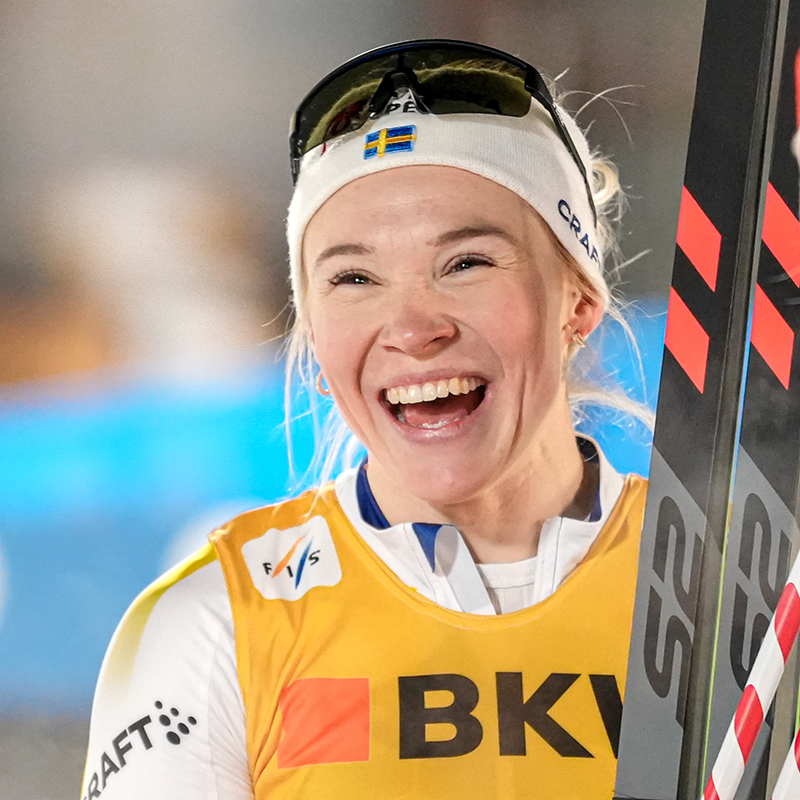
  • The Trial in Trondheim

    The Trial in Trondheim

    This coverage is made possible through the generous support of Marty and Kathy Hall and A Hall Mark of Excellence Award. To learn more about A Hall Mark of Excellence Award, or to learn how you can support FasterSkier’s coverage, please contact info@fasterskier.com.

    The men’s 20-kilometer Skiathlon at Granåsen never felt like an ordinary World Cup. From the moment the athletes stepped into the start pen, there was a tension in the air that didn’t match an early-December race. The stadium filled slowly; the fog sat low; the snow clung wetly to the klister underfoot. Yet the energy was unmistakable. It felt charged, anticipatory, almost uneasy.

    You could see it most clearly in the uniforms. Twelve Norwegians stood in the field of 91, and every one of them carried something heavier than usual race nerves. This wasn’t just about points. It wasn’t just about winning. It wasn’t even about bragging rights.

    Today, for Norway, was about the Olympics.

    Earlier that morning, Austria’s Mika Vermeulen summed it up bluntly when asked what he expected:

    “The Norwegians need to go fast to qualify for the Olympics.”

    It was the truth that everyone else was dancing around.

    On paper, this was a World Cup Skiathlon. On snow, it became something else entirely: an unofficial Olympic sorting ceremony, shaped by weeks of controversy, public criticism, and a federation under scrutiny.

    The start of the Men’s 20 k Skiathlon Trondheim (NOR). (Photo: Modica/NordicFocus)
    A Race Run Under a Shadow

    The tension surrounding this race didn’t begin in Trondheim. It started with a roster decision — or, in the eyes of many Norwegians, an omission. Emil Iversen, the veteran racer with a World Championship gold and a decade of elite podiums behind him, was left off the opening World Cup weekend in Ruka.

    The decision rippled across Norwegian media.

    The loudest voice belonged to Johannes Høsflot Klæbo.

    In a widely circulated VG article, Klæbo called the decision “dårlig håndverk”poor workmanship — and argued that if the goal was to send the fastest athletes, Iversen had earned his seat on the plane.

    “If you are good enough, you should get to go,” he told VG.

    Former national-team director Espen Bjervig fired back in Stavanger Aftenblad, criticizing both Klæbo and Iversen for speaking publicly about selection practices, arguing that it “creates noise and negativity.”

    Suddenly, what is typically a quiet, internal Norwegian debate had spilled into full public view. Selection wasn’t just a technical matter — it was a national storyline.

    And this Skiathlon, the only one before the Olympics, sat squarely in the center of that storm.

    Iivo Niskanen made his way to the front during the classic leg, but ultimately faded to 25th place on the day. (Photo: Modica/NordicFocus)
    The Classic Leg: A Tense, Measured Beginning

    When the field set off into the opening 10 k of classic skiing, the pace was high but controlled. Nobody wanted to take on the risk of an early break. The lead shifted lightly — Finland’s Iivo Niskanen testing, Norway’s Martin Loewstroem Nyenget responding — but the main pack stayed dense, the elastic never stretching too far.

    What stood out was not who led, but how closely the Norwegians watched one another. Every surge drew an immediate answer. Every gap in the pack was filled. There was a vigilance to their movements: unspoken, but unmistakable.

    Behind them, American Gus Schumacher skied with patience, always hovering near the front third, avoiding trouble. Ben Ogden played the elastic back-and-forth of the pack, feeling the surging, slowing, and reshuffling that characterizes Skiathlon racing.

    Nothing broke the race open. But everything pointed toward what was coming.

    Emil Iversen (#37, white hat), Zanden McMullen (#26 USA), Andrew Musgrave (GBR), Gus Schumacher (#18 USA) and Ben Ogden (#24 USA) navigate the pack during the classic leg. (Photo: Modica/NordicFocus)
    The Transition: When the Real Race Began

    At the stadium, skis were neatly arranged in assigned pens; in the grandstand, the crowd pressed forward on their seats, and the atmosphere shifted. The transition from classic to skate is always an inflection point in a Skiathlon. But today’s felt like the release of a held breath.

    As athletes stepped out of classic skis and into skate gear, the pace vaulted. The race’s character changed instantly — no longer steady, but sharp. No longer patient, but aggressive.

    Within seconds of leaving the exchange zone, the field stretched into a long, thin line—athletes who had looked comfortable in the first half suddenly fought to hold contact. The front swallowed the course in powerful V2 tempo, and what had been a race of restraint transformed into a race of revelation.

    From this point on, the Skiathlon resembled more of a Norwegian internal selection trial than a World Cup.

    With Johannes Hoesflot Klaebo (NOR) and Emil Iversen (NOR) at the front, Federico Pellegrino (ITA), Elia Barp (ITA), (l-r) and the rest of the lead pack try to match pace during the initial kilometers of the skate leg. (Photo: Modica/NordicFocus)
    The Skate Leg: Norway Sorts Itself Out

    With 10 kilometers to go, the lead group had thinned to about twenty athletes. By the next climb, it was closer to fifteen. And among those fifteen were eleven Norwegians — each racing not only the field but each other.

    Every shift in tempo felt deliberate.

    Every climb tested hierarchy.

    Every acceleration seemed to ask a quiet question:

    If this is for a trip to Milan–Cortina, who survives?

    Nyenget pushed the climbs with authority. Harald Østberg Amundsen pressed from the front like a man intent on staking a claim. Mattis Stenshagen floated with the leaders, unfazed by the fire around him. And somewhere in that pack, Emil Iversen — overlooked just one week earlier — had battled from the 37th starting position and was skiing with a visible urgency, a visible hunger.

    The pace was unrelenting. When Andrew Musgrave surged near 15 km, the field snapped back immediately. No one would be allowed to disrupt the internal Norwegian calculus.

    This was not a race that welcomed outsiders.

    Behind them, Schumacher held position just beyond the front group, skiing an intelligent and confident race on a day that didn’t cater to anyone not wearing red. Ogden fought through the volatility of the middle pack as the front repeatedly drove the pace into the threshold.

    Ben Ogden (USA) finding his skate legs in his first freestyle race of the season during the 20 k Skiathlon in Trondheim (NOR). (Photo: Modica/NordicFocus)
    American Reactions: Schumacher and Ogden Describe the Chaos

    Schumacher, who had circled this Skiathlon as a key Olympic-learning opportunity, said the day unfolded exactly as he expected:

    “I’m still kind of building into the season… but I’ve got some good skiathlon experience, and they don’t feel so crazy now. Treat it like a race, try to do my best, and definitely learn some stuff.”

    He found those lessons quickly — particularly in the transition to skate:

    “The pace was definitely hot… right out of the start of the skate, they went hard. A lot of those fitness guys are trying to put some distance to the faster people. It’s tough on this course. I felt ready for it, but struggled a little bit with the skis. They were digging too much in the hills.”

    And he could feel the intensity radiating from the Norwegians:

    “It absolutely was their Olympic trial. There’s definitely some intensity from their side. A lot of those guys are really nervous — and to be honest, they don’t seem to be having that much fun right now. It’s a tough fight for those four spots.”

    Ogden, who finished 35th, echoed the shock of the pace — especially coming off a demanding classic leg:

    “The pace today was probably the hardest thing for me. The classic was just so fastand I haven’t skated a lot this year. It came after the world’s hardest 10k classic.”

    He battled through the skate leg, trying to recalibrate on the fly:

    “I don’t think I skated very well. I didn’t push into the downhills very well, and I was just tired. You can go hard in the classic and still be competitive in the skate, but you have to be a little more tactical.”

    And, like Schumacher, he found himself needing to rewrite his goals mid-race:

    “Reevaluating your plan on the fly is always the hardest part. Once your plan falls apart, it’s easy to lose a little bit of grit mentally. Today, the goal just became to hang onto the back and try to beat a couple of them.”

    Maybe it isn’t in focus, but what is clear is Harald Oestberg Amundsen (NOR), Mattis Stenshagen (NOR), Johannes Hoesflot Klaebo (NOR), Emil Iversen (NOR), Jan Thomas Jenssen (NOR), Erik Valnes (NOR), Martin Loewstroem Nyenget (NOR), (l-r) all charging up the final climb of the 20 k Skiathlon in Tronheim, Norway. (Photo: Modica/NordicFocus)
    The Final Kilometers: A Reckoning on the Last Climb

    With three kilometers left, the stadium roar began to build. The final climb hovered ahead — long, grinding, decisive. The pack tightened—the Norwegian national and club team suits clustered near the front. And then the sorting began in earnest.

    Amundsen drove up the hill with power.

    Klæbo hovered, always exactly where he needed to be.

    And Iversen — the man left off the Ruka start list — refused to yield a single meter, emerging along the outside edge of the trail toward the front of the pack.

    The race crested the final hill, swept through the big left turn, and spilled into the descent where Skiathlon medals — and today, Olympic dreams — are so often decided.

    Klæbo did what only Klæbo does: timed the moment flawlessly, slid into open snow, and glided away with the control and confidence that has defined his career. Behind him, Amundsen locked up second.

    But all eyes were on third.

    There, straining every muscle, skiing with unmistakable desperation and defiance, was Emil Iversen.

    He crossed the line in third place — a podium on the only Skiathlon before the Olympics.

    For him, it was not just a race result.

    It was a reclamation.

    Johannes Hoesflot Klaebo (NOR) leads a Norwegian train down the home stretch. (Photo: Thibaut/NordicFocus)
    A Sweep That Spoke Volumes

    Norway swept the top eight.

    The best non-Norwegian — the always-impressive Mika Vermeulen — finished ninth.

    The top nine were separated by five seconds.

    The top fifteen by fifteen seconds.

    It was depth displayed as dominance, and dominance displayed as a message.

    For Klæbo, the picture is clear.

    For Amundsen, clearer still.

    For Stenshagen, it was a breakthrough.

    And for Iversen, it was a revival that carried the weight of the last two weeks on its shoulders.

    For the American men, Schumacher’s 21st showed consistency and smart racing in a field that spent much of the day executing internal warfare—Ogden’s 35th offered lessons in reading a volatile race and surviving wave after wave of pace changes.

    Harald Oestberg Amundsen (NOR), Johannes Hoesflot Klaebo (NOR), Emil Iversen (NOR), (l-r) take the Skiathlon podium in Trondheim (NOR). (Photo: Thibaut/NordicFocus)
    What This Means for the Olympic Picture

    Klæbo, with a smirk on his face, didn’t hesitate after the race:

    “I think I made the team now for sure.”

    He wasn’t wrong.

    Amundsen likely solidified his place as well.

    Stenshagen made himself hard to ignore.

    And Iversen forced the federation to confront the conversation it had hoped to avoid.

    Performance is supposed to matter.

    And Iversen delivered the clearest performance of anyone not named Klæbo.

    In the eyes of fans, teammates, and media, he didn’t just earn consideration — he demanded it.

    Emil Iversen may be the happiest person in Trondheim (NOR) today. (Photo: Thibaut/NordicFocus)
    A World Cup in Name Only

    As the sun faded over Granåsen and crews raked the sugary snow from the corners, it became apparent that what we had just witnessed was something far larger than a World Cup.

    This race was a referendum on form.

    A public test of internal politics.

    A stage where the world’s strongest skiing nation sorted itself out in real time.

    The stadium announcer called it the men’s 20 k Skiathlon.

    But everyone who watched, coached, raced, or cheered knew better.

    This was the reckoning.

    This was the day Norway began choosing its Olympic distance team.

    This was ‘The Trial in Trondheim!’


    Men’s 20 k Skiathlon RESULTS


    Love Stories Like This? Help Keep Them Coming.

    Feature stories like this one take time, access, and care to produce. If you value thoughtful storytelling and independent ski journalism, please consider becoming a Voluntary Subscriber. Your support directly fuels the work we do to cover the people, places, and moments that make our sport special.

    Join the FasterSkier community!


    Emil Iversen (NOR) was so happy to be back on the World Cup podium, but clearly his smiles were about something even bigger. (Photo: Thibaut/NordicFocus)
  • Klaebo’s 100th: Norwegian Sprint Cauldron Boils Over in Trondheim

    Klaebo’s 100th: Norwegian Sprint Cauldron Boils Over in Trondheim

    This coverage is made possible through the generous support of Marty and Kathy Hall and A Hall Mark of Excellence Award. To learn more about A Hall Mark of Excellence Award, or to learn how you can support FasterSkier’s coverage, please contact info@fasterskier.com.

    Erik Valnes (NOR) and Johannes Hoesflot Klaebo (NOR), (l-r) crest the final climb before descending into the stadium during the World Cup Classic Sprint in Trondheim (NOR). (Photo: Modica/NordicFocus)

    Johannes Høsflot Klaebo’s 100th World Cup win did not arrive with the roar he’d grown used to on this course.

    Granåsen last March had been a cauldron—tens of thousands of fans in plastic ponchos, rain pouring sideways, the World Championships turning Trondheim into a temporary capital of the sport. Eight months later, on the first Friday of December, the same stadium felt smaller. The sky was already dim by early afternoon, the floodlights casting a clean, blue-white glare across sugary tracks. The weather had finally cooperated—no rain, firm snow, kick wax that actually bit—but the crowd was thin enough that you could hear individual cowbells and specific voices when the finalists swung into the stadium.

    Still, the stakes were anything but small. Norway flooded the start list with a full Nations-Group, 12 men in red suits, all chasing the same thing: an Olympic ticket to Milano–Cortina. Russia’s return to the World Cup had been confirmed in principle earlier in the week, adding long-term uncertainty to an already cutthroat season, but there were no Russian suits on the start line in Trondheim.

    And in the middle of it all, on the same course where he’d taken six gold medals at Worlds, Klaebo lined up for a classic sprint with 99 World Cup victories to his name and the chance to round the number off in his own backyard.

    By the end of the afternoon, the number would be 100. The route there was messier—and more revealing—than the record book will show.

    Ben Ogden (USA) on his way to posting the fastest qualification time. (Photo: Modica/NordicFocus)
    A qualifier that flipped the script

    The first jolt of the day came from the American side of the results sheet.

    Ben Ogden, the 25-year-old Vermonter who has been quietly (and sometimes not so quietly) remaking the U.S. men’s sprint profile, didn’t just survive the qualification round—he beat the entire Norwegian armada on their home snow. Ogden set the fastest time of the morning, ahead of Johannes Hoesflot Klaebo in second and a 19-year-old Swede, Alvar Myhlback, in third.

    For U.S. head coach Matt Whitcomb, the signal was as much about skis and process as it was about the scoreboard.

    Norway had sent out its complete Nations-Group—extra men beyond the regular quota—12 in total, and every one of them qualified for the heats. To outski so many Norwegians in a Norwegian sprint, Whitcomb later pointed out, is not an accident. It takes real form and excellent skis.

    Ogden’s own description of the qualifier sounded almost deliberately un-dramatic, as if he were trying to file the moment under “routine” before the day had even finished.

    “They all feel the same for me, for the most part,” he said afterward. “I definitely knew I was having a good one, skiing pretty fast, but you never know till you cross the finish line. In the middle of the race, I don’t think about that too much—I just sort of think about the next hurdle… At the bottom of the hill, I think about getting to the top, at the top, I think about pushing hard into the downhill, and on the downhill, I think about skiing the corner at the bottom of the hill well. That’s kind of the way it goes mentally for me. I definitely felt good, felt strong. I just felt like I could push and push and push and still have some energy, so it’s a good feeling for sure.”

    Behind him, the margins were tight everywhere. Gus Schumacher and Jack Young both hovered just outside the top 30; Kevin Bolger lurked not far behind.

    JC Schoonmaker, representing APU and still the same powerful sprinter who has lived on the brink of significant breakthroughs for several seasons, slid into the heats in 24th.

    If Ogden’s run lit the American side of the results board, Myhlback’s qualification told a different kind of story—a long-distance skier breaking into the sprint world by almost ignoring one of its foundational assumptions.

    Alvar Myhlback (SWE) double poling the qualification (and heats) on skate skis in Trondheim (NOR). (Photo: Modica/NordicFocus)
    The double-poling kid from Bjursås

    On the face of it, a 1.4-kilometer classic sprint in Trondheim is not where you’d expect to see the aftershocks of Vasaloppet.

    Myhlback, a 19-year-old Swede from Bjursås, arrived in Trondheim already something of a legend in a different corner of the sport. In March, he had become the youngest winner in the hundred-year history of the Vasaloppet, staving off the best of the Ski Classics field over 90 kilometers of classic racing and double-poling his way under the blue arch in Mora.

    His recent résumé reads like a long-distance syllabus: victories at Vasaloppet, the Klarälvsloppet, Alliansloppet, and the Blink Classics roller-ski race, all in the three-hour-plus universe of Ski Classics racing.

    Yet in Trondheim, he and the coaches around him made a choice that felt deeply rooted in that marathon background. While almost the entire field stuck to traditional classic setups—grip wax underfoot, long diagonal-stride climbs—Myhlback rolled to the start on skate skis, no kick wax, no plan to stride. His day would be decided on pure upper-body power and glide.

    He stuck with that choice all afternoon. In qualification, he was third, just 0.24 seconds behind Klaebo and less than half a second behind Ogden, double-poling up the long climb where others were striding. In the heats, he doubled down, literally: double-poling on skate skis in a classic sprint, in a World Cup final, on a course where the kicks of Norwegian diagonal stride have defined the past decade.

    That he advanced at all would have been a story. That he finished the day on his first World Cup podium, sandwiched between Oskar Opstad Vike (second place) and Lars Heggen (fourth place) in a final dominated by Norwegians, turned it into something else.

    It also sharpened an old talking point: Norway’s legendary wax trucks versus a kid who effectively opted out of grip wax altogether, trusting that his marathon-honed double-poling engine could hang on a course built for diagonal stride.

    Oskar Opstad Vike (NOR), JC Schoonmaker (USA), Amund August Korsaeth (NOR), Alvar Myhlback (SWE), (l-r) during their quarterfinal. (Photo: Modica/NordicFocus)
    The corner that wouldn’t let go

    If qualification belonged to Ogden and the chemistry of Norwegian wax trucks, the afternoon’s defining feature was a corner—and the way it kept finding Americans.

    Granåsen’s men’s sprint course climbs from the start to a right-hand turn that looks elementary on a map and on television. It’s not an overtly decisive feature: no off-camber sweeping change of direction, no opportunities for bold attacks, just too early on the course to gain a significant advantage. Yet, over and over again, as head coach Matt Whitcomb later put it, “that corner has become a problem spot.

    In the men’s quarterfinals, Schoonmaker arrived there in a good spot, charging with what Whitcomb described as “gas to burn.

    Then he tangled with Italy’s Simone Mocellini at the top of the climb, went down, and his day ended with a broken pole and a replay that U.S. coaches will be watching for years.

    “Today was definitely a step in the right direction, Schoonmaker wrote afterward. “It builds some confidence for the next races and for the season. I feel good and feel like I’m skiing pretty well, but it’s just not quite coming together the way I would like. I’m happy with the spot I’m in at the moment.”

    Italy’s Simone Mocellini and JC Schoonmaker (USA) crest the final climb before descending into the stadium, but they were out of contention to advance. (Photo: Modica/NordicFocus)

    In an Olympic year, that kind of tempered optimism reads differently. Under the U.S. selection procedures for Milano–Cortina, an individual top-eight finish in one of the Olympic events—sprint classic, 10 k skate, 20 k skiathlon, 50 k classic—can lock in an athlete’s nomination through objective criteria. For sprinters like Schoonmaker and Ogden, these early-season classics are more than just race days; they’re auditions with permanent consequences.

    Ogden’s quarterfinal, by contrast, looked like the blueprint for surviving that fraught middle of the course. He surged early, stretched his heat into a line, and controlled the race in a way that kept him clear of chaos. He won his quarter almost casually, looking like a man who had solved Granåsen’s puzzle.

    Then the semifinal brought him back to the same corner.

    Ogden selected quarterfinal five—the last men’s heat in the rotation, the one where recovery time before the semifinal is shortest. By the time he lined up again, he could feel the effort in his arms; the plan, he said, was to sit in the pack early and save his move for the big climb.

    Instead, the day tightened around a single moment.

    “In the semifinal, I was kind of feeling the quarterfinal in my arms a little bit, he said. “So I thought, all right, I’ll just sort of sit in the pack here and wait until that big climb and try and do what I do on that. But I kind of paid the price early on, getting tangled up in that corner. I don’t think Harald [Østberg Amundsen] obstructed me or anything of the sort—he just happened to step on my tip. And when that happens, people who have ski raced will know that your ski comes to a stop, and you can’t really move it. And then that kind of caused me to get spun around, and we both went down.”

    Harald Oestberg Amundsen (NOR) and Ben Ogden (USA), (l-r) cross the line in their semifinal heat after the two tangled on the courses first corner. (Photo: Modica/NordicFocus)

    “Definitely [a] frustrating way to end the day, especially when I was feeling so good. But these things happen. And there’s always tomorrow.”

    Whitcomb, who has coached through more sprint generations than most of the field has been alive for, sounded almost exasperated with that stretch of trail.

    “This is probably the most competitive sprint we’ll race all year, until Drammen, he said, noting that every team—not just Norway—is living with Olympic selection pressure this winter. “For us, that corner is not an important part of the race, but it keeps becoming one… It’s a place where you should be skiing stable, defending your space, not trying to drop into the stadium with maximum speed.

    The Americans, in other words, left Trondheim with film to study as much as with results to celebrate. Ogden’s ninth-place finish—best in the U.S. men’s camp and agonizingly close to that top-eight Olympic criterion—is both a milestone and a marker.

    Alvar Myhlback (SWE), Lars Heggen (NOR), Johannes Hoesflot Klaebo (NOR), (l-r) battle down the finish stretch of the individual classic World Cup sprint final in Trondheim (NOR). (Photo: Modica/NordicFocus)
    Five Norwegians, one Swede, and a milestone

    By the time the men’s final lined up, the race had distilled into a different kind of pressure.

    Norway had put five men into the last six: Klaebo, Oskar Opstad Vike, Erik Valnes, Lars Heggen, and Ansgar Evensen. The lone non-Norwegian was Myhlback, the kid on skate skis, bib 3 set alongside four pairs of Fischer classic boards and one more pair of Atomics.

    On paper, the stakes were layered. For Klaebo, it was win number 100 and the chance to keep an almost absurd streak alive: seven straight wins in Granåsen sprints, counting Worlds.

    For Vike and Evensen—both already rising up the sprint standings—a podium here, in the hardest sprint of the season and on home snow, would strengthen an Olympic case in front of national coaches who did not have unlimited roster spots to hand out. Under IOC rules, each nation can take a maximum of eight men and eight women in cross-country; FIS allows only four athletes per gender per event.

    From the gun, it was clear this would not be one of Klaebo’s processions.

    Vike drove the pace early, taking the field up the major climb and over the top with a small gap. Heggen, just 20 and already a three-time junior world champion, looked at home in the front half of the pack. Valnes hovered near Klaebo, doing what he has done for seasons now: protecting his status as Norway’s most consistently useful classic sprinter.

    Klaebo, for once, did not look invincible on the climb. He came over the top under pressure, with Vike controlling the line, and Myhlback momentarily buried deeper in the pack.

    Then, on the descent back into the stadium, the familiar pattern snapped back into place.

    Whitcomb described what happened there with a kind of forensic appreciation: “Klaebo’s signature move, popping out of his tuck to give two short, almost invisible pushes, gaining just enough speed to own the entry into the turn.”

    From there, the physics feels pre-written: better speed into the corner means better speed out of it, and better speed out of it means that when the straightaway arrives, the race belongs to him.

    Vike held on for a second. Behind them, Myhlback produced one last, pulsing double-pole assault, hauling himself from sixth off the final corner past Heggen and Valnes to grab third—the lone white and blue Swedish suit in a sea of red, and his first World Cup podium.

    The official result sheet will show a clean column of numbers: Klaebo first in 2:59.89, Vike +0.31, Myhlback +0.34, Heggen, Valnes, and Evensen rounding out the six. The messy part—the decisions that got them there—was already being replayed on screens in wax trucks and team vans before the snow had stopped squeaking.

    Johannes Hoesflot Klaebo (NOR) celebrates his 100th World Cup victory in front of his home crowd in Trondheim (NOR). (Photo: Modica/NordicFocus)
    “Number 100. I’m taking it here.”

    When the stadium interviewer finally put a microphone in front of Johannes Hoesflot Klaebo, the question almost wrote itself: had he, as some had suggested, deliberately eased off in last weekend’s distance race in Ruka to engineer his 100th win on home snow?

    Klaebo, grinning, swatted the idea away.

    “Number 100. I’m taking it here, he said. “To take it and to also do it in a sprint—it’s special… I wish I could say that. But no, I didn’t. I just feel like it was a perfect place, and doing this at the start of the weekend is really good. Now we can really just enjoy the weekend and hopefully some more good racing the next couple of days.

    At 29, he is now the first man to reach 100 World Cup wins and only the second athlete overall, joining fellow Norwegian Marit Bjørgen, who finished her career with 114.

    Whitcomb, who has been on the circuit for the entirety of Klaebo’s rise, sounded as if he were still trying to convince himself the story was real.

    “It almost doesn’t seem like a true story, he said. “Given that he won every race at World Championships in his backyard, given that he won his 100th World Cup in his backyard… and yet he does it. And that’s, I guess, the point of this whole thing.

    Today’s win, he noted, was not a walkover. Klaebo was genuinely under pressure on the climb. He had to make the pass on the descent. For an athlete whose dominance can sometimes feel inevitable, that mattered—it turned the milestone into a race rather than a coronation.

    Johannes Hoesflot Klaebo (NOR) jumps for joy after his 100th career World Cup victory. (Photo: Modica/NordicFocus)
    Norway’s sprint cauldron—and everyone else inside it

    For the Norwegian men’s team, Trondheim’s result sheet reads less like a celebration and more like a spreadsheet.

    The host nation deployed its full quota: twelve athletes, all of whom qualified into the top 30.

    Seven Norwegians made the semifinals. Five made the final. The internal competition for Olympic places—which Norwegian media routinely describe as more cutthroat than the Games themselves—tightened another notch.

    Evensen, who podiumed in Ruka and again came close here, is building what looks suspiciously like a “you can’t leave me home dossier. Vike’s second place gives him a marker race in front of home coaches. Heggen, not long removed from the junior ranks, now has “World Cup final in Trondheim on his resumé. Valnes remains what he has been for several years: the quiet constant, who makes every relay debate harder.

    All of it plays out under the exact challenging numbers that govern every other nation: eight men, eight women total; four start spots per event. In a year when Russia’s gradual reintroduction will eventually change World Cup standings, and when nations like Sweden are suddenly finding new men’s sprint stars in unlikely places, no Norwegian result feels expendable.

    For the Americans, the lens is different but just as sharp. U.S. selection procedures put heavy weight on top-eight finishes in events that mirror the Olympic schedule; Ogden’s ninth today falls just outside that automatic tier but lands him firmly in the heart of the conversation as the season unfolds. Schoonmaker’s “step in the right direction, as he put it, is also a reminder that sometimes the key line on a selection sheet is not a single result but a trend—of qualification, of speed, of that “look in his eyes Whitcomb referenced.

    And somewhere beyond the World Cup bubble, Myhlback’s coaches and sponsors in the Ski Classics universe are waking up to a fact they probably already suspected: the kid who won Vasaloppet isn’t only a marathoner. His decision to show up in Trondheim, on skate skis, for a classic sprint, and walk away with a podium is going to complicate every conversation about where he belongs.

    Ben Ogden (USA) although a tangle during the first corner of the semifinals left him wondering what might have been there was a lot of positives today for Ogden in Trondheim (NOR). (Photo: Modica/NordicFocus)
    A quieter Granåsen, and a long season ahead

    As the stadium emptied on Friday evening, Granåsen sounded more like a training venue than a World Championships site: a few kids sliding around on the outrun, the soft hiss of sprinters cooling down, coaches trudging back to wax trucks under a sky already leaning toward night.

    Inside those trucks and team rooms, the day’s big moments were already being analyzed into data points. For Klaebo, the milestone win will sit at the top of his personal mythology, another chapter in the story of a hometown kid who has somehow bent the sport around his own arc. For Norwegians like Vike, Evensen, Heggen, and Valnes, the Trondheim sprint will live on as Exhibit A, B, C, and D in Olympic selection debates that will stretch deep into January.

    For Ogden and Schoonmaker, the corner that took them down will become homework—grainy replay clips, course maps, and, eventually, new lines in the U.S. sprint “playbook the team keeps for every World Cup venue.

    And for Alvar Myhlback, who insists he is still a long-distance skier first, Trondheim may end up feeling like an interruption: a single day on a familiar course in Norway when he parked the marathon skis, rolled out on skate boards, and proved that his double-poling engine works just fine in the cramped, chaotic, oxygen-starved world of classic sprinting.

    The World Cup moves on quickly—20k skiathlons on Saturday, 10k skate starts on Sunday, Davos and the Tour de Ski looming just ahead. But for one early-winter afternoon in Trondheim, on a course that is beginning to feel like the sport’s central stage, the story belonged to a corner, a kid on skate skis, and a 29-year-old Norwegian who somehow made history again in his own backyard.


    Complete Results

    Trondheim Men’s Classic Sprint RESULTS

    Trondheim Men’s Classic Sprint QUALIFYING


    Love Stories Like This? Help Keep Them Coming.

    Feature stories like this one take time, access, and care to produce. If you value thoughtful storytelling and independent ski journalism, please consider becoming a Voluntary Subscriber. Your support directly fuels the work we do to cover the people, places, and moments that make our sport special.

    Join the FasterSkier community!


    Oskar Opstad Vike (NOR), Johannes Hoesflot Klaebo (NOR), Alvar Myhlback (SWE), (l-r) take the individual classic sprint podium in Trondheim (NOR) – Klaebo’s 100th World Cup victory. (Photo: Modica/NordicFocus)
  • Sweden Sweeps Chaotic Trondheim Classic Sprint

    Sweden Sweeps Chaotic Trondheim Classic Sprint

    This coverage is made possible through the generous support of Marty and Kathy Hall and A Hall Mark of Excellence Award. To learn more about A Hall Mark of Excellence Award, or to learn how you can support FasterSkier’s coverage, please contact info@fasterskier.com.

    Emma Ribom (SWE), Johanna Hagstroem (SWE), and Linn Svahn (SWE) made up the all-Swedish podium in Trondheim’s Classic Sprint (Photo: Modica/NordicFocus)

    The news all week has been “The Russians are Coming! The Russians are Coming!” Well, no Russians, today. Even after all the headlines, even after certain Russian athletes had sent entries to the organizers of this World Cup event in anticipation of being  cleared to compete (which they were) by the court of Arbitration for Sport, even after the Kingdom of Norway promised to expedite the visa applications of Russian athletes who had been offered entry into these World Cup races. Still, no Russian skiers on the starting line in Trondheim.

    Norwegian fans are probably fine with that. Few of them wanted the Russians here in the first place. This is a ski-crazy nation that doesn’t want the Russians spoiling the party . . . and not just because Norwegian fans fear that the Russians will interrupt the Norwegian dominance of World Cup podiums, but also because Norwegian ski fans remain unconvinced that Russian athletes can be trusted to be clean competitors. Regardless, just because Russians are absent from this first World Cup opportunity doesn’t mean that Russian skiers—in the guise of Independent Neutral Athletes (AINs)—won’t make their way to numerous starting lines this season.

    In Trondheim, all eyes were on Kristine Stavaas Skistad (NOR) who has shown that she may be the sprinter to beat when the event is contested in Classic technique. The Norwegian crowd (albeit a much smaller crowd that packed this venue during last year’s World Championships) expected to watch Skistad calmly and steadily dominate this Sprint field . . . but that’s not at all what happened. Skistad qualified rather slower than normal (in 22nd), and never showed the sort of dominance that epitomized her victory in Ruka just a week ago. She faded in her quarterfinal, finishing third and failing to advance to the semifinal. The steadying effect Skistad may otherwise have provided was eliminated from the field. Chaos ensued . . .

    Out of the maelstrom skied Sweden’s Johanna Hagstroem, coasting to victory ahead of a haggard field that left unrealized aspirations and shattered pole fragments scattered across Trondheim’s Sprint course. Emma Ribom and Linn Svahn would complete Sweden’s sweep of the podium.

    For the Americans, Jessie Diggins had qualified 14th ahead of her teammate, Julia Kern, in 27th. They would both exit after the quarterfinal, finishing 14th and 20th, respectively.

    “I think today was a step in the right direction, said Kern. “And I’m hoping to continue to build from here. World Cup doesn’t leave much margin for error. Being on the Team sprint is definitely one of my top goals this season, but we are still months away from that. Right now, I’m doing the steps to be at my best in February, racing my way into form and working on both fitness and speed with various race efforts.”

    “I was really psyched to be feeling good today,” said Diggins. “Got to spread a lot of glitter out there, and I’m really proud of how I skied!”

    Among other Americans, Alayna Sonnesyn would finish 45th, Kate Oldham 54th, and Erin Bianco 52nd. No Canadian skiers were entered in Trondheim’s Classic Sprint.

    Diggins delivered another absolutely solid qualifying performance, later commenting on her level of fitness and preparedness for the season ahead. “It’s nice to have some consistency right now,” said Diggins. “But at the same time I feel like I never take it for granted . . . It’s always been a goal to be a good all-around skier and a consistent skier (but) the priority this year is, for sure, the Olympics. That said, I know I’m an athlete that thrives off of a lot of racing; the best way to continue to improve is . . . to show up and do it on race day!”

    “Racing a lot is a part of my training plan and peaking plan,” Diggins continued. “It’s nice to know that can be a way for me to race into highest levels of fitness.”

    Jasmi Joensuu (FIN), Jonna Sundling (SWE), and Kristine Stavaas Skistad (NOR) were among pre-race favorites, but none would realize the results that their resumes and qualifying results predicted. (Photo:  Modica/NordicFocus)
    Women’s Classic Sprint

    Sprint qualifying was won in Trondheim by Jasmi Joensuu (FIN) while last week’s Classic Sprint winner (in Ruka, Finland), Skistad, qualified only 22nd. Svahn showed that her return to racing also corresponds with a return to form; she qualified third. Obviously Svahn’s sprint speed has returned. It remained to be seen whether or not she would display the endurance needed to progress deep into the heats.

    Kern drew Quarterfinal 1 against Joensu, Skistad, and Jonna Sundling (SWE). Top qualifier, Joensu, shot straight to the front, seemingly determined (as she was through all of last season when she won the Sprint World Cup) to exhaust her rivals by making the pace high. Skistad was perfectly content to let Joensu set the pace.

    Joensu’s strategy allowed her to amass good points in every sprint last season, but she seemed each week to expend too much energy in the heats—often running out of gas in finals or semifinals. In Trondheim, Joensu remained committed to her strategy, taking the first quarterfinal ahead of Sundling who stormed up the straightaway to catch  Skistad (whose wide line around the final turn saw her hopping over a V-board to maintain her line into the final straightaway). at the finish line. Kern would finish the heat in fourth.

    Svahn continued to bolster her comeback in the second quarterfinal which she won over Coletta Rydzek (GER). The main impact of that heat, though, was the fast finishing time that displaced the prior heat’s lucky losers, Skistad and Kern.

    Diggins led out her quarterfinal, but found herself overtaken by the faster skis of Hagstroem and Ane Appelkvist Stenseth (NOR) on the course’s downhill. A brief tangle with Hagstroem at the summit of the final climb seemed to steal Diggins’ momentum, and she was unable to recover in the finishing straightaway. Diggins would finish the heat in third, but would not advance as a lucky loser.

    Reached for comment after the races, American Coach, Matt Whitcomb, described the tangle between Diggins and Hagstroem. “(Jessie) skied well in the quarterfinal, needed to be in the position that she was in,” said Whitcomb. “And then to be hacked on that final corner dropping down into the stadium by Johanna Hagstrom was really unfortunate. Johanna did get a yellow card for that; I think she should have been disqualified because it was deliberate. And, yeah, we shouldn’t be letting those moves happen, but that took Jessie out of the race. We spoke with the jury and had a respectful disagreement. Their argument was that because Johanna and Jessie were together when the incident happened—and then at the bottom of the long descent they were still together—that it didn’t really change the result. And I think that is true in a world where Lucky Loser doesn’t exist. But it absolutely changed the result today. And it’s not that Johanna went on (to win) the race, it’s that Jesse got eliminated because of—let’s see—unethical tactics.

    Semifinals

    The first semifinal featured Maia Dahlqvist (SWE), Svahn, Moa Ilar (SWE), Sundling, and Joensuu. Joensuu seems to have only one tactic as she sped to the front early. Ilar took the bait, and powered up the first climb in the lead. But the early speed detached no one from the pack, so a different tactic tookover with the pack slowing to a standstill at the summit of the final uphill. No one wanted to lead the downhill—no one wanting to provide the slipstream that would allow others to pass before the final corner. Ultimately, it was Svann who trusted her skis enough to dive down the final slope, carrying her speed into the finishing straightaway and across the line to advance to the final ahead of Sundling.

    Having just watched skiing’s version of a cycling velodrome trackstand, the racers in the second semifinal would know that a quick pace would almost certainly result in four skiers advancing to the final (two automatic qualifiers, and two lucky losers). Stenseth set the fast pace, followed by Hagstroem and Ribom. Hagstroem bobbled through an awkward lane change on the final downhill, but still managed to weave her way through the straightaway crowd to finish third (advancing as a lucky loser) behind Laura Gimmler (GER) and Ribom.

    Johanna Hagstroem (SWE) emerged from the chaos on Trondheim’s Sprint course to claim her second World Cup victory. (Photo: Modica/NordicFocus)
    Women’s Classic Sprint Final

    Trondheim’s six-skier final would be dominated by four Swedes: Svahn, Sundling, Hagstroem and Ribom. The race would become purely tactical with no one wanting to take the lead and the field four-wide across the course. In the low-speed maneuvering, Gimmler stumbled, taking down Svahn and breaking Sundling’s pole. Suddenly, there chaos in the field, and a reason for the pace to accelerate. After an agonizing wait for a replacement pole, Sundling dropped back to fourth among the remaining contenders. Hagstroem found herself alone at the front, chased up the final hill by Ribom.

    What an unnecessary mess the final was turning out to be; Sundling (who had gotten a new pole and skied back into contention) managed to tangle with Ingrid Bergene Aabrekk (NOR) at the top of the final climb, dropping to the snow and out of contention. Coming past her, Svahn powered back into contention. Svahn would finish third behind Hagstroem and Ribom.

    Hagstroem expresed her own excitement and surprise in post-race interviews. “I heard something on the first downhill, she said. “I was like, ‘Am I alone?’ I’m in shock, kind of.”

    Hagstroem exits Friday’s Sprint leading the World Cup Sprint standings ahead of Sundling and Joensuu. Racing continues in Trondheim with a Skiathlon on Saturday, and 10 k Interval Start on Sunday.

    Trondheim Women’s Classic Sprint RESULTS

    Trondheim Women’s Classic Sprint QUALIFYING

    One slips and falls, another steps up. Team Sweden continues to deliver. (Photo: Modica/NordicFocus)

    Love Stories Like This? Help Keep Them Coming.

    Feature stories like this one take time, access, and care to produce. If you value thoughtful storytelling and independent ski journalism, please consider becoming a Voluntary Subscriber. Your support directly fuels the work we do to cover the people, places, and moments that make our sport special.

    Join the FasterSkier community!
  • The Long Game: Over-Training in the Development Years.

    The Long Game: Over-Training in the Development Years.

    Campbell Wright (USA) climbing the Stelvio Pass in Livigno (ITA) during his summer training in July. (Photo: NordicFocus)

    After my posted articles on FasterSkier on “Junior Nationals” and “What’s the Hurry”, there was some anticipated discussion on my statements around over training, burn out, and the attrition rate in the sport. When I write, it is based on my experience, my research, and my opinion. I encourage and welcome the debate.

    Over training and burnout in junior athletes is real

    I think it is important to define the ways I view over training and the psychological and physiological impacts of over training. Following is one of many definitions of over training. “Overtraining is a chronic, maladaptive state in which the accumulated stress of training and life exceeds an athlete’s ability to recover, leading to a sustained decline in performance, persistent fatigue, and widespread physiological and psychological disruption that does not improve with normal rest.”

    I only use tools that I have at my disposal to measure over training.

    Psychological Disruption
    • Persistent reports of fatigue not explained by acute load
    • Loss of motivation training
    • Irritability, mood volatility
    • Poor sleep or wake up unrefreshed
    • Increased RPE for normal sessions
    Physiological Disruption
    • Chronic, maladaptive state lasting one or more months, despite continued training.
    • The athlete does not improve after 7–14 days of reduced load and rest
    • Small tests: pace/power at aerobic threshold, submax HR response, repeatable intervals
    • Look for:
      • Higher HR at a given workload
      • Lower power/pace at same RPE
      • Flattened ability to hit high intensity
    • Parasympathetic and Sympathetic branch of the Autonomic Nervous system are out of balance as assessed through HRV
    • Rest alone often does not solve it, the system is dysregulated

    In the last decade, I have coached several athletes whose training logs and in personal discussion revealed that they were chronically fatigued for several months, that their performance had plateaued or declined over the long term, and whose HRV testing revealed an HRV of a 70-year-old man. Over the following 2-3 months of controlled recovery and training, we saw the HRV return to an expected high range for young athletes. What that suggests was over training (or burn out). In a thorough review of their training, going too hard every day was the common denominator, all while trying to increase the volume of training. They had fallen victim to the typical practice of chasing hours to meet some arbitrary objective rather than learning how to train effectively.

    As a coach, athlete, and program builder who’s spent a lifetime in this sport, I’ve had 40+ years to observe what works, what burns out talent, and what produces the kind of skiing that eventually is competitive internationally. In looking at the issue over the long term—and in my years at the US Ski Team, Stratton Mountain School, and the APU Nordic Ski Center—burnout appears to be a relatively common theme. The issue of burnout probably has many factors: time commitment, cost, lifestyle demands, etc. Right now, too many young skiers are being pushed into  “high-performance” pathways, high volume, constant racing and travel that outpaces training age, and pressure to specialize before they’ve developed the capacity, the skills, or the joy that keep athletes in the sport long enough to realize their individual potential. That’s a compelling goal on paper: “prepare them for the next level” and fall into the long term development pathway. But when you look closely at the training, the incentives, and the results, the system begins to look like a short-term race to nowhere.

    We talk endlessly about “development pipelines,” yet we’re still losing too many athletes by age 17-18, and far too many programs are built around chasing early results instead of building long-term potential. I feel it is time for a reset, one grounded in training age, physiology, and long-term athlete development, keeping athletes in the sport longer, rather than the stress and anxiety of reaching high level of performance to early.

    In nations with deep endurance sport cultures—Norway, Sweden, Finland—you see the benefits of a different athlete-development philosophy: large focus on youth participation at the base, broad retention into the teenage years, and keeping athletes in the sport as long as possible. From this perspective, we develop healthy athletes and a solid sport that has the future potential of developing top skiers. That’s how developmental pathways work.

    Rosie Brennan is part of a group of elite skiers who began hitting their stride later in their careers. (Photo: Rosie Brennan)

    The biggest competitive advantage Norway has is not technique or wax, it’s retention. They simply have more 20-year-olds who have trained correctly for 8-10 years. Some reports suggest that there are more than 100,000 youth under the U18 age group skiing in Norway. That’s the real edge. As an example in Saturday’s 11/22 FIS race in Beitostoelen men’s race, there we 90 Norwegian skiers over the age of 23, and many in their early to mid 30’s. The makeup of the women’s race was similar. In the U.S., however, it seems our system selects skiers out at an early age to ensure that we always have a few who perform at the highest levels of the sport. We treat 14 and 15 year-olds like mini-elites when they’re still developing coordination, technical skills, and aerobic base. Meanwhile, the countries we’re trying to beat are putting many more kids on skis, keeping more of them engaged through U23’s, and waiting until later to identify who’s ready for high-performance training. If U16 and U18 programs are built around Junior Nationals performance, it has already failed.

    The data is clear across sports, although far from conclusive in cross country skiing as the data just isn’t there; however, that data from published studies across sports is compelling.

    • Only 0.01–0.05% of youth athletes participating reach the international level.
    • Athletes who specialize late have higher career longevity.
    • The best seniors were rarely the best U16’s; they were the most developed, not the most decorated.

    In my way of thinking, given the relatively low rate of possible success we should frame our programs around growing the base of skiers, keep them in the sport as long as possible and providing the guidance to help them be the best they can be. Given the low rate of potential success, it seems to me that there should be a higher social and cultural value to focus on this objective.

    I wonder, at times, if the investment we make in sport at the young ages is congruent with growing sport. (I have covered this in other articles so won’t do a deep dive into it now.) Or is it already a barrier to engaging and keeping kids in sport.  At a recent regional meeting one coach, whose opinion I value, informed the group that his program had 30 pairs of test skis to support their Club and the Junior National Program. Is that the demand we must meet to run effective club programs. I appreciate the investment the club makes to support athletes but wow, that is massive investment.

    Btes College skiers taking advantage of New England autumn weather.
    Our job isn’t to manufacture World Cup athletes

    Our job is to create an environment where athletes thrive, and where a few, over many years, might reach that level.”

    The Hard Truth: We Need to Prioritize What We Say We Value

    If the U.S. wants to beat Scandinavia, we don’t need to “copy” them, we need to understand why their system works.

    They follow long-term development based on physiology and human development. We seem to ignore it.

    They build general athleticism early. We chase specialization for a few athletes.

    They wait to select for performance. We identify “talent” at U16 ages.

    They keep options open. We close them too soon.

    This is not a philosophical argument. It’s a competitive one. Skiing is an endurance sport governed by physiology, love of sport, and effective training not wishful thinking or early glory.

    We have a choice!

    We can keep repeating the same patterns, high-pressure youth racing, accelerated training, early burnout, narrow pathways that reward the kids who hit puberty first, or we can build a system that gives US  athletes the long term path they need to succeed internationally.

    The long game is slower at first. It requires patience, and a willingness to put long term participation and development over the short term success at young ages. But every athlete who reaches the senior level with a real aerobic base, real skills, and real love for the sport and training becomes proof that the system works.

    We hear a lot of talk about “changing the culture.” Here’s the simple truth: Culture changes when leaders choose to build the thing they know is right, even when it’s not popular or doesn’t represent what we have always done because of emotional ties to the past.


  • The U.S. Ski Team Star You Won’t See on Snow This Weekend

    The U.S. Ski Team Star You Won’t See on Snow This Weekend

    On Friday afternoon, as World Cup sprinters snap into their skis in Trondheim and the SuperTour fields gather in Fairbanks, one of the United States’ most electrifying young Nordic athletes will step onto an entirely different stage. Stanford University, the No. 1 seed in the NCAA Women’s Soccer Tournament, is marching toward the College Cup—and at the center of it all is a player who, in just a matter of days, will also begin her bid for the U.S. Olympic Cross-Country Ski Team.

    The athlete is Sammy Smith: 20 years old, a national-team skier, an Environmental Systems Engineering major, and a starter for one of the most dominant college soccer programs in the country. The U.S. Ski Team views her as one of the most promising sprinters of her generation. And yet this weekend, instead of warming up on hard-packed snow in Norway or chasing early-season points in Alaska, she’ll be preparing to face Duke with advancing to the NCAA Championship Game on the line.

    “Get ready to cheer for one of the U.S. Ski Team’s top skiers this weekend,” you might tell Nordic fans. “Just… not on skis.”

    From the outside, the collision of seasons looks impossible to manage. For Smith, it is simply the life she has known since childhood.

    Idaho in Two Parts

    Smith grew up in a pattern that almost feels mythic now: winters in Sun Valley, summers and the rest of the year in Boise. Her family built the rhythm—her mom moving the kids north each winter so they could ski full-time and homeschool them in those snowy months.

    “I kind of grew up splitting time between Boise and Sun Valley,” Smith says. “My mom would move up to Sun Valley during the winter with my siblings and me so we could ski, and she would homeschool us up there… I did that all through high school.”

    In Boise, she was a typical public school student. In Sun Valley, she became a multi-sport anomaly. Her childhood was not just active—it was encyclopedic.

    “Growing up, I played about every sport one can imagine,” she says. “I ran track and cross country all through high school… I played hockey for a long time. Played football. Yeah, like, you name it, I pretty much did it.”

    Soccer was the constant. She started as soon as a child could sign up—though the Smiths occasionally bent age rules to make sure she could play with older kids. When her older sister started soccer, she was right behind her.

    “It’s probably like three years old when I started,” Smith says.

    And then there was freestyle skiing—a considerable part of her identity, something she expected to pursue more seriously than Nordic. Until one day, she couldn’t.

    “I ended up fracturing my tibia in my sophomore year,” she says. “And so I focused on Nordic that winter… I ended up having a great season, and then haven’t really looked back since.”

    The transition was abrupt, but the groundwork had already been laid: years of downhill confidence, years of skiing, years of learning to read terrain and push limits.

    “I’ve been on skis my entire life,” she says. “Very comfortable on downhills… I love to ski aggressively.”

    The athlete emerging in those years was already something unusual. The athlete she would become—balancing multiple sports at world-class levels—was still unimaginable.

    Against the Specialization Tide

    From the outside, Smith’s career appears to defy the common wisdom of modern youth sports. Increasingly, top athletes specialize early; by high school, many are all-in on one discipline.

    Smith resisted that. Not because she lacked ambition, but because multiple sports gave her joy—and made her better.

    “I think that’s something I’ve really thought a lot about,” she says. “There’s been more and more pressure to specialize… but growing up and doing so many different sports just kind of added to different components of skiing that I think are really important.”

    Soccer, for example, translates directly into sprint racing.

    “It’s a very high-paced game,” she says. “There’s a lot of change of direction, a lot of accelerating and decelerating. Particularly when you’re looking at heats, a lot of it is reacting to other people’s moves, trying to find little gaps and squeeze through.”

    The skill set becomes a competitive edge: quickness, agility, and decision-making under pressure.

    “That ability to shift gears really quickly and take openings when you can really emulates in soccer,” she says.

    Freestyle skiing contributed something else entirely: creativity and courage on skis, especially in chaotic or technical downhill sections.

    “At World Juniors last year,” she recalls, “everyone was in the track. I hopped out of the track, went far on the inside, and just double poled… It was a risky move, but it was something I saw.”

    She paused for only a moment before going all-in. It worked.

    The blend—soccer fuel, freestyle instinct, Nordic engine—gives her a uniqueness rarely seen in American skiing.

    U.S. Ski Team head coach Matt Whitcomb sees it clearly.

    “She’s a world-class athlete,” Whitcomb says. “She’s already exhibited the early signs of being a World Cup star.”

    That she is doing this while starting for Stanford’s soccer team? To him, it’s not a contradiction. It’s part of the magic.

    Why Stanford — and Why Now

    Choosing Stanford was not simple. Smith had options—many of them. But a few factors stood out.

    “I really value my education,” she says. “Stanford’s a great school. It’s where my mom went. And my sister is also on the soccer team, so the opportunity to get to play college soccer with her is pretty hard to pass up.”

    Her academic path—Environmental Systems Engineering with an energy concentration—fits a pattern among elite U.S. skiers. Many of the top men (Gus Schumacher, Ben Ogden, et al.) have gravitated toward engineering. Smith sees the overlap, too.

    “You look at a skier and the training that they do,” she says. “They’re very self-motivated, very committed. So I’m sure certain aspects translate pretty well.”

    The challenge, of course, is that Stanford is far from snow. It is not close to ski culture. It is not close to the European World Cup circuit. It is very near, however, to one vital piece of equipment:

    “Fortunately, I have a classic roller-ski treadmill… in a little office space,” she says. “That’s been an irreplaceable part of my training.”

    She uses it for high-quality sessions, often squeezed between classes, labs, or soccer obligations. Running remains a central component, helped by the demands of soccer conditioning.

    But she knows her preparation is different—less volume, more precision. Not ideal. Not textbook. Not expected. And yet:

    “I think I’ve tried to accept that,” she says. “I know that I am not at my best, but skiing is a sport you can do for a very long time. I don’t necessarily need to be the best skier I can be at 20 years old.”

    Again, Whitcomb backs the long view.

    “We’re willing to postpone that timeline,” he says. “We’re just happy for Sammy being happy in her current environment. We’ll take what we can get at this moment, but we want more down the road, and we’re excited for it.”

    This, in many ways, is the crux of the story: the U.S. Ski Team is betting on Sammy Smith not despite her dual identity, but because of it.

    Samantha Smith (USA) racing the World Cup individual sprint in Goms (SUI). (Photo: Modica/NordicFocus)

    The Final Four — and Then the Sprint Start Line

    The most astonishing part of Smith’s season is its timing.

    If Stanford beats Duke on Friday in Kansas City, they move directly to the College Cup championship game. The semifinal is December 5th; the final is December 8th, Monday. Smith has already mapped out the days that follow.

    “We’ll get back Tuesday night from Missouri… I have a final at 8 a.m. Wednesday morning,” she says. “I’m going to fly out right after my final, and then I’ll have one day of snow on Thursday in Alaska, and then I’ll be hitting that sprint on Friday.”

    She says this calmly, matter-of-factly, like someone describing a standard weekend trip.

    The Anchorage SuperTour sprint is not just any race—it is her re-entry into skiing, her first day on snow of the season, and a crucial tune-up before U.S. Nationals in Lake Placid, where she hopes to qualify for the Olympic team.

    The Anchorage races, she says, are not performance indicators—they are simply a way to “bust the rust off.”

    “Obviously, a lot of other skiers will have been on snow for well over a month, and I won’t, she says. “It’ll just be an opportunity to get on skis, do something fast.”

    Her real focus is the 10-day window between Anchorage and Lake Placid.

    “For me, as more of a sprinter, and the way the criteria is set up, I’ve got to target the qualifiers, she says. “So being really deliberate… knowing exactly what I’m going for.”

    The stakes are simple: she must race well at U.S. Nationals to have a shot at Milano-Cortina.

    The stakes are also massive.

    Julia Kern and Sammy Smith paired up for the Team Sprint in Lahti (FIN). (Photo: Nordic Focus)

    The Domestic Gamble

    If Smith had a regular ski season—if she weren’t in the NCAA Tournament—she might have chased World Cup points, fought to crack the top 45, and used international racing to establish selection priority.

    But that route is closed.

    “If you’re only racing a few of the international races, it’s incredibly challenging to get into that top 45, she says. “Whereas if you were able to do all of them, it’s a lot more feasible.”

    She knows she has “had some really good World Cup sprints, and she wonders—without bitterness—what might be possible in a different academic or athletic setup.

    But this year, it is the domestic route or nothing.

    “That’s what I’m planning on, she says. “I need to have some killer races at U.S. Nationals.”

    What sounds like a gamble is, for her, simply the version of the sport she can access this season. And she is okay with that.

    “Just being consistent… being intentional, she says. “Doing what I can.”

    Who She Wants to Be

    Ask Smith what success looks like decades from now, and she doesn’t list medals or championships.

    “You look at Jessie’s legacy, she says, referencing Jessie Diggins. “The amount of skiers she’s inspired and how much she’s done for the sport… I want people to look back on my career and feel like I’ve done a lot for the sport, inspired the younger generation of skiers, and brought a lot back to my community.

    It is the kind of answer that feels too mature for her age, but entirely in character.

    She is not racing to avoid mistakes—she is racing toward something: possibility, growth, a long future. Maybe a future on the World Cup. Maybe a future in engineering. Maybe a future doing both.

    But first, she has Duke.

    Samantha Smith (USA) racing the World Cup individual sprint in Minneapolis (USA). (Photo: Modica/NordicFocus)
    Samantha Smith (USA) racing the World Cup individual sprint in Minneapolis (USA). (Photo: Modica/NordicFocus)

    The Athlete You’ll Watch Twice This Month

    When you tune in this Friday—whether you are a Nordic diehard refreshing live timing from Trondheim, or an American fan checking SuperTour results—remember that one of the most important U.S. prospects in cross-country skiing will be competing too. She just happens to be wearing soccer cleats instead of ski boots.

    And next week, she’ll be back on snow, sprinting against the country’s best, staking her claim for a place on the Olympic team.

    The duality is not a distraction for Sammy Smith.

    It is her identity.

    It is what built her.

    And it might be what carries her into the future of American skiing.

    “She’s been playing a ton this year, Whitcomb says. “Of course, we want her all to ourselves… but we want more down the road, and we’re excited for it.”

    This weekend, she wants one thing: a berth in the College Cup Final.

    Next weekend, another: a ticket to the Olympics.

    Two worlds.

    Two uniforms.

    One athlete.

    A lot of people will be cheering for Sammy Smith this month. Nordic fans just get to do it twice.


    *You can watch #1-ranked Stanford vs. #2-ranked Duke in the women’s College Cup semifinal tomorrow, Friday, December 5, at 8:45 p.m. EST on ESPNU. The game can also be streamed on the ESPN app, Fubo, or Hulu.


    Love Stories Like This? Help Keep Them Coming.

    Feature interviews like this one take time, access, and care to produce. If you value thoughtful storytelling and independent ski journalism, please consider becoming a Voluntary Subscriber. Your support directly fuels the work we do to cover the people, places, and moments that make our sport special.

    Join the FasterSkier community!


    Sammy Smith (USA) in the World Cup individual sprint in Tallinn (EST). (Photo: Modica/NordicFocus)
  • Novie McCabe’s Winding Trail to the Olympic-Season Start Line

    Novie McCabe’s Winding Trail to the Olympic-Season Start Line

    When Novie McCabe spoke with FasterSkier early last month, she was looking out the window of her place in Anchorage, waiting for winter to finally take hold. “We’re patiently waiting on snow,” she said. “But today might be the day.

    Outside, the ground was still in its in-between phase—too brown for grooming, just white enough that fish-scale skis could work if you were stubborn and optimistic about it. Alaska in November often asks skiers to hover in that liminal space: ready but not yet racing; fit but not yet tested; hopeful but not naïve.

    This week, the waiting ends—at least for the top domestic circuit. The U.S. SuperTour season opens in Fairbanks and continues in Anchorage next weekend, but McCabe hopes her body will allow her to join the field. After a long, uncertain stretch, simply lining up for even one race would mark a meaningful step forward. The timing makes this the right moment to trace how she has arrived at this threshold, and how the places she has lived—Methow Valley, Salt Lake City, Anchorage, Europe—continue to shape the skier she is becoming.

    Laura, Sean, and young Novie McCabe. (Photo: Courtesy Photo)

    The Valley That Built Her

    The story begins in the Methow, where winter is less a season than an identity. “I grew up in the Methow Valley, which is like a small valley in north central Washington with a pretty big ski community,” McCabe recalled. “I think we have the most Ks in North America or something when the skiing is good.

    Her mother, former U.S. Ski Team athlete Laura McCabe, and her mother’s longtime friend Leslie Hall helped build the Methow Valley Nordic Club from scratch. McCabe grew up inside the culture they created: open, community-driven, relentlessly outdoorsy, and—maybe most importantly—fun.

    “I was lucky enough to have a really big group of kids my age who all just kind of happened to be really close friends,” she said. “We would all just be active together and spend a lot of time outside… backpacking trips all the time together.

    Skiing was less a pursuit than a language. Practice might include ultimate frisbee on skis or just exploring terrain with no agenda beyond movement. “That was the main thing that got me so excited about skiing—the community,” she said. “It was just what all my friends did.

    These early years formed more than her fitness. They gave her a worldview: skiing should be joyful, shared, and balanced.

    “Stay Behind Us—It’s Supposed to Be Easy”

    That mindset came directly from her mother’s coaching style. “My mom… would do all the sessions with us,” McCabe said. The education was intuitive, rooted in feel rather than metrics.

    It was very feeling-based,” she said. “Like, in L3 you should be able to talk to me and give me a sentence back at least when I ask you how you’re feeling.

    Heart-rate monitors were used only sparingly—tools to complement the athlete, not dictate behavior. “We maybe did lactates once or twice the whole time I was in high school,” she said.

    One lesson, in particular, stuck with her. During easy sessions, her mom and Leslie Hall would say:

    “You guys have to stay behind us because it’s supposed to be easy.”

    The rule was simple, but the philosophy was profound: fundamentals come from awareness, not pressure.

    McCabe laughs that even today, in anything resembling an ultra-distance test, the result might still tilt toward her mom: “She might have the upper hand in anything longer than 50 k.

    Novie McCabe during the 20 k Classic at the NCAA Championship hosted by Saint Laurence University in Lake Placid in 2023.  McCabe controlled a pack that also contained her teammates, Sophia Laukli and Sydney Palmer-Leger. McCabe led the UU women, who finished 1st, 3rd, and 5th, on the day that propelled the Utes to their 4th consecutive NCAA Championship. (Photo: (c) Nancie Battaglia).

    Utah and the COVID Bubble

    By the time she left the Methow, McCabe was ready for a bigger arena. She chose the University of Utah for its coaching, competitive team environment, and growth opportunities.

    “At that stage in my life, I was pretty ready for it,” she said.

    Her first year unfolded in the disruptive isolation of COVID—a strange, surreal time that somehow fostered uncommon cohesion.

    It was the heart of COVID isolating, but honestly, kind of in a fun way,” she said. “We were just hanging out as a team all of the time.

    Despite Utah’s reputation as an NCAA powerhouse, she never felt crushed by expectations. “It didn’t feel like a high-pressure situation,” she said. “They were there to help us get the best out of ourselves.

    She balanced training with academics, majoring in political science and minoring in economics. Even then, she was thinking beyond skiing.

    Novie McCabe skiing for APU. (Photo: Courtesy Photo)

    Leaving Eligibility on the Table

    After her third year, she made a difficult decision: she left Utah with two years of NCAA eligibility remaining.

    I just felt kind of ready to move on from the NCAA,” she said. The experience had been positive—”I think everyone should go NCAA… It’s so fun and great for development,”—but the structure had become limiting.

    She wanted freedom: to race World Cups without constant travel back to the U.S., to pursue her development without logistical whiplash.

    I wanted the freedom to race as many World Cups as I wanted during the season and not fly back and forth so much.

    Once she accepted that her path needed to diverge, the next step was obvious.

    Novie McCabe and Luke Jager. (Photo: Courtesy Photo)

    Anchorage and the APU Reboot

    Anchorage had already become a meaningful place—she had been coming there every summer since her first year at the University of Utah. Her partner, Luke Jaeger, is from there. And she had trained with APU coach Erik Flora for years.

    It honestly wasn’t even much of a decision,” she said.

    Flora’s coaching became a stabilizing force. “Erik Flora is really awesome when things are going wrong,” she said. “He knows how to help athletes sort through challenges… It’s never a linear path to success in skiing or any sport.

    APU offered a training environment grounded in trust and peer excellence. “This year there is a pretty big girls’ group,” she said. “Kendall Kramer, Quincy Donley, Annabel Needham, Haley Swirbul, we have a big crew.

    Training with athletes like Rosie Brennan and Swirbul created a layered mentorship:

    They have been and are some of the best in the world.

    Anchorage became the center of her athletic and personal rebuild.

    Novie McCabe joined by family and friends for a climbing adventure. (Photo: Novie McCabe)

    The Year Without Racing

    McCabe didn’t race at all last winter, more or less. At the time, she explained this as part of a balance project—but in reality, the situation was more complicated.

    I have historically been kind of bad at the balance thing,” she said. “My happiness is sometimes quite dependent on skiing.

    That year became a forced reset, with significant emotional and physical consequences.

    I think I’ve gotten better at it,” she said. “I’ve found some things that I really do like to do outside of skiing.” She mentioned baking, cooking, reading, and spending time outside in ways that weren’t tied to training logs.

    Yet she was still searching for answers.

    One of Novie Mccabe’s (USA) career highlights was her top 15 finish in Falun, Sweden in a Classic race. (Photo: NordicFocus)

    A Quiet Battle Behind the Scenes

    After our original conversation, McCabe followed up with more context—an important layer we had not fully jumped into earlier. For the past two years, she has been navigating what she called “some mystery health challenges,” a swirl of symptoms that worsened last fall to the point where racing no longer felt possible.

    The best guess of most of the doctors I have seen is some sort of post-viral or chronic fatigue thing,” she wrote, “possibly combined with some issues keeping my celiac and Hashimoto’s in check, but I am still not really sure what is going on to be honest.

    She spent the winter searching for stability rather than start lines.

    I have taken a pretty cautious approach to training this year and just been trying to build back into it super slowly and give a lot of extra attention to rest and recovery,” she said. “And I do feel like I made some solid progress.

    Even now, she remains cautious. “The past two weeks have been a bit of a step backward,” she said. She’s not entirely sure she will race in Fairbanks. Her hope is modest: “One race there and one race in Anchorage, just to give myself a bit more recovery between hard efforts.

    Still, the optimism in her message is unmistakable.

    It means a lot to be back in a place where racing seems like more of a possibility.

    I will definitely consider it a win if I get to do some racing this year and make some more progress toward feeling like myself again.

    McCabe credits her teammates with helping her develop the traits that won her recognition. Here she is training in Beijing with Hailey Swirbul, Hannah Halvorsen, and Sophia Laukli. (Photo: Novie McCabe)

    Team USA on the Road

    The U.S. Ski Team’s culture is widely celebrated—glitter, dance videos, and road-trip camaraderie. McCabe grew up watching those clips.

    I would see their dancing videos from the World Cup and be like, ‘That just looks like the best time ever.’”

    But she knows now that joy is a decision, especially when you’re far from home. “Sometimes you have to decide that it’s going to be a good time,” she said. “Everyone does an excellent job of being good teammates.

    That environment matters, especially in challenging seasons.

    Novie McCabe skates a strong third leg for Team USA in the 4 x 5 k relay at the Beijing Olympics in 2022. (Photo: NordicFocus)

    Europe: Brown Cheese, Ferris Wheels, and Perspective

    Her memories of Europe arrive in flashes of color rather than race results.

    I love brown cheese,” she said. “You can get it here, of course, but it’s not as good.

    She recalls Trondheim at Christmas—”Ferris wheel and everything“—and moments where she stepped outside the hotel room and let herself experience the place.

    These glimpses matter because they remind her of what she still wants from her career: a stable return to the World Cup, a chance to live in that rhythm again.

    And through all her travels, she keeps a single talisman:

    Katherine Ogden made me a crochet octopus one year… I’ve brought it along as a good luck charm ever since.

    Novie McCabe after the World Cup 10k in Falun, Sweden, in 2024. (Photo: NordicFocus)

    The SuperTour Returns — and She Hopes to Join It

    Which brings the story back to this week, and the opening races of the season. “I haven’t started a season domestically in like four or five years,” McCabe said. But she’s doing this season differently.

    She is hopeful she will race—one race in Fairbanks, one in Anchorage, if her body allows. More than anything, she wants to be thoughtful and patient.

    My main goal is to make the Olympics,” she said. But this winter, her priority is health. “Being able to race and stay healthy and recover… that would look like a win for me.

    The Olympic qualification system is, as she put it, “really complicated“—top-45 overall rankings, top-8 results, SuperTour contingencies. But she isn’t thinking that far ahead yet.

    She’s thinking about one start line. One bib. One race that feels like progress.

    Becoming Who She Meant to Be

    If you fast-forward five years, she still knows exactly where she wants to be.

    I, for sure, dream about being one of the best skiers in the world,” she said. “I hope to be able to compete with the best one day.

    She also knows this path no longer looks how she imagined it “four years ago.” But she has something she didn’t have then: perspective, patience, and a grounded sense of herself.

    Back in Anchorage early last month, the snow hadn’t fully arrived. It mirrored her season ahead—close, possible, not yet certain. The SuperTour begins this weekend, and McCabe is on the edge of stepping back into the environment she loves.

    Maybe in Fairbanks. Maybe in Anchorage. Maybe later.

    But the hope is real. The joy is returning. And somewhere in her bag, the crocheted octopus is still waiting.


    Love Stories Like This? Help Keep Them Coming.

    Feature interviews like this one take time, access, and care to produce. If you value thoughtful storytelling and independent ski journalism, please consider becoming a Voluntary Subscriber. Your support directly fuels the work we do to cover the people, places, and moments that make our sport special.

    Join the FasterSkier community!


  • So, You’re Telling Me There’s A Chance?—Russia, FIS, and the Court of Arbitration

    So, You’re Telling Me There’s A Chance?—Russia, FIS, and the Court of Arbitration


    Maxim Vylegzhanin (bib #8), following teammate Ilya Chernousov (bib #5), on his way to 15 k classic pursuit victory in the second stage of the 2012/2013 Tour de Ski. It’s been reported that Vylegzhanin is among those named as an appellant in a suit filed with the Court of Arbitration for Sport.  (Photo: Marcel Hilger)

    A recently published Langrenn story reported on the possibility that FIS may be forced to reconsider its recent ruling an Russian and Belarusian eligibility for participating in Period 1 of the 2025-2026 World Cup season. According to those reports, Russian athletes and para athletes—and the Russian Ski Federation—filed a law suit with the Court of Arbitration for Sport (CAS) seeking to overturn the recent FIS decision to bar Russian and Belarusian athletes from events this autumn (events that could allow athletes to qualify for the 2026 Winter Olympics). Included in the suit is former World Junior Champion (2022), Saveliy Korostelev. While details remain unfocused as to which other athletes are involved, it’s possible that former Russian stars, Alexander Legkov and Maxim Vylegzhanin, are also included in this law suit. That’s a curious list, since Legkov (who is thought to be retired) has not been a factor on the international stage since his two Olympic medals in 2014 (both of which were subsequently stripped from him following revelations of his involvement in Russian doping at those Sochi Olympic Games). Vylegzhanin’s two silver medals from Sochi were also stripped, but later reinstated. According to current reports, the skier who dominated Nordic events at the Beijing Olympics in 2022, Alexander Bolshunov, is not named as a participant in this suit.

    In related news, the International Luge Federation (FIL) was recently sued by Russian athletes and federations under similar circumstances. CAS’ judgment in the case continued to exclude athletes from the Russian Luge Federation (RLF), while overturning FIL’s exclusion of Russian and Belarusian lugers who qualify as Neutral Athletes (AIN) . . . the end result being that FIL will need to set protocols and procedures for identifying AINs in order for any of those athletes to enter Olympic qualifying events this winter.

    If the cross-country world is searching for precedent in their own case, this recent CAS/FIL ruling would seem to offer a direct parallel . . . and would seem to imply that it’s not unlikely that we may yet see Russian and Belarusian athletes toeing starting lines for Olympic cross-country events later this winter.

  • Training Philosophy—a Holistic View

    Training Philosophy—a Holistic View

    Rosie Brennan (USA) and Sophia Laukli (USA) (l-r) racing together during the Tour de Ski. (Photo: NordicFocus)

    What follows is a simplified training philosophy that works, if you apply it consistently. I’m focusing on the core elements of endurance sports: aerobic endurance and capacity (VO₂max), strength, speed, and appropriate training volume. These are the levers that matter.

    Coaches love to talk about nuance and the next latest and greatest shinny object: not going too hard during distance days, going hard enough during high-intensity sessions, finding the right dose of speed and strength, and matching volume to age and fitness. It sounds complex, but it isn’t, once you understand the purpose behind each type of training.

    Primary Elements of Training
    1. Endurance base work-aerobic efficiency
    2. Aerobic capacity-VO2max or velocity increase at VO2max
    3. Speed / Power, maximal velocity
    4. Strength-endurance, maximum, and power development
    5. Technical skill development

    Purposeful training boils down to these five areas. When you focus here, you can see what’s working, what changed, and what isn’t producing results.

    I’ve coached for more than 40 years. I’ve tested just about every theory out there, especially the ones that sound great on paper or social media. Most haven’t been validated. Many were never validated because we lacked the tools to measure what they were doing. Today, we have the tools, HRV, lactate, power, wearable sensors, and many of those “theories” either fall apart or prove to be anecdotal.

    Training matters when it delivers measurable progress. If your fitness and skill aren’t improving on a short timeline about ~ 4 weeks, then the training isn’t working for you. Full stop.

    A Reality Check on Training Theory
    1. Most training theories are unvalidated and survive because they match the culture of a sport.
    2. Real training produces continual improvement. If you’re not adapting, improving fitness, something’s wrong.
    3. All adaptation happens at the cellular level, session by session. You can’t escape that reality. Cells are damaged, repaired, and rebuilt after every training session.
    Jessie Diggins and coach Jason Cork out on a sunny day photo: Julia Kern)
    1. Endurance Training (Base Work)

    Endurance training is the foundation. It develops the peripheral systems, slow twitch muscle fibers, mitochondria, capillaries, enzymatic pathways,  that allow you to handle hard work later. It should make up 75–85% of your total training time.

    What It Does

    • Improves fat and carbohydrate oxidation
    • Increases mitochondrial density and efficiency
    • Boosts capillarization
    • Supports aerobic energy production

    What It Doesn’t Do

    • Build strength
    • Improve peak speed
    • Replace high-intensity work

    If you do this right, you increase the amount of energy available for muscle contraction, meaning you can go faster or longer at the same metabolic cost. So for those who suggest Zone 1 or 2 training ( low intensity) is the ultimate solution or the only solution, stop listening immediately.

    The #1 Mistake: Training Too Hard

    Most endurance athletes, juniors especially, go too hard on their easy days. They confuse “tired” with “trained.” The truth: Endurance work should be done below 70–75% of max heart rate. Any harder and you start shifting metabolism toward carbohydrate-glycolysis, suppress fat oxidation, and accumulate chronic fatigue.

    Results from testing are clear: most athletes underutilize fat as a fuel source, even at low intensity. The good news: a few months of proper aerobic training dramatically improves that. And more fat utilization means more glycogen saved for when you need it, during intensity and racing.

    The message is simple: going a little too hard does more harm than good.

    Sophia Laukli, on a run with her teammate,  Novie McCabe last year in Alaska. (Photo: Novie McCabe)
    1. Aerobic Capacity (VO₂max) Training

    Once the base is established, aerobic capacity (VO₂max) training develops your ceiling the ability to sustain high output and utilize oxygen efficiently.

    General Framework

    • 15–25% of total sessions, including races
    • Starting with ~50 sessions per year for young athletes, increasing to more than 100 for elite athletes.
    • Intensity: 88–92% of max HR — controlled, not maximal

    Push beyond 25% of sessions at high intensity and you drift into chronic overtraining. It’s not worth it.

    What Aerobic Capacity Training  Improves

    1. Motor unit recruitment (more fast-twitch involvement)
    2. Power at race pace
    3. VO₂max or speed at VO₂max
    4. Stroke volume, cardiac output
    5. Mitochondrial function and capillary density

    What Happens When You Do Too Much

    • Aerobic system becomes unbalanced
    • Chronic glycogen depletion
    • Recovery becomes inconsistent
    • Fitness spikes early,  then plateaus or regresses
    • Race-day performance becomes unpredictable
    • Athletes never reach true peak form

    Hard training is not the goal. Adaptation is the goal.

    A word about the current trend in double threshold, popularized by a few Norwegian runners should be put in context. These are top athletes that have trained for many years, have a well-developed aerobic capacity, and they are looking for ways to increase training loads and adaptations in a sustainable manner. Often failed to mention they are still doing harder training at regular intervals, (about once per week), and at normal doses, so the double threshold sessions are additive, not a replacement for. Then as the enter the competition period, they do 2-3 workouts per week around race intensity. This type of threshold training may well be effective for elite athletes, with years of training behind them, but we should not suggest from this that it is good for everyone.

    Ben Ogden at the Lost Nation Roll in Craftsbury, Vermont. (Photo: Ben Theyerl)
    1. Speed Training

    Speed matters, even in endurance sports. Improve speed opens the “window” for potential improvements in race speed and aerobic capacity. Speed training is also critical for improving economy of high intensity race pace.

    But adding 10–15 second “pickups” into endurance workouts is not speed training. It distorts the metabolic impact of the session.

    Speed work should either be done as its own session or tacked onto the end of an endurance workout, with full rest for maximal output.

    Protocol

    • 10–20 seconds per rep
    • Full power
    • 4–6 reps per set
    • 2–3 sets

    The target is speed reserve, the gap between your peak 10–15 second speed and the maximum pace you can sustain for ~6 minutes. If that ratio is less than 1.5, you’re limited by your ability to produce power, not capacity. It is the ability to produce increased levels of power during work that drives the demand to increase aerobic capacity.

    Jessie Diggins, putting in the reps. (Photo: Instagram @jessiediggins)
    1. Strength Training

    Strength is not optional, for any age. You can’t ski, run, or ride efficiently without foundational strength. You also can’t produce or absorb power, especially late in a race. Strength should be built before technique and endurance are layered on top.

    1. Technical Skill Development

    Technique is movement under load, speed, and fatigue. That means you develop skill constantly, not during occasional drills.

    The Problem with “Volume-Based” Training

    Hours, miles, and vertical are lazy metrics. They don’t define load, they just give athletes and coaches something to chase. There is no doubt that by the time one reach elite levels of the sport the volume of training is large. But they have often taken a decade or more to arrive at those volumes. The problem in  chasing volume, especially at U18, U16 and younger ages,  often leads to overreaching, under recovery, and a false sense of productivity.

    Every hour is different depending on terrain, temperature, fatigue, and intensity. The only useful volume is the minimum effective dose required to keep improving, not to prove how tough you are or winning the training log battles.

    The worst thing you can tell a young athlete is “just do more.” The result is predictable: burnout, stagnation, or overuse injury. The best message, “Lets do things better”.

    Training Components: A Balanced Week

    1. Endurance Training: 75–85% of sessions.
    2. Speed Training: Always included, frequency depends on season.
    3. VO₂max Training: 4–8 sessions/month, well controlled.
    4. Strength Training: Year-round, progressive.
    5. Technical Skill: Constant focus, not a once-a-week checkbox.

    The goal is consistent, measurable improvement. That happens when you train with purpose, not just when you train hard.


  • Lack of Accountability in Youth Sports Abuse

    Lack of Accountability in Youth Sports Abuse

    Early snow on Colorado’s Front Range. (FasterSkier photo)

    This is a follow up to the reporting of an abuse case that occurred in March of 2025 within a major Colorado club. An initial report was posted on Faster Skier earlier this summer. This subsequent article is an attempt to keep all such issues front and center so that athletes and coaches will feel safe, so that families will feel faithfully represented, and so that governing bodies will stand behind their responsibility to protect all participants in our sport. 

    As time goes on, there is a lack of accountability for NGBs and affiliated club programs for the abuse of minor athletes. They all follow the same course of action, making repeated claims that all required policies were in place and implemented, taking protecting youth seriously, and refusing to talk further because “there is a SafeSport investigation ongoing,” which may, or may not, be true. In the case of SafeSport, those who have filed a compliant—or are subject to a complaint—are the only ones not allowed to talk.

    As often occurs within SafeSport (whose role is to investigate individual claims), there is a lack of Accountability or Responsibility taken for abuse in youth sports. This lack of organizational oversight and policy failures are the primary reasons abuse remains prevalent in youth sports. The accused perpetrator can be sanctioned by SafeSport and held accountable in criminal or civil proceedings, but that is the extent of the accountability. There have been a few high-profile cases—like USA Gymnastics and USA Swimming—where organization were held accountable, but that was not through SafeSport process.

    In the case in Colorado (referenced in an earlier FasterSkier article), a late-summer update from Team Summit (recently distributed to club members) underscores the issue. Team Summit now claims all the SafeSport-mandated policies were in place. This statement then calls into question why the Minor Athlete Abuse Prevention Policies (MAAPP) were not implemented if they were in place and are inconsistent with prior statements made by club officials in both local and regional media. The following statement was given to the media when the abuse case was first reported in April.

    “Since we became aware of Mr. Hedges’ alleged conduct earlier this year, we have had dozens of work sessions on our athlete safety policy, with a specific focus on team travel,” said CB Bechtel, Executive Director of Team Summit Colorado. “We are currently vetting our policies through child safety advocacy groups and operating under these practices in the interim: The minimum age for team travel is 12 years old; two adults per accommodation are required; at least one adult of each athlete’s gender must be represented; a special form must be completed by all participants if there are exceptions to the above policies. Team Summit is currently operating under these requirements while it completes the process to officially adopt them as policy,” Bechtel wrote.

    The problem with the above statement is that, except for the minimum travel age, every policy listed here has already been required for several years under the U.S. Center for SafeSport’s Minor Athlete Abuse Prevention Policies (MAAPP). Framing them as “interim” or “new” measures is misleading and can only mean that the required polices were not previously in place. The Executive Director clearly stated Team Summit is in process of officially adopting these policies.

    In recent reporting by local media, Team Summit is presenting a false narrative around what constitutes the MAAPP threshold requirement that all interactions must be “Observable and Interruptible.” They all fall back on a total misrepresentation of the SafeSport polices and MAAPP protocols, not to mention they fail to understand how the policies are actually implemented as required by SafeSport. In this case Team Summit has made the case that one coach living in a house with several minor athletes is acceptable MAAPP practice, and meets the needs that all interactions between an adult and minor athlete be observable and interruptible. Falsely claiming that minors can act to interrupt adult behavior. This is a gross mischaracterization of the MAAPP policies in addition to suggesting that minors can act as observers and interrupters in a process designed to protect them.

    From SafeSport training modules (Coach/Athlete Education):

    “Observable and interruptible means another adult can see, hear, or enter at any time. Being around other minors does not meet this requirement.”
    U.S. Center for SafeSport Core Training for Coaches (2023)

    Two additional anchor references from the Center, itself:

    U.S. Center for SafeSport One-Pager: “ALL one-on-one interactions must be at an observable and interruptible distance from another adult.”

    MAAPP Manual: Even if other minors are present, certain activities still require another Adult Participant in the room.

    Why: Policy Rationale
    • The “observable and interruptible” requirement exists to mitigate the power imbalance between adults and minors. That’s the foundational principle of the SafeSport framework.
    • The rule ensures that another adult, one not directly involved in the interaction, can see, hear, or intervene if misconduct or grooming risk occurs.

    A minor observer cannot fulfill that safeguard because:

    • They lack authority or confidence to interrupt an adult.
    • They are still a protected class, not a responsible party.
    • Having one minor “observe” another could create secondary exposure risk or dual vulnerability rather than protection.
    • Therefore, under SafeSport and MAAPP interpretation, the “observer” and “interrupter” roles must be filled by an adult capable of recognizing and acting on boundary violations.

    Even in the Team Summit abuse case, if one was to assume the policies were in place, there was a gross breakdown in implementation of MAAPP. If there was administrative oversight, it failed to identify significant issues with the housing plans and violation of MAAPP requirements.  A nine-year-old boy was abused: MAAPP requirements were not implemented in two lodging situations at the Taos training camp. So, if the required policies and oversight for compliance were in place, the Taos event would not move forward as it did, and the abuse would not have occurred or—at a minimum—it would have been preventable.

    This situation represents a total lack of accountability for the program’s failures and their responsibilities for the abuse. The club in this case cannot have it both ways. If the legally required MAAPP polices were in place, there was a  failure by the head coach and the executive director to have oversight in place. If the policies were not in place, it reflects and organizational failure to comply with MAAPP policies required by U.S. Ski & Snowboard.

    The omissions are equally troubling. According to police reports of the initial investigation, two male coaches were on the trip, one rooming with the boys, and one with the girls. According to the police report the two coaches were the only adults present, one in a cabin with the girls the other in a cabin with the boys.  If all coaches were SafeSport certified, the second coach, should have recognized the violation of MAAPP and reported it to SafeSport, U.S. Ski & Snowboard, and Team Summit leadership. It is unknown if the second coach was reported to SafeSport.

    Yet, instead of acknowledging this breakdown, Team Summit continues to issue carefully crafted statements that obscure accountability. The following is an excerpt from an email sent to their members.

    “Athlete safety is and has always been our priority. As we reviewed our Team Travel Policy, our process included consulting our governing body, U.S. Ski & Snowboard, as well as independent, local organizations outside of sport that specialize in mental health and child safety.”

    “Although the policies Team Summit already had in place comply with the requirements established by the U.S. Center for SafeSport, we have adopted additional requirements as part of our official Team Travel Policy.”

    The glaring inconsistencies between these claims and the actual requirements of MAAPP highlight why abuse persists in youth sports: policies may exist on paper, but without proper enforcement, oversight, and accountability, they fail the very athletes they are meant to protect.

    Lack of Accountability Exposed by MAAPP Violations

    In a recent member update (late this summer), Team Summit claimed that their “interim” athlete safety policies— requiring two adults per accommodation, at least one adult of the athlete’s gender, and forms for exceptions—were newly put in place after awareness of Mr. Hedges’ alleged abuse. But all of these were already required under SafeSport’s MAAP, the overriding policy that all coaches’ interactions with minor athletes be observable and interruptible.

    Moreover, regardless of intent, there was a complete breakdown in implementation. Team Summit could not have provided oversight compliant with MAAPP for this event in Taos, if they had they would not have allowed the program to move forward as planned. The simple reality is,  the lodging situation that existed failed to meet the most basic of SafeSport MAAPP requirements, with only one coach in the living situations with the boys and one with the girls.

    This balancing act by Team Summit—getting close to the truth without admitting negligence—underlines the persistence of abuse across youth sports: policies on paper mean nothing without clear enforcement, oversight, and accountability. It must be clear that the Board and the Leadership of Team Summit are covering up for organizational failures of the staff and failure to have in place or implement mandated policies.

    In any credible organization that cares about protecting youth, the leadership would be held accountable for this level of failure. People should ask themselves, in any other organization would this level of administrative failure go unanswered by the Board of Directors? If Team Summit really cared about protecting youth and taking care of the kids in their program, they would take responsibility and support this family NOW. They would apologize to the family, and they would admit their fault.

    You know who loses in these cases? Not the NGB, not the club, but the family . . . in this case, the mother and the victim. Seven months of no explanation and no answers. No financial support to address the victims’ needs. Nothing. The victims are left hanging for months and years, and the only possibly relief is through again another civil legal process that will cost a lot of money, time, and additional traumatization.