Category: Feature

  • Nyenget Takes Oberhof 10 k Classic as Americans Build Momentum

    Nyenget Takes Oberhof 10 k Classic as Americans Build Momentum

    This coverage is made possible through the generous support of Marty and Kathy Hall and A Hall Mark of Excellence Award. To learn more about A Hall Mark of Excellence Award, or to learn how you can support FasterSkier’s coverage, please contact info@fasterskier.com.

    Martin Loewstroem Nyenget (NOR) came back to World Cup racing, posting the fastest time in the 10 k Interval Start Classic in Oberhof (GER). (Photo: Authamayou/NordicFocus)

    On Sunday morning in Oberhof, the snow had the kind of sheen that tells the truth before the clock ever does. It glittered under a clean winter sun, polished by a freeze–thaw cycle that left the tracks fast, brittle, and unforgiving. At 823 meters, tucked into the Thuringian Forest, the course looked generous from a distance—wide lanes, long sightlines—but it was the sort of generosity that disappears the moment a skier commits to a mistake. The margins here were not loud. They were sharp.

    This was the men’s 10-kilometer Classic Interval Start, a format that does not tolerate theater. There would be no pack to hide in, no draft to borrow, no tactical stalemates to blame. Every thirty seconds, a skier pushed out of the start gate alone, carrying only his pacing plan, his skis, his poles, and whatever composure he had managed to preserve through an Olympic build that has been compressing time for months. Period Three had begun. The calendar was no longer abstract.

    Classic skiing in these conditions demands restraint masquerading as confidence. The climbs are short but decisive; the downhills are technical enough that speed becomes a negotiation rather than a gift. Grip must be trusted without being tested. Push too hard too early, and the skis slide away beneath you; hesitate, and seconds vanish into the ice. It is possible—common, even—to ski very hard here and still ski poorly.

    Iivo Niskanen (FIN) was formerly the king of the 15 k Classic and showed he is one of the best in the 10 k Classic in Oberhof (GER). (Photo: Authamayou/NordicFocus)

    The interval start turns this dynamic inward. The course does not change for you, but your relationship to it does. You pass athletes who started ahead of you and are passed by those who did not. You hear split times shouted from the side of the trail—sometimes accurate, sometimes not—and you decide whether to believe them. In Oberhof, where artificial snow breaks down as the sun rises and the grooves lose their bite, the course becomes a moving target. Early starters gamble on freshness; later starters trade glide for information. No one gets everything.

    Absent from the start list were some of the sport’s most reliable reference points. Norway’s biggest names were racing at home, their national championships pulling them away from this quiet, consequential weekend, or focused on a pre-Olympic training block. Their absence opened space on the results sheet, but not relief. If anything, it sharpened the test. Without familiar benchmarks, the race would be defined less by expectation than by execution.

    The 10 k classic has become a strange distance in modern cross-country skiing—short enough to reward urgency, long enough to punish impatience. It asks skiers to operate just below the edge of recklessness and to stay there for more than twenty minutes. In Oberhof, that edge was particularly thin. The tracks shone. The corners demanded respect. The kind of mistake that costs half a second in softer snow could cost five places here.

    Erik Valnes (NOR) on his way to third and another statement to the Norwegian Olympic selection committee in Oberhof (GER). (Photo: Authamayou/NordicFocus)

    For the Americans, this was the last weekend considered in Olympic team deliberations, a fact everyone knew and no one needed to say out loud. The weight of it showed up not in desperation but in discipline. There were no grand gestures in the start lane. What mattered was whether an athlete could trust the work he had done and let the race unfold on its own terms.

    One by one, skiers disappeared into the forest, double-poling through the opening flats before settling into the rhythm that classic skiing requires when it is done well: patient climbs, clean transitions, downhill speed carried without panic. The clock ticked. The sun climbed. The track began to change.

    By the time the later starters reached the first split, the course had already started to tell its story. Early leaders came back. Conservative openings paid dividends. The race did not break open so much as it clarified itself, revealing who could manage the terrain without forcing it—and who could not.

    In an interval start, there is a particular moment when the race stops being about possibility and becomes about reckoning. It arrives quietly. A skier hears that he is catching someone he should not be catching. Another learns that the pace he thought was safe is not. In Oberhof, that moment came late and all at once, when the day’s best classic skier finally aligned patience with power and turned control into separation.

    By the finish, the gaps would look clean and decisive. They always do. But the truth of this race lived earlier, in the choices made on icy corners and rolling climbs, in the decision to ski smooth instead of merely hard. Oberhof did not demand brilliance. It demanded honesty.

    Martin Loewstroem Nyenget (NOR) on his way to the win. (Photo: Reichert/NordicFocus)

    A Course That Reveals Its Verdict Slowly

    The first skiers through the opening kilometers set times that looked sharp but provisional, the kind that exist only until the course and the day reveal themselves. The early splits came quickly, then stalled. The ice underneath the tracks was still holding, but the sun was beginning to soften the surface just enough to punish excess force. The race was already sorting itself by feel rather than bravado.

    Martin Loewstroem Nyenget (NOR) navigates the sugary snow in Oberhof (GER). (Photo: Authamayou/NordicFocus)

    Nyenget’s Patience Turns Into Separation

    When Martin Løwstrøm Nyenget finally entered the picture, it was without urgency. His opening lap was measured, almost quiet, the sort of start that invites doubt if one is inclined to look for it. But Nyenget had not come to Oberhof to prove speed in the first five kilometers. He had come to test something else.

    “I hadn’t planned to open very hard,” Nyenget said afterward in an interview aired on the FIS World Cup broadcast. “I’ve been training really hard for the last four weeks, so I didn’t quite have the speed on the first lap. But as soon as I heard that I was catching people, I started to feel really strong, and I knew I had something extra for the day.”

    The catching began gradually, then decisively. Where others tightened under the strain of the second lap, Nyenget loosened. His skiing did not change in form, only in intent. The double pole grew heavier, the transitions cleaner. On a course that demanded constant negotiation, he removed the argument.

    By the final kilometers, the race had become unmistakable. Nyenget was no longer racing the field so much as confirming what the course had already suggested. He crossed the line alone, the margins behind him clear and earned, his victory built not on dominance but on patience applied at exactly the right moment.

    “It’s fantastic to be back,” Nyenget said. “The longer I keep going in my career, the more fun I have racing. The training part isn’t always that fun anymore, so it’s great to be here in Oberhof with good conditions and really enjoy racing again.”


    An American Throughline: Skiing Well, Not Just Hard

    Behind him, the podium filled with familiar names and familiar styles — Iivo Niskanen (FIN +13.8) in second and Erik Valanes (NOR +14.5) in third — skiers who understand how to survive a day like this without surrendering it. The gaps were tight, the order decisive. It was the kind of race that leaves little room for argument afterward.

    For the American men, the story unfolded less in places gained than in choices validated.

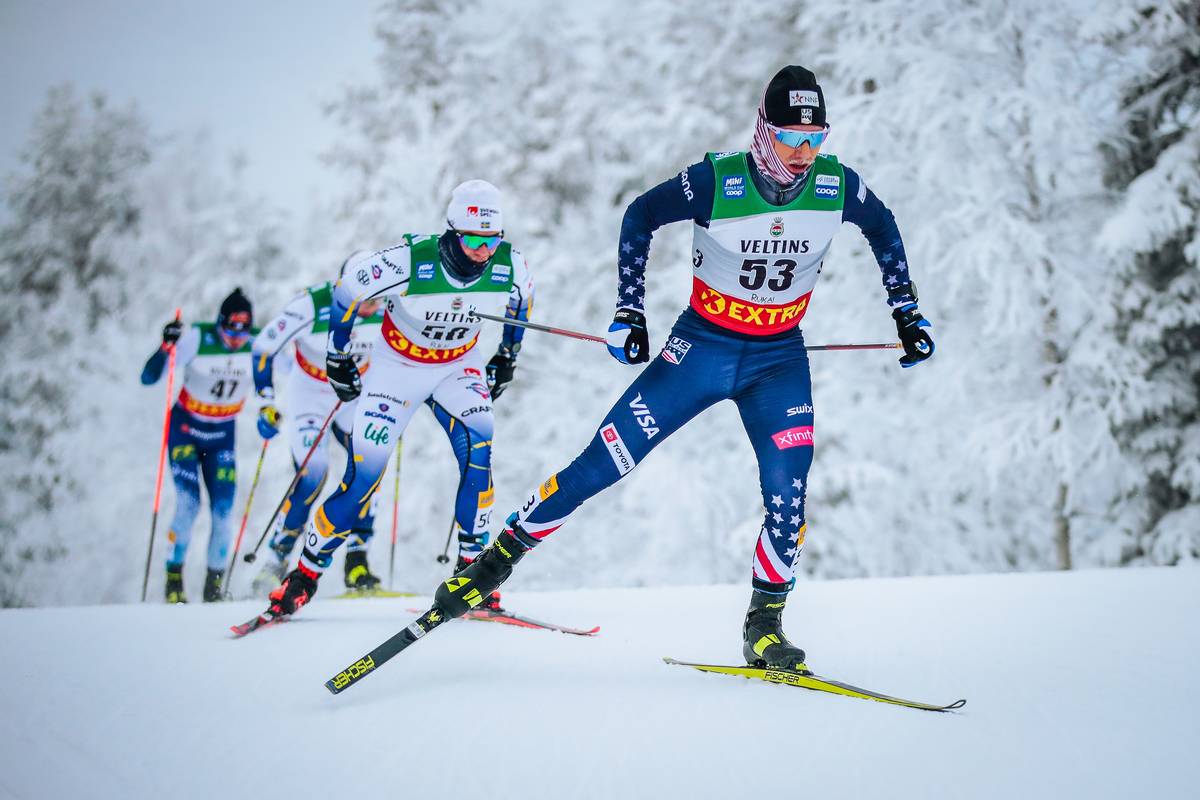
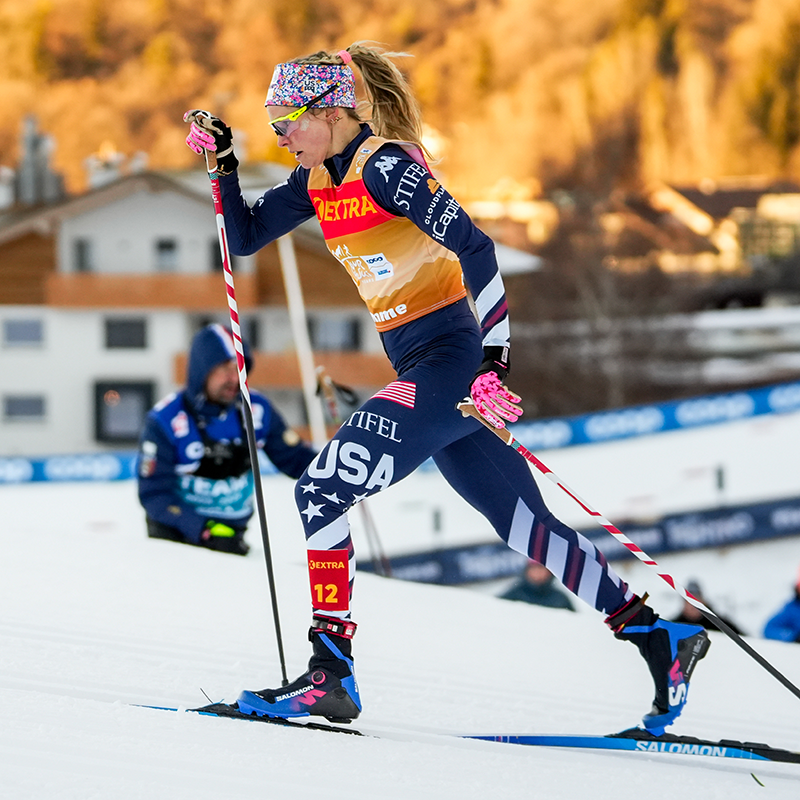
    Zanden Mcmullen (USA) making one final statement to the US Olympic Team selection committee in Oberhof (GER). (Photo: Authamayou/NordicFocus)

    McMullen Finds His Shape Again

    Zanden McMullen arrived in Oberhof carrying momentum that had begun to take shape weeks earlier at U.S. Nationals. There, his skiing had looked settled again — confident without being rigid, aggressive without being rushed. In Oberhof, that trend continued.

    “I feel like I’ve started to find myself again, which is really reassuring,” McMullen said. “I think I was fully capable of skiing like this earlier in the season, but I needed a little more racing and confidence under my belt. This weekend feels like the tip of the iceberg.”

    His approach to the race was deliberate. Rather than forcing the issue early, McMullen allowed the course to come to him, focusing on terrain management rather than constant pressure.

    “My goal today was just to ski well through the terrain of the entire course,” he said. “Earlier this season, when I felt like I needed to force a good result, I wasn’t skiing well — I was skiing very hard, but not well. Today I focused on skiing smooth and fast rather than just hard, and I think that really paid off.”

    There were moments of vulnerability — a slight lapse near the end of the first lap — but McMullen recognized it in time to convert restraint into opportunity.

    “I was able to use that extra energy to ski hard and fast through the second half of the race,” he said.

    McMullen finished 18th, a result that read plainly on paper but carried deeper meaning inside an Olympic season defined by accumulation rather than singular peaks.

    “I know I’ve done what I can,” he said. “I’m happy to be back where I left off last year before I got sick. Now I can shift my focus to preparation. Olympic qualification is just the first step. I have very big goals for the Games themselves.”

    Hunter Wonders (USA) continued his 10 k Classic form he showed at US Nationals in Oberhof (GER). (Photo: Authamayou/NordicFocus)

    Hunter Wonders and the Familiar Language of Classic Distance

    For Hunter Wonders, Oberhof reinforced something that has been quietly consistent in his career: when the race is a classic distance interval start, the task tends to make sense. There is clarity in pacing, in grip management, in the slow accumulation of pressure rather than the sudden chaos of a sprint.

    Wonders skied into the points again, backing up his showing from U.S. Nationals with another disciplined performance on snow that rewarded trust over impulse. In conditions where early aggression often came undone later, his race held together. The opening kilometers were controlled, the middle steady, the final lap about preservation rather than rescue.

    That continuity mattered. In a field where seconds dissolved quickly into places, Wonders avoided the kind of oscillations that define fragile races. He neither chased the early benchmarks nor retreated from them. Instead, he stayed within a rhythm that allowed the course to do less damage than it did to many around him.

    On a day when classic specialists quietly rose, Wonders looked like one — not flashy, not forced, but coherent from start to finish.

    Luke Jager (USA) celebrated his birthday weekend in Oberhof (GER) with a top 30 in the 10 k Classic. (Photo: Authamayou/NordicFocus)

    Luke Jager and the Discipline of Attention

    A few minutes later, Luke Jager crossed the line inside the top 30, finishing a race that mirrored his own quiet trajectory. Though the calendar had marked it as his birthday weekend, the day itself passed without ceremony.

    “My main goal was just to be fully immersed in the experience,” Jager said. “To focus on doing my best and skiing each section of the course as well as I could.”

    On a course where margins evaporated quickly, that focus mattered.

    “The margins were definitely thin, but they always seem to be on the World Cup these days,” he said. “It doesn’t really help to stress about that, so I try to keep my attention on what’s right in front of me, so that when I cross the finish line I can say I found as many of those little margins as I could.”

    John Steel Hagenbuch (USA) striding his way to 52nd place. (Photo: Authamayou/NordicFocus)

    John Steel Hagenbuch and the Cost of Precision

    For John Steel Hagenbuch, Oberhof was less forgiving, finishing in 52nd place. Fast, icy tracks compress the margin for error until technique, pacing, and decision-making overlap completely. There is no room to separate them. When one slips, the others tend to follow.

    Hagenbuch’s race never unraveled dramatically, but it never fully unlocked either. The speed was there in moments; the continuity was harder to hold. In an interval start, that can be enough to drift backward without a single obvious mistake to point to afterward.

    Classic skiing on firm conditions is often less about what goes wrong than about what never quite arrives. A corner taken cautiously becomes a gap. A climb approached defensively compounds over kilometers. Oberhof exposed those small hesitations with clarity.

    Still, there were pieces to build from. Hagenbuch moved efficiently through the terrain, and his ski handling held under pressure. What the race demanded next — and what it withheld — was the seamless connection between intention and execution that defines skiing at this level.

    Zachary Jayne (USA) raced his first World Cup races of his career in Oberhof (GER). (Photo: Authamayou/NordicFocus)

    A ‘Welcome to the League’ Weekend

    For Zach Jayne, the weekend carried a different weight. After a breakthrough performance at U.S. Nationals, Oberhof marked his first exposure to the full scale of World Cup racing — the cameras, the movement, the relentless compression of time and attention.

    “After a good week at Nationals, I’m honestly pretty disappointed with my first few World Cup starts,” Jayne said. “I’m grateful to be here racing against some of the best in the world, but I really wanted to do something with my starts.”

    What surprised him most was not the pace but the environment.

    “There’s just a lot more going on — cameras, people, spectators,” he said. “For me, that translates into more stress, and I’m still learning how to manage that.”

    Still, Jayne was clear-eyed about the lesson.

    “I definitely had my ‘welcome to the league’ moment this weekend,” he said. “Now I have something bigger and better to shoot for.”

    Antoine Cyr (CAN) on his way to a top 30 finish in Oberhof (GER). (Photo: Authamayou/NordicFocus)

    The Canadians: Cyr Steady, Ritchie Searching

    Canada arrived in Oberhof with different objectives but shared terrain.

    Antoine Cyr delivered another composed World Cup performance, finishing inside the top 30 on a course that rewarded calm decision-making. His skiing carried the marks of experience: stable pacing, clean transitions, and an understanding of when to let speed come rather than chase it.

    In fast conditions, Cyr avoided the trap of overreaching. His race did not hinge on a single sector or surge but on the absence of mistakes — a strategy that proved effective as the track continued to glaze and soften through the day.

    For Graham Ritchie, the race served a different function. Returning to World Cup competition after a disrupted season, Oberhof was less about result than recalibration. The course asked questions he is still working back toward answering: how much risk to take, how much speed to trust, how long it takes to feel at home again in this environment.

    Ritchie skied through to the finish without drama, but the gaps reflected the difference between re-entry and fluency. On a day when the margins punished uncertainty, Oberhof made clear how narrow the corridor back to comfort can be.

    What Oberhof Demanded

    By the time the final starters finished, the course had softened just enough to underline its earlier warnings. The results sheet settled into place. Some athletes left Oberhof with confirmation, others with questions, all with fewer places left to hide.

    “It feels like everything is important right now — every part of the preparation,” Nyenget said. “Today, the goal was just to focus on the task. But of course, it’s a step closer to the bigger goal.”

    In Oberhof, the task had been clear all along: ski well, ski honestly, and let the rest follow.


    Men’s 10 k Classic Interval Start RESULTS

    Men’s FIS World Cup OVERALL DISTANCE STANDINGS


    Love Stories Like This? Help Keep Them Coming.

    Feature stories like this one take time, access, and care to produce. If you value thoughtful storytelling and independent ski journalism, please consider becoming a Voluntary Subscriber. Your support directly fuels the work we do to cover the people, places, and moments that make our sport special.

    Join the FasterSkier community!


    Iivo Niskanen (FIN), Martin Loewstroem Nyenget (NOR), and Erik Valnes (NOR), (l-r) share the 10 k Classic Interval Start in Oberhof (GER). (Photo: Authamayou/NordicFocus)
  • Ilar Surges, Diggins Rebounds in Oberhof 10 k

    Ilar Surges, Diggins Rebounds in Oberhof 10 k

    This coverage is made possible through the generous support of Marty and Kathy Hall and A Hall Mark of Excellence Award. To learn more about A Hall Mark of Excellence Award, or to learn how you can support FasterSkier’s coverage, please contact info@fasterskier.com.

    Moa Ilar (SWE) continued to solidify her position in  the chase for the overall World Cup. she stands second, 149 points behind Jessie Diggins (USA). Ironically, the strongest Swedish skiers—and those who will be the strongest contenders for medals in Milano-Cortina—may be Ilar’s teammates who stayed away from Oberhof. (Photo: Authamayou/NordicFocus)

    When it comes to World Cup cross-country ski racing, season-long progress can be difficult for spectators and commentators to assess. It’s always hard to tell: are skiers getting faster? Are they fading? Or are they holding steady? This is the time of the season when event results begin to swirl and performances can become confusing. Three weeks from now, when the Olympics begin in Milano-Cortina, today’s winners could find themselves on the podium, or off the back. It’s all about the accuracy of their progression, the physiological and psychological costs of their efforts, their ability to remain healthy, and their commitment to the training peak that comes before the taper. And each skier handles it differently.

    Jessie Diggins races . . . that’s what she does. Others rest, others taper, others plan and plot, others pick and choose. Diggins races, a level of every-week race commitment that has decorated her trophy case with three World Cup Crystal Globes. Diggins has said that she doesn’t rely so much on “tapering” for big events as she intends to continue progressing through the races of each successive week. It’s a strategy that has seen her reach extraordinary levels, but not always at the times when she might’ve hoped. Last season, Swedish contenders went home to train and recover in the weeks leading to the World Championshp in Trondheim. It was a successful strategy, as Swedish women—Ebba Andersson, Frida Karlsson, and Jonna Sundling—definitely dominated those events. The Swedes are, once again, back at home in the weeks before the Olympics. It will be fascinating to watch events unfold in the two weeks of Olympic racing. The Swedish strategy may work again . . . but on the days that those races are run, they’ll be forced to deal with the power and the intensity and the will of Jessie Diggins.

    Olympic Talk

    Much of the media coverage of late has been about Olympic qualification: will Norway continue to make their would-be Olympians jump through hoops? Will the USA consider finishes at US Nationals, rankings in SuperTour, point standings on the World Cup . . . or will coaches exercise discretion in filling the team? Those are interesting discussions—rife with intrigue and opportunity, with aspiration and realization, disappointment and heartbreak—but it’s also a conversation that concentrates more on likely Olympic also-rans, and less on the skiers whom fans really follow. Even in talent-rich Norway, the skiers most likely to claim medals in Milano-Cortina have already been named to the team. Same for Sweden. Same for the USA. The contenders are well known, and their tickets to the Olympics were punched long ago. So while some Olympic hopefuls continue working to climb the rankings toward eventual places on their Olympic teams, the races in Oberhof highlighted the efforts of those who may contend for medals in Milano.

    And the Norwegians just keep coming . . . who is this Karoline Groetting getting her first world Cup start in Oberhof? Kristin Austgulen Fosnaes knows: Groetting is the upstart who nearly undid Fosnaes’ hopes of qualifying for an Olympic spot in Milano-Cortina. Fosnaes continued to elevate her profile with a win in the Norwegian National Championships 10 k, potentially paving the way for her naming to the Norwegian Olympic Team. She was followed onto the podium by Groetting who has now placed her name into the running for Olympic Team selections. Fosnaes has been a regular on the roster of the Norwegian Ski Team, but one who has from time to time, been viewed with skepticism by her countrymen, especially after her leaden performance in last season’s World Championship Team Relay in Trondheim all but handed the gold medal to Norway’s arch rival, Sweden. Fosnaes is a fine skier, a skier who would be a franchise player on the national team of nearly any other ski-country in the world. In any other country, Fosnaes would’ve been named to her Olympic Team two months ago. But as a skier competing for  Norway, she’s forced to keep racing and racing, always hoping to sufficiently impress the committee that selects the Norwegian Olympic Team. How interesting it is, then, that Fosnaes was not on the starting line today in Oberhof. Either she thinks she’s secured a spot on her Olympic team, or the committee selecting that team has already decided to stop looking at her. Either way, the focus today was on Groetting.

    Karoline Groetting (NOR) delivered quite a World Cup debut, leading the field through many of the early checkpoints, and finishing in fifth place on the day. Perhaps more important in her quest to be named to her nation’s Olympic Team, Groetting was the fastest Norwegian finisher in Oberhof. (Photo: Reichert/NordicFocus)
    Oberhof 10 k Classic

    With the Olympics remaining at the forefront of many contenders imaginations—and with resting for those races becoming a priority for many of those competitors—there were plenty of stars missing from today’s 10 k Classic start list: Finland’s Classic specialist, Kerttu Niskanen, is not on the starting line. Nor are Sweden’s Ebba Andersson or Frida Karlsson, Norwegians Astrid Oeyre Slind, Heidi Weng, Karoline Simpson-Larsen, or Kristin Austgulen Fosnaes (who is still yet to be named to Norway’s Olympic Team).

    Chasing an Olympic berth of her own, American Hailey Swirbul was the final starter of the day in Oberhof; she seems to be making the very most of her return to World Cup racing.

    “The smiles have been genuine!” beamed Swirbul. “I’m making sure to enjoy this life the most I can (but) I did not enjoy the feelings in the middle of this 10k today though, I won’t lie. I think a lot of us who came from Nationals, straight to international travel, straight to the World Cup were fighting some demons out there. It feels the most challenging, in my opinion, to find the will to keep fighting when your body feels heavy and the suffering feels unrewarding. But that’s also what keeps us coming back: the days where you can keep leaning into the discomfort and be in the fight and be rewarded for it is like no other feeling!”

    “I was the last starter today,” Swirbul continued. “So I was getting splits to know where I stood. An interval start race is a unique mind game because you can’t gauge if the imaginary people on front of you are pulling away or starting to fade. You just have to focus on your own race and get around the course as fast as you can, regardless of how others pace. That is easier said than done, especially with higher expectations on the World Cup. I try to remember that I don’t need to do anything that I haven’t done before. I just want to try to race my own race, regardless of the stage it’s on.”

    Contenders in Oberhof included Sweden’s Jonna Sundling, Maia Dahlqvist, and Moa Ilar (who is chasing Diggins in the season-long chase for the FIS Crystal Globe), Austria’s Teresa Stadlober, and newly discovered Norwegian phenom, Karoline Groetting. An early starter wearing bib 7, Groetting led the field at many of the early splits, and crossed the finish line with an advantage of 30 seconds over her nearest rival, and 37 seconds over her more famous countrywoman—and long-time national team member—Tiril Udnes Weng. But while Groetting settled into the leader’s chair, the more recognizable contenders began racing: Ilar, Stadlober, Sundling, and Diggins.

    Diggins was 15 seconds behind Ilar at the 2.6 kilometer checkpoint. Ilar led again at the 5.8 kilometer mark, coming across 13 seconds ahead of Groetting. At the finish line, Karoline Hennig-Doetzler (GER) challenged Groetting’s time, but fell just six seconds short. Groetting dodged another bullet when Maia Dahlqvist crossed the lone a mere .1 seconds behind Groetting’s finishing time. It was a tremendous finish for Dahlqvist—best known as a sprinter—as she continues to show great form in the approach to Milano-Cortina where she will certainly be a capable partner for Sundling in the Team Sprint event.

    It was later revealed that Diggins unusual split times resulted from her suffering quite a dramatic fall when her tip got caught in soft snow at the course’s edge.

    “I think that the reason my splits looked a litle funny is that I had a crash on one of the downhill corners. I caught my tip in some really deep sugar, and used my arm as a brake to keep myself from sliding off the course!”

    “It was time lost, and it was also a lot of adrenaline lost,” Diggins continued. “But it was honestly a really great practice in mental toughness, in refocusing, my energy and my attention on ‘what can I do in this moment. How well can I ski?’ I’m just really glad that’s really all that the crash was.”

    Ilar crossed the finish line with an advantage of 31 seconds over Groetting, but there were still other stars shining brightly out on Oberhof’s Classic course. Stadlober had begun the chase back at 7.6 kilometers when she was still 17 seconds behind Ilar. The gap narrowed to 10 seconds at 9 kilometers, and Stadlober was pouring it on. Over the final kilometer, the Austrian flew in pursuit of the Swede, only to find herself falling short by the narrowest of margins. Ilar would hold on to win by .7 seconds showing that hers is the best Classic skiing form today. Even so, she was surrounded by serious rivals—Stadlober in second, Sundling in third, Diggins in fourth, Groetting in fifth—who may be on their way up.

    18.01.2026, Oberhof, Germany (GER):
    Rosie Brennan (USA) – FIS world cup cross-country, 10km, Oberhof (GER). www.nordicfocus.com. © Authamayou/NordicFocus. Every downloaded picture is fee-liable.

    Rosie Brennan has continued to navigate her return to world-class form. “I’m still living in a day-by-day world, trying to figure everything out,” she said. “I had some really good training at home but have struggled again for the last two weeks. I haven’t been able to discover a pattern, so I truly feel I have no control over when my body is ok and when it isn’t, and now I’ve added some vascular complications to the whole thing. I had to come race this weekend to qualify for the Olympics and I am very pleased to have accomplished that! Now I need to look forward as best I can to the Games and try to prepare as best as possible.

    “Erik Flora is over here now,” Brennan continued. “Which will help that process immensely. But overall, it’s been a long year and change of living in an unknown, complicated medical world.”

    Brennan would finish the day in 30th, followed by Hailey Swirbul 33rd, Novie McCabe 35th, Alayna Sonnesyn 45th, Sammy Smith 49th, Kendall Kramer 54th. Alison Mackie led her Canadian teammates in 31st, followed by Sonjaa Schmidt 36th, Katherine Stewart-Jones 38th, Amelia Wells 56th.

    Now trailing by only 149 points, Ilar trimmed a bit of Diggin’s advantage in the World Cup overall race. And Ilar’s plans for the season? She was quite frank in her response to those asking if she’s going for the World Cup overall win now. “Of course I am,” Ilar smiled.” I would lie if I said anything else!”
    And what about the others who stayed home this weekend? We shouldn’t forget the impending return of Andersson, Karlstad, Niskanen, Slind, Weng, and Simpson-Larsen. The plot thickens.


    Oberhof Women’s 10 k Classic RESULTS

    FIS World Cup Distance STANDINGS (entering Oberhof)

    Teresa Stadlober (AUT), Moa Ilar (SWE), Jonna Sundling (SWE) on the podium in Oberhof . (Photo. www.nordicfocus.com. © Authamayou/NordicFocus. Every downloaded picture is fee-liable.


  • Where the Snow Hardens and Decisions Stick

    Where the Snow Hardens and Decisions Stick

    This coverage is made possible through the generous support of Marty and Kathy Hall and A Hall Mark of Excellence Award. To learn more about A Hall Mark of Excellence Award, or to learn how you can support FasterSkier’s coverage, please contact info@fasterskier.com.

    Jonna Sundling (SWE) and Laura Gimmler (GER), (l-r) during the heats of the World Cup Freestyle Sprint in Oberhof (GER). (Photo: Authamayou/NordicFocus)

    By the time the stadium lights fully took over in Oberhof, the snow had begun to change its mind.

    What started as a pliable winter surface—the kind that both softens and creates mistakes—tightened as the temperature dropped, and each pass of a ski left a polished, glistening trail under the lit German night. The Thuringian Forest, quiet by geography but loud by reputation, had settled into one of those evenings that reward certainty. Edges held if you trusted them. Hesitation showed immediately. And in an Olympic season, there was very little room for either.

    Saturday’s women’s Freestyle Sprint marked the World Cup’s return after the Tour de Ski, but the pause had not dulled the stakes. For several nations—and particularly for the United States—Oberhof represented the final sprint in the window that matters most for Olympic selection. That context did not announce itself loudly. It rarely does. Instead, it threaded through the day in subtler ways: in heat selection, in how aggressively athletes protected space, and in the quiet tension between racing for today and building the version of yourself you’ll need in February.

    At the front, the results followed familiar lines. Jonna Sundling (SWE) qualified near the top and then won every round she entered, finishing the job decisively for her 15th individual World Cup victory. Coletta Rydzek (GER), fed by a home crowd that never stopped leaning forward, closed hard for second. Maja Dahlqvist (SWE) completed the podium in third, another entry in Sweden’s sprint abundance—a luxury that, paradoxically, can complicate Olympic selection rather than simplify it.

    But Oberhof was not only about dominance. It was about positioning, intent, and the quieter victories that occur well outside the top three—where a season can tilt not with a trophy, but with a single, well-timed decision in a quarterfinal.

    Hailey Swirbul (USA) take the first corner during her quarterfinal in Oberhof (GER). (Photo: Authamayou/NordicFocus)

    A Course That Punishes Drift

    Oberhof’s sprint course is deceptive in its simplicity: an out-and-back layout, one major climb, a technical descent, and a finishing stretch that arrives already under load. What separates it from more straightforward sprint venues is how early it demands decisions. The opening stretch funnels athletes into a tight corner almost immediately, compressing the field before it has a chance to stretch. The central climb—long, steep, and increasingly rutted and churned as the day progresses—forces skiers to declare themselves sooner than they might like.

    There is little room to hide here. Miss the first corner, and you’re fighting for oxygen before the race has found its rhythm. Drift into the wrong line on the climb, and the surface punishes you. Get boxed entering the final turn, and momentum disappears instantly. Oberhof rewards skiers who are decisive without being reckless, aggressive without being impatient.

    Those dynamics shaped the day for the Americans in distinctly different ways, producing four very different American stories inside the heats—plus one clarifying, unfortunate footnote that mattered for selection math and for morale: Alayna Sonnesyn (USA) did start, but crashed and did not finish.

    Jessie Diggins (USA) during qualification in the World Cup Freestyle Sprint in Oberhof (GER). (Photo: Authamayou/NordicFocus)

    Before the Racing: Compassion, and a Reminder Not to “Try Harder”

    On paper, the Olympic selection criteria reads like a legal document—because, in many ways, it is one. It is also, inevitably, a psychological environment: a room everyone lives in, even when no one speaks about it.

    U.S. Head Coach Matt Whitcomb described the team’s internal emphasis heading into Oberhof in terms that had nothing to do with points or spreadsheets.

    The first message, he said, was simple: have compassion—for yourself and for your teammates.

    “This is a stressful job,” Whitcomb said. Some athletes may feel safely “inside” the team; others may feel perched on the edge; others may already feel disappointment. And the team, he stressed, needs to remember that everyone is absorbing the same pressure in different ways. “Read the room,” he said, especially if you have a great race—take care of each other through a stressful period.

    His second point was the one that, in a sprint weekend like this, can save an athlete from the most common selection-week mistake: mistaking urgency for a new identity.

    Because “this may be one’s last opportunity,” Whitcomb said, it’s tempting to believe you can manufacture something extra—try harder, ski differently, do something dramatic. But that instinct is usually the trap.

    “You can’t try something dramatically different,” he said. “What you have to do… is you ski the way that got you here.”

    In Oberhof, Whitcomb felt the athletes largely did that. The plans were executed; warm-ups and routines stayed intact. “We qualified a bunch of people,” he said. The day simply didn’t convert into the results they wanted.

    That, too, is sprinting: sometimes you do many things right, and the course—plus the speed of the other nations—still asks for more.

    Jessie Diggins (USA) during qualification in the World Cup Freestyle Sprint in Oberhof (GER). (Photo: Authamayou/NordicFocus)

    Racing as Training: Jessie Diggins

    For Jessie Diggins (USA), Oberhof was never meant to stand alone.

    Coming off the Tour de Ski, Diggins framed this weekend not as a test of peak form, but as a carefully placed piece of a longer arc: racing as a training stimulus, not a destination.

    “Essentially, I’m using these races as training stimulus,” Diggins said. “It’s a chance to get more reps—working on the tactics, working on communication, just working on all the little things that you really can’t practice any other way unless you’re racing World Cup.”

    That philosophy has long guided Diggins’ career. She has rarely spoken about “peaking” the way outsiders want athletes to: as a clean line on a calendar, a simple on/off switch. For her, form is something you keep building in public, in the only environment where it truly exists—under the clock, in contact, with consequence.

    “So [I’m] keeping the training load really quite high,” she explained, “but just recovering enough that I can still punch some hard race efforts and have that be part of the training and the lead-up. And for me, that’s always been a really important thing.”

    She added a line that sounds like personal preference until you watch her career and realize it’s closer to a blueprint: “I think I race well when I am racing pretty often. I might not do every single race, but just enough that I feel like I’m using them as a really helpful part of my lead-up.”

    Diggins’ day ended in the quarterfinals—13th overall on the official results sheet. But that early exit doesn’t necessarily conflict with the way she described the weekend. In an Olympic season defined less by accumulation than timing, Diggins tends to measure progress in subtler signals than finish position: how quickly the body responds, how efficiently it recovers, whether the details are sharpening rather than dulling.

    Oberhof, in that sense, fits neatly into the plan. Not every race has to be a verdict. Some are simply data—hard efforts taken at speed, recorded by the body, filed away for February.

    Samantha Smith (USA) during qualification in the World Cup Freestyle Sprint in Oberhof (GER). (Photo: Authamayou/NordicFocus)

    A Wild Arc, Embraced: Samantha Smith

    If Diggins arrived in Oberhof as a veteran calibrating form, Samantha Smith (USA) arrived by a far less conventional route—one that still feels almost implausible when you say it out loud.

    The last couple of months, Smith said, have been “wild.” She helped Stanford reach the NCAA soccer final. She put her skis on for the first time this season in December. She raced into shape at U.S. Nationals. And suddenly, she was back on a World Cup start line—aware of the stakes, but determined not to let the stakes steal the experience.

    “I’m so grateful for the opportunities that I’ve had,” Smith said. “To have a chance to play for Stanford has been such an incredible journey… and now to be back skiing, it feels great to be out here and competing with everyone.”

    Smith kept returning to the same theme: presence. She likes the work itself—the daily process—whether it’s skis or soccer.

    “I really enjoy the process,” she said. “I love to train, I love to race, I love to play soccer games. So [I’ve] just been trying to focus on enjoying every moment… embracing the opportunities that I have and just trying to be very present.”

    That presence mattered on a day when nerves were unavoidable.

    “Coming in today, I was definitely nervous,” Smith said. “I feel like the first World Cup races of the year are a bit nerve-wracking, especially when you haven’t had a ton of time on snow or a ton of opportunities to really gauge fitness.”

    So she narrowed her goals to what she could actually execute: ski clean; work transitions; be diligent in the “working sections” where Oberhof can hand you time or take it away quietly.

    “I didn’t really have an outcome goal,” she said. “It was just to ski hard, do what I could, and if I got into heats, to really compete.”

    And then, in her quarterfinal, came the moment that extended her day—and changed, materially, what this weekend could mean.

    Smith described herself as not being in the position she wanted over the first big hill. She could see the risk: that the heat would compress into a pure sprint finish, where you either have the lane or you don’t. And then—briefly—she did.

    “Into the last climb before the finish, I saw a window on the inside,” Smith said. “I saw the space open up, and I just tried to take it. To be honest, I wasn’t really expecting that it was going to open up.”

    It did. She went. And she made the move that sprint racing requires: the one that looks obvious in replay and feels like a gamble in real time.

    “I was worried it was going to come down to a complete sprint finish at the end,” she said, “but I think I got pretty lucky… There was a bit of open space, and I was able to make my way up.”

    The reward was tangible: Smith advanced to the semifinals and finished 12th overall. Just as important—at least in the language of selection criteria—she also climbed to 42nd on the women’s Sprint World Cup standings after Oberhof.

    In a season where criteria can hinge on ranking thresholds, that is not a small detail. It is the kind that turns a good day into a consequential one.

    Whitcomb’s reaction captured the strange emotional geometry of selection weekends: elation, paired with an awareness that someone else is hurting.

    “We’re absolutely ecstatic with Sammy,” he said—and then, almost immediately, he acknowledged the other side of it: “It’s always bittersweet because on literally every race I’ve ever been to, there have been people that have good races and then people that are really disappointed.”

    In sprinting, the margins are often only a few meters. In Olympic selection, those meters can echo.

    Hailey Swirbul (USA) during qualification in the World Cup Freestyle Sprint in Oberhof (GER). (Photo: Authamayou/NordicFocus)

    Joy Without Illusion: Hailey Swirbul

    For Hailey Swirbul (USA), the day began with something rarer than confidence: uncomplicated joy.

    “I was genuinely excited just to be back racing and to make the rounds today,” Swirbul said. “It felt like a treat. Honestly, I wasn’t expecting it. I was hopeful that I might have that opportunity, but getting to be in the heats was really fun.”

    What stood out wasn’t that she smiled—it was why.

    “My smiles were genuine out there,” she said, “and I felt an excitement and joy to get to be part of it, rather than a fear or pressure… to live up to some expectation that I might set for myself.”

    Swirbul approached qualifying with a clear-eyed strategy built around her own technical history. She identified the steep jump-skating (V1) section that had dominated the day’s conversation and made a choice.

    “There’s a lot of pressure, a lot of expectation around that steep V1 hill in the middle of the course,” she said, “and that’s just historically not my strength… I felt like I was able to do the working sections well.”

    The plan worked. She advanced into the heats and finished 22nd overall.

    In the quarterfinal, the course delivered its blunt lesson: once you lose contact, you often don’t get it back.

    “I maybe tried to ski my own race a little too much,” Swirbul said. “Once you’re off the main pack, it’s really hard to get back on… I was excited to have a strong finish… but it’s just not enough at this level.”

    The sentence contains both honesty and optimism—because Swirbul wasn’t treating Saturday as an endpoint. She was treating it as preparation for what, in her case, may be the weekend’s more natural opportunity: Sunday’s 10-kilometer classic interval start.

    “I’m excited—really looking forward to the classic 10 k tomorrow,” she said. “I’ve had a couple of good ones this year, so [I] hope I can keep the momentum going.”

    And then she said something that explains why so many distance skiers quietly enjoy sprinting before a 10 k: it’s a way to wake the system up.

    “I do actually really like racing a sprint, especially a qualifier plus a quarter right before a 10 k,” she said. “I think that’s kind of ideal race prep for 10 k. So I’m hoping that can help power me through tomorrow’s race.”

    Swirbul’s mindset for Sunday, she said, would be built on a simple distinction: what she can control, and what she can’t.

    “Every course and every day has so many variables… out of my control,” she said. “So I just want to try to control what I can and do my best at those things.”

    It’s a professional skier’s sentence. It’s also, in an Olympic season, a survival skill.

    Lauren Jortberg (USA) during qualification in the World Cup Freestyle Sprint in Oberhof (GER). (Photo: Authamayou/NordicFocus)

    Boldness, Not Regret: Lauren Jortberg

    Lauren Jortberg (USA) did not set out to lead her quarterfinal. It happened anyway, fast and almost accidentally—the kind of start that changes your entire heat because it changes your options.

    “I took control early… wasn’t necessarily on purpose,” Jortberg said. “I just had a really fast start, and there’s a big corner right away, so I wanted to have good positioning there.”

    She connected that early positioning to what she sees as a strength: the major climbs. In Oberhof, you don’t get to drift into those climbs. You arrive either with space or without it.

    “I wanted… good positioning for the major climbs,” she said. “I feel like that’s one of my strengths.”

    Late in the heat, the day turned on a familiar sprint mechanism: contact and congestion at exactly the wrong time.

    “I got a bit of a tangle… into the final turn,” Jortberg said. “I lost all my speed there.”

    Importantly, she rejected the clean narrative that would blame her early assertiveness for the late cost.

    “I don’t necessarily think that leading… came at a cost,” she said. “I just think… I lost all my speed when we got tangled.”

    And then she said what, in an Olympic-selection sprint, many athletes think, but not all athletes will say out loud: she did not come to Oberhof to hide.

    “With the Olympic implications, I don’t really want to sit in the back and just chill,” Jortberg said. “That’s not really how I like to race heats.”

    She described her approach as an attempt to avoid the passive sprint fate: getting boxed in, stuck behind, hoping someone else would make a mistake.

    “I just really want to try to ski well,” she said. “At least [I] tried to move… and try to ski my best out there rather than just… getting boxed.”

    Jortberg finished 29th overall. But what she took from the day was not despair—it was proof of belonging.

    “A lot of my confidence is just knowing that I really can ski with these women who are really strong,” she said. “That’s important for confidence moving forward.”

    Even in a heat that didn’t break her way, she will leave Oberhof with something World Cup weekends can either confirm or erase: the belief that she belongs on this stage.

    Maja Dahlqvist (SWE), Jonna Sundling (SWE) and Iris De Martin Pinter (ITA), get set to start their semifinal in the Freestyle Sprint in Oberhof (GER). (Photo: Authamayou/NordicFocus)

    The Final, and the Moment That Changed It

    The women’s final unfolded at speed—and then, briefly, at the mercy of chance.

    Sundling drove the pace as expected, forcing the field into single-file. Dahlqvist tracked smoothly. Rydzek hovered, patient and dangerous. Behind them, Iris De Martin Pinter (ITA) skied with poise well beyond her years, positioned to contend.

    And then she wasn’t.

    De Martin Pinter fell, fracturing the race at the worst possible moment—the kind of incident sprinting produces with brutal efficiency. Sundling’s growing gap became decisive. In a course that rewards momentum and punishes disruption, the fall functioned like a door closing: abruptly, unfairly, and permanently.

    Sundling closed the remaining distance with authority. Rydzek surged for second. Dahlqvist held on for third.

    Jessie Diggins (USA), Hilla Niemela (FIN), Nicole Monsorno (ITA), Milla Andreassen (NOR), Samantha Smith (USA), Alina Meier (SUI), (l-r) come around the first corner of their quarterfinal. (Photo: Authamayou/NordicFocus)

    Skis, Speed, and the Truth You Can See on a Downhill

    No sprint weekend exists in a vacuum. Equipment matters, and in Oberhof, that reality was visible in the most unforgiving place: the downhills where small gaps become facts.

    Whitcomb, careful about specifics because he had not yet been fully able to review the race video, acknowledged what many observers sensed: the U.S. skis were close, but not quite at the level of the very best nations on the day.

    “I think that’s a safe and fair assessment,” Whitcomb said. He emphasized that the team was competitive—but in sprinting, “competitive” is often not enough.

    “You need the best skis to go up against other teams that have the best skis,” he said, citing nations that, on this day, appeared to have exceptional speed.

    It’s the part of sprinting that can feel cruelest to athletes: you can execute your plan, hit your cues, make good tactical decisions—and still watch a gap open on a downhill you skied correctly. In Oberhof, where the course magnifies drift, ski speed is not a luxury. It is oxygen.

    Samantha Smith (USA) for the first time advanced into the semifinals in the World Cup sprint in Oberhof (GER). (Photo: Authamayou/NordicFocus)

    Selection Without Ceremony

    For the United States, day one in Oberhof didn’t resolve Olympic selection questions. It narrowed them.

    U.S. Ski & Snowboard’s selection language ties nomination, in part, to World Cup standings thresholds, with specific mention of Top 50 (or Top 45 under certain conditions) in the Sprint or Distance World Cup standings on January 18, 2026.

    Inside that structure, Saturday’s most significant American movement belonged to Smith.

    With her semifinal, she, in just one World Cup race, vaulted to 42nd in the Sprint World Cup standings. That is the kind of number that changes the texture of a season, because it moves her into the zone where the objective criteria has been met.

    The other Americans’ days mattered in quieter ways. Diggins stayed on her February-focused arc, treating racing as stimulus and sharpening. Swirbul used the sprint as both a joyful return to the rounds and a deliberate set-up for Sunday’s classic 10k, a race she believes suits her. Jortberg confirmed her willingness to race with intent rather than hide from consequence, even when the margin for error is razor-thin.

    And Sonnesyn’s crash—real, abrupt, and emotionally expensive—served as a reminder that selection seasons do not always give you clean data. Sometimes they give you a fall, a DNF, and the long work of resetting.

    Jonna Sundling (SWE) comes to the line for the win in the finals. (Photo: Authamayou/NordicFocus)

    What Remains

    By nightfall, the snow had hardened completely. The course no longer absorbed uncertainty. It reflected it.

    Some athletes left with podiums. Others left with confirmation, calibration, or unfinished business. In an Olympic winter, not every race is meant to answer questions outright. Some exist to refine them—to strip them down to what actually matters.

    Whitcomb’s framing, in that light, felt less like a coach’s speech and more like a survival manual for the next month: be compassionate; don’t weaponize the criteria against each other; and when the moment arrives, resist the temptation to become someone new out of panic.

    You can’t “try harder” into an Olympic team. You can only ski the way that got you here—cleanly, boldly, and with enough self-trust to hold your line when the window opens.

    In Oberhof, Samantha Smith did exactly that. And for one night in the German cold, that single choice—one inside lane, one late move—was the difference between a good day and a consequential one.

    Women’s Freestyle Sprint Qualification RESULTS

    Women’s Freestyle Sprint Final RESULTS

    Women’s FIS World Cup OVERALL SPRINT STANDINGS


    Love Stories Like This? Help Keep Them Coming.

    Feature stories like this one take time, access, and care to produce. If you value thoughtful storytelling and independent ski journalism, please consider becoming a Voluntary Subscriber. Your support directly fuels the work we do to cover the people, places, and moments that make our sport special.

    Join the FasterSkier community!


    Coletta Rydzek (GER), Jonna Sundling (SWE), and Maja Dahlqvist (SWE), (l-r) share the sprint podium in Oberhof (GER). (Photo: Authamayou/NordicFocus)
  • Oberhof Freestyle Sprint—Lars Heggen Proves His Point

    Oberhof Freestyle Sprint—Lars Heggen Proves His Point

    This coverage is made possible through the generous support of Marty and Kathy Hall and A Hall Mark of Excellence Award. To learn more about A Hall Mark of Excellence Award, or to learn how you can support FasterSkier’s coverage, please contact info@fasterskier.com.

    Lars Heggen (NOR) overpowered the field in Oberhof, but many of the world’s best sprinters—his Norwegian teammates—were absent from the day’s racing. (Photo: Authamayou/NordicFocus)

    Some day, Norway won’t be the only force in Men’s World Cup cross-country skiing. Some day, the participation of other nations will truly matter. Other nations will hear their anthems played, other skiers will excel, other results will be cited and praised. Some day, France may figure it out, or Finland may remember its heritage, or Sweden may return to prominence. The USA may identify another Bill Koch, or Italy another Pellegrino, or Switzerland another Cologna, or Russia another Bolshunov. Some day, the podium of the Men’s Cross-Country Skiing World Cup will not be decorated exclusively in Norwegian flags. While that’s not yet the cross-country skiing world that we live in, it is this upcoming World cup weekend in Oberhof where we expect to witness a kind of “It’s A Wonderful Life” view of Nordic skiing . . . the chance to see what the world would be like without them.

    France stayed home from Oberhof, presumably for national championships and team selections of their own. But everyone else is here, hoping to add to their World cup résumés with some of the scraps left on the tablecloth by absent Norwegians. Finland has sent its best (their Sprinters, anyway), and Sweden (in Norway’s absence they could make a splash), and the Italians (Federico Pellegrino and Elia Barp will see their chances to capture glory). The Czechs and the Swiss are here as well, hoping to grab World Cup distinction while the Norwegians are at home. And Team USA has sent it’s own hungry skate-sprinters, as well. Ben Ogden and Jack Young will be vying to return to the finals . . . even to imagine standing atop the podium (dare we say). JC Schoonmaker will be desperate to prove he belongs on the team that marches into Milano-Cortina. Gus Schumacher will be itching to prove that he and Ogden make a compelling Team Sprint team. There’s a lot going on . . . the same sort of drama that goes on every single week of the World Cup season, but no one really notices it because we’re so distracted by the Norwegian that tsunamis through every World cup venue.

    And where’s Norway? Well, Norway has more important business to attend to. World Cup wins, World Cup podiums, World Cup points: those are every-week occurrences for ski-crazy Norway. But 2026 is an Olympic year . . . the big prizes will be awarded at the Games of Milano-Cortina. So, this weekend in Oberhof, Norway sends stand-ins while the true contenders refine their technique or taper their training, or just put their feet up for a few hours before the headlong streak toward Norwegian immortality in Milano-Cortina continues.

    The elder Northug bother—Petter—was one of Norway’s greatest champions, but even he faced disappointment when it came to Olympic qualification. If Lars Heggen fails to make the team for Milano-Cortina, he will understand the parallels between his pain, and Northug’s. (Photo: Nordnes/NordicFocus)
    Norway Still Expects to Win

    Lars Heggen (NOR) is 20 years old . . . and he just dominated the Sprint competitions at the recent Norwegian Nationals. Granted, a number of Norway’s very best Sprinters weren’t there (no Klaebo, no Valnes, no Amundsen), but Heggen made enough of an impression that many Norwegian ski-pundits called for his immediate elevation to the Olympic Team. We can assume that Petter Northug was not among that enthusiastic group of pundits . . . especially since a 20-year-old Northug dominated 2006 Norwegian Nationals in an even more commanding manner than Heggen did in 2026. And Northug was unceremoniously denied an Olympic berth because of the selection committee’s assertion that, at only 20, he was too young for the pressures of Olympic competition, that Northug would benefit from more development time before being tossed into the Olympic maelstrom. Northug’s career turned out all right in the end, but it may have been even better if he’d collected another Olympic medal or two at the 2006 Games in Torino.

    Northug’s little brother, Even, competes for Norway in the World Cup Sprint this weekend in Oberhof. Like his brother 20 years ago, Even Northug has already been told that no spot is reserved for him on the Norwegian Team at the upcoming Olympic Games. Well, he’s still a world class Sprinter . . . it will be interesting to see how the younger Northug uses this weekend’s Sprint opportunity to comment on his being the second Northug to have been ignored in his efforts to make a Norwegian Olympic Team.

    But first, you need to qualify . . .

    The top American qualifier in Oberhof, JC Schoonmaker (USA) leading Even Northug (NOR), and Zanden Mcmullen (USA) in their quarterfinal heat. (Photo: . Authamayou/NordicFocus)
    Qualifying

    We don’t know exactly why, but it’s been reported that top 30 in today’s Sprint qualifying will be rewarded with increased FIS World Cup points (nearly double when compared to normal World Cups, or to races in tour de Ski that received only 50% points). It’s a good reason to be at your best in this particular qualifying event . . . and a pretty good way to continue shuffling the deck for numerous nations that are still choosing their Olympic Teams. And while a number of Norway’s best sprinters decided to sit this one out, Norway still manages to dominate most men’s Wold Cup racing. Case in point: six of Norways seven entries qualified for the heats, with Lars Heggen doing the job he was sent to do—winning the qualifier by 1.5 seconds.

    Americans took advantage of this diluted World Cup field with JC Schoonmaker finishing 13th, Jack Young 22nd, Zanden McMullen 28th, Michael Earnhart 35th, Kevin Bolger 44th, Owen Young 54th.

    “The heat selection strategy was definitely a bit different today with a lot of normal World Cup guys not being here,” said Schoonmaker. “I went for heat 1 because that felt like a good one to move on from and it was a better option than usual with  Klaebo not here. Other than heat selection the strategy didn’t differ at all for me, just trying to race my best!”

    McMullen is better known as a Distance skier, but his strong qualifying effort proved his versatility. “I do actually like using sprint races as a bit of a warm up,” said McMullen. “It puts my mind and body into a race mentality that I can’t really achieve on a race prep day. Sprints also typically feel lower stakes to me, so it’s just a nice way to go out and have some fun!”

    Sprint Heats—New Cast, New Strategies

    Skiing can be such a strange sport. Oberhof is a famed biathlon venue; if this were a weekend of biathlon races the grandstands would be packed. As it is, this was a cross-country weekend, and the stadium stood all but empty. The German fans who could’ve been here definitely missed a good show, and a fair indication of what the future of what World Cup Sprint events may look like in the near future. Even with a number of bright stars missing from the days entry list, the racing proved fast and furious.

    There was a lot going on in Quarterfinal 1: Lars Heggen wearing the green U23 World Cup leaders bib, alongside JC Schoonmaker, Zanden McMullen, and Even Northug. Everybody with something to prove, everybody with something to gain, and only two minutes of Heat 1 in which to do it. Schoonmaker led through the early parts of the course, but faded by mid-race. Heggen accelerated up the hill before the finish, sufficiently gapping his rivals and easing up before the finish line which he was followed across by a scrambling Even Northug. McMullen would finish fourth in the heat, followed by Schoonmaker in fifth. On the day, McMullen and Schoonmaker would finish 20th and 23rd, respectively.

    Pellegrino advanced out of Quarterfinal 2 in which Jack Young’s day would end with a fifth place heat finish. Young had led early in the quarterfinal, evidently hoping to press the pace in the hopes of advancing as a lucky loser. His strategy was bold, but it left him one place short. Young would finish 24th on the day.

    “I wanted to get to the front and control the race,” said Young. “Sadly, I wasn’t able to hold my position into the big climb—this wasn’t part of the plan. I then made up sole ground, but I didn’t have the energy to hold my position through the working finish.”

    Semifinal 1 included Heggen, Pellegrino, and Northug who all came in together at the bottom of the final climb. Heggen would V2 the entire climb, while Pellegrino switched to a high-tempo V1 to scoot past into the hole-shot. Northug faded as Lauri Vuorinen (FIN) edged into the top three. Pellegrino would coast across for the heat win, followed by Heggen’s lunge for second ahead of Vuorinen in third and Northug fourth. Those lucky losers would sit and wait for the results of the second semifinal.

    That second semifinal included one well known Sprinter—Switzerland’s Valerio Grond—who was joined by a cast of names we’re less accustomed to hearing: Filip Skari (NOR), Jaume Pueyo (ESP), Emil Liekari (FIN), Jiri Tuz (CZE), and Martino Carollo (ITA). Grond would finish second in the heat behind Liekari to advance to the final. Vuroinen and Northug—lucky losers from Semifinal 1—would advance as well.

    Federico Pellegrino (ITA) used a high-tempo V1 to position himself on the steep uphill of Oberhof’s Sprint course. But Heggen’s V2 would prove stronger. (Photo:  Reichert/NordicFocus)
    Plenty at Stake in the Final

    In the absence of truly dominant skiers, no one really knows what to do. The Sprint Final would become a bit of a curiosity as Heggen hoped to solidify his Olympic credentials . . . but Northug would be harboring similar plans of his own, and they’d both need to figure out how to deal with the cagey veteran, Pellegrino. In the final, Heggen and Pellegrino went to the front to control things, but neither looked eager to really drive the pace. Both the leaders chose the far-right line up the first climb as Liekari spun his wheels in the loose snow on the inside line. That was the point at which Grond took control, charging over the top of the climb. But Heggen’s fast skis could not be contained onthe subsequent downhill. He coasted easily into the lead, followed to the base of the final climb by Pellegrino and Northug. The final hill had offered a contrast in styles all day: Heggen’s V2 power vs. Pellegrino’s V1 tempo. This time up the hill, it was Heggen’s strategy that proved strongest, fending off Pellegrino’s V1 charge and holding on across the finish line for his first World Cup win. Northug would cross the line in third, a fine World Cup finish that was likely to be overlooked in Norway’s construction of its Olympic roster.

    The 20 year old upstart bested the 35 year old veteran. The question that remained was this: was the Norwegian Olympic Team Selection Committee watching?

    Oberhof World Cup Men’s Freestyle Sprint RESULTS

    Oberhof World Cup Men’s Freestyle Sprint QUALIFYING

    The Men’s Freestyle Sprint Podium in Oberhof—Federico Pellegrino (ITA always contends, Lars Heggen (NOR) hopes he proved his point, Even Northug (NOR) left wondering if anyone had noticed. (Photo: Authamayou/NordicFocus)


    Love Stories Like This? Help Keep Them Coming.

    Feature stories like this one take time, access, and care to produce. If you value thoughtful storytelling and independent ski journalism, please consider becoming a Voluntary Subscriber. Your support directly fuels the work we do to cover the people, places, and moments that make our sport special.

    Join the FasterSkier community!
  • Objective, Discretionary, Democratic: Inside the Quiet Machinery of Olympic Selection

    Objective, Discretionary, Democratic: Inside the Quiet Machinery of Olympic Selection

    This article was made possible through the generous support of our voluntary subscribers. If you value coverage like this, please support FasterSkier with a voluntary subscription.

    Jessie Diggins (USA) was the first athlete this season to meet the objective criteria. (Photo: Modica/NordicFocus)

    There is a persistent fantasy about Olympic selection: that somewhere, behind a closed door or a spreadsheet or a stopwatch, a single correct answer exists. That if you line up the results cleanly enough—World Cups here, Nationals there—the truth will announce itself. The fastest will go. The rest will not. The system will be clean. The arguments will end.

    Chris Grover, the U.S. Cross-Country Ski Team’s Program Director, has lived inside that fantasy long enough to know better.

    “It could go either way,” he said last week, speaking from Europe, where the World Cup season has entered its final, decisive stretch. “It could go objective, or it could go by discretion. Hard to say.”

    That sentence—calm, unadorned, almost casual—contains the entire tension of Olympic selection in an American endurance sport. Nothing is ever fully objective. Nothing is ever fully discretionary. And no amount of rules can insulate the people charged with making the decision from the weight of what it costs.

    On Sunday night, after the final race of the Olympic selection period, a six-person selection committee will meet. They will review the results. They will read petitions. They will vote.

    “There are six of us,” Grover said. “Just whatever the majority of the group wants to do.”

    The committee includes:

    • Anouk Patty – U.S. Ski & Snowboard Chief of Sport
    • Rick Kapala – U.S. Ski & Snowboard Sport Committee Chair
    • Chris Grover – U.S. Ski & Snowboard Cross-Country Program Director
    • Matt Whitcomb – U.S. Ski & Snowboard Head Cross-Country Coach
    • Sadie Maubet Bjornsen – Athlete Representative
    • James Southam – Athlete Representative

    That meeting will not take place in a conference room or a boardroom. It will happen over Zoom.

    Some of the skiers being considered on the call will be in vans together earlier that day. Some will be sharing hotel rooms while the committee debates.

    And when it ends, years of preparation will either collapse into certainty—or disappear.


    A Committee by Design

    The selection committee is small by design: six people, with athlete representation constituting roughly a third of the voting body. That structure is not incidental. It is a response—legal, cultural, and philosophical—to decades of disputes in American Olympic sport.

    “It’s a really good process that we have,” Grover said. “To have 33% of athlete representation on this selection committee.”

    The group includes staff members from U.S. Ski & Snowboard, athlete representatives, and leadership from the sport committee. The committee itself is distinct from the working groups that make World Cup start decisions or provide coaching input. This separation matters.

    “The six-person committee is different from the group that’s doing the nominations for the World Cup,” Grover explained. “That group is a working group. It’s not a committee by any means.”

    Committees are formal. They are governed by bylaws. Their authority is prescribed. Working groups are not.

    “[The World Cup working group] is not set up like the sports committee,” Grover said. “It’s more informal than that.”

    Olympic selection, by contrast, is deliberately formal. Every vote is anchored in a process vetted not just by coaches and administrators, but also by attorneys and athlete advocates. The goal is not speed. It is defensibility.

    “It’s driven by the U.S. Olympic Committee,” Grover said. “And their attorneys. And our attorney at U.S. Ski & Snowboard, too. And the Ted Stevens Act.”

    That legal scaffolding exists for a reason: Olympic selection is not merely a sporting decision. It is a federally protected process. Athletes are entitled to transparency, due process, and recourse. The rules are not optional.

    Gus Schumacher (USA) will be leading a strong men’s team into the Olympics. (Photo: Modica/NordicFocus)

    Objective Is a Choice, Not a Default

    The public version of Olympic selection often begins with a misunderstanding: that objectivity is the natural state, and discretion is a deviation from it.

    In reality, objectivity is itself a decision—one that the committee must actively choose.

    “It could go either way,” Grover said again, returning to the point. “The selection committee could decide to use some discretion. Hard to say.”

    That choice is not made in advance. It is made after the final race of the selection period, when all data—results, trends, injuries, illnesses, and context—is finally complete.

    Discretion, when used, is not informal. Athletes must formally request it.

    “Everybody who wants to be considered for selection method two, which is discretion, has to submit an application, basically,” Grover said. “Or like a short petition.”

    Those petitions are not symbolic gestures. They are documents. They are arguments. They are an athlete’s opportunity to explain why the raw results do not fully capture their Olympic readiness.

    “They’re not due till the 18th,” Grover said. “So athletes can potentially be racing on the 18th and then submit a petition after the race.”

    That timing is intentional.

    “We want everybody to have a chance to tell their story with all the data,” Grover said. “Being able to use all the data that they can muster.”

    The committee reads every petition before voting. No one enters the meeting without knowing exactly what is being asked of them.

    “So everyone’s got all the facts at their fingertips,” Grover said.

    Democracy, American-Style

    Grover is careful when he describes the system. He does not claim it is perfect. He does not claim it eliminates controversy. But he does make one striking assertion.

    “I feel like we’re probably doing Olympic selection more democratically than any other nation on earth,” he said.

    That statement is not bravado. It is an observation rooted in comparison. In many countries, selection authority rests almost entirely with coaches or federation leadership. Athlete representation, if it exists, is advisory in nature.

    In the United States, athletes vote.

    That structure does not guarantee consensus. It guarantees legitimacy.

    “And it’s a good process,” Grover said again. “It’s gotten more and more professional and more and more transparent.”

    Transparency, however, does not make the outcome easier to live with.

    Ben Ogden (USA) has had success on the Olympic Classic Sprint course in Val di Fiemme (ITA). (Photo: Modica/NordicFocus)

    The Emotional Cost of Fairness

    There is a moment in Grover’s voice when the conversation shifts—when Olympic selection stops being a system and becomes a human problem.

    “It’s exciting,” he said, then paused. “But it’s also… yeah. It’s a hard process.”

    The difficulty is not procedural. It is personal.

    “We obviously have a lot of athletes that are with us,” Grover said. “And a lot of them are going to make the team. And there’s going to be some that don’t make the team.”

    That reality is not abstract. It unfolds in real time, in shared spaces.

    “We’re all going to be in the vans together in the next few days and in the hotel and going home and stuff together when the team is announced,” he said.

    In those moments, selection becomes a lived experience.

    “There’ll be people that are rooming together,” Grover said. “Where one person is making it and the other one isn’t.”

    Joy and loss are not separated by geography. They coexist.

    “So there’s all this joy on one side,” he said, “and there’s all the sadness from the other person who’s just worked the last four years to try to make this team.”

    For staff, that proximity cuts both ways.

    “Those of us who are staff, we care about all these athletes,” Grover said. “And it’s a hard thing to walk a lot of people through.”

    The system can be fair and still be painful. In some ways, fairness makes the pain sharper.


    Selection Does Not Mean Starts

    One of the most persistent misconceptions about Olympic selection is that making the team guarantees racing. It does not.

    Grover is explicit about this distinction.

    “The selection committee has no say in the starts,” he said.

    Selection determines who is eligible. Starts are decided later based on performance and evolving conditions at the Games.

    “That’s a conversation that’s gone on for a while,” Grover said. “Like back in October, actually.”

    Athletes and coaches were told months ago when starters would be identified.

    “After the Goms weekend,” Grover said, “we’re going to identify the starters for the skiathlon and for the sprint.”

    After that, decisions unfold chronologically.

    “Once we get to the Olympics and start racing those events,” he said, “then we kind of name the starters for events in chronological order as we get more and more data on how they’re performing.”

    Selection, in other words, is not a guarantee of opportunity. It is a prerequisite for it.

    Julia Kern (USA) racing during the Tour de Ski in Val di Fiemme (ITA) on the Olympic Sprint course has been back home in Vermont preparing for the games. (Photo: Vanzetta/NordicFocus)

    Even the Team Isn’t the Team

    There is one final layer of distance between an athlete and the Olympic start line—one that surprises even people inside the sport.

    “This is not the ski team’s team,” Grover said. “This is the Olympic Committee’s team.”

    The distinction is not semantic. It is legal.

    “What we are doing,” he explained, “is we are sending them our nominations. And then they approve the nominations and post them.”

    The public announcement does not come from U.S. Ski & Snowboard. It comes from the United States Olympic & Paralympic Committee.

    Grover laughed as he recalled learning this lesson the hard way.

    “I remember in the past Tom Kelly giving me a hard time,” he said. “Because I told an athlete, ‘You made the Olympic team.’ And he was like, no.”

    The correction was precise.

    “You’re telling the athlete that they’re getting nominated,” Grover said. “And then the Olympic Committee is the one that says you made the Olympic team.”

    Even certainty has a chain of custody.


    Why It Never Feels Clean

    From the outside, Olympic selection often appears chaotic. From the inside, it is closer to controlled complexity.

    Rules exist. Votes matter. Athletes have representation. Petitions are read. Nothing is decided casually.

    And still, when the meeting ends on Sunday night, there will be silence on one end of the call and relief on the other. The system will have done its job. And it will have hurt.

    That tension—the irreconcilable distance between fairness and pain—is not a failure of the process. It is the cost of taking athletes seriously as stakeholders rather than subjects.

    “It’s a really good process,” Grover said once more. “But it’s also fraught with a lot of emotions.”

    There is no algorithm for that part. There never has been.

    And that, more than anything, may be the truest thing about Olympic selection.


    Love stories like this? Help keep them coming.

    Feature stories like this one take time, access, and care to produce. If you value thoughtful storytelling and independent ski journalism, please consider becoming a Voluntary Subscriber. Your support directly fuels the work we do to cover the people, places, and moments that make our sport special.

    Join the FasterSkier community!


  • Zanden McMullen’s Closing Argument

    Zanden McMullen’s Closing Argument

    This article was made possible through the generous support of our voluntary subscribers. If you value coverage like this, please support FasterSkier with a voluntary subscription.

    Zanden Mcmullen (USA) during the World Cup 10 k Freestyle in Trondheim (NOR) in December. (Photo: Modica/NordicFocus)

    There is a particular kind of quiet that settles in before a decisive weekend—not the calm that follows certainty, but the stillness that comes when outcomes are no longer yours to predict. Zanden McMullen arrived in Oberhof, Germany, this week carrying that quiet with him. Period Three of the World Cup season is underway. These races are the final ones that will be considered for U.S. Olympic Team selection. The committee will meet after Sunday’s races. Until then, there is nothing to do but race.

    “I’m pretty much taking it one week at a time right now and keeping my hopes up,” McMullen said earlier this week via text. “The races should be really fun this weekend, and my focus is on those right now.”

    It is the kind of message that sounds simple until you sit with it. One week at a time. Focus on the races. Fun. Behind those words is a career that has moved forward incrementally, without shortcuts, and a season that has already required recalibration. McMullen’s path to this weekend—both geographically and personally—has been anything but linear.

    Growing Up Where Winter Is Normal

    McMullen was born and raised in Anchorage, Alaska, a place where winter does not arrive as a novelty or an interruption. It simply is. He grew up outdoors, moving easily between sports—hockey, soccer, lacrosse—before skiing gradually took precedence.

    “I grew up doing a bunch of sports,” he said. “Skiing wasn’t really a main focus until maybe, like, first year of high school, when I was like, all right, this is going to be my main sport.”

    Cross-country skiing entered his life less as an ambition than as a community. His mother took him out. He joined a club. He found friends. He was good enough that there was never much reason to stop.

    “I just kind of found my group,” McMullen said. “And then as I progressed and just kept getting better and better, there was never really a reason for me to leave.”

    Anchorage has produced lots of elite skiers, but McMullen has never been particularly interested in mythology. When asked why Alaska continues to turn out athletes capable of racing at the highest level, his answer is understated.

    “We have access to great outdoor activities,” he said. “And I feel like that’s probably a pretty big foundation to our success. The community is great and has always been supportive of ski racing.”

    It is not a romantic explanation. It is a practical one. Snow matters. Time outside matters. People matter.

    Zanden McMullen (APU/Team Alaska), center, won the men’s U18 10K classic mass start race Friday at
    the 2019 U.S. Ski & Snowboard Cross Country Junior National Championships at Kincaid Park. Johnny
    Hagenbuch (Sun Valley SEF/Intermountain), left, was second, followed by Griffin Wright (Craftsbury
    Nordic Ski Club/New England), right. (Photo: Michael Dinneen)

    The First Crack in the Horizon

    For much of his early skiing life, McMullen’s world remained bounded by Alaska. The high school circuit was competitive enough that it was difficult to tell where he stood nationally. That changed almost accidentally.

    “A pretty pivotal point in my ski career was the Anchorage U.S. Nationals,” he said. “I wasn’t planning on going. I was still pretty young, but because it was in Anchorage, it was like, sure, of course I’ll do those races.”

    In the mass start 10-kilometer race, McMullen had what he still describes as a standout performance. The result earned him a spot on a U18 international trip.

    “That was one moment where I was like, holy crap, I can’t believe I made that,” he said.

    The next year, he qualified for World Juniors. Then another benchmark. Then another.

    “Every year was like I hit that next benchmark,” McMullen said. “And I was like, okay, wow, this is really happening.”

    What is striking in retrospect is how little certainty accompanied those steps. McMullen did not grow up believing he would race World Cups. He arrived there gradually, often surprised by his own progress.

    “I never really believed that I was going to be able to do that,” he said. “All the way up until, like, pretty much two years ago when I was like, damn, I’m really ripping the World Cup circuit.”

    Zanden McMullen races a skate pursuit in Ruka, Finland in November, 2021. (Photo: NordicFocus)

    Learning the Long Way

    McMullen’s development has mirrored that of a broader cohort of American men who have risen together, without a single breakout prodigy defining the group. The men’s team has become competitive not through sudden transformation, but through accumulation.

    “There’s definitely a core group of us that have been doing this for a long time and have just been hitting that next level every year together,” McMullen said. “Honestly, I’d say we just have a great attitude towards it, and I think that’s really contagious.”

    Central to McMullen’s progression has been his relationship with coach Eric Flora, who began working with him after high school. The partnership is not flashy. It is deliberate, methodical, and built on constant communication.

    “We all have individual phone calls with him about once a week,” McMullen said. “He’ll be driving to practice every morning, and he’ll just rip through all of us.”

    Training plans are personalized but similar. Adjustments are fluid. There is room to adapt when conditions—or bodies—require it.

    “Training is super fluid,” McMullen said. “There’s no reason to be super methodical about it.”

    If there is a defining value that underpins the approach, it is consistency. McMullen returns to the concept repeatedly, almost reflexively.

    “I don’t enjoy when I’m hot and cold,” he said. “I know I’m in a good place when I’m just consistent.”

    Racing Through Fog

    Consistency, however, is not something that can be summoned on demand. When the World Cup season opened in December, McMullen entered Period One with a clear process goal: race distance events, avoid panic, see where he stood.

    “It’s so challenging going into Ruka every year,” he said. “You just have really no idea what kind of shape you’re in.”

    He described the feeling as “looking through fog.” The metaphor fits. Fitness tests and workouts provide clues, but racing offers the only real clarity.

    “Those could both result in amazing races,” he said. “Or they could be pretty crappy races. I have no idea.”

    December did not unfold the way McMullen had hoped. Results were not disastrous, but they were not convincing enough to quiet questions—his own included. Olympic qualification, with its layers of objective criteria and discretionary judgment, hovered in the background, offering no reassurance.

    “Nothing’s for sure until the last race is over,” he said.

    As Period One ended, McMullen faced a decision that athletes rarely frame publicly: whether to stay in Europe and press on, or to step away and reset.

    Davos to Regroup

    McMullen stayed in Davos to train and regroup during the holidays before flying back to the United States for Nationals.

    The decision was not dramatic. It did not come with declarations or explanations. It was simply what made sense.

    Settling in to training through the holidays stripped things back to essentials. Favorite trails. Simple routines. Fewer variables.

    For McMullen, training has never been a place to escape. It is where things become clear.

    The reset did not guarantee anything. But it restored something harder to quantify: alignment between effort and intention.

    By the time McMullen boarded a flight for Lake Placid in January, he carried less expectation and more readiness.

    Zanden McMullen charges for the win in the Men’s 20 k Freestyle Mass Start last week at the US National Cross-Country Ski Championships in Lake Placid, New York. (Photo: Nancie Battaglia)

    Lake Placid: Evidence

    The U.S. Senior National Cross-Country Ski Championships arrived with their own weight. Nationals are never just Nationals in an Olympic year. Results echo beyond the finish line.

    On Thursday, McMullen won the 20-kilometer Freestyle Mass Start. The race unfolded honestly, favoring patience and pacing. McMullen looked comfortable in control.

    The next day, he returned to win the Classic Sprint.

    Two wins, two very different demands, back to back.

    The performances were not loud. They were authoritative.

    For an athlete who measures progress in consistency, the week in Lake Placid did not feel like redemption. It felt like confirmation.

    Zanden McMullen with his second win in two days in the Classic Sprint last week at the US National Cross-Country Ski Championships in Lake Placid, New York. (Photo: Nancie Battaglia)

    Oberhof

    From Lake Placid, McMullen traveled to Germany for the final races that will be considered in the Olympic team selection. Oberhof will decide whether his season will continue toward Milan or pivot elsewhere.

    “I’ll know by the end of the weekend if I have made the Olympic team,” he said via text. “If I don’t, I’ll head back with a little bit of Birkie fever.”

    The phrasing is characteristically restrained. There is no bargaining, no projection beyond what he can control.

    “I’m in Oberhof now for P3 World Cup, and will stay with the team through Goms,” he said. “I’m pretty much taking it one week at a time right now.”

    That outlook has been hard-earned. McMullen understands that racing well is not the same as demanding belief. His approach is simpler.

    “Let the racing speak,” he said in November. “There’s no reason to freak out about it.”

    The Space Before the Answer

    By Sunday evening, the committee will meet. Names will be discussed. Arguments will be weighed. Decisions will be made.

    McMullen will not be in the room.

    What he will have is a body of work that stretches back much further than this weekend: a childhood shaped by Alaska winters, a career built on incremental belief, a season that required adjustment rather than insistence, and a January that reaffirmed who he is as a racer.

    Whether or not the Olympic team includes his name, McMullen has reached a threshold that is difficult to cross. He is no longer auditioning for relevance. He is racing for a place.

    “I just want to be consistent,” he said. “I feel like when you are consistent, and you find yourself in a position where you might have a standout result, then it’s just that much higher.”

    In Oberhof, consistency will not announce itself. It rarely does. It will show up quietly, in decisions made at speed, on terrain that rewards honesty.

    For now, that is enough.


    Love stories like this? Help keep them coming.

    Feature stories like this one take time, access, and care to produce. If you value thoughtful storytelling and independent ski journalism, please consider becoming a Voluntary Subscriber. Your support directly fuels the work we do to cover the people, places, and moments that make our sport special.

    Join the FasterSkier community!


  • The Devon Kershaw Show: The delayed, but not denied, Tour de Ski recap

    The Devon Kershaw Show: The delayed, but not denied, Tour de Ski recap

    This article was made possible through the generous support of our voluntary subscribers.  If you value coverage like this, please support FasterSkier with a voluntary subscription.  

    Love episodes like this? Help keep them coming.

    Feature stories like this one take time, access, and care to produce. If you value thoughtful storytelling and independent ski journalism, please consider becoming a Voluntary Subscriber. Your support directly fuels the work we do to cover the people, places, and moments that make our sport special.

    Join the FasterSkier community!


  • Governing Olympic Sport

    Governing Olympic Sport

    This article was made possible through the generous support of our voluntary subscribers. If you value coverage like this, please support FasterSkier with a voluntary subscription.

    Jessie Diggins (USA) has been the beneficiary of consistent support from US Ski and Snowboard and the Stifel US Ski Team; it’s a distinction she has earned many times over. . The question is, are those organizations really involved in the support of skiers who are at different levels of development (as the Ted StevensOlympic and Amateur Sports Act obligates them to be)? (Photo: Vanzetta/NordicFocus)

    The Ted Stevens Olympic and Amateur Sports Act, passed in 1978 and amended several times (most notably in 1998 and 2020), is the statute that created the U.S. Olympic & Paralympic Committee (USOPC) and granted National Governing Bodies (NGBs) exclusive, monopolistic, authority over Olympic sports in the United States. The Sports Act Is Supposed to Govern Olympic Sport in the U.S. The question is whether or not it does . . .

    At its core, the Sports Act is a trade. NGBs are given control over their sport in exchange for specific obligations: athlete development, growing participation and interest, transparency and accountability, and, after 2020, a SafeSport environment for youth athletes.

    That’s the theory!

    In practice, the 1998 revisions shifted the focus of NGB responsibility toward Olympic and international performance. The emphasis became the “high-performance pipeline,” with increased USOPC oversight and funding focused primarily on elite outcomes. What followed was a quiet but consequential de-emphasis of sport growth and athlete development, the very foundation the Act originally envisioned. Today, under the current Sports Act—and with no real congressional or USOPC oversight—there is little meaningful accountability for NGBs to fulfill their mandate. The Act requires athlete development, but it never defines what that means, never specifies standards, and never requires commitment of resources or personnel. Judging from the published USOPC NGB audits the role in development is not assessed.

    So, development has effectively been outsourced. Some will argue that the development system under US Ski and Snowboard is working because we have a couple of men and women performing well on the World Cup. Not to minimize the work of those successful athletes or the programs they came through, but we can see from the national championship results that level of performance drops quickly and is far off international race speeds. In my view, we need a much more robust development process.

    In U.S. Ski & Snowboard, virtually all athlete development now is in the hands of clubs, families, and private systems. The resurgence of U.S. cross-country skiing since the mid-1990s is a useful example. That progress did not come from centralized NGB investment in development, even though the US Ski Team tried at times to run a centralized program. It came from committed individuals establishing clubs, regional programs, the establishment of the National Nordic Foundation, and the involvement of families. Many athletes who qualified for World Cup starts—without being named to the national team—came from that community-based system, not from NGB-led development.

    The revisions to the Sports Act never eliminated the  NGB’s responsibility for development. They simply allowed elite performance to be prioritized without accountability for the development of the base that makes elite performance possible. Over time, many NGBs shifted the cost and risk of development onto clubs and private foundations, while dedicating their own resources almost exclusively to national teams, while retaining regulatory and selection authority without owning development outcomes.

    That contradiction matters.

    If an NGB claims authority over competition rules, rankings, and selection, then development, coach education, and long-term sport health must be part of that same authority. The Sports Act never transferred those responsibilities to the USOPC, private clubs, or other local entities.

    What we’re living with now isn’t legal clarity, it’s a governance gap. NGBs retain authority. Clubs bear the cost. Families carry financial risks. Athletes absorb the consequences. That outcome wasn’t envisioned in the Sports Act. It’s what’s been allowed by  weak, nonexistent enforcement. As long as USOPC and the NGBs can tout a reasonable medal outcome, everyone is happy. But that doesn’t solve the development gap.

    A Proposed Direction for Reform

    What follows is not a call for more money. It’s a call for better structure.

    Development already works best at the club and regional levels. This has been demonstrated for the last 30 years or more.  Any reform has to be financially neutral and focused on outcomes. The solution is simple: development outcomes are driven less by spending levels and more by how responsibility, authority, incentives, and accountability are structured.

    Today, clubs and families do most of the developmental work, while the NGB controls calendars, rankings, and selection. Any effective proposal will realign responsibility with authority using levers the NGB already controls: regionalization, calendar design, coach education delivery, development benchmarks, incentive structures, and selection timing.

    The Problem We’re Actually Solving

    Despite good intentions and dedicated people, the current system reliably produces the same results:

    • Early specialization pressure driven by rankings, selections, and historical event calendars.
    • Declining participation at the U-16 and U-18 ager groups in USSS races and programs.
    • Ever increasing costs carried almost entirely by families
    • Available program quality dictated by geography and family resources
    • Clubs carrying the developmental load for 30+ years without proportional authority

    This isn’t about bad actors or insufficient funding. It’s about misaligned incentives and lack of local control over early pathways.

    Guiding Principles
    1. Participation, program quality, and retention come before selection
    2. National development standards with regional input, locally delivered
    3. Later, flexible, and reversible selection
    4.  Governance reform
    5. Measurable accountability for system health, not just performance outcomes
    Proposed Structural Reforms
    1. Regionalization With Real Authority

    Current state: Regions exist administratively but have little control over development- pathways, with primary focus on the Junior Nationals selection and management.

    Proposal:

    • Establish consistent regional governance with defined leadership representation
    • Regions sole authority over U12–U18 competition formats
    • Delegate early-stage calendars and race design to regions
    • Require annual regional development plans focused on participation, retention, and building coach capacity
    • Mandate inclusion of high school, college, and masters’ athletes in regional development efforts
    • Incentivize regions to address actual development in the region.

    Outcome: Decisions and decision makers move closer to athletes while standards remain national.

    1. Calendar Design Is Development Policy

    Current state: Dense, result-driven calendars create artificial urgency and unnecessary travel and expense

    Proposal:

    • Cap nationally scored races by age group
    • Limit Junior Olympic qualifier events to reduce travel burden
    • Restrict ranking-eligible events geographically at younger ages
    • Require non-ranking, skill-focused events
    • Publish a distinct development calendar separate from performance pathways

    Outcome: Lower cost, less pressure, better alignment with biological development.

    1. Coach Education: Centralize Standards, Decentralize Delivery

    Current state: Credential-heavy systems disconnected from daily coaching realities.

    Proposal:

    • Delivery entry- and mid-level education regionally, based on the defined needs of the region
    • Encourage mentored coaching hours
    • Publish age-specific coaching expectations
    • Incentivize volunteer and part-time coaches to support programs.
    • Asses the viability of mandatory education and the ability to deliver

    Outcome: Better coaching at the base without added bureaucracy and excessive expenses for the coaches.

    1. Development Benchmarks Instead of Rankings

    Current state: Results are treated as proxies for development and a measure of success.

    Proposal:

    • Define age-appropriate, non-competitive benchmarks (skills, tolerance, adaptability)
    • Make benchmarks visible to parents and clubs
    • Explicitly separate benchmarks from selection criteria

    Outcome: Shared language that supports development without distorting competition.

    1. Cost Control Through Incentive Design

    Current state: The system directly rewards expensive actions and those who can afford it.

    Proposal:

    • Remove ranking advantages tied to national travel at young ages
    • Prioritize regional selection over national qualifiers
    • Require transparent cost disclosures for sanctioned pathways

    Outcome: High-cost behavior is no longer structurally rewarded.

    1. Later and Reversible Selection

    Current state: Early selections are treated as final.

    Proposal:

    • Delay irreversible selection points by 3-4 years
    • Replace fixed teams with rolling pools and invitations
    • Publish selection criteria in advance

    Outcome: Selection becomes a process, not a verdict.

    1. Accountability for System Health

    Current state: Success is measured almost entirely by elite results.

    Proposal:

    • Track participation, retention, regional access, and coach coverage
    • Include development metrics in leadership evaluation
    • Publish development outcomes alongside performance results

    Outcome: Development becomes an operating responsibility, not a marketing line.

    This isn’t an argument against excellence. It’s an argument that durable excellence depends on system design, not individual heroics.

    The question isn’t whether we can afford to do this. It’s whether we can afford not to.


    Love stories like this? Help keep them coming.

    Feature stories like this one take time, access, and care to produce. If you value thoughtful storytelling and independent ski journalism, please consider becoming a Voluntary Subscriber. Your support directly fuels the work we do to cover the people, places, and moments that make our sport special.

    Join the FasterSkier community!


  • Steep Climbs to Olympic Dreams

    Steep Climbs to Olympic Dreams

    This article was made possible through the generous support of our voluntary subscribers. If you value coverage like this, please support FasterSkier with a voluntary subscription.

    Mattis Stenshagen (NOR) sealed the deal on Alpe Cermis becoming the only Norwegian man to secure an Olympic Team berth based on results from the Tour de Ski. (Photo: – Modica/NordicFocus)

    So, Norwegian Olympic selection continues to be a stressful and chaotic process for Team Norway. After eight exhausting days of Tour de Ski competition—and six grueling events—it seemed the only result that mattered to the committee selecting Norway’s Olympic Team was a win in the final stage atop the Alpe Cermis. Mattis Stenshagen won the hellacious climb, stuffing Johannes Hoesflot Klaebo and Harald Oestberg Amundsen firmly into the back seat, and storming onto the overall podium. Combined with his other podium performances this season, that seems finally to have made the difference. Stenshagen exits the Tour de Ski having finally qualified for his country’s Olympic Team. Like Stenshagen, Karoline Simpson-Larsen won the final stage of the Women’s Tour de Ski—the climb up Alpe Cermis—ahead of Jessie Diggins and Heidi Weng. At last, that performance has indicated to the committee selecting Norway’s Olympic Team that Simpson-Larsen is deserving of a spot.

    For the remaining Norwegian contenders—both women and men—the Tour de Ski didn’t work out the way most had hoped it would. The Tour offered a chance for contenders like Eva Ingebritsen, Nora Saness, Kristin Austgulen Fosnaes, and Ingrid Bergene Aabrekk to show what they can do. Likewise, the men’s field was stacked with numerous World Cup winners and Olympic and World Championship medalists:  Emil Iversen, Andreas Fjorden Ree, Lars Heggen, Simen Hegstad Krueger. None of them stood out enough to be offered Olympic berths. Simpson-Larsen and Stenshagen delivered wins atop the Alpe Cermis in the final stage of the Tour, but for all the others the Olympic Games remain a huge question mark.

    Already a winner on the World Cup circuit this season, it took a victory on Alpe Cermis to secure Karoline Simpson-Larsen a spot on the Norwegian Olympic Team. (Photo: Modica/NordicFocus)
    Team Norway

    Apparently, anything less than a victory on Alpe Cermis is simply not enough to impress the committee picking this team. As an example, Julie Bjervig Drivenes skied right alongside Heidi Weng in Toblach’s 20 k Pursuit. Weng is already named to the Olympic Team, and Driveness may eventually join her . . . but no such designation was announced after the conclusion of the Tour de Ski. Emil Iversen was third in the climb up Alpe Cermis; no announcements were made regarding his status, either. Early on, Team Norway suggested that their remaining Olympic Team positions would be selected based on results at the Tour, but only Simpson-Larsen and Stenshagen—winners of the climb up Alpe Cermis—heard their names called. That is truly a steep standard . . .

    So, here’s Team Norway so far:

    Men: Johannes Hoesflot Klaebo, Erik Valnes, Harald Oestberg Amundsen, Mattis Stenshagen, Einar Hedegart, Martin Lowestroem Nyenget. Two open spots remain, spots that will be filled by other Norwegians who are entirely capable of winning individual medals in Milano-Cortina. Klaebo could be defeated in the Classic Sprint . . . but no one with any sense would bet against him. Klaebo and Valnes seem likely to be gold medal favorites in the Team Sprint, and the Norwegians look like a solid favorite to win the Team Relay. Klaebo will be a favorite in all the other individual events, though his own teammates are likely to be his most serious rivals.

    Women: Heidi Weng, Kristine Stavaas Skistad, Karoline Simpson-Larsen, Astrid Oeyre Slind. Five more spots remain open, and it looks like those will be decided at Norwegian National Championships next week where all remaining contenders will miss World Cup races in Oberhof in order to participate in those Norwegian Championships. One thing’s for sure, qualifying for Norway’s Olympic Team is one of the sporting world’s toughest needles to thread. And it’s not out of the question that Norway makes an Olympic selection that favors skiers who stayed home from the Tour (like Lotta Udnes Weng).

    There are more notable Norwegian contenders to consider . . .

    Mathilde Myhrvold crashed out of the Tour de Ski with a dislocated shoulder. She may be done for the season, and her Olympic aspirations crushed. Maybe she heals up by Milano-Cortina, maybe not. In the absence of Myhrvold, there are no other Norwegian Sprinters likely to contend in Olympic Sprint events. And there really isn’t a way to form a Norwegian relay team that’s likely to challenge Team Sweden, though strange things have been known to happen in Olympic Team Relays.

    Emil Iversen has been reborn this season; he proved it yet again with his third place climb of the Alpe Cermis, and fourth place overall finish in the Tour. Unlike Stenshagen, Iversen’s Tour performance has been judged to be not good enough. Not yet, anyway.

    Sammy Smith dominated both Freestyle and Classic Sprints at recent US Nationals in Lake Placid. If those selecting remaining spots for the US Olympic Team were looking for consistency in racing performances, then Smith appears likely to be the obvious choice. (Photo : Nancie Battaglia)
    US Nationals

    The scheduling of the US Nationals makes it a logical qualifying competition for the Olympics. Oddly, this is a competition that doesn’t incorporate the same race formats as events in the upcoming Winter Games.

    Even though she spent the autumn season playing for the Stanford University soccer team (which finished a heartbreaking runner up in the NCAA championship), Sammy Smith was the one skier at US Nationals to really make an impression in Lake Placid. Smith won both the Freestyle Sprint and the Classic Sprint (technically, a SuperTour event) in commanding fashion, winning the Classic qualifier by a mile, and leading for nearly every meter of her heats and finals. Julia Kern may already have the spot wrapped up to join Jessie Diggins in the Milano-Cortina’s Team Sprint, but Smith looks like a solid bet to join the team in the Classic Sprint event.

    Other skiers delivered solid performances in both Sprint and Distance events, including Hailey Swirbul and Ava Thurston. If the selection committee is looking for future stars, those might be names we’ll continue hearing in the future.

    Early season Olympic Team contenders proved less of their arguments in Lake Placid, but remain possible candidates for Olympic selection.

    Alayna Sonnesyn went home early from the Tour de Ski (after a less-than-stellar showing in Stage 1) only to find herself earning only one podium placing at US Nationals—second behind Smith in the Freestyle Sprint—but that proved to be her high-water mark for the week of racing in Lake Placid. Sonnesyn would finish 10th in the 20 k, and 13th in the Classic Sprint.

    Leader in SuperTour standings prior to Lake Placid, Lauren Jortberg declined her invitation to the Tour de Ski, opting to take her chances at US Nationals—stress minimized, far less money spent, far greater chance of success (making the Olympic team). She finished fifth in the Freestyle Sprint, 37th in the 10 k Classic Interval Start, DNS in the 20 k, and fourth in the Classic Sprint. It remains to be seen if those results will prove sufficient to claim a spot on the Olympic roster.

    Luci Anderson had flirted with idea of qualifying for the cross-country events in Milano-Cortina, but she departed Italy after Stage 1 of the Tour de Ski and traveled to the venue where US Biathlon was holding time trials to consider Olympic Team candidates. Anderson’s performance in those time trials earned her a spot on the team, followed by a top 20 placing in a subsequent IBU cup race.

    With spots already having been earned (or reserved) for Jessie Diggins, Julia Kern, and Rosie Brennan, Team USA still has the opportunity to select five more members of the women’s Olympic roster. Team coaches have suggested that little (if any) coaches’ discretion will be utilized in the process, though the question of Sophia Laukli’s status continues to linger.

    The sole Canadian skier in World Cup Period 1, Katherine Stewart-Jones had already earned her Olympic berth for Milano-Cortina based on her fine finishes in 2025. (Photo:  Modica/NordicFocus)
    Canada’s Olympic Selections

    The only Canadian skier—man or woman—racing in World Cup Period 1 was Katharine Stewart-Jones who earned her Olympic Team nomination through multiple top-10 World Cup finishes during the 2024-25 season. She’s waged a great World Cup campaign thus far, and her confirmation on Canada’s Olympic Team comes as no surprise. The rest of her teammates raced it out at home, hoping to earn spots of their own. Just prior to the start of the Tour de Ski, it was announced that Canada’s Olympic Team had been named. The following is the roster of the Canadian Olympic Team: Antoine Cyr , Xavier McKeever, Rémi Drolet , Max Hollmann , Tom Stephen, Jasmine Drolet, Liliane Gagnon, Alison Mackie , Sonjaa Schmidt , Amelia Wells, and Katherine Stewart-Jones.

    Sweden in the Catbird Seat

    Team Sweden would seem to suffer no drama, nor intrigue, nor surprises in the selection of skiers to fill its Olympic roster, especially on the Women’s side: Jonna Sundling, Maia Dahlqvist, Frida Karlsson, Ebba Andersson, Moa Ilar, Moa Lundgren, Linn Svahn, Emma Ribom, Johanna Hagstroem. It wouldn’t be difficult to pick that team. Deciding who among them will populate the Team Relay could become another story, entirely. One way or another, Team Sweden will provide contenders for the top step of the Olympic podium in every Women’s Cross-Country event in Milano-Cortina. I, for one, can’t hum the tune of the Swedish national anthem. After Milano-Cortina, I expect it will be a far more familiar tune . . .


    Love Stories Like This? Help Keep Them Coming.

    Feature stories like this one take time, access, and care to produce. If you value thoughtful storytelling and independent ski journalism, please consider becoming a Voluntary Subscriber. Your support directly fuels the work we do to cover the people, places, and moments that make our sport special.

    Join the FasterSkier community!


  • Calculations and Consequences: The Men’s Classic Sprint at U.S. Nationals

    Calculations and Consequences: The Men’s Classic Sprint at U.S. Nationals

    This article was made possible through the generous support of our voluntary subscribers. If you value coverage like this, please support FasterSkier with a voluntary subscription.

    The men’s Classic Sprint heats got started with quarterfinal number one at the US Nationals Cross-Country Ski Championship at Mt Vanhoevenberg in Lake Placid NY. (Photo Nancie Battaglia)

    The last day of the U.S. National Cross-Country Ski Championships in Lake Placid arrived the way honest days in this sport often do. The snow at Mt. Van Hoevenberg had been churned and scoured by a week of racing and changing weather, its surface no longer pristine but revealing, the kind that gives little for free. Legs were tired. Arms were tender. Expectations had been trimmed back by accumulated kilometers and decisions already made.

    For the men lining up for the classic sprint, this was not simply a final chance at a national title. In an Olympic winter, nothing is ever only what it claims to be. The sprint was an audition—not necessarily for Olympic selection, but for relevance. For future start rights. For the ability to say, credibly, that range still exists.

    Sprint qualification, in particular, has a way of stripping sport down to its essentials. No drafting. No hiding. One lap to explain yourself. As has been said all week about sprints, it does not matter how clever you are in the heats if you cannot arrive there in the first place. In Lake Placid, that truth shaped the day from the first starter onward.

    Fin Bailey (UVM) makes his way up the Lake Placid sprint course’s signature climb. (Photo Nancie Battaglia)

    Qualification: where the day declares itself

    Qualification mattered here in a way that went beyond podiums and medals. With sprint start rights in the World Cup largely determined by qualification speed, the men knew exactly what was at stake. If this were a sorting mechanism, it was a blunt one.

    The fastest man through the course was John Schwinghamer, whose time at the top of the board set the early benchmark. But the story quickly widened. Pierre Grall-Johnson followed closely, and then Will Koch, who would soon become central to the day’s most unusual tactical thread, placed third.

    A few seconds farther back sat a cluster of names that told a deeper story: athletes with distance pedigrees, athletes chasing U23 selection, athletes managing fatigue from a long week and still trying to produce speed on demand.

    Among them was Zanden McMullen, who qualified tenth, solid but not dominant. “The qualifier felt a little off,” McMullen admitted. “I didn’t feel smooth and thought I skied poorly through the terrain. I was happy to qualify and have another chance to improve on the day.”

    That, in retrospect, was the quiet warning shot.

    Classic striding versus powerful double poling was one of the key storylines in the men’s Classic Sprint. (Photo Nancie Battaglia)

    A decision made in minutes

    If qualification is the most honest part of sprinting, it is also where improvisation sometimes reveals itself. Koch arrived at the start line with little margin and even less certainty.

    “I was already pretty tired going into the classic sprint,” Koch said. A bonk midway through the 20-kilometer freestyle earlier in the week had drained his reserves, and classic sprint had never been his strength. “With about ten minutes to go before my qualifier, I still couldn’t get my classic skis to kick.”

    The decision that followed was not theoretical. Koch asked his coach to prepare a pair of skate skis — not as a backup, but as a commitment. He reached the start with roughly 90 seconds to spare, hoping that strength alone might be enough to advance.

    Third in the qualifier erased doubt immediately. “When I ended up third, I knew it was the right call,” he said. “I never even tested a classic ski the rest of the day.”

    The gamble would ripple through every round that followed.

    Will Koch (SVSEF) powered through the qualification and heats, double poling on skate skis. (Photo Nancie Battaglia)

    Heats: when fatigue starts to speak

    Classic sprint heats at Mt. Van Hoevenberg reward clarity. The course offers opportunities, but they are conditional. Mistime a move, and the course and competition punish hesitation. Get trapped behind the wrong skis, and speed evaporates.

    Koch’s plan was simple and exhausting: lead early, create space before the climb, and survive long enough for glide to matter again. “If I could crest the climb with the group, my skis would be fast enough to carry me through,” he explained.

    For a time, it worked exactly as intended.

    But others were playing different games.

    Zach Jayne arrived at the sprint with a different set of calculations. Already qualified for U23 Worlds and carrying a narrow SuperTour points lead, his goals were layered. “I wanted to finish strong,” Jayne said. “I also wanted to make the final so I could displace other U23 athletes and help ensure my teammate Max Kluck made the trip.”

    Jayne, Koch, and teammate Carl Rune all opted to double-pole the heats on skate skis, a choice that paid dividends early. “It worked really well in the quarterfinal,” Jayne said. “But as the rounds went on and fatigue built, I was definitely wishing I’d brought a pair of klister skis.”

    That fatigue — cumulative, unrelenting — became the quiet theme of the afternoon.

    Zanden McMullen (APU) showed he had made the right calculations for himself in the final, creating a gap on the large climb, which he was able to maintain on the final downhill. (Photo Nancie Battaglia)

    Trusting kick in uncertain snow

    While some chased glide, Max Kluck made a different bet. His week had been defined by nerves more than novelty. “I was more nervous than I’ve been in years,” Kluck said. “I knew my U23 spot was on the line.”

    The snow tempted experimentation, but Kluck resisted. “I was pretty certain I wanted to stay on classic skis unless the weather took a major turn,” he explained. “I stuck with my gut.”

    The reward came immediately. In the quarterfinals, Kluck ran the climb with confidence, kick biting cleanly while others labored, arms already beginning to pay the price. “I figured I might be able to make double-poling work once,” he said. “But I didn’t think I could personally do it four times.”

    His solution was economy. By trusting his wax and striding more often, Kluck preserved his upper body for the finishing straight — a detail that would matter later.

    UVM’s Fin Bailey was showing he was on form and a threat for the podium throughout the heats, but his final got off to an unlucky start with a broken pole. (Photo Nancie Battaglia)

    The final: legs versus arms

    By the time the final assembly was complete, the calculus was visible even from the sidelines. The men who had double-poled all day carried speed — and fatigue. Those who had relied on kick carried legs.

    McMullen understood the equation precisely. “Going into the final, I knew the few boys that double-poled all day would be tired,” he said. “My plan was to keep them in reach before the final climb and then gap them.”

    Snow conditions had continued to degrade, wind and rain complicating grip and timing. McMullen’s classic skis, however, remained reliable. “Our classic skis felt good,” he said. “I didn’t think there was a need to try and double-pole the race.”

    When the decisive climb arrived, McMullen did not hesitate. He strung together clean transitions, trusted his kick, and separated decisively. “I felt really fresh still at the start of the final,” he said. “I knew I would be able to run away with it.”

    Behind him, the chase unfolded exactly as predicted. Koch’s glide carried him, but the cost of four rounds of double-poling showed. Kluck’s restraint paid dividends, his saved arms helping him close strongly. Jayne fought valiantly through fatigue, his earlier work for teammates already done.

    McMullen crossed the line alone — a national champion not because he had chased novelty, but because he had waited for the moment that mattered.

    Zanden McMullen (APU) comes to the finish of the Classic Sprint with his second national title in as many days at the US Nationals Cross-Country Ski Championship at Mt Van Hoevenberg in Lake Placid, NY. (Photo Nancie Battaglia)

    What the result actually means

    The men’s classic sprint did not reshape Olympic selection overnight. Sprint specialists were unlikely to be named from Nationals alone. But the race clarified something subtler and perhaps more important.

    It showed who can adapt under stress. Who can make decisions when plans unravel? Who understands that qualification speed opens doors long before medals do?

    For Koch, the day was a revelation. “The classic sprint was a really pleasant surprise to end the week,” he said, even as he acknowledged that broader goals remained unmet.

    For Jayne, consistency mattered more than headlines. “I don’t race to prove people right or wrong,” he said. “I know what I’m capable of.”

    For Kluck, the outcome was tangible. “Securing my U23 spot was the biggest goal of my season,” he said. “Locking it down here feels incredible.”

    And for McMullen, the victory was both affirmation and invitation. “I hope people know now that I’m an all-around skier,” he said. “And I hope the Olympic selection committee knows I have a lot of potential to succeed at the Olympics.”

    Zanden McMullen (APU) first place, Will Koch (SVSEF) second place, and Max Kluck (UU) third place at the US Nationals Cross-Country Ski Championship Classic Sprint at Mt Vanhoevenberg in Lake Placid NY. (Photo Nancie Battaglia)

    A quiet ending, honestly earned

    As the course emptied and the equipment was packed away, Mt. Van Hoevenberg returned to stillness. Another Nationals was complete. Another set of arguments had been made — not loudly, not always cleanly, but honestly.

    Sprint racing, especially in January of an Olympic year, has a way of revealing truths athletes might prefer to delay. Qualification does not negotiate. Fatigue does not compromise. Decisions, once made, echo through every climb and corner that follows.

    On this final day in Lake Placid, the men who listened closely to their bodies, their skis, and the snow underfoot, were the ones who left with something lasting.


    RESULTS:

    US Nationals Men’s Classic Sprint Qualification Results

    US Nationals Men’s Classic Sprint Overall Heat Results


    Love stories like this? Help keep them coming.

    Feature stories like this one take time, access, and care to produce. If you value thoughtful storytelling and independent ski journalism, please consider becoming a Voluntary Subscriber. Your support directly fuels the work we do to cover the people, places, and moments that make our sport special.

    Join the FasterSkier community!


    What was truly on display this week at the US Nationals Cross-Country Ski Championship at Mt Van Hoevenberg in Lake Placid, NY was not only that cross-country skiing is an awesome sport, but the community that embodies it is something worth celebrating. (Photo Nancie Battaglia)
  • A Quiet Argument, Made Loud: The Women’s Classic Sprint at U.S. Nationals

    A Quiet Argument, Made Loud: The Women’s Classic Sprint at U.S. Nationals

    This article was made possible through the generous support of our voluntary subscribers. If you value coverage like this, please support FasterSkier with a voluntary subscription.

    Sofia Pedersen (UU) and Samantha Smith (SVSEF) lead the first quarterfinal out onto the course at the start of the heats. (Photo: Nancie Battaglia)

    On the morning of the women’s classic sprint at the U.S. National Cross-Country Ski Championships, the quiet around Mt. Van Hoevenberg felt deliberate.

    Not calm — no one was calm by Friday — but restrained. The week had already taken its toll. Distance races had piled fatigue into legs and minds alike, and no one arrived at the sprint believing freshness would be part of the equation. What remained, instead, was clarity: the understanding that in an Olympic winter, the most important racing of the day would happen before the heats ever began.

    “It definitely started the day tired,” Ava Thurston said. “But I was trying to just remind myself that everyone was feeling that way. Most people had raced two, if not three, of the races, and we’re all coming in in a similar place.”

    That recognition — that fatigue was universal — became the baseline. The differentiator would be execution.

    For the women with Olympic aspirations, the classic sprint qualifier was no formality or warm-up. It was the argument itself. The U.S. selection process, quietly but decisively, has elevated qualification speed to the top of the sprint hierarchy. Heats matter, but only if you earn the right to be in them. On Friday in Lake Placid, no one confused the order of importance.

    Sofia Pedersen (UU) and Samantha Smith (SVSEF) get the action started in the quarterfinals. (Photo: Nancie Battaglia)

    Carrying the Week

    By the time the women clipped in for qualification, the week was already present in their legs.

    After Thursday’s 20-kilometer race, Sammantha Smith felt that accumulation acutely — and honestly. “After the 20 k, I was definitely feeling the fatigue and accumulation of all the racing throughout the week,” she said. “I know I’m more of a sprinter, but obviously, I was still hoping to perform well in the 20k, so I was not thrilled with the race.”

    Rather than letting that disappointment linger, Smith pivoted quickly. “I tried to quickly put it behind me and get ready for some classic sprinting,” she said. “My goal for the day was to focus on skiing a clean qualifier and ski to my strengths.”

    Hailey Swirbul arrived at the start line with similar fatigue — and a similar refusal to let it define the day. “Today, I definitely felt a little tired this morning warming up compared to the other races after a hard 20 k effort,” she said. “But so was everybody else dealing with that same.”

    For Swirbul, there was anticipation as well. “I was really excited to get to finish this week off with a classic race,” she said. “I just love classic skiing. I think it’s such an art, and I really appreciate the finesse that is needed to be able to make skis kick well.”

    Thurston framed the day with a different emphasis — joy rather than pressure. “It had been a great week so far,” she said, “so I was excited to get to go fast and run up that big hill.”

    Different approaches, same reality: the sprint would reveal who could still make good decisions under fatigue.

    Samantha Smith (SVSEF) commanded the Classic Sprint day from start to finish just like she had done in the Freestyle Sprint. (Photo: Nancie Battaglia)

    Qualification: Where the Day Was Decided

    When the women dropped into the qualifier, the course made its judgment quickly and without theatrics.

    Smith’s run stood apart immediately. She won the qualification by more than six seconds — not by forcing the issue, but by skiing exactly the race she had planned. “It was my first classic sprint of the year, so I didn’t really have too many expectations,” she said. “But I was hoping for a strong result.”

    What made the result significant wasn’t just the margin — it was the trajectory behind it. “Up until last season, I think there was a noticeable gap between my skate and classic sprinting,” Smith explained. “But the last few years I’ve really prioritized working on getting my classic sprint to a place I’m happy with.”

    That work showed. In an Olympic winter, qualification speed isn’t just about advancing — it’s about relevance. Smith’s time didn’t merely put her safely through; it reframed the sprint conversation.

    Behind her, two performances raised equally important questions.

    Swirbul and Thurston — both known primarily for their distance strength — delivered qualification runs that demanded attention. In a format that strips away drafting, tactics, and protection, they showed they belonged in the sprint conversation on pure speed.

    “I didn’t set out to make a statement this week,” Swirbul said. “I just wanted to show up and try to race my best and see where that landed me.”

    For selectors, where it landed mattered.

    Quarterfinal 4 trying to find their space and line around the U-turn on the sprint course in Lake Placid. (Photo: Nancie Battaglia)

    A Day That Wouldn’t Sit Still

    As the day progressed, conditions refused to settle. Snow softened. Moisture crept in. Wind shifted. Ski choices that worked in the morning became liabilities by afternoon.

    “The waxing team today was absolute heroes,” Swirbul said. “They were out until the wee hours of the morning, waxing late last night and woke up for a super early morning today for a classic day with really gnarly conditions.”

    Adaptability became a skill equal to speed. “I raced on totally different skis from the qualifier to the heats,” Swirbul said. “And even in the heats, I had a couple of changes to my kick in between the rounds because our conditions were continuing to change.”

    Smith faced the same puzzle. “In my quarter and semi-final I was actually icing up a bit and too grabby on kick as the snow got wetter,” she said. “My coaches ended up stripping a lot of the kick to bring back some of the glide for the final.”

    The goal, she explained, was precision rather than excess. “The main thing was to try to have just enough kick to get up the hills but not so much that it was draggy for the double pole or downhills.”

    Thurston made a strategic choice early — prioritizing glide over grip. “I ended up going with the pair that had a little more glide for the downhill finish,” she said, “just because I wanted to be able to hang with people rather than having that extra kick on the hill.”

    Three athletes, three solutions, same underlying demand: bend, don’t break.

    Lauren Jortberg (CNEPH)leads semi-final 1 out of the starting stretch. (Photo: Nancie Battaglia)

    Heats: Confirmation, Not Reinvention

    By the time the heats began, the hierarchy established in qualification largely held — and that, too, carried meaning.

    Smith moved through the rounds with patience and control, never forcing a moment unnecessarily. Swirbul sharpened as the day progressed, her adjustments paying dividends. Thurston continued to ski within herself, staying connected and opportunistic.

    For Thurston, the day reinforced something larger than a single result. “What it kind of said to me was that I can be really consistent,” she said, “and I’m also a strong all-around skier.”

    That consistency — across multiple races, formats, and conditions — is currency in an Olympic year.

    The women’s final gets started on the last day of racing at the 2026 US National Cross-Country Ski Championships at Mt Van Hoevenberg. (Photo: Nancie Battaglia)

    The Final: Execution, Not Emotion

    The women’s final unfolded cleanly and decisively.

    Smith took control early, extending her advantage where momentum mattered most. The ski changes made before the final were immediately evident. She crossed the line as U.S. National Champion in the classic sprint, completing a sweep of the week’s sprint events.

    Behind her, Swirbul claimed second, a reward for adaptability and composure. Thurston rounded out the podium, another affirmation of her ability to race fast across disciplines.

    For Smith, the result was about more than placement. “I hope people see that I love to race,” she said. “I love to compete and push myself, and I always leave everything I have out on the course.”

    Everyone was deserving of a helping hand up after a full week of racing at the US National Cross-Country Ski Championships at Mt Van Hoevenberg. (Photo: Nancie Battaglia)

    What the Race Clarified

    Nationals does not select Olympic teams outright, but it argues persuasively — and the women’s classic sprint in Lake Placid made its case clearly.

    Smith’s qualification speed, combined with her technical development in the classic sprint, strengthened her position at precisely the right moment. Swirbul’s performance underscored versatility and poise under changing conditions. Thurston’s podium reinforced consistency and all-around strength.

    “I’m really happy with how this week went,” Swirbul said. “And looking forward to figuring out where the rest of the season goes.”

    Thurston echoed that momentum. “This week was so, so awesome,” she said. “I’m excited to keep racing.”

    The arguments weren’t loud. They didn’t need to be. On a tired Friday at Mt. Van Hoevenberg, they were made the way Olympic cases often are — quietly, cleanly, and against the clock.


    RESULTS:

    US Nationals Women’s Classic Sprint Qualification Results

    US Nationals Women’s Classic Sprint Overall Heat Results


    Love stories like this? Help keep them coming.

    Feature stories like this one take time, access, and care to produce. If you value thoughtful storytelling and independent ski journalism, please consider becoming a Voluntary Subscriber. Your support directly fuels the work we do to cover the people, places, and moments that make our sport special.

    Join the FasterSkier community!


    The women’s Classic Sprint podium, including Samantha Smith (SVSEF) in first, Hailey Swirbul (APU) in third, and Ava Thurston (Dartmouth) in third at the US National Cross-Country Ski Championships at Mt Van Hoevenberg. (Photo: Nancie Battaglia)
  • A Narrow Door, Held Open: The Men’s 20 k Freestyle at U.S. Nationals

    A Narrow Door, Held Open: The Men’s 20 k Freestyle at U.S. Nationals

    This article was made possible through the generous support of our voluntary subscribers. If you value coverage like this, please support FasterSkier with a voluntary subscription.

    The start of the US National Cross-Country Ski Championship Men’s 20 k Freestyle Mass Start. (Photo: Nancie Battaglia)

    There are moments in endurance sport when the noise falls away—not because the stakes are small, but because they are too large to announce themselves loudly. The men who gathered on the start line at Mount Van Hoevenberg on Thursday afternoon understood that kind of quiet. The banners said US National Championships. The calendar said 20 k Freestyle Mass Start. The course—four laps of five kilometers, stitched together by long climbs and fast descents—said this will be honest. But the silence said Olympics!

    For much of the week in Lake Placid, honesty had come quickly. The 10 k classic individual start exposed margins. The sprint laid bare specialization. By the time the men lined up for the 20 k Freestyle Mass Start, the argument had narrowed. There were medals to be won, yes, but more importantly, there were questions still unresolved about who might fit through the narrowing door of Olympic selection.

    For Zanden McMullen, the stakes were explicit. “Today’s race was a ‘one shot, one opportunity’ type of race for me,” he said later. He knew that anything short of a win would leave his Olympic case incomplete. That knowledge sat heavily over the first kilometers—not as panic, but as pressure carefully managed.

    What followed was not a race that fractured early or declared itself with theatrics. Instead, it unfolded as a study in restraint.

    A large, shifting group stayed at the front early on in the race. (Photo: Nancie Battaglia)

    A Race That Refused to Break

    From the opening lap, the field behaved in a way that confounded expectations. In contrast to the women’s race earlier in the day, no decisive break formed. Attacks surfaced briefly—on climbs, into transitions—but were quickly absorbed by the physics of the course. Downhills regrouped the field. Drafting mattered. The snow was fast, the air cold enough to preserve glide, and separation proved expensive.

    John Steel Hagenbuch allowed himself to drift deep into the pack early—sometimes close to twentieth—an approach that looked counterintuitive given both his fitness and his history on the course. It was neither indecision nor passivity. “I was just staying relaxed and letting people work out some energy that I knew wasn’t going to result in any meaningful gain,” he explained. “Racing in the U.S. is very different than racing on the World Cup, and being able to relax at the start of a mass start race is perhaps the best example of that.”

    Zanden McMullen (APU) and his APU teammates Hunter Wonders (#208) and Luke Jager (#204). (Photo: Nancie Battaglia)

    The early splits reflected this tension. Leaders rotated through the front, but gaps rarely exceeded a handful of seconds. By the midpoint of the race, the field had thinned not through violence but through attrition—skiers falling off the back as the pace remained relentlessly honest.

    McMullen, meanwhile, adhered to a plan that demanded patience. “My race strategy was to conserve as much energy as possible,” he said. “Every time a move was made, I made sure to match it calmly but decisively.” By the second lap, he sensed the race’s texture changing. The pack stretched. Breathing deepened. The small inefficiencies of earlier surges began to show.

    Zach Jayne, consistently present near the front group, felt that tension acutely. “Holding position is always difficult,” he said. “So being aware while racing is important.” In a race defined by proximity rather than separation, awareness became a skill as valuable as strength.

    Olivier Leveille (CNEPH), John Steel Hagenbuch (Dartmouth), Zanden McMullen (APU), Jakob Elias Moch (CU), and Brian Bushey (Craftsbury) (l -r). (Photo: Nancie Battaglia)

    Decisions Not Taken

    If the race hinged on a single moment, it may have been defined instead by two moments when nothing happened.

    Hagenbuch identified them clearly. The first came at the start of the third lap, at the base of the long climb—a place where he has both won and lost races before. “Looking back at it now,” he said, “the one that makes me wonder the most is the decision to not attack on the third lap.” His reasoning was sound. The conditions were fast. The field regrouped quickly on descents. “In order to get away, you would have to be very fit and have the best skis in the race,” he said. Unsure that any gap would hold, he chose restraint.

    Mons Melbye (UU) leads Zanden McMullen (APU) and John Steel Hagenbuch (Dartmouth), and Jakob Elias Moch (CU) (r – l) down the final downhill into the stadium. (Photo: Nancie Battaglia)

    The second moment arrived on the final sprint climb before the descent into the stadium. Again, Hagenbuch assessed the cost-benefit. He believed he could crest first—but likely only to be swallowed by the draft. “As such, I decided to follow Zanden over the top,” he said. “I think this was the correct thing to do tactically.”

    That calculus—when to go, when to wait—defined the race for several athletes. McMullen made the same choice from the opposite perspective. “There was no need to do anything rash,” he said. “Just go out and race hard and smart.”

    The result was a front group of four that arrived at the final kilometer together, legs full but not shattered, tension compressed into seconds.

    Zanden McMullen (APU) and John Steel Hagenbuch (Dartmouth) follow Jakob Elias Moch (CU) near the end of the race. (Photo: Nancie Battaglia)

    The Finish

    As the leaders dropped off the final descent and into the stadium, the race became what everyone suspected it would be: a matter of position, timing, and nerve.

    McMullen entered the final stretch calm by design. “During the final lap, I knew it would come down to the final meters,” he said, “and I just made sure to relax as much as I could.”

    Hagenbuch, attempting to execute his finishing move, found the narrow margins of mass-start racing unforgiving. “Getting around Jakob was the crux move of the finishing maneuver I was trying to execute,” he said. “And there just wasn’t enough room for me to come around.” Pushed slightly wide through the final sweeping corner, he lost the speed he needed. “That’s racing,” he added. “It didn’t pan out, but it doesn’t always.”

    McMullen surged cleanly to the line, stopping the clock at 47:37.0. The University of Utah’s Mons Melby was 7-tenths of a second behind, with Hagenbuch a second from the win for third. Behind them, the rest of the field streamed in—gaps small, order consequential.

    Zanden McMullen (APU), John Steel Hagenbuch (Dartmouth), and Jakob Elias Moch (CU) — with Mons Melbye (UU) off camera — come down the finish stretch. (Photo: Nancie Battaglia)

    What the Race Revealed

    On paper, the result was simple: a national champion crowned. In context, it was anything but.

    For McMullen, the victory represented survival as much as success. “The Olympic selection has definitely been looming over my head all week,” he admitted. The stress was real. So was the clarity. He did what he could do.

    For Hagenbuch, the outcome carried both frustration and resolve. “I still have faith that there is a path for me to the Olympics,” he said, while acknowledging that the decision now sits elsewhere. He stood by his choice to skip the Tour de Ski, citing health and long-term belief. It was not a plea, but a statement of readiness.

    Zach Jayne, who again placed himself among the front contenders, viewed the week through a longer lens. “If you look at my results a year ago or two, I was barely a name in the competitive field,” he said. Improvement, for him, is cumulative. “Overall development is just as important to me as any given race.”

    The national podium for the US National Cross-Country Ski Championship Men’s 20 k Freestyle Mass Start with Zanden McMullen (APU) first, John Steel Hagenbuch (Dartmouth) second, and Zach Jayne (UU) third. (Photo: Nancie Battaglia)

    A Door, Not Yet Closed

    National championships often promise clarity. This one offered something subtler: differentiation without finality. The men’s 20 k freestyle did not decide everything, but it sharpened the picture. It showed who could manage pressure, who could read a race, who could wait—and who could finish.

    In an Olympic winter, those qualities matter as much as any single result.

    As the stadium emptied and the snow settled back into quiet, the door to Milan–Cortina did not swing wide. But for one, and hopefully two skiers, it remained open, narrow, demanding, and earned.


    RESULTS:

    US Nationals Men’s 20 k Freestyle Mass Start

    Love stories like this? Help keep them coming.

    Feature stories like this one take time, access, and care to produce. If you value thoughtful storytelling and independent ski journalism, please consider becoming a Voluntary Subscriber. Your support directly fuels the work we do to cover the people, places, and moments that make our sport special.

    Join the FasterSkier community!


    The feed zone is always full of chaos and excitement during a mass start. (Photo: Nancie Battaglia)
  • Where the Race Breaks Open: Women’s 20 k Freestyle at U.S. Nationals

    Where the Race Breaks Open: Women’s 20 k Freestyle at U.S. Nationals

    This article was made possible through the generous support of our voluntary subscribers.  If you value coverage like this, please support FasterSkier with a voluntary subscription.  

    Traffic was thick at the beginning of the US National Cross-Country Ski Championship Women’s 20 k Freestyle Mass Start in Lake Placid, NY. (Photo: Nancie Battaglia)

    There is a particular moment in a long mass start when the race quietly declares what it will be. It does not arrive with a surge, a crash, or even a decisive move. It arrives when the pack thins just enough that the edges of the course begin to matter—when skis no longer overlap cleanly, when passing requires intention, and when each athlete realizes—often simultaneously—that this is no longer a collective undertaking.

    At Mt. Van Hoevenberg, that moment came early.

    The women’s 20-kilometer freestyle mass start at the 2026 U.S. National Cross-Country Ski Championships unfolded under conditions that rewarded clarity and punished hesitation. The course was wide in places, narrow in consequence. Fresh snow lined the edges, slower and heavier than the main track, turning every attempt to move forward into a calculation of cost. The pace at the front was honest from the gun—fast enough to string the field out, fast enough to strip away the illusion that patience alone would bring opportunity.

    In an Olympic winter, Nationals rarely exist in isolation. They are arguments as much as races, each result carrying the quiet weight of future conversations. But on this morning, before selection scenarios and season arcs could intrude, the race itself demanded attention. Four laps. Twenty kilometers. A course that climbs insistently and asks athletes to be precise even when tired.

    What followed was not one story, but several—layered, intersecting, and revealing.

    Colorado’s Tilde Bångman did much of the work at the front of the Women’s 20 k Freestyle Mass Start in Lake Placid, NY. (Photo: Nancie Battaglia)

    The Fast Start That Changed Everything

    From near the front, the race immediately took on the shape many expected. Kendall Kramer, eager to avoid the kind of chaos that can derail a mass start before it has truly begun, made her intentions clear.

    “I wanted to go out fast because I didn’t want any funny business—colliding or breaking equipment,” Kramer said later. “I was super looking forward to being in the front of a mass start after being caught in the back on World Cups.”

    For Kramer, the early pace felt familiar rather than reckless. World Cups, she noted, often begin faster than domestic races, and the instinct to establish position early has become second nature. The speed was assertive but manageable. She felt fit, capable, present.

    Behind her, the effect was immediate. The field stretched, then fractured, then reorganized into smaller, more intentional units. For athletes starting deeper in the field, this stringing-out created both opportunity and pressure.

    Novie McCabe, starting from bib 26, felt the opening kilometers open rather than close.

    “My plan for the start was just to stay relaxed and try to work my way up,” she said. “It honestly ended up being easier than expected because the front girls took it out so fast. It was very strung out, and there was lots of room to move around.”

    Within minutes, McCabe had navigated cleanly into the front group. What followed was less about advancing and more about survival.

    “I got to the front pack about three minutes into the race,” she said. “So I spent most of it there just trying to hang on for as long as I could—and ended up having it in me to hang till the end.”

    That phrase—hang on—would recur in different forms throughout the day, taking on slightly different meanings depending on where each skier found herself in the race.

    Ava Thurston (#8 – Dartmouth) couldn’t quite hang on to the lead group of three, but eventually skied with Hailey Swirbul (#67 – APU) and Haley Brewster (#46 – UVM) before finishing fourth overall and third-place American. (Photo: Nancie Battaglia)

    When the Front Pulls Away

    Not everyone who tested the front pace could stay there.

    Late in the first lap, Ava Thurston made her own attempt to bridge. She came close enough to feel the rhythm of the leaders, close enough to understand the cost.

    “I tried to get back onto the front group, and I got pretty close,” Thurston said. “But I realized that I wasn’t going to be able to match their pace.”

    The realization came with consequences. For a brief stretch, she found herself skiing alone—a dangerous place in a mass start, especially early, when gaps can grow quietly and decisively.

    “That was where I did have a little bit of that panic,” she admitted.

    The panic did not last. Company arrived in the form of Hailey Swirbul and Haley Brewster, and with it, perspective.

    “Once I was skiing with them, I was kind of just thinking, ‘This is a good group. I can stay with these guys,’” Thurston said.

    From there, her race became less about chasing what was ahead and more about managing what was happening around her. She tucked in, matched surges, and responded quickly to small separations before they became something larger.

    “There were a couple of times where I would fall off the pack just a little bit,” she said. “Each time, I worked hard to get right back on before letting it be a big gap. I was really stoked on that.”

    On a course like Van Hoevenberg—four laps of sustained uphill skating—those moments add up. Fitness is exposed repeatedly, not all at once. For Thurston, the race offered reassurance.

    “This was the first race longer than 10k I’d done this year, and the first mass start that wasn’t a sprint,” she said. “It was a really good indicator that my fitness is there. It’s hard to fake anything on this course.”

    She would finish fourth, clearly separated from the podium trio but equally clear of the deeper chase—an honest result in a demanding field.

    With higher FIS points from not racing the past two seasons, Hailey Swirbul (#67 – APU) needed to ski through a lot of traffic during the early kilometers, but eventually found herself in the chase pack. (Photo: Nancie Battaglia)

    Racing From the Back Without Racing Small

    While the front and mid-pack sorted themselves, Hailey Swirbul was running an entirely different race.

    Starting from bib 67, she entered the day knowing she would need to be deliberate.

    “I didn’t even realize I would be seated so far back until the start list came out,” she said. “Obviously, I would be, because my FIS points aren’t low at this point—but it was an experience.”

    The challenge was not simply moving forward. It was how to do so without paying too steep a price.

    “The edges of the course had fresh snow on them,” Swirbul explained. “It was much slower, and a much higher energy expenditure to get around people that way.”

    Instead of forcing passes, she waited. Instead of locking into the pace of whatever group surrounded her at a given moment, she kept her attention forward.

    “I almost approached the first couple laps like an individual start,” she said. “It’s really easy to lock into the group you’re around and forget about the people ahead of you.”

    Women’s racing, she noted, often begins with a fast, destabilizing surge—a period where the goal is simply to hang on long enough for things to settle.

    “That’s exactly what happened today,” she said. “The leaders go fast, string it out, and then the real race starts again.”

    For Swirbul, the balance was constant: advancing through traffic while respecting the race’s length.

    “A 20k is a long race,” she said. “You can’t really pay for it.”

    Though she never bridged to the front trio, Swirbul finished fifth—solidly clear of the next wave behind her—and left the course satisfied with her execution and proud of the broader team effort.

    “Our coach absolutely crushed it with skis and feeds,” she said. “It was a good day to be APU.”

    Novie McCabe (APU) maintained contact on the uphills and used the downhills to close the small gaps to Tilde Bångman (CU) at the front of the race. (Photo: Nancie Battaglia)

    The Margins at the Front

    At the sharp end, the race narrowed to a familiar dynamic: strength, speed, and patience under pressure.

    As the kilometers mounted, Tilde Bångman began to apply pressure on the climbs, testing the group’s elasticity. By mid-race, the front had distilled to three: Bångman, McCabe, and Kramer. The chase group behind them was no longer within striking distance, and the podium places would be decided among those three alone.

    McCabe felt the pressure immediately.

    “In the last few kilometers, Tilde was skiing super strong and still really pushing the pace,” she said. “She would gap me a little bit on some of the hills.”

    Each gap mattered. Each closure required confidence—in skis, in timing, and in restraint.

    “I had some super good skis, so I was able to glide back up to her,” McCabe said.

    The plan crystallized: stay attached through the final hill, try once to make a move, and if that failed, save everything for the finish.

    “I tried to get a gap on the last hill, which didn’t quite work,” she said. “So I tried one last time at the finish.”

    It was enough.

    McCabe crossed the line first, securing the national title after a race built not on constant aggression, but on measured commitment. The emotion that surfaced surprised even her.

    “I think when I crossed the line, I mostly just felt super happy to be back racing and feeling like myself,” she said.

    The win mattered. So did what it represented.

    “Going into this week, I wasn’t sure it was the best idea for me to race frequently this season,” she said. “Now I have a lot more confidence that I can race—and maybe more importantly, recover from racing.”

    In an Olympic year, that distinction is not trivial.

    The lead pack and eventual overall podium with Kendall Kramer (APU), Tilde Bångman (CU), and Novie McCabe (APU) (l – r). (Photo: Nancie Battaglia)

    Kramer’s Race: Control Without Regret

    For Kendall Kramer, the separation late in the race came not through fitness, but friction.

    “My skis slowed down as they went,” she said. “They started to feel sticky—like I skied through too much Gatorade or something.”

    The effect was most pronounced on the downhills, where speed should have come freely.

    “The girls had to push my poles to speed me up to keep together,” she said. “Eventually, they could just gap on all the downhills.”

    Once the gap formed, Kramer shifted her focus from contesting the win to finishing the race well.

    “I’m happy to maintain my place and feel good,” she said. “I can’t complain.”

    What she wanted from the race, she explained, was not chaos or last-minute risk, but sustained pressure in a small group.

    “I wanted a small pack where we could test at every little bit,” she said, “as opposed to leaving it to a sprint or taking risks at a time like this.”

    She finished third, completing the podium, and left Lake Placid without repeating her national title—but with confirmation that mattered just as much.

    “I felt fit and totally capable today,” she said. “I didn’t feel bad feelings.”

    Novie McCabe (APU) managed to put a small gap on teammate Kendall Kramer to get away with Tilde Bångman (CU) and eventually ski to the national title in the finish stretch. (Photo: Nancie Battaglia)

    What the Race Revealed

    By the time the women completed their fourth lap, the story of the day was no longer about who surged when, but about how each athlete managed the same course differently—and honestly.

    McCabe raced with restraint until she no longer needed to. Kramer raced with intent and accepted the margins. Thurston learned, adjusted, and confirmed her distance fitness. Swirbul navigated from deep in the field with patience and clarity.

    None of those narratives exists in isolation. Together, they form a portrait of a championship race that did what the best distance races always do: expose truth without exaggeration.

    At U.S. Nationals, the women did not simply ski 20 kilometers. They negotiated space, managed doubt, trusted preparation, and tested belief.

    In an Olympic winter, those are not side effects.

    They are the point.

    The national podium for the US National Cross-Country Ski Championship Women’s 20 k Freestyle Mass Start with Novie McCabe (APU) first, Kendall Kramer (APU) second, and Ava Thurston (Dartmouth) third. (Photo: Nancie Battaglia)


    RESULTS:

    US Nationals Women’s 20 k Freestyle Mass Start


    Love stories like this? Help keep them coming.

    Feature stories like this one take time, access, and care to produce. If you value thoughtful storytelling and independent ski journalism, please consider becoming a Voluntary Subscriber. Your support directly fuels the work we do to cover the people, places, and moments that make our sport special.

    Join the FasterSkier community!


    The overall podium for the US National Cross-Country Ski Championship Women’s 20 k Freestyle Mass Start with Novie McCabe (APU) first, Tilde Bångman (CU) second, and Kendall Kramer (APU) third. (Photo: Nancie Battaglia)
  • Smith and Melbye Win U.S. Nationals Freestyle Sprint as Qualification Shapes the Day

    Smith and Melbye Win U.S. Nationals Freestyle Sprint as Qualification Shapes the Day

    This article was made possible through the generous support of our voluntary subscribers.  If you value coverage like this, please support FasterSkier with a voluntary subscription.  

    Samantha Smith (#1 – SVSEF) was the fastest qualifier and advanced through all her rounds in first on her way to the national championship at the US National Cross-Country Ski Championships Freestyle Sprint. (Photo: Nancie Battaglia)

    There is a particular kind of pressure that lives in a sprint qualification. It isn’t loud. It doesn’t announce itself with theatrics. It sits in the quiet places: the moment you realize the warm-up loop is over and you’re headed back toward the start; the thin stretch of time when your poles feel too long and your gloves feel too tight and the only thing you can hear is the scrape of skis and the soft, practiced urgency of coaches repeating the same cues they’ve repeated for years.

    In the heats, there is cover. There is a draft. There is a corner to hide behind, a decision to delay, a shoulder to lean into, a mistake you can sometimes survive. Qualification has none of that. Qualification is a solitary negotiation with speed, oxygen, and the course itself. And in an Olympic winter, it also becomes something else: a sorting mechanism. A gate. A reminder that at the Games, you don’t get to be “good in the heats” if you don’t first earn your way into them.

    At the 2026 U.S. National Cross-Country Ski Championships in Lake Placid, Tuesday’s freestyle sprint at Mt. Van Hoevenberg offered that truth clearly. On the women’s side, Samantha Smith (Sun Valley SEF) was the fastest qualifier. On the men’s side, Zanden McMullen (APU Nordic Ski Center) topped the morning results.

    By the end of the afternoon, the national titles belonged to Smith — who converted qualifier speed into clean, controlled racing through every round — and Mons Melbye (University of Utah), who did something deceptively difficult: he kept winning as the format stopped forgiving mistakes.

    Dartmouth College’s Ava Thurston was impressive all day on her way to third overall. (Photo: Nancie Battaglia)
    Qualification as the Real Story — and the Olympic-Year Subtext

    The sprint format always tempts us to focus on finish-line photos, final turns, and last lunges. But if you’re trying to understand what this race meant in the broader context of the week — and in the longer context of an Olympic winter — you start with the qualifier.

    Smith’s win in qualification wasn’t just fast; it was decisive in a way that matters in a discipline where tenths often separate confidence from chaos. She led Alayna Sonnesyn (Team Birkie) by nearly two seconds, with Lauren Jortberg (CNEPH) third and Ava Thurston (Dartmouth) fourth.

    On the men’s side, the top end was deep and tightly packed. McMullen led Owen Young (University of Vermont) by just over a second, with Michael Earnhart (APU Nordic Ski Center) essentially on Young’s shoulder. Melbye qualified fourth, with Cole Flowers (University of Alaska Fairbanks) and Max Kluck (University of Utah) close behind.

    This matters because international sprinting — the kind that happens at the Olympics — is not a format where you can count on “finding your way through the rounds” if you start your day in the wrong place. Qualification is where your sprint begins or ends.

    The subtext, however, differs by gender. On the men’s side, the Olympic pathway through domestic sprinting appears closed this winter. On the women’s side, the picture has felt more open, with multiple domestic spots likely in play and sprint specialists carrying meaningful leverage. The sprint, then, does not “mean” the same thing for every athlete — but it still demands the same thing from all of them.

    Eventual winner, Samantha Smith (#1 – SVSEF) controls the start of the women’s final at the US National Cross-Country Ski Championships Freestyle Sprint. (Photo: Nancie Battaglia)
    Women: Samantha Smith’s Control, Sonnesyn’s Speed, and a Final that Rewarded Discipline

    Smith won the qualifier. Then she won her quarterfinal. Then she won her semifinal. Then she won the final.

    Behind her in the final were Sonnesyn in second and Thurston in third, followed by Nina Schamberger (University of Colorado), Jortberg, and Katherine Weaver (Alberta World Cup Academy).

    Sonnesyn’s day began where the pressure was heaviest.

    “I am really proud of my sprint qualifier,” Sonnesyn said. “There was a lot of pressure on it, and I was feeling that, so I really leaned into the energy of those around me. I left everything I had out there on that course. Not perfect, but really good.”

    In the final, she was clear-eyed about what limited her chances to fight for the win.

    “I always need to keep working on my starts,” she said. “It’s really hard for me to get going that fast, and I ended up getting a bit boxed during the final because I didn’t have a great start. That being said, I think that final hill and the super fast downhill at the end worked in my favor.”

    Alayna Sonnesyn (#2 – Team Birkie) pushes over the top of the sprint course’s main climb. (Photo: Nancie Battaglia)

    Smith described a day defined by managing nerves and executing details.

    “I was quite nervous going into today’s race,” Smith said. “I was putting a lot of pressure on myself to perform well, so I tried to channel the nerves into adrenaline. I focused on skiing smoothly, working the transitions, and finding the most efficient line out there.”

    The final climb played directly to her strengths.

    “The final hill was definitely my favorite part of the course,” she said. “I really love to hop skate, and the gradient of that hill is perfect for it. On this course, transitions are critical, so I tried to be really disciplined about skiing hard over the tops and pushing into the downhills.”

    Thurston, who qualified fourth and finished third overall, described a sprint day built around process rather than pressure.

    “My approach to nerves was to focus on having fun and getting to the start line ready and excited to race,” she said. “Having my whole team here helped a lot. Chatting and joking with teammates and competitors really eases my nerves.”

    She found her biggest opportunities during the heats.

    “During the heats, I gained the most time on the final big hill,” Thurston said. “The wide trail made it an ideal place to pass. I’m still working on my double pole at the start, so that’s an area where I think there’s more speed to unlock.”

    Lauren Jortberg (CNEPH) leads her semifinal at the US National Cross-Country Ski Championships Freestyle Sprint. (Photo: Nancie Battaglia)

    Jortberg’s fifth-place finish, after qualifying third, served as a reminder of sprinting’s second demand: doing the work repeatedly under imperfect conditions.

    Jortberg said the qualifier remained her primary focus, especially in an Olympic winter where advancing matters as much as how fast you ski.

    “Sprint qualification is something I’ve been working on a ton,” she said. “That’s the most important part of the day, especially when it comes to World Cup skiing — just moving on. I was happy with my qualifier. It wasn’t my best skiing, but it was solid.”

    She said lingering fatigue from the previous classic race played a role, particularly after spending much of that race running due to skis that wouldn’t kick.

    “I definitely felt like I was carrying some fatigue from the classic,” Jortberg said. “So I’d say the qualifier was okay, but not my best work. I know I can ski better than that.”

    Jortberg said the Van Hoevenberg sprint course suits her strengths, but emphasized that the margins — especially on the downhills — leave no room for lapses.

    “I really like this course. It plays to a lot of my strengths — strong V2, a long climb, and hop skating,” she said. “But you have to be diligent everywhere, especially on the downhills. You can’t be lazy for even half a second.”

    In the semifinals, she said the tight schedule and downhill dynamics ultimately limited her ability to move forward.

    “My semifinal was only about eight minutes before the final,” Jortberg said. “I couldn’t really clear the lactic acid, and I didn’t have much time. I got passed on the downhill and then couldn’t really move in the final.”

    Despite the broader Olympic context, Jortberg said she is deliberately keeping her focus narrow.

    “I try not to stress about spreadsheets or criteria,” she said. “I just want to race, have fun, and ski the best way I know how. That’s really all you can do.”

    Smith added one more note at the end of the day, confirming she plans to continue racing later in the week.

    “As of now, yes, I am planning to race the 20-kilometer on Thursday.”

    Eventual winner, Mons Melbye (#4 – UU) in his quarterfinal at the US National Cross-Country Ski Championships Freestyle Sprint. (Photo: Nancie Battaglia)
    Men: Melbye’s Title, Jayne’s Podium, and Endestad’s Deep Run from 16th

    On the men’s side, the qualifier winner did not win the title.

    McMullen was fastest in the morning, but the championship ultimately went to Melbye, who qualified fourth and then won his quarterfinal, semifinal, and final.

    Behind Melbye, Sasha Masson (CNEPH) finished second, Zachary Jayne (University of Utah) third, and Ari Endestad (Alaska Pacific University Nordic Ski Center) fourth. Michael Earnhart finished fifth, with Owen Young sixth.

    The University of Utah was central to the men’s story throughout the day, with Melbye winning the title and Jayne joining him on the podium.

    Zach Jayne (UU) during qualification. (Photo: Nancie Battaglia)

    Jayne described a qualifier that didn’t match his expectations — and a deliberate reset once the rounds began.

    “Coming off a skate qualifier win in Alaska, I was disappointed after my qualifying performance,” Jayne said. “I thought I was capable of much more. Knowing that, I went into the heats with a better plan focused on composure and power. I was more relaxed and less nervous once I committed to that.”

    His view of sprint racing was blunt.

    “The rounds were incredibly close, but it only matters where people are at the finish — nowhere else,” he said.

    Young (University of Vermont), who finished sixth overall, described a day shaped largely by the pressure of the qualifier and the need to earn his way into the rounds.

    “Heading into the race today, my internal goals were a bit of a mixed bag,” Young said. “The main focus was result-based, but I really approached the day thinking about the qualifier. I’ve only raced one sprint this season, and the result was pretty mediocre, so I was pretty dead set on just trying to qualify.”

    Once through the qualifier, Young said his focus narrowed to managing the rounds one at a time.

    “After the qualifier, I tried to just take each heat one at a time and give it my best shot to move on,” he said. “I don’t really try to preserve energy in the qualifier — I usually give it everything I’ve got. That might not be the smartest choice for later in the day, but the confidence boost from a fast qualifier can really help mentally in the heats.”

    Miachael Earnhart (APU) on his way to posting the third fastest qualification time. (Photo: Nancie Battaglia)

    Endestad’s fourth-place finish told a different story: one of survival, adaptation, and opportunity.

    He qualified 16th in what he described as one of the tightest sprint qualifiers he had ever seen at Nationals, then raced his way through the rounds into the final.

    “Ideally, I would’ve liked to qualify a little higher,” Endestad said. “But with how close it was, I felt lucky just to be in the heats at all.”

    The physical cost of the day was obvious.

    “This course is so hard,” he said. “I threw up after the qualifier and had to fight to stay composed through the quarter and semi. There were only about 12 minutes between the semi and the final, so it was about breathing, keeping it down, and making good decisions.”

    Tactically, he was clear about where he needed to attack.

    “It might have looked like patience early, but honestly, I was barely hanging on from the start,” Endestad said. “The goal was to be in position for the main hill, because that’s where I felt I could really put the hammer down.”

    Ari Endestad (APU) leads teammate Michael Earnhart (APU) during the heats of the Freestyle Sprint at the US National Cross-Country Ski Championships. (Photo: Nancie Battaglia)

    Michael Earnhart said his goals at U.S. Nationals were shaped as much by the SuperTour standings as by the result of any single race.

    “One of my goals coming into Nationals was to try to take back the SuperTour lead heading into Period 3,” Earnhart said. “Today helped me with points against Hunter Wonders, but not against Zach Jayne. It’s still very close, and both of them are really good athletes.”

    He admitted he arrived with higher expectations after last season’s skate sprint performances.

    “After last year, I really wanted to try to win today,” he said. “So I was a little disappointed to come in fifth. But with how close the qualifier was and how strong the competition is getting in the U.S., I’m not overly disappointed. It’s a reasonable result.”

    Earnhart said experience helped him stay composed through the rounds.

    “I’ve done a lot of heats on the SuperTour, so I feel confident in this field,” he said. “I try to ski to my strengths, stay relaxed, and ski with the confidence that I deserve to win the heat. Normally, that gets me through, but sprinting is unpredictable.”

    He added that Van Hoevenberg offered rare opportunities to move in a skate sprint.

    “The main sprint hill is wide enough to move, and jump skating is my strongest technique,” Earnhart said. “When the qualifier is six seconds from first to 30th, it’s fine margins. Sometimes you need a little luck — but you also have to make your own.”

    Mons Melbye (#4 – UU), Sasha Masson (#11 – CNEPH), and Zach Jayne (#12 – UU) on their way to first, second, and third places, respectively, with Ari Endestad (APU) trailing in fourth place during the men’s Final at the US National Cross-Country Ski Championships Freestyle Sprint. (Photo: Nancie Battaglia)
    What It Means — and What It Doesn’t

    It’s tempting in an Olympic year to treat every Nationals result like a verdict. But Nationals is not the Olympics, and a domestic sprint is not a World Cup sprint field.

    What it can be is a stress test.

    For the women, the sprint reinforced that athletes who can combine elite qualifier speed with repeatable execution are building strong cases. Smith won both the qualifier and the final. Sonnesyn backed up top-end speed with a runner-up finish while clearly identifying where she can improve.

    For the men, the sprint may not be about Olympic selection, but it was revealing and also adds to the season-long narrative. Melbye showed an ability to win under repeated pressure. Jayne demonstrated resilience after a disappointing qualifier. Endestad showed how quickly sprinting can reward those who survive long enough to find their moment.

    Young’s comments also underscored the tradeoffs athletes are navigating as the week continues.

    “I don’t have a definite answer, looking forward to the rest of Nationals,” he said. “I’d like to throw down top results in the 20k and the classic sprint, but I need to talk with my coach and assess the best plan to give me the best shot at scoring enough points. That could mean skipping the 20k and focusing on the sprint, or maybe doing both — it’s tricky with no rest day and the body starting to feel the last couple days of racing.”

    Katey Houser (MSU) leads Ruby Serrouya (DU) and Marit Flora (UAA) in their quarterfinal at the US National Cross-Country Ski Championships Freestyle Sprint. (Photo: Nancie Battaglia)
    A Closing Note from Lake Placid

    By late afternoon, the sprint course felt smaller than it had in the morning. Not only because it changed slightly for the juniors, but because sprint days compress experience. The same hill feels steeper the fourth time. The same turn feels tighter. The same finishing straight feels shorter.

    That is the quiet lesson of a National sprint in an Olympic winter. It doesn’t allow vagueness. It demands specificity. It asks for one fast lap — and then asks you to do it again, and again, and again, under less forgiving conditions.

    Samantha Smith and Mons Melbye won because they answered those questions most consistently.

    For everyone else, Lake Placid delivered the same message sprinting always does: if you want to be part of the story later, you still have to earn your way into the next round now.


    RESULTS:

    US Nationals Freestyle Sprint Qualification Men
    US Nationals Freestyle Sprint Qualification Women
    US Nationals Freestyle Sprint Heats Women
    US Nationals Freestyle Sprint Heats Men
    US Nationals Freestyle Sprint Heats Junior Women
    US Nationals Freestyle Sprint Heats Junior Men


    Love stories like this? Help keep them coming.

    Feature stories like this one take time, access, and care to produce. If you value thoughtful storytelling and independent ski journalism, please consider becoming a Voluntary Subscriber. Your support directly fuels the work we do to cover the people, places, and moments that make our sport special.

    Join the FasterSkier community!


    Mons Melbye (#4 – UU), Sasha Masson (#11 – CNEPH), and Zach Jayne (#12 – UU) on their way to first, second, and third places, respectively, with Owen Young (UVM – far left), Ari Endestad (#16 – APU), and Michael Earnhart (#3 – APU) trailing to start the men’s final at the US National Cross-Country Ski Championships. (Photo: Nancie Battaglia)
  • The Day American Skiing Aligned

    The Day American Skiing Aligned

    This coverage is made possible, in part, through the generous support of Marty and Kathy Hall and A Hall Mark of Excellence Award. To learn more about A Hall Mark of Excellence Award, or to learn how you can support FasterSkier’s coverage, please contact info@fasterskier.com.

    Gus Schumacher (USA) and the rest of his heat work their way up and over Toblach’s signature feature during the 5 k Mass Start last week. (Photo: Modica/NordicFocus)

    There are days in this sport when the numbers feel like the whole story: a time, a place, a gap. But every so often, cross-country skiing produces a day that can’t be explained by the clock alone — a day that feels bigger than the course, bigger than the snow, bigger than the athlete who happens to win it.

    December 31, 2025, was one of those days.

    In the space of a few hours at the Tour de Ski in Toblach, Gus Schumacher and Jessie Diggins both climbed onto the top step of the World Cup podium — Schumacher winning the men’s 5 km freestyle heat mass start in 9:35.4, Diggins winning the women’s in 10:51.2.

    It’s worth pausing on what that sentence contains.

    Not merely that two Americans had strong races on the same day. Not merely that the U.S. team put two athletes in contention. But that the United States — a nation that has spent decades carving out its place in a sport long dominated by Europe — produced two winners, one men’s and one women’s, on the same World Cup day, in the same venue, in a brand-new format that demanded equal parts speed, tactics, and social intelligence.

    The official results pages will always show the same clean fact pattern: Schumacher over Austria’s Benjamin Moser by two-tenths, Norway’s Lars Heggen third; Diggins comfortably ahead of Sweden’s Emma Ribom and Moa Ilar.

    But inside the U.S. wax room and the mixed zone, the day’s atmosphere was not clinical. It was almost disorienting — a moment that drew a line through American skiing’s past and then, for a beat, let everyone see how far the line had traveled.

    “It’s probably going to take us all a little bit to really kind of wrap our heads around it,” U.S. Ski Team Nordic Director Chris Grover said afterward, still sounding like someone trying to describe a thing while standing inside it.

    And then he admitted the quiet truth that every program director carries: days like this don’t happen on demand.

    “It’s a special moment to see both those athletes on top at the same time,” he said. “It’s going to be hard to replicate. We’ll take it where we can get it for sure.”

    U.S. head coach Matt Whitcomb saw it less as lightning and more as follow-through.

    “It truly was a great day,” Whitcomb said. “And it was actually better than the results show. Every heat — with the exception of Kevin [Bolger’s] experience — our athletes moved up, finished competitively, and executed the plans they intended to execute.”

    What stood out most to him wasn’t just the double victory. “Honestly,” Whitcomb said, “better than the double win is the feeling that we came up with a plan individually and as a team — and executed. It was a big win for everybody.”

    Jessie Diggins (USA) wasn’t just the leader of the race and the Tour, but also of the athletes she teamed with in her heat of the 5 k Mass Start. (Photo: Modica/NordicFocus)

    A day that didn’t have to happen this way

    If you want to understand why Toblach felt like more than an athletic coincidence, it helps to begin with the format, because the format did not reward the simplest kind of superiority.

    Stage 3 was a 5-kilometer freestyle race in four separate mass-start heats with staggered start times and a final classification determined by combined times, not by who crossed the line first in any single heat. It was new enough that even veterans were still learning what the race “wanted.”

    Whitcomb described the format as genuine unknown territory — not because the course was unfamiliar, but because the distance itself had been largely absent from the World Cup.

    “The 5 k hasn’t been part of the World Cup for a while,” he said. “We know historically that we skate well, sprint well, skate 10 k’s well — and we focus a lot on the 5 k as a building block in training. But nobody really knew what to expect.”

    The approach, he said, was deliberately simple: stay organized, enjoy the process, and trust the system. “We just operated the way we always do,” Whitcomb said. “Be organized, enjoy each other’s company, and look at the results at the end of the day.”

    In a normal interval start, you win by suffering well. In a normal mass start, you win by positioning, conserving, and timing. In this hybrid, the incentives were stranger: the best strategy could be to help your competitors go faster — to create a heat so fast that it swallowed the rest of the field on arithmetic.

    That sounds like something coaches dream up in theory and athletes abandon under the first real surge.

    And yet, both Diggins and Schumacher described essentially the same decision: race the clock, and don’t be precious about the heat win.

    Schumacher put it in his own blunt, funny way when asked about winning on the same day as Diggins: “I think it’s super cool! Jessie had to be a huge favorite today, so it was up to us to hold up our end, haha.”

    Diggins, in the mixed zone after her race, was still riding the strange energy of having watched the men first — watched the experiment play out once — and then stepping into the women’s version with a clearer sense of the rules of engagement.

    “What’s nice is it was just 5 k,” she said. “After watching the men, you were like, okay, you’re going to gain or lose 10 seconds on the Tour overall. But the big thing was to just have a really fast heat.”

    Then she said the thing that makes this day so revealing: she described her heat as a temporary team—a coalition formed not by flags but by incentives.

    “I thought it was so cool and fun to feel the camaraderie,” Diggins said. “I was talking to all the girls beforehand, like, okay, team number three, we’re going to do this… we’re going to change leads, and everyone’s like, yeah… We had really great teamwork out there… It was an unexpected delight of the format.”

    Gus Schumacher (USA) charges to the finish line to win heat two and post the fastest time of the day. (Photo: Modica/NordicFocus)

    Schumacher told a version of the same story — not as delight, but as commitment.

    “I think my heat-mates and I realized that having a fast heat was the biggest picture,” he said. “I was prepared to be 10th in the heat if it meant we were fast.”

    From the outside, Whitcomb saw something even more deliberate.

    “Gus spent time reaching out to Lars Heggen and Ben Moser and came up with a plan,” Whitcomb said. “You saw some really well-orchestrated trading off of the lead in that heat. That led to a fast heat — and it led to those three guys on the podium.”

    For Whitcomb, that was the defining trait of the race. “Gus is an incredibly savvy racer,” he said. “He’s a great physical specimen — this distance suits him. But what really made the difference was his willingness to control everything he could. And that meant teaming up with athletes from Austria and Norway.”

    He explained how that philosophy became practical: trading leads early, staying disciplined, then continuing to work together deeper into the race than he expected — a heat built like a rotating paceline, but on snow, at World Cup speed.

    And then, of course, the part no coalition can hand you: the finish.

    Schumacher still had to have enough left to win the stage outright. Diggins still had to be strong enough to make the tactics matter.

    The format offered an opening. The athletes still had to ski through it.

    Benjamin Moser (AUT), Gus Schumacher (USA), and Lars Heggen (NOR), (l-r) share the Tour de Ski stage podium in Toblach (ITA). (Photo: Modica/NordicFocus)

    The numbers, briefly, before the meaning

    It’s important in a historical story to keep the results clean and factual.

    On the men’s side, Gus Schumacher (USA) won in 9:35.4, with Benjamin Moser (AUT) second at +0.2, and Lars Heggen (NOR) third at +0.6.

    On the women’s side, Jessie Diggins (USA) won in 10:51.2, with Emma Ribom (SWE) second at +5.5, and Moa Ilar (SWE) third at +6.9.

    Those are the hard edges of the day — the parts that will remain true no matter what story gets written around them.

    But what made Toblach feel different was not just that two Americans won; it was who they were, where they were in their respective arcs, and what it implied about the American program’s shape heading into an Olympic season.

    Diggins is the established cornerstone — a skier who has spent years normalizing things that once felt improbable for the U.S. program. Schumacher is the next wave, still building the evidence that Minneapolis wasn’t a one-off, that his skillset is durable, that he can win in more than one kind of race.

    In the mixed zone, Diggins made it feel personal and immediate. She had the post-win glow, yes, but the first emotion she reached for was pride in Schumacher.

    “It was really cool,” she said. “It was super inspiring seeing Gus with his win. I’m so proud of him. So excited for him.”

    That’s the moment: the most decorated active American skier on the women’s side, standing in Toblach, still buzzing, describing the men’s win as fuel — not as separate news.

    Emma Ribom (SWE), Jessie Diggins (USA), and Moa Ilar (SWE), (l-r) on the Tour de Ski podium for the 5 k Freestyle Mass Start. (Photo: Modica/NordicFocus)

    Toblach, of all places

    Grover, thinking like a director who has watched years of World Cup logistics and outcomes, pointed to something that has been true long enough to become lore: Toblach has often been a good venue for the U.S. team.

    “It’s funny — over the years, I’ve got to say Toblach has probably been the best venue for us of any place on the World Cup,” he said. He cited previous successes there — podiums and performances from different eras and athletes — and he also offered the pragmatic layer: Toblach’s dry, manmade Italian snow can be “easier to wax for,” which matters more than casual fans appreciate.

    The location matters for another reason, too: Toblach sits inside the Tour de Ski, a crucible that encourages narratives. Athletes arrive tired. They leave tired. Every result is filtered through what it means for the overall standings and what it costs to achieve it.

    This year’s Stage 3 came after a rest day and arrived as a kind of reset: short enough to be explosive, structured enough to be strange, meaningful enough to be remembered.

    It was also the kind of stage where the U.S. program’s long-running strengths could express themselves.

    Grover offered one of the more interesting explanations for why the U.S. has historically punched above its weight in short freestyle formats: structural adoption.

    When sprint racing emerged and became formalized on the World Cup, the U.S. embraced it aggressively, he said — building it into domestic racing pathways early, so the program effectively selected and developed athletes with high anaerobic capacity, then built the aerobic engine on top.

    The result, over time, has been athletes who can tolerate the speed of short formats without losing the distance competence required to survive something like the Tour.

    Diggins and Schumacher are not identical athletes, but the day in Toblach suggested they share a kind of hybrid competence: fast skating with depth.

    And that’s exactly what the new format asked for.

    The historical thread: what came before, and why this is still rare

    Toblach’s double win is easier to appreciate when you place it alongside earlier American “two-at-once” moments — because it clarifies what is new here and what is part of a longer progression.

    Fellow U.S. Ski Team members Kikkan Randall (l) and Sophie Caldwell after finishing an unprecedented first and third, respectively, in the World Cup freestyle sprint in Lahti, Finland in 2014. (Photo: Fischer/Nordic Focus)

    Two Americans on the same World Cup podium: the women’s thread

    Over the last 15 years, the most frequent American double podiums in individual races have come on the women’s side — and FasterSkier’s archive captures that evolution in chapters.

    If you track those milestones as a line, you can see how the U.S. women’s program went from “breakthrough” to “repeatable.” It also helps explain why Diggins winning in Toblach — while still special — did not feel like a shock.

    It felt like the continuation of a normal she helped invent.

    Simi Hamilton (l) hugs fellow U.S. Ski Team member Jessie Diggins after both placed third in their respective freestyle sprint finals at the World Cup stage in Gatineau, Quebec. (Photo: John Lazenby/Lazenbyphoto.com)

    Men + women on the podium the same day: the precedent

    Now add the second thread: men and women both reaching the podium on the same day.

    In Gatineau (2016), during Ski Tour Canada, Simi Hamilton and Jessie Diggins both placed third in their freestyle sprint finals, and FasterSkier rightly framed it as a historic first: an American man and woman podiuming on the same World Cup day.

    That day is an important historical anchor because it shows how rare cross-gender podium alignment was, even during periods of strong U.S. women’s success.

    That alignment has echoed in the recent past, too — most memorably on February 18, 2024, in Minneapolis. Schumacher’s first World Cup victory, a 10-kilometer freestyle individual start on home snow, came on a day when Diggins also climbed onto the podium, finishing third in the women’s race. It was the kind of split-screen moment that hinted at what might be coming: a U.S. program no longer living on isolated miracles, but beginning to stack elite performances across genders on the same afternoon. Toblach sharpened that earlier echo into something rarer still — not a shared podium, but shared victories, on foreign snow, inside the Tour de Ski.

    Toblach 2025 goes a step further than Gatineau 2016 — not “podium together,” but win together.

    And that is why Grover’s comment — “hard to replicate” — matters. Because even a strong program doesn’t get to schedule these moments. It can only position itself to recognize them when they arrive.

    Gus Schumacher (USA) celebrates the victory in Toblach (ITA) with his US Ski Team teammates, coaches, and staff. (Photo: Modica/NordicFocus)

    Why the double win felt like a team story

    One reason Toblach resonated within the team is that both Diggins and Schumacher narrated their wins with a vocabulary that sounded less like a solitary triumph and more like collective execution.

    Diggins led with skis.

    “Fast snow, had really fast skis,” she said. “So thank you to our team…”

    She emphasized tactics not as personal cleverness but as mutual agreement: “Everyone did their part… Okay, I can pull now, and you can pull now.”

    And she framed the day’s broader meaning not as a press-release milestone but as a human reaction: “I’m so proud of Gus and everyone on the team.”

    Schumacher, asked to reflect on the same-day symmetry, responded with humor and a little humility — the kind that still acknowledges responsibility.

    Jessie Diggins (USA) also celebrates the victory in Toblach (ITA) with her US Ski Team teammates, coaches, and staff. (Photo: Modica/NordicFocus)

    Jessie “had to be a huge favorite,” he said. So “it was up to us to hold up our end.”

    That sentence contains something important about Schumacher’s emergence: he speaks like someone who believes he belongs in the job.

    Not in a boastful way — in a functional way. Like a skier who believes the U.S. men’s team is allowed to contribute to a “historic day” not as an anomaly but as a duty.

    Grover, who has watched the U.S. program move through phases in which the women carried the torch while the men tried to catch up, seemed to feel that shift, too.

    He described the day as something that bridges eras: there were times when a strong men’s day came without a matching women’s result; times when the women’s team was deep, and the men’s team was still searching for its consistent breakthrough.

    Toblach wasn’t just both genders on the podium. It was both on top.

    Whitcomb saw the same pattern across the roster.

    “Every one of our athletes — men and women — finished competitively in their heats,” he said. “And they executed the plans they came in with.”

    That included results beyond the podium: Diggins winning, Schumacher winning, Julia Kern in 10th, Ben Ogden in 20th, and J.C. Schoonmaker in 29th. “It really was an all-around great day,” Whitcomb said. “The execution was better than the results show.”

    A program doesn’t change overnight, but it does reveal itself in moments like this — when two separate pipelines deliver winners on the same day, under the same strange rules, in the same high-pressure context.

    Jessie Diggins (USA) embracing the excitement in the finish corral. (Photo: Modica/NordicFocus)

    The strange beauty of the format: teamwork as the unintended point

    FIS likely designed the four-heat format for spectacle: shorter races, more winners crossing lines, more “events” within a day. But Diggins described a different kind of spectacle — not for the cameras, but for the athletes.

    The format made cross-country skiing briefly feel like a sport of temporary alliances.

    “Maybe that wasn’t the goal,” Diggins said, acknowledging that she was projecting her own values onto a structural experiment. “Maybe that wasn’t the goal to get teamwork across countries. But for me, that was the goal.”

    Whitcomb was candid about why formats like this matter beyond athlete preference.

    “What’s most important isn’t actually what the athletes think,” he said. “It’s what the fans think. What the fans think dictates whether or not the sport survives in some regards.”

    Traditional 10 and 15-kilometer individual starts, he added, can be hard for casual viewers to engage with. “We need some change,” Whitcomb said. “And I think today provided a little bit of life to the sport. Frankly, it needs that.”

    Schumacher’s description of his heat was less philosophical but equally revealing: a group of men deciding, in advance, that the only way to win was to make the whole heat fast — even if it meant giving up individual control.

    This is an unusual kind of honesty in ski racing, where athletes are trained to reveal as little as possible about tactics.

    And it helps explain why the double win felt like a “team day” even though cross-country skiing is, most of the time, one of the most solitary endurance sports in the world.

    Both winners described the same phenomenon: speed created by cooperation.

    And both wins required the same final act: individual excellence layered atop shared work.

    Gus Schumacher (USA) thanks his ‘lucky’ fan club in Toblach (ITA). (Photo: Vanzetta/NordicFocus)

    The human detail that made it feel like a story, not a statistic

    Near the course, as the day unfolded, there was also the kind of detail that doesn’t appear in official documents but sticks to memory — the four “good luck Alaskans” who have now become part of Schumacher’s mythology.

    They were present at his World Juniors victory. They were present in Minneapolis. They were in Toblach again.

    They will be at the Olympics, too.

    It’s an affectionate superstition, but it also points toward something real: American skiing used to feel like a sport of isolated miracles — one athlete, one day, one surprise.

    Now, it is starting to feel like a sport that can sustain its own community momentum — people traveling for it, following it, building rituals around it.

    A program becomes a culture not when it wins once, but when it wins often enough that people start to behave like it’s a thing worth following.

    Jessie Diggins (USA) and Rosie Brennan (USA), (l-r) skied to second and third place in Davos in 2024. (Photo: NordicFocus)

    What to do with a day like this

    There is always a temptation, after a historic result, to treat it like a prophecy.

    To declare that the U.S. has “arrived,” that the future is guaranteed, that Toblach is the beginning of the next era.

    Neither Diggins nor Schumacher offered that kind of certainty. Diggins, even in the glow, stayed practical; Schumacher talked about holding up his end and taking the Tour day by day.

    Grover, too, resisted prophecy. He chose something quieter: recognition, gratitude, and the realism that moments like this can’t be manufactured.

    But history has its own rules. Even if athletes move on quickly, even if the World Cup continues, even if the next races erases some of last week’s glow, the record will still show: the United States won both races on the same World Cup day in Toblach.

    And when future athletes look back through FasterSkier’s archive — through Lahti 2014, Falun 2015, Gällivare 2015, Toblach 2017, the Tour days with Diggins and Brennan, the first men-and-women same-day podium in Gatineau — they will see Toblach 2025 not as a random spike, but as a point that makes the line look continuous.

    A story isn’t just an outcome. It’s the shape that outcomes make when you stack them over time.

    On December 31, 2025, American cross-country skiing’s shape changed again — not by accident, but by two winners choosing to race the same strange day with the same clear idea of what mattered.

    Go fast. Together. Then finish it yourself.


    Links and results

    FasterSkier’s Men’s Race Report

    FasterSkier’s Women’s Race Report

    Men’s Official 5 k Freestyle Mass Start Results

    Women’s Official 5 k Freestyle Mass Start Results


    Love Stories Like This? Help Keep Them Coming.

    Feature stories like this one take time, access, and care to produce. If you value thoughtful storytelling and independent ski journalism, please consider becoming a Voluntary Subscriber. Your support directly fuels the work we do to cover the people, places, and moments that make our sport special.

    Join the FasterSkier community!


    It is fitting that Brennan and Diggins were there in Minneapolis to celebrate and lift Schumacher when he won his first World Cup race; it’s easy to imagine Randall, Gregg, Maubet Bjornsen, Caldwell Hamilton, and Hamilton also there lifting all of them because they are all building blocks for what comes next. (Photo: Modica/NordicFocus)


  • Where the Margins Speak: U.S. Nationals Opens with Questions, Not Answers

    Where the Margins Speak: U.S. Nationals Opens with Questions, Not Answers

    This article was made possible through the generous support of our voluntary subscribers.  If you value coverage like this, please support FasterSkier with a voluntary subscription.  

    The US National Championships got started yesterday with the 10 k Classic Individual Start in Lake Placid, NY.  Hunter Wonders (#369 – APU) took top honors in the men’s race.  (Photo: Nancie Battaglia)

    On a January afternoon in Lake Placid, Mt. Van Hoevenberg did what it has always done best: it asked skiers to be honest.

    The 10-kilometer classic individual start is not a format that rewards theater. It doesn’t care how good you looked in warm-up, how confident you sounded the night before, or how convincing your season-long narrative might be. It rewards pacing that’s brave but not reckless, technique that doesn’t unravel under strain, and the ability to keep making good decisions when your legs are trying to renegotiate the terms of the day.

    This year, the U.S. National Cross-Country Ski Championships opened with that race—two laps on the 5-kilometer loop—and the timing was no accident. In an Olympic winter, Nationals is never just Nationals. It’s an argument. It’s a week where results don’t merely “count,” they accumulate, and the accumulation becomes the story that follows athletes into selection meetings, petitions, and—if all goes right—onto a plane headed for Italy.

    Men’s 10 k Classic Individual Start Results

    Women’s 10 k Classic Individual Start Results

    Will Koch (SVSEF) on his way to 8th place on the day. (Photo: Nancie Battaglia)

    The Course: Where You Can’t Afford to “Blow Up”

    The Van Hoevenberg course is famous for being “fair,” but fairness in skiing is rarely gentle. The climbs arrive in layered sequences—sections where you can press, sections where you can survive, sections where you can lose seconds simply by being a fraction late to a gear change. There are places to win time, and places where you simply try not to hemorrhage it.

    Hunter Wonders described the central problem precisely after the finish:

    “It has some big hills. And I really think that in this course you can’t afford to blow up. If you blow up, you’re just going to bleed so much time.”

    That idea—bleeding time—was the hidden refrain of the day. Not because athletes were exploding spectacularly, but because this loop punishes any lapse in restraint. It is a course that rewards a mind that stays intact.

    Corbin Carpenter (UAA) on his way to 10th place in the 10 k Classic at US Nationals. (Photo: Nancie Battaglia)

    Men’s Race: Seconds as a Selection Language

    At the front of the men’s race, the margins compressed into something almost absurd: a national title decided in a space so small it could be measured in one imperfect corner, one extra step of herringbone, one pole that slips just slightly at the wrong moment.

    Hunter Wonders won the men’s 10 k Classic National Championship. Behind him, the podium fight came down to an almost unnerving closeness. The story wasn’t simply that the race was fast; it was that it was tight—tight enough to turn pacing into the defining skill.

    Wonders’ post-race reflection didn’t sound like someone who had “controlled” the race so much as someone who had managed it correctly, which is often the same thing in interval start racing:

    “Yeah. So going through it never really felt like it was my day. I knew it was going to be a competitive one, and I knew that it would just come to good skis, good feelings in the body, good pacing, and I’m just really happy that I was able to pull it off.”

    He returned to pacing again, emphasizing that his strategy wasn’t about heroics, but about avoiding the one mistake that the Van Hoevenberg loop will magnify:

    “I think pacing was the biggest challenge for me today… So I was trying to take it out hot to where I could be competitive but not blow myself up.”

    What made Wonders’ win especially convincing was how he described staying committed to his plan and then finishing with intent when the splits told him the race was available:

    “I never really changed my race plan mid-race. But I did get some good splits, especially near the end, so I just tried to finish as hard as I could.”

    And then, because it’s 2026 and everyone knows what this week represents, he said the part that matters most:

    “And then, of course, U.S. Nationals does carry some heavy weight in an Olympic year. And I’ve been thinking about this race since the races in Anchorage ended, so I’m just really happy to have it behind me.”

    He wasn’t pretending the pressure isn’t real:

    “I definitely felt the pressure, and I’m going to continue to feel the pressure throughout the rest of this Nationals. But I think I have good momentum going, and I have good confidence. I know that I’m in shape, and everything else just kind of hopefully falls into place over the next week.”

    The finish-line truth of the men’s race is that it created a kind of selection tension that will hang over the rest of the week: the top contenders weren’t separated by a narrative gap. They were separated by seconds.

    Luke Jager, who finished second, captured what that tightness means on this course and in this moment:

    “Yeah, crazy how close the times were! The course is cool because there are so many different gears in the climb that people can all have different focus spots and still end up so close together at the finish line. It is really cool, fair racing like that.”

    That line—different focus spots, same finish—explains why the top of the results can look like a near-tie without being random. You can ski this course well in different ways. But you still have to ski it well.

    Jager also spoke directly to the Olympic subtext without overplaying it:

    “I’m not naive enough to say that the Olympics aren’t on all of our minds, but I’m also really having fun just trying to do my best and working to solve the puzzle of how to perform on any given day. Italy would be sweet, but I’m super thankful for this opportunity to even be feeling that pressure at all. It’s been fun to have such a big challenge.”

    And then the warning embedded in the closeness:

    “The close times just show me that you can’t take anything for granted, and each race could be someone else’s day. Fun to have to try and be as dialed and prepared as you can every day when the stakes are high.”

    In other words, this wasn’t a day that “settled” anything. It made the next races more consequential.

    Men — Top 10 (10 km Classic Individual Start)

    1. Hunter Wonders — APU — 25:28.8
    2. Luke Jager — APU — 25:30.2
    3. Olivier Leveille — Orford – CNEPH — 25:30.8
    4. Zachary Jayne — University of Utah — 25:31.2
    5. John Steel Hagenbuch — DAR — 25:35.6
    6. Zanden McMullen — APU — 25:36.4
    7. Mons Melbye — University of Utah — 25:55.3
    8. Will Koch — SVSEF — 25:58.1
    9. Brian Bushey — Craftsbury — 26:00.1
    10. Corbin Carpenter — UAA — 26:01.3

    Men’s 10 k Classic Individual Start: Complete Results

    Hailey Swirbul (APU) on her way to a national title in the 10 k Classic at US Nationals in Lake Placid. (Photo: Nancie Battaglia)

    Women’s Race: Swirbul’s Return, and a Course That Doesn’t Flatter Anyone

    If the men’s race was defined by a razor-thin margin, the women’s race had a different feel: not less intense, but shaped by a performance at the front that felt like a statement. And the words that followed from the winner did not sound like someone who had stumbled into a good day; they sounded like someone who had been building toward a day like this for a long time.

    Hailey Swirbul framed her win as the visible outcome of a longer experiment:

    “Winning this race felt like finally getting to watch the outcome of a long experiment unfold! I’ve wanted to approach this season from a place of curiosity to see if I can get fitness and strength back after a 2.5-year hiatus. It has felt so rewarding to get stronger and remember how it feels to race and go hard again.”

    She described the way racing itself can re-teach an athlete what “hard” feels like:

    “Each race or hard interval session reminds me what it feels like a little bit more.”

    And then she said what almost everyone in the finish area seemed to be thinking, whether they admitted it or not:

    “This course is legit. I didn’t hear the words ‘I felt good out there!’ come out of a single person’s mouth! It was a battle of self against hill.”

    That sentence carries the whole day inside it: not a battle against other people, exactly, but against the course’s capacity to strip away pretense.

    Hailey Swirbul (APU) charges up one of the many climbs on that Lake Placid course behind Virginia Cobb (#120 – DAR) and Marit Flora (#76 – UAA). (Photo: Nancie Battaglia)

    Swirbul’s race plan—at least as she described it—was deeply personal in its logic. Not a copy of someone else’s pacing, not a response to what she imagined others were doing, but an attempt to ski in a way that matched her strengths:

    “I tried to ski true to myself. I wanted to use momentum and my own body weight the most effectively I could to get around that course as fast as I could- regardless of how the pacing looked for others.”

    And because it’s an Olympic year, she made the subtext explicit:

    “I have my eyes on an Olympic Team spot, and I’m going to continue to fight for it until the team is officially named. I’m not thinking beyond this week of racing here at Nationals. One step at a time, staying present…”

    Then the line that reminds you why athletes keep doing this:

    “…and enjoying getting to live this life and see so many people from old racing days— it’s a good life.”

    Women — Top 5 (10 km Classic Individual Start)

    1. Hailey Swirbul — APU — 28:42.5
    2. Erica Lavén — University of Utah — 29:14.4
    3. Tilde Bångman — University of Colorado — 29:23.9
    4. Novie McCabe — APU — 29:26.1
    5. Samantha Smith — SVSEF — 29:47.3
    6. Ava Thurston — DAR — 29:48.8
    7. Rosie Fordham — UAF — 29:56.7
    8. Kendall Kramer — APU — 30:02.7
    9. Renae Anderson — APU — 30:14.2
    10. Alayna Sonnesyn — Team Birkie — 30:16.0

    Women’s 10 k Classic Individual Start: Complete Results


    McCabe: Process as a Way Through Uncertainty

    Novie McCabe’s post-race comments carried a tone that felt especially relevant to this week: gratitude, yes—but also a clear-eyed description of how fragile a season can feel, and how an athlete can build stability by focusing on what can be controlled.

    “It meant a lot to be starting today for sure! I think that being a bit unsure of whether I’d be starting these races made me feel pretty grateful for the opportunity to go out there and give it my best today.”

    She described the emotional mix honestly:

    “There were, of course, lots of doubts and some nerves going in as well, but I really tried to just enjoy the skiing and made that my main goal going into it.”

    And she emphasized that conditions and course feel matter—not as excuses, but as context:

    “The conditions were insanely nice today, which helped, and this course is one of my favorites!”

    On pacing, McCabe described a strategy rooted in self-knowledge:

    “Honestly, I kinda just went out as hard as I could within reason, and tried to relax and hold onto it. I know the splits don’t really make it look that way, haha, but I am not the fastest starter, so it is usually best for me to go out at what feels like a pretty hard pace.”

    Then she explained the architecture of her day: not results goals, but process goals. She made a point that’s easy to dismiss until you remember what an Olympic week does to people:

    “Being focused on process goals going into a race really helps me develop a framework for success.”

    She listed those goals with specificity—how she wanted to feel, what she wanted to focus on, what she wanted her mind to do when discomfort arrived:

    “…going out hard but comfortable and trying to hold it, skiing well (not skiing hard), be the focus of the day, keeping up the positive self-talk, and finding the good and noticing what is going well throughout the race.”

    And on Olympic pressure, she offered a perspective that will sound familiar to anyone who has ever had a season disrupted by health or inconsistency:

    “I think it has honestly helped me out in terms of handling self-imposed Olympic qualification pressure to not have had the best lead up and be pretty unsure of what I would be doing as far as racing goes this year…”

    She described her focus as narrower—day by day—because it has to be:

    “…it has taken some of my focus off of results… It has just kind of led to an approach where I take it day by day, and don’t really think much further into the future than that.”

    That isn’t resignation. It’s an operating system. And it’s one that often works, especially on a course where you can lose time in the exact moment you start racing the future instead of the hill in front of you.

    Rosie Fordham (UAF) leaving it all on the course on her way to 7th place overall. (Photo: Nancie Battaglia)

    Samantha Smith: A Double Life and a Very Real Result

    Samantha Smith’s presence near the top of the women’s results came with a storyline that’s unusual even in American ski racing: balancing elite cross-country skiing with Division I soccer at Stanford, and arriving at the heart of ski season off a long NCAA tournament run.

    She spoke about the short transition plainly:

    “Yes, that’s correct, that our soccer team’s long run into the NCAA tournament has made for a much shorter transition to the season. I’ve only been on snow for a few weeks, so I know my ski fitness is improving every day.”

    She described the emotional carryover of playing for a national title—how it can become fuel rather than a distraction:

    “Playing in the National Championship was an amazing experience—we were so close to winning it all. It was a tough way to end such a great season. I’m taking that fire from our final game and pouring it into my skiing.”

    And she framed her path as something she’s embracing, not defending:

    “I know my path is different from others, but I’m doing what I love, and I think there’s a lot to be said for staying true to that. I’m trying to take everything step by step, live in the moment, and focus on what I can control!”

    On the scrutiny that comes with missing ski events earlier in the season, she emphasized the lessons she’s drawn from doing two sports seriously:

    “…for me, I feel like there’s actually a lot I can pull from the two sports and use it to my advantage.”

    She described last year as a “trial year” and explained how she’s adjusted:

    “I needed that test phase to figure out what works and what doesn’t work. I made some adjustments this year in training, switching things up a bit, and I feel like that’s helped me a lot going into this season.”

    She credited Braden Becker for helping with training and coaching through the fall:

    “I owe a huge thank you to Braden Becker, a retired skier, who’s now a grad student at Stanford. He helped me a lot with training this fall, and it honestly made a world of difference…”

    And then she returned to the mental challenge of this week—high stakes, lots of uncontrollables—and the philosophy that keeps an athlete from spiraling:

    “…I’m just trying to focus on what I can control—my attitude and effort.”

    Finally, she addressed the question of what a distance result might “say” about her:

    “I was happy with today’s result… I think today’s race was a good indication of my trajectory for the rest of the week and the rest of the season.”

    And she framed versatility—distance and sprint—as part of the argument she wants to make this winter:

    “…hopefully showcase some of my versatility in different distances and disciplines, which I think can be important for big competitions like the Olympics.”

    Alayna Sonnesyn (Team Birkie) on her way to 10th place overall. (Photo: Nancie Battaglia)

    Why This Week Matters So Much

    For the men, the arithmetic of Olympic selection is already partly written—and partly unresolved. At present, the United States is allotted seven men’s quota spots for the Olympic team, with the possibility that an eighth could roll down following this weekend’s World Cup races in Oberhof, Germany. That uncertainty is where much of the tension at U.S. Nationals resides.

    It is also where most of the speculation comes from—so take it for what it is, informed but unofficial. The six American men who recently raced the Tour de Ski appear, by any reasonable reading of the criteria, to be on solid ground. Each currently ranks in the top 45 on the FIS World Cup sprint and distance overall lists, the threshold set by the US Ski Team that meets the objective requirements for Olympic selection.

    Within that group of six, there is also ample sprint depth to cover the four available starts in the individual classic sprint and to form a competitive two-man sprint relay. As a result, Tuesday’s Freestyle Sprint at Nationals is likely to carry less weight for those athletes racing in Lake Placid with dreams of making the Olympic roster. Instead, the races most likely to function as closing arguments—particularly if an additional quota spot materializes—were Sunday’s 10 k Classic and Thursday’s 20 k Freestyle Mass Start. For at least one man, and potentially two, those performances may determine whether this week in Lake Placid becomes a footnote or a turning point.

    On the women’s side, the picture is far less settled—and far more fluid. The United States has eight Olympic quota spots available, but only a portion of them is considered secure. Jessie Diggins—if it were ever in doubt—has already satisfied the objective criteria by finishing in the top eight in World Cup races that are part of the Olympic schedule. Julia Kern and Rosie Brennan also appear well-positioned, based on their respective rankings on the sprint and distance overall lists.

    That still leaves as many as five remaining spots to be determined, drawing from a complicated blend of results across Period One on the World Cup, the SuperTour events in Alaska, and, critically, U.S. Nationals this week in Lake Placid. For those athletes, Nationals is not simply a domestic championship. It is an audition, a data point, and—in some cases—the clearest remaining path onto the Olympic team.

    John Steel Hagenbuch (DAR) on his way to 5th place overall on the day. (Photo: Phillip Belena/EISA)

    Grover: “There’s Going to be Space”… and then the Paperwork

    US Cross-Country Ski Team Director Chris Grover offered perhaps the clearest explanation for why the opening races at Nationals feel unusually charged—not because they deliver final answers, but because they create space. Space in which athletes can move themselves from the margins of the conversation toward its center.

    The story, as Grover framed it, is not simply who wins. It is what a result permits: what doors it opens, what arguments it strengthens, and how it positions an athlete within the broader, inevitably imperfect machinery of Olympic selection.

    As Grover put it in an interview with FasterSkier, U.S. Nationals does exactly that—it creates room:

    “…it’s going to be a great story because there’s space. There’s going to be space on both the men’s squad and the women’s squad, by the looks of it, for athletes to qualify from Nationals, to have great U.S. Nationals and come over, especially on the women’s side…”

    That space, however, is not filled automatically. In an Olympic year, it is accompanied by paperwork, petitions, and deliberation—an acknowledgment that performance, while central, is rarely the entire story.

    Grover outlined the petition process that follows Nationals, a step that often receives less public attention but carries significant weight:

    “…all athletes who want to be considered for discretionary selection… We’ll put in an application. Or a petition rather, where they will kind of write out what their case is, why they should be considered…”

    Those petitions, Grover explained, are then evaluated by a selection committee—six people tasked with translating results, trends, and context into final decisions:

    “…we have the six-person selection committee that will pick the team. So as a committee, we’ll read everybody’s application, and then we, as a committee, will decide whether we want to elevate somebody using Coach’s discretion to be selected.”

    Even the arithmetic of quota spots, Grover noted, is subject to forces beyond any one athlete’s control. On the men’s side, the possibility of an additional spot remains unresolved:

    “…it’s after Oberhof… qualification for nations also closes on January 18… and at that point a spot [might be] available…”

    Which is to say: timing matters. So does patience.

    Taken together, Grover’s explanation underscores a truth that every athlete racing this week understands intuitively. Lake Placid does not merely crown national champions. It produces evidence—sometimes decisive, sometimes ambiguous—for a selection process that will soon harden from theory into reality. And once it does, the margins that feel abstract today will become permanent.

    Ava Thurston (#45 – DAR) on her way to 6th place overall on the day. (Photo: Phillip Belena/EISA)

    What Sunday Actually Did

    The first day of Nationals did not select the Olympic team. It did something subtler and, in some ways, more powerful: it established the tone of the week.

    On the men’s side, it proved that the domestic field is not going to give anyone breathing room. Wonders’ win was decisive in the only way that matters in interval start racing: he was fastest when everyone had to ski alone. But the closeness behind him reinforced Jager’s point—each race could be someone else’s day. In a week like this, that’s not a platitude. It’s a forecast.

    On the women’s side, Swirbul’s victory felt like a day where preparation and belief finally aligned. But even she framed the week properly: one step at a time, staying present, not thinking beyond Lake Placid. McCabe and Smith offered two different versions of the same survival skill: build a framework, focus on process, control what you can, and let results become the output rather than the obsession.

    If there was a single emotional throughline, it was this: the athletes weren’t pretending the Olympics weren’t there. They were trying, in different ways, to keep that fact from hijacking the work.


    A Conclusion in the Shape of an Interval Start

    There’s a particular quiet that follows an interval start classic race—not silence, exactly, but the hush of athletes doing their internal accounting. A national championship can feel like a celebration. In an Olympic year, it can also feel like a deposit: something placed into the larger selection ledger, something that will matter later, in rooms the athletes won’t be in, in conversations they can’t control.

    What makes Lake Placid different—what makes Mt. Van Hoevenberg feel so permanent—is that it refuses to dramatize any of this. It simply asks the same thing of everyone: ski two laps honestly, manage the climbs, keep your head when your legs get loud, and finish without bargaining.

    Wonders said he felt the pressure—and expects to keep feeling it. Jager said the closeness means nothing can be taken for granted. Swirbul described a long experiment that finally yielded its outcome. McCabe described building success from process, not prediction. Smith described a life lived between two sports, and a focus narrowed to attitude and effort.

    Taken together, those aren’t just post-race quotes. They’re the first chapter of the week.

    And in an Olympic winter, first chapters matter—because the next race arrives quickly, and the story keeps writing itself, one start at a time.


    Love stories like this? Help keep them coming.

    Feature stories like this one take time, access, and care to produce. If you value thoughtful storytelling and independent ski journalism, please consider becoming a Voluntary Subscriber. Your support directly fuels the work we do to cover the people, places, and moments that make our sport special.

    Join the FasterSkier community!


    Brian Bushey (#345 – Craftsbury) on his way to 9th place overall. (Photo: Nancie Battaglia)
  • One Final Climb: Diggins Victorious in Tour de Ski

    One Final Climb: Diggins Victorious in Tour de Ski

    This coverage is made possible through the generous support of Marty and Kathy Hall and A Hall Mark of Excellence Award. To learn more about A Hall Mark of Excellence Award, or to learn how you can support FasterSkier’s coverage, please contact info@fasterskier.com.

    Jessie Diggins (USA) claimed her third Tour de Ski overall victory in Val di Fiemme (ITA). (Photo: Vanzetta/NordicFocus)

    The Tour de Ski does not end so much as it compresses. By the time the women turned onto the ribbon of snow climbing Alpe Cermis, the race had already been going on for a week—measured not only in kilometers and seconds, but in fatigue accumulated quietly overnight, in sore muscles, achy backs, and in confidence gained or lost one race at a time.

    The final climb has a way of making those invisible things visible. It is steep enough to strip racing of pretense, long enough to punish impatience, and familiar enough that every skier arrives with memories—good ones, bad ones, and some they would rather forget. On Sunday afternoon in Val di Fiemme, the climb again became what it always is: less a finish line than a reckoning.

    For Jessie Diggins, that reckoning ended in confirmation. Diggins finished second on the stage, protecting her margin with experience and restraint, and secured her third career Tour de Ski overall title. It was not the loudest way to win. It was, however, the truest.

    Jessie Diggins (USA) paced the final climb perfectly to finish second on the day. (Photo: Modica/NordicFocus)

    A Climb That Decides Everything

    Stage 6 of the women’s Tour de Ski—10.0 kilometers, mass start, freestyle—began with the tension that always precedes Alpe Cermis. Some skiers arrived still dreaming of a stage victory. Others were guarding seconds earned days earlier. Still others were simply hoping to make it to the top without the climb turning overly cruel.

    The early kilometers unfolded with relative calm. The pace was honest but controlled, the group compact as it flowed through the lower valley before turning uphill. On Alpe Cermis, there is no hiding, but there is strategy: when to let others go, when to follow, and—most importantly—when not to.

    The decisive moves came as the gradient steepened and the field stretched into a long, thin line. Norway’s Karoline Simpson-Larsen skied with precision and patience, gradually asserting herself as the strongest on the day. She crested the final meters alone to win the stage in 37:05.3, earning the biggest single-day victory of her World Cup career.

    Behind her, the race unfolded with quieter drama. Diggins, who entered the day with a commanding overall lead, skied with calculation. She resisted the temptation to respond immediately when others surged, choosing instead to manage the climb in segments. When the grade lessened and the gap narrowed late, she allowed herself to push hard enough to secure second place, but not so hard as to invite disaster.

    Diggins crossed the line 8.8 seconds behind Simpson-Larsen, followed by Norway’s Heidi Weng in third at +14.4. The stage podium reflected the day’s effort, but it was Diggins’ second place that carried the most weight.

    Jessie Diggins (USA), as always, left everything out on the course. (Photo: Modica/NordicFocus)

    “Dying at the Right Moment”

    Diggins’ approach to Alpe Cermis was shaped by experience—and memory.

    “I was trying to be smart and safe in terms of the overall Tour,” she said afterward. “And then when I realized we were close enough, I thought, okay, now I can empty the tank. But I’ve paced it badly before where I blow up, and that last 600 meters is the slowest of your life.”

    It is a detail only veterans tend to mention: not the steepest pitch, but the final few hundred meters, when legs that have already been pushed too far simply refuse to respond. Diggins has lived that mistake. On Sunday, she avoided it.

    “I was trying to ski it smart and make sure I was dying at the right moment,” she said.

    That restraint—so often invisible to spectators—was the difference between managing the Tour and risking it. The margin Diggins had built over five stages gave her room to think clearly. The climb rewarded that clarity.

    Julia Kern (USA) and Jessie Diggins (USA) celebrate with US Cross-Country Ski Team coaches and staff, as well as US Alpine Ski Team athletes who came to support them at the end of the 2025/26 Tour de Ski. (Photo: Vanzetta/NordicFocus)

    The Meaning of a Tour

    In the mixed zone at the top, Diggins spoke not with relief so much as appreciation—for the work, the people, and the endurance the Tour demands.

    “The Tour de Ski is one of the hardest things to win,” she said. “When you win the Olympics, it’s amazing—it’s really special. But that’s one race. The Tour is day after day after day. You have to put it together back-to-back, under cumulative pressure. That’s really hard. It’s hard on you, and it’s hard on the team.”

    Her emphasis, repeatedly, returned to the collective effort. She spoke of team energy, of support staff, of consistency rather than dominance. It was a reminder that Tour victories are not seized in moments, but constructed patiently across an entire week.

    Diggins finished the Tour with a total time of 2:11:26.1, winning the overall by more than two minutes over Austria’s Teresa Stadlober. It was not a victory defined by a single attack or a single stage, but by accumulation—time gained when others faltered, mistakes avoided when margins were thin.

    Julia Kern (USA) makes her way up Alpe Cermis to finish 14th on the day. (Photo: Vanzetta/NordicFocus)

    Kern’s Quiet Confirmation

    For Julia Kern, Alpe Cermis offered something different: clarity.

    Kern finished 14th on the stage, 2:01.0 back, after a Tour that reflected both progress and unfinished business. She described the climb as meeting—or exceeding—her expectations.

    “Every year it’s a little different with who’s still left in the Tour,” Kern said. “But I’m taking away from today that my fitness is there. I just need to fine-tune some of the sprinting gears. That’s very trainable at this point in the season.”

    Her assessment mirrored her results. Kern was consistently strong in the distance races throughout the Tour, finding rhythm and confidence as the days passed. The sprint stages, by contrast, left her frustrated.

    “I was a bit bummed with my sprint days for sure, and hungry for more,” she said. “But at the same time, I had consistently good, strong distance races. Halfway through the Tour, I started to find my race legs again.”

    It is a pattern Kern recognizes—slow starts, gradual momentum, strength revealed in longer efforts. In an Olympic season, that trajectory matters more than any single result.

    Maja Dahlqvist (SWE) attacked at the end of the valley trail leading to the Alpe Cermis in Val di Fiemme (ITA) to secure her silver sprinters’ bib. (Photo: Vanzetta/NordicFocus)

    The Bib Battles

    Beyond the overall, the final climb also settled two secondary competitions that added layers of tension to the Tour’s closing act.

    The climber’s bib—awarded for cumulative performance on the Tour’s toughest ascents—went to Teresa Stadlober, who accumulated 45 points across the week. Diggins finished second in the standings with 39, underscoring how consistently she handled the steepest terrain without ever needing to gamble on a single climb.

    The sprint standings, marked by the silver bib, remained unsettled until the final stage, where one final set of bonus points was awarded at the beginning of Alpe Cermis. Sweden’s Maja Dahlqvist emerged with the title at 53 points, ahead of Switzerland’s Nadine Fähndrich and Sweden’s Johanna Hagström. Diggins finished fourth in the sprint competition—another reflection of her Tour: competitive everywhere, decisive where it mattered most.

    Teresa Stadlober (AUT) fought hard to defend her climbers’ bib. (Photo: Vanzetta/NordicFocus)

    Pain, Reconsidered

    Late in the mixed zone, Diggins reflected on something more personal—how different this climb felt compared to recent years.

    “The last two years I’ve been so injured that I was in so much pain outside of racing,” she said. “So for it to be only painful during the race was like, wow—that’s kind of nice.”

    It was not a dramatic declaration, but it carried weight. The Tour de Ski magnifies everything: fatigue, doubt, confidence, pain. To arrive at Alpe Cermis feeling capable—rather than simply enduring—marked a shift.

    She laughed when she added that she told herself, mid-Tour, that she would “never do this again.” Then she smiled at the familiar uncertainty that defines the race.

    “You never know how you’re going to feel every day on a Tour,” she said. “And today I felt really good. One of the best I’ve ever felt on the final climb.”

    Julia Kern (USA), Jessie Diggins (USA), (l-r) at the top of Alpe Cermis in Val di Fiemme (ITA). (Photo: Modica/NordicFocus)

    The American Picture

    For the U.S. women, the Tour ended with a sense of coherence. Diggins’ overall victory provided the headline, but Kern’s steady distance form pointed toward depth and durability within the team.

    Kern’s immediate plans reflect that long view. She will return home to Richmond, Vermont, for two weeks—prioritizing recovery before resuming training on familiar snow.

    “I did this last year, and it worked really well,” she said. “Just getting off World Cup, getting a lot of recovery the first week, being in my own bed.”

    From there, she will rejoin training camps and racing with an eye toward sharpening for the Olympics. It is a plan built on patience rather than urgency—much like Diggins’ approach on Alpe Cermis.

    Teresa Stadlober (AUT), Jessie Diggins (USA), Heidi Weng (NOR), (l-r) take the Tour de Ski overall podium. (Photo: Vanzetta/NordicFocus)

    What the Climb Leaves Behind

    When the last skier crested the climb and the finish corral emptied, Alpe Cermis returned to stillness. The Tour de Ski had done what it always does: clarified things.

    It clarified that Jessie Diggins remains one of the sport’s great stage racers—capable not just of winning races, but of managing weeks. It clarified that Julia Kern’s fitness base is real and growing, even if some pieces still need refinement. And it clarified, once again, that the Tour is not about brilliance alone, but about survival, intelligence, and trust in process.

    Diggins did not win the final stage. She did something harder. She won the Tour by knowing exactly when not to.

    At the end of the longest climb of the week, that knowledge mattered most.

    Women’s Alpe Cermis Climb RESULTS

    Women’s 2026 Tour de Ski FINAL STANDINGS


    Love Stories Like This? Help Keep Them Coming.

    Feature stories like this one take time, access, and care to produce. If you value thoughtful storytelling and independent ski journalism, please consider becoming a Voluntary Subscriber. Your support directly fuels the work we do to cover the people, places, and moments that make our sport special.

    Join the FasterSkier community!


    Jessie Diggins (USA), Karoline Simpson Larsen (NOR), and Heidi Weng (NOR), (l-r) share the final climb podium at the top of Alpe Cermis in Val di Fiemme (ITA). (Photo: Vanzetta/NordicFocus)
  • Stenshagen Conquers Alpe Cermis, Klaebo Rules Tour de Ski

    Stenshagen Conquers Alpe Cermis, Klaebo Rules Tour de Ski

    This coverage is made possible through the generous support of Marty and Kathy Hall and A Hall Mark of Excellence Award. To learn more about A Hall Mark of Excellence Award, or to learn how you can support FasterSkier’s coverage, please contact info@fasterskier.com.

    Johannes Hoesflot Klaebo (NOR) claimed a record-setting fifth overall Tour de Ski victory. (Photo: Vanzetta/NordicFocus)

    In its original configuration (and for many seasons that followed), the final stage of the Tour de Ski was a Pursuit race—perhaps the only Pursuit race that actually made sense in the context of the World Cup tour. The leader went off with the advantage they’d earned during the course of the Tour; everyone else chased. The first skier to the top of Ape Cermis was the winner of the Tour de Ski. In the past few years, though, organizers began thinking that the final day’s racing would be more exciting if it adopted a mass start format. So, today’s final stage was one in which all remaining competitors departed the starting line together. The contenders would battle it out on the slopes of the Alpe Cermis, hoping to manage the gaps to their competitors and to maintain the positions each had earned during the week of grueling racing in Toblach and Val di Fiemme. The stage was set for the climb up the Alpe Cermis.

    Ultimately, the stage was one by Mattis Stenshagen (NOR) just ahead of Jules LaPierre (FRA). A resurgent and rejuvenated Emil Iversen (NOR) claimed the third spot on the day’s podium, followed by Savelii Korostelev (AIN) who is beginning to establish himself as a contender in World Cup events as skiers begin setting their sights on the Olympic Winter Games beginning next month in Milano-Cortina. North American skiers were led to the summit by Antoine Cyr (CAN) in 13th place. Gus Schumacher (USA) would climb bravely, fading to 16th on the stage but still managing to preserve his seventh place overall finish (best ever for an American man in the Tour de Ski). Ben Ogden (USA) would maintain his position in the field, coming across the line 22nd and followed by Zak Ketterson was 35th, Graham Ritchie (CAN) 40th, Remi Drolet (CAN) 45th.

    Gus Schumacher’s (USA) goal in the 2026 Tour de Ski had been a top ten overall finish. He accomplished that with room to spare, and added a stage victory in the 5 k Mass Start for good measure. (Photo: Vanzetta/NordicFocus)

    “My goal was to get top ten, coming in,” recalled Schumacher. “It’s nice to have a solid tour, with some really bright spots like the 5 k . . . In mass starts, I’m feeling really comfortable skiing with (the leaders) in the Pursuit, the 5 k Mass Start, and today. It’s nice to be comfortable with the leaders.”

    “Today I was more energetic than I expected,” said Ogden. “But I don’t really race this often enough to have an idea of how long it is, or how much it’s gonna hurt.”

    But it was the overall Tour de Ski lead of Johannes Hoesflot Klaebo that everyone was interested in—and the lead that all the other racers were hoping to reduce, or even overcome. Unsurprisingly, Klaebo’s 90 second cushion over his nearest rivals proved more than sufficient to preserve his overall victory in the 2026 Tour de Ski—his record-setting fifth overall victory in this annual event.

    Stage 6—Alpe Cermis

    Klaebo must be so tired of this stage . . . he’s skied this finish to the Tour de Ski many times before, each time knowing that he has a chance to win if only he can get to the top fast enough. Klaebo has made this climb before—and has claimed the Tour victory four other times—but it’s never been his strength. One year ago, he finished this stage 17th . . . fast enough for the win, but well behind a number of skiers who were also in today’s field. Today, in Val di Fiemme, Klaebo led at the start, offering a moderate pace while hoping to conserve energy for the climb. Inexplicably, his pace in the early kilometers was matched by Edvin Anger (SWE), a skier who excels only at sprinting, and whose body type—the guy is huge—really didn’t suggest that he’d be a contender on the steep slopes of the Alpe Cermis. Across the flats of the valley below Val di Fiemme they raced, knowing that the real challenge wouldn’t start until they reached the slopes of the Alpe Cermis.

    All the starters must have approached the day with trepidation—climbing the Alpe Cermis is a daunting challenge—but perhaps nerves were even more on edge among the Norwegian team members, many of whom knew that today’s result might be the difference between qualifying for the Norwegian Olympic Team, or being left at home when the Games begin in Milano-Cortina next month.

    Simen Hegstad Krueger (NOR) has won this stage three times in the past, but his recent performances did not suggest that he’d be a factor today. How crazy is it that a skier of Krueger’s pedigree finds himself on the bubble when it comes to selection for his nation’s Olympic team? Krueger is one of a number of Norwegians who knew their performance in Tour de Ski was perhaps the only way to get the attention of the Committee selecting the Norwegian Olympic Team. And in these 10 kilometers, his chances would fade dramatically. A three-time former winner of this stage up Alpe Cermis, Krueger would fade to 25th on the day—22nd in the overall standings—probably ending his Olympic quest. Just one spot ahead of Krueger, Andreas Fjorden Ree also may have seen his Olympic plans fading today on Alpe Cermis. Qualifying for a Norwegian Olympic Team may be the starkest test in all of cross-country skiing, and the Alpe Cermis is a definitively cruel proving ground, one that leaves former champions prostrate and gasping.

    Harald Oestberg Amundsen (NOR) preserved his status on Team Norway with a fifth place finish on Alpe Cermis, but Lars Heggen (NOR)—who stood in second place at he beginning of the day—may find himself harshly criticized in Norway after dropping to 29th on the Alpe, and sixth overall. Ironically, what would be career-best finishes for nearly any other World Cup competitor could become the disastrous moment in Heggen’s career.

    Mattis Stenshagen (NOR) dominated the final climb up Alpe Cermis, winning the Tour’s final stage, and vaulting himself into second place overall. (Photo: Modica/NordicFocus)
    The Climb

    The rate of attrition is high at the Tour de ski: only 69 of the original 122 starters remained to toe the starting line of the final stage. Klaebo began the day leading the Tour de Ski standings—1:23 ahead of Heggen, 1:29 over Stenhagen, and1:37 over former Tour winner, Amundsen who began the day in fourth position. Italy’s Federico Pellegrino still harbored ambitions of a final Toud podium; he sat in fifth, 1:40 back, and trailing two skiers (Stenshagen and Heggen) who had never before climbed the Alpe. Potential exstedfor plenty of positions to be shuffled, but not before the grueling climb of the Alpe Cermis was concluded.

    Schumacher started in seventh position, moving past Anger into sixth as soon as the climbing began in earnest.When the course reached its steepest point (a 26+ percent grade), the stage was led by Stenshagen who was followed closely by LaPierre and Korostelev. Thereafter, the gap was growing ahead of Klaebo and the rest of the chasers.

    “The first pitch is pretty shocking,” remembered Schumacher. “You climb for six minutes before it, then it’s like ‘Oh $#%, that’s an Alpine hill! . . . You’re not gliding at all, and there’s still eight minutes of climbing after that.”

    Half way up the climb, much of Klaebo’s lead had evaporated. By the time racers reached the second steep section, Klaebo’s lead was barely 41 seconds. Lapierre was attempting to get away alone, effectively drawing even more effort out of Stenshagen. It would be a steep and punishing uphill drag race to the finish line.

    Elan and panache—France’s Jules Lapierre (FRA) celebrates his second place stage finish at the top of Alpe Cermis. (Photo: Modica/NordicFocus)

    Lapierre was hoping to script a second victory in the Alpe Cermis stage, but at the summit it was Stenshagen who stormed to the front, punching the air as he crossed the line for the stage win. He had a sizable stage-lead over Klaebo as the time-keeping vigil began—watching the clock to see if Klaebo would arrive soon enough to avoid overall defeat.

    The finish line at the top of the Alpe Cermis might as well have been the selector for the Norwegian Olympic Team, as Iverson celebrated his third-place finish just ahead of Amundsen in fifth (with Korostelev between them in fourth). Klaebo crossed the line 12th, 58.0 seconds behind Stenshagen, but more than enough to preserve his advantage in the overall standings. For a record-setting fifth time, Klaebo would claim the overall victory in the Tour de Ski. And while Klaebo has not yet begun discussing the possibility of retiring at season’s end, this last climb up Alpe Cermis may have him thinking about it. After all these times racing from top to bottom, he probably never wants to do this again . . .

    One step off the overall podium, Iversen appeared likely to join the Tour’s podium-finishers on the Norwegian team in Milano-Cortina, though it’s been suggested in the media that Stenshagen and Iversen—even after their tremendous performances in Val di Fiemme—may still be expected to prove their worth by finishing ahead of their domestic rivals at the upcoming Norwegian National Championships. How many times does a skier need to prove their point before they’re considered good enough to qualify to represent Norway in the Olympic Games? Lars Hegen may also find the answer to this question, as he started the day second overall but faded to sixth overall on the slopes of Alpe Cermis.

    And the North Americans? Schumacher finally makes it to the finish of the Tour de Ski, claiming a hard-fought and richly-deserved seventh place.

    “In the last few tries (Schumacher) has been in good standing midway through the Tour . . . but has come down with illness,”said on-air commentator, Kikkan Randall. “For him to come through with a solid top-ten performance—seventh overall—has got to be a one of the best-ever US Men’s finishes. He’s an athlete that looks to be on a trend to continue to build through this season. If he can use this Tour de Ski as a springboard, it can be great preparation fo the Olympics.”

    Men’s Alpe Cermis Climb RESULTS

    Men’s 2026 Tour de Ski FINAL STANDINGS


    Love Stories Like This? Help Keep Them Coming.

    Feature stories like this one take time, access, and care to produce. If you value thoughtful storytelling and independent ski journalism, please consider becoming a Voluntary Subscriber. Your support directly fuels the work we do to cover the people, places, and moments that make our sport special.

    Join the FasterSkier community!


    Jules Lapierre (FRA), Mattis Stenshagen (NOR), Emil Iversen (NOR) on the podium atop the Alpe Cermis, the concluding stage of the 2026 Tour de Ski.(Photo: Vanzetta/NordicFocus)
  • Klaebo Wins Classic Sprint in Val di Fiemme as the Tour de Ski Heads for Alpe Cermis

    Klaebo Wins Classic Sprint in Val di Fiemme as the Tour de Ski Heads for Alpe Cermis

    This coverage is made possible through the generous support of Marty and Kathy Hall and A Hall Mark of Excellence Award. To learn more about A Hall Mark of Excellence Award, or to learn how you can support FasterSkier’s coverage, please contact info@fasterskier.com.

    Richard Jouve (FRA), JC Schoonmaker (USA), Elia Barp (ITA), Lucas Chanavat (FRA), Gus Schumacher (USA), and Lars Heggen (NOR), (l-r) during the FIS Tour de Ski Classic Sprint quarterfinals in Val di Fiemme (ITA). (Photo: Vanzetta/NordicFocus)

    There are places in cross-country skiing where the scenery tries to soften the message. Val di Fiemme is one of them: chalets tucked into the folds of the valley, the geometry of the Dolomites, the sense that the world is being held in a wide, cold palm. But on Saturday—Stage 5 of the Tour de Ski—the athletes arrived with that gentler Italy already behind them. Toblach, with its familiar corridors of speed and fatigue, was gone. The rest day was gone, too. And in its place sat something more specific and more unsettling: a brand-new sprint course built not for tradition, but for February.

    For the first time, the World Cup sprint field raced the exact Olympic sprint track that will be used at Milano-Cortina 2026. That matters not because athletes need more “practice,” but because courses have personalities, and this one introduced itself like a handshake that squeezes a little too long. It asked for patience in the technical sections, then demanded commitment on a long climb that made everyone reveal something—fitness, timing, ski choice, nerve. And it did all of that during the Tour de Ski, a stage race where every extra match struck comes with a price tag at the bottom of Alpe Cermis.

    It was, in other words, the kind of sprint that is only a sprint if you insist on calling it that.

    Edvin Anger (SWE) leads his quarterfinals in Val di Fiemme (ITA). (Photo: Vanzetta/NordicFocus)

    A course that changes the definition of “sprint.”

    The men’s sprint qualification—one lap, individually, no drafting—made the opening statement. Johannes Høsflot Klæbo (NOR) posted the fastest time in 3:17.64, immediately establishing that the new Val di Fiemme sprint course rewards the kind of controlled power that can climb without unraveling.

    Behind him, the qualification list already hinted at the day’s theme: capacity mattered. The climb mattered. And a handful of skiers who sometimes feel squeezed by short, sharp sprints found themselves looking at something longer, more elastic, more survivable.

    That was the feeling Gus Schumacher (USA) described when he stepped away from the finish area and tried to name what this course was asking for.

    “It’s pretty long… it favors a guy like me,” Schumacher said. “The length, having a long climb, helps me… capacity.” He paused, then gave the most accurate label anyone offered all day: “It feels like a sprint for… yeah. I mean, yeah, it’s not a distance course.”

    Schumacher wasn’t the only American to qualify well. In fact, the U.S. men placed four athletes in the top 14 of qualification: Ben Ogden was 8th (3:21.53), Zak Ketterson 11th (3:22.08), J.C. Schoonmaker 13th (3:22.26), and Schumacher 14th (3:22.32).

    That’s the kind of qualification spread that usually sets a team up for a day of opportunity—multiple rolls of the dice, multiple chances to land someone in the semifinals where the sport’s real math begins.

    But the sprint format never promises fairness. It only promises structure.

    Zak Ketterson (USA) during qualification. (Photo: Vanzetta/NordicFocus)

    How the day works: one lap to qualify, one lap to survive

    The men’s sprint unfolded the way sprint days do: qualification narrowed the field to 30, then the heats began.

    Five quarterfinals. Six skiers per heat. One lap each.
    Advance by placing in the top two—or by being one of the two fastest “lucky losers” across all heats.

    Then two semifinal heats, same rules. Then a six-man final.

    Every lap is a new decision-making problem. Every lap is also a chance to get boxed in, bumped out of rhythm, or forced into the wrong line at the wrong moment.

    If qualification is a test of horsepower, the heats are a test of spatial intelligence.

    And on this course, spatial intelligence was complicated by a finishing sequence that bred uncertainty: a long downhill run-in that made it hard to know whether to lead, draft, or gamble on timing.

    That was Zak Ketterson (USA)’s main takeaway.

    “This course finishes in such a long, fast downhill,” he said. “So it’s like, do you lead and then hope you don’t get passed, or do you go in third or fourth and hope that the draft is good enough?” The group, he explained, tried different strategies. “No one really found something that worked.”

    Ketterson described a moment that will sound familiar to anyone who has ever felt a sprint slip away at the worst possible time: “I was in first at the top of the hill… skied really hard into the downhill, put in some super hard pushes, and still just got kind of swallowed up.”

    What the course offered—passing opportunities on the climb—it took back in the late-run chaos of speed and positioning.

    Lars Heggen (NOR), JC Schoonmaker (USA), Lucas Chanavat (FRA), Elia Barp (ITA), and Gus Schumacher (USA), (l-r) during their quarterfinals in Val di Fiemme (ITA). (Photo: Vanzetta/NordicFocus)

    Quarterfinals: when good qualification isn’t enough

    The official final results show a blunt fact: none of the four U.S. men who advanced to the quarterfinals made it through to the semifinals. Schumacher finished 19th overall, Ketterson 18th, Ogden 17th, and Schoonmaker 22nd, all eliminated in the quarterfinal round.

    That’s the story in the statistics. The story as a race day was more complicated: a series of heats where the differences were small, where a late shove of speed could turn into nothing if the line closed, where the “right” choice was often only identifiable after it was too late to make it.

    J.C. Schoonmaker (USA)—whose comments matched Schumacher’s in tone—captured the frustration of a quarterfinal where the movement simply didn’t happen.

    “I was okay. I felt all right,” he said. “It was just a little… I didn’t really know how to play it in the end.” He described entering the downhill in fourth and finishing fourth—close enough to feel like you were in the race, far enough to be done. “Maybe less movement than before, which is good,” he added, sounding like someone trying to find the useful part of a disappointing outcome.

    Ketterson, too, framed the day as reconnaissance: “We’re really lucky to have this practice since we’re gonna get to race here again in a month… hopefully we learn something.”

    That line—practice—is never said casually in January. It’s a word you use when you want to turn a miss into preparation.

    Antoine Cyr (CAN), Harald Oestberg Amundsen (NOR), Ben Ogden (USA), and Simone Mocellini (ITA), (l-r) sprint for the finish line during the quarters. (Photo: Modica/NordicFocus)

    The Canadian near-miss: Antoine Cyr, 15th

    For Canada, the day held a performance that belonged in the center of the narrative.

    Antoine Cyr (CAN) qualified 24th (3:23.74) and advanced to the heats, then raced well enough to finish 15th overall, just missing progression into the semifinals.

    Fifteenth is a strange place in sprinting: too high to dismiss, too low to celebrate, close enough to the semifinals that the what-ifs come easily. It also matters inside the Tour because athletes like Cyr are not only sprinting for the day—they’re managing the Tour’s overall clock, and every effort has to be weighed against the climb that ends this race.

    In a field loaded with sprinters, all squeezed by the Tour’s cumulative fatigue, Cyr’s result was one of the cleaner statements of form: he belonged in the mix, and he was nearly through.

    Johannes Hoesflot Klaebo (NOR) showed he didn’t need to find someone’s draft to win; he could claim the win during the last climb. (Photo: Modica/NordicFocus)

    The final: Klæbo wins, the course makes its point

    If the quarterfinals were chaos and calculation, the final delivered clarity.

    Johannes Høsflot Klæbo (NOR) won the men’s classic sprint in 3:21.28, with Jules Chappaz (FRA) second (+3.11) and Anton Grahn (SWE) third (+3.14).

    Behind them, Ansgar Evensen (NOR) placed fourth, Lars Heggen (NOR) fifth, and Jan Stölben (GER) sixth.

    Klæbo’s win did not read as a normal sprint win, where the whole story is a final straightaway. This felt like a course that paid out earlier than that—on the climb, on the willingness to push, on the ability to arrive at the downhill with both speed and options.

    And it’s worth noting what the result sheet shows about the men who made it out of the semifinals and into that final: this was not a day dominated solely by pure short-sprint specialists. The course asked for more, and the finalists were the ones who could give it.

    Gus Schumacher (USA) during qualification in Val di Fiemme (ITA). (Photo: Modica/NordicFocus)

    What it means for the Tour: Schumacher in the mix, Cermis ahead

    With the sprint finished, the Tour de Ski narrative tightened. The decisive climb up Alpe Cermis was no longer “upcoming”; it was practically audible.

    The most current men’s overall standings posted by FIS list Klæbo in the lead, with Heggen second and Mattis Stenshagen (NOR) third.

    Gus Schumacher (USA) appears 7th overall on that list, and Antoine Cyr (CAN) 12th overall—a significant position heading into the Tour’s final confrontation with gravity.

    (For U.S. readers tracking the broader picture: the overall standings list shows Ben Ogden 24th, Zak Ketterson 36th, Kevin Bolger 43rd, J.C. Schoonmaker 48th, and Jack Young 70th.)

    That overall placement is why Schumacher’s post-race tone mattered so much. He sounded like someone who sees tomorrow not as a survival exercise, but as a legitimate racing day.

    Asked how he felt physically and mentally going into the final climb, Schumacher didn’t hedge. “Feeling good. Definitely got to push. I’ve got a lot of energy left,” he said. “Today wasn’t too hard, especially on the legs, which is nice.”

    Then the part that reveals what the Tour does to athletes: it turns them into calculators of effort. A sprint can be hard on the lungs and nerves without stripping the legs. That matters on Alpe Cermis, where every athlete arrives with a different version of fatigue.

    Schumacher made his intentions plain: “Obviously, I’m going to race aggressively.” He added a piece of perspective that’s easy to overlook: “I actually haven’t really raced it feeling like myself, healthy, since my first year on the World Cup… I feel like I’m in really good shape and I’m excited to push and try to stay near the front.”

    In a Tour de Ski, that kind of confidence is itself a resource.

    Not everyone sounded like that.

    Simone Mocellini (ITA), Ben Ogden (USA), Roman Alder (SUI), and Antoine Cyr (CAN), (l-r) in their quarterfinals. (Photo: Vanzetta/NordicFocus)

    Ben Ogden: The honest cost of sprinting in a Tour

    Ben Ogden (USA) gave the other side of the ledger—the part that usually stays hidden behind finish-line smiles and polished mixed zone answers.

    “Definitely frustrating,” he said. “A little drained physically and mentally, to be completely honest.”

    He didn’t claim emptiness; he just didn’t claim abundance. “There’s some energy still there,” he said, “not a crazy amount.”

    Ogden described his current skiing with a clarity that is both discouraging and useful: “I feel like strength and fitness are okay when it comes to sprinting, but the tactics are just still a struggle.” He called it a “blow to the confidence,” then separated that from tomorrow: not necessarily a blow to what the final climb will be.

    His plan for Alpe Cermis wasn’t romantic. It was practical. “Tomorrow is what it is,” he said. “Just sort of putting my head down and getting it done.”

    And then, in the simplest possible terms, he described the Tour de Ski’s last stage: stay connected early; endure late. “Try to stay connected to the bottom of the hill. And once the hill starts, it’s whatever you got. And then when it’s done, at least it’s done.”

    That line is not optimism. It’s accuracy.

    Maybe the most interesting moment of the day was when Jules Chappaz (FRA) started celebrating to the crowd before the finish line while Anton Grahn (SWE) almost stole second with a tremendous lunge. (Photo: Modica/NordicFocus)

    What Saturday really was: Olympic reconnaissance under Tour pressure

    Stage 5 didn’t decide the men’s Tour de Ski. But it clarified it, in a way that felt almost clinical.

    The Olympic sprint course in Val di Fiemme is not a nostalgic sprint track. It doesn’t let everyone arrive together and sort it out in a final straight. It makes decisions earlier. It forces athletes to choose between leading and drafting, between saving and committing, between the clean line and the crowded one.

    For the Americans, the day contained both promise and frustration: four men qualifying in the top 14 is a sign of depth and form, even if the quarterfinals didn’t deliver the advancement they were chasing. For Canada, Antoine Cyr’s 15th-place result was the sort of near-breakthrough that keeps a season’s story alive—one more push, one more opening, and the semifinal door swings the other way.

    Jules Chappaz (FRA) and Anton Grahn (SWE) made the podium order exciting at the line. (Photo: Modica/NordicFocus)

    And above all, hovering over it all, was the climb that ends the Tour: Alpe Cermis, an alpine ski slope repurposed into a cross-country crucible, where technique becomes something closer to posture and grit.

    Saturday gave the field one kind of truth—the truth of speed, positioning, and compressed opportunity. Tomorrow will provide the other kind: the truth of endurance, suffering, and the ability to keep moving when the course stops pretending it wants you to.

    The Olympic Classic Sprint rehearsal is behind them. Whatever each athlete learned on Saturday—about skis, about lines, about courage on the climb—will be carried into February, but for now, the one place the Tour de Ski never lets anyone hide is tomorrow. Alpe Cermis awaits!

    Men’s Classic Sprint Qualification RESULTS

    Men’s Classic Sprint Final RESULTS

    Men’s 2026 Tour de Ski OVERALL STANDINGS


    Love Stories Like This? Help Keep Them Coming.

    Feature stories like this one take time, access, and care to produce. If you value thoughtful storytelling and independent ski journalism, please consider becoming a Voluntary Subscriber. Your support directly fuels the work we do to cover the people, places, and moments that make our sport special.

    Join the FasterSkier community!


    Jules Chappaz (FRA), Johannes Hoesflot Klaebo (NOR), and Anton Grahn (SWE), (l-r) sharing the Classic Sprint Podium in Val di Fiemme (ITA). (Photo: Modica/NordicFocus)
  • A Sprint Built for February, Raced in January with Tour Fatigue

    A Sprint Built for February, Raced in January with Tour Fatigue

    This coverage is made possible through the generous support of Marty and Kathy Hall and A Hall Mark of Excellence Award. To learn more about A Hall Mark of Excellence Award, or to learn how you can support FasterSkier’s coverage, please contact info@fasterskier.com.

    Nadja Kaelin (SUI), Ingrid Bergene Aabrekk (NOR), Julia Kern (USA), Jasmin Kahara (FIN), Moa Ilar (SWE), and Nicole Monsorno (ITA) (l-r) start their quarterfinals during the Classic Sprint in Val di Fiemme (ITA) during the penultimate stage of the 2025/26 Tour de Ski. (Photo: Vanzetta/NordicFocus)

    By the time the women arrived in Val di Fiemme for Stage 5 of the Tour de Ski, the race had already narrowed in a way that had nothing to do with start lists or bib numbers. Five stages into the Tour, with travel from Toblach behind them and the final climb up Alpe Cermis looming ahead, every decision began to carry weight beyond the moment.

    Saturday’s classic sprint added another layer. For the first time, the athletes raced the exact sprint course that will be used at the Olympic Games in February — not a modified version, not a nearby loop, but the course itself. It was a rare opportunity: Olympic reconnaissance inside a stage race that punishes excess effort.

    The challenge was simple and unforgiving. One lap to qualify. One lap to survive each heat. No chances to reset.

    Julia Kern (USA) – FIS world cup cross-country, tour de ski, individual sprint, Val di Fiemme (ITA). (Photo: Vanzetta/NordicFocus)

    “It definitely feels like an Olympic course.”

    The Val di Fiemme Olympic sprint course announces itself immediately. Tight turns demand positioning. Technical downhills reward precision. And the long climb — the defining feature — exposes anyone who arrives underpowered or out of position.

    “It definitely feels like an Olympic course,” said Julia Kern. “It is very hard. It has technical downhills, big climbs — it has everything.”

    Jessie Diggins agreed.

    “It’s a really legit course,” Diggins said. “I love that the uphill is long and there are opportunities for people to move and to pass.”

    Then she framed it in terms of February.

    “It’s the Olympics. It should be hard,” she said. “You should have to be the fittest and the fastest and just the best to win. And I think this is a course that demands those things.”

    Jessie Diggins (USA) – FIS world cup cross-country, tour de ski, individual sprint, Val di Fiemme (ITA). (Photo: Modica/NordicFocus)

    Qualification: one lap, no margin

    Qualification was a single-lap time trial, and it set the tone for the day. With no drafting and no tactical games, athletes had to show exactly what they had on the climb. The long uphill created immediate separation, and the results reflected fitness more than finesse.

    For athletes racing the Tour de Ski overall, qualification was also about control: skiing hard enough to stay well inside the top 30, but not harder than necessary.

    Both Diggins and Kern advanced cleanly into the heats, securing places in the top 30 and moving on to the quarterfinals.

    Julia Kern (USA) reached the line in her quarterfinal but was not fast enough to advance. (Photo: Modica/NordicFocus)

    Quarterfinals: positioning becomes everything

    The quarterfinals split the field into five heats of six, with the top two from each heat automatically advancing to the semifinals, joined by two lucky losers based on time.

    With only one lap to work with, positioning was critical. The opening corners and technical sections determined who could enter the climb with momentum — and who would have to spend energy simply fighting back into contention.

    Kern approached her quarterfinal with a clear plan.

    “Today I wanted to be near the front, given all the turns,” she said, “and then open it up on the climb.”

    The plan made sense on a course where passing opportunities exist — but only if you can generate speed when the hill demands it.

    “At this stage in the Tour — in this season — I haven’t quite found my speed yet,” Kern said afterward. “And so didn’t quite have it on the hill today.”

    She finished outside the top two in her heat and did not advance as a lucky loser, ending the day 18th overall, eliminated in the quarterfinals.

    Still, Kern found something constructive in the effort.

    “I feel like I skied the first half better than I have in the past,” she said. “So I’m glad about that — and I just got to practice the hill now.”

    On an Olympic course, even a quarterfinal can be information worth collecting.

    Jessie Diggins (USA) and Johanna Matintalo (FIN), (l-r) lead their quarterfinal. (Photo: Vanzetta/NordicFocus)

    Semifinals: racing the sprint vs. racing the Tour

    The two semifinal heats brought together 12 athletes, each with the same arithmetic: finish in the top two, or be fast enough to earn one of the two lucky-loser spots into the final.

    This is where the Tour de Ski context begins to shape behavior.

    Diggins was explicit about that calculus.

    “My tactics were super different than the guys,” she said, “based on how women generally tend to race — especially on a longer course.”

    She came into the day with a clear objective: protect her overall position, gather bonus seconds if possible, and avoid unnecessary damage with Alpe Cermis one day away.

    Jessie Diggins (USA) came into the finishing stretch in the tracks behind Johanna Hagstroem (SWE), but was soon boxed out by Iris De Martin Pinter (ITA) and Julie Bjervig Drivenes (NOR), which made it impossible for her to find space in the closing meters. (Photo: Modica/NordicFocus)

    In the semifinal, Diggins briefly looked poised to advance into the final. Coming out of the final downhill and into the approach to the home stretch, she dropped into an aggressive low tuck, taking full advantage of fast skis to glide up into contention without spending additional energy. But as the field compressed in the final meters, Diggins found herself boxed in, with no clean lane to move forward before the line. It was a moment that captured both the precision and the limits of sprint racing on a technical course — speed alone wasn’t enough if space never opened.

    “For me, it was really like, okay, I just needed to try to get through to the semis and ideally through to the final,” Diggins said.

    She advanced through her semifinal — but without selling out — and finished 7th overall, just outside the six-woman final.

    “Seventh place was kind of almost best-case scenario,” she said. “One less hard effort for maximum points.”

    In the Tour de Ski, that logic is not defensive — it’s strategic.

    A Swiss, a Swede, a Finn, and repeat with Anja Weber (SUI), Maja Dahlqvist (SWE), Jasmi Joensuu (FIN), Nadine Faehndrich (SUI), Johanna Hagstroem (SWE), Johanna Matintalo (FIN), (l-r) lining up against each other in the finals of the Classic Sprint. (Photo: Vanzetta/NordicFocus)

    The final: Joensuu takes advantage

    The six-woman final delivered what the course promised: a fast, honest race where the climb made the selection.

    Jasmi Joensuu (FIN) executed it best, winning the sprint in 3:45.75. Nadine Fähndrich (SUI) finished second, with Johanna Hagström (SWE) rounding out the podium.

    Where the Tour stands

    After Stage 5, Diggins remains in the gold bib, leading the Tour de Ski overall. Joensuu’s sprint victory moved her into second overall, tightening the standings ahead of the decisive final stage.

    Kern sits 17th overall, a position that reflects both the difficulty of the sprint and the way Tour time gaps become stubborn once established.

    With only the final climb remaining, the math is clear — but the execution is anything but.

    Jasmi Joensuu (FIN) celebrates ahead of Nadine Faehndrich (SUI) at the finish of the Classic Sprint in Val di Fiemme (ITA). (Photo: Modica/NordicFocus)

    One climb left

    The Tour de Ski ends where it always does in Val di Fiemme: on the Alpe Cermis, a climb so steep it turns technique into survival.

    For Diggins, Saturday’s ascent will be the last final climb of her career.

    “This is my 14th Tour,” she said. “I’m really excited that this is the last one. You will not catch me doing that again. I put in my time.”

    Her approach is stripped to essentials.

    “You literally have no idea how you’re going to feel until you’re a third of the way into the climb,” Diggins said. “And then you find out, and then you work with what you got.”

    She wants one thing.

    “I’m excited to be gritty,” she said. “Leave it all out there.”

    What Saturday actually revealed

    Saturday’s sprint didn’t decide the Tour de Ski. It clarified it.

    The Olympic sprint course in Val di Fiemme is technical, selective, and honest. It rewards fitness and decisiveness. It punishes hesitation. And it gives athletes exactly one attempt at a time to get it right.

    For Diggins, the day was about control — gathering points, learning the course, and arriving at Alpe Cermis with something left in the tank.

    For Kern, it was about feedback — confirmation of progress in parts of the course, and clarity about what still needs sharpening.

    And for the field as a whole, it was a reminder that Olympic snow does not negotiate.

    Tomorrow, the Tour de Ski ends on a climb that reduces everything to fitness and will.


    Women’s Classic Sprint Qualification RESULTS

    Women’s Classic Sprint Final RESULTS

    Women’s 2026 Tour de Ski OVERALL STANDINGS


    Love Stories Like This? Help Keep Them Coming.

    Feature stories like this one take time, access, and care to produce. If you value thoughtful storytelling and independent ski journalism, please consider becoming a Voluntary Subscriber. Your support directly fuels the work we do to cover the people, places, and moments that make our sport special.

    Join the FasterSkier community!


    Nadine Faehndrich (SUI), Jasmi Joensuu (FIN), Johanna Hagstroem (SWE), (l-r) share the podium of the Classic Sprint in Val di Fiemme (ITA). (Photo: Modica/NordicFocus)