This coverage is made possible through the generous support of Marty and Kathy Hall and A Hall Mark of Excellence Award. To learn more about A Hall Mark of Excellence Award, or to learn how you can support FasterSkier’s coverage, please contact info@fasterskier.com.
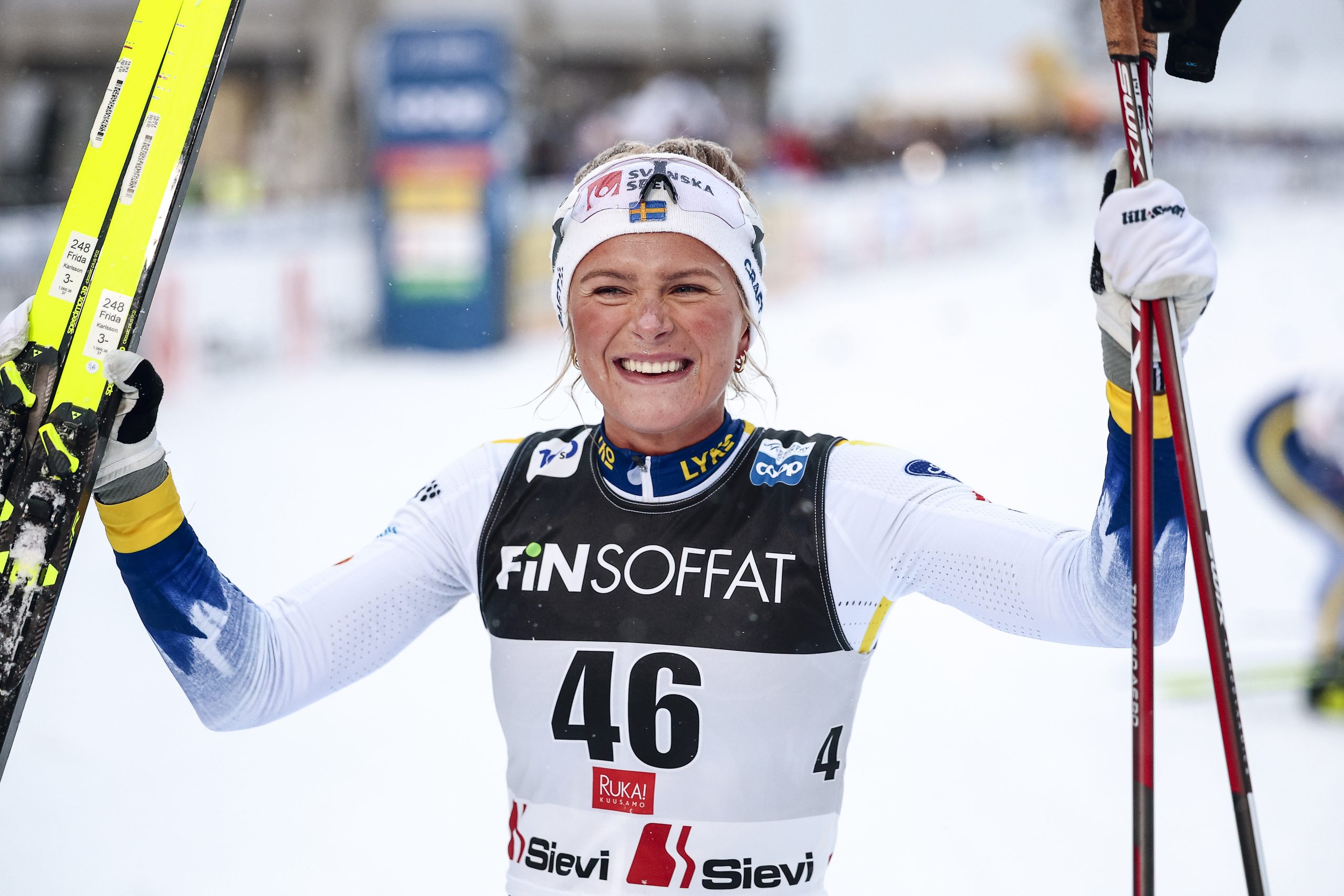
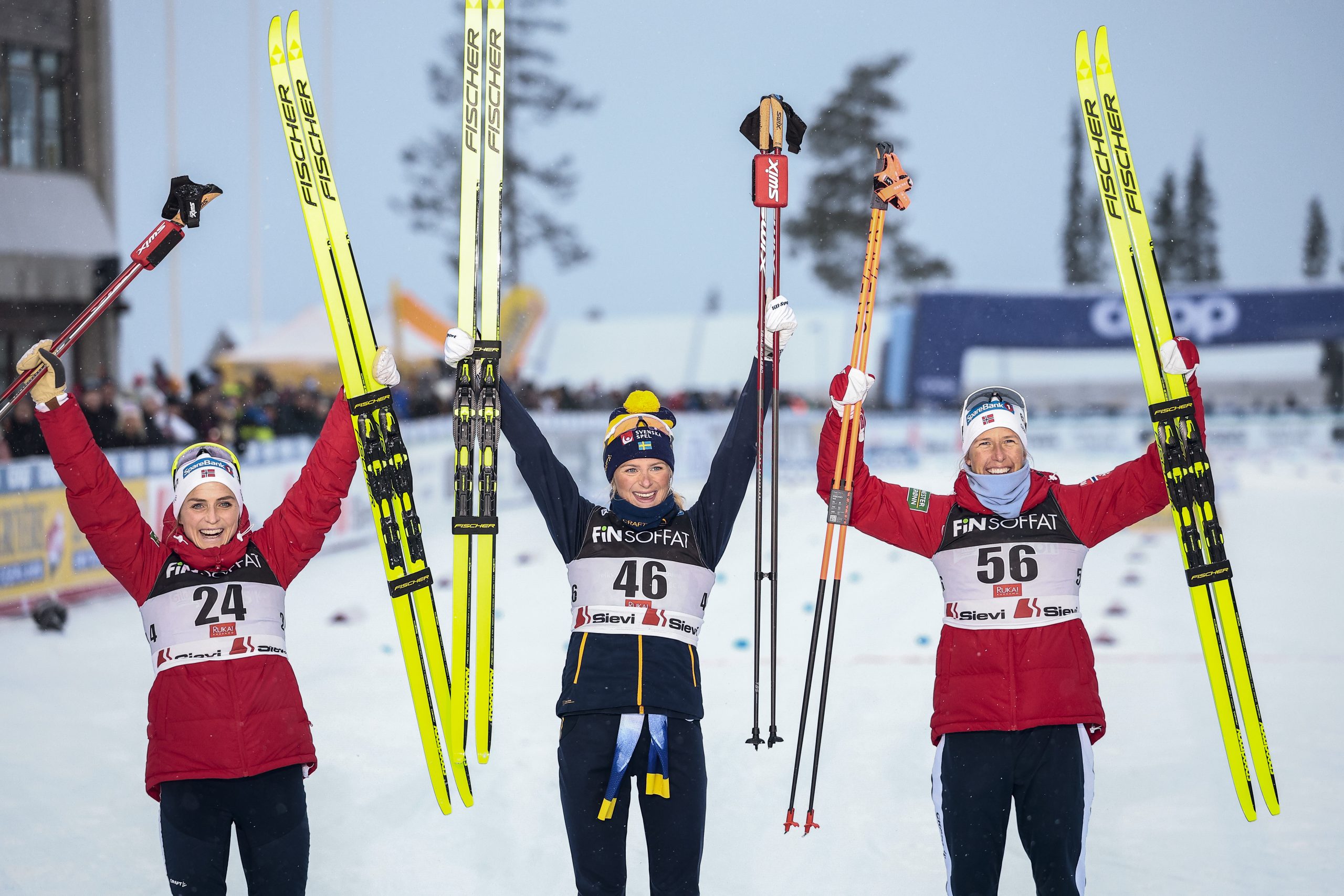
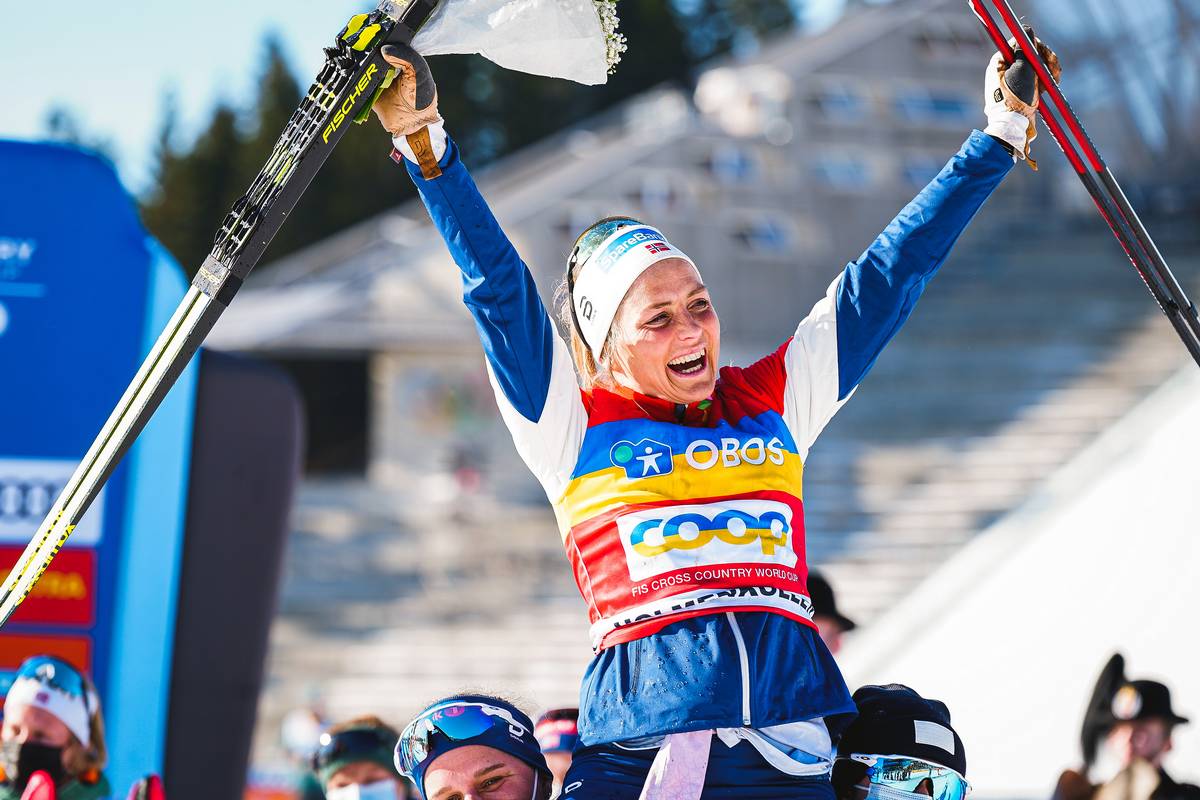
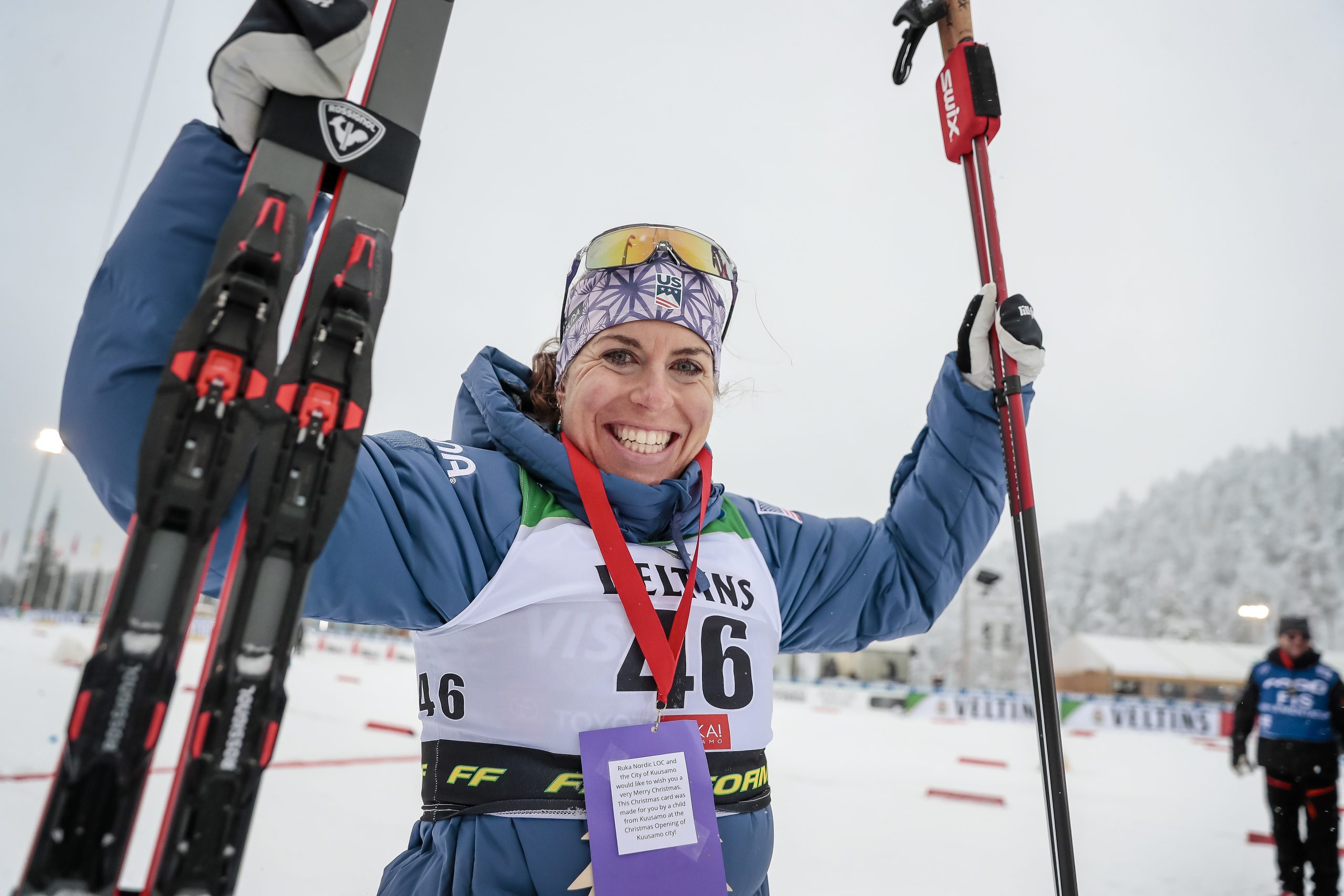
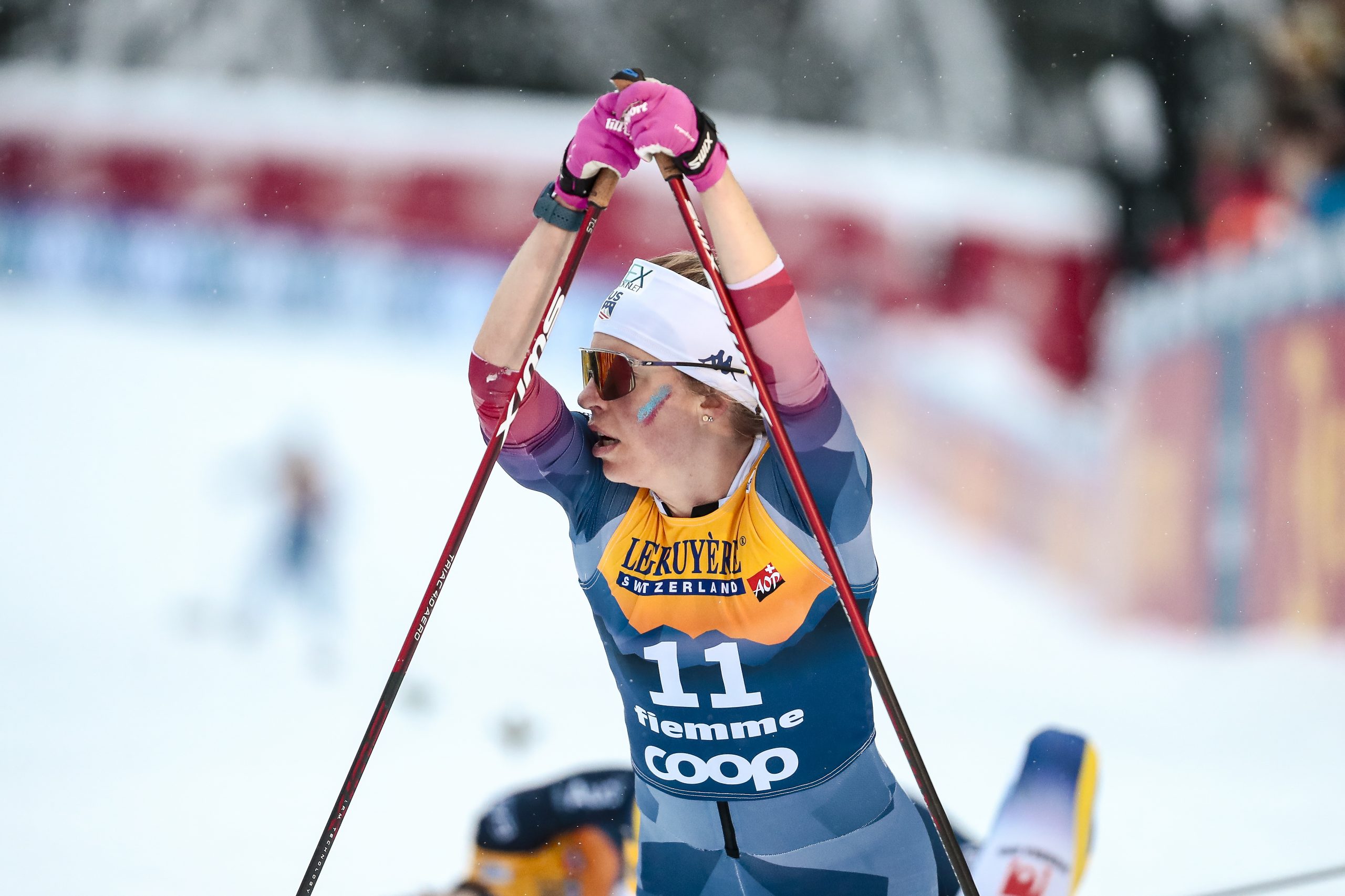
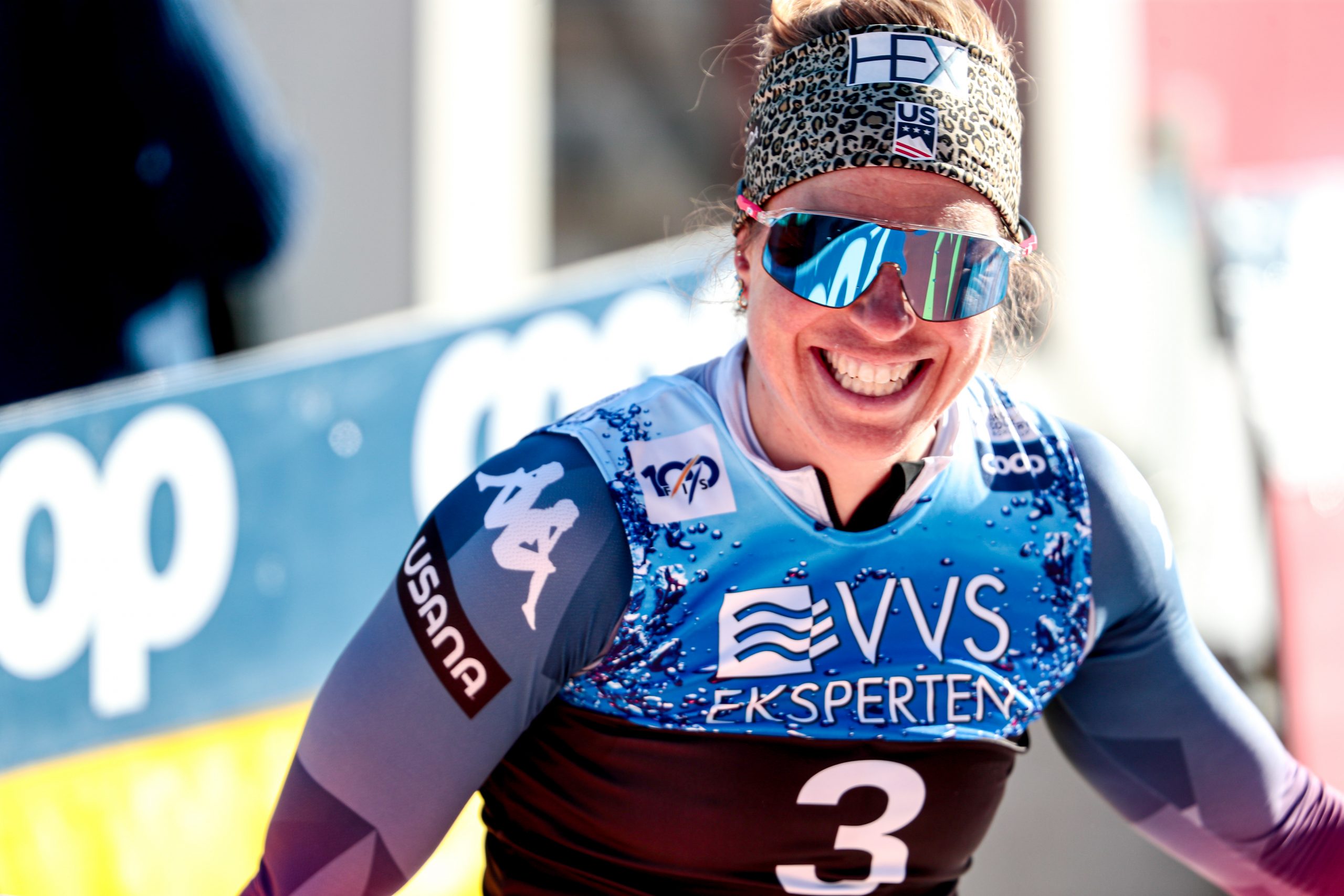
Frida Karlsson (SWE) exults in the finish area after her dominant victory in the Women’s 10 k Classic Interval Start in Ruka, Finland. The World Cup season has begun, and Therese Johaug (NOR) has returned. But all eyes are likely to remain fixed on Karlsson. (Photo: NordicFocus)
It’s been two full seasons since Therese Johaug last toed a starting line in a FIS World Cup distance event. In that time, the field has been able to convince itself that they were the best in the world. But Johaug has been lingering in the background all along—having a life, having a daughter, writing books, creating fashion empires—just waiting for the chance to come back to international competition. On Friday in Ruka, Finland, her long wait came to an end.
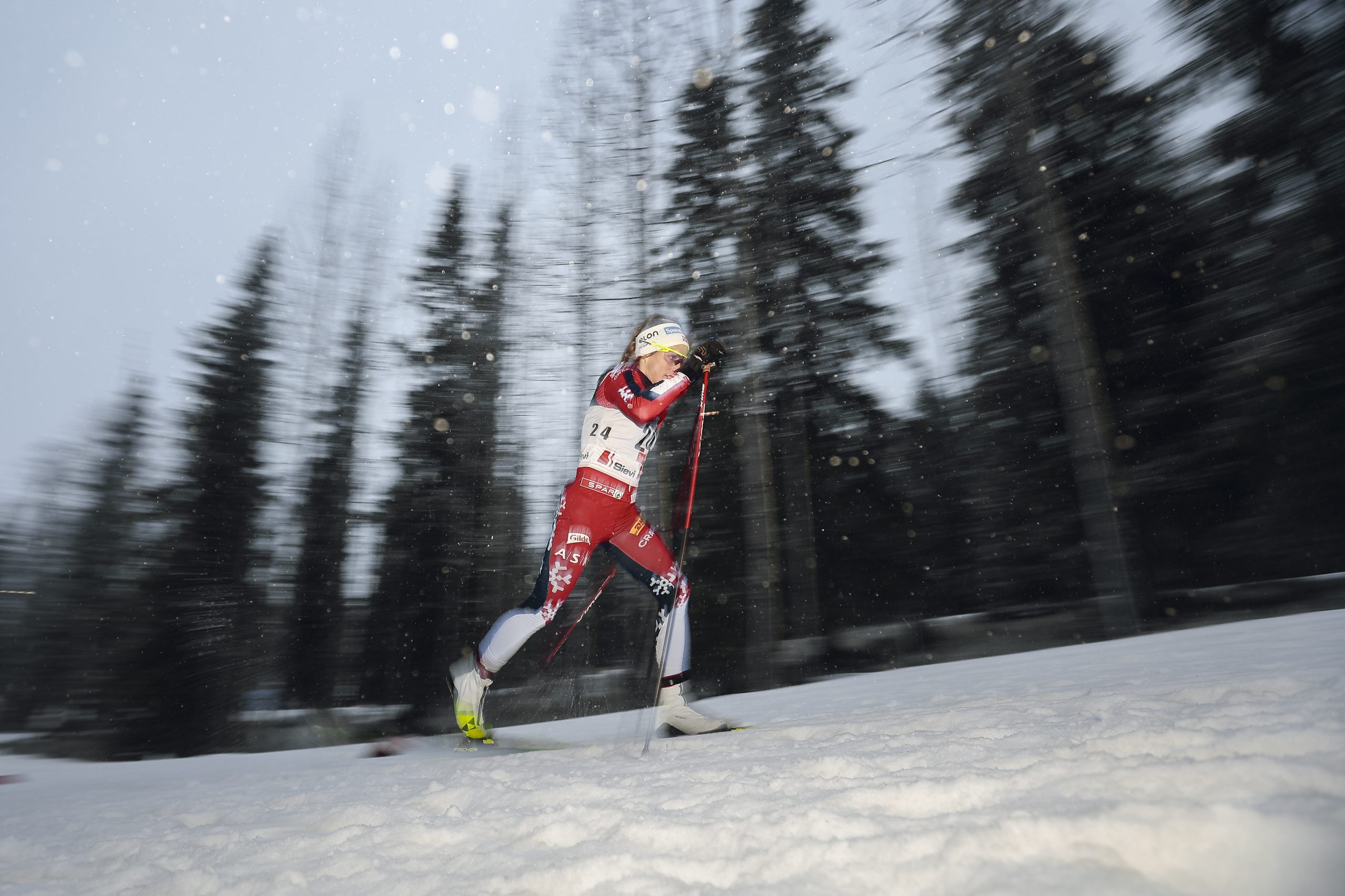
Therese Johaug (NOR) on her way to a brilliant second place finish in the Ruka 10 k Classic. Only Sweden’s Frida Karlsson was faster. (Photo: NordicFocus)
Therese Johaug (NOR) navigating a racecourse in full flight is an awesome sight to behold. Her competitive mode is flat-out intensity, un-stoppable momentum, wind-up-toy tempo. It looks for all the world like her only strategy is “go!” That degree of competitive abandon defined Johaug’s historic career, one in which she earned 82 World Cup wins, six Olympic medals, and 14 World Championships. Toward the end of Johaug’s storied career, a young Swedish challenger arrived on the scene: Frida Karlsson (SWE) showed unique abilities and a penchant for emulating Johaug’s style: high tempo, light touch, fearless pacing. Today in Ruka, Karlsson was the only athlete who could match Johaug; the only athlete who could better her. In the end, Karlsson snatched the fairytale ending from Johaug’s comeback story (at least for the moment), racing to victory by a shockingly large margin.
“Maybe my best race ever,” said Karlsson in postrace interviews. “I felt really good.”
Karlsson had her 2024 season interrupted by illness and injury—and a summer season in which she struggled with foot problems—but evidently her preparation has gone according to plan as she dominated Ruka’s 10 k Classic course like few before her ever have. Perhaps only Johaug . . .
Ten kilometers after her first start in more than two years, the Nordic skiing world was reminded of Johaug’s grit, determination, fitness, and talent. She ultimately crossed the line with a large lead, only to see it evaporate into the Arctic sky with every new split recorded by Karlsson. In the end, Karlsson triumphed over Johaug by more than 45 seconds, with Astrid Oyre Slind (NOR) finishing third, another 7.5 seconds behind.
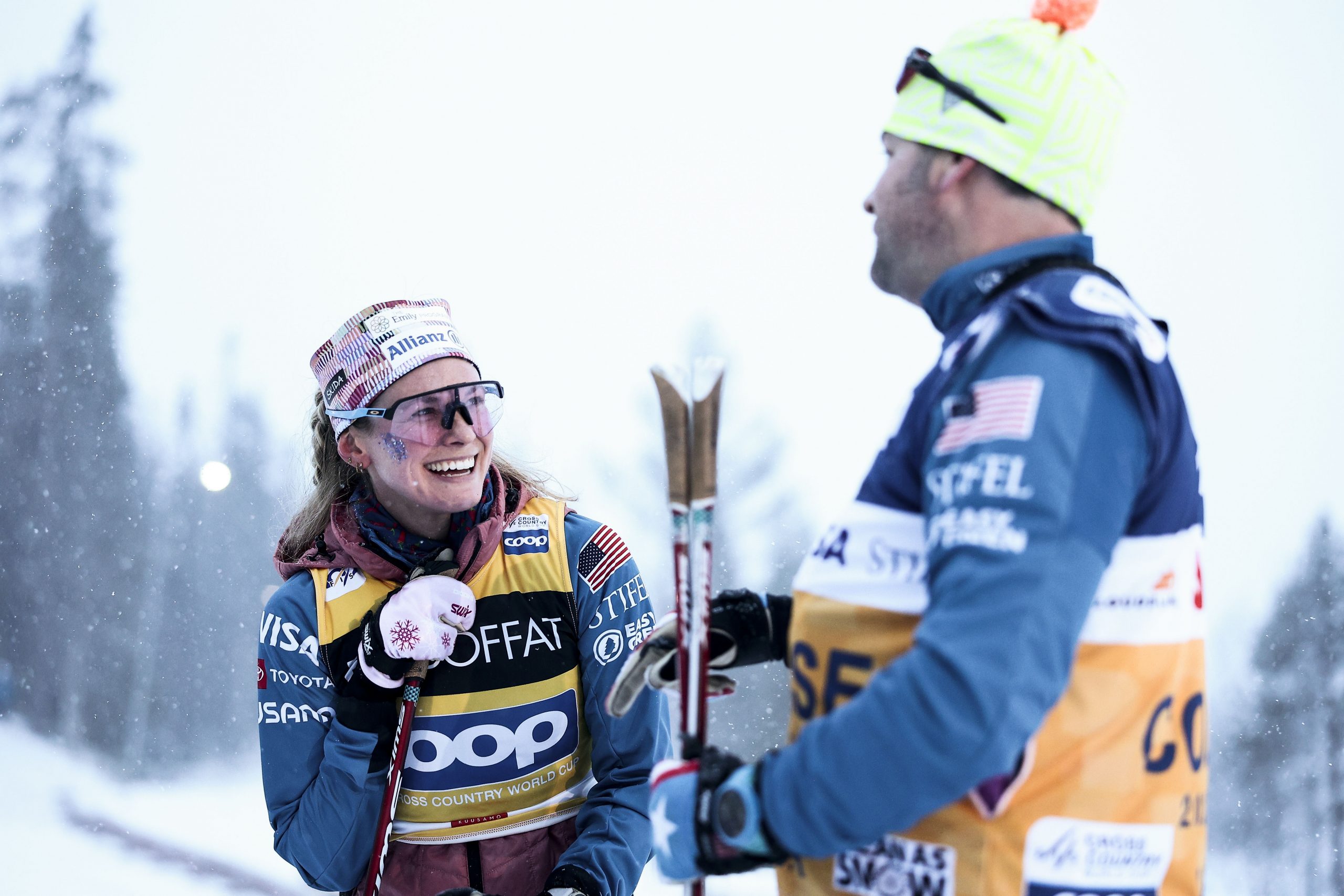
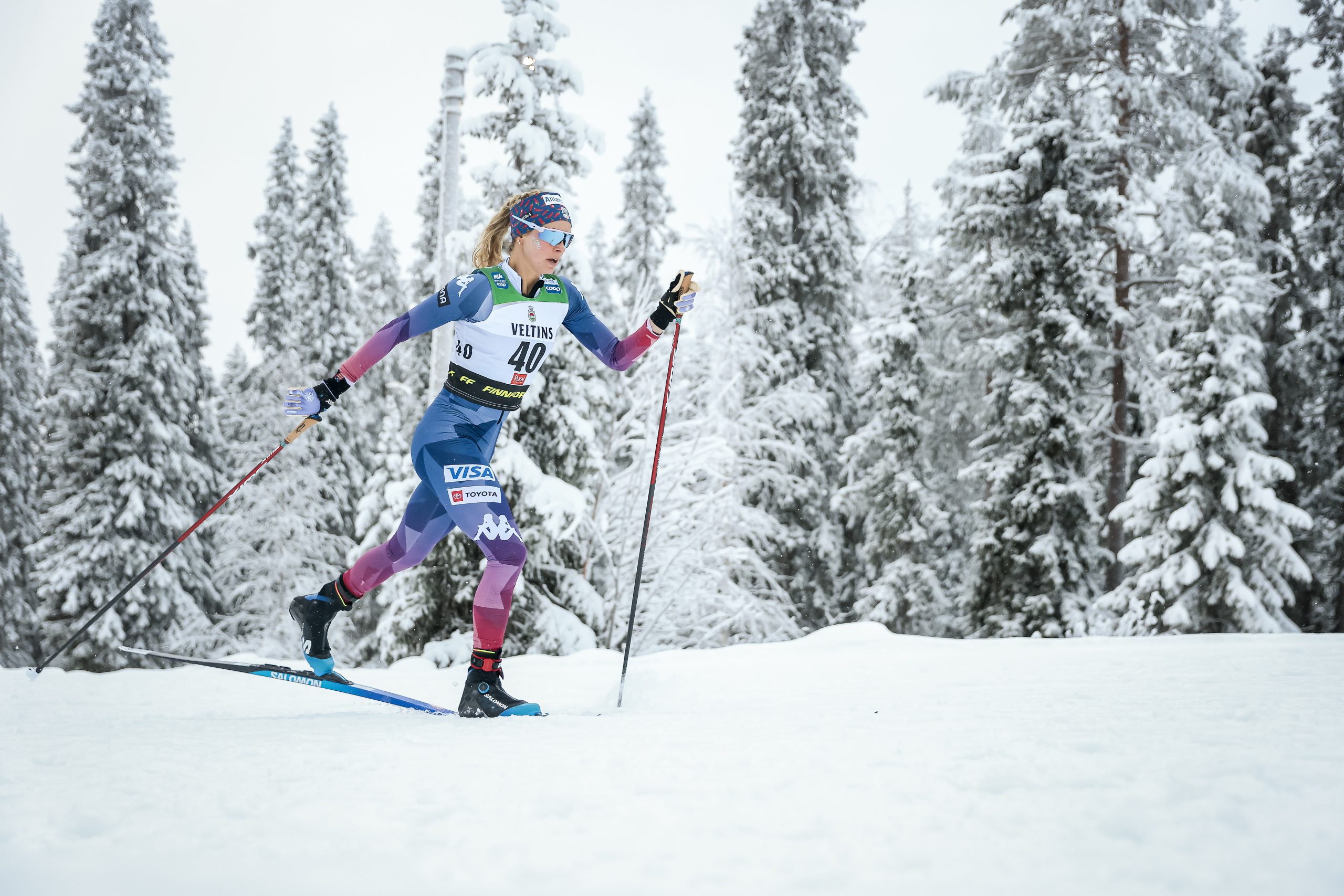
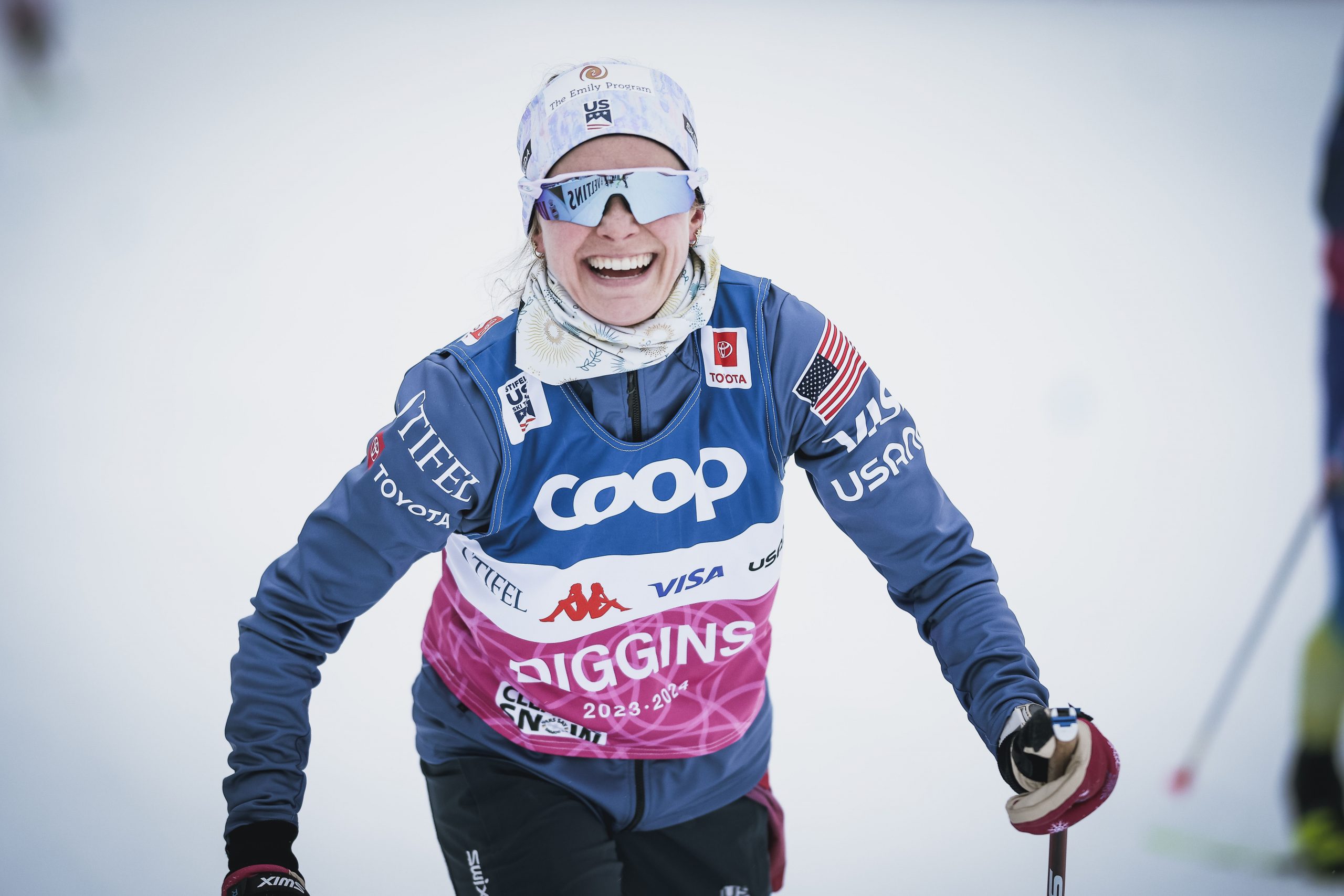
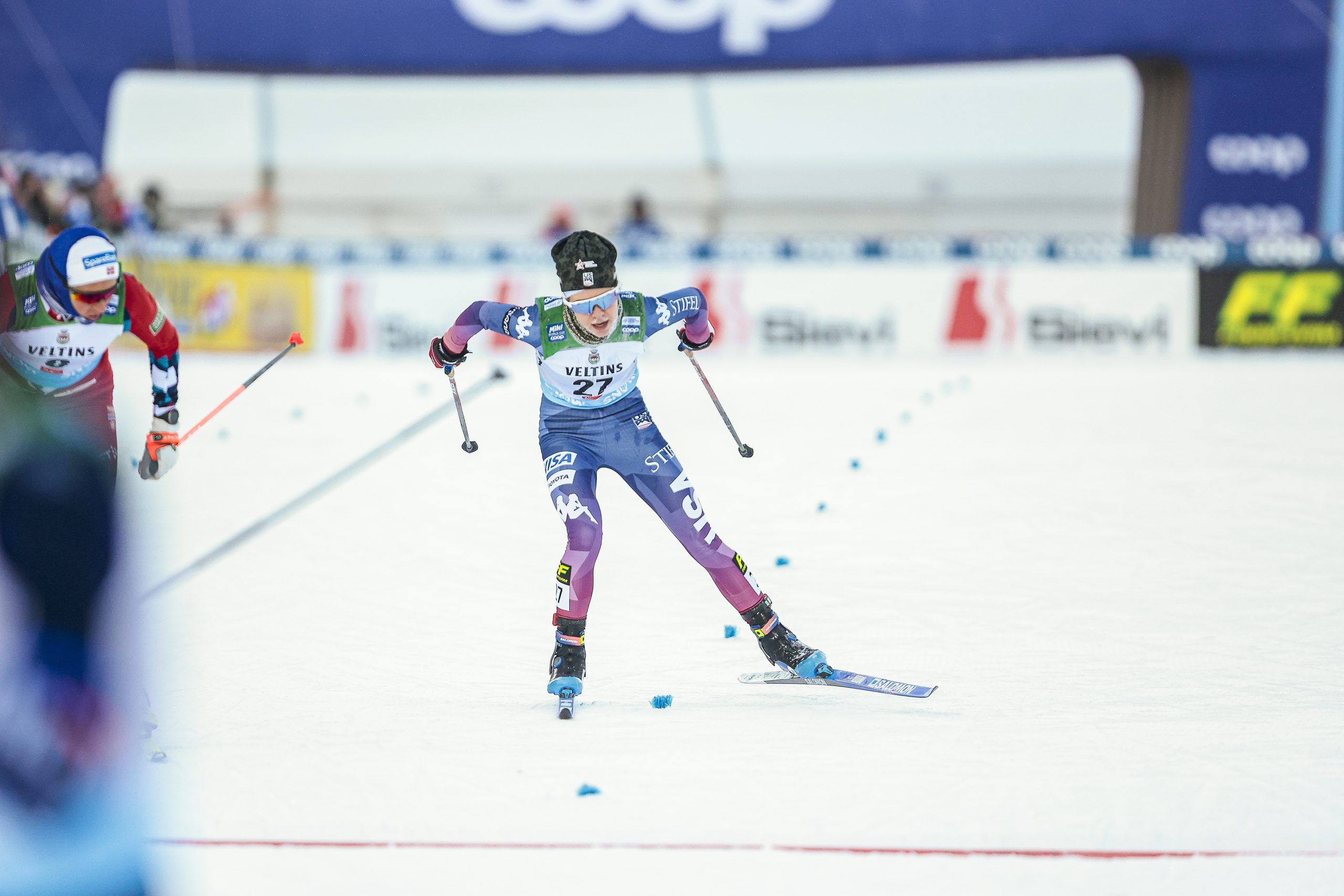
Jessie Diggins (USA) raced to seventh place in Ruka, an improvement over her finish of a year ago when she ultimately claimed the FIS Overall World Cup. (Photo: NordicFocus)
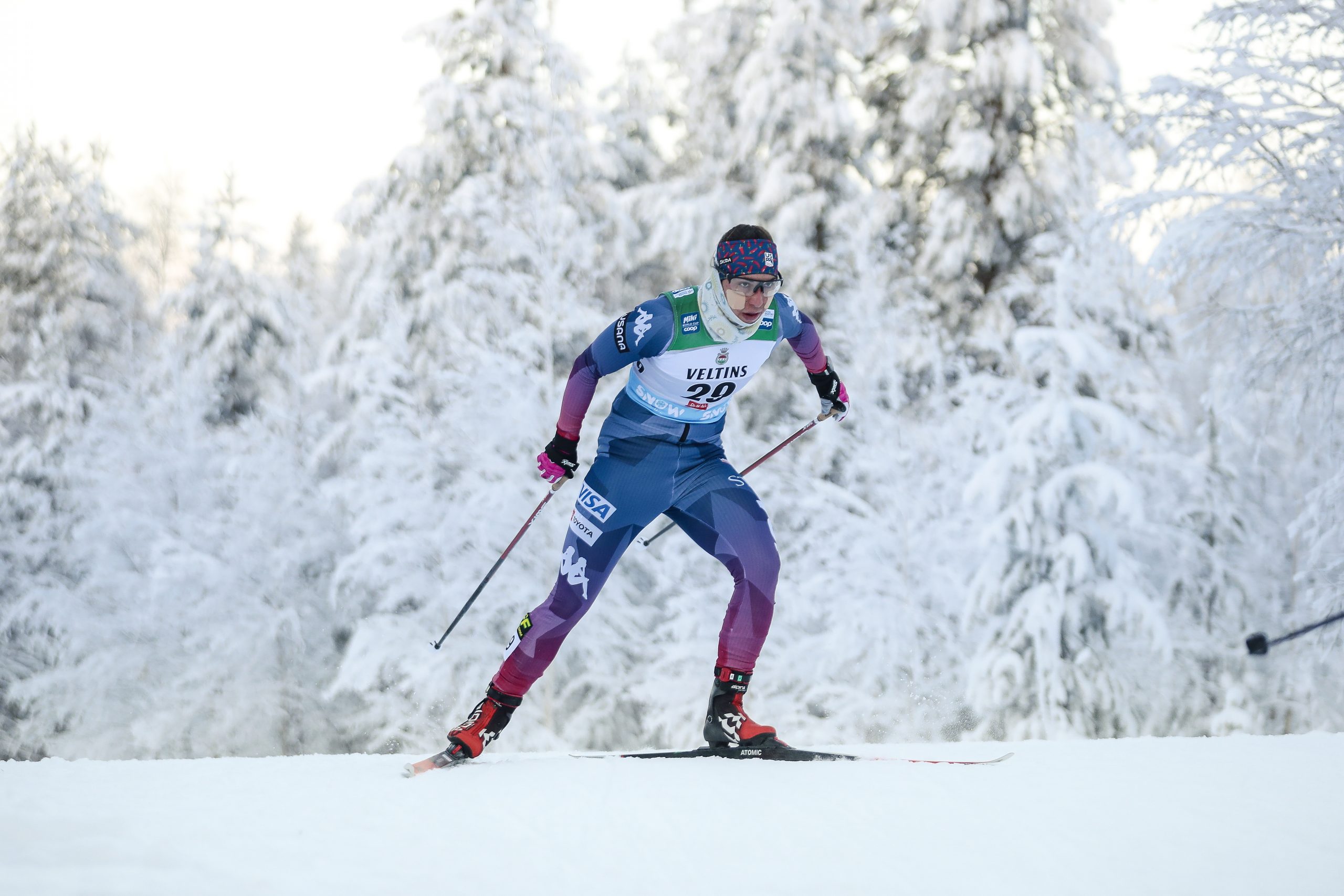
Jessie Diggins (USA) is the reigning World Cup Overall Champion, a distinction that also increases the number of her teammates allowed to enter World Cup races. In Ruka, eight American women raced the 10 k, with two finishing in the top ten. Behind Diggins steady 7th place (an improvement on her Ruka finish of a year ago), American finishers included Rosie Brennan (9th), Sophia Laukli (31st), Alayna Sonnesyn (48th), Julia Kern (49th), Sydney Palmer-Leger (56th), Haley Brewster (57th)
Canadian finishers included Katherine Stewart-Jones (42nd) and Liliane Gagnon (46th)
“Before I look at the results, I look back on the race,” Diggins continued. “How did it go? How did I communicate with my tech about my skis? Did I ask for what I needed? How’d the warmup go? How’d the race go: mentally, tactically, technique-wise, racing-wise? Then I come up with my scoring for myself before I look at the results. Today I was really really proud of all those categories, able to push really hard and stay very technique-focused.”
Women’s 10 k Classic Interval Start
November is the time of year when skiers wish for snow. Regrettably, those snow-wishes aren’t always granted, and November is often a month of roller ski pole tips clacking and slipping on near-frozen asphalt roadways. This year, though, the hills and trails appear different: Snow has arrived. The Central Rockies got totally dumped on this week—cars and trucks skidding and colliding up and down Vail Pass. New England finally got the Thanksgiving nor’easter that ski areas hope for every season. Now if they can just arrange another one for Christmas, then a couple more for President’s Day and Spring Break. Western Canada is blanketed in snow; Silverstar, BC is hosting camps for those programs savvy enough to plan early.
The International Ski Federation (FIS) doesn’t take chances when scheduling season openers. For many seasons, the first World Cup stop has been in Ruka, Finland (25 kilometers north of the Arctic Circle). It may only be November, but skiers are pretty sure to find snow in Ruka.
Skiers are also likely to find challenging conditions on Ruka’s Classic course that is designed to test the best athletes.
“Both up and down, (Ruka) is very technical, said Diggins. “Very steep hills, and you need really dialed-in technique in order to run them. You also have to be able to transition in and out of herringbone really well. I’m still getting there, and I have more that I want to do. It’s exciting to feel like all that hard work is sinking in.”
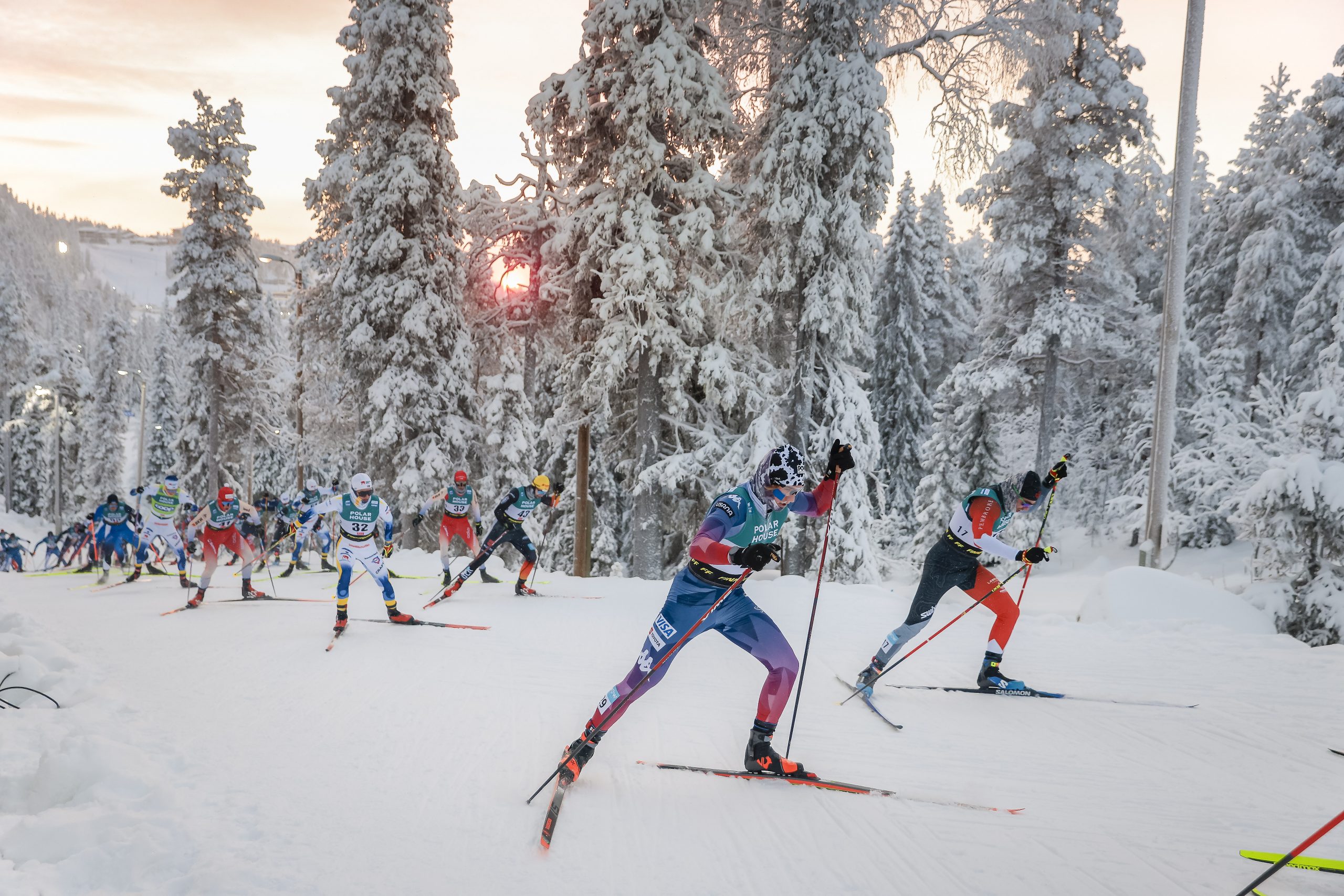
The first World Cup of the season—the Women’s 10 k Classic Interval Start—was raced in fresh snow with temperatures hovering around minus 2 centigrade. Conditions would be slower and more challenging than most athletes might’ve liked for the first test of the season, and many athletes lacked the snap typically seen in World Cup Classic races. The snow dragged at their skis, the hills sapped their energy. In the near-constant twilight of Arctic winter, racers struggled to find the form and rhythm that they’d refined all through the summer training season.
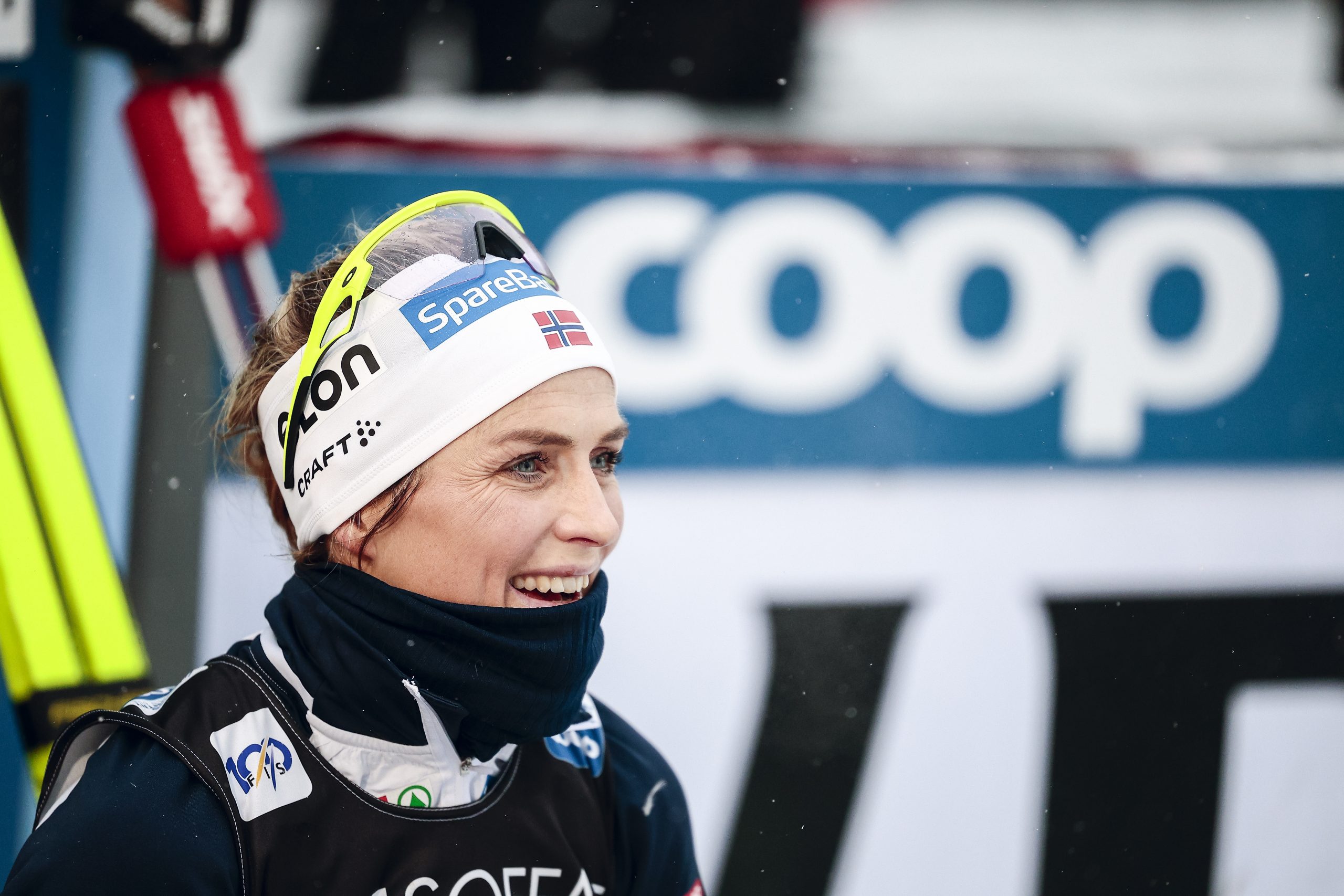
It’s been two full seasons since the skiing world watched Therese Johaug (NOR) race. Ruka’s 10 k Classic was a reminder of her long and excellent career, and of the potential she still possesses with the Trondheim World Championships looming on the Norwegian horizon. (Photo: NordicFocus)
Now 36 years old, Johaug had retired after the 2021-2022 season. The day’s 24th starter in Ruka, Johaug was seeking her 83rd World Cup victory. She departed the stadium in her usual staccato style, attacking a familiar course that has delivered victories for her many times before. Johaug was seen to be exiting the tracks in search of greater kick on the challenging uphills (as were many of her Norwegian teammates). Nevertheless, she established large leads at all her early splits.
Other contenders (Diggins, Slind, Weng, Andersson) would match or better Johaug’s early splits, but ultimately each of her rivals faded . . . except for Karlsson. She stormed on through the Finnish forest, increasing her lead at each juncture. In a field of world class skiers who seemed generally to struggle with the day’s conditions, Karlsson appeared the lightest, most energetic, most efficient on her skis. Rarely out of the tracks, she was able to attack where others needed to measure their efforts.
At the midway point, fast times had been turned in by Karlsson, Slind, and Katharina Hennig (GER) who were all positioned ahead of Johaug. Diggins hovered in fifth, just ahead of Heidi Weng (NOR). But only Karlsson and Johaug were able to maintain their technique—and their momentum—all the way to the end. Slind raced bravely as well, recovering her technique near the end to finish a strong third.
“I think I went out a little hard,” Diggins confessed after the race. “I don’t necessarily regret it; sometimes you gotta go big and see what happens. But I think I was folding a little bit in my technique on that second lap.
So, the 2024-2025 World Cup season is underway. Many weekends and many races lie ahead, and much will transpire before the FIS World Championships in Trondheim. Those races are what Therese Johaug identified as her goal event for the season, a week of racing that Frida Karlsson is likely to have circled on her calendar, as well.
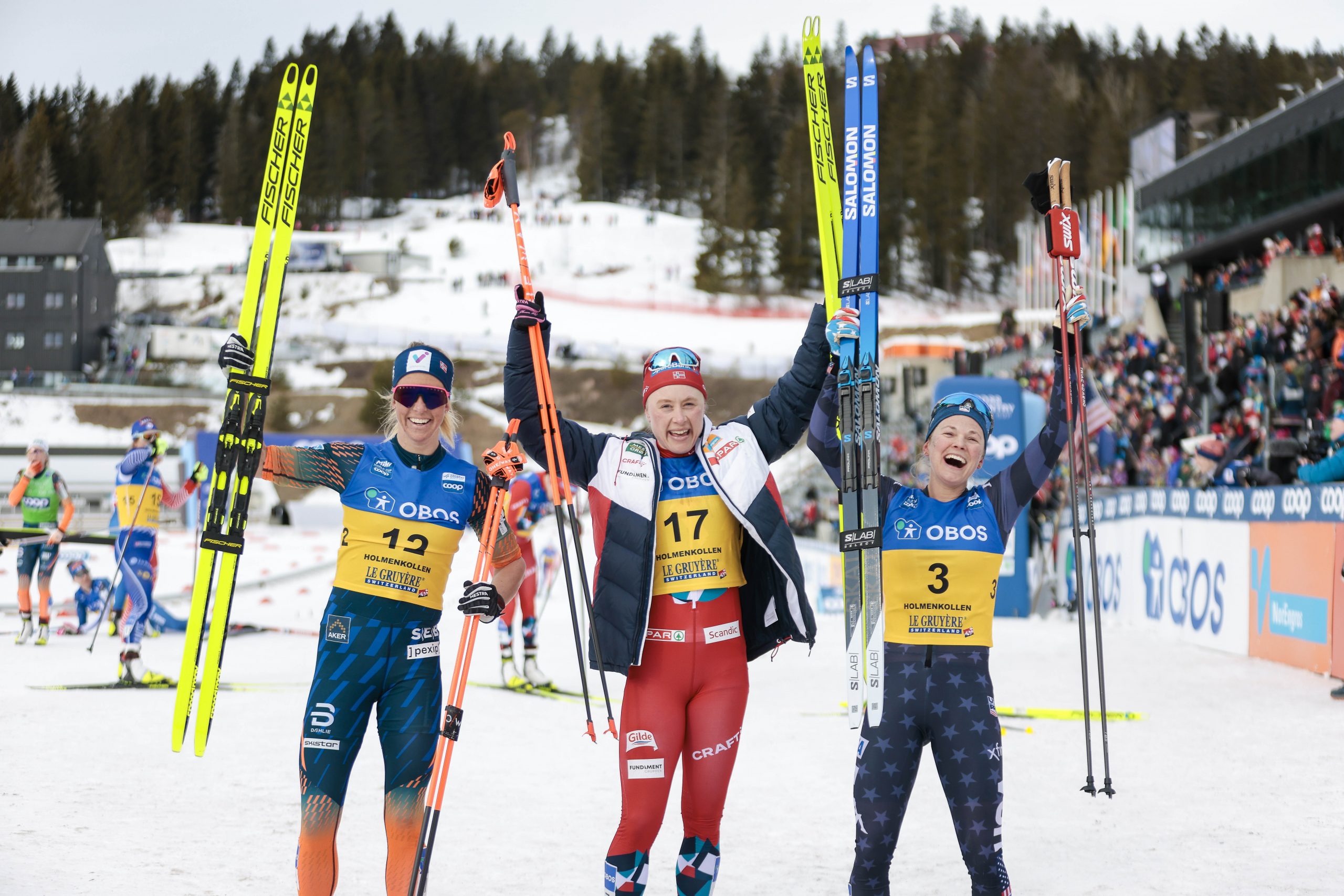
First podium of the World Cup season: Therese Johaug (NOR), Frida Karlsson (SWE), and Astrid Oyre-Slind (NOR) celebrate on the podium in Ruka. (Photo: NordicFocus)
This article was made possible through the generous support of our voluntary subscribers. If you would like to see more articles like this one, please support FasterSkier with a voluntary subscription.
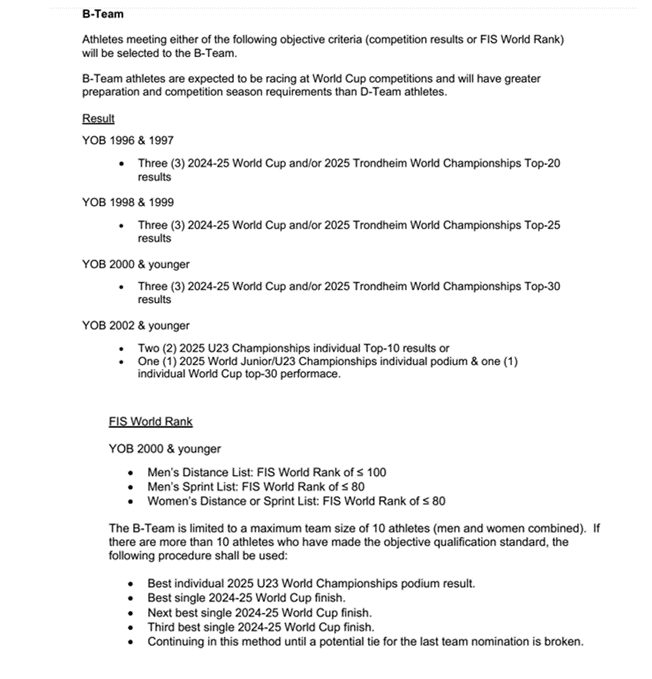
Despite a challenging start to the 2023-2024 season, Zak Ketterson (entering his third year on the U.S. B-Team), narrowly qualified for the Minneapolis World Cup—fulfilling his goal of racing, not merely in the United States, but in his own hometown. The Minnesota native has learned from the highs and lows of last year and is bringing “renewed energy and renewed excitement” to what he hopes will be “a do-over.” FasterSkier connected with Ketterson to discuss his new approach to the off-season, training in the Twin Cities, and what to watch for in Ruka.
A Long Road Home
Before we dive into the details his summer training, his expectations for the World Cup opener, and his goals for the coming season, Zak Ketterson takes a moment to reflect on 2023-24. “I was really struggling to put together any kind of good performance,” Ketterson tells me. He was illness-prone (coming down with Covid-19 in early December), fatigued, and “racing so badly in Period I that [he] got booted off the World Cup.” Relegated to the Norwegian domestic racing circuit, he found himself in serious and unexpected danger of missing his chance to start at Theodore Wirth Park—the site first American World Cup in two decades, within walking distance of his Minneapolis home.
It was a possibility Ketterson “didn’t even consider” at this time last year. However, it was one he was determined to avoid. “I was able to pull myself up from rock bottom and race well enough” to reach the starting line in Minnesota, Ketterson says—first, by qualifying for a fresh slate of World Cup starts in Oberhof, Germany and Goms, Switzerland; then, by qualifying for the Oberhof Sprint Quarterfinals (where he ultimately finished 16th) by a bare 0.14 seconds. The difficult and doubt-laden journey made Wirth Park the highlight of Ketterson’s tumultuous season: It wasn’t just “the day itself; to even make it there was a big deal.”
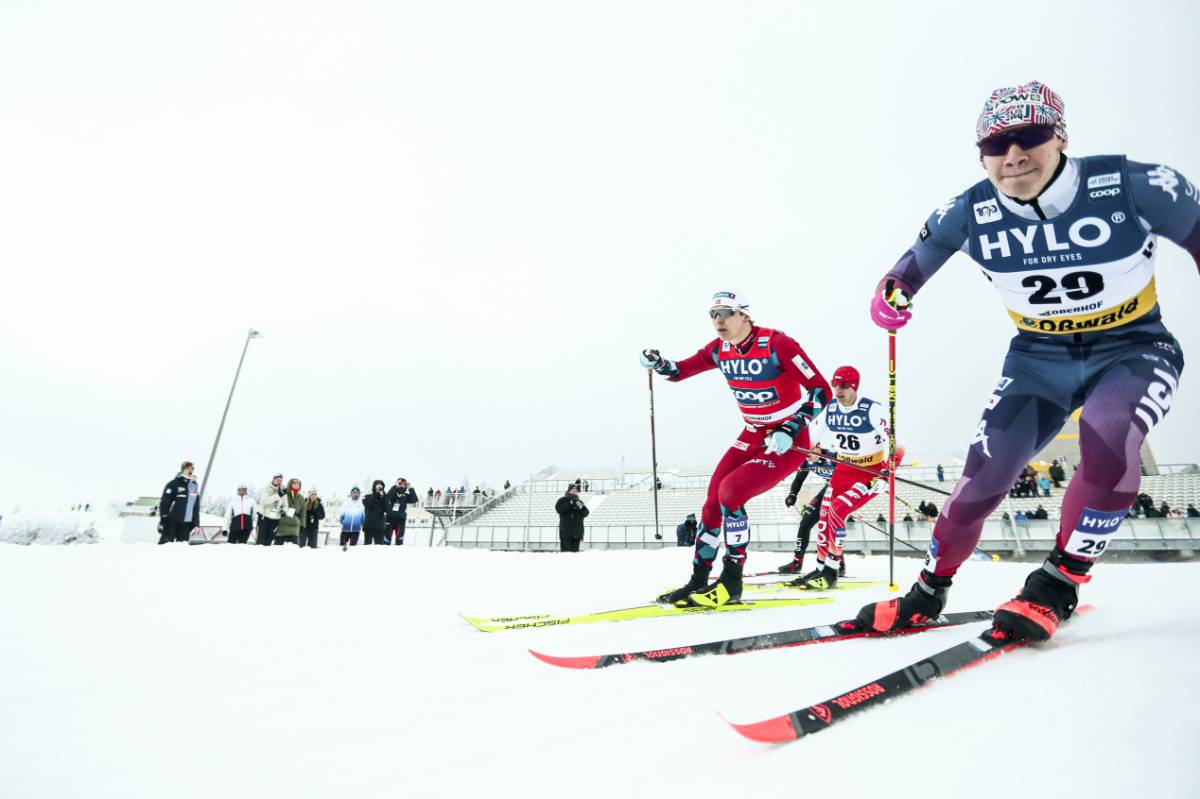
Zak Ketterson skied into his first Heats of the World Cup season in Oberhof, eventually finishing 16th in a closely contested !uarterfinal. He credits his hard-fought Oberhof appearance as ensuring his appearance at the Minneapolis World Cup. (Photo: Nordic Focus)
In retrospect, Ketterson has diagnosed overtraining as the culprit behind last year’s challenges. It’s a realization that has reshaped his approach to the summer and fall. Moreover, it has provided a lesson in personal persistence that Ketterson is carrying with him as he embarks on this year’s World Cup circuit. “I overcame it. I can keep that extra resilience in my back pocket… I’m excited to hopefully prove to myself that I can do this.”
New Season, New Strategy
Ketterson described navigating this off-season with a “philosophy shift, from thinking in terms of maximizing quantity, to trying to maximize quality. Any time I did a session, I had to ask myself: ‘What’s the point of this session?’, [instead of] doing sessions for the purpose of just filling out the training log.” He “dialed back [his] volume a little bit” in favor of “going out with intention” and ensuring he could approach key interval sessions at optimal intensity.
Ketterson feels the psycho-physical effects of these changes have been evident. “I’ve focused on […] making sure I’m excited, ready to do every workout,” and “I’ve been a lot happier, a lot more energetic, and a lot more grateful to be training.”
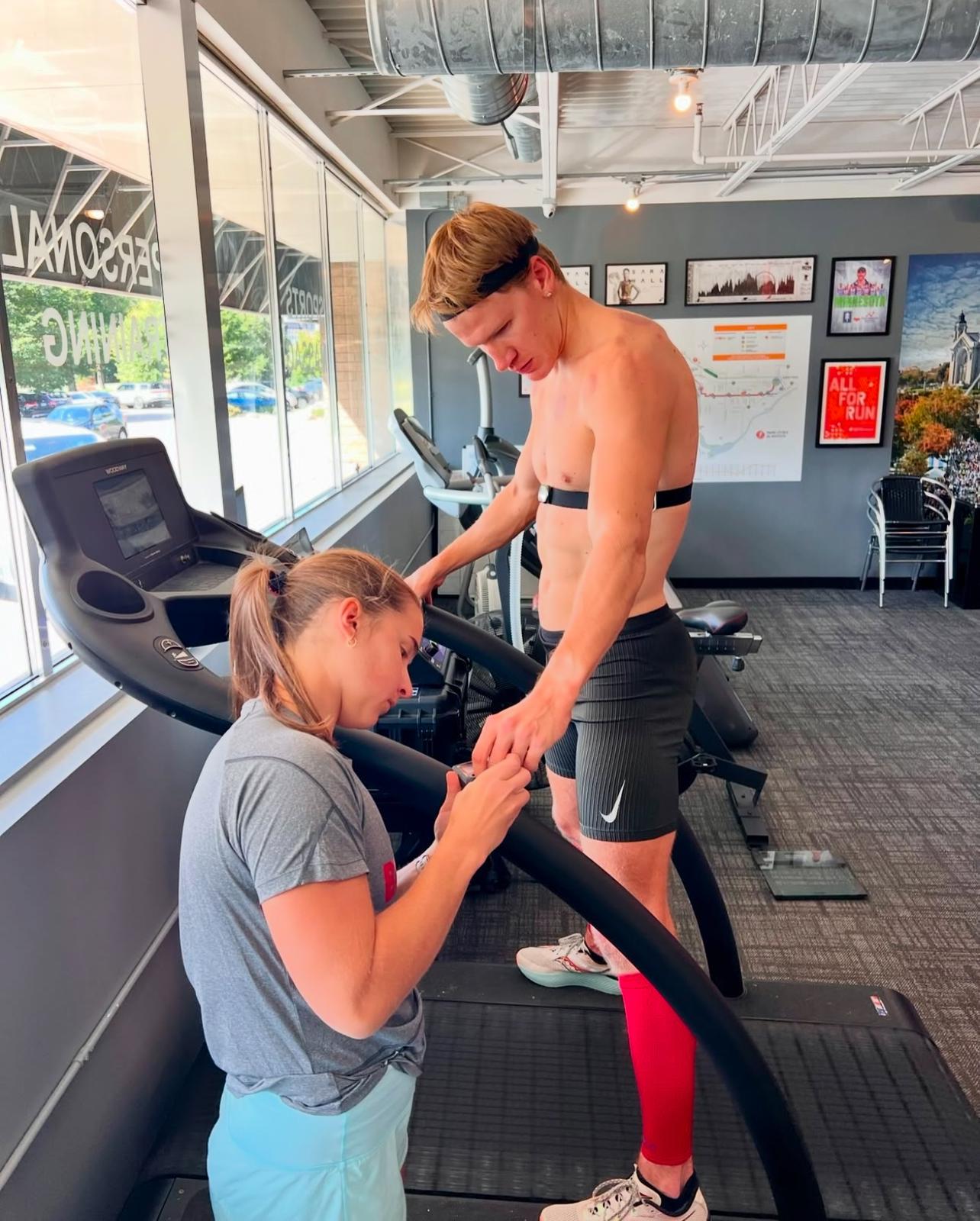
Ketterson’s coach (and wife), Julie Ensrud, assists him with lactate testing during a Standard Session. (Photo: Zak Ketterson)
However, he’s also relied on the hard data of regular progress evaluations to ensure he stays on a productive trajectory. This spring, Ketterson introduced a “Standard Session” to his training plan: A treadmill-running interval with a consistent incline, and a series of pre-set pace blocks which increase at five-minute intervals, which Ketterson would complete roughly every three weeks (at the conclusion of each training block). By “taking lactate [tests] after each stage and also tracking my heart rate and perceived effort, I was able to have a pretty good idea of whether I was carrying more or less fatigue that I might have thought, and also whether my fitness was progressing throughout the year.”
The utility of this objective metric proved itself throughout the last eight months: “There were actually several times where I had a bad Standard Session where my fitness or, basically, fatigue was just showing that I wasn’t performing up to the standard of the last time I took the test. When that happened, it was a really easy decision to take an easier period and maybe take two or three days off,” Ketterson reported. He sees these data-driven checkpoints as essential to balancing a long-term training load. Without Standard Sessions, “it can be hard to make sure you don’t get overtrained, because the fatigue is really cumulative.” With its omnifarious symptoms, overtraining “can creep up on you.”
Twin Cities Training
Ketterson’s re-envisioned, intentionalized training program seems to have produced a positive cycle that leaves him with “headspace” to “be a balanced individual outside of sport” which, in turn, “translate[s] pretty well to [his] performance.”
“I perform best when I’m happy,” he summarizes.
Ketterson’s choice to live in Minneapolis—unique among the U.S. A- and B-Team athletes, who largely spend their summers in either the Northeast, the Mountain West, or Alaska—contributes to both the strength of his training and his appreciation for life beyond the trails. He explains: “It’s where I’m from, it’s where my family is; my wife [Julie Ensrud] and I have a house there,” which enabled the “surreal” experience of enjoying breakfast in their own kitchen before walking to the Wirth World Cup. With an abundance of urban trails and bike paths, Ketterson has a range of training options steps from his front door—and can “go to see some Timberwolves games, walk around the city, swim in [his] parents’ pool,” and rollerski at Hyland Park, where he learned to cross-country ski. Logging miles there is “really nostalgic […] To have trained there when I was 10 years old, and to be training there now, 17 years later, as a World Cup skier, reminds me how lucky I am.”
Ketterson with family at the Minnesota State Fair. (Photo: Zak Ketterson)
Minneapolis is also the headquarters of Team Birkie, the regional professional group with which Ketterson has competed since 2021, and of which his wife is now Head Coach. In addition to the advantages of training alongside athletes “who, in one [workout] or another, are going to give me a challenge,” Ketterson has consistently benefitted from collaborating closely with the Team Birkie staff to develop tailored deviations from a framework of “universal, good training practices […] Team Birkie has been so respectful of my opinions and of what I’ve learned about myself these last fifteen years. I have the freedom to do what I think makes me the best, and the coaches” support and advance those decisions.
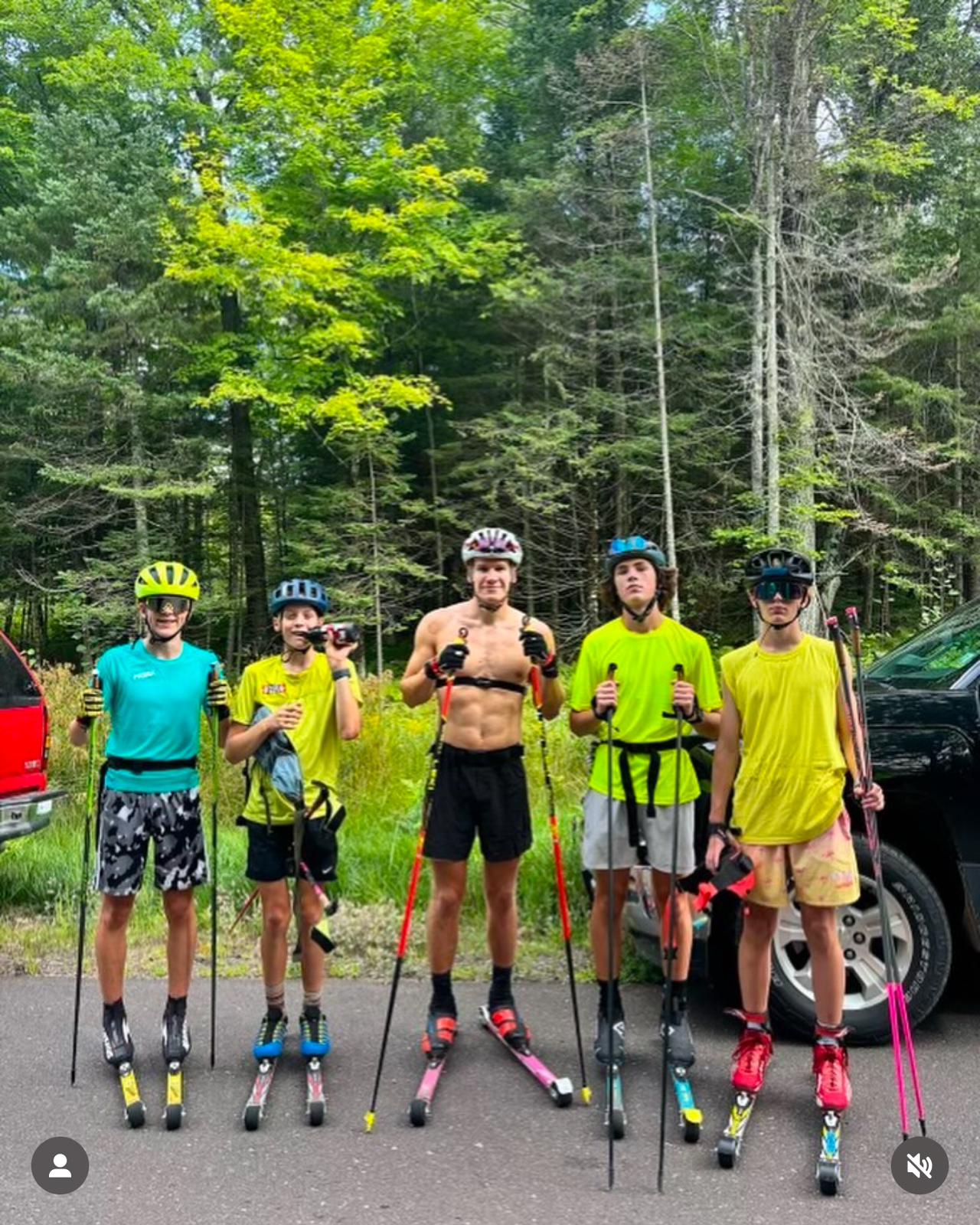
Moreover, the Twin Cities are the geographic and cultural gateway to a regional network of avid Nordic athletes. “The Midwest is maybe the place in the United States with the biggest critical mass of excited skiers—people who love skiing and are excited about World Cup competition.” Ketterson volunteers at several youth development camps in Cable, Wisconsin (and travel camps to Park City, Utah), “mentoring some of the top junior athletes in the region.” Helping to coach the next generation of Midwest standouts is “pretty special,” because he himself attended these camps “three or four times” as a middle- and high-schooler. While “it’s easy to think that if you want to be a really good skier you have to be born somewhere like Anchorage or Minneapolis, seeing those kids from Spooner [and elsewhere in rural Wisconsin], and how much they care,” reinforces that “skiing is a lot more global and accessible” than it is conventionally understood to be—especially after the “huge shift, for people of all ages who are into skiing in the Midwest” prompted by the Minneapolis World Cup. Ketterson reports an “energy flowing around Wirth Park now, even through the summer months,” and states that the venue has bid for a 2028 World Cup race—a powerful incentive for young athletes who could compete there in four years.
Summer in the Midwest brings coaching Wisconsin and Minnesota’s promising young skiers at regional development camps. (Photo: Zak Ketterson)
Not Expectations, But Belief
One downside of training in the Midwest is, however, the late arrival of snow. Ketterson approached last weekend’s events Beitostølen as an opportunity to get steady on wax instead of wheels, and “to get that early-race rust out of the way before the World Cup.” It can be “daunting” to start the season with World Cup racing, and the Norwegian opener serves as “a really good opportunity to compete with a pretty high-level—honestly, World Cup-adjacent—field […] there’s so many Norwegian domestic guys who don’t get the chance to race” on the FIS circuit. “I don’t envy them in that it’s a cutthroat environment. But, I do envy them in that they have this ‘local’ circuit that rivals the World Cup in its competitiveness. That’s definitely a big reason why [the Norwegians] are so strong.”
Ketterson’s objective was to at least qualify in the Beitostølen Sprints—a goal he successfully achieved on Friday, finishing 21st overall. Supported by his wife and Norwegian in-laws, Ketterson feels the weekend “went pretty well, all things considered, with how little time [he’s] been able to spend on snow. Especially the Sprint—being able to qualify in that field was a really big accomplishment for [him], and hopefully a good sign of things to come for the rest of the season.”
Ketterson advanced through Qualifying at last weekend’s Classic Sprints in Beitostølen , Norway. (Photo: Marius Simensen / Zak Ketterson)
Indeed, as he looks to the World Cup, Ketterson is determined to use the lessons, progress, and resilience of the last year to “be competitive in the races that [he’s] doing.” He finds ‘first day of school’ to be a good metaphor for Ruka. In addition to reconnecting with fellow U.S. team members, some of whom haven’t seen each other since March, the upcoming three days in Finland entail a “shared experience” of anticipation and excitement: “The other athletes have trained just as hard as you have, and they all care just as much as you do, and they are there with similar goals.” While the season start can be “nerve-inducing,” the skiers are among peers who understand and reciprocate the electric attitude of the weekend. “It takes a lot of energy, but it gives a lot of energy.”
After Ruka, “You have to take it period by period,” Ketterson explains. “Starting with Period I, my first and foremost goal is just to race well enough to move on to the Tour de Ski. Hopefully, if I’m racing at a really high level, I can lower my shoulders a bit.” A Sprint Semifinal placement would be ideal: “I’ve made six or seven World Cup Quarterfinals, but haven’t managed to squeeze through one yet.”
Beyond the season start, Ketterson states that the Trondheim World Championships are his “biggest priority.” Between stories from his wife’s family and his own experience living and training in Trondheim through the summer of 2023, he’s heard “so much about [the World Championships in] Oslo in 2011 and how legendary that was,” and anticipates the coming Championships will bring similar energy.
Perhaps more significantly than any single race performance, though, is this season’s “opportunity for a do-over.” Ketterson has clearly reflected on 2023-24, and is ready to compete with “renewed energy and renewed excitement.” It’s an attitude that has only been reinforced by the success elsewhere on the U.S. Men’s Team—success that Ketterson says has not raised expectations but, rather, “belief. When we see Gus [Schumacher] in Minneapolis, J.C. [Schoonmaker] in Ostersund, or Ben [Ogden] in Toblach, the reaction isn’t, ‘Oh, shit, now we need to do that.’ It’s, ‘If those guys can do it, maybe we can do it, too’… Those guys have shown it’s possible. We’ve all bought into this belief that we can do it, and could be the next ones.”
The FIS World Cup will kick off on Friday, November 29th in Ruka, Finland.
FasterSkier thanks Zak Ketterson for his time. Some comments have been edited for length and clarity.
This article was made possible through the generous support of our voluntary subscribers. If you would like to see more articles like this one, please support FasterSkier with a voluntary subscription.
As the 2024/25 ski season approaches, elite skiers are finalizing their preseason training for the World Cup circuit. For Graham Ritchie (CAN), a member of Canada’s A Team, this year’s preparation has been unlike any other. Recovering from a significant injury, Ritchie’s focus has been on rehabilitation and resilience, rather than traditional training.
Last December, following the first World Cup of the season in Östersund, Sweden, Ritchie suffered a serious ankle injury during a light recovery jog. “We had just driven 10 hours from the race in Ylläs to Östersund. My roommate and I decided to go for a short leg shake, and one minute in, I slipped on ice. I looked down, and my foot was at a 90-degree angle. I knew it was bad,” he recalls.
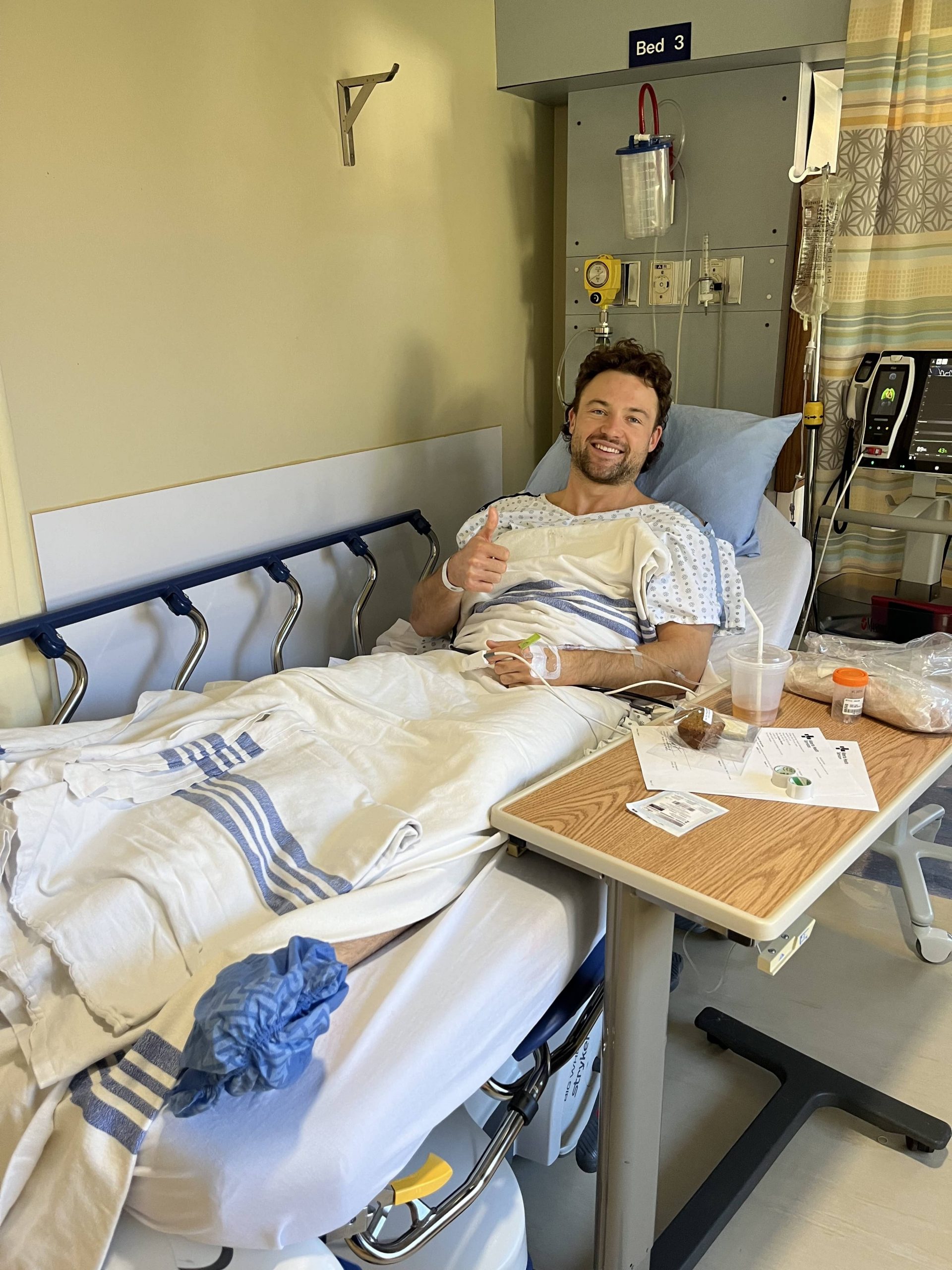
Graham Ritchie after surgery. (Photo: Courtesy Photo)
The injury required surgery to insert a plate and five screws into his ankle. “I spent seven weeks non-weight-bearing and then months relearning how to walk. Even by summer, I still couldn’t stride—it was too painful,” Ritchie explains. Despite his progress, the hardware continued to limit his mobility, forcing him to make the difficult decision to undergo a second surgery in October to remove it.
“It wasn’t an easy call. Originally, we planned to take the hardware out in the spring, but I wasn’t progressing enough to push hard in training,” he says. “The team and I decided it was better to address it now and focus on getting back to 100% without rushing.”
While the injury sidelined him for much of last season, it came with one unexpected silver lining: Ritchie spent Christmas with his family in Parry Sound, Ontario, for the first time in years. “It wasn’t Plan A, but it was great to be home. I hadn’t been able to do that in a long time, and it really helped put things in perspective.”
The plate and screws removed from his ankle after the October surgery now sit in his drawer, awaiting a creative purpose. “I kept the hardware,” Ritchie says. “I plan to put it up along with my medals someday—it feels like a fitting place for it after everything.”
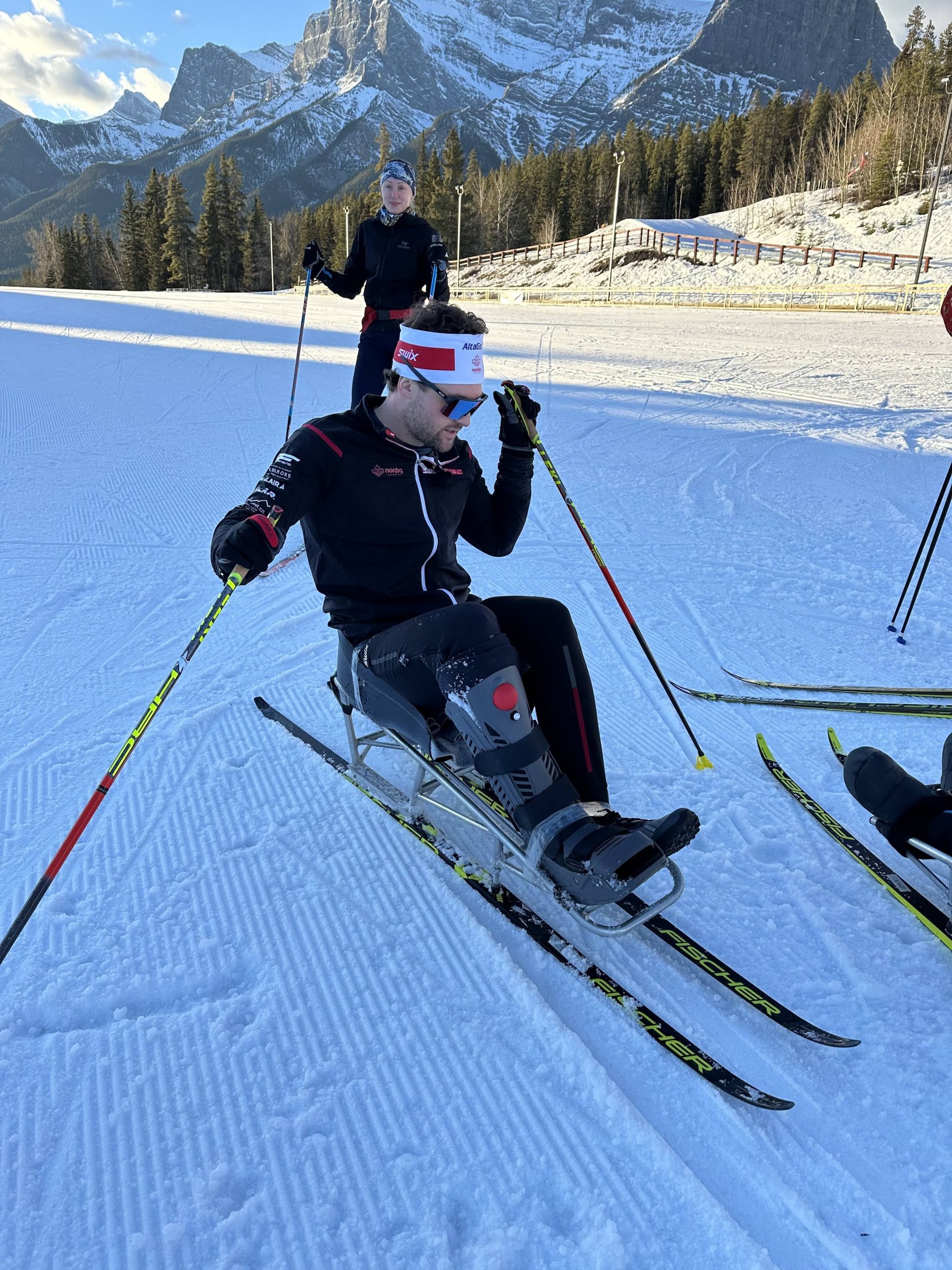
Ritchie’s recovery has been a humbling experience for the 25-year-old. He returned to snow for the first time this month, nearly seven weeks post-surgery. “I’d rate myself at about 50% right now,” he admits. “It’s not just about getting the ankle back to full strength; I’ve lost a lot of muscle and cardio capacity too. It’s going to take time to build back up.”
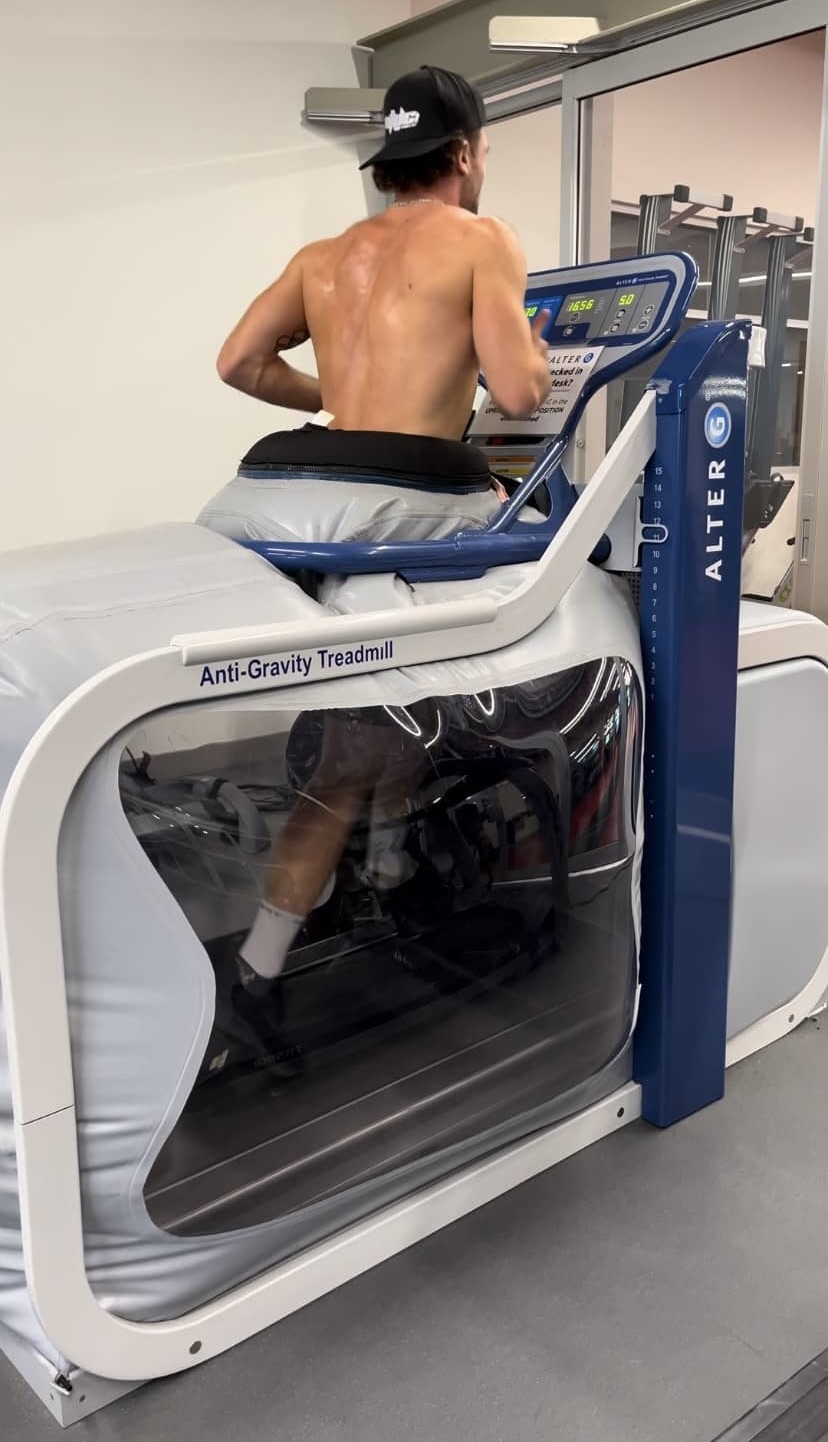
In the months leading up to his return to snow, Ritchie trained on an anti-gravity treadmill to ease back into weight-bearing activity. “It was great for slowly building impact while protecting my ankle,” he explains. “It let me feel like I was making progress, even when full training wasn’t possible.”
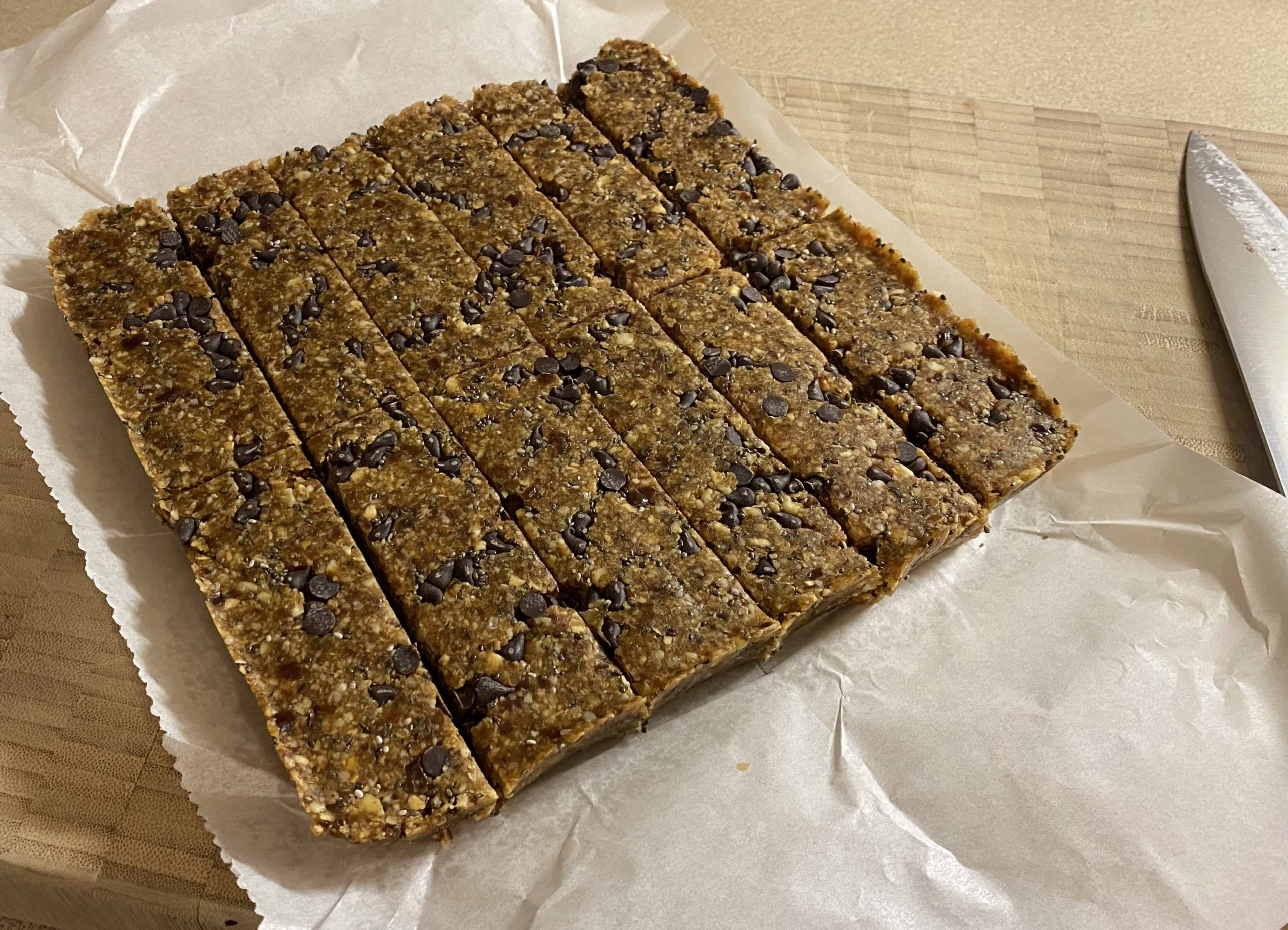
The tools of recovery have been simple but effective. “Most of my physio bands are from Canadian Tire,” he says. “They’ve been through a lot, but they’ve done the job. And Emily has been making me these amazing date bars—they’re perfect for after workouts and keep me fueled through all the rehab.”
Despite the slow process, Ritchie’s determination remains steady. His primary goal for the season is straightforward: “I want to be 100% healthy and ready to race, even if that means skipping the early part of the season. My hope is to be at my best for the World Championships in February.”
Ritchie’s journey has taken him across Canada, including seven years in Thunder Bay, Ontario, where he trained with the national program. Now based in Canmore, Alberta, he’s surrounded by towering mountains, which continue to inspire his recovery.
“We really want to see more podiums in team events this season,” Ritchie shares. “It would mean a lot to show what we can achieve as a team.”
While much of his preseason has been spent on a spin bike and SkiErg, Ritchie has found ways to stay motivated. “It’s tedious, no question. But thinking about racing with my teammates and competing at Worlds keeps me going,” he says. “I also love what I do. Getting to be a World Cup skier is special—you only have so many years to do this.”
To keep spirits high, Ritchie has been watching sports documentaries. “I’ve gotten into Quarterback and Receiver, which follow NFL players through their seasons. The injuries, the preparation—it’s relatable, even if it’s a different sport. I also loved the new NHL series, Face Off. It’s great for passing time on the spin bike.”
A Toronto Maple Leafs fan, Ritchie has been following the team during his downtime. “I like the NHL. I follow hockey a lot, and I’m a big Leafs fan,” he says.
A six-year veteran of the national team, Ritchie has embraced the ups and downs of his comeback. His coaches and teammates often comment on his patience. “I’ve had so many people tell me I’m the most patient athlete they’ve worked with,” he says. “It’s nice to hear, but I’m just trying to stay in the moment. You can’t get too caught up in what the future might hold—focus on the now, and the rest will come.”
Ritchie is hopeful he can heal and train and make an impact in the second half of the season. “I know I’ve got a long road ahead, but I’m excited to race again and represent Canada at the highest level.”
Emily’s Energy Bars: Graham’s Secret to Training and Recovery
For Graham, success in training starts with fuel—Emily’s homemade energy bars. Packed with dates, oats, and dark chocolate, these no-bake bars are his go-to for training and recovery, delivering energy when it’s needed most.
“The best sports bar I’ve ever had,” Graham says.
Ingredients (Makes 12 bars):
350g Dates (soaked in hot water for 5 minutes)
150g Rolled oats
75g Almonds
50g Natural peanut butter
30g Chia seeds
30g Hemp hearts
40g Dark chocolate chips
1 Tablespoon Unrefined coconut oil
3g Salt
Instructions:
Soak the dates in hot water for 5 minutes.
Pulse oats and almonds in a food processor until coarsely chopped.
Add peanut butter, coconut oil, chia seeds, hemp hearts, salt, and dates. Blend until sticky.
Press into a parchment-lined 9×9 pan. Sprinkle with chocolate chips and press firmly.
Chill for 20 minutes, slice into 12 bars, and store in the fridge.
Many of you already know her, but for those of you who don’t we are excited to introduce you to Annika Landis. Annika is a member of the Enjoy Winter- NTS Factory Team and FasterSkier’s newest athlete blogger. This season Annika will take us along on a journey through her busy race schedule, which includes historic events such as the American Birkebeiner, Swedish Vasaloppet, Swiss Engadin and Norwegian Birkebeinerrittet.
Skiing for Sun Valley in high school. (Photo: Courtesy Photo)
Born and raised in Hailey, ID, Annika grew up skiing for the Sun Valley Ski Education Foundation and quickly became enchanted with the rigors, challenges and supportive community of competitive ski racing. Annika pursued her competitive goals at Middlebury College, where she achieved consistent top-10 results on the EISA collegiate circuit, won a Junior National Championship, qualified for U23 World Championships, and two NCAA Championships. After graduating college in 2020, at the onset of the COVID-19 pandemic, she returned home to join the Sun Valley Gold Team, and raced for them one season, before joining the Craftsbury Green Racing Project where she skied for two years.
Lots of fun developing skills in the early years in Sun Valley. (Photo: Courtesy Photo)
After three seasons racing on the SuperTour circuit, which included a top-10 American Birkebeiner finish, a 3rd place at the Boulder Mountain Tour, and multiple SuperTour top-10s, she decided to try something new and more suited to the training and racing that she loves. For the ‘23/’24 season, she transitioned away from chasing World Cup starts, and joined the newly revamped Enjoy Winter Factory Team, with the goal of racing domestic marathons and, more importantly, ‘rediscovering’ her love for skiing. Her first season was a resounding success. Season highlights included taking the wins in the Ski de She and Craftsbury Marathon, an agonizingly close (0.02s) 2nd in the Boulder Mountain Tour, 3rd in the Tour of Anchorage, and a top 15 at US Nationals.
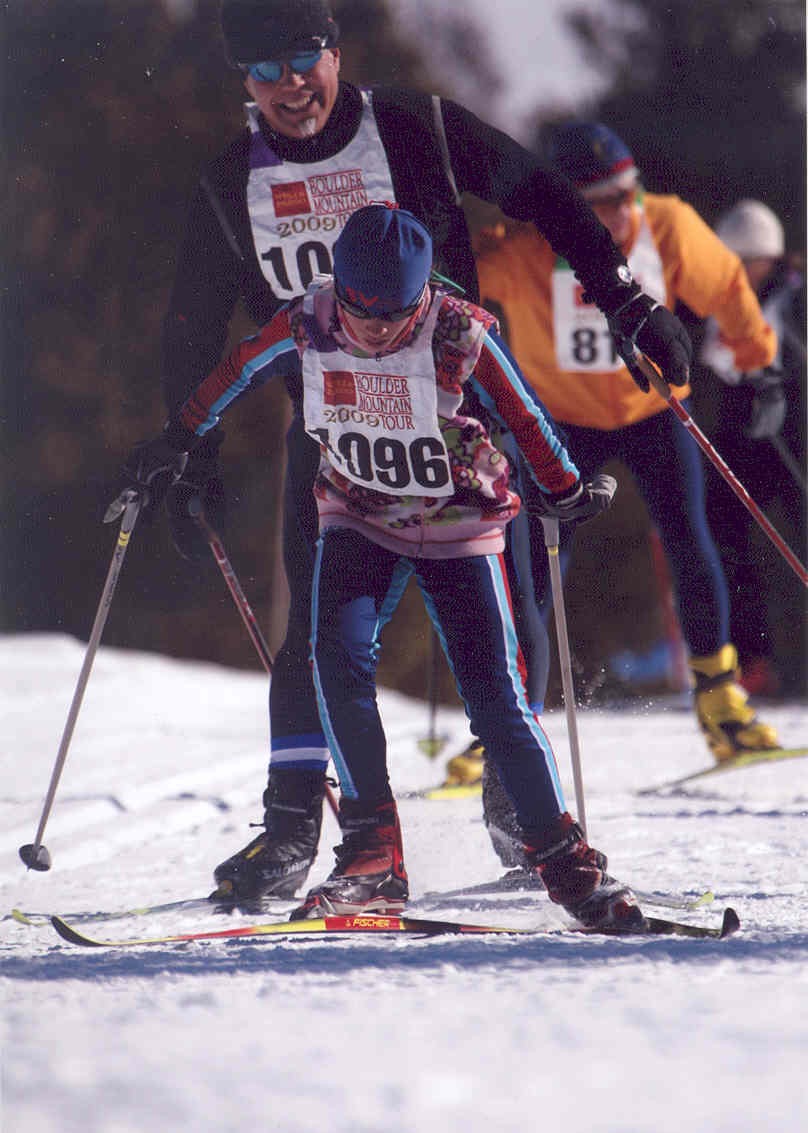
2009 Boulder Mountain Tour (Photo: Courtesy Photo)
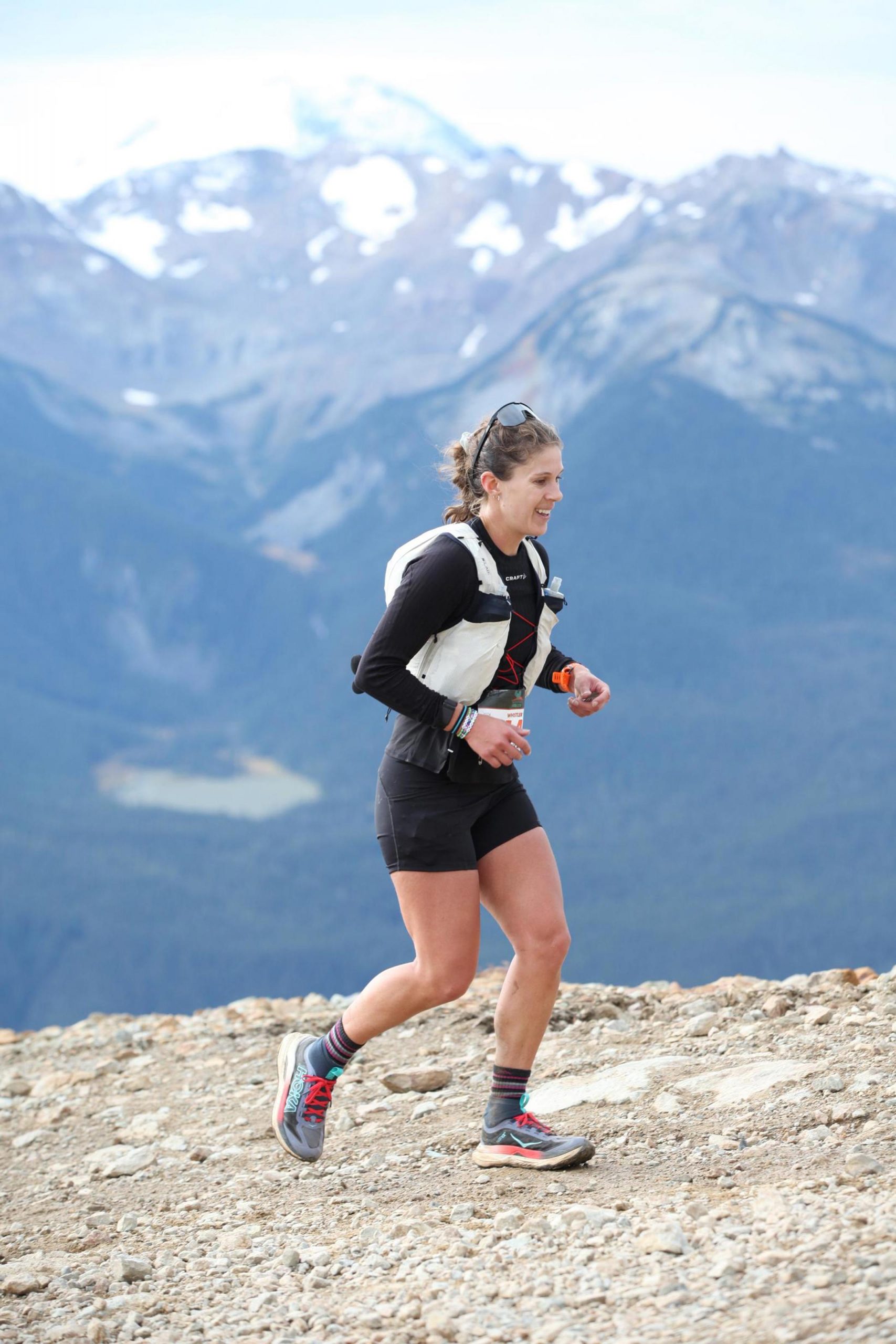
Besides xc skiing, Annika is excited about developing her endurance in ultra trail running, ski touring, cycling, and other mountain adventures. You can often find her over caffeinated and scheming on strava or caltopo for the next big quest. She believes fundamentally in embodying sport as a lifestyle and as a sustainable lifelong pursuit, and strives to be open and honest about her experiences as an athlete and the challenges and joys that endurance sport can bring.
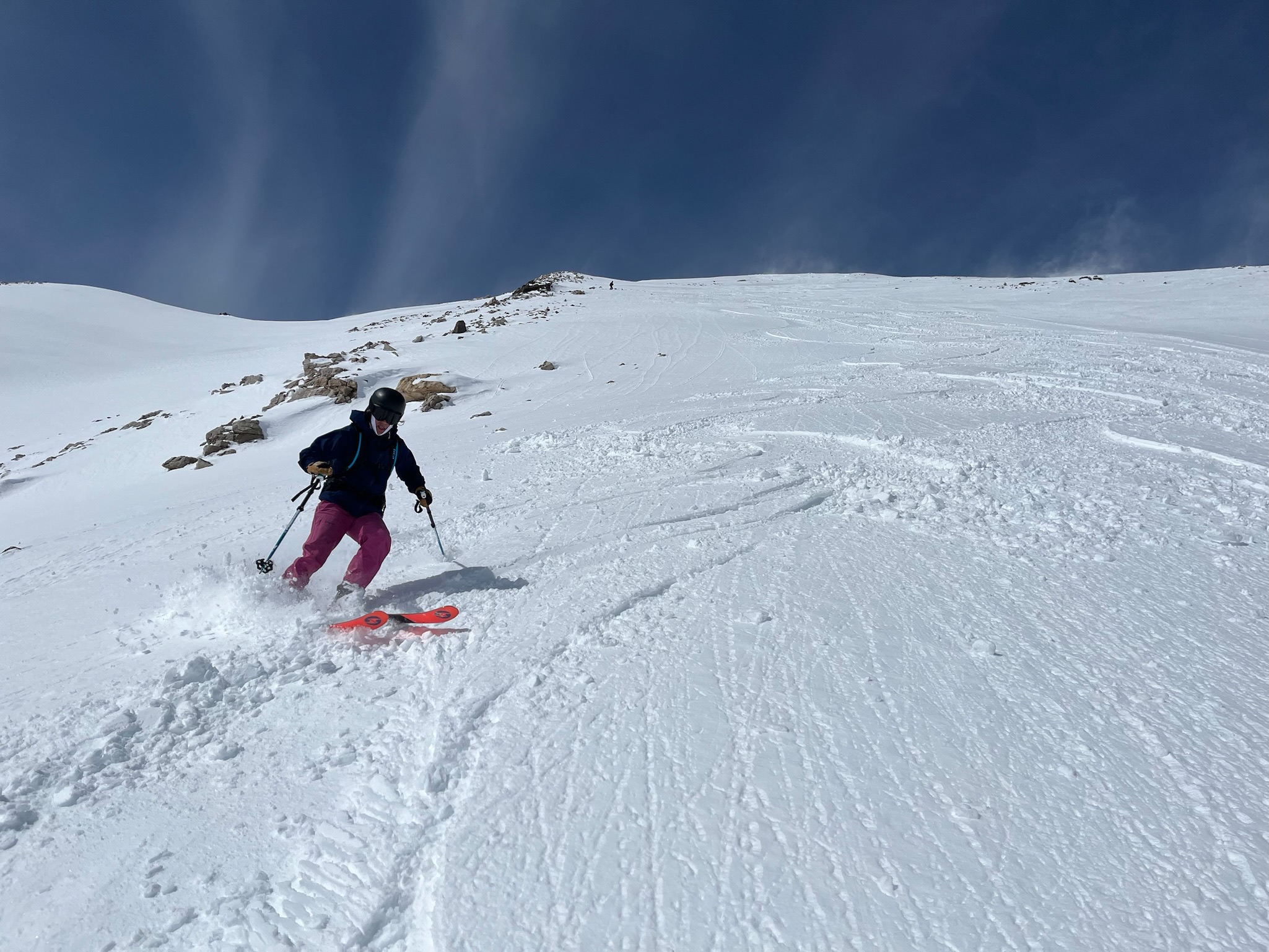
I love all types of skiing. (Photo: Courtesy Photo)
Annika’s 2025 Race Schedule with the Enjoy Winter – Nordic Team Solutions Factory Team:
January 11th – Seeley Hills 42km CL, Cable WI
January 18th – Ski De She 30k F, Cable WI
January 24th – Super Tour 20k F, Bozeman, MT
February 1st – Boulder Mountain Tour 34km F, Sun Valley, ID
February 8th – Ski to the Sun 40km F, Mazama, WA
February 22nd – American Birkebeiner 50km F , Cable, WI
March 2nd – Vasaloppet 90km CL, Sweden
March 9th – Engadin Ski Marathon 42km F, Switzerland
March 15th – Birkebeinerrittet 50km CL, Norway
April 5th – S2S 40km CL, Silver Star, BC, Canada
April 6th – S2S 40km F, Silver Star, BC, Canada
Excited to have you join me on my journey this winter. (Photo: Courtesy Photo)
This coverage is made possible through the generous support of Marty and Kathy Hall and A Hall Mark of Excellence Award. Learn more about A Hall Mark of Excellence Award—or about supporting FasterSkier coverage—by contacting info@fasterskier.com.
It’s hard to believe, but the start of the World Cup ski season is upon us. The weekend opener in Ruka, Finland begins November 29th. While many of us will be bemoaning our Thanksgiving excess and recovering from NFL binge watching, the best skiers in the world will assemble in Finland’s northern remote regions— hovering around the Arctic Circle— for the start of the 2024/25 season.
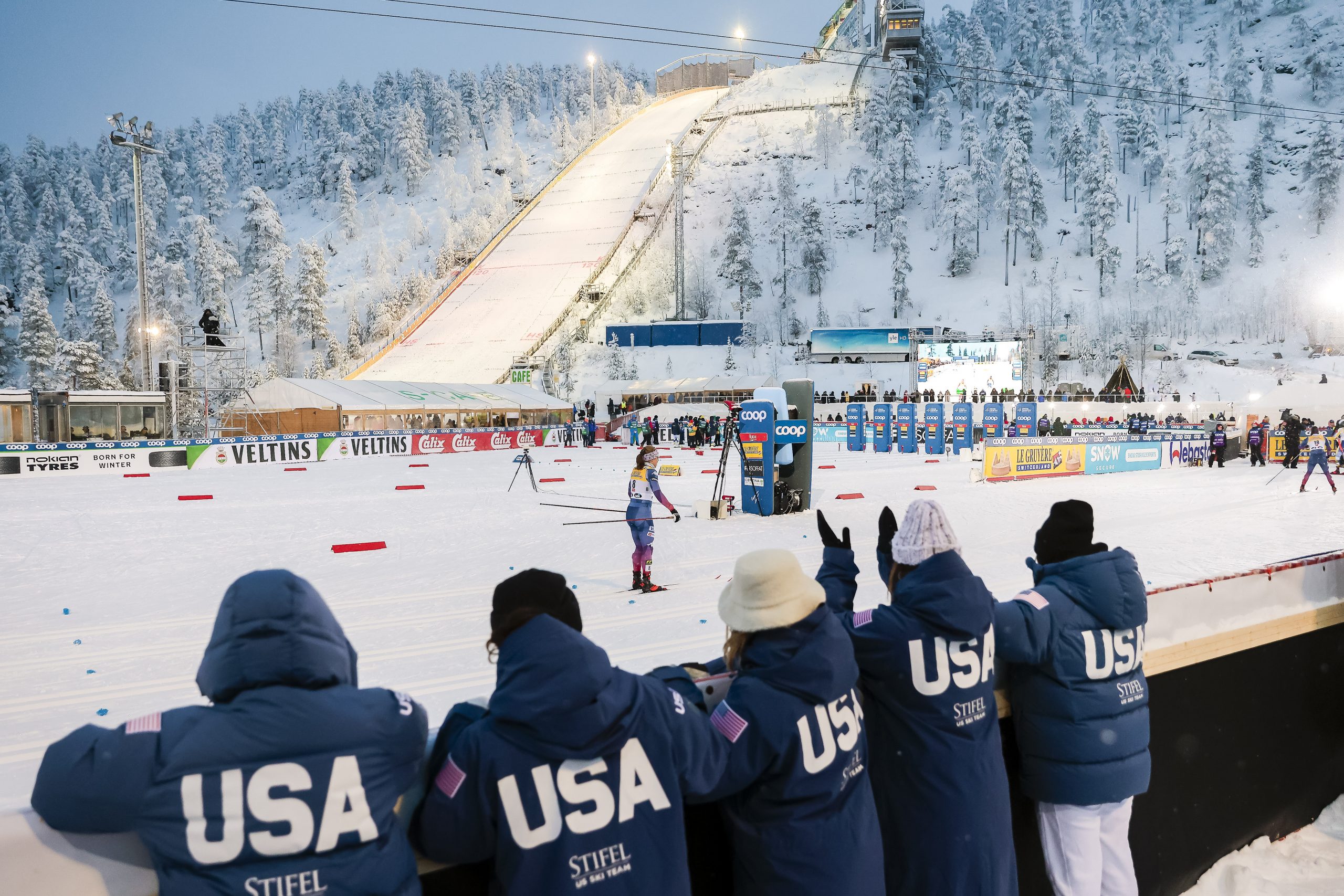
The U.S. team looks on in Ruka in 2023. (Photo: NordicFocus)
All systems are go for the season opener, with FIS (International Ski Federation) reporting that “after the last snow control meeting … the event preparation group confirmed the event is to take place as scheduled.” There’s a lot at stake for the season opener in Ruka, but cross-country fans may forget that there are other Nordic sports using the same snow for the season opener. Nordic combined, ski jumping, freestyle skiing, and cross-country will all share the Ruka venue so getting the green light from FIS is huge for many ski fans and athletes. The forecast for the area calls for warmer temperatures and rain mixed with snow early in the week, but by Friday, temperatures are predicted to drop well below freezing with several inches of snow each day. Jessie Diggins stated in her press conference on Monday that Ruka just experienced a huge snowfall. So it’s likely the races will be held on a mix of natural and artificial snow. If it’s snowing during the races, the weather could play an outsized role with two of the races scheduled being Classic.
Last year, Jessie Diggins (USA) finished 11th in the 10 kilometer Classic in Ruka. (Photo: NordicFocus)
The cross-country race season will kick off with the women’s 10 kilometer Classic interval start on Friday, November 29th at 4:00 a.m. Eastern time. The men’s event will follow at 6:40 a.m. Eastern. You can spare yourself from the dreadful rising time and join us for our same day coverage at FasterSkier.com. As always, our vigilant FasterSkier staff will be watching the races live, so you don’t lose out on your precious beauty sleep, and you can catch up with the results with coverage from us any time.
Dreaming of the Season Ahead
The beginning of the ski season is like the start of any new sport season. In front of the athletes is only a blank slate, and visions of glory of what might be. It’s time to dream big. For Rosie Brennan’s big dream to come true this ski season she told FasterSkier it would mean “a relay medal at the World Championships.” Same dream for Julia Kern. Same for Jessie Diggins. It’s fair to say that the women’s team is focused on one goal.
Ruka will be an early test for Julia Kern (USA) to see if she has successfully worked through injury. (Photo: NordicFocus)
U.S. head coach Matt Whitcomb has a slightly different angle on what a dream come true season would be. For Whitcomb a dream season would be “a million dollar donation to the NNF (National Nordic Foundation), because we finish in the top three as a nation.” It’s a dream that would set up the team for continued success and cement their prestige which has been only building over the decades. It’s a fitting ideal for a coach who must take a long term view of the entire program.
Dealing With Opening Day
While it’s a very long season, it’s nice to get out to a good start, but not imperative. One big thing that Jessie Diggins has learned about opening weekend is to not worry too much about the results. “Unless you lose a glove and end up with a pole in the face (as happened last year), no one is going to remember what happened in Ruka. In the moment it feels bigger than big, but it’s ok to work your way into the season.” Diggins continued that, “you get this back to school vibe and you’re excited to see everyone … I would tell younger Jessie that one data point is not a trend, and it’s not who you are.”
“The first period of racing can vary in importance for the season, depending on the goals and the training build-up,” said Julia Kern. “It is always a confidence boost if the first period goes well; however, it’s not indicative of the rest of the season. Momentum is always a good thing, but sometimes it takes time to build up to speed.” Kern’s gaze is looking beyond the weekend opener. “I am excited for World Champs and going back to some less frequent venues like Cogne, Italy and Tallinn, Estonia. I think the calendar has great flow this year, where there are a lot of exciting stops and formats such as Davos adding a team sprint this year.”
For some, there might be a rush to get opening day jitters over with, but certainly not everyone feels that way. “I want to enjoy it,” said Rosie Brennan. “I’m anxious to get started but I love the early season nerves and the blank slate you start with every year. I think it’s fun to move through all the different parts of the season and embrace all the different emotions each part brings.” Looking down the road a bit, not surprisingly, Brennan is anticipating the World Championships the most. “I’m looking forward to sharing Trondheim (site of the world championships) with my favorite fans, my mom and aunt.”
Whitcomb shares Brennan’s sense of not just wanting to get opening day over with, but to savor it. “Getting our rhythm back always feels good, but we aren’t looking to get through it, so much as to get to it. Ruka is one of my favorite venues, and perhaps is my all-time favorite sprint course. The Skate mass start is always thrilling. The opener is exciting. I’m lucky to work with this staff and these athletes. To be a part of a tribe that gets to perform rather difficult jobs in occasionally stressful environments is such a gift. I feel lucky every day.”
The start of the season also signals the seemingly endless parade across Europe and being away from home for months. Everyone has their own way to cope with the challenge. For some, it’s bringing a little piece of home with them. Brennan has perhaps the most unique and frankly surprising approach. The thing from home she absolutely doesn’t leave without? “Teddy! It may sound crazy to be the oldest one of the team and still traveling with my childhood teddy, but don’t knock it till you try it! Teddy is small and at this point, kinda disgusting, but he represents my whole life, my family, and my support team that’s with me no matter how great or tough life on the road is at that moment. I need that daily reminder and something that gives me that sense of safety and peace that family can bring.” So perhaps a message to all of the aspiring junior skiers out there is don’t give away that childhood stuffed animal just yet!
Whitcomb carries with him an inspirational note from former U.S. coach Pete Vordenberg. (Photo: U.S. Ski Association)
While Brennan favors plush toys for comfort, coach Whitcomb turns to something a little more directly related to skiing. He always takes with him, “a motivational note from Pete Vordenberg (former U.S. Olympian and longtime team coach). He slipped it in my bag in 2009.” That’s a pretty cool motivational keepsake. He continued that, “also, depending on whether it’s in my possession at the time, a wooden heart that Chris Grover (current program director) and I have been furtively stashing in each other’s backpack for a long time.”
Diggins won’t leave home without American gum and toothpaste. “Those are two things that I just really like having from home and I know that’s kind of weird, but I like my things!” She also brings along her own supply of biodegradable glitter. And yes, biodegradable glitter is a thing. Diggins has engaged with Dermatone to launch biodegradable glitter kits, so she can spread the glitter love and be environmentally responsible at the same time.
Besides the items that cheer the psyche and act as a salve for homesickness, there are practical matters like dealing with the lack of sunlight and its proven debilitating effect upon the Circadian rhythm. “I actually find the lack of light rather cozy and exciting,” said Whitcomb. “Personally, I’m not affected by the loss of light, but I know some people travel with special happy lights that are used in various ways. They might stretch under it for 30 minutes a day, for instance. It’s a real thing.”
One thing that won’t fit into Whitcomb’s pocket is the addition of another wax truck for the team. The new truck is, “currently set up and is being waxed in. The grinder is running. Ultimately, the new stone grinder truck is our answer to a fluoro-free waxing world. We are unlikely to be using team grinds in the first year or two, though we will be very dedicated to testing grinds, and developing our system. This is the beginning of a project that will never end but is likely to take several years to really impact the team.” The underlying message is clear. In the arms race for faster ski speed– with fluoros now out of the picture– selecting the best ski grind for the day will be the new weapon of choice.
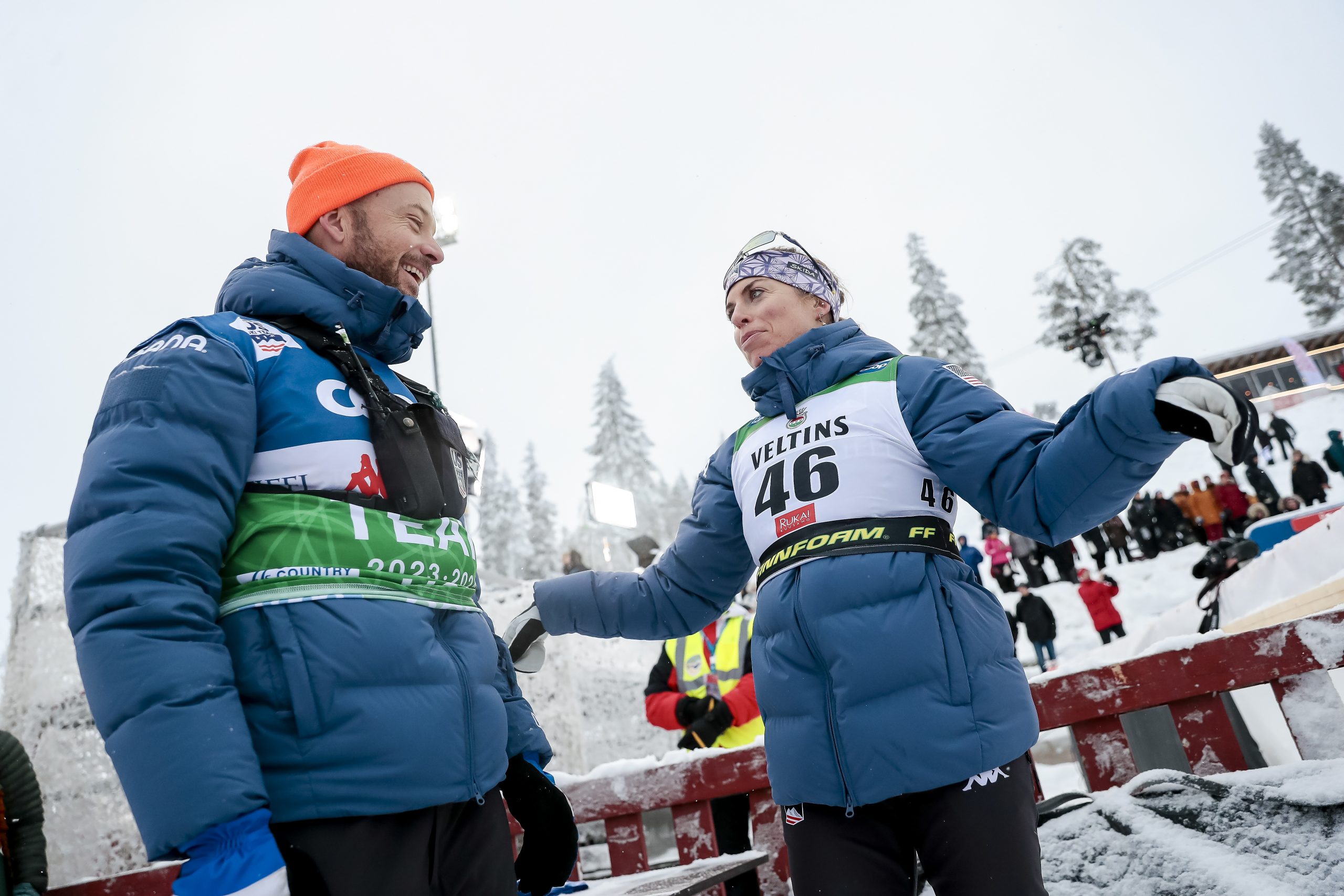
U.S. head coach Mattt Whitcomb and Rosie Brennan (USA) share a moment last year in Ruka. (Photo: NordicFocus)
The U.S. team is now a nice blend of accomplished veterans and up and coming athletes and coaches. The veteran’s perspective helps to guide the team over a long season. Part of that perspective is understanding that there are many possible roads to take to reach the final destination. One of the big lessons learned is, “the acceptance that many training plans can work,” said Whitcomb. “The road of the insecure is to negatively judge that unusual training, and the high road is to support it, and consider its merit. While I believe I have an understanding of what works for the 10 days that lead up to the first World Cup, I’ve seen many different approaches work. One needs belief in their plan. Inter-team judgment hurts this, and support promotes this. If you look at it that way, many ways can work, and it takes the pressure off. It’s pretty simple.”
Opening Weekend Up Close: Friday’s Opener
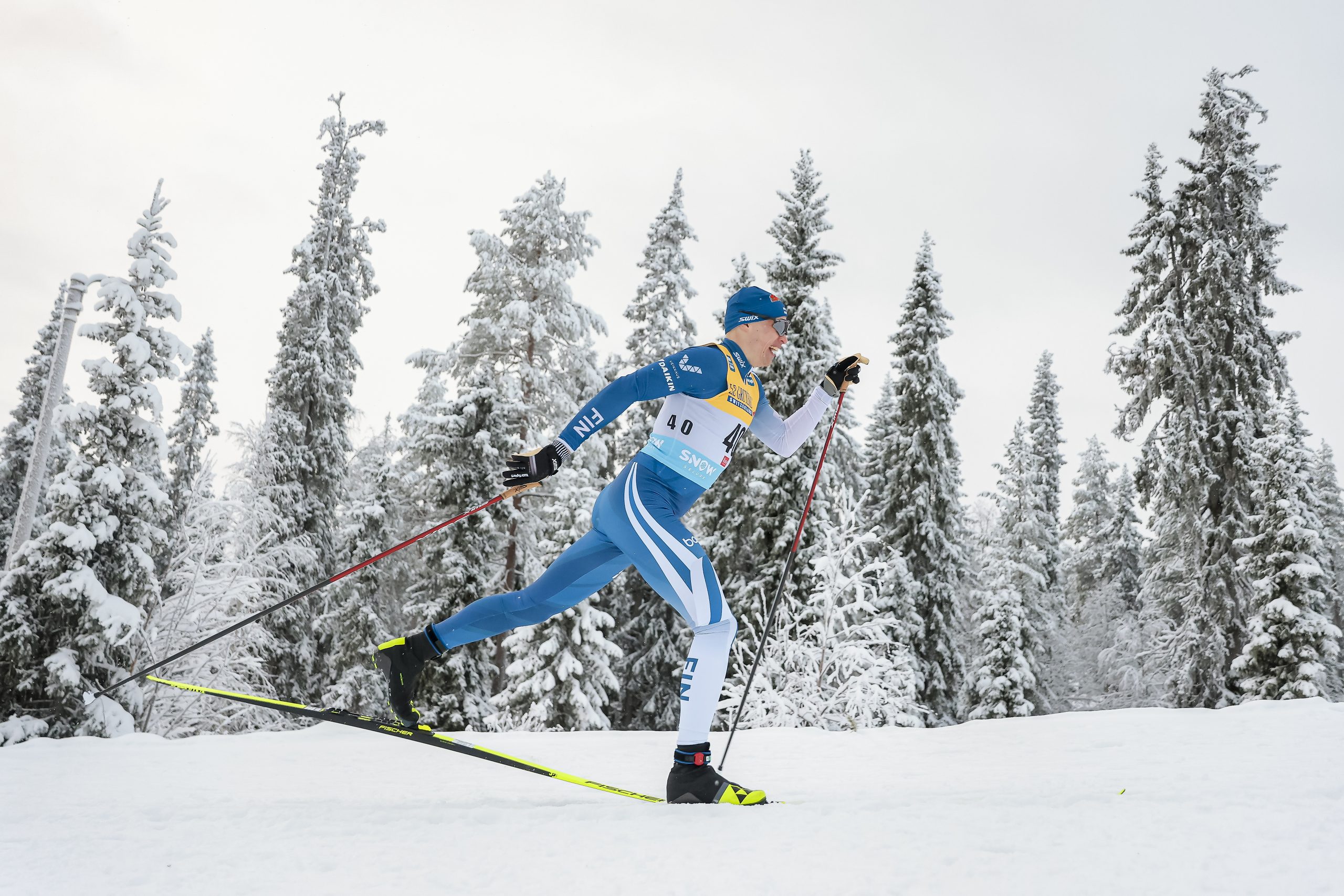
Whenever there’s a Classic race in Finland, Iivo Niskanen (FIN) is certain to be in contention. (Photo: NordicFocus)
Last year, the 10k Classic was on the second day of the Ruka weekend, this year it will be the first race. In last year’s 10k Classic, Norway took two of the podium spots in the men’s race, with hometown favorite Iivo Niskanen (FIN) finishing second by a scant 2.9 seconds. It was a bitter pill for the Finn who was looking to thrill the locals with the top spot in his Classic specialty. There’s no reason to think that the Norwegians won’t dominate the podium again. But if the snow falls during the race, it could make it a wide open contest.
The best American man was Gus Schumacher’s 22nd place finish. Schumacher has been on what feels like a straight upward trajectory since then, so there is a lot of optimism for improving upon that finish. Ben Ogden, Luke Jager, and Zanden McMullen all finished outside of the top 30 in that race. They will be hoping to start the season off with a better opening day showing to get the season’s momentum going early. Ruka will be an early test for Ogden who had to call it quits early last season—and was forced to miss Minneapolis— because of illness.
Another racer to keep an eye on will be Canada’s Antoine (Tony) Cyr. Cyr’s results started ramping up toward the end of last season. On the last weekend of racing, he placed 11th in the 10k Classic in Falun. Last year in Ruka, Cyr finished 27th in the 10k. If he can build off of last year’s Falun momentum with a good start in a Classic race, he could be a North American sleeper to keep an eye on.
Norway’s Therese Johaug celebrates her final 30 k race at Holmenkollen, before retiring at the end of the 2021/22 season at age 33. (Photo: NordicFocus)
She’s Back
The biggest wildcard in the women’s field will be the return of Therese Johaug (NOR). Johaug retired at the end of the 2022 season, but she has quickly reestablished herself at the top of the game. Her performance in the opening of the Norwegian domestic racing season last weekend certainly grabbed everyone’s attention. For those who thought Johaug’s return would be some kind of skiing social victory lap, think again. Last weekend she won the Women’s 10 kilometer individual start Classic race in Beitostoelen, Norway by beating the venerable Heidi Weng by almost 40 seconds. It bears repeating that her margin of victory was 40 seconds over only 10 kilometers!
Weng got revenge and eked out a victory over Johaug the next day in the 10k individual start Freestyle. Weng managed to hold onto a 0.6 second advantage to take the win. Weng’s victory notwithstanding, it looks like Johaug will be a force to be reckoned with throughout the season. Whether she will be as dominant as she was two years ago, and whether she races throughout the entire season remains to be seen. But no matter what, everyone is on notice to watch out for Therese. Given her performance in the Classic at Beitostoelen how can she not be the favorite going into the first Classic race of the season?
The American women had a great day in last year’s 10k Classic, with Rosie Brennan taking her first individual Classic podium by finishing second, Jessie Diggins finishing 11th, and Novie McCabe 30th. Brenan has told FasterSkier that she really likes the grinding nature of the start of the season races, so expect her to be in contention for a podium again. The unknown factor will be how her Classic legs are feeling. Last weekend, she told FasterSkier that, “I know that I have the ability to succeed right off the bat, but success is never a given, and there are many variables at play.” The pressure of performing on opening day doesn’t bother Brennan, “There are many people that support me in order to have success and I want to deliver. I enjoy that type of pressure, it makes me feel like I‘m doing something for more than just myself and it allows me to better find my limits.”
Jessie Diggins (USA) is feeling very positive about her mental and physical state entering the season. (Photo: NordicFocus)
But all eyes will be on Jessie Diggins, as she begins the defense of her Crystal Globe championship. If she can duplicate the hot start she had to last season, it will only help her in her title defense. “I’m very excited for a new season,” Diggins said in her news conference Monday. “I feel like I’m sitting here as a different stronger version of myself.” Diggins went on to address her mental health status, “I feel like being vulnerable has actually let me connect in a very different way with a lot of people. I feel like I’m coming back in a much stronger place.” Diggins feels that, “I’m in a much more solid place than I’ve ever been in before.”
Sophia Laukli (USA) had a strong opening in Ruka last year in the 20k Freestyle. She’s hoping to improve on her Classic results. (Photo: NordicFocus)
American fans should also keep an eye on Sophia Laukli. Laukli has been working on her Classic technique, and though a 10k race is a little too short to be exactly in her wheelhouse, it could be an interesting barometer for an early glimpse into whether her striding game has improved. Last year she finished 44th in the 10k Classic. Last weekend she took an impressive 7th place in the Norwegian season opener in the 10k Classic beating out many impressive names and finishing only 38 seconds off the podium It’s hard to believe that she won’t see a dramatic improvement from last year’s 44th place.
Opening day will also be an early test for Julia Kern. Kern has been struggling with injury and has had to resort to alternative training methods throughout the summer. Ruka will be an early marker to see if she’s been able to maintain her skiing fitness. “I am both excited and feeling a bit uncertain,” Kern told FasterSkier. “I was in a great place during New Zealand camp. Unfortunately, since that training camp, I have been dealing with back issues that have greatly impacted my normal training routine. However, my energy has been good, and I had a good last week of training at home. This time of year, I think the most important launching point is having good energy going into a long season of racing.”
Saturday’s Sprints
Saturday will be for the Classic Sprinters with the heats beginning at 5:30 a.m. Eastern. For those who just can’t get enough racing and may need to fill time during bouts of insomnia, you can follow the Sprint qualifiers live through the FIS website starting at 3:00 a.m. Eastern—enjoy that!
Last year Norway dominated the men’s Ruka Classic Sprint, but in an unexpected way. The Norwegians advanced seven skiers into the semifinals. But, in a true shocker, Johannes Hoesflot Klaebo (NOR) didn’t make it to the top of the podium. Klaebo was in the midst of recovery from illness. His countryman Erik Valnes (NOR) took the victory. It was no secret that Klaebo had been sick, but seeing other skiers blow by him still felt extremely unsettling and shocking to witness. But there was no reason to remain feeling badly for Klaebo for long, as he went on to dominate the Sprints later in the season like no one else ever has. He won the Sprint in the Norwegian opener last weekend and looks ready to dominate again.
Ben Ogden (USA) had a good Sprint day last year in Ruka. (Photo: NordicFocus)
The top American finisher that day was Ben Ogden, in 11th place. Later in the season Ogden would go on to claim his first World Cup podium in Toblach in the Freestyle Sprint. After Friday’s 10k and Saturday’s Sprint, we should have some solid insight into where Ogden’s conditioning stands.
For the women last year, the first Sprint race of the season was a preview of the rest of the year. It was all of the Swedes against Norway’s Kristine Stavaas Skistad. Emma Ribom (SWE) won the opener, but Skistad later went on a late season tear which saw her winning the last three World Cup Sprints in Klaebo-like dominating fashion. When Skistad is firing on all cylinders she is in a league of her own. But there is a huge question mark facing her this winter. In a still developing story, Skistad is reported to have undergone stomach surgery of an undisclosed nature several weeks ago and is not scheduled to be in Ruka. She is reportedly returning to training, but there isn’t any detail on when she is expected to return to competition. Until Skistad returns to the field, Swedish podium sweeps could be a common sight this winter.
Kristine Stavaas Skistad (NOR) was at times dominating last year. She will miss the opening weekend due to surgery. Her return date is unknown. (Photo: NordicFocus)
For the Americans the test will be to see if Julia Kern can rebound from her aforementioned injury. Diggins and Kern finished 7th and 8th respectively last year. It will also be interesting to keep an eye on Diggins’ early season Sprint performances. Last year, once she had gained control of the Overall points standings, Diggins sprinted very strategically choosing to go out hard in the first round and ensure accumulating points by reaching the second round of heats. It will be intriguing to see if she will adopt a more traditional strategy early in the season and go out more conservatively in the opening rounds.
It will be interesting to see how Jessie Diggins (USA) approaches the Sprints early in the season. (Photo: NordicFocus)
Sunday’s 20 Kilometer Freestyle
Sunday will be the first Distance race of the year, featuring the 20 kilometer Freestyle mass start. The men race first, with coverage starting at 3:30 a.m. Eastern, followed by the women at 5:25 a.m. Eastern.
Jessie Diggins (USA) is comforted by her teammate Rosie Brennan (USA) after receiving a pole grip to the lip. (Photo: NordicFocus)
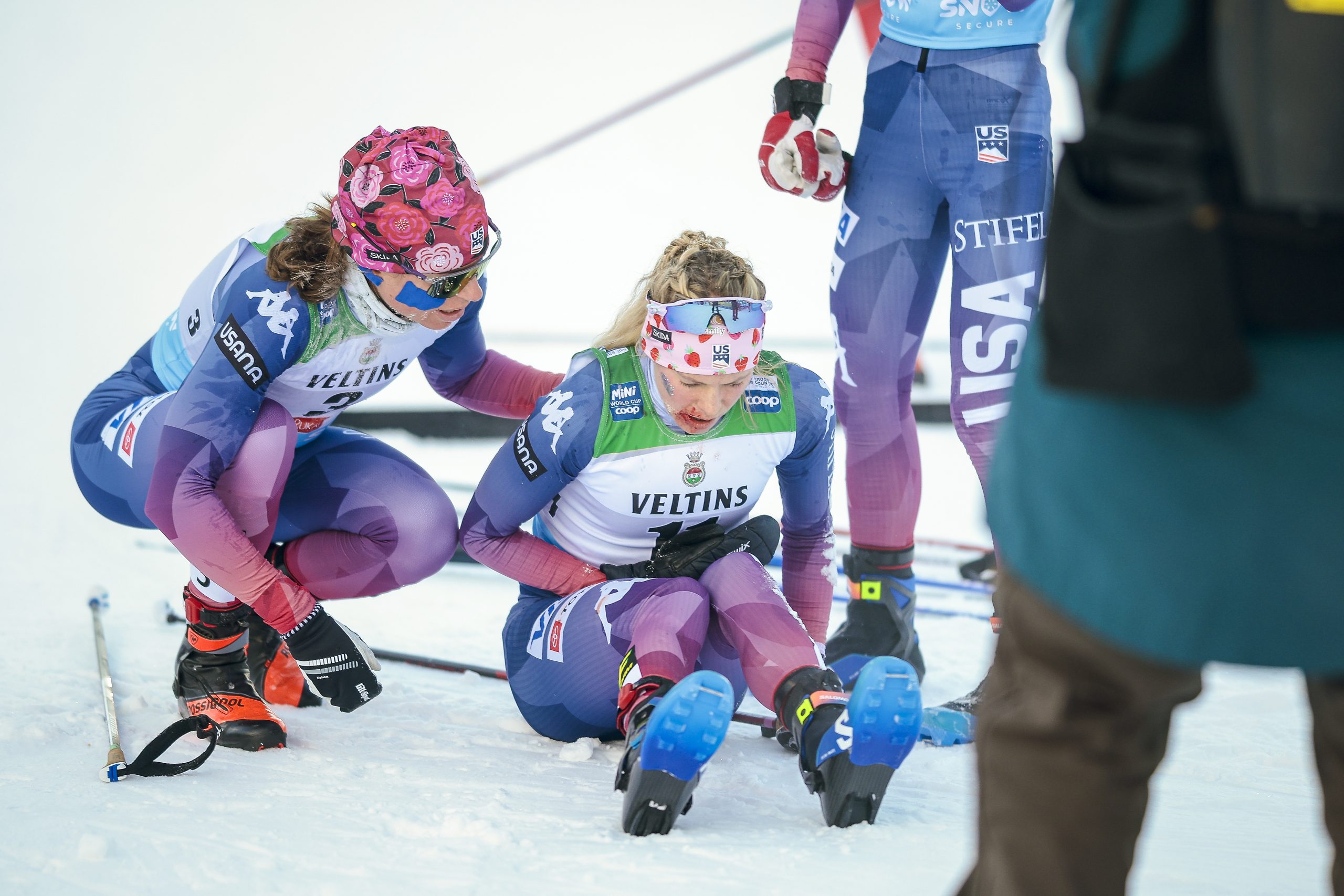
Epic—that was the only word to describe the American women’s performance in this event last year. Sweden’s Moa Ilar won the race, but it didn’t get as much attention as the results of those behind her. It wasn’t just that Diggins and Brennan finished second and third, but Diggins crossed the finish line with a bloody mouth having had her pole yanked off her hand toward the end of the race, and then getting plunked in the lip during the new pole exchange. The finish line picture was one for the ages. It’s hard to imagine that the 20k will be as compelling as last year’s race, but you never know. As Whitcomb said, the 20k Freestyle mass start is “always thrilling.”
Keep an eye on Sophia Laukli during this race. The race features two things she really likes: distance and skating. It will also be a good indicator of whether she was able to fully recover from her running season injuries to start the season in top form. Last year she finished a solid 14th, and a move into the top ten would announce that she’s a real presence in distance racing, and not just at the extremes of Alpe Cermis. Last weekend she finished 11th in the 10k Freestyle in the Norwegian opener, and she looks to be ready to start the season in fine form.
Also keep an eye on Canada’s Katherine Stewart-Jones who finished 22nd in last year’s 20k Freestyle. Jones had a difficult season last year, as her World Cup racing ended after Minneapolis. She’ll be looking to return to her form from two years ago when she had multiple top 20 finishes, including finishing 18th overall in the Tour de Ski.
Gus Schumacher (USA) is hoping to build upon his success from last season. (Photo: NordicFocus)
In the men’s race last year, American Gus Schumacher showed a harbinger of things to come with a 16th place finish. It will be another opportunity for Schumacher to prove that his star is rising. Norway took two podium spots that day with a sweep only being interrupted by the feel good second place showing of Michal Novak (CZE). In addition to dominating the podium, Norway placed six skiers in the top ten, and until proven otherwise, they will be the favorite for every podium position in every men’s race until someone proves that they can pry the podium out from under Norwegian feet.
Moving Hundreds of Skis and Dozens of Team Members Across Europe
Yolanda, the wax truck, can accommodate 800 pairs of skis. It’s still not enough. (Photo: Matt Whitcomb)
Success at the World Cup level requires much more than just skiing fast. The logistics of moving around Europe with hundreds of skis and dozens of team members can be daunting, and part of it falls onto Whitcomb to coordinate. If you’ve ever flown for a cross-country ski trip you know that handling a bag of skis can be a huge hassle and make or break your ski trip. But for the pros, there’s much more riding on it, and the logistics are just a bit more elegantly managed. “The most successful athletes know by March that they are likely to be on the World Cup in November,” said Whitcomb. “So 90% of their fleet stays in our wax truck, Yolanda (the team’s name for their pet wax truck). Everyone on the team brings at least a small ski bag home in March that covers SuperTour Finals, as well as spring, summer, and fall skiing needs. It’s the athlete’s responsibility to bring that bag back. In September or October, our techs make a visit to the factories in Europe and pick up skis from the summer and fall ski run productions. Lastly, the industry brings a few pairs for the athletes to the first World Cups, and the various ski companies always have additional skis on hand at nearly every venue. We have capacity in Yolanda for something like 700-800 pairs of skis. If you can believe it, this fills up quickly, so we try to only keep the performing skis on hand. If we get new skis, we try to trade the old, poorly performing skis out.” Managing 800 pairs of skis might sound like a nightmare, but it’s just part of the process for preparing for the rest of the season.
Whitcomb explained the way the season long logistics management works. “The World Cup is a system that has a nice flow to it. Most weeks, our team will travel to the next venue on Monday, and then train Tuesday, Wednesday, and Thursday. We race Friday, Saturday, and Sunday, and then repeat the process. Chris Grover, our Program Director, runs the majority of pre-season logistics. That largely includes flights and working with each organizing committee to secure housing and a good meal plan. We place a lot of emphasis on our “Curran Family Nutrition Program” (named after supporters of the team), which involves, among other things, organizing chefs for as many venues and winter training camps as makes sense for our housing. If we have houses or apartments, we often have a chef so we can control the quality of our food. This accounts for about 1/3 of the winter. This has made a massive difference to our health and performance. Zoom in a bit and the logistics change focus to training day and race day performance. We have 22 athletes racing in Period 1, which means we have 22 different training plans. We plug them all into a shared document so athletes can easily find a training group that matches their workout on a given day. Winter life is a little more lonely than summer life, so we emphasize the importance of long, big group meals, team walks at night, or game night. If we don’t vibe as a team, we’ll be beaten by the teams who do. The waxing and grinding trucks are a whole other deal. When the athletes and coaches travel by bus or plane on a Monday, many of the techs will have swiftly departed after the races on Sunday for the next event. The drives are often long. In Period 1 for this season, they first drive the trucks from Tallinn, Estonia, which is where the trucks summer, to Muonio, Finland. That’s 600 miles, plus a several hours ferry across the Gulf of Finland. Then it’s back to Ruka, Finland, which is only five hours. Then they’re off to Lillehammer, Norway which is about 900 miles, and then down to Davos, Switzerland, which is another 1,200 miles. Know, too, that the big truck is limited at 89 kph (55mph).”
It takes a lot to make the giant World Cup wheel go around, and with the 2024/25 season now upon us, fans can now go through their own process of gearing up for another exciting season of racing.
This article was made possible through the generous support of our voluntary subscribers. If you would like to see more articles like this one, please support FasterSkier with a voluntary subscription.
Novie McCabe after the World Cup 10k classic in Falun, Sweden last March (Photo: NordicFocus)
As the 2024/25 ski season approaches, U.S. Ski Team athletes are wrapping up their preseason training in preparation for the World Cup circuit. Among them is 22-year-old Novie McCabe (USA) from Winthrop, Washington, whose approach to training emphasizes precision and sustainability.
“I’m just trying to stack years on top of each other,” McCabe explains, reflecting on her long-term strategy as an elite skier. This year, however, she has shifted her focus. “I’ve put more focus on quality and being intentional with each session.”
McCabe finding consistency out on the trails this summer. (Courtesy Photo)
This deliberate approach reflects her desire to make every workout meaningful. “I’m trying to bring more intention to each session, making sure every workout serves a purpose. It’s subtle. You wouldn’t be able to tell by watching me ski, but it’s on my mind,” she explains. By prioritizing quality over quantity, McCabe aims to sustain her growth while maintaining the consistency required for success at the international level.
The U.S. squad has set ambitious collective goals for the season, including a push for a top-three finish in the Nations Cup standings. “A top-three in the Nations Cup would mean a lot to us as a team,” McCabe says. “Every point counts, especially near the end of the season, and having that goal keeps us all focused.”
McCabe, who debuted on the national circuit in 2019 and represented the United States at the 2022 Beijing Olympics, brings valuable experience to the team. Her journey reflects steady progress, built on intentionality and a commitment to refining her craft.
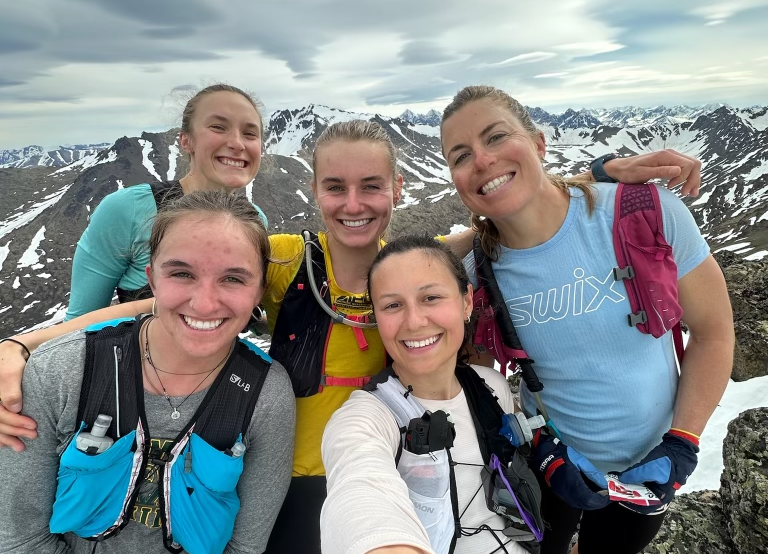
McCabe out in the mountains with her APU teammates this summer. (Courtesy Photo)
While training remains her priority, McCabe has found ways to create balance in her life. Having completed her undergraduate degree at the University of Utah, she is now pursuing a master’s degree in Environmental Policy. “I’ve learned that it’s important to keep a little separation between skiing and life,” she says. “It was a tough summer, but finding things outside of training—like school and baking—helped me keep perspective.”
Baking has become a creative outlet for McCabe, offering a counterbalance to the high-pressure environment of elite competition. “I know I need that balance to keep skiing sustainable for the long term,” she reflects.
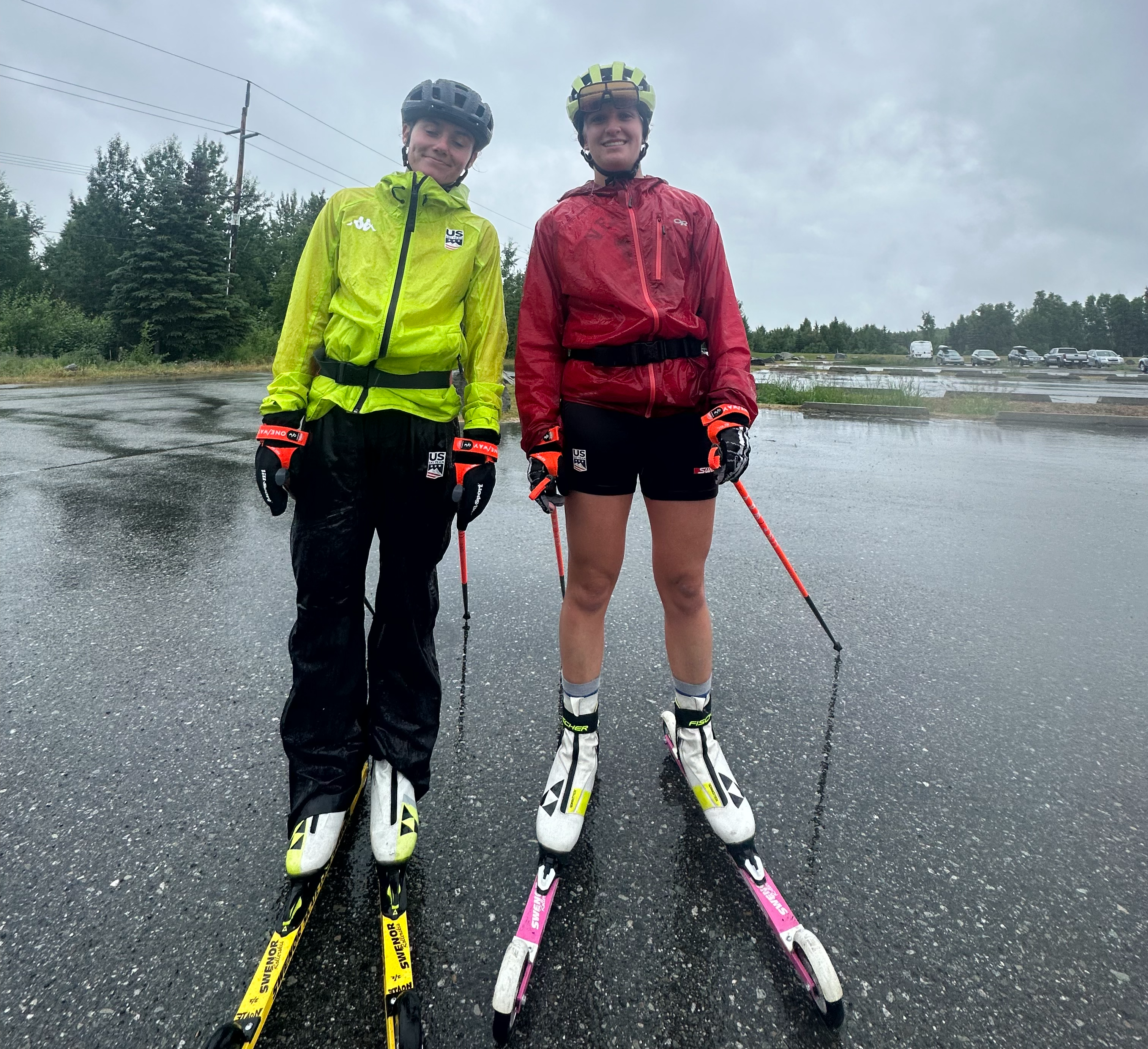
Still smiling even on a cold, rainy roller-ski. (Courtesy Photo)
Next, McCabe is headed to Finland on Nov 19th to join her teammates for final on-snow preparations ahead of the World Cup opener. The trip will provide valuable opportunities to sharpen her skills and adjust to the demands of racing. Along the way, she keeps the energy high by curating playlists, a ritual that adds fun and motivation to her workouts and downtime.
“The support of the team has been so important during this preseason,” McCabe says. “We’re all pushing to be the best we can be. And with the support of the team, I think we’re setting ourselves up for a really strong year.”
From her early days skiing in the Methow Valley to her role on the U.S. Ski Team, McCabe has steadily built on her strengths. With the World Cup season ahead, she is ready to translate her preseason work into results, aiming to make an impact as a key member of the A Team.
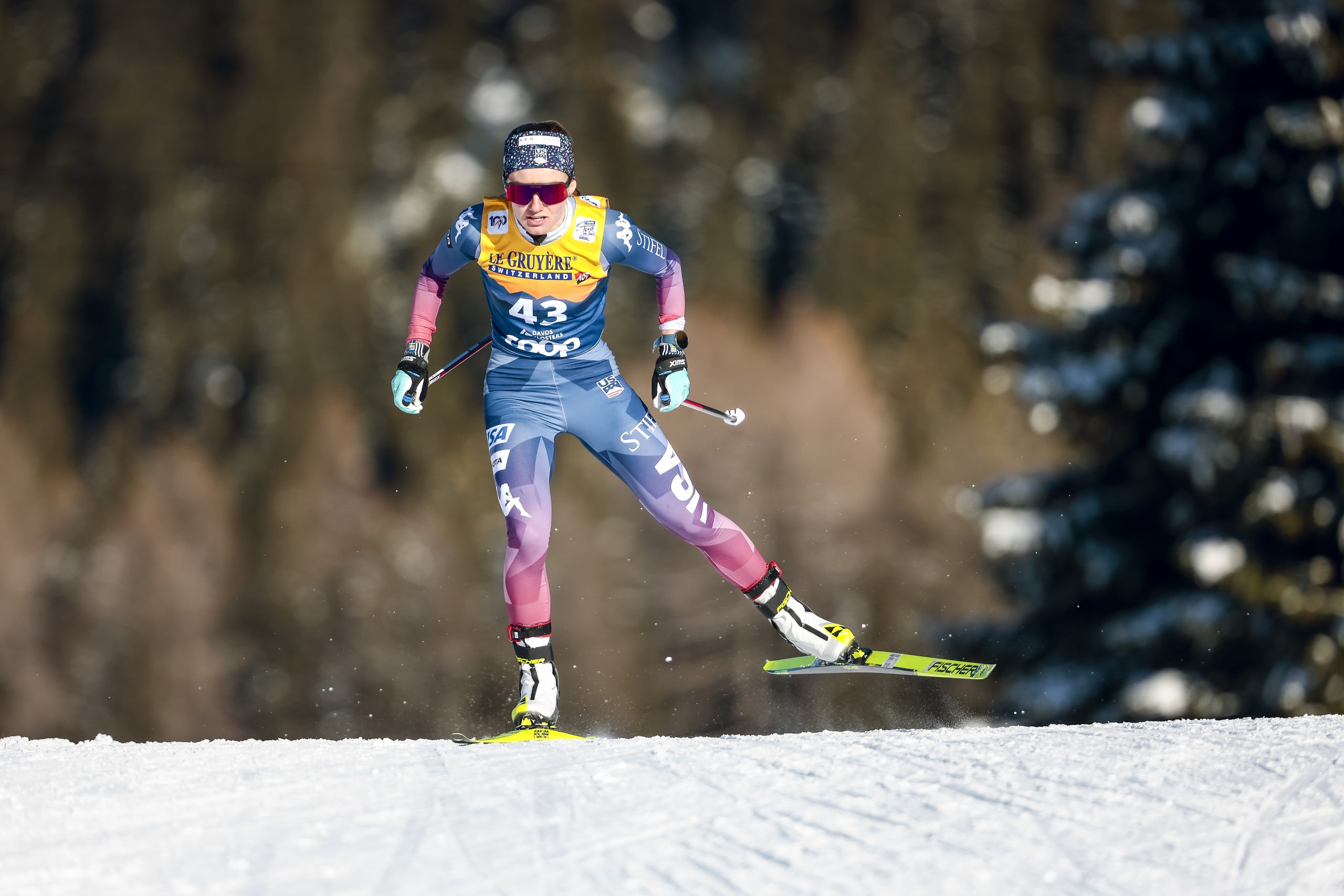
Novie Mccabe in Davos, Switzerland during the 2024 Tour de Ski, individual sprint. (Photo: NordicFocus)
Just two weeks before leaving for Europe for the 2024/2025 season, U.S. Ski Team member Julia Kern, 27, chatted with FasterSkier to talk about her last few months and winter ahead. The Waltham, Mass. native didn’t skip a beat when asked a barrage of questions, including her favorite food (pizza), go-to coffee order (cappuccino), favorite ski technique (classic), and preference between M&M’s and Skittles. “M&M’s,” she said with a laugh. “Definitely chocolate.”
Julia Kern training in New Zealand with the U.S. Ski Team this summer. (Photo: Julia Kern)
Despite her cheery attitude, Kern explained that the last few months have been challenging. In September, she returned from a training camp in New Zealand nursing an injured back and headed to her local pool for some cross-training. Her attitude regarding setbacks is one of steadiness and acceptance. She is resilient, able to reframe and refocus, continuing to push toward her athletic goals in different ways despite physical limitations with her body.
“I’m grateful for the days I can get out and train normally and rollerski,” she said. “It just gives you a different perspective and appreciation for those things.”
Instead of focusing on results-based goals, she turned her attention to what she could control with smaller process goals. This summer, she wanted to focus on upper-body strength to improve her double-poling power. She worked with her strength coach on a pull-up program, improving her abilities to the point that she now uses weight for her sets. Although the pressure to perform well is high, Kern has a remarkably level-headed attitude toward racing.
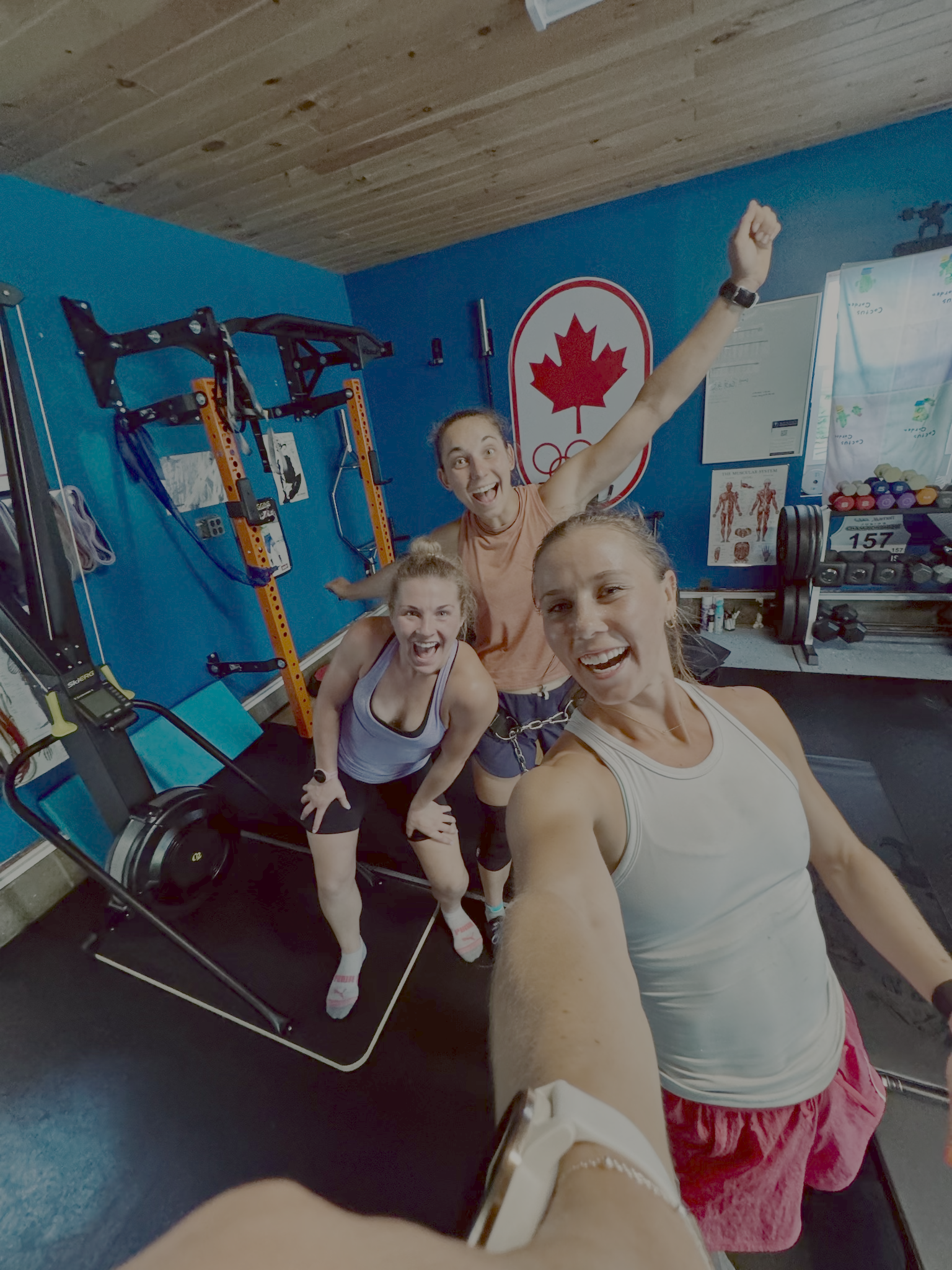
Strength with Lauren and MK, at HIIT Performance in Burlington. (Photo: Julia Kern)
“You can’t control the result on the paper,” she said, “but you can control the process. Did I prepare well? Did I execute well? Did I give 100% on this date?”
With this attitude, it’s easy to understand how she brings energy and drive to racing, even as she begins her 10th season on the World Cup. This fall has also been a time for Kern to tap into other interests that complement her training schedule. Although skiing is her main focus, it can’t be her only priority.
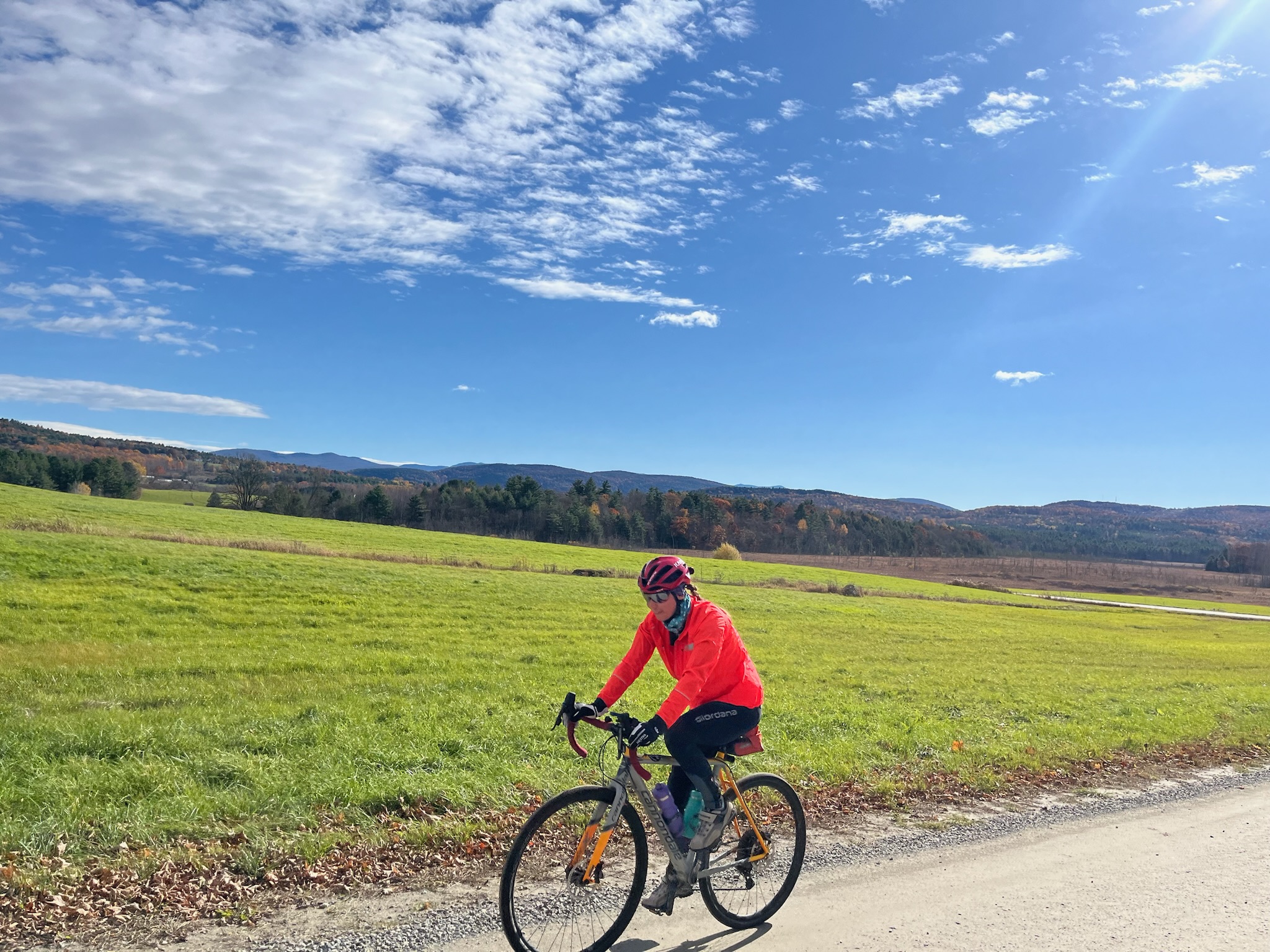
Gravel biking in Vermont. (Photo: Julia Kern)
“Finding the balance outside of skiing has always been really important to me,” she said.
Staying connected and being creative are ways she adds variety to her schedule. Kern has been more intentional this year about maintaining relationships from home, moving to Richmond, Vt., to be closer to friends and family when she isn’t racing. During the winter, Kern keeps her spirits up with photography.
“On the road, that’s where my camera comes in,” she said, smiling. “When I’m having a hard time, I can go for a walk and just photograph and appreciate the places I’m in – that’s my mental outlet.”
Kern’s interest in photography lends itself well to making a living as a professional athlete. She maintains a popular Instagram account where she posts life updates, training tips, and promotional content to over 18,000 followers. She views the platform as a big responsibility and puts a great deal of thought into her content’s messaging.
“I want kids to see different examples of successful skiers,” she said. “Success doesn’t have to look one certain way.”
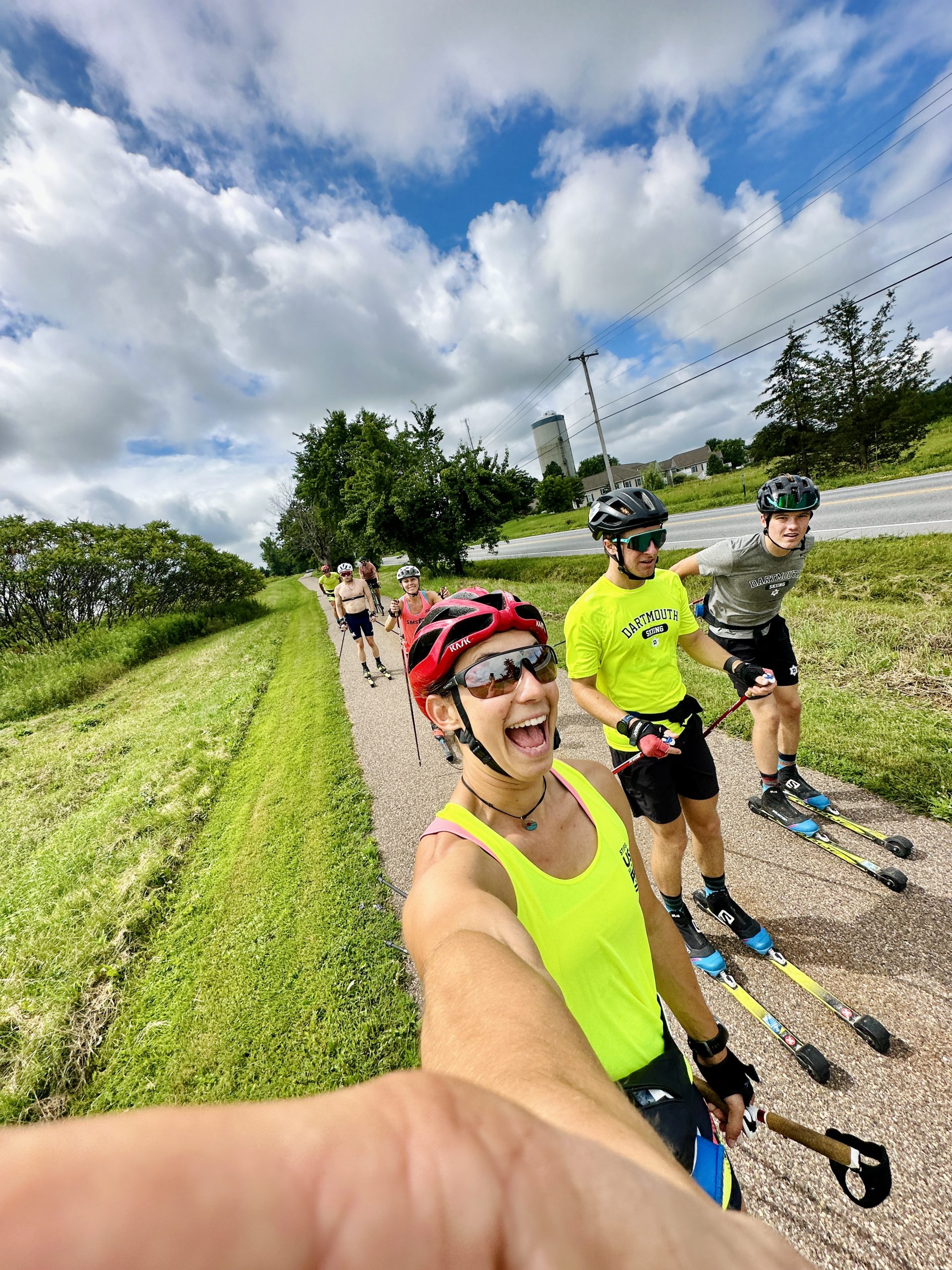
Heading out on a rollerski in South Burlington, VT with a summer training group. (Photo: Julia Kern)
Kern has been trying to share some of the more challenging aspects of skiing, such as her experience with injury and setback, alongside the best moments. Authenticity in her content, whether personal or promotional, is one of her key values. She has sponsorships with ski-focused brands such as Hestra and Atomic but also promotes more niche products like air purifiers and sustainably-insulated jackets. Kern feels strongly about only promoting brands that she uses and believes in.
“I don’t think it’s worth selling a version of yourself that isn’t true just to make money,” she said.
In a world where social media thrives off of reactionary content, Kern’s attitude toward self-promotion is refreshing. She genuinely enjoys working with brands and cultivating relationships.
“Social media is about finding the balance of staying true to myself, sending a positive message, doing my job, and making a living skiing,” she explained.
This is social media at its best, allowing a figure like Kern to share her message and get paid while giving viewers a genuine window into her life and training process.
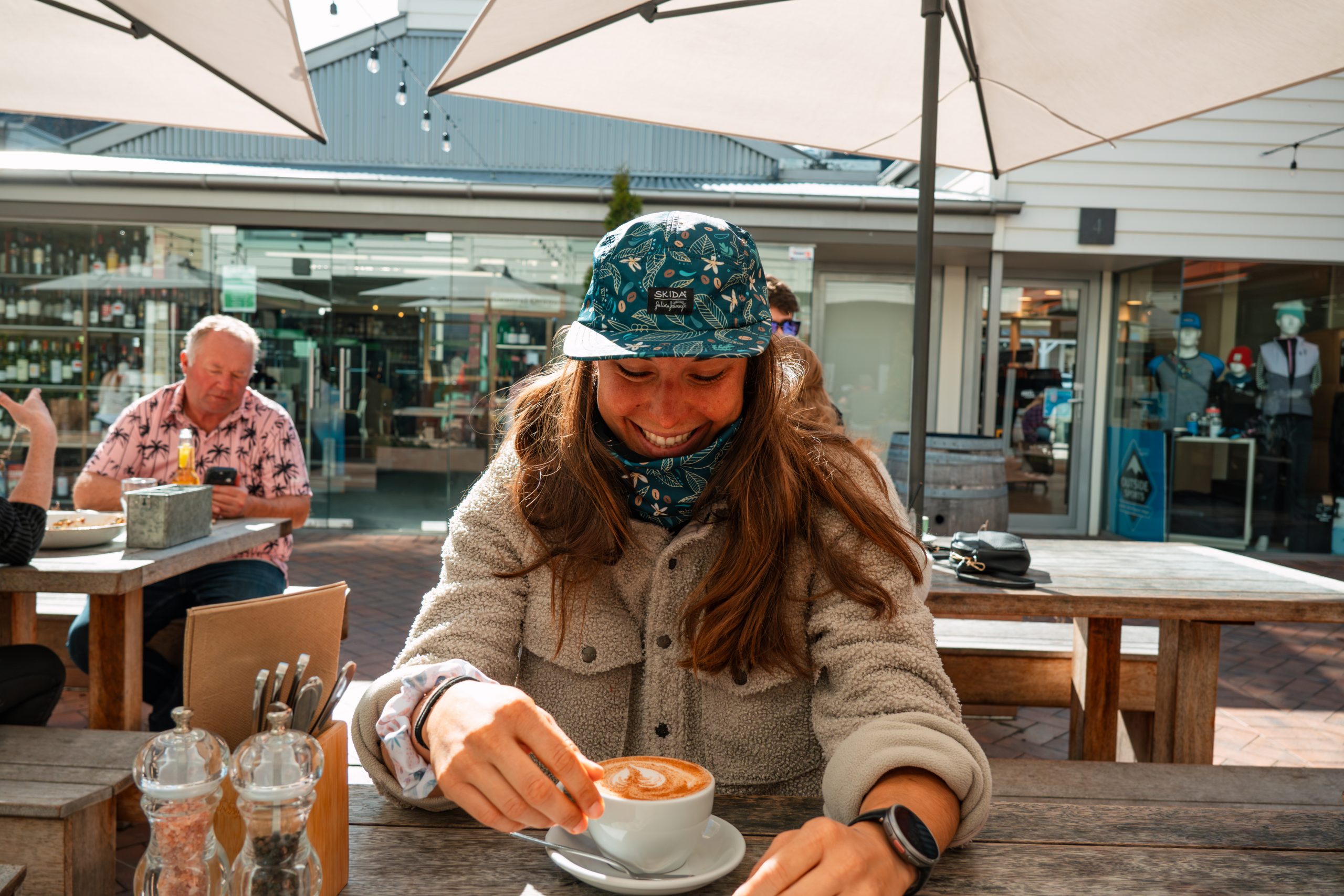
Of all her partnerships, Kern is the most excited about her latest line of headwear with Skida, a Vermont-based business. This is her fourth year designing and promoting a unique pattern for the company. The partnership is not just about making pretty patterns to sell more clothing. Her inspiration for the designs is personal, and she is intentional about creating meaning in the patterns. This year’s fabric is dark teal, with leaves and flowers twining around tiny clumps of coffee beans. Kern wanted the pattern to feel energizing and also reminiscent of a daily coffee ritual with friends or family.
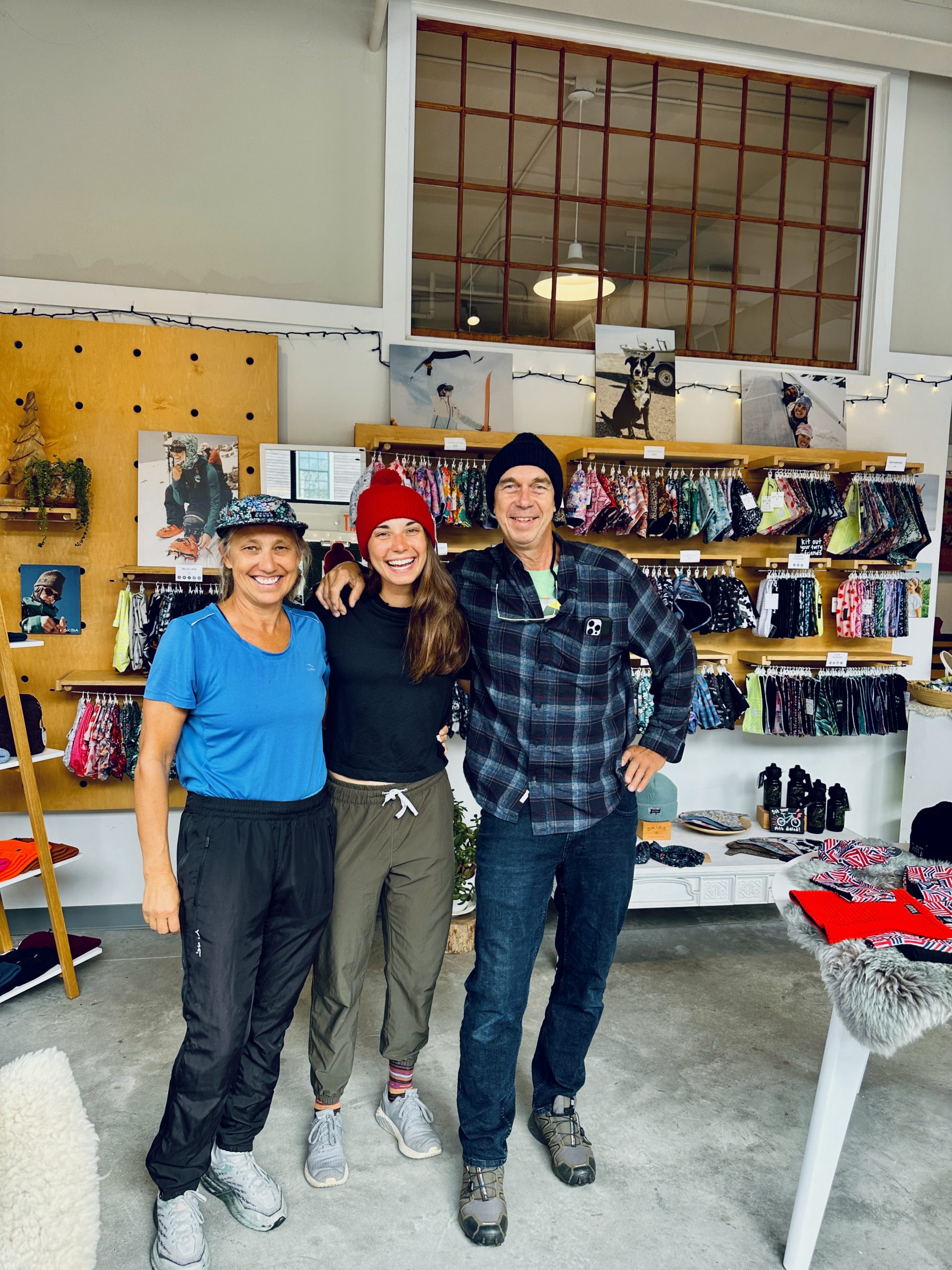
A visit to Skida headquarters in Burlington with her parents, Dorothee and Gunther Kern. (Photo: Julia Kern)
Describing the design process, her eyes lit up. She recalled working with designers to create the pattern and how they cut out pieces of paper and wrapped the “headbands” around their foreheads to make sure the pattern repeated perfectly. For Kern, working with brands is more than just paying the bills – it’s a creative outlet and a form of self-expression.
Wearing her coffee-themed headband design is also a daily source of energy. Coffee plays a larger role in her life than simply being her morning caffeine – the drink allows her to create community both at home and abroad. She bonds with her teammates through sharing beans and meeting up in the morning to drink coffee together while on the road. In one hotel the team stayed at last season, they converted part of the dining area into a U.S Ski Team coffee bar, complete with numerous Aeropresses, pour-overs, and French presses from each athlete.
She recounted experiences sharing coffee with friendly strangers in Melbourne and with members of the Polish ski team. Her first year on the circuit, Hestra brought all the sponsored athletes together for a Swedish fika – a ritual involving coffee and Swedish cinnamon kanelbulle buns.
“That was my first experience on the World Cup meeting other athletes outside of the races,” she said.
Coffee in Arrowtown, NZ featuring the new Skida print. (Photo: Julia Kern)
Finding ways to connect with people around her is crucial when her job requires her to be away from home for seven months each year. The familiar practice of drinking coffee spans geographic and cultural differences and allows her to feel grounded during the constant travel of the World Cup season.
Kern’s ability to create connections abroad is also an important part of her role as an FIS athlete representative. For this job, she participates in an international board and works to bridge the gap between the management side of World Cup racing and the athlete experience. The experience has been rewarding for her.
“It has made me feel really connected to the FIS Cross Country family,” she said. “I’ve gotten to know so many more people and I just have a better pulse on everything going on.”
Exploring New Zealand with Jessie Diggins (on her birthday) during the U.S. Ski Team training camp. (Photo: Julia Kern)
Being involved with FIS means that Kern has a say in important decisions such as allocating prize money, organizing the race calendar, and thinking about how to best grow the sport. The role has allowed her to advocate for a more efficient and climate-friendly race schedule, involving less flying and lower costs. Although she is grateful for the opportunity to have a voice, Kern is realistic about her impact.
“In some ways I have a big voice, but in some ways, I’m just one vote out of many,” she noted.
Despite this reality, Kern continues to work within her network to make change in the ways that she can, putting in extra energy to cultivate relationships with skiers and officials in her community.
Kern will soon be heading to Ruka, Finland, for the start of the World Cup season on Nov. 29. Learning more about her personal process has only made me more of a fan. She is focused, level-headed, and forward-thinking.
Enjoying the sunshine and fresh tracks in New Zealand. (Photo: Julia Kern)
“The last two months I’ve been so focused on just getting back to training,” she said. “In a way, it has pulled away my focus on results and it’s more about getting to the start line.”
Despite setbacks, she is approaching this season with a flexible attitude and a determination to race.
Our bodies are very good at adapting to change, as long as it comes slowly enough. That first frosty day in autumn always feels brutally cold. Take the same temperature in March and we’re in shorts and short sleeves. Our response to exercise load is no different. Taken as a slow and progressive build up, our bodies will respond with increased strength and capacity to stay on the right side of the load vs tolerance equation. But when it comes on too quickly–too much too soon–our bodies tend to complain.
Jessie Diggins (USST) stay familiar with snow feels while training at the Snow Farm in New Zealand in 2018. (Photo: ColinWitherill/Warren Miller Entertainment)
The first day on snow is a highlight of every season. Long hours of sweat in the summer sun finally bear fruit with that ephemeral glide of skis on snow. We’ve finally escaped the harsh pounding of running, the clack of rollerski poles on pavement, the constant threat of distracted drivers in 4000 pound death machines hunting you on the road bike (apologies for the drama). It’s definitely easy to get carried away. Before we know it those first giddy strides have turned into a three hour ski when you only packed food and water for any hour. Best case scenario, you’re a bit sore for a couple of days. Worst case, you’ve irritated or injured something that could derail your whole ski season.
The obvious solution is to progress slowly. For those fortunate enough to have easy access to ski tracks, this takes some self control but is very doable. For those who are not able to get on snow frequently enough to have a progressive build, it’s going to take more prep work to ensure that your body is ready for you to go full gas as soon as the skis hit the snow.
If you’ve been rollerskiing, you definitely have a head start. But rollerskiing is not snow skiing. Snow will present different challenges, and therefore different loads on the body. Classic striding is more nuanced and often requires more work to set the kick than simply relying on ratcheted wheels. Pole plants, while nice and quiet, lack the snappy feedback as the snow compresses under the basket (and maybe let you get away with low hands on initiation without the tell tale skid of pole tips on pavement). Balance on the glide ski is now subject to variations in terrain, snow characteristics, and especially grooming quality.
November conditions in Lefthand Canyon (Photo: Sophie Spalding).
If you haven’t been rollerskiing (I don’t blame you), it’s likely that your arms haven’t seen much load over the summer. Your legs have probably been the focus with running, cycling, and hiking. But these are very straight line motions—fine for classic skiing but not the best prep for the lateral demands of skating.
Ideally you’ve been doing strength training, ski specific drills, and stability work all summer. If not, this article is your friendly reminder that it’s not too late to get yourself ready. If you are a Faster Skier regular (thank you!), then you’ve likely come across some of my previous articles and hopefully you’ve incorporated the associated exercises into your regular “pay to play” maintenance workouts. Here are some highlights which are particularly appropriate to this conversation:
So what does a “slow progression” on snow look like? A good example is what the Sifel US Cross Country Ski Team calls The Pace Project. As a tool for race prep, the goal is to ski repeats on a (typically) 5k loop with subtle changes in effort, subtechnique/gearing, nutrition, etc in order to learn the best recipe for repeatedly clocking your fastest times. As an early season, toe in the water vs head-first dive kind of progression, the goal would be to ski the loop (or whatever strip of snow you may have) at a pace where your time, perceived effort, and heart rate stay fairly consistent lap after lap. If your heart rate, perceived effort, and time are all going up, you’re overcooking it and not sticking to the plan. If effort and heart rate are consistent but you’re getting slower, it’s unlikely that you’re burning all of your matches, but your technique is starting to suffer. This might be a good time to take a step back and re-focus on technique. The idea is to ski in control–not necessarily easy, but under a sustainable effort for the duration. If you’re counting laps, look to add a lap every few sessions on snow. The general guidance is frequency before duration before intensity. If increasing frequency isn’t an option, then definitely build up duration prior to adding high intensity.
Zak Ketterson capitalizing on some early snow time at Frozen Thunder back in 2021. (Photo: Team Birkie)
When dryland prep and on-snow progression have been combined, the body should be able to stay ahead of the load and tolerate the transition smoothly. Glitches definitely happen and shouldn’t be ignored. However, a niggle or small amount of pain that subsides within a few hours is unlikely to represent a concerning injury. If the pain keeps occurring, if it becomes moderate or severe, or if that mild pain is lasting into the next day, it’s a good idea to take some relative rest and seek the help of a physical therapist (ideally one who knows the specific demands of Nordic skiing).
Before she was capturing Crystal Globes, Jessie Diggins was working her way up the skiing pipeline. Developing skiers across the country receive assistance from the NNF. (Photo: NordicFocus)
There’s a great scene in the 1983 classic movie epic The Right Stuff, where the test pilots are hanging out in their dank watering hole discussing the future of supersonic flight and bemoaning what they see as misplaced priorities. The press liaison throwing back a beer with Chuck Yeager and Jack Ridley seems to innocently ask, “you know what makes your rocket planes fly?” The aeronautical engineer puts down his beer and responds by beginning to recite the complexities of aerodynamics when the liaison interrupts, shaking his head at him and says, “Funding, that’s what makes your ships go up. I’ll tell you something …no bucks, no Buck Rogers.” It was a perfect synopsis with a crystal clear meaning. All of the science, bravado, and tenacity in the world didn’t matter if there wasn’t the funding to support the incremental gains needed to push human flight in supersonic speed aircraft. No bucks, no Buck Rogers. It’s that simple.
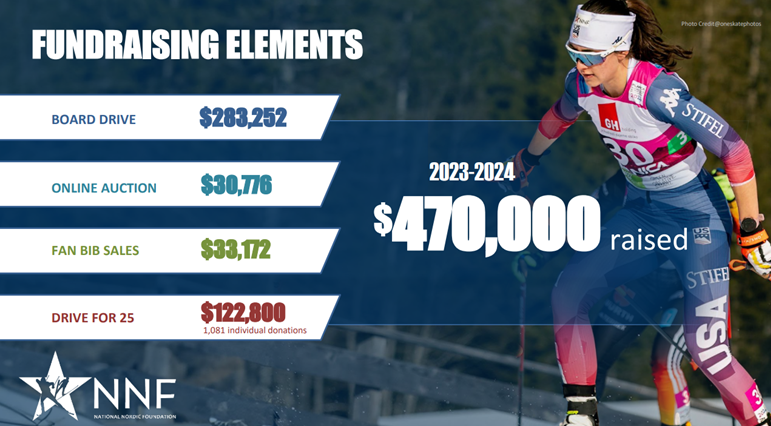
The NNF raised over $470,000 last year, helping to fill the pipeline of talented Nordic athletes. (Photo: NNF Impact Statement)
The same is true in elite level skiing. All the hard work, talent, training, and determination in the world won’t matter if there aren’t the dollars to get athletes to the World Cup, and equally important, to develop young athletes who fill the pipeline on their way to the top of their sport. In short, no cash, no Cups. The best skier in the world can’t win anything on any level, if they’re grounded in their gym in Utah.
This presents skiers with a real problem. In the United States, Nordic skiing is a low profile sport, and unlike almost every major international competitor, the U.S. cross-country squad doesn’t receive direct funding from the government. Contrast that to Norwegian skiers who really don’t have to worry about where the money will come from. Ski fast and the cash will follow. In America, it’s a different story. While the headline skiers on the United States A and B teams receive funding from U.S. Ski and Snowboard, through the U.S. cross-country team, skiers working their way up the skiing ecosystem are largely on their own financially. It takes a mix of club support, sponsorships, fundraising, and donors to keep the pipeline of young talent flowing in the ski game.
Sammy Smith after skiing to 2nd place in the skate sprint at World Junior Ski Championships Planica, Slovenia. Talented athletes like Smith have options other than cross-country. NNF helps to keep athletes like Smith in the skiing game. (Photo: Courtesy Image/Jasmine Wiley)
If you’re a talented young athlete, you also probably have other options besides skiing. Look at Sammy Smith and Sophia Laukli. Both have the talent to earn a living in other sports. To keep them in the ski game long enough to reach the A team, there needed to be a funding mechanism to help developing skiers until they reached the level of receiving national team support.
For a young skier trying to stay with the sport, the different pieces of the funding puzzle can be an economic Rubik’s cube to try and figure out. That’s where the NNF (National Nordic Foundation) comes in. It acts as the bridge in that funding gap between established U.S. cross-country team skiers, and those without full national team financial support who are chasing their World Cup dreams. It’s the bridge to where the funding is easier to acquire— being an A or B team member of the U.S. national squad— and wandering the financial wilderness of being a developing athlete.
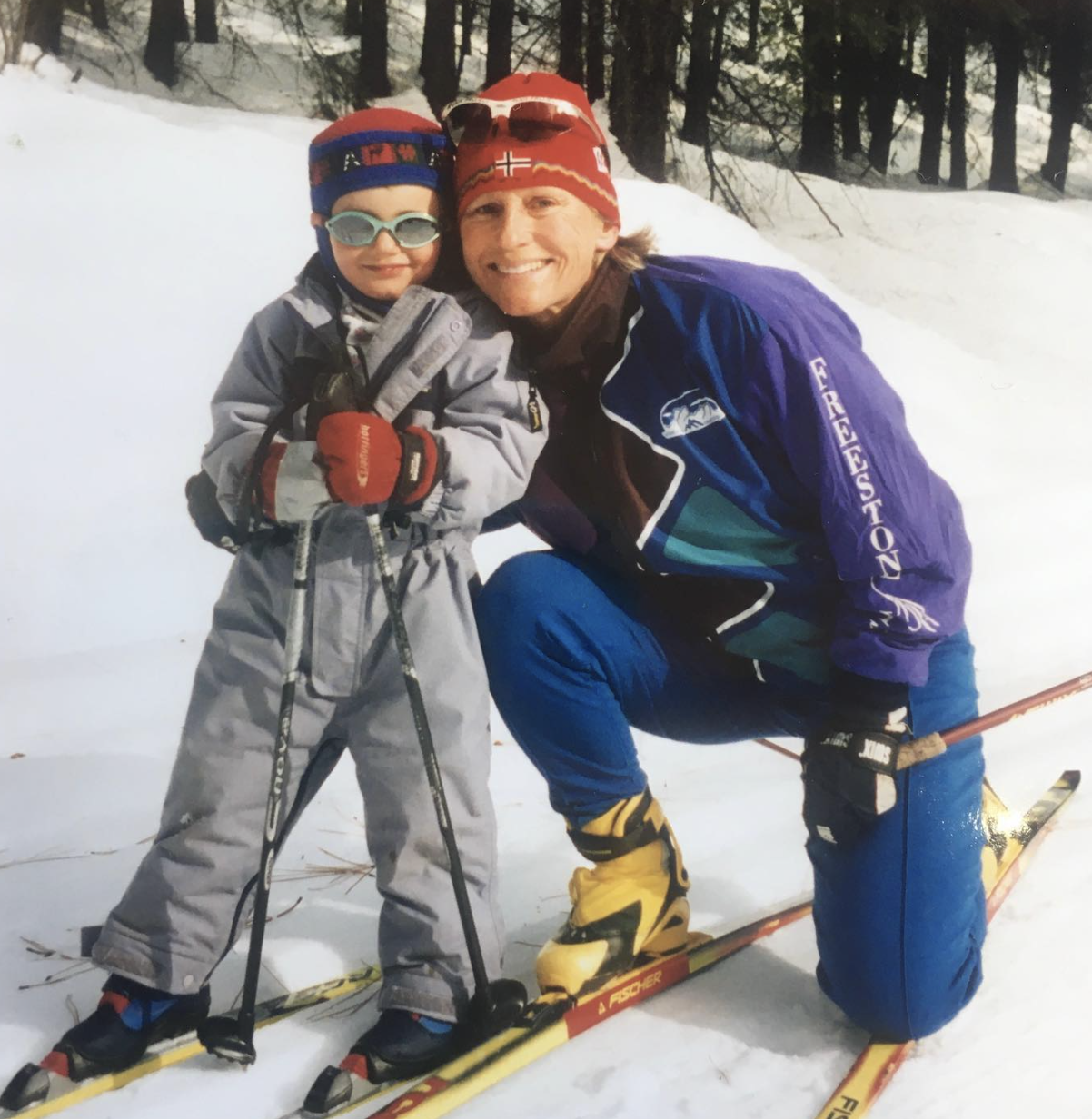
Laura McCabe (right), former U.S. ski team member and Olympian, is the current NNF chairperson. Here she is working on skier development with her then young daughter, now U.S. team member, Novie McCabe. (Photo: Instagram @novie.mccabe)
The NNF is a non-profit funded solely by donations whose mission is to “power the opportunities that bridge the gap to World Cup and Olympic excellence for Nordic skiers from the United States.” Chairperson of the Board of directors, former Olympic cross-country skier Laura McCabe—mother of current U.S. team member Novie—states in her letter to the ski community that the NNF was “founded on the belief in supporting a development system rivaling any nation, a vision we’re proudly realizing thanks to our dedicated community.” That founding vision was a tall order considering that the other major Nordic nations don’t have to go to donors with hat in hand soliciting support.
But the NNF has been successful in fulfilling its mandate as a funding bridge. Last year, the NNF raised $470,000 to support the development of the cross-country racing ecosystem in the United States.
NNF supports summer as well as winter projects. (Photo: NNF Impact Statement)
NNF uses that money to help skiers afford the cost of winter and summer events and training. In the summer, NNF helps offset the cost of attending training camps. There are National Elite Groups, Regional Elite Groups, National U16 Camp, and international development exchanges and trips. Last year NNF provided over $88,000 in funding for these activities.
During the winter, NNF provides funding for coaching development as well as athlete funding to help attend U18 championships, Junior World/U23 championships, World Cup races, and OPA Cup racing (a second level of competition ranked just below the World Cup). There are also individual grants to athletes to help them attend World Cup events. Last year those winter projects support for event attendance was over $180,000.
The NNF is the lead sponsor for the Supertour as well as supporting other winter programs. (Photo: NNF Impact Statement)
NNF also sponsors domestic racing by being the title sponsor for the Supertour. The Supertour is the highest level of race competition in the United States and consists of a race series spread across the country. Success in the Supertour often leads to a spot on the U.S. national team or start rights in the Tour de Ski. Last year NNF subsidized the cost of the Supertour to the tune of $23,000, which covered almost 60 percent of the tour’s prize money.
One of the NNF’s other successful winter projects is its Trail to Gold program. The T2G is a coaching grant that supports developing women coaches and technicians in an historically male dominated profession. Bernie Nelson who was just hired by the U.S. team as a full time technician was a T2G funding recipient.
U.S. team coach Matt Whitcomb (left) crunching numbers with Sydney Palmer-Leger. He’s a key part of the puzzle to help the NNF design its funding disbursements. (Photo: Leann Bentley, U.S. Ski Team).
A critical piece of the puzzle for the NNF is coordinating between itself and the U.S. national team. That’s where Matt Whitcomb comes in. Whitcomb is the head coach of the U.S. ski team. He is also on the NNF Board of Directors. Whitcomb provides the Board with an invaluable overview of the needs of developing skiers, and what a successful development program looks like. “The NNF is the bridge between being a U14 athlete and being an Olympian,” said Whitcomb. “NNF picks up and assists with projects between those two things where athletes are most likely to quit because of funding challenges.”
“The NNF and national ski team are critical partners, but we’re really different puzzle pieces that just fit really well together where the NNF funds younger kids, and the U.S. ski team funds the older or more successful athletes. Our philosophy at the NNF is that all hard working athletes with big goals should be able to compete in the sport regardless of their economic status” The NNF states that there is funding which touches over 250 athletes per year, with funding from thousands of donors. “We have a three year fundraising average of raising over $500,000 a year, said Whitcomb.”
WIll Koch finished 13th in the 10K Classic at the 2022 Junior World Championships. NNF helped secure his presence. (Photo: John McColgan)
Often part of the NNF funding process is to generate individual amounts of support for certain events. For example, there might be a dollar amount set aside for the U23 championships which is then divided between different athletes. It can start out as a large pot of money, but by the time it’s divided between all the athletes and support crew, the dollar amount shrinks significantly. For example, it previously allocated over $84,000 in total to the last Junior World/U23 Championships. But after the math is done, it only comes out to several thousand dollars per athlete. It’s a big help but doesn’t cover an athlete’s entire cost. “There’s 10 wax techs alone that come to World Juniors, and around 24 athletes,” said Whitcomb.
NNF focuses on grass roots fundraising. Over 1,000 donations just for the Drive for 25 fundraiser shows its breadth. (Photo: NNF Impact Statement)
Athlete buy-in is critical to NNF’s mission. Athletes are part of the fundraising efforts and build important ties to the cross-country community. Athletes are encouraged to actively participate in the fundraising process. “We don’t cover any project completely,” said Whitcomb. “The goal is to leave some of the responsibility up to the club and the athletes. If they all do a little bit (the athletes), it will really move the needle for an organization like this.” The NNF is proud of width and breadth of its donor base, with over 1,000 individual donations for its drive for 25 fundraising effort, it demonstrates its status as a grass roots organization. “Our window is at the grass roots level. There are people that donate five dollars recurring monthly. You know what it means to those people. We’re trying to sell shares of this great journey to as many donors as possible.” You may have heard of the Drive for 25, but not really known what it was about. It’s one of the NNF’s principle fundraising efforts. Last year it raised over $122,000.
It’s not just racers who benefit from the NNF’s support. High level racing needs high level officiating. At every FIS (International Ski Federation) event there are teams of technical delegates who are the equivalent of officials or umpires. Without the technical delegates, high level racing doesn’t happen. In the U.S., these positions are volunteers, but there are significant expenses attached to being a delegate. NNF has launched a new program to offer grants to individuals trying to gain technical delegate status to help offset part of the expense. It’s part of NNF’s efforts to maintain the flow of talent and treasure which feeds the cross-country pipeline.
NNF is part of the American success at the Junior level. (Photo: NNF Impact Statement)
The NNF proudly points to athletes’ success as proof that its support continues to feed the American pipeline for world class ski talent. In the most recent Junior/U23 World Championships nine different NNF funded athletes finished in the top 10 in different events. In addition to the junior level racing, it also provided funding which contributed to 151 world cup starts. The results from that effort were over 20 top 30 World Cup finishes for NNF supported athlete. Another sign of NNF fulfilling its mission is that many previously NNF funded athletes have recently achieved United States A or B team status, including Sammy Smith, Kevin Bolger, and Will Koch.
NNF also impacts World Cup performances as it helps athletes who haven’t yet made A or B team status. (Photo: NNF Impact Statement)
Every time one of these developing athletes achieves success in competition it helps moves them along the pathway to becoming a member of the United States A or B team which is where the other side of the funding bridge is met and continues the pathway to Olympic success. “Take a look at the last Olympic team. Everyone of those athletes, earlier in their career, had received funding from NNF.”
It’s fair to say that without NNF support the pipeline of developing skiers would be limited to athletes from wealthy backgrounds or those who have the good fortune to have the marketing skills to promote themselves on GoFundMe pages or Instagram. As long as it continues to receive support from the Nordic community, NNF will continue to be the funding bridge for up and coming athletes.
The 2023-2024 season was undeniably strong for Dartmouth College’s John Steel Hagenbuch (’25, U.S. B-Team).
In December, his was the fastest leg time in the Men’s 4×7.5 k Relay in Gällivare. One week later, he secured his first top-15 finish on the World Cup circuit, taking 13th place in the Östersund 10 k Freestyle. In February, he surprised himself with a bronze medal in the U23 World Championship Sprint in Planica.
Domestically, the wins came hard and fast. Hagenbuch rang in the New Year with a victory in the 20 k Freestyle at USSS Nationals in Soldier Hollow, UT, before proceeding to win every race he started in the Eastern Intercollegiate Ski Association—going six for six across the Vermont, Colby, and Middlebury Carnivals. Then, it was on to the NCAA Ski Championships, where he won the 7.5 k Freestyle, before finishing the season at the top of the 40 k Freestyle podium at Duluth, MN’s blizzard-battered Spring Nationals.
Hagenbuch outsprints Jake Brown (Craftsbury Nordic) to end the 2023-2024 season with a win at Duluth’s “Spring Nationals” 40 k Skate. (Photo: Ben Theyerl / FasterSkier)
However, in a chapter of American skiing which has left commentators (understandably) salivating over career-defining performances, and quick to use the attendant, maximalist terminology, Hagenbuch resists any such characterization of his performances. “I genuinely don’t think [last season] was a breakout by any means,” he told this hyperbole-bandying writer. “Every year up to now has just been improvement in key areas, and just an evolution in my skiing […] I think it was just part of the processes, and just another step in my development.”
Steady development might not make for much of a pre-season story—but Hagenbuch’s approach towards training, racing, and the winter ahead certainly does. Indeed, the measured, circumspect, and profoundly grateful attitude with which he characterized last season evidently saturates his workouts, his performance goals, and his abiding love for the undergraduate experience. FasterSkier spoke with John Steel Hagenbuch to get the details on Dartmouth, “Shrimp Week,” and what’s next for the USCSCA’s Men’s Nordic National Skier of the Year.
Batting 0.750 on “the Four S’s”
In his third year of skiing for Big Green, Hagenbuch describes his life as a balancing act in several dimensions.
At the macro-level, there’s the challenge of pursuing three distinct strains of activity: academic commitments, NCAA racing, and skiing internationally. When it comes to college skiing and World Cup skiing, Hagenbuch admits “there’s not many people who do both,” but credits Ben Ogden (University of Vermont, ’22) as a “blueprint” for successfully competing in both worlds. “It’s awesome that the attitude has fundamentally changed from 20 years ago—it’s no longer ‘either or,’” Hagenbuch says.
Hagenbuch, 2024 NCAA Champion in the 7.5 k Freestyle at Steamboat Springs, Colorado. (Photo: Tobias Albrigsten / Untraceable Global)
In his estimation, the space to compete at both the highest levels of domestic and international racing, while soaking up the undergraduate experience, is “going to sustain skiers’ careers for longer. Going to college is really fun, and for the time that I’m here, it provides a lot of balance in keeping things lighthearted and low-stress.” If Hagenbuch has a tough day, or even tough season (in a Q&A with The Dartmouth, he said of his 2021-2022 World Cup run: “Frankly, it sucked”), he has “other things to turn towards, and to look towards, to make [him] happy. Dartmouth is an amazing place; there’s so many amazing people with such diverse interests […] I’m so glad I took the opportunity to come here and live the life I’m living.”
With a rigorous battery of social events and campus traditions, however, comes a more micro-level balancing act. “I say I’m juggling Four S’s: Skiing, School, Sleep, and Socializing. On any given day, I can only choose to do three. It’s a sacrifice” (most often, it seems, of sleep), “but it’s one that I very willingly make to take advantage of a great education and a robust college experience while I’m the same age as my peer group, and still a ‘real kid.’”
Progress and Perspective
When it comes to training, juggling the Four S’s means making room for spontaneity—and a summer program that rejects restrictive regimen in favor of vibrance and variety. Indeed, Hagenbuch’s approach to the off-season seems to invert the perennial challenge of ‘Making training fun’ in favor of ‘Making fun training.’
When I ask him to describe his summer block in three words, Hagenbuch takes an uncharacteristic pause before settling on “Go with flow.” Over the last two years, he says he has been “the least stressed out about skiing since my freshman year of high school. A lot of that came down to having really great stuff going on in my life socially and academically, and actively choosing to think about those more.”
This isn’t to say that Hagenbuch was “prioritizing skiing less. It was just that I think [skiing] was taking less energy from me, and I was getting only positive things from it, as opposed to worrying about it. I think that enabled me to roll with the punches better, and not to stress.” Rather than fretting over a missed workout or a busy week, he recognized that he “can’t do everything all the time,” and would simply strive to maximize his focus and intensity during “moments when I felt good and had time to train, maybe even a little bit more than people would recommend […] When I zoom out, I realize that I hope to still be skiing a full ten years from now, and I’m not that worried about it. I’ve got a lot of time to make the progress that I need to, and get the notches on my belt that I need to.”
Hagenbuch’s extensive spring and summer highlight reel illustrates this perspective on a sustainable, “go-with-the-flow” off-season. Favorite spring workouts included skipping class to backcountry ski Tuckerman Ravine on a bluebird May day, and the “Occathon”—a marathon consisting of 18 laps around Occom Pond, “adjacent to the Dartmouth campus, with all these nice homes around it, and which adjoins Frat Row.” Hagenbuch began the run with a handful of teammates and fraternity brothers, but “40 to 50 other random people joined in throughout,” with football players, students, professors, and stray joggers pulled in by the energy of the event.
Scenes from Dartmouth’s “Inaugural Occathon.” (Photo: John Steel Hagenbuch / Strava)
High summer at home in Sun Valley, Idaho brought more long days of backcountry skiing, including a “sketchy” July descent of McGowan Peak, as well as teaching classmates how to mountain bike, point-to-point 50 k trail runs in the Sawtooth Mountains, and a week of river-rafting. Although the lattermost trip may have come at a “time when most other people were probably putting their noses to the grindstone, I thought that it was something that would be a net positive in terms of relaxing for a bit, resetting the body and mind, and having some fun with my friends.”
When he returned to Hanover in late July, Hagenbuch adopted a more structured cycle—while still making time to soak up the energy of summer on campus (Dartmouth, with a quarter system, has classes year-round). He completed coursework, moved back into his fraternity, and was “training a lot, and hard, and getting in the sessions I needed to. Would I have done things a little bit differently? Would I have recovered a little bit better, or been X-percent better in a certain session? Had I gotten a little bit more sleep, probably, but I don’t really care.”
Backcountry skiing at Tuckerman Ravine. (Photo: John Steel Hagenbuch / Strava)
What Is Shrimp Week?
The first week of September stood in stark contrast to Hagenbuch’s otherwise-adaptable summer. Hagenbuch reportedly logged over 852 kilometers across 45 hours of running, rollerskiing and biking between September 2nd and September 8th—a sojourn he cryptically christened “Shrimp Week.”
When I asked for the logic behind both the Brobdingnagian volume block and the name, Hagenbuch admitted: “If you talk to most of the coaches I’ve ever had, and many of the people I train with, there are some things I do that there isn’t much logic behind. I was already planning on doing a volume week. I was still here in Hanover, but my buddies that had been here for sophomore summer had just left, and no-one on the ski team was here yet, so I was training all by myself. I was feeling good, feeling really fit […] and that was the barometer I went by every day—just thinking about how I was feeling when I was waking up, and fueling really well, sleeping well, and just training a bunch and seeing how that went.”
In essence: “I was curious how much I could do while still feeling good.”
Shrimp Week, Day One outtakes. (Photo: John Steel Hagenbuch / Strava)
And, that name? “Well, Forrest Gump is one of my favorite movies. And there are some individuals that were doing some training and calling their volume weeks ‘Shark Week,’ which I thought was funny. So, I was kind of making fun of that.” Blood in the water!
Passing the Three Gates
When asked about the coming winter, Hagenbuch seems contentedly confident: confident that his body is “in a good spot and responding well” to autumn intensity; confident that he’ll continue to balance his Four S’s while hitting “key sessions”; and confident in the steady arc of progress he has thus far maintained.
In the 2023-2024 World Cup season, Hagenbuch aimed to have just one race in which he passed through the “three gates” to a strong performance—“good skis, good body, and good execution.” Between the Gällivare Relay and the Östersund 10 k, he had two (his Planica Sprint arguably constituted a third); this year, he’s simply looking to add to that total.
“Once again, all I’m really hoping for is to have a couple of races where I’m really happy that those three gates were fulfilled. And I think the results will come if that happens,” especially if he can improve his consistency in both disciplines. “I’m definitely not saying, ‘Oh, I need to get a top-ten.’ But a top-ten would be nice.”
Hagenbuch and teammates after the 4×7.5 k Relay in Gällivare, Sweden, December 3rd 2024. Hagenbuch recorded the fastest leg time of the day. (Photo: John Steel Hagenbuch / Strava)
In addition to racing Period I, Hagenbuch plans to stay in Switzerland through Christmas and complete the Tour de Ski, where he hopes that the Alpine climbs and altitude, and potentially even Alpe Cermis, will play to his Sun Valley strengths.
While he is “not immune” to the nervousness that the approaching World Cup brings to many athletes, Hagenbuch cites the dynamic of the US Men’s Team as creating a relay-like atmosphere in which he can excel.
“When I think back on my best races, a lot of them have been relay legs, and I think that’s not a coincidence. You take a lot of internal and external pressure and stress out of racing” when “skiing for your teammates and not just for yourself.” The American Men “all like each other, and we’re all close friends. They’re all really, really great guys that I like to spend time with, I like to train with, and I like to race with. And I think we push each other in a really positive way that’s mutually beneficial […] I don’t mind if any of those guys beat me. I’m not racing against them. I’m racing against me. I’d love to see them do as well, if not better than, myself, because I know that if they’re capable of doing that, if they’re putting out those results, then that’s emblematic of the atmosphere and capacity of the whole team, including myself.”
The camaraderie continues for (from left) Gus Schumacher, Ben Ogden, Johnny Hagenbuch, and Luke Jager, pictured here as the U20 4 x 5 k World Champions in Lahti, Finland, 2019. The American Men are “no longer really the underdogs” they were in 2019, Hagenbuch says. (Photo: Doug Stephen)
The Hound of Hanover
On American soil, however, Hagenbuch is looking to the 2025 NCAA Championships with vicious clarity.
The event will be on home turf in Hanover, with a 20 k Mass-Start Freestyle and a 7.5 k Individual-Start Classic. In the Classic race, he’s hoping to “improve on [his] runner-up finish from 2023” (read: win).
As for the Freestyle: “I’m going to be frothing-at-the-mouth rabid before the start of that race. It will certainly be, up to that point, the most important race of my career.”
Indeed, the man who will be defending his Championship title this March appears unrecognizable from the serendipitous spirit who “go-with-the-flow’ed” his way through the training sessions described above.
“I bring a kind of manic energy” to races, Hagenbuch says. Think Redbulls, really loud music (“I’ve blown out a couple van speakers in my day. ‘Rental Car Companies Hate Him for this One Simple Trick,’ for sure,” he admits), and more rabid dog analogies. “But that all gets tuned out and sharpened, like focusing a camera, when the gun goes off. And I love the catharsis at the end of the race, too, especially if it goes well.” Madness turns to the Campbell’s Monomyth: “You have a bit of ‘The Hero’s Journey’—the build-up,” the struggle of exertion and emotion, “and then, crashing down.”
Attending March’s NCAA Championships will come at the expense of a possible World Championship appearance. “I’m making the conscious decision that, should I qualify for the World Championships in Trondheim, which are at the same time as NCAAs, I won’t be going. Maybe that’s unwise. But Matt Whitcomb skied for Middlebury, and Chris Grover skied for Dartmouth, so they kind of understand. And this is a step in my career where I don’t think that I’m missing out on anything, by any means. This is a mutually beneficial thing: I get to ski for Dartmouth. I get to experience all that it is to be a Dartmouth student outside of the ski team. It’s an incredible privilege that I don’t want to pass up.”
With Hagenbuch hoping to be “in the best shape of [his] life March 6th-8th,” and the “NCAA Championships at home lining up with us having one of our strongest teams that we’ve maybe ever had across all disciplines—Nordic, Alpine, Men and Women,” he thinks that, “knock on wood, we could pull off something really special.”
Hagenbuch on the podium of the Men’s 7.5 k Skate at the 2024 NCAA Ski Championships. (Photo: Tobias Albrigsten / Untraceable Global)
“Even if the stars don’t align for us, it’s going to be an amazing event.” The Big Green athletes and administrators are already working to build excitement about the races, and there is a long tradition of Winter Carnivals constituting the campus’s most energetic weekends. Hagenbuch anticipates Oak Hill ski complex will be transformed into a drum-pounding, sound-drowning amalgamation of Minneapolis, Holmenkollen, and Animal House, rowdily attended by Dartmouth’s most avid fans and most accomplished day-drinkers. Skiers Luke Allan, Jack Lang, Asa Chalmers, Cooper Camp, and Hagenbuch himself are “all in different fraternities,” each of which will send their own squad of course-crowders. “There will be hundreds of Dartmouth men” bringing encouragement (and liquid courage) to the trails, in addition to thousands of “parents, students, spectators, kids from other schools, all out there getting fired up and really loud for races.”
“Dartmouth is a bizarre place, out in the middle of nowhere. It’s a melting pot of a lot of different people. And, in a world that seems to have progressed a lot in many ways—technologically, socially—Dartmouth has largely remained the same, ‘Lest the old traditions fail.’” Whether relaxed or rabid, Hagenbuch feels especially privileged to live, train, and compete in this unique environment; one in which he savors the thrill of racing, the rigor of academic study, and the spontaneity that so ruddily colors undergraduate days.
And, despite holding a broad, even patient, view of his unfolding athletic career, he has clearly fixed March 8th, 2025 as his Polaris; a lodestar rising steadily above the near horizon, flickering with the white heat of anticipation and ambition.
“I don’t think a lot of the Western skiers, or even the other Eastern skiers, have any idea what it’s going to be like.”
FasterSkier thanks John Steel Hagenbuch for his time, and Leann Bentley for facilitating this interview. Some comments have been edited for length and clarity.
The Minneapolis Loppet Foundation announced today, November 8th, that it has hired a new Director. Meghan Cosgrove will take the reins of the organization beginning November 18th. She takes over from Claire Wilson who resigned from the Director’s position in September for family reasons. Wilson had been at the helm of the Loppet Foundation for four years.
Meghan Cosgrove, the new Director of the Minneapolis Loppet Foundation. (Photo: LinkedIn)
Cosgrove’s most recent leadership post was as Executive Director at YMCA of the North for Camp Menogyn, where she spent seven years overseeing operations for teen wilderness adventures in some extremely remote areas, including Isle Royale and the Canadian Arctic. Camp Menogyn is located on the edge of the Boundary Waters area about 45 minutes from Grand Marais, Minnesota.
Cosgrove also has a background in fundraising having spent time as a major gift officer, and during her time as a YMCA Director worked with her Board of Directors to raise from $250,000-$1,000,000 annually. No doubt the Loppet Foundation will hope to put her fundraising skills to work to help sustain the organization. Cosgrove also worked as the Executive Director of YMCA camp Warren, near Eveleth Minnesota, for almost 9 years, which saw over 1,200 participants at the camp a year. When asked about choosing to move to the Foundation, Cosgrove told FasterSkier that, “I have always admired the mission of the Loppet Foundation and this was a great point in my life to put down roots in the Twin Cities.”
Prior to landing in Minnesota, Cosgrove worked in Maine as a faculty member at the Hyde School located in Bath, where among other duties she was the assistant coach for the varsity cross-country ski team.
This last spring Cosgrove was recognized for her 25 years of leadership within the YMCA. She is a Bowdoin College graduate with a Bachelor’s in Sociology and Spanish, and has a Master’s degree from the University of St. Thomas in Education.
Claire Wilson, former Director of the Loppet Foundation. (Photo: Loppet Foundation)
Cosgrove expressed her excitement at being named the new Director and gratitude to Wilson’s prior stewardship. When asked about the goals and challenges facing the Foundation she replied, “I see the Loppet as a leader in advancing equity in the outdoors. Continuing to offer high quality programs for people of all ages and continuing to remove barriers to participation in those programs will be my top priorities. Climate change is one of the biggest challenges for the Loppet. Last winter certainly highlighted that. We offer a diverse offering of programs, in all four seasons, and will continue to evolve those as we adapt to climate challenges.”
The Loppet Foundation was the principal organization responsible for the hugely successful World Cup weekend held last winter at Wirth Park in Minneapolis. It was a high profile event putting the mostly volunteer organization at the center of the Nordic ski world for a weekend.
The great crowds and jaw dropping performances in Minneapolis helped the Loppet Foundation pull off an incredible event. (Photo: NordicFocus)
Though the World Cup is what most skiers outside of Minneapolis know the Loppet Foundation for, running the World Cup weekend was really a detour from the Foundation’s primary duties. But as it turned out, the Foundation was the perfect organization to bring together a world class event with community involvement to present a one of a kind World Cup experience.
Jessie Diggins wasn’t the only person shedding a few tears during the Minneapolis World Cup. (Photo: NordicFocus)
The Foundation is a nonprofit and its primary charge is connecting people to the outdoors through experiences that grow community. It funnels 25,000 participants a year through its programs. For a mostly volunteer entity, the World Cup was an ambitious undertaking which pushed the capacity of the organization. But in the end, it delivered a memorable and unique product. It was a heavy lift for the organization, but could it happen again? “I’m sure this is something we will thoughtfully consider. There is definitely an appetite to host another World Cup here in the Twin Cities because the Loppet staff and volunteers did an incredible job welcoming the world to Wirth last winter. But we will need to carefully examine the financial demands and the person power necessary to do that again.”
The Loppet Foundation helped form a community based event for the Minneapolis World Cup. Here, Mathilde Myhrvold (NOR), Emma Ribom (SWE), and hometown star Jessie Diggins (USA), (l-r) racing the individual sprint in Minneapolis’ Wirth Park (USA). (Photo: NordicFocus)
The U.S. team celebrates Gus Schumacher’s victory in Minneapolis. Even though it’s all the U.S. team, there are teams within the team. (Photo: NordicFocus)
Every fall the U.S. cross-country ski team announces its new roster. But there are teams within the team which makes it a little complicated to figure out exactly who belongs where. With designations of A, B, and D teams. The method for how members are selected to these teams is well documented, and it’s all contained in a public document on the U.S. team’s website. But as you’ll see, that process is going to change for the 2026 season.
What’s less well known, and not discussed as often, are the differences from the athletes’ points of view. So, what exactly does it mean for a skier to be chosen to one of the different teams? That and other questions were answered when FasterSkier spoke with Chris Grover, the U.S. team’s head coach, about the team selection process, upcoming changes in that process, and at least one surprise announcement for the upcoming race season.
When you own a couple of Crystal Globes, there’s no doubt about which team you’ve qualified for. Jessie Diggins (USA) celebrates two Crystal Globes and glitter tipped skis. (Photo: NordicFocus)
What Does it Mean to Be on the A, B, or D Team?
From the athlete’s point of view, what exactly is the difference between qualifying for the A, B, or D teams? The answer, as far as the differences between being an A team or B team member is easy. As Grover described it, “right now, there’s no difference between A and B team support.” Grover noted that, “it wasn’t always like that. There was a while when the A team was fully funded and the B team was partially funded, but that stemmed from the 2008-09 financial situation. The organization took a big hit and had to cut a lot of staff, and we all took pay cuts. At that point the B team had to fund their own travel to World Cup.” But now, “all of the same resources are available (for A and B).” Grover hopes that the days of funding gaps are all in the past and that the current differentiation between A and B remains mostly a vestige of historically bad times. That bit of history may explain why some fans think there’s a big difference between being on the A and B teams, when in fact, there really isn’t any today, at least in terms of team support for an athlete.
Sophia Laukli recently qualified for the A team. There isn’t much practical difference, but it’s still nice to have the label. (Photo: NordicFocus)
In terms of what the team expects of A and B teamers, there is once again no difference. “All of those athletes (A and B team members) are expected to be racing World Cup. There may be some younger athletes also racing in NCAAs and U-23s, but the A team and the B team are primarily designed to be athletes who are competing and having success on the World Cup.”
So why even have an A and B team differentiation? Part of the reason goes back to that difficult history around 2008 and to guard against changes in funding. “You never know what’s going to happen in the future, we could have another financial meltdown, and we’d have to be able to prioritize our funding.”
So, there you have it. The difference between being an A and B team member from the athlete’s view, as of today; none, but don’t kid yourself, it’s still nice to have the title “A team member!”
James Clinton (JC) Schoonmaker retains his spot on the A team.(Photo: NordicFocus)
But the world of support for D team athletes is markedly different. “All D team athletes pay their own room, board, and travel. That includes going to training camps and coming to World Cup. We try to support them with coaching, medical, and sports science support. We have athlete career and education services, which includes tuition reimbursement and career placement. We’re obviously paying for coaches and vans, but for the most part they pay their own travel.” When it comes to the impact on an athlete, the big difference is between D team membership versus A or B team status.
When you’re a struggling skier trying to keep your place on the team, the difference in support is a pretty significant void in financing which can be onerous for your average D team member. To help fill the gap, the NNF (National Nordic Foundation), which is privately funded, and has its own formula to determine how much financial aid each athlete receives, helps provide financial support. “Athletes who race more, have more starts, and have better performances get more money from the NNF,” said Grover.
Sammy Smith will be moving up from the D team and joining the U.S. A team this year, her Sprint prowess secured her spot. (Photo: NordicFocus)
Fresh off his victory in Minneapolis, Gus Schumacher joins the A team, moving up from the B team. (Photo: NordicFocus)
“There’s no way to qualify for the A team via world rank, like we’ve had. We’ve made it totally objective, based on World Cup and World Championships. We wanted the A team to be athletes that were meeting a certain standard on World Cup. For the A team, it’s all about World Cup performance (not points) and World Championship performance.” The changes Grover points to were driven by looking back and realizing that “we’ve seen that younger athletes can often make the A team without having much success on the World Cup. This (change) is to indicate that the A team is for World Cup and Championship level performers.”
Current A team criteria include World Cup finishes and World Ranking. World Ranking is eliminated for 2026. (Photo: U.S. Ski and Snowboard nomination document)
Currently, A team members could qualify based upon World Cup ranking, or high individual World Cup/World Championship race finishes. As part of the calculation, there is a sliding scale formula for qualification based upon a combination of year of birth and World Ranking.
The new A team qualification criteria for the 2025/26 ski season. (Photo: U.S. Ski and Snowboard nomination document)
For the 2025/26 season there will only be three ways to make the A team and none of them involve an athlete’s age. Qualifying will be based upon either a top 15 ranking in either Sprint or Distance classifications from the prior season of World Cup competition, achieving a podium in the World Cup/World Championships the prior season, or having 3 top 12 finishes in Distance or Sprint competitions at the World Cup/World Championships from the prior year. Gone from A team qualifying is the convoluted year of birth calculations.
B team criteria for 2026 will now include the age elements which were present for the A team in prior years. (Photo: U.S. Ski and Snowboard nomination document)
Age calculations are now incorporated into B team qualifying and reflect the concerns about younger athletes who could make the A team and have limited World Cup success. B team qualifications will occur through a combination of age and World Cup/World Championship results, and U23 and Junior Championship results. World rankings come into play only for athletes born before 2000. And B team members will still be expected to race at World Cup competitions.
Another big change will be a cap on the number of athletes on the B team. The team will be limited to a maximum of 10 athletes (men and women combined). There is then a tie breaking procedure in the event that more than 10 athletes qualify for the B team.
D team qualification will be based upon competition results from World Cup races, U23 World Championships performance, and World Junior Championships. Like the B team, there will also be a pathway based upon FIS World rankings.
To address any unforeseen inequities, discretionary selections are still allowed.
Ben Ogden hopes to pick up where he left off after being sidelined by illness. He retains his A team status. (Photo: NordicFocus)
Some of the change, particularly with the B team cap, is financially driven. “We have to fund all those athletes’ room, board, and travel, but we also have to provide a staff support network that’s big enough to take care of them all. That includes wax technicians, coaches, and physical therapists.” All of that support takes money and there isn’t a limitless pot.
Will Koch joins the U.S. B team this year moving up from the D team. (Photo: NordicFocus)
Grover emphasized that, “being on the U.S. ski team doesn’t give you any kind of start rights on the World Cup, they’re not related whatsoever. Making the U.S. ski team is totally separate from qualifying for any sort of competition trip.”
Luke Jager will receive the full support of a B team member for this coming winter. (Photo: NordicFocus) downloaded picture is fee-liable.
Like many aspects of the American squad, the selection process to make the team is different than for most other nations. For the Americans, “you either qualify objectively for the next season or you don’t, we do sometimes use coach’s discretion if we feel somebody has fallen through the cracks—but we don’t use it very often. Often when Norwegians or Scandinavians talk about a purely objective selection method, they will refer to it as an American system. Many other national teams don’t have objective criteria for their World Cup, National, or World Championship teams. They are using a ton more discretion. In the past, some of our main competitors have used almost 100 percent discretion.”
So that’s what all of the alphabet soup spells out when talking about U.S. team membership.
New Look For a New Season: Another Truck and Larger Team Quotas
U.S. Ski Team wax truck during pre-season camp in Rovaniemi, Finland. There’s a little sibling on the way to add to the fleet. (Photo: Matt Whitcomb)
Grover also gave FasterSkier a head’s up on a team upgrade for this winter’s World Cup season. “We have a second wax truck that will be going on the road with us this winter which is going to carry our Wintersteiger grinding machine … which will also give us four more work stations, which we absolutely need because the team has gotten so big. We and Norway have the biggest quota in the world right now, because they have the men’s Overall winner and we have the women’s, so we can start 15 athletes between men and women, as Norway can, but that’s bigger than every other nation. We have 22 different athletes coming to World Cup in period one. So now we have two trucks.”
Trucks aren’t cheap, and Grover is quick to express his appreciation to the U.S. Olympic Committee for the funding role they played in purchasing a second truck, in addition to private donors who aided in the purchase. It cost over €200,000 Euros (about $216,00 U.S.D), for just the truck, not including any of the equipment like grinders which go into it. It’s a good upgrade for a team which continues to seek improvement in every aspect on and off the competition field.
Thank you to Chris Grover for taking the time to have this discussion with FasterSkier
Food can be fun, tasty, nutritious and easy to make! I love to cook elaborate meals when I have time, but often the simple and quick recipes end up being my favorite. Whether it is a recovery day or a 5 hour training day, eating a well-balanced meal is important for staying strong, healthy, and happy! When I can, I try to cook foods that are grown locally and in season, because I know where they come from and are rich with fresh nutrients. Foods in season also taste much better too! Here have been my summer go-to meals that are quick, easy, and always a crowd-pleaser.
Grain bowl – ie. choose your own adventure
What I love about a grain bowl is that you can really substitute any part of it with what you have in your fridge and pantry. There are 4 parts to the bowl: grain, protein, veggie, sauce (+ cheese and herbs as toppings)! Technically, this isn’t a set recipe, but this is my most frequent go-to dinner. Here are a few of my favorite combinations.
Blend ⅓ cup tahini, ⅓ olive oil, ⅓ cup water, 3 tbs lemon juice, garlic, 1 tsp soy sauce
*Thai chili sauce
¼ cup Thai chili sauce, ⅓ cup soy sauce, 2 tbsp lime juice, garlic, ginger
Grain bowl. (Photo: Julia Kern)
Green curry
On those colder or rainy days, it is nice to have a warm meal. I like curry because you can always substitute veggies for what you have in the fridge and it is full of flavor.
What you need:
Rice (or other grain)
Tofu or chicken
2 cups of veggies
1 can of coconut milk
Thai green curry paste
1 lime
Cook a pot of rice or other grain of your choice while you make the curry sauce.
While the rice is cooking, mix 1 can of coconut milk with 4 tbs of Thai green curry paste in a medium-sized bowl. In a large, well-seasoned pan (I like to use coconut oil for this recipe), place either your tofu or chicken in the pan and pour 3 tbs of the curry mixture over and cook your protein until it is fully cooked. If there is not enough oil, add coconut oil to the pan as the protein cooks. Once your protein is cooked, set it aside in a bowl while you cook the vegetables.
Green curry prep. (Photo: Julia Kern)
Add 2 cups of vegetables of your choice into the pan. I used kale and snap peas in this iteration, sticking with the green theme! Cook the veggies for about 4 minutes before pouring in the rest of the curry mixture. Let this mixture cook, stirring occasionally until the sauce starts to thicken and the veggies are cooked.
When it is done, top the curry with lime juice, add the tofu back in, and season to taste. Assemble the curry in a bowl with rice, topping with some fresh herbs like basil and cilantro, and cashews.
Flatbread Dipped in Cucumber Yogurt
I loved this recipe for hot days this summer because it had a refreshing cool zingy taste to it, and required little oven and frying heat. I also really like this recipe because you can make it ahead of time and it is ready to go when you come home.
What you need:
Flatbread (or other dipping bread)
1-2 cups Greek yogurt
1 big cucumber or 3 mini ones
1 cup cherry tomatoes
1 can chickpeas
1 clove garlic
1 lemon
1 ½ teaspoons curry powder
⅓ cup herbs (I like basil and/or mint)
¼ cup nuts for toppings (pistachios)
To make the yogurt dip, mix together the yogurt, cucumbers, hebs, zest of a half of lemon, salt, and pepper in a medium-sized bowl and then keep it in the fridge until you are ready to eat. Save the remaining half a lemon as wedges to serve on the side.
In a pan, heat oil on medium and add in the tomatoes, cooking them for 5 minutes. Once they start to burst, add in the chickpeas, curry powder, salt, and pepper. Simmer this for about 4 minutes and then let it cool in a bowl until you are ready to serve. I usually make these 2 steps ahead of time and keep both bowls in the fridge until I come home and I am ready to eat.
Flatbread dipped in cucumber yogurt. (Photo: Julia Kern)
When I am ready to assemble the dish, I spread the yogurt mixture in a deep bowl or wide platter. I top it with the tomato chickpea mixture and sprinkle the herbs and nuts on top. You can either squeeze the lemon wedges over the mixture or serve them on the side as additional fresh citrus as topping. Using whatever flatbread you have (whether homemade or store-bought), I try to warm them up briefly in the microwave and then enjoy the dish by dipping into the mixture with the flatbread!
Stir Fry
Who doesn’t love a good stir fry? At the end of the week, I often have leftover veggies in the fridge, and it is the perfect way to use them up in a quick and delicious way! This recipe below is a twist to the classic rice, soy sauce stir fry so I hope it adds a different variation to the classic stir recipe.
Chop all of the veggies into you preferred shape (I like to make thin strips). Heat a skillet with olive oil and sautee the veggies and ginger for 5-7 minutes until they start to soften up and slightly golden. Add the tempeh in after a few minutes.
Stir fry. (Photo: Julia Kern)
In the mean time, heat 2 pots of water. In one pot of water, add the frozen edamame and cook them for about 5 minutes until they are warm all the way through. In the other pot, cook the noodles to your desired to you liking.
Stir fry. (Photo: Julia Kern)
In a bowl, mix together the tamari, seame oil, honey, and hot sauce. Toss all of the noodles and the edamame into the veggie skillet and add the sauce. Let it summer for 2 minutes and then serve hot. Top with herbs and nuts if you like!
In Part I of our interview with Sophia Laukli, FasterSkier caught up with her before she had returned to the Golden Trail Series Tour, and discussed the ups and downs of the difficult summer she had. We’ll continue our discussion with Laukli about the upcoming race season but first, we need to bring readers up to date with how she fared in the Golden Trail Series finals, and how she is feeling after her summer of relentless challenges.
Laukli glided into the finish at Ascona-Locarno, and looked fresher than she has all season. (Photo:@RisingStory/GTWS Final Ascona-Locarno @JustinGalant)
In last Thursday’s prologue portion of the final’s race, Laukli had one of the more solid performances she has had all summer, and felt better than she had in months. After the prologue, she told FasterSkier: “Definitely on the right track in terms of feelings, compared to earlier this summer.” She finished fourth in the seven kilometer prologue and was within sight of the winner. Last Saturday, the finals continued with the 23.5 kilometer race.
The 23.5 final on Saturday went well for her, though she didn’t dominate like she had last year. Laukli finished sixth, but was only a little over a minute off the podium, which might be a good barometer of how she is doing physically. Full results can be found here. It was a nice rebound performance and should serve to remove most of the sour taste of this last season.
Laukli was looking refreshed and relaxed before the final race of the summer. Now all focus is on skiing. (Photo: @RisingStory/GTWS Final Ascona-Locarno @Colinolivero)
After the race, Laukli share her observations with FasterSkier. “Yesterday’s race was decent but I realized pretty quickly that maybe I should not have done the prologue. My legs were totally dead so it made for a very tough and long race. I’m confident the fitness and ski shape is still good, but that doesn’t translate to back to back running races for me…I have done a lot of roller skiing, and not much running, so I guess it’s not the biggest shock. I’m definitely happy I raced the finals, but I think if I wanted to have my best performance before the season end, I should have committed to just doing the final long race.” It’s positive news for American ski fans that Laukli is back to feeling good and having strong race results. Her result might be a little bit off from last year, but not all of it rests with her physical condition. ” I think the biggest thing though is that the field is so deep and so much higher this year. It was honestly one of my better races even though the legs were super heavy, but I’ve had much worse races where I’ve still ended 2nd or 3rd, or even won. I would say I’m close to last year’s level and maybe still improved, it’s just hard to see that in the results.”
At the end of the day, the decision to race looks like it proved to be the right move for Laukli, and it was definitely the right step psychologically. “So all in all, it’s super motivating for next year but I have a lot of improvement in running to do. But the competition being so high makes me want to put in just as much work as I do for skiing, and that’s a cool thing!”
Laukli spent a week training in the ski tunnel, which she doesn’t like. But she did get to wear her very cool team Aker-Daehlie suit. “It’s super cool,” says Laukli. “I”m going to be wearing it as much as possible.” (Photo: Sophia Laukli/Instagram)
To bore in on ski training, Laukli recently visited the ski tunnel in Torsby, Sweden. It’s a form of training which she admittedly isn’t thrilled with. “It was mostly technique focus, but I really honestly hate tunnel training. I don’t think I would ever do it if I didn’t see the benefit. I can do it once a year and have a little bit of a boot camp. Many people have no problem with it, but I find it very mentally tough.”
In the midst of her summer of challenges Laukli did receive some good news. She was promoted on the U.S ski team from B team status to A team. Although there is limited day to day impact of the promotion, she appreciates the change in status. “It’s a motivating thing to move up, because it means that you’re better than the year before. I was really excited about it.”
Laukli acknowledges that to move up in Overall Tour de Ski and World Cup standings, she needs to work on her Classic skiing. (Photo: NordicFocus)
As she continues to develop as a skier, Laukli has noted, and is quite open, about a couple of significant holes in her game—Sprinting and Classic skiing. She is physically tuned to be a distance athlete, and there’s only so much she can do to change that. This past spring, Laukli told FasterSkier that she was going to work a little bit more on her Sprinting skills this summer, if for no other reason than that she wouldn’t have to overcome as significant time deficits in the Tour de Ski. But she is realistic about her Sprinting abilities and acknowledges that even making the Sprint heats probably isn’t a realistic goal for this season. While not necessarily working specifically on Sprinting, “I’ve had a huge focus on strength this summer,” which should improve her Sprint results. She’s also been working on her Classic game. “Another thing that brings me down a bit (in Overall standings) is the difference in my Classic and Skating abilities, so I’ve had a bit more Classic focus, so at least I can get a little bit closer to my Skating (ability). I’m never going to be a Sprinter, but if I can get a little bit stronger, and at least get better at Classic, then it helps with focus on the Overall … so I don’t just think about the last stage (Alpe Cermis).”
It was a huge step for Laukli to win a podium by conquering Alpe Cermis, but she wants to be able to focus on more. (Photo: NordicFocus)
In addition to the Tour de Ski, this is a World Championships year, and Laukli has some definite goals in mind. “I’m very results driven, so not having any results goals makes it hard to figure out what you want to do in the season. What I first do is pinpoint the races that I have the most potential in and base my training around those; so I’m in the best shape for those. The results goals are a little vague, but beyond Alpe Cermis, and the races at altitude, trying for a top five … the biggest focus of the year is the 50k Skate at the World Champs. I want that race to be my best race ever.” For the non-World Championship races, Laukli is primed for racing at Engadin (20k Freestyle) and Les Rousses (10 k Freestyle and 20 k Classic).
Based on the calendar layout, she will likely face about a two week layoff between her last World Cup race and her first World Championship race, which is fine by her. “You kind of always have these two week blocks of being off. I wouldn’t be confident that I would have a good World Champs if I was just racing through (without time off). I think you’ll see quite a few athletes not racing as much this year because of the World Champs.” But Laukli acknowledges that when managing the schedule, “you have to be smart. That’s what has gotten me into in trouble now—always wanting to do everything, and not giving things up. So, I think this year, I’ll have to be more cautious, it’s not worth chasing every single race, because World Champs are the focus.”
Laukli would really like to be part of the relay team for the World Championships, but she realizes that might not be in the cards for her. But the relay distances are longer now, so she might have a shot. (Photo: NordicFocus)
When it comes to the World Championships, even casual cross-country fans know the importance of the relay for the women’s team. A World Championship podium finish in the relay has been the great white whale they have been chasing for years. But the nature of the chase changed somewhat when equal distance racing for men and women went into effect and the legs on the women’s relay were lengthened to 7.5 kilometers. With the longer distance comes an opportunity for Laukli. “I’m glad it’s not five kilometers. Five kilometers is definitely on the brink of being too short for me. 7.5k feels almost like a 10k, so it should be better for me. It’s possible for me (to be on the team). You go into the Championship not banking on it, because you don’t want to be let down. I’m not going in with the mentality that I have that spot, but I would really-really like it.”
Laukli sacrificed a Holmenkollen 50k Skate to race at the NCAA championships. She thought there would be more chances, but now she isn’t so sure. (Photo: NordicFocus)
With the 50 kilometer race taking place at the World Championships, that marathon distance race has been eliminated from the fabled Holmenkollen venue, and Laukli has some strong feelings on that issue. “I’m definitely bummed, but that’s very biased. I understand why (the change was made). It would be too much if you had double (back to back) 50ks, but for me, I’m very upset, because two years ago I gave up the 50k Holmenkollen Skate to race the NCAAs. But I was thinking it was fine because there are so many years of 50k Holmenkollen.” With the schedule changes, she has been deprived of her window of opportunity to Skate the 50k Holmenkollen this year. And, with Olympics in 2026 there’s a chance she might miss Holmenkollen again. “I don’t know what’s going to happen in the Olympic year, there’s a perfectly good excuse not to have it then, and that’s a race I really want to do one day. It will be very telling if they realize how much of a loss not having the race is. The skiers may be less upset about it than the culture of skiing. It’s a pretty crazy decision to make.”
Laukli has now been on team Aker-Daehlie for two seasons and has grown to see Norway as her home for the foreseeable future. “I was skeptical when I moved last year and wondered if I would just want to move right back, but I’ve been super happy with it, and, as long as I’m a skier, I won’t be moving back to the U.S. I consider Norway more home now.” Laukli’s Norwegian is even becoming respectable. “It has definitely improved. I make the effort to speak it to a handful of people and that has made me improve. I’m not perfect.” But Norway isn’t without some challenges. The food has been a bit of an issue. “That was definitely a big challenge. I was missing a lot of my American food, but I have since realized that there are a couple of things that are way better here.” Bolle, a sweet cinnamon bun has become one of her favorites. “I would still choose American food, and any time my mom comes over, she travels with my American breakfast food because I don’t do Norwegian breakfasts.”
It seems that Laukli has figured out how to adjust to life in Norway. If her adaptations to training as a two sport athlete prove as adept, there’s no limit on the future for Sophia Laukli.
FasterSkier thanks Sophia Laukli for taking the time to speak with our reporter.
Last running season it was all smiles and great finishes for Laukli. Here she was winning Sierre-Zinal last year. This year has been a non-stop struggle. (Photo: @the.adventure.bakery)
Last year was a breakout season for Sophia Laukli. She reached the top of the podium in a World Cup race and had a solid skiing season. In her non-skiing job, she also won the Golden Trail Series championship, being crowned the best international trail runner, all while making it look fairly easy. She dominated the race circuit and gave the best professional trail runners fits as she casually strolled to the race starts fresh off her ski training. It was a story which shattered what many pundits thought possible.
Laukli readies herself for her comback in the finals. (Photo: @RisingStory/Golden Trail World Series Final/Locarno@JustinGalant)
Few professional athletes have attempted to do what Laukli has been doing—excelling as a professional at two sports at the same time— and some observers were waiting for the other shoe to drop. And drop it did, as this summer Laukli has faced numerous obstacles. This year, the running deities have taken their revenge as Laukli has struggled with injury, overuse issues, and illness, all of which in early August forced her to announce the cancellation of her trail running season. But, in an unusual twist, after a long period of rest, Laukli has chosen to return to trail racing to compete in the finals of the Golden Trail Series held this weekend (October 17th-October 20th), in the Ascona-Locarno region of Switzerland. This year, she won’t be racing to win all of the marbles and earn her spot as the best trail runner in the world. Instead, she will be racing for validation— of sorts— validation that she’s found her groove again and is ready to fire on all cylinders. But, with the shattered shards of a truncated running season still clearly visible in the rear view mirror, it’s fair to ask whether she is tempting fate as she makes an unexpected return to the trail running scene. For the record, she claims there shouldn’t be any worries.
Despite the prologue only being seven kilometers it had some very serious terrain challenges. (Photo: @RisingStory/Golden Trail World Series Final/Locarno@JustinGalant)
Laukli has no shot of winning the overall title this year. Going into the finals, she was in 27th place and while it’s not mathematically impossible for her to take the championship, it would require dozens of athletes ahead of her to not show up or do very poorly. She recognizes that she’s not there to win the title, but she chose to race this coming weekend to use it as a barometer, and a bit of a statement to herself, about where her health is now. So far, her choice seems to have paid off. On Thursday, Laukli finished fourth in the final’s prologue, a seven kilometer race which serves as a prelude to Saturday’s 23.5 kilometer main event. She was only 42 seconds off the lead which in a relatively short race is a strong showing for her. The good finish moved her into 21st place in the Overall standings. After the prologue she told FasterSkier that, “yesterday was decent!” She continued that, “definitely on the right track in terms of feelings, compared to earlier this summer. The fitness was back, the downhill skills were maybe more of the issue. But I’ll take that, and think tomorrow will be better!”
The prologue at the Golden Trail Series had some intense downhills. (Photo:@RisingStory/Golden Trail World Series Final/Locarno@JustinGalant)
FasterSkier recently spoke with Laukli while she was in Norway before she left for the finals. She shared the details of her summer of trials and tribulations, and how she feels she’s positioned for the upcoming World Cup season. You can return to FasterSkier after Saturday’s race for an update of how Laukli did in the Golden Trail Series finale, and for part two of this interview.
FasterSkier had spoken with Laukli last May when she was in Japan to race the Golden Trail’s Asian events. But she was unable to compete due to a knee injury, and cancelled participation in the Asian races. The knee issue turned out to be a little bit different than originally diagnosed. “Now that’s over,” said Laukli, speaking of her knee problem. “A lot of what happened all summer goes back to that time (of the knee injury). The beginning of what caused an up and down summer was going to running camp two days after the Norwegian (ski) Championships. That was a problem, going straight to running.” The knee pain which kept her out of the Asian events had been attributed to too much running too soon, but only weeks later would she learn that there was more to it. “I had a bike crash, which at the time I didn’t know, but later learned, caused the issue in my knee. It was never super serious, but it did take me out of running for the Asia trip, all of May and the beginning of June.” It wasn’t until she had an MRI later that the pieces were put together and learned that she had damaged her knee in the crash.
Laukli put on a brave smile at the Mont Blanc finish, but she knew things weren’t right. (Photo: @RisingStory/Golden Trail World Series @mathisdecroux )
When she got home from Asia, she wasn’t running, but she was still able to roller ski at full volume. “I got into pretty good shape with that and thought the crossover to running would be pretty simple, but I quickly realized I needed longer to have the running legs. The first race went ok, but it was really hard on my body. That first race was like a band aid rip off.” But Laukli says that the knee injury is behind her and she’s not feeling any ill effects from it.
That first race was the Mont Blanc marathon, held June 30th in France. She was able to seriously run with minimal pain for only three weeks before Mont Blanc. “I gave myself three weeks of running before trying my first race … which was maybe mistake number two.” Despite her lack of preparation, she ended up finishing fourth, in a race she had won last year. To an outside observer it might have appeared that she was well on her way to recovery, but she knew things still weren’t right.
Laukli took a little more time off and tested the running waters again by racing outside of the Golden Trail Series circuit. She competed in the Eiger Ultra trail 54 kilometer race July 20th. The race is held on the face of the famous Eiger mountain which is home to decades of famous Alpine climbing history. The race was the longest she had ever run. She ended up winning that race, and once again, to an outsider, it looked like the ship had been righted, and all was well. But the victory didn’t feel right. Despite winning, “I noticed that I was not normal, and thought that maybe it was just going to take more time to get back into running shape.” The lack of depth in the field compared to a Golden Trail Series run helped to create the optics that Laukli was back on top. But it was an optical illusion.
It was after Sierre-Zinal that Laukli decided to call it quits for the regular season. (Photo:@goldentrailseries// @rising.story)
More time passed and she decided to rejoin the Golden Trail Series at the Sierre-Zinal run held August 10th in Switzerland; another race which she had won last year. This year she finished seventh, and the wheels were beginning to come off. “The weeks leading into it, I was starting to acknowledge that I had been, since the beginning of May, very tired and just ignoring it. It’s hard when you’re not sick, and not horribly over trained and just ‘mid’ for a very long time. I did some running tests, and they weren’t good, but I thought on race day I’d be fine. I was able to trick myself a bit before Sierre-Zinal thinking that maybe I would have a chance. But that race was the final straw that I really-really needed a break. It kind of all tracked back to the decision in March—going two days from skiing my last race to starting the running season. The knee injury was an added element. But the reason I’ve had such a hard summer trying to get back to my normal level is that I never took any time off. I think last year I was probably lucky that I didn’t think too much, and everything just worked out.”
As Laukli readied herself for Sierre-Zinal, she knew circumstances were working against her. (Photo: @rising.story_@colinolivero_GTWS_SierreZinal)
Last year Laukli took a month off after the ski season, but it wasn’t by design, it just happened that way because of her schedule. Now she realizes that she needs the time off after skiing. “It was a long time coming in August. It maybe wasn’t the best mentality, but I knew on the start line (of Sierre-Zinal) that if this is s–t, I’m going home and sit on the couch for a month. I was starting to re-think everything. I had two to three months of pretty bad training and being consistently tired. I kept taking little breaks. The week before Sierre-Zinal, I kind of knew it was not going to go well. It was a horribly tough race mentally”
It was after Sierre-Zinal that Laukli knew she needed extended rest. (Photo: @rising.story @JustinGalant)
In addition to all the training snafus, she also tested positive for Covid as soon as she got home from Sierre-Zinal. “I have no idea when I actually got it, but that whole July and August I wasn’t feeling normal.” She’s not certain if she was suffering from Covid during the race, but her time was 20 minutes slower than last year’s which made her think something was definitely wrong.
But having skiing as her principal sport provided some level of solace. “This is where it’s super nice to be a skier. The day I came home from Sierre-Zinal, I said ‘I’m going to call it for running, now I’ll just be super good in the winter.’ Covid made it easier to take time off.”
She describes her situation at the time as “mentally and physically frustrated and exhausted. I was in this constant cycle of starting the training, feeling bad, taking a couple of days off, then starting again. After eight weeks of that I knew I had to do something different so that I wasn’t also jeopardizing my ski season. I think what made it easier to deal with was that I knew exactly what I had done wrong. Things have really always gone my way, and this showed me that I have to be more intentional with my training and recovery. I really want to do both of these sports, and this bum year is not a huge dagger in the motivation or confidence because it’s super easy to pinpoint what I need to do differently next year.”
Laukli was very candid in her public comments that she needed to make some adjustments in her schedule and training. (Photo: Sophia Laukli/Instagram)
Laukli has been very public and transparent in her mistake and blames no one but herself. She had an Instagram post that said, “realizing there’s more that goes into managing two sports and doing it successfully, and sometimes it takes a little bit of f—k up to figure that out … ” She was referring to her training errors and not planning better for the season “I know I’m still young, but I can see that I can’t handle doing absolutely everything as much as three years ago when it didn’t really matter if I had a month off. I have to do a little more picking and choosing, and there will be sacrifices. Having another year like this would be very devastating and make me question whether I should try to do both.” But she is not deterred from being a two sport athlete. “I feel like there’s a good way to do it. I’m now ending the summer and starting the ski season knowing what I’m gong to try next, and hopefully it works out better.”
That’s where the choice to run in the finals of the Golden Trail Series comes in. After a season of fatigue and injury, taking on another running race may seem like an odd choice, but Laukli has a plan. “When I came home from Sierre-Zinal, I committed that I wasn’t going to chase these races (regular season trail races). But I did think that the finals are pretty far away, and if I’m back in normal shape, I’d like to try one more running race, not for the Overall, the results don’t matter. For me it’s the potential for a confidence boost if I can be back to my normal level in a race instead of ending on a sour note. Why not try one more time when I know I’m in a different place now than I have been most of the summer.” And, for the first time in months Laukli feels good about her position. “I finally feel normal in training, and that’s enough to get excited about racing again.” She’s not seeking redemption, “I just want to run where I’m not running on fumes.”
But is she receiving pressure to race and taking an unnecessary risk with the ski season just around the corner? Laukli says she’s not feeling outside pressure to get in one more running race this season, even with the lucrative payouts running provides compared to skiing. “Maybe in the beginning of the season I was putting pressure on myself since I won the overall last year, that I have to try (to defend her title).” But she has nothing but praise for her sponsor’s support and isn’t feeling pressured. “That’s what’s cool about running and skiing for the same brand, everyone has the same interest, and no one wants me racing if I’m not actually at my level. I’m only going to race if I know it’s not going to harm my health.” Laukli feels that she and her brand, Salomon, are in complete alignment on this issue.
Despite this year’s setbacks, Laukli’s running technique has been steadily improving. Her downhill running skills have improved even though when she was tired it didn’t necessarily feel that way. “It helps that my starting point was pretty bad. I hadn’t given the downhills enough credit. You have to be in good running form to run good downhills.” Laukli does have a handicap on the downhill sections which her competitors don’t face. They are mostly full time runners and are able to be more aggressive on downhills without having to worry about injuring themselves and ruining their ski season. “It’s hugely mental. I get super nervous … I constantly overthink and brake and sit back. That’s just practice. But if I was not a skier, I’d be a bit more into it, but you’re always worried about injury, so it’s not worth it to be one of the crazy downhill runners.”
Laukli is unwavering in her commitment to skiing even after her running triumphs.(Photo: NordicFocus)
Worrying about the ski season is top of mind for Laukli, and it was after Sierre-Zinal that she began to become concerned about making sure she didn’t adversely affect her ski season. But she is sanguine about the upcoming winter. “I still have time to have a perfectly good ski season. I just need to make sure that I do everything right for that. I am fairly confident for the ski season.”
She also has the complete support of her team Aker-Daehlie coaches. “Last year was a learning experience for everyone … it seemed to work. I’m open that these (trail races) are very important races to me, and it’s totally manageable to fit in these races and have perfectly good ski training if you just work together. I think it has worked very well in that sense.”
Please return to FasterSkier for Part II of our interview with Sophia Laukli
From a young age, my track coach insisted that we did a thorough dynamic warm-up before starting any training session to activate the right muscles and avoid injury. I have my track coach to thank for teaching me this at a young age. Especially as I get older, my daily activation exercises are crucial in keeping injuries at bay and getting my body warmed up before the “warm up”. For me, the challenge is activating and using the right muscles when I am training, especially when I am tired. I have found that incorporating 5 activation exercises daily is a way to activate those muscles and sneak in my PT exercises so that my body is ready to go when I start training. When I first started incorporating activation/PT exercises, I had a hard time doing them at the trailhead or parking lot because laying on the ground was difficult and I didn’t want to carry a lot of equipment with me. These 5 exercises are designed so that you can do them anywhere, anytime, with just one piece of equipment, an ankle band, and only take a few minutes! Give them a try and note how your body feels, especially during your warm-up and throughout your workout.
What you need: 1 ankle band, that’s it! I always keep a green one in my bag.
Where to do it: Anywhere! At home before you go exercise, or in the parking lot/trailhead.
Banded Skate Walks
Activating: glutes, core, balance
Place a band around your ankles. Slightly round your back and engage your core. Slowly skatewalk backwards, placing your right leg back. Bring your left foot in without placing it on the ground, and transfer your weight entirely onto your back right leg like you are about to do a single-leg squat. Engage your right glute and slowly skate the inside left leg back and out. Repeat for 6 steps back, and 6 steps forward.
Side plank star
Activating: core, glutes, obliques, shoulders
Place your right hand (or elbow on the ground if it is soft) and right foot on the ground and come into a side plank. Make sure your body is in a straight line and your back is slightly rounded, with your core engaged to start. Lift your left arm and leg up straight into the air, and bring your left leg slightly back, activating the left glute. Raise and lower your left leg 10x before switching sides. Remember to maintain a straight line with your upper body.
Place your hands and knees on the ground in a tabletop position. Slightly round your spine and engage your core. Lift yourself a few inches off the ground, maintaining the position. Start by kicking one leg back and bringing it back in, maintaining the stable and flat starting position. Kick out the other leg and return it. If you want to add an extra layer of difficulty, reach out one arm and then the other. Repeat this 5x, extending one limb at a time. Focus on pulling your arms and legs closer to one another to get your core firing.
Front Lunge and Twist
Activating: quads, hamstrings, glutes, core
Engage your core and then lunge forward with your left leg. Place your hands on the ground on either side of your left leg. Keep your chest tall. Keeping your left arm on the ground, reach your right hand up towards the sky, twisting your upper body. Place your right hand back down, and reaching your left hand to the sky. Return your left hand to the ground and press through your right leg to return from your lunge to the standing position. Repeat on the other side. Do a total of 4x per leg.
Plank Shoulder Tap + Kickbacks
Activating: everything 🙂
Julia Kern – Plank Shoulder Tap + Kickbacks
Julia Kern – Plank Shoulder Tap + Kickbacks
Start on the ground in a straight-armed plank position with a band around your ankles. Make sure you are in a straight position, engaging your core before you start the movements. Lift your right hand to tap your left shoulder and return it to the ground without twisting or rotating your back, keeping it steady. Now bring left hand to your right shoulder and return it to the ground. Kick your right leg up to the sky, keeping it straight and activating your posterior chain. Return the right leg back to the ground and do the same with the left. Alternating left and right arms and legs for 4 cycles.
It’s hard to believe, but the first World Cup cross-country race is just around the corner. November 29th marks the cross-country racing season kickoff, in Ruka, Finland. For fans who want to watch the races, there are a couple of easy options.
Bring in the drones! Race coverage has dramatically changed with the addition of high quality camera drones. (Photo: Wiki Commons/William Stitt/Unsplash)
Once again, Ski and Snowboard Live will be the United States’ streaming service for viewing cross-country events held outside of the country, and this season, that means every race. Their coverage will include the World Championships and Tour de Ski.
The basic package includes full live races and recorded full race replays on demand, and there are other packages available to tailor to your viewing desires. You can purchase packages which range from paying to watch individual events, to coverage of all Nordic events all season, to an all access package which allows you to watch almost every Alpine, Nordic, Freestyle, and Snowboard event held outside of the United States. The service does not cover Nordic Combined, and Biathlon is on an entirely different platform. To watch Cross-Country on Ski And Snowboard, you do have to pay.
A camera operator getting into position in Canmore, Canada. (Photo: NordicFocus)
The most straightforward package is to pay to watch every Nordic event all season. If you choose this option, as of this publication date, it will cost you $11.99 a month. A subscription also buys you the right to watch condensed replays of events which is a nice feature if you’re crunched for time. For this price you also get to watch Ski Jumping. If watching every race isn’t your thing, you can pay to watch individual events. One little catch is that in Distance races you have to pay separately to watch the men’s and women’s race. But, for Sprints, one payment covers both events. If you’re going to watch more than a few races, it’s generally better to pay for the entire month of unlimited coverage. Payment automatically renews at the end of the monthly cycle on the day you signed up. To avoid paying beyond the period you want to watch, you have to cancel your subscription in advance of an automatic renewal.
Snow protected cameras are a good omen of good racing to watch. (Photo: NordicFocus)
If you’re a glutton for all things skiing, then there’s a package which gives you unlimited access to every format Ski and Snowboard covers—Alpine, Nordics, Freestyle, and Snowboard— it will set you back $79.99 a year. So, for about twenty dollars more than the cost of subscribing to view every Nordic event in a winter, you would be able to watch every ski event covered. How this choice would affect other parts of your life is up to you to manage. All the services, regardless of which package you choose, are delivered without ads. The service also provides a mobile app for watching on the go.
The commentary is in English, and last year it was often Chad Salmela and Kikkan Randall providing the coverage. No word yet on whether they will be announcing again this year. As a play by play announcing pair, the two have developed into an effective team who have learned to play off each other’s strengths, with Randall acting as an effective analytical balance to Salmela’s sometimes unbridled ebullience. No word yet on whether the duo will return for this season. Last year, almost all of the live broadcasts had commentary, but there were a couple of races when there wasn’t any, or it came in after the broadcast had begun.
Long track shots are now common place in World Cup race coverage thanks to convenient drone cameras. (Photo: NordicFocus)
The site is easy to navigate, but sometimes the live broadcasts can be glitchy with coverage beginning late or feeds interrupted. But overall, it’s fairly stable with good picture quality. Unfortunately, Ski and Snowboard doesn’t have control over the coverage’s production, so sometimes cameras are cutting away from important moments for North Americans to show action geared for European audiences.
There are other ways to watch cross-country if you want to use a VPN and skirt intellectual property and digital rights ownership. But based upon past experiences, when in the United States, Ski and Snowboard offers the most seamless way to enjoy watching events without feeling guilty about being an international scofflaw, and wondering if Interpol will come knocking at your door.
The Mountain Flow infrared waxer. (Photo: Mountain Flow)
The last several years have seen tumultuous changes in the ski waxing world. After the fluoro ban went into effect, manufacturers have been scrambling to bridge the performance gap between now prohibited fluorinated wax and non-fluoros. But it’s not just wax manufacturers who have been busy trying to figure out how to build a better mousetrap now that the most powerful weapon ever developed in the waxing arsenal has been sidelined.
Wax technicians have also been experimenting with every application method under the sun to try and gain an advantage. They have been assessing innumerable variants such as—roto fleecing liquids, roto corking, slurry applications, and deep base penetration through infrared heat. Wait a minute; what was that last one? Applying wax using infrared heat? Yes, that’s the newest hot trend (a little pun intended) in wax application.
Time lapse of infra red waxing at work. (Photo: Mountain Flow)
Everyone is familiar with infrared heating on some level. If you have ever stood outside an airport terminal or bus stop in the winter and felt the warmth from red heat lamps aimed at you, keeping you warm, or gobbled down some fast food that’s been sitting under a glowing red light, then you’ve experienced infrared heating. So, it’s not much of a stretch to ask, “would infrared heat melt ski wax?” We’re also in a time when infrared technology is having a bit of a star moment being touted as providing recovery benefits when exposed to human bodies, and infrared saunas are claiming benefits over traditional heating methods.
A company in Carbondale, Colorado now wants you to go infrared when waxing, and is selling a direct to consumer infrared waxer (you can’t accurately call it an iron) to replace your venerable waxing partner, the old iron. Mountain Flow is the company, and its founder and CEO, Peter Arlien wants to change the way you wax your skis, in every possible way. Not only is Mountain Flow selling an infrared waxer, but they also have a complete line of plant based glide waxes which do not contain petrochemicals.
Mountain Flow’s infra red waxer getting a tryout. (Photo: FasterSkier)
Infrared wax application isn’t new, it has been around in Alpine ski shops for some time. Many Alpine shops have high tech commercially scaled infrared waxers which automatically travel the length of the ski on a moving arm and apply a deep coat of wax to your boards. The claims around infrared are intriguing and as it becomes more common place could it spell the end of the faithful and sometimes beloved waxing iron? For his part, Arlien isn’t seeking to destroy your friendly wax iron, but he does want everyone to be able to wax skis more; in a sustainable, efficient, and environmentally friendly method.
The waxer gets a little warm if you leave it pointing at things, so it’s best to turn it off when not in use. Since it comes up to operating temperature as soon as you turn it on, that’s not a problem. (Photo: FasterSkier)
Originally from upstate New York, Arlien moved to Carbondale to have better skiing access. He doesn’t have an engineering or chemistry background to help with product development, but does have degrees in Neuroscience from Colby College and an MBA in Business Intelligence and Data Analytics from the University of Alaska. “I was and am a skier,” said Arlien. “That’s what got me interested, I did have a science background, but the wax was formulated from a skier’s perspective. I worked as a ski technician for years and waxed thousand of skis.” Arlien’s first saw infrared waxers in Alpine shops. Those are large expensive wall mounted units. “More and more shops are going in that direction because of the benefits of infrared; great base penetration, you use way less wax, and there’s no scraping or mess.”
Mountain Flow’s origin story includes an appearance by Arlien on the television show Shark Tank. In the show Arlien did strike a deal with the sharks, but at the end of the day, after the lawyers had finished, the deal didn’t go through.
Developing the infrared red waxer wasn’t hampered by Arlien’s lack of an engineering background. “Infrared technology isn’t new. We didn’t have to invent that. Basically, we just looked at what we wanted that wasn’t out there.” Arlien worked with infrared equipment manufacturers to develop prototypes of an infrared waxing device, which could often be a trying experience. Early on in the process Mountain Flow identified the number one manufacturer in the world in infrared technology and tasked them with meeting the company’s specifications. “They send you a sample and maybe it turns on, and that’s about it. But there’s about a million other things wrong with it. Then they send another one. It took us about two years to get a product we were happy with.”
The outside of the waxer gets warm, but it’s not so hot that it’s difficult to manage. (Photo: FasterSkier)
Arlien’s product kind of looks like a hollowed out iron with bulbs where the base would be. To use it, you hold the device a couple of inches above the ski and move it up and down the ski length just like an iron. But you never touch the ski base. When the waxer is turned on it comes up to temperature instantly, so there’s no waiting for it to warm up and there’s no variation in temperature as the waxer moves along the ski. You control the temperature by how close you hold the device to the ski base.
Arlien says infrared isn’t just for high volume waxers. “I think there’s huge opportunities in high performance waxing. You can do things you couldn’t do with a traditional wax iron. You can use it to speed up the application process, and I think you get better base penetration. Also, with the infrared waxer you can heat up the base with a liquid wax without damaging the ski.” To wax a ski when using conventional block wax, you crayon on a thin layer and then melt it in with the infrared waxer. Arlien says that the layer is so thin that it usually won’t require scraping, you can just brush it off. That’s touted as one of the big advantages. There are others. Everyone’s had the experience of working with super hard waxes like Start Green. When you scrape it after ironing— if you let it come to room temperature— the wax fractures and shatters, flying off the ski like a light bulb just exploding. This doesn’t happen with the infrared waxer. The residual wax layer is so thin that you can just brush out the ski and avoid the wax crackling or do some minimal scraping.
Ski base temperature is controlled by how close you hold the iron to the base instead of setting a temperature. (Photo: FasterSkier)
Then there’s the kick wax advantage. Klister and binder waxes can be heated in without touching the ski. When using a conventional iron with klister and other kick zone waxes, there’s always the problem of cleaning the iron after applying the kick zone wax to avoid getting contaminated kick wax into the glide zone. You either have to very thoroughly clean the iron to avoid later contamination, or the more obsessive-compulsive among us will use a dedicated kick wax iron. But it’s a completely different process with the infrared waxer. Since the waxer never touches the ski, there’s no mess to have to deal with.
Arlien also sees applications for recreational skiers who are just interested in having a more enjoyable skiing experience. “You can hot wax the fish scales of a Nordic ski. This would be instead of using anti-icing treatments. You’re enhancing glide and getting anti-icing from the wax, but you’re putting on such a thin layer that you’re not clogging the structure of the fish scales. It’s such a thin layer you don’t loose kick. I then do a reverse brush, going tail to tip, to remove the residue.”
Business for the infrared waxers has been brisk. “So far in September, we’ve almost outsold our entire winter last year. People love the concept and how easy it is to use. Typically, with ski wax when you make the process easier, there’s a tradeoff. With the infrared, it’s quick and easy, and you’re actually getting more performance out of the wax.”
There’s no need to worry about the device’s longevity. “The bulbs are gold halogen and are supposed to last for 10,000 hours, but they can be replaced if needed. The waxer comes with a two year warranty.”
There are a couple of basic safety precautions to employ when using the infrared waxer. Since it projects heat, don’t leave it on pointed at anything combustible, and don’t point it at wax sitting on your bench, since it could melt it. The device might help keep your work area a little warmer, or even potentially heat up a cup of coffee, but as Arlien points out, you don’t have to worry about it giving you a sunburn. “Infrared is on the opposite end of the light spectrum from ultraviolet, and it’s ultraviolet which gives you a tan.” But you still shouldn’t point it at skin since it could make it hot. This is all easy to deal with since the instructions state to turn the waxer off when you set it down. Since there’s no warmup time when you turn it on, there’s no reason not to turn it off.
Mountain Flow had success with its plant based wax at the Birkie. Arlien is the skier laying on the mantel. (Photo: Mountain Flow)
Arlien doesn’t just want to change the way you wax; he also wants to change what you wax with. After spending years working in a ski shop, he was tired of working with wax derived from petrochemicals. His solution was to invent a plant based wax. “Wax is petroleum, and whatever you put on your skis goes into the environment, directly into the snowpack, and into our watershed. That didn’t feel great. I was convinced there were other solutions. So, I dug into tribology (the science and technology of interacting surfaces in relative motion) articles to see what plant based substances would work. I just kept iterating … ski all day, go home and kept iterating and getting better and better results.” The process took about two years. The wax contains no petrochemicals. Arlien has tested his product against other non-fluoro waxes and claims it compares favorably, and that the durability is as good or better. “The first year we went to the Birkie we brought a team of seven skiers, and we had four top 15 finishes, and people were saying they were coming across the lake (towards the end of the race) and the wax was flying.” Most of the waxes contain products which are already used on the market for natural beauty products and that’s the source for most of the raw materials.
Arlien says that the easiest way to purchase the infrared waxer is through him directly at Mountain Flow. The infrared waxer sells for $249.95 and comes with an elegant carrying case.
FasterSkier appreciates the support of our new partner MountainFLOW this season. As a celebration of this new relationship MountainFLOW is offering the FasterSkier community a complementary bottle of whiskey from the Steamboat, CO based Mythology Distillery* with the purchase of an Infrared Waxer and a 10% discount on all additional MountainFLOW purchases — to take advantage of this opportunity use promo code fasterskier at checkout.
*Purchaser must be 21-years-old and live in a state Mythology Distillery can ship too.
Nearly six years later, she found herself warming up on the same Olympic course where the duo won the team sprint in PyeongChang, South Korea. Gerard, who had since delved deep into nordic skiing, was preparing for her second race of the 2024 Youth Olympic Winter Games.
“We were racing on the biathlon courses from the 2018 Olympic Games, but I got to warm up for that race on the sprint course from 2018, where Kikkan and Jesse won,” Gerard recalled in a phone interview. “That got me so hyped to race.”
Jessica Diggins (USA), and Kikkan Randall (USA), (l-r) win America’s first cross-country Olympic gold in the women’s team sprint at the 2018 Pyeongchang (KOR) Olympics Pyeongchang. (Photo: Fischer/NordicFocus)
She went on to place sixth in the 7.5-kilometer classic race, following up on a 17th-place finish in the freestyle sprint the day before at the Youth Olympics.
“I finished the race, and I saw the result, and I just like ran up [my coach] Reitler [Hodgert] and gave him a hug,” Gerard said. “I’ve always been so much better at skate, and in the past two years, I put so much effort into my classic technique. It’s been a really frustrating, slow grind to get it better, but it just clicked in that race.”
She finished the Youth Olympics with a fifth-place finish in the 4 x 5 k mixed relay with Rose Horning, Benjamin Barbier, and Tabor Greenberg.
Thinking back to her “breakout” result of sixth in the individual classic race and the impact Randall and Diggins had on her, Gerard called it “super full-circle.”
“Best warmup ever,” she added.
(Left to right) Americans Murphy Kimball, Owen Young, Tabor Greenberg, Grey Barbier, Tuva Granøien, Elsie Weiss, me, Maeve Ingelfinger, Natalie Nicholas, and Cole Flowers training in Norway last month. (Courtesy photo)
This summer, Gerard balanced full-time training with the Mt. Bachelor Ski Education Foundation (MBSEF) and working at events and babysitting before a trip to Europe in early August. There, she attended an International Junior Camp in Sjusjøen, Norway, with more than 80 athletes from 15 countries. She traveled with eight other U.S. skiers—Natalie Nicholas, Elsie Weiss, Maeve Ingelfinger, Owen Young, Murphy Kimball, Grey Barbier, Tabor Greenberg, and Cole Flowers—and coaches Greta Anderson and Tuva Granøien. They arrived in Norway a week early to train on the Holmenkollen rollerski track in Olso.
“It’s been really fun to ski with the fastest girls in the world from my age group,” Gerard wrote in an email during the camp last month. “I feel like I pick up little things they do that work.”
(Left to right) Tuva Granøien, Natalie Nicholas, Maeve Ingelfinger, me, Elsie Weiss training in Norway last month. (Courtesy photo)
She returned to Bend on Aug. 13 and left for her freshman semester at the University of Utah in Salt Lake City the next day.
Gerard explained her easy decision to join the Utes—NCAA skiing champions from 2019–2023. Another MBSEF skier, Zachary Jayne, will join her on the team.
“I just really want to go to a place where I can be surrounded by super-fast girls,” she said. “I want to be the worst on the team so that I get a lot better, and the coaching staff and the support is just phenomenal. Once I visited, I was like, ‘Yeah, this is where I want to go.’ ”
The last time Gerard was at the back of the pack was in middle school when she dabbled in nordic to be with friends and skied about once a week.
“The first race I ever did, I got dead last by like three minutes, and I was like, ‘Oh this sucks. I just wanna be fast,” she said with a laugh. “I didn’t really realize that in order to be fast, you have to put a lot of training into it.”
When the 2020 pandemic affected her mountain bike racing, Gerard shifted her focus to cross-country skiing. As entering freshmen, she and her friends began training more seriously, ramping up to six days a week that summer with MBSEF at the Mt. Bachelor Nordic Center.
The following winter, she raced to ninth in a skate sprint at Western Regionals. “I remember being super stoked about that,” she recalled.
As a former cross-country runner and all-around athlete, training came naturally to Gerard, who enjoys it more than most.
“I just really like training and pushing my body,” she emphasized. “I feel like I have big goals, and I just want to work really hard to get to those goals. I think I’ve always been that way.”
Neve Gerard and her MBSEF coach Reitler Hodgert. (Photo: John McColgan)
According to MBSEF Program Director and Head Coach Reitler Hodgert, she’s one of the hardest-working individuals he’s ever met.
“My job as a coach … has been to convince [Neve] to do less and to slow down and to take breaks,” Hodgert explained. “She has not had any single breakout year, but her skiing has been very much a rising tide of just continuous, consistent results and performances.”
She got her first taste of international racing at last year’s Scando Cup in Finland, where she finished ninth in the 5 k freestyle.
“What really stands out from Finland for me is just how different international racing is,” she said. “I was just like, ‘Wow, like this is like even more fun than racing in the States.’ ”
Neve Gerard (MBSEF) racing at 2024 US Nationals in January at Soldier Hollow in Midway, Utah. (Courtesy photo)
This past January, Gerard won the junior 10 k freestyle mass start at U.S. Nationals in Soldier Hollow. She was then invited to 2024 World Junior Championships but declined her spot to race at the Youth Olympics.
She finished out her senior year in Bend by returning to mountain biking, a sport Hodgert encouraged her to resume for cross-training. She and her high-school teammates (the Lava Bears) won the 2023 Mountain Biking State Championships team title, and Gerard placed second individually.
“Reitler wanted me to mix up my training a little bit, and at that point, I hadn’t mountain-bike raced since eighth grade,” she recalled. “It was fun. I got to mix it up a little bit, and it was a good experience.”
“We feel that being a multi-sport athlete as long as you can is super important for athlete development,” Hodgert noted.
“My coaches are the best and care about me as both a human and a skier which I appreciate,” Gerard wrote. “They have been so helpful in developing my skiing. Mt Bachelor has been a great venue to call home, having snow late into the spring/summer has been super beneficial in my training.”
“She’s been an incredible leader on our team for the last, last four years,” Hodgert said.
At the U of U, Gerard is interested in studying pyschology.
“I’m really into criminal psych,” she said. “I just really like how the brain works.”
American Neve Gerard (l) leads athletes from other countries at an International Training Camp in August in Sjusjøen, Norway. (Courtesy photo)
Neve’s Favorite Fall Workout
9 x 4 minutes L4 double pole intervals up Skyliners Road (a slight uphill gradient that goes up for 8 miles) after school
“We do this workout a few times each fall, and it’s always so hard but really fun and rewarding once you’re done.”
Warmup: 30-minute ski to the start with some speeds/pickups
Cool down: Ski Skyliners in the opposite direction/downhill
Neve Gerard (MBSEF) racing at 2024 US Nationals in January at Soldier Hollow in Midway, Utah. (Courtesy photo)
This coverage is made possible through the generous support of Marty and Kathy Hall and A Hall Mark of Excellence Award. To learn more about A Hall Mark of Excellence Award, or to learn how you can support FasterSkier’s coverage, please contact info@fasterskier.com.
In Part I of FasterSkier’s interview with Rosie Brennan, she discussed her illness during the second half of the season, her pride in being an all around skier, and the challenges and emotions of skiing the World Cup in Minneapolis. As our interview continues, Brennan talks about racing in a World Championships year, and her thoughts on the Homenkollen 50-k being eliminated from this year’s calendar. Brennan also opened up about what position she would like to race in on the women’s relay team, and shared her thoughts about racing through the Olympics in 2026, and when she thinks she’ll call it a career. Spoiler alert: Enjoy watching Brennan race while you can.
This interview has been edited for brevity and clarity.
Brennan thinks outsider observers jump to conclusions about results and conditioning. She believes she usually does better in the early season because the races suit her, not because of conditioning factors. Here she celebrates having taken second in the Ruka 10-k Classic early in the season. (Photo: NordicFocus)
FasterSkier: The last two winters you’ve had really phenomenal starts— and now come to find out last winter you got sick halfway through the year, and obviously, that hurt your performance. Is there ever any discussion about trying to find a path throughout the entire season where there aren’t peaks and valleys, where it’s more level performances, or is that something that you just can’t control because of the length and difficulty of the season?
Rosie Brennan: It’s always the goal for sure, especially in a championship year. But I think what is often misleading for people that are following (races) is that I don’t know if it’s always just fitness or the kind of shape that you’re in that causes that (ups and downs in performance). For me, I feel like in period one for example, just the type of snow and the courses that we ski on, are all my strengths. I think I’ve just always done well in period one simply because of that. Often, I don’t actually feel like I’m racing my best in period one. I don’t feel like I’m in my best shape. It’s usually natural snow, and a lot of the courses we ski there are just ones that suit my strength. So, it’s just kind of how the cookie crumbles, I guess. And in the spring, I definitely struggle more on some of those courses and those conditions that’s more like transformed spring snow. It is definitely more challenging for me. Part of it is a physiological thing of how can I maintain my fitness as best as possible. But I think more so, it’s about working on my weaknesses. Obviously, you can’t just find spring snow to ski on and all year round to practice on. But when I have those opportunities, I like using them to try to improve specific technique aspects that I think are needed in that type of snow and working on that in the summer. I don’t think it’s always as simple as it’s just your shape fades or gets better or whatever. The particular pattern of the individual is I think a little more nuanced than that often.
FasterSkier: Is the spring snow thing something that’s an issue because you’re used to skiing so much in the cold, dry Alaska snow?
Rosie Brennan: No, I don’t think that’s true because I’ve never skied in Alaska in the winter. I ski in the fall and the spring there. But I grew up in Utah, and in Utah we get plenty of spring skiing and most of the skiing I’ve done in the past has actually been done in Alaska on the glacier, which is spring like. That was one of the perks of being in Alaska, was to have the glacier and to ski in those types of conditions. I have had plenty of opportunities. I think it’s just my particular physiology and the way I ski, and the way I apply power, and kind of how my power just suits that cold, dry snow better, and I think I am a bit more of a capacity grindy skier. I like grindy type courses, which the slower the snow is, the grindier it gets; so I think it’s just kind of my physiology and how I am.
Brennan has always done well in Davos. It’s in line with her theory about early season courses suiting her. She earned a podium there in the Classic pursuit last January alongside Kerttu Niskanen and Jessie Diggins. (Photo: NordicFocus)
FasterSkier: But you’ve always done pretty well in in Davos too. Right?
Rosie Brennan: Well, yes, but I grew up at altitude. So anytime we race at altitude, I feel I have quite a big advantage and I love skiing at altitude. But Davos is a perfect example. Not only is it at altitude, it’s literally 3-k of grinding uphill—not super steep— and that’s like the dream for me— uphill, but not crazy steep, at altitude. So that course has for sure been magic for me many times.
FasterSkier: When you’re going through the season and it’s getting close to Davos do you kind of count on that for good outcomes? Almost like a football team having been on the road for a long time and coming home for a game. Is that that kind of how you view Davos at this point?
Rosie Brennan: Yes and no. It also comes with pressure, especially if I haven’t had a good result to that point. I’m like, ‘oh, God, I gotta, make something happen here.’ But I just really do enjoy racing there. It’s really fun to me, so I do look forward to it. But I would say I can’t always count on it as being a stellar result though.
FasterSkier: Do you have any specific goals that you’ve put together this summer that you’re looking to apply to this coming race season?
Rosie Brennan: Kind of what I told you what I’ve been working on and just having stronger legs, and my goal is to be in the best shape possible for the Championships. So, part of my goal is to go to Trondheim and … I mean, obviously we raced there last year too, so I already had some idea of the demands of the course … but kind of just, reiterating those (goals) and continuing to work on that stuff.
Brennan took second in the 10-k Classic in Trondheim in 2023. She hopes to have similar success there again during the World Championships.(Photo: NordicFocus)
FasterSkier: When it comes to the World Championships, do you have a particular race date circled that you’re trying to really focus on and say ‘Yeah, that’s my race,’ or is it just every race every day?
Rosie Brennan: I definitely hope I get to race a fair amount at the Championships. I would say the 10-K and the Skiathlon are probably my top picks and then of course the Relays are very important to our team, so I always hope to get to do that. I do hope to race a fair amount at the Championships, but that’s something I quite literally have no control over. So we’ll see when it gets closer, how things are going, and what starts the coaches decide
FasterSkier: You didn’t mention looking forward to the 50K?
Rosie Brennan: (Laughing) I definitely am looking forward to that. I’m optimistic for it. It’s the last race. So I think unless I’m sick or something I’d love to love to go in that race. I think it’s always a nice opportunity just to leave everything out there and see what you have left in the tank. So I do hope to participate in that too.
FasterSkier: That race kind of race falls into the description of what you were talking about earlier, going out there in the long grinds. The snow conditions in Trondheim might not be ideal for what you want, but it’s at least it’s a long, grinding race.
Rosie Brennan: For sure, and the way that course is its very kind of grindy like that. So it could be good. And that’s part of the motivation of making sure I am really strong this season, the specific strength of being able to skate a course like that for 50-K, it definitely takes a lot of specific strength.
FasterSkier: You mentioned in passing the relays, which the team always looks forward to, and puts a lot of emphasis on. For a while it has been a real team focus of getting to the podium in the women’s relay in a World Championship or Olympics. Do you think that at this point it might be a goal that’s so desired by the team that there might be a lot of self-imposed pressure that might not necessarily be productive?
Brennan (far left) doesn’t really feel the pressure too much in racing the relays. Here she is with teammates Sophia Laukli, Jessie Diggins, and Julia Kern (l-r). (Photo: Rosie Brennan)
Rosie Brennan: No, I don’t think so. I think that’s what’s cool about— or I guess cool and challenging about relays— is it takes four people and that’s obviously something that I don’t have control over. Of course, I want to do everything I can to make sure my teammates are in the best shape they can be too, but I ultimately only have control over myself. Then of course, we have more than four people that could possibly be on that team. So, we don’t even know who’s going to make up that team until the time comes. And it’s one of those things that you just have no clue what it’s going to look like so it’s hard to feel pressure over that. Of course, that day or two before, when you find out you’re on the team, that’s when the pressure hits because you’re like, alright, this is our chance and I’ve been picked and that’s such a big honor and you want to do your team well and show the best you can. So maybe the day or two before, you feel the pressure. Maybe it’s different for other people on the team. For me, honestly, the first relay I did at World Championships was probably some of the most nervous I’ve ever been in my whole life. But the one that I maybe felt the most expectation or pressure for was in Oberstdorf; and I think part of that was a team that just had really, really high potential, and had some of my closest friends, so that one was hard because we also came so freaking close and so that one was maybe harder to swallow (the 2021 U.S. team in Oberstdorf consisted of Hailey Swirbul, Sadie Maubet Bjornsen, Rosie Brennan, and Jessie Diggins, finished fourth, less than one second off the podium). But since then, half that team retired and so we’ve kind of been rebuilding, so I don’t really feel the pressure. I see it more as an opportunity and a place where some of these younger girls can step up and really show themselves and who knows what’s possible when they kind of make that jump and find their stride which I’m watching happen every day. So, I think it’s for sure possible this year and definitely coming in the future.
The relay podium was less than a second away for team USA during the 2021 World Championships in Oberstdorf, Germany. To Brennan, it stands out amongst all the relays she has done. (Photo: NordicFocus)
FasterSkier: If you were in charge of setting the rosters for the relay where would you put yourself? What would be your favorite position to be in?
Rosie Brennan: I like legs two and three. I don’t love mass starts and I can’t imagine the pressure of anchoring, and Jessie’s too good at that. But I guess it would depend on that season and which technique I’m vibing more with. I really enjoy leg two, but leg two is also I think the hardest because that’s where every team puts their big capacity skier to blow things open, and Classic legs take longer, so the time differences can be bigger, and a lot of times the Classic courses are actually harder too. So that leg actually does have a fair amount of pressure because staying in contact in that leg is extremely hard. But if my Classic skiing is going well, then I love that position. I think it’s really cool and suits a lot of my strengths well, but I also really enjoy leg three when my Skating’s been good. That’s been a really fun one too. You can really make up some ground on leg three.
FasterSkier: You alluded to this earlier; your Classic skiing has been going so well that as an outsider looking in it’s really impossible to say that you are better Classic or better Skating. Do you consider yourself at this point stronger in one or the other?
Rosie Brennan: I just flip flop. I have my whole career. This last year I was way better in Classic. And I maybe had a few more years that I’ve been better in Classic than Skate I would say. But also, the only World Cups I’ve won have been in Skate. That’s what I like about skiing, if something’s not going well, hopefully something else is. I kind of enjoy just seeing what the year’s going to bring.
Brenan at the finish of the ski slope climb at Val di Fiemme, Italy in last year’s Tour de Ski. She thinks she started to get sick around this time. (Photo: NordicFocus)
FasterSkier: It’s one of those interesting years again with the World Championships, and the Tour de Ski earlier on the calendar. Last year, there were no World Championships, so it was easier to focus on the Tour de Ski. This year, how do you approach the Tour de Ski? Is it any different than it was last winter, where this winter you can’t afford to blow yourself up because you’ve got the World Championships coming down the road?
Rosie Brennan: No. If you go to the start line, you are on the start line to try to win whatever the race is. At least that’s how I race. And I think that’s how most people race. If I choose to start, I feel I’m as prepared as I can be, and I’m putting my best foot forward. The difference is just in maybe taking a little more caution in terms of the recovery after the Tour and like you said, World Champs is quite late so there is a bit of time to mess up a little bit, not have things go perfectly and be able to correct and still be in good shape for the Championships. I’m planning to do the Tour and I kind of imagine most of the World Cup will as well. I think it’s more in the Olympic years that it gets a bit tricky just because the time— it’s like a month shorter time frame that you’ve got. And this year the Tour has almost no travel in it, so that also makes the load a bit easier. So we’ll see. Last year, for example, maybe if I had had the Championships ahead (of the Tour) I would have pulled out of the Tour because to be honest, I think I got a virus right before the Tour started, and that’s when things went south for me. So, especially having had that experience, I think I’d be faster to pull the plug in a season when there’s a Championship. But I think in terms of the approach it it’s very much the same.
FasterSkier: It seems that some years in World Championship seasons there are certain teams that turn their focus just to that and reconfigure how they race during the rest of the World Cup year and save it all for the World Champs. It sounds like that’s not something that really is in your strategy?
Rosie Brennan: To be honest—maybe I’ll eat my words— but think that used to happen a lot more than it does now. It seems like most teams show up to race most of the season. Maybe there’s a few individual athletes that have different schedules or priorities, but to me it seems like most people are racing everything. I don’t imagine there will be a lot of people skipping the Tour in in favor of their performances at World Champs. Those World Cups after the Tour always get a little weird— part of it I think is people wanting to prepare for the Championships— but part of it is also a lot of those nations have their national championships during that time, which is their qualifier for World Champs, so sometimes nations do have to miss some of those World Cups. I would say that’s when it gets a little more spotty. The last years that I can remember, the Tour has been pretty full on. Maybe some of the Covid years there was bad stuff going on, but that was a whole other thing. Some of those nations weren’t allowed to go because of Covid.
Brennan at last year’s Holmenkollen 50-k in Oslo. She’s not disappointed at all about it being off the calendar. (Photo: NordicFocus)
FasterSkier: One of the unusual things on the calendar— or I guess more appropriately not on the calendar this year— is the Holmenkollen 50-k. I’m wondering if you have any thoughts on that being left off the calendar?
Rosie Brennan: I’m not particularly bothered by it. I was going to be bummed if we didn’t have any 50-ks, because I think it’s important to have one World Cup 50-k every year. But they just moved it to Lahti, which I think is great (March 23, 2025, 50-k Classic). I’m a big fan of variety. I think it makes it more fun for the athletes and hopefully for the fans too. I think it’s kind of boring that we’re only allowed to do 50-k at Holmenkollen every year because there’s a lot of places that can put on great 50-ks. So I’m not bothered by it at all. What annoys me the most is the reason they did it (eliminated the 50-k at Holmenkollen) was because so many athletes didn’t show up to Holmenkollen after the Planica World Championship, it was the next weekend—which fair enough— but then they put two distance races at Holmenkollen (this year) anyway which to me it’s’ not that different(10-k Freestyle and 20-kilometer Classic, March 15th and 16th at Holmenkollen—with the World Championship concluding the week before on March 9th). If you’re someone who’s going to race five or six times at World Championships and then turn around not even a week later race two distance races that’s still a lot of load and a lot to ask someone. I don’t understand why it’s not a Sprint weekend or something else because the Sprinters race the first day at World Champs and then have nothing else for two weeks. So, to me they kind of address the problem, but not actually. But yeah, I don’t really care about it much. I just don’t see why there’s not at least one Sprint if not two (at Holmenkollen), just to balance out the Distance and the Sprint and give the Distance skiers a break and the Sprinters have just had a huge break. I just think it could have been a little more equally spread out that way.
Brennan isn’t viewing skiing the 2026 the Olympics as do or die. She doesn’t think you can force the issue. Here in China during the Olympics with Nadine Faehndrich in the 4x5km relay. (Photo: NordicFocus)
FasterSkier: I want to talk to you about the longer calendar. The Olympics are only two years away. You’re 35. Do you feel pretty comfortable committing to the Olympics as being part of your future ski racing? Or is it too early to say?
Rosie Brennan: It’s probably too early to commit that hard. I would like to ski in the Olympics, but it’s not something that I’m going to die for. If it’s not meant to be, it’s not meant to be. I think I will know that whenever the time is that I have to make that decision moving forward. It’s something I think about for sure. I would like to be there; I don’t want to force something. I’m not going to race my best if I’m forcing myself to do it just to say I did it. So, it has to be something that I’m motivated for, and I feel I can do my best. I definitely would like to. I still have the desire at this point to see what I can do in an Olympics. To perform well at the Olympics, you have to have all the motivation in the world and feel all the confidence that you can be at your best there, and I don’t know if I know that answer right now.
FasterSkier: Is it fair to say then that at this point your kind of just taking it one year at a time?
Rosie Brennan: Yeah. Well, I can promise you I won’t ski past 2026. We got one to two years left.
FasterSkier: That’s quite a definitive statement. Is that just because that’s the end game that you have in your mind?
Brennan says as of now, there’s no racing beyond Lake Placid for her. (Photo: Photo: Olympic Regional Development Authority)
Rosie Brennan: No, I think it’s just that there are other things I want to do in my life, other things I want to accomplish. To be honest, I think a bigger motivator than the Olympics is the World Cup finals in Lake Placid. To me that would be quite a cool way to end my career. So, I’m motivated for that, but we’ll see when push comes to shove next spring where I’m at. You know, I love racing, but it’s hard to have a life when you live in a hotel for seven months of a year. And at some point, that takes its toll on your personal life and well-being. I do have other ambitions in life, there are other things I want to do.
FasterSkier: It’s interesting you mentioned Lake Placid because the organizers acknowledged that several prominent U.S. team members, who will be veterans at that point, might find it an opportune time to have their career finales, and the organizers were quite cognizant of that.
Rosie Brennan: I don’t think I’m the only one that has that in their mind right now. It’s kind of on the same line as there have been so many Swedes that have come out and said that their careers will end following World Champs in 27 (Falun, Sweden will host the Nordic World Championships in 2027). I think it makes for a good story and a nice way to go out. I think it definitely motivates people to have that kind of last home event.
FasterSkier: So maybe you stay for 2026, but definitely nothing beyond that?
Rosie Brennan: Yeah, that’s where I’m at right now anyway, but I’ll always leave room to change my mind (laughing).
Brennan’s blue collar work ethic and self-effacing demeanor will be sorely missed whenever she hangs up her racing skis. (Photo: NordicFocus)
FasterSkier: Understood—nothing’s being signed here. (both laughing). Rosie it’s really been a pleasure and so enjoyable speaking with you. Thank you for taking the time to do this and I’m sure our readers really will appreciate it also. Have a good rest of the summer.
Rosie Brennan: You too.
FasterSkier extends our sincere appreciation to Rosie Brennan for taking time out of her busy schedule to speak with us.

 This coverage is made possible through the generous support of Marty and Kathy Hall and A Hall Mark of Excellence Award. To learn more about A Hall Mark of Excellence Award, or to learn how you can support FasterSkier’s coverage, please contact info@fasterskier.com.