Category: Feature

  • Weinberger and Her Defending NCAA Champion Colorado Buffaloes Prepare for a New Season

    Weinberger and Her Defending NCAA Champion Colorado Buffaloes Prepare for a New Season

    This article was made possible through the generous support of our voluntary subscribers.  If you would like to see more articles like this one, please support FasterSkier with a voluntary subscription.  


    As the collegiate racing season approaches, FasterSkier chatted with Jana Weinberger, Director of Skiing and Head Nordic Coach of the Colorado University Buffaloes. The Boulder-based team returns to racing after a decisive win at NCAAs last season on their home course. 
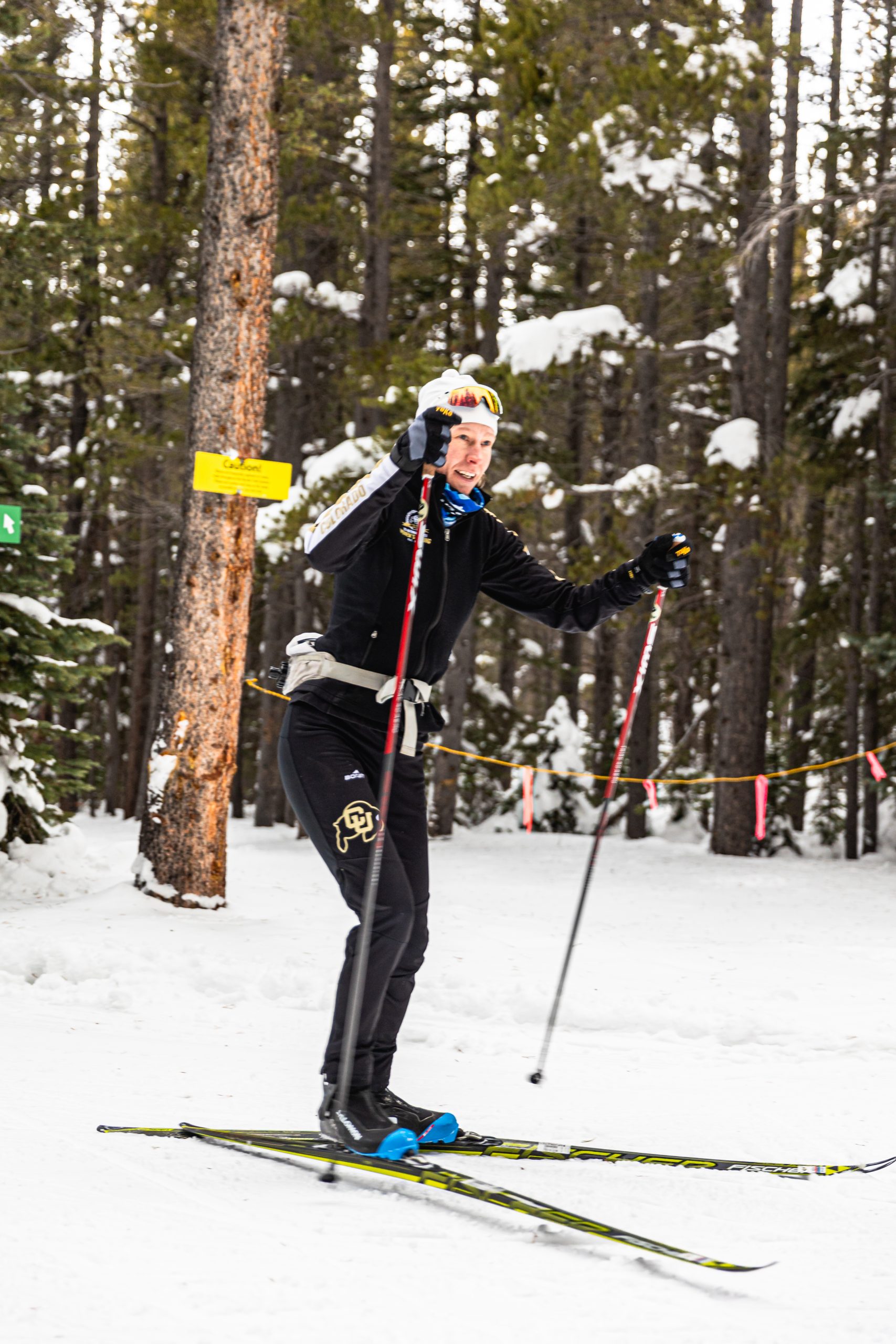
    Jana Weinberger has been Head Nordic Coach at Colorado University since 2019. (Photo: University of Colorado)

    FasterSkier: NCAAs was an impressive showing for CU last year. How are you planning on harnessing the energy from your win into this upcoming season?

    Jana Weinberger: Last year was great for us. Before last season, we had not won a meet in a couple of years. So as the season was going on, as we won some meets, I think athletes started believing that we could actually win as a team. [At NCAAs] it was so much fun just to see them finish, and how excited they were when they found out we won. I think that energy is carrying into this year as well. Just this excitement and a motivation to work hard through the summer…they have more confidence now.
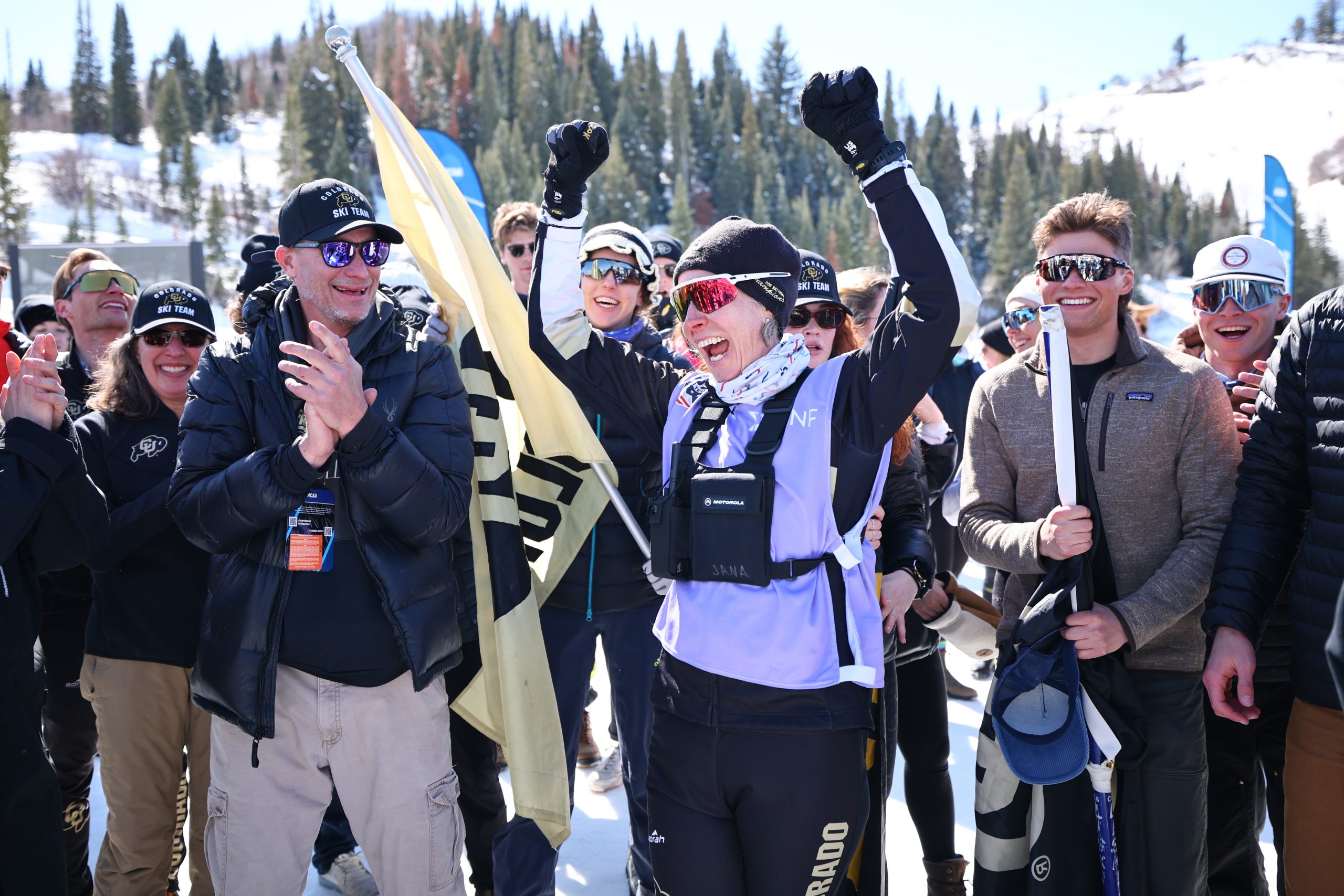
    Athletes celebrate after the 2024 NCAA win. (Photo: University of Colorado)

    FasterSkier: How is that energy showing up at practice each day?

    Jana Weinberger: All the cards are on the table, but we also realize that we start from zero this year. Nothing from last year carries over, we have to start building the team up and building individuals up. It’s a new season and we are ready for it.

    FasterSkier: Who are your key returners? Any new talent on the team this season?

    Jana Weinberger: Our main returner for women is Hanna Abrahamson. Last year she struggled with some injuries but was still able to ski top 10 for us at NCAAs. I expect she’s going to be very good this year. [Next], our transfer student from MSU, Tilde Bångman. She had a very strong season last year and she’s looking strong this year. Karolina Kaleta, from Poland, is a senior this year and had a very good summer of training so I’m excited to see what she can do. Our incoming girl Astri Lunde – it would be exciting for me to see what she’s going to do against the college girls. 

    For the men, it’s hard to lose Magnus Boee, who was great for us last year. Will Koch, a senior this year, has been training well and I think he’s in the best shape so far of his five years here. Johannes Flaaten, Hugo Hinkfuss, Luka Riley, Zander Maruer, Trey Jones – they’ve been training very well. All of them could be part of our NCAA team. It just depends who we pick. 

    FasterSkier: Can you talk a little more about your team – how do the athletes work together and push themselves?

    Jana Weinberger: I think one of the strengths of our team is that we all gather under one flag – University of Colorado, Boulder Buffaloes. When we go out there and race RMISA races, we go and represent one entity. All the athletes are excited and proud to be Buffaloes, and that kind of mentality is great for them to feel like they belong to something. We are a very close team. We travel together and stay in the same house, cook together, watch movies together, and watch World Cup ski races together.
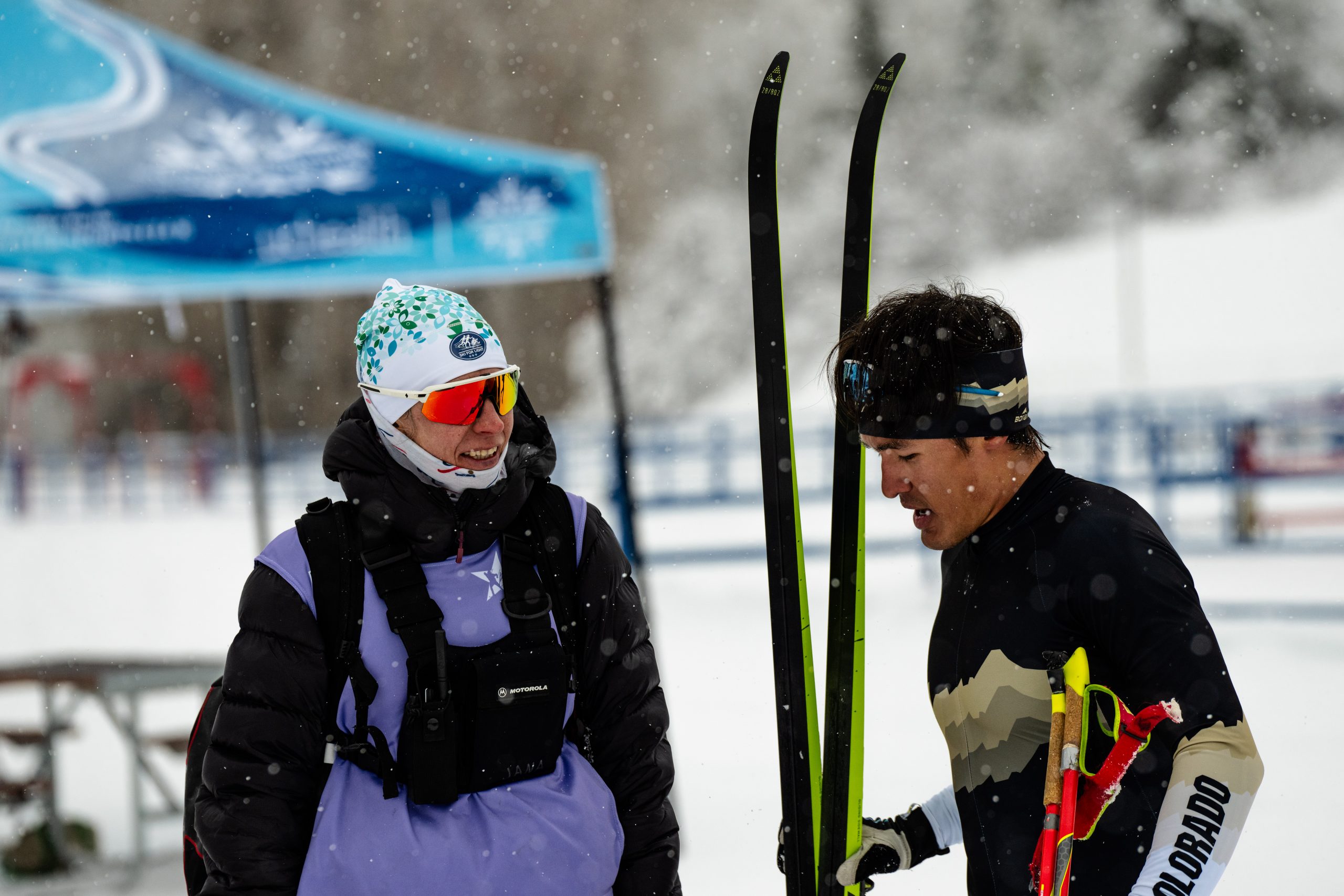
    Chatting with Magnus Boee after the race. (Photo: University of Colorado)

    FasterSkier: I’m curious if there is a workout or technique you were focusing on with the team this fall?

    Jana Weinberger: Fall workouts are very important. That’s where we try to build a base so we can build the rest of the season on top of it. You cannot build on a weak foundation. I expect athletes to show up here in the fall in shape, ready to work. We start out with L3 intensity 2-3 times a week. Later in the fall we add some L4 intensity. It is very important to keep your L3 intensity L3 and not go over. That’s one of the things I have athletes be very conscious of. We are lucky enough to be one of the schools that has a roller ski treadmill, and it’s a great tool to find your [lactate threshold] levels. We do [lactate threshold] testing once every one or two months, so athletes feel confident in their numbers. That’s the main mistake, athletes go way too hard doing L3 workouts. If you overdo it, you’re not recovered enough, and you cannot push your body where it needs to be pushed for the next workout. 

    FasterSkier: I think that’s great, especially having the science and data behind the numbers to back it up.

    Jana Weinberger: I think it’s important to educate the athletes as well as to why we do things the way we do. Why are we going L3, why are we going L4? What happens with your body when you’re going L3, what does it mean when I’m at my threshold? The more they know, the more they believe in the system of what we do. Then it’s not just the coach telling you, it’s about educating athletes too. So they can start thinking more about their training. [I ask], What are the workouts that make you better? Pay attention to what works for you and what doesn’t work for you. Let’s not do the things that don’t work for you! This way [the athletes] have more ownership in what they do. When they do well, they feel more pride in what they’ve done.
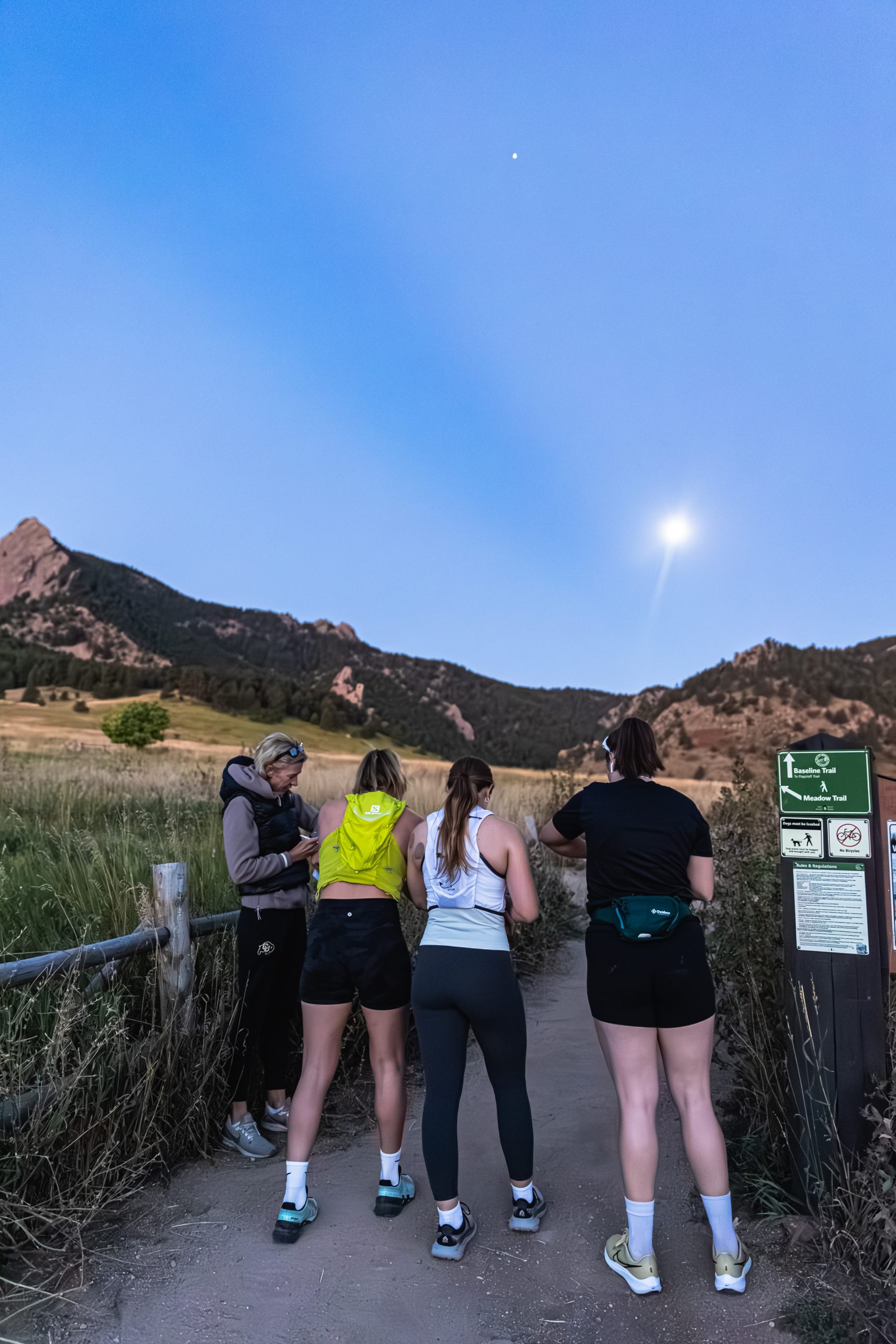
    Fall training in the mountains. (Photo: University of Colorado)

    FasterSkier: What is one key workout or type of training that you are focusing on during early-season on snow training? 

    Jana Weinberger: When we first get on snow, we just try and get some volume in. We try to ski without poles more, work on our technique and work on our kick, getting back to basics. We try to get some good hours in and build a ski base for the rest of the ski season. 

    FasterSkier: Do you think men and women’s bodies differ in absorbing training?

    Jana Weinberger: I always think men and women can do the same things. I don’t think gender really plays a role in it. But I do realize that males and females are different, so I think they need to be coached differently. I think age and development plays more of a part in training than whether you’re a female or male. I have different options for athletes when we do intervals. I separate them more by [age] – freshmen and sophomores do a little less, juniors and seniors do a little more. I think females can do anything they can put their mind to. 
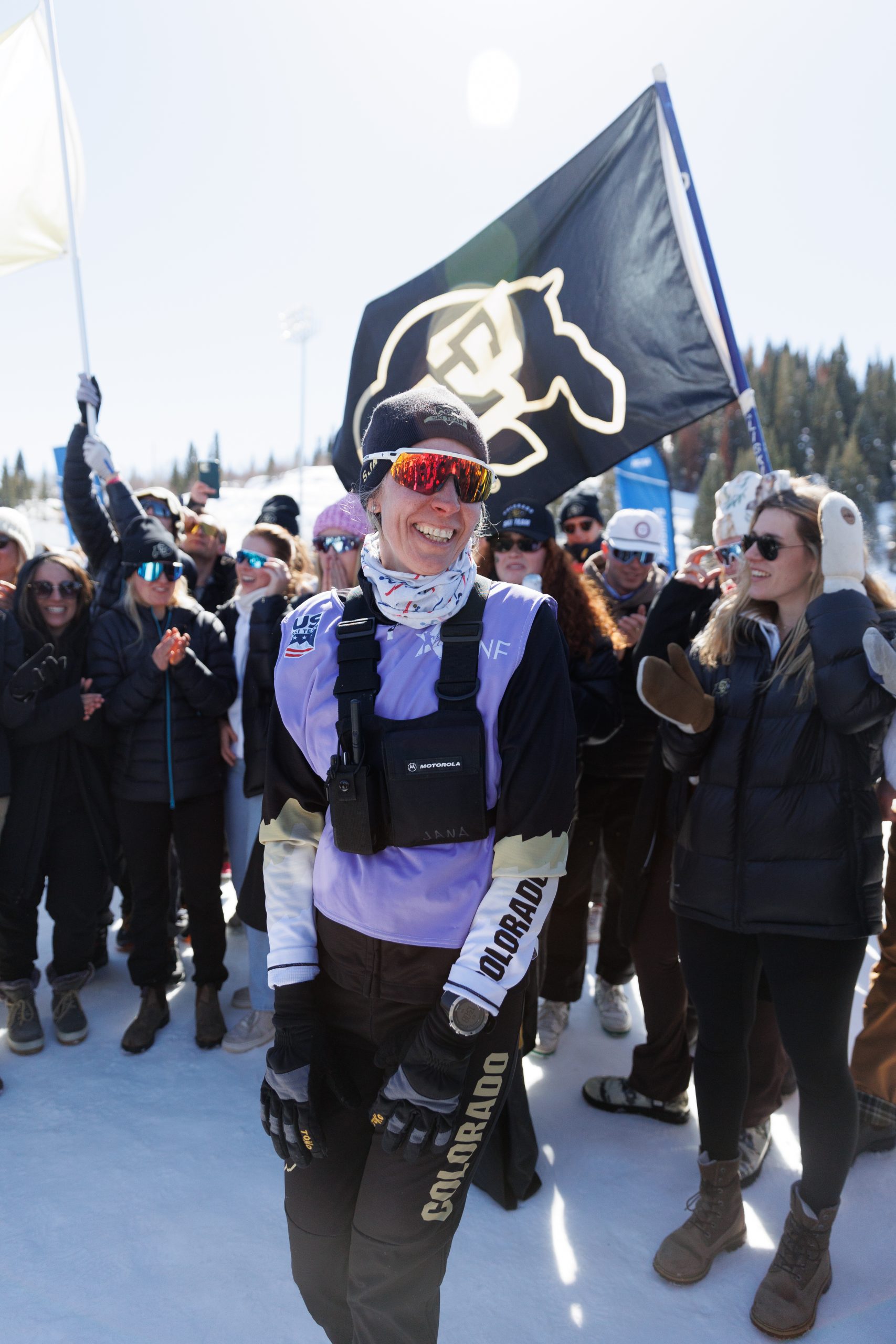
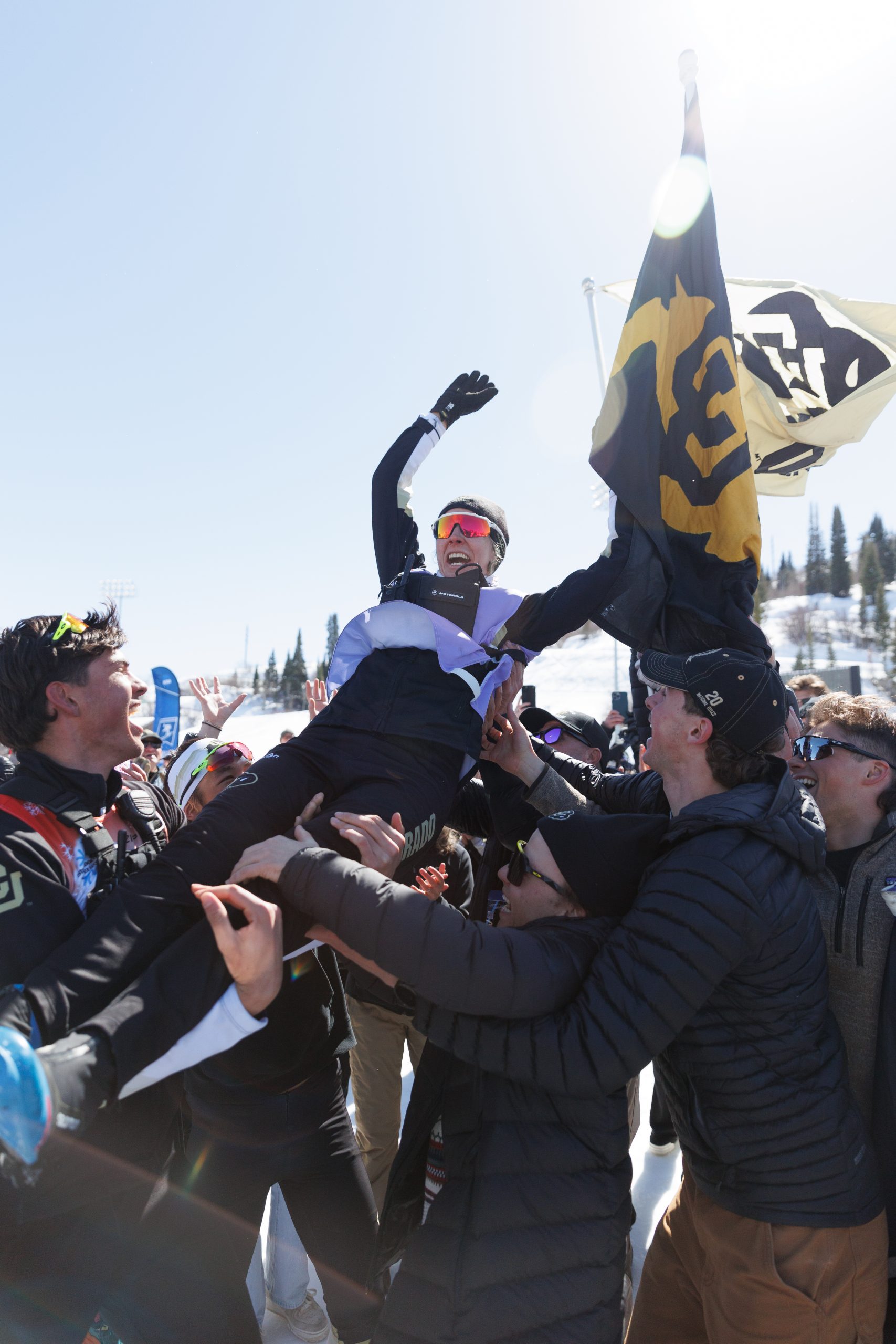
    Celebrating after the NCAA win. (Photo: University of Colorado)

    FasterSkier: As one of very few women to have won an NCAA championship in Nordic Skiing, can you speak to your experience as a woman in this male-dominated field? 

    Jana Weinberger:  Overall, I love the RMISA coaching circuit. Everybody is respectful, and it’s a good environment for women to grow as coaches. I just do my job. I go to work, and I love it. I do it to my best abilities. I don’t really think too much about it, whether I’m a female or male. I think if we do our jobs well it doesn’t really matter.

    I think the U.S. Ski team has done a great job with their programs empowering women for coaching and waxing, where they take selected women to the World Cup to get experience. I think that’s great. I think that’s how we learn, just by experience, by doing it. If you’re never getting the chance to do things then you never learn. 

    I would encourage women to apply for jobs that might feel unattainable. It might be scary but challenges are good, they help us grow as a person and as a professional. There are people around you who want you to succeed and asking for help or advice is not a sign of weakness. I think it shows passion and ability to learn and grow.
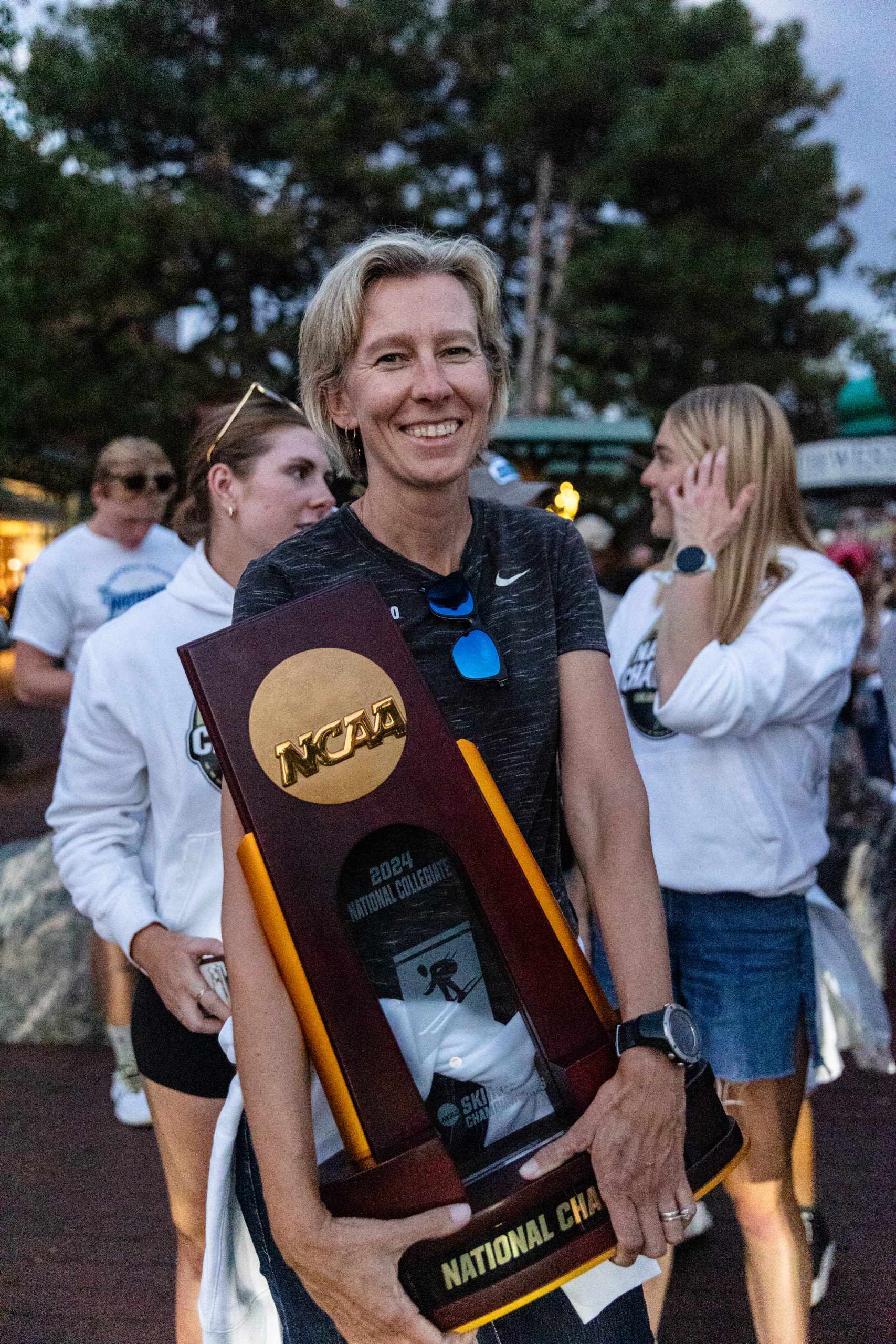
    Holding the 2024 NCAA Skiing Championship trophy. (Photo: University of Colorado)

    Follow Coach Weinberger and the CU Buffaloes as they start their season at the U.S. National Championships in Anchorage on January 2nd


  • Slind Claims First-Ever World Cup Victory – Diggins and Brennan Finish Seventh and Eighth

    Slind Claims First-Ever World Cup Victory – Diggins and Brennan Finish Seventh and Eighth

    This coverage is made possible through the generous support of Marty and Kathy Hall and A Hall Mark of Excellence Award. To learn more about A Hall Mark of Excellence Award, or to learn how you can support FasterSkier’s coverage, please contact info@fasterskier.com.

    As cowbells and horn music echoed through the course, the women’s 20 k classic marked the final competition before athletes enjoy a brief rest ahead of the Tour de Ski later this month. However, the start list for today’s race was missing several notable names, hinting that some top competitors may still be opting for a conservative start to this World Championships season.

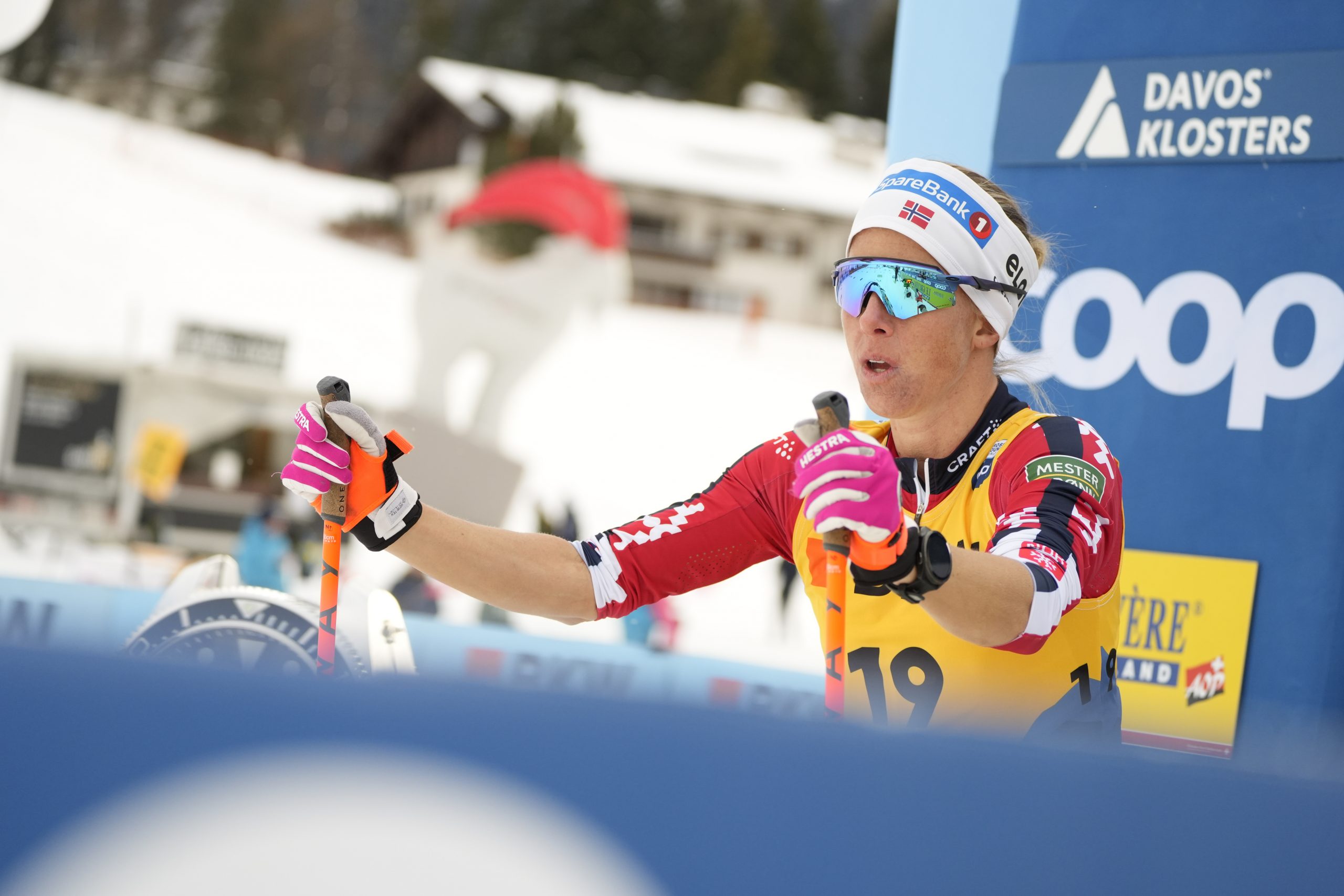
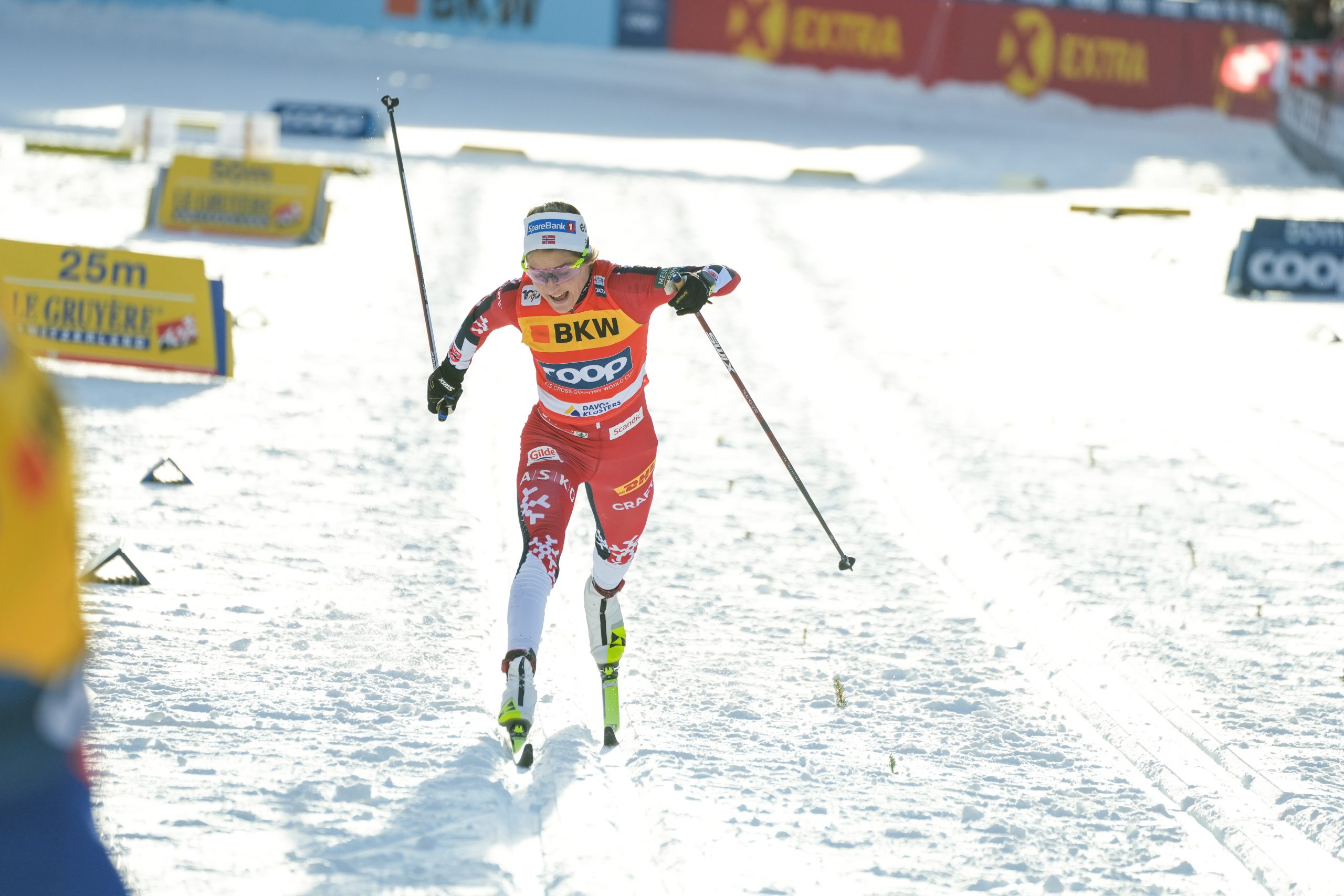
    Astrid Oeyre Slind (NOR) earned her first-ever World Cup victory. (Photo: NordicFocus)

    Many had written off the top position on the podium as an easy win for Therese Johaug (NOR), a skier renowned for her dominance in distance events and current leader of the distance standings. With key Swedish athletes like Frida Karlsson, Ebba Andersson, Linn Svahn, and Jonna Sundling sitting out, as well as Heidi Weng (NOR), the start list for today’s competition was shorter than usual. 

    This created an opportunity for others to challenge for the podium. On the final day of the Davos World Cup, it became evident who was feeling the effects of the weekend’s racing. With many top athletes strategically opting to skip Friday and Saturday’s sprint competitions, tired legs certainly played a role in today’s performances.

    Victoria Carl (GER), Astrid Oeyre Slind (NOR), Krista Parmakoski (FIN), Kerttu Niskanen (FIN), Kristin Austgulen Fosnaes (NOR), Katharina Hennig (GER), and Teresa Stadlober (AUT), who have all achieved consistent top-15 results in distance events this season, were waiting for an opportunity to advance onto the podium. Perhaps having known this, none of these athletes started Saturday’s sprint. For Americans Jessie Diggins and Rosie Brennan, who competed in both the sprint qualifier and heats yesterday, the additional fatigue may have posed a slight disadvantage.

    The podium was largely decided from the outset of today’s competition, as Johaug, Slind, and Niskanen established an early lead that steadily grew throughout the race. Johaug led through most intermediate checkpoints but began losing ground after the 16.5 k checkpoint. Slind, meanwhile, maintained her momentum and accelerated through the final kilometers to secure her first-ever World Cup victory, finishing 10.1 seconds ahead of Niskanen. Johaug crossed the line in third, 13.5 seconds behind Slind. 

    Diggins and Brennan skied comfortably, finishing 7th and 8th, respectively, to secure spots in the top-10. Other American finishers included Sydney Palmer-Leger in 28th, Haley Brewster in 35th, and Alayna Sonnesyn in 37th. Canada’s Katherine Stewart-Jones also skied to a 22nd place finish.

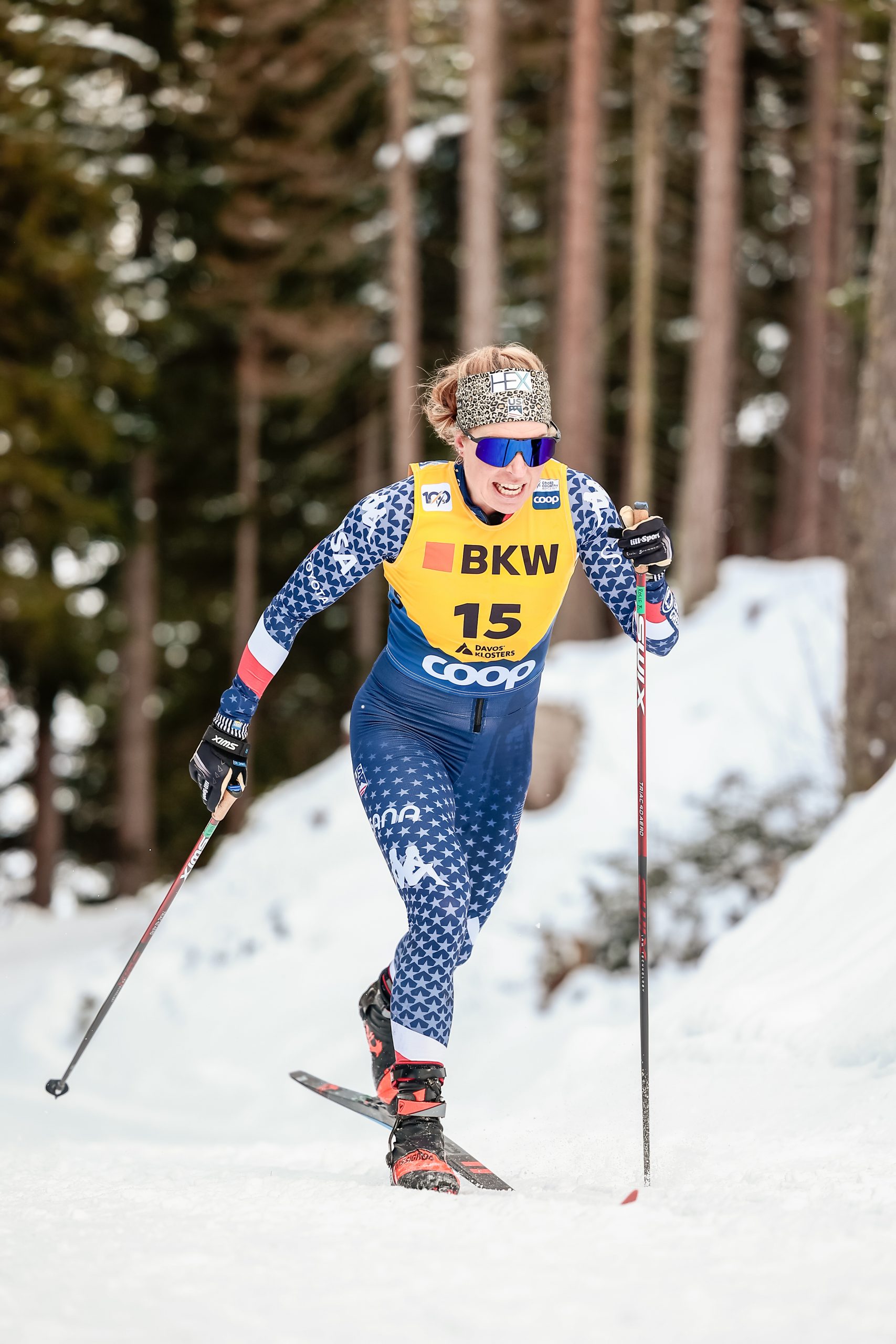
    Rosie Brennan (USA) skied a strong and consistent race, finishing 8th overall (Photo: NordicFocus)

    “Today, I definitely wanted to just feel like I was in the race, and able to push when I wanted to and hold pace throughout,” Brennan shared following the competition. “I feel when I am racing at my best, that puts me in the fight.” 

    As Team USA eases into the season, these early races may highlight room for improvement, especially given the team’s recent transition to on-snow training. “I don’t think I was quite there today,” Brennan reflected, “but it was definitely a step in the right direction for me. I felt a bit more open and able to ski the way I wanted to and find some ability to push a bit out there. I think I’m still missing that top end that will hopefully bring me closer to where I want to be, but all you can ask for is a step in the right direction.”


    Women’s 20 k Classic Individual Start

    While Johaug was a strong favorite entering the competition, the other podium spots were open for new names to step up today, with some of the strongest World Cup distance skiers missing from the start list. Early starters Niskanen, Slind, Brennan, and Hennig maintained similar splits through the first five kilometers, with Niskanen and Slind gradually pulling away to build a steady lead over the others. By the 9.3 k checkpoint, Niskanen and Slind had established a commanding 45 second advantage over Brennan and Hennig, positioning themselves as clear contenders for the podium. 

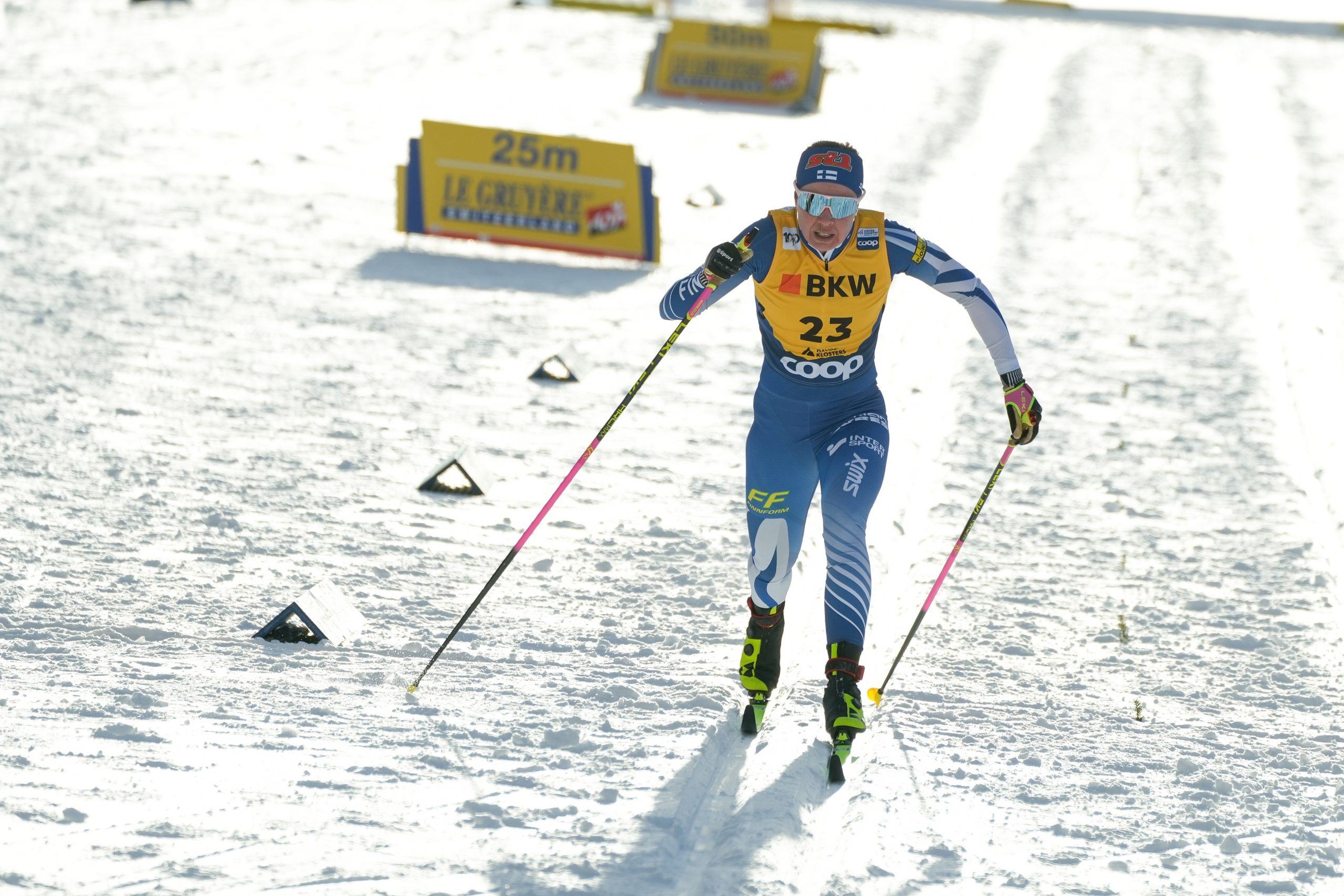
    Kerttu Niskanen (FIN) delivered an impressive performance, posting strong splits that secured her a second-place finish on the podium. (Photo: NordicFocus)

    In many ways, the podium positions were already decided within the first few kilometers of the race. The early lead by Niskanen and Slind, combined with Johaug’s well-established strength in distance events, solidified the trio as podium contenders. By the second half of the competition, it was clear that the podium was out of reach for the chasing pack. At the 16.5 k checkpoint, Slind, Niskanen, and Johaug held a lead of more than 30 seconds over Carl and Parmakoski, and a 1.5-minute lead over early contenders Brennan and Hennig. 

    The specific order on the podium remained uncertain until the final moments of the race. While Johaug may have dominated this competition two years ago, her return this season left more to be decided. Though she established an early lead through the initial checkpoints, Niskanen also positioned herself as a strong contender in the middle kilometers. Only second to Johaug, Niskanen’s lead over Slind grew to 7 seconds around the 12.4 kilometer checkpoint. 

    Between 14 and 16 kilometers, Slind shifted into high gear, steadily closing the gap on Niskanen and ultimately overtaking her. From there, Slind continued to build her lead through the final kilometers of the competition.

    Spectators held their breath through the final kilometers of the day, watching Johaug’s narrow lead over Slind dwindle. By the 16.5-kilometer checkpoint, Johaug was just 1 second ahead, a margin that shrank to 0.5 seconds by 18.5 kilometers. In the final stretch, Johaug couldn’t maintain her pace, dropping back to finish 13.5 seconds behind Slind and 10.1 seconds behind Niskanen, settling for third place. 

    Therese Johaug (NOR), adorned in the red bib as the reigning distance leader, struggled to maintain her dominance in today’s race, fading in the final kilometers to finish third. (Photo: NordicFocus)

    With Johaug out of the way, Slind skied to her first-ever World Cup victory after 59 race starts and five podiums.  “I can’t really believe it,” Slind shared following the race. “I never thought this would happen and at least not when Therese is back in the start. I thought I was fighting for second place the whole time and suddenly I realized this could be a win. I don’t know what to say.”

    Outside the podium, positions in the top-10 saw more movement throughout the competition. Carl had a strong start, achieving some of the fastest splits early in the race. An exciting battle unfolded between Carl and Johaug in the opening kilometers, with Johaug leading by 3.2 seconds at the first checkpoint before Carl reclaimed the advantage by the 4.2-kilometer mark, edging ahead by 1.1 seconds.

    As the race progressed, Johaug extended her lead over Carl, who contended for a position in the top-5 against Parmakoski. However, Carl began to fall off the pace around the 15-kilometer mark and ultimately dropped back during the final lap. In the end, Parmakoski skied to a 4th place finish and Carl followed closely behind in 5th. 

    Teammates Diggins and Brennan joined Carl in the battle for top-5 positions. Diggins posted strong splits early in the race but appeared to be fading by the 16-kilometer checkpoint. As one of the few top-athletes who competed in all three competitions this weekend, including all three sprint heats, it’s likely this may have been one of the few occasions in which Diggins ran out of steam. Brennan with strong splits throughout, maintaining her position in the top-10. “I was happy with my pacing, I held very consistent through the whole race which is always a good thing,” Brennan shared with FasterSkier. 


    Results from the Davos women’s 20 k classic individual start

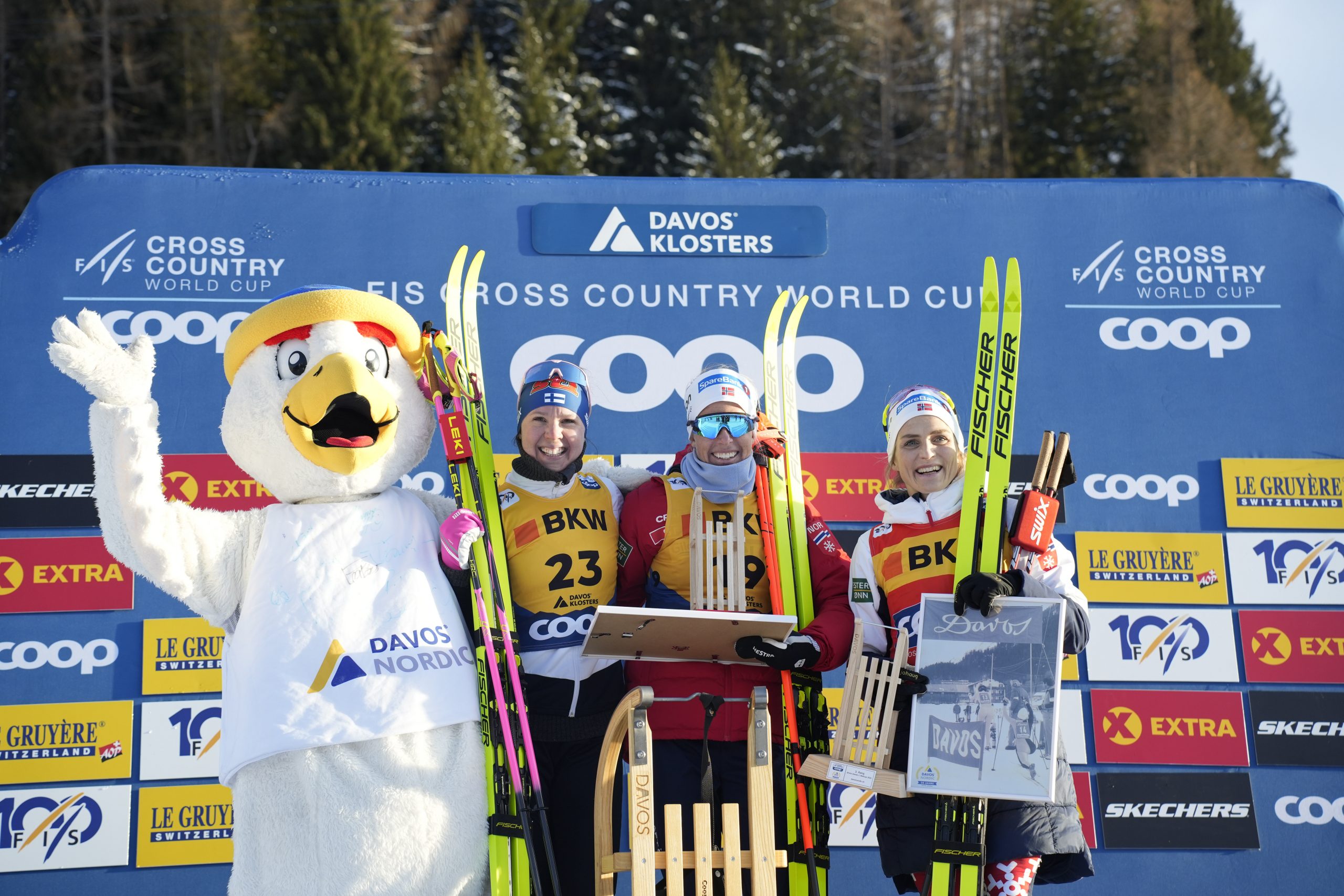
    Kerttu Niskanen (FIN), Astrid Oeyre Slind (NOR), and Therese Johaug (NOR) claimed the podium in the Davos women’s 20 k classic individual start race. (Photo: NordicFocus)
  • Nyenget Tops International Podium in Davos 20 k Classic

    Nyenget Tops International Podium in Davos 20 k Classic

    A_Hall_Mark_of_Excellence_Award-logo-300.png (300×244)This coverage is made possible through the generous support of Marty and Kathy Hall and A Hall Mark of Excellence Award. To learn more about A Hall Mark of Excellence Award, or to learn how you can support FasterSkier’s coverage, please contact info@fasterskier.com

    Seated in Davos’ sled-shaped leader’s chair, Martin Loewstroem Nyenget (NOR) appeared well satisfied with his remarkable effort in the 20 k Classic. (Photo: Vanzetta/NordicFocus)

    World Cup Nordic skiing can seem like it’s become fairly predictable: the Swedish team dominates the Women’s Sprints, Johannes Hoesflot Klaebo (NOR) is unbeatable in the Men’s Sprints, and Therese Johaug (NOR) routinely crushes the Women’s distance field. The only events offering even an inkling of suspense in regard to the eventual winners are Men’s distance races. Each week on the World Cup schedule, at least one distance race is staged: Klaebo always hopes to contend, but his own teammates routinely put his feet to the fire. Harald Oestberg Amundsen (NOR) is defending World Cup Overall champion, and he’s begun this year very much the same way he began last year. Simen Hegstad Krueger (NOR) is a World Champion and Olympic Champion—he’s always dangerous. And there are a bunch of Norwegian youngsters vying impatiently for their spot on the podium: the top guys can’t hold off those young bucks forever. Among non-Norwegians, only the brilliant Finnish Classic specialist, Iivo Niskanen, is typically positioned to interrupt the Norwegian team.

    In Davos, the world’s best Nordic skiers found themselves facing a unique and definable challenge: altitude. The elevation of the top step of the Davos’ Town Hall is 5,118 feet (roughly the same as Denver, Colorado). Even well trained athletes will find themselves out of breath at the top of the flight of stairs in Davos. It’s not enormously high elevation, but it’s more than enough to affect the results of a daunting race like the 20 k Classic. Nordic skiers find that it’s far more difficult to recover at altitude, far more likely that an athlete may stray into oxygen debt (and the accompanying flood of lactate) at altitude. If a skier makes such a mistake, their race is likely over; however, if athletes don’t push that envelope, their chances of victory are pretty low. It’s a risky business, this racing at altitude. Davos is where those bets get made, and where the deck that seems so familiar in the game can find itself getting re-shuffled.

    Today in Davos, Niskanen found himself upended by a hard-charging Martin Loewstroem Nyenget (NOR). Just behind them in third was a frothing and resplendent Hugo Lapalus (FRA).

    “It was a fight,” Nyenget said in post-race interviews. “But I managed to stay at the same pace during the whole race, I think. So I’m really happy about the performance.”

    Among Americans, Gus Schmacher finished 19th, Zanden McMullen 30th, Ben Ogden 40th, Zak Ketterson 42nd, Hunter Wonders 50th, Michael Earnhart 58th. Canadian finishers included Antoine Cyr 32nd, Xavier McKeever 53rd, Olivier Leveille 56th.

    “My fatigue isn’t too bad,” said Schumacher. “Skipping the Team Sprint was good for me. I know some people who did that are feeling pretty beat up today. We’ve got a good break, and should set us up well for the Tour.”

    “I’d say I’m definitely tired from all the races in period 1,” shared McMullen, “But I’m excited for some rest and training at altitude before the Tour.”

    Martin Loewstroem Nyenget (NOR) racing alone on Davos’ 20 k Classic course. Sunday’s race was a bit of a throw back to an earlier age of World Cup skiing when long distances were the norm, and almost all races were interval starts. (Photo: Modica/NordicFocus)
    Men’s 20 k Classic Interval Start

    Courses in Davos change more often than many on the World Cup circuit, and Sunday’s 20 k was no exception. New this year, racers would race across three seven kilometer laps harkening back to an earlier age of ski racing when spectators caught fleeting glimpses of racers striding through the tress. Additional old-fashioned challenges faced the racers: temperatures approached the freezing point; at start time the Classic tracks were slowly covering with freshly falling snow. Wax techs would’ve been busy in the morning’s pre-race hours, though the falling snow would cease midway through the race. Then the challenge became the re-appearance of a bright sun, and subsequent stark shadows crossing the course: glide affected, kick affected.

    Klaebo was the 54th starter, taking to the trails just two minutes behind Amundsen, his closest rival in the chase in the World Cup overall standings. Klaebo would receive a fair amount of information during his race, but his three-race weekend may have drained him. Klaebo never looked sharp, though on this long and difficult day he was not the only one.

    Lunging at the finish line, Martin Loewstroem Nyenget (NOR) left no doubt of his dominance in Davos 20 k Classic Interval Start. Iivo Niskanen (FIN) was a later starter—and pre-race favorite—but even Niskanen’s best efforts would not allow him to overtake Nyenget. (Photo:  Vanzetta/NordicFocus)

    Niskanen started behind Nyenget and received all available information about the Norwegian’s progress. Nevertheless, Niskanen found himself powerless to overcome Nyenget who topped mid-race time checks and carried those margins on to victory.

    Niskanen swerved across the finish line, already headed to a fist-bump with  Nyenget in the leader’s chair. Niskanen paused not at all in the finishing area, suggesting his disappointment at surrendering the win to a rival.

    Hugo Lapalus (FRA) was thrilled with his third place finish. With medalists from Norway, Finland, and France, Davos’ 20 k Classic was the most internationally diverse Men’s distance podiums thus far in the World Cup season. (Photo: Modica/NordicFocus)

    Hugo Lapalus showed great heart throughout the day, his tempo always crisp, his technique always light on his way to third place.

    Following his victory a week ago in the 10 k Freestyle in Lillehammer, Nyenget is establishing himself as a skier who can truly challenge for significant World Cup wins. His victory last year in the Holmenkollen 50 k Classic hinted at his great potential in distance racing. His winning performance here at the end of Period 1 only serves to confirm that potential. It was a sweet victory for Nyenget who also took over the lead in the World Cup distance standings.

    “I really hope to do as much distances in the World Championships as possible,” Nyenget said. “So this was a really good day to get a good result.”

    The Davos 20 k Classic Interval Start delivered a fine effort and an impressive result for Thomas Maloney Westgaard (IRL) who raced his way into the typically Norwegian-crowded top ten. (Photo:  Modica/NordicFocus)

    Norway may have continued to be the dominant force in distance skiing, but Norway’s five finishers in the top ten also were forced to make room for a wonderful eighth place finish for Ireland’s Thomas Maloney Westgaard. The deck is being re-shuffled, indeed.

    Finishing fifth, Klaebo did manage to win a round in the season-long fight with Amundsen who finished in sixth. Their rivalry appears likely to continue when the World Cup returns on December 27.

    Many members of the Stifel US Ski Team will remain in Davos over the upcoming holiday for a bit of well-earned rest and a re-start to their mid-season training.

    “I think I haven’t quite been racing to my full fitness level yet and have some things to figure out performance wise before the next period,” said McMullen. “Christmas time will be the perfect opportunity to dial things in before the Tour with mostly distance training to absorb these last few race weekends.”

    “We were a little up and down through the Period,” said Schumacher. “Maybe having some off days with some skis that made it look maybe a little rougher than it was . . . In general, it wasn’t too bad, and we did have great ski days, too. We’re definitely looking forward to some more racing in a couple weeks.”

    Men’s 20 k Classic Interval Start RESULTS

    15.12.2024, Davos, Switzerland (SUI):
    Iivo Niskanen (FIN), Harald Oestberg Amundsen (NOR), Hugo Lapalus (FRA) celebrate podium performances in the 20 k Classic Interval Start in Davos . (Photo: Vanzetta/NordicFocus)
  • Klaebo wins again in Davos while Ogden, Schumacher and Young lead the way for Team USA

    Klaebo wins again in Davos while Ogden, Schumacher and Young lead the way for Team USA

    This coverage is made possible through the generous support of Marty and Kathy Hall and A Hall Mark of Excellence Award. To learn more about A Hall Mark of Excellence Award, or to learn how you can support FasterSkier’s coverage, please contact info@fasterskier.com.

    With the winter solstice approaching, much of Period 1 racing takes place under the cover of darkness, and tonight was no exception. Stadium lights illuminated the snow-covered tracks while fiery bursts from barrels lit up the final turn. Under falling snow and hazy conditions, racers sped around the two-lap course, vying for the inside position on the corners and strategically surpassing fellow racers to cross the line in a qualifying position. 

    Ben Ogden (USA) made it to the finals finishing sixth. (Photo: NordicFocus)

    Following Friday’s team sprint—one of the most demanding disciplines of the World Cup season—racers returned to the start line this evening for another freestyle sprint in Davos, Switzerland. While many athletes arrived at the start line with sore legs from yesterday, some athletes hoping to have a strong performance in today’s sprint notably sat out. Only three of the 12 semifinalists in today’s sprint had competed in Friday’s competition. 

    Johannes Hoesflot Klaebo (NOR) leading his semifinal heat with Lucas Chanavat (FRA) and Ben Odgen (USA) trailing behind. (Photo: NordicFocus)

    If you caught FasterSkier’s report on last week’s freestyle sprint in Lillehammer, Norway, today’s results may not come as a surprise. Once again, Johannes Hoesflot Klaebo (NOR) delivered a masterclass performance, taking the top spot of the podium in the most predictable way and earning his 52nd sprint victory. Sprint specialists Lucas Chanavat of France and Erik Valnes of Norway rounded out the podium in second and third.

    Sprint racing is as much about strategy as it is about speed. With six athletes on the start line and just three minutes to prove themselves, any mistake can cost an athlete the race. Any stumble can lose competitors their position – Norway’s Haavard Solaas Taugboel learned this the hard way after tripping over a pole in the quarterfinals. Similarly, a failed strategy or inability to move into a key position can eliminate even the strongest contenders, as seen with Federico Pellegrino (ITA), who missed his chance to defend his podium from last weekend. These high stakes are what make sprint racing so exciting: it’s a discipline where even the most experienced athletes can stumble and the podium positions are passed around each weekend – well perhaps the second and third positions are. 

    “It was amazing, so much fun racing here,” Klaebo reported, still breathing hard from the final sprint. “It was better than I expected. I was not lucky enough to join last year, so coming back this year and seeing the spectators and the atmosphere here is amazing.” 

    Jack Young (USA) raced to a 12th place finish in the Davos freestyle sprint. (Photo: NordicFocus)
    Jack Young (USA) raced to a 12th place finish in the Davos freestyle sprint. (Photo: NordicFocus)

    Jack Young out of Jay, VT finished with his second best freestyle sprint result of 12th place, after starting only his fifth World Cup today. This followed only his World Cup debut in the Canmore freestyle sprint last February, where he finished 23rd. Young shared, “It’s really hard to get better at World Cup level sprint heats without simply racing them and learning from them. I feel more confident and competitive than I came in feeling, and I hope to carry this energy into the rest of the year.” 

    The Americans had strong results with four athletes advancing into the heats. Ben Ogden (6) and Jack Young (12) advanced as they had in the same discipline last weekend, and were joined by teammates Gus Schumacher (11) and JC Schoonmaker (16). 

    Other American finishers included Michael Earnhart (43), Kevin Bolger (49), Zak Ketterson (50). Canadian skiers Sasha Masson (52) and Pierre Grall-Johnson (65) also finished today’s sprint competition. 


    Freestyle Sprint Quarterfinals

    Heat 1 of the Davos quarterfinals featured a stacked lineup with Norway’s Johannes Hoesflot Klaebo, France’s sprint specialist Lucas Chanavat, and USA’s Ben Ogden. Ogden took an aggressive lead from the start, with Chanavat and Klaebo maintaining their position on either side of him through much of the race. Looking smooth and composed on the second climb, Ogden maintained his position despite Klaebo trailing closely behind. Heading into the finishing stretch, Chanavat and Klaebo overtook Ogden on either side, securing first and second place finishes. Ogden and his teammate Young, who finished close behind in third and fourth, clocked the two fastest times of the day (two full seconds ahead of the fastest qualifying time), comfortably earning advancement as lucky losers. 

    Left to right: Jack Young (USA), Lucas Chanavat (FRA), Johannes Hoesflot Klaebo (NOR), and Bed Ogden (USA) on the final descent before earning the fastest times of the day in their quarterfinal heat. (Photo: NordicFocus)

    “Headed into the quarterfinal, I was really excited,” Young told FasterSkier. “It seemed clear that the only way through was to hammer from the gun. Because of this, I had a really clear way I wanted to ski the heat – go out hard and just keep hammering.”

    Ben Ogden also surprised spectators today with a new strategy for the heats: hammering out of the start to establish an early lead. “Originally when I selected heat one, I figured it would be only Klaebo of the people who qualified above me, but then when Chanavat went in there I knew that my only hope was to go hard and make sure it was a lucky loser heat,” Ogden shared following the competition. 

    In quarterfinal 2, Finland’s Lauri Vuorinen took an early lead, racing alongside Vili Crv (SLO) through the first lap. Italy’s Federico Pellegrino, positioned at the back for much of the heat, tried to make a move on the second ascent, taking the lead alongside Norway’s Even Northug headed into the final stretch. However, a last-second and speedy come-back from Richard Jouve (FRA) across the line eliminated Pellegrino from advancing into the semifinal heats. 

    Sweden’s Edvin Anger boldly took the lead in quarterfinal 3, setting the pace for much of the race. Joined by teammate Marcus Grate at the front, the pair raced to defend Sweden’s strong sprinting record. Ultimately, Matz William Jenssen (NOR) outsprinted Grate to secure a spot in the semifinals alongside Anger. 

    In quarterfinal 4, China’s Qiang Wang established an early lead for the entire first lap. Approaching the second ascent, Haavard Solaas Taugboel (NOR) went to pass on the outside of the trail, but tripped over Wang’s pole, bringing him to fall into the side banner. This mishap allowed USA’s JC Schoonmaker to pull ahead through the final descent. Sprinting head-to-head, Schoonmaker finished in a three-way photo finish against Alexander Elde Holmboe (NOR) and Erik Valnes (NOR), just barely being eliminated. 

    In the final quarterfinal, Gus Schumacher (USA) found himself edged to the back out of the pack out of the starting stretch as Norway’s Harald Oestberg Amundsen (NOR) took the lead up the first ascent. Alongside Finland’s Niilo Moilanen, Amundsen controlled the pace through much of the race. Schumacher steadily worked his way towards the front of the competition, unleashing a strong push on the final climb to challenge for the second spot. In a dramatic finish, Schumacher outpaced Moilanen, Michael Hellweger (ITA), and Jan Stoelben (GER) to take second place and advance to the semifinals.

    Left to right: Niilo Moilanen (FIN), Jan Stoelben (GER), and Gus Schumacher (USA) in the final sprint to the finish line. (Photo: NordicFocus)

    “I wasn’t in a super ideal position,” Schumacher shared when reflecting upon his position into this final sprint, “but I’ve been doing well carrying speed out of the corner and I think I did a pretty good job again. It was super fun to feel like I had momentum against those guys in the final sprint and go through a quarterfinal based on a strong last 500 meters which is not generally my strong suit. It definitely opens a lot of doors when you can do that.”

    With Ogden and Young securing the lucky loser spots, Team USA advanced three athletes to the semifinals: Ogden, Young, and Schumacher.


    Freestyle Sprint Semifinals

    Young faced another highly competitive heat in the semifinal, lining up against Klaebo, Anger, Jouve, Chanavat, and Northug. Starting on the outside, Young came out strong, vying for the front position against Klaebo and Chanavat on the first climb. The pair repeated their performance from the quarterfinal, working in tandem (almost as if it had been planned) to control the pace through both laps and to advance to the finals in the first two positions. 

    Young was beaming after finishing only his 5th World Cup. “Moving onto the semi, I knew I had to do the same thing (hammer from the gun) if I wanted to get through, but I ran out of gas,” Young shared. “I’m not exactly surprised; my quarterfinal was quite taxing!” 

    The second semifinal was a Norway-versus-USA showdown. Ogden and Schumacher lined up against four Norwegian sprinters: Valnes, Amundsen, Jenssen, and Holmboe. Once again, Ogden wasted no time asserting himself at the front, demonstrating his bold strategy. Controlling the pace early, he even managed to open a small lead over the first hill. Meanwhile, the Norwegian skiers worked together as a tightly coordinated pack, sitting just behind Ogden. Coming out of the final descent into the finishing stretch, Ogden led the charge before he was overtaken in the final meters by the Norwegians, ultimately finishing in fourth. 

    Ben Ogden (USA), front, leading the charge against Norway in the semifinals (Photo: NordicFocus)

    However, his impressive performance and fast time earned him a spot in the final as a lucky loser yet again. After the race, Ogden shared that he approached the semifinal with the same strategy as the quarterfinal, explaining, “I saw that the first semi was five seconds slower, and Gus and I were in the same heat, so I knew it was time to employ the same strategy.”


    Freestyle Sprint Final

    In the final, for the third time today, Klaebo and Chanavat took an early lead together, battling for the top spot on the podium. The race followed a familiar script for Klaebo: sitting in behind Chanavat until he found the perfect moment to break free, overtaking on the final downhill. Carrying his momentum into the finishing stretch, Klaebo, the favorite heading into the day, claimed a comfortable victory, with Chanavat and Valnes rounding out the podium.

    Ogden started conservatively in fifth but was unable to work his way back into podium contention. Satisfied with his performance, Ogden reflected on this strategy. “It worked well both times, but the cost was that after a large effort yesterday in the team sprint and three laps on the course full gas, I didn’t have much of an answer in the final. I think on a better day I can have more in the final.” 


    Men’s Freestyle Sprint Results, Davos


    Lucas Chanavat (FRA), Johannes Hoesflot Klaebo (NOR), and Erik Valnes (NOR) topped the podium in the Davos Freestyle Sprint (Photo: NordicFocus)
  • Short-handed Sweden Still Dominates in Davos Sprint. Diggins Sixth

    Short-handed Sweden Still Dominates in Davos Sprint. Diggins Sixth

    This coverage is made possible through the generous support of Marty and Kathy Hall and A Hall Mark of Excellence Award. To learn more about A Hall Mark of Excellence Award, or to learn how you can support FasterSkier’s coverage, please contact info@fasterskier.com.

    Jessie Diggins (USA) made it to the finals finishing sixth. (Photo: NordicFocus)

    The U.S. women’s cross-country team really likes the site of today’s Freestyle Sprints, Davos, Switzerland. Last season in Davos, Jessie Diggins (USA) claimed the podium twice including third place in today’s event, the Freestyle Sprint. She also finished first in Davos in 2022 in the 20 kilometer Freestyle and picked up second place that year in the Freestyle Sprint. Last year, Rosie Brennan (USA) finished second in the Classic Pursuit, and also won two races in Davos in 2020, one of them being the Freestyle Sprint. So, it’s fair to say that the top American women like Davos, and like their odds there.

    But a quasi-home field advantage by itself wouldn’t be enough for the U.S. squad, as their affection for the Swiss super-luxe resort would be put to a stern test as the American women expected to face off against the usual Swedish all-star Sprint team, and Norway’s always deep roster. But as the day unfolded, and before the racing had even begun, Sweden’s dominance suddenly appeared to unravel. Last year in Davos, Linn Svahn (SWE) re-established herself as a Sprint force winning the race. But Svahn would not be able to defend her crown, as the Swedish team announced that she wouldn’t compete in Davos due to illness. Also, before the start of the qualification round Sweden’s Johanna Hagstroem withdrew. Hagstroem has already been on the Sprint podium twice this season and is one of Sweden’s big Sprinting guns. With two of the top Swedes out before the race even began, the door was thrown wide open for other countries to make it to the podium.

    Jonna Sundling (SWE) was dominate all day and was never seriously threatened. (Photo: NordicFocus)

    In the qualification rounds, other teams quickly capitalized on Sweden’s thinning ranks, with the Americans qualifying four racers. Jessie Diggins qualified fourth, and she would be joined in the heats by Alayna Sonnesyn, Rosie Brennan, and Julia Kern. Norway also filled the void qualifying six racers. But missing from Norway’s lineup was Kristin Stavaas Skistad. The media adverse Skistad did not race today, and her status is unknown. Last week in Lillehammer marked Skistad’s return to racing after recent abdominal surgery, and her resumption of racing was not auspicious, as she didn’t advance out of the quarterfinals. To add insult to literal injury, she received a yellow card for obstruction and was relegated to last in the heats.

    Sweden still had high hopes for the top spot as Jonna Sundling again qualified first beating the field by over four seconds. But she would not have the usual armada of teammates surrounding her as Emma Ribom was the only other Swedish woman to qualify. Ultimately, it didn’t make a difference as even with Sweden fighting shorthanded, Sundling dominated throughout the heats and the finals taking an impressive victory. Mathilde Myhrvold (NOR) took second, with Julie Myhre (NOR), finishing third.

    Diggins kept her lead in the Overall World Cup competition over Sundling and Therese Johaug (NOR) by reaching the finals and finishing sixth.

    Other American finishers were Rosie Brennan in 18th, Alayna Sonnesyn 22nd, Julia Kern 28th, Lauren Jortberg 38th, Erin Bianco 47th, Haley Brewster 50th, and Renae Anderson 54th.

    Liliane Gagnon (CAN) also took advantage of the Swedish lineup changes and put in an impressive performance in the qualifying round, finishing 14th and ended up 26th after the heats. The other Canadian finisher was Sonjaa Schmidt in 49th.

    The Women’s Sprints—Quarterfinals

    Davos is a bit of a cross-country carnival as the races are held at night under the lights with shooting flames going on and off around the two lap course. “I do like racing at night here,” Brennan said after the race. “That was kind of a new thing last year, and it was cool. You definitely get good crowds, and the course is really well lit, and the flames are cool. It definitely throws off your schedule a bit and makes it super hard to sleep after revving the body like that and probably consuming too much caffeine!” Diggins was also enthusiastic about night racing. “I loved it, I thought it was really-really cool. Having the flame shooters on the final curve was really fun. And also, I kind of forgot that was a thing, so in my quarterfinal when they went off, I was like ‘wow,’ you can actually really feel the heat from the flames so that was pretty exciting. It does change things a little because we’re used to racing in the morning. So you have the day shifted a little bit later, it’s harder to kind of come down from the buzz of racing at night. So we’ll see how sleeping goes tonight, should be really interesting.”

    It was also snowing hard at the start of the qualifiers which would create a bit of a wild card. “It made it a little bit harder to pass and maneuver like it has in the past,” said Kern. “My past strategy didn’t work as well today given the strong headwind and new snow. There was really only one lane skied in, so it made it a little tricky to move around, or more costly at least.” Diggins agreed that the falling snow affected racing. “It did affect the conditions a bit. I feel there kind of became one line that was better to ski in, so I think you saw people getting into a single file line a little bit more.” She also noticed that the Norwegian skis in particular were getting faster as the snow continued to fall.

    In the first quarterfinal Sundling immediately went to the front and asserted her dominance. She was able to string out the field early and controlled her race from start to finish. The hometown fans were disappointed as Anja Weber (SUI) was not able to advance. Lotta Udnes Weng (NOR) finished second to reach the semifinals.

    Liliane Gagnon (CAN) (number 14) had an excellent qualifying time and reached the heats. (Photo: NordicFocus)

    Canada’s Gagnon was in the second heat and would face off against the strong Jasmi Joensuu (FIN) and Myhrvold. Myhrvold and Joensuu jockeyed for position at the front and the two led the entire race with Myhrvold winning in a photo-finish. Gagnon was not able to stay with the leaders, finished sixth and would not advance.

    Rosie Brennan (USA) skied well and looked good reaching the quarterfinals, but could not advance. (Photo: NordicFocus)

    In the third heat, Brennan faced Germany’s Laura Gimmler and Coletta Rydzek as well as Norway’s Hedda Oestberg Amundsen, and Ane Appelkvist Stenseth. Brennan hung with the lead group at the start and was with them about a minute into the race. She was in the front group coming up the final hill but took it wide and was pushed back into third. Rydzek put in a fierce acceleration coming into the stadium with Stenseth behind her. Brennan finished fourth, and her time wouldn’t be good enough for a lucky loser spot; her day would end. “I felt some fatigue today definitely from the team sprint yesterday,” Brennan said to FasterSkier. “I really like this course and I like racing in Davos. I didn’t quite have the speed that I needed to move through the rounds, but I felt a bit more myself than I have been, so that was encouraging for me.”

    Kern (USA) (outside) made it to the quarterfinals, but could not advance. (Photo: NordicFocus)

    Kern was in the fourth quarterfinal. She faced a formidable field going up against the ascending Julie Myhre (NOR), hometown favorite Nadine Faehndrich (SUI), and Katerina Janatova (CZE). Kern has been challenged this season as she still struggles to return to form dealing with an off season injury which forced her to alter her training. Kern was with the leaders early, but she too was pushed wide through a turn and drifted into the back of the field. About halfway through Myhre put in a turn of pace and moved to the front splitting up the pack. She was able to hold her lead into the finish with Nicole Monsorno (ITA) finishing just behind her. Kern finished fourth and she would be done for the day. The local crowd was disappointed as Faehndrich finished fifth and she would not advance, which ended the day’s chances for Switzerland. “I think I am finding my Sprint legs,” Kern told FasterSkier after the race. “But, I feel I’m missing a little bit of the fitness I normally have this time of year, due to the fact that I wasn’t able to do much hard intensity this fall due to my back injury.”

    Alayna Sonnesyn (USA) was able to reach the quarterfinals. (Photo: NordicFocus)

    Diggins and Sonnesyn were together in the fifth and final quarterfinal and were next to each other at the start line. They would have to contend with Ribom and Elena Rise Johnsen (NOR). Ribom stumbled at the start, fell, immediately dropped to the back, and her chances of qualifying were over. Diggins took advantage and shot out to the front with Johnsen following her and staying with her through the first half of the race. Diggins forced the pace the entire way and created a large gap over the rest of the field. She cruised into the stadium beating the field by almost two seconds. Lena Quintin (FRA) took a surprising second. Sonnesyn finished fifth and would not advance. Ribom was unable to overcome her catastrophic start and finished sixth.

    The Semifinals

    Sundling was in the first semifinal and would face off against Myhrvold, Rydzek, Joensuu, Lotta Weng, and Janatova. Sundling has been dominant in Freestyle Sprints and the question at the start of the race was whether anyone could keep up with her initial pace. Once again, Sundling went to the front. The two Norwegians—Myhrvold and Weng— stayed in contact with Sundling, but never really appeared to threaten her. She confidently skied in front the entire way, controlled, and not appearing stressed at all. Sundling maintained her lead all the way across the finish with Myhrvold finishing second. Lotta Weng and Joensuu would secure lucky loser spots.

    Jessie Diggins (USA), (front) raced from the front in the heats, but couldn’t keep with the leaders in the finals. (Photo: NordicFocus)

    Diggins was in the second semifinal. She would have to contend with Myhre, Quintin, Monsorno, Stenseth, and Melissa Gal (FRA). Notably, she would not have to face a Swedish woman in this heat. Diggins went out hard at the start and fought with Myhre for the lead. Diggins continued to push the pace as she shot down the first hill. Myhre was able to slingshot past Diggins at the bottom of the hill, but Diggins quickly went back to the front to continue to set the pace. Entering the last downhill Diggins continued to push the pace and Myhre again closed the gap appearing to have the faster skis on the down hills. Diggins pushed to the finish to take the win. Myhre finished second with both lucky losers coming out of the first semifinal.

    The Finals

    Diggins and Sundling were the most dominant in the heats both having led most of the entirety of their heats. Something would have to give in the final. But Lotta Weng had demonstrated in the semifinal that she had fast skis, and the favorites would need to take that into account. Those three were joined by Myhre, Joensuu, and Myhrvold. It was Sundling who jumped into the lead with an incredible sprint out of the start. Myhrvold was following Sundling with Diggins forced back into fourth. Diggins took a nice inside line on the first corner but couldn’t keep pace with the group. Sundling turned up the pace and Diggins began to be gapped at the back of the group. Entering the final big hill Sundling found another gear and surged away from the pack creating a huge gap. Myhrvold was fighting for second and she managed to hang on to secure the runner’s up spot. Myhre finished third. Diggins was unable to keep up with the tempo and finished sixth.

    It was an impressive day for Sweden; despite facing a depleted lineup, they were still able to take the win and cement their spot as the team to beat in Sprint competitions. The American women would have to recalibrate as once again only Diggins was able to advance out of the quarterfinals.

    Women’s Freestyle Sprints Davos, Results

    Davos, Switzerland (SUI): Mathilde Myhrvold (NOR), Jonna Sundling (SWE), Julie Myhre (NOR), (l-r) (Photo: NordicFocus)
  • Davos Team Sprint: Could It Be Anyone But Norway?

    Davos Team Sprint: Could It Be Anyone But Norway?

    This coverage is made possible through the generous support of Marty and Kathy Hall and A Hall Mark of Excellence Award. To learn more about A Hall Mark of Excellence Award, or to learn how you can support FasterSkier’s coverage, please contact info@fasterskier.com.

    Friday night in Davos: A fast course, fireballs, and a remarkably flexible field for the Men’s Team Sprint Finals.

    After qualifying, the evening’s would-be winner was uncharacteristically unclear, with four nations represented in the top five qualifying times. Ben Ogden (USA I) started his second weekend of sprinting in pole position, having put a full 1.67 seconds on the individual favorite, Johannes Høsflot Klæbo (Norway 1). Edvin Anger (Sweden 1) qualified third; teammates and host-nation heroes Valerio Grond and Riebli Janik (Switzerland 1) were fourth and fifth, respectively. The Swiss duo’s combined times put Switzerland 1 at the front of the starting gate; USA 1 started in second position (with Zanden McMullen qualifying 26th), followed by Norway 1 (J.H. Klæbo and Paal Golberg) in third. USA 2 (J.C. Schoonmaker and Kevin Bolger, qualifying ninth and 24th) started the race in eighth, putting both American teams in the final. Further down the starting list, although hardly out of contention, were Sweden 1 (E. Anger and Johan Haggstroem) in fourth; and France 1 (Jules Chappaz and Richard Jouve) and France 2 (Remi Bourdin and Renaud Jay) in fifth.

    Ben Ogden (USA 1), top qualifier in the Men’s Team Sprint. (Photo: Modica/NordicFocus)

    Breathless after qualifying, Ogden panted a comment to FIS, expressing high hopes for the final ahead. “Last week was a good start but a bad finish. Today I’m turning it around: A good start and a good finish!” His race strategy was simple: “Ski fast in the first lap. Ski fast in the second lap. And then ski really fast in the third lap.” As for conditions, Ogden echoed the sentiment expressed across numerous athletes’ social media posts in the previous days, stating that the team is “Happy to be racing in beautiful Switzerland.” With thorough snow coverage, superb grooming, and no shortage of pyrotechnics (athletes were expressly warned to swing wide of the flamethrowers on the final corner), things appeared favorable for left-field performances: Notably absent from the grid were more Norwegians and Swedes (each nation qualified only a single team each); the French are benching Chanavat until tomorrow, and if the Germans or the Finns (other than Lauri Vuorinen, third in Ruka) have a solid Sprint team they haven’t bothered to tell anyone yet.

    Switzerland 1: Courageous Performances from the Crowd Favorites

    For optimistic viewers, the race was an exercise in suspending disbelief. Far from the self-assured Swedish dominance in the Women’s Team Sprint, the lead of the Men’s pack was repeatedly contested over the course of twelve laps, with a hard-out-of-the-gate start from Janik Riebli putting the Switzerland 1 at the forefront of the evening’s action. Norway’s Paal Golberg made an early challenge descending into the first exchange, but Valerio Grond fended off a few probing jump-skates from Klæbo to reclaim the lead on Lap 3. By Lap 4, the key contests of the evening had already been sketched: the Swiss Men were determined to fight for the front of the pack; the Norwegians wanted–and frequently got–control of the race, and Frederico Pelligrino, returned from a weekend of rest, was practically Klæbo’s shadow each time the two ascended the course’s singular climb–a blue specter locked as closely as possible behind the Norwegian’s white hat.

    To more cynical fans, however, the outcome–which always seemed to favor Norway I, despite Golberg’s lackluster qualifying lap (he was 19th, over six seconds behind Ogden)–was clear by the start of Lap 6. Despite repeated challenges, an unflappable Klæbo danced over the hill-crest and around the slick downhill corner as the mass of Men around him appeared lunging (and occasionally stumbling) by comparison. Elia Barp (ITA I)–the young gun to “Daddy Chico’s” elder statesman–had maneuvered the Italians into second; Schoonmaker handed off to Kevin Bolger in third, with Ogden tagging McMullen in sixth, so there was still ample fighting ahead for podium finishes, but Golberg was pulling his weight and keeping the race where Klæbo needed it to be (which, realistically, was anywhere within ten seconds of the lead).

    Paal Golberg (NOR) leads Janik Riebli (SUI) and Jules Chappaz (FRA). (Photo: Vanzetta/NordicFocus)

    This was not to say that there weren’t a few fireworks in store. Beginning in Lap 8, Valerio Grond saw the writing on the wall and attempted to unnerve the Norwegians with a huge surge over the climb; he managed to open a ski-length against Klæbo and handed off to Riebli, who held onto first position through Lap 9. Golberg moved to reel in the Swiss, but his fatigue was becoming evident on the Lap 10 climb as Riebli initiated a furious jump-skate; dropping his shoulder, the Norwegian was losing turnover and power, but managed to stay in second through the final exchange. Elia Barp handed off to Pellegrino hot on Golberg’s heels, and the Frenchmen occupied fourth and fifth, just ahead of USA 1 and 2.

    Swinging in to slice across the apex of the first corner, Pellegrino led into the penultimate climb; Grond marked him on the inside, while Klæbo moved to the far left shoulder of the course to challenge the Italian. Appearing to stumble–perhaps catching a ski on Grond–over the crest, Pellegrino descended in third; now it was Grond to the front, with Klæbo adhered to his tails in second. Rounding the downhill corner, nine skiers jockeyed for prime positioning into the long, wide, and flat straightaway into the final lap, but Klæbo could smell the Gruyere (or perhaps the singed spandex) and unfurled himself into a fluid, ground-eating V2. Ben Ogden observed that, although today was an important exercise in “energy management,” this section was undoubtedly “the deciding point of today’s race.” Grond was pumping like mad, but by the base of the last climb, Klæbo had four ski-lengths on the field, and offered his competitors no slipstream on the descent.

    With Grond and Pellegrino battling for the podium, and two Frenchmen, Bolger, and Ogden battling for fifth and sixth, the Swedes finally decided to start racing: Edwin Anger, largely absent from the evening’s excitement, leapt up the hill and into second. With a glance over his shoulder, Klæbo powered around the final corner and opened his arms in victory across the line, while the three men behind him–Anger, Grond, and Pellegrino–roared down the finishing stretch. With meters to go, Grond stepped to the outside to clinch second for the Swiss, and Pellegrino–appearing to cross the line in third–ultimately took fourth thanks to a tremendous lunge from Anger, who snuck his toe 0.02 seconds ahead of the Italian’s. France 1’s Richard Jouve was fifth; Ogden for USA 1 and Bolger for USA 2 were sixth and seventh.

    Grond secures second place for Switzerland 1, ahead of Edvin Anger (SWE, not pictured) and Frederico Pellegrino (ITA, left), and in front of a raucous home crowd. (Photo: Modica/NordicFocus)

    Golberg & Klæbo Steady to the Podium; More Sprinting Ahead

    In retrospect, today was Paal Golberg’s race to lose, and the Norwegian showed no intention of doing so. In his post-race interview, Golberg noted he has historically struggled in Davos (his previous personal best was an eighth-place Sprint finish in December, 2011), and was gratified to secure tonight’s podium with Klæbo. For his part, the Norwegian anchor was gracious as always (well, at least since 2018), complimenting the venue and the night-racing format, and modestly stating that he will “come back tomorrow, and try to compete one more time, and see how it goes.” Today marked Klæbo’s 93rd World Cup victory; Saturday could well be his 94th.

    Johannes Hoesflot Klaebo (NOR) crosses the line in the Men’s Team Sprint, his 93rd World Cup victory. (Photo: Modica/NordicFocus)

    The Swiss Men appeared ecstatic to secure a podium in front of a home crowd, and Pellegrino–doubtless disappointed–will certainly have another bite at the cheese tomorrow. While the Americans may have had their sights set on a more competitive finish, both Men’s teams finishing in the top eight is a marked improvement from their performance in the single Team Sprint of 2023-24 (Lahti, where no Americans made the final) and from 2022-23 (when USA 1 was 12th in Livigno). Reached for comment, Ben Ogden admitted that he “wanted to better in the actual race and not just the pointless pre-race race.” While frustrated, he feels the American Men “learned a lot and were very close to [their] goals, so [they] are not disappointed.”

    Kevin Bolger wrote that it’s “always fun battling between [USA] Team 1 and 2. We joke that at the end of the day, that’s the most important team to beat.” Bolger and J.C. Schoonmaker, ahead of USA 1 for most of the race, “wanted to stay in front and keep out of trouble,” and enjoyed being in the mix with Ogden and McMullen alongside them. While tomorrow will be a “tight turnaround” for the USA sprinters, the “only thing to do is eat, sleep, and try to be horizontal.” Today, “pretty much from the start of Lap 2 the throttle went down,” so there will be no shortage of lactate to flush out over the course of Saturday afternoon as the athletes head to another round of night sprinting.

    The US Men are now in sixth in the Nations Cup, 20 points behind Germany.

    Davos Men’s Team Sprint RESULTS

    Davos Women’s Team Sprint QUALIFYING


    Men’s Team Sprint podium: Switzerland (SUI): Janik Riebli (SUI), Valerio Grond (SUI), Paal Golberg (NOR), Johannes Hoesflot Klaebo (NOR), Edvin Anger (SWE), Johan Haeggstroem (SWE), (l-r). (Photo: Modica/NordicFocus)


  • Sweden’s Sundling and Ribom Rule Davos Team Sprint

    Sweden’s Sundling and Ribom Rule Davos Team Sprint

    This coverage is made possible through the generous support of Marty and Kathy Hall and A Hall Mark of Excellence Award. To learn more about A Hall Mark of Excellence Award, or to learn how you can support FasterSkier’s coverage, please contact info@fasterskier.com.

    Jonna Sundling (SWE), shown here leading Kristin Austgulen Fosnaes (NOR) and Jasmin Kahara (FIN), just had too much speed for the rest of the Team Sprint field in Davos, Switzerland. (Photo: Modica/NordicFocus)

    FIS may call it “sprinting,” but a Team Sprint is not sprinting . . . a Team Sprint consists of a max-effort qualifying round, a max+ effort final round, all these laps for each teammate with points, prize money, and national pride on the line? Exhausting, to say the least.

    “Sprinting,” as the world knows it, is an endeavor epitomized by short, singular, full-speed efforts. True sprinters (like the rippling-muscled fashion-show athletes of international track and field) are pure fast-twitch athletes—only good for a couple hundred yards (at most) followed by days and days of pathetic convalescence. The sprinters lining up for the FIS World Cup Team Sprint in Davos may be epically fast, but what they’re doing is really not sprinting. It’s a much longer effort than that, compounded by the requirement of each team member to deliver multiple sprint efforts in multiple rounds. That’s why the best Team Sprint teams are made up of “sprinters” who also have serious abilities when it comes to distance events. Gentle readers, allow us to introduce you to the Swedish Women’s National Team . . .

    Swedish women sprinters have a history of being fastest on Sprint day, and contending—sometimes even winning—on distance days. Jonna Sundling stomped on the whole world on her way to a Sprint victory in Lillehammer’s Sprint World Cup, then nearly skied her way onto the distance podium, as well. Two-time Sprint World Cup overall champion, Linn Svahn, was a contender throughout the 2024 Tour de Ski (including the climb to the top of Alpe Cermis). Maja Dahlqvist won the World Cup Sprint title in 2022 and 2023, while regularly contending in distance races and winning not one but TWO medals in 4 x 5 k Olympic Relays. Stina Nilsson was the best sprint athlete in the skiing world (and also had numerous top finishes in distance events), until she was undone in the final meters of the finishing straightaway of the 2018 Olympic Team Sprint in Pyeoung Chang. The skier who overtook her for the gold medal was a distance skier: USA’s Jessie Diggins (partnered with the indefatigable Kikkan Randall).

    For cross country skiers, “sprinting” is a different thing. It represents the most exhausting day of any on the World Cup calendar requiring every bit of talent, every bit of speed, and every bit of endurance that an athlete possesses. And Davos, Switzerland, is the stage with the brightest Sprint-spotlight of the entire World Cup season.

    Emma Ribom (SWE), Jonna Sundling (SWE) celebrate their victory in Davos” World Cup Team Sprint. With wins in all the Women’s World Cup Sprints contested thus far in 2024, Sweden continues to dominate Sprinting in an unprecedented manner. (Photo: Modica/NordicFocus)

    On Friday in Davos, Team Sweden—Ema Ribom and Sundling—continued to show the sort of dominance that fans have come to expect. Sweden knew they had only to deliver Sundling to the front with one lap remaining—then she would be likely to take care of the rest. And that is precisely what they did, cruising to the victory and collecting the winners’ spoils. Behind them,  Norway’s all ’rounders—Astrid Oeyre Slind and Kristin Austgulen Fosnaes—would show their mettle in finishing second, ahead of Switzerland—Nadine Faehndrich and Anja Weber—in third place in front of a cheering Swiss crowd.

    Rosie Brennan and Julia Kern comprised USA 1 and advanced to the final with a terrific second place finish in qualifying (2.72 seconds behind pre-race favorites, Sweden). USA 1 would fade in the final round, ultimately finishing seventh.

    “It was an absolute blast to race with Rosie today,” said Kern. “We were really excited to team up and throw down. It’s always a fun day to do a Team Sprint: such an action-packed event, a really fun format, and really fun to do it together as a team.”

    “I just feel better training racing at altitude than I do at sea level,” said Brennan. “I like coming here for that reason. I get to feel more like myself.”

    Lauren Jortberg and Erin Bianco comprised USA 2, finishing 16th in qualifying, a single spot out of advancing to the heats. Canada was represented by Sonjaa Schmidt and Liliane Gagnon who finished sixth in qualifying. They would continue to show their speed, endurance, and tactical acumen in the final round, finishing in a wonderful fifth place.

    With perhaps her strongest skiing so far in this young World Cup season, Rosie Brennan (USA) assertively pushed Team USA back into contention each time up the Davos Sprint course primary hill. (Photo:  Vanzetta/NordicFocus)
    Women’s Team Sprint

    Davos is a long and exhausting weekend of racing; many of the field’s top sprinters elected NOT to contest the Team Sprint hoping, we presume, to enjoy advantages over those sprinters who contested the Team Sprint. Team USA’s top contender, Diggins. decided to sit this one out, as did Norwegian sprint ace Kristina Stavas Skistad (still recovering from recent abdominal surgery) and numerous Swedish sprint stars. Norway fielded only one team, comprised of non-sprinters Fosnaes and Slind. In the absence of so many of the most powerful sprinters, all other podium places (and the rich point totals that accompanied) were definitely up for grabs.

    Davos’ Team Sprints took place under the lights (a nice, reasonable start time for North American viewers for a change!): Clear night skies greeted the racers. Temperatures hovered in the mid 20s Fahrenheit with snow conditions firm and fair . . . let the games begin.

    After qualifying, Team Sprints progress as a 15-team final round, a daunting crowd of skis and poles, steep climbs and sharp corners. Ribom led off, followed by Sundling, seemingly following the typical Team Sprint advice of holding the true sprinter for the final leg. USA 1 started in third position led off by Brennan who quickly droped to mid-pack. Though it’s called a sprint, it’s definitely a long trek. Brennan, the cagey veteran, moved right back to the front on the second lap around the Davos Sprint course. She made the tag to Kern, who exited the exchange zone in a close second place behind Sundling.

    “It definitely felt pretty hard from the beginning,” said Kern. “It’s such a tight, turny course; I felt like it was hard to relax today because you’re constantly trying to find a window to pick off another position.”

    Julia Kern (USA) protected Team USA’s position in the top group throughout the first laps of the Team Sprint final. (Photo: Vanzetta/NordicFocus)

    Faehndrich and Slind pushed the pace mid-race, chased by Sweden 1 and Finland 1’s Jasmi Joensu. Kern worked gamely to remain in the top group while Brennan skied tremendously each time up the Sprint course hill, pushing Team USA back into contention on each lap. An errant line in Brennan’s final turn of her last leg allowed Germany to slip by on the inside. Kern began her final lap in fifth.

    “Gradual uphills are definitely one of my strengths,” Brennan said. “So I was trying to use that to make up places where I could. Maybe some combination of having raced this course a lot and trying to play to my strengths was a bit my strategy.”

    Sundling, Fosnaes , and Jasmin Kahara (FIN) continued to drive the pace as Kern faded. The final time up the hill, Sundling showed why she is such a fearsome sprinter, hop-skating up the slope to establish a considerable gap over her pursuers. Sweden would charge forward to take a convincing win ahead of a surprisingly resilient Norway and crowd-favorite Switzerland. Team Canada kept up the momentum they’d established in qualifying, finishing fifth. Team USA finished seventh.

    “We don’t do a lot of Team Sprints,”Brennan said. “So I don’t have a lot of experience to know at the end of the day what the “load” is going to be like and how it’s going to impact the rest of the weekend. Obviously, you could tell there were a lot of people who chose to sit out, but After a lackluster weekend last weekend, I kind of felt I needed to give myself some race starts . . . and I really wanted to do the Team Sprint because it is kind of that combination of endurance and power and speed. I felt that would be really good for me. I also wanted to do a race where I was racing for more than myself, and racing for Julia always makes me put a little bit more into it. For me, I felt the Team was worth the potential fatigue. Maybe I’ll change my mind come tomorrow or the next day, but for now I’m thankful for that opportunity.”

    “I felt a little flat out there today,” said Kern. “I’m hoping more of the speed comes tomorrow. I feel like it’s been an up-and-down Period 1, but last weekend was a good indicator that I’m starting to round the corner.”

    After an exhausting day of sprinting, the World Cup returns to Davos on Saturday and Sunday. Some of today’s sprinters may contend in those events, but they’ll be facing many other athletes with fresh arms and legs. No lengthy convalescence for these sprinters . . .

    Davos Women’s Team Sprint RESULTS

    Davos Women’s Team Sprint QUALIFYING

    Team Switzerland celebrated a third place finish in Davos where Anja Weber and Nadine Faehndrich thrilled the Swiss crowd. Just ahead of them were race winners, Jonna Sundling (SWE) and Emma Ribom (SWE), and runner’s up Kristin Austgulen Fosnaes (NOR), Astrid Oeyre Slind (NOR). (Photo: Modica/NordicFocus)
  • The Devon Kershaw Show, Lillehammer Recap: Did u know Norwegians are good at skiing?

    The Devon Kershaw Show, Lillehammer Recap: Did u know Norwegians are good at skiing?

    Norwegians are born with skis on their feet, blah blah blah, we know. They’re good at skiing and they won pretty much all the races on home snow this weekend…but they were still fun events to watch. Devon reports from Norway while Nat tunes in from melting Alaska; they don’t need any stinkin’ guests this week.

    Got questions for us? New cross-country skiing meme accounts we should follow? nat@fasterskier.com and devon@fasterskier.com. We’ll be back soon.


  • Not a “Comeback” Anymore: Johaug Smashes Skiathlon, Diggins Third

    Not a “Comeback” Anymore: Johaug Smashes Skiathlon, Diggins Third

    This coverage is made possible through the generous support of Marty and Kathy Hall and A Hall Mark of Excellence Award. To learn more about A Hall Mark of Excellence Award, or to learn how you can support FasterSkier’s coverage, please contact info@fasterskier.com.

    Therese Johaug (NOR) set a blistering pace throughout Lillehammer’s 20 k Skiathlon, dominating the field from start to finish. It’s not a “comeback” anymore. (Photo: Modica/NordicFocus)

    It’s weird . . . Skiathlon is hardly ever contested on the World Cup Tour, but is always on Olympic and World Championship event rosters. That means that Olympic and World Championship medals—and the everlasting fame accompanying the winning of those medals—are handed out in an event that hardly anyone ever does. In some years, there is a Skiathlon staged within the Tour de Ski, but the World Cup field can go years in a row without waxing up two different sorts of skis on race morning.

    Lillehammer’s 20 k Skiathlon was staged as a dress-rehearsal for the World Championships to be held in Trondheim later this winter. If today’s results are predictive of that later event, the Norwegian hosts are likely to be very satisfied, indeed. Therese Johaug (NOR) returned to the form that made her the most dominant distance skier of her generation, quick-tempoing her way to a 42 second victory over Heidi Weng (NOR) and Jessie Diggins (USA).

    In post race interviews with FasterSkier, Diggins commented on her own progression as a Classic skier: “I have worked really really really hard,” she said, “As evidenced by the fact that I’m literally looking around in Classic races watching technique and making notes!”

    Jessie Diggins’ (USA) third place finish in Lillehammer’s 20 k Skiathlon maintained her lead in the Overall FIS World Cup standings. (Photo: Modica/NordicFocus

    Diggins entered the day in the World Cup leader’s bib, followed closely by Johaug and Weng. Frida Karlsson continues to nurse a foot injury sustained some weeks ago; she elected not to start today’s Skiathlon. Likewise, Rosie Brennan (USA) is dealing with an undisclosed injury here in the early part of the World Cup season; she chose not to start on Sunday in Lillehammer.

    Among American finishers, Sophia Laukli skied to an excellent 11th, ahead of Julia Kern (20th), and Alayna Sonnesyn (43rd). Sydney Palmer-Leger did not finish the race.

    Canadian finishers included Liliane Gagnon (34th) and Katherine Stewart-Jones (39th).

    In the early kilometers of Sunday’s Skiathlon, Ebba Andersson (SWE) worked with Jessie Diggins (USA) and Therese Johaug (NOR) to keep the pace high. As it turns out, Johaug really doesn’t need any help in that regard. (Photo: Modica/NordicFocus)
    Women’s Skiathlon

    Hoping to challenge Johaug in a mass-start event? Get a good warmup—a REALLY good warm up—because Johaug is going to go from the gun. No waiting around, no easing into anything, no tactical shenanigans: Johaug just goes. From the start of Sunday’s Skiathlon in Lillehammer, there was a glaring  difference between the tempo chosen by Johaug and the tempo chosen by everyone else. Johaug’s metronome is simply set to a much more rapid setting. She doesn’t create the same sort of per-stroke power that her rivals employ, but it’s apparent that the sum total of her many-more pole plants is sufficient to more than make up any power deficit.

    Lillehammer’s Skiathlon consists of four laps of a 2.5 k Classic course, then a ski exchange, followed by three 3.3 laps of a Freestyle course. Within the first two kilometers, Johaug’s pace setting had begun to string out the field, creating an eleven-person breakaway group that included Diggins, Weng, Kerttu Niskanen (FIN), Astrid Oeyre Slind (NOR), Ebba Andersson (SWE) Jonna Sundling (SWE) Victoria Carl (GER), Emma Ribom, Katarina Hennig (GER), and Kristin Austgulen Fosnaes (NOR). The early pace created by Johaug and Andersson quickly trimmed away Fosnaes, Hennig, Sundling, Carl, and Ribom, leaving the top five contenders to continue on as a group.

    Kern and Laukli skied the opening kilometers together solidly positioned in the top 20.

    “The pace in the classic leg started super hot, and it was a quick realization that I wouldn’t keep up,” said Laukli. “But I was anticipating this a bit. Instead of stressing, I’m happy how I just found my rhythm and stayed in control, focused on technique and skied fast but made sure to be conservative so I could ski faster in the skate. So, I’m happy that I managed to play out this tactic well.”

    Nearing the end of the Classic leg, Johaug began to reassert the pace, stringing out the lead group. By the ski transition, Johaug led Slind, Weng, and Andersson by eight seconds, with Diggins just another two seconds behind. Diggins would transition quickly, leading the chase group in pursuit of Johaug.

    At one point in the broadcast, on-screen announcer Andrew Kastning, was heard to say “We’re seeing a bit of a surge from Johaug.” A more accurate analysis might be that Johaug never, ever, stops surging. She looks not unlike a determined, stubborn little kid racing in a field of adults . . . never willing to let anyone else’s ski tips be out front. Earlier in her career, the World Cup field would simply let her ski away (not that they really could’ve stopped her). Now, after her recent comeback, the primary contenders are not willing to surrender so early, skiing closely in Johaug’s wake for as long as possible. Bet that hurts . . .

    Sophia Laukli (USA) showed how far she’s come as a classic skier in the first leg of Lillehammer’s 20 k Skiathlon. (Photo: Modica/NordicFocus)

    Laukli exited the transition in 12th (1:22 behind the leader), attesting to the great improvements she continues to make in Classic skiing. She had no other skiers around her, and would be forced to ski much of the skate leg alone. Kern also skied a solid Classic leg, exiting the transition in 15th in the company of a group of chasers.

    Ten seconds, twenty, thirty, forty . . . Johaug continued to press the issue, and her lead over the chasing four continued to grow. Andersson did most of the pacing in the chase, but the camera switches between Johaug and her pursuers made it look like they were racing different events. Johaug’s intensity never waned, while the four in the chase group must’ve begun considering conserving their energy in the race for silver.

    Less than a kilometer from the finish, Diggins skidded unsteadily through a sweeping downhill curve, allowing Weng to jump to the lead, an advantage she was able to hold through the finish line. Andersson and Slind crossed the line moments later to round out the top five.

    Laukli continued driving forward in pursuit of a group containing Carl, Niskanen, Sundling, and Krist Parmakoski (FIN). She would latch on to the group a kilometer before the finish, having brought Fosnaes up with her. Laukli would finish the day in 11th.

    “I would definitely still consider myself a freestyle specialist, and will obviously still work the uphills best,” said Laukli. “But I’ve focused a lot on improving on the flats and descents this year so I can be more in the mix. The first few races this year have shown me that I can now ski more than just uphills, so it means I can be much more motivated and ambitious with skate results in general.”

    Kern’s 20th place finish suggests that she’s left her early season question marks behind her, and is rounding into form.

    Therese Johaug (NOR) had plenty of time to celebrate at the finish line of the Lillehammer Skiathlon. With a World Championship Skiathlon event scheduled for Trondheim later this winter, Norwegian fans are certainly thrilled to have her back on the team. (Photo: Modica/NordicFocus)

    Johaug allowed herself to ease up slightly, just enough to wave to the Norwegian crowd as she crossed the finish line more than 40 seconds ahead of her pursuers. We can stop calling it a “comeback” now. Therese Johaug is the dominant distance skier on the FIS World Cup circuit . . . almost as though she’s never been away at all.

    After the race, Diggins was seen in a smiling discussion with Johaug in the finish area: “I was complimenting her on her Classic technique!” Diggins confessed. “I saw that her wax was slipping, and I saw that she held super strong and stable and upright . . . I really admire that, because it’s incredibly hard to do. I think it was really cool to watch. I also think you should never waste an opportunity to compliment someone when they’ve done something well. So I wanted to make sure I told her that!”

    Women’s World Cup Skiathlon RESULTS

    Jessie Diggins (USA), Therese Johaug (NOR), and Heidi Weng (NOR) on the 20 k Skiathlon podium in Lillehammer. (Photo:  Modica/NordicFocus)
  • Schumacher Fifth in 20-K Skiathlon–Norwegians Sweep Podium

    Schumacher Fifth in 20-K Skiathlon–Norwegians Sweep Podium

    This coverage is made possible through the generous support of Marty and Kathy Hall and A Hall Mark of Excellence Award. To learn more about A Hall Mark of Excellence Award, or to learn how you can support FasterSkier’s coverage, please contact info@fasterskier.com.

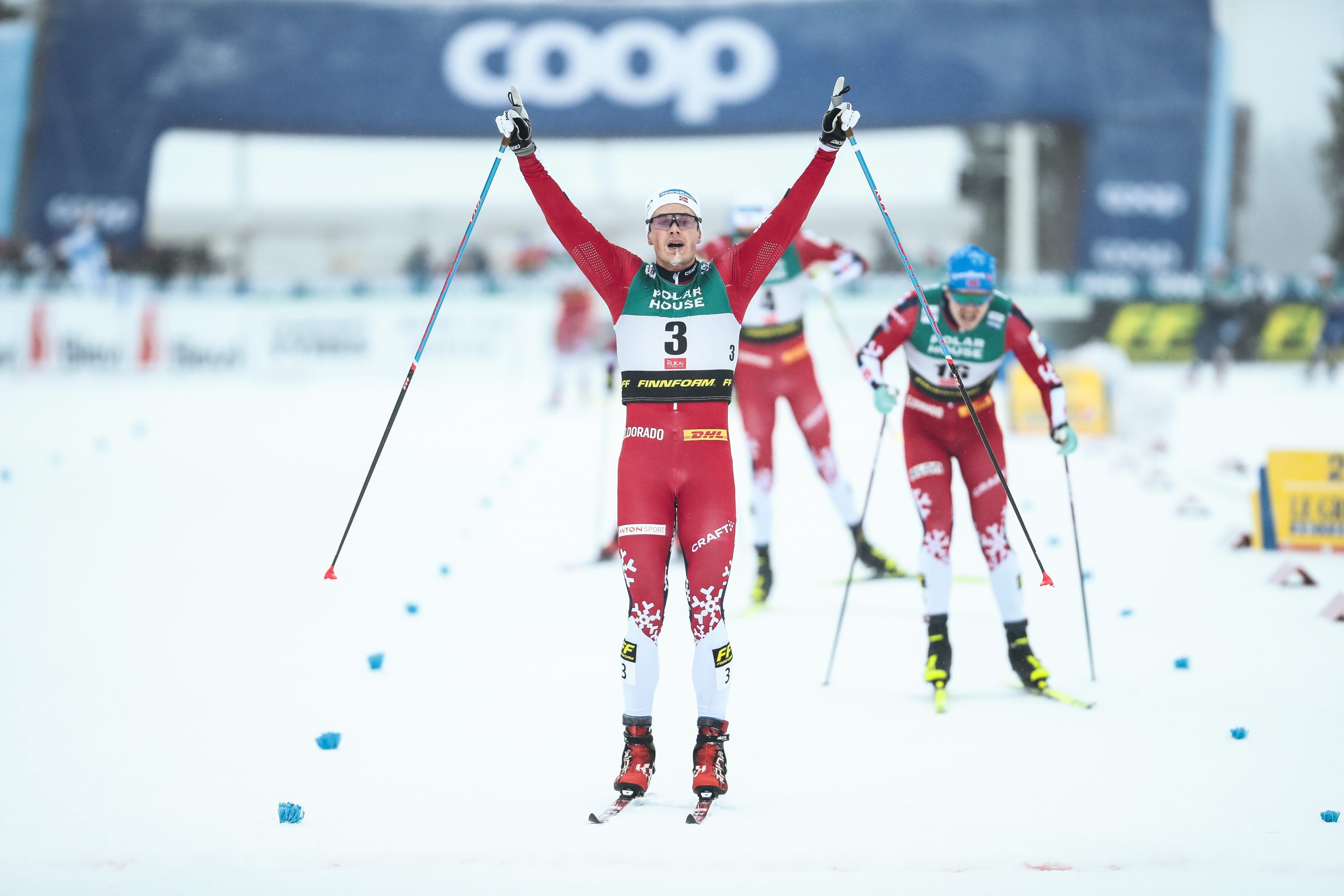
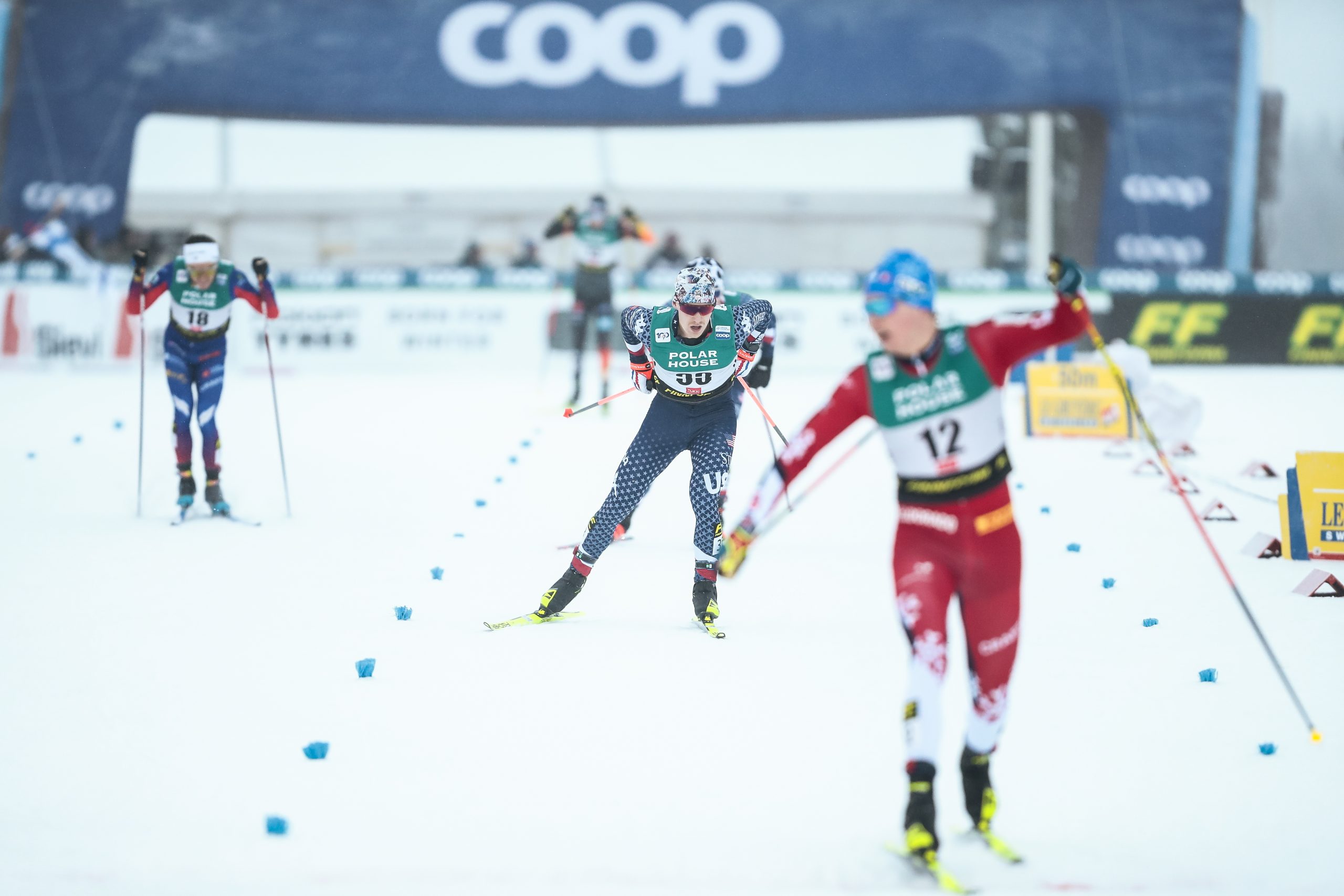
    It was a fantastic day for Gus Schumacher (USA) who finished fifth. (Photo: NordicFocus)

    Today’s race—the 20 kilometer Skiathlon— marks the last day of competition in Lillehammer, Norway. On the men’s side of the racing there has been complete dominance of the weekend by Norway, with only one non-Norwegian man making a podium all weekend. Since the beginning of the World Cup season, only three non-Norwegian men have made a podium. With 12 Norwegian competitors donning race bibs today, the odds of continued Norwegian podium dominance seemed good, and the array of Norwegian hopefuls seemed endless.

    But the Skiathlon is a bit of a fickle event. It isn’t often competed, so athletes aren’t as well trained for it and therefore things can be slightly unpredictable. It also combines techniques making it usually harder for one person to dominate and has the wildcard bit of the ski exchange where lots can go wrong. There were also two bonus point sections throughout the race which could help mix things up.

    For team USA Gus Schumacher seemed to be the best hope going into the race. Last week in Ruka he finished eighth in the 20 kilometer Freestyle mass start, and 18th in the 10 kilometer Classic, which is an encouraging average. But for him or any other American to even breach the top ten, he would have to break through the fusillade of Norwegian talent.

    In the end Schumacher was able to hang with the best in the world, was in contention all race, and in a remarkable performance was the top non-Norwegian in the race finishing fifth. He was less than one second from the win and a mere 0.6 seconds off the podium! It was a brilliant day for Schumacher who raced at a consistent pace all day and it served as another announcement that he has arrived at the upper echelon of Distance racing. He beat out Andrew Musgrave (GBR) by about a second which gave the Brit a sixth place finish, and Schumacher even managed to vanquish the great Johannes Hoesflot Klaebo, who finished eighth, by almost nine seconds.

    “My strategy was to be as far forward as I could, being a split course (barriers separated Classic and Freestyle sections on the course) there wasn’t a ton of room,” Schumacher said after the race. “I think that saved a lot of energy being near the front, and I had good Classic skis and was able to stay relaxed so the pacing wasn’t too much of an issue. Coming into the finish I had good energy and was able to move up into a good spot. I could tell my skis weren’t the best, I was able to stay in the group, but I wasn’t passing people. I wasn’t really doing a ton of calculating, but I knew I needed to move up on that sprint hill and nice to get by Muzzy (Musgrave). Put myself in a great spot I thought, was maybe a percent or two slower on the skis going into the finish and that made it hard to slingshot and get on that podium. Otherwise, I was super close.”

    Harald Oestberg Amundsen (NOR) ended up taking the victory in a photo-finish over Jan Thomas Jenssen (NOR), with Martin Loewstroem Nyenget (NOR) coming in third.

    Other American finishers were Ben Ogden in 25th, Zanden McMullen 26th, Hunter Wonders 46th, and John Steel Hagenbuch 57th.

    After the race, Schumacher and Ogden commented on the unique nature of Skiathlons, “I don’t do much to prepare for Skiathlons,” said Ogden. “For me just upping my fitness and improving my fatigued technique is way more valuable than dialing in anything particularly specific to Skiathlons.” Schumacher shared Ogden’s laid back preparation for Skiathlons. “Honestly, this one I didn’t do much. Sometimes I practice the transitions … I think the biggest part is just coming in (to the transition) being relaxed and not stressing about a second or two. In the warm up I definitely try to do both techniques.”

    Ogden reported that he is pleased with his fitness at this juncture, “things felt pretty good, I am happy with the trajectory and where I am at with only three weeks on snow. Stoked for the rest of the season!”

    The top Canadian finisher was Antoine Cyr in 27th. He was followed by Olivier Leveille who was 38th, Max Hollmann 49th, and Xavier McKeever 52nd. Sasha Masson did not finish.
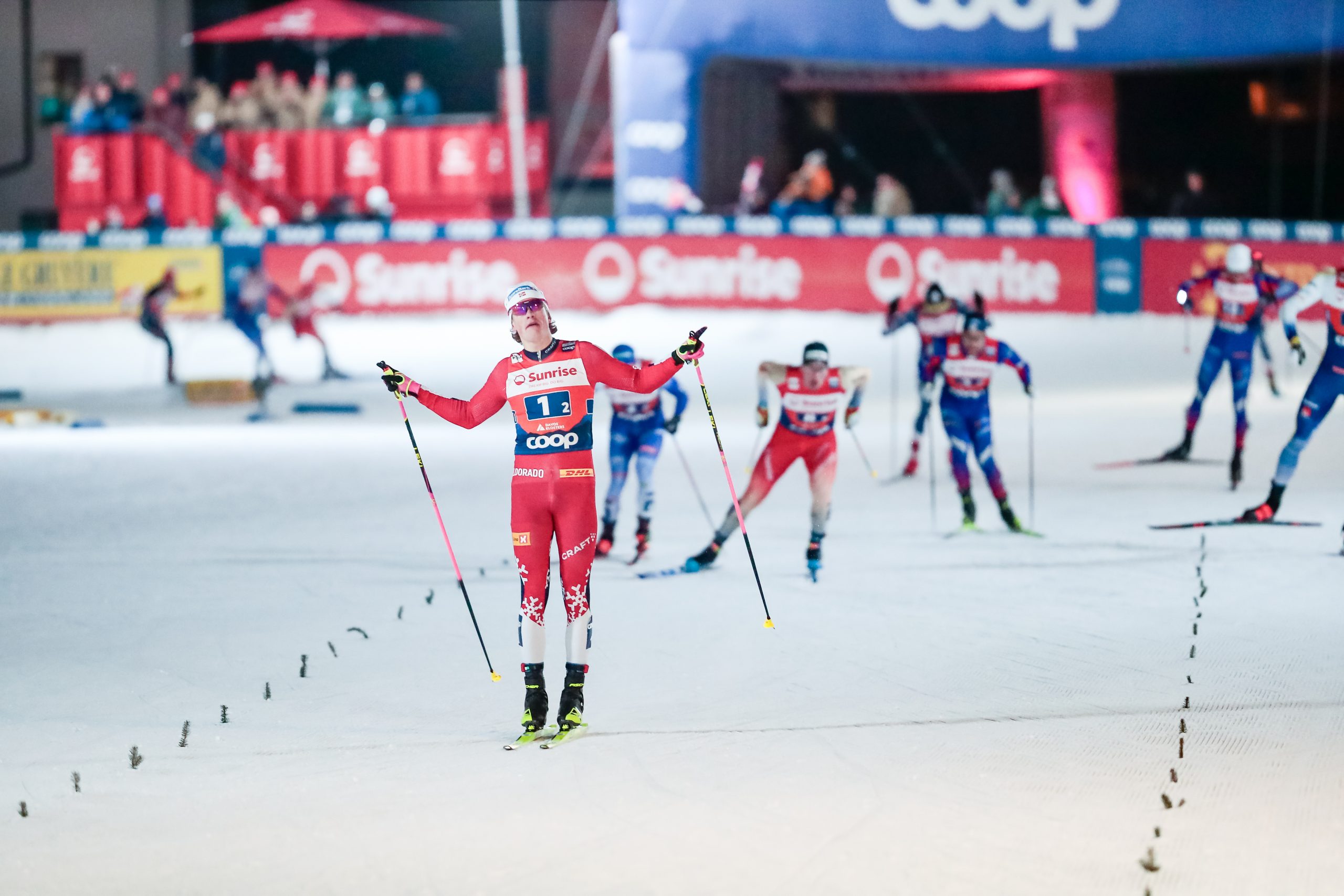
    Gus Schumacher (USA), (far left number 11) stayed with the lead pack from start to finish (Photo: NordicFocus)

    The 20 Kilometer Skiathlon

    The first half of the Skiathlon is performed in the Classic technique and the Norwegians wasted no time going to the front as a group with Amundsen, the current Overall leader going to the lead. Nyenget, and Andreas Fjorden Ree (NOR) were with him. The only non-Norwegian in the top six early on was Beda Klee (SUI).

    Nyenget put in an early burst with Ree going with him, but the two were quickly reeled in by the pack. And, at about 3.8 kilometers, sensing that the race was getting fast quickly, Klaebo joined the lead group along with Nyenget who began to seriously press the pace. Schumacher was in an excellent position at this point sitting in eighth place. Soon, Classic specialist Iivo Niskanen (FIN) joined the lead group and went to the front taking the lead from the Norewegian pack. To have any chance of a podium, Niskanen would have to have a good performance in the Classic leg and use his best in class technique to try and take some of the punch out of the Norwegians’ legs.

    Iivo Niskanen (FIN) used his Classic prowess to stay in the race, but faded on the Freestyle leg. (Photo: NordicFocus)

    Niskanen continued to force the pace in front of a sea of red Norwegian jerseys which was led by Klaebo. Niskanen’s speed was having its desired effect and it began to string out the field. A lead pack was clearly now established with Schumacher hanging in the middle of it maintaining his eighth place position as the pack surged through the first bonus point spot at 7.1 kilometers. Also hanging in with the top 10 was perennial crowd favorite Musgrave.

    Schumacher was riding fast Classic skis. “In Classic, I think I had some of the best skis in the field. My kick was really good and other people were struggling a bit, that helped me stay relaxed on the hills, and on the downhills they were at least as fast if not faster (than others).”

    The lead group was down to 12 skiers with Hugo Lapalus (FRA) trying to break up the Norwegian domination. As they came into the stadium for the transition zone the lead pack was led by Nyenget with Lapalus with him. But it was Klaebo first out of the transition onto his skating skis.

    Schumacher had maintained his eighth place standing out of the transition. The next best Americans were McMullen in 24th and Ogden in 25th, followed by  Wonders in 41st place, and Hagenbuch in 59th.

    It was often a wall of Norwegians at the front with Amundsen holding on to take the win. Harald Oestberg Amundsen (NOR), Johannes Hoesflot Klaebo (NOR), Andreas Fjorden Ree (NOR), (l-r) (Photo: NordicFocus)

    As the Freestyle section wore on, Niskanen began to fade, and at 12 kilometers rather shockingly it was Lapalus and Musgrave going to the front. They were being marked by a Norwegian quartet of Simen Hegstad Krueger (NOR), Klaebo, Amundsen, and Nyenget. Schumacher was still skiing a steady race and had maintained his eighth place position all race.

    At about 13.5 kilometers Klaebo had enough of watching others at the front and easily slid into the lead and tried to control the pace. But Klaebo didn’t stay up front for long and let Musgrave take the lead. It didn’t appear that Klaebo would have his normal ability to control a race from the front today as Krueger, and Lapalus were still with him. Schumacher continued to race at an incredibly consistent pace and was still in eighth place.

    With about 4 kilometers to go the pace picked up with Krueger setting the tempo. His speed began to string out the lead group a bit, but they were able to reconsolidate on the uphill. Lapalus was surprisingly still at the front with Krueger.

    Gus Schumacher (USA)(number 11) skied a tactically smart race, hanging with the pack then surging at the finish. (Photo: NordicFocus)

    With about 2.5 kilometers left Lapalus had been pushed down to eighth but was still in striking distance. But now five out of the top seven spots were Norwegians with Musgrave and Schumacher being the odd men out.

    Ben Ogden (USA) (number 44) had a solid performance finishing 25th. (Photo: NordicFocus)

    With about two kilometers to go, the leaders’ pace began to quicken even more. The increased speed fractured the chase group as Amundsen was out front grinding down the back of the lead group. Surprisingly, Klaebo was at the back of that pack, and it looked like he was having trouble hanging on. It was Schumacher who was keeping pace with the leaders which was still a group of seven, led by four Norwegians.

    Zanden Mcmullen (USA) (number 33 far left) put in a strong showing finishing 26th. (Photo: NordicFocus)

    Coming into the final uphill the racers reached top pace and began to jockey for the final sprint to the finish with Amundsen out front. As they entered the stadium it was the four Norwegians in a pack with Schumacher right with them. Amundsen put in a quick surge to take the win in a dramatic photo finish over Jenssen who was right behind, finishing second by about a boot length. Schumacher had put in his own surge and finished fifth, only eight tenths of a second behind the winner, about half a second off the podium, and was the top non-Norwegian. Musgrave finished sixth about a second behind Schumacher.

    Schumacher tried to push for the victory but, “in Skate, the skis were marginally worse than the Norwegians’. Still really good skis and absolutely competitive. In the finish that was a bit of a factor, I wasn’t perfect either, they were only slightly worse than the Norwegians’ which is saying something because they are pretty dialed in here, so we did a great job today.”

    Gus Schumacher (USA) gave a strong final push but finished just off the podium. (Photo: NordicFocus)

    It was another impressive display for Schumacher who has been showing that he belongs at the top of distance races and today proved to be among the best in the world.

    Lillehammer Men’s Skiathlon Results

    Harald Oestberg Amundsen (NOR) was able to eke out a victory by the length of a boot. (Photo: NordicFocus)
  • Ogden Top Qualifier in Lillehammer Sprint, Klaebo Remains Wondrously Predictable

    Ogden Top Qualifier in Lillehammer Sprint, Klaebo Remains Wondrously Predictable

    This coverage is made possible through the generous support of Marty and Kathy Hall and A Hall Mark of Excellence Award. To learn more about A Hall Mark of Excellence Award, or to learn how you can support FasterSkier’s coverage, please contact info@fasterskier.com.

    Ben Ogden (USA) had his 2024 World Cup campaign interrupted by illness. Ever since, he’s been working to return to world-class form. His win in the Sprint Qualifier in Lillehammer may be an indication that he’s finally back where he belongs. (Photo: Modica/NordicFocus)

    The World Cup cross country season is a long and winding road—few athletes experience seasons that end the way they began. American, Ben Ogden, had his 2024 World Cup campaign interrupted by mononucleosis that ended his season and prevented him from participating in the memorable Minneapolis World Cup races. Not only did much of 2024 prove to be a disappointment for Ogden, it also forced him into a long off-season of recovery and re-start. It hasn’t been known how successful Ogden’s recovery has been, and his first weeks in the 2024-2025 World Cup season offered both hope and doubt. Today in Lillehammmer, he received the first indications that he may have done things right. Ogden was simply superb in Sprint Qualifying, posting the fastest time of all skiers (2:34.33), a half second ahead of the usually-untouchable Klaebo, and 2+ seconds ahead of everyone else. Ogden would find himself boxed in in his quarterfinal heat, and would finish the day in 17th.

    “Today, I really had my eye on the semifinal and the final (foolishly),” said Ogden. “So I tried to be tactical in the quarterfinal and save as much energy as I could. That’ll teach me!”

    Colby College’s Sprint specialist, Jack Young (USA), also advanced to the quarterfinal round, qualifying 25th. He would finish the day in 25th.

    “Except for a two week camp in Park City, I have been in Waterville (Maine) training with my teammates at Colby,” said Young. ” . . . “I knew my training had been good al fall, so I wasn’t too concerned about not having put on a bib yet this year. Sure, it would be nice for my first race of the year not to be one of my most important, but at the end of the day, it’s pretty cool to be able to train all fall with the clear goal of performing at a Period 1 World Cup.”

    Among other Americans, Gus Schumacher was just outside the qualifying standard in 31st, ahead of JC Schoonmaker (39th), Kevin Bolger (45th), Zak Ketterson (47th), Michael Earnhart (51st). Canadians in qualifying included Pierre Grall-Johnson (58th), Sasha Masson (62nd), Xavier McKeever, (66th), Antoine Cyr (71st).

    Notably, Spaniard, Jaume Puyeo, qualified third. He would face off against Klaebo in Quarterfinal 1, and ultimately finished the day in 21st.

    Johannes Hoesflot Klaebo (NOR) is accustomed to having no one in front of him at World Cup Sprint finish lines. His day in Lillehammer was more of the same as he coasted to another remarkable Sprint win, the 51st of his career. (Photo: NordicFocus)

    When Johannes Hoesflot Klaebo wakes up fresh and well rested on the morning of a World Cup Sprint; that’s usually going to be a problem for every one else. I mean, the guy already has enough advantages: blazing speed, unmatched tactical acumen, the fastest skis in the world, and the tendency of the rest of the World Cup field to let him do pretty much whatever he wants. When’s the last time anyone cut this guy off? When’s the last time someone sent him a good forearm shiver in the final turn? Where’s Alexander Bolshunov when you need him?

    Klaebo does make World Cup Sprinting interesting, but it’s the kind of interesting that’s about “How will he manage to win again this time?” The result itself is kind of a foregone conclusion. He’s gonna win, right? He’s gonna accelerate at the top of a mid-course hill, rocket down the backside, controlling the pace from the front and putting daylight between himself and his glide-challenged rivals. Then he’s going to switch on skiing’s hottest afterburners up the final hill and leave everybody scrambling in his wake. By the time he gets to the final turn, he’ll be pretty much alone and unchallenged. He’s gonna bow to the crowd as he eases down the finishing straightaway. We’ve seen this movie before.

    And that’s exactly how things turned out . . . The second and third positions on any World Cup Sprint podium tend to shuffle from week to week—occupied in Lillehammer by Even Northug (NOR) in second and Federico Pellegrino (ITA) third—but the top step seems reserved for Klaebo.

    Klaebo sat out the final race in Ruka a week ago, as well as yesterday’s 10 k Freestyle. “I’ve been a little bit sick since Ruka,” Klaebo said. “Didn’t get to go last Sunday and needed to wait one extra day. I’m glad I did that. So, It’s good to be back again, and hopefully now we can give full speed fo the rest of the season.”

    World Cup Sprint veteran, Federico Pellegrino (ITA), called on his experience, his tactics, and his speed to advance cleverly through the heats. He would finish the day in third behind Even Northug (NOR) in second, and the day’s winner, Johannes Hoesflot Klaebo (NOR). (Photo: Modica/NordicFocus)
    Freestyle Sprint Quarterfinal

    The Lillehammer Sprint course is not as straightforward as others on the World Cup circuit. It’s final uphill is less close to the finish, and somehow seems to offer less of a draft-effect on its downhill side. With fewer advantages and disadvantages to be found on the course, it can take afew rounds for racers to sort out the proper strategies.

    Quarterfinal 1 seemed to be a puzzle being solved in real time. Klaebo started slowly, at the rear of the six-man field, allowing Valerio Grond to set the early pace. While Klaebo is known for weaving with ease through Sprint fields, on this day he seemed to possess a bit less vision. Klaebo appeared to play a bit of field-clogging stop-and-start on the final uphill—though after Janik Riebli (SUI) stepped on Klaebo’s pole near the summit, Klaebo seemed less likely to employ that tactic again. While he would glide forward to a photo finish with Grond—and automatic qualification into the semifinals—Klaebo did not look as though he’d established the tactics he’d likely incorporate in the semifinals and beyond.

    Lucas Chanavat (FRA) and Even Northug (NOR) lunged for the automatic qualifying standard in Quarterfinal 2, but their heat proved to be fast enough that both would advance to semifinals.

    Quarterfinal 3 was marked by the weaving journey of perennial Sprint contender, Erik Valnes (NOR), who struggled to find clear lines and open lanes. Valnes was forced wide in the finishing straightaway, only managing to get to the front in the final meters. He would advance to the semifinal just ahead of Federico Pellegrino (ITA).

    Ogden lined up smiling in Quarterfinal 4 wearing the #1 bib of the day’s top qualifier. He eased to the front of what appeared to be a slow, tactical heat, the pace of which would not heat up before the final uphill. Ogden held a place near the front over the top of the hill, but found himself outmaneuvered on the descent. Boxed in down the finishing straightaway, Ogden found himself with literally no where to go, tripping and crashing across the finish line in an awkward jumble of skiers, skis, and poles. He would finish the quarterfinal in fourth place, and be done for the day. Matz William Jenssen (NOR) and Benjamin Moser (AUT) would advance out of Quarterfinal 4.

    “Certainly feeling good about the qualifier today,” said Ogden. “I was a little worried after Ruka and not racing for so long. I think today is a good reminder that it takes time to transition to snow, and I need to be patient. But things are coming.”

    Defending his World Cup Overall Leader’s bib, Harald Oestberg Amundsen advanced out of Quarterfinal 5, along with Alexander Elde Holmboe (NOR) whose twin brother, Nicolai Elde Holmboe (NOR) had earlier advanced as the winner of Quarterfinal 2.

    Lucas Chanavat (FRA) spent much of his offseason training in the company of his friend, Johannes Hoesflot Klaebo (NOR). A sprinter who relies on raw speed and power, Chanavat advanced well through the heats, but ran out of steam in the final. He would finish the day in fifth. (Photo: © Modica/NordicFocus)
    Freestyle Sprint Semifinal

    Semifinal 1 offered a packed lineup, including N. Holmboe, Valnes, Klaebo, and Chanavat. Having been dissatisfied with his quarterfinal tactics, Klaebo went immediately to the front with N. Holmboe. Valnes moved forward mid-race, boxing in Holmboe and Chanavat. Chanavat worked his way free to lead up the significant hill, showing his power as the only skier on the day to V2 all the way over the top. Klaebo staying close at his heels as Valnes and Holmboe faded. Klaebo would incorporate his signature slingshot acceleration in the final straightaway to cross the line first while Chanavat held on for second. Finishing a close third behind Chanavat, Valnes would advance as a lucky loser.

    Amundsen would lead a fast-paced Semifinal 2, but he would fade from contention in the final meters. Jenssen would win the heat ahead of a hard-charging Pellegrino in the faster of the two semifinals. Northug and A. Holmboe would advance as lucky losers.

    Freestyle Sprint final

    Klaebo moved quickly to the front of the final, followed closely by Chanavat. If klaebo had fiddled around with other tactics in earlier heats, he was having none of that in the final. Controlling the race from the front, Klaebo stormed up the final uphill to create a gap over Pellegrino, one he never surrendered all the way to the finish line. Pellegrino would finish third, after being overtaken by Northug in the closing meters for the second spot on the Lillehammer podium.

    Klaebo’s 51st career World Cup Sprint win ended up looking eerily similar to most of the prior 50. No struggles, no mistakes, no surprises: Klaebo simply has more sprint to give, more tactics from which to draw, more speed when it counts. He also has the abilities and physiological qualities of an all ’rounder, his endurance allowing him to continue his domination into the later rounds of a Sprint day while his fast-twitch rivals tend to fade. Until someone solves the Klaebo puzzle, we may be watching repeat-race-scenarios for quite some time to come.

    Lillehammer Men’s Freestyle Sprint RESULTS

    Lillehammer Men’s Freestyle Sprint QUALIFYING


    The podium of the Men’s Freestyle Sprint in Lillehammer, Norway: Even Northug (NOR), Johannes Hoesflot Klaebo (NOR), Federico Pellegrino (ITA), (l-r). (Photo: Modica/NordicFocus).
  • Lillehammer Freestyle Sprints—Sweden Dominates, Diggins Top American

    Lillehammer Freestyle Sprints—Sweden Dominates, Diggins Top American

    This coverage is made possible through the generous support of Marty and Kathy Hall and A Hall Mark of Excellence Award. To learn more about A Hall Mark of Excellence Award, or to learn how you can support FasterSkier’s coverage, please contact info@fasterskier.com.

    Jonna Sundling (SWE) (number 1) dominated all day racing from the front. (Photo: NordicFocus)

    World Cup competition in Lillehammer, Norway continued today with the Freestyle Sprints. Notably, it also marked the return of Norway’s Kristine Stavaas Skistad after she missed the first weekend of competition recovering from abdominal surgery. Once again Norway’s list of starters was long—12 racers—due to the additional start spots it received from being the host nation. But among all of those skiers, it was Skistad’s return which was the most interesting story. No one is certain about what level she would be performing at, and there has been precious little information about the exact nature of her medical condition. With last week’s second place Classic Sprint finish by fellow Norwegian Julie Myhre, it would set up some interesting intra-team dynamics.

    There were also some interesting sub-plots for team USA’s roster. Yesterday, Rosie Brennan revealed that she was dealing with an undisclosed injury. Given that revelation, it was a little surprising to see her name on the qualification start list. “I still don’t fully understand what’s going on,” Brennan stated after the race. “So I don’t know what the future looks like. I was able to ski with less pain today, but my skiing is far from where I want it to be so I’m not sure what my plan will be from here.”

    Another American with a bit of a question mark around her is Julia Kern. She came into the season recovering from her own injury and is still rounding into form. Today’s Sprint would be a good barometer of how she is progressing. “I feel like the past two days is definitely a step in the right direction,” said Kern. “I hope with more races I can continue to race my way back into shape! Definitely a bittersweet day today where I felt like I had more in me but didn’t have the opportunity to show it, but in sprinting there isn’t much room for error out there with tight margins.”

    Diggins qualified third and made it to the semi-finals. (Photo: NordicFocus)

    And as usual, almost any of the six skiers from Sweden could find their way to the top of the podium, with Johanna Hagstroem (SWE) having taken home her first World Cup victory last week by winning the Ruka Sprint after having been a runner up four times. She would hope to continue with that winning momentum.

    Part of the question surrounding Skistad’s fitness was answered early when she qualified in fourth place, slightly behind Diggins who qualified third. But Jonna Sundling (SWE), grabbed everyone’s attention when she won the qualifying round by over six seconds. It certainly grabbed Jessie Diggins’ attention, “I actually went and found her when we were warming up for the heats because I just wanted to tell her how amazing that is. I think sometimes we’re in danger of forgetting how incredible it is because she does it so often. That’s absolutely amazing and incredible.”

    Sundling continued to dominate all day, and no one really came close to matching her performances as she took the victory by winning every heat and the finals. Hagstroem gave another good performance, finishing second with Myhre coming in third. Diggins made it to the second round and finished eighth.

    Julia Kern (USA) skied well but an unfortunate pole break ended her chances early. (Photo: NordicFocus)

    Julia Kern and Rosie Brennan were the other American qualifiers. Brennan squeezed into the heats by finishing 29th in the qualifier, Kern qualified 13th. Brennan and Kern were unable to advance out of their quarterfinals finishing 29th and 17th respectively.

    In what could be a harbinger for the rest of the season, Diggins was able to vault ahead of Therese Johaug (NOR) in the Overall standings since Johaug didn’t accumulate any Sprint points. There is an interesting possibility of a season long see-saw between Diggins and Johaug as they alternate between high placing Sprint and Distance finishes.

    Other American finishers were Alayna Sonnesyn in 38th, Lauren Jortberg 40th, Erin Bianco 47th, Haley Brewster 53rd, and Renae Anderson 58th.

    The top Canadian finisher was Liliane Gagnon in 24th. Sonjaa Schmidt did not start today.

    The Lillehammer Freestyle Sprint-Quarter Finals
    Skistad returned to the World Cup but could not advance out of the first round. (Photo: NordicFocus)

    Skistad would be tested right from the get-go as she chose to race in the first heat, and she would not be able to dominate as she did last year. Sundling easily won the heat with Skistad finishing third. She would have to wait for a lucky loser spot. But the wait would be short lived. She received a yellow card and was relegated to last place in the heats. She would not be able to advance regardless of her time.

    Rosie Brennan (USA) (number 29, middle) qualified 29th and couldn’t advance out of the first round. (Photo: NordicFocus)

    Brennan was in the second heat. She took an outside line at the start and remained toward the back of the pack but was still within striking range. As the race opened up Brennan remained in contact, but as the skiers went up the final climb, the group spread out and Brennan was unable to remain in contact. Coletta Rydzek (GER) and Emma Ribom (SWE) would take first and second. Jasmi Joensuu (FIN) and Lotta Udnes Weng (NOR) for now took over the lucky loser positions, and their times would have knocked out Skistad regardless of her disqualification. Brennan ultimately could not hang with the winning group and finished sixth. Her day was over with more questions than answers pending.

    Kern was in the third quarterfinal. She immediately went out in the middle of the pack, but her race was quickly turned upside down when just a few seconds in she snapped a pole with an errant pole placement. She received a replacement quickly. Fortunately, the damage happened early in the race, and she would have a chance to recover. As she spent the next 30 seconds trying to get her new pole strap around her wrist, she bravely was able to stay with the pack and was somehow still in contention going up the second to last climb. “Kristen Bourne (USA coach) absolutely crushed the pole handoff,” said Kern. She continued that, “I think it went as smooth as it could have. I don’t feel like it took too much out of me, just a little extra leg energy to catch back up, but what impacted me more was losing the positioning and dropping back into 6th, a place you do not want to be on this course.”

    But the last climb splintered the pack with Katerina Janatova (CZE) and Jasmin Kahara (FIN) finishing first and second. Kern finished fourth and her time was not fast enough to qualify as a lucky loser.

    Jessie Diggins (USA) (far left) led in her quarter-final and advanced into the semi-final round. (Photo: NordicFocus)

    Diggins was in the fifth and final quarterfinal heat. She has clearly established a pattern of choosing to race in the final heat. It’s a bit of a divergent strategy from typical tactics as it affords the least amount of rest. She would face the Swedish duo of Johanna Hagstroem and Moa Ilar, as well as last week’s podium finisher Myhre. This field would not present an easy opportunity for Diggins to advance.

    At the starting gun, Hagstroem false started and the field had to reset. She would have to carry a yellow card for the rest of the day.

    At the second start Diggins, who was in the outside lane went into the lead right from the start. She quickly pressed her advantage and put initial distance between herself and the pack. Given the undulating course, it was a tall task to lead start to finish as there were too many opportunities for racers to slingshot past the leaders. “I was essentially riding on base fitness to get out of the quarters,” said Diggins. “I feel like my strength isn’t necessarily power and ultimate speed, it’s more pushing the whole time, so to push out of the quarters I wanted to try that strategy. I obviously reversed it in the semis because the slingshot was becoming astronomically important the further we got into the race. It was really cool to try opposite strategies and I feel like I learned a lot.”

    About two minutes in, Hagstroem and Myhre closed in on Diggins, but she was able to maintain her lead up the final climb. Diggins led going into the stadium where the other skiers would now try and slingshot past her, which they did. Diggins put in a final surge to make it close at the end, but still finished third. However, her hard work paid off as she had set a fast enough pace that she was able to advance as a lucky loser. She would be the only American to advance out of the first round.

    Semi-Finals

    The second heat featured the novel composition of three Germans; Rydzek, Victoria Carl and Pia Fink all of whom made it through to the semi-finals. They were joined by Sundling, Ribom, and Janatova. Sundling went to the lead early, which had not been a winning strategy for any of the other racers. She was joined by her teammate Ribom. The two were able to create a bit of a gap, but Carl put in a hard burst up the final climb and moved into second place. Sundling was safely in the lead with the rest of the skiers strung out. Sundling easily took the win with Carl holding on for second. For the time being Ribom and Janatova were in the lucky loser positions.

    Diggins was in the second semi-final. She was joined by Myhrvold, Hagstroem, Kahara, Hedda Oestberg Amundsen (NOR), and Myhre. Diggins started from the inside position and this time she immediately drifted to the back of the pack.

    The initial pace was very relaxed. Myhre took the early lead and continued to lead for over the next minute. Myhre upped the tempo and created a bit of a gap which Hagstroem was able to close. Going up the second to last hill Diggins charged hard around the corner and went into third. There was a lot of jostling as the racers approached the home stretch with Diggins getting a photo finish in fourth place. However, her time was not fast enough for a lucky loser position and her day would end.

    Jonna Sundling (SWE) felt good and had skis to match as she dominated the field. (Photo: NordicFocus)

    Again, the finals would see three Swedish women; Sundling, Hagstroem, and Ribom all advancing to the finals. Only one German, Carl remained. They were joined by Myhre and Janatova. Sundling had thoroughly dominated the qualification round and her heats. At the start of the finals, she immediately went to the front again. Sundling was the only racer all day—including Johannes Hoesflot Klaebo (NOR) in the men’s races— who had been able to win racing from the front. It quickly became a Swedish wall at the front with Sundling pressing her advantage and Hagstroem and Ribom following. Today, Sundling was clearly in a class of her own. Hagstroem was hanging on for second with Myhre moving up to third. Sundling seemingly effortlessly glided to the finish line with a lead of over three seconds. Her teammate Hagstroem took second with Myhre finding the podium again to finish in third place.

    It was as dominating a performance as is ever seen in the women’s Sprints. For Sundling today, she was simply untouchable from start to finish. She acknowledged as much after the race when she commented about how good she felt all day, and how the Lillehammer course required top form. For the Americans it was another difficult day with Diggins once again leading the charge, but the rest of the American team unable to get much traction.

    Lillehammer Women’s Freestyle Sprints Results

    Lillehammer, Norway (NOR):
    Johanna Hagstroem (SWE), Jonna Sundling (SWE), Julie Myhre (NOR), (l-r) (Photo: NordicFocus)
  • Johaug Leads Norwegian Sweep in Lillehammer 10-K Freestyle. Diggins Fifth

    Johaug Leads Norwegian Sweep in Lillehammer 10-K Freestyle. Diggins Fifth

    This coverage is made possible through the generous support of Marty and Kathy Hall and A Hall Mark of Excellence Award. To learn more about A Hall Mark of Excellence Award, or to learn how you can support FasterSkier’s coverage, please contact info@fasterskier.com.

    Jessie Diggins (USA) was in the hunt for a podium all day, but fell just short. (Photo: NordicFocus)

    To state the obvious, team Norway does not need any help on the World Cup circuit. But as this weekend’s racing moved to Lillehammer, Norway—home of the 1994 winter Olympics— that’s exactly what they were going to get a big helping hand of. In today’s race—the 10 kilometer Freestyle Individual Start—not only would Norway have the home field advantage, but because of the host nation’s start quota, the Norwegian women would bring 12 racers to the start. The American women would also get a slight start advantage since one of the perks of Jessie Diggins’ (USA) Overall Championship is that the team receives an extra start bib and would therefore be able to field eight racers.

    But when it comes to the Individual Start it’s not so much quantity as quality that counts. And among the highest caliber skiers that everyone would be keeping their eyes on, there would likely be a battle between Jessie Diggins, Frida Karlsson (SWE), Heidi Weng (NOR) and Therese Johaug (NOR) for the podium. In 2022 Diggins won this same race in Lillehammer, so she was hoping for a bit of history to repeat itself. She was also coming off an impressive victory in the 20 kilometer Freestyle last Sunday in Ruka, Finland. Diggins’ strength is Freestyle, she’s proven her abilities in Individual starts, so the stars were aligned for a compelling and taut race with high hopes for Diggins to stay on a roll.

    The snow conditions were tricky with a mix of artificial and natural snow. “It was super interesting,” said Diggins. “We got this beautiful snow fall overnight, which really put me in the holiday spirit, and it was mixing down with the artificial snow. It was super tricky. I actually felt like my skis were feeling really good. That said, Norway clearly knocked it out of the park today. I think my skis compared to the rest of the field were really really good, and I’m super grateful for our techs, because every single day they’re working super hard … sometimes you have the best skis in the whole world, and sometimes you don’t. You just have to go out there and race as hard as you can.”

    While the anticipation around Johaug’s return has been huge, so far, she has appeared mortal. In last weekend’s 10 kilometer Individual Start Classic in Ruka, Karlsson ground Johaug into the snow beating her by a walloping 46 seconds.

    There was no stoppingTherese Johaug (NOR) today as she led a Norwegian sweep. (Photo: NordicFocus)

    But there was no beating back Johaug today as she went out fast and kept a blistering tempo all race long to take the win beating Heidi Weng by 11 seconds. Astrid Oeyre Slind (NOR) rounded out the podium for a Norwegian sweep. It was a dominating performance by Johaug and by team Norway as Johaug put her stamp on the race from start to finish. After the race she commented that “I’m so happy. It was a tough week after Ruka. I’m so- so happy. Johaug then commented on negative statements about her in the Swedish press. “Today I showed them.”  She certainly did, as today’s victory not only put her on the top of the podium, but also on top of the distance and overall standings.

    Diggins ended up finishing fifth, 48.7 seconds behind Johaug and only five seconds off the podium. Other American finishers were Sophia Laukli in 15th, Rosie Brennan 31st, Julia Kern 34th, Alayna Sonnesyn 35th, Sydney Palmer-Leger 47th, Haley Brewster 55th, and Renae Anderson 68th.

    The top Canadian was Katherine Stewart-Jones in 38th. Liliane Gagnon was 49th, and Sonjaa Schmidt was 56th.

    It was a tough day for Rosie Brennan who revealed in a bit of a bombshell to FasterSkier after the race that, “I’m dealing with an unknown injury that significantly impacted my race today.” She continued that, “it’s stressful and at the moment right now, I don’t have any other information to share. I will be working with our medical staff to figure out a plan moving forward.”

    The 10 Kilometer Freestyle Individual Start

    When Johaug took to the course, she wasted no time establishing her frenetic tempo. Diggins went out six skiers after Johaug putting her in the perfect position to mark one of her key rivals. But it was Karlsson who went out last amongst the best skiers and would have the best view to gauge her competitors’ performances.

    Sophia Laukli (USA) had a good day finishing 15th. (Photo: NordicFocus)

    When Sophia Laukli (USA) came through the 3.5 kilometer time check she established a new lead at that point taking a six second advantage over Kristin Austgulen Fosnaes (NOR). “I think a longer race could suit me better but I still feel like I can perform well in 10kms, especially with courses like Lillehammer,” said Laukli. “But you have to be very dialed (in) with tactics and skis since there’s very little room for mistakes when it is a shorter race, but on a good day I think I can do very well in a 10km.” Laukli’s skating looks to be more finely tuned this winter. “I have worked a lot on my skate skiing this summer and learning to ski with a bit more power and efficiency. I’ve always been a skier with high frequency so focusing more on using my strength and engine together and a bit slower frequency to be more efficient has really helped me improve.”

    There was some more good news for team USA as when Brennan crossed the timing mark she was in fifth place, but that would be the high point of the day for Brennan as she was clearly having trouble coping with her newly revealed injury. Both of the Americans were quickly displaced as the top skiers came through the time check. When H. Weng came through she established a new lead by over 21 seconds, and it looked like it might be enough for her to stay out front. But no one could withstand the onslaught of Johaug as she established yet another new mark putting in over seven seconds on H. Weng at 3.5 kilometers. After Diggins came through, she was in fourth, 16 seconds behind Johaug and nine seconds behind H. Weng.  But Diggins would drop to fifth after Karlsson was able to use her start place strategically and came through half a second behind Weng in third place.

    Rosie Brennan (USA) had a tough day finishing 31st. (Photo: NordicFocus)

    Johaug continued to press her advantage and when the skiers reached 4.8 kilometers, she had a six second lead over H. Weng, 14 seconds over Karlsson, and 19 over Diggins. Laukli had been pushed down to ninth place, 37 seconds back, and Brennan had quickly slipped into 18th place, 51 seconds off of the lead.

    Johaug was relentless as she crossed the 5.6 kilometer mark and stretched her advantage over H. Weng to nine seconds. When Diggins crossed the mark, she was in third, 17 seconds behind H. Weng and 27 behind Johaug. But Karlsson would again displace Diggins and drop her into fourth with Astrid Oeyre Slind (NOR) nipping at her heels, only three seconds behind Diggins. At this point, just a little past the half waymark, Johaug had the race firmly in her grasp, with Diggins battling to hang on to a podium.

    Therese Johaug (NOR) (foreground), raced at her signature high tempo pace the entire race. (Photo: NordicFocus)

    As the 8.3 kilometer timing mark approached H. Weng had tried to turn things up a notch and crossed in the lead, but it didn’t last long, as Johaug quickly eclipsed her time as she came through extending her lead to 13.9 seconds. Diggins was now 35 seconds behind H. Weng and 43 behind Johaug. But more importantly, shortly after Diggins went through the time check Astrid Oeyre Slind (NOR) came through and pushed Diggins into fourth by five seconds, then after Karlsson moved through, she found herself sitting in fifth.

    It would take a huge effort by Diggins to reach the podium. But Diggins wasn’t keeping track of where she stood compared to her competition. “I pay almost no attention (to competitors’ split times), said Diggins. “This maybe is just a Jessie thing, but I actively try to ignore splits. I essentially try to approach every race like it’s a three second battle for the win amongst 38 people. I’m always just trying to race as hard as I can and cross that finish line with nothing left. It’s not like if I hear I’m winning by 20 seconds I back off. I don’t change my race approach based on the splits because you don’t know what’s going to happen. For me a lot of the satisfaction I get out of racing is knowing that I have dug deep and I’ve gone to the bottom of the well. That has nothing to do with other racers, or times, or the clock.”

    Heidi Weng (NOR) has returned to championship form, but she couldn’t quite keep with Johaug’s pace. (Photo: NordicFocus)

    Weng was the first of the contenders to cross the finish line and she came in with over a 51 second lead. But Johaug was still on course. As she went up the final climb, Johaug showed no signs of relenting as her tempo continued to be manic up the final hill. H. Weng could only look on helplessly as she saw her teammate blasting through the course. When Johaug crossed the line, she was 11 seconds up on H. Weng with Diggins and Karlsson still on the course.

    When Diggins crossed the finish, she was third, 37 seconds behind H. Weng and 48 by Johaug. But with Slind and Karlsson lurking, the outcome was still to be determined, and it didn’t look like Diggins had put enough time into either skier to hold onto a podium finish. Slind crossed the finish five seconds ahead of Diggins who was moved off the podium into fourth place. It would now be up to Karlsson to break up a Norwegian podium sweep.

    Frida Karlsson (SWE) just missed out on the podium by three seconds. (Photo: NordicFocus)

    As Karlsson approached the final stretch, it was obvious that she wouldn’t be in the top two and was fighting for third. She put in a furious V-2 push in the last 100 yards, but it wasn’t enough as she couldn’t close the gap on Slind and finished three seconds off the podium. Karlsson’s finish forced Diggins into fifth, but she finished just a scant 5 seconds from the podium.

    So as the World Cup returned to Norway, it was also a return to Norwegian dominance with the home team sweeping the podium in an impressive performance on friendly soil. Two Norwegian veterans, Johaug and H. Weng, looked like they did at their career best and the rest of team Norway looked ready to dominate as well. After the final racer finished, Norway had taken eight of the top 13 spots.

    Lillehammer 10 kilometer Freestyle Individual Start Results.

    Heidi Weng (NOR), Therese Johaug (NOR), Astrid Oeyre Slind (NOR), (l-r) (Photo: NordicFocus)
  • Norway Rules in Lillehammer—Nyenget Scorches 10 k Freestyle

    Norway Rules in Lillehammer—Nyenget Scorches 10 k Freestyle

    This coverage is made possible through the generous support of Marty and Kathy Hall and A Hall Mark of Excellence Award. To learn more about A Hall Mark of Excellence Award, or to learn how you can support FasterSkier’s coverage, please contact info@fasterskier.com.

    Martin Loewstroem Nyenget (NOR) crushed the field in Lillehammer’s World Cup 10 k Freestyle Interval Start. (Photo: NordicFocus)

    There will be a Cross-Country World Championships in Trondheim, Norway later this winter—and it looks like the anticipation of those important race days on the International Ski Federation (FIS) calendar is causing this season to be viewed in a whole new way. In seasons past, the rewards of performing well in the year-long FIS World Cup standings would’ve inspired many skiers to enter every single available World Cup race, even when they were tired (rationalizing that everyone else would’ve been tired), maybe even when they were sick (can’t afford to take a day off in which some other skier could steal their points). Even the exhaustion-inducing, plague-generating Tour de Ski (and the massive number of points it offers) has generally been seen to be so important that skiers risked ruining their whole season by skipping it. Not anymore: FIS has already announced plans to investigate alternative scheduling—and reconfigured scoring values—of future Tour de Ski events so that racers will continue to consider it valuable. As for the tightly packed races of World Cup weekends, World Championship contenders are already selectively entering—and selectively skipping—those. And the season is only two weekends old.

    With what’s certain to be the astronomical value of a Norwegian victories in World Championship races contested on native soil, Team Norway seems to be taking a different approach to those days on the FIS calendar. Last week in Ruka, Finland, Johannes Hoesflot Klaebo was said to have displayed mild cold symptoms—he did not start Sunday’s 20 k Freestyle Mass Start, a race he truly was likely to have won (healthy or not). This on a weekend when he had already earned his way into the FIS World Cup overall leaders bib (Klaebo’s absence from Sunday’s 20 k would deliver the bib to Norwegian teammate—and defending Crystal Globe winner—Harald Oestberg Amundsen).

    Eight Norwegians raced into the top ten of Lillehammer’s 10 k Freestyle, including names that are fairly new to international audiences like Andreas Fjorden Ree (NOR) who would finish an impressive fifth. (Photo: NordicFocus)

    In this weekend’s Lillehammer World Cup races, Team Norway is entitled to a whole host of starters—eight for being the nation of a World Cup overall winner (Amundsen), and another four as the host nation of the weekend’s racing in Lillehammer. Twelve Norwegian starters lined up for the Men’s 10 k Freestyle—Iver Tildheim Andersen, Mattis Stenshagen, Didrik Toenseth, Simen Hegstad Krueger, Paal Golberg, Martin Loewstroem Nyenget, Jan Thomas Jenssen, Andreas Fjorden Ree, Sander Haukvik-Jensen, Einar Hedegart, Ole Tafjord Suhrke, and Amundsen—but no Klaebo on the roster. Team physicians have suggested that his case of the Ruka-sniffles continues . . . so no racing for him on Friday. He’s likely to rise from his sick bed just in time to smack around the rest of the competition in Saturday’s Sprints. Then we’ll see what he has left for Sunday’s Skiathlon. What’s evident is that Klaebo (perhaps more than any other skier) is planning his season so that “what he has left” on race day will find him at his absolute best when the World Championships come to Trondheim.

    Other teams’ star athletes are already following suit: Team Sweden’s Frida Karlsson followed up her utterly dominant performance in Ruka’s 20 k Classic Individual Start by skipping the 20 k Freestlye Mass Start only two days later (a race in which she would’ve been certain to contend for the win). But the World Cup is filled with fine athletes, and so many of them DID race the event in Lillehammer. In the end, Norway continued its dominance with eight skiers in the top ten and a decisive a victory for Nyenget, followed by Krueger in second and Amundsen in third.

    Among Americans, Gus Schumacher finished 25th, followed by Ben Ogden (31st), Zanden McMullen (32nd), John steel Hagenbuch (38th), Hunter Wonders (53rd), Michael Earnhart (64th), Zak Ketterson (72nd).

    Canadian racers in Lillehammer included Antoine Cyr (35th), Max Hollmann (37th), Xavier McKeever (63rd), Olivier Leveille (66th), Sasha Masson (68th).

    Gus Schumacher (USA) followed up his eighth place finish in Ruka’s 20 k Mass Start with a 25th place finish in the 10 k Freestyle in Lillehammer. (Photo: NordicFocus)
    10 k Freestyle Interval Start

    Fans of American skiing were eager to see if Ogden could make a mini-comeback after a less-than-stellar couple of races (and a DNS in the 20 k Mass Satrt) in Ruka a week ago. Though cameras were able to follow Ogden for the first meters of the start, he looked to begin very conservatively, very relaxed.

    “I’m always trying to be as good as I can be in all the races,” said Ogden. “That being said I have an emphasis on sprinting this season as I want to target the individual and team sprint at world champs. Lots of work to be done on both.”
    The more I race the better I get,” Ogden continued. “Always has been that way for early season, that’s how todays 10k fits into the master plan.”
    Fans were also eager to see if McMullen and Schumacher could repeat their top ten finishes of a week ago in the Ruka 20 k Mass Start. Team USA’s season continues to be one in development.

    “Definitely pretty had conditions,” said Schumacher. The hills, especially, were quite soft . . . kinda no matter what you did, it seemed like that last lap was really hard.”

    Naoto Baba (JPN) was one of the leaders among early starters. He would finish an excellent 17th in Lillehammer. (Photo: NordicFocus)

    Strong early splits by Joe Davies (GBR) and Naoto Baba (JPN) gave hope to the early starters, but once the wave of Norwegians took to the course, all earlier contenders turned back into pumpkins. Andersen displaced early-leader, Davies by a whopping 23 seconds at the 3.5 kilometer mark. Racing in a pair of distinctly un-Nordic mirror-backed shades, Andersen (winner of last year’s Lillehammer World Cup 10 k Freestyle) blitzed all earlier starters and appeared positioned to repeat his 2023 Lillehammer 10 k World Cup win. But Andersen would find himself replaced in the leader’s chair by Krueger, who would then be displaced by Nyenget’s stunning 22:58 finish.

    “The condition today was really tough,” said, Nyenget. “I worked really hard with my motivation—this track and also this condition is not my favorite—but today I had a fantastic good day and good skis, so then it was a great experience.”

    Harald Oestberg Amundsen (NOR) defended his hold on the World Cup yellow leader’s bib with his third place finish in the  10 k Freestyle in Lillehammer.(Photo: Modica/NordicFocus)

    Late starter, Amundsen, skied brilliantly to claim third place on the podium, and in active defense of his World Cup Overall leader’s bib (ahead of Nyenget by 47 points). But the day was definitely Nyenget’s whose victory was made even more impressive when the finishing gaps are considered: more than a minute separated the top ten finishers.

    “Last week in Ruka I was really happy,” Nyenget comented after the race. “But to take this win is something extra. Obviously one of my best races, I think.”

    Naturally, all Norwegian team skiers are conscious of the bright media spotlight that illuminates their performances each week. Ironically, Nyenget’s career-day may be overlooked in the selection for World Championship starting positions since the 10 k Freestyle is not one of the events slated to be contested in Trondheim later this season. But it’s always a special occasion for any Norwegian skier to find himself atop a World Cup podium.

    “It’s a special season with the championship in Trondheim,” said Nyenget. “So fantastic to have a great start for this season.”


    Lillehammer 10 k Freestyle Interval Start RESULTS

    Simen Hegstad Krueger (NOR), Martin Loewstroem Nyenget (NOR) and Harald Oestberg Amundsen (NOR), (l-r) lead Norway’s dominance in Lillehammer by sweaping the podium. (Photo: NordicFocus)
  • Diggins Wins in Ruka in Another Epic Race

    Diggins Wins in Ruka in Another Epic Race

    This coverage is made possible through the generous support of Marty and Kathy Hall and A Hall Mark of Excellence Award. To learn more about A Hall Mark of Excellence Award, or to learn how you can support FasterSkier’s coverage, please contact info@fasterskier.com.

    Jessie Diggins (USA) celebrates a hard earned victory in the Ruka 20k Freestyle. (Photo: NordicFocus)

    Going into today’s 20 kilometer mass start Freestyle race, the American team was a little back on its heels. This early in the season, it’s way too soon to talk about redemption. But after a difficult day yesterday across the board for team USA, it was time for some introspection and time to figure out some lessons learned. After a disappointing day, USA head coach Matt Whitcomb was very candid when he told FasterSkier that, “Our staff had a long debrief after the races (yesterday) were completed, where we took a hard look at our ski preparation process, and some potential areas where mistakes in ski speed may have been made.” Yesterday’s races created an opportunity to learn. Today would hopefully create an opportunity to shine.

    And shine they did. After today’s performance, the American team may decide to have those debriefings every day. In yet another thrilling performance Jessie Diggins (USA) battled with Therese Johaug (NOR), Heidi Weng (NOR), and Jonna Sundling (SWE) to win an incredibly exciting race. It was another epic day in Ruka for Diggins who sprinted past her competition in an all-out drag race at the finish to claim a thrilling victory. Sundling took second, with Weng finishing third.

    Today marked the first Distance Freestyle race for Johaug since her return to the World Cup. Prior to her retirement she dominated Distance racing in a way like no one ever had. She tried several times to impose her will on the field today, along with her teammate Heidi Weng. But every time she would try to make a move off the front another skier—most often Diggins or Sophia Laukli (USA)— was able to keep the gap just short enough to stay in contact. Of course, the Swedish women were in the mix as well with Sundling eventually working with Diggins to create a four person lead pack rocketing into the stadium. Sweden was missing its star Frida Karlsson, who didn’t start the race, but it probably wouldn’t have made a difference in a Freestyle sprint to the finish as Diggins answered every move by every competitor. It was yet another smart, strong, and gutsy performance by the American star.

    Jessie Diggins (USA) was able to find another gear at the finish which no one could match. (Photo: NordicFocus)

    Immediately after the race, Diggins commented that, “It was so fun out there.” She continued, “I might have frozen my eyes a little.” She also commented about how things felt a lot better than last year when she had her pole stepped on, lost her glove, froze her hand, and received a bloody nose in the process. “I’ve been so happy this year and feeling like I’m in a really good place.” She commented upon the final kilometer of the race when the lead group of four racers were together, “I tried to be too cute with the draft and I thought I might have messed this up. In the last k I was thinking save it up and try to find the line. I had amazing skis, the techs nailed it.”

    Sophia Laukli also had a great day finishing 10th. Other American finishers were Rosie Brennan in 20th, Julia Kern 30th, Alayna Sonnesyn 31st, Sydney Palmer-Leger 35th, and Haley Brewster 42nd.
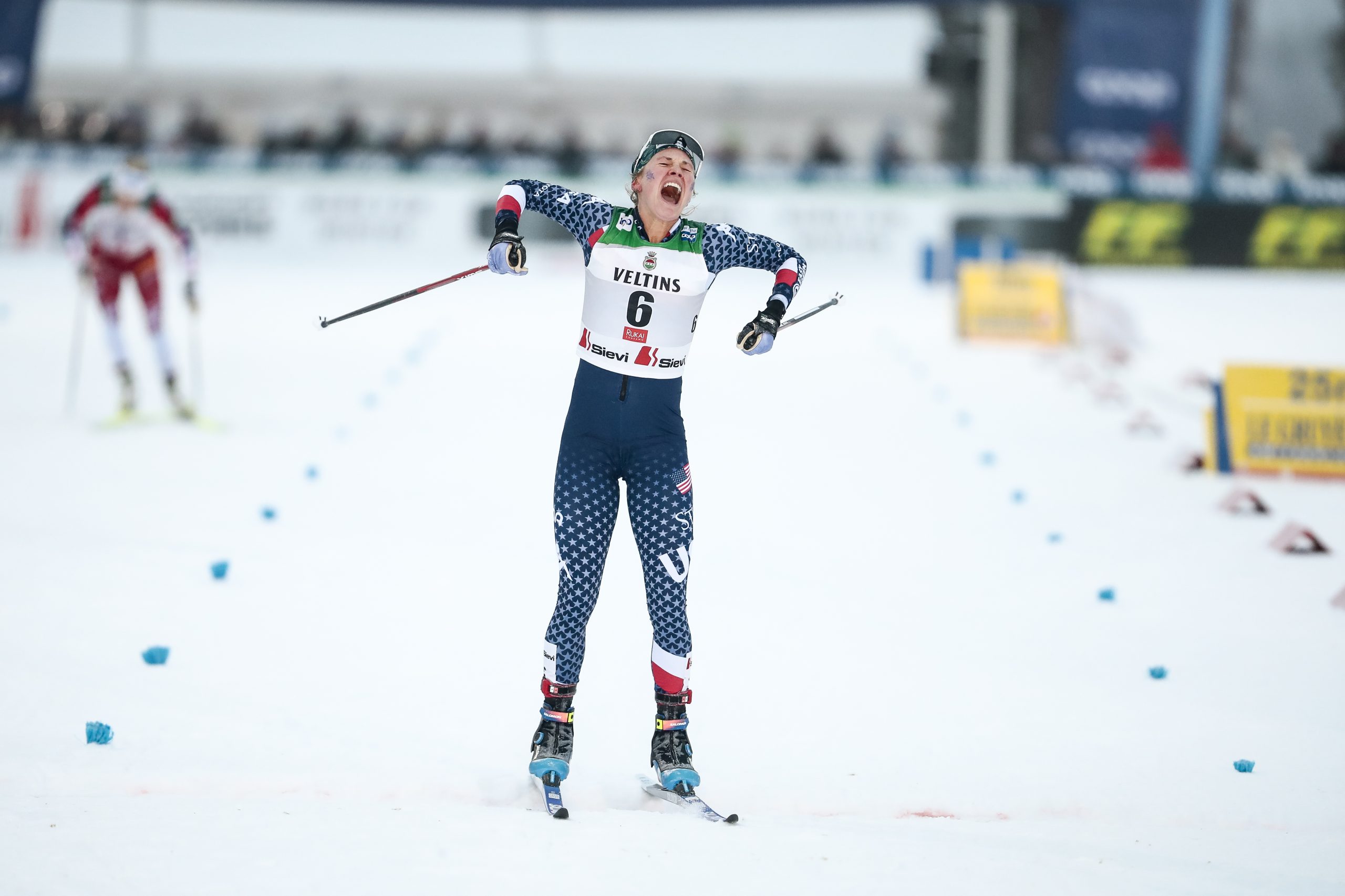
    The top Canadian skier was Liliane Gagnon in 28th. She was followed by Katherine Stewart-Jones in 33rd.

    The 20 Kilometer Freestyle

    Not surprisingly at the start of the race Johaug went out to the front right from the gun. She was joined there by Diggins, and long distance specialist Astrid Oeyre Slind (NOR). But the race looked quite different for the first 4k than any other distance race with Johaug in it before her retirement. Before retirement, Johaug would go out faster than anyone and then hold the gap she had created. Today, Johaug went to the front, but the pack was still with her.  Diggins and Heidi Weng were right at her side and there wasn’t the initial large gap which Johaug was known for creating earlier in her career.

    Try as she might, Therese Johaug (NOR) could not assert her will upon the field. (Photo: NordicFocus)

    Just before the 5.1 kilometer mark was the biggest hill on the course which the skiers would have to traverse four times. After cresting the hill for the first time, the skiers were still pretty much all together. But shortly after the hill a defined lead group of around 20 racers broke out. The most noticeable thing at this point was that Johaug was still not able to break from the field. In her pre-retirement competitions in a race of this distance she would have clearly asserted herself by now, not so this time around. It was a theme which would occur throughout the race.
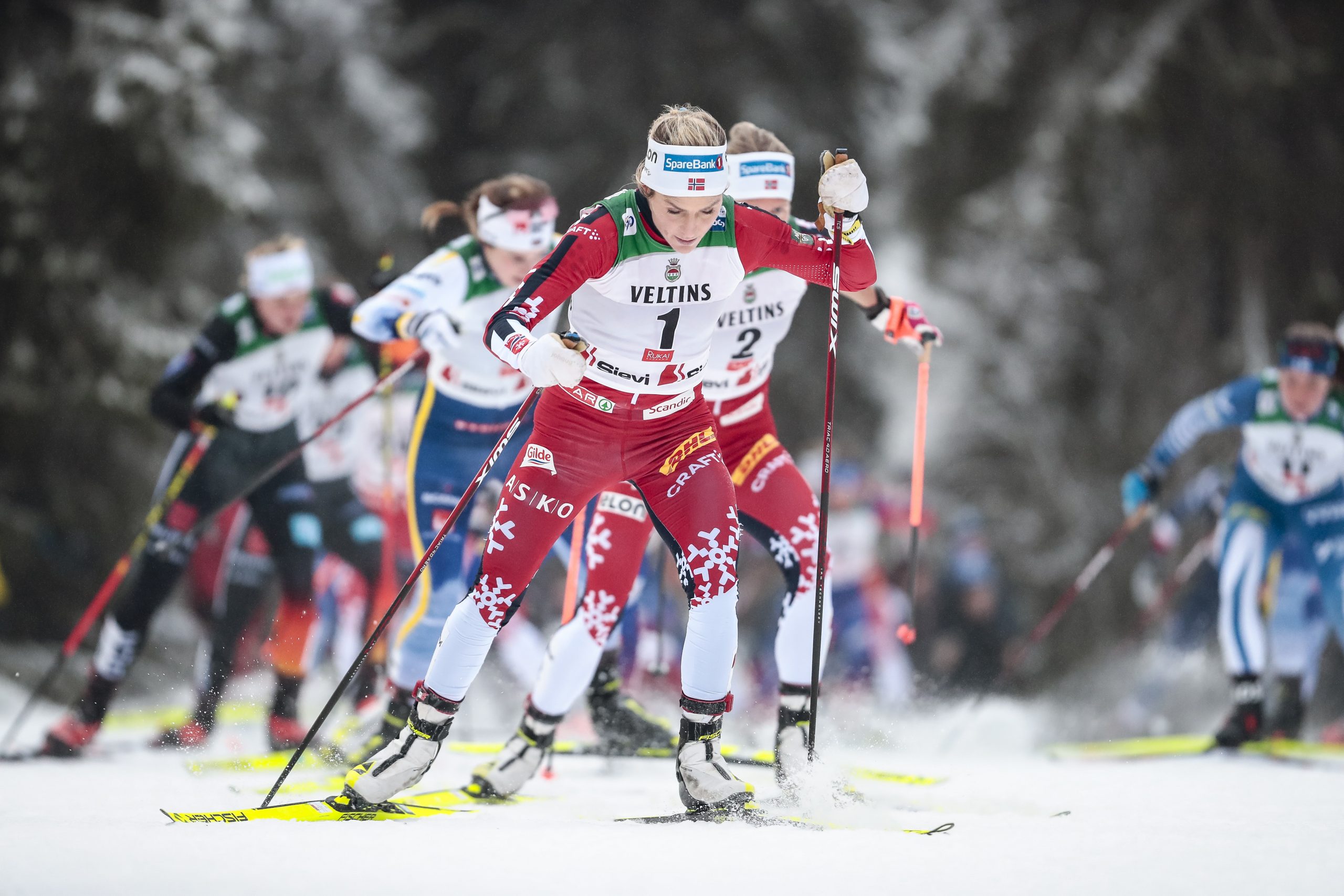
    Hanging with the front group was Sophia Laukli who was in ninth place. Rosie Brennan was a little off the front, ten seconds back in 21st.

    At about eight kilometers Weng went to the front to set the tempo with Johaug, Slind, Ebba Andersson (NOR) and Diggins with her. While Weng’s surge did separate the lead group from the rest of the racers, it didn’t sever the lead pack which was still a group of about 15 skiers.

    Interestingly at the 8.8 kilometer mark where 15 bonus points were available Diggins rather casually went to the front to claim the full bonus points. It was a reminder of her strategy from last year when she was in the hunt for the Overall Championship and was working for bonus points in every race. Diggins calmly surged to the front, claimed her points, and then melted back into the middle of the lead group.

    Delphine Claudel (FRA), Nora Sanness (NOR), Pia Fink (GER), Jonna Sundling (SWE), Flora Dolci (FRA), Linn Svahn (SWE), (l-r) (Photo: NordicFocus)

    At the 10.8 kilometer mark it was still Johaug out front with Weng right behind her setting the tempo. But Diggins was hanging right with them with Laukli impressively keeping pace in fifth place. Brennan was still in contact, only 9.3 seconds back.

    But every time Johaug and Weng climbed up the hills they put in a little extra effort, and it started to have an effect on the pack as they would be able to create a little space between them and the field. But on the flats, the gaps would close down, and there would again still be about 15 skiers in contention.
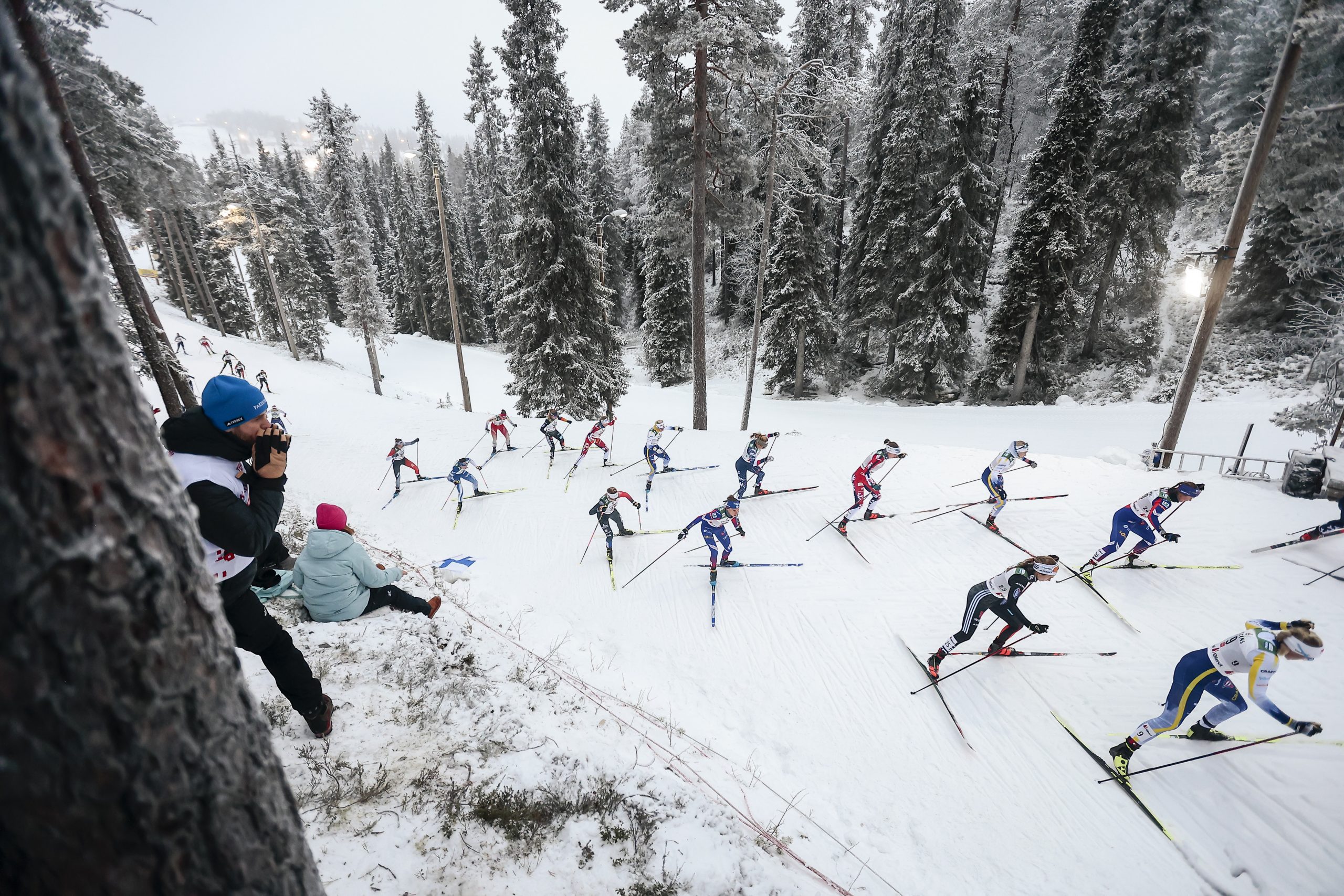
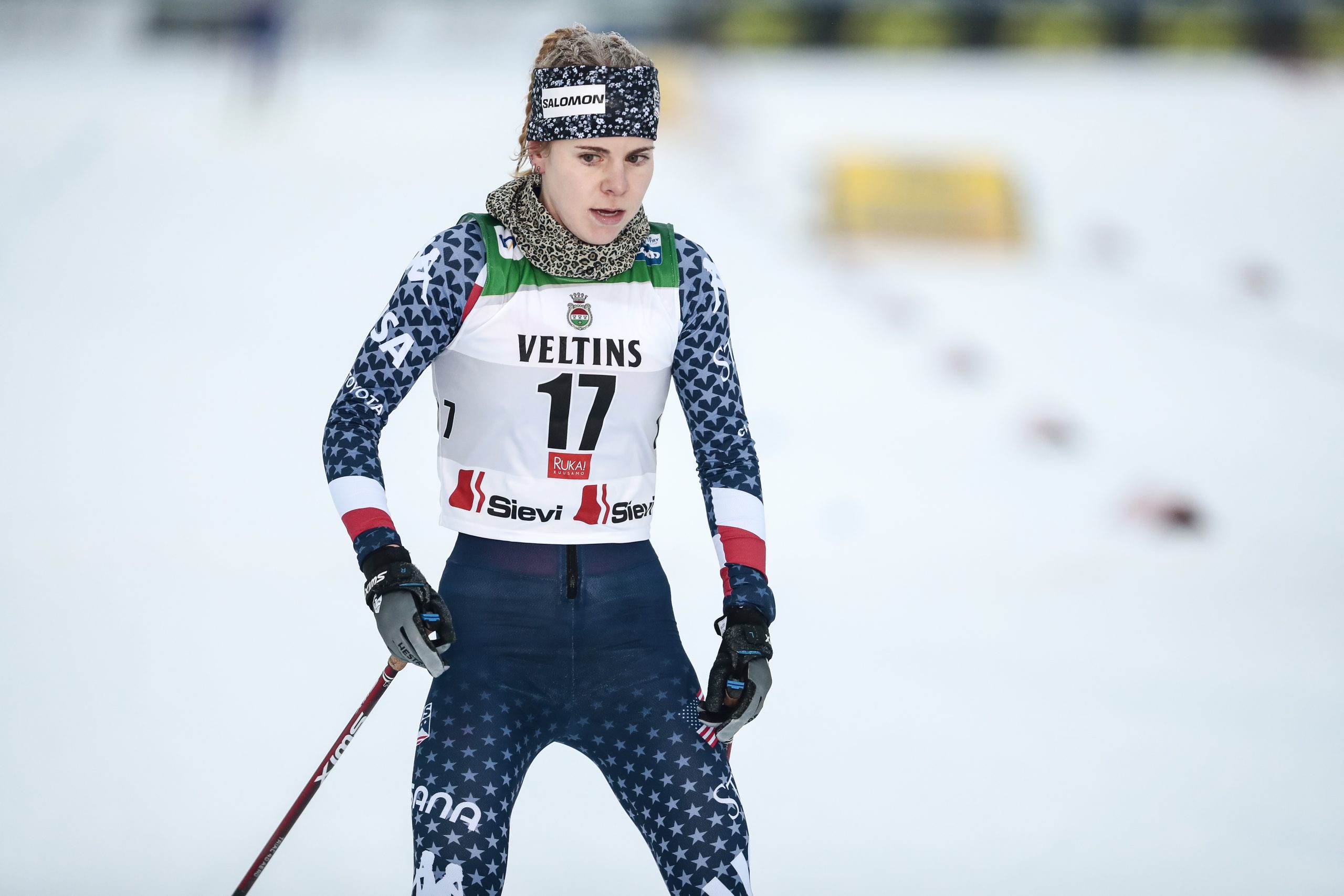
    Sophia Laukli (USA) was with the lead pack until the last several kilometers. (Photo: NordicFocus)

    At 13.1 kilometers Johaug and Weng put in a quick surge and finally began to find the gap which they had been working so hard to create. In seemingly the blink of an eye, they established a ten second lead on the field. The skier in front of the chase group trying to close the gap was now Laukli who was working furiously to chase down Johaug and Weng. Diggins was at the back of the chase group, and Brennan had dropped to 27 seconds back. It was a big effort by Laukli and she may have paid a price for it. She told FasterSkier that, “I found that I was skiing quite controlled so I really wanted to make a move and try to catch back up with the leaders. When it’s a mass start my best chance is being part of a small break away so that it’s not a big group of girls at the finish, so I wanted to see if that could happen. I didn’t feel like it really cost me but I did realize pretty quick that the way the course was laid out that the move wasn’t really going to pay off when the downhills brought everyone back together again. But I’m glad I tried because I know it will work when there are longer uphills or it’s a longer race next time.”

    At this point Brennan was clearly having troubles. “I was doing my best to stay as close to the front as I could, and unfortunately I just got blocked when that gap was made. I was actually feeling pretty good at that moment, so I was a bit frustrated that I couldn’t bridge that gap. I don’t think I had the top end speed I needed to be competitive, but I think I definitely had the pace to stay with that front group, but tactically, didn’t play it well.”

    Johaug and Weng kept on hammering away at the front and relentlessly began to assert their will. It looked like history was going to reestablish itself with Johaug being able to wear down the entire field of World Cup skiers with everyone else just trying to hang on. But Diggins had worked her way back to the front of the chase group and was now in charge of trying to close the gap. The pack was on the ropes but hadn’t been knocked out yet. Diggins tenaciously clung to the front and was now working with Sundling. The pair separated themselves from the rest of the chase group and brought themselves to within striking distance of Weng and Johaug.

    Jessie Diggins’ (USA) grit and tactics kept her in the race. Her final burst of speed gave her the victory. (Photo: NordicFocus)

    Methodically, Diggins and Sundling chipped away at the Norwegians’ lead. Just past the 17.5 kilometer mark Diggins and Sundling had finally closed the gap with a tremendous effort. Diggins later revealed to FasterSkier that the gap she had to overcome was partly due to her getting a little too “cute” with strategy. “During the whole race I was kind of playing around figuring out how much of a sling shot (there was) and essentially timing the distance, how far back could I be and still come back into contact on the flats. I think knowing it was likely to come down to a sprint finish, it was important for me to figure out how I could get away with as little work on the steep climbs as possible while still keeping contact. At one point I mis-timed it and go too far off the back, which is when I had to work pretty hard to get back up there. That’s when Sundling and I were working together to make contact with Heidi and Theresa. I got a little too cute.”

    It was now a group of four skiers. Diggins, Sundling, Weng, and Johaug were together in their own lead pack. It was now time to start thinking about the finish and who could win the final sprint. But Diggins had been thinking about a sprint finish way earlier in the race. She told FasterSkier that she starts thinking about the sprint finish, “probably in the first k. I start looking around and seeing who’s skiing aggressively where is the fast snow, where is the deep snow, what lines are working, if the pack is strung out will it stay strung out. So, there’s a lot of note taking going on in my brain during the race.”

    Diggins looked like she was paying the price for having spent so much energy catching the two Norwegians. In a sprint finish she could probably handle Weng and Johaug even if she was tired. But Sundling is a strong sprinter, and she was showing no signs of letting up.

    With less than a kilometer to go Diggins appeared to struggle to maintain contact with the first three leaders. There was now only one last climb before the stadium finish and that’s when the sprint began. The four skiers all went into overdrive up the hill with none of them able to initially break the others. But that is when Diggins amazingly found another gear. Suddenly, Johaug was dropped, and Diggins surged to the front. She shot by Weng and Sundling exploding to the finish line letting out a scream in exaltation, not distress, as she stormed across the finish. In an amazing display combing tactics, speed, strength, and sheer will, Diggins was able to blow past the other best skiers in the world and take the win. Sundling held on for second, with Weng taking third. It was another great day for Diggins in Ruka.

    Ruka 20 Kilometer Freestyle Results

    The winner gets to spend some quality time with Santa. Jessie Diggins (USA). (Photo: NordicFocus)
  • The Difference a Day Makes—Klaebo out, Amundsen In, McMullen and Schumacher Seventh and Eighth

    The Difference a Day Makes—Klaebo out, Amundsen In, McMullen and Schumacher Seventh and Eighth

    This coverage is made possible through the generous support of Marty and Kathy Hall and A Hall Mark of Excellence Award. To learn more about A Hall Mark of Excellence Award, or to learn how you can support FasterSkier’s coverage, please contact info@fasterskier.com.

    Harald Oestberg Amundsen (NOR) raises his arms in victory at the finish line of the World Cup 20 k Mass Start in Ruka, Finland. (Photo: NordicFocus)

    We thought we knew who to watch today . . . then he dropped out. Prior to today’s race, Johannes Hoesflot Klaebo (NOR) withdrew from the 20 k Mass Start Freestyle, leaving the race open to nearly everybody and the red World Cup leader’s jersey up for grabs.

    “This is the first of three consecutive three-day weekends,” said race commentator, Kikkan Randall. “And it is, of course, a World Championship year. So, a lot of athletes will be very calculated in how much energy they expend early in the season. If they wake up and they’re not feeling 100 percent, it’s better to call a race now than to dig yourself a hole later in the season.”

    In the absence of pre-race favorite, Johannes Hoesflot Klaebo (NOR), the field of the 20 k Mass Start was filled with numerous contenders who felt victory was within reach. (Photo: NordicFocus)

    The men’s World Cup field is filled with eager racers, and today’s race displayed the potential of those other contenders to stand in the spotlight. Perhaps the skier with the most to gain today was Harald Oestberg Amundsen (NOR), who could take over the World Cup Leader’s jersey with a good performance in Ruka. Last year, Amundsen won the season-long overall championship, aided in that quest by Klaebo’s absences from significant events. As he has often proven, Amundsen is ready to enter any such open door. He proved as much again today with a solid win ahead of last year’s Ruka 20 k winner, Jan Thomas Jenssen (NOR), and Martin Loewstroem Nyenget (NOR).

    Seven Americans had earned starting spots today in Ruka, but with the withdrawals of Zak Ketterson and Ben Ogden the American contingent was reduced to five. Following a sub-par performance in both the men’s and women’s Sprint races conducted yesterday, Team USA was set on redemption. They delivered in style behind the remarkable finishes of Zanden McMullen (7th) and Gus Schumcher (8th). Other American finishers included Hunter Wonders (45th), Michael Earnhardt (62nd), John Steel Hagenbuch (77th).

    Canadian finishers included Olivier Leveille (24th), Tony Cyr (28th), Max Hollmann (33rd), and Sasha Masson (63rd).

    “Being able to contend with the top finishers felt great,” said McMullen. “I always knew I have the capability to ski like this; I just struggled on the execution. My goal today was to conserve as much energy as possible (something I’ve struggled with in mass starts in the past), and to make every additional effort worthwhile. I felt like every time I went to make a move, I put myself in a better position for the rest of the race.”

    Iivo Niskanen (FIN) led the 20 k Mass Start through the first two laps, accomplishing his goal of capturing additional World Cup bonus points. (Photo: NordicFocus)


    Men’s 20 k Mass Start Freestyle

    Wearing the red Distance Leader’s bib that he earned in his victory in the 10 k Classic on Friday, Iivo Niskanen (FIN) led the field of starters through Ruka’s stadium. Though he is a fine skier—and though he’s racing through the cheering throngs of his countrymen—­Niskanen was not expected to contend in this freestyle race.

    As the race made its way up the first series of climbs, it was Swedish teammates, Calle Halfvarsson and Jens Burman, who dictated the pace at the front of affairs. Miko Vermeulen (AUT) and William Poromaa (SWE) marked all early moves, seeming determined to be involved in the early action. At the end of the second lap, Niskanen came through to the front again to capture the available bonus points. That seemed to have been his goal for the day, and he was quickly swallowed up by the field.

    Race instigators included Norway’s Martin Loewstroem Nyenget (4). He would race boldly, finishing the day in third place. (Photo: NordicFocus)

    Just past the halfway point, Martin Loewstroem Nyenget (NOR) began subtly to pull away. Friedrich Moch (GER) gave chase as the field strung out behind them.

    Andreas Fjorden Ree (winner of the Men’s 10 k in Beitostolen two weeks ago) attacked up the main Sprint course hill, establishing a gap ahead of the field and collecting 15 bonus points. The subsequent regrouping of the field allowed Zanden McMullen to establish himself in the lead pack, followed across a gap by Gus Schumacher who led the chase group.

    “(The pace) was about what I’d expected,” said Schumacher. “It can feel hard in Ruka, but there’s a lot of rest-sections that allow you to come back.

    “I never felt stretched to my limits today,” McMullen told FasterSkier. “And I think with just a little more confidence and time, I can fight for the win.”

    Through the final lap, the lead group was paced by Simen Hegstad Krueger (NOR), Mika Vermeulen (AUT), Moch, Jules Lapierre (FRA), and a group of contending Norwegians all jockeying for position. Seizing the opportunity that had been presented to him, Amundsen sprinted up the final hill to secure the win, followed by last year’s winner, Jan Thomas Jenssen (who vomited colorfully in the finish area after the race). Nyenget rounded out the all-Norwegian podium just ahead of Vermeulen in fourth.

    Zanden McMullen (USA) produces a career-best seventh place in the World Cup 20 k Mass Start Freestyle in Ruka, Finland. (Photo: NordicFocus)

    Ten seconds behind the winner, McMullen and Schumacher crossed the finish line seventh and eighth in a notable turnaround from yesterday’s American problems in the classic Sprint.

    “I felt like the last few kilometers of the race I skied a little reserved out of fear of screwing up a great performance,” said McMullen. “I wasn’t surprised to be up at the front, but I just didn’t quite know how to navigate that scenario. I found myself skiing in the back of the pack instead of trying to insert myself into a better position for the final sprint. But, lesson learned and I’m excited for a long season of more learning opportunities!”

    “(Zanden) was in front of me; I was just trying to hang on to him ,” said Schumacher.” It’s fun to ski with him when he’s skiing that good.”

    A different day produced a different winner. As it had done a year ago, the chase for the Crystal Globe will continue to develop and change, to twist and turn on the many different moments and circumstances that make up the World Cup season.


    Men’s 20 k Mass Start Freestyle RESULTS

    Harald Oestberg Amundsen took the win—and took over the World Cup Overall lead—in Ruka’s 20 k Mass Start Freestyle. With him on the podium were Jan Thomas Jensson and Martin Loewstroem Nyenget. (Photo: NordicFocus)
  • “We Wanted More . . .” Team USA’s Hard Look at a Low Day

    “We Wanted More . . .” Team USA’s Hard Look at a Low Day

    BONUS ARTICLE: This article was made possible through the generous support of our voluntary subscribers.  If you would like to see more articles like this one, please support FasterSkier with a voluntary subscription.  

    In the early morning hours of any FIS World Cup race day, messages are bouncing back and forth among a team of diligent FasterSkier writers, doing their best to craft illuminating articles on the race coverage flitting across our screens. And on mornings when race results either exceed—or fall short of—viewers expectations, the message bouncing gets even more intense. What those writers hope is that Team USA representatives will continue to communicate with us as they’ve done for many seasons now: friendly, honest, prompt, revealing comments offered in the interest of providing the best and most compelling story. That’s what we received today . . . and we figured readers would want to peek behind the curtain a bit to see what kinds of athletes, coaches, and staff members wear the USA brand. We’re proud of them this morning; we hope our readers are, too.

    Something was “off” for Team USA in today’s Classic Sprint in Ruka, Finland. True, Ruka’s Sprint course is a challenging one, and the field of FIS athletes is as strong and competitive as that of any sport . . . but something was “off.” Only two American women (Jessie Diggins and Rosie Brennan) qualified to advance to Sprint heats, while no American men managed to qualify (on a team that justifiably hopes to send athletes to semifinals, finals, and podiums). FasterSkier crafted articles that alluded to what appeared to be team-wide issues. Within that process, our writers always seek quotes from Team USA members. On this day—the day of the Ruka Classic Sprint—Team USA truly responded. We thought our readers might like to see and hear it all. It’ll make you proud . . .

    Jessie Diggins shares a close relationship with her coach and technician, Jason Cork, which reflects the strength of the entire team competing on the World Cup circuit for the United States. All the athletes, coaches, and technicians form a supportive family, and their communication and teamwork are tested at every race. While today’s results did not meet their expectations, they understand that by trusting one another, they will soon achieve their goals. (Photo: NordicFocus)
    Jessie Diggins

    Ben Ogden

    Certainly surprising and extremely disappointing to not make the top 30 today. I feel as though I was just not strong enough today and will just have to keep working and hope that I can build into this season.

    Ben Ogden (USA) working on ski selection on Thursday in Ruka (FIN). (Photo: NordicFocus)
    Julia Kern

    Julia Kern testing her skis two days ago with her longtime tech, Eli Brown. (Photo: NordicFocus)
    Matt Whitcomb

    Hello from Ruka, and the first World Cup sprint of the season. Needless to say, this was a disappointing day for the team. We were excited, and athletes are feeling good. We wanted more. Our staff had a long debrief after the races were completed where we took a hard look at our ski preparation process, and some potential areas where mistakes in ski speed may have been made. While it’s difficult to gauge ski speed in a qualifier, a team-wide shift toward the bottom of the page makes it clear that something was off. While this wasn’t the case for every athlete, it’s possible that our skis didn’t have the best glide, and we’ve zeroed in on some solutions for tomorrow.

    It’s early in the season, and our team is still adjusting to the pace of being on the World Cup where the margins are very small. If three of our guys could’ve shaved a second from their time, we would’ve had five qualifiers, instead of two. Certainly, we’re not in mid-season form, and I want to make it clear that the skis were just a piece of the puzzle today. We operated seamlessly as a team, and still, we had an off day. It’s a hard game. We’ll bounce back tomorrow. We’ve already bounced back.


  • Ruka Sprints: Hagstroem Gets First Win. Rough Day For USA

    Ruka Sprints: Hagstroem Gets First Win. Rough Day For USA

    This coverage is made possible through the generous support of Marty and Kathy Hall and A Hall Mark of Excellence Award. To learn more about A Hall Mark of Excellence Award, or to learn how you can support FasterSkier’s coverage, please contact info@fasterskier.com.

    It was a special day for Johanna Hagstroem (SWE) as she notched her first individual World Cup victory. (Photo: NordicFocus)

    Last year the theme for much of the women’s sprint season was whether anyone from team Sweden could defeat Kristine Stavaas Skistad (NOR). However, this year, things will be different, for at least a while. Sweden still presents an incredibly formidable team of Sprinters, with Emma Ribom, Johanna Hagstroem, Jonna Sundling, Linn Svahn, and Maja Dahlqvist headlining the Sprint roster and creating the most powerful women’s Sprint team in cross-country. But the rivalry with Skistad will have to wait as she is sidelined from abdominal surgery, and a date for her return to racing is uncertain. So, the duel between Sweden and Skistad is delayed for now with no one knowing what Skistad’s form will be like when she returns. Expectations for today’s Sprint were further complicated when Sweden lost some of its firepower early in the day when Emma Ribom withdrew before the start of the heats after having qualified 18th.

    Jessie Diggins (USA) looked good early in her heat, but couldn’t keep up with the pace. (Photo: NordicFocus)

    The bad luck for Norway and Sweden created an opening for other teams which America’s Jessie Diggins, Rosie Brennan, and Julia Kern would have loved to fill. But it was a tough day for the American women with only two qualifying for the heats with Diggins qualifying in 27th and Brennan in 28th.

    The first day of Sprinting is a big of an adjustment. “What is different is the technique on snow,” said Diggins. “I think that becomes one of the biggest things. At this point I’ve had maybe 10-12 hours of Classic skiing on snow. Ruka especially is a course that is super technically demanding … that’s the thing that’s hardest to get used to because it’s so different than roller skiing. You have to do pretty specific motions in order to close down your skis and kick.” She continued that, “I am pretty much where I normally am this point of the year. I really like to work into the year and I really like to work into my fitness, and so right now, I’m not super sharp, and that’s ok. I don’t expect to be. I’m not at all surprised by where I am right now. I think the base fitness is fine and the sharpening will come later. ”

    Instead, it was the hometown favorites from Finland who took advantage of the opening day change of pace and qualified seven racers and raised the hometown hopes for a Finnish woman to be standing on the podium at the end of the day. The Finnish onslaught was noted by Brennan. “It seems the Finns were flying this morning. I think they had some incredibly good skis, and that’s really cool to see. It’s been a little while since they’ve had a super-super strong team, so that’s awesome, and it was really great to see. Homefield advantage is always fun.”

    In the end form was maintained, but with different characters playing key roles as Sweden yet again found a way to the top of the podium with Johanna Hagstroem taking her first World Cup individual victory. But there was renewed optimism in the Norwegian camp as Norway found a new hope in Sprinting with Julie Myhre coming in second, Maja Dahlqvist (SWE) finished third.

    Other American racers were Julia Kern in 41st, Renae Anderson 42nd, Erin Bianco 43rd, Alayna Sonnesyn 44th, and Lauren Jortberg 48th.

    Kern was happy to just be in Ruka given the back injury she’s been fighting. “Qualifying is always really challenging here and I’ve never really had much buffer room. I’m proud of how I skied. I’m just really psyched to be at the start line right now. “Kern revealed that since her back injury, “it has been just a battle to be able to ski and train, and do everyday things. So, I’m happy to be at the start, and obviously wanting a lot more. “She acknowledged that she is uncertain about her fitness. “I always race into form, especially given a disruptive fall of training. Ruka is such a special beast … and from the first to second weekends, things can change a lot.”

    The only Canadian competitor today was Katherine Stewart-Jones: she finished 45th.

    Ruka is a technical and physically challenging course with a large hill close to the finish which usually plays an outsized role in determining the winners. At least today, the skiers wouldn’t have to contend with the difficult at freezing waxing conditions they faced yesterday, as today’s temperatures were in the mid-teens at the start of the competition.

    The Quarterfinals
    Rosie Brennan (USA), pictured qualifying, had a golden opportunity in her heat when three skiers went off course. (Photo: NordicFocus)

    Rosie Brennan (USA) was in the second heat and would face the Sprint champion from last year Linn Svahn, and the formidable Victoria Carl (GER). Brennan was boxed out early at the start and was pushed toward the back of the pack immediately. But in the blink of an eye, she was catapulted into third place when the three leading skiers tangled in the first turn, including pre-race favorite, and last year’s Sprint champion Linn Svahn, and went crashing off the course. Suddenly the race was down to three skiers. Brennan immediately took advantage going to the front of the remaining pack of three. But she couldn’t hold that lead going up the final hill and ended up battling for second with Carl. Carl was able to glide away from Brennan going into the stadium finishing second with Anne Kyllonen (FIN) winning the heat. Brennan finished third. Her time was not fast enough to qualify as a lucky loser and after only the second heat, her day would end. “It was definitely scary to watch those three girls said Brennan.” She added that, “I saw Linn take flight and I was quite worried that they were severely hurt so I had a moment of wondering whether I should stop or not because people’s safety is more important than a ski race.” She then decided to push the pace as much as she could. “Not for any other reason than just wanting to continue to open up my body and make a hard effort and maybe take some sprint out of somebody, because I know I don’t have the speed that I want right now.”

    Jessie Diggins (USA) was unable to move past the quarter-finals. (Photo: NordicFocus)

    Jessie Diggins was in the fourth heat. It was in a very competitive field with Nadine Faehndrich (SUI), Laura Gimmler (GER), Katharina Hennig (GER) and Frida Karlsson (FIN) in the field. The field stayed together early with Diggins looking to have quick skis as she had to stand up early on to avoid running up on her competitors. The group stayed together up the first challenging hill with Diggins keeping an outside line. Faehndrich then pushed to the lead with Diggins up toward the front of the pack. Going into the start of the final hill all the skiers were still grouped together as the final charge began. But Diggins couldn’t keep up with the pace and was pushed off the back. She dropped back even more toward the end of the race and finished sixth. Her day was also over. She attributed her inability to keep pace as being, “a technique and ski decision thing on the final hill.” She continued that, “I made the mistake of not asking for extra kick, I had tested my skis and I thought I was in a good place with them, but in hindsight I needed more kick.” Diggins said that the lack of kick caused her to ski “hesitantly, tiptoeing up the hills to not slip.” Diggins took full responsibility for the lack of kick wax. “That’s on me. It’s important for me to communicate with my tech. I own the fact that I thought I had enough kick, and I was wrong with that.”

    Norway has new hope in Sprinting with Julie Myhre (NOR) coming in second. (Photo: NordicFocus)
    The Semi Finals

    Jasmi Joensuu (FIN) continued to keep Finnish hopes alive as she took off to an early lead, but racers quickly consolidated and they were one big pack going into the first hill in what quickly turned into a very tactical race. Sundling was able to put in a last second sprint to take the win along with Dahlquist who finished second. Joensuu hung on for third and would keep Finnish hopes alive by advancing to the finals. But so far, the Swedes had been able to overcome the Finn’s numeric advantage and were beginning to assert themselves.

    Finland’s Sprint hopes were riding on Jasmi Joensuu (FIN), (far left), but ultimately Finnish fans would go home empty handed. (Photo: NordicFocus)

    In the second heat it was an unusual position for Johanna Hagstroem as she was the only Swedish skier. But the lack of teammates didn’t deter her. Going into the final hill Hagstroem displayed a preview of what fans would see in the finals and put in a huge burst of speed to shoot to the front. All day long, Hagstroem looked like she had something extra to offer on the big final hill and she worked her advantage perfectly throughout the heats. Her only mistake was slowing up too much coming into the finish line where she was joined by Coletta Rydzek (GER) in what became a photo-finish. But Hagstroem was still able to eke out the win.

    The Finals

    Sweden fielded three skiers in the finals with Sundling, Dahlqvist, and Hagstroem qualifying. After its initial surge of qualifying seven skiers, Finland was down to only one skier remaining; Jasmi Joensuu. She joined Norway’s Julie Myhre, and Rydzek.

    The emotion of Johanna Hagstroem’s (SWE) first win was showing during and after the race. (Photo: NordicFocus)

    The Swedish trio went to the front early with Rydzek gamely hanging with them. Things again turned very tactical with all the skiers slowing down on the first climb with no racer wanting to lead. It wasn’t until the big hill at the final that things opened with Hagstroem putting in another incredible burst which ultimately catapulted her to victory.

    It was a special day for Hagstroem as she took the victory which was the first win of her career. Julie Myhre (NOR) hung on for second with Dahlqvist finishing third. Myhre’s podium had to provide team Norway with some level of solace giving them hope that someone would step up in Skistad’s absence.

    After the race Hagstroem said that, “I cant believe it. It feels crazy.” She continued that “I had a really good day. I like Ruka and love the last hill.” She explained that as part of her strategy she likes to go outside of the track and run on her skis. “I kept thinking don’t screw it up. I’m in shock.”

    The incredible promise of the beginning of the day for the Finns turned sour when after qualifying seven racers, none of them could make it to the podium.

    It was also a rough day for team USA who will hope to rebound next weekend in Lillehammer, Norway when the Sprints will be in the Freestyle technique and hopefully their fortunes will improve.

    Johanna Hagstroem (SWE) – FIS world cup cross-country, individual sprint, Ruka (FIN). (Photo: NordicFocus)

    Ruka Women’s Classic Sprint Results

    Ruka Women’s Classic Sprint QUALIFICATION

  • New Season, Same Old Result: Klaebo Rules Ruka Sprint

    New Season, Same Old Result: Klaebo Rules Ruka Sprint

    This coverage is made possible through the generous support of Marty and Kathy Hall and A Hall Mark of Excellence Award. To learn more about A Hall Mark of Excellence Award, or to learn how you can support FasterSkier’s coverage, please contact info@fasterskier.com.

    Johannes Hoesflot Klaebo made yet another statement during the classic sprint in Ruka (FIN) this morning showing the ski world that he is in a class all by himself. (Photo: NordicFocus)

    Sprinting is a crazy thing to do on cross country skis. Courses are icy, uphills are steep, corners are tight, and the challenges of forcing this long, spindly equipment into a crowded and chaotic mass start sprint leaves fields of world class athletes looking like giraffes on rental skates. It seems like anything can happen. Unless, of course, your name happens to be Johannes Hoesflot Klaebo (NOR), in which case nearly every Sprint weekend is the same: you win.

    Well, Klaebo IS his name, and win he did . . . in much the same style as he so often does: dominant and clever, quick and light, moving easily and accelerating effortlessly on a pair of skis that the rest of the World Cup field would kill for. Alongside Klaebo on Ruka’s Sprint podium were his Norwegian teammate, Erik Valnes, (one of the few other skiers to had Klaebo a defeat on this particular Sprint course), and Finland’s hometown favorite, Lauri Vuorinen.

    “It’s good to be back,” Klaebo beamed in post-race interviews. “I didn’t have my best day yesterday, so it’s really good to be back on top of the podium.”

    American sprinter, Ben Ogden, was expected to be among the serious sprint contenders in Ruka. Mysteriously, no North American men advanced out of qualifying rounds. Ogden would finish the day in 32nd. (Photo: NordicFocus)
    American sprinter, Ben Ogden, was expected to be among the serious sprint contenders in Ruka. Mysteriously, no North American men advanced out of qualifying rounds. Ogden would finish the day in 32nd. (Photo: NordicFocus)

    Klaebo had dominated the qualifying round, covering Ruka’s Sprint course in 2:22.59, a full 2.5 seconds faster than the second qualifier, Benjamin Moser (AUT). Behind Moser, the top thirty qualifiers were separated by just over four seconds. Vexingly, Americans failed to qualify any skiers into the top thirty. Ben Ogden was the top American, qualifying 32nd, followed by Zak Ketterson (35th), Zanden McMullen (37th), JC Schoonmaker (50th)), Michael Earnhardt (53rd), Kevin Bolger (62nd). Canadian skiers also failed to advance qualifying: Xavier McKeever (47th), Pierre Grall Johnson (55th), Sasha Masson (61st).


    Ruka Classic Sprint

    Temperatures dropped overnight in Ruka, Finland, creating a course of slick man-made snow that tripped up numerous sprinters in the Women’s field and Men’s field, alike. While Friday’s temperatures hovered near freezing, by Saturday morning, winter had returned to northern Finland, with temperatures at race-time dropping to 15 degrees Fahrenheit. Sprinters lined up for qualifying wearing buffs, mittens, and pompom hats in the cold of northern Finland.

    Former World Cup Sprint Champion, Kikkan Randall, was overheard discussing the Ruka Sprint course with co-anchor Chad Salmela. “The season starts in Ruka, she said. “It’s one of those longstanding traditions that really does kind of work the cobwebs out. For me, personally, it was quite the challenge to crack. I had some really good races on this course, but most of the time, I was just trying to get into the top 30. It was a real puzzle to solve. It’s a great course to see Classic technique really on display.”

    FIS’ on-site reporter was overheard speaking with former Finnish World Cup competitor, Martii Jyhla, who used spicy language not usually heard on camera to describe the key points of the Ruka Sprint course. “In the last uphill, it’s pretty important to have a good grip to be able to ski all the way to the top,” Jyhla said. “I think the last 10-20 meters are the most critical ones. If you either get too much lactate there, or you are losing the grip, then you’re pretty much—can I say it on TV?—(screwed).

    The comical scramble of FIS’ shocked on-camera reporter notwithstanding, Jyhla’s spicy description was pretty much spot on. That uphill would be the key.

    World Cup sprinting is conducted on challenging courses, in tight quarters, and in hotly contested heats that can prove unpredictable. Norway’s Haavard Solaas Taugboel (9) was a pre-race favorite, but his day ended with a fall in the quarterfinals. (Photo: NordicFocus)
    World Cup sprinting is conducted on challenging courses, in tight quarters, and in hotly contested heats that can prove unpredictable. Norway’s Haavard Solaas Taugboel (9) was a pre-race favorite, but his day ended with a fall in the quarterfinals. (Photo: NordicFocus)


    Sprint Quarterfinals

    Johannes Hoesflot Klaebo (NOR) drew Quarterfinal Heat 1, sharing the stage with his Norwegian teammate, Erik Valnes, who also advanced to the semifinal. As we’ve so often seen him do, Klaebo seemed to wander effortlessly to the front on the mid-course downhill, positioning himself perfectly for the critical uphill section on which Ruka Sprints are often decided. It’s amazing how often Klaebo maneuvers his way unscathed through Sprint heats, and Ruka would prove no exception.

    Behind Klaebo, though, strange things began happening. Racers were slipping, spilling, tangling. Haavard Solaas Taugboel (NOR) fell in the final turn of Heat 3, in which Harald Oestberg Amundsen (NOR) also failed to advance. Federico Pellegrino qualified only 20th; even so, he advanced easily through his quarterfinal, punching up the final uphill to coast across the line ahead of Even Northug (NOR).


    Sprint Semifinals

    I want Klaebo’s skis—or his finesse, or his technique, or his balance, or his timing—or whatever it is that allows him to go coasting easily past the world’s best sprinters. Even his own Norwegian teammate, Erik Valnes (perhaps the world’s second-best sprinter) struggles to remain in Klaebo’s wake. Valnes was matched with Klaebo in the quarterfinals and semifinals, both times finding himself relegated to watching as Klaebo drifted easily by him on the mid-course downhill. Klaebo and Valnes both would advance to the final, but Valnes did so without much of a plan for how to win.

    In the second semifinal, Pellegrino found an extra gear on the final uphill to drop Marcus Grate (SWE) and distance a slipping Northug, but Pellegrino was unable to hold them off in the final drag race to the finish line. Northug and Grate caught Pellegrino from behind to advance to the final. Crossing the finish line third (not fast enough to claim a lucky loser spot), Pellegrino was done for the day.

    Johannes Hoesflot Klaebo has time to coast the final 50 meters of the Classic Sprint final in Ruka, Finland. His win earns him the FIS World Cup leader’s jersey in both the Sprint and Overall classifications. (Photo: NordicFocus)


    Sprint Finals

    As the sun was setting over Ruka, the Men’s Final lined up at the starting line: Klaebo, Valnes, Northug, Grate, Lauri Vuorinen (FIN), and Niilo Moilanen (FIN). Just one year ago Valnes had defeated Klaebo on this same Ruka Classic Sprint course, but it’s possible neither he—nor anyone else—remembers how he managed to do it.

    As he had done in each of his earlier heats, Klaebo had created enough of a gap at the top of the final uphill to look back at his competition before hitting the jets on the final straightaway. He coasted easily across the line for the win ahead of a gamely-flailing Valnes and crowd-favorite, Vuorinen.

    Finland’s Lauri Vuorinen thrilled the Ruka crowd with his bronze medal performance in Saturday’s World Cup Classic Sprint. (Photo: NordicFocus)

    Klaebo will enter Sunday’s 20 k Freestyle Mass Start as the FIS World Cup leader in both Sprint and Overall. After today’s Sprint in Ruka, many ski fans could not imagine anyone else wearing that leader’s red bib.


    Ruka Men’s Classic Sprint RESULTS

    Ruka Men’s Classic Sprint QUALIFICATION

    To the delight of Ruka’s cheering crowds, Johannes Hoesflot Klaebo (NOR) delivered another master class in Classic sprinting. He was joined on the podium by Erik Valnes (NOR) and Lauri Vuorinen (FIN).


  • Niskanen Secures Victory at Home as Ruka Launches World Cup Season

    Niskanen Secures Victory at Home as Ruka Launches World Cup Season

    This coverage is made possible through the generous support of Marty and Kathy Hall and A Hall Mark of Excellence Award. To learn more about A Hall Mark of Excellence Award, or to learn how you can support FasterSkier’s coverage, please contact info@fasterskier.com.

    Finland’s Classic skiing legend, Iivo Niskanen, raced to a victory in the men’s 10 k Classic Interval Start in Ruka, leading the field by 12 seconds into the finish (Photo: NordicFocus)

    Ruka, Finland is an area known for challenging race courses and rapidly changing conditions. As the women’s field wrapped up the morning race, the men took on the course under snowfall and near-freezing temperatures. With dusk settling in and the stadium lights casting a glow over the trails, it was a classic start to the World Cup season in Ruka. For the wax technicians, the unexpected snowfall added extra complexity to the afternoon’s preparations. With no precipitation predicted, technicians battled the fresh snow and near-freezing temperatures to craft a kick that would allow athletes to stride on Ruka’s infamous climbs. The loose snow on the uphills forced racers into herringbone, a technique that saps energy and momentum, while the choppy surface caused slips and stumbles as skiers fought to maintain their rhythm.

    The biggest question of the day: could Finland’s Iivo Niskanen finally outpace Norway’s Martin Loewstroem Nyenget in their highly anticipated battle after a close finish in last year’s event?

    It turns out he could. Niskanen claimed the top spot on the podium, delivering a thrilling victory for his home crowd by more than 12 seconds. He was followed by Norwegians Harald Oestberg Amundsen in second, and Nyenget in third, with just two seconds separating the teammates. This pair fought for the podium positions alongside other Norwegian teammates with similar splits over the course of the race. 

    North American skiers also celebrated strong results today: Gus Schumacher finished 18th, Ben Odgen, 29th, Zanden McMullen, 30th, Zak Ketterson, 36th, Hunter Wonders, 48th, and Michael Earnhart, 57th. 

    The two Canadian athletes, Xavier McKeever and Max Hollmann, finished 32nd and 50th, respectively. 


    Men’s 10 k Classic Interval Start

    Home-country favorite and distance specialist, Niskanen, claimed the victory, delivering a commanding performance before a crowd of his boisterous countrymen. Starting mid-pack, Niskanen quickly established his dominance, leading the field by the 1.5 k check. He extended his advantage to 5.1 seconds at 3.1 k, 10 seconds at 5 k, and maintained a steady pace to finish 12.5 seconds ahead of Amundsen in second place. Amundsen was a favorite for the podium, defending his overall World Cup win last season. Niskanen crossed the line beaming, pounding his hands in celebration toward the crowd, clearly thrilled with his victory on familiar terrain. Nyenget claimed third place, finishing just two seconds behind Amundsen after delivering a strong performance in the early stages of the race.

    A strong group of Norwegians competed for the following positions, coming in with similar splits throughout the race. This group included medalists Amudsen and Nyenget, as well as their teammates Erik Valnes, Johannes Hoesflot Klaebo, and Andres Fjorden Ree. Ree dropped back after 5 k and Simon Hegstad Kreuger caught up to the pace set by his teammates around 6 k. Just seconds behind this pack of six Norwegians was Jens Burman (SWE), a strong mid-distance skier who has seen success in this discipline before. 

    Johannes Hoesflot Klaebo (NOR) skied to fourth place in the 10 k classic in Ruka, 28 seconds off the winning time. (Photo: NordicFocus)

    Klaebo was favored to contend for the win after his dominance late last season, though finished 28 seconds behind Niskanen in fourth place today. While this might seem surprising, it’s not an uncharacteristic early season result for Klaebo, who placed 14th in this race last year before dominating the second half of the season. If he has taken a similar strategy this year, we might expect Klaebo to start challenging the top of the distance podium positions by the start of January. 

    The American men also saw progress compared to their results in last year’s Ruka 10 k classic. Schumacher delivered a strong 18th place performance, improving on last year’s 22nd place in this race with one of his best-ever finishes in this discipline, second only to his 15th-place results in Toblach (2023–24) and Oberstdorf (2022–23). “I’m always thinking about technique and I feel like that leads to slight improvements over the long term, Schumacher said. “I think that idea of slight improvements over long term is what gets me here today.” 

    Gus Schumacher (USA) raced to 18th place in Ruka, an improvement over last year’s 22nd place finish. (Photo: NordicFocus)

    Ogden, who is returning to the circuit after his previous season was cut short by mononucleosis, showed he’s back in form. “I worked on pacing in workouts,” Ogden noted regarding his transition back to the race circuit. “While today wasn’t perfect, I feel like It wasn’t bad by my standards, especially for not racing in a while. Excited to see how this can develop and make me faster over the next few months.” After finishing 39th in Ruka last year, Ogden opened this season with a strong 29th place finish today—a promising ten-spot improvement that bodes well for the upcoming season.

    “It’s so fun being back with everyone, team USA and beyond,” Ogden shared following his race. “Cross country skiing is a small community and sometimes I don’t appreciate how awesome everyone from all the nations are until I have to leave them for a while. Congratulating everyone after the races and getting fired up is just so fun.”

    Coach Matt Whitcomb is pleased with the team’s results.“We’re in a pretty good spot right now,” Whitcomb shared. “Very representative of a team that’s going to have a great season and isn’t quite sharp yet. So we all feel good about it.” 

    Be sure to follow the action in tomorrow’s skate sprint and Sunday’s 20 k skate, as the Americans continue to build strength and momentum heading into the rest of the season.

    RESULTS Men’s 10 k Classic Interval Start

    Harald Oestberg Amundsen (NOR), Iivo Niskanen (FIN), and Martin Loewstroem Nyenget (NOR) topped the podium in the Ruka men’s 10 k Classic.  (Photo: NordicFocus)
    Harald Oestberg Amundsen (NOR), Iivo Niskanen (FIN), and Martin Loewstroem Nyenget (NOR) topped the podium in the Ruka men’s 10 k Classic. (Photo: NordicFocus)