Category: Feature

  • Sundling Wins Engadin Freestyle Sprints. Diggins Breaks Pole in Finals, Finishes Sixth

    This coverage is made possible through the generous support of Marty and Kathy Hall and A Hall Mark of Excellence Award. To learn more about A Hall Mark of Excellence Award, or to learn how you can support FasterSkier’s coverage, please contact info@fasterskier.com.

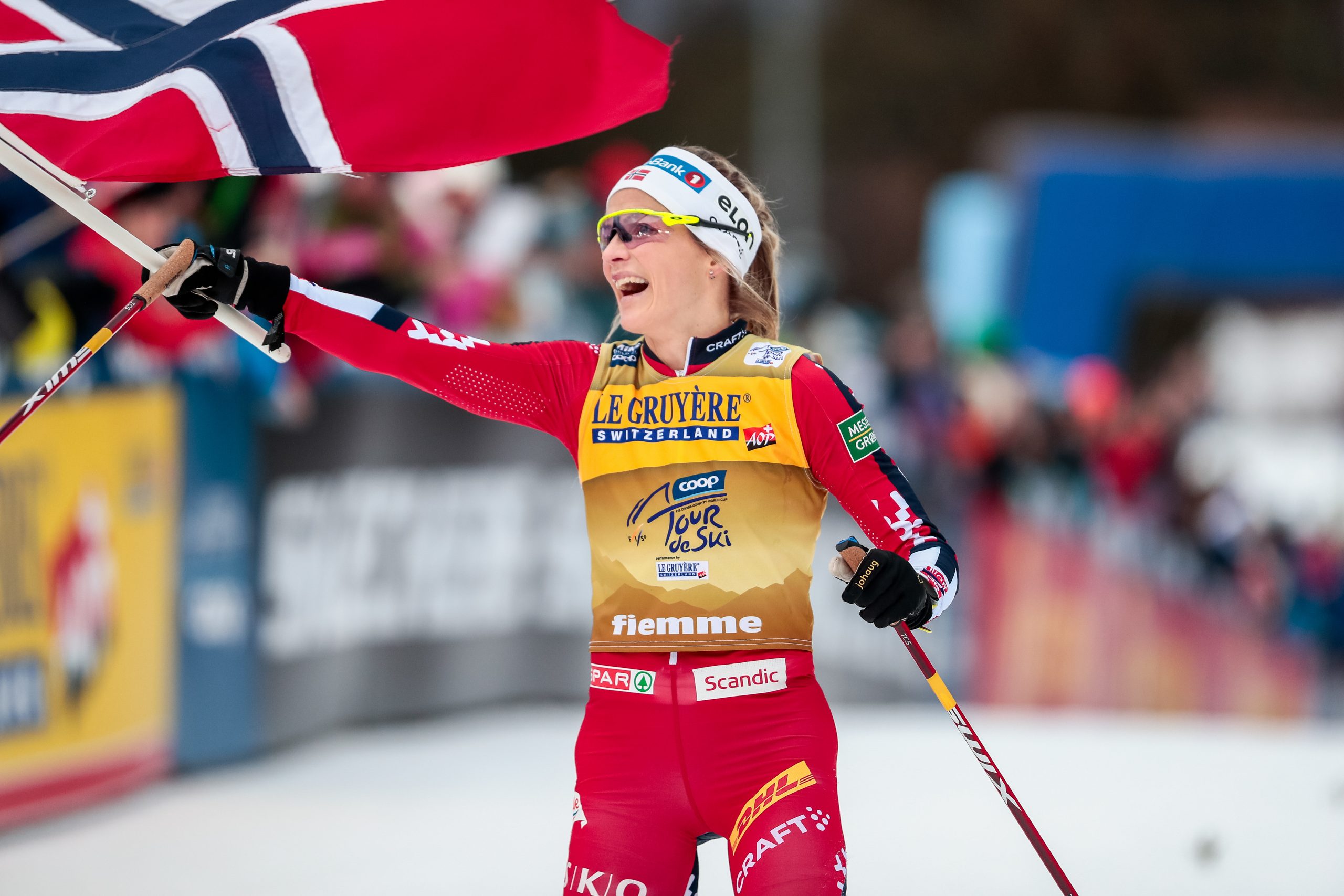
    Jonna Sundling (SWE) (bib number one), and Kristine Stavaas Skistad (NOR) battled all day. (Photo: NordicFocus)

    Today’s Freestyle Sprint in Engadin, Switzerland was an opportunity for Jessie Diggins to expand her lead in the chase for the Overall leader’s position in the World Cup. Entering today’s race—held at over a mile in altitude— Diggins held a healthy 146 point lead in the Overall competition over Victoria Carl (GER), and 158 points over Astrid Oeyre Slind (NOR). It was a great opportunity for Diggins to put more distance between herself and Slind, as the Norwegian was not on the Sprint start list. The event’s importance was further magnified since Diggins’ foot injury has hindered her opportunity to separate herself from Slind in Classic Sprints, so Freestyle Sprints have become a rare opportunity for her to gain substantial ground on Slind. Carl, however, is a regular in the Sprint heats, and she would be working hard to gain ground on Diggins.

    For Diggins, it was mission partly accomplished before the heats even began as Carl finished 37th in qualifying meaning that she wouldn’t be in the heats and Diggins would have a golden opportunity to put some distance on her German rival.

    Team Norway was somewhat replenished with Lotta Udnes Weng, and Kristine Stavaas Skistad, joining the start list. Sweden fielded its usual formidable field—including Jonna Sundling, Emma Ribom, and Maja Dahlqvist— but still absent from team Sweden was Linn Svahn. When Sundling is in form she is always a name to beat and proved that again by finishing first in the qualifying round leading the field by over four seconds.

    At the end of the day Sundling simply proved too formidable for the rest of the field as she led every heat including the finals, where she was able to convincingly handle Skistad. Skistad skied very tactically the entire day and tried to slingshot past Sundling in the finals, but the Norwegian simply didn’t have the speed to be able to pass Sundling. Dahlqvist ended up taking third.

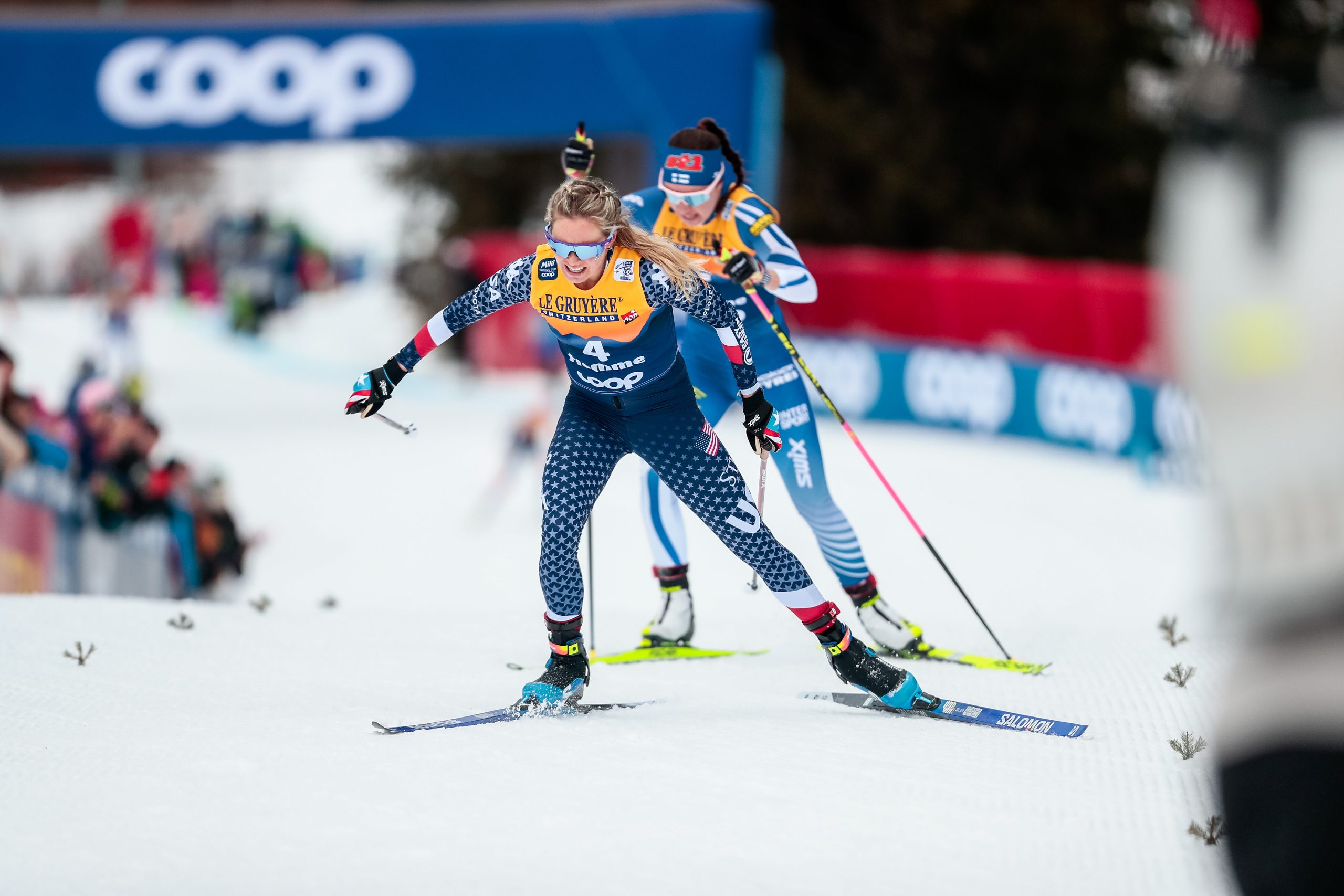
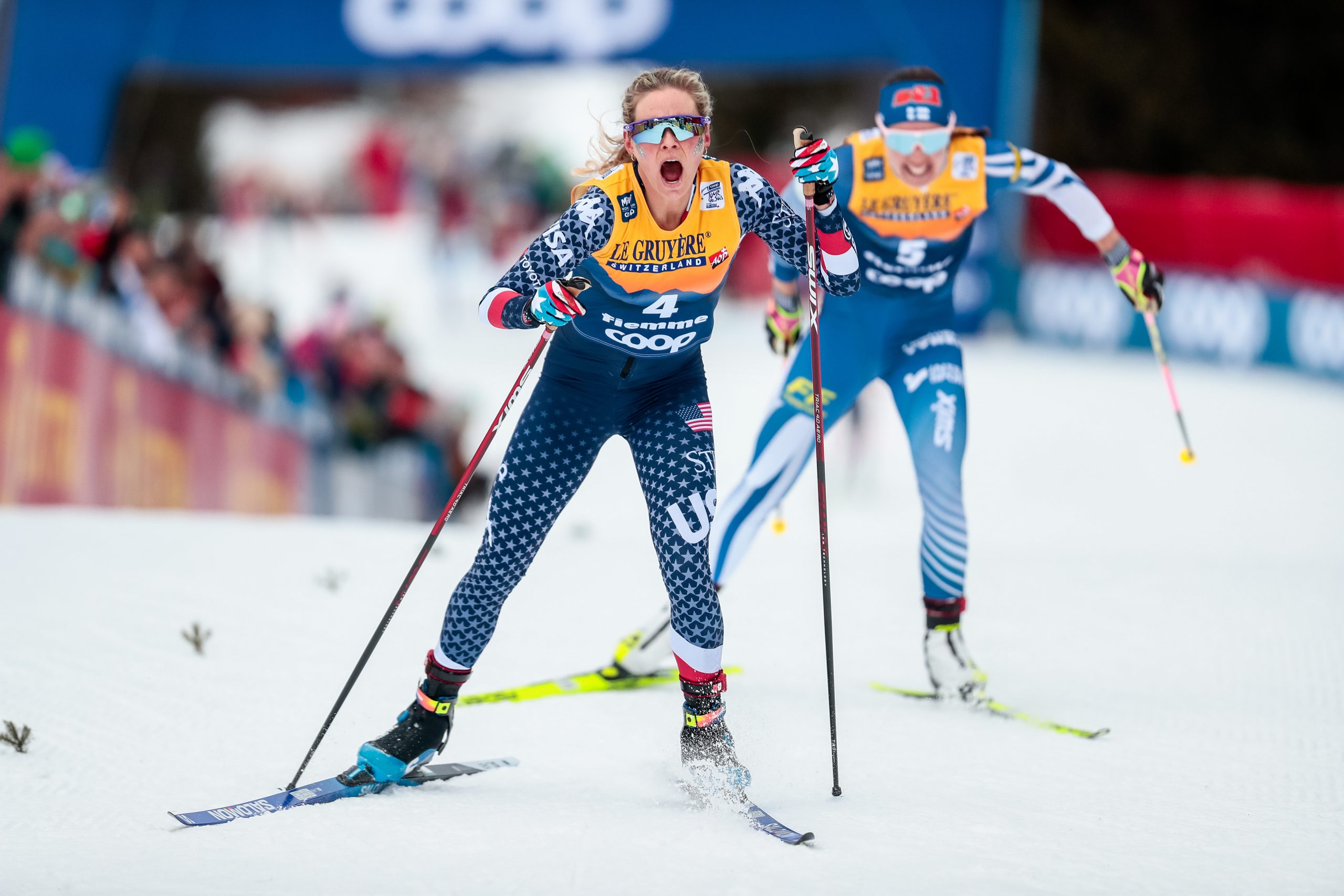
    Jessie  Diggins (USA) looked good all day, but was done in by a broken pole in the finals. (Photo: NordicFocus)

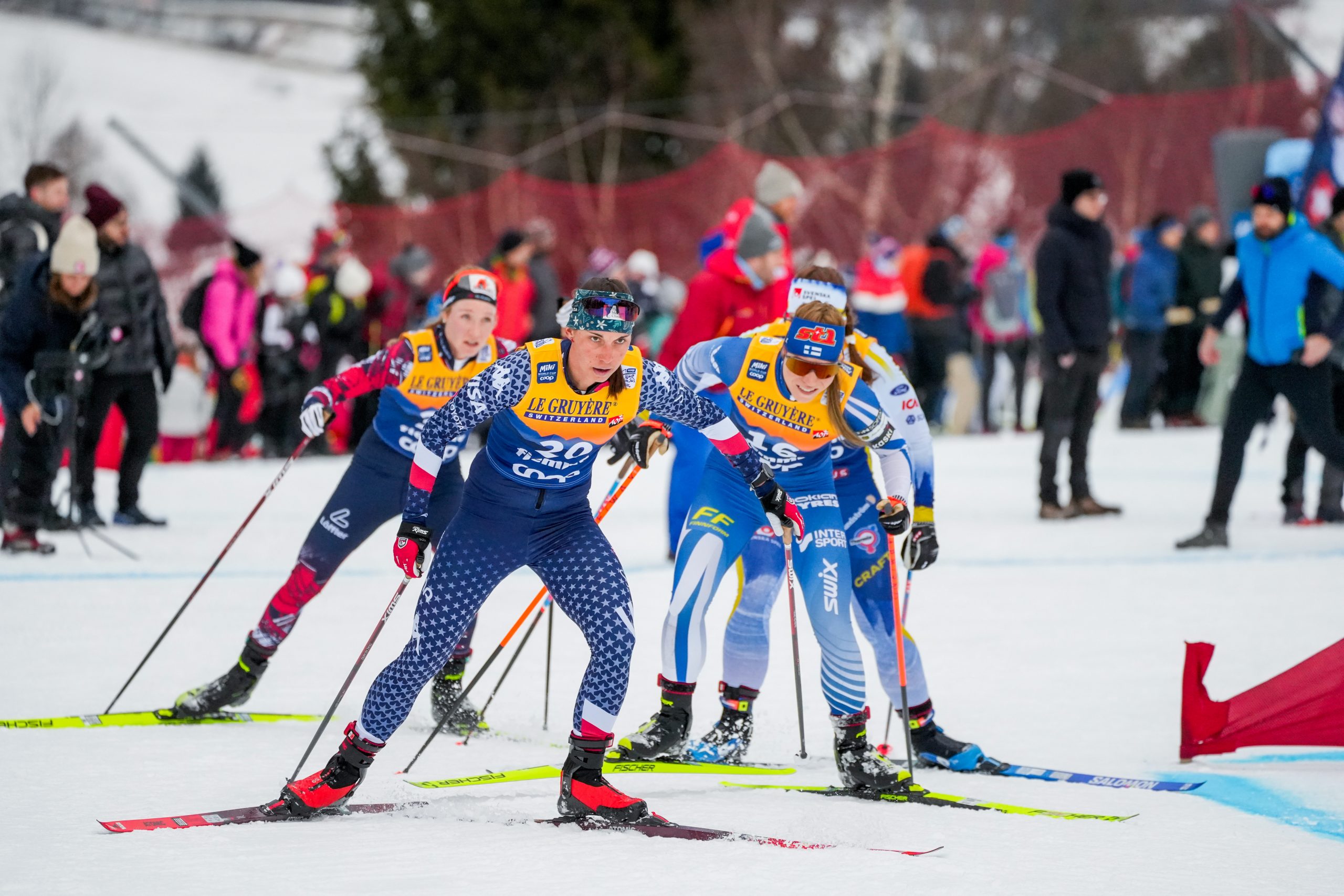
    Diggins qualified eighth and decided to race in the third quarter final, abandoning her strategy of choosing heat number five. The new strategy served her well as she advanced to the finals. But she had bad luck in the finals when she fell going up a hill and broke a pole. It was an unrecoverable event, and she ended up finishing sixth. It was a truly unfortunate bit of bad luck as Diggins had looked very strong all day and into the final race as well. “The thorn was getting my ski stepped on, which caused me to fall then put my knee through my pole, or my ski, I’m not sure” said Diggins. “My rose was how I handled it. You only get your sportsmanship tested when things go wrong. And I’m really proud of how I kept my head high, I smiled and thanked the volunteers and the fans, and took time to high-five a bunch of cute little kids. I’m proud of how I handled the situation that’s obviously a bummer, but that is sport.”  But the good news for Diggins was that she gained substantial ground over her rivals in her chase for the Overall lead.

    Today also marked Julia Kern’s (USA) return to Sprinting. Kern raced yesterday in the mixed relays (five kilometers) but today was her first opportunity to test her Sprinting legs since the Tour de Ski. Kern looked good in the quarter final and made it to the semifinals but was unable to advance out of the semis. “I was excited to be sprinting again,” said Kern “I’ve been hungry to improve my sprinting this season, trying to find my sprint mojo back. The pace was hot from the start and I was feeling the quarterfinals and the altitude in my body. I’m proud of how I skied the quarterfinals today, and was a step in the right direction to getting my sprint form back, and now I have to work on holding repetitive efforts through the rounds.”

    There were also some fresh faces on team USA with Kate Oldham and Lucinda Anderson joining Lauren Jortberg and Alayna Sonnesyn in the qualifying round. It was the World Cup debut for Oldham, and only Anderson’s second world Cup race. Oldham and Anderson made the heats qualifying 28th and 24th respectively. “I’m trying not to have any result-based goals on my first trip to World Cup so I can just focus on learning what it’s like to race here,” Oldham said after the race. “That being said, it was a huge bonus to make the heats today. Racing the qualifier felt similar to most other qualifiers especially because it was an individual start race, but I knew that every fraction of a second was going to count because the level of competition is so high here. I think the parts that were the most different were the little things that you don’t get in the US, like having a heat selection, lots of cameras, starting gates, etc. After all that, it just felt like racing, but with a new group of teammates, techs, and coaches who are all incredibly good at their jobs!”

    Julia  Kern (USA) returned to Sprinting today and made the semifinals. (Photo: NordicFocus)

    “It felt great!” remarked a clearly pleased Anderson after the race. “I wasn’t expecting to make the heats today, but I had a fun time trying to keep up with all those fast skiers. They definitely raced it a lot more tactically than heats I’ve done in the US, so hopefully I get the opportunity to race more World Cup heats and try and get more in the mix!”

    Sonja Schmidt (CAN) Canada had a breakout day. She qualified 10th and in a shocker won her quarterfinal heat. Prior to today, Schmidt—who has only previously competed in five World Cup Sprints— had one top twenty Sprint finish at the World Cup. She advanced to the finals by qualifying as a lucky loser in the semifinals, finishing fourth in the finals just missing the podium.

    Diggins was the top American finisher in sixth place followed by Kern in 12th. Other American finishers were Oldham in 19th, Jortberg 28th, Anderson 29th, Sonnesyn 50th, and Sammy Smith in 52nd.

    Schmidt led Canada with a personal best finishing fourth. Other Canadian finishers were Liliane Gagnon 32nd, Olivia Bouffard-Nesbitt 40th, and Katherine Weaver 42nd.

    Engadin Women’s Freestyle Sprints-Quarterfinals

    Sundling and Skistad battled each other in the first quarterfinal with Sundling taking the win over her Norwegian rival by half a second. The two easily took the top two spots, and it was a familiar scenario for two of the top Sprinters in the sport.

    Lucinda  Anderson (USA) made the heats in her World Cup Sprint debut. (Photo: NordicFocus)

    Lucinda Anderson made her Sprint heat debut in the second heat. She had the unenviable task of going up against Jasmi Joensuu. But the story of the day was that in a huge surprise, Sonjaa Schmidt (CAN) was able to blast past Joensuu to take the victory. It was a breakout race for Schmidt.

    In a change of strategy, Jessie Diggins chose to race in the third heat today. She joined her teammate Julia Kern and the strong Katerina Janatova (CZE). Diggins went to the front early along with Kern. The two skied together for the first half of the race with Diggins putting a big gap on the rest of the field. Coming to the finish Janatova went by Kern and put in a push to try and catch Diggins. But Diggins was able to hold of Janatova to win the heat with Janatova taking second. Kern held onto third and her time would be good enough to qualify as a lucky loser.

    The fourth heat also had strong skiers with L. Weng and Maja Dahlqvist facing each other as well as Jortberg. L. Weng and Dahlqvist dominated the heat with L. Weng taking the win and Dahlqvist finishing second. Jortberg was unable to keep pace with the leaders and finished sixth.

    Today was the Sprint heat, and World Cup debut for Oldham (USA) (far right). Alina  Meier (SUI), Barbora  Antosova (CZE), Kate  Oldham (USA), (l-r) – Photo: NordicFocus)

    The fifth heat was the Sprint heat debut for Oldham. She would face Moa Lundgren (SWE), and Alina Meier (SUI). Ane Appelkvist Stenseth (NOR) took the early lead. But about a minute into the race, she was passed by Lundgren who continued to lead coming into the stadium. The rookie Oldham was right with the leaders as Meier managed to squeak by on the inside to take second place. Oldham battled hard but couldn’t gain on the leaders as she ended up in fourth but was less than a second away from finishing in the top two. However, placing fourth in a heat in your first world cup race and just missing advancing was an impressive debut for Oldham.

    SemiFinals
    Sonjaa Schmidt (CAN) (center) had her best Sprint day ever. (Photo: NordicFocus)

    In the first semi-final Diggins and Kern again faced each other along with Sundling, Skistad, Schmidt and Joensuu. It was as difficult a field as there is these days in Sprinting with Sundling and Skistad having a dominating presence. Sundling and Skistad immediately went to the front of the field with Diggins right with them. Sundling put in a torrid pace as about 1:20 into the race she put a gap on the field with Diggins sitting in second place and Skistad right behind her. There was no catching Sundling as she continued to push the pace and string out the field. Into the stadium Sundling was leading comfortably as Diggins and Skistad battled for second. Skistad put in a quick burst of speed to catch Diggins who finished third. Schmidt had another incredible performance finishing fourth which allowed her to advance to the finals as a lucky loser along with Diggins. Julia Kern was never able to keep pace with the leaders and finished sixth.

    In the second semifinal Dahlqvist and L. Weng were able to advance by finishing first and second. Fortunately for Diggins and Schmidt the pace was slower than the first semi-final which allowed Diggins and Schmidt to advance as lucky losers.

    Finals

    The finals ended up being a star studded field with Sundling and Skistad looking like the favorites going in, against Dahlqvist, Schmidt, L. Weng and Diggins. As she had done the entire day Sundling went to the front from the start, with Skistad shadowing her, and Dahlqvist and Diggins just a few strides behind them. Going into the first big climb Diggins began to charge up the hill when she fell and broke a pole as she hit the ground. It immediately put her to the back of the field and there would be no recovering from it.

    As Diggins was struggling with her broken pole Sundling continued to hammer away with Skistad doggedly pursuing her. The two had put an enormous gap on the rest of the field as the top two places were decided before the skiers entered the stadium. It was a fitting duel to the finish as Skistad hung back drafting off Sundling. But the Swede proved too tough as she was able to outsprint Skistad winning by over a second. Dahlqvist finished third with Schmidt hanging on for fourth in her best ever Sprint finish.

    It was a might-have-been kind of day for Diggins who looked very sharp in the finals, but there was no way for her to overcome a broken pole. Nonetheless she was able to gain valuable points in the Overall standings over her two principal rivals. It was a day that showcased everything Sprint skiing has to offer—incredible speed, technical prowess, and the heartbreak of very bad luck.

    Engadin Women’s Freestyle Sprint

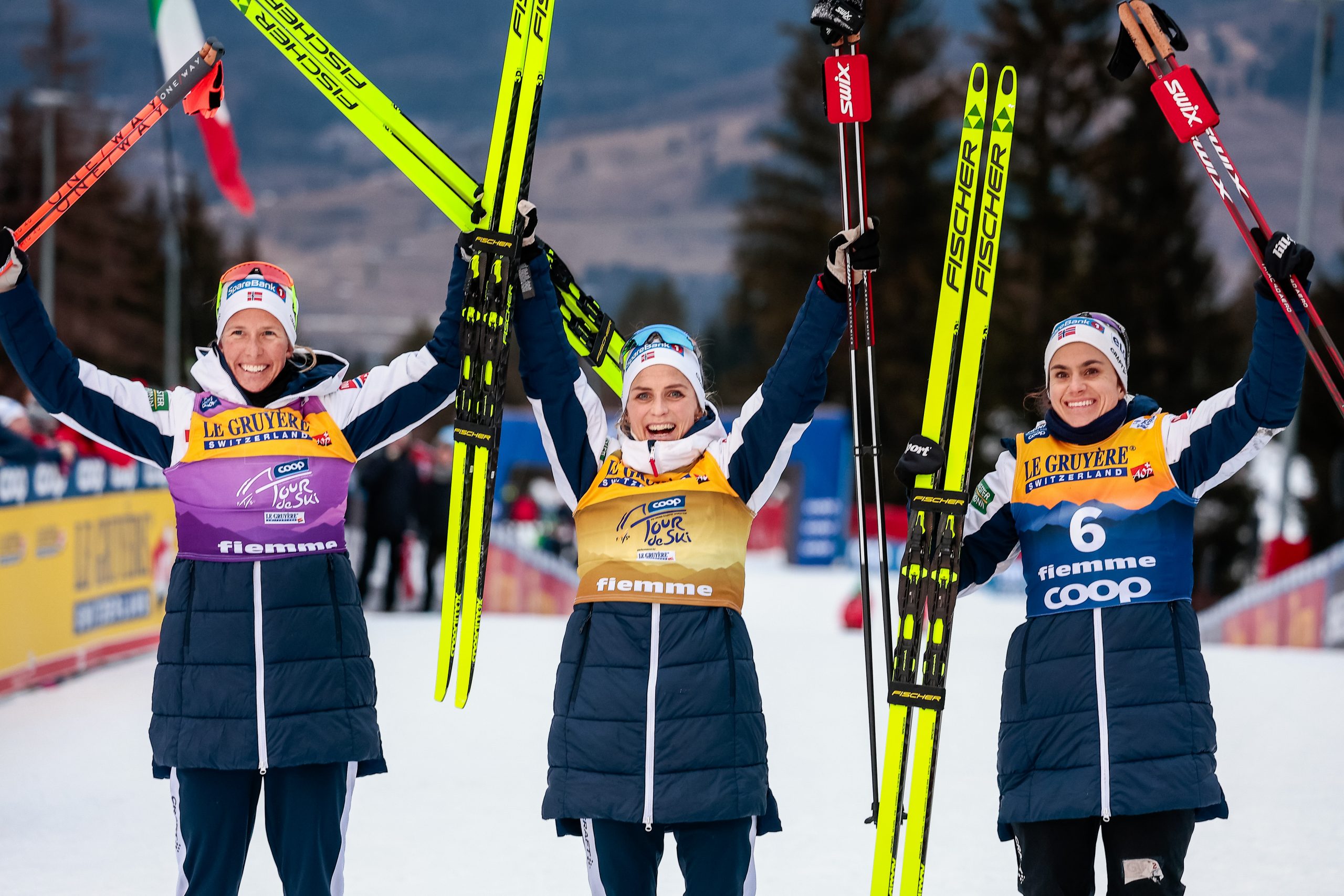
    Kristine Stavaas  Skistad (NOR), Jonna  Sundling (SWE), Maja  Dahlqvist (SWE), (l-r) -(Photo: NordicFocus)
  • The Boys are Back—Klaebo Schools Anger in Engadin Freestyle Sprint

    This coverage is made possible through the generous support of Marty and Kathy Hall and A Hall Mark of Excellence Award. To learn more about A Hall Mark of Excellence Award, or to learn how you can support FasterSkier’s coverage, please contact info@fasterskier.com.

    Johannes Hoesflot  Klaebo (NOR) is BACK, and with plenty of time to ease up in the finishing straightaway, perhaps a reminder to the young upstart, Edvin Anger (SWE), of just who the boss really is. (Photo: Authamayou/NordicFocus)[/
    You just can’t believe how fast . . . when skiers at the front of a World Cup Sprint field hit the gas, the top end speed they reach is simply astounding—fast enough that skiers at the trailing end of the pack are rocked back on their heels, having neither technique tricks nor fitness solutions to deal with the radical increase in pace. It’s simply bizarre to see those skiers in the back half of the Sprint field—world-class skiers, all—reduced to flailing ski-kids when the pace really ratchets up. That’s what happens at Engadin, Switzerland on a Sprint course that only offers speed. Not much in the way of interesting features or novel course challenges, not much in the way of variety or tactic: Engadin’s Sprint course is a wide-open, wind-swept strip of groomed corduroy that weaves through open, unprotected territory. On a sunny day with temperatures hovering just above freezing, what the Engadin course offers is speed. And nearly every heat winner seemed to rely on at-the-front speed in order to advance.

    Predictably, the only skier doing things a different way was Klaebo . . .

    Johannes Hoesflot Klaebo is back in the mix. After a few weeks off (during which he skipped numerous World Cup starts and the Norwegian National Championships), Klaebo returns to the World Cup tour, hoping to respond to recent claims voiced by Edvin Anger (SWE) that he (Anger) would’ve beaten Klaebo in last week’s Classic Sprint in Les Rousses, France. If Klaebo reads the reports in ski-media, he might’ve arrived in Engadin determined to make Anger eat those words.

    In the end, Anger did show that he possesses tremendous speed, but nothing like the speed that’s available to Klaebo who coasted easily across the line for his 100th individual World Cup win. Anger scuttled home in second place ahead of Klaebo’s off-season training partner, Lucas Chanavat (FRA).

    Leading a world-class pack at the beginning of his quarterfinal heat, Jack Young (USA) would come to learn what World Cup Sprint speed really means. Young would find himself overtaken in the second half of his heat, finishing 25th on the day. (Photo: Authamayou/NordicFocus)

    Among Americans, Ben Ogden qualified 11th, though he would exit after a tangle in the semifinal left him sixth. He would finish the day in 12th. JC Schoonmaker qualified 26th and finished third in his quarterfinal, good for 15th on the day. Jack Young qualified 28th, then learned a lesson in World Cup Sprint speeds as his from-the-front tactic in his quarterfinal was overhauled by faster, more experienced sprinters. Young would end the day in 25th.

    Other Americans included Gus Schumacher in 45th, Kimball Murphy 46th, and Zanden McMullen 62nd. Canadian finishers included Sasha Masson 36th, Pierre Grall-Johnson 61st, Julian Smith 66th.

    In addition to Klaebo, the entry list this weekend in Engadin included a number of other lesser known Norwegian compound-names: Oskar Opstad-Vike, Aleksander Elde Holmboe, and Sindre Bjoernestad Skar. Questions still lingers as to whether those were the young guns who popped a good one at Norwegian Nationals, OR that the Norwegian federation is trying them on for size. With two spots still  up for grabs in the selection of Norwegian Sprint slots for February’s World Championships, the results from Engadin’s Freestyle Sprint would mean everything to Norway’s quickest sprinters.

    Norway’s Haavard Solaas Taugboel—leading Richard Jouve (FRA) and Janik Riebli (SUI)—would advance to the Final in Engadin’s Freestyle Sprint, perhaps earning his place on the Norwegian Sprint team for the World Championships in Trondheim next month. (Photo: Authamayou/NordicFocus)

    Among more familiar names, Haavard Solaas Taugboel was back in the Norwegian Sprint lineup. Having not yet secured his start position in the upcoming Trondheim World Championships, Taugboel had much to lose, much to gain. Likewise, Even Northug was entered. He’d hoped to win an easy one a week ago in Les Rousses (where a World Cup win would have likely punched his ticket to Trondheim), only to have that low-hanging fruit snatched by Edvin Anger (SWE). In Engadin, Northug would flounder again, qualifying 48th and failing to advance to the Quarterfinal.

    Perhaps the names most conspicuous by their absence were of those Norwegian all-’rounders who also excel in Sprint competitions: Paal Golberg, Harald Oestberg Amundsen, Erik Valnes. All three have been known to give Klaebo a run for his money, but their federation seems determined to save those skiers for Distance efforts. The story today seemed likely to be a grudge-fueled contest between Klaebo and Anger.

    Engadin Freestyle Sprint

    A sunny morning in Engadin also dawned very windy, with a steady stream of air pushing across the flat valley and broad frozen lake around Engadin. It seemed to all observers that the wind would become a factor in the tactics and the outcome of today’s events. Altitude would also play a role as Engadin—at an elevation of 1800 meters (nearly 6,000 feet)— is the highest stop on the 2025 World Cup Tour. Sprinting is a long day, and the rest periods get shorter and shorter as the day progresses. Speed isn’t ever enough: sprinters need to get to the final knowing they can deal with anything. The veterans are always the ones who prove most capable in that regard.

    Quarterfinal 1 featured Klaebo, Lucas Chanavat (FRA), and American qualifier, Young. Young drove the early pace while Klaebo dropped quickly off the back. Klaebo’s relaxed start turned into a more familiar strategy as he easily made up three spots on the first uphill, sliding into a third place position with headwind descents just ahead. As they hit the serious headwind, Klaebo maneuvered out from behind Chanavat, and shot past Young into the lead. Klaebo and Chanavat would advance while Young faded to fifth in the heat, finishing the day in  25th.

    Ben Ogden (USA) skied tactically in his quarterfinal to advance behind Edvin Anger (SWE). Ogden would finish 12th on the day. (Photo: ,Authamayou/NordicFocus)

    Quarterfinal 2 was a somewhat more tactical affair, led out by Anger who was closely followed by Ogden. Those two would keep their spots through the finish line, moving on to the semifinal round.

    JC Schoonmaker found himself pinched in early going of Quarterfinal 3, but managed to work his way to the outside in the final turn. He exited the turn in third, gaining speed all the way up the finishing straight, but the man he needed to catch was the legendary Federico Pellegrino. Pellegrino would remain second, advancing to the Semifinals behind heat winner Valerio Grond. Schoonmaker would finish the day in 15th.

    Schoonmaker was introspective when considering how close he was to advancing: “I think making up that gap to Pellegrino is all tactics for me.,” said Schoonmaker. “It comes down to having a better position rounding the corner into the finish which goes all the way back to being more aggressive in the early and middle parts of the race. To me it’s much less about the .3 seconds behind but the position. .3 seconds can feel quite close when you say it like that, but when you put it in terms of actually passing someone and gaining the position to move on, it’s much more difficult especially when it’s a fast and short finish like today. So for me I feel like I really need to work on my positioning and strategy throughout the heat to be ahead of a guy like Pellegrino heading into the finish rather than trying to overtake him.”

    Taugboel’s future would play out in Quarterfinal 4, where he demonstrated his agility in lifting a ski tip over one of the corner-marking v-boards as Janik Riebli (SUI) crowded him to the inside. That little loss of speed may have cost Taugboel: he moved Riebli back toward the middle for the finishing sprint, inadvertantly opening up the inside lane where Richard Jouve (FRA) used his exceptional finishing speed to grab the last automatic qualifying spot. Taugboel’s day—and likely his chances for a spot on Norway’s World Championship team—would have ended with a third place finish, but Taugboel’s finishing time was fast enough to secure a lucky loser spot.

    Sprint Semifinals

    Klaebo opened Semifinal 1 with just enough drive to push Riebli and Anger to the lead. That’s where Klaebo wanted them to be, and they totally fell for it. Ogden and Chanavat (who would typically go to the front, himself) cleverly slotted in right behind Klaebo. Anger moved to protect the inside line causing Klaebo to short-step through a corner (perhaps the closest Klaebo has come to getting tangled in a Sprint heat). Anger would remain the frontrunner through the finish line just ahead of Klaebo. Though if Anger thought this same strategy would bring him victory in the final . . .

    Oskar  Svensson (SWE) drove the pace in Semifinal 2, but would find himself pvertaken by those who took advantage of his draft. He would finish the day ninth. (Photo: Authamayou/NordicFocus)

    Jouve went straight to the front of Semifinal 2 (totally changing his own tactics from the Quarterfinal), but it was Oskar Svensson (SWE) who made the pace through the middle of the heat. Taugboel lurked just behind Jouve, hoping to follow him through to the Final, but the mercurial Jouve would begin to fade mid-lap, and Taugboel was forced into the lead. Around the final turn, Taugboel dragged most of his pursuers through the fading Svensson. Only Pellegrino was able to find an outside line that propelled him to the Semifinal victory ahead of Taugboel (whose advancement to the final might earn him the Trondheim starting spot to which he aspired).

    Valerio  Grond (SUI), Johannes Hoesflot  Klaebo (NOR), Lucas  Chanavat (FRA), Edvin  Anger (SWE), sprint past Engadin’s landmark castle in the Final of the FIS World Cup Freestyle Sprint. Klaebo would overtake Anger for the win. (Photo: Authamayou/NordicFocus)
    Sprint Final

    Klaebo allowed Anger to win their semifinal matchup; perhaps he had been sandbagging in order to make Anger believe that his own speed would be sufficient? The Sprint Final would reveal the truth.

    Chanavat finally acted like Chanavat, storming directly to the front, daring others to follow. Klaebo started only fast enough to claim a space ahead of Pellegrino. There Klaebo could see and control the race. When Chanavat bobbled on the first uphill, Anger found himself in the lead. Klaebo followed in second, shadowed by the every-crafty Pellegrino. All three seemed to have the positions they wanted, though only Klaebo seemed to know how things would turn out.

    Following a wider, faster line into the lead with 200 meters to go, finally, Klaebo let his skis run on a line that pulled him up alongside Anger. If Anger thought he possessed the speed to beat Klaebo, this would be the place to show it. Nope . . .

    Exiting the final turn, Klaebo kicked into a higher gear for only a few deft skate strokes, then shut down his own effort to coast up the finishing straight. With forty meters still to race, he turned around to assess Anger, who’s finishing efforts would avail him not. Klaebo’s gesture appeared less as taunting and more as a demonstration of dominance, an insistence for the sort of respect that perhaps Klaebo feels was lacking in Anger’s comments to the media last week. Or maybe it’s just a Norway/Sweden thing . . .

    Pellegrino was third across the line, but was later relegated to last (sixth) in the Final heat standings for having bumped Valerio Grond (SUI) in the Final. Chanavat would be elevated to third place.

    Regardless, the Engadin Freestyle Sprint demonstrated the continuing dominance of the old contrasting with the glimmering potential of the new, even in such tightly-packed, elbow-rubbing conditions. Training partners, Klaebo and Chanavat shared a post-race moment in the finish area, sharing stories from the race like a typical pair of post-race age-groupers. “Poles everywhere, skis everywhere,” said Klaebo. “But I feel like that’s what happens in these kinds of courses.”

    One thing’s for sure: Klaebo is definitely an authority in what happens in these kinds of races.

    Men’s Freestyle Sprint RESULTS

    Men’s Freestyle Sprint QUALIFYING

  • Swedish Surge Continues in Engadin’s Mixed Relay

    Swedish Surge Continues in Engadin’s Mixed Relay

    This coverage is made possible through the generous support of Marty and Kathy Hall and A Hall Mark of Excellence Award. To learn more about A Hall Mark of Excellence Award, or to learn how you can support FasterSkier’s coverage, please contact info@fasterskier.com.

    Moa  Ilar (SWE) carries Sweden’s flag across the finish line in Sweden I’s dominating win in the World Cup Mixed Relay from Engadin, Switzerland. (Photo: Authamayou/NordicFocus)

    Right now, Sweden is on a roll. Soon, Norway will be back at full-force. The top of the field is definitely getting ready for a World Championship showdown in a few weeks. In the meantime, World Cup organizers continue staging races, hoping that top competitors will be attracted by the allure of World Cup points and prizes.

    This time of year (the middle of the World Cup season) is all about mathematics for the top contenders. How big a gap exists between a racer and their closest rivals? Are those rivals racing this weekend? How many points are available in events and bonus sprints? Who’s sick? Who’s injured? Who’s surging in the standings? Who’s relaxing at home with their feet up?

    Jessie Diggins (USA) is dealing with a persistent injury (plantar fasciitis) that limits her ability, especially in Classic skiing (she actually double poled the entire Sprint qualifier last week in Les Rousses). Diggins could’ve chosen to race one of today’s Freestyle relay legs, but none of her closest rivals in the season-long World Cup overall race were competing today in Engadin. That makes for a perfect opportunity to take a break from the stresses of racing. Time to rest, time to heal, time to get ready for more important races on the horizon.

    Likewise, Johannes Hoesflot Klaebo (NOR) enjoys a comfortable lead in the World Cup Men’s overall standings, and none of his closest rivals are racing the relay in Engadin. Time for him to put his feet up.

    Even in the absence of a number of the sport’s biggest stars, Engadin hosted a highly competitive World Cup Mixed Relay. Sweden I (Jens Burman, Emma Ribom, Edvin Anger, Moa Ilar) surged to the front in the relay’s third leg and never looked back, coasting to victory ahead of Norway I (who came from well behind the field to claim second) and Switzerland I (who came from even farther back) t claim a podium spot in front of an elated Swiss crowd.

    Canada I (Antoine Cyr, Katherine Stewart-Jones, Olivier Leveille, Lilian Gagnon) would contend among the leaders throughout the day, finishing and impressive sixth. Canada II (Remi Drolet, Alison Mackie, Stephen Thomas, Sonjaa Schmidt) would finish 11th. American teams would struggle from the start, ultimately finishing 14th (Zanden McMullen, Julia Kern, Ben Ogden, Sophia Laukli) and 16th (Luke Jager, Kendall Kramer, JC Schoonmaker, Sammy Smith).

    Iivo  Niskanen (FIN) and Paal  Golberg (NOR) animated the early part of the Engadin Mixed Relay, joined at the front by Antoine Cyr (CAN) who continues to earn the respect of the World Cup field. (Photo: Authamayou/NordicFocus)
    Mixed Relay

    FIS Mixed gender relays are staged on a revolving basis—one weekend men go first and third, women second and anchor; the next time the starting slots are reversed. In Engadin, Men would lead off, Women would bring it home.

    Nineteen teams—including two teams each teams from Norway, USA, Sweden, Canada, and Switzerland—comprised the field that would race four 5 kilometer legs (two laps/skier over a 2.5 kilometer course). Engadin is a broad, flat valley surrounded by soaring Alpine peaks. The course wound around the flats, and offered only two significant climbs. The pace was likely to be fast . . .

    “People are going to take it out hot,” predicted Canada’s Remi Drolet. “It’s going to be really hard right from the gun, so, conserve as much energy as possible for the second lap, and try to have my team in a good position.”

    At the start, Norway, Finland, Sweden, and Germany filled the front row. The initial pace was lightining fast, led by Norway I’s Paal Golberg (recently named to the Norwegian squad for the World Championships). The race course quickly faded to two Classic lanes, filled by Golberg and Finland I’s Iivo Niskanen. Canada I’s Cyr and Sweden I’s Jens Burman managed to matched the pace of the lead group, followed by Sweden II and Switzerland II. USA I (Jager) and USA II (McMullen) held positions in the top ten.

    Niskanen and Golberg managed to separate themselves as they entered the exchange zone. The race at the front would continue to be hotly contested. By the time USA II (Kramer) and USA I (Kern) took the hand-off, they were already well behind the pack of contenders.

    Emma  Ribom (SWE), Jasmi  Joensuu (FIN), (l-r) drove the pace in the relay’s second leg, setting up Sweden to take the lead in Leg 3. (Photo: Authamayou/NordicFocus)
    Second Leg

    Still in Classic technique for the second leg, Jasmi Joensu maintained her lead for Finland I, pursued closely by Sweden I (Emma Ribom), Norway I (Nora Saness), Switzerland I (Anja Weber), and Canada I (Katherine Stewart-Jones). Remarkably, Austria (Therese Stadlober) also managed to race up to the lead group. She powered through the group and set out in pursuit of Joensu and Ribom.

    By the end of the second leg, the field had mostly shattered with only the top two racers racing in close company to one another. Everyone else was well spread out behind them. But skiers in pursuit of speed and placings often find a way to group up. This relay would definitely not end up being an every-skier-for-themselves affair.

    Joensu handed off to Remi Lindholm while Ribom handed off to Edvin Anger. Not far behind, Stadlober tagged Benjamin Moser another 15 seconds ahead of Saness tagging Iver Tildheim Andersen, a Freestyle specialist with something to prove (having been recently overlooked for spots on the Norwegian World Championship Team).

    Edvin  Anger (SWE) continued to display the momentum that launched him to a Classic Sprint victory las week in Les Rousses, out-dueling Remi  Lindholm (FIN) to hand Sweden I a lead at the end of Leg 3. (Photo: Authamayou/NordicFocus)
    Third Leg

    Anger quickly caught Lindholm, and the two set about putting additional distance between themselves and Moser. Anger’s pace ultimately began to unravel Lindholm who could not match the momentum surging under Anger’s skis at this juncture in the World Cup sesason. Sweden I forged on alone as Lindholm was swallowed up by an accelerating Andersen.

    At this point, Sweden I appeared to be on its way to the win, while second place would be decided among Norway I, Austria, and Finland I. That’s when Moser came back to life, using the course’s second uphill to quickly put time into Andersen (who had doubtless given a lot just to catch this group). At the final exchange, Anger enjoyed a broad and comfortable lead over Moser, Andersen, and Lindholm.

    Anchor Leg

    Anger tagged off to Moa Ilar while Moser tagged Katharina Brudermann, the youngest skier in the Austrian lineup who might’ve felt especially vulnerable with Norway I’s Kristin Austgulen Fosnaes chasing just a few seconds behind. Fosnaes made good on that threat, quickly catching—and gapping— Brudermann who was quickly absorbed by a charging group battling for the third step on the podium. Norway II (where the heck did they come from?) was led by Anne Kjersti Kalvaa, followed closely by Switzerland I (Nadine Faehndrich), Finland I (Vilma Ryytty), and Canada I (Liliane Gagnon), and Switzerland II (Marina Kaelin).

    Ilar coasted home for the win, a well deserved victory for Sweden I. Faehndrich had looked well positioned to sprint with Fosnaes, but somewhere in the final kilometer Fosnaes managed to separate herself from the Swiss skier. Norway I took second place, while Faehndrich still managed to hold on to third place ahead of Norway II.

    Engadin Mixed Relay RESULTS

    Team Sweden (Moa  Ilar, Edvin  Anger, Emma  Ribom, Jens  Burman) celebrates on the podium in Engadin, Switzerland after their victory in the FIS World Cup Mixed Relay. (Photo: Authamayou/NordicFocus)
  • Dartmouth Continues its Dominance and Crum Scores Big for Bowdoin in Lake Placid

    Dartmouth Continues its Dominance and Crum Scores Big for Bowdoin in Lake Placid

    This article was made possible through the generous support of our voluntary subscribers.  If you would like to see more collegiate coverage like this, please support FasterSkier with a voluntary subscription.  

    By: Francesca Kitch

    The Saint Lawrence University Carnival was held this past weekend at Mt. Vanhoevenberg in Lake Placid, NY. Coupled with the Eastern Cup on day two of the carnival, the start list was among the largest in North America this year. Not only was it a large field, but it was also one of the hardest courses on the east, with 191 meters of elevation on the 5km loop. 

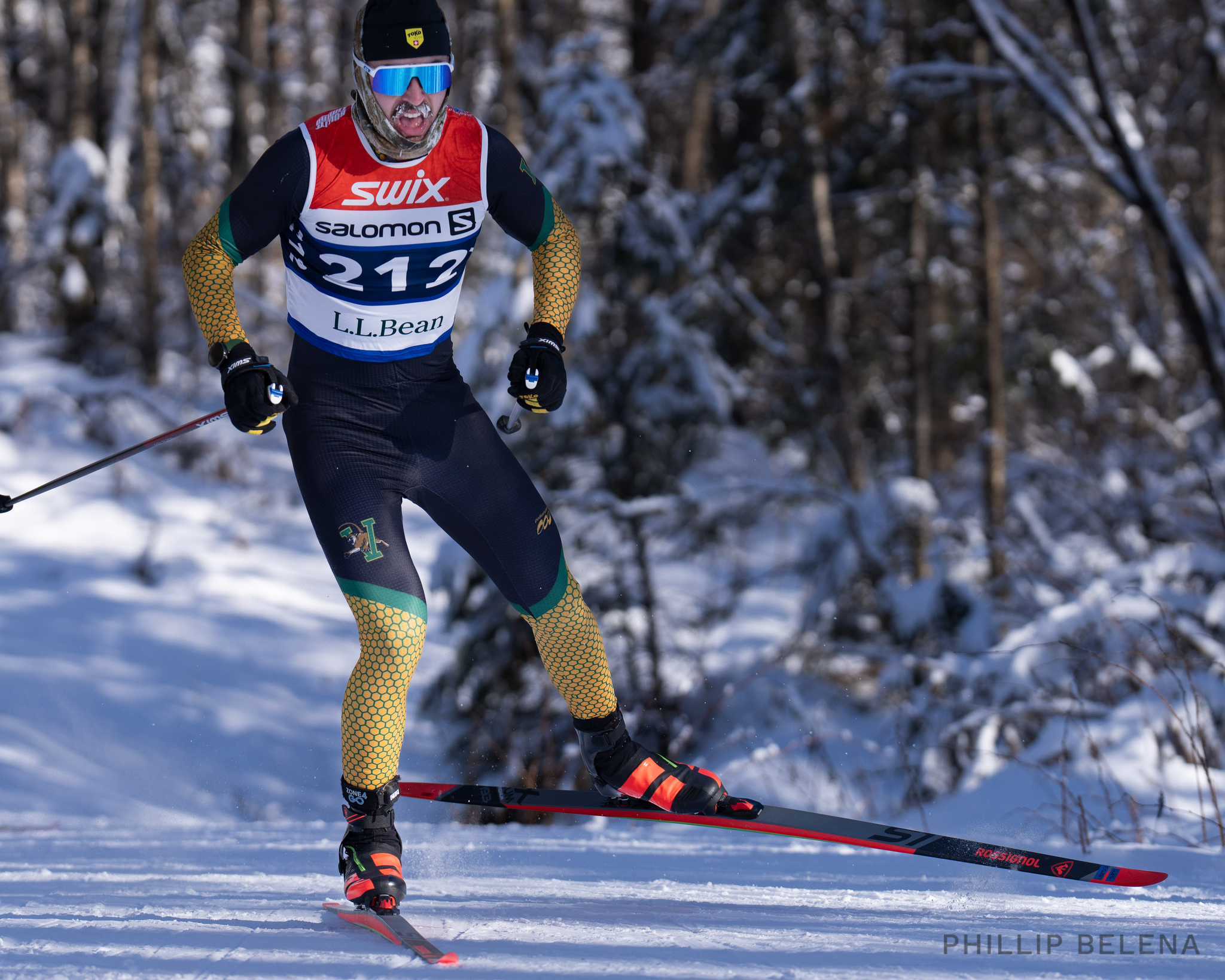
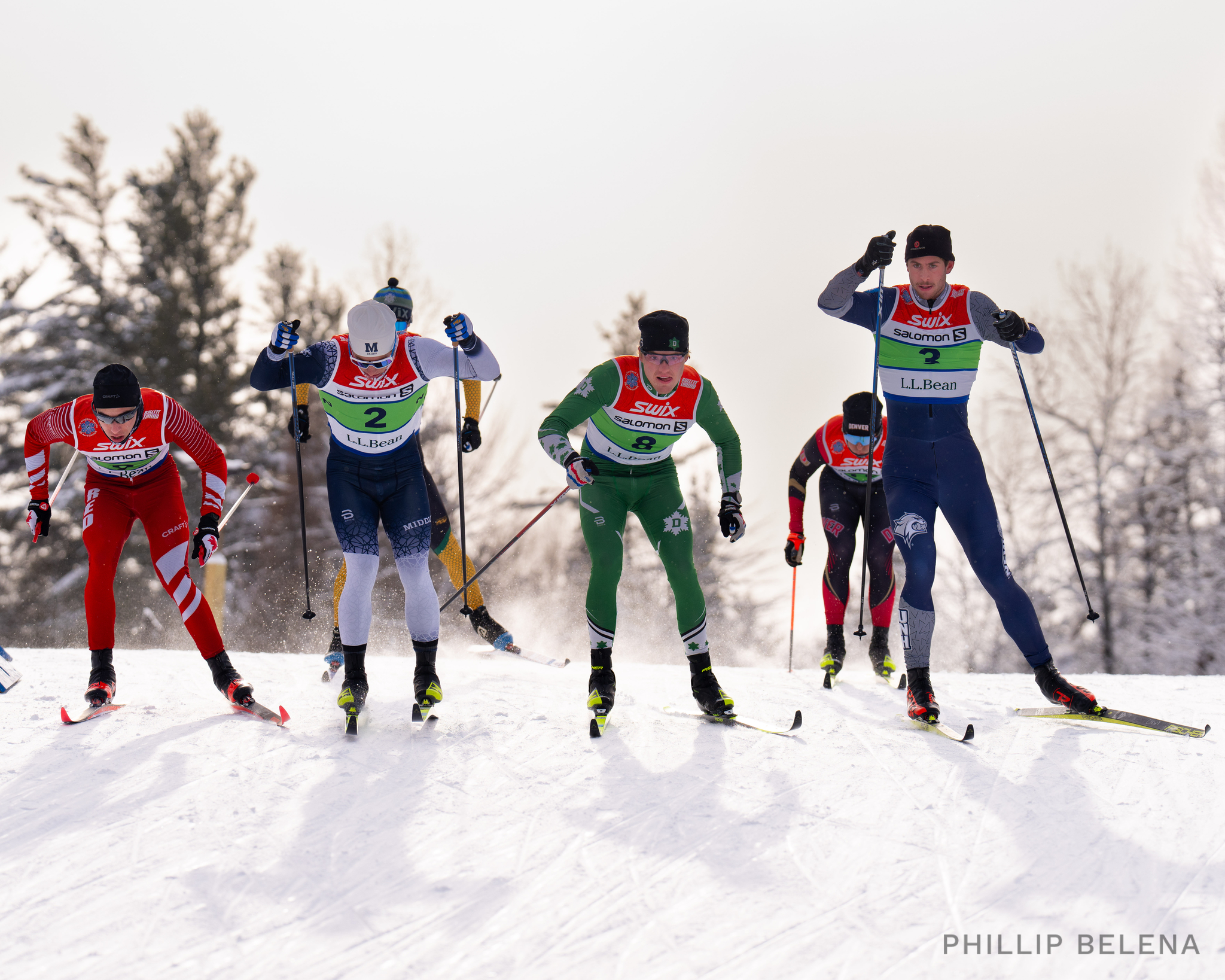
    Elias Soule making his way up Grindhouse Hill. (Photo: Dave Brams)

    “I like the challenge that it poses and it’s a super legit course that really prepares you for anything…it’s a good one to get out of the way early in the season, so you kind of know you can do anything after Lake Placid,” said Luke Allan (Dartmouth), winner of Friday’s 20km skate mass start and Saturday’s 7.5km classic. Allan won the 20km by 38 seconds over Logan Moore (Middlebury) after skiing the last two laps ahead of the field. “[EISA mass starts] are always super fun to race in because you just know all the guys on the start coral and can really play some fun tactics out there.” 

    Luke Allan in the men’s mass start with a commanding lead. (Photo: Dave Brams)

    Allan also expressed how fired up he was about his team’s overall success this weekend. Dartmouth ended the carnival with a full team win (combined men and women), 5 individual podium finishes, and 3 wins. In the 20 km mass start, Ava Thurston crossed the line in second place, and in the 7.5km classic, Jasmine Drolet topped the podium with Thurston joining her in third. In the classic race, the Dartmouth women put 6 in the top 10, a remarkable feat showcasing the team’s depth.

    Logan Moore during Friday’s Mass Start. (Photo: Dave Brams)

    After dealing with a few weeks of sickness, Drolet says she is finally feeling better. “It feels good to be back and racing at EISA and seeing everyone.” She added that the course “definitely played to my strengths, especially in classic with the striding,” feeling that her classic is typically stronger than her skate performance. 

    Keelan Durham charging up Grindhouse Hill on Saturday. (Photo: Ben Condit)

    It was also a weekend for the history books for the Bowdoin team. Junior Emma Crum had an outstanding skate mass start on Friday, clinching the Polar Bears their first ever EISA win. “I think that was what I was thinking about more than the individual win which is a little silly but was a big thing for Bowdoin,” she said. When Crum crossed the line two seconds ahead of Thurston, she was in disbelief. “It felt very satisfying because it was a fight all the way to the end–it was never a guarantee, which made it feel very good.” Crum also acknowledged that the course played to her strengths, and used her strong V1 on the large hills to catch back up with Thurston and race to the end.

    Emma Crum crossed the finish line with Bowdoin’s first ever EISA win on Friday. (Photo: Charles Swabey)


    Full EISA Schedule & Results
    Bates Carnival

    Rumford, ME

    Friday, January 10, 2025: Freestyle Sprint: Men’s Results  –  Women’s Results

    Saturday, January 11, 2025: 15km Freestyle – Individual Start: Men’s Results  –  Women’s Results


    St. Lawrence University Carnival

    Mt. Van Hoevenberg, Lake Placid, NY

    Friday, January 17, 2025: 20K Freestyle – Mass Start: Men’s ResultsWomen’s Results

    Saturday, January 18, 2025: 7.5K Classic – Individual Start: Men’s ResultsWomen’s Results


    St. Michael’s College Carnival

    Sleepy Hollow, Huntington, Vermont

    Friday, January 31, 2025: 10K Freestyle – Individual Start

    Saturday, February 1, 2025: 3x5k Classic – Relay


    Dartmouth College Carnival

    Oak Hill Outdoor Center, Hanover, New Hampshire

    Friday, February 7 , 2025: Freestyle Sprint

    Saturday, February 8, 2025: 15k Classic – Mass Start


    Middlebury College Carnival

    Oak Hill Outdoor Center, Hanover, New Hampshire

    Friday, February 14, 2025: Freestyle Sprint

    Saturday, February 15, 2025: 15k Classic – Mass Start


    University of New Hampshire Carnival

    Jackson Nordic Center, Jackson, New Hampshire

    Friday, February 21, 2025: 7.5k Classic – Individual Start

    Saturday, February 22, 2025: 15k Freestyle – Mass Start


    NCAA Championship

    Oak Hill Outdoor Center, Hanover, New Hampshire

    March 5-8, 2025

  • CCSA Skiers Get Off to a Cold and Speedy Start at Arien’s Invite

    CCSA Skiers Get Off to a Cold and Speedy Start at Arien’s Invite

    This article was made possible through the generous support of our voluntary subscribers.  If you would like to see more collegiate coverage like this, please support FasterSkier with a voluntary subscription.  

    By: Francesca Kitch

    UW Green Bay’s CCSA invite took place this past weekend at Ariens Nordic Center in Brillion, Wisconsin. It was a cold weekend with race delays on Sunday due to the temperatures dipping below the CCSA regulation of 0 degrees Fahrenheit. Despite the cold weather, however, Ariens lacked natural snow. Thus, the course for the weekend was a 3km “ribbon of man-made snow,” as Green Bay head coach Sam Myers described it. 

    Yet the snow was quite fast and in combination with the flat terrain, the majority of the men’s field and some of the women opted to double pole the individual start 15 km classic race on Saturday.


    Victoria Dybwad double poling in Saturday’s women’s 15km classic race. (Photo: Tryg Solberg)

    Men’s winner Leevi Tarjanne (College of St. Scholastica) was included in this group. “I know I am a strong double poler which made me confident of this choice,” said Tarjanne. “Still I have tons of work to do to reach my full potential. I am extremely motivated to train more and harder than ever before and am ambitious for better results.” NMU’s Luke Fricker and Kristoffer Alm Karsrud finished 2nd and 3rd in the men’s race and with Victoria Dybwad and Henriette Nilssen finishing 1st and second in the women’s race, NMU returned home with 4 individual podiums. 

    Women’s U20 Podium from Saturday’s classic race. Left to right: Erica Kazin, Lillian Franzen, Liesl Cope-Schaeffer. (Photo: Sam Myers)

    The four top skiers from NMU worked together on Sunday to achieve victory in the mixed 4x6km Skate Relay. “It ended up being an incredibly close race. As the first leg, it was so exciting to kick things off and then cheer on the rest of my teammates,” Nilssen said. NMU head coach Andy Keller chimed in that it “was fun to take home the team relay title and have some really good results in the individual race.” Keller believes that these performances will set the team “up for success for the rest of the season and NCAA qualification.” However, going into the weekend Keller wasn’t sure how it would go with key individuals sick from travel and the stress of racing in Alaska. Michigan Tech rounded off the relay podium with their 1st and 2nd teams finishing 2nd and 3rd. 

    Sunday’s relay podium. (Photo: Sam Myers)

    Tarjanne, the first year skier from Finland, was also impressed by the atmosphere of the race weekend. “It’s awesome that even though Nordic skiing is an individual sport, pushing together as a team brings the best results, and most importantly, makes it even much more fun. I’m looking forward to many more races to come here in the U.S.” During Sunday’s relay, parents and Green Bay student spectators lined Spectator Hill to cheer on their athletes and friends. “It was awesome to see the team camaraderie from everyone,” said Myers. “Since we only have five Universities in the CCSA, everyone is really close and hanging out with each other.”

    After a fun start to the season, the Midwesterners will race again in two weeks at the CSS Invite. 

    Sunday’s relay podium. (Photo: Sam Myers)

    Full Results

  • The Devon Kershaw Show: Getting les rad in Les Rousses, with Katherine Stewart-Jones

    The Devon Kershaw Show: Getting les rad in Les Rousses, with Katherine Stewart-Jones

    France always serves up a good time, and this weekend of World Cup racing in Les Rousses was no different. Katherine Stewart-Jones of Canada joins us amid a breakout season for an interview and some race recaps.

    We’ll be back after next weekend in Switzerland. Send your diss tracks and letters of appreciation to devon@fasterskier.com and nat@fasterskier.com.

  • Sweden’s World Cup Weekend! Poromaa Swipes Les Rousses 20 k

    Sweden’s World Cup Weekend! Poromaa Swipes Les Rousses 20 k

    This coverage is made possible through the generous support of Marty and Kathy Hall and A Hall Mark of Excellence Award. To learn more about A Hall Mark of Excellence Award, or to learn how you can support FasterSkier’s coverage, please contact info@fasterskier.com.

    Sweden’s William Poromaa (16) made his move late in the 20 k Mass Start at Les Rousses, France, ultimately sprinting to victory ahead of Finland’s Iivo Niskanen. (Photo: Authamayou/NordicFocus)

    Les Rousses’ 20 k Mass Start would be a race conducted without the usual pace-makers. The Norwegian team had mostly stayed home for their own championships, and the Russian team was voted off the island years ago; therefore, the Les Rousses’ Mass Start would offer an opportunity to see what the rest of the skiing world really looks like. Who would force the pace? Who would dare the race-breaking move? And could Niskanen still dominate a Classic race without the Norwegians there to keep the speed high?

    William Poromaa (SWE) leads Iivo  Niskanen (FIN) across the finish line to secure his first World Cup victory in the 20 k Mass Start at Les Rousses, France. (Photo:  Authamayou/NordicFocus)

    In the end, the race would be unusually tactical—so much so that significant sprinters like France’s Richard Jouve were able to stay in the lead pack until nearly the very end. Niskanen would atttempt to dominate the last quarter of the race, though he was unable to shake Simen Hegstad Kreuger (NOR) and William Poromaa (SWE). Ultimately, Poromaa would outsprint Niskanen for the victory, only a few seconds ahead of Kreuger.

    Beginning the day ninth in the World Cup overall standings, Ben Ogden (USA) would cling gamely to the lead pack throughout the day, finishing 12th.

    Americans also saw impressive finishes from Luke Jager 21st, Zak Ketterson 29th, JC Schoonmaker 38th, Kevin Bolger 43rd, and Hunter Wonders 44th. Canadians Olivier Leveille and Remi Drolet were 39th and 42nd, respectively.

    In the absence of pace-making teams like the Norwegians (many of whom stayed home for their National Championships), the Mass Start 20 k was a tactical affair complicated by the World Cup Tour’s steepest uphill. (Photo: Modica/NordicFocus)
    20 k Classic Mass Start

    The Mass Start course at Les Rousses is comprised of a short two kilometer initial loop, followed by six 3.3 kilometer laps. The lap also includes Les Rousses’ infamous uphill, said by competitors and coaches to be the steepest on the entire World Cup circuit.

    Conditions were hard and fast, though the super-bright sunshine at Les Rousses could potentially cause problems with adequate kick in shadier sections. Later in the race, that was apparent as virtually no one was able to stride the steepest sections of the lap.

    The race began with moderate pacing with racers filling all four lanes of the race course. The field lazed it’s way around the initial two kilometer loop, staying together until Vermeulen and Lapalus separated themselves the first time up the steep hill (possibly more as a result of Anger clogging the track by slowing nearly to a stop in the steepest herringbone section). The early pace was regulated by Hugo Lapalus (FRA), Mika Vermeulen (AUT), Friederich Moch (GER), Paal Golberg (NOR), and Niskanen.

    The unsteady pace of the field—and the many tight turns  and challenging downhills of the Les Rousses 20 k course—allowed some ambitions sprinters to remain in the lead group. Richard Jouve (FRA) would finish 11th on the day, just ahead of American, Ben Ogden. (Photo:  Modica/NordicFocus)

    While Lapalus and Vermeulen continued to be the primary pace-makers, at the half way point the main contenders were still together; notably, a number of significant sprinters remained within a few seconds of the front including Richard Jouve (FRA), Ogden, and Erik Valnes (NOR). With such skiers in contention, the pack would accordion dramatically—stretching into a long thin line on every uphill and re-compressing into a cohesive pack on downhills and around each of Les Rousses sharp corners.

    Golberg had lurked just behind the lead group through the first half of the race, but he was finally shed from the pack when Niskanen and Kreuger drove to the front at 15 kilometers. They were soon joined by Poromaa. Slowly but surely, that trio began to add to their advantage. Ogden continued to hang on stubbornly, but was beginning to bobble at the back of a 12-man chase pack led by Vermeulen, Lapalus, and Valnes.

    Niskanen has nine career world cup wins—eight of those in Classic races—but he admitted during pre-race interviews that the long, steep herringbone section of the primary uphill constituted a technical weakness for him. Today, even the most accomplished skiers all but “walked” that section of the course, especially in the later laps where fatigue had begun to take its toll.

    As the race entered its final lap, Poromaa and Kreuger attempted to push the pace on the winding downhill sections, hoping to reduce the Classic technique advantages that Niskanen otherwise enjoys. While they couldn’t shake the Finn, they did succeed in taking some of the sting out of his striding, allowing Poromaa to outsprint him to the finish line. Kreuger finished five seconds later to take third and reinforce his hold on the World Cup Distance leader’s bib.

    Ogden would recover in the final lap to chase down a few extra places. He would finish 12th, just behind Jouve. Valnes, Lapalus, and Vermeulen would finish fourth, fifth, and sixth, respectively.

    Golberg coasted home in 36th, probably ending his chances of being selected for the Norwegian World Championship team.

    20 k Classic Mass Start RESULTS

    For the first half of the race, the field in Les Rousses put the “Mass” back in Mass Start. Erik Valnes (NOR), William Poromaa (SWE), Mika  Vermeulen (AUT), Hugo  Lapalus (FRA) fill the tracks. (Photo: Authamayou/NordicFocus)
  • Karlsson Dominates Les Rousses 20 K Classic. Diggins Sidelined by Injury. Brennan Out Indefinitely

    Karlsson Dominates Les Rousses 20 K Classic. Diggins Sidelined by Injury. Brennan Out Indefinitely

    This coverage is made possible through the generous support of Marty and Kathy Hall and A Hall Mark of Excellence Award. To learn more about A Hall Mark of Excellence Award, or to learn how you can support FasterSkier’s coverage, please contact info@fasterskier.com.

    Frida Karlsson (NOR) dominated the field setting a blistering pace which no one could match. (Photo: NordicFocus)

    The timing of the Norwegian national championships has already had a dramatic effect on world cup races in Les Rousses, France. Today’s women’s 20 kilometer Classic mass start race would not be an exception.

    Absent from the start list were perennial favorites Therese Johaug (NOR) and Heidi Weng (NOR). Those two finished one-two respectively in yesterday’s Norwegian championship 20 kilometer skiathlon.

    Jessie Diggins (USA) disclosed that her foot injury was worse than originally believed. (Photo: NordicFocus)

    But the absences on the American squad were perhaps even more meaningful and certainly likely to have a longer lasting impact on the race season. The U.S. women who have consistently been celebrated for their depth and top performances are now plagued by injuries.

    One critical absence was the Overall world cup leader Jessie Diggins (USA) who decided not to race today because of her ongoing foot injury. She revealed that after double poling the entirety of the Classic Sprint yesterday that she would not compete in today’s Classic race. She also disclosed that after the Tour de Ski she had an MRI which revealed that she has a partial rupture of the fascia by the heel bone in addition to the plantar fasciitis. She indicated that, “this is something that I don’t want to risk. My number one goal is long term foot health.” She stated that she couldn’t stride “with any intensity,” but that she could double pole, which is why she double poled all of yesterday’s Sprint course to finish 40th. Diggins doesn’t know when her next Classic race will be. World Championships are still in her sights, but there is no certainty about whether she will be able to do any Classic racing by then. It was an absence which further dug into an already depleted American squad.

    Joining Diggins on the sidelines were Rosie Brennan who also did not race today, and Julia Kern who is still recovering from the Tour de Ski.

    The news from Brennan was bad. “I am struggling with my health and as I hope you can observe, racing does not feel good,” said Brennan. She elaborated that, “I really hoped with two weeks away, I could sort things out but that has unfortunately not been the case. It’s been very challenging to get the medical help I need overseas, and without friends, family, and my coach, so I am currently on a plane to Alaska. I am crushed and scared and don’t know what the future holds but a change was needed to try to move forward. I haven’t given up on returning to racing but need to put myself in a place where I can learn more about what my body is telling me and be able to take care of my physical and mental self before I can make a decision on when I will return.”

    So that meant that only two Americans were in today’s field. Sophia Laukli, who turned in an excellent performance finishing 16th,, and Alayna Sonnesyn who was 36th.

    “Each classic race this year is definitely getting a bit better each time, but I do still feel there’s a lot of room for improvement.,” said Laukli. “I’m for sure feeling there’s fatigue from the Tour so I’m just happy to put together a solid Classic race for the time being. In past years I wouldn’t be able to do that unless I was in peak form.” The challenging Les Rousses course also worked to the Distance specialist’s favor. “The course was definitely a grind which always works to my advantage, maybe less so today because I was pretty tired. But in general I will always do better on a course with minimal double pole and lots of work.”

    The absence of Norwegian and American stars provided an opening for others. Frida Karlsson (SWE) took full advantage of some of her top rivals’ absence and turned in an epic performance, totally dominating the field winning by almost 1:30. Karlsson led from the start, and it was immediately clear that no one would be able to keep pace with her today. Her performance certainly made fans wonder what the race would have looked like had Johaug been present. Karlsson was followed in second place by her teammate Ebba Andersson, with Teresa Stadlober (AUT) taking third. After the race Karlsson said, “it was really fun today.” She continued that, “I felt relaxed and strong. It was just fun.” Karlsson indicated that she intended to do some altitude training before the world championships, which didn’t give much of a clue as to whether she would do additional world cup races before the world championships.

    Sophia Laukli (USA), (left) finished 16th, just behind Karoline Simpson-Larsen (NOR), (right) (Photo: NordicFocus)

    Canadian Katherine Stewart-Jones continued to impress, she finished 14th. Other Canadian finishers were Lilian Gagnon in 23rd, and Alison Mackie 34th.

    Perhaps no one trying to take advantage of Norway’s thin lineup was a more unlikely sight than the appearance of Norway’s own Kristine Stavaas Skistad’s name on the start list. Skistad is a well-known name, having won more Sprints than most can remember—but a Distance race —well that’s not exactly in her wheelhouse. She has completed some distance races in the Tour de Ski. But outside of those, the only world cup Distance races on Skistad’s resume appeared to be … none! But apparently Skistad reevaluated the benefit and reality of doing a 20 kilometer Classic race, thought better of it, and chose not to start.

    But after today’s race, there were more questions than answers swirling around the American team. With it’s usual dominating duo of Diggins and Brennan ailing, and the reliable Kern resting, it would be up to some of the other women to shoulder the racing load, at least in Classic races. With the world championships on the horizon, it is not the position that the American team was hoping to be in.

    The Women’s 20 Kilometer Classic Mass Start

    Karlsson wasted no time going to the front of the pack and by two kilometers she was out front setting the pace ahead of Astrid Oeyre Slind (NOR). Karlsson’s brisk pace was able to string out the field very early. By 3.5 kilometers she was at the front of a six person pack with the Classic expert Kerttu Niskanen (FIN) at the back of it. Katharina Hennig (GER), Slind, Ebba Andersson (SWE), and Teresa Stadlober (AUT) rounded out the group.

    At the five kilometer mark Hennig double poled past Karlsson and the two jockeyed for position at the head of the pack. It was the only few moments at the front for Hennig, and the only time when Karlsson would relinquish the lead.

    Niskanen was the first to show that she was having trouble keeping up with the pace as she was dropped off the back and the lead pack was quickly down to five skiers.

    Alayna Sonnesyn (USA) was one of only two American starters. She finished 36th. (Photo: NordicFocus)

    At 8.1 kilometers Karlsson continued to push the pace with Andersson, Hennig, Stadlober, and Slind hanging right with her. At this point, Sophia Laukli (USA) was the top American in 18th place, and Canadian Katherine Stewart-Jones, who was having another good day, was holding on to 14th.

    Ebba Andersson (SWE) (left), tried to keep pace with teammate Frida Karlsson (SWE), (right), but no one could match Karlsson’s tempo. (Photo: NordicFocus)

    Toward the front Karlsson was picking up the pace like a locomotive gaining speed, and only Andersson was able to go with her. Stadlober was now in third and by the half-way mark she was over four seconds behind Karlsson.  Hennig had drifted to over 11 seconds back. Slind, Carl, and Niskanen were now in a second chase group that was over 25 seconds behind the leaders.

    But Karlsson was on a mission and set a pace which no one could match. By the 13.4 kilometer mark she had dropped her teammate Andersson and was skiing by herself 23 seconds ahead of Andersson.

    With five kilometers left Karlsson already had the race in hand, and the competition was now for the rest of the podium spots. While Karlsson had extended her lead to 41 seconds over Andersson, Stadlober, who was in third place, was trying to reel in Andersson. Surprisingly, long distance specialist Slind was unable to maintain the pace and was over 30 seconds behind Stadlober.

    Teresa Stadlober (AUT) made a bid for second, but couldn’t catch Ebba Andersson (SWE). Photo: NordicFocus)

    With 3.8 kilometers remaining Karlsson’s lead ballooned to over 54 seconds. In second place, her teammate Andersson was fighting desperately to hold off Stadlober who continued to stalk her. Stadlober was six seconds behind Andersson and showed no signs of relenting. But the fight was exclusively for second and third place with the rest of the field now too far back to play into the podium standings.

    Stadlober was keeping Andersson in her sights, but try as she might, she couldn’t begin to close the small gap on the second place skier.

    As the skiers approached the finish, Karlsson’s total domination clearly showed as there wasn’t another skier to be seen—for a long time. Karlsson had just given an absolute Classic skiing clinic finishing over 1:29 ahead of Andersson as she double poled across the finish line with an enthusiastic smile on her face and looking jubilant. Meanwhile, Andersson had fought off Stadlober’ s efforts and was able to keep her second place position. Stadlober finished third having fallen back to almost 12 seconds behind Stadlober. It was total domination by Karlsson who showed that she appeared to be back in top form.

    Les Rousses Women’s 20 kilometer Classic Mass Start

    Frida Karlsson (SWE) completely imposed her will on the field. (Photo: NordicFocus)
  • Skistad Returns to Win Les Rousses Classic Sprint

    Skistad Returns to Win Les Rousses Classic Sprint

    This coverage is made possible through the generous support of Marty and Kathy Hall and A Hall Mark of Excellence Award. To learn more about A Hall Mark of Excellence Award, or to learn how you can support FasterSkier’s coverage, please contact info@fasterskier.com.

    Sprinting has the most unpredictable action of any World Cup racing format. Skiers are crammed into a narrow patch of snow, leading to skis crossing and poles breaking. Wobbly legs often misfire, and mistakes ensue. Whenever a racer gets crowded out at the finish line, there is an inevitable shrug followed by the common refrain of, “that’s Sprinting.” But even in the unpredictable world of Sprinting, there are usually a few constants.

    Jessie Diggins (USA) was unable to advance to the heats and finished 40th. (Photo: NordicFocus)

    But one of those constant themes was upended when Jessie Diggins (USA) failed to qualify for the heats. For the last two years Diggins qualifying for the Sprints and choosing to race in the final heat has been about as predictable as Sprinting gets. But that constant failed to materialize as Diggins had a tough time and finished 40th in the qualifying rounds which meant she would not race in the heats. Due to her foot injury, Diggins was unable to stride during the race and was forced to double pole and herringbone the entire course, creating a difficult on course situation for her resulting in her not qualifying. But she was able to pick up several valuable points for still finishing in the top 50.

    Another constant has been the American team usually fielding three or four women in the heats. But that also didn’t happen when Alayna Sonnesyn (USA) finished 38th and also failed to qualify. That meant that all of the hopes for team USA were riding on Rosie Brennan (USA) who qualified 22nd.  Julia Kern’s (USA) usual presence in the heats wasn’t a factor as she wasn’t racing this weekend as she was still recovering from the Tour de Ski.

    Rosie Brennan (USA) was the only American woman to make the heats. (Photo: NordicFocus)

    Brennan had a hard time in the heats and couldn’t advance out of the first round and ended up 26th on the day. So, today the usually reliable American Sprint team fell victim to the unpredictable nature of Sprinting.

    Kristine Stavaas Skistad (NOR) returned to World Cup racing, and to Sprinting dominance. (Photo: NordicFocus)

    After the racing had concluded some of the predictability of Sprinting returned as Kristine Stavaas Skistad (NOR) asserted herself throughout the day to defeat all of her Swedish rivals. Maja Dahlqvist (SWE) was second with Jonna Sundling (SWE) coming in third. After the race, the always reserved Skistad said, she was “very happy and that the race had been very hard.”

    Yesterday’s Distance races had been significantly affected by the absence of many top Norwegians who had elected to stay home and race in their national championships. But today’s women’s field wouldn’t be as dramatically affected as Norway’s top Sprinter, Skistad was back after her prolonged absence from abdominal surgery. Skistad raced on Thursday in the Norwegian championships and won the Freestyle Sprint competition. She appeared to be fully back in form, but racing again only two days after the Norwegian championships— with travel in between— was going to be a major test. Before her surgery Skistad had been about as consistent as things get in Sprinting. Skistad was joined on the Norwegian squad by Elena Rise Johnsen—who is little known to North American audiences—but finished third in the Norwegian Sprint championships. Also joining her was Ane Appelkvist Stenseth who finished seventh in the Norwegian nationals Sprint competition. Missing today was Julie Myhre (NOR) who going into the day was second in the world cup Sprint competition.
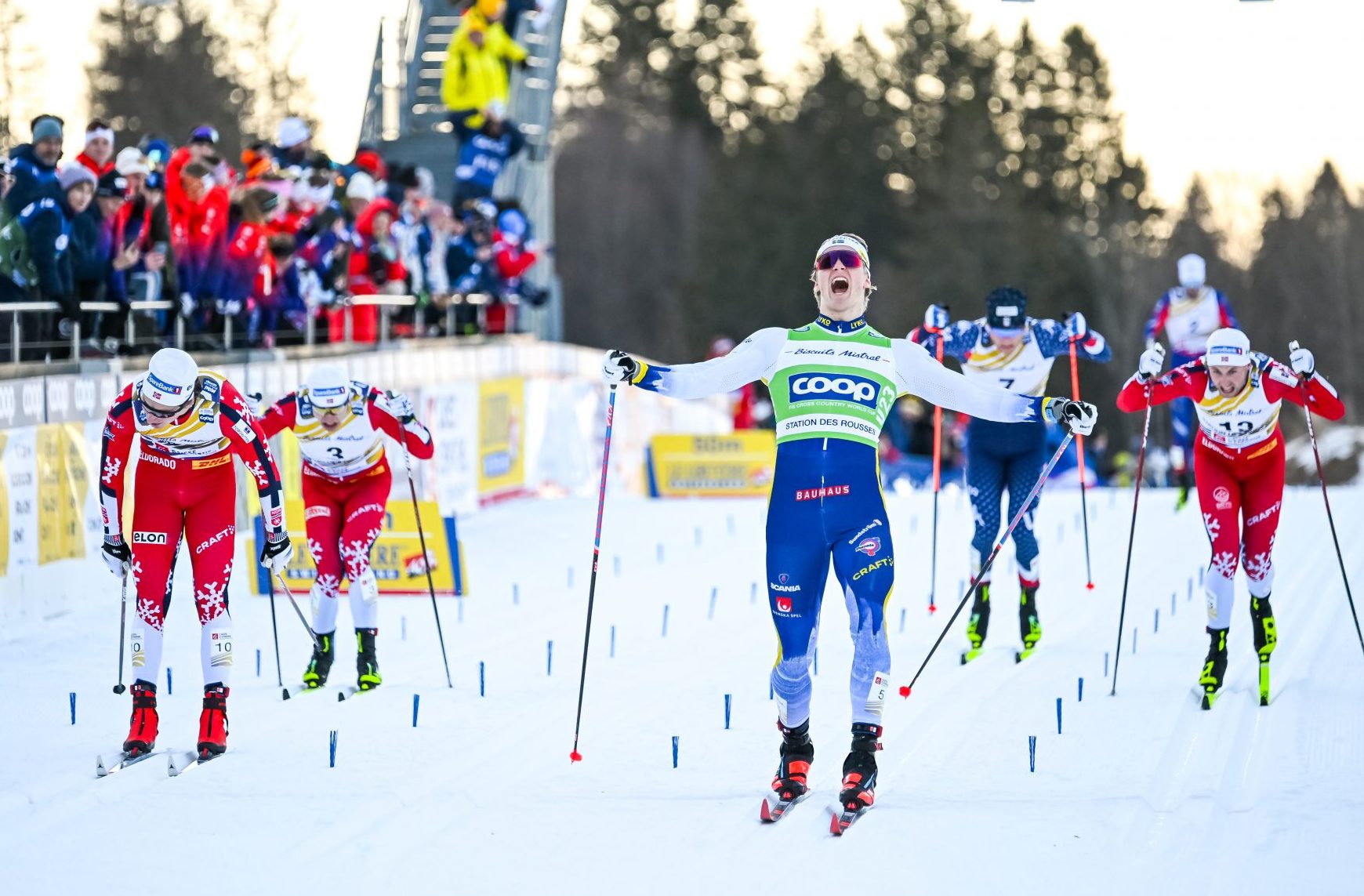
    Maja Dahlqvist was the top Swede, finishing second. (Photo: NordicFocus)

    The Swedish women have also been one of the constants in Sprinting for some time. But they competed today at  less than full strength as two time former Sprint Overall champion Linn Svahn was absent in order to recover from the Tour de Ski and prepare for the world championships. She would be replaced by Moa Hansson, whose previous best performance in a Sprint world cup was 22nd.

    Another recent Sprint constant is the presence of Jasmi Joensuu (FIN) who has proven to be a continual Sprint threat this year and currently leads the Overall Sprint competition. But Joensuu was unable to find the podium today and finished fourth.

    Kern is a usually reliable presence for the Americans in the Sprint heats but needed more time off after the Tour. She posted on social media, “my body wasn’t quite ready to race in France this weekend, but a little extra time at home is feeling like a special treat right now!!! Lots of motivation to train smart for the bigger goals ahead and soak up that extra recharge time at home!”

    Canadian Katherine Weaver had an excellent day finishing 16th. The other Canadian finishers were Olivia Bouffard-Nesbitt in 29th, and Alison Mackie 31st.

    Les Rousses Women’s Classic Sprints-Quarter Finals

    In the first heat Skistad appeared to show that she was completely back as she and Jonna Sundling double poled away from the other contenders with Sundling nipping Skistad at the finish. But as she often does, Skistad let up at the finish unconcerned about the victory and more focused on saving energy and moving through the heats.

    The second heat featured Joensuu and Emma Ribom (SWE). About halfway through Joensuu and Ribom established themselves at the front with Ribom gaining ground on the more technical sections. Joensuu went into an extra deep tuck on the downhills which helped her gain ground as Ribom took the win with Joensuu finishing second.

    In heat three Brennan faced Laura Gimmler (GER) and Stenseth who went into the early lead with Gimmler right behind her. About halfway through Brennan was in the back of the pack and didn’t seem to have the ski speed to keep pace with the leaders. Coming into the finish Gimmler and Stenseth were side by side as they eased up to cross the finish line with Stenseth taking the win. Brennan finished sixth and would not advance. It was not only the end of her day, but the end of the day for team USA.

    In the fourth heat Nadine Faehndrich (SUI) was matched against Maerta Rosenberg (SWE) and Katherine Weaver (CAN). Rosenberg went out to a blistering start and put a large gap on Faehndrich. But Faehndrich used her veteran skills to slowly but surely close the gap and took the lead as they entered the stadium. Weaver’s pace was too much for her to sustain as Coletta Rydzek (GER) was able to pull ahead at the finish. Rosenberg would advance as a lucky loser. Weaver finished fourth and would not advance.

    In the fifth heat Johanna Hagstroem (SWE) and Dahlqvist battled against Victoria Carl (GER). They were joined by hometown favorite Leonie Besson (FRA) who finished 29th in the qualifying round and gave the French fans a brief thrill. But her hopes were dashed early as she broke a pole at the start and would never be able to be a factor. Ingrid BergeneAabrekk (NOR) went to the lead early, but about half way through, Hagstroem—who was the top qualifier—picked up the pace and went to the front along with Dahlqvist. At the finish, no one could match the fire power of the Swedes as Dahlqvist and Hagstroem finished first and second.

    Semi Finals
    Jasmi Joensuu (FIN), (far left,red bib) made it to the finals, but couldn’t reach the podium. (Photo: NordicFocus)

    The first semi final was a battle of Sprinting all-stars. Sundling, Ribom, Skistad, and Joensuu were all in the first heat. Skistad went to lead early with Ribom going with her. Sundling charged up the first steep hill to take the lead as she tried to put some distance on Skistad who would have a double poling advantage coming into the finish. But Skistad showed off amazing skis as she glided up and over a small hill toward the end of the race to take the lead back. Sundling pulled ahead at the finish as Skistad dramatically let off the accelerator about 20 yards before the finish. Joensuu made a late charge but couldn’t catch the leaders. Nonetheless, she advanced as a lucky loser along with Ribom.

    The second heat featured Faehndrich, Dahlqvist, Hagstroem, and Gimmler. Hagstroem and Gimmler took the early lead in what was a very controlled pace. The race remained very tactical as no skier was anxious to go into the lead. Coming into the stadium all six skiers were together with Hagstroem going to the front and she began to press the pace along with Faehndrich. But it was Dahlqvist who moved to the lead with Gimmler joining her. It was a photo-finish between Dahlqvist and Gimmler—with both skiers being awarded the same time—and no skiers advanced from this heat as a lucky loser.

    Finals

    In the finals, Skistad would have the chance to show that she was completely back as she faced a formidable field of Sundling, Joensuu, Ribom, Dahlqvist and Gimmler. It was the repeat of a familiar theme from last year’s Sprint competitions as three Swedes battled the lone Norwegian: Skistad.

    No one had an answer for Skistad in the finals. Maja Dahlqvist (SWE), Jonna Sundling (SWE), Kristine Stavaas Skistad (NOR), (l-r) (Photo: NordicFocus)

    Skistad immediately went to the front and sent the message early that this was not going to be a tactical race. Sundling was able to close the gap up the first hill and looked like she might have an advantage over Skistad. But Skistad looked controlled and calm as she stalked Sundling, while Joensuu was hanging on in third place. Skistad repeated her excellent glide over a small uphill to slingshot into the lead and began pulling away. She was able to double pole to victory as Dahlqvist snuck up from behind to take second, while Sundling held on for third. The effort clearly showed on Skistad who remained collapsed onto the snow for some time after the race, which is not her habit. Nonetheless, the race was a statement for the rest of the women, that the rivalry between Skistad and Sweden was back.

    Les Rousses Classic Sprint Results

    Maja Dahlqvist (SWE), Kristine Stavaas Skistad (NOR), Jonna Sundling (SWE), (l-r) (Photo: NordicFocus)


  • Edvin Anger Powers to Les Rousses Sprint Win, Schoonmaker Fifth

    Edvin Anger Powers to Les Rousses Sprint Win, Schoonmaker Fifth

    This coverage is made possible through the generous support of Marty and Kathy Hall and A Hall Mark of Excellence Award. To learn more about A Hall Mark of Excellence Award, or to learn how you can support FasterSkier’s coverage, please contact info@fasterskier.com.

    Ansgar Evensen (NOR), Erik Valnes (NOR), Edvin Anger (SWE), JC Schoonmaker (USA), Jules Chappaz (FRA) at the finish line of the Men’s Classic Sprint in Les Rousses. Anger would secure his first World Cup win. (Photo: Authamayou/NordicFocus)

    Straight after his victory in yesterday’s Norwegian National Championships, Even Northug (NOR) hopped on a plane and showed up in Les Rousses, France in time to contest his Sprint qualifier (in which he advanced to the quarterfinals by placing 13th). Being one of the few Norwegian contenders who never intended to race the Norwegian distance events, Northug was free to grab his championship medal, and make a run for the continent to take advantage of what appeared to be a “soft” World Cup Sprint field. Appearances can be deceiving . . .

    Fresh off his own podium finish in yesterday’s 10 k Freestyle interval start, Ben Ogden was riding a wave of momentum that carried him to the top qualifying time, .5 seconds ahead of Lucas Chanavat (FRA), 2.5 seconds ahead of Erik Valnes (NOR). But speedy Sprint qualifying is not always the best indicator of Sprint eventual success. In Les Rousses, it was Sweden’s Edvin Anger who would dash to the victory, ahead of Ansgar Evensen (NOR) and Valnes. JC Schoonmaker would complete a brilliant day with a fifth place finish. Ogden finished fifth in his semifinal heat, only .01 seconds from a lucky loser spot that would have advanced him to the Final. He would end the day in ninth.

    Americans had advanced three skiers into the quarterfinals: Ogden qualifying first, Schoonmaker seventh (he would finish the day in fifth), Zak Ketterson 16th (he would end the day in 21st). Other American finishers included Luke Jager 39th, Murphy Kimball 42nd, and Jack Young 45th.

    Canadians in qualifying included Olivier Leveille 48th, Julian Smith 51st, and Remi Drolet 52nd.

    Newly crowned Norwegian Sprint Champion, Even Northug (13) arrived in Les Rousses hoping to take advantage of a Sprint field that did not include perennial contender, Johannes Hoesflot Klaebo (NOR). Northug’s plans were undone by eventual Sprint winner, Edvin Anger (SWE) who powered away from a diverse field of challengers. (Photo: Authamayou/NordicFocus)
    Quarterfinals

    In the absence of Johannes Hoesflot Klaebo—absolutely the dominant sprinter of the age—the men’s world Cup field can sometimes look like they don’t know what to do. It’s less a factor of Klaebo’s speed—he seems to win whether the race is fast or slow, tactical or flat out. What’s really missing is Klaebo setting the example of the fastest line. He demonstrates a sixth sense for finding the fastest side of the track, quickest lane around any turn, the shortest route to the finish line. In his absence, every Sprint heat seems to be an independent experiment in tactics and speeds. It’s not as though Sprinting is unexciting when Klaebo is absent, but viewers may find themselves not knowing whom to watch.

    Wearing the U23 leader’s bib, Anger controlled Quarterfinal 1 from the front, leading until the final turn when the faster skis of Valnes took control.

    Quarterfinal 2 was a slow, tactical affair in which perennial contender Richard Jouve (FRA) trailed the field, and proved unable to advance. The heat was controlled by Ansgar Evensen (NOR) and Emil Danielssonn (SWE).

    Ogden moved to the front of Quarterfinal 3, controlling the pace and marking any early moves. He double poled powerfully across the finish line ahead of Lauri Vuorinen (FIN) and Northug who would ultimately fail to secure a Lucky Loser spot.

    Schoonmaker lined up in Quarterfinal 4 where he claimed a Lucky Loser spot behind Chanavat and Oskar Opstad Vike (NOR).

    Ketterson drove the pace at the beginning of Quarterfinal 5, only to surrender the lead to others who sensed the opportunity to advance out of a fast heat. The heat finished with Jules Chappaz (FRA) and Ondrej Czerny (CZE) moving to the semifinals. Ketterson finished fifth in the heat, to end the day in 21st.

    Lucas Chanavat (FRA) edges out JC Schoonmaker (USA) and Jules Chappaz (FRA) in the semifinal of the Men’s Classic Sprint in Les Rousses France. Schoonmaker’s semifinal strategy of following the powerful Chanavat would not prove as effective in the later Final. (Photo: Modica/NordicFocus)
    Semifinals

    Ogden FLEW off the front of Semifinal 1, only to be overtaken by the field in the closing meters . He would finish the heat in fifth, a photo-finish struggle with Northug, who would advance along with heat winners, Anger and Danielssen. Once the finish line photos were inspected and the finishing times were calculated, Ogden would miss advancing to the final by only .01 seconds.

    JC Schoonmaker lined up in Semifinal 2, following the reliably powerful Chanavat all the way to the finish line, a photo finish to determine who would advance. Schoonmaker would claim the second place automatic qualifying position ahead of Jules Chappaz (FRA).

    “(It) wasn’t necessarily my strategy in the final to follow Chanavat,” said Schoonmaker. “It was more to race from the front of the field and find little spaces where I could rest my arms for the finish so it ended up working out to follow him.”

    Sprint Final

    A year ago in Les Rousses, Jouve was able to overhaul Klaebo for the unexpected win. Today in Les Rousses, Chanavat would carry the hopes of the French crowd.

    There was plenty to gain in the Men’s Sprint final. Among the finalists—Chanavat, Anger, Evensen, Valnes, Northug, and Schoonmaker—only Valnes and Chanavat had ever stood atop a World Cup podium. For the rest, the Les Rousses Sprint Final represented a unique opportunity. It also made for situations in which the strategies likely to be employed by the finalists were anything but clear.

    At the crack of the starter’s pistol, Anger powered straight to the front with Chanavat struggling a bit to get into high gear. Schoonmaker tripped over his pole on the first uphill rise, stalling his momentum briefly. Valnes broke into a herringbone on the first uphill, revealing that his wax choices were made to enhance glide rather than kick. The end of the race (and the final downhill) would reveal whether or not his choices were good ones.

    “When I tripped on my pole, it wasn’t a huge deal,” Schoonmaker explained. “But definitely one of those things that costs you a bit. I might be mistaken, but I felt like I was about to move up into third or fourth there, and then that trip up sent me right back to sixth. So it would’ve been nice to not make that mistake, but it wasn’t a race ended by any means.”

    Anger continued to push a torrid pace as Chanavat dangled well of the back. It appeared that Distance-racing fitness would rule the Sprint Final as Anger powered down the finishing straightaway for the win, his first any World Cup event.

    “It’s my first Final this year,” said Anger in post-race interviews. “I was thinking, ‘Let’s just go for it.’ I did . . . and I win!”

    Evensen and Valnes battled for second and third, barely ahead of a travel-weary Northug. Schoonmaker finished a half second behind Northug in fifth. Chanavat never recovered the earlier gap, finishing sixth.

    “I felt like I had decent energy in the final to make something happen but just needed to be further up from the start,” Schoonmaker said. “Those guys were definitely strong and Anger took it out hot right from the start, I just needed to be more prepared for that.”

    “I think so for sure, my shape feels good right now,” Schoonmaker concluded. “And making the final adds confidence to that for sure so I feel like I have some good momentum

    Les Rousses Men’s Sprint RESULTS

    Les Rousses Sprint QUALIFYING

    18.01.2025, Les Rousses, France (FRA):
    Ansgar Evensen (NOR), Edvin Anger (SWE), Erik Valnes (NOR), (l-r) – FIS world cup cross-country, individual sprint, Les Rousses (FRA). www.nordicfocus.com. © Authamayou/NordicFocus. Every downloaded picture is fee-liable.
  • Le Rousses 10 k Freestyle—This Is Jessie’s Race

    Le Rousses 10 k Freestyle—This Is Jessie’s Race

    This coverage is made possible through the generous support of Marty and Kathy Hall and A Hall Mark of Excellence Award. To learn more about A Hall Mark of Excellence Award, or to learn how you can support FasterSkier’s coverage, please contact info@fasterskier.com.

    Team USA celebrates the victory of Jessie Diggins (USA) in the World Cup 10 k Freestyle Interval Start in Les Rousses, France. (Photo: Modica/NordicFocus)

    When Jessie Diggins (USA) first stepped onto the World Cup scene (as a fresh-faced Minnesota school kid straight out of Junior Nationals), her only real chances to excel were in Freestyle Sprints or 5 k Freestyle races. Memorably, she showed everyone her Sprint abilities by out-dueling World Cup Sprint champion, Stina Nilsson (SWE), for Olympic Gold (with Kikkan Randall). A season later, she was proving herself to be a threat at 5 k Freestyle events . . . until that event just plain went away. The 5 k distance once was a staple for women’s World Cup racing; but FIS’ efforts to apply distance equality between men’s and women’s fields meant that the 5 k was replaced with 10 k races. Suddenly, Diggins’ best shot at a distance medal became a race twice as long. Well, if the last few seasons are any indication—and if Diggins’ performance today in Les Rousses offer any additional proof—she has more than adjusted to this distance challenge.

    Today in Les Rousses, Diggins started fast (a bit of a risk on this particular Distance course with its immediate and super-steep uphill), and just kept building her lead throughout the distance. She won going away with only Victoria Carl in her vicitity (19 seconds behind) followed by Astrid Oyre Slind in third (at 20 seconds).

    “Originally, I had planned to pace the race a little bit slower,” said Diggins. ” But then we were watching the men’s race, and we were like ‘Holy moly, a 19 minute 10 k. This is going to be so fast! Talking with the coaches, I was like ‘I don’t think I can afford to give up any seconds anywhere.’ I gave Ben a big hug after his race, and asked if he had any tips. He said, ‘Yeah, I started really hard!” So I did end up being influenced by Ben Ogden, and it ended up being a great thing for my race.”

    Sophia Laukli (USA) posted an impressive eighth place finish in the 10 k in Les Rousses, an indication that she is recovering from her efforts in the recent Tour de Ski. (Photo: Authamayou/NordicFocus)

    Among Americans, Diggins was followed in the standings by a resurgent Sophia Laukli in 8th, Lucinda Anderson 22nd, Rosie Brennan 28th, and Alayna Sonnesyn 34th (tie). Among Canadians Katherine Stewart-Jones and Lilliane Gagnon both skied strongly for 14th and 15th respectively, followed by Allison Mackie 33rd, and Olivia Bouffard-Nesbitt 38th.

    Jessie Diggins (USA) is known for leaving it all on the race course, a level of effort that earned her the victory in the 10 k Freestyle Interval Start in Les Rousses. (Photo: Modica/NordicFocus)
    Les Rousses 10 k Freestyle Interval Start

    The 10 k Distance course at Les Rousses is one that demands both courage and fortitude: courage in addressing the need to attack the initial uphill (which, if raced too aggressively, results in racers being totally gassed at the top, struggling through a fog of lactic acid, and still with nine kilometers to go), and fortitude in dipping into physiological and psychological reserves to finish strongly on this unrelenting three lap course. It’s a level of discipline that only seasoned racers are likely to possess. Diggins is not the only seasoned competitor in the field, but she may just possess more fortitude than any skier in the world. Today in Les Rousses was an opportunity for her to put that fortitude on display.

    Jessie Diggins in full flight is a sight to behold. Her fans got a look at “that Jessie” today. Starting fast and fearlessly, Diggins’ split times must have broken the hearts of her competitors. Frida Karlsson (SWE) started out even with Diggins, then consistenly lost time to her throughout the race. Karlsson would finish the day in seventh, 38 seconds off the lead.

    Astrid Oeyre Slind (NOR) chased Diggins throuhgout the race, only surrendering additional time to her rival in the final kilometer. (Photo: Authamayou/NordicFocus)

    Slind would remain close to Diggins at every time check, but could not overcome Diggins’ finishing surge. Slind would finish third, 20 seconds behind.

    Carl was the only competitor to take a conservative approach to the early kilometers, and successfully accelerate through the finish. She chipped away at Diggins’ lead at every time check, ultimately powering into second place (19 seconds behind).

    Victoria Carl (GER) was the most adept at negative splitting her effforts on the challenging course at Les Rousse. She would finish the day in second place, just 19 seconds behind Jessie Diggins ((USA). (Photo: Authamayou/NordicFocus)

    For such a short race (the shortest Distance race that World Cup fields contest), the Les Rousses course was extremely daunting. Laukli shed some light on the particular challenges of the Les Rousses course: “It was definitely a challenge to balance pacing and avoid blowing up, but also not going too slow,” Laukli said. “I’m typically not one to start very fast so for me I just had to go all out and hope I didn’t blow up, which mostly worked out.”

    Sophia Laukli (USA) raced bravely and aggressively in an event that hadn’t initially seemed likely to play to her strengths. (Photo: Modica/NordicFocus)

    Laukli ended the recent Tour de Ski less than satisfied with her performance, and hampered by injuries sustained in a fall during one of the Tour’s mass start stages. Though 10 k is not her favorite distance, today’s strong result in Les Rousses felt like a bit of redemption for Laukli.

    “Today’s race was a really really fast 10km and definitely a bit shorter than I would’ve liked,” said Laukli. “But because of that I’m happy with my result because it was really not a distance skiers course, so I probably did the best I could. I was unsure if I would be back racing this weekend after the tour just because of some injury and bad feelings over the tour, so I was just happy to be back and able to race, and closer to what I know I’m capable of.”

    Following Diggins’ victory in today’s race, she takes over the leader’s bib in the World Cup Distance standings.

    “I do feel like I’m well rested and recovered from the Tour,” said Diggins. “It was great to feel like my body bounced back well.”

    I was really really thrilled and relieved that it didn’t hurt at all during warmup, that it didn’t hurt at all during the race,” said Diggins. “Crucially, it did not hurt at all afterwards. It was really nice to NOT be limping my way out of there.”

    Diggins also explained her recent injury and the ways it has affected her training and race preparation. “I have plantar fasciatis, but also a partial rupture of the fascia down by where it attaches to my heel bone,” explained Diggins. “It’s less than 50% ruptured, but still a much bigger risk. And so we are gonna take it super super carefully, because my primary goal is to be skiing and running for my whole life.”

    If that primary goal is carefully pursued, it seems (based on today’s results) like Diggins might also be pretty ready when World Championships roll around next month in Trondheim.

    Women’s Interval Start RESULTS

    Elation on the 10 k podium in Les Rousses: Victoria Carl (GER), Jessie Diggins (USA), Astrid Oeyre Slind (NOR). (Photo: Modica/NordicFocus)
  • Incroyable! Ogden’s Distance Podium in Le Rousses

    Incroyable! Ogden’s Distance Podium in Le Rousses

    This coverage is made possible through the generous support of Marty and Kathy Hall and A Hall Mark of Excellence Award. To learn more about A Hall Mark of Excellence Award, or to learn how you can support FasterSkier’s coverage, please contact info@fasterskier.com.

    A bold pacing strategy from Ben Ogden (USA) paid off with a third place finish in the 10 k Interval Start in Les Rousses, France. (Photo: Modica/NordicFocus)

    Following a two-week break after the exhausting Tour de Ski, the FIS World Cup tour reignited in Les Rousses, France just down valley from the extreme-sports Mecca of Chamonix. Ironically, a number of the world’s best would not be on the starting line for the Les Rousses 10 k Freestyle Interval Start; Norway’s prime contenders opted to sign up for the world’s most competitive ski race: the Norwegian National Championships taking place this weekend in Gaasbu, Norway.

    Friday would be the Norwegian National Sprint Championship (won by Even Northug). Distance races are to follow over the weekend, likely to be dominated by World Cup Overall contender, Harald Oestberg Amundsen. The competitor made most conspicuous by his absence was Johannes Hoesflot Klaebo (NOR), who would not be toeing any starting lines this weekend. The explanation for his absence (from both Norwegian Nationals and the World Cup in Les Rousses) was offered by Dr. Ove Feragen—physician to the Norwegian National Team: “Johannes has not recovered from the Tour de Ski,” Feragen offered. “He is still not training normally.”

    Evidently, the trend continues this season in prioritizing the upcoming World Championships over the World Cup. Such is the pattern in a season when the most ski-crazy nation is hosting the biggest ski event. Klaebo stays home while the rest of the skiing world continues to spin.

    Iver Tildheim Andersen (NOR) took advantage of the absence of other Norwegian stars to earn his second World Cup victory in a 10 k Interval Start. (Photo: Authamayou/NordicFocus)

    Norway’s hopes in the Les Rousses World Cup would rest on the shoulders of Simen Hegstad Kreuger, Iver Tildheim Andersen, and Paal Golberg, a team comprised of an Olympic gold medalist, a World Cup event winner, and a former Tour de Ski champion. Ironically, those skiers don’t represent Norway’s A Team.  Even so, Norway would be well represented, and seemed sure to vie for the podium.

    But the wonderful story for American ski fans was the podium finish of Ben Ogden. An early leader at all mid-race checkpoints, Ogden (better known as a sprint contender) held on for his first World Cup distance podium, claiming third place behind Andersen and Golberg. While a number of contenders were missing from today’s startlist, Ogden will be justifiably proud of a result that saw his name topping finishers like Kreuger, William Poromaa (SWE), Edvin Anger (SWE), Mika Vermeulen (AUT), Jules Lapierre (FRA), Andrew Musgrave (GBR), Hugo Lapalus (FRA), and a terrific finish from Victor Lovera (FRA) in seventh.

    “This morning, I was thinking about being conservative in the first K,” said Ogden. “Because it was, like, ALL uphill—definitely not my strength. I’ve found that my best Distance results come on days when I start hard and just sort of keep it. I’m definitely fired up to hang on and have a fast last K; it’s also the easiest to ski fast when you know you’re doing well. I had good intel to know that I was fighting to be on the podium, so I really dug deep in the last K and found a few more seconds. That was pretty critical. I wouldn’t say it was necessarily part of the plan, but it all worked out.”

    Among Americans, Kevin Bolger started fast, hanging on for a career-highlight 28th place finish. Other finishers included JC Schoonmaker 31st, Luke Jager 45th, Hunter Wonders 48th. Canadian finishers included Olivier Leveille 24th and Remi Drolet 42nd.

    The early leader at mid-race checkpoints, Ben Ogden (USA) started fast and finished fast, earning his first podium finish in a World Cup distance race. (Photo:  Authamayou/NordicFocus)
    Les Rousses World Cup 10 k Interval Start

    The Les Rousses 10 k course followed three 3.3 kilometer laps, a course that climbed very quickly from the starting line to the top of the steepest climb on the World Cup Tour. On hard-packed snow, and with temperatures just below freezing, Ogden was one of the earlier starters (wearing bib #19). On numerous memorable occasions, Ogden has been a fast starter; sometimes, even catastrophically so. In Les Rousses, Ogden again started quick, and was the leader among early starters at mid-race checkpoints: 1.5, 2.0, 2.3, 3.3 kilometers. This time, though, no catastrophes occurred. Ogden maintained his torrid pace, and was only surpassed at the halfway point by Norwegian skate specialist, Andersen.

    Kevin Bolger (USA) announced a desire to sit in the leader’s chair. With a #2 start position, it looked like he had a chance. Oh, so close . . . (Photo: Modica/NordicFocus)

    Prior to the race, Bolger had light-heartedly stated that his goal was to briefly sit in the leader’s chair, a circumstance made possible by his #2 starting position. Ironically, starter #1—France’s Victor Lovera—skied the race of his life, narrowly denying Bolger his chance to sit on the throne.

    “As a sprinter getting a seat in the leader’s chair isn’t a thing,” laughed Bolger. “I knew today there was a chance to make that happen, so I set out with that in my mind. But Bib 1 (Lovera) had a ripper of a race so I didn’t get the chance, unfortunately.”

    “A top 30 at a World Cup distance has always been a goal for me,” Bolger continued. “Now I get to cross that off my list of goals. Its hard to say what this will do for my future strategies…right now its kind of out of my hands. All I can do it take advantage of the races I do get and race fast- and go from there.”

    Ultimately, Ogden (starting in bib 19) would displace Lovera in the leader’s chair, there to await the results of later finishers. Andersen posted a faster time at 8.9 kilomteers, some 11 seconds faster than Ogden. Andersen sprinted across the line soon thereafter, posting a time 9.1 seconds faster than Ogden, whose early pacing now appeared less foolhardy and more intelligently aggressive.

    “As far as the ‘weak’ World Cup field . . . whattaya gonna do? It’s still a World Cup!” said Ogden. “You’ve gotta capitalize, you’ve gotta make hay while the sun shines! I’m fired up to do that. My strategy is always to race as fast as I can in races that I race in. Today was one of those, so psyched to get it done.”

    Perennial World Cup contender and former Tour de Ski champion, Paal Golberg (NOR), managed to bump Ogden down into third. Whether or not that podium finish will earn Golberg a spot at the World Championships remains to be seen. (Photo: Authamayou/NordicFocus)

    Golberg also managed to squeak in ahead of Ogden, but Kreuger fell short in his pursuit of the American, finishing an additional 9.2 seconds behind Ogden.

    In the absence of Amundsen, Kreuger took over the lead in the World Cup Distance standings; it’s going to be a complicated set of negotiations to pick the Norwegian team for the World Championships, a situation acknowledged by Andersen in his post race interview:

    “At least now I have a chance to go (to World Championships) maybe,” said Andersen. “So, we’ll see . . .”

    In the awards ceremony, Andersen removed his cap for the playing of his Norwegian National Anthem (Golberg and Ogden quickly followed suit), a show of pride and respect often overlooked in the world of winter sport. It remains to be seen whether the Norwegian Ski Federation will pay Andersen a similar measure of respect when the time comes to choose the participants in the upcoming World Championships.

    Men’s Interval Start RESULTS

    Celebrations in Les Rousses: Paal Golberg (NOR), Iver Tildheim Andersen (NOR), Ben Ogden (USA) on the podium of the World Cup 10 k Interval Start.  (Photo: Modica/NordicFocus)
  • CCSA Skiers Excited to Start Their Season This Weekend

    CCSA Skiers Excited to Start Their Season This Weekend

    This article was made possible through the generous support of our voluntary subscribers.  If you would like to see more collegiate coverage like this, please support FasterSkier with a voluntary subscription.  

    By: Francesca Kitch

    The Central Collegiate Ski Association (CCSA) is composed of six competing schools spanning the Midwest. Each season there are four CCSA invites–weekends full of racing–and this year, these competitions are set to begin this Saturday. The first three US Nationals races in Anchorage, Alaska, also counted towards CCSA competition; the skate 10k was scored as an NCAA qualifier, while the classic sprint and 20k classic mass start served as an opportunity to accumulate points toward team standings. Although the CCSA is a small conference, it doesn’t lack enthusiasm. Spectators travel all over the Midwest–and even to Alaska–to watch their athletes race.

    Across all NCAA conferences–the CCSA, Eastern Intercollegiate Ski Association (EISA), and Rocky Mountain Intercollegiate Ski Association (RMISA)–distances and techniques are standardized. Every two years, the distance races at NCAA Championships alternate between skate and classic, and the races at the invites reflect this change. This year, the 20k mass start at NCAA’s will be skate and the 7.5k will be classic, so the CCSA qualifying races will consist mostly of 20k classic mass starts and 7.5k individual classic races. From the points earned in these races, skiers will be ranked within the CCSA, and the top 6 athletes of each gender will qualify for the NCAA Championships to compete in Hanover, New Hampshire, this March. 

    Women lining up for a 20km classic mass start last season. (Photo: Tryg Solberg)

    The CCSA invite this weekend will be hosted by the University of Wisconsin at Green Bay. The Green Bay team has undergone an impressive transformation from 4 years ago when head coach Sam Meyers started the job. With a full roster of 3 men in 2021, Meyers has built up the program to now carry 17 athletes (9 men and 8 women) for the 2025 season. “This is the first year that we’ve had an upperclassmen-heavy roster…it feels like everyone has a really good understanding of how we operate as a team.” Meyers is encouraged to see how helpful the team captains have been in the seamless running of the team and how this has aided the overall maturity of the team. “We work really hard, we have big goals. But we also remember that skiing is fun.” Meyers adds, “One of the big things I look for in recruits is someone that just simply loves the sport of nordic skiing, and that’s a big factor in creating the culture that we like….not only good skiers but love working hard and being outside.” Meyers predicts strong performances from senior Ryan Themie and Junior Noah Erikson, the two top finishers on the men’s team from last season, finishing in 15th and 23rd, respectively, in the CCSA rankings. On the women’s side, Sophomore Lily Franzen is looking to improve on her performance from last year as the leading women’s skier for the team, and Meyers is excited to see what freshman Hedda Samuelsson has to show. 

    Men from Michigan Tech enthusiastically cheering on the women in a CCSA invite last season. (Photo: Tryg Solberg)

    Michigan Tech Head Coach Tom Smith looks forward to another season with his team, excited by individual standouts and a promising team as a whole. Michigan Tech finished 13th at NCAA’s last year, the highest rank of the central conference, despite being hindered in the rankings by its lack of an alpine team to supplement the nordic team’s scores. “I’m proud to say we have an amazing team, and that’s because we have amazing people that make it what it is!” Smith stresses the importance of the balance between student and athlete as well as competition and fun. “We have two overarching goals for our team: to always work for improved performance…and above all, for our student-athletes to love their experience as a member of the team!” 3 time NCAA Championship qualifier Colin Freed is having a standout Senior season so far with top 15 finishes in the Cable Supertour and a CCSA win in the 10km skate race at US Nationals. On the women’s side, Smith highlighted Marie Wangen, Alice McKnight, and Greta Hansen as promising this season. Wangen skied into the semi-finals of both the skate and classic sprints at US Nationals as the top CCSA finisher and skied similarly well at the Super Tour in December with a top 6 performance. Of McKnight, Smith says she has “really made a performance jump in her senior season” with the first CCSA podium of her career in the 10km skate race at US Nationals. Hansen has been consistent all-around with CCSA podiums in distance races so far this season and finished as the 5th U23 American in the skate sprint at US Nationals. 

    St. Olaf’s team has come into new leadership this year with head coach Tor Hanson, a recent graduate of St. Olaf himself (‘23) who stayed on as an assistant coach last season. Hanson describes that “working from the team Brochman provided and now laying down my own foundation, I’m incredibly encouraged by the development seen amongst our team.” The team has indeed been making their mark on the local and international stage: Senior Lily Hubanks and Sophomore Amaeli Kam-Magruder are currently in Italy for the World University Games after impressive performances at the Cable Supertour. Hansen is encouraged by the incoming speed of the first-year class on both the men’s and women’s teams, and combined with the experience of older members of the team, it will be interesting to see how the season progresses.

    Jason Kask, Head Coach for the College of St. Scholastica (CSS) team, started his job in the fall of 2023. “With an excellent freshman class and our veterans in great form, it’s shaping up to be a fun winter,” Kask remarks. Senior captains Chase High and Mae Whitcomb have bright seasons ahead after a great year of training and some promising early-season results. Freshman Leevi Tarjanne and junior Greta Leitheiser also look promising after the Supertour, Leitheiser coming home with multiple top 20 finishes and Tarjanne with top 30 performances. “We are excited to see their hard work in the off-season shine this winter.”

    Northern Michigan University men’s team is all smiles after winning the conference title last season. (Photo: Tryg Solberg)

    Northern Michigan University is consistently a top school in the CCSA, and last year their men’s team won the conference title. Sophomore Henriette Nilssen was last year’s highest-ranked CCSA woman and currently leads the standings after a CCSA win in the 10km skate at US Nationals. Her teammate, Senior Victoria Dybwad, was the third CCSA finisher last season and finished second in the 10km at US Nationals. Junior Luke Fricker was last year’s top men’s skier and finished second place in the US Nationals 10km skate. Sophomore Adrik Kraftson finished the podium off in the skate 10km at nationals in 3rd place. 

    St. Cloud University will also participate in these invitationals, but currently only has one member of the women’s team, and no men. Head coach Mike Schroden was unavailable for comment. 

  • Lots of Wind and Laps, Can’t Deny Easterners Have Grit

    Lots of Wind and Laps, Can’t Deny Easterners Have Grit

    This article was made possible through the generous support of our voluntary subscribers.  If you would like to see more articles like this one, please support FasterSkier with a voluntary subscription.  

    By: Francesca Kitch

    Weekend one of the EISA Winter Carnivals went off this past weekend in Rumford, Maine. Hosted by Bates College, hurricane-force winds in the days prior to the races made organizing the event an extra challenge. The original plan of a classic sprint and skate 15km mass start was abandoned in favor of a skate sprint and individual start 8.4km race, which could be more easily accommodated by the little snow left in skiable condition. Regardless, it was an event to remember for more reasons than one, with a notable “tunnel of sound” on the last uphill in the women’s distance race on Saturday; men’s teams, coaches, parents, friends, and three large speakers stood hyping up everyone as they passed by. 

    Shea Brams smiles during the sprint qualifier Friday. (Photo: Dave Brams)

    As the Bates Carnival approached, the volunteers at Black Mountain of Maine were working tirelessly to make snow and create courses for the weekend. Unfortunately, however, early last week, “two days of hurricane force winds coming off the mountain made the tracks pretty much a carpet of sticks and pine needles and little spruce twigs,” Bates Head Coach James Upham reported. “At the same time, there were open sections of the course that had pretty good coverage, but when we groomed the,m the snow would get picked up by the wind and launched into the stratosphere, so we lost snow that way as well.” Considering these complications, the organizing committee made a fantastic effort to pull off the best event possible.

    Lining up for the men’s sprint final. (Photo: Dave Brams)

    The start of Friday’s 1.2km skate sprint was delayed by an hour–the men’s qualifier began at 11 instead of 10–to allow the course to be prepped for racing with last-minute cleaning of debris and moving of snow to cover rocks on the track. Even so, there was nothing short of excitement and enthusiasm from the racers. 5th place finisher in the men’s race Keelan Durham (Williams) said, “It was super fun to be back on the carnival circuit, and I felt like I raced into the day really well.” Tactics were certainly at play, especially in the heats with the narrow course. Winner of the men’s sprint Luke Allen (Dartmouth) commented, “the course was more of a rolling downhill into a long working uphill section. I played the strategy of hanging in the top two to three on the downhill and then starting to move up through the pack on the working uphill section.” Allen added that it was great to be joined by three of his teammates in the semi-finals and was joined in the finals by his teammate John Steel Hagenbuch who finished the day in third. UVM’s Fin Bailey finished in second and his teammate Benon Brattebo was in fourth. In the team standing for the day, Dartmouth secured first place, followed by UVM and Williams.

    Skiers in the sprint finals on Friday. Quincy Massey-Bierman (right) and Evelyn Walton (left) (Photo: Dave Brams).

    Quincy Massey-Bierman (Middlebury) had an outstanding performance on Friday with her first EISA win. “It was great, wasn’t sure how much energy I would have after getting back from nationals in Alaska since the time change was tricky to adjust to, but evidently, it was enough!” Recovery time from Alaska was in question for many other top athletes on the circuit. With races wrapping up on Tuesday in Anchorage, athletes were given just a few days to travel back east and try to adjust time zones before hitting the ground running. The women’s podium for the day included UVM’s Kristin Multun Helland in second and Dartmouth’s Ava Thurston in third. Thurston’s teammate Evelyn Walton and Massey-Bierman’s teammate Mica Bodkins rounded out the top five. The women’s team scores for day one settled out, with Dartmouth on top, followed by Middlebury and UVM. 

    “Tunnel of sound” during the women’s race on Saturday. (Photo: Ben Condit)

    Saturday’s distance race consisted of seven laps of the 1.2km sprint course, skied in the opposite direction, which turned out to be a challenging course with little rest. The day started off with the men’s race at 11am, delayed 30 minutes to accommodate last minute patching up of the course. Hagenbuch won the race by 36 seconds over his teammate Allen. Middlebury’s Logan Moore raced into third place, stepping atop an individual EISA podium for his first time. Luke Rizio of UVM (4th) and Roger Anderson of UNH (5th) closed out the top 5. At the end of the day, Dartmouth men were in first, with Middlbury and UVM right behind them. All in all, Allen said he was “super happy with a great weekend for the team.”

    Logan Moore of Middlebury and Tzevi Shwartz of Williams in Saturday’s distance race. (Photo: Dave Brams)

    On the women’s side, 3rd place finisher Shea Brams (Middlebury) remarked that the race was “7 laps of grueling. Honestly I think I got the most rest on the uphills.” Yet she was still fired up during the race because “all the boys were just absolutely going ham” on the last hill, cheering for the women. “It was really hard but it was a lot of fun because we love the EISA.” Thurston, the women’s distance winner, echoed Brams’ words. “The tunnel of sound and music and cheering really kept me going…it would’ve been a lot harder without that out there.” She added, “It was a really fun first carnival…stoked to be out here with the team, and it was a good weekend for Dartmouth.” 4th place finisher Emma Strack (SLU) didn’t race on Friday, having traveled back from Anchorage that week. As a Senior, she mentioned, “it was so funny to be the one talking the freshmen through [the carnival weekend]” remembering her own first carnivals. Rejoining the team after a semester off, she was excited to have this moment with the first years and see them in action. Teammates Clara Hegan and Hattie Barker of UNH finished second and fifth, respectively, leading UNH to a women’s team win for the day. Middlebury and Dartmouth’s women tied for second.

    Bennett Hutchinson of Harvard getting some speed on a hill. (Photo: Dave Brams)

    “We hope that everyone enjoyed the weekend as much as we did, and we want to extend a special thank you to our friends and companions at the Chisholm Ski Club for assisting us in facilitating the carnival!” said Bates Men’s captain Wyatt Teaford. It was an eventful weekend indeed, and each of these teams will be looking forward to their next carnival, hosted by Saint Lawrence University, this coming weekend in Lake Placid. 


    Full EISA Schedule & Results
    Bates Carnival

    Rumford, ME

    Friday, January 10, 2025: Freestyle Sprint: Men’s Results  –  Women’s Results

    Saturday, January 11, 2025: 15km Freestyle – Individual Start: Men’s Results  –  Women’s Results


    St. Lawrence University Carnival

    Mt. Van Hoevenberg, Lake Placid, NY

    Friday, January 17, 2025: 20K Freestyle – Mass Start: Men’s ResultsWomen’s Results

    Saturday, January 18, 2025: 7.5K Classic – Individual Start: Men’s ResultsWomen’s Results


    St. Michael’s College Carnival

    Sleepy Hollow, Huntington, Vermont

    Friday, January 31, 2025: 10K Freestyle – Individual Start

    Saturday, February 1, 2025: 3x5k Classic – Relay


    Dartmouth College Carnival

    Oak Hill Outdoor Center, Hanover, New Hampshire

    Friday, February 7 , 2025: Freestyle Sprint

    Saturday, February 8, 2025: 15k Classic – Mass Start


    Middlebury College Carnival

    Oak Hill Outdoor Center, Hanover, New Hampshire

    Friday, February 14, 2025: Freestyle Sprint
    Saturday, February 15, 2025: 15k Classic – Mass Start


    University of New Hampshire Carnival

    Jackson Nordic Center, Jackson, New Hampshire

    Friday, February 21, 2025: 7.5k Classic – Individual Start

    Saturday, February 22, 2025: 15k Freestyle – Mass Start


    NCAA Championship

    Oak Hill Outdoor Center, Hanover, New Hampshire

    March 5-8, 2025

  • Eastern Collegiate Season Kicks Off Tomorrow with Bates Carnival

    Eastern Collegiate Season Kicks Off Tomorrow with Bates Carnival

    By: Francesca Kitch

    In Division 1 NCAA skiing, there are 3 conferences: the Rocky Mountain Intercollegiate Ski Association (RMISA), the Central Collegiate Ski Association (CCSA), and the Eastern Intercollegiate Ski Association (EISA).

    The EISA conference is made up of 11 schools throughout New England and New York. Over the course of 7 weeks and 6 race weekends starting in mid-January, teams compete for glory at “Winter Carnivals”, a Friday-Saturday event hosted by a new school every weekend. These “carnivals” are well-attended, with sounds of music, cheering, and the University of Vermont’s staple chain saw heard on the hills and from the woods. The racing circuit is set to begin this upcoming Friday at the Bates Winter Carnival in Rumford, Maine.

    Bates College’s Hannah Grohman durning the NENSA Henchey Memorial Eastern Cup last month. (Photo: Phillip Belena)

    As of last season, race distances were fully equalized under the NCAA. Men and women will race the same distance each weekend, from 7.5k up to 20k. Instituted as of the 2024 season, there will also be 2 sprint races, this year with the classic sprint counting towards NCAA qualification. 

    EISA athletes are of a particularly promising crop this year, with 6 current EISA racers named to the US Ski Team for the 2024-25 season, and 4 more named to US international World Juniors or U23 Championships, while others still compete for Canada internationally.

    Cami Thompson-Graves, Dartmouth Women’s Head Coach, looks forward to the season with team excitement about hosting a Winter Carnival in early February and the NCAA Championships in March, especially after their 4th place at NCAAs in Steamboat last March, the highest rank in the Eastern Conference. 3 members of the women’s team qualified for international competitions this year. First Year Maeve Ingelfinger qualified for World Junior Championships in Bergamo, Italy while Senior Nina Seemann achieved a podium in the Classic Sprint at US Nationals last week in Anchorage, securing a spot on the US U23 team after declining her invitation to race in the Tour de Ski. Senior Jasmine Drolet, sister of NCAA champion and Olympian Remi Drolet (Harvard ‘24), qualified for the Canadian U23 Championship team. In their absence during these trips, Thompson-Graves predicts Junior Ava Thurston, member of the US Ski Team Development Team, to step up for Dartmouth, among others. On the men’s side, Junior John Steel Hagenbuch secured another year on the US Ski Team B Team and was US National Champion in both distance events at US Nationals last week. His teammate Luke Allan qualified for the Canadian U23 World Championships team with multiple top-5 overall performances at Canadian Trials. Men’s Head Coach Brayton Osgood echoed Thompson-Graves’ sentiments about the excitement and motivation of the team.

    Dartmouth Junior Ava Thurston at the NENSA Henchey Memorial Eastern Cup in Craftsbury, Vermont, in December. (Photo: Phillip Belena)

    The University of Vermont is another strong contender in the Winter Carnivals. Head Coach Patrick Weaver laments that due to sickness, team members were unable to be on form for US Nationals this past week, possibly costing them international team nominations. But the season ahead is looking bright: “This group is a very motivated group. The hard work they all put into the training has been infectious, and it has been quite fun to watch them all work so hard together. When we can help create and support an environment like we have on this team I feel like we have done something right.” Senior Haley Brewster, a member of the US Ski Team B Team, is joined by freshman Fin Bailey on the Development team, but Weaver did not rule any other member of the team out of contention for a strong season.

    Senior Jack Young from Colby skies into the spotlight as he returns from the Tour de Ski and Period 1 of the World Cup with a 12th-place finish in the Freestyle Spring race in Davos, Switzerland. Colby Head Coach Tracey Cote maintains enthusiasm about the rest of her men’s team and is “excited to see who steps in to fill Jack’s shoes while he’s away.” Young will be missing the first two carnivals.

    Jack Young (Colby College) on his way up the final climb of the Tour de Ski in Val de Fiemme (ITA) last weekend. (Photo: NordicFocus)

    The Middlebury Panthers have also been making their mark in the east and on the national stage. Senior Jack Christner from Middlebury had an outstanding performance at US Nationals last week, securing a spot at World U23’s later this season. His best finish was 6th place overall in the Classic Sprint. Head Coach Andrew Johnson predicts that Logan Moore, Shea Brams, Maggie Wagner, and Quincy Massey-Bierman–all previous NCAA qualifiers–will be strong contenders along with Sofia Scirica, who qualified for World Junior’s last year and just missed NCAA qualification.

    The Middlebury team after a carnival last season. (Photo: Dave Brams)

    St. Lawrence University’s Emma Strack also qualified for World U23’s on the final day of US Nationals with an outstanding performance in the Freestyle Sprint. 

    Aside from the athletes, head coaching changes were made at the University of New Hampshire and Harvard this year. After 42 years as head coach of the UNH Nordic Program, Cory Shwartz retired before this season after coaching athletes to 56 All-American Team Nominations and receiving EISA Coach of the Year Award 5 times. Schwartz’s assistant coach Shane MacDowell stepped into the head coaching role for this season. MacDowell remarks “Following a coach that had been at it for so long and had been pretty successful while doing it, there isn’t too much I am looking to change.” He went on to say that one of the values of the UNH team is its tight-knit nature–“an extension of family” he called it–and by keeping this aspect strong it “not only gives the student athletes a great experience during their time at UNH but also breeds hard work and dedication to the team and teammates.” MacDowell is optimistic about the upcoming season, especially for his women’s team. He predicts Junior Hattie Barker to be “one of the best skaters on the circuit” and First Year Clara Hegan to be someone to watch out for after her 4th place overall finish at Canadian Trials and qualification for the World Junior Championships. MacDowell also credits Fifth Year Jasmine Lyons with the determination to reclaim her success from 2 years ago when she placed 2nd at the NCAA Championships at Lake Placid, hoping for a comeback from her 2024 Senior season when she was diagnosed with mono.

    Harvard Head Coach Cate Brams steps into their position after their first year of collegiate level coaching as Denver University’s Assistant Coach where the team placed 3rd at NCAAs in Steamboat Springs last March. Taking over from Samantha Benzing (now MSU Assistant Coach), who spent one year as head coach following longtime coach Chris City’s retirement, they are in the process of rebuilding the team. They are a “small but mighty squad”, and Brams remarks that they aren’t “approaching the season any differently – we’re looking at six weekends of racing with the goal of showing up ready to compete at each and every one.” Brams adds that “Learning a new coach’s process and dynamics for two years in a row is really stressful” their goal being to keep things as familiar as possible to alleviate stress from that change. “My hope is that from there, we build trust between athletes and coaches, and come out of this season with a team that really believes that their coaches support them and have their best interests at heart.” The Harvard athletes have taken this in stride and are fired up to race, led by seniors Tali Wong and Quincy Donley (Captain).

    These teams are joined on the EISA circuit by Bowdoin, Williams, St. Michael’s College, and Bates, each of which will bring their own stand-outs and fierce competition to the field. 

    UVM’s Finn Sweet in Craftsbury last month. (Photo: Phillip Belena)
    Full NCAA Schedule


    Bates Carnival

    Rumford, ME

    Friday, January 10, 2025: Freestyle Sprint

    Saturday, January 11, 2025: 15km Freestyle – Individual Start


    St. Lawrence University Carnival

    Mt. Van Hoevenberg, Lake Placid, NY

    Friday, January 17, 2025: 20K Freestyle – Mass Start

    Saturday, January 18, 2025: 7.5K Classic – Individual Start


    St. Michael’s College Carnival

    Sleepy Hollow, Huntington, Vermont

    Friday, January 31, 2025: 10K Freestyle – Individual Start

    Saturday, February 1, 2025: 3x5k Classic – Relay


    Dartmouth College Carnival

    Oak Hill Outdoor Center, Hanover, New Hampshire

    Friday, February 7 , 2025: Freestyle Sprint

    Saturday, February 8, 2025: 15k Classic – Mass Start


    Middlebury College Carnival

    Oak Hill Outdoor Center, Hanover, New Hampshire

    Friday, February 14, 2025: Freestyle Sprint

    Saturday, February 15, 2025: 15k Classic – Mass Start


    University of New Hampshire Carnival

    Jackson Nordic Center, Jackson, New Hampshire

    Friday, February 21, 2025: 7.5k Classic – Individual Start

    Saturday, February 22, 2025: 15k Freestyle – Mass Start


    NCAA Championship

    Oak Hill Outdoor Center, Hanover, New Hampshire

    March 5-8, 2025

    Skiers in the Open Men’s Sprint final at the Craftsbury Eastern Cup in December. (Photo: Phillip Belena)
  • The Devon Kershaw Show: The Tour is over. Time for some risotto, and a nap.

    The Devon Kershaw Show: The Tour is over. Time for some risotto, and a nap.

    We’ve reached the summit of the Alpe Cermis. The Tour de Ski has concluded.

    Nat needed a break after covering U.S. Nationals, so Jess Cockney jumps on to guest co-host with Devon. Send us your feedback at devon@fasterskier.com and nat@fasterskier.com. We’ll be back soon.


  • He’s 24 years old and just won two U.S. championship races. Here’s why he could retire at the end of the season.

    He’s 24 years old and just won two U.S. championship races. Here’s why he could retire at the end of the season.

    Norway’s Andreas Kirkeng, racing for the University of Denver, skied away from the men’s pack at U.S. Nationals on Sunday. (Nathaniel Herz/FasterSkier)

    ANCHORAGE — The winner of two of three U.S. National Championships races in Alaska this week is just 24 years old, and poised for what could be a long career in cross-country skiing.

    But instead, Andreas Kirkeng is considering retirement.

    The explanation is simple: The star University of Denver athlete is not American. He’s Norwegian.

    And in Norway, aspiring to be a top cross-country skier is like trying to become an astronaut: Many, many try, and nearly all of them fail, because the field is so deep and talented.

    “I genuinely believe he could be one of the best World Cup skiers in the world. It’s a bummer that it’s just so hard to be Norwegian — any other country on Earth and they’d greenlight you for the Olympics for the next 10 years,” said Luke Jager, one of the Americans edged out by Kirkeng at nationals this week. “I’ve been telling everyone in the world: Everybody who knows that guy needs to tell him to not quit skiing next year.”

    Kirkeng won his second race at U.S. Nationals on Sunday in dominating fashion, dropping the top Americans in the field on the last of four five-kilometer laps in the classical technique.

    Because Kirkeng was ineligible for the U.S. championship, Dartmouth College’s John Steel Hagenbuch claimed the title by finishing second, narrowly edging Jager, who skis for Alaska Pacific University. Will Koch, skiing for the University of Colorado, was third.

    John Steel Hagenbuch points to the Dartmouth College snowflake on his arm to celebrate winning a national title at Anchorage’s Kincaid Park on Sunday. He finished behind Kirkeng but ahead of all the other Americans in the race, with Luke Jager just behind him. (Nathaniel Herz)

    But Kirkeng has been the undisputed star of the week at Anchorage’s Kincaid Park, where he also won Saturday’s classical technique sprint race by beating Jager on the homestretch.

    In Thursday’s 10-kilometer skate-technique distance race, he finished second, less than a second behind Hagenbuch.

    After Sunday’s event, Kirkeng conceded that he hasn’t made up his mind about his future — and noted that his girlfriend told him the day before that it would be “sad” if he retired.

    But, he added: “I’ve been ski racing for 13, 14 years. At some point you have to do something else.”

    Observers offered mixed opinions about the significance of Kirkeng’s results in Anchorage, with U.S. Olympian Scott Patterson saying that they might not have translated into a top-30 finish on the World Cup, the top international circuit.

    But Jostein Vinjerui, who coaches an elite professional team based in Norway, Aker Daehlie, said he thinks Kirkeng’s results show some promise.

    “It would be very sad if he gives up now,” Vinjerui said in a phone interview Sunday. “He should at least test one year in Norway, what he can do there. Because the U.S. level now is pretty good.”

    Kirkeng grew up in Lier, a community not far from Oslo and just a few miles from Drammen — the city that long hosted an iconic World Cup sprint race every year, with loads of snow trucked in and smoothed over its streets.

    Athletes race at the Drammen World Cup sprint in 2018. (Fischer/Nordic Focus)

    “When I was in elementary school, I would walk straight out of class to Drammen to watch,” Kirkeng said.

    There were numerous areas with snowmaking to cross-country ski near his home, and Kirkeng’s family also had a cabin in the mountains.

    He joined a club program in elementary school and made junior national and regional ski teams. But Kirkeng lost some of his motivation after a tough first year as an adult competitor, when a high-intensity block training program “sort of killed” him, he said.

    It was time for Kirkeng to try something new and different, he said, and he decided to follow his brother to the University of Denver. Kirkeng is now a senior studying finance on a full scholarship — and has broadened his horizons.

    “It’s actually crazy — I’m telling all my friends in Norway it’s the best thing you can do,” he said. “You get everything covered, you have chances to train, and you get an education and ski at the highest level.”

    The dilemma confronting him at the end of the season is stark.

    To make a career of ski racing back in his home country, he’d have to fight his way into the elite Norwegian men’s field — the strongest in the world.

    Organizers cap the number of skiers from each country who can start each race on the World Cup. But even so, Norway’s male athletes regularly take five of the top six places in distance events — beating the best competitors from all other nations, including the U.S.

    Dozens of other Norwegians toil in relative obscurity on the country’s domestic race circuit, fighting to earn a single chance to prove themselves on the World Cup. Kirkeng has never gotten a World Cup start, even as some of the U.S. athletes he’s beaten have been racing on the circuit for years.

    Kirkeng his win in Saturday’s sprint race at Kincaid Park, where he narrowly beat Luke Jager. (Nathaniel Herz/FasterSkier)

    Just last week, the Norwegian team had an athlete drop out before the start of one of the season’s marquee World Cup events, the Tour de Ski. The first alternate declined his spot because he got sick, and the second alternate, Haavard Moseby, finished on the podium in one of the stages.

    “For Andreas, it’s almost impossible, as a Norwegian,” said Florian Knopf, a German athlete who races with Kirkeng in Denver. “He’s super strong. But the Norwegians have 10 other guys like that, even better.”

    Knopf is in a similar position in his home country, where, if he returns to full-time ski racing, he’ll be on the bubble to qualify for international events.

    “You have to be brutally honest with yourself, and also ask yourself what you want in life. Being 25 years old and still being able to ski among the best is making me really happy,” Knopf said. But, he added: “I know many Germans who are Olympians who are not happy.”

    Knopf and Kirkeng will also leave Denver with college degrees — meaning that continuing as ski racers would require them to forsake other professional opportunities. Both have applied for jobs on Wall Street.

    “The only struggle is his brain is almost as good as his ski talent,” said Selma Anderson, Kirkeng’s girlfriend and a teammate at Denver.

    Kirkeng said he’s been contemplating his options to continue ski racing. There’s a marathon circuit in Europe; he could also try to work part-time and ski part-time. But he’s not sure he wants to ski race if he can’t fully dedicate himself to training.

    Kirkeng skied in the men’s lead pack for most of Sunday’s race at U.S. Nationals before breaking away for the win. (Nathaniel Herz/FasterSkier)

    “It would be really cool to give it a shot and see where it brings me,” Kirkeng said. “And I’m definitely open to it. But at the same time, I feel I’ve been doing it for so many years now.”

    Jager, the American skier, is still making his pitch. He said he thinks that Kirkeng’s intellect and education serve as a fallback that can allow the Norwegian to keep ski racing for longer without risking his future.

    “I know he’s got the whole finance thing going on. But for me, that’s all the more reason to postpone that as long as possible,” Jager said. “He can go be the Wolf of Wall Street when he’s in his 30s.”

    Full results from Sunday.

  • U.S. Nationals, Day 3: Kramer thrills Anchorage crowd with first Alaskan win at Kincaid Park

    U.S. Nationals, Day 3: Kramer thrills Anchorage crowd with first Alaskan win at Kincaid Park

    Kendall Kramer, racing Sunday at U.S. Nationals at Kincaid Park, is a multi-sport athlete at University of Alaska Fairbanks. She competes in both cross-country running and skiing. (Nathaniel Herz/FasterSkier)

    ANCHORAGE — Alaskans like to think of their home state as the center of American cross-country skiing.

    Minnesotans might quibble. But consider the more than 200 volunteers who turned out to help host the U.S. National Championships in Anchorage this week, and the dozens of local athletes who signed up to race.

    There was just one problem: Through five of six of the championship events, athletes from Norway, Sweden, Colorado and Idaho had denied the Alaska crowd the pleasure of seeing one of their own cross the finish line first. (An Alaska man, Luke Jager, had technically claimed a U.S. championship Saturday, but crossed the finish line second to a Norwegian, who was ineligible to claim the title.)

    Sunday’s 20-kilometer, classic-technique women’s race was the Alaskans’ last chance. 

    And Kendall Kramer came to the rescue.

    The 22-year-old Fairbanks native won her first-ever national championship fashion in stirring fashion, breaking away from the pack early in the race with one other athlete and slipping away in the final meters before the finish.

    The crowd on one of the major hills cheers on U.S. Nationals competitors in Sunday’s men’s race. (Nathaniel Herz/FasterSkier)

    “You can feel it in the energy,” said Kikkan Randall, the Olympic gold medalist who heads the Nordic Ski Association of Anchorage, which is co-hosting the event. “We have so many great volunteers out here, we really push to get spectators out here. And so when you see an Alaskan deliver, it’s just that sense of pride.”

    Kramer’s final margin of victory was 2.4 seconds over Erica Laven, a Swedish skier competing for the University of Utah. The rest of the women’s pack crossed the finish line a minute-and-a-half later, led by Lauren Jortberg, who races for a Quebec club team.

    The women’s chase pack crests a hill in Sunday’s distance race. From left, Alaska Pacific University’s Renae Anderson, Bridger Ski Foundation Pro Team’s Erin Bianco, Montana State University’s Kate Oldham and CNEPH’s Lauren Jortberg. (Nathaniel Herz/FasterSkier)

    Montana State University’s Kate Oldham was just behind Jortberg and rounded out the U.S. championship podium; Laven was ineligible due to her Swedish citizenship.

    Kramer has been a standout since her years at West Valley High School in Fairbanks, where she won more than a dozen state titles between skiing, cross-country running and track and field. She was first named to the U.S. Ski Team while a junior in high school, then decided to stay in her home city for college, where she’s competed in both cross-country skiing and running.

    She won a medal at the Youth Olympic Games in Switzerland in 2020, and has an array of junior national championships to her name. But two second places — including one Thursday to Oldham — were as close as Kramer had come to winning a U.S. title.

    From the start of Sunday’s event, Kramer left little doubt about who would stand on the top of the American podium when she and Laven broke away from the pack on the first of four five-kilometer laps. The two skied the rest of the race together, with Kramer — who trains with Anchorage’s Alaska Pacific University club team during the summer — boosted by an energetic home crowd.

    Kendall Kramer leads Erica Laven through the tunnel into the stadium at Kincaid Park. (Nathaniel Herz/FasterSkier)

    “I really felt that — I was like, ‘This must be someone from here,’” Laven said, referring to Kramer. “Because it was a lot of people cheering for her.”

    Among the fans at Kincaid were Kramer’s mother, Susan Schwartz, along with her grandmother, an aunt and innumerable teammates. Schwartz, who was working as a volunteer at the start line, described the race between Laven and her daughter as a “nail-biter.”

    “They just kept on getting faster and faster and faster,” Schwartz said. “It was amazing to watch.”

    Early on, Kramer said she realized that even if she lost the race to Laven, she’d still claim the U.S. title. But, she added, she didn’t necessarily want to settle for that. Laven was skiing stronger on uphills, but if Kramer could keep up in those segments, she said, she could “totally relax in the double pole.”

    “She was expending a lot of energy on those. And I knew I had energy by the end,” Kramer said.

    The closer Kramer got to the finish line, she said, the more confident she felt about her shot at winning the race outright. And on the home stretch, she pulled away.

    Kramer elevates in her double pole to lead Laven toward the finish. (Nathaniel Herz/FasterSkier)

    “She was really strong in the double pole today,” Laven said. “I really had to push hard.”

    Kramer crossed the line without celebrating. But her mother, Schwartz, “could tell she was just thrilled” — particularly after Kramer finished a close second in Thursday’s race.

    “I could tell she wanted it bad,” Schwartz said. “She was not going to let it get away from her today — that’s kind of the feeling I got watching her race.”

    Kramer is in her last year competing for University of Alaska Fairbanks and expects to race professionally next season. 

    She said she doesn’t want to miss this spring’s collegiate championships. But she grimaced when a reporter pointed out that the event conflicts with the World Ski Championships in Norway, where finishes at the past week’s races in Anchorage are likely to inform which U.S. athletes are chosen for the team.

    “I’m super grateful if I do get the spot, because I know how hard people work for it and how bad people want it,” she said. “But we’ll see.”

    Full results.

  • Johaug Wins Alpe Cermis and Tour. Diggins Third Overall

    Johaug Wins Alpe Cermis and Tour. Diggins Third Overall

    This coverage is made possible through the generous support of Marty and Kathy Hall and A Hall Mark of Excellence Award. To learn more about A Hall Mark of Excellence Award, or to learn how you can support FasterSkier’s coverage, please contact info@fasterskier.com.

    Therese Johaug (NOR) won the climb up Alpe Cermis, and the Tour de Ski. (Photo: NordicFocus)

    Today marked the end of the journey on the long and hilly road that is the Tour de Ski. All that remained is one of the more daunting challenges in cross-country ski racing; the fabled climb up Alpe Cermis. Over a week ago 67 energetic bright-eyed women lined up to start the Tour. Now only 31 drained skiers remained to start the race, ready to charge up a mountain, and then take a much needed rest.

    Leading the 10 kilometer Mass Start Freestyle race up the mountain today would be Tour leader Therese Johaug (NOR). Going into the race she led Astrid Oeyre Slind (NOR) by 22 seconds and had a 1:47 advantage over Jessie Diggins (USA). In a FIS (International Ski Federation) interview before the Tour began, Johaug described the climb as “perfectly suited” for her. She speaks from experience. Johaug has had the fastest time in the uphill race an incomprehensible eight times. So, it’s not bragging when she says the race is “perfect” for her.

    The goal for the other two women currently on the podium would be to hold onto their second and third place positions. Diggins would start the race 1:25 behind Slind, so the odds of her catching Slind were very slim. Diggins’ biggest concern would be Kerttu Niskanen (FIN) who was 40 seconds behind her. Niskanen has finished in the top 10 on the climb several times, and a 40 second lead, while substantial, can evaporate quickly if things blow up on the mountain, and you are being chased by a proven performer in the uphill race. Diggins would have to carefully pace herself to make sure things didn’t get out of hand going up the mountain.

    Jessie Diggins (USA) did exactly what she needed to do to stay on the Overall podium. She kept Kerttu Niskanen behind her all day. (Photo: NordicFocus)

    Probably the most compelling pre-race story was the upcoming inter-generational battle between the titans of mountain climbing Johaug and Sophia Laukli (USA). Last year Laukli won the climb and did so in what appeared to be an effortless fashion. If the Alpe Cermis is perfect for Johaug it is also right in Laukli’s wheelhouse. The American spends her summers racing in the world trail running championships so a 35 minute climb up a mountain is really just a warm up for her. Laukli was starting with bib 25 and would have to expend some energy to work to the front of the pack, but with such a small field it was unlikely to take a lot out of her.

    But age triumphed over youth as Johaug crushed the field winning Alpe Cermis by over 25 seconds and in doing so became a four time Tour de Ski winner. Laukli was never a factor. Slind did more than she needed to do, finishing second and securing her second place Overall finish. Diggins also did exactly what she needed to do. She finished sixth, 54 seconds behind Johaug, but over a second ahead of Niskanen to secure her place on the podium.

    Therese Johaug (NOR) made it look easy blasting up the steep climbs. (Photo: NordicFocus)

    “The last stage was fantastic,” Johaug said after the race was over. “I love the climb, so I can’t wait for it. It’s so fun to be here again after four years. Four times winning feels really good. It was not my goal this season because I shouldn’t be here.” Johaug was non-committal when asked when she would rejoin world cup racing. “I will be home for a while. I will go the World Championships.” It was a response which left a lot of room for interpretation as she didn’t commit to rejoining world cup racing before the World Championships.

    Diggins was relieved to have the Tour behind her. “I don’t know if you’ve ever seen a happier third place in your life. It was an epic Tour, in ways I didn’t ask for, but I got a chance to see how tough I could be. I’m definitely excited for some rest now. It was great to fight out there today. I’m really proud of how this Tour went.”

    It was a rough day for Laukli who never really established a rhythm and ended up 15th. The other American finisher was Julia Kern who finished 19th.

    The top Canadian finisher was Katherine Stewart-Jones who finished 14th. Liliane Gagnon was 26th.

    The much anticipated duel between Sophia Laukli (USA) and Therese Johaug (NOR) didn’t materialized as Laukli never established a serious threat. (Photo: NordicFocus)
    The Women’s 10-kilometer Alpe Cermis Freestyle Climb

    There was no surprise as Johaug led the field out of the stadium, as she was followed by three time Alpe Cermis winner Heidi Weng (NOR). Weng has had a challenging Tour, so a good showing today would be a measure of redemption for her. Niskanen and Krista Parmakoski (FIN) closely followed the two Norwegians.

    As the skiers reached the 2.7 kilometer mark there was already a small gap forming with a lead group of Weng, Johaug, Diggins, Slind, and Ebba Andersson (SWE) stringing out the field into a single file line. Laukli was still toward the back of the pack, 17 seconds behind the leaders. It was clear that Johaug and Weng were determined to race hard from the start and punish the rest of the field. But Diggins was right behind the two Norwegians not letting them establish a gap on her.

    As the field began to start the climb Johaug was out front with Weng and Diggins right behind her and Slind hanging on to Diggins. Entering the Alpine climb, Johaug continued a relentless V-2 technique. At this point, Laukli began to make a move going into eighth place, and she now had the leaders in her sight. But it would turn out to be the most the American had to offer in today’s climb.

    Julia Kern (USA) had another good distance day finishing 19th. (Photo: NordicFocus)

    As the serious climbing began Johaug, Weng, and Andersson formed a trio that put a gap on Diggins who was leading the chase group. Laukli seemed to be mired in a group in the back and had dropped back to 11th. The pace seemed to be too much for her to maintain and early on in the race the narrative shifted away from the Johaug-Laukli battle to whether anyone could keep up with Johaug.

    As the race course hit the 28 percent grade, Johaug put the pedal to the floor and pulled away from the group. But the rest of the podium contenders were doing what they needed to do. Niskanen was not mounting a threat to Diggins and Slind was still hanging with the chase group which was now led by Andersson.

    Johaug was relentless as she assaulted the mountain at a tempo which no one else could match. At the steepest section of the climb Johaug hammered away and enlarged the gap on the field. She had already beaten down the field and the outcome was not in doubt. But the race for the other podium spots continued. Nora Sanness (NOR) was now leading the chase group in front of Weng, Slind, Andersson and Diggins. Niskanen was thrown off the back of the group and was unable to cut into Diggins’ Overall advantage over her.

    With half a kilometer to go Johaug was skiing relaxed and looked as fresh as she did at the bottom of the mountain. Diggins began to fade off the chase group, but was still in front of Niskanen as the mountain began to flatten out.

    Jessie Diggins (USA) never let Kerttu Niskannen (FIN) threaten her podium lead. (Photo: NordicFocus)

    Coming into the finish Johaug was out of sight of the chase group. She glided over the finish alone and had enough time and energy to grab a Norwegian flag as she skied across the finish line.

    Slind crossed the finish second with Weng right behind her. It was mission accomplished for Slind who actually gained time on Diggins in the Overall standings. Diggins finished sixth, 54 seconds behind Johaug, but a second ahead of Niskanen which meant that Diggins had also done what she needed to do to stay on the Overall podium.

    Team USA celebrates a podium finish in the Tour de Ski. (Photo: NordicFocus)

    It was a disappointing day for Laukli when the match with Johaug never materialized as Laukli slid into 15th place.

    The punishing Alpe Cermis climb ended up not affecting the Overall standings, but still served as an entertaining race to finish off the Tour. Now the racers will enjoy some well-deserved rest.

    Tour de Ski Alpe Cermis Climb

    Tour de Ski Overall Standings

    05.01.2025, Val di Fiemme, Italy (ITA):
    Astrid Oeyre Slind (NOR), Therese Johaug (NOR), Heidi Weng (NOR), (l-r) (Photo: NordicFocus)


  • Kreuger Flies up Alpe Cermis, Klaebo Wins Tour de Ski

    Kreuger Flies up Alpe Cermis, Klaebo Wins Tour de Ski

    This coverage is made possible through the generous support of Marty and Kathy Hall and A Hall Mark of Excellence Award. To learn more about A Hall Mark of Excellence Award, or to learn how you can support FasterSkier’s coverage, please contact info@fasterskier.com.

    Stage 7, final climb of the Alpe Cermis: Johannes Hoesflot Klaebo (NOR) only had to keep his rivals in sight in order to claim overall victory in the 2025 Topur de Ski. (Photo: Modica/NordicFocus)

    Johannes Hoesflot Klaebo doesn’t like this hill . . . he’s a sprinter, after all: he powers up short, punchy hills on his way to shrug-punctuated finish lines. That’s the way World Cups are won in the 21st century. But immortality—the kind to which Klaebo aspires—is purchased at a rather higher price, one that is paid with Olympic medals, on World Championship podiums, and atop Val di Fiemme’s Alpe Cermis. The Tour de Ski concluded on that lofty summit today, and Klaebo appeared determined to do his best in securing another bit of history.

    Though other climbers ruled the stage, Klaebo measured his effort up the climb to claim his fourth Tour de Ski overall victory (tying the record of the immortal Dario Cologna). Klaebo finished only 18th on the day’s stage, but managed to preserve a 1:23 overall margin over Mika Vermeulen (AUT), and 1:43 over third place, Friederich Moch (GER).

    Sprinters climb too: Jack Young (USA) (climbing alongside TDS Sprint Bib winner, Switzerland’s Janik Riebli) appeared determined to add an overall finish in the 2025 Tour de Ski to his growing race record. (Photo: Vanzetta/NordicFocus)

    Zanden McMullen and Ben Ogden crossed the line 19th and 20th, only seconds behind Klaebo. Other North American Finishers included Canadas’ Antoine Cyr in 23rd and Olivier Leveille 29th, and American Jack Young in 53rd.

    In other remarkable sprinter-news, Federico Pellegrino (ITA) climbed the Alpe Cermis in seventh place, good enough to finish fourth overall, just 2:13 behind Klaebo in the final standings.

    Johannes Hoesflot Klaebo (NOR) (climbing with Sweden’s Edvin Anger) measured his effort throughout the day, preserving his lead over his closest rivals and claiming the win in the 2025 Tour de Ski. (Photo: Vanzetta/NordicFocus)
    Climbing the Alpe Cermis

    Tour de Ski overall standings at the beginning of stage 7 looked like this:

    1. Johannes Høsflot Klæbo (NOR) 2:50:24
    2. Erik Valnes (NOR) +2:18
    3. Haavard Moseby (NOR) +2:29
    4. Mika Vermeulen (AUT) +2:29
    5. Hugo Lapalus (FRA) +2:44
    6. Federico Pellegrino (ITA) +2:56
    7. Jan Thomas Jenssen (NOR) +2:59
    8. Andreas Fjorden Ree (NOR) +3:04
    9. Mathis Desloges (FRA) +3:12
    10. Edvin Anger (SWE) +3:17

    Klaebo had a large cushion to preserve. He wouldn’t need to contend for the win on Alpe Cermis; he’d need only to monitor his rivals and concentrate on damage control.

    In Stage 7, the tracks of the earliest kilometers are three-skiers wide, so there is less positioning to worry about, less jostling, less urgency. Until the six kilometer mark, the course is basically flat, following the course of Italy’s famed Marcia Longa marathon race. The final four kilometers, though, are decidedly different, climbing up the slopes of the Alpe Cermis Alpine ski area. Sprint points were offered at six kilometers (at the base of the climb) where Jannik Riebli confirmed his defense of the silver Sprint bib. That contest concluded, the race could begin in earnest.

    Leading his rivals by nearly three minutes in the overall standings, Klaebo remained at or near the front as the course ran along the river at the bottom of the valley. Once the course turned uphill, the climbers moved to the front. Mika Vermeulen led the bottom slopes (the steepest on the mountain at 28%) followed by Simen Hegstad Kreuger. Klaebo did his best to mark their accelerations.

    Halfway up the climb, the pace was made by Kreuger, followed by Vermeulen and Hugo Lapalus (FRA). Krueger began the day 7:10 behind Klaebo, so he did not represent a serious threat. Vermeulen had begun the day at 2:29 back, Lapalus at 2:44. Both seemed focused on the final podium, but neither seemed poised to challenge Klaebo for the overall win.
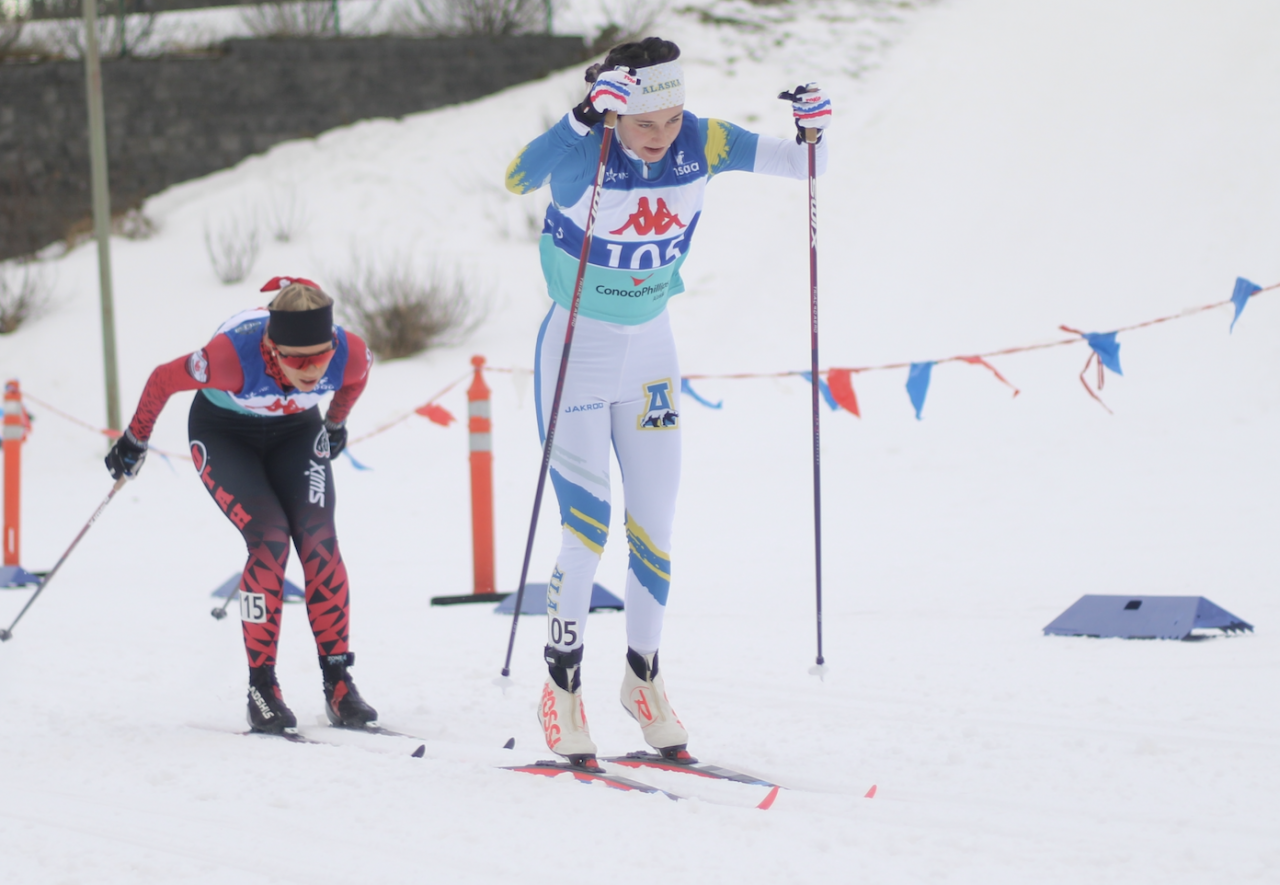
    Kreuger continued pushing the pace, followed only by Vermeulen. The race for the stage win was down to two men as Lapalus and Friederich Moch (GER) had fallen off the pace. For Klaebo, it was a case of doing his work while making sure not to go too hard. Climbing the Alpe would be difficult enough for a sprinter like Klaebo, but if he overextended, he could blow up and lose it all.

    Hugo Lapalus (FRA) celebrates claiming the Climbers Bib in the 2025 Tour de Ski. (Photo:  Modica/NordicFocus)

    After his initial time-losses on the lower slopes, Klaebo held the gap some 90 seconds behind Kreuger who would cross the finish line in 32: 39. Vermeulen finished seven seconds later, followed closely by Moch in third. Lapalus finished fourth to cement his hold on the Climber’s bib. Shepherded by his teamate, Haavard Moseby, Klaebo crossed the line in 18th place, 1:13 behind the winner—good enough to seal up the Tour de Ski overall win. His 18th place preserved a winning margin of 1:23 over Vermeulen.

    With the mid-Tour withdrawal of Harald Oestberg Amundsen, Klaebo’s win in the Tour de Ski makes it very unlikely that anyone else could overtake him in the chase for the FIS World Cup overall championship. While Klaebo’s primary focus probably remains the individual events at the World Championships later this season in Trondheim, he is sure to be satisfied with his hold on the Crystal Globe. That’s another piece of history—another source of legacy—that Klaebo has certainly earned . . . even on humbling days like the ones when he has climbed the Alpe Cermis.

    Mika Vermeulen (AUT), Johannes Hoesflot Klaebo (NOR), Hugo Lapalus (FRA), (l-r) top the podium in the 2025 Tour de Ski. (Photo: Vanzetta/NordicFocus)

    Alpe Cermis Freestyle 10 k RESULTS


    Final standings in the 2025 Tour de Ski. (Photo: FasterSkier)