Category: Feature

  • Schumacher Animates Falun Mass Start, Claims Second

    Schumacher Animates Falun Mass Start, Claims Second

    This coverage is made possible through the generous support of Marty and Kathy Hall and A Hall Mark of Excellence Award. To learn more about A Hall Mark of Excellence Award, or to learn how you can support FasterSkier’s coverage, please contact info@fasterskier.com.

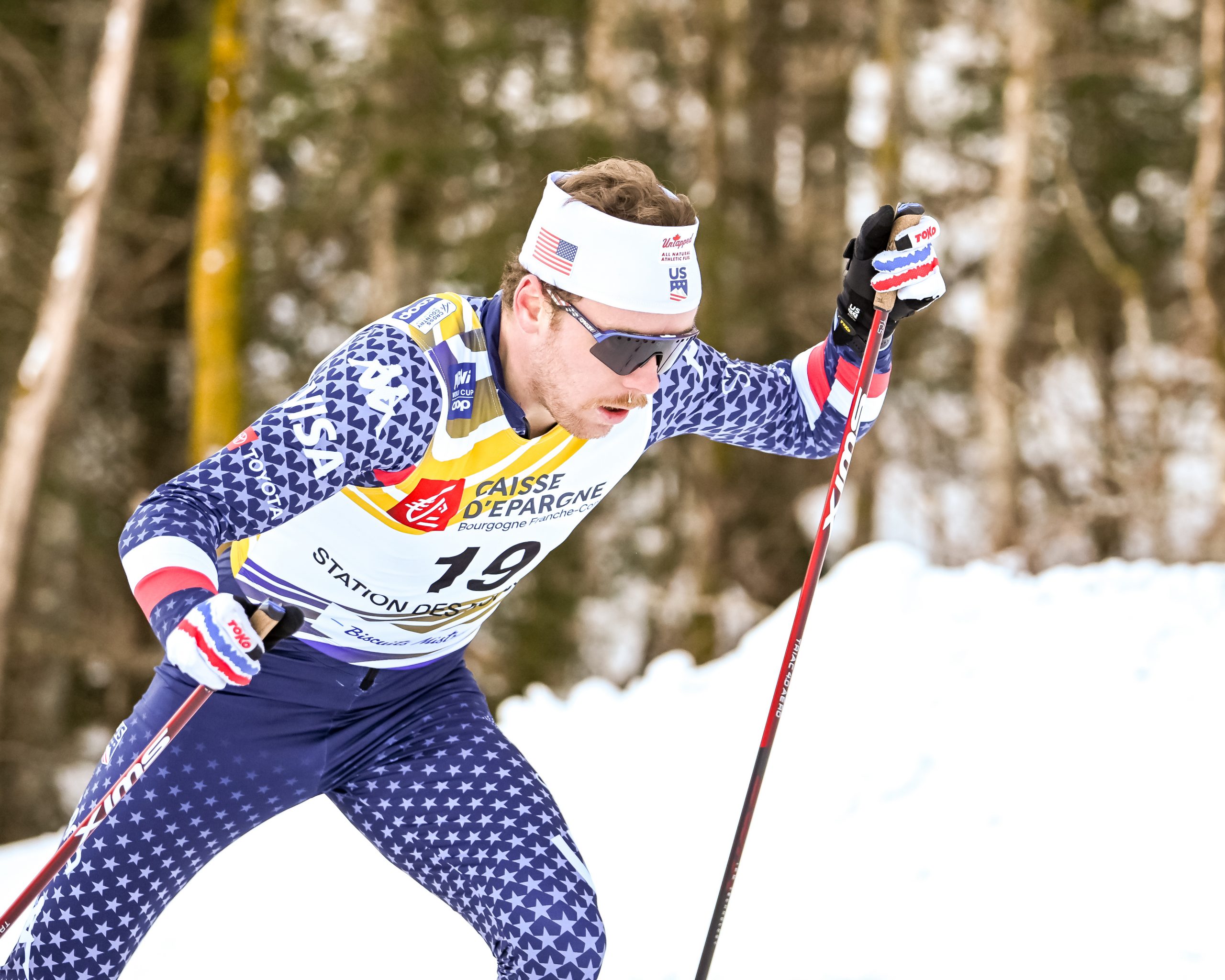
    Gus Schumacher (USA) earns his second career World Cup podium with a thrilling second place in Falun’s 20 k Mass Start. (Photo: NordicFocus)

    Perhaps more than any other season, the 2024-2025 World cup has been marked by the comings and goings of numerous contending skiers. Iivo Niskanen (FIN) got a late start to the season, but has finally begun to look strong of late (as proven with his dominant victory in yesterday’s 10 k Classic). Sprint and Overall World Cup leader, Johannes Hoesflot Klaebo (NOR), shows up and wins often enough to continue leading the Overall World Cup standings, then disappears for days “on the couch” at home in Trondheim. Norway’s Harald Oestberg Amundsen (the 2024 World Cup Overall champion) followed Klaebo to most starting lines early in the season, but eventually opted to skip races in favor of World Championship preparations. Former World Cup champion, Paal Golberg (NOR), has been left off Norway’s starting roster for many races this season, largely unable to prove himself in the selection process for Norway’s World Championship teams, even as the entire Norwegian squad was absent from the World Cup during their own National Championships. Ben Ogden (USA) has been sidelined by persistent illness for the past two weekends, And Ogden’s American teammate, Gus Schumacher, saw his season interrupted by illness, so much so that he traveled across the globe for a stint of rest and recovery at home in Anchorage.

    In training and competing at the World Cup level, the differences between champions and also-rans are alarmingly slim. Taking a break from time to time may seem like a good idea, but there’s always the risk of returning to competition only to find oneself flat. Klaebo opted to return home after his Sprint victory on Friday and second-place finish in yesterday’s 10 k Classic Interval Start. He’s one who seems able to always race in top form. For the rest of the field, question marks persist. So, at the beginning of today’s 20 k Mass Start in Falun—and in the absence of Klaebo and his countryman, Erik Valness—no one really knew what to expect.

    USA’s Gus Schumacher (left) was the primary animator in the early kilometers of the World Cup 20 k Mass Start in Falun, Sweden. (Photo:  NordicFocus)

    Early in the race, answers began coming from Schumacher, who animated the pace for much of the race, ultimately sprinting to second place behind race winner, Golberg (himself only recently returned from time away from the World Cup).

    “My strategy was mostly to stay out of trouble and be there when moves happened,” said Schumacher. “Whenever you feel good it’s just easier to be at the front. It meant I could also drift back a bit on the big climb if I felt like it. It kinda depends on the nature of the race. For a dynamic one like this, I feel you don’t really need to be that far forward if you have a lot of energy and solid skis, but like I said before it’s always easier if you can get there.”

    Other American skiers delivered solid finishes, with Zanden McMullen 22nd, Kevin Bolger 23rd, Hunter Wonders 55th, Luke Jager 64th, Walker Hall 75th. Due to lingering illness, Ben Ogden continued to be absent from the field. Canadian finishers included Antoine Cyr 30th, Thomas Stephen 54th, Remi Drolet, Sasha Masson 44th, Pierre Grall-Johnson 73rd.

    Paal Golberg (NOR) returned to the top of the FIS World Cup podium, sprinting out of the lead group to claim the win in Falun’s 20 k Mass Start. (Photo: NordicFocus)
    Falun Mass Start Freestyle

    Falun’s 20 k would be contested over five laps of a four kilometer loop, featuring five ascents of Falun’s infamous Mordarbacken—a climb gaining 60 meters of elevation up a 15% grade—ascending the slope alongside the facility’s famous ski jumps. It would be a high-speed grind favoring good climbers on the uphills, and fast skis on the downhills.

    While Edvin Anger (SWE) jumped quickly to the front, it was Amundsen who set the early pace, followed by the leader of the FIS Distance standings, Simen Hegstad Krueger (NOR), Mika Vermeulen (AUT), and Hugo Lapalus (FRA). McMullen and Schumacher remained in the top ten where they were joined by Joe Davies (GBR) and Federico Pellegrino (ITA).

    Gus Schumacher (USA) had fast skis in Falun, allowing him to surge to the front on the course’s challenging and technical downhills. (Photo: NordicFocus)

    Just after the first ascent of the Mordarbacken climb, Schumachers’ fast skis allowed him to glide to the front where he continued to set the pace through many of the race’s early checkpoints.

    “(My skis) were running super well,” said Schumacher. “Big thanks to Chris Hecker, the whole wax truck, and Rossi!! I don’t really hear about the prep, but I know we’ve been doing a really thorough job testing pre-race. In the last couple weekends, actually since Cogne, we’ve been making sure we get at least one little glide out on course to confirm the feelings we’re having on our feet.”

    Anger continued to be the interesting question mark through the first 10 k.  Perhaps the biggest skier in the field, Anger would find himself gapped by pure climbers on the Mordarbacken, only to reappear near the front on subsequent downhills. Anger continued to yo-yo on the climbs, his tempo markedly slower than that employed by the pure climbers. The field continued to stretch and bunch, at times epitomized by a group of 6-7 at the front, at other times swelling to more than 20. Saturday’s 10 k Classic winner, Iivo Niskanen, clung tenaciously to the back of the lead group, along with the always-dangerous sprinter, Pellegrino.

    Gus Schumacher (USA) charges up one of the hills on the sprint course at the base of the Mördarbacken during the 20 k Freestyle Mass Start in Falun, Sweden. (Photo: NordicFocus)

    In the final lap, Schumacher continued pressing the issue near the front as the field rolled through the stadium and onto the gentle rollers that followed. On the final climb of Mordarbacken, it was Andreas Fjorden Ree (NOR) who drove to the front, fully committed to dropping the rest. Schumacher remained clamped firmly to the tails of Vermeulen, the only other non-Norwegian left in the final selection.

    “I don’t follow skiers so much as body language when I’m skiing up front like that,” explained Schumacher. “Like if someone looks to be gaining momentum I’d maybe choose being behind them compared to someone that’s maybe slowing down or skiing passively. Definitely also good to follow established good distance skiers, but you kinda never know how people are feeling until you see them move.”

    In the rolling hills that lead to the finish, Schumacher executed a flashy pass that took him around Krueger and Golberg, closing the gap on Ree. Into the Sprint course downhill, Schumacher’s skis continued to glide well, but he was now the last non-Norwegian in contention, so the skis around him were equally as fast. Over the final bump, Golberg surged into the lead to claim the inside line on the final turn. Schumacher drifted outside, and began his sprint early, but Golberg was able to hold him off to the finish line. Golberg first, Schumacher a resounding second, Amundsen third, Ree in fourth.

    Harald Oestberg Amundsen (NOR), Paal Golberg (NOR), Andreas Fjorden Ree (NOR), and Gus Schumacher (USA) duked it out down the finishing straightaway. FIS jury would deliberate over bumping and line changes that occurred on the final curve, but would ultimately confirm the original finishing order. (Photo: Modica/NordicFocus)

    There were nervous moments following the race as the FIS awards ceremony was delayed to allow ongoing jury considerations. The American squad was understandably concerned, as there had been close maneuvering on the final corner involving Schumacher and Ree. Schuamcher had been solidly positioned in front of Ree at the moment in question, so it was unlikely that the jury would affect the finishing results. Nervous moments, indeed . . . but ultimately the jury did determine that the finishing results would stand.

    Schumacher’s season had already been interrupted by illness, necessitating his trip back to Anchorage to regroup. That sort of rest and recovery never insures that a skier will return to form. Obviously, it worked for Schumacher, and at just the right time. After today’s marvelous performance, he’ll line up as a serious contender in Trondheim nine days from now . . .

    Complete Falun Mass Start Freestyle RESULTS

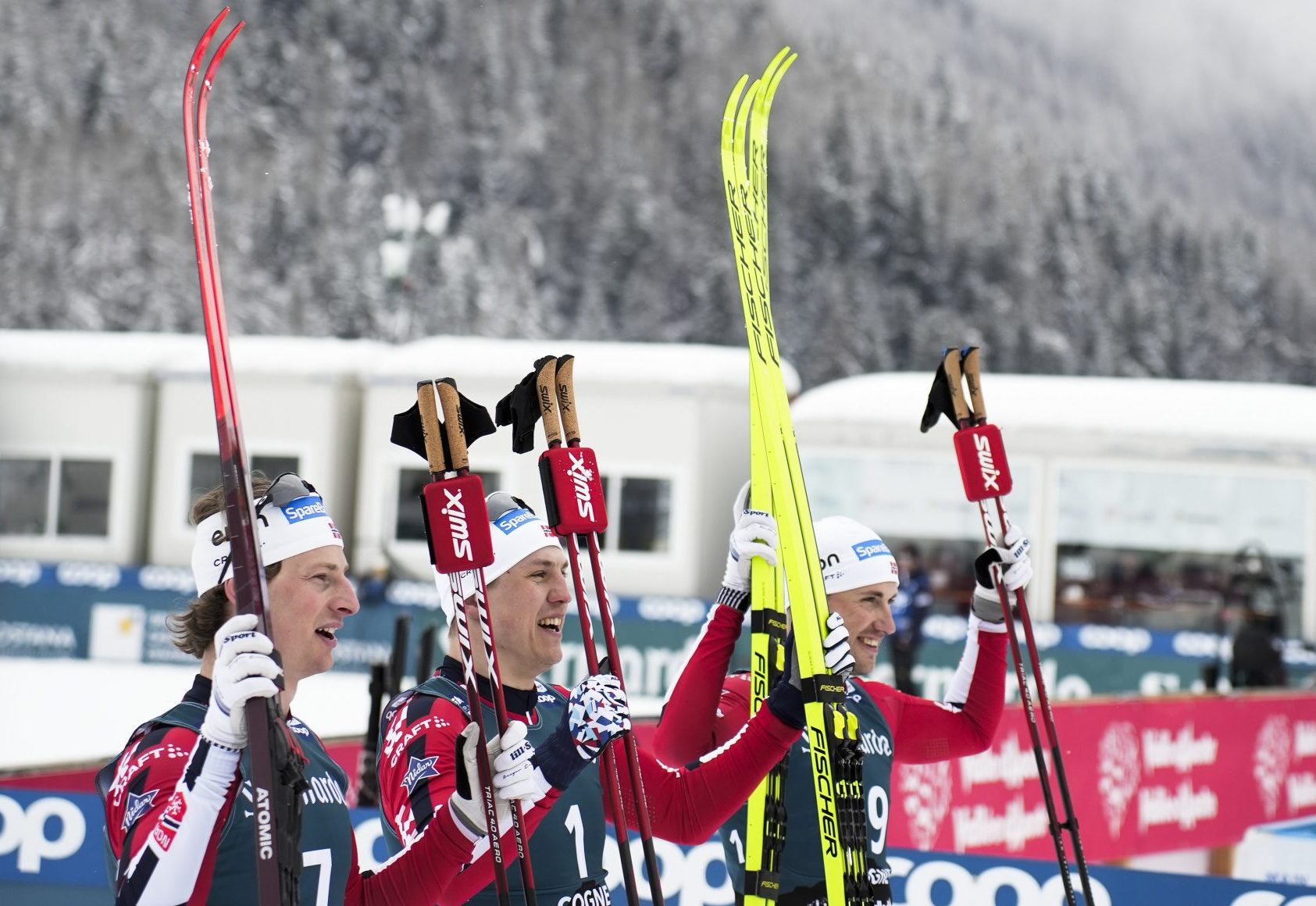
    Gus Schumacher (USA), Paal Golberg (NOR) and Harald Oestberg Amundsen (NOR), (l-r) share the podium of the 20 k Mass Start Freestyle in Falun (SWE). (Photo: NordicFocus)
    Gus Schumacher (USA) and the staff of Team USA on the podium in Falun, Sweden. (Photo: Modica/NordicFocus)
  • Andersson Thrills Swedish Crowd in Falun 10 k Classic, Diggins Fourth

    Andersson Thrills Swedish Crowd in Falun 10 k Classic, Diggins Fourth

    This coverage is made possible through the generous support of Marty and Kathy Hall and A Hall Mark of Excellence Award. To learn more about A Hall Mark of Excellence Award, or to learn how you can support FasterSkier’s coverage, please contact info@fasterskier.com.

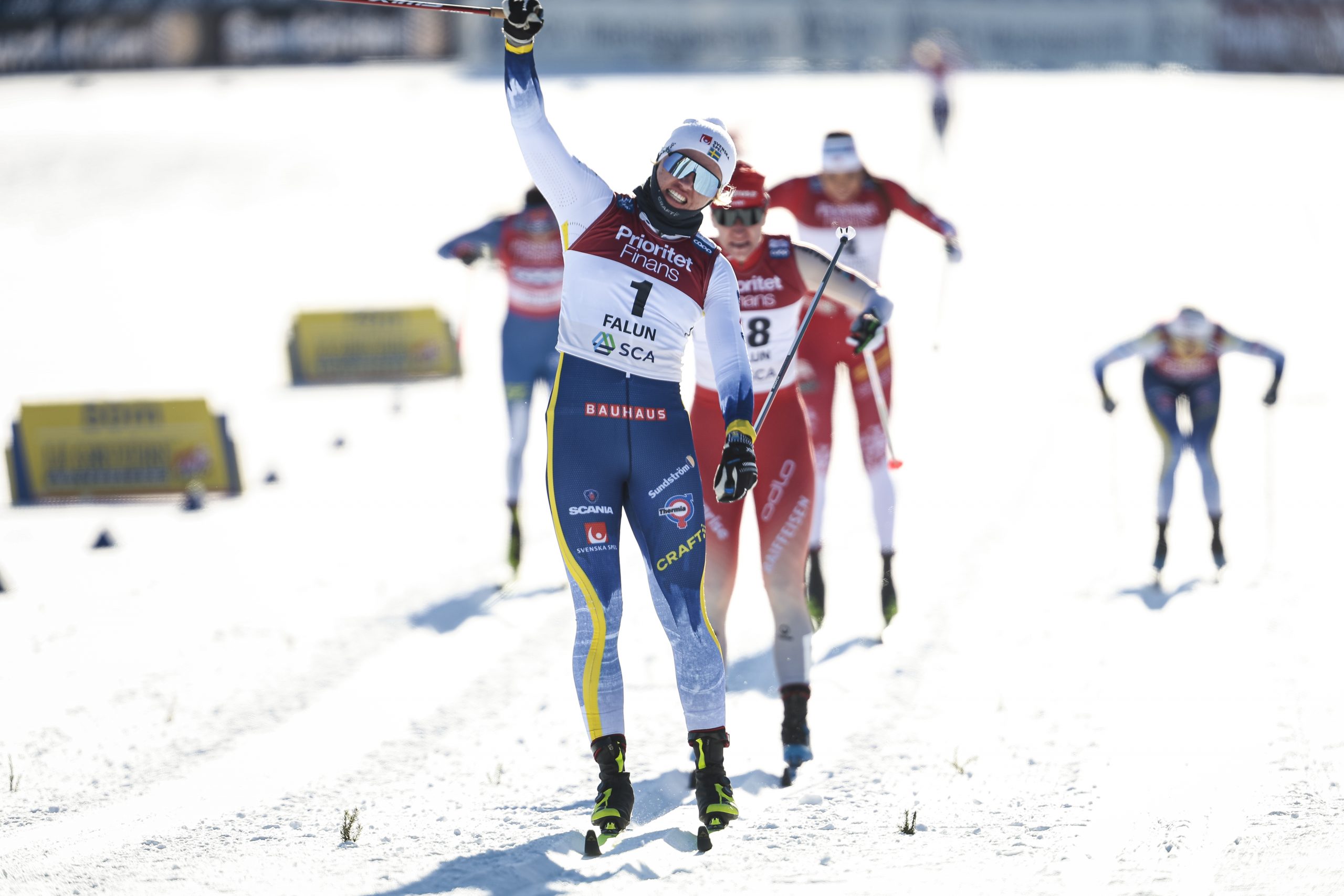
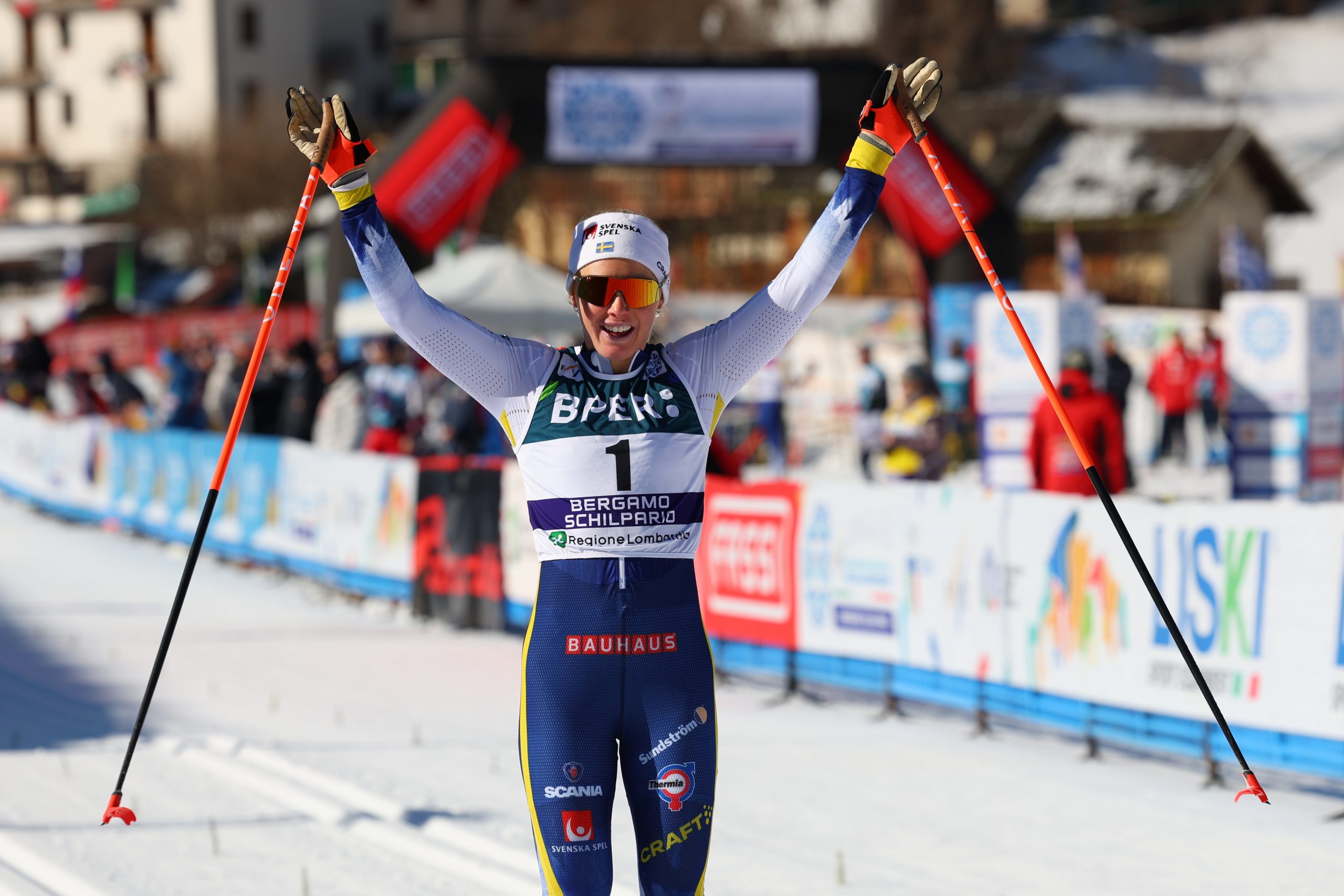
    Ebba Andersson (SWE) hadn’t won a World Cup race since 2023 in Trondheim, a drought that she broke in dramatic fashion with her striking victory in Falun’s 10 k Classic Interval Start. (Photo: NordicFocus)

    World Cup Nordic racing is a funny thing: so many of the race venues provide large grandstands at the finish lines, though almost no fans fill those seats. It’s not because too few fans attend the races; especially in Scandinavian countries—where fans really do know their cross country skiing—the most energetic and vociferous cheering sections are found on the significant parts of the race course where cheering can have the greatest effect on the skiers those fans root for. That’s why Ebba Andersson (SWE) may have experienced a different race from what most other skiers experienced today in Falun. On her way to a masterful victory in the Classic 10 k Interval Start, Andersson would have ascended the daunting Mordarbacken climbs amid a gloriously deafening wave of Swedish exhortation. The Swedes love Nordic skiing, and Andersson delivered just the sort of victory those fans hoped for.

    Heidi Weng (NOR) spent many seasons as a “podium machine” in the FIS World Cup. As her second place finish in Falun’s 10 k Classic will attest, she appears to be returning to that winning form just in time for the upcoming World Championships in Trondheim. (Photo: NordicFocus)

    Andersson had not won a World Cup event since 2023 (in Trondheim). So when she stormed through the race’s intermediate checkpoints with leads that continued to grow ahead of Norway’s Heidi Weng (ultimately second on the day) and Germany’s Victoria Carl (the final podium finisher), the crowd knew that Andersson’s long winless drought was over. She seems to be rounding into form just in time for the world Championships, set to begin in ten days in Trondheim where this same event—10 k Classic Interval Start—is on the championship schedule.

    Jessie Diggins (USA) raced into tight contention with the leaders at all intermediate checkpoints on the Falun course, holding her pace and her technique to the very end where her efforts earned her an impressive fourth place. Naturally, all eyes were on her now-infamous left foot where she has dealt with issues of plantar fasciitis. Falun’s Classic course—one designed to reward skiers who stride most efficiently (rather than just those who can crank the double pole)—would pose a serious test for Diggins, a test she passed with flying colors.

    Jessie Diggins (USA) showed that all her hard work on her classical technique this summer had not been lost while she was plagued by plantar fasciitis in January. (Photo: NordicFocus)

    With the FIS World Championships just days away, most national teams are coming into clearer focus. Other American finishers in Falun included Sophia Laukli 26th, Julia Kern 30th, Alayna Sonnesyn 34th, Kate Oldham 43rd, and Sydney Palmer-Leger 48th. Canadians were led by Alison Mackie (straight off her double medal performance at the Junior World Championships) in 31st, and Amelia Wells 60th.

    Even so, significant starters were absent from today’s race. Norway’s Astrid Oyre Slind (leader in the FIS Distance standings) was a late-announced non-starter. Therese Johaug (NOR) is presumably at home training in anticipation of World Championships, as must be her Swedish rival, Frida Karlsson. Those are other likely contenders for World Championship medals in Trondheim, though it would’ve taken a lot for either of them to unseat an excellent and inspired Ebba Andersson on this cold, windy day in Falun.

    Heidi Weng (NOR), Ebba Andersson (SWE), Victoria Carl (GER) on the 10 k Classic podium in Falun, Sweden. (Photo:  NordicFocus)
    Falun 10 k Classic Interval Start

    With overcast skies and cold temperatures (minus 6.4 Centigrade at race time), Falun dawned chilly and windy. The waxing would be fair, but the conditions would continue to challenge as the tracks began filling with steadily falling snow.

    “(It’s) a complicated course: 3.75 kilometer red loop, followed by a 3.75 kilometer blue, and finally a 2.5 kilometer blue,” explained US Coach, Matt whitcomb. “You have the small Mordarbacken, then you have the big Mordarbacken, And you don’t want to do those hills any more, so you go to the 2.5, which is just the field, plus the Sprint loop, and finish.”

    “It’s a wintry day; people are going to have to pace this really well,” Whitcomb explained. “There’s not a lot of time in a 10 k. Our plan is to take it out hot.”

    Fans can always count on Jessie Diggins (USA) to give it her all. In Falun, her fearless brand of racing delivered a fourth place finish, and extended her lead in the season-long race for the Overall Crystal Globe. (Photo: NordicFocus)

    Diggins would start 60th, well after all her closest rivals. She’d have all the information available to her as she made her way around a Falun’s winding course. Diggins was third at 2.5 kilometers, seven seconds behind a streaking Andersson, and just another three seconds behind Carl. After Diggins’ recent win in the Cogne 10 k Freestyle World Cup, she has shown that she can manage the challenges of this distance. And her ability to work hard and suffer during races is already well established. In Falun, Diggins did race with intensity (as she always does) but also with an impressive degree of control, maintaining even splits (in relation to her rivals) all the way to her fourth place finish.

    Starting 48th, Weng was able to compare her on-course performance to that of Carl and Andersson. By the time Carl finished, she led by over 30 seconds . . . but Andersson and Weng were still on course, and storming through progressive checkpoints. Andersson, especially, seemed buoyed by the cheering of the Swedish crowd, a wave of support and enthusiasm that she rode all the way to the finish line. While Weng was able to overcome the early lead of Carl, Andersson was not to be caught on this day.

    Victoria Carl (GER) was the earliest starter among serious contenders, setting the early pace and claiming a third place finish in Falun’s 10 k Classic. (Photo: NordicFocus)

    “It has really been a struggle for me to this victory again,” said Andersson. “It’s the first time I’m standing on top of the podium here in Falun, on home ground. So I’m really happy.”

    I struggled with Covid last season, Andersson explained. “Now it feels great again to take this victory, and to do it in front of the home crowd.”

    Complete Falun 10 k Classic Interval Start RESULTS

    Heidi Weng (NOR), Ebba Andersson (SWE), Victoria Carl (GER) after Falun’s 10 k Classic Interval Start. (Photo: NordicFocus)
  • Niskanen Rules the Classic Tracks in Falun

    Niskanen Rules the Classic Tracks in Falun

    This coverage is made possible through the generous support of Marty and Kathy Hall and A Hall Mark of Excellence Award. To learn more about A Hall Mark of Excellence Award, or to learn how you can support FasterSkier’s coverage, please contact info@fasterskier.com.

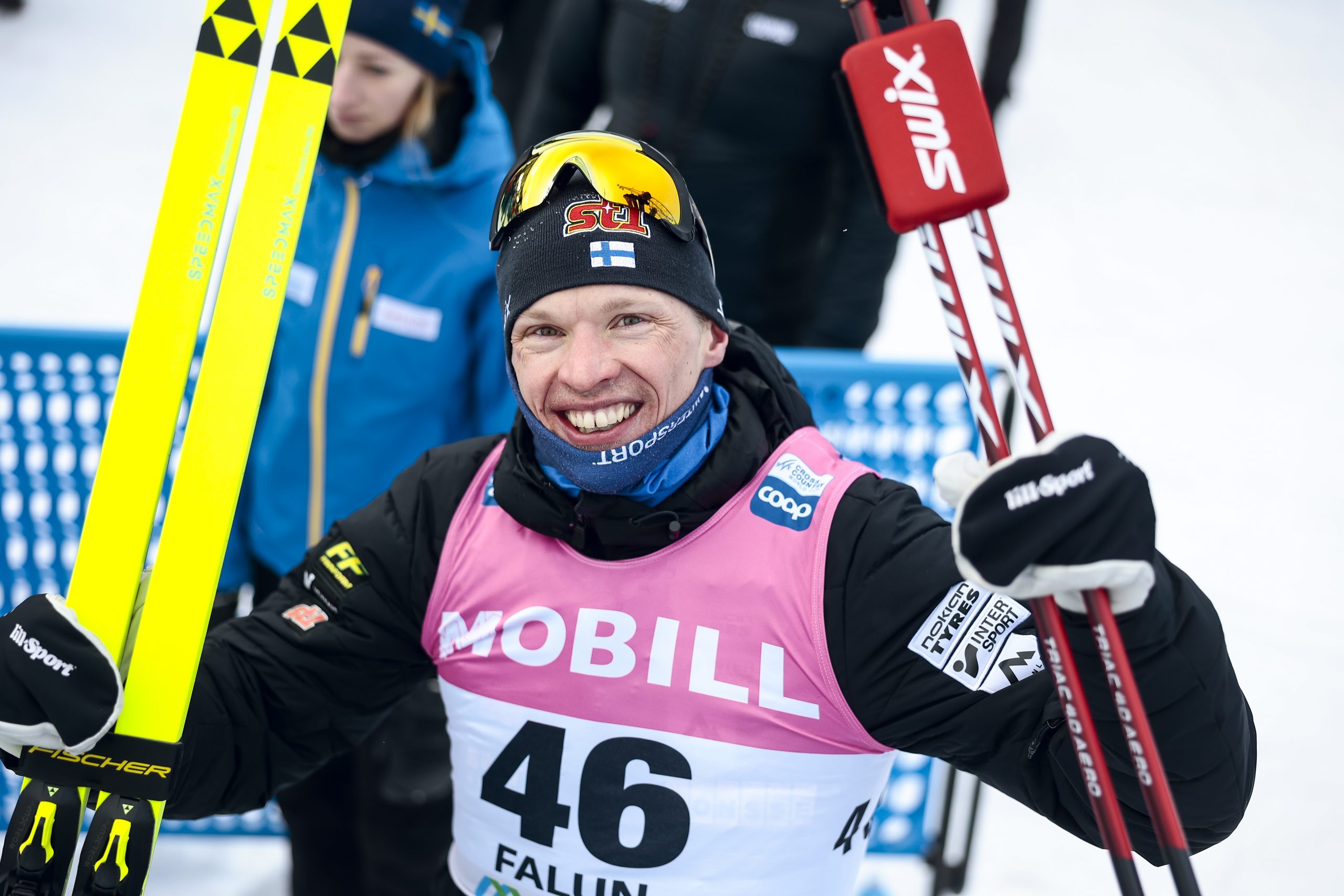
    Iivo Niskanen (FIN) continues to be the dominant force whenver World Cup races are staged in Classic technique. His victory in Falun’s 10 k bodes well for his potential in the same event at the upcoming World Championships in Trondheim. (Photo:  Modica/NordicFocus)

    Team Norway arrived in Falun, Sweden, with its roster fully loaded: Johannes Hoesflot Klaebo, Harald Oestberg Amundsen, Paal Golberg, Erik Valnes, Martin Loewstroem Nyenget, and Simen Hegstad Krueger (the current FIS Distance leader). But it was Finland’s Iivo Niskanen who would claim his tenth career World Cup victory with a dominant performance over the 10 k Classic Interval Start. Norway didn’t go home empty-handed, as the remaining podium spots were filled by Klaebo and Valnes.

    Canada’s Antoine Cyr delivered an impressive result in 15th, just ahead of USA’s Gus Schumacher in 17th. Other North American finishers included Remi Drolet 22nd, JC Schoonmaker 23rd, Olivier Leveille 35th, Thomas Stephen 38th, Zanden McMullen 41st, Will Koch 45th, Zak Ketterson 48th, Luke Jager 66th, Julian Smith 71st.

    “I think Alaska was just a good mental relax away from the travel and stuff,” said Schumacher. “And the farther I get away from that Tour sickness the better I’m feeling.”

    “In the past I haven’t really had the good feelings or luxury to really dial in my champs lead-up,” continued Schumacher. “I think I haven’t had stability in my career on the World Cup long enough to really execute a strong peaking plan yet. It feels safer to hit a few hard races leading up but not overdoing it. For example, just two races this weekend and in Cogne to keep the energy high while also getting sharper than I’d be getting just training!”

    Gus Schumacher (USA) continues to improve after his recovery from mid-season illnesses. He was 15th in the 10 k Class in Falun, sweden. (Photo: NordicFocus)
    Falun 10 k Classic Interval Start

    Mika Vermeulen (AUT) described the unavoidable strategy employed by any skiers hoping to reach the podium in Falun’s World Cup 10 k: “Go full gas from the start,” Vermeulen grinned. “And hope it works out!”

    Team USA Coach, Matt Whitcomb, described a similar strategy in pre-race interviews, while also issuing a gentle warning to those who might go out too fast.

    “You’re going to start seeing splits come in around 3 k where the race starts unfolding and starts getting interesting, said Whitcomb. “As every team and every athlete has experienced, Not all the first splits through that checkpoint will be the first at the finish.”

    Niskanen started 46th, taking over the early lead with each on-course split. He would never be challenged throughout the day, posting the fastest times at every checkpoint. In Falun, those Norwegian contenders who so often crowd all other nations off of the podium were sprinkled in among an international top ten including Vermeulen, Hugo Lapalus (FRA), Ristomatti Hakola (FIN) and an early lead produced by a rejuvenated Calle Halfvarsson (SWE). World Cup distance leader, Krueger, seemed to be dealing with slow skis, as his splits left him out of the top 20 by mid-race.

    Johannes Hoesflot Klaebo (NOR) is not always a contender in races like Falun’s 10 k Classic Interval Start. His second-place finish suggests he is in excellent condition leading to the World Championships in Trondheim. (Photo: NordicFocus)

    Niskanen stormed to victory 12.9 seconds ahead of Klaebo (who is likely to be quite pleased with his second place finish). Valnes—the every-race iron man of the Norwegian team—was a close third, less than five seconds behind Klaebo.

    “Tricky conditions today,” said Niskanen in post-race interviews. “Quite windy. snow a bit, and a lot of skiing outside the Classic lines.” He alluded to his needing to avoid receiving another yellow card (his first being earned in recent World Cup races), though that penalty will expire before he arrives at the World Championships in Trondheim.

    “Hopefully I will stay healthy until World Championships,” Niskanen said. “It will be exciting games.”

    Complete Falun 10 k Classic Interval Start RESULTS

    Iivo Niskanen (FIN) celebrates his win in Falun’s 10 k Classic on the podium with Johannes Hoesflot Klaebo (NOR) and Erik Valnes (NOR). (Photo: NordicFocus)
  • Falun Classic Sprint—Linn Svahn is Back!

    Falun Classic Sprint—Linn Svahn is Back!

    This coverage is made possible through the generous support of Marty and Kathy Hall and A Hall Mark of Excellence Award. To learn more about A Hall Mark of Excellence Award, or to learn how you can support FasterSkier’s coverage, please contact info@fasterskier.com.

    Linn Svahn (SWE) was the dominant World Cup Sprinter before injury derailed her young career. With her confident win in the Falun Classic Sprint, she appears to have returned to form just in time for the upcoming World Championships. (Photo: Modica/NordicFocus)

    As followers of cross country skiing, we may be some of the most spoiled fans in the entire sports world. Nordic skiing is incredibly taxing and exhausting, and the World Cup tour is a non-stop whirlwind of uphills and downhills, airplanes and hotel rooms, foreign foods and unpredictable winter weather. Still, what we expect (as fans) is that skiers will continue to show up each weekend to entertain us in this unscripted drama unfolding across the forests and snowfields of northern Europe. What they do, week in and week out, is simply amazing. Little surprise then, that some of them eventually need a break. Over the past few weeks, some notable stars have been conspicuous by their limited appearances. Consider the lists of the injured: Kristine Stavaas Skistad (NOR) and Jessie Diggins (USA). The ill or exhausted: Linn Svahn (SWE) and Maja Dahlqvist (SWE). And the recently returned: Julia Kern (USA). In Falun, Sweden, nearly all of the serious Sprint contenders—including the durable every-weekers like Jasmi Joensu (FIN), Johanna Hagstroem (SWE) and Nadine Faehndrich (SUI)—were gathered for the Classic Sprint. With only Sweden’s Jonna Sundling being absent, the crowd in Falun would be in for a treat.

    Americans Jessie Diggins, Julia Kern, and Sammy Smith advanced to quarterfinals by qualifying 8th, 10th, and 14th respectively. Diggins and Kern would advance to semifinals, ultimately finishing 7th and 8th. Smith would bow out in her quarterfinal, earning a 30th place finish. Other American finishers included Erin Bianco 33rd, Kate Oldham 34th, Emma Albrecht 41st.

    Among Canadians, Olivia Bouffard-Nesbitt finished 32nd, Katherine Weaver 37th, Sonjaa Schmidt 45th, Amelia Wells 50th.

    Back from an extended break following the Tour de Ski, Julia Kern (USA) showed great speed in her quarterfinal heat, advancing easily to the semifinal where she would earn an eighth place finish on the day. (Photo: Modica/NordicFocus)
    Falun Classic Sprint

    Fans had not seen Svahn since January’s Tour de Ski. In Falun, she was able to move easily through Quarterfinal 2, showing a bit of the spark and tactical control that epitomized her early career (where she had already won 12 World Cup Sprints). Skistad and Joensu moved on from Quarterfinal 1 while Kern (also recently returned to the World Cup field after a lengthy absence) dominated Quarterfinal 3 in which Dahlqvist overcame a broken pole to chase down the entire field and storm from behind in the closing meters to claim a space in the semifinals. Diggins led Quarterfinal 4 early on, to finish in second behind Faehndrich. Hagstroem and Julie Myhre (NOR) advanced out of Quarterfinal 5.

    Semifinal 1

    The first semifinal pitted Skistad against Joensu, Svahn, Kern, Coletta Rydzek (GER), and Mathilde Myhrvold (NOR). Skistad would go quickly to the lead, but did not seem eager to push the pace. Joensu volunteered to lead the significant downhill with Svahn wisely tucked in behind, from which position she was able to surge forward for the heat win (ahead of Skistad). Kern found herself off the back early on, but was able to recover for fourth in the heat. Joensu would advance to the final as a lucky loser, but Kern would find herself bumped out of the final position by finishers in Semifinal 2.

    Semifinal 2

    Diggins would line up for the second semifinal against Myhre, Hagstroem, Faehndrich, Dahlqvist, and Gimmler. After a slow start, Diggins would weave her way through the field, but was never able to advance farther than fourth (behind Dahlqvist, Faehndrich and Hagstroem, all of whom would advance to the final).

    Kristine Stavaas Skistad (NOR) relies on power in sprinting. Today in Falun, her form appeared slightly off, but still good enough for third place in the World Cup Classic Sprint. (Photo:  Authamayou/NordicFocus)
    Sprint Final

    Skistad drove quickly to the front in the Women’s Sprint Final, marked by Svahn who accelerated impressively over the top of the course’s steepest climb. Up the first climb, Skistad dropped back behind Faehndrich while Dahlqvist and Hagstroem trailed the field. Svahn would power to the line for her 13th World Cup Sprint win, demonstrating that she is back at full strength as the field looks forward to the World Championships two weeks from now in Trondheim. Faehndrich would hold on for a hard-earned second, while Skistad settled for third, just holding off a hard-charging Dahlqvist in the final meters.

    Falun Women’s Sprint RESULTS

    Falun Women’s Sprint QUALIFYING

    A beaming Linn Svahn (SWE) is joined by Nadine Faehndrich (SUI) and Kristine Stavaas Skistad (NOR) on the World Cup Classic Sprint podium in Falun, Sweden. (Photo:  Authamayou/NordicFocus)
  • Klaebo, Valnes, Vike—Red Sprint Podium in Falun

    Klaebo, Valnes, Vike—Red Sprint Podium in Falun

    This coverage is made possible through the generous support of Marty and Kathy Hall and A Hall Mark of Excellence Award. To learn more about A Hall Mark of Excellence Award, or to learn how you can support FasterSkier’s coverage, please contact info@fasterskier.com.

    Erik Valnes (NOR) continues to show up, continues to contend. In Falun, he finished a solid second behind his countryman, Johannes Hoesflot Klaebo. (Photo: Authamayou/NordicFocus)

    Erik Valnes (NOR) might be the most durable skier of his generation: seemingly never sick, hardly ever injured, lined up at just about every World Cup event on every available weekend, and always in contention for the podium. It’s just Valnes’ misfortune to have been born into the same generation as Johannes Hoesflot Klaebo (NOR), perhaps the greatest technician and tactician the sport has ever known. Klaebo may not share Valnes durability—he’s often sidelined by illness—but Klaebo is a safe bet to win any Sprint competition he lines up for. Even so, Klaebo certainly remembers the very short list of names of those who have beaten him in head-to-head sprints . . . and Valnes is one of those few.

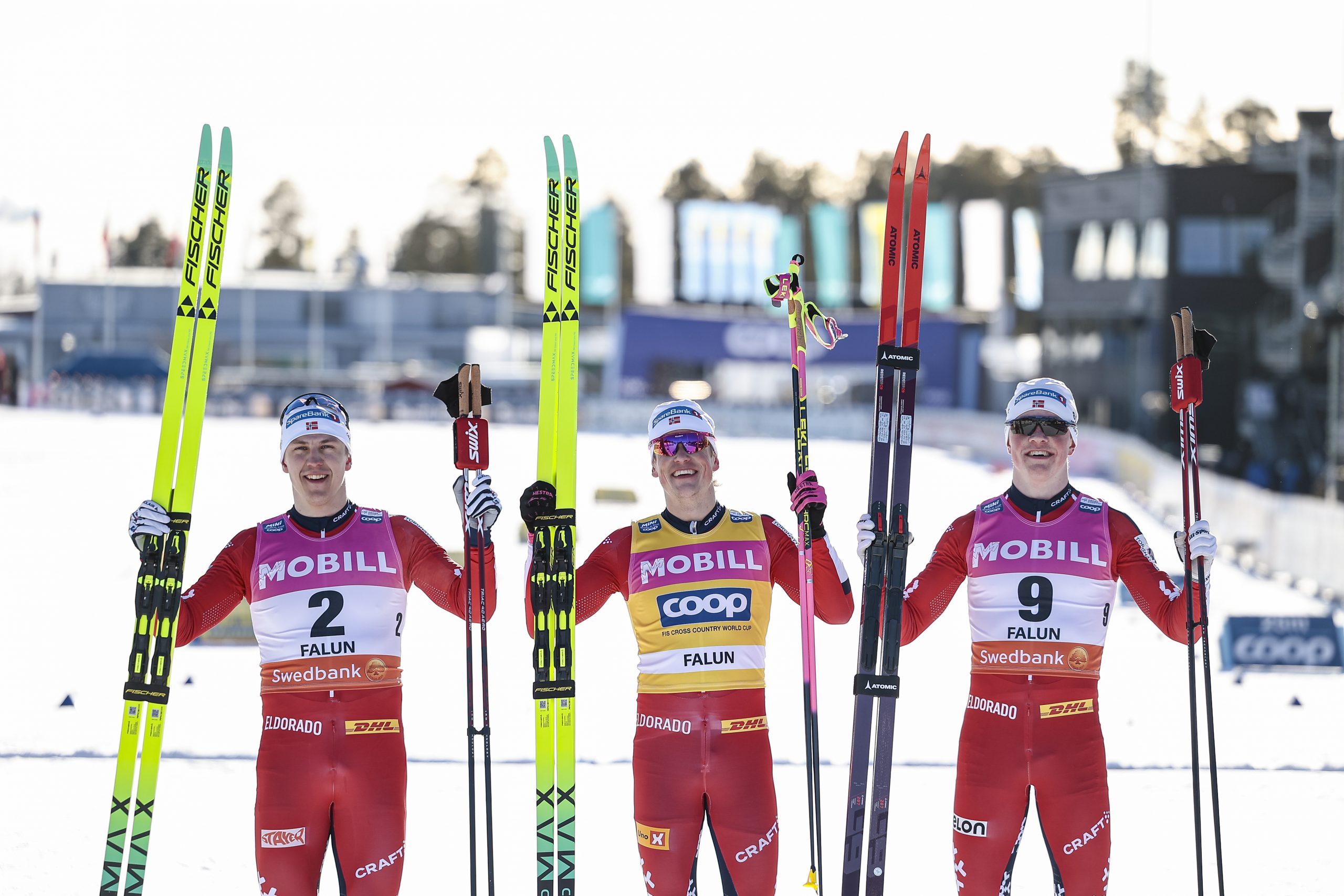
    In Falun, Klaebo (1st) and Valnes (2nd) continued to represent the Norwegian cream that rises to the top of so many World Cup Nordic events. They were joined on the podium by their young teammate, Oskar Opstad Vike, claiming a podium position in only his 13th WorldCup start.

    Murphy Kimball (USA) showed his speed with a 22nd place qualifying run, though he ran into an even hotter pace in his quarterfinal. He’s a young skier with more opportunities to learn the complex strategies of World Cup Sprinting. (Photo: Modica/NordicFocus)

    Four Americans advanced out of qualifying in Falun: Zak Ketterson 11th, JC Schoonmaker 15th, Murphy Kimball 22nd, and Kevin Bolger 28th. Each of those Americans would see their days end in quarterfinal heats with Bolger 19th, Ketterson 22nd, Schoonmaker 23rd, and Kimball 28th. Among other Americans, Luke Jager qualified 41st and Zanden McMullen 52nd.

    “The qualifier effort is a big toll on the body,” said Kimball, “But I think almost everyone in the field has to go all out to not only make heats but also to secure FIS points. One of the things I’m happy about is my consistency in qualification so far on World Cup. I’m usually around 8-9 seconds back from the leaders and today that was enough to get into heats.”

    “In the heat today I noticed it was faster than a non-World Cup competition,” Kimball continued. “Especially when the heat starts pressing it’s another gear that I haven’t seen in most other competitions. This sprint heat was like all others, so I stay focused on the same things and tried not to let the more aggressive World Cup racing push me around too much!”

    Xavier McKeever was the sole Canadian qualifier (30th). He would finish the day in 20th. Among other Canadians, Graham Ritchie would finish 47th, Pierre Grall-Johnson 51st, Antoine Cyr 55th, and Julian Smith 61st.

    Falun Classic Sprint

    Klaebo led out Quarterfinal 1, albeit slowly. So much so that Valnes found his path clogged with other skiers. Eventually, such a slow pace will push someone to the front; Bolger was the one to take the bait, surging to the front where he inadvertently offered Klaebo a healthy draft on the final downhill. Klaebo and Valnes advanced with ease.

    Winner of the Classic Sprint in Les Rousses earlier this season (during Klaebo’s absence), Anger led Quarterfinal 2 in definitive fashion though with what seemed like a LOT of skate strokes over the tops of the hills. He’d win the heat ahead of Jules Chappaz (FRA). Kimball—the 22nd qualifier—discovered the difficulties and challenges of World Cup racing as he struggled with the technical nature of the winding downhill sections of Falun’s Sprint course. He would finish the day in 28th.

    Chanavat appeared unprepared and clumsy out of the starting gate in Quarterfinal 3, but he would recover on the downhill sections of the course  avoiding a costly tangle on a subsequent uphill that ended the day for Benjamin Moser (AUT) and George Ersson (SWE). Chanavat would qualify second behind Vike.

    Ketterson rocketed off the front in Quarterfinal 4, only to be swallowed up by the faster skis of Even Northug (NOR), Joni Maki (FIN), and lucky loser Pellegrino. Ketterson would fade to fifth, ultimately finishing the day in 22nd.

    Schoonmaker planted his pole on top of his own ski, taking himself out of contention in the day’s last quarterfinal. Jiri Tuz (CZE) would coast to the heat win, ahead of Miha Simenc (SLO).

    In Falun’s World Cup Classic Sprint, Sweden’s Edvin Anger (background) played right into the hands of Team Norway as Johannes Hoesflot Klaebo and Erik Valnes advanced easily out of the semifinals. (Photo:  Modica/NordicFocus)
    Semifinal 1

    The day’s headliners—and top three qualifiers—lined up for Semifinal 1. Klaebo , Valnes, and Anger continue to have scores to settle, though it’s definitely Klaebo with the most experience, the most solid tactics, and the reputation that can effectively bend the interplay of a semifinal heat to suit his will. Anger found himself at the front early on, and Klaebo maintained a position at his hip, though being unwilling to take the lead. On the final downhill, Anger found himself quite publicly de-pantsed by the superior tactics and faster skis of a host of Norwegians as Klaebo led Valnes and Vike across the line. In a final indignity, Anger was also outsprinted for fourth place (and the final lucky loser position) by France’s Jules Chappaz.

    Lucas Chanavat (FRA) seemed to have his tactics in line, but he lacked the power and speed fans are accustomed to seeing in his World Cup Sprints. (Photo: Modica/NordicFocus)
    Semifinal 2

    Chanavat would start with greater intent in Semifinal 2, following Tuz and Even Northug (NOR) up the first steep pitch. But Chanavat’s tempo appeared flat down the homestretch. Not only did he fail to catch Tuz and Northug, he was also passed by Pellegrino and Joni Maki (FIN), though neither would be fast enough to claim a lucky loser position.

    Oskar Opstad Vike (NOR)—at 21, a fresh-faced youngster climbing onto a Norway-dominated Sprint podium. Might he be the next big thing? (Photo: Modica/NordicFocus)
    Sprint Final

    Vike (the 21 year old Norwegian) and Tuz (the 20 year old Czech interloper) had both shown great speed all day. Unfortunately, that potentially set them up for harsh schoolings by seasoned veterans like Klaebo and Valnes (who would be only too happy to let spirited, young greyhounds set the pace in the final). Appearing a bit fatigued from his semifinal effort, Tuz never got the chance to lead as Klaebo (always one to mix up his tactics) powered convincingly to the front. All Klaebo needed was a willing patsy to fall for the trick—someone eager to take the lead at exactly the right/wrong moment. Enter the young and ambitious teammate, Oskar Opstad Vike who shot to the front at precisely the moment Klaebo needed him to. The schooling was about to begin . . .

    Klaebo suffered a brief and uncharacteristic stumble on the course’s sweeping downhill, but recovered in time to maintain his position ahead of Valnes. Ultimately, Klaebo would employ his understanding of fast lines—and his own fast skis—to pass Vike on the final downhill, though only after another oddly clumsy step in his high-speed lane change (a missed Classic track and an inadvertent skate stroke that may cost him a yellow card). Valnes would see the opening that Klaebo’s misstep created, but Klaebo was not to be overcome in the final meters. Valnes would cross the line second ahead of Vike whose bold and impetuous tactics delivered him a third place finish.

    Klaebo has been absent from World Cup activities for a while, but he seemed excited—and relieved—to be back. “Having eight days on the couch, so it’s good to be back racing again,” he said. “(Today’s win) helps, for sure . . . I feel like I needed this one.”

    Falun Men’s Sprint RESULTS

    Falun Men’s Sprint QUALIFYING

    Erik Valnes (NOR), Johannes Hoesflot Klaebo (NOR), and OskarOpstad  Vike (NOR): another All Red podium in the Men’s Classic Sprint in Falun, Sweden. (Photo: Modica/NordicFocus)
  • The Devon Kershaw: Back from the Dead with a Cogne Recap, and Looking Ahead

    The Devon Kershaw: Back from the Dead with a Cogne Recap, and Looking Ahead

    We’re sorry. Life intervened, and this podcast is nearly two weeks late. But it’s here, and we had a fun session breaking down a weekend of World Cup racing in Italy where Devon was present in the flesh.

    We’ll be back after Falun and on scene, both of us, in Trondheim. Reach us at devon@fasterskier.com and nat@fasterskier.com.

  • Technique and Durability—FasterSkier’s Ben Ogden Interview

    Technique and Durability—FasterSkier’s Ben Ogden Interview

    This article was made possible through the generous support of our voluntary subscribers.  If you would like to see more articles like this one, please support FasterSkier with a voluntary subscription.  

    Ben Ogden (USA) is an advocate of technical refinement being an ongoing process if a skier is to excel at the FIS World Cup level. (Photo: Authamayou/NordicFocus)

    As this interview gets into, I was really interested in the connection between the movement quality I saw Ben display during dryland training and the improvements in his skate technique that Devon saw on snow. What better time than a physio session to ask some burning questions? Direct from my treatment table at the World Cup in Engadin, Switzerland, here’s some Technique Talk with Ben Ogden:

    This interview has been edited for clarity

    Ned: Do you listen to the Devon Kershaw Show?

    Ben: A little bit. I’m not a regular listener, but I have heard some things about what he has to say.

    Ned: Devon is kind of like the de facto technique critic on Faster Skier. He will either applaud somebody’s technique or rip them apart, and he’s been very impressed with your skate technique this season. Do you feel like your skate technique is any different?

    Ben: This season compared to say last year, I wouldn’t necessarily say that I feel like my technique is different. I feel like my durability is different in skating, where I feel like I can skate as if I was fresh for a lot longer. I don’t feel like I’m really executing much differently, but I just think that in previous years I would get into a race and in five minutes I’d be flooded to the point where my technique fell apart. I feel like now I can maintain it for as long as I want at certain intensities. Obviously it still falls apart if I go too hard, but that’s where I feel the most difference. There are some other things that I think are a little different but mostly I just feel more durable.

    Ned: Do you think that’s a fitness thing like an aerobic capacity thing or a strength thing? To what do you attribute that change in durability?

    Ben: Fitness never hurts but I don’t think that’s what made the biggest change this year. I think it was more of a strength thing. I would say not necessarily like weight room strength—more like specific strength. I did a lot of no-pole this summer. And I just spent more time thinking about my technique to the point where I was trying to ski as well as I could for the entirety of an easy session where previously I would maybe check out a bit more often and let my hips fall back, etc. So I think I was just more dialed in on my skate technique and trying to feel it more, which helped to strengthen those muscles that you’re trying to use when you skate with proper technique.

    Ned: Is that a balance and stability thing, or is that more of a power generation thing?

    Ben: I think balance and stability. I think that for me, specifically as an athlete, I’ve always had the power generation, but I’ve never really had the stability. I think that’s a lot of the reason why I’ve been good at sprinting but also capable of tiring myself out to a point where I can’t skate very quickly. So I think that for me it’s all about stability and all about power application in a productive way—like in a way that allows me to ski (hips) forward like I shoot for. If you were to graph speed versus energy needed for skating, it gradually increases pretty linearly until a certain point when it starts to increase exponentially, where all of a sudden the more energy you use you’re getting a lot less increased speed for each unit of energy. I think I’ve learned in recent years to just not ever get to that point—that exponential phase in the distance race where the efficiency falls apart. I think that’s just so key. That’s something I’ve really never felt skating, especially in an individual start. Now I’m going to go out there and race hard, but I try not to get frantic or ski to the point where I’m pushing myself past where I know my efficiency falls apart. I think that’s kind of a confidence thing too—you know like I’ve always been a fast starter but nowadays I’m a little bit more reserved. So I think that helps too.

    It’s Ben Ogden’s (USA) Freestyle technique that has appeared more efficient and effective in the 2024-2025 World Cup season. (Photo: Vanzetta/NordicFocus)

    Ned: That stability component—is that something that you are working on with dry land or with your strength routine off of skis? Is that a new thing or is that something that’s always been there but you feel like now you’re making a more dedicated effort to translate it to skiing?

    Ben: Exactly that. Like, it’s always been there and I’ve been lucky enough to have been coached by very high level, knowledgeable coaches my entire life so I think that stability has always been a part of my training and off-season regiment, but I just think that, for me as an athlete, this year I really started thinking about it more. Like, when I’m doing jumps for strength I’m landing with purpose. I’m making sure that I’m doing it right—making sure to land and not let my weight go side to side—just to really have more purpose in what I do. And I think that’s something that came out a little bit more this year. We train a lot and it’s hard to have that intensity all the time during training—that focus on something specific. I think that with each passing year, I increase that a little bit more, or I tackle some other area, and I think that this year that area was when I was doing strength I was very careful to keep everything properly stacked, like my hips directly over my knee directly over my ankle when I’m doing squats and jumping—moving a little bit more deliberately. I think that helps. It’s little things like that which I think helped with the stability this year.

    Ned: That’s something I noticed. You did a YouTube video with a strength routine on your front porch and some dynamic stuff in the driveway. With the plyos, you were sticking the landings—it might’ve been like a multiple impulse jump with the last contact being balanced and you were sticking it every time. I don’t see that a whole lot. I see people really focus on the quantity and not so much the quality. Then after one of the skate races earlier this season, Devon was giving you huge props on your skating and talking about how much more stacked and stable you looked versus last season. You know me, I’m just nodding in agreement and I’m like, “Well yeah because he shows this stuff with his strength routine.”

    Ben: Yeah, that’s exactly what I’m talking about. Where in previous years I would focus on how high I was jumping, you know making sure to be jumping 100. Now, I’m like, “You know I’m gonna jump hard but I’m gonna land with intent.” I think it makes a big difference. 

    Ned: I think intent is the key word there. Like every exercise that you do should have a purpose, and that purpose should carry over into skiing because that’s your thing. Maybe that purpose is power generation—how much or how fast can you generate force when pushing on a ski. But I agree there’s got to be that stability component because skiing has a gigantic balance and stability demand. Do you use a custom insole in your boots, or do you just use whatever comes in them?

    Ben: Yeah, I actually have an interesting story about that. I got custom insoles for the first time last season in December. I just sort of threw them in my boots and used them for the season. I really liked how they felt so I used them all summer. Then this fall I forgot them so I just used the old style (stock insoles) for a few days, and it was it was astounding how much worse it felt with the old insole. I gotta say I’m a big believer now. I went back and forth—I did the one and the other a little bit at the beginning and I just wasn’t used to the new insole so it didn’t feel like that much improvement.  But now I’m like, “Oh my god, I actually can’t go back!” I went to a running store in Toronto and there was a guy there who had watched me race a little bit and he looked at the way I stood and walked and jumped and everything else and then devised a pair of insoles just for me with a little bit more volume on the inner edge to help promote standing on top of the ski and not allowing for the knock knee type skating. I only use them in my skate boots and I gotta say I’m a big fan.

    Ned: Do you have orthotics in your classic boots too?

    Ben: I don’t but it’s on my list. I’m going back to Toronto later this year and I’m gonna make another appointment with this guy to talk with him about classic. We were really targeting skate with the insoles since I’ve really been targeting skate (technique) the last few years in terms of making improvements. I still work on classic, but that was kind of where my goals were at that first meeting. But, yeah, I would think the same foundation insole, maybe not quite as much posting on the inside, but still getting good support of the foot. I mean good support of the foot is just incredible and how much of a difference it makes when you’re standing on your whole foot, so I was really impressed with that.

    A character, a craftsman, a fan favorite, Ben Ogden (USA) refines his training, his techniques, and his strategies as he continues moving up the World Cup standings. (Photo:  Modica/NordicFocus)
  • The 2025 Zions Bank Boulder Mountain Tour: A Lesson in Perseverance and Faith in the People Around You

    The 2025 Zions Bank Boulder Mountain Tour: A Lesson in Perseverance and Faith in the People Around You

    By: Jody Zarkos

    Epic. 

    The 2025 Zions Bank Boulder Mountain Tour was a lesson in perseverance, faith in the people around you, and the knowledge that Nordic skiers are made of pretty tough stuff. What other group of people will tackle a stormy 34-kilometer point-to-point race with 20 millimeters of fabric between them and the outdoors? 

    After a spate of bluebird Boulders, the 52nd annual race rolled in on a stormfront that dropped almost a foot of snow the night before the start and picked up again the next morning, albeit with less ferocity. Like Keith Richards in his heyday, the Blaine County Recreation District’s grooming crew pulled all-nighters prepping the course for the 770 starters. It paid off, especially for overall men’s champion Joe Davies. 

    Men’s elite class. (Photos: Craig Wolfrom)

    “The course was in much better shape than I thought it would be, given the new snow. It was fairly firm underneath.”

    So was Davies’ resolve. 

    With three Super Tour podiums under his belt in the New Year, including a win in a 15k freestyle at Soldier Hollow two weeks prior, the 23-year-old University of Utah senior and eight other racers, including Garrett Butts, Ander Weiss, and Reid Goble, the Brit pulled away from the 60 other skiers in wave one. 15k into the race, Davies was by himself, 40 seconds ahead, and after the ensuing 18k on the Harriman Trail, he crossed the finish line in 1:28.33. 

    “I am not a sprinter, and I didn’t want to leave it to that,” Davies remarked. 

    Davies with the W for the win. (Photos: Craig Wolfrom)

    Butts, one of three Alaska-Pacific men to finish in the top 10, skied to second place in 1:30.10. BSF’s Reid Goble was third at 1:31.12. For a crowd used to a horse race at this finish, the sight of racers skiing in alone harkened back to 2022 when David Norris was more than a minute faster than the field. 

    Not so in the women’s clash. Hometown favorite Annika Landis and Erica Laven, a racer at the University of Utah, turned the last corner within a stride of each other, and Laven held her off for the win in 1:44.01. Landis crossed in 1:44.02. It was the second year in a row the first two women finished 18th and 19th overall. Another Ute racer and 20-year-old Scandinavian, Selma Nevin, finished third in 1:47.08. 

    Women’s elite with Erika Laven (left) and Annika Landis. (Photos: Craig Wolfrom)

    Skiing for Enjoy Winter, Landis was favored in the field and assigned the #1 bib before the Utah racers jumped in at the suggestion of Johnny Hagenbuch, the 2020 BMT champ and SVSEF alumni. 

    “I just thought, Laven, oh no,” Landis said. It was not an unwarranted concern.

    In her last 14 race starts, dating back to December 14, 2024, the Swedish racer has eight victories and never finished off the podium. 

    Other wave winners were Dave Burch and Josephine Renner in Wave 3, Neil Johnson and Carolyn Sterrett in Wave 4, Brian Keefe and Eloise Zimbelman in Wave 5, Carter Ros and Cami Laakmann in Wave 6, Chris Cooney and Abigail Rideout in Wave 7. 

    In the Para division, “One Arm” Willie Stewart of Challenged Athletes Foundation won the standing class in 2:29.10 – good enough for 189th in men’s overall. Greg Mallory (2:48.19) and Otis Loga (3:02.17) went one-two in the sitting category. Zack Simons, a three-time Boulder champion, acted as Loga’s guide. 

    Jordan Valentine may have been the biggest winner of the day. Tackling the 34k course for the first time with guide Lettie Stratton, the pair got engaged in the middle of the race, noting that they had met at the Boulder when they skied it in 2022. Starting single but finishing engaged, Valentine timed in at 3:55.17. 

    Normally, the Jon Engen Award is given to the man and woman who improve their time by the greatest percentage from the previous year. Emilie Rice and Juerg Stauffacher were awarded the Engen this year by finishing the closest to last year’s time. Rice was an amazing one percent off, and Stauffacher was only three percent off in 2024.  

    “This year, it is going to the people that sucked the least,” announcer Travis Jones quipped on stage at the awards. 

    Father and daughter Gregory Sirek and Eleanor Sirek, a racer for SVSEF, won the Charley Course Half Boulder crowns and led a contingent of eight skiers to finish the 15k in under an hour. Team Golden Fang, with Isaac and Tim Nueschwander, won the Parent/Child title. The Wolfpack with River and Sara Wolf was second. 

    Charley Course Para champs were Kevin Hoyt, Abbas Mamodoum, and Jason Stoffer in the men’s sitting category, Brittany Chadbourne, Quinn Brett, and Makenzie Searle in the women’s. Sarah Pedersen claimed the women’s standing category. 

    After the race, Stoffer of Eureka, Montana, talked about how taking up cross-country skiing just two months before the race infused his life with deeper purpose and meaning. 

    “Training for the race really gave me something to work toward every day. It helped me feel better physically, and even more than that, improved my mental health,” Stoffer said. 

    Challenged Athletes Foundation brought 19 skiers to the 2025 BMT, including first-time racer 10-year-old Vivian Elison of Kuna, who, like Annika Landis, was celebrating her birthday the next day. Like our Groundhog Day girls, we hope to see everyone back at the Boulder next year. 

    Laven and Landis on the homestretch. (Photos: Craig Wolfrom)


    Results

    The Full Boulder – Age Class Champions:

    13-under: Levi Streit and Payton Daley-Scheingraber 

    14-17: Nathan Liddell and Josephine Renner 

    18-24: Joe Davies and Erica Laven

    25-29: Reid Goble and Annika Landis 

    30-34: Brandon Brewster and Anna Marno 

    35-39: Adam Farabaugh and Erika Flowers 

    40-44: Stephen Mull and Shayla Swanson 

    45-49: Peter Abraham and Jennifer Neuschwander 

    50-54: Samuel Cordell and Martha Pendl 

    55-59: Duncan Douglas and Joan Scheingraber 

    60-64: Barry Makarewicz and Roxanne Toly 

    65-69: Mike Brumbaugh and Karen Morrow 

    70-74: Steve Moore and Kim Springer 

    75-79: Bill Leyrer and Julia Page 

    80-84: Del Pletcher 


    Charley Course Half Boulder – Age Class Champions

    12-Under: Jed Schmidt and Hazel Schmidt 

    13-19: Cortland Haynes and Eleanor Sirek 

    20-29: William Coffin and Sarah Kaufman 

    30-39: David Overgaard and Synneva Hagen-Lillevik

    40-49: Ryan Schmidt and Anne Marie Schmidt 

    50-59: Gregory Sirek and Eleanor Kelly 

    60-69: Michael Judge and Kristen Bell 

    70-79: Kim Barrette and Joa Benson 

    80-89: Loren Cogdill 

    Complete Results

  • The FIS Junior and U23 World Championship Take to the Italian Alps

    The FIS Junior and U23 World Championship Take to the Italian Alps

    While cross-country skiing in Schilpario, Italy, offers an exquisite experience amidst the stunning backdrop of the Italian Alps, from February 3rd through 9th, the quiet, small Italian village of just over 1,000 inhabitants will be abuzz as it hosts the FIS Junior and U23 World Championship.

    National teams from around the world will compete head-to-head, likely with strong representation from countries with successful skiing traditions, such as Norway, Sweden, Finland, Germany, Canada, and the United States. Fans can look forward to thrilling performances, especially as athletes push the boundaries of their abilities in pursuit of world-class glory.

    Alison Mackie (CAN #6) and Sammy Smith (USA #5) racing in the Women’s Classic Sprint against four Norwegians. Mackie and Smith would finish fourth and fifth, respectively. (Photo: Newspower.it)
    U20 Classic Sprint

    Racing got started yesterday with the U20 Classic Sprint races. The North American men could not advance past the quarterfinals, with Cole Flowers (USA) having the best result in 15th place. Flowers had moved into second during his quarterfinals, cresting the course’s highpoint in a great position, but a stumble as he descended back to the stadium scrubbed just enough speed to allow Sweden’s Tage Boerjesson to regain contact, ultimately taking the second auto-qualifying position from Flowers in the fifth heat.

    Canadians Finn Redman and Justin Boudreau finished the day in 20th and 28th, respectively, and American Murphy Kimball claimed 26th place.

    Norway’s Filip Skari and Lars Heggen on their way to first and second. (Photo: Newspower.it)

    Norway’s Filip Skari took home the World Championship crown in the finals, outsprinting teammate and defending Junior World Sprint Champion Lars Heggen. With a blazing double-pole down the finishing stretch, Isai Naeff (SUI) captured the final step on the podium.

    Complete Results: Men’s FIS U20 World Championship Classic Sprint

    The men’s Classic Sprint Junior World Championship podium.(Photo: Newspower.it)

    In the women’s U20 race, the North Americans fared better. Canadian Alison Mackie, who showed smooth classic striding throughout the heats, finished in fourth place, while in contrast, the United States’ Sammie Smith relied on her powerful double-pole to take home fifth place. However, Norway, which had four women in the final heat, would sweep the podium.

    Malin Hoelsveen on her way to becoming Junior World Champion. (Photo: Newspower.it)

    Malin Hoelsveen took home the gold medal, with teammates Iselin Bjervig Drovenes and Milla Grosberghaugen Andreassen finishing second and third, respectively.

    Complete Results: Women’s FIS U20 World Championship Classic Sprint

    The Norwegian women swept the podium in the junior race. (Photo: Newspower.it)


    Watch the FIS U20 World Championship Classic Sprint


    U23 Classic Sprint

    In the men’s race, Anton Grahn, who finished 7th place last weekend in the Cogne, Italy, World Cup and was the 15th fastest qualifier, charged out of the starting gates in the finals, opening up a roughly 20-meter gap before the skiers had even left the stadium. However, after the two main climbs and downhill back into the stadium, the top three became a line that fanned out as each skier chose their lane for the final drag race. Grahn once again relied on his dominant double-pole to take home the U23 World Championship. Grahn’s teammate, Maans Skoglund, who had been the quickest qualifier, captured second place, while Joergen Schjoelberg of Norway skied to the third step on the podium.

    Anton Grahn, fresh off the World Cup, on his way to the U23 title. (Photo: Newspower.it)

    Canada’s Xavier McKeever was impressive in his quarterfinal heat and advanced to the semifinal, ultimately finishing his day in ninth place. Derek Deuling (CAN) also qualified for the heats, finishing his day in 23rd place.

    For the United States, Michael Earnhart, who just missed advancing from his quarterfinal, led the way in 14th place. His teammate Will Koch, who raced in the same quarterfinal as Earnhart, finished in 19th place.

    Complete Results: Men’s FIS U23 World Championship Classic Sprint

    The men’s U23 podium. (Photo: Newspower.it)

    In the women’s race, Sweden’s Maerta Rosenberg, who qualified over seven seconds faster than the second-fastest qualifier, Nora Kytaja (FIN), dominated throughout the rounds. In the finals, Roseberg was reminiscent of the Swedish women’s World Cup sprinters when she strode away from the rest of the competition on the course’s opening climb to create a spectacular margin and become the Junior World Champion. Gina Del Rio (AND) and Elin Henriksson (SWE) finished in the silver and bronze positions, respectively.

    Sweden’s Maerta Rosenberg was dominant in her World Championship title performance. (Photo: Newspower.it)

    For the North Americans, Kate Oldham backed up her impressive 16th-place finish in the 10 k Freestyle at last weekend’s World Cup in Cogne, Italy. Odham, who controlled her quarterfinal round by a decent margin with impressive, long, strong striding, finished her day in 10th place.

    Odham’s teammates, Nina Seemann and Sydney Palmer-Leger, could not advance from the quarterfinals, finishing in 20th and 23rd, respectively.

    Sonjaa Schmidt led Canada in 12th place, with teammates Amelia Wells and Jasmine Drolet finishing 22nd and 29th, respectively.

    Complete Results: Women’s FIS U23 World Championship Classic Sprint

    The women’s U23 podium. (Photo: Newspower.it)
    Watch the FIS U23 World Championship Classic Sprint


    Racing continues tomorrow as the U20 Junior racers compete in the 20 k Classic Mass Start.


    Full Schedule of the FIS Junior World Championship
    Mon 03.02.2025 10:00 U20 Sprint (c) qualification, women
    Mon 03.02.2025 10:45 U20 Sprint (c) qualification, men
    Mon 03.02.2025 12:00 U20 Sprint (c) finals, men
    Mon 03.02.2025 12:00 U20 Sprint (c) finals, women
    Tue 04.02.2025 10:00 U23 Sprint (c) qualification, men
    Tue 04.02.2025 10:00 U23 Sprint (c) qualification, women
    Tue 04.02.2025 12:00 U23 Sprint (c) finals, men
    Tue 04.02.2025 12:00 U23 Sprint (c) finals, women
    Wed 05.02.2025 10:00 U20 20 km (c) Mass start, women
    Wed 05.02.2025 12:00 U20 20 km (c) Mass start, men
    Thu 06.02.2025 10:00 U23 20 km (c) Mass start, women
    Thu 06.02.2025 12:00 U23 20 km (c) Mass start, men
    Fri 07.02.2025 10:00 U20 10 km (f) interval, men
    Fri 07.02.2025 12:30 U20 10 km (f) interval, women
    Sat 08.02.2025 10:00 U23 10 km (f) interval, men
    Sat 08.02.2025 12:30 U23 10 km (f) interval, women
    Sun 09.02.2025 10:00 U20 4 x 5 km mixed relay
    Sun 09.02.2025 12:00 U23 4 x 5 km mixed relay

    *Times listed in the table above are Central European Standard Time (CET)

  • I’m Losing My Edge – The Plight of the Aging Athlete

    I’m Losing My Edge – The Plight of the Aging Athlete

    This article was made possible through the generous support of our voluntary subscribers.  If you would like to see more collegiate coverage like this, please support FasterSkier with a voluntary subscription.  

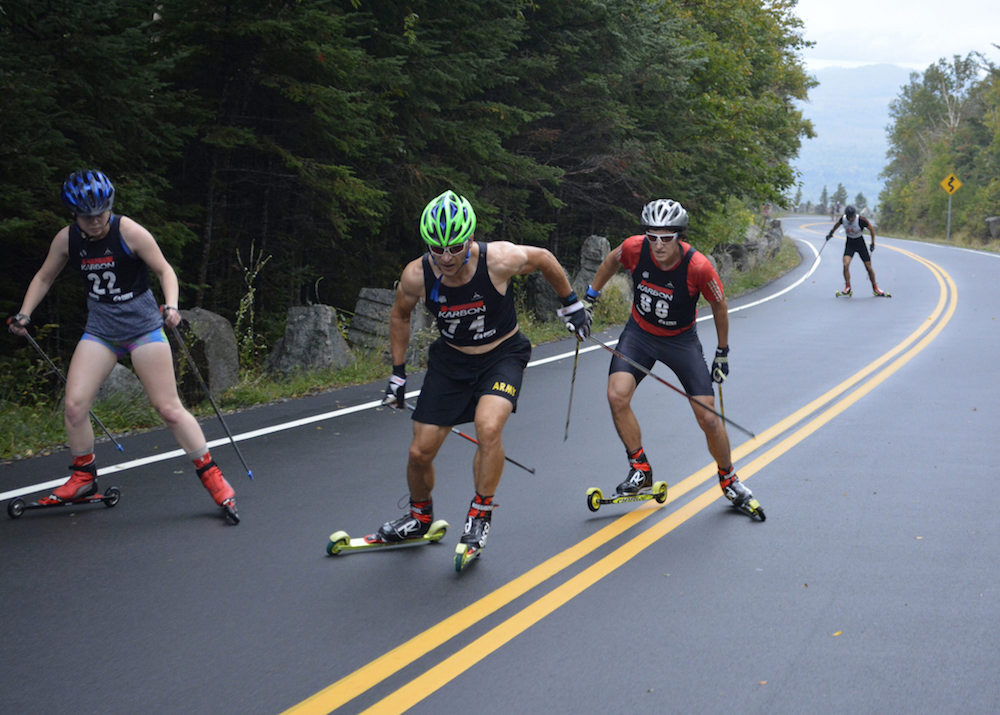
    Seasoned veteran Duncan Douglas (74) leads biathletes Russell Currier (in red) and Paul Schommer (back right) in the 2016 Climb to the Castle roller-ski race up Whiteface Mountain, while Clarkson’s Jenevieve Broadwell (22) looks on. Douglas held off Currier by eight seconds for his third victory in four times racing the Climb and Schommer finished third. (Photo: NYSEF/Flickr)

    I’m losing my edge

    The kids are coming up from behind

    I’m losing my edge

    LCD Soundsystem


    I knew it was coming. I have the conversation all the time with patients in the physical therapy clinic: “The older we get, the less our bodies care about fitness—the priority is to simply survive another day, never mind getting faster or even maintaining muscle mass.” I knew it was coming and I tried to fight it. I made my training more structured. I became more consistent with weight training. I tried to get more sleep. I tried to drink less wine. But I couldn’t control the reality that I turned 50 this year and every hard trail run I did was slower.

    Andy Munter (Ketchum, ID) racing the 2023 Boulder Mountain Tour at the age of 69. (Photo: BMT)

    I’m sure there are plenty of readers in their 60s and 70s who are currently shaking their heads and thinking, “You think you’re slowing down now, just wait until you’re my age.” But it’s still challenging to accept. When I transitioned from bike racing to running in my early 40s, Strava was full of praise and PRs. Now, Strava just laughs at me, “Kudos, you just set another Slowest Time Ever!”

    I found cross country skiing later in life. It’s been a blessing both in the tremendous joy I get from the self-propelled glide on snow and from the rewards of learning a new skill. I came to Nordic skiing with a good engine, and plenty of experience Alpine skiing, but I had zero technique. Initially, I didn’t much care because I only saw skiing as a way to stay fit for cycling season. But as I came to enjoy the skiing more and more, I started to focus on gaining better technique, which thankfully brought increased speed. Now, I think the gains in technique are about equal to the losses in fitness. Treading water, but at least not drowning. 

    I’ve read sciencey articles like this and this. And books, which I really would recommend, like The Midlife Cyclist and Fast After 50 (not trying to push Amazon; please get them from the bookseller of your choice). But they did little to console me and only reinforced the obvious. In search of some tips on reconciling my condition (and hopefully easing my depression), I got in touch with a couple of heavily decorated masters athletes, who are both older and faster than my whiny ass, to ask a few questions about their experiences with aging and training.

    My former PT colleague Lo Knapp is 70 years young and still swimming at the highest level (for her age). She just set two more age group world records, adding to her already impressive collection. Barry Makarewicz, at 63, is a local legend on the triathlon, bike racing, and skiing scenes. He’s won a half dozen races at World Masters and took the overall at the Yellowstone Rendezvous 50k at age 47.

    Katherine Ann, Barry Makarewicz and Rob Bradlee hiking up Grandeur Mountain above Salt Lake City, Utah in 2017. (Photo: Rob Bradlee)

    When did you start slowing down or notice age related changes in performance?

    Lo: I pretty much held my speed until age 60. My 200 yard breaststroke time at age 38 was ~2:42. At age 44 it was down to 2:39 (pretty much my lifetime best but also affected by some rule changes). Age 60 was 2:44 (national record in yards)–not much slower than age 38. Then, at age 62: 2:47. I was wondering what is wrong with me? After covid and polymyalgia rheumatica, age 67 was 3:02. Crazy slow. Anyway, in a 50m pool, between age 60 and 65 I slowed down 10 seconds in a 200m breaststroke. And another 11 seconds between 65 and 70. And this is after not slowing down much 38-60. That just seems like significant slowing.  

    Barry: In my early 40’s I think I noticed that I was not at the physical level of the younger athletes in terms of physical capacity, but in skiing I was able to sort of hold my performance steady due to improving technique. I actually feel like I held my skiing performance kind of steady from my mid 40’s until later 50’s (57-58).  Then I noticed a significant decline in power, strength and top end mojo.


    How have you changed your training, or approach to training, in hopes of minimizing these age related changes?

    Lo: We know older folks need more rest/recovery time, but I am not sure what that means. I still work hard, just nap more afterwards (or maybe because I’m not working and I am able to nap!). I think weight lifting is key, especially for women. We lose so much strength as we age—hormone drops? I do a TRX class 1x/wk and another session of kettlebell or a core strength session 1x/wk. When I rest for a meet, I REALLY rest more than I used to. I decrease my yardage much more. But I still push hard on the bike and in the pool. It’s a slippery slope that you have to fight against.  “No, we’re not doing that interval. We can do faster than that!”  

    Barry: The common complaint of needing several days to recover after a hard workout or race did not really hit me until 60ish. Now it’s a real thing to need more easy days of active rest to feel recovered.  

    I have always felt that general strength training is very important for performance, overall health, and injury prevention and made weight training part of my year round routine. Now, as an older person, I am even more dedicated to consistent general strength training year round with more ski focused strengthening work in late summer and fall. I am absolutely convinced that focused and consistent strengthening exercise is essential for any middle to older aged person for good quality of life and longevity. This is where the best gains are made and kept.

    Becoming a student of skiing technique has helped me stay competitive, and it has been fun to focus on body position and execution, especially in classic technique. We are very lucky to have so many opportunities to watch elite skiers on video and in person. There are always technique tips to observe and try to copy. 

    In summary my method for adjusting my approach to training to minimize the inevitable age related changes are:

    1. Consistent and vigorous strength training. Both general year round and ski specific seasonal work.
    2. Consistent interval or other high end workouts. Use it or lose it.
    3. Always focus on improving ski technique.
    Salt Lake City, Utah’s Lo Knapp having fun where she is happiest in 2014. (Photo: Courtesy Photo)

    I’m sure it wasn’t easy to see yourself getting slower. How did you come to terms with this mentally and emotionally?

    Lo: Since I had a close friend, age 58, die of cancer this year, my motto at Nationals was, “I’m just happy to be here!” I am happy to be alive, healthy and able to work out and challenge myself. I do get discouraged when I see how slow I am going in practice. Is this the best I can do because I’m old? Or can I do better? Then I compete and I am with my peeps and I win events and I realize we are all getting old and slow. So it tells me that I’m still right in there, even though I’ve slowed down. It gives me a boost for another year. If I didn’t compete, I would be really discouraged.  

    Barry: I am trying to accept the inevitable decline with some grace and not fret too much about tumbling down the results list. At this point there is nowhere to go but down so try to enjoy the notion that I’m still doing it and having fun with what I have always loved to do.


    Responses were mildly edited for clarity. Huge thanks to Lo and Barry for sharing.


    Here are my primary takeaways: 

    • The older you are the slower you’ll be, but at least you’re still out there–and being out there is the whole point to begin with. 
    • With age comes wisdom, so train smarter because you can’t handle harder, at least not without a lot more recovery. Make your “easy” days legitimately easy so your “hard” days can be truly hard (and absorbed by the body).
    • Strength training is key. Your body doesn’t care about building muscle anymore so you’ve got to pick up heavy things, at least twice a week, to remind it that being strong is still a good idea. 
    • Sleep is the best recovery aid on the market, and your body needs all the recovery it can get. Seven hours minimum. 
    • Your metabolism might be slowing down, but you still need gas in the tank so don’t skimp just because your six pack feels more like a keg.
    • Technique is the great equalizer, especially in skiing, and there’s always room for improvement. Age related losses in aerobic capacity and strength can be countered, at least to some extent, with increases in efficiency. 

    I’m trying to stay optimistic and apply the words of wisdom from my elders. I’m very grateful that I can lace up my running shoes and knock out an easy hour without taking ibuprofen. Maybe I don’t feel fast on trails anymore, but I’m still amazed that my eyes and feet can talk to each other seemingly without any delay from my brain. I know this agility will help when I’m statistically at risk for falling while going out to the mailbox. Now that winter has arrived and I’m happily on snow, I’m spending even more time focusing on technique, finding tremendous joy from nailing the kick or being lock-in stable on the glide ski. I’m getting slower and the kids are getting faster, but we’re all having the same amount of fun.


  • Diggins Dominates Cogne 10 k Freestyle

    Diggins Dominates Cogne 10 k Freestyle

    This coverage is made possible through the generous support of Marty and Kathy Hall and A Hall Mark of Excellence Award. To learn more about A Hall Mark of Excellence Award, or to learn how you can support FasterSkier’s coverage, please contact info@fasterskier.com.

    The first thing viewers might have wondered going into today’s race was, “Is this the same World Cup I’ve been watching all season? Where are all the racers?” With 59 women starting the race, the start list featured some familiar names alongside many new ones on the international scene. Top Swedish and Norwegian competitors were absent today, a shift that opened up opportunities for athletes who don’t usually compete at the World Cup level to attend the Cogne competitions. For these teams, only Maja Dahlqvist (SWE), Astrid Oeyre Slind (NOR), and Lotta Udnes Weng (NOR) remained on the World Cup circuit, as their teammates took a step back to focus on training and preparation for the World Championships later this month. 

    Jessie Diggins (USA) crossing the finish line to win the Cogne 10 k freestyle individual start competition. (Photo: NordicFocus)

    Missing six of the top ten skiers in the overall World Cup rankings left the field sparse at the top, a fact clearly reflected in the results. Slind and Diggins—the leaders in the distance and overall standings, respectively—started later in the field and skied their own race out front. They finished more than 15 seconds ahead of the rest of the competitors and over a minute separated the top-10 positions. 

    Jessie Diggins (USA) lights up the podium with a champagne celebration, her smile reflecting a hard-fought victory. (Photo: NordicFocus)

    Australian Rosie Fordham described the Cogne course as “grindy,” with extended climbs that forced racers to keep their heads down and work hard around the entire course. The winding downhills left no room for rest, favoring skiers with strong endurance, technical descent skills, and the determination to push to their limits. Sound familiar? It was the perfect course for American Jessie Diggins, who skied to a commanding victory, putting seconds on the field and collapsing across the finish line. 

    Diggins dominated the race from the beginning, coming through all the checkpoints with a lead. Having had an exciting day, she shared “This was so fun, the crowds were amazing. I’m really, really grateful for the cheering; this was super cool.” Her victory was not just a personal triumph—it was a significant win for Team USA. “I really couldn’t have asked for more,” she added. “The skis were perfect and it was a huge win for my team. I just wanted to go really, really hard, and I’m glad I didn’t get too hot out there in the sun.”

    For the Americans, Kate Oldham earned a 16th place finish, and Kendall Kramer an 18th place finish. Julia Kern did not start the competition. On the Canadian team, Katherine Stewart-Jones finished 23rd, Liliane Gagnon finished 27th, and Olivia Bouffard-Nesbitt finished 43rd. 

    Kerttu Niskanen (FIN) claimed 3rd today, rounding out the podium. (Photo: NordicFocus)
    Women’s 10 k Freestyle

    With crispy tracks and stunning views over the Cogne Valley, conditions were ideal for a perfect race day. Spectators were poised to witness the much-anticipated battle between Diggins and Slind, two formidable competitors in freestyle middle-distance events. With their dominance solidified after strong performances this season, the top two podium positions were, in many ways, determined from the very start of the day.

    Meanwhile, in the battle for third, no clear favorite emerged. Flora Dolci (FRA), Krista Parmakoski (FIN), and Kerttu Niskanen (FIN)—all of whom have secured multiple top-10 finishes in freestyle distance competitions this season—were expected to contend for the top results. Katerina Janatova (CZE), having enjoyed a strong season herself, was also expected to contend for a top-10 result, especially in light of absences by top competitors this weekend. 

    Nadine Faehndrich (SUI) earned strong early results in today’s competition, ending the day in 6th. (Photo: NordicFocus)
    Faehndrich Takes Early Splits

    An individual start race often provides opportunities for skiers who begin earlier to gain the spotlight. In these events, the fastest competitors typically start last, allowing younger or lower-ranked racers who start first to lead in early checkpoint rankings, finish the race first, claim the leader’s chair, and enjoy time in the limelight. Nadine Faehndrich, a strong skier from Switzerland, was scheduled to start unusually early and dominated nearly all the checkpoints as she passed through. Her name kept coming up first—only to be overtaken shortly after by Diggins and Slind. She ultimately finished the race in 6th, a strong result for her. 

    Astrid Oeyre Slind (NOR) fought to a second-place finish, seconds behind Jessie Diggins (USA). (Photo: NordicFocus)
    Diggins Versus Slind

    Diggins and Slind continued their storied rivalry today—a duel that has defined this season as both athletes traded places at the top of the overall and distance World Cup standings.

    Starting a few minutes ahead of Diggins, Slind consistently dominated the checkpoint standings. Her early performance allowed her to build a steady and significant lead over competitors such as Faehndrich, who, despite strong efforts, found herself trailing behind Slind’s pace. 

    Jessie Diggins (USA) fighting her way over the top of the course to earn an uncontested victory. (Photo: NordicFocus)
    Jessie Diggins (USA) fighting her way over the top of the course to earn an uncontested victory. (Photo: NordicFocus)

    Almost immediately after the start, Diggins began building her own gap over the field. Within the first 1.2 kilometers, she gained a 4-second advantage. By the 2.1-kilometer mark, her lead had expanded to 5 seconds—a gap she maintained for the rest of the race. Crossing the line with a smile on her face, Diggins continued the dominant season she has had, and feels confident in her preparation for the World Championships in just a few weeks. 


    Women’s 10 k Freestyle Results

    Astrid Oeyre Slind (NOR), Jessie Diggins (USA), and Kerttu Niskanen (FIN) topped the Cogne 10 k freestyle podium. (Photo: NordicFocus)
  • Amundsen Returns to the Top, Schumacher 10th in Cogne 10 k

    Amundsen Returns to the Top, Schumacher 10th in Cogne 10 k

    This coverage is made possible through the generous support of Marty and Kathy Hall and A Hall Mark of Excellence Award. To learn more about A Hall Mark of Excellence Award, or to learn how you can support FasterSkier’s coverage, please contact info@fasterskier.com.

    Just a little faster than the rest at each checkpoint, Harald Oestberg Amundsen (NOR) demonstrated both dominance and control with his victory in Cogne’s World Cup 10 k Freestyle. (Photo: Vanzetta/NordicFocus)

    10 k Freestyle is a speed race . . . and so much faster than the fastest runner in my home town can RUN a 10 k that it’s not even funny. Age grouper racers and recreational skiers might think, “Great! Finally, a distance that’s manageably short!” But that’s not the way World Cup skiers are put together. For the world’s best skiers, 10 k is likely to be the hardest distance they’ll race. The only thing scarier than 10 k would be a 5 k; World Cup racers are eternally grateful that they almost never compete over that brief, incendiary distance. 10 k is bad enough . . .

    There are all kinds of things that can go wrong in ten kilometers. Go out too hard, and you’ll totally blow up (think “lactate-bloated slug crawling across the finish line”). Go out too easy, and you’ll finish a full-time zone behind the winners (build speed early, or you’ll never have speed at all). Everyone who wants to race well is going to take massive risks in this short, evil race. That’s just the way it goes. And in order to do well, you’ll need to challenge a virtual rogues-gallery of Norwegian ski-stars: Simen Hegstad Krueger, Harald Oestberg Amundsen, Martin Loewstroem Nyenget, Iver Tildheim Andersen. World Cup winners, Crystal Globe hoisters, World Championship medalists, Olympic heroes—some of whom have never even stood on the podium at their own national championships. It’s a crazy world.

    In the end, it was that phalanx of Norwegian greatness that the field could not overcome. Though Iivo Niskanen definitely tried (he would lead at early checkpoints and finish a remarkable sixth in a race that was anything but his specialty), it was Amundsen who took the win ahead of his countrymen, Andersen and Nyenget.

    After a mid-season break to recover from illness, Gus Schumacher (USA) appears to be returning to form. He would finish 10th in Cogne’s Freestyle 10 k. (Photo: Authamayou/NordicFocus)

    Gus Schumacher (USA) continued his return to form with a 10th-place finish. Having controlled his opening speed without reaching too far, he began picking off earlier starters. He would hold his form through the finish for 10th place. After a few weeks at home in Anchorage to recover from mid-season illness, Schumacher seems to be rounding back into form in time for the World Championships.

    “It does feel like I’m coming back to myself,” said Schumacher, “But there’s always more shape to find, and I think another bit at altitude here than going low and doing some racing/hard efforts/rest should set me up well.”

    Among other American finishers, Ben Ogden delivered a steady and controlled 24th place finish, Zak Ketterson 32nd, Zanden McMullen 43rd, Hunter Wonders 46th, Walker Hall 48th.

    Canadian finishers were Antoine Cyr 30th, Remi Drolet 35th, Olivier Leveille 40th, Julian Smith 65th,

    Iivo Niskanen (FIN) always races to win—a level of determination and stubbornness that made him an early leader in Cogne’s 10 k Freestyle. He would fade to sixth, but showed that he may be returning to form in time for the World Championships in Trondheim. (Photo: Vanzetta/NordicFocus)
    10 k Freestyle

    Niskanen is an emotional guy—not what might be expected of the phlegmatic and stoic residents of the cold northern countries, but it’s true. A few weeks ago, he was visibly agitated by his failure to win the Classic Mass Start in Les Rousses. Second was simply not good enough, and he stormed out of the finish area, acknowledging neither his rivals nor the media. Then, on Friday, Niskanen was disqualified for a technique infraction in the Classic Team Sprint. Classic racing is his thing, and he just hasn’t been able to pull it together of late. Niskanen has something to prove.

    Strange, then, that Niskanen would choose to mount that effort in a Freestyle race. Decades ago, when Skating began changing World Cup and World Championship events, it was the immortal Finn, Juha Meito, who suffered the most. A towering and dominant figure who made his bones through the power of the double pole, Mieto began the transition to skating, looking like a reindeer on skates. He would definitely improve, but his Skate technique still appeared strained and wooden. Niskanen is far better than that, but he’s still another Finn who appears far more comfortable in the Classic tracks.

    Iver Tildheim Andersen (NOR) on his way to second-place in the 10 k in Cogne (ITA). (Photo: Nordic Focus)

    Nevertheless, Niskanen rocketed out of the starting gate, determined to make his mark in Cogne’s 10 k Freestyle. Total commitment, high risk: he was the leader at most checkpoints up through the mid-point of the race. Then, the inexorable fade began. Niskanen is a supremely talented endurance athlete, so he was able to hold onto his form better than most. Even so, he couldn’t hold back the Norwegian tide. Niskanen faded a bit at each subsequent checkpoint—third at 5.4 kilometers, fourth at 6.6, fifth at 8.7—ultimately finishing sixth. Skiers with good early-season form are taking a break right now to rest up for the World Championships in a few weeks. Niskanen, it would seem, is racing himself into form.

    Other contenders struggled to overcome race mistakes of their own. World Cup Distance leader, Simen Hegstad Krueger, attempted the negative split strategy, but he had given up too much speed early on. He would only advance to fifth place. Hugo Lapalus (FRA) never got it going in the early kilometers; there simply wasn’t time for him to recover the placings he surrendered early on. Lapalus would finish 11th. Calle Halfvarsson (SWE) started fast (top four in early splits), then faded to 14th. Like Halfvarsson, new Italian sensation Victor Lovera might’ve been a little too enthusiastic; top three in early splits, then fading to 13th.

    Gus Schumacher (USA) on his way to tenth-place in the 10 k Freestyle in Cogne (ITA). (Photo: Nordic Focus)

    Schumacher was the one who made the best use of a conservative strategy with split times that moved consistently up through the field—24th, 14th, 9th, 7th—before settling into 10th as the podium contenders turned on their finishing surges. For a skier who lost a few weeks of World Cup starts to illness, it was a masterfully controlled race for Schumacher.

    “Definitely felt controlled for the first half,” Schumacher explained. “And then got super hard in the last lap, which is about exactly what I wanted. I would wish for more pop in that last 2 k, but I think that speaks to just not being fully acclimated still for 5000+ feet.”

    “Today’s effort was definitely better after some racing last week,: Schumacher continued. “I think the altitude adjustment has been the hardest part for me. Anything over 4500ft feels tough on this sea-level guy! The time off definitely freshened me up mentally, which I think is huge in a long season like this with the big goals at world champs still a month away.”

    Ben Ogden (USA) sometimes starts like a rocket. Today, in Cogne, he was controlled and consistent. (Photo:  Authamayou/NordicFocus)

    Like Schumacher, Ogden controlled his race effort, measuring his speed and never seeming to go too deep. He would finish 24th, seemingly with more to give. That’s a good strategy on the road to Trondheim.

    Edvin Anger (SWE) raced well on the day, hovering around sixth at most checkpoints, then closing in the final kilometer for a top-four finish. A few weeks ago, Anger had made the mistake of speaking a bit too flippantly when he suggested that he would’ve beaten Klaebo in a sprint (Klaebo was staying home in Norway that weekend). Since then, Anger (who wears the green U23 leader’s bib) has had trouble living up to his own predictions. Today’s fine finish in a 10 k Freestyle suggests that he may begin to show the results that his obvious potential has often suggested.

    Edvin Anger (SWE) continues is stellar season with a fourth-place finish in the 10 k Freestyle in Cogne (ITA). (Photo: Nordic Focus)

    But it was the Norwegian stars who began appearing at the top of the splits with each passing checkpoint, and none mastered it better than Amundsen—starting fast, utilizing a tempo just a bit quicker and snappier than all the others, and holding on without visible stress. Amundsen led at the first checkpoint, then relaxed into a holding pattern behind Niskanen at 2.1 and 3.3 kilometers before beginning to tighten the screws on his effort for a long, controlled surge to the finish line. It was a bit strange to watch: Amundsen led at every subsequent split, but only by a little bit—a display of dominance, but also of control. It really was an impressive performance, one that the field may find difficult to overcome when the show moves to Trondheim.

    Men’s 10 k Freestyle RESULTS

    Iver Tildheim Andersen (NOR), Harald Oestberg Amundsen (NOR) and Martin Loewstroem Nyenget (NOR), (l-r) share the 10 k Freestyle podium in Cogne (ITA). (Photo: Nordic Focus)
    Harald Oestberg Amundsen (NOR) returns to the top of the podium. in Cogne, Italy. He’ll be a favorite in the 10 K at the World Championships next month in Trondheim. (Photo: Vanzetta/NordicFocus)
  • Dahlqvist is Back! Diggins Grateful for “Miracle”

    Dahlqvist is Back! Diggins Grateful for “Miracle”

    This coverage is made possible through the generous support of Marty and Kathy Hall and A Hall Mark of Excellence Award. To learn more about A Hall Mark of Excellence Award, or to learn how you can support FasterSkier’s coverage, please contact info@fasterskier.com.

    Maja Dahlqvist (SWE) claims Classic Sprint victory in Cogne, Italy ahead of Nadine Faehndrich (SUI) and Laura Gimmler (GER). The victory marked Dahlqvist’s return to the top of the podium for the first time in four years. (Photo: Authamayou/NordicFocus)

    Two weeks ago, Jessie Diggins—hampered by a lingering injury (plantar fasciitis)—was compelled to double pole her Classic Sprint qualifyier, leaving her in 40th that day. Since then, Diggins has been spotted a time or two testing out her rehabilitative Classic abilities, though not usually at more than a Classic-shuffle around the Cogne race venue. Nonetheless, the defense of her lead in the World Cup overall standings encouraged Diggins to line up for the Classic Sprint (on a course with mandatory Stride-zones that would not allow a full double-pole strategy). Diggins is a gamer, a brave competitor, and a race-day innovator: she would qualify 17th, advance into the heats, and finish fifth in her semifinal (good for 10th on the day) claiming even more points in the season-long chase for the Crystal Globe.

    “Today felt like an amazing little personal miracle,” said Diggins. “With the normal timeline of 6-8 weeks for healing, there’s no way I should’ve been able to do that today.”

    Diggins was the sole American qualifier in Cogne, entering the day leading the overall World Cup lead over Astrid Oyre Slind and Victoria Carl (neither of whom were competing in today’s Sprint competition). Any points Diggins could add to her total would serve to pad her lead even further.

    Among other Americans, Kate Oldham finished 38th, Alayna Sonnesyn 42nd, and Erin Bianco 44th.

    Canadian Olivia Bouffard-Nesbitt qualified 23rd. She appeared to suffer from slow skis in her quarterfinal, finishing that heat in sixth for an overall 26th place finish.

    The Cogne Classic Sprint field lacked a certain number of significant contenders: no Jonna Sundling (SWE), no Linn Svahn (SWE), no Kristina Stavaas Skistad (SNOR), no Victoria Carl (GER). In the absence of those sprinters, Jasmi Joensu (FIN) stood poised to take over the lead in the season-long World Cup Sprint standings from Sundling. As the top qualifier on the day, Joensu continues her run of good form and fast skis, and hoped to find success in Cogne. Like Joensu, Maja Dahlqvist (SWE) has been on something of a run of late. it’s great to see her back in contention after four seasons without a win. She may be stepping out of the shadows cast by her Swedish teammates just in time for the World Championships later this month in Trondheim.

    Four years from her last World Cup Sprint win, Maja Dahlqvist returns to winning form in Cogne, Italy. (Photo:  Authamayou/NordicFocus)
    Women’s Sprint

    The Sprint course at Cogne is a bit of a drag race. Only a few small bumps force the skiers into a momentary herringbone. One of those bumps is poised at the head of the finishing straight, and appeared likely to affect the results for those skiers who could accelerate over the crown and dive down the other side.

    Diggins lined up in Quarterfinal 3 alongside Germany’s Laura Gimmler (who has raced brilliantly of late) and Switzerland’s Nadine Faehndrich. Faehndrich has been known to take out a heat very fast, and that’s what she did in the quarterfinal, leading the field to the fastest time among the heats. Diggins’ lingering injury was on every spectator’s mind, though she managed to stride well enough in the compulsory striding sections of the course to maintain her position near the lead. Accelerating well over the final bump, Diggins double-poled furiously down the finishing straight ahead of a hard-charging Gimmler, who was forced to initiate a quick lane change to keep from running up on the tails of Faehndrich. Gimmler would actually take the heat win with a well-timed lunge. Just behind Faehndrich, Diggins would hold a lucky loser spot until she was bumped out by Johanna Hagstroem (SWE) and Lotta Udnes Weng (NOR), who competed in Quarterfinal 5. Diggins would finish the day in 13th, doing more than enough to preserve and protect her lead in the overall World Cup standings.

    Classic Sprint Semifinals

    After a disqualification (technique infraction) for Johanna Hagstroem (SWE), Diggins found herself lining up in the semifinal alongside Joensu, Dahlqvist, and Gimmler. Diggins would race gamely, though on skis that seemed less speedy than those of her competition.

    “I was just so excited to be able to go race today and have my foot feel okay!” beamed Diggins. “Granted, I was still being incredibly careful. I still did more spin biking than anyone in the World Cup has ever seen, and I also was trying very hard to do as little striding on my left foot as possible. I was trying to be incredibly conservative and playing it really safe.”

    When asked about tomorrow’s 10 k Freestyle, diggings remained optimistic. “Time will tell,” she said. “Hopefully, things still feel really good tomorrow, but right now, I’m really happy with (today’s) race . . . just feeling happy, that’s all!

    Pre-race favorite Joensu would fade noticeably mid-race, finishing sixth in the semifinal. Her 11th-place finish would not reap the points she had hoped for, but it would be good enough to overtake Sundling for the current lead in the World Cup Sprint standings.

    Dahlqvist and Gimmler would advance to the final, finishing 1-2.

    In the second semifinal, Ane Appelkvist-Stenseth (NOR) and Faehndrich would drive to the finish unchallenged. Even so, this heat proved to be the faster of the two semifinals, with both lucky losers—Weng and Coletta Rydzek (GER) both advancing to the final in lucky loser positions.

    A champagne shower on the podium for Maja Dahlqvist (SWE). Her return to the top step after a four-year hiatus is definitely cause for celebration. (Photo: Vanzetta/NordicFocus)
    Classic Sprint Final

    Stenseth has not had many opportunities in World Cup Sprint finals, and she appeared determined not to waste this one. She pushed the pace from the start, followed closely by and Gimmler. But Stenseth’s inexperience only set the table for hungry, seasoned sprinters like Dahlqvist and Faehndrich who held their positions mid-race, and made moves on the short, punchy uphills to overtake and gap Stenseth. She would fade to fourth, as Dahlqvist surged to the victory ahead of Faehndrich and Gimmler.

    It was an impressive return to the top of the podium for Dahlqvist who has spent the last few seasons being overshadowed by her own Swedish teammates. But with Sundling watching from home, with Johanna Hagstroem disqualified earlier in the competition (technique infractions), and with Svahn yet to return to full strength, Dahlqvist was more than capable of carrying the Swedish flag, and holding it high.

    “It was about time,” Dahlqvist smiled. “It was a really good day for the waxers, and for me.”

    When asked about her strategy in the Final, Dahlqvist grinned again. “Win, or die!”

    Women’s Classic Sprint RESULTS

    Women’s Sprint QUALIFYING

    The Women’s Classic Sprint podium in Cogne, Italy. Maja Dahlqvist is back! (Photo: Authamayou/NordicFocus)
  • Norway Sweeps Cogne Sprint, Schoonmaker 9th, Ogden 12th

    Norway Sweeps Cogne Sprint, Schoonmaker 9th, Ogden 12th

    This coverage is made possible through the generous support of Marty and Kathy Hall and A Hall Mark of Excellence Award. To learn more about A Hall Mark of Excellence Award, or to learn how you can support FasterSkier’s coverage, please contact info@fasterskier.com.

    Cogne, Italy World Cup Classic Sprint: France threatens, but Norway dominates. Ansgar Evensen (NOR), Erik Valnes (NOR), Lucas Chanavat (FRA) claim the top steps of the podium. (Photo: Vanzetta/NordicFocus)

    It’s rumored that World Cup Sprint (and Overall) leader, Johannes Hoesflot Klaebo will return to action next week in Falun, Sweden, leaving room at the top for a host of contenders to battle for the top of the podium.

    Reportedly, Harald Oestberg Amundsen has already surrendered his spot on the Norwegian Sprint team for the upcoming World Championships (choosing, instead, to concentrate on Distance events); nonetheless, he lined up for the Sprint in Cogne, moving on into the quarterfinals with a 27th place qualifying run. He would finish third in his quarterfinal heat, 15th on the day.

    JC Schoonmaker led American qualifiers in fourth place. Schoonmaker would finish the day ninth. Ben Ogden (USA) would join Schoonmaker in the quarterfinals, qualifying 11th. Ogden would finish the day in 12th. Among other Americans, Zak Ketterson qualified 17th (ultimately finishing the day in 22nd), Zanden McMulen 45th, Luke Jager 63rd. Gus Schumacher elected not to start today’s race.

    Canadian qualifiers included Pierre Grall-Johnson narrowly missing a qualifying spot in 31st, Antoine cyr 43rd, Graham Ritchie 51st, Julian Smith 66th, and Remi Drolet 69th.

    The cagey veteran, Erik Valnes (NOR), raced brilliantly throughout the day in Cogne, Italy, claiming the victory and leading a Norwegian sweep of the podium. (Photo: Authamayou/NordicFocus)
    Men’s Sprint

    Ogden qualified 11th, and lined up in the second quarterfinal (alongside countryman, Ketterson). Ogden appeared to be racing with only minimal kick wax (slipping more than once in the mandatory striding sections), leaving with too big a gap to close in the finishing straightaway. He would finish his quarterfinal in third, with his well-timed lunge earning a lucky loser spot.

    Having shown great speed in qualifying, Schoonmaker was a contender at the front of his quarterfinal heat, ultimately advancing to the semifinals by bumping Ogden out of the lucky loser spot.

    Classic Sprint Semifinals

    Erik Valnes (NOR), Even Northug, Ansgar Evensen (NOR), and Mats Skoglund (SWE) are pretty big guys, but they appeared adolescent when lined up alongside the towering, lumberjack-shouldered Anger in Semifinal 1. Valnes would drop off the back of the field (a strategy he has employed with success in numerous Sprints this season), but would return to the front to claim the win and advance to the final just ahead of his countryman, Evensen. Anger and Northug would sit in lucky loser spots to nervously watch the results of Semifinal 2.

    JC Schoonmaker (USA) would shadow Edvin Anger (SWE) during their semifinal. Schoonmaker would finish fifth in the heat, ninth on the day. (Photo:  Vanzetta/NordicFocus)

    Schoonmaker had also drawn Semifinal 1, holding his position alongside Anger but finding needing to check his speed to keep from running up on Anger’s tails. That tiny loss of momentum might have proven crucial as Schoonmaker lost momentum when the pace quickened. He would cross the line fifth, good for ninth on the day.

    “The qualifier felt really good today and the heats were ok,” said Schoonmaker. “It’s nice to be in the top 10, but definitely feel that I can ski better than that in the quarter and semi. It’s a tough field, and those guys are super strong so I just feel like I have some work to do.”

    The second semifinal featured a French trio—Lucas Chanavat, Richard Jouve, and Jules Chappaz—lined up alongside Oskar Opstad Vike (NOR), and the Swedish upstart Anton Grahn. Showing the field their speed, Jouve and Chanavat advanced handily to the Sprint Final.

    Classic Sprint Final

    Ansgar Evensen is known for his dynamic and powerful double pole, and he unleashed at the front of the Final, setting a blistering pace. Valnes and Northug chased as best they could, but it took the better part of the lap for them to make up the gap to Evensen. The French duo—Chanavat and Jouve—appeared to have been caught flat-footed by Evensen’s opening speed; they quickly faded from contention, along with Anger (who had advanced to the Final due to the semifinal disqualification of Chappaz). But it was the cagey veteran, Valnes, who saved his best speed for the closing meters, pulling away from Evensen for the win. Northug held on for third to complete the Norwegian sweep.

    Valnes described the dynamics of the Sprint Final in his post-race interviews: “Ansgar! He has a bad habit: he makes all his heats so hard!” grinned Valnes.  “He was really tough, but I managed to save some energy for the last sprint. So, I’m happy with that.”

    Men’s Classic Sprint RESULTS

    Men’s Classic Sprint QUALIFYING

    Erik Valnes (1st),  Ansgar Evensen, (2nd), and Even Northug (3rd) claim the podium for Norway. (Photo: Authamayou/NordicFocus)
  • Understudies Fill Team Sprint Spotlight in Cogne

    Understudies Fill Team Sprint Spotlight in Cogne

    This coverage is made possible through the generous support of Marty and Kathy Hall and A Hall Mark of Excellence Award. To learn more about A Hall Mark of Excellence Award, or to learn how you can support FasterSkier’s coverage, please contact info@fasterskier.com.

    Elation in Cogne, Italy: Finland I (Kerttu Niskanen and Jasmi Joensuu) end Sweden’s five-year domination in World Cup Team Sprints. (Photo: Vanzetta/NordicFocus)

    It was a day for hard-working backup players to show what they can do . . .

    A few weeks from now, the World Championships in Trondheim, Norway will include a Team Sprint, an event typically included on the roster at both World Championship and Olympic events. Today’s races in Cogne, Italy were scheduled to offer a dress rehearsal, of sorts, for teams likely to compete in Trondheim. But the best-laid plans of FIS officials are often undone by the many complications of the World Cup season, the complex and opportunistic fight for overall points, the aspirations of athletes trying to qualify for their national teams, and the injuries and illnesses that tend to plague winter endurance athletes. Cogne may have offered an opportunity for athletes and teams to practice the skills needed to excel in a World Championship event, but precious few nations fielded the actual teams that are likely to contend in Trondheim. No Johannes Hoesflot Klaebo (NOR) in today’s field, no Linn Svahn (SWE), no Jessie Diggins (USA). Nonetheless, the competition was hotly contested, and the victories well-earned.

    The World Cup schedule did seem to recognize the iniquity this race might pose in calculating points standings; therefore, this Team Sprint offered no individual World Cup points. Racers would compete for prize money ($15,000 Swiss Francs for the victory), for Nations Cup points, and for the opportunity to claim the sport-immortality that comes with World Cup podium performances.

    Jasmi Joensuu (FIN) sprints to the win ahead of Coletta Rydzek (GER), Maja Dahlqvist (SWE), Lotta Udnes Weng (NOR). (Photo: Vanzetta/NordicFocus)
    Team Sprint

    The Aosta valley around Cogne has played host to World Cup Sprint events in the past, most recently as the site that celebrated the 1-2 finish of Federico Pellegrino and Francesco deFabiani in a Freestyle Sprint in 2019. In 2025, Italian hopes were again high, as indicated by the non-stop din of revving chainsaws and novelty AaaahOooga! car-horns that seem to accompany most Nordic ski races on the European continent. While the great victories of 2019 would not be repeated for the Italians, the racing was still fast and furious.

    Ironically, the most successful Team Sprint teams are rarely made up of two pure “sprinters.” The event is simply too long: both team members end up skiing a 1.3 kilometer qualifying lap, AND three 1.3 kilometer race legs. For any sprinter, that’s a long day of racing, one favoring athletes who possess an ability to recover between highly intense Sprint legs (a quality more commonly found in all ’round skiers rather than in pure sprinters).

    On the Women’s side of World Cup Team Sprinting, it’s been a few years of dominance for Sweden who has triumphed in every Team Sprint since 2021 (five straight events). But in Cogne, Sweden was pushed by both teams from Finland—with penultimate legs skied by Niskanen (Finland I) and Parmakoski (Finland II)—who pushed the pace. Even so, the lead at the final exchange belonged to Germany I as Laura Gimmler (part of an Olympic Championship duo with Victoria Carl in 2022) had surged to a decisive lead. The final leg would be up to Gimmler’s teammate, Coletta Rydzek. But again it was Finland who animated the race as Rydzek was caught mid-way through the final lap by Jasmi Joensu (Finland I). While Joensu stayed away to capture the win, Rydzek  was overtaken in the final meters by Maja Dahlqvist (Sweden I) who made up four places in the final lap, capturing second place (with teammate Johanna Hagstroem).

    Team USA—Erin Bianco and Emma Albrecht—qualified in 14th. They would finish the day in 15th, 1:29 behind the winners. No Canadian team was entered in the Women’s Team Sprint.

    Smiles on the podium for Maja Dahlqvist and Johanna Hagstroem (SWE), Jasmi Joensuu and Kerttu Niskanen (FIN), Coletta Rydzek and Laura Gimmler (GER). (Photo:  Authamayou/NordicFocus)

    Women’s Team Sprint RESULTS
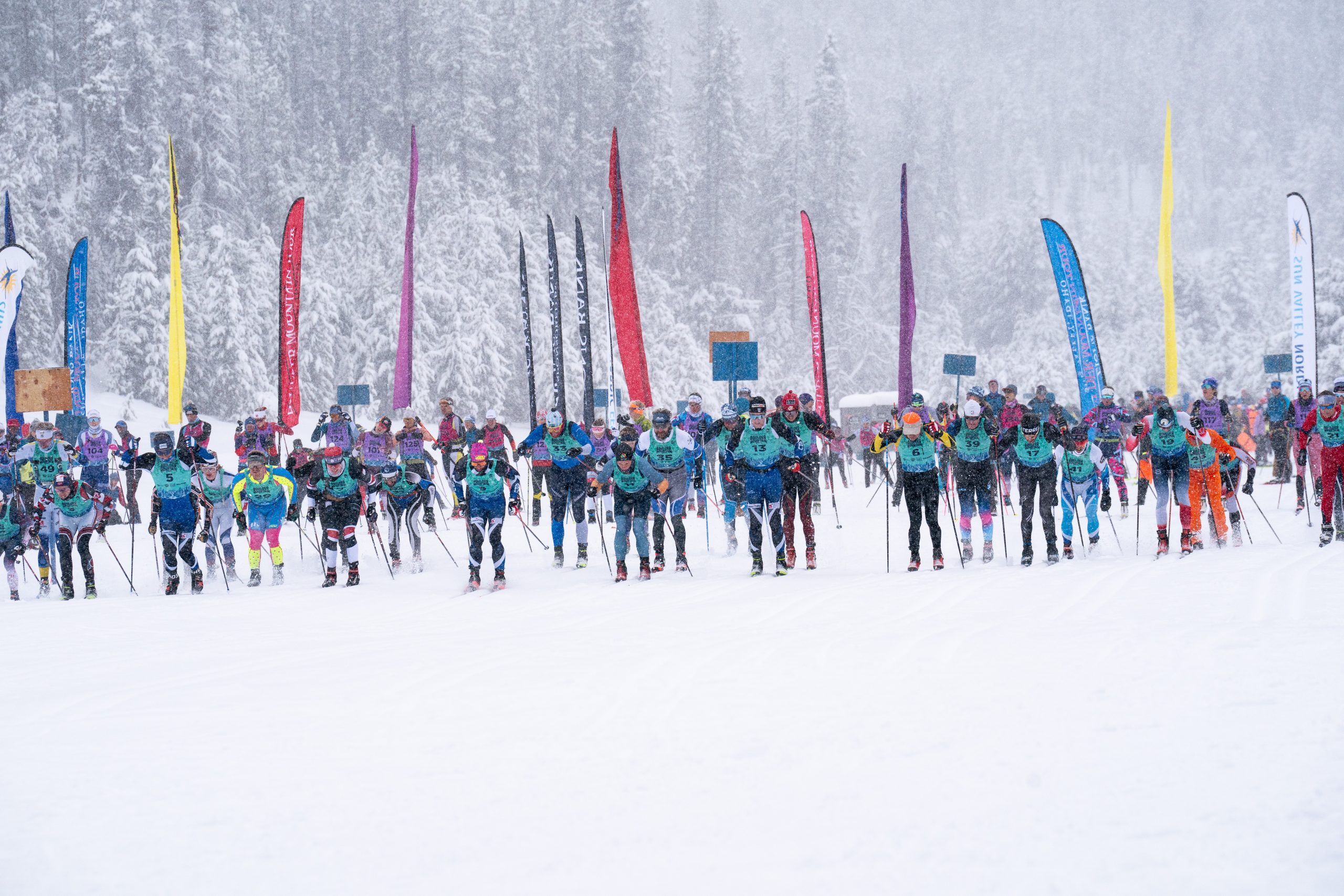
    Women’s Team Sprint QUALIFYING

    Erik Valnes (NOR) leads Richard Jouve (FRA) to the finish line to give Norway I the victory in Cogne, Italy. (Photo:  Authamayou/NordicFocus)

    Among the men, there was hope for the Americans as Gus Schumacher would join JC Schoonmaker to form team USA I. They qualified as the fourth fastest team, but would ultimately finish 10th (12 seconds behind the winners). Likewise, Team II (Zak Ketterson and Luke Jager) would start boldly, with Jager leading the field through much of Leg 1. They would fade over the race’s distance, ultimately finishing the day 14th (36 seconds behind the winners).

    Heading into the Team Sprint’s anchor leg, France I led a five-team group that included Finland II, Sweden I, Norway I, and Norway II. France’s anchor leg skier, Richard Jouve, would lead through much of the final leg, but would be overtaken by Valnes (Norway I, teamed with Even Northug) in the final meters. Finishing order: Norway I, France I, Sweden I. The Italian crowd cheered lustily, but no miracles came today from Pellegrino. Italy I would finish the day eighth.

    Jules Chappaz (FRA), Even Northug (NOR), and Luke Jager (USA) led the charge in the early stages of the Team Sprint in Cogne, Italy. (Photo: Vanzetta/NordicFocus)

    In post-race interviews, Northug remained circumspect regarding his chances to make up half of any Norwegian Team Sprint team at the World Championships. “I will be ready if someone gets sick,” he grinned, acknowledging the inevitable return of Klaebo to his place at the head of Team Norway.

    The dress rehearsals are all done now, and the eager understudies have had their moment in the spotlight. In a few weeks, Trondheim will set the stage for the return of the principal players, with World Championship medals and ski-immortality to follow.

    Men’s Team Sprint RESULTS

    Men’s Team Sprint QUALIFYING

    Podium celebrations in Cogne, Italy. Even Northug and Erik Valnes (NOR) took the win, but either one might find himself “out” when Norwegian teams are chosen for World Championships. (Photo:  Authamayou/NordicFocus)
  • Kirkeng Tied for Most RMISA Wins, Laven Continues Her Winning Streak for Utah

    This article was made possible through the generous support of our voluntary subscribers.  If you would like to see more collegiate coverage like this, please support FasterSkier with a voluntary subscription.  

    By: Francesca Kitch

    Racers gathered in Bozeman, Montana, on Friday for the Bozeman Supertour and Montana State University Invitational. With a 20 k skate mass start on Friday, skate sprint Saturday, and 7.5 k classic race on Sunday, it was a full weekend of racing. The skate sprint did not yield NCAA points, so some elected not to race and instead rested from the 20km to focus on Sunday’s race. Utah led in the team standings after the weekend, followed by Denver and Colorado. 


    Friday’s mass start took place on a 5km loop that included one large climb–Amphitheater Hill–reaching almost a 20 percent grade. The course was not the only challenge that day: it was cold and snowy, with snow accumulating 3-5 inches during the races which resulted in slow skiing conditions. “The leaders took off pretty much from the gun, so the race strung out quickly,” said Nina Schamberger (UU), 5th place finisher. After 2 k she found herself skiing alone for the rest of the race. “In conditions like that, it isn’t ideal to be on your own because you have to work harder to go the same speed — you don’t get the draft from other skiers — but that’s what I did anyway, and I got lucky and was able to stay away from the chase pack!” Women’s winner Erica Laven (UU) added that the “course didn’t have many places to rest”, emphasizing the need for pacing. “I like challenging courses where you really have to stay focused all the way,” Laven said.

    Florian Knopf skiing through snowy conditions in the 20km mass start on Friday. (Photo: Montana State Athletics via University of Denver Athletics)
    Florian Knopf skiing through snowy conditions in the 20km mass start on Friday. (Photo: Montana State Athletics via University of Denver Athletics)

    UU was dominant all around, with Laven’s teammate, Joe Davies, winning the men’s mass start for RMISA to finish second in the overall standings. “I love racing at Crosscut; the courses are hard, and the altitude always keeps things interesting. I was coming off of a tough two weeks sidelined with the flu, so I was pleasantly surprised with the races I was able to put down,” Davies said. The finish was a close one between himself, his teammate Brian Bushey, and John Steel Hagenbuch (Dartmouth), who traveled out west to race the SuperTour with the goal of being the overall winner this season. “It’s always especially fun racing against Johnny as we see each other both on the World Cup scene as well as the college/supertour scene. He’s a good buddy and we tend to go back and forth quite a lot, which will guarantee that NCAAs will be an exciting matchup,” said Davies. 

    Saturday’s race was a skate sprint, and Eemil Juntunen and Trey Jones of Colorado University led the collegiate field in 3rd and 5th place overall. On the women’s side, Erica Laven, Eve-Ondine Duchaufour (DU), and Astri Lunde (CU) made up both the RMISA podium and the overall top finishers. “Some of the European athletes in the RMISA have a fairly high level of sprint experience and provided some aggression that I think that the US sprinters are often not accustomed to,” said Adam St. Pierre, head coach of MSU.

    Joe Davies in the classic race on Sunday. (Photo: Colter Peterson)

    Sunday’s race was another NCAA qualifier for RMISA. The 7.5km classic race took place on two laps of a 3.75 k course, and athletes arrived at the venue with temperatures dipping below -5°F. Yet, while altitude and difficult courses made for a challenging weekend, the cold nights were viewed positively. “[They made] for great skiing conditions which the grooming crew definitely capitalized on and made perfect courses all three days, which was really awesome and certainly deserves a large thanks,” said Bushey, 4th place finisher that day. “They were like dream conditions,” added Florian Knopf (DU), 2nd place finisher. “I raced on my coldest skis and I haven’t raced on them for probably 2-3 years, and that showed how special these conditions were.” About the race itself, Knopf added that with a 7.5 k it’s very hard to find the right pace, yet pacing is very important. “This course, you had to work most of the time, so I tried to set good loop times that did not differ much from each other…my strengths are definitely the uphills, but yesterday I tried to focus more on the transitions, especially the gradual stuff because you will lose more on the gradual stuff than you would win if you send it on the uphills,” Knopf said. 

    Men’s overall podium on Sunday. Left to right: Florian Knopf, John Steel Hagenbuch, Andreas Kirkeng. (Photo: Colter Peterson)

    Men’s winner Andreas Kirkeng (DU) echoed the importance of pacing and lamented his own. “I knew it was going to be a close and hard race where every second counts…I tried to ski equal laps but ended up starting slightly too fast for my shape that day. Managed to pull it through well but had to push hard and dig deep halfway through the last lap. Always a bummer to lose a close fight but gave what I had that day,” Kirkeng said, referencing Hagenbuch’s 0.6 second win over him in the overall Supertour race. Kirkeng’s RMISA win was his 16th ever over the 40 races he has started, tied for the most RMISA wins in history with Magnus Boee (CU) who achieved his count in 58 races over 5 years. Both Kirkeng and Knopf also commented on how the Supertour and the athletes it brought to Bozeman elevated the racing experience. “The field gets more competitive and it’s really really cool to ski with the best skiers in the states,” Knopf said. “It’s always good to see how these guys are doing overseas in Europe at the World Cup level because then we can also know how we’re doing.” 

    Women’s classic 7.5km podium. Left to right: Tilde Baangman, Erica Laven, Astri Lunde. (Photo: Montana State Athletics)

    On the women’s side on Sunday, Laven won again, continuing her weekend of dominance. Laven was happy with her effort and again excited by the challenge the course posed, and she was aided by what she said were her “best skis yet.” Laven also remarked that the teams and the supportive environment are important parts of racing, too. “Cheering each other on and being happy for everyone is so important and I felt that not only from our team but all the other teams as well. Which makes the atmosphere out there so fun!” Tilde Baangman (CU) and Lunde followed behind to round off the podium on an exciting weekend. 

    Katey Houser of MSU striding in the sunshine. (Photo: Colter Peterson)

    “Overall, [they were] beautiful, beautiful winter days, and it’s definitely worth it to train the whole year for moments like this,” Knopf said.

    RMISA athletes who are not competing abroad will enjoy a weekend off before heading to the Denver Invitational on February 8th. 


  • Western Collegiate Season Off to a Speedy Start

    This article was made possible through the generous support of our voluntary subscribers.  If you would like to see more collegiate coverage like this, please support FasterSkier with a voluntary subscription.  

    By: Francesca Kitch

    The Rocky Mountain Intercollegiate Ski Association (RMISA) holds a very high standard for racing; although teams are small and the field is not more than 40 per gender, international athletes and some of the nation’s fastest skiers flock to the west to race on the collegiate circuit. The region itself is quite large, including schools from Colorado up to Alaska. The 6 teams in the division gather for 6 invites each year that are hosted by each school. These began at US Nationals with the University of Alaska Anchorage invite, and they are now halfway through the season having attended the University of Utah invite and Montana State University invite these past two weekends. 

    Open men’s field lining up at the start of the 20km classic race at US Nationals/UAA invite. (Photo: Tobias Albrigtsen)

    The top 17 skiers of each gender will qualify for NCAA’s through these invites and teams will be ranked based on their performances, scoring overall with their alpine teams. With 17 spots available, each school will be able to send a full team of 3 athletes to the national championships aside from one school, which will send 2. RMISA will follow the same distances and techniques as the EISA and CCSA, with distance skate qualifying races and shorter distance classic qualifying races, including a classic sprint. 

    With four athletes named to the US Ski Team, 11 others named to international trips for the US, and many more competing for other countries internationally, RMISA is quite a competitive field. 

    Erica Laven in the 10km skate at US Nationals/UAA invite. (Photo: Tobias Albrigtsen)

    “On paper, there are more international athletes in the West than, say, the East,” Rogan Brown, head coach of Denver University, said. “Historically the recruiting culture tries to bring the hardest working, fastest, and best student athletes to our institutions to really help us with our program goals,” which for many schools, he goes on to say, include winning NCAA championships and individual success there. DU finished 3rd in the championships last year, behind University of Utah and University of Colorado Boulder. Brown is excited about his entire women’s team, who have shown depth in their results and worked together to do well as a team. Freshman Eve-Ondine Duchaufour had a strong start to her collegiate career after finishing 3rd in the 15km freestyle at the Utah invite and snagging several more top 10’s at UAA and MSU. Sophomore Maja Moland has been a consistent skier for DU as well, finishing in the top 5 in classic and top 10 in skate so far this season. On the men’s side, the older athletes have been leading the team in the results. Senior Andreas Kirkeng has four RMISA wins so far this season, sweeping the UAA invitational, and finishing first in the 15km skate race at UU and 7.5km classic at MSU. Graduate student Florian Knopf won the 7.5km classic in Utah, and has podiumed in two other classic events, along with top 10’s in skate races.

    Kate Oldham (MSU) on her way to the national title in the 10km skate. (Photo: Tobias Albrigtsen)

    Montana State University’s Kate Oldham has made her mark on the national stage this year, winning the national championship in the 10km skate in Anchorage. “Her strong racing at US nationals has opened a lot of doors for her for the rest of the season and we will try to take advantage of those open doors to get some international racing experience,” said her coach Adam St. Pierre. Currently in Switzerland for her first World Cup Start, where she finished 19th in the Freestyle Sprint. She will then head to Italy for the World Cup followed by the U23 Championships. Senior Anna Pryce has regained her footing this year after focusing on her Nursing degree last year, notching a few top 10’s in RMISA races. Junior Katey Houser has been having her best season yet, finishing in the top 10 for her first time at the Utah invite. St. Pierre laments that their men’s team has been struck by illness, and after a fall of on and off sickness, returning NCAA qualifier Fredrik Nilsen has opted to redshirt. Even so, others have stepped up in his absence. Freshman Grey Barbier has started the season off strong and will be participating in the World Junior championships, Gavin Galyardt notched a top 15 in the 15k skate at Utah, and Redshirt junior Jack Conde is expected to improve throughout the season after focusing on his mechanical engineering degree last year. “I am happy with how the season has started,” St. Pierre said. “We raced in Soldier Hollow last weekend and every athlete saw an improvement in their RMISA placing over their placing in Anchorage.”

    Kendall Kramer and Erica Laven battling it out in the 20km classic race at US Nationals/UAA invite. (Photo: Tobias Albrigtsen)

    Senior Kendall Kramer–member of the US Development Team–(University of Alaska Fairbanks) is another strong competitor to watch out for. With her national title in the 20km classic and as national runner-up in the 10km skate in Alaska earlier this year, she traveled to Switzerland to race in the World Cup–finishing 36th in the 20km skate mass start–and will head to World U23 Championships next week. Her teammate Tabatha Williams (Sophomore) will also be competing in U23 Championships for Great Britain. Rosie Fordham, another standout skier, is redshirting this season and racing in the World Cup for Australia in preparation for the Olympics next winter. Coach Eliska Albrigtsen is excited for her return, and also thankful that her two best skiers–Kramer and Fordham–will not both be leaving her after this season. Due to the international success of her athletes, this left Albrigtsen with only two women racing at the MSU invite. She has had a very consistent and young men’s team, however. Sophomore Ben Dohlby, Philipp Moosmayer, and Cole Flowers have been top 3 finishers so far this season. Flowers will be representing the US in Italy for World Junior Championships. Sophomore Aidan Hay also notched his first top 20 this season, and while Freshman Gabriele Rigaudo missed the first two RMISA invites this season due to sickness, he raced to 10th place at World University Games representing Italy. Sickness has been a theme for the UAF team, with colds and norovirus affecting both the coaching staff and athletes so far. However, Albrigtsen says after 7 years of coaching at UAF, “I’ve never seen a stronger and mentally healthier and happier group of athletes. I love coaching them, they are just a really great group of really smart humans that push each other and have fun with it.”

    Karolina Kaleta of CU racing past moose in the 10km skate at US Nationals. (Photo: Tobias Albrigtsen)

    University of Colorado Boulder, the reigning national champions, have had a strong start to the season as well. Junior Tilde Baangman led Colorado’s team with 3 podium finishes in the RMISA so far, and Freshman Astri Lunde has had a promising start to her collegiate career with two podiums and multiple top 5 and 10 performances. On the men’s side, Graduate student Will Koch and Junior Hugo Hinkfuss have led the team with top 5 and podium finishes, while Trey Jones has come into the season with a US Ski Development Team nomination and qualification for U23’s in Italy alongside his teammate Will Koch.

    Ben Dohlby of UAF in the 20km classic mass start at US Nationals. (Photo: Tobias Albrigtsen)

    From University of Alaska Anchorage, numerous skiers have cycled through leading the team over the course of the season, including top 10 performances from Derek Deuling, Matt Seline, Erling Bjoernstad, Peter Hinds, and Beth Granstrom on the women’s side. Freshman Murphy Kimball secured a spot on the US Ski Development Team for this season as well as a ticket to World Juniors.

    University of Utah brings in top competitors as well as a new head coach starting this season, Pierre Niess. Niess speaks of the Director of skiing at Utah, Fredrik Landstedt, as vital in his integration into the team, saying that Landstedt’s “experience in the college skiing world is second to none.” Niess also adds about the team that, “the Utah Ski Team is an obvious landmark in the national landscape. I have been amazed by the level of professionalism and support from the university. I am deeply grateful for the opportunity to work with such high-caliber athletes. The team’s culture of performance and development is something that aligns with my coaching philosophy.” And high-caliber athletes are true. Freshman Erica Laven has led the women’s team in each race, stepping onto the podium in each RMISA race she has entered, including 4 individual wins. Another freshman, Selma Nevin, has been recording top 5 and 10 finishes so far this year. Sophomore Nina Schamberger, along with Neve Girard and Lucas Wilmot, will be participating in the World Junior Championships. Senior Joe Davies has his own individual podium finishes and wins and 3 top 16 finishes on the World Cup this year. Seniors Walker Hall and Brian Bushey are also top finishers, Hall having skied the World Cup and both men heading to U23 championships. Zach Jayne has also been posting consistent results for UU and has earned a spot on the US Ski Development Team. 

    From UAA, numerous skiers have cycled through leading the team over the course of the season, including top 10 performances from Derek Deuling, Matt Seline, Erling Bjoernstad, Peter Hinds, and Beth Granstrom on the women’s side. Freshman Murphy Kimball secured a spot on the US Ski Development Team for this season as well as a ticket to World Juniors.

    As the season progresses, it will be interesting to see who steps up while international racers are out and who secures the NCAA qualifying spots. 

    Full RMISA Schedule


    January 2nd and 5th:  Alaska Anchorage Invitational 

    Women’s 10K Freestyle (Kincaid Park) – Results

    Men’s 10K Freestyle (Kincaid Park) – Results

    Women’s 20K Classic (Kincaid Park) – Results

    Men’s 20K Classic (Kincaid Park) – Results

    January 18th and 19th:  Utah Invitational

    Women’s 7.5K Classic (Soldier Hollow) – Results

    Men’s 7.5K Classic (Soldier Hollow) – Results

    Women’s 15K Freestyle (Soldier Hollow) – Results

    Men’s 15K Freestyle (Soldier Hollow)- Results

    January 24th and 26th:  Montana State Invitational

    Women’s 20K Freestyle (Crosscut Mountain) – Results

    Men’s 20K Freestyle (Crosscut Mountain)- Results

    Women’s 7.5K Classic (Crosscut Mountain) – Results

    Men’s 7.5K Classic (Crosscut Mountain) – Results

    February 8th and 9th:  Denver Invitational

    Women’s 7.5K Classic (Maloit Park)

    Men’s 7.5K Classic (Maloit Park)

    Women’s 10K Freestyle (Maloit Park)

    Men’s 10K Freestyle (Maloit Park)

    February 16th and 17th:  Alaska Fairbanks Invitational

    Women’s Classic Sprints (Birch Hill)

    Men’s Classic Sprints (Birch Hill)

    Women’s 10K Freestyle (Birch Hill)

    Men’s 10K Freestyle (Birch Hill)

    February 21st and 22nd:  RMISA Championships (Alaska Anchorage)

    Women’s 7.5K Classic (Kincaid Park)

    Men’s 7.5K Classic (Kincaid Park)

    Women’s 20K Freestyle (Kincaid Park)

    Men’s 20K Freestyle (Kincaid Park)

    March 6th and 8th:  NCAA Championships (Dartmouth)

    Women’s 7.5K Freestyle (Oak Hill)

    Men’s 7.5K Freestyle (Oak Hill)

    Women’s 20K Freestyle (Oak Hill)

    Men’s 20K Freestyle (Oak Hill)

  • Enga-dang: Three days of racing mayhem and a special, tree-planting guest

    We’re back to recap a long weekend in glorious Switzerland, with some familiar names topping the podium but still doing it in exciting fashion. Plus, hear from Canada’s Sonjaa Schmidt about her star-is-born moment in the sprint and her, shall we say, unconventional summer training.

    Fan mail to devon@fasterskier.com; hate mail to nat@fasterskier.com. We’ll be back soon.


  • Slind Accelerates to Effortless Victory as Sanness Earns First World Cup Podium in Engadin 20 k

    Skiers competed in a point-to-point race today, a rarity on the World Cup circuit these days as races favor small stadium loops, with better spectating and easier logistics for the host venue. The first 9 k of the race traversed flat terrain following the frozen lake of St. Moritz. Around the halfway point, skiers entered the World Cup stadium, completing three laps of a 3.7-kilometer course before crossing the finish line.

    Victoria Carl (GER) followed by Jessie Diggins (USA) in the yellow bib and Astrid Oeyre Slind (NOR) in the red bib along the frozen St. Moritz lake. (Photo: NordicFocus)

    This Sunday’s competition may have started this morning, but preparations and logistics were in full swing until late last night. American coach, Chris Grover, explained, “The logistics of this race are so complicated. We’re just trying to figure out how to get the skiers here, how to get the skis here at the right time for fluoro testing, how to handle the feeds, manage the extra poles, determine where to place extra skis on the course, and cover all the feed zones.” These logistics are more complicated than those of a usual weekend race due to the point-to-point format and resulting challenges accessing the first half of the race for support staff. “Everyone is having fun and working super hard this morning,” Grover reported about the service team. “It’s a little comical when it gets really difficult sometimes.”

    “We have a very nice course with some technical parts,” race director Simon Caprini shared before the start. He also speculated that any significant action or jostling of positions would be unlikely until the second half, once skiers began completing laps around the stadium. 

    Caprini’s prediction proved accurate. Skiers remained calm and smooth through the first 10 kilometers, striving to maintain positions near the front without eager attempts to take the lead, knowing all-too-well the effort to lead so early in the race would not pay off with more difficult terrain to come in the second half. 

    Astrid Oeyre Slind (NOR) led the field through much of the race. (Photo: NordicFocus)

    As anticipated, the transition from the flat frozen lake to the more challenging stadium course proved decisive in determining the final standings. Astrid Oeyre Slind (NOR) made a strong move upon entering the first stadium lap, quickly gaining five seconds on the field. She continued to extend her lead, reaching over 20 seconds by the finish line. Slind didn’t ski the entire distance alone; her teammate Nora Sanness (NOR) caught up around the 15-kilometer mark on the second stadium lap. They worked together through the final kilometers until just 0.3 kilometers before the finish line, when Slind used her dominant sprint expertise to accelerate into the finishing stretch uncontested. 

    Following in the chase pack, Jessie Diggins (USA), Jonna Sundling (SWE), Anne Kjersti Kalvaa (NOR), and Flora Dolci (ITA) raced together throughout the competition, with Sundling out-sprinting the others to secure the final podium position.

    Jessie Diggins (USA) with a small lead over a hill on the stadium track, only to be caught shortly after with her slow skis on the descent. (Photo: NordicFocus)

    The American women reported slow skis impacted today’s performance. Diggins explained, “We win as a team and we lose as a team. It’s ok, everyone works super hard, and sometimes we miss it (the wax). And today we missed it, and that definitely impacted the race.” Sophia Laukli (USA) added, “It became clear once we hit this part (the stadium loops) that we did not have the skis needed for today. It’s frustrating when this happens, especially when the body and strategy are dialed in, but there are just so many elements in ski racing!”

    For the Americans, Diggins finished 5th, Laukli in 16th, Julia Kern in 19th, Kendall Kramer in 36th, Kate Oldham in 38th, Lucinda Anderson in 46th, Lauren Jortberg in 54th, and Alayna Sonnesyn in 55th. 

    Canada also had a strong day with Liliane Gagnon finishing 15th, Katherine Stewart-Jones in 18th, Sonjaa Schmidt in 23rd, Alison Mackie in 33rd, Olivia Bouffard-Nesbitt in 37th, and Amelia Wells in 53rd. 


    Women’s 20 k Mass Start Freestyle

    Teams in Engadin woke up to six inches of snow this morning, accompanied by sideways winds and low visibility. However, by the time the women lined up at the start this afternoon, the skies had cleared, revealing a sunlit valley and surrounding mountain peaks adorned with a gorgeous blanket of snow. While this might have caused some early-morning stress for the wax technicians, tracks were freshly groomed and firm by the time the competitions were scheduled in the afternoon. 

    Not only is this point-to-point format a novelty at the World Cup level, but a course with more than half the route over flat terrain is also unusual. Skiers would find three main places on the course that would decisively change the results; 1. the initial jostle for a strong position out of the start, 2. entering the stadium laps where skiers might make a move, and 3. the finishing stretch (naturally). From the outset, it was clear that little excitement would occur before reaching the stadium at the halfway point.

    The pack set out from the start over the frozen St. Moritz lake. (Photo: NordicFocus)

    Diggins, the overall tour leader, was set to start first in the 20 kilometer freestyle mass start, with Victoria Carl (GER) over her left shoulder and Slind on her right. As the gun went off, the usual jostling for the start position was absent as skiers set out relaxed and comfortable with the slow pace. Likely aware that the race would be decided in the more challenging second half, the flat terrain over the frozen lake left tired skiers the opportunity to ease into the day. 

    Diggins strategically positioned herself behind Carl, Slind, and Kerttu Niskanen (FIN), determined to conserve energy while maintaining her position near the front of the pack. Laukli started ninth and maintained her position near the lead through the early stages of the race

    After the first 6.5 kilometers, the pace began to increase, with racers skiing at higher tempos and competition intensifying as they vied for bonus points awarded at the 9.5-kilometer checkpoint. 

    It wasn’t until the competitors entered the stadium that gaps in the field began to form, as more difficult terrain weeded out tired skiers from the front of the pack. As Slind built a commanding lead heading into the first stadium lap around the 10-kilometer mark, Diggins joined the chase pack consisting of Nora Sanness (NOR), Jonna Sundling (SWE), Anne Kjersti Kalvaa (NOR), and Flora Dolci (FRA). These skiers traded leads over the following half of the race.

    Laukli, who had skied the first half of the race in the top ten, dropped back to the second chase pack upon entering the stadium laps. Reflecting on her strategy for the day, she shared, “The goal was to stay in the top ten from the beginning and conserve as much energy before getting to the racecourse for the last 10 kilometers. All went to plan, and feelings were great, so I was confident when we started the laps on the race course.” However, things don’t always go according to plan in ski racing. During the second half of the course, Laukli began to drop back due to slower ski speeds, forcing her to work extra hard to maintain her position.

    Diggins could be seen pulling away from the pack on the ascents, surely determined not to let Slind ski away again. With slower skis, Diggins struggled to make up the territory – “I made every push that I could up that final uphill, but it was not enough of a gap not to be reeled back in on the downhill.”

    Viewers might have wondered if Slind could sustain such a lead over the rest of the field—had she accelerated too early?

    Nora Sanness (NOR) caught teammate Astrid Oeyre Slind (NOR), and the pair skied together until the finish. (Photo: NordicFocus)

    On the second lap, Slind’s teammate Sanness made her move forward, closing the ten-second gap to Slind in less than a kilometer. Working together, the pair continued to build their lead at the front through the final lap. Slind positioned herself behind her teammate, confident in her ability to pull ahead in the end and perhaps appreciative of the recovery she would get from drafting.

    Almost comfortably, Slind accelerated over the final descent into the finishing stretch, crossing the line uncontested once again. “I love this kind of race, I have been doing it a lot in the ski classics. It’s definitely for me,” Slind remarked on the point-to-point discipline of today’s race. “Well, the plan was to try to be smart until the laps were starting, and then speed up. I didn’t want a big group to follow all the way in, and just push[ed] the gas pedal to the bottom,” Slind explained following the race. She will only take part in the 10-kilometer race in Cogne, Italy next weekend and just two races in Falun, Sweden ahead of the World Championships in Norway next month. “I want to keep the race pace going and then do a lot of training in between.”

    Nora Sanness (NOR) earned her first World Cup podium finish. (Photo: NordicFocus)

    Sanness finished a few seconds behind with a large smile on her face as she earned her first-ever World Cup Podium finish. 

    Sundling, Diggins, and Kalvaa would come around the corner next in a head-to-head battle for the final podium position. Sundling narrowly crossed the line less than a second ahead of the other two, who finished in a deep lunge and a photo finish. Video footage revealed a 0.1-second difference in times, with Kalvaa taking fourth and Diggins fifth.

    “Today was a really good day of deploying the never-give-up and fight-for-every-little-bit-that-you-can mentality for me. And honestly, I’m really proud of how hard I fought and how hard I raced out there today,” Diggins shared following the race. 

    Women’s 20 Freestyle Mass Start Results

    Nora Sanness (NOR), Astrid Oeyre Slind (NOR), and Jonna Sundling (SWE) topped the Engadin 20 k freestyle podium. (Photo: NordicFocus)


  • Klaebo Leads Six-Deep Norwegian Sweep in Engadin 20 k Mass Start

    This coverage is made possible through the generous support of Marty and Kathy Hall and A Hall Mark of Excellence Award. To learn more about A Hall Mark of Excellence Award, or to learn how you can support FasterSkier’s coverage, please contact info@fasterskier.com.

    Crossing the lake in St. Moritz. Plenty of contenders, only one winner. Clement Parisse (FRA), Federico Pellegrino (ITA), Iver Tildheim Andersen (NOR), Edvin Anger (SWE), Jens Burman (SWE), Iivo Niskanen (FIN), Gus Schumacher (USA), Paal Golberg (NOR), Paolo Ventura (ITA), Mika Vermeulen (AUT)—but it was Norway’s Johannes Hoesflot Klaebo (far right) who would take the win. (Photo: Authamayou/NordicFocus)

    We feel like we know what World Cup skiing looks like—then FIS schedules a Mass Start race that begins in St. Moritz, and we watch a pack of racers V2-Alternate across the opening kilometers of a dead-flat landscape. It looked a bit like old days at the American Birkebeiner on occasions when that race started on the frozen Lake Hayward. In St. Moritz, so little action was expected in the early kilometers of racing that FIS did not even provide a time-check until the 6.5 kilometer mark, at which point the field was still bunched together. They remained mostly together until the final kilometers where Norway re-exerted its dominance, taking the top seven spots.

    Johannes Hoesflot Klaebo out-dueled a lead pack of his countrymen to claim the victory. He was followed across the line by his countrymen, Iver Tildheim Andersen and Didrik Toenseth.

    Zak Ketterson was the top American, finishing 30th. Behind him, Zanden McMullen was 32nd, Hunter Wonders 44th, Gus Schumacher 49th,  Walker Hall 51st, and Luke Jager 65th.

    Among Canadians, Thomas Stephen was 22nd, Olivier Leveille 25th, Sasha Masson 28th, Remi Drolet 35th.

    A long, flat start across Lake St. Moritz made the World Cup 20 k Mass Start resemble notable ski marathons. The pace wouldn’t really heat up until the final kilometers. (Photo: Authamayou/NordicFocus)
    20 k Mass Start

    Six inches of new snow fell overnight, covering Engadin in a soft blanket of white. Course workers worked to clear new snow from the course right up until start time, though the race seemed likely to be affected by softer-than-normal conditions. Engadin’s Mass Start course is a point-to-point tour—a 9 kilometer section starting on the frozen lake surface at the nearby Olympic Village of St. Moritz, followed by three 3.7 kilometer laps around Engadin. Things definitely were not off to a fast start . . .

    A V2 Alternate stroke is one that’s efficiently employed by skilled recreationalists and age-group racers as they happily traverse flatter sections of terrain. For World Cup competitors, though, it’s simply an indication that not much is happening. The course is just too flat, so they’ll mark time until the track tilts up and things begin to happen. The only other time World Cup viewers see a race look like this is in the opening kilometers of the Alpe Cermis stage at the Tour de Ski. Even then, not much really happens until the six kilometer mark when the climbing begins. Don’t be misled: the racers in the 20 k Mass Start in Engadin were flying. It’s just that they were all flying at a pace that was fairly sustainable . . . for them, anyway.

    Predictably, it was at 6.5 kilometers (the first time check) where the accelerations began. Under the shadow of Engadin’s landmark castle—and with hills on the race course just ahead of them—the contenders began to take things more seriously. Andersen moved to the front and pushed the pace, stringing the field out behind him. The new pace revealed that the slower early kilometers had allowed a re-shuffling of the original start positions. The front of the field was now populated by numerous Austrian, Swiss, Czech, and French race suits, including that of Victor Lavera (FRA) who moved forward to push the pace.

    By this point in the racing—with high-stress challenges having only just begun—American racers were already dangling and in danger of being dropped. While Ketterson maintained his position in the top 20, other Americans appeared to be struggling. Gus Schumacher was only recently returned from a trip back to Alaska where he recuperated from recent illness. He, in particular, appeared slow to re-adjust to the pace of a World Cup field.

    Often at the front, Norway’s Johannes Hoesflot Klaebo (right) controlled the pace throughout much of the day. (Photo: Authamayou/NordicFocus)

    Whenever the pace was not to his liking, Klaebo moved to the front. Sometimes just to measure the pace, other times to slow things down. Either way, Klaebo was taking charge of the race, and the rest of the field was letting him do it. If the brazenly outspoken Swede, Edvin Anger, had intended to assert himself in this race, he wasn’t showing it yet . . . but a yet-to-be-dropped sprinter is always a dangerous racer. Norway was likely to keep the pace high enough to keep Anger in his place.

    There were bonus points available at 15.8 kilometers, though none of the racers noticed it much. Klaebo happened to be at the front when they crossed the line, but there was no sprint to challenge him. Everyone seemed silently to acknowledge that it was only the finish line that mattered today, and they’d sort that out in the kilometers to come.

    Team France—here represented by Clement Parisse, Jules Lapierre, and Hugo Lapalus—seems determined to insert themselves into the action. They get closer every week . . . (Photo:  Authamayou/NordicFocus)

    With three kilometers to go, Toenseth drove to the front to animate the long drive to the finish line. He was shadowed by Klaebo and Andersen, and that trio began to distance itself a bit from the lead group. On-air commentators continued to suggest that there was some sort of “Norwegian plan” to work together and establish breakaways. From the appearance of things on the race course, though, it seemed more likely that the Norwegians were simply better skiers possessed of better skis; they gravitated to the front as the pace ratcheted up, accompanied by a few game Frenchmen (Jules Lapierre, Clement Parisse, and Hugo Lapalus) who appear determined to insert their team into actions typically dominated by Norway.

    Time and time again, Klaebo has established himself as the formeost sprinter in the sport of cross country skiing. Really, the only hope for Andersen and Toenseth was that Klaebo might be exhausted from winning yesterday’s sprints (not unthinkable—Sprints are indeed a long and exhausting day) so that they could drop him before the finish line. The distance-guy’s job is to drop the sprinter. The sprinter’s job is to sit in and sprint. That’s just the law of the jungle. Sometimes it goes one way; sometimes, it goes the other. Regardless, the members of the now-breakaway group (Andersen, Toenseth, and Klaebo) were definitely not working together to maintain an advantage over the field—they could care less about those other guys. Andersen was trying to shake Klaebo, Klaebo was trying to hang on, and Toenseth was hoping to pluck the win if the other two beat each other up sufficiently. Law of the jungle, indeed . . .

    Fastest guy, fastest skis: Johannes Hoesflot Klaebo cruises to the victory in Engadin’s World Cup 20 k Freestyle Mass Start. (Photo: Authamayou/NordicFocus)

    But how do you beat the fastest guy skiing on the fastest skis? In the end, Klaebo—the best sprinter—didn’t even need to sprint. He simply glided past Andersen on the final downhill slope, and eased his way across the finish line. It’s not that Klaebo’s skis are motorized or voo-dooed or somehow magically endowed. Sure, Fischer has a vested interest in making sure Klaebo receives the very fastest skis that roll off the assembly line, but it’s Klaebo’s own innate sense of the sensitive millimeters where edges and bases meet the snow that allows him consistently to pull more speed out of his skis. In Engadin, he did it again—making it look easy, making it look a bit unfair—and all Andersen and Toenseth could do was tuck and watch.

    There will certainly be more World Cup days to come when the field will find Klaebo flat, when the distance will find Klaebo exhausted or ill, when the snow will find Klaebo’s wax to be less than perfect. But right now Klaebo reigns supreme. Everyone else is left to circle days on the World Championship calendar in the hope that Klaebo’s current peak won’t extend quite that far. Klaebo is imminently beatable; his rivals just need to be ready on the day that his vulnerability floats to the surface.

    Engadin 20 k Mass Start RESULTS

    Iver Tildheim Andersen (NOR), Johannes Hoesflot Klaebo (NOR), and Didrik Toenseth (NOR) led a seven-deep Norwegian sweep in the 20 k Mass Start in Engadin, Switzerland. (Photo: Authamayou/NordicFocus)