Category: Feature

  • Three Wins for Klaebo—and Counting

    Three Wins for Klaebo—and Counting

    FasterSkier’s coverage of this week’s FIS World Championships stands as a proud tribute to an icon of American Skiing, Marty Hall who has generously supported our coverage of international cross country ski events. To learn more about Marty and Kathy Hall’s A Hall Mark of Excellence Award, please contact info@fasterskier.com. We’ll miss you, Marty. 

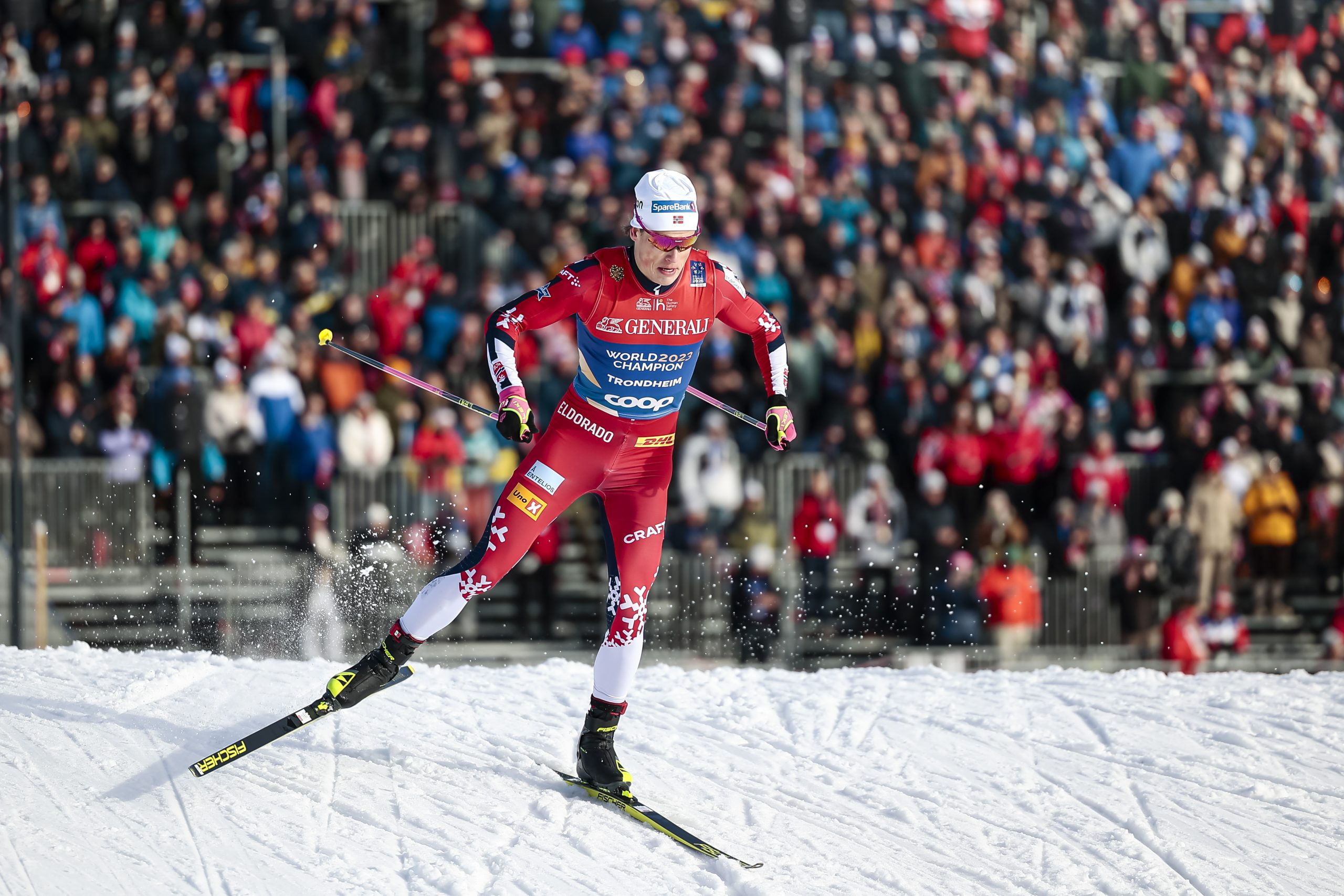
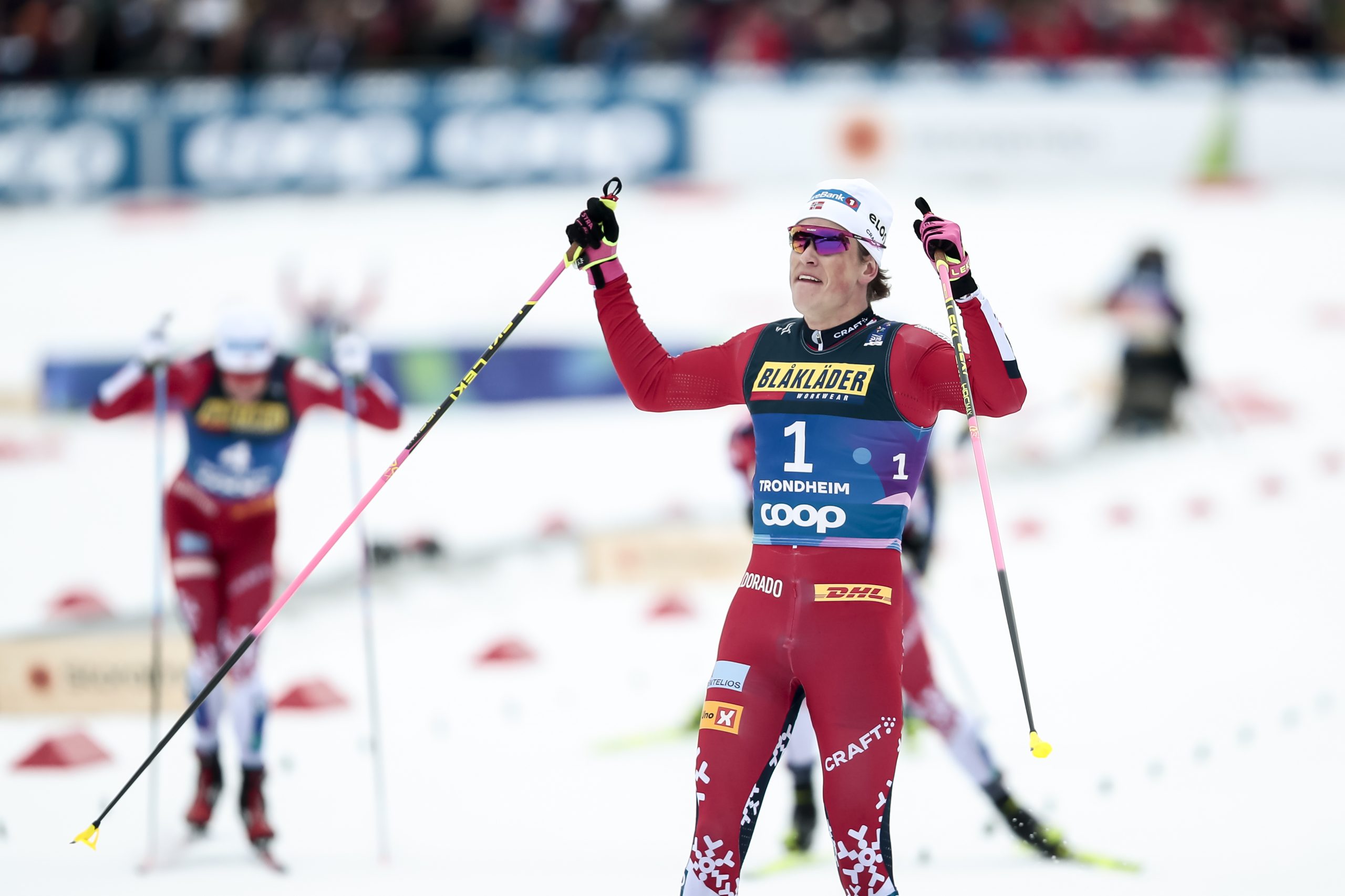
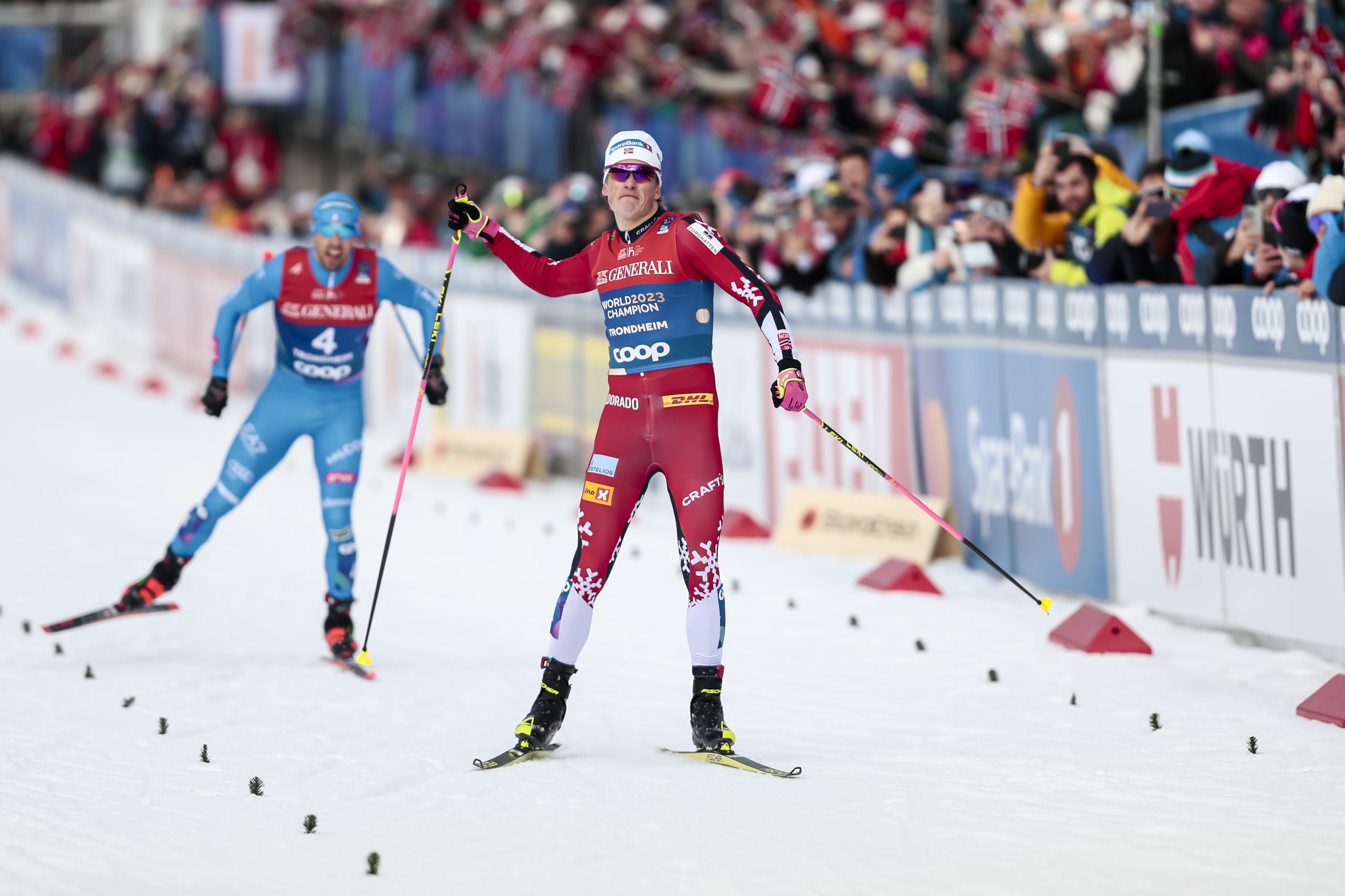
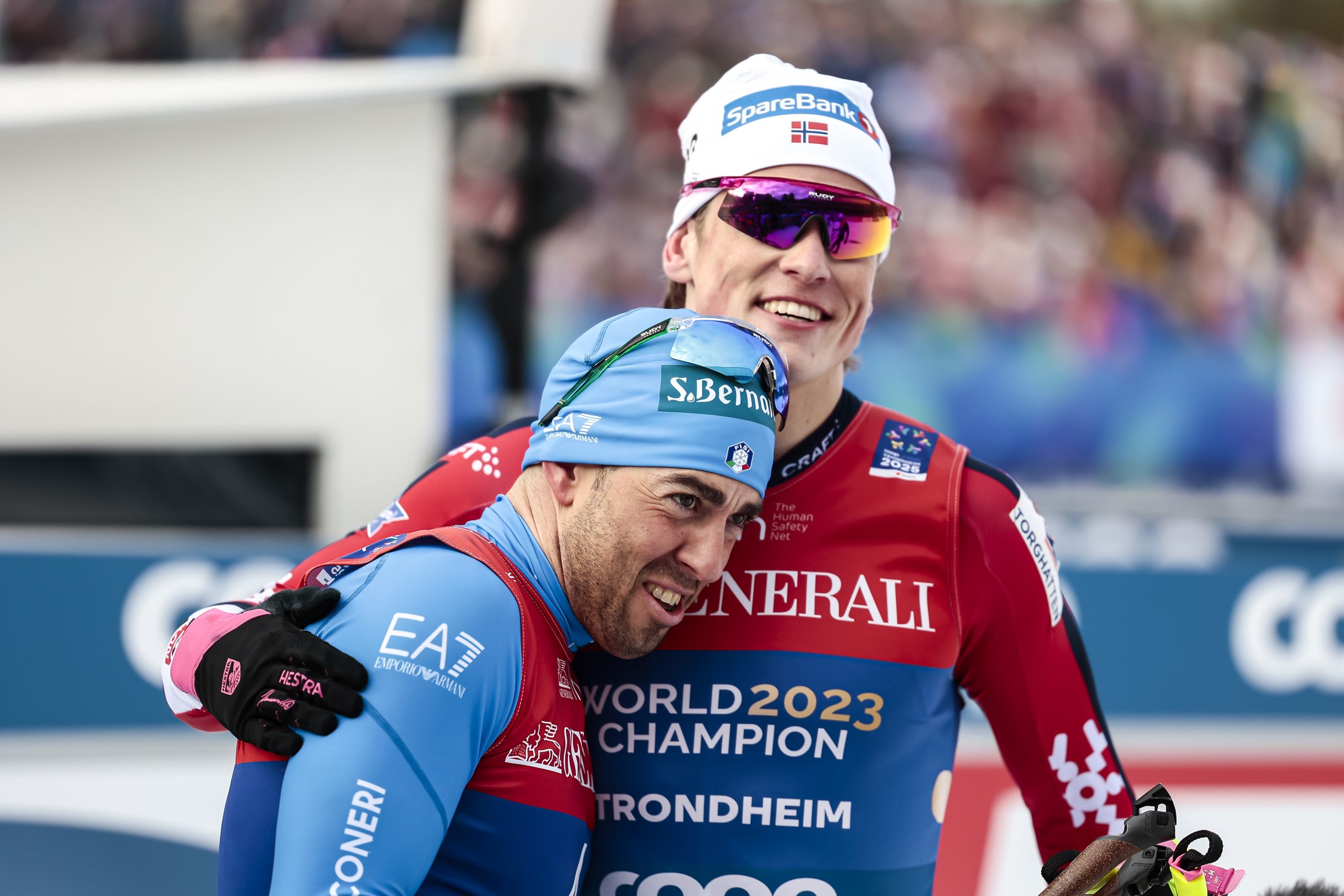
    Johannes Hoesflot Klaebo (NOR) admits that he has a “home town advantage” in the variable coastal weather conditions typical of  Trondheim. He proved it again with a win in the World Championship 10 k Classic Interval Start. (Photo: Thibaut/NordicFocus)

    Trondheim’s changeable weather changed again as skiers awoke to snow swirling in the morning sky, filling the tracks of the 10 kilometer Classic course. One degree Fahrenheit, snow falling steadily: fearsome conditions on a most important day. The forecast was that snow could turn to rain as the day progressed: clumpy snow, sloppy tracks, gritty competition, a hard-man’s race. Skiers would be pleading for grip, praying for glide.

    All the entrants in today’s World Championship 10 k Classic Interval Start had expected to be chasing Iivo Niskanen (FIN). Time and again, Niskanen has proven himself to be the foremost practitioner of Classic technique, and he definitely would’ve been the odds-on favorite to claim gold in Trondheim. But competitive sport is a funny thing, especially those sports focusing on uber-strenuous endurance training and competition, and taking place in mid-winter. They don’t call it “cold and flu season” for nothing . . .

    Iivo Niskanen dropped out of the 2025 World Championships in Trondheim due to a bout of the flu that has been lingering since his victory in the 10 k Classic in Falun, Sweden. His recovery was not complete in time for Sunday’s Skiathlon in Trondheim. Now, Niskanen has withdrawn from all events in this year’s championships, including today’s 10 k Classic. It was about to become a whole new race.

    And the snow continued falling, sending wax technicians into a panicked frenzy. Those ski-nations blessed with fat budgets and hulking wax trailers have plenty of experience in such challenging conditions, giving their athletes a distinct advantage over lesser-prepared teams. On the other hand, the search for that extra smidgen of speed has seen nations like Norway and Sweden blow the wax on important days in the past, ending the careers of coaches in a number of infamous incidents. There was a lot at stake in Trondheim.

    “This is the weather we are used to in Trondheim, so a little bit of a home advantage today,” said Klaebo after the race. When asked what he thought about the day’s conditions when he first looked at the sky this morning, Klaebo grinned. “Holy $#&%! that’s what I was thinking this morning. But I think the conditions were a little bit better than expected, I think they have done an amazing job, and I think it was an exciting race to watch, as well.”

    Klaebo has good reason to be both satisfied and confident, as he delivered another win for Norway in the 10 k Classic Interval Start. Norway filled the podium with Erik Valnes in second, and Harald Oestberg Amundsen third.

    Gus Schumacher (USA) continues to prove his potential among top finishers in world Championship and World Cup races. His 13th place led all North Americans in the 10 k Classic. (Photo: Modica/NordicFocus)

    Team USA has committed considerable resources to waxing and base prep, but they’ve also missed the boat in that department through each of the first few races at these championships. American skis have dragged, American skiers have slipped, but Gus Schumacher seems always to find a way to produce fine results. In the 10 k Interval Start, he once again proved his ability to pace well and race bravely, finishing 13th. He was followed by Zak Ketterson 27th, Zanden McMullen 40th, Ben Ogden 47th.

    Ketterson commented on the conditions: “When it’s 32 degrees and snowing, it’s Zero skis. When they’re good it’s like the simplest of conditions. If you have one or two pairs and they’re both bad, it’s like “that’s that.”

    “Ending up 13th on a tricky day and tricky conditions,” commented Schumacher. ” It’s pretty sweet to not be satisfied with 13th . . . knowing that there’s more in the tank!”

    Canadian, Antoine Cyr, also continued his string of impressive finishes, starting fast on the day and holding on to cross the line in 18th. Olivier Leveille was the next Canadian in 38th, followed by Max Hollmann in 43rd.

    Achbadrakh Batmunkh (MGL) was one of the many skiers from lesser-known national teams who qualified to race the 10 k Classic Interval Start at the World Championships in Trondheim. (Photo: Thibaut/NordicFocus)
    10 k Classic

    World Championship and Olympic events are staged following rather different standards and practices, including shuffling the starting order of interval start races so that top-seeded skiers will have skiers from lower seeds sprinkled among them. On Tuesday in Trondheim, the 10 k Classic Interval Start will include numerous skiers whose only participation in international racing will be these championships. And they will be right in the middle of things (rather being lumped in an inexperienced bunch at the very end of all starters).

    The 55th starter on the day will be Achbadrakh Batmunkh of Mongolia, followed closely (and almost immediately) by the hyper-speed racing advance of Johannes Hoesflot Klaebo. I wish we could be standing trailside when Klaebo makes that pass. Might he say something to Batmunkh? Some kind encouragement? Some expression of polite camaraderie? Fans of Nordic skiing will remember the immortal Norwegian champion, Bjorn Daehlie, standing at the finish line of the 1988 Olympic 10 k Classic in Nagano to greet the final finisher (Kenya’s Philip Boit). We always hope our heroes will be so magnanimous.

    But there are races to win in Trondheim, and Klaebo must sense that his chances have improved markedly with the withdrawal of his most excellent Finnish rival. But Klaebo isn’t the only one hoping to claim gold at the end of these ten kilometers.

    The first two kilometers climb steeply and steadily, a challenging beginning to a race that requires skiers to start fast. Racing 10 k is risky business, as described by former World Cup champion, Martin Jonsrud Sundby (NOR): “All in all, the biggest climb is from the start,” he said. “And from there, it’s much downhill. A few less demanding climbs. High speeds, but not the most demanding parts.”

    “For sure, after lapping (after 5 k) when you are going out on the second lap you have to do this uphill once more,” Sundby continued. “From 6 k up to 7 k, I think that’s the most crucial part.”

    At the 3.2 kilometer checkpoint, Ketterson led the first 40 starters. It. looked like Team USA might have had greater success in ski prep today in Trondheim. Then bib 40, Antoine Cyr, narrowly topped Ketterson at the 3.2 kilometer mark. It looked like North American teams had gotten things right.

    “It was good, especially my first lap (when) I was getting race leader splits,” said Ketterson. “Looking at the end, I wish I would’ve summoned more effort at the end . . . It maybe looks like I took it out too hard. On the second lap I started to feel like I bogged down . . . I’m pretty happy with it.”

    Wearing bib 56, Klaebo would start just a few places behind his teammate, Martin Loewstroem Nyenget (one of the strongest Classic performers on the World Cup tour this season). Klaebo would have the advantage of split times being relayed to him at multiple points along the course.

    Valnes was back in the racing after having missed the Sprint and Skiathlon with a nagging back injury. He wasted no time, laying down the fastest spilt times at two kilometers. Then the Norwegian crowd watched the arrival of Edvin Anger (SWE), the rangy U23 leader who has shown a willingness to race aggressively. He began topping the early time checks, threatening to upset Norway’s best-laid plans. Anger and Klaebo would trade leads through the next few splits: 5 k, 5.9 k. But at 7 k, Klaebo began inexorably to pull away. Klaebo’s choice to start slower and build his speed seemed to be proving the smartest strategy. Valnes, Nyenget, and Amundsen also slotted in front of Anger at 7 kilometers. Norway was on the rise.

    Wearing bib 46, Anger crossed the line with a considerable gap over all earlier starters, but Norway was bearing down on him. Nyenget, Klaebo, Valnes, and Amundsen wore bibs 54, 56, 58, and 60 . . . and Klaebo was inside the final kilometer, breaking out his once-famous high-running “moose step” up the final hill.

    Anger would claim fourth, ahead of a despondent Nyenget who caught an edge and fell on the tight corner just before the final downhill to the finish. Nyenget was up quickly, but his momentum had been spoiled. He would finish fifth, .2 seconds behind Anger, and 2.6 seconds behind third place, Amundsen.

    In post-race interviews, Klaebo was asked if he had any message for the Swedish men—or the Swedish fans—regarding the dominance of Norwegian skiers on World Championship podiums thus far. He didn’t take the bait . . .

    “I think Edvin (Anger) was doing a good race today,” said Klaebo. “He is for sure gonna be tough tomorrow. Hopefully we’ll see some Swedish color further up on the list as well. All of us want to have them up there to fight for podiums . . . I hope it’s gonna be some cool fights the next couple of days.”

    Klaebo would take the lead at the finish, standing 14.2 seconds ahead of Anger. The Swede greeted Klaebo politely in the finish area where both awaited the finishes of Valnes and Amundsen.

    Erik Valnes (NOR) returned from a recent back injury to claim his first World Championship Distance medal in the 10 k Classic, though the cost of doing so was evident in his collapse just after the finish line. (Photo: Modica/NordicFocus)

    Valnes powered up the finishing straightaway, plowing through the accumulated snow in an excruciating surge to the line. But he was 8.2 seconds too late to claim the win. Klaebo would remain in the leader’s chair, with Anger dropping to fourth after the arrival of third place Amundsen.

    The defending World Champion, Simen Hegstad Krueger (NOR), finished an eyebrow-raising 46th. He may have suffered the very worst day of his career, or he may have seen the handwriting on the wall in the early splits, and decided to shut down his effort to better preserve his chances in the 50 k Mass Start later this week.

    The very best skiers often find the ways needed to claim victory on the biggest stages. There is no bigger stage for them than the World Championships in Trondheim where, this week, Klaebo is proving himself to be the very best.

    “We had amazing skis, and my body feels pretty good,” said Klaebo in post-race interviews. “I felt like I have gotten in good shape for this championship. Just can’t wait for the race again tomorrow.”

    It’s beginning to look like an all-Klaebo World Championship week—and in Klaebo’s hometown—but let’s let him enjoy this hard-won Distance racing victory before we begin counting up the additional medals he could still claim in days to come.

    World Championships 10 k Classic RESULTS

    Norway celebrates in Trondheim as Erik Valnes (NOR), Johannes Hoesflot Klaebo (NOR), Harald Oestberg Amundsen (NOR), (l-r) claimed the podium spots in the 10 k Classic Interval Start. (Photo: Modica/NordicFocus)
  • Andersson Takes 10-k Classic in Another Thrilling Win Over Johaug

    Andersson Takes 10-k Classic in Another Thrilling Win Over Johaug

    FasterSkier’s FIS World Championships coverage stands as a proud tribute to American Skiing Icon Marty Hall, who (with his wife, Kathy Hall, and their A Hall Mark of Excellence Award) has supported our coverage of international cross-country ski events. Learn more about A Hall Mark of Excellence Award at info@fasterskier.com. We’ll miss you, Marty. 

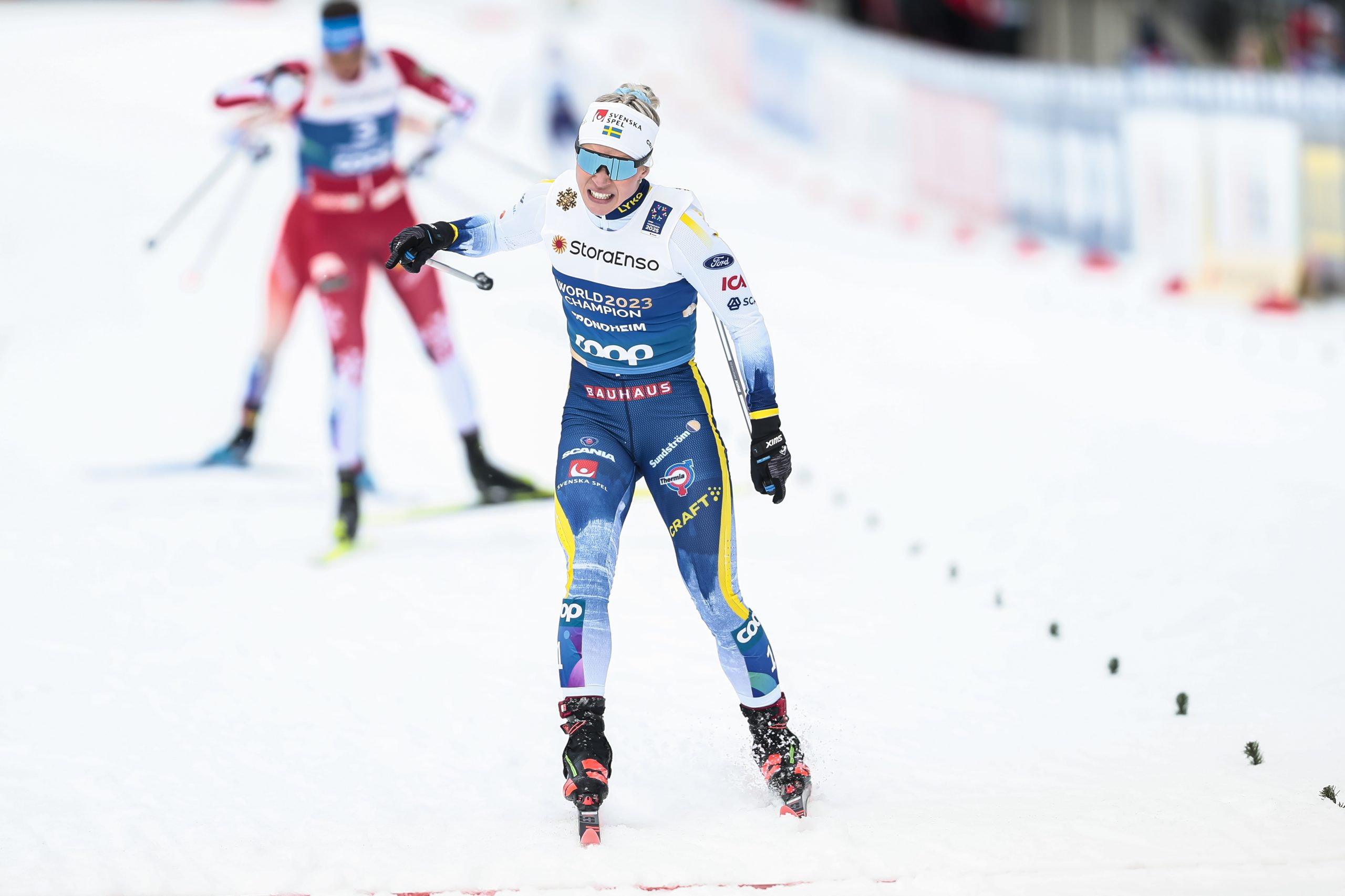
    Ebba Andersson (SWE) had another thrilling victory over Therese Johaug (NOR) in the women’s 10 kilometer Classic. (Photo: NordicFocus)

    After the rainy deluge of the women’s Skiathlon Sunday, the focus of the World Championships turned to the women’s 10 kilometer Classic Individual Start. The storylines were numerous and compelling. Could Therese Johaug (NOR) come back from her stinging second place photo-finish to claim a title in a race where she would face stiff competition from her teammates and others? Could Heidi Weng (NOR) overcome her own demons after her result changing tangle with Jonna Sundling (SWE) in the Skiathlon? And what about Astrid Oeyre Slind (NOR)— could she bounce back after her disastrous ski exchange in the Skiathlon? Those were just the questions surrounding team Norway.

    For team Sweden, Frida Karlsson (SWE) would be looking to take the top podium spot and regain her early season dominating Classic form after having just missed a podium finish on Sunday. Karlsson would still have to contend with her teammate Ebba Andersson, but Jonna Sundling (SWE) would not be racing today as she was resting for the team sprint. That meant there would be one less Swedish woman to potentially knock Karlsson off of the podium.

    Therese Johaug (NOR) finished second for the second race in a row. (Photo: NordicFocus)

    Whenever there is a Classic race Kerttu Niskanen’s (FIN) name is always mentioned. It’s the first race of these World Championships for her and she would be hoping to make up for lost time.

    For the Americans, the question was more fundamental. Would they be able to produce good enough skis to allow their athletes to contend? After the ski preparation difficulties of the last two races, nerves had to be frayed, and no doubt anxiety was high in the American’s wax trailer. Team USA would be without their big gun as Jessie Diggins wouldn’t be racing today which came as no great surprise, given that she’s still nursing her foot injury— which Classic skiing only serves to aggravate— and that she has other races later in the championships to focus on. But it was a surprise that there were only two Americans on the start list. Rosie Brennan and Alayna Sonnesyn were the only skiers representing team USA.

    It was another tough outing for Rosie Brennan (USA) as she continues with health struggles and finished 22nd. (Photo: NordicFocus)

    Team USA and the rest of the field weren’t handed an easy hand to play as ski preparation conditions were difficult. At the race’s start, heavy wet snow was falling along with the possibility of it changing to rain with temperatures hovering around freezing; treacherous waxing conditions for Classic racing. The choice of kick wax or zero skis was a difficult decision right off the bat. No matter what the choice, conditions were going to be slow and challenging.

    But as the race reached the finish, it was Andersson and Johaug again fighting for the top of the podium with Andersson taking another thrilling finish this time by just over one second ahead of Johaug. Karlsson skied well but couldn’t match the pace of Andersson and Johaug and she took third.

    After the race Andersson commented that, “I was so surprised. I was prepared for hard conditions and a tight race. It feels amazing. I had good skis and tried to push everything the entire way. It’s the best I’m feeling this season and maybe the best in my career.”

    Brennan ended up finishing 22nd, 2:29 behind the leaders while Sonnesyn held on for 33rd. Sonnesyn was happy with her performance. When asked how she felt about her performance she replied, “overall really good, looks like I just barely missed the top thirty.” She said that her skis felt good and that she had been racing on zero skis, as had many in the field. “It was a good zero day.”

    For Brennan, her season long struggles continued. “Skiing was good, my body was less good,” said Brennan after the race. “I’m disappointed … everyone did everything they could to get me here in the best shape possible, it’s hard when it’s not enough. I’m definitely dealing with some tough not understood health things. That’s life I guess.” Brennan was uncertain what her race schedule would be for the rest of the championships.

    Alayna Sonnesyn (USA) was happy with her day skiing on zero skis. (Photo: NordicFocus)

    The top Canadian finisher was Katherine Stewart-Jones finishing 27th. She was followed by Sonjaa Schmidt in 35th, and Olivia Bouffard-Nesbitt in 40th.

    The Women’s 10 kilometer individual start

    At the start of the race it was good news for the Americans as Sonnesyn (USA) was the early leader at the two kilometer mark. While none of the favorites had gone out yet Sonnesyn’s skis appeared to be working well which had to have been a relief for the beleaguered American wax technicians.

    Andersson was the first of the favorites to start with Johaug beginning a minute behind her, and Slind following just behind. At the two kilometer mark Andersson went into the lead, but it didn’t last long as Johaug came through over five seconds faster than Andersson. Slind challenged Johaug’s lead when she came through just four seconds behind Johaug, but she wouldn’t remain in second for long as Karlsson came through slightly ahead of her. Early on the four women established the trend for the entire race with the four fighting for the top spots.

    Frida Karlsson (SWE) finished third but never really threatened for the win. (Photo: NordicFocus)

    Johaug, Andersson, Slind, and Karlsson continued to battle at each time check with all of the skiers being within four seconds of each other at the 3.2 kilometer time check. At the half-way point the race had tightened even more as Johaug and Andersson were separated by only 1.7 seconds with Johaug in the lead. Slind and Karlsson had dropped off the pace and were now more than 10 seconds behind the leaders. A few moments later, the lead had flipped as at 5.9 kilometers Andersson nudged into the lead by a second. By then, it appeared to be a two person race as Karlsson and Slind were now substantially off the leaders’ pace with Karlsson hanging on to third place, while Weng and Niskanen were fighting to stay in contention.

    The leaders continued to seesaw in an incredibly close race as at seven kilometers Johaug regained the lead by 0.3 seconds over Andersson, while Karlsson and Slind continued to fight for third place.

    With less than one kilometer to go, Johaug was again dropped into second place as Andersson surged back into first place, but by less than a second.

    Teresa Stadlober (AUT) was a late starter and almost pulled off a surprise podium. (Photo: NordicFocus)

    At the finish the race was developing into a replay of the Skiathlon with a thrilling finish looming. Andersson crossed the line first and could only wait to see what Johaug would do. Johaug frenetically double polled to the finish with the crowd screaming, but she was unable to beat Andersson’s time coming in 1.3 seconds behind the Swede. While the Swedes celebrated, they appeared to have forgotten about the racers still out on the course as Teresa Stadlober (AUT) had quietly taken the lead at the 5.9 kilometer mark.

    The battle for third place was also still looming as Karlsson and Slind came into the finish with Karlsson taking third place for the time being. Suddenly though all eyes were on Stadlober who was still out on the course and had the advantage of skiing much of the race after the heavy snow had stopped. By the 8.2 kilometer mark Stadlober was still hanging on to third place and was still in third with less than a kilometer to go.

    Coming into the finish, Stadlober was the last skier on the course who had a chance to impact the podium as she still had third place in her sights. She gamely fought up the last big hill herringboning up the thick slushy snow. But Stadlober couldn’t muster a quick enough finish as the slow slushy snow provided too much resistance for a finishing sprint, and Stadlober dropped to fourth.

    Therese Johaug (NOR) would have to deal with another close call taking second place. (Photo: NordicFocus)

    It was another dramatic replay for the women as Johaug and Andersson once again battled to the finish in a race which was decided by just over a second with a clearly disappointed Johaug leaving the finishing area while Andersson celebrated another thrilling victory.

    It was all smiles for Ebba Andersson (SWE) as she took another World Championship victory. (Photo: NordicFocus)

    Women’s 10 kilometer Classic Individual Start Results.


  • In Norway, a Fossil Fuel Feud at a Celebration of the National Sport

    In Norway, a Fossil Fuel Feud at a Celebration of the National Sport

    This article was made possible through the generous support of our voluntary subscribers.  If you would like to see more articles like this one, please support FasterSkier with a voluntary subscription.  

    Norwegian competitors at the Trondheim World Championships held a news conference Monday. Climate advocates have criticized sponsorship of the event by Equinor, the Norwegian state-owned oil company, and are threatening to disrupt one of the races; Martin Løwstrøm Nyenget, center, said that “we see their message, but we don’t think it’s the right way.” (Nathaniel Herz/FasterSkier)

    TRONDHEIM, NORWAY — The World Championships for cross-country skiing have so far gone off impeccably in this coastal city of 200,000.

    Epic duels between the top Norwegians and Swedes. Huge crowds lining the trails and packing into a city square for medals ceremonies. Steady bus service from downtown to the racing venue, where fans can buy locally produced foods.

    But one thorny problem remains unsolved, and threatens to mar what’s otherwise been an impeccably produced event: a standoff between organizers, competitors and a group of Norwegian climate advocates.

    The advocates are planning what they describe as a peaceful disruption of the marquee race of the championships, the men’s 50-kilometer marathon Saturday.

    Folk Mot Fossilmakta, or People Against Fossil Power, says it offered to stand down if the race organizers agreed to two requests: playing a short video for fans about a fossil fuel non-proliferation initiative, and removing the logo of event sponsor Equinor, Norway’s state-owned oil company, from visible advertising. 

    Organizers refused, writing in a letter that they had a responsibility to “facilitate the fulfillment of dreams and experiences” in Trondheim, “without fear.”

    In response, leaders of the demonstration plan to occupy a spot on an uphill early in Saturday’s race. The day before, they will share the exact time and location with the police, who say they will “immediately stop any protests” on the course but also must balance public order with Norway’s “fundamental right to freedom of expression.”

    The biggest remaining question mark is the crowd of boisterous fans that has gathered to watch the races at Trondheim’s Granåsen venue, many of whom have been drinking heavily. In the past, critics on social media have threatened physical violence against climate activists who disrupted other races.

    Crowds line the trails during a race at the Trondheim World Championships. (Nathaniel Herz/FasterSkier)

    “I understand completely that it’s super provoking, this kind of action. But we want to also help people direct their feelings and anger and frustration where it belongs — because it is the fossil fuel industry that is ruining things for all of us,” said Ragnhild Kvist Simonsen, a Folk Mot Fossilmakta spokesperson. “They’re willingly and knowingly killing the sport. And the fact that we have plans to disrupt one race this week is nothing compared to the disruption and death of the sport that the fossil fuel industry actually inflicts on these people.”

    Equinor, which until 2018 was named Statoil, says that 20% of its capital investments are now going toward renewables and low-carbon solutions, and it aims to reach net zero emissions by 2050. 

    But more than 99.5% of the energy it produces still comes from oil and gas, according to its most recent annual reporting. Last month, it announced it would slash its planned investment in renewables and boost oil production by 10% over the next several years.

    Åge Skinstad, the lead organizer of the World Championships, called Equinor a “very, very serious company,” and said that “they have to answer about how they work.”

    “We trust them in that work,” Skinstad said in an interview, adding that the company, for years, has supported Norwegian youth and junior skiers.

    An Equinor spokesperson, Rikke Høistad Sjøberg, said the company shares “the impatience in the energy transition, and it is going slower than expected.”

    “However, we continue to drive investments in renewable energy and low-carbon solutions like transport and safe storage of carbon dioxide,” she wrote in an email. “For us, it is important to balance the production of the energy needed today, while investing and developing the energy production and low-carbon solutions needed in the future.”

    Athletes at the championships, meanwhile, are caught between the climate advocates and the companies that sponsor competitions and some of their teams.

    Multiple Norwegian competitors, whose national ski association has long been sponsored by Equinor, have condemned the planned action.

    Simen Hegstad Krüger is one of the Norwegian athletes who’s criticized climate change advocates who plan to disrupt a race in Trondheim. (Federico Modica/Nordic Focus)

    Simen Hegstad Krüger, an Olympic gold medalist, last month called the climate advocates “idiots” and warned about the potential for things to get “ugly.” At a news conference Monday, Norway’s Martin Løwstrøm Nyenget did not directly answer a question about the merits of Folk Mot Fossilmakta’s requests to the championships organizers, saying that “we see their message, but we don’t think it’s the right way, to interrupt a race.”

    Nyenget declined to say whether he thinks it’s appropriate for a fossil fuel company to sponsor a cross-country skiing World Championships. “I’m not the one deciding this,” he said.

    But in the past few days, other competitors have begun a dialogue with Folk Mot Fossilmakta. 

    They include two members of the U.S. Ski Team, which arrived in Trondheim in new racing uniforms depicting melting glaciers — a message aimed at drawing attention to climate change’s effect on their sport.

    American Gus Schumacher, who already works with a winter sports-focused climate group called Protect Our Winters, met Monday with Folk Mot Fossilmakta along with the cross-country ski circuit’s two athlete representatives, American Julia Kern and the United Kingdom’s James Clugnet. 

    Schumacher called the meeting productive and said that leaders of Folk Mot Fossilmakta were “super reasonable.”

    Gus Schumacher races in his climate-themed uniform at World Championships. (Federico Modica/Nordic Focus)

    He said he hopes the group can be convinced to change its planned action in a way that allows them to draw attention to their position without affecting the 50-kilometer event. 

    “The biggest goal for us, in that meeting, was to convince them that obstructing the race wasn’t going to help them advance the message,” Schumacher said in an interview Monday. “Because it would stop athletes from wanting to speak out in support of them.”

    Schumacher said that he, Kern and Clugnet hope to work with like-minded athletes in the next few days to draft their own statement about the urgency of climate action — much like one issued by a group of Swedish athletes last week in advance of a high-profile race there, the Vasaloppet. 

    “We’re doing our best to get athletes who share the protestors’ general values on board while parsing out the exact details,” Schumacher said. “The most important thing is to show some solidarity.”

    Folk Mot Fossilmakta is part of the A22 Network, an international coalition of civil disobedience campaigns focused on the environment. The group’s efforts also include pushing Norway’s $1.7 trillion state oil-wealth fund to divest from fossil fuels.

    Its spokespersons include Simonsen, 26, who works at a Trondheim cafe when she’s not organizing, and Callum Macintyre, a 32-year-old Scot who moved to Norway to get a masters degree in climate change policy.

    Ragnhild Krist Simonsen and Callum Macintyre work with Folk Mot Fossilmakta, or People Against Fossil Power. (Nathaniel Herz/FasterSkier)

    Their efforts around the World Championships were, Simonsen said, an experiment in “open organizing.” 

    In the past, some members of the group have been involved in unannounced climate actions at high-level ski races. But weeks before this year’s championships started, Folk Mot Fossilmakta went public about its demands of the organizers.

    “What we really want, from our actions, is to create a conversation about these things that Norway, as a society, struggles to talk honestly about,” Simonsen said. “We are a petrostate, an oil nation that produces and exports huge amounts of oil and gas. And the fossil fuel industry, in our country, is hugely influential on our culture. To be a Norwegian is to have an identity around oil.”

    Simonsen’s group points to recent comments on a podcast by Clugnet, the British athlete, who noted his positive attitude toward Equinor because of the company’s past sponsorship of cross-country ski races.

    Folk Mot Fossilmakta’s open organizing strategy, its leaders say, has been a tremendous success: In the days leading up to the championships, the group’s requests and plans have received intense media coverage and attention from athletes and teams.

    At a community gathering Sunday, the group drew some 30 people to a downtown Trondheim meeting space. 

    Between bites of carrots and hummus, participants learned about the Fossil Fuel Non-Proliferation Treaty Initiative, which is led by Pacific Island nations and targets the production and development of oil and gas, rather than just consumption. 

    Folk Mot Fossilmakta held a community meeting Sunday in downtown Trondheim. (Nathaniel Herz/FasterSkier)

    They also held small-group discussions where they contemplated the weaknesses of their organizing strategy and arguments.

    “This is definitely the question: How far can protests go?” asked one participant, Anne Klenge, 26. But, she added: “It’s not blackmail. It’s the public interest we’re doing this for.”

    Another participant, a postdoctoral researcher who would only give his first name, Andreas, criticized what he described as shallow and “aggressive” Scandinavian media coverage of the planned demonstration.

    “Who are the activists here, really?” he asked. “The skiers that carry the logo are activists, in the sense that they are promoting fossil fuel extraction.”

    Andreas, 46, said he plans to participate in Saturday’s action, though he said the lead-up has been psychologically challenging, “because it’s so unpopular.”

    “I’m a little worried that spectators will interfere,” he said.

    Norwegian spectators took to the woods to watch a race at the Trondheim World Championships last week. (Nathaniel Herz/FasterSkier)

    Folk Mot Fossilmakta’s leaders say the Norwegian police have been clear that they will protect demonstrators’ safety, in addition to ensuring the safety of athletes. 

    In a lengthy response to emailed questions, a police lawyer, Ole Andreas Aftret, said his agency would “take necessary action to uphold public order and prevent bodily harm.” At the same time, he added, Norway is a liberal democracy where freedom of expression is a “fundamental prerequisite,” and political activists have “greater leeway in public spaces than anyone else.”

    While the police will “immediately stop any protests in the race course,” Aftret said, they would have to consider the specifics of a situation before any attempt to restrain advocates in advance of a planned demonstration. 

    “Taking action against activists before they’ve done anything that causes a risk of violence or disruption to public order, or before they’ve demonstrated a clear intent to do so, raises questions about censorship and political bias,” Aftret said. “This does not, however, mean that the police are powerless and must stand by while someone blocks the course and causes a major disruption.”

    Skinstad, the championships’ lead organizer, said event officials had a good discussion with Folk Mot Fossilmakta and that “free speech is no problem for us.” 

    But, he added, he hopes the group understands that it would be wrong “to ruin a competition for athletes that have been training maybe 10,000 hours to reach their main goal, maybe, in their life.”

    Åge Skinstad. (Trondheim 2025)

    “They can do the messages in the way they want outside the field of play,” Skinstad said. “But inside the field of play, I really hope that they understand they have nothing to do.”

    Macintyre, the Folk Mot Fossilmakta spokesman, said that his group’s ongoing discussions with Schumacher, Kern and Clugnet could lead to an agreement that could change Saturday’s action.

    “We see that the skiers’ voice is much more important than a disruptive protest,” he said.

    But any pact would have to be serious, Macintyre said, not just symbolic — such as a commitment to work with the International Ski Federation, the organization that oversees all world championships, to endorse the fossil fuel non-proliferation initiative and ban fossil fuel sponsorship.

    “We’re engaging with them,” Macintyre said. “But nothing is decided yet.”

  • The Devon Kershaw Show: A thriller in the rain in Trondheim

    The Devon Kershaw Show: A thriller in the rain in Trondheim

    Remember on the last episode where we talked about how exciting we thought the women’s skiathlon would be? It delivered every ounce, and maybe a little bit more. We’ve got a full recap here.

    Reach us by email at devon@fasterskier.com and nat@fasterskier.com. We’ll be back after Tuesday’s the individual start races.

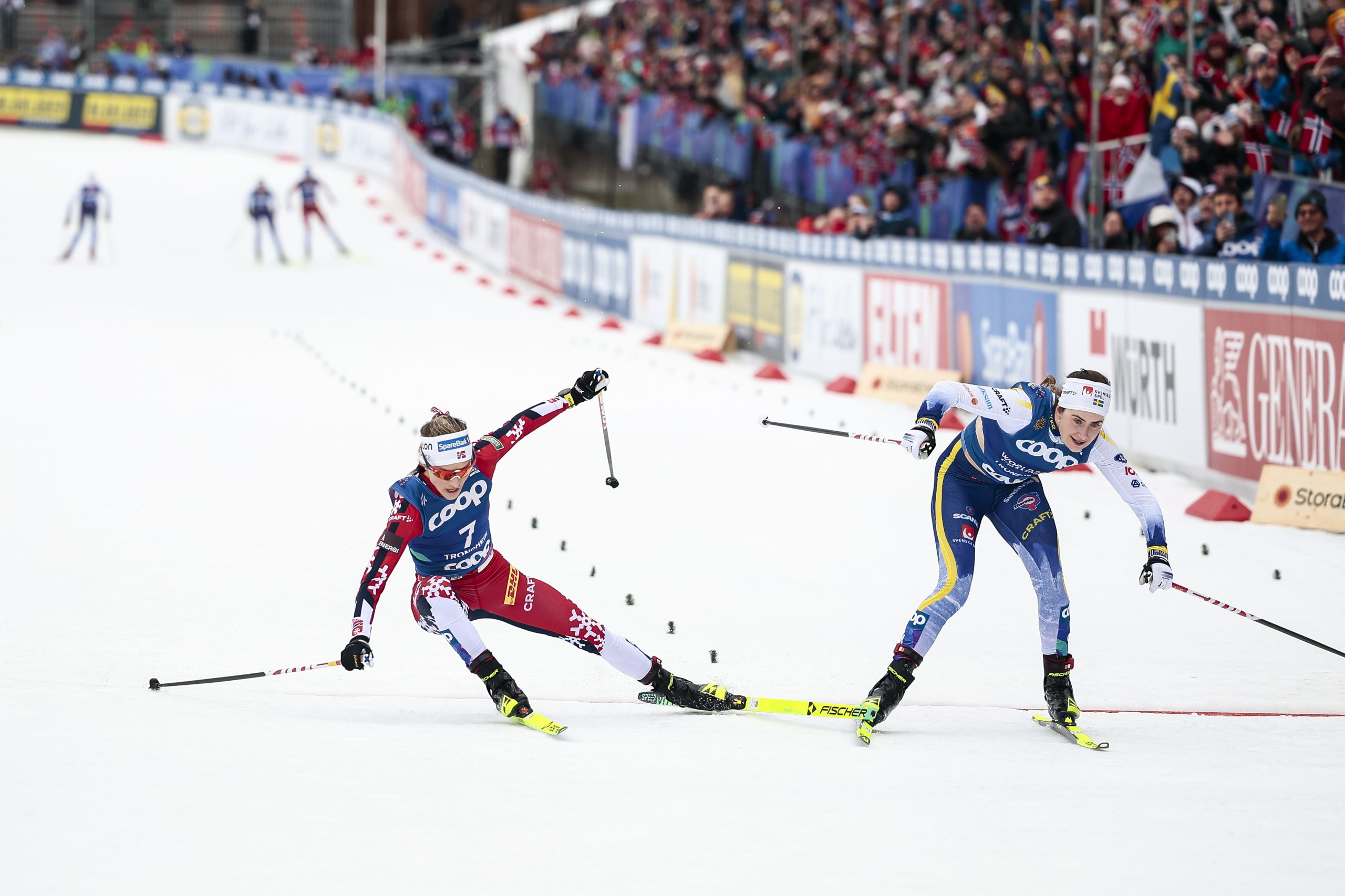
    Therese Johaug (NOR) and Ebba Andersson (SWE), (l-r) lunge for the line and the win. (Photo: Modica/NordicFocus)
  • Old skis? No problem for Johannes Høsflot Klæbo at World Championship sprint

    Old skis? No problem for Johannes Høsflot Klæbo at World Championship sprint

    This article was made possible through the generous support of our voluntary subscribers.  If you would like to see more articles like this one, please support FasterSkier with a voluntary subscription.  

    Johannes Høsflot Klæbo won Thursday’s World Championships sprint on an older model of Fischer skis. (Photo: NordicFocus)

    TRONDHEIM, NORWAY — After winning Thursday’s world championships-opening sprint here, Norwegian superstar Johannes Høsflot Klæbo posed for photos with the new model of Speedmax cross-country skis recently unveiled by his sponsor, Fischer, the giant Austrian winter sports company.

    But if you looked carefully at Klæbo’s skis during the race, they were different, and, unusually, they were dated: The pair was several years old, a Fischer official confirmed in an interview Sunday.

    Typically, new skis are more dynamic and give athletes a more stable platform on the snow, said Gerhard Urain, Fischer’s head of nordic racing. But the older pair Klæbo used Thursday are especially good in the wet, sloppy snow conditions that have prevailed in Trondheim for the past week, according to Urain.

    “And then also, when they have good memories with the skis — when they use them in these conditions, they are confident,” he said.

    “It was the right choice for him on this day,” Urain added, noting that Klæbo’s skis appeared to be running fast compared to other athletes’ on Thursday.

    Klæbo celebrates his sprint win while holding a pair of the new Fischer Speedmaxes. (Nordic Focus)

    On the surface, Klæbo’s victory on older skis could complicate Fischer’s marketing pitch for the new Speedmaxes, which, according to the company, are characterized by “extreme lightness.”

    But coaches and ski technicians said it’s increasingly rare for older pairs of skis like Klæbo’s to still perform competitively in tests against newer models.

    Urain noted that, just a few weeks after the introduction of the new Speedmaxes, many other top competitors have been choosing to race on them — suggesting that generally, they’re performing better than the dozens of pairs of skis already in athletes’ quivers.

    In Sunday’s women’s skiathlon, the two top Norwegian finishers, Therese Johaug and Heidi Weng, both used new Speedmaxes.

    Heidi Weng, second from left, and Therese Johaug, right, raced on the new Fischer Speedmax skis in Sunday’s skiathlon. (Nordic Focus)

    “They got the skis three weeks ago, and they’re racing them, using them in the championships,” Urain said.

    The durability of Klæbo’s race-winning skis also is an argument for Fischer’s equipment in and of itself, noted Matt Whitcomb, one of the U.S. Ski Team coaches in Trondheim.

    “A ski that keeps winning stays in the fleet. I know the ski companies love to have the new graphics. But what a great testimony to Toyota when you see a ’91 Corolla in, just, great condition cruising down the road,” Whitcomb said. “There’s no better accolade to receive.”

  • World Championships Don’t Get Closer Than This—Andersson Nips Johaug in Skiathlon

    World Championships Don’t Get Closer Than This—Andersson Nips Johaug in Skiathlon

    FasterSkier’s FIS World Championships coverage stands as a proud tribute to American Skiing Icon Marty Hall, who (with his wife, Kathy Hall, and their A Hall Mark of Excellence Award) has supported our coverage of international cross-country ski events. Learn more about A Hall Mark of Excellence Award at info@fasterskier.com. We’ll miss you, Marty. 

    The start of a wet Women’s Skiathlon at the FIS Nordic World Ski Championships Cross-Country in Trondheim, Norway. (Photo: Modica/NordicFocus)

    It’s gonna be a soggy one . . .

    Norway in winter is not always what familiar postcard-images and pre-broadcast video-montages would have us believe. This is not a place covered in perpetual snowy white glowing under sunny mid-winter skies. In fact, it only rarely is. And it almost never is in Trondheim. Trondheim is a coastal city looking out across the cold Norwegian Sea toward Iceland. Norway’s 64,000 mile fjord-slashed coast (second longest of any nation on earth) is the feature that creates Scandinavian snow. Warm, wet weather fronts roll in off the sea. Moisture-laden air cools as it rises over the Scandes range, dropping Norway’s familiar snow on the eastern side of the mountains (on Holmenkollen, Lillehammer, Sjusjoen—the notable ski destinations). But on the coast where that precipitation all begins, it falls from the sky more often as rain . . . just like today for the Women’s 20 k Skiathlon at the FIS Cross Country World Championships.

    Ironically, skiing in the rain isn’t nearly as bad as it sounds. Wet snow can actually be pretty fast (if the technicians have mastered the base prep to give the skiers both glide and kick). One way or another, the Norwegians are accustomed to it. Trondheim is their town, their snow, their championship. If World Championship medals are being handed out at the end of the race, then all of Norway will do its best to claim them.

    Therese Johaug (NOR) lost two years to a suspension, and another two seasons in retirement after the birth of her daughter. She probably wants to recoup the wins lost during those years.

    Jessie Diggins (USA) has been forced to limp through half the season on an injured foot. She probably wants to show that her recovery is nearly complete.

    Heidi Weng (NOR) was once the very best in the world. She probably wants to show that she still can be.

    Frida Karlsson (SWE) has proven to be fast, but fragile. She probably wants the enduring respect that has eluded her.

    Astrid Oyre Slind (NOR) has orchestrated the rarest of careers, only reaching her peak in her mid-30’s. She probably wants to show that it’s not a fluke.

    Ebba Andersson (SWE) is the defending champion in the World Championship Skiathlon. She probably feels that she has much to prove . . . and she knows she can win. But the two years since her last World Championship victory have been a struggle.

    “It has been ups and downs, but mostly downs,” Andersson remembered. “It’s really, really good to have one of those up days here in Trondheim on this day.”

    And the “up day” to which she referred ended with perhaps the closest victory in World Championship history, as Andersson edged past Johaug in the closing meters of the 20 k Skiathlon. Their finishing times were identical, the finishing order only decided by a panel of judges viewing the tech-stretched image captured by the finish line’s high-speed camera.

    The margin between Therese Johaug (NOR) and Ebba Andersson (SWE) for the win at the finish of the Women’s Skiathlon was about as close as it could be. (Photo: Ski and Snowboard Live Broadcast)

    Andersson spoke of her elation at claiming victory for Sweden in this Norway-hosted World Championships. “Especially when my teammates came and gave me a hug,” she said. “Then it feels so unrealistic . . . just a dream come true.”

    Diggins dropped from contention almost as soon as the race began, seeming to be hampered by slow skis for the second time during these World Championships. She would finish 13th, followed by Sophia Laukli 23rd, Julia Kern 26th, Alyssa Sonnesyn 40th.

    Among Canadians, Lilliane Gagnon was 30th, Alison Mackie, 44th, Katherine Stewart-Jones 47th, Sonjaa Schmidt 49th.

    It wasn’t the result her fans were hoping for, but Jessie Diggins (USA) raced as hard as she could given the variables she could control. (Photo: Modica/NordicFocus)
    20 k Skiathlon

    This race’s beginning followed a script that could have been written well in advance of the actual race. Johaug went straight to the front . . . Slind, Karlsson, Andersson, Emma Ribom (SWE) and Jonna Sundling (SWE) went with her. The race shaped up quickly, and anyone not in this very early move was likely to be left behind. Diggins and Victoria Carl led an early chase group, but things were getting away. The race was all of five minutes old.

    By the end of Lap 1, the front of the field had come back together as Karlsson and Sundling led through the stadium at 3.3 kilometers with two Classic laps remaining.

    Victoria Carl (GER), Astrid Oeyre Slind (NOR), Pia Fink (GER), Therese Johaug (NOR), Flora Dolci (FRA), Krista Parmakoski (FIN), Heidi Weng (NOR), Moa Ilar (SWE), Teresa Stadlober (AUT), (l-r) lead the rest of the women at the start of the World Ski Championships Cross-Country 20 k Skiathlon in Trondheim. (Photo: Nordic Focus)

    The Classic course in Trondheim (three laps of 3.3 kilometers each) climbs steadily out of the stadium. The climbers pressed the pace in this first half of the loop, hoping to detach the others (especially the sprinters). Compared to the Men’s race from a day before, the Women’s field seemed determined to use the climbs to break the spirit of any sprinter-types. The lead group formed itself into the short-list of contenders: Weng, Slind, Johaug, Karlsson, Andersson, and Sundling.

    At the end of Lap 2, Slind, Karlsson, and Sundling showed their fast skis down the long hill into the stadium. Johaug (not the most masterful descender in the group) was gapped on the downhill, but she quickly charged back up to the leaders as they traversed the flat. Regardless, Johaug must’ve been sensing the need to drop everyone else before that slushy right-hand turn leading to the finish line.

    Each lap on the large climb of the classic leg Therese Johaug (NOR) attempted to stretch the field and get away. (Photo: Modica/NordicFocus)

    Third time up the big Classic climb; Johaug hit the gas. On-air commentators wondered if Team Norway was employing team tactics, as the Norwegian trio—Johaug, Slind, and Weng—gapped the Swedes. Best guess from this reporter? No way . . . Johaug is not a team player, and anyone wanting to help her is going to need to keep up with her (and that’s never proven to be an easy thing to accomplish). On this third time up the Classic climb, Johaug looked determined to drop them all, no matter which flag they wore. The Swedes appeared to be caught flat-footed, with Sundling leading the chase of her climber-teammates.

    Fortunately for Team Sweden, they are known to have fast skis. They might not have been panicking as a gap opened over the top of the climb since they’d be likely to catch back up on the subsequent descent. Andersson followed, Karlsson dangled, but it was Sundling who chased down the breakaway, gliding easily into their midst on the descent. The lead group of four entered the stadium for the ski exchange.

    It was at this point that the Skiathlon reminded viewers just how difficult and capricious performing at this level really is: Slind suffered a total-disaster ski exchange, kicking one of her skate skis as she entered her transition box.  As the ski slid away, she stayed poised and switched to her other skate ski, grabbing her skate poles before skootering after the matching ski, which had slid all the way across the track and under the track for the trailside trolly camera. Regardless, the damage was done. Johaug, Weng, Andersson, and Sundling sped off without Slind, while she and Karlsson exited the exchange area eight seconds behind the leaders. Slind may have proven herself one of the very best skaters in the world throughout this World Cup season. If she wanted to climb her way back onto this Skiathlon podium, she’d need to prove it again, now.

    Diggins came through the Classic/Freestyle transition more than a minute behind. It seemed that the wet conditions had gotten the better of the Americans.

    Ebba Andersson (SWE), Heidi Weng (NOR), Jonna Sundling (SWE), Therese Johaug (NOR), (l-r) formed the lead pack that would determine the medals as the athletes took on the skate portion of the course. (Photo: Modica/NordicFocus)

    Back at the front of the race, Johaug went to work. In an earlier age, Johaug’s tempo and fitness would’ve simply gapped the rest. But after seasons of suspension and retirement—after the inexorable progress of time and age—the rest of the field had caught up to Johaug. Weng, Andersson, and the uber-dangerous sprinter, Sundling, clung to Johaug as she stormed around the first lap. Karlsson continued to chase while Slind lost time.

    Midway through Freestyle Lap 2, the contenders woke up to an unfortunate challenge: no one had dropped Sundling yet. Having trounced the field in the Freestyle Sprint World Championship just three days ago. But the stresses of racing at this level have a way of evening things out. As they entered the stadium to begin Lap 3, Sundling caught an edge in the sharp right-hand curve. She went down, taking Weng with her. Both quickly regained their feet, but the damage had been done. Johaug and Andersson sped off without them. One lap to go . . .

    Jonna Sundling’s (SWE) fall unfortunately took her and Heidi Weng (NOR) out of contention for the gold medal. (Photo: Modica/NordicFocus)

    Sundling chased with visible urgency as Weng faded, eventually being caught by a determined Karlsson. Later, in the race’s finish area, Weng appeared to glare accusingly Sundling. Weng’s expression spoke volumes: she’d had put herself right where she needed to be (on the heels of the world’s best sprinter), and still it had backfired.

    There’s not a lot of tactical cuteness in Johaug’s DNA . . . she just hammers. And that’s what the final lap looked like. Andersson hung on gamely, perhaps showing a bit less of the strain. Johaug is one of the best skiers in history, but certainly not in a sprint. Her career was forged the hard way, leaving a trail of exhausted rivals lying prone in the snow behind her. There have not been many times when Johaug came to a finish line with another racer at her shoulder. And in the few cases where that has occurred, Johaug has not proven to have much of a sprint. Andersson had to like her chances . . . if she could hold on.

    Therese Johaug (NOR) and Ebba Andersson (SWE) lunge for the line and the win. (Photo: Modica/NordicFocus)

    “Therese kept up a good speed during the whole the race,” Andersson said. “Sometimes I struggled on the classic part, but I felt really, really strong on the Free technique. So I just tried to manage to keep up with Therese. Then I had to plan for the last part of the race.”

    Johaug and Andersson had ski speed that appeared equal on the final downhill, with Johaug managing to claim the inside line on the final bend. But it was Andersson who gained ground down the final stretch, both skiers lunging for the line in well-timed efforts for victory. The naked eye could never have identified the winner, a task left to finish line cameras and panels of judges. Two skiers with identical finishing times . . . only the finish line photo could identify the winner: Ebba Andersson.

    “It was so, so close!” Andersson beamed. “I’m so so happy that I finished in the way I did.”

    World Championships Women’s 20 k Skiathlon RESULTS

    The women’s podium with Therese Johaug (NOR), Ebba Andersson (SWE), Jonna Sundling (SWE), (l-r) for the World Ski Championships Cross-Country Skiathlon in Trondheim. (Photo: Modica/NordicFocus)
  • Campfires, screaming crowds and flaming moonshine: A day of worship in Norway, where skiing is religion

    Campfires, screaming crowds and flaming moonshine: A day of worship in Norway, where skiing is religion

    This article was made possible through the generous support of our voluntary subscribers.  If you would like to see more articles like this one, please support FasterSkier with a voluntary subscription.  

    Fans and support staff watch athletes compete in the World Championship 20-kilometer skiathlon in Trondheim, Norway on Saturday, March 1, 2025. (Nathaniel Herz/FasterSkier)

    TRONDHEIM, NORWAY — A few minutes before 11 a.m. on the side of a ski trail Saturday, a Norwegian plumber named Sven has handed me a cup of karsk: hot coffee mixed with moonshine.

    Sven touches a lit match to the surface. It is now on fire.

    “Clear, blue flame: That’s good homemade,” he tells me.

    One of his friends blows it out for me, and I bring the eye-watering mixture to my lips.

    Welcome to Trondheim, where, after 14 years of World Championships and Olympic Games outside the homeland of cross-country skiing, the sport has finally returned and, for the next week, will be living its best life.

    In a country where people are said to be born with skis on their feet, tens of thousands of fans have come to rejoice in Norway’s dominance at Trondheim’s Granåsen venue — packing into grandstands along the homestretch, with hordes more trekking up and into the woods along the trails to camp, carouse and cheer.

    Norwegian fans cheer athletes competing in Saturday’s world championships race. (Nathaniel Herz/FasterSkier)

    For years, experts and pundits have fretted about the future of cross-country skiing — the threats posed by climate change, by Scandinavian dominance that crowds out interest and television audiences in other nations.

    At this World Championships, those fears have been cast aside, replaced by joy, wonder and a celebration of the Norwegian tradition of heading out into the woods. Mika Vermeulen, an Austrian athlete who lives and trains a few hours south of Trondheim in Lillehammer, summed it up.

    “Cross-country skiing is religion in Norway,” he said after Saturday’s race. “And today, Granåsen was the Vatican.”

    Crowds cheer for the men’s skiathlon field at the student area along the classic course. (Nathaniel Herz/FasterSkier)

    The hardworking stateside FasterSkier crew has done the heavy lifting of recapping the details of Saturday’s race; as the correspondent on site, it was my job to gather the material out of view of the television cameras.

    So, join me for a tour of the day-long thrill ride I took along the World Championship ski trails and in the city of Trondheim before, during and after the competition.

    The tour starts with me wandering down the road from Granåsen back toward town.

    I’d seen campsites next to the race course while out on a ski tour the day before. But I didn’t have access to the course on Saturday, security was tight, and I didn’t know how to get back to the same spot on foot. No one at the media center could tell me, either.

    On Google Maps, it looked like there were some trails splitting off from the road. So, I started walking, then followed a family onto an icy path up through the woods that eventually connected us to an ungroomed ski trail.

    A Norwegian family climbs along Trondheim’s ski trails to reach a viewing area before Saturday’s skiathlon World Championships event. (Nathaniel Herz/FasterSkier)

    The smell of kerosene was in the air: We were headed in the right direction.

    When we hit the race course, I walked up to the first tent, which had a wood stove inside. It was four friends from childhood and military service who had trekked in with a sled the night before — carrying on a long Norwegian tradition of camping out before a big ski race.

    “We are from the region, so it’s quite natural for us to come here,” one of Sven’s friends told me. “It’s something about the Norwegian culture — it’s hard to put words on, but I guess it’s the excitement with the race, and it’s the spirit close to the tracks.”

    “Nature and campfire and some moonshine and have fun,” added the plumber, Sven Saksvik.

    After my aforementioned sip of flaming cocktail, I kept walking along the trail, encountering increasing numbers of campers and fans as I went.

    Three middle-aged men with tattoos and beards sat on reindeer and sheep skins, listening to heavy metal out of a portable speaker. Another group handed me a slice of reindeer salami from a wooden cutting board. A little ways back in the trees, a family cooked bacon over hot coals.

    The father, Jon Hammernes, wore his grandfather’s wool pants, a pair of sealskin boots and a crisp Norwegian sweater that matched his wife’s. He said he’d pitched his family’s tent three weeks ago, to claim their spot.

    John Hammernes, left, and his family watched Saturday’s World Championship skiathlon from the side of the trail after setting up their tent three weeks beforehand. (Nathaniel Herz/FasterSkier)

    “We, of course, like ski sport. But also the feeling of being with thousands of people,” Hammernes said. He said he’d brought 30 bags of firewood and that authorities had moved a standard spring vacation to give his kids the next week off from school.

    The woods weren’t packed by then, but it was only 11:30 a.m. — two and a half hours before the start of the race.

    At the far point on the course, I found spectators still streaming in, hoofing up a dirt road that led a mile back down to where city buses dropped them off. They carried skins and foam pads to sit on, while students toted huge portable speakers; alcohol and sausages were in abundance.

    Alexandra Ennebo, a student at the Norwegian University of Science and Technology in Trondheim, said she carried a large speaker roughly a mile, “like, right uphill,” to the skiathlon course, where she planned to watch and celebrate with a group of friends. (Nathaniel Herz/FasterSkier)

    After interviewing an electrician who’d carried a television screen up to the track that he’d then spliced into the power supply from the Granåsen trails’ lighting system — “do not try this at home,” he told me — I jogged back down to the media center. I needed lunch, and more camera equipment to capture what seemed almost certain to be a Big Scene during the race.

    I sprinted back up to the camping area just as the men began their 20-kilometer skiathlon.

    By that point, huge crowds of students lined the race trail, sending up enormous roars as the pack skied past. I spent a few minutes shooting photos, watched a group of young people gulp Jägermeister from shot glasses glued to a ski, then descended a precipitous slope of mud and snow back to the road.

    The second half of Saturday’s race ran on a separate course, and I wanted to see the finish. So did dozens of other fans, who joined me in jogging back toward Granåsen stadium.

    I made it back to the photographer’s stand at the finish line in time to see a group of leaders that had winnowed itself down to about a dozen from nearly 100 starters. Among them were all five Norwegian competitors, including superstar Johannes Høsflot Klæbo, a Trondheim native who’s become the city’s golden boy.

    Each time the leaders lapped through the stadium, the sold-out crowd of 29,000 went crazy, waving a sea of Norwegian flags. Klæbo delighted them by winning with enough of a gap to celebrate before crossing the finish line, and three of his teammates followed before the first non-Norwegian finisher.

    The men’s skiathlon field passes a large group of Norwegian spectators far from the stadium. (Nathaniel Herz/FasterSkier)

    One of the first people I ran into on my way from the photo stand to the athlete area was Klæbo’s father, Haakon, who I met two years ago when Johannes held a training camp in Utah.

    “This is crazy,” Haakon said. “It’s like being in a Formula One race in Monaco!” I asked if he’d been up to the woods. He hadn’t, so I told him about my flaming moonshine experience.

    “That is why you’re a little happy now,” he said.

    In the athlete zone, racers came through one by one, each with their own take on the electric atmosphere.

    Some said they couldn’t hear their own breathing; Gus Schumacher, the top American finisher in ninth, said firecrackers were going off above him. Christopher Kalev, an Estonian, described a haze along the trail from the campfires.

    A group of Norwegian fans sits in front of a campfire during Saturday’s skiathlon. (Nathaniel Herz/FasterSkier)

    “You feel like you’re losing three weeks out of your life from the air quality. But it’s totally worth it,” Kalev said. “This is how it should be always — there’s so many spectators, people are cheering your name, looking you up from the start list.”

    He added: “It’s always going to be miserable in a 20-kilometer race. There’s the moments you feel like you really want to give in, and if you were alone in the woods you probably would. But you can’t be slow when there are thousands of people cheering right there.”

    Martin Løwstrøm Nyenget, the Norwegian who finished second, said: “It’s the closest thing to being a rock star for a day.”

    Schumacher and Italian Federico Pellegrino had identical take-home messages: The huge crowds made the athletes feel “valued.”

    Organizers said a sold-out crowd of 29,000 packed Granåsen’s stadium Saturday, with an estimated 20,000 more along the trails. (Nathaniel Herz/FasterSkier)

    “I think skiers at home oftentimes count themselves out as, ‘We are a niche sport.’ I think people maybe talk down on it a little too much,” Schumacher said. “It’s cool to see this and have validation. It takes it being a huge event in Norway. But people care about it.”

    The head organizer of the championships, Åge Skinstad, put it this way in comments to Norwegian national broadcaster NRK: “Skiing is not completely dead.”

    After the finish line interviews, race organizers held a news conference with the three podium finishers.

    Sitting in the audience was a trio of 16-year-old junior cross-country ski racers who had the unique privilege of being forerunners for Saturday’s event — meaning they skied on the trail just ahead of the competitors to test it out.

    “We skied into a huge wall of noise,” one of them, Sivert Mørch, told me. “I haven’t experienced that before, and I don’t think I will again.”

    Fans lined the trail at a student area outside of Granåsen’s stadium. (Nathaniel Herz/FasterSkier)

    Once they were done skiing, the forerunners hung around in the stadium, watching the final sprint finish and then posing for photos with third-placed Harald Østberg Amundsen — turbocharging their dreams of some day turning professional.

    Amundsen described his experience much like Mørch did: “On the first lap in classic, when there were fireworks up in the woods, I was quite shocked. And I knew that this is going to be something I will remember all my life.”

    “I think we need some time to let it sink in,” Amundsen added. “But it was quite amazing.”

    From the news conference, I climbed into a coach bus with other media and volunteers, following the podium finishers back down to Trondheim for an evening awards ceremony. The huge city square was packed with thousands more flag-waving fans. Just as the event began, torrential rains and gusty winds blew in; nobody budged.

    Fans celebrated a Norwegian podium sweep at a Saturday evening ceremony in Trondheim’s city square spite of a downpour, visible in the beam of light in the center of the photo. (Nathaniel Herz/FasterSkier)

    Onstage, Norway’s Queen Sonja met Klæbo, Nyenget and Amundsen to hand out their medals. Then, Klæbo stepped up to a golden microphone for a victory speech — all in his native tongue except for his final words.

    “For all the international people,” he said in English, “this is how we do it in Trondheim.”

    Johannes Høsflot Klæbo speaks into the golden microphone Saturday night. (Nathaniel Herz/FasterSkier)
  • The Devon Kershaw Show: It just keeps getting better in Trondheim

    The Devon Kershaw Show: It just keeps getting better in Trondheim

    Trondheim packs the stands and the trails for an epic men’s 20-kilometer skiathlon at World Championships. Here’s a full recap.

    We’ll be back Sunday or Monday with a recap of what we’re expecting to be an awesome women’s skiathlon, as well. Get at us at nat@fasterskier.com and devon@fasterskier.com.

  • Klaebo Completes His Résumé with 20 k Skiathlon Victory

    Klaebo Completes His Résumé with 20 k Skiathlon Victory

    FasterSkier’s FIS World Championships coverage stands as a proud tribute to American Skiing Icon Marty Hall, who (with his wife, Kathy Hall, and their A Hall Mark of Excellence Award) has supported our coverage of international cross-country ski events. Learn more about A Hall Mark of Excellence Award at info@fasterskier.com. We’ll miss you, Marty. 

    Another mission accomplished: Johannes Hoesflot Klaebo (NOR) triumphs in the World Championship 20 k Skiathlon in his hometown of Trondheim, Norway. (Photo: Modica/NordicFocus)

    Simen Hegstad Krueger (NOR) has won this race before . . . but his victory in the 2023 World Championships was contested over a distance of 30 kilometers rather than today’s 20 kilometers. Still, Krueger was definitely one to watch, as on-air commentators mentioned that he has medaled in 10 of the 11 World Championship and Olympic events that he has entered. That’s almost unbelievable!

    Krueger had history on his side, but his Norwegian teammate—Johannes Hoesflot Klaebo—was less interested in mere history, and more interested in lasting immortality. Klaebo had never won a World Championship or Olympic Distance race. Two days ago—after his victory in the Freestyle Sprint—he advised fans to watch today’s Skiathlon. This was his chance to complete skiing’s most notable résumé.

    The 20 k Skiathlon is an event designed to crown the world’s best all-around skier . . . sort of. That “crowning” only proves evenly prioritized (between Classic and Freestyle) if the field races the 10 k Classic portion with the same aggression and gusto with which they race the 10 k Freestyle portion. But for the best Classic skier’s efforts to prove truly significant, that skier would need to go from the gun, dropping the field in the Classic leg, then hold off the charging skaters in the Freestyle leg. That’s just not how it usually happens. That’s certainly not how it was likely to happen with the world’s best Classic skier—Finland’s Iivo Niskanen—absent from the field (presuming saving his energy for the 10 k Classic Interval Start to be contested later this week). Everyone in the field knew the challenge: drop Klaebo, or watch him sprint away with the championship.

    Norwegian fans turned out in the tens of thousands for the World Championships on home soil at Trondheim, hometown of the day’s winner, Johannes Hoesflot Klaebo. (Photo: Modica/NordicFocus)

    Four Norwegians started in the top five—Krueger, Johannes Hoesflot Klaebo, Harald Oestberg Amundsen, and Martin Loestroem Nyenget—bracketing the lone Frenchman, Hugo Lapalus. Always one to animate the races he enters, Lapalus appeared eager to press the issue.

    “It will be amazing today,” said Lapalus in pre-race interviews. “(I’ll try) to stay in the lead group throughout the race, maybe push hard in the last lap in skating. I will see!”

    “I love this feeling in the stadium,” Lapalus continued. “It’s just amazing, a country of cross country skiing, I think it will be amazing in my first World Championship in Norway.”

    Even in his pre-race interview, Amundsen remained patient and calculating: . “We’ll see if Simen—or someone else—puts the pace up on the skating part,” he said. “But I have to keep calm and wait a bit, I think, and hopefully I have good legs so I can pick up the pace during the skate part. If not, I have a good sprint, so we’ll see.”

    We did see . . . and what we witnessed was Klaebo erasing from his record the one thing that had been missing for so long: a Distance gold medal at a World Chmapionship.

    “It feels amazing,” said Klaebo in post-reace interviews. “It was about time, I guess. I’ve been working quite hard for this. I mean, I’ve been close a few times, Finally now and I can say I stand on the top of the podium . . . It’s probably more emotional for me, this one, than the Sprint. This tastes good.”

    Gus Schuacher (USA) delivered another brilliant performance in a highly competitive field with his ninth place finish. Schumacher proved to be the only North American who remained in contention as Kevin Bolger finished 31st, Zak Ketterson 41st, and Zanden McMulen 46th. Among Canadians, Olivier Leveille was 34th, Antoine Cyr 40th, Xavier McKeever 45th, and Max Hollman 63rd.

    Martin Loewstroem Nyenget (NOR), Johannes Hoesflot Klaebo (NOR), and Harald Oestberg Amundsen (NOR) measured the pace in the Classic half of the 20 k Skiathlon at the World Championships in Trondheim. (Photo: Modica/NordicFocus)

    20 k Skiathlon

    The first Distance race on Trondheim’s World Championship schedule would be contested across three laps of a 3.3 kilometer Classic loop, followed by three times around a different 3.3 kilometer Freestyle loop. With temperatures in coastal Trondheim approaching 40 degrees Fahrenheit, ski prep would prove crucial. As the race unfolded, kick wax did not appear to be a limiting factor. Not much slipping was evident in the early kilometers, and very little herringbone technique was employed. The Classic half of the race would be one decidedly affected by glide. Special ski selections, magical base-grinds: who would be doing the least work and benefitting most from fast skis in the first half?

    Klaebo led the field through the stadium after lap 1, and again after lap 2 with all the prime contenders—Amundsen, Lapalus, Nyenget, Krueger—in his proximity. A loose group of 15 began steadily to pull away with Schumacher comfortably positioned in that group. Exiting the stadium for the final Classic lap, Nyenget began to press the issue, followed by Klaebo, Lapalus, Amundsen, and an invigorated Federico Pellegrino who appeared to be riding a wave of energy from his recent silver medal in the Freestyoe Sprint. Krueger dropped back a few seconds, but did not appear to be struggling. The lead group was whittled down to twelve with Schumacher still in contact.

    Nyenget led into the stadium at the end of the 10 k Classic leg, closely followed by Lapalus and Klaebo. Speed in transition would set the stage for the effort all skiers would be forced to commit in the Freestyle leg. Lapalus blazed through the ski transition, exiting the stadium ahead of his teammate, Mathis Desloges. The other contenders remained hot on their heels. Pellegrino lost a few seconds, while Krueger returned to a higher position. The skate leg . . . game on.

    Simen Hegstad Krueger (NOR) was a pre-race favorite in the World Championship 20 k Skiathlon. But you can’t win a mass start event unless you can drop Johannes Hoesflot Klaebo (NOR). (Photo: Modica/NordicFocus)

    Jensen, Krueger, Desloges, Nyenget, and Klaebo led the field through the checkpoint at 13 kilometers. As the course tipped up (onto the Sprint course used just two days ago) Nyenget forced his way to the front. Lapalus and Desloges closed the gap, pulling Klaebo and Nyenget through the stadium at the end of the first Skate lap. Shumacher remained in contact with the 13-man lead group, as did Pellegrino.

    At 15.3 kilometers, Andrew Musgrave (GBR) emerged at the front. Krueger accepted the help, but the pace may have slowed a bit, allowing the leaders to regroup. Most eyes remained on Klaebo, lurking two seconds back. As they entered the stadium for the beginning of the final lap, Musgrave was followed by Pellegrino and Klaebo. If Krueger were to have any chance of dropping the sprinters, he’d have only 3.3 kilometers in which to do it. The field knew the situation—either find a way to drop the sprinters, or they would certainly dominate the finishing sprint.

    With half a lap to go, the field briefly re-entered the stadium where Klaebo nearly tangled with Musgrave as the Norwegian’s famously-fast skis ran up on his rivals tails. A short loop took the pack out of the crowd’s view while the sprinters continued to jockey for position before the final climb and descent to the finish line. As he had in Thursday’s Freestyle Sprint, Klaebo eased to the inside around the tight turn at the top of the final downhill. All contenders were present in what would, again, prove to be a wax-race to the final righthand turn. That’s a good situation if you’re the man from Trondheim, seeking his first Distance Championship in front of his home crowd, and on the world’s fastest skis. Klaebo was not to be denied, sprinting around the final corner (ahead of the pushing and shoving of his medal-hungry Norwegian teammates, Nyenget and Jenssen), increasing his advantage all the way to his long-awaited finish line. Behind him, a scramble of sprinters jabbed their ski tips across the line in a four-man photo-finish, with medals being claimed by Nyenget (silver) and Amundsen (bronze). Jenssen fell back into fourth, Pellegrino fifth. Schumacher picked off two spots in the final meters to finish ninth.

    The career of Johannes Hoesflot Klaebo is such that it is very difficult for him to deliver any more “firsts.” But today, in his hometown of Trondheim, Klaebo was able to add another significant bit to his already-crowded résumé. No longer would he be the unbeatable sprinter who couldn’t win the Distance race. With this Distance championship safely in his pocket, Klaebo moved one step closer to claiming for himself the level of immortality that much of the skiing world already grants him.

    “I feel like people have been speaking more about it than I have,” Klaebo recalled. “Being able to do it here, in front of the home crowd, couldn’t be a better place to do it. I’m just super satisfied and happy.”

    And, in Trondheim’s World Championships, there are still four more races to go.

    World Championships Men’s 20 k Skiathlon RESULTS

    Martin Loewstroem Nyenget (NOR), Johannes Hoesflot Klaebo (NOR), Harald Oestberg Amundsen (NOR) acknowledge the cheering of 30,000 ski-crazed fans assembled on the trails and in the stadium at Trondheim.  (Photo: Modica/NordicFocus)
  • Tracks Set For Generations of Skiers to Follow: The North American Nordic Community Celebrates the Life of Marty Hall

    Tracks Set For Generations of Skiers to Follow: The North American Nordic Community Celebrates the Life of Marty Hall

    As many of you know, we lost a vital ambassador and supporter of North American cross-country skiing earlier this week. For those of you who might not be aware, Marty Hall was a lot more than the person, along with his wife Kathy, who supported our World Cup coverage. Marty was a friend.

    As a younger man, Marty had been a football player, nordic skier, and track star at the University of New Hampshire before becoming the US Ski Team’s first full-time coach, where he worked with some of our most legendary American skiers.

    Marty revolutionized training methodologies, trail grooming, and race formats, leaving an enduring impact on the sport. He was instrumental in the development of the Birkie Trails in Wisconsin, home to the American Birkebeiner.

    Marty wearing a camera helmet for ABC in the 1979 American Birkie. Is this the first GoPro? (Photo: Courtesy Photo)

    Kathy and he eventually moved to Canada so he could take on head coaching duties with the Canadian team.

    After his coaching career, Marty and Kathy were passionate supporters of UNH skiing, the New England Nordic Ski Association (NENSA), the Birkie Trails, Nakkertok Nordic in Ontario, and of course, the Halls have been the presenting sponsor of FasterSkier’s World Cup coverage for many years now. Their generosity and dedication strengthened the sport at all levels.

    Many of us at FasterSkier have had the privilege of spending a lot of meaningful time with Marty and Kathy: Matt also skied for UNH and has spent many hours on the phone and in person with the Halls, Nat skied for Marty at Bowdoin College, his final coaching stop, and so many of Marty’s former athletes and friends have reached out to us to share stories over the last few days, which we hope to compile soon, but we thought it might be best to share the words and memories from the FasterSkier team member who Marty had the most significant impact on.

    Marty and Kathy Hall
    Marty Hall, as our Devon Kershaw remembers:

    Marty was a real firecracker and a passionate advocate of the merits of competitive cross-country ski racing. Was he brash at times? Irritating? Of course, he was, but he was always unapologetically himself, a paramount quality if one wants to compete at the upper echelons of anything.

    Marty taught his athletes, whom he worked closely with, to get the most out of themselves. They were part of historic teams and achieved results in the USA and Canada. Some of the photos from that iconic era are legendary—as were his eyebrows.

    Later, when he was done coaching at the highest level, he was never afraid to speak his mind—a through-line of his life.  He was always ‘no holds barred’ with his opinions of what he thought teams or individuals should be doing, and nobody was safe. Not Beckie Scott, not me, not anyone. It was amusing when you weren’t involved and/or racing well enough to have his criticisms or opinions wash over you like water off the back of an otter’s soaked coat. Still, it could be irritating to be receiving his unsolicited advice—especially when things weren’t going so well on the ski tracks. Yet, he always stood by his opinions, and that ‘tough love’ aspect was just so ‘Marty.’ He just wanted—always did—for athletes to get the most out of themselves. There’s no better quality in a mentor, coach, or sparring partner.

    He was persuasive, too. This story is funny and perhaps hyperbolic, but I may have never been a cross-country ski racer at the highest level without Marty.

    I recall that Dave Wood and Marty came by my house – in Sudbury, ON (I still don’t understand why, haha – I wouldn’t go to Sudbury willingly), most likely on their way to some event somewhere in Northern Ontario. We sat in our family room, and Marty peppered me with questions. At the time, I was very on the fence between giving up top-level skiing – accepting instead a running scholarship, of which I had many offers to run in the NCAA – and, of course, Marty was having none of it. Tried as I might to explain how I loved both sports and that running was a more ‘pure’ competition with fewer variables, he turned it all on its head, educating me (preaching in pure Marty style) in the facts that those plethora of variables are what allow Canadians to win at the highest level. Mind you, no Canadian at that time had won anything in cross-country skiing for a very long time. It was over a decade since Pierre Harvey—the only Canadian to win then—did so in 1988. But he was able to beat me down to accept the reality that the chance to be the best in the world on a day was more realistic in cross-country skiing when compared to distance running as a young Canadian (I recall him being very stubborn about this—something like, “there’s no way you can be the world’s best at 5000m as a Canadian” or something like that, haha).

    Then came the war stories. Marty was a great storyteller, and the evening was filled with him and Dave—mostly Marty (there was not enough oxygen in the room for others)—telling anecdotes of the World Cup, the Olympics, the World Championships, and everything that life entailed. I drank it all up. I sat there on my sofa, totally quiet, and listened.

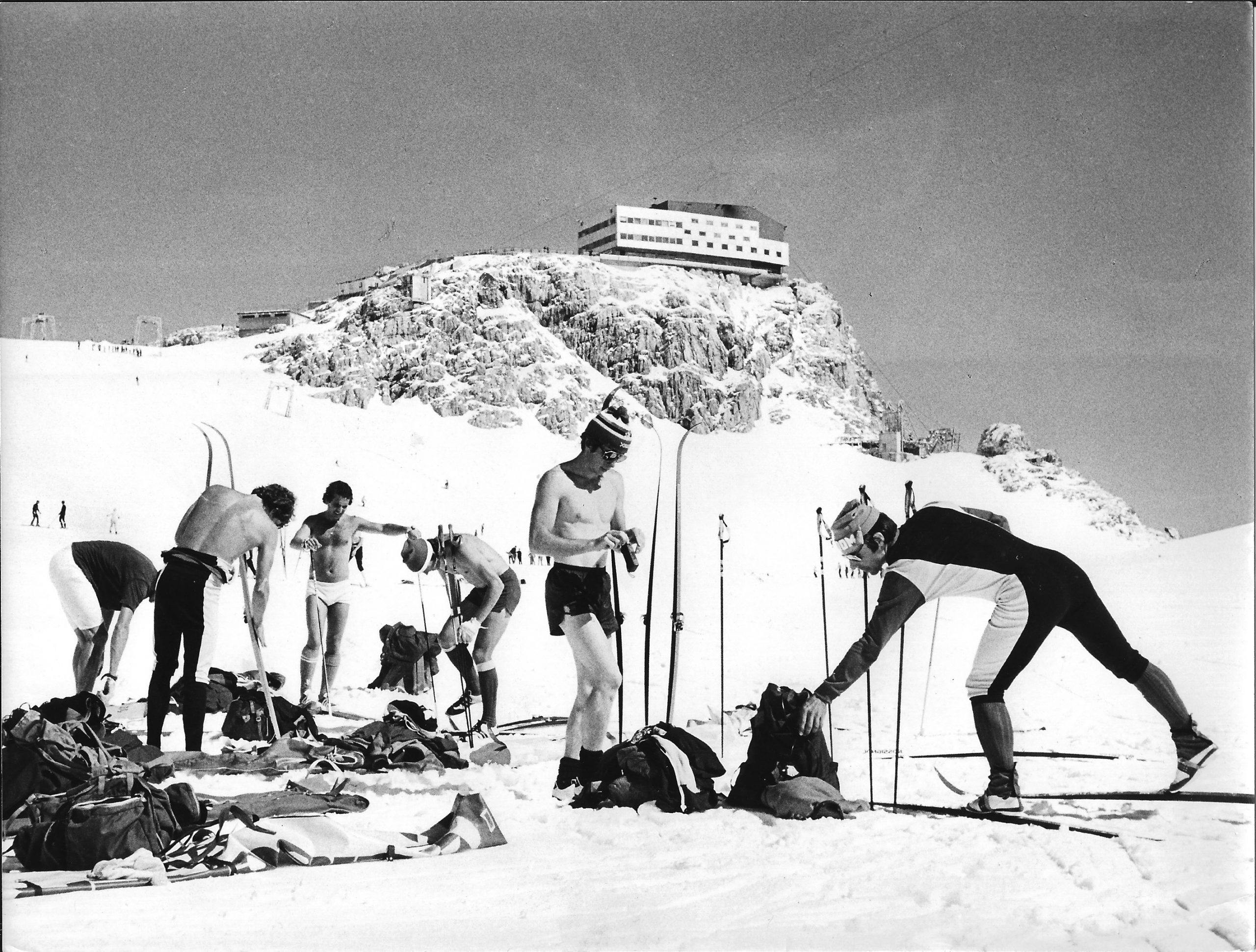
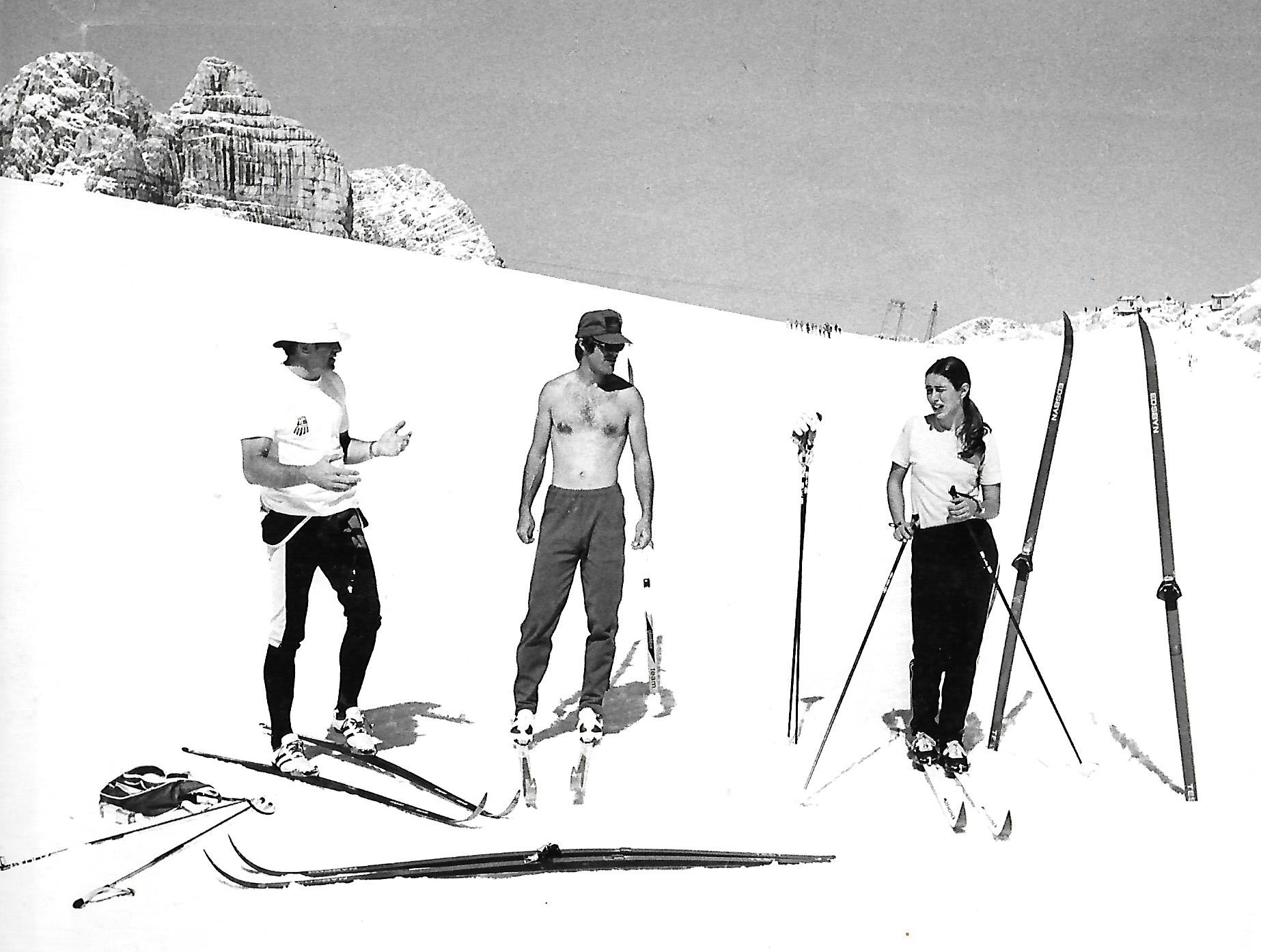
    U.S. Ski Team, 1976. on the Dachstein Glacier. (Photo: Courtesy Marty Hall)

    I finished my cross-country running season that autumn of that visit – and it was successful. The transition for me between running and skiing was always abrupt and violent. I had no upper body strength, and racing in November (when we still did that in Silver Star) was as challenging as always. I was a 2nd year Junior Boy, a club skier for a scrappy club that trained in some horrendous training conditions in a rough Northern town in the middle of nowhere. But we were driven and trained hard. A few months later, our club – Laurentian Nordic – was in Val Cartier, QC, for that year’s World Junior Trials. I had no illusions of making the team, I hadn’t even traveled to Quebec with my passport – it lay safely back in Sudbury. I barely even knew what ‘World Juniors’ was, if I’m honest. I knew that a club teammate had competed at the World Juniors a few years earlier in Canmore (Pirkko Penttila). In that first race, a 30km classic competition, I finished third, shockingly. I explicitly told my club coach, Dave Battison – that there must have been a mistake and coerced him to check with the timing staff to ensure the results were correct. There was no mistake with the results; I had finished 3rd and was now in the running to make the team. All I needed was one more good race in the 10km skate – a race that was, at best, scattershot for me (distance skating – then throughout my career, was sometimes great, other times a disaster). Shockingly, I also finished 3rd in that competition, making my first World Junior team less than a month after turning 17.

    My mom drove home to Sudbury directly after that 10km skate, over 10 hours, and couriered my passport to me in Mont Ste Anne, where we were staying for a short ‘pre-camp’ before flying to Europe. I didn’t even have running shoes (why would someone run in the winter?!), and I came to those championships with three pairs of skis (one skate, two classic), all different brands (Fischer skate skis, Atomic and Madshus classic).To say I was green would be an understatement.

    That trip changed my life. I had never been to Europe before and fell in love with the exoticness of it all—the different foods, cars, architecture, and mountains. I always loved the mountains more than anything, and we had a pre-camp in Lavaze Pass, just above Val di Fiemme. That is still one of my favorite places to cross-country ski. The alpenglow on the Dolomites is something to experience.

    1976 on the Dachstein Glacier: Marty Hall (left), women’s coach Rob Kiesel (center), Lynn Spencer-Galanes (right). (Photo: Courtesy Marty Hall)

    It was also the first time I had competed in an international competition, and we even did a time trial in the infamous Val di Fiemme stadium, where a few years later, as a first-year senior, I would compete in my first World Sr. Championships. The adventure of it all, the camaraderie with the other athletes (all were last year juniors), and representing Canada internationally was both an honor and addictive. It lit a fire in me to want more. I hated to lose and really hated to get my ass kicked. I vowed to come back stronger, to do what I could to be the best I could be – like Marty was ranting about that autumn evening in one of Canada’s worst cities – Sudbury, ON. To say I believed fully would be a lie, but I fell in love with chasing a ridiculous dream.

    That spring, I gave up on running competitively – or ‘training’ for running. One dream faded into the mists while the other became clearer. It wasn’t an easy journey. As some might know, I lost my girlfriend in a tragic cycling accident in June of 2001- as I was graduating from high school – and left Northern Ontario hating everything that Sudbury represented. I resented the countless training sessions where things were thrown at me out of truck windows, and the countless times I’d been run off the road by jackasses came to have a new meaning. Three weeks after the accident, I moved west to Canmore, a shattered version of myself. Canmore saved my life. That community was, and is, so phenomenal. I will forever be grateful to the people there who lifted me out of a deep, deep sadness and pit of despair. I tried to race for Sofie, even writing DIFS on the tips of all my skis (Do it for Sofie). I shattered myself in training, using hard training to distract me from the sadness that overcame me – when my pulse got over a certain threshold or the training session became long enough, I wouldn’t think. After a really disappointing season, I almost gave up on skiing again that spring after using training as a ‘therapy’ method left me crushed. But that spring, I used wax remover to wipe away “DIFS” and came to Spring Series in the US to race for myself. Of course, it went phenomenally well, and the results were fantastic; I was in the top 3 in the senior category.

    Where am I going with this?

    Marty reached out and congratulated me for making that first World Juniors Team – even though I got my ass kicked in Slovakia back in 2000. Alain Parent (then the junior national team coach) couldn’t believe I showed up with no passport, no running shoes and not even a pair of ‘warm-up skate skis’ to a World Championship.

    Marty Hall (left) Doug Peterson (right). (Photo: Courtesy Marty Hall)

    As a young senior, when I finally broke out and hit my first World Cup podium 3 months after turning 23 years old, again, Marty reached out. He reminded me that I had made the right choice – shockingly recalling his visit to Sudbury- but also reminded me that I wasn’t the best in the world just yet. 3rd was good, but it’s not 1st. It would take another 4.5 years before I crossed the line first – beating both Petter Northug and Dario Cologna in Toblach, ITA in early January of 2011.

    Marty and Kathy Hall with recently retired UNH Ski Coach Cory Schwartz. (Photo: Courtesy Photo)

    Tough love was part of Marty’s whole deal, but he was always honest and always believed. No excuses. Hard work over time gives results, but you have to believe. That American swagger, no doubt. As the years ticked by, he probably didn’t even remember that afternoon/evening on that dark sofa in some nondescript living room, with a skinny running kid hanging on his every word. But I do. It greatly impacted my career and life as I sit here in Norway. All of it is unimaginable for a young 16-year-old back then in Nickel City.

    Marty will be missed. There was no one quite like him. May his fire and passion never be extinguished, and may the next leaders of Canadian skiing inspire tomorrow’s skiing greats to take a chance, not give a shit what others think, and offer no respect to the international competitors. Because to channel Marty, God dammit, Canadians can and have won in this European-dominated sport we all love and devote our life to pursuing.

    From all of us at FasterSkier, Marty, you will be missed, and Kathy, we send you our love and support. Please know we are always here for you.

    Marty and Kathy Hall outside the UNH Field House. (Photo: Courtesy Photo)
  • The Devon Kershaw Show: Two legends stay gold

    The Devon Kershaw Show: Two legends stay gold

    We’re off and running in Trondheim and launch into this episode with some local flavor, literally. Devon and Nat are back at the hotel to recap a glorious first day of World Championships racing.

    We promise, we really still are hoping to schedule a live show around our packed schedules here. Send us your notes, feedback and hate mail to devon@fasterskier.com and nat@fasterskier.com.

    Jonna Sundling (SWE) proudly lifts a Swedish flag as she celebrates her Individual Freestyle World Championship in Trondheim (NOR). (Federico Modica/NordicFocus)


  • Sundling Reigns in World Championship Sprint, Kern Fifth

    Sundling Reigns in World Championship Sprint, Kern Fifth

    FasterSkier’s coverage of this week’s FIS World Championships stands as a proud tribute to American Skiing Icon Marty Hall, who (with his wife, Kathy Hall, and their A Hall Mark of Excellence Award) has generously supported our coverage of international cross-country ski events. To learn more about A Hall Mark of Excellence Award, please contact info@fasterskier.com. We’ll miss you, Marty. 


    The stage was set: Sweden vs. Norway, Jonna Sundling (SWE ) vs. Kristine Stavaas Skistad (NOR) were going head-to-head on the first day of the 2025 World Cross-Country Ski Championships in Trondheim (NOR).  (Photo: NordicFocus)

    The Women’s Freestyle Sprint is Sweden’s race to lose, but it’s Norway’s home turf to defend. This is gonna be good . . .

    The Swedes—Jonna Sundling, Johanna Hagstroem, Maja Dahlqvist, and Linn Svahn—have all claimed Sprint victories during this World Cup season. Think what Team Sweden’s training camps must be like: wake up on the wrong side of the bed one morning and you may find yourself a distant fourth in the day’s training. One week later, you could be World Champion. That’s the kind of athletic and emotional roller coaster that these Swedish Sprinters must ride if they’re to have a chance in Trondheim. And it may be that Trondheim itself represents the biggest hurdle they’ll need to overcome. This is one of Norwegian skiing’s favorite hometowns. The crowds will be close; the cheering will be intense; the stakes will be extraordinarily high. While Norway’s chances may rest on the shoulders of a single skier—Kristine Stavaas Skistad—she has shown herself capable of disrupting, intimidating, and upending the efforts of Team Sweden’s best. The Freestyle format may offer a slight advantage to the Swedes, but Skistad has won Freestyle Sprints before . . . and the crowd would be on her side.

    “It’s a phenomenal Sprint course, and I can’t wait to see how it plays out,” said FasterSkier’s Devon Kershaw.  “Different athletes will have different strategies. Someone like Sundling . . . is going to probably press from the bottom of that last big, long climb before coming into the downhill: try and get a gap on someone like Skistad, for example, who is so good on the descending parts and the sprint finish.”

    This is gonna be good . . .

    Julia Kern (USA) tucked in behind Emma Ribom (SWE) during their quarterfinal where Kern took a great line around the final corner to set herself up for a blazing homestretch to move into the semifinals. (Photo: NordicFocus)
    Women’s Freestyle Sprint

    Americans Julia Kern and Rosie Brennan lined up in the second quarterfinal, where Kern was able to advance to the semifinal by finishing second behind Jasmi Joensu (FIN). Diggins qualified only 26th. She would exit the heats after a fifth-place finish in her quarterfinal. Kate Oldham qualified 22nd, but could not advance beyond the fifth quarterfinal. She would finish the day in 22nd. Among Canadians, Lilliane Gagnon was 27th, Sonjaa Schmidt 37th, Alison Mackie 35th, and Katherine Weaver 42nd.

    Svahn was forced to withdraw prior to today’s Sprint competition, but her teammates more than held up the side. Sundling races from the front, just daring other skiers to go with her. When she’s at her best, she’s incredibly hard to beat. Dahlqvist races from the rear (often storming to victory after few could even remember having seen her during the race at all). Svahn showed herself to be practically unbeatable a few seasons ago; her recent performances are an approximation of that former dominance. Skistad never really looks like she’s sprinting until she’s steamrolling past other skiers in the home stretch. Combine the four of them in a potential Sprint Final with the likes of Nadine Faehndrich (SUI), Jasmi Joensu (FIN), Laura Gimmler (GER), and Jessie Diggins (USA) . . . fireworks are the likely result.

    Sundling remained true to form, qualifying way ahead of the rest of the field. She skied the first quarterfinal off the front while her rivals competed for second (including Skistad, who would qualify easily but well behind Sundling).

    Julia Kern (USA) had a day, making it to the finals, where she ultimately finished in fifth-place. (Photo: NordicFocus)
    Semifinals

    Kern found herself in a loaded semifinal heat alongside Joensu, Faehndrich, Skistad, and Sundling. True to form, Sundling shot off the front (followed at a distance by Skistad). Sundling controlled from the front, while Skistad showed very fast skis that could become a factor in the final. Those two advanced automatically, while Kern won the battle with Joensu for fourth, claiming the lucky loser spot into the final.

    The second semifinal was a less contentious, more tactical affair led out by Andorra’s Gina del Rio (fresh off medal-winning performances at Junior World Championships). Hagstroem was happy to sit in behind the leader while Dahlqvist hovered near the rear. On the soft and melting final turn, Hagstroem tripped through the slush and went down, allowing Lotta Udnes Weng (NOR) to take the semifinal win, followed by a hard-charging Dahlqvist.

    Jonna Sundling (SWE) charges down the homestretch to claim the World Title. (Photo: NordicFocus)
    Women’s Sprint Final

    All day long, Sundling had been bullying the Sprint heats, setting a scorching pace at the front. In the final, though, it was Skistad who shot into the lead, daring Sundling to over-commit. They quickly separated themselves from the rest, with only Faehndrich attempting to close the gap. Together, the Swede and the Norwegian skied stride for stride until the top of the final hill when an acceleration from Sundling finally created some daylight.

    She flew down the finishing straightaway to claim the Sprint World Championship for the third time (2021, 2023, 2025). Skistad collapsed as she crossed the finish line to claim second ahead of Faehndrich. Dahlqvist held on for fourth ahead of Kern in fifth.

    Women’s Freestyle Sprint RESULTS

    Women’s Freestyle Sprint QUALIFYING

    Jonna Sundling (SWE) proudly lifts a Swedish flag as she celebrates her Individual Freestyle World Championship in Trondheim (NOR). (Photo: NordicFocus)
    Kristine Stavaas Skistad (NOR), Jonna Sundling (SWE) and Nadine Faehndrich (SUI), (l-r) – share the podium of the women’s freestyle sprint, the opening event of the 2025 FIS World Championship. (Photo: NordicFocus)

    – – – – – – – – – – – – – – – – – – – – – – – – – – – – – – – – – – – – – – – – – – – – – – – – – – – – – – – – – – – –

    Our ski boots on the ground coverage was provided by Nat Herz, Stuart Harden, and Aidan O’Connell.

    This reporting costs money. Please support this coverage with a voluntary subscription (below) so FasterSkier can provide this level of access to the sport we all love year-round.

    – – – – – – – – – – – – – – – – – – – – – – – – – – – – – – – – – – – – – – – – – – – – – – – – – – – – – – – – – – – –

  • Klaebo Thrills Hometown Crowd with World Sprint Title

    Klaebo Thrills Hometown Crowd with World Sprint Title

    FasterSkier’s coverage of this week’s FIS World Championships stands as a proud tribute to American Skiing Icon Marty Hall, who (with his wife, Kathy Hall, and their A Hall Mark of Excellence Award) has generously supported our coverage of international cross-country ski events. To learn more about A Hall Mark of Excellence Award, please contact info@fasterskier.com. We’ll miss you, Marty. 

    Johannes Hoesflot Klaebo (NOR) won bronze in the Individual Sprint way back in 2017 in Lahti, Finland (where he also placed fourth in the Team Sprint). In each of the three FIS World Championships since then (2019, 2021, 2023), he’s won gold in both Sprint events as well as gold in the Team Relay (for a total of nine gold medals at World Championships). Combined with his silver and bronze medals at various championships, Klaebo enters Trondheim tied with Petter Northug (NOR) for most gold medals by a male skier in World Championship history and tied with the immortal Bjorn Daehlie NOR) for most total medals (12). With a win in the Sprint, Klaebo would distance himself from every other skier in history . . . but this isn’t even the medal Klaebo’s eventual immortality demands.

    Johannes Hoesflot Klaebo (NOR) racing on his home snow, on his home trails in front of the home crowd in Trondheim, Norway for the opening race of the 2025 FIS Cross-Country Ski World Championhips. (Photo: NordicFocus)

    Imagine this sort of pressure: you’ve won Sprint, Team Sprint, and Relay for the last few World Championships and Olympics, so naturally you’re expected to win those again. Three more gold medals—the sort of haul that grants Nordic skiing immortality to any who could achieve it—yet that’s not nearly enough to satisfy your fans and countrymen. Klaebo is constantly reminded that he’s never won an individual Distance medal at World Championship or Olympic events (though he came breathtakingly close when he crossed the finish line first in the 2021 World Championships 50 k Mass Start, only to be disqualified for interfering with Alexander Bolshunov (RUS) in the final meters). Klaebo has won plenty of individual World Cup races—interval starts, skiathlons, mass starts, pursuits—but he’s never been able to deliver an individual distance win on the very biggest stages. Trondheim is his hometown; he’s determined to do better here, even to the point that an Individual Distance medal may be even more important to him than the Sprint, the Team Sprint, or the Relay. But, to be honest, failing to win any of those would be a bitter disappointment and would certainly supply the gold-hungry Norwegian media with ammunition to lob at him from yet another angle. The only way for Klaebo to win, is to win.

    Federico Pellegrino (ITA), and Johannes Hoesflot Klaebo (NOR), (l-r) enter the homestretch during the finals of the freestyle sprint. (Photo: NordicFocus)

    And win he did—showing the easiest speed, the greatest endurance, the most clever tactics, and the fastest skis. Klaebo drove up the final hill, rocketed down the other side, negotiated the final slush-filled turn, and cruised up the finishing straightaway ahead of an ecstatic Federico Pellegrino (ITA) and Lauri Vuorinen (FIN).

    “It was a lot of nerves, that’s for sure,” Klaebo said. “I’m just glad we’re done with it now, to be honest. So, I’m really satisfied. Tussen Takk, Trondheim!”

    All four Americans—Ben Ogden, Gus Schumacher, JC Schoonmaker, Jack Young—qualified for quarterfinal heats amid Trondheim’s deafening atmosphere that Ogden, described as crazy. “Norway knows how to throw a ski race, I’ll tell you that.” Ogden grinned. “I was nervous for this one, so I’m happy to be getting going. I’m gonna try and ski smart, ski hard, leave it all out there.”

    Ben Ogden (USA, during the quarterfinals) drove the pace during his semifinal heat with the hope of setting a fast enough time that four athletes would qualify from the second heat to advance to the final. Thanks to Ogden, that is just what happened, but unfortunately, he ran out of gas with mere meters to go, ultimately crossing the line in sixth place in his heat and 12th place overall. (Photo: NordicFocus)

    Ogden and Schumacher raced a tactical quarterfinal (won by Northug), with Ogden managing to win the boot throw at the line for the final qualifying spot. Schumacher never managed to develop the speed necessary to contend in the heat. He’d finish 27th on the day.

    JC Schoonmaker and Jack Young finished fourth and fifth in their quarterfinal. They’d finish the day in 15th and 18th, respectively.

    Among Canadians, Pierre Grall-Johnson was 36th, Graham Ritchie 48th, Xavier McKeever 51st, and Sasha Masson 54th.

    JC Schoonmaker (USA) put it out there to finish the individual sprint in 15th place at the World Championships in Trondheim (NOR).
    (Photo: NordicFocus)
    Men’s Sprint

    FasterSkier’s Devon Kershaw considered the Trondheim Sprint course in pre-race interviews, describing Klaebo’s chances of mastering it. “An athlete like Klaebo, for example, has every tool in the toolbox,” Kershaw said. “I don’t think it really matters; there’s no real crucial point. But, of course, this big right-hander into the finishing stretch is incredibly crucial. You have to carry a lot of speed and stay on your feet. It’s going to be an exciting competition.”

    Joining Klaebo on the Norwegian Sprint team were Matz William-Jenssen, Even Northug, Haavard Solaas Taugboel, and Ansgar Evensen. Erik Valnes (NOR) finished second in the most recent World Cup Sprint and stands second in the season-long World Cup Sprint standings, but withdrew with a back injury prior to the start of competition in Trondheim. Everybody else was here, all the hungriest World Cup contenders—the French, the Swedes, the Germans, the Italians, the Finns, the Austrians, the Americans—but it definitely looked to be Norway’s finishing order to sort out. There were six spots available in the Sprint Final, five Norwegians entered, and only three medals to hand out. Something had to give.

    Johannes Hoesflot Klaebo (NOR) charging up the climb in front of the home fans. (Photo: NordicFocus)

    As it turned out, what gave—at least a little bit—was Norway. Valnes’s withdrawal put Jenssen in the lineup, but Jenssen got tangled in his quarterfinal and was eliminated. Taugboel skied a lackluster quarterfinal without ever being a factor. Northug was able to advance through the quarterfinal, but only by making a Kamikaze dive into the final right-hand turn before the finishing straight.

    Predictably, Klaebo cruised brilliantly through his quarterfinal heat, showing the savvy tactics and fast skis that have always epitomized his Sprint performances. Pellegrino had a difficult time weaving his way through his quarterfinal but showed his blazing speed in the finishing straightaway to win the heat and advance to the semifinals. Edvin Anger (SWE) entered the World Championships ranked third in World Cup Sprint standings, but he raced carelessly in the quarterfinals and only advanced to the semifinal as a lucky loser.

    Federico Pellegrino (ITA), pulling away from Even Northug (NOR) and Richard Jouve (FRA) on the home stretch of their semifinal, found the fitness of years past today in Trondheim. (Photo: NordicFocus)
    Semifinal

    Semifinal 1 featured Pellegrino facing Klaebo, Northug, and Anger (who had only narrowly avoided elimination in the quarterfinals). Klaebo skied flawlessly, conserving energy as he cruised to a semifinal win ahead of Pellegrino. Jules Chappaz (FRA) claimed a lucky loser spot. Northug struggled to fifth while Anger—who never looked sharp—ended his day sixth in the semifinal.

    Ogden moved toward the lead of Semifinal 2, where he was joined by Lucas Chanavat (FRA). Ogden opened up the pace on the significant uphill section, only to find his skis overtaken on the final downhill by Lauri Vuorinen (FIN) and Chanavat. An errant pole plant in the final straight dropped Ogden to sixth while Vuorinen and Chanavat advanced.

    Ben Ogden (USA) struggled to keep his balance down the final hundred meters after pushing the pace so hard earlier in the semifinal. Ultimately Ogden would finish in 12th place overall. (Photo: NordicFocus)
    Men’s Sprint Final

    It must have felt a bit strange to Klaebo, being the only Norwegian in the Sprint Final. If it bothered him at all, he didn’t show it. Choosing the far-left start position all day, Klaebo moved quickly to the front in order to control the early pace. Pellegrino matched his speed, with Chanavat following. The fatigue of the day seemed to take its toll on the racers, as what appeared to be a moderate pace still managed to stretch out the field. Klaebo coasted to the front on every downhill, followed by a stubbornly determined Pellegrino. They crested the final uphill in that order, using the subsequent downhill to repeatedly check the positioning of their pursuers. Klaebo crossed the finish, punching the air to celebrate his first gold of these championships. But it appeared that the greatest elation at the finish line belonged to Pellegrino, who seemed almost overcome by his silver medal effort. Vuorinen outsprinted Chappaz for third.

    Federico Pellegrino (ITA) may have been the happiest person in Trondheim, Norway after finishing the individual sprint in second place. (Photo: NordicFocus)

    The ovation of the Norwegian crowd lasted long after the skiers had crossed the line . . . and there are still plenty of races yet to run.

    “I’m out of words,” Klaebo said. “I mean, look at the spectators . . . it’s way different from what we are used to. This is how we do it in Trondheim . . . It’s amazing.”

    Projecting toward the upcoming Skiathlon—and the possibility of ending his own World Championship distance-racing drought—Klaebo said, “Come back on Saturday. It’s gonna be fun.”

    FIS World Championships Men’s Freestyle Sprint RESULTS

    Men’s Sprint QUALIFYING

    Federico Pellegrino (ITA), Johannes Hoesflot Klaebo (NOR) and Lauri Vuorinen (FIN) (l-r) take the Freestyle Sprint podium at the 2025 FIS Cross-Country Ski World Championships in Trondheim (NOR). (Photo: NordicFocus)

    – – – – – – – – – – – – – – – – – – – – – – – – – – – – – – – – – – – – – – – – – –

    Our ski boots on the ground coverage was provided by Nat Herz, Stuart Harden, and Aidan O’Connell.

    This reporting costs money. Please support this coverage with a voluntary subscription (below) so FasterSkier can provide this level of access to the sport we all love year-round.

    – – – – – – – – – – – – – – – – – – – – – – – – – – – – – – – – – – – – – – – – – – –

  • The Devon Kershaw Show: It’s go time in Trondheim

    The Devon Kershaw Show: It’s go time in Trondheim

    The eagles have landed in Trondheim: Devon and Nat are both on the ground (emphasis on ground, not snow) for World Championships.

    Here’s a quick dispatch from the scene before racing kicks off here. We’ll be back after the sprint tomorrow. We are definitely aiming to do a live show at some point during the championships though, semi-seriously, we need an event planner to help us pull it off, not to mention still a venue.

    Ideas? Feedback? Get us at devon@fasterskier.com and nat@fasterskier.com.

    American skier Ben Ogden poses for a photo after testing out the World Championships sprint course Wednesday, February 26, 2025 in Trondheim. (Nathaniel Herz/FasterSkier)
  • A ‘huge party’ of a World Championships is ready to kick off in Norway

    A ‘huge party’ of a World Championships is ready to kick off in Norway

    This article was made possible through the generous support of our voluntary subscribers.  If you would like to see more articles like this one, please support FasterSkier with a voluntary subscription.  

    Athletes ski on the sprint course at Trondheim’s Grånasen venue Wednesday. (Nathaniel Herz/FasterSkier)

    TRONDHEIM — It’s back.

    It’s been 14 years since Norway hosted a cross-country skiing World Championships, with the 2011 event going off along Oslo trails mobbed with Scandinavian fans.

    The championships return to the skiing-mad nation again Thursday, with the first of six medal races, a freestyle sprint, set for the Granåsen venue in the central Norwegian city of Trondheim.

    Organizers say they’ve already sold more than 200,000 tickets, with avid fans scouting out spots alongside the trails where they plan to pitch tents and camp to watch races over multiple days.

    Trondheim’s top municipal official follows the sport closely enough that he’s rooting not just for the home team — but for a particular American star, too.

    “I will be a smiling mayor if Jessie Diggins does well,” Kent Ranum, Trondheim’s mayor, said in an interview Wednesday.

    If Oslo is Norway’s urban center of cross-country skiing, Trondheim, and the surrounding ​​Trøndelag region, is the sport’s heart.

    Johannes Høsflot Klæbo, the Norwegian superstar, is from here, and “we have raised most of the medalists throughout all the years,” said Ranum — including 15-time Olympic medalist Marit Bjørgen, who now coaches the Norwegian women’s team.

    Norwegian superstar Johannes Høsflot Klæbo skis with coach Arild Monsen in Trondheim on Wednesday. (Nathaniel Herz/FasterSkier)

    Ranum also describes Trondheim’s residents as “world-class hosts,” and concerts and other events accompanying the championships are planned at venues across the city.

    “It’s looking like it’s going to be a huge party for the next 10 days,” said Tony Cyr, a Canadian athlete, after his workout at Grånasen on Wednesday. “You walk around town and everything’s about skiing.”

    Ben Ogden, a young American star, added: “The entire town, you can feel, is prepping for something.”

    American skier Ben Ogden poses for a photo after testing out the World Championships sprint course Wednesday. (Nathaniel Herz/FasterSkier)

    At Grånasen, athletes were greeted Wednesday by an enormous grandstand looming multiple stories above the stadium. The stands were empty — but they’re expected to fill up for Thursday morning’s sprint.

    Dozens of nations trained at the venue Wednesday, after finishing tuneup camps at resorts and cabins scattered across Europe. The atmosphere was semi-organized chaos, as athletes, coaches and ski technicians tested out the tight 1.4-kilometer sprint course.

    “This level of chaos — this just screams championship,” said Ogden. “And not only championship, but a championship that everybody is getting fired up for.”

    Athletes, coaches and technicians crowd the sprint course Wednesday. (Nathaniel Herz/FasterSkier)

    Ogden — who, in spite of recent World Cup podium finishes, is still not a household name across America — got his own dose of Norwegian ski fervor when he went to a Trondheim camera shop this week to buy some equipment for his video blog.

    The man at the counter, Ogden said, asked what the gear was for.

    “I was like, ‘Oh, I have a YouTube channel,’” Ogden said. “He’s like, ‘Oh, are you Ben?’ I was like, ‘This is so cool.’”

    Mayhem could be on tap in Thursday’s sprint

    Thursday’s opening medal event takes place on a compact course that’s nearly all viewable from the Grånasen stadium — essentially, a long climb followed by a long downhill into a tight, bending curve, back up the hill, then back down to the stadium, with a sweeping, 180-degree righthand turn before the finishing stretch.

    That final corner could end up being a defining feature, as it claimed numerous athletes in slips, skids and falls during Wednesday’s training session. American sprinters Ogden, J.C. Schoonmaker and Kevin Bolger tangled in a three-way crash that broke one of Bolger’s skis.

    “We were doing a group speed and getting a little aggro,” Ogden said afterward. “But it’s a good way to learn what not to do for tomorrow.”

    Trondheim’s above-freezing temperatures — forecast to continue for at least the next few days, with potential for rain and snow mixed in — also contributed, producing conditions that were simultaneously sloppy and slick.

    U.S. superstar Jessie Diggins skis on the Trondheim sprint course Wednesday with her coach Jason Cork. (Nathaniel Herz/FasterSkier)

    Ogden said that the final corner will be a spot to watch.

    But he also said the course’s climbs are “really long,” giving at least a chance for some athletes to break away.

    “I don’t know what you’ll see tomorrow. I think some of it will depend on how firm it is,” he said. “If it’s slushy, like today, it’ll be so costly to try to make a gap on the hill that I don’t think you’ll see a lot of people doing it.”

    Another U.S. athlete, Rosie Brennan, described the sprint’s two corners as “very spicy.” But, like Ogden, she also said “there’s a lot to the course.”

    Klæbo, the local, has won the last three World Championships sprints — in 2019, 2021, and 2023 — and has not lost a sprint on the World Cup in more than a year.

    He’s the favorite in Thursday’s men’s race, especially since he’s known for his skill in navigating sharp turns like the final one on the Grånasen course.

    Ogden said it’s still too early to name that curve “Klaebo corner.” But, he added, “it has all the marks of being dubbed as such before too long.”

    “He knows how to navigate tricky situations better than anyone I’ve ever watched,” Ogden said. “I’m sure he’ll put on a master class there tomorrow.”

    The women’s race is more of a toss-up.

    Norway has Kristine Stavås Skistad, a rising star who won last year’s test sprint race at Grånasen.

    But Skistad missed competitions earlier this year while recovering from a surgery, and two weeks ago, she finished behind Swedish star Jonna Sundling in the last World Cup sprint race before the championships.

    The U.S. women discuss tactics after testing the World Championships sprint course Wednesday. (Nathaniel Herz/FasterSkier)

    A duel between Skistad and Sundling would certainly give Scandinavians something to feud about over the next week of ski racing.

    The ever-present rivalry between Sweden and Norway has heated up with the approach of the championships — including with the release of a diss track by Swedish rapper Markoolio, who mocked Norwegian cross-country superstar Petter Northug’s past history of cocaine abuse.

    Ranum, the Trondheim mayor, summed up the mostly-generous spirit of the Norwegian hosts when he said he wouldn’t mind seeing Diggins knock local athletes off the podium.

    “It would be great,” he said. “Anybody but the Swedes.”

    U.S. and Canadian starters, men’s sprint: USA, Ben Ogden, Gus Schumacher, Jack Young, J.C. Schoonmaker; Canada, Xavier McKeever, Sasha Masson, Graham Ritchie, Pierre Grall-Johnson

    U.S. and Canadian starters, women’s sprint: USA, Julia Kern, Jessie Diggins, Rosie Brennan, Kate Oldham; Canada, Katie Weaver, Alison Mackie, Sonjaa Schmidt, Liliane Gagnon

  • Legends of the Birkebeiner (not the ones you think)

    Legends of the Birkebeiner (not the ones you think)

    We’d been promised powdered sugar donuts. We’d need them . . . it was a long, long way to the finish line. A bit over 50 kilometers (the original race-distance, before it got shortened to a nicely rounded 50 k), plenty far enough to test the will, the patience, and the endurance of even the hardiest skiers. It’s as far (so we’re told) as the original Birkebeiners carried the young Prince Haakon across the mountains to safety during the murderous ragings of the Norwegian Civil War. That young prince’s survival is the reason, today, that Norway is a stable Scandinavian monarchy. It’s the reason, today, that Norway is absolutely bonkers about cross country skiing. It’s their sport, it’s their tradition, it’s their passion, it’s their national origin story. Cross country skiing belongs to Norway in a manner unrivaled by any other northern nation; the legend of the Birkebeiners is how it started.

    Back to the donuts; they’re never far from memory. In 1981 (or 1982, I can’t remember which), we lined up to be part of a still-evolving neo-tradition in the north woods of Wisconsin. The American Birkebeiner was the fairly wacky brainchild of a fairly wacky individual (the inestimable Mr. Tony Wise) who sought to develop public fascination in an underdeveloped sport on the trails of an underdeveloped resort (Telemark Lodge). Somehow, it worked. By 1981, the race had become a legitimate stop on the World Loppet tour (an associated grouping of the world’s great ski marathons: Norwegian Birkebeiner, Sweden’s Vasaloppet, Switzerland’s Engadin, Italy’s Marcialonga, etc.). Wise developed the American Birkebeiner to appeal to Midwestern sensibilities: the race was too far, the course was too hard, the weather was too unpredictable, and the venue was just too far away. The Midwest ate it up. Nearly 7,000 showed up on the starting line in 1981 (or ’82, I can’t remember which). I was among them. All I knew was that we’d been promised powdered sugar donuts at each of the race’s feed stations. I could eat a lot of donuts . . . and if there were enough of them available trailside, I might just be able to finish that race. I did finish, but in a manner that left certain marks, certain scars, certain memories, certain pride. And I never did get any donuts (that’s the “scars” part). Even so, my little story left a skiing legacy that affected more than just me . . .

    Randy “Jabo” Jablonic had been Head Coach of the University of Wisconsin Crew Team since 1968, guiding his teams to NCAA championships in 1972 and 1975. There was no lightweight crew in those days, no junior varsity. There was one big boat filled with eight big guys (and a tiny little coxswain). Jablonic’s job was to build them into a team that could make an eight-man rowing shell fly. But no one grew up rowing in Wisconsin: no rowing clubs, no youth programs, no prep schools. Heck, the waters of most Wisconsin lakes are only ice-free for six months a year. the UW needed rowers, and recruiting was going to prove to be something of a challenge. Fortunately, Jablonic considered rowing to be a sport, while dependent on exacting technique, that could be learned by near-adult athletes. If they could sit up straight, if they could drive the legs without “shooting the slide,” if they could apply full power to the oar without “catching a crab,” then any strong farmer kid could learn to row for the UW. In order to find them, Jabo stalked the autumn class-registration lines on the UW campus. Clipboard in hand, he signed up any boy 6’2″ or taller. I know because I was in the line when Jabo and his hulking captains came along. They signed up the kid in front of me in line. They signed up the kid behind me. Their captains looked right over the top of my head, searching for other candidate cowlicks bobbing above the crowd, but I grabbed hold of the clipboard and added my name to the list (though at my first practice, an assistant coach whispered to me that he worried I was too tall to be a coxswain). I wasn’t really what the UW Crew Team was looking for. What was needed were guys with more reach—and more talent—than I had. What was needed were a few freaks of nature with lungs the size of beer kegs and fairly wide athletic mean streaks. I was like a terrier among the clydesdales, but I was strong and fit. And the rough waters of Lake Mendota left space in the boat for a light-weight, light-handed man in the bow seat. I’d be able to stay with the team through the autumn and winter, until serious selections were made for the smooth-watered season of spring championships. And winter is when things got interesting. That’s when Wisconsin’s team of clydesdales put on the cross country skis . . .

    Randy Jablonic employed some old-fashioned training strategies (not entirely original or revolutionary, just quaint by modern standards), including the circuit training on the ramp of the boathouse, the 10 mile run (which varsity crew members were expected to complete in under an hour—pretty fast running for some pretty big guys). The final element in the Randy Jablonic’s training strategy was cross country skiing the rough trails through the UW Arboretum. He figured if it was hard, if it got your heat pumping, if it worked up a sweat, then it was good for his rowers. Skiing fit the bill.

    Not enough snow fell in 1981 (or ’82, I cant remember which) for the UW Crew Team to have any days on the trails, so the entire holiday season passed with no way to try out our skis. November passed, December, January, February—while our training remained confined to the steamy rowing tanks inside the boathouse on the south shore of Lake Mendota. When finally the snow arrived, there was only enough time to enter the famous Birkebeiner race, and drive north.

    I had never been on cross country skis . . . the results were predictably awful on that day, predictably comical all these decades later. A tragically ill-advised klister mix, the spread-eagled snow-ball on nearly every downhill, the UW Athletic Department cotton sweatshirt and sweatpants that weighed 200 pounds by the finish line, and not one powdered-sugar donut left at any of the feed stations. Bits, corners, and shards of powdered-sugar donuts lay strewn in the klister-spoiled snow of every feed station, winter’s white stained lurid green with the splashings of emergency-gatorade. Even all these years later, I think a part of me is still out on that trail.

    I thought mine was a pretty unique story. Turns out, it’s a fairly common every-year occurrence. Over time, the odd American Birkebeiner tradition that’s developed among practitioners of endurance sports is one in which athletes from non-skiing sports strap on skis and take on the American Birkebeiner . . . thinking it’s just a test of endurance (of which those athletes have plenty). I think most of their stories end very much like my own: prolonged suffering, gritty endurance, and lasting memories.

    My old friend Tanner. He’s a force of nature. (Photo: FasterSkier)

    I’ve been a writer, a teacher, and a coach of young athletes for many years, and my “Crew Team Birkie” is a story I’ve related to so many young minds who populated my teams. Every few years, one of them takes the bait. 2025 was one such year.

    Tanner is a force of nature: brilliant, playful, fearless, and possessed of a wacky quality of which Tony Wise would’ve been proud. He was a part of my school’s cross country ski team in high school—a 6’4″ senior walk-on who had never skied before. He flailed gleefully through that transformative season, then hung up the skis for good, replaced by the oars of Dartmouth’s varsity heavyweight crew. He’s stayed on the water ever since, even claiming victories at last year’s Master’s Championships. But skiing was far in his past. Until 2025.

    I received a text from Tanner a month ago—seeking advice on how to prepare for the Birkebeiner. He and some rowing friends were getting ready for it, and they hoped a few pointers would allow them to use their fearsome  rowers’ fitness to fly toward the finish line. Well, anyone who’s ever learned to cross country ski knows things just don’t work that way. It’s an exactingly technical sport that puts a high value on balance and timing . . . a somewhat different set of demands from a sport (rowing) where the athletes are literally sitting down. Rowers are definitely tough and fit—it’s a brutally hard sport—and they’d need all that toughness and fitness just to make it to the finish line.

    “You should write about all these guys Greg Myhr brings out here for the Birkie,” Tanner said. “They’re all rowers who have never been on skis. We bought two guys gloves today, and three guys did a “try on their skis and slide around on the lake. They were wearing jeans . . .”

    Tanner did make it to the finish line, though he described his before and after photos as a “do-it-yourself Portrait of Dorian Gray.”

    “It wasn’t that bad,” he said. “I realized with 5k to go that I should have gone harder!” Rowers . . . tough kids.

    Traditions abound in Wisconsin’s northwoods, none more enduring than the American Birkebeiner. And Legends of the Birkebeiner persist, perhaps in more forms than we originally realized. Jessie Diggins and Gus Schumacher won last year’s 50th American Birkebeiner in glorious victory laps following the Minneapolis World Cup of 2024. This year’s winners were Gérard Agnellet and Sydney Palmer-Leger, who wrote their names into the book of Birkebeiner champions.

    2025 American Birkebeiner, Men’s

    1. Gérard Agnellet, 2:03:01.1
    2. David Norris, +1:30.6
    3. Michael Earnhart, +2:10.2

    2025 American Birkebeiner, Women’s

    1. Sydney Palmer-Leger, 2:25:06.7
    2. Jessica Yeaton, +1.6
    3. Lauren Jortberg, +3.0

    Tanner’s follow-up text arrived son after the finish: “166 heart rate for five #%&*@ hours!” he said. “Those good guys have it easy. It’s over so fast!” In the 2025 Birkie, the fastest skier (Agnellet) finished in 2:03.01. Back in 1981 (or ’82) I wouldn’t even have been to the disappointment of the first donut stop yet . . .

    The author, engaged in his more familiar winter sport, 1981 (or ’82).
  • A Glove Solution for Skiers with Raynaud’s Syndrome

    A Glove Solution for Skiers with Raynaud’s Syndrome

    Heading out for a cross-country ski on a late winter day when the air is still, and the sun is warm is one of life’s true gifts; in fact, if you are reading this, these words probably evoke some memory that is making you smile right now.  On the contrary, bundling up to head out on a dark morning in early January when the wind is hollowing so hard you worry any of the large creaking branches above could be the last sound you hear is, at the very least, less fun.  Sure, when we do take on those days, we feel like tough gladiators, but oftentimes, these days are paired with discomfort.  Now, imagine you have Raynaud’s syndrome.

    In case you are unaware, Raynaud’s syndrome, also known as Raynaud’s phenomenon, is a condition that affects blood flow to certain parts of the body, usually the fingers and toes. It occurs when small blood vessels in these areas constrict excessively in response to cold temperatures or stress, reducing blood flow.

    I have several close friends with Raynaud’s, and selfishly, it was really impacting our ability to ski together, so I started poking around on the internet for products that would allow them to cross-country ski comfortably when it was less than 20’F.  As I sat working at a local coffee shop, like I often do, I even had a random stranger approach me, who had been, a little alarmingly, watching me bounce around the internet, to ask if I had any recommendations for cross-country skiers with Raynaud’s.  At that moment, I knew FasterSkier could help the ski community find a solution to an issue that was more significant than I had imagined.

    I reached out to several of our wonderful industry partners and friends to see if they would send us products to test, and of course, they generously did so. We tested gloves, mittens, and liners under a variety of conditions and were less concerned with comparing brands than we were with finding the best solution—as you will see.

    At the end of the testing, one combination stood out above the rest.

    What quickly became clear to our primary tester was that it didn’t matter how much insulation a glove or mitten provided if it was cold enough—even with a chemical heating pack tucked into the glove—their hands would still be painfully cold. The only proper solution had to include battery-powered heat.

    Of all the available options, the Auclair Heated Liners were our top pick.  The liners are thin, soft, breathable, and they heat up quickly.  They have various temperature settings that are so effective (you rarely even have to use the highest setting). The heating elements extend through each finger, which most gloves don’t have, and are a necessary feature for skiers with Raynaud’s. 

    The design makes it easy to adjust the temperature while skiing.  They are the easiest gloves to charge as they simply click into the charger with a magnet, so you don’t have to take anything apart, and they also have the thinnest battery pack of any we tested.  The Auclair Heated Liners maintain warmth and circulation while Nordic skiing, downhill skiing, or standing in the cold spectating. 

    Overall, they had the best design, fit, comfort, and ease of use of any heated gloves we tested. They provide targeted warmth to each finger, the heat is continuous (not all heated gloves are), and the design helps with blood circulation to the fingers. Their soft and snug fit makes them easy to wear with any glove or mitten over them. 

    Now that we had a solution for the warmth, we began to hone in on an outer layer to protect against wind, snow, ice, and rain.  While it is unlikely a skier with Raynaud’s could use the Toko Toasty Thermo Mitten alone in cold temperatures, they are our top choice over the liners. 

    Toko gloves have been a favorite of mine for over 30 years, so this didn’t come as a surprise.  Toko gloves and mittens are designed for cross-country skiing, so you won’t be trying to squeeze some boxing gloves into your pole straps.  In fact, if you are only going to use this combination for cross-country skiing or don’t have Raynaud’s syndrome, you might consider the Toko Polar Race Mitten, as these mittens have extra insulation around the fingers but less on the inside for a better feel on your grip and less on the back of the hand to fit more easily into straps.  However, for skiers with Raynuad’s syndrome, warmth is the first priority, so we kept gravitating towards the Toko Toasty Thermo Mitten primarily because of the added nylon exterior that protects against snow, wind, and light rain.  They also have a nice thick elastic band that stretches well and stays in place.  The Toko Toasty Thermo Mitten was also easy to pull on and off over the Auclair liners, making the pair work perfectly in tandem.

    With the Auclair liners retailing at $340 and the Toko mittens retailing at $65, we understand that this bundle is an expensive solution, but hopefully, you won’t waste money trying other products that do not work.  There is also the added bonus that you can wear the Toko mittens alone when the weather is warmer – for people with Raynaud’s, that might not be until it is over 40’F or higher, but at some warmer temperatures, it becomes an option which is appealing.

    For cross-country skiers with Raynaud’s, this combination of the Auclair Heated Liner and the Toko Toasty Thermo Mitten is the difference between being stuck inside all winter and being able to cross-country ski no matter how cold it is outsidewell, at least your hands will be warm.


    –  –  –  –  –  –  –  –  –  –  –  –


    *While neither Auclair nor Toko were advertisers of FasterSkier at the time of publishing this article, Auclair would like to offer our readers a special coupon to help keep their hands warm. Unfortunately, the heated line is in such high demand that the discount will not apply to the heated liners, but feel free to try some other Auclair gloves—the WWPB Gigatex Mitts, for one, are beautifully made and also a staff favorite.

    25% discount code off the Auclair website. 

    FasterSkier Discount Code: PA-2025-FASTERSKIER-25

    • One use per customer
    • Not valid on heated and discounted items
    • 25% off


    –  –  –  –  –  –  –  –  –  –  –  –


    A Little More Information About Raynaud’s Syndrome

    Symptoms typically include:

    • Color Changes: Affected areas may turn white or blue in response to cold or stress and may turn red as blood flow returns.
    • Coldness or Numbness: The fingers or toes may feel cold or numb during an episode.
    • Tingling or Pain: Some people experience tingling or pain when blood flow returns.

    There are two types of Raynaud’s:

    • Primary Raynaud’s is the more common form and is not usually associated with underlying diseases. Lifestyle changes can often manage individuals with Raynaud’s.
    • Secondary Raynaud’s (Raynaud’s phenomenon): This form is associated with other medical conditions, such as scleroderma or lupus, and may be more serious.

    **Consult with a Doctor** Before engaging in cross-country skiing or any strenuous activities, especially if you have severe Raynaud’s, it’s a good idea to talk with your healthcare provider about personalized strategies and treatments.

  • Bringing a Community Together Around Nordic Skiing: Oak Hill Prepares to Host NCAAs 2025

    Bringing a Community Together Around Nordic Skiing: Oak Hill Prepares to Host NCAAs 2025

    This article was made possible through the generous support of our voluntary subscribers.  If you would like to see more articles like this one, please support FasterSkier with a voluntary subscription.  

    As Dartmouth prepares to host the 2025 National Collegiate Athletic Association (NCAA) Ski Championships, Oak Hill Outdoor Center in Hanover, New Hampshire, has been transformed from a rustic trail system to one of the premier cross-country ski venues in the East. As preparations for NCAAs have ensued over the previous three years, this article sheds light on the history and evolution of the site and community as they have united behind planning for this event. 

    History
    Oak Hill as it appeared in the 1930s (Photo: New England Lost Ski Areas Project)

    Oak Hill has been a cornerstone in the New England ski scene for nearly a century, drawing regional skiers to its humble slopes in the heart of Hanover. The ski area is said to have hosted one of the first J-bar lifts in the country, pioneering local skiing in Hanover since 1936. As a gathering point for the regional ski community, a ski jump was also constructed in the early 20th century, fashioning a venue fit to host “skimeister” competitions in their heyday of the mid-1900s. While the alpine ski scene moved to the modernized Dartmouth Skiway in Lyme, NH as construction concluded in the 1980s, Oak Hill’s legacy in the world of skiing had only begun. Now, remnants of its past are still visible in the clearcut downhill trails that coat the hill above the main stadium. 

    The Venue and Community
    Top of Oak Hill 2.17.25 part way through the s-curve descent. Natural snow coats the trail, which is laden with pine needles and sticks – a better-than-average ski day during a particularly snowy winter. Oak Hill continues to maintain its charming “old school” trail system following the installation of a world-class homologated course. (Photo: Kennedy Lange)

    Cross-country ski trails now meander through steep ascents, hair-raising S-curves, and host gorgeous views out over the Connecticut River Valley. The challenging terrain has earned a reputation for developing some of the most technically skilled skiers in the country who are used to gliding over ice patches, jumping over the frequent rock in the trail, and avoiding trees on the notoriously narrow trails. 

    Oak Hill is the home of the Ford Sayre Ski Club, one of the largest and oldest nordic ski clubs in New England, serving over 500 skiers each year from elementary children through masters. Children join the club in the Bill Koch League from kindergarten through 8th grade, and then transition onto the Junior Nordic Team (JNT) which hosts a roster of 26 competitive local high schoolers. Ford Sayre consistently graduates athletes onto collegiate rosters, where they continue their competitive career on the Eastern Intercollegiate Ski Association (EISA) circuit. 

    Oak Hill is also the home venue for the Dartmouth College cross-country ski team, attracting some of the top recruits in the country each application cycle. Since the formation of the team, athletes and alumni have competed at every winter Olympic Games, and claimed hundreds of All-American titles. The team itself hails from all regions of the US and Canada, and this winter sent four athletes to compete overseas at Junior Worlds. Dartmouth’s current students and alumni constitute the second-largest group from any university on the Stifel US ski team, trailing only the University of Utah. For the 2024-2025 team, this includes Dartmouth alumni Julia Kern and Rosie Brennan (A team), as well as current students John Steel Hagenbuch (B team), Jack Lange, and Ava Thurston (Development team). Jasmine Drolet and Luke Allan also sit on the Canadian National Ski Team roster. As one of the most elite collegiate teams in the country, it seems only fitting that the team has a venue capable of hosting equal caliber competitions.

    Green grass surrounds the ribbon of snowmaking during the 2024 winter season. (Photo: Peter Milliken)

    In recent years, Hanover has experienced increasingly variable snow conditions, and skiing at Oak Hill has not been taken for granted by the local community. Hanover already receives less snow than neighboring towns due to its location within the Connecticut River Valley, and has struggled to maintain a base deep enough to ensure skiing through the winter season. 

    Regional skiers may also be aware that Dartmouth’s annual EISA race is rarely hosted at home, with only two carnivals between 2008 and 2019 hosted at Oak Hill, otherwise relocating over two hours north to Craftsbury, VT. Aside from hosting races, snow inconsistency at Oak Hill has significantly impacted Dartmouth’s training regimen. During the 2019/2020 winter, the Dartmouth Nordic team had 35 practices planned during winter term, of which only 10 could proceed as planned at Oak Hill. Even then, the low base made classic skiing difficult without access to groomed ski tracks. For the remaining sessions, the team either drove to Dorchester, NH or Woodstock, VT—adding 1–2 hours of travel mid-week, a significant commitment for student-athletes—or switched to running.

    Cami Thompson, head coach of the Dartmouth Women’s ski team, has navigated the challenging conditions at Oak Hill throughout her 35‐year tenure. Reflecting back on the winters, Thompson noted that the team “could generally plan on skiing at Oak Hill for some part of every season.” Due to the elevation difference, it was common for the trails to be skiable on the hilltop when they weren’t in the stadium. When this was the case, the team would hike in from a nearby road or hike uphill from the parking lot to get to the skiable trails. As Thompson recalled, “there were definitely days when hopping over muddy sections was a thing.” More importantly, “everyone had rock skis, and that is what we skied on most of the time at Oak Hill.” 

    Renovations

    Oak Hill is nearing the culmination of a two-year upgrade that will significantly expand its facilities. The project includes adding snowmaking and lighting along a three-kilometer loop, paving the notoriously muddy parking lot, and building a new state-of-the-art homologated race course designed by Morton Trails. In addition, a new lodge is being constructed in the stadium, a new building will house trail equipment and groomers, and the rental center will soon welcome visitors with access to a large inventory of trailside equipment. 

    Although discussions of adding snowmaking and widening trails began in the early 1990s, early efforts struggled to secure the necessary support from Dartmouth College, The Hanover Improvement Society who owns Storrs Pond (the water supply for the snowmaking installation), and the local community. It wasn’t until 2017 that the discussions leading to the modern iteration of the project began, spearheaded by community members Matt Rightmire and Peter Milliken. Since then, a unique partnership between Dartmouth College, who previously owned the land, and the local ski community, has helped successfully pull together a plan and funding for renovations. 

    Locals Peter Milliken (Left) and Matt Rightmire (Right) resurfacing the newly cut trail. The pair played an instrumental role in coordinating the renovation effort, and promoting the collaboration between the College and community. (Photo: Peter Milliken)

    Working together with the College, the group began researching both the installation and  maintenance costs, as well as long-term economic sustainability of the center. “It took a while to get the college and community together on how it was that we were going to fund it and how it was that the center was going to be operated once it was funded,” Rightmire shared in a discussion with FasterSkier this winter. It took nearly five years of negotiations between the college and the community before an agreement was signed in 2022 to begin the work. “Dartmouth, like it would have been for any institution of higher learning, took some time to get comfortable with partnering with the community in this way.  It was a new thing for them to do,” Rightmire added, “and, it was complex because of it.”

    “One advantage to having been at Dartmouth for so long is that I have developed patience when it comes to things getting done; there is an idea, it gets shot down, you present it another way, find the right people to support it, and some money and eventually, dreams do come true!” coach Thompson shared. “To me, the beauty of this project has been the community and the College working together.” Thompson reiterated the complexities of collaborating in such a way, adding that they “saw many eyes roll along the way when we talked about the College and the community working together, but there was also the gleam of hope and an understanding of how cool the project could be.”

    Amid ongoing discussions between the college and the local community over possible updates to the venue, Dartmouth secured the 2025 NCAA bid. In order to host the race at home, the selection committee requires that venues have an FIS-homologated race course and preference goes to sites with snowmaking infrastructure. This high-profile event served as the catalyst for the renovations, uniting the community to meet the tight timeline over the following three years. “There were certainly ups and downs throughout the process but the enthusiasm at community meetings, and talking to smaller groups kept it moving forward, along with the bid to host the 2025 NCAA Championships looming out there,” Thompson explained. 

    Stage one of building the homologated course was logging and clearcutting the trail (Photo: Peter Milliken)
    During the second stage of trail building, the course was carefully shaped and leveled. (Photo: Peter Milliken)
    The race course takes shape, flowing over rolling hills following the Storrs Pond shoreline. (Photo: Peter Milliken)
    After the course was routed, the snowmaking installation involved burying pipes around the 3-kilometer loop. (Photo: Peter Milliken)
    Finally, the parking lot was paved and widened, adding parking spots with electricity for team trailers on race day. (Photo: Peter Milliken)

    One of the hurdles the planning committee needed to overcome was the utilization and accessibility of the venue. “We wanted to create a world-class racing venue, while at the same time building something that was accessible skiing 12 hours a day for the community.” Of course, “elite athletes want a homologated course that has amazing conditions from the first time that snow is available to the end of March,” Rightmire shared, but “the community cares about other things. They want a parking lot that isn’t a mud pit, they want terrain that is challenging but accessible whether you’re a 4-year-old on skis for the first time, or an 84-year-old who has a lifelong passion for the sport, but probably doesn’t ski as aggressively as they once did.” Given the topography surrounding Oak Hill, and the vertical requirements of a homologated venue, this was “very very hard.”

    Ford Sayre head coach Hilary McNamee emphasized the challenge of crafting a trail system that meets both competitive and recreational needs. McNamee reflected, “I do think the general sentiment is that the goal was achieved. Yes, the trails are on the harder side for beginners and recreational skiers, but boy are we making some tough little BKL skiers now!” 

    Overall, the community has embraced these changes and the opportunities they will grant for the small venue. Yet, “change is hard.” While Oak Hill was open with often-rocky and inconsistent conditions previously, it’s not easy to see such a large change in your community. “When you go into forests and walking paths that people have made a part of their ways and alter them in a pretty significant way, they need to believe in what it will become over time,” Rightmire shared.  “We had to talk the community through what this would be in two, three, or four years, and earn their trust.” Through discussions with the community, Rightmire concludes that “the project was better because of the concerns that people voiced.”

    The new course opened to the public in the winter of 2024, earning enthusiastic support from local teams, and mostly positive reviews from the community. While residents were grateful for having skiing so close to town and for the consistently good snow throughout the season, feedback quickly emerged suggesting that the venue could be made more accessible. With over 370 feet of climbing on the 3.3 kilometer loop and fast descents, it was somewhat unfriendly to less experienced skiers. To address this, by 2025 a new trail was cut between the two fingers of the course, granting skiers the option to skip the most technical descent and steepest climb.

    The local community rallied behind the renovation effort, relying upon volunteers to provide trail work support (Photo: Peter Milliken)

    “In year two, the broader community understands and appreciates the value of [Oak Hill] as a community resource,” McNamee commented. Locals are appreciating not only the easy access to reliable skiing near town, but also the lights that enable skiing after dark during the shortest days of the year, the mudless parking lot, and the brand new rental equipment available to season pass holders. These upgrades have contributed to a 44% increase in ticket sales from the 2023/4 to the 2024/5 winter season so far, with further increases expected through the end of the season. 

    For leadership of the Ford Sayre ski club, the reliable ski conditions grant coaches and coordinators time that had previously gone toward planning logistics for practices. “I can’t even begin to quantify how many hours went into determining where and how to host safe and fun ski practices for 300+/- kids, week in and week out, let alone events,” McNamee shared.” The extra time has also given the club leadership capacity to provide programming outside of the Bill Koch League. ”We had kind of given up on masters programming because we were all so exhausted from trying to figure out logistics for the kids.” Over the past two years, Ford Sayre’s masters program has grown to over 60 participants. 

    Similarly for Dartmouth, Thompson is excited about the flexibility that comes with having reliable conditions close to campus. “Now we can plan workouts in advance and know we will have groomed tracks in certain areas to run specific workouts,” Thompson shared. “Previously, we were often guessing which stretches of the trail would work, and then we would have to adjust if there weren’t tracks that day, or there were more rocks in certain areas. It was like trying to plan a basketball workout on a warped floor.”

    Aside from the consistent conditions that snowmaking has ensured, the number of skiable days has lengthened as well. The trails have been able to open both earlier in the season the past two years, and remained open through April last year, expected to increase the season length from an average of 70 to 120 days per season. Historically, the center’s average opening and closing dates were around December 22nd and around March 19th, respectively. After the first winter of snowmaking last year, Oak Hill remained open until April 7th—the latest it has been open in recent years and extending the season almost a month longer into the spring. Furthermore, the assurance of steady mid-winter conditions enabled Ford Sayre to host the Silver Fox Trot, its annual ski race, at home last year for the first time in five years, as well as the Dartmouth Carnival EISA race. 

    Bill Koch League racers enjoying the widened trails in the first Silver Fox Trot competition on the new course. (Photo: Peter Milliken)

    Beyond the expanded access to skiing for the local community, race results from the local club have highlighted the impact of consistent snow conditions and improved training loops. In 2024, JNT skier Lea Perrard was Ford Sayre’s first national champion since 1995 and in 2025, JNT skier Annelies Hanna was the first skier in decades from Ford Sayre to represent team USA on the U18 Scando trip in Norway this February. 

    Improvements won’t end here, but are ongoing as the new venue is tested. “We need to figure out warm up tracks and testing areas as well as parking and shuttling,” Thompson explained as they continue to experiment with the new trail arrangement and figuring out how to host competitions at the venue. During the summer, plans are also in place to improve the mountain bike singletrack trail system, expanding year-round access to the trail system. 

    NCAA Competition

    As renovations are concluding, preparations to host NCAAs at Oak Hill are in full swing. The competition will take place March 5–8th, drawing the fastest collegiate racers in the country to Hanover, NH. With an expected attendance of 2,000 to 4,000 spectators—and featuring live music and local food trucks—NCAA’s promises excitement and fun for fans of all ages. 

    This year’s NCAA National Championships will kick off with an opening ceremony on Tuesday, March 4th. Alpine and nordic events will alternate on the proceeding days, with a 7.5 kilometer freestyle individual start on Thursday, March 6th, and a 20 kilometer classic mass start on Saturday, March 8th. 

    The team for the event has not yet been named as the qualification circuit for New England is set to conclude on February 22nd. Local skier Keelan Durham – Ford Sayre alum, Williams College senior, and Corinth VT native – is among athletes vying for these positions. Durham is currently ranked 10th in the East with one weekend to go, out of 17 athletes who will represent the region at NCAAs. 

    On their home course, you can also expect to see several Dartmouth athletes in green and white. Luke Allan, John Steel Hagenbuch, and Aidan Jacobus are currently ranked 1st, 2nd, and 6th on the EISA circuit, respectively. On the women’s side, Ava Thurston, Amelia Tucker, and Evelyn Walton hold rankings of 2nd, 9th, and 13th. With all three top Dartmouth racers ranked within the top 17, Dartmouth is expected to qualify a full roster for the NCAAs—limited to three athletes per gender from a single team.

    Thompson, who has been working to prepare for NCAAs in Hanover over the past few years, is excited for the event to finally arrive next month. “I am looking forward to showing off Oak Hill at its best, and I am looking forward to seeing so many people who are excited about the event and are planning to be here to celebrate it, from locals to alumni and families from across the country.”

  • The Devon Kershaw Show: Tuning up for Trondheim with Gus Schumacher

    The Devon Kershaw Show: Tuning up for Trondheim with Gus Schumacher

    We’re gearing up for our on-site coverage of the World Championships in Trondheim, Norway, with a recap of last weekend’s racing in Sweden. Top U.S. distance skier Gus Schumacher joins us to break down his podium finish. We’ll be back soon with a Trondheim preview episode, if not more than one.

    Get at us at nat@fasterskier.com and devon@fasterskier.com. Thanks for listening.


  • Mass Start Masterclass: Diggins Outsprints Three in Final Meters

    Mass Start Masterclass: Diggins Outsprints Three in Final Meters

    This coverage is made possible through the generous support of Marty and Kathy Hall and A Hall Mark of Excellence Award. To learn more about A Hall Mark of Excellence Award, or to learn how you can support FasterSkier’s coverage, please contact info@fasterskier.com.

    The final race before the 2025 Trondheim World Championships treated viewers at home and a sparse crowd Falun, Sweden to the very best of Mass Start skiing. After over fifty minutes of tactical pacing, relentless climbing, and breakneck descents, Jessie Diggins surged to crack a pack with which she had skied since the 1.6-kilometer mark—a dramatic, eleventh-hour masterclass that claimed her 25th individual World Cup win and 63rd individual podium. Heidi Weng (NOR) and home-soil star Ebba Andersson (SWE) finished 0.7 and 0.8 seconds behind Diggins; teammate Julia Kern led the Chase Group to take 6th place.

    Diggins outsprints Heidi Weng (NOR) and Ebba Andersson (SWE) to win the Women’s 20 k Mass Start Freestyle in Falun, Sweden. (Photo: NordicFocus)

    The Women’s 20 k Mass Start provided everything the avid ski racing fan might have hoped for: strategy, surprises, and suspense, culminating in seat-leaping final sprint. The opening 10 kilometers unfolded in the positional poetry of an 18th-century naval battle—with spandex-clad ships probing each other’s weaknesses, flanking and falling behind, slipping ahead and then stepping aside; steadily pushing the pace while awaiting the right moment to fire an anaerobic fusillade.

    From the starting gun it was Diggins, Andersson, Victoria Carl (GER), and Weng trading the lead of a dense pack of skiers; notably absent was Distance Leader Astrid Øyre Slind (NOR), who withdrew an hour before the start due to an aggravation of her Celiac disease (according to Langrenn.com). On the first lap, no early leads emerged, and while the first ascent of the Mordarbaken—the course’s high-point and key climb, a 550-meter grind with 60 meters of vertical and grades approaching 16%—may have presaged a difficult day, a descending gap by the four frontrunners quickly disappeared.

    By the 5.6k timecheck and the second time up Mordarbaken, Nora Sanness (NOR) had worked her way alongside Diggins, Andersson, Weng, and Carl. While Sanness appeared to test her skis through the ensuing downhills, she did not meaningfully separate.

    The leading group continued to contain 17 women within seven seconds of one another through the 8-kilometer mark, including Americans Sophia Laukli in 9th and Julia Kern in 11th.

    (From front): Victoria Carl (GER), Ebba Andersson (SWE), Nora Sanness (NOR), and Heidi Weng (NOR), along with Diggins, formed Sunday’s lead group. (Photo: Modica/NordicFocus)

    However, as the race neared the halfway point, the strain of the course’s long opening climbs—and a near-imperceptible acceleration from the (now five) frontrunners—gradually but decisively fractured the field. Andersson, Diggins, Carl, Sanness, and Weng crested Mordarbaken a third time (at 9.6k) within three seconds of each other, and five seconds ahead of the now-emerging Chase Group 1.

    By the 11.4k timecheck, the gap against Chase Group 1 (led by Pia Fink (GER) and Flora Dolci (FRA)) had grown to 11 seconds; by the fourth Mordarbaken climb (at 13.6k), it had expanded to a likely-insurmountable 25 seconds. As Diggins continued to trade the helm with her four co-captains, Kern remained snug in Chase Group 1, while Laukli had fallen into a No-Man’s Land (11 seconds off Chase Group 1, and 32 seconds ahead of Chase Group 2).

    Diggins leads through the closing pitches of Lap 4/5. (Photo: NordicFocus)

    At the 16-kilometer mark, viewers had enjoyed four laps of intelligent, technical Mass Start maneuvering, but had yet to see the sort of furious broadsides our earlier naval analogy would suggest.

    Then, with one lap remaining, the fireworks began. Moments after leaving the stadium, Carl went down hard—planting her own pole directly into the top of her right ski, and tumbling into a ski-splaying, snow-spraying fall which Diggins narrowly dodged. Although Carl recovered relatively quickly, receiving a new pole from one of the Team USA coaches, the damage was done—the five had become four.

    On the grinding pitches up, out of the stadium to the base of the Mordarbaken, the lead-changing and pace-testing continued with renewed intensity, trembling towards frantic as Swedish onlookers chanted “Ebba! Ebba! Ebba!” in a relentless tattoo. Midway up, Sanness ventured a breakaway but couldn’t open meaningful ground; the four leaders remained together over the final crest of the Mordarbaken with Diggins, the last of the group (and perhaps wary of sidestepping another fall), scrubbing speed through the opening descent before regaining contact.

    The descents in Falun are just as infamous as the Mordarbaken and Jessie Diggins (USA) is brilliant at both. (Photo: NordicFocus)

    Two “Sprint Hills” —overlapping with Friday’s Sprint course—remained. At the base of Sprint Hill One, Diggins launched the first true attack of the race, lunging towards the front of the group. Weng responded on a hair-trigger, marking Diggins’ move—but too closely! The Norwegian stepped on Diggins’ pole basket mere feet from the top of the climb; for a moment, both skiers staggered, in danger of falling; the front four reeled! In a gasp, their skis were back beneath them, and the four leaders stumbled on with no change in position but no gap opened—frantic smoke, but no fire!

    They plunged to the base of Sprint Hill Two, scarcely a kilometer remaining, Diggins leading by a hairsbreadth. She cast a glance over her shoulder and broke into a jump-skate on the inside of the trail’s lefthand arc, gaining at most a desperate meter on her three pursuers—and then hesitating, her tempo dropping, her meter seized and then lost in the space of second! Another attack, foiled!

    Andersson, avatar of the screaming spectators, matched Diggins on the outside; the Swede devoured the scant distance between them and lunged towards the crest; towards, perhaps, another win—but Diggins was not finished. A second sharp look behind and the American erupted into another jump-skate—a huge move, the move; the roaring cannonade we were waiting for since the starting pistol—Diggins was away; she was over the top and hurtling down towards the stadium, with Andersson, Weng, and Sanness completely off-guard and now precious fractions of a second behind. They hurtled after her, matching her deep tuck and then her signature free-skate as the trail leveled off, then clutched at her with powerful V2s over the rolling trail-crossing and into the final downhill, the final corner.

    Diggins was low; her skis were, perhaps, just fast enough to carry her home. Weng pulled ever so slightly ahead of Andersson and the two were both upright, surging, pummeling the snow with their poles, as Diggins remained in that final, nail-bitingly-long tuck and free-skate. Then Diggins was up and poling, too, at the absolute last impulse of her momentum—had the race been ten meters longer, it seemed, the Scandinavians would have reclaimed her.

    But it wasn’t, and they didn’t.

    Diggins crossed the line in 54:27.4, with Weng in second and Andersson in third, each less than one second behind her. Sanness took fourth, 5.9 seconds back; Carl, finishing between the leaders and Chase Group 1, finished fifth, 27.2 seconds back. And, in sixth place—absent from the leader-focused cameras for the final kilometers of the race, but now outsprinting Fink and Dolci at the front of Chase Group 1—Julia Kern!

    Rounding out the American squad, Sophia Laukli was 16th; Alayna Sonnesyn and Sydney Palmer-Leger were 25th and 26th, respectively.

    Diggins remains free-skating as Andersson and Weng close the gap in the final meters of the 20 k Mass Start Freestyle. (Photo: NordicFocus)

    Reached for comment by this outlet, Kern stated that the American Women entered today’s race energized, inspired, and cognizant of the determinative Mordarbaken.

    “We were nervously watching the Men’s race and so amped by Gus [Schumacher]’s result, and it looked like the skis were running really well, so we were really excited when we headed out,” Kern said. “My plan was to be as far up in the front as possible. I knew that on the big ‘Murder-baken’ things would start to string out and gaps would form, so I really tried to be in good position.”

    Executing this plan was hard-fought. “I honestly didn’t feel as good today as I did yesterday, but I just knew and told myself—‘You will recover, you just need to hang on, every [climb].’ I was in the Chase Pack, just hanging on for dear life and on the ropes, frankly, for a lot of the race, but I had amazing skis. Coming into the Sprint Course I was able to ski [past] the pack and found this extra gear and energy; my sprint legs kicked in […] and had an incredible finish, catching the two girls, Pia [Fink] and Flora [Dolci] who had skied away, actually, on the Mordarbaken.”

    “It was so cool to see Jessie win, and Gus on the podium, and overall our techs just crushed the skis. For me, it was just—‘Believe, keep hanging on’—and then waiting for the Sprint Course because that’s where I felt most confident and most excited to make my move.”

    Julia Kern outsprints a fractured Chase Pack to take 6th place in the 20 k Mass Start Freestyle. (Photo: Modica/NordicFocus)

    Diggins, interviewed by FIS ahead of her podium appearance, told a similar story of pacing, persistence, and team inspiration.

    During the Men’s race, she said, “Julia and I were jumping up and down screaming at the TV. It definitely got me really excited and really sweaty, and warmed up for the race.”

    “I really like this course. To be totally honest, I was starting to cramp up, and if the fourth lap had gone a little faster I probably would have been off the back”—but she held on to “see what happens.” Diggins, too, credited speedy skis for her decisive surge. “Huge congrats to the wax techs. They’ve been working super hard all weekend,” and their work—and the American performances today—will set the tone going into the World Championships.

    “This was a win for the whole truck and the whole team—it’s awesome momentum going into Trondheim.”

    Complete Women’s Freestyle Mass Start RESULTS

    The American Women, coaches and wax techs celebrate Sunday’s results. “This was a win for the whole truck and the whole team—it’s awesome momentum going into Trondheim,” said Diggins. (Photo: NordicFocus)