Category: Feature

  • US Nationals Day 2: Jager stops chasing his friends and breaks through, while multi-sport Smith takes women’s title

    US Nationals Day 2: Jager stops chasing his friends and breaks through, while multi-sport Smith takes women’s title

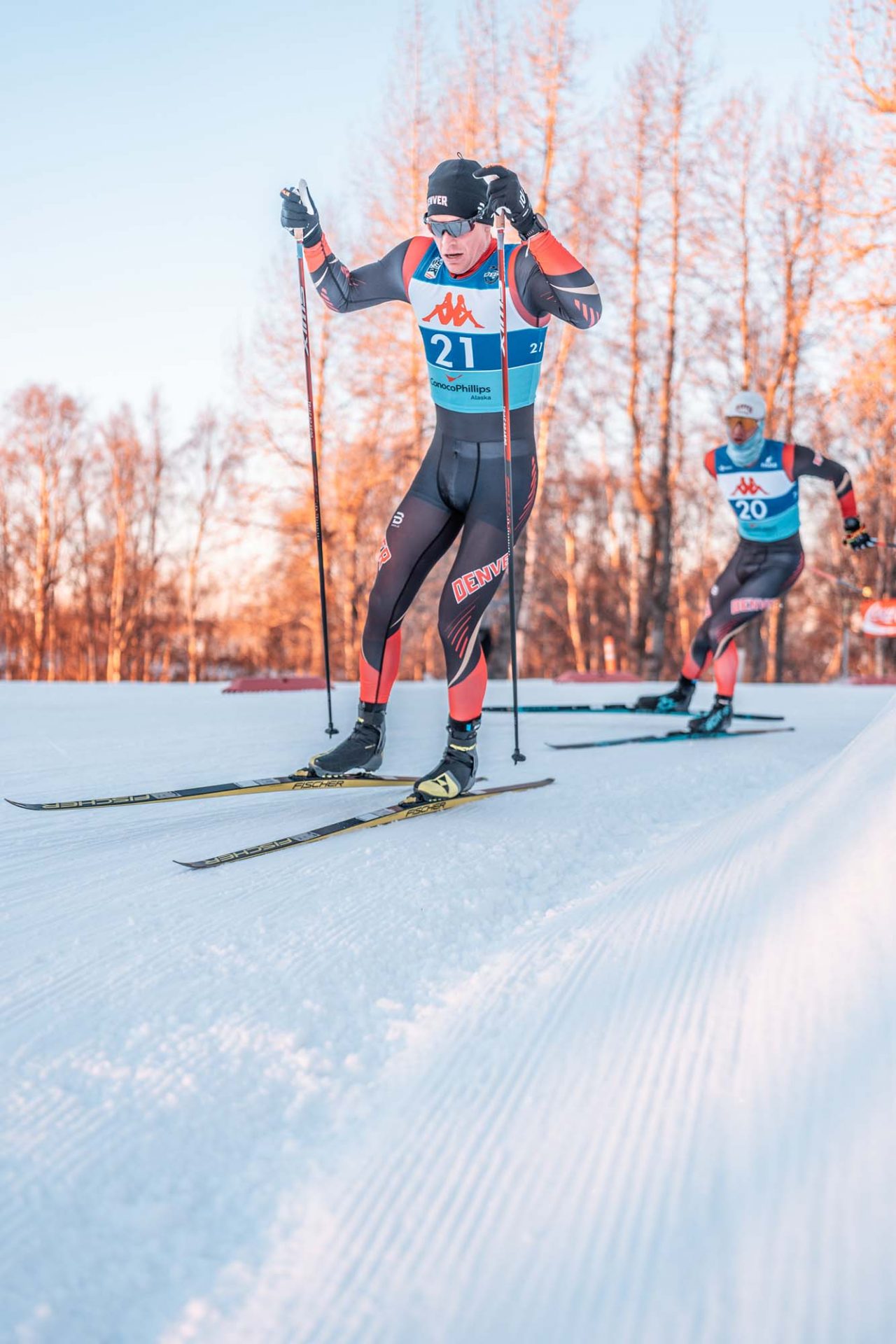
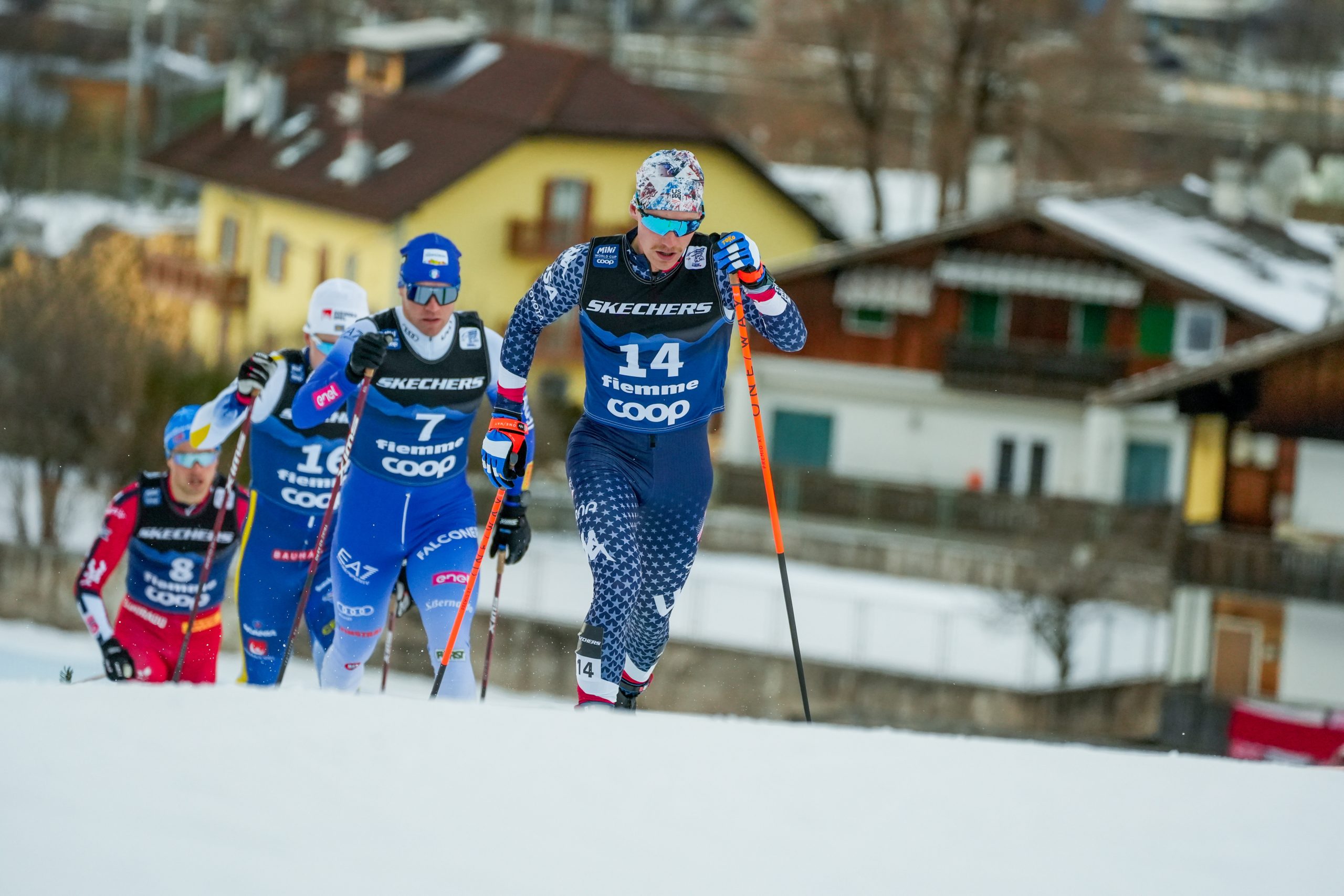
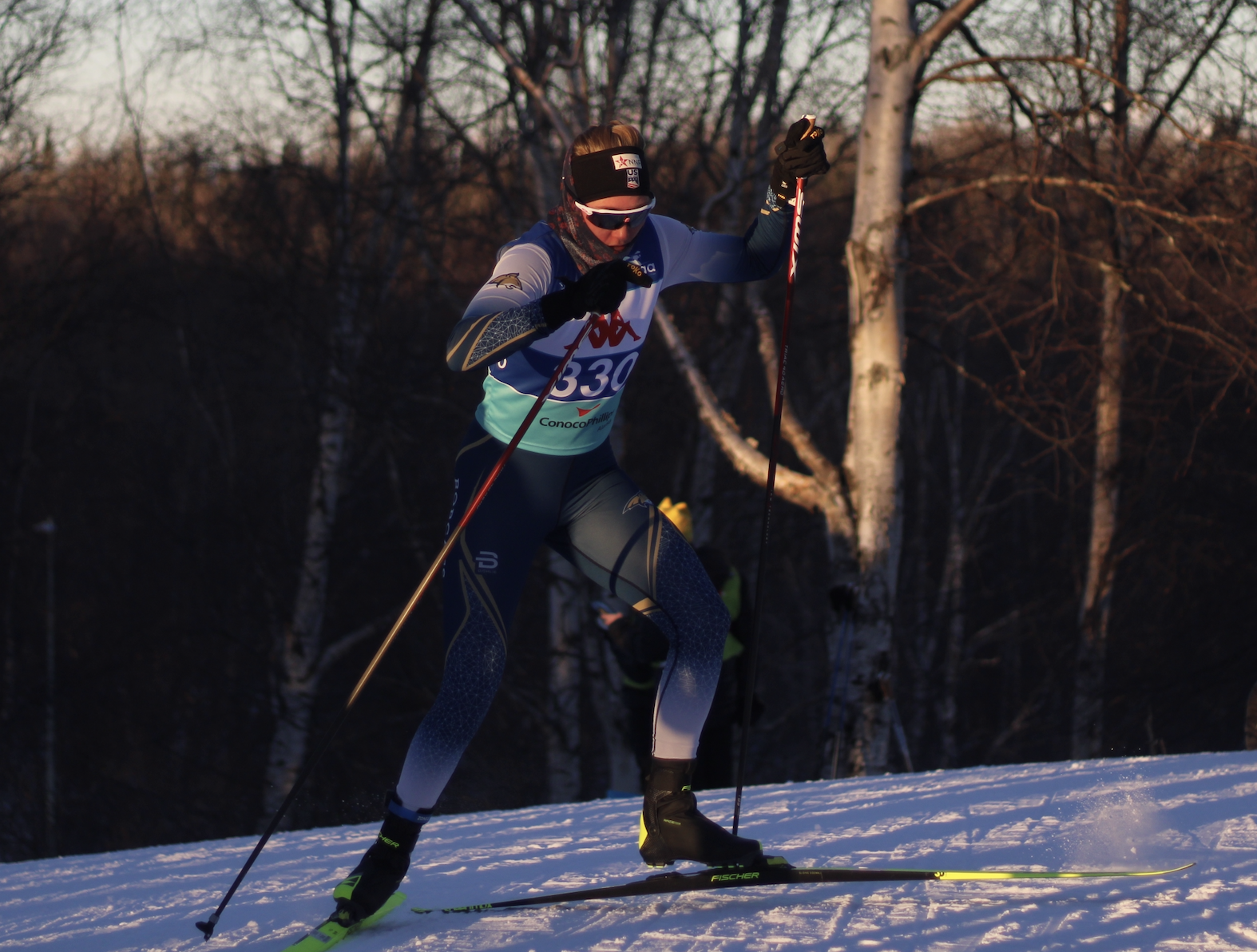
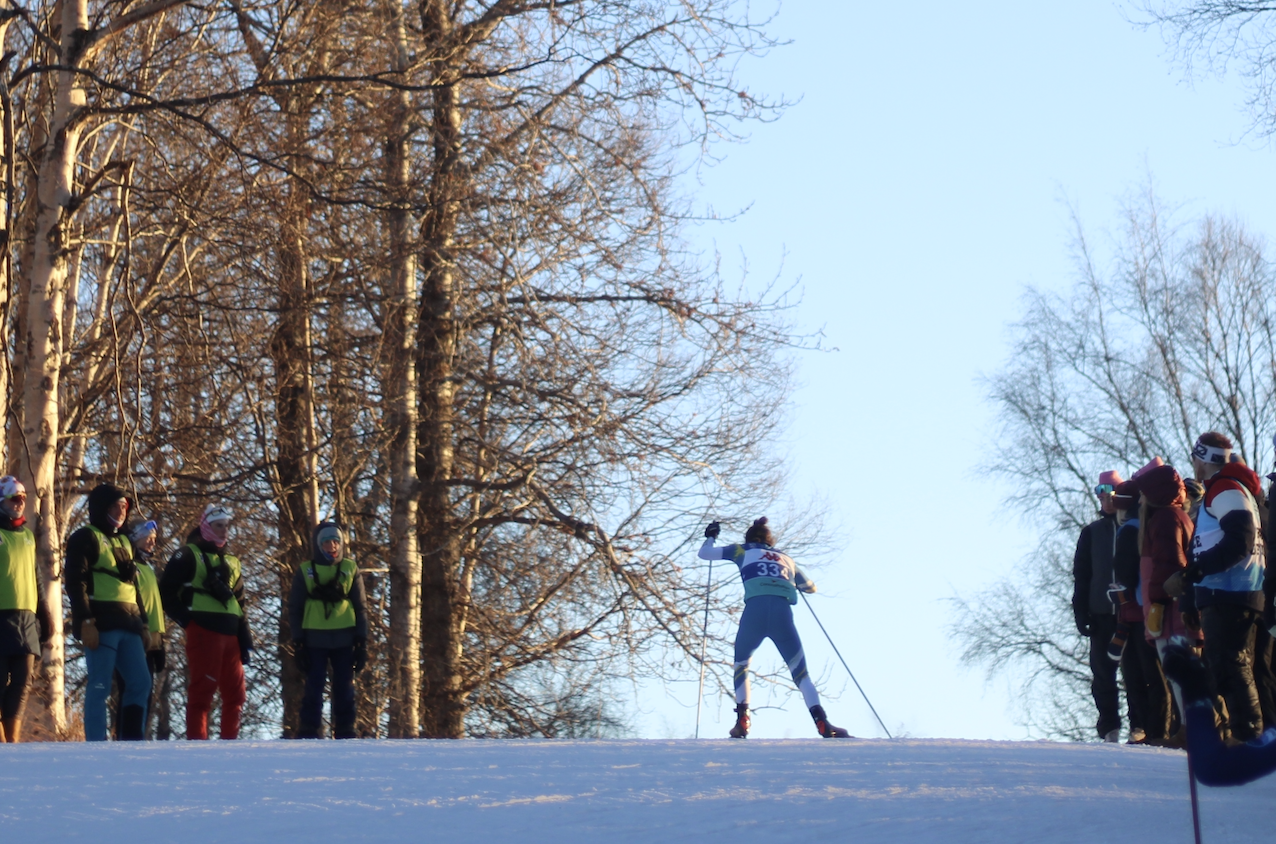
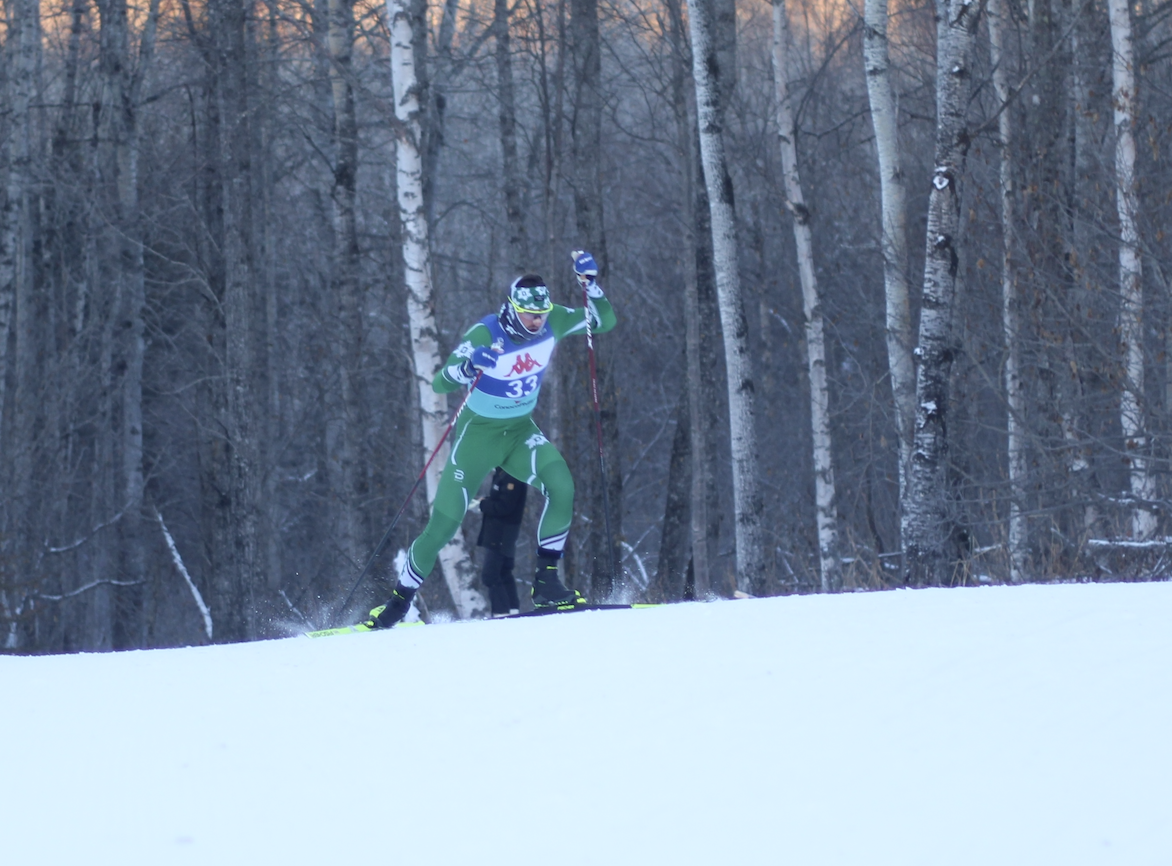
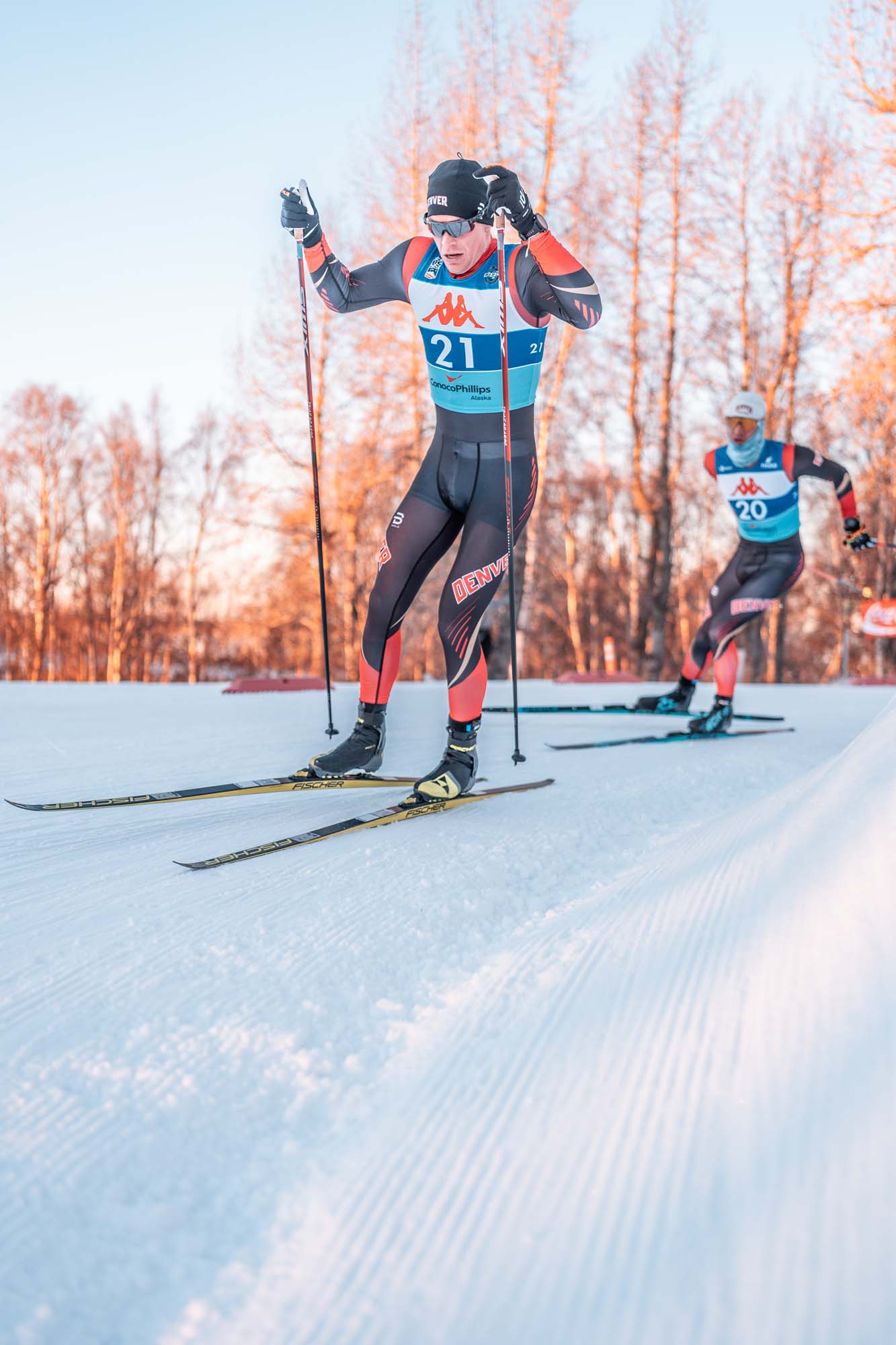
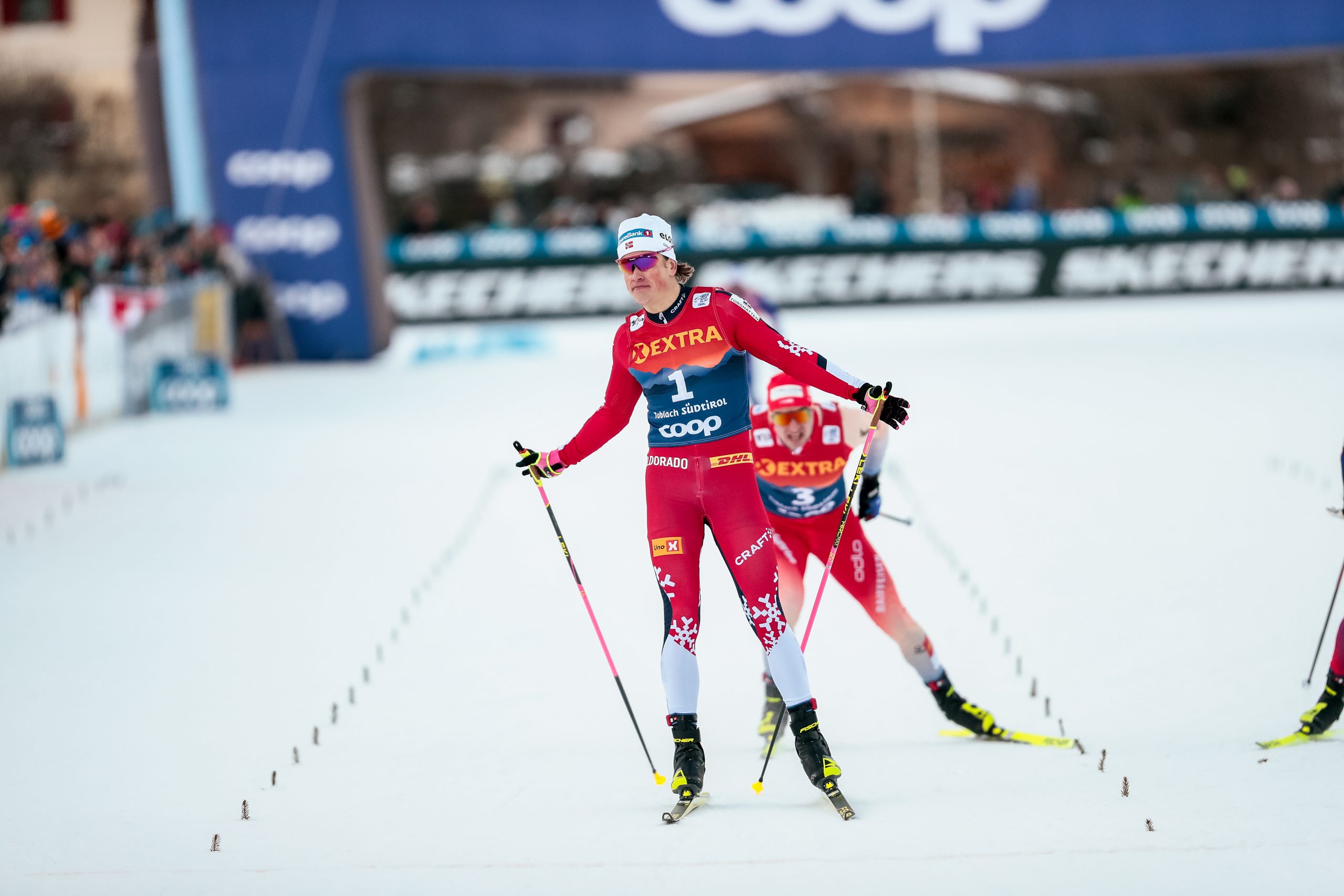
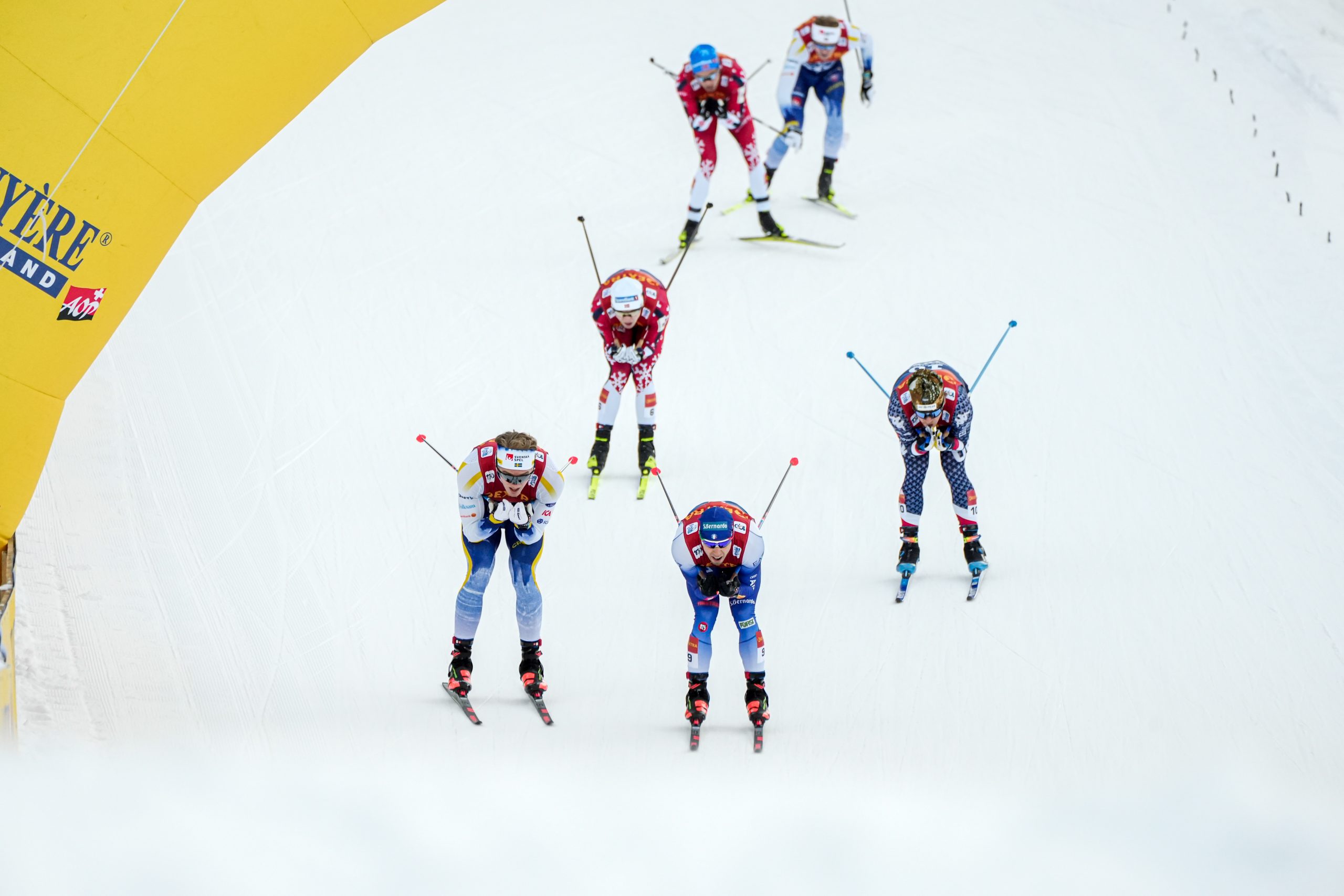
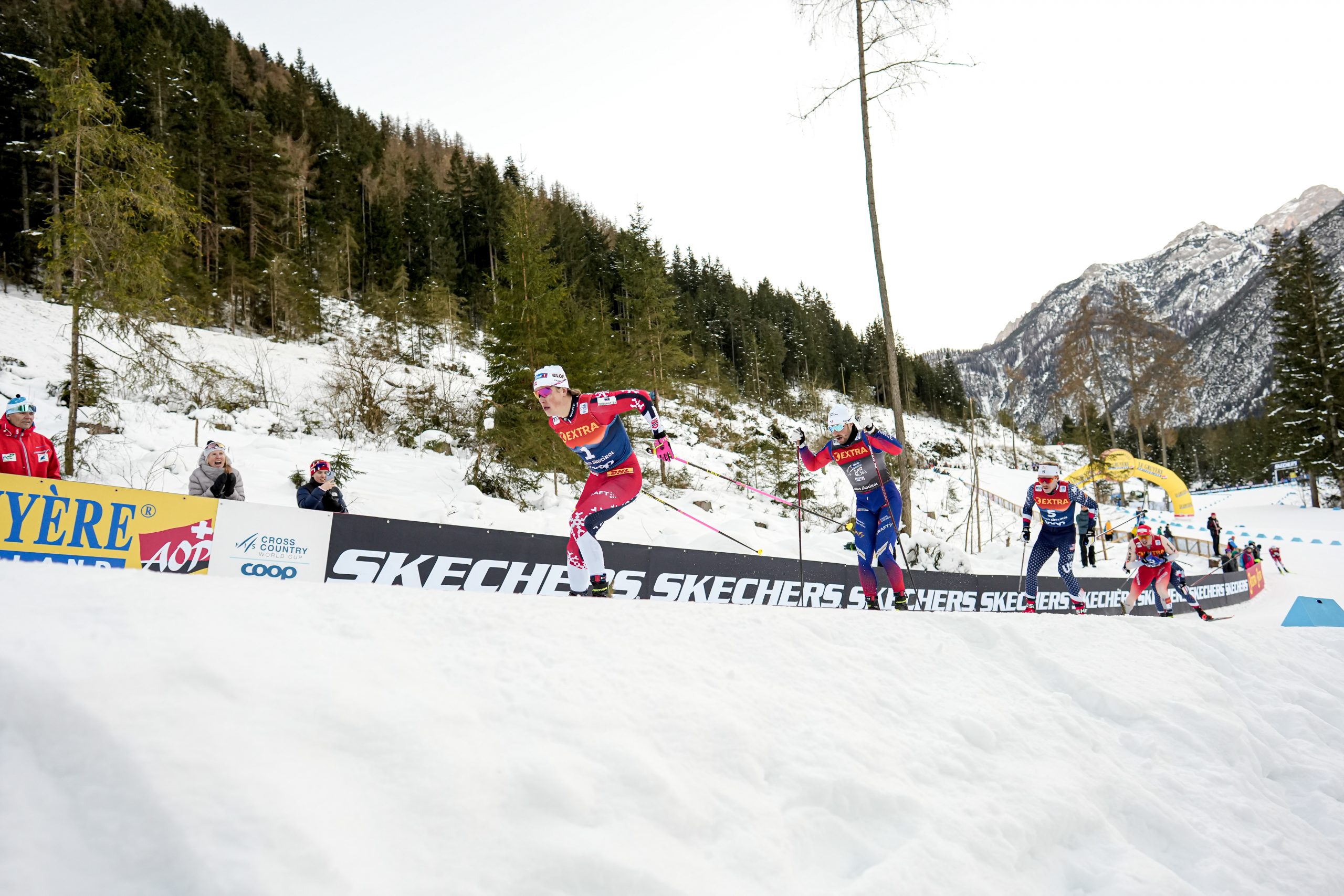
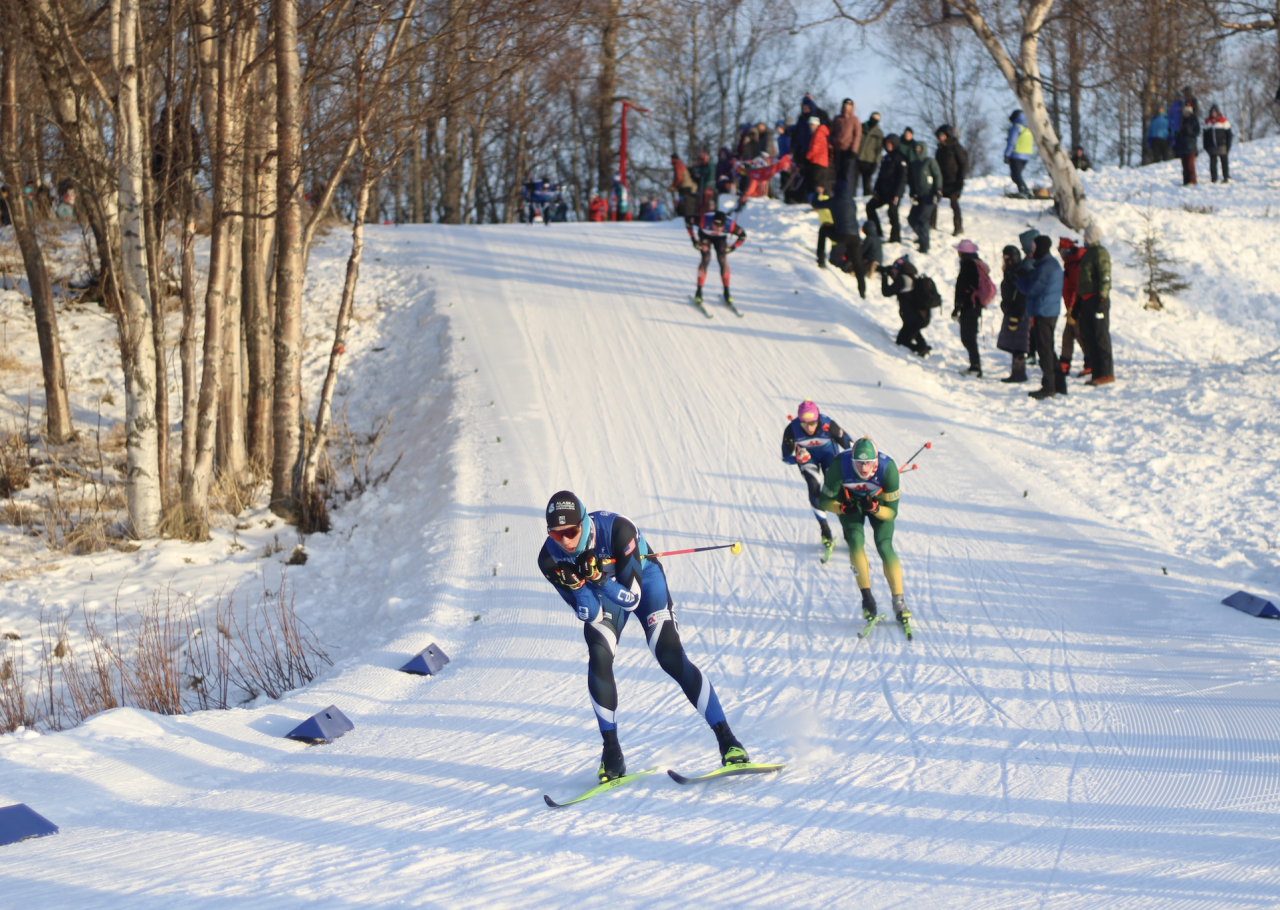
    Luke Jager leads a sprint heat at the U.S. National Championships at Anchorage’s Kincaid Park on Saturday, January 4, 2025. Jager won a national title in his hometown in front of a crowd that included his dad, his girlfriend and a childhood friend revving a chainsaw. “He’s just become a lot more confident in doing his own thing,” said Jager’s girlfriend, fellow ski racer Novie McCabe. “I think he has a much easier time rebounding from non-satisfactory races this year — he can kind of learn from it and go on to the next.” (Nathaniel Herz/FasterSkier)

    ANCHORAGE — Luke Jager spent most of his cross-country ski career training and racing with a tight group of talented, up-and-coming American men — the first ever to win a gold medal in the relay at the World Junior Ski Championships.

    Two of Jager’s teammates on that relay squad, Gus Schumacher and Ben Ogden, have made the leap to the top-level, international World Cup, where both have collected podiums in the past two seasons — along with J.C. Schoonmaker, another early career standout who trains with Jager in his hometown of Anchorage.

    Jager, 24, has also raced on the World Cup in recent years. But by his own admission, he hasn’t kept up with the meteoric rise of his peers. So this season, he decided to stop chasing them.

    Instead of racing this week at the Tour de Ski, a grueling World Cup stage race in Europe, Jager chose to stay stateside and compete on the American domestic circuit — including at the U.S. National Championships in his home city this week.

    In Saturday’s classic-technique sprint race, the decision paid off with a title, as Jager beat two other Alaskans, Michael Earnhart and Murphy Kimball, for the win.

    “It definitely has taken a lot of the pressure off — just being like, ‘I’m going to go out there and do my best,’” Jager said afterward. “We’re all pretty dang lucky to be doing this sport in the first place.”

    Jager’s title was the second awarded in a series of three championships at Anchorage’s Kincaid Park, with the final event, a classic-technique distance competition, scheduled for Sunday. (Another sprint will be held Tuesday, but it’s not a national championship.)

    The races have drawn hundreds of competitors from across the country, including a number of Europeans who have been recruited to race at American colleges. One of those recruits, Andreas Kirkeng, a Norwegian studying at the University of Denver, actually edged out Jager at the finish line Saturday, but was not eligible for the U.S. title.
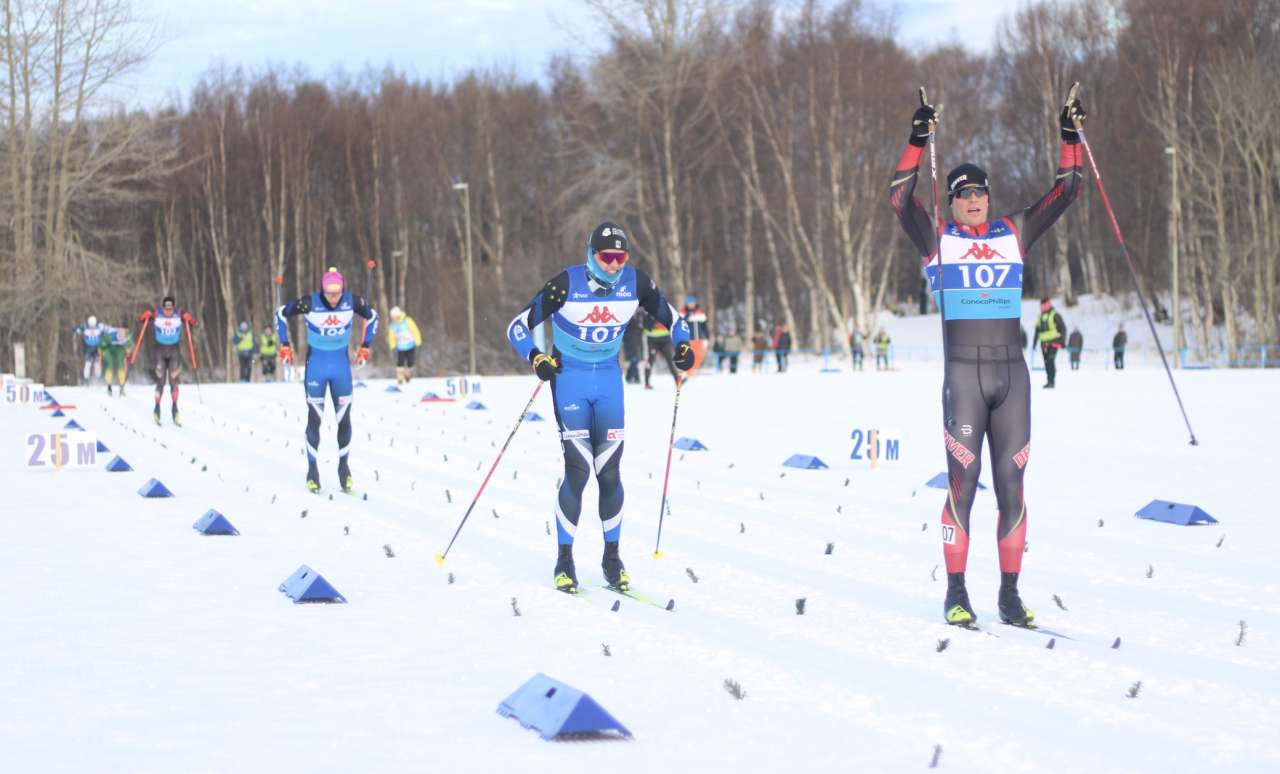
    Andreas Kirkeng celebrates being the first across the finish line at the U.S. National Championships at Anchorage’s Kincaid Park on Saturday, January 4, 2025. (Nathaniel Herz/FasterSkier)

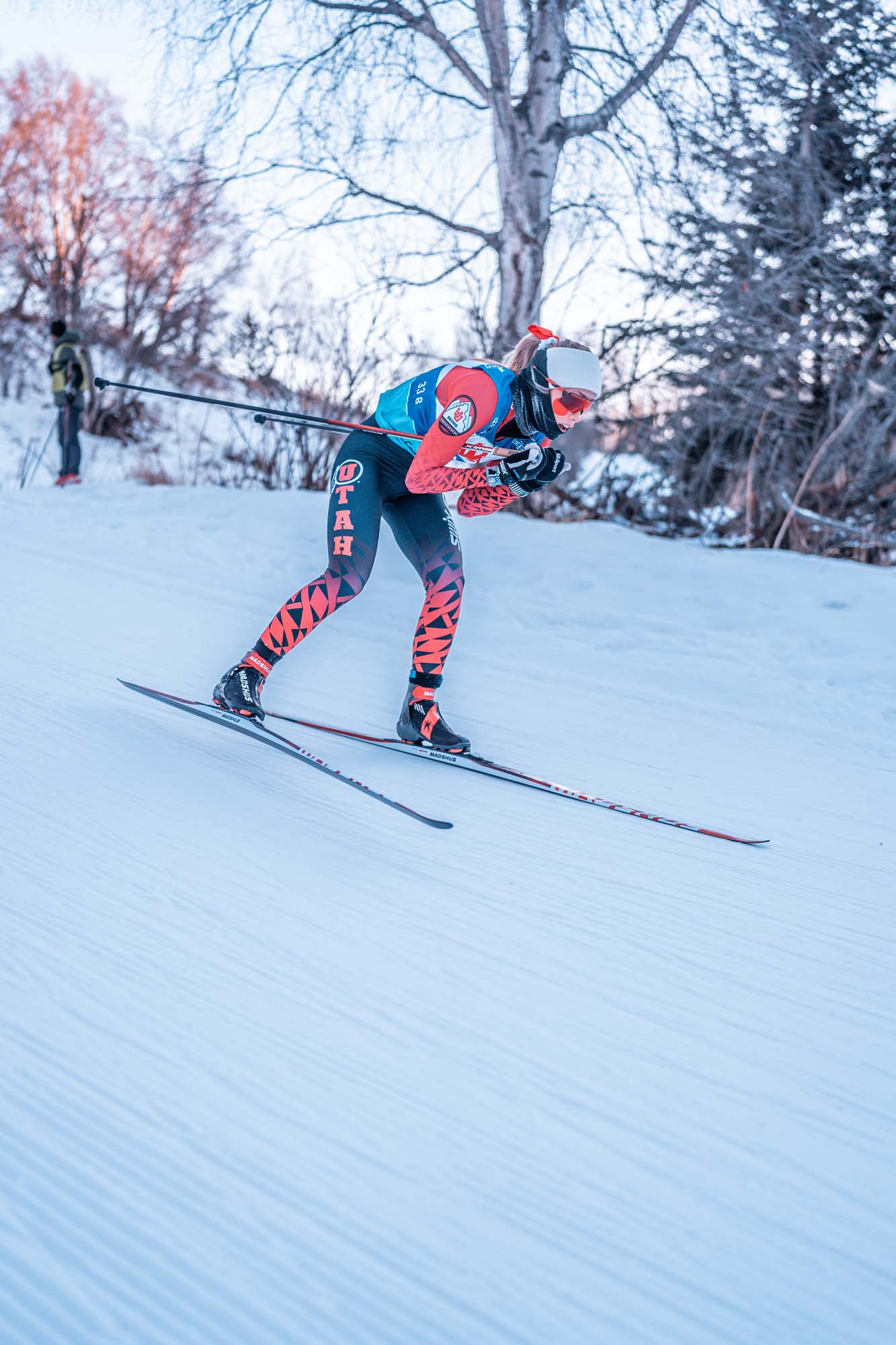
    The women’s race played out similarly. Two Europeans — Sweden’s Erica Laven, racing for the University of Utah, and Estonia’s Mariel Pulles, racing for Team Birkie — were the top two finishers.

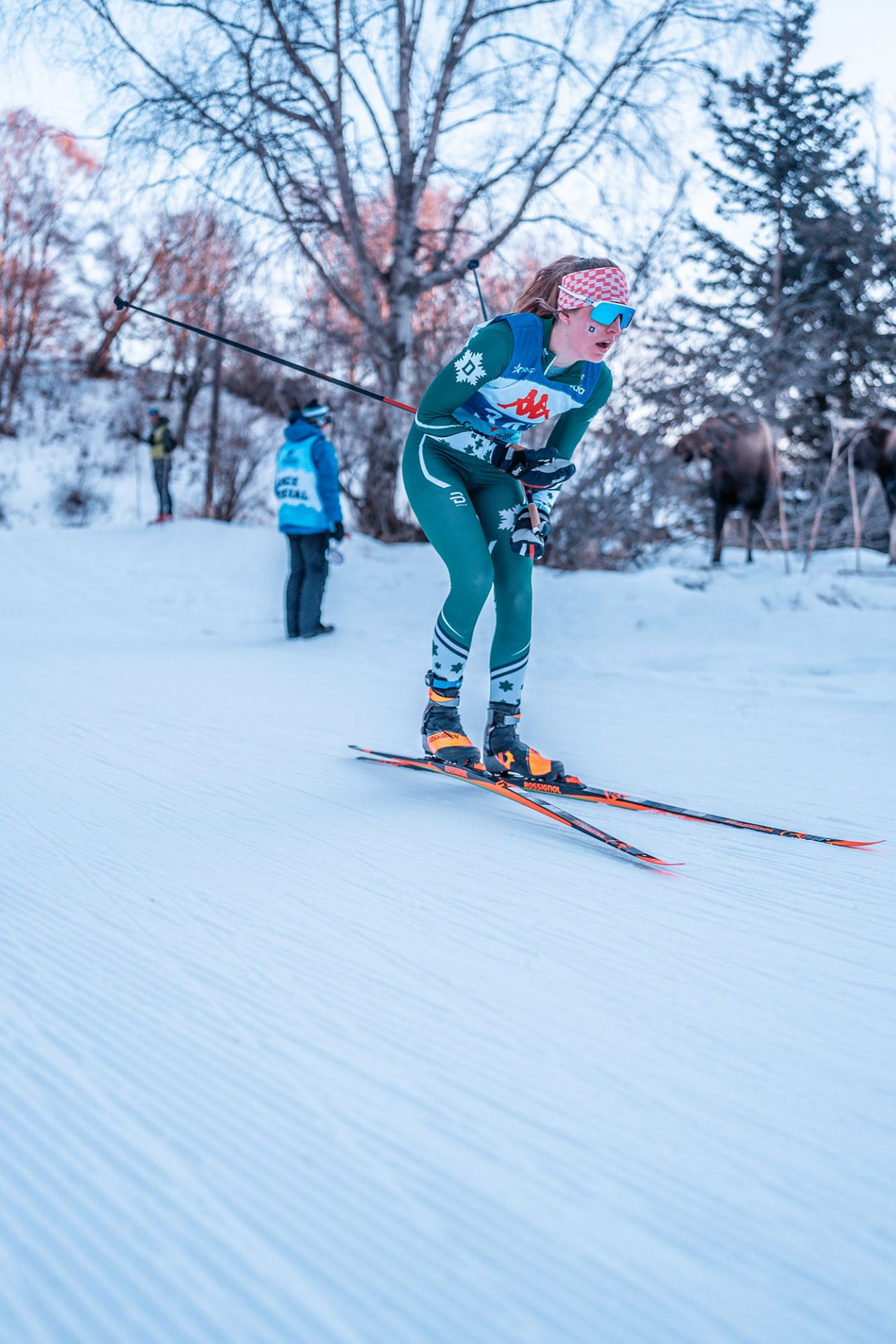
    But Sammy Smith, the third athlete across the line, won the U.S. title as the first American. It was just the second race of the season for Smith, who spent the fall playing soccer for Stanford University and had just 10 days of on-snow training before the championships.

    “I wasn’t really sure what to expect at all,” Smith said afterward. “I’m grateful to be out here and have a chance to race.”

    Erin Bianco, racing for Bridger Ski Foundation, and Dartmouth College’s Nina Seemann, finished fifth and sixth to round out the U.S. podium. Eve Duchaufour, a French athlete racing for the University of Denver, crossing the line in fourth.
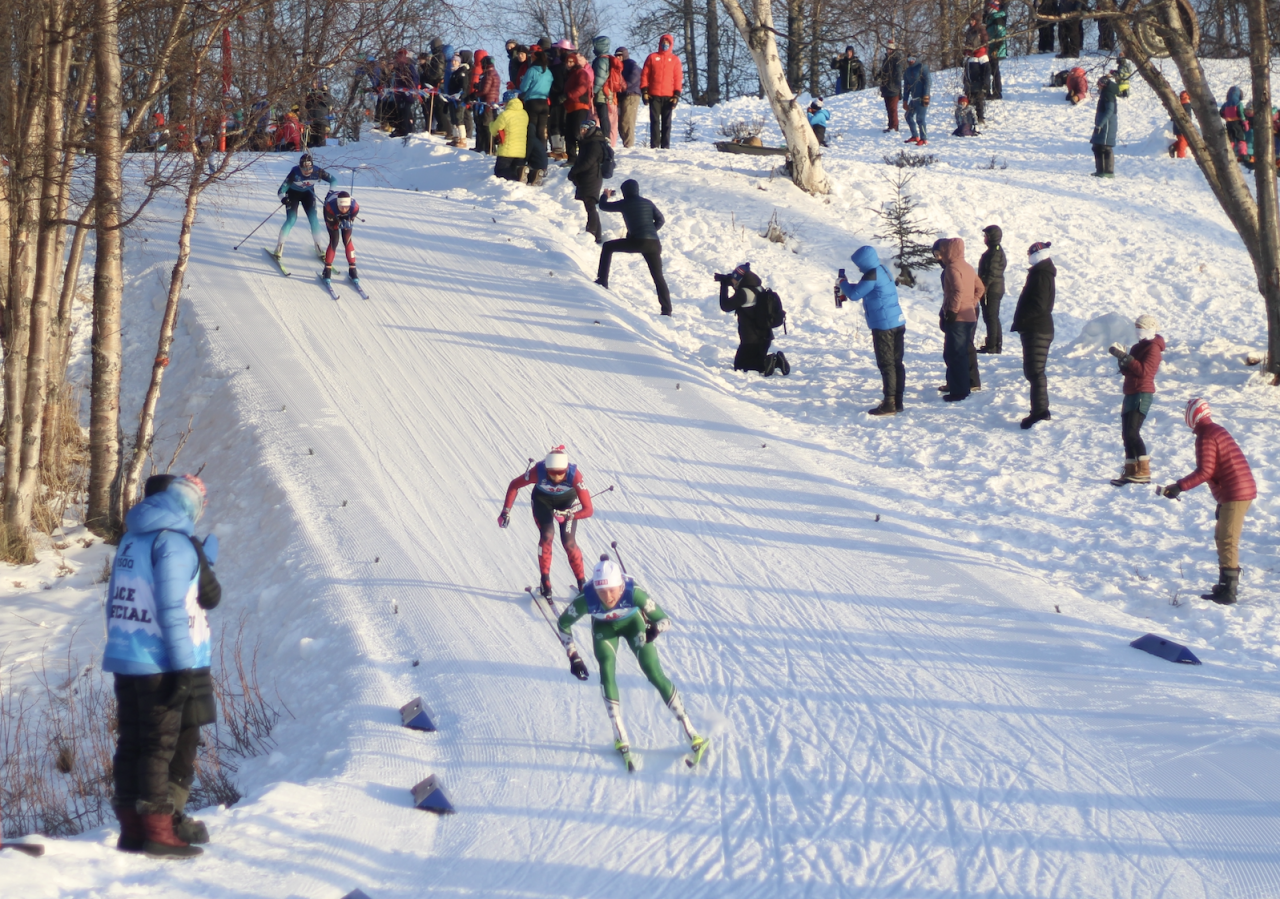
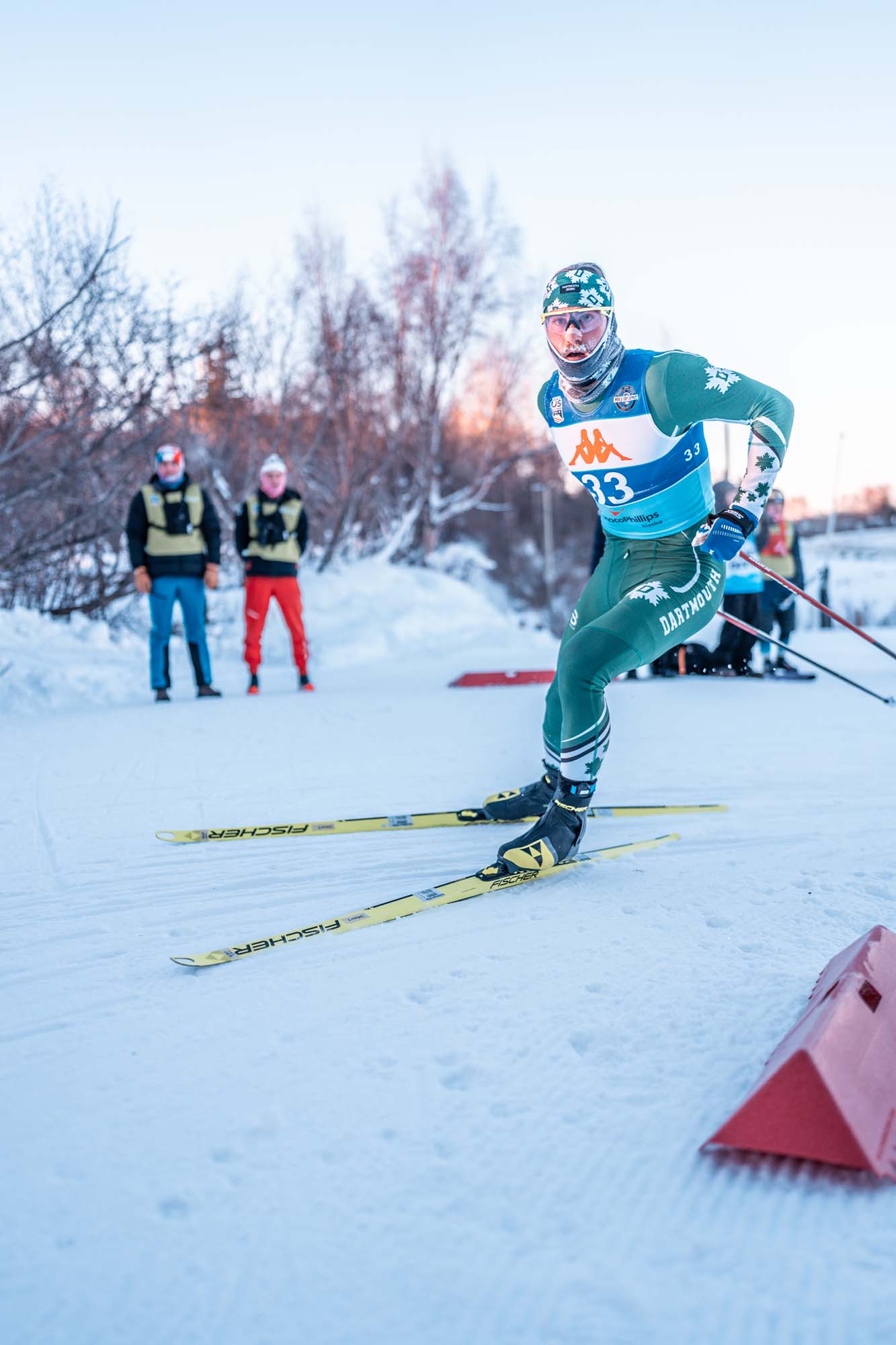
    Dartmouth College’s Nina Seemann leads a downhill at the U.S. National Championships at Anchorage’s Kincaid Park on Saturday, January 4, 2025. (Nathaniel Herz/FasterSkier)

    After a frigid first day of racing in Anchorage, Saturday’s individual-start qualification round began with the thermometer a few degrees higher. But the warmth quickly drained out of the air as the wind picked in the afternoon, just as the skiers began their head-to-head heat racing.

    Athletes draped heavy orange blankets around their shoulders like capes as they walked to the start line, dropping them just before the start of each heat.
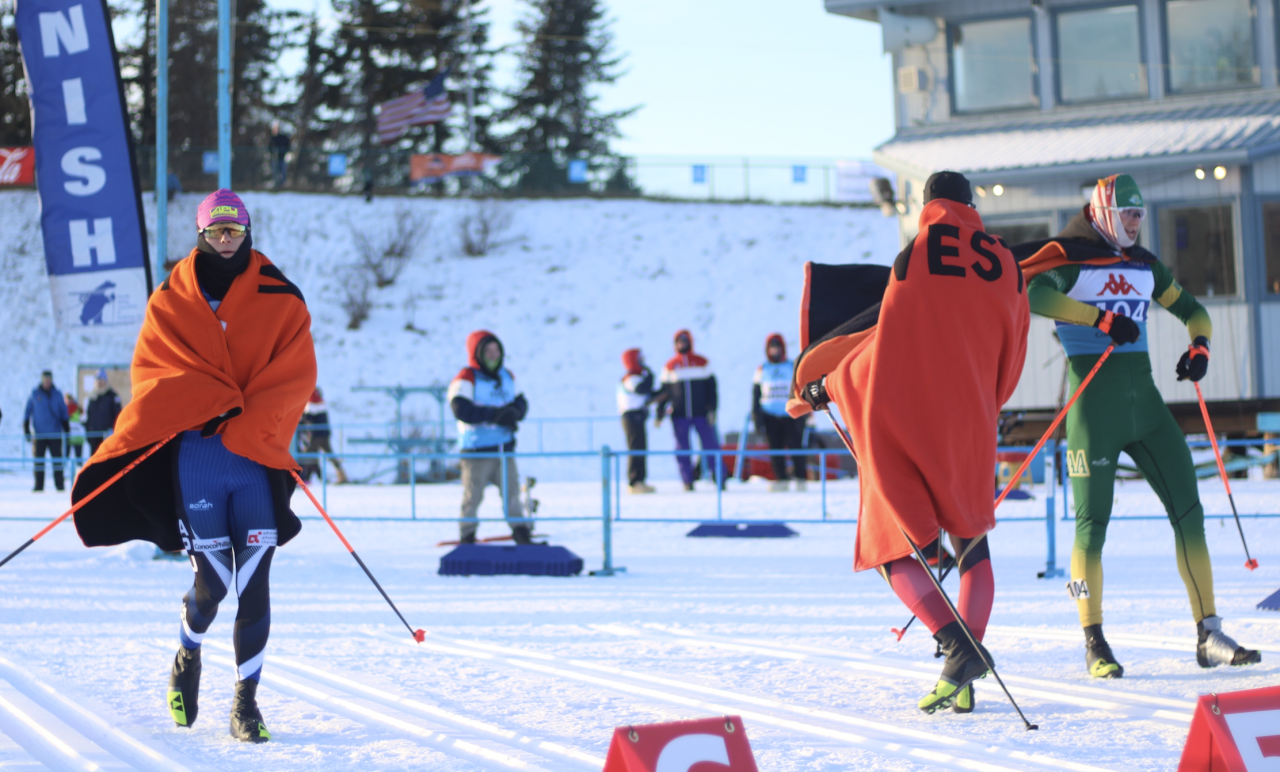
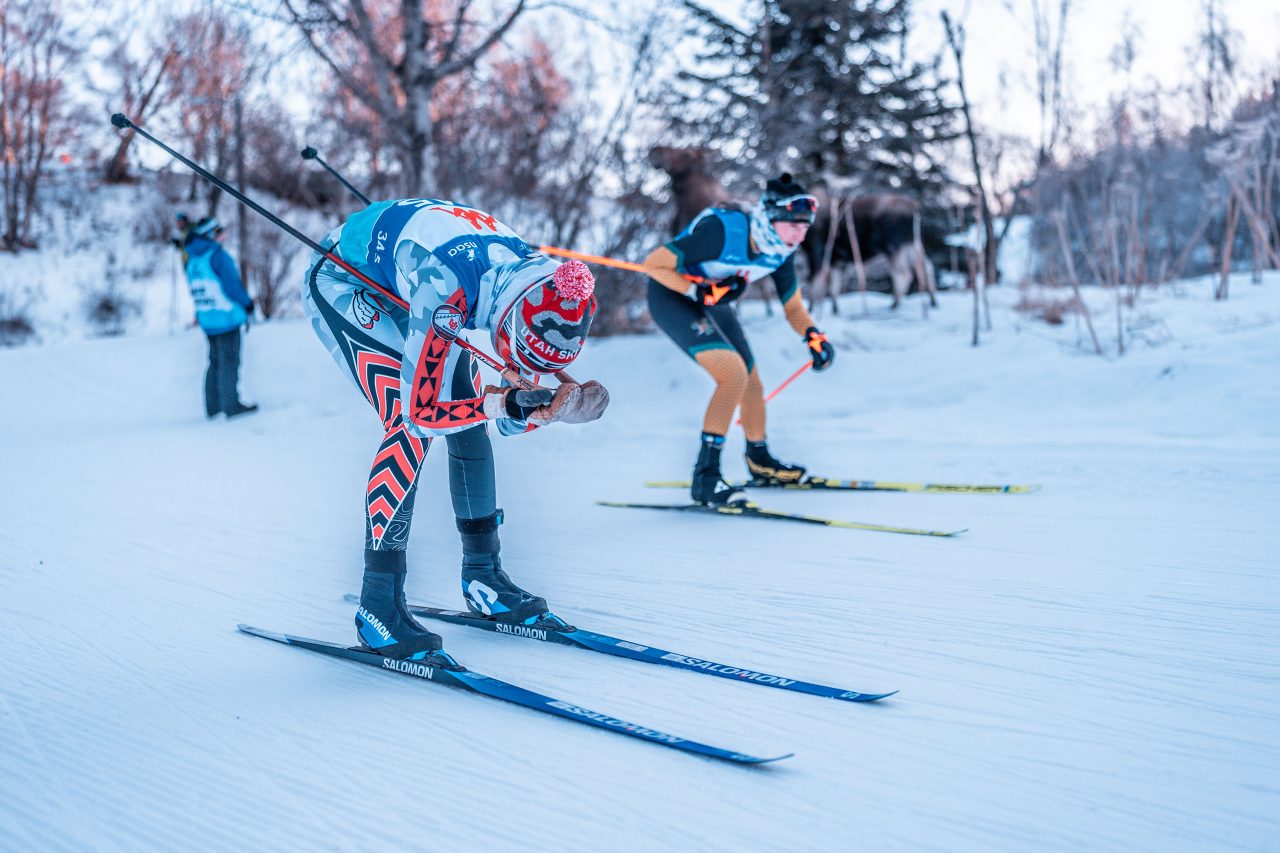
    Michael Earnhart, left, keeps warm along with other participants in his men’s semifinal heat at the U.S. National Championships at Anchorage’s Kincaid Park on Saturday, January 4, 2025. (Nathaniel Herz/FasterSkier)

    Jager had the fastest qualifying time in the men’s race, then won his quarterfinal and semifinal heats. He matched up in the finals against Kirkeng, Earnhart and Kimball, along with Florian Knopf, a German racing for the University of Denver, and Middlebury College’s Jack Christner.
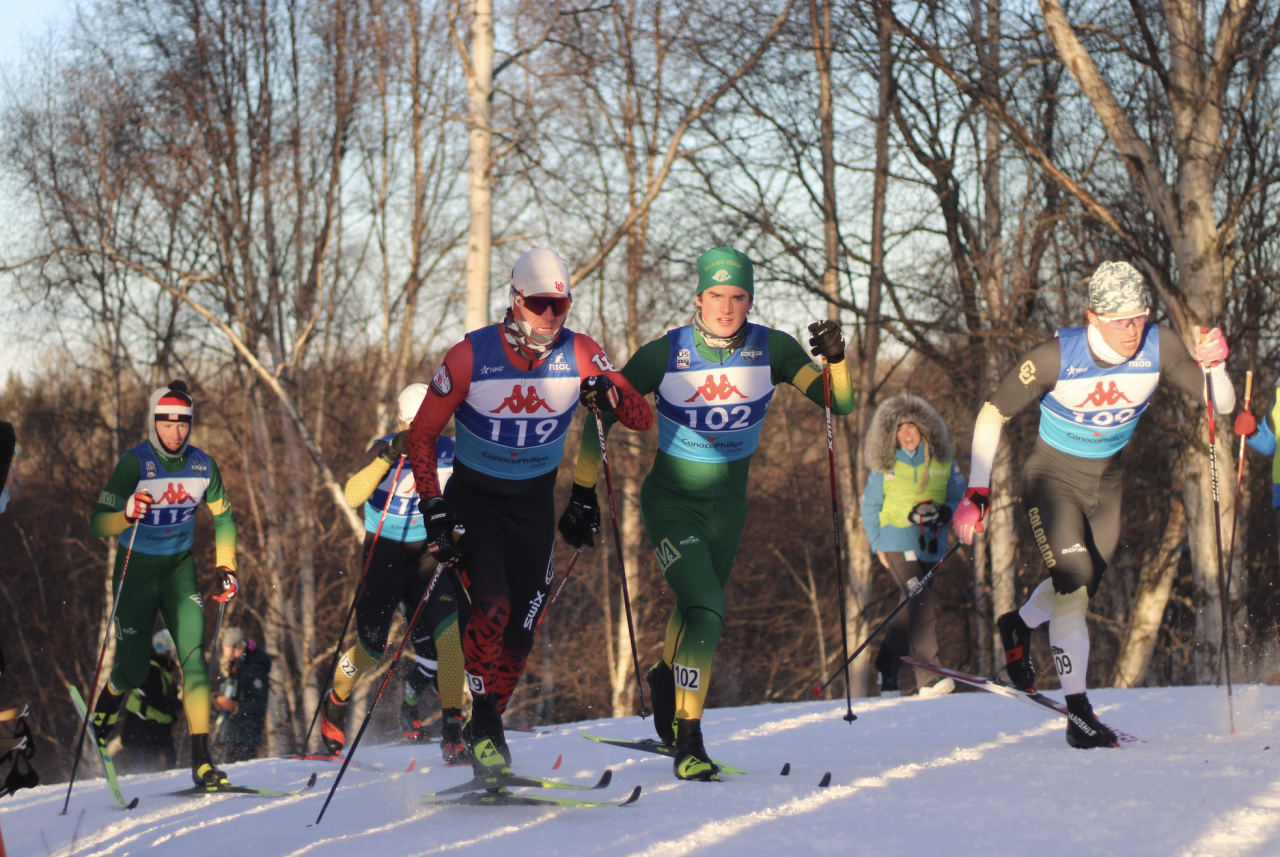
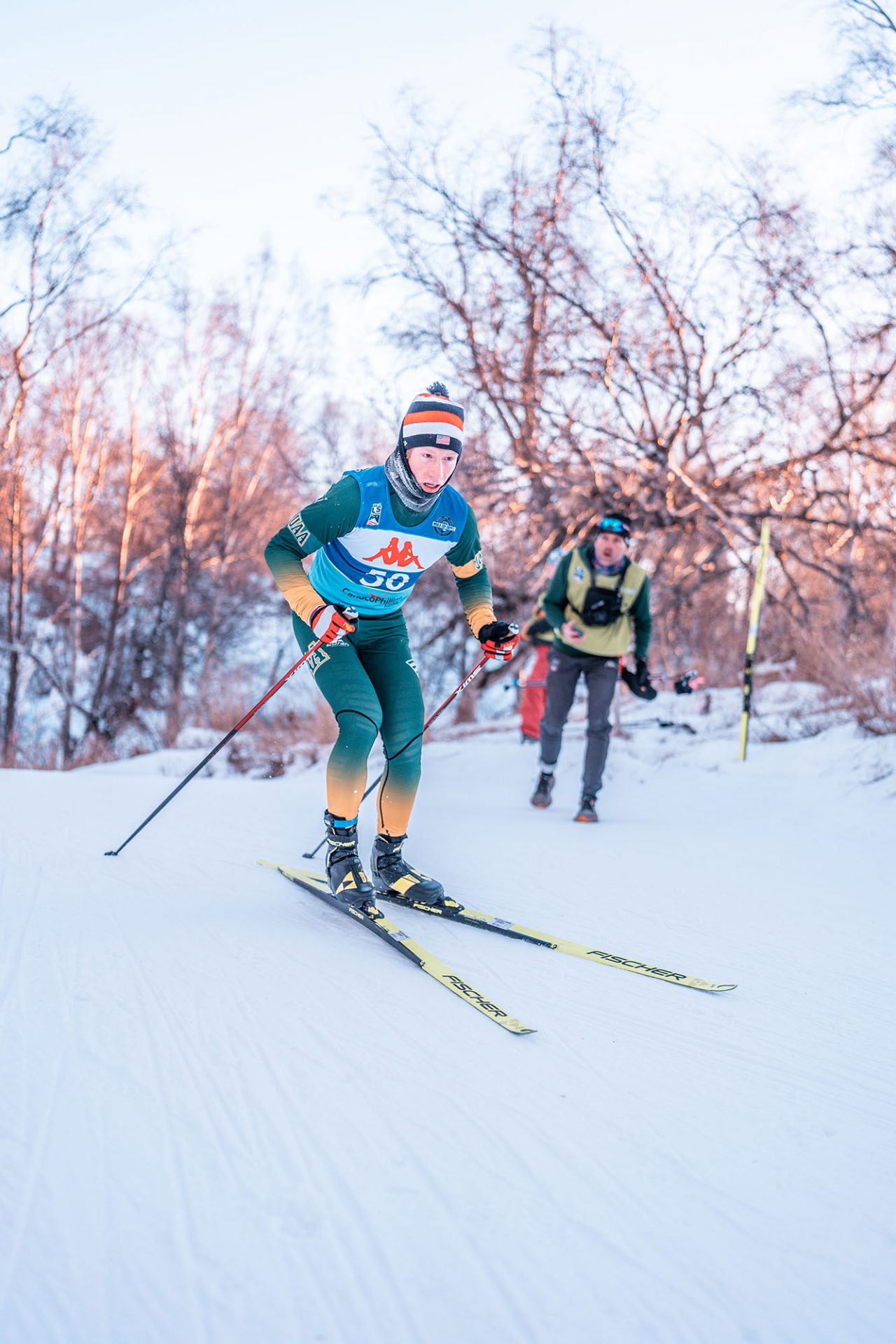
    Erling Bjoernstad, in bib 102, is a Norwegian racing for the University of Alaska Anchorage, and he was the second-fastest athlete in Saturday’s qualifying round behind Luke Jager. Organizers disqualified Bjoernstad, however, from his semifinal heat, after he was the second athlete in that heat to false start. “I was fired up after a good quarterfinal, and I felt really good,” said Bjoernstad, who acknowledged an accidental twitch. “It was a shame.”

    Jager led from the start and stayed at the front for much of the 1.3-kilometer course before Kirkeng poled past him on the final meters of the homestretch. And yes, in case you were wondering: Jager acknowledged that he was not entirely content with a national title in which one of his competitors reached the finish line first.

    “I guess I was like, ‘Dang, I think I just lost like 600 bucks,’” said Jager, referring to the difference in payouts between first and second place. “I was bummed. But Andreas is so strong and I love racing against him, so I can’t complain. I was good and beat.”

    Nonetheless, Jager said he’s benefited from a mental adjustment that came after some tough days of racing last season. While his teammates and friends like Schumacher, Ogden and Schoonmaker reached new heights, Jager struggled on the World Cup in his strongest discipline, the sprint — advancing out of the qualifying rounds and into the heats just once in eight starts.

    “We were all young — it was so sweet and so fun and we were like this group, this cohort that was super put together. I was super proud to be a part of it. And I love those guys — they’re totally like family,” Jager said in an interview earlier this week. “But then as we got older, those guys just kept getting better and kept getting better. And it felt like I was still stuck, so I was really grasping on to trying to maintain my identity as part of that.”
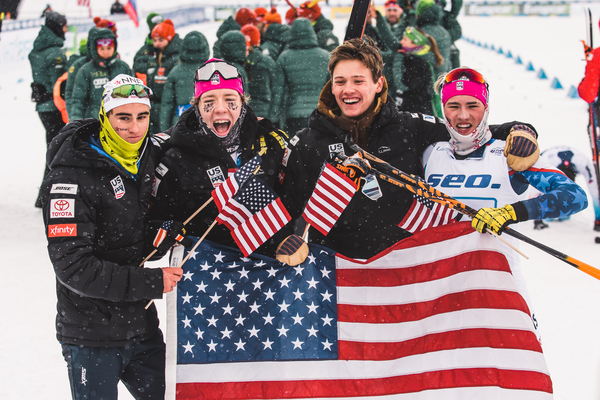
    The American gold-medal winning relay team at the 2019 World Junior Ski Championships in Finland. From left, John Steel Hagenbuch, Ben Ogden, Luke Jager and Gus Schumacher. (Photo: JWSC2019 / Mikaela Takala)

    He added: “My focus wasn’t in the right place. I was focused on having my breakthrough so I could join the club. I wasn’t focused on performing — and, like, on myself, and what I need to do.”

    Jager’s outlook was grim enough last year, he said, that there was a period when he indulged in some “mopy” thoughts about retirement.

    But instead, he ended up with a new mindset and a shift in focus inward.

    That included some changes to his summer training. Jager said that while there’s currently a trend toward “polarization” in training — making hard workouts even harder and easy workouts even easier — he did the opposite, making his easier workouts a little faster and harder. That change, he said, has made him more durable in races when the pace starts to ratchet up.

    So far, it’s been working for Jager. In addition to Saturday’s title, he had what he described as an unusually strong fourth-place result in Thursday’s individual-start distance skate race — a format that’s historically challenged him at U.S. nationals. He also won two races on the domestic SuperTour circuit earlier this winter.

    “I think every skier has their way, right?” said Erik Flora, Jager’s coach at the Alaska Pacific University club team.
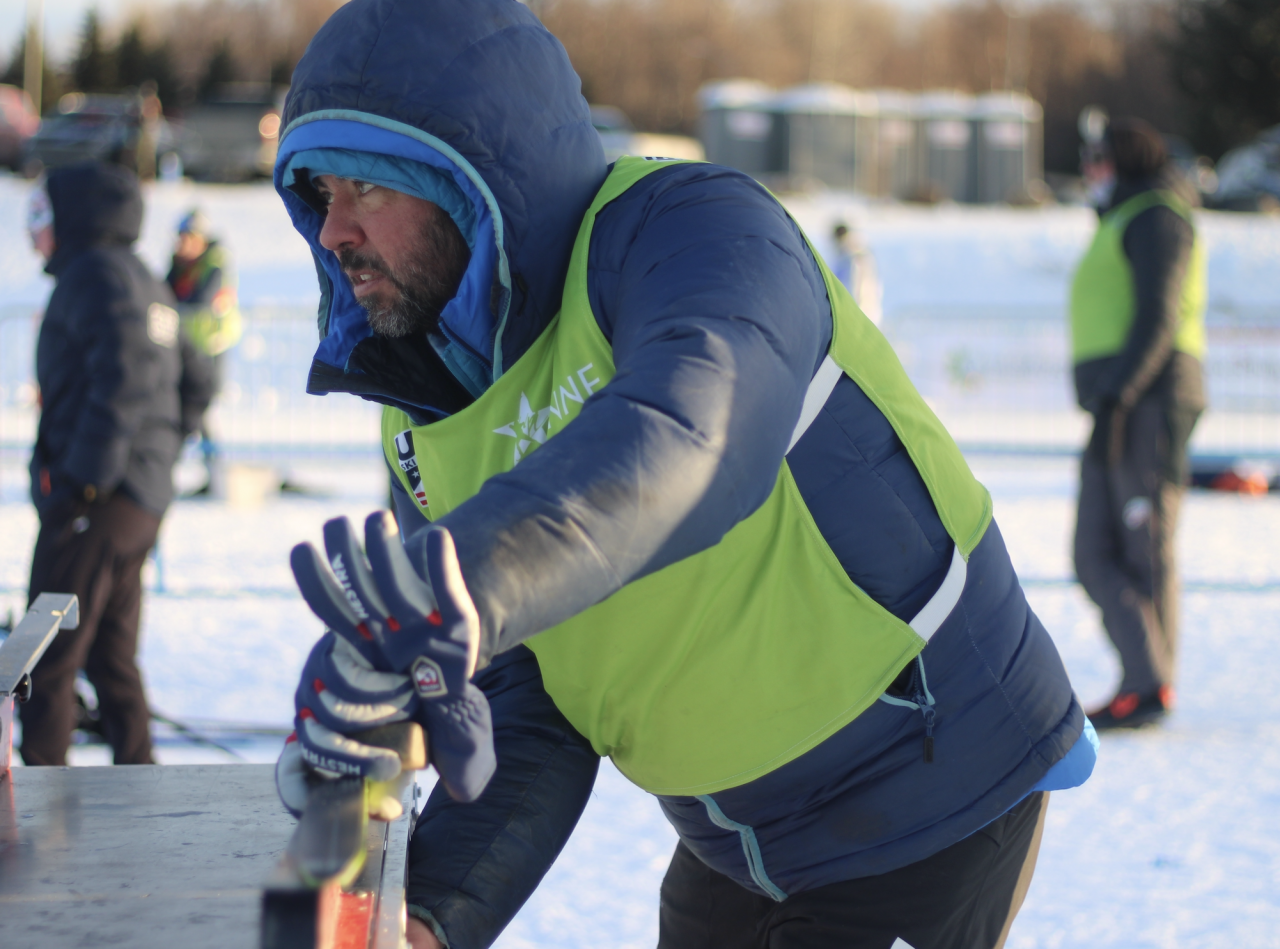
    Alaska Pacific University coach Erik Flora finishes waxing a ski at the U.S. National Championships at Anchorage’s Kincaid Park on Saturday, January 4, 2025. (Nathaniel Herz/FasterSkier)

    Flora, a veteran coach who’s also worked with retired Olympic medalist Kikkan Randall and World Cup standout Rosie Brennan, said he wishes that athletic development could be “linear” — steadily upward and regular. But in his experience, he said, “it just isn’t.”

    “Everyone goes through these gains, and they go through settles,” Flora said. “It’s just waves.”

    Smith, Saturday’s women’s champion, is still riding a wave on its way up.

    At just 19 years old, she’s a prodigy who’s already spent parts of two seasons racing on the World Cup — and has a world junior championships silver medal in her trophy case from last season.
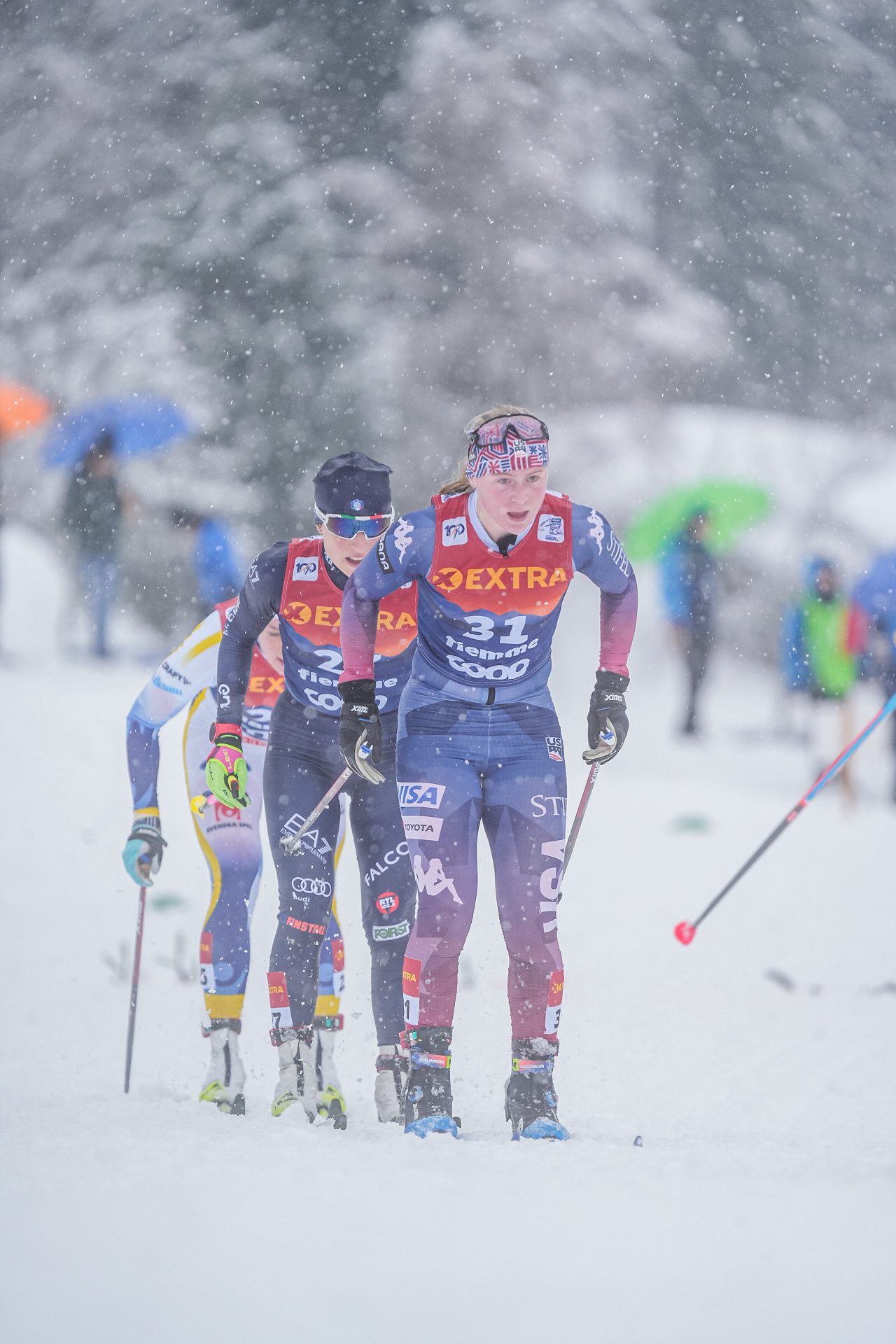
    Samantha Smith racing at last year’s Tour de Ski in Europe. She comes from a family of athletes, with a sister who also plays soccer at Stanford, a mother who rowed at Stanford and a father who played soccer at Duke University. In junior high, Smith played football; she also has been a competitive freestyle moguls skier. “She has always been phenomenal,” Kristin Smith, her mother, told FasterSkier last year. “She used to crawl up my body when she was less than two and sit on my shoulder.” (Barbieri/NordicFocus)

    But as most of her competitors spent the fall training and sharpening for ski racing, Smith was doing something completely different: traveling the country with Stanford’s soccer team.

    Smith, who plays a defensive-minded position called outside back, wasn’t a starter as a freshman this year. But she got playing time in 13 games, according to Stanford statistics, on a team that made it to the national semifinals.

    Smith’s sister Logan, who also plays for the Stanford soccer team, said that because the squad competes in the Atlantic Coast Conference, players spend much of every other week on the road. They typically travel on Tuesdays to the East Coast, play games Thursdays and Sundays, and fly home Sunday night.

    As for school?

    “Mondays. And the weeks we don’t travel,” said Logan Smith, who was watching the races at Kincaid with her family this week.

    The grueling soccer schedule meant that Sammy Smith fit in training for cross-country skiing when she could. But she described it as “the first time I was really able to focus on one thing.”

    She said she expected that her first event in Anchorage, “was not going to be great” — and she finished 12th on Thursday.

    On Saturday, though, she looked like a podium contender from the start, winning both her quarterfinal and semifinal heats. In the final, she said she slipped on her first four or five strides and was trailing the pack leading out from Kincaid’s stadium. But she made up ground on Duchaufour, Bianco and Seemann as the pack climbed over the big hill on the course to take home the American title.
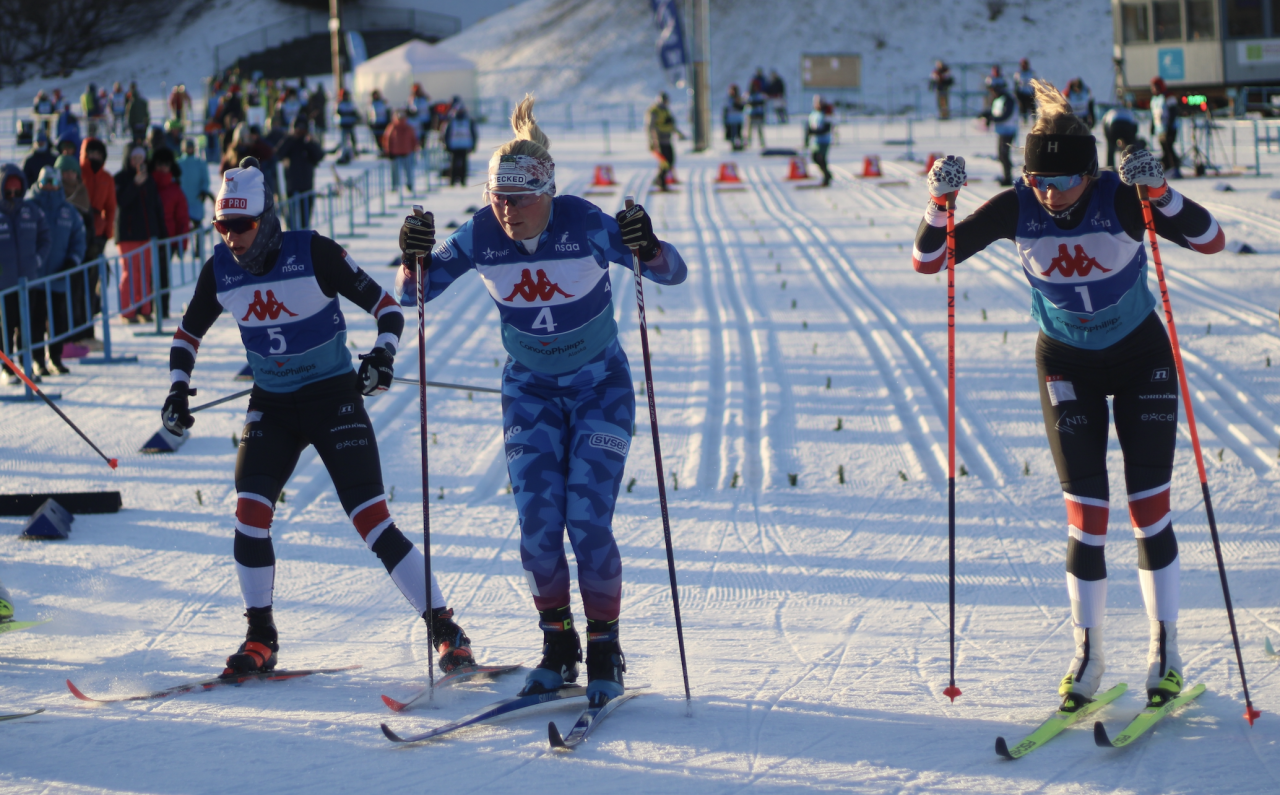
    Sammy Smith, center, starts one of her heats at the U.S. National Championships at Anchorage’s Kincaid Park on Saturday, January 4, 2025. (Nathaniel Herz/FasterSkier)

    After U.S. nationals, Smith said she plans to race at world juniors in Italy and hopes to compete on the World Cup, as well.

    “It’s also definitely a balance with school,” she said.

    But Smith said she hopes to continue with both soccer and cross-country skiing as long as she can. And she dreams of competing in the Olympic Games in both sports.

    U.S. Ski Team coaches would “love to have her pick skiing,” said Cross-Country Development Director Bryan Fish, who was on hand for Saturday’s race.

    “But from a U.S.A. perspective, we’re just happy that she’s here,” Fish said. “Our job is to support her in the best way that we can.”


    Full results.

  • Johaug Dominates 20-k Skiathlon. Diggins Fifth and Back on Overall Podium

    Johaug Dominates 20-k Skiathlon. Diggins Fifth and Back on Overall Podium

    This coverage is made possible through the generous support of Marty and Kathy Hall and A Hall Mark of Excellence Award. To learn more about A Hall Mark of Excellence Award, or to learn how you can support FasterSkier’s coverage, please contact info@fasterskier.com.

    Jessie Diggins (USA) was able to fight through painful plantar fasciitis to retake an Overall podium position. (Photo: NordicFocus)

    As we enter the second to last event in this year’s Tour de Ski—the 20 kilometer Skiathlon—there has been little movement at the top of the women’s Overall leader board. As the field continued to thin its ranks, yesterday’s Sprint results took on unusual outcomes which simply wouldn’t occur in a regular season World Cup Sprint. In a starting field with only 42 remaining skiers contesting the Sprints, there was an opportunity for more non-Sprinters to find their way into the heats to collect extra time bonuses. Qualifying for the Classic Sprint heats yesterday were Tour contenders Astrid Oeyre Slind (NOR) and Heidi Weng (NOR), with Weng taking a podium. The last time Heidi Weng took a podium in a non-Tour Sprint was in Otepaa, Estonia in 2017. That’s how dramatic the effects of a thinning race field are.

    The thinning of the Tour field continued today. The Tour began with 67 women contesting the first day of racing in Toblach. Today’s start list was down to 36 skiers, and before the race began another three skiers dropped out. If today’s race had been a Sprint, almost everyone would have qualified!

    Going into the race, Slind remained in first place ahead of Johaug but by only 8 seconds, and she was 29 seconds in front of Kerttu Niskanen (SWE). Jessie Diggins—who finished 14th in yesterday’s Classic Sprint— was in fourth place exactly one minute behind Slind and 31 seconds off the podium behind Niskanen. But as is often the case, looks are very deceiving because while Johaug sat in second place, she was really in a commanding position, as the final day of racing on Sunday will be in an event which she has described as being “perfect for her”—the climb up Alpe Cermis.

    For Diggins and the rest to have a real shot at the top of the podium, they would need to put a lot of time into Johaug today to build a substantial cushion before Sunday’s final. A more attainable task for Diggins would be to gain time on Niskanen, who has her own very strong history up Alpe Cermis.

    Therese Johaug (NOR) stayed relaxed in the Classic portion and pushed hard up the hills in the Freestyle to grind down the pack. (Photo: NordicFocus)

    At the race’s end, no one had an answer for Johaug who took the win beating Teresa Stadlober (AUT) and Slind by over thirty seconds. Slind finished third in a dramatic photo finish with Stadlober. The win put Johaug comfortably into the lead by 22 seconds with tomorrow’s climb being the only thing standing between her and a Tour de Ski victory. “It was amazing,” Johaug said after the race. “I need some races in my body, I’m old! Oh my God, it was a tough race. Felt really good in the skating in the beginning, but it was tough in the end. I had to push myself all the way to the finish line. I’m looking forward to Monday and not having to be so nervous anymore.”

    It was revealed that Diggins has been dealing with plantar fasciitis which has been affecting her mostly on the Classic portions of races. But she was able to push through the pain today and do what she needed to reclaim an Overall podium position by finishing 1:11 ahead of Niskanen to put Diggins into third place Overall. “I feel lucky that I’m still racing with what’s happening with my foot right now,” Diggins observed. “It feels like a bonus just to be here. And, maybe sometimes that’s the attitude you need, I’ve got nothing to lose, I’m just going to go out there and go as hard as I can, and be grateful that it’s normal ski racing pain tomorrow, because I can skate. When I walk it’s like I’m practicing for when I’m 95 years old, but when I’m skiing, skating is ok.”

    Entering the last day, the math for Diggins is very simple. After today’s race she is in third place overall, 40 seconds ahead of Niskanen. If she beats Niskanen up Alpe Cermis, or stays within 39 seconds of her, she will secure a place on the podium. She is 1:25 behind Slind for second, and it is probably asking too much for her to make up that much time on the climb to advance in the standings.

    Julia Kern had a career best day of Distance skiing finishing seventh. She credited her achievement to her team. “Hats off hands down to the wax techs. Our team did an incredible job today. I had amazing kicking skis, bullet proof kick, and they were ripping fast both in Classic and in Skate. I was so stoked in the race, I had incredible skis and that’s always an extra confidence boost. It helps with skiing tactically, maybe conserving a little on the climb knowing you’ll catch people on the down hill. That was huge.” But not all the credit goes to the people who gave her fast skis. “I also just surprised myself this morning feeling really good, and I feel like the Tour is such a roller coaster, you never know what you’re going to get on any given day. My body was there, and my skis were there, and I just took advantage of the opportunity today.

    Sophia Laukli was the only other American finisher, she was 20th. Laukli won the final stage up Alpe Cermis last year, but that was without Johaug in the field. Tomorrow promises to be an exciting race to see if Johaug can hold off the American upstart up Alpe Cermis.

    The top Canadian finisher was Katherine Stewart-Jones in 15th, she was followed by Liliane Gagnon in 29th.

    The Women’s 20 Kilometer Skiathlon

    The women began the Skiathlon with the 10 kilometer Classic portion. Slind, Johaug and Nadine Faehndrich (SUI) went to the front of the race early with Niskanen and Jasmi Joensuu (FIN) right with them. Joensuu and Faehndrich were competing for the Sprint bib, so they surged to the front when the first Sprint bonus point was available at 3.3 kilometers. Faehndrich and Joensuu raced to the bonus line together with Faehndrich narrowly beating out Joensuu.

    After the Sprint bonus, the Overall leaders quickly re-established themselves at the front with Johaug and Slind setting the pace. Johaug revealed after the race that she had a specific strategy for the Classic portion. “In the Classic I tried to focus on technique and not push so much until the last lap.” The two Norwegians were joined by veteran Krista Parmakoski (FIN) and Teresa Stadlober (AUT). When the pack hit the 4.6 kilometer mark a bit of a breakaway had formed with Johaug, Slind, Parmakoski, Stadlober, and Ebba Andersson (SWE) forming a lead group.

    Diggins was now skiing in a chase group with Niskanen and H. Weng. It was somewhat surprising that Niskanen wasn’t in the lead group during the Classic portion of the race, but it was good news for Diggins who could now keep an eye on her podium competition.

    At 6.8 kilometers the lead group of five was still intact with Parmakoski now struggling to stay with them, but Diggins had now moved to the front of her chase group along with Niskanen and they were trying to bridge the gap.

    Julia Kern (USA) had a career best Distance day. (Photo: NordicFocus)

    When the lead pack hit the eight kilometer mark Johaug continued to press the pace and dropped Parmakoski. The lead group was now down to Johaug, Andersson, Slind and Stadlober. Diggins had not been able to close the gap and now had drifted back over 28 seconds behind the leaders, but she was now skiing with her teammate Julia Kern. Kern’s presence in the top ten of the Classic portion of the race was a bit of a surprise, and she would continue to ski well the entire day.

    As the skiers entered the stadium for the ski exchange the lead group of four was still together 28 seconds ahead of Parmakoski with Diggins 34 seconds behind. After the ski exchange Diggins was 37 seconds back and faced the unenviable task of trying to gain ground on the lead group in the Freestyle portion of the race. But the good news for Diggins was that Niskanen was right in front of her, only four seconds ahead, and Diggins had her strongest portion of the race ahead of her, while Niskanen’s was behind her.

    But it was still Johaug setting the pace at the front trying to grind down the other three racers in her group. While Johaug was grinding, Diggins was closing on Niskanen and by the 11.2 kilometer mark she had managed to pass Niskanen who tried to hang onto Diggins’ coattails as Diggins passed her, but Niskanen didn’t have it in her.

    Sophia Laukli (USA) finished 20th going into her specialty tomorrow, the climb up Alpe Cermis (Photo: NordicFocus)

    As the lead group hit the 12.6 kilometer mark, Johaug made a concerted effort to press the pace up the steep hills. Doubtlessly, she didn’t want the race to come down to a sprint finish, and she began to edge away from Andersson, Slind, and Stadlober, slowly but surely beginning to create a growing gap with each passing kilometer. Diggins was now 45 seconds back of the leader but had put nine seconds between herself and Niskanen and continued to stretch her lead.

    Johaug continued to pull away from her three chasers who didn’t appear to have an answer on the steep climbs, but were able to pull back a little time on the flat sections. Slind led the chasers, but no one could match Johaug up the hills and by the 14.6 kilometer mark Johaug had extended her lead to 13.9 seconds. It then appeared that Slind, Andersson, and Stadlober capitulated the race to Johaug and were now fighting for second. Meanwhile, Diggins was now skiing on her own having put 27 seconds on Niskanen but was 56 seconds behind the lead pack. However, if Diggins continued this pace, she would regain a podium spot at the end of the day. Diggins didn’t mind skiing on her own. “With all these down hills, I kind of preferred it. Because you never know what can happen, and I’m thinking the last thing I need on top of this foot injury is to crash. I actually appreciated having my own space.”

    Jessie Diggins (USA) did what she needed to today to regain an Overall podium spot. (Photo: NordicFocus)

    Johaug continued to grind, and at 18 kilometers the writing was on the wall as none of the chasers could mount any response. As long as Johaug could stay on her feet, she would take the day’s win and put herself into the Overall lead. The good news for Diggins was that as the race currently stood, she was back on the Overall podium having put 54 seconds into Niskanen so far and continued to pull away from the Finn.

    As Johaug approached the stadium her lead had swelled to over 30 seconds, while Andersson, Stadlober, and Slind still skied together. Stadlober lead the trio into the stadium and a hectic three way sprint to the finish line ensued resulting in a photo finish. Stadlober ended up edging out Slind by a toe length with Andersson finishing fourth and Diggins finishing fifth, 55 seconds behind the leader, but more importantly 1:11 ahead of Niskanen putting Diggins in a great position to find the podium after tomorrow’s race.

    Julia Kern finished seventh turning in a career best performance for a Distance race.

    The day’s results put Johaug into the Overall lead with the only remaining stage being one of her best, the climb up Alpe Cermis.

    Teresa Stadlober (AUT), Therese Johaug (NOR), Astrid Oeyre Slind (NOR), (l-r)

    Tour de Ski Women’s Skiathlon Results

    Tour de Ski Overall Standings


  • Klaebo Controls 20 k Skiathlon

    Klaebo Controls 20 k Skiathlon

    This coverage is made possible through the generous support of Marty and Kathy Hall and A Hall Mark of Excellence Award. To learn more about A Hall Mark of Excellence Award, or to learn how you can support FasterSkier’s coverage, please contact info@fasterskier.com.

    Austria’s Mika Vermeulen (6) pushed the pace throughout the 20 k Skiathlon, moving into second place overall in the 2025 Tour de Ski with only one stage remaining. Sweden’s Edvin Anger (4) would begin the day in second place, but would ultimately drop from contention. (Photo: Vanzetta/NordicFocus)

    The 2024-2025 Tour de Ski has already been a long, challenging adventure, and the end of the tour (tomorrow atop Alpe Cermis) offers a unique and daunting set of challenges. While Stage 6 of the Tour offered a glimpse of what will be the venue for the 2026 Olympic Skiathlon, today’s race in Val di Fiemme bore little direct comparison to the action likely to take place a year from now. Today’s race was complicated by the exhaustion of five prior days of racing, the absence of numerous contenders who dropped out earlier in the event, ongoing competitions in the Sprint and Climber’s jerseys, and the need to conserve energy for tomorrow’s climb. Next year’s Olympic event will be a no-holds-barred free-for-all. Today’s Skiathlon in Stage 6 of the Tour de Ski was a decidedly more measured and conservative affair.

    Johannes Hoesflot Klaebo (NOR) entered the day enjoying a lead of 1:35 over Edvin Anger (SWE), and 2:11 over Erik Valnes (NOR), neither of whom appeared likely to pose a truly menacing threat on tomorrow’s climb of the the Alpe Cermis. In preparing for today’s Skiathlon, it seemed Klaebo’s task would be to monitor his rivals, limit his losses, and conserve energy for Sunday’s final climb (which is known to be one of his least favorite racing tests of each World Cup season).

    Johannes Hoesflot Klaebo (NOR) would control the pace through the closing laps of the Val di Fiemme Skiathlon, coasting across the line comfortably ahead of his rivals. (Photo:  Modica/NordicFocus)

    Today in Val di Fiemme, Klaebo would control the race from the front throughout the final laps, sprinting up the last hill to establish a gap he would carry across the finish line comfortably ahead of Federico Pellegrino (ITA) in second and Jan Thomas Jensen (NOR) in third. Antoine Cyr (CAN) would finish 16th, just ahead of Zanden McMullen in 17th.

    Other North American finishers included Ben Ogden 21st, Olivier Leveille 24th, and Jack Young 53rd.

    20 k Skiathlon

    Jannik Riebli (wearing the U23 jersey) and Britain’s Andrew Musgrave (wearing the climber’s jersey) would join the leaders in the front row at the starting line of the Skiathlon. American Ben Ogden would begin the day in 14th, a disappointing position when compared to his high-water mark of third place a few days ago, but otherwise a bright spot in his career as a distance skier and all-around threat. Canadian, Antoine Cyr, would begin the day in 22nd.

    Snow temperatures of -10.5 degrees celsius made for fair waxing conditions in this early morning start, allowing the 61-man field to remain together through the first of six 3.3 kilometer laps.Mika Vermeulen (AUT) moved to the front at the end of Lap 2, followed by Valnes. They would provide much of the pace-setting in the Classic laps.

    Hugo Lapalus (FRA) took over the Climber’s jersey during the Skiathlon, and appears to have energy to spare for tomorrow’s final ascent of Alpe Cermis. (Photo: Vanzetta/NordicFocus)

    The ski exchange at the halfway point saw few changes to the overall standings, though Hugo Lapalus (FRA) had surged to overtake Musgrave for the lead in the Climber’s jersey. Klaebo and Valnes led the field into the exchange, while Friederich Moch (GER) was the fastest in the equipment swap, exiting the exchange zone just ahead of Vermeulen and Klaebo.

    The Freestyle course was identical to the Classic course, though the positioning of a lane of Classic tracks rendered the skate course rather narrow. Some racers attempted to make progress by passing in the Classic lanes, but for the most part the narrowed lane allowed Klaebo to sit at the front where he controlled the pace through the early part of the Freestyle laps.

    Nineteen racers comprised the final selection, though that group continued to string out behind the pace making of Vermeulen. McMullen and Cyr held on gamely to the tail end of the group as Vermeulen (determined to take time out of Anger who continued to fade) continued to push the pace.

    Federico Pellegrino (ITA) orchestrated a marvelous second place finish with a well-timed sprint up the final hill of the 20 k Skiathlon in Val di Fiemme. (Photo:  Modica/NordicFocus)

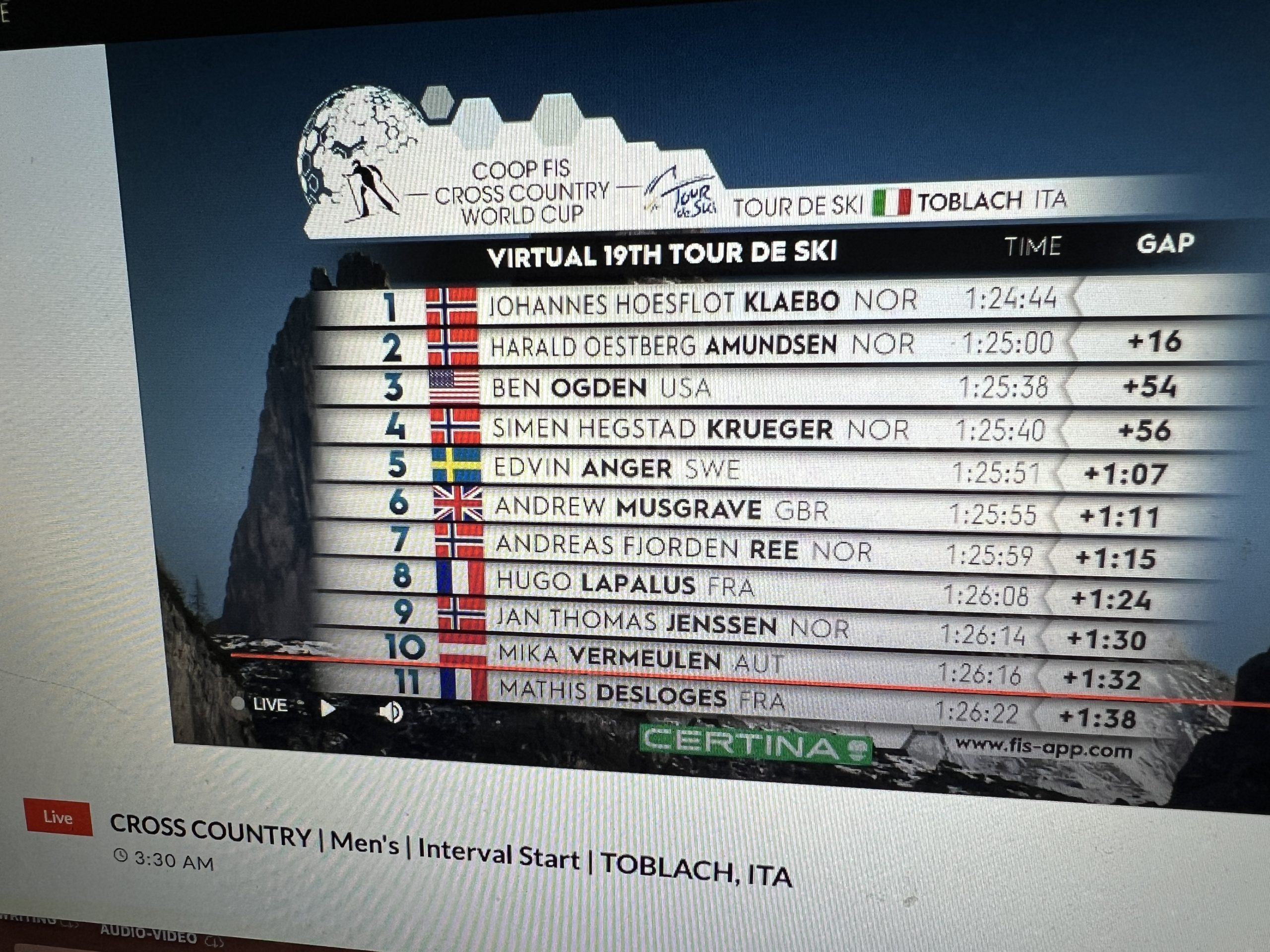
    Klaebo, Lapalus, and Moch led the field through the beginning of the final lap as a resurgent Musgrave pressed the pace. In the end, Klaebo would surge up the final hill, followed by Pellegrino and Jensen. Coasting across the finish line well clear of his rivals, Klaebo extended his lead in the overall Tour standings. Valnes now trails by 2:18, followed by Haavard Moseby and Vermeulen tied at 2:29 back, and Lapalus at 2:44. Anger dropped to 10th overall, followed by Musgrave in 11th.

    Men’s 20 k Skiathlon RESULTS

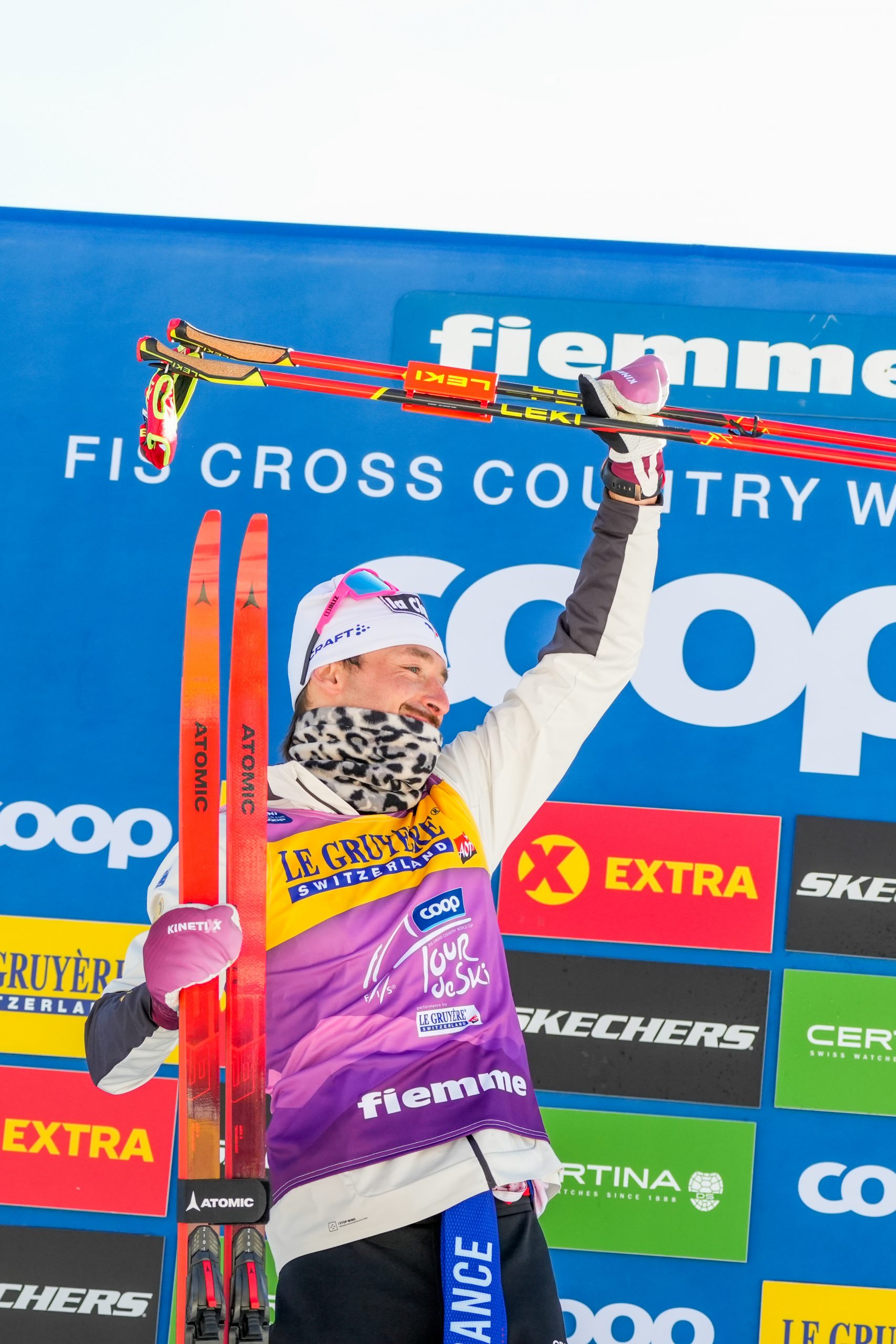
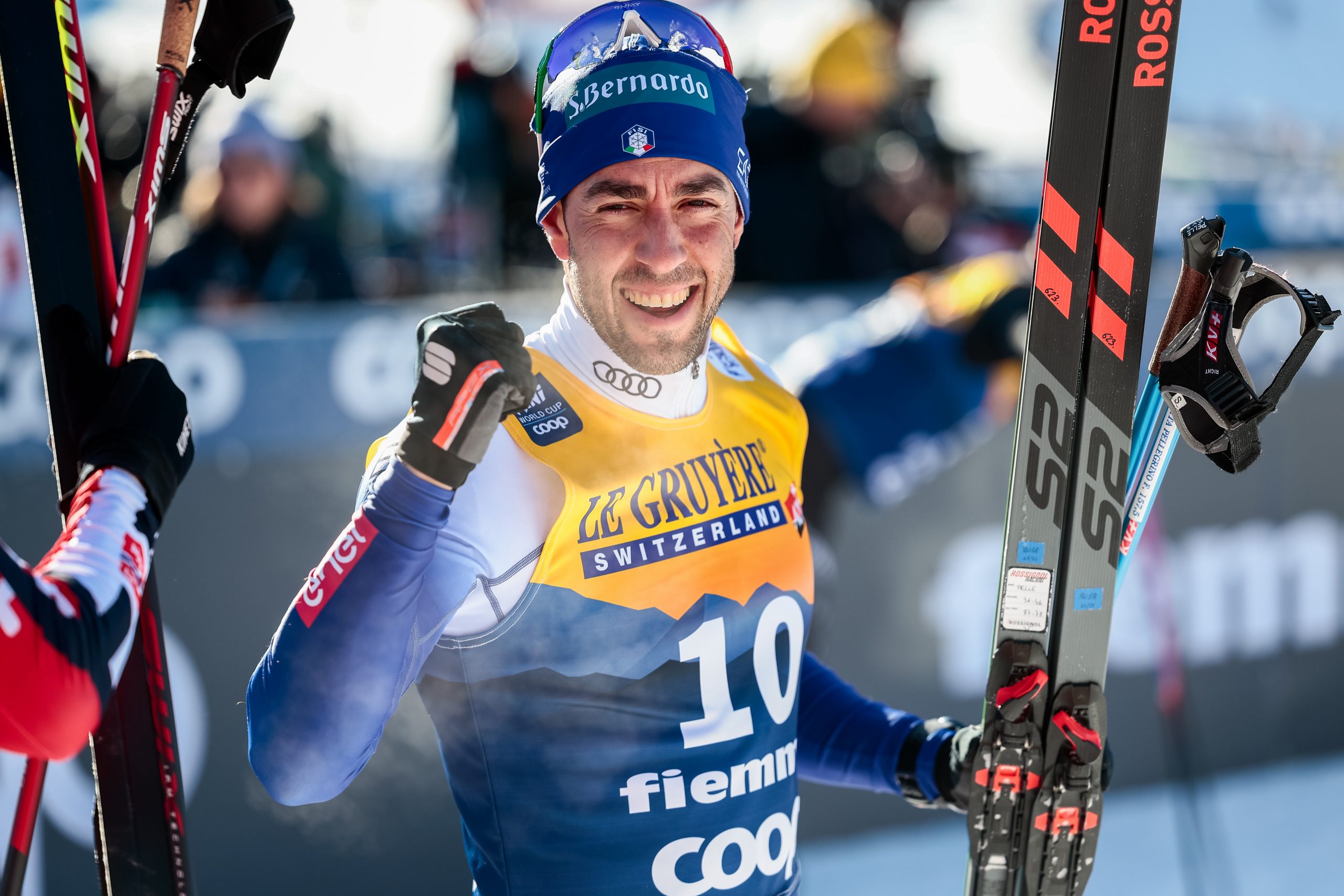
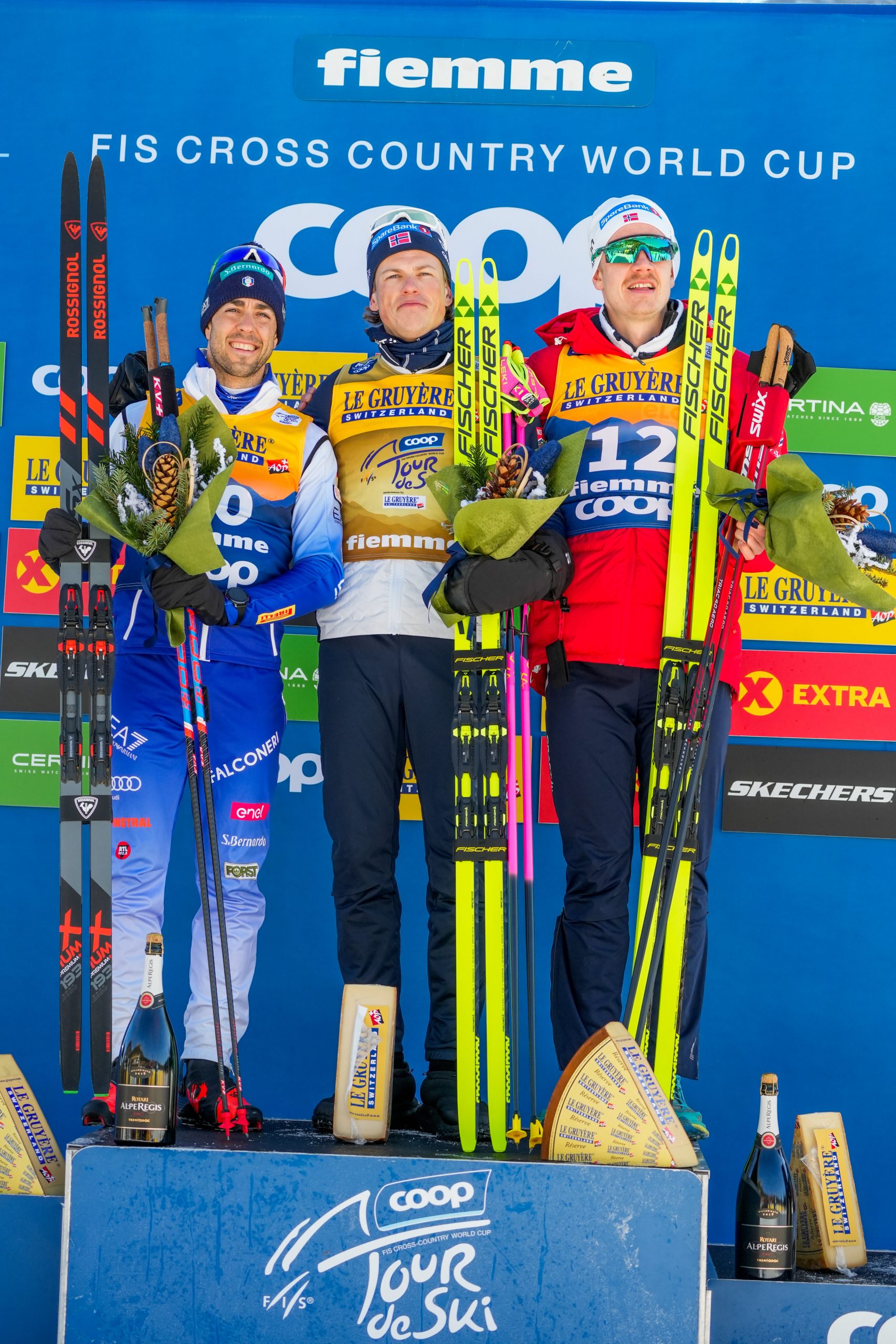
    Federico Pellegrino (ITA), Johannes Hoesflot Klaebo (NOR), and Jan Thomas Jenssen (NOR), (l-r) share the podium after the 20 k Skiathlon in Val di Fiemme (ITA). (Photo:  Vanzetta/NordicFocus)
  • The National Championship Ski Race Was Set for Kincaid Park – Then the Moose Showed Up

    The National Championship Ski Race Was Set for Kincaid Park – Then the Moose Showed Up

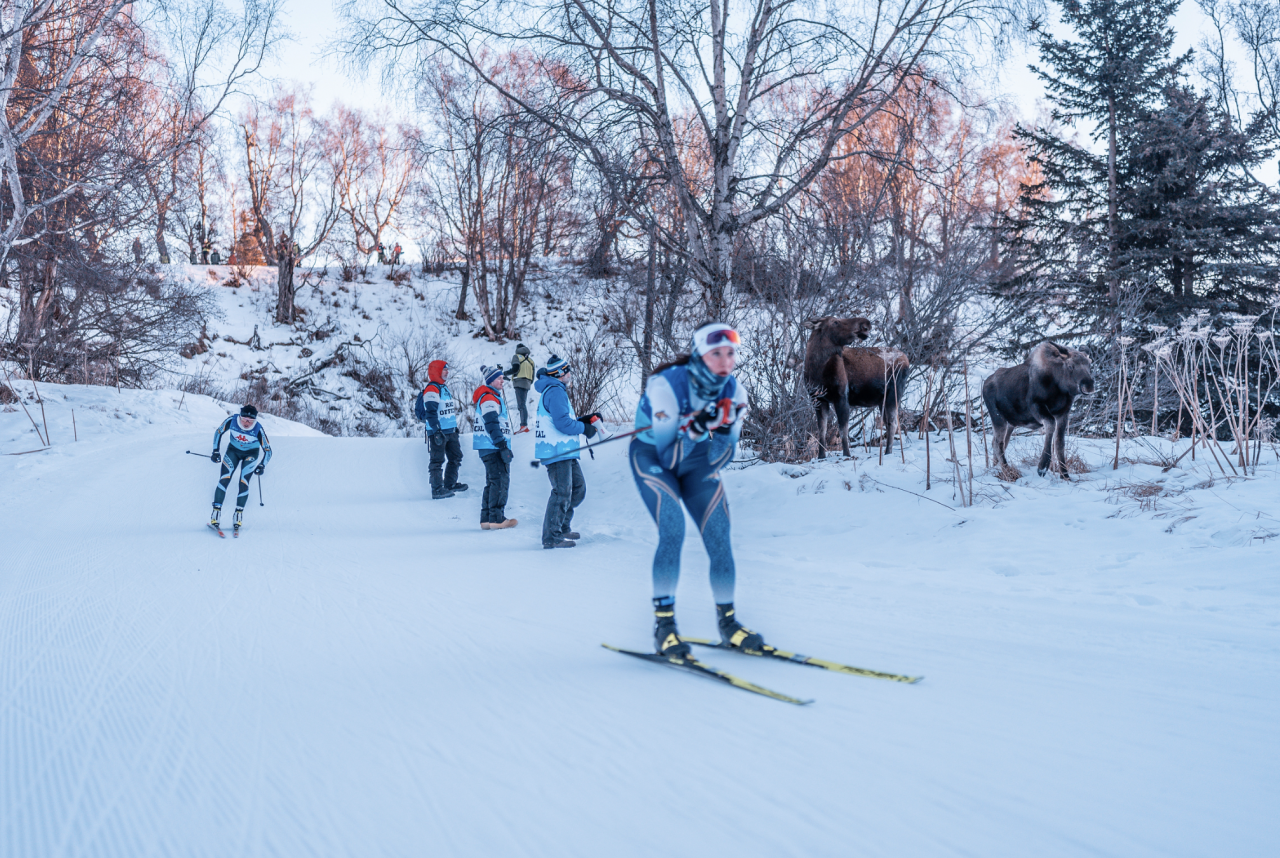
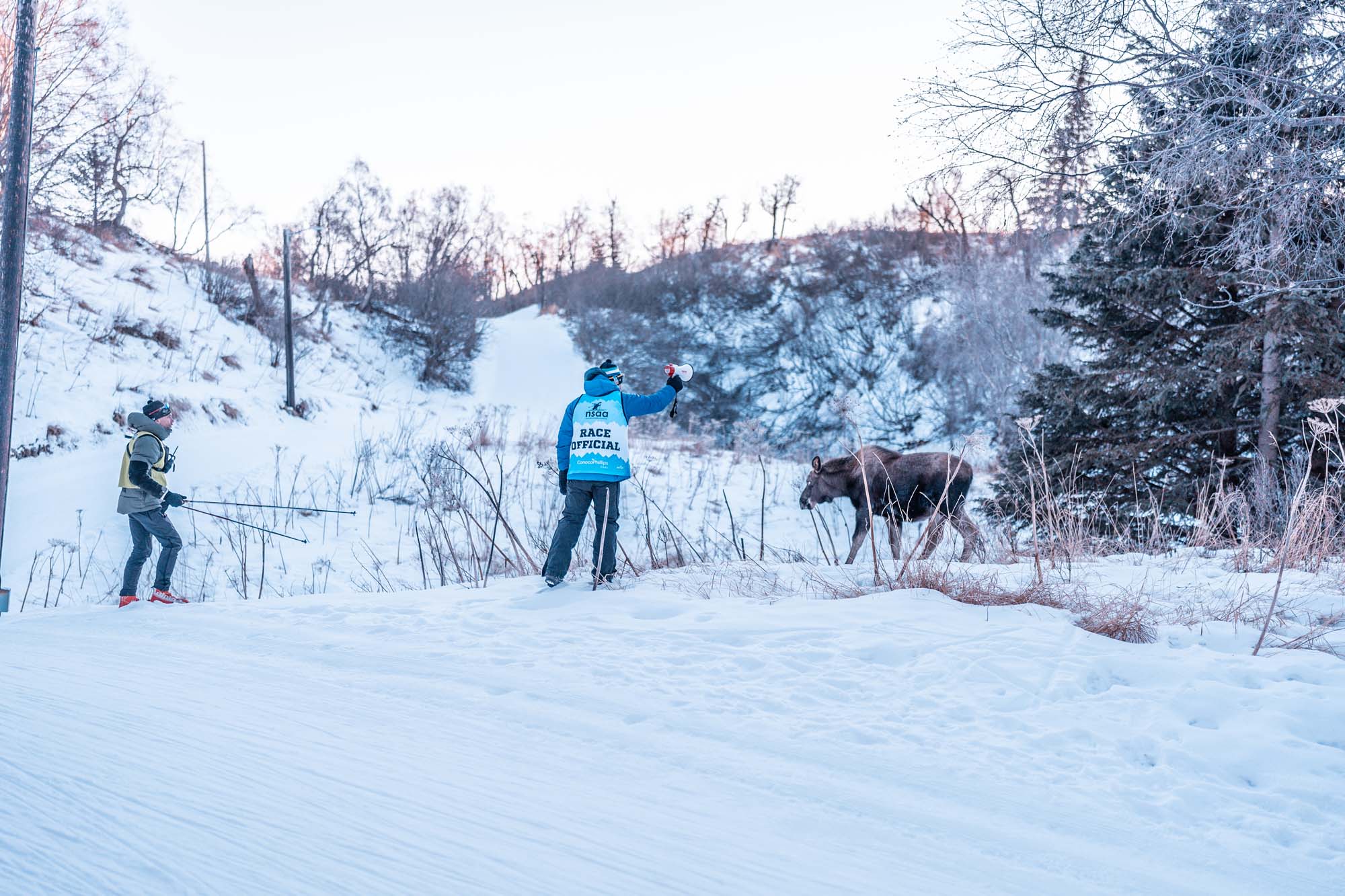
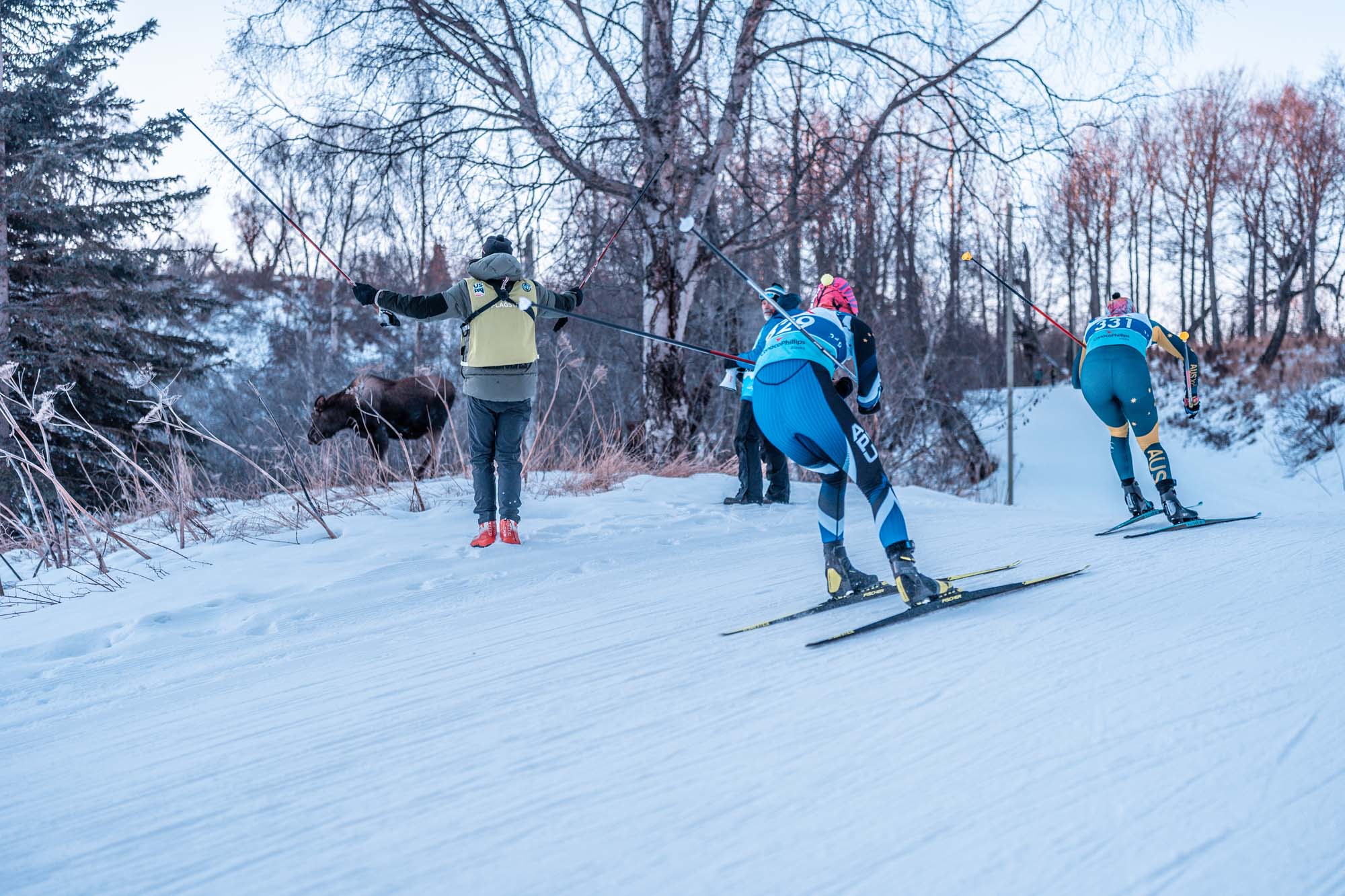
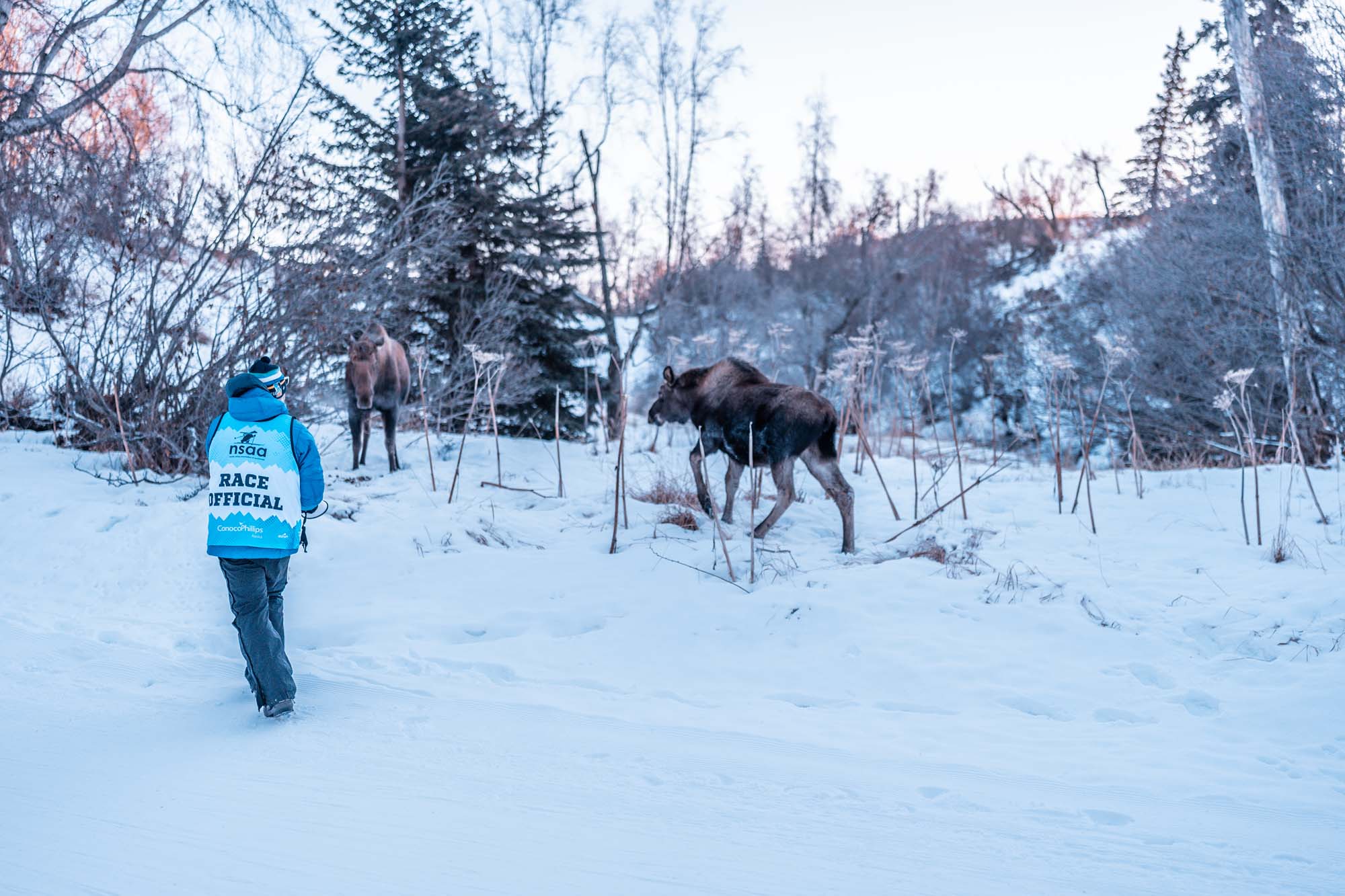
    Volunteers keep a pair of moose off the race trail as athletes slide by during Thursday’s national championship cross-country ski race at Kincaid Park in Anchorage. (Tobias Albrigtsen)

    Racing was tight on the first day of the U.S. National Championships at Anchorage’s Kincaid Park, with winners in both the men’s and women’s events decided by less than 15 seconds.

    The real drama, however, was in a quintessential Anchorage wildlife standoff — one that may have even altered the women’s podium.

    Along a willowy downhill stretch toward the end of the five-kilometer race loop, volunteers and coaches engaged in a tense showdown with a moose and calf — trying, and ultimately failing, to keep them from crossing the trail as lycra-clad athletes zoomed by.

    “If it had been a high school race, I think we probably would have said, ‘You know what? We need to send no more new people out on course for a bit — we’ll figure it out later,’” said Jeremy Littell, a volunteer who brandished a blaring megaphone in an unsuccessful effort to ward off the large ungulates. “But it is senior national championships, and that’s a little bit of a different story. People have a lot on the line.”

    In the end, no moose, nor athletes, were harmed. But at least two women in the 10-kilometer race had hair-raisingly close shaves — one of which was captured on video, alongside Littell’s hazing efforts.

    Coaches and athletes were all in agreement, however: Don’t blame the moose.

    “They live there. And we get to race in their habitat,” said Tilde Bångman, a Swedish athlete competing for the University of Colorado Boulder’s ski team who narrowly dodged the moose — costing her precious seconds in a tightly fought competition. She added: “You can’t control a wild animal.”

    Moose encounters are a long, venerable tradition of Anchorage athletics, and especially of cross-country ski races. The willows and alders that line many of the city’s trails double as moose feed, and almost any resident who trains in the woods can tell a story of a workout being disrupted or diverted.

    “Every week, and sometimes more than once, we have to change our interval plan because of a moose,” said Trond Flagstad, the coach of the University of Alaska Anchorage’s cross-country ski team. He recounted an incident earlier this winter in which a moose charged one of his athletes in the middle of a ski workout.

    “He goes down on the ground, covering his head, and the moose is just standing over him — and then it just moves off,” he said. (Flagstad’s team spotted the moose in the area for a couple of weeks afterward, and named it after the shaken but unharmed athlete.)

    Numerous editions of the Tour of Anchorage — a 30-mile race from the city’s hillside to the coast — have seen top athletes delayed by moose in the middle of the trail. A police officer once shot an aggressive moose during a cross-country running race at Kincaid Park.

    Trond Flagstad, left, and Jeremy Littell employ “moose intimidation tactics” near the five-kilometer race loop. (Photo: Tobias Albrigtsen / @untraceableg)

    “I was standing between the moose and the girls,” the shotgun-toting officer — the father to one of the competitors — later told the Anchorage Daily News. “I was standing there the whole race. I planned on him not getting to the girls.”

    Matt Pauli, the chief of competition for this week’s national championship ski races at Kincaid, said he included a slide of an “amorous cow and bull” moose in his pre-race presentation, to warn team captains about what to expect.

    “I show that and say, ‘Hey, we’ll do what we can do mitigate,’” he said. “But we’re not stopping the race.”

    Volunteers and coaches made a textbook execution of the Pauli method during the women’s race Thursday — throwing an array of deterrents at the cow and calf to allow athletes to pass by.

    Littell, the megaphone-wielding volunteer, said the moose were also present during the men’s race earlier in the day, though peacefully bedded down. After lunch, he said, the animals got up and started moving.

    Unfortunately for organizers, the race format did not lend itself to easy moose management: Rather than one big pack of athletes racing around the course together, the event was a time-trial style individual-start race, where skiers left the gate one at a time every 30 seconds.

    No athletes nor moose were harmed in Thursday’s ski race. (Photo: Tobias Albrigtsen / @untraceableg)

    For a while, Littell said, the moose seemed content to browse on the side of the trail, and with a little help from Flagstad, who was passing by, they kept the animals clear of the athletes.

    But then, Littell said, the moose “got it in their heads that they wanted to cross the course, and it got more and more difficult to keep them in place.”

    “A couple other course people came along, and we kind of got in close with them — used the megaphone, used a lot of voice, used a lot of raised arms, sort of general moose intimidation tactics. And for a while, that worked,” he said. “And then they weren’t having it any more. And we lost.”

    The first time the moose crossed the trail, they moved quickly and didn’t cause problems. But then, they returned, pushed back down toward the course by other volunteers who were trying to keep them off of a different segment of trail.

    “That’s when they got in the trail and didn’t want to leave,” Littell said.

    Enter Bångman, the Swedish skier.

    “You know, when you’re in a race, I was pretty locked in — I don’t see a lot of things going on outside the course,” she said. “I just come down this fast downhill and I see a volunteer in the middle of the course. And I get so confused. And then I see this huge moose starting to walk towards me.”

    Bångman pumped the brakes, sliding her skis a bit.

    “But then I realized, if I stop-slide, I will come to a stop right by the moose, which would probably be worse,” she said. “So, I was like, ‘Well, I’ll try to just send it and hope it doesn’t chase me.’”

    Bångman said she saw a volunteer jump out in front of the moose; she was worried he was about to get stomped. But she snuck past, with no harm done — except, perhaps, to Bångman’s finish time.

    She ended up in sixth place, less than five seconds from the podium, and guessed she’d lost perhaps a few seconds when she slowed for the moose.

    “But, you know, that’s a part of racing at Kincaid, isn’t it?” she said. “Some extra excitement.”

    A real Alaskan experience for the racers visiting for the 2025 US National Championship. (Photo: Tobias Albrigtsen / @untraceableg)

    Littell, reached by phone a day later, said he was a little nervous about publicizing his moose intimidation efforts, stressing that he’s typically “pretty cautious about the animals.”

    The volunteers, he said, were “trying to balance skier safety first, volunteer safety second, and moose safety as a close third.”

    Littell works for a federal agency, he said, and he’s frequently instructed that “no altercation is worth the effort.” But, he added: “I wasn’t on the clock.”

  • 2025 US National Championship – 10 k Individual Start Freestyle – from the Lens of Tobias Albrigtsen

    2025 US National Championship – 10 k Individual Start Freestyle – from the Lens of Tobias Albrigtsen

    ANCHORAGE — The 2025 US National Championship started yesterday at Kincaid Park in Anchorage, Alaska, with the 10 k Individual Start Freestyle.  Photographer and coach Tobias Albrigtsen (@untraceableg) gives us a look through his lens.

    (click on the first photo and then click on ‘start’ just above the image to play the slideshow)

  • Faehndrich Tactically Wins Tour de Ski Stage 5, Diggins Racing on Injured Foot

    Faehndrich Tactically Wins Tour de Ski Stage 5, Diggins Racing on Injured Foot

    This coverage is made possible through the generous support of Marty and Kathy Hall and A Hall Mark of Excellence Award. To learn more about A Hall Mark of Excellence Award, or to learn how you can support FasterSkier’s coverage, please contact info@fasterskier.com.

    The Tour de Ski concludes this weekend with three events remaining: today’s classic sprint, tomorrow’s 20 kilometer skiathlon, and the famous (or infamous…) “Loppunousu” hill climb on Sunday. After the first four grueling days of racing, athletes are battling soreness, exhaustion, and the mental fatigue that accompanies competing in so many events back-to-back. As the final stretch of the Tour approaches, Slind and Johaug remain locked in a tight battle for the overall title.

    Because athletes must complete every event in the Tour, Stage 5’s sprint heats are scattered with distance specialists who have leveraged their endurance to outperform fatigued sprint specialists. Slind and Johaug, leading the overall standings, are not known for their sprinting abilities but managed to qualify in 17th and 21st, respectively, for today’s heats. With Slind holding a slim six-second lead over Johaug after Stage 4 in the overall standings, today’s sprint might leave room for someone like Jessie Diggins (USA)–a strong sprinter currently in 4th place overall–to chip away at her one-minute deficit to the leaders. Meanwhile, Kerttu Niskanen (FIN) and Heidi Weng (NOR), both ranked in the top five overall, remain key contenders going into today’s competition. 

    Nadine Faehndrich (SUI) skied to her first sprint victory this season, followed by Linn Svahn (SWE) on the right and Heidi Weng (NOR) on the left to round out the podium. (Photo: NordicFocus)

    Among the top five in the overall Tour rankings, Heidi Weng (NOR) was the only athlete to advance past the quarterfinals. She secured third place in the sprint, finishing behind Linn Svahn (SWE) in second and Nadine Faehndrich (SUI), who claimed the top spot on the podium.

    “I think it’s a very nice classic track. Maybe it wasn’t the best for me, but I really worked on this diagonal technique, and I am very happy that I now see very good progress,” Faehndrich shared following her victory.

    Meanwhile, Diggins is working through a foot injury, and is currently being treated for plantar fasciitis, which developed shortly before the Tour de Ski. Classic skiing is more painful for her, though she plans to continue competing for the time being. “I’m really grateful for my team and grateful to be able to race, and just excited to keep taking it day by day and giving it my all,” Diggins shared after finishing 14th in today’s results.

    Julia Kern (USA) smiles after her race today, feeling excited for the final weekend of racing. (Photo: NordicFocus)

    Julia Kern (USA) finished 18th today after having been tripped and cut off during her quarterfinal, eliminating her from advancement. “I’m feeling it all,” Kern reports in reference to the week of racing behind her. “Moments of tiredness, then overtired bursts of energy and giggles. I felt great in the quarterfinal today, and my skis felt awesome so that has me excited for tomorrow! Tomorrow my goal is to ski with good technique and race smart,” Kern shared this afternoon.

    American Sophia Laukli finished 42nd, and Canadians Liliane Gagnon and Katherine Stewart-Jones finished 33rd and 36th, respectively. Rosie Brennan (USA) did not start today’s sprint and has officially withdrawn from the Tour. 


    Women’s Sprint Quarterfinals

    Temperatures lingered above freezing today, but the classic tracks remained firm–the perfect conditions for a classic sprint competition. This year’s event in Val di Fiemme debuted a new sprint course, designed for the 2026 Olympics, which will take place next February. The updated course features two major climbs, making it more challenging than the previous sprint layout at this venue. 

    The final climb culminates in a gradual turn into the final descent and finish line at the bottom. Due to the wide and gradual nature of the turn, no specific track or position offers a clear advantage, enabling athletes to compete head-to-head, often spread five across on the final ascent. Tactics proved crucial on the final descent—not in terms of position heading up the hill but rather who emerged first into the downhill stretch.

    Throughout the heats, many skiers hesitated in the corner before the final descent, reluctant to take the lead. This hesitation stemmed from the “slingshot effect,” where drafting skiers gained momentum to surge past the leader. Time and time again, skiers who led into the descent would cross the finish line seconds after the leader at the back of the pack. 

    Jessie Diggins (USA), left, Nicole Monsorno (ITA), middle, and Jasmi Joensuu (FIN) in the first quarterfinal heat. (Photo: NordicFocus)

    With so many sprint specialists having dropped out of the Tour, worn down from the previous three days of distance racing, the heats were open to new names. The first women’s quarterfinal brought Therese Johaug (NOR) to the line, a dominant distance skier with few sprint successes to her name. Nicole Monsorno (ITA) and Jasmi Joensuu (FIN) traded the lead throughout the course, with Diggins struggling to keep pace in third. Kristin Austgulen Fosnaes (NOR) also challenged around the outside early in the race, but dropped back after running out of steam. Johaug, while slow out of the start, leveraged her strength on the hills, challenging Diggins for the third position over the final climb. With this being the second-slowest heat, no lucky losers advanced, sending only Monsorno and Joensuu to the semifinals.

    In the second heat, Linn Svahn (SWE) and Johanna Matintalo (FIN) skied side-by-side out of the start to attain an early lead. Caterina Ganz (ITA) settled in comfortably behind them, and the order remained largely unchanged throughout the short race. As the athletes entered the stadium, Svahn sped by Matinalo with fast skis to finish first. Ganz crossed just behind, earning a spot in the semifinals as a lucky loser. With this heat being significantly faster than the first, Diggins was eliminated from further contention. 

    Julie Myhre (NOR) and Laura Gimmler (GER) rose to an early lead in quarterfinal three. Katherine Sauerbrey (GER) accelerated around the outside of the first climb, cutting off Kern around the hairpin turn into the first descent. Kern managed to recover and emerged in front on the second climb, competing for a strong position into the finishing stretch. That’s when chaos ensued as Melissa Gal (FRA), who had been running outside the laid tracks on the inside of the trail, collided with the V-boards and was forced to merge into Kern. This brought Kern to a near stop, with others continuing around the tangled duo to a clear path to the finish line. Julie Myhre easily claimed first, followed by Gimmler and Marina Kaelin (SUI), who advanced behind her.

    Julia Kern (USA) moments before being tripped by Melissa Gal (FRA) from behind on the final climb. (Photo: NordicFocus)

    Julia Kern recounted the drama during her heat in a message to FasterSkier. “My heat went out and it immediately felt tactical, so I settled in and played the game, putting myself in the position I wanted to be, in front and in control. Unfortunately, another skier obstructed me and in the moment it felt quite blatant and unwarranted. I tried to save my pole from being broken, which I did, but then also was stepped on and grabbed and pushed. I always try to stay on my feet, and equipment intact no matter the incident, because going down guarantees you don’t have a fighting chance. My original strategy was not to lead the downhill but slot into second, but after the incident I just hammered over the top to try to get as much speed in the downhill, but at that point I got pushed up against the V-boards and had nowhere to go but check speed and try to find any fighting chance to move on.”

    Kerttu Niskanen and Heidi Weng would compete against each other in the 4th heat, two athletes sitting in the top five overall positions for the Tour. With Johaug and Diggins already eliminated, advancing to the semifinals would present an excellent opportunity for either skier to significantly boost their overall standings. 

    Kerttu Niskanen (FIN), Heidi Weng (NOR), Jasmin Kahara (FIN), Lena Quintin (FRA), Nadine Faehndrich (SUI), Pia Fink (GER), (l-r) sprint up the fan-lined, final hill of the 2026 Olympic Sprint course in Val di Fiemme (ITA). (Photo: NordicFocus)

    Out of the start, Nadine Faehndrich (SUI) and Jasmin Kahara (FIN) took an early lead, maintaining their position out front for most of the race. Heidi Weng attempted a move on the first hill but lacked the energy to sustain it, settling alongside Pia Fink (GER) to trail the leaders. On the final descent, Kahara’s slower skis allowed Weng to close the gap significantly, while Faehndrich extended her lead to finish more than a second ahead of the field. Kahara narrowly held onto second place, edging out Weng, who earned the second lucky loser position and advanced to the semifinals.

    In heat five, Lotta Udnes Weng (NOR) took it out fast in this heat, setting the pace alongside Anja Weber (SUI) and Krista Parmakoski (FIN). Astrid Oeyre Slind (NOR), the overall Tour de Ski leader, positioned herself right behind Parmakoski in the middle of the pack. Finland’s skis struggled to match the speed of Norway and Switzerland, forcing Parmakoski to work harder to maintain her lead into the second ascent. As the heat approached the final climb, skiers raced head-to-head in a highly contested battle into the descent. Federica Cassol (ITA) accelerated over the top to take the lead into the final descent, but her slower skis combined with the drafting advantage of her competitors caused her to fall to the back of the pack. Weber and Weng skied to first and second, advancing to the semifinals, while Slind finished in fourth, missing the cut for advancement.


    Women’s Sprint Semifinals

    Heidi Weng was the only skier in the top five of the overall Tour de Ski standings to advance to the semifinals. Aware of this advantage, Weng skied a tactical race. Svahn took an early lead alongside Myhre, with Joensuu holding the third position. In an effort to avoid being the first down the final descent—a stretch that had repeatedly proven decisive in earlier rounds—the pack slowed over the final climb. As they entered the finishing stretch, all five skiers were battling to be at the front. Joensuu sat on her skis to achieve a more aerodynamic position, though it wasn’t enough to overtake Weng and Svahn, who maintained their lead across the finish line. Joensuu, the current sprint leader of the Tour, would need to advance as a lucky loser, though the slow pace of the heat made her chances slim.

    In the second semifinal, Kahara and Gimmler set the pace from the start, with Ganz pushing hard from third. Kahara extended her lead into the second climb, as racers spread out across all five lanes in a fierce battle for position heading into the final descent. Ganz led the charge alongside Kahara down the hill, though the slow Italian skis yet again sent Ganz flying to the back of the pack. With Gimmler stuck behind Kahara, Faehndrich used the speed she carried from the descent to overtake Kahara on the right. Meanwhile, Weng effectively blocked Gimmler’s attempts to change lanes on the left, securing her place in the final.


    Women’s Sprint Final

    Today’s women’s final featured several new names and crowned a fresh face atop the podium for this season. With that, the heat was fairly well matched, with the top three positions open for any combination of the final competitors. Svahn took a confident early lead, though was unable to pull away from Faehndrich or Gimmler, sitting closely behind. This order held through the first climb, but the final ascent brought challenges from Weng and Kahara. Weng, skiing on the far right, avoided the jostling closer to the inside lanes, and skiing hard into the final descent was able to pass her competitors to finish third in today’s sprint competition. Faehndrich, first down the hill, just barely maintained her position, and outsprinted Svahn to the line by just 0.04 seconds. 

    Heidi Weng (NOR) earned her first sprint podium since 2020, and before that, since 2017. (Photo: NordicFocus)

    While delighted with her performance, even Faehndrich admits the final descent left a lot to be decided among competitors. “I’m very happy and at the end, a little bit lucky,” Faehndrich reported following her race, knowing that the combination of fast skis and perfect tactical position down the final descent had won her the race. 

    The overall standings for the top five positions remained largely unchanged. Diggins sits in 4th, one minute behind Slind. Niskanen holds in 3rd, 29 seconds back while Johaug stays in 2nd, just 8 seconds behind the leader. Weng managed to gain 30 seconds on Slind with her performance today, but remains 1:27 back and in the 5th position in the overall standings.

    Top Ten Women Stage 5 Classic Sprint

    1. Nadine Fähndrich (SUI)
    2. Linn Svahn (SWE)
    3. Heidi Weng (NOR)
    4. Jasmin Kähärä (FIN)
    5. Laura Gimmler (GER)
    6. Lotta Udnes Weng (NOR)
    7. Jasmi Joensuu (FIN)
    8. Nicole Monsorno (ITA)
    9. Julie Myhre (NOR)
    10. Anja Weber (SUI)

    Women’s Classic Sprint Results


    Top Ten Women Overall After Stage 5

    1.  Astrid Øyre Slind (NOR) 2:15:59
    2. Therese Johaug (NOR) +0:08
    3. Kerttu Niskanen (FIN) +0:29
    4. Jessie Diggins (USA) +1:00
    5. Heidi Weng (NOR) +1:27
    6. Jasmi Joensuu (FIN) +2:42
    7. Victoria Carl (GER) +3:04
    8. Silje Theodorsen (NOR) +3:15
    9. Teresa Stadlober (AUT) +3:23
    10. Linn Svahn (SWE) +3:24

    Women’s Tour de Ski Overall Standings


    Linn Svahn (SWE), Nadine Faehndrich (SUI), and Heidi Weng (NOR) (l-r) topped the podium in the Tour de Ski Classic Sprint Stage 5. (Photo: NordicFocus)
    Linn Svahn (SWE), Nadine Faehndrich (SUI), and Heidi Weng (NOR) (l-r) topped the podium in the Tour de Ski Classic Sprint Stage 5. (Photo: NordicFocus)
  • Klaebo Unstoppable: Extends Lead in Tour de Ski

    Klaebo Unstoppable: Extends Lead in Tour de Ski

    This coverage is made possible through the generous support of Marty and Kathy Hall and A Hall Mark of Excellence Award. To learn more about A Hall Mark of Excellence Award, or to learn how you can support FasterSkier’s coverage, please contact info@fasterskier.com.

    Today’s sprint marks Stage 5 of the Tour de Ski, one of the final stages leading to the Tour’s culmination this weekend. What sets the Tour apart from any other competition is its strict rule that once athletes withdraw, they cannot re-enter the competition. This format forces distance specialists to compete in sprints and challenges sprinters to tackle the longer races. As a result, the overall leader’s position is contested by a small group of athletes who can perform well in both disciplines. 

    The sprint qualification list for today looks quite different than what we might expect during a regular race weekend. With endurance being pushed to its limits, many sprint specialists may find themselves too fatigued to hit their usual higher gears. Instead, today’s results are likely to favor athletes with solid sprinting abilities who can also rely on their endurance to deliver maximum effort, despite the lingering soreness and tired legs from the first four stages of the Tour.

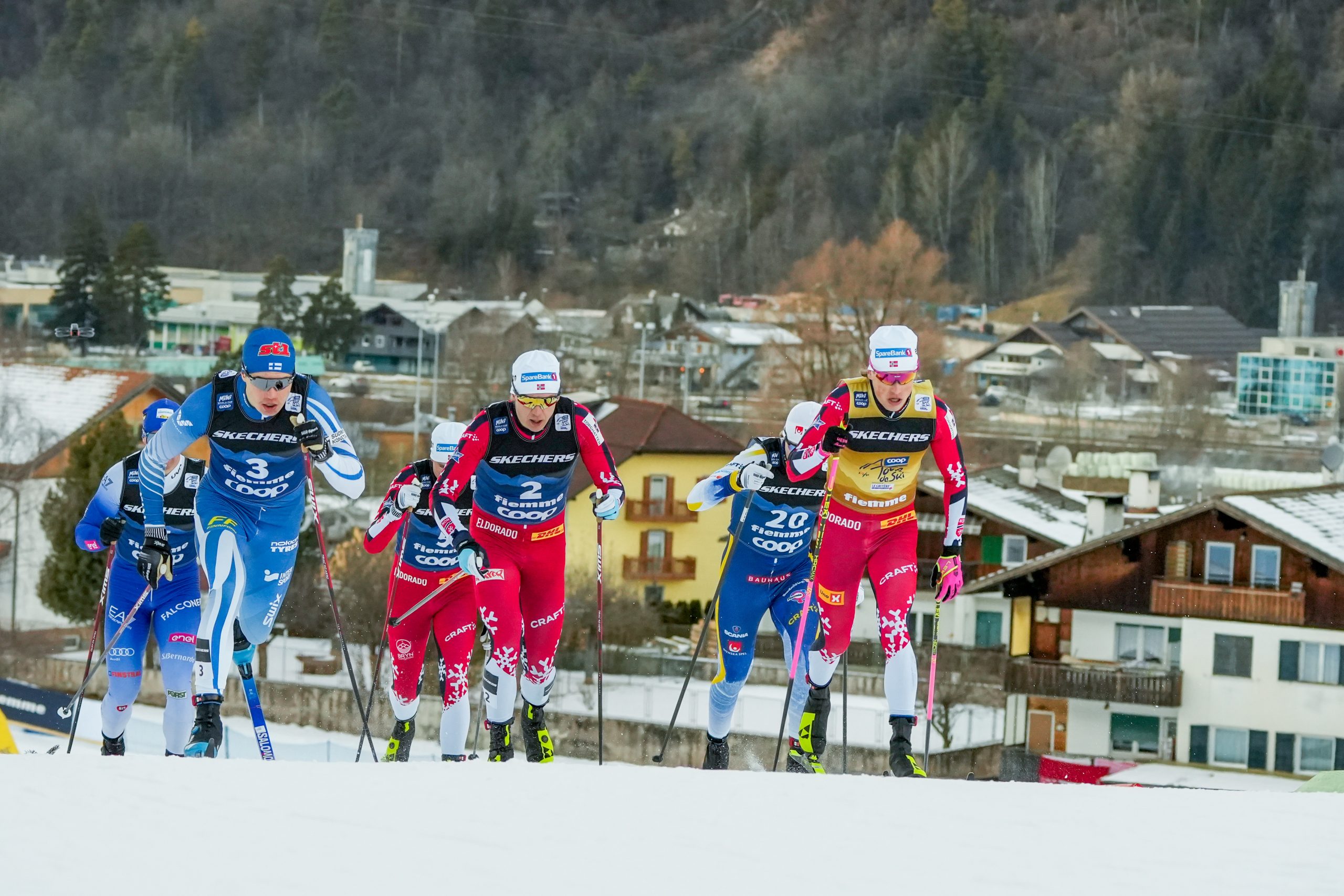
    Niilo Moilanen (FIN), Erik Valnes (NOR) and Johannes Hoesflot Klaebo (NOR) race up the final climb of the Val di Fiemme (ITA) sprint course on the fifth stage of the Tour de Ski. (Photo: NordicFocus)

    With the physical demands of back-to-back races, fatigue and illness have taken their toll, leaving several notable names absent from today’s start list. Racing through illness risks significantly prolonged recovery, and in a World Championships year, athletes are understandably avoiding anything that could jeopardize the rest of their season. Notably Harald Oestberg Amundsen (NOR), who won Stages 3 and 4 and was sitting in third place overall in the Tour, has withdrawn due to a sore throat and headache. Gus Schumacher (USA), who was ranked 10th in the Overall Tour de Ski standings, has also withdrawn with a sore throat. 

    One name we can confidently expect to see at the top is Johannes Hoesflot Klaebo (NOR). A dominant force in both sprint and distance racing, Klaebo has consistently led the field, making his claim to the overall Tour de Ski title appear almost uncontested this year. Without his usual rival Lucas Chanavat (FRA)—who withdrew after just a few stages—does anyone have the ability to challenge Klaebo for the win today?

    One potential contender is Edvin Anger, a young Swedish racer who has proven to be strong in both distance and sprint disciplines. While Anger has earned top-10 finishes through the Tour, he only conquered Klaebo in one – Stage 4’s 15 kilometer classic pursuit. Another name to watch is Klaebo’s teammate Erik Valnes, a well-rounded athlete with strong results in both formats. Valnes finished just behind Klaebo in the classic sprint in Ruka and the skate sprint in Davos earlier this season, and proved his endurance by finishing second, only 0.6 seconds behind Klaebo in the 15 kilometer classic competition during Stage 2 of the Tour. Despite these strong competitors, Klaebo’s sprint dominance this season leaves little room for contention, making him the clear favorite for today’s race.

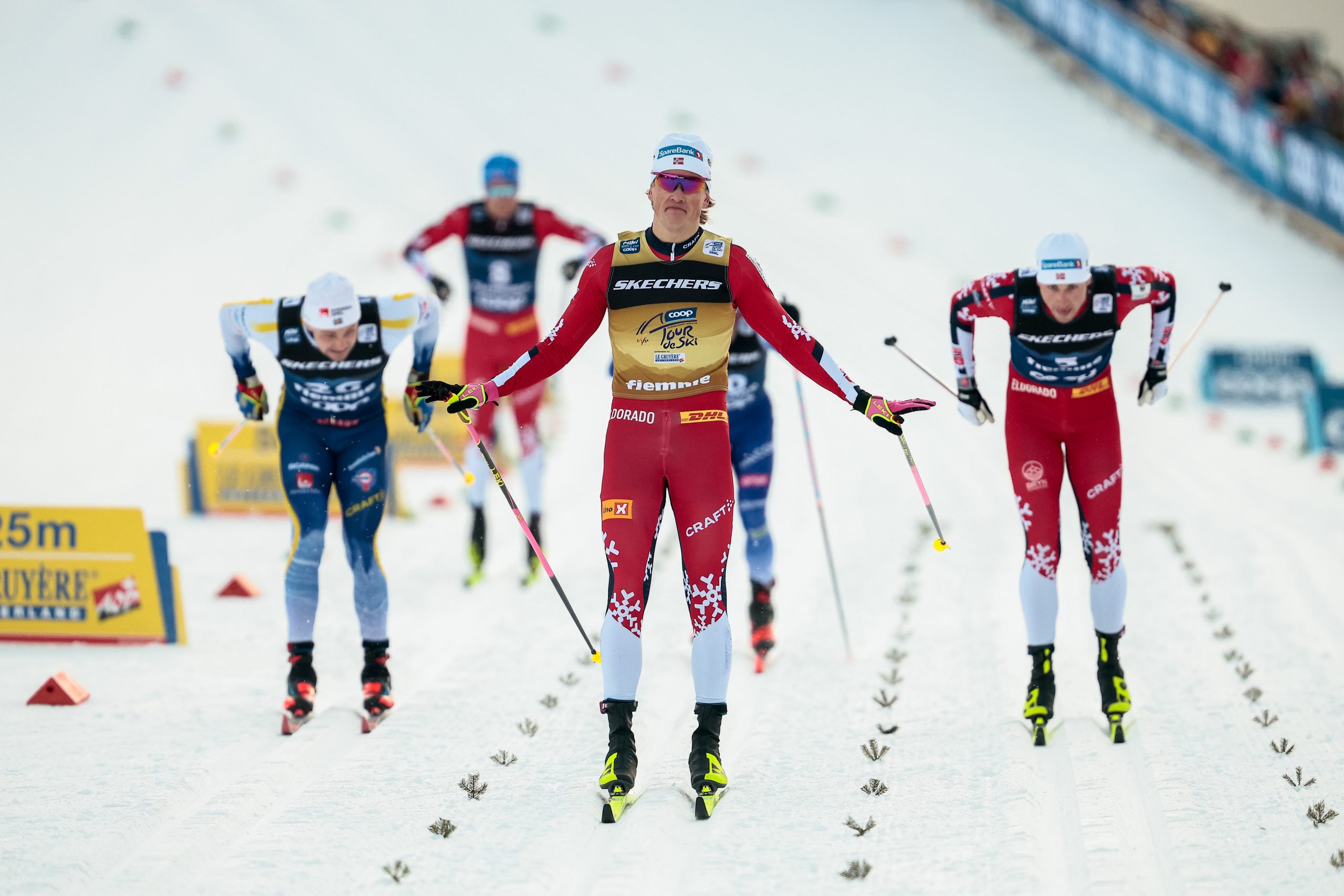
    Johannes Hoesflot Klaebo (NOR) crosses the line in his signature style, with Marcus Grate (SWE) on the left and Erik Valnes (NOR) on the right fighting to round out the podium. (Photo: NordicFocus)

    In the end, Klaebo claimed an effortless victory, navigating the course with his signature tactical finesse. He was joined on the podium by teammate Even Northug in second place and Marcus Grate (SWE) in third. 

    Ben Ogden (USA) qualified in 4th position for the heats but was eliminated during the quarterfinal round. After the race, he reported feeling “decently tired and decently frustrated.” Reflecting on his performance, Ogden shared, “Given everything, I am happy with my overall position, but two of the hardest races to come have me nervous.” As the Tour comes to a close, he added, “I’ll just try to eat and sleep as much as I can before them and see what I have in the tank!” Ogden finished the day in 17th. 

    Among other Americans, Zanden McMullen and Jack Young placed 22nd and 32nd, respectively. On the Canadian side, Olivier Leveille finished 54th, and Antoine Cyr skied to 29th.


    Men’s Sprint Quarterfinals

    Temperatures lingered above freezing today, but the classic tracks remained firm–the perfect conditions for a classic sprint competition. This year’s event in Val di Fiemme debuted a new sprint course, designed for the 2026 Olympics, which will take place next February. The updated course features two major climbs, making it more challenging than the previous sprint layout at this venue. 

    Athletes tackle the final climb which culminates in a gradual turn down into the final descent and finish line at the bottom. Due to the wide and gradual nature of the turn, no specific track or position offers a clear advantage, enabling athletes to compete head-to-head, often spread five across on the final climb. Tactics proved crucial on the final descent—not in terms of position heading up the hill but rather who emerged first into the downhill stretch.

    Throughout the heats, many skiers hesitated in the corner before the final descent, reluctant to take the lead. This hesitation stemmed from the “slingshot effect,” where drafting skiers gained momentum to surge past the leader. Time and time again, skiers who led into the descent would cross the finish line seconds after the leader at the back of the pack. 

    Klaebo approached the first heat conservatively from the start, allowing Elia Barp (ITA), to take the lead. Teammate Erik Valnes (NOR) also tucked in behind Klaebo, a tactical position knowing Klaebo would likely make his move over the final climb and create an opportunity for Valnes to follow. True to form, Klaebo accelerated into the final descent, pulling Valnes with him. 

    Ben Ogden (USA) leading his quarterfinal alongside Niilo Moilanen (FIN) and Giacomo Gabrielli (ITA) before being outpaced in the finishing stretch, finishing fourth. (Photo: NordicFocus)

    In the second heat, Ben Ogden (USA) hoped to use his strength in sprinting to come back from his nose-drive in ranking from 3rd to 17th in the Tour’s overall standings. Knowing this, Ogden took an early lead beside Niilo Moilanen (FIN), positioning himself in second to draft and conserve energy. He maintained that position through the race until the finishing stretch, where an extra push at the top of the final descent may have helped Ogden maintain his position. Instead, Oskar Svensson (SWE) and Giacomo Gabrielli (ITA) slingshotted around the pack to finish ahead of Ogden, who finished fourth in his heat. 

    “Today I was just going too slow compared to the people around me,” Ogden shared. “I think in future efforts on this course I will try to really push hard at the top of the hill and hope that gives me a little more momentum going into the finish.”

    The third heat featured Giovanni Ticco (ITA), a strong sprinter, who opened a substantial lead over the first ascent. Marcus Grate (SWE) quickly closed the gap, sitting behind Ticco as Even Northug (NOR) and Valerio Grond (SUI) took an outside line to accelerate into the lead. The race concluded with a thrilling three-way photo finish between Northug, Grate, and Grond, with Grond missing advancement by just 0.01 seconds. Canadian Antoine Cyr finished last in the heat but was less than a second behind Northug.

    Federico Pellegrino (ITA), positioned on the far right, escapes unscathed as Qiang Wang (CHN) trips into Niko Anttola (FIN), bringing the field to a halt. (Photo: NordicFocus)

    The fourth quarterfinal heat boasted a strong lineup of sprinters. Edvin Anger (SWE), aiming to narrow his time deficit to Klaebo in the overall standings, faced an early setback when his pole snapped against the start gate at the gun. Without a replacement pole nearby, it seemed Anger was out of contention as the pack surged ahead. However, chaos struck atop the first hill when China’s Qiang Wang slipped and fell, halting much of the field. This allowed Anger to close much of the gap. Despite Wang’s fall, he retained second position through the final climb, while Italy’s Federico Pellegrino and Simone Dapra crossed the line together well ahead of the field, advancing to the semifinals. Notably, Richard Jouve (FRA) did not start the heat.

    Finally, the fifth heat was the fastest of the day, producing both lucky loser qualifiers. Janik Riebli (SUI) and Zanden McMullen (USA) set an early pace, with McMullen creating a small gap between himself and the field. On the final climb, Michael Hellweger (ITA) caught McMullen, but the rest of the pack allowed McMullen to lead into the descent—aware that this position was precarious. Emil Danielsson (SWE), Riebli, Haavard Moseby (NOR), and Hellweger slingshotted around McMullen on the final stretch. Although McMullen’s time would have been fast enough to qualify him as a lucky loser, his fifth-place finish ultimately ended his run.

    Zanden McMullen (USA) led the fastest quarterfinal from nearly start to finish, but faded down the final descent and in the finish stretch, ultimately finishing fifth in his heat. (Photo: NordicFocus)


    Men’s Sprint Semifinals

    The semifinals began with another dominant performance by Klaebo in the first heat. Klaebo and Valnes took an early lead, but allowed Moilanen to control the pace through the first descent. On the second climb, Klaebo opted for an outside line, skiing with a smooth and relaxed stride instead of his usual fast-tempo style. In a tactical masterstroke, Klaebo accelerated into the lead down the descent as others jostled to avoid that position. This move gave him a significant advantage, putting meters between himself and the pack. With fast skis, Klaebo is one of the only racers today able to maintain his lead down the final descent. Northug joined Klaebo in advancing to the finals. 

    In the second semifinal heat, Swedish skiers Marcus Grate and Emil Danielsson worked together to establish an early lead, with Simone Dapra (ITA) and Janik Riebli (SUI) tucked comfortably behind. These positions continued through much of the race, before Dapra accelerated into the final descent. However, his slower skis caused him to lose momentum, dropping to the back of the pack as accelerated ahead. Riebli took the opportunity to take the lead, followed closely by Moseby. Grate and Pellegrino would advance to the finals as lucky losers. 


    Men’s Sprint Finals
    Johannes Hoesflot Klaebo (NOR) dominated the final, with Erik Valnes (NOR) and Marcus Grate (SWE) trailing behind in the final. (Photo: NordicFocus)

    In the men’s sprint finals, the question still lingered: is there anyone capable of challenging Klaebo for the title? The answer was a definitive no. Klaebo positioned himself in front of the pack from the start, maintaining his lead throughout the competition. Head-to-head, Klaebo sprinted alongside Northug and Pellegrino up the final ascent, Pellegrino using his high tempo to get in front for a small moment of glory before Klaebo shot around Pellegrino on the final descent to take the title. Klaebo was joined on the podium by Northug in second, and Grate in third. Pellegrino finished fourth with slow skis on the final descent despite his overall strong performance. 

    Top Ten Men Stage 5 Classic Sprint

    1. Johannes Høsflot Klæbo (NOR)
    2. Even Northug (NOR)
    3. Marcus Grate (SWE)
    4. Federico Pellegrino (ITA)
    5. Håvard Moseby (NOR)
    6. Janik Riebli (SUI)
    7. Oskar Svensson (SWE)
    8. Erik Valnes (NOR)
    9. Niilo Moilanen (FIN)
    10. Emil Danielsson (SWE)

    Men’s Classic Sprint Results


    Top Ten Men Overall After Stage 5

    1. Johannes Høsflot Klæbo (NOR) 2:00:55
    2. Edvin Anger (SWE) +1:35
    3. Erik Valnes (NOR) +2:11
    4. Mika Vermeulen (AUT) +2:24
    5. Håvard Moseby (NOR) +2:25
    6. Hugo Lapalus (FRA) +2:36
    7. Simen Hegstad Krüger (NOR) +2:41
    8. Federico Pellegrino (ITA) +2:54
    9. Andreas Fjorden Ree (NOR) +2:56
    10. Jan Thomas Jenssen (NOR) +2:56

    Men’s Tour de Ski Overall Standings


    Erik Valnes (NOR), Johannes Hoesflot Klaebo (NOR), Marcus Grate (SWE) (1-r) topped the podium in the Val di Fiemme Tour de Ski Stage 5 (Photo: NordicFocus)
  • One familiar face and one new one notch wins as U.S. Nationals opens in Alaska

    One familiar face and one new one notch wins as U.S. Nationals opens in Alaska

    Erling Bjoernstad, a Norwegian freshman racing for University of Alaska Anchorage, climbs a hill toward the stadium at U.S. Nationals Thursday. (Nathaniel Herz/FasterSkier)

    ANCHORAGE — Kate Oldham wasn’t expecting to win Thursday’s opening race of the U.S. National Championships.

    It was her first competition of the season, after focusing on training in December, and she’d never placed better seventh at previous national championships.

    Her coach at Montana State University, Adam St. Pierre, had other ideas about the 22-year-old senior — though he was keeping them to himself.

    “I have been predicting Kate as a dark horse national champion for a couple of weeks now,” St. Pierre said. “But not talking about it with her, because she races best when expectations are low.”

    Kate Oldham racing at the U.S. National Championships in Anchorage on Thursday, January 2, 2025. (Nathaniel Herz/FasterSkier)

    Oldham, St. Pierre said, is a superb glider on her skis, with a “killer instinct” — which apparently served her well Thursday on the rolling, blazing fast, 10-kilometer course at Anchorage’s Kincaid Park.

    Oldham won her first-ever national championship, edging local favorite Kendall Kramer of University of Alaska Fairbanks to win the individual-start, time trial-style skate event by 11 seconds.

    University of Utah’s Erica Laven was third, 28 seconds behind.

    “I did not wake up thinking that was going to happen today,” Oldham said afterward, as she fended off bear hugs from teammates and rivals. “It’s surprising. But it’s also awesome, and makes me cry happy tears.”

    Erica Laven on her way to third place. (Photo: Tobias Albrigtsen / @untraceableg)

    If Oldham’s win fell somewhere between a surprise and a shock, John Steel Hagenbuch’s victory in the men’s race was hardly unexpected — though that event was much tighter.

    Hagenbuch, a 23-year-old senior at Dartmouth College, already has several national titles to his name, along with solid results last season on the international World Cup circuit.

    Hagenbuch held off Andreas Kirkeng, a Norwegian racing for the University of Denver, by a fraction of a second. Walker Hall, who races for the University of Utah, was third, 15 seconds behind.

    Thursday’s races were the first of three national championship events at Kincaid Park, with two more to follow over the weekend — plus a non-championship race next week.

    While temperatures in Anchorage have dipped recently, to single digits Thursday morning, a rainy, low-snow December required extra work from organizers to pull the races off. Kramer, in fact, was part of a battalion of volunteers, including numerous racers, who spent some of last weekend shoveling clean snow onto dirty patches along the course.

    Kramer said she planned a long ski workout that day and kept her watch going while she pitched in on a little shoveling.

    “It was kind of like playing in the snow,” she said. “I don’t want to take too much credit, because I wasn’t out there for the whole four hours people were doing it. But I am very grateful, and I was inspired by all of the people who were there.”

    Kramer, 22, was in the hunt for the win Thursday, with coaches telling her at one point during the race that she was in the lead.

    Kendall Kramer crests a hill in Thursday’s race. (Nathaniel Herz/FasterSkier)

    But Oldham had the fastest times for each of her two five-kilometer laps, according to official splits. Laven was just one-tenth of a second behind her at the halfway point, though she faded on her second lap.

    Oldham grew up in Colorado and spent her holiday break from school training at home, taking advantage of “incredible skiing” in Aspen instead of entering season-opening races, she said.

    That plan is geared toward not peaking too soon, so she can notch her best results at the collegiate national championships toward the end of the season, in March. That plan made Thursday’s win even more of a “pleasant surprise,” Oldham said.

    “I didn’t really sharpen for it,” she said. “It’s an intimidating way to start the season, because you kind of have no idea (what level) you are coming in. But it’s also really nice to go home and enjoy the holiday and just focus on training.”

    Hagenbuch’s approach to the season has been sharply different: He began racing more than a month ago, on the World Cup circuit.

    But after a breakout season last year — one in which he won a bronze medal at the World Under-23 Championships and also recorded a top-15 finish in a World Cup race — this year’s efforts have been uneven.

    Hagenbuch started the season at World Cups in Finland and Norway, but failed to crack the top 30. Then, he returned to the U.S. and notched four straight podiums on the domestic circuit.

    One challenge he faced in Europe, Hagenbuch said Thursday, was that he was having a breathing problem that appears to be a condition called exercise-induced laryngeal obstruction — where, he said, his larynx and vocal cords “seize up and close” during races.

    John Steel Hagenbuch works his way up Elliott’s climb at the U.S. National Championships in Anchorage on Thursday, January 2, 2025. (Nathaniel Herz/FasterSkier)

    The first time it happened, in Finland, was “definitely pretty scary — I couldn’t breath really at all, and I couldn’t speak for 15 minutes after the race. Couldn’t say a word.”

    “It’s kind of multifaceted in what causes it, but I’ve been working through it and trying to figure it out and keep all those muscles relaxed, because it isn’t something you can really address by taking medication,” he said. “It’s something that has to do with controlling your muscles and reducing your stress.”

    Hagenbuch said he had a little bit of breathing trouble Thursday, but managed to keep it under control.

    He had the fastest first lap of the five-kilometer course, giving him a slight edge over Kirkeng.

    But on the second lap, the Norwegian started creeping back.

    A 24-year-old senior studying finance at the University of Denver, it’s unlikely Kirkeng would be in contention for a national championship in his home nation, the global cradle of cross-country skiing.

    But in the U.S., it’s hardly unusual for European athletes to dethrone their American competitors at marquee races: In fact, Kirkeng won the 10-kilometer distance race at the U.S. National Championships in each of the past two years.

    John Steel Hagenbuch on his way to winning the national title. (Photo: Tobias Albrigtsen / @untraceableg)

    As Hagenbuch neared the finish line, coaches along the course were giving him split times that showed Kirkeng closing the gap — even though Hagenbuch had started the race conservatively.

    “I underestimated how hard it was going to get,” Hagenbuch said. “I thought I was going to lose it — I was hearing the splits go from eight seconds up on Andreas, to six seconds to three seconds to even.”

    Kirkeng skied his last lap four-and-a-half seconds faster than Hagenbuch. But in the end, that wasn’t quite enough: Hagenbuch’s first lap was five-and-a-half seconds faster than Kirkeng’s, and he held on to win by eight-tenths of a second.

    “The margins were not on my side today. But that’s how racing is,” Kirkeng said afterward. “And it’s been the other way around a couple of times.”

    Andreas Kirkeng on his way to second place on the day. (Photo: Tobias Albrigtsen / @untraceableg)

    Kirkeng is likely in the twilight of his career — he said he expects to retire after this season and, hopefully, find a finance job on Wall Street or in Boston. If not, he’ll probably return to Norway and enjoy more time with his family.

    Hagenbuch’s career, meanwhile, is still taking off.

    He said he’s looking forward to the rest of the races in Anchorage, which he expects to follow with more competitions in the U.S. — domestic SuperTour events and the college circuit, culminating in the NCAA championships.

    Going back to the international World Cup circuit, he added, probably doesn’t make sense this year, especially after he missed substantial stretches of school while he traveled to races last season.

    But even if this year’s European campaign didn’t pan out, Hagenbuch said, he’s not disheartened.

    “I know I’m in good shape, and I had a good season of training — the hay is in the barn, if you will,” Hagenbuch said. “It’s just going to take some time for that to show itself.”

    Complete Results: 2025 US Senior Nationals

    U.S. Nationals continues Saturday at Kincaid Park with a classic sprint. Stay tuned for more coverage.

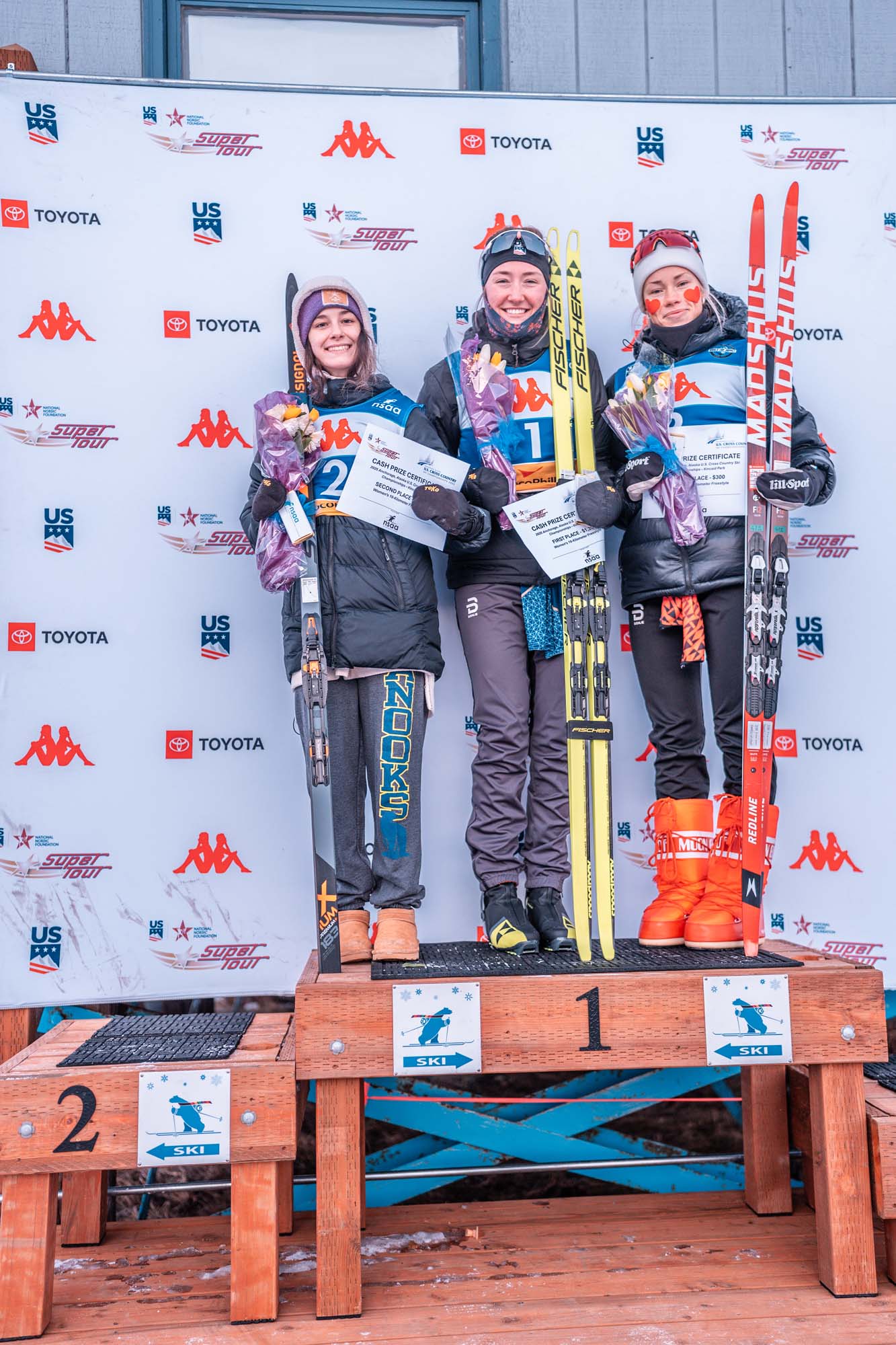
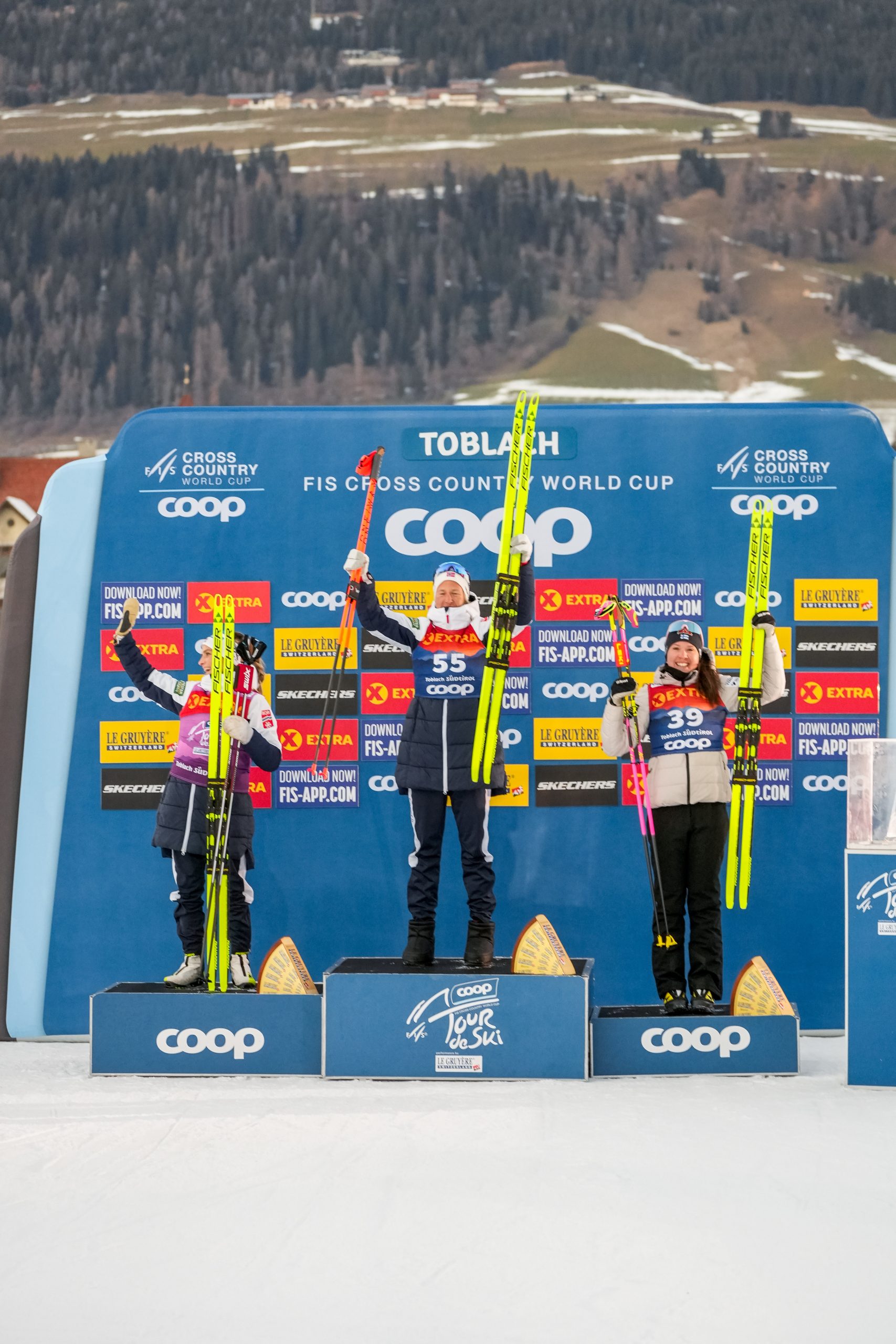
    The Women’s Podium (Photo: Tobias Albrigtsen / @untraceableg)
  • Slind and Johaug Dominate 15-k Classic Pursuit. Diggins 6th, Relinquishes Tour Lead

    Slind and Johaug Dominate 15-k Classic Pursuit. Diggins 6th, Relinquishes Tour Lead

    This coverage is made possible through the generous support of Marty and Kathy Hall and A Hall Mark of Excellence Award. To learn more about A Hall Mark of Excellence Award, or to learn how you can support FasterSkier’s coverage, please contact info@fasterskier.com.

    Try as she might, Jessie Diggins (USA) and the rest of the field couldn’t match the pace set by Slind and Johaug. (Photo: NordicFocus)

    Part of the attraction of the Tour de Ski is the quick ebb and flow of the leader board. One day you’re sitting on top of the world with a big lead, and the next day you’re wondering where it all went. American star Jessie Diggins is thick in the middle of riding the Tour’s roller coaster. She went into yesterday’s 20 kilometer Freestyle race with a minute plus lead over three time Tour winner Therese Johaug (NOR), only to find that lead quickly shrunk to 41 seconds. At the start of today’s race, the formidable Kerttu Niskanen (FIN) was sitting in second place only 22 seconds behind Diggins, and the sudden darling of the Tour, Astrid Oeyre Slind (NOR) was a scant 32 seconds back in third place, when today’s event, the 15 kilometer Classic Pursuit began.

    But in this year’s Tour, Diggins has already performed against type twice, having won both a Sprint and a Classic race—neither considered her strength. So, the hope for the American star going into today’s race was that she would again perform against type.

    There was also an upside to yesterday’s time loss; it meant that in the Pursuit format, Diggins would start sixth, 37 seconds behind Slind (in a new format, starting spots are based on yesterday’s finish). So instead of being the hunted, Diggins would now be doing the hunting. She would also have the added benefit of starting off sandwiched between Victoria Karl (GER), Katherine Stewart-Jones (CAN), and Heidi Weng, which would give her the opportunity to join fast company to help close the starting gap on Slind who would start the race four seconds in front of Johaug. Slind has made her living for several years off long Classic races on the Ski Classics circuit, and she would have to be considered dangerous in any Distance Classic race.

    Astrid Oeyre Slind (NOR), and Therese Johaug (NOR), (l-r) worked together the entire race, and no one could catch them. (Photo: NordicFocus)

    Another skier also performing against type was Niskanen, who is best known for her Classic prowess. But Niskanen finished a strong third in yesterday’s Freestyle race and would be one of the favorites going into today’s Classic Pursuit.

    In another development with the potential to affect the Tour’s outcome, Maja Dahlqvist (SWE) did not start yesterday. She joined a growing list of Swedish women—including Johanna Hagstroem—on the sidelines. Both racers are usually in the mix for podiums, and their absence would now have the potential to affect race outcomes.

    But after the race was over the top Norwegians were able to regain dominance in the Classic technique with Slind and Johaug working together the entire race to control the field. Slind finished slightly ahead of Johaug with Niskanen taking third. But from the early kilometers there was a sense of inevitability as Slind and Johaug teamed up to work together relentlessly pushing the pace that no one else could come close to matching.

    Diggins didn’t have a group to work with until about 5 kilometers into the race when she settled in with Heidi Weng (NOR) and Stewart-Jones. But they simply couldn’t match the firepower of Slind and Johaug, though Diggins was still glad to have someone to work with. “I’m really grateful that I got to work with Heidi. That was really helpful for both of us.” Diggins finished 2:08 behind the leaders and she now sits in fourth, 1:01 behind Slind in the Overall Tour standings. Despite losing time Diggins remained upbeat. “I’m really proud of that race, I battled through a lot of pain out there, and was pushing for every single second. Yeah, the time was not indicative of my fitness levels, or what I know I can do on a perfect day, but at the same time, you get the day that you have, right here, right now, and I did everything I could, and I’m proud of that.”

    Johaug is in second place, six seconds back with Niskanen in third 28 seconds behind. Heidi Weng’s fortunes have fallen, while she is in fifth place Overall, she is over two minutes behind Slind, which is likely to be an insurmountable hurdle for her.

    Other American finishers today were Sophia Laukli 17th, Julia Kern 25th, and Rosie Brennan 31st. Alayna Sonnesyn did not start, and her Tour is now over.

    Katherine Stewart-Jones had another career great day finishing seventh. Liliane Gagnon was the other Canadian skier, she finished 32nd.

    It was a good showing for Laukli, “I think today was a pretty big improvement for my Classic skiing.” She continued that, “I could ski with a lot of strong Classic skiers and normally I’m not able to do that, so in that sense it was good.”

    Women’s 15 Kilometer Classic Pursuit

    It was a gorgeous cloudless bluebird day in Toblach for the start of stage four, as Slind started the race first out of the gate onto the three-lap race. Johaug began only four seconds behind Slind and went out quickly to bridge the gap to start working with Slind. The pair were double poling in unison by the time they hit the 1.7 kilometer mark. At this point they were the only Tour leaders who were in a position to be able to work together, and it was quickly paying dividends. Niskanen was trying to close the gap on Slind and Johaug, but in a theme which would continue throughout the race, she was working on her own and was unable to keep up with the Norwegians.

    Jessie Diggins (USA) was eventually able to join a group with Heidi Weng (NOR) and Katherine Stewart-Jones (CAN), but even working together, they lost ground to the leaders. (Photo: NordicFocus)

    A half a kilometer later, Diggins had caught Stewart-Jones but initially didn’t spend time working with her as she passed the Canadian, but everyone in the field was now losing time to the two leaders who were constantly working together and were powering through the course on a level no one could match.

    As the skiers hit the five kilometer mark the theme remained the same. Slind and Johaug working together with the rest of the top Overall contenders struggling on their own or in their own small groups to keep the pace. Behind Diggins, Weng and Stewart-Jones had finally joined together and were able to catch up to Diggins. The three were now able to ski as a trio, giving some hope to Diggins who was losing time to the leaders in every kilometer.

    But Slind and Johaug’s lead continued to grow the further they skied. At the 6.7 kilometer mark Diggins was now 1:07 behind the leaders and her Overall Tour lead was gone. She continued to struggle as Weng and Stewart-Jones took over the lead in their trio.

    At 8.0 kilometers Diggins was clearly working hard as she appeared to need a lot of effort to set her kick wax even though she had lots of kick wax. “I felt like I had really great kick,” said Diggins. “I asked for a lot on purpose, and also, I own that, because it may have slowed them down a little, but at the same time, I knew I was going to need a lot of kick out there today.” While the leaders in the Tour were desperately trying to keep up with Slind and Weng, Sophia Laukli (USA) was working with a group of her own and was in 13th place. It was a strong performance for the American who is an excellent Distance skier but has always struggled with Classic.

    Kerttu Niskanen (FIN) was in the unenviable position of skiing alone all race. (Photo: NordicFocus)

    Two-thirds of the way through the race, Slind and Johaug continued to punish the rest of the field with their lead having grown to 43 seconds over Niskanen and 1:36 ahead of the Diggins group.

    With 3.3 kilometers left the outcome of the race wasn’t in doubt. Either Slind or Johaug would cross the finish line first, the only questions remaining were how much time they would put into Diggins and when would they begin to start racing each other and not work together? In the meantime, Diggins was still with Weng and Stewart-Jones who was turning in another tremendous race.

    Therese Johaug (NOR) and Astrid Oeyre Slind (NOR), (l-r) worked together until the finish line. (Photo: NordicFocus)

    Slind and Johaug didn’t appear too interested in expending extra energy to take the stage win as the Norwegian duo were still together as they entered the stadium. Slind approached the finish area first maintaining a brisk double poling pace. Johaug had no answer for her teammate who easily kept Johaug at arm’s length to take the victory. Both skiers looked remarkably fresh, comfortable, and relaxed after finishing. Niskanen was able to finish within a minute of Slind and Johaug to take third.

    Sophia Laukli (USA) had an excellent finish in a Classic race. (Photo: NordicFocus)

    Still on the course, Diggins continued to push with Weng and Stewart-Jones still with her. But at the finish Weng double poled ahead of Diggins who finished 2:08 behind Slind and was now over a minute behind in the Overall lead. Sophia Laukli was able to hang on to finish 17th, a good finish for her in a Classic race.

    Heidi Weng (NOR) (right) was able to sprint past Jessie Diggins (USA) (left) at at the finish. (Photo: NordicFocus)

    For Diggins it was a tough day as she skied well but like the rest of the field had no answer for the lead Norwegians. The silver lining for Diggins is that the next race is another Sprint, but it’s a Classic Sprint which isn’t her best event. However, neither Slind nor Johaug is known for their Sprinting prowess so there is still an opportunity for her to retake the lead. But looking further down the Tour road, if Diggins is going to have an opportunity to win, she will not only have to re-establish a lead, but she will need to create a cushion before the final race of the Tour, the epic climb up Alpe Cermis which is one of Johaug’s best events.


    2024/25 Tour de Ski overall standings (after Stage 4):
    • Astrid Øyre Slind (NOR) 2:13:00.
    • Therese Johaug (NOR) +0:06.
    • Kerttu Niskanen (FIN) +0:28.
    • Jessie Diggins (USA) +1:01.
    • Heidi Weng (NOR) +2:09.
    • Slije Theodorsen (NOR) +2:59.
    • Victoria Carl (GER) +3:01.
    • Jasmi Joensuu (FIN) +3:14.


    Tour de Ski 15 kilometer Classic Pursuit Results

    Tour de Ski Women’s Overall Standings

    Astrid Oeyre Slind (NOR) celebrates the day’s victory and taking the Tour lead. (Photo: NordicFocus)


  • Amundsen Controls Tour de Ski Classic Pursuit as Klaebo Retains Overall Lead

    Amundsen Controls Tour de Ski Classic Pursuit as Klaebo Retains Overall Lead

    The Tour de Ski is the ultimate test of endurance, pushing athletes to their physical and mental limits, with few other events demanding such frequent back-to-back competitions. Yesterday’s individual start 20 kilometer freestyle competition was a grueling marathon effort, with racers battling for the climb leader position at the 10 kilometer checkpoint while navigating a course that offered little opportunity for recovery. 

    To follow that up today, the challenge continued with a 15 kilometer classic pursuit race, with start intervals determined by yesterday’s 20 kilometer freestyle competition. Unlike some stages, no bonus seconds were awarded for this stage, and instead, the time differences between athletes directly influenced the adjustments to the overall Tour de Ski rankings. This made every second on the course important, as the time gap to the leader was just as significant as the finishing position for each athlete.

    Although skiers left the start gate in a staggered format, the results were determined by the first to cross the finish line, making the pursuit style especially challenging for athletes who excel in classic distance disciplines but struggled in the previous day’s freestyle competition. This may have been the case for Norway’s Erik Valnes, a strong sprinter and distance racer with multiple podiums to his name in the 15 kilometer classic discipline. Today, he skied to the second fastest overall time and gained over a minute on the leaders, though still finished 12th on the results list. 

    Harald Oestberg Amundsen (NOR) maintained a commanding lead in the 15 kilometer classic pursuit (Photo: NordicFocus)

    The pursuit format placed Harald Oestberg Amundsen (NOR) first out of the gate, holding a 21.2 second lead over teammate Simon Hegstad Krueger (NOR) and a 28.4 second advantage over Andrew Musgrave (GBR). With many athletes eyeing the podium, spectators held their breath to see who might close the gap to Amundsen and challenge for the top positions. Johannes Hoesflot Klaebo (NOR), the overall Tour de Ski leader, started in fifth, 46.4 seconds back from Amundsen. Known for his ability to dominate both distance and sprint races, the question lingered: could Klaebo close that gap and maintain his standing as overall leader?

    He came close. Klaebo finished just 5.3 seconds behind Amundsen in third place, narrowly edged out of second by Edvin Anger (SWE), who outpaced Klaebo over the final ascent. With little time back from the victor, Klaebo did, in fact, succeed in maintaining his position as the overall Tour leader. He will continue to wear the yellow bib going into Friday’s competition with a lead of just 36 seconds over Anger and 57 seconds over Amundsen in the overall Tour de Ski rankings. Amundsen has made back time with his wins the past two days, but will need to continue to gain seconds back in the following competitions to compete for the overall leader position

    “It was maybe the hardest race I’ve ever done,” Amundsen shared following the competition. “After I started in the beginning, I tried to have some energy until the end, but I heard the other guys were closing in. The last time I managed to increase a bit, but the last two kilometers I was totally dead.” 

    Erik Valnes (NOR) followed by Gus Schumacher (USA), who would go on to claim the second and third fastest times of the day, respectively (Photo: NordicFocus)

    Gus Schumacher (USA) was happy with his result, starting the day in 34th, and climbing to finish the pursuit in 17th, making up over a minute on the leaders. “I felt pretty good,” Schumacher said. “I was excited to claw some time back, which will help with my overall Tour ranking. I’m definitely feeling better now than I was 20 hours ago. Much better skis today, and that made a world of difference. It was nice to ski with some fast boys today. Overall, it wasn’t a super taxing race physically or mentally, which is a relief at this point in the Tour.” After today, Schumacher is now ranked 10th overall in the Tour de Ski standings. 

    Last year, Ben Ogden (USA) had high hopes of finishing the Tour in the Points Leader Bib but was forced to withdraw after falling ill while sitting third overall. This year, Ogden started Stage 4 determined to make up for last year’s disappointment, beginning the race 9th and starting 59.4 seconds back from the leader. Still ranked 3rd overall in the Tour before today’s race, Ogden would need to make up time or positions to maintain his ranking. 

    However, it wasn’t his day. Ogden broke a pole just 1.5 kilometers into the race, struggling to find his rhythm again after that. “I felt pretty frustrated with today,” Ogden shared. “It just feels like deja vu from previous years, where I get excited with a strong start and then immediately take myself out of contention in one race.”

    The broken pole forced Ogden to push hard early, a strategy that took its toll. “The first 1.5 kilometers with a broken pole and the following minutes of frustration were brutal. I went extremely hard early, which made it very difficult to hang on to any of the packs that caught me. I started to recover toward the end, but by then, the damage was done.” He concluded, “that’s the nature of the beast, but it’s still frustrating.” Ogden finished 22nd, losing over a minute to Amundsen and dropping to 17th in the overall Tour standings.

    Other Americans Zanden McMullen finished in 48th, JC Schoonmaker in 55th, and Jack Young in 76th. Canadian skiers had a strong day with Antoine Cyr in 27th and Olivier Leveille finishing 42nd. 


    Men’s 15-kilometer Classic Pursuit

    The men’s field set out under a clear Toblach sky, with sunlight filtering through the trees casting long shadows on the freshly groomed trails. The 15 kilometer classic pursuit sent racers to tackle three laps of a 5 kilometer course, enjoying the firm classic tracks and fast snow. 

    Amundsen began the race with a 21.2 second advantage over teammate Krueger and a 28.4 second lead over Musgrave. The two worked together as a chase pack, hoping to close the gap to Amundsen. 

    Despite his strong lead, the victory was in no way a given for Amundsen. Aware of this, he led a commanding race, pushing himself through every lap of the course. With eyes over his shoulder, he grew his gap by over 10 seconds by just the 1.7 kilometer checkpoint, setting, what he hoped to be, an unmatched pace. 

    Instead of his trademark strategy of using well-timed bursts of speed to outmaneuver opponents in head-to-head competitions, Klaebo adopted a more traditional, sustained effort to overtake Amundsen. Whether he could maintain that level of effort to make up over 40 seconds of time was left to be determined until the final seconds of the race. 

    Andrew Musgrave (GBR), Simon Hegstad Krueger (NOR), and Johannes Hoesflot Klaebo (NOR) worked together to close the gap to Harald Oestberg Amundsen (NOR) (Photo: NordicFocus)

    By the 5 kilometer mark, Klaebo had joined Krueger and Musgrave, forming a chase group that steadily gained ground on Amundsen. Though still over 30 seconds back at the halfway point of 7 kilometers, they worked efficiently together, taking turns drafting to conserve energy and maintain their lead over the following pack just 30 seconds behind them. 

    Over the next few kilometers, the dynamic shifted, with the chase group’s position relative to Amundsen fluctuating based on the course’s terrain. Between the 6.7 and 7.1 kilometer checkpoints, over the steepest section of the course, the group lost over 10 seconds to Amundsen but regained that margin quickly by the 8 kilometer mark. Amundsen continued to put time on Klaebo on the climbs, though lacked the collaboration and motivation that comes from head-to-head competition within a group to push through the descents and flatter terrain. 

    At the 10 kilometer mark, Klaebo attempted his characteristic breakaway performance and reduced his distance behind Amundsen to 17.7 seconds while gaining 6 seconds over Krueger and Musgrave. However, the effort was unsustainable, and by the 12.1 kilometer mark, the trio again worked together in Amundsen’s shadow. 

    The second chase pack contained Edvin Anger (SWE), Hugo Lapalus (FRA), Freidrich Moch (GER), Mathis Desloges (FRA), Mika Vermeulen (AUT), Andreas Fjorden Ree (NOR). The group was able to reel Klaebo and the rest of the first chase group in, now with eight skiers competing for the second and third podium positions by the 14 kilometer mark. 

    Edvin Anger (SWE) skied to the fastest time of the day, earning a second place podium in the 15 kilometer pursuit, and his first-ever distance podium in an individual event. (Photo: NordicFocus)

    In the final kilometer, Anger made a move over the second to last hill, pushing over the top and positioning himself in the front of the chase pack heading into the stadium stretch. Klaebo edged on the gas in an attempt to follow, but was unable to match the pace set by Anger. While Klaebo extended his lead over the rest of the pack, Anger powered ahead to take second place, just 2.5 seconds behind Amundsen. Anger raced to earn the fastest time for the day, and earned his first-ever distance podium in an individual event. Klaebo crossed the line 5.3 seconds back in third, with the rest of the chase pack finishing only a few seconds behind him. 

    The pursuit format, heavily influenced by start order, may mask strong individual efforts in the results. Gus Schumacher (USA) climbed from 34th to 17th place in the results, making up over a minute on the leaders—more time than Klaebo himself regained—with the 3rd fastest time of the day. 

    As for Klaebo, while it wasn’t the victory he had hoped for, the result was enough to maintain his overall lead of the Tour. He will arrive in Val di Fiemme still adorned in the yellow bib, ready to defend his position as the competition continues. 


    2024/25 Tour de Ski overall standings (after Stage 4):
    1. Johannes Høsflot Klæbo (NOR) 1:59:21
    2. Edvin Anger (SWE) +0:36
    3. Harald Østberg Amundsen (NOR) +0:57
    4. Mika Vermeulen (AUT) +1:23
    5. Hugo Lapalus (FRA) +1:24
    6. Simen Hegstad Krüger (NOR) +1:29
    7. Erik Valnes (NOR) +1:41
    8. Andreas Fjorden Ree (NOR) +1:41
    9. Jan Thomas Jenssen (NOR) +1:43
    10. Gus Schumacher (USA) +1:45


    Men’s Classic Pursuit Results

    Tour de Ski Men’s Overall Standings

    Edvin Anger (SWE), Harald Oestberg Amundsen (NOR), and Johannes Hoesflot Klaebo (NOR) topped the podium in the 15 kilometer classic pursuit, Tour de Ski Stage 4. (Photo: NordicFocus)
  • Slind Surges in Final Kilometers of Toblach 20 k, While North Americans Find Fast Allies

    Slind Surges in Final Kilometers of Toblach 20 k, While North Americans Find Fast Allies

    This coverage is made possible through the generous support of Marty and Kathy Hall and A Hall Mark of Excellence Award. To learn more about A Hall Mark of Excellence Award, or to learn how you can support FasterSkier’s coverage, please contact info@fasterskier.com.

    Stage Three of the Tour de Ski, the penultimate day of racing in Toblach, and the final World Cup event of 2024: the Women’s 20 k Interval Start Skate race. Playing out on a unique, long-course format, the course essentially entailed ten kilometers of gradual climbing to the head of the valley, followed by a ten-kilometer net descent on the return to the starting area.

    For the viewer at home, two questions predominated as the skiers took their places.

    Jessie Diggins (USA) in the early kilometers before she caught up to teammate Julia Kern (USA). (Photo: NordicFocus)

    First: Could Jessie Diggins make it a hat trick? Momentum was certainly in her favor. On Saturday, she opened the 19th Tour with a surging win in the Skate Sprint; on Sunday, she followed up by winning the 15 k Classic Mass-Start, her first victory in that discipline in fourteen years of World Cup racing. With a 38-second lead over Kerttu Niskanen (FIN), and 1:09 over both Astrid Øyre Slind (NOR) and two-time Tour de Ski Champion Heidi Weng (NOR), there at least seemed little chance that Diggins would end the day wearing anything other than the leader’s bib. And, second: Would this be Therese Johaug’s chance to make her mark in Toblach? After a triumphant comeback in Lillehammer, the three-time Tour Champion failed to qualify in Saturday’s sprints (as, admittedly, might be expected) and was sixth in Sunday’s 15 k Classic. However, the longer distance, Skate discipline, and interval start would appear to favor Johaug; after all, she secured the gold medal in the 2022 Olympic 30 k Skate by a margin of 1:43.3, effectively rendering the Mass Start a personal time-trial.

    Astrid Oeyre Slind (NOR) used the skills she has honed on the long gradual trails of the Ski Classics to capture victory in the Tour de Ski 20 k Individual Start Freestyle in Toblach (ITA). (Photo: NordicFocus)

    However, for the conscientious commentator, the race posed another question entirely: When was the last 20 k Interval Start Skate? Astrid Øyre Slind won the 20 k Interval Start Classic two weeks ago in Davos, ahead of Kerttu Niskanen and Johaug. At the beginning of December, Diggins won the 20 k Mass Start Skate in Ruka over Joanna Sundling (SWE) and Heidi Weng. Before that, Diggins closed out the 2024 season with a win in another 20 k Mass Start Skate in Falun, and Finland’s Krista Parmakoski won the 20 k Interval Start Classic on home soil at the beginning of March. Beyond Spring of 2024, the FIS Results page testifies to a clutter of interval Classics and mass-start Skates until Davos, December 18, 2022: the most recent 20 k Interval Start Skate. There, Jessie Diggins carried the day by 5.5 seconds over Ingrid Flugstad Oestberg (NOR); Rosie Brennan finished third. However, notably absent from that Davos race were Heidi Weng and, due to her retirement, Therese Johaug. How would this trio fare in a long-awaited, perfect storm?

    Interviewed just before the broadcast by FIS, Petter Northug (formerly NOR) estimated that finding “the right speed on the first two kilometers” would be “the key” to the race. U.S. broadcaster Kikkan Randall (formerly USA) concurred, stating that building speed—without burning out too quickly—would be essential in the first five kilometers. With Tour de Ski Sprint Points available at the first-time check (just over two kilometers in) and Climbing Points available at the ten-kilometer mark, there would certainly be an incentive to get out fast. But, alone in the woods, would points-chasers be able to maintain early leads?

    Therese Johaug (NOR) finished just three seconds off the pace in second place. (Photo: NordicFocus)
    Carl Sets the Pace; Johaug Surges at the Crest

    At the first time check, Victoria Carl (GER; bib 29) seized an early lead, passing the 2.1 k mark in 5:23.4; Kerttu Niskanen (bib 39) came through 9.7 seconds back, followed by Johaug (bib 49) and Diggins (bib 57), both 10 seconds back and in a provisional third place. Slind (bib 55) was hot on their heels, 10.4 seconds off of Carl.

    At the 5.6 k time check, Carl had maintained her roaring pace, crossing in 14:14.1. Niskanen shrunk the gap to 4.3 seconds, while Heidi Weng (bib 35; the first of the returning Tour de Ski Champions to take the course) followed 19.1 seconds back. Johaug shaved her gap to 5.0 seconds but, initially, did not appear to be in the dominant form of distance races past, showing some signs of exertion. Slind kept her gap against Carl from opening, following in 10.1 seconds; Diggins, having caught teammate Julia Kern (bib 56), fell to a provisional fifth place, 12.7 seconds back.

    Kerttu Niskanen (FIN) battled her way to third place on the day. (Photo: NordicFocus)

    At the top of the course, Carl showed no signs of flagging, leading Helene Marie Fosseholm (NOR; bib 13), who set the early lead times for the course by over 32 seconds at the 10.6 k mark; Weng followed, slipping to 23.3 seconds back. But even if Carl were holding strong, others were hitting their stride: Niskanen was the first to turn the lamp green, leading Carl by 3.8 seconds; then, contrary to first impressions, it was Johaug, nudging herself ahead of Niskanen by 0.7 seconds.

    At the 10.6 k mark, the provisional standings were Johaug (30.01.1) in first; Niskanen (30.01.8) in second; Carl (30.05.6) in third; and Slind in fourth (30:17.4). Diggins had fallen to sixth place and 29.6 seconds back, looking visibly exhausted as she reached the course’s high point.


    Johaug Storms the Descent; Slind Attacks from Traffic

    Descending to the 15.6 k time check, Carl faded to fourth place: it was Johaug, clawing her way into a 6.4 second over Niskanen, who seized the lead. Slind sat in third, 9.1 seconds behind Johaug. Diggins was in fifth, 32.3 seconds behind, with Julia Kern trading pulls with her golden-bibbed teammate.

    Katherine Stewart-Jones (CAN), who tied Victoria Carl (GER), had her best race of the season, leading all North Americans in fourth place. (Photo: NordicFocus)

    At the line, Carl had her turn in the Winner’s Chair, until the arrival of Kerttu Niskanen, who put 7.5 seconds on the German. The day briefly appeared to belong to Therese Johaug, who led Niskanen by 17 seconds and Carl by 24.5. However, entering the stadium in a thicket of Swedes, it was Astrid Øyre Slind who made the decisive move of the afternoon and seized victory from the clutches of the once and future Queen of Snow—taking first by 3.3 seconds over Johaug. Carl, despite her valiant lead, would again be denied a podium finish, slipping to fourth place. She was tied in that position with Katherine Stewart-Jones (CAN), who secured a career-best fourth place, 27.8 seconds off Slind.

    Diggins finished in sixth, 36.3 seconds off the lead. Additional strong showings from the US Women included Sophia Laukli (10th place, + 1:01.1) and Julia Kern (13th place, + 1:08.9).

    Jessie Diggins (USA) relied heavily on teammate Julia Kern (USA), especially on the second half of the course today. (Photo: NordicFocus)


    Pack Skiing Defines the Day

    In any Interval Start format, athletes’ fortunes may hang on the fickleness of their starting seed—as who they start behind or ahead of will dictate their pacing fellows for the day. While a traditional, multi-lap race may enable a skier to encounter a wide variety of racers, today’s single-lap race leads to the coagulation of large, largely stable pace packs near the course’s high point.

    For Diggins, the single, 20 k lap was a race format she had “never done in [her] life,” and despite being “really cool,” was also “really hard. I basically pinned it as hard as I could go and just held it there […] It was hard because it wasn’t a normal course.” With the course’s gradual gradation, there was “basically no rest out there.”

    As close teammates and friends, Jessie Diggins (USA) and Julia Kern (USA) share a laugh after executing their plan on the Toblach 20 k course. (Photo: NordicFocus)

    “The best part was that I got to ski with my teammate, Julia [Kern]. We’ve trained together all summer, so that was really, really awesome […] We helped each other, and it was really, really motivating.” The two had planned ahead of time to work together if Diggins caught Kern and executed accordingly, with Diggins leading to the top of the course and Kern assisting with pulls in the latter half of the course. “We had amazing communication and collaboration, and honestly, it felt like we were doing the Merino Muster in New Zealand—every couple minutes, switch[ing] leads,” and verbally cueing each other to take the lead or pull back. “Without her, it would have been a really tough time for me because you either got lucky in that you got to ski someone or you didn’t. That’s ski racing—it’s not fair; the sport is not fair, and today was a wildly unfair course in that you either saw people getting to take a train up and skiing with big packs, and that made massive differences, and then you saw people who got stuck skiing alone. So, honestly, massive kudos to the people who skied alone and had a super impressive result because that was incredibly, incredibly hard.”

    Julia Kern (USA) and Jessie Diggins (USA) hug after working closely together throughout the 20 k Individual Start Freestyle in Toblach, Italy. (Photo: NordicFocus)

    “I’m just proud of us—how we worked together, communicated, collaborated, and fought for every single inch.”

    Collaborative skiing also defined the day for Laukli, in a race she described as fraught with “a lot of emotions. Right at the start, I already heard Victoria Carl catching me and thought, ‘Alright, that’s another terrible race.’ Then, I skied with her on the up, and we both realized we could make each other’s races better. I was doing a lot of work on the uphill so that she could do a lot of work on the downhill, and I think we both benefitted. I know I benefitted, at least!” While Laukli’s Classic performance on Sunday had put her in a “dark hole,” she is entering the New Year and the next stage of the Tour feeling invigorated after today’s result. “It’s a little bit shallow to let [Sunday’s] result mean so much, but I was definitely a little bit nervous on the start line, and I really want a full Tour. If I had another bad race, I don’t know how my motivation would be. I’m really happy, and I want to keep going now.”

    Sophia Laukli (USA) worked with Germany’s Victoria Carl on the climb and hung tight to Carl on the second half of the race. (Photo: NordicFocus)

    “This tour is a bit different for me because I’m trying to do a bit better in races other than just the Hill Climb because now I’ve proven to myself that I’m more than just a hill-climb skier. I’m also trying to perform well in the other races,” and she is certainly not holding back in hopes of securing another Alpe Cermis victory.

    Interviewed just before mounting the podium, Slind reported that she felt “amazing” during today’s 20 k. The Ski Classics powerhouse expressed relief that she could “finally” prove her abilities in the Skate discipline, noting: “This was one of the most fun races I’ve ever done. We were racing together from the top [of the course], with really good coverage from Canada, Sweden, and Norway” in the finishing cluster. The win was a combination of factors: “A little bit lucky, a little bit smart, and a little bit good shape.”

    As for Stewart-Jones’ standout result, she credited great skis, and close skiing with Slind and Moa Illar (SWE). “The strategy was to hold on to Astrid Strind,” Stewart-Jones wrote. “I knew she would be strong on this course so I knew that if I held on it could be a great race. It was awesome to be able to work with her and Moa Illar on the downhill. We gained a lot of time in those last 10 kilometers. It was just a great day where everything came together. The [Canadian] team did an amazing job with the skis which, on this course, makes a huge difference!”

    The 19th Tour de Ski will continue on New Year’s Day in a Classic Pursuit, with starting positions based on today’s Interval Start race. Diggins maintains her Tour de Ski lead by roughly 19 seconds over Niskanen and 33 seconds over Slind.

    View Women’s 20 k Interval Start RESULTS here.

    Therese Johaug (NOR), Astrid Oeyre Slind (NOR) and Kerttu Niskanen (FIN), (l-r) share the podium of the 20 k Individual Start in Toblach (ITA). (Photo: NordicFocus)
  • Toblach 20 k—Amundsen Goes All In

    Toblach 20 k—Amundsen Goes All In

    This coverage is made possible through the generous support of Marty and Kathy Hall and A Hall Mark of Excellence Award. To learn more about A Hall Mark of Excellence Award, or to learn how you can support FasterSkier’s coverage, please contact info@fasterskier.com.

    Harald Oestberg Amundsen (NOR) shows the strain of his effort following the 20 k Freestyle Interval Start in Toblach, Italy. His wide margin of victory moved him into direct contention in the Tour de Ski overall standings. (Photo: Vanzetta/NordicFocus)

    In an earlier age of cross-country skiing, nearly all races were against the clock (not mass start events). One-by-one, skiers disappeared into thick forests, there to battle conditions and strategies and personal demons on their way to distant finish lines. It was an old fashioned test of determination and fitness, an unforgiving contest that’s been all but forgotten by modern skiing’s lap-courses and sprints and mass-starts. It’s been said that the Tour de Ski is going soft . . . but not today.

    Stage Three of the 2024-2025 Tour de Ski was a daunting 20 k Freestyle Interval Start racing across a single 20 kilometer lap up and down the valley above Toblach, Italy. Everybody raced the same course, but some paid for it more dearly than others. The question to consider is whether or not those who went all in on today’s 20 kilometer course will still have the energy to contend as the Tour de Ski continues.

    The Tour de Ski began with Sprint and Mass Start Distance events, allowing sprinters to stay near the front of affairs. At the start of Stage Three, Johannes Hoesflot Klaebo (NOR) enjoyed a 34 second lead over his nearest competitor, Richard Jouve (FRA). Italian sprinter Federico Pellegrino (ITA) occupied third, Edvin Anger (SWE) fourth, Ben Ogden (USA) fifth, Erik Valnes (NOR) sixth. But lurking just behind them was a menacing pack of the world’s best Distance skiers led by Gus Schumacher (USA) only two seconds behind Valnes, and reigning Tour de Ski champion—and World Cup Overall champion—Harald Oestberg Amundsen (NOR) who sat only twenty seconds behind Valnes, 1:02 behind Klaebo. Canada’s Antoine Cyr began the day in 11th place, just 1:15 from the lead.

    But all that was about to change . . .

    With a fifth place finish, Klaebo managed to maintain his overall lead in the Tour de Ski. But Amundsen clawed back 46 seconds, putting himself in position to contend through the remainder of the tour.

    Ben Ogden (USA) described his 20 k Freestyle Interval Start as “my best distance race ever!” (Photo: Vanzetta/NordicFocus.)

    Ogden blazed to a fantastic ninth place—just under a minute behind Amundsen—to secure a position in the top three of current Tour standings.

    “Today will absolutely go down as my best distance race ever!” said Ogden. “Really pumped with that and with the progress I have made in skate in the last few years.”

    In the finishing area, Ogden pointed jubilantly to his binding system, noting that this was his first World Cup experience for the new boot/binding design created for Madshus by Rottefella.

    “Today was my first race on the new Rottefella Skate X system. With It being a long race with a ton of V2 there was no better time to take it and I was really excited with how It preformed. Excited for more races on it!”

    Schumacher led the rest of the American finishers in 34th, followed by Zanden McMullen 52nd, JC Schoonmaker 53rd, Jack Young 71st. Among Canadians, Olivier Leveille finished the day in 48th, followed by Cyr who tumbled down the overall standings with a 56th place finish.

    Harald Oestberg Amundsen (NOR) dominated the field in the 20 k Freestyle Interval Start in Stage Three of the 2024-2025 Tour de Ski. (Photo: Vanzetta/NordicFocus)
    20 k Freestyle Interval Start

    Climbing gradually to the base of the Drei Zinnen Alpine ski area at the top of the valley near the Olympic hamlet of Cortina d’Ampezzo, Toblach’s 20 k Freestyle course offered fewer steep climbs than the typical World Cup course. Even so, the possibility of misjudging the challenges of the distance was a very real threat to any racer’s performance and, ultimately, to their place in the overall standings. It’s a risky prospect—start too fast, and you’ll swim the final kilometers through a murky sea of lactic acid. Start too slow, and you’ll never make up the time at the end.

    Pre-race interviews included commentary on the Toblach-Drei Zinnen course from former Tour de Ski champion, Petter Northug (NOR). “The crucial part is to find the right speed in the beginning,” said Northug. “It’s a tough 10 k, so the right speed the first 2 k is the key.”

    For Amundsen, the “right speed” seemed to be pedal to the metal. He started faster than anyone else, and still found himself able to hang on to that speed all the way to the finish line.

    Amundsen started 44th followed by Klaebo who started 58th. By the first time check at 2.1 kilometers, Amundsen had already begun to build a considerable lead announcing his intention to press the issue, and return himself to the top of the results.

    Jan Thomas Jenssen (NOR) was caught by his teammate, Simen Hegstad Krueger (NOR). They would ski the remainder of the 20 kilometer distance together, though Krueger did not appear to receive much draft-benefit from the pairing. (Photo: Modica/NordicFocus)

    Simen Hegstad Krueger (NOR) was able to chase down his teammate, Jan Thomas Jensen. They would pair up through the entire race, though mid-race camera angles usually showed Krueger to be leading the pair (so he was not receiving as much of an advantageous draft as he might’ve hoped). Ultimately, Krueger raced his way to the second step of the podium.

    Klaebo came through the first time check at 2.1 kilometers a full 21 seconds behind Amundsen, a gap that would stretch to over 40 seconds at the 10.6 kilometer time check. It was obvious that Amundsen was throwing caution to the wind in his search for time advantages in the overall standings.

    Andrew Musgrave (GBR) led the field at many of the mid-race time checks, only to find himself bested by eventual race winner, Harald Oestberg Amundsen. (Photo: Modica/NordicFocus)

    Andrew Musgrave (GBR) stormed through all early time checks, fighting bravely to a podium finish behind Amundsen and Krueger.

    Ultimately, Klaebo conceded 46 seconds to Amundsen in the overall standings. Perhaps it was a calculated effort to save a bit of energy in contrast to Amundsen’s all-in strategy. Or perhaps Amundsen simply took this opportunity to put his stamp on this Tour and establish a level of distance-dominance that will lead him to victory atop Alpe Cermis at the end of the week.

    “I wanted to have revenge from the first two races,” Amundsen said during post-race interviews. “I was ready to be fast in the beginning, and maybe the opening was a bit too hard. But I was able to adjust during the race and from the top 10 k down I was quite fast . . . just an incredible race for me.”

    Ben Ogden (USA) drives to a ninth place finish in Toblach’s 20 k Freestyle Interval Start. He claimed a spot on the current Tour de Ski Podium as racing continues tomorrow with a Classic Pursuit. (Photo: Vanzetta/NordicFocus)

    Tour de Ski racing continues tomorrow with a Classic Pursuit race with start positions based on results from today’s Interval Start race. Ogden expressed the bold strategy shared by most racers at this level:

    “Certainly won’t hold back with an eye towards the sprint but will be focused on doing the best I can with the energy I have. Easy to blow up and lose a lot of time this late in the tour, so really trying to avoid that.”

    Men’s 20 k Interval Start RESULTS

    Standings after Stage Three of the 2024-2025 Tour de Ski. Ben Ogden’s (USA) terrific 20 k Interval Start effort maintains his position in the top three, while Harald Oestberg Amundsen closes the gap to current leader Johannes Hoesflot Klaebo (NOR). (Photo: FasterSkier)
  • The Devon Kershaw Show: RIP OG Tour de Ski — stages 1 and 2 recap

    The Devon Kershaw Show: RIP OG Tour de Ski — stages 1 and 2 recap

    It’s the most wonderful time of the year — or is it? The Tour de Ski has returned, but Devon has some beef with this year’s watered down format. Plus, recaps of the four races we’ve been through so far, including Jessie Diggins sprint win from heat five.

    Send feedback, hate mail and love letters to devon@fasterskier.com. You can send love letters to nat@fasterskier.com. See you in a couple of days.

    `

  • Diggins Again! American Wins Tour 15K Classic

    Diggins Again! American Wins Tour 15K Classic

    This coverage is made possible through the generous support of Marty and Kathy Hall and A Hall Mark of Excellence Award. To learn more about A Hall Mark of Excellence Award, or to learn how you can support FasterSkier’s coverage, please contact info@fasterskier.com.

    Jessie Diggins (USA) won her first Classic race today and stretched her Tour lead. (Photo: NordicFocus)

    Watching the Tour de Ski is like looking at a giant pendulum swinging back and forth. Yesterday, on day one, the pendulum swung to the favor of skiers with sprinting talent. Jessie Diggins (USA) made the most of that swing by gaining the maximum number of bonus seconds winning the Freestyle Sprint. She came into today’s 15 kilometer Classic Mass Start race with over a minute lead on Therese Johaug (NOR) and Heidi Weng (NOR). Today, those skiers without Sprinting legs would try to ride the pendulum back as it swings to Distance racing.

    Jasmi Joensuu (FIN) and Nadine Faehndrich (SUI) also made the most of yesterday’s Sprint. At the start of the day, they sat in second and third respectively, seven and 15 seconds behind Diggins. Whether Joensuu and Faehndrich could hang with the Distance skiers remained a big question mark. But there was no question about what Johaug and Heidi Weng had in mind going into the day. Their mission would be to do whatever it took to eat into Diggins minute plus lead. That was the only certainty heading into the day. Already this season we’ve seen the two work together in Distance races, and that was a distinct possibility going into today’s race.

    But the Distance skiers’ plans to gain time on Diggins today imploded when in a shocking turn of events Diggins was the one grinding down the Classic skiers and took her first World Cup Classic victory outdueling all of the big Scandinavian names. Johaug and Astrid Oeyre Slind (NOR) tried to punish the field throughout the race, but every time they made a move, Diggins answered closing any gaps they created with her world best downhill technique.

    Jessie Diggins’ (USA) persistence was rewarded when after 340 World Cup starts she took her first Classic victory. (Photo: NordicFocus)

    When the pendulum had swung back towards the Classic Distance skiers, it was shockingly Diggins who was at the top having not only withstood the pendulum swing but actually managed to come out on top. Classic phenom Kerttu Niskanen (FIN) took second place with Slind finishing third. H. Weng held on for fourth, and in another shocking turn of events, Johaug ended up sixth, clearly defeated at the end of the race.

    After the race Diggins was ecstatic. “It’s really cool. It took me 340 World Cups to get here. This is why you never give up. I’ve been working so hard on Classic skiing my whole life, and it’s really emotional to finally do it. It took a lot of tries. I’m so thankful to my team because they gave me perfect skis. They were fast and I had the grip, so on the last hill I could go. It was just pure magic. It was really cool. I came into this in a really good head space. I’m healthy, I’m happy, loving what I’m doing, it’s an amazing team atmosphere.  It’s going to be a big party in the truck today.” Diggins added that, “this summer I put in so much work on my double pole, so much work trying to improve my power and my strength. I feel like being able to sprint like that yesterday and finish like that today … I didn’t know if I had that in me, and I had to work really-really hard to get there, and I had a lot of help from a lot of people. I had perfect skis, and I feel like this victory is as much for the wax techs as it is for me.”

    Other American finishers were Rosie Brennan in 14th, Julia Kern 31st, Sophia Laukli 46th, and Alayna Sonnesyn 50th.

    It was a good day for Brennan but, “I’m definitely still far from where I want to be,” Brennan said after the race. “At this point, I’m just putting my best foot forward every day and doing the best I can to keep finding myself and you’ll know when I’m back, and I’ll leave it at that.”

    The top Canadian finisher was Katherine Stewart-Jones in 34th. She was followed by Liliane Gagnon in 35th.

    Today was the day for Therese Johaug (NOR) (number 39) to close the gap on Jessie Diggins, but it turned out to be Diggins’ day. (Photo: NordicFocus)
    Women’s 15 kilometer Classic Mass Start

    Conditions were described as perfect for the start of the women’s 15 kilometer Classic mass start with firm deep tracks. By virtue of winning yesterday’s race, a hatless Diggins was in the front row of starters alongside Joensuu and Faehndrich. Almost immediately at the start Classic expert Niskanen went to the front. One of the Tour favorites Johaug—because of her poor sprinting performance—started toward the back of the pack in bib 39 and spent the first kilometers double poling outside the track on the edge of the course to move toward the front. After only six minutes into the race at the 2.3 kilometer mark Johaug had pushed at a frenzied pace and worked herself to the front of the pack to take the lead.

    Today was also an excellent day for Rosie Brennan (USA) (number 28) who finished 14th. (Photo: NordicFocus)

    At the 3.3 kilometer mark there was a bonus Sprint where Joensuu went to the front to take the maximum Sprint points. Johaug and Faehndrich were with her with Diggins sitting calmly in 10th only a couple of seconds off the lead.

    At the start of the second lap Johaug had pushed back to the front with Niskanen and Diggins trailing right behind her. Also having moved to the front was another Tour favorite H. Weng. At 5.2 kilometers there was another bonus section— this one was a bonus section for climbers. Johaug went through first, but Diggins was right by her side, now followed closely by Norwegian Distance standout Slind.

    At the 6.1 kilometer mark Slind and Johaug decided to make their first serious break and established a gap on the group. Diggins quickly went to the front of the chase group as the two Norwegians in a matter of a couple of seconds were able to develop a measurable gap. But as she so often does, Diggins was able to close the gap on the downhills. It was a theme which was repeated several times throughout the race.

    But even though Johaug and Slind hadn’t gained ground on Diggins, they had broken up the pack and there was now a defined lead group of about a dozen skiers. While the pack pulled away Slind and Johaug continued to throw in a burst of speed to try and pull away. And amazingly at the bottom of downhills Diggins would glide up onto the backs of the Norwegians. It had to have been incredibly frustrating for the lead pair to see their hard work evaporate at the bottom of every downhill as Diggins magically appeared right beside them.

    At the 7.5 kilometer halfway mark Johaug was still out front with a pack of proven Classic performers around her. Niskanen, Slind, and Weng joined Diggins at the lead pack along with Teresa Stadlober (AUT), Krista Parmakoski (FIN), and Linn Svahn (SWE). At this point, the lead pack looked like a Scandinavian Classic all-star team with Diggins somehow hanging with them.

    At 8.6 kilometers Niskanen took the lead with Johaug right behind her. But the big news at this point was that Johaug had not been able to blow open the race. She had used a lot of energy at the beginning of the race to scratch her way from the back of the pack to take the lead and it looked like she was paying the price.

    As the racers hit the 11.2 kilometer mark the pattern which had been established throughout the race repeated itself again. Johaug and Slind led a group of nine skiers at the front pushing the pace on the uphills creating a gap, with Diggins then closing the gap on the downhills. Several times it looked like the lead duo were going to pull away, and each time Diggins closed on them on the downhills.

    With only 1.4 kilometers left the lead field was down to seven skiers with Slind still pushing the pace. But try as they might the leaders couldn’t drop Diggins who tenaciously hung with the lead group as they entered the final downhill leading into the stadium.


    Jessie Diggins (USA) (left) put in a furious double pole at the finish to take the win. (Photo: NordicFocus)

    At this point, it was already mission accomplished for Diggins. As long as she stayed upright until the finish, she would have preserved her Tour lead, which was at the start of the race really all the American team was hoping for. But Diggins wasn’t satisfied with just maintaining her Tour lead. She could sense that she had the opportunity to make personal history. On the final climb she put in a massive turn of speed and took the lead over the field. Shockingly none of the other leaders could respond to Diggins’ burst. The first to crumple was Johaug who couldn’t take the pace and dropped off the field. Diggins frenetically double poled to the finish as Niskanen and Slind tried to stick with her, but they couldn’t and Diggins dropped the rest of the field. She crossed the finish line first, exhausted, laying on the snow with the knowledge that not only had she defended her Tour lead, but that she had just won her first World Cup Classic race! It was a shocking and incredibly satisfying victory.


    Jessie Diggins (USA) (far left) outdueled two skiers known for their Classic prowess, Astrid Slind (NOR) (number 34) and Kerttu Niskanen (FIN) (number 9), to take the win. (Photo: NordicFocus)

    Not only had Diggins defended her lead, but she had beaten the Scandinavians at their own game, Classic skiing. It had to be a dagger through the heart of the Distance skiers chasing her as they were doubtlessly counting on gaining time on their rival today only to end up losing more time to Diggins. It was a monumental achievement for Diggins and the entire American team, and a crushing blow to the rest of the field.

    After today’s heroics, Diggins had expanded her lead in the Tour. She now holds a 38 second advantage of Niskanen, and is over a minute ahead of Slind, H. Weng and Johaug.

    Kerttu Niskanen (FIN), Jessie Diggins (USA), Astrid Oeyre Slind (NOR), (l-r) (Photo: NordicFocus)

    Tour de Ski women’s Mass Start 15 K Classic Results

    Tour de Ski Standings


  • Klaebo Controls Bonus-Heavy Toblach Mass Start, Schumacher Seventh

    Klaebo Controls Bonus-Heavy Toblach Mass Start, Schumacher Seventh

    This coverage is made possible through the generous support of Marty and Kathy Hall and A Hall Mark of Excellence Award. To learn more about A Hall Mark of Excellence Award, or to learn how you can support FasterSkier’s coverage, please contact info@fasterskier.com.

    Johannes Hoesflot Klaebo (NOR), Lucas Chanavat (FRA), Janik Riebli (SUI), Richard Jouve (FRA) lead a 95-man field out of the starting area in Stage 2 of the 2025 Tour de Ski in Toblach, Italy. (Photo: Modica/NordicFocus)

    Mass Start Nordic racing ain’t fair—it just can’t be. The Classic track in Toblach, Italy is only four skiers wide, so many mass-start racers will find themselves off the back as soon as the starter’s pistol fires. For those positioned mid-pack, the early kilometers of any mass-start race will be a series of fate-defying moves in attempts to press forward, to make up a few valuable places, to keep from getting skis run over, to keep from getting poles snapped. Starting in the middle of the pack is a daunting prospect, a penalty of sorts for having failed to rank high enough to earn an up-front start position. That’s how heavily yesterday’s Sprint competition affected today’s Classic Mass Start.

    Following fine finishes in Tour de Ski’s first Sprint stage, two Americans began the day in top ten start positions: Ben Ogden 6th and Gus Schumacher 10th. JC Schoonmaker and Jack Young also earned top 20 start positions by their terrific performances in the prior day’s sprints. Stars and Stripes racing suits would be in contending positions when the moves started happening.

    “I don’t think we have too much of a team plan,” Schumacher said in pre-race interviews. “Just race our own races and do the best we can.”

    “Go with the leaders as long as possible,” Schumacher said. “And make something happen in the end, hopefully.”
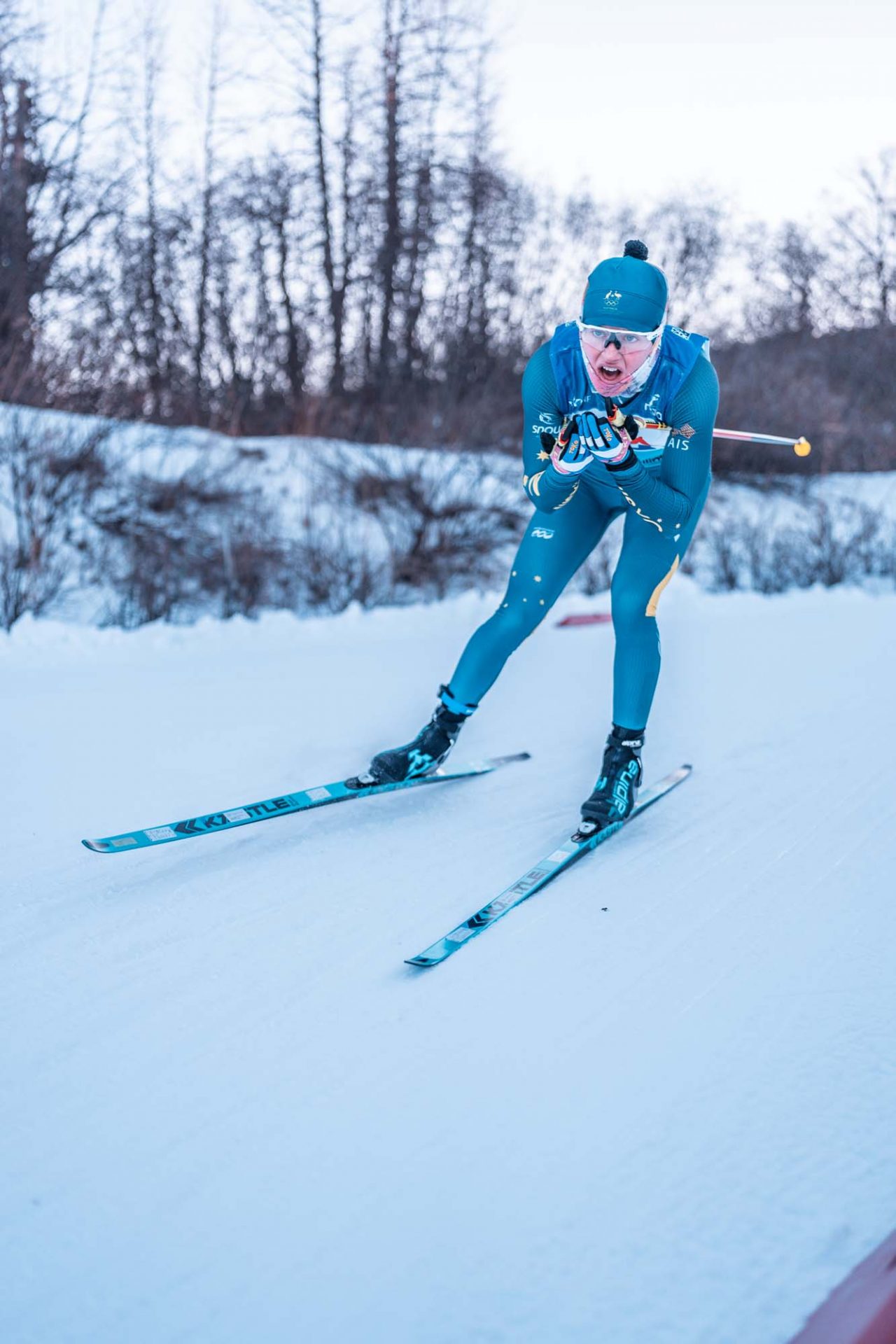
    Andrew Musgrave (GBR) summed up the aspirations of many: “Plan A is to get to the front without using too much energy.”
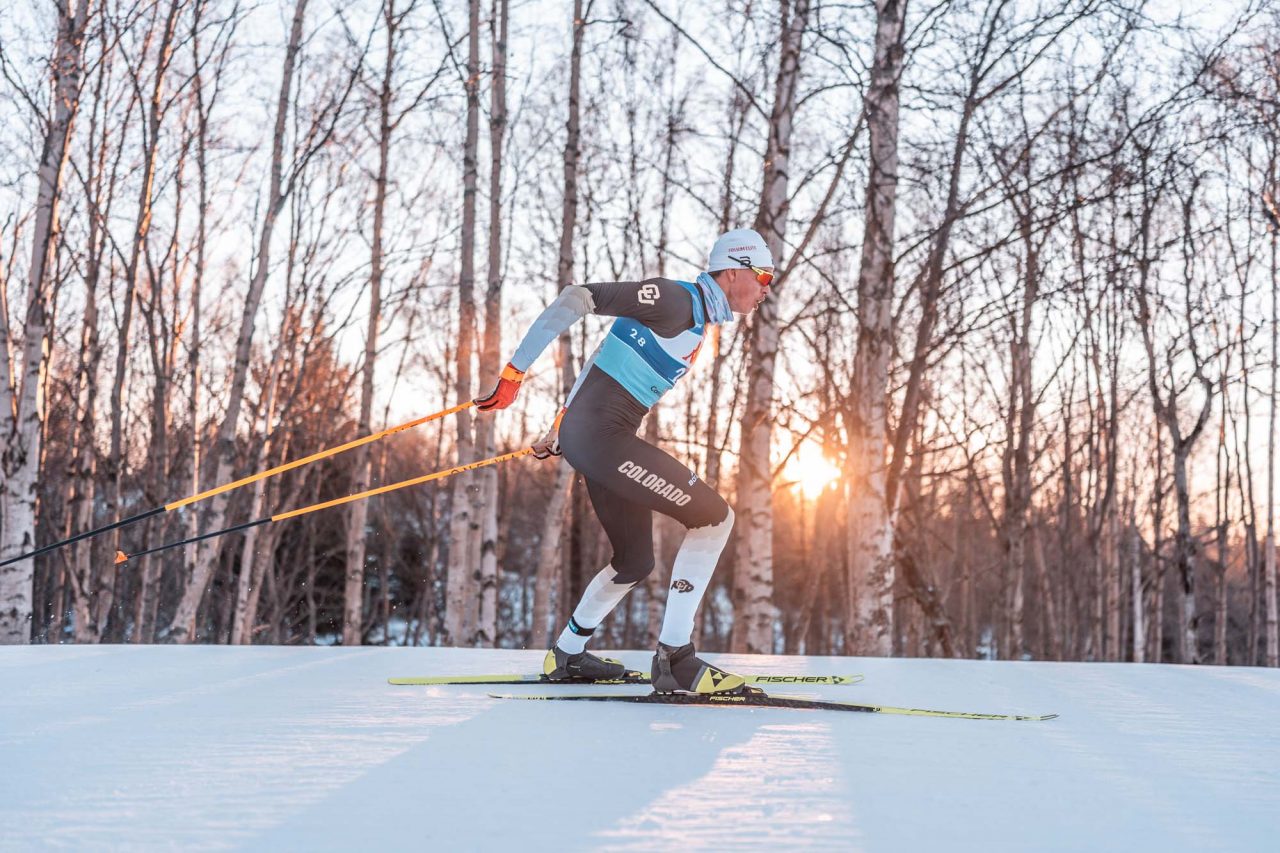
    In the end Tour Leader (and yesterday’s Sprint winner), Klaebo, managed to work his strategy to perfection, hanging around near the front to orchestrate a perfect sprint at the finish. Erik Valnes (NOR) skied across the line on Klaebo’s tails, followed by Haavard Moseby in third.

    American start positions translated into good finishes as well: Schumacher skied with the leaders throughout the race, sprinting to a thoroughly credible seventh. Behind him, Zanden continued to add to his great early-season finishes in 17th, Ogden 26th, Schoonmaker 46th, and Young 84th. Among Canadians, Antoine Cyr skied terrifically, keeping himself in contention throughout the final lap and sprinting in the final group to finish ninth. Olivier Leveille was the other Canadian finisher in 52nd.

    Johannes Hoesflot Klaebo (NOR) managed the pace of the 15 k Mass Start, staying at or near the front and sprinting to the win. (Photo: Vanzetta/NordicFocus)
    Men’s 15 k Mass Start

    Toblach featured hard tracks (very muchto the racers’ liking), but fairly warm temperatures: +5 degrees celsius on a course that would wind four times around a 3.5 kilometer loop.

    A massive field of 95 men was led out of the stadium by Klaebo (whose initial pace was conspicuously hot). Things quickly began to stretch out, the fast pace giving skiers more room to maneuver but making it decidedly more difficult to move up. Classic specialists and overall challengers (like Amundsen and Nyenget) who had failed to excel in yesterday’s sprint would be forced to burn energy in maneuvering to the front. Amundsen is cagey and capable, and he managed to work his way to the front by the end of Lap 1.

    Mika Vermeulen (AUT) celebrates earning the inaugural Climber’s Bib during the Toblach Mass Start Classic in Stage 2 of the Tour de Ski. (Photo: Modica/NordicFocus)

    A Climber’s Bib has been incorporated into the Tour de Ski awards this season, so the field had three mid-race opportunities to sprint for Climber’s points. The Tour continues to offer a Sprinter’s Bib, as well, so Toblach’s 15 kilometer course was regularly interrupted by point-grabbing opportunities for the greedy and the opportunistic. Klaebo took the first Sprint points just to let everyone know that he wasn’t willing to surrender anything.

    Keeping it fun, keeping it light: Ben Ogden (USA) was greeted on course by his own unofficial fan club, complete with revving chainsaw. (Photo: Vanzetta/NordicFocus)

    Ogden moved to the front—and thirty meters off the front—at the one kilometer mark of the race, leaving commentators wondering what he was up to. FasterSkier was later able to discover that Ogden’s race-leading tactic was in response to the presence of the unofficial “Ben Ogden Fan Club” comprised mostly of former teammates from the University fo Vermont. Accompanied by the sound of a chainsaw revving in the background, Ogden strided happily forward to greet the cheering throng who gather at one event each season to bring a bit of Collegiate Ski Carnival energy to the sometimes staid World Cup.

    Mass start races offer opportunities for various skiers to affect the pace, especially when there are point bonuses available: Mika Vermeulen (AUT), Hugo Lapalus (FRA), and Amundsen seemed determined to test Klaebo; he allowed occasional gaps to develop on the uphills, but always managed to close them on subsequent downhills. Amundsen continued pressing the issue on numerous climbs, increasing the pace in the Classic tracks while Klaebo was forced to herringbone outside the tracks. In the past few seasons, Klaebo hasn’t often been seen using his early-career signature “moose step” technique, but he incorporated it numerous times in Toblach to counter the attacks of his countrymen. Evidently, Klaebo had opted for less kick wax on this day, making sure that his skis would be fastest on descents and in the anticipated double-pole finish.

    And as the pace continued to heat up in the final lap, Cyr began asserting himself among the leaders. He remained in the mix as the field approached the final two uphills where Klaebo simply strided away to a gap that he could easily defend down the final slope and into the finishing straightaway. On-screen commentators excitedly announced that Klaebo was chased across the finish line by Amundsen, but it was actually Valnes who stayed on Klaebo’s tails down the finishing straight. Valnes may not be a contender in the TDS overall standings (the finishing climb up Alpe Cermis is definitely not for Valnes), but he skied bravely and intelligently today in Toblach to snatch a podium finish.

    For his own part, Amundsen did finish strongly (sixth) to announce his intention to defend his 2024 Tour de Ski title, but it was Klaebo who lengthened his lead at this point in the Tour. Two more distance races follow today’s race, so the battle between Amundsen and Klaebo seems likely to continue all the way to the summit of Alpe Cermis.

    Men’s 15 k Mass Start RESULTS

    Erik Valnes (NOR), Johannes Hoesflot Klaebo (NOR), and Haavard Moseby (NOR) on the podium of the Men’s 15 k Mass Start Classic in Toblach, Italy. (Photo: Vanzetta/NordicFocus)
  • Diggins Electric in Tour de Ski Opener. Wins Freestyle Sprint

    Diggins Electric in Tour de Ski Opener. Wins Freestyle Sprint

    This coverage is made possible through the generous support of Marty and Kathy Hall and A Hall Mark of Excellence Award. To learn more about A Hall Mark of Excellence Award, or to learn how you can support FasterSkier’s coverage, please contact info@fasterskier.com.

    Jessie Diggins (USA) claimed the Sprint victory to propel herself to the Tour de Ski lead. (Photo: NordicFocus)

    Today marks the opening round of the 19th edition of the Tour de Ski, and this year it will be an all Italy based event with races in Toblach and Val Di Fiemme. On the women’s side, this year’s Tour promises to be one of the most compelling in years, as three time Tour champion Therese Johaug (NOR) marks her return to the Tour and will face perhaps her stiffest Tour competition ever. Challenging Johaug for the top spot will be two time champions Jessie Diggins (USA), and Heidi Weng (NOR). Weng looks reinvigorated this season and is turning in some of her best racing in years.

    But Diggins has an advantage over her two main rivals in today’s event, the Freestyle Sprint. Diggins is a capable Sprinter while Johaug and Weng rarely make Sprint heats. However, the Tour’s Sprint rules are different than the regular season and everyone must at least try to Sprint.

    That’s because the Overall winner of the Tour is whoever has the lowest cumulative time; Sprints included. Times from the qualifying Sprint rounds are added onto each competitor’s total running time. For skiers who make it to the heats, bonus seconds are removed from their overall time. If you win the Sprint competition you have a massive 60 seconds deducted from your overall time. So, there’s lots of incentive to ski fast in the qualifiers and go all out in the Sprints. It’s quite possible that the Sprint winner could gain as much as 70 seconds on her rivals.

    Besides the Tour’s unique rules, the normal Sprint dynamics were thrown into further disarray as Jonna Sundling (SWE) —who has been sprinting great lately— did not start the Tour. This opened the window for her teammate Lin Svahn (SWE) who has twice won the Sprint crystal globe, and when she is healthy can beat anyone in the world in a Sprint showdown. Also absent from the Sprints is Norway’s Kristine Stavaas Skistad, who while never a threat at winning the Tour, could always upset the apple cart by affecting the Sprint results.

    Day one of the Tour got off to a rollicking start when Diggins qualified with the third fastest time only behind Johanna Hagstroem (SWE) and Federica Cassol (ITA). Svahn was lurking right behind Diggins qualifying fourth. But Diggins was able to ski wise tactical races and used all her accumulated racing knowledge to work her way to the finals. In the final heat Diggins skied smartly and tactically the entire way with a great entry into the stadium which propelled her to the finish ahead of Jasmi Joensuu (FIN). It was a great victory for Diggins, giving her a huge surge of momentum going into day two of the Tour.

    After the race, Diggins was clearly very happy to have proven that she could still win a Sprint race. It was her first Sprint victory since 2021. “I thought I was getting old and maybe didn’t have another Sprint victory in my life.” She continued by thanking her wax technicians and the fans and family members in attendance. “I’m super surprised, it was unexpected, but I think that’s what makes it more exciting and joyful. I’m really thankful for our team. We had awesome skis, it’s a win for the whole team.”

    Other American finishers were Julia Kern 14th, Alayna Sonnesyn 19th, Rosie Brennan 29th, and Sophia Laukli 63rd.

    The top Canadian finishers were Liliane Gagnon in 36th, and  Katherine Stewart-Jones 45th.

    The Women’s Tour de Ski Freestyle Sprint—Quarterfinals

    Rosie Brennan (USA) raced in the first heat having qualified 24th. Moa Lundgren (SWE) and Joensuu lead through most of the heat. Joensuu won the heat to move on, but Julie Myhre (NOR) put in a late surge to knock Lundgren out of a qualifying position. Brennan finished sixth and her day would be over. After the race she said, “I felt cautiously optimistic entering the Tour.” Brennan continued that, “things have just not been perfect for me by any means. I don’t have any current injuries … things haven’t been ideal. I had some better feelings today, so I’m hopeful that I can continue to carry that with me and move forward in a way that I am happy with, but I’m just taking it day by day and we’ll see how things go.”

    Rosie Brennan (USA) could not advance out of the quarterfinals. (Photo: NordicFocus)

    Linn Svahn (SWE) was one of the favorites going into the second heat. She would be challenged by Helene Marie Fossesholm (NOR) and Laura Gimmler (GER). Gimmler and Fossesholm took the early lead with Svahn asserting herself about a minute into the race. After about two minutes Fossesholm put in a burst to take the lead and increased the tempo for the entire field. Gimmler and Fossesholm crossed the line first with Svahn having made a tactical error by leaving too much distance between her and the leaders to be able to catch up at the finish. One of the Sprint favorites was now out in the first round as her time would not hold up for a lucky loser position.

    Julia Kern (USA) (second from left ) skied well, but couldn’t advance out of the quarterfinals. (Photo: NordicFocus)

    Julia Kern (US) was in the third heat. Kern looked good in the qualifying round having finished 10th. Also in the heat was hometown favorite and surprise winner of the qualifying round Cassol. Nadine Faehndrich (SUI) took the early lead and kept the tempo brisk. Kern was able to stay with the lead group through the race and at the two minute mark was sitting in second place. But then Faehndrich put in a little extra turn of pace taking Dahlquist with her. Kern was in third coming into the stadium but couldn’t manage to close the gap. She finished third, but her time was fast enough to put her in a lucky loser spot for the moment and knocked Svahn out of the lucky loser spot. “I was happy with today’s qualifier,” said Kern. “This course has always suited me pretty well and I love racing in Toblach. I don’t feel like I’m in top form yet, but there were a lot of positives from how I felt and skied today, and I hope to continue to build on that.”

    Alayna Sonnesyn (USA) qualified for the heats, but couldn’t advance out of the quarterfinals. (Photo: NordicFocus)

    American Alayna Sonnesyn was in the fourth heat along with Lotta Udnes Weng (NOR) and Sofie Krehl (GER). Krehl went to the early lead along with Jasmin Kahara (FIN). A little over a minute into the race Weng fell just in front of Sonnesyn who was able to avoid her. The tangle seemed to spark Sonnesyn who moved into fourth going into the final uphill alongside Kerttu Niskanen (FIN). The five remaining skiers were in one pack entering the stadium and out of nowhere Niskanen surprisingly shot to the front to take the win, her teammate Kahara finished second. Sonnesyn was fourth and would not advance. It was a surprise win for Niskanen who is known more for her Classic Distance skiing than her Sprinting.

    Diggins was in the fifth and final heat along with the second fastest qualifier Hagstroem. Diggins went to the lead early as she has been doing all season in the quarterfinal heats. In the first turn several racers tangled and Hagstroem fell, immediately losing contact with the group. That left Diggins with Anja Weber (SUI) right behind her. Diggins was able to hang on to the lead coming into the stadium to take the win with Weber holding on in a photo finish to take second. Diggins had set a fast pace which meant that both lucky losers would come from her heat. Kristin Austgulen Fosnaes (NOR) would move on to the semifinals along with Katerina Janatova (CZE). The fast pace meant that Kern had lost her lucky loser spot and would not move on.

    So, after the quarterfinals, Jessie Diggins was the only American still standing.

    The Semifinals

    Joensuu, Fossesholm, Dahlqvist, Myhre, Gimmler, and Janatova were in the first semifinal. Joensuu and Gimmler immediately went to the front of the race with Dahlqvist right with them. Dahlqvist then used an excellent race strategy to slingshot to the front about 1:30 into the race. But at the two minute spot the entire field was still together with Joensuu now setting the pace into the final climb. Joensuu was able to shoot over the top of the final climb and establish a bit of a gap on the field. She entered the stadium first with Dahlqvist right behind her. But just at the finish line Dahlqvist was able to throw her foot ahead of Joensuu to take the victory. Myhre and Fossesholm would have to wait for a lucky loser spot.

    Diggins was in the second semifinal along with Niskanen, Kahara, Faehndrich, Weber, and Fosnaes. Faehndrich took the early lead with Diggins off her right shoulder. Faehndrich continued to push the pace with Diggins hanging with her, but the speed wasn’t fast enough to break up the field. About two minutes in, Diggins put in a burst to go by Faehndrich. But Faehndrich wouldn’t let her go and tenaciously hung on Diggins’ coattails. Going into the stadium Diggins took the entering turn a little wide giving Faehndrich an inside opportunity. But Diggins was able to maintain her speed and held on for the victory. Fosnaes snuck by Faehndrich at the finish to take second, but Faehndrich and Weber were able to move on as lucky losers. Once again, Diggins’ fast tempo had benefitted the other racers in the heats by bringing them along as lucky losers.

    The Finals
    Jessie Diggins (USA) was able to maintain her speed into the stadium to win the Sprint. (Photo: NordicFocus)

    Joining Diggins in the finals were Dahlqvist, Joensuu, Fosnaes, Faehndrich, and Weber. On paper, the field looked like a good opportunity for Diggins to take the podium. It was the first Sprint finals for Weber. But Joensuu and Dahlqvist are experienced Sprinters and had skied very well through their heats.

    Jasmi Joensuu (FIN) couldn’t hold off Diggins coming into the finish. (Photo: NordicFocus)

    At the start, Diggins dropped back quickly, with Faehndrich and Joensuu going to the front. But Diggins didn’t stay in the back for long and quickly moved toward the front just behind Joensuu, with Faehndrich next to her. Dahlqvist broke a pole early in the race and had to ski with one pole for a very long stretch. That ended her chances.

    While Dahlqvist was struggling, Diggins was surging to the front with Joensuu going with her up the final hill. Joensuu had established a gap on Diggins at the top of the last hill, but she was able to close the gap on the final downhill into the stadium. Diggins put in a huge burst in the final 50 meters to fly past Joensuu to take the win. An exuberant Diggins waved to the crowd at the finish while the rest of the field was laying on the ground around her. Faehndrich held on to third to round out the podium.

    It was as good a start to the Tour for the American star as she could have hoped for. Her first place gave her a minute bonus over her two primary competitors, Johaug and H. Weng. Additionally, Diggins would gain about an additional eight seconds over the two Norwegians because of her faster qualifying time to put her 1:08 ahead of H. Weng and 1:09 ahead of Johaug.

    Jasmi Joensuu (FIN), Jessie Diggins (USA), Nadine Faehndrich (SUI), (l-r) (Photo: NordicFocus)

    Tour de Ski Freestyle Sprint: Results

    Tour de Ski Overall Standings


  • Ogden Battles Through Broken Pole in Final As Klaebo Wins Tour de Ski Stage 1

    Ogden Battles Through Broken Pole in Final As Klaebo Wins Tour de Ski Stage 1

    The 19th edition of the Tour de Ski is here once again! While many athletes have taken a conservative start to the season, skipping early races to focus on preparations for the World Championships in Trondheim later this winter, the excitement for the Tour remains high. With seven stages packed into just nine days — and rest days on Monday and Thursday — the Tour has historically seen relatively few skiers complete the entire event. However, many of the sport’s top athletes hope to compete all the way through, chasing bonus points and the opportunity to solidify their positions as World Cup leaders in this important week of racing.

    The Tour kicks off in Toblach, Italy, with a skate sprint as the opening event. The first four races will take place in Toblach before athletes transition to Val di Fiemme for the final three races on Friday, Saturday, and Sunday, marking the Tour’s conclusion.

    This course demands sharp strategy, precise lines, and well-timed pacing to finish in the front of each heat. Athletes must not only position themselves effectively on the uphills but also navigate the downhills skillfully, taking optimal lines to slingshot themselves around both the trail’s corners and their competitors. Completing two laps on this challenging course requires a careful balance of power and tactics. With the finishing stretch emerging from a downhill turn, positioning becomes crucial long before the finish line itself.

    Johannes Hoesflot Klaebo (NOR) with his trademark coast into the finish of the individual freestyle sprint in Toblach (ITA). (Photo: NordicFocus)

    The heats followed a familiar marching pattern to those we’ve already seen this season: with Johannes Hoesflot Klaebo (NOR) and Lucas Chanavat (FRA) skiing synchronously at the start of each heat to control pacing and claim podium positions together. Janik Riebli (SUI) followed closely behind, slipping into the final as a lucky loser, with the road paved to a podium position after competitors Ben Ogden (USA) broke a pole and Valerio Grond (SUI) slipped during the final ascent. Klaebo earned, in what appeared to be an easy win, his 95th sprint victory. “In the end, I’m really satisfied, and it’s the perfect way to start the tour,” he said upon finishing the race. 

    Four Americans advanced to the heats, with Ogden finishing 6th, Gus Schumacher, 10th, JC Schoonmaker, 14th, and Jack Young, 17th. Zanden McMullen just barely missed qualification, finishing 36th. On the Canadian side, Antoine Cyr (56th) and Olivier Leveille (60th) completed the race but did not qualify for the heats.


    Men’s Sprint Quarterfinals

    In the first heat, Klaebo and Chanavat dominated from the start, skiing side by side in a controlled performance that seemed almost choreographed, easily securing their spots in the semifinal heats. Other athletes vied for these positions, Emil Danielsson (SWE) tried to pass through the middle of Klaebo and Chanavat, who accelerated and maintained their position in front. French skier Remi Bourdin also approached the pair in front over the final ascent around two minutes into the race, though could not surpass Chanavat and finished third in the heat. 

    In the second quarterfinal heat, Ogden battled Riebli head-to-head for the leader position, both holding off sprint specialist Richard Jouve (FRA). The two exchanged leads throughout the race, with Ogden making a decisive move around the inside of the final turn. This maneuver set him up for a clear finishing sprint, allowing both Ogden and Riebli to advance together to the semifinals.

    Schumacher took an early lead in the third heat, facing challenges from Niilo Moilanen (FIN) and Davide Graz (ITA). After a minute and a half, Schumacher was able to solidify himself in front, accelerating through the descent to establish a small gap ahead of the field. His competition narrowed again in the final stretch, though Schumacher maintained his position in front to advance to the semifinals alongside Moilanen. Meanwhile, Evan Northug’s race took an unfortunate turn as he broke a pole just out of the gate, forcing him to pull to the side of the trail and effectively ending his chances of progressing. Currently ranked 3rd in the overall sprint standings, Northug is a strong sprinter, but this setback could jeopardize his Tour prospects, especially given his relatively weaker performances in distance disciplines.

    Federico Pellegrino (ITA), front, Edvin Anger (SWE), left, and Jack Young (USA), right, lead their quarterfinal heat. (Photo: NordicFocus)

    Young battled against Federico Pellegrino (ITA), 12 years his senior, in the fourth quarterfinal together with strong sprinters Edvin Anger (SWE) and Erik Valnes (NOR). Valnes established an early lead out of the start, joined by Pellegrino. Midway through the race, Anger accelerated into the lead, but the top three continued to trade positions as the heat progressed. Young stayed right in the mix, maintaining a strong position near the front of the pack.

    “I started as hard as I could and put myself in position near the front of the heat. After that, there wasn’t much I could do to get around Pellegrino or Anger,” Young explained. After being boxed out in the inside of the finishing stretch, Young’s chance of qualification was low but chances at a lucky loser position seemed high, ultimately missing qualification by 0.3 seconds. “The only thing I’m wondering about is whether I could have swung out wide on the turn into the finish instead of checking my speed to get the inside,” Young reflected after the race, “that could have given me the three-tenths necessary to get a lucky loser spot.” 

    Finally, Valerio Grond controlled the pace of quarterfinal five through much of the race, battling closely against Finland’s Lauri Vourinen. Italy’s Giovanni Ticco briefly challenged Grond for the lead initially but soon fell back, ultimately finishing last in the heat. Meanwhile, Schoonmaker stayed in the middle of the pack, focusing on “bringing good momentum into hills,” and positioning himself strategically to contest the leaders in the final sprint. Although he crossed the line in third, initially appearing poised to advance to the semifinals as a lucky loser, subtle time adjustments narrowly eliminated him from contention.


    Men’s Sprint Semifinals
    Johannes Hoesflot Klaebo (NOR), Lucas Chanavat (FRA), and Ben Ogden (USA) racing out of the stadium. (Photo: NordicFocus)

    A quick look at the start list made it evident which semifinal was likely to produce the fastest times—and from which the lucky losers would emerge. Klaebo and Chanavat were set to face off again in the first heat, joined by Ogden, Riebli, and Valnes, all formidable sprinters capable of pushing Klaebo to reconsider his race strategy.

    The heat unfolded precisely as would be expected, mirroring the quarterfinals.  Klaebo and Chanavat led the pack side by side, skillfully controlling the pace around the course before Klaebo pulled ahead to take first at the line. Ogden positioned himself right behind them, confident that the speed of this heat would give him a chance at entering the final as a lucky loser. Ogden raced confidently and quickly, taking tight lines around the course and crossing the finish line in third, just behind Chanavat in second. The real drama came down to Ogden and Riebli, sprinting neck and neck to the finish, successfully securing lucky loser positions.

    The second semifinal lacked a clear favorite, leaving the top two positions wide open for the competitors to claim. Richard Jouve and Federico Pellegrino both have a strong history in skate sprints, while Valerio Grond has recently delivered impressive results in the freestyle sprint discipline. Meanwhile, Anger, Vuorinen, and Moilanen have consistently been contenders in sprint finals this season.

    Ultimately, this semifinal—perhaps aware that the lucky loser spots had already been secured by the first heat—turned out to be one of the slowest of the day. With six skilled sprinters, strategic positioning within the pack became the decisive factor in determining who would advance. Grond skied steadily from the start, moving into the lead later in the short race. In a close finish, Jouve narrowly edged out Pellegrino to claim the second qualifying spot for the final.


    Men’s Sprint Final

    Again, Klaebo and Chanavat took an early lead, executing their well-rehearsed, almost synchronized strategy to control the pace of the heat before battling it out at the finish line—a contest Klaebo typically wins.

    While their dominance played out as expected, the race for the top three positions took an unexpected turn. Ogden broke a pole early on, losing contact with the leaders as they rounded the first corner. Moments later, Grond’s skis slipped on the uphill through the stadium, causing him to fall and take Jouve down with him. With three competitors effectively out of contention, Klaebo and Chanavat remained unchallenged at the front while Riebli skied through the chaos to contend for the third podium position. 

    Johannes Hoesflot Klaebo (NOR), right, and Lucas Chanavat (FRA), left, congratulating each other after the races. (Photo: NordicFocus)

    Ogden recounted the chaotic events of the final to FasterSkier after the race. “I was trying to weasel in behind Lucas [Chanavat], and someone behind me wasn’t thrilled about that,” Ogden reported, describing the battle for position that ultimately led to his pole snapping. “I was kinda able to ski with one pole, but then the exchange was incredibly hectic, and I tripped myself twice, and there was little to no hope after that.” Once Grond fell too, the two of them competed head to head for the remaining positions. 

    Despite the disappointing result, Ogden found pride in his approach to the heats. “I’m most proud of my confidence today in the heats,” he shared. “I was more nervous today than I’ve been for a while because I’ve got some memories.” He was referring to his breakthrough performance last season, which included his first-ever sprint podium on the Toblach course. “I feel like I handled it really well—skied smart and never got too frantic. It’s an unfortunate way to end after all that work, but what can you do? It’s part of the deal.”

    As for Klaebo, his victory came as no surprise, continuing his dominance in sprint racing this season. While another win may feel routine for the seasoned sprinter, Klaebo expressed excitement with his performance. “In the end, I’m really satisfied. It’s the perfect way to start the Tour,” he said with a smile. 

    With only Stage 1 of the Tour completed, Ogden is focused on the long week ahead. “My goals are to manage my energy as best as I can and make it all the way to the end!” he said, with his eyes on the Leader Bib. For now, fans can expect him to prioritize recovery, fueling for the upcoming races, and finding lighthearted distractions like browsing “clapped Jaguars and Porsches on eBay” to unwind between events.

    Men’s Freestyle Sprint Results

    Tour de Ski Overall Standings

    Lucas Chanavat (FRA), Johannes Hoesflot Klaebo (NOR), Janik Riebli (SUI) topped the podium in Toblach Tour de Ski Stage 1. (Photo: NordicFocus)


  • How do you solve a problem like Johannes? The World Cup weighs in on how to dethrone him.

    How do you solve a problem like Johannes? The World Cup weighs in on how to dethrone him.

    Johannes Høsflot Klæbo, in typically dominating fashion, anchored the Norwegians to a victory in the team sprint in a World Cup in Switzerland earlier this month. (Photo: Modica/NordicFocus)

    In cross-country skiing, sprinting is a notoriously inconsistent discipline for a single competitor to dominate. The short distance leaves little time for racers to recover from even small mistakes; sharp corners and tight spaces often produce race-ending crashes.

    Which makes the track record of Norway’s Johannes Høsflot Klæbo almost impossible to comprehend.

    Klæbo, a five-time Olympic gold medalist, has won the last 10 straight sprint races he’s entered on the World Cup — the highest level of international competition. He often crosses the finish line far enough ahead of his rivals — if you can call them rivals — that he has time to unstrap his poles before crossing the finish line.

    Klæbo, 28, has won five out of the six Olympic and World Championships sprints he’s contested, and 52 of his 69 sprint World Cup starts — missing the World Cup sprint podium just once since 2018, according to data from the International Ski Federation.

    So: How do you beat this guy?

    FasterSkier, when the World Cup made its swing through Canada and Minnesota last season, decided to pose that question to an array of the circuit’s athletes and coaches. We’ve put together a kind of brief oral history below, seeking to appropriately describe Klæbo’s supremacy and the best ideas about how to take him down.

    Enjoy.

    What kind of tactics would you use to beat Klæbo in a sprint?

    Håvard Solås Taugbøl, a Norwegian World Cup racer and one of the nation’s (and globe’s) best sprinters: That’s the $1 million question. I have never managed to do it. 

    Swiss sprinter Valerio Grond: Maybe break his poles or something? I don’t know.

    French sprinter Lucas Chanavat: I mean, if I had the answer, I would have won the last one. You just focus on yourself, do the best race you can. It’s about my strengths. I think you have to be really perfect on every move you do. That’s the fun part about competing with him. It’s, like, you have to be perfect. And that’s really motivating.

    Lucas Chanavat of France alllllmost beat Klæbo at a World Cup sprint race in Switzerland last year. But he didn’t. (Photo: Modica/NordicFocus)

    Sweden’s team manager, Anders Bystrom: I think, first of all, you have to mentally know that he’s not unbeatable. Because I think many people think so. He’s shown that he is almost unbeatable, so it’s fair that people think that. But we don’t talk about him like that.

    Jonna Sundling, the Swedish Olympic champion from 2022 in the women’s sprint: I would go hard from the start, and don’t leave any power. Just go, all that I have. I don’t think I could take him in the final meters — he’s too quick for me. The men, maybe they’re scared sometimes — I don’t know, I think they can do more than what they think they can do. Maybe.

    Maja Dahlqvist, a Swedish Olympic sprint medalist: I would try to sprint him down, like waiting til the end. But I guess a lot of people try to do that, and people are not so successful.

    Grond: If he’s in his top shape, he’s almost unbeatable. He’s really, really always in a good spot. But when he’s maybe not in the best spot, you have to take advantage of this and put in an attack.

    Canadian national team coach Robin McKeever: Break his pole? 

    Swedish sprinter Edvin Anger: I think we need to push him really hard, and take our chances. I don’t think I need to go hard early, but I think I need to have a good place. And when I take my chance, I really need to take my chance. And I need to push from the place in the track that I think is best for me. I can’t wait to see what he will do, because I need to do the thing first.

    Norwegian sprinter Erik Valnes: How to beat Johannes in sprint is all about him being in bad shape. [Laughs] I think maybe it’s about the finish — or, to be able to have a good finish after a high-speed final. There are many things that have to be right to beat him. You just need to start the finishing sprint before him, and be ahead. Because as long as you’re behind him, you’re one step behind him in the mind games as well.

    McKeever: I think the only way is by surprising him. And they’re trying.

    What makes Klæbo so good at sprinting?

    Chanavat: He’s strong in every aspect of the sprint race. He has, like, amazing turns, an amazing finishing sprint, he’s insane in stamina. He’s good at everything. He’s the GOAT [Greatest Of All Time]. 

    Grond: He’s so good in every technique and part of the race, and also tactically. He’s simply the best skier in history.

    Dahlqvist: He’s good in everything. He can go hard, he can wait, he can go from the start.

    Norwegian distance specialist Simen Hegstad Krüger: He often likes to control the heat and he gets a lot of respect. And you have — I think there’s a lot of guys that think there’s no chance to beat him so they just give him room and then they give it away to him. He has earned the respect but especially in sprint you can’t give anything away and you have to take your place and take your positions. And I think he’s the best in that but I think sometimes he gets the best positions a little bit too easily.

    Klæbo wins a Tour de Ski stage just ahead of his Norwegian teammate Erik Valnes. (Photo: Modica/NordicFocus)

    Valnes: I’ve been angry with myself sometimes because of bad tactical decisions. Because many times I’ve just, in my unconsciousness — you think, ‘Just follow him, and you’ll get a good result.’ But then you will not get past him.

    Bystrom: If you meet him in a heat, you almost adapt to what he’s doing. Because you have to see, ‘Okay, what’s Johannes going to do now?’ Because you know he has this X-factor in many parts of the course. 

    Does Klæbo have any weaknesses in sprinting?

    Chanavat: You should probably ask him. That would be the best.

    Klæbo: That’s going to be a secret. [chuckles] I don’t think I will tell everyone. I think I’ll keep that for myself and I’ll tell everyone when I’m done racing. That’s my answer.

    Norwegian sprinter Even Northug: Maybe none.

    Valnes: No. That’s the thing with him. He’s not having any weaknesses. You can say, like, maybe double-poling long flats. But he’s quite good there.

    Krüger: Not that I’ve seen so far. Even in distance races, it’s not so many weaknesses to find. 

    French sprinter Jules Chappaz: I think running [uphill], like in Ruka [the Finnish ski resort that hosts the season-opening World Cup races each year]. First it was the ‘Klaebo run,’ but now I think I’m really good at it. Maybe, hopefully next year in Ruka, I can run faster, beat him. [He didn’t.] He is sick a lot of times — maybe that’s sort of his weakness. 

    Klæbo coasts to the win in Ruka this year, beating everyone, including Jules Chappaz. (Photo: Modica/NordicFocus)

    Anger: It’s a hard question. But I think we need to push him and then make him a little stressed — that’s what I think.

    Bystrom: Mayyyyyybe it’s skating without poles — using your legs to be able to, maybe, go past him. But it’s really hard to say. He’s the best. He’s shown that many times. He’s so good in so many areas. It’s hard to say there’s one where you could beat him when there’s 28 areas where you can’t beat him.

    Are there ways athletes can train over the long-term, like over next summer or multiple seasons, to beat Klæbo?

    Chappaz: Just trying to focus on ourselves. This spring, I will compete in the Ski Classics [marathon races] to improve my double poling. To look to the Olympics, 2026, with the Val di Femme finish — I hope it will improve my double poling skills, to [be able to] beat him.

    Dahlqvist: Maybe they need another team like us, like the Swedish women, because you can use your team more. So, maybe a whole team needs to be stronger, to try to beat the Norwegian. They could do team tactics in a way, like everyone knows where they will go. 

    Anger: I’m still young — I’m just 21 years old. And he has a lot of training hours. A lot more than I have. With one or two years more, with good summers, also with a lot of hours, I think it will be better for me. And maybe I will be better in the final — I’m good in the quarters and the semis right now, but maybe I miss a little in the finals. I need to be a little harder and stronger.

    Valnes, Klæbo and Anger pose for a podium photo after Klæbo won a World Cup sprint in Canada last year. (Photo: Modica/NordicFocus)

    Grond: We’ve just got to work hard. It’s also about learning how to ski against the best skier, for me. So, I’m trying, also, to get some experience on how they ski and where I can be better than them.

    Valnes: It’s more about improving the base level, the capacity, the VO2 max. If you have that base, from May until September, then you can build a little bit on that with specific training in October and November and just before the season starts.

    McKeever: The reality is, how do you beat Klaebo? Have him age out a little bit. 

    Northug: Training.

    Norwegian national team coach Eirik Myhr Nossum: You have to train, of course. But there were a lot of people training for the 100-meter dash, as well: Usain Bolt still won. So, if everybody in the world trains the best they can, still one will win — and it’s hard to beat Johannes. It’s possible, but he’s probably the best skier that’s ever been. And now it’s harder than ever, and he still wins.

  • A Skiing Mom’s Gear Guide: Kikkan Randall’s Essentials for Skiing with a Baby

    A Skiing Mom’s Gear Guide: Kikkan Randall’s Essentials for Skiing with a Baby

    Skiing with kids can feel like, well, a daunting junk show. The gear explosion, the logistics puzzle, and the constant battle to keep everyone warm and happy can make you wonder if it’s worth stepping foot out of the door. As a mom of two, I live this reality, staring down the barrel of a long winter filled with wrestling squirmy little bodies into layers upon layers of wool, fleece, and down. Can kid-pulling ever be more than just a logistics hassle and a sufferfest?

    When I reached out to five-time Olympian and gold medalist Kikkan Randall for advice, she told me to hold on a few days. “I have a new device. I want to trail test it before we talk,” she said. Ok, ok. Interest piqued. A few days later, she got back to me. Here is someone who has not only figured it out but turned skiing with kids into something enjoyable—maybe even relaxing? I took close, personal notes, and her strategies are a guidebook and practical packing list for any parent dreaming of making ski outings more than a chore.

    The Setup: Packing for the Trail

    “It’s all about having a system,” Kikkan explains. “I start by loading the Kid Runner, which has been a game-changer for skiing with a baby. I pack the main carriage, attach the telescoping poles to the waist harness, and add my skis and poles. Then, of course, there’s the diaper bag.”

    Inside the Kid Runner, Kikkan uses a down puffer suit and a fleece bunting to keep her baby snug. “It’s furry on the inside and adds a cozy layer of insulation,” she says. She also employs a clever hack she learned from fellow skiers Brian and Caitlin Gregg – using half of a pool noodle wrapped in a fuzzy blanket to stabilize her baby’s head. This trick prevents any bobble-heading on uneven terrain, keeping her little one’s head steady and secure. Even though her baby has pretty good head control for five months, it helps keep her extra supported. Plus, she always falls asleep in the Kid Runner, so this setup makes it quite comfortable for her.

    Kikkan also tucks a bottle between her baby’s legs, inside the bunting. “It stays warm there and is ready when she needs it,” she says. It’s a simple trick that keeps everything streamlined and ensures her baby stays content mid-ski.

    Baby Aspen rides in cozy style, snugly layered against the winter chill with her bottle close at hand—ready for every mile of the adventure. Photo: Kikkan Randall
    On the Move: Transforming the Experience

    At first glance, the Kid Runner looks like any other kid-pulling contraption, but Kikkan highlights several details that make it particularly well suited to Nordic skiing. “The single-point harness is a big deal,” she explains. “With other systems, like the double-point harness I used with my older son, you’re constantly fighting against the weight pulling you back. It makes it harder to stay in your natural ski stride and can really wear on your lower back after a while.”

    Kikkan Randall makes Nordic skiing with a little one look seamless using the innovative KidRunner ski trailer. Photo: Kikkan Randall

    The single connection point pivots with your movement. “That pivot point is what allows you to ski dynamically,” Kikkan says. “You’re not locked into a rigid position, so you can lean forward, flex your ankles, and really feel like you’re skiing—not just towing.”

    Stability is another key feature. “It tracks so well, even on downhills,” Kikkan adds. “I was worried about it tipping or dragging on uneven snow, but it’s been super predictable.”

    Kikkan said she has been out for several genuinely good skis towing her baby.

    The Gear List: Kikkan’s Must-Haves

    Here’s a breakdown of Kikkan’s go-to gear for skiing with her baby:

    1. The Trailer: The Kid Runner is an innovative ski trailer designed to let you ski naturally while towing your little one. Its single-point harness and pivoting connection allow natural movement, preventing the strain and discomfort common with traditional setups. Lightweight, adjustable, and smooth-tracking, the Kid Runner is a game-changer for skiing parents.
    2. Baby Layers
      • LL Bean Ultralight 650 Down Bunting: Perfect for keeping the baby cozy in the Kid Runner.
      • Fleece hat with chin strap: Keeps the hat in place, which is so helpful.
      • Mittens and booties: These are tucked under the puffer suit to ensure they stay securely in place, keeping your baby’s hands and feet warm throughout the adventure
    3. Quick In and Out Poles: Kikkan uses One Way Storm GTX Poles with magnetic click-in straps. These poles make it easy to stop and check on your baby without fussing with complicated gear. “When your baby fusses or you just want to peek back and make sure everything is good, you don’t want to be fumbling with straps. These poles let you stop, unclip, check in, and get back to skiing without missing a beat,” she says.
    Grip, snap, go. Magnetic pole grips are a game-changer for Nordic skiers on the move. Photo: Kikkan Randall
    Quick in, quick out—Kikkan shows off her One Way Storm GTX poles with magnetic click-in grips, making it easy to stop, check in, and get back to skiing without missing a beat.

    4. Drink Belt
    Great for carrying water and a phone. Worn above the trailer belt for easy access.

    5. Ski Boot Covers
    These make walking to the trail much easier and safer while preventing snow and ice from getting packed into your boots during multiple trips back and forth from the parking lot.

    Finding Your Groove: Advice for New Parents

    For parents who feel overwhelmed at the thought of skiing with a baby, Kikkan’s advice is simple: start small and be patient. “The first couple of times might feel like a circus, but once you find your rhythm, it’s so worth it. The fresh air, the movement—it’s good for both of you. The Kid Runner has roll bars and a five-point harness, so I feel confident my baby is secure.”

    She emphasizes the importance of taking your time to get dialed in. Each outing, she learns something new—whether it’s how to load the car more efficiently or a small adjustment to make her baby more comfortable.

    Whether you’re a competitive athlete like Kikkan or just looking for a way to get outside with your little one, her gear recommendations and tips offer a practical, approachable guide. “It’s not just about getting out for family time,” she says. “With the right setup, you can actually enjoy a great ski experience, too.”

  • The Devon Kershaw Show: Christmas recap in Davos with the US Ski Team men

    The Devon Kershaw Show: Christmas recap in Davos with the US Ski Team men

    It’s vacation time. We hear from some of the U.S. Ski Team men holed up in their Christmas cottage in Davos, Switzerland — featuring a new lightning round quiz segment — and Devon and Nat take us through the weekend’s results. Happy holidays: We’ll be back during the Tour de Ski.

    Questions, comments, want us to use less (or more) profanity? Reach us at devon@fasterskier.com and nat@fasterskier.com.