Category: XCFeeds

A collection of live feeds from cross-country ski blogs around the web.
  • Predicting World Cup FIS Points (con’t)

    On various occasions I have looked at FIS point race penalties, in a very general, roundabout way.  Most recently, I looked at whether the FIS points you get in a non-World Cup race accurately reflect what you would have scored if you had raced in a World Cup race.

    The answer appeared to be: kind of.  At least for the OPA Cup and Scandinavian Cup circuits.  Specifically, we do see roughly the sort of relationship we’d hope to, though there is considerable variation from skier to skier.  This is an important example of the difference between something being true on average, and being true absolutely in every case.

    One interesting extension of that post is to look at top North American races and see if we find a similar relationship.  The methodology is exactly the same, only the races I’ve used have changed.  I looked for skiers who did at least one “minor” race (Super Tour, Nor-Am, US/CAN Nationals, Continental Cups) and at least one “major” race (World Cup, Olympics, World Championships) in a single season.

    This leaves us with an even smaller collection of athlete/season data points than before: generally only 5-15 skiers per season.  We also have the same problem of small numbers of races.  A skier may have done a bunch of domestic racing and then only one World Cup in a season.  So all the same caveats apply.

    Here’s the graph:

    As you can see, there are many fewer data points here.  However, the end result is basically the same.  The overall correlation between median FIS points has, if anything, improved over the OPA/SC cup case.  However, the high degree of variability has remained as well.

    Related posts:

    1. <How Well Prepared Are World Cup Rookies? (Part 1a: Distance)
    2. <How To Win The SkiTrax FIS Fantasy World Cup Contest
    3. <FIS Points Development Guide


  • SMS Junior Camp Combo workout Vid

    Here is some footage from the OD classic/run combo the last day of SMS Junior camp. Pretty cool getting 60+ out on the roads and up the mountain! I tried to get everyone but it was tough with some many up and down the roads and mountain trails! A “problem” we love to have.

    Click Here for Vid: CAMP VID
  • “I” before “e” except after “c”!

    I was recently informed that I have been remiss in my spelling of German places and names. To that end, I do humbly apologize to all the German biathlon fans out there for my haphazard placement of “i”‘s and “e”‘s throughout the last few posts. You see, I have always had an issue with spelling and due to the spellcheck function on my word processing programs, it has never become public knowledge. However, since my computer doesn’t seem to recognize Deutsch, I will have to rely on you, the German reader, to inform me the next time I run amuck with the German language.

    I am now in Siegsdorf, Germany – a beautiful little town about seven km from the biathlon center in Ruhpolding.  Last night I was fortunate enough to see the Foo Fighters and Rise Against on the shores of the Chiemsee… What a show!  Today we had a time trial in the morning, followed by a quick lunch and the move to Siegsdorf, where I’m now settled in now.  

    Cheers,

    LB

  • “I” before “e” except after “c”!

    I was recently informed that I have been remiss in my spelling of German places and names. To that end, I do humbly apologize to all the German biathlon fans out there for my haphazard placement of “i”‘s and “e”‘s throughout the last few posts. You see, I have always had an issue with spelling and due to the spellcheck function on my word processing programs, it has never become public knowledge. However, since my computer doesn’t seem to recognize Deutsch, I will have to rely on you, the German reader, to inform me the next time I run amuck with the German language.

    I am now in Siegsdorf, Germany – a beautiful little town about seven km from the biathlon center in Ruhpolding.  Last night I was fortunate enough to see the Foo Fighters and Rise Against on the shores of the Chiemsee… What a show!  Today we had a time trial in the morning, followed by a quick lunch and the move to Siegsdorf, where I’m now settled in now.  

    Cheers,

    LB

  • “I” before “e” except after “c”!

    I was recently informed that I have been remiss in my spelling of German places and names. To that end, I do humbly apologize to all the German biathlon fans out there for my haphazard placement of “i”‘s and “e”‘s throughout the last few posts. You see, I have always had an issue with spelling and due to the spellcheck function on my word processing programs, it has never become public knowledge. However, since my computer doesn’t seem to recognize Deutsch, I will have to rely on you, the German reader, to inform me the next time I run amuck with the German language.

    I am now in Siegsdorf, Germany – a beautiful little town about seven km from the biathlon center in Ruhpolding.  Last night I was fortunate enough to see the Foo Fighters and Rise Against on the shores of the Chiemsee… What a show!  Today we had a time trial in the morning, followed by a quick lunch and the move to Siegsdorf, where I’m now settled in now.  

    Cheers,

    LB

  • “I” before “e” except after “c”!

    I was recently informed that I have been remiss in my spelling of German places and names. To that end, I do humbly apologize to all the German biathlon fans out there for my haphazard placement of “i”‘s and “e”‘s throughout the last few posts. You see, I have always had an issue with spelling and due to the spellcheck function on my word processing programs, it has never become public knowledge. However, since my computer doesn’t seem to recognize Deutsch, I will have to rely on you, the German reader, to inform me the next time I run amuck with the German language.

    I am now in Siegsdorf, Germany – a beautiful little town about seven km from the biathlon center in Ruhpolding.  Last night I was fortunate enough to see the Foo Fighters and Rise Against on the shores of the Chiemsee… What a show!  Today we had a time trial in the morning, followed by a quick lunch and the move to Siegsdorf, where I’m now settled in now.  

    Cheers,

    LB

  • “I” before “e” except after “c”!

    I was recently informed that I have been remiss in my spelling of German places and names. To that end, I do humbly apologize to all the German biathlon fans out there for my haphazard placement of “i”‘s and “e”‘s throughout the last few posts. You see, I have always had an issue with spelling and due to the spellcheck function on my word processing programs, it has never become public knowledge. However, since my computer doesn’t seem to recognize Deutsch, I will have to rely on you, the German reader, to inform me the next time I run amuck with the German language.

    I am now in Siegsdorf, Germany – a beautiful little town about seven km from the biathlon center in Ruhpolding.  Last night I was fortunate enough to see the Foo Fighters and Rise Against on the shores of the Chiemsee… What a show!  Today we had a time trial in the morning, followed by a quick lunch and the move to Siegsdorf, where I’m now settled in now.  

    Cheers,

    LB

  • NEW "Trail Directory" Page on CyclovaXC.com!

    Check out our new Trail Directory page!


    Over the past 2 years (yes, that’s right, we launch CyclovaXC.com over 2 years ago, in August of 2009), we’ve put up over 650 posts here on this website.  Of these 600 posts, we’ve done over 30 “Trail Profiles”, which include the critical details of each of the trails, some of the highlights, and multiple good quality images of each trail.
    The

  • NEW "Trail Directory" Page on CyclovaXC.com!

    Check out our new Trail Directory page!


    Over the past 2 years (yes, that’s right, we launch CyclovaXC.com over 2 years ago, in August of 2009), we’ve put up over 650 posts here on this website.  Of these 600 posts, we’ve done over 30 “Trail Profiles”, which include the critical details of each of the trails, some of the highlights, and multiple good quality images of each trail.
    The

  • NEW "Trail Directory" Page on CyclovaXC.com!

    Check out our new Trail Directory page!


    Over the past 2 years (yes, that’s right, we launch CyclovaXC.com over 2 years ago, in August of 2009), we’ve put up over 650 posts here on this website.  Of these 600 posts, we’ve done over 30 “Trail Profiles”, which include the critical details of each of the trails, some of the highlights, and multiple good quality images of each trail.
    The

  • The Rauschberg

    Yesterday was a distance day.  We spent the morning looping around the Ruhpolding Biathlon venue on rollerskis.  After lunch and a short nap, we headed back out again for the afternoon workout.  The Fritz Am Sand Hotel sits directly across the road from one of the more famous mountains in the Ruhpolding area.  From below, The Rauschberg looks like a modest climb – nothing special.  A bit rocky towards the summit but otherwise pretty tame.  But looks can be deceiving.

    We set out for an afternoon jog that took us through the German woods in the shade, on paths that connect every village in Germany.  I have to say that Europe really does have such a better system for bikers, hikers, walkers, and other non-auto-bound travelers.  Especially in Ruhpolding, the network of bike paths is immense, linking miles and miles of the German Alps on smooth, uniform gravel.  And man do people use them.  All walks of life can be found at almost any time of day on these paths.  From sportsmen to elderly couples, there exists a motley crue of recreationalists coursing through the German woods.

    After a short jog, we arrived at the base of the berg and started the accent.  Halfway up, we came across the traverse that took us under some large cliffs and exposed us to the valley below.  In one direction you could see towards the Chiemsee and the flatlands of Munich, and in the other, the biathlon stadium and the Alps.  After almost two hours, we made it to the summit and looked over a 360-degree view of southern Germany and Austria.  It was a good climb but after five and a half hours of training on the day, I wasn’t thrilled at the idea of running back the way we came up.  Fortunately, we happened upon the tram operator who told us that we were about a minute before the last tram.  We jumped inside and were back at the bottom in about five minutes, back at the hotel in twenty!    Oh, and since we went up by foot, the ride down was free!

    -LB

  • The Rauschberg

    Yesterday was a distance day.  We spent the morning looping around the Ruhpolding Biathlon venue on rollerskis.  After lunch and a short nap, we headed back out again for the afternoon workout.  The Fritz Am Sand Hotel sits directly across the road from one of the more famous mountains in the Ruhpolding area.  From below, The Rauschberg looks like a modest climb – nothing special.  A bit rocky towards the summit but otherwise pretty tame.  But looks can be deceiving.

    We set out for an afternoon jog that took us through the German woods in the shade, on paths that connect every village in Germany.  I have to say that Europe really does have such a better system for bikers, hikers, walkers, and other non-auto-bound travelers.  Especially in Ruhpolding, the network of bike paths is immense, linking miles and miles of the German Alps on smooth, uniform gravel.  And man do people use them.  All walks of life can be found at almost any time of day on these paths.  From sportsmen to elderly couples, there exists a motley crue of recreationalists coursing through the German woods.

    After a short jog, we arrived at the base of the berg and started the accent.  Halfway up, we came across the traverse that took us under some large cliffs and exposed us to the valley below.  In one direction you could see towards the Chiemsee and the flatlands of Munich, and in the other, the biathlon stadium and the Alps.  After almost two hours, we made it to the summit and looked over a 360-degree view of southern Germany and Austria.  It was a good climb but after five and a half hours of training on the day, I wasn’t thrilled at the idea of running back the way we came up.  Fortunately, we happened upon the tram operator who told us that we were about a minute before the last tram.  We jumped inside and were back at the bottom in about five minutes, back at the hotel in twenty!    Oh, and since we went up by foot, the ride down was free!

    -LB

  • The Rauschberg

    Yesterday was a distance day.  We spent the morning looping around the Ruhpolding Biathlon venue on rollerskis.  After lunch and a short nap, we headed back out again for the afternoon workout.  The Fritz Am Sand Hotel sits directly across the road from one of the more famous mountains in the Ruhpolding area.  From below, The Rauschberg looks like a modest climb – nothing special.  A bit rocky towards the summit but otherwise pretty tame.  But looks can be deceiving.

    We set out for an afternoon jog that took us through the German woods in the shade, on paths that connect every village in Germany.  I have to say that Europe really does have such a better system for bikers, hikers, walkers, and other non-auto-bound travelers.  Especially in Ruhpolding, the network of bike paths is immense, linking miles and miles of the German Alps on smooth, uniform gravel.  And man do people use them.  All walks of life can be found at almost any time of day on these paths.  From sportsmen to elderly couples, there exists a motley crue of recreationalists coursing through the German woods.

    After a short jog, we arrived at the base of the berg and started the accent.  Halfway up, we came across the traverse that took us under some large cliffs and exposed us to the valley below.  In one direction you could see towards the Chiemsee and the flatlands of Munich, and in the other, the biathlon stadium and the Alps.  After almost two hours, we made it to the summit and looked over a 360-degree view of southern Germany and Austria.  It was a good climb but after five and a half hours of training on the day, I wasn’t thrilled at the idea of running back the way we came up.  Fortunately, we happened upon the tram operator who told us that we were about a minute before the last tram.  We jumped inside and were back at the bottom in about five minutes, back at the hotel in twenty!    Oh, and since we went up by foot, the ride down was free!

    -LB

  • The Rauschberg

    Yesterday was a distance day.  We spent the morning looping around the Ruhpolding Biathlon venue on rollerskis.  After lunch and a short nap, we headed back out again for the afternoon workout.  The Fritz Am Sand Hotel sits directly across the road from one of the more famous mountains in the Ruhpolding area.  From below, The Rauschberg looks like a modest climb – nothing special.  A bit rocky towards the summit but otherwise pretty tame.  But looks can be deceiving.

    We set out for an afternoon jog that took us through the German woods in the shade, on paths that connect every village in Germany.  I have to say that Europe really does have such a better system for bikers, hikers, walkers, and other non-auto-bound travelers.  Especially in Ruhpolding, the network of bike paths is immense, linking miles and miles of the German Alps on smooth, uniform gravel.  And man do people use them.  All walks of life can be found at almost any time of day on these paths.  From sportsmen to elderly couples, there exists a motley crue of recreationalists coursing through the German woods.

    After a short jog, we arrived at the base of the berg and started the accent.  Halfway up, we came across the traverse that took us under some large cliffs and exposed us to the valley below.  In one direction you could see towards the Chiemsee and the flatlands of Munich, and in the other, the biathlon stadium and the Alps.  After almost two hours, we made it to the summit and looked over a 360-degree view of southern Germany and Austria.  It was a good climb but after five and a half hours of training on the day, I wasn’t thrilled at the idea of running back the way we came up.  Fortunately, we happened upon the tram operator who told us that we were about a minute before the last tram.  We jumped inside and were back at the bottom in about five minutes, back at the hotel in twenty!    Oh, and since we went up by foot, the ride down was free!

    -LB

  • The Rauschberg

    Yesterday was a distance day.  We spent the morning looping around the Ruhpolding Biathlon venue on rollerskis.  After lunch and a short nap, we headed back out again for the afternoon workout.  The Fritz Am Sand Hotel sits directly across the road from one of the more famous mountains in the Ruhpolding area.  From below, The Rauschberg looks like a modest climb – nothing special.  A bit rocky towards the summit but otherwise pretty tame.  But looks can be deceiving.

    We set out for an afternoon jog that took us through the German woods in the shade, on paths that connect every village in Germany.  I have to say that Europe really does have such a better system for bikers, hikers, walkers, and other non-auto-bound travelers.  Especially in Ruhpolding, the network of bike paths is immense, linking miles and miles of the German Alps on smooth, uniform gravel.  And man do people use them.  All walks of life can be found at almost any time of day on these paths.  From sportsmen to elderly couples, there exists a motley crue of recreationalists coursing through the German woods.

    After a short jog, we arrived at the base of the berg and started the accent.  Halfway up, we came across the traverse that took us under some large cliffs and exposed us to the valley below.  In one direction you could see towards the Chiemsee and the flatlands of Munich, and in the other, the biathlon stadium and the Alps.  After almost two hours, we made it to the summit and looked over a 360-degree view of southern Germany and Austria.  It was a good climb but after five and a half hours of training on the day, I wasn’t thrilled at the idea of running back the way we came up.  Fortunately, we happened upon the tram operator who told us that we were about a minute before the last tram.  We jumped inside and were back at the bottom in about five minutes, back at the hotel in twenty!    Oh, and since we went up by foot, the ride down was free!

    -LB

  • Predicting FIS Points For World Cup Races

    The title of this post has dramatically over-promised on the actual content.  Sorry.

    I’ve talked a little before about race penalties.  Since race penalties are specifically intended to adjust for the strength of the field, I thought it would interesting to think up some way to see how well they do that.

    Everything having to do with FIS points revolves around measuring people relative to the fastest skiers in the world (i.e. by definition, people who win World Cup races).  Someone racing in, say, a domestic collegiate race might wonder whether the FIS points they get that day actually reflect the FIS points they’d get if they had done a World Cup race instead.

    If FIS points work as advertised, this should generally be the case.  Of course, no system is perfect, but we should at least expect a reasonable correlation.  Is that what we get?  Let’s see…

    Since FIS points for sprinting are, well, kind of dumb, we’ll just look at distance events.  Let’s begin with the so called “minor league” races: OPA and Scandinavian Cups.  I looked for skiers who had done at least one “minor league” race and at least one World Cup race within the same season.

    It turns out that this happens fairly rarely, or at least less than you might think.  How often?  Well, generally we see around 20-25 women and 30-35 men each season.  But oftentimes, these skiers will have done only one World Cup, or conversely only one OPA/SC.  For the time being, I’m going to ignore this paucity of data and push forward.

    Then I took the median FIS points score in each category for each skier/season combination.  The idea being that these two values should (roughly) match up if FIS points are working as they should.  Let’s check the graph…

    An absolutely perfect relationship would lie exactly on the diagonal white line.  The blue lines are (non-linear) trend lines.

    We could go one of two ways in interpreting this graph:

    (a) There does appear to be a correlation that (roughly) tracks the hypothesized relationship, so maybe things aren’t all bad.

    (b) The variability in this relationship can swing as high as 50-100 points!  That’s so huge as to make any correlation we see essentially meaningless.  Additionally, the correlation for men appears noticeably less than one, and something hinky is going on with women who score low points in OPA and SC races.

    Like everything else in statistics that ends up being suitably ambiguous, I’d say both are accurate descriptions of reality.  There certainly is a correlation.  The fact that the points vary quite a lot above and below the blue trend lines is hardly surprising given the potential sources for error here: I’m taking medians of very small numbers of races, even just one sometimes!  Fast World Cup skiers might on occasion do an OPA Cup while recovering from illness or injury and not really be at full form.  I’m sure you can think of more…

    Still, I think the general message here is that the FIS points you get (at least in an OPA or SC race) are, on average<1, at least a reasonable indication of what you’d get in a World Cup race.

    1. The key, here, being “on average”.  What we’ll see for specific athletes in specific races can vary dramatically, as the graph clearly shows. <↩

    Related posts:

    1. <Variability In World Cup Ski Racers
    2. <How Well Prepared Are World Cup Rookies? (Part 1a: Distance)
    3. <OPA Cup vs Scandinavian Cup: Quality


  • First Week of School


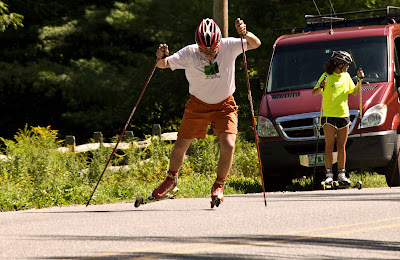
    We’re kicking off the school year in a big way, and big gains made in the summer are already starting to show. After impressive double poling and strength yesterday, we cruised up German Flats on skate skis, doing some serious speed and technique work on the way.


    Hans leads the crew up on a perfect morning for some roller skiing.

    GMVS alum and current Dartmouth skier David Sinclair joined us today.


    Justin getting after it

    Hans: fierce.

    Ryley cruising up the flats


    Once we made it up to the Sugarbush parking lot we did a slalom course, working more on speed and agility.

    M.K. hones her step turn in the slalom TT

    Heidi getting angles

    Dev coming around the final turn
  • First Week of School


    We’re kicking off the school year in a big way, and big gains made in the summer are already starting to show. After impressive double poling and strength yesterday, we cruised up German Flats on skate skis, doing some serious speed and technique work on the way.


    Hans leads the crew up on a perfect morning for some roller skiing.

    GMVS alum and current Dartmouth skier David Sinclair joined us today.


    Justin getting after it

    Hans: fierce.

    Ryley cruising up the flats


    Once we made it up to the Sugarbush parking lot we did a slalom course, working more on speed and agility.

    M.K. hones her step turn in the slalom TT

    Heidi getting angles

    Dev coming around the final turn
  • Meet The New Kids: Part 11

    Mollie Hoopes joins us from Hanover, NH this year as an 11th grader. Mollie has only been racing for 3 years, but she is very active and has done lots of swimming, biking and x-c running. Her favorite workout is a long trail run in the rain, but she may not be doing that for a bit because she has a stress fracture in her heel.

  • New Camera = Blogging again!

    After my six year-old camera finally called it quits a few months back it’s been difficult to motivate for blogging. Especially when you look at the smattering of Nordic blogs out there, pictures dominate. I don’t want the MOD blog relegated to the bottom of someone’s RSS feed because boredom sets in from reading entry after entry of text and no shiny happy photos.

    SO…we’re back. I got myself a tasty little Sony digital camera with some video capabilities, and promptly threw it into Scott’s hands to shoot some film on a workout last week.


    Without divulging company secrets I will say that we’ve been utilizing some tremendous training philosophy from a certain Italian running coach and the results have been great. Most of the focus has been on aerobic capacity – strength, power, and speed has never been a huge problem to face, but no one’s ever called me an endurance machine. With the help of our distant paisano, we’re maybe gonna change that fact. After four weeks of following a speed endurance progression that our Mediterranean friend set forth as a method he used with his marathoners, I re-ran a 1600m skate TT and dropped about 16sec off my time from early July. Positive results like that are just what we need to affirm we’re on the right track.

    A few months ago Scott and Alison started working together to help prepare Alison for her 100-mile ultramarathon (this Saturday). On Monday Scott ran her through a second lactate step-test protocol, basically a Conconi test w/ lactates taken at every 2min stage and speed increase. The difference between this particular test and her last one, conducted in early June, was a complete dichotomy. I tried to copy the latest chart on to this blog but I’m rather inept in that department, so just take my word for it. Imagine the flattest line stretching out to the far right before shooting steeply upward as she passed threshold. She’s more ready than she’s ever been for this weekend’s race; I’ll be pacing her for about 20miles of it at different stages and hopefully won’t have to be chewing her food…

    More to come!