We’ve been brainstorming over the best way to honor David Landgraf’s legacy and we’ve decided to offer some hats for sale. All proceeds from these sales will be donated to the Ski Strong foundation that Emalea and Laurie Landgraf have started.
Honestly, it’s hard to imagine the Birkie without David Landgraf, so I’m excited to do the race (and every ski race this year) while wearing a hat that
Category: XCFeeds
A collection of live feeds from cross-country ski blogs around the web.
-
Order a "Ski Like Landgraf!" Memorial Tassel Hat!
-
Order a "Ski Like Landgraf!" Memorial Tassel Hat!
We’ve been brainstorming over the best way to honor David Landgraf’s legacy and we’ve decided to offer some hats for sale. All proceeds from these sales will be donated to the Ski Strong foundation that Emalea and Laurie Landgraf have started.
Honestly, it’s hard to imagine the Birkie without David Landgraf, so I’m excited to do the race (and every ski race this year) while wearing a hat that -
Order a "Ski Like Landgraf!" Memorial Tassel Hat!
We’ve been brainstorming over the best way to honor David Landgraf’s legacy and we’ve decided to offer some hats for sale. All proceeds from these sales will be donated to the Ski Strong foundation that Emalea and Laurie Landgraf have started.
Honestly, it’s hard to imagine the Birkie without David Landgraf, so I’m excited to do the race (and every ski race this year) while wearing a hat that -
Order a "Ski Like Landgraf!" Memorial Tassel Hat!
We’ve been brainstorming over the best way to honor David Landgraf’s legacy and we’ve decided to offer some hats for sale. All proceeds from these sales will be donated to the Ski Strong foundation that Emalea and Laurie Landgraf have started.
Honestly, it’s hard to imagine the Birkie without David Landgraf, so I’m excited to do the race (and every ski race this year) while wearing a hat that -
Meet The New Kids: Part 10
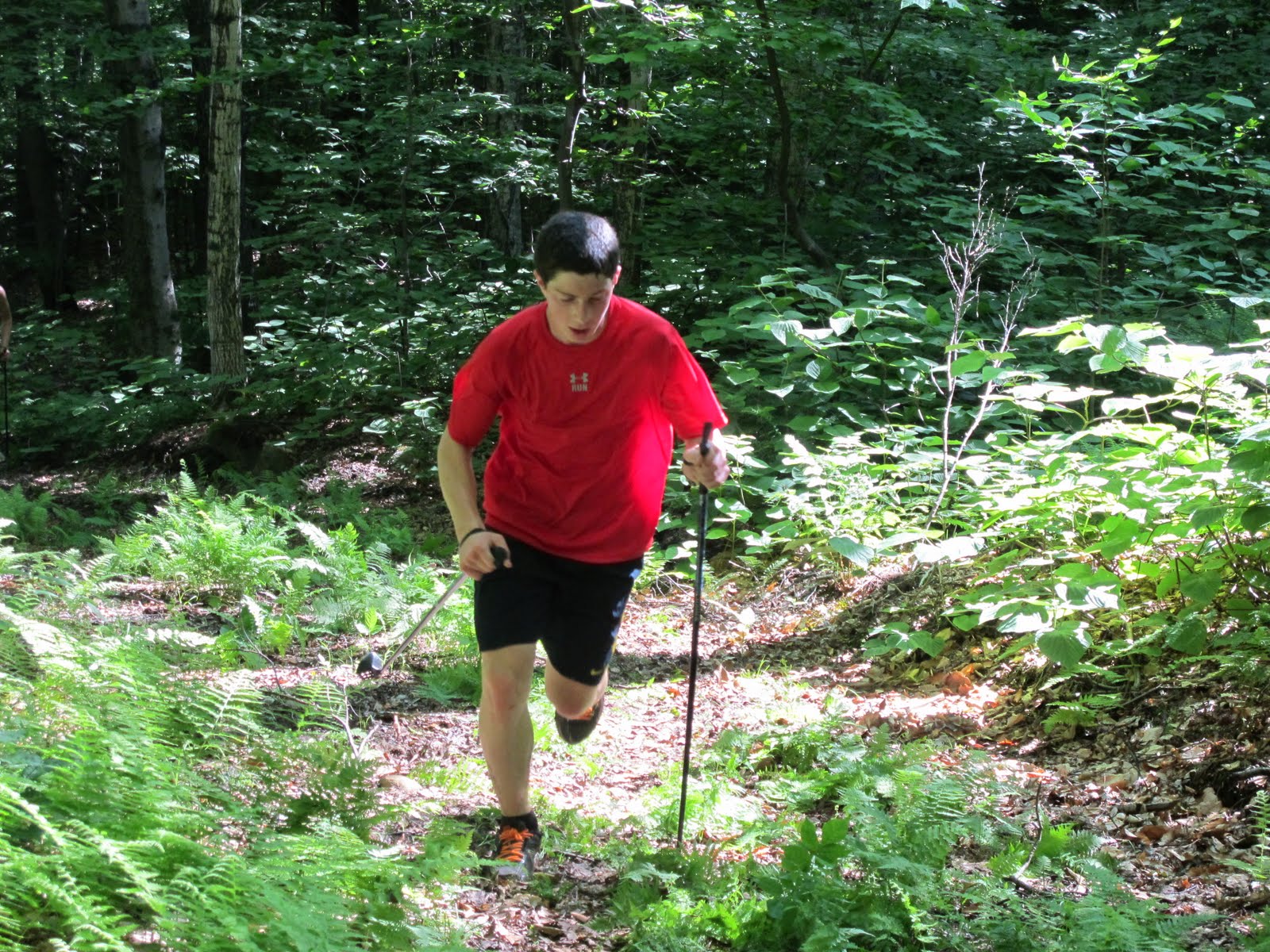
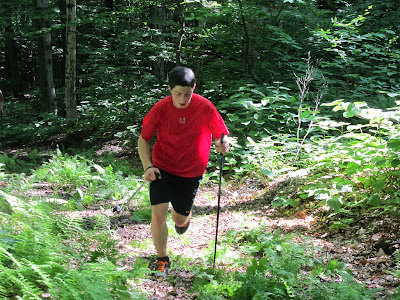 Koby Gordon hails from Saxtons River, VT. He will be a 9th grade winter term day student this year. Koby is a training machine. When not out rolling, riding or running, he can be found playing soccer. On the rare occasion when he is not training, Koby likes to spend time with his pet alligator, Fluffy. No doubt they enjoy high spirited wrestling matches.Koby has been training with us this summer and we look forward to his joining us during the winter.
 -
Is Sprinting A Young Person’s Game?
Conventional wisdom (and probably a fair bit of physiology research) holds that going fast over short distances is a skill we tend to lose as we age. Are fast World Cup sprinters younger than fast distance skiers?
Let’s look at the age distributions of top thirty racers in sprinting and distance races since the 2003-2004 season:
 Certainly looks like top-30 distance skiers are slightly older and a simple t-test confirms a significant difference of about 2.1 years for the men and 1.5 years for the women (although the statistical significance is most likely largely a factor of the huge sample size here).
What happens if we zoom in on even faster skiers? Like, say, top ten skiers…
 Just eyeballing it, it appears that the difference is even larger. And again, the t-test’s confirm this suspicion. The differences bumps up slightly to 2.8 years for the men and 1.9 years for the women.
Of course, this is just a difference in the average age for sprinting and distance racing. As the distributions above show, there’s still quite a bit of variation in ages for fast skiers in both disciplines.
Related posts:
- <Best Young Distance Skiers: 2009-2010
- <Best Young Sprint Skiers: 2009-2010
- <Comparing Variability In Men’s & Women’s Sprinting
-
Perfect Day At BMD
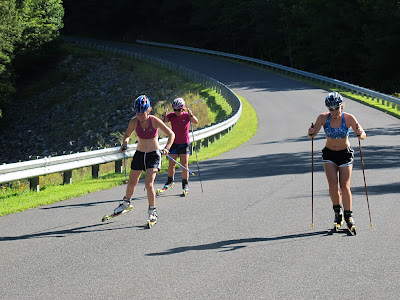 We had perfect weather for our ski this morning at Ball Mtn Dam. Low 60’s with low humidity..what a joy for a distance ski with some pick-ups.
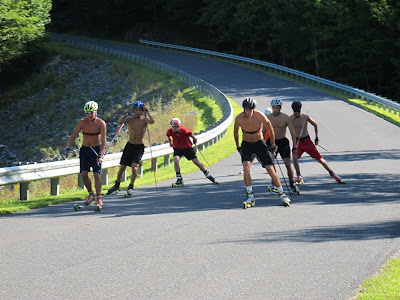 The road at BMD is only 2.5 km long, but it makes for a nice 5 km out and back with variable terrain. Best of all…the pavement is excellent and during our 2 hour ski this morning, we only saw 1 car. This allows the athletes to ski in groups and be safe. The speed limit is 25, so when the occassional car does drive out the road, it is easy to pull to the side.
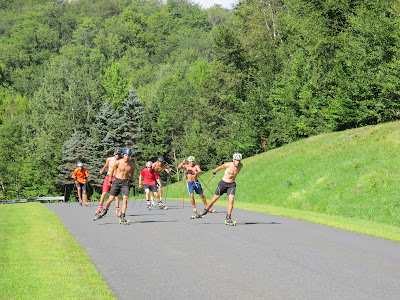
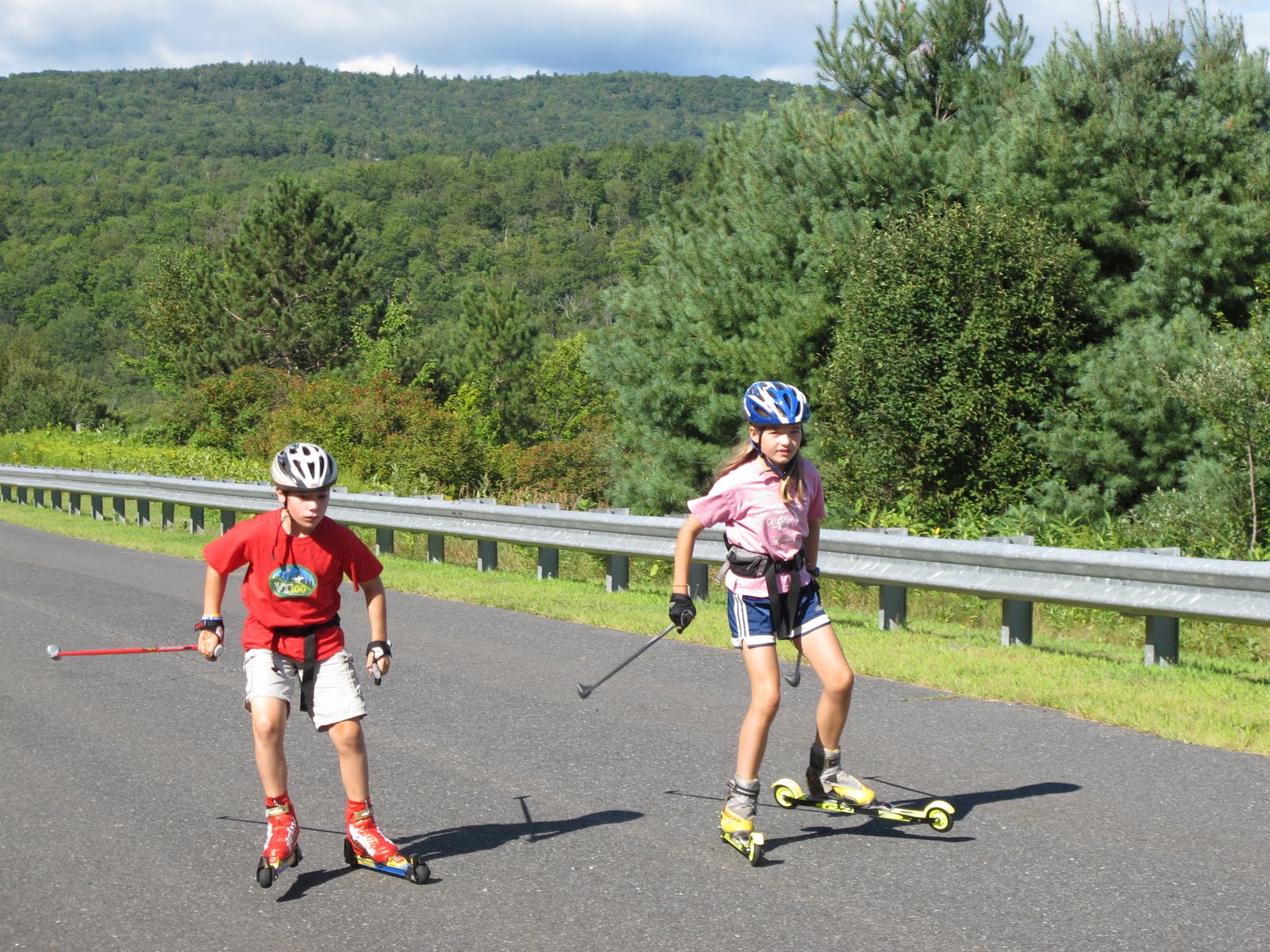
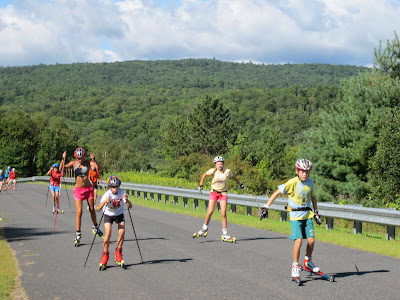 Poppet worked on technique with the younger kids while the older skiers did an easy distance workout. We put out cones so that every 3-4 minutes they would have a 5 second pick up. The goals were to 1) work on relaxing and carrying their speed, and 2) work on bursts so they can react to moves during mass start races.
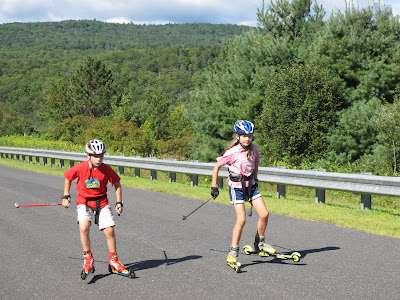
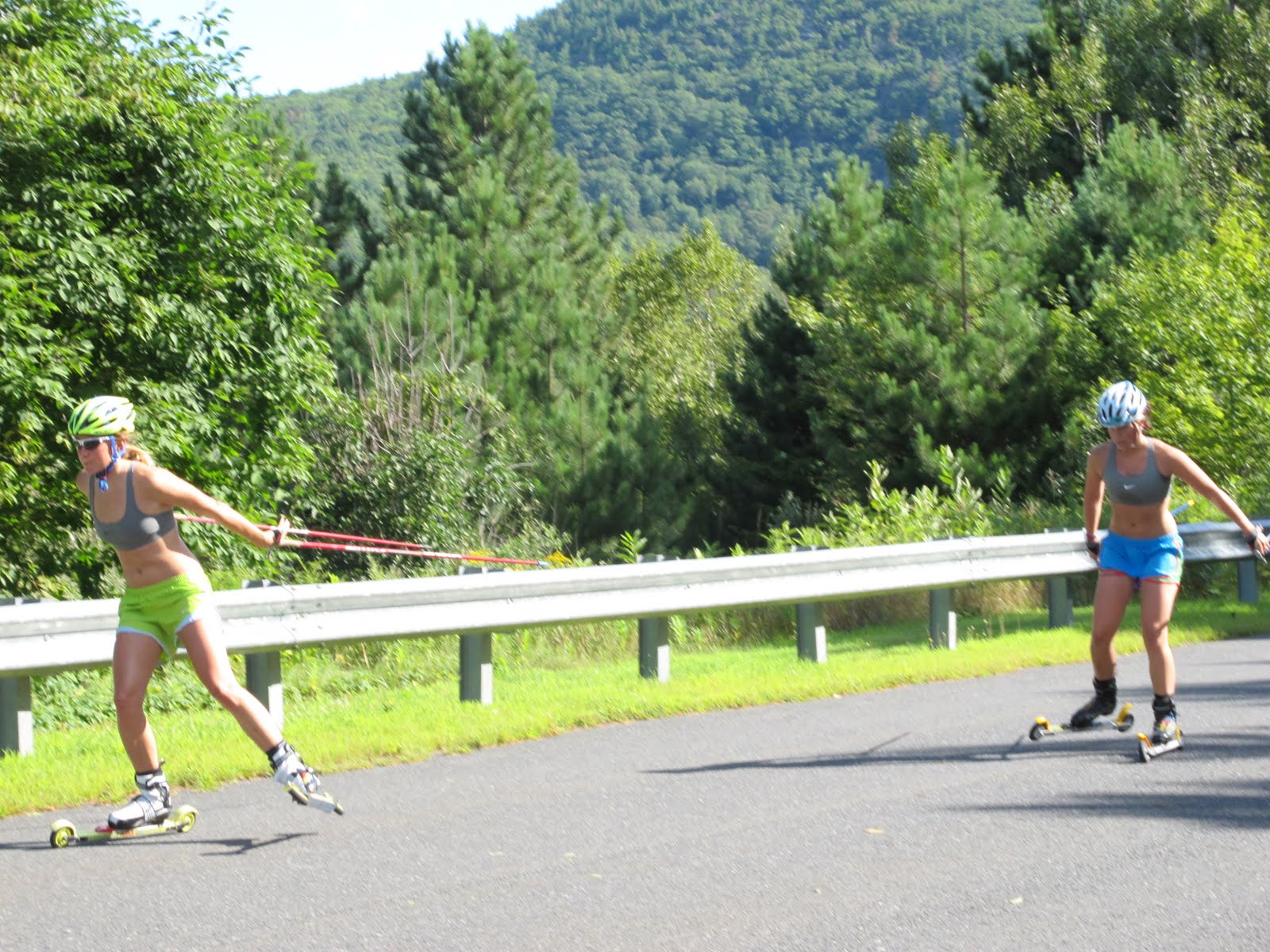
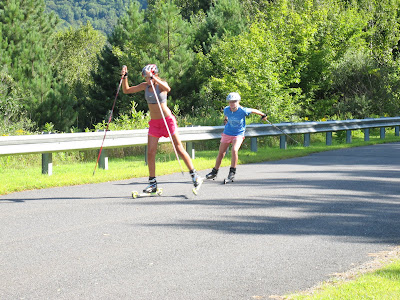
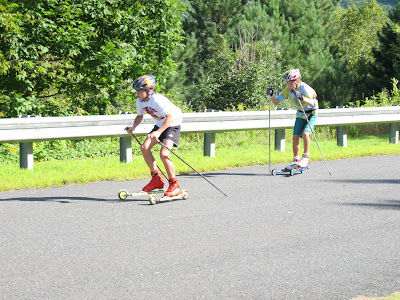
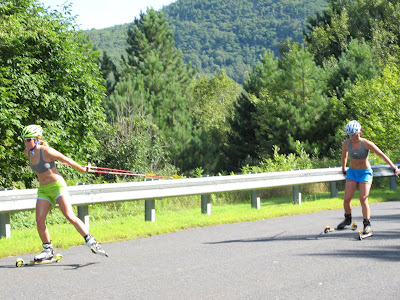 Above, college stand-outs, below J3’s… you can hardly tell the difference :).

-
Glacier Camp
14 tough female athletes
4 coaches
2 groomers
2 piston bullies
1 glacier
1 building
7.5 km of groomed trails
26 hours of skiing
3 helicopter loads of food
2 bottomless coffee makers
1 guitar
50+ trashy magazines
2 choreographed dances
These are just some of the numbers that describe my week on the glacier. After a little over a week of dryland, we drove to Girdwood which is about 45 minutes from Anchorage and then flew by helicopter with all of our skis and luggage up to APU’s Thomas Training Center on the Eagle Glacier which would be our home for the next week. There was one building perched on the edge of a rocky cliff and overlooking the glacier. Bunk rooms filled with upstairs and while the downstairs housed a big living room, kitchen, and drying room. We were pretty isolated but we had 7.5km of trails that twisted around the glacier and were groomed just for us twice a day so nobody was complaining. It was the perfect location for training, eating, and sleeping which was about all we did. Each day we skied between 3 and 5 hours usually broken up between two training sessions. The majority of the volume was easy distance but the glacier was only at 5800′ of elevation so it was still low enough to do a few quality intensity sessions. The morning sessions were usually skating. It was often pretty fast when we started and then became progressively slower, softer, and slushier as the morning progressed. Having a pair of skis with a wet grind or a lot of structure was necessary if you still wanted to be gliding by the end of the morning. Then we classic skied in the afternoon and a thick mixture of red and universal klister was usually perfect. We had a mix of weather with everything from some fresh snow on our first day to some really warm weather where we skied in shorts and sports bras. The pictures show a lot of sunny weather but there were also some days where a thick fog covered the trail and visibility was probably less than 15 meters. Since we put in A LOT of laps around that one loop, the fog sometimes came as a nice mental relief blocking the upcoming switchbacks from view. The terrain was very hilly which was perfect for striding and V1 which can sometimes be difficult to practice on rollerskis. The group of girls was also awesome and I really enjoyed training and spending time with everyone. Having that many competitive women working hard together really raised the level of the camp. It seemed like every interval we did, there was someone new chomping at the bit and pushing the pace. During the distance sessions I also tried to ski with as many different people as possible hoping to learn from other’s technique, tempo, and pacing. It was a really fun week and I want to thank APU for hosting all of us and organizing such an awesome camp. They are really lucky to have such an amazing facility and to be able to ski so easily throughout the summer.

Skiing behind World Championship and Olympic medalists like Kikkan and Chandra was just one of the great experiences of he week.

I felt very lucky to be able to ski in July!

We took advantage of such a strong group with lots of skiing in a pack


On the clear days we had 360 degree panoramic views of mountains

The trail snaked back and forth across the glacier. We were not allowed to ski off the groomed section because there were lots of cracks and crevasses but what was groomed was probed frequently and very safe


Thomas training center with the Eagle glacier in the background on the right

More views of mountains and other glaciers

Holly Brooks is someone whom I had previously only raced against so it was awesome to be able to train with her too

It was great to have some familiar faces and old teammates at the camp as well like Sophie

Jessie Diggins, Holly, and I during a L4 interval. The tracks got softer and softer with each interval during this workout but we took turns leading and pushing the pace and were able to negative split all the intervals despite the changing conditions.
 It wasn’t all training either as we also had a lot of recovery time between sessions to fill. With such a fun group of women it was easy to keep the atmosphere light. Here Jessie, Chandra, and Kikkan entertained us all with their amazing dance moves.
 -
Meet The New Kids: Part 9
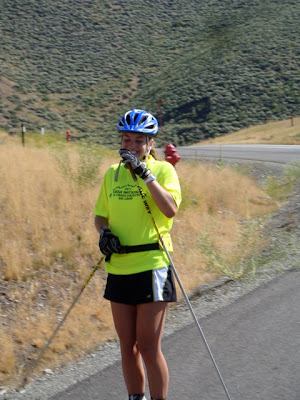
Anika Miller joins us from McCall, Idaho as an 11th grader. She spent last week in Sun Valley at the National J2 camp. Anika is always happy and she never gets tired (a great combo)! She started skiing when she was very, very young and she cried the whole time (that first time). She has been coached by her dad and she was on a small team of two racers.
We look forward to her smiles and her energy! -
Younger USST Member Tracking
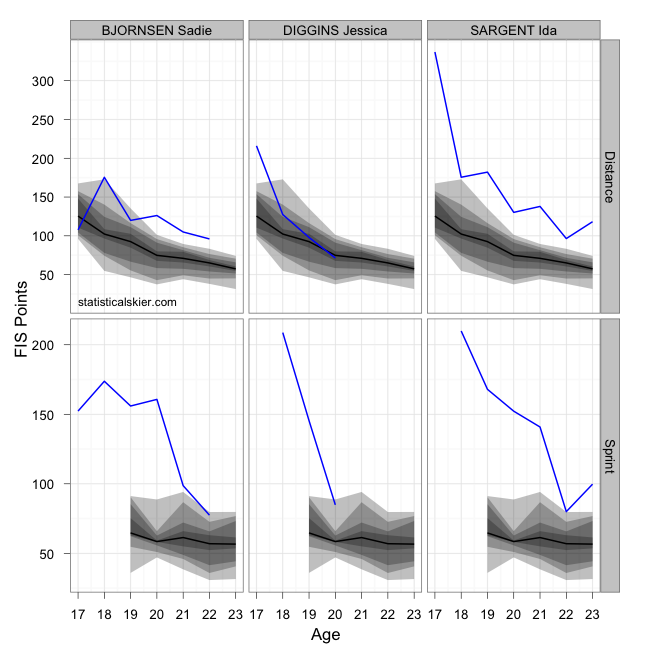
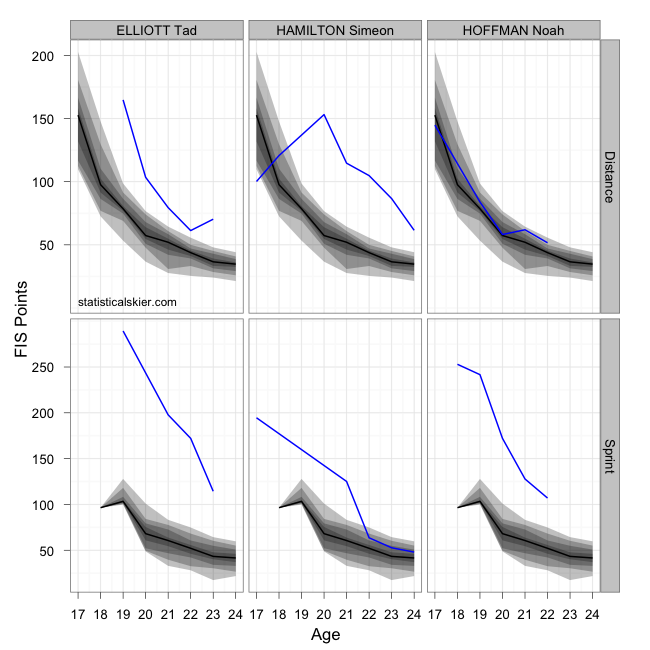
The USST has expanded somewhat, adding several younger skiers. Acknowledging that FIS points are only a small piece of performance assessment, it has interested me that at various times USST staff have mentioned comparing skiers’ FIS points to medalists, or some other group of top skiers. So here are two graphs showing the younger US B Team members compared to the range of FIS point results by future top ten WC finishers at that age. First the women:
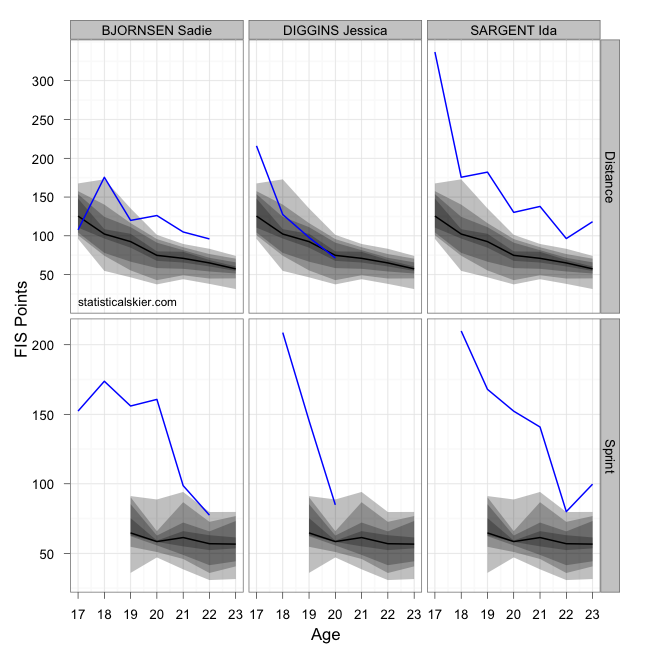 The blue line is the athlete’s median FIS points by age and the shaded regions shows the range of FIS points earned by future top ten skiers, ranging from the best 10% to the worst 90%, the lightest shaded region. And similarly, the men: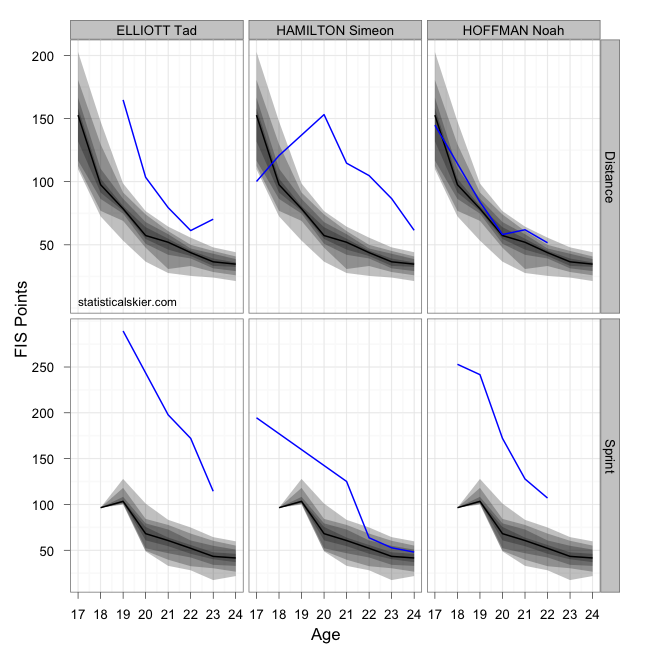
Related posts:
- <USST Preview: Liz Stephen & Morgan Arritola
- <USST Preview: Simi Hamilton & Noah Hoffman
- <USST Preview: Kikkan Randall
-
Some Kind of Training Alliance
 This is a bit late, but I would like to post something about how awesome the training camp with all the US team women and Canadian ladies was. By that, I mean I want to tell you all about why it was so awesome, and what I learned from all that awesomeness.
 We started out in town, did some mercifully wildlife free dryland training, and then went up to the glacier to test our fog tolerance. The first couple of days were pretty wet and soggy, but then it really started to get nice out. Unfortunately this good weather came just in time for the ADN reporter, Mark Lester, to leave and miss it. He still turned out an excellent video that you can see here, it’s really well done and makes us sound totally legit. Which we are. But still, it’s really cool to see something professionally done that recognizes our hard work and lifestyles. The only downside to this video is that he caught me singing: I almost never sing in public. I am very shy about it. It’s almost as rare to hear me sing as to catch Fitz dancing, which only happens when her judgement is totally impaired by fatigue, etc. Luckily Chandra has an awesome voice and you can’t really hear me, but I am still shocked that there is video of that on the internet.
Speaking of Chandra Crawford, I would like to write a small ode to her, and to all the girls who came and made skiing extra fun for a few weeks. The fact that I was singing is a great example of how inspiring and fun Chandra is. She is an embodiment of peer pressure, in a very good way. Because she sings and is cool, and cajoles me along as I quiver in fear, I decide that singing might be cool too. Obviously, if you have seen that part of the video, I was uncomfortable. But she somehow made me really want to try and step out of my comfort zone. That’s the magic of teammates.
Now don’t get me wrong, I have excellent APU teammates. I love them to death. In fact, I am terribly bereft now that Fitz is off having a good time at a family reunion in California and I don’t get to train with her every day. But having new, exciting, motivated, and fast women to train with adds a whole new level of awesome and helps me get my butt out the door in the morning. Chandra’s ubiquitous enthusiasm and ‘yeehoo!’ whoops everyday, even in the fog and rain on the glacier, don’t ever get annoying. In reality they’re contagious. I fancy myself to be more of a ‘yeehaw’ kind of girl in general, but she definitely pushed me to up my whooping count.
The novelty of having new people to learn from every day, and new compadres to test yourself agains in intervals, is really what I loved about those two weeks. When you don’t know how you measure up against your training partners, it can really help you to reach a new level of training. In all the intervals that we did in town I improved my splits by quite a bit. Granted, because we were all so excited and pushing each other we did go harder than the workouts before. That’s definitely a danger of training with your wintertime competitors. However, I think that it was good. It might not be ideal to go too hard in intervals every time you do them, but it is good to test the waters a little bit and take advantage of some added incentive.
Also, you can learn from your competitors. Ida, for example, has a really mean v1 jumpskate. It’s quite impressive. What this means, is that I can try to follow her in speed and imitate it. I can try to see what she is doing to make it so effective. Corey Stock as well had some great uphill skate sprint technique. Since that is an area that I could stand to improve a lot in, it was cool to try to pick up some tricks.
I interpret this kind of sharing to be the purpose of our camp. This group, at one point named the North American Women’s Training Alliance, functions as an opportunity to share and build knowledge for skiers from this continent. The group may now be named the Fast and Female Training Alliance because it seems to fill a niche in Chandra’s non-profit girl’s organization. Her motto is Spread the Love, and Dominate the World. Our purpose is to use collaboration to fulfill the second part of her mission statement.
This is kind of an interesting idea, this sharing of trade secrets. Not that it’s truly original, but I feel like American skiers sometimes spend so much time trying to beat each other that they forget to try to beat the rest of the world. Energy spent cattily trying to compete with each other might better be spent trying to compete with Europeans. In our defense, we are pretty isolated on the other side of the world, and it’s easy to think that winning NCAAs is the best thing going. However, there are many many bigger and higher caliber races out there! Wouldn’t it be even cooler to be the fastest in the world? I thought I was doing pretty well winning Besh Cups in Alaska a few years ago, but that didn’t mean that I was winning races at JOs… and it definitely didn’t mean I was on par with Norwegians. We need to work together to take on the rest of the world. North America could be a nordic powerhouse, we have plenty of skiers and plenty of snow. We just need to focus our combined efforts on making that jump, and I think this Name-To-Be-Determined Alliance is a step in the right direction.
Additionally, this is an important lesson for younger skiers to learn. Everyone gets faster if everyone gets faster: when your competitors get better you are forced to improve as well. When your training partners make improvements it’s easier for you to do the same thing. Cooperation might not win you every local race, but it brings you closer to reaching your potential. Hopefully having a North American alliance that feeds this idea into Fast and Female camps everywhere will help to improve the level of skiing on our continent well into the future.
So, basically the camp was a total blast. We had some really fun girltime on the glacier watching chick flicks and eating salad, and learned a whole lot as well. All I can say after that is watch out world! We’re comin!
-
D-pole test (August)
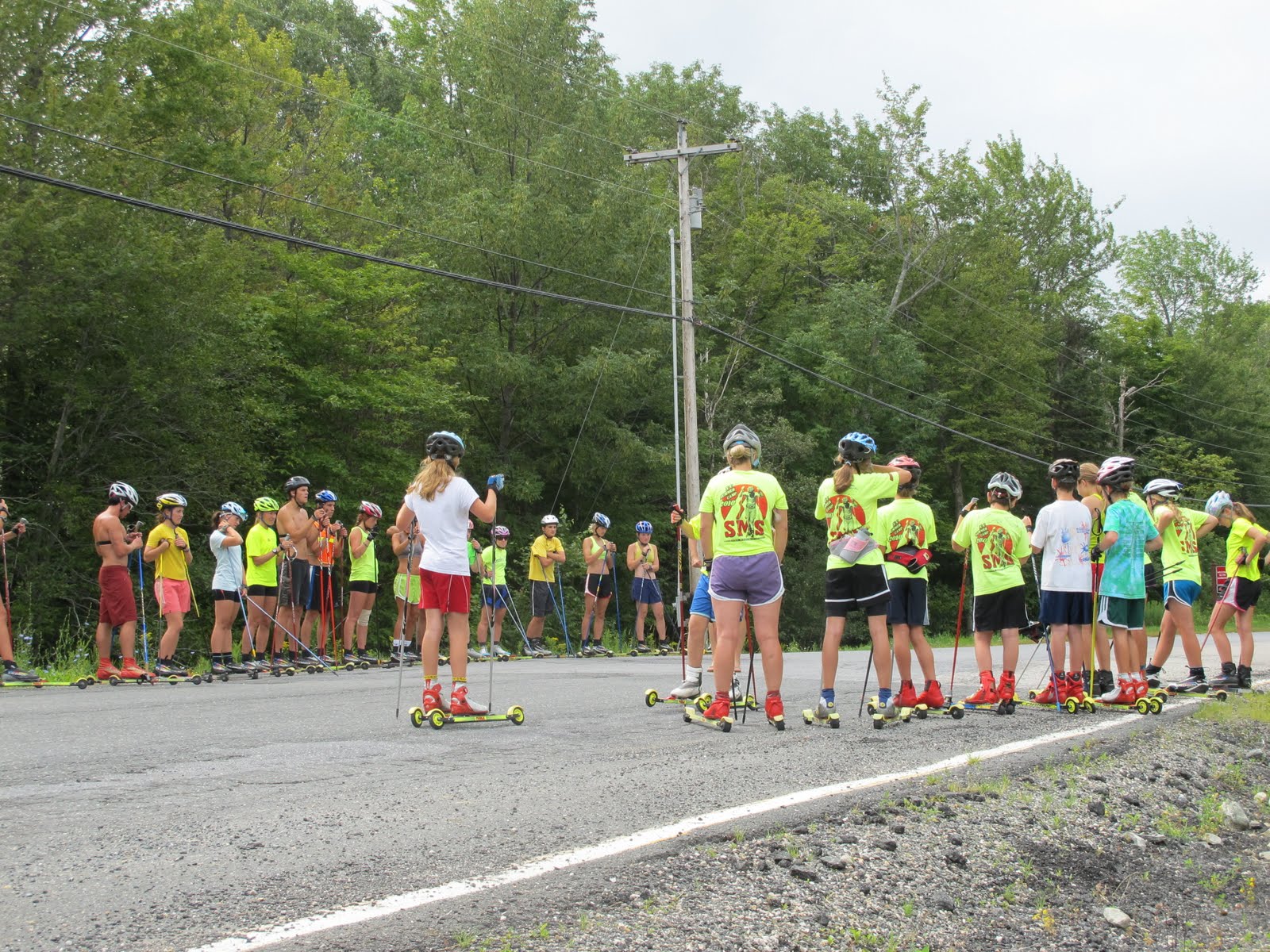
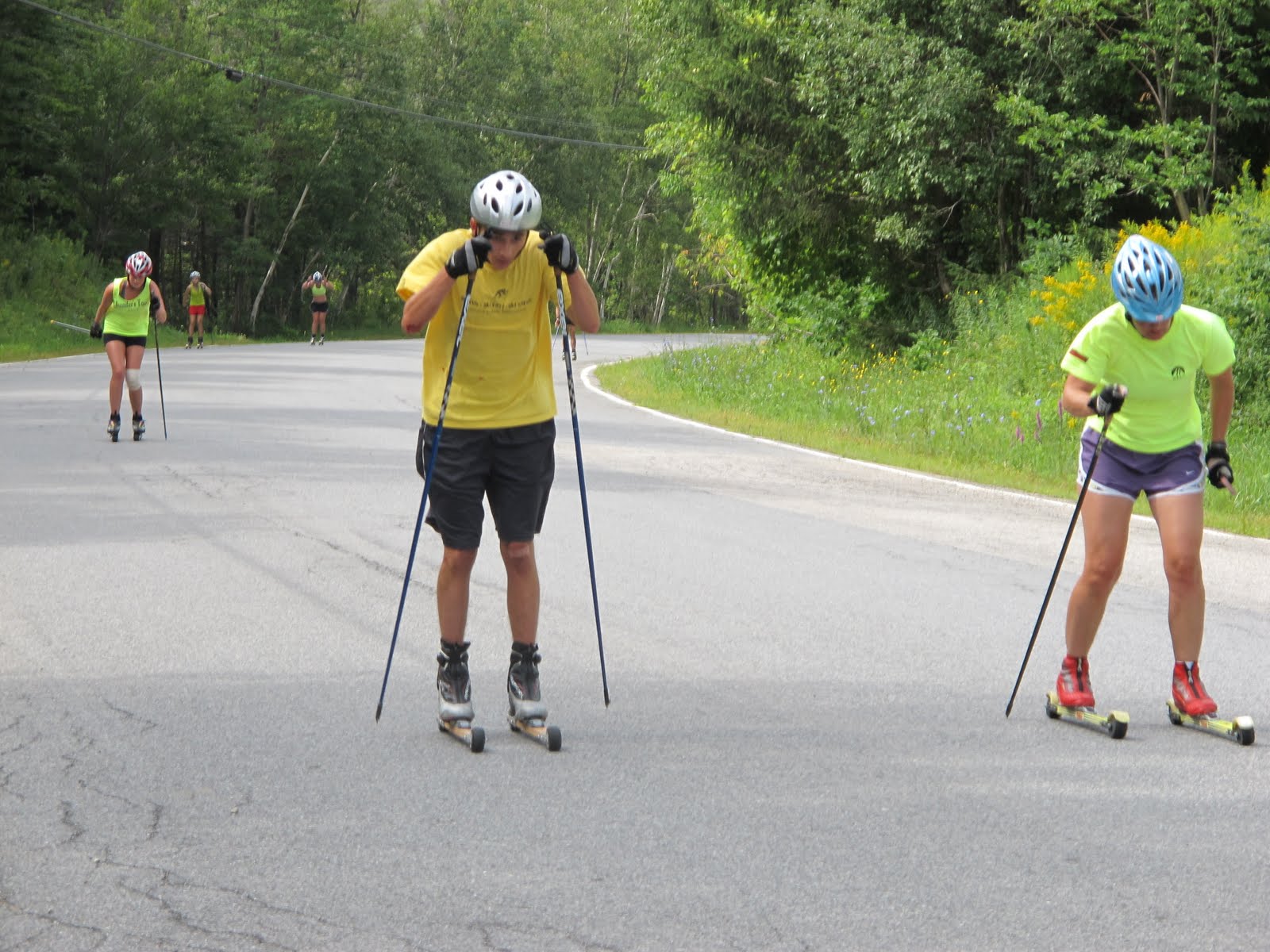
We had our monthly d-pole test this morning and it went well. There was a little tailwind and that combined with slow conditions for our two previous tests, helped almost everyone to new personal records on the 1.4 km uphill.
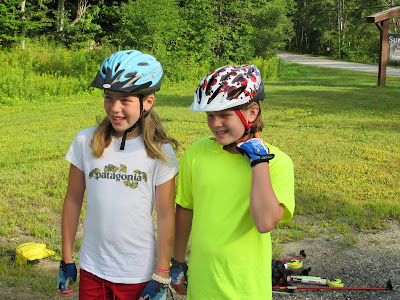 Why did he have us take off our skis?
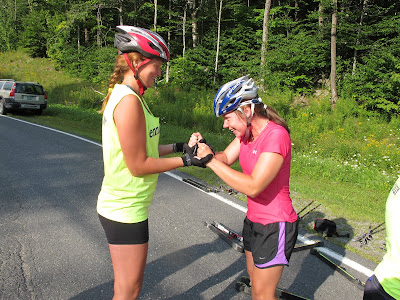 To see what is a stronger motion, poling with straight arms, or with bent arms. And..with a straight back or with slightly rolled shoulders.
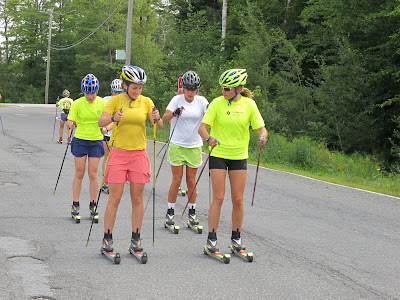 Continue warm-up for the uphill d-pole test.
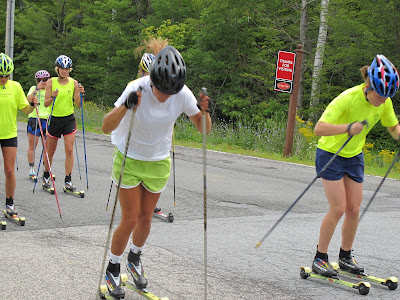 Part of our warm up included practicing sprint starts.
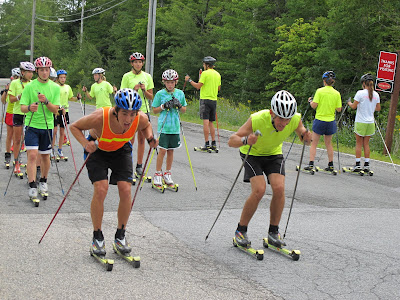
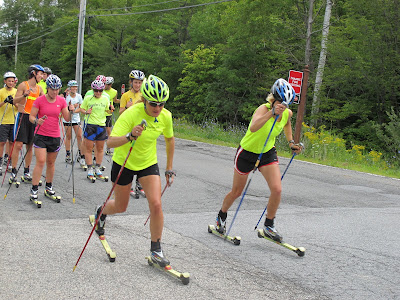
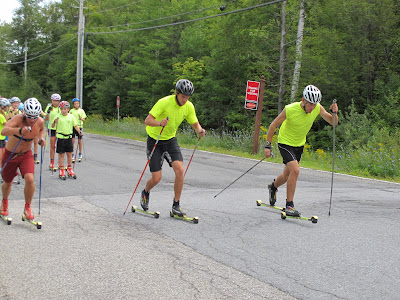
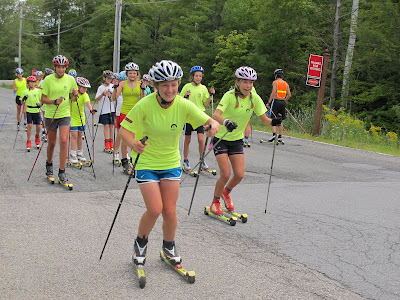
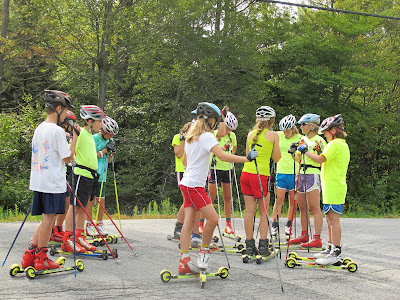 Poppet gives the “young guns” instruction on pacing and technique for the double pole test.
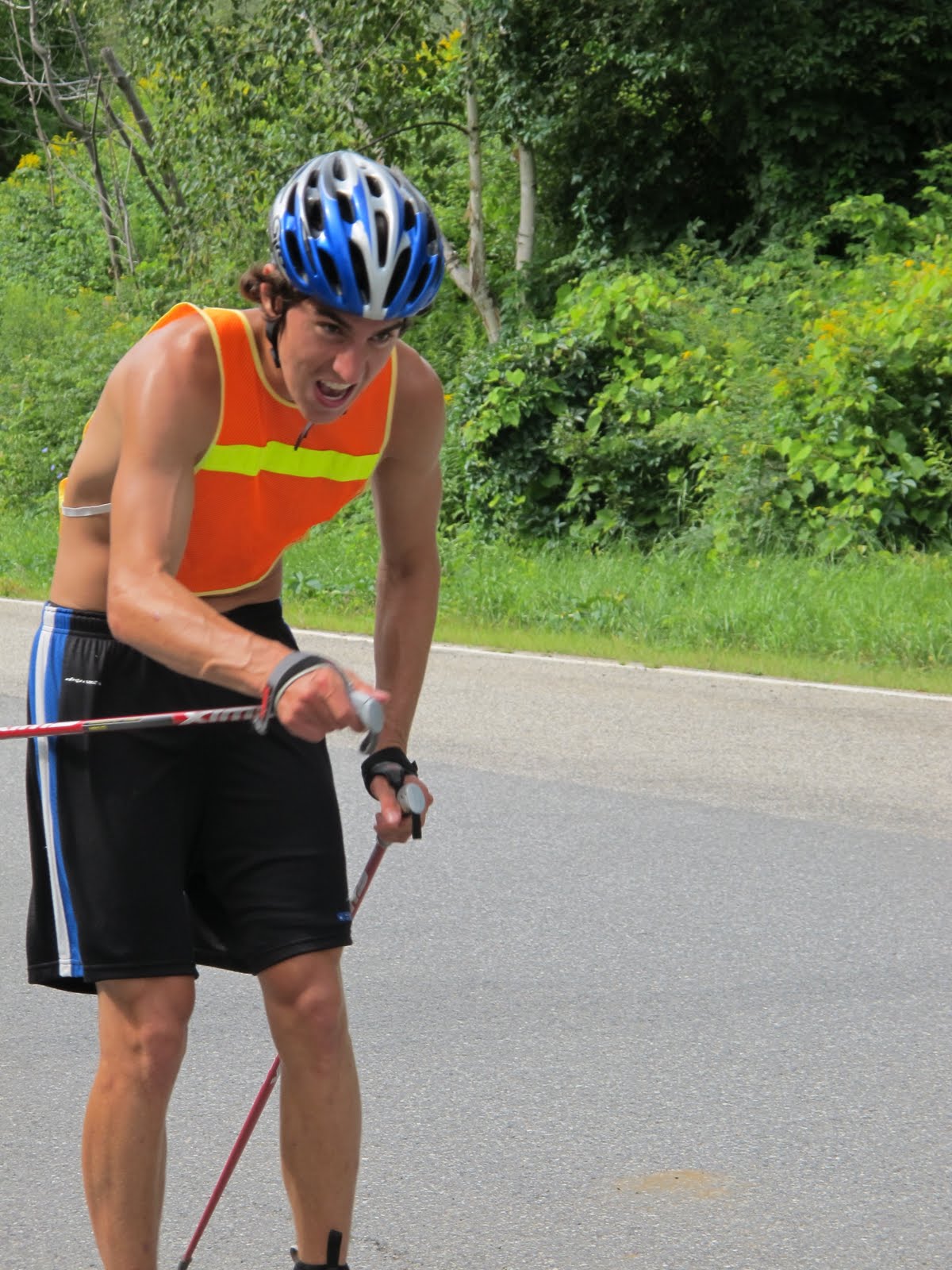
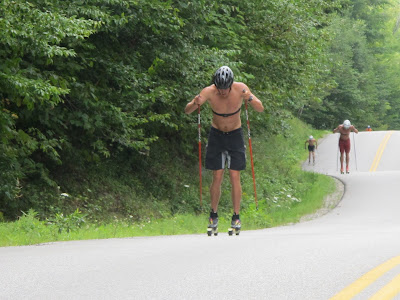 For the double pole test, Fritz was the pace setter with Bridger and Austin Caldwell in hot pursuit. Skiers started at 15 second intervals.
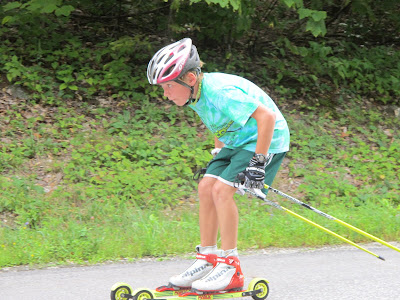 Here are the times for the boys (I do not feel like formatting in the old times so you’ll have to check back to the July 7th blog to see old times).
Fritz 3:45
Bridger 3:50
JAustin 4:04
Austin 4:08
Koby 4:45
Sam 5:21
Ben 6:08
Russell 6:47Sophie 4:28
Izzy C 4:50
Cam 4:54
Ellery 4:54
Gage 5:03
Keely 5:05
Issy P 5:12
Anya 5:14
Hallie 5:38
Chloe 6:10
Katharine 6:10
Pippin 6:30
Mackenzie 6:55
Tess 7:03
Alex 7:27
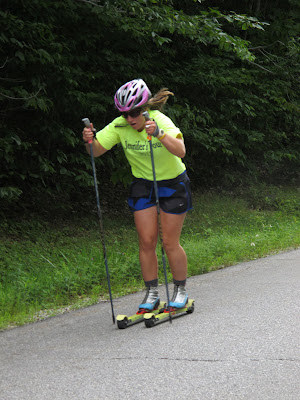
 We ended the workout with team sprint relays. The older kids had to do 6 laps and the younger kids 4 laps, alternating single pole and double pole laps. Each lap was about 600 meters long and there were some tired upper bodies by the end (that was the goal). The young team of Chloe and Mackenzie brought home the win!
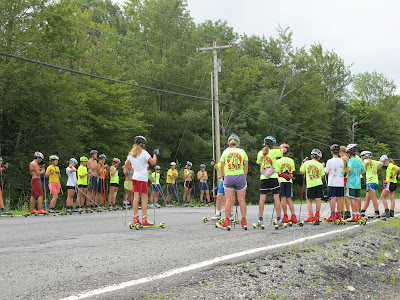
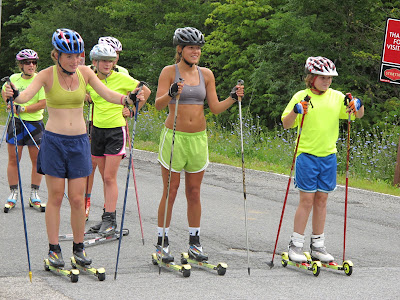
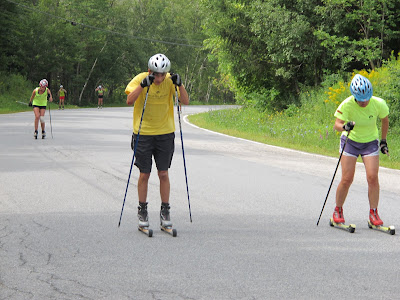
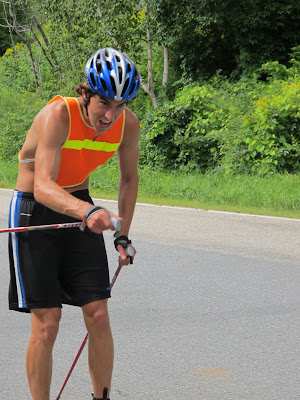 Good day. Lots of PR’s on the d-pole test and everyone got in a good specific strength workout.
-
Meet The New Kids: Part 8

Helena Bigelow joins us as an eighth grade winter term day student. She lives in Langrove and comes from the local West River BKL program. Helena loves to read and is quite good at the trombone. She spent a good part of the summer in Norway, brushing up on the language and researching their training secrets. She left today for a canoe trip in Maine..busy..busy…
We look forward to having Helena join us late this fall. -
Europe time
Today is my last day at home before I take off for a one month training camp in Europe. It has been great to be home for the past few months but I am definitely ready for a change of … Continue reading
-
Europe time
Today is my last day at home before I take off for a one month training camp in Europe. It has been great to be home for the past few months but I am definitely ready for a change of … Continue reading
-
Europe time
Today is my last day at home before I take off for a one month training camp in Europe. It has been great to be home for the past few months but I am definitely ready for a change of … Continue reading
-
Europe time
Today is my last day at home before I take off for a one month training camp in Europe. It has been great to be home for the past few months but I am definitely ready for a change of … Continue reading
-
Just another reason to be an XC skier in Alaska!
Summer glacier skiing can make the front page of the SUNDAY Anchorage Daily News! Check it out here:
http://www.adn.com/2011/08/06/2003773/mountaintop-training-helps-athletes.html
Marc Lester, ADN photographer came up and joined us for the first night of our glacier camp. When he wasn’t taking pictures he even joined us in the kitchen and assisted our cook crew. (Thanks Marc!) Check out this awesome six minute video that he made about us:
Eagle Glacier Training Camp from Marc Lester on Vimeo.Here is the text of the article in case the link isn’t working for you:
Mountaintop training leads to medals podiums
Published: August 7th, 2011 09:42 PM
Last Modified: August 8th, 2011 06:50 AMEAGLE GLACIER — It’s always winter at Eagle Glacier, perhaps never more so than in the summer. June, July and August mark the cross-country ski season at the Thomas Training Center, the facility that sits high on a ridge above Girdwood in the Chugach Mountains.This is where the best skiers in Alaska come to get better. Sometimes, like at a recent training camp that featured an Olympic gold medalist from Canada and a World Championship silver medalist from Alaska, it’s where the best skiers on the continent come to get better.Here, skiers find an endless winter — even when skiing in shorts and T-shirts under a blazing summer sun — that is helping them gain ground in a sport long dominated by Europeans.“We kind of went across the world and looked at all the different programs that were having high-level success and looked for the different things they used in their training,” said Erik Flora, head coach of the Alaska Pacific University nordic ski program, which runs the Thomas Training Center. “The first thing that became apparent is that as a country, we didn’t ski as much as the rest of the world. The world leaders, that is.”APU didn’t need to search the world for a solution to that shortcoming. It needed only to look up.LONG DAYS OF SKIING
A mile high in the mountains and about a 10-minute helicopter ride from Girdwood, Eagle Glacier has long drawn skiers jonesing for snow during an Alaska summer.A photo album in the two-story training center shows scenes from the 1980s, when Olympic skiers Jim Galanes and Bill Spencer used a wall tent for a base camp while glacier training. Even before that, in the 1960s, Lowell Thomas Jr., the famed Alaska bush pilot and former lieutenant governor who donated $1 million to the APU nordic program in 1999, brought his kids here to ski in the summer.These days, skiers usually arrive in an Alpine Air helicopter and can look forward to hot food and warm beds after long days of glacier skiing. They sleep in bunk beds, cook meals together and hang clothes — some damp with sweat, some damp with the rain that occasionally pelts the glacier — on indoor clotheslines that become colorful displays of gloves, hats and socks.At the end of July, the training center was the scene of a week-long slumber party for some of the world’s top women. Among the 14 skiers from the United States and Canada who shared close quarters — and maybe some training secrets — were Chandra Crawford, an Olympic champion from Canada, and Kikkan Randall, a World Championship silver medalist from Anchorage.“We’re geographically isolated from our competitors, so it’s really great to have the Canadians up here,” said APU skier Holly Brooks, a 2010 Olympian who will compete for the U.S. Ski Team at the first series of World Cup races this winter. “They can bring in their strengths and their ideas, and what they’ve seen from the international field.“I think that we’ve realized that in order to get better and to improve, we have to work together. We have to share some of our ideas and some of our quote-unquote trade secrets.”Not that all of the sharing involves skiing.Crawford, who won the sprint race at the 2006 Winter Olympics in Turin, Italy, spent some of her downtime playing the guitar, teaching chords and organizing a three-part-harmony sing-along with APU skiers Becca Rorabaugh and Kinsey Loan.MISERY LEADS TO MEDALSAt the 2002 Winter Olympics in Salt Lake City, after posting the then-best finish in history by an American woman, Anchorage’s Nina Kemppel paid tribute to Eagle Glacier. She had skied to 15th place in the women’s 30-kilometer classic, a race made messy and difficult by wet, falling snow and 33-degree temperatures.“Thank you, Jim Galanes, for making me ski on all of those horrible, ucky days with no kick wax up at Eagle Glacier,” she said.At a 2007 sprint race in Rybinsk, Russia, after becoming the first American woman to win a World Cup medal, Randall gave credit to the glacier. She had placed third on a sprint course pieced together with crushed ice.“Conditions were what you might see on a glacier in Alaska during the summer,” she said. “I’ve asked myself (at Eagle Glacier), ‘When am I ever gonna race on this?’ It was good today to have that experience.”At last season’s national championships in Maine, the APU ski team turned heads with its domination of the awards podium — and again the glacier earned praise.“Eagle Glacier is a critical component in that we’re able to come up here once a month and ski for seven days,” Flora said. “And so you never lose that snow feel.”‘A LOT OF MILES’Because this is a glacier, there are hazards.Crevasses are a concern, so tracks are set in areas with low probability of crevasses and the course is marked by wands.The two-story building is bolted to an outcrop of rocks between the glacier and a cliff. The cliff features a nearly vertical drop and yellow tape warns people to keep their distance. If anyone is caught beyond the yellow tape, a helicopter is called and the person is kicked out of the camp.A staff of three, including Flora, runs the center but athletes are expected to pitch in. The staff is in charge of setting and grooming trails — a job made more pleasant this summer with the arrival of a new PistenBully — but athletes help with maintenance and by taking care of the cooking.Meals served at the recent women’s camp can best be described as heaping: a mound of food for every plate, with appetites to match — the result of two long workouts a day.“We’re expecting them to ski a whole lot,” Flora said. “We use this camp to build endurance. One of the ways to build endurance is to ski a lot. Ski a lot, a lot, a lot of miles.”Flora estimated skiers at the women’s camp put in 60 to 75 kilometers a day on an 8-kilometer loop. For the entire week, that added up to about 25 hours of skiing.Between workouts and in the evening, athletes enjoy living arrangements that are communal but quite civilized.There are composting toilets and a supply of water from a nearby pond. There’s a dresser filled with old VHS tapes and newer DVDs and a television to watch them on. There’s a big freezer stocked with food and an exercise room equipped with a stationary bicycle — and decorated with a poster of four-time Olympian Kemppel.“I love it,” Randall said. “It’s a great chance to eat, sleep and train. And the good camaraderie of everybody just working hard and suffering through some tough conditions and also celebrating some just absolutely beautiful days. We laugh a lot. We have fun a lot.”And best of all, the glacier is just an hour away from Anchorage, a trip that includes a quick helicopter ride to the training center.“This is a huge advantage,” Randall said. “I mean, it’s almost ridiculous when you can be at your house one minute and an hour later you’re up here skiing on the glacier. It’s an incredible facility, really.”
Read more: http://www.adn.com/2011/08/06/2003773/mountaintop-training-helps-athletes.html#ixzz1URbUhTqs -
Just another reason to be an XC skier in Alaska!
Summer glacier skiing can make the front page of the SUNDAY Anchorage Daily News! Check it out here:
http://www.adn.com/2011/08/06/2003773/mountaintop-training-helps-athletes.html
Marc Lester, ADN photographer came up and joined us for the first night of our glacier camp. When he wasn’t taking pictures he even joined us in the kitchen and assisted our cook crew. (Thanks Marc!) Check out this awesome six minute video that he made about us:
Eagle Glacier Training Camp from Marc Lester on Vimeo.Here is the text of the article in case the link isn’t working for you:
Mountaintop training leads to medals podiums
Published: August 7th, 2011 09:42 PM
Last Modified: August 8th, 2011 06:50 AMEAGLE GLACIER — It’s always winter at Eagle Glacier, perhaps never more so than in the summer. June, July and August mark the cross-country ski season at the Thomas Training Center, the facility that sits high on a ridge above Girdwood in the Chugach Mountains.This is where the best skiers in Alaska come to get better. Sometimes, like at a recent training camp that featured an Olympic gold medalist from Canada and a World Championship silver medalist from Alaska, it’s where the best skiers on the continent come to get better.Here, skiers find an endless winter — even when skiing in shorts and T-shirts under a blazing summer sun — that is helping them gain ground in a sport long dominated by Europeans.“We kind of went across the world and looked at all the different programs that were having high-level success and looked for the different things they used in their training,” said Erik Flora, head coach of the Alaska Pacific University nordic ski program, which runs the Thomas Training Center. “The first thing that became apparent is that as a country, we didn’t ski as much as the rest of the world. The world leaders, that is.”APU didn’t need to search the world for a solution to that shortcoming. It needed only to look up.LONG DAYS OF SKIING
A mile high in the mountains and about a 10-minute helicopter ride from Girdwood, Eagle Glacier has long drawn skiers jonesing for snow during an Alaska summer.A photo album in the two-story training center shows scenes from the 1980s, when Olympic skiers Jim Galanes and Bill Spencer used a wall tent for a base camp while glacier training. Even before that, in the 1960s, Lowell Thomas Jr., the famed Alaska bush pilot and former lieutenant governor who donated $1 million to the APU nordic program in 1999, brought his kids here to ski in the summer.These days, skiers usually arrive in an Alpine Air helicopter and can look forward to hot food and warm beds after long days of glacier skiing. They sleep in bunk beds, cook meals together and hang clothes — some damp with sweat, some damp with the rain that occasionally pelts the glacier — on indoor clotheslines that become colorful displays of gloves, hats and socks.At the end of July, the training center was the scene of a week-long slumber party for some of the world’s top women. Among the 14 skiers from the United States and Canada who shared close quarters — and maybe some training secrets — were Chandra Crawford, an Olympic champion from Canada, and Kikkan Randall, a World Championship silver medalist from Anchorage.“We’re geographically isolated from our competitors, so it’s really great to have the Canadians up here,” said APU skier Holly Brooks, a 2010 Olympian who will compete for the U.S. Ski Team at the first series of World Cup races this winter. “They can bring in their strengths and their ideas, and what they’ve seen from the international field.“I think that we’ve realized that in order to get better and to improve, we have to work together. We have to share some of our ideas and some of our quote-unquote trade secrets.”Not that all of the sharing involves skiing.Crawford, who won the sprint race at the 2006 Winter Olympics in Turin, Italy, spent some of her downtime playing the guitar, teaching chords and organizing a three-part-harmony sing-along with APU skiers Becca Rorabaugh and Kinsey Loan.MISERY LEADS TO MEDALSAt the 2002 Winter Olympics in Salt Lake City, after posting the then-best finish in history by an American woman, Anchorage’s Nina Kemppel paid tribute to Eagle Glacier. She had skied to 15th place in the women’s 30-kilometer classic, a race made messy and difficult by wet, falling snow and 33-degree temperatures.“Thank you, Jim Galanes, for making me ski on all of those horrible, ucky days with no kick wax up at Eagle Glacier,” she said.At a 2007 sprint race in Rybinsk, Russia, after becoming the first American woman to win a World Cup medal, Randall gave credit to the glacier. She had placed third on a sprint course pieced together with crushed ice.“Conditions were what you might see on a glacier in Alaska during the summer,” she said. “I’ve asked myself (at Eagle Glacier), ‘When am I ever gonna race on this?’ It was good today to have that experience.”At last season’s national championships in Maine, the APU ski team turned heads with its domination of the awards podium — and again the glacier earned praise.“Eagle Glacier is a critical component in that we’re able to come up here once a month and ski for seven days,” Flora said. “And so you never lose that snow feel.”‘A LOT OF MILES’Because this is a glacier, there are hazards.Crevasses are a concern, so tracks are set in areas with low probability of crevasses and the course is marked by wands.The two-story building is bolted to an outcrop of rocks between the glacier and a cliff. The cliff features a nearly vertical drop and yellow tape warns people to keep their distance. If anyone is caught beyond the yellow tape, a helicopter is called and the person is kicked out of the camp.A staff of three, including Flora, runs the center but athletes are expected to pitch in. The staff is in charge of setting and grooming trails — a job made more pleasant this summer with the arrival of a new PistenBully — but athletes help with maintenance and by taking care of the cooking.Meals served at the recent women’s camp can best be described as heaping: a mound of food for every plate, with appetites to match — the result of two long workouts a day.“We’re expecting them to ski a whole lot,” Flora said. “We use this camp to build endurance. One of the ways to build endurance is to ski a lot. Ski a lot, a lot, a lot of miles.”Flora estimated skiers at the women’s camp put in 60 to 75 kilometers a day on an 8-kilometer loop. For the entire week, that added up to about 25 hours of skiing.Between workouts and in the evening, athletes enjoy living arrangements that are communal but quite civilized.There are composting toilets and a supply of water from a nearby pond. There’s a dresser filled with old VHS tapes and newer DVDs and a television to watch them on. There’s a big freezer stocked with food and an exercise room equipped with a stationary bicycle — and decorated with a poster of four-time Olympian Kemppel.“I love it,” Randall said. “It’s a great chance to eat, sleep and train. And the good camaraderie of everybody just working hard and suffering through some tough conditions and also celebrating some just absolutely beautiful days. We laugh a lot. We have fun a lot.”And best of all, the glacier is just an hour away from Anchorage, a trip that includes a quick helicopter ride to the training center.“This is a huge advantage,” Randall said. “I mean, it’s almost ridiculous when you can be at your house one minute and an hour later you’re up here skiing on the glacier. It’s an incredible facility, really.”
Read more: http://www.adn.com/2011/08/06/2003773/mountaintop-training-helps-athletes.html#ixzz1URbUhTqs -
Just another reason to be an XC skier in Alaska!
Summer glacier skiing can make the front page of the SUNDAY Anchorage Daily News! Check it out here:
http://www.adn.com/2011/08/06/2003773/mountaintop-training-helps-athletes.html
Marc Lester, ADN photographer came up and joined us for the first night of our glacier camp. When he wasn’t taking pictures he even joined us in the kitchen and assisted our cook crew. (Thanks Marc!) Check out this awesome six minute video that he made about us:
Eagle Glacier Training Camp from Marc Lester on Vimeo.Here is the text of the article in case the link isn’t working for you:
Mountaintop training leads to medals podiums
Published: August 7th, 2011 09:42 PM
Last Modified: August 8th, 2011 06:50 AMEAGLE GLACIER — It’s always winter at Eagle Glacier, perhaps never more so than in the summer. June, July and August mark the cross-country ski season at the Thomas Training Center, the facility that sits high on a ridge above Girdwood in the Chugach Mountains.This is where the best skiers in Alaska come to get better. Sometimes, like at a recent training camp that featured an Olympic gold medalist from Canada and a World Championship silver medalist from Alaska, it’s where the best skiers on the continent come to get better.Here, skiers find an endless winter — even when skiing in shorts and T-shirts under a blazing summer sun — that is helping them gain ground in a sport long dominated by Europeans.“We kind of went across the world and looked at all the different programs that were having high-level success and looked for the different things they used in their training,” said Erik Flora, head coach of the Alaska Pacific University nordic ski program, which runs the Thomas Training Center. “The first thing that became apparent is that as a country, we didn’t ski as much as the rest of the world. The world leaders, that is.”APU didn’t need to search the world for a solution to that shortcoming. It needed only to look up.LONG DAYS OF SKIING
A mile high in the mountains and about a 10-minute helicopter ride from Girdwood, Eagle Glacier has long drawn skiers jonesing for snow during an Alaska summer.A photo album in the two-story training center shows scenes from the 1980s, when Olympic skiers Jim Galanes and Bill Spencer used a wall tent for a base camp while glacier training. Even before that, in the 1960s, Lowell Thomas Jr., the famed Alaska bush pilot and former lieutenant governor who donated $1 million to the APU nordic program in 1999, brought his kids here to ski in the summer.These days, skiers usually arrive in an Alpine Air helicopter and can look forward to hot food and warm beds after long days of glacier skiing. They sleep in bunk beds, cook meals together and hang clothes — some damp with sweat, some damp with the rain that occasionally pelts the glacier — on indoor clotheslines that become colorful displays of gloves, hats and socks.At the end of July, the training center was the scene of a week-long slumber party for some of the world’s top women. Among the 14 skiers from the United States and Canada who shared close quarters — and maybe some training secrets — were Chandra Crawford, an Olympic champion from Canada, and Kikkan Randall, a World Championship silver medalist from Anchorage.“We’re geographically isolated from our competitors, so it’s really great to have the Canadians up here,” said APU skier Holly Brooks, a 2010 Olympian who will compete for the U.S. Ski Team at the first series of World Cup races this winter. “They can bring in their strengths and their ideas, and what they’ve seen from the international field.“I think that we’ve realized that in order to get better and to improve, we have to work together. We have to share some of our ideas and some of our quote-unquote trade secrets.”Not that all of the sharing involves skiing.Crawford, who won the sprint race at the 2006 Winter Olympics in Turin, Italy, spent some of her downtime playing the guitar, teaching chords and organizing a three-part-harmony sing-along with APU skiers Becca Rorabaugh and Kinsey Loan.MISERY LEADS TO MEDALSAt the 2002 Winter Olympics in Salt Lake City, after posting the then-best finish in history by an American woman, Anchorage’s Nina Kemppel paid tribute to Eagle Glacier. She had skied to 15th place in the women’s 30-kilometer classic, a race made messy and difficult by wet, falling snow and 33-degree temperatures.“Thank you, Jim Galanes, for making me ski on all of those horrible, ucky days with no kick wax up at Eagle Glacier,” she said.At a 2007 sprint race in Rybinsk, Russia, after becoming the first American woman to win a World Cup medal, Randall gave credit to the glacier. She had placed third on a sprint course pieced together with crushed ice.“Conditions were what you might see on a glacier in Alaska during the summer,” she said. “I’ve asked myself (at Eagle Glacier), ‘When am I ever gonna race on this?’ It was good today to have that experience.”At last season’s national championships in Maine, the APU ski team turned heads with its domination of the awards podium — and again the glacier earned praise.“Eagle Glacier is a critical component in that we’re able to come up here once a month and ski for seven days,” Flora said. “And so you never lose that snow feel.”‘A LOT OF MILES’Because this is a glacier, there are hazards.Crevasses are a concern, so tracks are set in areas with low probability of crevasses and the course is marked by wands.The two-story building is bolted to an outcrop of rocks between the glacier and a cliff. The cliff features a nearly vertical drop and yellow tape warns people to keep their distance. If anyone is caught beyond the yellow tape, a helicopter is called and the person is kicked out of the camp.A staff of three, including Flora, runs the center but athletes are expected to pitch in. The staff is in charge of setting and grooming trails — a job made more pleasant this summer with the arrival of a new PistenBully — but athletes help with maintenance and by taking care of the cooking.Meals served at the recent women’s camp can best be described as heaping: a mound of food for every plate, with appetites to match — the result of two long workouts a day.“We’re expecting them to ski a whole lot,” Flora said. “We use this camp to build endurance. One of the ways to build endurance is to ski a lot. Ski a lot, a lot, a lot of miles.”Flora estimated skiers at the women’s camp put in 60 to 75 kilometers a day on an 8-kilometer loop. For the entire week, that added up to about 25 hours of skiing.Between workouts and in the evening, athletes enjoy living arrangements that are communal but quite civilized.There are composting toilets and a supply of water from a nearby pond. There’s a dresser filled with old VHS tapes and newer DVDs and a television to watch them on. There’s a big freezer stocked with food and an exercise room equipped with a stationary bicycle — and decorated with a poster of four-time Olympian Kemppel.“I love it,” Randall said. “It’s a great chance to eat, sleep and train. And the good camaraderie of everybody just working hard and suffering through some tough conditions and also celebrating some just absolutely beautiful days. We laugh a lot. We have fun a lot.”And best of all, the glacier is just an hour away from Anchorage, a trip that includes a quick helicopter ride to the training center.“This is a huge advantage,” Randall said. “I mean, it’s almost ridiculous when you can be at your house one minute and an hour later you’re up here skiing on the glacier. It’s an incredible facility, really.”
Read more: http://www.adn.com/2011/08/06/2003773/mountaintop-training-helps-athletes.html#ixzz1URbUhTqs