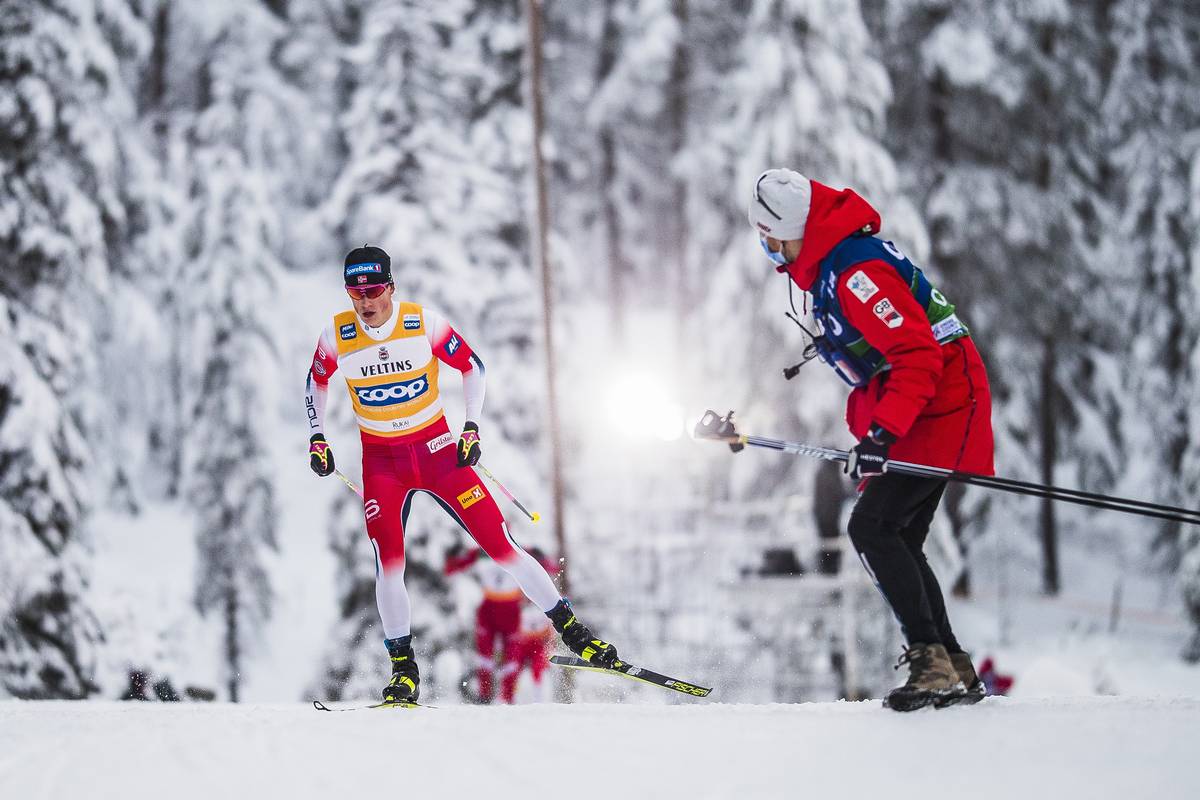
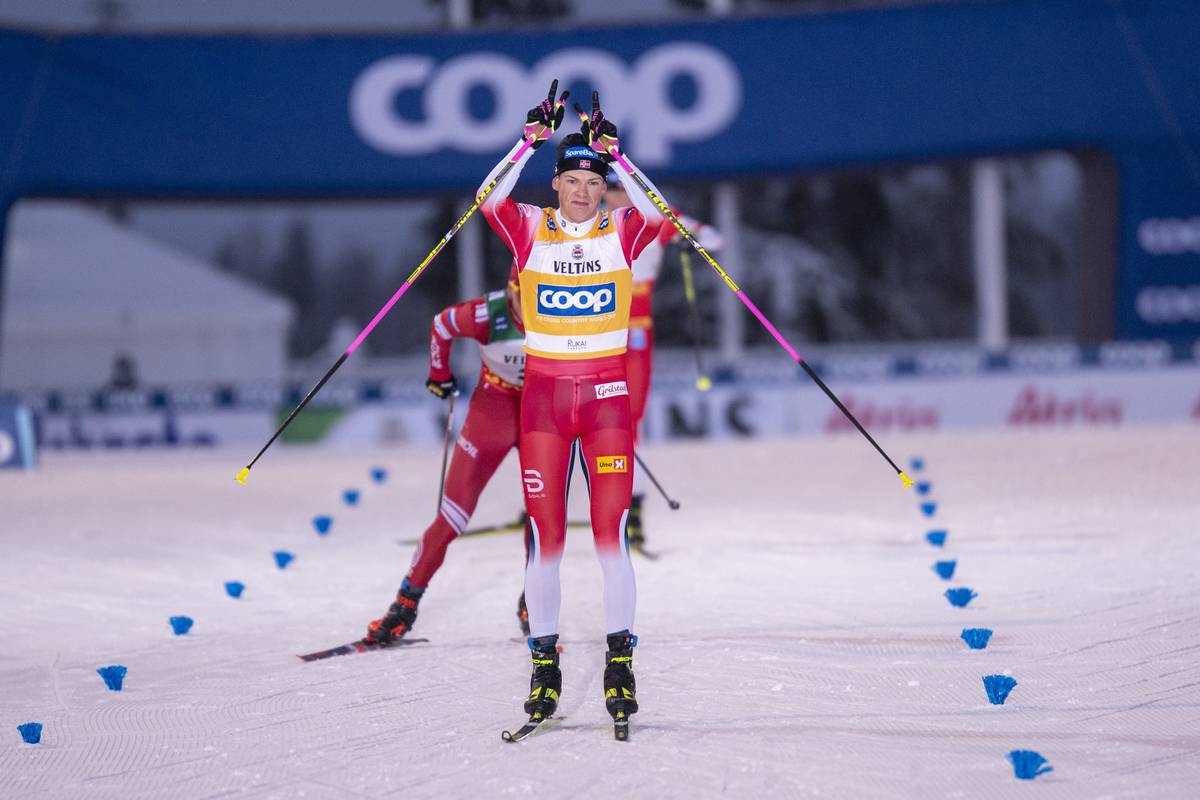
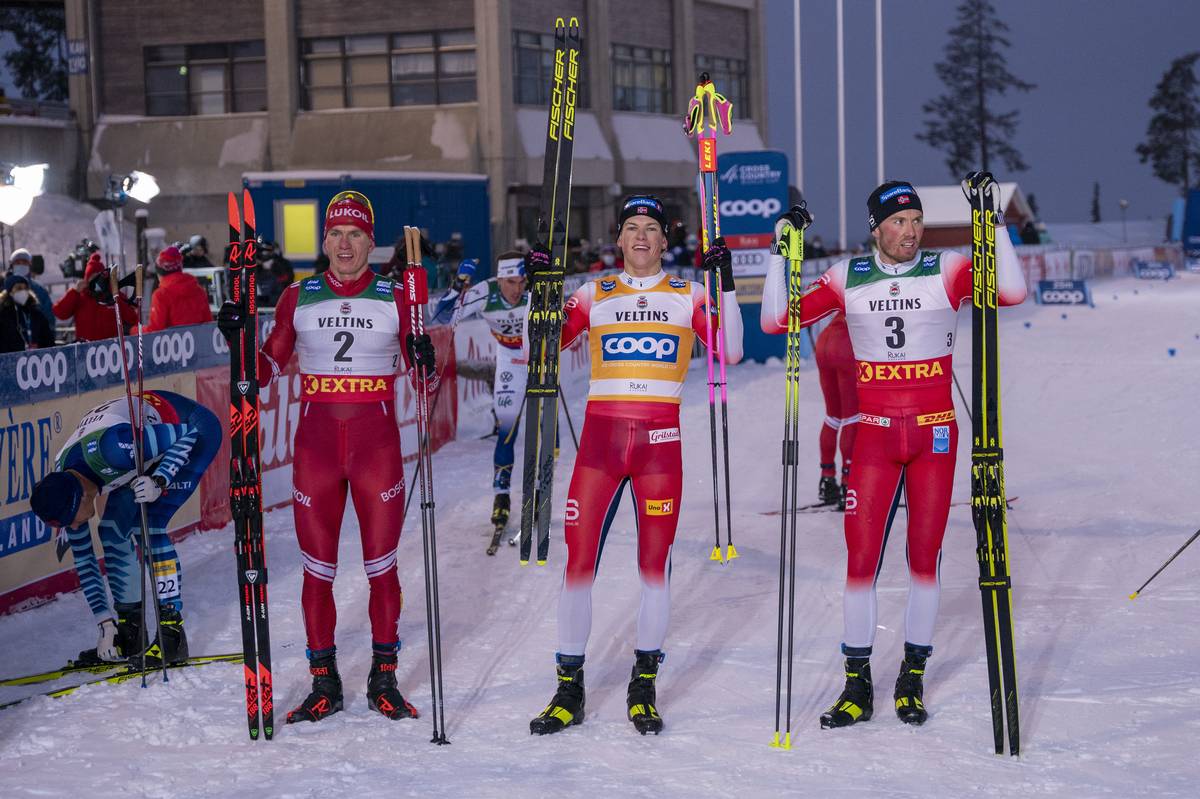
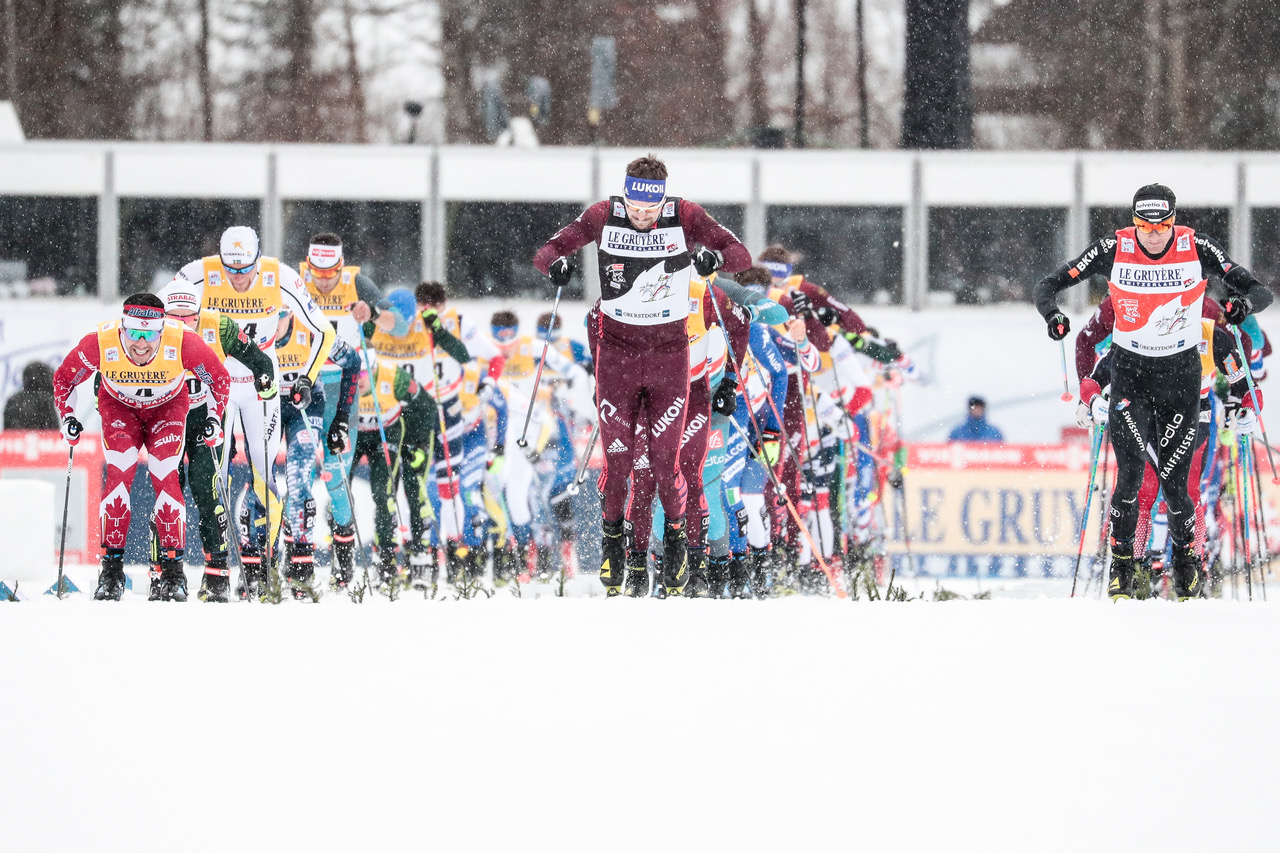
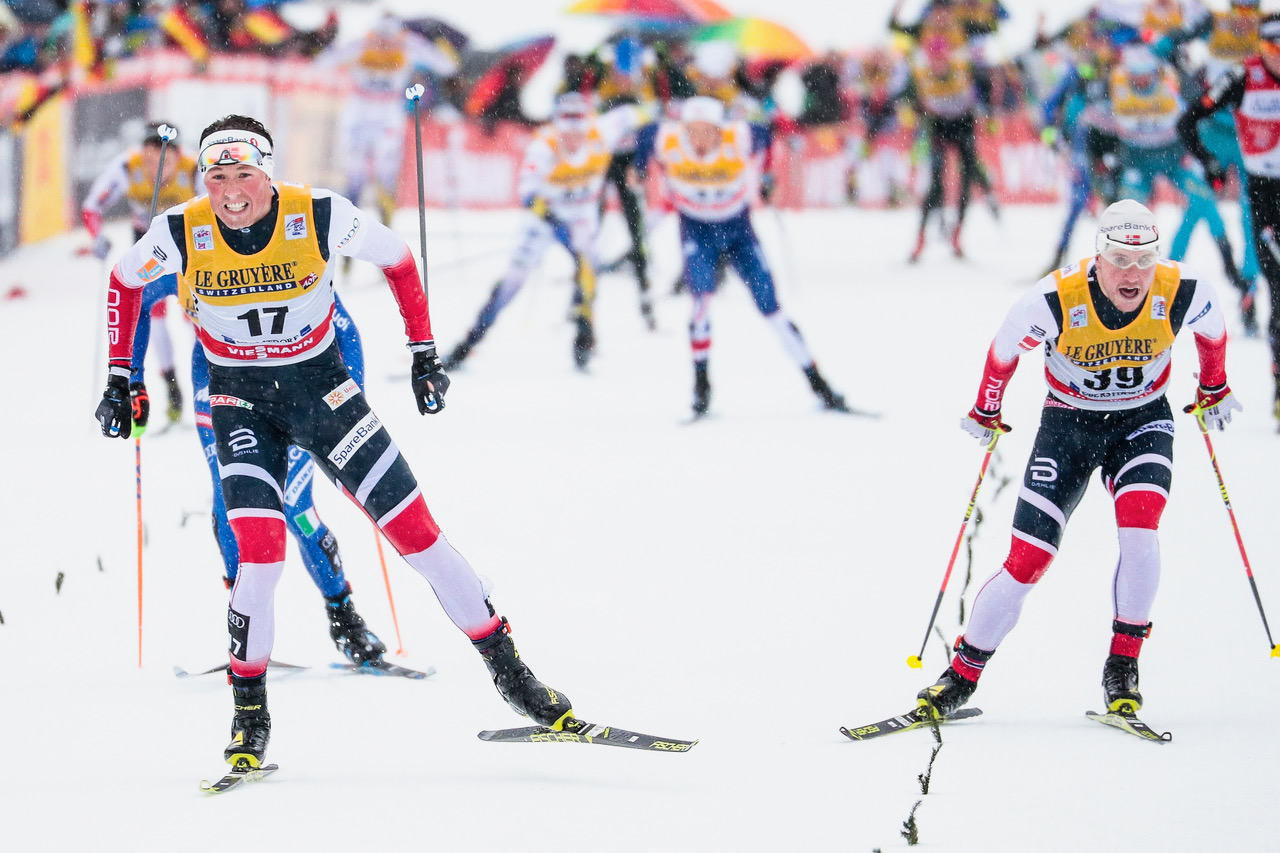
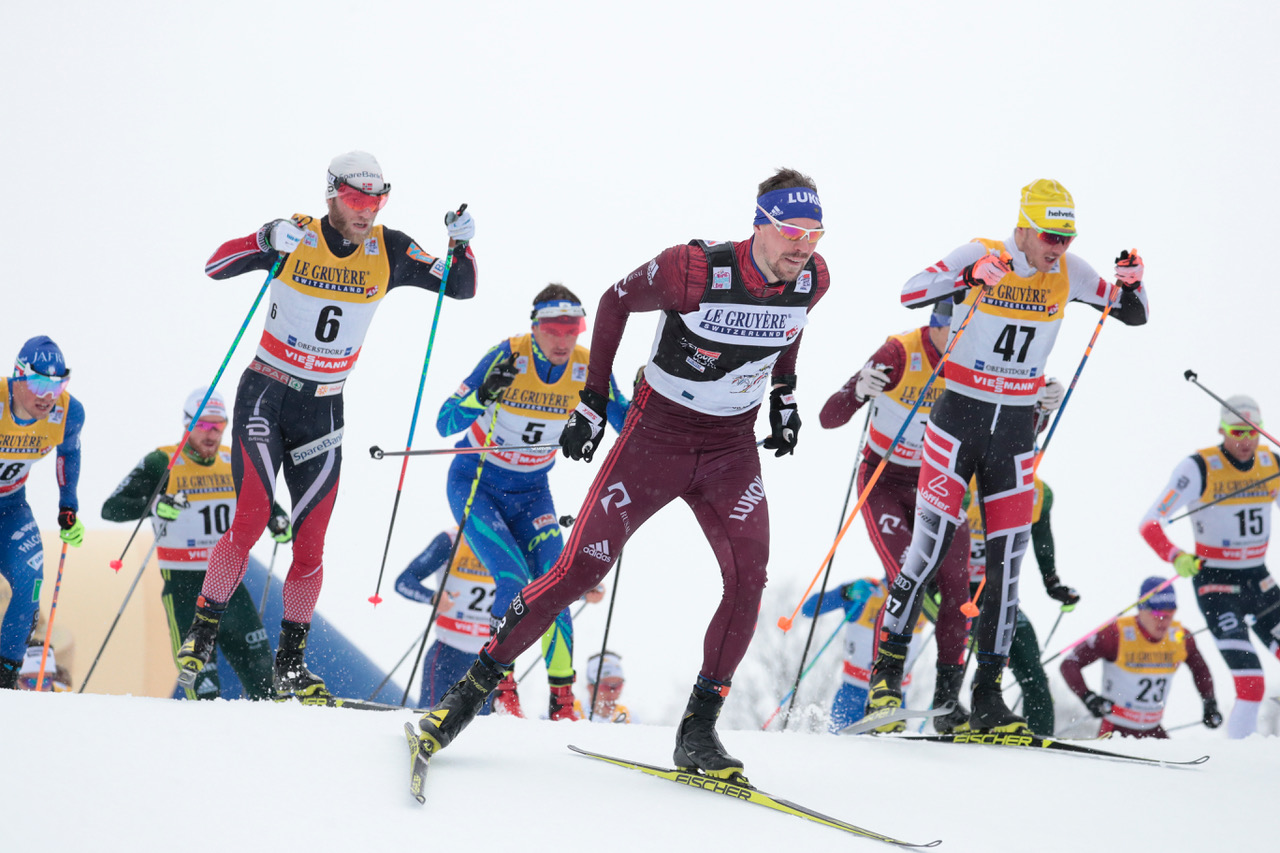
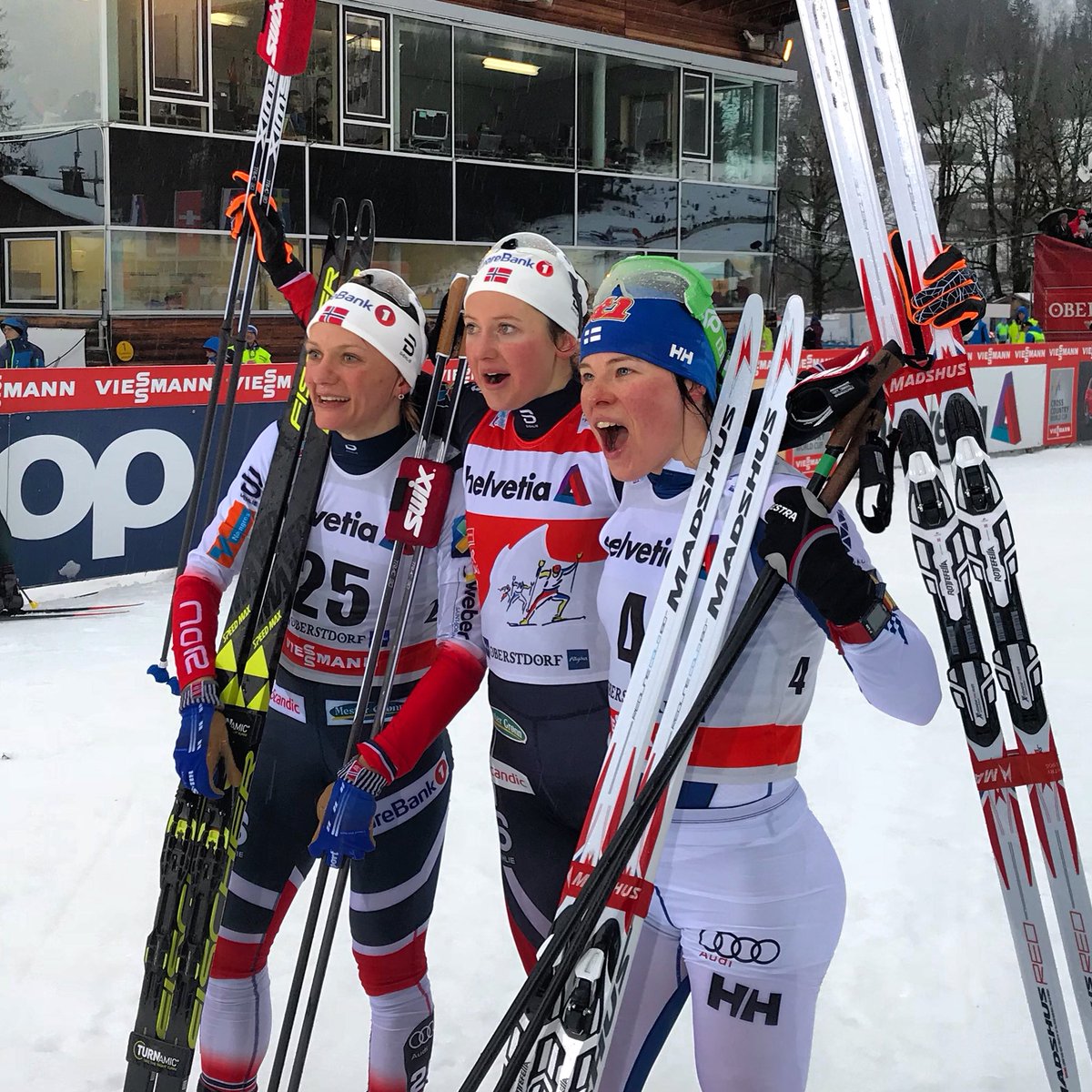
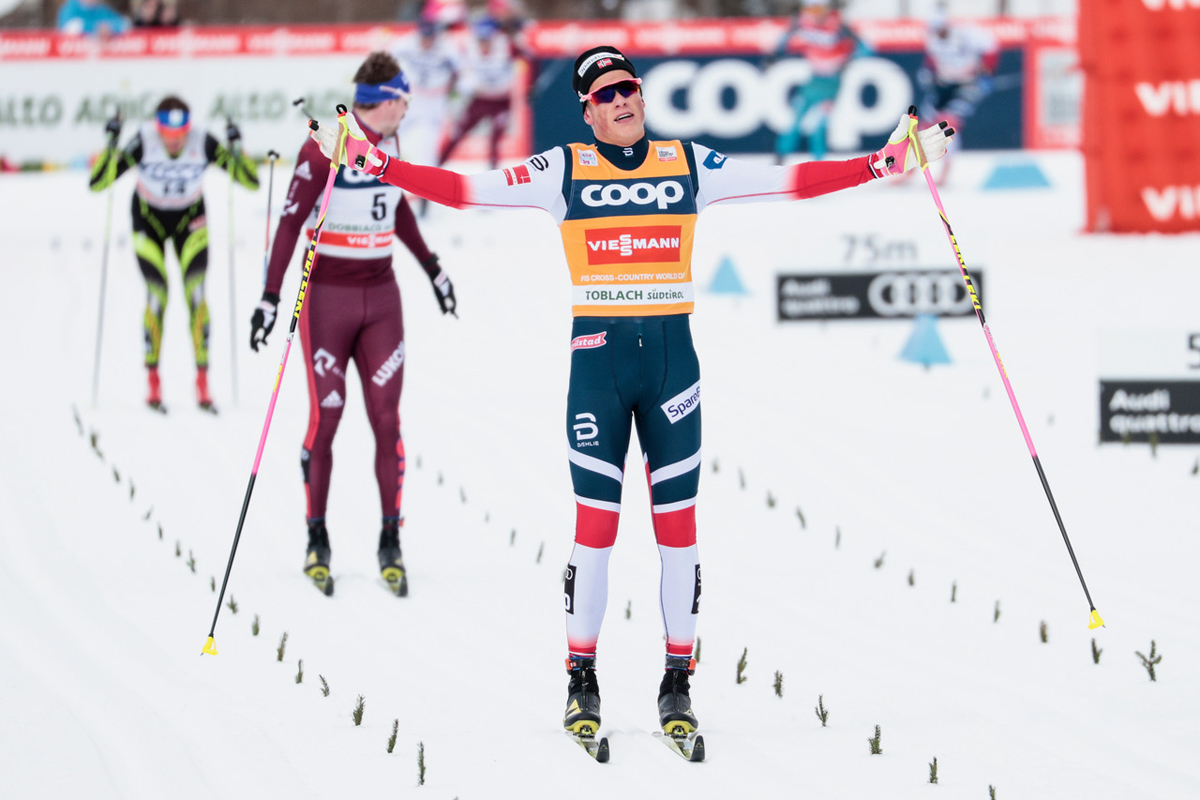
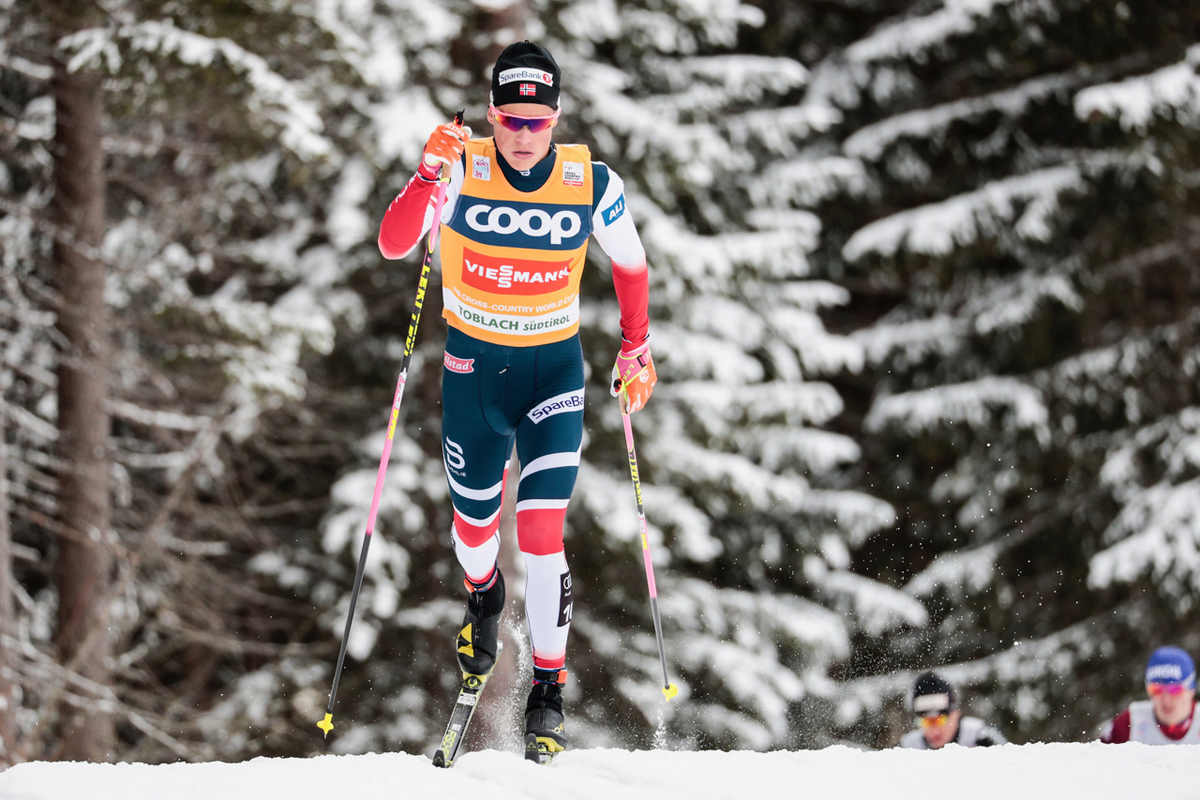
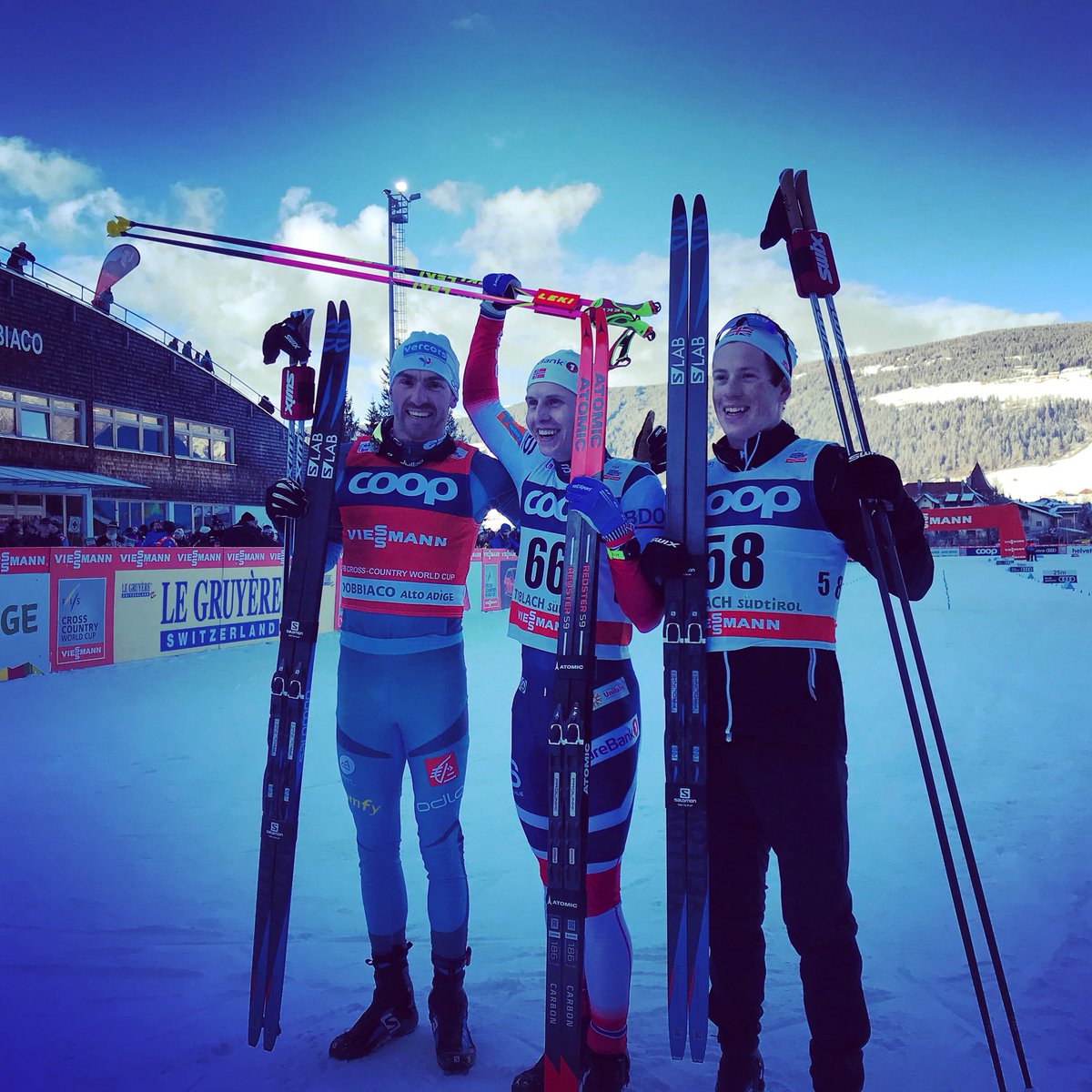
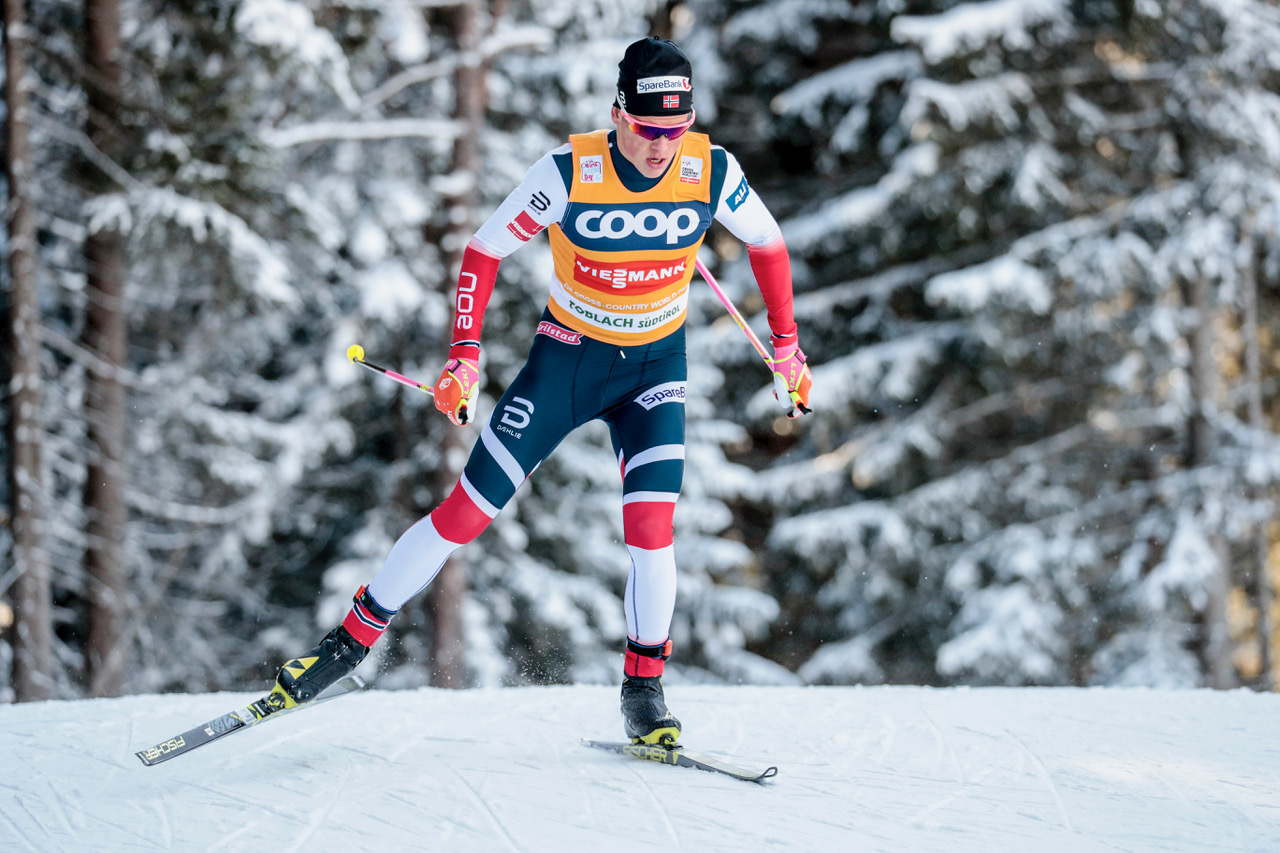
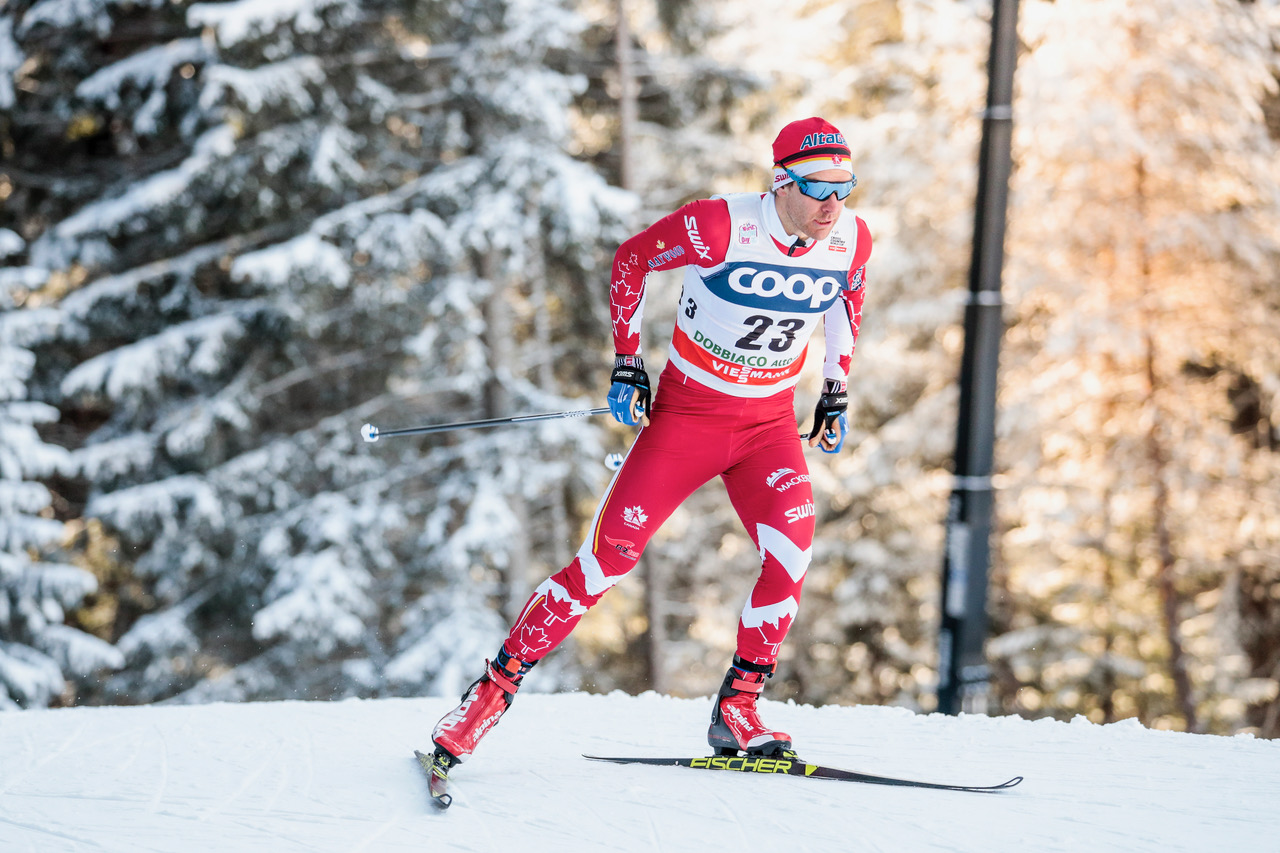
Johannes Høsflot Klæbo with the overall win in Ruka, Finland, 2020 World Cups. (Photo: NordicFocus)
This World Cup coverage is made possible through the generous support of Marty and Kathy Hall and their A Hall Mark of Excellence Award. To learn more about A Hall Mark of Excellence Award or to learn how you can support FasterSkier’s coverage please contact info@fasterskier.com.
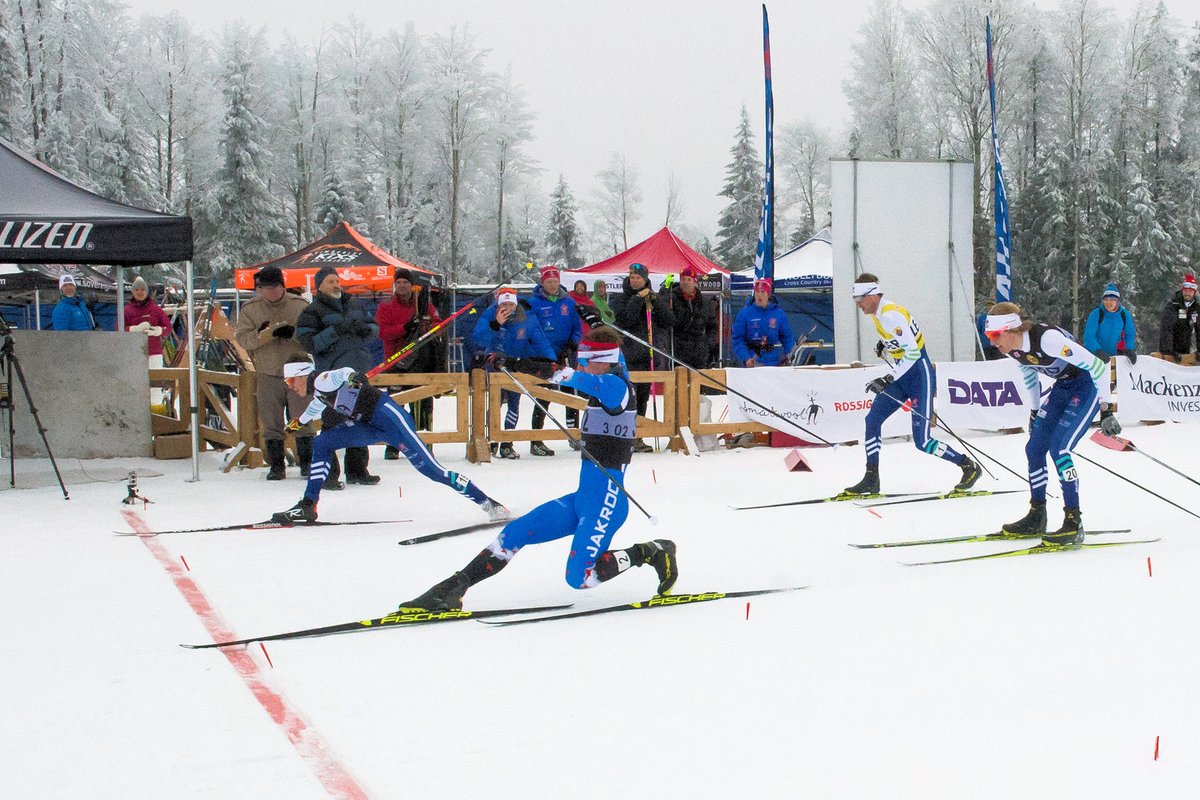
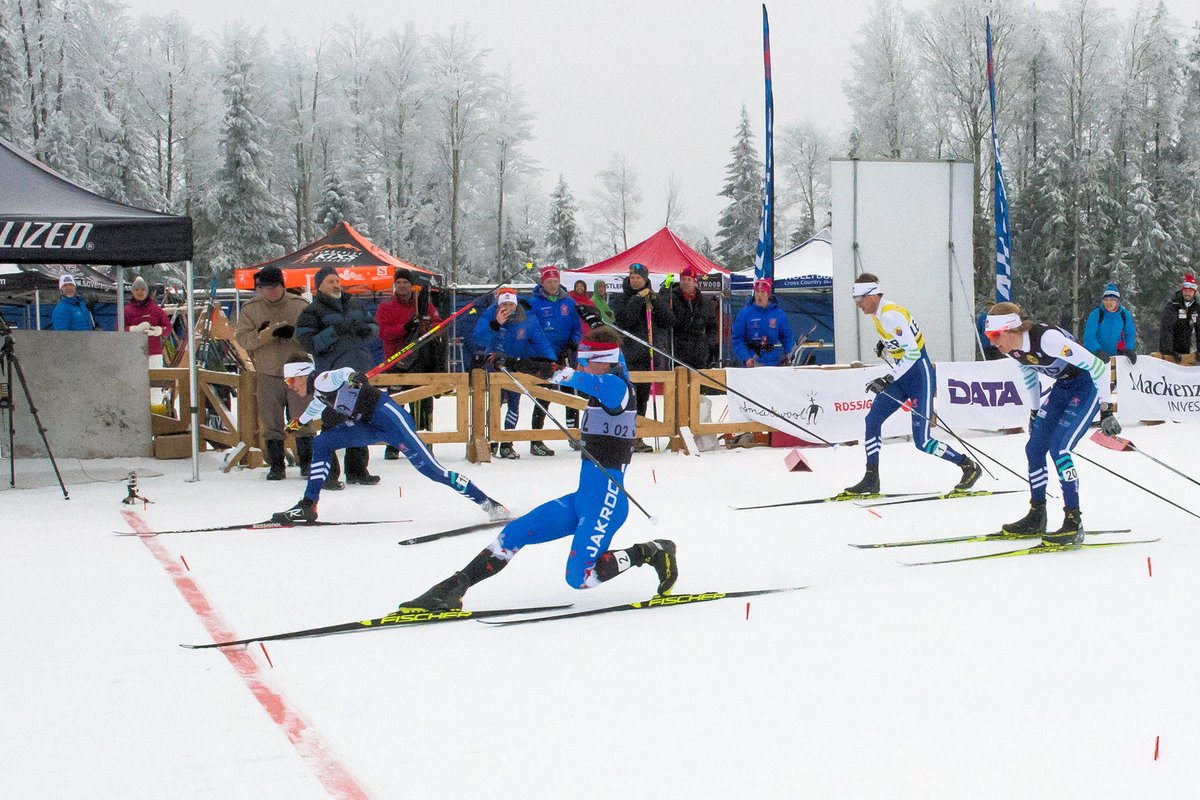
The human condition, let’s face it, is rife with fragility. Some days it’s up, others it’s down. Last Friday, Johannes Høsflot Klæbo of Norway had a surprised look of defeat when he placed second in Ruka, Finland’s classic sprint. This from a skier who in 2018 looked like a sprint king with no clothes.
Here’s what Gabby Naranja wrote then about the sprint final’s closing moments:
“From an outsider’s perspective, it seemed Johannes Høsflot Klæbo of Norway would open his World Cup 2018/2019 season with the familiarity of a win. The first FIS cross-country race of the year, a 1.4-kilometer classic sprint in Kuusamo, Finland, saw the 22-year-old round the course’s final turn in first, holding off his closest competitor, Alexander Bolshunov of Russia, by close to two meters.
Approaching the finishing stretch, Norway’s cross-country sprint king was still dictating the pace. He seemed well on his way to adding another World Cup sprint title to the eight he already holds. As Klæbo neared the finish line, he paused his double-pole to look behind him. A misstep that turned into Bolshunov’s chance.”
What transpired due to Klæbo’s cockiness in 2018 was a win for Russia’s Alexander Bolshunov. Since then, the two have been the Ali–Frazier of the men’s field. When the stars align, the two can provide wonderful sporting theatre.
That was the case Sunday, when Klæbo took the Ruka leader’s bib out on the course first, 16 seconds ahead of Bolshunov in second and teammate Emil Iversen in third, another five seconds in arrears.
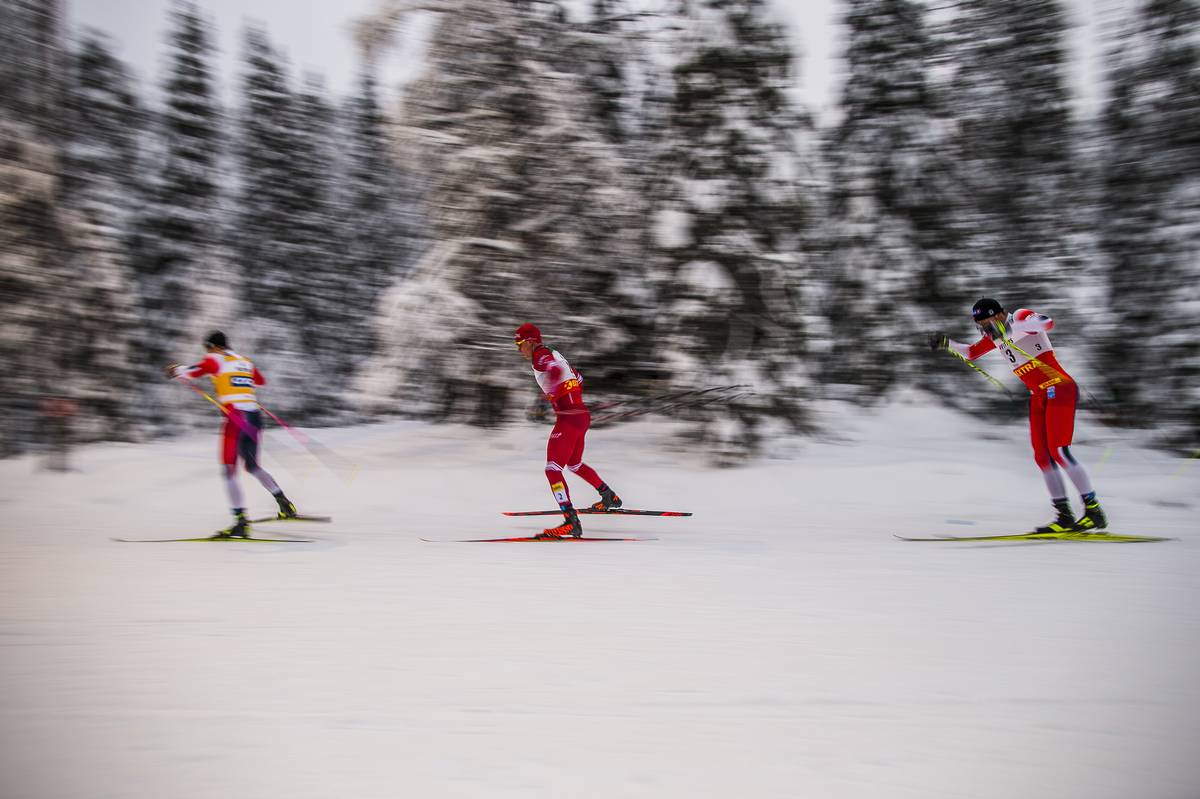
For all practical purposes, the podium race was a three-skier affair amongst the first three starters. Initially, Klæbo gained some time as the catch-me-if-you-can yo-yo-ing played out. But shortly after the 5 k mark, Bolshunov and Iversen began to close in — the catch netted by 7.5 k.
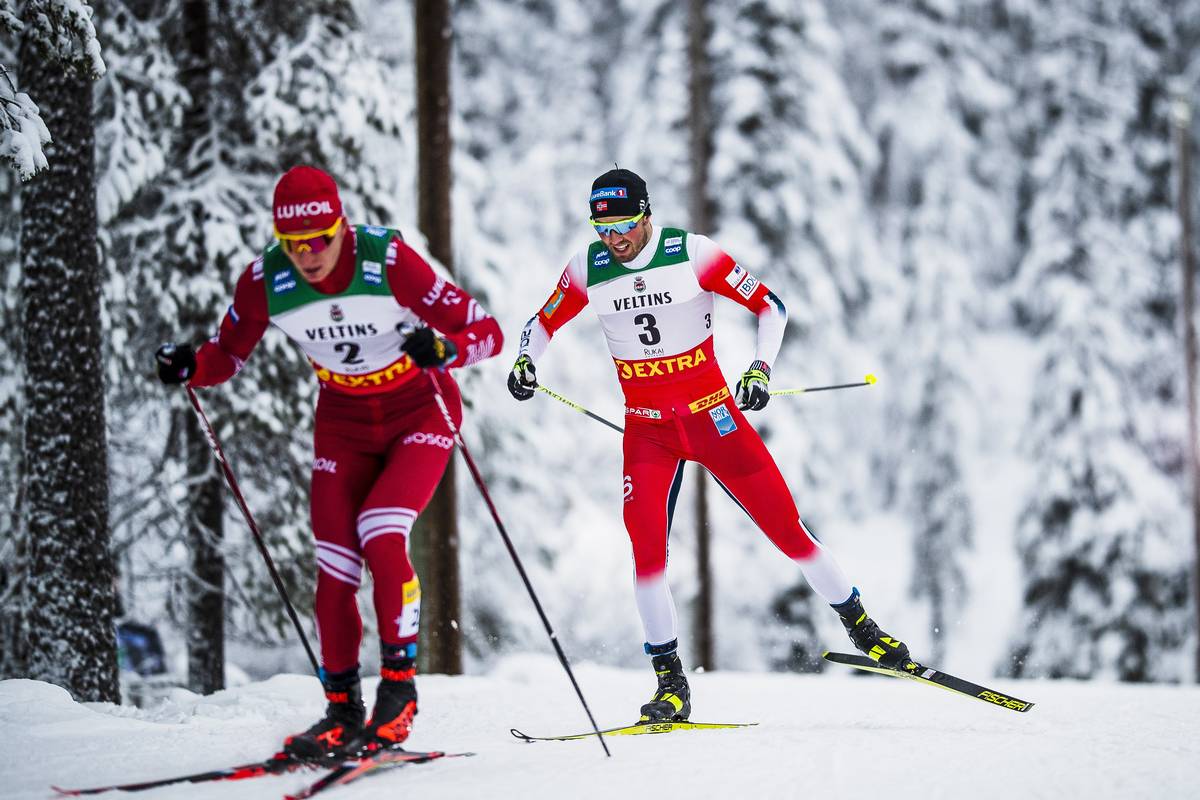
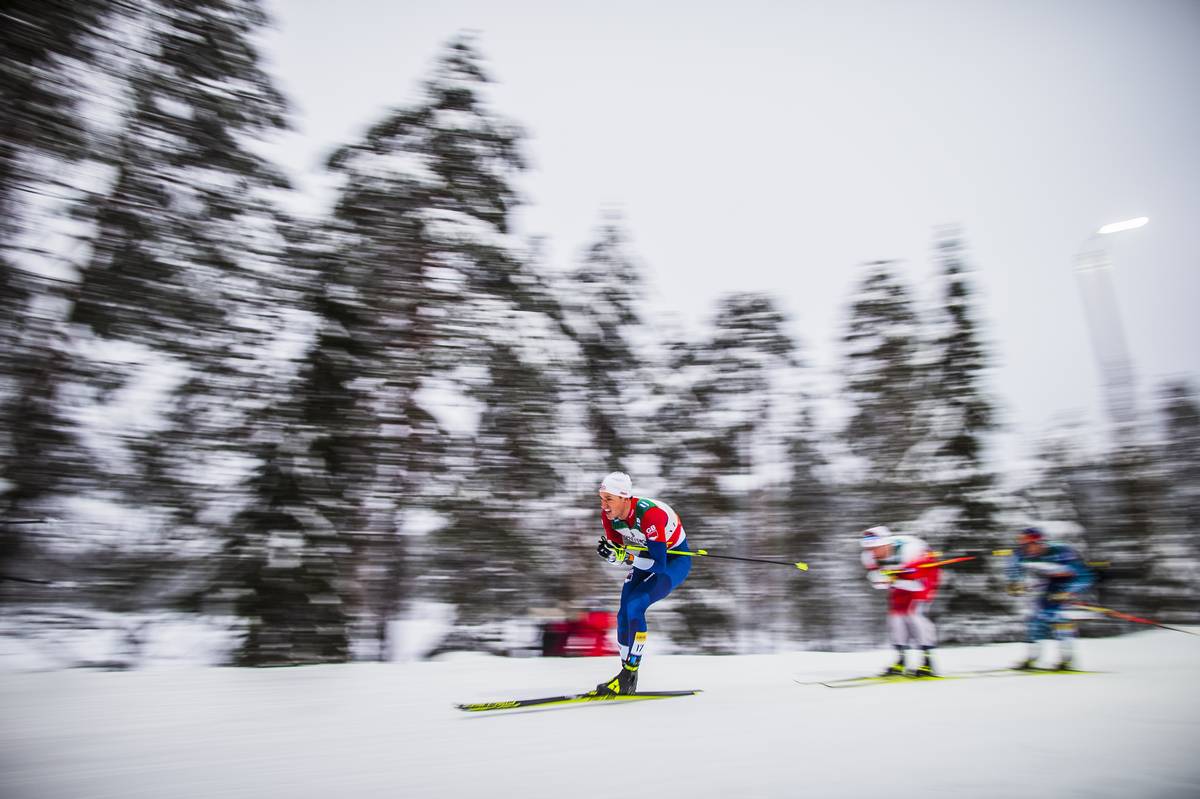
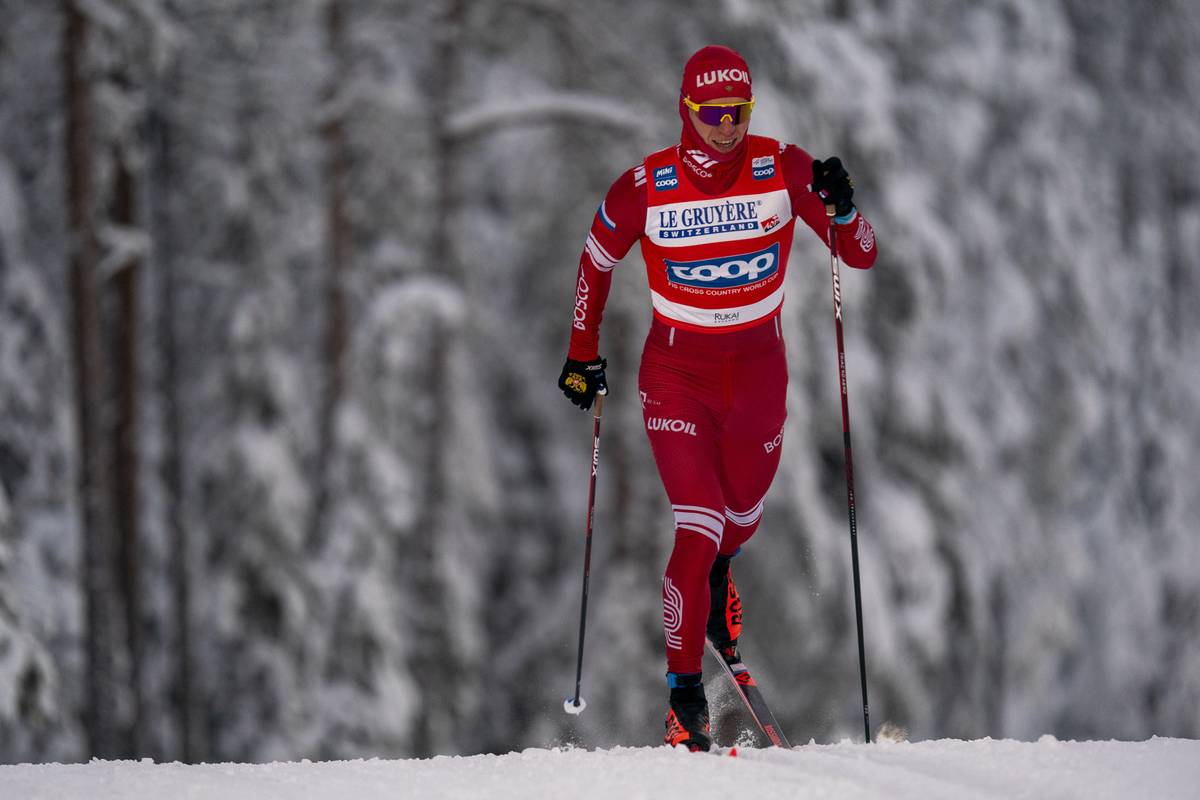
Johannes Høsflot Klæbo (NOR) chased by a closing Alexander Bolshunov (RUS) and Emil Iversen (NOR). (Photo: NordicFocus)Emil Iversen (NOR) following Russia’s Alexander Bolshunov in the 15 k skate pursuit. (Photo: NordicFocus)
To use a word Devon Kershaw reserves for the rare few, Bolshunov is a “beast.” So it remained a possibility the Russian could pace off alone. Yet, the three skiers shadow boxed around the course, with no dodge or parry making an impact. Meanwhile, a few skiers lurked from behind: Hans Christer Holund, Iivo Niskanen, and Andrew Musgrave. None were able to come within a margin of fewer than 15 seconds.
Upfront, after all, remained Klæbo, perhaps the wiliest tactician since Petter Northug Jr. Klæbo is the sport’s foremost closer.
Bolshunov pulled the trio through in the last Ks. Klæbo marking Bolshunov. Iversen marking Klæbo. But it’s like the ending you know will go down. The roadrunner outwitting the coyote. It was a spot-on hop-skate from Klæbo on the course’s final hill (the same steep crusher featured on the sprint loop) that did Bolshunov and Iversen in.
Johannes Høsflot Klæbo (NOR), Alexander Bolshunov (RUS), and Emil Iversen (NOR), (l-r) during Sunday’s pursuit in Ruka. (Photo: NordicFocus)
Down the last 100 meters, give a centimeter to the reigning Sprint Cup champion, you might as well have served up a kilometer. Maybe mindful of his 2018 mishap with Bolshunov, and certainly aware of making an early-season statement that he again was for real in the distance events, Klæbo shut it down and had a wee bit of time to spare as he crossed the line for the win in 35:09.8. Bolshunov was second (+0.7), Iversen third (+3.0).
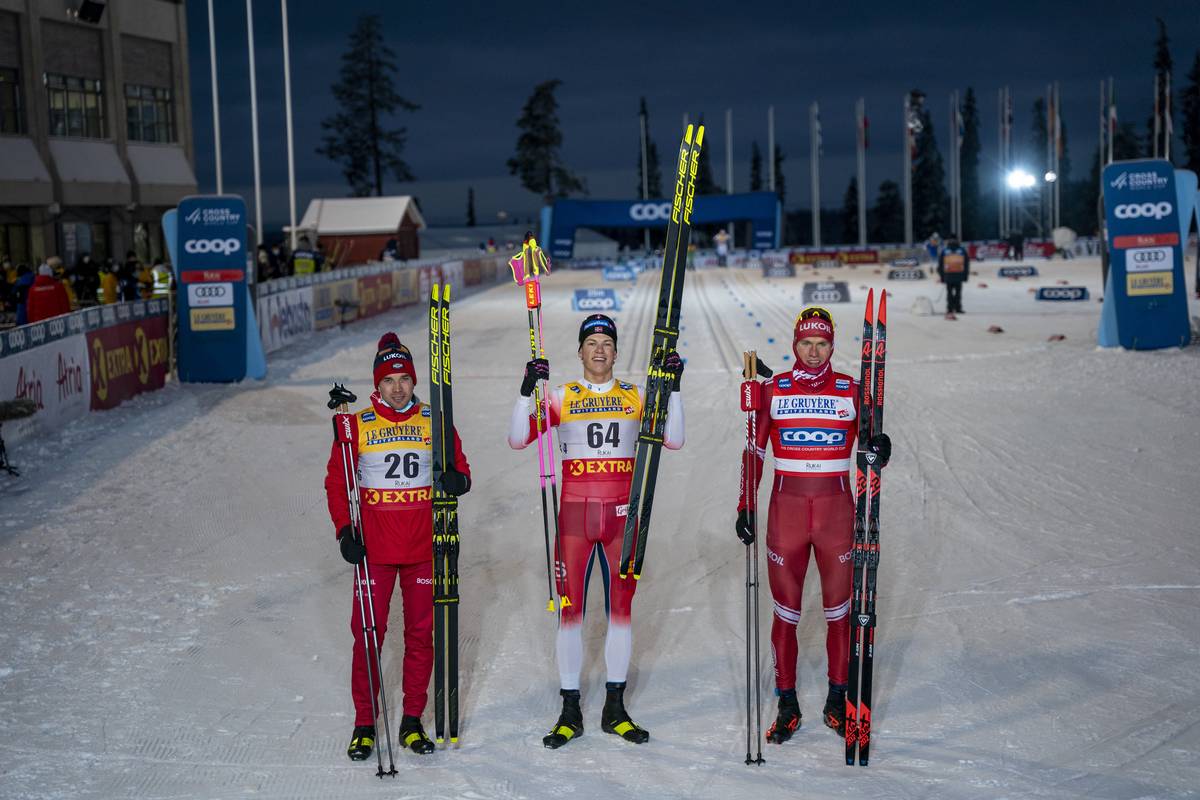
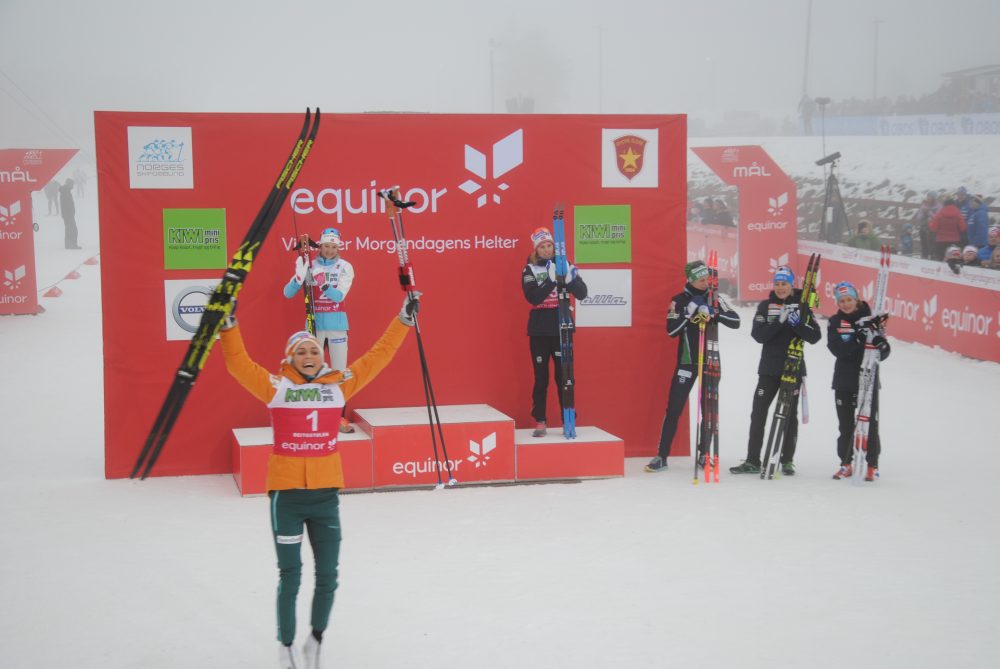
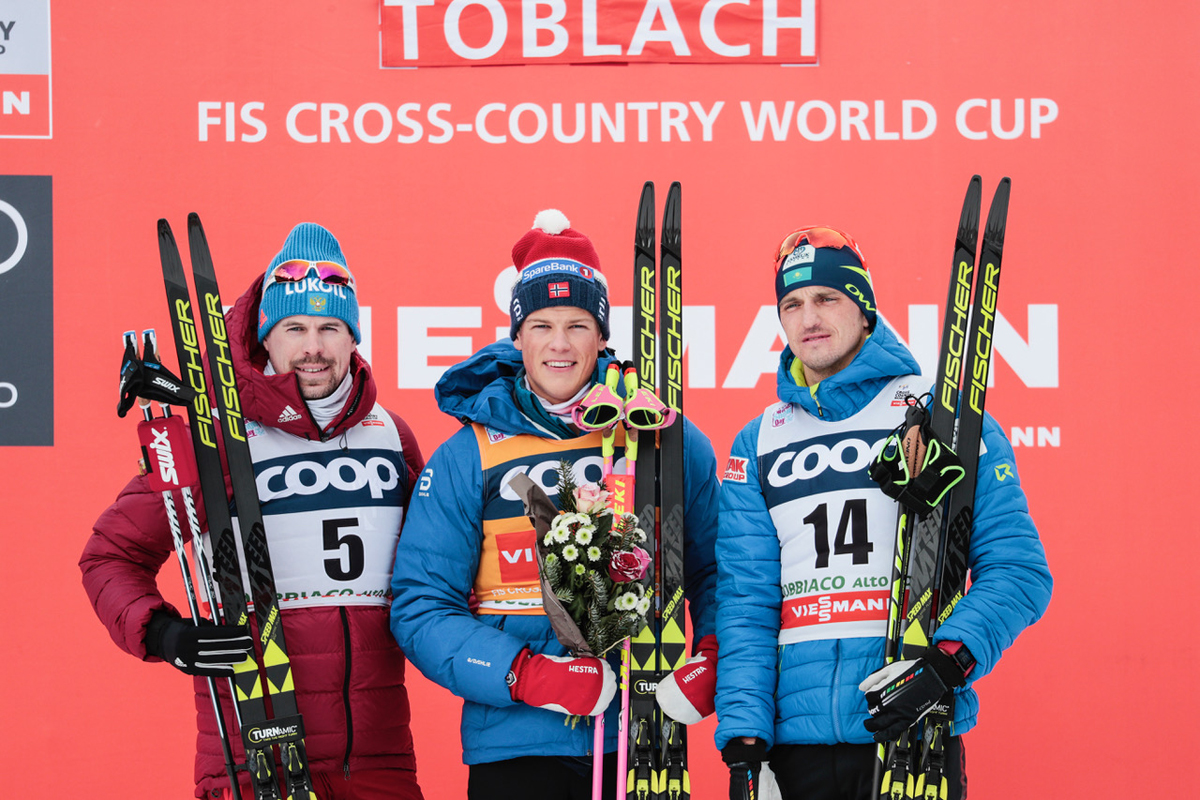
The men’s Ruka 15 k skate pursuit podium: Alexander Bolshunov (RUS) second, Johannes Høsflot Klæbo (NOR) first, and Emil Iversen (NOR) third, (l-r). (Photo: NordicFocus)
Holund, who made a solo effort away from the group of chasers, finished in fourth (+19.5), with Iivo Niskanen in fifth (+27.3), and Musgrave in sixth (+27.7). Holund skied the fastest time of day in 33:57.3.
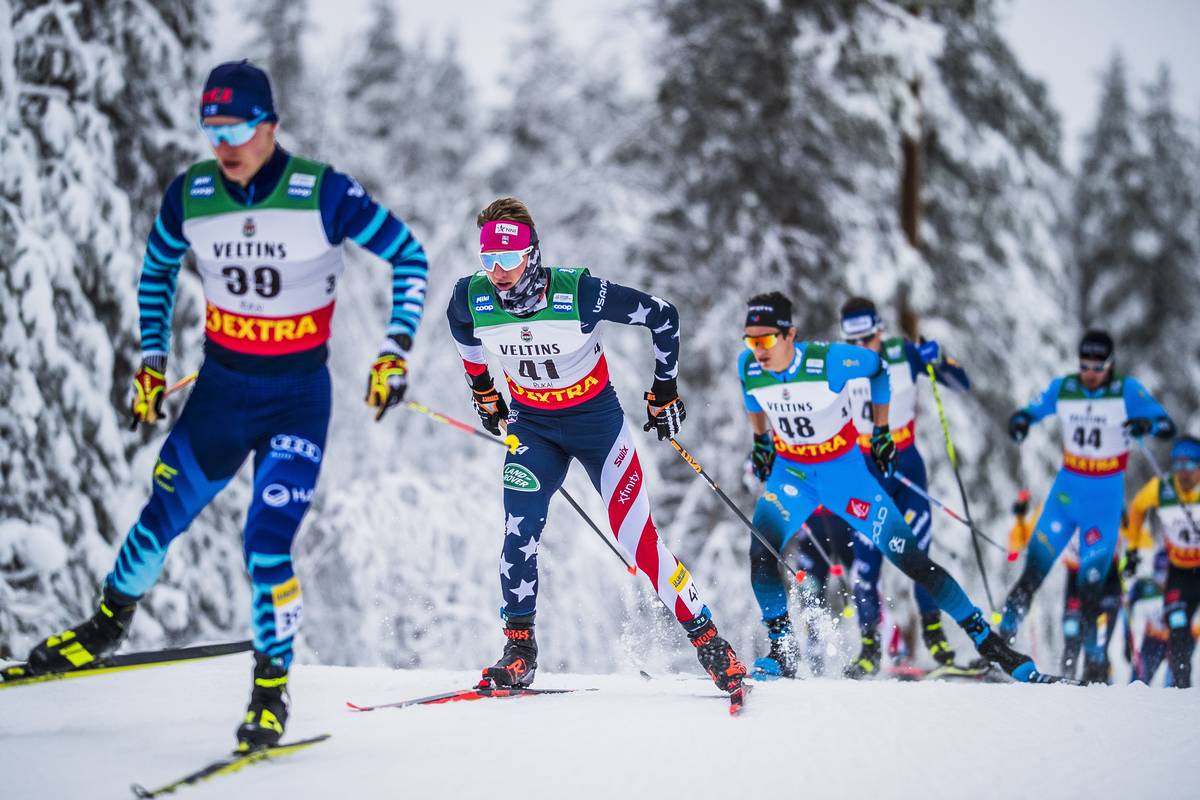
For the U.S., Gus Schumacher skied to 32nd (+2:24.1) for his best career World Cup finish. In his first slate of European World Cups, the twenty-year-old from Anchorage, Alaska, finished 43rd, 38th, and 32nd, respectively, over the three-day series in Ruka. On Sunday, Schumacher raced to the 24th-fastest time of day, earning his first World Cup points in the process.
Post-race interview with Gus Schumacher
Gus Schumacher racing to 32nd overall on Sunday in Ruka, Finland. (photo: NordicFocus)
U.S. Ski Team member Scott Patterson placed 42nd in the pursuit (+2:57.2) while skiing the 23rd-fastest time of day. Simi Hamilton was 55th (+3:59.9), Kevin Bolger 63rd (+5:24.7), Logan Hanneman 66th (+5:57.8), and JC Schoonmaker 71st (+9:46.5).
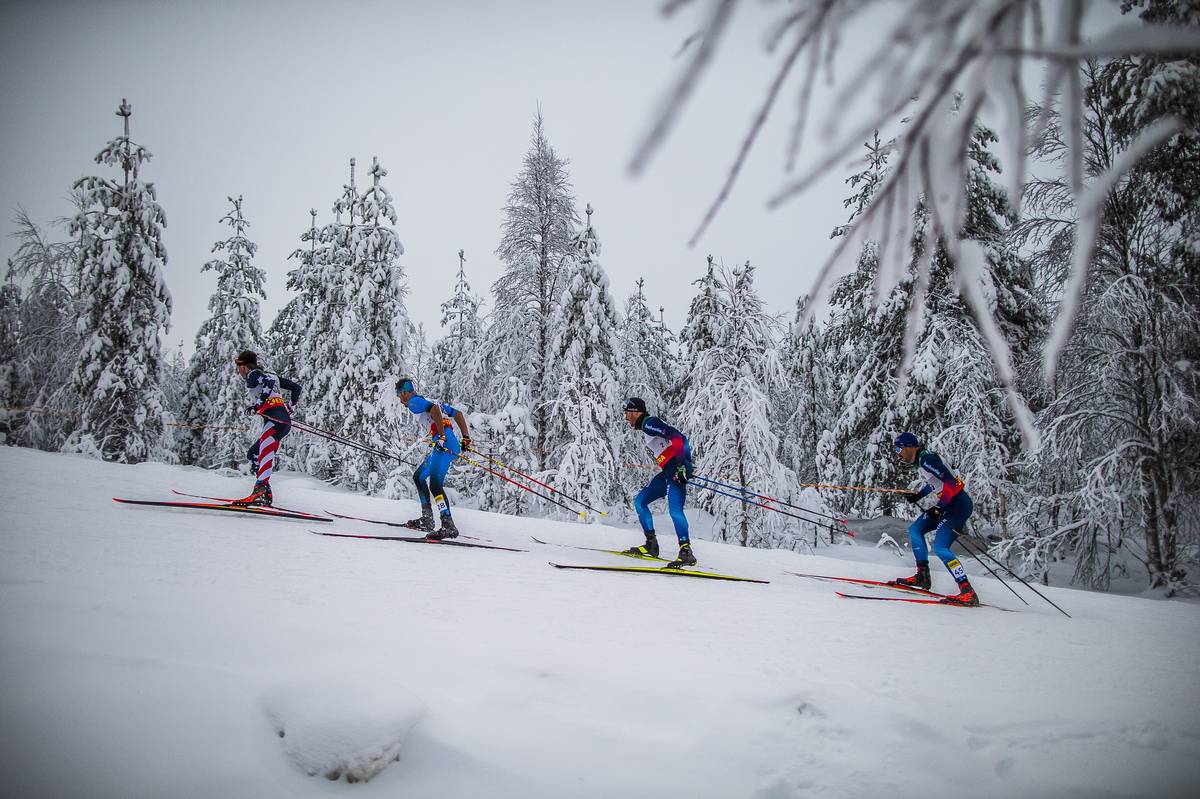
Jason Rueesch (SUI), Dario Cologna (SUI), Hugo Lapalus (FRA), and Scott Patterson (USA), (l-r) racing during the Ruka 15 k skate pursuit. (Photo: NordicFocus)
The men’s duo from Great Britain continued their upward trajectory. Andrew Musgrave placed sixth overall (+27.7), Andrew Young 14th (+46.9). Young skied the fifth-fastest time of day, Musgrave the ninth fastest.
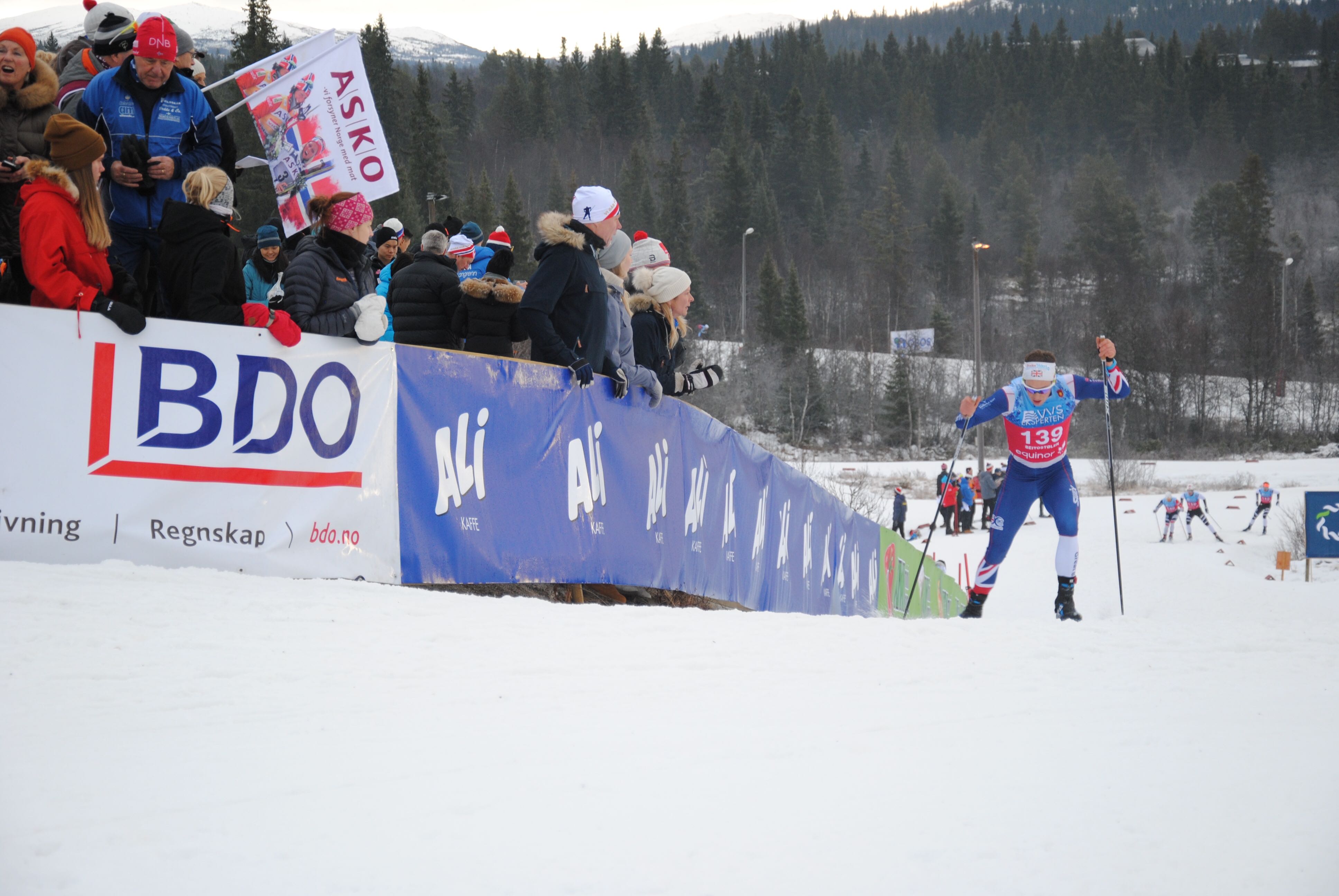
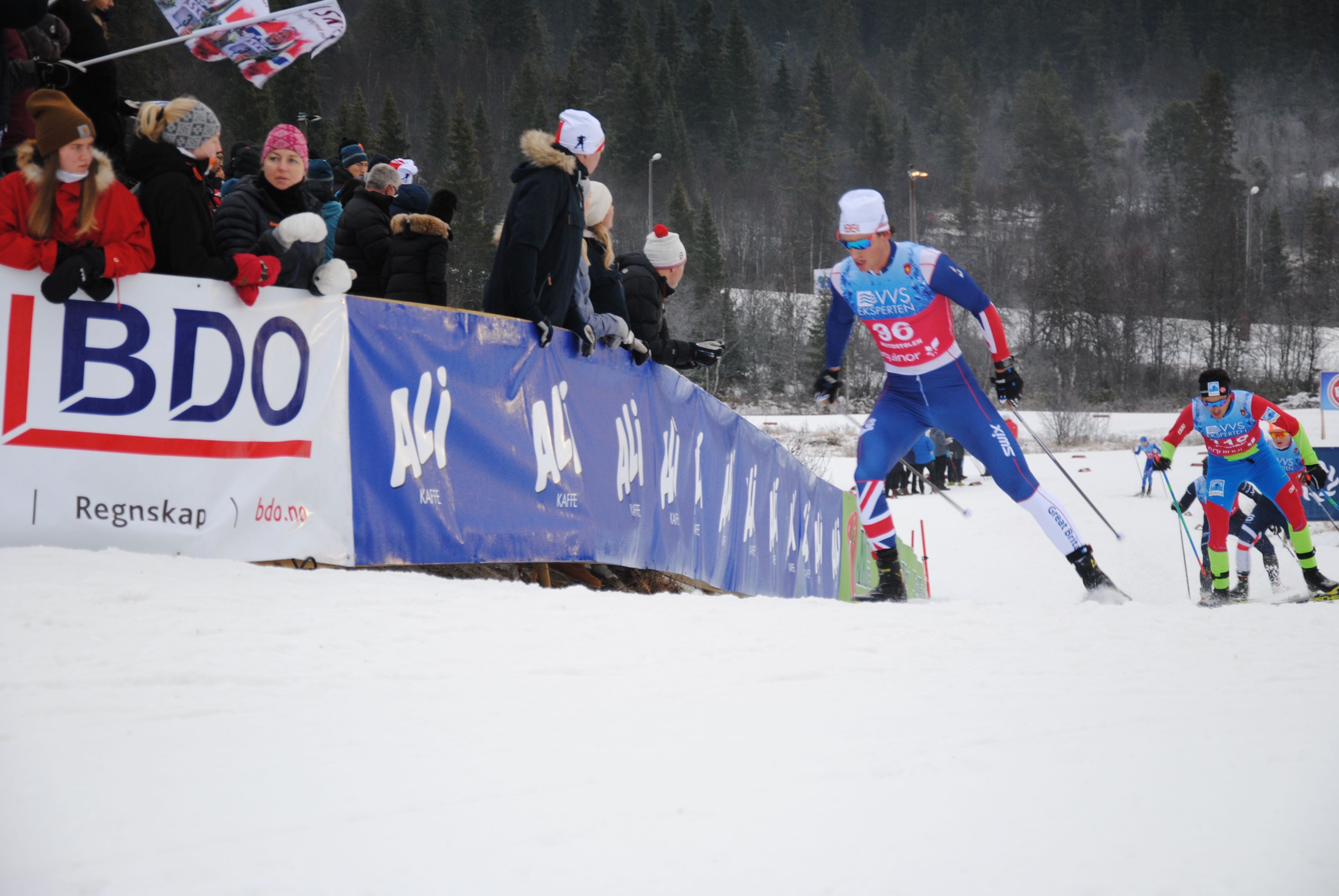
Andrew Young (GBR) leading a group on Sunday. (Photo: NordicFocus)
Racing takes a break until December 12, when racing continues in Davos, Switzerland.
Johannes Hoesflot Klaebo (NOR) toes the line in Ruka, Finland to capture the win on the season distance opener. Photo: NordicFocus
This World Cup coverage is made possible through the generous support of Marty and Kathy Hall and their A Hall Mark of Excellence Award. To learn more about A Hall Mark of Excellence Award or to learn how you can support FasterSkier’s coverage please contact info@fasterskier.com.
A spicy rivalry in sports just heightens the tension. Although Norway’s Johannes Høsflot Klæbo has achieved wunderkind status, last season his prowess was usurped by a stronger Alexander Bolshunov from Russia. At 24 and 23 years old, respectively, Klæbo and Bolshunov are two era-defining skiers. In 2019-2020, although Klæbo remained the king of sprinting, Bolshunov had Klæbo’s number in distance events and won the overall World Cup.
Alexander Bolshunov (RUS) strides his way into the 2020-21 World Cup season with hopes of defending his overall distance crystal globe and corresponding red bib. Photo: NordicFocus
It’s early early early. However, two races into the season Klæbo appears Ferrari-tuned in both sprints and the longer grinds. Although placing second in Friday’s sprint was perhaps a less than special season start, it was not inauspicious for Klæbo.
Starting in bib 64, Klæbo was handed several key data points on Saturday, in terms of pacing, by those beginning ahead of him. Iivo Niskanen, a Finn who wins mostly in Finland and 15 k classics too, began in bib 37. Emil Iversen of Norway began in bib 42. Russia’s Alexey Chervotkin was way early in bib 26.
Bolshunov, considered by many the athlete to surpass Klæbo on the day, began two bibs later, in bib 66.
Time was on Klæbo’s side. With a smooth stride and glide on a cold-snow firm-track day, Klæbo posted the fastest times at every intermediate split and won the race in 34:04.6 minutes. Bolshunov was no foil as he eked within 9.6 seconds at 5 k, yet he bled another 10 seconds on the second lap. He placed third overall 18 seconds behind. Turns out, on this day, knowing Klæbo’s splits two bibs ahead, was of no assistance for Bolshunov. Sometimes the finicky tuning of the Ferrari outpaces the Lambo. (I drive a Prius, so take that for what it’s worth.)
Second place went to Chervotkin (25), for his best individual result on the World Cup and his first podium. He placed fourth in the 2018 Falun 15 k classic and fifth in Lenzerheide’s 2017 15 k classic. (Yup, there’s a pattern.)
Alexey Chervotkin (RUS), Johannes Høsflot Klæbo (NOR), Alexander Bolshunov (RUS), (l-r) take the podium in the men’s 15k classic opener in Ruka, Finland. Photo: NordicFocus
In any event, you’ll note in the FIS interview below, that Klæbo appears to be suppressing a big genuine smile post-race. The distance event throne had eluded Klæbo since last year’s Tour de Ski when he won the 15 k classic mass start in Val di Fiemme. He did that with a little naughty stare back at a trio of chasing Russians as he finished. For someone so thirsty for the win and used to drinking from the well in big gulps, that victory was way back on January 3, 2020. Consider that timespan a distance race drought for the Norwegian superstar. The thirst has been momentarily quenched.
Setting up a tasty treat for tomorrow’s 15 k freestyle pursuit is this: Klæbo starts 16 seconds ahead of Bolshunov, who sits second overall, and 21 seconds ahead of teammate Emil Iversen. No way does Iversen assist Bolshunov in catching Klæbo. Or maybe he does. The World Cup drama in Ruka continues to unfold.
In the 15 k classic, Schumacher raced to his best World Cup result to date with a 39th place, 1:56.3 off Klæbo’s time. With the tight splits of the men’s field, as they say, every second counts. Coming through 13.1 k, Schumacher was positioned 47th. At the time, nearly 10 seconds off of the 39th spot. In the closing moments, he was able to advance considerably in the standings.
Tomorrow’s 15 k skate pursuit should be interesting for Schumacher. He starts in bib 41, two seconds after Norway’s Simen Hegstad Krüger in bib 40. Krüger should be an excellent early season pacing chess-piece for Schumacher: outside of a single classic race time of day win, Krüger has won two 15 k skates and one 10 k skate on the World Cup. He’s also the 2018 Olympic champ in the 30 k skiathlon.
Post-race interview about the men’s side with U.S. Ski Team Head Coach Matt Whitcomb
Gus Schumacher of the U.S., racing to a career-best 39th in the 2020 Ruka 15 k classic. (Photo: NordicFocus)
Scott Paterson was the next best-placed American in 53rd (+2:20.5). Simi Hamilton finished 55th (+2:30.2), Kevin Bolger 62nd (+3:01.6), Logan Hanneman 66th (+3:28), and Schoonmaker 75th (+4:38.7).
The in-form Brits are not to be missed. Andrew Musgrave placed sixth overall, 32.8 seconds out, while his teammate Andrew Young raced to 16th (+1:05.7).
Andrew Musgrave of Great Britain placed 6th in the 15 k classic. (Photo: NordicFocus)
Andrew Young placed 16th in the 15 k classic. (Photo: NordicFocus)
Racing continues for the men with a 15 k skate pursuit on Sunday.
Mid-Summer and mid-fishing session, we connected with Great Britain’s Andrew Musgrave near his home in Trondheim, Norway. Musgrave underwent surgery on both Achilles tendons recently and is on the mend.
In this episode, we discuss his comparatively down season last year, his plans to remain healthy, and how excited he was during the interview to spot what he described as a weasel swim past.
Andrew Musgrave of Great Britain placed 18th in the 30 k skiathlon in Lillehammer, Norway. (Photo: NordicFocus)
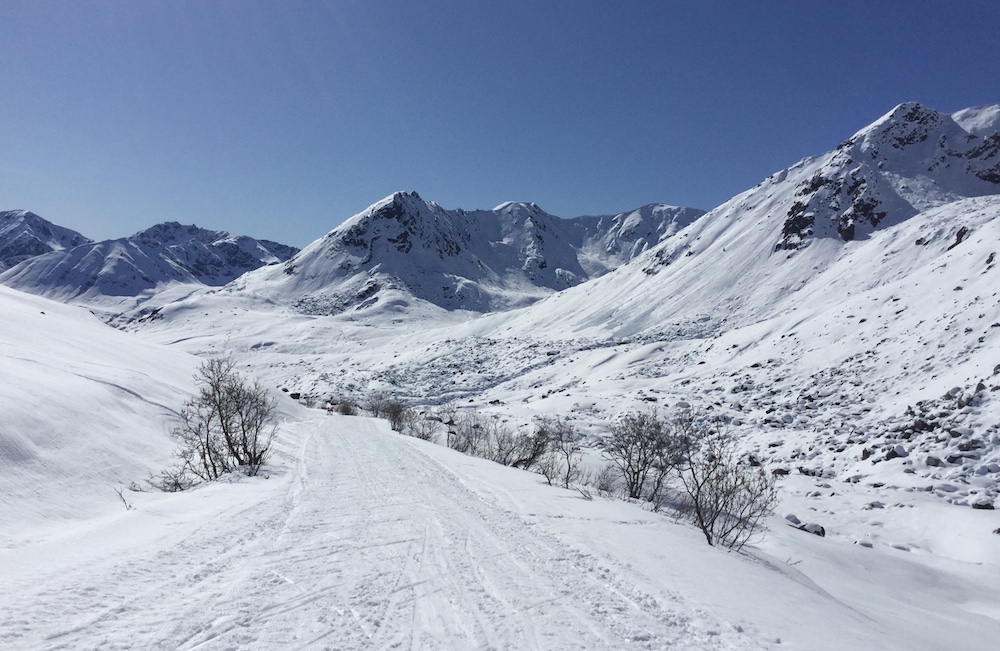
David Norris (APU) and Luke Jager (University of Utah) (very small skiers on trail in center background) ski up Archangel Road, Talkeetna Mountains, Alaska, on May 1, 2019. (photo: Gavin Kentch)
If you’re reading this website, you’re probably well aware that the nordic skiing training year begins on May 1. In a sport where most races happen between November and March, and demand of athletes that they repeatedly race to the point of nearly losing consciousness, the preparation for race season had better start a long time before that. As the well-worn, but accurate, saying has it, skiers are made in the summer.
Embracing the start of May – either May 1 per se, or a conveniently located Monday a few days on either side of that date – as Skier’s New Year is nothing new. Indeed, here’s Luke Bodensteiner, at the time a struggling Olympic hopeful, in the opening lines of his book Endless Winter: An Olympian’s Journal, describing a training day 26 years ago this week: “Monday, May 3: Salt Lake City, Utah. This is it. Training begins today for the 1994 ski racing season. The focus this year is on the Winter Olympics to be held in Norway in February, but the season won’t end until the final races are over in April. … It isn’t like I ever really stopped training, but now instead of pick-up basketball and soccer, back-country alpine skiing and the odd midnight kayak trip with my roommates, training has to get serious. … My little black wristwatch suddenly rules my day.”
Or here’s a notably ambitious Cory Smith, in the ur-skier blog “Somewhere Between Obscurity and Oblivion,” writing on April 26, 1999, while acknowledging that he was doing so five days earlier than custom and generic expectation would suggest: “April 26: Yes, I know that it is still April, but I am writing in my May journal. That is because today is the official start of the 1999-2000 training year. To preserve a sense of continuity it is just easier to assume that May is the first month of the year and squeeze a couple extra April days into the month. I hope this doesn’t screw up your crop planting or biological clock or anything. So what did I do to kick off the year? I went for a run. I know, it’s not very exciting, but you have to start somewhere. Besides, I am only supposed to be training 8-12 hours per week this month, so I shouldn’t do too much the first day. But at last I am underway and ready to prepare for an even better winter next year.”
Or here’s Noah Hoffman, writing on April 30, 2014, in a post entitled, “Start of the Training Year”: “Today was my first scheduled training day of the year. … I started my two hour double pole outdoor roller ski session (Double poling is the only outdoor roller skiing I’m allowed to do right now.) before 7 a.m.” (Andhere’s the follow-up, from May 1: “I am SORE today! Yesterday was my first real training day of the year. It was all upper body based (with a two hour double pole and strength), and now I can barely lift my arms.”)
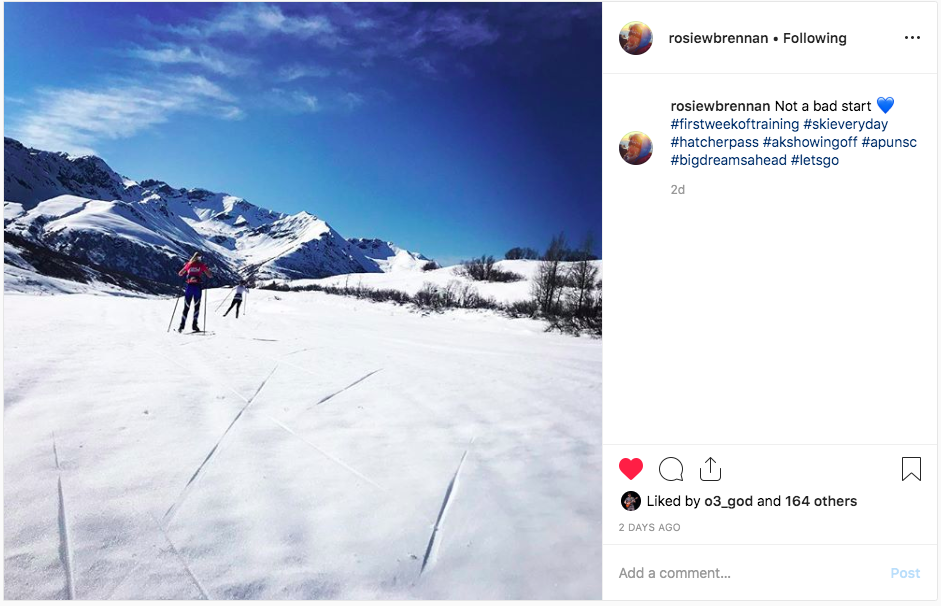
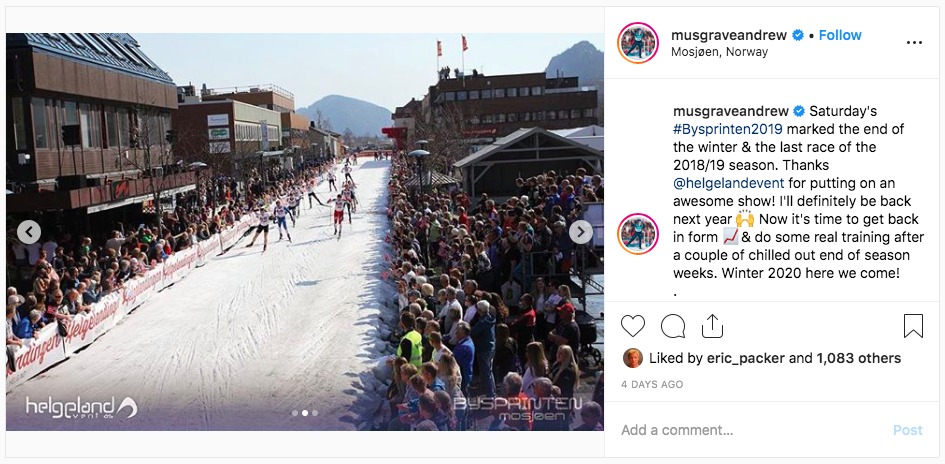
While Instagram has largely replaced blogs (or a book (!)) as the platform of choice, the message has changed far less than the medium: Early May is perpetually a time for new beginnings, new hopes, big plans, and maybe a self-effacing crack about being out of shape or needing to go find one’s rollerskis. Here is a look at how an unscientifically selected group of athletes marked the occasion online, with the only emphasis being on athletes who were posting about new training rather than about new sponsors (corporate sponsors being more characteristic of European skiers than their impoverished American counterparts):
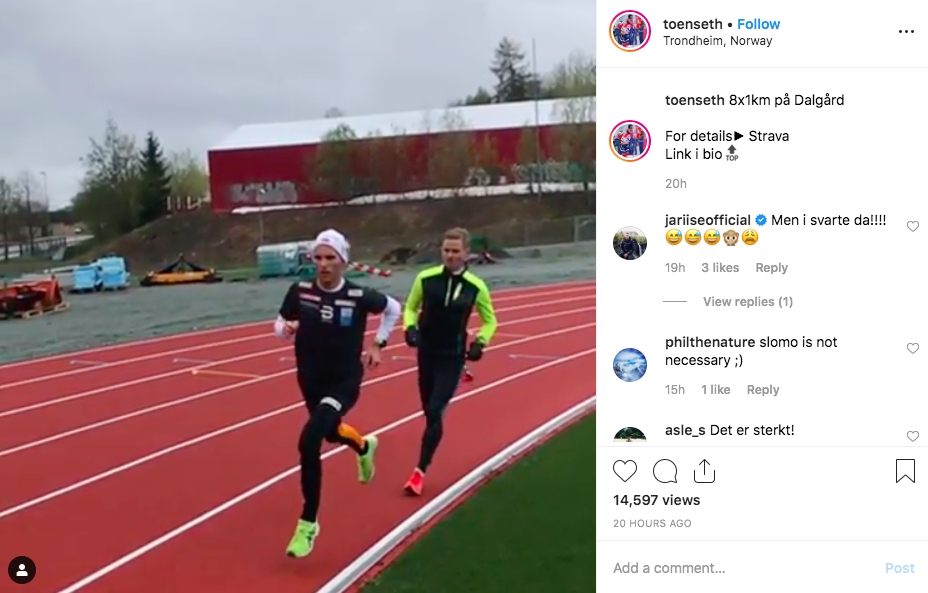
(per Strava link in bio: splits of 3:06, 2:59, 2:56, 2:55, 3:01, 2:59, 2:57, 3:03, with 80-90 seconds recovery. 2:55/km is a 4:42 mile pace, for those of us who measure skiing in km but running in mi. And what were you doing at 8:47 a.m. Saturday morning?)
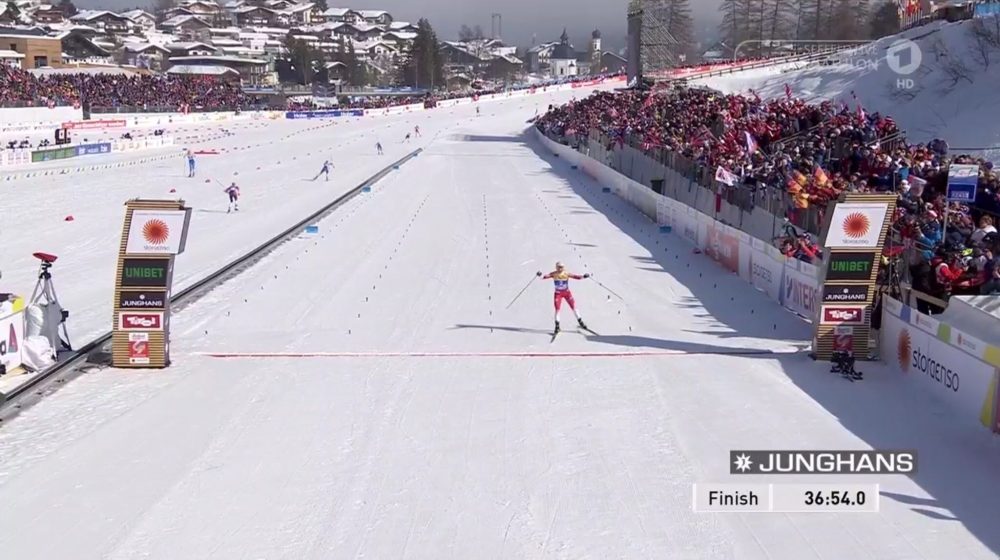
Between 3.75-kilometers and 4.85 k on Saturday, Norway’s Therese Johaug began to pull away in earnest during the women’s World Championship 15 k skiathlon — by then she had built a near 15 second lead.
The time back to the Norwegian would only grow. Johaug powered into the classic to skate transition zone in control with a lead padded by 26.2 seconds. At the finish, Johaug crossed the line with no other skiers in sight and a winning time of 36:54.5 minutes. It was Johaug’s fourth World Championship medal in the skiathlon.
Ingvild Flugstad Østberg, also of Norway, placed second (+57.6), with Russia’s Natalia Nepryaeva third (+58.7).
Rosie Brennan of the U.S. was the top North American in tenth (+2:01.8). Also for the U.S., Julia Kern placed 19th (+2:55.5), Rosie Frankowski 24th (+3:00.6), and Caitlin Patterson 34th (+3:54.5).
Canada’s Katherine Stewart-Jones skied to 39th (+4:19.8), Cendrine Browne 40th (+4:25.2), and Maya Macisaac-Jones 54th (+8:53.4).
The men’s 30 k skiathlon featured no off the front winner like Johaug. As the pace setting screws tightened well into the men’s race, with Russia’s Alexander Bolshunov often taking charge, the pack was winnowed to five skiers at the 26 k mark. Along with Bolshunov, France’s Clement Parisse, Norway’s Sjur Røthe and Martin Johnsrud Sundby, and Iivo Niskanen of Finland were the skiers vying for the win.
By the final half-k, only Sundby, Bolshunov, and Røthe remained up front. Down the final straight Røthe possessed the strongest reserves as he won in a time of 1:10:21.3 hours. Bolshunov placed second (+0.1), and Sundby third (+0.7).
Canada’s Alex Harvey paced himself to sixth overall (+58.9). Evan Palmer-Charrette placed 45th (+6:12.4), and Scott James Hill 56th (+9:58.8).
For the U.S., Scott Patterson raced to 32nd (+4:40.6), David Norris 38th (+4:54.4), Kyle Bratrud 49th (+6:19.6), and Adam Martin 54th (+7:47.4).
The plotline thickened on Saturday in the elite men’s freestyle 50 k at the American Birkebeiner when Akeo Maifeld-Carucci (CGRP), Brian Gregg (Team Gregg), and Matt Liebsch separated themselves from the field. The three skiers fended off any chasers and charged onto main street three across in their final effort towards the finish line.
Maifeld-Carucci took the win in 2:12:35 hours, with Gregg second (+0.93), and Liebsch third (+8.50).
Alayna Sonnesyn (SMS T2)won the overall women’s 50 k skate in 2:34:01. By the time Sonnesyn passed the time check on Lake Hayward, she had gapped Anja Gruber (Salomon) in second by 29.60 seconds. Gruber took second overall finishing 54.60 seconds back from the winning time. Third place went to Katie Feldman (SVSEF Gold Team) crossing 1:08.63 minutes back.
FasterSkier will be posting race reports on the 2019 American Birkebeiner later today.
(Friday) FIS Nordic World Ski Championships Seefeld, Austria Individual Gundersen 10 k
U.S. athlete Taylor Fletcher on his way to placing 35th overall during Friday’s individual Gundersen 10 k at the Seefeld, Austria World Championships. (Photo: John Lazenby/lazenbyphoto.com)
On Friday in Seefeld, the first nordic combined event, an individual Gundersen 10 k was won by Germany’s Eric Frenzel. The German was the best ranked jumper and won the ski in a time of 24:43 minutes. Jan Schmid of Norway, the day’s third ranked racer after the jump, placed second (+4.3). Austria’s Franz-Josef Rehrl placed third overall (+8.7).
Americans Taylor Fletcher skied to 35th (+4:05.5), Ben Loomis 44th (+5:29.7), Jasper Good 47th (+6:25.1), and Grant Andrews 48th (+6:52.8).
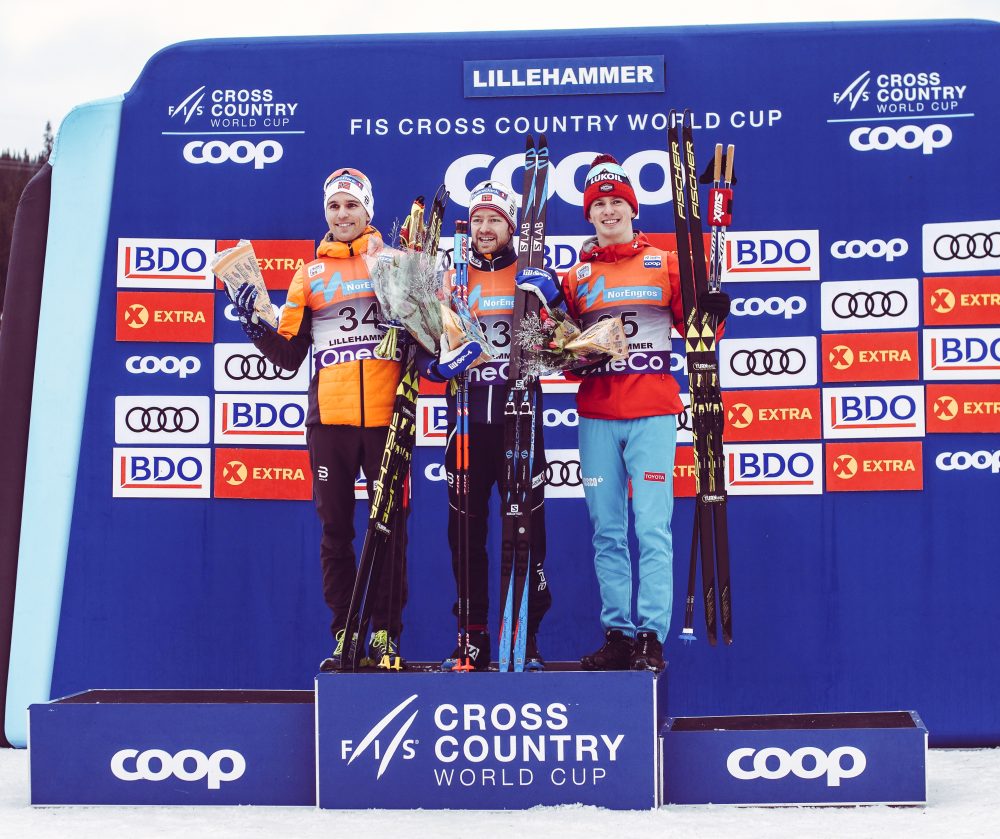
The men’s podim from the second day of World Cup racing in Lillehammer, Norway. In the 15 k freestyle, Norway’s Sjur Røthe (center) won, teammate Didrik Tønseth (left) placed second, and Russia’s Denis Spitsov (right) was third. (Photo: Henrik Hunnes)
Norway shined on their home course in Lillehammer, Norway with Sjur Røthe posting the fastest time of 36:3.0 minutes in the 15-kilometer individual start freestyle, followed closely by teammate Didrik Tønseth (+6.0). The Norwegians claimed six of the top-ten spots. Russia’s Denis Spitsov took the third podium position, finishing 28.6 seconds back.
In his first distance World Cup race of the season, Switzerland’s Dario Cologna placed fourth (+38.3).
“It feels amazing,” Røthe told the International Ski Federation (FIS) about his race. “I didn’t know that I was fighting for the victory, I just heard I was fighting with Didrik. I didn’t know it was for the victory until the last 5k. But I did everything I could and I kept a high speed the whole way, so I’m really satisfied.”
For North America, Alex Harvey was the best finisher in 17th (+1:20.5). His fellow Canadians Andy Shields took 61st (+3:08.4), and Russell Kennedy placed 64th (+3:17.0).
“I just had bad legs,” Harvey told FasterSkier in the mixed zone after the race. “I felt good in the warm-up, but racing I couldn’t climb.”
When asked whether his podium finish in yesterday’s sprint may have left him fatigued today, Harvey replied, “Probably, but it felt like in the warmup and in my morning jog, I didn’t feel that fatigued. I am missing something in distance right now, it was kind of the same in Kuusamo. So hopefully a couple races will help to bring the base level a bit higher.”
Harvey also noted that the course conditions played a role in his race day sensations. The weather and lack of natural snow added another layer of challenge. Rain and warm temperatures eroded the 5k manmade loop exposing wood chips, pebbles, and the ground below. While course officials worked to preserve the snow, they could not maintain the firm base that the course started with.
Alex Harvey of Canada in the mixed zone after the 2018 World Cup 15 k freestyle in Lillehammer, Norway. Harvey placed 17th. (Photo: Henrik Hunnes)
“It was really soft, the corners and everything,” said Harvey. “So it was hard to kind of rest the legs … you see on the results it was good for the lighter guys. Sjur, Didrik, and Spitsov are some of the lightest guys on the tour. So yeah, it was really sloppy skiing, for me it was really hard.”
He added, “That corner heading into the stadium, you can see the pavement at the bottom. So somebody must have hit the pavement.”
The Americans were well outside the points today; Erik Bjornsen of the U.S. Ski Team (USST) finished 43rd (+2:24.5).
Bjornsen, who was disappointed with his finish, commented, “I just wanted to go out there and push as hard as I can and try not to rush things. To find a good pace and be able to keep it. But 3-4k into the race, the legs were just kind of stiffening up. I’m not really feeling the snap and the energy that I’d like to and the climbs are feeling hard. Hopefully, I can figure it out in the next couple of weeks. It would be great to score some points before Christmas.”
David Norris (APU) in 54th (+2:44.5) was the next best U.S. skier. He was the day’s first men’s starter. Wearing bib number one can put an athlete in a lonely and frustrating position in an interval start as it means either skiing alone up front or being passed. But Norris saw it as an opportunity to ski with more experienced racers behind him.
“It was kind of nice to ski alone for a lap and a half,” Norris reflected. Then, different than in the past, some of the guys that were passing me I was able to ski with for a while rather than just trying to catch a ride and blowing up.”
Simi Hamilton (USST), who was the only American to qualify for the sprint heats yesterday, took his race in stride after placing 56th (+2:59.4). “I wasn’t expecting a ton,” Hamilton said. “At certain points in the season, I think I’m capable of putting together good distance skate races, but it’s still early. I’m not reading too much into it, but I thought my pace was okay and it was good beginner racing.
“Late November, early December, you want to be feeling good and racing fast. But, our goal for the season is racing fast in February for World Champs,” Hamilton added. “So I think any result you have this time of year you have to take with a grain of salt… I think it’s okay not to feel your best this time of year”
The course in Lillehammer is always taxing, as it features a four-minute climb, amongst other difficult hills.
“The course is just naturally really tough,” Hamilton shared. “You have that one decent recovery from the high point. But you’re still kind of working down that, doing some cornering. Pretty much everywhere else, you’re working the entire course. You’re either cornering, or it’s a long gradual climb, or a long steep climb, or a short steep climb.”
While today’s results may have been lackluster, the Americans are looking ahead to the races to come.
“I’m going to go out there and fight, but I’m not really sitting in a great position,” said Bjornsen. “I prefer the classic, so hopefully, I can just kind of move up and who knows. Tomorrow is a new day, so hopefully, I’ll be feeling good.”
While he hopes to see continued improvement, Bjornsen’s goals lie later in the season.
“I’m going to try to peak at World Champs,” he said. “And there are three team sprints on the schedule this year. Simi and I definitely want to, before we end our careers, get a podium together. So it’s definitely a goal … We’ve been fifth a few times and sixth, so we’re not that far off. I think on the right day it could for sure happen.”
Hamilton is looking forward to the road ahead as well. He added, “We go to Beitostolen on Monday. I’ll probably ski a relay there which I’m really psyched about. It’s just a 7.5 k in our relays now, so that’s a good skate distance for me. At the same time, I kind of get to use the next couple of weeks to really fine tune my speed for the sprint in Davos. I’ll definitely use the next 10 days to two weeks to get in some really sprint specific workouts.”
Kevin Bolger (USST) in a photo taken during Friday’s skate sprint qualifier in Lillehammer, Norway. (Photo: Fischer/Nordic Focus)
The remaining American finishers were Paddy Caldwell (USST) in 67th (+3:33.1), Kevin Bolger (USST) 68th (+3:38.7), Scott Patterson (USST) 73rd (+3:52.3), and Adam Martin (CGRP) 75th (+4:05.0)
In his first racing on the World Cup, prior to Kuusamo Martin had not contested a World Cup, Martin felt optimistic about today’s result.
“I’m really happy just to be here on the World Cup this fall and I’m trying to learn as much as I can,” Martin said. “These are incredibly good skiers and they’re in really good shape, so it’s a good learning experience.”
Not to be forgotten are the impressive results of Britain’s Andrew Musgrave. Norway is practically home now to Musgrave, an athlete feared on the World Cup but also at the annual gathering at the Norwegian National Championships.
He finished the day in sixth place, 45.1 seconds behind Røthe. It’s an impressive result as any considering the deep men’s field here in Lillehammer.
“The race today was good for me,” Musgrave emailed. “I had really good skis- the snow was pretty dirty after the warm weather we’ve been having the last few days, so most peoples skis were slowing down a lot every lap. Mine seemed to stay fast though.”
Historically, Musgrave peaks for the big events. He was barely off the podium in the Lahti Worlds 50 k skate. He has a penchant for arriving in form to maximize the win potential.
“I’ve been doing a lot of training the last few weeks, so haven’t been racing all that fast (my 65th place in the Norwegian Cup in Gålå last wasn’t exactly my strongest performance ever),” Musgrave explained. “It’s nice to see that I’m back to myself again now I’ve dropped my volume down again. Hopefully the extra training will pay off later in the winter though. That’s the plan anyway!”
The women’s 10-kilometer podium at Sunday’s FIS cross-country in Beitostølen, Norway. L to R: Norway’s Ingvild Flugstad Østberg, Therese Johaug and American Sadie Bjornsen. (Photo: Aleks Tangen)
The FIS opener races in Beitostølen, Norway, came to a close on Sunday as competitors capped off the three day race weekend with a men’s and women’s freestyle distance event.
Forty-nine athletes raced the women’s 10-kilometer skate race, with Norway’s Therese Johaug taking the victory in a time of 24:21.5.
The FIS win is Johaug’s second in a row (she won Friday’s Beito classic race before skipping Saturday’s sprints) since her return to the circuit after an 18-month ban from competition. Earlier this summer, Johaug proved her form when she won the Blink Ski Festival’s famed Lysebotn Opp hill climb in record time.
In Sunday’s 10 k, the closest competitor to Johaug was NorwegianIngvild Flugstad Østberg, who finished 26 seconds back from the winning time. Østberg is coming off the 2017/2018 season having been ranked third in the overall, behind American Jessie Diggins and Norway’s Heidi Weng.
Sadie Bjornsen (U.S. Ski Team) racing to ninth in last year’s 10 k freestyle at the World Cup in Toblach, Italy. (Photo: Fischer/Nordic Focus)
Planning to use the Beitostølen competitions as a chance to test race skis, American and U.S. Ski Team (USST) member, Sadie Bjornsen, entered Sunday’s skate race and finished third (+1:45.9).
Along with Bjornsen, Scott Patterson of the men’s USST, was the only other American to race in Beitostølen. Most of the USST is currently in Rovaniemi, Finland prepping for the upcoming World Cup races slated to be held in Ruka. Both Patterson and Bjornsen, as well as their wax technician JP, will fly to Rovaniemi on Monday.
“It was definitely different to venture off from the team and come here on my own, but I’m really happy I’m here,” Bjornsen told Fasterskier. “It was a great week of testing and a great week of checking out the Beitostølen courses before we come here again in two weeks.”
Beitostølen is set to host the December 8 and 9 World Cup races, which include a 15 k and a 30 k event.
Beyond testing skis and previewing the Beitostølen race course, Bjornsen also indicated that Sunday’s 10 k was a good reminder of how a longer race effort feels.
“In the summer we do so many intervals that are around three or four minutes long, or we do kind of an easier pace for 30 minutes,” Bjornsen said. “Today, my goal was just to try to push my mind through 30 minutes straight; not having any moments out there where I was just like settling in or chilling, I wanted to push the whole time.”
Though the conditions were soft on Sunday, Bjornsen explained that was not an unfamiliar challenge.
“It kind of felt like I was skiing in the middle of the summer on the glacier,” said Bjornsen, who trains with the Alaska Pacific University based out of Anchorage, Alaska outside of the race season.
“I’ve done a lot of training like that on Eagle Glacier in Alaska, so I was trying to channel my summer Glacier skills,” Bjornsen said. “t was nice that I got to ski with Ingvild for a brief amount of time and remember what it looks like to be pushing hard and what it feels like to be pushing that hard.”
Great Britain’s Andrew Musgrave during the men’s 15-kilometer freestyle race on Sunday in Beitostølen, Norway. (Photo: Aleks Tangen)
***
Røthe Wins Men’s 15 k
Norwegian Sjur Røthe held off 132 competitors on Sunday to win the men’s 15 k race in a time of 33:45.7. Simen Hegstad Krüger finished in second (+11.1), seven tenths of a second ahead of Martin Johnsrud Sundby in third (+11.8).
Great Britain’s Andrew Musgrave placed seventh on Sunday (+1:07.8) while his teammate, Andrew Young placed 11th (+1:11.8).
Young, who considers himself more of a sprint focused skier, called the Sunday’s 15 k “one of the best distance races [he’s] ever done.”
Part of that, he explained may have been the course layout. Though much of the course featured what Young referred to as “easy terrain” there were plenty of corners to test skiers technical skill and ability to conserve energy for when it counted.
“There’s one big hill on course here that’s pretty hard, the rest of it is actually pretty easy terrain,” Young said “…you have to make sure you have energy and fresh legs in corners, because if you’re tired going through those, you lose a lot of time.”
“It’s actually quite good for sprinters, this course, because there’s a lot of acceleration in the corners so you can kind of use that to your advantage,” he added. “That definitely played a role for me.”
U.S. Ski Team member, Scott Patterson crosses the finish line of the men’s 15-kilometer freestyle race on Sunday in Beitostølen, Norway. (Photo: Aleks Tangen)
According to Young, the British team will not be traveling to Rovaniemi for the season’s opening World Cup races. They will instead use this upcoming week for recovery, turning their focus to the World Cups following Ruka in Lillehammer, Norway and Davos, Switzerland.
“It’s really expensive to go up t[o Rovaniemi] and with the races being a classic 15 k and a classic sprint, those are not favorable distances by anyone on the British team, we’re just going to get ready for the Lillehammer and Davos World Cups,” Young said. “For me, this was a really important intensity block to get ready for those.”
The lone U.S. men’s skier in Sunday’s 15 k, Patterson placed 22nd (+1:45.2). Patterson explained that he felt strong during the first lap before “starting to bog down” in the later two.
“I mean, that’s early season racing,” Patterson said of his sensations.
“I just wanted to ski well, ski smooth, really get that race effort in and push myself a little past if that’s what I needed to do,” he continued. “It wasn’t quite the result I wanted but it was solid.”
Patterson referred to the race performance as a “step in the right direction”, indicating that the idea behind the Beito races for him was warming up to the World Cup season.
“I think I’ll kind of be building into race form a little bit,” Patterson said. “I think my fitness is good. I’ve still got some things to figure out…shifting from that training gear into racing.”
Following Patterson, were three Canadians, Russell Kennedy in 24th (+1:53.2), Maks Zechel in 85th (+4:07.5) and Brian McKeever 91st (+4:16.3).
– Aleks Tangen contributed from Beitostølen, Norway
The women’s 10-kilometer podium at Sunday’s FIS cross-country in Beitostølen, Norway. L to R: Norway’s Ingvild Flugstad Østberg, Therese Johaug and American Sadie Bjornsen. (Photo: Aleks Tangen)
Welcome to The Rundown, your quick primer of need-to-know information about the day’s racing. We’ll be updating this digest as the day goes on with additional results, photos and quotes. The Rundown is NOT a race report; stay tuned for complete race reports later today with interviews from the day’s top racers.
***
FIS cross-country Beitostølen, Norway: 10 k/15 k freestyle
The FIS Beitostølen cross-country races came to a close on Sunday November, 18 with a men’s 15-kilometer freestyle race and a women’s 10 k skate.
Norwegian Sjur Røthe won the men’s 15 k, covering the course in a time of 33:45.7. Røthe’s Norwegianteammate Simen Hegstad Krüger, finished 11.1 seconds back in second place.
Taking third place on Sunday was another Norwegian, Martin Johnsrud Sundby. Sundby finished seven tenths of a second behind Krüger and 11.8 seconds back from Røthe.
Andrew Musgrave of Great Britain placed seventh on Sunday (+1:07.8) while his teammate, Andrew Young placed 11th (+1:11.8).
American and U.S. Ski Team (USST) member, Scott Patterson, placed 22nd (+1:45.2) just ahead of Canadian Russell Kennedy, who finished in 24th (+1:53.2). Canadians Maks Zechel and Brian McKeever placed 85th (+4:07.5) and 91st, respectively.
On the women’s side, Norway’sTherese Johaug won the 10 k event in a time of 24:21.5. Another Norwegian,Ingvild Flugstad Østberg, finished 26 seconds behind Johaug for second place. The USST’s Sadie Bjornsen placed third (+1:45.9).
Bjornsen was the only North American woman to enter the Beitostølen 10 k on Sunday.
FIS cross-country Bruksvallarna, Sweden: 1.4 k freestyle sprints
In Bruksvallarna, Sweden races convened for a men’s and women’s 1.4-kilometer freestyle sprint. Winning the women’s qualifier in a time of 2:55.84, was swedish skier, Hanna Falk. Falk went on the win the final event, finishing ahead of her Swedish teammates Maja Dahlqvist and Stina Nilsson in second and third respectively.
No North American women competed in the Bruksvallarna 1.4 k freestyle sprints on Sunday.
In the men’s 1.4 k sprint in Bruksvallarna, Victor Thorn of Sweden won the qualifier in a time of 2:53.19. The final, however, went to Sweden’s Teodor Peterson. Behind Peterson in the final for second place was Sweden’s Karl-Johan Westberg followed up by Thorn in third.
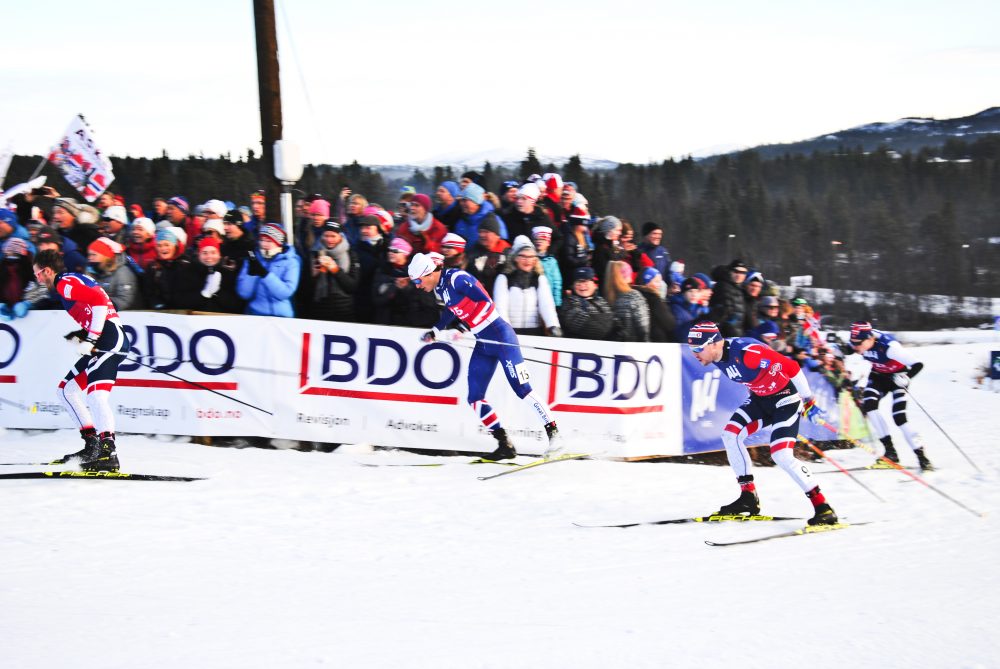
The women’s all-Norwegian podium from the 2018 FIS Skate Sprint in Beitostølen, Norway. Maiken Caspersen Falla (center) won, Kristine Stavås Skistad placed second (left), and Lotta Udnes Weng was third (right). (Photo: Aleks Tangen)
In a place like Norway, where the pool of cross-country athletes appears eternally deep, when you see competitors raise the bar, there’s nothing else to do but jump.
On Saturday in Beitostølen, Norway the known knowns were self-evident: Maiken Caspersen Falla and Johannes Høsflot Klæbo took the freestyle sprint wins during the second day of FIS race competitions.
As both athletes were overall World Cup sprint champions last season, there are no shockers there. (Klæbo has won two consecutive sprint crystal globes, Falla three.) But other skiers rose to the occasion and proved they too can jump nearly as high as Falla and Klæbo.
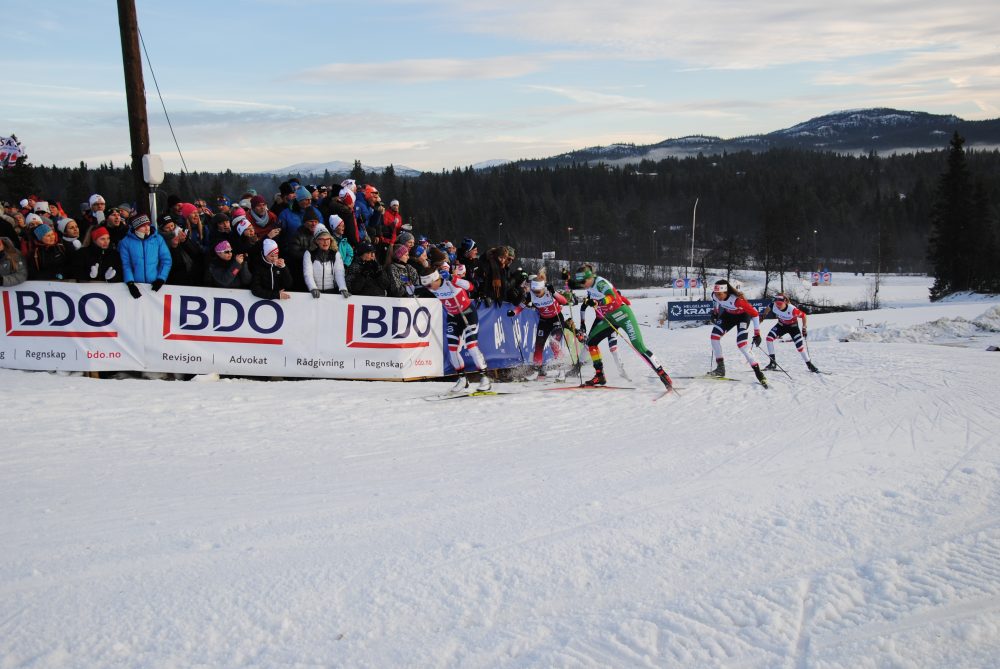
The women’s second semifinal on course in Beitostølen, Norway during the FIS skate sprint. (Photo: Aleks Tangen)
The women raced a 1.3 k skate sprint course with 54 women racing the qualifier. And this is where things got interesting. Nineteen-year-old junior Kristine Stavås Skistad, who has raced a single World Cup, the 2018 Drammen classic sprint in which she placed 51st, won the qualifier in 2:44.68 minutes. What is startling when scrolling through the qualification results is her birth year: 1999. The next closest Norwegian athlete in age finishing in the top-10 of qualification on Saturday was Anne Kjersti Kalvå, born in 1992.
In last season’s World Junior Championships, Skistad placed fifth in the 5 k classic, and second in the skate sprint. So certainly she is an up and comer. But the fact that she held her own in a world-class field of Norway’s best, is a statement.
Falla qualified in fourth (+1.63), and moved through to the finals by winning both her quarterfinal and semifinal.
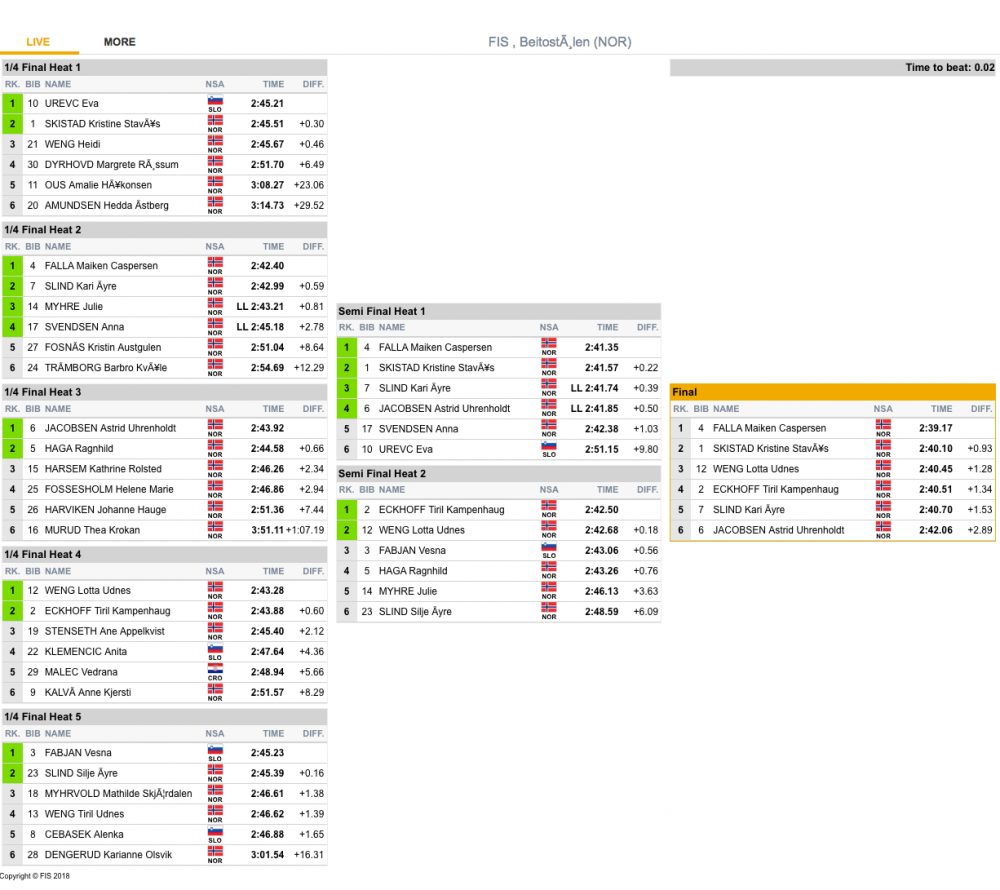
Skistad, however, maybe played it a bit coyer. She squeaked into the semis by placing second in her heat by .30 seconds to Slovenia’s Eva Urevc. She then placed second to Falla by .22 seconds in the first semifinal. (That semi proved the faster of the two semifinals — both Kari Øyre Slind and Astrid Uhrenholdt Jacobsen advanced as lucky losers from the Falla semi.)
Falla is Falla – a veteran with big experience and the know how to throttle the engine when it matters. She won the final in 2:39.17 minutes, a pace over five seconds faster than Skistad’s winning qualification time.
In the all Norwegian final, Skistad placed second (+0.93), Lotta Udnes Weng was third (+1.28) Tiril Kampenhaug Eckhoff, both a World Champs and Olympic medalist in biathlon, was fourth (+1.34), Slind fifth (+1.53), and Jacobsen sixth (+2.89).
The women’s skate sprint bracket from the second day of racing in Beitostølen, Norway (Photo: FIS Live Timing screenshot) Click the image to enlarge.
More Klæbo and a bit of Iversen
It is time to refresh the syntax and remember Klæbo’s name can be used as a verb. With that in mind, Klæbo Klæboed in the men’s 1.7 k skate sprint. But like Falla on the women’s side, the twenty-two-year-old Klæbo was tested.
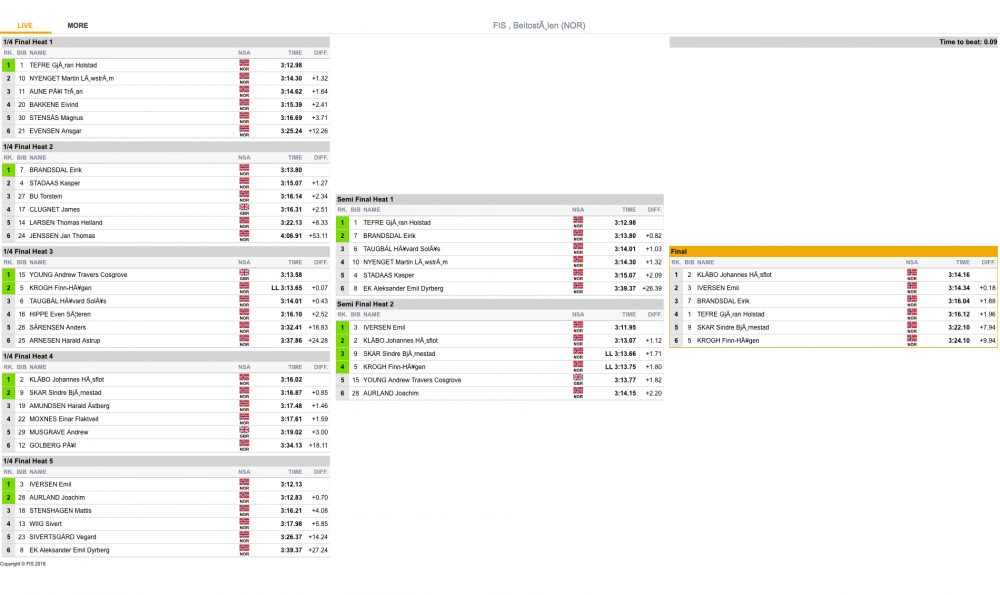
Tefre Gjøran, a year older than Klæbo at 23, was the fastest qualifier, finishing in 3:12.27 minutes. Klæbo was second (+1.12), and Emil Iversen third (+1.62).
In the end, it was Iversen, seeming like an aged vet at 27, who made life spicey for Klæbo.
Klæbo and Iversen advanced to the second semifinal. And it was Iversen who pushed the pace and was the catalyst for speed. Although not a massive margin, a second is still a second — but we are talking sprints here — Iversen won the second semi in 3:11.95, 1.12 seconds faster than second-place skier Klæbo.
“I was not good enough to fight him then,” Klæbo said to Norwegian broadcaster NRK, according to a translation, as he spoke about Iversen’s charge in the semis. “I had to be cynical and save me to the final. But Emil has a lot of effort, you saw how much he had in the finals too.”
It was a final highlighted by a Klæbo-Iversen dual. Klæbo won in 3:14.16 outpacing perhaps a new rival this season in Iversen, by 0.18 seconds.
In the all-Norway final, Eirik Brandsdal placed third (+1.88), Gjøran fourth (+1.96), Sindre Bjørnestad Skar fifth (+7.94), and Finn Hågen Krogh sixth (+9.94).
Andrew Young from Great Britain raced to 10th overall in Beito’s day 2 skate sprint. This is a shot from his semifinal. (Photo: Aleks Tangen)
Great Britain’s Andrew Young was 10th overall, James Clugnet 17th, and Andrew Musgrave 24th. They were the only non-Norwegians in the top-30.
“Top 10 is really good, the level here is really high,” Young told FasterSkier’s reporter in Beitostølen. “I had really good skis, and I was surprised nobody else wanted to take the lead at the start so I just went for it. I tried not to use too much energy. I knew Klæbo would go fast. So I just wanted to make sure I was on his tails when he came past. I was really pleased with my skiing. I wasn’t so defensive, I wasn’t so passive, and not let the others control the race. I tried to control it and be in that spot where I wanted to be.”
Young was passed in the final stretch by Skar and Krogh, who both advanced to the finals as lucky losers in the second semifinal.
Canadians Russell Kennedy placed 51st, Maks Zechel 94th.
“It is very deep, but it makes it fun there are lots of rides and always somewhere to push,” Kennedy emailed on Saturday about his experience racing to 22nd overall in the 15 k classic yesterday. “I was very happy with that. I don’t know if surprised is the right word. Last weekend in Olos, [Finland] I had a really good skate race and a good classic race against some big names. I was excited I ended up so high up the results for sure! It was a tough day with skis and I was lucky to be on fast skis even though they were a little slick on the last laps.”
The men’s skate sprint bracket from the second day of racing at in Beitostølen, Norway (Photo: FIS Live Timing screenshot) Click the image to enlarge.
Racing concludes in Beitostølen tomorrow with a 10 k/ 15 k skate.
Maiken Caspersen Falla of Norway — in the lead during the women’s final — doing what she does best: controlling a sprint and eventually taking the win in Saturday’s 1.3 k freestyle sprint in Beitostølen, Norway. (Photo: Aleks Tangen)
Welcome to The Rundown, your quick primer of need-to-know information about the day’s racing. We’ll be updating this digest as the day goes on with additional results, photos and quotes. The Rundown is NOT a race report; stay tuned for complete race reports later today with interviews from the day’s top racers.
***
FIS cross-country Beitostølen, Norway: 1.3 k freestyle sprints
In Beitostølen on Saturday, the second day of FIS races there sent the women on 1.3-kilometer skate sprint course. Reigning World Cup overall sprint champion from Norway, Maiken Caspersen Falla, won the final in a time of 2:39.17 minutes. Falla was the fourth fastest qualifier.
A lovely day for a sprint in Beitostølen, Norway during Saturday’s freestyle sprint. (Photo: Aleks Tangen)
Norwegians Kristine Stavås Skistad, the day’s fastest qualifier, placed second in the final (+0.93), Lotta Udnes Weng was third (+1.28).
The men’s sprint was held on a 1.7 k course with last season’s World Cup sprint champion Johannes Høsflot Klæbo (NOR) winning the final in 3:14.16 minutes. Friday’s runner-up in the 15 k classic, Emil Iversen (NOR), was second (+0.18). Also from Norway, Eirik Brandsdal placed third (+1.88).
Great Britain’s Andrew Young was 10th overall, James Clugnet 17th, and Andrew Musgrave 24th. They were the only non-Norwegians in the top-30.
Canadians Russell Kennedy placed 51st, Maks Zechel 94th.
Saturday, Bruksvallarna hosted day two of its FIS cross-country races with men’s and women’s distances races. The women began the day with a 10 k classic event.
Friday’s runner-up in the 5 k freestyle, thirty-one-year-old Charlotte Kalla of Sweden, won Saturday’s classic race in 27:54.1 minutes. Frida Karlsson (SWE) placed second (+25.2), Stina Nilsson (SWE) third (+38.2).
The men skied a 15 k classic event. In that race, Sweden’s twenty-nine-year-old Calle Halfvarsson bested the 149 starters with a winning time of 37:14.6 minutes. Sweden took the next two spots on the podium, as Viktor Thorn placed second (+39.1), and Gustav Eriksson third (+1:02.5).
She’s back. Therese Johaug celebrates after winning the 2018 FIS 10-kilometer classic in Beitostølen, Norway.
After an 18 month suspension for a positive out of competition positive doping test, during which Norway’s thirty-year-old Therese Johaug could build hour upon hour of base fitness and fine tune the engine with no race-stress, she arrived in Beitostølen, Norway on Friday and didn’t skip a beat.
In temperatures hovering around 32 degrees Fahrenheit, and low-level clouds descending on the course, Johaug established herself as the early season favorite amongst a deep Norwegian National Team in Beitostølen’s FIS season opener 10-kilometer classic race.
As the 52nd starter in a 60-skier field, Johaug never let off the throttle.
The race was tight at the 1-kilometer time check, with national team skier Ingvild Flugstad Østberg marking the fastest time over Johaug by only 0.9 seconds. With nine kilometers to go, it was all Johaug, as she clocked the fastest times at the remaining checkpoints.
Up by 4.3 seconds at 2.2k, the time back to the second fastest skier grew to 15.5 seconds at the race’s midpoint for Johaug. By the finish, Johaug did as she has done many times before, winning by a comfortable margin. She won in 25:42.6 minutes. Østberg, who ranked third in the World Cup overall last season, placed second (+23.9). Kari Øyre Slind was third (+59.8)
Therese Johaug ready to start it all over again after her 18-month suspension.
“It was special being here today,” Johaug told Norwegian broadcaster NRK according to a translation. “It feels incredible to back in the xc family again. To come up here and meet all the people that I’ve been skiing with for so many years, hear the cries from the crowds out in the course and the splits, it was a special feeling. It was so much. I was nervous before the start, but when I got started I really didn’t want it to end. I could have skied an extra lap.”
The opening Beitostølen FIS races are the early season proving grounds for Norway’s elite cross-country athletes. The top-10 in the women’s race was riddled with names World Cup fans are familiar with.
Astrid Uhrenholdt Jacobsen skied to fourth (+1:21.3), Haga Ragnhild fifth (+1:33.1), Anna Svendsen sixth (+1:42.8), and Heidi Weng, winner of last seasons overall World Cup finished seventh (+1:58.7).
Annika Taylor, a former University of New Hampshire skier now skiing for Great Britain, raced her way to 21st (+3:49.3).
In similar conditions, the men raced a 15 k classic. Like the women’s field, it was a Norwegian who’s who of elite class skiers. But unlike Johaug setting an increasing time margin over any contenders, the men’s race was tight, separated by only 15 seconds for the top-five skiers 5 k into the race.
At that point, with Didrik Tønseth in first and Emil Iversen in second, only a sliver of time, 0.1 seconds, differentiated the two. Martin Johnsrud Sundby and Johannes Høsflot Klæbo were gapped by 12.2 and 12.7 seconds respectively, as they skied through the time check in third and fourth place. Sjur Røthe came through in fifth (+15.8).
Iversen, in bib 141, kept it close, setting the initial times to beat. Tønseth started three skiers back in bib 144. Through 10k, the two were still evenly matched: with Tønseth up by 3.4 seconds over Iversen.
The men’s 15 k classic podium for the 2018 FIS opener in Beitostølen, Norway. Didrik Tønseth (NOR) in first, Norway’s Emil Iversen (left) in second, and Sjur Røthe (right) of Norway third.
Tønseth won the race in 36:08.6 minutes, with his winning margin of 12.4 seconds over the second place Iversen only solidified in the closing kilometers. Røthe gradually moved up and finished third (+29.3).
Sundby skied to fourth (+37.5), Hans Christer Holund fifth (+1:07.4), and Klæbo sixth (+1:17.5). British skier Andrew Musgrave finished seventh (+1:26.3). Musgrave is historically a stronger skate skier.
One hundred and forty-three skiers finished the men’s race.
Of note, thirty-two-year-old Petter Northug Jr., now a seemingly timeless presence on the Norwegian ski scene, was disqualified for classic technique violations. Prior to his DQ, Northug had been skiing in the top-20 for much of the race. Sundby was given a verbal warning for a classic technique violation.
Several Canadians raced the 15 k classic. Russell Kennedy was the best placed Canadian finishing tied for 23rd (+2:37.6). Brian McKeever was 68th (+4:06.6), Ryan Jackson 110th (+5:39.1), Maks Zechel 113th (+5:56.5).
Norwegians Therese Johaug and Heidi Weng, (l-r) during the 2016 women’s 15 k skiathlon in Canmore, Alberta. (Photo: Fischer/NordicFocus)
Welcome to The Rundown, your quick primer of need-to-know information about the day’s racing. We’ll be updating this digest as the day goes on with additional results, photos and quotes. The Rundown is NOT a race report; stay tuned for complete race reports later today with interviews from the day’s top racers.
***
FIS cross-country Beitostølen, Norway: 10 k/15 k classic
The race results are in from today’s 10-kilometer individual start classic FIS race in Beitostølen, Norway. The first of the season Beito races are used as a test pad for Norwegian athletes to gauge fitness and for some to make the rare jump to a coveted and scarce World Cup start.
Off of her suspension for using a banned substance, Norway’s Therese Johaug skied like she’d never been gone. Johaug was suspended for 18 months due to her violation.
Johaug fired off the 10 k winning in 25:42.6 minutes. Ingvild Flugstad Østberg was second (+23.9). Rounding out the podium was Kari Øyre Slindin third (+59.8).
Astrid Uhrenholdt Jacobsen skied to fourth (+1:21.3), Haga Ragnhild fifth (+1:33.1), Anna Svendsen sixth (+1:42.8), and winner of last seasons overall World Cup, Heidi Weng finished seventh (+1:58.7).
The men skied a 15 k classic race Friday in Beitostølen. Didrik Tønseth won in a time of 36:08.6 minutes. In second was Emil Iversen (+12.4), while Sjur Røthe placed third (+29.3).
Martin Johnsrud Sundby skied to fourth (+37.5), Hans Christer Holund fifth (+1:07.4), and Johannes Høsflot Klæbo sixth (+1:17.5).
British skier, although based in Norway, Andrew Musgrave finished seventh (+1:26.3).
One hundred and forty-three skiers finished the men’s race. Of note, Petter Northug Jr., now a seemingly timeless presence on the Norwegian ski scene, was disqualified for technique violations.
Several Canadians raced the 15 k classic. Russell Kennedy was the best placed Canadian finishing tied for 23rd (+2:37.6). Brian McKeever was 68th (+4:06.6), Ryan Jackson 110th (+5:39.1), Maks Zechel 113th (+5:56.5).
Bruksvallarna, Sweden cross-country: 5 k/10 k freestyle
In Bruksvallarna, Sweden FIS racing began with a 5 k freestyle for the women. Three of Sweden’s star skiers took the podium spots. Ebba Andersson won the tight race in 9:57.1 minutes, finishing only 2.6 seconds ahead of second place skier Charlotte Kalla. Known for her sprinting prowess, Hanna Falk was third (+15.7).
One hundred and twelve skiers finished the race.
For the men, after skating 10 k, the race was a tie for first. Sweden’s Jens Burman and Karl-Johan Westberg skied the fastest time. Both crossed the line in 19:11.0 minutes for the win. Japanese skier Keishin Yoshida placed third (+9.5).
Daniel Rickardsson, of Sweden, skied to fourth (+12.9).
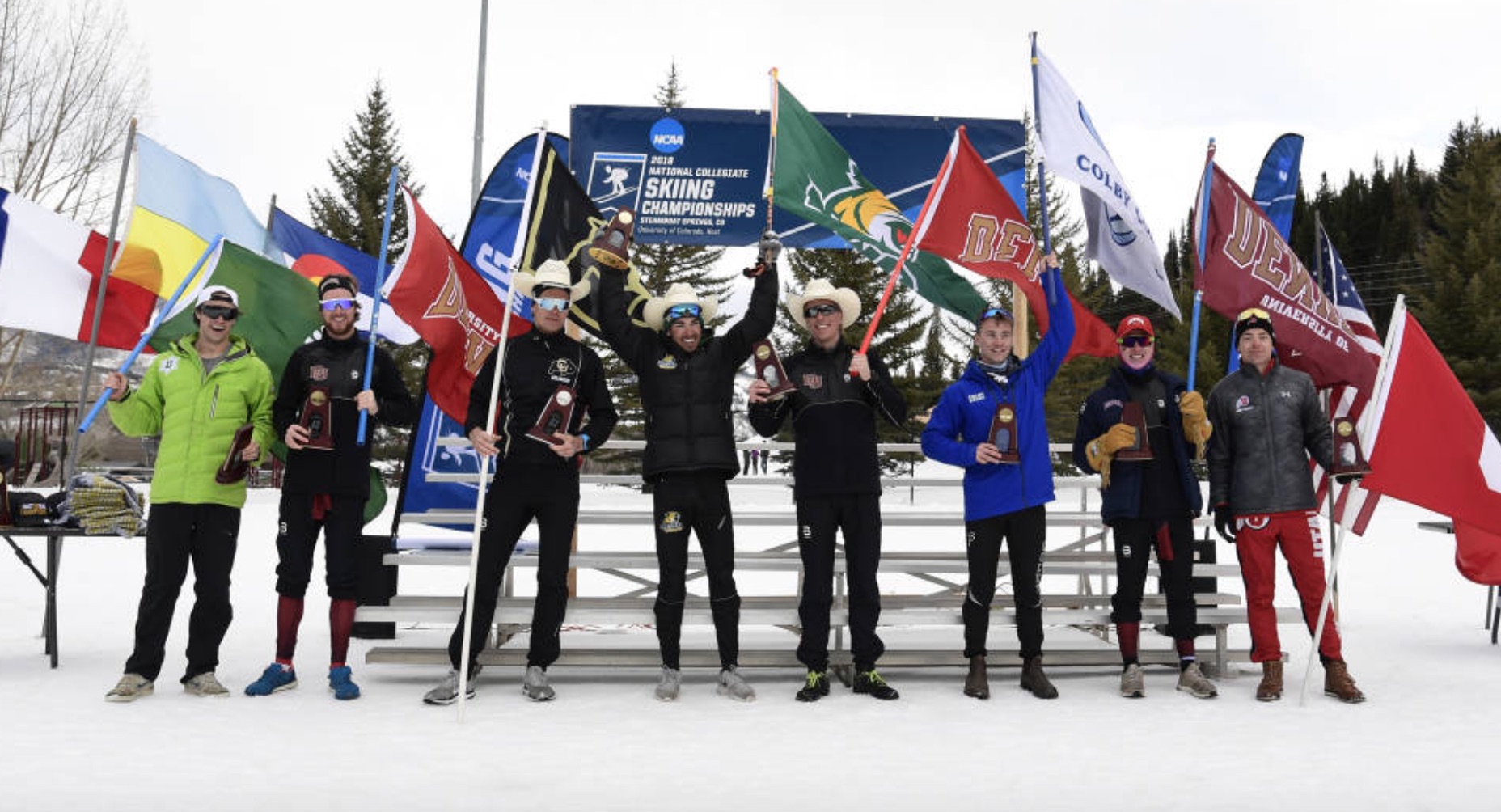
The top finishers in the men’s 20 k freestyle mass start at 2018 NCAA Skiing Championships in Steamboat Springs, Colorado, with Northern Michigan University’s Ian Torchia (c) in first. (Photo: Dartmouth Sports/Clarkson Creative)
NCAA Skiing Championships (Steamboat Springs, Colorado): 15/20 k freestyle mass starts
On the fourth and final day of NCAA Skiing Championships at Howelsen Hill in Steamboat Springs, Katharine Ogden skied to her second-straight national title, Ian Torchia became an NCAA champion and the University of Denver (DU) won its 24th NCAA National Championship.
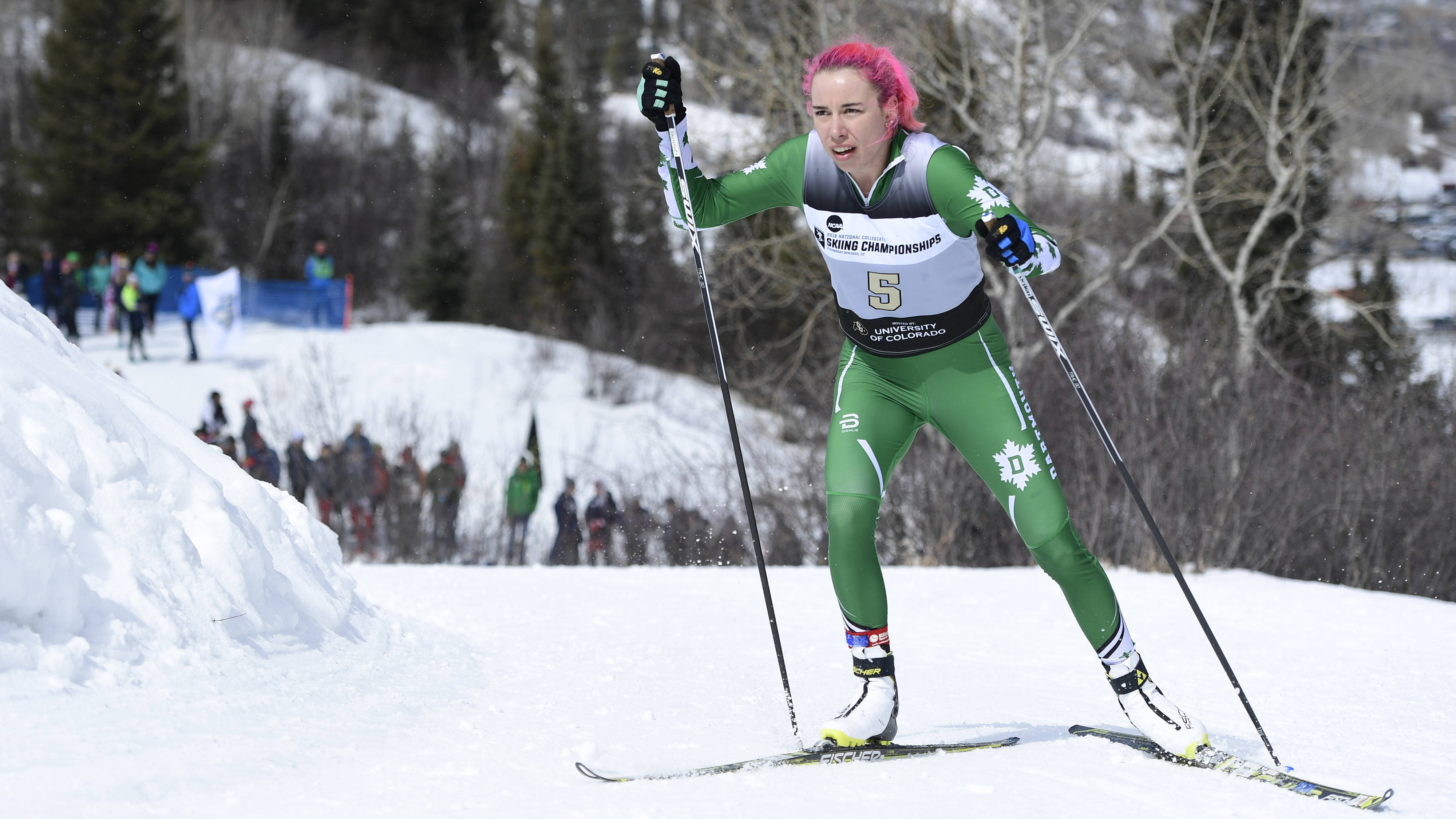
Dartmouth freshman Katharine Ogden racing to her second-straight victory of the 2018 NCAA Skiing Championships in Steamboat Springs, Colorado. She won Saturday’s 15 k freestyle mass start by more than 38 seconds. (Photo: Dartmouth Sports/Clarkson Creative)
Ogden, a Dartmouth College freshman, raced to a 38.4-second victory in the women’s 15-kilometer mass start, finishing in 43:22.0 minutes for her second win in as many races at 2018 NCAA Championships. She won the 5 k classic on Thursday and with her win on Saturday, she became the first Dartmouth skier in 56 years to win two national titles in the same year, according to a Dartmouth press release.
On the second of three laps, Ogden broke away early with close to 10 k to go. According to the press release, she had a “quick fall” near the end of the second lap, but that didn’t derail her as she had time to grab sunglasses from Dartmouth men’s coach Brayton Osgood and a Dartmouth Lone Pine flag before the finish.
At this year’s championships, Ogden’s two titles are accompanied by victories from Dartmouth men’s alpine skiers Brian McLaughlin (who won the giant slalom) and Tanguy Nef (who won the slalom). This marked only the second time that Dartmouth’s Big Green won four individual titles in a single NCAA Championships; that also occurred 61 years ago.
“Katharine absolutely wanted this one, and she really likes to win,” Dartmouth Director of Skiing and Women’s Nordic Head Coach Cami Thompson Graves said in the press release. “She wasn’t about to let a fall slow her down, she has such a great competitive fire. But she also showed her playful side grabbing Brayton’s glasses and smiling all the way to the finish line!”
Hailey Swirbul of the University of Alaska Anchorage placed second and Linn Eriksen (DU) reached the podium in third (+46.3). Denver had three in the top 10 with Jasmi Joensuu in ninth and Taeler McCrerey in 10th. Also landing in the top 10 for All-American honors were Guro Jordheim of the University of Utah in fourth, Emma Tarbath (Montana State University) in fifth, Petra Hyncicova of the University of Colorado Boulder (CU) in sixth, Christina Rolandsen (CU) in seventh, and Lauren Jortberg (Dartmouth) in eighth.
Torchia, an Northern Michigan University (NMU) junior and U.S. Ski Team Development Team member, became the seventh NCAA champion in NMU Wildcats nordic skiing history, according to an NMU press release. Fredrick Schwenke was the Wildcats’ last nordic champion; he won the 2015 NCAA Championships 20 k classic.
Torchia drew bib 1 for Saturday’s 20 k freestyle mass start and crossed the finish line first in 54:21.0, just 2 seconds ahead of CU’s Alvar Alev. Eivind Kvaale (DU) finished just four seconds back in third, and Denver had three in the top seven with Dag Frode Trollebø in fourth and Lars Hannah in seventh. Darmouth’s Cal Deline placed fifth, Zane Fields of Colby College finished sixth, and the 20 k freestyle’s 2017 NCAA champion Martin Bergström (Utah), who also won Thursday’s 10 k classic, placed eighth. CU’s Petter Reistad and Sondre Bollum finished ninth and 10th, respectively.
In the team standings, Denver beat Colorado by 41 points for the overall win with a total of 604 points between the nordic and alpine events at this year’s championships. Dartmouth placed third, 114.5 points behind Colorado, and Utah was another 63 points back in fourth.
According to a DU press release, Denver has won at least one national championship in each of the last five athletic seasons (skiing: 2013/14, 2015/16, 2017/18; hockey: 2016-17; men’s lacrosse 2014/15), joining only Stanford on the list of schools that have done so in the last five seasons. (Oregon, West Virginia, Penn State, Oklahoma, Ohio State and Florida could potentially join that list later this year.)
“It feels incredible,” said DU head coach Andy LeRoy said in the press release. “I am so happy for all of our athletes, they’ve been training all week and all season and to do it in Steamboat in front of our crowd is special.”
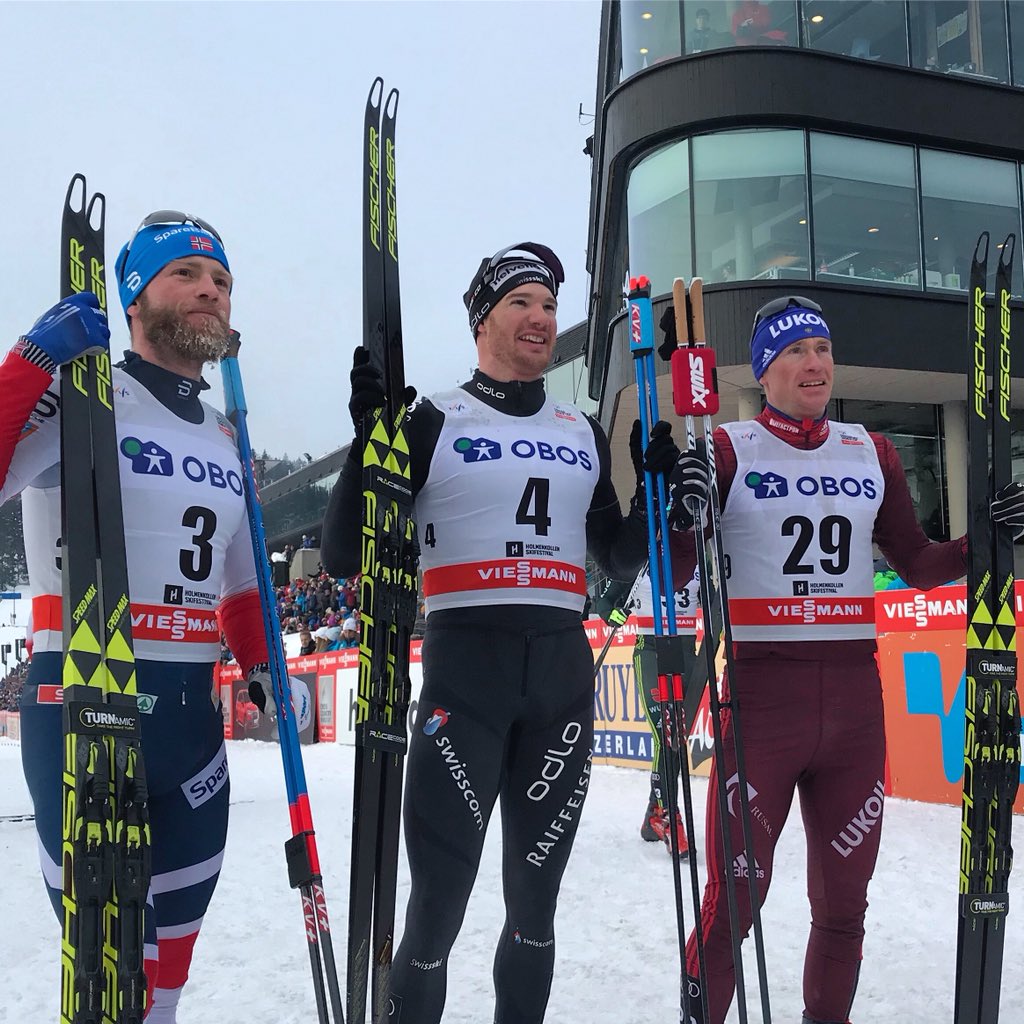
The Holmenkollen men’s 50 k freestyle mass start podium on Saturday at the World Cup in Oslo, Norway, with Switzerland’s Dario Cologna (c) in first, Norway’s Martin Johnsrud Sundby (l) in second, and Russia’s Maxim Vylegzhanin (r) in third. (Photo: FIS Cross Country/Twitter)
FIS Cross Country World Cup (Oslo, Norway): Men’s 50 k freestyle mass start
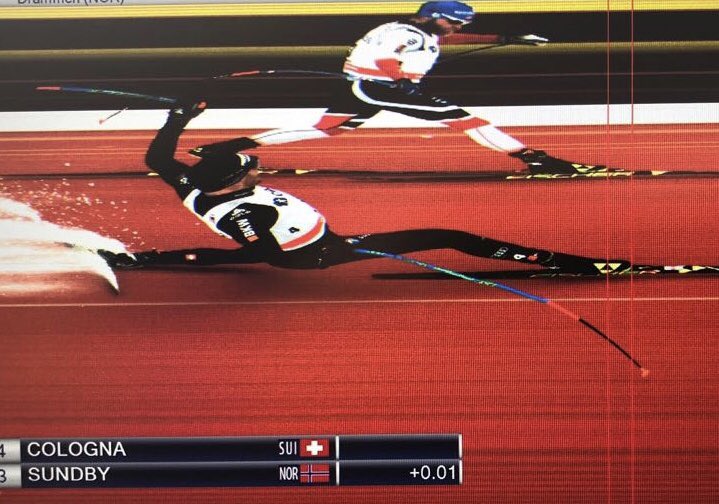
A four-time Olympic champion, Dario Cologna of Switzerland won his first 50-kilometer World Cup race on Saturday, topping the podium in the famous Holmenkollen 50 k freestyle mass start after outlunging Norway’s Martin Johnsrud Sundby (who won the event last year) for the win in 2:01:48.1. Sundby finished one-hundredth of a second behind for second place, ahead of Russia’s Maxim Vylegzhanin, who was 1.1 seconds back in third in his first World Cup race since November of last year.
The photo finish for first between Switzerland’s Dario Cologna (near) and Norway’s Martin Johnsrud Sundby at the Holmenkollen 50 k freestyle mass start on Saturday in Oslo, Norway. Cologna got it by 0.01 seconds. (Photo: FIS Cross Country/Twitter)
Norway’s Sjur Røthe came out on top in a race for fourth (+4.2), ahead of Russia’s Denis Spitsov in fifth (+4.4) and his Norwegian teammate Hans Christer Holund in sixth (+4.5). Great Britain’s Andrew Musgrave followed in seventh (+15.1), Germany’s Florian Notz placed eighth (+25.9) and Canada’s Alex Harvey finished ninth (+32.4), ahead of France’s Robin Duvillard in 10th (+33.5).
Scott Patterson led the U.S. in 16th (+56.3) coming off an 11th place in the 50 k classic mass start at last month’s Olympics, and Canada’s Devon Kershaw finished in the points in 28th (+3:43.6). Just outside the top 30, Canada’s Graeme Killick finished 34th (+4:55.1).
Also for the U.S, David Norris placed 38th (+6:19.7), Paddy Caldwell was 46th (+8:12.3), Noah Hoffman 49th (+10:27.9), Kevin Bolger 52nd (+12:44.2), and Simi Hamilton did not finish.
Canada’s fourth man in the race, Andy Shields finished 47th (+8:13.6).
Italy’s Lukas Hofer celebrates his team’s win in Saturday’s mixed relay at the IBU World Cup in Kontiolahti, Finland. (Photo: IBU/Biathlonworld)
IBU World Cup (Kontiolahti, Finland): Single mixed relay & mixed relay
(Note: This rundown has been updated to include comments from Christian Gow and Sean Doherty.)
In the last single mixed relay and mixed relay of the International Biathlon Union (IBU) World Cup season, France and Italy came out on top, with France winning the two-person single mixed relay and Italy taking first in the coed mixed relay.
France’s Anaïs Chevalier and Antonin Guigonnat after winning Saturday’s single mixed relay at the IBU World Cup in Kontiolahti, Finland. (Photo: IBU/Biathlonworld)
France’s Anaïs Chevalier and Antonin Guigonnat combined for zero penalties and six spares to finish first in the single mixed relay in 33:29.1 minutes. Guigonnat as the team’s anchor secured the win by just 2.4 seconds over Austria’s Julian Eberhard while Norway’s Johannes Thingnes Bø finished 4.4 seconds back for third.
Chevalier put France in fifth after the first leg, 15.5 seconds behind Ukraine’s Iryna Varvynets in first. Guigonnat used just one spare on his first leg to move them into fourth, 9.2 seconds back while Norway led at the second exchange. On Chevalier’s second leg, she shot clean in both stages to lead through the final exchange, with Ukraine skiing just 6.2 seconds back in second.
On the final leg, Guigonnat used two spares and stayed out of the penalty lap, keeping the team in first through the finish. Eberhard skied the second-fastest course time on that leg to elevate Austria (with Lisa Theresa Hauser) from fourth at the tag to second place at the finish, and Bø skied all the way up from eighth to third place for Norway (with Marte Olsbu) with the fastest course time.
Ukraine’s Artem Tyschenko used just one spare but slipped to fourth with the 11th-ranked course time on that leg, as he finished 10.8 seconds behind Norway.
Behind Russia in fifth and Italy in sixth, Canada placed seventh (+23.8) with Rosanna Crawford and Christian Gow. The duo combined for zero penalties and six spares, and put themselves in third place early in the race. Crawford skied them into third on the first leg, using just two spares and tagging Gow 7.4 seconds out of first.
Gow went on to take the lead after cleaning prone without any spares, and he cleaned standing as well but slipped back to third while Bø took the lead. Gow tagged Crawford in third, 8.9 seconds behind Norway in first.
“I didn’t think too much about being tagged in third,” Gow recalled in an email to FasterSkier. “It was exciting for sure, but I let it fade to the background so that I could focus on my job both on the track and in the range. It was great to leave prone in first place! It was also surprising, but it was a good place to be in.
“My skiing was ok today,” he continued. “It is a really challenging and demanding race format that we don’t get a lot of practice with. I was sick after the Olympic Games and only finally coming around the past couple days. The Sprint race was horrendous for me, so today was much better than that. In the range I just focussed on myself and trusted my shooting. I tried my best not to get caught up in the race going on around me and it worked to my benefit.”
Crawford then slipped to seventh and 21 seconds back with three prone spares, but avoided the penalty lap, and Gow held onto seventh through the finish, using just one spare and skiing the eighth-fastest course time on that leg.
“We are both happy with this result,” Gow wrote. “I think that we are both looking at the 23 second gap to first and thinking that if things had worked out just a bit better we could be there. It can be both exciting and frustrating to be that close to the podium. We know we can do it, it’s just a matter of putting it together on the right day. We are happy with 7th, but hungry for more.”
Susan Dunklee and Lowell Bailey finished 14th for the U.S., 1:13.0 out of first with one penalty and 14 spares. The penalty came on Dunklee’s first leg during her standing stage, after she had cleaned prone without any spares. She tagged Bailey in 14th and he brought them up to 11th, using three spares on that leg, then Dunklee came through the final exchange in 13th after using four spares to clean. Bailey lost one place on the final leg, using four spares but staying out of the penalty lap.
Twenty-six teams competed in the single mixed relay, compared to 23 in the mixed relay that followed.
Team Italia celebrates its win in the IBU World Cup mixed relay on Saturday in Kontiolahti, Finland, with its relay members Dorothea Wierer, Lisa Vittozzi, Dominik Windisch, and Lukas Hofer. (Photo: IBU/Biathlonworld)
In Saturday’s 2 x 6 + 2 x 7.5 k mixed relay, Italy nabbed a 1.5-second victory over Ukraine in 1:15:08.3. Dorothea Wierer, Lisa Vittozzi, Dominik Windisch, and Lukas Hofer — the same Italian team that took bronze in the mixed relay at last month’s Olympics, although in a different order — combined for the win with one penalty and 13 spares.
Ukraine, with Anastasiya Merkushyna, Vita Semerenko, Artem Pryma, and Dmytro Pidruchnyi, had zero penalties and just three spares throughout the whole race. For the second-straight relay on Saturday, Norway placed third (+9.1) with Synnøve Solemdal, Tiril Eckhoff,Henrik L’Abée-Lund, and Tarjei Bø totaling zero penalties and nine spares.
Italy’s lone penalty came in Vittozzi’s second leg, but it didn’t derail the team as it improved from sixth to fifth with Vittozzi, who skied the third-fastest course time on that leg. She tagged Windisch 6.8 seconds out of first, and Windisch, who had anchored the team in the Olympics, took the lead by the final exchange after using two spares to clean. Hofer left the exchange just 3.3 seconds ahead of Norway’s Bø but used just one spare and skied the second-fastest anchor leg to finish first, beating his rivals up Kontiolahti’s infamous climb known as “The Wall”. Ukraine’s Pidruchnyi also shot clean with a single spare and clocked the fastest anchor leg to move his team from fourth to second place. Bø lost one place and finished third after using one spare as well and skiing the third-fastest anchor leg.
Russia followed in fourth, France fifth, Sweden sixth, Germany seventh, Austria eighth, and the U.S. ninth (+2:48.4). The U.S. team, with Clare Egan, Joanne Reid, Tim Burke, and Sean Doherty, had one penalty and 11 spares. Egan cleaned her first prone but had to ski a penalty lap after her standing stage, tagging Reid in 17th, 58.7 seconds out of first.
Reid used three spares on the second leg and moved up to 13th by the second exchange, and Burke used three spares as well to pick off one more place and tag Doherty in 12th. Doherty skied the eighth-fastest anchor leg and used two spares to clean to put the team in ninth at the finish.
“I don’t consider two spares to be anything special, but today it was enough to make up some ground,” Doherty wrote in an email to FasterSkier.”I felt strong skiing, more like myself which is fun even if it’s a little late in the season. We had very good skis which always helps. I have done quite a few laps on this course over the years so the lines and transitions are pretty refined, so that is where I made time on the course.
“I am happy with my leg. I enjoyed my little battle for 9th,” he continued. “I can’t speak too much for the other members of the relay tonight but I think 9th is a solid effort.”
Canada finished 17th (+4:34.9) with Emma Lunder, Julia Ransom, Scott Gow, and Brendan Green combining for one penalty and 13 spares. Lunder put them in 12th at the first exchange and Ransom skied up to 10th, but Scott Gow had a penalty on his standing stage to drop to 16th. Green lost one more place on the last leg despite only requiring two spares.
Norway swept the medals in the first men’s cross-country race of the 2018 Olympics in PyeongChang, South Korea, with Simen Hegstad Krüger (c) taking gold, Martin Johnsrud Sundby (l) silver and Hans Christer Holund (r) bronze. (Photo: FlyingPointRoad)
PYEONGCHANG, South Korea — First a quick parable every skier has heard: never give up. From coaches, teachers and certainly parents, it’s always the same. Never give up. For those on the receiving end of the timeworn parable, it can sound like the annoying advice of elders; something that only applies in the later years. Easily brushed off words that might apply later, never now.
Early in the men’s 30 k skiathlon at the 2018 Olympics in PyeongChang, South Korea. (Photo: FlyingPointRoad)
During Sunday’s blustery and downright frigid 30-kilometer skiathlon, the first men’s cross-country race of the 2018 Olympic Games, that parable came into play not more than fifteen seconds after the start. Sixty-eight skiers shot off the line and merged into the classic ski tracks — the front-row athletes, the likes of Canada’s Alex Harvey, Norwegians Martin Johnsrud Sundby and Johannes Høsflot Klæbo, Switzerland’s Dario Cologna, and Finland’s Iivo Niskanen, skied clean up the first climb.
Caught up in the striding, double poling and the tumbling was Norway’s 24-year-old Simen Hegstad Krüger, bib 7, waving his arm as he lay prone on the snow. Skier down — broken pole. There really didn’t seem much to it other than it was bib 7. Bib 7 slow to get up, slow to unstrap his mangled pole, slow to get into the tracks and single stick for tens of meters. Bib 7. Krüger.
Then the coach arrives, the pole becomes functional, the game is on. By then, Niskanen, a renowned classic skier, had accelerated the pace. From the front, the pack was pulled apart like taffy. From the back of the mass of skiers, where Krüger now ventured, a sea of 67 other bib numbers waited to be picked off. Whatever the phrase “never give up” is in Norwegian, it most certainly rattled around in Krüger’s mind.
“It’s my first-ever Olympic race and it started in the worst possible way,” Krüger said during the post-race press conference. “I just had to try to stay calm and use some time to catch up because I think if I had skied too fast there after my crash, I don’t think I would have any power when I caught up.”
Let’s ascend from the bottom up on Krüger’s World Cup results pyramid. He has 28 World Cup top-30 results, 12 of which are top 10’s. Of those top 10’s, he has two podiums: a third place in the fifth stage of the 2017 Tour de Ski, the 10 k skate in Toblach, Italy, and another win in Toblach this past December in the 15 k skate.
Surely this is no spoiler — bib 7 won the Olympic 30 k skiathlon on Sunday in 1:16:20 hours in burley conditions. On top of that, consider this: he’s a first-time Olympian, this was his first Olympic race and first championship gold.
Let’s get back to Niskanen, who is a no-joke classic skier. Of all his major wins, including Finland’s National Junior Championships (with multiple titles in 2012 and 2013), you have to comb through to find a freestyle win. There are three skate wins, none on the World Cup. And here’s another striking piece of information, according to the International Ski Federation (FIS) database, Niskanen has never won off of Finnish soil except for the 15 k classic at 2014 U23 World Championships in Val di Fiemme, Italy.
Finland’s Iivo Niskanen leads Switzerland’s Dario Cologna, Canada’s Alex Harvey and several Norwegians during the classic portion of the men’s 30 k skiathlon at the 2018 Olympics in PyeongChang, South Korea. (Photo: FlyingPointRoad)
PyeongChang is in South Korea, seven time zones from Finland.
Number crunching in sport is nothing new. Somebody in the Norwegian head-shed must have known Niskanen’s skewed geographic preference.
Off the Finn went with the skiathlon favorites all in tow. By all accounts, Niskanen set a punchy pace. Nearly through 10 k, the 26 year old owned it. No doubt he knew his chances were slim if he didn’t break the pack and stretch out a solo lead before the transition to 15 k of skate technique. For a bit after 10 k, Sundby took some pulls up front. But in what became a familiar classic leg trend, the 13 skiers, separated by no more than five seconds, zipped down the banked corner before the 15 k mark gear exchange led by none other than Niskanen.
The Finn had done the job of cutting the lead pack down to a manageable number, but he hadn’t built a gap from which he could nurse a cushion during the skate leg. In being the fox for at least 12 hounds, Niskanen had burned through his high-pace fuel. Fourth out of the transition, 1.3 seconds behind Klæbo in first, he was back in 18th just under 4 k later, 9 seconds out of first. He ultimately finished the skiathlon in 19th place, 1:14.2 minutes behind the winner.
A quick swap of the skis and the poles and the 21-year-old young gun from Norway, Klæbo, was first through the 15 k time check. Harvey followed next with a tight grouping from first to 13th within 9.5 seconds, tightening pole straps on the run and readying for the skate leg throwdown.
Norway’s Simen Hegstad Krüger (7) leads Germany’s Lucas Bögl during the skate leg of the men’s 30 k skiathlon on Sunday at the 2018 Olympics in PyeongChang, South Korea. (Photo: FlyingPointRoad)
Here’s the thing: the 14th skier through the exchange, 15.2 seconds back was Krüger. This athlete was in 67th at 0.88 k, and improved to 57th 1.5 k later. Fast and steady, Krüger would reel in the front group. By 17.25 k, he was within a few seconds of lead.
“As soon as I changed skis, then suddenly my legs felt great again,” Krüger said at the press conference. “I knew that now all possibilities are open again and just tried to start fresh.”
The skate leg’s dynamics proved the opposite of the classic. There was no Niskanen-type breaking the wind. At moments it appeared Harvey would surge, or Cologna, or Sundby, or Holund, or Great Britain’s Andrew Musgrave.
Krüger hung tight, never taking the leadership reins.
“I knew that the skating part is my strongest part and I had to try to save some power the first two laps there and just stay with the group,” Krüger reflected.
The plot thickened as the k’s ticked off. With the likes of Sundby in the pack, Krüger couldn’t risk a finish-line sprint. In his third Olympics, Sundby is still seeking his first Olympic gold (after taking bronze in the Sochi 30 k skiathlon and silver in the 2010 Vancouver 4 x 5 k relay).
Before Sundby, 33, could dictate the closing chapter of Sunday’s race, Krüger stung the group with a power surge around 26.25 k and quickly gapped the chasers by 9.1 seconds. A little over a kilometer later, Krüger had opened up a 22.8-second lead.
“I know that there’s some quite fast skiers in the group, so I knew that my chance was to get rid of them before the finish,” Krüger said of his tactics. “When I got some meters there I had to go for it and don’t look back.”
Norway’s Simen Hegstad Krüger celebrates after winning gold in the men’s 30 k skiathlon on Sunday at the 2018 Olympics in PyeongChang, South Korea. (Photo: FlyingPointRoad)
He never looked back. It was an exclamation-point Olympic gold medal win, and he beat Sundby in second by 8 seconds and another Norwegian teammate Hans Christer Holund in third by 9.9 seconds.
Although Krüger kept his eyes focused ahead, Sundby said during the press conference that he and Holund were looking around for potential chasers.
“For sure, we have a really clear team tactics,” Sundby explained of why he and Holund did not attempt to close the gap on Krüger. “If one of us gets seconds from the rest of the pack, the others cannot try to catch him, so me and Hans Christer, I think we were waiting for Alex, Dario, Maurice [Manificat], everybody else to try to catch Simen. I think both of us were a bit surprised that nobody really tried.”
Both Sundby and Holund acknowledged that when the gap grew to 20 seconds, they felt the team pact to not chase down a potential Norwegian gold medalist had been honored. On the final hill climb before the finish Sundby and Holund went.
“I don’t think either me or Martin wanted to have Alex or Dario, we didn’t want to sprint with them in the last few hundred meters so when it was like 1 1/2 kilometers [to go], I think [Sundby] said or I said, ‘Now we just go,’ ” Holund said at the press conference. “And we did that in the hill.”
Sundby settled for silver and Holund bronze, 2.8 seconds clear of Denis Spitsov, representing the Olympics Athletes of Russia, in fourth.
“For sure, for us it was a bit frustrating, we also wanted to go for the gold for sure,” Sundby said. “But our team tactics was clear today and it’s just amazing that we really pulled this [podium sweep] off.”
“… Simen is a really strong guy, not just physical but also mental,” said the 28-year-old Holund, also in his Olympic debut. “I think we should give credit to Simen that he was actually daring to break loose on the last lap there. I don’t think many people would have the confidence to do that and that’s why he deserves that gold medal.”
Norway’s Simen Hegstad Krüger (7) gets a big hug from one of his teammates after he won gold in his first Olympic race, the men’s 30 k skiathlon, on Sunday at the 2018 Winter Games in PyeongChang, South Korea. (Photo: FlyingPointRoad)
After the race, Krüger acknowledged that he owed some gratitude to his silver and bronze Norwegian teammates.
“I think both the guys there on both sides [of me] could’ve gone faster when I got some meters, but they let the others do the work,” noted Krüger. “So I think I owe them a big thanks for not catching up with me when I went for it.”
Spitsov, 21, also in his first Olympics, finished fourth, ahead of France’s Maurice Manificat in fifth (+14.2), Cologna in sixth (+25.1), Musgrave in seventh (+25.7), and Harvey, who edged Martin Jaks of the Czech Republic, for eighth (+33.4 and +33.8, respectively). Klæbo, one of the pre-race favorites, finished 10th (+43.4).
Harvey, who had been eyeing the skiathlon, said after the race the best skiers had won.
Canada’s Alex Harvey (4) leading France’s Jean-Marc Gaillard (9) and Finland’s Iivo Niskanen (8) during the skate leg of the men’s 30 k skiathlon at the 2018 Olympics in PyeongChang, South Korea. Harvey went on to finish eighth. (Photo: FlyingPointRoad)
“I think the three best guys won today,” Harvey told FasterSkier after. “It was a fair race and they were just stronger than anybody else in the world.”
Asked about the race’s defining breakaways in the final kilometers, he said he just didn’t have the legs to react.
“I was feeling good until Sundby and Holund went and then I just couldn’t go,” Harvey said.
After Harvey’s top 10, the next Canadian across the line was Devon Kershaw in 36th (+3:35.3). Graeme Killick finished 45th (+5:19.6), and Knute Johnsgaard was lapped and did not finish.
Kershaw noted the high pace during the classic leg curtailed his later-race efforts.
“I was really shocked that the classic went out as hard as it did,” Kershaw told FasterSkier. “And, after that, you’re in survival mode … It was really, really brutal today. “You know, it wasn’t the coldest day I’ve done, but it was for sure the windiest race I’ve ever competed in. When you’re having a bad day, that wind really tears at your mind, so I struggled.”
For the U.S., Scott Patterson led the way in 18th (+1:07.5). In his first Olympics, Patterson’s moxy was palpable. The the 26-year-old, first-year U.S. Ski Team member began the skate leg in 27th position, 47.7 seconds behind the leaders.
U.S. Ski Team member Scott Patterson (c) on his way to 18th place in his first Olympic race, the men’s 30 k skiathlon, at the 2018 Winter Games in PyeongChang, South Korea. (Photo: FlyingPointRoad)
Immediately as Patterson skated away, his powerful strides were evidence he’d only be picking off spots in the final 15 k.
“The last couple skiathlons I’ve done it’s been a little bit rough classic,” Patterson told FasterSkier after. “Then you switch to skating and it’s like, ‘OK, now I know what I’m doing’, and it definitely felt like that today.”
A year ago at the pre-Olympic World Cup in PyeongChang, Patterson finished ninth in the 30 k skiathlon. Besides that result, his best individual World Cup finish was 27th in the 15 k freestyle mass start at the most recent World Cup on Jan. 28 in Seefeld, Austria.
As he completed the third of four skate laps, Patterson could see Sundby’s lead group 34 seconds ahead of him.
“Everyone was giving us splits off to that front group and it was like, ‘OK, maybe we can make it, maybe we can make it,’ ” Patterson reflected, smiling. “But then you’re also like, ‘They’re going to start charging real soon.’ So I was kind of optimistic, but also, when you’re leading that pack, it’s like, I want this pack to move up, but I don’t want to be the one making it move up because that’s a lot of work.”
He credited France’s Jules Lapierre, who finished 15th, and Italy’s Francesco de Fabiani, who placed 20th, for helping to pull the group along.
“I ended up leading the final sprint hill quite a few times, but [Lapierre] did a lot of work out on the course, which was super helpful…,” Patterson said. “We were able to kind of pull apart our group a bit and pick off a few of the guys struggling from the lead pack, like we got Iivo Niskanen right at the end, which I was pretty psyched about.”
Erik Bjornsen (U.S. Ski Team) racing to 42nd in the men’s 30 k skiathlon at the 2018 Olympics in PyeongChang, South Korea. (Photo: FlyingPointRoad)
Also for the U.S., Erik Bjornsen finished 42nd (+4:34.7), Paddy Caldwell 51st (+6:58.1), and Noah Hoffman 54th (+7:08.7).
“I really enjoy both courses and I think the classic portion was maybe a little trickier with the wind today,” Caldwell said of his race. “I was just telling Reese [Hanneman] that I thought that things were pulling apart more in the classic side. You know, if you lose the group in front of you and then you catch the wind, it gets really tough. I think that the time gaps today are probably going to be quite, quite large because of that, but we had awesome skis on both sides [classic and skate]. I was trying to maintain position in classic and pick off people where I could in skate.”
In his second Olympics, Hoffman also said the wind played a factor.
“Honestly, it was gusty and there were sections where you’d come into the wind and just be brought to a dead stop,” Hoffman said. “But overall, it could have been a lot more of a grind because we had this warm spell the last couple days and the snow was quite fast out there. It was an uphill wind in terms of the general direction, and so for the most part the downhills were slower, but still tucking and then the uphills, you got a little bit of a boost … My body wasn’t there today.”
Olympic cross-country racing continues Tuesday with the men’s and women’s classic sprints.
Norway’s Simen Hegstad Krüger celebrates after winning gold in the men’s 30 k skiathlon on Sunday at the 2018 Olympics in PyeongChang, South Korea. (Photo: FlyingPointRoad)
It was an improbable move: Norway’s Simen Hegsted Krüger attacked a few kilometers from the finish of the men’s 30 k skiathlon, and the rest of the field let him go. Krüger didn’t let up and at one point had a lead of 25 seconds with just about two kilometers to go, all the more impressive because he had crashed just meters into the race and broken a pole, having to then make up 35 to 40 seconds to get back to the lead pack.
Norwegian teammates Martin Johnsrud Sundby and Hans Christer Holund tried to close the gap to Krüger in the final kilometer, but the 24 year old hung on for a 8-second win. Sundby was second and Holund was third (+9.0) to give Norway a medal sweep.
Denis Spitsov of the Olympic Athletes of Russia, also in his first Olympics, finished fourth, 12.7 seconds back. Maurice Manificat of France was fifth (+14.2), Dario Cologna of Switzerland sixth (+25.1), Andrew Musgrave of Great Britain seventh (+25.7), and Alex Harvey of Canada edged Martin Jaks of the Czech Republic for eighth (+33.4 and +33.8, respectively). Johannes Høsflot Klæbo of Norway, one of the pre-race favorites, finished 10th (+43.4).
For the U.S., Scott Patterson led the way in 18th (+1:07.5). Erik Bjornsen finished 42th (+4:34.7), Paddy Caldwell 51st (+6:58.1), and Noah Hoffman 54th (+7:08.7).
After Harvey’s top-10 finish, the next Canadian across the line was Devon Kershaw in 36th (+3:35.3). GraemeKillick finished 45th (+5:19.6), and Knute Johnsgaard was lapped and did not finish.
University of Utah alum Snorri Einarsson finished 56th (+7:13.9) in Iceland’s best result in Olympic cross-country skiing since 1994.
Arnd Peiffer on his way to winning the 10 k sprint at Alpensia Biathlon Center today. The German was one of just four men to shoot clean in windy conditions. (Photo: FlyingPointRoad)
With the race favorites each picking up a bevy of penalties, Germany’s Arnd Peiffer skated to a gold medal in the men’s 10 k sprint on Sunday. Both he and silver medalist Michal Krčmář of the Czech Republic shot clean, and were two of only four men in the field to do so. With that performance, Peiffer — whose lone senior Championship-level individual medal came when he won the World Championships sprint back in 2011 — made Germany two-for-two in biathlon races so far after Laura Dahlmeier’s win in the women’s sprint on Saturday.
The top of the results sheet was tight, with Krčmář finishing just 4.4 seconds slower than Peiffer. Krčmář only has one World Cup podium to his name, coming last season. Dominik Windisch of Italy finished with the bronze medal (+7.7) despite one missed shot, and edged out Austria’s Julian Eberhard (+8.4) seconds, who also had one penalty.
Erlend Bjøntegaard of Norway was fifth (+17.4) with two penalties, and Benedikt Doll (+17.6) and Simon Schempp (+21.4) gave Germany an impressive three spots in the top seven.
Those pre-race favorites? Martin Fourcade of France missed three shots in prone and despite cleaning standing, couldn’t make up enough time on the final loop for a top result. He finished eighth, +22.1. Johannes Thingnes Bø of Norway missed three shots in prone and then another in standing, finishing 31st, +1:12.7.
For the U.S., Lowell Bailey cleaned prone and then collected one penalty in standing to end the day 33rd (+1:15.6). Tim Burke had four penalties to land 47th (+1:47.5), and Leif Nordgren will join them in Monday’s pursuit after finishing 58th (+2:10.2) with two missed shots. Sean Doherty missed four of his five prone targets and was unable to come back from that blow, finishing 65th (+2:16.4).
The Canadians also suffered shooting woes. with Nathan Smith able to limit the losses to one penalty and finish 44th (+1:43.5). He is the only team member to make the pursuit. Brothers Scott and Christian Gow missed four and three shots, respectively, to earn the unlucky honor of being the first two men outside the pursuit cutoff in 61st (+2:14.0) and 62nd (+2:14.7). Brendan Green cleaned prone but then missed three shots in standing to finish 82nd (+3:09.2).
The women’s 10 pursuit and men’s 12.5 k pursuit are set for Monday at 5:10 a.m. and 7 a.m. Eastern Standard Time.
This pretty much sums up Stage 5 of the 2018 Tour de Ski, with a France’s Adrien Backscheider (an early race leader) crashing in the background while Switzerland’s Dario Cologna (red Tour leader’s bib) and Great Britain’s Andrew Musgrave (22) and others chase Norway’s Sindre Bjørnestad Skar (39) and others not shown in the men’s 15 k freestyle mass start on Thursday in Oberstdorf, Germany. (Photo: Harald Zimmer)
Like ants swarming a bread crumb — skating ants — on ice. That was one image that could be conceived from the men’s 15-kilometer freestyle mass start on Thursday, which served as Stage 5 of the 2018 Tour de Ski in Obertsdorf, Germany.
After high winds and fallen trees Wednesday in Obertsdorf left race organizers scrambling to set a new course for Thursday’s distance races, the end result was a 2.1 k loop (the women’s sprint course plus a flat section) with a maximum climb of 16 meters per lap for both the men and the women. The men rounded it seven times for 14.7 k and the women lapped five times for 10.5 k.
While Oberstdorf’s distance courses are typically “challenging and hilly and filled with attacks and strategic moves”, according to U.S. Ski Team Women’s Coach Matt Whitcomb, Thursday’s race was mostly flat. “It was probably the flattest race that many of these athletes have ever raced on the World Cup so it made for a really exciting pack race.
“[The organizers] just couldn’t use the course with the hills because the trees and the forest were unstable,” Whitcomb explained on the phone Thursday evening. “They also didn’t have time to clear the wood that fell. There were six or seven huge trees that fell on the course.”
It had also rained on Wednesday — in fact, a lightening storm struck the venue and led to the cancellation of Stage 4 after the women’s qualifier — so organizers opted to salt the course to preserve it as much as possible for the mass starts. It was raining again on Thursday, leaving the course icy with a thin coat of slush on top by the time the men raced after the women.
Start of the men’s 15 k freestyle at Stage 5 of the 2018 Tour de Ski in Oberstdorf, Germany, with Canada’s Alex Harvey (4), Russia’s Sergey Ustiugov (black bib) and Switzerland’s Dario Cologna (red Tour leader’s bib) up front. (Photo: Fischer/NordicFocus)
The men’s field, led by Russians Sergey Ustiugov and Alexander Bolshunov for almost all of the first lap, completed Lap 1 of seven in 4 minutes and 16 seconds (with Sweden’s Calle Halfvarsson leading through the checkpoint). There, at 2.1 k, all 67 starters were within 16 seconds of the lead.
One lap later, as Great Britain’s Andrew Musgrave led the large group through the stadium, just ahead of Norway’s Martin Johnsrud Sundby, Switzerland’s Dario Cologna, and Canada’s Alex Harvey, only one man had been dropped. Sixty-six still skied within 19 seconds of first.
Crashes dotted the entire race, with Bolshunov going down at least twice. Mostly, skiers tripped over one another on the slightly rolling course. Harvey even broke a pole at one point in the middle of the second-to-last lap. In a phone interview on Thursday, the lone Canadian in this year’s Tour de Ski (TdS) estimated he witnessed several crashes per lap.
“I saw for sure between 10 and 15 crashes that happened within my surroundings,” Harvey said.
For the first two laps, Harvey positioned himself in the top five, coming through the 3.6 k sprint bonus in fifth place to earn six bonus seconds (which count toward the overall Tour standings). On Lap 3, he dropped back to around seventh, still within 2 seconds of Musgrave and Norway’s Didrik Tønseth, who swapped the lead throughout the third lap.
On Lap 4, Cologna moved to the front, just ahead of Musgrave, Tønseth, Sundby and 30 others within 10 seconds of first at 7.8 k. There, Harvey was back in 30th, 9.2 seconds back. About 1.5 seconds behind him at 8.4 k, the end of Lap 4, was American Erik Bjornsen in 36th.
“I didn’t want to fall that far back, but I made a couple bad decisions, like picking wrong lanes and it was just a bit of a slower lane on one hill, so you’d lose five, six spots,” Harvey recalled. “Somebody would fall in front of you or in your lane, so then you’d come to a stop and lose 10 spots, so it was just real mayhem there. But my plan was to try to stay in the top five, top 10 all day, but I just didn’t do that.”
Lap 5 saw Cologna, Sundby, Tønseth, and even France’s Clement Parisse at the front of the pack, while Harvey moved back up to around 20th, just 3.5 seconds out of first.
On the penultimate lap, Harvey broke a pole.
“I had been kind out of position for a lap and half by then, so I was just trying to find ways to move, going on the outside, I think somebody just stepped on my pole, but it’s hard to tell,” he said.
Despite dropping to what he estimated to be 40th on that sixth lap, Harvey recovered, thanks to the tightly packed group, and lapped through the stadium in 27th, 5.3 seconds behind Tønseth in first.
Over the final 2.1 k, Harvey continued to pick off the places. One and a half k later, he was up to eighth, 3.4 seconds behind Norway’s Sindre Bjørnestad Skar in first.
“I was really focusing on staying outside the whole time, never going for the inside lane and then maybe people were starting to get tired a little bit, even though the course was not hard and the course was fast,” Harvey said. “… I think a lot of it was luck.”
In the final meters, when everyone at the front of the race turned it up another notch and Norway’s Emil Iversen attacked on the final rise before descending into the stadium, Harvey came out on top off a three-way photo finish for fifth place, edging Musgrave in sixth and Norway’s Finn Hågen Krogh in seventh. All three were within 4 seconds of first place, which went to Iversen.
Norway’s Emil Iversen (17) racing to the line with his teammate Sindre Bjørnestad Skar (39) for first in the men’s 15 k freestyle mass start on Thursday, which Iversen won by 0.4 seconds for his first win and podium of the season, and the first for a Norwegian man in the 2018 TdS. (Photo: Fischer/NordicFocus)
The win was Iversen’s first of the season, and Norway’s first on the men’s side in the 2018 TdS, and puts him in 13th, 2:13 minutes out of first, with two stages remaining.
“It was a fight from the start to the end, and I just had to be in my head… doing the right things,” Iversen told reporters in English after the race. “I did that really good today so I am satisfied with that.”
Iversen crossed finished first in 29:49.8, just 0.4 seconds ahead of his Norwegian teammate Skar in second place. Italy’s Francesco De Fabiani — who had been 34th at 8.6 k, seven seconds back and just ahead of Bjornsen — claimed third place, just 0.9 seconds behind Iversen. Cologna finished fourth (+3.7) to extend his overall TdS lead, followed by Harvey in fifth. Harvey is still fourth in the Tour, now 1:23.1 behind Cologna.
Asked if he was mostly focused on finishing close to Cologna, Harvey said he was actually keeping track of Bolshunov, who ended up 40th (+15.9) on Thursday. Heading into Stage 5, the Russian U23 skier was third in the Tour, 6.3 seconds ahead of Harvey in fourth. So Harvey knew that even 6 bonus seconds at one of two sprint bonuses on the course could be the difference between third or fourth in the standings.
At the first bonus sprint, where Harvey picked up 6 seconds, Bolshunov picked up 3. Then, at the second bonus sprint at 7.8 k, the Russian clocked through in sixth for 5 seconds. Harvey was 30th there for zero. At the end of the day, Harvey held onto fourth in the standings, 1:21.3 minutes behind Cologna, 30.1 behind Ustiugov, who’s still in second, and 15.5 behind Sundby, who improved to third. Meanwhile, Bolshunov slipped to fifth, 3.6 seconds behind Harvey.
“… He ended up crashing on the last lap, I think,” Harvey said of Bolshunov. “I was focusing more on the guys that are closer to me because Dario, he’s so solid, he never really has a bad day. I think a lot of people — nobody’s giving it to him, but it’s going be hard to get back on him, so I think people are starting to fight more for second place. It was more about Bolshunov and Ustiugov.”
Russia’s Sergey Ustiugov leading Norway’s Martin Johnsrud Sundby (6), Austria’s Dominik Bauldof (47), Kazakhstan’s Alexey Poltoranin (5) and the rest of the men’s field during the men’s 15 k freestyle mass start at Stage 5 of the Tour de Ski. (Photo: Fischer/NordicFocus)
Ustiugov finished 28th on Thursday (+11.1) and now trails Cologna by 53 seconds in the overall. Sundby finished eighth (+4.2) and picked up 23 bonus seconds in Thursday’s mass start to move up from sixth to third overall (+1:07.6).
“For sure, it has been difficult weather, difficult conditions for those who make this race, and I think you can argue in a lot of ways today, the race was difficult and blew many racers’ chances, both with the difficulties with the skis and poles,” Sundby told reporters in English after. “But I am happy that they decided to do the race. They found a short track we could ski in and no cancellation I think that was good.
“My main goal for the season is Olympics,” Sundby continued. “I think we use this Tour for, one: I love the Tour de Ski; it’s a beautiful competition, and two: to get in better shape for the Olympics. That is the main goal this season, but I still want to fight for the first [in the Tour]. It looks a bit a long ahead at this point, but we have two more races to go.”
For Harvey, the race was also about distancing himself from some of his biggest threats in the final climb on Sunday, such as Sweden’s Marcus Hellner, who entered Stage 5 in 10th and about 35 seconds behind him overall, and France’s Maurice Manificat, who was previously 36 seconds behind him in 14th overall. They’re still at least 37 seconds behind Harvey after Manificat finished 10th on Thursday to move up to 10th overall (+1:59.0), tied with Germany’s Thomas Bing, who placed ninth Thursday to put himself ninth overall (+1:59.0). Hellner follows in 11th overall (+2:05.3) after finishing 22nd in Stage 5.
“I think for me today was a really good opportunity to make some time, especially on the guys close behind me, like Manificat and Hellner,” Harvey said. “I didn’t lose much, but I kind of missed the opportunity to give myself a bit more of a cushion for the climb, so that’s mostly what I’m bummed out about. That and looking at the schedule of the Tour, [this mass start] was for sure where I thought my best chance at a podium would be. So I’m a bit bummed out that I missed out on that, but it’s part of the game.”
In a Cross Country Canada press release, Harvey was quoted on his frustration with the mass start being held on a short, narrow and relatively easy course.
“It’s just too bad, the organizing committee or the jury should have just made it a sprint or an individual start,” Harvey told FasterSkier. “It was just kind of a stupid race. I was lucky that I ended up not losing too much time but I didn’t feel like I raced. It was easy the whole time, with just nerves the whole time, trying not to fall and stay out of trouble, even though nobody I think was able to stay fully out of trouble today.”
Bjornsen ended up 32nd at the finish, 11.7 seconds out of first, and leaves the TdS in 20th (+3:10.7). After initially planning to race the entire Tour, he spoke with Whitcomb about withdrawing after Stage 5 on Tuesday night.
“Erik is in a great spot,” Whitcomb said. “He’s had a really strong period [1 on the World Cup]. He’s skiing a really strong Tour. He’s made a distinct step forward this year, and we want to not lose sight of the goal of doing well at the Olympics. Erik’s a guy where in a number of events, but especially in the team sprint, a medal could be on the table for him, so we’re really focused on making sure we don’t tap things too deeply when we don’t need to. So Erik decided to ski through today, then head to Ramsau for a little rest, then a training camp.”
“It was a hard decision since I’m feeling good and sitting in 20th place,” Bjornsen wrote in an email. “There is a team sprint coming up in a little over a week [in Dresden, Germany] that I want to prepare for. There are only a couple team sprints each year and I feel that is my best chance of stepping onto a World Cup podium. I can’t let those opportunities pass me by.”
“I was pretty disappointed with my result,” Bjornsen wrote of Thursday’s mass start. “I’ve been feeling strong and felt like I wasn’t able to use my fitness out there today. It was great practice skiing in a tight pack. The finish came way too fast.”
Also for the U.S., Paddy Caldwell raced to 39th on Thursday (+15.5), and Andy Newell was 53rd (+43.2) while Simi Hamilton did not start. Newell and Hamilton have also decided to leave the Tour, as they had originally planned after Oberstdorf, and head to Ramsau, Austria, in advance of the Dresden city sprint World Cup weekend Jan. 13-14.
“I chose to race today because I had held back a bit in the last skate race on stage 3 to rest up for the sprint, and then sure enough It was canceled,” Newell wrote. “So I felt like I still had some good energy and It was worth having one more hard race.
“I felt a lot better racing today than in the distance races at altitude so I was stoked about that,” he added. “It was raining and icy and fast so it made for an exciting time. Lots of crashes and broken poles for sure, it felt more like rollerski racing with such a tight pack. Aside from several small tangles on the uphills, I tried to avoid trouble and was happy to ski with the main pack during the the majority of the race.”
“Kind of a weird stage for sure but I think it’s actually good for the TDS,” he wrote. “Adds some excitement and plays to a different skill set to race on an icy flat course like that. Racing is racing. We have an all uphill stage of the TDS, I think it should be customary to have a flat one:) similar to cycling.”
He leaves the Tour in 65th (+9:37.1), while Caldwell will continue in his first-ever Tour de Ski ranked 60th (+6:58.2) out of 67.
“I felt like I was skiing with new people all the time,” Caldwell wrote in an email about Stage 5. “It was a very dynamic and chaotic race. There were countless crashes and tangles out there. Absolute mayhem. Poles breaking every climb and at least one serious pile up every lap.
“I am happy with my performance today though it is bittersweet being so close to the points and the top guys,” he wrote of his 39th-place stage result. “It has been a pretty rough Tour for me so far fighting a cold, but today was definitely a step in the right direction. Right now I am just hoping to keep working out this cold and be able to put together good efforts for the next two races.”
“I actually thought he skied fantastically today,” Whitcomb said, “and he’s sounding much better tonight so I think there’s quite a bit of hope for Paddy. He’s looking good right now.”
Other notable withdrawals from the Tour include Sweden’s Halfvarsson and Finland’s Iivo Niskanen. Halfvarsson placed 54th on Thursday to leave the Tour in 24th overall. Niskanen did not race in Oberstdorf.
The Tour de Ski Stage 5 women’s 10 k freestyle mass start podium on Thursday in Oberstdorf, Germany, with Norway’s Ingvild Flugstad Østberg (c) in first and Maiken Caspersen Falla (l) in second, and Finland’s Krista Pärmäkoski (r) in third. (Photo: FIS Cross Country/Twitter)
Tour de Ski Stage 5 (Oberstdorf, Germany): 10/15 k freestyle mass starts
In one of the more unconventional stages of the Tour de Ski — a rainy, seven-lap, 14.7-kilometer men’s freestyle mass start, and a five-lap, 10.5 k women’s mass start (both of which were adapted to a shorter course after damage from Wednesday’s storm) — two Norwegians outlasted a tightly packed group of competitors to the finish, with Emil Iversen winning the men’s race and Ingvild Flugstad Østberg capturing her third-straight win in the women’s race on Thursday in Oberstdorf, Germany.
Iversen posted his first win of the season after hanging in the pack throughout the relatively flat race, with a maximum climb of 16 meters and total climb of 50 meters.
In the finishing stretch, he outsprinted fellow Norwegian Sindre Bjørnestad Skar by 0.4 seconds for the win in 29:49.8 minutes. Italy’s Francesco De Fabiani reached the podium in third, just 0.9 seconds out of first. Switzerland’s Dario Cologna kept his overall Tour lead in fourth place (+3.7) and Canada’s Alex Harvey came out on top of a photo finish for fifth with Great Britain’s Andrew Musgrave taking sixth and Norway’s Finn Hågen Krogh seventh, all 4 seconds after Iversen.
Norway’s Martin Johnsrud Sundby placed eighth (+4.2), Germany’s Thomas Bing ninth (+4.9) and France’s Maurice Manificat 10th (+5.2).
Twenty-five skiers finished within 10 seconds of first, and 57 in the 67-man field ended up within 50 seconds of first.
Overall, Cologna continues to lead the Tour standings with two stages to go: a 15 k classic mass start on Saturday and 9 k freestyle hill climb on Sunday, both in Val di Fiemme, Italy. He is 53 seconds ahead of Russia’s Sergey Ustiugov, who placed 28th on Thursday, and 1:07.6 ahead of Sundby in third. Harvey remains in fourth, now 1:23.1 behind and 3.5 seconds ahead of Russia’s Alexander Bolshunov (+1:26.7), who finished 40th on Thursday after falling several times.
Erik Bjornsen led the U.S. men in 32nd (+11.7), Paddy Caldwell placed 39th (+15.5), and Andy Newell was 53rd (+43.2). Simi Hamilton did not start. Overall, Bjornsen is 20th in the Tour (+3:10.7), Caldwell 60th (+6:58.2) and Newell 65th (+9:37.1) out of 67, although this is expected to be Newell’s last stage of the Tour.
In the women’s race earlier in the day, Østberg secured a 1.9-second victory over her teammate, Maiken Caspersen Falla, a Norwegian sprint specialist. Østberg crossed the line first in 23:16.5 and Finland’s Krista Pärmäkoski joined the two Norwegians on the podium in third, 3.2 seconds out of first.
Switzerland’s Nathalie von Siebenthal finished 4.1 seconds back in fourth for her best World Cup result, Sweden’s Maria Nordström was fifth (+4.4) to tie her career best, Germany’s Nicole Fessel sixth (+5.5), Austria’s Teresa Stadlober seventh (+5.8), Norway’s Anne Kjersti Kalvå eighth (+6.5) for her first World Cup top 10, Russia’s Anastasia Sedova ninth (+6.7), and Sweden’s Emma Wiken 10th (+7.1). Norway’s Heidi Weng was another 0.1 seconds back in 11th (+7.2), and for the first time this season, no U.S. Ski Team members finished in the top 20.
Jessie Diggins placed 24th (+16.8), Sadie Bjornsen 26th (+20.8), Liz Stephen 28th (+24.5), and Rosie Brennan 36th (+52.7).
“Today was definitely a very different course than most due to the storm and trees falling down over the usual course!” Diggins wrote in an email to FasterSkier. “It was icy and flat, which meant that the pack stayed really tight together as there were no big climbs to break it up.
“Fortunately, I got into great position to sprint for the bonus seconds [on Lap 3],” she continued. “Unfortunately, 200 meters from the finish I hit ice and crashed hard into the boards, spinning around and losing quite a bit of time and places. But that happens sometimes in racing and I shook it off already!”
Østberg now leads the Tour standings by 57 seconds over Weng while Diggins is nearly 2 minutes back in third (+1:56.7). Pärmäkoski follows in fourth (+2:09.1), Finland’s Kerttu Niskanen is up to fifth (+2:34), Fessel is sixth (+2:39.8), while Bjornsen slipped two places to seventh (+2:47.0). Stephen is 27th overall (+5:12.2) and Brennan 33rd (+5:50.6) out of 43 women.
Ida Sargent and Sophie Caldwell did not start on Thursday and withdrew from the Tour to focus on the regular-season World Cup sprints next weekend in Dresden, Germany, which are also the focus for their U.S. teammates Kikkan Randall, Hamilton and Newell.
Norway’s Johannes Høsflot Klæbo winning the men’s 15 k classic pursuit on Sunday in Toblach, Italy, ahead of Russia’s Sergey Ustiugov (5) in second and Kazakhstan’s Alexey Poltoranin (l) in third. (Photo: Fischer/NordicFocus)
Johannes Høsflot Klæbo is making a name for himself. The 21-year-old Norwegian broke a record on Sunday, after taking the men’s 15-kilometer classic pursuit title in Toblach, Italy and tallying his seventh World Cup win this season, the most victories ever recorded by a male skier before the new year. In previous seasons, Norwegians Petter Northug and Martin Johnsrud Sundby had topped out at six.
With the win, Klæbo remained the Overall World Cup leader with 752 points, 324 more than France’s Maurice Manificat in second.
“I’m happy to back on the podium,” said Klæbo, who has won every race he’s entered except Saturday’s 15 k skate, according to an International Ski Federation (FIS) press release. He started Sunday’s 15 k classic pursuit in 10th, 36 seconds out of first.
Norway’s Johannes Høsflot Klæbo getting down to business after starting 10th in the World Cup men’s 15 k classic pursuit on Sunday in Toblach, Italy. He raced to first for his seventh win of the season. (Photo: Fischer/NordicFocus)
“My plan was to go out hard from the beginning to close the gap. It worked very well,” he said. “When I was together with the group I was confident I could ski for a podium. I wanted to decide the race little bit before the stadium.”
For the first 3.5 k of Sunday’s pursuit, the top four from Saturday’s race led the way, with Manificat, Norway’s Simen Hegstad Krüger, Great Britain’s Andrew Musgrave, and Canada’s Alex Harvey.
Striding in limbo just over six seconds behind them was Russia’s Sergey Ustiugov.
“I was waiting to see if I am able to close the gap on the leaders or if the group behind me catches me,” Ustiugov said, according to FIS.
For Ustiugov, who started the pursuit in fifth, it was the latter.
Klæbo started 22 seconds behind the Russian and caught him, pulling Ustiugov into contact with the leaders before the climb back to the stadium on the first of three laps.
With Klæbo at the back and Manificat in the front, the six leaders started Lap 2, trailed by Norway’s Hans Christer Holund and Finland’s Matti Heikkinen six seconds back. A second chase pack of four — Switzerland’s Dario Cologna, Sundby, Russia’s Alexander Bessmertnykh, and Kazakhstan’s Alexey Poltoranin — followed 20 seconds later.
“I was working hard with Dario [Cologna] and Alexander [Bessmertnykh]. Dario did a great job in the first two laps.” Poltoranin said, according to FIS.
For the first half of Lap 2, Ustiugov and Musgrave exchanged leads, while Klæbo remained in the rear. Harvey stuck to the middle.
“I had really fast skis,” Harvey told FasterSkier on the phone after. “It was kind of sugary snow on the steep climbs, so I was struggling a bit on the steeper sections … but I had really fast skis, just a little slick.”
Midway through Lap 2, Klæbo began his move toward the front of the lead group. By the time the top six passed by the stadium for their third and final lap, Klæbo was positioned third, Ustiugov first and Manificat second. Harvey sat comfortably in sixth.
“On the last lap, Ustiguov and Klæbo attacked and I was feeling great, but I had to feather it a bit on the climb,” Harvey said, explaining that he lost the most time on the course’s steeper sections.
With less than 3 k to go, Ustiguov and Klæbo began to gap the rest of the field. Meanwhile, Poltoranin made his way to the front of the chase group.
“I was far faster on the last two uphills,” Poltoranin said. “I still have some work to do to be able to beat Sergey and Johannes, but I am getting there.”
Klæbo and Ustiguov remained unmatched for the final kilometer and, with arms outstretched, Klæbo crossed first in a time of 33:31.1 minutes. Ustiugov finished 1.9 seconds later in second place.
“Johannes seems he is never tired. He played with us like with small kids,” Ustiugov said, according to FIS. “He was in impressive shape again.”
The World Cup men’s 15 k classic pursuit podium in Toblach, Italy, with Norway’s Johannes Høsflot Klæbo (c) in first, Russia’s Sergey Ustiugov (l) in second and Kazakhstan’s Alexey Poltoranin (r) in third. (Photo: Fischer/NordicFocus)
Rounding out the podium in third was Poltoranin, 4.5 seconds out of first.
“I’m so happy. It has been two years since I was on the podium last time,” the 30-year-old Poltoranin said.
In fourth was Bessmertnykh (+9.7), followed by Heikkinen in fifth (+9.8) Manificat in sixth (+10.7), Holund in seventh (+11.1) and Cologna in eighth (+11.8).
After crashing in the final 500 meters of the race, Harvey finished ninth (+16.3).
“I was sitting in fifth and Heikkinen was sitting in fourth, and … I was coming around him and his pole tip just hit the front of my ski tip and I just did a straight-up face plant,” Harvey said. “So I ended up last in my group. That was a bit frustrating, but the rest was a good day.”
Rounding out the top 10 was Saturday’s 15 k winner, Krüger, who finished 24 seconds after Klæbo. Sundby, who had placed 20th in the 15 k individual start, raced up to 11th (+34.4) on Sunday, and Musgrave (who was third in the 15 k skate) finished 12th (+54.3).
Canada’s Devon Kershaw (38) racing alongside American Scott Patterson in the men’s 15 k classic pursuit on Sunday at the World Cup in Toblach, Italy. They finished 33rd and 42nd, respectively. (Photo: Fischer/NordicFocus)
Leading the U.S. in 26th (+1:43.1) after starting 29th, was Erik Bjornsen. In five distance races this season, Bjornsen has scored World Cup points, placing within the top 30 in each race.
New to the U.S. Ski Team’s B-team this year, Scott Patterson finished 39th (+2:37.2) after starting 42nd, and Paddy Caldwell placed 44th (+2:57.7) after starting 52nd. Noah Hoffman finished 49th (+3:01.7) after starting 40th.
For Canada, Devon Kershaw placed 33rd (+2:02.8), up five spots from starting 38th, Graeme Killick was 50th (+3:42.0), Russell Kennedy 66th (+5:05.8), and Knute Johnsgaard 76th (+6:20.8) after starting 82nd.
Racers will take a break from competitions until the Tour de Ski, which kicks off in Lenzerheide, Switzerland on Dec. 30.
“I started a bit of a training block for the Tour just this week, and kind of continuing next week, so two weeks of a bit more volume, then do a little, do a little break after that, and then I have a few days of normal training to feel good before the tour,” Harvey said. “So I’m excited to see what a bit of a training and then a break does to me, because it will be the first time I have a little break like that since our last camp in October.
“Other than the Olympics is the Tour de Ski, that’s important for me,” Harvey continued. “So hoping to see if I can bring my level up a little bit with that bit of a break after the hard training, to feel a bit more fresh and a little more snappy.”
The photo finish for first in the men’s skate sprint final on Saturday at the NorAm in Rossland, B.C., with Julien Locke (near) outstretching Evan Palmer-Charette for first, and Julian Smith (r) taking third third ahead of Bob Thompson (yellow NorAm leader’s bib). (Photo: CCC/Twitter)
NorAm Mini Tour (Rossland, B.C.): Freestyle sprints
On Day 2 of NorAm racing in Rossland, British Columbia, Julien Locke, of the Black Jack Ski Club and Canadian National U25 Team, won the men’s 1.4-kilometer freestyle sprint final on his home trails by just one-hundredth of a second over Evan Palmer-Charrette, of the National Team Development Centre (NTDC) Thunder Bay, in 2:38.13. NTDC Thunder Bay had two on the podium with Julian Smith in third, 0.4 seconds behind Locke.
Locke started the day by qualifying second, just 0.06 seconds behind Bob Thompson (NTDC Thunder Bay), who won the qualifier in 2:39.49. Locke went on to finish second to Thompson in the first quarterfinal, then won the second semifinal while Thompson won the first semi.
In the final, Locke tallied his first NorAm win of the season, while Thompson, last weekend’s classic-sprint winner at Sovereign Lake, placed fourth (+0.43), missing the podium by three-hundredths of a second. Andy Shields (Lappe Nordic) finished fifth (+1.78) and Sebastien Boehmler-Dandurand (Canmore Nordic/Stefan Kuhn HP Team) sixth (+5.21) in the men’s final.
Also on Saturday, American Caitlin Gregg (Team Gregg/Loppet Nordic Racing) racked up her second-straight win in Rossland (after topping Friday’s 5 k classic), winning the women’s 1.4 k skate-sprint final in 3:03.36. Canada’s Andrea Dupont (Rocky Mountain Racers) finished 2.5 seconds later for second place and Zina Kocher (Foothills Nordic) scored her first podium of the season in third (+3.53).
Dupont won the women’s qualifier in 3:07.68, and Gregg qualified second, 0.87 seconds back. Dupont went on to win the first quarterfinal and first semifinal, while Gregg won her quarterfinal and semifinal as well. (Gregg’s quarterfinal had four racers, compared to five in Dupont’s quarterfinal, as only 21 women competed in the senior women’s heats.)
Also in the final, Laura Leclair, of the Centre National d’Excellence Pierre Harvey/Pierre-Harvey National Training Centre (CNEPH), finished fourth (+6.11), Maya MacIsaac-Jones (U25 Team) was fifth (+6.31) and Sophie Carrier-Laforte (Skinouk) sixth (+8.57).
On the second day of Alpen Cup (a.k.a. OPA Cup) racing in St. Ulrich, Ida Sargent of the U.S. Ski Team (USST) finished third in the women’s 5 k classic behind two Russians, Elena Soboleva and Natalia Matveeva, respectively.
Soboleva took the win in the individual-start race in 14:25.8, and Matveeva was 12.5 seconds back for second place. Just like Matveeva, Sargent reached the podium for the second-straight race in third (+18.1), after placing third in the freestyle sprint on Friday (Matveeva finished second in the sprint).
Germany’s Antonia Fräbel finished fourth (+21.0) and American Sophie Caldwell (USST), who won the sprint the day before, placed fifth (+22.7). The other USST member in the race, Julia Kern finished 15th (+53.5).
The men raced a 15 k classic, with France’s Alexis Jeannerod taking the win in 38:45.6. Germany’s Thomas Wick was 4.7 seconds back in second, and Russia’s Gleb Retivykh placed third (+11.3). The lone American man racing, Andy Newell (USST) finished 36th (+2:07.1) out of 125 finishers.
The three-day OPA Cup weekend in St. Ulrich wraps up Sunday with 10/15 k freestyle mass starts.
IBU World Cup (Annecy, France): Women’s and men’s pursuits
Susan Dunklee (US Biathlon) after placing sixth and reaching the flower ceremony in the women’s 10 k pursuit at the IBU World Cup on Saturday in Annecy, France. After starting 10th, sixth stands as a season-best for Dunklee. (Photo: Glen Crawford)
Germany’s Laura Dalhmeier captured her first win of the season, preventing Slovakia’s Anastasia Kuzmina from her third-straight win, and American Susan Dunklee raced to a season-best sixth in the women’s 10-kilometer pursuit on Saturday in Annecy-Le Grand Bornand, France.
Canada’s Emma Lunder achieved a career-best 18th after starting 34th, and her teammate Julia Ransom placed 27th after starting 39th.
In the men’s 12.5 k pursuit that followed, Norway’s Johannes Thingnes Bø started first, shot clean and fended off his competition to rack up his fourth-straight victory — winning by more than a minute.
And for the second-straight race, France’s Martin Fourcade finished second, this time 1:01.4 minutes behind Bø, who crossed the line first in 32:52.1. Fourcade had to ski two penalty laps later in the race (0+0+1+1), while Russia’s Anton Shipulin, who started sixth and had a single miss (0+0+0+1), rose to third place (+1:10.5).
American Lowell Bailey shot clean to race up to 14th (+2:13.9) after starting 35th. His US Biathlon teammate Tim Burke finished 26th (+3:03.1) with three penalties (1+0+1+1), after starting 10th.
Canada’s Scott Gow finished a second later for 27th (+3:04.1) after starting 16th and skiing four penalty laps (1+0+1+2). His brother Christian Gow moved up one spot to 29th (+3:06.6) after starting 30th and shooting 19-for-20 (1+0+0+0).
The U.S. had four men in the pursuit, with Sean Doherty placing 30th (+3:07.0) with three penalties after starting 17th.
Leif Nordgren improved to 48th (+4:54.9), up from 56th, despite three misses.
***
FIS Cross Country World Cup (Toblach, Italy): 10/15 k freestyle
The men’s 15 k freestyle podium at the Toblach World Cup in Italy, with Norway’s Simen Hegstad Krüger (c) scoring his first World Cup victory in first place, last weekend’s winner Maurice Manificat (l) of France in second, and Great Britain’s Andrew Musgrave (r) in third. (Photo: FIS Cross Country/Twitter)
In the men’s 15 k freestyle on Saturday in Toblach, 24-year-old Simen Hegstad Krüger achieved his first individual World Cup victory in 29:58.8 minutes, and was joined on the podium by France’s Maurice Manificat in second (+10.6) and Great Britain’s Andrew Musgrave in third (+11.5).
Canadian World Cup Team member Alex Harvey missed the podium by 2.5 seconds in fourth place (+14.0), tying his best result of the season after finishing Ruka Triple mini tour in fourth place late last month in Kuusamo, Finland.
Russia’s Sergey Ustiugov followed in fifth, Norway’s Finn Hågen Krogh was sixth and Hans Christer Holund seventh, Finland’s Matti Heikkinen eighth, Switzerland’s Toni Livers ninth, and notably, Norway’s Johannes Høsflot Klæbo — who hasn’t lost a race all season (he sat out last weekend’s 15 k skate in Davos, Switzerland) — was 10th.
Erik Bjornsen of the U.S. Ski Team (USST) was the lone American in the points (top 30) in 29th (+1:09.6), Noah Hoffman finished 40th (+1:24.5), Scott Patterson (USST) was 42nd (+1:29.4), and Paddy Caldwell (USST) 53rd (+1:50.0)
For Canada, Devon Kershaw (World Cup Team) placed 38th (+1:22.1), Graeme Killick (World Cup Team) was 49th (+1:47.8), Russell Kennedy (Team R.A.D.) 60th (+2:13.2), and Knute Johnsgaard (World Cup Team) 85th (+3:28.3).
The women’s 10 k freestyle podium on Saturday at the World Cup in Toblach, Italy, with Sweden’s Charlotte Kalla (c) in first, and Norway’s Ragnhild Haga (l) and Heidi Weng (r) in second and third, respectively. (Photo: FIS Cross Country/Twitter)
In the women’s 10 k freestyle individual start in Toblach, Sweden’s Charlotte Kalla tallied her third win of the season in 22:40.1 minutes, ahead of five Norwegians and American Jessie Diggins.
Norway’s Ragnhild Haga was 5.8 seconds shy of Kalla’s time for second place, and her teammate Heidi Weng was another 8 seconds back in third (+13.8).
Norway occupied second through sixth place, with Astrid Uhrenholdt Jacobsen in fourth (+17.9), Marit Bjørgen in fifth (+22.6) and Ingvild Flugstad Østberg in sixth (+29.3). Diggins led the U.S. Ski Team (USST) in seventh (+40.5), with Finland’s Kerttu Niskanen close behind in eighth (+43.5) and the second U.S. woman in the top 10, Sadie Bjornsen, another 0.4 seconds back in ninth (+43.9).
The USST had three in the top 20 with Rosie Brennan placing 19th (+1:15.2) for her second-straight top-20 result (following a 17th place in last weekend’s 10 k freestyle in Davos, Switzerland). Chelsea Holmes (Alaska Pacific University) finished 36th and Liz Stephen (USST) was 47th.
Emily Nishikawa (Canadian World Cup Team) led her team in 51st, Cendrine Browne (Canadian U25 Team) followed in 55th, Dahria Beatty (World Cup Team) was 69th, and Katherine Stewart-Jones (U25 Team) 77th.
The men’s 15 k freestyle podium at the Toblach World Cup in Italy, with Norway’s Simen Hegstad Krüger (c) scoring his first World Cup victory, last weekend’s winner Maurice Manificat (l) of France in second, and Great Britain’s Andrew Musgrave (r) in third. (Photo: FIS Cross Country/Twitter)
The first time Simen Hegstad Krüger stood atop a World Cup podium, it was last season in the company of three teammates, after Team Norway won the men’s relay in Ulricehamn, Sweden.
An individual podium win had remained elusive to the 24-year-old Norwegian for the past four World Cup seasons. Over the course of his professional cross-country career, Krüger had recorded two top-three results: his relay podium and a third place in the 10-kilometer freestyle stage of the 2017 Tour de Ski in Toblach, Italy.
On Saturday, that statistic changed. Once again in Toblach, Krüger raced to his first individual World Cup win with the fastest time in the men’s 15 k freestyle. He covered the three-lap course in 29:58.8 minutes, besting second-place finisher Maurice Manificat of France by 10.6 seconds.
“It’s great to finally win a World Cup race,” Krüger said, according to an International Ski Federation (FIS) press release. “I have been fourth twice this season. I thought my shape was good and I was hoping for a good performance and hopefully a podium, but to be first today, it’s absolutely amazing.”
With 30-second intervals separating racers at the start, the race was a solo affair for most, particularly for the starters in the second half of the field, including Krüger in bib 66 (out of 90).
Manificat, wearing the red bib of the Distance World Cup leader after winning last weekend’s 15 k skate in Davos, Switzerland, started 70th and also skied solo for most of the race, closing in on Krüger, but not enough to take the win.
“I congratulate Simen on the win, it was just great what he delivered today,” Manificat said, according to FIS. “I am very happy with the second place. It is a confirmation of my good shape, which I have had since the beginning of the season.”
In third, 11.5 seconds back from Krüger and 1.1 seconds out of second place, was Great Britain’s Andrew Musgrave, earning what he described as his “first proper World Cup podium.”
“All the previous ones were for the fastest times in pursuit competitions,” Musgrave told FIS, referring to his stage win in a 25 k freestyle pursuit in Toblach in 2015 and his second-fastest time of day in the 15 k freestyle pursuit at 2017 World Cup Finals in Quebec. “I knew I could ski fast here. Today, everything fell in the right place. I am in a good shape and I was skiing well. My classic has not been great this year, but I am in a good position. I hope for another good result.”
Finishing just 2.5 seconds off the podium on Saturday was Canada’s Alex Harvey in fourth. Though happy with his race, Harvey indicated the finish left him hungry for more.
“I thought it was a great race,” Harvey said on the phone after. “For sure coming so close to the podium, sometimes you would rather be in sixth or fifth. Fourth is always a bit frustrating, it leaves you wanting more, but I think it’s good moving forward,”
In Sunday’s pursuit, Harvey will start 2 seconds after Musgrave and 14 seconds after Krüger in first. Russia’s Sergey Ustiugov, who finished fifth on Saturday, will head out of the gate 5 seconds after Harvey.
“I have been the hunter a lot before, so I know these guys are going to be coming hard,” Harvey said, referring to the starters behind him.
Norway’s Johannes Høsflot Klæbo racing to 10th in the men’s 15 k freestyle at the World Cup in Toblach, Italy. (Photo: Fischer/Nordic Focus)
After Ustiugov, who was 18.9 seconds back in fifth, Norway’s Finn Hågen Kroghplaced sixth (+23.8) and Hans Christer Holund finished seventh (+25.9). Finland’s Matti Heikkinen was eighth (+27.3), Switzerland’s Toni Livers ninth (+35.0), and the current overall World Cup leader who hadn’t lost a race until Saturday, Norway’s Johannes Høsflot Klæbo 10th (+35.2).
“I think [Manificat and Ustiugov], those two guys are probably going to be the ones pushing the most early on to try to stay away from Klæbo especially,” Harvey predicted. “[Manificat] has had [the top] time of the day a lot in this type of event, so it will be interesting to see.”
Leading up to Saturday’s race, Klæbo had won every competition he’d entered this season. With his 10th place finish, he maintained his position as the overall World Cup leader by 250 points over Russia’s Alexander Bolshunov in second overall. Bolshunov did not race Saturday in Toblach.
Bjornsen 29th for U.S.
While several U.S. Ski Team (USST) sprinters opted to race this weekend’s OPA Cup in St. Ulrich, Austria, the distance skiers stayed on the World Cup circuit in Toblach. Erik Bjornsen led the latter contingent in 29th, finishing 1:09.6 minutes back from Krüger. Despite the 15 k freestyle individual start being his “least favorite race”, Bjornsen said he was “psyched” to be in the top 30.
“I feel like I had a good start and then was able to hang on for the last 7 k or so. I was pretty happy with that,” Bjornsen said on the phone. “I took the last weekend off hoping to have some more energy for this weekend, and so I was shooting for a top-30 finish to be within a reasonable distance of the top 20 going into my favorite race, the 20 k classic.”
On Sunday, he’ll start 1:10 back and within 12 seconds of 20th.
“I am excited for tomorrow and feel like I am in a decent spot to move up,” Bjornsen said. “There are for sure some skaters in front of me that I think should be pretty easy to pass, but then of course there are some strong guys behind me. So hopefully we can get a good crew of guys that are willing to work hard and move up the field.”
Canada’s Devon Kershaw racing to 38th in the men’s 15 k freestyle at the World Cup in Toblach, Italy.(Photo: Fischer/Nordic Focus)
Also racing for the U.S., Noah Hoffman finished 40th (+1:24.5), Scott Patterson was 42nd (+1:29.4), and Paddy Caldwell was 53rd (+1:50.0).
A total of five Canadians competed, with Devon Kershaw placing 38th (+1:22.1), Graeme Killick in 49th (+1:47.8), Russell Kennedy in 60th (+2:13.2), and Knute Johnsgaard in 85th (+3:28.3).