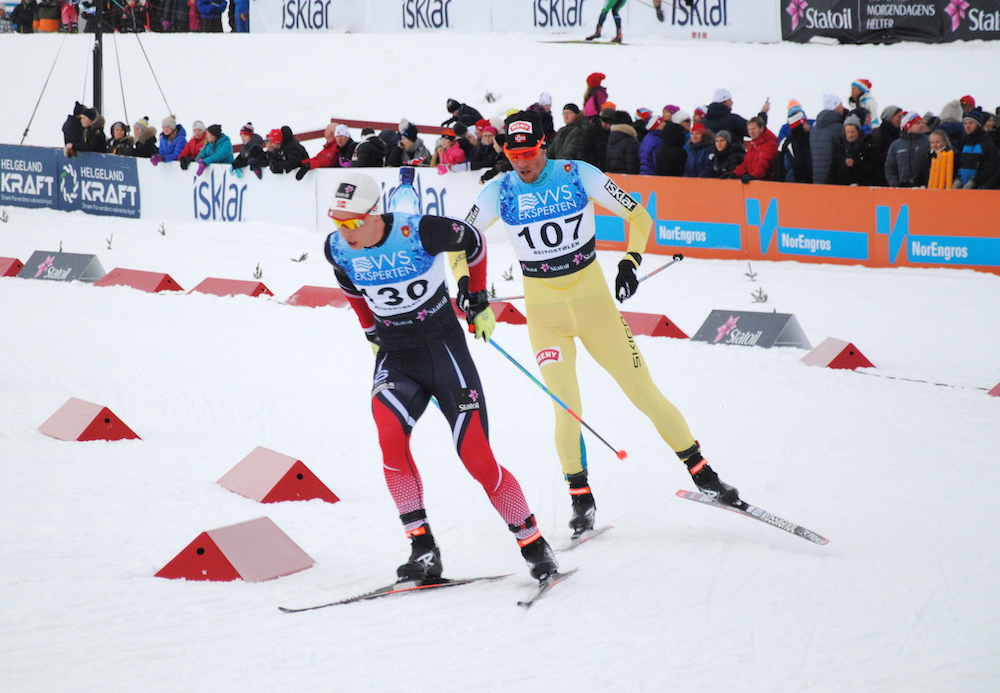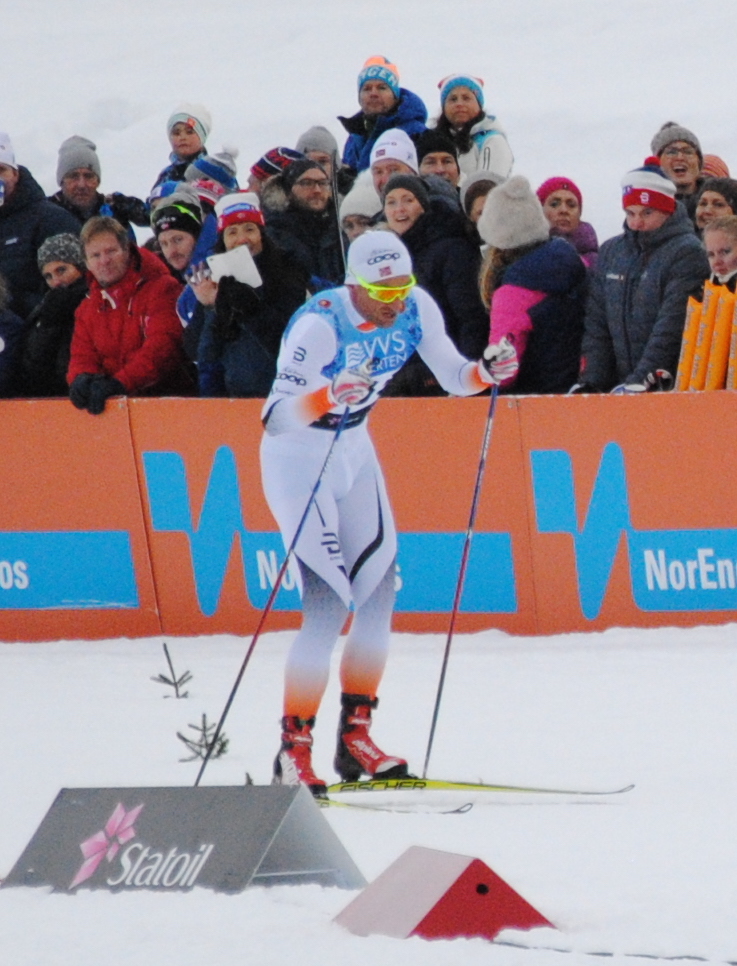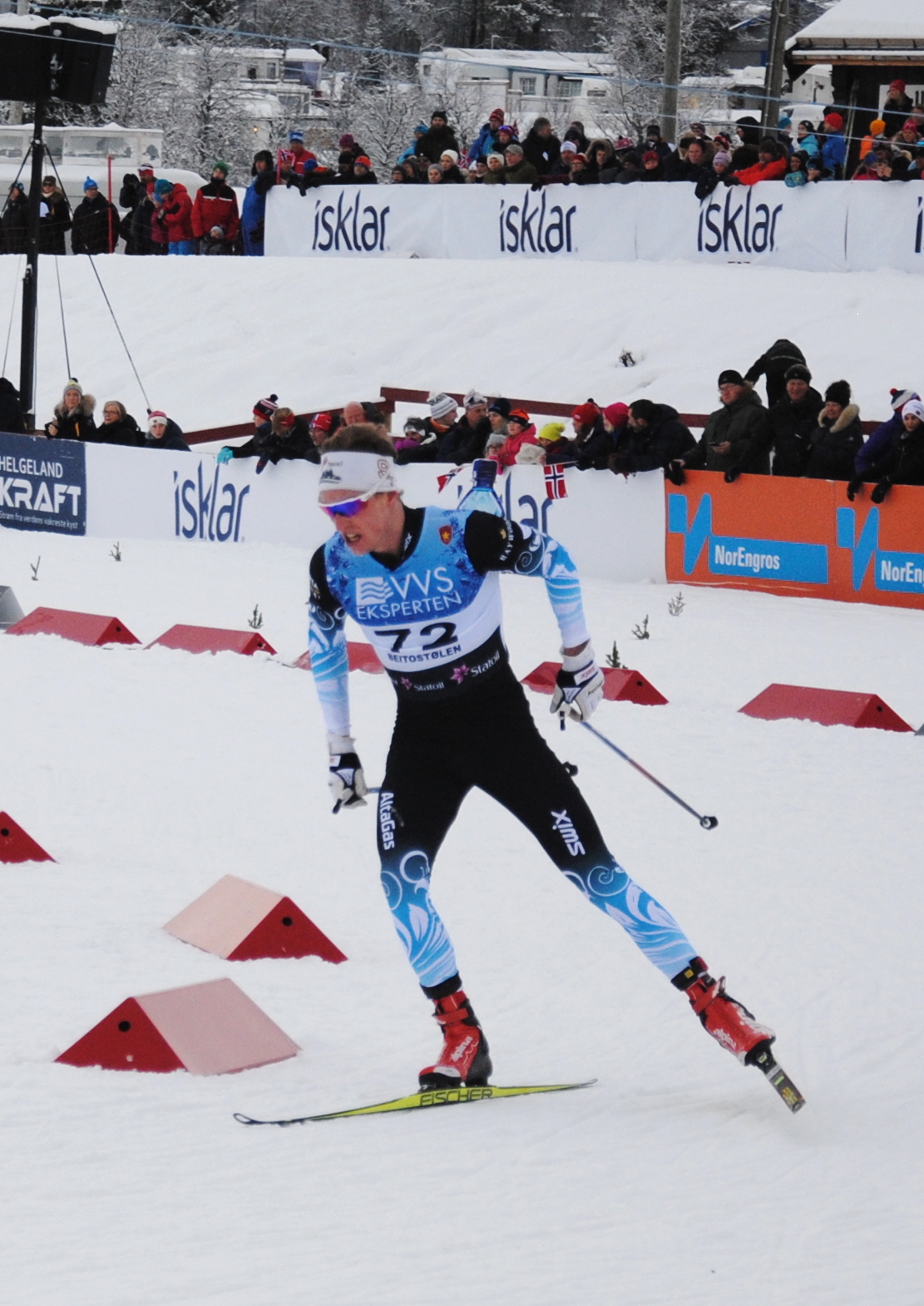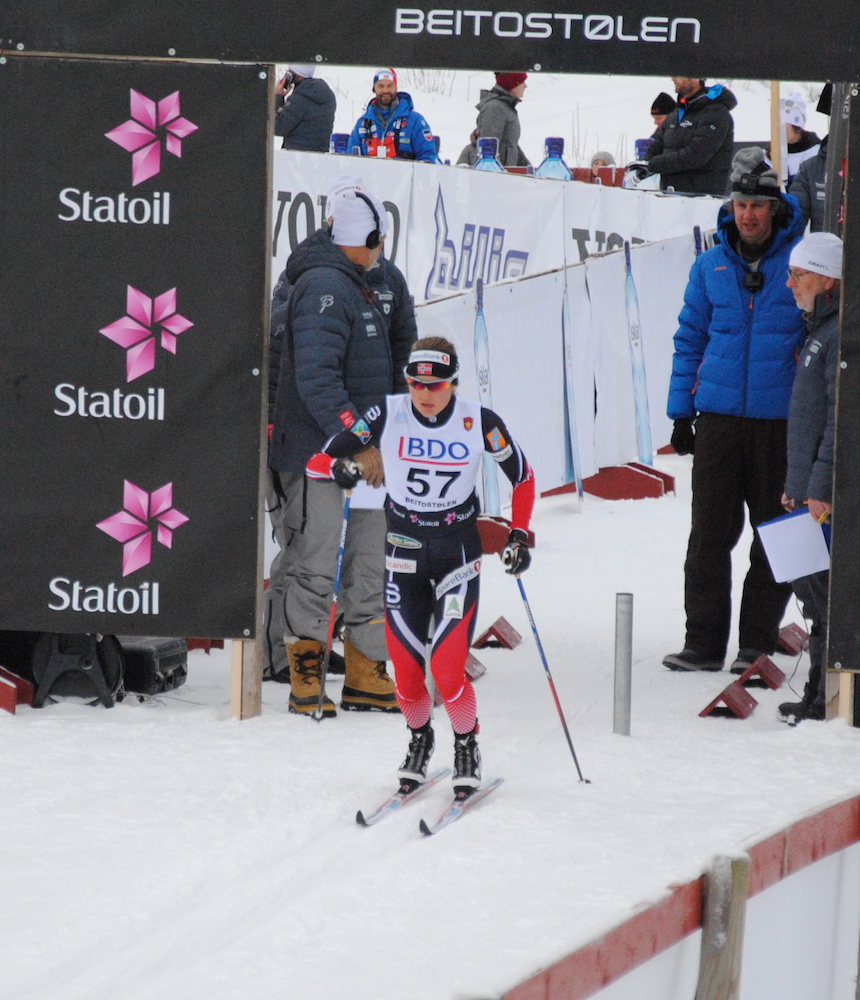
Tag: Andrew Musgrave

  • Klæbo Holds Off Sundby, Bolshunov and Harvey for Ruka Triple Sweep

    Klæbo Holds Off Sundby, Bolshunov and Harvey for Ruka Triple Sweep

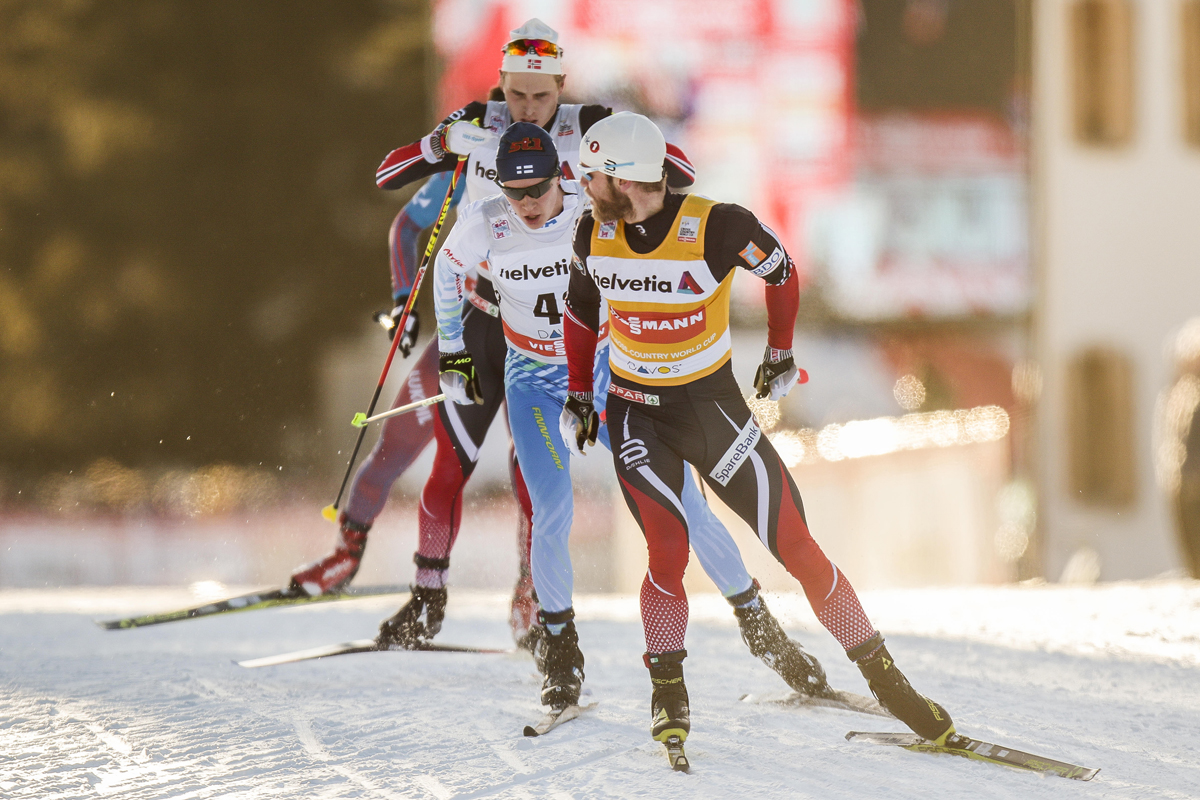
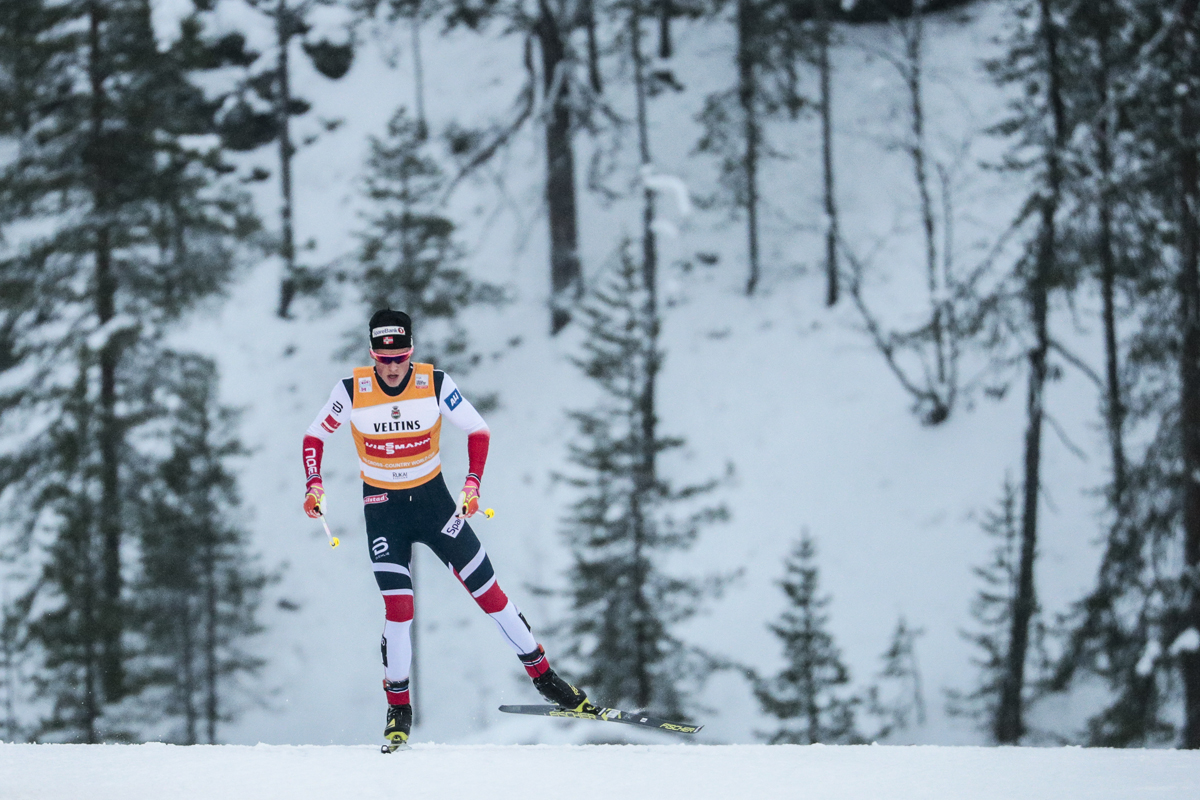
    Norway’s Johannes Høsflot Klæbo en route to his third-straight win in as many days of the World-Cup-opening Ruka Triple in Kuusamo, Finland. He won the 15 k freestyle pursuit for the mini-tour title. (Photo: Fischer/Nordic Focus)

    Two previous days of racing, and back-to-back victories no less, had begun to take its toll on Johannes Høsflot Klæbo within the first few laps of the men’s 15-kilometer freestyle pursuit on Sunday in Kuusamo, Finland. The 21-year-old Norwegian could feel it throughout his body; he was tired and 38 seconds of a starting cushion wasn’t going to be enough to hold off the hungry challengers behind him.

    Klæbo, who won Friday’s classic sprint and Saturday’s 15 k classic individual start on the World Cup opening weekend, wasn’t invincible and he couldn’t race to another win alone. Halfway through the pursuit, the man who started in second place, 38 seconds after him, Russia’s Alexander Bolshunov (who’s actually younger than Klæbo at age 20), had cut that deficit to 19.8 seconds. After him, Norway’s Martin Johnsrud Sundby, who started 10th and 1:05 minutes behind Klæbo, was up to third and just 25.3 seconds back.
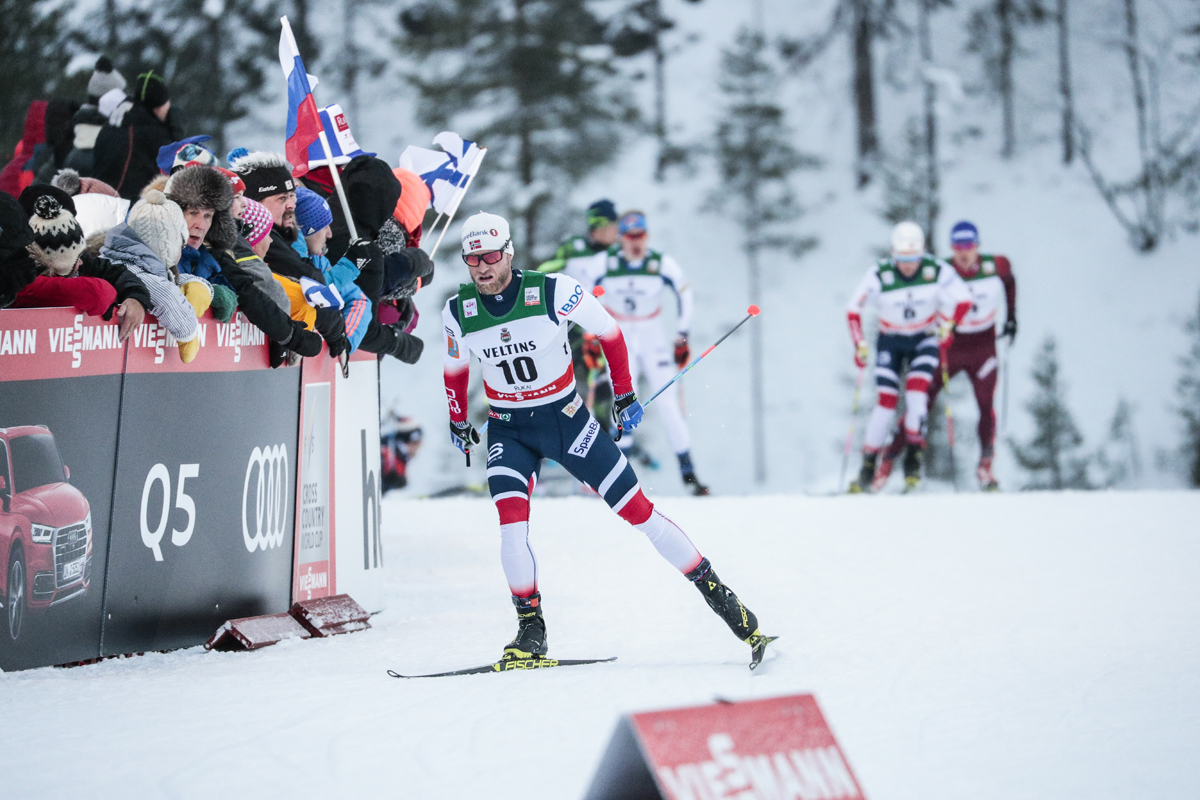
    Norway’s Martin Johnsrud Sundby, who started 10th in the 15 k freestyle pursuit on Sunday, picking off the places on the final day of the Ruka Triple World Cup mini tour in Kuusamo, Finland. (Photo: Fischer/Nordic Focus)

    On his fourth lap, Klæbo accepted the inevitable as Bolshunov and Sundby, who had linked up in an effort to catch him, in fact caught him on a climb around 8.6 k. A larger group of pursuers, including Canada’s Alex Harvey, locked on to the three leaders as well, and from there, the race truly began to take form. Klæbo had to recover, Sundby had to figure out how to try to drop him, Bolshunov had to see what he was capable of, and Harvey had to see how much he could give in the third race of the season.

    The first races of each winter aren’t easy for anyone. Despite spending the summer training for skiing, most North American World Cup skiers don’t get the opportunity to actually race — even on rollerskis — too often during the offseason. Because of the rich ski culture in Europe, rollerski races are a big deal with lots of summer and fall competitions to chose from. And because of Europe’s geography, it’s often easier to get on snow than it is for North Americans.

    (“I think this applies to all the North American actually, compared to Europeans we don’t race as much in summer,” Canadian World Cup coach Ivan Babikov said on the phone on Sunday. “They have races every weekend so they come into the season pretty sharp already with some good speed workouts, when we don’t have that opportunity. So that’s why, I think, every race is a step forward. It’s just, you have to remember or remind yourself how hard it is.”)

    So while Canadians and American World Cup skiers alike often look at an opening weekend like Finland’s Ruka Triple mini tour as a “chance to blow the cobwebs out” or “shake off the rust”, as some have said, it’s also an opportunity to see where you stand — as was the case for Harvey in the final meters of Sunday’s pursuit.

    Later in the fourth of six laps, Klæbo pushed the tempo up a climb, Bolshunov responded, and Harvey went with them. Soon after at 10 k, they lapped through the stadium with 11 men within 2.7 seconds of first. Up front, Bolshunov led Harvey, who had started the race 1:23 back in 12th.
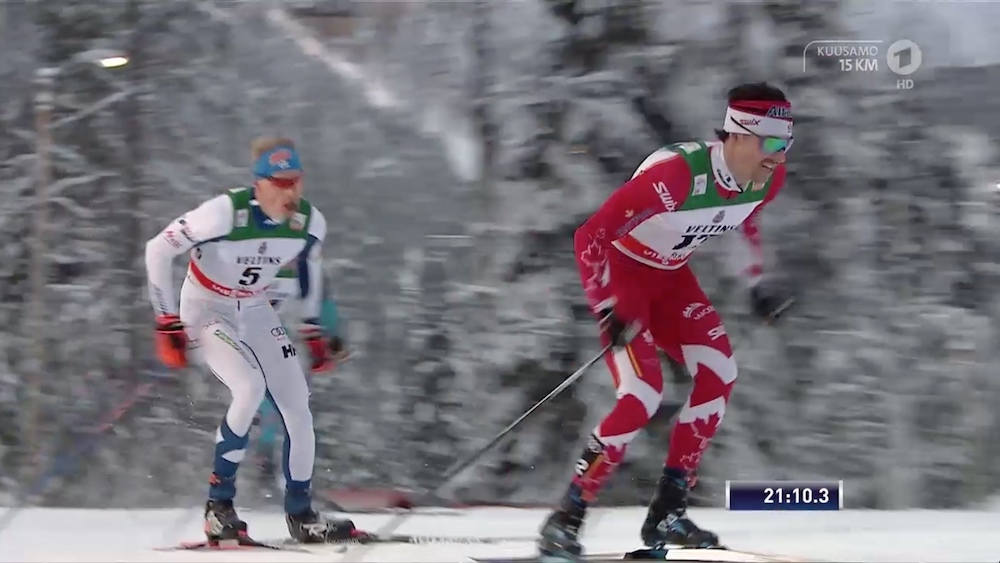
    Canadian World Cup Team member Alex Harvey leads Finland’s Iivo Niskanen during the men’s 15 k freestyle pursuit on Sunday, the final day of the Ruka Triple mini tour in Kuusamo, Finland. (Screenshot: ARD)

    Harvey had spent the first three laps working up to that lead group, initially with the likes of Russia’s Alexey Chervotkin (*who reportedly thanked Harvey after the race) and Sergey Ustiugov, Norway’s Hans Christer Holund and Sweden’s Marcus Hellner, and later with France’s Maurice Manificat, Sweden’s Calle Halfvarsson, Norway’s Emil Iversen, Chervotkin, and Holund, among others.

    “I knew there’d be some fireworks on the last lap so I just wanted to be in the front third of the group, just be ready for a move,” Harvey explained in a post-race phone interview. “I thought Sundby would be the guy making the move, which in the end, that’s what happened. The big uphill in the last lap, that’s where he went. I just wanted to be close to Sundby and ready to respond when Sundby went.”

    Sundby attacked as predicted on the second-to-last climb, around 13.6 k, and Harvey slotted behind him to follow him over the top.

    “I was just actually there on that last uphill when Sundby attacked,” Babikov recalled. “Klæbo was right there. I think there were just Norwegian tactics … Sundby attacked on the last uphill and Klæbo just cooled down and wasn’t chasing him at all, so for Alex, that was his only chance. … If he didn’t chase him, then Sundby probably would have skied away and it would have been a bigger group at the finish, but at the moment he tried, and they actually created a gap … Alex second and Sundby first.”

    With a few meters separating them from Norway’s Didrik Tønseth in third and Klæbo in fourth, Harvey thought he and Sundby had dropped them and that he would fight for first to the finish.

    “I kind of went all-in with the Sundby move,” Harvey said. “When I looked in between my legs just before the last downhill I thought we had a big enough gap … so I was feeling pretty good about my chances there, but not good about taking [Sundby] because I was really, really dead.”
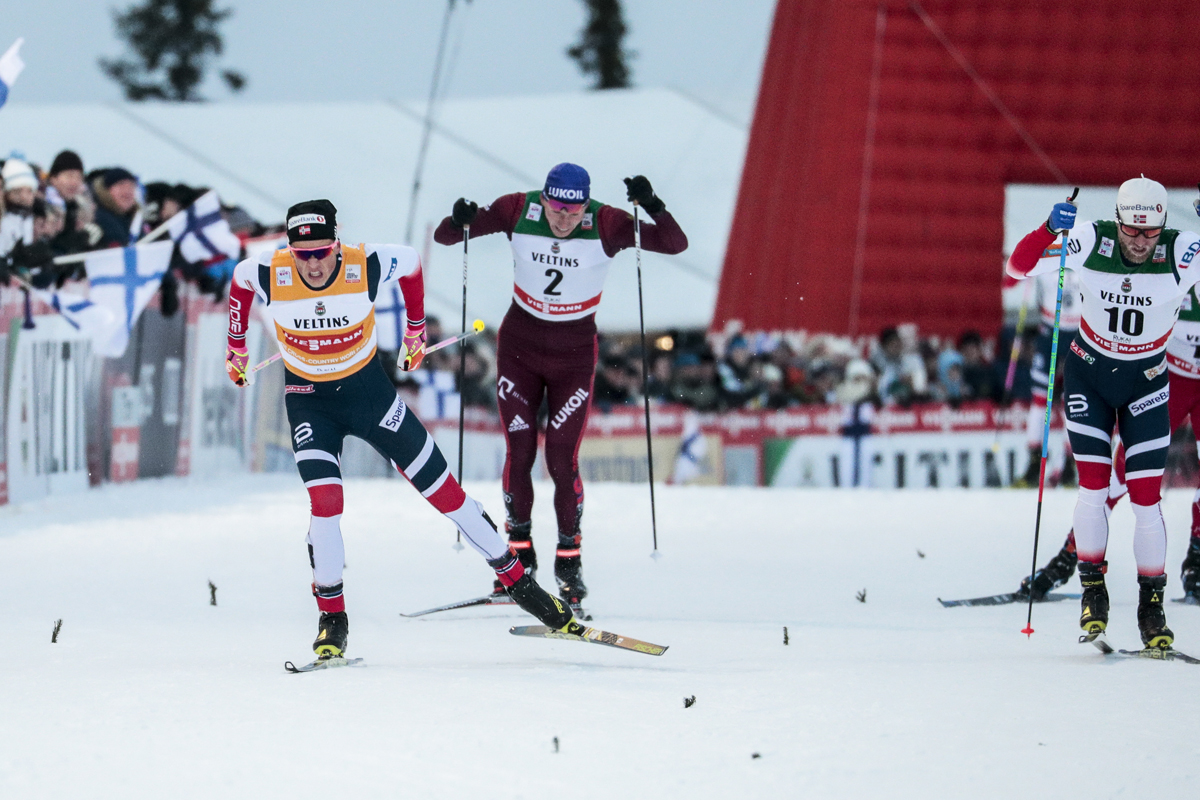
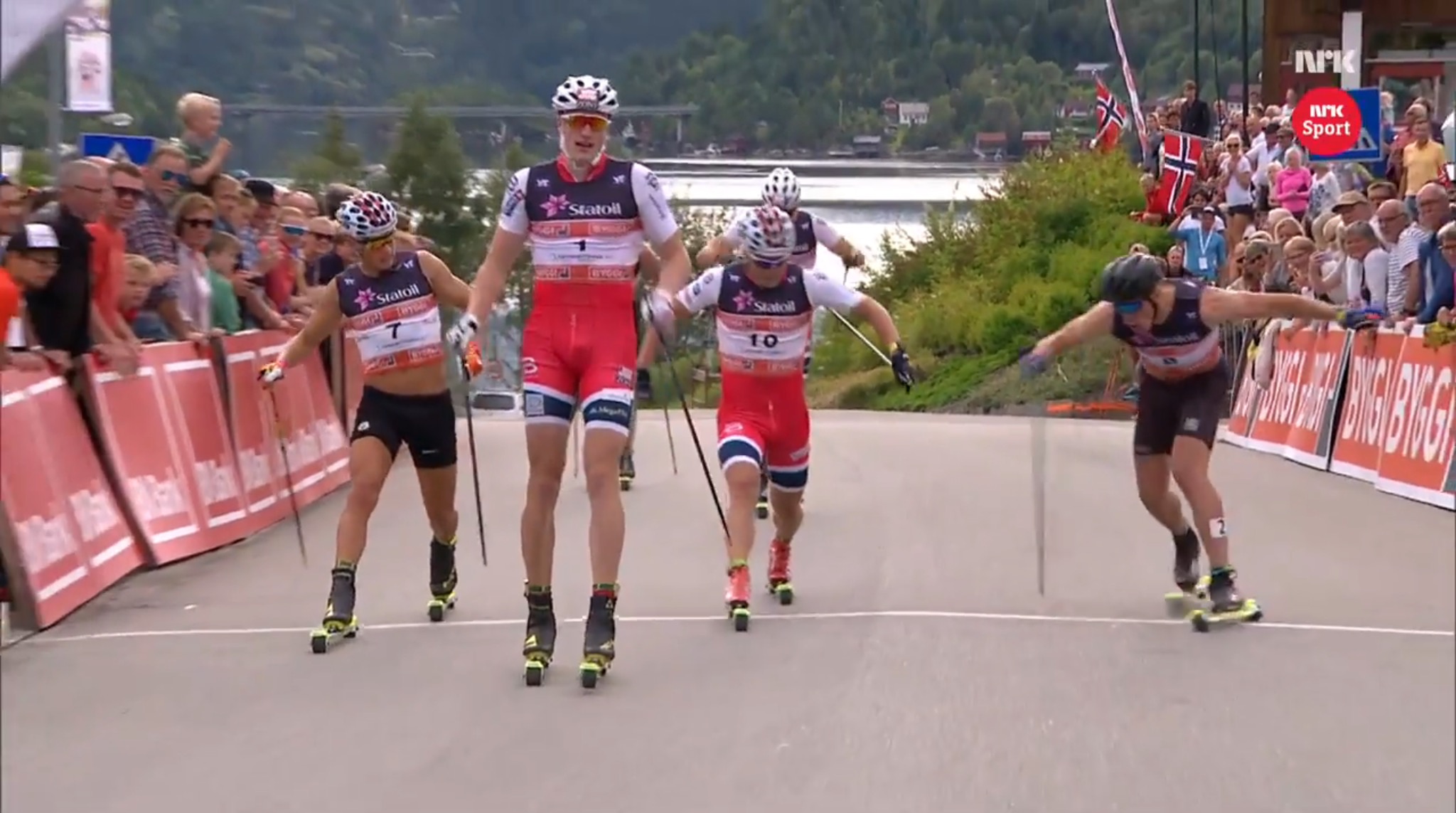
    Johannes Høsflot Klæbo (l) passing fellow Norwegian World Cup Team member Martin Johnsrud Sundby (10) for the win in Sunday’s 15 k freestyle pursuit at the Ruka Triple mini tour in Kuusamo, Finland. Russia’s Alexander Bolshunov (2) was 1 second back in third place for his first World Cup podium while Canada’s Alex Harvey (behind Sundby) placed fourth. (Photo: Fischer/Nordic Focus)

    After what Harvey estimated to be a 45-second downhill, he realized that wasn’t the case. Klæbo and Bolshunov had slingshot back toward the front, and while Sundby was first to the top of the last climb before the finish, Klæbo and Bolshunov were right behind him while Harvey followed in fourth.

    They entered the stadium together in that order, and Klæbo passed Sundby with about 100 meters remaining to take his third-straight win of the weekend.

    “Coming out of my tuck there I was just full of lactate, not feeling any fresher … then I just got passed on the hill,” Harvey recalled. “I had nothing left. That was my move. … I’m happy I made that move, but I couldn’t make a second burst after that.”

    While Klæbo won the pursuit and with it, the Ruka Triple mini-tour title in 36:23.2 minutes, Sundby placed second, 0.4 seconds back, Bolshunov claimed his first World Cup podium in third (+1.0), and Harvey finished another 0.6 seconds back in fourth (+1.6).

    On the day, Harvey’s course time ranked fifth fastest behind Manificat, who was the “winner of the day” in 34:50.9. Finland’s Matti Heikkinen was second fastest (+5.4) after starting 22nd and placing 14th, Holund was third fastest (+7.5) after starting 14th and finishing ninth, and Switzerland’s Dario Cologna, who started 26th and finished 17th, was fourth fastest (+8.7).

    Harvey said starting 17 seconds behind Sundby was a tall task on its own, and he had started the race with a goal of breaking into the top 10 overall. All things considered, fourth place was better than he expected at this point in the season.

    “… But I knew it was still within reach,” Harvey explained. “I believed in it, but I didn’t put too much hope in, let’s say, a top five or fighting for the podium. It was more like I wanted to be back in the top 10 and just that to me seemed already hard enough.”
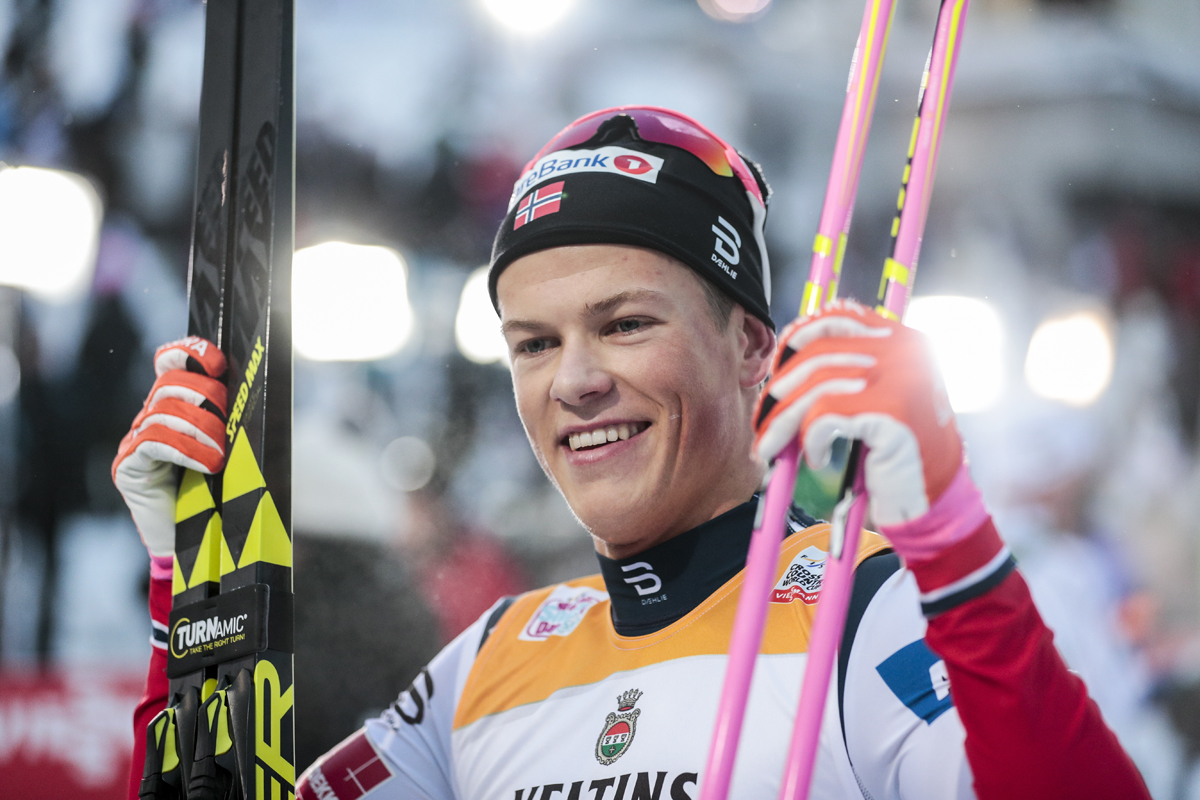
    Norway’s Johannes Høsflot Klæbo after winning the 15 k freestyle pursuit on Sunday to win the Ruka Triple mini tour in Kuusamo, Finland. (Photo: Fischer/Nordic Focus)

    The fact that he was able to hang with Klæbo and Sundby to the finish was a good sign, he added.

    “Right now, he’s not just a good sprinter, he’s the best distance skier in the world, too,” Harvey said of Klæbo. “I mean, to win a 15 k individual you have to be in very, very good physical shape, so he’s in really good physical shape and I know I’m not yet. I’m not in my best form and Sundby probably isn’t yet, so you never know what’s going to happen later in the season at the Olympics, but for now it’s hard to drop him when he’s actually just in better shape than everybody else in the world.”

    After the race, Klæbo told NRK he was relieved to get the win and have some time to rest before next weekend’s World Cup in Lillehammer, Norway.

    “My legs are shaking now,” Klæbo said. “Feels incredible to be the first to cross the finish line. Now I need a few days rest.

    “This was brutal,” he added. “I’m actually glad they caught up to me and luckily I had good skis. I’m glad I had a few seconds today.”

    Norwegian national-team coach Tor-Arne Hetland told NRK he was “really impressed” with Klæbo.  “We have a diamond in the sport of cross country skiing now,” Hetland said.

    “That’s very nice of him to say. It’s probably a little too much, but it has been a good start to the season,” Klæbo responded to NRK.

    Sundby spoke excitedly about having Klæbo to contest for the overall World Cup lead.

    “For the moment, he’s taking international cross-country skiing for men to a whole ’nother level,” Sundby told NRK. “It is a little humiliating for the rest of us, but at the same time it’s extremely inspiring to see what he does in his second year at this level. It’s hell of fun to have a guy like that on the team.”

    Bjornsen 26th, Kershaw 29th; Caldwell Posts Top-20 Time of Day

    Canada had two in the top 30 on Sunday with Devon Kershaw in 29th (+1:47.8), scoring World Cup points for the second-straight day. He started 28th and 1:59 out of first, just one second behind Cologna in 26th and Russia’s Andrey Larkov in 27th.

    “I just wasn’t strong enough to go with Dario,” Kershaw said on the phone. “I had the perfect chance to be able to follow Dario up the field, but he just started so fast, and on the steep terrain, my legs just — I tried up the first steep wall and at the top, I’m like, man, if I keep going like this, after 5 k I’m gonna be dead.
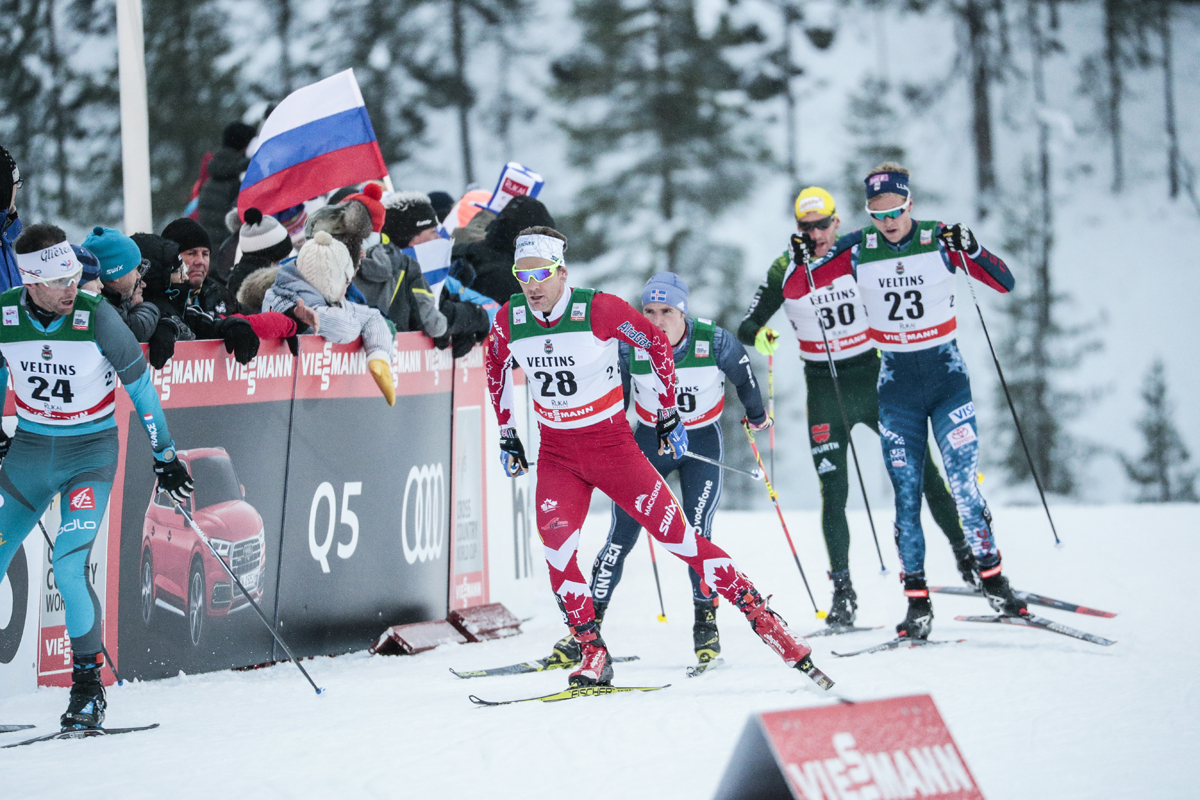
    Canada’s Devon Kershaw (28) leads American Erik Bjornsen (23) and others during the World Cup men’s 15 k freestyle pursuit on Sunday in Kuusamo, Finland. (Photo: Fischer/Nordic Focus)

    “So I had to manage my energy a little bit and in the end, it turned out that Bjornsen and I’s group just wasn’t strong enough,” Kershaw continued, referring to U.S. Ski Team member Erik Bjornsen, whom he started eight seconds behind and spent most of the race with. “[Our group] had a good 7 1/2 k and then after that, between 7 1/2 kilometers and 12 k, we were skiing really slow. So that’s a bit frustrating in a pursuit because you’re just stuck there in no-man’s land.”

    While he felt like he was skiing the flats well, Kershaw said he struggled with the “biting” conditions, which seemed to limit glide, especially on the notoriously steep course’s climbs.

    “I had to make the choice to be like, OK, I’ve got to just stay in this group and I’m not strong enough to drive the bus, because my legs just weren’t there today on the terrain” he said. “In the end I made a tactical error in the last 600 meters. I should’ve followed Bjornsen on the outside and I went on the inside and was hoping it would open up for me and it didn’t. So I ended up 29th, but that’s OK.”

    Bjornsen started 24th and finished the pursuit in 26th (+1:43.6), after following Larkov in 25th (+1:42.8) across the line and holding off Iceland’s Snorri Einarsson (a former Norwegian skier who raced for the University of Utah) in 27th (+1:46.2), Great Britain’s Andrew Musgrave in 28th (+1:47.2), Kershaw in 29th, and France’s Jean-Marc Gaillard in 30th (+1:49.2).

    “I started right around Cologna and [Finland’s Matti] Heikkinen but there was no way I was going to hold their pace, they were flying,” Bjornsen wrote in an email. “I had to settle in with the group around me. It soon became clear our group was not going to catch anyone in front of us or get caught, so it became a tactical game. Some surges, but for the most part nobody wanted to lead.”
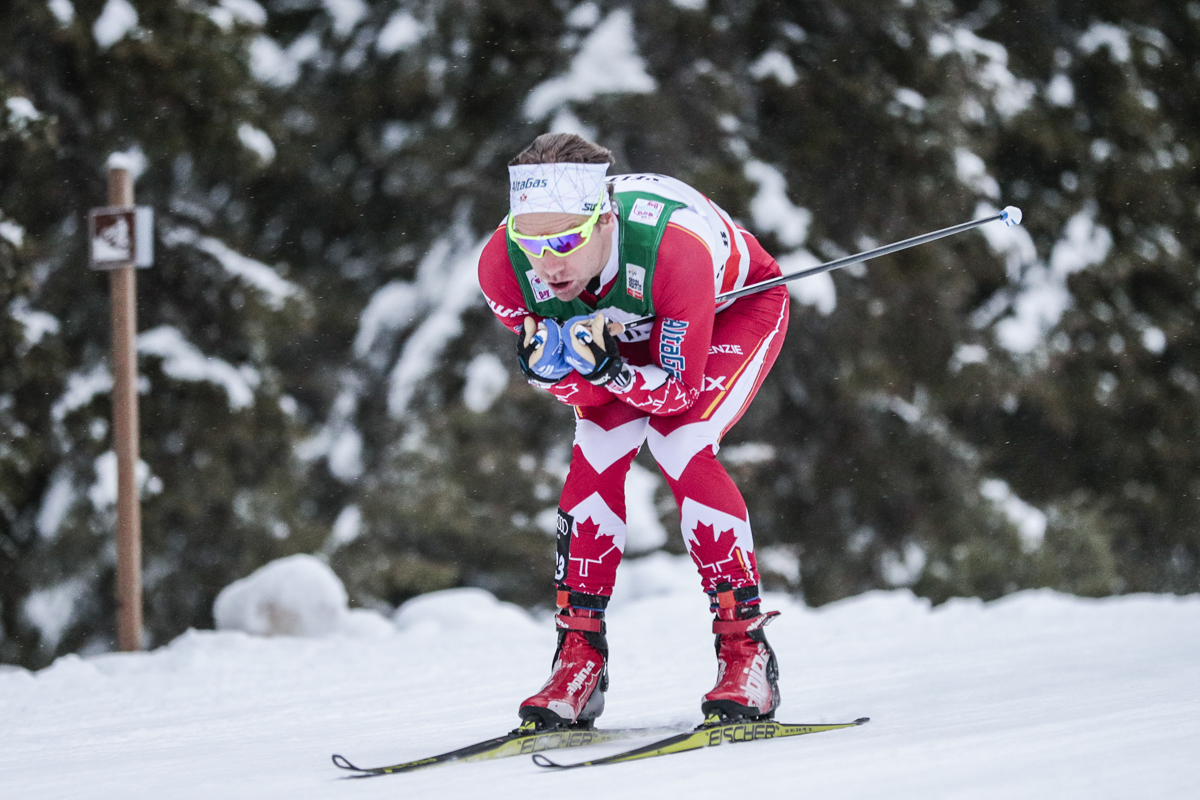
    Devon Kershaw (Canadian World Cup Team) en route to 29th in the 15 k freestyle pursuit on the last day of the Ruka Triple World Cup mini tour in Kuusamo, Finland. (Photo: Fischer/Nordic Focus)

    Kershaw laughed when he talked about some “tips” he gave Bjornsen during the race.

    “He had really fast skis so there were a few times that he came by me on the downhill and then would kind of try to hammer for a minute and then get tired and slow down again,” Kershaw said. “I told him, like, ‘Dude, you’ve got great skis. Unless you can stay in the front and really press, then it’s better just to play the game and wait for the end.’ After that, he did that and he torched us all in the end. So that was kind of fun to see for him.”

    According to Bjornsen, Kershaw suggested he sit back and wait for the sprint.

    “My skis were good but I think my weight is what helped me the most on that last huge downhill,” Bjornsen wrote. “I was fine going for that tactic but at the same time it would have been nice to leave a little more out there today. Stoked to get double points for 26th though!”
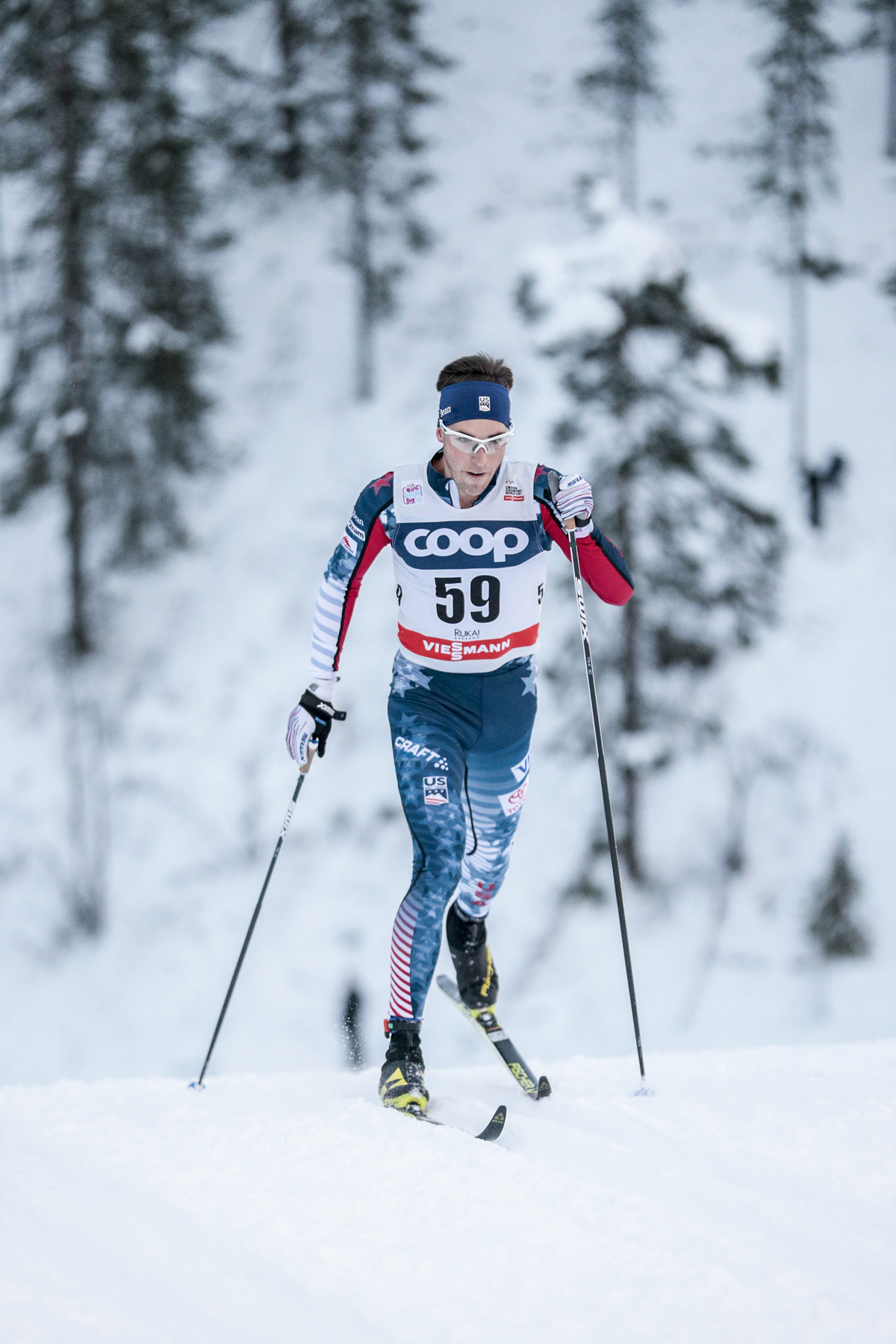
    Paddy Caldwell (U.S. Ski Team) racing to 70th in the men’s 15 k classic on Saturday, Day of the Ruka Triple World Cup mini tour in Kuusamo, Finland. In Sunday’s 15 k freestyle pursuit, he skied up to 51st with the 19th-fastest time of day. (Photo: Fischer/Nordic Focus)

    Paddy Caldwell, new to the U.S. Ski Team B-team this year, posted his best World Cup result with the 19th-fastest time of day, 50.5 seconds back from Manificat. He started with the wave in 70th and finished 51st overall (+3:03.1).

    “Going into the race my goal was to move up as much as possible,” the 23-year-old Caldwell wrote in an email. “I wasn’t really thinking about place or time of day – I was just trying to ski fast and put together a good effort.

    “It was really hard to move up in the pack,” he added. “I started midway back in the wave and we kept picking up more and more skiers as the race went on. I tried to relax as much as possible on the hills and build in energy to pass where I could on the flats. … I am really excited with the day and psyched to have had a good result here in Ruka. I’m looking forward to the rest of period 1 and learning more from the big dogs!”

    “Very exciting race out of Erik today,” U.S. Ski Team coach Matt Whitcomb commented on the phone. “… When he settled to the back of his pack on Lap 6 and headed into the downhill with one climb to go, we just all sort of expressed confidence over the U.S. radio channel, got ready see what he could do.  It is so fun to watch him in a stadium when he has to go head to head against five other athletes … he did not disappoint today. Really proud of Erik’s 26th place.”

    As for Caldwell, who skied the 25th fastest time of day in the 2017 World Cup Finals freestyle pursuit, Whitcomb said, “this is his race, the skate distance.”

    “There were times that he was a little bit road-blocked out there, just the way the pursuit race unfolds in that start … and it looked like today Paddy could keep going, so really great signs out of him,” Whitcomb said.

    Whitcomb also highlighted the races of Scott Patterson, who raced up from 78th to 55th (+3:28.4) with the 31st-fastest time, and Noah Hoffman, who improved from 45th to 39th (+2.33.3) with the 35th-fastest time. Also for the U.S., Andy Newell finished the tour out in 75th (+5:39.6).
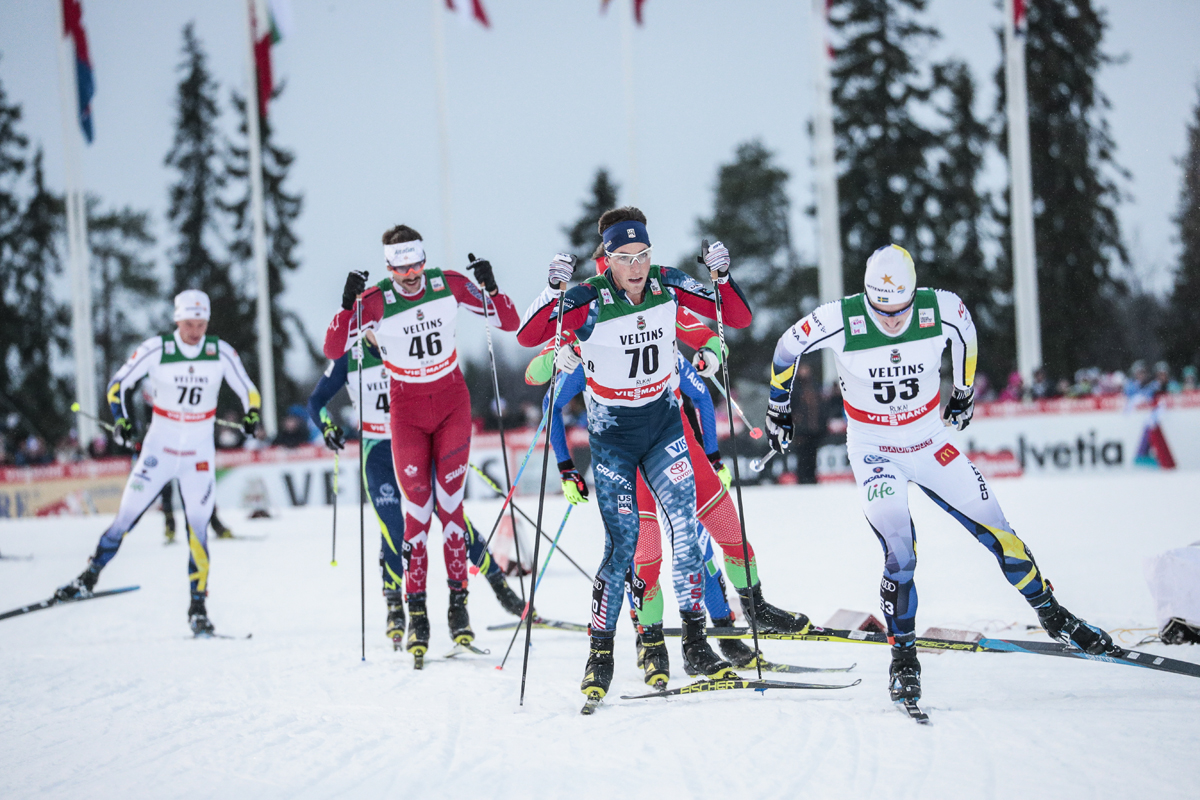
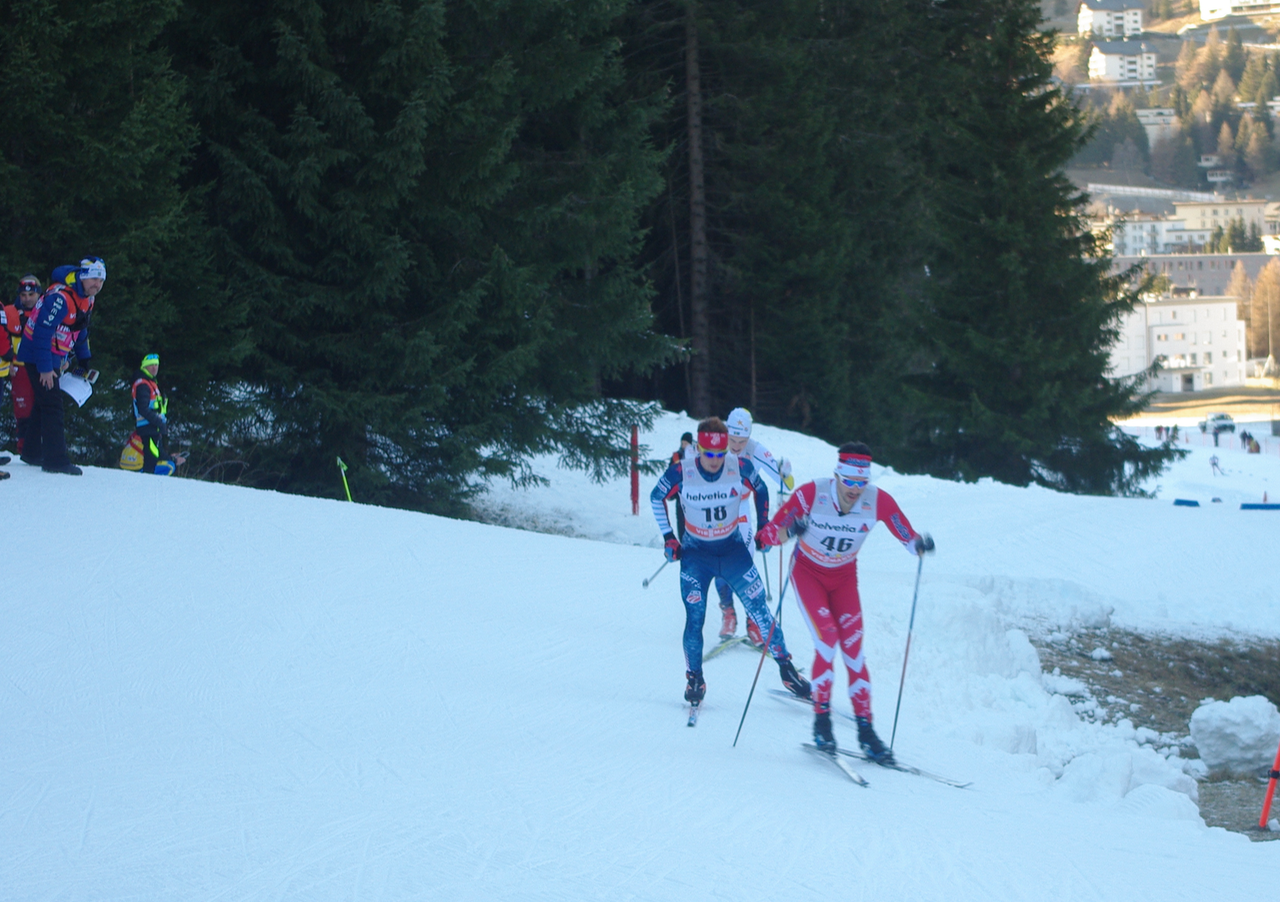
    American Paddy Caldwell (70) racing with Sweden’s Jens Burman (front) and Canada’s Len Valjas (46), among others, during Sunday’s World Cup 15 k freestyle pursuit on the last day of the Ruka Triple in Kuusamo, Finland. (Photo: Fischer/Nordic Focus)

    Canada’s Len Valjas moved up two places for 44th overall (+2:47.5), Graeme Killick finished the tour in 68th (+4:39.5), Knute Johnsgaard 81st (+6:43.6), and Julien Locke 83rd (+7:33.6).

    Babikov pointed out that Valjas had a shoulder injury that he mostly recovered from, but caused him to struggle with double poling in Friday’s sprint. Despite placing 63rd in that sprint, Valjas was the team’s third-best man in the weekend’s distance races.

    “[In] two distance races, he was third best and actually placed higher than he placed in sprint in the distance, 15 k, hardest one with lots of climbing,” Babikov said. “So that shows he has a good shape, but just needs to scrape that rust off and remember how to go fast again. I think physically he is in a good place, just need to do some more races, and it will come.”

    ***

    *Post-race sidenote: According to Harvey, after the race, the Russian team’s massage therapist told Canadian coach Ivan Babikov that Chervotkin wanted to thank Harvey for pulling him in the pursuit. Chervotkin, 22, started 11th and finished fifth, 6.2 seconds out of first and 4.6 seconds after Harvey in fourth.

    “There’s a bit of beef with the Russians and me right now,” Harvey said. “I came in wondering if they were just going to punch me in the face. They said they wanted to break my teeth, so this is a good turn of things.”

    As Harvey understands it, that was because of what he’s said to journalists regarding Russian doping at the 2014 Olympics.

    “I read that in the Norwegian news, actually, that Petukhov wanted to …,” he said with a laugh. “But I knew the media likes that sort of thing. But I think things are good now.”

    Harvey noted that Bolshunov and Chervotkin, neither of which have been implicated in the doping scandal, are part of “a new generation” in Russian cross-country skiing. “I saw the results in Bruksvallarna; it looks like the have almost as much depth as Norway does. They’re really strong.”

    Results: Men’s pursuit | Men’s time of day

    — Aleks Tangen, Ian Tovell, Jason Albert, and Harald Zimmer contributed
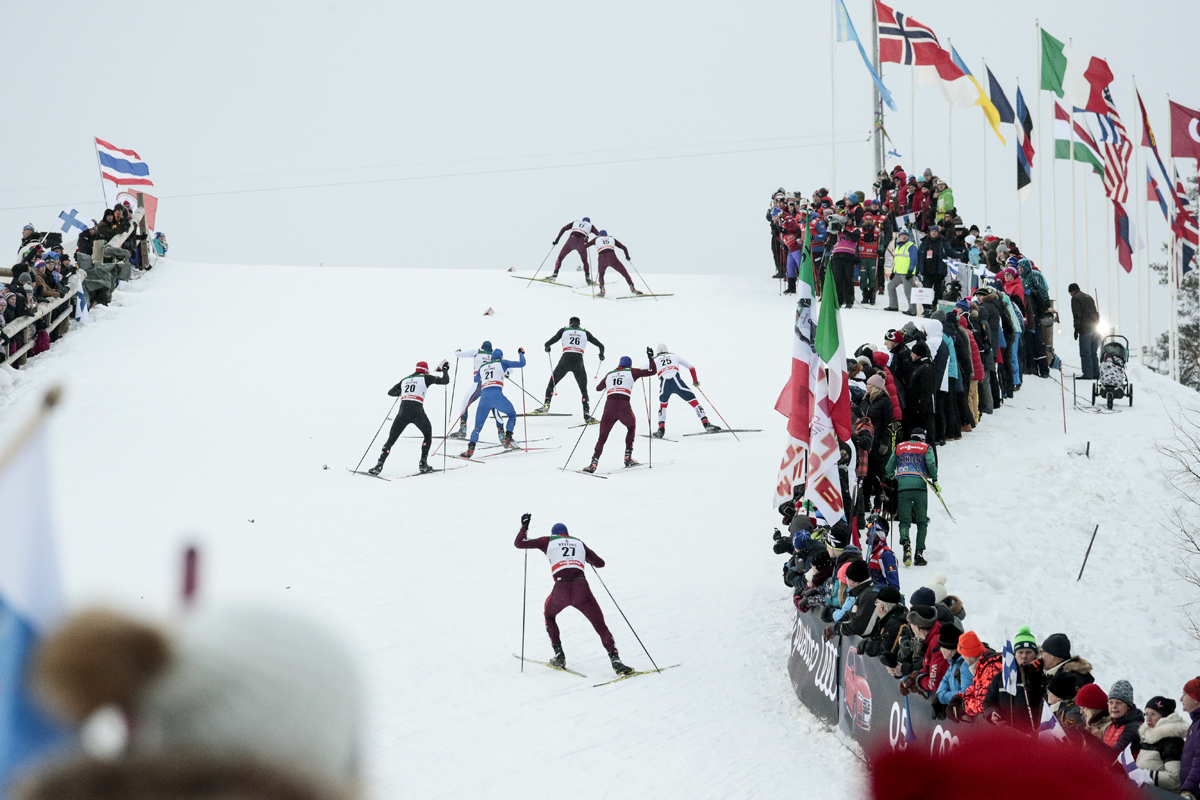
    Racers in the Ruka Triple World Cup 15 k freestyle pursuit, including Russia’s Andrey Larkov, Switzerland’s Jonas Baumann, Italy’s Federico Pellegrino, Switzerland’s Dario Cologna, and Norway’s Simen Hegstad Krueger, ascend a climb in Kuusamo, Finland. (Photo: Fischer/Nordic Focus)
  • Bjørgen, Krüger Top Distance Skate Races in Beito; Hart 19th

    Bjørgen, Krüger Top Distance Skate Races in Beito; Hart 19th

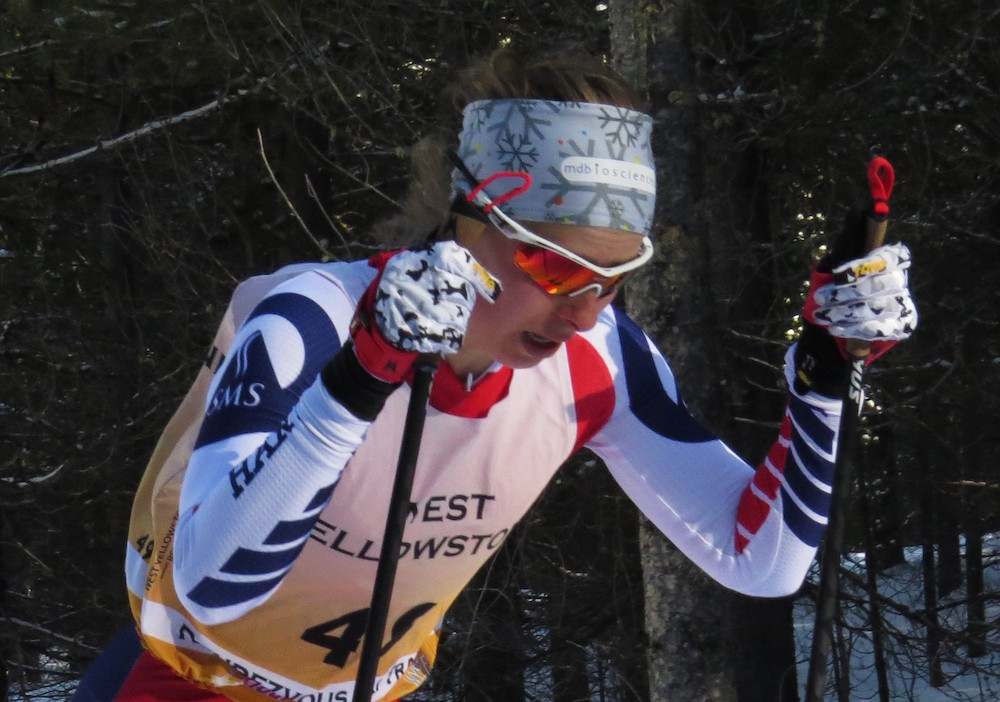
    Anne Hart (SMST2) racing at last year’s 5 k classic FIS race in West Yellowstone, Montana, where she finished 12th. A year later, Hart placed 19th in the Beitostølen, Norway, 10 k freestyle race. (Photo: Ian Harvey/Toko)

    In one weekend of racing, Anne Hart has already learned a lot, the types of things you can only learn from careful observation and reflection. And for Hart, a 25-year-old member of the Stratton Mountain School (SMS) Elite Team, the season doesn’t truly begin until Dec. 2.

    After racing to 19th in the women’s 10-kilometer freestyle individual start on Sunday in Beitostølen, 2:41.9 minutes behind Norwegian winner Marit Bjørgen, Hart talked about being inspired by numerous speedy Norwegians there — many of which are gunning for a spot on Norway’s World Cup team.

    Hart ventured to Norway earlier this month to jumpstart her season before heading back to the U.S. to race the SuperTour opener in West Yellowstone, Montana, Dec. 2-3. In two previous races in Beitostølen on Friday and Saturday, she finished 31st in both the 10 k classic and classic sprint.

    On Sunday, she resolved to leave it all out there, just as she’d seen Norwegian World Cup regular Finn Hågen Krogh do.

    “Today we were watching the men’s race [before our race], and we watched Finn Hågen Krogh halfway up the hill the last time, the third time. I kid you not, he just stopped, bent over and he went on and finished fifth,” Hart reflected. “He went out hard, he blew up, but he made up so much time at the beginning that he just had to make it in.”

    That’s precisely what Hart’s been working on.

    “I really just pushed it from the go,” she said of her race. “After watching the [top] women start the classic race [on Friday], and then watching how fast they go in the sprints [on Saturday], there is just no easy pace out there … You just keep on going, and you suffer. But the harder you suffer the faster it is over.”

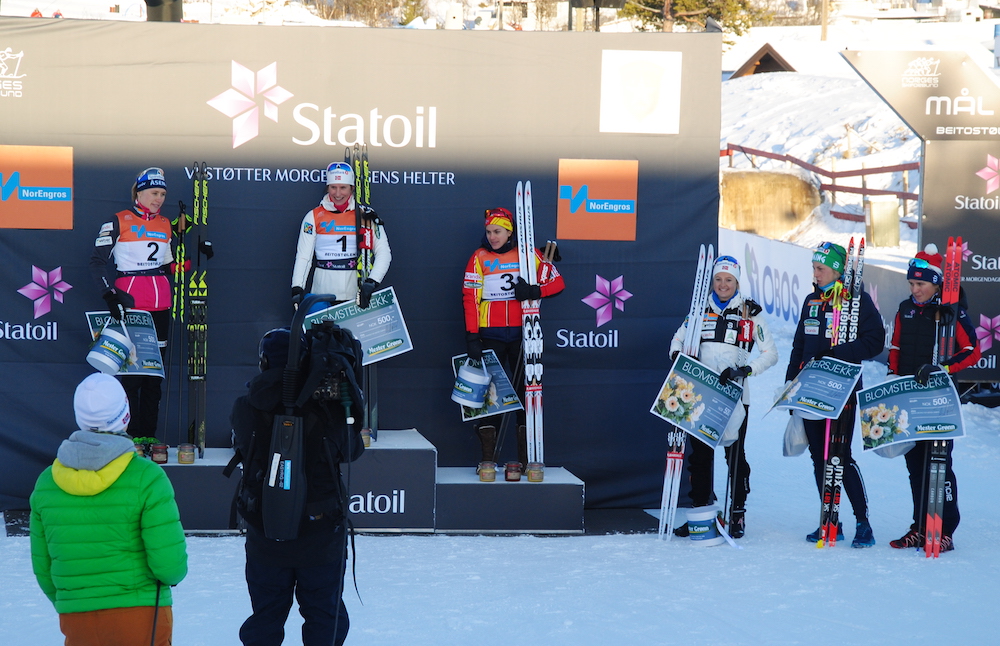
    The women’s podium (and top six) after Sunday’s 10 k freestyle in Beitostølen, Norway, with Norway’s Marit Bjørgen (1) in first, Ragnhild Haga (2) in second, Heidi Weng (3) in third, Ingvild Flugstad Østberg in fourth, Astrid Uhrenholdt Jacobsen in fifth, and Tiril Udnes Weng in sixth. (Photo: Aleks Tangen)

    Hart finished her 10 k, in what she described “beautiful skiing” conditions, in 26:37.1. Bjørgen raced to first for her second distance win of the long weekend in 23:55.2, 12.6 seconds ahead of Ragnhild Haga in second place. Norway once again swept the podium with Heidi Weng in third, 30.1 seconds behind Bjørgen.

    “It’s a course that doesn’t have a lot of rest in it … basically I was just trying to V2 as much as I could, because I noticed that’s another thing they do over here,” Hart said. “It’s like riding a bike; it’s easier to go in a lower gear. … I know I am a stronger V2-er, and the longer I can V2 up the hills, I figured the better I would do overall. Then [I] backed off, worked on quick turnover, and then really tried to push the V2-ing.”

    For much of the race, her split times hovered between 19th and 20th. But after a strong effort from 7 to 9.8 k, where she clocked the 15th fastest time in 7:58.2, Hart secured 19th, 8.5 seconds behind 18th-place finisher Silje Theodorsen, of the Norwegian National U23 Team, and 12 seconds ahead of 20th, which went to Norway’s Magni Smedås (Lillehammer Ski Club).

    That stands as Hart’s best international finish outside of an Alpen Cup last season in Seefeld, Austria, where she notched two top 20’s. Each year, Norway’s season-opening FIS races in Beitostølen attract most of Norway’s top skiers and upcoming talent.

    So 19th in Beitostølen is a big deal.

    At the time of her post-race interview with FasterSkier, Hart wasn’t sure where she ended up. But she knew she pushed herself to the limit.

    “I think last year I suffered from over-pacing, and it’s gonna hurt no matter what you do,” she said. “And I am very much of the mentality, for me anyways, to just go all in, no fear. And the worst thing that happens is you blow up.”

    In terms of how her results in Beito will affect her moving forward, she said it was about building confidence with each race and “having faith in my training and my fitness. The worst feeling in the world is when you finish and are like, ‘Damn, I could have gone harder.’ I would much rather literally collapse out on the course.”

    Great Britain’s Annika Taylor, who grew up in Truckee, California, and raced at the University of New Hampshire, placed 23rd (+3:09.9). Taylor, 24, finished 29th in the 10 k classic two days earlier

    At the front of Sunday’s race, the final time between Bjørgen and runner-up Haga was what made the news. One Norwegian journalist asked Norwegian women’s team coach Roar Hjelmeset if “this was almost like a victory since the gap was so small”. He replied “no” but added that it was “a very good performance” for Haga.

    Bjørgen started last in bib 63 and, as she typically does, clocked the fastest times through essentially every checkpoint and put more time into her competition with each passing kilometer. Haga’s time from 4.9 to 6.1 k was actually 2.5 seconds faster, but Bjørgen later told reporters that she expected a strong performance from her 26-year-old teammate.

    “The race was acceptable,” she told NRK. “I was prepared for Ragnhild’s approach since she’s better at skating, but I felt like I was somewhat in control.”

    Haga was pleased to hold on to second ahead of fellow World Cup Team members Weng (who ended up third) and Ingvild Flugstad Østberg in fourth (+32.3).

    “I had hoped to kick harder from the start so that Ingvild wouldn’t catch up to me,” Haga told NRK. “I didn’t tighten up and was able to keep pushing. I couldn’t really do anything about Marit, but I was closer than normal.”

    Both Weng and Østberg told NRK how impressed they were with Haga’s performance.

    “Ragnhild has shown strength over a lot of years,” Østberg said.

    Weng added that she was impressed Haga gave Bjørgen a fight for first place.

    “[Haga] does this because she’s been able to train well over the course of long time, and she has done very well leading up to this season,” Hjelmeset explained to a group of reporters.

    Krüger: ‘It’s a big deal’

    In the men’s race, Norway’s Simen Hegstad Krüger took advantage of the optimal conditions — with temperatures between -6 and -9 degrees Celsius, firm tracks and a clear blue sky — to win the 15 k freestyle by 16.5 seconds in 32:59.6.

    He did so after starting in bib 122 of 124 and taking control of the race at 2.1 k. Krüger led from that point on, clocking the fastest splits in every stretch except from 11 to 11.9 k. At the finish, he beat out the likes of fellow Norwegian World Cup Team members Hans Christer Holund in second, Hågen Krogh in fifth (+42.1), Sjur Røthe in sixth (+42.8), and Martin Johnsrud Sundby in seventh (+52.9).

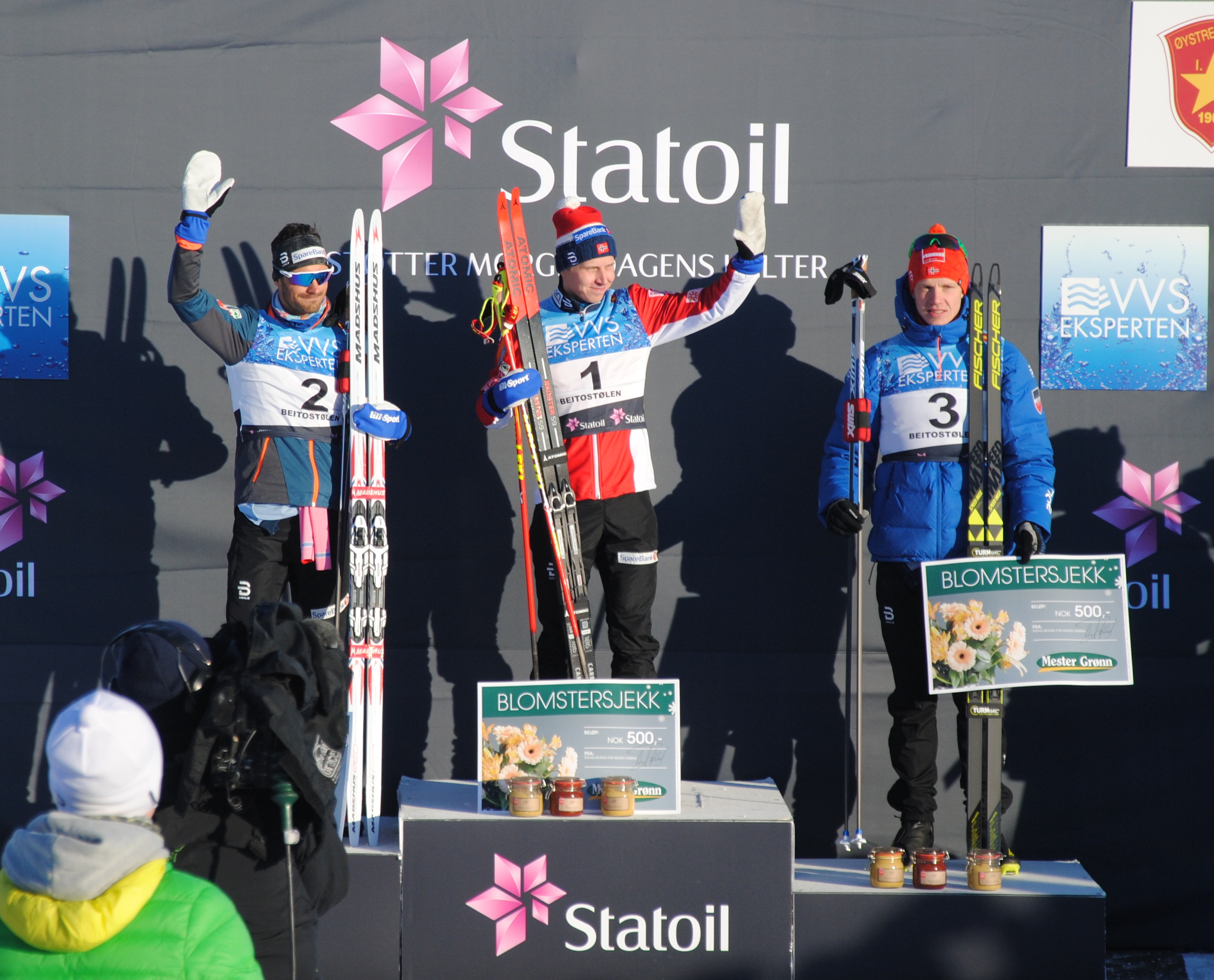
    The men’s podium after Sunday’s 15 k freestyle FIS race in Beitostølen, Norway, with Norway’s Simen Hegstad Krüger (1) in first, Hans Christer Holund (2) in second and Jan Thomas Jenssen (3) in third. (Photo: Aleks Tangen)

    “This is incredibly cool,” Krüger told NRK. “Even if it’s early in the season, it’s not common to win at this level. It’s a big deal when entire Norwegian elite is here.”

    Notably, 21-year-old Norwegian Jan Thomas Jenssen, of Hommelvik Il, placed third (+30.7). He’s never raced on the World Cup.

    “What should I say? This is amazing,” he told NRK, adding that the experience was “indescribable.”

    Great Britain’s Andrew Musgrave raced to fourth place (+37.1) as the only non-Norwegian in the top 24. American Noah Hoffman was next in 25th (+2:09.6), and Andy Newell (U.S. Ski Team) finished 52nd (+2:56.0).

    “It was better than the other day, a step in the right direction and I feel pretty good and looking forward to next weekend,” Hoffman, who finished 29th in Friday’s 15 k classic, told FasterSkier on Sunday. “Part of it is just having a race under my belt, but beyond that, I think on these more gradual courses I’m better at skating than I am classic, and the conditions were better for me today.”

    While he was able to navigate traffic on the course by picking off several racers, Hoffman was frustrated with his “lapse of concentration” that caused him to clip a V-board on the biggest downhill and fall on his second lap.

    “[I] went down really hard, lost my glasses, but at least I didn’t hurt myself,” Hoffman said. “Got a little bit of whiplash, I think I might be sore from it. … I probably lost 10 seconds. It was just silly. It still was a good effort and it doesn’t make too big of a difference.”

    Andy Newell (c) racing to 52nd in the men’s 15 k freestyle FIS race on Sunday in Beitostølen, Norway. (Photo: Aleks Tangen)

    Newell started out skiing around 70th and made his way up to 38th mid-race, but lost time over the final three kilometers to finish 52nd. When he spoke with FasterSkier immediately after, he was unsure of how he placed.

    “I don’t think my time will be great, but it was a good workout and my body felt good despite being a little tired and sore from yesterday,” said Newell, who placed 16th in Saturday’s classic sprint. “It was a good training race, and these guys are so fast, and since skating is not my best, I just looked for a good feeling in the body. …. I think I have a little more in the tank. I can save that for next weekend.”

    The World Cup opens next Friday, Nov. 24 with the three-day Ruka Triple in Kuusamo, Finland.

    Of the four Canadian men that raced on Sunday, Scott James Hill of Barrie Cross Country (BXC) led them in 64th (+3:09.8).

    “Today was good, a lot better,” said Hill, who placed 84th in Saturday’s sprint and 99th in Friday’s 15 k classic. “The classic race was kind of my first race and time trial of the year so I wasn’t expecting much, but today I felt like I was ready to race.

    “I think everything worked out well,” the 23 year old continued. “I was never skiing alone other than maybe the first half lap, so I was always being pushed, which was really good.”

    Ryan Jackson (Team Asker) followed in 102nd, Maks Zechel (Team Asker) was 113th, and Joey Foster (BXC) finished 118th.

    Results: Women | Men

  • Halfvarsson, Weng Top Toppidrettsveka; Newell and Bolger Compete

    Halfvarsson, Weng Top Toppidrettsveka; Newell and Bolger Compete

    In the men’s classic sprint on Day 1 of the three-day 2017 Toppidrettsveka mini tour, Norway’s Aune Pål Trøan (1) crosses the line ahead of his countrymen Johannes Høsflot Klæbo (7) and Eirik Brandsdal (10) while Sweden’s Calle Halfvarsson (r) placed fourth. Halfvarsson went on to win the tour, ahead of Klaebo in second. (Screenshot: NRK broadcast)

    This past weekend was once again the time of the year for the Toppidrettsveka ski festival, a three-day rollerski mini tour held annually since 2005 in the region of Trondheim, Norway. In addition to the individual stages, points for the top-30 finishers were awarded to compile an overall ranking similar to the Tour de Ski.

    The elite field of athletes was mostly comprised of Norwegian and other Scandinavian skiers active on the International Ski Federation (FIS) World Cup and European Continental Cup level, as well as a handful of international starters, including two Americans: U.S. Ski Team member Andy Newell, who raced at last month’s Blink Ski Festival in Norway, and Kevin Bolger, who is coming off his senior season at the University of Utah.

    Day 1: Aure Sprint

    American Andy Newell (U.S. Ski Team) at the start of the men’s sprint in Aure, Norway, on Day 1 of the 2017 Toppidrettsveka rollerski mini tour. (Screenshot: NRK broadcast)

    The festival started last Thursday with a classic sprint in the small town of Aure, on a fairly long course with a steep downhill and a roundabout at the bottom, after which the athletes had to ski up the same hill toward the finish.

    In the men’s race, Norway’s Aune Pål Trøan took the win in the final with a time of 2:46.46, narrowly edging Norwegian World Cup skiers Johannes Høsflot Klæbo by 0.41 seconds and Eirik Brandsdal by 0.43 seconds. Just another tenth of a second back, Sweden’s Calle Halfvarsson placed fourth (+0.44).

    Newell’s run ended in the quarterfinals, where he finished sixth in his heat, just half a second from advancing. His heat was a tight race that featured the eventual winner Trøan, who along with World Cup regular Emil Iversen, advanced as a lucky loser behind Brandsdal and his teammate Aleksander Ek. Bolger did not reach the quarterfinals.

    In the women’s final, Sweden’s Linn Sömskar prevailed with a time of 3:03.94, edging out five Norwegians, including Kathrine Rolsted Harsem in second and 2016 Toppidrettsveka title-defender Heidi Weng in third. Earlier in the day, Sömskar also won her quarterfinal and semifinal heats decisively.

    Two weeks ago, Sömskar won three races at the 2017 rollerski world championships in Solleftea, Sweden — the 18-kilometer freestyle, 16 k classic, and team sprint with Maja Dahlqvist.

    Day 2: Brekka Mass Start and Trondheim Sprint

    On Friday, athletes competed in two events: a mass start followed by a sprint later in the evening.

    Switzerland’s Dario Cologna topped the men’s 24 k mass start, a point-to-point race from Aure to Brekka, finishing in 59:11.3 after breaking away on the long final climb. Halfvarsson claimed second (+10.8), followed by Finland’s Iivo Niskanen in third (+17.2) ahead of Norway’s Niklas Dyrhaug in fourth (+27.4).

    “Great to win here,” Cologna told Norwegian broadcaster NRK in an interview in the finish. “Many good skiers, the best in the world, so it’s a good feeling. Good to see that everything is working well [in preparation] for this important season.”

    Bolger finished 51st (+4:48.6) and Newell crossed 15 seconds later in 54th (+5:03.9) in the large field of 124 finishers.

    In the women’s mass start over the same 24 k course, the race was even closer and came down to a finishing sprint. Weng took the win in 1:07.30.3, just 3.5 seconds ahead of her teammate Astrid Uhrenholdt Jacobsen, while Sweden’s Anna Haag finished 7.8 seconds back in third. Another Swede, Ebba Anderson placed fourth (+22.0), while the rest of the field crossed the line more than four minutes later. Haag and Anderson are just coming off a training camp in Sweden, where they were joined by U.S. Ski Team members Liz Stephen and Kikkan Randall.

    For Stage 3 on the same day, athletes raced a 1 k sprint in the center of Trondheim, Norway’s third-largest city. There, Klæbo won the men’s final after a decisive attack on the finishing stretch in a time of 2:19.56 minutes, ahead of fellow Norwegian Ragnar-Kristoffer Braqvin Andresen in second (+0.23) and Even Northug in third (+2.85), the younger brother of 2016 Toppidrettsveka winner Petter Northug Jr. Halfvarsson finished fourth (+2.94), thereby taking the lead in the intermediate tour standings on Day 2, ahead of Klæbo, Cologna and Trøan.

    Both Newell and Bolger missed qualifying for the sprint heats and did not score additional points.

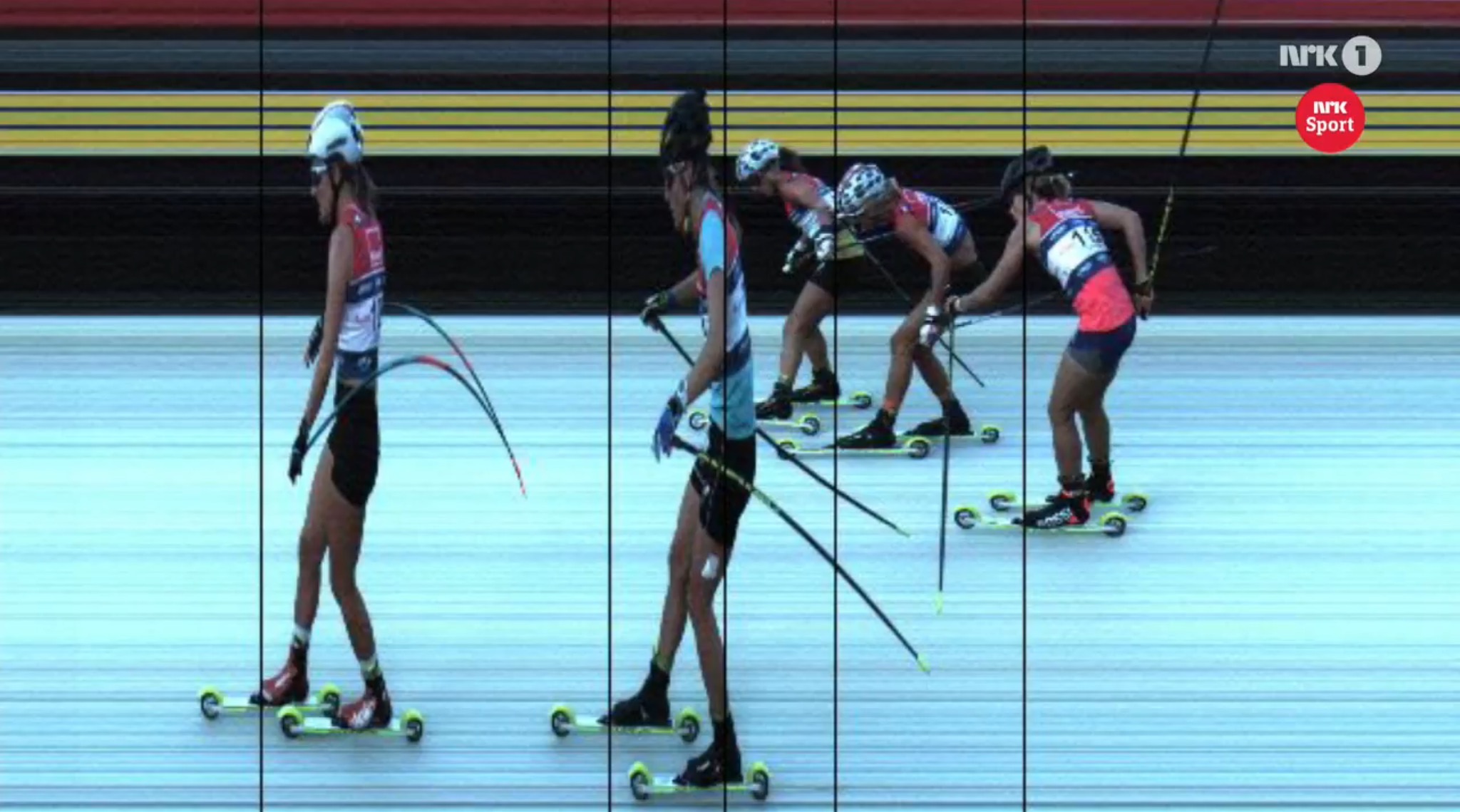
    In a true photo finish (left to right) Norway’s Barbro Kvaale won the women’s sprint on Day 2 of the 2017 Toppidrettsveka rollerski mini tour in Trondheim, Norway, ahead of Sweden’s Linn Sömskar in second, Norway’s Heidi Weng in third, Norway’s Kathrine Rolsted Harsem in fourth, and Switzerland’s Laurien Van Der Graaff in fifth. (Screenshot: NRK broadcast)

    The women’s sprint final went to Norway’s Barbro Kvåle in a time of 2:46.04, who placed sixth in the final the day before. She edged Sömskar by just 0.08 seconds and Weng was another hundredth of a second back in third (+0.09). Harsem placed fourth (+0.25), and Switzerland’s Laurien Van Der Graaff, who led until the final meters of the race, finished fifth (+0.37). In the overall standings, Weng spent the night in the lead, ahead of Sömskar, Jacobsen and Harsem.

    Day 3: Trondheim Pursuit/Mass Start

    The mini tour concluded Saturday with classic races in Trondheim. However, with a smaller field of 37 athletes for the last women’s race, the points collected in the prior three events were not converted into time gaps before the final stage. Instead, athletes started together for a 12-kilometer mass start and the overall results and time back from the winner were computed after the race.

    In rainy weather (with many of the spectators sporting ponchos), the short-sleeved athletes persistently circled their laps around the city course. The top group got smaller and smaller, and after 7.5 k, only 10 women remained within three seconds of the lead. That group dwindled to six by the finishing stretch, where Haag outlunged Jacobsen by 0.2 seconds for the win and Sömskar crossed another 0.4 seconds back in third (+0.6). Three Norwegians followed, with Harsem in fourth (+1.2), Weng in fifth (+1.5) and Lovise Hemdal in sixth (+2.0). Fifteen seconds later, Kvåle in seventh (+16.7) led the next four finishers across the line.

    After computing the overall Toppidrettsveka standings, Weng was deemed the winner for the second-straight year. Sömskar placed second, 34.1 seconds back (she only had one weaker stage in the long mass start where she finished 11th, almost six minutes behind Weng), and Jacobsen was just another 1.6 seconds back in third (+35.7). Harsem finished the tour in fourth (+46.7), and Haag placed fifth (+59.5).

    “I was impressed with myself actually,” Weng told NRK in a finish-line interview, according to a translation. “That I managed to keep up so well despite some very stiff arms … I don’t know if I am on a better way than last year, but yes, I feel really quite good.”

    On the conditions, which Jacobsen called “dangerous“, Weng was pleased everyone played it safe.

    “We took it very easy, and it was good that we all kept it a bit safe, there were some very slippery spots, but it went well,” Weng said.

    With more in the men’s field, the men raced a 15 k pursuit, with Halfvarsson starting first, 12 seconds ahead of Klæbo in second, and 50 seconds ahead of Cologna in third. Trøan left the gate 1 minute back and Brandsdal started 2 seconds later.

    Despite the heavy rain, which had worsened since the women’s race, Halfvarsson increased his lead on Klæbo. By 5.1 k, the Swede was more than 40 seconds clear of Klæbo, and Cologna came through the checkpoint 1:13 back. Having to ski through puddles of standing water at times, Halfvarsson extended his lead on Klæbo to over a minute by 11.2 k. Another 30 seconds behind Klæbo, Northug led a large chase group of about 20 racers after the pack had caught Cologna.

    Halfvarsson held his comfortable lead through the finish, completing the final stage in a time of 34:08.4 for the overall victory. Klæbo had to fight a lot harder to hold onto second place, crossing the line 1:14.7 back and only a few meters ahead of the chase group. Northug outlasted the pack in a finishing sprint for third place (+1:18.5), while Bransdal missed the podium by half a second in fourth (+1:19.0), as did Niskanen in fifth (+1:19.0) and Trøan in sixth (+1:20.0).

    https://www.instagram.com/p/BX–n2hD61y/?hl=en&taken-by=toppidrettsveka,

    “Today, it was pretty easy,” Halfvarsson told NRK, according to a translation. “I had the goal to go out hard, and knew I was going to get it when Johannes had problems to follow.”

    “[My] days are over, there is a new kid in town,” 13-time world champion Northug said in English in a finish-line interview with NRK, referencing Klæbo standing next to him.

    “He is the one who is absolutely the fastest of all of us,” Halfvarsson agreed in his interview with NRK when asked about the upcoming season. “Petter will be strong if he can find the shape for the winter, but it’s Johannes who I fear the most.”

    “He is just saying that,” Klæbo told NRK. “I think there are many Norwegians that are going to go fast this winter.”

    The best time of the final stage was posted by Great Britain’s Andrew Musgrave in 33:33.8, while Halfvarsson’s time ranked 25th. Musgrave finished eighth overall (+1:20.4).

    For the stage, Newell placed 53rd and Bolger 64th. Overall, Newell finished the tour in 56th (+2:28.7) and Bolger placed 67th (+3:01.2).

    https://www.instagram.com/p/BYAMQlkBwkn/?hl=en&taken-by=andynewellskier

    Complete results

  • Sunday Rundown: Harvey 2nd in Quebec Pursuit; 2nd in Distance World Cup

    Sunday Rundown: Harvey 2nd in Quebec Pursuit; 2nd in Distance World Cup

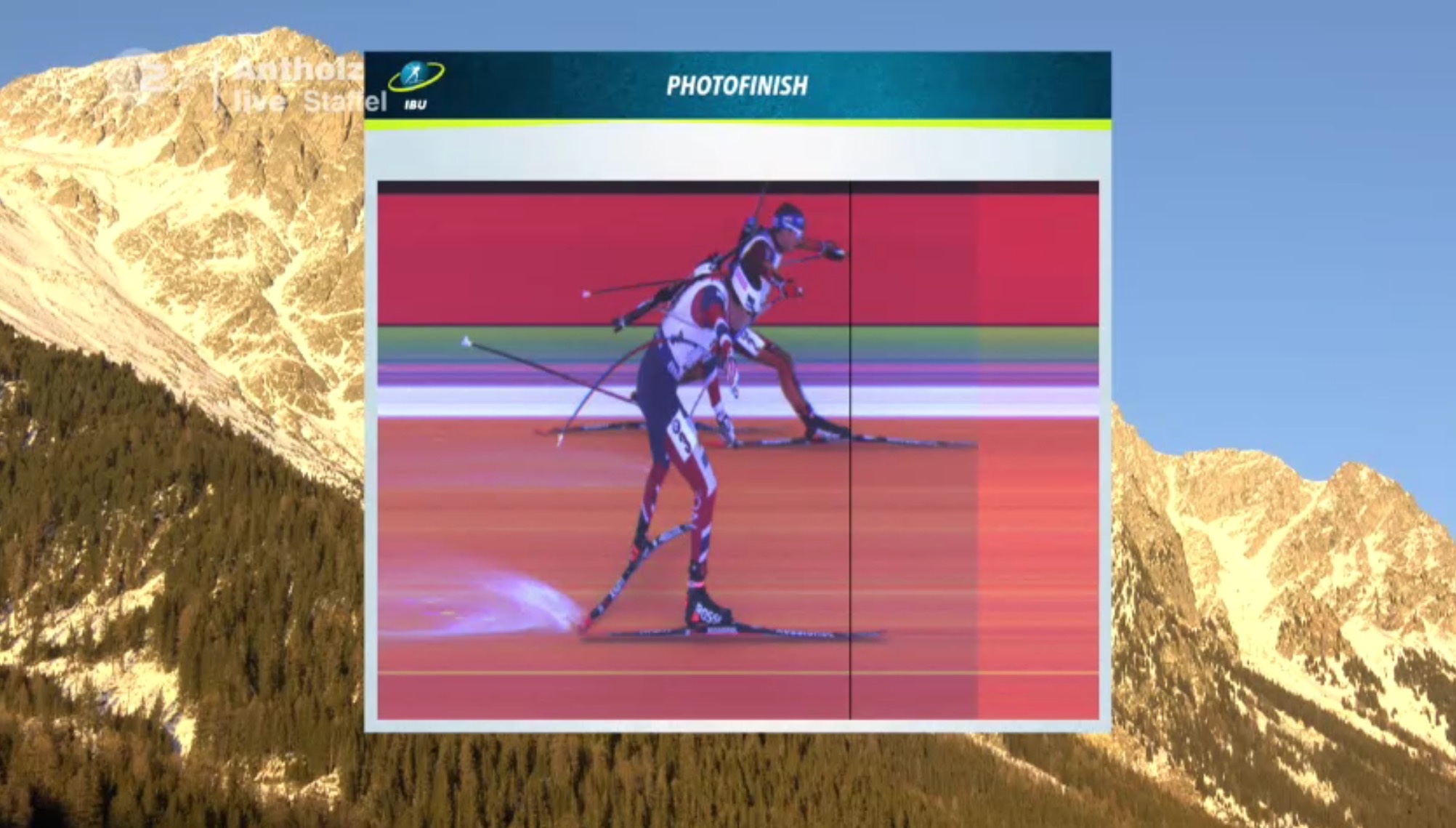
    Canada’s Alex Harvey leading Norway’s Niklas Dyrhaug (2) and Johannes Høsflot Klæbo (r) up a short, steep climb during the men’s 15 k freestyle pursuit on Sunday, the last day of the 2016/2017 World Cup season, at World Cup Finals in Quebec City. Harvey went on to place second, Klæbo won the photo finish, and Dyrhaug placed third. (Photo: Gretchen Powers)

    FIS Cross-Country World Cup Finals (Quebec City): 10/15 k freestyle pursuits

    Even after Sunday’s 15-kilometer freestyle pursuit, Alex Harvey had a busy day ahead of him with three different podiums to stand on: one for placing second on the day, another for placing second in the Distance World Cup, and yet one more for finishing the season in third in the Overall World Cup.

    It was a suitable ending for Harvey’s storybook three-day venture in Quebec City, after he won Friday’s skate sprint and placed fourth in Saturday’s 15 k classic mass start.

    Starting third the pursuit third, 23 seconds behind Norway’s Johannes Høsflot Klæbo in first and 1 second behind another Norwegian Niklas Dyrhaug in second, Harvey set a blistering pace from the gun and caught Dyrhaug around 5 k in.

    From there, the three jockeyed for the ideal position and ultimately, the win with over the next 10 k. The chase pack was closing on them slightly, but not enough to be a threat. A loose dog on course at the end of their third lap caused a little alarm as it ran alongside the three leaders, but didn’t affect any of the racers to be a problem.

    On the fourth and final lap, just before one of the last long descents into and out of the stadium, all three nearly came to a stop — none of them eager to lead, fearing their attack out of the ensuing draft.

    Klæbo finally decided to go first, and he put in a sprint in an attempt to catch the others off guard. The three remained together all the way to the finish, lining up side by side as they squared off for the final 100-meter showdown. In a photo finish for first, Klæbo took it by less than a one-hundredth of a second over Harvey in 32:44.5 minutes, and Dyrhaug settled for third, one-tenth of a second back.

    The third Norwegian in the top four, Sindre Bjørnestad Skar outlasted the six-man chase pack that followed the top three across the line. Skar finished fourth, 26.1 seconds out of first, just 0.4 seconds ahead of Switzerland’s Dario Cologna in fifth. Also in that group, Sweden’s Marcus Hellner posted the fastest time of the day (31:55.5) to finish sixth overall (+26.8) Norway’s Sjur Røthe followed in seventh (+27.2), Russia’s Andrey Larkov placed eighth (+27.6), and Great Britain’s Andrew Musgrave ninth (+30.6).

    American Erik Bjornsen (33) racing to the 11th fastest time of day in the men’s 15 k freestyle pursuit at World Cup Finals on Sunday in Quebec City, for his career-best World Cup result. He finished 25th overall. (Photo: Gretchen Powers)

    For time of day, American Erik Bjornsen broke through in 11th for his best World Cup result. He placed 25th overall (+2:19.1), just ahead of Canada’s Devon Kershaw in 26th (+2:21.4). Kershaw was 19th for time of day.

    Four Americans landed in the points (top 30) for time of day, with Paddy Caldwell in 25th, David Norris 27th, and Scott Patterson 30th.

    Overall in the pursuit, Patterson finished 41st (+3:45.6), Norris 43rd (+4:15.9) and Caldwell 46th (+4:25.6).

    Also for the U.S., Andy Newell placed 44th, Simi Hamilton 45th, Noah Hoffman 52nd, Jack Hegman 57th, Brian Gregg 58th, and Cole Morgan 65th.

    Among the Canadians, Graeme Killick finished 42nd, Knute Johnsgaard 53rd, Len Valjas 54th, Evan Palmer-Charrette 60th, Bob Thompson 61st, Brian McKeever 62nd, Joey Foster 64th, Andy Shields 66th, Russell Kennedy 67th, Jess Cockney 68th, Gareth Williams 71st, Ricardo Izquierdo-Bernier 72nd, and Julian Locke 73rd.

    The women’s 10 k freestyle pursuit podium on Sunday at World Cup Finals, with Norway’s Marit Bjørgen (c) in first, Heidi Weng (l) in second, and Sweden’s Stina Nilsson (r) in third. (Photo: Gretchen Powers)

    In the women’s 10 k freestyle pursuit earlier in the day, Marit Bjørgen caught her Norwegian teammate Heidi Weng almost immediately after starting 1 second back in second, and the two skied together well ahead of anyone else for the rest of their three-lap race.

    After leading for most of it, Bjørgen ultimately took the win, entering the finishing stretch slightly ahead of Weng and holding her off by 1.2 seconds across the line with a time of 22:36.1. For Bjørgen, it was her second win in two days, after winning Saturday’s 10 k classic mass start, and she ended her first full season back since having a child ranked second in the Distance World Cup. Weng won both the Distance and Overall World Cup titles.

    Bjørgen also won for the time of day (22:35.1). Weng’s time ranked second and Sweden’s Stina Nilsson was third for both time of day and overall after moving up from seventh and outlasting the chase pack.

    Nilsson finished exactly a minute after Bjørgen and 1.9 seconds ahead of her Swedish teammate Ida Ingemarsdotter in fourth (+1:01.9). Finland’s Krista Parmakoski finished fifth (+1:05.6) and ended the season second in the Overall World Cup and third in the Distance World Cup.

    Norway’s Ingvild Flugstad Østberg started third but ended the day in sixth (+1:19.8) after skiing alone for a good portion of it, well behind Bjørgen and Weng and just ahead of the hungry chase pack. Østberg finished her season in third in the Overall World Cup.

    Sadie Bjornsen (U.S. Ski Team) racing to the fifth-fastest time and 10th overall in the women’s 10 k freestyle pursuit on Sunday at World Cup Finals in Quebec City. Dyrhaug placed third. (Photo: Gretchen Powers)

    Sadie Bjornsen led the U.S. women with the fifth-fastest time of day in 10th overall (+1:27.2). Jessie Diggins moved up from 20th to place 16th (+2:14.8) with the 14th fastest time of day. Diggins ended up sixth in the Overall World Cup and seventh in the Distance World Cup.

    Emily Nishikawa was the top Canadian woman in the pursuit in 38th (+4:52.7) and Cendrine Browne followed in 40th (+4:54.7).

    For the U.S., Sophie Caldwell placed 36th (+4:26.1), Rosie Brennan 42nd, Caitlin Patterson 43rd, Chelsea Holmes 45th, Julia Kern 46th, Kaitlynn Miller 52nd, Liz Guiney 53rd, Becca Rorabaugh 54th, Erika Flowers 56th, and Jennie Bender 60th.

    Also for Canada, Dahria Beatty finished 50th, Annika Richardson 55th, Frederique Vezina 57th, Katherine Stewart-Jones 58th, Andrea Dupont 59th, Annika Hicks 62nd, Sophie Carrier-Laforte 63rd, Sadie White 64th, Lisle Compton 65th, Katherine Weaver 66th, Laura Leclair 67th, and Mia Serratore 68th.

    Pursuit results: Men | Women

    Time of day: Men | Woman

    Overall World Cup: Men | Women

    Distance World Cup: Men | Women

  • An Air-Guitar Solo: Harvey Closes Out Championships with 50 k Win

    An Air-Guitar Solo: Harvey Closes Out Championships with 50 k Win

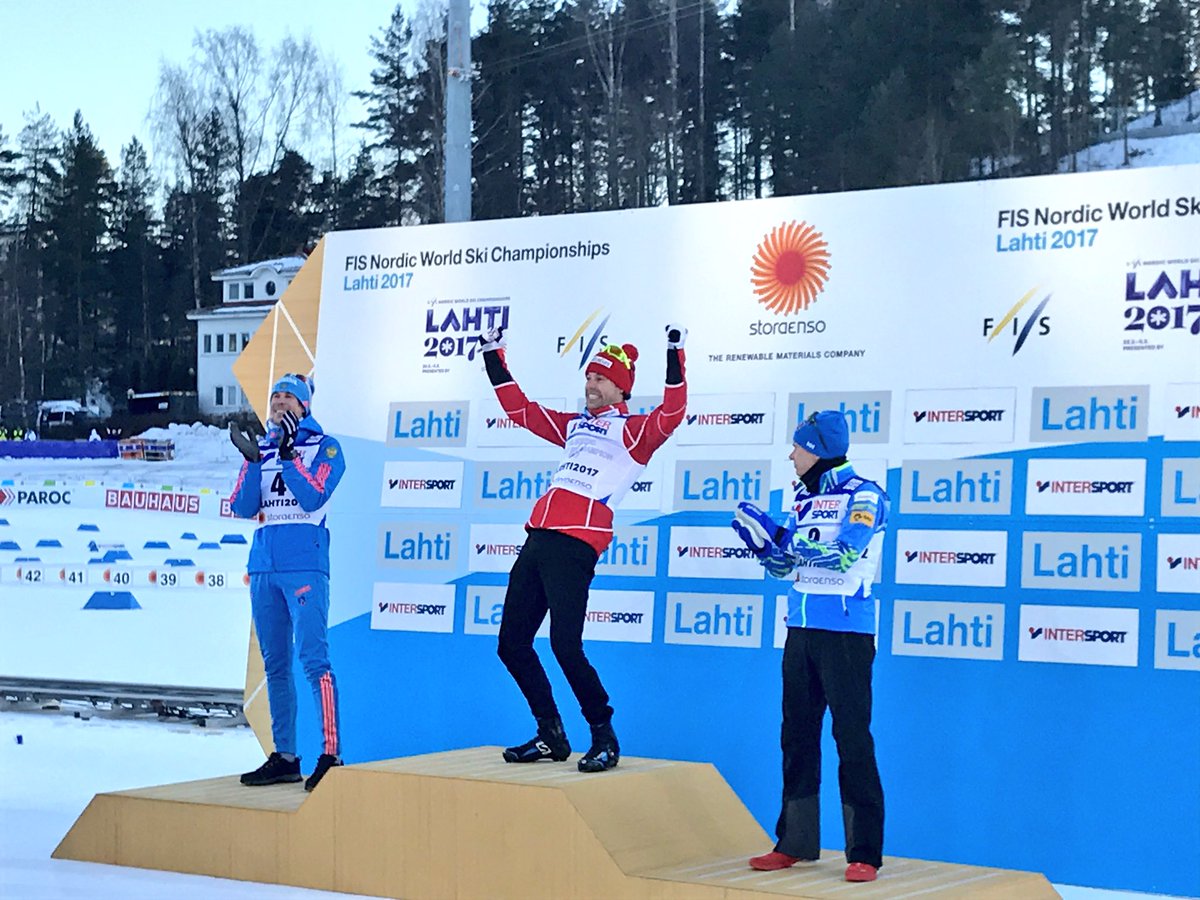
    It’s real. Canada’s Alex Harvey after winning gold in the men’s 50-kilometer freestyle mass start on Sunday at the 2017 Nordic World Championships in Lahti, Finland. (Photo: John Lazenby/Lazenbyphoto.com)

    LAHTI, Finland — Here’s the basics: fast and firm tracks, cloudless skies, and once again a stacked field for the final event of the 2017 Nordic World Championships: the men’s 50-kilometer freestyle mass start.

    Over the course of the 50 k, Canada’s Harvey had to think about one thing: be up front near the top three in order to shadow Norway’s Martin Johnsrud Sundby’s inevitable gut punch in the last kilometer. What he didn’t have to think about was playing catch up as a skier yo-yoing off the back, or his skis — they were rockets.

    In Sunday’s closing race of Lahti World Championships, Harvey was slotted in second, sliding around “Lahti Corner” just centimeters behind Sundby. Drafting off Harvey was 2017 championships legend, Russia’s Sergey Ustiugov, who had already racked up four medals previously in the week (skiathlon gold, team sprint gold, freestyle sprint silver and team relay silver). Pulling not far behind the three was Finland’s Matti Heikkinen and Andrew Musgrave of Great Britain. 

    After studying the women’s 30 k mass start on Saturday, Harvey had some cogent takeaways.

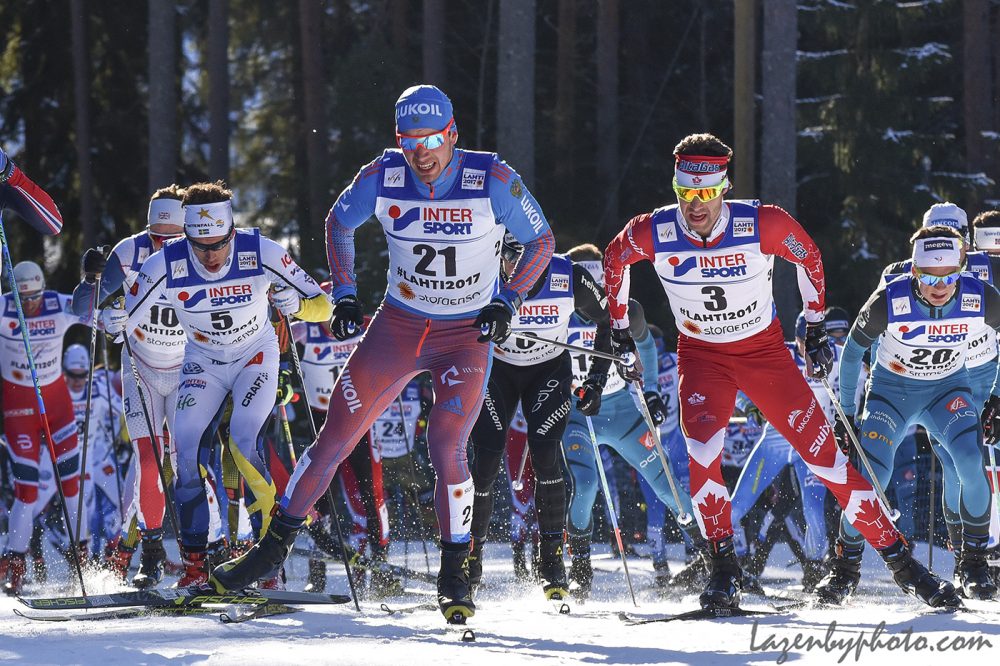
    Russia’s Alexey Chervotkin (21) leads Canada’s Alex Harvey (3) and Sweden’s Marcus Hellner (5) during the men’s 50 k freestyle mass start on Sunday at 2017 Nordic World Championships in Lahti, Finland. Harvey went on to win, Hellner placed 12th and Chervotkin 13th. (Photo: John Lazenby/Lazenbyphoto.com)

    “I saw the women’s race yesterday, and I figured if Marit Bjørgen could not distance herself from the other girls, then there is no way that the men will be able to do that,” Harvey said during Sunday’s post-race press conference. “I knew with the fast conditions, it was going to be a big group, and that leaves the potential for a lot of carnage, a lot of mayhem.”

    For the first 10 k, skiers from various nations took pulls up front, including Sundby and Ustiugov, and Norwegians Petter Northug, Hans Christer Holund, and Anders Gløersen. After testing the field and breaking away around 8 k into the race, Gløersen was still skiing alone up front, 20 seconds ahead of anyone else at 15 k.

    “Gløersen took off a bit and he was like, ‘What’s the gap? What’s the gap?’ ” Canadian World Cup coach Ivan Babikov said of Harvey. “He was always controlling the race and saving energy for the finish.”

    Eventually, the main pack surged to recover the lost time. Gløersen’s off-the-front-flier only earned him camera time. The catch came just before Lahti Corner returning to the stadium around 20 k in, where Russia’s Alexey Chervotkin took over. In another 2 k, Sundby, who had been stalking in the top 10, moved to the front as if the race were all of a sudden for real.

    Norway’s Anders Gløersen broke away early to lead the men’s 50 k freestyle mass start, skiing alone off the front for about 12 kilometers, on Sunday at the 2017 Nordic World Championships in Lahti, Finland. (Photo: John Lazenby/Lazenbyphoto.com)

    From then on, the size of the pack atrophied with each consecutive lap. At 30 k, the pack streaming through the stadium was 24 skiers long. At 45 k, the group winnowed to a train of 19. And within another 4 k, only 13 remained: Sundby, Ustiugov, Musgrave, Harvey, Heikkinen, Northug, Holund, Gløersen, Chervotkin, Sweden’s Marcus Hellner, Norway’s Sjur Røthe, Switzerland’s Dario Cologna, and France’s Maurice Manificat.

    “I wanted to be in the front, top three at least,” Harvey said, reflecting on his skiathlon tactics from last weekend, where he skied around fifth up until the final headwall and finished fifth, outside of the medals.

    “I knew that Sundby’s first chance to win gold was to break everybody,” Harvey continued. “I was expecting him to leave from kilometer 1 or 49.”

    Harvey guessed Sundby would be the only one who would try to break away. With that in mind he marked the Norwegian.

    “He knew it would be hard to break away [and that] it will be all about the finish,” Babikov said. “He was positioning himself perfectly up the last hill and just stayed on Sundby. That was his plan, ‘I’m just gonna stay on Sundby and if he changes skis, I’ll go change skis,’ but today conditions were perfect so he didn’t.”

    With ripping conditions and skis to match, Sundby never slowed nor switched skis. Neither did Harvey.

    “When he waited until the last lap, I knew exactly where he was going to do it: with a k and a half to go,” Harvey explained. “I was just lucky enough to have the legs to stick on him today and from then on it started playing more into my hands.”

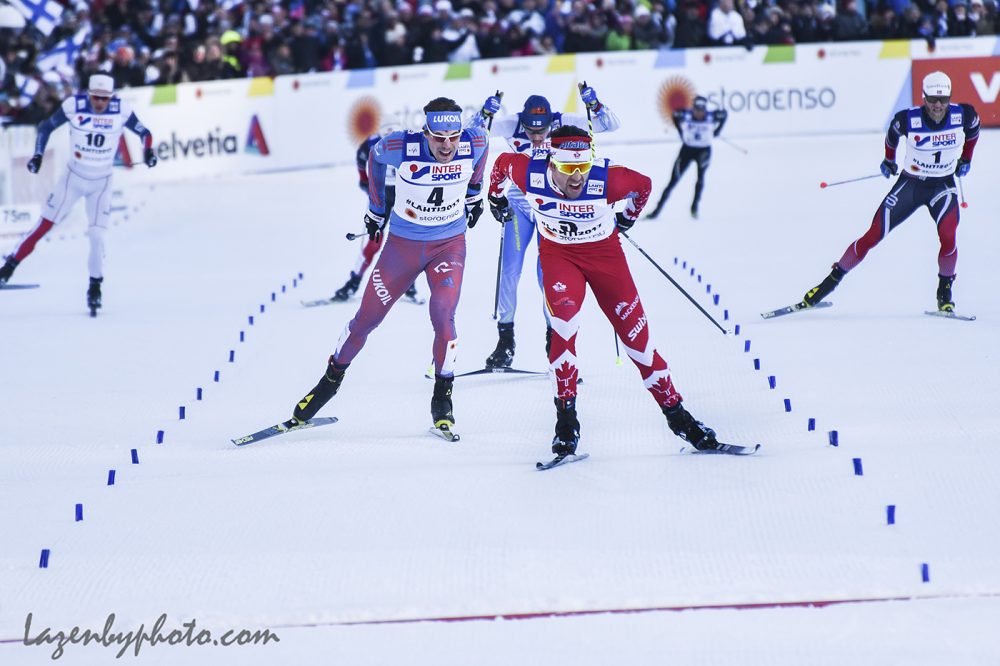
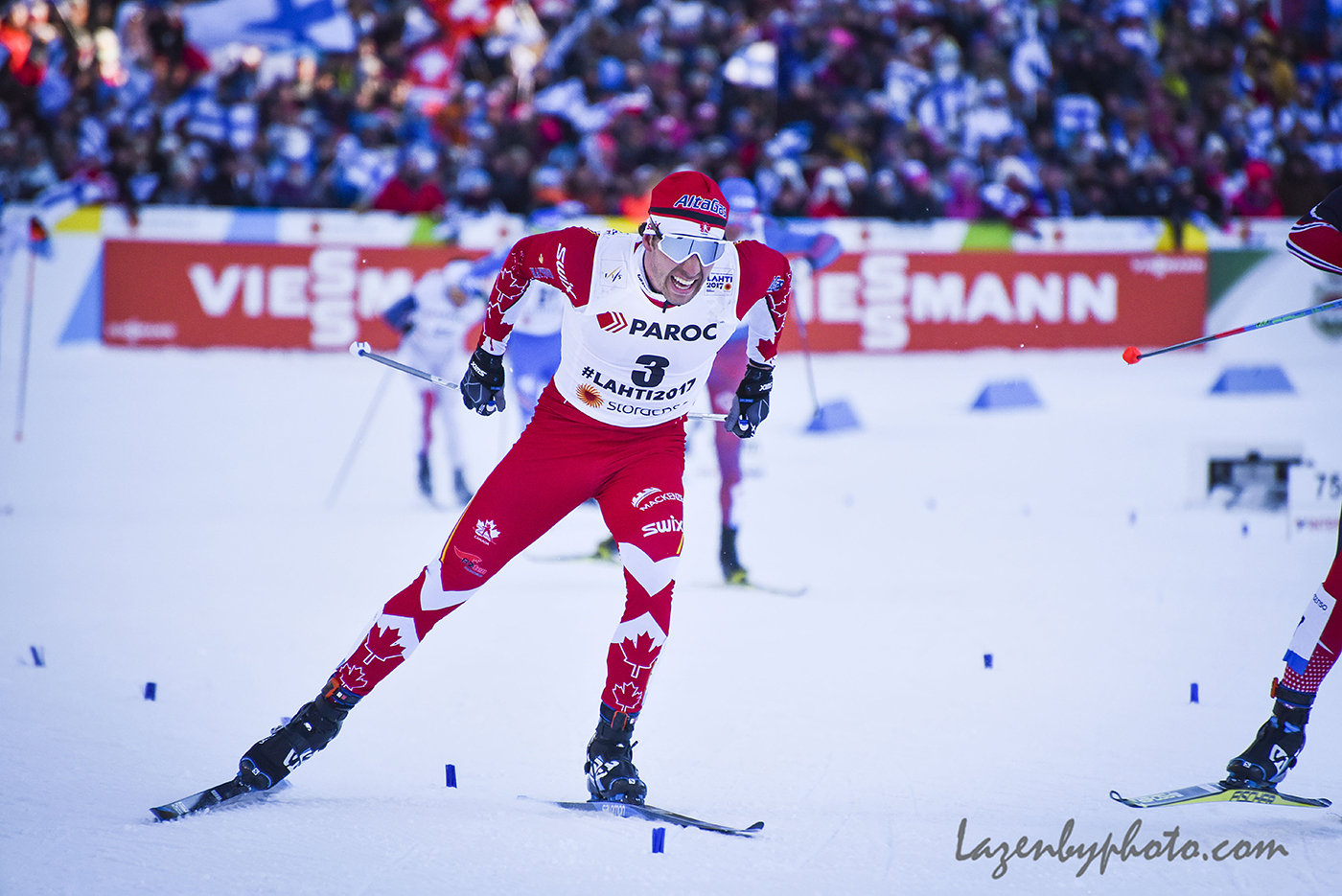
    Canada’s Alex Harvey (5) charging to the line ahead of Russia’s Sergey Ustiugov (4), Norway’s Martin Johnsrud Sundby (1), Great Britain’s Andrew Musgrave (10) and Finland’s Matti Heikkinen (behind Harvey) in the men’s 50 k freestyle mass start on Sunday at the 2017 Nordic World Championships in Lahti, Finland. (Photo: John Lazenby/Lazenbyphoto.com)

    In the closing moments of nearly every race of these world champs, the fate of winners seem come down to luck, and often someone else’s bad luck. As the leaders came into the stadium, it was as if every observer were about to witness an upset due to a tumble or a tangle.

    Harvey was clean around the final turn and unscathed down the stretch.

    “I wanted to hit the [Lahti] corner in second, right behind Sundby or whoever was in the lead,” Harvey said. “I knew I needed to do that in the skiathlon, too, and I tried to go around Finn Hågen Krogh there, but he’s a clever sprinter too. He knew he wanted to be second there.

    “In the skiathlon it didn’t work, but today it did,” Harvey continued. “I was second the whole time and then out of that corner I did one push more than Sundby. I had really fast skis, but used the draft to slingshot and then hit the final corner in first and from there, I knew it was mine to lose more than anything else.”

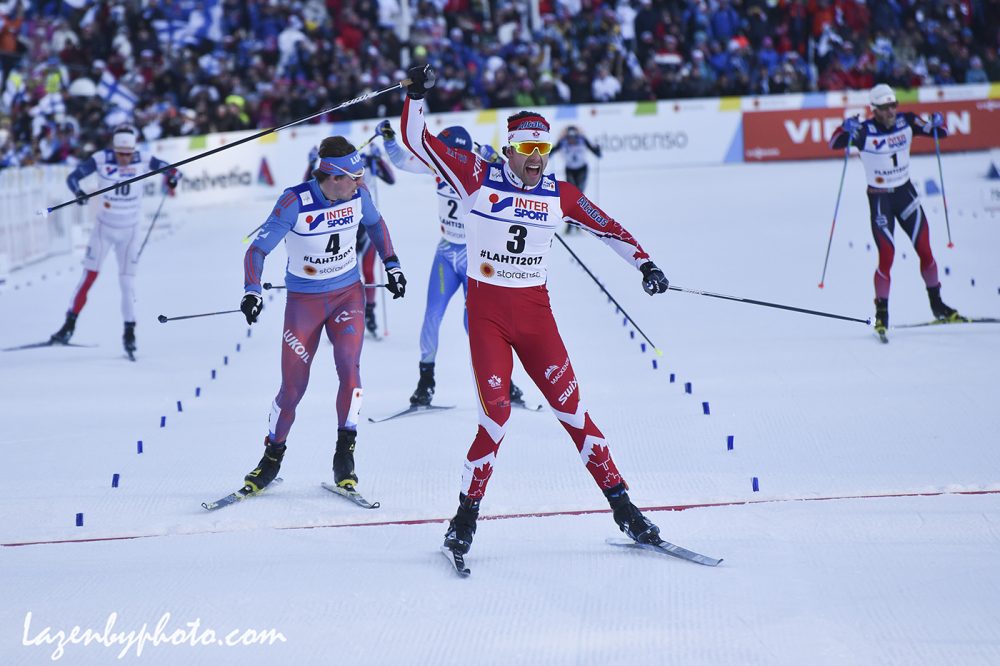
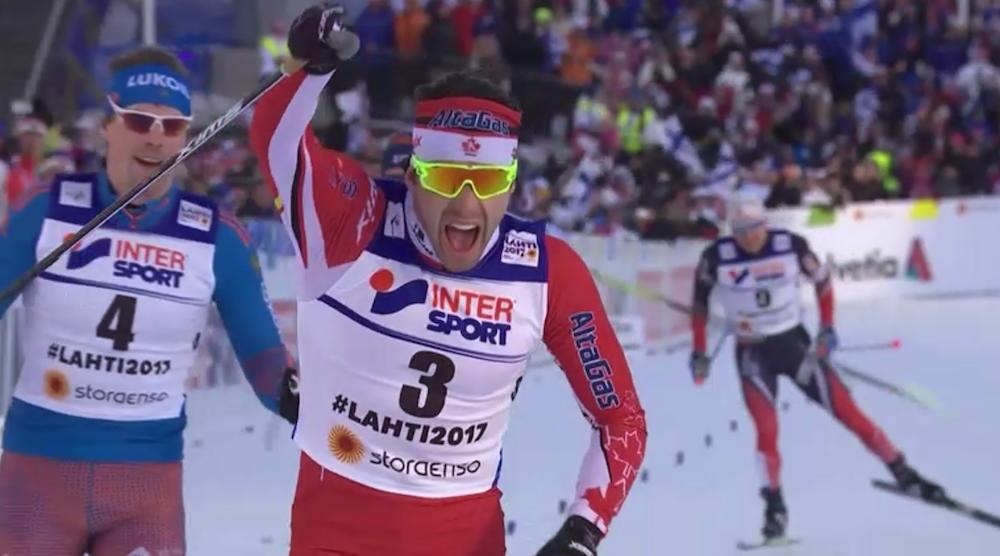
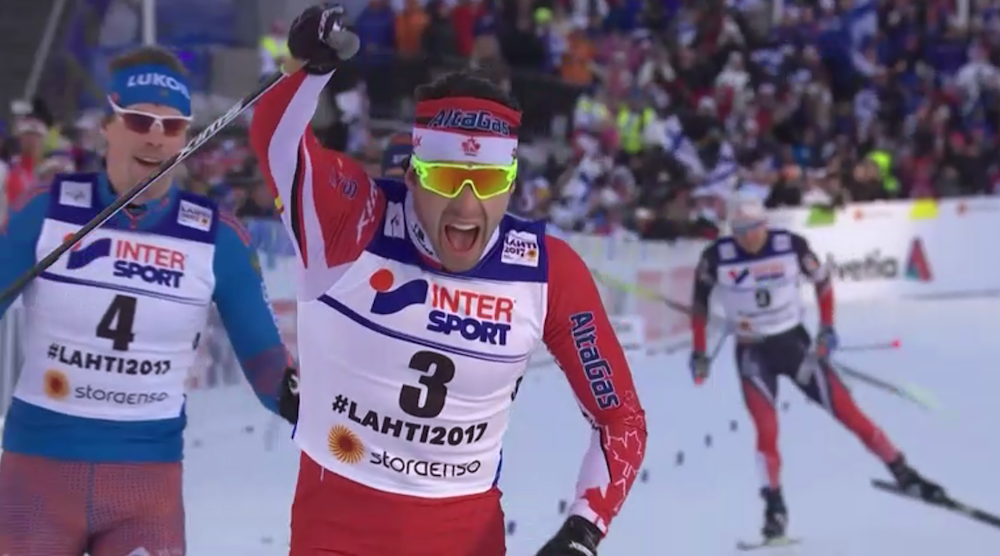
    Canada’s Alex Harvey (5) celebrates his first individual World Championships gold after winning Sunday’s 50 k freestyle mass start in Lahti, Finland, ahead of Russia’s Sergey Ustiugov (4), Norway’s Martin Johnsrud Sundby (1), and Finland’s Matti Heikkinen (2), respectively. (Photo: John Lazenby/Lazenbyphoto.com)

    And so Harvey earned the crown: 50 k world champion in 1:46:28.9 hours.

    It’s his first championships gold since winning the classic team sprint with Devon Kershaw at 2011 world champs, and fifth medal in four World Championships. 

    “He turned around these world champs for all of us,” Babikov said of the Canadian team. “He was solid. We were with no medals so far, and winning 50 k, he’s the king now.

    “This is the legit distance and he took it today,” he added.

    “It’s a long championship,” said Louis Bouchard, Harvey’s personal coach and Canada’s World Cup co-coach. “He feels every day his energy’s still there, so he knows today, if he’s good tactically, then he can do it.”

    Asked how nerve-racking it was watching the final 5 k unfold, Bouchard responded, “I was pretty nervous, too much maybe. But that’s OK.”

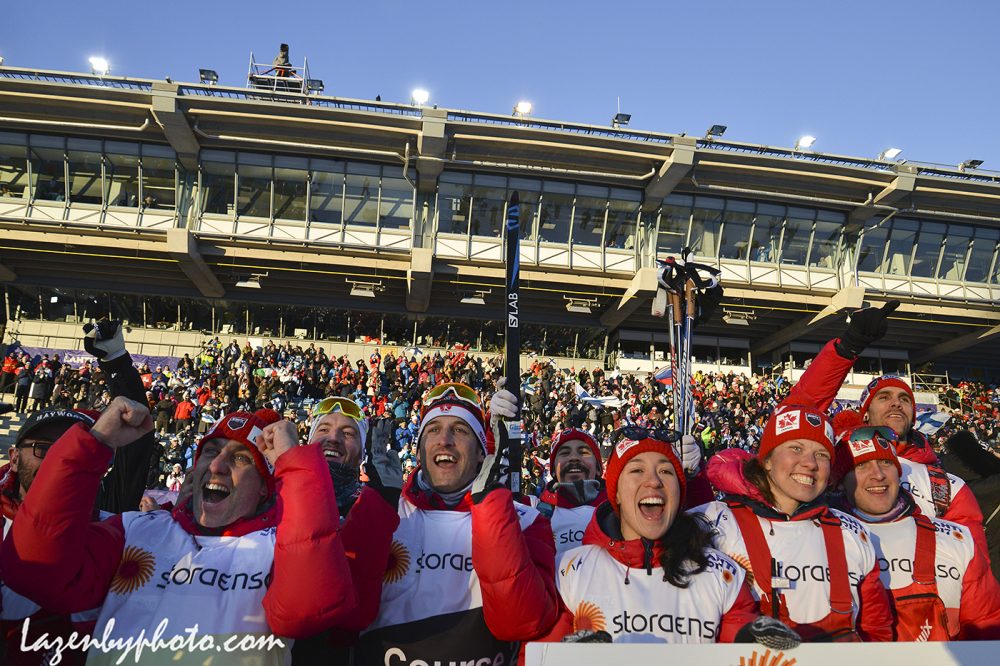
    Alex Harvey’s Canadian teammates, coaches and support team celebrate his win in the men’s 50 k freestyle mass start on Sunday at the 2017 Nordic World Championships in Lahti, Finland. (Photo: John Lazenby/Lazenbyphoto.com)

    For his fifth medal of these championships (and sixth world-champs medal of his career), the 24-year-old Ustiugov crossed second for his third silver of the week, just 0.6 seconds behind Harvey. Finland’s 33-year-old Heikkinen took third (+1.4) for his first medal since 2011 World Championships.

    “Today I skied within my own limits and at the end I was fresh enough to attack,” Heikkinen said in a press conference.

    Asked about his not-so-characteristic finishing kick on Sunday, Heikkinen said he remembered how he faded to 20th in the 50 k classic mass start at 2015 World Championships.

    “After Falun 2015 world champs, I was watching the race after and I was walking in front a mirror and I said, ‘I won’t ever again be like that after a 50 k,’ ” he said. “I’ve been training two years now at a high level [with my team] … and that’s why I’m top three in overall World Cup, so it was possible.”

    Behind him in a photo finish for fourth, Musgrave capitalized on Sundby slowing before the finish — probably after the Norwegian realized he had missed out on a medal — to place fourth (+2.9). For Musgrave, who turns 27 on Monday, it was his first World Championships top 10. For Sundby, who had been on a quest all week for his first individual championships goal — it was a bummer. The 2018 Winter Olympics in PyeongChang, South Korea, will be Sundby’s next opportunity.

    From a North American and perhaps international standpoint, American Tad Elliott skied the gutsiest of races. Halfway through the race, Elliott, a 28-year-old Colorado native and former U.S. Ski Team member, remained a not-too-far-off the back chaser, 27 seconds behind the lead group. His margin back slowly accrued over the remaining distance.

    “At 25 k, man, some guys were really struggling and they balled it up,” Elliott said afterward. “I should have sent it a little harder but that’s how it goes sometimes in that pack. I thought I could get there, but I just missed it.”

    Elliott, of Ski Club Vail, finished 27th (+3:16.8) for his best individual result in three World Championships. In recent years, Elliott has struggled with illness, which impacted his ability to train and peak. Those difficulties caused him to question whether or not his best years were behind him. Evidently not.

    American Tad Elliott (41) racing to 27th in the men’s 50 k freestyle mass start on Sunday at the 2017 Nordic World Championships in Lahti, Finland.. (Photo: John Lazenby/Lazenbyphoto.com)

    “I didn’t know if I wanted to come back [to skiing]. I was so sick. I was so bummed. I was like, ‘Am I ever going to get back? Am I ever going to get back to top-30 form?’ ” Elliott said. “We knew if everything went right, I would qualify for worlds … then to get top 30 here, man, I feel like I’m starting to get greedy. I’m starting to want more, I’m starting to want more opportunities. But I’m proud of this effort, I’m going to savor it a bit.”

    In the first few kilometers, Russia’s Petr Sedov skied too wide on a 180-degree corner and stalled out. American Kyle Bratrud, the next skier to round the turn, was unable to avoid the Russian and collided. Soon after, due to the impact, Bratrud was unable to complete the race.

    U.S. Ski Team member Noah Hoffman finished the day in 50th (+8:53.1).

    Devon Kershaw was Canada’s second skier on Sunday, crossing in 38th (+5:45.5). Also for Canada, Graeme Killick and Knute Johnsgaard finished in 43rd (+7:04.0) and 55th (+12:03.3), respectively.

    “[Alex’s performance] was incredible and such a big boost for our entire team,” Babikov said. “You should see all the techs, and Devon and Graeme and Knute, who didn’t really have a great race today, and they’re still so psyched for him.”

    Results

    — Gerry Furseth, Jake Ellis and Alex Kochon contributed
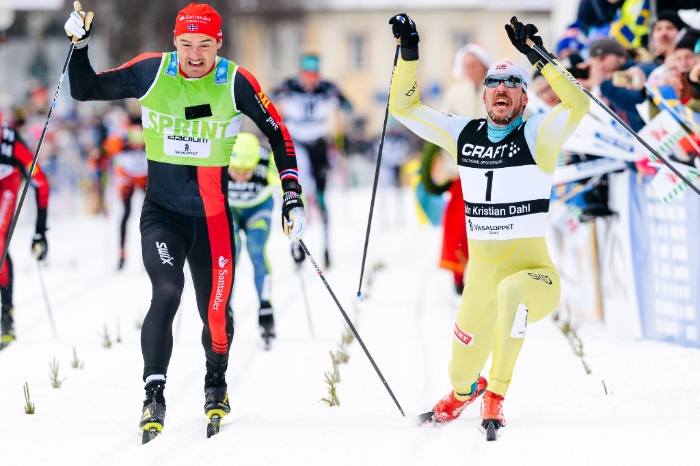
    Canadian air guitar: Alex Harvey performs his team’s signature move after winning the men’s 50 k freestyle mass start on Sunday at the 2017 Nordic World Championships in Lahti, Finland. (Photo: John Lazenby/Lazenbyphoto.com)
  • Sunday Rundown: Harvey Wins World Champs Gold in Lahti; PyeongChang + Vasaloppet (Updated)

    Sunday Rundown: Harvey Wins World Champs Gold in Lahti; PyeongChang + Vasaloppet (Updated)

    Canada’s Alex Harvey (3) celebrates his win in the men’s 50 k freestyle mass start, his first individual gold medal at a World Championships, on Sunday at 2017 Nordic World Championships in Lahti, Finland. He beat Russia’s Sergey Ustiugov (l) by 0.6 seconds while Norway’s Sjur Røthe (9) can be seen coming in for sixth place, behind (not pictured) Finland’s Matti Heikkinen, Great Britain’s Andrew Musgrave and Norway’s Martin Johnsurd Sundby, respectively. (Photo: NBC Sports screenshot)

    FIS Nordic World Championships (Lahti, Finland): Men’s 50 k freestyle mass start

    After a week of missing out on the medals at 2017 Nordic World Championships, Canada’s Alex Harvey, a four-time World Championships medalist from 2011, 2013 and 2015, achieved his first individual gold medal in the final race of this year’s World Championships in Lahti, Finland.

    Harvey, 28, won the men’s 50-kilometer freestyle mass start in a drag race to the finish. Entering the final descent into the stadium with Norway’s Martin Johnsrud Sundby and Russia’s Sergey Ustiugov, Harvey rode his fast skis past both of them then had the most finishing kick in the final straightaway for a 0.6-second victory. He finished in 1:46.28.9 hours, while Ustiugov followed him across the line in second and Finland’s Matti Heikkinen from behind for third (+1.4), after passing Sundby around the outside of the last corner.

    Canada’s Alex Harvey (c) celebrates gold in the men’s 50 k freestyle mass start on Sunday at 2017 Nordic World Championships in Lahti, Finland, with Russia’s Sergey Ustiugov (l) and Finland’ Matti Heikkinen (r) joining him on the podium in second and third, respectively. (Photo: Cross Country Canada/Twitter)

    Sundby appeared to miss a pole plant soon after Heikkinen passed him and let off the pace a few meters before the finish. That’s where Great Britain’s Andrew Musgrave continued to accelerate and took fourth place, 2.9 seconds behind Harvey and 0.1 seconds ahead of Sundby in fifth. Norway’s Sjur Røthe followed another 0.4 seconds back in sixth, Switzerland’s Dario Cologna was seventh (+8.9), Norway’s Petter Northug eighth (+12.3), France’s Maurice Manificat ninth (+13.4), and Norway’s Hans Christer Holund 10th (+14.3).

    “I had really good skis,” Harvey said in a post-race interview with FIS. “I knew if I came into the corner in second place, that was the optimal position. So I was able to fight hard and hit that last corner in second and slingshot by Martin along the flat and then that was good after that.”

    “This is the best race of my life, for sure,” he added. “So I’m really happy.”

    Tad Elliott (Ski Club Vail) led the Americans in 27th (+3:16.8). Noah Hoffman (U.S. Ski Team) finished 50th (+8:53.1) and Kyle Bratrud (CXC Team) did not finish.

    Canada started four men, with Devon Kershaw finishing 38th (+5:45.5), Graeme Killick 43rd (+7:04), and Knute Johnsgaard in 55th (+12:03.3).

    For Harvey, the medal is his fifth at three World Championships and his first individual gold after winning the classic team sprint with Kershaw in 2011.

    Results

    ***

    IBU World Cup (PyeongChang, South Korea): Men’s and women’s relays

    Between the men’s and women’s relays on Sunday at the International Biathlon Union (IBU) World Cup in PyeongChang, South Korea, Canada had two teams in the top eighth, with its men’s team finishing seventh in the 4 x 7.5 k and women’s team eighth in the 4 x 6 k. Behind them, the U.S. men finished 10th and U.S. women 14th.

    France won the men’s relay by 33.8 seconds over Austria, using a total of 10 spare rounds but avoiding the penalty lap. Martin Fourcade anchored France to the win in 1:12:09.5 hours, after Jean-Guillaume Béatrix initially tagged them in first, his older brother Simon Fourcade raced them into second with near-perfect shooting (using just one spare to clean), and Simon Desthieux picked off one more place to give Fourcade a 16-second lead for the final leg.

    Austria achieved second place with Lorenz Wäger, Simon Eder, Julian Eberhard, and Dominik Landertinger combining for zero penalties and nine spares.

    Norway finished third (+45.4) with Vetle Sjåstad Christiansen, Ole Einar Bjørndalen, Vegard Gjermundshaug, and Henrik L’Abée-Lund. They had one penalty on Gjermundshaug’s third leg, and used a total of eight spares.

    Canada’s Christian Gow, Scott Gow, Nathan Smith, and Brendan Green finished seventh (+3:03.1) with zero penalties and nine spares. After Christian tagged his older brother Scott in ninth, Scott raced them into sixth place before Smith slipped four places to 10th at the final exchange. On the final leg, Green raced them into seventh, requiring two spares to clean.

    The Americans finished about nine seconds later in 10th (+3:12.8) with Lowell Bailey, Leif Nordgren, Paul Schommer, and Sean Doherty combining for zero penalties and nine spares, just like Canada. Bailey had originally put them in second at the first exchange, Nordgren dropped to seventh, then Schommer to 13th, before Doherty finally brought them back to 10th out of 24 teams.

    In the women’s relay, Germany pulled off a 22.8-second win over Norway, with one penalty and eight spares. Nadine Horchler put Germany in third at the first exchange, then Maren Hammerschmidt raced them into first by the race’s halfway point. From there, Denise Herrmann, a former cross-country World Cup regular, had to ski a penalty lap and tagged off in second, 13.5 seconds out of first. With teammate Laura Dahlmeier sitting out the relay, Franziska Hildebrand anchored Germany to the win in 1:07:35.6 after she used just one spare to clean.

    Norway placed second with Kaia Wøien Nicolaisen, Hilde Fenne, Tiril Eckhoff, and Marte Olsbu accumulating one penalty and 11 spares. Olsbu beat out the Czech Republic’s Gabriela Koukalová by one-tenth of a second at the finish, as the Czechs placed for third (+22.9), with Jessica Jislová, Eva Puskarčíková, Lucie Charvátová, and Koukalová (with a total of one penalty and nine spares).

    Canada took eighth (+1:34) with Rosanna Crawford, Julia Ransom, Megan Tandy, and Emma Lunder. Crawford tagged in second at the first exchange, Ransom slipped one place to third, Tandy lost another place to tag in fourth, and Lunder ultimately anchored them to eighth.

    The U.S., with Clare Egan, Susan Dunklee, Joanne Reid, and Maddie Phaneuf, finished 14th (+3:08.3) with one penalty and 10 spares. After Egan had a penalty on the first leg, Dunklee skied the fastest second leg to move the team from 19th to 14th, then Reid put them in 11th by the final exchange. Twenty-one teams competed in the women’s race.

    Results: Men | Women

    ***

    Ski Classics 90 k Vasaloppet (Sälen to Mora, Sweden)

    John Kristian Dahl (r) of Team United Bakeries outlunges Ski Classics sprint leader Andreas Nygaard (r) of Team Santander for the win in Sunday’s 90 k Vasaloppet in Mora, Sweden. (Photo: Visma Ski Classics)

    [UPDATED] In Sunday’s 93rd annual 90-kilometer Vasaloppet from Sälen to Mora, Sweden, the ninth event of the Ski Classics series, John Kristian Dahl (Team United Bakeries) outlasted Andreas Nygaard (Team Santander) by one-tenth of a second for the win in 3:57:18.1 hours. The race came down to a five-way fight for first, with Stian Hoelgaard (Team Leaseplan) finishing 0.6 seconds back in third. The top 15 men were all within 21.7 seconds of the podium, and Brian McKeever, a member of Canada’s Para Nordic Ski Team, placed 20th (+2:31.1).

    “It has been a fight all day,” Dahl said, according to a Ski Classics press release. Three days ago, he had been unsure about starting the Vasaloppet following a back injury. “I was tired already after 30 k and had to let go of the lead group, but I fought my way back taking it step by step and hill by hill.”

    In the women’s race, Britta Johansson Norgren (Lager 157 Ski Team) broke away from the field to win by 1:37.9 minutes in 4:19.43.4.

    Astrid Øyre Slind (Team United Bakeries) finished second, and Sara Lindborg (Team Serneke) placed third, 9 minutes and 4.2 seconds behind Norgren. Kateřina Smutná (Team Santander) dropped out of the race about halfway through.

    “I am very tired but also so happy to win today,” Norgren said, according to the press release. “It felt pretty easy until Oxberg [Sweden] with 30 k to go, but then it got really tough and I had to fight all the way to the finish.”

    It was Norgren’s first Vasaloppet win after placing second the last three years. She increased her lead in the overall Ski Classics to 215 points over Smutná, while Tord Asle Gjerdalen continues to lead the men’s overall standings ahead of his Santander teammate Nygaard, who is 349 points behind in second place. Gjerdalen did not race Sunday’s Vasaloppet.

    Results

  • Sundby Stumbles, Ustiugov Surges to Win Lahti Skiathlon; Harvey 5th

    Sundby Stumbles, Ustiugov Surges to Win Lahti Skiathlon; Harvey 5th

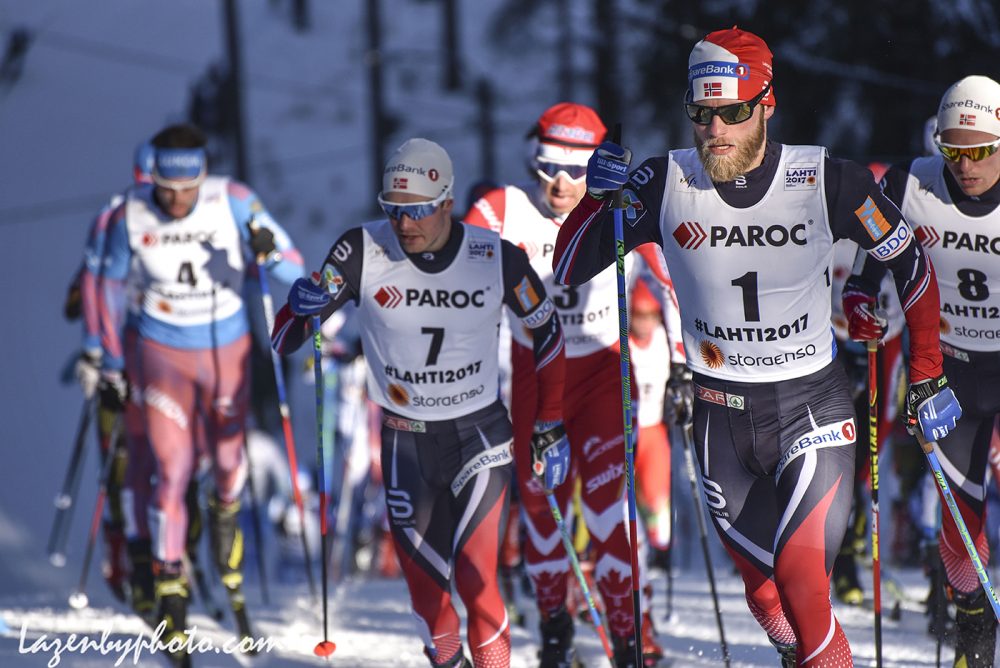
    Russia’s Sergey Ustiugov (4) leads three Norwegians, including Didrik Tønseth, and the rest of the field during the men’s 30 k skiathlon at 2017 Nordic World Championships on Saturday in Lahti, Finland. (Photo: John Lazenby/Lazenbyphoto.com)

    LAHTI, Finland — A collective gasp fell through the stands. Flags bearing Norway’s iconic red, blue and white symbol, previously waving, went limp. With half a kilometer left in the men’s 30 k skiathlon at the 2017 Nordic World Championships in Lahti, Norway’s race favorite Martin Johnsrud Sundby had fallen.

    A half a second earlier on Saturday, the Norwegian’s shot at the win was still within sight. He and Russia’s Sergey Ustiugov had broken away from the front pack around the 20 k mark, put close to 10 seconds on the rest of the field with the next k, and almost quadruped that by the bottom of the final climb.

    Norway’s Martin Johnsrud Sundby (1) leading his teammates Sjur Røthe (7) and Didrik Tønseth and Canada’s Alex Harvey, among others, including Russia’s Sergey Ustiugov (4), during the men’s 30 k skiathlon at the 2017 Nordic World Championships in Lahti, Finland. (Photo: John Lazenby/Lazenbyphoto.com)

    Heading into the hill, there was only one man to worry about — a scene fairly familiar for the Norwegian. In last season’s 30 k skiathlon in Lahti, it was during the same final ascent that Sundby pulled away from his teammate Finn Hågen Krogh to take the win.  

    Like last year, the Norwegian upped his tempo as he began the final climb. His high turnover surpassed Ustiugov’s, and Sundby glimpsed at gold. But as just as he secured a slight lead over the Russian, Sundby’s pole slipped, sending him off balance and in a forward fall to the ground.

    As Sundby stood up, his right pole was broken. While it didn’t take long for a new one to reach him, by the time he had grasped the fresh pole grip, the Russian skier was long gone.

    “You have to remember I was skiing side-by-side with the fastest guy in the world, so if I would have one chance, I had to try and make a move,” Sundby said during the post-race press conference. “If there was a possibility to gain a few meters, I had to go for it…Unfortunately it did not work and I made a mistake.”

    With no Norwegian to contest his name, Ustiugov descended the final downhill, cornered the final stretch and crossed the finish line first in 1:09:16.7 hours for his first World Championships gold (he took silver in Thursday’s sprint, behind Italy’s Federico Pellegrino). Finishing 6.7 seconds later in second place was Sundby.

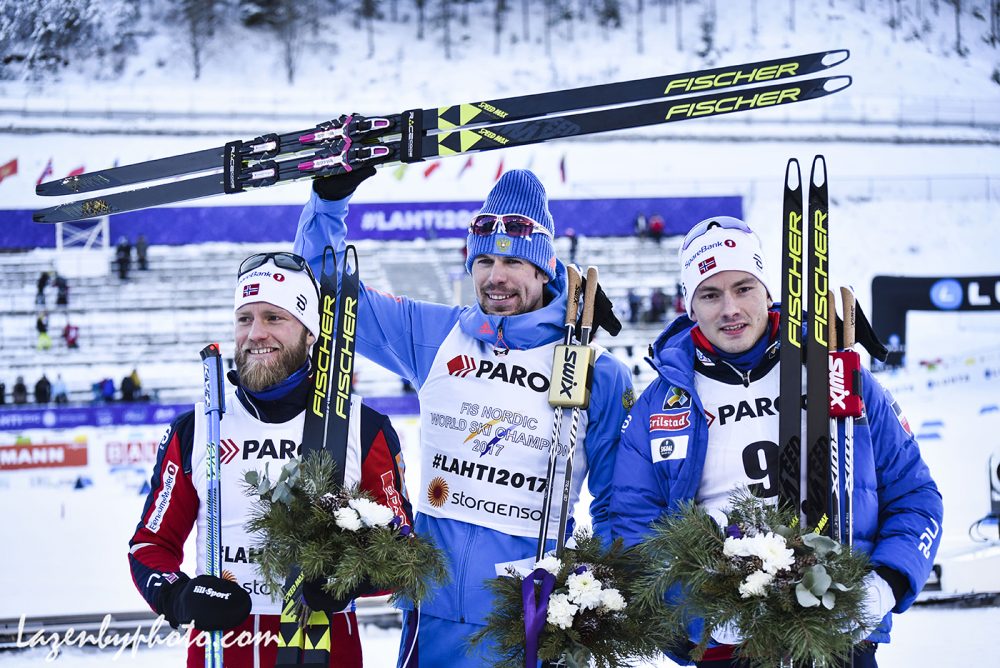
    Left to right: Norway’s Martin Johnsrud Sundby, Russia’s Sergey Ustiugov, and Norwegian Finn Hågen Krogh on the men’s 30 k skiathlon podium at the 2017 Nordic World Championships in Lahti, Finland. (Photo: John Lazenby/Lazenbyphoto.com)

    “It is a great achievement for me,” Ustiugov said the press conference through a translator. “I was disappointed after the sprint so to win the gold medal is amazing. It is not only my success. The whole team did a great job.”

    Crossing third for the men was Krogh, 31.8 seconds after Ustiugov. The bronze medal is Krogh’s first in an individual World Championships race. Although Krogh indicated he tried to go with Ustiugov and Sundby when they made their break from the pack, he admitted the two were in a league of their own in terms of the front pace.

    “The second lap of skating, I saw these guys make a gap,” Krogh said of Ustiugov and Sundby during a press conference. “I tried to push hard to hold it, but after a couple of kilometers I realized it was going to be too hard to catch them, and then I tried to save a little energy to secure the bronze.”

    Harvey Top North American in 5th

    The first man out of the exchange for the 30 k skiathlon on Saturday was not from Norway, nor Russia, or even Sweden. It was Canada.

    After racing within a front group of nearly 25 skiers for the first 15 k, Canada’s Alex Harvey led the mass during their final classic leg stadium descent and into the ski exchange. And as racers headed back out on course for the freestyle portion, it was once again the red maple leaf in the lead.

    Canada’s Alex Harvey racing to fifth in the men’s 30 k skiathlon at the 2017 Nordic World Championships in Lahti, Finland. (Photo: John Lazenby/Lazenbyphoto.com)

    While Harvey intended to position himself up front early in the skate leg, he also pointed out that he had the skis to do so, even after one broke in a fall.

    “I had really, really fast skis, both in classic and skate,” Harvey said. “Broke my classic ski during the last lap. Ustiugov cut me off and I crashed on the climb and broke my ski, but they were still running really well and I was still able to come to the exchange in the lead.”

    For most of the classic portion of the race, Harvey had raced within the top 10, at times the top three, following Sundby and Ustiugov, along with Norwegians Krogh, Sjur Røthe and Didrik Tønseth, as well as Finland’s Matti Heikkinen, Great Britain’s Andrew Musgrave and Sweden’s Calle Halfvarsson. 

    The large front group remained intact through the exchange, with Harvey in front. Within a few kilometers, however, Sundby and Ustiugov tookover the reins, and Harvey soon got caught behind Heikkinen. By the 20 k mark, Harvey could see his fight for the podium would be for bronze.

    “On the second lap of skating I was following Heikkinen and I kind of was in a good position in fourth there able to react,” Harvey said, referring to any moves made by Ustiugov or Sundby. “But [Heikkinen] just completely blew up. That’s the moment I’d like to relive in the race because I feel like I had the legs to go with the first two. But once they had a gap, it’s so windy out there, it’s really hard to come back.”

    The battle for third ensued, with Harvey holding on tight to any moves made by Krogh, Røthe or Tønseth. Coming into the final downhill turn, the Canadian was fourth and Krogh in third place, at the front of the chase pack, was making a break. The Norwegian held the lead and Harvey eventually crossed fifth (+33.3), just two tenths of a second behind Røthe in fourth (+33.1).

    “It’s disappointing to be so close to the goal,” Harvey said, explaining that Saturday’s skiathlon was one of the championships races he had been targeting a medal in.

    “But now I know that I’ll have to ski in the top three, not the top four, for the 50 k skate,” he added, indicating that his next individual target event will be the men’s 50 k freestyle mass start.

    Graeme Killick and Knute Johnsgaard also both competed in the skiathlon for Canada, with Killick finishing in 47th (+6:23.5) and Johnsgaard 55th (+8:40.2).

    Canadian Devon Kershaw, did not compete in Saturday’s event due to not feeling 100 percent. Though he explained in an email that he has had good results in the skiathlon event over the course of his career, his world champs focus is on other races.

    “The 30km [skiathlon] is punishing, and with other races slated later in this World Championships it made the most sense to take another day easy and let myself come back perfectly,” Kershaw wrote in an email. “A bit of bad luck not being able to race this first race (the 30km), since I had planned to do it, and the skiathlon has been kind to me in my career, but ‘delay doesn’t mean denial’ as an old sports psych and good friend Cal Botterill would always say to me –  so I won’t be denied of chances to show my fitness later in these Championships.”

    Kershaw’s next focus will be the men’s 15 k classic on Wednesday.

    Three Americans competed in Saturday’s skiathlon, with Tad Elliott placing 48th (+7:11.2), Kyle Bratrud 49th (+7:16.5) and Noah Hoffman 57th (+9:33.6). Ben Lustgarten did not start.

    American Tad Elliott at the arena on Wednesday at 2017 Nordic World Championships in Lahti, Finland. (Photo: John Lazenby/Lazenbyphoto.com)

    Elliott explained that while classic skiing may not be his strength, Saturday’s classic segment was one of his better efforts.

    “It was quite apparent that those guys were going to charge from the front, at a pace I wasn’t comfortable with,” Elliott said. “My strategy was to try and save something for the skate leg, wherever I was, to really let my skating take over, and try to get in the mix after that. After the first lap I knew I was going to have to dig deep in the classic to have a shot, and that was the hardest I’ve gone all year, the deepest I’ve gone.”

    Elliott attributes part of that ability to dig deeper to his growing fitness. Though he had a successful last season and reached the podium at this year’s U.S. nationals, he indicated that his fitness is just now coming around.

    “Nationals were great, but I didn’t feel like I had reached my peak form from last year, and I feel like it’s coming together here,” Elliott said. “I felt great in the skate leg. I was with Kyle, and we worked together really well to pick up as many places as we could, but we were out of contact, because of us, not because of the techs. But I think that bodes well of things to come for Kyle and I, in the skate, especially me, in the skate 50 k. To be able to go that deep in the classic and to skate pretty well. I think it’s great for the 50. I’m pretty excited.”

    Elliott skied much of the race alongside Bratrud, who finished five seconds behind him. Bratrud is also focused on the 50 k, and he viewed the skiathlon as a good opportunity to get competition experience for his later races during his second World Championships.

    Despite also breaking a pole during the first part of his classic race, Bratrud maintained composure and was able to work his way up through the results.

    “I’m shooting for the 50 k, but I had really good energy today,” Bratrud said. “I felt like I was at the back of the lead group, moving my way back up from the start in the classic, and then I got my pole stomped on, and broken at about 6 k. I spent the next 5 k exchanging different length poles, until I finally got my pole, and from there I don’t think I lost too much time. I hooked up with Tad, and we were able to skate pretty fast.”

    As for the 50 k, Bratrud described it as a “brutal course, but if you have the legs, you can do some damage,” he said. “I’m really excited for it. It’ll be a good way to end it. I’m hoping to do the 15 k classic, and the relays before that, but I’m excited for the next week.”

    Results

    — Jason Albert, Harald Zimmer and Jake Ellis contributed

    Norway’s Martin Johnsrud Sundby finishing second in the men’s 30 k skiathlon while Russia’s Sergey Ustiugov (on the big screen in the background) celebrates gold at Nordic World Championships in Lahti, Finland. (Photo: John Lazenby/Lazenbyphoto.com)
  • Nordic Nation: Musgrave Doing More With Less

    Nordic Nation: Musgrave Doing More With Less

    At 26 years old, Andrew Musgrave, or “Muzzy” as the Eurosport commentators call him, of the British National Ski Team is a top-20 ranked distance skier on the World Cup. The down-to-earth, self-deprecating Scotsman placed sixth in the 15 k freestyle World Cup on Jan. 21 in Ulricehamn, Sweden. And let’s not forget, Musgrave burst onto the scene when he won the Norwegian skate-sprint national championship in 2014 before the Sochi Olympics. Then last year, Musgrave busted out a fourth place at 2016 Norwegian nationals in the 30 k skiathlon. That’s downright cheeky.

    Great Britain’s Andrew Musgrave racing in the 10 k freestyle at the December 6th, 2014 Lillehammer, Norway World Cup — he placed 13th on the day. (Photo: Go Media)

    Did we mention he’s from Britain (Scotland actually)? We did.

    He’s an outsized presence on the World Cup despite hailing from a land of kilts, bagpipes, and golf links. Musgrave balances out that lack of nordic heritage with a hardy work ethic and a willingness to wend to where the snow and competition is — in his case, that’s been Norway. He’s based out of Trondheim where he is taking the extended-stay plan when it comes to earning his engineering degree and training for international competition.

    Nordic Nation caught up with Musgrave on Jan. 24 when he was in Livigno, Italy, for a pre-World Championships high-altitude camp.

    (Here’s a link to a FasterSkier article explaining how the British National Team gets Norwegian assistance with its waxing — the waxing help is mentioned in the podcast. Musgrave also gets wax and ski selection help from Salomon service techs.)

    (To subscribe to the Nordic Nation podcast channel, download the iTunes app. If you have iTunes, subscribe to Nordic Nation here.)

    Have a podcast idea? Please email nordicnation@fasterskier.com.

  • Harvey Tops Ulricehamn 15 k: ‘It’s the Win that Gives Me the Most Satisfaction’

    Harvey Tops Ulricehamn 15 k: ‘It’s the Win that Gives Me the Most Satisfaction’

    Alex Harvey celebrates on his way to the top step of the podium in Ulricehamn, Sweden. The Canadian won the 15 k freestyle over Norway's Martin Johnsrud Sundby and Sweden's Marcus Hellner. (Photo: Cross Country Canada/NordicFocus.com)
    Alex Harvey celebrates on his way to the top step of the podium in Ulricehamn, Sweden. The Canadian won the 15 k freestyle over Norway’s Martin Johnsrud Sundby and Sweden’s Marcus Hellner. (Photo: Cross Country Canada/NordicFocus.com)

    It’s not like winning is a new feeling for Canada’s Alex Harvey. After all, the Quebec-based cross-country skier won a World Cup just six days ago in Toblach, Italy.

    But winning a long individual-start race? Yes, that’s something else. Harvey picked up his fifth individual win in Ulricehamn, Sweden, today, and the first in an individual-start race longer than a prologue.

    “It’s for sure the win that gives me the most satisfaction,” Harvey said after besting every other skier in the 15 k freestyle. “In mass starts or sprints, in the tactical game sometimes I can play it pretty well. I can use the others a bit, and kind of wait for the last sprint. But today — I didn’t have a ride or anything. I had to make it on my own. That’s true skiing, pure skiing, more old school in a way. So it’s the win that gives the most satisfaction in my career, I think.”

    It wasn’t just Harvey who saw the difference between his previous victories and today’s 15 k freestyle. Harvey’s whole team felt like it was a moment where Canada truly had arrived.

    “Today was a legendary day for our team,” Harvey’s longtime teammate and friend Devon Kershaw wrote in an email. “I mean, when you win an individual start race in our sport – then in my opinion you have really written your name amongst the greats. I’m not saying winning sprints or mass starts are easy – but when it’s just you out there – having to do it totally alone – it’s something pretty special… All I can say is ‘chapeau mon gars’ to Alex… To win in the style he did it in too, and in front of such a wonderful crowd, that will be a memory we will all have for life. Simply fantastic skiing.”

    Harvey started hard, and already laid down the fastest split of the field when he crossed the five kilometer mark.

    A number of top competitors had later bib numbers. Dario Cologna of Switzerland, Martin Johnsrud Sundby of Norway, and Marcus Hellner of Sweden were all lurking behind him, hearing his splits and trying to pounce. But none could best his time.

    The men's 15 k freestyle podium at Saturday's World Cup in Ulricehamn, Sweden, with Canadian winner Alex Harvey (c), Norwegian runner-up Martin Johnsrud Sundby (l), and Sweden's Marcus Hellner (r) in third. (Photo: FIS Cross Country/Twitter)
    The men’s 15 k freestyle podium at Saturday’s World Cup in Ulricehamn, Sweden, with Canadian winner Alex Harvey (c), Norwegian runner-up Martin Johnsrud Sundby (l), and Sweden’s Marcus Hellner (r) in third. (Photo: FIS Cross Country/Twitter)

    Initially, that made Canadian coach Ivan Babikov nervous.

    “When I saw the first split, I kind of got a bit scared,” he admitted. “Like maybe, I hope he didn’t start too fast. Leading by two seconds on the first split — there are some guys who start really fast and then blown up.”

    But when he saw how Harvey was skiing, his fears slipped away.

    “I was on the biggest hill,” Babikov explained. “He was just so confident, so powerful, one-skating the whole thing. And then did not slow down in the second lap, and got even more time on the second and third place. Then I thought, he is actually doing it. He has his game plan, he started fast, and he was able to keep his pace and speed all the way.”

    Harvey agreed: he had things under control.

    “I was trying to not put myself too much in the red on the big hill, but to really ski well and fast on everything else for the course,” he explained. “So for maybe 600 meters of the course, on the big hill, let my foot off the gas. Everything else I was able to attack, and recover well on the downhills. At the halfway point I was actually feeling pretty positive still… I was like, ‘Okay, it’s mine to lose now, and I’m not going to let it slip through my fingers.’ It was a good feeling.”

    A few racers lost substantial time over the last several kilometers, or on the rolling sections of the course which require focus, momentum, and, as Harvey said, “punch”.

    But this was a course well-suited to Harvey, and he took advantage.

    “Short uphills that you can really punch it, and then recover quickly again,” he explained. “Skiing it the last two days, I thought it was a great course for me. I was looking for a good result and I know I’ve been feeling good since I took a few days off after the Tour. I was looking forward to the race, but winning… I did not think I could win until the midway point of the race.”

    When all was done, Harvey landed a six-second victory over Sundby. Hellner was third, +14.3, and managed to hold off fourth-place Cologna by just 0.4 seconds.

    Daniel Stock of Norway, who got the call to race within the last week, posted a huge career best in fifth place (+16.2). Britain’s Andrew Musgrave was sixth (+18.7).

    “I don’t believe that I am this good, so I just go out there and do what I’m supposed to do,” Stock told NRK. “And then I finish fifth and that’s indescribable… I got a phone call from Tor-Arne [Hetland, the Norwegian men’s coach] Sunday night and I totally panicked. I had been training like crazy lately. So I just had to eat, lay down with legs elevated and find some extra energy. And I was able to do that.”

    As for the winner, the Canadians were still high on the feeling hours later. Babikov, a former World Cup racer who once won the time-of-the-day on the Tour de Ski final climb, knows a thing or two about how hard it is to win a race on your own.

    “It’s not a mass start,” Babikov said. “If you win by yourself, it you’re off the start leading the whole race, it shows great form… Individual start, it doesn’t show good tactics, or being more smart or lucky than other people, it’s all endurance and it’s all physical ability. Today [Harvey] showed that he is the best in the world, and to win like that with authority from the gun, leading most of the splits — oh it was impressive, it was really impressive. He is one of the best in the world and he is only getting better and better, and hopefully he can keep this shape for the World Championships.”

    In taking the win, Harvey also became the first Canadian to ever win back-to-back World Cups on consecutive weekends.

    “We’ve had a lot great champions in Canada,” he said in a Cross Country Canada press release. “It is nice to be able to own a statistic like that, but I do it for the result and to be the best I can be each race. If that means that I win back-to-back then that is a bonus.”

    With Strong Performances, Canada Looks to Relay

    While Harvey’s win certainly highlighted the day for Canada, the team was also pleased with some other results.

    Canada's Alex Harvey (l) and Len Valjas celebrate their World Cup freestyle team sprint win in Toblach, Italy. It was the first team-sprint victory for Canada since 2011 World Championships. (Photo: Salomon/NordicFocus)
    Canada’s Alex Harvey (l) and Len Valjas celebrate their World Cup freestyle team sprint win in Toblach, Italy, least weekend. (Photo: Salomon/NordicFocus)

    Lenny Valjas finished 35th (+1:17.7), his best result in a distance race over 5 k since 2013. That season, he and Harvey shared the podium in a 15 k mass start stage of the Tour de Ski. But ever since, Valjas has been battling injuries and has primarily succeeded in sprinting.

    “Len had a good starting position and he started well,” Babikov explained. “He kind of tried to pull Alex when Alex caught him, and maybe slowed up a bit on the second lap. But then he recovered and finished actually really, really, strong so I am really proud of him and just happy with it. It’s just kind of bittersweet that he is almost in the points [top 30]. But it’s his best distance race of the season so far… Len is a way that now it’s not about training, it’s about races. The more races he does, he is getting better in shape.”

    Close behind Valjas was Kershaw. The veteran was on track to score points with a top-30 finish, but lagged in the course’s final kilometers and landed 38th (+1:22.2).

    “The last 2km were just absolutely horrendous apparently (based on the splits),” Kershaw wrote in an email. “I was skiing alone – and of course I was tired – but I didn’t think I was SO tired. Very disappointed with the last few kilometres… The terrain was really gradual, undulating and turny – perhaps in my tired state I fell asleep through some of that terrain and I really, really paid for that on the results board… I may have opened a tad hot, but fortune favours the bold – or so they say – so I do not regret my strategy there.”

    Despite an imperfect race, Kershaw was not too disappointed.

    “I was not hoping for anything this weekend if I’m honest,” he wrote. “15km skate individual start is by far my least favourite race in skiing…. The race today had its moments. Both good moments and some tough moments.”

    Canada’s fourth athlete, Knute Johnsgaard, did not end up starting, with Babikov saying that Johnsgaard was still suffering a bit after only recently arriving in Europe from North America.

    Still, the gang will contest Sunday’s 4 x 7.5 k relay, and are particularly pumped after the results of the 15 k.

    “I’m excited,” Harvey said. “The big hill is only in the classic part, so the classic will be harder. Maybe things will go down a bit earlier, because after that the skate is quite… there are no easy courses on the World Cup, but I think this is one that can be a big advantage to be able to follow in a group. Devon and I are going to go in the classic legs. We will try to lay down a good race and stay with the group, and if we’re still with the group after the classic, then we’re allowed to believe in a good result. Top eight would be good for us, after that you never know.”

    Bjornsen 28th to lead Americans

    Erik Bjornsen racing to 20th place in the World Cup in La Clusaz, France, earlier this season.
    Erik Bjornsen racing to 20th place in the World Cup in La Clusaz, France, earlier this season.

    Erik Bjornsen was the top American finisher in 28th (+1:09.2), scoring World Cup points for the third time this season.

    Bjornsen had to drop out of the Tour de Ski partway through, but seems to be back in top form.

    “He obviously needed some time to go and get healthy, or recover from the Tour,” U.S. Ski Team Head Coach Chris Grover said. “He had a really good training block in France. Conditions were good he had a lot of skiing at his disposal, so he was able to recover and then he was able to build in some good training. It was great to see him out there have a good race today. He started I would say fairly conservatively and then he ended up getting behind the Lari Lehtonen of Finland and catch a ride with him for maybe ten kilometers. That really propelled him into another good skate race.”

    Also for the United States, Noah Hoffman finished 41st (+1:28.8), Simi Hamilton 53rd (+1:56.2), and Matt Gelso 68th (+3:00.3).

    Results

  • Saturday Rundown: Ulricehamn, Antholz, Chaux-Neuve, Zuoz, Whistler, & Truckee (Updated x6)

    Saturday Rundown: Ulricehamn, Antholz, Chaux-Neuve, Zuoz, Whistler, & Truckee (Updated x6)

    Ben Lustgarten (Craftsbury Green Racing Project) with his $750-dollar check for winning the men's SuperTour classic sprint on Saturday near Truckee, Calif. Stratton's Ben Saxton (l) placed second and APU's Reese Hanneman (r) was third.
    Ben Lustgarten (Craftsbury Green Racing Project) with his $750-dollar check for winning the men’s SuperTour classic sprint on Saturday near Truckee, Calif. Stratton’s Ben Saxton (l) placed second and APU’s Reese Hanneman (r) was third.

    U.S. SuperTour (Truckee, Calif.): Classic sprints

    [UPDATED] Less than a week after being named to the U.S. team for 2017 World Championships, Ben Lustgarten — the men’s 30 k classic mass start champion at this year’s U.S. nationals — won Saturday’s SuperTour classic sprint as well.

    Lustgarten, of the Craftsbury Green Racing Project, raced to a 1.58-second victory in the men’s A-final at the Auburn Ski Club in Soda Springs, Calif., finishing in 3:03.4. Ben Saxton, of the Stratton Mountain School (SMS) Elite Team, placed second, and Reese Hanneman, of Alaska Pacific University (APU), was third (+2.77).

    Hannenman’s younger brother Logan also reached the final and placed fourth (+4.5), Dakota Blackhorse-von Jess (Bend Endurance Academy) was fifth (+5.86), and the third APU skier in the final, Tyler Kornfield sixth (+18.69).

    Blackhorse-von Jess started the day off as the fastest qualifier in 2:58.8. Saxton qualified second, 4.1 seconds back, Logan Hanneman qualified third (+4.2), and Lustgarten fourth (+6.5). Blackhorse-von Jess went on to win his quarterfinal and place second in his semifinal, while Lustgarten and Saxton both won their quarterfinals and semifinals.

    Jennie Bender (3) of the Bridger Ski Foundation leading Stratton's Julia Kern (2) and Sun Valley's Deedra Irwin (5) during the second women's classic sprint semifinal at Saturday's SuperTour near Truckee, Calif. Bender went on to win the semifinal, as well as the final.
    Jennie Bender (3) of the Bridger Ski Foundation leading Stratton’s Julia Kern (2) and Sun Valley’s Deedra Irwin (5) during the second women’s classic sprint semifinal at Saturday’s SuperTour near Truckee, Calif. Bender went on to win the semifinal, as well as the final.

    In the women’s A-final, Jennie Bender of the Bridger Ski Foundation, coming off a classic sprint win at nationals, scored another victory in 3:29.07. She edged Craftsbury’s Kaitlynn Miller by just seven-hundredths of a second, and Stratton’s Julia Kern placed third (+3.42). Racing at home, Hannah Halvorsen (Sugar Bowl Academy) finished fourth (+3.88). Craftsbury had three in the women’s final with Caitlin Patterson in fifth (+3.93) and Heather Mooney in sixth (+27.35).

    Miller proved to be the woman to beat throughout the day, winning the qualifier in 3:30.9, along with her quarterfinal and semifinal. Kern qualified second (+3.2) and Bender third (+4.6). Bender went on to win her quarterfinal and semifinal as well before facing off with Miller in the final.

    Results: Men | Women

    ***

    NorAm Western Canadian Championships (Whistler, B.C.): 10/15 k classic 

    It was interval-starts day at Western Canadian Championships at Whistler Olympic Park and national-team veteran Emily Nishikawa completed the four laps of the women’s 10 k classic in 30:35.5 to win ahead of teammate Dahria Beatty, 16.5 seconds behind. Maya MacIsaac-Jones completed the national team and Alberta World Cup Academy (AWCA) sweep in third (+1:36.5).

    Sovereign Lake’s Hannah Mehain, of the national junior team, was the top junior for the second-straight day in eighth overall (+3:22.1).

    In the men’s 15 k, Lappe Nordic’s Andy Shields won the six-lap race in 40:34.2, showing some of the form that won him the NorAm overall last season. National-team member Jess Cockney collected his second-straight podium, finishing second, 4.3 seconds behind Shields. Evan Palmer-Charrette (NTDC Thunder Bay) completed the podium in third (+55.1).

    Results

    ***

    FIS Cross-Country World Cup (Ulricehamn, Sweden): 10/15 k freestyle

    The men's 15 k freestyle podium at Saturday's World Cup in Ulricehamn, Sweden, with Canadian winner Alex Harvey (c), Norwegian runner-up Martin Johnsrud Sundby (l), and Sweden's Marcus Hellner (r) in third. (Photo: FIS Cross Country/Twitter)
    The men’s 15 k freestyle podium at Saturday’s World Cup in Ulricehamn, Sweden, with Canadian winner Alex Harvey (c), Norwegian runner-up Martin Johnsrud Sundby (l), and Sweden’s Marcus Hellner (r) in third. (Photo: FIS Cross Country/Twitter)

    Men’s report | Women’s report

    First individual win of the season (second straight, after winning last weekend’s team sprint), fifth individual victory of his career. That’s the latest news on Canada’s Alex Harvey, who won the World Cup men’s 15-kilometer freestyle individual start on Sunday in Ulricehamn, Sweden, for his first victory in a 15 k skate race and fourth individual podium of 2016/2017.

    To say Harvey is on a roll is an understatement. On Saturday, he beat Norway’s Martin Johnsrud Sundby by 6 seconds after starting a minute behind the Norwegian defending World Cup champion. Harvey’s fastest time across the line in 32:46.2 held up through 76 finishers, with Sweden’s Marcus Hellner coming somewhat within range after starting a minute behind him. Hellner ended up 14.3 seconds back from Harvey at the finish for third place, behind Sundby.

    Switzerland’s Dario Cologna missed the podium by 0.5 seconds in fourth (+14.7), and Norway’s 24-year-old Daniel Stock broke through in fifth (+16.2) for his first World Cup top 20.

    Great Britain’s Andrew Musgrave placed sixth (+18.7), Sweden’s Daniel Rickardsson was seventh (+25.0), Norway’s Finn Hågen Krogh eighth (+32.2), Russia’s Petr Sedov ninth (+33.9), and Japan’s Keishin Yoshida 10th (+34.2).

    American Erik Bjornsen landed in the points as he tied Norway’s Simen Andreas Sveen for 28th (+1:09.2), leading fellow U.S. Ski Team members Noah Hoffman, who placed 41st (+1:28.8), and Simi Hamilton in 53rd (+1:56.2). Also for the U.S., Matt Gelso, the Period 1 SuperTour leader from the Sun Valley Ski Education Foundation (SVSEF) Gold Team, finished 68th (+3:00.3).

    Harvey’s Canadian World Cup teammates Len Valjas finished 35th (+1:17.7) and Devon Kershaw 38th (+1:22.2). Knute Johnsgaard (Canadian U25 Team) did not start.

    The women's 10 k freestyle podium on Saturday in Ulricehamn, Sweden, with Norwegian winner Marit Bjørgen (c), Finland's Krista Parmakoski (l) in second and Sweden's Charlotte Kalla (r) in third. (Photo: FIS Cross Country/Twitter)
    The women’s 10 k freestyle podium on Saturday in Ulricehamn, Sweden, with Norwegian winner Marit Bjørgen (c), Finland’s Krista Parmakoski (l) in second and Sweden’s Charlotte Kalla (r) in third. (Photo: FIS Cross Country/Twitter)

    In her first World Cup race in over a month and at a brand-new World Cup venue, Norway’s 36-year-old Marit Bjørgen returned to her winning ways, topping the women’s 10 k freestyle on Saturday in Ulricehamn.

    Bjørgen started 40th out of 61 finishers and took the lead from Finland’s Krista Parmakoski at the finish with a time of 23:46.3 minutes. Parmakoski, who started a minute ahead of her in bib 38, ended up second, 10.7 seconds back. Sweden’s Charlotte Kalla reached the podium for the second time this season in third (+24.9).

    “It is always great to win,” Bjørgen said, according to an International Ski Federation (FIS) press release. “I stayed at home for five weeks and was training. It is great to come back with a victory. I know that the training I had done was good. It was an amazing atmosphere today by the course. There were people cheering everywhere.”

    Norway swept fourth through sixth with Astrid Uhrenholdt Jacobsen in fourth (+25.7), Ragnhild Haga in fifth (+32.3) and Heidi Weng in sixth (+34.0).

    American Jessie Diggins raced to seventh (+34.9), ahead of Sweden’s Hanna Falk, who recorded her best distance result in eighth (+36.4). Norway’s Ingvild Flugstad Østberg finished ninth (+44.8), and Germany’s Sandra Ringwald was 10th (+56.6).

    “I didn’t have the snappy good feelings I was hoping to have in my body today, but it was a solid race,” Diggins wrote in a post-race email to FasterSkier. “It’s always hard when you know that on your best days you are capable of more, but at the same time we had great skis, and it was really fun for me to be able to ski with my teammates today!”

    The U.S. had three in the top 20 and four in the top 30 with Sadie Bjornsen in 12th (+1:00.5), Liz Stephen in 16th (+1:07.3) and Rosie Brennan in 24th (+1:30.7).

    Cendrine Browne as Canada’s lone woman in the race achieved 35th (+1:52.0) for her career best in an individual race. Also for the U.S., Kikkan Randall placed 40th (+1:59.6) and Liz Guiney of the Craftsbury Green Racing Project 52nd (+2:33.2).

    Results: MenWomen

    ***

    IBU World Cup (Antholz, Italy): Men’s relay & women’s mass start

    Men’s reportWomen’s report

    The photo finish of the men's 4 x 7.5 k relay on Saturday at the IBU World Cup in Antholz, Italy, with Germany's Simon Schempp outlunging Norway's Emil Hegle Svendsen. (Photo: IBU screenshot)
    The photo finish of the men’s 4 x 7.5 k relay on Saturday at the IBU World Cup in Antholz, Italy, with Germany’s Simon Schempp outlunging Norway’s Emil Hegle Svendsen. (Photo: ZDF broadcast screenshot)

    For the U.S. men, top six was a target for the 4 x 7.5 k relay on Sunday in Antholz, Italy, according to US Biathlon Men’s Coach Jonas Johansson.

    Mission accomplished. In the final team event before 2017 World Championships, Lowell Bailey, Leif Nordgren, Tim Burke, and Sean Doherty combined for sixth, finishing 1:04.9 minutes behind the German winners. The Americans used a total of 10 spares but avoided the penalty loop, as did the Germans who used seven spares to clean the eight-stage race and won it in 1:13.57.2.

    Germany’s Simon Schempp narrowly outlasted Norway’s Emil Hegle Svendsen in the finishing stretch to secure the victory for Germany (with teammates Erik Lesser, Benedikt Doll and Arnd Peiffer) by one-tenth of a second. Norway finished second with nine spares and no penalties (with Lars Helge Birkeland, Henrik L’Abee-Lund, Johannes Thingnes Bø, and Svendsen), and Russia secured third (+33.6) with nine spares and zero penalties as well (with Maxim Tsvetkov, Evgeniy Garanichev, Dmitry Malyshko, and Anton Babikov).

    Ukraine used a total of just five spares and had zero penalties for fourth (+46.7), and Austria took fifth (+49.2) with eight spares and no penalties, after Austria’s Dominik Landertinger skied away from Doherty on the final loop and finished 6.9 seconds ahead of him for fifth place.

    For the U.S. men, sixth was close to their team-best fifth with the same lineup in last year’s World Cup relay in Presque Isle, Maine. The same group also took sixth in Ruhpolding, Germany, last year as well.

    With all four making US Biathlon’s World Championships team, announced Saturday, they will likely be aiming for a best championships result early next month in Hochfilzen, Austria.

    Canada (Christian Gow, Scott Gow, Macx Davies, and Brendan Green) finished 16th (+4:13.8) on Saturday with two penalties and 11 spares. Scott Gow skied them up to 15th by the second exchange but they dropped to 18th after Davies had two penalties on the third leg. With Green anchoring and using just one spare, they recouped two places before the finish.

    In the women’s race, Germany’s Nadine Horchler achieved a lifetime dream with her first World Cup win, after starting in bib 30 and earning her start as a reserve athlete. Germany took first and second with Laura Dahlmeier in second, and the Czech Republic’s Gabriela Koukalova placed third. Susan Dunklee of the U.S. was the lone North American starter and finished 24th after leading at the start of the second loop.

    Results: Men’s relay | Women’s 12.5 k mass start

    ***

    FIS Nordic Combined World Cup (Chaux-Neuve, France): Individual large hill/10 k

    Saturday's Nordic Combined World Cup podium in Chaux-Neuve, France, with German winner Johannes Rydzek (c), German runner-up Fabian Rießle (l) and Japan’s Akito Watabe (r) in third. (Photo: FIS Nordic Combined/Twitter)
    Saturday’s Nordic Combined World Cup podium in Chaux-Neuve, France, with German winner Johannes Rydzek (c), German runner-up Fabian Rießle (l) and Japan’s Akito Watabe (r) in third. (Photo: FIS Nordic Combined/Twitter)

    The first part of Saturday’s Nordic Combined World Cup individual large hill/10 k competition was a shining moment for U.S. Nordic Combined skier Ben Berend, who jumped to second for a total of 127.5 points, trailing only Norway’s Jarl Magnus Riiber with 139 points in Chaux-Neuve, France.

    Berend flew farther than Germany’s Eric Frenzel, who jumped to third on the Chaux-Neuve large hill.

    Later in the day, they started the 10 k Gundersen in that order, with Riiber heading out first, followed by Berend 46 seconds later, then Frenzel 53 seconds back in third.

    Germany’s Johannes Rydzek started 1:15 minutes back in 12th and skied the fastest 10 k to take the victory at the finish (in 23:01.7). He held off his German teammate Fabian Rießle by 2.8 seconds for the win, after Rießle started sixth and 1:01 back. Japan’s Akito Watabe reached the podium in third (+5.7) after jumping to seventh and starting the race 1 second behind Rießle.

    Frenzel ended up fourth (+8.3), and the fourth German in the top five, Björn Kircheisen improved to fifth (+22.6) after starting 11th.

    Riiber dropped to 15th (+54.0), and Berend fell outside the top 30 to end up 32nd (+2:26.0) with the 39th-ranked course time.

    Berend finished 12.2 seconds ahead of his U.S. teammate Taylor Fletcher, who placed 34th (+2:38.2) after the jump put him in 48th.

    Bryan Fletcher was 49th after the jump but did not start the 10 k.

    The Nordic Combined World Cup continues Sunday in Chaux-Neuve with another large hill/10 k.

    Results

    ***

    Ski Classics #5: La Diagonela (Zuoz, Switzerland): 50 k classic

    [UPDATED] Under “blue skies, no wind and perfect track conditions” in the Swiss Engadin Valley on Saturday, according to a Ski Classics press release, Russia’s Ilya Chernousov and the Czech Republic’s Kateřina Smutná won the men’s and women’s La Diagonela, respectively, in Zuoz, Switzerland.

    Chernousov, of Team Pioneer Investments, and Tord Asle Gjerdalen (Team Santander) led a large pack of men into the final major climb on the 50 k course. There, Gjerdalen attacked and Chernousov matched him, accelerating away from his competitors up the last steep pitch to the finish, according to the press release. He finished in 2:03:39.6 hours, holding off Gjerdalen by 1.5 seconds, while Øystein Pettersen (Team BN Bank) finished third (+3.0).

    In the women’s race, Smutná (Team Santander) pushed to break up the field around the halfway point, where the men caught the women. Britta Johansson Norgren (Lager 157 Ski Team) hung with Smutná, but lost contact over the last 5 k. After finishing second in the last two Ski Classics races, Smutná took the win by 1:03.2 minutes in 2:20:49.2. Nordgren finished second, ahead of Sara Lindborg (Team Serneke) in third, who finished more than three minutes later (+4:17.4).

    Results


  • Davos Notes and Quotes: The Men

    Davos Notes and Quotes: The Men

    Martin Johnsrud Sundby of Norway coming into the finish for a win in the 30 k skate in Davos, Switzerland. (Photo: Fischer/NordicFocus)
    Martin Johnsrud Sundby of Norway coming into the finish for a win in the 30 k skate in Davos, Switzerland. (Photo: Fischer/NordicFocus)

    Norway’s Martin Johnsrud Sundby took a win in the 30 k freestyle in Davos, Switzerland, this weekend, but on Sunday a new team had took a trip to the podium’s top step: Russia, whose Sergey Ustiugov notched his first victory of the season in the skate sprint.

    Here’s all the reporting – and there’s a lot – that didn’t make it into the race reports.

    On that awesome feeling in your legs

    “I love lactate.”

    -Matti Heikkinen, Finland (3rd in 30 k)

    “Not so much.”

    -Anders Gløersen, Norway (2nd in 30 k)

    On how to get through a rough patch

    “Alex [Harvey] came through with a group, with a young Swede, Jens Burman. He was going quite strong– I think he finished top ten today [note: Burman was sixth]. I joined that train and just kind of faked it through the top of the lap to try to get into the draft there and was able to recover a bit and stay with him though my last lap. It was a perfect group for me to finish with and it helped me have a good last lap there.”

    -Graeme Killick, Canadian National Ski Team (21st in 30 k)

    “The hardest part for me was the second lap. I had to go a few laps where I tried to just calm down and get rid of some lactate… when [Maurice] Manificat began to get tired, I wasn’t feeling great at the time so I didn’t want to go in front. I think that’s where I lost some seconds… All in all, that Martin wins today is like it should be, because I had so much help.”

    -Gløersen

    On avoiding our interview in the mixed zone

    “Yeah, I walked straight past. I was really really disappointed with yesterday. It was just a really hard race yesterday. I did 30 k all by myself. It was really bad and really hard.”

    -Devon Kershaw, Canadian National Ski Team (43rd place in 30 k), after the sprint (49th place)

    On 21-year-old Lucas Chanavat of France, top qualifier and sixth in the sprint

    “If you qualify first you know that your are feeling good that day. You have that confidence. You know that you have really good skis with you. So it is cool to see that, stepping up and taking advantage of the opportunity of being here. He skied hell of a qualifier and a hell of, a hell of quarterfinal so that’s cool to see. It’s sweet to see guys like that.”

    -Simi Hamilton, U.S. Ski Team (23rd place in sprint)

    On sprinting at altitude

    “I think [the qualifier] went well. I didn’t feel the greatest before my heat. The qualifier took a lot out of my lungs, same with Simi [Hamilton], like our lungs are wrecked warming up. The legs were a bit heavy, but I guess it is the same for everybody.”

    -Lenny Valjas, Canadian National Ski Team (14th place in sprint)

    On sprint strategy

    “Two years ago I did that, coming wide off the last turn and was about to pass two guys. But they were still a bit ahead of me so they took the left lanes and then you’re screwed. Today I was close beside them, so they couldn’t really cut me off completely. This time it worked, last time it didn’t.”

    -Valjas

    “Today, I just wanted to do the sprint and remember how to sprint with a tired body with the Tour de Ski coming. It wasn’t very good, but I wasn’t expecting a whole lot. I just wanted to focus on doing the best I could with what I had.”

    -Kershaw

    “There was definitely headwind coming down valley. So my kind of main strategy was to just get in a nice draft through the long gradual flats here. I felt great for a lap and you know still felt good coming through on my second lap.”

    -Hamilton

    On the first period of racing

    “To be honest, I wasn’t all that confident today. I’ve raced in Davos about five or six times, and I’ve gone really slow every time, so today is by far the best I’ve ever done. I’m fairly pleased. My main focus is the 30 k skiathalon at the World Championships, and then I’m hoping to go fast at the Tour de Ski as well. Those are the two things I’m aiming most for. So I’d like to have won a race, but it’s the best, most stable start I’ve had to a season so far in my career, so it gives me a little bit of confidence going forward. At the same time it’s a long season, so there’s plenty of time to start going slow.”

    -Andrew Musgrave, Great Britain (15th in 30 k, 61st in sprint)

    “Overall kind of a disappointing weekend here in Davos, but that’s okay. Overall it’s an okay start to the season. Nothing outstanding, but I feel like I’m building well towards the Tour.”

    -Kershaw

    On next weekend’s World Cups La Clusaz, France

    “We will just have four guys for the relay, so I am psyched to take a turn in that. I think it bodes well for me that they changed the distance race to a 15 k skate on a short kind of circuit loop. Psyched to jump into that hopefully too. And see what happens. I think right now it’s like, the more I can just get my body used to the hard efforts the better. So regardless of how I feel next weekend, it will be a good opportunity to get in a couple more hard efforts before a good solid training block over Christmas.”

    -Hamilton

    “I’m really excited to do the relay. It think Killick showed he’s obviously in great form, so I think we could have some fun in the relay. And 15 k skate mass start is fun if you can stay with the group. And that’s the goal.”

    -Kershaw

    “I feel good, but I’m nervous for the relay event. I don’t know where I am going to start either. It will be fun– I know the shape is good, I just guess it’s been a lot of racing. I have done all the distance except the 30 k. So I am going to try to get my speed back and I think it will go well.”

  • Sundby Returns as Distance King in Davos; Harvey 12th, Killick 21st for Canada

    Sundby Returns as Distance King in Davos; Harvey 12th, Killick 21st for Canada

    Martin Johnsrud Sundby leading a train in the men's 30 k freestyle individual start World Cup on Saturday in Davos, Switzerland, which he won by 13.7 seconds.(Photo: Fischer/NordicFocus)
    Norway’s Martin Johnsrud Sundby leading Finland’s Matti Heikkinen and others in the World Cup men’s 30 k freestyle individual start on Saturday in Davos, Switzerland, which Sundby won by 13.7 seconds. (Photo: Fischer/NordicFocus)

    DAVOS, Switzerland — Martin Johnsrud Sundby might not have had the fastest World Cup opener (by his standards), but two weeks later it’s clear who is king of the distance field: the same Norwegian who won the World Cup distance globe two of the last three years.

    “I did not feel my best the last weekend, but I was able to catch the tour victory after all,” Sundby said of the 3-day mini-tour held in Lillehammer, Norway, last weekend. “So I knew that if I was a bit stronger this weekend I would be able to fight for the first place.”

    He won, but it was a fight. After 30 kilometers and well over an hour of interval-start racing, just 13.7 seconds separated him from second-place Anders Gløersen, also from the Norwegian team.

    Sundby was one of the last starters of the field – number 70 out of 78. And that was by his own choice. With a six-kilometer loop skied five times, he initially tried to game the start order so that he would be able to ski with someone fast who was lapping through. But then he settled on a different strategy.

    “We did some math yesterday trying to find out which number it was good to have,” Sundby said. “I tried to get 28 numbers after Gløersen. That was not possible, so I thought it would be good to see the other intermediate times and have full control of the race. That’s helpful if you need to find the right speed.”

    Despite having complete information about his top competitors, Sundby didn’t lead from start to finish. In fact, the standings fluctuated substantially, with 13 different men having top-five times at at least one of the intermediate time checks.

    “It’s a strange place to do races,” Sundby mused. “You feel almost finished after two laps, and then the third lap feels great, and then you lose 10 seconds downhill, and you gain 10 seconds uphill, so the race is alive. You also have a lot of time thinking. So it’s an interesting race. I love to ski here in Davos. I’m happy about the win.”

    Anders Gløersen of Norway enjoyed some time in the leader's chair before Sundby bumped him out of first place.
    Anders Gløersen of Norway enjoyed some time in the leader’s chair before Sundby bumped him out of first place.

    For the first almost two laps, it was Maurice Manificat of France who was laying down the fastest time.

    Manificat won this race in 2013, and placed second in 2011 and 2015. But even years might be a curse for the Frenchman. After his hard start, he faltered, slipping to 11th by the finish, +1:27.8.

    “Always here in Davos it’s important to try to find the right speed from the beginning and have a lot of power for the last two laps,” Sundby said in the press conference.

    That could have been an admonishment for Manificat, but the Frenchman helped one man onto the podium, even if it wasn’t himself: right on his tail was Anders Gløersen of Norway, who took full advantage.

    “I was lucky to have Maurice Manificat just in front of me on my second lap,” he said in the post-race press conference. “He was skiing so fast I almost died. So I see here I lost 15 seconds between 18 and 24 kilometers. I think that’s when he also felt that he also may have started too fast.”

    But Gløersen was able to hold some sort of pace, even as Manificat was drifting back through the field.

    “My last lap was not so bad,” he said. “I’m very satisfied with second place today.”

    With so many laps, catching a ride with someone strong was the name of the game. Sundby spent some time skiing with Matti Heikkinen of Finland, who exploited their collaboration to get to third place, +25.7.

    “I had the pleasure to do some laps with Matti, so that was great,” Sundby said. “Matti probably felt it was sometimes going a bit too fast. But I think we did a good race together. He was helping on his last lap. On his last lap he did a great speed down to the stadium and we were able to catch some seconds on [Gløersen], so I think we did a good job together.”

    If that was a barb at the third-place Finn, Heikkinen made clear that he thought he had skied a good race, and that Sundby didn’t wear him out too much.

    “My tactic was to start quite fast, but then I knew that Martin would catch me,” Heikkinen said in the press conference. “So I skied with Martin, and then the last lap I made my attack. The split times the last few kilometers, I think I was skiing quite fast.”

    Indeed: his time through the 18 k checkpoint ranked just ninth, but Heikkinen dropped the hammer on his last kilometers, moving his way up through the field’s splits.

    Racing together with someone else can add additional challenges, though. Especially for Gløersen, who followed the fast-starting Frenchman.

    “I always like to go fast on the flats and not so fast on the steep uphills,” Gløersen said in the press conference. “That’s a challenge when you go together with people who don’t have the same pace on the flat but want to go faster on the uphills. That’s not an advantage. So you have to take into consideration what’s best for me, to go my own race, a steady pace, or to take it easy on the flats and then go on the lactate threshold on the uphills.”

    Another Norwegian, Simen Andreas Sveen, took fourth, +36.3; Russia’s Alexander Legkov was fifth, +48.4, after having the second-fastest split time through the middle of the race.

    Both Legkov and teammate Maxim Vylegzhanin (31st, +3:13.8) are under suspicion after the release of WADA’s newest McLaren report on Russian doping, but went through the mixed zone without taking questions from the media.

    Hitching his cart to Legkov’s wagon was Andrew Musgrave of Great Britain, who powered to 15th place (+2:00.7), his third top-15 finish of the season.

    “Yeah, that was lucky,” Musgrave laughed. “I wasn’t feeling amazing. I had done, like, one lap, and got caught by Legkov, and last year I learned that you can get pretty knackered if you do all the work. So I just stayed behind, didn’t do anything, and then felt alright on the last lap. So it was good. Getting pulled around by Legkov for 20 k was a bit of help, yeah.”

    Harvey 12th and Killick 21st; Hoffman Lone American

    Alex Harvey of Canada leading Noah Hoffman of the United States and Sweden's Jens Burman in the 30 k skate in Davos, Switzerland.
    Alex Harvey of Canada leading Noah Hoffman of the United States and Sweden’s Jens Burman in the 30 k skate in Davos, Switzerland.

    Skiing a steady race was Canada’s Alex Harvey, who ended up 12th, +1:29.4. It was his best distance result in Davos ever, despite contesting the event since 2009.

    “I was confident coming in,” Harvey said. “And I was here before Kuusamo to try and get adapted a little bit to altitude, so yeah, I was feeling confident that I would have a better start, a better result than before. But you always have to deliver, so I’m happy that the feelings were representative of the result.”

    He ended up skiing with Jens Burman of Sweden, who had a career-best result of sixth (+53.5).

    “I towed him for a lap and a half, and his last lap he took over because he was pushing hard for the finish,” Harvey said. “He’s pretty new to the scene, so I didn’t know that much about him, but he ended up beating me actually. So we both helped each other. That was good.”

    Teammate Graeme Killick made it two big improvements for Canada, clocking in 21st (+2:24.2). Killick was an early starter in bib 16, and when he lapped through for the first time, Sveen in bib seven was the only man who had gone faster.

    “I was surprised that,” Killick said in a phone interview. “I generally don’t open that hard. I knew it was maybe going to maybe be a decent race… I didn’t think I taxed myself too much on the first lap. Then going into the stadium I saw Hellner was in the starting gate as I was lapping through. Probably twenty seconds to [ski up] to me. So I just tried to ski conservatively and be ready for that ride. He caught me just coming up towards the bunker at the top of the course.”

    Hellner, who was on the podium in the 10 k skate in Lillehammer, wasn’t having his best day – he landed 13th, +1:34.4.

    “I was hoping for a lot more than this,” he said after the race. “Before this I had the goal to be on the podium. The feeling was not so great, so I don’t know, it didn’t happen.”

    Disappointed or not he was still one of the fastest men in the field, and Killick took advantage.

    “I skied with him and I thought the race was okay, but I had a little bit of a blow-up on the next lap because he told me to lead,” Killick said. “He pulled over and so I led that section into the wind, and it wasn’t crazy long but it was kind of rough… when he surged by me and I tried to keep with him, I had a little blow-up there. I lost him slowly through that next lap and then I just tried to recover and ski a decent pace on my own there through the middle section.”

    Like Harvey, Killick had set a best-ever result for the Davos race – his previous mark was 40th. And it was also the first time he had broken into the top 40 this World Cup season.

    “It’s really encouraging for me,” he said. “I’ve never had my best races in Davos and I think it’s always been a course that I have potential with being at altitude, where I tend to do a little better. But a skate race is always difficult for me. It was really encouraging to prove to myself that I can ski that pace with those guys and even just having those initial splits, while I was skiing on my own, being pretty decent–that was really encouraging too going into the Tour de Ski and preparing for World Championships. I am super encouraged by the result.”

    Other Canadian finishers were Devon Kershaw in 42rd (+3:52.9) and Andy Shields in 64th (+6:33.9).

    The lone U.S. man even starting the race was Noah Hoffman, who finished one spot behind Kershaw in 44th (+3:58.9).

    “My energy was actually pretty good,” Hoffman said. “I skied the race more or less the way I wanted to and I just wasn’t fast but ah, I don’t know I am left feeling optimistic still so I will take it. I am not sure why.

    Hoffman actually skied with Harvey for a time, but wasn’t able to hang on to the ride.

    “I had a perfect set up with Alex starting after I lapped through after one lap,” he said. “And I skied with him to the top of the course and then couldn’t hang on the down hill. I have struggled with the downhill before, and I’m frustrated by that. The uphill section–this is a unique course where it’s basically three and a half kilometers uphill, two and half kilometers downhill, and I’m always more competitive on the uphills, that is just the way I am built.”

    — Jason Albert and Jake Ellis contributed reporting.
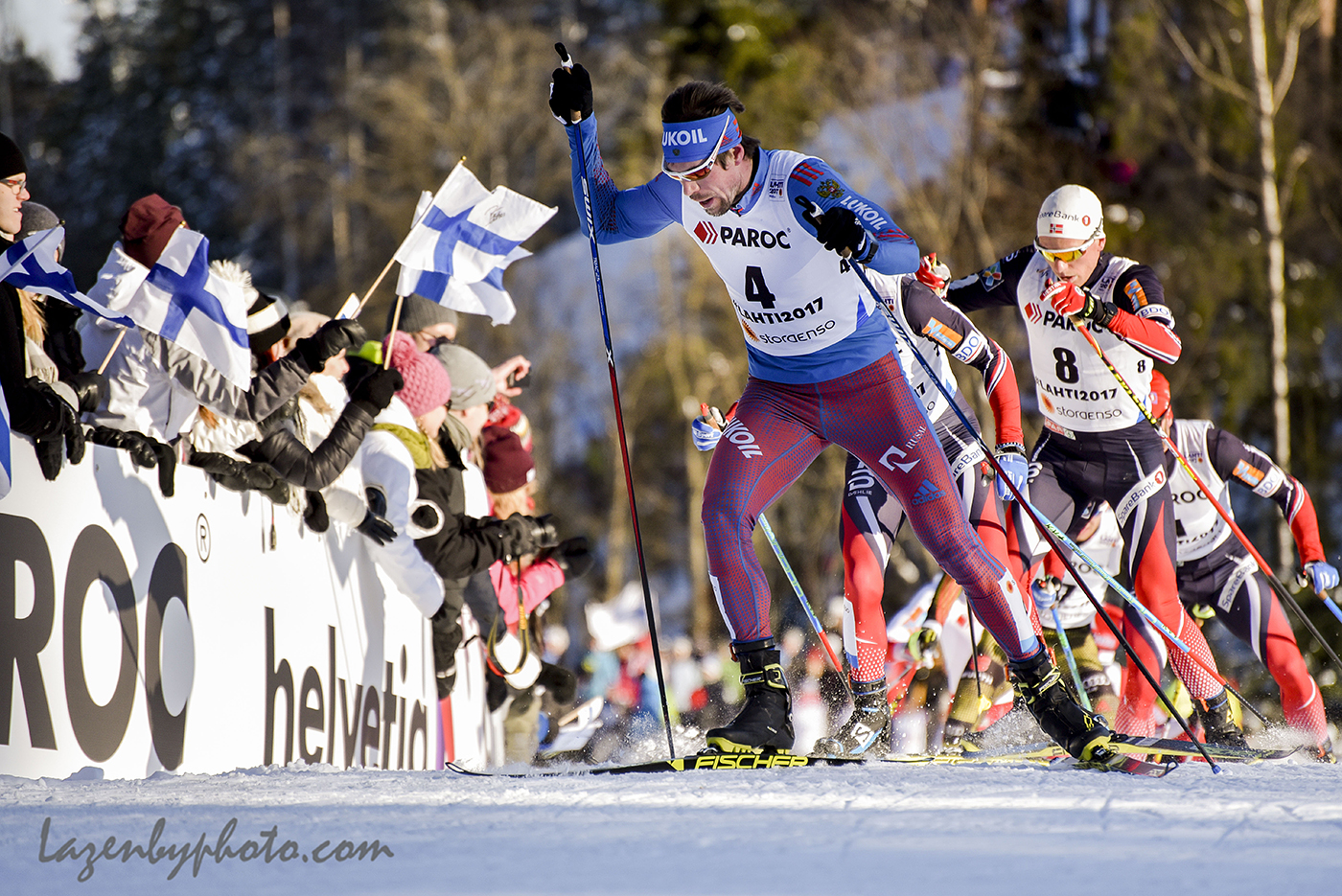
    Results

  • Sunday Rundown: Ruka, Östersund, Pontresina & Beitostølen (Updated x6)
    Sunday Rundown: Ruka, Östersund, Pontresina & Beitostølen (Updated x6)
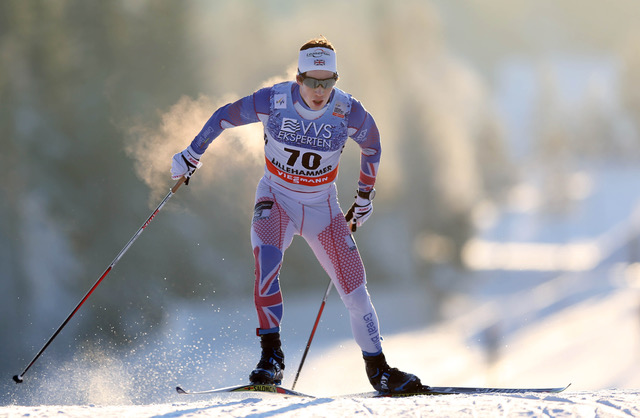
    The Norwegian mixed relay team celebrates after its win in the first IBU World Cup race of the 2016/2017 season on Sunday in Östersund, Sweden. (Photo: ZDF screen shot)
    Two members of the Norwegian mixed relay, Johannes Bø and Marte Olsbu, celebrate their win in the first IBU World Cup race of the 2016/2017 season on Sunday in Östersund, Sweden. (Photo: ZDF screen shot)

    Welcome to The Rundown, your quick primer of need-to-know information about the day’s racing. We’ll be updating this digest as the day goes on with additional results, photos and quotes. The Rundown is NOT a race report; stay tuned for complete race reports later today with interviews from the day’s top racers.

    ***

    IBU Cup in Beitostølen: 7.5/10 k sprints

    [UPDATE] With the second set of men’s and women’s sprints canceled Saturday and moved to Sunday in Beitostølen, Norway, the first IBU Cup relays of the season were bumped off the schedule, and no North Americans competed on Sunday. (American Russell Currier placed 44th in the IBU Cup sprint on Friday.)
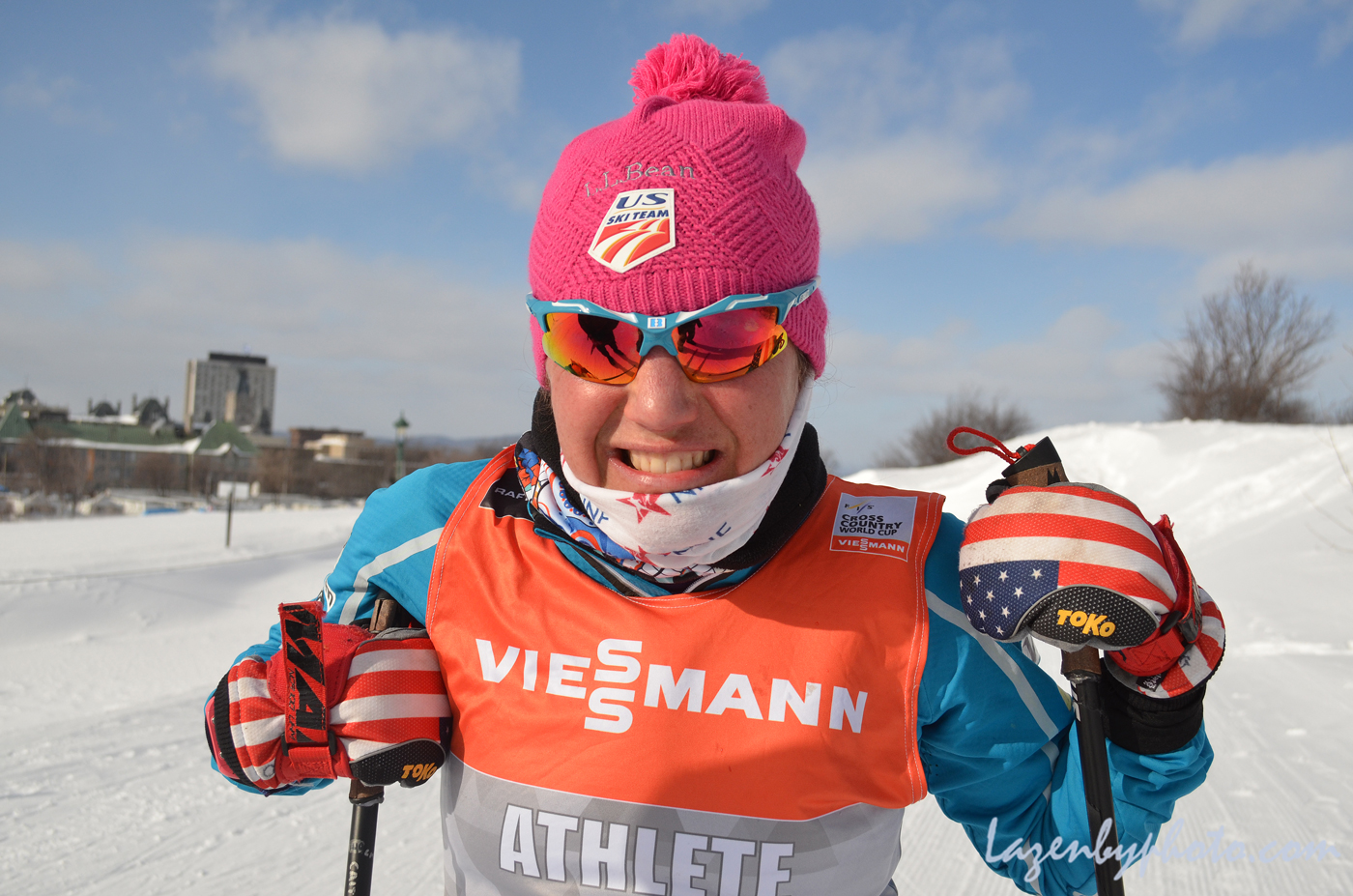
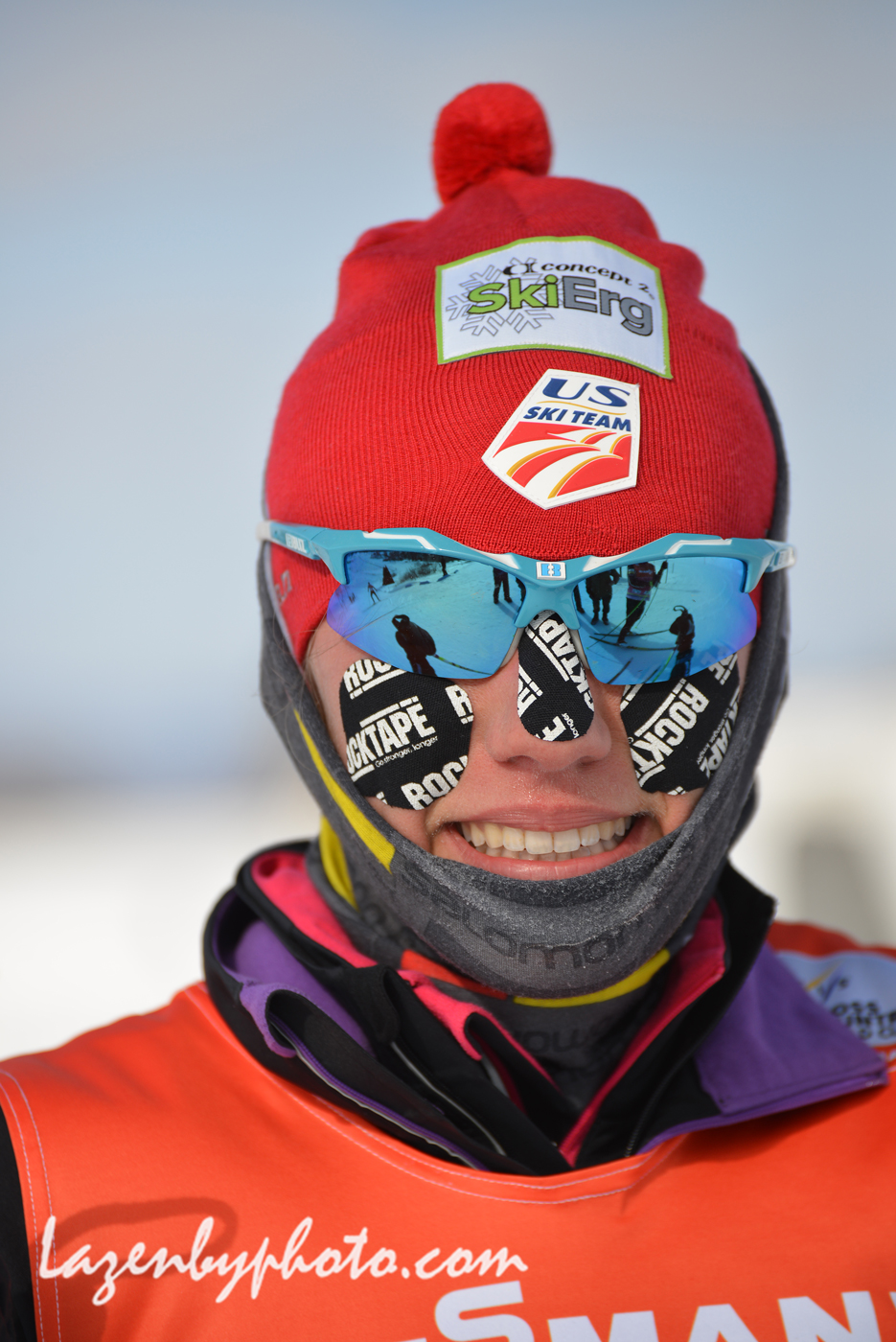
    In the women’s 7.5 k sprint, Marketa Davidova of the Czech Republic pulled out a 3.6-second win over Germany’s Nadine Horchler, and Germany had two on the podium with former cross-country skier Denise Herrmann in third (+29.9). Davidova hit 9 out of 10 targets (1+0) en route to the victory in 24:18.3. Horchler missed just one target as well (0+1) and Herrmann (who won the IBU Cup women’s sprint two days earlier) had three penalties (1+2) but skied fast enough for the podium.
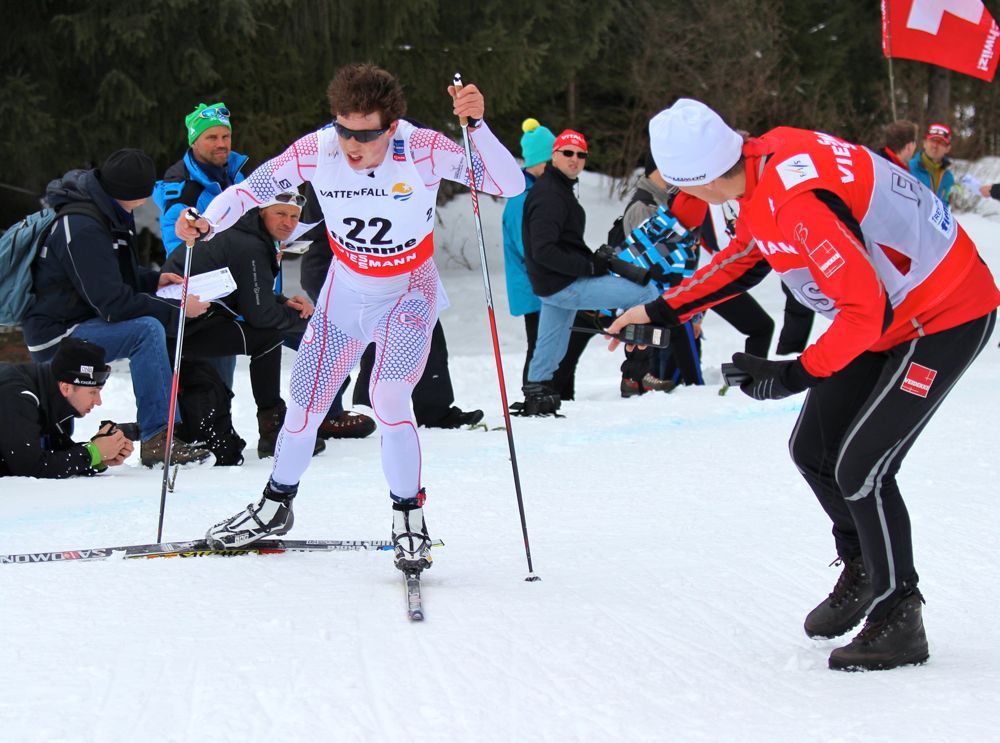
    In the men’s 10 k sprint, Russia’s Matvey Eliseev edged his teammate Dmitry Malyshko by just 3.2 seconds for the win in 26:16.8. More than a minute later, Norway’s Henrik L’Abee-Lund placed third (+1:15.9) with four penalties (1+3). Both Eliseev and Malyshko had one miss apiece, with Eliseev missing one in prone (1+0) and Malyshko missing one standing (0+1).

    The next IBU Cup is set for Dec. 6-11 in Ridnaun, Italy.

    Sunday’s sprint results: womenmen

    Friday’s sprint results: women | men

    ***

    IBU World Cup in Östersund: Mixed and Single Mixed Relays

    Single Mixed Relay report | Mixed Relay report

    The first race if the International Biathlon Union (IBU) World Cup season went to Norway, which won Sunday’s co-ed mixed relay (2 x 6 k + 2 x 7.5 k) by nearly 34 seconds over Germany in Östersund, Sweden.

    The Norwegian team of Marte Olsbu, Fanny Horn Birkeland, Ole Einar Bjørndalen, and Johannes Thingnes Bø used a total of six spare rounds to get to the finish line first in 1:10.57.1.

    Germany, with Franziska Hildebrand, Laura Dahlmeier, Benedikt Doll, and Arnd Peiffer, used the same amount of total spares for second place (+33.7), and both teams avoided the penalty loop.

    Italy took third (+44.2), with Lisa Vittozzi, Dorothea Wierer, Lukas Hofer, and Dominik Windisch using a combined 12 spares and having one penalty loop during Hofer’s standing stage.

    The Italians narrowly held off Russia (Olga Podchufarova, Tatiana Akimova, Maxim Tsvetkov, Anton Shipulin) by 0.3 seconds for the final spot the podium.

    France placed fifth (+1:13.3), Sweden was sixth (+1:20.9), the Czech Republic seventh (+1:20.9), and the U.S. eighth (+2:38.5).

    Susan Dunklee started first for the Americans using three spares to clean (0+1, 0+2), then tagging off to Clare Egan, who didn’t need any spares for prone, but had to use all three and skied two penalty loops in standing. Lowell Bailey used just two spares (0+1, 0+1), and Tim Burke locked up eighth for the team with a flawless prone and three spares in standing (0+0, 0+3). In all the team used 13 spares and had two penalty loops.

    Of 24 teams in the race, Canada (Julia Ransom, Megan Tandy, Scott Gow, and Brendan Green) was among the four that were lapped. In seven out of eight stages, the team combined for 11 spares and two penalties.

    Results: Mixed relay | (Single mixed relay, see race report)

    ***

    FIS Nordic Combined World Cup in Ruka: Individual Large Hill/10 k

    Germany’s 24-year-old Johannes Rydzek celebrating his first of two wins on Saturday at the Ruka Nordic Combined World Cup in Kuusamo, Finland. He now has eighth career individual World Cup victories. (Photo: FIS)
    Germany’s 24-year-old Johannes Rydzek celebrating his first of two wins on Saturday at the Ruka Nordic Combined World Cup in Kuusamo, Finland. He now has eighth career individual World Cup victories. (Photo: FIS/NordicFocus)

    Germany’s Johannes Rydzek can do the Usain-Bolt-victory stance all the way to the next Nordic Combined World Cup after winning the first two competitions of the 2016/2017 season, with another individual large hill/10 k win on Sunday in Kuusamo, Finland.

    After winning by 34 seconds over his teammate Eric Frenzel on Saturday, Rydzek took a 14.7-second win over Wilhelm Denifl of Austria, while Japan’s Akito Watabe was just 0.3 seconds back in third.

    Rydzek posted the fifth-best jump after Norway’s Jarl Magnus Riiber, Watabe, Denifl, and Austria’s Mario Seidl, respectively. Rydzek started the 10 k Gundersen 1:04 minutes after Riiber and posted the seventh-fastest course time to capture first. Riiber slipped to 10th (+1:07.5) at the finish, with the 37th-ranked course time of 42 in the cross-country race.

    Of note, Frenzel improved from 27th in the jump to 17th (+1:32.4) at the finish with the second-fastest course time.

    Bryan Fletcher was one of two Americans in the race, finishing 31st (+3:40.7). His jump ranked 40th, but he skied the fourth-fastest course time to pick off nine places. Taylor Fletcher placed 40th (+6:24.4), improving slightly from 43rd in the jump.

    The Nordic Combined World Cup now moves to Lillehammer, Norway, for a team and two individual competitions Dec. 2-4.

    Final results

    ***

    Visma Ski Classics Prologue in Pontresina: 8 k Classic

    Petter Eliassen of Team Leaseplan Go (left) and Katerina Smutna of Team Santander (right) celebrate after winning the Visma Ski Classics 8 k prologue in Pontresina, Switzerland. (Photo: Visma Ski Classics)
    Petter Eliassen of Team Leaseplan Go (left) and Katerina Smutna of Team Santander (right) celebrate after winning the Visma Ski Classics 8 k prologue in Pontresina, Switzerland. (Photo: Visma Ski Classics)

    The Visma Ski Classics series started off in Pontresina, Switzerland, with 8-kilometer time trials for both men and women.

    In the women’s race, an individual interval start seeded last to first, Kristin Antonsen of Team Synnfjell set an early best mark. But as the previous season’s top women hit the course times began to come down, and the race ended as a battle between Britta Johansson Norgren of Team Lager 157 and Katerina Smutna of Team Santander. Smutna ended up with the win by just 0.66 seconds over Johansson Norgren, with Sara Lindborg of Team Serneke third (+20.66).

    The men’s race was a team interval start, with the teams separated by five minutes and with skiers at 15 second intervals within that span. Last year’s Visma Ski Classics Champion, Petter Eliassen of Team Leaseplan Go, came out on top with a time of 19:42.66. Bastien Poirrier of Team Gel Interim Rossignol was second (+8.53), leading five members of his new France-based team into the top ten and turning heads along the way. Morten Eide Pedersen of Team BN Bank was third (+15.80).

    Results

    ***

    FIS Cross-Country World Cup in Ruka: 10/15 k Classic

    Women’s report | Men’s report

    Twenty-four-year-old Finnish A-teamer Iivo Niskanen notched his second-career World Cup victory the men’s 15-kilometer classic on Sunday, Day 2 of the Ruka World Cup in Kuusamo, Finland.

    The men's podium in Sunday's 15 k classic at the Ruka World Cup in Kuusamo, Finland: with Finnish winner Iivo Niskanen (c) and Norway's Emil Iversen (l) in second and Martin Johnsrud Sundby (r) in third. (Photo: NBC Sports screen shot)
    The men’s podium in Sunday’s 15 k classic at the Ruka World Cup in Kuusamo, Finland: with Finnish winner Iivo Niskanen (c) and Norway’s Emil Iversen (l) in second and Martin Johnsrud Sundby (r) in third. (Photo: NBC Sports screen shot)

    Niskanen started 21st of more than 90 in the men’s field and finished in 35:27.6, which stood as the fastest time all day. After the finish, he paced between the leader’s chair and the finishing pen, even jogging around the stadium and course. But every time he looked the Finnish crowd, he was all smiles.

    Niskanen held off three Norwegians in the top four, with Emil Iversen 10.2 seconds behind him in second, Martin Johnsrud Sundby 11.2 seconds back in third, and Didrik Tønseth missing the podium by about six seconds and tying Sweden’s Johan Olsson for fourth (+17.0). Norway’s Finn Hågen Krogh placed sixth (+18.3), Sweden’s Calle Halfvarsson was seventh (+21.2), Russia’s Alexander Bessmertnykh was eighth (+24.3), Finland’s Matti Heikkinen ninth (+32.0), and Great Britain’s Andrew Musgrave 10th (+33.8).

    Canada’s Alex Harvey was close behind in 11th (+35), and was the lone North American man in the points on Sunday. His teammate Devon Kershaw missed the top 30 by 4.5 seconds in 33rd (+1:23.4).

    Erik Bjornsen led the U.S. men in 41st (+1:37.2). Canada’s Graeme Killick was 53rd (+2:12.9), American Noah Hoffman was 64th (+2:42.6). For Canada, Len Valjas was 76th (+3:19.8), Jess Cockney 78th (+3:26), Knute Johnsgaard 85th (+3:53.4), and Andy Shields 91st (+4:26.1), and for the U.S., Eric Packer 87th (+4:01) and Andy Newell 88th (+4:17.4) out of 96.

    In the women’s 10 k classic earlier in the day, Marit Bjørgen of Norway picked up her first win of the season, a 4.6-second win over Finland’s Krista Parmakoski.

    Marit Bjørgen of Norway (center) collected her first World Cup win of the season in the 10 k classic in Ruka, Finland, ahead of Finland's Krista Parmakoski (left) and Norway's Heidi Weng (right). (Photo: FIS Cross Country/Twitter)
    Marit Bjørgen of Norway (center) collected her first World Cup win of the season in the 10 k classic in Ruka, Finland, ahead of Finland’s Krista Parmakoski (left) and Norway’s Heidi Weng (right). (Photo: FIS Cross Country/Twitter)

    It is the 103rd World Cup win for the 36-year-old Bjørgen, who took last season off to have a baby. Norway followed up Bjørgen’s win with third and fourth place finishes by Heidi Weng (+12.7) and Ingvild Flugstad Ørtberg (+36.8).

    Parmakoski also led a good day for the Finnish team, with Laura Mononen coming in seventh (+50.0). She was just behind sixth-place Nicole Fessel of Germany (+42.4).

    Jessie Diggins led the U.S. women’s team with a 13th-place finish (+1:09.0), one of her best distance classic races ever outside of Tour and mini-tour stages. Sadie Bjornsen followed in 17th (+1.14.9), and 2016 SuperTour champion Caitlin Patterson of the Craftsbury Green Racing Project scored points in 28th (+1:45.4). The U.S. Ski Team rounded out its results with Rosie Brennan 39th (+2:22.2), Kikkan Randall 43rd (+2:29.7), Ida Sargent 44th (+2:30.4), and Sophie Caldwell 61st (+3:13.4)

    Cendrine Browne and Emily Nishikawa slotted into 58th and 59th for Canada, +3:04.8 and +3:07.1, respectively. Dahria Beatty finished 74th (+3:54.4).

  • Bjørgen Wastes No Time With Beito Comeback; Tønseth Wins Again

    Bjørgen Wastes No Time With Beito Comeback; Tønseth Wins Again

    Marit Bjørgen racing to first in the women's 10 k freestyle FIS race on Saturday in Beitostølen, Norway. It was her first FIS race since March of 2015. (Photo: Aleks Tangen)
    Norway’s Marit Bjørgen racing to first in the women’s 10 k freestyle on Saturday in Beitostølen, Norway. It was her first FIS race since March of 2015. (All photos: Aleks Tangen)

    BEITOSTØLEN, Norway — Saturday’s 10-kilometer freestyle individual start was, from the start, all about Marit Bjørgen. Her previous race was 603 days earlier on March 27, 2015 in Harstad, Norway, but that didn’t seem to affect Norway’s six-time Olympic gold medalist one bit.

    “I’ll admit that I have had my doubts,” she told Dagbladet about returning to competition. “And I’ve been tired, but I made it through it and I’ve appreciated the good times.”

    Norway's Marit Bjørgen with her baby, Marius, and fans in Beitostølen, Norway, following Bjørgen's first race since having a child in December 2015. Saturday marked Bjørgen's first race back since March 2015. (Photo: Aleks Tangen)
    Norway’s Marit Bjørgen with her baby, Marius, and fans in Beitostølen, Norway, following Bjørgen’s first race since having a child in December 2015. Saturday marked Bjørgen’s first race back since March 2015. (Photo: Aleks Tangen)

    The 36-year-old Bjørgen led Saturday’s International Ski Federation (FIS) race at every split mark and crossed the finish line in 24:40.3 minutes.

    Fellow Norwegian national-team member Heidi Weng followed in second, 11.7 seconds behind. After  placing second to teammate Ingvild Flugstad Østberg in Friday’s 10 k classic, Weng told VG that Bjørgen, who sat out the race with a cold, was “probably sitting at home and laughing at how slow it went went. She will race fast and I think will see Marit Bjørgen as good as she has been in the past. She’s done great during the summer and fall training.”

    After her second-straight second-place finish, Weng told Dagbladet that she opened fast on Saturday, but her muscles tired as the race progressed.

    “It’s irritating, but I really had no chance toward the end, and it’s not that bad, really, because I don’t think I’ve ever had a better season opener. I’m a little surprised by that really,” she said.

    When asked by FasterSkier if she thought she could match her performances in Sunday’s skate sprint, Weng said, “I didn’t make it through from the prologue last year so I’m hoping that I can do better than that, but we’ll see.”

    The race for third place proved to be the most exciting with Østberg crossing the finish line 28.2 seconds behind Bjørgen and just 1.7 seconds in front of Norway’s Astrid Uhrenholdt Jacobsen, who finished fourth. Norway swept the top eight as Kari Øyre Slind followed 2.9 seconds later in fifth and her sister Silje Øyre Slind was sixth, another 17.5 seconds behind.

    Østberg told FasterSkier that she will not be competing in Sunday’s sprint. “If the World Cup weekend had been two weeks away then maybe, but after doing two tough races in two days and since sprints takes a lot of energy rest is probably the best,” she said.

    Nonetheless, a first and third place finish in Beitostølen is Østberg’s best start to a season yet.

    “It is without a doubt my best season opener, and I’m super happy,” she told both FasterSkier and Oppland Arbeiderblad, a regional newspaper from her hometown of Gjøvik.

    Astrid Uhrenholdt Jacobsen (Norway) racing to fourth in the women's 10 k freestyle FIS race on Saturday in Beitostølen, Norway. (Photo: Aleks Tangen)
    Astrid Uhrenholdt Jacobsen (Norway) racing to fourth in the women’s 10 k freestyle FIS race on Saturday in Beitostølen, Norway. (Photo: Aleks Tangen)

    Jacobsen narrowly missed the podium after crossing the finish line 1.7 seconds slower than Østberg.

    “I feel like I’m not quite there yet,” Jacobsen told FasterSkier after. “I still have some work to do in order to be in top shape, but I still ski relatively fast and I feel like I have a very good base condition so I think it can be a good year.”

    Asked what it was like to have Bjørgen back, Jacobsen replied, “She wins as expected. I skied with her on my second lap and I definitely think she can ski faster. This race wasn’t Marit in her top shape.”

    When asked about Bjørgen’s ability to perform as well as she did on Saturday, considering she hasn’t raced since 2015, Jacobsen smiled and waited a moment before she answered, “That’s something only Marit can do.”

    Eighteen-year-old Norwegian Mathilde Myhrvold finished 27th (+3:49.7) of 48 finishers on Saturday. In 2014, she competed in the track and field World Junior Championships in Eugene, Oregon, and last season she won the Norwegian Cup. Saturday stood as her first race this season.

    “Slightly after finishing the first lap I started feeling a little tired and then I skied a little slower, but I improved toward the finish and I’m happy about that,” Myhrvold said. “I may have started a little too fast and maybe that’s why I was tired.”

    She figured a few races would help her return to top shape, and for the rest of the season, she’s focused on improving her conditioning for FIS Junior World Championships trials.

    One spot ahead of her on the results sheet, American Cambria McDermott, who is living and training in Norway, finished 26th (+3:33.6). Canada’s Isabella Howden and Madison Fraser, both of Team Hardwood, placed 45th (+6:19.6) and 47th (+6:59), respectively.

    (Story continues below)


    Another ‘W’ for Tønseth

    Norway’s Didrik Tønseth repeated his podium-topping performance from Friday’s 15 k classic and won Saturday’s 15 k freestyle in 33:20.9. But the biggest surprise of the men’s race was second-place finisher Simen Hegstad Krüger, who crossed the finish line in a time that was only six seconds slower than Tønseth.

    Norway's Didrik Tønseth racing to his second-straight win of the weekend in the 15 k freestyle FIS race on Saturday in Beitostølen, Norway. (All photos: Aleks Tangen)
    Norway’s Didrik Tønseth racing to his second-straight win of the weekend in the 15 k freestyle FIS race on Saturday in Beitostølen, Norway. 

    “I had nothing more to give, but this podium finish is incredibly satisfying,” the 23-year-old Krüger, who won the 15 k freestyle at U23 World Championships last season, told NRK after Saturday’s race.

    “I’m hoping for a spot on the team for the World Cup in Lillehammer, but it might be too late for that,”

    Norwegian men’s coach Tor-Arne Hetland seemed open to placing Krüger on the team for Lillehammer in two weeks.

    “We’ll be choosing the team on Monday and I think the mini tour will suit him well, so he may  receive a positive message in the coming week,” he told NRK.

    Tønseth had the advantage of starting five bibs after Krüger and told NRK that he felt like he was in good shape and that he was ready to start the season. The 2017 World Championships in Lahti, Finland, are his main focus.

    Norway swept the top five after a close fight for third, which Simen Andreas Sveen took, 32.6 seconds behind Tønseth. Anders Nøstedahl Gløersen was another 1.9 seconds back in fourth (+34.5), Mathias Rundgreen placed fifth (+36.9) and Andrew Musgrave of Great Britain finished sixth (+37.0).

    Norway's 25-year-old Mathias Rundgreen (130) leads Chris Jespersen (107), a 33-year-old Norwegian World Cup regular, in the men's 15 k freestyle FIS race in Beitostølen, Norway. (Photo: Aleks Tangen)
    Norway’s 25-year-old Mathias Rundgreen (130) leads 33-year-old Chris Jespersen (107), also of Norway, in the men’s 15 k freestyle FIS race in Beitostølen, Norway. Rundgreen placed fifth and Jespersen finished eighth on Saturday.

    “I feel good about the race, but I felt a little limply in the beginning,” Musgrave told FasterSkier after. “Though I was able to close some of the gap toward the end, but not enough.”

    Like most World Cup skiers, Musgrave’s goal for the season is World Championship and he’ll be in both Kuusamo, Finland, and Lillehammer over the next two weekends to compete in the World Cup.

    One place behind Musgrave was Norwegian Sjur Røthe in seventh (+37.2), who told FasterSkier that he felt “heavy during the start.” In a post-race interview with NRK, Røthe said he’s focused on the World Championships 50 k. He planned to skip Sunday’s sprint to recharge for the World Cup.

    Petter Northug (Norway) approaching the finish of Saturday's 15 k freestyle FIS race in Beitostølen, Norway. (Photo: Aleks Tangen)
    Petter Northug (Norway) approaching the finish of Saturday’s 15 k freestyle FIS race in Beitostølen, Norway. (Photo: Aleks Tangen)

    Petter Northug finished Friday’s race like it was a workout, and during the start of Saturday’s race, it appeared that he was on the path to a podium, but such was not the case. Northug led the race at the 1.2 and 2.1 k marks, but for the rest of the race, he was unable to maintain the same speed as the other top finishers and ended up 15th (+1:02.6). However, Northug didn’t seem to be affected by his fading speed, telling Dagbladet, “I am where I want to be. I’ve had two good workouts now and I’m confident that the job is done. I am excited for the important races that are approaching.”

    But he did offer some explanation for what happened.

    “I opened too hard and during the second lap I felt like it would be too much to maintain the tempo,” Northug told NRK.

    Out of 123 male finishers, Jack Carlyle (NDC Thunder Bay) led several Canadian juniors in 90th (+3:48.4). His NDC teammate Scott James Hill finished 101st (+4:25.6), Joey Foster (Pierre-Harvey Training Centre) was 103rd (+4:31), and Team Hardwood skiers Ryan Jackson was 106th (+4:50.4) and Kieran Jones was 115th (+6:11.5).

    Results: Women | Men

    Jack Carlyle (NDC Thunder Bay) racing to 90th to lead the Canadian men in the 15 k freestyle FIS race in Nov. 19 in Beitostølen, Norway. (Photo: Aleks Tangen)
    Jack Carlyle (NDC Thunder Bay) racing to 90th to lead the Canadian men in the 15 k freestyle FIS race in Nov. 19 in Beitostølen, Norway.
  • With Biggest Names Out, Østberg & Tønseth Top Beito Opener

    With Biggest Names Out, Østberg & Tønseth Top Beito Opener

    Ingvild Flugstad Østberg (Norway) out of the start in her country's first FIS race of the 2016/2017 season: the 10 k classic in Beitostølen. (All photos: Aleks Tangen)
    Ingvild Flugstad Østberg (Norway) out of the start in her country’s first FIS race of the 2016/2017 season: the 10 k classic in Beitostølen on Friday. (All photos: Aleks Tangen)

    BEITOSTØLEN, Norway — Friday’s International Ski Federation (FIS) season opener in Beitostølen, with most of the Norwegian cross-country team participating, became a demonstration of strength by Norway’s Ingvild Flugstad Østberg.

    With Therese Johaug suspended for the first part of the season and Marit Bjørgen out with a cold, Østberg led the race from start to finish and completed the 10-kilometer classic individual start in 26:47.4 minutes. She progressively increased her distance over teammate Heidi Weng, who started just 30 seconds ahead of her, leading her by 6.2 seconds at 2.1 k and 13.2 seconds at the finish.

    Heidi Weng at the start with Norwegian teammate Ingvild Flugstad Østberg behind her in the FIS season-opening race in Beitostølen, Norway. (Photo: Aleks Tangen)
    Heidi Weng at the start with Norwegian teammate Ingvild Flugstad Østberg behind her in the FIS season-opening race in Beitostølen, Norway. (Photo: Aleks Tangen)

    After the race, Østberg told Aftenposten that Johaug gave her some valuable advice just a day earlier. She said they spoke Thursday and Johaug offered some tips, encouraging her to focus on technique rather than worry about her form at this point in the season. Østberg said she told her to go for it and see how things turn out.

    She took that advice to heart and came away with a victory. Østberg said it was strange not having her at the races, but she channeled her inner Johaug and focused on a strong start.

    “It tends to work for her here, then I thought that I should try, too,” Østberg said, according to a translation.

    “I’m usually a little slow in Beitostølen, but not today,” Østberg told NRK. “I had good skis and a body that played along. It was a good day. I’m very happy that I was able to ski well. Of course I got tired toward the end and consequently my technique deteriorated, but I felt that had good control over my opening so I’m happy.”

    Notably, Østberg became the first woman other than Johaug or Bjørgen to win an opening race at Beitostølen since 2003.

    “They would have probably been strong had both been here, but one cannot do anything about those who aren’t here,” she said.

    The Norwegian national-team women swept the top nine, with Astrid Uhrenholdt Jacobsen coming on strong in the final third of the race for third place, 1:06.4 behind Østberg. Throughout much of the race, her split times ranked fourth of 55 finishers, behind Østberg, Weng and Kathrine Harsem.

    Afterward, Jacobsen told Aftenposten that she thought she would finish farther back, noting the first races of the season are often the hardest.

    “Third is far above my expectation; I had not thought that I would start there,” she said, according to a translation.

    Ingvild Flugstad Østberg (Norway) out of the start in her country's first FIS race of the 2016/2017 season: the 10 k classic in Beitostølen. (All photos: Aleks Tangen)
    Ingvild Flugstad Østberg (Norway) double poling out of the start in her country’s first FIS race of the 2016/2017 season: the 10 k classic in Beitostølen on Friday.

    At just one point in the day, Østberg’s time ranked second: at 1.2 k, where Harsem was 1.5 seconds faster.

    “I’m a little surprised it worked this well,” Østberg told NRK after the race. “I’ve felt good all through the summer and fall, but during the last week I’ve felt kind of heavy, but then I suppose I just fooled myself.”

    American Cambria McDermott, a former Montana State University skier who graduated this spring, finished the race in 44th, 5:05.3 behind Østberg. After spending the summer training with Henning Skilag and representing the Norwegian club during the race, she told FasterSkier afterward that “it was really cool to see so many fast women. I felt slower by comparison, but it was really fun. It’s an awesome course.”

    McDermott, 23, is currently taking classes at Nord University in Meråker, a small town near Trondheim. When asked about the level of competition in U.S. collegiate skiing compared to Norway’s first FIS race of the season, she said, “I think NCAAs was really good preparation for these kinds of races. There are a lot of international racers at NCAAs and they bring a lot of competition to those races, but here, there are the best skiers in the world in this race, so I think it’s hard to find a race that matches that.”

    She’ll continue to race for Henning Skilag in Europe for most of the season, competing in most of the Norwegian and Scandinavian Cups before heading back to the states for U.S. nationals in early January.

    “I’m excited for tomorrow,” she said of Saturday’s 10 k freestyle in Beitostølen. “I like skating and it’s a little less complicated than classic skiing with the wax and everything.”

    Madison Fraser (Team Hardwood) racing to 50th in the women's 10 k classic FIS race on Friday in Beitostølen, Norway. (Photo: Aleks Tangen)
    Canada’s Madison Fraser (Team Hardwood) racing to 50th in the women’s 10 k classic FIS race on Friday in Beitostølen, Norway. (Photo: Aleks Tangen)

    Canadians Madison Fraser (50th place, +6:33.8) and Isabella Howden (55th, +8:21.6) also competed on Beito’s opening day. After the race, Fraser, of Team Hardwood, said she felt good about her effort.

    “It was the first race I’ve done at this level,” she said. “So, really cool to see my name on the same list as Weng and Østberg, but it was hard, but nice course, really flowy. It felt good to get some intensity in. This is our first race over here.”

    Reflecting on how she tackled the course, the 20-year-old, first-year senior described two big hills at the back of the course.

    “I think that gritting down that extra bit and I was able to stride up the whole thing,” Fraser said. “Some people would hop out and start stepping, which is slower and more energy, so I was happy with that and stepped all the corners, so yeah, I was happy with how I handled everything.”

    When the Cat’s Away… Tønseth Wins

    In the men’s 15 k classic, Norway’s Didrik Tønseth capitalized in the absence of his team’s leading skier, Martin Johnsrud Sundby (out with a sore throat), beating out 140 men while double poling the entire three-lap course to win in 37:31.9.

    Tønseth told NRK after that he was in “disbelief” at the conditions, with a heavy snowfall blanketing the course after the women’s race. He switched to skate skis one minute before the start, and said it worked well.

    “It’s awesome to win … it’s good to put others in their place,” he said, according to a translation.

    Starting 12 minutes earlier than Tønseth in bib 125, Norway’s Tord Asle Gjerdalen also double poled the entire course and rose from the seventh-ranked time at 4.9 k to second at the finish, 15.7 seconds back.

    “It snowed a lot, but I think it was the right decision to skate,” Gjerdalen told NRK, according to a translation.

    “When the cat’s away, the mice will play,” he added, taking a playful dig at Sundby.

    All of the eventual top-six men double poled, with Norway’s Morten Eide Pedersen finishing third (+24.5) after opening with the fastest 4.9 k split, then ranking second at 9.8 k. A fourth Norwegian, Sjur Røthe took fourth (+33.2), Great Britain’s Andrew Musgrave broke up the sweep in fifth (+40.0), and Petter Eliassen (Norway) placed sixth (+45.4).

    Meanwhile, Norwegians Pål Golberg and Petter Northug chose grip wax. While Golberg cracked the top 10 in ninth (+1:19.4), Northug ended up nearly four minutes back in 74th, approaching the finish line with a sedative pace that seemed more like a conscientious choice than a consequence of low physical conditioning.

    After the race, an NRK interviewer said to Northug, “You look very smart for someone who finished 74th.”

    Northug, looking as calm as he did during the final part of the race, answered, “You can interpret that the way you want. I believe I have good control even if it doesn’t look like it.”

    A number of Canadian juniors competed on Friday, with Jack Carlyle, of the Thunder Bay National Development Centre (NDC), leading them in 116th (+5:32.4).

    “The competition is super-fierce, which is super cool to see, but it’s not like they’re super human,” the 23-year-old Carlyle said. “It’s just that they’re very fit and fast, but it’s nothing untouchable, it’s cool to see and be a part of that.”

    “The competition is super-fierce, which is super cool to see, but it’s not like they’re super human.” — Jack Carlyle (Thunder Bay NDC), after placing 116th in Beitostølen

    His NDC teammate, Scott James Hill placed 131st (+6:25.1). Behind him, Ryan Jackson, of Team Hardwood, finished 135th (+7:06.3), Joey Foster (Pierre-Harvey Training Centre) was 139th (+8:17.5), and Kieran Jones (Team Hardwood) was 140th.

    Scott James Hill (NDC Thunder Bay) racing to 131st in the FIS season-opening 15 k classic in Beitostølen, Norway. (Photo: Aleks Tangen)
    Canada’s Scott James Hill (NDC Thunder Bay) racing to 131st in the FIS season-opening 15 k classic in Beitostølen, Norway. (Photo: Aleks Tangen)

    Like his Canadian teammates, Jackson chose kick wax and explained that too much grip probably affected his overall performance.

    “I unfortunately lost a little bit of time on each downhill, which I really couldn’t afford to do,” the 19-year-old from Midhurst, Ontario, said. “I need to be on top of my game to compete with these guys. It’s a tough competition, but when things don’t come together, you lose a couple of seconds here and there, it’s too bad.”

    Asked how he liked the course, Jackson said he loved it.

    “I really liked how balanced it is. There’s a lot of spectators around the course so you’re always seeing people,” he said. “My favorite parts were probably the climbs.”

    Foster described his race as a “real hard one”.

    “My skis weren’t running nearly as quick as I needed them to be,” he said. “I think I went with too much grip and they just started dragging a lot. People were making up big time on me in the downhills.”

    Results: Women | Men

  • Canmore Quotes: ‘A to Z’ with the North Americans at STC

    Canmore Quotes: ‘A to Z’ with the North Americans at STC

    Kikkan Randall (U.S. Ski Team) and former Canadian national team member Chandra Crawford  leading the Fast and Female forerunners before the Tuesday's classic sprint at Stage 5 of the Ski Tour Canada in Canmore, Alberta. (Photo: Fischer/NordicFocus)
    Kikkan Randall (U.S. Ski Team) at left, bib 33, and former Canadian national team member Chandra Crawford (front, bib 32) leading the Fast and Female forerunners before the Tuesday’s classic sprint at Stage 5 of the Ski Tour Canada in Canmore, Alberta. (Photo: Fischer/NordicFocus)

    CANMORE, Alberta — Throughout the first two days of racing in Canmore at the Ski Tour Canada, FasterSkier caught up most everyone competing for the U.S. and Canada. Here is what you haven’t read — quotes from the Stage 5 classic sprint and Stage 6 skiathlon earlier this week — listed in alphabetical order (of athlete last names).

    Dahria Beatty (AWCA/Canadian U23 Development Team)

    On her skiathlon (41st place)

    “I’ll start with the positives: the second half of the race, the skating felt really good. I was able to get a second wind and be revived in the skate leg and really push hard and pick up some people.

    “The classic leg unfortunately, the back didn’t hold up the entire 7.5 k, at about 3 k, it started to seize again so the second lap I was limited very much by my body and wasn’t able to reach my aerobic capacity so that was frustrating. I lost a lot of time there just not being able to move fully, but once I got to the skate I made up some time so I think it bodes well for the skate race in two days time.”

    Jennie Bender (Bridger Ski Foundation)

    On her sprint qualifier (51st place):

    “I actually felt good. Flipped up onto my knee at the very top, but I felt good.”

    On her skiathlon (54th):

    “I haven’t done a pursuit in a really long time. The classic I knew would definitely be my initial struggle and then I was just kind of hanging on. I hung on. I’m feeling it but you know, it’s done.”

    On how she’s feeling:

    “My back is really tight, especially going from a really hilly hard classic to a skate. It’s something I’ve been dealing with all year.”

    On her goals:

    “My goal is to finish up the Tour. I knew that these last few days would be rough for me, but I’m in a better position than I was this time last year, so at the moment I’m in it for the long haul.”

    Dakota Blackhorse-von Jess (Bend Endurance Academy)

    On his sprint qualifier (78th place): 

    “Felt good. Broke a pole in the start gate, so that was a huge bummer, but that’s how that goes sometimes.”

    On his focus at this point in the Tour:

    “Ski smooth. It’s easy to get to get punished out here with the altitude and the climb. When you watch the best skiers ski, they always ski beautifully and that was my mantra.”

    On his results so far:

    “I’ve had better distance results than I expected and it came a lot easier because I was just skiing smooth. I wasn’t trying to woodchuck my way to the front, you know? In the sprints I kind of over-skied the courses a little bit and it hasn’t worked out. I was really hoping today for something different. I felt great, I skied really hard, but there’s not much you can do at that point.”

    Olivia Bouffard-Nesbitt (Canadian U23+ Development Team)

    Canadians Dahria Beatty (l) and Olivia Bouffard-Nesbitt   (r) during the women's 15 k skiathlon on Wednesday in Canmore, Alberta. (Photo: Fischer/NordicFocus)
    Canadian National Development Team skiers Dahria Beatty (l) and Olivia Bouffard-Nesbitt (r) during the women’s 15 k skiathlon on Wednesday in Canmore, Alberta. (Photo: Fischer/NordicFocus)

    On her skiathlon (42nd place):

    “It was a lot of fun. It was really hard as skiathlons always are and I tried really hard.”

    On pacing the classic portion:

    “I actually thought I paced it well, I was tempted to go harder, but I tried to keep it a race pace I could sustain so I could push it in the skate. But I thought that even though I had somebody to work with and my body was feeling good, my body wouldn’t follow what my mind wanted to do in the skate leg… Definitely a Day 6.”

    Cendrine Browne (CNEPH/Canadian U23 Development Team)

    On her skiathlon (38th place):

    “It was so, so hard. The classic course is so hard, but I managed to stay with Emily and we skied together the whole race and I am happy with the result. It is my best World Cup result. I am getting closer to 30th place so that is nice.”

    On mental preparation during a Tour:

    “I just tell myself I will try and follow today, when it is a mass start it is easier mentally to follow. So I had Emily in front of me to follow and that really helped. Also I just tell myself, everyone is tired today so don’t discourage myself, I just try my best.”

    Tad Elliott (Ski & Snowboard Club Vail)

    On his skiathlon (58th place):

    “Things are starting to turn around here during the Tour. I got to [return] to altitude. That was the best I’ve felt the whole Tour.”

    On looking back at eventual winner, Norway’s Martin Johnsrud Sundby, closing in on the second skate lap:

    “I actually hit Patrick’s [Stewart-Jones’] pole. We knew they were coming, I was waiting for it, but I went as hard as I can to try to stay on that lap.”

    On finishing out the race:

    “I was getting splits and knew they were coming so I went pretty deep on that third lap.  I’m a skate skier so I’m looking forward to a 15 k skate at altitude. That’s the race I circled all Tour. The goal was to survive today so goal accomplished.”

    Brian Gregg (Team Gregg)

    On his skiathlon (lapped; 68th place):

    “It’s a hard course here. The slow conditions, it’s good to have a hard course for the race at this point, but I’d say the Tour sort of caught up with me. I didn’t feel it for today.”

    On the freestyle half of the race:

    “Normally I do [like the skate leg]. I didn’t quite make it to the skate exchange, but certainly I was looking forward to that because that’s where I can usually move up a little bit. The classic section was hard. Body wasn’t feeling good, the skis and our service crew did a really good job though.”

    Caitlin Gregg (Team Gregg/U.S. Ski Team)

    On her skiathlon (31st place and 0.1 seconds out of 30th):

    I felt really good. I like these hard hills for sure. I kind of wish the skate course was on slightly steeper hills, I’m really looking forward to the 10 k skate. I had a 14th here in 2010 and that was kind of out of nowhere. I think it was one of [my] better distance results up until that point so I’m looking forward to getting back on those tough, hard climbs, kind of similar to Falun to some extent. My skis, wow, my skis felt amazing today. Just phenomenal. I have nothing I would’ve changed with the skis, that’s for sure.

    On finishing one-tenth of a second outside the points:

    “I have a broken toe right now so I’m a little apprehensive on some of the [downhill] turns. It’s just painful and I know it’s not as stable. I tried to get away on that last climb today, right before the final downhill under the bridge. I just wanted to be safe and I didn’t realize how close the girls were behind me so I think I maybe started my sprint a little too late and just didn’t anticipate there being that many girls right there. … I didn’t know [how close it was] until actually we were going at the line. I had to lunge at that point.

    On her plan for Friday’s 10 k skate:

    “Going forward, perhaps giving myself even a little bit more of a cushion on some of the uphills and having a little bit more stability in my skate boots will help with the toe issue. … The next race, I think it really comes down to the uphills on this course, and I’m looking forward to that so much.”

    On her sprint qualifier (47th place): 

    “I felt pretty good on the climbs. That last little pitch though, I had to get out of the tracks and herringbone a bit. That definitely lost me some time. I’m definitely glad that my sprinting is over for this Tour, looking forward to some distance races now and the big hills at altitude.”

    On racing in Canmore:

    “I’ve had some awesome races here in the past. The last time I got to race here we had the same format with a 10 k skate. And I’m looking forward to some… I dunno… suffering I guess.”

    Reese Hanneman (APU)

    On his sprint qualifier (62nd place):

    “I was not feeling too bad for so many races in such a tight amount of time and a lot of travel between almost every one of those. I was pretty optimistic this morning and did everything I could do.”

    On his goals at this point in the Tour:

    “Survive. I don’t know, I mean I was kind of focusing on today and from this point I’ll play it by ear, see if I can gut it out.”

    On excelling in a World Cup Tour:

    “The guys who are doing well are really just all around good skiers. … It just shows you that if you can do that, you be good at anything.”

    Annie Hart (SMST2)

    On her sprint qualifier (36th place):

    “Damn, I really wanted to be in the top 30. … So close! I felt awesome. It’s a great course. Hard! Really hard. No rest. And every day is a new experience, new learning. I mean, if you hated it today, you girls should just quit the sport. It is so glorious outside. Almost just played hockey and went for a six-hour ski, but figured that would have made them a little mad.”

    On her motto for the Tour:

    “Just to leave it all out there and treat these as they are my first World Cups and just kind of figure out what I need to work on. Basically I have come away with a lot of confidence. I am close, it’s not like I am leagues away and going into the summer training like, ‘Oh crap, I don’t even know where to begin.’ It’s been really great learning. Take it each day at a time and keep on going.”

    “If you hated it today, you girls should just quit the sport. It is so glorious outside.” — Annie Hart

    Annika Hicks (Canmore Nordic)

    On her skiathlon (49th place):

    “I think it’s the first day I’m starting to feel the residual fatigue of the whole Tour. … I did the best that I could do today. I’m looking forward to a rest day tomorrow and starting again without a sprint race first so that could be good for me.”

    On the course:

    “The classic part was quite tough. I know the hills here pretty well and I knew the classic was going to be harder than the skate and it definitely was.”

    On the advantage of racing on a home course:

    “Coming down the corners I feel super confident, I could do them with my eyes closed. So that was good.”

    Chelsea Holmes (APU)

    On her skiathlon (33rd place; career best): 

    “Today was rough. I guess I was tired. Some days are better than others. It was fun. I’m glad to be here.”

    On her biggest takeaway from the Tour so far:

    “Just learning tons. It’s great all around.”

    Jenn Jackson (NDC Thunder Bay)

    On her skiathlon (52nd place):

    “It was good. I hung in there. I definitely felt like I had more fight today compared to earlier in the week. The classic felt pretty good — I hit a rough patch going up the wall the second time, but turning over to the skate leg, my legs felt like jelly so I really struggled up those hills.”

    On how she’s feeling after six races in the last week:

    “My energy is actually pretty good. Without having to do heats, the sprint days are just one hard four-minute effort.”

    Knute Johnsgaard (AWCA/Canadian U23+ Development Team)

    On his sprint qualifier (48th place): 

    “I felt pretty good. The course held up pretty well. Up the hills it started to break down a little bit. So I tried to keep it smooth on the steep section and keep a narrow herringbone. Unfortunately it wasn’t quite fast enough to make the heats, but it was all right. Still a solid day.”

    On racing at altitude: 

    “I think I did some good preparation at altitude, so now that we are in Canmore at 1400 meters, hoping to maybe have a little bit advantage there. But I am definitely feeling the effects of the last weeks of racing, but did what I could today.”

    Russell Kennedy (Canmore Nordic)

    On his skiathlon (52nd):

    “It was a lot of work; the conditions were hard. I’m pretty pleased with it. I think definitely one of my better classic legs. I had to push myself a little harder than I wanted to but the skate was awesome, I love skating.”

    On concerns about being caught on Lap 7:

    “I was definitely relieved when we got into the exchange. I think that following [American Erik] Bjornsen and being right next to [inaudible] … I knew they weren’t going to let that happen so I just tried to hang on for dear life. It was tough knowing those guys were coming so we were pushing. In the end, Bjornsen skied a nice race. I’m sure Bjornsen wasn’t super stoked with it but I’m happy.”

    On tactics: pacing or simply survival?

    “In the classic I just tried to hang on for dear life, that was my tactic. I didn’t have the fastest skis on the downhill, but I had plenty of kick so tried to kick smooth on the long uphills and try to save energy for the skate leg, but by the time I got to the skate leg, I didn’t have much left anyway.”

    Simon Lapointe (Skinouk)

    On his sprint qualifier (70th place): 

    “Today was a tough course, but it was better today. Not quite the result I want.”

    On Canmore’s elevation:

    “You don’t feel it in the warmup, but in the race you feel it.”

    On the Tour in general:

    “I don’t think my shape is there anymore so I am a little disappointed with that, but that’s life.”

    Matt Liebsch (Gear West)

    On his sprint qualifier (83rd):

    “I felt good which is probably a bad thing. I just was not moving very well. Skis were a little slippery.”

    On his goal at this point in the Tour: 

    “Just try to stay relaxed and have fun, take it all in. I’m looking forward to that 15 k skate on Friday.”

    On how he would describe the Tour:

    “This is like a traveling circus. It’s awesome though.”

    “I felt good which is probably a bad thing. I just was not moving very well.” — Matt Liebsch 

    Maya MacIsaac-Jones (Rocky Mountain Racers)

    On her skiathlon (51st place):

    “It was mostly challenging in the sense that I am pretty tired by this point in the Tour. This is the sixth race so I’m definitely starting to feel the fatigue, but on the bright side, it was so much fun and the skis were outstanding out there.”

    On racing at home in Canmore:

    “It has really been great to race here so far, to be able to race in my club suit and have the support everyone in town and especially from all my teammates from Rocky Mountain Racers, that has really been amazing for me.”

    Kaitlynn Miller (Craftsbury Green Racing Project)

    On her sprint qualifier (38th place):

    “It’s definitely a really hard course.”

    On her goals:

    “Just to ski as hard as I could and really learn from all the new experiences.”

    On her experience at the Tour so far:

    “It’s been amazing to race against the fastest women in the world and see how you stack up. It’s really amazing.”

    Emily Nishikawa (Canadian Senior Development Team)

    On her skiathlon (37th place):

    “It was tough. I’m feeling pretty tired.

    “It is a long season and this is the sixth race in a short number of days, but everyone is in the same boat. I’m just a bit flat today, but there are still two great races for me so it is not over yet.”

    Katharine Ogden (Stratton Mountain School/USST)

    Americans Katharine Ogden (front) and Annie Hart (l) during the women's 15 k skiathlon on Wednesday in Canmore, Alberta. (Photo: Fischer/NordicFocus)
    Katharine Ogden (50) leads fellow American and Stratton teammate Annie Hart (48) during the women’s 15 k skiathlon on Wednesday in Canmore, Alberta. (Photo: Fischer/NordicFocus)

    On her skiathlon (32nd place):

    “It was so awesome. It was kind of annoying to be that close to the points … but I do need to work on finishing speed. But I’m still so excited. It was awesome to be able to ski with Caitlin [Gregg].”

    On the skiathlon transition and skate leg:

    “My exchange went really smoothly, surprisingly, because I haven’t done it in a year. But that went well and I got out with a group of a couple Americans. I think maybe Chelsea [Holmes] was there and then Caitlin caught up to us and I just was like, ‘You know what? I’m just going to stick right on her and see what happens,’ and it worked out really well.”

    On her biggest takeaway from the Tour:

    “All those little things that you try and work on, like the little weaknesses, they can definitely get magnified when you come [to the World Cup]. It’s good motivation.”

    “All those little things that you try and work on, like the little weaknesses, they can definitely get magnified when you come [to the World Cup]. It’s good motivation.” — Katharine Ogden

    Eric Packer (APU)

    On his sprint qualifier (73rd place): 

    “Today was tough, for sure. The track condition really changed during the qualifier. We were on a bit icier snow in the morning and it kind of turned to slush and broke right when we were qualifying.”

    On his motto for the Tour:

    “Just try to take each day as it comes.”

    Scott Patterson (APU)

    On his skiathlon (55th place):

    “I didn’t get lapped so that was good. First lap of the classic was pretty good, I think I was in the top 20 or at least top 30, but then second lap, it just kind of blew up on me. I struggled for a couple laps and then skis ended up slowing way down so classic was rough. Once I got to skate, things felt a little better. I was skiing with Michael Somppi and a few other Canadians around me, which was fun and we managed to hold off getting lapped.”

    On race plan:

    “I’ve kind of been going for the gamble-and-hope for a big one. You get a good day and things can go awesome.”

    Kevin Sandau (AWCA)

    On his skiathlon (40th place):

    “It was a long day out there. I thought I had a good start, but then I figured out those guys were just chilling at the start. I was able to ski pretty close to the front, but then a few speed changes and I just didn’t have it, I was red-lining pretty early and I had to pull back if I wanted to survive.”

    On how long he stuck with the pack:

    “I’d say about the third lap and then gaps opened up. I was skiing in no-man’s land for way too long so burned energy like that, but once I got back with people I felt better.”

    Ida Sargent (CGRP/U.S. Ski Team)

    On her skiathlon (35th place):

    “I felt like it was Stage 6 in the tour. I was really excited, because I’ve been feeling great all the way through qualifier yesterday. And then the past two days, the quarterfinal and then the race today, my body was really really tired. It was so nice to have my teammates out there; skiing with Caitlin [Gregg], Katherine [Ogden], Chelsea [Holmes] and Anne [Hart] at the end to keep me going. But the altitude and the hills and everything, I was just struggling out there. But my skis were great, so that really pulled me back in quite a few times.

    “My classic legs were really tired out there, so when I switched to skate it was a nice reprieve where normally it’s kind of a struggle. I was like, ‘OK, I can do this for a little bit longer.’ I really lucked out with fast skis. And I am looking forward to an off day, and coming back and finishing strong for the last two.”

    On the Tour in general:

    “I’ve noticed before in the Tour de Ski, you have lows and highs. There is a lot of ups and downs for how your body feels. Each day can be totally different. I’m hoping that that’s what it is, and that I can come back strong on Friday.”

    Andy Shields (NDC Thunder Bay)

    On the sprint qualifier (64th place):

    “I pushed pretty hard on the first lap and kind of held it together on the second lap. The top of the hill was pretty hard. Very, very hard course … I had a little bit of a race cough after that.“

    On how he’s feeling so far:

    “It’s a tough set of races in five days. Just take each race and trying to digest it as quick as I can and recover for the next one.”

    On World Cup racing at the Tour in general:

    “It’s been a lot of fun. It’s pretty sweet to have all these awesome athletes to see what they are doing. We don’t have a chance to race them very often.”

    Michael Somppi (NDC Thunder Bay)

    On his skiathlon (54th place):

    “Honestly, the pace didn’t feel that crazy at the start. I was able to stay in the lead group the first lap and I had to push a little bit extra to stay in there, but that was my plan to go for it. It didn’t actually feel that bad and then the second time, the wall, it just hit me and I was going back pretty fast and losing positions. It took me about a lap to start to come around again and could ski hard again.

    “I gave myself a chance to be top 30 and it just didn’t happen. I didn’t really think about the guys lapping us until I was going out on my last lap and I saw them finishing and I thought, ‘Holy …. that was a lot closer than I thought.’ The rest of the race I skied a solid pace and that was all I could do.

    “I’m happy. It was probably the longest I’ve stayed comfortably in the lead group in a World Cup.

    It was fun, I was right behind Northug for a bit, but it went backwards pretty quick after that.”

    On pacing:

    “If you are trying to get your best result, it is better to ski within yourself and pace better. That was Knute’s [Johnsgaard’s] plan and he dusted me today. But if you are going for a top 30, the spread isn’t that big so you have to go for it. You are going so much faster when you are skiing behind someone in the draft with less effort so you have to go for it.”

    Katherine Stewart Jones (NDC Thunder Bay/Canadian U23 Development Team)

    On her skiathlon (48th place):

    “It was pretty rough, I’m starting to feel pretty tired today after so many races. Especially on the classic leg, the second lap, my legs and arms just felt so full of lactate I didn’t know if I was able to finish the race. I felt better after switching to skating and it was a lot of fun when I was able to ski with other people because it is very mentally tiring to ski alone.”

    On the course:

    “The skate course is super-fun actually. I like how there is not a lot of flats because it is hard to ski flats when you are tired but on uphills you can get into a rhythm and just keep going.”

    Bob Thompson (NDC Thunder Bay)

    On his skiathlon (lapped; 62nd place):

    “It was definitely tough. I’m happy with the classic section. … Just didn’t quite have enough today. I got two laps in and was starting the third, when they came running at me to stop. I was kind of like, ‘No, I don’t want to’ but I skied up to Justin [Wadsworth] and he confirmed that, yes, I would have to stop … so it’s a little frustrating, but you got to just accept getting upset about it and you can’t change anything you just got to move on. I’ll focus on [Canadian] nationals now and recover a bit.”

    On his first World Cup experiences:

    “I’ve definitely learned a lot and know what I need to do to get to that next level now that I’ve seen it.”

    Lenny Valjas (Canadian World Cup Team)

    On his skiathlon (46th place):

    “It was tough. In the classic I felt OK and starting the skate I felt really good and I tried to catch the Austrian skier, but as soon as I did he just blew my wheels off and I ended up bonking at the end.”

    On trying not to get caught on the seventh lap:

    “I was trying to salvage my position. I was sitting 41st for a while so I was trying to not lose too many spots. I was just trying to hold on and not let too many guys catch me.”

    Jessica Yeaton (APU/Australian National Team)

    On her skiathlon (47th place):

    “It wasn’t my greatest. My hair tie fell out, so that was unfortunate. Comb it like a big ’fro. Coming in in style at least.”

    On her biggest takeaway from the Tour so far:

    “The biggest takeaway from this experience would be how awesome it is to have all the national group here. … To have the group in the end, it’s been really fun to see that kind of racing, and have way more World Cups in North America. Basically, that is way better!”

    “My hair tie fell out, so that was unfortunate. Comb it like a big ’fro. Coming in in style at least.” — Jessica Yeaton

    Bonus Round

    Andrew Musgrave (Great Britain)

    On his skiathlon (42nd place):

    “Terrible… I broke a pole in the classic and then I was in the back of the pack. I felt OK in the skate, but I lost so much time in the classic that there wasn’t much else I could do.”

    On looking ahead to the final two stages:

    “I’m going to have to go dead fast both days to make up for all the lost time from today. It was absolutely awful, so disappointed.”

    Kikkan Randall (U.S. Ski Team)

    Kikkan Randall (U.S. Ski Team) watching the Wednesday's skiathlon races at the Ski Tour Canada in Canmore, Alberta. (Photo: Fischer/NordicFocus)
    Kikkan Randall (U.S. Ski Team) watching the Wednesday’s skiathlon races at the Ski Tour Canada in Canmore, Alberta. (Photo: Fischer/NordicFocus)

    After forerunning the Canmore sprint:

    “I’m feeling really good. Happy to be back, it’s like coming to a reunion. Seeing everybody, and the sun’s out. We just got our cool Fast and Female suits. So I’m just psyched to be here.”

    Her take on the sprint course: 

    “That’s one heck of a hill so I think it’s gonna be [about] carrying momentum over the top, and then having a good burst for that second time up, and still having good power for the finish. It’s gonna be a challenging course today. But that’s good, that’s what the end of the season is all about!”

    See more: Notes & Quotes from Stages 1 & 2 | Quotes & Photos from Stages 3 & 4

    Photos (from first three Eastern stages, by John Lazenby): Highlights | Athletes, coaches, volunteers

    *Guide to North American teams:

    Canada:

    – AWCA: Alberta World Cup Academy

    – CNEPH: Pierre-Harvey National Training Centre (Centre National D’entraînement Pierre Harvey)

    – CNST: Canadian National Senior Team

    – NDC Thunder Bay: Thunder Bay National Development Centre

    – RMR: Rocky Mountain Racers

    USA:

    – APU: Alaska Pacific University

    – BSF: Bridger Ski Foundation

    – CGRP: Craftsbury Green Racing Project

    – SMS: Stratton Mountain School

    – SMST2: Stratton Mountain School T2 Team (elite team)

    – SSCV: Ski & Snowboard Club Vail

    – USST: U.S. Ski Team

  • Notes & Quotes: Post-Race with Nearly 50 North Americans at the STC

    Notes & Quotes: Post-Race with Nearly 50 North Americans at the STC


    With 49 North Americans competing at the Ski Tour Canada (26 Canadians and 23 Americans), there were a ton of tales to be told after the first two stages in Gatineau and Montreal, Quebec, respectively. FasterSkier did its best to check in with most of the North American racers.

    Check out some of the best of our post-race interviews from Day 1 and 2 below (and a guide to team affiliations at bottom*).

    For more on the top North American finishers, read our race reports:

    Stage 1 (Gatineau): Women’s freestyle sprint | Men’s freestyle sprint

    Stage 2 (Montreal):  Women’s 10.5 k classic mass start | Men’s 17.5 k classic mass start 

    What’s it like racing in Canada?

    Canadians:

    “Being able to race in front of a home crowd and going around the course twice and hearing my name, like, left, right and center was pretty crazy. It was definitely just an incredible experience.” — Alannah MacLean (NDC Thunder Bay), after finishing 63rd in Gatineau sprint

    “It was the loudest race I’ve ever done. It was crazy to hear all the noise. It was motivating.” — Olivia Bouffard-Nesbitt (CNST), 49th in sprint

    “It was just really amazing to be at home and have so many people watching.” — Katharine Stewart-Jones (NDC Thunder Bay and originally from Nakkertok), 68th in sprint

    “It’s really exciting because I get to race in front of my friends and family, which doesn’t happen very often, so that’s great to hear my name when I’m racing.” — Cendrine Browne (CNEPH/CNST), 55th in sprint

    “It was an amazing atmosphere. So many people cheering, and I felt a little distracted…” — Dahria Beatty (AWCA/CNST), 45th in sprint

    “The ambiance was pretty good and helped me a lot to do a good race.” — Simon Lapointe (Skinouk), 82nd in classic mass start

    “Racing in front of a home crowd and just having so many fans out cheering for us is really special.” — Emily Nishikawa (CNST), 66th in sprint

    “At every corner, at every point of the course there was a roar. It’s surreal racing in front of the home crowd. Looking to the crowd, and recognizing so many faces that are there to support you.” Mark Rajack (Trinidad & Tobago/XC Ottawa), 86th in the sprint

    “It’s just so great that we have such great volunteers and the organizing committees of all these places are really, ah, it’s fantastic.” — Devon Kershaw (Canadian World Cup Team), 50th in the sprint

    “Having this many races here at home is a nice advantage for us, not having the jet-lag and [such]. It’s pretty special being able to race in front of the home crowd.” — Graeme Killick (CNST), 76th in the sprint

    “Just tons of people cheering your name, and just cheering for Canada, so it’s really fun to be at home.” — Len Valjas (Canadian World Cup Team), 37th in the sprint

    Americans:

    Katharine Ogden (SMS/USST) racing to 59th in the women's 10.5 k classic mass start in Montreal, Quebec, at the second stage of the Ski Tour Canada. (Photo: Flyingpointroad.com/NNF)
    Katharine Ogden (SMS/USST) racing to 59th in the women’s 10.5 k classic mass start in Montreal, Quebec, at the second stage of the Ski Tour Canada. (Photo: Flyingpointroad.com/NNF)

    “It was exhilarating.” — Katharine Ogden (SMS/USST), 62nd in sprint

    “It’s nice that people are speaking English and we can use our phones. There’s a lot more comfort involved than being over in like Finland or somewhere.” — Tad Elliott (SSCV), 81st in sprint

    “The crowd is awesome. There’s so many Americans out here and it’s something special.” — Noah Hoffman (SSCV/USST), 74th in sprint

    “Everything here is awesome. The fans are amazing, like half of them are from the U.S. I think, and the other half are from Canada so it’s pretty awesome to be here.” — Liz Stephen (USST), 59th in sprint 

    “I grew up in Vermont so it’s not that far. It really helps. It makes everything feel more comfortable. Any taste of home on the trail is amazing.” — Jennie Bender (BSF), 51st in classic mass start

    “There were a lot of people cheering for us. A lot of Americans, a lot of Canadians. … Hope for even bigger crowds for the rest of the tour.” — Scott Patterson (APU), 75th in sprint

    “It was awesome. You hear your name everywhere.” — Dakota Blackhorse-von Jess (Bend Endurance Academy), 54th in the sprint

    Bonus: Great Britain

    “There were a few people cheering me on, that was nice.” — Andrew Musgrave, 44th in sprint

    What can you say about this opportunity?

    “These are my first World Cups so I’m just going out here and learning as much as I possibly can and seeing what the next level of skiing is.” — MacLean, 64th in classic mass start

    “It’s a really good team atmosphere. Everyone’s really stoked to have the opportunity to do these races in Canada.” — Michael Somppi (NDC Thunder Bay), 68th in sprint

    “To have 12 girls here is just incredible. It’s really important for our women’s program.” — Nishikawa

    “To have such a huge girls team is so awesome. I don’t think it’s ever been this big, and we’re all super supportive of each other. I think it’ll be a super-fun Tour.” — Annika Hicks (Canmore Nordic), 71st in sprint

    “I’m racing against people that are four years older and have lots more experience than me so I’m here for more experience.” — Marie Corriveau (CNEPH/Canadian National Junior Team), 67th in sprint

    “This is my first tour of World Cups, my first World Cups ever. So really every race is kind of a new adventure.” — Annie Hart (SMST2), 61st in classic mass start

    How are you feeling?

    Caitlin Gregg (Team Gregg/U.S. Ski Team) training on the course in Quebec City. (Photo: John Lazenby/Lazenbyphoto.com)
    Caitlin Gregg (Team Gregg/U.S. Ski Team) training on the course in Quebec City. (Photo: John Lazenby/Lazenbyphoto.com)

    “I’m feeling really good. I have a ton of energy and I can tell that I want to just keep going and going and going, kind of that long-distance kind of style racing.” — Caitlin Gregg (Team Gregg/USST), 47th in classic mass start 

    “I’ve been getting over a chest cold after the last World Cup [in Falun]. I don’t know why, it was just a terrible recovery. I’ve been able to ski the last week, but I’ve only done two intensities and they both really sucked. So, all things considered, the lungs held up OK with the temperature, but I was just missing a bit of a snap.” — Valjas, after sprint

    “I had a bit of issues with my back seizing. I’ve been struggling with that my last couple races.” — MacLean, 64th in classic mass start

    “I had a couple crashes out there, broke a pole and my back seized on the second lap after the first crash. The first lap went really well actually, and I was right up there in the group and I felt like I was skiing well. After the tucking section, I came into the second lap and stood up and just, bam, my back completely seized. The last two laps were a real struggle.” — Beatty, 65th in classic mass start

    “I don’t know what was going on, I was just so tired by the top [of the course]. …The body was doing something weird to me today.” — Andy Shields (NDC Thunder Bay), 76th in classic mass start 

    “I took a few spills, which sent me back a bit, but I felt good so I’m happy with that.” — Russell Kennedy (Canmore Nordic), 74th in classic mass start

    What was your strategy?

    “I took a lot of energy from the crowd and I just went out as hard as possible.” — MacLean, after sprint

    “I really tried to stay composed. Everyone was rushing at the start. I kept my eyes opened, stayed on my skis and skied relaxed…  Though I fell in the first lap like many others.” — Browne, 48th in classic mass start

    “I just really wanted to survive it, you know, not get lapped. As silly as that seems, setting the bar pretty low, I haven’t had great classic races this year so it was a concern in the back of my mind and I’m happy to have survived. … I raced the first 3 k as if it was a 3 k race. I was kind of racing for my life out there, trying to get up as far up into the field as I could, as soon as I could to avoid crashes and bottlenecks and it worked.” — Bouffard-Nesbitt, 53rd in classic mass start

    “I started really far back because I fell in the sprint … so it was just a matter of, let’s see how many spots I can move up, and I think I got about twenty so that was good.” — Bender, after the mass start

    What were the course and conditions like in Montreal?

    Kaitlynn Miller (Craftsbury Green Racing Project) on a cold training day in Quebec City on Thursday before the third stage of the Ski Tour Canada. (Photo: John Lazenby/Lazenbyphoto.com)
    Kaitlynn Miller (Craftsbury Green Racing Project) on a cold training day in Quebec City on Thursday before the third stage of the Ski Tour Canada. (Photo: John Lazenby/Lazenbyphoto.com)

    “It was a really technical course. The downhills were really icy and really hard to stay on your feet at some points, especially after some of the grueling uphills. I managed to stay upright and it was a success in that sense, but I wasn’t able to hang onto the group for as long as I would’ve liked.” — Knute Johnsgaard (CNST), 69th in classic mass start

    “I started pretty far back. I was seeded 75th and I noticed right up the first hill that I was in dead last. I’m thinking, ‘Oh man, something didn’t go right with that start.’ It was kind of a weird course with sharp downhills that got skidded to ice so it just scraped off all your wax and then it was like, herringbone and double pole, herringbone and double pole.” — Patterson, 55th in classic mass start

    “The downhills were very icy and very sketchy. Some of the most sketchy downhills I’ve had in a race. It was very icy around the turns and we were just all doing our best to stay on our feet and try not to get in any pileups.” — Eric Packer (APU), 67th in classic mass start

    “It was a tough day. I think the conditions made the course and the race even more challenging. But it’s always a learning experience for me, only my second World Cup today so I’ll take what I can get.” — Jenn Jackson (NDC Thunder Bay), 63rd in the classic mass start

    “I really enjoyed the course and just the energy of everyone cheering. My family and friends were there to watch so it was really fun.” — Kaitlynn Miller (CGRP), 39th in classic mass start

    What are your goals for the Tour? 

    I think all the Canadian girls are searching for those top 30s, and if a few of us can get it that’s gonna be great.” — Andrea Dupont (RMR), 56th in the sprint

    “Definitely trying to stay in the competition every race. … My goal is really a top 30, and I hope to get it one of these races.” — Beatty

    What race are you most looking forward to?

    “Very excited about having two 15 k skates.” — Brian Gregg (Team Gregg), 83rd in sprint

    “The pursuit in Canmore. It’s a course I know pretty well, and I had some great races on the exact course like for trials and other events. So I’m really excited to race the pursuit.” — Killick

    “I’m excited to go back to Quebec, but I’m really looking forward to Canmore. For me that’s home. That’s a home venue.” — Blackhorse-von Jess (of Bend, Oregon)

    “The classic sprint in Canmore. That suits me, that is my best event I think.” — Bob Thompson (NDC Thunder Bay), 52nd in sprint

    “I think each event presents it’s own learning experiences and challenges, but a classic sprint in Canmore — I really enjoyed the classic sprint in Canmore on the NorAms — so hopefully we can have some good races there.” — Jackson, 58th in sprint

    “Just getting to ski a lot of World Cups is a pretty awesome opportunity. Definitely looking forward to more of the distance races.” — Ogden

    “I’m quite looking forward to the skiathlon in Canmore, but there’s going to be a lot of good stages, good crowd here, so I think all of the stages will be fun if the crowd is good the whole way.” — Musgrave, after the sprint

    “The other athletes here worked their entire lives to be here. I literally started [skiing] three years ago and I just showed up. So my goal here is to come here and do justice to the sport and not erode the validity and integrity of the sport that these athletes worked so hard to create.” — Rajack, after the sprint

    Also:

    We missed NorAm leader Kevin Sandau (AWCA), but this video he made before the Ski Tour Canada sums up a lot (click here to view on YouTube)

    *Guide to North American teams:

    Canada:

    – AWCA: Alberta World Cup Academy

    – CNEPH: Pierre-Harvey National Training Centre (Centre National D’entraînement Pierre Harvey)

    – CNST: Canadian National Senior Team

    – NDC Thunder Bay: Thunder Bay National Development Centre

    – RMR: Rocky Mountain Racers

    USA:

    – APU: Alaska Pacific University

    – BSF: Bridger Ski Foundation

    – CGRP: Craftsbury Green Racing Project

    – SMS: Stratton Mountain School

    – SMST2: Stratton Mountain School T2 Team (elite team)

    – SSCV: Ski & Snowboard Club Vail

    – USST: U.S. Ski Team

  • Brits Claim Benefits in New Waxing Partnership with Norway

    Brits Claim Benefits in New Waxing Partnership with Norway

    Great Britain's Andrew Musgrave (pictured here at 2013 World Championships), who lives in Norway, got wax help at this weekend's World Cup from the Norwegian national team. The arrangement benefits Britain, which has a tiny budget and can't afford to fill its team staff quota, and also Norway - the dominant ski country can increase the number of technician bibs it is allowed on course.
    Great Britain’s Andrew Musgrave (pictured here at 2013 World Championships), who lives in Norway, got wax help at this weekend’s World Cup from the Norwegian national team. The arrangement benefits Britain, which has a tiny budget and can’t afford to fill its team staff quota, and also Norway – the dominant ski country can increase the number of technician bibs it is allowed on course. Musgrave finished the Kuusamo mini-tour ranked 16th and is in the top 20 in the overall World Cup.

    As the FIS Cross-Country World Cup opened in Kuusamo, Finland, last weekend, Swedish media picked up on a strange image: Norwegian chief waxer Knut Nystad skiing around in a bib that said not “NOR”, but “GBR”.

    Great Britain.

    The news touched off a firestorm in Sweden, possibly caused by jealousy that the Norwegians had found a new rule around the FIS quotas on team staff.

    The teams with the most ranked skiers have a cap off 22 staff members who can receive accreditation. In previous seasons, teams wanting to get more bibs to allow technicians on course could simply pay a small fee of 20 Euros per bib and end up with a maximum of 35 staff members.

    This year, that extra possibility was removed. So Sweden, Norway, and Russia are capped at a total of 22 staff members – no more. Finland is next with 18, then Germany, France, and Italy with 16, and the United States and Canada with 14.

    The rules were on one hand part of a FIS effort to level the playing field so that dominant ski countries don’t become even more dominant in a sort of positive feedback loop with resource wealth.

    But it was also an effort to reduce the number of skiers on the race course before a competition. Too many trips around the track can cause snow conditions to break down, especially with more and more races being held in warm weather.

    Norway had seemed to find a way around the cap by partnering with the British Ski Team.

    “In the eyes of many, this is certainly cheating,” said Swedish television host André Pops.

    Not so, says FIS Cross Country Race Director Pierre Mignerey.

    We have [made clear at] the team leader meeting that it is allowed to cooperate in ski preparation,” he told Norwegian broadcaster NRK, according to a translation. “We see it as positive that small nations are assisted by the major nations. This is competence that strengthens our sport.”

    And if you ask the Brits, they don’t feel like they are being taken advantage of at all. With top skiers yet a miniscule budget, head coach Roy Young feels he has made a good deal.

    “Our aim is to work with the Norwegian wax team – that is, our wax team will join them for testing & sharing information on test results,” he wrote in an email to FasterSkier. “The objective for us is to spend more time testing the athlete skis rather than testing wax. So we will still have our wax team and we will wax our own skis, we will have testing of skis. We hope to better prepare our athletes for the races, develop our technician team & perform better in the race while not increasing our costs.”

    Other small teams don’t seem so bothered by this arrangement, conceding that it’s a smart move.

    “It is very hard as you know for a small nation to fund the staff and waxing infrastructure that a big nation can,” wrote U.S. Ski Team Head Coach Chris Grover. “A small country always struggles to complete the myriad of waxing duties on a daily basis that are necessary to make fast skis… I know teams like Australia and Great Britain have teamed up before as well. Yes, this does effectively give Norway more service bibs but it also gives them a lot more skis to wax! Probably not a big advantage for them in the end, but a very helpful arrangement for Great Britain.”

    “I think it’s good for smaller countries to get knowledge and support from the larger more experienced ones,” Canadian Head Coach Justin Wadsworth agreed. “But does Norway really need more of an advantage… We’ve talked in the past about potentially working with the US as a North American force, but when it comes down to it, it just isn’t realistic.”

    In this case, the pairing is far from random. Two top British athletes, Andrew Musgrave and Andrew Young, are based in Norway. Musgrave is part of Team Leaseplan Go, a Norwegian ski marathon team, and both athletes already know many of the Norwegian athletes and staff. Musgrave even won a Norwegian national championship title, and often appears in the Norwegian media, where he speaks fluent Norwegian.

    “My role is clear in that, I’m hired to enable the British Athletes to perform to the best of their abilities & I currently believe that a collaboration with Norway is a good way of potentially enabling the athletes to do this,” Young wrote. “As you suggest, the 2 Andrews live and train in Norway and are well known for the professionalism that they bring to sessions, which gives us a natural connection with the Norwegian team.”

    The hopes of a whole country are pinned on Musgrave, Young, and their teammates, and yet in the past they have never had the type of resources which their competitors can rely on.

    “When we reviewed how Sochi went for us we were very clear that the athletes did not get the amount of support they needed,” Coach Young wrote. “We identified roles we would like to see in our team and are trying to fill them. Help with wax testing allows us to cross some of the gap with little additional costs (and remember we are team struggling to find enough money to have 3 support staff at a Ruka World Cup even though we have an athlete that many people believe is capable of a top 10).”

    Indeed, in Kuusamo Musgrave skied to 13th in the 10 k skate, then skied the 11th-fastest time in the 15 k classic pursuit to finish 16th in the overall mini-tour. He’s now ranked in the top 20 in the overall World Cup.

    Although the Brits qualify for a staff quota of eight according to the FIS rubric, they can never fill all of those spots because of their small budget.

    Young explained that the partnership was an ongoing discussion and would be re-evaluated, but that three bibs were given to Norway to help with wax testing in Kuusamo, and probably two would be shared at the next World Cup the team attends in Davos, Switzerland.

    “Part of my discussion with Norway has been to make sure that there is transparency on what we are doing and that we would not transgress any rule (we Brits are very rule bound people),” Coach Young wrote. “I have written to FIS about what we are doing. Obviously, our collaboration on wax will only occur when we are racing at a world cup. Both Norway and Great Britain view this as a trial with a review on the benefits both teams feel they get from this, risks to the teams and where it can be developed.”

    When asked about the arrangement by Scandinavian media, the Norwegians also stressed that FIS had been made aware of the situation and did not view it as a breach of the rules.

    And in the end of the day, the goal of keeping the snow on the race courses nice and firm hasn’t been sacrificed.

    “The course stays in good shape since the number of total service bibs hasn’t increased,” Grover concluded.

    And Sweden? Maybe they can survive with “just” 22 team staff.

    Or else they can find their own small nation to adopt.

  • Sundby ‘In a League of His Own’, Wins Beito Skate by 47 Seconds

    Sundby ‘In a League of His Own’, Wins Beito Skate by 47 Seconds

    Martin Johnsrud Sundby (148) leads fellow Norwegian national-team member Petter Northug during the 15 k freestyle FIS race in Beitostølen, Norway. Sundby went on to win by 47 seconds and Northug was a minute back in fourth. (Photo: Eirik Lund Røer/SKIsport)
    Martin Johnsrud Sundby (148) leads fellow Norwegian national-team member Petter Northug during the 15 k freestyle FIS race in Beitostølen, Norway. Sundby went on to win by 47 seconds and Northug was a minute back in fourth. (Photo: Eirik Lund Røer/SKIsport)

    Norway’s Martin Johnsrud Sundby, who was disqualified for skating in Friday’s classic FIS race in Beitostølen, Norway, returned to the course with a vengeance Saturday. He ended up winning the men’s 15-kilometer freestyle by 47.4 seconds over runner-up Hans Christer Holund (Lyn Ski), also from Norway.

    And Sundby wasn’t even sure he’d race. He made up his mind just minutes before his scheduled start — which was last in a field of 148 men.

    Norway's Martin Johnsrud Sundby after winning the 15 k freestyle FIS race in Beitostølen, Norway, a day after he was disqualified in the 15 k classic season-opener.
    Norway’s Martin Johnsrud Sundby after winning the 15 k freestyle FIS race in Beitostølen, Norway, a day after he was disqualified in the 15 k classic season-opener.

    “It was a good race for me, and I had fantastic skis,” the 31-year-old defending overall World Cup champion told NRK after racing in heavy snowfall. “That was a huge advantage in these challenging conditions. It was hard to get the timing just right with a lot of snow in the tracks that tended to make the skis go different directions than I wanted. But all that considered, I feel like I skied technically solid and was on the ball in the sections where it mattered.”

    Sundby took the lead for good at 5.4 k after ranking fourth at 1.6 k behind France’s frontrunner at the time, Martin Fourcade, a multiple-time world champion biathlete. At 2 k, Sundby was up to second, just 1 second behind Fourcade.

    “My body felt good, and it felt good to win,” Sundby added. “I took that jury decision sort of personal yesterday and it bothered me quite a bit. But I got a reality check later last night with all that happened in Paris.”

    Fourcade went on to place 12th, finishing 1:38.5 off of Sundby’s winning time of 36:12.1.

    “I had ​​a good start, but I [couldn’t respond] later in the race,” Fourcade told NRK, according to a translation. “I was not in my best form … but I am confident for the start of the season even if I am not happy today. I’ll try to do better in the Kuusamo World Cup…”

    Robin Duvillard of France approaches TV cameras with the message "Pray for Paris" at the finish of Saturday's 15 k skate FIS race in Beitostølen, Norway.
    Robin Duvillard of France approaches TV cameras with the message “Pray for Paris” at the finish of Saturday’s 15 k skate FIS race in Beitostølen, Norway.

    A day after terrorist attacks in Paris killed at least 127 civilians, France ended up with three in the top 12 nearly 2,000 kilometers away in Beitostølen. National-team member Robin Duvillard led the way in third, 1.7 seconds behind Holund in second.

    Petter Northug Jr., who recently rejoined the Norwegian national team was another 10 seconds back in fourth (+59.7), and France’s Maurice Manificat was fifth (+1:00.2).

    Duvillard started 140th and briefly took the lead from Great Britain’s Andrew Musgrave, who trains with the Norwegian team Røa IL and ended up sixth (+1:02.7). In the finish pen, Duvillard approached TV cameras urging viewers to “Pray for Paris.”

    Less than a minute later, Holund, 26, bumped him out of the leader’s spot until Sundby finished and secured the win.

    “It’s always fun to race fast at Beitostølen, but I will have to step it up a notch for the mini tour in Finland,” Sundby said of the World Cup opener in two weeks. “I’m excited.”

    Holund was satisfied with his race and his second podium finish in as many days. He placed third on Friday.

    “It was really fun to be on the podium today after skiing fast enough to be on the podium, not because someone faster than me was disqualified,” Holund said, referring to Sundby, who initially was thought to have won Friday’s 15 k classic.

    Holund wasn’t concerned about the 47-second gap to Sundby.

    “Martin is in a league of his own. I have never been even close to him in skate or classic,” he said. “For me, it was great to feel that my body felt good and that I am able to ski fast again.”

    “Martin is in a league of his own. I have never been even close to him in skate or classic.” — Hans Christer Holund, 26, of Norway’s Lyn Ski club, after finishing second to Norway’s leading man, Martin Johnsrud Sundby

    During a recent altitude camp with the Norwegian team in Val Senales, Italy, Holund was evacuated off the glacier during a workout. He recalled feeling weak at the start of the workout, and that feeling got worse. Suddenly, he was gasping for air and struggling to stay conscious. He was airlifted to the hospital and underwent a battery of tests. Ultimately, doctors could not determine the cause.

    “I have to take their word for it, but I’m still curious given that it happened so suddenly and during an easy workout rather than while doing intervals,” Holund told the Norwegian newspaper Aftenposten.

    Just off the podium in fourth, Northug raced for the first time this season after skipping Friday’s 15 k classic. He said he curious to see how his fitness would stack up, but coming off the altitude camp, he wasn’t expecting to be at peak performance this weekend.

    “My body felt a bit slow after so long at altitude, and this was also my first hard effort after coming back down,” Northug said. “So it was a little too early for me, but the plan is to race fast in Kuusamo, so this was just a good hard effort..”

    After the sprint race at Beitostølen on Sunday, Northug and the rest of the top Norwegians will continue their training regimens for the next two weeks, aiming to be primed for the World Cup opener in Finland Nov. 27-29.

    “The courses in Kuusamo are tough and I know the mini tour there usually suits me well,” Northug said.

    Results

    Race website

  • Musgrave Earns Historic Fastest-Time in Tour Pursuit; Looks to Grow British Skiing Through Success

    Musgrave Earns Historic Fastest-Time in Tour Pursuit; Looks to Grow British Skiing Through Success

    Andrew Musgrave (GBR) en route to 28th in the 15 k skate at 2013 World Championships in Val di Fiemme.
    Andrew Musgrave (GBR) earned a historic fastest time in the 25 k pursuit in the fifth stage of the Tour de Ski. He now sits in 11th on the overall Tour rankings. Musgrave is pictured here at the 2013 World Championships in Val di Fiemme.

    Andrew Musgrave is having a historic 2015 Tour de Ski. After a series of strong classic races and a 18th place in the freestyle sprint, the British skier earned the fastest time in the fifth stage’s 25 k freestyle pursuit in Toblach, Italy. Starting the day in 21st, Musgrave crossed the line with a course-time of  53:29.3, improving his Tour standing to 11th.

    FasterSkier caught up with Musgrave as he prepared for the final two stages of the Tour in Val di Fiemme, Italy to talk about the race, his goals, and the future of British skiing.

    FasterSkier: Yesterday you earned the fastest time in the 25 k, which is your best result in a World Cup and a historic moment for both and your team. How are you feeling right now?

    Andrew Musgrave: I definitely haven’t won a World Cup before so it was a lot of fun. It was definitely a good result and hopefully it will get some good media coverage at home and promote skiing in Britain. In pursuit-style skiing you can’t read too much into the fastest time because it depends on who you end up starting with and how fast you go and what they do at the front. It was awesome but at the same time you can’t read too much into it.

    FS: Why was yesterday’s pursuit so successful for you? what was your winning combination?

    AM: I was quite lucky with my start. I did start right behind [Maurice] Manificat. So I just sprinted from the start, caught up with him, and tagged on behind him for 25 k. Also the wax team did such a good job with our skis. It was so fast it was almost like I was cheating because I got so much rest. The other guys were free skiing and I was just sitting behind in a tuck.

    FS: I’m guessing you’ve received an outpouring of support from home. How has that been?

    AM: For the people who follow cross country skiing, I’ve gotten a lot of messages from them saying well done and what a good day it was. It’s not every day in British skiing that you get messages from lots of different people. It’s definitely a pretty cool experience.

    FS: The Tour has been pretty good for you with the a top-20 in the Val Mustair sprint and a couple strong classic races.

    AM: Val Mustair was actually really good fun because both myself and the other British skier Andrew Young made it into the top-20. We have a little rivalry and heat got me in 15th. My brother actually sent me a message that said ‘the only reason you went fast [in the pursuit] was so that you could out-do Andrew Young’s result from the sprint in Val Mustair. The Tour in general has gone pretty well and it was cool to see that there were two of us, and not just me. Andrew pulled out after Val Mustair and headed to Scandinavia to race in the Scandinavian Cup in Falun this weekend.

    FS: With two stages left in the Tour de Ski what are you looking to do in the remaining two stages?

    AM: It’s a good question. First thing is first, I’m going to try and get through the 15 k without loosing too much time. That’s my main aim for tomorrow. Classic has never been my best – I actually had a pretty good day in Oberstdorf where I ended up in 26th. The classic in Toblach was ok but I double-poled that so it is hard to say. I don’t think anyone is going to double-pole the course here in Val di Fiemme. If I get through that without loosing too much time then hopefully I should be able improve up the hill on the last day. I had a pretty good day up the hill last year so hopefully I can do it again. Maybe I can be in the top-15, maybe the top-10. I don’t know. I’m just going to take it as it comes.

    FS: Andrew Young’s success demonstrates that the British team is growing. How do you see the team progressing in the future and do you see further success for the British team on the horizon?

    AM: I hope so. Definitely me and Andrew have improved the last few years so hopefully we’ll be able to keep that up. There are now another few guys at the senior level racing with us – we had a team of four at the Olympics last year. Hopefully a few of those guys will start getting some points on the board at the World Cup, and hopefully that will lead to a bit more interest in the sport in Britain, and more people getting involved in the sport in general.

    FS: What needs to happen for British skiing to grow?

    AM: If you get one or two good results at the Olympics or World Championships level, it can make it into the media. It might catch more people’s attention and get a few more people involved in skiing. In a country like Britain where there isn’t that much snow, cross country skiing is never going to be that big of a sport. What’s really important is getting a really good fixture in place and keeping as many people in the sport as possible who start getting involved with it at one point or another.

    FS: What can we expect to see from you in the rest of the season? What do you want to accomplish in the remaining World Cups and at World Championships.

    AM: The two biggest focuses this year were the Tour de ski and will be the World Championships. After racing here I’m going to head back to Norway and get in a good training block in before the World Championships. So I’m not going to make the World Cups in Russia or in Estonia. I’ll race in the Norwegian Championships to get back into things. Then I’ll race the World Cup before the World Championships in Östersund. After the Tour the main focus is on the Championships, and especially the pursuit and the 15 k there.

    FS: What are your goals for the Championships? A possible medal?

    AM: It would be awesome. If I end up having the best day of my life with the best skis of my life, I could end up on the podium. Realistically I should be pretty happy if I am within the top-10 at World Championships. That’s what I’ve given myself as a goal – a top-10 in the skate race at World Champs.