Tag: Andrew Musgrave

  • No ‘I’ in Team: Sundby Praises Teammates After Lillehammer 10 k Win, Norwegian Sweep

    No ‘I’ in Team: Sundby Praises Teammates After Lillehammer 10 k Win, Norwegian Sweep

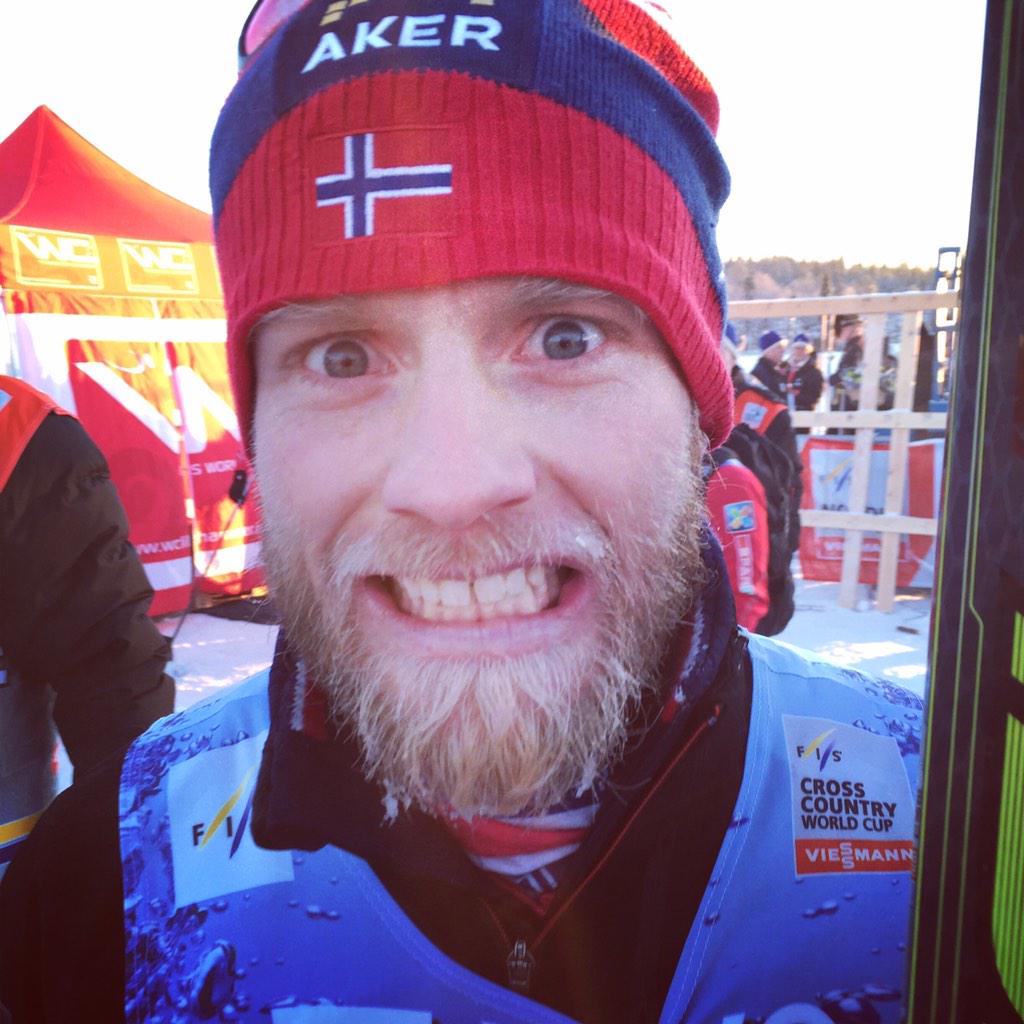
    Martin Johnsrud Sundby (Norway) shows his happy face after winning the men's 10 k freestyle at the Lillehammer World Cup mini tour on Saturday in Norway. (Photo: FIS Cross Country/Twitter)
    Martin Johnsrud Sundby (Norway) shows his happy face after winning the men’s 10 k freestyle at the Lillehammer World Cup mini tour on Saturday in Norway. (Photo: FIS Cross Country/Twitter)

    If you’re trying to imagine how Norway’s Martin Johnsrud Sundby reacted to his win on Saturday, picture his female teammate Therese Johaug realizing she beat Marit Bjørgen by three-tenths of a second for the win. Better yet, watch the video.

    Sundby was basically the opposite of that. It’s not that the 30-year-old defending Overall World Cup champion is too cool to jump up and down and yell, he just had a different way of showing his emotions.

    And he was actually a little emotional on Saturday.

    Sundby led a Norwegian podium sweep, winning the men’s 10-kilometer freestyle individual start — the second stage of the Lillehammer World Cup mini tour — by 2.2 seconds over teammates Finn Hågen Krogh and Sjur Røthe, who was 6.4 seconds back in third.
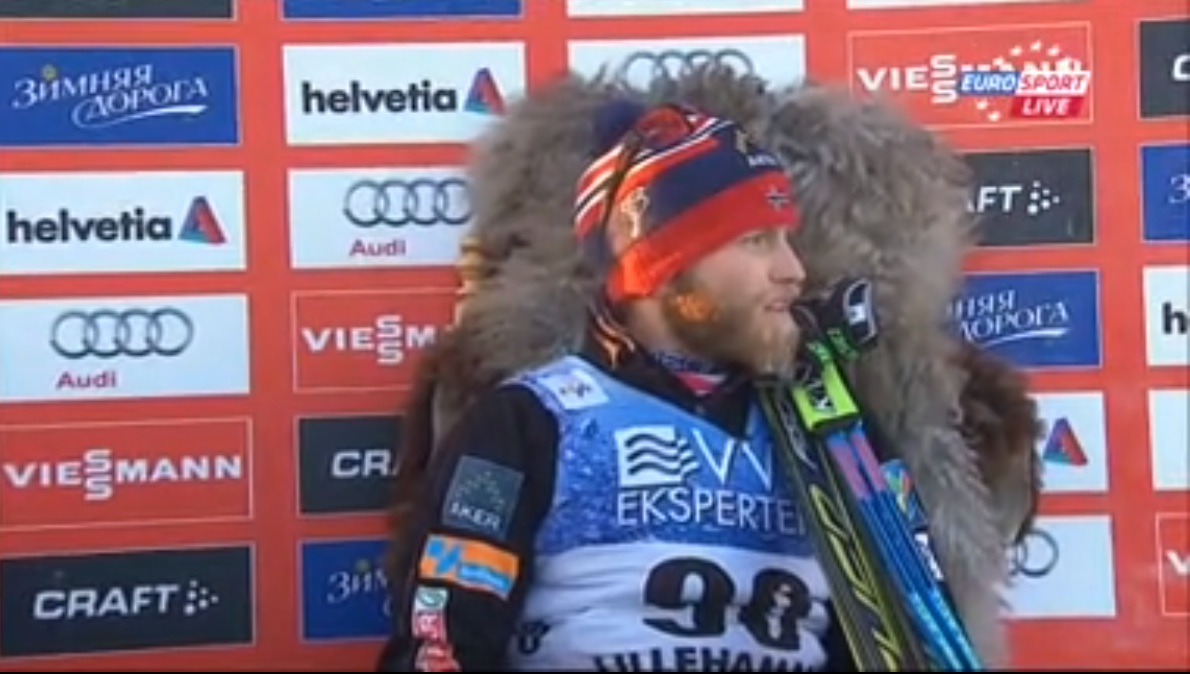
    Norway's Martin Johnsrud Sundby quietly awaiting his fate while sitting in the leader's chair near the end of the men's Lillehammer World Cup 10 k freestyle on Saturday. He ended up holding off Sweden's Calle Halfvarsson, then teammate Finn Hågen Krogh, for the 2.2-second victory.
    Norway’s Martin Johnsrud Sundby quietly awaiting his fate while sitting in the leader’s chair near the end of the men’s Lillehammer World Cup 10 k freestyle on Saturday. He ended up holding off Sweden’s Calle Halfvarsson, then teammate Finn Hågen Krogh, for the 2.2-second victory.

    Sweden’s Calle Halfvarsson placed fourth, 1.5 seconds off the podium, and Norway took fifth and sixth with Niklas Dyrhaug and Chris Andre Jespersen, respectively.

    “I am happy for the win, but I am extremely happy for the team,” Sundby told FIS.

    With Friday’s sprint winner, Pål Golberg, in 12th and Didrik Tønseth in 17th, the Norwegians had  seven of 15 starters in the top 20. What might be more notable is neither Petter Northug (in 35th) nor Eirik Brandsdal (in 53rd), who led the Overall World Cup before Saturday’s race, were among them.

    “We have trained hard for so many months now, and … for me, kind of a captain for this team, I get a bit touched when the guys are so good,” Sundby said.

    After finishing 14th in the sprint (just like Johaug), Sundby ranked 15th in the mini tour, 27.4 seconds behind Golberg, after Friday’s race. He improved to second on Saturday behind Krogh, and will start 20 seconds after Krogh in Sunday’s 15 k classic pursuit. Golberg will head out 6 seconds later in third.

    Sundby’s win also put him in the yellow bib for in the second World Cup weekend of the 2014/2015 season.

    But even after standing up from the leader’s chair and flexing his right arm a little bit for doting Norwegian spectators, Sundby was quick to defer the attention back to his teammates.

    “It is an absolutely insane team effort,” he told NRK.

    Four different Norwegians took turns in the leader’s chair: first Jespersen (who topped Sweden’s Daniel Richardsson by 13 seconds. Before that, Richardsson ousted Switzerland’s Curdin Purl, who started eighth of 118 men).

    Jespersen’s initial splits weren’t anything outstanding: he ranked 22nd at 2.2 k, but sped up to ninth by the halfway point. With 1.8 k to go, the 31-year-old Jespersen posted the eighth-fastest time of all the finishers. During his race, it was the fastest.

    “I do not think it was so much fun to be peed on last weekend, so I had decided today [to go hard],” he told NRK, referring to the 15 k classic in Kuusamo, Finland, where he placed 45th.

    “The ending was abnormally good to me,” he said of his finish on Saturday.

    The 17th starter, Jespersen remained in the hot seat for some time until his teammate Dyrhaug topped him by 0.6 seconds. Dyrhaug turned it on even later in his race, going from fifth at 7.2 k to first by the finish.

    At the end of the day, Dyrhaug’s 8.3 k time ranked eighth and he ended up fifth.

    Røthe then took over the top position by 12.5 seconds. With Sundby just six starters behind him, he looked as if he knew he wouldn’t be in first for long. Røthe posted the fastest times through every checkpoint but the first one at 0.9 k (where Switzerland’s Roman Furger had the quickest start), until Sundby, Halfvarsson and Krogh came through.

    At 2.2 k, Halfvarsson took the lead, followed by Sundby 3.4 seconds back. The order stayed the same with Røthe in third until 5 k, where Røthe’s time ranked second-fastest by just 0.3 seconds over Sundby.

    Halfvarsson remained in first until 8.3 k, where Sundby, who started 1 minute ahead him, had the edge by 1.1 seconds. Later on, Krogh, the 114th starter, would post the third-fastest time at that marker, 2.7 seconds behind Sundby.

    That’s about when Sundby, in the leader’s chair after displacing Røthe by 6.4 seconds, started to pack up his belongings. Any way about it, even if Krogh had the race of his life and beat him, or Golberg as the last starter picked off six places in the last 2 k to reach the podium, Sundby knew he was headed to the flower ceremony.

    “I did an even race. I tried to push hard last 2 kilometers,” Sundby told FIS. “I tried to collect some seconds on the last uphill where a few skiers were struggling. Everybody must have had tired legs.”
    Finn Hågen Krogh after pushing himself well past the red zone to challenge Norwegian teammate Martin Johnsrud Sundby (not shown) for the win in Saturday's 10 k freestyle individual start at the Lillehammer World Cup. Krogh was 2.2 seconds off the mark for second.
    Finn Hågen Krogh after pushing himself well past the red zone to challenge Norwegian teammate Martin Johnsrud Sundby (not shown) for the win in Saturday’s 10 k freestyle individual start at the Lillehammer World Cup. Krogh was 2.2 seconds off the mark for second.

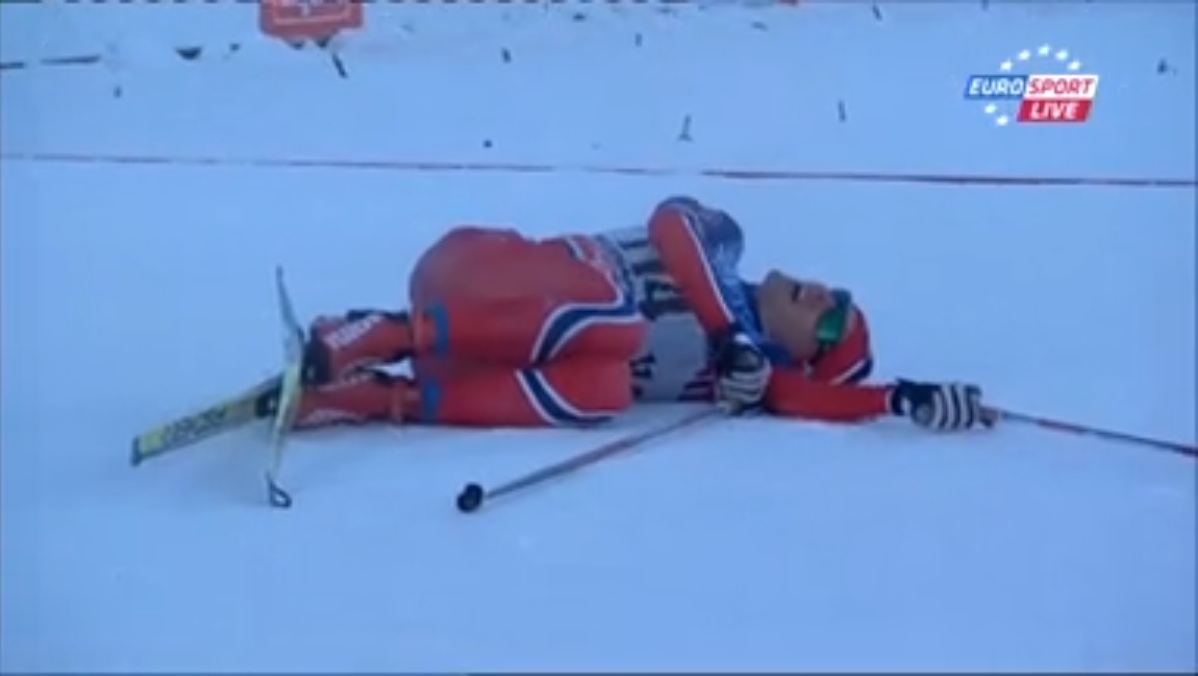
    Halfvarsson faded in the last two kilometers to put himself on the edge of a top-three, finishing 7.9 seconds behind Sundby. Krogh looked to be after the win more than a podium as he pushed himself to the brink into the stadium, collapsing and gasping for air at the finish. He ended up 2.2 seconds behind Sundby for second overall.

    “Since yesterday’s prologue I felt my shape has been very good,” Krogh said. “I was ready for today; it was maybe better than I expected. I found a good rhythm from the start. I had very good skis and I felt confident.”

    Røthe was third, another 4.2 seconds back, and Halfvarsson settled for fourth, 1.5 seconds later.

    “I’m really happy to be back on the podium,” Røthe said after his first individual World Cup podium since placing third in the 2012 skiathlon in Canmore, Alberta (and not counting his second-fastest time in last year’s Tour de Ski final climb in Val di Fiemme, Italy).

    “It is even better to be there with my good friends Finn and Martin,” he added.

    After not feeling quite in top form before Saturday, Sundby, who now leads the Overall World Cup by 9 points over Krogh and 20 points over Brandsdal in third, told reporters he was excited for Sunday’s pursuit.

    “Hopefully we get an exciting race tomorrow,” he told FIS. “I think both the race and the winner could be exciting.”

    ***

    Notes: Great Britain’s Andrew Musgrave, 24, had the best distance race of his career (not counting the eighth-fastest time in the 2014 Tour de Ski final climb) in 13th, which puts him 10th in the mini-tour standings before the pursuit.

    Canadian Alex Harvey dropped from sixth to 11th in the mini tour, after placing 33rd, 54.6 seconds behind Sundby. He cited his bothersome left leg, with a blood-flow issue that typically springs up and pains him on uphill skating courses, as the reason behind his result.

    “At the top of the course [around 3.5 k] before we go back down to the stadium, there’s a lot of offset, like steep climbing and my leg was starting to feel pretty bad already,” Harvey said on the phone. “So I was just fighting against it already and I couldn’t push after that. I couldn’t use my leg much, and the downhills were so icy that it was kind of hard to relax and recover so I was always contracting the legs. It was just a really bad day for my leg I guess.”

    He’ll start Sunday’s pursuit 59.3 seconds behind Krogh and 0.4 behind Musgrave, and is focused on picking off as many places as possible — possibly up to Dyrhaug, who’s starting 16 seconds ahead of him in sixth.

    Complete results | with Splits

  • Bjornsen Captures Career-Best 18th in Toblach: ‘Could Not Have Been Better’

    Erik Bjornsen (U.S. Ski Team) racing to a career-best 18th in the World Cup 15 k classic individual start Saturday in Toblach, Italy.  (Photo: FlyingPointRoad/Proceeds go to the National Nordic Foundation)
    Erik Bjornsen (U.S. Ski Team) racing to a career-best 18th in the World Cup 15 k classic individual start Saturday in Toblach, Italy. (Photo: FlyingPointRoad.com/Proceeds go to the National Nordic Foundation)

    Coming off 25th- and 17th-place finishes at U23 World Championships last Wednesday and Thursday in Val di Fiemme, Italy, Erik Bjornsen tried to set himself up for success in this weekend’s World Cup in nearby Toblach.

    That meant setting realistic goals for the 15-kilometer classic individual start on Saturday. The youngest man on the U.S. Ski Team, Bjornsen, 22, told himself he’d be happy with a top-45 result. His previous best in a distance World Cup was 36th in last season’s 15 k classic mass start in Canmore, Alberta. Two weeks ago, he placed 40th in the same event at the World Cup in Szklarska Poreba, Poland.

    “After I skied a 15 kilometer in Val di Fiemme two days before, that was fresh in my head,” Bjornsen told FasterSkier on Sunday. “Some of the things that went wrong there were I didn’t go out hard enough.”

    He made a note to tackle Saturday’s race differently. If he went out harder, he figured there was a chance he could “catch a ride from someone fast.”

    “I didn’t know it was going to be someone on the podium,” Bjornsen explained.

    Sweden's Marcus Hellner leads Erik Bjornsen of the U.S. throughout most of Saturday's 15 k classic individual start at the Toblach World Cup in Italy. (Photo: FlyingPointRoad.com/NNF)
    Sweden’s Marcus Hellner leads Erik Bjornsen (l) of the U.S. throughout most of Saturday’s 15 k classic individual start at the Toblach World Cup in Italy. (Photo: FlyingPointRoad.com/NNF)

    No one wants to get caught in an individual start, but it’s also part of the game when you start behind top-seeded racers. And when the person who catches you is an Olympic and world champion from Sweden — like Marcus Hellner — it’s not such a bad thing.

    Hellner started 33rd and caught Bjornsen in bib 57 within the first kilometer. Instead of letting him go, Bjornsen resolved to stay on the 29-year-old veteran, and skied the next nine kilometers in wet snow and grueling mixed precipitation with Hellner. That put Bjornsen in the top 10 for some of his splits midway through the race. His time at 7.1 k ranked 17th and he was up to 15th by 11.5 k.

    “Usually, I save some energy for the finish, but I gave it everything in my second lap,” Bjornsen said. “Third lap it was just hanging on for dear life. Coaches were giving me splits I was in the top 20 and it was so unreal. … My legs were killing me in every corner, every downhill, I was like, ‘Don’t lose it, don’t lose it!’ ”

    Bjornsen ended up 18th for the first top 20 of his World Cup career. He was 1:17.9 minutes back from Russian winner Alexander Legkov, and 1:03 behind Hellner, who took third. For the Swede, it was his first individual podium in over a year. For Bjornsen, the personal best meant everything in the final distance race before his first Olympics.

    “Could not have been better,” Bjornsen said. “Timing and skis and good feelings, everything kind of came together.”

    His parents were also in town after watching him compete at U23’s, and able to watch his sister, Sadie, finish 17th in her first race back since December 22.

    The top American, Bjornsen was also the only man from the U.S. in the top 40. Noah Hoffman placed 41st, Kris Freeman was 64th, and Brian Gregg was 69th of 79 finishers.

    Canada's Devon Kershaw racing to 39th in the 15 k classic individual start at Saturday's World Cup in Toblach, Italy. (Photo: FlyingPointRoad.com/NNF)
    Canada’s Devon Kershaw racing to 39th in the 15 k classic individual start at Saturday’s World Cup in Toblach, Italy. (Photo: FlyingPointRoad.com/NNF)

    Alex Harvey led the way for Canada in fifth, Devon Kershaw placed 39th, Graeme Killick was 40th in his first World Cup of the season. Jess Cockney placed 51st for his best result in the event, and Ivan Babikov was 62nd.

    “I’m pretty happy with where the team is right now,” Canadian Head Coach Justin Wadsworth said. “There were some other guys that had a good race, like Killick and Cockney were both solid for one of their handful of world cup starts that they’ve had in their career. Devon and Ivan struggled a little bit with skis, but felt good physically. I know the camp we did was really good so I’m pretty hopeful for some good results coming up.”

    Hoffman looked to be struggling with kick and slipped and fell at one point. He said the race was “a little rough” and “not quite what I was looking for.”

    “Classic skiing’s just been a little tough for me this year, but I’m looking to pick it up a little bit,” Hoffman said.

    Killick, who finished 2 seconds ahead of Hoffman and 0.6 seconds back from Kershaw, said he started out a little slow and had to make up time on the final laps.

    Canada's Graeme Killick on his way to 40th in his first World Cup of the season in the 15 k classic in Toblach, Italy. (Photo: FlyingPointRoad.com/NNF)
    Canada’s Graeme Killick on his way to 40th in his first World Cup of the season in the 15 k classic Saturday in Toblach, Italy. (Photo: FlyingPointRoad.com/NNF)

    “I think it was OK for the first World Cup here and just after some altitude training,” he said of the Canadian team’s pre-Olympic camp in Seiser Alm, Italy, where the Americans also trained over the last week.

    On the flip side, Cockney said he started out “very hard,” putting him in the top 30 for five or six kilometers.

    “It’s always hard to figure out the pacing for a different field than you’re used to back home, but I felt good for most of the day, overall pretty happy,” Cockney said.

    Like Killick, his teammate on the Canadian Senior Development Team and Alberta World Cup Academy, Cockney said their skis were great. He chose a stiff pair of klister skis and Killick went with the same.

    “Skis were rockin’,” Cockney said.

    Babikov said the race was hard and racked it up to “a little bit of everything.”

    “Coming off the altitude and big camp, maybe that was the factor,” he said. “We’ll see, I still have a week to recover.”

    Gregg (Team Gregg/Madshus) also described his race as “a little rough … but it was good to go hard,” he added. “Erik Bjornsen had a great day so that’s really cool.”

    In international news, Andrew Musgrave and the rest of the British World Cup team almost didn’t make it to Saturday’s distance races after getting snowed in at Misurina 20 kilometers away.

    “It was a bit of a stress,” Musgrave told FasterSkier after placing 59th. “It snowed a meter and a half, and we were snowed in, [as did] the Slovenians and the Finnish sprint team. We spent ages to get out all our cars and vans and stuff.

    “We eventually managed to get down, but instead of driving 20 minutes down the normal road, there was an avalanche over it and we had to drive 2 1/2 hours around to get here,” Musgrave continued. “And then we didn’t have accommodation here so now we’ve got four of us stuffed in a tiny room. But at least we got to race, can’t complain.”

    — Gerry Furseth contributed on-site reporting

    Results

    Noah Hoffman (USST) skiing to 41st in Saturday's 15 k classic individual start as his coach Zach Caldwell watches. (Photo: FlyingPointRoad/Proceeds go to the National Nordic Foundation)
    Noah Hoffman (USST) skiing to 41st in Saturday’s 15 k classic individual start as his coach Zach Caldwell watches. (Photo: FlyingPointRoad.com/NNF)
  • With a Second World Cup Scorer and Four Olympic Qualifiers, British Team the Best It’s Been

    With a Second World Cup Scorer and Four Olympic Qualifiers, British Team the Best It’s Been

    Britain's Andrew Young (left) follows his competitors to the start of his quarterfinal heat in this weekend's World Cup sprint: (r-l) Olympic team sprint bronze medalist Alexey Petukhov of Russia; Andy Newell of the U.S. Ski Team; and three-time World Cup winner Eirik Brandsdal of Norway.
    Britain’s Andrew Young (left) follows his competitors to the start of his quarterfinal heat in this weekend’s World Cup sprint: (r-l) Olympic team sprint bronze medalist Alexey Petukhov of Russia; Andy Newell of the U.S. Ski Team; and three-time World Cup winner Eirik Brandsdal of Norway.

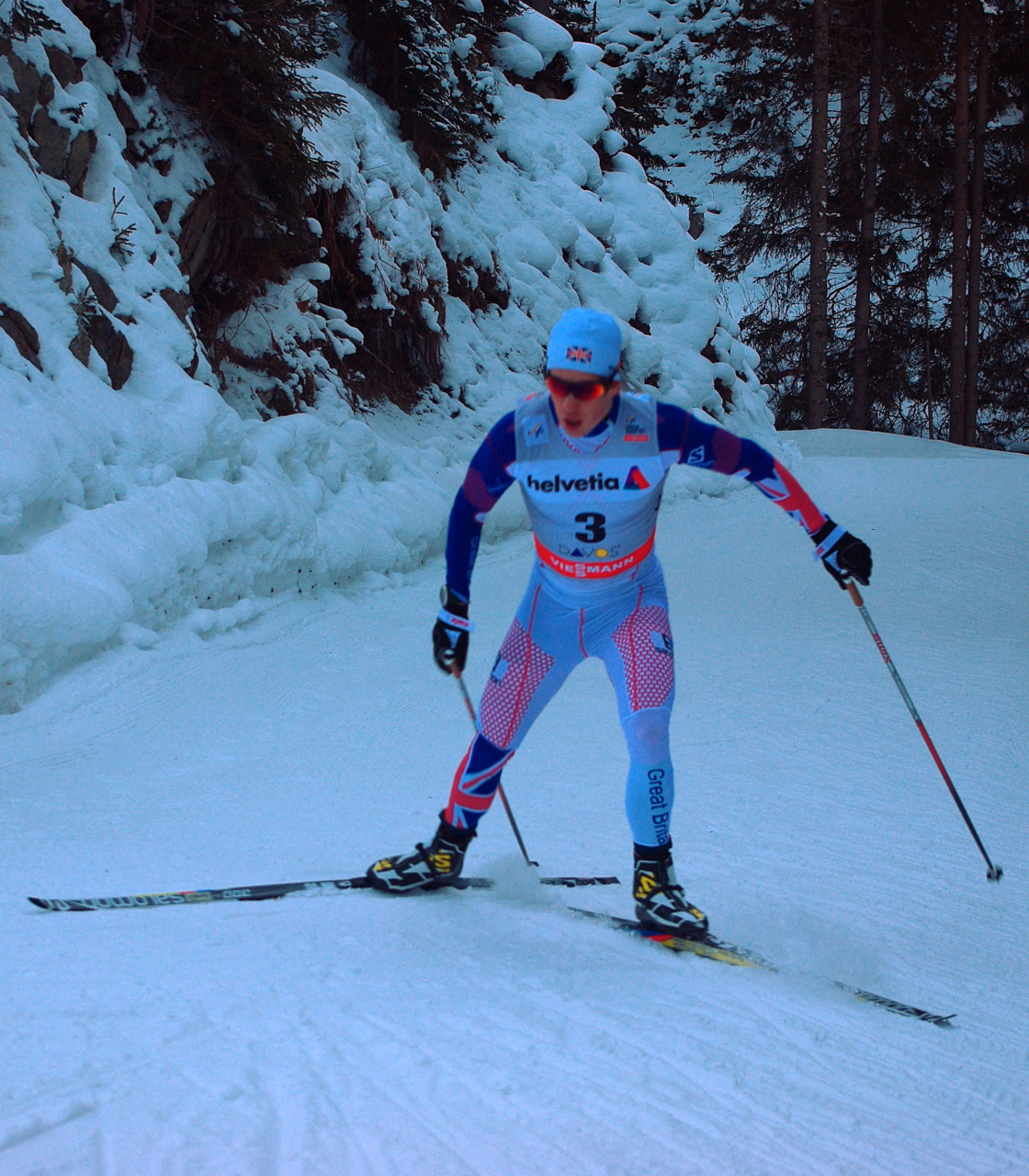
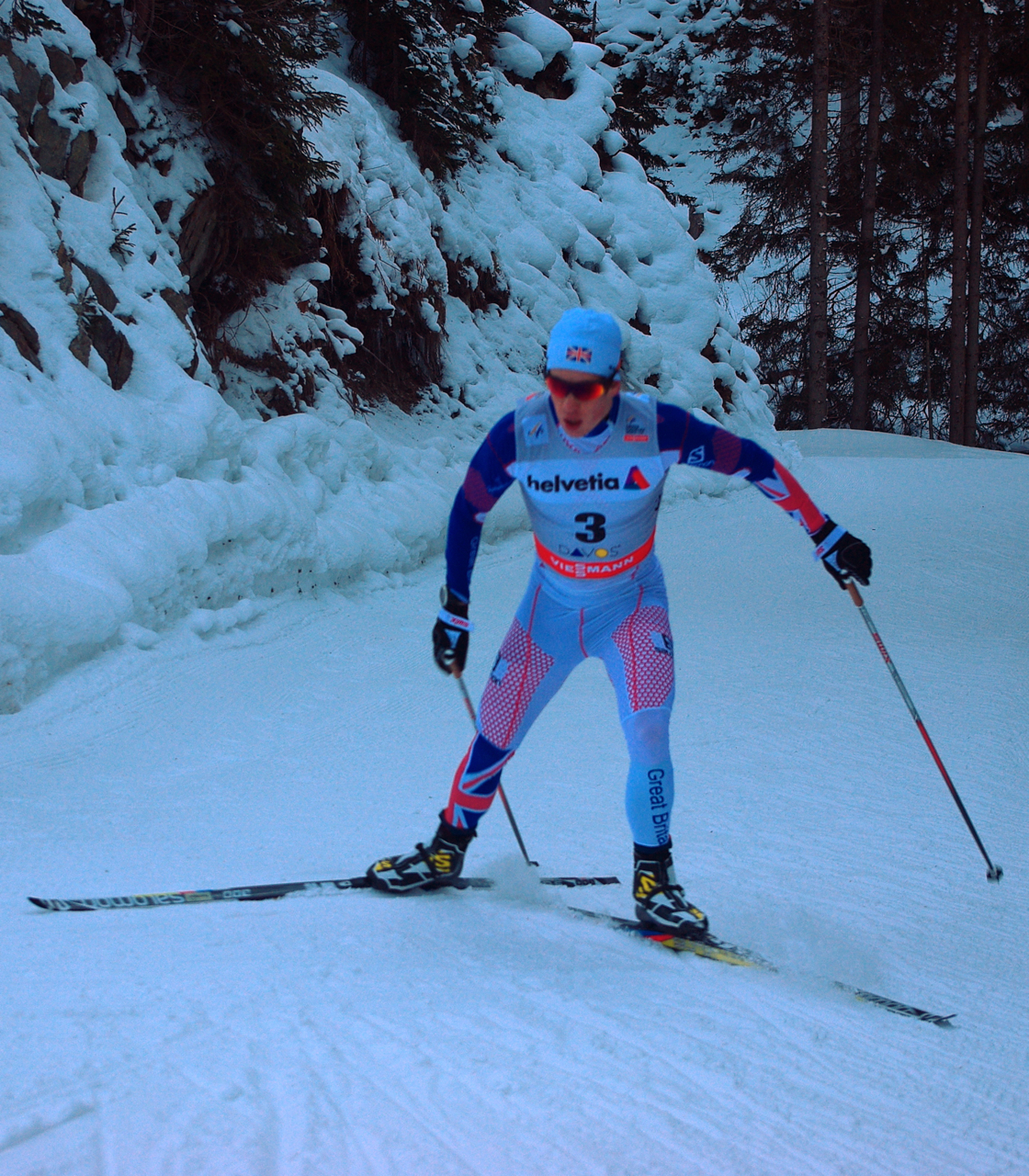
    DAVOS, Switzerland – Despite the strong results from Andrew Musgrave over the past several seasons, it’s still something of a shock to your average European ski fan to see a British suit go by.

    “Wait, he’s from England?” me Swedish friend Sofia – a total ski nerd in most other respects – asked as Musgrave raced by on his first lap of the 30 k freestyle here on Saturday. “Really? He looks good.”

    But if the British team has its way, those perceptions will be quashed in the next few seasons. Musgrave finished 36th in that 30 k, despite not feeling fantastic. He classified it as a solid race, nothing spectacular.

    “The race was all right,” he said at the finish. “I felt like the first two laps were pretty good, like I was going easy, and keeping up the speed. But the last lap and a half I started to get a little bit tired. The last 7 k were tough. I felt like it was as good a race as I could have had today.”

    The next day, Andrew Young – a 21-year-old who we interviewed this summer – made a splash when he qualified for the heats of the freestyle sprint. Starting in bib 69, he was one of a few late starters to surprise. The guy he bumped out of the top 30? Musgrave.

    It was the first World Cup points Young, who ended up finishing 29th, had ever scored.

    Musgrave was an early starter in Saturday's 30 k.
    Musgrave was an early starter in Saturday’s 30 k.

    “It was awesome,” Young said after his quarterfinal. “I’m skiing fast. Just to be top 30 is huge, so I’m happy. After that, it doesn’t matter if I didn’t ski so well in the heat.”

    Britain now has three men (Musgrave, Young, and Callum Smith) who have achieved the Olympic “A” qualifying standard, and one woman (Posy Musgrave, Andrew’s sister).

    This is not the British team you’ve seen before. Will it be their best Olympics ever?

    “Oh yeah, definitely,” Andrew Musgrave said. “The team has developed massively since 2010.”

    The improved results have come as a result of incremental buildups in support and training expertise, and, recently, a Crowdfunder campaign to raise money to send more athletes to more races this November and December. As Young told us this summer, the British team usually must decide how to use its limited budget, and choose just a few World Cups to attend.

    In order to get more athletes qualified for the Olympics, they have turned that on its head. After raising a few thousand pounds, British skiers have attended more World Cup and FIS races than usual, and the results paid off. Smith, for example, competed in one World Cup race in Lillehammer, then traveled to FIS races in Austria and is now at World University Games in Trentino, Italy; Posy Musgrave also headed to Austria, but then returned for the Davos World Cups, where she placed 51st in the sprint.

    “We have a lot of support through that Crowdfunder – a lot of people have been really generous and giving us some good donations,” Andrew Musgrave said. “So that has helped a lot. Right now we have four people qualified, and another girl is close. So that would be awesome.”

    But the strategy highlights a dichotomy for the team: skiers like the Andrews (Musgrave and Young) were already qualified, and are going about their seasons in the usual way. Hence Andrew Musgrave’s lack of concern at his 36th-place finish, a pretty standard result. He ended up 34th in the sprint.

    “It’s been kind of okay,” he said of the beginning of his season. “It’s not as great as I had hoped, but at the same time it’s still just early December. It’s a couple of months until the Olympics. The plan is to have the best races in the middle of February.”

    For some of the rest of the team, a slow buildup into the season is an unaffordable luxury. Yet the focus, and perhaps the pressure, of using these early season races to meet qualification criteria has led to success. Skiers have flourished under the circumstances.

    “It wasn’t so important for me to go fast in the start of the season,” Andrew Musgrave said. “Some of the other guys had to go pretty fast to get the qualification standard, and they are just skiing a whole lot better than they have been the last couple of years. So it has worked out pretty well.”

    All that improvement isn’t going to lead immediately to a huge Olympic squad. At the moment, the British team will only receive two spots for men and one for women. If Smith wants to compete in Sochi, for instance, they’ll have to find him another spot. And that’s not easy.

    The entire Olympic quota is 310 athletes, and currently those spots are divided up between nations based on how well their athletes perform. But not all the countries will likely use all their quota spots, for example if the same athletes will race multiple races (each country still only receives four starting spots per race, no matter how big their team is) or if their national federation rules set harsher qualification criteria than FIS itself (among the countries with this issue are Switzerland and Japan).

    The unused spots will then be divvied up based on the “global list”. The committee will run down the FIS points list, offering a spot to the country of the next skier on the list, until all the spots are gone.

    And then, it might happen again – for example, Canada might be offered another spot, but refuse it. Unfortunately, Britain can’t take these handed-back spots based on its own Olympic Committee’s rules. So their only chance is in that first rundown of the global list, which will take place on January 20th.

    Finally, there’s the fact that Britain is, in fact, one of these countries that sets harsh rules for its own athletes. For instance, the Olympic “A” standard is 100 FIS points, but British women will have to do better than that.

    “In the women we had a nightmare in setting the qualification standards because our Olympic association wanted top 2/3 of Olympic field – this lead to Sprint qualification being at average of 91 points while distance is 97,” British nordic coach Roy Young wrote in an e-mail. “However, I was really confident after Sochi last year that Posy [Musgrave] could meet the sprint, and she has now had two races in the 50’s for points. Fiona [Hughes] is just shy of the 97 average at the moment.”

    Despite the difficulties, the team is looking forward to having not only its biggest Olympic squad in Sochi, but also its best. After this weekend, it’s possible to imaging both young and Musgrave, who is the 82nd-ranked sprinter in the World on the latest FIS Cross Country list, making he sprint heats in Russia.

    “Sunday’s results were just amazing,” Roy Young wrote.

    And for the athletes who had to peak a little early just to book their ticket? There’s a plan for them too.

    “It is really tough having to go hard right now and then expected to do pretty well at Sochi,” Young wrote. “However, we are about to change the plans for Posy and Callum so they can rest up a bit now before going hard again. It is always tough as a small nation, but then the Norwegians won’t be guaranteed a place even if they did really well at Davos – so there are some gains in the smallness, too.”

  • For Andrew Young and British Team, Preparing for a Once-In-Four-Years Opportunity to Reach Their Public

    For Andrew Young and British Team, Preparing for a Once-In-Four-Years Opportunity to Reach Their Public

    Andrew Young of Great Britain (right) competing in the first World Cup of this season, in Gallivare, Sweden.
    Andrew Young of Great Britain (right) competing in the first World Cup of this season, in Gallivare, Sweden.

    The last time Britain’s Andrew Young got interviewed was almost four years ago.

    “The Olympics is the only time in four years that the British public cares about our sport, to be honest,” he told FasterSkier in an interview earlier this week. “It’s the one-off time in four years that we get to sell our sport and sell our results, maybe try to get a sponsor or something like that.”

    At just 21 years old, Young is embarking on his second round of Olympic media hype (“Vancouver was pretty cool,” he said of his first Games experience). Such is the life of a British skier. There’s no adoring public, very limited funding, and not much snow. To be a good skier, Young believes that you have to leave the United Kingdom and move to a different country. It’s a tough row to hoe.

    Yet the British team has been gaining a lot of respect in the last few years. Teammate Andrew Musgrave gets much of the attention – including from this site, which recently wrote about him joining a team headed by Norwegian legend Thomas Alsgaard – but Young is on the same trajectory. Just, well, younger. He started his first World Cup at 16, the youngest skier ever. Fast forward and this season, in his first year of U23 eligibility, the Lillehammer-based Scotsman finished in the top 30 in every race he entered at U23 World Championships.

    Despite growing up in a country that doesn’t seem so ski-friendly, Young’s childhood in Huntly, outside of Aberdeen, Scotland, sounds a lot like any skier’s, anywhere. He started skiing when he was two, and was soon in the Huntly Nordic Ski Club. Among the first sorts of competition that he and his friends set their minds to: beating their sisters at skiing.

    “My sister is three years older than me, and [Musgrave’s] sister is a few years older than him, so it was always a competition to beat the girls,” Young said. “They were older and they were just as good as we were, when we were 11 and 12. They were better than us.”

    Those sisters – Sarah Young and Posy Musgrave – are also now skiing on the international circuit. It was a good atmosphere for a fledgling athlete.

    “Once we could beat them, then it was a competition to beat ourselves,” Young said. “Then we started going to rollerski races and it was a competition to beat anyone else – like if there was an adult that showed up that was supposed to be good at rollerski racing. This was around the time when [five-time Olympian] Mike Dixon had just retired from biathlon so he would turn up to rollerski races and it was a competition to beat him and the other older biathletes.”

    And all of a sudden, that cohort of boys has found themselves no longer boys, and periodically reuniting on the World Cup. The British team doesn’t have the funding to follow the circuit all year, nor is it a highly centralized team. Young lives in Lillehammer now, although he previously spent two years at the NTG in Geilo, Norway; Musgrave, for instance, went to a ski gymnasium in Hovden and now studies engineering in Trondheim in between training and racing. Their sisters and some other teammates are still based in Britain.

    When they get together for training camps and races, though? Things still feel the same. It’s a family affair especially for Young, whose father coaches the British team, although some of the skiers work with their own coaches.

    “It’s nice, and awkward,” Young said of the arrangement. “It’s always a bit awkward having laddish banter with your teammates and then your dad listening, there’s a lot of stories shared between teammates that you don’t want your dad to find out.”

    The camaraderie that the group has developed over ten years has made them faster and supported a good team atmosphere.

    “We don’t try to beat each other – of course we do in training, but the competition isn’t to be the best British person,” Young said of the team’s camaraderie. “That doesn’t play any role. It’s about being best. Just trying to be good, the best amongst everyone.”

    With such lofty goals but also budget issues, the British pick World Cups carefully. This year, Young’s itinerary included the World Cup opener in Gallivare, Sweden (“all of the best guys are really out of shape, and the first courses are really flat so they don’t have the hills to get a really big advantage”); the first few stages of the Tour de Ski; U23’s, the Davos World Cup, and World Championships; and the last races in Drammen and Oslo.

    His best results came at U23’s, which he says is a favorite event, and possibly in the sprint at World Championships, where he finished 45th. In World Cup racing, Young placed in the 60s and 70s.

    As a 21-year-old, he doesn’t find encountering those results discouraging in the least.

    “If you finish a bit down the field, you just set a benchmark and you know what you’re working for next time,” Young said. “I’ve always known that if I compare myself to the other guys who are my age, there aren’t that many people my age who can beat me. So I know I’m on the right path, it’s just to keep going. If you get beaten by seniors when when you’re a junior it’s not really that important.”

    For the rest of the season, the British athletes attend lower-level races and often scatter to their various winter homes. In the last few years, Young has raced mostly in Scandinavia, where he believes he can get better development opportunities at the Norwegian Cup or Continental Cup levels.

    He is coached by Geir Endre Rogn, a former NCAA podium finisher for the University of New Mexico who coaches the Geilo NTG. Rogn had helped the British team with a summer training camp; when he saw Young at Holmenkollen at the end of the 2010 season, he asked him what he was doing the following year. No plan, Young said. So he moved to Geilo and trained with 25 Norwegian men his age, improving his technique and his fitness.

    It was a massive improvement on his previous situation: after deciding that he had to leave Britain if he wanted to be the best he could be, Young had spent the previous season entirely on the road, with no home base.

    “The first year, after I left school, it was really hard,” he said. “Every Monday was a new hotel, and when you’re washing clothes in the shower it’s not really fun. You never have internet, you never have a washing machine – it’s the simple things that you just get a bit tired of.”

    Geilo provided not just higher-quality training, but stability. Among the highlights of that time was a seventh-place finish in the 20k at Norwegian junior championships two years ago. Young bested, among others, biathlon World Junior Champion and current senior national team member Johannes Thingnes Bø, and Therese Johaug’s younger brother Karstein.

    So when he moved to Lillehammer to get “better training opportunities,” as he writes on his blog, Rogn kept supervising from afar.

    “Lillehammer is a bit ridiculous,” Young said of his current setup. “You go out training and you’re going to see someone you know. There’s so many skiers here, so the chances are there’s going to be someone else doing the same thing as you on the same day. I try to meet up with others to train three or four days a week and then maybe do the rest on my own, but oftentimes I bump into someone else out training anyway.”

    Perhaps the current generation of skiers are paving the way for even more success in the future. Young and Musgrave are certainly broadening the network of contacts available in Norway, one of the best places a British skier could choose to relocate. And Young highlighted two clubs, his own Huntly Nordic Ski Club and Cairngorm Biathlon and Nordic Ski Club, as well as a group in London that introduces Brits, many of them kids, to rollerskiing.

    Living outside the country, the current roster of athletes can’t always participate in this building of their own sport. Instead, they have to work from afar. On his blog, Young recently wrote an impassioned plea for his countrymen (and everyone else) to wear helmets while rollerskiing. He clearly cares about those following in his footsteps.

    “I don’t really care what people do in there own time, how other people train,” he wrote. “But what I do care about is the future of British skiing, and the development of the sport. I urge you to have a helmet… not just for your own safety, but for the safety of other younger skiers who will, in all likelihood, copy you.”

    And finally, he and his teammates have their big chance every four years, when the Olympics rolls around. When I asked Young whether seeing skiing on TV actually generates meaningful interest, he at first seemed doubtful.

    “They see it on TV and then they go back to what they were doing – well, no, in some ways people get a bit interested, I guess,” he said. “I don’t know of anyone who just started skiing because they saw the British team on the Olympics.”

    But thinking a bit more, he said that Sochi will likely gain them a few more fans.

    “I guess there are people who start watching it more if they know it exists,” he said. “When I was younger I used to swim and my swim coach got addicted to ski jumping. He watched it at one Olympics and then watched it every winter all the time. So people do get hooked on sports, and if we get a few more fans then it’s better for us.”


  • Musgrave Aligns with Alsgaard’s New Team LeasePlan Go

    Musgrave Aligns with Alsgaard’s New Team LeasePlan Go

    The faces of the newly formed Team LeasePlan Go, with Anders Södergren, Emil Søbak Gundersen, Jörgen Brink, Christoffer Callesen, Per Kristian Nygård, Johanna Ojala, Espen Frorud, Simen Sveen, Thomas Alsgaard, Andrew Musgrave, Torgeir Skare Thygesen, Audun Laugaland, and Kjetil Hagtvedt Dammen. A five-time Olympic gold medalist, Alsgaard (fourth from top right) formed the team this year with the help of Gundersen (top left). Musgrave (second from bottom right) is the only non-Scandinavian athlete. (Photo: www.facebook.com/TeamLeaseplanGo)
    The newly formed Team LeasePlan Go, with Anders Södergren, Emil Søbak Gundersen, Jörgen Brink, Christoffer Callesen, Per Kristian Nygård, Johanna Ojala, Espen Frorud, Simen Sveen, Thomas Alsgaard, Andrew Musgrave, Torgeir Skare Thygesen, Audun Laugaland, and Kjetil Hagtvedt Dammen. A five-time Olympic gold medalist, Alsgaard (fourth from top right) formed the team this year with the help of Gundersen (top l). Musgrave (second from bottom r), a British skier, is the only non-Scandinavian athlete. (Photo: facebook.com/TeamLeaseplanGo)

    Earlier this month, Andrew Musgrave, a 23-year-old World Cup skier from Great Britain, met one of the greatest cross-country racers of all time: Thomas Alsgaard. What was more, they were going to be teammates on the newly formed Team LeasePlan Go.

    Musgrave could hardly contain himself as he trained with the 41-year-old Norwegian near the Oslo airport. He also worked out alongside Swedish superstars Anders Södergren and Jørgen Brink at the training camp in Gardermoen, Norway.

    “They’re probably getting annoyed with me,” Musgrave said with a laugh on the phone from Trondheim, Norway, where he’s studying engineering at the Norwegian University of Science and Technology (NTNU).

    Great Britain's Andrew Musgrave and his coach during the 15 k freestyle individual start at 2013 World Championships in Val di Fiemme, Italy. Musgrave placed 28th for his best result of the championships, but considered his season mostly inconsistent.
    Great Britain’s Andrew Musgrave and his coach during the 15 k freestyle individual start at 2013 World Championships in Val di Fiemme, Italy. Musgrave placed 28th for his best result of the championships, but considered his season mostly inconsistent.

    A part-time student and full-time racer, Musgrave has been there since last autumn and in Norway for the last four years. Conveniently and perhaps essentially, he speaks Norwegian.

    “I always ask them what they do when they’re training and how they normally do this and that, all sorts of questions so they’re probably getting quite bored of me,” he said. “But for me, it’s definitely good being on the team with these guys. I think I’ve learned a lot from training with them just the one-week camp we’ve had now.”

    Lucky for him, there are more camps to come. According to Team LeasePlan’s manager, Emil Søbak Gundersen, the privately sponsored, 12-man squad will meet for two camps at Alsgaard’s home in Nannestad, Norway, and also in Austria or Italy this summer.

    With athletes scattered throughout Norway and Sweden, the team is Alsgaard’s brainchild and means of getting back into full-time racing full time after more or less retiring 10 years ago.

    A couple questions come to mind; first – what’s Alsgaard’s plan?

    In an email, Gundersen explained that Alsgaard approached him in December. Alsgaard had his own marathon team at the time, Team United Bakeries, but he wanted to do less paperwork and more skiing, maybe even win the Vasaloppet.

    Alsgaard pulling double duty as commentator and racer at 2012 Norwegian nationals.
    Alsgaard pulling double duty as commentator and racer at 2012 Norwegian nationals.

    Formerly of Team Norgehus, Gundersen decided Alsgaard was worth the investment and helped him launch a new concept – Team LeasePlan Go – pulling racers from the now-defunct Norgehus and United Bakeries.

    Alsgaard quit his job commentating for the Norwegian Broadcasting Company, telling VG, “I want to give myself a year off, get back the shape,” according to a translation. “I will follow the team and be more present … I will be fighting for the win in the Vasaloppet, Birkie, Marcialonga and other races.” He could not be reached for additional comment.

    Of the 12 handpicked skiers on LeasePlan (a car-leasing company), six make up its marathon team: Alsgaard, Södergren, Brink, Christoffer Callessen, Kjetil Hagvedt Dammen and Audun Laugaland. Gundersen stated their goal is to win all of the Swix Ski Classics, with an emphasis on the Vasaloppet, Norwegian Birkebeiner and Swedish Årefjellsloppet.

    Six younger guys comprise the all-around team geared toward World Cup racing and specifically the Olympics this season. Musgrave joins Per Kristian Nygård, Ånund Lid Byggland, Simen Sveen, Torgeir Skare Thygesen, and Espen Udjus Frorud in this group after his old team, Norway’s Team Veidekke, lost its title sponsor this spring.

    So how did Musgrave get involved in Alsgaard’s latest project? Once he found out Veidekke was going to be no longer, he started searching for a new affiliation.

    “I was speaking to a few people and just finding out if there were any other teams interested in having me, and I heard there was this new team,” Musgrave said.

    He contacted Søbak, who explained the breakdown of their long-distance and all-around teams. Musgrave could join the latter and train with peers while periodically working out with Alsgaard and veterans like Brink, 39, a three-time Vasaloppet winner, and Södergren, 36, a multiple Olympic medalist who won the Holmenkollen 50 k in 2006 and 2008.

    Musgrave was thrilled and even more excited after their first training camp from May 9-15. He knew four of his teammates from Team Hovden in Lillehammer, where he lived and trained from 2010 to 2012. The next year, Musgrave and Nygård, another all-around teammate, skied for Veidekke.

    Andrew Musgrave (GBR) en route to 28th in the 15 k skate at 2013 World Championships in Val di Fiemme.
    Andrew Musgrave (GBR) en route to 28th in the 15 k skate at 2013 World Championships in Val di Fiemme.

    “It’s really, really professional,” Musgrave said of Team LeasePlan. “I think it’s the best setup I’ve been with by far. … The distance team, it’s got all the well-known guys. Like three of the best skiers of the last 20 years are on that team.”

    In Gardermoen, he met all-around coach Johanna Ojala and was immediately impressed with her extensive knowledge on technique.

    “I’m possibly one of the ugliest skiers there are,” Musgrave said with a laugh. “Terrible technique at some times. … I think if I improve my technical skiing then hopefully I’ll be able to go a lot faster.”

    Last year, Musgrave broke through with a career best 11th in the Tour de Ski freestyle sprint in Val Müstair, Switzerland. He was fourth at U23 World Championships in the 15 k skate.

    “The season was pretty good, but I was quite inconsistent,” he said. “Under 23s was OK, although I was a bit disappointed to miss out on a medal. Next year, consistency is the important thing, to be at a high level throughout the whole season instead of being up and down and never quite knowing if I was gonna have a good race or not.”

    Headed into his second Olympics, Musgrave is looking to break through the top 50 and finish in the top 10 of the freestyle sprint in Sochi, Russia.

    “I really like the sprint course there ’cause it’s long and hard and it suits distance skiers,” he said. “I’m sort of a distance skier that can do OK at sprints sometimes, especially if it’s a long, hard course at altitude like it is.”

    In the meantime, he’ll take every opportunity to absorb pointers from seasoned guys like Alsgaard. Chances are, he won’t mind.

    “One thing that surprises me is how little people are curious,” Alsgaard told Dagbladet after placing fourth in the 15 k at 2012 Norwegian nationals. Musgrave was second in the event.

    “Fast skiers live into their own world and their own bubble,” he added. “Nobody has come to me and asked, ‘What are you doing?’ ‘Why do you do it?’ There has not been one question. No trainers, no skiers. … One should have faith in themselves and have confidence, but it is important to be curious, too.”

    Alsgaard expressed a similar sentiment in a 2011 interview with FasterSkier.

    “It’s always very important to be curious and always try to ask questions when you meet people, no matter if they have been good skiers or not,” he said. “That’s an area, I think, maybe [the Norwegian national team] could work harder.

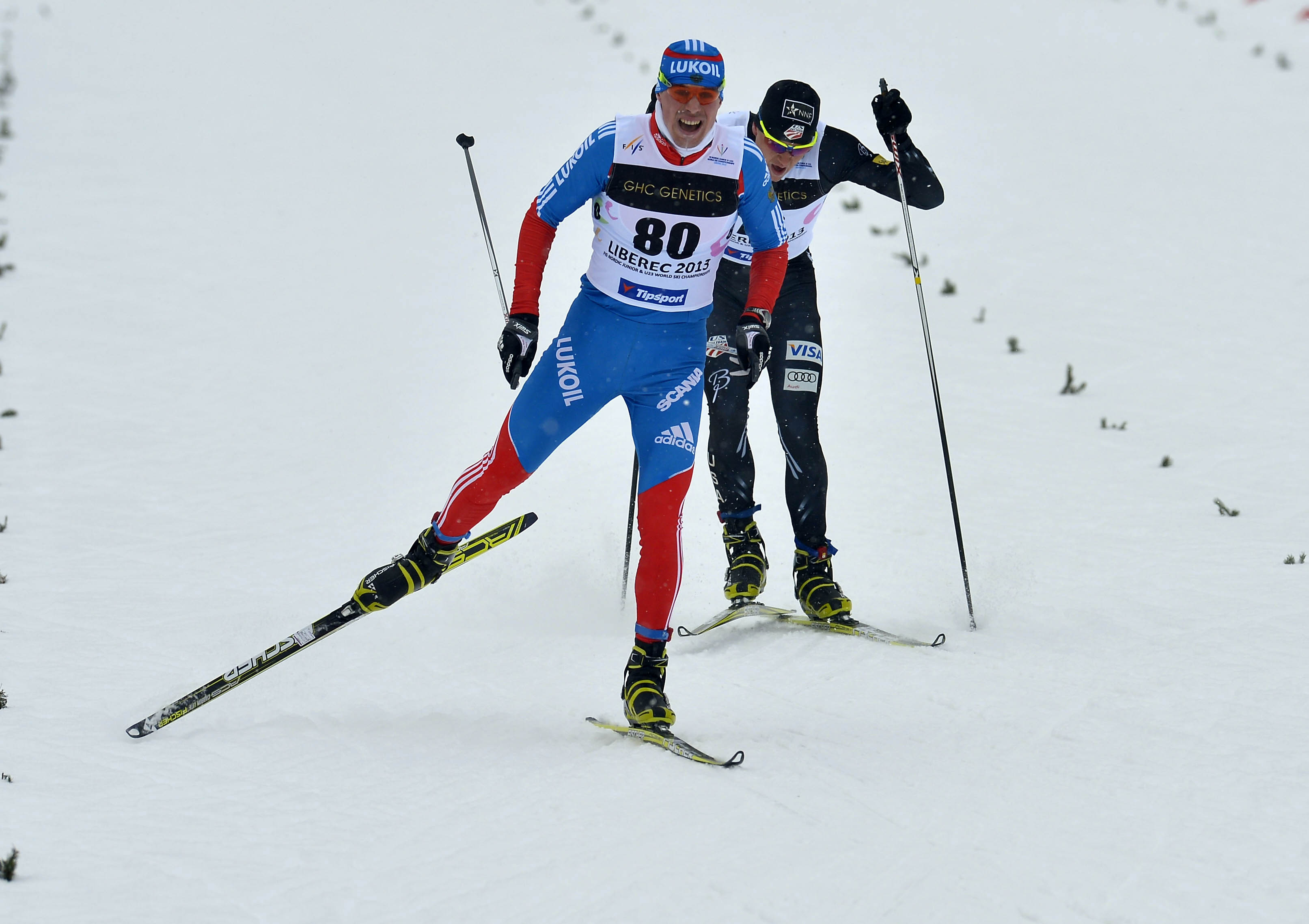
  • Ustiugov Superior in U23s 15k, Haga Secures First Gold for Norway

    Ustiugov Superior in U23s 15k, Haga Secures First Gold for Norway

    Sergey Ustiugov (RUS) en route to winning the men's 15 k freestyle at U23 World Championships in Liberec, Czech Republic. Photo: Liberec2013.
    Sergey Ustiugov (RUS) en route to winning the men’s 15 k freestyle at U23 World Championships in Liberec, Czech Republic. Photo: Liberec2013.

    The Russian men put on another demonstration of their astonishing strength and depth in Liberec, Czech Republic, on Thursday in the men’s 15 k freestyle individual start.

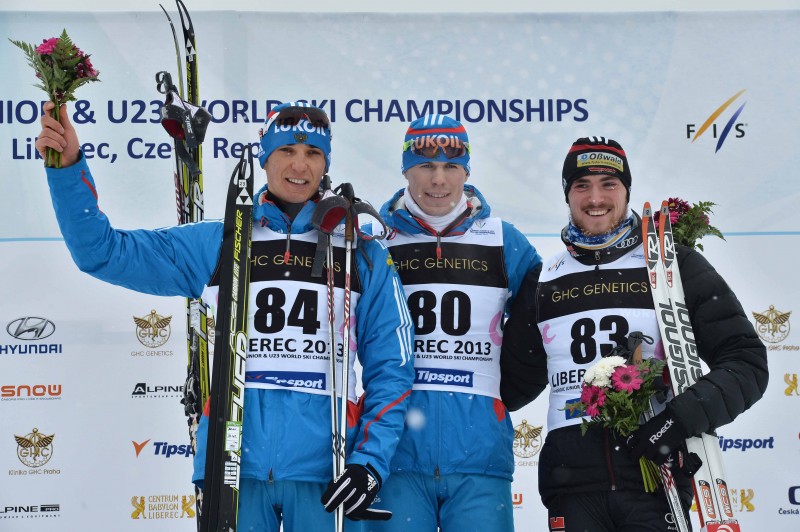
    Sergey Ustiugov (RUS) stomped the field, leading from every checkpoint. He finished the course in 35:44.1, a commanding 19.7 seconds ahead of his teammate Evgeniy Belov (RUS). Thomas Bing (GER) completed the podium, trailing in 42.4 seconds after Ustiugov in a time of 36.26.5.

    Ustiugov, a 20 year old wunderkind, was elated.  “It is fantastic! I feel really wonderful. I achieved my goal: I was in first position for the whole race. I feel really happy.”

    He is no stranger to the podium.  Last year in Turkey the promising young Russian claimed 4 goal medals. He is a rising star in the Russian team building strength ahead of Sochi.

    The men's 15 k podium. Photo: Liberec2013.
    The men’s 15 k podium. 1. Sergey Ustiugov (RUS) 2. Evgeniy Belov (RUS) 3. Thomas Bing (GER). Photo: Liberec2013.

    His teammate, Evgeniy Belov (RUS), improved upon his third place performance in the classic sprint to silver.

    “I am really satisfied with the result of the race,” Belov said.  “Today’s race was just training for the next month — I will start at the FIS Nordic World Ski in Val di Fiemme in Italy, so I did not expect the medal. That pleased me more.”

    Belov started the first of the four 3.75 k loops conservatively in 6th position before accelerating to 2nd position. The 22 year old, who won a gold medal in last years 15 k classic race in Turkey, looks to be on good form leading to Val di Fiemme as he completes his final U23 Championships.

    Thomas Bing used excellent pacing to earn his first U23 medal.

    “I am incredibly happy,” He said. ” Today, it was a really tough race.  I did not want to overvalue the start.  I saved my energy for the end.”

    Bing skied the first lap in second place before being overtaken by Belov.  He would maintain his third place position into the finish.

    Another notable result was Andrew Musgrave (GRB), whom finished agonizingly-close to a medal in fourth place in a time of 36:40.6, 56.5 seconds behind the Ustiugov.

    Damien Tarantola (FRA) finished behind Musgrave in 5th position narrowly ahead of Fabio Clementi (ITA).  Dmitriy Salnikov (RUS) made it 3 Russians in the top 8, finishing ahead of of Baptiste Gros (FRA) in 9th position.  Mark Startostin (KAZ) rounded out the top 10.

    15Km Freestyle Results


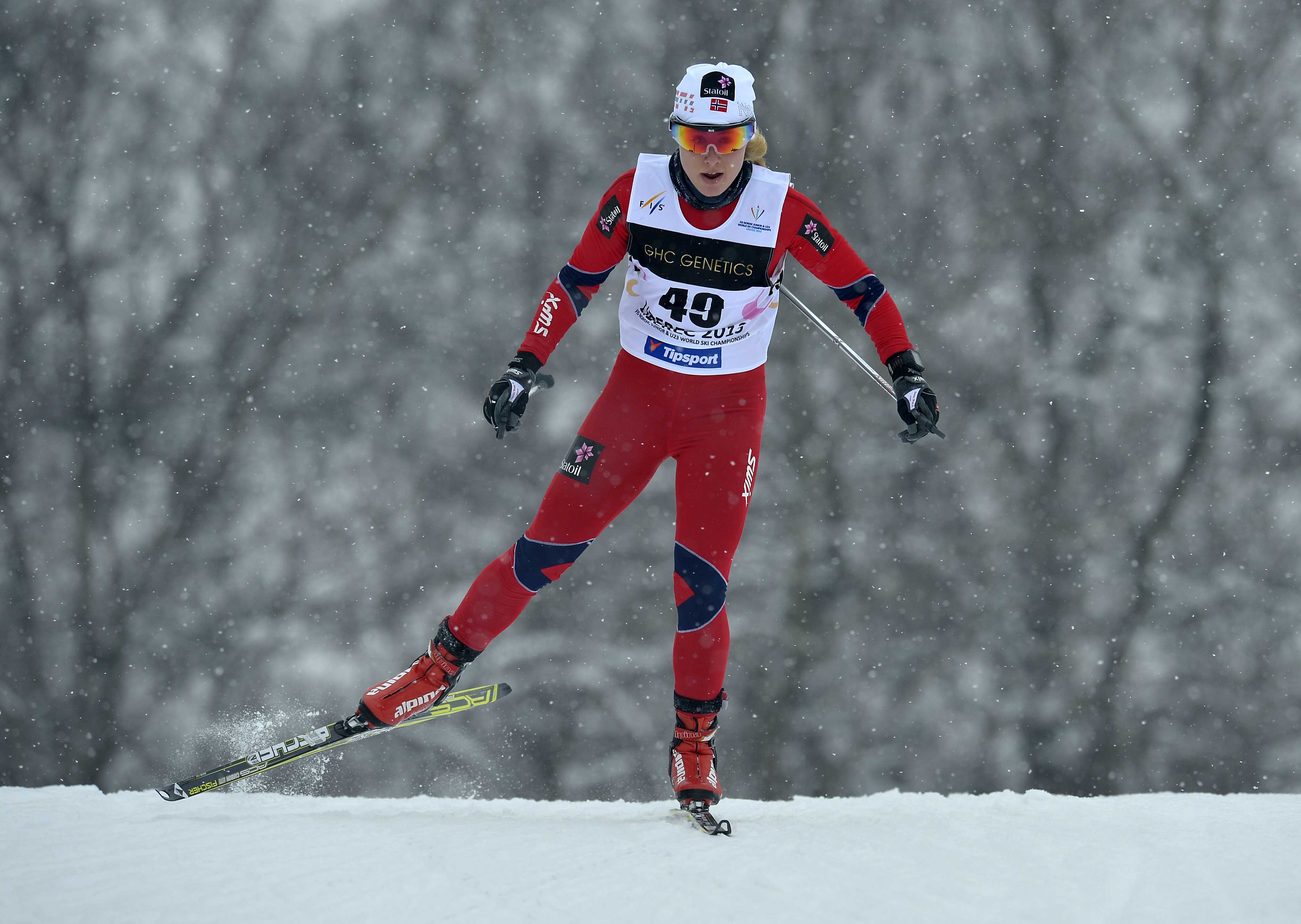
    Ragnhild Haga (NOR) claiming Norway's first gold medal of the week in the women's 10 k freestyle at U23 World Championships. Photo: Liberec2013.
    Ragnhild Haga (NOR) claiming Norway’s first gold medal of the week in the women’s 10 k freestyle at U23 World Championships. Photo: Liberec2013.

    Ragnhild Haga (NOR) secured Norway’s first gold medal of the U23 championships in the 10km individual start in a time of 27:50.4

    Haga overcame new fallen snow and frigid conditions to cross the line 29.5 seconds clear of second place Anastasia Slonova (KAZ).

    “I am really satisfied,” Haga said.  “Today, it was an exhausting race; I could not afford to relax. Two years ago I triumphed at the junior world championships so I am happy that I managed to pick up on this success.”

    Haga, 21, improved upon her fifth place finish in the classic sprint to fulfill the promise shown in the 2011 U18 World Championships in Otepää, Finland, where she won a gold medal.

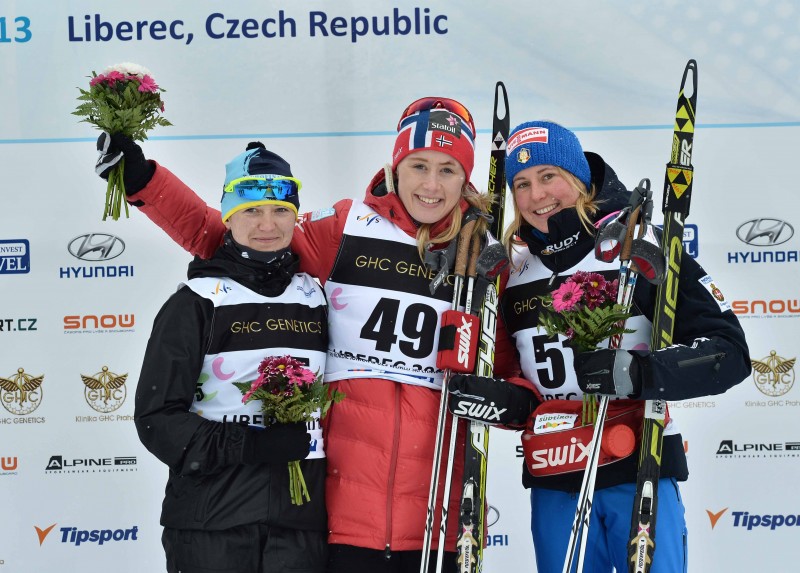
    The women's 10 k podium. Photo: Liberec2013.
    The women’s 10 k podium. 1. Ragnhild Haga (NOR) 2. Anastasia Slonova (KAZ) 3. Debora Agreiter (ITA). Photo: Liberec2013.

    She began the first 3.3 k loop in fourth position before accelerating impressively into first by the next check point and widening her lead by nearly half a minute.

    The second place finisher, Anastasia Slonova (KAZ), overcame a sluggish first lap in eighth position to overtake six skiers by the finish.

    “I feel good after the race,” She said. “I am really pleased with the result. We watched the weather carefully, so we were able to prepare the skis well. It is a great achievement for us, indeed.”

    Third place finisher Debora Agreiter (ITA) was a happy, if not subdued, bronze medal winner in a time of 28:20.3, just 0.4 seconds behind the surging Slonova (KAZ).

    “I do not know what I lacked for being second placed. I guess I did not have enough strength at the end; after all, it was a difficult race. But I am still excited about the third place,” Agreiter said.

    Her slight disappointment is justified given the astonishing final split of Slonova, who moved from fifth in the second intermediate split to overtake Agreiter, who had been holding steady in second position throughout the race.

    Sandra Ringwald (GER) finished in fourth position, narrowly edged out by Agreiter. Fifth and Sixth positions were occupied by two Norwegians, Tuva Toftdahl Staver and Kari Oeyre Slind, respectively.  A succession of Russians followed:  Anna Nechaevskaya in seventh, Natalia Zhukova in eight, Ekaterina Khramtsova in 9th, and Elena Soboleva in 10th.

    10km Freestyle Results


  • Retivyk, Belov Deliver 1-2 Punch for Russia at U23s; Scott, Packer Lead North Americans In Top 30

    Retivyk, Belov Deliver 1-2 Punch for Russia at U23s; Scott, Packer Lead North Americans In Top 30

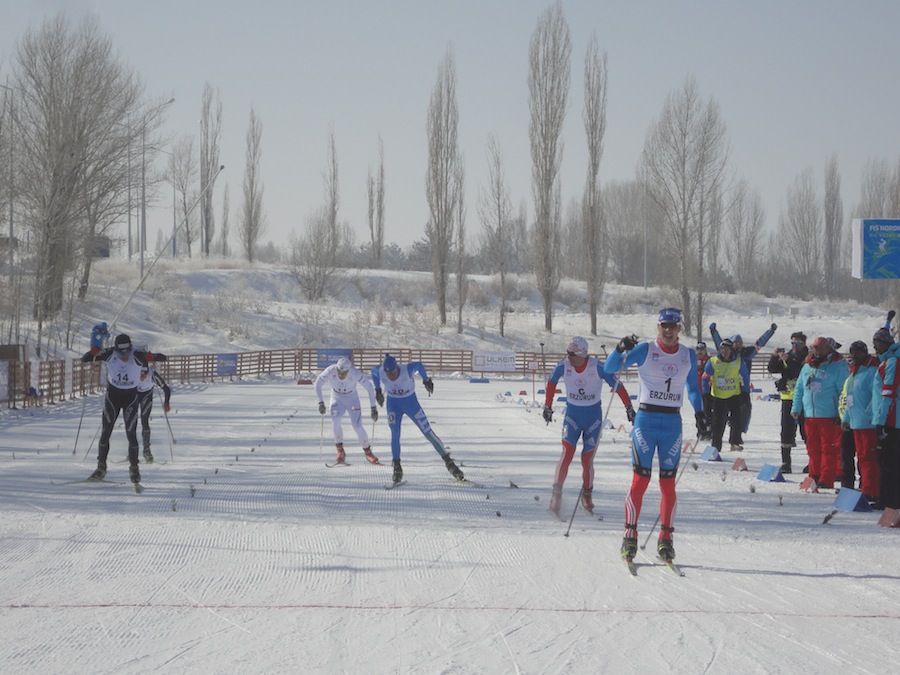
    Gleb Retivyk (RUS) coasting past the finish line for the U23 skate sprint title in Erzurum.

    ERZURUM, Turkey — With two gold medals in as many days at the World Junior/U23 Championships, Russia is clearly on top of its mens’ sprint game. Gleb Retivyk (RUS) took home a decisive win on Tuesday, skiing into the stadium in the final out of reach of his competitors, and maintained his lead all the way around the last corner and through the straightaway. His compatriot Evgeniy Belov (RUS) took second, and in a fight for third, Roman Furger (SUI) pulled off the bronze.

    Retivykh skiing through the stadium during qualifying. Photo: Erzurum WJSC 2012.

    Retivyk was recently fifth in the Moscow World Cup city sprint, but said success at U23s his motivation for training this year.

    “The race was perfect for me today as two Russian skiers were on the podium,” he said his win. “I have been preparing for this competition the whole year. I was working on the strength a lot before the season.”

    This was Retivyk’s first age-group victory; he was twice on the junior podium in Otepaa, Estonia last year, but never for gold.

    Belov, more of an all-around skier than sprint-specialist, called his silver-medal performance a good wake-up for the rest of the week.

    “I am immensely glad today,” he said. “When I was a junior I was quite good at free technique sprints.”

    Furger’s result surprised himself—“I never expected I could win a medal here,” he said.

    Other performances of note:

    –  Andrew Musgrave (GBR) qualified in third in the morning behind Retivyk and Gianluca Cologna (Dario’s brother). His strong V2 up the first hill turned many a European coach’s head, though it should no longer be a surprise when Musgrave does well. Musgrave looked posted to qualify for the finals, but in the semis took a spill at the top of the final downhill after getting caught up with another skier. He ended up in ninth.

    –  Norway had a surprisingly down day,with all failing to advance past the quarterfinals. Eivind Bakkene was the first red-clad skier in 14th; Finn Haagen Krogh was 16th.

    Scott and Packer lead the U.S. In 25th and 26th

    Americans Ryan Scott and Eric Packer were the lone North Americans to make the heats on Tuesday. Packer set the 18th-fastest qualifier while Scott scraped in with 30th. Three more fell just outside the cutoff: Graeme Killick in 31st, Erik Bjornsen in 32nd and Reese Hanneman in 33rd.

    Ryan Scott (USA) leading Retivyk and the rest of the first quarterfinal at the top of the first hill. Photo: Reese Hanneman.

    Before the first heat came into sight on the first hill out of the stadium, excited U.S. coaches radioed to each other that Scott had gotten off to a fast start. A few seconds later, the black American suit came into view a few paces ahead of Retivyk—the 30th qualifier leading the first.

    Scott remained ahead through the rolling downhill and until the second uphill, when he began to lose ground to the rest of the pack. He ended up crossing the line in fifth, which eventually put him in 25th overall.

    “It wasn’t the plan,” said Scott of his fast start. “Originally I thought I’d try to hang back and go on the second hill, but sometimes it’s nice to get out a little faster, you can stay out of trouble—a lot of people were falling and breaking stuff. That was my thinking on the spot.”

    He expected more of his competitors to be right with him on the first hill, but “no one really came until the next climb,” said Scott.

    When Retivyk made his move to overtake him, Scott thought he got “bogged down” trying to stay with him.

    “I haven’t trained a whole lot for sprints this year, this is the only time since U.S. Nationals I’ve ever skied heats,” he said. “Tactically, it would be nice to have a bit more practice rather than watching World Cup races.”

    Scott lives at altitude in Bozeman, Mont., which he thinks “definitely” gave him an advantage over skiers only used to sea level.

    U.S. trip leader and USST development coach Bryan Fish was pleased with Scott’s performance.

    “With a number 30 bib, he did absolutely everything he could. He ran out of gas at the end, but on the flip side, when you do that, you can never say you didn’t try—he left it all out on the course. You have to be pretty pleased with that.”

    Packer fared less well in his quarterfinal. He said he is used to being the one in control during head-to-head racing in the U.S, but here at U23s, he felt the butt end of aggressive skiing.

    Packer (USA) in fifth up the first hill of his quarterfinal.

    Out of the gates, Packer was in third, but rounding the corner to head out to the course, another skier skated right across his equipment.

    “I should have asserted myself more, but I kind of sat back for just a second and immediately dropped to sixth place,” said Packer.

    “For the rest of the race I tried to move up. It was a game of cat and mouse—people were driving in front and then walking, and I was between fourth and sixth for the rest of the race.”

    Packer believed he had the fitness to pass people, but wasn’t able to move quickly enough to sneak by before getting blocked.

    “When I’d come up behind someone, they move out in front of you because they sense you coming from behind. So that was a little bit frustrating, and a little different from what I’ve experienced.

    “What I found is that if you’re not in the first three spots in a race like this, then you have to have incredible speed to pass people—it can’t be a slow move, they won’t let it happen.”

    Despite disappoinment in not moving on, Packer was confident for the 15 k classic and the pursuit hat he could ski with the competition.

    “Normally I struggle a little racing at altitude, so feeling good today, especially in the qualifier, was really encouraging.”

    Erik Bjornsen, 32nd.

    For Bjornsen, who just missed the top 30, the qualifier was more fuel for next year, as got a better sense of when starting conservatively is too slow.

    “I don’t think I would change anything technically, but I probably should have gone out harder—I had a little left at the end,” he said. “But who knows, if I’d gone out harder, maybe I would have died in the finishing stretch.”

    In the difference of one place, Hanneman was 1.46 seconds behind Bjornsen, and was satisfied that he’d given the qualifier 100%.

    “I probably went the hardest I’ve gone all year, and technically I think I skied it almost perfectly,” he said. “In that respect I’m glad, I thought I had as good a race as I could have, considering it was a prelim at altitude with a lot of free skating, which is not my forte.”

    But, “30th I would have been happier with,” said Hanneman.

    After Killick, Bjornsen and Hanneman, Jesse Cockney (CAN) was 39th, David Greer (CAN) finished 47th and Christopher Hamilton (CAN) 50th.

    Final results

    Qualifier results

    Graeme Killick, 31st.


    Reese Hanneman, 33rd.


  • Musgrave Shocks Norway with Second-Place Finish in Voss

    Musgrave Shocks Norway with Second-Place Finish in Voss

    Andrew Musgrave (GBR) skiing during the Tour de Ski this season. He was second in Thursday's 15 k at Norwegian Championships.


    “Young Briton Beat Northug.” “Andrew Musgrave Outdistanced Norwegian Cross Country Elite.”

    So read the headlines in Norway on Thursday after Andrew Musgrave (GBR) snuck his way into second place in the opening event of the country’s national championships in Voss, Norway to Martin Johnsrud Sundby (NOR), who took the win by 1:07.1 in the 15 k individual freestyle. Ansnes Ron Frederick  (NOR) placed third (+1:22.5), and in another noteworthy finish, 40-year-old Thomas Alsgaard (+1:23.3) finished fourth.

    As Musgrave isn’t Norwegian, he was not awarded the silver medal, and Alsgaard notched a Norwegian Championship bronze for the second year in a row.

    Musgrave lives and trains out of Lillihammer for most of the year, speaks fluent Norwegian, and was as surprised as anyone by his performance in the 15 k. After a whirlwind of interviews with the Norwegian press, we caught the 22-year-old on the phone for a quick chat about what it’s like to upset some of the biggest names in skiing on their home snow.

    FasterSkier: Second place at Norwegian Nationals—how are you feeling about that?

    Andrew Musgrave: It was not bad at all, I can’t complain. It was a bit of a weird day. The results were weird; like, I was second, but still a minute-plus behind. It was just awful weather, a real howl and gale. You just had to keep going and not stop when the wind blew really hard against you.

    FS: Did you know you were having a good race?

    AM: Yeah, Petter [Northug] started behind me, so my race tactic was—well, I thought he’d go quite fast, and since it was windy, if he caught me up then it would be easy to stay behind him. So my first lap I took quite easy. I think I got splits I was like sixth or seventh.

    Then after the first lap [Northug] caught up a bit on me, but he wasn’t making that much ground on me, so I thought I’d go quite a bit faster on my own. So I did that, and then on the second lap I started to go a bit faster. Then there’s a long hill, and by the top of the hill I was in second place and I just stayed in second the rest of the race. So I knew it was going pretty well.

    (Petter Northug [NOR] has been feeling ill recently, and reportedly coasted for much of the race once he knew it wasn’t going to go well. He wound up in 40th.)

    FS: How familiar were you with the course?

    AM: Voss is quite a long way from where I am in Lillehammer, so I’ve never been here before. There was a Norwegian Cup race here last year, but I didn’t do it, so I didn’t know what the course would be like. It’s a nice stadium and course, I just couldn’t see that much of it—it was just so windy.

    Andrew Musgrave (24) in action last season.

    FS: Are you surprised to have done so well?

    AM: I was quite surprised. My goal was, if it went really well, I’d come in the top five, but to come in second is pretty cool.

    FS: Yeah, the field is pretty strong.

    AM: Yeah, a lot of good people skied really slowly. I’m not really sure what they did. I think I had good skis, and I’ve been in quite good shape. I don’t know, some people maybe didn’t do well in the adverse conditions. Everything went quite well for me, that must be it—the combination of things.

    FS: What’s the atmosphere been like?

    AM: Considering it was quite bad weather today there were a decent amount of people out on the track watching. Much more than a normal race. I think on the weekend there will be more people watching.

    FS: As a non-Norwegian, do you feel a little out of place at the Championships? Do people think you’re this outsider taking glory away from their skiers?

    AM: Lots of people think it’s funny, I don’t know. Most people think it’s a bit cool that someone different did well today. I don’t feel out of place at all; I think of it as a normal race, and try and get as good a finish as I can.

    FS: You beat Alsgaard, too. Though fourth isn’t too bad.

    AM: Yeah, he was third here last year, and he’s the third Norwegian this year, so he gets another Norwegian Championship medal—not too bad for him… I think people were quite surprised. Lots of people thought he was going to do well, then lots of people didn’t think he would do well. Then he did well! [laughs] There was a split opinion beforehand on whether he’d go fast or not.

    FS: Have you had to do a bunch of interviews with the Norwegian press?

    AM: Quite a few; they’re a bit mental that some British guy came second in their national championship. It’s been pretty funny. I’m pretty fluent in Norwegian—I live with a Norwegian guy and we speak Norwegian at home. So my English has gotten worse, probably.

    FS: What races are you doing for the rest of the Championships?

    AM: I’m not doing the classic sprint, because I’m useless at classic. I’m doing the pursuit and the relay. The team I ski for, Team Hovden, hopefully we’ll get a good finish. I think we should have a pretty good team.

    We did petty well [today], I was in second, then we had a guy in 13th, 21st, and then we had one dude who did rubbish, but he went the wrong way.

    Men’s 15 k results.

  • Andrew Musgrave at Norwegian Nationals

    First of all, I’ll echo Nat Herz’s big ups to Andrew Musgrave for finishing second at Norwegian Nationals the other day. I’ve always been a bit fascinated by Musgrave, probably because North Americans identify with any reasonably successful, promising skier not from Scandinavia or the usual European nations as fellow “outsiders”. So I’m always kind of pumped when he skis well.

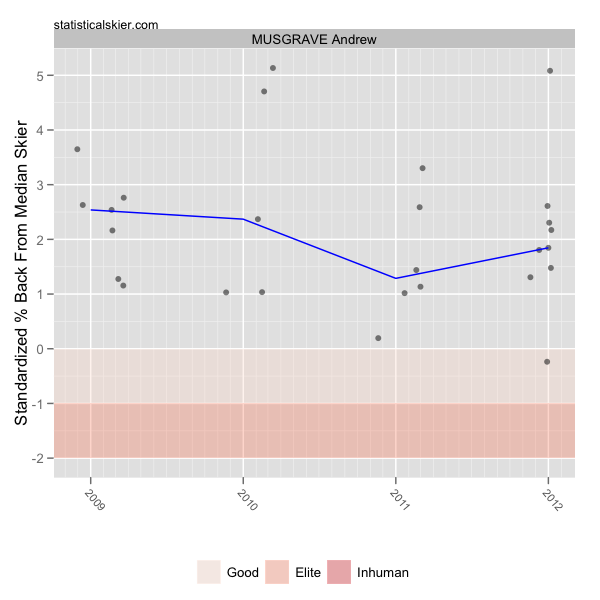
    But looking closely at this result, I started getting a little puzzled. The first thing that puzzled me was that I didn’t think that his WC results so far this season had been all that great. So I checked, and…

    …generally my impression was correct. His results have been a bit worse than last season. But for a guy putting up resulting on the WC this far behind the median skier, second place at Norwegian Nationals seems out of place. So let’s look more closely at this result.

    The first thing to note is that Martin Johnsrud Sundby won the race handily, beating Musgrave by 67 seconds or so over 15k. A quick glance at Johnsrud Sundby’s WC distance results this season reveals that they have (with one exception) also been significantly better than Musgrave’s. So maybe the field at Norwegian Nationals was somewhat weaker than usual? (Case in point, Alsgaard in 3rd.) Well, scanning down the results sheet reveals several other Norwegian WC regulars, so maybe not.

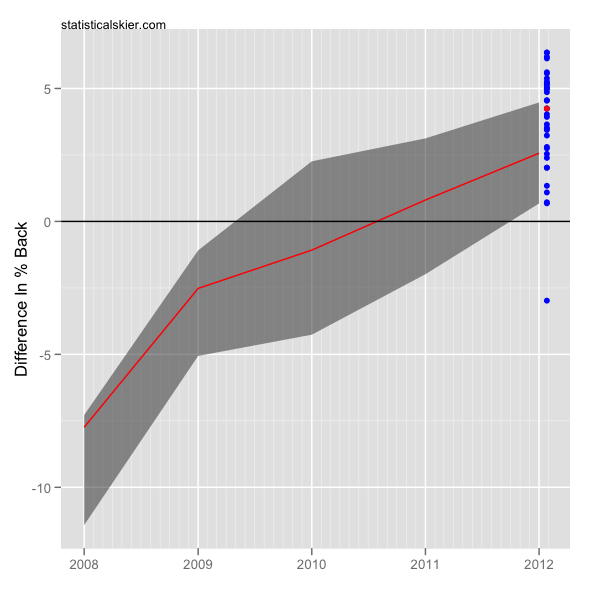
    Let’s do this more systematically by comparing Musgrave’s performance in this race to his performance against the skiers in this field in the past:

    Higher is better in this plot (better for Musgrave, that is). The blue points are from this particular 15k from Norwegian Nationals. Note the one blue point way off by itself; that’s Johnsrud Sundby. The red line and shaded ares represent the general trend for Musgrave against the skiers in this field over time.

    Clearly this race is at the upper end of Musgrave’s past performance level (red dot). And the overall trend has been moving steadily in Musgrave’s direction over the past few seasons. This suggests that Musgrave has been getting steadily better, on average, against the particular skiers in this field over time. So much so that I’d basically expect him to beat nearly all of them at this point on a regular basis.

    Nearly all, of course, is not the same as all. I mean, I don’t put much stock in Petter Northug’s 40th place result in this race. So my read on this is that this field consists mostly of skiers that Musgrave has already shown that he’s as good or better than, and the remaining WC level skiers either crushed him (Sundby) or weren’t taking the race very seriously (Northug).

    At the end of the day, though, Musgrave can still say he finished second at Norwegian Nationals, and no amount of complicated analysis on my part can change that.

    Related posts:

    1. <Is It Panic Time For The Norwegian Men’s Distance Skiers?
    2. <Weekend FIS Races: Andrew Musgrave
    3. <NOW Is It Panic Time For The Norwegian Men’s Distance Team?


  • Another Good Day for US in Beitostolen, Two on the Podium

    The three day Beitostolen FIS race series in Norway concluded with a frigid race, featuring delayed start times and shortened distances. But this did not stop American skiers from continuing to turn in strong performances on the track.

    The races were originally scheduled as 15/30km freestyle events, but with predicted highs in the low single digits, the always cold-wary Norwegians opted to cut the distance to 10/15km.

    The US women packed the top of the result sheet with Morgan Arritola, Jessie Diggins and Liz Stephen placing second through fourth respectively, behind Norwegian World Cup veteran Astrid Uhrenholdt Jacobsen.

    Arritola completed the two five kilometer laps 37.7 seconds back. Diggins finished + 1:09.8 with Stephen another 2.6 seconds behind.

    “I was really happy with my race,” Diggins wrote in an email to FasterSkier. “I was a little tired for sure, it being the third consecutive day of racing…By the end of the race I was hurting, and my legs were pretty dead, but it was definitely worth it.”

    While the field did not feature many established Norwegian stars, Jacobsen is certainly a good benchmark. Still just 24, she placed 10th in the 2011 Tour de Ski, and has bounced back from two sub-par seasons. In 2008, she skied to second in the overall World Cup standings.

    “Standing on the podium in Norway was definitely something I’m going to remember,” Diggins said. “Mostly because I used to look up to the Norwegians as gods, and thought that I’d never, ever be as fast as them. But I’m realizing that we train pretty much the same, and on any given day the US athletes stand a good chance of beating them!”

    Diggins improved on her 15th place in the 5km classic race, and has now been racing in Europe for a month.

    Arritola also appears to be rounding into form, improving with each race in Beitostolen. As a comparison, a similar deficit to Jacobsen (by percent back) would have placed the Sun Valley skier in 23rd in an early season World Cup 10km freestyle.

    Diggins and Stephen would have ranked 45th in that event. This is a rough comparison at best, but does provide a point of reference.

    In the men’s race, Tad Elliott, as the lone American starter, skied to 13th, one minute behind winner Thomas Vestbo.

    The field did not feature any of the top Norwegians, but the top-20 was littered with World Cup experience.

    Vestbo, however, has only one World Cup start to his name, and he did not complete that event. But he is coming off a fourth place finish at the U23 World Championships in Estonia.

    Elliott entered the race inspired by the performances oh his female counterparts, and he told FasterSkier that knowing the women had excellent skis helped him relax.

    “I felt great yesterday…I had some good confidence, and was able to ski relaxed and smooth knowing everything was dialed in,” Elliott said.

    Neither Diggins nor Elliott was bothered by the cold, both citing familiarity with the conditions due to their home climates – Minnestoa for Diggins, and Colorado for Elliott.

    “The cold didn’t really bother me – I’m from Minnesota, so I’m used to racing at the very edge of the legal limit,” Diggins said.

    Both racers have used their long European sojourn to good effect, noting that one of the most important skills is learning to deal with the travel and recovery required.

    Despite noting the depth and competitiveness of the fields, Elliott said, “Racing seems to be racing, just learning how to manage Europe and more racers is all that is different than the US.”

    The two CXC athletes are now looking ahead to Worlds. Elliott says he is feeling in good form and hopes to have his best races of the season in Oslo, and both are feeling confident after some fast skiing in Norway.

    In other Anglophone results, Brit Andrew Musgrave placed 15th in Sunday’s freestyle race, 21 seconds behind Elliott, while Australia’s Ben Sim, who has spent the season working on his jumping while switching to Nordic Combined, temporarily rejoined the cross-country circuit, and placed 25th, just under two minutes off the winning pace.

    Sim will race cross-country events in Oslo.

    No Canadian skiers participated, and the team continues to train in Lillehamar.

    Beitostolen Men’s 15km Freestyle Results (PDF)

    Beitostolen Women’s 10km Freestyle Results (PDF)

  • Sandau 5th, Musgrave 6th, Hoffman 9th Behind Russian 15 K Sweep

    Sandau 5th, Musgrave 6th, Hoffman 9th Behind Russian 15 K Sweep

    Britain's Andrew Musgrave racing in the U-23 World Championships 15 k freestyle on Thursday.

    When Britain’s Andrew Musgrave came through the stadium leading the first lap of the 15 k freestyle on Thursday, it was clear that it was going to be a good day for Anglophones at the U-23 Championships in Otepaa, Estonia—even if the Russian team ultimately swept the podium.

    Musgrave lost his early lead, but still held on for sixth place, and was joined in the top 10 by Canadian Kevin Sandau and American Noah Hoffman in fifth and ninth, respectively. Russian Evgeniy Belov, a top-10 World Cup finisher, took the win convincingly, with his teammates Pavel Vikulin and Raul Shakirzianov completing the sweep.

    Russian Evgeniy Belov, who won on Thursday.

    But even the Russians had to take notice of Musgrave early in the race, when he went out like a bullet and led the entire field by 12 seconds after the first of four 3.75 k laps.

    A 20-year-old Scot with two more years of U-23 Championships eligibility, Musgrave is currently living in Norway and training with a regional club team—the alumni of which include stars like Ola Vigen Hattestad and Odd-Bjoern Hjelmeset.

    After some muscular results in the fall, where he was competitive with some of Norway’s best juniors, and even some World Cup skiers, Musgrave was a known quantity on Thursday. But it was still a surprise to see the unfamiliar colors of the British suit keeping pace with the world’s best Germans and Russians through the snow-covered fields of Estonia. The country is no nordic skiing powerhouse—the three athletes it sent to the 2010 Vancouver Games were its first Olympians in the sport since 1994, according to the website of the British Olympic Association. (Musgrave was one of them.)

    In Otepaa, his first lap was indeed explosive, and he already looked tired heading up the first big climb; it seemed impossible that he could sustain his pace. But in an interview after the race, Musgrave said that his fast start was a concerted effort—not youthful exuberance getting the better of him.

    “I didn’t feel that good on the first lap—I felt quite stiff, so I just tried to go hard…and loosen up the legs,” he said. “I always open hard—that’s the way I race best. I know I’ve got to be in the lead on the first couple laps to be within a chance.”

    On the second lap, though, the rest of the field was starting to reel him back in, with Belov taking the lead over Musgrave by four seconds at the halfway point.

    By the time Musgrave entered the home stretch, it was clear that he had cracked a bit, if not entirely—the snap that other skiers brought to the finish line was lacking.

    He was briefly the leader, but was quickly bumped down by Sandau, as well as Norwegian Thomas Vestboe—one of his club teammates—for a conclusion to a day that was simultaneously a thrill, and a little bit discouraging.

    “If yesterday I’d have known I was going to come top six, I’d have been happy,” he said. “But today, losing out on the medal—it’s a bit disappointing.”

    Sandau’s approach to the race was more measured—he never sat further than one place from his final position.

    In his last year of U-23 eligibility, Sandau is 5’9”, but he skis like he’s shorter than that, with a fluid, compact technique. In

    Canada's Kevin Sandau on his way to fifth place.

    Thursday’s race, he caught his teammate Michael Somppi, who started a minute earlier, and the two skied together into the finish.

    On his website, Sandau lists his goal for the 2010-2011 season as a top-five at U-23’s, and on Thursday, he got exactly what he came for—even if organizers had disappointed him by removing the biggest climb from the World Cup course that he had raced in Otepaa last weekend.

    Mike Cavaliere, Sandau’s coach at the Alberta World Cup Academy, said that the fifth place was on par with expectations, given results from earlier in the year—including a second place in one of the country’s U-23 Championships qualifying races, where Sandau was just a few seconds behind World Cup veteran George Grey.

    “He’s been extremely competitive with our seniors in Canada this year, and we know what they’re capable of doing,” Cavaliere said. “There were some signs…He’s just a great athlete—good, focused, committed, takes care of business.”

    The efforts from Musgrave and Sandau overshadowed what would otherwise have been a heralded finish by American Noah Hoffman, who was ninth in what he called a “good result, for an average-to-good feeling day.”

    “I don’t think it was my best,” he said. “It was decent.”

    The course wasn’t exactly laid out for Hoffman, who thrives on big climbs, though he still said it was fun to ski.

    The 3.75 k loop featured short, steep ascents rather than long, grinding ones—and plenty of transitions and technical skiing.

    The U.S.'s Noah Hoffman, skiing to ninth. Photo courtesy of Langd.se

    With 440 meters of total climbing over 15 k, the course was at the lower end of the range recommended by the International Ski Federation. But Hoffman still used it to race to his best-ever finish at U-23’s or World Juniors.

    The Russians, though, demonstrated that they had truly mastered the trails in Otepaa—which makes sense, given that they use the facility as a site for summer training camps.

    Belov had already raced to a 14th place in last weekend’s World Cup here, and with their sweep of the top three places on Thursday, he and his teammates showed that Otepaa was their second home.

    With his 16-second victory, it’s clear Belov is the real deal—even if some of his fiercest competition is elsewhere. Belov’s teammate Petr Sedov, has better credentials, but he had to miss the U-23 Championships with heart problems, and a number of top Norwegians are back home competing for spots at the upcoming senior World Championships in Oslo later this season.

    Still, in the press conference, Belov was unfazed.

    “Last year, we raced against all those competitors, and I was on the podium several times,” he said through a translator. “So, who is there to be afraid of?”

    The next U-23 race is Saturday’s classic sprint, but the top distance skiers in Otepaa are looking towards Monday’s 30 k pursuit.

    Sandau’s best race at Canada’s U-23 qualifiers came in that format, and while Musgrave and Hoffman both tend to do better in freestyle, they could be in line for more good results if they can hold on in the classic leg. For Musgrave, according to British coach Roger Homyer, it’s clear that the potential is there.

    “He’s got it in him—it’s just him getting it out of himself,” he said.

    Link to full results.

  • Musgrave Trades Golden Boot For Shot At World Champs Success

    Musgrave Trades Golden Boot For Shot At World Champs Success

    Andrew Musgrave (GBR) racing in the team sprint at the 2010 Olympic WInter Games

    Andrew Musgrave has previously been tipped as a young gun to watch in the world of skiing. This season, despite racing only a single World Cup, Musgrave has recorded impressive finishes against top talent.

    In the Norwegian Cup races he started, he has faced stiff opposition – sprinting in Gaalaa, Norway, he was narrowly beaten by American Torin Koos, and finished far up the results sheet from Thomas Northug. In distance racing in Meraaker, Norway, he took on Petter Northug, and Anders Soedergren, finishing less than a minute behind both World Cup stars in a 30 k freestyle race. And in a 10 k classic, Musgrave finished 30 seconds back of none other than Odd-Bjorn Hjelmeset, one of Norway’s premiere classic skiers – so premiere he was brought to the Olympics to ski just the classic leg of the 4×10 k relay and the 50 k classic.

    A British national, Musgrave has a unique training situation. This summer, Musgrave made a move to Lillehammer, Norway, to train and race with Team Hovden, a Norwegian team which focuses on the Norwegian and Scandinavian Cup circuit.

    FasterSkier caught up with him between race weekends to find out how his season was progressing, and whether he was going to see a few more World Cup start lines.

    FasterSkier: It’s currently a mad snow storm in Great Britain – are you at home, and have you managed to get out skiing? Or are you in Norway? Are the guys at Huntly Nordic Ski Club making the most out of the snowfall?

    Andrew Musgrave: I am in Norway just now, so haven’t been able to make the most of the snow back in Britain! There is more snow at home than there is in Norway, and it isn’t often that happens! I think the guys back in Huntly have been making the most of the snow. Every year there is a competition to be the first person to ski around the longest trail in the local forest, and the winner of this wins a “golden ski boot” trophy. The first person to ski round the trails this year drove up closed roads so that he could beat everyone else! I was gutted to not be there, and in the running to win the boot!

    FS: It looks like you had a solid start to the season – two top 30 finishes in Beitostolen, Norway – sprinting and distance skiing well. How did your races go in Beito? Are the results where you want them to be?

    AM: I was fairly pleased with Beito. I wasn’t in the contention for winning any of the races, but it was very early in the season and I generally get better after a few weekends of racing. I felt like I could ski continuously fast, but like I didn’t quite have that top gear yet. Despite this I feel that my training has been going well, and that I just need a few weekends of racing to get my top speed back. I was pleased to qualify for the sprint knock-out stages. One of my goals this year is to improve in sprinting. Over the last few seasons I have occasionally been OK in the prologue, but my tactics in the knockout stages have always been a bit suspect. I also knew it was going to be a big step up from qualifying in junior races, to qualifying in senior races. It was good to know that I am not too far behind the level of the senior sprinters, and it was good to get a bit of experience in the heats.

    FS: The only World Cup race for you so far was the 15 k in Gallivaere, Sweden, where you finished 52nd in a strong field. Why only the one World Cup? And was that result what you were aiming for? When will we see you on the circuit again?

    AM: Gallivaere is probably going to be the only World Cup I will be doing before Christmas. I am going to be focusing more on Norwegian Cups. I feel it is better for my development to do races I can be more competitive in, and it limits the amount of travel I will be doing. Sometimes I cope really well with traveling, but other times I find it very tiring. In the New Year I will probably do a couple more World Cups; in Otepaa, Estonia, and in Drammen, Norway.  As for the race in Gallivaere, it actually went fairly well. I felt I was in much better shape than I had been in Beito, and was skiing much better in general. I didn’t really have any solid goals, I just wanted to go out and ski well. In the end I was just a bit over 30 seconds behind getting World Cup points. It would have been nice to go 30 seconds faster and get some points, but that is more competitive than I have been in World Cups before, so I can’t really be too disappointed.

    FS: You did pretty well in Gaalaa, Sweden – two top 10’s, just narrowly missing out on a podium in the sprint. Was this an indication of where things are headed for you? Are you aiming to race a lot of Norwegian races this winter?

    AM: Gålå was a pretty interesting weekend. The weather forecast had predicted that it was going to be very cold, and a lot of the Norwegian racers didn’t even bother to travel to the race, as they were convinced it was going to be cancelled. As it turned out it was warm enough for the races to be held. I didn’t think it was particularly cold, never dropping below -18C during the races, but a lot of people didn’t start, complaining that it was too cold to race. I can understand people not racing in the cold if they have problems with asthma, but it is a bit excessive when two thirds of the race field drop out. I think people need to man up, and remind themselves that it is a winter sport!

    Despite the large numbers of people dropping out, the races did go ahead, and they went quite well for me. In the sprint I had a good prologue and advanced easily to the semi-final. I was lucky to get through to the final with “lucky loser” time. In the final I was just edged out of third place by less than a boot length. I should really have come third, but I did the world’s most pathetic lunge across the line.

    My result in the classic distance was a promising one. I was in the top 10, and just over 30 seconds behind the winner. This is a big step forward for me in classic from last year, and a good sign that my technique training from the summer and early winter has been paying off. I have always found classic technique more difficult to master than skating, but hopefully now I am beginning to get there!

    FS: Are you training hard through this first World Cup period with your eye on a specific event before Christmas? Or are you mostly focused on the big events in the New Year?

    AM: The main races for me this season are not until February, but even so I will be racing a lot throughout the first part of the season. For me the best way to train is to get out and race as much as possible. During this early part of the season I am trying to maintain as high a volume of training as possible while still fitting all the races in. In January the volume of training I am doing will probably drop off a bit in the run up to World Under-23 Championships and the World Championships.

    FS: How has the training and racing experience in Norway been? Do you still travel and race with the other British skiers (Andrew Young, Callum Smith), or are you mostly with Norwegians?

    AM: Training and racing in Norway is going really well. I think everyone on Team Hovden [the Norwegian racing team Musgrave joined this fall] is in pretty good shape now, and we can be really good in the Norwegian and Scandinavian Cups coming up. I think this year we can definitely be one of the top teams from the whole of Norway. We have had a lot of training camps this year, and there has always been someone in really good form, pushing you to be at your best in every interval session. I think the amount of training we have been doing together is why we are all at such a good level now. In the first Norwegian Cup race in Meråker, Norway we were 1st, 2nd and 4th place amongst the U23 racers. Hopefully this will be 1st, 2nd and 3rd at the next Norwegian Cup!

    Up until now I have been mostly training with Team Hovden, but later on in the season I will be getting back together for racing and training with the British Team. Andrew Young and Callum Smith have both started at ski gymnasiums in Norway this year, so it will be interesting to see how fast they are skiing! A few of the other British guys have moved to Lillehammer [where Musgrave lives] for the winter, so even though I haven’t been on too many national team camps, I have been getting in quite a bit of training with some of the guys on the team.

    FS: What’s your target for this season moving forward? Have you had any hiccups in your training that have forced you to adjust your goals, or make changes on the fly?

    AM: So far this season my training has gone exactly to plan. Fingers crossed, it should keep going that way! The main races I am targeting are World U23s and World Champs. I would be really happy with a top 30 at World Champs and/or a podium at World U23s. That’s going to be difficult, but hopefully I will manage!

    One of the other guys on Team Hovden, Thomas Vestbø, and I always like to joke about who is the best, and who is going to win the next race. We have started keeping a running total of the times of all our races from the season. So far, after the five races that we have both done this season, including classic, skating, distance and sprints I am leading him by four seconds. The most important thing for me this year is to beat him over the whole season! He also did quite well at the World U23 Championships in his first year as a senior, and came in fourth. This year I have to be better than that, or I’ll never hear the end of it!

  • Bjoergen, Sundby On Top In Beitostolen 10/15km Classic Race

    Marit Bjoergen showed no ill-effects from an illness that kept her out of the first two FIS races in Beitostolen, Norway.  She skied to a convincing 51.4 second victory over teammate Therese Johaug, who won Friday’s skate race by 40 seconds.

    Bjoergen led at every time check, demonstrating strong early season form in the 10km classic event.

    “It’s not surprising there are such differences early in the season,” said Bjoergen to the Norwegian newspaper Afternposten, discounting her margin of victory.  She was most pleased that her sickness was not serious.

    Veteran Vibeke Skofterud completed the Norwegian sweep of the podium, taking 3rd, 11 seconds back of Johaug.  Skofterud faded in the second half of the race after sitting in second virtually even with Johaug at the 5km mark, and four seconds up at 7k.

    Kristin Stoermer Steira and Astrid Jacobsen did not start.

    Sandra Hansson (SWE), who has finished in the top-3 overall in the FIS Marathon Cup the last two years, was the first non-Norwegian across the line, finishing 8th.  Hansson is racing for Thomas Alsgaard’s Team United Bakeries this season.

    In the men’s 15km classic, Martin Johnsrud Sundby skied away form the field over the last 10km to post a convincing 23.5 second win over Eldar Ronning.  Early race leader Eirik Kurland Olsen barely held on to a podium spot, edging out Sjur Rothe by .3 seconds.

    Olsen, with just a single career World Cup start, had one of his best races.  The 23-year-old  has never cracked the top-10 at Norwegian national Championships, but skied aggressively and beat a number of top skiers.

    The win for the veteran classic specialist Johnsrud Sundby was not unexpected, but still a good sign.  A mainstay on the Norwegian relay team, he has been one of the top Norwegian distance skiers after Petter Northug, a group that has come under significant criticism for a lack of podium caliber performances.

    With the exception of Johnsrud Sundby, the race did not show much promise for the distance team.  Sprinters Oystein Pettersen and Ola Vigen Hattestad finished 8th and 11th respectively. Neither man is competitive in World Cup distance races. Of course it is early, and many top skiers were not present.

    Petter Northug did not race,having left Beitostolen mildly sick and fatigued.  His brother Thomas demonstrated that his distance skiing is not on par with his sprinting yet, skiing to 41st, less than a second behind Great Britain’s Andrew Musgrave.

    Torin Koos (USA) has been based out of Norway since arriving in Europe placed 58th, 3:27 behind the winner.  He was 17th in yesterday’s sprint.

    Results (PDFs):

    Men’s 15km Classic

    Women’s 10km Classic

  • Pros of Tomorrow: Andrew Musgrave

    Pros of Tomorrow: Andrew Musgrave

    Andrew Musgrave at an FIS race in Idre, Sweden (Photo: Andrew Musgrave)

    It is not often that a skier from Great Britain exists, much less turns heads on the international stage, but 20 year old Andrew Musgrave is doing just that.

    In 2008, Musgrave attended his first World Junior Championships. A year later, he was back, finishing 12th in the 20 k pursuit, and followed that up with a 9th place finish in the 10 k skate. This season (2009-2010) he took the opportunity to show the Norwegians the finer points of the sport, taking seventh place in the 20 k classic and then winning the 10 k free at the Norwegian National Junior Championships.

    FasterSkier secured an interview with the up-and-coming Scot–our first feature in a series titled Pros of Tomorrow, where we will hunt down and interview developing skiers and give you an exclusive look into what makes them tick.

    FasterSkier: Dorset, England (where you were born), has not traditionally been thought of as a hotbed for developing young skiers, and I understand that you have lived in a variety of places. Can you explain how you managed to get involved in the sport of cross country skiing?

    Andrew Musgrave: My dad’s job meant I moved around a lot when I was younger. I have lived in places as varied as the south of England, the Shetland Islands (some tiny islands in the sea between Norway and Scotland), and Alaska.

    It was in Alaska where I learned to ski. I lived in Anchorage for 6 years, from when I was 5 years old until I was 11. I did a bit of racing, but I wasn’t very good. My brother was actually an okay racer, and was on the Alaska team for the U.S. Junior Olympics.

    I moved back to Britain when I was 11, to a place called Huntly, in Scotland, and have lived here since. It is a bit of a random coincidence, but there is a cross-country ski club in Huntly. I had never really planned on continuing skiing when I moved back, but seeing as there was a club I thought I may as well join.  There are actually a few other pretty good racers, who all come from the same club as me.

    It was through the club in Huntly I got involved with the British Nordic Development Squad, a small team to help develop ski racers and racing in Britain (as the name suggests), and from there I got into more serious racing.

    FS: Where do you do the majority of your training, both dryland and snow skiing?

    AM: In the summer I train at home in Scotland. The British Team have training camps throughout Britain, which I go to as well. In the winter I spend a lot of time throughout Europe, and in particular Norway, racing and training. There is occasionally snow in Scotland, but to get reliable snow I have to travel.

    FS: You took last year off school to train and ski–do you feel that decision to switch to full-time skiing was worth it? What are your plans for skiing and education this coming season?

    AM: I have actually had two seasons training full time now. I did one season with the British team, and last season with a ski-gymnasium in Hovden, Norway.

    I’m pretty sure training full time has made a big difference to my skiing. The main thing for me, coming from Scotland, was just the benefit of having snow to train on all winter, rather than having to go out on rollerskis at home. Training in Norway last season was also massively beneficial. Having a group of very talented people to train with can really help, especially in interval sessions, where you have to fight just to keep up, let alone be one of the fastest.

    With full time training, I have gone from struggling to get inside the top 50 at World Juniors, and coming miles behind at small club races in Europe, to coming top 10 in the World Juniors, inside the top 50 at the senior World Championships, and winning the Norwegian Junior Nationals. Without full time training, I don’t think I would be anywhere near where I am now.

    Next season will be my first season as a senior. I am going to be living in Lillehammer from August, with a guy I was with at Hovden-ski gymnasium last year. I am going to be racing with Team Hovden, as well as the British Team. Team Hovden is a senior team. The people on the team have had some pretty good results, including medals at World U-23s, Scandinavian Cup wins, and World Cup starts for Norway [most notably Maiken Caspersen Falla, a regular on the Norwegian Women’s Sprint team].

    As well as just skiing next season, I am hoping to pass a Norwegian language test, which would mean I could start studying at university in Norway. I want to go on to study engineering.

    Andrew Musgrave (Photo: Andrew Musgrave)

    FS: I think it’s pretty safe to say that cross-country skiing is still a fringe sport in Great Britain. What kind of exposure do you have in the mainstream media, opportunities to attract major sponsors, etc.?

    AM: Cross-country skiing receives pretty much no publicity in Britain. I am sometimes in my local paper, The Huntly Express, but, to be honest, that isn’t the greatest achievement ever, as there are about three people who actually read it. I have a ski sponsor, but as far as opportunities for attracting major sponsors, there aren’t really any. Or maybe I’m just bad at attracting them.

    FS: What kind of support do you have? Either from your Ski Federation or your club, in terms of financial backing, coaching, wax support, travel, training opportunities?

    AM: The head coach of the British team, Roy Young, does a lot for us. He has a full time job, and is the British coach on top of that. He and few other coaches and volunteers do a lot of work planning and getting training camps and races organised. However, racing with the British team is pretty expensive, as  the team doesn’t have any funding at all.

    The athletes have to pay for accommodation, waxing, travel, not just for ourselves, but for the coaches too. So it ends up being very expensive.
    A couple of other team members and I did  get some personal funding last year, but I am not really too hopeful of getting any for the upcoming season.

    As part of Team Hovden next year, I will have really good waxing support, and coaching within Norway, so I will be spending most of the season there, with only a few World Cups or races elsewhere.

    FS: You became an Olympian this winter for the first time. Can you tell me a little bit about what your experience at the Olympics was like?
    AM: The Olympics was a pretty cool experience. Staying in the Athletes’ Village was a bit bizarre. All these athletes from other sports, that I’ve only ever seen on TV, were all sitting together, and eating their meals, right next to me.
    In spite of this I tried not to get too over-awed by being there, and just focus on the racing. The racing for me, I think, must have been much less stressful than for the more well-known skiers. I come from Britain and was still a junior, so there was pretty much no pressure on me. I went out to race as well as I could, without too high expectations. In the end I wasn’t amazingly happy with my results, and was disappointed with the 30 k pursuit in particular.
    Even though I didn’t race amazingly well, it was still an amazing thing to be part of, and it was a good learning experience.

    FS: In your experience, has the ski community in Great Britain grown during the period of your involvement and success?
    AM: In the time I have been involved in skiing in Britain, the level has increased massively. That is pretty much down to one person, the British head coach, Roy Young. He has done a massive amount to get people involved in the sport, and help them get to as high a level as possible.

    Andrew Musgrave (R) with team mate Andrew Young (L) (Photo: Andrew Musgrave)

    FS: What are your plans for training and racing this summer? Any special camps or events you are taking part in? What is you schedule like in the fall and winter?

    AM: As I said before I will be moving to Lillehammer in August. Before then, I have one more training camp with the British team. Up until September I am going to be training quite a lot of hours, with a few Team Hovden training camps, but no events in particular apart from that. If all goes well, I will start racing in November in Beitostølen. From there, I will be focusing on Norwegian Cup races, with maybe one or two early World Cups, before the World U-23 Championships.

    FS: At just 20 years of age you have now been to every major event in the ski world – World Juniors, World Championships, the Olympics, and you are a regular starter on the World Cup. What’s next on your list of goals, either skiing or otherwise?

    My goal is to improve at these events, and eventually win. The last two seasons, I have gone to World Cups and other major races, and although I have been a long way from last, haven’t been competing for a top position. My long term goal is to be the best skier on the World Cup, but I have a long way to go before that. My main focus next year is improving on my 45th place at the World Champs from two seasons ago. It will also be my first year as a senior, so the U23 World Champs will be a priority.