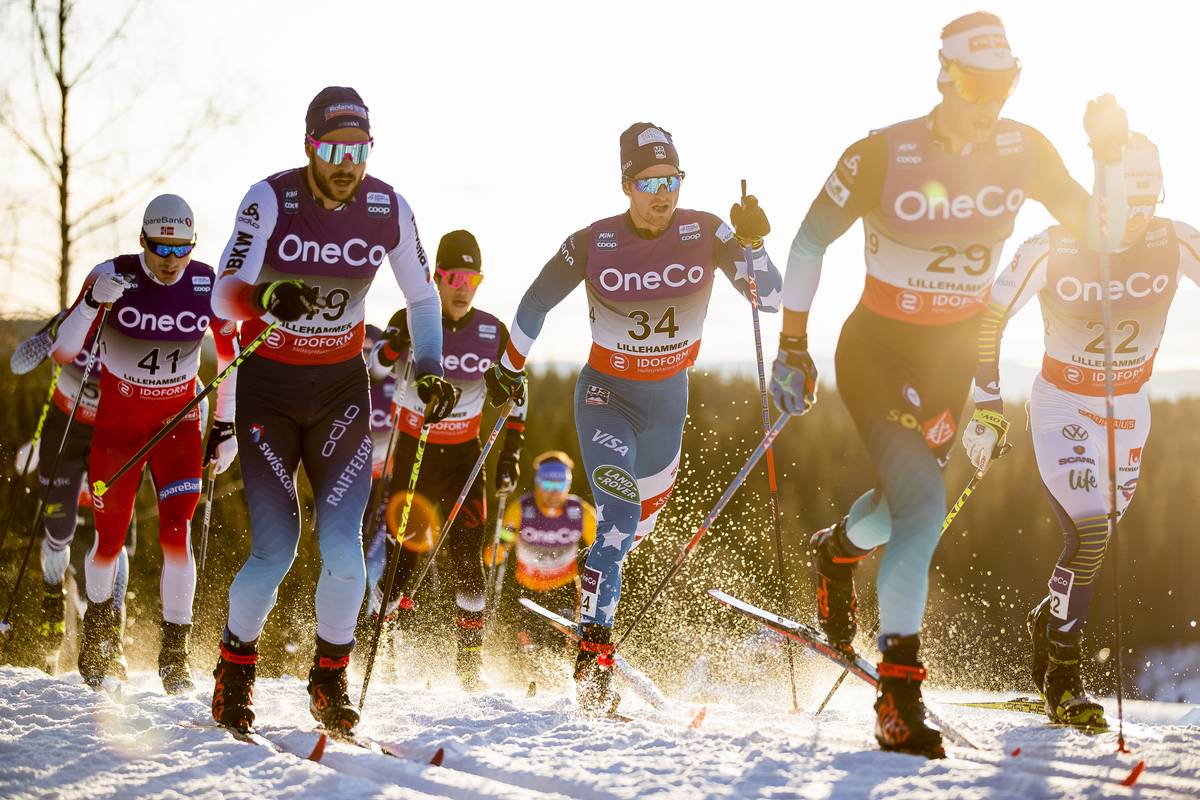
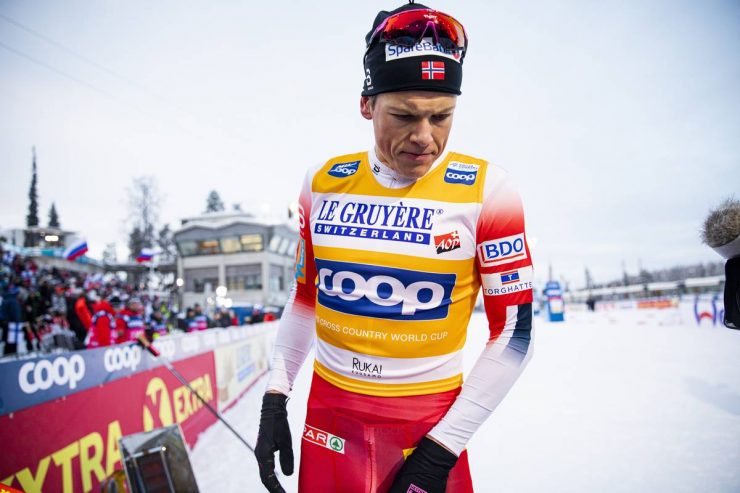
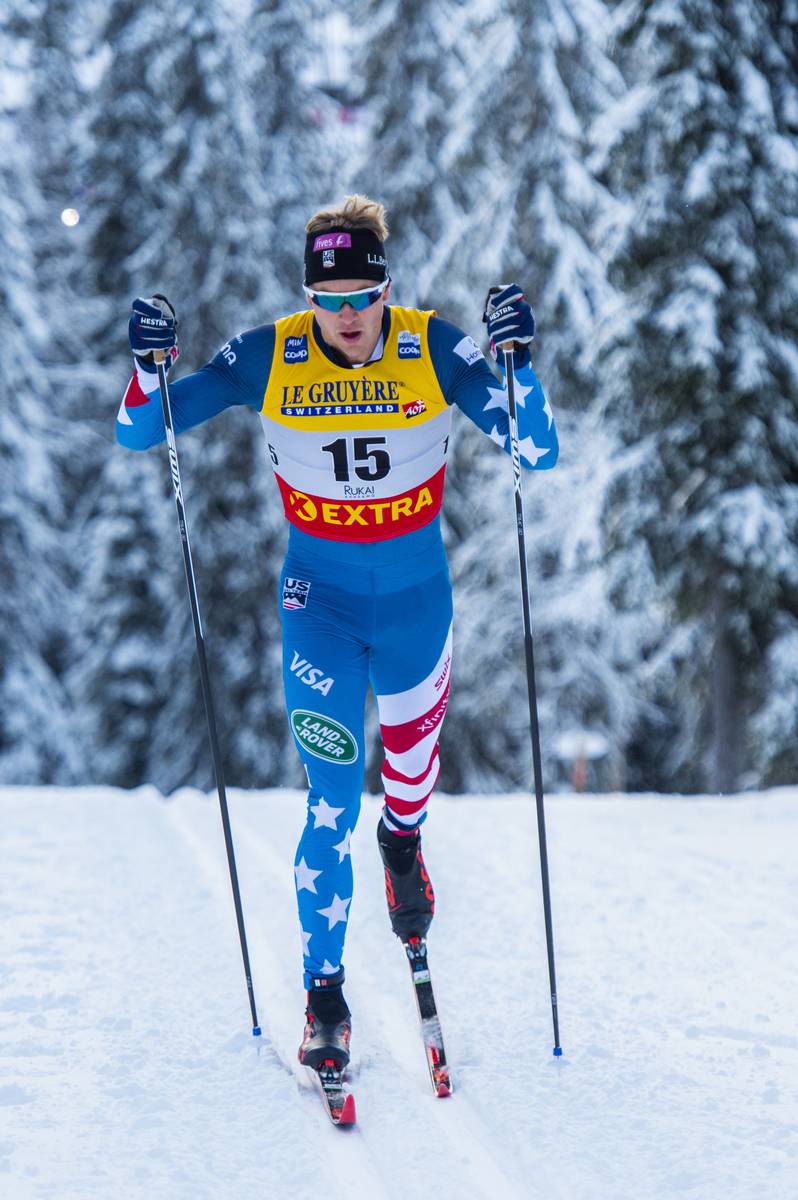
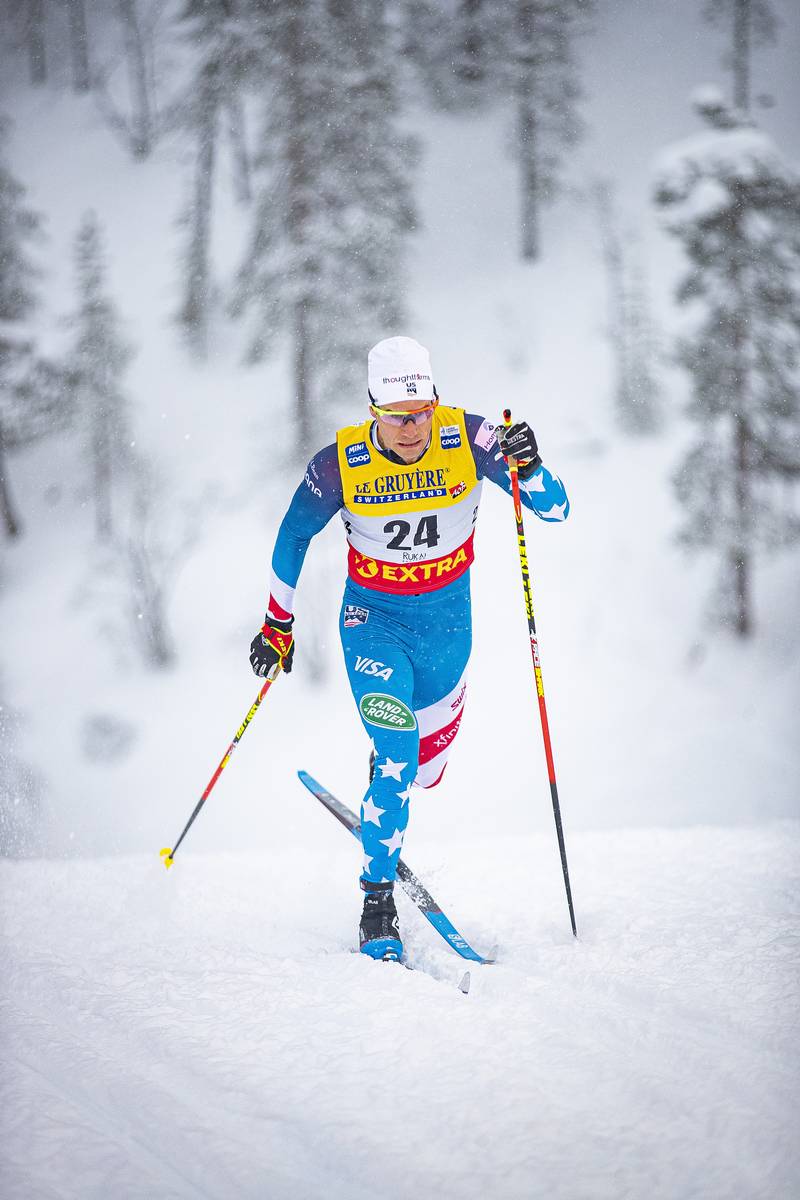
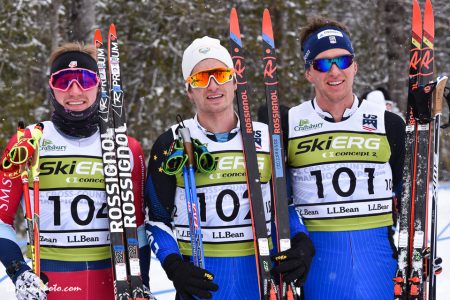
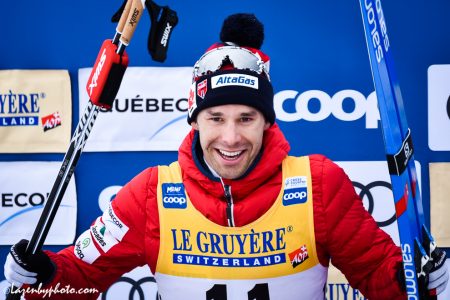
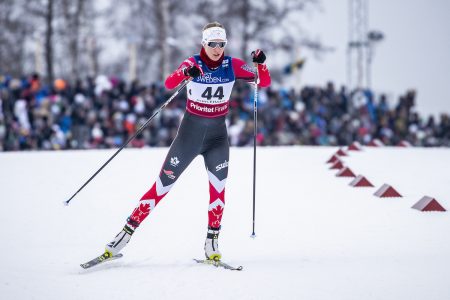
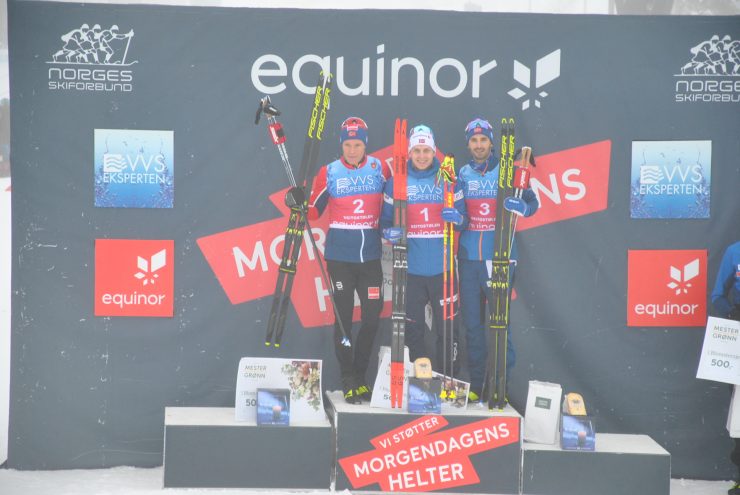
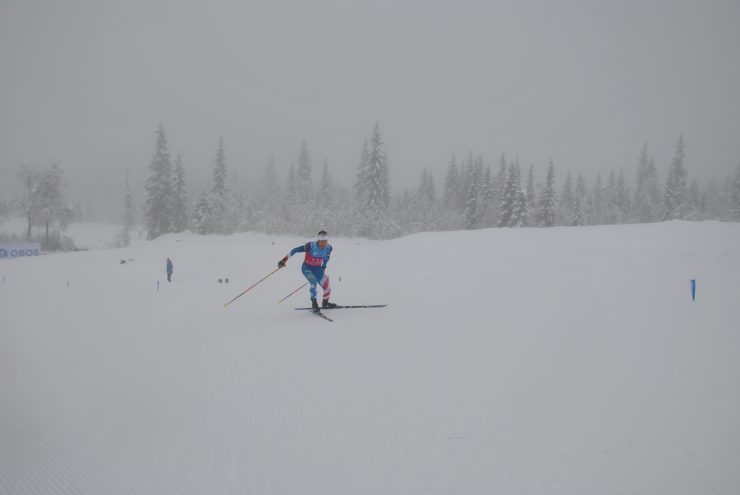
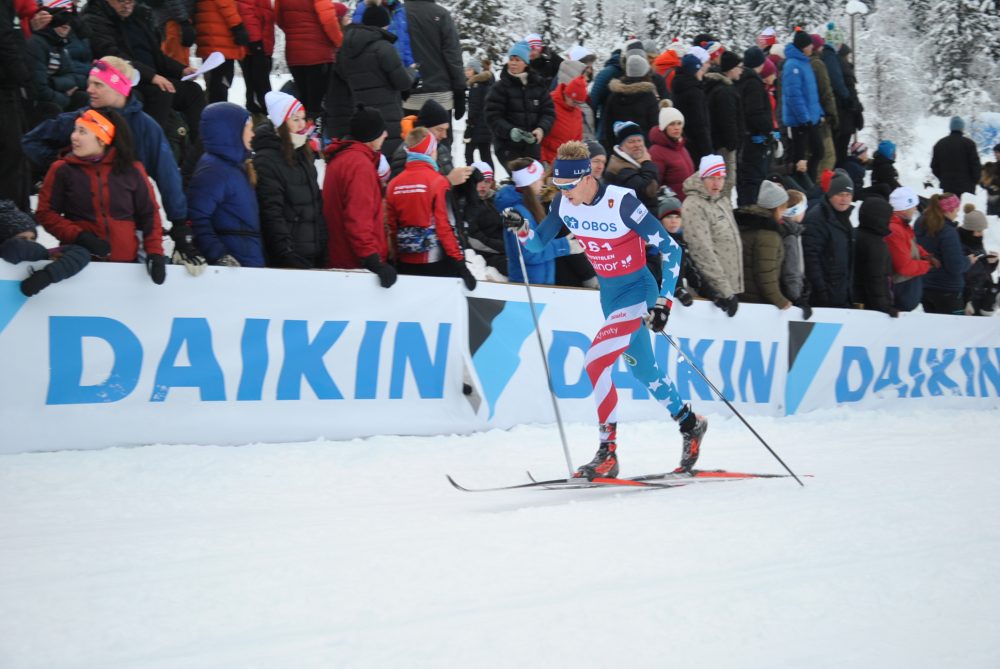
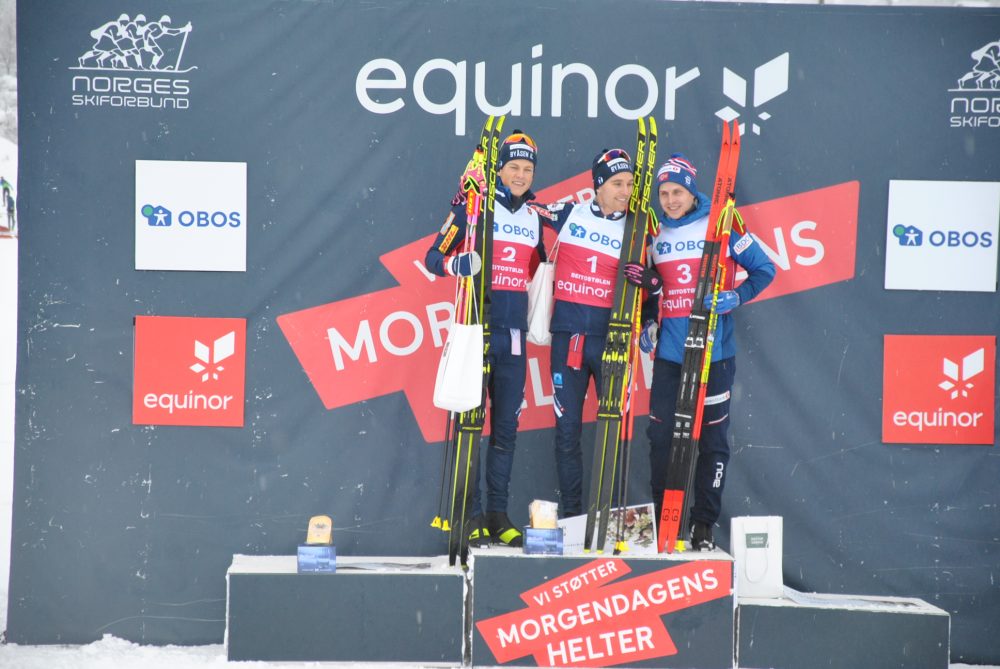
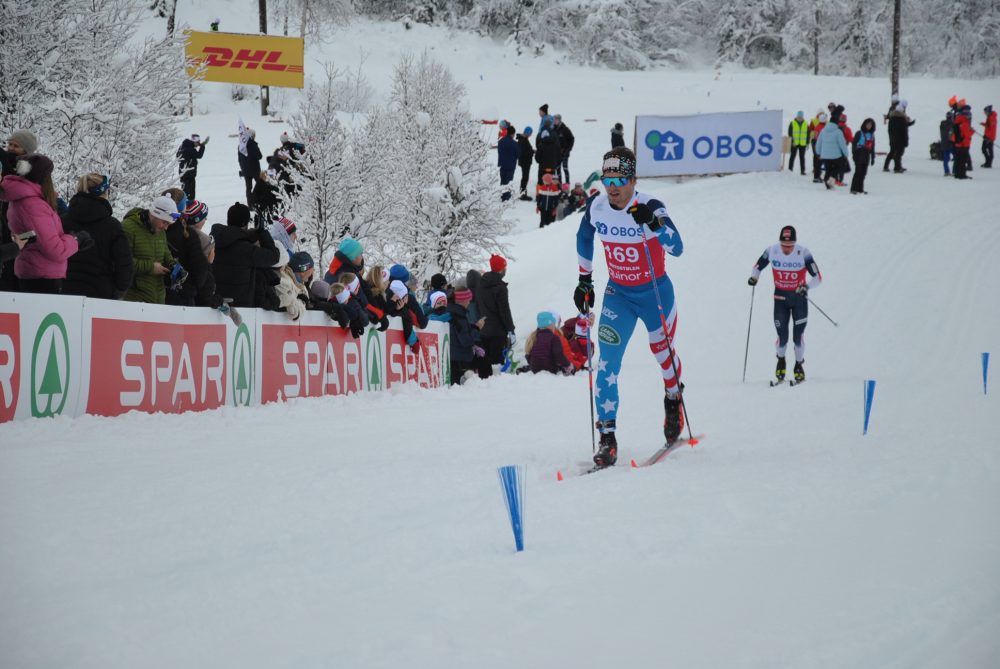
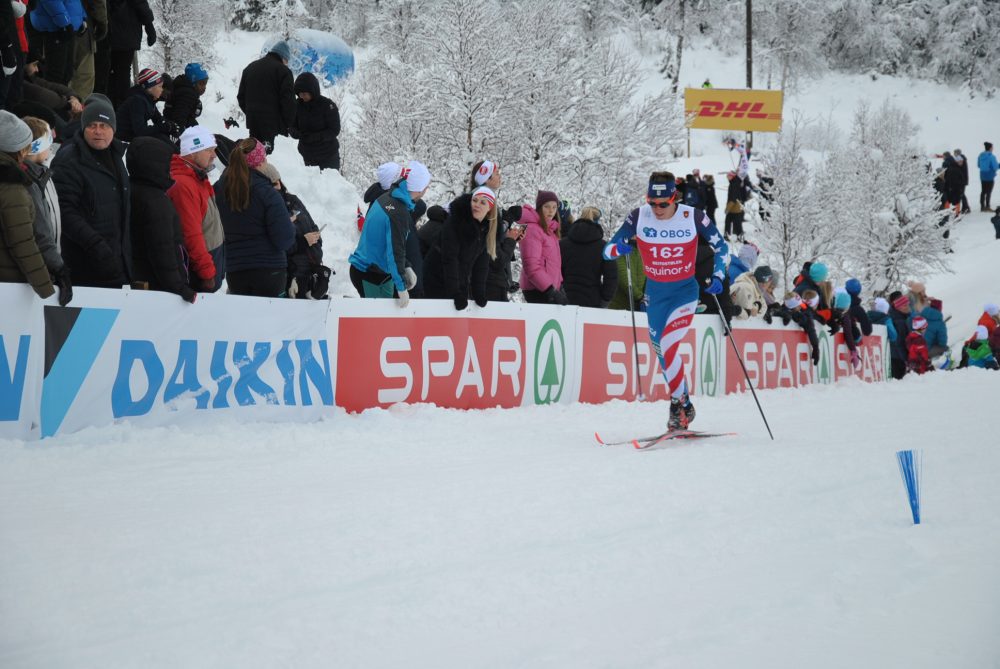
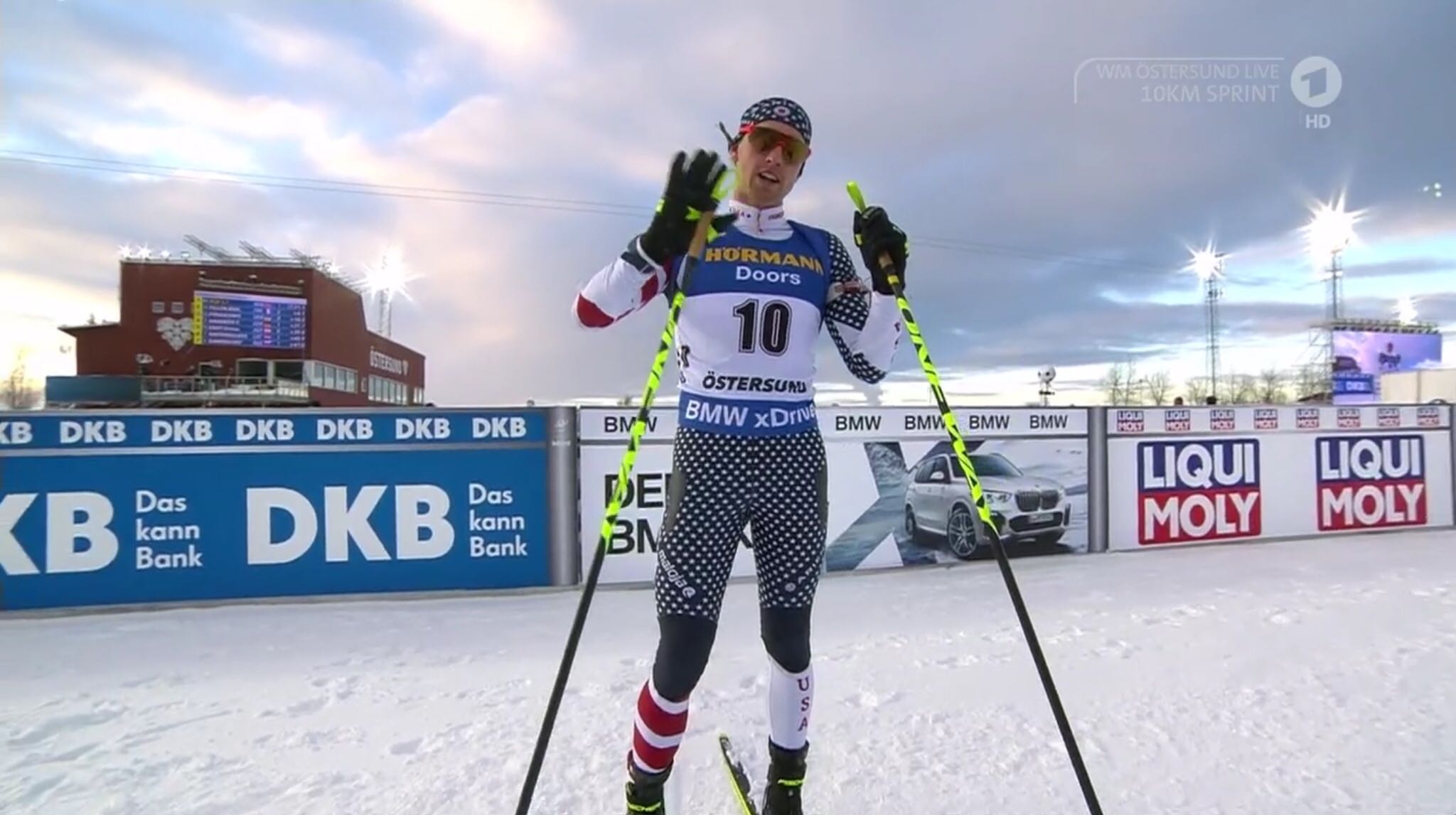
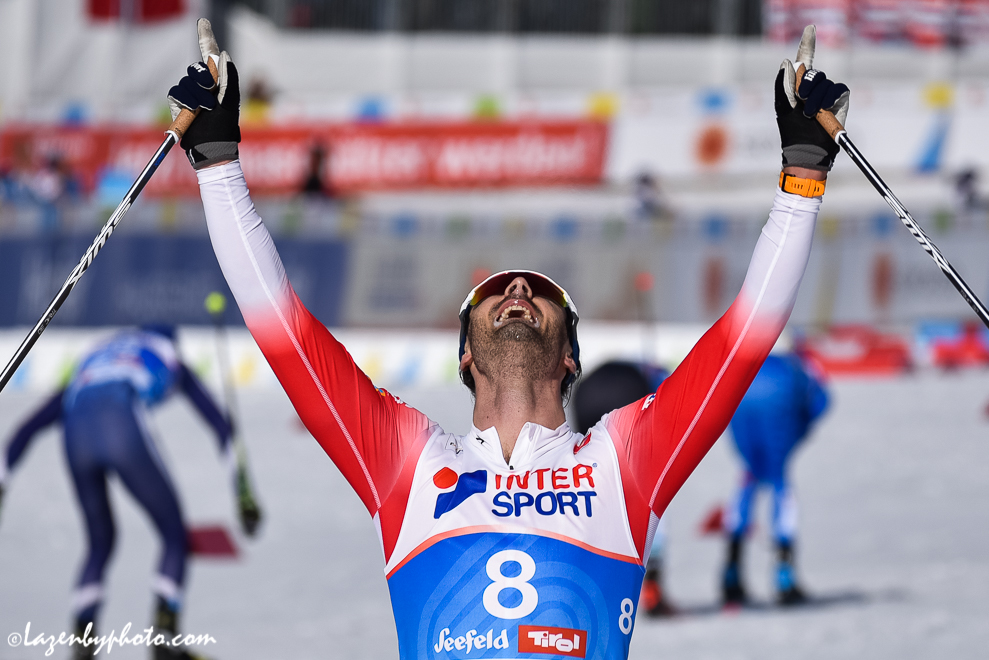
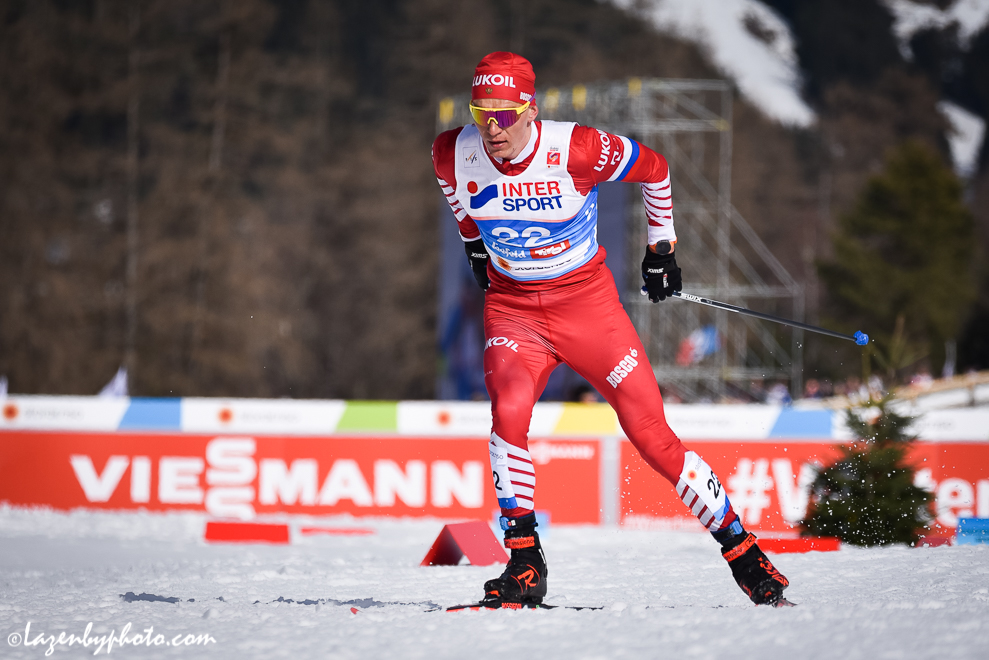
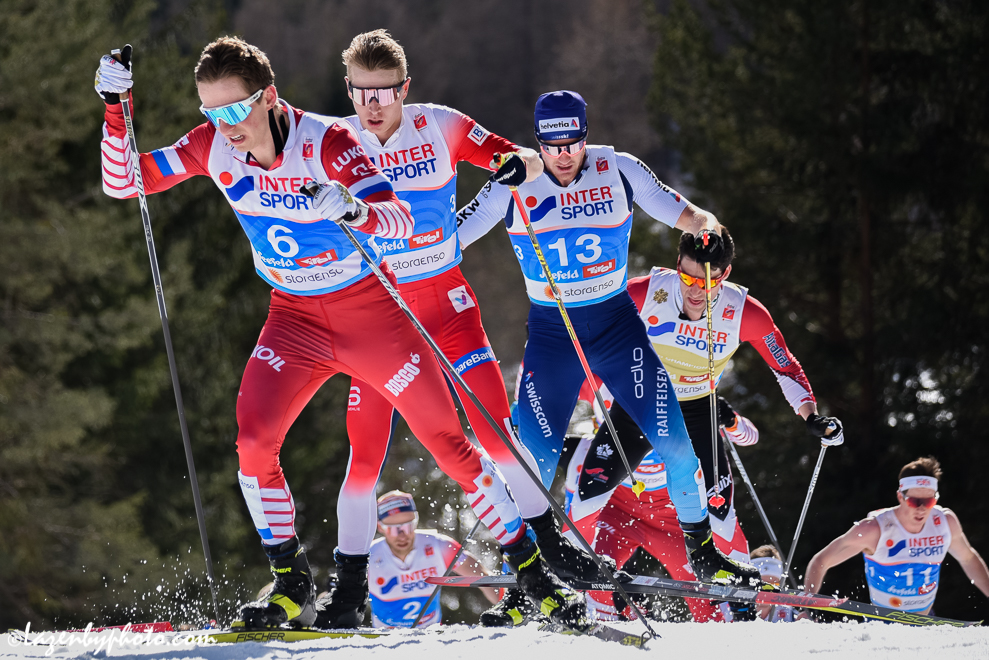
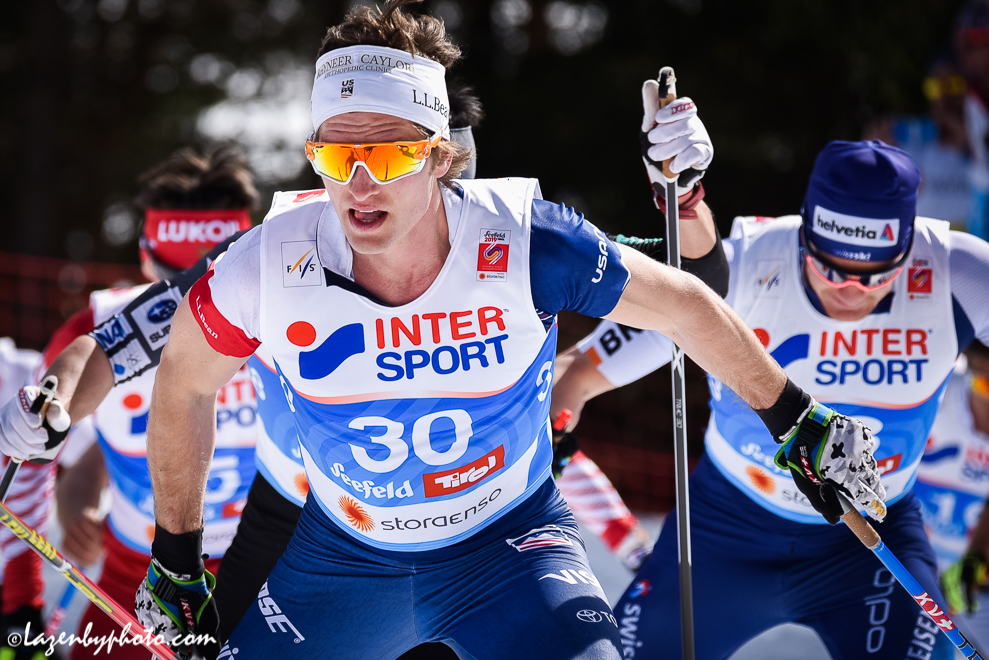
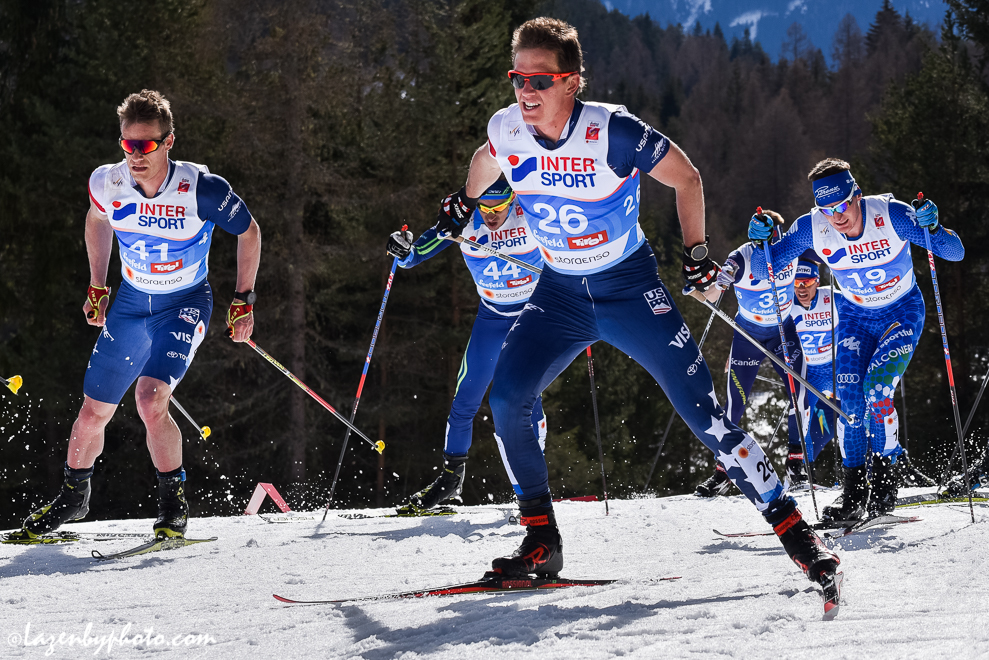
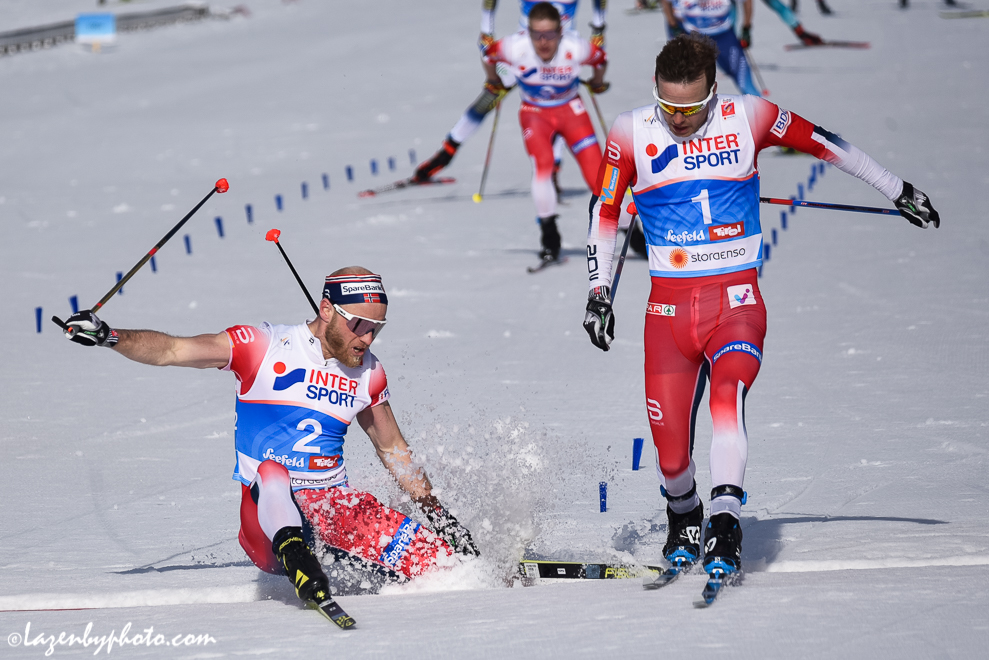
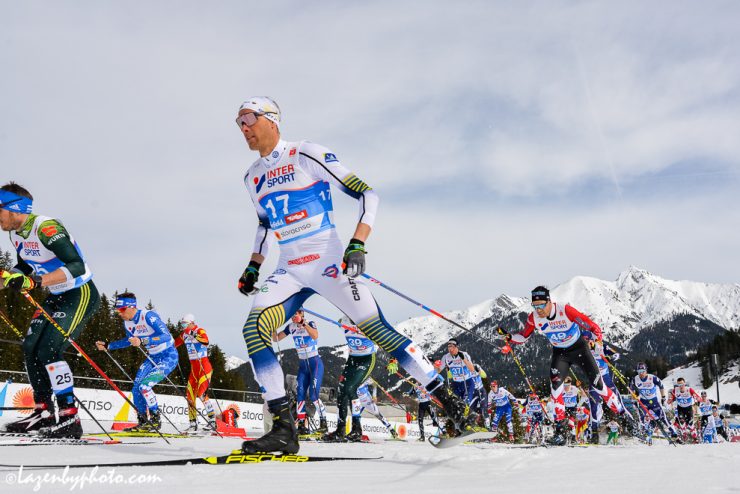
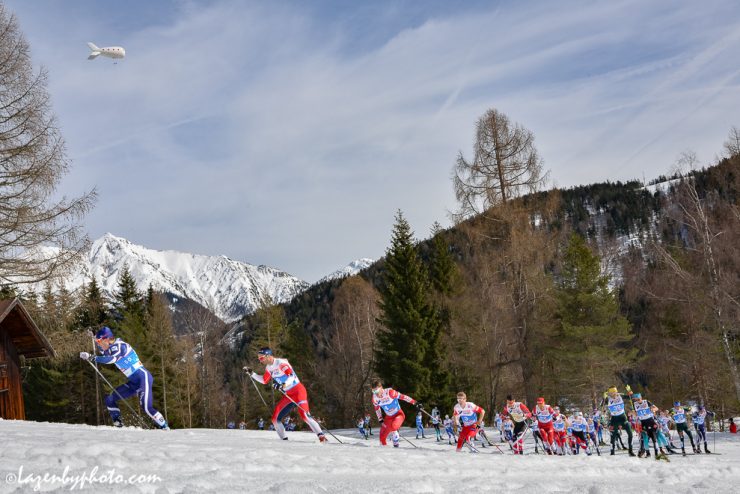
Norris and Hanneman, both skiers for APU in Anchorage, are among a rare group of U.S. men who have finished the Tour de Ski. We conducted a brief email exchange with the skiers post-Stage 7 of the Tour de Ski.
David Norris
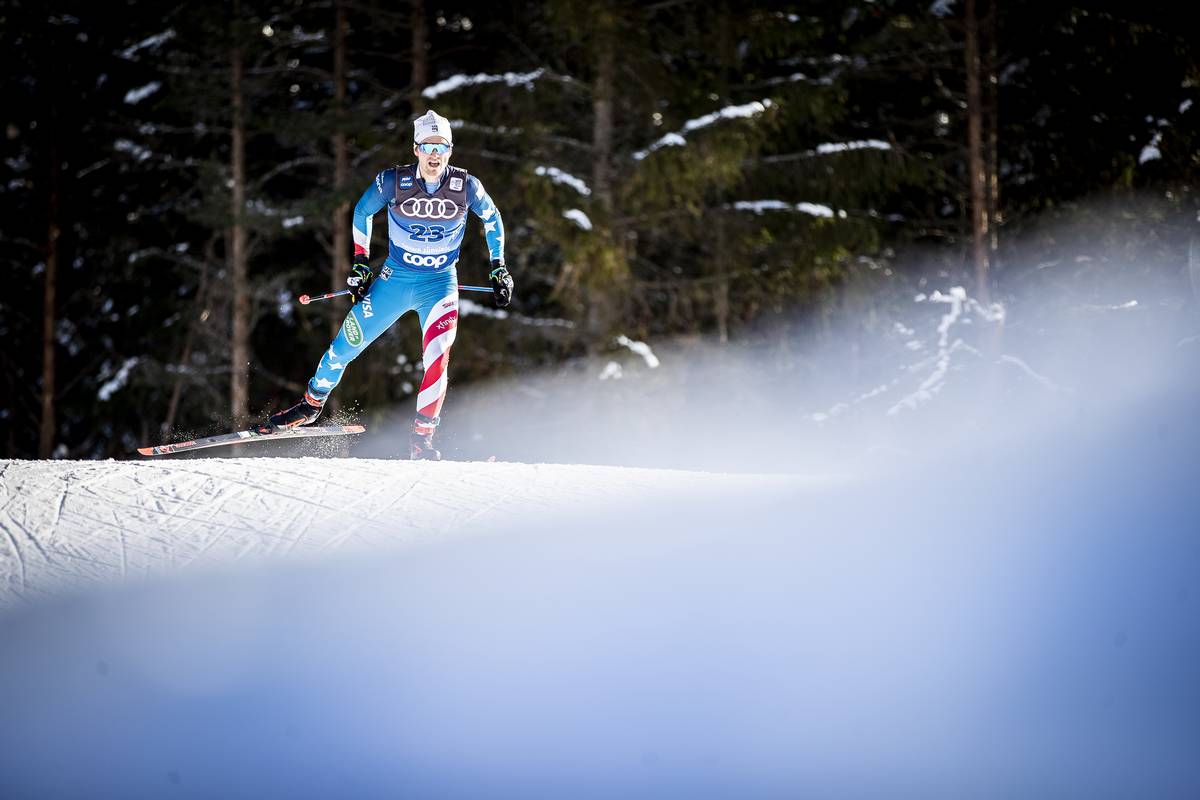
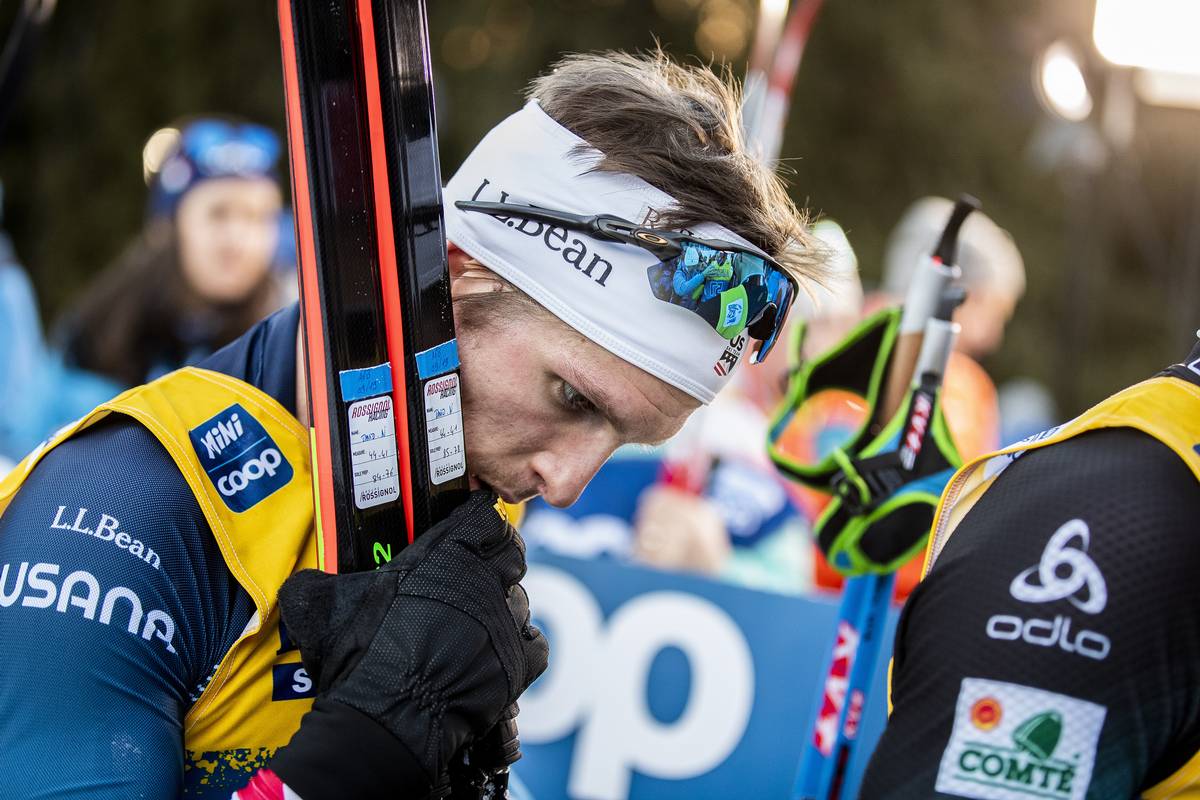
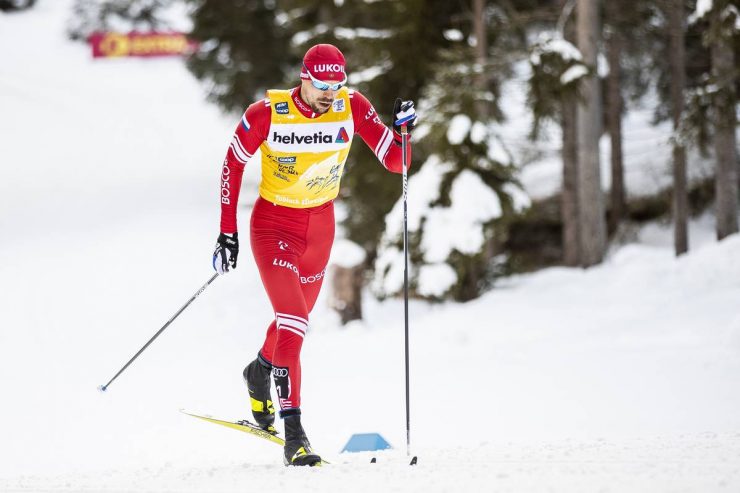
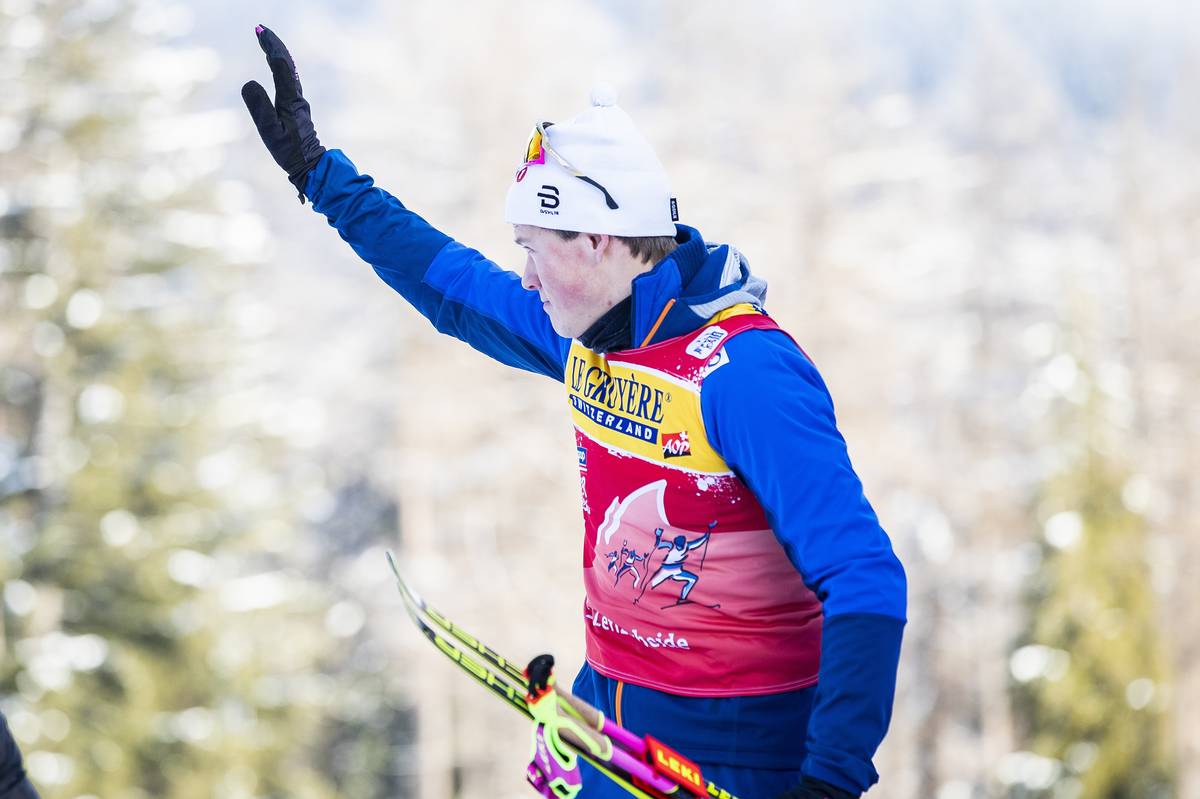
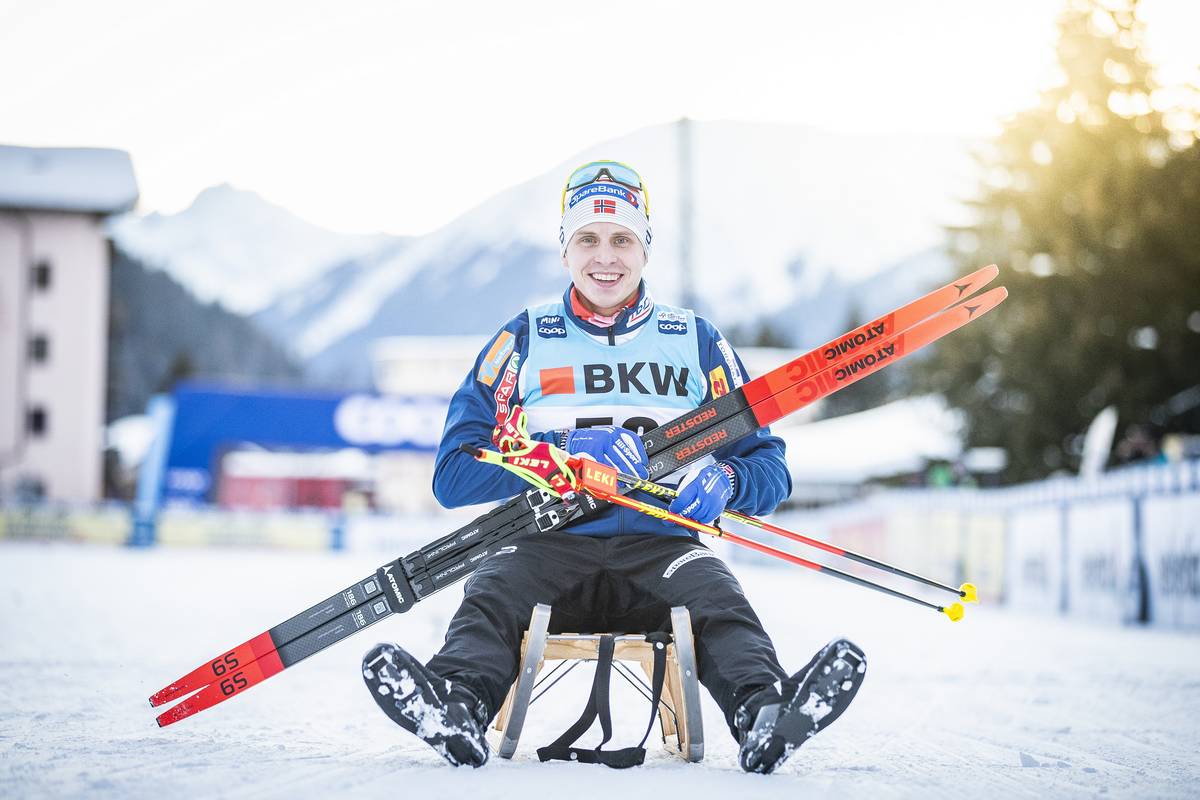
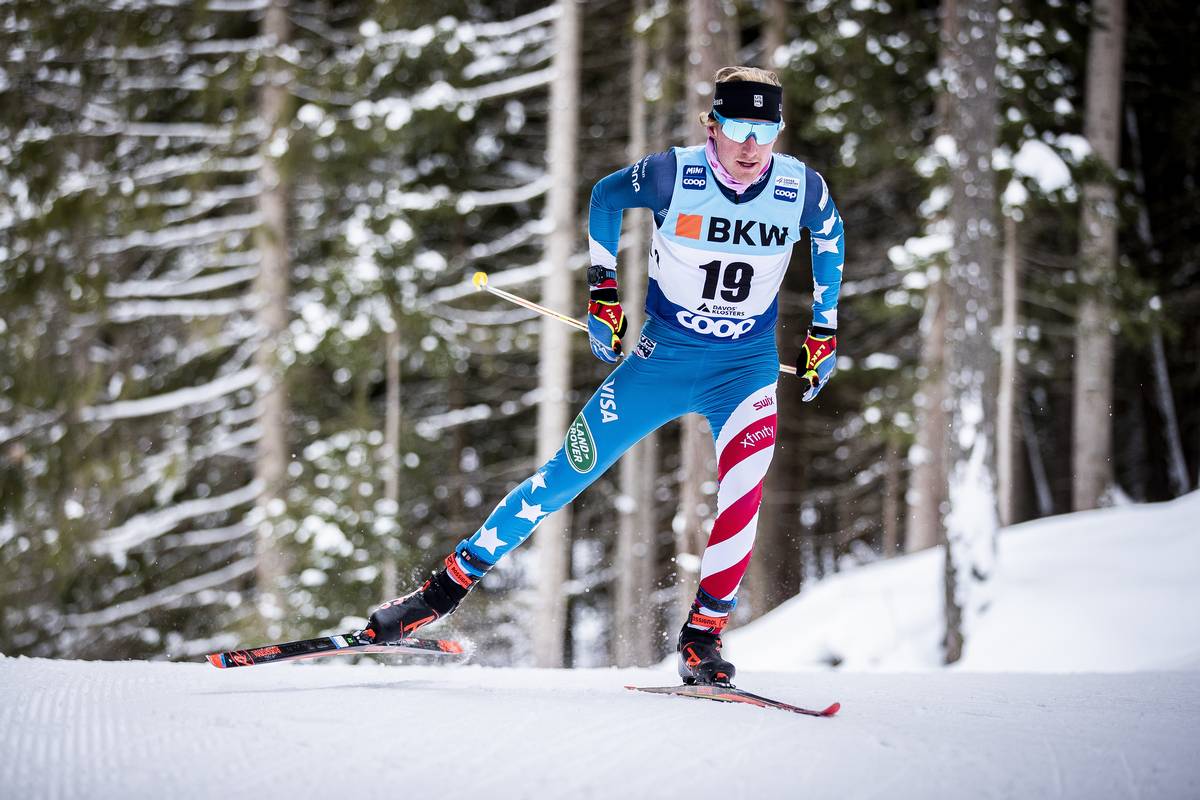
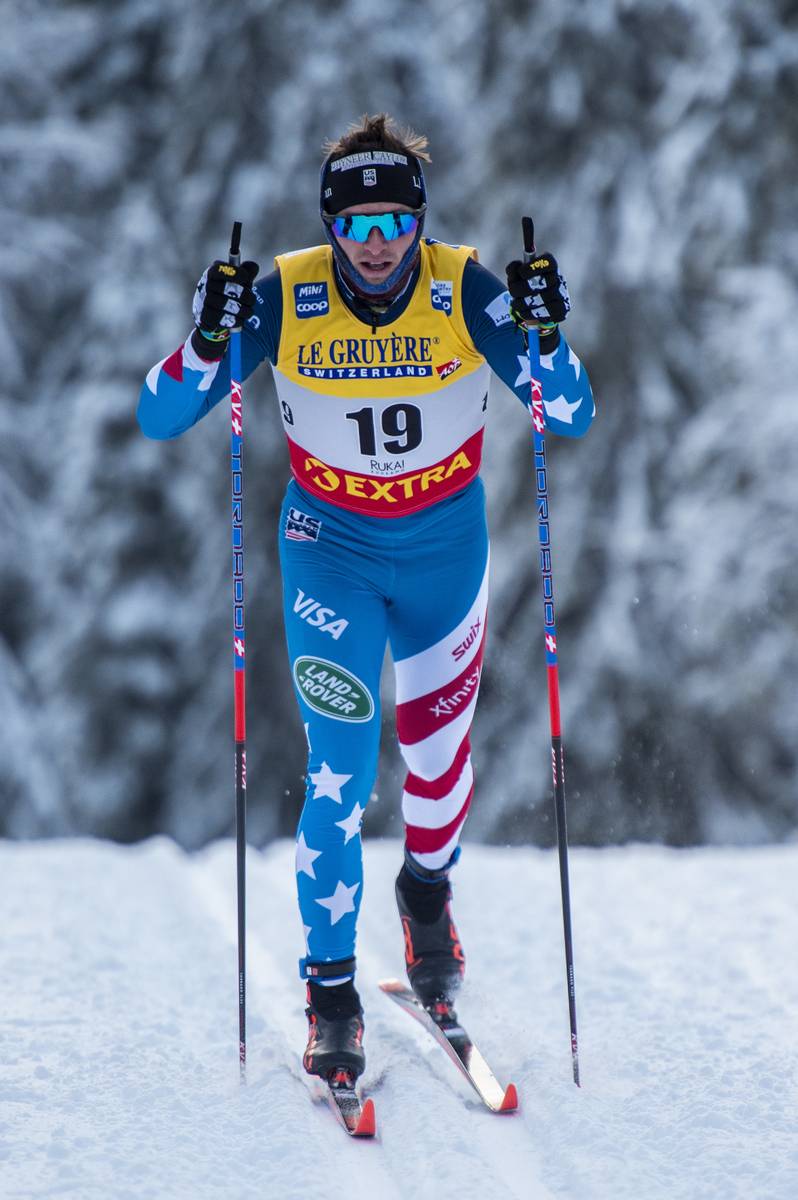
David Norris in Toblach: 2019-2020 Tour de Ski. (Photo: NordicFocus)
FasterSkier: Huge accomplishment to one, stay in the Tour, and two, remain near the top-30 in prob the deepest field the TdS has seen for a long time. Can you speak to that?
David Norris: I didn’t know what to expect going into the tour, but my goal was to finish in the top-30 overall and picking up some top-30 finishes in the distance events. Dropping out was never a plan unless I were to get sick.
The first three stages felt awful for me. I was healthy and fresh going into the Tour so I tried to just focus on improving each day and in general, I felt better each day that we raced.
FasterSkier: First time at the TdS. What are your takeaways in terms of how you grew as a ski racer this week?
David Norris: The Tour was a great chance for me to practice the skill of moving past frustrations and preparing for the next opportunity.
FasterSkier: Highlights?
David Norris: Toblach’s pursuit was a ton of fun. I got into a group of guys who were all battling hard against each other. Of course, the hill climb will remain a highlight to my ski racing memories.
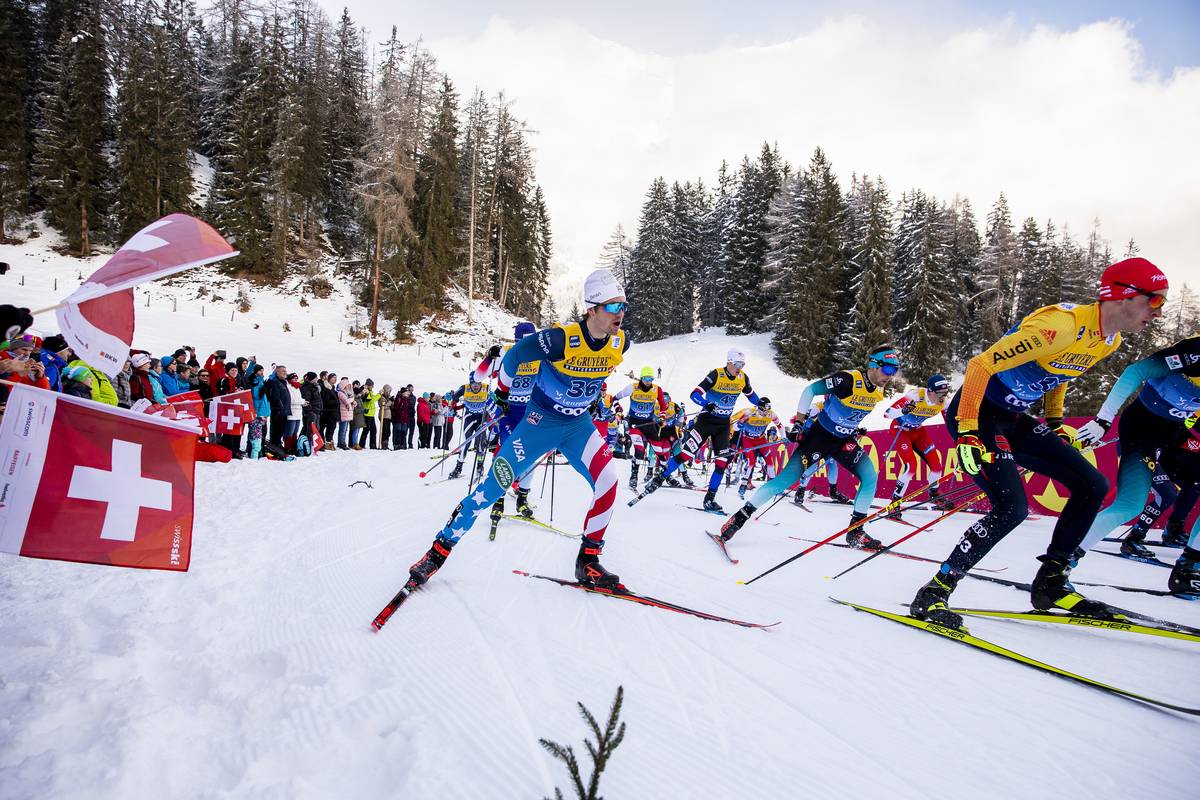
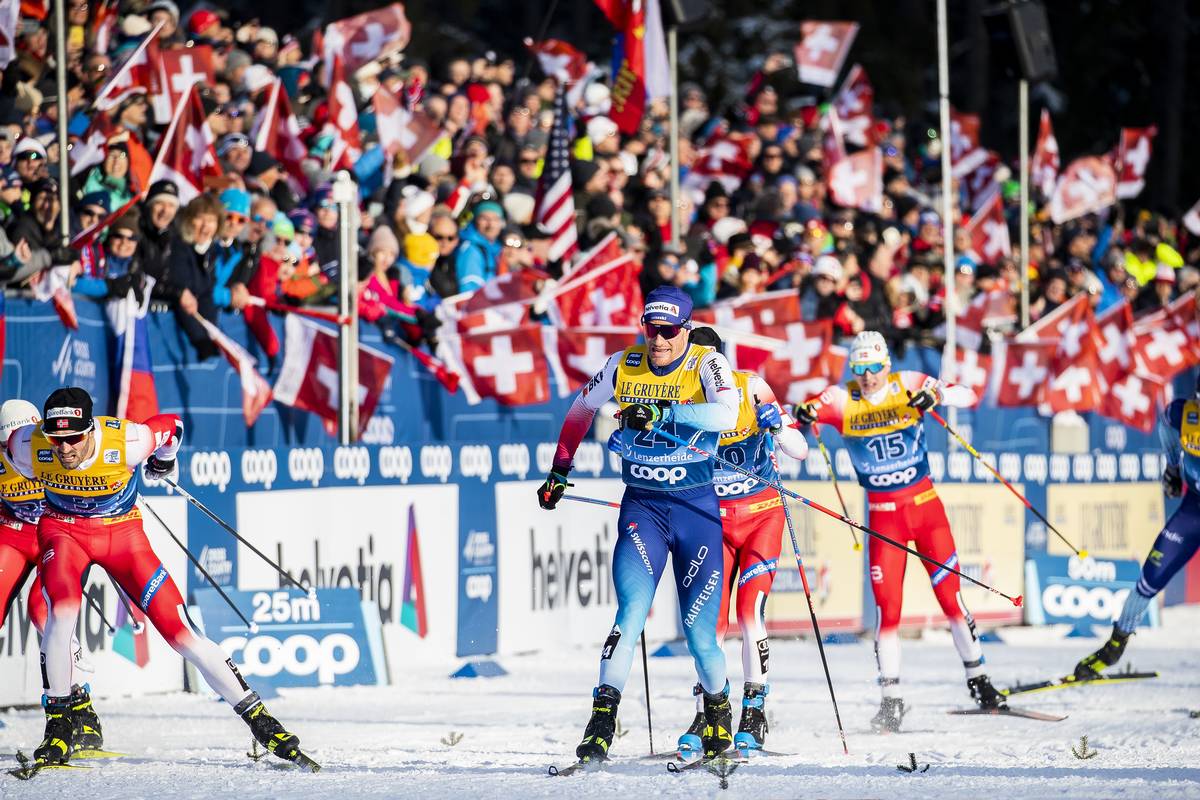
David Norris in Lenzerheide: 2019-2020 Tour de Ski. (Photo: NordicFocus)
FasterSkier: Lowlights?
David Norris: I crashed on a completely untechnical section of the 15km mass start in stage 5. When I got up I was in last after having a great start position.
FasterSkier: Top-30 on the Alpe. What was that experience like?
David Norris: Everyone went out hard and fought for spots before we got onto the Marcialonga trail. I felt really relaxed coming into the base of the climb after a few kilometers of single-file skiing. When the track got wide at the base of the climb I felt really strong and was able to move up a bunch of places. After about 8 minutes of climbing, I just remember trying to pick guys off/hanging on to dudes, listening to the fans screaming, and not clipping my tips on the alpine gates.
FasterSkier: You are a rarity — a U.S. male skier finishing the TdS. What advice would you give to others who might consider the risk/reward of contesting the event — given the opportunity?
David Norris: I can’t speak for where I will be in a few weeks, but because I remained healthy throughout the Tour I think it should help boost my fitness. I don’t think we should be afraid of this event. I washed my hands more than ever and ate an insane amount of risotto and pasta this week so I’d suggest others do the same going forward.
Logan Hanneman
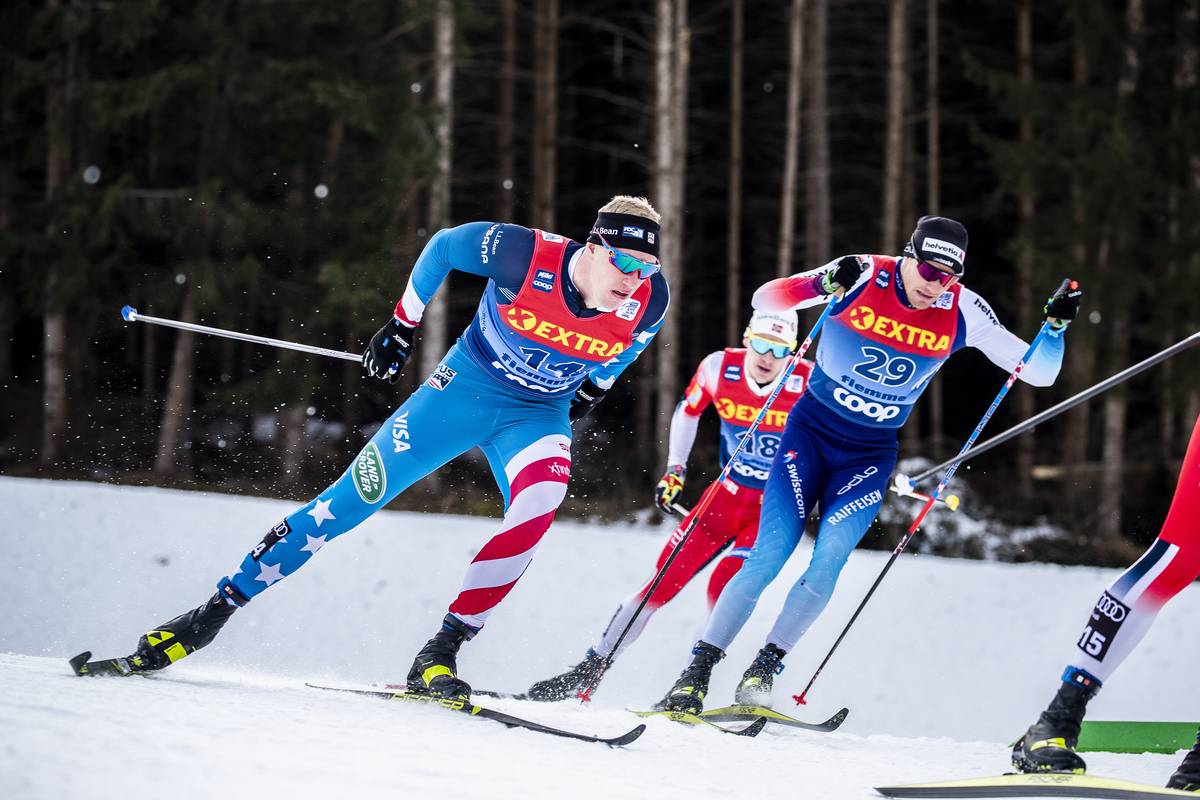
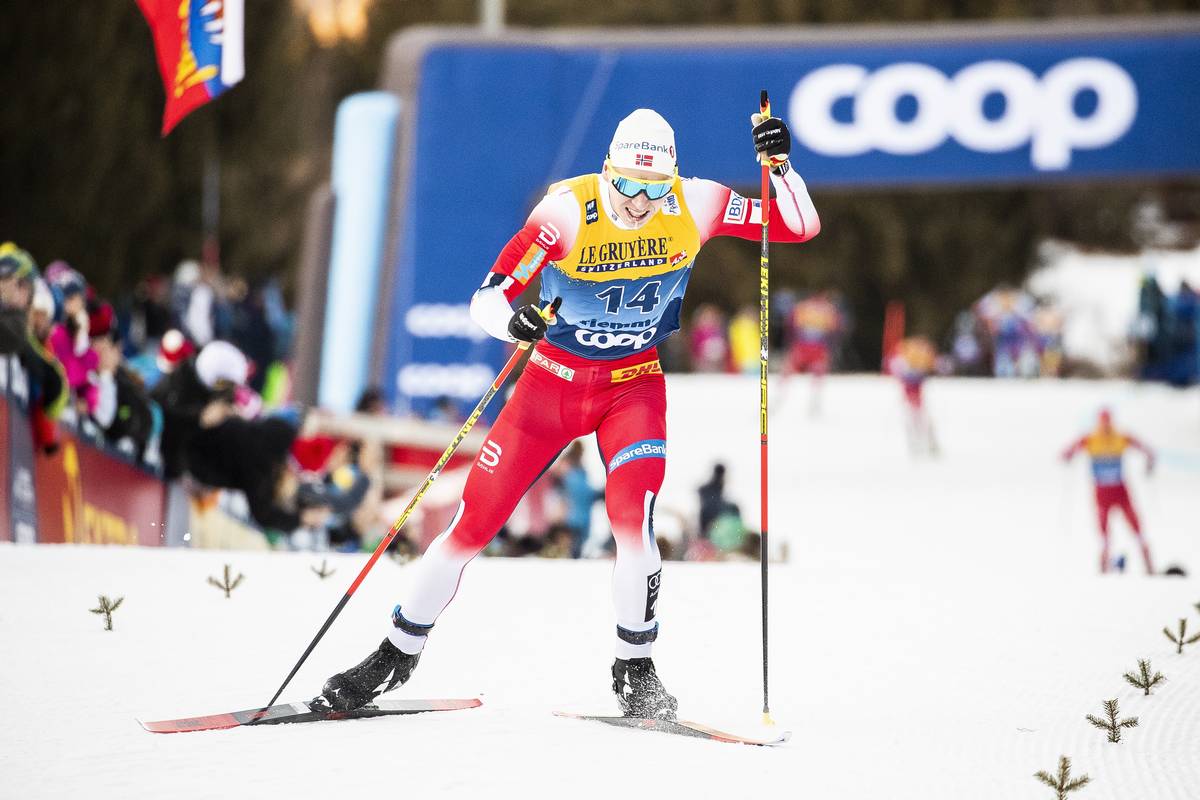
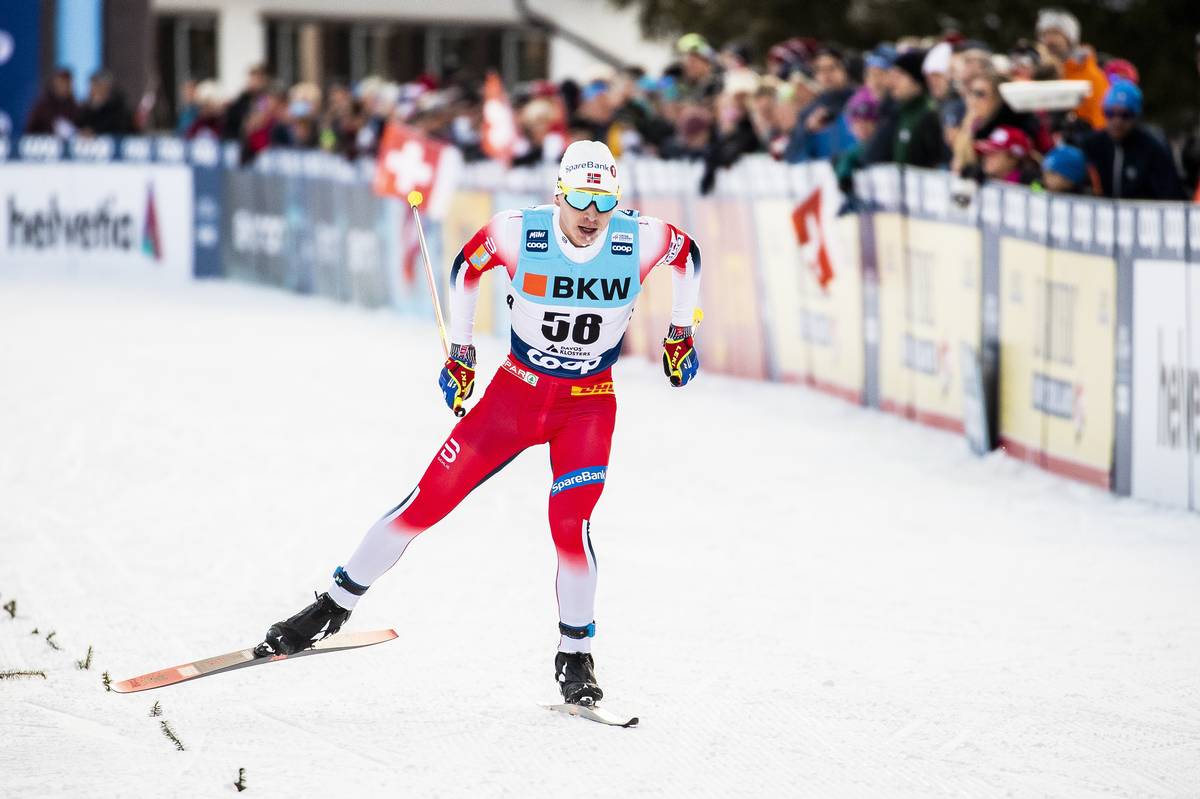
Logan Hanneman in Val di Fiemme: 2019-2020 Tour de Ski. (Photo: NordicFocus)
FasterSkier: Just finishing, what does that mean to you?
Logan Hanneman: It means quite a lot to finish the Tour actually. I am not much of a distance skier, so I was very happy to be able to make it through all of the stages without getting lapped or pulled.
FasterSkier: From a pure learning experience standpoint, what did you learn?
Logan Hanneman: I learned that there are some incredibly fit skiers in this world! But also besides that, I learned just how chaotic mass start races over here can be.
FasterSkier: Highlights?
Logan Hanneman: Definitely qualifying well in both sprints and making the heats was a highlight for me. Especially the second sprint. I was getting pretty tired that far into the tour, but so was everyone else.
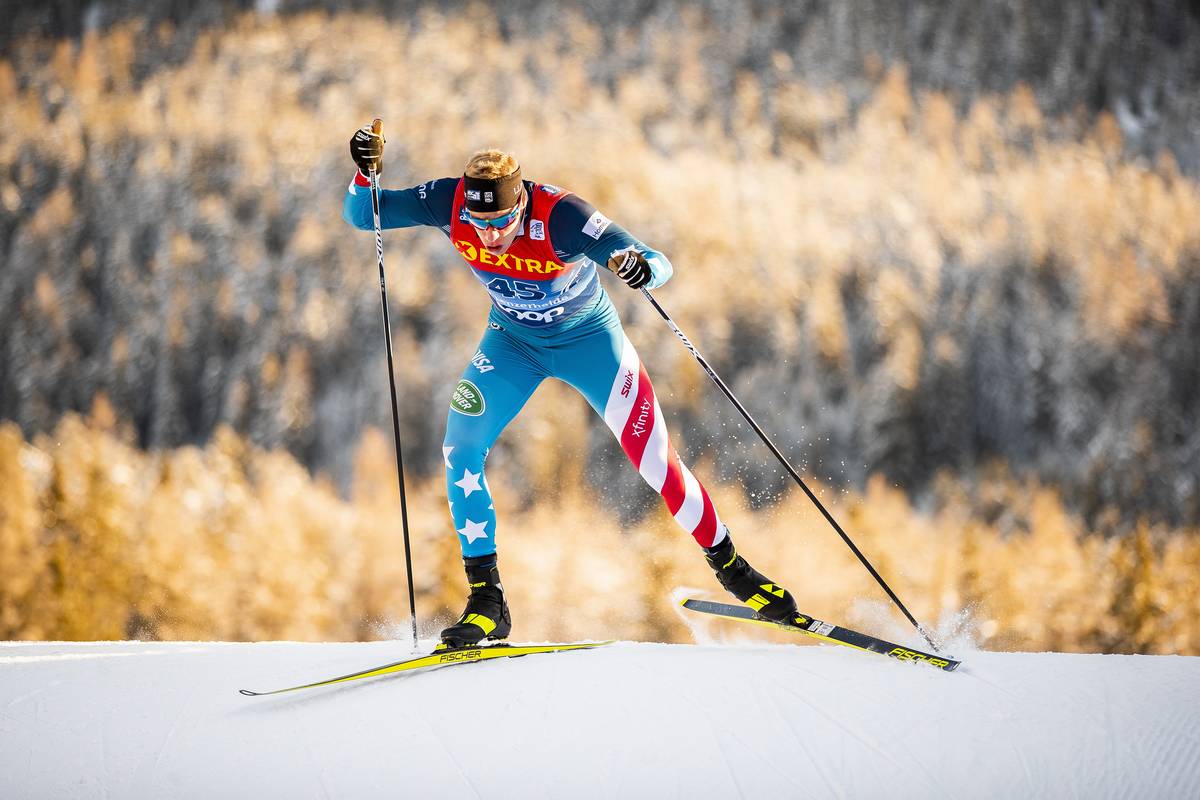
Logan Hanneman in Lenzerheide: 2019-2020 Tour de Ski. (Photo: NordicFocus)
FasterSkier: Lowlights?
Logan Hanneman: Lowlights…ha…realizing just how much more fit I need to get in order to even remotely close in distance races.
FasterSkier: Comment on why you stayed in the TdS? And will you get starts in Dresden or take a rest?
Logan Hanneman: I stayed in the Tour just because I had set the goal for myself to finish. Sure on paper, it may not have looked like a great decision, seeing as how I was way near the back in the distance races. But in years past, I have not done much distance races during the middle of the season, and I feel that that negatively affected my fitness for the remainder of the season, so I wanted to try something different this year. Plus, it’s pretty cool to finish that last stage, even though it is just brutal. I am unsure at this point for sure if I will get offered starts in Dresden, but I think it looks pretty promising, so I will plan on racing that weekend and then heading home for a few weeks to recover and train.
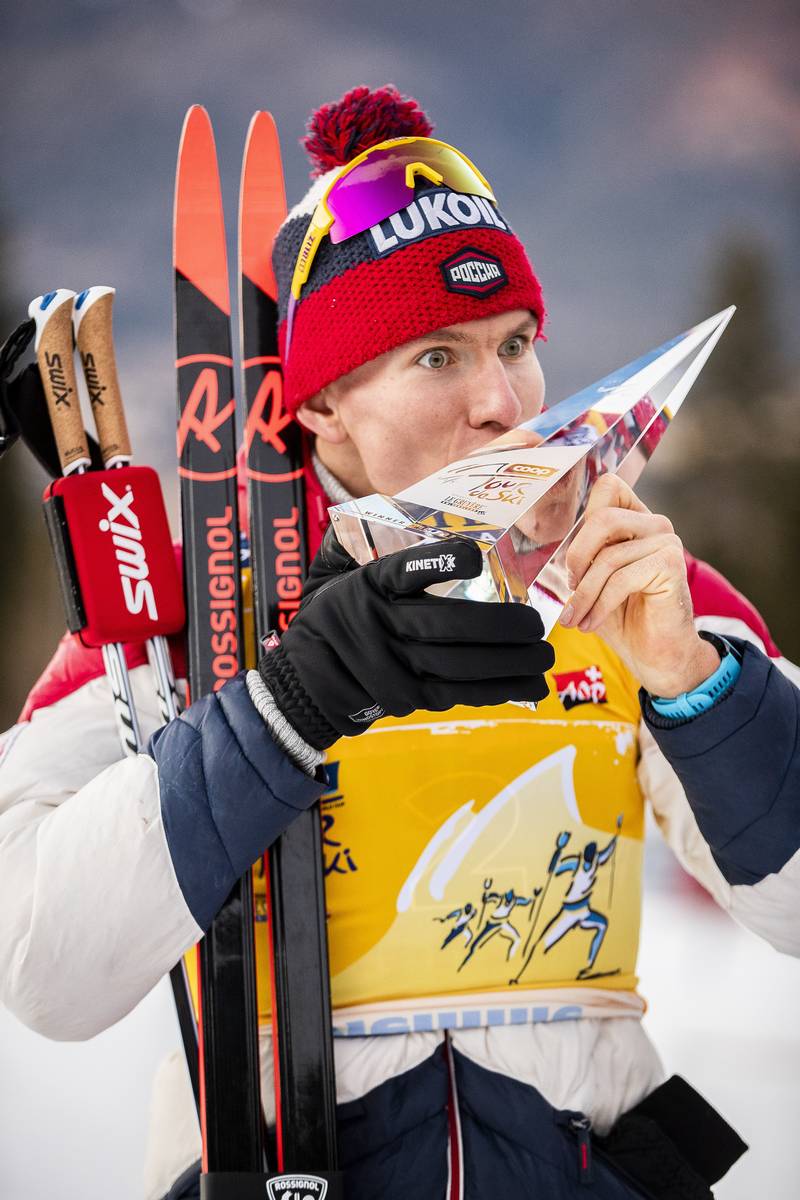
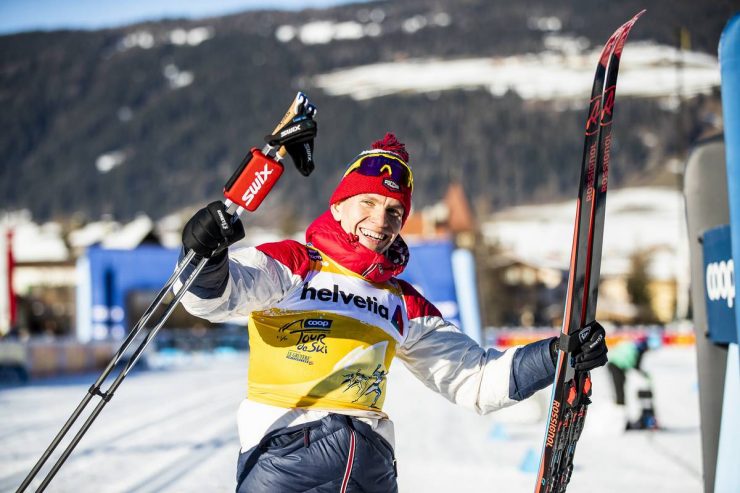
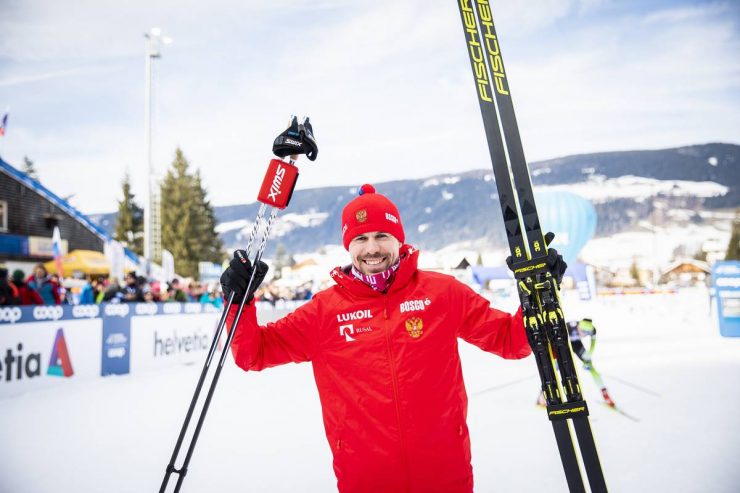
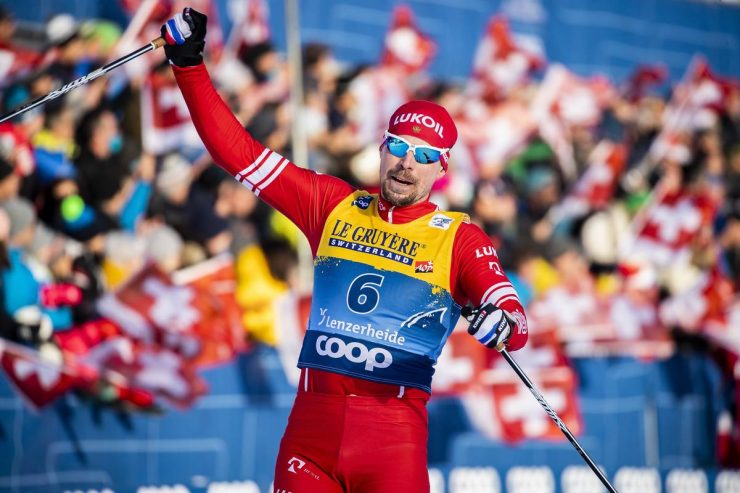
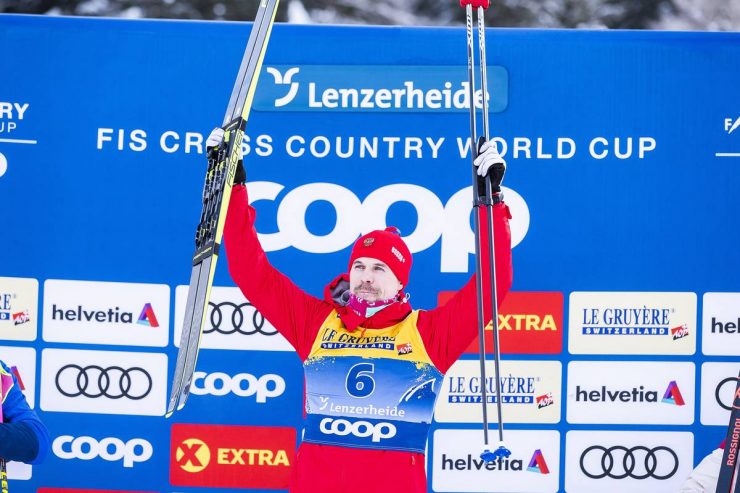
The winner: Russia’s Alexander Bolshunov. (Photo: NordicFocus)
The hype. The Spectacle. Stage 7 of the 2019-2020 Tour de Ski (TdS) brings the show: the Alpe Cermis final climb. The race this year began as a mass start — a new format for the final stage, as this has historically has been a pursuit race, where the first skier to the finish line is the TdS champ.
With the opening sections of the course taking in the sprint course loop in Val di Fiemme, the man-made snow then led skiers on a snaking route, downstream along with the Torrent Avisio. At roughly 5.2 k into the what FIS had called a 10 k race, the gradient kicked up for the duration. The Alpe rears up at 12 percent initially, but soon morphs into a mountain-and-me struggle with gradients pushing 28 percent.
So the racers had that to mull as they no doubt had a somewhat anxious night of tossing and turning. And coupled with the big show final climb, FIS got its wish with a dearth of time bonuses on course this year for a tight TdS coming into the finale.
Last year’s TdS winner, Norway’s Johannes Høsflot Klæbo, wore the yellow leader’s bib by a single clock-tick, or one second over Russia’s Alexander Bolshunov. Last year’s TdS runner-up, Sergey Ustiugov of Russia, sat 15 seconds back. Ustiugov is seasoned on the Alpe. He won the TdS overall in 2016-2017, and was third in 2015-2016.
Let’s drill down on elapsed climb times and the work to be done for the top-three in the overall. Ustigov had to beat Klæbo by 15.1 seconds to take the overall, Bolshunov 1.1 seconds. Ustiugov clocked 31:47.6, the 11th fastest time of day for Stage 7 last year. Bolshunov, for his part, posted 32:34.1 for the 23rd fastest time in 2019. Klæbo’s time was 32:51.7, the 27th fastest time.
Coming into that final stage in 2019, Klæbo had a 1:20.4 minute gap on second place Ustiugov. And with the pursuit format, Klæbo was never caught, despite ceding just over a minute to Ustiugov in the final stage. Bolshunov bested Klæbo by 17.2 seconds. On paper at least, Klæbo would have to maintain close contact today.
With the knowledge of last year’s climbing splits, Klæbo’s task this Sunday involved matching the Russians stride for stride. There would be no time to let up momentarily, reset on the Alpe, and grind to the finish. It was to be head to head racing.
On the Alpe
Part of the job here is building tension. Cutting to the chase, there was no Klæbo-induced tension Sunday on the Alpe. He hung in there for a bit. At 6.6 k, before the toll of cumulative climbing took effect, Klæbo was fifth, two seconds behind the lead pacesetter Ustiugov. Bolshunov shadowed his teammate one second back.
As the Alpe kicked up, Klæbo, who at moments looked atypically spent, began to fall off in earnest. At 8 K he slid to 6.4 seconds back to Ustiugov, but more importantly, 5.1 seconds behind Bolshunov. Bolshunov, at that point was the virtual TdS overall leader. His task simple: keep pace with Ustiugov who had to gap his teammate by a bit more than 14 seconds to seize the overall.
Klæbo never regained traction on the Alpe. He placed 21st on the day. He lost 1:10 to Bolshhunov on the stage, and 58 seconds to Ustiugov. That put Klæbo in third overall for the Tour.
First time Tour de Ski overall winner, Russia’s Alexander Bolshunov. (Photo: NordicFocus)
Ustiugov intially held on. With less than a kilometer to go, he and Bolshunov were velcroed. The younger Bolshunov did eventually surge and any semblance of a link between he and Ustiugov snapped. Bolshunov went ahead to place third on the stage and take the Tour overall win. By the finish, Ustiugov, who ended up fifth for the stage, had ceded another 12.3 seconds to Bolshunov.
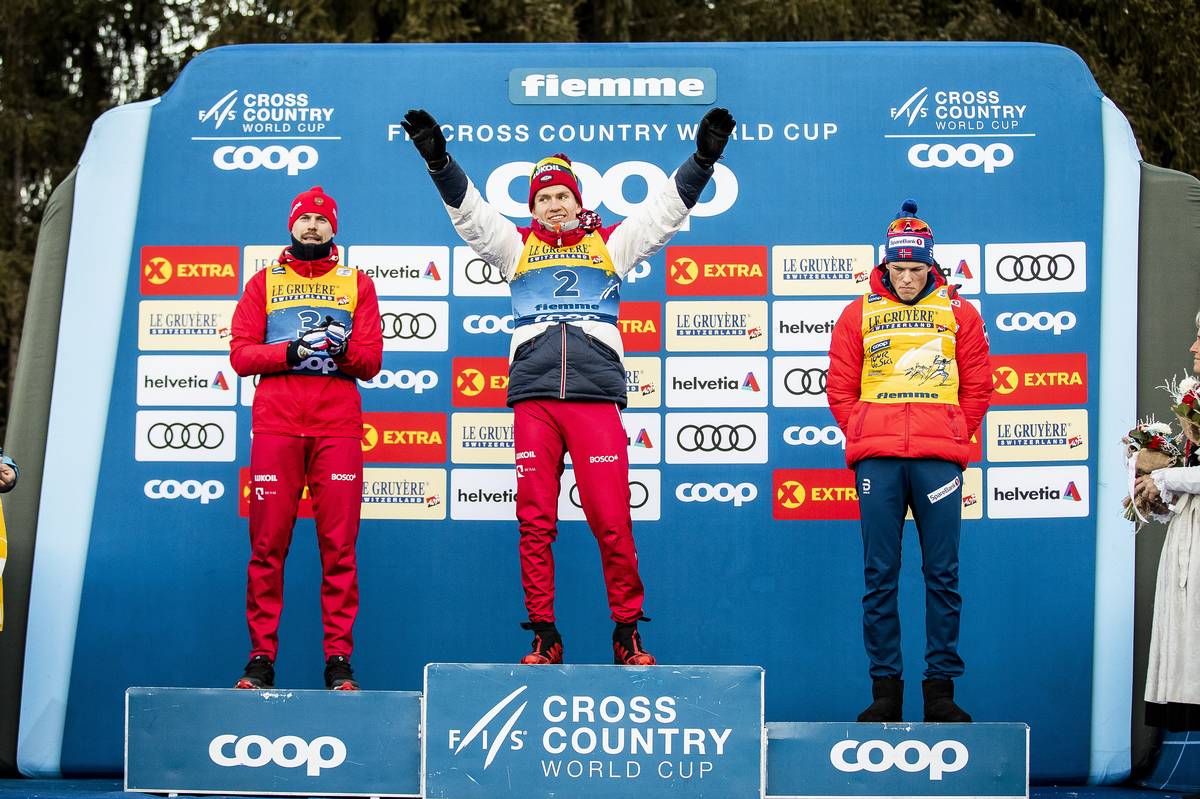
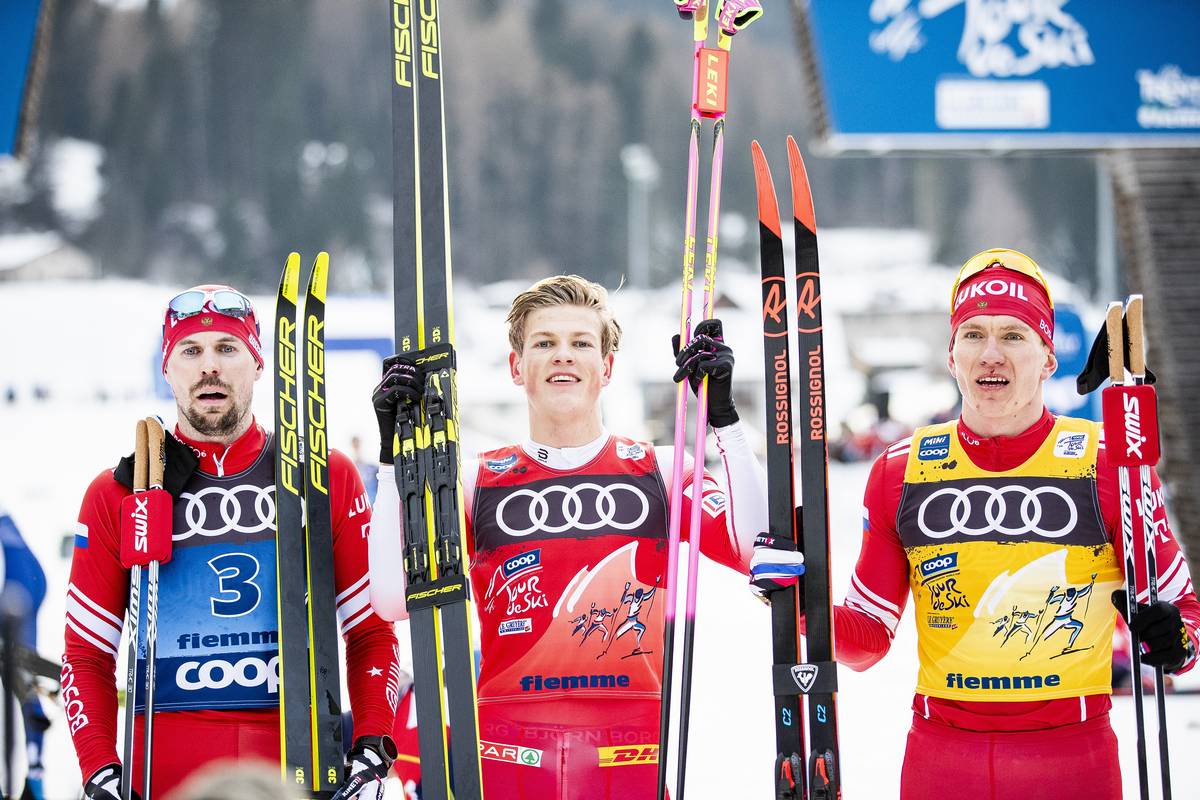
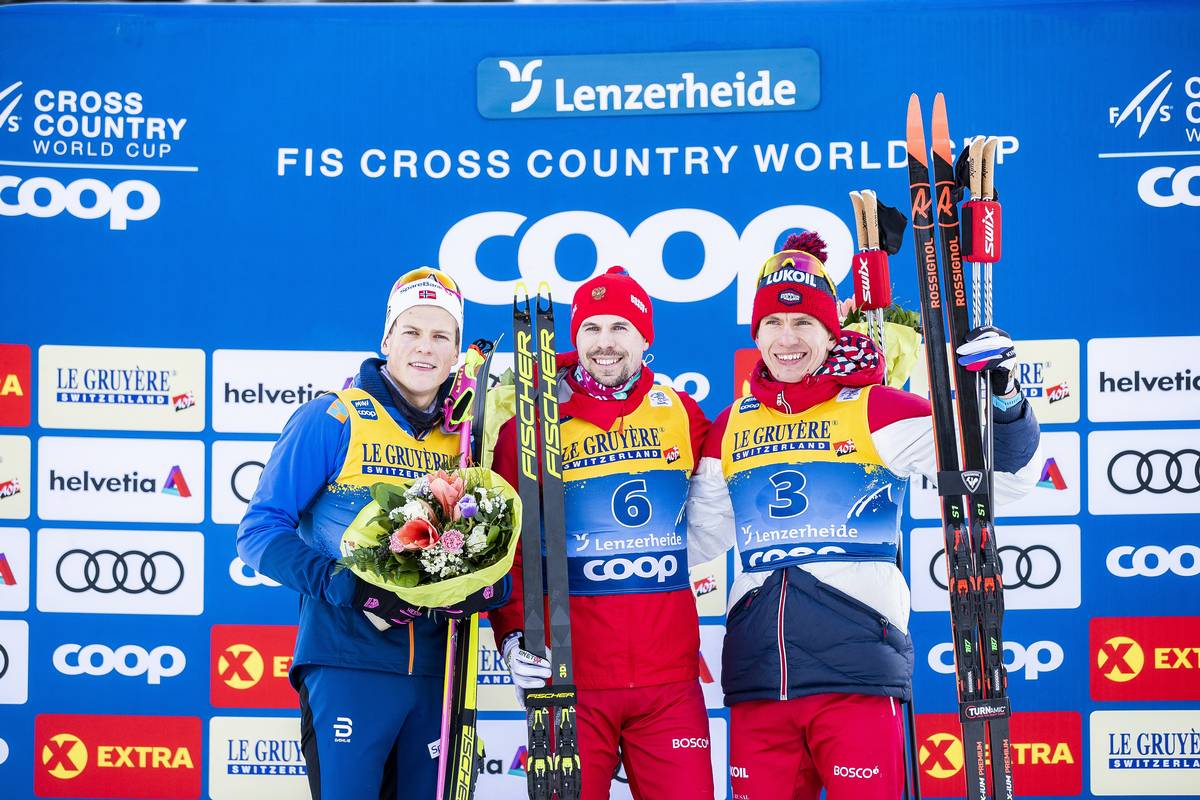
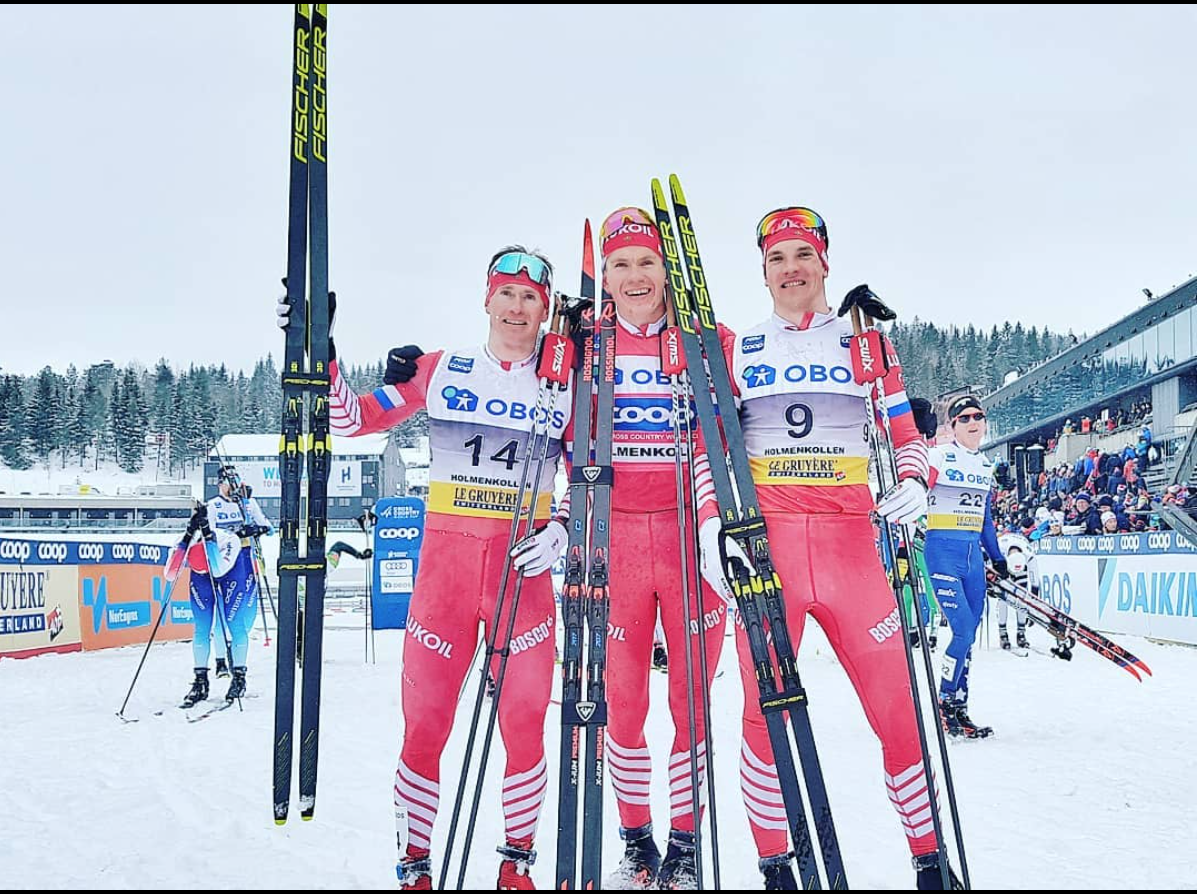
The final TdS podium had Bolshunov in first, in 2:58.18.1 hours, Ustiugov in second (+27.1), and, Klæbo third (+1:09). It was Bolshunov’s first career Tour de Ski overall title.
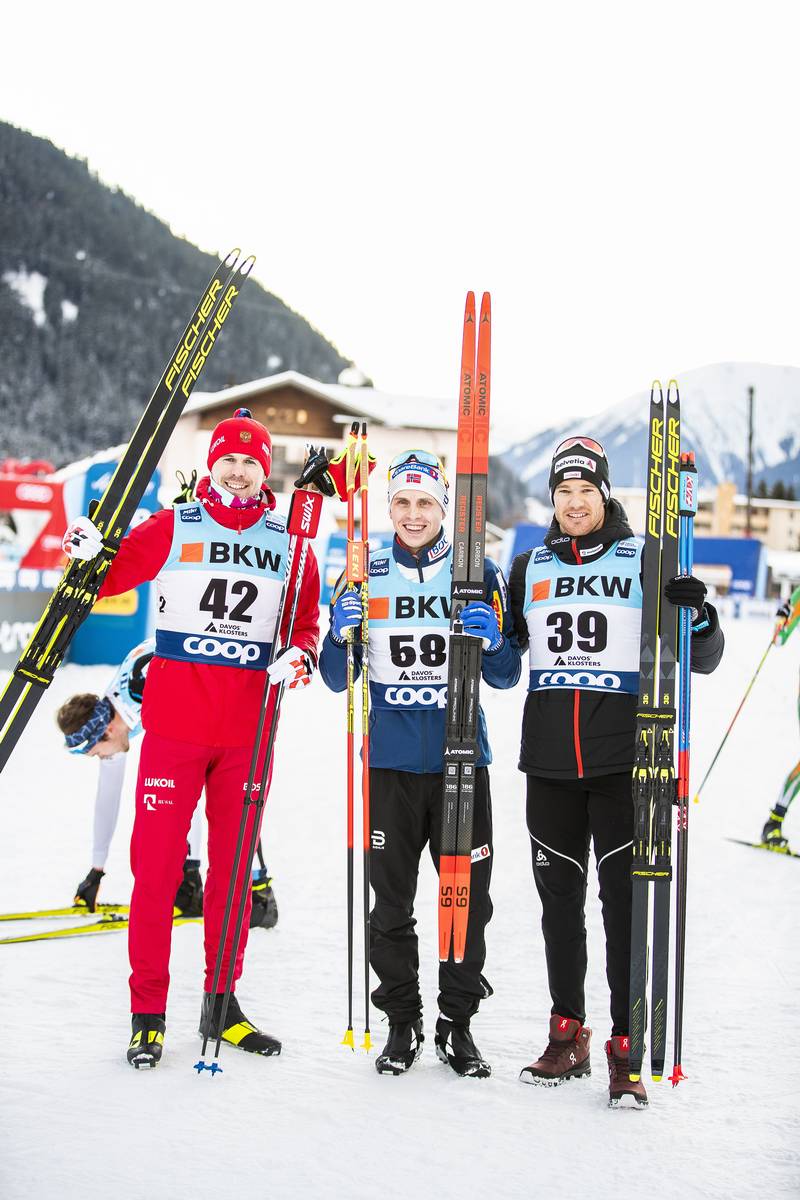
The men’s final overall TdS podium: Sergey Ustiugov (RUS) in second, Alexander Bolshunov (RUS) first, Johannes Hoesflot Klaebo (NOR) third, (l-r). (Photo: NordicFocus)
In fourth overall was Sjur Røthe (+1:51.6) and in fifth, Simen Hegstad Krüger (+2:53.7).
Røthe and Krüger animated the racing for the stage win. Past the 8 k time check, the two Norwegians accelerated. No skiers near the front dared match. Last year, Røthe posted the fastest time of day on the Alpe, Krüger was a close second. (Krüger was third overall in last year’s TdS.)
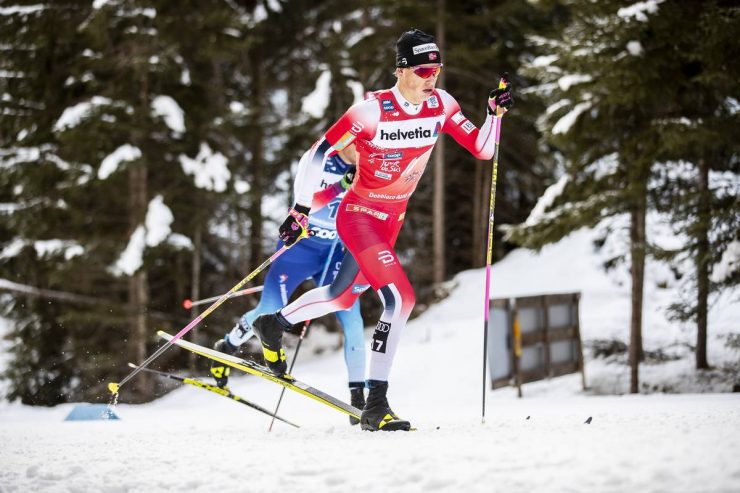
Simen Hegstad Krüger of Norway winning Stage 7 of the 2019-2020 Tour de Ski. (Photo: NordicFocus)
Today, Krüger motored ahead of Røthe in the waning meters for the stage win in 30:55.8. Røthe stopped the clock 13.9 seconds later to secure a Stage 7 second place. With his climbing prowess on the Alpe, Krüger jumped from 12th overall after Stage 6, to fifth. Røthe moved from sixth to fourth.
“It hasn’t quite worked out in the Tour so far so I hoped to get a good finish,” Krüger told FIS after the race. “I knew that this hill suits me well and so I just tried to keep that steady pace and to keep it going all the way to the top and it was fun to cross the finish line as the first thanks to the mass start.
“Sjur and I were going together and he looked strong so I was far from sure that I was going to win but it was also tough going first so I really had to push.”
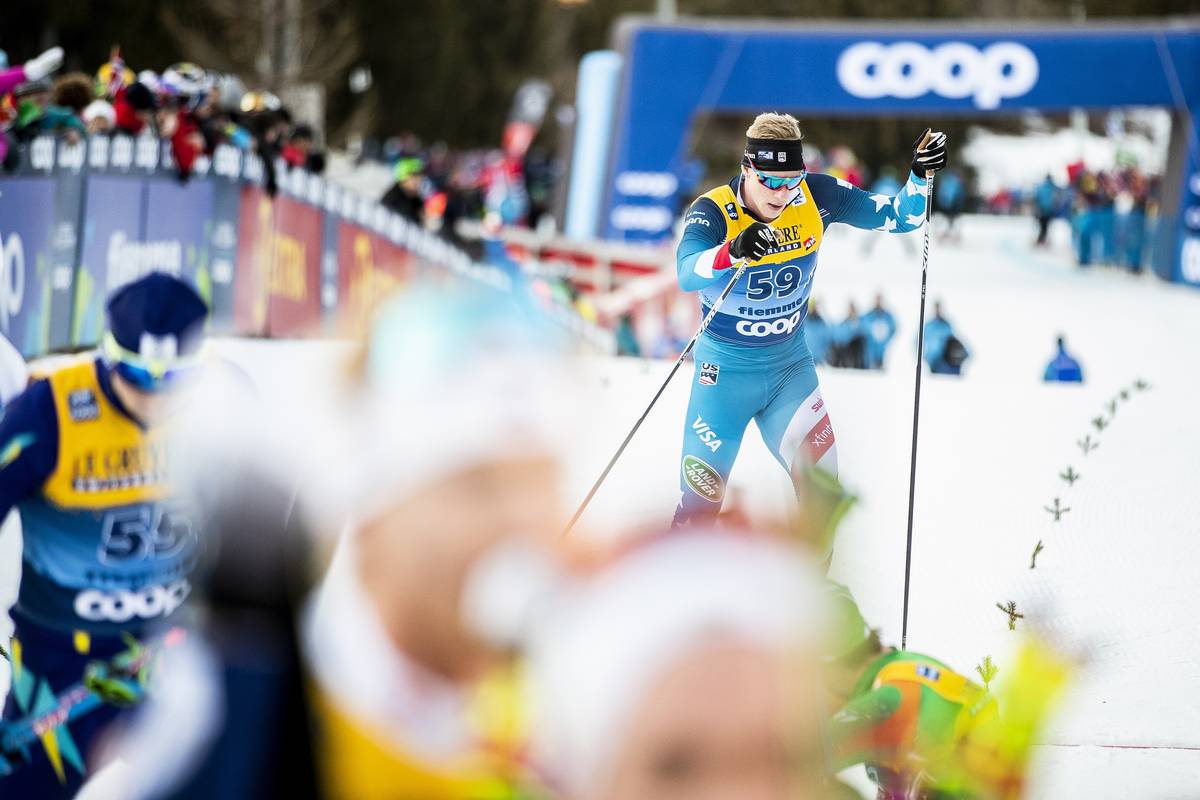
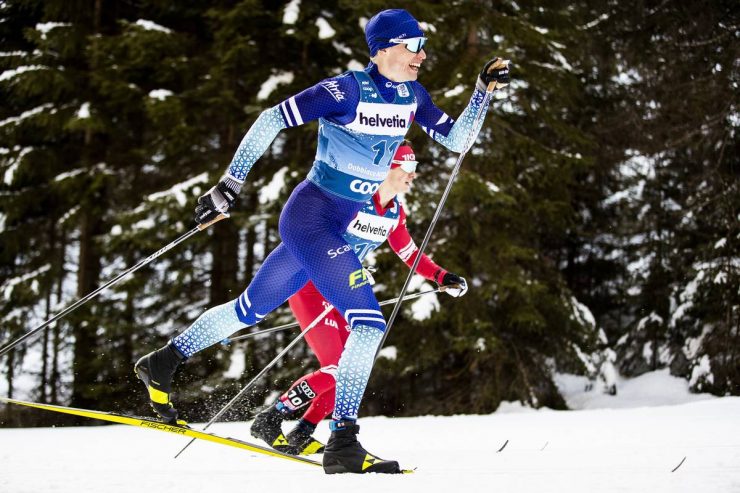
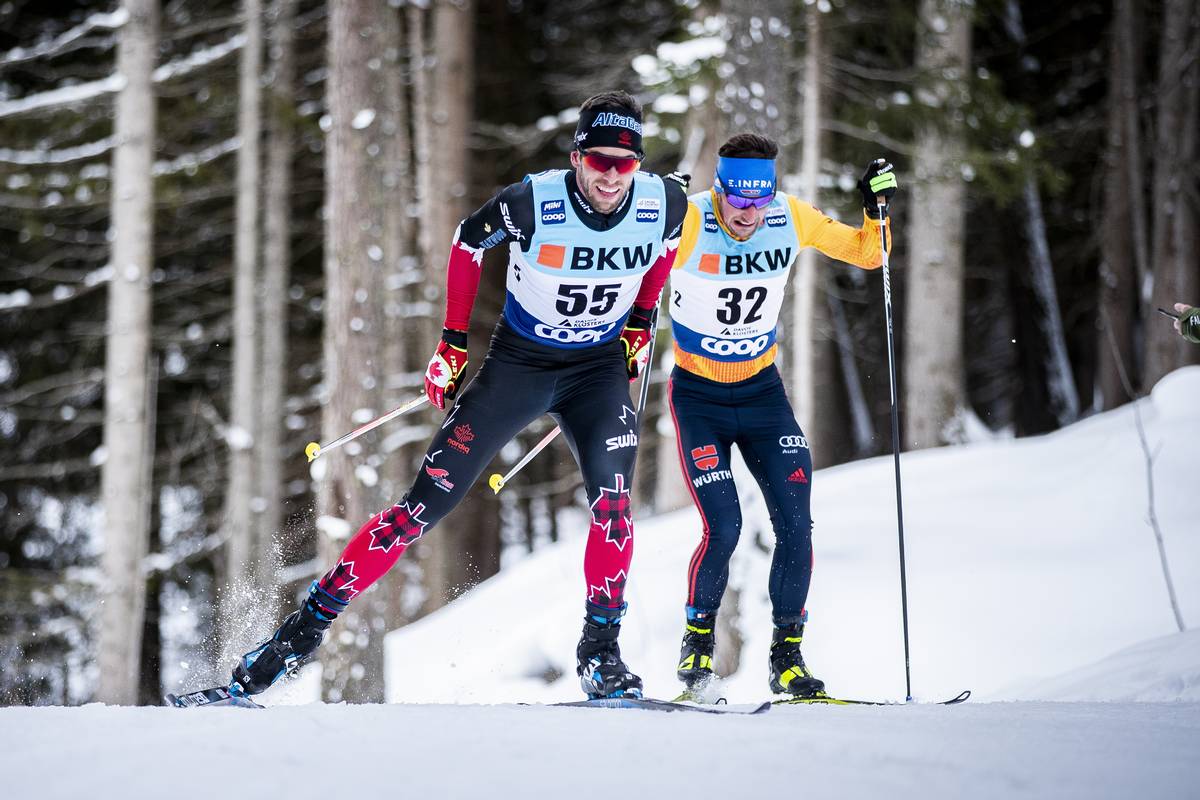
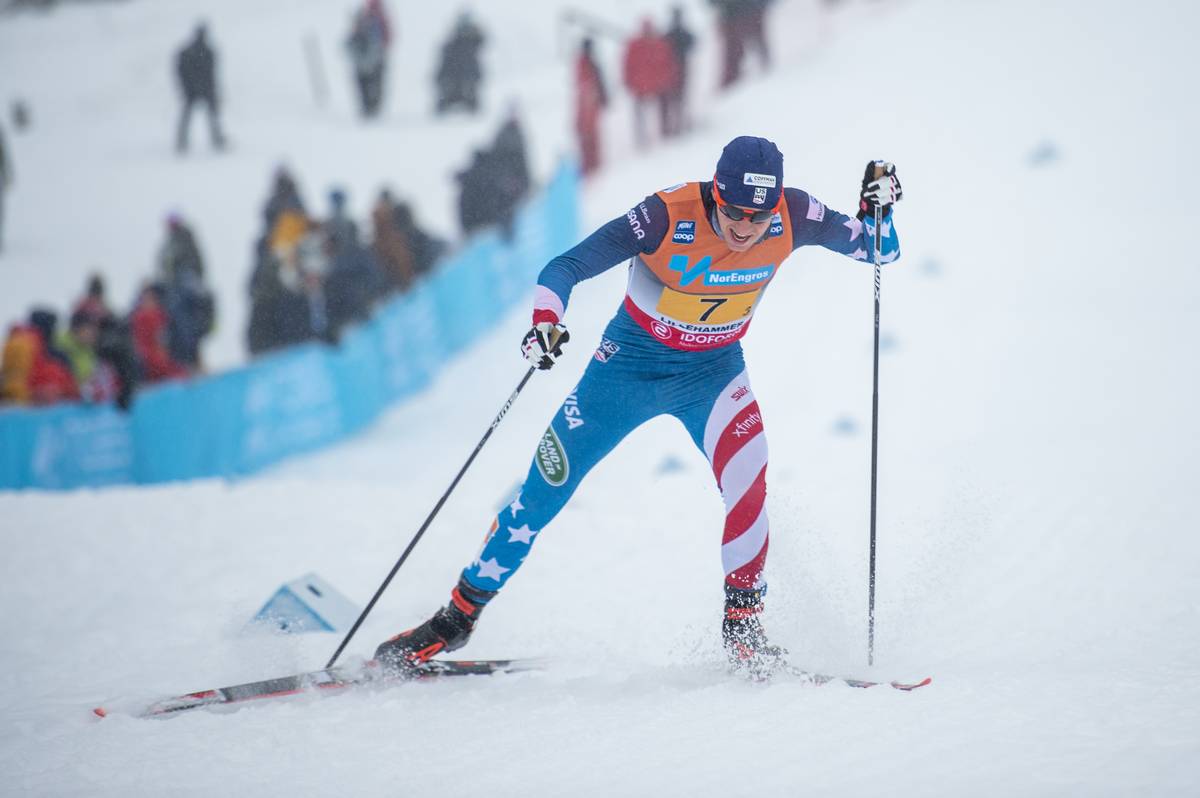
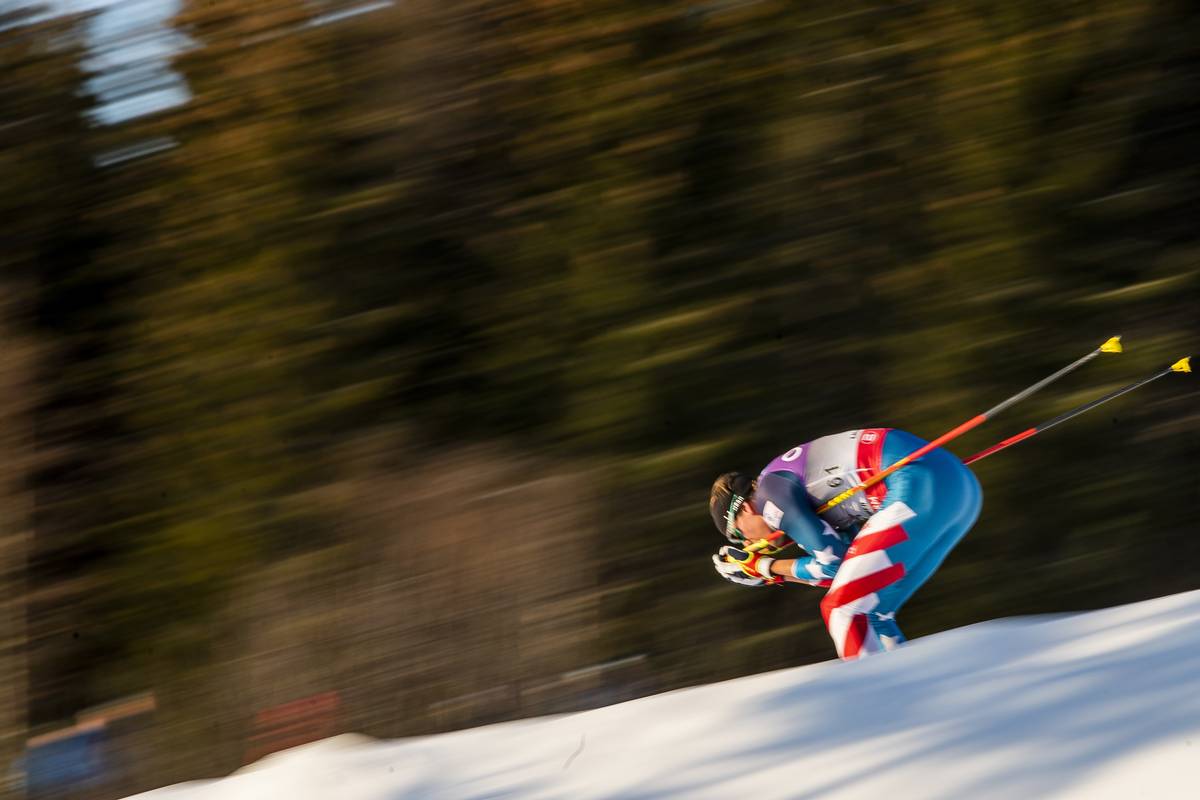
David Norris of the U.S. This image captures the true sense of the TdS. A pure physical and mental test for skiers. (Photo: NordicFocus)
Two Americans persevered in this Tour: David Norris and Logan Hanneman. Norris placed 30th on the stage (+2:12.4) and 35th overall (+10:18.1). Hanneman placed 56th overall (+20:05.5). He was perhaps the final pure sprinter to finish the Tour, as all the others had withdrawn. Hanneman was also 56th on the day (+4:53.8).
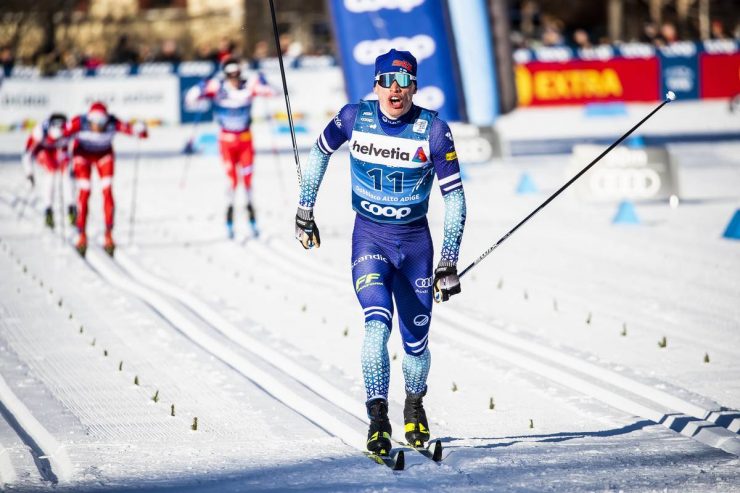
Logan Hanneman of the U.S. finishing his maiden overall voyage at the Tour de Ski. (Photo: NordicFocus)
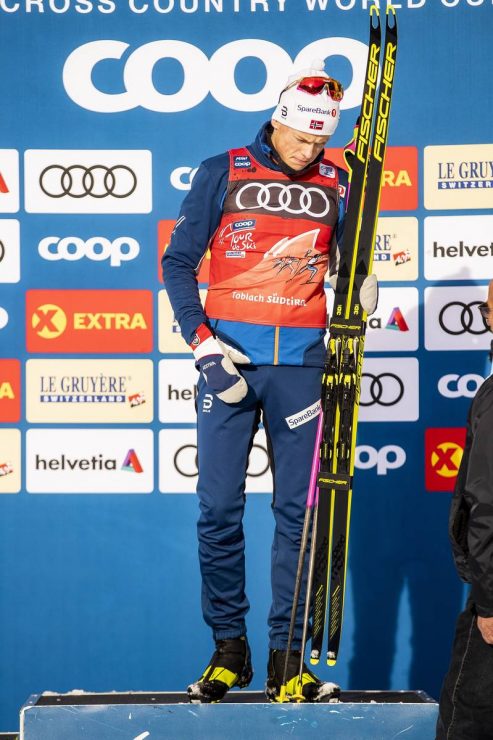
So it’s a wrap. The TdS concludes with Klæbo unable to solve this seven-stage racing puzzle made more difficult by the two Russians who stymied his run for a second overall TdS win.
Racing continues next weekend on the World Cup with city sprints from Dresden, Germany.
Three skiers atop the overall standings after Stage 4 set the tension for Stage 5 in Val di Fiemme, Italy: a 15-kilometer mass start classic race. Russia’s Alexander Bolshunov skied in the yellow leader’s bib while his teammate Sergey Ustiugov stood 16 seconds back in the overall. Johannes Høsflot Klæbo, Norway’s Tour de Ski (TdS) podium hope, lurked at 26 seconds back.
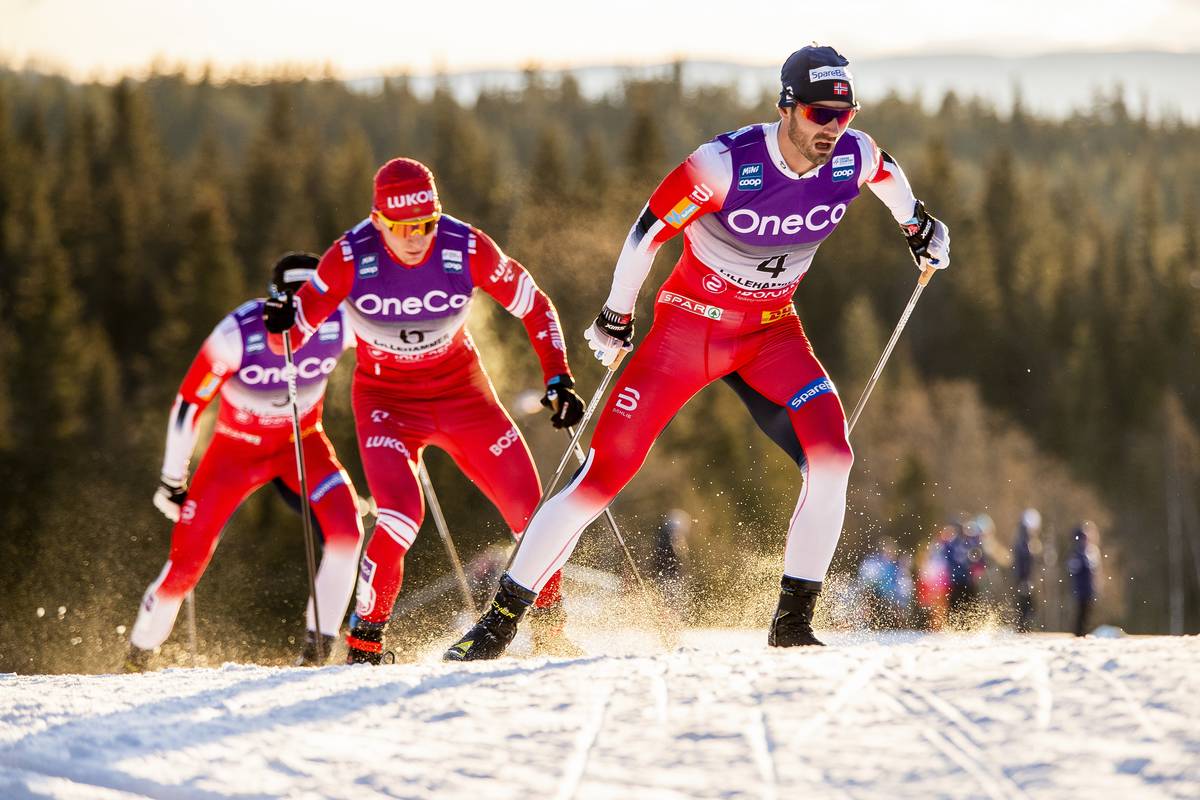
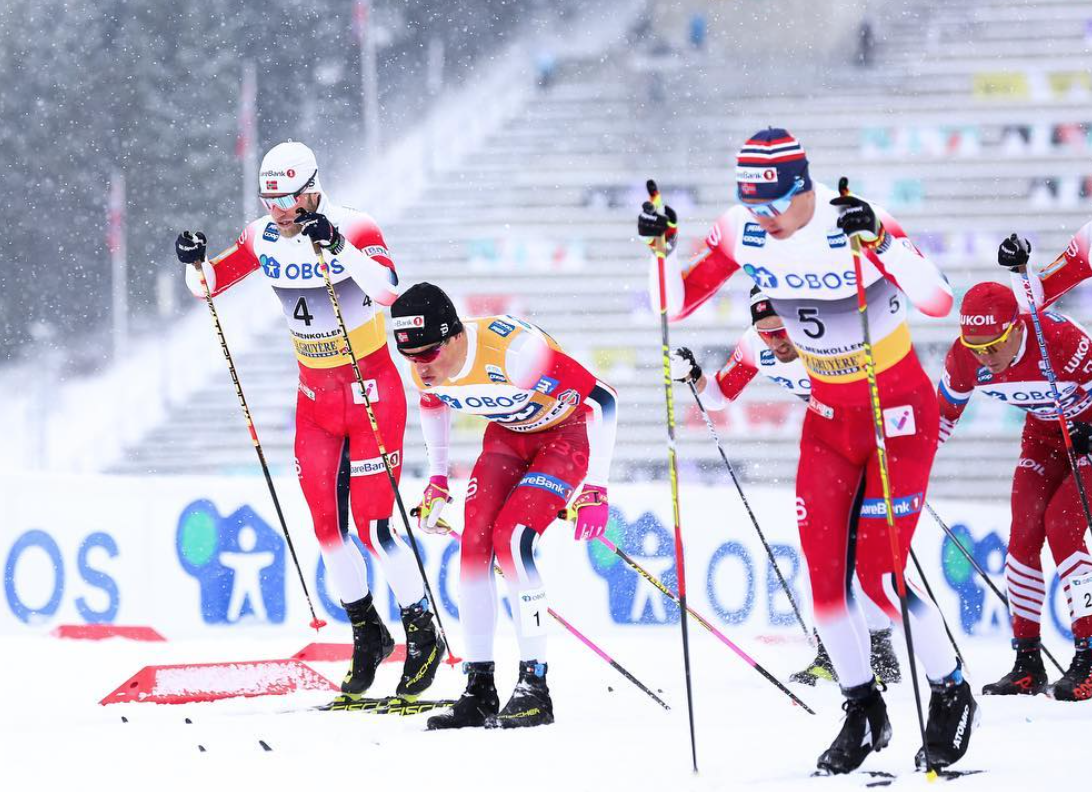
Alexander Bolshunov (RUS), Johannes Hoesflot Klaebo (NOR), Sergey Ustiugov (RUS), (l-r) early during Stage 5 of the TdS in Val di Fiemme, Italy. (Photo: NordicFocus)
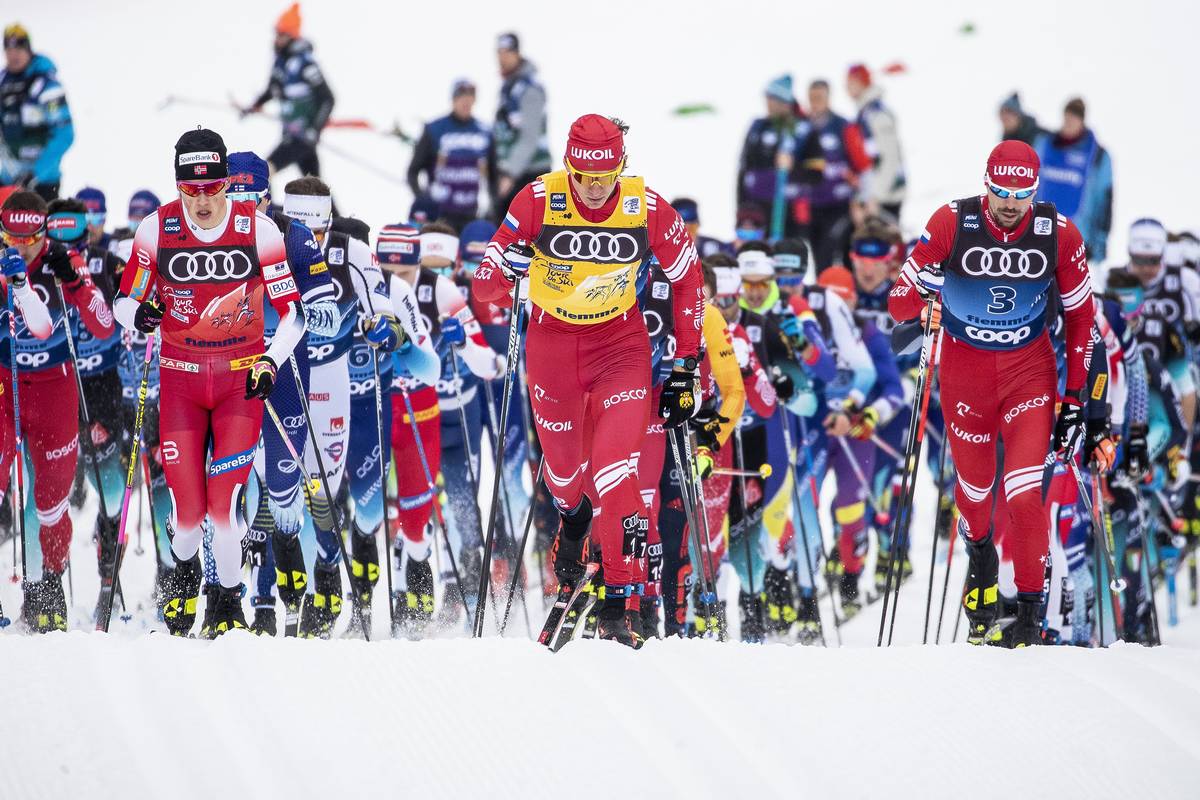
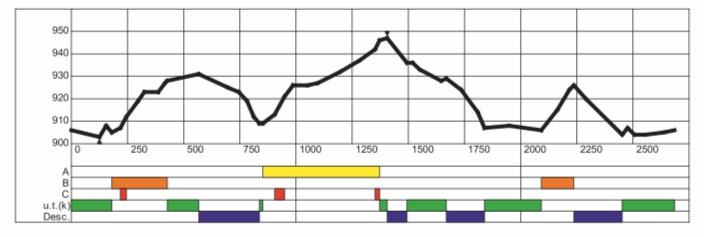
With a mass start format, the three contenders would play chess match skiing with a closing 1.5 k of turbocharged showmanship to determine the day’s winner. In between, as the 62 starters looped around the 2.5 k course which featured three climbs and an equal number of slick descents, the front pack never shattered.
Val di Fiemme 2.5 k course profile
The men’s field remained roughly intact through 7.5 k. With an arbitrary cutoff of five seconds, 25 skiers came through within that time frame. Hans Christer Holund of Norway leading, Sebastian Eisenlauer of Germany in 25th.
One kilometer ahead, at the 8.5 k mark, sat the day’s only time bonus atop a climb — a finite opportunity for some to snag time and decrease a time deficit.
Holund accelerated, awakening the leaders as the time bonus mark closed in. With the front of the field finally getting strung out, and several Norwegians present to steal a bonus spot away from the Russians (they took four of the top five spots through the bonus mark), Klæbo made a move up the inside to grab the first place 15 second prize. Bolshunov came through in fourth for an eight second bonus, Ustiugov in ninth for two seconds.
Pål Golberg (NOR), leading Alexander Bolshunov (RUS), (l-r) during Stage 5 of the TdS in Val di Fiemme, Italy. (Photo: NordicFocus)
Post time-bonus, the pace backed off. Until roughly 13 k, no skier in the front group made a discernible effort to separate. At 32:10, at the base of a climb, a mass of more than 20 skiers strode up led by Bolshunov in the yellow bib. It remained that way as the bell rang indicating the final lap.
Then the Russian charge began with Ustiugov’s double-pole push-and-punch through 13.9 k. On the course’s tricky descent that arcs left and loops back up for the decisive climb, Ustiugov was that Russian bear again. Unbridled and running, he was matched on the outside by an equally determined Klæbo.
Through the downhill, Klæbo proved to have slightly better glide as he slid past Ustiugov into the straightaway. There Klæbo is king. He won in 39:51.0, with Ustiugov 0.7 seconds back in second place. Bolshunov held tight for third (+1.0).
With the close pack racing and Klæbo’s sharp move for the max time bonus, Bolshunov still leads the overall. However, that lead stands at 16 seconds over Klæbo in second overall. Ustiugov sits in third, 21 seconds back.
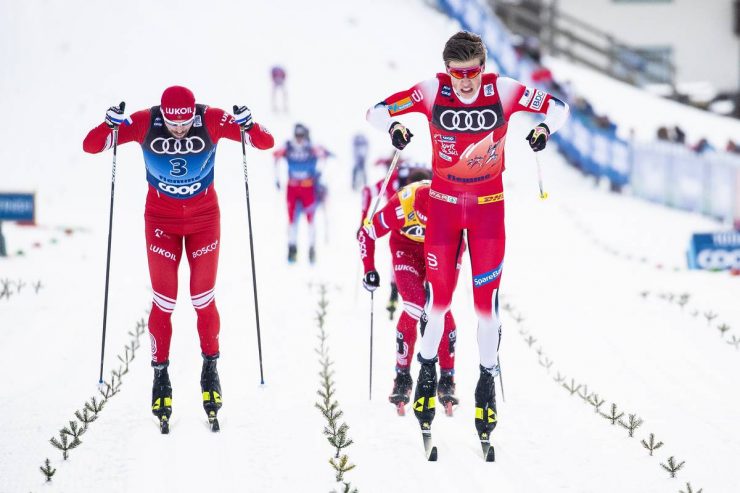
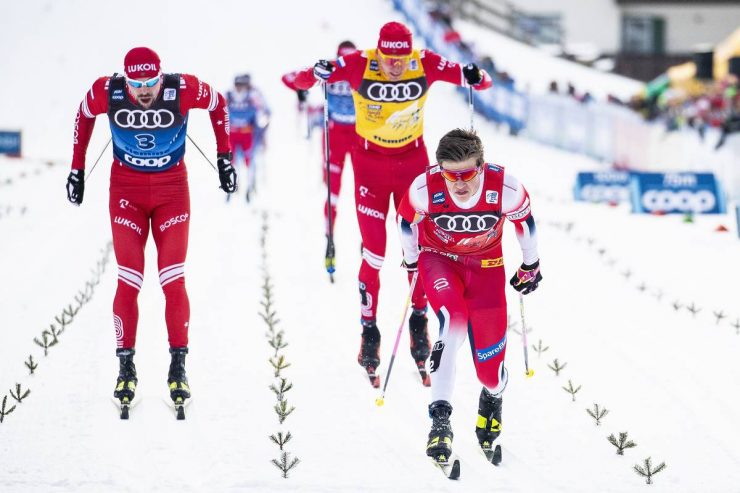
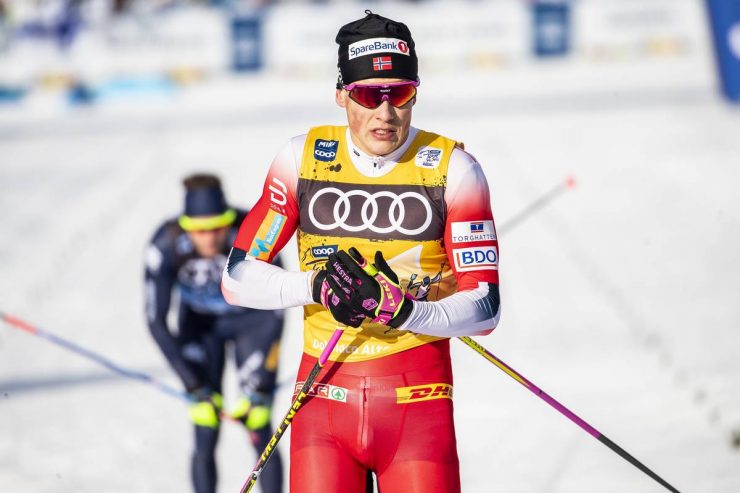
Full extension Johannes Høsflot Klæbo for the win. (Photo: NordicFocus)
Johannes Høsflot Klæbo (NOR) is a finisher as he takes the Stage 5 TdS win over Sergey Ustiugov (RUS), (l-r). (Photo: NordicFocus)
Two American men remain in the Tour. David Norris placed 38th (+1:41.9) on Stage 5. He tumbled on the second lap, but regained contact with the field. With two stages remaining, Norris is 36th overall. Teammate Logan Hanneman, a sprinter by trade, placed 59th (+4:49.8) on Friday.
David Norris of the U.S. is 36th overall after Stage 5 of the TdS, a 10 k mass start classic. Photo: NordicFocus)
World Cup Coach Matt Whitcomb’s post-race comments on the men’s racing
Tomorrow’s classic sprint remains a decisive day for Klæbo. Classic sprints and Klæbo most often mean one thing: a top step on the podium. And with that top step comes a 60 second time bonus. To stay in touch, Bolshunov and Ustiugov will need to make the six skier final.
The men’s podium of Stage 4 of the 2019/2020 Tour de Ski. Alexander Bolshunov (center) won the stage ahead of Sergey Ustiugov (left) and Iivo Niskanen (right). (Photo: NordicFocus)
The hunter becomes the hunted. Looking back on previous tours, Russia’s Sergey Ustiugov has not worn the leader bib going into the pursuit stage except for the 2016/2017 tour in Oberstdorf, Germany. That year, Ustiugov won six of the seven stages, placing second in the mass start classic in Stage 6, but still raced up the final hill climb with a significant buffer for the overall victory.
This year, Ustiugov was the man to beat. After a dominant performance in yesterday’s 15-kilometer skate, the Russian began the 15 k classic in Toblach, Italy with a lead of 22.6 seconds before the next skier and 27 seconds in the overall standings. On the hunt were his teammates, Ivan Yakimushkin and Alexander Bolshunov, followed by a troop of athletes looking to earn back time on the leader. In particular, a host of Norwegians looking for redemption after the third stage. Would his gap be enough to hold his position over 15 k’s?
Within the first 4 k, the answer was evident. Bolshunov and 4th place starter Calle Halfvarsson of Sweden closed the gap and overtook the leader. The three men skied together through 8 k, then Bolshunov began to crack open a gap.
Sergey Ustiugov falls short in preserving his rights to the leader bib in Stage 4 of the 2019/2020 Tour de Ski. (Photo: NordicFocus)
Unable to match the pace, Ustiugov switched into damage control mode. Standings in the overall tour are based on the cumulative time from each stage, and the time added from today’s event is based on time of day results, meaning the elapsed time each individual spent on course. Being caught by Bolshunov meant Ustiugov had already lost 29 seconds, meaning that Bolshunov’s aggregate time now earned the 23-year-old the rights to the yellow bib.
Ustiugov was able to keep his teammate within 20 seconds, but Bolshunov never saw his position at risk and finished with a 13 second lead. He stopped the clock at 38:14.9 for his first stage win in the Tour de Ski. Subtracting this from his deficit in the overall, Bolshunov now leads the overall rankings by 16 seconds.
Alexander Bolshunov celebrates his Stage 4 win during the 2019/2020 Tour de Ski. (Photo: NordicFocus)
“It was a really, really hard race,” Bolshunov told FIS through a translator. “A big part of this was that I had to work alone. Sergey in the middle helped to keep the pace, by my own feelings started to run away and the last lap it was really hard to keep the speed.”
When asked whether he had energy left for the final three stages in Val di Fiemme, he answered with a mischievous smile.
“The tour just started.”
Alexander Bolshunov (RUS) takes control ahead of Calle Halfvarsson (SWE) and Sergey Ustiugov (RUS) during Stage 4 of the 2019/2020 Tour de Ski. (Photo: NordicFocus)
Alexander Bolshunov (RUS) blasts off as he leaves behind Calle Halfvarsson (SWE) and Sergey Ustiugov (RUS) during Stage 4 of the 2019/2020 Tour de Ski. (Photo: NordicFocus)
When Bolshunov began to pull away, Halfvarsson fell dramatically off the leaders, dropping from eight seconds back to over 50. Perhaps the Swede was paying for his effort in light of the cumulative tour fatigue that is setting in. He rebounded in the final lap to finish within 30 seconds of Bolshunov in 5th.
Steadily working his way up through the field in his dominant technique, Iivo Niskanen had an outstanding performance. The Finn began the race in 11th place with a deficit of 1:35, half of which he recouped in the first half. Like many other athletes, Niskanen began to fade in the middle part of the race, but he switched on his afterburners in the final lap.
Iivo Niskanen rises up the ranks on his way to a third place finish in Stage 4 of the 2019/2020 Tour de Ski. (Photo: NordicFocus)
With 2.5 k to go, Niskanen was 50 seconds back on Bolshunov in sixth, yet he could be seen rounding the corner into the final stretch as Ustiugov slid over the line. Niskanen took the third spot on the podium finishing 24.8 seconds back on the leader, a result that moves him into fifth place in the overall standings.
So far this season, Niskanen won the 15 k classic in Ruka in addition to a 10 k classic early season opener. He is also an Olympic champion in the 50 k classic and podium finisher in the 15 k classic at the 2019 World Ski Championships in Seefeld, his stride and glide prowess is clear. Heading into two additional classic stages, he now sits in 5th place in the overall standings with a 1:10 deficit.
Iivo Niskanen takes third during Stage 4 of the 2019/2020 Tour de Ski. (Photo: NordicFocus)
Desperate to whittle down his 37-second deficit in the overall ranks, Johannes Høsflot Klæbo looked like a workhorse in the pursuit. No pomp, just head down, focused, determination. He knew he was not fighting for a podium position on the day, but any time he could gain on the leaders would help keep him in contention for an overall win. It is essential that he keep his overall deficit within a margin that could be surpassed with bonus seconds he intends to garner in the sprint during Stage 6.
Klæbo started the day 1:11 behind Ustiugov. Nearly 30 seconds of this were chipped away in the first 5 k, then he began to struggle. He began ceding places and time, leaving him in 16th at the 12.4 k mark 1:23 in the hole. He too found a new gear, closing hard in his final lap to move into 10th (+57.2).
Johannes Høsflot Klæbo climbs his way into 10th during the 15 k classic pursuit in the 2019/2020 Tour de Ski. (Photo: NordicFocus)
As he gained time on Ustiugov, his deficit in the overall standings reduced to 26 seconds, though he still sits in third. Perhaps better suited for head to head competition, Klæbo is in good position heading into the next two stages.
Again the top American distance athlete, David Norris finished 44th (3:43), improving on his 51st place finish yesterday. His time of 39:34.9 was the 34th fastest time of day.
Kevin Bolger finished 61st (+5:24.9), and Logan Hanneman 71st (+7:47.2).
In a post-race interview, Whitcomb shares that Bolger, who is a sprint-specialist, used the TdS distance stages as an opportunity to build fitness. He will now leave the tour to prepare for the city sprints in Dresden. Whitcomb also provided insight into Norris and Hanneman’s races, and offered a possible answer to the yo-yo like time difference seen in the race.
Post-race interview with Matt Whitcomb.
Racing continues Friday with a 15 k mass start classic in Val di Fiemme, Italy.
Rising to the top, Sergey Ustiugov takes the win in Stage 3 of the 2019/2020 Tour de Ski in Toblach, Italy. (Photo: NordicFocus)
New day, new venue, almost a new decade. The 2019/2020 Tour de Ski continued in Toblach, Italy with a 15-kilometer interval start skate. In the war of attrition that is the tour, the first stages set the tone. Hopefuls for the overall win seek to establish their position near the top without expending too much energy to hold up for the long haul.
We are now in the meat and potatoes of the tour. Three consecutive distance races, interrupted by one travel day. There are no bonus seconds on the line in the next two stages, meaning athletes need to fight for every second solely with their own grit.
Sergey Ustiugov (RUS) flies to his second stage win during the 15-kilometer skate in Toblach, Italy. (Photo: NordicFocus)
Racing midway through the seeded group in bib 44, Russia’s Sergey Ustiugov took off on Stage 3, setting the fastest time at each checkpoint to lead wire-to-wire. But his position in the leader chair was insecure until the remainder of the seeded men had their shot.
Wearing the highest numbered bib in the seeded group as the overall tour leader, Klæbo would have information on how he was matching up with Ustiugov at each checkpoint, informing him on whether he needed to work harder or lay off the gas. After winning a 60-second time bonus in the sprint, Klæbo had a cushion of 34 seconds over Ustiugov to work with. Victory in stage three was not imperative, but it would be important to keep the Russian within that margin.
In the first 5 k, it looked like this was how the story would play out. Ustiugov’s teammate Alexander Bolshunov, who trailed Klæbo by 32 seconds, nearly matched the pace setter. Klæbo trailed by six seconds, followed by three of his teammates in the next ten seconds: Hans Christer Holund, Simen Hegstad Krüger, and Pål Golberg. Each of these men is accomplished in distance racing.
Johannes Høsflot Klæbo falls flat in his attempt to keep the leader bib in Stage 3 of the 2019/2020 Tour de Ski. (Photo: NordicFocus)
On his way to a second place finish, Alexander Bolshunov consistently performs in Stage 3 of the 2019/2020 Tour de Ski. (Photo: NordicFocus)
However, things quickly began to change. Ustiugov’s splits became untouchable, and the Norwegian stronghold began to crumble. By the 10 k mark, his time was over 15 seconds ahead the next skier, and Klæbo had fallen 40 seconds behind into 15th. Ustiugov had the race locked up.
Sergey Ustiugov (RUS) locks eyes on his second stage win during the 15-kilometer skate in Toblach, Italy. (Photo: NordicFocus)
As the remainder of the seeded group made their way through the finish, Ustiugov remained on top by a large margin. His 23-year-old teammate Ivan Yakimushkin, who had not landed in the top 30 in either of the first two stages of the tour, worked his way into second place (+22.6). Yakimushkin was 43rd in the 15 k in Lenzerheide and qualified in 49th in the sprint, leaving him ranked 47th overall.
Sliding his boot across the line in unmatchable time, Sergey Ustiugov takes the win in Stage 3 of the 2019/2020 Tour de Ski in Toblach, Italy. (Photo: NordicFocus)
Rising to the top, Sergey Ustiugov takes the win in Stage 3 of the 2019/2020 Tour de Ski in Toblach, Italy. (Photo: NordicFocus)
Prior to the tour, Yakimushkin was a member of the Russian relay team that won the event in Lillehammer earlier this month and posted a top-10 in the distance classic race in Ruka.
Bolshunov, who was also born in 1996, took third 29 seconds back. Currently the top-ranked distance skier on the World Cup, Bolshunov has raced consistently in the tour: third in the first stage, and eighth in the second.
The all-Russian men’s podium of the 15-kilometer freestyle event in Stage 3 of the 2019/2020 Tour de Ski in Toblach, Italy. Sergey Ustiugov (center) was the clear winner over Ivan Yakimushkin (left), and Alexander Bolshunov (right). (Photo: NordicFocus)
In addition to sweeping the podium, Russia took three additional spots in the top 10, with Artem Maltsev, Andrey Melnichenko, and Denis Spitzov finishing 5th, 6th, and 10th, respectively.
Looking frustrated, Klæbo fell back to 17th (+1:11.4) by the finish, well-outside the margin he had to work with.
Johannes Høsflot Klæbo grimaces after a disappointing performance in the 15-kilometer freestyle event in Stage 3 of the 2019/2020 Tour de Ski in Toblach, Italy. (Photo: NordicFocus)
He was not the only Norwegian to struggle after the 5 k mark. Goldberg fell from 8th to 60th, and Krüger from 6th down to 22nd. Holund was the only Norwegian to maintain his top-10 position throughout the race, finishing 5th. Sjur Røthe also worked his way into 8th.
Though he leads the point standings, Johannes Høsflot Klæbo hides the usual toothy smile after a disappointing performance in the 15-kilometer freestyle event in Stage 3 of the 2019/2020 Tour de Ski in Toblach, Italy. (Photo: NordicFocus)
Though he still leads the point standings, Klæbo is now 37 seconds in the hole for the overall, sitting in 3rd place. He faces a pursuit-start classic tomorrow and a mass start classic on Friday. Presuming the time bonuses are still available in the mass start, he will have the opportunity to earn back time there and also in the classic sprint on Saturday.
Ustiugov’s performance bumped him into the overall lead with Bolshunov 27 seconds behind in second place. Nothing is out of reach for these three men. Holund and Maltzev round out the top five, trailing by just over 1:20.
As was seen in the final climb up the Alpe Cermis last year, Ustiugov has the upper hand over the Norwegian. Klæbo will need to rebound in time to create a significant gap before the final stage if he hopes to repeat his victory.
For the Americans, David Norris was again the top-ranked distance skier, finishing 51st (+2:22.6). Kevin Bolger finished 60th (+3:04.0), followed by Logan Hanneman in 73rd (+3:46.0).
In a post-race call, Matt Whitcomb provided insight into the men’s race. He also explains his approach counseling athletes about races in which athletes may not be set up to excel.
Post-race interview with Matt Whitcomb.
David Norris skis to 51st, the top American finish in Stage 3 of the 2019/2020 Tour de Ski in Toblach, Italy. (Photo: NordicFocus)
Heading into three classic races, Whitcomb explained that the techs are feeling confident in ski selection and waxing. Many K’s have been logged to ensure the American skis are ready to compete.
Post-race interview with Matt Whitcomb regarding ski testing.
Ustiugov claims his 8th stage win in the opening event of the 2019/2020 Tour de Ski. (Photo: NordicFocus)
The starting corral was blocked by a wall of red before the start of the 15-kilometer mass start freestyle in Lenzerheide, Switzerland. Of the top ten ranked athletes, eight hailed from either Norway or Russia, interrupted only by Iivo Niskanen of Finland and Lucas Chanavat of France.
Johannes Høsflot Klæbo thanks his supporters before climbing into the second spot on the podium after the first stage of the 2019/2020 Tour de Ski. (Photo: NordicFocus)
Front and center was last year’s victor Johannes Høsflot Klæbo. He became the youngest Tour de Ski Champion at 22 years of age after holding off Russia’s Sergey Ustiugov who was gaining on the Norwegian throughout the final climb up the Alpe Cermis. It was clear in the final meters that there was no showmanship or gamesmanship in this performance; the young star was fully spent as he collapsed over the line.
Now an aged and wizened 23-year-old working on his tactics and gears in distance racing, Klæbo aspires to become the second man in history to win consecutive tours. Swiss athlete Dario Cologna did this in 2011 and 2012.
Klæbo is not a lock for this achievement — today’s opening stage made that abundantly clear. He will need to hold off the likes of Sergey Ustiugov and Alexander Bolchunov (RUS), Niskanen, Emil Iversen (NOR) and an otherwise deep field all vying for the same goal.
“I will try my best and I will count [my time] after the last day,” Klæbo told FIS during a pre-race press conference.
With the starting pistol marking the start of the nascent tour, the men began soaring around the course, through snow laden pine forest in front of high mountains emerging from their wreath of snow.
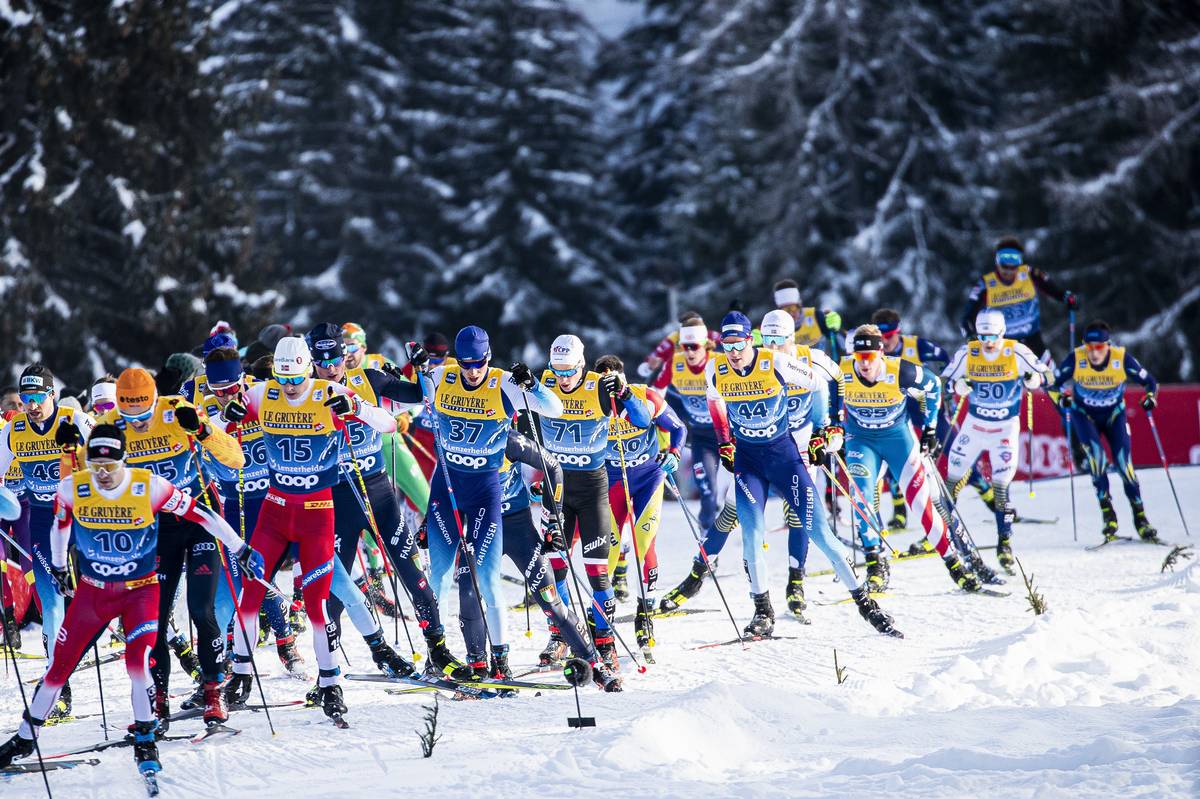
For the first 10 k, the field held strong in a long train. The top men, who stemmed from the first row of the start line, regularly exchanged the lead and the top 40 were separated by 10 seconds. Though the pace began to accelerate, the top ten were only spread by three seconds with 1.5 k to go.
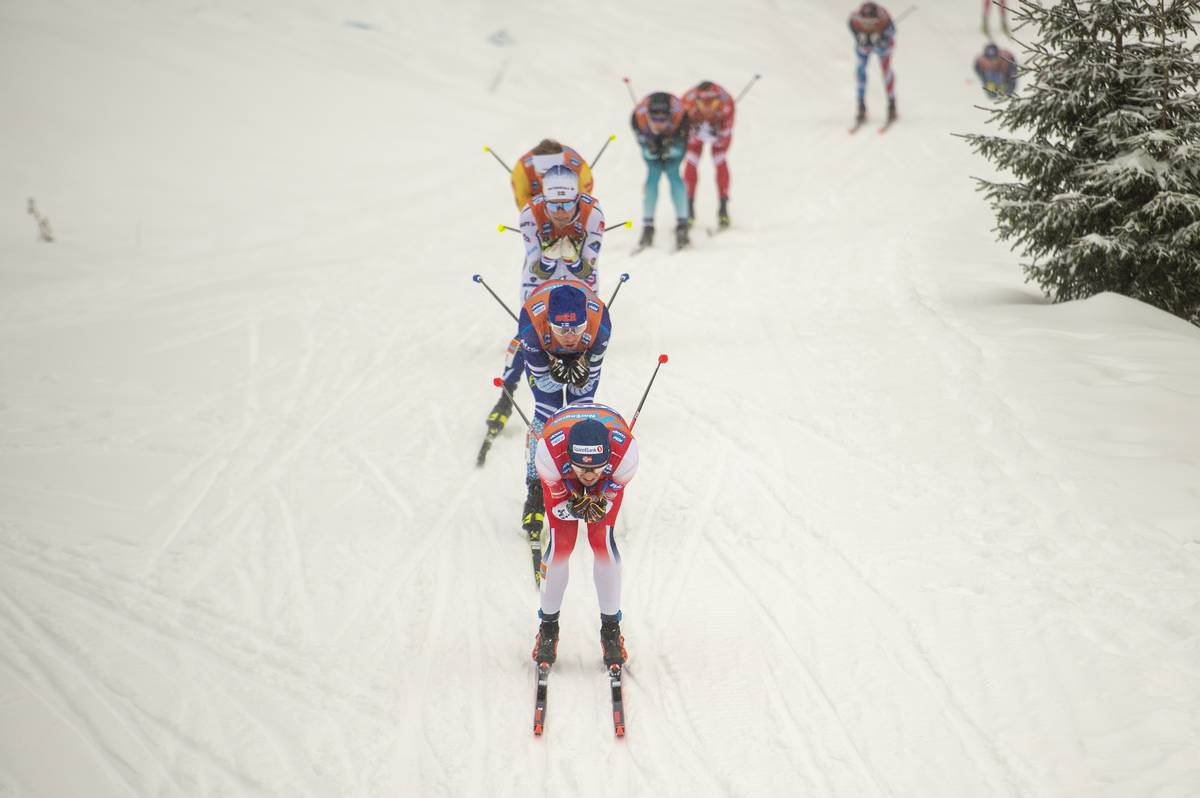
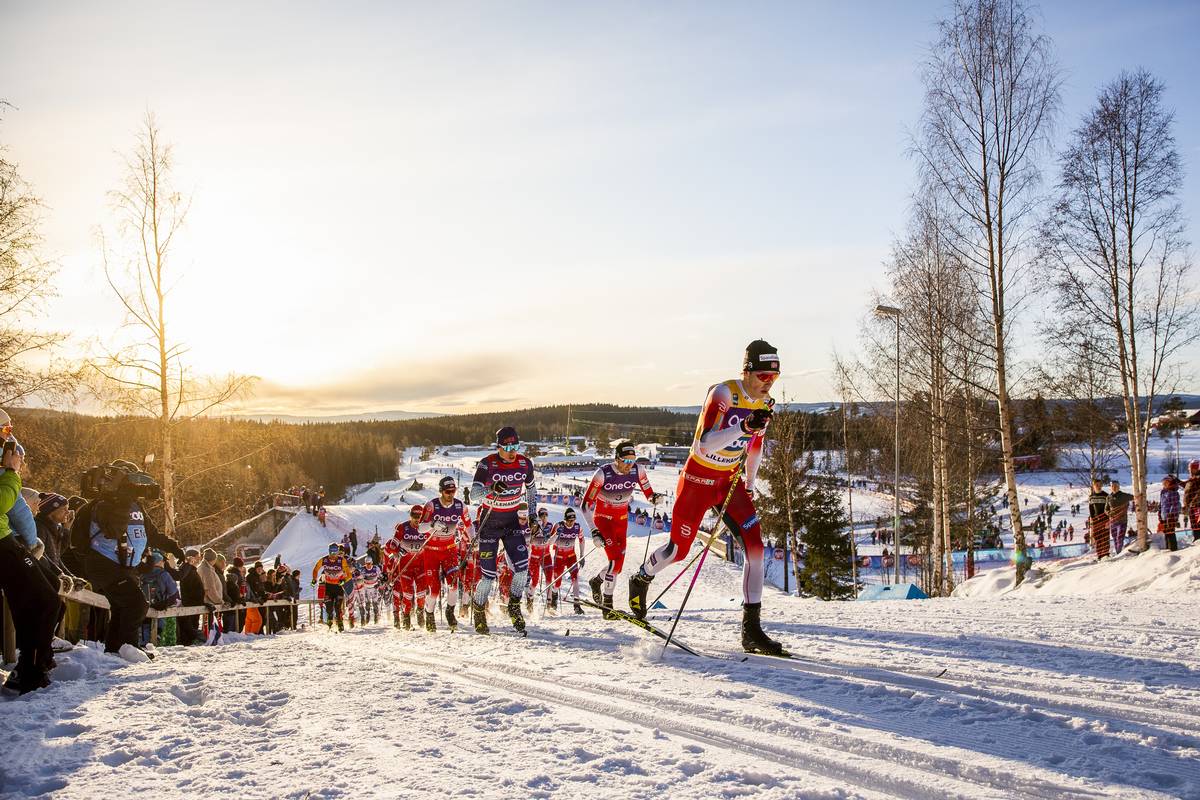
A dense pack of skiers during the first stage of the 2019/2020 Tour de Ski, a 15-kilometer mass start freestyle. Logan Hanneman can be found on the right side of the image wearing bib 85. (Photo: NordicFocus)
Moves and countermoves. With 1 k to go, Ustiugov took charge. He rocketed off the front to create a gap to the lead pack. His teammate Bolshunov was three seconds back, along with Cologne, Iversen, Klæbo, and their Norwegian teammates Simen Hegstad Krüger and Sjur Røthe.
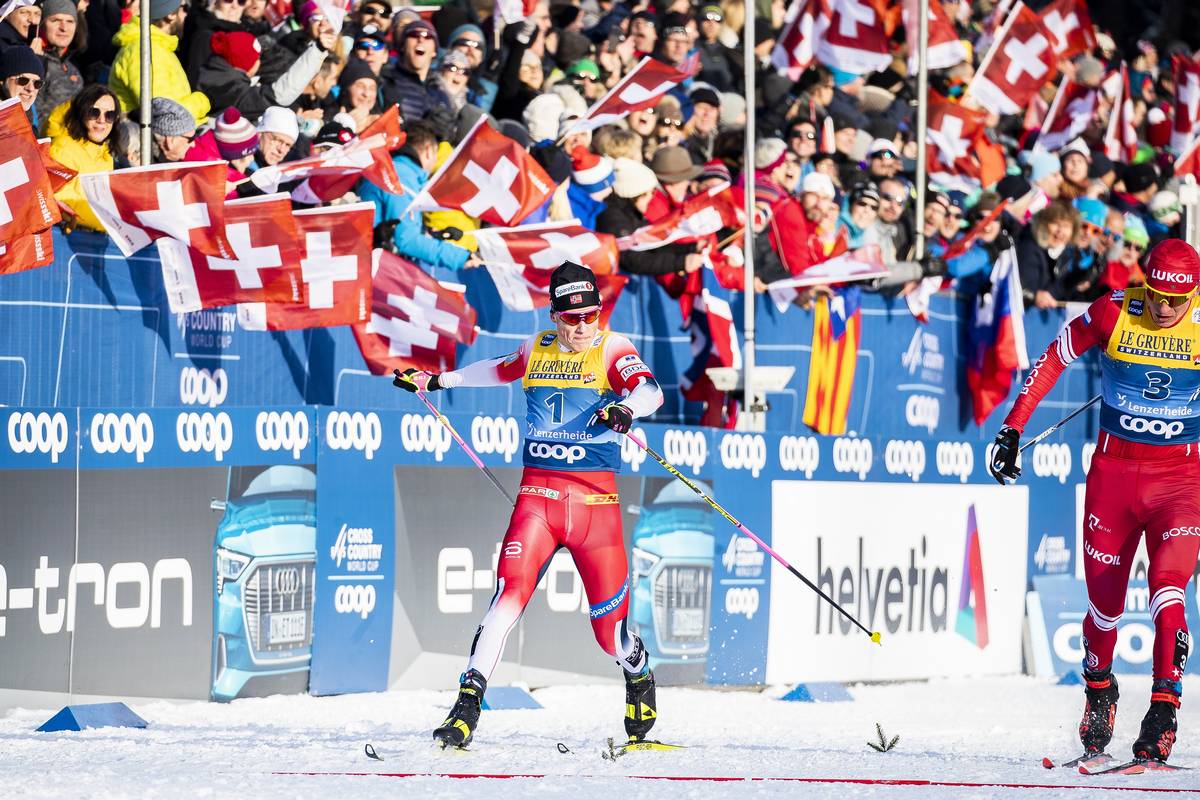
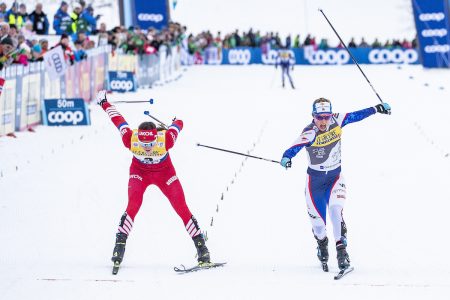
Ustiugov managed to maintain his gap and flew through the final straightaway in a confident V2. In the screen behind him was a pack of men whose final standings were far less certain. Klæbo and Bolshunov were dueling tête-à-tête in a sprint to the finish, sliding their boots over the line in sync for a photo finish. It was decided that Klæbo edged out his competitor for second, though he and Bolshunov will both enter the second stage of the tour four seconds behind Ustiugov.
Johannes Høsflot Klæbo (NOR) and Alexander Bolshunov (RUS) slide across the line in a photo finish at the end of the first stage of the Tour de Ski. (Photo: NordicFocus)
Iversen surged for 4th (+7.2) ahead of his countryman Martin Løwstrøm Nyenget (+8.6) who bested Tour de Ski veteran Cologna, Hans Christer Holund, Jan Thomas Jenssen, and Sjur Røthe in a five-way photo finish. Finishing in the order listed, the five men were separated by a margin of 0.4 seconds. Krüger rounded out the top ten one second later (+10.0).
Dario Cologna (bib 24) finishes amongst a herd of men vying for position at the end of Stage 1 of the 2019/2020 Tour de Ski, a 15-kilometer mass start skate in Lenzerheide, Switzerland. (Photo: NordicFocus)
“It was a really good performance and the shape was okay,” Ustiugov told FIS through a translator at the finish. “It was for sure a pleasure to win the first stage and I wish to show the same results on the next stages. Big thanks to Russian fans because it’s a really big pleasure to hear Russian people [cheering] here in Switzerland. It’s great.”
Russia’s Sergey Ustiugov celebrates his victory after the first stage of the 2019/2020 Tour de Ski, a 15-kilometer mass start skate. (Photo: NordicFocus)
Today’s victory marks the Russian’s eighth win in a TdS stage, advancing him to the second most behind Petter Northug who has 13 wins. The winner of the 2016/2017 TdS, Ustiugov has reached the overall podium in three of his last four rounds, only missing the final TdS podium in the 2017/2018 tour where he withdrew after the 5th stage. The Russian also won the first distance stage of last year’s TdS.
The men’s podium of the first stage of the 2019/2020 Tour de Ski, a 15-kilometer mass start skate in Lenzerheide, Switzerland. Sergey Ustiugov (RUS) took the win over Johannes Høsflot Klæbo (NOR) and Alexander Bolshunov (RUS) who were second and third, respectively, in a photo finish. (Photo: NordicFocus)
Three Americans started in Lenzerheide. David Norris finished as the top ranked American in 58th (+1:11.2). Kevin Bolger finished 64th (+1:35.0), followed by fellow Logan Hanneman in 69th (+1:42.1). Simi Hamilton was slated to start, but withdrew from the TdS due to a pulled muscle in his groin.
For the first nine kilometers, Norris hovered on the cusp of the top-30. After the race, Matt Whitcomb explained the energy-expenditure challenges of racing in this position, along with the strategy of sprint specialists Bolger and Hanneman.
Post-race interview with Matt Whitcomb on men’s performance.
“This was a fun mass start – fast and flowing,” wrote Norris explained an email after the race. “For the first 12km or so I felt really comfortable in the group. I tried to ski relaxed and avoid any of the chaotic crashes and tangles that seemed to occur each lap. With about 2 km to the finish I felt great and my skis were running well, but all of the sudden I bonked incredibly hard – got tunnel vision and struggled to avoid tripping on myself. It was a tough way to finish the race, but I’m optimistic I have better days ahead in this tour.”
Swiss flags flying against a breathtaking backdrop. Wearing bib 77, Kevin Bolger can be found at the center. (Photo: NordicFocus)
Simen Hegstad Krüger of Norway winning the 2019 15 k skate in Davos, Switzerland. (Photo: NordicFocus)
In contrast to yesterday’s open valley sprints, Sunday’s 15-kilometer interval start freestyle was tucked and nestled on the shady side of the valley. Firm snow and less than optimal oxygen concentrations greeted athletes. Davos sits at just over five thousand feet in altitude.
As far as the race narrative, so much for fairy tales in lovely Davos. Dario Cologna, the Swiss ski star sat for a time in the fur-lined leader’s chair. Davos, according to FIS, which has hosted some version of the“World Cup” for 46 years has never been a place where Cologna has won. Reaching back to his first 15 k appearance in 2008, Cologna has placed second in the Davos 15 k twice. On Sunday he was third.
Swiss star Dario Cologna placed third in the 2019 Davos, Switzerland 15 k skate. (photo: NordicFocus)
Sergey Ustiugov of Russia toes the line as he places second in the 2019 Davos, Switzerland 15 k skate. (Photo: NordicFocus)
Russia’s Sergey Ustiugov bumped Cologna from the leader’s chair by 1.0 seconds. The Russian was ultimately displaced by Norway’s Simen Hegstad Krüger. Krüger won in 33:59.3 for his second career World Cup victory. Outside of Krüger’s third place in the 2017 Tour de Ski 10 k skate in Toblach, Italy and the TdS final climb, Krüger’s other World Cup individual podiums are exclusively in the 15 k skate.
“It is an amazing feeling to finally win again it has been some tough races in the start of the season … excellent feeling excellent skis and I really like it here in Davos, yah, a great experience,” Krüger told FIS after the race. “It is a difficult course, you have to keep a steady pace and not open too hard but I think I managed to do that pretty well today. Really satisfied.”
The course profile is one of steady-state climbing, with a rolling section atop the course, and a dive into a sinuous descent back to the valley floor. With the men racing three laps on this 5 k loop, proper pacing is critical.
Krüger, posted the fastest split at the 5 k mark, 1.5 seconds ahead of Finland’s Iivo Niskanen. (Niskanen, showing improved skate fitness, placed fourth overall, 27.9 seconds back.)
At 10k, after his second time up and down the course, Krüger was 14.1 seconds up. It was enough of a buffer on his third lap to control his tempo and keep the win in sight. Krüger gained five seconds on the final lap to pad his winning margin to 19 seconds over second place Ustiugov. Cologna was 20 seconds behind in third.
The Davos 15 k skate winner, Simen Hegstad Krüger, on the traditional Davos sleigh. (Photo: NordicFocus)
Several North Americans began the race, none bumped into the top-30. Kyle Bratrud (SMST2) was the top-placed American in 38th (+1:55.9). Simi Hamilton (USST) was 42nd (+2:06.9), Scott Patterson (USST) 51st (+2:30.5), while David Norris (APU) did not start after waking up with a mild cold. Erik Bjornsen (USST) had planned not to race this weekend.
Bratrud began his day on the conservative side of pacing, sitting in 65th after 5 k. By 10k, he bumped up to 46th. Finishing in 38th, Bratrud was a bit over ten seconds outside the points.
Kyle Bratrud (APU) placed 38th during Sunday’s 15 k skate in Davos, Switzerland. (Photo: NordicFocus)
World Cup Coach Matt Whitcomb’s thoughts on Kyle Bratrud’s Davos race
For Canada, Russell Kennedy placed 47th (+2:18).
Russell Kennedy of Canada skiing to 47th in the Davos 15 k skate. (Photo: NordicFocus)
Heading into next weekend’s racing in Planica, Slovenia which features a team and individual sprint, Norway’s Johannes Høsflot Klæbo, who sat out Sunday’s Davos distance race, leads the World Cup overall with 520 points. Emil Iversen is the closest competitor, 72 points behind. Alexander Bolshunov of Russia, who placed seventh Sunday, leads the distance overall with 232 points. Iversen is second with a five point deficit.
Davos concludes Period I distance racing on the World Cup. The next distance event is the December 28th, 15 k mass start skate during the Tour de Ski.
The 2019 Davos, Switzerland 15 k skate podium: Sergey Ustiugov (RUS) in second, Simen Hegstad Krueger (NOR) first, Dario Cologna (SUI) third, (l-r). (Photo: NordicFocus)
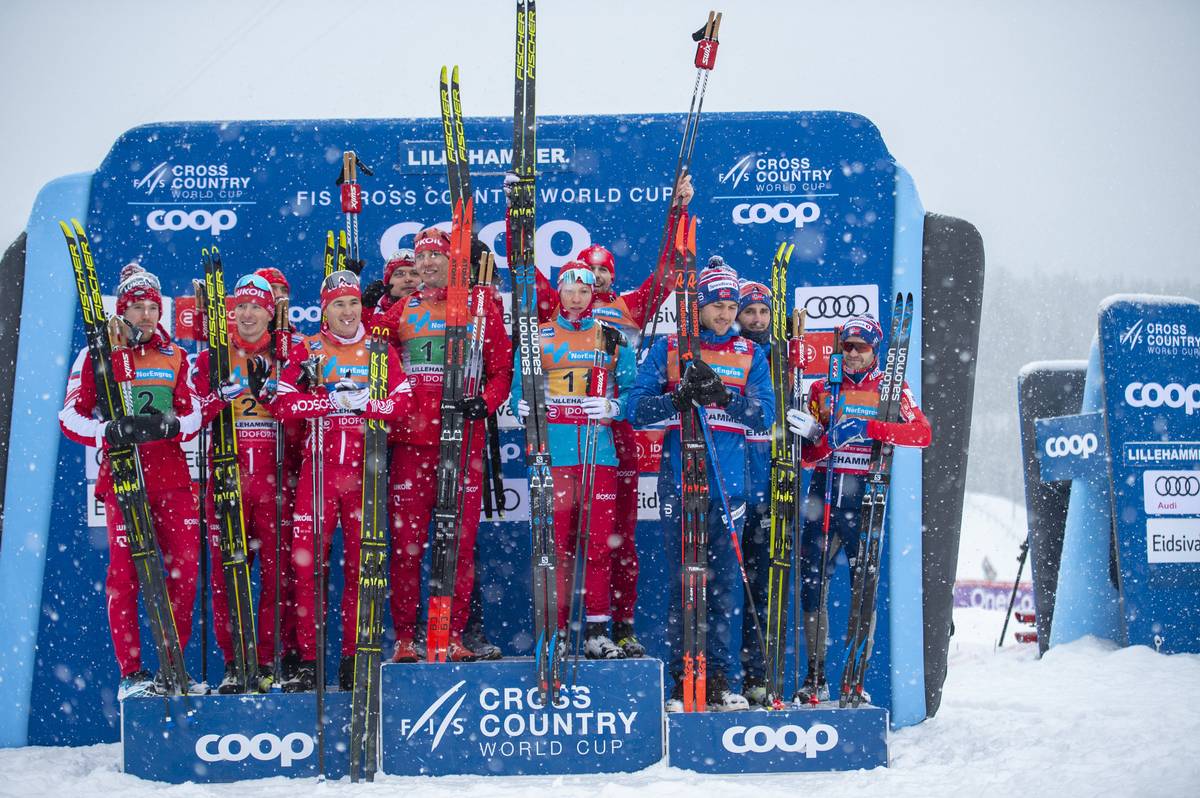
Russia soaking it in as they take 1-2 in the 4 x 7.5 k relay in Lillehammer, Norway. (Photo: NordicFocus)
Call it what you want: national pride, national bias, flag-waving: the team relays elicit nationalistic tendencies. In Lillehammer, Norway, you might think and maybe expect it’s your birthright to see the hometeam crush. That’s been the recent norm almost without exception.
Here’s the quick stats to either dispel or reinforce those tendencies: Norway has won nine of the last 11 relay races on the World Cup. Russia won the other two. In fact, Russia took first and second, Norway third in the last head-to-head 4 x 7.5 k match last season in Ulricehamn, Sweden. Throwing Norwegian dominance back into the equation, Norway has won five of the last six relays on home snow.
On paper, at least for Norway, some big names were missing from their team lineups. No No Emil Iversen. No Johannes Høsflot Klæbo. No Martin Johnsrud Sundby. That trio finished third, fourth. and fifth in Saturday’s 30k skiathlon. Add to that Didrik Tønseth who was busy representing Norway at the European Cross-Country Running Championships.
But Norway is deep with talent. As is Russia. For those keeping score, you’ll see no Alexander Bolshunov featured on either of the Russian teams — he won the skiathlon yesterday. That all said, in a non-championship year maybe it’s a time to tinker and experiment. Here were the teams holding the most podium potential.
Norway I: Pål Golberg, Hans Christer Holund, Sjur Røthe, Finn Hågen Krogh
Russia I: Andrey Larkov, Ilia Semikov, Denis Spitsov, Andrey Melnichenko
Russia 2: Ivan Yakimushkin, Evgeniy Belov, Ilia Poroshkin, Sergey Ustiugov
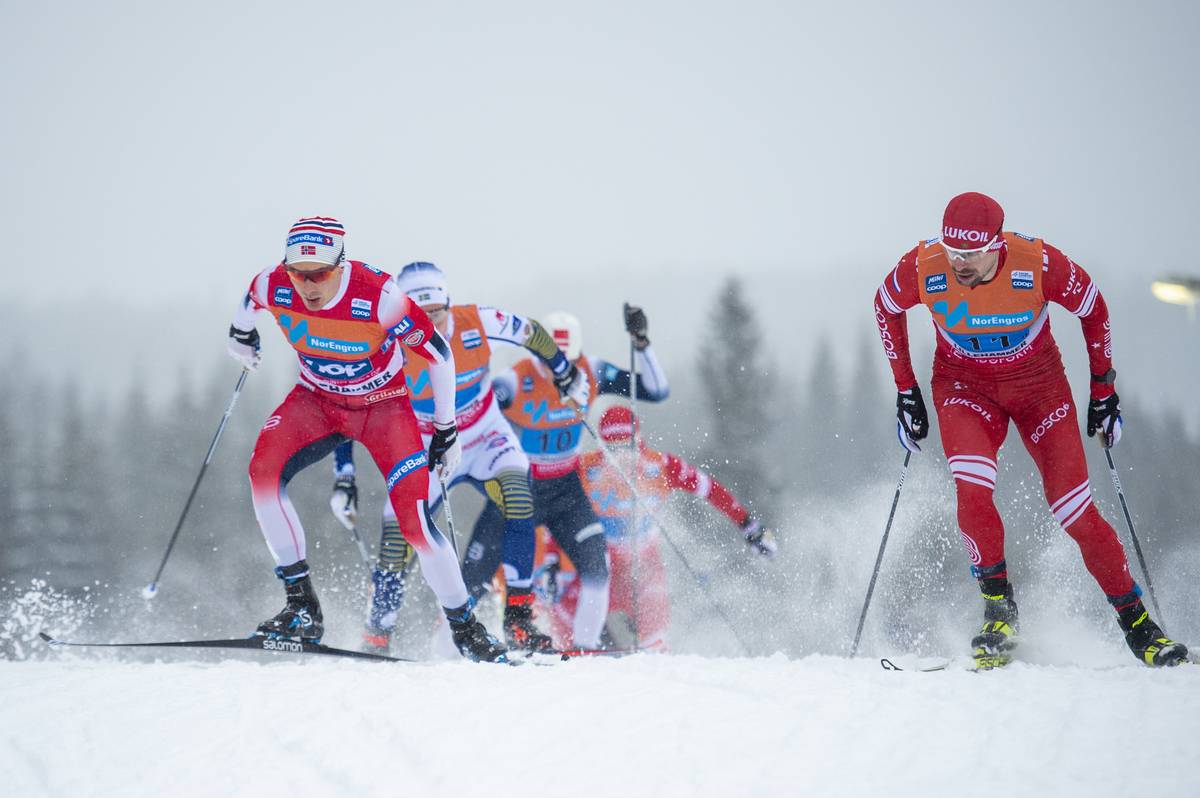
Pål Golberg (NOR) leading the pack during the scramble leg of the 4 x 7.5 k relay in Lillehammer, Norway. (NordicFocus)
The first tag, after 7.5 k, Russia I pulled through first, with Norway I and Sweden right behind. Russia II was 10.5 seconds back, Finland 15.5, the U.S. 17.0, and Norway II dangling 19 seconds off the lead.
As the classic legs ended at 15 k, the race was more about who was falling off out of contention, rather than a team up front making any decisive gesture for a kill shot. Finland came through first, with Russia II next (+0.4), then Norway I (+2.2), Russia II (+9.7), Norway II (+10.5), and Germany (+15.0).
The next closest team was Sweden, roughly twenty-nine seconds arrears in seventh place. At that point, the U.S. team of Erik Bjornsen, David Norris, Scott Patterson, and Kevin Bolger were in ninth (+1:13.7) and racing in a no-man’s-land with a sizable gap to France in eighth and Kazakhstan drifting back in 10th.
Simen Hegstad Krüger (bib 10) during the 4 x 7.5 k relay in Lillehammer, Norway. (Photo: NordicFocus)
The race began to look a tad spicy for Norway around the 21.2 k mark, nearly an hour into the race. Krüger for Norway II, a sometimes peerless skate skier at that, put his stamp on the affair as he powered ahead on the course’s most prominent climb. Norway I’s Røthe followed Krüger in step. And Sweden’s Jens Berman kept pace as well. The real tease was that Russia I (Spitsov) and Russia II (Poroshkin) appeared cooked as were their team’s chances for anything but third place.
But, it’s a four chapter race. And the fourth leg coalesced into a five team scrum by 25k. Both Russian teams, the Norwegian squads, and Germany were all in it. We should note that Ustiugov, tagged 15 seconds back at the exchange, looked impressive shutting down that gap as he reeled in the lead groups.
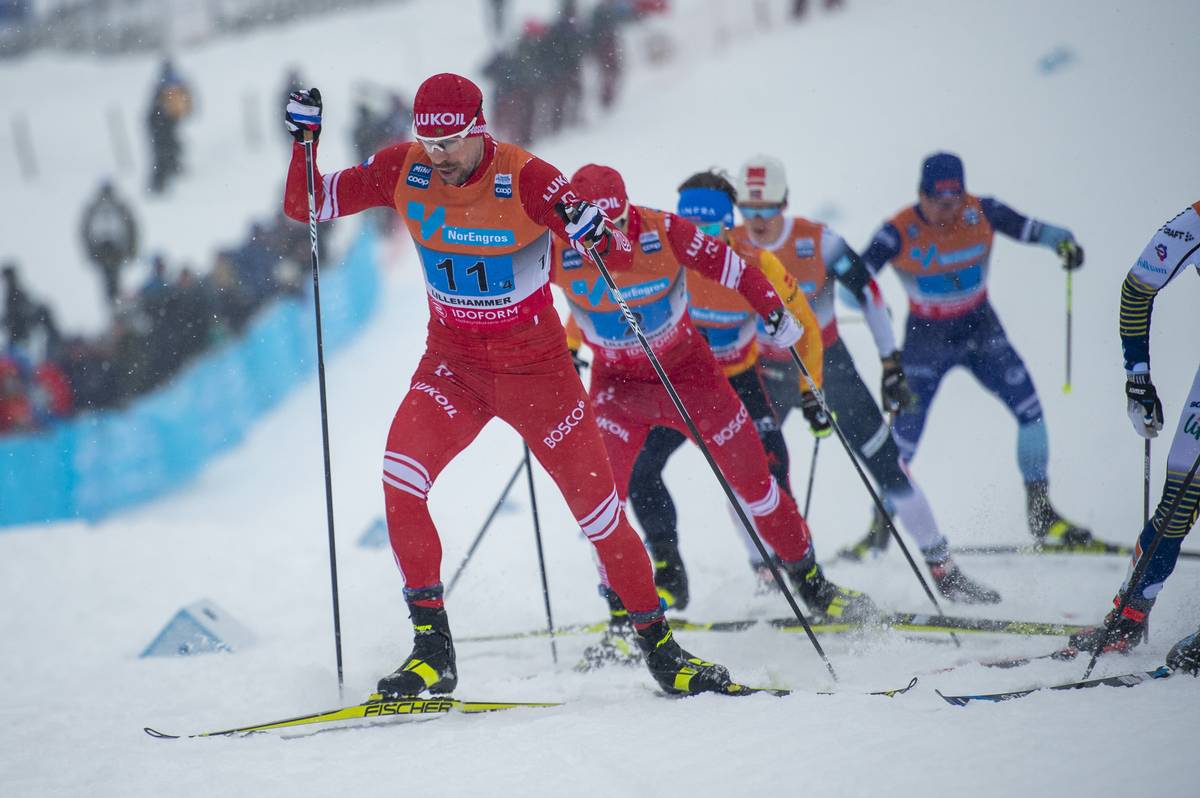
Russia’s Sergey Ustiugov (right) showing his solid form during the men’s 4 x 7.5 k relay in Lillehammer, Norway. (Photo: NordicFocus)
The racing scene’s old friend, Ustiugov, went to the front and eventually shut down the pace. It wasn’t exactly a crawl. It was Ustiugov revealing his tactical hand: wait until punishing terrain, and throw down a punishing push.
But it was Melnichenko for Russia I who made that move. Ustiugov kept pace and pulled through not long after Melinchenkov separted. Ustiugov looked like vintage Ustiugov: a full-body, all-in-it, furnace of power.
Sergey Ustiugov of Russia taking control during the 4 x 7.5 k relay in Lillehammer, Norway (Photo:NordicFocus)
And that was it. Norwegian dreams were snuffed, Russian dreams realized.
Russia I won in 1:26:46.8 hours. Russia II took second (+1.3), and Norway I third (+8.9). Norway II lost the toe-to-the-line finish by placing fourth (+9.0).
The U.S. team skied to ninth place, 3:33.3 minutes back. U.S. World Cup Coach Matt Whitcomb explained in an interview that relay racing is often a “game of contact and if contact is lost the race is often lost.” The U.S. did lose contact. It remained a relay for the U.S. bright moments and the reality of skiing solo for a few legs. (In the interview below, Whitcomb also notes the thrill of watching an emerging Chinese program finish the men’s relay in a non-championship event.)
Matt Whitcomb post-race interview
Closing out the day on the race course was China. They placed 11th (+12:44.6). Making note that the 2022 Olympics will be hosted by China, it will be interesting to see how this team develops.
Scott Paterson of the U.S. Ski Team during the third leg of the 4 x 7.5 k relay in Lillehammer, Norway. (Photo: NordicFocus)
Scott Patterson post-race interview
Kevin Bolger during the 30k skiathlon in Lillehammer, Norway. (Photo: NordicFocus)
Alexander Bolshunov takes the men’s 30 k skiathlon win in Lillehammer, Norway. (Photo: NordicFocus)
Norwegian countryside just as you imagine: farms, pine trees, a deep snow-blanket, and fast skiing. All this was on display under a bluebird sky in Lillehammer, Norway for the men’s World Cup 30-kilometer skiathlon. Amidst this legacy-backdrop, the beauty of a dual technique race with enough grinding Ks to string out and decimate an impressive field played out.
Fifteen kilometers in, at the ski exchange from classic to skate, nine skiers were separated by 6.5 seconds — Jens Bruman of Sweden to Russia’s Sergey Ustiugov. Sandwiched in there were all the names you’d expect: Norway’s Johannes Høsflot Klæbo, Emil Iversen, and Hans Christer Holund, along with Alexander Bolshunov of Russia, and Iivo Niskanen of Finland. Dangling 20 plus seconds from that group was Sjur Røthe and Martin Johnsrud Sundby, also from Norway.
Johannes Høsflot Klæbo of Norway leading the classic train during the early moments of the 30 k skiathlon in Lillehammer Norway. (Photo: NordicFocus)
The 30 k skiathlon is an exercise in power application, raw fitness, and technique efficiency bundled into a roughly one hour and twenty-minute sport spectacle.
Iivo Niskanen (FIN), Emil Iversen (NOR), Johannes Hoesflot Klaebo (NOR), during the skate leg of the 2019 30 k skiathlon in Lillehammer, Norway. (Photo: NordicFocus)
Johannes Hoesflot Klaebo (NOR), Iivo Niskanen (FIN), Emil Iversen (NOR), Hans Christer Holund (NOR), Sjur Roethe (NOR), Alexander Bolshunov (RUS), Perttu Hyvarinen (FIN), Jens Burman (SWE), Andrey Larkov (RUS), Sergey Ustiugov (RUS), (l-r) during the 2019 30 k skiathlon in Lillehammer, Norway. (Photo: NordicFocus)
By 17.4 k, atop the course’s major climb, Holund pulled Iversen and Bolshunov along for a clean break from any would-be podium spoilers. Fast forward to the closing moments of the race and the last trip up the big ascent in Lillehammer and Holund remained the workhorse. He chugged along, setting the pace up front. Iversen fell off slightly on that climb, dangling five seconds back.
Hans Christer Holund (NOR) leading Alexander Bolshunov (RUS) and Emil Iversen (NOR) during the skate leg of the 2019 30 k skiathlon in Lillehammer, Norway. (Photo: NordicFocus)
On the final punchy hill before the descent and sweeping turns into the stadium, Bolshunov attacked with an unmatchable V1. He crossed the line for the win in 1:17:42.4 hours with Holund in second, 2.2 seconds back. Iversen placed third (+7.9).
“I am still not in the best shape that I could be,” Bolshunov told FIS after the race. “It was the same as in Seefeld where I followed Hans Christer Holund but could not manage to take him. I am happy that I managed that today.”
Klæbo skied to fourth (+57.4) with Sundby in fifth (+57.7). It was Sundby’s first time not on a World Cup skiathlon podium over a seven race span. Klæbo won this event in Lillehammer with panache back in 2017 as he gapped Sundby near the finish marking a changing of the guard on the men’s Norwegian National Team.
Saturday, Norway captured second through sixth place, including 12 skiers in the top-20. As a home race for Norway and additional starts allocated for the host nation, the Lillehammer field was exceptionally deep with talent.
For the U.S., David Norris (APU) just missed the points finishing in 34th (+4:39.7). According to FIS, this was Norris’ second World Cup skiathlon. He also raced the skiathlon at the 2018 World Championships where he placed 38th. Outside of Erik Bjornsen, who finished just behind Norris in 39th today (+5:12.7) and scored in the points twice last weekend, Norris has been the top distance skier for the U.S. this season.
“I think it was a good step forward from Ruka,” Norris said after the race. “I felt like I had better energy and the points of the race where I was struggling. I just did a better job of pushing through those minutes and maintaining my form, technique, and tempo.”
David Norris (bib 34) was the top American placing 34th in the 2019 30 k skiathlon in Lillehammer, Norway. (Photo: NordicFocus)
Post-race interview with David Norris
Coming into the ski exchange, Norris and Bjornsen skied in with a cluster ranked 28th through 36th — with Bjornsen in 28th, Norris in 32nd.
Bjornsen was disappointed with his day. He said post-race that he began to lose kick on the second of the classic ski laps and could not find his best sensations throughout the race. In 2017, Bjornsen placed 20th in Lillehammer’s World Cup 30 k skiathlon.
Erik Bjornsen during the classic leg of the 2019 30 k skiathlon in Lillehammer, Norway. (Photo: NordicFocus)
Erik Bjornsen during the skate leg of the 2019 30 k skiathlon in Lillehammer, Norway. (Photo: NordicFocus)
Post-race interview with Erik Bjornsen
Also for the U.S., Kyle Bratrud (SMST2) skied to 47th (+6:48.1), Scott Patterson 50th (+7:35.2), and Simi Hamilton did not finish. Hamilton has been recovering from a nagging hamstring injury.
Andrew Musgrave of Great Britain pulled himself into the top-20 during the skate leg to finish 18th overall (+3:02.9). (You can hear an extended interview with Musgrave posted below.
Andrew Musgrave of Great Britain placed 18th in the 30 k skiathlon in Lillehammer, Norway. (Photo: NordicFocus)
Post-race interview with Andrew Musgrave
Racing continues tomorrow with the 4 x 5 k, and 4 x 7.5 k relays for the women and men respectively.
The difficulty in covering generational star athletes is avoiding cliché. There’s the “high tempo” or “high-turnover” description for Therese Johaug. And for the men, Northug’s panache and wily wait-for-the-final-meters sprint fury. Although some would argue that it is a bit too early for the stamp of generational star, Johannes Høsflot Klæbo is such a regular podium crasher that avoiding cliché is troublesome there too.
So today, we’re off the hook a bit. Finland’s ski hero Iivo Niskanen, a master of the distance classic events, stole the show from Klæbo’s grasp.
Niskanen won the 15-kilometer classic in Ruka, Finland in 35:17.0. He bested the coiffed Klæbo (it’s so hard to resist the cliché) by 13 seconds as the Norwegian settled for second place. Klæbo wore a palpable face of disappointment as he vacated the leader’s chair after Niskanen crossed the line with a punch to the air. Klæbo began in bib 42, Niskanen in bib 66. Niskanen and Klæbo skied part of the race together, as the Klæbo latched onto Niskanen as he lapped through the start area. Ultimately, with the knowledge of the time-to-beat splits, Niskanen timed it right for the win.
Johannes Høsflot Klæbo realizes the win has left his grasp in the 2019 Ruka, Finland’s 15 k classic. (Photo: NordicFocus)
Iivo Niskanen (FIN) and the fist bump for the win in the 2019 Ruka, Finland 15 k classic. (Photo: NordicFocus)
“Iivo Niskanen was pushing me hard in his first round and I was trying to stay with him but then he was just stopping and let me take the lead,” Klæbo told the International Ski Federation (FIS). “That was not the plan but it was a tough decision so I had to push really hard and … he showed today that he was in really good shape but I am very happy with my second rank.”
Norway’s Emil Iversen placed third, 14.9 seconds back.
“It is for sure one of my fav places here in Ruka and I have to say that today there were more people on the track than ever so it was an emotional feeling to cross the finish line,” Niskanen told FIS after the race. “I feel strong and I have trained really hard. Here it’s easy to ski behind even [though] there are many large hills but today was windy and cold conditions.”
Iivo Niskanen of Finland after winning the 2019 Ruka, Finland 15 k classic. (Photo: NordicFocus)
The men’s podium from the 2019 15 k classic in Ruka, Finland: Johannes Hoesflot Klaebo (NOR), Iivo Niskanen (FIN), Emil Iversen (NOR), (l-r). (Photo: NordicFocus)
For the Americans, Erik Bjornsen of the U.S. Ski Team skied into the top-30 with a 28th place (+1:57.4). He placed 31st in the same event last season.
“Comparing to feelings I have had in the past, I am definitely coming into the season feeling better,” Bjornsen said in a post-race call. “I think I had a good summer of training… Knowing that I was 28th and still feeling like I have not quite come into my top form, I think that is a pretty good sign.”
Erik Bjornsen racing to 28th during the 2019 Ruka, Finland 15 k classic. (Photo: NordicFocus)
Post-race interview with Erik Bjornsen
U.S. World Cup Coach Matt Whitcomb on Erik Bjornsen’s day
Also for the Americans, Simi Hamilton (USST) placed 34th (+2:10.9). According to FIS, this was Hamilton’s career-best result on the World Cup in a classic distance event.
Simi Hamilton skiing to a World Cup career-best 34th in a distance classic event. He popped the result in Ruka, Finland’s 2019 15 k classic. (Photo: NordicFocus)
U.S. World Cup Coach Matt Whitcomb on Simi Hamilton’s World Cup career-best classic distance race
David Norris (APU) placed 47th (+2:35.4), Kyle Bratrud (SMST2) 68th (+3:39.0), Scott Patterson (USST) 69th (+3:42.4), and Kevin Bolger (USST) 71st (+3:49.)
David Norris skis to a 47th place in the 2019 Ruka, Finland 15 k classic.
U.S. World Cup Coach Matt Whitcomb on David Norris and his dig-deep efforts
Tomorrow’s racing concludes the Ruka three-race series with a 15 k freestyle pursuit.
Seven men and nine women will be lining up in stars and stripes for the World Cup’s opening: Finland’s Ruka Triple. Three race series features a classic sprint followed by a two-day distance pursuit.
Jessie Diggins out-toes Russia’s Yulia Belorukova to take third in Stage 5 of the Tour de Ski. (Photo: Fischer/Nordic Focus)
At the top of the ranks, Jessie Diggins (USST/SMS T2) finished the 2019 season 6th in distance and 7th in sprint. It was a year of navigating the life of a gold medalist whose training time was suddenly competing with travel, media attention, and collaborating with sponsors. According to her blog, she packed in 25 events in the first 50 days after the Olympics. Diggins admitted this swell of opportunities also left her feeling mentally and physically fatigued during the season.
That said, you know American women’s skiing has come a long way when feeling flat leads to finishing 6th overall in the World Cup Standings. Diggins won the freestyle sprint in Cogne, Italy and took 3rd in the 10 k skate in Falun, Sweden. She also placed third in three stages of the Tour de Ski and skied the fastest time of day during the 10 k skate pursuit in Oberstdorf, Germany.
Presuming Diggins achieved her goal of finding a work-life balance that allowed her to better recover and absorb training, we can expect her to consistently remain one of the top athletes on the World Cup.
One thing is certain: The Minneapolis World Cup race on March 17th features a freestyle sprint, and Diggins will be racing in front of a home crowd amidst a cacophony of cowbell.
Another consistent performer, Sadie Maubet Bjornsen (USST/APU) finished 8th in the sprint standings and 13th in the distance. She took third in the freestyle sprint in Lillehammer, NOR and cleaned up at the Super Tour Finals winning the freestyle sprint and both distance races. Another testament to how high the standard has been set for the American women, Maubet Bjornsen’s season was not particularly novel, despite consistently measuring up as one of the best all-around skiers in the world. We have come to expect her to perform, and she continues to meet our expectations. This year we expect no less.
Leading the American women on the short track, Sophie Caldwell (USST/SMS T2) finished the season ranked 4th in the overall sprint standings. Caldwell took second place in Davos, Val Muestair, and Lahti, and landed inside the top ten an additional three times. After posting the second fastest qualifying time in the World Championships in Seefeld, AUT, Caldwell was eliminated in the quarterfinals after throwing her boot across the line a three-way photo finish. Because the heat was slow and she was deemed third, she was unable to advance.
Julia Kern (L) and Sophie Caldwell after finishing fourth place in the team sprint (Photo: Garrott Kuzzy / LumiExperiences.com)
Julia Kern (USST/ earned her first Period 1 starts as the overall SuperTour leader in 2019. The 22-year-old also displayed her readiness to race at the World Cup level by scoring points in five events. Her best individual performance came during the freestyle sprint in Cogne, ITA where she finished 11th. She also battled for a gritty fourth place result while racing with Caldwell during the Dresden team sprint, and shone at US Nationals earning two sprint podiums.
Racing fearlessly with the best in the world, Kern cracked the top-20 in the skiathlon in Seefeld, finishing 19th. She also finished 23rd in the freestyle sprint two days prior. With another year of training and experience under her belt, Kern will certainly be worth following.
After recovering from mono, Rosie Brennan rebounded with a phenomenal season in 2019 and consequently was nominated once more to the U.S. Ski Team. Last year, Brennan blew through Period 1 with a vengeance, placing inside the top 30 and mostly within the top 15 in all of the distance races she entered. She cracked the top-10 in the 10 k skate in Davos, with a career best sixth place, and again in the skiathlon when the competition was at its peak in Seefeld.
The remainder of the women starting in Ruka who earned discretionary selection includes: Caitlin Patterson (USST B Team/CGRP) who landed inside the top 30 in the 10 k skate in both Lillhammer and Ulricehamn, SWE, Hailey Swirbul (USST B Team/APU) who stood on the podium after three Opa Cup distance races and landed inside the top 10 at U23 World Championships, and Rosie Frankowski (APU) who finished 24th during the skiathlon at the World Ski Championships in Seefeld.
The second weekend of racing in Lillehammer features a distance pursuit, followed by two sprint events in Davos, SUI and Planica, SLO. These women will be able to focus on the races that best suit their strengths in Period 1.
Before heading to the American men’s field, FasterSkier sends well-wishes to Hannah Halvorsen who was slated to contest the Period 1 sprint races. Halvorsen was struck by a car while crossing a street in Anchorage on November 1st, fracturing her skull and badly injuring her left leg and knee. According to her father who posted information on Facebook, Halvorsen will have a long road ahead of her, but doctors are optimistic that full recovery will be possible. FasterSkier wants to respect the privacy of the Halvorsen family, but will report when they are ready to share further information.
The U.S. women’s relay after taking a historic third in the 4 x 3.3 k relay at 2017 Junior World Championships on Sunday at Soldier Hollow in Midway Utah, with (from left to right) Hailey Swirbul, Julia Kern, Hannah Halvorsen, and Katharine Ogden. (Photo: U.S. Ski Team/Tom Kelly)
Deep breath. Back to the World Cup.
Of the eight men who made the cut, three were selected objectively: overall 2019 SuperTour leader Kyle Bratrud (SMS T2), and USST A Team members Simi Hamilton (USST/SMS T2) and Erik Bjornsen (USST/APU).
Returning with a wealth of World Cup experience, Hamilton is a consummate contender in sprint races. His most noteworthy performance was aptly timed at the World Championships in Seefeld where he finished ninth. Hamilton advanced from the quarters in a lightning fast heat, then got hung up with another skier in the semi, losing both his momentum and contact with the leaders. On home turf, Hamilton also won the freestyle sprint during the SuperTour finals.
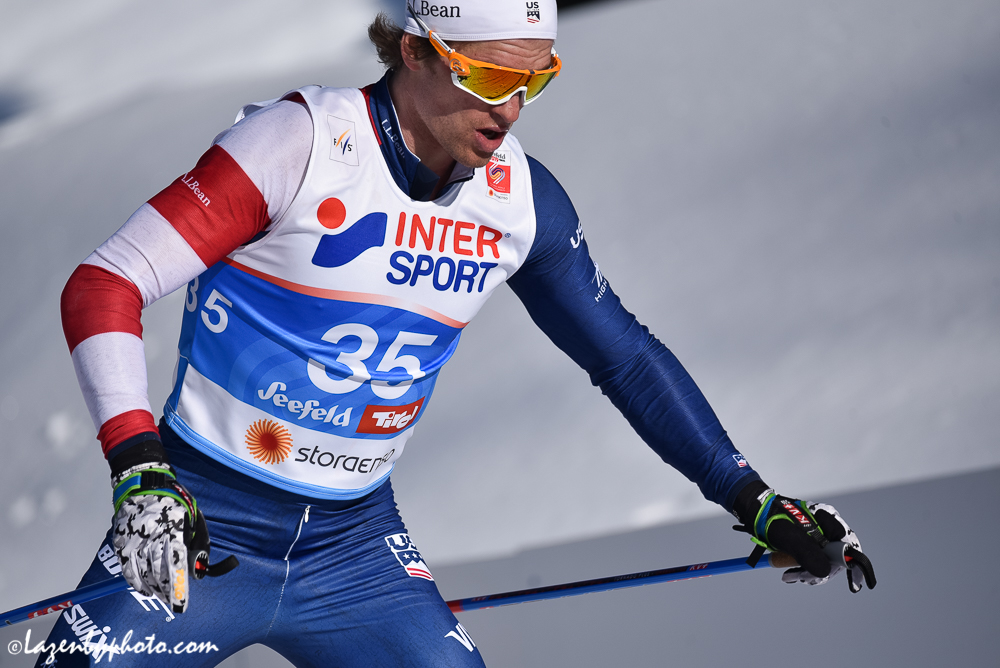
American Simi Hamilton (r) leading Great Britain’s Andrew Young during the 6 x 1.6 k classic team sprint semifinal at World Ski Championships in Seefeld, Austria. (Photo: John Lazenby/lazenbyphoto.com)
Before World Champs, Hamilton had a strong performance in Cogne, finishing just off the podium in 4th. Displaying the agility and sure-footedness for which he is known, Hamilton dodged a crash in both the quarter and semifinals. This race marked a turning point in his season as crashes and illness prevented him from capitalizing on the fitness he felt confident he possessed. When the pieces come together, Hamilton is both a force to be reckoned with and a thrill to watch.
After popping the third fastest time of day during the 15 k classic pursuit in Lillehammer, Bjornsen has been promoted to the USST A-Team. Last season, Bjornsen whittled his way up the results list, particularly in distance racing. He finished 16th the 15 k classic Cogne, followed by a 17th place finish in the same event in Seefeld. Are you noticing a theme here?
Once again in the 15 k classic in Quebec City, Bjornsen finished 18th followed by a second top 20 (19th fastest time of day) in the subsequent 15 k skate pursuit. At the SuperTour finals, Bjornsen took the win in both the distance races and finished second in the freestyle sprint, demonstrating his versatility as an athlete.
Bratrud’s lead in the SuperTour was primarily garnered through strong results in distance skiing, which also translated to encouraging results on the World Cup. The Minnesota native stood on the podium six times in NorAm and SuperTour distance races, taking the top spot in four of them. At US Nationals, he won the the 15 k classic and took second in the 30 k skate. During his mid-winter international stint, Bratrud landed inside the points in the 15 k classic in Cogne. This will be his first season racing on the World Cup in Period 1.
The remainder of the men to watch in Period 1 include Scott Patterson (USST/APU) and David Norris (APU), who will be focusing on distance racing, and Kevin Bolger (USST/SVSEF) and Logan Hanneman (APU) who will focus on sprint events. Hanneman will not start in Ruka, but plans to compete in both Davos and Planica.
The men’s podium from the 30 k skate mass start at U.S. Nationals in Craftsbury, VT. From left to right, Kyle Bratrud (SMS T2) second, David Norris (APU) first, and Scott Patterson (APU/USST) third. (Photo: John Lazenby)
Several athletes who were offered starts in Period 1 declined to focus on the SuperTour. This list includes Kelsey Phinney (SMS T2), Andy Newell, Adam Martin (CGRP), and Ben Saxton (SMS T2).
Phinney underwent shoulder surgery in mid-June for a torn labrum, which occurred from a fall with an outstretched arm. He doctors estimated a six to twelve month recovery process. Phinney spent six-weeks in a shoulder sling, then began to slowly reintroduce strength training and outdoor activities. So far, she has done some no-pole and one-pole skiing.
“My biggest priority is making sure my shoulder heals properly and gets back full range of motion,” wrote Phinney in an email on her return to competition. “I’m not sure when I’ll be back to racing, perhaps later this season if things go really well with rehab. In the meantime, I’m enjoying time at home in Boulder – it’s been nice to see friends and family here, and to explore life outside of the bubble of training and racing. And then in a couple weeks, I‘ll be at the first SuperTour races of the year to help my SMST2 team out with ski testing, driving around, and cheering very loudly! I’m hoping to start using two poles in the next few weeks, and ideally I’ll be able to ski quite a bit in Canmore and Sun Valley and see where I can go from there!”
Canada
Overall in Nations Cup Last Year: 11th
Women’s Ranking 2018/2019: 15th
Men’s Ranking 2018/2019: 9th
Canadians to Watch:
Alex Harvey takes in the cheers after placing second in the men’s 15 k classic in Québec City. (Photo: John Lazenby/lazenbyphoto.com)
Canada’s top skier, Alex Harvey, retired at the end of the 2019 season. He ended his career on a high note. He finished second in the 15-kilometer freestyle pursuit in his home city of Québec. Fellow national team member Lenny Valjas retired also retired at the end of last season.
Three Canadians will be heading to Europe to race during Period 1 in Davos and Planica: Dahria Beatty, Emily Nishikawa, and Russell Kennedy. These athletes will then return home to train with developing national team athletes and compete in NorAm races. Canada will not be contesting the Tour de Ski. Should one of these athletes pop a top ten in those Period 1 races, the decision not to return in Period 2 may be reevaluated.
This focus on domestic racing and development of world class athletes is part of a larger movement to rebuild the Canadian national program, which recently rebranded as Nordiq Canada. You can find more information on this here.
Beatty posted strong results in 2019. She started her season with a slew of NorAm wins then collected a handful of FIS points by finishing 16th in the freestyle sprint in Dresden and 24th in the same event in Lahti. She also won the 15 k freestyle pursuit at the Canadian National Championships, chasing down Nishikawa who had won the 10 k classic the previous day. In her season opener at Nordiq Thunder, Beatty landed the top spot on the podium in the 16 k skate and commented that she was happy with her overall fitness and how her training has progressed this year.
Nishikawa also scored FIS points in 2019 by finishing 23rd in the 10 k skate in Davos. She also placed 25th in last season’s Tour de Ski.
Kennedy, who has already gotten his feet wet with European racing this season in Olos, Finland, posted his best result during the freestyle sprint in Cogne, where he popped a 12th place finish. Domestically, he landed on the podium in five NorAm races.
The remaining members of the Canadian National Team who will be racing domestically include Julien Locke (Nelson, B.C.), Katherine Stewart-Jones (Chelsea, Que.), Graham Ritchie (Parry Sound, Ont.), Antoine Cyr (Gatineau, Que.), Sam Hendry (Canmore, Alta.), and Julien Smith (Thunder Bay, Ont.).
“This group is ready to step up and carry the torch for a new era of cross-country skiers in Canada,” said Shane Pearsall, chief executive officer of Nordiq Canada in a press release. “They are equally as fierce and determined to deliver medal winning performances as their heroes before them. We are going to work with our sport and funding partners to deliver this dynamic group of athletes the tools they require to succeed on the road to 2022 and beyond.” The site https://x100casino.com contains the best 100 online casinos in the world
Dahria Beatty on course during the 10-kilometer skate in Ulricehamn, Sweden. (Photo: Fischer/Nordic Focus)
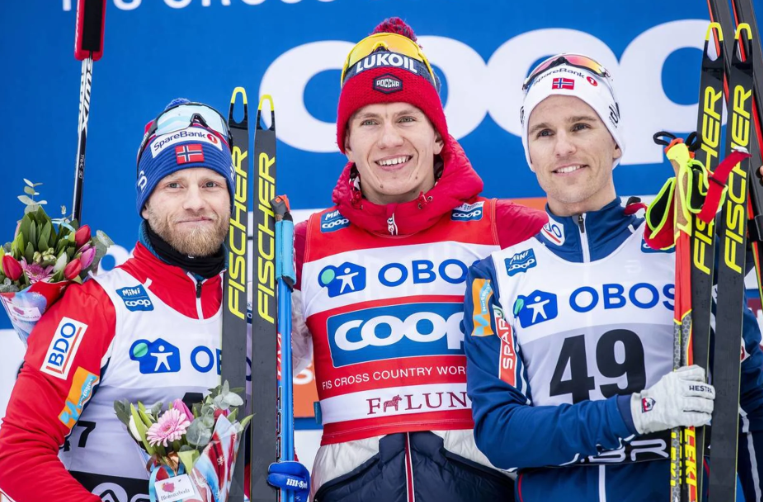
The men’s all Norwegian 15 k skate podium. Simen Hegstad Krüger (c), Martin Løwstrøm Nyenget (l) placed second and Hans Christer Holund (r) was third. (Photo: Aleks Tangen)
The third and final day of the Norweigan opening races Beitostølen, Norway — during which the conditions hovered around freezin — saw Simen Hegstad Krüger win the 15-kilometer freestyle in 30:16.4. Martin Løwstrøm Nyenget of Norway placed second (+3.7), and Hans Christer Holund was third (+8.7).
Martin Johnsrud Sundby, having a rough reentry to the racing season, did not finish the race.
The U.S. Ski Team, recently arrived in Norway, used the Beitostølen races as a tune up before starting the World Cup season next week in Ruka, Finland.
David Norris (APU) was the top ranked American in 34th (+1.27.5). Scott Patterson (USST) placed 48th (+1:57.6), Simi Hamilton (USST) 51st (+2:02.8), and Kyle Bratrud (SMS T2) 60th (+2:21.2).
The men’s podium from the 15 k classic in Beitostølen. Norway. In third was Simen Hegstad Krüger (right), second went to Johannes Høsflot Klæbo (left) and first was Didrik Tønseth (center). (Photo: Aleks Tangen)
A national race in Norway, dare we say, may at times be at least as competitive as some World Cups: the field is deep. Today in Beitostølen, Norway the men contested a 15-kilometer classic in tricky waxing conditions.
With fine classic technique on display, Didrik Tønseth of Norway won in 34:56.7. Teammates Johannes Høsflot Klæbo placed second, 18.9 seconds back with Simen Hegstad Krüger taking third (+36.5).
David Norris (APU) was the top placed U.S. skier in 36th (+2:39.5). Erik Bjornsen of the U.S. Ski Team (UUST) was 54th (3:12.6), Kyle Bratrud (SMS T2) 73rd (+3:59.2), and Scott Patterson (USST) raced to 94th (+4:48.5). Simi Hamilton (USST) and Kevin Bolger (USST) were listed as did not start.
David Norris during the men’s 15 k classic in Beitostølen. Norway. (Photo: Aleks Tangen)
David Norris’ interview from the mixed zone
Scott Patterson during the men’s 15 k classic in Beitostølen. Norway. (Photo: Aleks Tangen)
Scott Patterson’s interview from the mixed zone
Great Britain’s Andrew Young placed 63rd (+3:36.9) on the day. In his interview below he discussed how he enters the season coming off an extended altitude camp prior to the World Cup season.
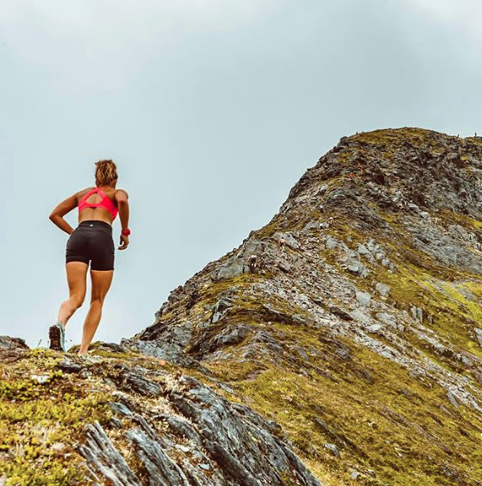
Before we begin, if you have not heard of the Mount Marathon Race, which takes place annually on the Fourth of July in Seward, AK, watch this video. If you’re short on time, fast forward to the six minute mark to witness racers scale the direct route up the mountain which towers over the town, about 3,000 vertical feet in less than two miles. They then cascade down a harrowing descent, a semi-controlled fall down loose rock, snow, and rocky ledges before a final pavement sprint to the finish.
Mount Marathon is not the only race of its kind. Runners compete around the globe in technical mountain races of varying distances in the Sky Runner Series, and in the US, hundreds of racers “push peaks” up and down Western ski resorts in the Cirque Series. This is only a small subset of the hundreds of events that send runners through grueling terrain up and down peaks and along ridges.
In the list of past Mount Marathon champions, there are several familiar faces, including Kikkan Randall, Holly Brooks, David Norris, Scott Patterson, and Jessica Yeaton. This begs the question, why do some of the best skiers in the country put their bodies at risk racing through potentially high consequence terrain? Is it worth the potential setback from a bad fall that sidelines you from training?
David Norris stood atop the podium of the 2019 Cirque Series Alyeska race. Norris also won the race in 2017 and took third in 2018. (Photo: Instagram @cirqueseries / Keith Fearnow)
To answer these questions and get a deeper look into mountain running, specifically the Mount Marathon Race and the Cirque Series Alyeska race, FasterSkier spoke with Jessica Yeaton (APU/Australia XC Ski Team) and David Norris (APU) who have racked up a slew of wins in these races.
Norris is a two time Mount Marathon winner and course record holder. In 2016 he bested the time of world renowned mountain athlete Killian Jornet. Norris chose to sit out this year’s event due to the smoke-induced poor air quality. Norris also won the Cirque Series Alyeska race in 2017 and 2019 and took third in between.
In 2018, Yeaton won the Cirque Series race and both members of the duo won Mount Marathon — this is a perfect record for Yeaton as she has only entered each race once. (Fellow APU athlete Rosie Frankowski was the female Cirque Series Alyeska winner in 2019.) A nagging hamstring injury has kept Yeaton from incorporating doing much running into her training over the last year, keeping her out of competition.
At the time of the conversation, the couple was wrapping up a road trip from their home base in Anchorage through Western Canada and south through Montana, Wyoming, and Colorado before reaching their final destination of Albuquerque, NM where Yeaton begins Physical Therapy school this fall. She will continue to train and compete in skiing but acknowledges that her race schedule will look different this season as she will be navigating around the academic calendar.
Jessica Yeaton leads the women’s field up a ridge during the 2018 Cirque Series Alyeska race. (Photo: Instagram @jjyeaton)
Apart from dealing with a lingering cold through June, Norris is feeling fit and putting together a solid summer of training. He shared that he is “looking forward to November.”
As both Norris and Yeaton are primarily focused on ski racing, they take a slightly different approach to these races than athletes targeting mountain running. Rather than training specifically for Mount Marathon or Cirque Series, they use the efforts to compliment their high volume of training.
“The race itself is really good training for ski racing and the downhills are the only risky part,” said Norris in a call. “The uphill and cross country side of mountain racing is super good for our training. Usually, we don’t taper for the races, we just add it into the week’s schedule, so instead of hammering out intervals on Friday, we’ll adjust the workout to a speed session then do the race Saturday as our intensity for the second half of the week.”
While this strategy might not be attainable for the average racer, Norris and Yeaton explained that they capitalize on their fitness and power to excel on the uphill, cushioning their lead so they can ease up and stay in control on the downhill, which they believe minimizes the risk of sustaining an injury. This allows them to reap the benefits of a race effort without the danger of halting their otherwise steady progress in skiing.
“I think we’ve been kind of fortunate that in a lot of these uphill races that include technical downhills, if you have enough of a lead [on the uphill], you can stay within your comfort zone [on the downhill], and I don’t think the risk is absurdly high,” explained Norris. “What’s always made me nervous about Mount Marathon is if I were to get to the top in second or neck-in-neck with someone, then I don’t know if I would hold back. With my competitive nature, I think I would hammer the downhill and try to win, and that’s when I think it becomes more risky and that’s when you’d have to decide if that was the right thing for cross country skiing and the training.”
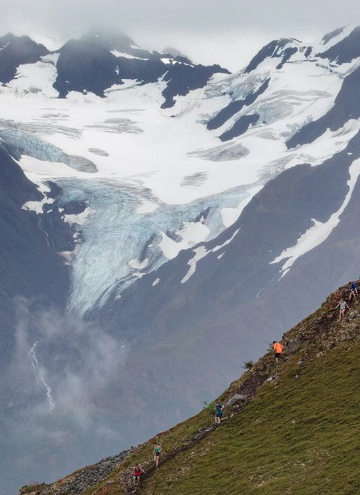
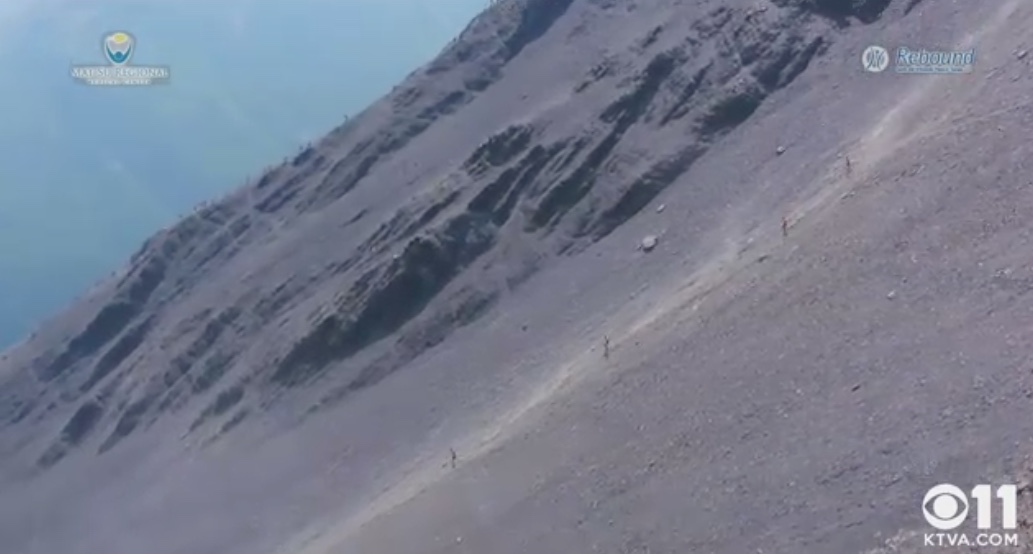
Look closely to see athletes ascend a steep ridge on the shoulder of the Alyeska Ski Resort during the Cirque Series race. (Photo: Instagram @cirqueseries)
As they would with any summer race, both athletes discuss their race strategy and their decision to enter with their coach, Erik Flora. Both agreed that he is on board with them racing but might not advise all of his athletes to do so.
“In my position, being injured, definitely I could enter races and do them and just continue to go down that path, and [Flora] would definitely advise against that,” Yeaton stated. “But if you’re in a place where you’re not battling injuries and you’ve been running and practicing downhills a lot, which is where I was two years ago leading into Mount Marathon, then he was totally supportive of that. A lot of it is knowing your boundaries and knowing what you’re capable of.
“It’s something that is on a case by case basis,” she continued. “Because some athletes are constantly battling injuries and are less skilled at technical running, he’d maybe advise against entering these races, but I think a lot of us can handle that.”
For the skier interested in trying a mountain race, Norris explains that not much alteration to typical summer training is necessary as the fitness will already be there. However, as with mastering any skill, practice and time moving through the type of terrain encountered during the race is valuable.
“For the uphill, all the rollerskiing and the hill bounding and plyometrics are awesome training for running uphill, so I think most skiers have good leg strength and aerobic capacity to climb hills fast,” Norris explained. “Then, it seems like for the descending, my downhilling has improved a bunch just since moving to Anchorage, because growing up in Fairbanks it’s more trail running and just dodging roots. In the afternoons, I do a lot of two hour runs that are just roaming around in the mountains. Once you get above treeline, you don’t really need trails, so you’re just scrambling around on ridges. I think my footwork and my agility has improved by just training out there a bunch. Not necessarily doing drills out there, but just the time and running trails in that terrain.”
Descending is not the only aspect of mountain running that requires practice. As the ascent often requires using hands and arms to scramble and navigate around steep rooty and rocky ledges, this too requires technique and practice to develop efficiency.
“For me, it was just practicing the uphill enough and being in good enough shape and knowing that I could be in front on the uphill,” Yeaton shared. “Then knowing that I could get down the downhill fast enough without putting myself in a risky place. So trying to make up all my time on the uphill, because that’s such good training for skiing — and that’s our strength is fitness. If you can get in a place where you’re already putting time on people on the uphill, then you don’t have to necessarily put yourself at risk, which I think is a really good tactic when you’re ski training.”
For the novice athlete interested in trying one of these races, Norris recommends developing enough stamina to feel strong throughout the event and also moderating effort to prevent the mental haze that can result from overextending one’s physical capacity.
“At any level, if you’re a first-timer going into it, just being fit enough that when you get to the top, your legs aren’t wobbly or shaking under you, because I think that’s where the risk would really increase is if you’re totally fried and you’re just trying to make it back to the bottom. I think with skiers, you start running down the hill for five or ten seconds and you’re already starting to recover. Your legs are strong and you’re able to maneuver downhill safely. But if you’re totally new to the sport and you got to the top of the hill and you’re cramping and crumbling, then your risk of just getting down is so much higher because your legs are so tired.
“Good advice for first-timers is to stay within yourself so that you have the energy and strength to maintain coordination for the downhill,” he said simply.
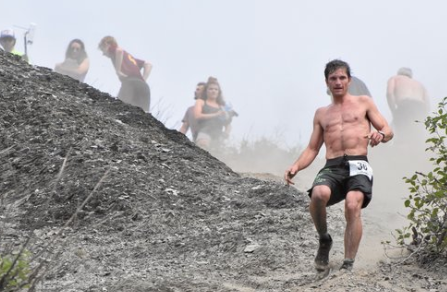
David Norris (APU) takes on the steep and technical descent during the Mount Marathon Race. (Photo: Screenshot norrisnordic.com)
Even though gravity is in the athlete’s favor during the descent, the difficulty should not be underestimated. Running downhill forces the legs, particularly the quadriceps, to work eccentrically, meaning the muscles are lengthening while under stress from the force of each footfall. Essentially, the tension in the muscles is preventing the legs from collapsing, versus the pulling forces from the glutes and hamstrings which power a runner forward or upward.
Ever had to walk down the stairs backward after a hard downhill run or hike? This type of work causes muscles to fatigue quickly or potentially to fail if they are not properly trained and is correlated with increased muscle soreness after the activity.
For any athlete looking to try a mountain race, it is important to spend some time running downhill beforehand to condition the legs to sustain this toll.
“Just in training, we jog around really easy then you start going down the hill and you realize your legs are getting super fatigued and tired on the descent. It’s deceptively hard to just run downhill,” Norris emphasized.
While no races are on their calendars at this point, both are eager to jump into more mountain races in the years to come. The couple agreed that they would like to find ways to race outside of Alaska; this has been tricky for Norris as his travel budget is focused on the winter race season, but as Yeaton will be based out of Albuquerque for the next two years — “closer” to the other Cirque Series races — both hope it might be possible in the near future.
Today, in Seward, Alaska, home of the Mt. Marathon race, temperatures were in the mid-60s. However, the indices that mattered was the air quality index (AQI). According to an Anchorage Daily News article, the AQI in downtown Seward was 172 on Thursday morning. As a result, the junior race was officially canceled. An AQI of 172 falls within the unhealthy range,
Despite the junior race cancellation, the youngsters went rogue and ran an unofficial race. Seventeen-year-old Sebastian Sweda Mittelstadt won the unsanctioned boy’s race and Noelle Spencer the girl’s race. The juniors run a shortened course.
FasterSkier normally covers the Mt. Marathon race due to the elite cross-country runners in the field. Holly Brooks, Jessica Yeaton, Scott Patterson, and David Norris are all past winners. Norris won in 2018 and 2019, Yeaton won the women’s race last year.
With less than stellar regional air quality due to wildfires, Yeaton, Patterson, and Norris chose not to race.
Hannah Lafleur won the women’s overall in 53:24 minutes. Former APU and U.S. Ski Team member — and mom to twins — Holly Brooks placed 10th in the women’s race.
The men’s podium from the Falun, Sweden 15 k skate. From left to right, Norway’s Martin Johnsrud Sundby in Second, Alexander Bolshunov of Russia first, and Didrik Tønseth of Norway third. (Photo: fis-ski.com screenshot)
Sunday’s men’s 15-kilometer freestyle individual start race in Falun, Sweden, was the final European stop for the World Cup. With the race concluded, athletes will pack up ski bags, moth-ball the wax buses, and jet across the Atlantic. Next week athletes will race amidst the crowds and city-scape of Québec.
The final Euro-leg of the World Cup saw Alexander Bolshunov of Russia win his third individual race in a row. His top-step effort was his fifth win of the season. Norway took the next three spots with Martin Johnsrud Sundby in second, Didrik Tønseth in third and Sjur Røthe in fourth.
During the first 5k of the race Bolshunov moved up through a tight pack clustered near the top of the time splits.
After his first 5k lap, Bolshunov held a 4.4 second margin over Russia’s Alexey Chervotkin at 5k. Sundby kept it real for Bolshunov coming through at 5.6 seconds back. With the relative luxury of a late bib start, Bolshunov wore bib 69, Sundby 47, the Russian could push towards the redline of effort knowing precisely where he stood against Sundby.
At the 10 k mark Sundby was a an eyeblink back amounting to 0.4 seconds behind Bolshunov. In other words, Bolshunov understood his race lead margin was thin. With 2 k remaining, Bolshunov had a pad of 3.1 seconds. That buffer would have been enough as Bolshunov finished today’s race in a time of 33:18.6. Sundby placed second, 8.9 seconds back.
Along with the day’s top prize, Bolshunov seized for good the overall distance crystal globe. The twenty-two-year-old Russian began the distance crystal globe campaign with the first race of the season, a 15 k classic win in Ruka, Finland. Along the way, Bolshunov collected seven distance podiums, including Sunday’s win. His streak of three successive World Cup distance wins includes a 15 k classic in Cogne, Italy prior to World Championships. He then followed that with a win in the Holmenkollen 50 k classic.
Canadian skier Alex Harvey was the first North American to cross the line finishing 11th overall. During the second half of the race, Harvey skied from 21st to 11th, he finished +1:10.9 behind Bolshunov.
David Norris (APU) of the U.S. was the top American finisher. In Falun, he finished 16th for a career best individual World Cup result. The success curve of late for Norris has been remarkable. The twenty-eight-year-old Anchorage based athlete has been a highlight for U.S. men’s distance skiing.
The man has a motor. Ask the field contesting the Mt. Marathon race in Seward, Alaska. He’s a multi-time winner. The motor has now been fine tuned to excel in wintertime Europe. He placed 20th in the 2019 World Championship 50 k mass start skate. He proved that mark was no aberration with a 24th in the Holmenkollen 50 k mass start classic. And then Sunday was a bump in the standings for that 16th place.
“I am certainly more confident this spring than I was during Period 1 of World Cup,” Norris emailed when asked if he was carrying more confidence since his Seefeld result. “This higher confidence allowed me to improve my pacing today; I was more relaxed going into it and able to ski my own race.”
According to Norris, he’s more likely to push on the climbs and recover on more variable terrain. He attributes some of his success to making subtle pacing changes.
“My usual tendency is to focus on the climbs,” Norris wrote. “I have been working on relaxing a bit on the climbs so that I can focus more on pushing the gradual terrain. I know I can climb well, but if I emphasize that too much I tend to lose time over the rest of the course.
“The new snow today packed down well for the men’s race. I like how the course flowed; I felt strong on the long climb and had a game plan to really target the flats after the climb and the flats leaving the stadium.”
American David Norris the men’s 30-kilometer skiathlon at the 2019 World Ski Championship in Seefeld, Austria. (Photo: John Lazenby/lazenbyphoto.com)
During a year when the U.S. Ski Team has offered numerous international starts to a host of non-USST members, Norris and his trifecta of results in the points promotes the notion that on the right day and even the right World Cup string of races, elite U.S. skiers can step up.
“I am super happy with my result- I feel like I have recovered well from back-to-back 50ks, and my skis were good,” explained Norris when asked if he was surprised to find himself so close in the standings to Canada’s Alex Harvey, who placed 11th. “Today was the type of result I have been believing I should be able to do on a good day, so I am psyched to have made that happen.”
The podium from the 10 k skate in Falun, Sweden. From left to right, Sweden’s Ebba Andersson in third, Norway’s Therese Johaug in second, and the U.S. Ski Team’s Jessie Diggins in third. (Photo: fis-ski.com screenshot)
FIS World Cup Falun, Sweden 10k/15k Inidividual Freestyle
The sun rises. The sun sets. And Norway’s Therese Johaug won the 10-kilometer individual start freestyle in Falun, Sweden. In 25:23.9 minutes, Johaug made her winning statement. Sweden’s Ebba Andersson placed second (+18.75), with the U.S. Ski Team’s (USST) Jessie Diggins in third (+30.3).
Fourth place went to Ingvild Flugstad Østberg of Norway who finished 30.8 seconds back.
Sadie Bjornsen (USST) raced to 12th (+1:05.7), Julia Kern (USST) 25th (+1:53.9), Rosie Brennan (APU) 27th, Kaitlynn Miller (CGRP) 34th (+2:21.5), and Rosie Frankowski (APU) 35th (+2:26.1).
The men’s 15 k skate was won by Russia’s Alexander Bolshunov in 33:18.6 minutes. Martin Johnsrud Sundby of Norway was second (+8.9) and Didrik Tønseth third (+17.7).
The top North American finisher was Canada’s Alex Harvey in 11th (1:10.9). Jack Carlyle finished in 66th (+5:55.5).
For the U.S., David Norris (APU) placed 16th (+1:15.3), Kevin Bolger (USST)45th (+2:41.9), and Scott Patterson (USST)54th (+3:39.8), Kyle Bratrud (SMST2) did not start.
IBU World Championships Östersund, Sweden 12.5 k Mass Start
Here’s the top-10 results from today’s 12.5 k mass start in Östersund, Sweden. The eyes need only read 10 skiers down for U.S. biathlete Joanne Reid’s name. There it is: 10th place for a career best individual result at a championship event.
Her teammate Clare Egan placed 26th (+3:01.4, 0+0+3+2).
A clean sweep for Russia today. From left to right, Maxim Vylegzhanin was 2nd, Alexander Bolshunov was 1st and Andrey Larkov was third. (Photo: Screenshot/ FIS Instagram)
Russian skier, Alexander Bolshunov made history today during the Holmenkollen 50-kilometer classic mass start race. With his victory, Bolshunov became the youngest person and the third Russian to win the storied Holmenkollen 50 k. Bolshunov finished today’s race in 2:23:49.8 hours.
For Bolshunov, who comes off a World Championships during which he won four silver medals, this was his fourth World Cup win of the season. The victory on Saturday reinforced Bolshunov’s lead in the World Cup distance cup rankings and he leapfrogged Norway’s Johannes Høsflot Klæbo for the overall World Cup lead. Bolshunov has amassed 1,230 points to Klæbo’s 1,181. Klæbo placed 38th in Saturday’s race.
Bolshunov spoke about the end of the season and how he is approaching these finals races with a FIS reporter after the race, “At the end of the season, it is a necessity to show his best results each race and to fight in each race until the end and hopefully everything will be done.”
The race featured no solo attack that could break away from the A-list of distance specialists. The lead was tossed around a number of times and for the first half of the race, Norway’s fans were treated to a 30-plus deep train of skiers engined by Sjur Røthe, Martin Johnsrud Sundby and Emil Iversen. But the ebb and flow of the 50 k allows skiers to sit in the pack, buy their time, conserve resources, then pounce.
With 10 k to go, Russian skiers moved to the front, and began dictating the pace. At 1.6 k remaining, a Russian foursome consisting of Maxim Vylegzhanin, Andrey Larkov, Bolshunov, and Ilia Semikov were defining the flag waving rights on Norway’s holy-grail of ski loops.
The race came down to the finishing stretch with Bolshunov charging into the finish, double poling all the way, and out sprinting his teammates to take the win. Vylegzhanin placed second and his teammates, Andrey Larkov and Illia Semikov, came in third and fourth respectively.
This was the last World Cup race for Vylegzhanin who is retiring at the end of this season; this was his 24th podium in his career, but his first this season.
Vylegzhanin spoke to a FIS reporter after the race, via a translator, “Of course it was a pleasure to see all the people coming to see me and congratulate me on the finish line and after the finish. The Russian team is very strong, we got all four places and we have many young potentials here who are proof that the Russian team is a very strong team. I started here at Holmenkollen in 2007 with the 7th place and since then I was getting 4th, 3rd, 2nd and actually it’s my best place to compete here.”
Those skiing in the back of the well defined lead pack only began dropping off during the last 3 k. At that point, the Russians ramped up the pace and only Norway’s Martin Johnsrud Sundby, and Canada’s Alex Harvey were able to hang tightly connected to the Russians.
The top 11 finishers were dominated by Russia and Norway. Russia took the top four spots as well as the tenth spot and Norway went 6, 7, 8, 9 and 11. Harvey was the only skier to break this pattern, finishing fifth overall.
Norwegian racers Marin Johnsrud Sundby, Johannes Høsflot Klæbo and Simen Hegstad Krueger starting the Holmenkollen 50k off strong (Photo: Screenshot/Holmenkollen Ski Fest Instagram/Jacques Holst)
Harvey’s fifth place on Saturday matched his career best Holmenkollen 50 k finish — he was fifth during the 2011 Oslo World Chamionship’s 50 k skate. On Saturday, Harvey skied with the lead pack the entire race, sitting in the top 20 until the last 5k when he started making his way toward the front of the pack.
“This year in classic, I never had good feelings really, so today was the first day I felt like I could actually race in classic, “ Harvey told FasterSkier in the mixed zone. “But of course, coming so close to the podium is always bittersweet. But the Russians, I think you could tell, had better skis, better glide. They were struggling on the kick but really high speed, so in the end they were really strong. So it was a really good race for me, but the podium was close, I could taste it.”
He continued on, discussing today’s race pace, “It was a fairly easy pace the whole way. There was a huge group and guys were slowly getting dropped off the back, but there was never a big attack. So for me personally, I was in control the whole time, but I had good shape and pretty easy kicking skis.”
U.S. Ski Team member Scott Patterson finished 19th. This was Patterson’s best individual finish of the season. He skied with the lead pack until the last 3.75k, when he began to fall back.
“This is my fourth time racing Holmenkollen, so I know that pack hangs on and people just start shooting off that back on the last couple laps,” Patterson told FasterSkier in Oslo. “So I figured I’d ski with that pack for as long as I could and hope I had energy for the finish. I think I did pretty good, I was pretty low on energy for that last 3.75, but it worked out pretty well.”
In Oslo on Saturday, U.S. skiers Adam Martin (CGRP) and Kyle Bratrud (SMS T2) were 31st and 40th respectively. Ben Lustgarten (CGRP) did not finish the race.
Holmenkollen is a unique experience for races, with crowds, snow sculptures and bonfires lining the entire race course. It is essentially an end of season party for athletes and spectators alike.
Norris commented on the atmosphere, “This is a highlight of the season. The crowd is so loud up top, and it’s so awesome to be here.”
Harvey also appreciated the spectacle of the event, he told FasterSkier, “Having a little party is good for the sport, it make for good images. When the legs are screaming, to hear so much noise, it’s like you stop thinking for a bit, when you’re so exhausted, it kind of keeps you going.”
Racing continues tomorrow in Oslo with the women’s 30 k classic.
The Holmenkollen jump overloooks the iconic venue above Oslo, Norway.
FIS World Cup Oslo, Norway Holmenkollen 50 K Mass Start Classic
Today’s podium at the men’s 50-kilometer mass start classic at Holmenkollen involved a tight group of skiers, many of them Russians and Norwegians.
Of the top-11 skiers, five were from Russia, five from Norway with the lone wolf slotted in there, Alex Harvey from Canada.
Russia swept the podium with twenty-two-year-old Alexander Bolshunov placing first in 2:23:49.8 hours. Maxim Vylegzhanin was second (+1.0), and Andrey Larkov third (+1.6). For good measure, Ilia Semikov, also from Russia, skied to fourth (+2.0).
Harvey, in his final appearance at Holmenkollen, placed fifth (+4.6). Norway took sixth through ninth.
On Saturday in Östersund, Sweden, the IBU World Cup men’s field raced a 10-kilometer sprint, with Norway’s Johannes Thingnes Bø took the win, completing the course in a time of 24:37.6 after one miss (0+1). Russia’s Alexander Loginov placed second after shooting 100 percent and finishing 13.7 seconds behind Bø. Third place went to France’s Quentin Fillon Maillet, who also shot clean and finished 16.5 seconds behind the winner.
Leading the way for the North Americans was the U.S.’s Sean Doherty in 22nd. Doherty shot clean and finished 1:32.1 minutes back from Bø. Just outside the Top 30 was American Leif Nordgren who also had a perfect shooting score and finished 1:51.5 minutes off the winning time.
American Sean Doherty ater placing 22nd on Saturday in the men’s IBU World Cup 10-kilometer sprint held in Östersund, Sweden. (Photo: ZDF Screenshot)
Racing for Canada, Scott Gow finished in 50th (+2:18.2) after one miss. U.S. skier Jake Brown placed 58th (+2:41.0) after three misses (0+3) and Canadian Aidan Millar 61st (+2:43.5) with one missed shot (1+0). Two more Canadians raced on Saturday, with Jules Burnotte placing 76th (+3:18.1) after two misses and Christian Gow finishing in 84th (+3:32.5) after four missed shots (2+2).
The 2019 NCAA Skiing National Championships wrapped up on Saturday, with the University of Utah taking home the overall title. Utah finished with 530.5 points, followed by the University of Vermont with 476 points, and Colorado University with 455 points.
Norway’s Hans Christer Holund reaching for a feed during the men’s 50 k skate at the 2019 World Championships. (Photo: John Lazenby/lazenbyphoto.com)
The 2019 Seefeld World Championships event came to a close on Sunday, the 11 days of competition capping off with a men’s 50-kilometer freestyle mass start. Unlike two years ago at the Lahti World Champs, when the top six finished within four seconds of each other, Canada’s Alex Harvey ultimately earning the 2017 title, this year’s World Champs featured no head-to-head sprint to the finish.
In Seefeld on Sunday, Norway’s Hans Christer Holund crossed alone, arms raised high in celebration of his gold medal performance. He stopped the clock at 1:49:59.3, the next closest finisher being Russia’s Alexander Bolshunov, who crossed 27.8 seconds after Holund.
Norway’s Hans Christer Holund crossing the line in first as he wins the 50 k skate at the 2019 World Championships. (Photo: John Lazenby/lazenbyphoto.com)
Holund’s break from the pack came at the 21 k mark, a decisive move observed by his teammate Martin Johnsrud Sundby, who initially assumed the role of leading the chase pack as Holund skied ahead. The pulse of close to 40 skiers threatened to swallow Holund back up, if Sundby let it.
But the Norwegian continued to ski alone and in the lead past the 25 k mark, the 30 k mark, the 35 k. What may have at first appeared like an unsustainable rabbit’s pace off the front, was turning out to be cruise control for Holund. The 14-second gap he had on the field at 22 k had grown by a minute at the 34 k mark. Over the remaining 15 k, only Bolshunov would manage to put any more than 30 seconds back into Holund.
Even after securing the win, the 30 year old was somewhat surprised that he managed to maintain such a significant amount of time between himself and the rest of Sunday’s 50 k field.
Norway’s Hans Christer Holund taking a feed during the men’s 50 k skate at the 2019 World Championships. (Photo: John Lazenby/lazenbyphoto.com)
This is the first race Holund has competed in at the Seefeld World Champs, his start itself uncertain until recently.
“I’ve been in not so good shape this year and I actually didn’t thought I was going to go this race because I wasn’t qualified, but when I finally got the chance I thought well this may be my last chance to be World Champion, so I just have to go for it,” Holund said.
According to the FIS database, the title is Holund’s first World Championships gold–the only other World Champs event he has raced was the Lahti 50 k, where he placed 10th.
Holund’s closest challenger on Sunday, Bolshunov, had made his move to the helm of the chase pack around 25 k. The Russian did not begin to gain time on the Norwegian, however, until he broke from the chase group at 38 k.
From there, Bolshunov did regain 46.2 seconds on Holund, but ran out of course to see if he could make up the remaining 27.8 seconds. The podium finish is Bolshunov’s fourth from the Seefeld World Champs, all of which have been silver medal performances. Prior to this year, the 22 year old had never medaled at a World Champs event.
Russia’s Alexander Bolshunov during the men’s 50 k skate at the 2019 World Championships. Bolshunov came close to closing down Holund’s lead. (Photo: John Lazenby/lazenbyphoto.com)
Sunday’s battle for bronze place came down to Norwegians Sjur Røthe and Martin Johnsrud Sundby. With less than 5 k to go, the two had moved to the front of the chase pack behind Holund and Bolshunov. In a sprint to the finish, Røthe outlunged his teammate by 0.1 seconds for third (+57.8) and Sundby place fourth (+57.9).
Leading the way for the North Americans on Sunday was Canada’s Alex Harvey in 12th (+1:10.5). Two years ago in Lahti, Harvey earned his first individual World Championships title in the men’s 50 k race, Sunday’s 50 k being his final career World Champs event. At the age of 30, Harvey announced his decision to retire after this year’s World Cup races in Quebec City, Quebec.
“I think it is pretty clear it is not what I had hoped for or dreamed for,” Harvey said during a post-race phone call. “I think today and for the whole week, or the whole of the last two weeks, I just have got to look at things with a more objective eye. The skiathlon is my best result of the season in distance. I had my best race of the season at World Champs so that is good. But of course, I was hoping to come away from Seefeld with a podium.”
Over the course of his career, Harvey has competed in six World Championships events, his first being in Liberec in 2009. He has since then amassed five World Champs medals, including two golds, two bronzes, and one silver.
“I really expected the Norwegians to attack, maybe a tiny bit later in the race, I was expecting more around 30 k,” Harvey said of Holund’s move at 21 k. “They kind of did that in Lahti in the 50 k. It forces the other nations to try and take on the chase. So knowing that they have so much depth, I was expecting it from either Holund or Krüger, because it is more their style of racing anyways.
“I had made a decision before the race that if an attack was made, it would not be the one chasing because it would have played too much in the hand of Sundby and Rothe,” he added “At the end of the day, I think Holund was just way better than the rest.”
Canada’s Alex Harvey (first skier from right in the front group) during the men’s 50 k skate at the 2019 World Championships. (Photo: John Lazenby/lazenbyphoto.com)
With less than a kilometer to go, Harvey was still in the running for a podium. The final hill, however, found his legs flooded.
“I think for me there was still an opportunity for third place and I really positioned myself in the best way possible at the base of the sprint hill,” Harvey said. “Then I did not have the legs to go up the hill. I just lost a lot of position I just wasn’t strong enough. It is as simple as that. But everything else, we had the skis. In the 50k you have to have a feeding strategy and try to save energy where you can. I think I did everything to the best. … I would not do anything different. I just was not good enough. It is a bitter-sweet feeling knowing …it is easy to say I gave it my all. At the end of a race, you always give it your all. I think I really executed my plan.”
Following Harvey, two Americans cracked the top 20 on Sunday, with David Norris placing 20th (+1:22.6) and Scott Patterson in 23rd (+2:05.5). Norris came into Sunday’s race having competed in last year’s Holmenkollen 50 k where he placed 38th (He also won the 2016 American Birkebeiner 52 k). Seefeld has been his first World Championships experience.
David Norris of the U.S. racing to 20th overall in the men’s 50 k skate at the 2019 World Championships. (Photo: John Lazenby/lazenbyphoto.com)
“At Holmenkollen [last year], I felt strong, but often I have struggled to get engaged into the top-twenty,” Norris explained during a phone conversation. “From the gun I feel like I am one of the stragglers, trying to hang on.”
Sunday that was not the case for Norris. The 28 year old managed to position himself in the top 20 from the start, making for what he described as “smoother” skiing. He experienced less accordioning between groups of skiers and during the second half of the race was still skiing within 10 bibs of Sundby and Røthe.
“The way I have always tried to race over here is to go out hard and put yourself into the position to have a result that you are excited about and represents my goals,” Norris said. “So often I have died and blown up several times over here, but I feel like when that happens I also know in the back of my mind that if I put everything together the result that is almost a great one was not so far away.
“I think today, when I was racing, more things were just working out and clicking so it allowed me to finally reach the result that I have been pursuing and chasing in the first of races often instead of fading, I continued to feel strong all the way to the finish for the most part,” he added.
Norris will race next weekend’s Holmenkollen 50 k as well as the remaining Period III World Cup races. “I feel like I’m really fortunate that every year my skiing seems to get more feasible and the support has been there,” Norris said. “I think every athlete experiences huge portions of their season where they’re second-guessing or frustrated and those are the times to push through and believe in the plan.”
Patterson explained, the race was “a step up in results”, though still left him “ looking for a little more.” Seefeld is Patterson’s first World Championships, with Sunday’s 23rd his best individual ranking to date. Earlier in the week, he placed 30th in the 15 k classic and 32nd in the skiathlon.
“I spent most of the race kind of dangling on the back end of the lead pack,” Patterson wrote in an email.
The American indicated that he had good energy, though not enough to follow Holund’s break from the front group near the race’s halfway mark.
“I was a bit disappointed with the lack of leadership in the pack when we just chilled out instead of reacting at all to Holund’s move,” Patterson wrote. “There is talk around here of the unwritten principle of the Norwegians to not chase down the first attack. I think we saw that today as well as some weakness in the other strong nations such as Russia and France.”
The American maintained contact with the lead group until his sixth lap when things began to separate. Positioned at the rear of the group, Patterson found himself unable to chase down any breaks.
“Over the course of the first long hill on that lap, the main group seemed to spread and splinter between skiers,” Patterson wrote. “I was a little too far back to make the split for the front of the pack. I tried hard to chase, but going for it solo wasn’t working against a pack of 18. Overall, I am satisfied with 23rd but also believe that I still have more to give the rest of this season. I’m looking forward to another 50 k next weekend at Holmenkollen.”
Scott Patterson of the U.S. racing to 23rd overall in the men’s 50 k skate at the 2019 World Championships. Simi Hamilton (bib 41) placed 34th. (Photo: John Lazenby/lazenbyphoto.com)
However, as much as compartmentalizing athletes simplifies the narrative, Hamilton’s definition of cross-country racer helps broaden the sprint or distance paradigm. According to the FIS, Sunday’s race was Hamilton’s third 50 k at this level of competition. He placed 54th in the 2014 Holmenkollen 50 k classic and was a DNF last season in the Holmenkollen 50 k skate.
“It’s definitely intimidating, I think this is maybe the third fifty k I’ve skied at this level, one of which I didn’t finish – at Holmenkollen last year, and I skied Holmenkollen the previous year,” Hamilton said in a post-race phone call. “It’s certainly quite different from the domestic scene generally, now the pace is just way hotter from the start.”
American Adam Martin raced to 45th (+8:01.7), while Canadians Russell Kennedy finished in 46th (+9:57.6), Evan Palmer-Charrette in 47th (+11:26.1), and Scott James Hillin 50th (+11:27.6).
The toe-surge by Norway’s Sjur Røthe for third place over teammate Martin Johnsrud Sundby who placed fourth during Sunday’s 50 k skate at World Championships. (Photo: John Lazenby/lazenbyphoto.com)
Double click on the photos below to enlarge.
Sweden’s Calle Halfvarsson during the men
s 50 k skate at the 2019 World Championships. (Photo: John Lazenby/lazenbyphoto.com)
Canada’s Russell Kennedy during the men’s 50 k skate at the 2019 World Championships. (Photo: John Lazenby/lazenbyphoto.com)
Early in the men’s 50 k skate at the 2019 World Championships. (Photo: John Lazenby/lazenbyphoto.com)
Canada’s Evan Palmer-Charette (bib 43) in the men’s 50 k skate at the 2019 World Championships. (Photo: John Lazenby/lazenbyphoto.com)
Fourth place skier in the men’s 50 k skate at the 2019 World Championships, Martin Johnsrud Sundby of Norway walks with his son after the race. (Photo: John Lazenby/lazenbyphoto.com)
The men’s 50 k skate podium at the 2019 World Championships. From left to right, Russia’s Alexander Bolshunov in second, Norway’s Hans Christer Holund in first, and Sjur Røthe of Norway third. (Photo: John Lazenby/lazenbyphoto.com)
Simi Hamilton of the U.S. takes a feed during the men’s 50 k skate at the 2019 World Championships. (Photo: John Lazenby/lazenby photo.com)
Norway’s Martin Johnsrud Sundby (bib 2) leading the chase-train in the men’s 50 k skate at the 2019 World Championships. (Photo: John Lazenby/lazenbyphoto.com)
Adam Martin of the U.S. in the men’s 50 k skate at the 2019 World Championships. (Photo: John Lazenby/lazenbyphoto.com)
Canada’s Russell Kennedy during the men’s 50 k skate at the 2019 World Championships. (Photo: John Lazenby/lazenbyphoto.com)
David Norris of the U.S. placed 20th overall in the the men’s 50 k skate at the 2019 World Championships. (Photo: John Lazenby/lazenbyphoto.com)
Alex Harvey of Canada after his final career World Championship race. (Photo: John Lazenby/lazenbyphoto.com)