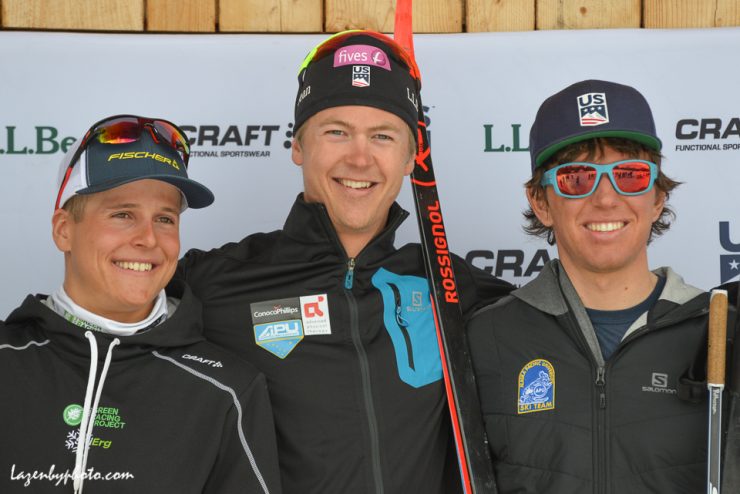
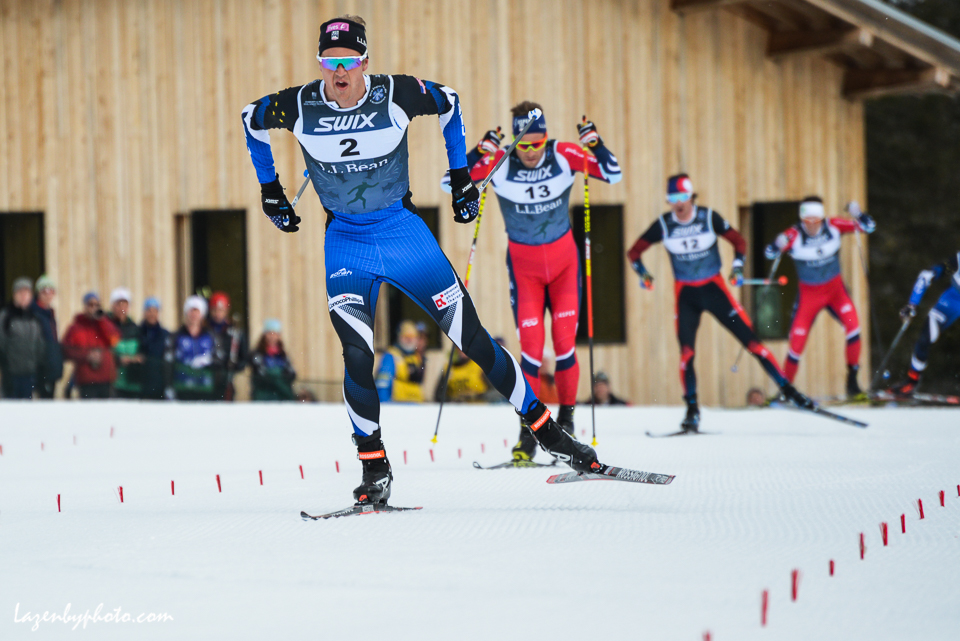
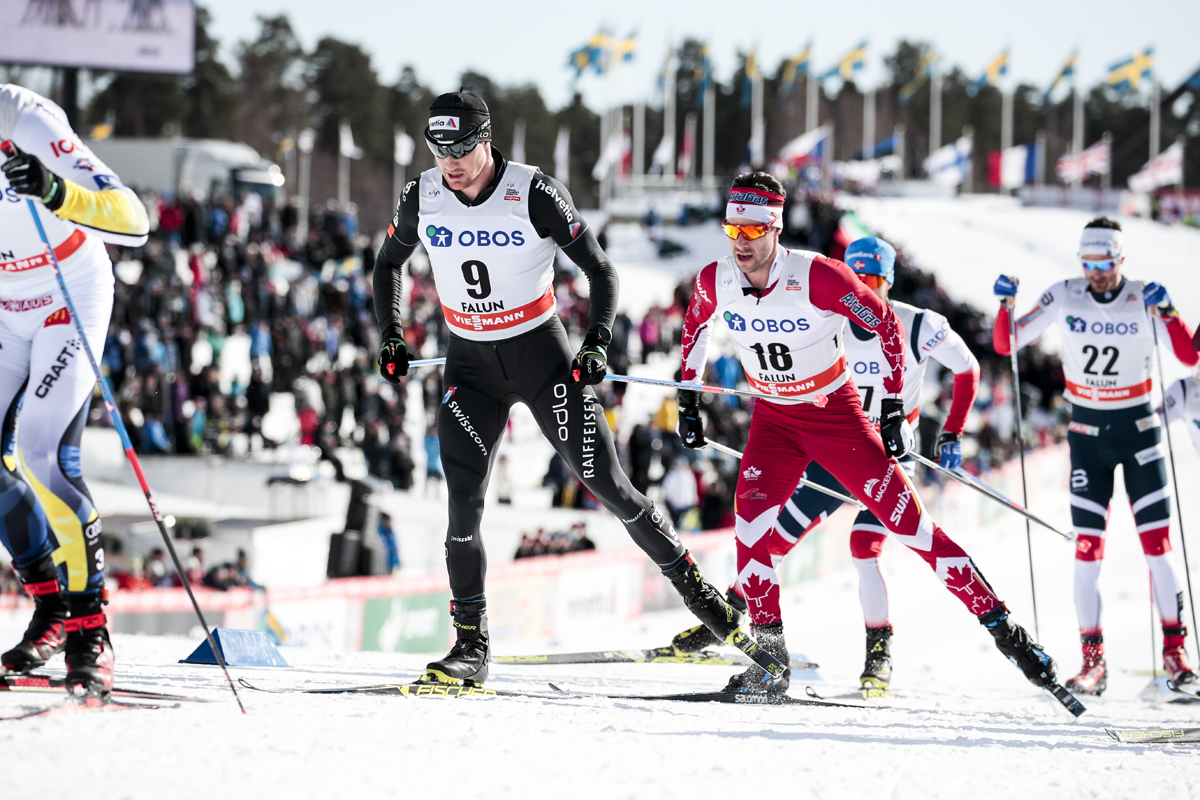
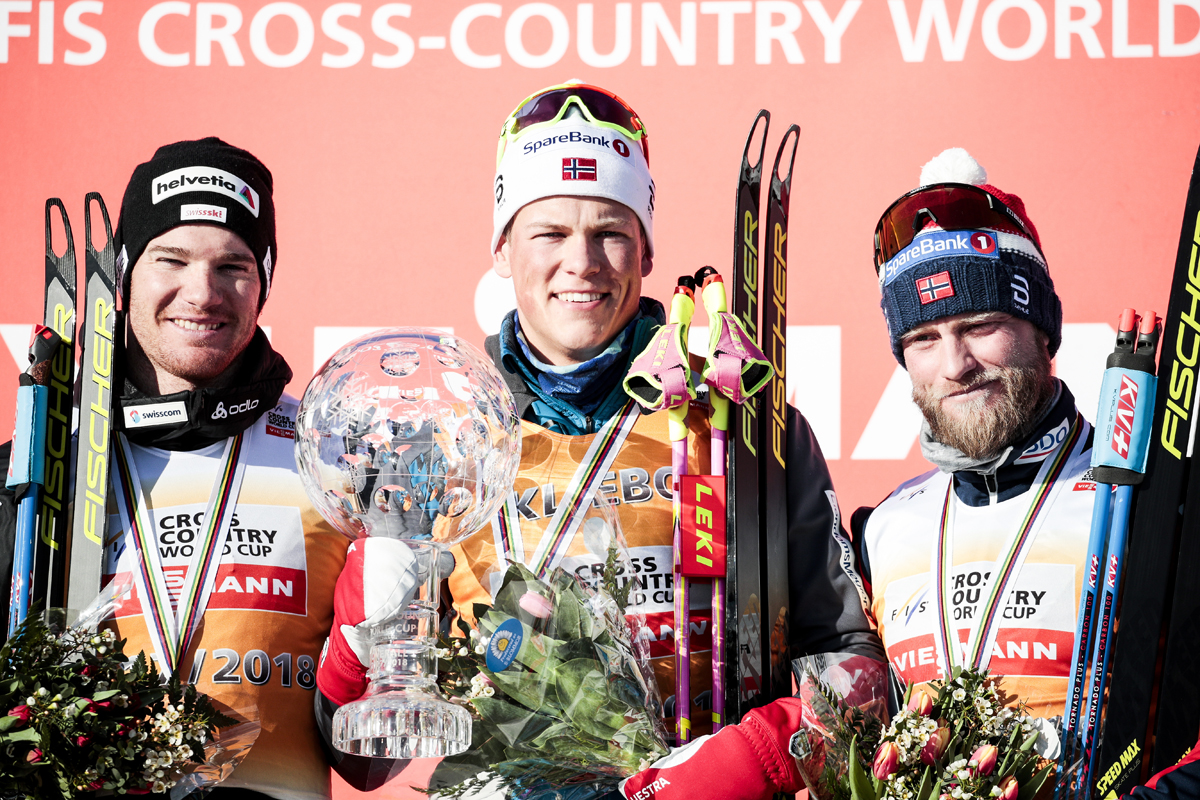
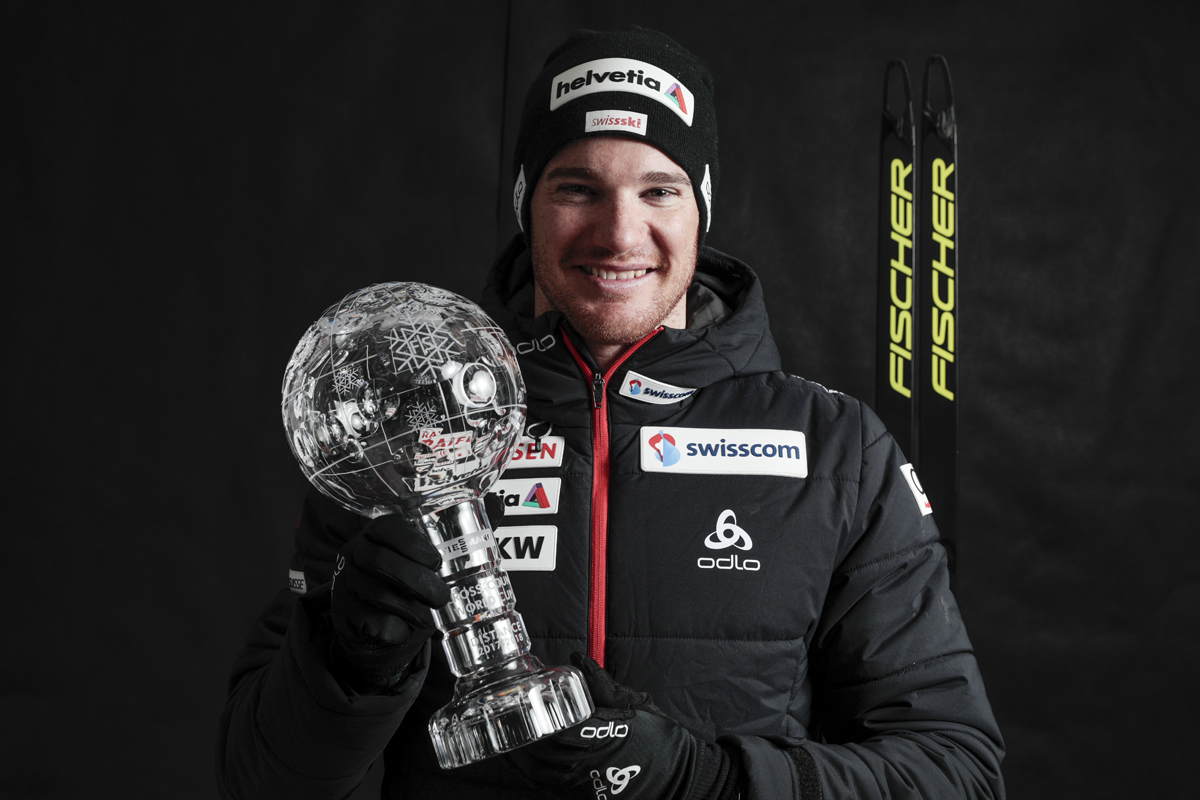
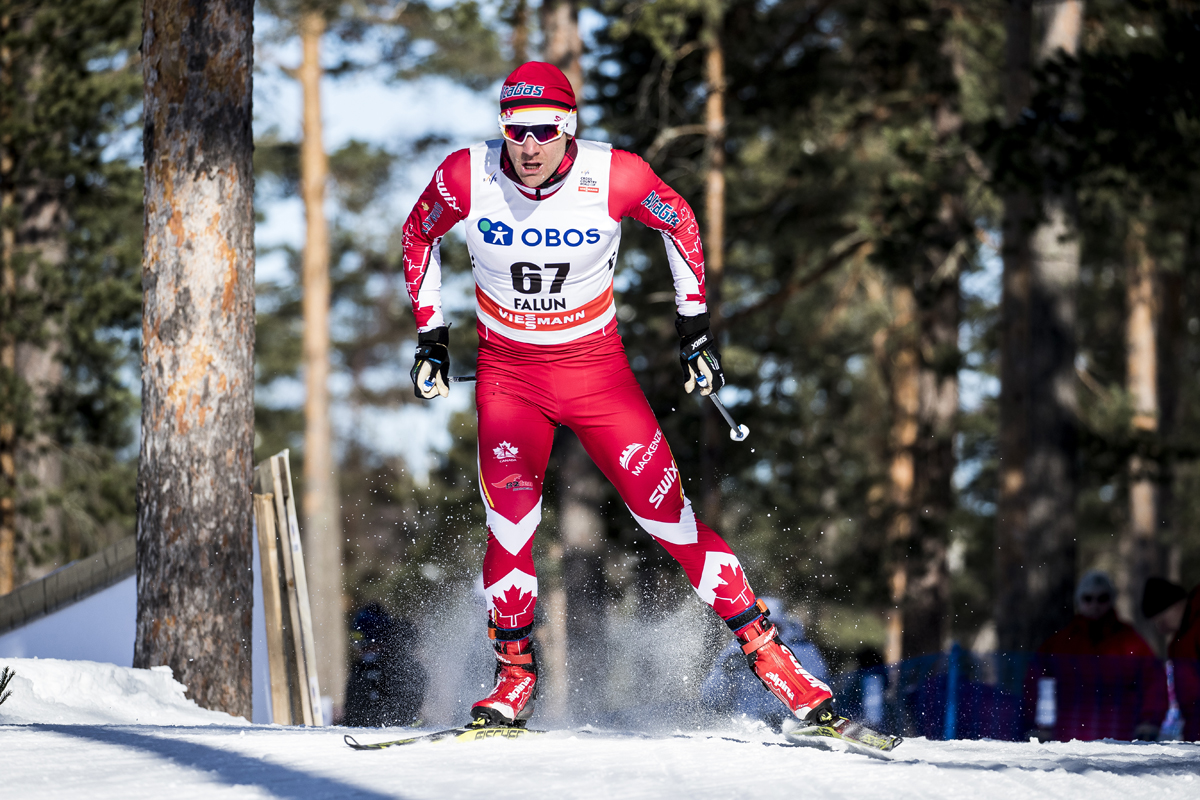
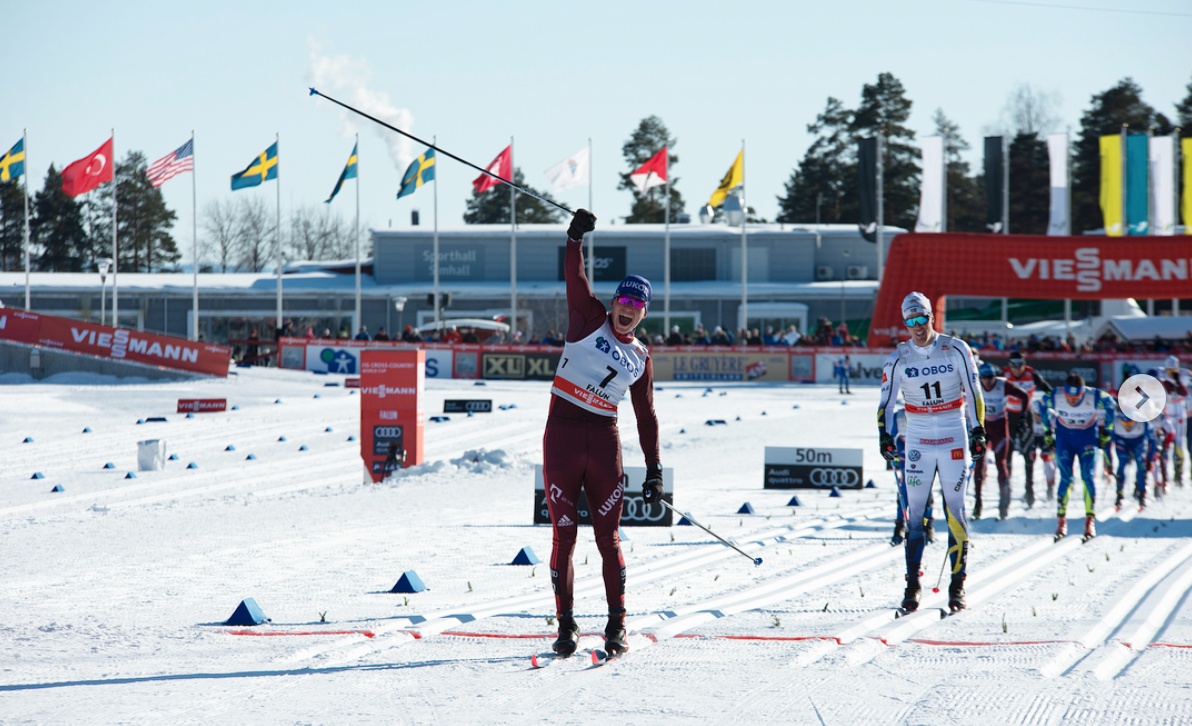
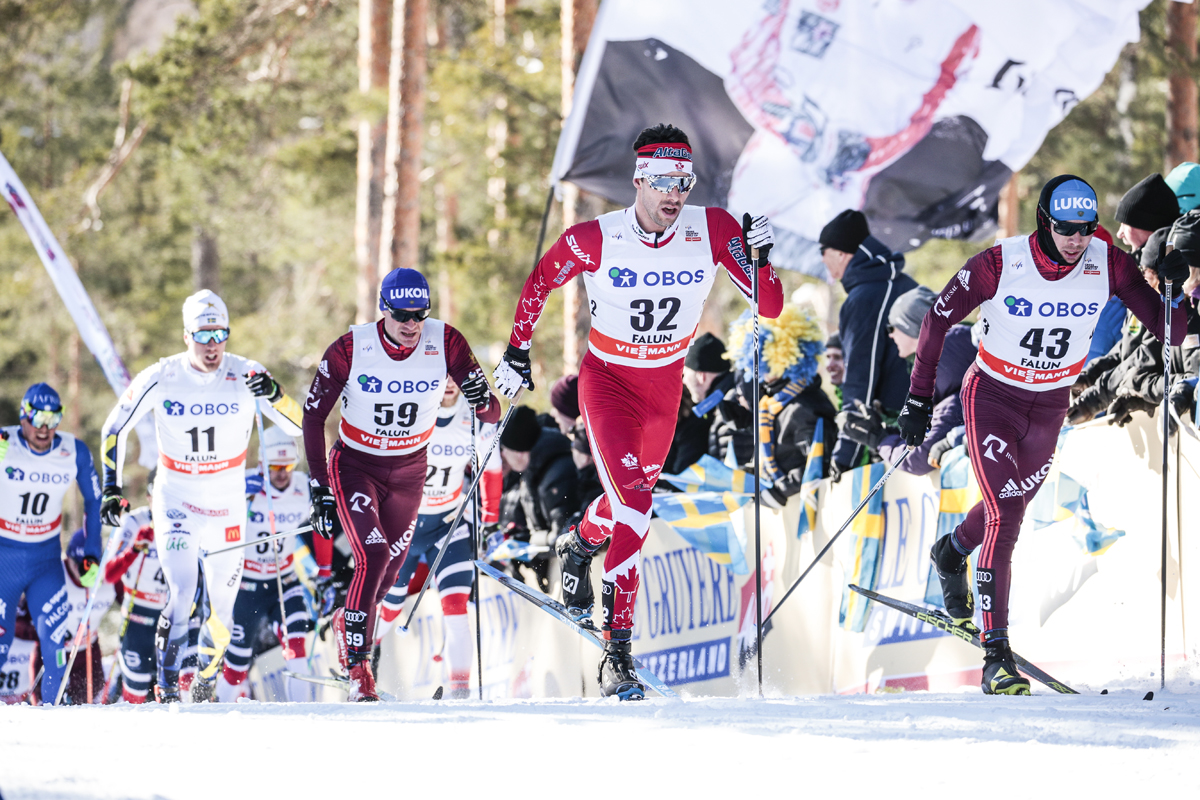
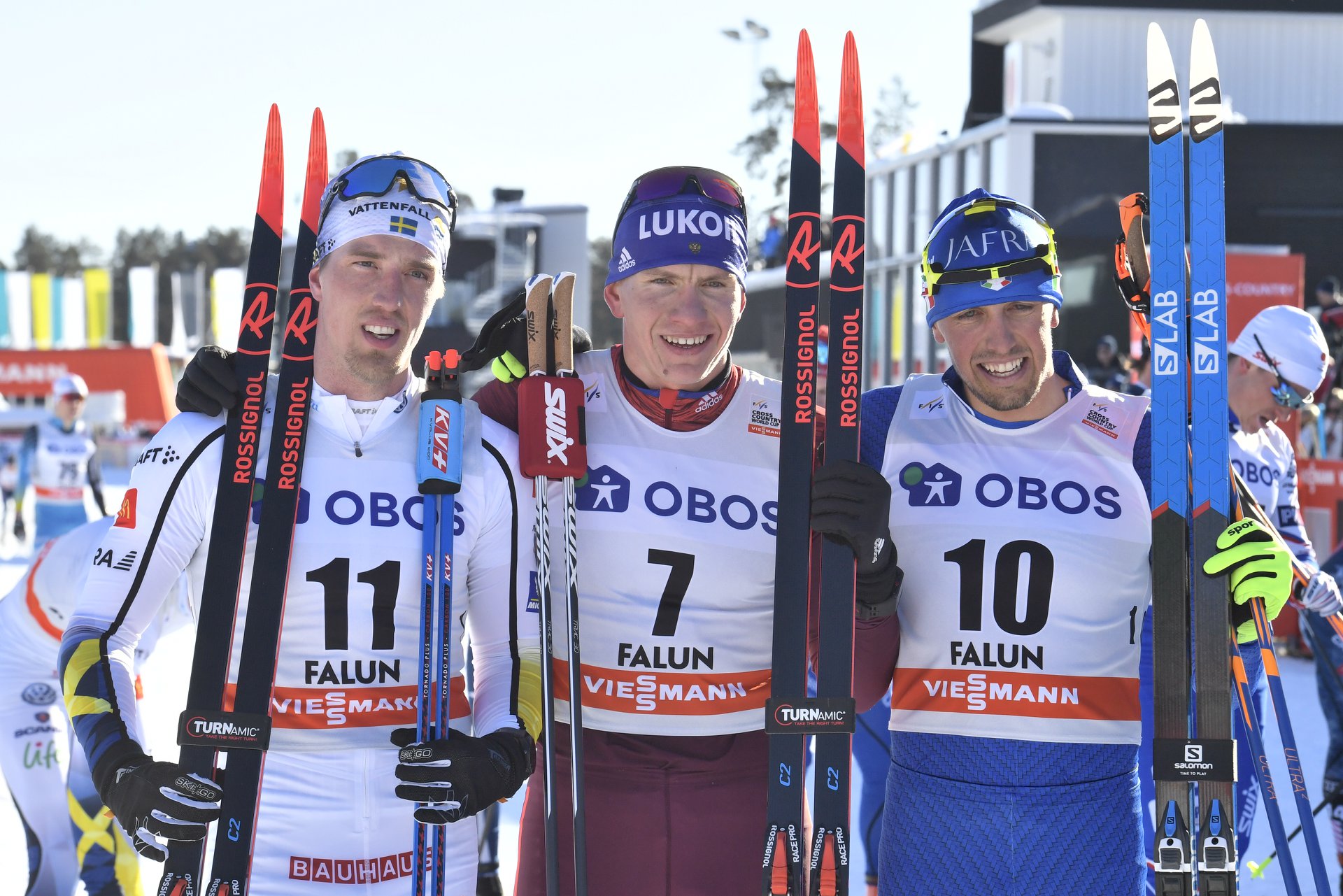
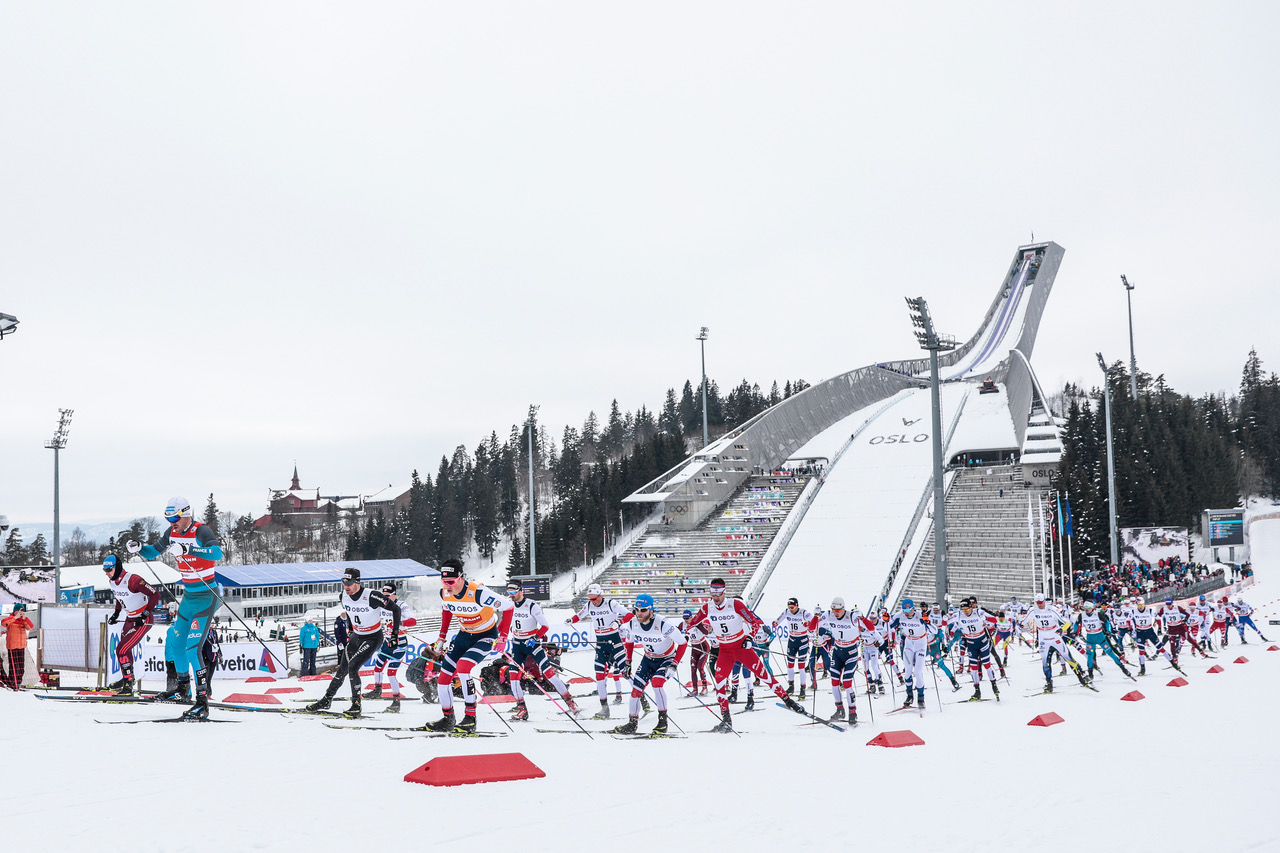
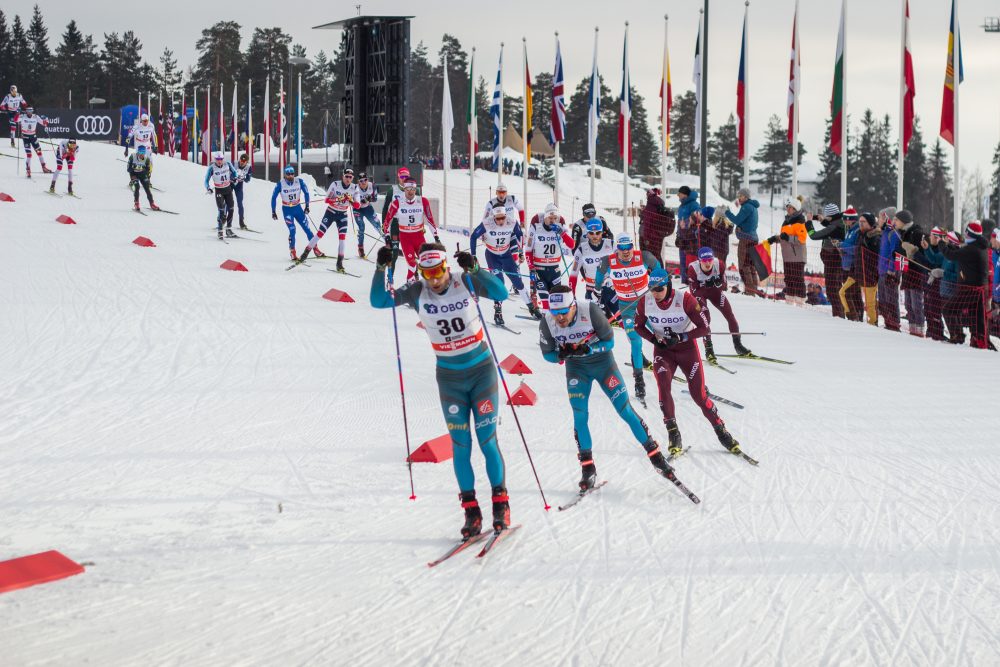
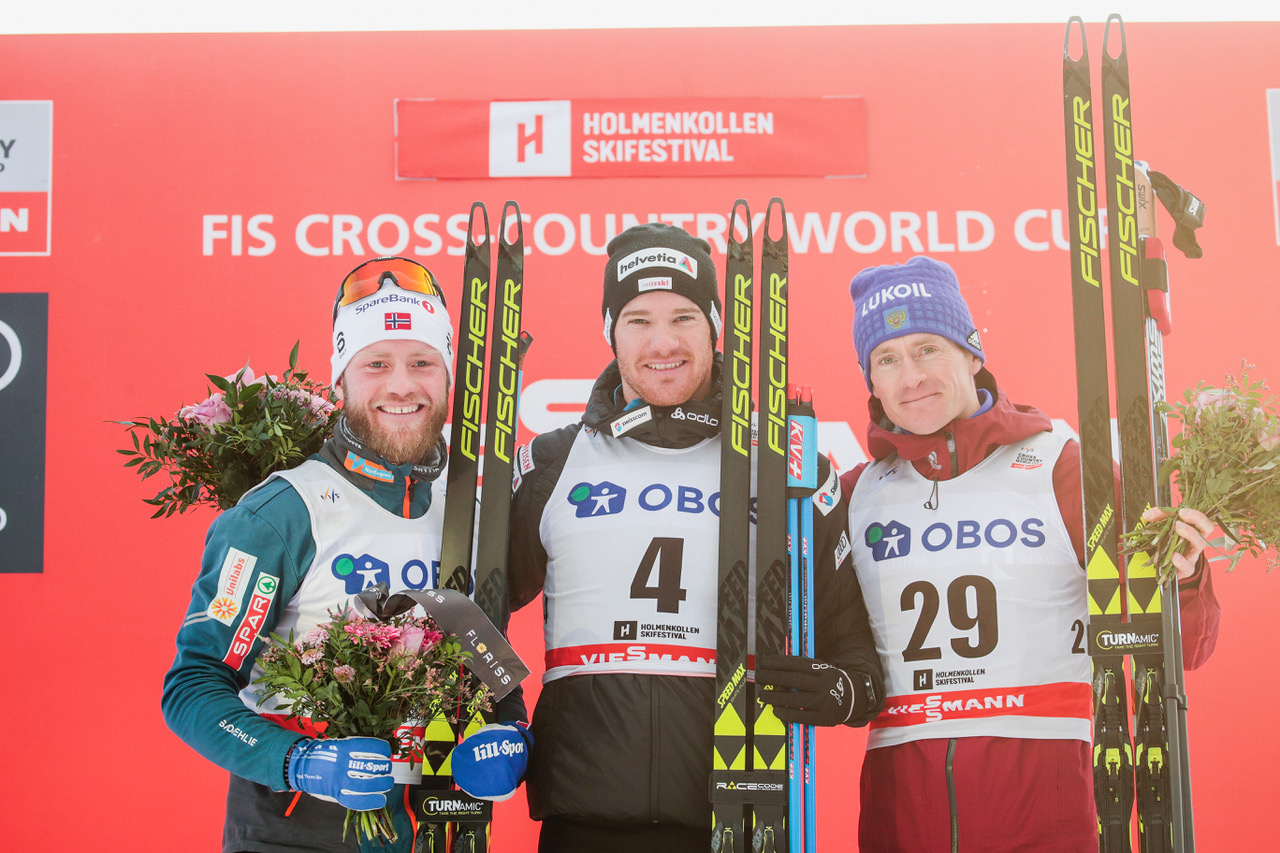
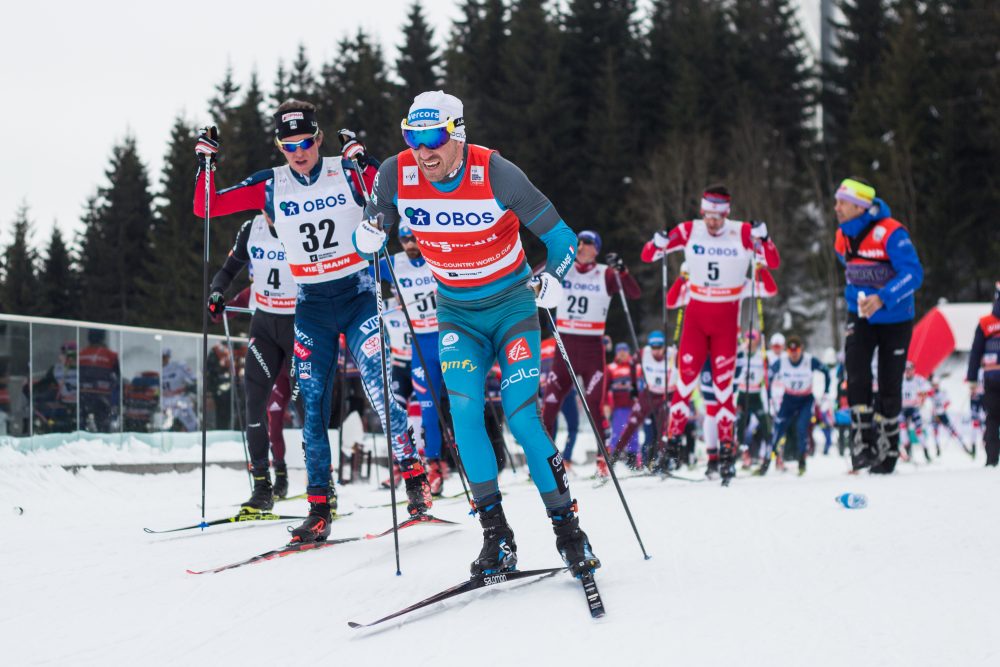
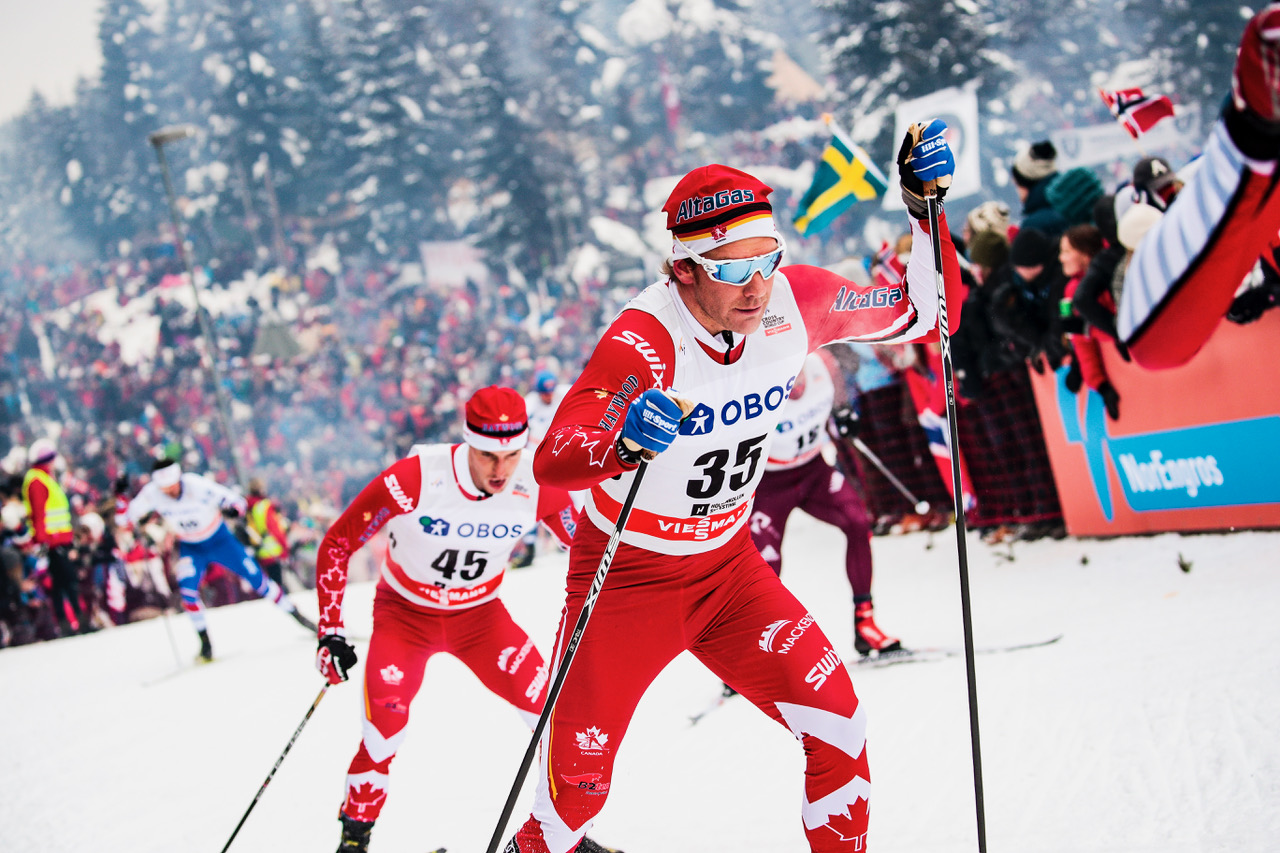
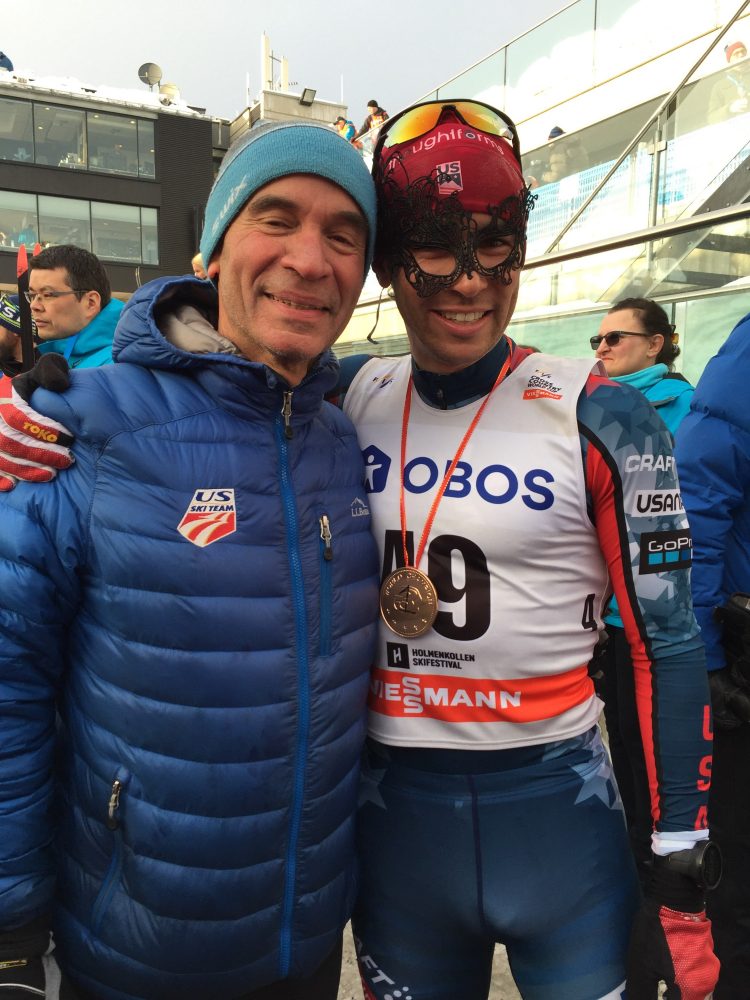
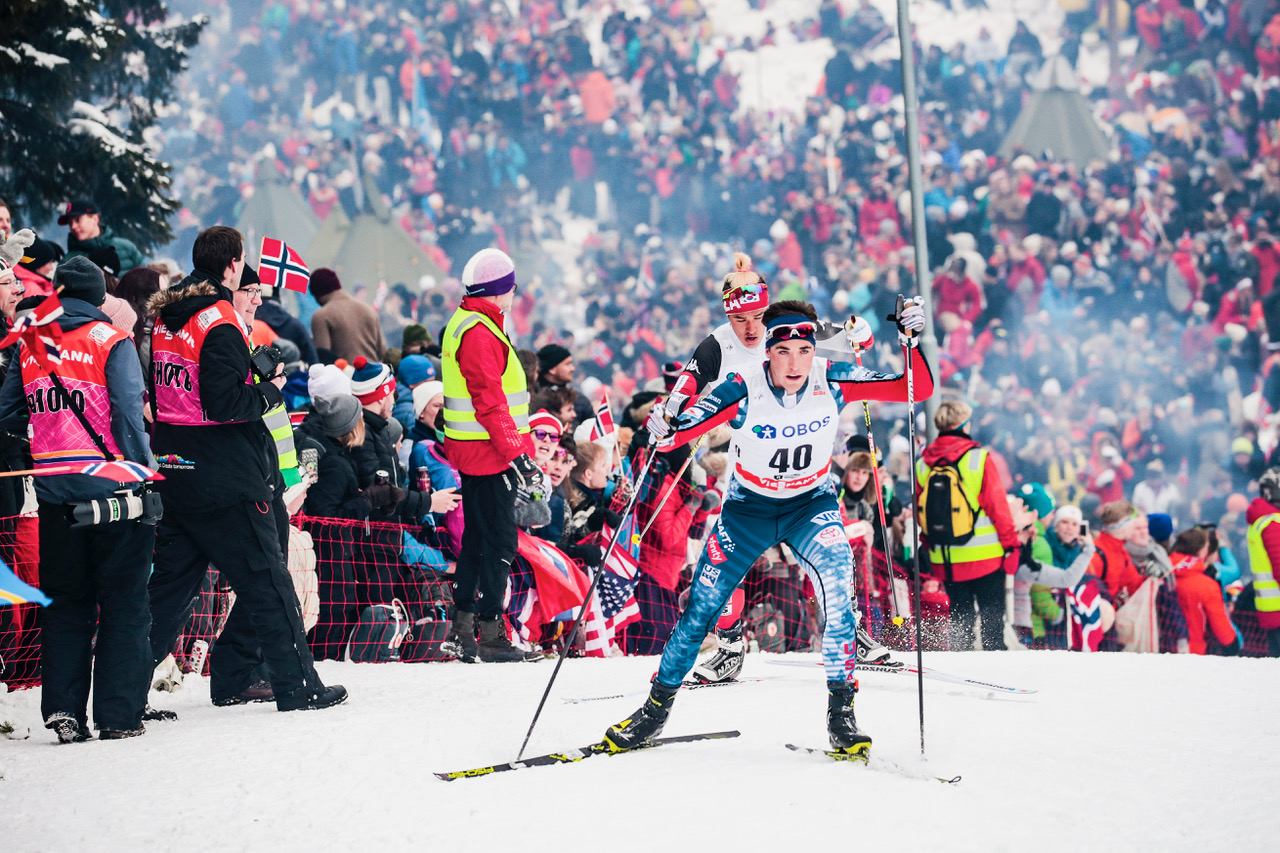
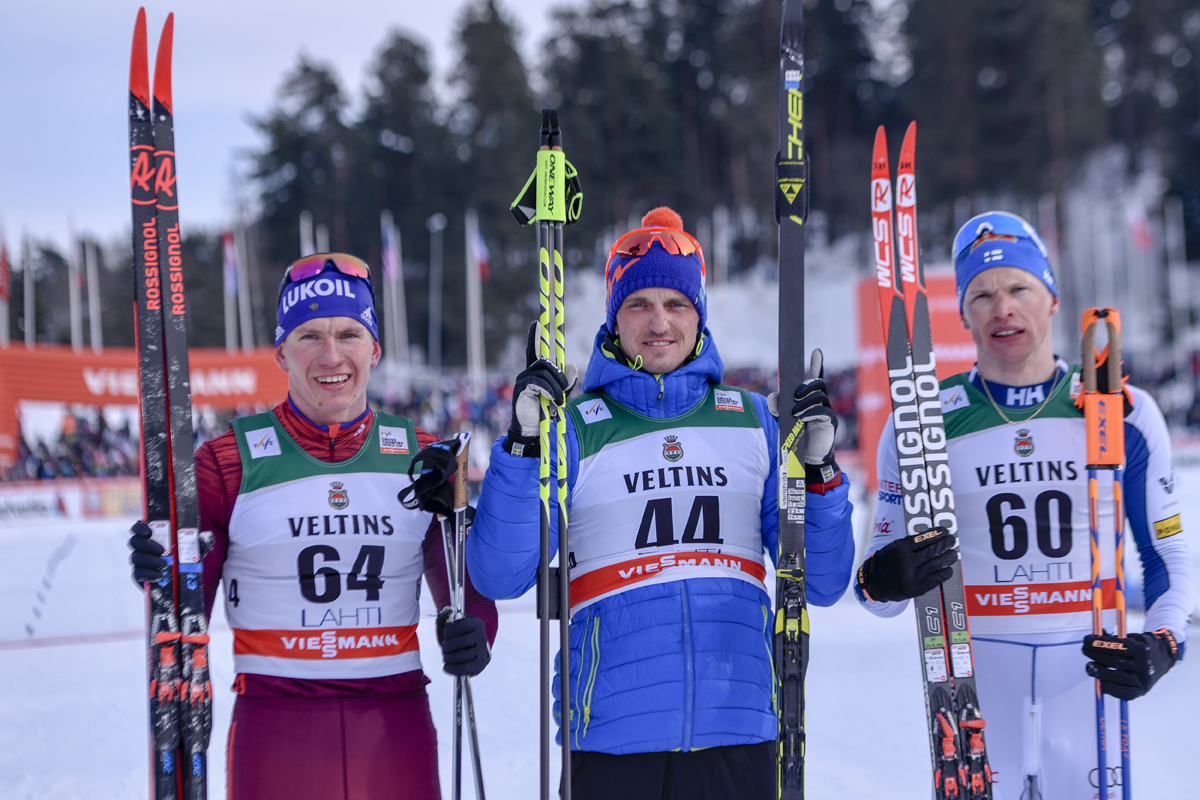
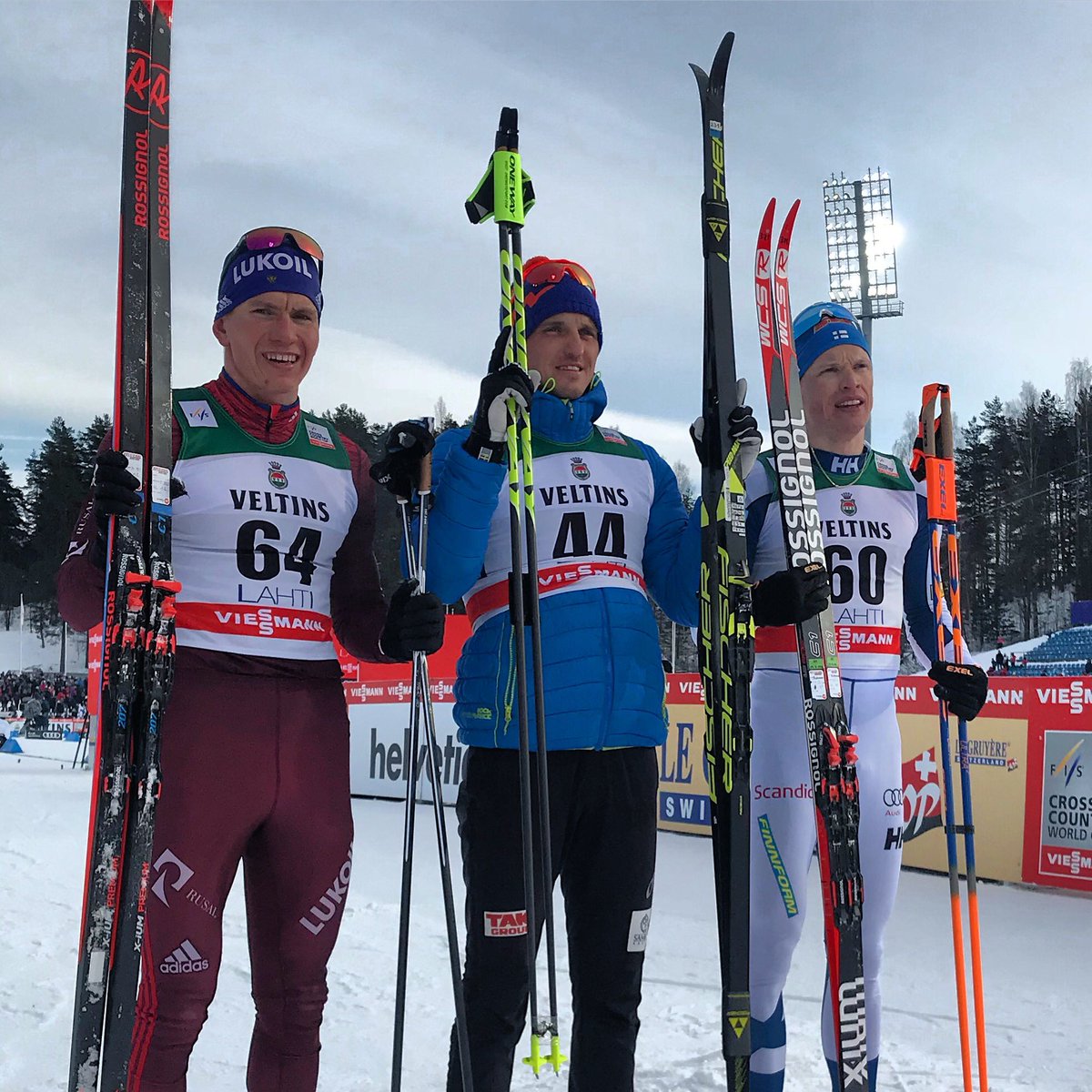
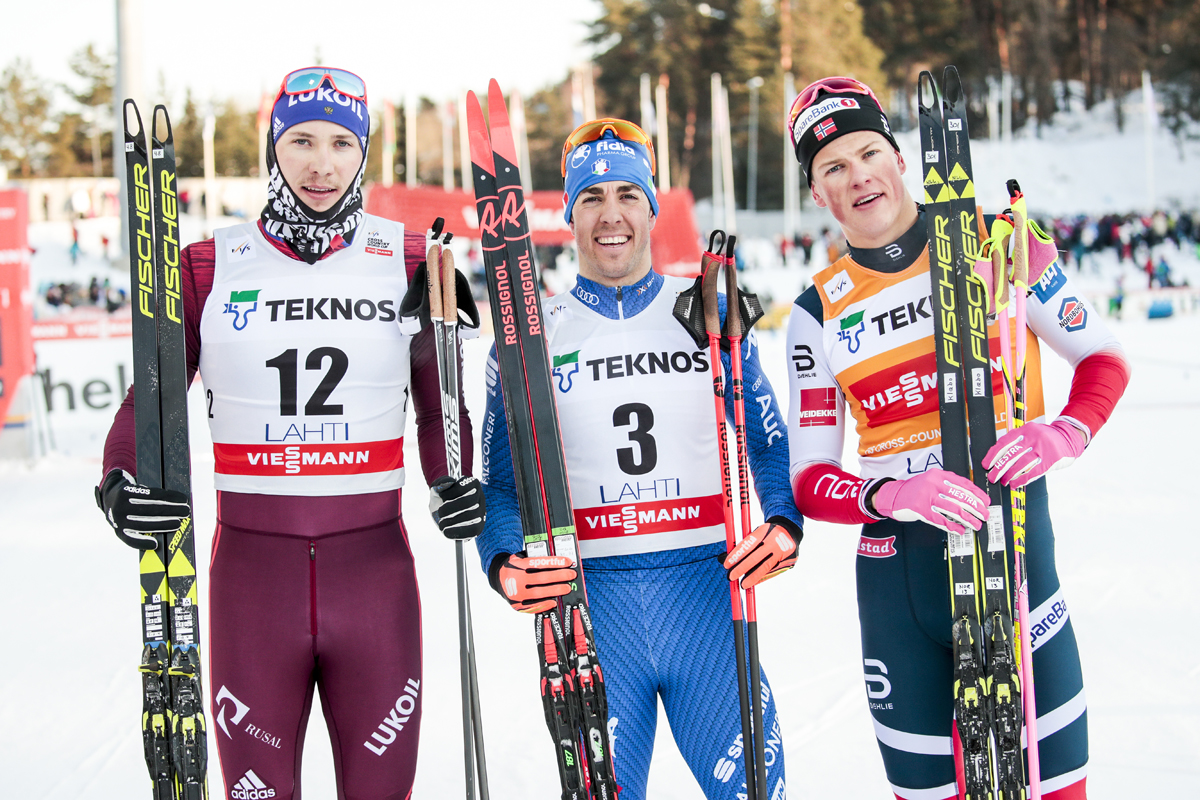
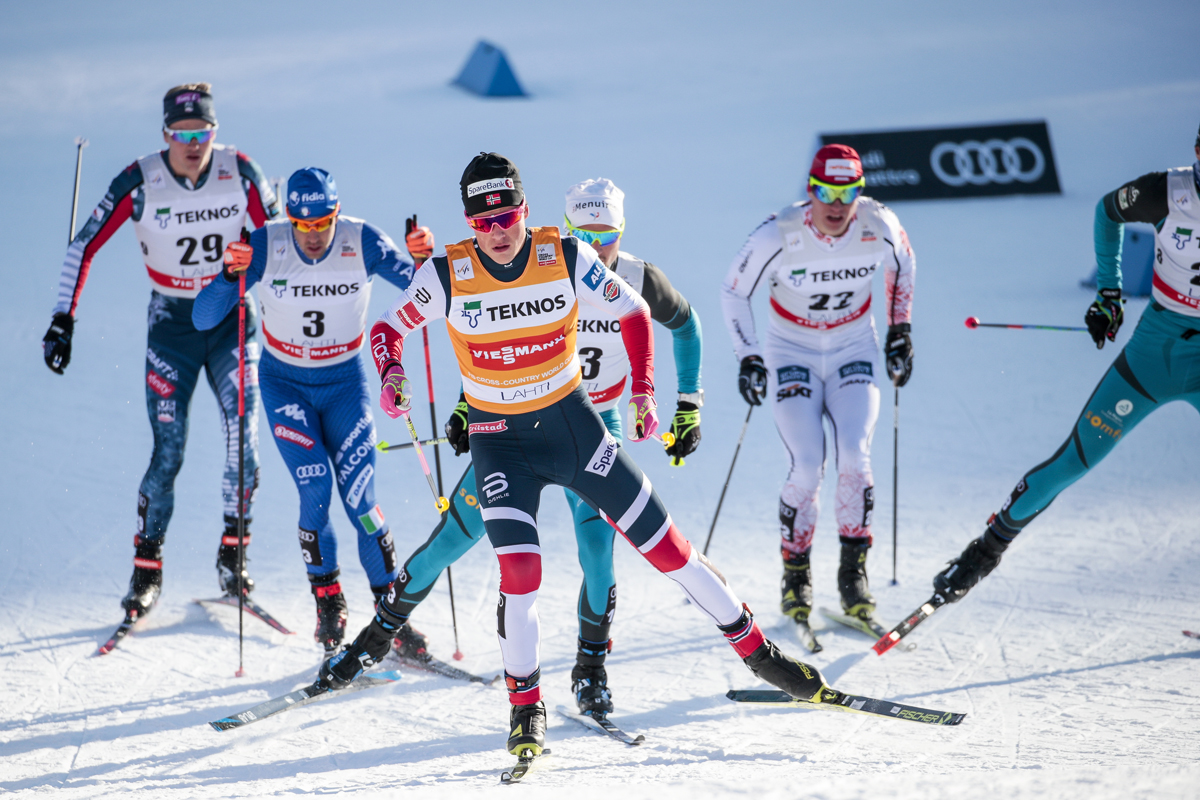
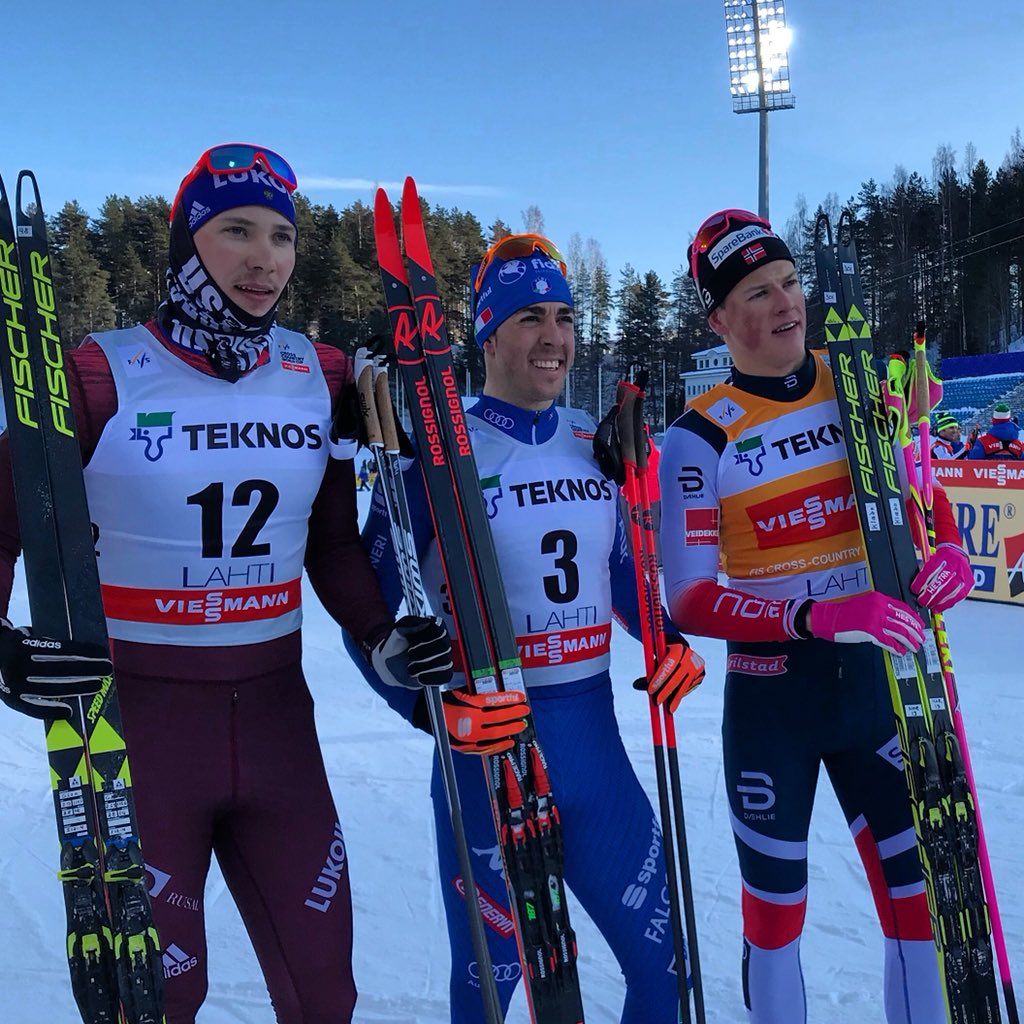
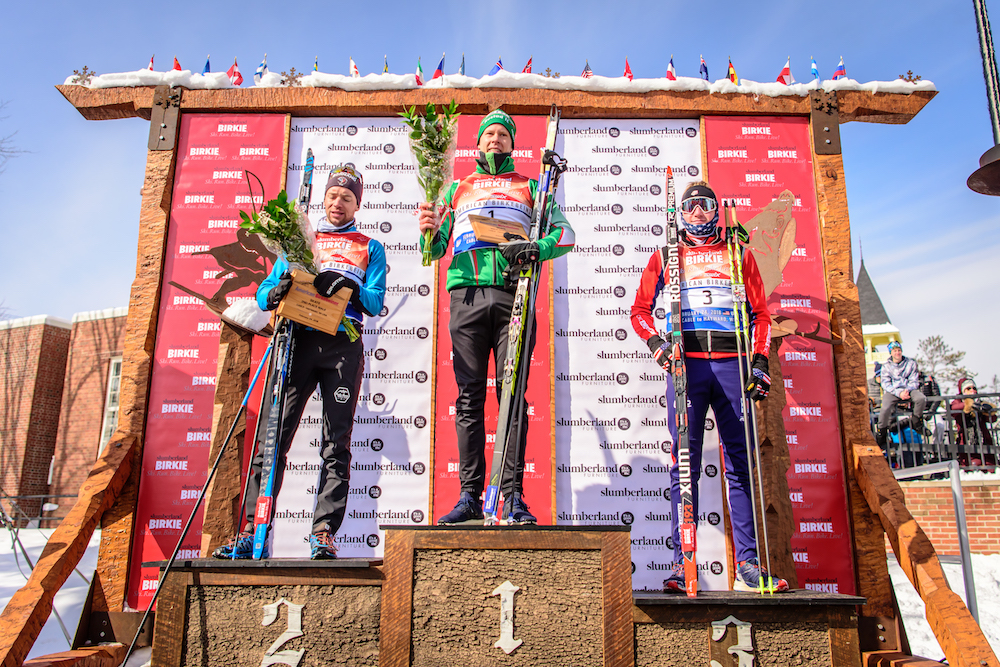
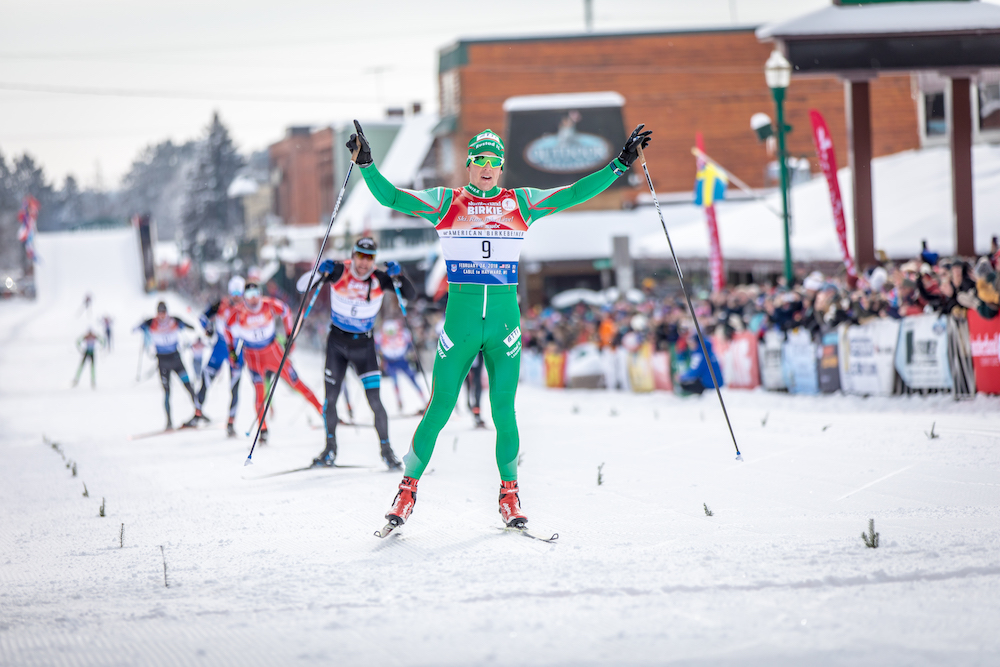
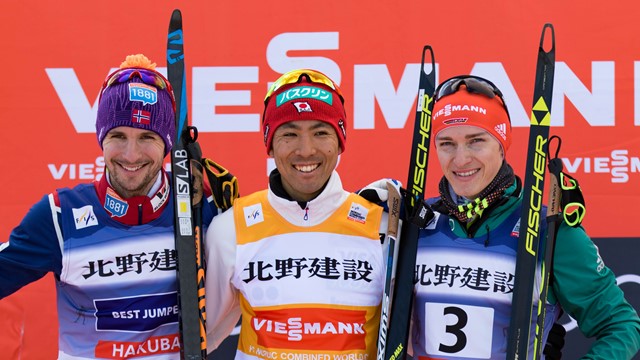
The men’s classic sprint podium on Saturday (l to r): Johannes Høsflot Klæbo (l) leading Russia’s Alexander Bulshonov (c) and Eirik Brandsdal in Kuusamo, Finland. (Photo: Fischer/Nordic Focus)
From an outsider’s perspective, it seemed Johannes Høsflot Klæbo of Norway would open his World Cup 2018/2019 season with the familiarity of a win. The first FIS cross-country race of the year, a 1.4-kilometer classic sprint in Kuusamo, Finland, saw the 22-year-old round the course’s final turn in first, holding off his closest competitor, Alexander Bolshunov of Russia, by close to two meters.
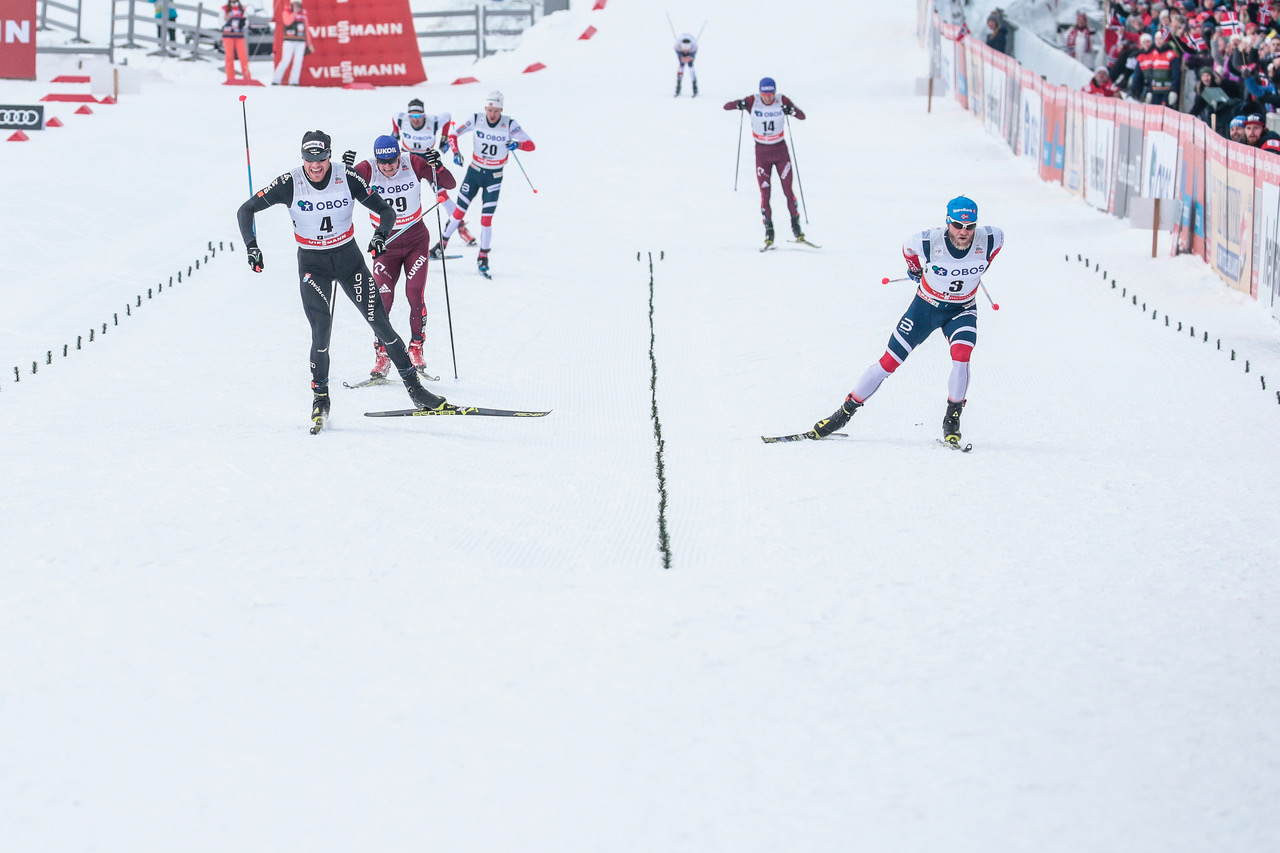
Approaching the finishing stretch, Norway’s cross-country sprint king was still dictating the pace. He seemed well on his way to adding another World Cup sprint title to the eight he already holds. As Klæbo neared the finish line, he paused his double-pole to look behind him. A mis-step that turned into Bolshunov’s chance.
Norway’s Johannes Høsflot Klæbo (l) leading Russia’s Alexander Bulshonov (c) and Eirik Brandsdal through the final corner of the men’s 1.4-kilometer classic sprint on Saturday in Kuusamo, Finland. (FIS screenshot)
While Klæbo glanced behind him, Bolshunov kept his head down and hammered. The 21-year-old Russian crossed the finish line first, fist and ski pole raised high, as he claimed the win over Klæbo by 0.31 seconds in a time of 2:29.35.
Klæbo, who briefly returned to double poling once he saw Bolshunov, eventually stood up straight, seemingly giving way to a Russian defeat. The Ruka sprint victory is Bolshunov’s first World Cup sprint win.
Eyeing Klæbo throughout the day, he showed strong positioning and pace. For the duration of the latter half of the sprint final, Klæbo had controlled from the front. At the top of the course’s final climb he had padded his gap on the field and Bolshunov by more than a meter and a half.
Earlier in the day, Klæbo had won the qualifier in a time of 2:28.95, the next closest qualifier, Norwegian Eirik Brandsdal, 3.21 seconds behind. Regardless, Klæbo will depart the Ruka sprint hungry for more, as will Bolshunov.
Finishing third in Saturday’s final was Brandsdal, 1.35 seconds behind the winner, Bolshunov. Also in the final on Saturday was Emil Iversen, who received a technique violation during his quarterfinal, of Norway in fourth (+3:04), Gleb Retivykh of Russia in fifth (+3.86), and Norwegian Sondre Turvoll Fossli in sixth (+4.85).
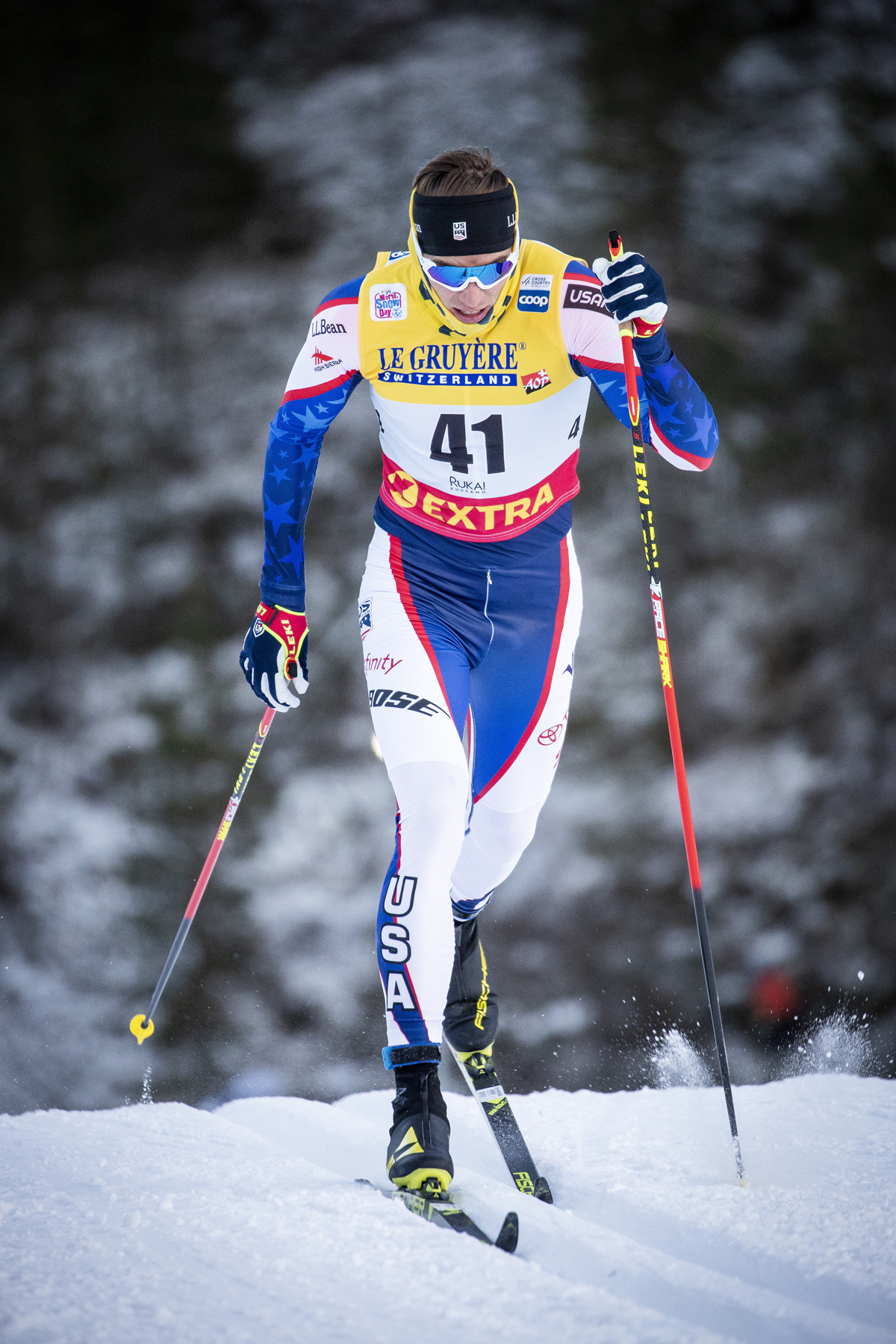
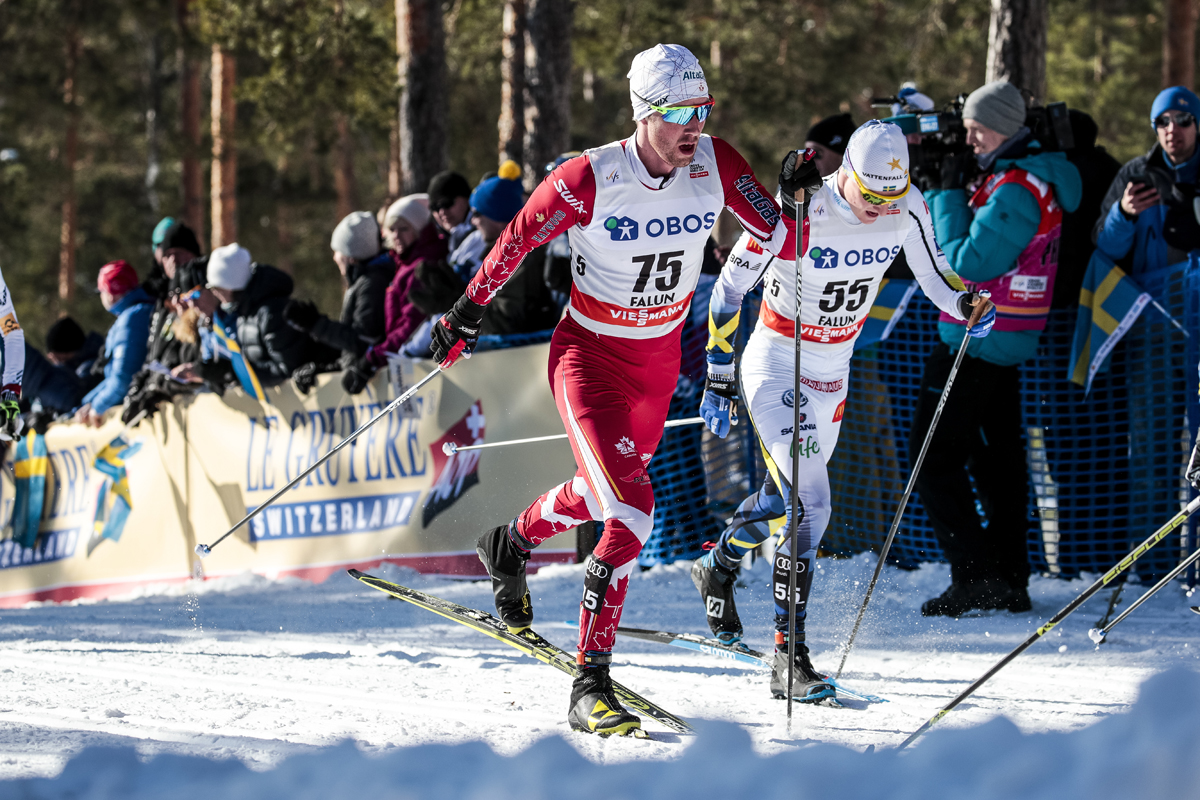
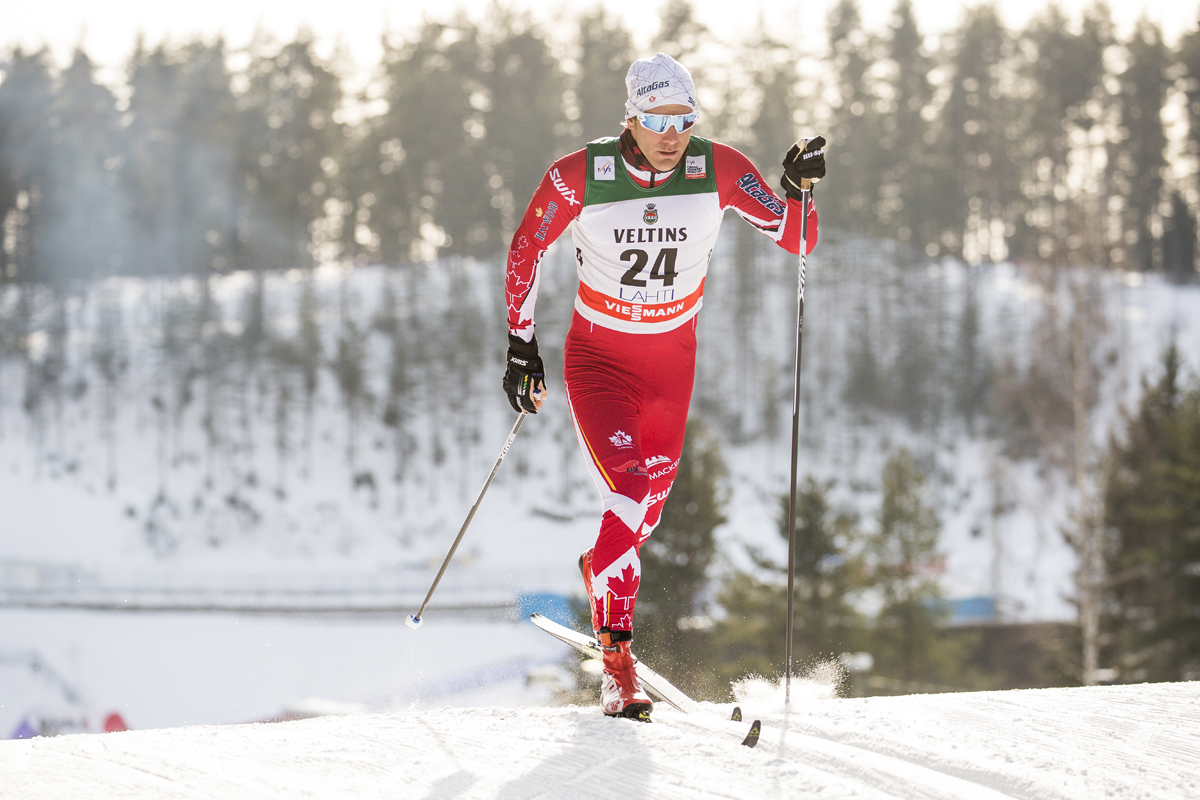
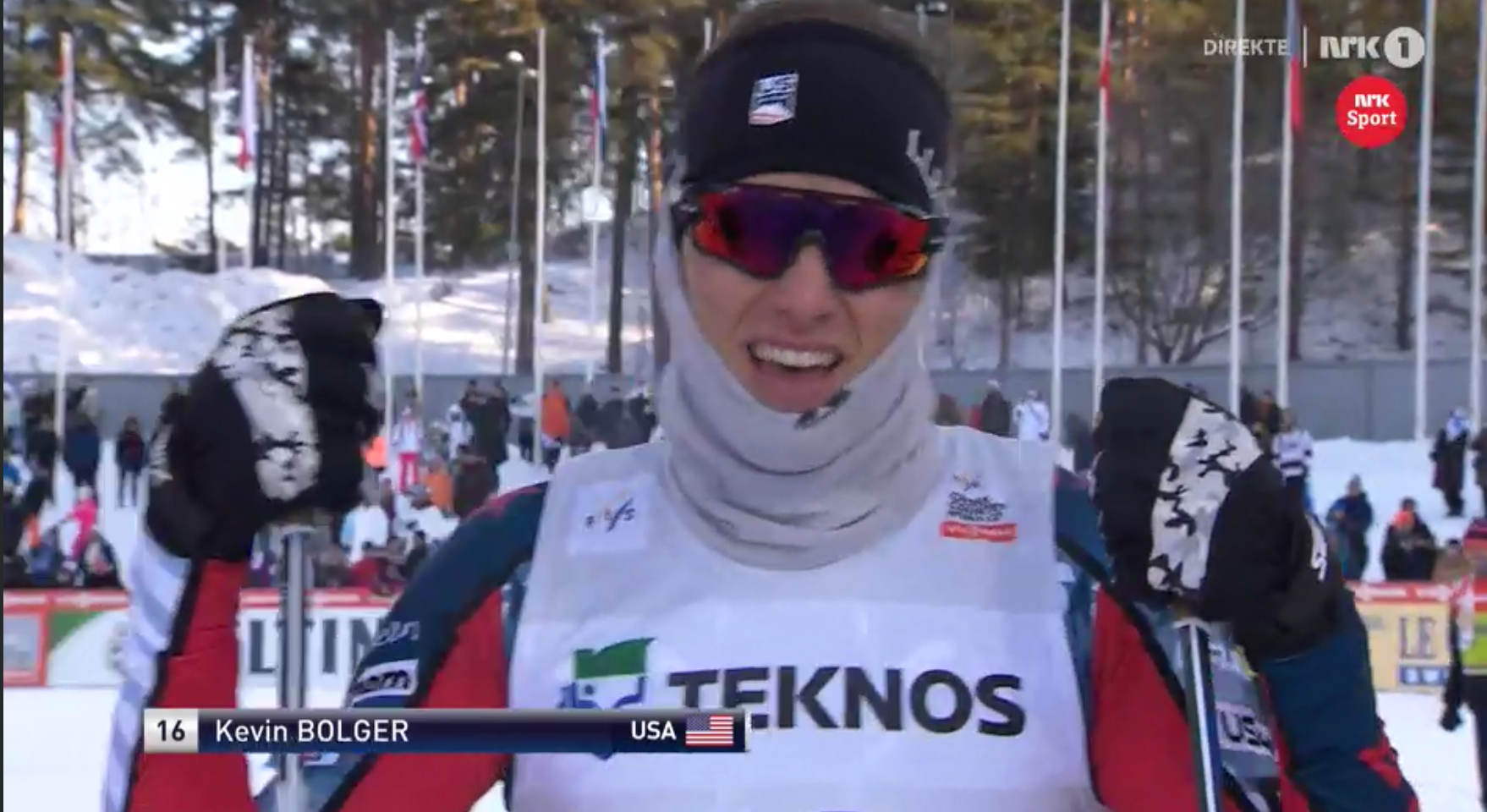
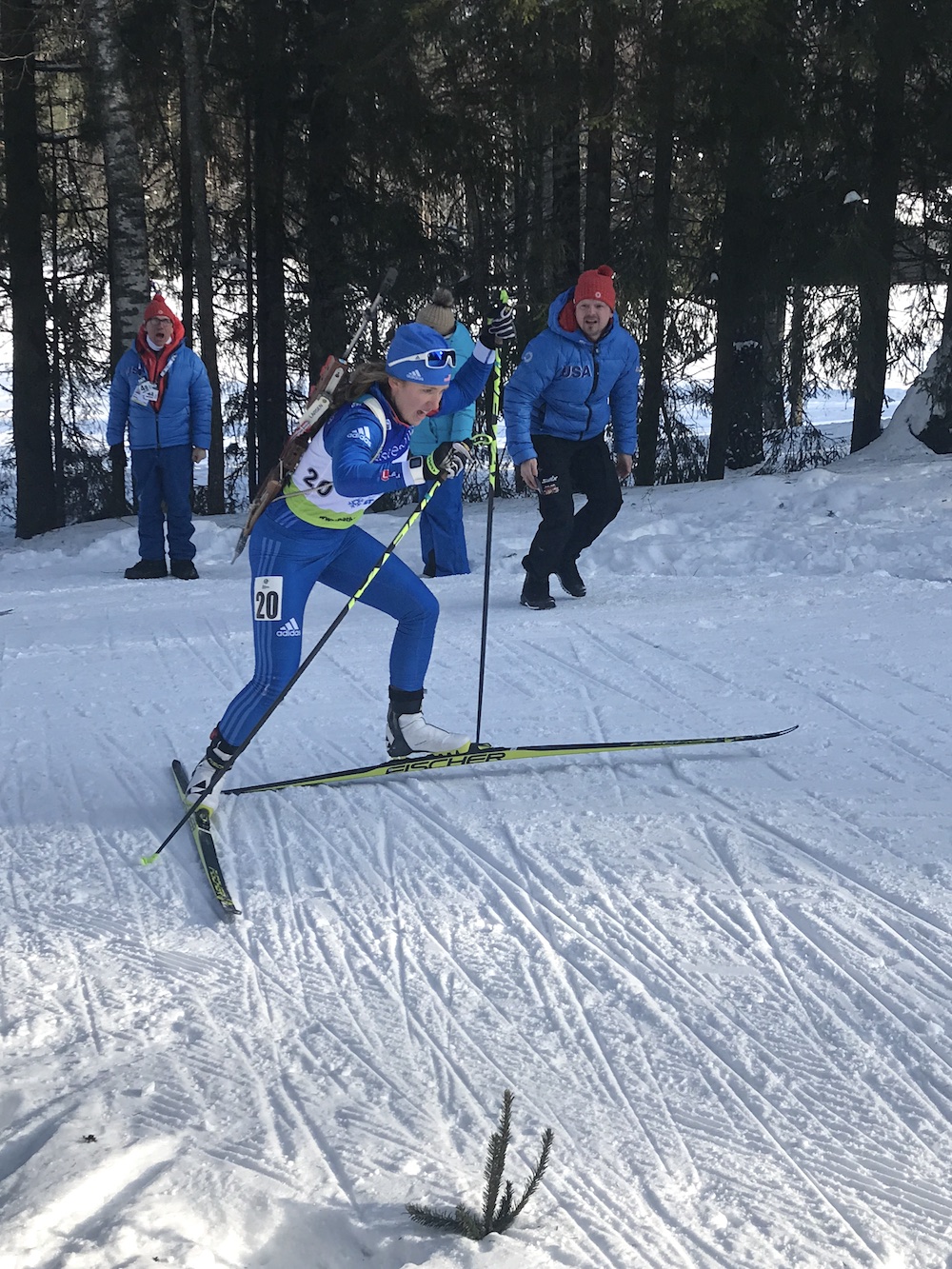
Kevin Bolger of the U.S. Ski Team racing the qualifier on Saturday in Kuusamo, Finland. (Photo: Fischer/Nordic Focus)
Canada’s Alex Harvey was the lone North American male to advance to the rounds after qualifying in 25th (+9.40). He advanced to the fourth quarterfinal, where he finished second to Retivykh before advancing to the second semifinal. Harvey crossed fourth in the second semifinal, missed advancing to the final, and ended the day in 8th.
“I’m feeling great right now. I was able to execute the plan pretty much to the dot this year, no injury or illness slowed me down and I have a fun time the whole Summer and Fall!” Harvey wrote in and email to FasterSkier. “As per usual, I’m a slow-ish starter so the first goal of the season for me will be the Tour de Ski.
“The big goal for me this season is the World Championship in Seefeld,” Harvey continued. “I’m focusing on the skiathlon and the 50 k where I’m going to defend my world title to the best of my abilities! Right behind Worlds are World Cup Finals in Québec City so that’s huge motivating factor for me to wrap up the season at home once again just like we did in 2017.”
Following Harvey’s performance for Canada, Julien Locke (CNST) finished 69th (+15.43), Andy Shields 75th (+18.59), and Russell Kennedy (Team R.A.D.) 76th (+18.61).
Five men completed the sprint for the U.S., with American and U.S. Ski Team (USST) B-team member, Erik Bjornsenleading the team in 42nd (+11.41). Kevin Bolger, new to the USST B-team this World Cup season, finished in 55th (+13.19), while Ben Saxton of the Stratton Mountain School placed 70th (+15.68) and David Norris of Alaska Pacific University finished 78th (+19.05). Simi Hamilton (USST) placed 82nd (+1:11).
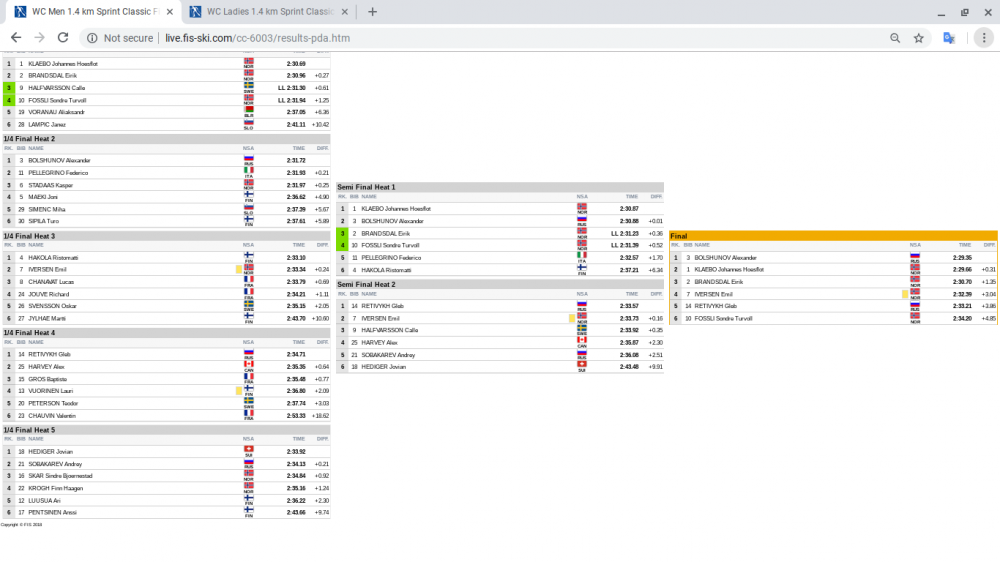
The men’s sprint bracket from Saturday’s 1.4-kilometer classic sprint in Kussamo, Finland(Photo: FIS Live Timing screenshot) Click the image to enlarge
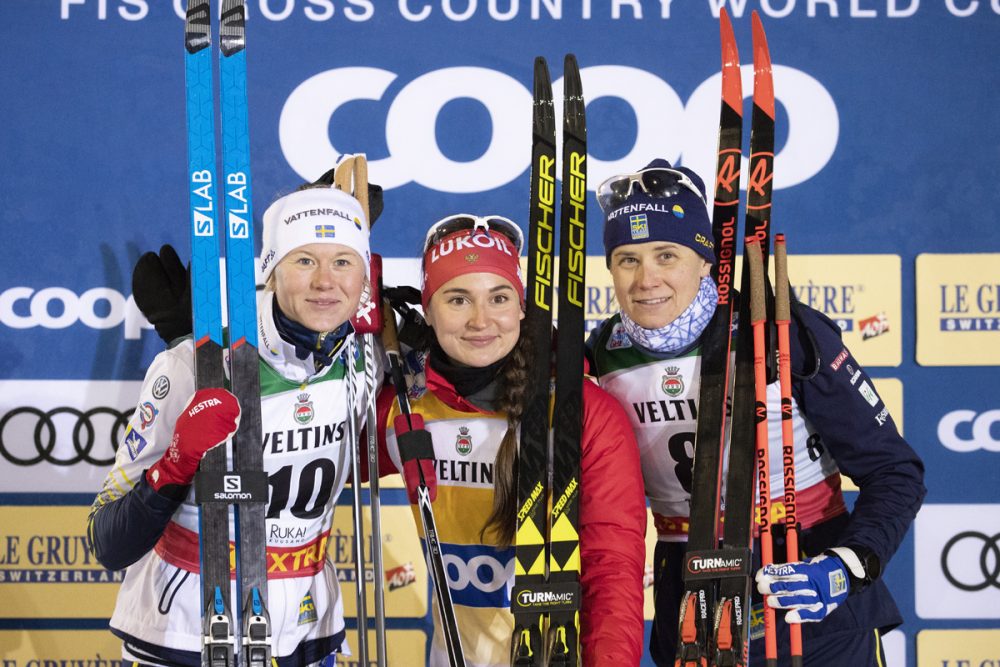
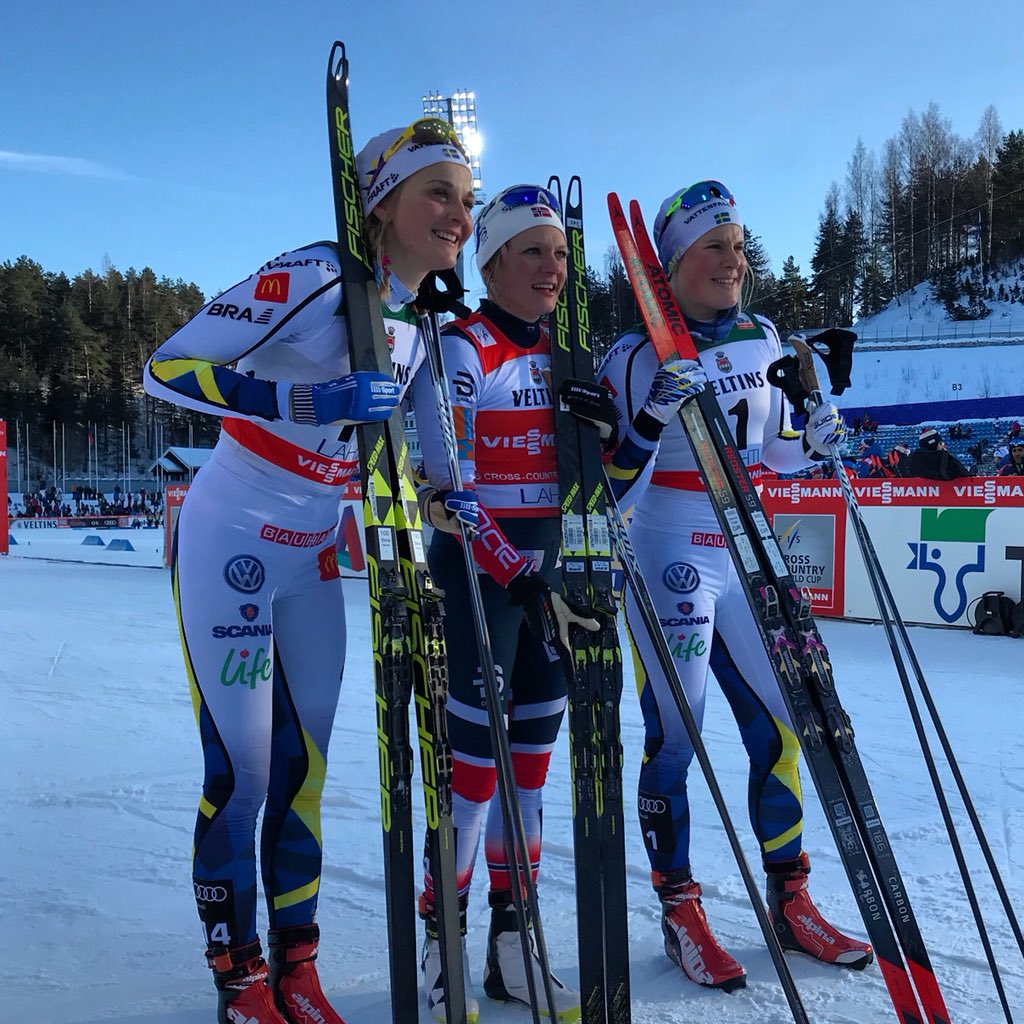
The women’s 1.4-kilometer classic sprint podium (l to r): Sweden’s Maja Dahlqvist, Russia’s Yulia Belorukova and Ida Ingemarsdotter of Sweden. (Photo: Fischer/Nordic Focus)
FIS Cross-Country World Cup in Kussamo, Finland: Classic sprint
On Saturday in Kussamo, Finland the 2018/2019 World Cup season began with a 1.4-kilometer classic sprint.
Twenty-three-year-old Yulia Belorukova from Russia won the final in 2:52.62 minutes. It was Belorukova’s first World Cup win. Second place went to Sweden’s twenty-four-year-old Maja Dahlqvist who crossed the line 1.12 seconds back. Also from Sweden, Ida Ingemarsdotter was third (+1.51), Norway’s Maiken Caspersen Falla fourth (+1.52), Krista Pärmäkoski of Finland fifth (+4.71), and Stina Nilsson of Sweden, sixth (+12.33). Nilsson crashed in the final.
In the women’s qualifier, Russia’s Natalia Nepryaeva set the fastest time in 2:56.50 minutes. Seventy-three skiers started the qualifier.
Three U.S. Ski Team (USST) women advanced to the heats by qualifying in the top-30. Sadie Bjornsen in 5th (+3.01), Sophie Caldwell in 22nd (+6.97), and Ida Sargent 24th (+7.23).
Caldwell and Sargent did not advance out of the heats. Caldwell was third in the first heat, won by second fastest qualifier, Falla. Caldwell finished 0.36 seconds behind Falla and ultimately did not secure a lucky loser spot. Sargent raced in the third heat where she placed sixth (+4.50).
Four U.S. women bowed out in the qualifier, with last season’s second overall skier in the World Cup standings, Jessie Diggins, placing 33rd (+9.05). Rosie Brennan (APU) skied to 38th (+10.74), Kelsey Phinney (SMS-T2) 46th (+13.49), and last season’s overall SuperTour leader, Kaitlynn Miller (CGRP), was 58th (+18.06).
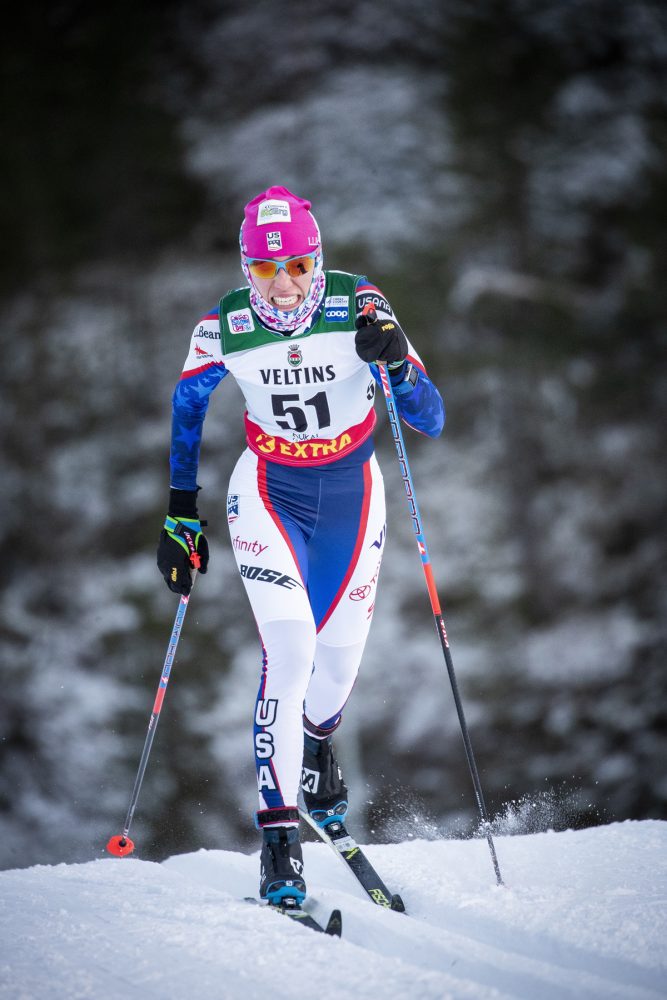
Kaitlynn Miller racing for the U.S. in the women’s 1.4-kilometer classic qualifier on Saturday in Kussamo, Finland. (Photo: Fischer/Nordic Focus)
No Canadian women entered the race.
In the men’s race, last season’s World Cup overall and sprint cup winner, Johannes Høsflot Klæbo, scorched the qualifier in 2:28.95, winning by 3.21 seconds over he next fastest qualifier, teammate Eirik Brandsdal.
Klæbo won his heat and his semifinal. But the semi was tight: Klæbo won by 0.1 seconds over Russia’s Alexander Bolshunov.
In the final, Bolshunov won in 2:29.35 minutes, Klæbo was second (+0.31), Brandsdal third (+1;35). Also of Norway, Emil Iversen placed fourth (+3:04), Russia’s Gleb Retivykh fifth (+3.86), and Norwegian Sondre Turvoll Fossli sixth (+4.85).
The only North American to advance to the heats was Canada’s Alex Harvey, who qualified in 25th (+9.40) and ended the day in eighth. Harvey advance out of the heats by placing second to Russia’s Gleb Retivykh in the fourth quarterfinal. In the second semifinal, Harvey placed fourth (+2.30) and did not advance as a lucky loser.
Also for Canada, Julien Locke (CNST)finished 69th (+15.43), Andy Shields 75th (+18.59), and Russell Kennedy (Team R.A.D.) 76th (+18.61).
For the U.S., Erik Bjornsen (USST) placed 42nd (+11.41), Kevin Bolger (USST) 55th (+13.19), Ben Saxton (SMS-T2) 70th (+15.68), David Norris (APU) 78th (+19.05), and Simi Hamilton (USST) 82nd (+1:11).
Jessie Diggins (U.S. Ski Team) racing to 10th in the 2018 World Cup women’s 10 k classic in Planica, Slovenia. (Photo: Salomon/NordicFocus)
Welcome to FasterSkier’s World Cup Preview, where we check in with the top-10 teams from last year’s FIS Cross Country World Cup tour before the season starts. The World Cup begins with a classic sprint in Ruka, Finland on Nov. 24th.
***
United States
Overall in Nations Cup Last Year: 5th
Women’s Ranking 2017/2018:3rd
Men’s Ranking 2017/2018:11th
U.S. Skiers to Watch:
The high note last season was the gold medal team sprint performance by Jessie Diggins and Kikkan Randall. That pinnacle proved U.S. Ski Team (USST) coaches, wax techs, support staff, and of course athletes, could position themselves to succeed on the quadrennial winter sport prime-time stage. Time to exhale.
On both the men’s and women’s side, countless standout performances are vivid. Yet the collective success on the U.S. women’s team will remain a generational benchmark. It’s a good hunch, with the imminent 2018-2019 season, the women’s team has not hit it’s apogee.
This much is for certain: despite the retirements ofRandall and Liz Stephen, the U.S. women’s team remains loaded. Sophie Caldwell was the third ranked sprinter in the world last season. Sadie Bjornsen was top-10 in both the distance and sprint rankings, and sixth in the overall. Ida Sargent, despite breaking her thumb prior to the Olympics, finished 23rd in the sprint cup.
Although Rosie Brennan was not renamed to the 2018-2019 USST, she appears fully recovered from mono and will be starting the season on the World Cup as a discretionary selection.
Each World Cup weekend last year was time to check results and determine not if any of the women’s team had shined but who. The individual milestones were many.
Diggins’ season was a non-stop stream of highlights. In a post-Marit Bjørgen landscape, the Norwegian legend has retired, Diggins is poised to become even more of a force.
Not that anyone ever doubted Diggins, but watching Diggins charge and string out the field on January 28, during the 10-kilometer mass start freestyle in Seefeld, Austria was pure aerobic theater. She set the pace. She dictated the narrative. The move didn’t resemble an athlete taking a chance, but an athlete shifting into their top race gear and accelerating to the line. Pure confidence. For the remainder of Diggins’ season, there was no doubt.
Even with a skipped World Cup weekend in Lahti, Finland to manage media obligations back in the U.S. after the Olympic Gold, Diggins finished second overall on the World Cup.
Simi Hamilton (U.S. Ski Team) racing to 13th in the men’s freestyle sprint qualifier at 2018 World Cup Finals in Falun, Sweden. He went on to finish the day in 14th overall. (Photo: Fischer/NordicFocus)
On the U.S. men’s team, Andy Newellstepped down from full-time World Cup racing with a goal of making the 2019 World Championship team. Noah Hoffman retired and attends university. Simi Hamilton, the 17th ranked sprinter on the World Cup last season, is the veteran. Deep into his international career, Hamilton brings poise and power to the sprint roster. Paired with Erik Bjornsen, Hamilton co-leads a team sprint contender. After the duo placed sixth in the Olympic team sprint, Hamilton and Bjornsen are a possible breakthrough team for the Seefeld, World Championships.
Erik Bjornsen posted 13 top-30’s with an individual best of ninth place in the Seefeld 15 k mass start.
Scott Patterson comes off an Olympics and Holmenkollen 50 k where his ability to perform under pressure cemented him as a premier male long-distance skier. He placed 18th in the Olympic 30 k skiathlon and 11th in the marquee 50 k classic — a best U.S. men’s result since 1976. Patterson reinforced that performance with a 16th in the Holmenkollen 50 k skate.
New to the USST is Kevin Bolger. This season will be his first full-time European based campaign. Bolger more than impressed when he placed an astounding 11th overall in Lahti’s skate sprint last March. It was Bolger’s first career World Cup.
Paddy Caldwell will begin the season on the World Cup. He had several standout time of day performances in skate races last season.
Non-USST skiers starting on the World Cup will include overall SuperTour leaders David Norris and Kaitlynn Miller.
Caitlin Patterson (CGRP) and Kelsey Phinney (SMS T2) were discretioned as distance and sprint athletes respectively for early season World Cups. Adam Martin (CGRP) was a discretionary selection for the men’s distance races, his start rights begin in Lillehammer, Norway. Ben Saxton is scheduled to race only the classic sprint in Ruka, Finland.
News of Note from USST Head Coach Chris Grover:
On the men’s team: “The men have been in great shape this summer and fall,” Grover emailed FasterSkier. “Look for great results right away from Simi and Erik; both have had very productive preparation periods. Kevin Bolger has also had a great summer of training and looked very good in our October Park City camp. Scott Patterson had a broken toe to deal with for much of the summer but is doing well now. As you suggest, he’ll bring more experience to his WC campaign this season. You’ll see him in action first at the FIS opener in Beitostølen on Sunday, Nov. 18 (15 km F). Paddy Caldwell has been wrestling with occasional elbow tendonitis ever since New Zealand camp, so there is a decent chance that he has a slower start to the World Cup.”
Season goals: “The women’s team is a veteran squad that all now understand what it takes for them individually to be in top fitness in February. Our goal for Seefeld (women and men) is 3 medals and we have targeted 5-6 race days where we have good chances to win those medals. And I believe this World Cup season will be one of our best, if not the best. It’s going to be a great season to be a fan of USA cross country ski racing.”
On leadership: “Although we are missing Kikkan, Andy and Liz, and their strong leadership, we’ve had an excellent team atmosphere this preparation season, and we’ve had a lot of fun. Multiple athletes are stepping up to fill the leadership vacuum left by our retiring veterans. I’m really looking forward to getting on the road with this team (both USST and invited discretionary athletes) and watching this new squad in action.”
The 91st annual Mount Marathon Race, one of the oldest footraces in the country, once more descended on the small town of Seward, Alaska, on July 4. Crowds estimated at up to 30,000 perennially throng to the waterfront community, population less than 3,000, to watch racers push themselves up a steep mountain and hurl themselves back down. At the end of the day, a pair of Alaska Pacific University (APU) skiers, Jessica Yeaton and David Norris, had picked up victories in the quintessentially Alaskan race.
Women’s Race: Jessica Yeaton Wins After Frankowski Backs Off on Downhill
The couple that trains together, wins together. Yeaton and Norris have dated for some time. They traveled down to the race together, they went out fishing the day before together, and they previewed the course together. And they’ll be going back to Anchorage with a pair of trophies together.
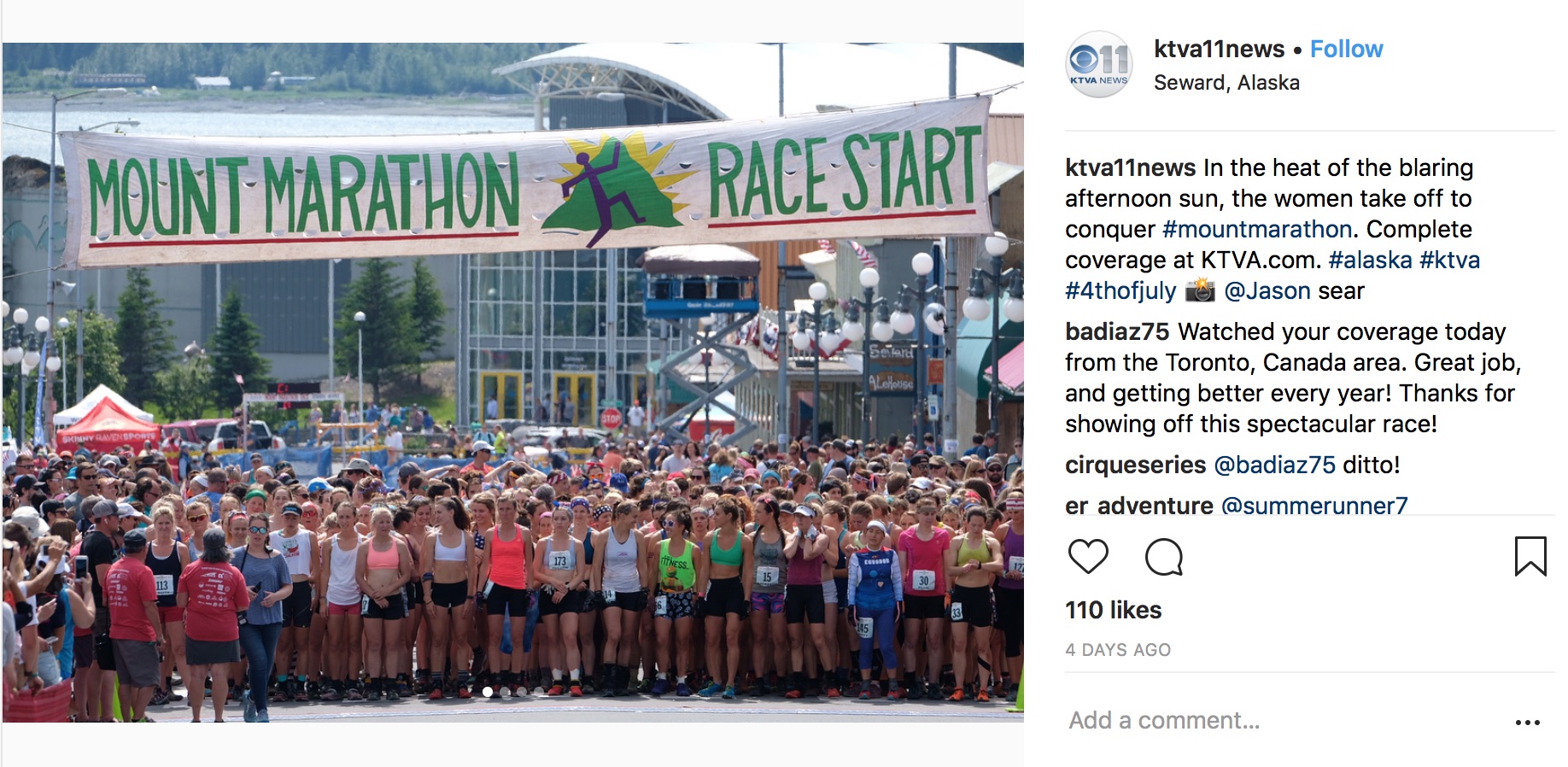
After Norris took a dramatic victory in the men’s race Wednesday morning (see below for men’s race recap), Yeaton matched him in the women’s race in the afternoon. Racing in the marquee afternoon time slot, Yeaton led a field of roughly 270 women off the starting line at 2 p.m. The women’s reward for racing in the afternoon this year (the men’s and women’s race alternate the prime-time afternoon slot) was temperatures even warmer than this morning, although thankfully a light breeze had picked up.
After roughly four minutes of gradual uphill through the streets of Seward, Yeaton, 26, was among the five-person lead pack to the base of the climb. By shortly into the climb, APU teammate Rosie Frankowski, also 26, was first, with Yeaton close behind. At the mid-point uphill time check, it was Frankowski, then Yeaton (+16 seconds), with Najeeby Quinn third over a minute back.
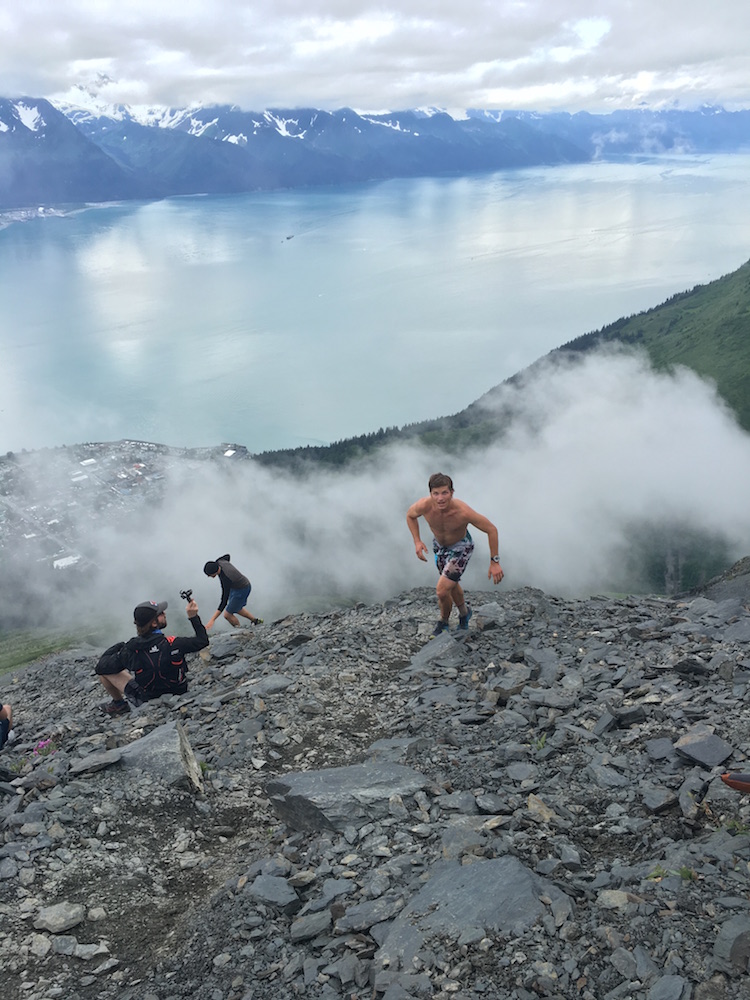
Frankowski and Yeaton continued to stretch their lead as the race climbed out of a humidity choked tunnel of vegetation and onto the stark shale rocks of the mountain’s upper half.
The two APU skiers and race rookies (Frankowski earned her entry spot by winning the Government Peak hill climb in early June, Yeaton by winning the Bird Ridge hill climb in mid-June) were both climbing fast and moving well, although they were a study in contrasts on the live television broadcast. The compact Frankowski climbed the hill the way Marit Bjørgen had skied the Olympic 30 k, attacking the hill with each step as she leaned into the steep climb. “You can almost hear her feet hitting the ground with each stride,” veteran Mount Marathon racer-turned-color commentator Clint McCool marveled on the broadcast, praising the redoubtable power of Frankowski’s lower body.
Behind her, the more lithe Yeaton seemed to float upward with an ease that belied the effort of climbing the 47-degree slope. While Frankowski’s high turnover remained the same throughout the climb, Yeaton even broke into a few brief running strides on the “flats.”
Frankowski crossed the timing mat at the turnaround in a (staggeringly fast) unofficial time of 37:06. Yeaton was 29 seconds back in 37:35. The time back to Quinn in third (39:13), let alone Christy Marvin in fourth (39:56) or Denali Foldager-Strabel (40:33) in fifth, seemed significant if not insurmountable.
But that’s why you run the race. Frankowski then took a meandering and suboptimal line onto the snowfield that begins the precipitous descent. In fact, she bypassed the snowfield entirely, running around its rocky edge for several hundred vertical feet.
“I train with Rosie every day and she was not stoked about the downhill,” Yeaton said in a post-race interview with the Anchorage Daily News (ADN). “So she was like, ‘I’m gonna take this [other] route.”
Frankowski told the ADN she wanted to didn’t want to risk getting injured on the downhill.
“This is fun, but my primary sport — I’m not going to ruin it,” Frankowski said.
By the time Frankowski reached the bottom of the snowfield, Yeaton had come flying past her, opening up a lead she would not relinquish. Quinn had passed her as well.
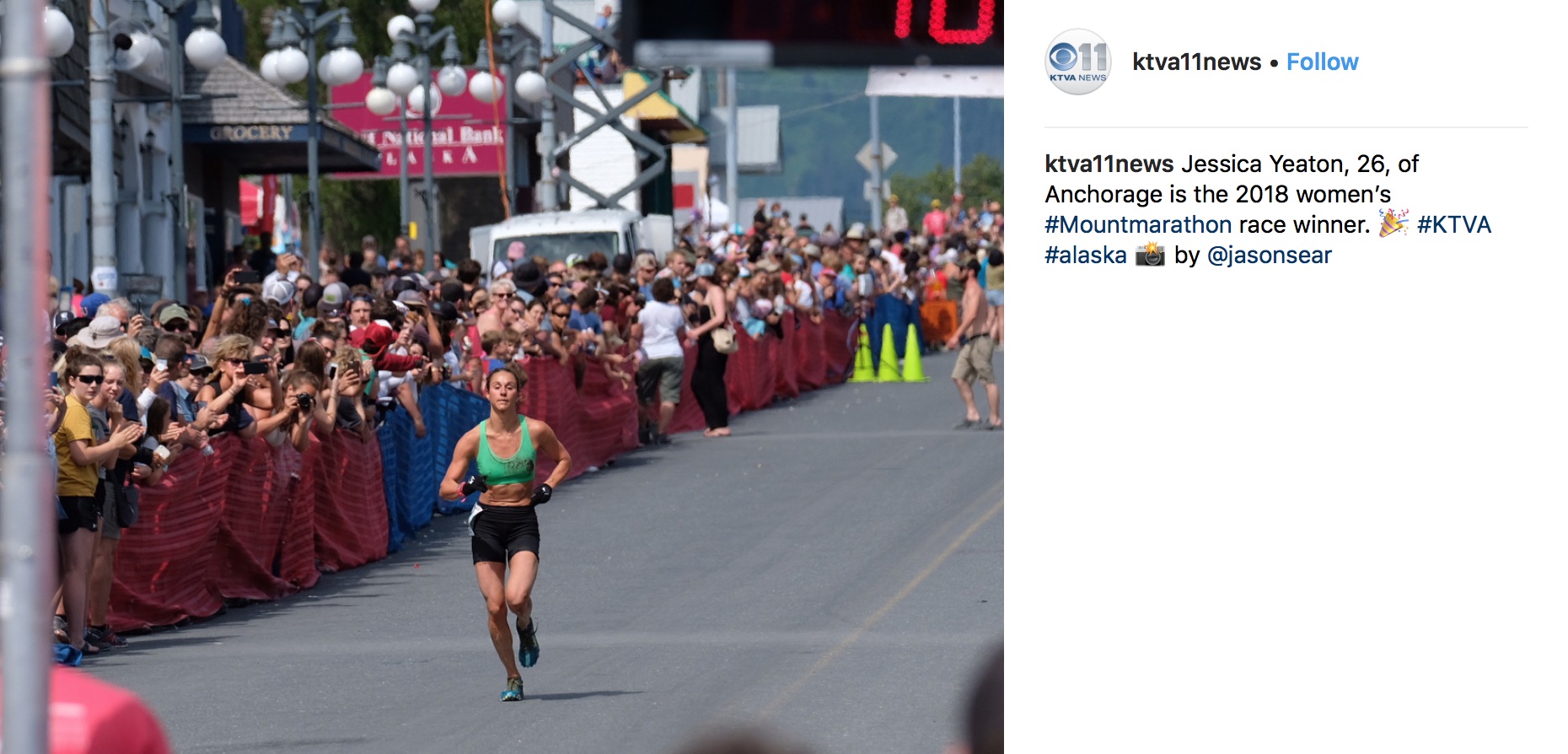
Yeaton ran smoothly all the way to the bottom, going from the turnaround point to the finish line in under 14 minutes. (Her pre-race preview with Norris may have been helpful: “You just do a front flip here,” Norris calmly advises the camera in one of Yeaton’s recent Instagram videos as he demonstrates a flip down a small cliff approaching the bottom of the climb. “It’s easier in the race with the adrenaline.”) Despite the effort, Yeaton looked calm and in control running down Main Street, ultimately taking the victory in an unofficial time of 51:30.
Yeaton’s overall time ranks ninth all-time in a race first contested by women in 1963.
Frankowski’s unofficial uphill split of 37:06 ranks third all-time among uphill marks, behind only pro runner Emelie Forsberg and two-time NCAA steeplechase champion Allie Ostrander, who has a track 5 k PR of 15:22 and finished eighth in the 2016 U.S. Olympic Trials in this event. Yeaton’s 37:35 uphill would be sixth among Mount Marathon climbs.
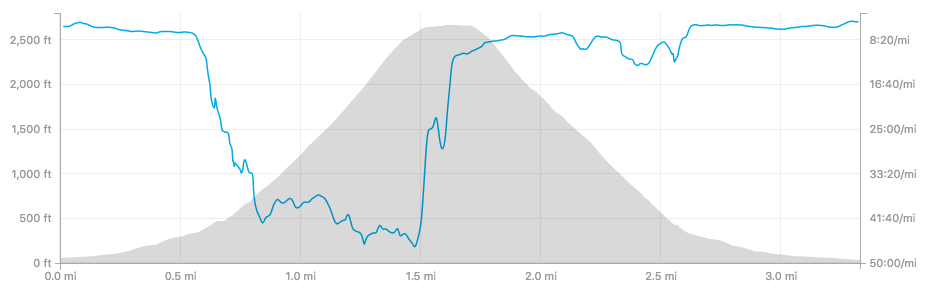
About that uphill: Elevation profile of Mount Marathon course, from an athlete (Jeff Levin) who finished 58th out of 306 men in 2017. Note the 35- to 45-minute pace per mile for much of the climb. (Photo: Strava screenshot)
Behind Yeaton, there was ample movement in the standings. Frankowski would ultimately post the day’s 91st-ranked downhill, alongside the fastest uphill, to finish seventh overall. Foldager-Strabel, fifth at the turnaround, would drop an all-time record 11:27 downhill (prior record: 11:31, Forsberg, in 2015) en route to finishing second overall in 52:00, barely ahead of a charging Marvin who took third in 52:04. Fourth overall was Quinn, who had been as high as second during parts of the downhill but was either injured or cramped up severely during the latter half of the descent. And fifth overall was Boulder resident Hannah LaFleur, who had been in sixth at the halfway point.
Also of note, former FasterSkier contributor Aubrey Smith was 11th. And former champion Holly Brooks, less than one year removed from giving birth to twins, was 19th, while wearing a microphone and providing live commentary to the broadcast team along the way. (“Can I sneak by on the left? Thanks,” she was at one point heard to exclaim on air.)
An ebullient Yeaton spoke with KTVA Channel 11 at the finish. “I was just, like, trying to hold them off the whole way” down, she said of her race strategy for the descent in reference to her pursuers.
“The heat was horrible,” Yeaton said of the day’s conditions. “But there were so many people out there with water, I probably got 30 different things of ice and water on my head. It made it so much better. I couldn’t do it without all the people on the mountain.”
Men’s Race: David Norris Holds Off Max King
Norris did it again.
The 27-year-old APU skier came into Wednesday’s race, the 91st running of an event first held in 1915 that is among the oldest footraces in this country, as the course record holder at Mount Marathon. He had set a course record at the uphill-only Bird Ridge hill climb last month. Meanwhile, defending champion and APU teammate Scott Patterson was out of this race with a toe injury. Previous Mount Marathon course record-holder Eric Strabel was out with a stress fracture. As the ADN wrote in its preview of the men’s race, Norris had “a target on his back.”
https://www.instagram.com/p/Bk0qm_PBiLa/
Despite the pressure that comes with being the widely acclaimed favorite in a race variously described as “Alaska’s Olympics” or “Alaska’s Super Bowl,” Norris delivered.
He set a torrid pace off the starting line following the 11 a.m. start, charging toward the base of the peak that rises immediately above the seaside town of Seward, Alaska. Close behind was Max King, 38, a professional runner from Bend, Oregon.
https://www.instagram.com/p/Bk0wF3OlmHS/
King has been described as “the most versatile runner in the country,” with a race résumé that ranges from two top-20s at the U.S. Olympic Marathon Trials (where he ran a 2:14 and a 2:17) to sixth in the steeplechase at the U.S. trials to strong finishes while racing around the world as a sponsored athlete, in distances ranging from a vertical kilometer to 100-mile ultramarathons.
Norris hit the base of the climb first, with King not far behind. Norris went through the mid-mountain uphill split in 21:01, with King 34 seconds back. Adam Jensen, 37, an Anchorage dentist, was at that point third in 22:08. Fifth (22:32) was 18-year-old Luke Jager, another APU skier, making his debut in the senior race this year after winning the junior race three times in a row from 2015–2017.
Norris reached the turnaround point in 31:37, according to this reporter’s unofficial split, with King roughly 30 seconds behind him.
Norris was still in the lead, but he looked rough. He climbed up the steep shale face of the upper mountain with a ragged tempo. He was hunched over, with his hands on his quads, unable to run or even power hike with with the upright posture that he prefers. (“Hiking is fine and maybe even better on certain pitches, but forcing yourself back into a running stride as soon as the terrain allows is crucial,” Norris previously told FasterSkier about his approach to climbing.) He stumbled repeatedly, and took the turns wide. He accepted water from everyone who offered it. He was covering the climb roughly 1 minute slower than he had when he set the course record in 2016, and he looked far worse doing it.
Behind him, King looked fresh and smooth. He was running where Norris was walking. He was upright where Norris was hunched over. He was moving hands-free where Norris was dabbing the rock. He was eschewing water where Norris had guzzled it. On the live broadcast, color commentator Clint McCool surmised that King had pushed Norris fast off the line in an attempt to blunt some of Norris’s climbing prowess, and that it had largely succeeded.
But then the two men started going downhill. Norris took a better line onto and off of the steeply pitched snowfield that begins the precipitous descent. He looked rough running down the mountain below that, but so did King. By the time Norris hit the sweeping expanses of shale down the mountain’s flank, he was flying. He cleared multiple technical stretches (“the three problems,” three small waterfalls) with ease.
When Norris came off the mountain and within sight of tens of thousands of fans in town, his lead was still around 30 seconds, according to unofficial splits taken off the broadcast. He gave back some of that on the remaining 0.6 miles of pavement running down to the finish line, as he slowed slightly to high-five the assembled hordes and King put his 2:14 marathon speed to work. Indeed, King’s downhill split was 12 seconds faster than Norris’s.
https://www.instagram.com/p/Bk0oo0th0H7/
But Norris had a gap, and he kept it to the finish to close out a gutsy race. When he crossed the finish line – which is itself outside of a bar, commemorating the race’s bar-bet origins – he was the most famous athlete in Alaska for the second time in three years.
Third in this year’s race was Adam Jensen, over three minutes out of second. Matt Shryock was fourth. Benjamin Marvin edged Jager by three seconds for fifth.
Norris “pushed the early part of the race, like way harder than last year,” he told local television station KTVA Channel 11 in a live interview after the race, “trying to put pressure on Max.”
“Coming down,” Norris continued, “my legs were way more tired than two years ago,” largely proving McCool’s surmise correct.
Looking to the future, Norris promised to keep coming back. “I would love to mainly keep getting my own uphill record,” Norris said of his future race strategy, “and then just survive the downhill.”
Norris’s uphill record of 30:35 remains safe for another year. (Behind him on that list: pro runner Rickey Gates (31:26), pro runner Kílian Jornet (31:27), Anchorage attorney and father Jim Shine (31:29), and APU teammate and Olympian Scott Patterson (31:40).)
Norris’s overall time of an unofficial 42:13 for 2018 places him third on the all-time list, behind only his course-record 41:26 from 2016 and Jornet’s 41:48 from 2017.
King, who finished in an unofficial 42:33, now ranks fourth on that all-time list. Competing in his first Mount Marathon, he had nothing but praise for the Alaska tradition and spectacle.
“It is unbelievable up there,” King told KTVA at the finish. “I got here, I’ve been intimidated and scared the entire week of this mountain. … This race, it was awesome to be able to experience that.”
He will “absolutely” be back, King said. “This is awesome; I love it here. The mountains are fantastic, there’s tons of things to run.”
For his victory, Norris collected a small trophy and large bragging rights. Other than free lifetime entry into future races, there is no cash prize associated with Mount Marathon. The race has one of the deepest fields in the country on the merits (consider that Gates was only 12th in this year’s race, and Jornet and pro runner Emelie Forsberg are believed to be the only non-Alaskans to ever win the race), certainly one of the deepest anywhere for a bragging rights-only event.
Juniors Race: Michael Connelly, Kendall Kramer Prevail
In the day’s first race, junior boys and girls raced together, starting at 9 a.m. under humanely still relatively cool conditions. First place went to Michael Connelly, 16, a rising star from Chugiak who had finished in the top-10 overall of every mountain race he had done this year. Connelly was sixth last year in the junior race. This was his first boys title; APU skier Luke Jager, now 18 and aged out of the junior race, had won the race the last three years.
Second place was Ali Papillon, 13, who had spent much of the first part of the summer in Colorado. Papillon was described by the ADN as 4-foot-5 and 70 pounds following his third-place finish in 2017, and appeared only slightly taller this year. Third place was claimed by Gavin Block, 16, of Palmer, who was second among junior boys last year. Block runs and skis for Colony High School.
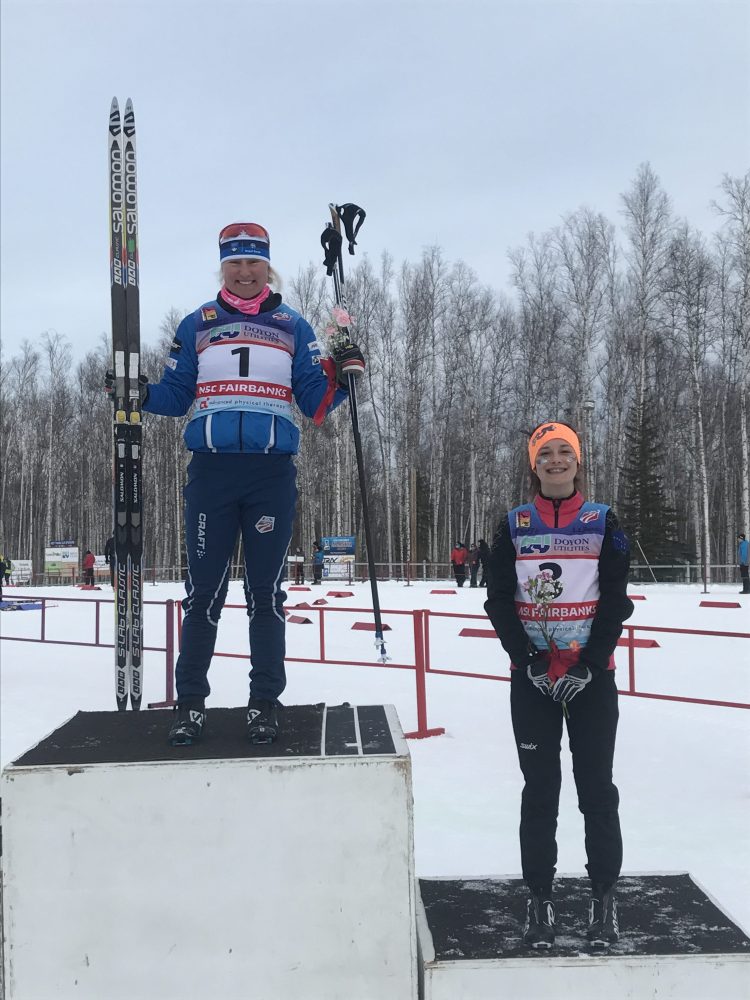
The junior women’s 7.5 k classic podium on Monday at SuperTour Finals in Fairbanks, Alaska, in March 2017, with Hannah Halvorsen (Sugar Bowl Academy/USST D-team) in first and Kendall Kramer (Nordic Ski Club of Fairbanks/FXC) in third. (Photo: Reader submission)
A few minutes behind Block in the co-ed mass start race, Fairbanks skier and runner Kendall Kramer, 16, was the first girl across the finish line. Kramer was third in the 5-kilometer classic mass start race at 2018 U.S. nationals in Anchorage. It was Kramer’s first Mount Marathon title.
Aubrey LeClair, 17, of Anchorage and Katey Houser, 14, of Palmer, also both skiers, rounded out the junior girls podium in second and third. LeClair skis and runs for West High School, and trains with the APU junior team. She was the women’s winner in the season-opening Race to the Outhouse ski race in early November 2017. Houser earned multiple medals in cross-country ski events at the 2018 Arctic Winter Games in Northwest Territories.
“According to folklore, the tradition of the Mount Marathon Race began when two sourdoughs argued about the possibility of climbing and descending the mountain in less than an hour. ‘Impossible’ one said. To settle the argument, and the resulting wager, a race was held, with the loser to furnish drinks for the crowd. At the same time, enterprising merchants put up a suit of clothes and other attractions for the winner and proposed the race take place on a holiday – why not the 4th of July? The optimistic sourdough lost his bet. The winning racer took one hour and two minutes.”
The race was first formally contested in 1915, with a winning time of 1:02:02. There were no races held in the early 1920s, the mid-1930s, and for one year during World War II. The race has been held every year since 1943, always on the fourth of July. 2018 marks the 91st running of the race.
The first official women finishers were in 1963, nine years before women were officially allowed in the Boston Marathon and 21 years before women were allowed to race distances over 1,500 meters at the Summer Olympics.
Notable past Mount Marathon champions who were also skiers include, in reverse chronological order, Holly Brooks, Kikkan Randall, Nina Kemppel, Lynn Galanes, and Betsy Haines (Randall’s aunt). Notable male Mount Marathon champions who were also skiers include Scott Patterson, David Norris, Eric Strabel, Trond Flagstad, Toby Schwörer, Todd Boonstra, Bill Spencer, Jim Renkert, Tom Besh, and Sven Johanson. Kílian Jornet, who won in 2015 and held the course record before David Norris happened, may merit honorable mention as a ski mountaineer.
The race’s course description page reassures racers, “Mount Marathon is not quite as steep as has been previously reported. The true steepness – from the base of the mountain to the lip of the mountain just before the turnaround rock – averages 34 degrees. That figure was calculated using GPS data from several racers. Excluding the road approach, the vertical gain is about 2,675 feet in 0.9 miles.”
King, a professional runner who has raced all over the world for nearly twenty years, told McCool that he “had never raced anything so steep, and had never come down anything so fast,” according to McCool’s comments on the broadcast.
Outside magazine has called Mount Marathon “the toughest 5k on the planet.” It is undeniably the most famous footrace in Alaska, and the second most famous athletic event anywhere in the state, behind only the Iditarod Trail Sled Dog Race. It has grown from its humble origins to a yearly spectacle that is covered by helicopter and drone and broadcast live on local network television, as well as online (tune in to ktva.com next July 4 for the 2019 race, or this week for an archived replay of 2018).
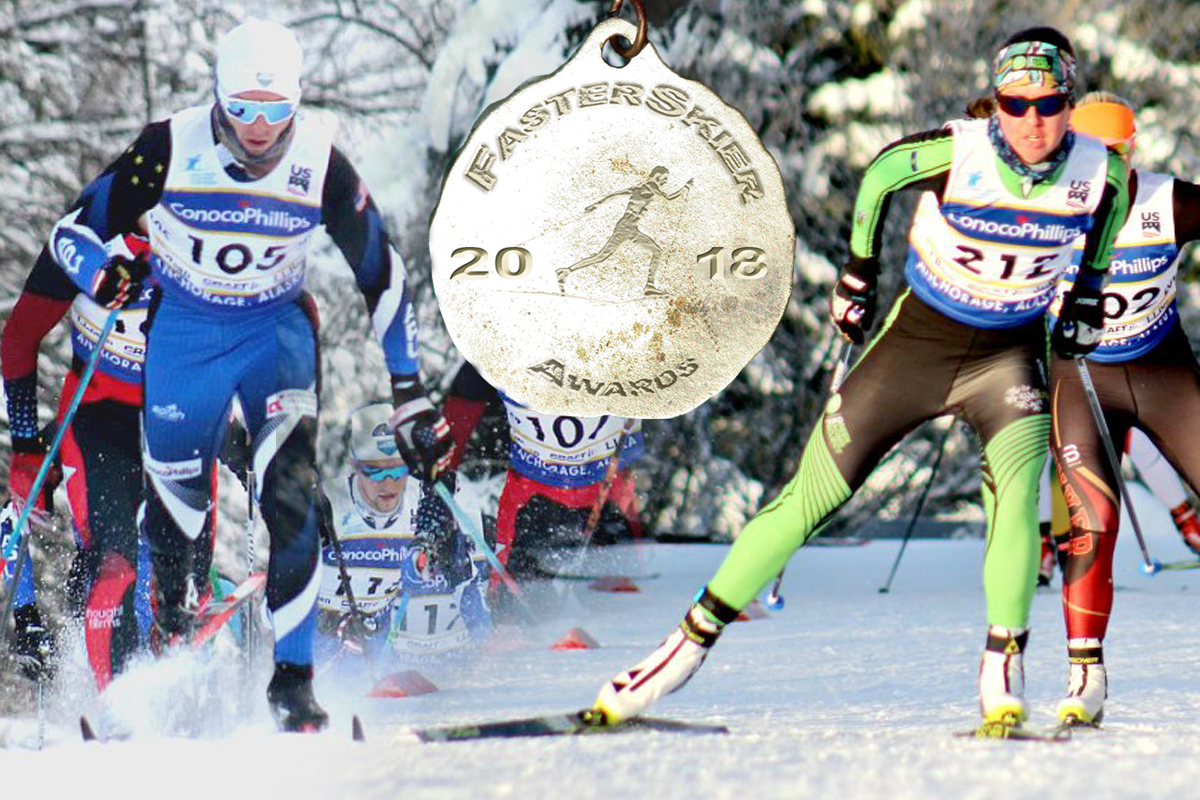
David Norris of Alaska Pacific University (105) and Caitlin Patterson of the Craftsbury Green Racing Project (212) are FasterSkier’s 2018 U.S. Continental Skiers of the Year. (Photos: FasterSkier)
Caitlin Patterson, Craftsbury Green Racing Project
Had Caitlin Patterson glanced to either side while she double poled down the finishing stretch of this year’s U.S. nationals classic sprint, she wouldn’t have seen any other skiers. As it were, the 27 year old had her sights set on the finish line, where they stayed until she secured first place.
As the first across the line, Patterson snagged her fourth win of the week, and with it, a spot in history. She became the first woman in six years to win four consecutive titles at a single U.S. nationals (after U.S. Ski Team member Jessie Diggins did in 2012).
“It felt surreal coming down the finishing stretch … realizing that I couldn’t hear people behind me and realizing that it was going to be number four,” Patterson told Fasterskier after the race.
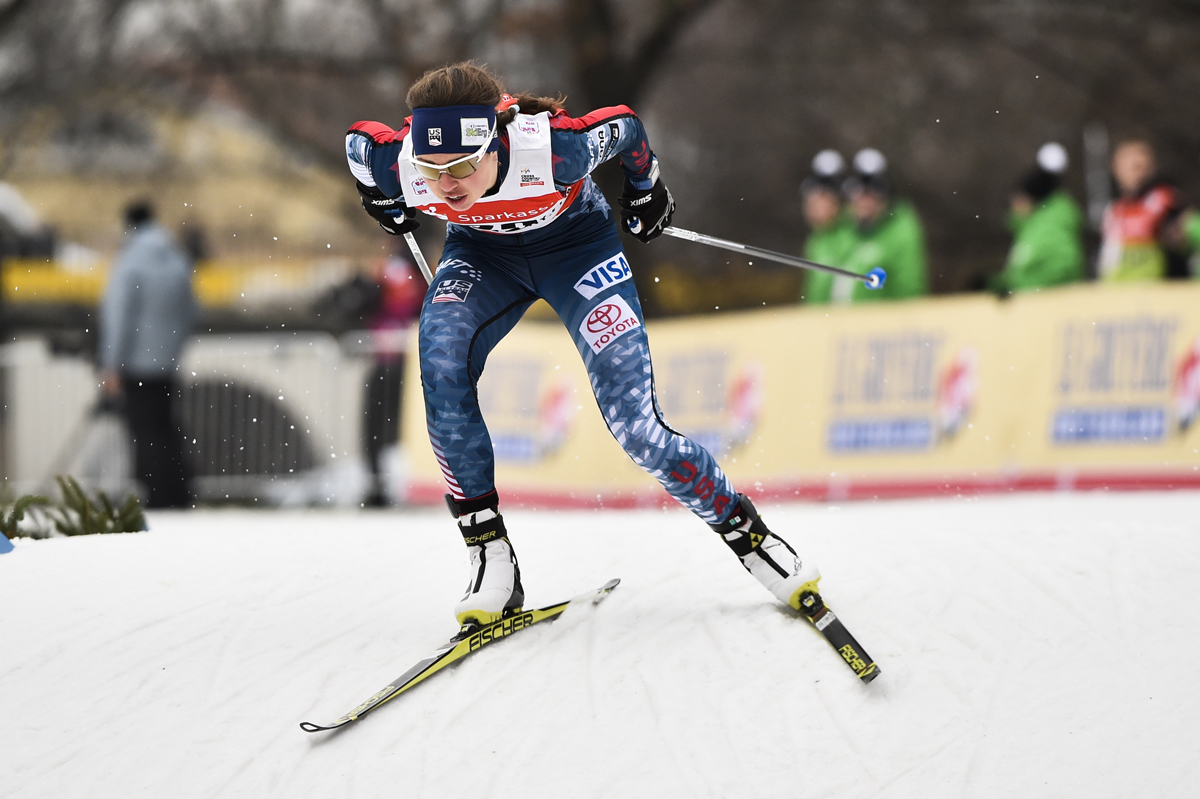
Caitlin Patterson (Craftsbury Green Racing Project) racing to 40th in the women’s freestyle sprint qualifier at the World Cup in Dresden, Germany. (Photo: Fischer/NordicFocus)
The banner week for the Idaho native, who grew up in Anchorage, Alaska, where nationals took place, started with an outright victory in a snowy 10 k freestyle. The race after that, Patterson claimed a definitive win in the women’s freestyle sprint, crossing 3.56 seconds ahead of her closest competitor. To close out the week, Patterson was the first American in the women’s 20 k classic mass start, before winning the classic sprint with no other skiers in sight.
“I could not have imagined this if I tried,” Patterson said, reflecting on the week.
Prior to her winning streak at nationals, Patterson also raced the opening SuperTour races in West Yellowstone, Montana, where placed third in the 10 k classic. At the following NorAm/SuperTour races in Sovereign Lake, British Columbia, she won 10 k freestyle and placed second in the classic sprint.
Following her racing at U.S. nationals, Patterson flew to Europe to race Period 2 of the World Cup. She notched some of her best World Cup performances of her career while there, with a 20th in the 10 k classic in Planica, Slovenia, and a 23rd in the 10 k freestyle mass start in Seefeld, Austria. The Olympics were the next stop for Patterson, where she skied to 34th in the skiathlon and 26th in the 30 k classic mass start. She also raced World Cup Period 4,
On the domestic circuit back home, Patterson finished the season in second in the overall SuperTour standings, behind her Craftsbury teammate Kaitlynn Miller (who also made the U.S. Olympic team) in first.
David Norris, Alaska Pacific University
Our U.S. Breakthrough Skier of the Year in 2016, David Norris is our pick for American male Continental Skier for 2018. The Fairbanks, Alaska, native is the overall SuperTour winner for 2017/2018, and he opened his season with a second-place finish in the 15 k classic mass start at the West Yellowstone SuperTour.
At U.S. nationals, Norris came down sick and raced two of the four races, placing sixth in the 30 k classic mass start and ninth in the classic sprint. After nationals, Norris raced at the Craftsbury SuperTour, where he finished seventh in the classic sprint and won the 10 k freestyle.
“I came to Craftsbury itching to race,” Norris wrote in an email to FasterSkier in January. “I was sick during nationals and competed in the 30km because I had to if I wanted a chance to earn an Olympic spot. I came up shy, but I know I that I am in good shape. After nationals I took another ten days easy to fully recover from illness so that I could come into Craftbury and Canada healthy.”
The Ishpeming SuperTour men’s 20 k freestyle podium on Feb. 17, with David Norris (c) in first, Kevin Bolger (l) in second, and Brian Gregg (r) in third. (Photo: APU)
At the NorAm/SuperTour in Gatineau, Quebec, Norris placed ninth in the classic sprint before finishing second in the 15 k freestyle and winning the 15 k classic pursuit. Norris continued on the SuperTour circuit to Ishpeming, Michigan, where he finished third in the skate sprint and won both the 20 k skate and 10 k classic races. At the American Birkebeiner in Hayward, Wisconsin, he was the second American and fifth overall.
Norris qualified for Period 4 of World Cup racing and competed in Finland, Norway and Sweden before returning to the U.S. for SuperTour Finals in Craftsbury. There, he finished the season in fourth in the 50 k classic mass start and seventh in the 15 k freestyle mass start. As the overall SuperTour leader at the end of the season, he’ll earn Period 1 World Cup starts next winter.
Honorable Mention: Kaitlynn Miller, Craftsbury Green Racing Project
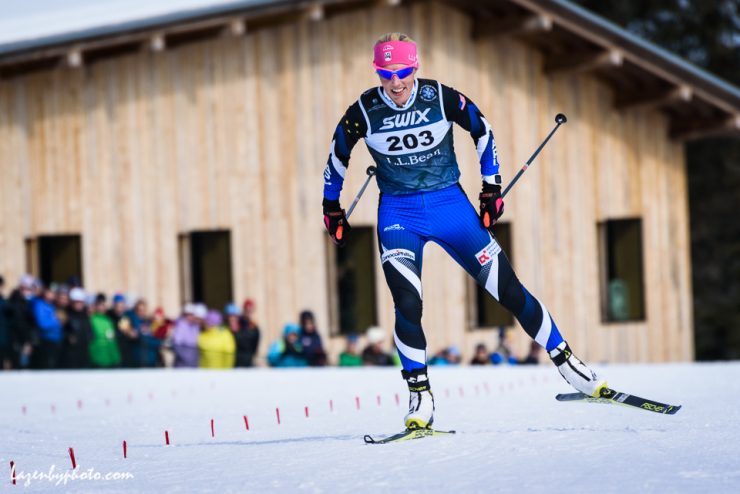
Kaitlynn Miller (Craftsbury Green Racing Project) racing to first in the women’s 1.4 k classic sprint qualifier on Feb. 26 at the SuperTour in Craftsbury, Vermont. She went on to win the final. (Photo: John Lazenby/Lazenbyphoto.com)
With three podiums as a top American finisher at U.S. nationals, Kaitlynn Miller qualified for her first Olympics and finished the season in first in the overall SuperTour standings. The 26 year old, who was born in New Jersey and grew up in Vermont, started the season out with a second-place finish in the 10 k classic mass start. The next weekend, Miller won the Sovereign Lake NorAm classic sprint.
At nationals, Miller was the second American and fourth overall in the skate sprint sprint. She was the third American and fifth overall in the 20 k classic mass start, and third outright in the classic sprint. She went on to win the Craftsbury SuperTour classic sprint, then placed second in the classic sprint and third in the 10 k classic pursuit with the fastest time of the day at the Gatineau SuperTour/NorAm.
Before jetting to the Olympics in PyeongChang, South Korea, Miller raced to a win in the Ishpeming SuperTour 5 k classic and placed third in the skate sprint. She finished her season on Period 4 of the World Cup and SuperTour Finals back on her home course in Craftsbury.
“It’s been a really unexpected good season and I am really happy with it,” Miller told FasterSkier at World Cup Finals in Falun, Sweden. “To be honest, 10 k skates are generally speaking not my favorite and that’s probably the best-feeling race I’ve had since being over here, which was a really really pleasant surprise and definitly a good high note to end on.”
Honorable Mention: Kevin Bolger, Sun Valley Ski Education Foundation
Kevin Bolger (Sun Valley Ski Education Foundation) racing in the 15 k classic mass start on March 4 at the World Cup in Lahti, Finland. He placed 54th in his first distance World Cup start. (Photo: Fischer/NordicFocus)
Our 2018 Breakthrough Skier of the Year, we felt Kevin Bolger should be recognized as an exceptional continental skier as well. Bolger, 25, finished the SuperTour season in second overall, just 15 points behind Norris in first.
Bolger tallied five SuperTour podiums this past season, including second place in the U.S. nationals skate sprint and a win in the skate sprint at the Ishpeming SuperTour. He made his World Cup debut in early March in Lahti, Finland, where he was the top Continental Cup skier in the skate sprint in 11th overall. He went on to score another World Cup top 30 at World Cup Finals in Falun, where he placed 30th in the skate sprint.
“As I reflect back on my season I don’t think it could have gone better,” Bolger wrote in an email to FasterSkier. “I’ve gotten a taste of what it’s like to be skiing on the World Cup and skiing against the best in the World. That has shown me that I still have a lot of work to do ‘a lot of work’, of course I’ve had some good results but I want more.
“I want to be able to not only ski with those guys on the World Cup, but I want to be compete against them,” he continued. “I haven’t been more motivated and excited for another year to start.”
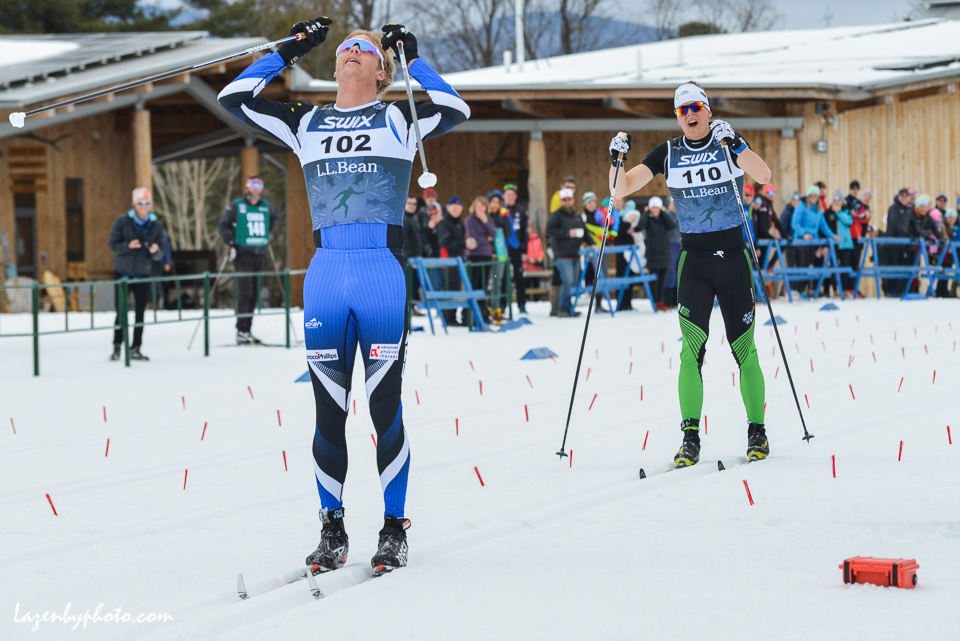
Erik Bjornsen (102) of Alaska Pacific University and the U.S. Ski Team celebrates his win in the men’s 50 k classic mass start at 2018 U.S. Distance Nationals on Wednesday in Craftsbury, Vt., ahead of Adam Martin (110) of the Craftsbury Green Racing Project in second. (Photo: John Lazenby/Lazenbyphoto.com)
2018 U.S. SuperTour Finals (Craftsbury, Vermont): 50 k classic mass start
In the final race of the U.S. racing season, Erik Bjornsen of Alaska Pacific University (APU) and U.S. Ski Team (USST) won his second individual race of the week at 2018 SuperTour Finals in Craftsbury, with a victory in the men’s 50-kilometer classic mass start on Wednesday for the U.S. Distance Nationals title. He previously won the 15 k freestyle mass start on Saturday.
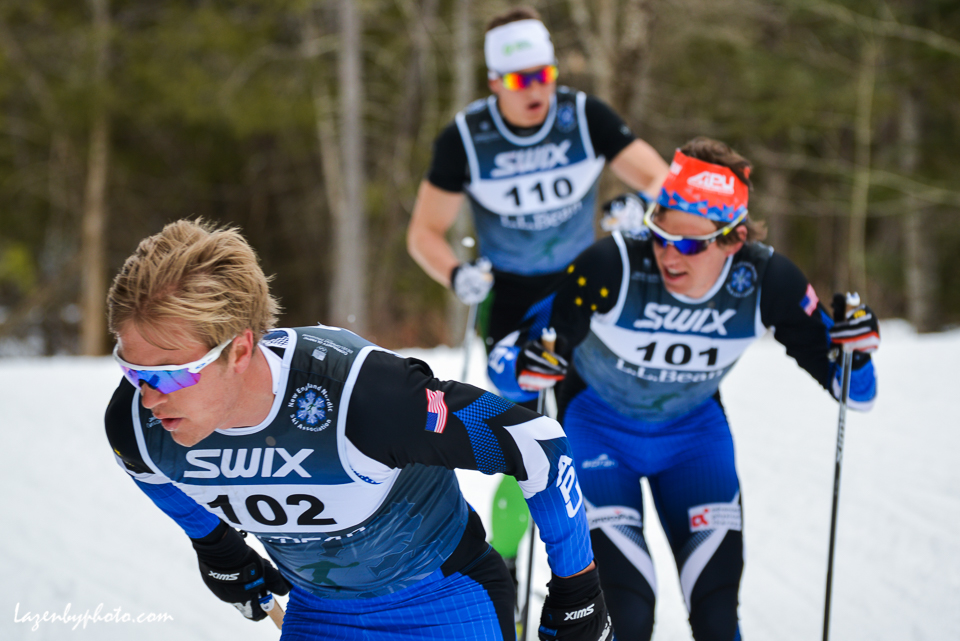
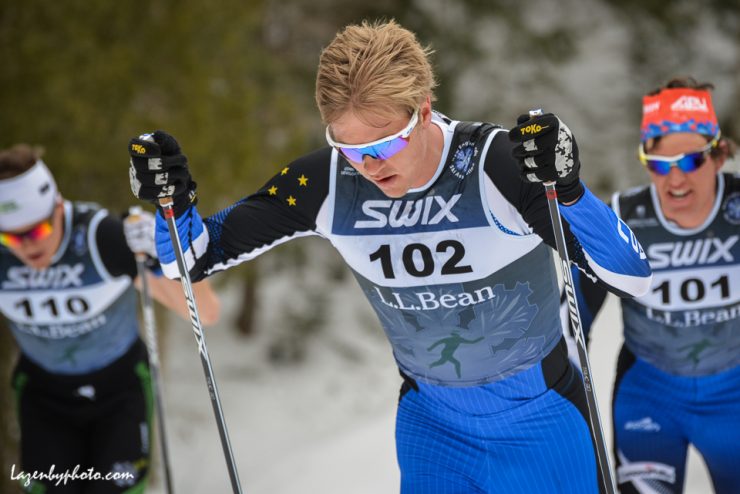
Erik Bjornsen (102) leads his APU and U.S. Ski Team teammate Scott Patterson (101) and Craftsbury’s Adam Martin (110) during the men’s 50 k classic mass start at 2018 U.S. Distance Nationals on Wednesday in Craftsbury, Vt. (Photo: John Lazenby/Lazenbyphoto.com)
Bjornsen beat out Adam Martin of the Craftsbury Green Racing Project (CGRP) in the finishing stretch to finish first in 2:24:51.4 hours, 1.5 seconds ahead of Martin in second place.
For the first 25 k of the race, about six skiers had been in contention while skiing together at the front of the field. By 35 k, that lead group had dwindled to three, with Bjornsen and his teammate Scott Patterson (APU/USST) leading Martin. Five kilometers later, Martin led the other two, and the three stuck together into the final 5 k lap.
Ultimately, Patterson finished 22.8 seconds back in third place, ahead of another APU teammate David Norris, who came on strong while skiing alone on the last lap to close the gap to third, in fourth (+36.5).
The rest of the field was strung out as they crossed the line, with Simi Hamilton of the Stratton Mountain School (SMS) T2 Team and USST placing fifth (+1:49.0), and his teammate Paddy Caldwell (SMST2/USST) following nearly three minutes later in sixth (+4:34.4). Kris Freeman (Caldwell Sport) finished seventh (+8:10.8), Tad Elliott (Ski Club Vail) placed eighth (+9:15.6), Ian Torchia of Northern Michigan University (NMU) and the USST Development Team was ninth (+10:26.3), and Canada’s Scott Hill (Team Hardwood) 10th (+11:00.2).
In the junior men’s 30 k race, Ben Ogden (SMS) took the win in 1:29:17.6, while Hunter Wonders (APU) followed 17.2 seconds back in second place. Wyatt Gebhardt (Steamboat Springs Winter Sports Club) placed third (+1:46.6).
Start of the men’s 50 k classic mass start at 2018 U.S. Distance Nationals in Craftsbury, Vt. (Photo: John Lazenby/Lazenbyphoto.com)
Start of the men’s 50 k classic mass start at 2018 U.S. Distance Nationals in Craftsbury, Vt. (Photo: John Lazenby/Lazenbyphoto.com)
The men’s 50 k classic mass start at 2018 U.S. Distance Nationals in Craftsbury, Vt. (Photo: John Lazenby/Lazenbyphoto.com)
Men’s 50 k classic mass start leaders, with Erik Bjornsen and David Norris of Alaska Pacific University up front, at 2018 U.S. Distance Nationals in Craftsbury, Vt. (Photo: John Lazenby/Lazenbyphoot.com)
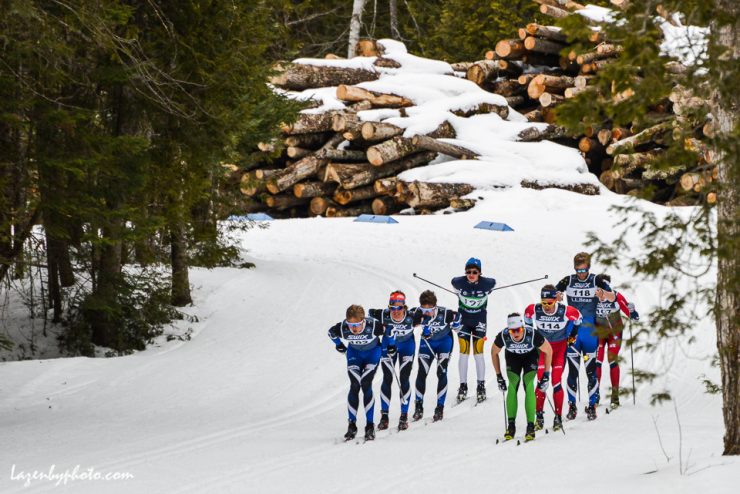
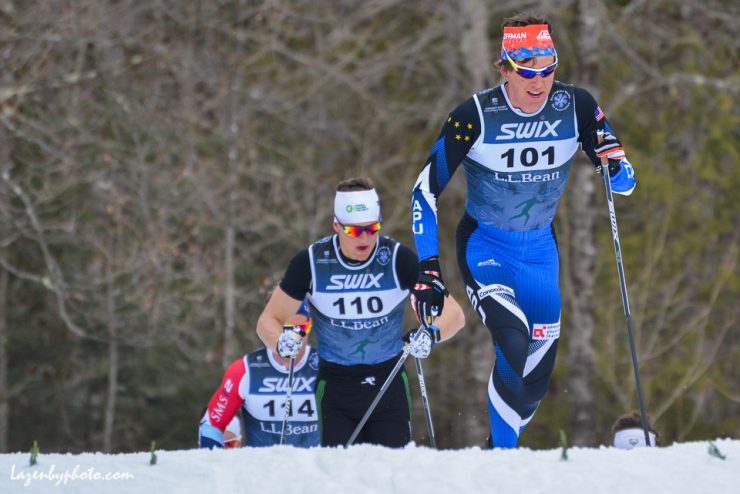
Scott Patterson (101) leads Adam Martin (110), Simi Hamilton (114) and others during the men’s 50 k classic mass start at 2018 U.S. Distance Nationals in Craftsbury, Vt. (Photo: John Lazenby/Lazenbyphoto.com)
Adam Martin (Craftsbury Green Racing Project) during the men’s 50 k classic mass start at 2018 U.S. Distance Nationals in Craftsbury, Vt. (Photo: John Lazenby/Lazenbyphoot.com)
Craftsbury’s Adam Martin (110) and Erik Bjornsen (102) of APU and the U.S. Ski Team leading the men’s 50 k classic mass start at 2018 U.S. Distance Nationals on Wednesday in Craftsbury, Vt. (Photo: John Lazenby/Lazenbyphoto.com)
Erik Bjornsen (102) leading his APU and U.S. Ski Team teammate Scott Patterson (r) and Craftsbury’s Adam Martin (l) during the men’s 50 k classic mass start at 2018 U.S. Distance Nationals in Craftsbury, Vt. (Photo: John Lazenby/Lazenbyphoto.com)
APU Head Coach Erik Flora in the ski-exchange zone for the men’s 50 k classic mass start at 2018 U.S. Distance Nationals in Craftsbury, Vt. (Photo: John Lazenby/Lazenbyphoto.com)
The ski-exchange zone for the men’s 50 k classic mass start at 2018 U.S. Distance Nationals in Craftsbury, Vt. (Photo: John Lazenby/Lazenbyphoto.com)
The feed zone for the men’s 50 k classic mass start at 2018 U.S. Distance Nationals in Craftsbury, Vt. (Photo: John Lazenby/Lazenbyphoto.com)
Sophie Caldwell (Stratton Mountain School T2 Team) running to deliver a feed during the men’s 50 k classic mass start at 2018 U.S. Distance Nationals in Craftsbury, Vt. (Photo: John Lazenby/Lazenbyphoto.com)
Simi Hamilton (l) gets a feed from his Stratton teammate Jessie Diggins during the men’s 50 k classic mass start at 2018 U.S. Distance Nationals in Craftsbury, Vt. (Photo: John Lazenby/Lazenbyphoto.com)
Everett Sapp, of Sugar Bowl Academy, racing the junior men’s 30 k classic mass start at 2018 U.S. Distance Nationals in Craftsbury, Vt. (Photo: John Lazenby/Lazenbyphoto.com)
A Craftsbury volunteer removes the timing chip of a Northern Michigan University skier after the men’s 50 k classic mass start at 2018 U.S. Distance Nationals in Craftsbury, Vt. (Photo: John Lazenby/Lazenbyphoto.com)
Adam Martin (Craftsbury Green Racing Project) after finishing second in the men’s 50 k classic mass start at 2018 U.S. Distance Nationals in Craftsbury, Vt. (Photo: John Lazenby/Lazenbyphoto.com)
Logan (l) and his older brother Reese Hanneman of Alaska Pacific University after the men’s 50 k classic mass start at 2018 U.S. Distance Nationals in Craftsbury, Vt. (Photo: John Lazenby/Lazenbyphoto.com)
The men’s 50 k classic mass start podium at 2018 U.S. Distance Nationals in Craftsbury, Vt., with Erik Bjornsen (c) in first, Adam Martin (l) in second and Scott Patterson (r) in third. (Photo: John Lazenby/Lazenbyphoto.com)
Bibs on a fence at the men’s 50 k classic mass start at 2018 U.S. Distance Nationals in Craftsbury, Vt. (Photo: John Lazenby/Lazenbyphoto.com)
Erik Bjornsen (2) of Alaska Pacific University and the U.S. Ski Team (USST) leads Simi Hamilton (13), of the Stratton Mountain School T2 Team and USST, and Tad Elliott (12), of Ski Club Vail toward the finish of the men’s 15 k freestyle mass start at 2018 SuperTour Finals in Craftsbury, Vt. (Photo: John Lazenby/Lazenbyphoto.com)
2018 U.S. SuperTour Finals (Craftsbury, Vermont): 10/15 k freestyle mass starts
Jessie Diggins won her second-straight race in as many days at 2018 SuperTour Finals and Erik Bjornsen pulled out a victory in the men’s 15-kilometer freestyle mass start on Saturday in Craftsbury.
Jessie Diggins (201) and Sadie Bjornsen (202) lead the women’s 10 k freestyle mass start at 2018 SuperTour Finals in Craftsbury, Vt. (Photo: John Lazenby/Lazenbyphoto.com)
Diggins, of the Stratton Mountain School (SMS) T2 Team and U.S. Ski Team (USST), won the women’s 10 k freestyle mass start in 25:56.0 minutes, just 1.2 seconds ahead of her USST teammate Sadie Bjornsen of Alaska Pacific University (APU) in second. The duo dropped the pack and battled to the line, while Kikkan Randall (APU/USST) skied on her own to third place, 12.6 seconds behind Diggins.
APU took three of the top four with Rosie Frankowski finishing 43.7 seconds back in fourth. Caitlin Patterson of the Craftsbury Green Racing Project (CGRP) followed in fifth (+1:02.2), and Sophie Caldwell (SMST2/USST) took sixth less than one-tenth of a second ahead of her Stratton teammate Katharine Ogden (Dartmouth College/SMS/USST Development Team) in seventh (+1:10.4). US Biathlon’s Susan Dunklee (CGRP) placed eighth (+1:19.4), Julia Kern (SMST2/USST D-team) finished ninth (+1:26.0), and Erika Flowers (SMST2), who competed at last weekend’s Norwegian Birkebeiner, placed 10th (+1:37.0).
In the men’s mass start, Bjornsen (APU/USST) and Simi Hamilton (SMST2/USST) went head to head down the finishing stretch for first, which Bjornsen took in 35:08.1. Hamilton finished 1.5 seconds back in second place, while Tad Elliott (Ski Club Vail) followed three seconds later in third (+4.6).
According to live timing, Paddy Caldwell (SMST2/USST) edged his fellow national-team member Scott Patterson (APU/USST) by less than one-tenth of a second for fourth place (+6.5). Brian Gregg of Central Cross Country (CXC), Team Gregg and Loppet Nordic Racing placed sixth (+30.4), David Norris (APU) finished seventh (+52.1), Jack Hegman of the Sun Valley Ski Education Foundation (SVSEF) eighth (+55.3), Adam Martin (CGRP) ninth (+56.2), and Eric Packer (APU) 10th (+59.8).
Spring Series continues Sunday with mixed relays at 9 a.m. EDT at the Craftsbury Outdoor Center.
Jessie Diggins (201) leads her U.S. Ski Team teammate Sadie Bjornsen and the rest of the women’s field in the 10 k freestyle mass start at 2018 SuperTour Finals in Craftsbury, Vt. (Photo: John Lazenby/Lazenbyphoto.com)
Jessie Diggins (SMST2/U.S. Ski Team) pushing to the line for the win in the women’s 10 k freestyle mass start at 2018 SuperTour Finals in Craftsbury, Vt. (Photo: John Lazenby/Lazenbyphoto.com)
Jessie Diggins (201) winning the women’s 10 k freestyle mass start, just ahead of Sadie Bjornsen (202) in second, at 2018 SuperTour Finals in Craftsbury, Vt. Kikkan Randall (background) placed third. (Photo: John Lazenby/Lazenbyphoto.com)
Kikkan Randall (APU/USST) racing to third in the 10 k freestyle mass start at 2018 SuperTour Finals in Craftsbury, Vt. (Photo: John Lazenby/Lazenbyphoto.com)
Kikkan Randall (l) and Jessie Diggins embrace after the finish of the women’s 10 k freestyle mass start on March 24 at 2018 SuperTour Finals in Craftsbury, Vt. Diggins won and Randall placed third. That was Randall’s second-to-last race before retiring from skiing. (Photo: John Lazenby/Lazenbyphoto.com)
Liz Stephen (U.S. Ski Team) racing to 12th in the women’s 10 k freestyle mass start at 2018 SuperTour Finals in Craftsbury, Vt. (Photo: John Lazenby/Lazenbyphoto.com)
Liz Stephen (U.S. Ski Team) having some fun at 2018 SuperTour Finals in Craftsbury, Vt. She finished 12th in the 10 k freestyle mass start. (Photo: John Lazenby/Lazenbyphoto.com)
U.S. Ski Team member Liz Stephen (yellow bib) during a photo opp at 2018 SuperTour Finals in Craftsbury, Vt. (Photo: John Lazenby/Lazenbyphoto.com)
Scott Patterson (1) leads his APU and U.S. Ski Team teammate Erik Bjornsen and the rest of the men’s field in Saturday’s 15 k freestyle mass start at 2018 SuperTour Finals in Craftsbury, Vt. (Photo: John Lazenby/Lazenbyphoto.com)
Scott Patterson (1) leads his APU and U.S. Ski Team teammate Erik Bjornsen and the rest of the men’s field in Saturday’s 15 k freestyle mass start at 2018 SuperTour Finals in Craftsbury, Vt. (Photo: John Lazenby/Lazenbyphoto.com)
The men’s 15 k freestyle mass start top six at 2018 SuperTour Finals in Craftsbury, Vt., with (from left to right) Brian Gregg in sixth, Paddy Caldwell in fourth, Simi Hamilton in second, Erik Bjornsen in first, Tad Elliott in third, and Scott Patterson in fifth. (Photo: John Lazenby/Lazenbyphoto.com)
Olympians Sadie Maubet Bjornsen, Jessie Diggins, and Kikkan Randall representing their club teams at the 2018 Super Tour Finals. (Photo: John Lazenby/Lazenbyphoto.com)
From left to right, Kikkan Randall, Bill Koch and Jessie Diggins, the U.S.A.’s three Olympic medalists in cross-country skiing at 2018 SuperTour Finals in Craftsbury, Vt. (Photo: John Lazenby/Lazenbyphoto.com)
Kikkan Randall (c) with young fans and her Olympic gold medal after the 10 k freestyle mass start at 2018 SuperTour Finals in Craftsbury, Vt. (Photo: John Lazenby/Lazenbyphoto.com)
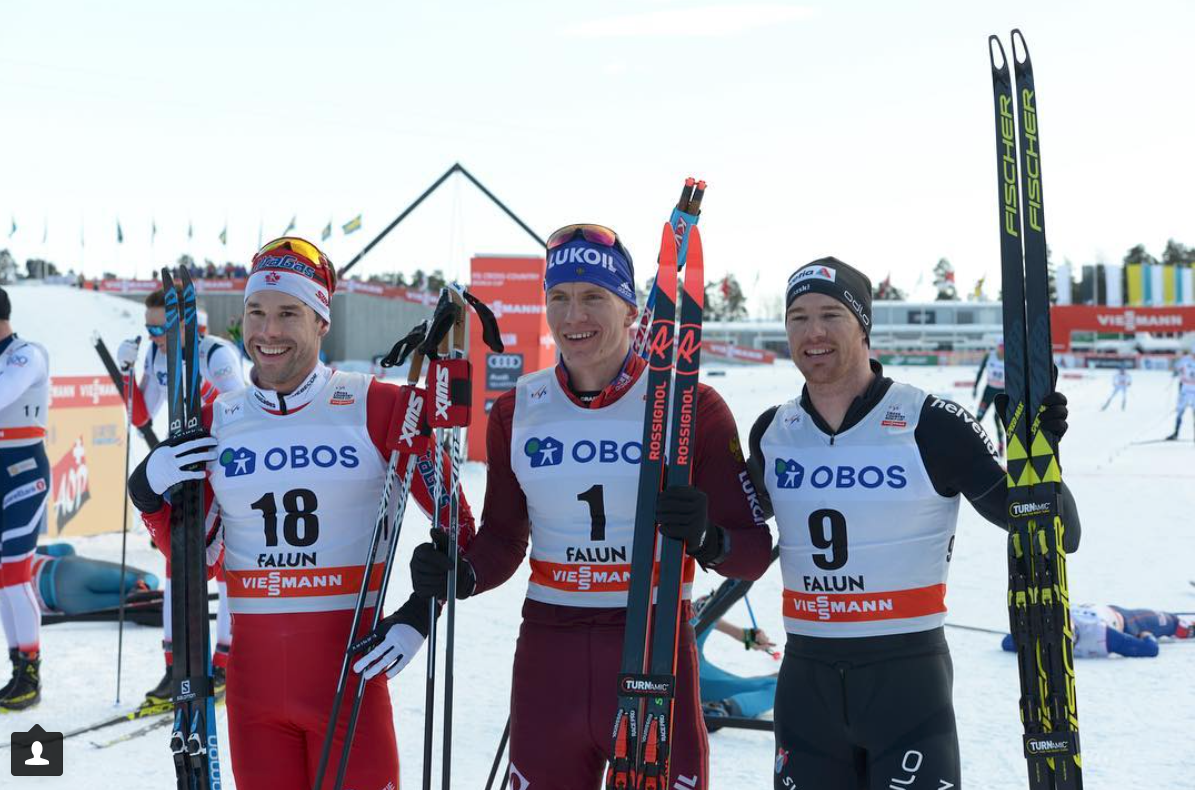
The men’s 15 k freestyle and 2018 World Cup Finals podium, with Russia’s Alexander Bolshunov (c) in first, Canada’s Alex Harvey (l) in second and Switzerland’s Dario Cologna (r) in third. (Photo: Svenska Skidspelen/Instagram)
It is a wrap.
The 2017/2018 World Cup season concluded Sunday in Falun, Sweden with the men’s 15-kilometer freestyle pursuit. The World Cup Finals featured a three-race mini tour with a skate sprint, 15 k class mass start and Sunday’s pursuit.
Russia’s Alexander Bolshunov, a spry 21 year old, began the pursuit with a 38-second lead over second starter, Johannes Høsflot Klæbo of Norway. Emboldened with confidence after winning his first-career World Cup on Saturday, Bolshunov set off on another sunny Sweden day in cruise control. His initial efforts looked smooth and powerful yet lacked the apparent stress of being chased by the likes of Norwegians Martin Johnsrud Sundby and Klæbo, Swiss skier Dario Cologna, and Swede Calle Halfvarsson.
In fact, for a little more than the first kilometer, his closest chase group resembled a nonchalant pack, as if they’d already agreed to let Bolshunov go. With Halfvarsson looking comfortable in front, and Bolshunov’s lead expanding, Sundby came around a little over three minutes into the race and began the hard work of actually preventing the second chase group, which included Canada’s Alex Harvey, from latching on. (Harvey started 18th, 1:16 minutes behind Bolshunov.)
The story up front, Bolshunov’s insurmountable lead, was dramaless. The emergent Russian’s time gaps spoke of hard bursts of speed and a settling chase group’s concern with a second and third place. Bolshunov led by 52.3 seconds at 5.2 k and 1:23.6 minutes at 11.25 k.
Bolshunov enjoyed a solo ski into the finish to win the day in 35:03.3 minutes for his second World Cup win and his first mini-tour victory. Along with his win, Bolshunov ends the season fifth overall in the World Cup standings.
“After trying all season for a win and getting it yesterday, I had a lot of confidence today and I felt strong,” Bolshunov told the International Ski Federation (FIS), according to a press release. “It’s great to win like this at the end of the season. It leaves me with positive feelings heading into the training season.”
The story behind Bolshunov unfolded with more complexity. The 5.2 k checkpoint was the last mark for a seven-skier chase group to stay away from skiers looking to link up from behind. As much as Swedes Halfvarsson and Oskar Svensson, Cologna, Sundby, Italians Francesco De Fabiani and Federico Pellegrino, and Klæbo (who looked gassed) tried in earnest to stay away, a near-constant throttling pace from Harvey brought the lead chase group within sight.
By 7.5 k, the first and second chase groups had merged, ballooning to a sixteen-skier pack. With half the race to go and Bolshunov uncatchable, several racers would test themselves, and the group, as they attempted to split the chasing posse. Sundby gave it a go. Cologna gave a try. Norway’s Hans Christer Holund looked fresh and strong upping the pace. But none could separate themselves or splinter the pack.
Switzerland’s Dario Cologna (9) leads Canada’s Alex Harvey (18) during the men’s 15 k freestyle pursuit at 2018 World Cup Finals in Falun, Sweden. Harvey went on to place second and Cologna third. (Photo: Fischer/NordicFocus)
Harvey was omnipresent — smooth on the climbs, unnerved by any attacks. On the last grind up the infamous Mördarbakken, Harvey pushed over the top to lead a six-skier group that included Cologna and Sundby.
Two minutes out, Cologna gave a burst of hop-skate in a failed break away attempt. Cologna’s effort, however, did stymie the followers enough to allow he and Harvey to accelerate over the top. It came down to the finishing straight to settle the 15 k pursuit score.
Harvey bested the others to place second (+47.1) and skied the fastest time of day in 34:34.3 minutes. Cologna followed just behind in third (+47.5), and Sundby placed fourth (+48.7).
Sunday’s result matches Harvey’s best 2017/2018 result and was his fourth podium of the season. He placed third in the sixth stage of the Tour de Ski (TdS), third overall in the TdS, and was second in the 15 k freestyle mass start in Seefeld, Austria.
“I like these end-of-season tours,” Harvey told FIS. “On the podium now two seasons in a row at World Cup Finals. They are hard though and I am tired. It took some effort to get up to the leaders but I still felt strong and knew I needed to go for it coming into the final kilometer.”
With the conclusion of the season, Harvey ended up fourth in the World Cup standings with 1179 points. The Canadian was 82 points behind Sundby in third overall, after Sundby amassed 1261 points.
The men’s 2017/2018 Overall World Cup podium, with Norway’s Johannes Høsflot Klæbo (c) in first, Switzerland’s Dario Cologna (l) in second, and Norway’s Martin Johnsrud Sundby (r) in third. (Photo: Fischer/NordicFocus)
Although Sunday’s Falun finale was a fade for Klæbo — he placed 25th in the pursuit (+1:45.8) — the season belonged to the 21-year-old Norwegian. He had already clinched his second-consecutive Sprint World Cup Crystal Globe several weeks ago. In Falun on Sunday, Klæbo earned his first Overall World Cup title after winning 11 individual World Cup races this season. He is the sixth Norwegian to win the overall Crystal Globe. He also becomes the youngest overall winner; Sweden’s Gunde Svan was 22 when he won the 1983/1984 season overall.
Cologna placed second in the Overall World Cup with 1290 points and won the Distance World Cup with 698 points (41 points over Sundby in second) and appeared satisfied after the race.
“I think it’s fun to win races,” Cologna said in a translated interview with Swiss broadcaster SRF. “Those are very nice emotions, which I was allowed to experience again this winter. Now I’m surely a bit tired and it’s natural to have a little break, a little holiday.”
It has been a revival year for Cologna: he won the TdS and a gold medal in the Olympic 15 k skate along with several other hallmark victories. On Sunday he was awarded the Distance Crystal Globe, his fourth Distance World Cup title — a new record. (Sundby has won three distance globes.)
“You could say it has been perfect with an Olympic victory, the Tour de Ski and now the small crystal globe,” Cologne reflected to SRF. “Also the win at Holmenkollen [50 k] was a very important and beautiful success. So after two years that have not been so easy to come back from and [when] the big successes were missing and then a couple of races I had to miss myself that was really… If someone had told me that before this season I would instantly have taken/accepted that. And until the end, I was in the fight for the Overall World Cup even if it had already been pretty much decided. But if someone had told me in December that it would be open until the end I wouldn’t have believed it. So it was a great season.
Switzerland’s Dario Cologna with his 2017/2018 Distance World Cup Crystal Globe. (Photo: Fischer/NordicFocus)
Yet the 32-year-old skier, despite solidifying his already storied legacy, told SRF he has no clear intention of retiring.
“The motivation is still there,” Cologna added. “I’ll have to see, next year is Seefeld and that’s almost a World Championship at home for us. That’s three hours from my home. So for that surely the motivation is there to be ready and fight for the medals.”
In the Distance World Cup, Norway’s Holund claimed third with 599 points, just 5 points ahead of Harvey in fourth. France’s Maurice Manificat had been third in the distance standings heading into Sunday, but finished the pursuit in 26th (+2:11.9) and dropped to fifth in the final rankings behind Holund (who moved up from fourth) and Harvey (who moved up from fifth).
Kershaw in the Points Again; Bjornsen with 22nd-Fastest Time
In the pursuit itself, Devon Kershaw was the next-best Canadian outside of Harvey’s podium as he finished in 28th place (+2:21.9).
“I felt pretty good again,” Kershaw said. “I’m not quite strong enough at the start there, so I wasn’t quite strong enough to get back to the group, which is too bad, because they were going slow for a while. But, no, I am satisfied. I mean, another race in the points, so it’s not a bad way to end the season. I was consistent.”
Canada’s Devon Kershaw racing to 74th in the freestyle-sprint qualifier at 2018 World Cup Finals in Falun, Sweden. He went on to finish the mini tour in 28th. (Photo: Fischer/Nordic Focus)
Kershaw still has yet to commit to another World Cup season, but he concludes the year with five consecutive top-30 finishes in distance races. Kershaw also noted he had been a consistent top-30 classic skier.
“I think every classic race except one that I competed in, distance, I was in the points,” Kershaw, 35, said. “I feel proud of that. And since the Olympic 50 k, I’ve been in the top 30 every race I did, so, that’s five or six races now, and it’s just consistent. But again, just lacking that last little bit. But the highlight I think was Alex coming second today from bib 18 so that was phenomenal.”
Also for Canada and in his final career World Cup start, Graeme Killick placed 56th (+4:33). Julian Locke did not start.
For the Americans, Erik Bjornsen moved up from 51st to place 38th (+3:10.4) and skied the 22nd-fastest time of day. Simi Hamilton was 49th (+4:07.8), Scott Patterson 58th (+4:41.5), Patrick Caldwell 59th (+4:41.6), Kevin Bolger 60th (+4:43.5), and David Norris 64th (+5:09.8).
“After yesterday, I was not hoping for much in the final. It was over for results for the Tour,” Bjornsen told FasterSkier on Sunday. “But I went out there it is sunny out it is a good day, so I was just trying to finish off the season with a hard push knowing that the result wasn’t going to be what I was hoping for. But still I just saw the time of day, and 22nd on time of day is a good one. I will see more points for the end of the season.”
Those points bumped Bjornsen into 38th in Distance World Cup list.
“I think it was a step in the right direction,” Bjornsen added. “I still need a few more steps like that before I can fight for podiums.
Bjornsen has made gains this year. And given a moment on Sunday to reflect on his progress, the 26-year-old U.S. Ski Team member recalled several notable examples of his World Cup progression.
“Finishing in the top 30 in most of the races, the majority of them, that was great,” Bjornsen said of his 2017/2018 season. “It makes it feel like you are more in the fight and it is a lot more fun to racing in the top 30. The top 10, I was really excited about that in Seefeld. And qualifying for, I think, five heats this year — all in all pretty happy with it. Still, it has always been my goal to stand on the podium some day. I still think I have a few more steps to get there if I can keep on improving like this last year, maybe there is still a chance.”
The PyeongChang Olympics were a ‘wow’ moment for Patterson. During Saturday’s mass start, Patterson was initially caught in an early race crash and then lost and retrieved a ski. Not the race the upstart skier had hoped for, but not spirit-breaking.
“Better than yesterday — got my skis on today,” Patterson joked after Sunday’s pursuit.
The mishaps from yesterday and Patterson’s ability to put them in context underscore his strong finish to his first full-time World Cup campaign. (Patterson did not contest the TdS as he returned stateside to compete in U.S. nationals.)
“I improved through the season,” Patterson, 26, said of his improved results starting in PyeongChang, where he placed 21st or better in three individual races, including 11th in the 50 k freestyle. “Obviously, Period 1 I didn’t score any points. I was a bit disappointed with that, but I could’ve. I came close a couple times, but I think I regrouped pretty well through nationals. Got sick there, but kind of cleared something out that I had from Period 1, a bit of bronchitis.
“Going into the Olympics, I didn’t really know how I was going to do,” he continued. “I had … first points of the season right before that. So, I think I was on a nice upswing. I had a great Olympics. I mean, could’ve asked for a medal, but I did a lot better than I was expecting, really. And then Holmenkollen was great, too. I feel like right now I’m kind of in 50 k shape instead of 15, but overall I think it was a great season, and got some things to work on for next year, and look forward to coming back and solidly being in the points every race I can.”
Russian Alexander Bolshunov celebrates as he wins his first-career World Cup, a 15 k classic mass start, just ahead of Sweden’s Calle Halfvarsson (11) at 2018 World Cup Finals in Falun, Sweden. (Photo: Svenska Skidspelen/Instagram)
Saturday was the second day of World Cup Finals mini tour, held in Falun, Sweden, which conclude the 2017/2018 season. Friday’s first stage began with a skate sprint, while Saturday featured a 15-kilometer classic mass start for the men.
As the season is no longer young, the fitness for some athletes frayed, a mass start could offer the opportunity for some to hide in the pack and others to exploit. On a sunny and cold Saturday in Falun, the leading distance skiers on the World Cup were unable to separate. The terrain was World-Cup hilly, yet the pace was never decisive enough to shatter the field.
That field was 91-skiers full. 182 poles. 182 skis. Churning from the start, only those skiers in the front rows of the start pyramid could pole and stride away unscathed. As is the nature of 91 skiers fighting for classic-track scarcity — the lanes taper down in number — pile-ups are the norm. So while some skiers like U.S. Ski Team members Erik Bjornsen and Scott Patterson lost time in a starting-scrum spill, others were looking for brighter opportunities up front.
Russia’s Alexey Chervotkin (43) and Canada’s Alex Harvey (32) lead another Russian Maxim Vylegzhanin 59), Sweden’s Calle Halfvarsson (11) and Italy’s Francesco De Fabiani (10) up a climb during the men’s 15 k classic mass start at World Cup Finals in Falun, Sweden. (Photo: Fischer/NordicFocus)
From the start the pace was hot. There was Finland’s Iivo Niskanen, Sweden’s Emil Jönsson, Norway’s Johannes Høsflot Klæbo, Martin Johnsrud Sundby, Niklas Dyrhaug, Canada’s Alex Harvey, Kazakhstan’s Alexey Poltoranin, Russians Alexey Chervotkin and Alexander Bolshunov, and Swedes Calle Halfvarsson and Marcus Hellner, all in either a strung-out or condensed formation 3.75 k into the race. Skiers were slowly slipping off the back. But even with the surging up front, the tactics playing out appeared to place a premium on safety in numbers.
Bolshunov surged at 4.5 k to snag the highest-value time bonus. Otherwise, for much of the race, identifying specific skiers was a task in itself. Coming down the hills a third through the race, the top-50 skiers were a sinuous and continuous line separated by 17.7 seconds. At the bottom of climbs, the compressive part of the accordion effect was in play. Skiers in front could push, those behind became a more dense cluster of lycra-clad athletes.
Despite the prevalent pulsing of pace, skiers like Chervotkin and Harvey had their moments of pluckiness. Each paced a long line of skiers through the 9.3 k mark. But clear at this point was that the pattern of this race would be defined by the collective mass of skiers that began the mass start. Yes, time gaps would balloon a bit by the finish, but at 12 k (the second time bonus), a gap of 1.7 seconds separated first through 35th place.
The move that mattered in this race came from the birthday boy, Halfvarsson. According to FasterSkier’s reporter on the ground, the Swedish crowd serenaded Halfvarsson, 29, with a happy birthday rendition prior to the start. Maybe it was birthday stoke, maybe it was an acknowledgment that with age comes fewer opportunities to seize the win, but with one kilometer to go, Halfvarsson ran like Klæbo. Up and over the hill, the Swede forged a small gap on the 30-plus chasers.
Again on the last short incline before the speedy descent into the stadium, Halfvarsson performed a masterful high-step run. Only Bolshunov at this point could suck up near the Swede’s tails. For a moment, rounding into the final straight, it looked like Halfvarsson’s icing on his birthday cake would be a Falun stage win.
The men’s 15 k classic mass start podium at 2018 World Cup Finals in Falun, Sweden, with Russia’s Alexander Bolshunov (c) in first, Sweden’s Calle Halfvarsson (l) in second, and Italy’s Francesco De Fabiani (r) in third. (Photo: FIS World Cup Svenska Skidspelen/Facebook)
Halfvarsson came into the straight out of the tracks. As he zeroed in to begin the double-poling finish, the birthday boy stumbled slightly slotting into the nearest lane. Bolshunov flew by with a supreme double pole and took the win in 36:59.8. Halfvarsson placed second (+1.3), Italy’s Francesco De Fabianithird (+3.1), Poltoranin fourth (+3.7) and Chervotkin fifth (+5.2).
For the 21-year-old Bolshunov, it was his first-career World Cup win. Prior to Saturday’s win, Bolshunov had stood on the podium six times in his first full season on the World Cup. (Bolshunov’s only World Cup start last season was in Drammen, Norway, in March 2017.) Along with Klæbo, also 21, Bolshunov has risen into one of the sport’s top athletes. He claimed three silvers and a bronze medal in PyeongChang. His two individual Olympic medals were a second in the 50 k classic mass start and third in the classic sprint.
“I have had many second and third place finishes this season so I am very happy to finally have a win,” Bolshunov told the International Ski Federation (FIS) after the race. “This feels good. I will do what I can tomorrow for another good result but for now, I will enjoy this win.”
Sunday’s final men’s race of the season and last race of the three-stage mini-tour, will be a 15 k freestyle pursuit. Bolshunov leads the mini-tour standings in first with a total elapsed time of 38:37 minutes. Klæbo, who finished 22nd (+13.6) on Saturday, sits in second (+38.0), while Halfvarsson is third (+39.2).
The Swede took away the positives from the day’s near-win in front of the home crowd.
“I tried today to get a win but it was too much,” Halfvarson told FIS. “Off the final corner, I was really tired. I am still happy with second place. I have been on a podium a few times this season and always third. So at least second place is an improvement even if I didn’t manage the win.”
Canada’s Alex Harvey was the best placed North American in 20th place (+10.7). He’ll begin Sunday’s pursuit in 18th (+1:16.1).
Canada’s Graeme Killick (75) skiing with Sweden’s Jens Burman during the men’s 15 k classic mass start at World Cup Finals in Falun, Sweden. Killick went on to finish 41st. (Photo: Fischer/NordicFocus)
Teammate Devon Kershaw finished 26th (+14.6) for his fourth-straight race in the top 30 (including his 26th-place finish in the Olympic 50 k classic). Graeme Killick placed 41st (+1:13) and Julien Locke was 81st (+3:29) for Canada.
“I felt quite good today,” Kershaw said after the race. “I was a little disappointed with the last kilometer because I was kind of out of position a little bit after Mördarbakken and couldn’t quite get up through traffic, but it’s really close. And a little disappointed to be 26th again; it seems like that’s kind of where I’ve lived all year, but it was a good race for me.”
Kershaw, a 35-year-old staple of the Canadian team, has been seeking a return to top form.
“Just races like today where I feel good and can execute decently well,” Kershaw explained. “To be honest this year I am super motivated after the championship. I’ve [been] having major, major asthma issues at the Olympics and that really really affected me and it took a long time to get a little better, but I felt like by the time I got to Lahti I was feeling quite a bit better. So that really helps, I mean, I can breathe again and I’m feeling good.”
Kershaw is expected to mull over the prospects of continuing his ski career in the coming weeks.
“We’re not sure, I’ll talk to the wife next week [Norwegian former elite skier Kristin Størmer Steira],” Kershaw said of his future plans. “You know there’s a lot of issues right now in Canada so I’ll have to think about it. A lot of guys are saying that they’re gonna call it a day. And I’m not getting any younger, but I still feel quite good, and I mean a race like today shows that I can still compete with the best in the world so that’s motivating, but we’ll definitely have to take some weeks to think about it.”
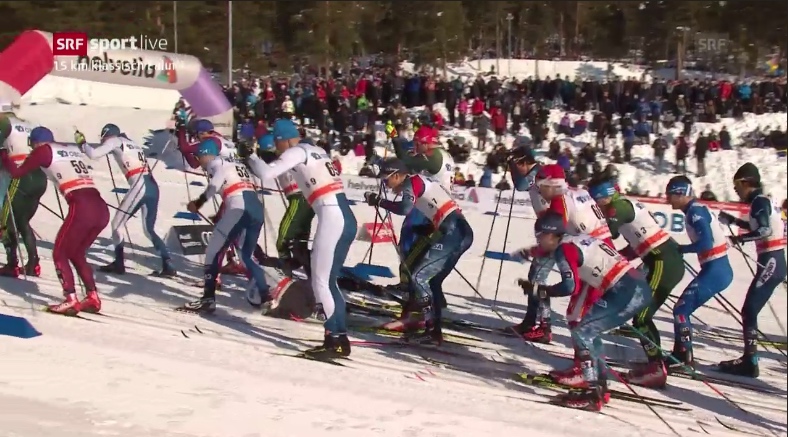
Nowhere to go: U.S. skiers Erik Bjornsen (bib 57) and Scott Patterson (bib 67) stuck in a pile-up after the start of the men’s 15 k mass start classic at World Cup Finals in Falun, Sweden. (Screenshot: SRF Sport broadcast)
For the U.S., Erik Bjornsen finished 52nd (+1:47.1), Simi Hamilton 62nd (+2:06.4), Kevin Bolger 69th (+2:27.1), David Norris 70th (+2:31.2), Scott Patterson 71st (+2:40.6), Paddy Caldwell 75th (+2:52.7), and Andy Newell 86th (+4:47).
Patterson’s race did not go as planned.
“I was in a big pile-up right at the start,” Patterson told FasterSkier after. “I was the second-to-last one out of the stadium and then the first time up Mördarbakken, my ski fell off. So I skied halfway down, got my ski back on, just turned back around and then just like stupidly chasing the rest of the race. …
“I felt OK,” Patterson added. “[Without] those two stupid things it would have been a good race. But I was so far off and then it was really hard to get back to the pack and then it was like, ‘Well, I can’t get to the pack. I am here with those guys.’ ”
Lately, Patterson, 26, has been a highlight for the U.S. distance skiing prospects. The first-year U.S. Ski Team member notched three individual top-20 results at last month’s Olympics, including 11th in the 50 k classic. Last weekend in Oslo, Norway, Patterson proved that was no fluke, as he placed 16th in a traditionally deep field at the Holmenkollen 50 k skate.
World Cup Finals conclude with 10/15 k freestyle pursuits on Sunday.
— Gabby Naranja, Harald Zimmer and Alex Kochon contributed
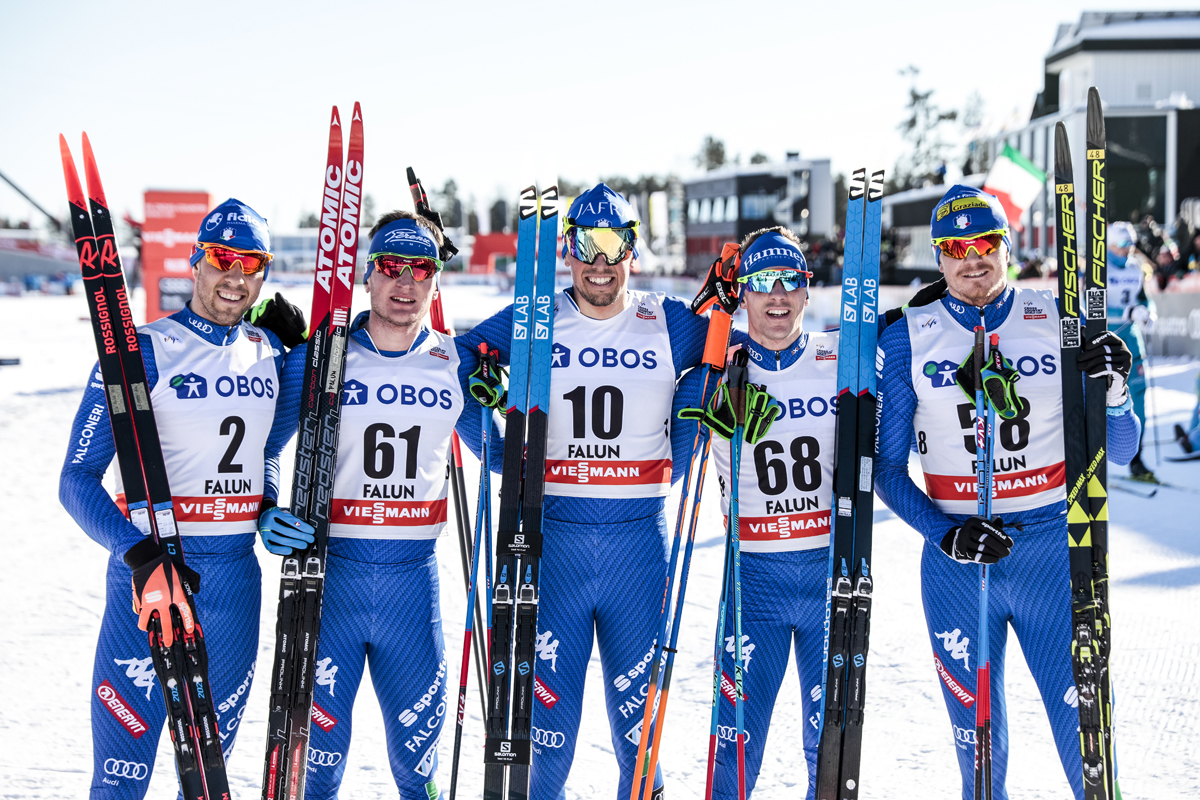
The Italian men’s team after Saturday’s 15 k classic mass start at 2018 World Cup Finals in Falun, Sweden, with (from left to right) Federico Pellegrino, Giandomenico Salvadori, Francesco De Fabiani, Maicol Rastelli, and Dietmar Nöckler. (Photo: Fischer/NordicFocus)
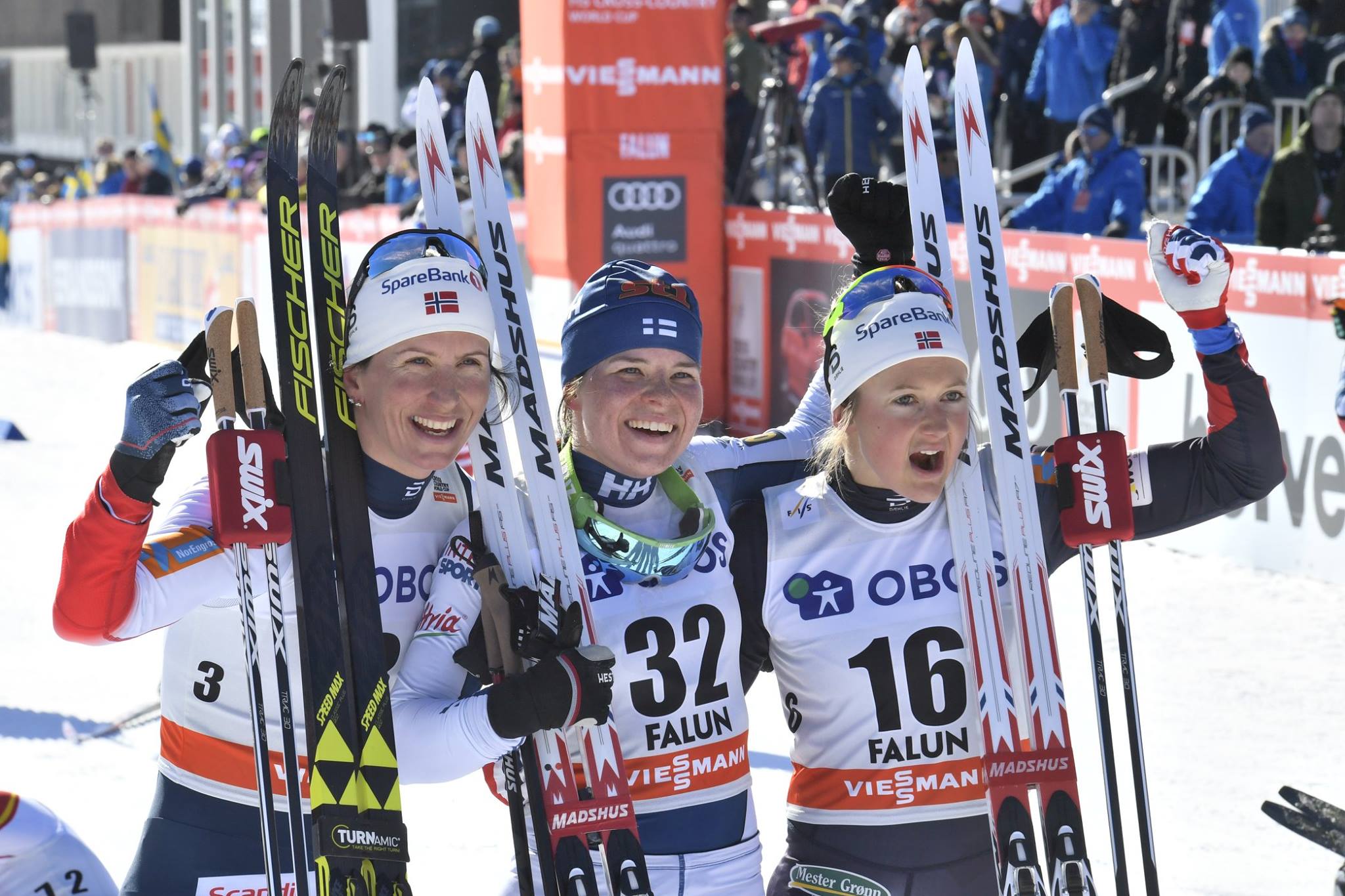
The women’s 10 k classic mass start podium at 2018 World Cup Finals in Falun, Sweden, with Finland’s Krista Pärmäkoski (c) in first, Norway’s Marit Bjørgen (l) in second and Ingvild Flugstad Østberg (r) in third. (Photo: FIS World Cup Svenska Skidspelen/Facebook)
FIS Cross Country World Cup Finals (Falun, Sweden): 10/15 k classic mass starts
Day 2 of World Cup Finals in Falun entailed 10- and 15-kilometer classic mass starts on Saturday, and in the first race of the day, Finland’s Krista Pärmäkoski pulled out a thrilling finishing-sprint victory over Norway’s Marit Bjørgen.
After American Jessie Diggins led early in the first 2.5 k loop, Bjørgen set the tone from the front for most of the race. With less than a kilometer to go, Norwegian powered up the final horseshoe-shaped climb in first, with Pärmäkoski and Bjørgen’s Norwegian teammate Ingvild Flugstad Østberg just behind her. The three had dropped the field while lapping through the stadium around the 7.5 k.
While Østberg fell off the pace on that final uphill, Bjørgen accelerated as she took a few quick strides over the top, gaining a few meters on Pärmäkoski as they headed into the descent. The finishing stretch is long in Falun, and Pärmäkoski was able to come on strong just before she and Bjørgen entered the final 100 meters before the finish. There, Pärmäkoski’s double-pole speed not only matched Bjørgen, but beat her, as Pärmäkoski passed her with several meters to go and took the win by 0.2 seconds in 26:00.5 minutes. It was Pärmäkoski’s second win of the season and fourth of her career (including time-of-day pursuit stage wins).
Just behind Pärmäkoski and Bjørgen, who congratulated each other immediately at the finish, Østberg finished 5.1 seconds back in third. Five women fought for fourth place, with Sweden’s Ebba Andersson taking it (+14.5) ahead of Japan’s Masako Ishida in fifth (+14.8), Sweden’s Charlotte Kalla in sixth (+15.2), Austria’s Teresa Stadlober in seventh (+15.4), and Diggins in eighth (+15.5).
Norway’s Astrid Uhrenholdt Jacobsen was the next finisher across the line in ninth (+24.8), then Finland’s Kerttu Niskanen in 10th (+26.2) and American Sadie Bjornsen in 11th (+26.3).
Canada’s Emily Nishikawa was the next North American in 36th (+1:31.1), and she led her teammates Cendrine Browne, who placed 50th (+2:05.7), Dahria Beatty in 61st (+2:46.6) and Zina Kocher in 69th (+6:12).
For the U.S., Sophie Caldwell finished 41st (+1:36.1), Rosie Frankowski 44th (+1:43.7), Caitlin Patterson 47th (+1:54.8), Ida Sargent 52nd (+2:10.2), Liz Stephen 54th (+2:20.0), Kikkan Randall 57th (+2:34.1), and Kaitlynn Miller 64th (+2:50.7). Rosie Brennan did not start.
The men’s 15 k classic mass start podium at 2018 World Cup Finals in Falun, Sweden, with Russia’s Alexander Bolshunov (c) in first, Sweden’s Calle Halfvarsson (l) in second, and Italy’s Francesco de Fabiani (r) in third. (Photo: : FIS World Cup Svenska Skidspelen/Facebook)
In the men’s 15 k classic mass start on Saturday afternoon, Russia’s 21-year-old Alexander Bolshunov notched his first-career World Cup win after reaching the podium seven other times this season (placing third in six of those seven races).
Bolshunov hung in the pack and took the lead at the start of the final lap at 11.25 k, ahead of four of his Russian teammates, Alexey Chervotkin in second, Evgeniy Belov in third, Andrey Larkov in fourth, and Maxim Vylegzhanin in fifth. Behind them, Switzerland’s Dario Cologna skied just ahead of Norway’s Martin Johnsrud Sundby and Canada’s Alex Harvey, who were among 29 skiers within four seconds of first.
While Sweden’s Calle Halfvarsson led the final climb before the stadium, Bolshunov caught him on the downhill and out-double-poled him in the finishing stretch, taking first by 1.3 seconds in 36:59.8. Halfvarsson finished second and Italy’s Francesco de Fabiani scored his second World Cup podium of the season in third (+3.1).
Kazakhstan’s Alexey Poltoranin missed the podium by 0.6 seconds in fourth (+3.7), Chervotkin followed in fifth (+5.2), ahead of Cologna in sixth (+5.6) and Italy’s Federico Pellegrino in seventh (+5.6), after they finished together. Sundby and his Norwegian teammate Niklas Dyrhaug also crossed the line at the same time in eighth (+6.3) and ninth (+6.3), respectively, just 0.1 seconds ahead of another one of their teammates, Sjur Røthe, in 10th (+6.4).
Less than five seconds later, Harvey finished 20th (+10.7), ahead of Norway’s Johannes Høsflot Klæbo in 22nd (+13.6). Klæbo slipped out of contention on the third of four laps, as he dropped from fourth to 22nd in less than two kilometers.
Canada’s Devon Kershaw finished 26th (+14.6) for his fourth-straight race in the top 30 (including his 26th-place finish in the Olympic 50 k classic mass start), Graeme Killick placed 41st (+1:13) and Julien Locke was 81st (+3:29).
Erik Bjornsen was the top American man in 52nd (+1:47.1), Simi Hamilton finished 62nd (+2:06.4), Kevin Bolger was 69th (+2:27.1), David Norris 70th (+2:31.2), Scott Patterson 71st (+2:40.6), Paddy Caldwell 75th (+2:52.7), and Andy Newell 86th (+4:47).
World Cup Finals conclude with 10/15 k freestyle pursuits on Sunday.
France won the International Biathlon Union (IBU) World Cup women’s 4 x 6 k relay to start the day at Holmenkollen, ahead of Germany and Italy, while the Canadian women’s team (Sarah Beaudry, Julia Ransom, Emma Lunder, and Rosanna Crawford) placed 11th and the U.S. (Clare Egan, Susan Dunklee, Joanne Reid, and Emily Dreissigacker) came back from 21st to finish 15th.
In the men’s 12.5 k pursuit that followed, France’s Martin Fourcade won his 10th race at Holmenkollen, putting himself 49 points ahead of Norway’s Johannes Thingnes Bø with three individual races in Tyumen, Russia, remaining. US Biathlon’s Sean Doherty tied his second-best result this season in 17th and his teammate Lowell Bailey raced up to 28th with the 19th-fastest time of day. Leif Nordgren placed 40th and Tim Burke was 47th, while Canada’s Scott Gow finished 51st and Christian Gow was 54th.
The start of the Holmenkollen World Cup men’s 50 k freestyle mass start on Saturday in Oslo, Norway. (Photo: Fischer/NordicFocus)
OSLO, Norway — Thumping house music. Thousands of raucous fans, who, if not waving Norway’s flag, had their faces painted in their national colors of red, blue and white. If the American Super Bowl translated to cross-country skiing and snow, the Norwegian Holmenkollen is as close as it gets.
Saturday saw the 116th edition of the annual 50-kilometer men’s event, a race that totals roughly6,574 feet of climbing for those who complete it in full. Camped along the course fence, spectators adorned in Mariusgenser sweaters, many withkoozied Carlsbergs in hand, were not crazy for having hauled coolers and chairs through the snowy trailside. All said and done, racers would pass by six times on their way around the famed 8.3-kilometer loop.
Leading through the first 8.3 k, Norwegians Didrik Tønseth and Niklas Dyrhaug set the pace, followed by two Frenchmen: Clement Parisse and the World Cup distance leader, Maurice Manificat. Alex Harvey of Canada, who won last year’s World Championships 50 k, skied 2.3 seconds off the lead pace in 17th.
Eight skiers ahead of Harvey, Switzerland’s Dario Cologna and Norway’s Martin Johnsrud Sundby skied side by side in ninth. With the past two Holmenkollen titles in his name, Sundby was certainly in search of another on Saturday.
Through the next lap, Norway and France continued to push from the front led by Sjur Røthe and Robin Duvillard, respectively. As they passed the 16.6 k mark, a pack of 51 skiers still remained within 21 seconds of one another.
France’s Adrien Backscheider leading the Holmenkollen 50-kilometer freestyle mass start on Saturday in Olso, Norway. (Photo: Logan Hanneman)
France was three-strong in the front on the third lap, with Jules Lapierre, Adrien Backscheider and Manificat taking charge. Sundby and Harvey skied 20 seconds off the Frenchmens’ pace in 17th and 18th, respectively. Seventeen seconds ahead of them was Cologna in 12th. Three laps down, three laps to go and just over an hour of racing complete.
In another lap, France had faded from the front, while Norway subsumed the the lead. At 33.3 k, six of the top ten skiers were Norwegian, with Hans Christer Holund at the helm. Less than a second behind Holund was Sundby in second.
Russia’s Maxim Vylegzhanin followed in third, then Harvey in fourth, Norway’s Simen Hegstad Krüger in fifth, Tønseth in sixth, Norway’s Daniel Stock in seventh, Dyrhaug eighth, American Scott Patterson in ninth, and Sweden’s Daniel Rickardsson in 10th. Only 10 seconds separated first from 17th.
At this point, anyone who had watched the dual-skier showdown in last year’s Holmenkollen — which had broken around the 22 k mark — began to wonder how much longer the 17 skiers in Saturday’s lead pack would stay together.
The answer came with about five kilometers to go. Patterson, who had been skiing in the top six through the fifth lap, locked up with Manificat. The Frenchman dropped off the pace, along with 10 others.
“I was skiing right behind Maurice Manificat and one of the steep sections he just died, and that was right when that lead group pulled away so I missed the move,” said Patterson, a U.S. Ski Team member. “I didn’t quite have a strong enough group to pull back up to the leaders.”
The lead group was reduced to seven by 46 k, with Great Britain’s Andrew Musgrave, Vylegzhanin, Sundby, Cologna, Russia’s Denis Spitsov, Holund, and Røthe all still in the hunt for the podium.
Harvey was in 11th, about 15 seconds behind the lead group and 10 seconds ahead of Patterson in 14th.
“I wanted to see how my skis were doing compared to the other guys,” Harvey reflected, “And then after that just try to see who is looking strong and try to think ahead and think of the last lap, whose going to be a good bet to follow when the moves are going down.”
Norway’s Martin Johnsrud Sundby (r) and Switzerland’s Dario Cologna (4) sprint to the finish of the Holmenkollen 50-kilometer freestyle mass start on Saturday in Olso, Norway. (Photo: Fischer/NordicFocus)
In the last half lap, Musgrave put in a surge to the front. But he was soon swallowed and spit back into seventh. Rounding into the stadium for the final time, all seven remained together, though Sundby and Cologna now skied in the front. The two cornered back toward the final 100 meters and a head-to-head distance sprint finish ensued.
In a photo finish, Cologna outlunged Sundby for the win, before a somewhat silent, predominantly Norwegian-filled stadium. Cologna didn’t seem to mind. The 31 year old tossed his poles to the side, all smiles as he accepted his first 50 k Holmenkollen victory — the ultimate distance race of a given season (outside of the Olympics or World Championships) — in a time of 2:01:48.1 hours.
“It was a suspenseful race, something was always happening even though a large group stayed together for a long time,” Cologna said in an interview with Swiss broadcaster SRF, according to a translation. “Around the bonus sprints there were the most Norwegians so I was a little afraid to get attacked, but I got back fairly quickly. And in the end I felt very well. Maybe I could have risked something already earlier on the long climb, but I trusted in my finish and knew that I would surely have a good opportunity. But I didn’t expect Sundby would be quite as strong, he made my life hard on the last kilometer and then it really became very close, but thankfully it went well.”
The Holmenkollen men’s 50 k freestyle mass start podium on Saturday at the World Cup in Oslo, Norway, with Switzerland’s Dario Cologna (c) in first, Norway’s Martin Johnsrud Sundby (l) in second, and Russia’s Maxim Vylegzhanin (r) in third. (Photo: Fischer/Nordic Focus)
Sundby finished second, one-hundredth of a second behind. The 33 year old has reached the podium in all but one of the Holmenkollen races he’s finished.
“I dreamt about the third in a row here for sure, but I think Dario has also been a few centimeters behind in this race a couple of times, and I think he deserved this one,” Sundby said at the press conference. “I wasn’t good enough in the sprint and Dario seemed to be the stronger one out there today. … I am not disappointed. I am on the podium here in the 50 for my seventh time in a row, so I think that’s OK.”
In his first World Cup race since November of last year, Russia’s 35-year-old Vylegzhanin took the final podium spot in third, 1.1 seconds back from Cologna.
Rounding out the top 10 was Røthe in fourth (+4.2), Spitsov in fifth (+4.4), Holund in sixth (+4.5), Musgrave in seventh (+15.1), Germany’s Florian Notz in eighth (+25.9), Harvey in ninth (+32.4) and Duvillard in 10th (+33.5).
France’s Maurice Manificat (r) leads American Scott Patterson (32) and Canada’s Alex Harvey (5), among others, during the 2018 Holmenkollen 50-kilometer freestyle mass start on Saturday in Olso, Norway. (Photo: Logan Hanneman)
“I felt good, I have been really sick in Lahti, I was on antibiotics up until Thursday, so I really didnt know what to expect heading into today,” Harvey said. “I started back with a very bad result in Drammen, very close to last. So yeah I did not know what to expect but it was good, just missed a little bit on the last 500 meters over the top… but overall it was a good race.”
Following Harvey, Patterson was the second North American across the line, finishing in 16th (+56.3). Saturday was his third time racing at Holmenkollen and first time racing its freestyle format.
“It’s all just about staying relaxed,” Patterson said. “Kind of felt like five pretty easy laps and then one real hard one out there. … Actually I struggled a little bit on the third lap, my skis slowed down quite a bit and was able to switch on the fourth [lap] and then really had some rockets out there.
“I had one quite interesting moment when I was trying to thread the needle and got taken out by a Russian and had a Sweden next to me just somersault over top of me,” Patterson added, referring to a tumble he took in his fourth lap. “But we were able to get up pretty quick and rejoin the group.”
Devon Kershaw leads his Canadian teammate Andy Shields during Saturday’s Holmenkollen 50 k freestyle mass start in Olso, Norway. (Photo: Fischer/NordicFocus)
Canada’s Devon Kershaw finished in 28th (+3:43.6). When the Holmenkollen race veteran was asked why he continued to return to the challenging course, Kershaw, who lives with his family near Oslo, was bare bones in his response.
“After the Olympic 50 k, I promised myself I wouldn’t do a skating 50 k. Two weeks later, here I am. Kershaw said. “But I think the biggest reason for that is that it’s such a magical place to race. And I feel really grateful and honored to be able to race such at such a fabled venue … there is no better place in the world to do a ski race.”
Two more Canadians competed on Saturday, with Graeme Killick placing 34th (+4:55.1) and Andy Shields finishing 47th (+8:13.6).
American Noah Hoffman with his dad after finishing the Holmenkollen 50 k freestyle on Saturday for the final race of his pro skiing career. (Black mask and photo courtesy of Liz Stephen)
Also racing on Saturday for the U.S. was David Norris in 37th (+6:19.7), Paddy Caldwell in 46th (+8:12.3), Noah Hoffman in 51st (+10:27.9), and Kevin Bolger in 52nd (+12:44.2). Simi Hamilton did not finish.
Before crossing the finish line in what would be his final Holmenkollen race, Hoffman pulled to the side of the course to give his father, who was present at Saturday’s race, a hug. Hoffman has been racing the Holmenkollen since 2011.
“The last one of my career so it’s a special one for sure,” Hoffman said of his last career race. “Pretty awesome to have my dad here and Zach [Caldwell] here. It was a little emotional on the last lap, but pretty fun.”
The men’s 15 k classic podium at the World Cup in Lahti, Finland, with Kazakhstan’s Alexey Poltoranin (c) in first, Russia’s Alexander Bolshunov (l) in second and Finland’s Iivo Niskanen (r) in third. (Photo: Fischer/NordicFocus)
You could call him a specialist. An all-around contender in classic distance races, Alexey Poltoranin of Kazakhstan has proven time and time again that he has the 15-kilometer classic individual start figured out.
On Sunday in Lahti, Finland, he set a new World Cup record by winning his eighth-career 15 k classic (including both individual and mass-start formats). He had previously tied Swedish legend Gunde Svan’s mark of seven with a win in the last 15 k classic contested in Planica, Slovenia.
Three of Poltoranin’s 15 k wins have come this season, and all of his 11 career World Cup victories have been in classic races. Two were of shorter distances: a 5 k classic stage race in 2013 and a classic sprint that same year.
But in the last men’s race of the 2018 Olympics last Saturday in PyeongChang, South Korea — the 50 k classic mass start — the 30-year-old Poltoranin only had about 30 k of full-tilt speed in him. For 29 valiant kilometers, he had stalked Finland’s Iivo Niskanen, who was leading the race.
But then, the wheels started to come off. In less than a kilometer, Poltoranin was passed by Russia’s Alexander Bolshunov and lost more than 10 seconds to Niskanen. By about 33 k, he was no longer able to keep up with Bolshunov as he continued the race in the dreaded position of no man’s land, skiing alone in third. The chase pack eventually caught him with 5 k to go, and he slipped to seventh. He ultimately finished 15th, more than 5 minutes behind Niskanen in first.
But that was over a week ago. By Sunday, Poltoranin was back in familiar territory at a venue he had raced at multiple times in the last 13 years, but never placed better than second at in Lahti.
He started 44th out of 71 in the men’s field and came through each timing point with some of the best, if not the best, splits over the three-lap course. But one man who started behind him was faster at every checkpoint — Bolshunov, wearing bib 64— and as Poltoranin sat in the leader’s seat at the finish, watching the rest of the race unfold, it was the Russian he was likely most nervous about.
Niskanen was looking strong, too, but as the Finnish Olympic champion skied in bib 60, a couple of minutes ahead of Bolshunov, his times were consistently about 5 seconds slower.
When Niskanen finished, he was 20.9 seconds shy of Poltoranin’s time. Then Bolshunov, who had led through the 11.1 k checkpoint where he was almost 7 seconds faster than Poltoranin, came into the stadium, yet ended up 9.1 seconds short of the win.
Poltoranin’s finishing time of 33:11.9 proved unbeatable on Sunday, and he pumped his fist as he realized the win was his.
“It’s great to win again,” Poltoranin told the International Ski Federation (FIS) after, according to a press release. “I won in Planica before the Olympics and this is a much better feeling than last weekend’s result in the Olympic 50 k.”
Bolshunov, who finished second to Niskanen in the Olympic 50 k, 18.7 seconds from the gold medal, placed second again on Sunday.
“I was disappointed after the Olympic 50 k and was a little bit tired but I am happy with how I skied today,” the 21-year-old Bolshunov, who won silver or bronze in all four races he competed in at his first Olympics, told FIS. “Thanks for the service team for great skis. Good to get another podium for Russia.”
Niskanen, 26, was a clear crowd favorite in Lahti, with several fans holding up gigantic cutout photos of his face. While he was an early race leader, Niskanen’s split times were second to Bolshunov from 3.7 k on.
“It was an OK race for me,” Niskanen told FIS. “I have had a busy and emotional week after the gold medal in PyeongChang. I think I have not fully recovered yet. I felt my muscles were quite stiff. It was a very hard race for me. I wanted to finish on the podium and it would have been nice to win in front of the home crowd.”
Note: Poltoranin is currently second in the Distance World Cup standings, 39 points behind France’s Maurice Manificat (who placed 21st on Sunday) in first. Norway’s Martin Johnsrud Sundby (who placed fifth behind teammate Emil Iversen in fourth on Sunday) is just 5 points behind Poltoranin in third in the distance rankings. Sundby is second in the Overall World Cup, 228 points behind his Norwegian teammate Johannes Høsflot Klæbo (who placed seventh on Sunday).
Kershaw in the Points in 25th
Devon Kershaw racing to 25th in the men’s 15 k classic at Sunday’s World Cup in Lahti, Finland. (Photo: Fischer/NordicFocus)
After placing 26th in the Olympic 50 k, Devon Kershaw led four Canadians in Sunday’s 15 k in 25th (+1:43.2). An early starter in bib 24, his split times were relatively consistent throughout the race, ranging from 20th at 1.1 k to 26th with about 4 k to go.
“I was actually really excited for this race,” Kershaw wrote in an email to FasterSkier. “15km classic is my favourite race we do. Also, Lahti was peaking. It was about -10, sunny (I know?! In Finland) and the track conditions were 10/10. When you love classic skiing like I do, the World Cup rarely offers conditions like we had here. I loved it. Motivation-wise, I have never really struggled too badly with that after championships if the calendar has races I enjoy and know I can be good in. With this 15km classic and then a mass start 15km classic in Falun, it makes it easier to keep motivated. Also, racing in the Nordic nations to end the year is always awesome. Good, knowledgeable fans and nice venues. I love it.”
After struggling with “major lung/breathing issues” at the Olympics, Kershaw explained that he felt much better leading into Lahti. He spent a few days after the Olympics at home Norway with his wife Kristin Størmer Steira and their 13-month-old daughter, whom he hadn’t seen in two months.
“I had some tough days for sure with that mentally,” he wrote of his time away from family before and during the Games. “But when I got home and the first time I saw my daughter in 2 months she crawled right up to me with a big smile on her face and knelt there putting her arms in the air (for me to pick her up) – that was the highlight of my winter right there. It has been great to see them again.”
While he was pleased with what he called “a solid race” on Sunday, Kershaw added that he was also disappointed that he didn’t have anyone to ski with and finished within 10 seconds of the top 20.
“But – I skied a very consistent race,” he wrote. “My pace felt like I was moving at the same speed at km 2 as I was at km 14. That’s a nice feeling. And what you strive for if you are alone in an individual start. I was missing that last gear to attack the last lap, but I didn’t die either, and was able to keep my speed, so I am satisfied. When you pace a race like I did – even if it leaves you wanting more – it shows you did do a good job managing your speed alone for 15km. And that feels good.”
Kershaw’s best result so far this season was 19th in the 30 k skiathlon in Lillehammer, Norway. At the Olympics, he competed in three events with a best result of 26th in the 50 k.
“I was massively disappointed with the Olympics,” he continued. “… 25th isn’t anything stellar or fireworks worthy, but it’s in the points and close to a season’s best for me – which is still something I’m looking to accomplish,” Kershaw added.“I have some more chances, mainly in Falun, but I’ll drag my ass around Holmenkollen this coming weekend because I have such a big respect for the race. I hope I can continue to feel good body-wise and have good energy like I feel now. I hope my lungs can continue to slowly get better and if they are better in Falun then they are now then that won’t hurt!”
Also for Canada, Graeme Killick placed 39th (+2:22.9), Julien Locke was 69th (+4:56.6) and Andy Shields 70th (+5:42.1).
Leading the U.S. men was Erik Bjornsen in 32nd (+2:06.6). After clocking the 53rd-ranked split at 1.1 k, Bjornsen sped up throughout the race to come within about eight seconds of the top 30.
Noah Hoffman finished 40th (+2:24.0), Paddy Caldwell was 45th (+2:40.5), Scott Patterson 50th (+2:58.7), Kevin Bolger 54th (+3:09.5), and David Norris 57th (+3:23.5).
With three World Cup stops remaining, the circuit continues in Drammen, Norway, this Wednesday with city classic sprints followed by the Holmenkollen 30/50 k freestyle mass starts next weekend. World Cup Finals will take place the following weekend, March 16-18, in Falun, Sweden.
Krista Pärmäkoski of Finland (center) won her second straight 10 k classic, to the delight of the crowd in Lahti. Natalia Nepryaeva of Russia (left) finished second and Marit Bjørgen of Norway third. (Photo: FIS Cross Country/Twitter)
FIS Cross Country World Cup (Lahti, Finland): 10/15 k classic
Racing at home in Finland, Krista Pärmäkoski picked a good time to collect the second World Cup victory of her career, and again in a 10 k classic. Pärmäkoski’s first win came in the 10 k classic in Planica, Slovenia, earlier this season.
In second was Russia’s Natalia Nepryaeva, who picked up her first World Cup podium. The current U23 standings leader, Nepryaeva’s time was 20.9 seconds slower than Parmakoski. Both she and Marit Bjørgen of Norway, who finished third (+26.7), used a steady pace to reach the podium. At the 5 k split, Heidi Weng of Norway – wearing the yellow bib of the overall World Cup leader – was in second at the halfway point but faded to finish fifth (+43.3), and Kerttu Niskanen of Finland was in third place but she dropped to fourth by the finish, +27.0. Austria’s Teresa Stadlober finished sixth (+52.4).
Sadie Bjornsen placed seventh (+57.6) to lead the American team. Caitlin Patterson was next, just missing the World Cup points in 32nd (+2:02.7). Ida Sargent and Sophie Caldwell finished 40th (+2:21.9) and 42nd (+2:24.2), respectively. Rosie Brennan finished 48th (+3:02.1) and SuperTour leader Kaitlynn Miller placed 51st (+3:09.1).
Liz Stephen of the U.S. Ski Team did not start due to illness.
Canada started only two women: Emily Nishikawa finished 41st (+2:22.2) and Dahria Beatty 44th (+2:40.7).
The men’s 15 k classic podium at the World Cup in Lahti, Finland, with Kazakhstan’s Alexey Poltoranin (c) in first, Russia’s Alexander Bolshunov (l) in second and Finland’s Iivo Niskanen (r) in third. (Photo: FIS Cross Country/Twitter)
In the men’s race that followed, Alexey Poltoranin of Kazakhstan got some redemption after a major bonk in the Olympics 50 k last weekend, winning the 15 k classic individual start in Lahti.
Starting in the middle of the field in bib 44 (out of 71), Poltoranin paced it perfectly, skiing a steady race with some of the top split times and then turning it up another notch over the last several kilometers to take the win in 33:11.9 minutes. His biggest threat was Russia’s Alexander Bolshunov, who started 64th and clocked faster splits at every timing point throughout the three-lap race except the one that mattered most — the finish. There, Bolshunov came up 9.1 seconds short of Poltoranin’s time to place second, and Finland’s Iivo Niskanen — the Olympic 50 k champ — placed third, 20.9 seconds out of first.
Norway took fourth through seventh, with Emil Iversen in fourth (+28.8), Martin Johnsrud Sundby in fifth (+39.9), Niklas Dyrhaug in sixth (+50.1), and Johannes Høsflot Klæbo in seventh (+1:00.3). Russia’s Alexey Chervotkin placed eighth (+1:08.3), Germany’s Thomas Bing was ninth (+1:08.5) and Sweden’s Daniel Rickardsson finished 10th (+1:09.2).
Canada’s Devon Kershaw led the North Americans in 25th (+1:43.2), and Erik Bjornsen was the top American in 32nd (+2:06.6).
Four Canadian men raced, with Graeme Killick placing 39th (+2:22.9), Julien Locke 69th (+4:56.6) and Andy Shields 70th (+5:42.1).
The U.S. was represented by six men, with Noah Hoffman placing 40th (+2:24.0), Paddy Caldwell 45th (+2:40.5), Scott Patterson 50th (+2:58.7), Kevin Bolger 54th (+3:09.5), and David Norris 57th (+3:23.5).
The World Cup picks back up again this Wednesday with classic sprints in downtown Drammen, Norway.
The men’s 1.6 k freestyle sprint podium at Saturday’s World Cup in Lahti, Finland, with Italy’s Federico Pellegrino (c) in first, Russia’s Gleb Retivykh (l) in second and Norway’s Johannes Høsflot Klæbo (r) in third. (Photo: Fischer/NordicFocus)
The men’s freestyle sprint final in Lahti, Finland, started in almost comical fashion: the six men who had made it to the final heat of the day skied slowly, then even slower, as nobody wanted to lead.
The final was full of dangerous men. Norwegian youngster Johannes Høsflot Klæbo has won five sprints this season, and he just became an Olympic gold medalist in the sprint in PyeongChang, South Korea, a mere ten days ago. In his quarterfinal and semifinal heats, he had put in big turns of speed which had dropped most of the field.
They hadn’t dropped Italy’s Federico Pellegrino, though, and the 2017 World Champion was the only man competing in Lahti who had beaten Klæbo in a sprint this season.
Then there was France’s Lucas Chanavat, who put in a huge burst of speed up a hill in his own quarterfinal, perhaps mimicking the move that Klæbo usually makes to test it out or prove a point.
They were all lurking there in the final, along with Russia’s Gleb Retivykh, Finland’s Ristomatti Hakola – consistently one of the fastest qualifiers on the World Cup – and Norway’s Sindre Bjørnestad Skar.
Norway’s Johannes Høsflot Klæbo leading his quarterfinal, which included Italy’s Federico Pellegrino (3) and American Erik Bjornsen (29), in the men’s 1.6 k skate sprint at the World Cup in Lahti, Finland. (Photo: Fischer/NordicFocus)
Klæbo finally got up to some sort of speed on a gradual downhill, stringing out the field after a full 90 seconds of being clumped together and moving at walking pace. But he still wasn’t going full bore. On one of the final opportunities, it was Skar who went to the front and sprinted up a hill, finally turning the speed dial to “full”.
Coming down the final hill into the stadium, it was Skar, Klæbo, and Pellegrino, who overtook the leader going into the last turn. In the finishing stretch, the two Norwegians seemed to just fade away; Pellegrino sprinted for the line and a big win of 0.77 seconds.
“I think that when I returned after the Olympics, back home I had a very good time, really good weather in the Alps,” Pellegrino – the silver medalist in the PyeongChang sprint – said in a post-race interview with FIS. “And it was very good to recover and train a lot, so that I could come here in the best shape. I’m really proud of this.”
Also surging past the Norwegian duo was Retivykh, who had accelerated into and through the final corners and pulled away in finishing lane.
“I have been waiting quite long for the World Cup podium,” said Retivykh, according to FIS. “Last time I was top three was in PyeongChang last year. So it feels great to be back. I am not surprised to be second because I knew I could do it. It feels great… I am sharing the podium with two great athletes.”
Klæbo hung on for third, +0.90 seconds, and Skar was fourth, +1.30. He edged Hakola (+1.44) while Chanavat was left in sixth (+7.55).
Coming into the final as the giant everyone feared, Klæbo’s tactics had not paid off.
“I’m glad this was not the Olympics,” Klæbo told Norwegian broadcaster NRK, according to a translation. “Pellegrino was too strong. I had nothing to answer with. Then you have to be thankful for third place. And I’m still smiling pretty wide.”
Pellegrino, meanwhile, played his cards exactly right. He also beat Klæbo here one year ago to win World Championships gold, and he channeled that experience.
“I lost too many races in the past when I was leading almost the whole race,” he told FIS. “I think that on this track I know how to do it.”
And with the win, Pellegrino became the most decorated skate sprinter in men’s World Cup history. It was his tenth skate sprint victory, a new record.
With third place, however, Klæbo has sealed this year’s overall Sprint Cup trophy even though there are still two sprints to come in Drammen, Norway, and Falun, Sweden.
“That is a bright spot, then,” he told NRK. “It helps a little, but there was no snap today. The [qualifier] was good, but otherwise it was a bit dead.”
By placing 11th in the freestyle sprint in Lahti, Sun Valley’s Kevin Bolger won some Gruyere cheese for being the top-ranked Continental Cup skier of the day. (Photo: Matt Whitcomb)
Bolger 11th in World Cup Debut, Bjornsen 20th
You didn’t have to scroll very far down the qualifier results sheet to find the name of a World Cup debutant. In 16th place was Kevin Bolger of the Sun Valley XC Gold Team. The SuperTour leader made the most of his opportunity, and NRK broadcasters referred to him as “the surprising man – Kevin Bolger.”
“Honestly, I didn’t necessarily expect him to qualify in a Scandinavian World Cup, in his first go at it,” Bolger’s coach Chris Mallory wrote in an email. “He generally builds into sprint days as they progress, as he’s a bit of an all-arounder. But he really stepped up to the plate today.”
In his quarterfinal, Bolger was last out of the start gates and sat in sixth place for much of the race. But near the end of the heat he moved into fifth and then coming into the finish turned on the afterburners to move up to fourth.
The last of the quarterfinals, it also turned out to be the fastest one, and both Bolger and third-place Karl-Johan Westberg of Sweden moved on to the semifinals as lucky losers behind Retivykh, the heat’s winner, and second-place Franceso De Fabiani of Italy.
“He’s a big glider, and can carry his speed really well, but he’s focused a lot on improving his speed this year,” Mallory wrote of that finishing sprint.
In the semifinal, Bolger couldn’t quite pull the same move. He was again in sixth out of the gate, but Pellegrino broke a pole, dropping to last. The two traded off places as Pellegrino then caught back up, and then replaced his pole again. Then Bolger passed Emil Iversen, but the Norwegian passed him back by the finish and Bolger ended up sixth in the semifinal and 11th on the day.
Bolger before the start of his semifinal heat. (NRK screencap)
Bolger graduated from the University of Utah last year and it is his first season as a full-time senior racer with the Gold Team, although Mallory said that Bolger had trained with Sun Valley for two years as a high school postgraduate before heading to college.
Before heading to Europe for the World Cup, Bolger had won a SuperTour sprint in Ishpeming, Michigan, and placed second and sixth in 20 k and 10 k races there. Earlier in the season, he was second in the skate sprint and fifth in the classic sprint at U.S. National Championships.
“My goal was for him to get some World Cup starts and a top 30 this season, so those opportunities would keep coming,” Mallory explained. “I watched FIS live timing all night, normally not so exciting, but last night it was!”
Erik Bjornsen of the U.S. Ski Team and APU qualified in 29th place and in his quarterfinal, had a poor start position as a result of his bib and was immediately shunted to the back of the heat.
“Up the first climb I tried to make a couple moves, but I was just kind of boxed in,” he explained.
He was in the first quarterfinal, along with Klæbo, Pellegrino, and Renaud Jay of France. By late in the heat Bjornsen was able to move up to fifth when Poland’s Maciej Starega, who had led early, began to fade. Then in the final downhill he moved into fourth and held that position through the finish.
Norway’s Johannes Høsflot Klæbo and Italy’s Federico Pellegrino (3) going head to head down the finishing stretch in the first men’s quarterfinal at the World Cup 1.6 k skate sprint in Lahti, Finland, with American Erik Bjornsen (l) chasing. (Photo: Fischer/NordicFocus)
But he hadn’t been able to get to the front early in the heat, and by the finish, the two eventual podium finishers were jetting off at hyperspeed. Though he wasn’t able to catch onto their tails, Bjornsen said that he was feeling better than he had at the Olympics, where his results had been disappointing.
“I definitely kind of struggled,” he admitted of the 2018 Olympic experience. “It was some of my worst distance racing of the year, so it was obviously very frustrating.”
After today’s sprint, however, there might be light at the end of the tunnel.
“I felt like I had good energy left,” Bjornsen said of his heat. “I tried making moves on both sides… the fitness is feeling a lot better than it was a couple of weeks ago. And so, I mean, the peaking plan for the Olympics didn’t work as planned. But it’s been a relatively good season for me, pretty consistent. I had a lot of top 30 finishes… I’m just trying to move past [the Olympics] and have a solid period four on the World Cup.”
He now looks to the 15 k classic on Sunday, which he called “one of my favorite races.”
And on getting upstaged by Bolger, Bjornsen seemed the opposite of upset.
“I was just really psyched to see that,” he said. “The kid has put in a lot of work the last few years and – I mean, I was very surprised. It was great to see. I like to see those younger dudes coming here and having successful results. It’s really impressive. You know, it’s his first World Cup and he just looked comfortable and good out there. It’s just the perfect transition to the World Cup. Keep it up!”
Canada’s Julien Locke on his way to 42nd in the men’s 1.6 k skate sprint at the World Cup in Lahti, Finland. (Photo: Fischer/NordicFocus)
“It was so awesome to have two World Cup first timers, Kelsey [Phinney] and Kevin, have such impressive results,” agreed teammate Sophie Caldwell. “Kevin had the race of the day and it was so inspiring for our entire team, staff, and hopefully all the skiers back home to see that success in a young, up and coming racer who just sent it today. We were going crazy!”
The rest of the North American field did not make it into the quarterfinals. In the qualifier, Logan Hanneman (APU) placed 49th (+11.45). Paddy Caldwell (U.S. Ski Team/SMS T2) finished 59th (+13.55), and APU’s Reese Hanneman and David Norris placed 61st (+14.33) and 67th (+19.27).
Julien Locke led Canada in 42nd place (+9.78), and Andy Shields finished 60th (+14.29).
Logan Hanneman (Alaska Pacific University) on his way to 49th in the men’s 1.6 k skate sprint at the World Cup in Lahti, Finland. (Photo: Fischer/NordicFocus)
The men’s 1.6 k freestyle sprint podium at Saturday’s World Cup in Lahti, Finland, with Italy’s Federico Pellegrino (c) in first, Russia’s Gleb Retivykh (l) in second and Norway’s Johannes Høsflot Klæbo (r) in third. (Photo: FIS Cross Country/Twitter)
FIS Cross Country World Cup (Lahti, Finland): Men’s & women’s freestyle sprints
The defending world championships from the 2017 freestyle sprint prevailed again in Lahti on Saturday, with Norway’s Maiken Caspersen Falla winning the women’s 1.4-kilometer freestyle sprint final and Italy’s Federico Pellegrino coming out on top in the men’s 1.6 k final at last year’s World Championships venue.
Falla’s rise to the final started with her qualifying in 12th, 7.96 seconds off the fastest qualifying time set by Sweden’s Hanna Falk in 2:54.72. Russia’s Natalia Nepryaeva qualified second (+0.63) and Finland’s Krista Pärmäkoski third (+3.62), just ahead of Germany’s Victoria Carl in fourth (+3.88) and American Sadie Bjornsen in fourth (+3.88). Four American women qualified for the heats, with Sophie Caldwell in 17th, Ida Sargent in 21st and Rosie Brennan in 29th.
The women’s 1.4 k freestyle sprint podium at Saturday’s World Cup in Lahti, Finland, with Norway’s Maiken Caspersen Falla (c) in first, and Sweden’s Stina Nilsson (l) and Hanna Falk (r) in second and third, respectively. (Photo: FIS Cross Country/Twitter)
Falla went on to place second in the first quarterfinal, 0.71 seconds behind Sweden’s Stina Nilsson in first. According to the race jury’s ruling, Carl obstructed Pärmäkoski coming out of the last downhill before they entered the finishing straight and both crashed out of contention, with Pärmäkoski finishing fifth in the heat (+12.11) and Carl sixth (+49.5). Carl was relegated to last (30th place) for the obstruction.
Falla then won the first semifinal by just 0.04 seconds over Nilsson in second. The two other Swedes in that heat, Falk and Ida Ingemarsdotter, advanced to the final as well as lucky losers with fast-enough times.
In the final, Falla found herself at the front of the pack early then held her position to the finish, crossing the line in 2:54.83 and beating Nilsson by 0.36 seconds. Sweden had two on the podium with Falk in third (+0.78), Germany’s Sandra Ringwald placed fourth (+0.88), Ingemarsdotter was fifth (+1.83), and Switzerland’s Laurien van der Graaff placed sixth (+3.02).
Caldwell was the lone American woman to make it past the quarterfinals, as she placed second in her quarterfinal, 0.25 seconds behind Ringwald in first, then fourth in the second semifinal, 1.46 seconds behind Ringwald, who also won that heat. Overall, Caldwell finished the day in eighth.
Bjornsen placed 17th overall after finishing fourth in her quarterfinal, 2.84 seconds behind Falk in first. Sargent had been second in her quarterfinal until the final tight lefthand corner into the finishing straight, where she slipped to sixth and ultimately finished sixth, 1.07 seconds behind Sweden’s Anna Dyvik in first. Overall, Sargent finished the day in 27th, and Brennan placed 29th overall after finishing sixth in her quarterfinal, 4.91 seconds behind Ingemarsdotter in first.
Two American men advanced to the heats as well, with Kevin Bolger of the Sun Valley Ski Education Foundation (SVSEF) qualifying in 16th in his World Cup debut, 6.38 seconds behind Norway’s Johannes Høsflot Klæbo, who topped the qualifier in 2:59.06. Erik Bjornsen of the U.S. Ski Team qualified 29th, 8.29 seconds back.
Meanwhile, Pellegrino qualified for the heats in third (+1.9) behind France’s Baptiste Gros in second (+1.23).
There, Pellegrino won the first quarterfinal by 0.19 seconds over Klæbo, with the Norwegian visibly backing off before the finish — comfortable enough to automatically advance to the semifinals in second place. But Klæbo showed Pellegrino what he’s made of in the first semifinal and beat the Italian by nine-hundredths of a second.
Bolger also raced in that first semifinal after placing fourth in his quarterfinal, 0.73 seconds behind Russia’s Gleb Retivykh in first. Bolger’s time was good enough for one of two lucky loser spots in the semifinals, where he went on to finish sixth, 1.86 seconds after Klæbo. Overall Bolger finished the day in 11th.
Erik Bjornsen placed 20th on the day after finishing fourth in the first quarterfinal (with Pellegrino and Klæbo), 1.56 seconds out of first.
In the final, Klæbo set the tone, slowing the pace to almost a stop at one point, while he and Pellegrino stood side by side at the top of the course. On the way down, they accelerated, but Norway’s Sindre Bjørnestad Skar was the one who truly attacked. It might’ve been a bit too early, as Pellegrino caught him by the top of the final climb and took the lead on the following downhill into the stadium. Pellegrino held off his challengers, including Retivykh who came on strong out of the downhill, to take the win in 3:16.73, 0.77 seconds ahead of Retivykh in second and 0.9 seconds ahead of Klæbo in third. Skar settled for fourth (+1.3), Finland’s Ristomatti Hakola placed fifth (+1.44) and France’s Lucas Chanavat finished sixth (+7.55).
In the qualifier, Canada’s Dahria Beatty finished 34th, +13.39 and just 0.9 seconds from making the quarterfinals. She was the only Canadian woman competing.
American Kelsey Phinney (SVSEF) was also close to making the cut. In her first European World Cup, she placed 36th in the qualifier, +13.74. Caitlin Patterson and Kaitlynn Miller, both of the Craftsbury Green Racing Project, placed 56th (+20.12) and 61st (+21.70).
Mathilde Petitjean of Togo, a primarily Quebec-based skier, finished in 59th (+20.80).
In the men’s qualifier, Logan Hanneman (APU) placed 49th (+11.45). Paddy Caldwell (U.S. Ski Team/SMS T2) finished 59th (+13.55), and APU’s Reese Hanneman and David Norris placed 61st (+14.33) and 67th (+19.27).
Julien Locke led Canada in 42nd place (+9.78), and Andy Shields finished 60th (+14.29).
American Chloe Levins racing to seventh in the junior women’s 7.5 k sprint on Saturday at IBU Junior World Championships in Otepää, Estonia. (Photo: Terri Dickson)
Poland’s Kamila Zuk won her second race in a row, taking gold in the junior women’s 7.5 k sprint after also winning the individual at World Junior Championships. Zuk had one penalty to two by second-place Marketa Davidova of the Czech Republic, who finished 26.0 seconds back. Bronze went to Myrtille Begue of France, who shot clean to finish 52 seconds back.
The sole U.S. starter, Chloe Levins followed up her sixth-place finish in the individual with seventh place in the sprint. Levins had a single penalty and finished +1:31.7.
For Canada, Megan Bankes was close behind Levins in ninth, with two penalties and +1:49.5. Teammate Nadia Moser was 21st, also with two penalties, +2:46.2. Emily Dickson finished 36th, +3:50.5 with two penalties, and Zoe Pekos just missed the pursuit cutoff in 66th (+6:22.4) with four missed shots.
In the junior men’s 10 k sprint, Vasilii Tomshin of Russia took the gold with perfect shooting. France’s Martin Perillat Bottonet was second, less than a penalty-loop’s worth of time back at 20.5 seconds – and he did have one penalty. Norway’s Sverre Dahlen Aspenes took bronze (+29.4) with two missed shots.
Trevor Kiers led Canada in 16th, a breakthrough result; his previous World Juniors best was 39th in the pursuit last season. Kiers missed two shots, both in prone, and finished 1:34.9 behind the time set by Tomshin.
Adam Runnalls placed 26th for Canada (+2:08.3) with three missed shots. Teo Sanchez also qualified for the pursuit by placing 53rd (+3:19.2) with one penalty, and Angus Tweedie was left on the outside looking in with 69th place (+4:41.3) with three missed shots.
Cody Johnson led the Americans in 37th, with clean shooting, 2:31.1 back from Tomshin’s time. Tim Cunningham was the next finisher in 71st (+5:13.5) with seven missed shots, followed by Jacob Pearson in 79th (+6:24.2) with two penalties and Cam Christiansen in 86th (+7:52.5) with three penalties.
The elite women’s skate podium at the 2018 American Birkebeiner on Saturday in Hayward, Wisconsin, with Caitlin Gregg (c) in first, Sweden’s Maria Gräfnings (l) in second and Chelsea Holmes (r) in third. (Photo: American Birkebeiner Ski Foundation 2018)
Caitlin Gregg has raced the American Birkebeiner enough times — and won it more than anyone else — that she’s got the course down pat. Powerline, Big Bertha, High Point, Heckler’s, OO, Gravel Pit, Mosquito Brook, B*tch Hill, Hatchery, the lake, the bridge, the Main Street finish.
But the conditions and the competition, that’s something that changes from year to year. The elite racers were among the first to start the 50-kilometer American Birkebeiner (“Birkie”) skate races on Saturday, giving them the edge in terms of firmer conditions over nearly 13,000 other racers behind them, but it was still not the fastest Birkie on record after six inches of new snow had fallen the day before.
But away they went, jetting out of the Birkie’s new start line and embarking on the 50 k point-to-point course from Cable to Hayward, Wisconsin. The elite women’s skate race started at 8:30 a.m. followed by the elite men 20 minutes later.
While the women remained in a large pack for the first 15 k or so, according to Gregg, they were down to six around 20 k.
“I think this is one of the strongest fields that I’ve ever seen at the American Birkebeiner for the women,” Gregg recalled in a post-race press conference. “A lot of really fast ladies, a lot of depth, and so it was a pretty high-paced race the whole time. There were definitely five of us in that top six group taking leads and doing pulls, and we definitely worked together to kind of separate ourselves from the field behind us.”
Three of those racers fell of the pace, which left Gregg, Sweden’s Maria Gräfnings, and Chelsea Holmes contending for the win. Gregg, 37, races for the Central Cross Country (CXC) Team, Loppet Nordic Racing and Team Gregg. Gräfnings, 32, is a former University of Utah skier, and Holmes, 31, races for Alaska Pacific University (APU).
Just over 2 kilometers before the finish, as the three were skiing across Lake Hayward, the elite men’s race leaders caught them. Typically, the top elite women finish before the men.
“I could hear another snowmobile, and I knew what that meant, and I kind of looked around at the women and I said, ‘Oh, the men are coming,’ ” Gregg reflected. “… When they caught us, it was actually kind of a surprise because a couple went by, and then they just kept coming.”
The lead pack of men was still close to 30 strong at that point, just 2 k before the finish.
“It was the weirdest thing I’ve even experienced in a race, where you just have this consistent line of guys coming and it was actually, really great,” Gregg continued. “Because the women, we raced our own race, we jumped in towards the back of that pack, but we stayed in our own pack.
“At one point, I suggested maybe we should move over for the men,” she added. “I like these ladies; they were like, ‘NO. They can go around us. They can figure it out. We’re doing our own thing.’ So I thought that was pretty cool.”
Gräfnings had been leading when the men caught them.
“And then I thought ‘Now I can go with them,’ but, no, they were going really fast,” Gräfnings said at the press conference. “So, then I was leading the pack, the women’s, and I guess I was getting really tired when I was doing that…”
Caitlin Gregg (501) winning her fifth American Birkebeiner on Saturday in Hayward, Wisconsin, while skiing alongside her husband Brian Gregg (13), who placed 22nd in the elite men’s skate race. (Photo: American Birkebeiner Ski Foundation 2018)
Gregg took the lead just before the Birkie’s International Bridge and went on to hold off Gräfnings and Holmes for the win in 2:23:30.3 hours. Gräfnings finished second, 2.5 seconds back, while Holmes placed third (+3.8).
“I was like, ‘No, I can’t give up this. I have to really try to sprint then,’ ” Gräfnings recalled. “I’m glad I could get the second place.”
Gregg won the last American Birkebeiner contested in 2016 (last year’s race was canceled due to low snow) in 2:22:44. With Saturday’s win, she has most Birkie wins of any racer, male or female, with five victories (2011, 2013, 2014, 2016, and 2018).
“I’m trying to set the bar pretty high for the next person to come along and break that [record], so it feels amazing to win my fifth,” said Gregg, who lives in Minneapolis, Minnesota. “The conditions were absolutely perfect today. The course was just in amazing shape and just beautiful out there, and this is definitely one of my favorite races, that’s why I keep coming back. Everything about it, between the organization and the volunteers makes this a special event for so many people, but, for myself, especially. So yeah, I was really happy year to be able to race again and feel good and really fight for the win.”
Gräfnings said was pleased with her own race and glad to return to the U.S.
“I was studying in the University of Utah and now I’m back in America and it’s so fun to meet a lot of friends and it’s really special for me,” she said.
Holmes had previously raced the Birkie in 2014 and placed fifth, 3:45 minutes behind Gregg. She struggled with the cold and suffered in that race, she explained at the press conference.
Caitlin Gregg celebrates her fifth American Birkebeiner win on Saturday after winning the women’s 50 k skate race by 2.5 seconds over Sweden’s Maria Gräfnings in second place. (Photo: RJ Ochmann)
“I was very worried today about surviving with enough feeds and being warm enough,” Holmes said. “In the beginning, it’s a strange feeling because it always feels a little bit slow, like a very different race pace than even a 30 k that you do at other times, and especially with less climbing, which, I miss the hills a little bit … so that’s a little bit hard for me sometimes to sit in. But I think we shared the lead fairly well.
“It was … good for me always to remember to relax and be patient because even when you have 25 k, you’re only halfway there,” Holmes continued. “So it’s a unique experience, the 50 k, because sometimes it feels like you’re not working that much, and I felt quite good. And then when I got five meters from the finish line, my legs just, I basically walked across the line. So, clearly I was very tired, but that’s how it goes.”
France’s Aurelie Dabudyk was the fourth woman across the line, 28.7 seconds behind Gregg, Anja Gruber of Bozeman, Montana, placed fifth (+2:44.6), and Erika Flowers of the Stratton Mountain School (SMS) T2 Team finished sixth (+3:30.1). Also in the top 10 were Liz Guiney of the Craftsbury Green Racing Project (CGRP) in seventh (+5:33.8), Hallie Grossman (CGRP) in eighth (+8:03), Hannah Bettendorf of Duluth, Minnesota, in ninth (+8:19.2), and masters skier Laura McCabe of Winthrop, Washington, in 10th (+8:20.6).
The Birkie is the fifth of seven races on the 2018 FIS Worldloppet Cup calendar. Dabudyk now leads the overall standings by just 10 points over Gräfnings in second. In her first Worldloppet race of the year, Gregg ranks seventh.
In the men’s overall standings, France occupies the top four with Gerard Agnellet in first, just 1 point ahead of Ivan Perrillat Boiteux in second, and 120 points clear of Loic Guigonnet in third. Adrien Mougel ranks fourth, another 2 points behind, and Norway’s Anders Gløersen breaks up the French sweep in fifth, 3 points behind Mougel.
Norris Makes the Move, Gløersen Takes the Win
Norway’s Anders Gløersen winning the American Birkebeiner elite men’s 50 k skate race on Saturday in Hayward, Wisconsin. (Photo: American Birkebeiner Ski Foundation 2018)
Gløersen won the Birkie elite men’s skate race on Saturday in 2:02.29.6, just 1.9 seconds ahead of Perrillat Boiteux in second and 3.4 seconds ahead of American Kyle Bratrud (CXC Team) in third.
After as many as 30 men stayed together up until the last 2 kilometers, the men’s pack began to string out after coming off the lake. According to Bratrud, it was David Norris who made the defining move at that point in the race. Norris had launched a similar attack two years ago, just before the bridge, to win the 2016 Birkie.
“He started to string it out a bit and six or seven of us started to pull away from a line of about 30 of us,” Bratrud recalled at the press conference. “That’s kind of what led us to the break and ultimately to the sprint.”
The top-10 men were within eight seconds of first, with Mougel finishing fourth (+4.4), Norris losing his lead and ending up fifth (+5.1), France’s Bastien Poirrier placing sixth (+5.5), and Agnellet following in seventh (+5.7). France had six in the top 11 with Guigonnet in eighth (+6.6) and Benoit Chauvet in 11th (+13.3). Americans Ben Lustgarten (CGRP) finished ninth (+7.0) and Jack Hegman of the Sun Valley Ski Education Foundation (SVSEF) placed 10th (+7.2).
“It was a great race,” Gløersen, 31, said at the press conference. “Perfect conditions and nice weather. And it was a difficult to know how to do because I don’t know so many of the American skiers here, and I know the French guys … I had to watch out for them. So I just tried to stay in front of the big group to be ready if someone made an attack. It seemed like it was difficult to get away, and I was just glad when it was one kilometer left.”
After Norris’s attack, Gløersen made a point to follow him.
“I got the perfect position on the bridge here, just was number two and then had the perfect position going into the final 300 meters,” he said.
Asked about passing the women late in the race, he said it didn’t affect the men’s race too much.
“If it’s snowing, then it could make a difference because then you have the women making way, and when you pass them it’s going to be slower,” Gløersen said. “But today was quite good conditions so it was just fun to see when they catch them and to see who was in the group, but other than that, it doesn’t affect us much.”
The elite men’s skate podium at the 2018 American Birkebeiner in Hayward, Wisconsin, with Norway’s Anders Gløersen (c) in first, France’s Ivan Perrillat Boiteux (l) in second and American Kyle Bratrud (r) in third. (Photo: American Birkebeiner Ski Foundation 2018)
While both Gløersen and Perrillat Boiteux are marathon regulars, this was the first American Birkebeiner for both of them.
“The Birkie was a great race, well organized, and I loved it,” Perrillat Boiteux, 32, said through a translator at the press conference.
Bratrud, 25, was born in Eden Prairie, Minnesota, and attended Northern Michigan University, yet this was his first Birkie. According to the FIS database, it was also his first marathon. Asked about skiing in such a large group for most of the 50 k race, he said it was a new experience, but it was likely because the field was so competitive.
“There’s a ton of strong guys there and no one really wanted to pull the other person to a victory,” Bratrud said. “So it was a lot of kind of cat and mouse and looking at each other and people made moves, but with so many strong skiers, it was hard for anyone to get away.”
In the 55 k Birkie Classic, Minnesota native Ben Saxton (SMST2) edged Cole Morgan (SVSEF) by 1.5 seconds at the finish for the win in 2:47:35.9. Mathias Rolid of Marquette, Michigan, followed in third (+6.1).
Wisconsin native Felicia Gesior (CXC Team) won the women’s classic race by more than 10 minutes in 3:08:07.3. Brandy Stewart of Bozeman placed second (+10:54.8) and Josie Nelson of Medicine Lake, Minnesota, reached the podium in third (+11:20.9).
$$$
While the Birkie’s 50 k skate race is part of the FIS Worldloppet Cup and reserves most of its prize money for first- through sixth-place finishers in both the elite men’s and women’s skate races (with $7,500 dollars for each winner), the 55 k Birkie Classic awards $1,000 to its men’s and women’s winners.
This year, there were also two $500 sprint bonuses in the Birkie skate race, which were awarded to the first male and female competitors to reach the intermediate sprint checkpoints. According to Gregg, the first “prime” was about 2 1/2 or 3 kilometers into the race, and the second came just before 20 k.
“I was curious how aggressive the women would be to go for those [sprint] primes and they were very aggressive, very fun,” Gregg said. “I think the first prime kind of set the tone and kind of strung things out a little bit.”
Caitlin Gregg (501) winning her fifth American Birkebeiner on Saturday in Hayward, Wisconsin, while skiing alongside her husband Brian Gregg (13), who placed 22nd in the elite men’s skate race. (Photo: ABSF/James Netz)
2018 American Birkebeiner (Hayward, Wisconsin): 50 k freestyle
The 44th annual American Birkebeiner took place Saturday on the world-famous course from Cable to Hayward, Wisconsin, with Minneapolis’s own Caitlin Gregg (CXC Team/Loppet Nordic Racing/Team Gregg) and Norway’s Anders Gløersen racing to victories in the elite women’s and men’s races, respectively.
Norway’s Anders Gløersen (9) winning the American Birkebeiner elite men’s 50 k skate race on Saturday in Hayward, Wisconsin. (Photo: ABSF/James Netz)
Gregg finished in 2:23:30.3 hours, just 2.5 seconds ahead of Sweden’s Maria Graefnings in second and 3.8 seconds over Chelsea Holmes, of Alaska Pacific University (APU), in third.
The Birkie win was Gregg’s fifth after taking the title in the 2011, 2013, 2014, and 2016 editions of the race as well. She won the last American Birkie contested in 2016, with a broken toe, in 2:22:44. (The race was canceled last year.)
Gløersen was the first across the line, after passing the entire elite women’s field, with a winning time of 2:02.29.6. France’s Ivan Perrillat-Boiteux finished 1.9 seconds back in second, and Kyle Bratrud (CXC Team) was the first American in third overall (+3.4).
The defending Birkie champion from 2016 (who won it in 2:05:35), David Norris (APU) placed fifth (+5.1).
In the 55 k Birkie Classic, Minnesota native Ben Saxton, of the Stratton Mountain School (SMS) T2 Team, edged Cole Morgan, of the Sun Valley Ski Education Foundation (SVSEF), by 1.5 seconds at the finish for the win in 2:47:35.9. Mathias Rolid, of Marquette, Michigan, followed in third (+6.1).
Wisconsin native Felicia Gesior (CXC Team) won the women’s race by more than 10 minutes in 3:08:07.3. Brandy Stewart, of Bozeman, Montana, placed second (+10:54.8) and Josie Nelson, of Medicine Lake, Minnesota, reached the podium in third (+11:20.9).
The SuperTour men’s 20 k freestyle podium on Saturday, Feb. 17 in Ishpeming, Michigan, with David Norris (c) in first, Kevin Bolger (l) in second, and Brian Gregg (r) in third. (Photo: APU)
U.S. SuperTour (Ishpeming, Michigan): Friday, Saturday and Sunday
The SuperTour circuit ventured to the Al Quaal Recreation Area in Ishpeming, Michigan, this past Friday, Saturday and Sunday for three days of racing Feb. 16-19.
Day 1
In Friday’s 1.6-kilometer freestyle sprints, Kevin Bolger of the Sun Valley Ski Education Foundation (SVSEF) posted a 2.69-second victory in the men’s final over his teammate Jack Hegman in second and 3.02 seconds ahead of David Norris of Alaska Pacific University (APU) in third.
Bolger started the day by qualifying first in 3:43.04 minutes (2.41 seconds ahead of Hegman in second). Eighteen men entered the race, all of which advanced to four quarterfinals. Bolger went on to win his quarterfinal and semifinal before ultimately winning the final in 3:38.45.
Kris Freeman (Caldwell Sport) finished fourth in the final (+6.4), Forrest Mahlen (APU) took fifth (+10.07), and Eric Packer (APU) was sixth (+10.1).
In the women’s sprint, Northern Michigan University (NMU) sophomore Anikken Gjerde Alnæs edged Erika Flowers of the Stratton Mountain School (SMS) T2 Team by 0.1 seconds for the win in 4:09.87. Alnæs, of Norway, had previously won the qualifier in 4:22.88, 1.72 seconds ahead of Flowers in second.
With 10 women entering the qualifier, all 10 were seeded in two semifinals. Alnæs won the first semi in 4:20.24, and APU’s Chelsea Holmes won the second semi in 4:14.18.
In the final, Alnæs shared the podium with Flowers in second and Kaitlynn Miller of the Craftsbury Green Racing Project (CGRP) in third (+6.75). Holmes placed fourth (+7.49), Liz Guiney (CGRP) was fifth (+2.13), and Canada’s Sophie Carrier-Laforte finished sixth (+7.3).
Day 2
The SuperTour women’s 15 k freestyle podium on Feb. 17 in Ishpeming, Michigan, with Chelsea Holmes (c) in first, Caitlin Gregg (l) in second and Erika Flowers (r) in third. (Photo: APU)
On Saturday, APU reigned, with Holmes winning the women’s 15-kilometer freestyle and Norris topping the men’s 20 k skate.
In the women’s race, Holmes and Caitlin Gregg (CXC Team/Loppet Nordic Racing/Team Gregg) broke away from the field and duked it out for first, with Holmes taking it by 5.9 seconds in 42:37.1. Almost two minutes back, Flowers placed third (+1:58.4) to return to the podium. Kristen Bourne (NMU) placed fourth (+1:59.7), Miller was fifth (+2:01.2), Guiney sixth (+2:01.6), and NMU had two more in the top eight with Nicole Schneider in seventh (+2:02.5) and Alnæs in eighth (+2:07.5), respectively. Carrier-Laforte finished ninth (+2:25.3) and another Canadian Alannah MacLean (NTDC Thunder Bay) was 10th (+2:45.7) out of 43 women.
In the men’s race, the top-eight finishers were separated by less than 10 seconds, with Norris taking the win by 2.9 seconds over Bolger in 50:01.7. Brian Gregg (CXC Team/LNR/Team Gregg) placed third (+5.9), 1 second ahead of Ben Lustgarten (CGRP) in fourth (+6.9). In a photo finish for fifth (+7.2), Tad Elliott (Ski Club Vail) took it by 0.1 seconds over Adam Martin (CGRP) in sixth (+7.3) and Hegman in seventh (+7.3). Ian Torchia (NMU) finished eighth (+9.9), Canada’s Evan Palmer-Charrette (NTDC Thunder Bay) was ninth (+16.0), and Kyle Bratrud (CXC Team/LNR) 10th (+18.1) out of 62 finishers.
Day 3
On Sunday, Norris raced to his second-straight win (and third in as many distance races since winning the 15 k classic pursuit on Feb. 4 at the NorAm/SuperTour in Gatineau, Quebec). With a time of 24:42.7, Norris skied 28.2 seconds faster than Lustgarten in second place, and Freeman joined them on the podium in third (+32.4). Martin followed in fourth (+34.5), Hegman was fifth (+35.9), Bolger sixth (+39.3), Zak Ketterson (NMU) seventh (+42.5), Bratrud eighth (+42.8), Elliott ninth (+1:00.5), and Torchia 10th (+1:02.2).
Miller won the women’s 5 k classic on Sunday in 14:53.9, just 2.7 seconds ahead of her Craftsbury teammate Guiney in second. Holmes returned to the podium in third (+7.8), and was followed by Felicia Gesior (CXC Team/Peak Nordic) in fourth (+32.4), Vivian Hett (NMU) in fifth (+36.5), Flowers in sixth (+46.5), Bourne in seventh (+58.5), MacLean in eighth (+1:00.8), Alnæs in ninth (+1:05.3), and Carrier-Laforte in 10th (+1:05.3).
Rosie Frankowski (APU) racing to a 2-second win in the women’s 10 k classic pursuit on Sunday, the final day of 2018 Eastern Canadian Championships in Gatineau, Quebec. (Photo: Rob Smith)
NorAm Eastern Canadian Championships (Gatineau, Quebec): 10/15 k classic pursuits
Rosie Frankowski defended her lead and tallied her second-straight win on Sunday, the final day of Eastern Canadian Championships, both a NorAm and a SuperTour. Meanwhile, David Norris overcame a 10-second starting deficit to make it all Alaska Pacific University (APU) atop the podium in the classic pursuits.
Frankowski started the women’s 10 k pursuit 47 seconds clear of her APU teammate Becca Rorabaugh in second and held Rorabaugh off by 2 seconds at the finish, crossing the line first in 1:00:32.6 hours on a warmer day around 0 degrees Celsius with heavy snow in Gatineau. Kaitlynn Miller of the Craftsbury Green Racing Project (CGRP) was the third American on the podium, racing up from seventh to third, 21.3 seconds behind Frankowski.
Olivia Bouffard-Nesbitt (Rocky Mountain Racers) led the Canadians in fourth (+3:09.2), up from sixth at the start, and Frédérique Vézina, of the Pierre-Harvey National Training Centre (CNEPH), followed in fifth (+3:15.2), after starting fourth.
Another 4.6 seconds back was Liz Guiney (CGRP) in sixth (+3:19.8). Felicia Gesior (CXC Team) finished seventh (+4:05.6), Corey Stock (Bridger Ski Foundation) placed eighth (+4:05.8), Annika Hicks of the Alberta World Cup Academy (AWCA) was ninth (+4:40.8), and Alannah Maclean of the National Team Development Centre (NTDC) Thunder Bay finished 10th (+5:25.9).
Tad Elliott (13) leads Brian Gregg (17) and Jack Hegman (11) up a climb during the men’s 15 k classic pursuit on Sunday at 2018 Eastern Canadian Championships in Gatineau, Quebec. Gregg went on to edge Elliott in a photo finish for third and Hegman followed in fifth. (Photo: Rob Smith)
In the men’s 15 k, Norris started second and caught leader Jack Hegman, of the Sun Valley Ski Education Foundation (SVSEF) early then raced alone to the victory in 1:19.26, while Ben Lustgarten (CGRP) followed 1:17.8 minutes later in second. Lustgarten started the race in sixth and Brian Gregg (Team Gregg/Loppet Nordic Racing/CXC) started seventh, with Gregg edging Tad Elliott (Ski Club Vail) by less than a tenth of a second in a photo finish for third (+1:38.5). Elliott had started third.
Hegman finished fifth (+1:42.6), his Sun Valley teammate Kevin Bolger was next across the line in sixth (+1:59.1), Adam Martin (CGRP) finished seventh (+2:01.2), Rogan Brown (SVSEF) was eighth (+2:02.9), Scott Hill (Barrie Cross Country) was the top Canadian in ninths (+2:22.5), and Jack Carlyle (AWCA) finished 10th (+2:44.2).
Nordic Combined World Cup (Hakuba, Japan): Large hill/10 k Gundersen
In the final nordic combined World Cup competition before the Olympics, Norway’s Jan Schmid came from 1:14 minutes behind at the start of Sunday’s 10 k to win the individual large hill/10 k event by 6.6 seconds in 25:36.5.
Schmid started the race in seventh, based on his competition jump, 1:14 behind Estonia’s Kristjan Ilves in first. Ilves had jumped to first and started the race 13 seconds ahead of Japan’s Yuto Nakamura in second, but while Nakamura dropped to 18th (+2:21.2) at the finish, Schmid moved all the way up to first with the fourth-fastest course time.
Japan’s Akito Watabe, who won Saturday’s large hill/10 k competition, took the final spot on the podium after a photo finish with the Czech Republic’s Tomas Portyk. They finished 11.1 and 11.2 seconds behind Schmid in third and fourth, respectively.
American Adam Loomis achieved his best individual result in three years, placing 24th (+3:03.4), after jumping to 30th and starting 3:20 out of first. Loomis skied the eighth-fastest course time.
His USA Nordic teammate Ben Berend placed 31st (+4:28.4) after ranking 28th in the jump.
Nordic Combined Continental Cup (Planica, Slovenia): Saturday and Sunday
Meanwhile on the Nordic Combined Continental Cup, Americans Bryan and Taylor Fletcher reached the podium on both Saturday and Sunday in Planica, Slovenia.
Bryan won back-to-back individual large hill/10 k Gundersen starts, while Taylor placed second on Saturday and third on Sunday.
On Saturday, Bryan jumped to third on the 139-meter large hill and started the 10 k race 22 seconds behind Germany’s Anton Schlüter in first. Taylor jumped to 14th and started 1:35 minutes out of first and posted the fastest course time in the 10 k to finish second to his older brother, 59.4 seconds back.
Bryan skied the third-fastest 10 k to take first in 26:24.1 minutes. About a minute behind Taylor, Austria’s Martin Fritz placed third (+1:58.8). Schlüter ended up 15th (+3:51.5).
Also for the U.S., Jasper Good raced from 26th in the jump to eighth overall (+3:08) with the fifth-fastest course time. Grant Andrews did not finish after posting the 38th-ranked jump.
Canada’s Nathaniel Mah placed 28th (+5:41.5) after starting 27th based on his jump.
On Sunday, Fritz jumped to first and finished between the Fletcher brothers in second place, 39.7 seconds behind Bryan, who repeated in first.
Bryan had jumped to second and started the 10 k just 9 seconds back. He skied the fourth-fastest course time en route to the win in 25:01.6.
Taylor’s jump put him in 15th and 1:40 back at the start of Sunday’s race, and he passed 12 competitors to claim third (+1:25.0) with the second-fastest course time.
Good finished 17th (+3:12), up from 23rd in the jump, with the ninth-fastest 10 k time, and Andrews placed 22nd (+3:38.2), up from 24th.
Mah finished 34th (+5:38.7) after jumping to 21st.
The U.S. men’s silver-medal relay at 2018 Junior World Championships in Goms, Switzerland, with (from left to right) Luke Jager, Hunter Wonders, Gus Schumacher, and Ben Ogden. (Photo: JWSC2018.ch)
(Note: This article has been updated to include comments from Americans Ben Loomis, Luke Jager and Gus Schumacher.)
Junior World Championships (Goms, Switzerland): Men’s and women’s relays
Two individual medals and a relay podium. That’s how the U.S. team fared this week at Junior World Championships in terms of a medal count, but the significance of its breakthroughs go way beyond the hardware.
Hailey Swirbul became the most successful American nordic skier at Junior World Championships with a silver and a bronze in the two women’s distance races. Then, on Saturday, the U.S. men took their turn in the spotlight, racing to second and almost first in the 4 x 5-kilometer relay for the best relay finish by an American team at Junior Worlds. Last year, the U.S. women placed third at 2017 Junior Worlds at Soldier Hollow in Midway, Utah.
Luke Jager started the team off on Saturday as the first classic leg, putting the U.S. men in sixth at the first exchange, 14 seconds behind Sweden in first.
While Sweden dropped to second on the next leg, the U.S. continued to move up, with Ben Ogden racing to fourth, 8.5 seconds out of first, behind Norway, Russia and France, respectively.
On the first freestyle leg, Hunter Wonders held the U.S. in fourth and tagged anchor Gus Schumacher in fourth, 31.3 seconds out of first. Norway continued to lead with France, and Russia skied about 5 seconds back in third with 5 k to go.
Schumacher then skied the fastest anchor leg to race up to second, passing France and finally Russia in the finishing straight, as he crossed the line 2.2 seconds behind Norway’s Jørgen Lippert — who eased up in the finish and secured the Norwegian gold with a total time of 50:04.2 minutes.
The men’s 4 x 5 k relay podium at 2018 Junior World Championships with Norway (c) in first, the U.S. (l) in second (Ben Ogden, Luke Jager, Gus Schumacher, Hunter Wonders), and Russia (r) in third. (Photo: Julia Kern)
The U.S. placed second, 3.3 seconds ahead of Russia in third (+5.5), and France finished fourth (+29.6).
Norway’s winning team included two men who won individual golds this week, Harald Østberg Amundsen (in the 20 k skiathlon) and Jon Rolf Skamo Hope (10 k classic), as well as Håvard Moseby and Lippert (who took bronze in two races).
Russia’s team was made up of Kirill Kilivnyuk, Sergey Ardashev, Yaroslav Rybochkin, and Alexander Terentev. Team France was Camille Laude, Hugo Lapels, Tom Mancini, and Pierre Tichit.
Canada placed 11th (+3:12.8) with Antoine Cyr, Ritchie Graham, Felix Longpre, and Etienne Hebert. Sixteen teams contested the men’s relay on the final day of Junior Worlds in Goms.
American Luke Jager (9) skiing with Norway’s Harald Østberg Amundsen (1), France’s Camille Laude (3), and Sweden’s Jacob Nystedt (8) during the first leg of the men’s 4 x 5 k relay on Saturday at 2018 Junior World Championships in Goms, Switzerland. (Photo: Julia Kern)
In an email, Jager, who turned 18 last month, explained that he was grateful for the opportunity to race at his first Junior Worlds.
“I barely qualified for this trip after a tough week in Anchorage so my options for starts were super limited,” Jager wrote. “I got the sprint start last week which was pretty horrendous and then a guaranteed spot on the relay team. So I had the whole week to prepare and rest. Watching the boys all week we realized that a medal could be possible and we started targeting that super closely.”
But over the last week, Jager hadn’t been feeling well.
“I was feeling really really bad in the days following the sprint and could barely get out and ski for 60 minutes each day,” he recalled. “I had actually told [U.S. Ski Team Development Coach Bryan] Fish that if I continued to feel as bad as I had been I was gonna sit out the relay. But I started feeling better and better throughout the week and was feeling really good this morning.”
He had previously asked Fish if he could ski the scramble leg.
“Bryan was stoked about it too so that decision was easy,” Jager explained. “This group of dudes is perfect for each leg of a relay so we barely even needed to discuss order. I am definitely a stronger classic skier so I was stoked to be able to get some redemption for my poor form in the last month.”
Schumacher, 17, explained he found out the relay order on Friday night and “really started to get excited about it,” he wrote in an email. “We had some foreign friends say that they thought we could do well so that really helped confidence.”
From the gun, Jager expected a fast pace and pushed to put himself in the lead group while trying to conserve energy and avoid any tangles He locked onto Norway’s Amundsen and by the last climb on the second lap, found that the group was beginning to string out.
“I was thankfully able to hold on just enough to maintain connection with the leaders and put Ben in a position where he could do his thing,” Jager wrote. “I would have liked to be a little further up in the group when I tagged off to Ben but the Swedes’ first skier had done so much damage in the last minutes that we were all in single file and pretty much in survival mode up the last climb.”
Russia’s Alexander Terentev leading Norway’s Jørgen Lippert, American Gus Schumacher (9), and France’s Pierre Tichit (3) up a climb in the final leg of the men’s 4 x 5 k relay at 2018 Junior World Championships in Goms, Switzerland. (Photo: Julia Kern)
Fast-forward to Schumacher getting tagged in fourth in the final exchange, 31.5 seconds behind Norway in first, 30.9 seconds behind France in second, and 26.2 seconds behind Russia in third. Despite the gap, he believed he could close it.
“I definitely thought those three were in reach, and I wanted to catch them, if for no other reason than to keep clear of 5th and 6th,” Schumacher wrote. “I focused on really holding steady for the first 2k, then starting to push more, and I was able to catch that lead pack and then recover with them for the last sprint, which did end up really hurting.”
While he had distanced himself from France and secured third by the final hill, he hadn’t anticipated catching Russia or Norway.
“By the time I got through the downhill corner, however, I was closing fast on the Russian and realized I was right there,” Schumacher wrote. “I popped around the last corner and was almost even with Russia, then after a few seconds of sprinting I pulled ahead and he slowed down and I knew I had it.”
While Jager explained he’s not one to get very nervous about racing, Saturday was completely different.
“… Watching the rest of the race progress was one of the most nerve wracking experiences of my life,” he wrote. “When Hunter tagged off to Gus I knew we were really really gonna be in the fight for a medal. I’ve been racing Gus for most of my life and I know when that kid is gonna throw down and produce a miracle and I could see it…
“This is something this group of guys has been dreaming of and training for for a really long time now,” he added. “To be able to watch that dream come into fruition today was indescribable. Probably the best day of my life since Cole Morgan added me on Snapchat. We came here this year to show the world that US skiing is the real deal and that we’re here to stay and I think we did that. To be able to be a piece of that history was an honor.”
“Experiencing the podium here has been so cool,” Schumacher wrote. “I thought it was possible, but actually getting it feels amazing. This whole trip has been really cool even without this success, it’s such an amazing place and the team is tight. I think individually I anticipated results maybe a little better, but this seems about right, and as a team I think we all surprised ourselves. Together we can make some big waves.”
Germany Wins Women’s Relay; U.S. 8th
In the women’s 4 x 3.3 k relay earlier on Saturday, Germany took the win by 8.6 seconds over Russia with a winning time of 39:17.4. Sweden finished third, 47.5 seconds out of first.
Germany’s Alexandra Danner, Celine Mayer and Lisa Lohmann await their teammate Anna-Maria Dietz at the finish of the women’s 4 x 3.3 k relay on Saturday at 2018 Junior World Championships in Goms, Switzerland. Germany placed first and Russia finished second, 8.6 seconds later. (Photo: JWSC2018.ch)
Germany (Alexandra Danner, Celine Mayer, Lisa Lohmann, Anna-Maria Dietz) improved from third on the first leg, to second on the second and third legs, and final first on Dietz’s anchor leg.
Russia (Polina Nekrasova, Hristina Matsokina, Nina Dubotolkina, Maya Yakunina) led the race from the first through the third and final exchange, before slipping to second at the finish.
Sweden (Tua Dahlgren, Frida Karlsson, Alicia Persson, Johanna Hagström) rebounded from 13th and more than a minute and a half back at the first exchange to tag in fourth and 28 seconds out of first thanks to Karlsson’s fastest second-leg time. By the final exchange, they were up to third and they held that position to the finish.
The U.S. women’s 4 x 3.3 k relay at 2018 Junior World Championships, with (from left to right) Hailey Swirbul, Kathleen O’Connell, Hannah Halvorsen, and Molly Gellert. They placed eighth on Saturday. (Photo: Julia Kern)
The U.S. placed eighth (+1:08.1) with Kathleen O’Connell, Swirbul, Molly Gellert, and Hannah Halvorsen. After O’Connell put them in eighth and about a minute back on the first leg, Swirbul skied them up to sixth with the second-fastest second leg, 30.1 seconds out of first. Gellert held onto that position on the first skate leg, but Halvorsen slipped two places on the anchor leg to finish eighth.
Canada finished 15th (+4:47.8) out of 16 teams with Hannah Mehain, Natalie Hynes, Annika Richardson, and Alexandra Racine.
Slovenia’s Vid Vrhovnik (3) celebrates his win in the last nordic-combined competition of 2018 Junior World Championships, the individual normal hill/5 k, on Saturday in Kandersteg, Switzerland, while the Czech Republic’s Jan Vytrval, Austria’s Dominik Terzer and American Ben Loomis (r) battle for second. (Photo: JWSC2018.ch)
Nordic Combined Junior World Championships (Kandersteg, Switzerland): Normal hill/5 k Gundersen
In the final nordic-combined competition of Junior Worlds, American Ben Loomis nearly notched his second podium of the week, missing it by one-tenth of a second in fourth place.
American Ben Loomis (7) leads Austria’s Johannes Lamparter during Saturday’s 5 k at 2018 Nordic Combined Junior World Championships in Kandersteg, Switzerland. Loomis went on to place fourth and Lamparter finished eighth. (Photo: Romina Eggert)
Slovenia’s 18-year-old Vid Vrhovnik won the individual normal hill/5 k Gundersen by 4.9 seconds over Austria’s Dominik Terzer. After posting the third-best jump on the 106-meter hill, Vrhovnik started the 5 k race 6 seconds behind Germany’s Luis Lehnert in first. Terzer jumped to second and started just 4 seconds behind, while the Czech Republic’s Jan Vytrval jumped to fourth and started 10 seconds back. Loomis jumped to seventh (just as he did on Tuesday before racing to third place) and started 27 seconds out of first.
“I was happy with my jump being closer in time to the front,” Loomis wrote in an email about his his jump, which put him about 10 seconds closer to the leaders than on Tuesday. “I didn’t feel quite as lucky with the wind. I was hoping to jump around the top 5, but 7th, only 27sec back was good, too.”
Over the two-lap 5 k, Vrhovnik battled with Terzer, while Lehnert slipped to seventh at the finish, 23.5 seconds behind. The Slovenian took the win by nearly five seconds over Terzer in 11:28.8, and Vytrval outlunged Loomis for third place (+5.4). Loomis placed fourth (+5.5), well ahead of Norway’s Einar Lurås Oftebro in fifth (+18.4).
Ben Loomis (USA Nordic) on the last day of 2018 Nordic Combined Junior World Championships in Kandersteg, Switzerland. He jumped to seventh and moved up to fourth in the 5 k. (Photo: Romina Eggert)
“I was able to catch places 3-6 on the first lap and ski with them through the beginning of the second lap,” Loomis wrote. “Towards the end of second lap I closed down on second place (Jan Vytral) with Dominik Terzer. On the last corner we packed up in positions 2-4.
“The finish started with a sharp downhill corner followed by a quick stretch less than 100 meters,” he continued. “I came into the finishing lanes in second but unfortunately took the wrong line and was passed by Dominik and never quite caught Jan in front of me.”
While he had been hoping for another podium, Loomis acknowledged that he was pleased to ski the fastest race time and “be battling at the front”.
“Overall I am leaving Switzerland with my goals accomplished and feeling satisfied,” he wrote. “It would have been nice to walk away with a double podium but I am still very happy with how to week went. This week has been a huge confidence booster going into the Olympics next week. I am very excited to represent my country and enjoy my time at the games. I am looking to have fun, take in experience and not overthink the results.”
Also for the U.S., Stephen Schumann placed 18th (+1:18.6), up one place from 19th in the jump, Jared Shumate finished 40th (+3:05.7), up from 48th in the jump, and Tucker Hoefler was 55th (+5:50.5), after jumping to 55th.
The podium at Saturday’s Nordic Combined World Cup in Hakuba, Japan, with Japan’s Akito Watabe (c) in first, Norway’s Jan Schmid (l) in second and Germany’s Manuel Faißt (r) in third. (Photo: FIS/Flawia Krawczyk)
Nordic Combined World Cup (Hakuba, Japan): Large hill/10 k Gundersen
Many of the winter-sports World Cups were off this weekend before the Olympics start in earnest a week from today in PyeongChang, South Korea, but not nordic combined, which had a World Cup stop in Hakuba, Japan.
There, local hero Akito Watabe took the win in 24:14.6 minutes, a whopping 1:12.6 minutes clear of Norway’s Jan Schmid in second. Germany’s Manuel Faißt placed third, 1:22 back, and Estonia’s Kristjan Ilves finished 52 seconds later in fourth (+2:14).
The lone American competing in Saturday’s 10 k Gundersen, Ben Berend achieved his first individual World Cup top 30, placing 23rd (+4:31.7) after jumping to 16th on Hakuba’s 134-meter large hill.
Watabe led from the beginning of the day after jumping to first, ahead ofIlves in second, Faißt in third, and Schmid in fourth. Watabe started the 10 k with a 16-second head start on Ilves, while Faisst started 52 seconds out of first and Schmid started 1:08 behind.
Berend started the 10 k with a 2:36 deficit to first, with five others within 10 seconds of him. His teammate Adam Loomis did not start the 10 k after jumping to 38th.
Another individual large hill/10 k Gundersen will be held on Sunday in Hakuba. The first nordic combined competition in PyeongChang, the individual normal hill/10 k, is set for Wednesday, Feb. 14.
The men’s 15 k freestyle podium at 2018 Eastern Canadian Championships in Gatineau, Quebec, with Jack Hegman (c) in first, David Norris (l) in second and Tad Elliott (r) in third. (Photo: Rob Smith)
NorAm Eastern Canadian Championships (Gatineau, Quebec): 10/15 k freestyle
Americans swept the podium in both the men’s and women’s freestyle individual starts on Saturday at Eastern Canadian Championships in races that count toward both NorAm and SuperTour standings.
According to unofficial results, Jack Hegman, of the Sun Valley Ski Education Foundation (SVSEF), won the men’s 15 k by 9.1 seconds over David Norris, of Alaska Pacific University (APU), in 35:44.9. Tad Elliott (Ski Club Vail) placed third (+38.7) just ahead of the top Canadian, Jack Carlyle, of the Alberta World Cup Academy (AWCA), in fourth (+41.7).
The U.S. occupied eight of the top 10 in the men’s race, with Kevin Bolger (SVSEF) in fifth (+45.0), Ben Lustgarten, of the Craftsbury Green Racing Project (CGRP) in sixth (+52.3), Brian Gregg (Team Gregg/LNR/CXC) in seventh (+57.0), Rogan Brown (SVSEF) in eighth (+58.1), Canada’s Scott Hill (Barrie Cross Country) in ninth (+1:14.7), and Eric Packer (APU) in 10th (+1:18.6).
The women’s 10 k freestyle podium at 2018 Eastern Canadian Championships in Gatineau, Quebec, with Rosie Frankowski (c) in first, Becca Rorabaugh (l) in second and Erika Flowers (r) in third. (Photo: Rob Smith)
After placing second in a 10 k freestyle at last weekend’s SuperTour in Craftsbury, Vermont, Rosie Frankowski (APU) won the women’s 10 k freestyle on Saturday in Gatineau by more than 30 seconds in 27:07.3. Her teammate Becca Rorabaugh (who won the Craftsbury 10 k skate as well as Friday’s classic sprint in Gatineau) placed second (+37.1) on Saturday, and Erika Flowers placed third (+1:26.4) for the third-straight race.
Frédérique Vézina, of the Pierre-Harvey National Training Centre, led the Canadians in fourth (+1:46.2), while America Liz Guiney (CGRP) placed fifth (+1:52.2), and Olivia Bouffard-Nesbitt (Rocky Mountain Racers) finished sixth (+1:56.4).
Also in the top 10, Kaitlynn Miller (CGRP) placed seventh (+1:57.8), Felicia Geisor (CXC Team) was eighth (+2:18.5), Zoë Williams (Carleton University) ninth (+2:39.6) and Annika Hicks (AWCA) 10th (+2:43.4).
Eastern Canadian Championships conclude Sunday with 10/15 k classic pursuits at the Nakkertok Nordic Ski Centre.